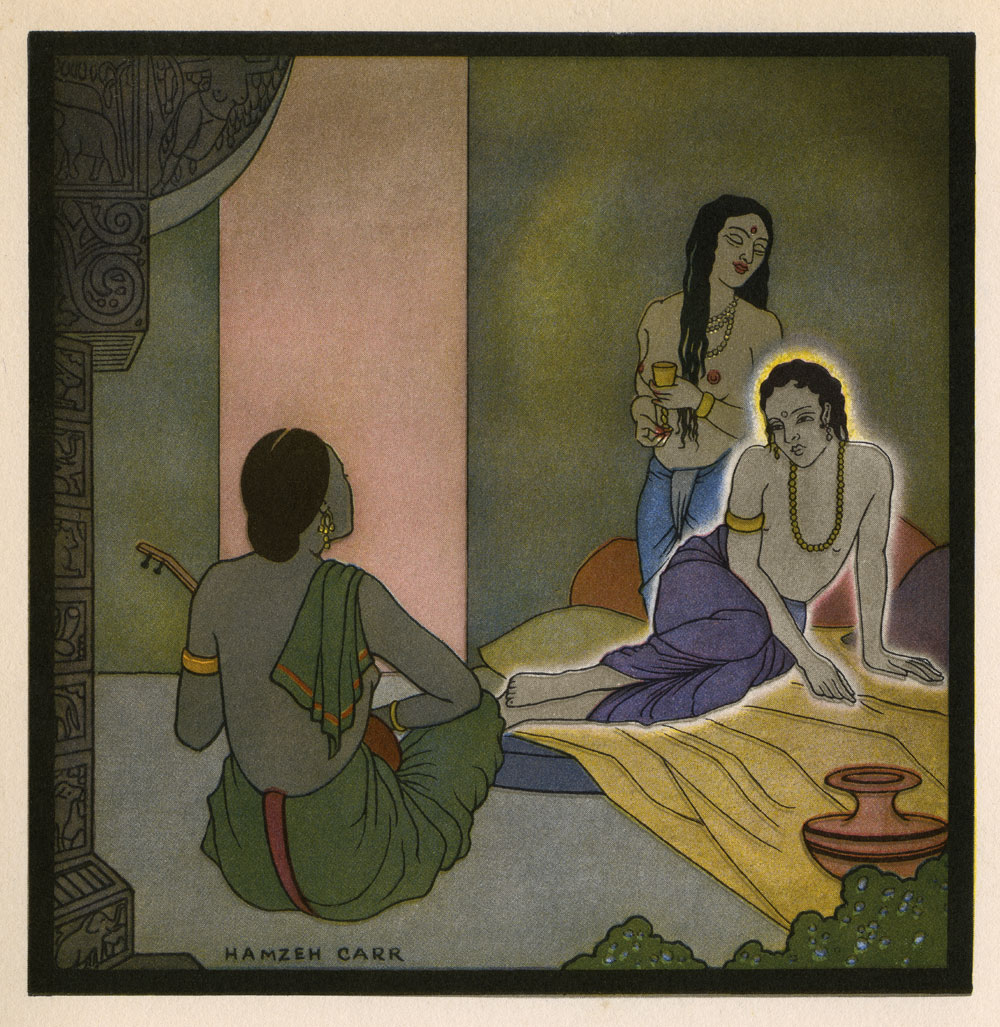
Hamzeh Carr And some maid told an ancient tale 1926
From Sir Edwin Arnold. The Light of Asia. London: John Lane The Bodley Head Ltd, 1926, p. 44
Limited edition of 3,000 copies
In the flesh, the colouring and radiance of these plates has to be seen to be believed.
I shall be posting more of these stunning works. Please click on the artwork for a larger version of the image.
The outside looks vaguely interesting – the aspect of the building within its surroundings and how it fits into the landscape – but really it is just a safe, unthreatening and conformist structure. The inside is the usual white cube. Says it all really that the inside rates about 5 seconds of the whole video!
Exhibition dates: 12th October – 12th November 2011
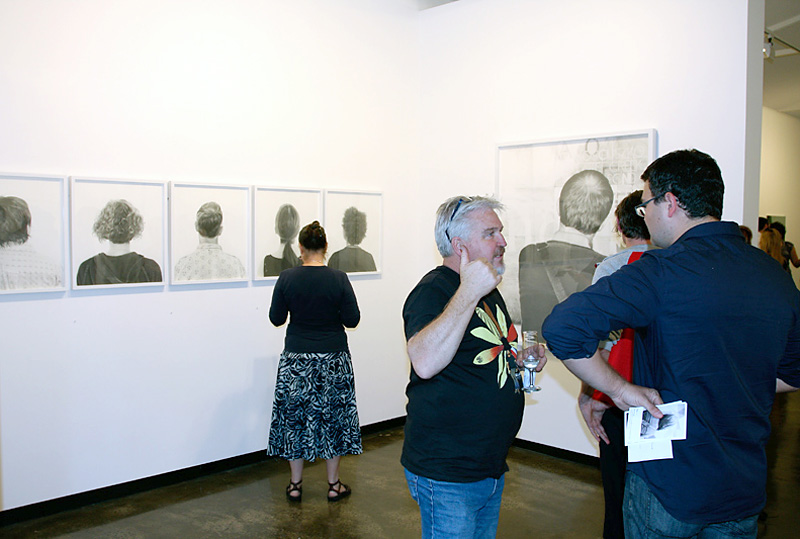
Martin Smith (Australian, b. 1971) My Father Doesn’t Relate Well With Other Men
2011
Martin Smith is one of my favourite photo artists working in Australia at the moment. Smith produces consistently intriguing, stimulating art. Having had a particularly fractious relationship with my own father I appreciate the pathos and humour that Smith achieves in his work. Fantastic!
Marcus
Many thankx to Ryan Renshaw gallery for allowing me to publish the photographs in the posting. Please click on the photographs for a larger version of the image.
Martin Smith (Australian, b. 1971) My Father is a Deeply Flawed Human Being
2011
Martin Smith’s artwork focuses on those small moments that glance into a life. Tending to gather photographs as opposed to taking them, his works offer wry observations rather than grand statements. The loss or absence inherent in photographic images, which are suggestive of another time and place, is echoed in the physical loss of the words cut into the surface of the works. One story is inscribed on another; just like one memory is laid upon another or one version of a story embellishes another. The resulting works are replete with the same ambiguity, melancholy and richness as one’s memory.
‘The storytelling came from when I started looking at my old family photos and thinking about what goes with them,’ Smith explains. ‘You know when you’re looking at family photos, there are particular stories that go with them – that’s that person, that’s the time when your uncle turned up for Christmas, and so on.’
Smith’s stories that are painstakingly hand-cut into the photographic image give a whimsical and highly personal account of his life, like his ill-fated attempt to become an actor with the Sandgate Amateur Theatre Group or the time he worked in the cutlery crew at Australian Airlines, combining the text of these stories with photographs. The scarring of the photographic image with Smith’s scalpel blade ensures a unique artwork, a notion at odds with the reproducible aspects of photography.
Martin’s exhibition stems from his reflection of his experiences as an actor in Roger Fagan’s play A Perfect Price For Donny and questions the legacy of what we ‘leave behind’ for others to read.
‘Tanya was from the past of my amateur theatre days when I was 17 years old and possessed with deluded dreams of being an actor. We were both new members of the Sacred Heart Players and we both landed the leads in the production of A Perfect Price for Donny written by Roger Fagan. Roger was an elderly member of the group and had joined years earlier to gain practical experience so he could finish his play. The Perfect Price for Donny was his first and only play. Roger had worked at the Railways for 32 years and had been writing A Perfect Price for Donny on and off over the 32 years. He had not started another play, he hadn’t written any short stories, prose or even a Haiku. Since he had retired two years ago he was finally able to realise his dream of finishing A Perfect Price for Donny at the age of 68′.
‘The memories are left behind and then reconstituted and turned into other things, it’s a language constantly getting churned up. Memories are things that inform taking the photo,’ Smith says ‘and I’m bringing some of the intrinsic aspects of the photograph with me. Photography captures the classic moments of life, like your first day at school,’ he continues, ‘but it doesn’t capture the other parts of your life that are sometimes way more significant.’
People spend a lot of time in a Martin Smith exhibition reading the works and then laughing or sighing in recognition. The photographs are all of fairly impersonal exteriors, almost crime scenes, not postcards, not picturesque snaps but odd disregarded corners of the world. In some way they are reminiscent of album covers or slightly lame posters but are brought into the present by Smith’s honest and often very funny tales of modern living.
Press release from the Ryan Renshaw Gallery website
Martin Smith (Australian, b. 1971) My Father’s Talents Will Never Make Me Wealthy
2011
Martin Smith (Australian, b. 1971) My Father Fails
2011
Martin Smith (Australian, b. 1971) Revelation #2
2011
Media preview for Vienna – Art & Design at the National Gallery of Victoria Photo: Marcus Bunyan
A subtle pleasure
The delicate paintings are smaller with a flatness of texture and a sombreness than I had not imagined; magnificent in their subtlety. However, the real stars of this wonderful exhibition are the design pieces.
Whether silver, wood, ceramic, glass or jewellery the designs are balanced by a glorious aesthetic. Never has a tea service looked so ravishing or decadent.
This is not a wham bang show like Dali or that other King of some fame showing elsewhere. This is for a discerning audience – one that can take time (between pots of tea) to study and go ooh and aah!
Installation view of first room of the exhibition Vienna – Art & Design at the National Gallery of Victoria Photo: Marcus Bunyan
Installation view of first room of the exhibition Vienna – Art & Design at the National Gallery of Victoria showing at left:
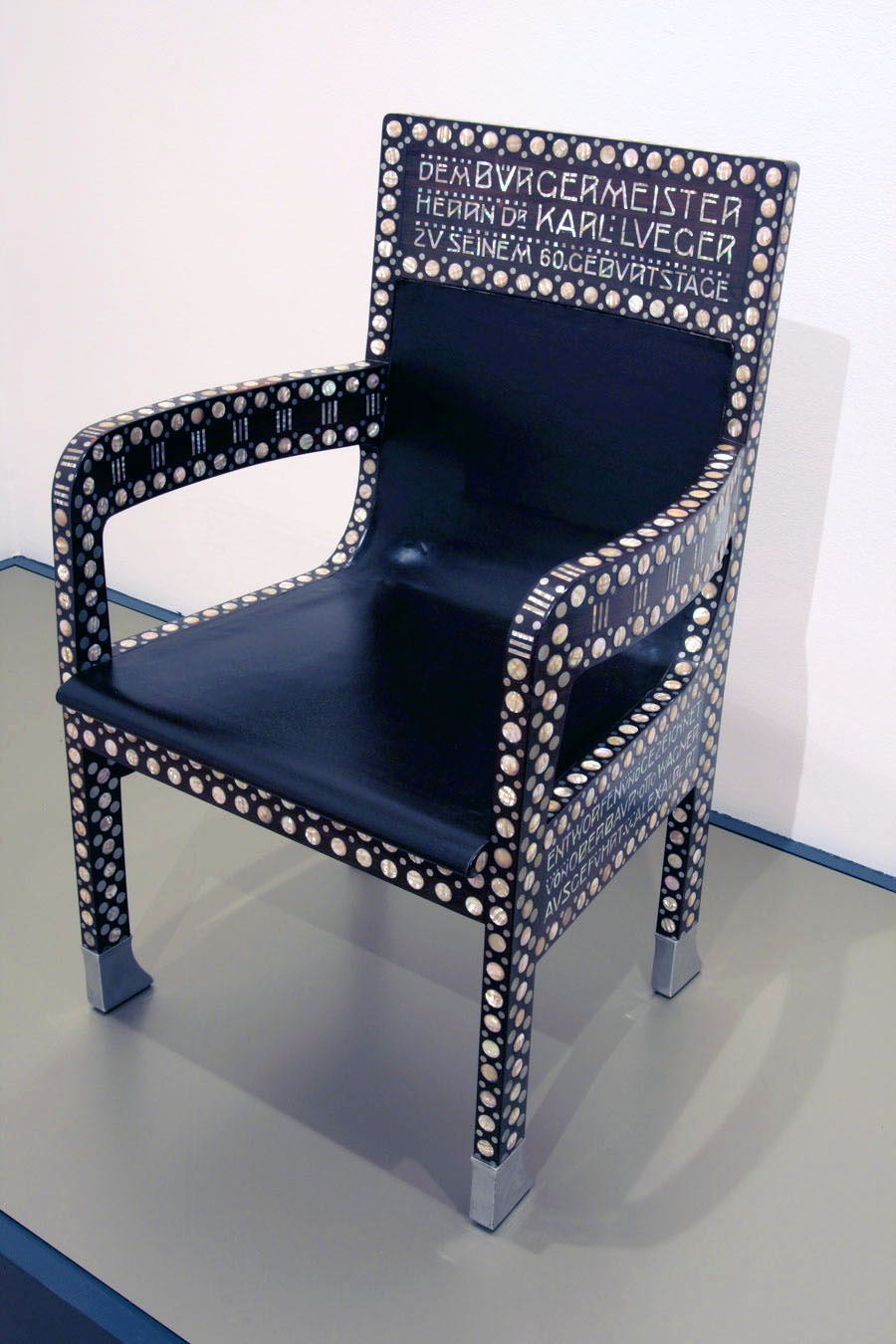
Otto Wagner (architect) (Austrian, 1841-1918) Alexander Albert (manufacturer) Austria active c. 1904 Chair for Dr Karl Lueger 1904
Rosewood (Dalbergia sp.), mother-of-pearl, leather
98.5 x 63 x 59.5cm
Wien Museum, Vienna
Estate of Karl Lueger, 1910
at right:
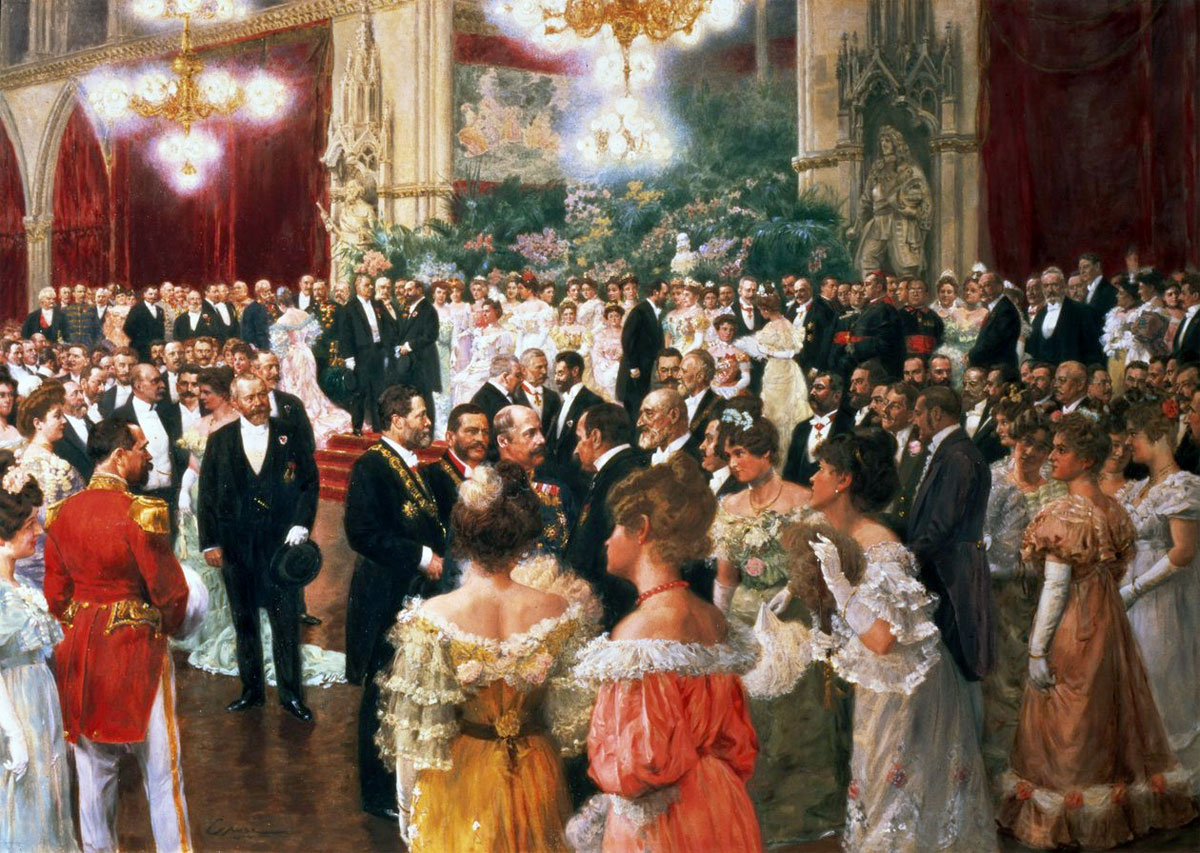
Wilhelm Gause (Germany 1853-1916) Vienna Municipal Ball 1904
Watercolour and oil on cardboard
62 x 88cm
Wien Museum, Vienna
Commissioned by the City of Vienna, 1904 Photo: Marcus Bunyan
Wilhelm Gause (Germany 1853-1916) Vienna Municipal Ball 1904
Watercolour and oil on cardboard
62 x 88cm
Wien Museum, Vienna
Commissioned by the City of Vienna, 1904
Stylish, provocative, rebellious, and unforgettable – the world has seen nothing like Vienna in 1900. A century ago, a group of radical young artists, architects, writers, musicians, designers and thinkers overturned all the rules and created a brave new world. Gustav Klimt, Egon Schiele, Josef Hoffmann and Adolf Loos were central to this artistic revolution which transformed Vienna into a dynamic metropolis at the forefront of ground-breaking modernism.
Vienna at the dawn of the twentieth century was opulent, elegant and daring. Casting aside outmoded social mores and moralities, private life became public spectacle. Cabarets, coffee houses, and nightclubs teemed with radical debate and artistic abandon. Gustav Klimt’s society portraits immortalise the chic women who presided over this creative ferment. Josef Hoffmann and the Vienna Workshops created the bold new interior design and the household objects with which these women furnished their elegant homes, establishing the modern ‘look’. As Sigmund Freud defined sexual fragmentation and erotic obsession for a new millennium, Egon Schiele explored human sexuality in images of unparalleled and startling frankness.
Vienna: Art & Design will explore this extraordinary period of artistic and intellectual genius, bringing together more than 250 works of art, including painting, drawing, graphic and decorative art, furniture, fashion, jewellery and photography, most never before seen in Australia. Visitors will experience the inventiveness and brilliance of a unique generation who laid the foundations for life in the twentieth century – a legacy still vividly alive today.
Text from the National Gallery of Victoria website Nd [Online] Cited 22/07/2022
Otto Wagner (Austrian, 1841-1918) (architect) Alexander Albert (Austria active c. 1904) (manufacturer) Chair for Dr Karl Lueger 1904
Rosewood (Dalbergia sp.), mother-of-pearl, leather
98.5 x 63 x 59.5cm
Wien Museum, Vienna
Estate of Karl Lueger, 1910 Photo: Marcus Bunyan
Otto Wagner (Austria 1841-1918) (architect) Reconstruction of facade for Die Zeit (installation view)
1902 designed, 1985 made
Iron, aluminium, nickel-plated iron, glass
450 x 332cm
Wien Museum, Vienna
Commissioned by the Historisches Museum der Stadt Wien, 1985 Photo: Marcus Bunyan
Otto Wagner (Austria 1841-1918) (architect) Reconstruction of facade for Die Zeit (installation detail) 1902 designed, 1985 made Iron, aluminium, nickel-plated iron, glass
450 x 332cm
Wien Museum, Vienna
Commissioned by the Historisches Museum der Stadt Wien, 1985 Photo: Marcus Bunyan
Otto Wagner objects including shelving, stool, chair and hot air blower (rear) in the exhibition Vienna – Art & Design at the National Gallery of Victoria Photo: Marcus Bunyan
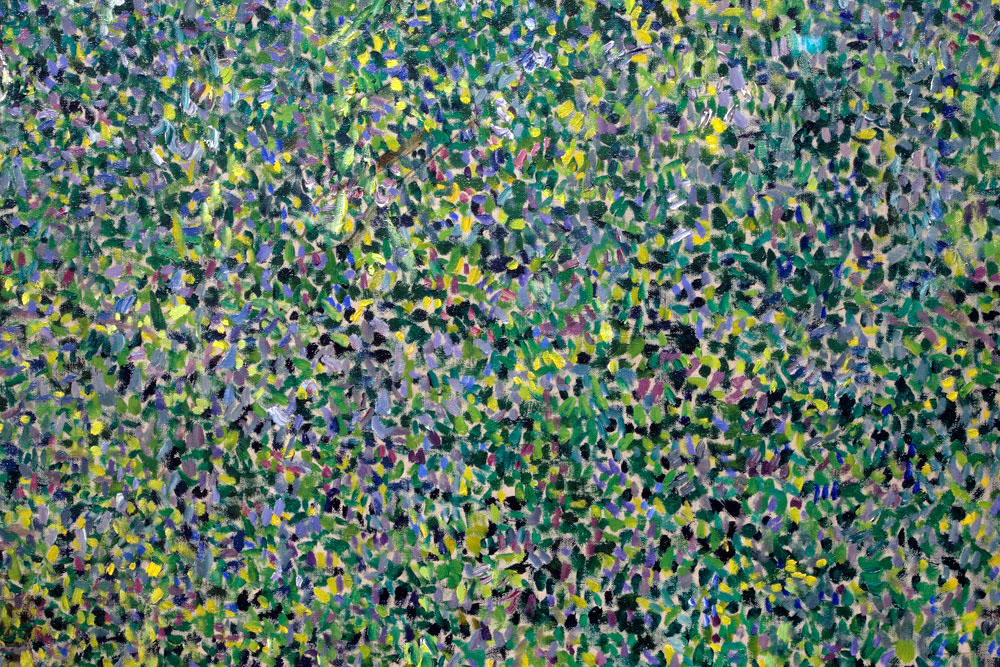
Gustav Klimt (Austria 1862-1918) The Park (installation detail)
1909
Oil on canvas Photo: Marcus Bunyan
Gustav Klimt (Austria 1862-1918) The Park (installation detail)
1909
Oil on canvas Photo: Marcus Bunyan
Installation view part of the second room of the exhibition Vienna – Art & Design at the National Gallery of Victoria Photo: Marcus Bunyan
Wilhelm Otto List Young lady in black and white (installation detail)
1904
Oil on canvas Photo: Marcus Bunyan
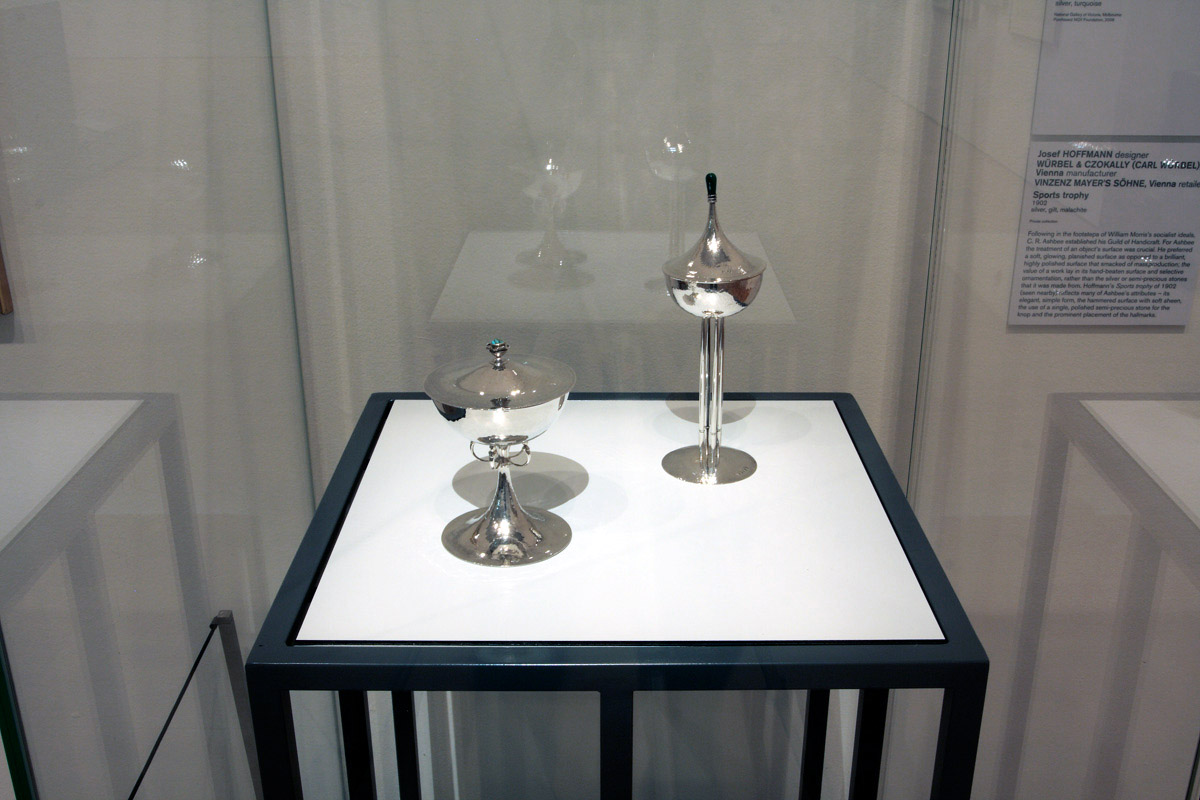
Charles Robert Ashbee (designer) (British, 1863-1942) Standing cup and cover (installation view)
1901
Silver, turqoise
Josef Hoffmann (designer) (Austria-Hungary 1870-1956) Sports Trophy (installation view)
1902
Silver, gilt, malachite Photo: Marcus Bunyan
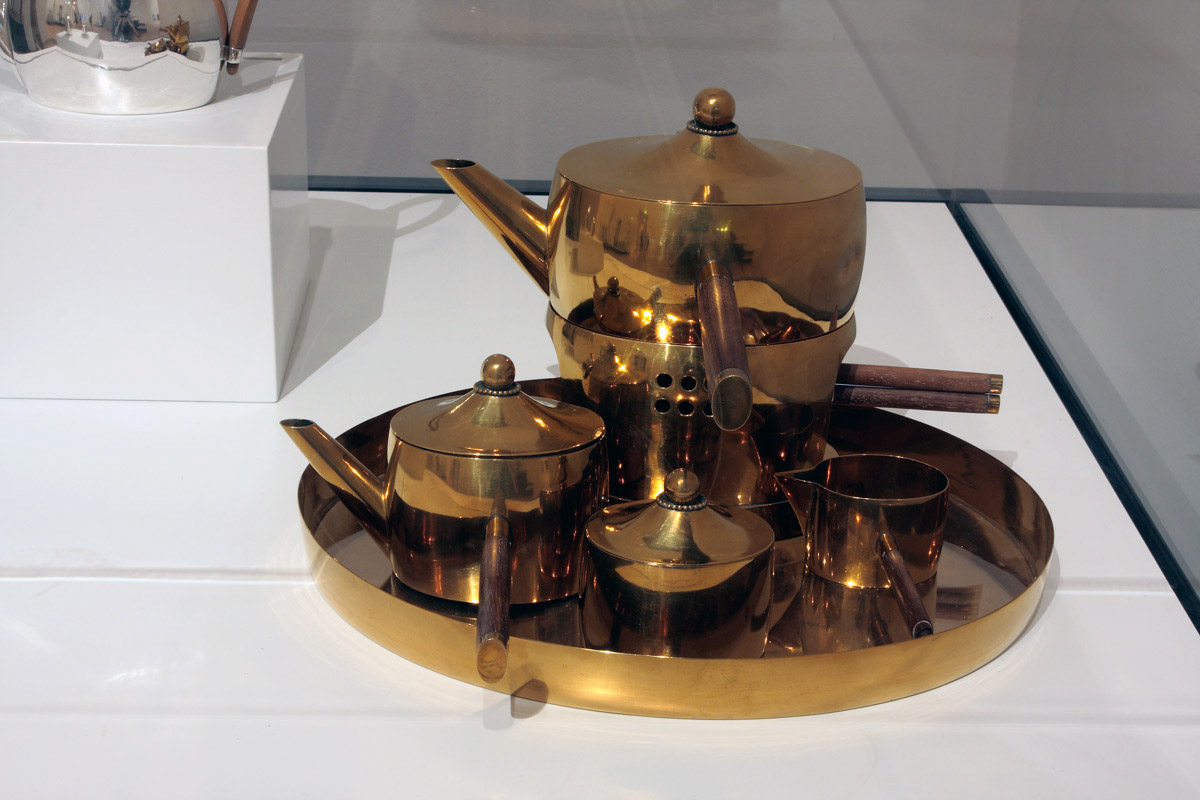
Josef Hoffmann (Austria-Hungary 1870-1956) (designer) Wiener Werkstätte, Vienna (manufacturer) (Austria-Hungary 1903-1932) Tea service (installation view)
c. 1909-1911
Silver-gilt, wood
(1.A-E) 21.5 x 29.0 x 26.8cm (overall) (kettle, stand and burner)
(2) 10.8 x 15.4 x 20.2cm (teapot)
(3.A-B) 8.7 x 8.8 x 6.8cm (overall) (sugar basin and lid)
(4) 4.8 x 8.5 x 15.6cm (milk jug)
(5) 3.4 x 36.3 x 29.9cm (tray)
National Gallery of Australia, Canberra
Purchased, 1985 Photo: Marcus Bunyan
Installation view of room three of the exhibition Vienna – Art & Design at the National Gallery of Victoria showing part of Gustave Klimt’s Beethoven Frieze: Central wall 1901-1902 (detail at top) Photo: Marcus Bunyan
Max Klinger (German, 1857-1920) Beethoven (installation view)
c. 1902
Plaster Photo: Marcus Bunyan
Installation view of room four of the exhibition Vienna – Art & Design at the National Gallery of Victoria with at right, Gustav Klimt’s painting Emilie Flöge (1902) Photo: Marcus Bunyan
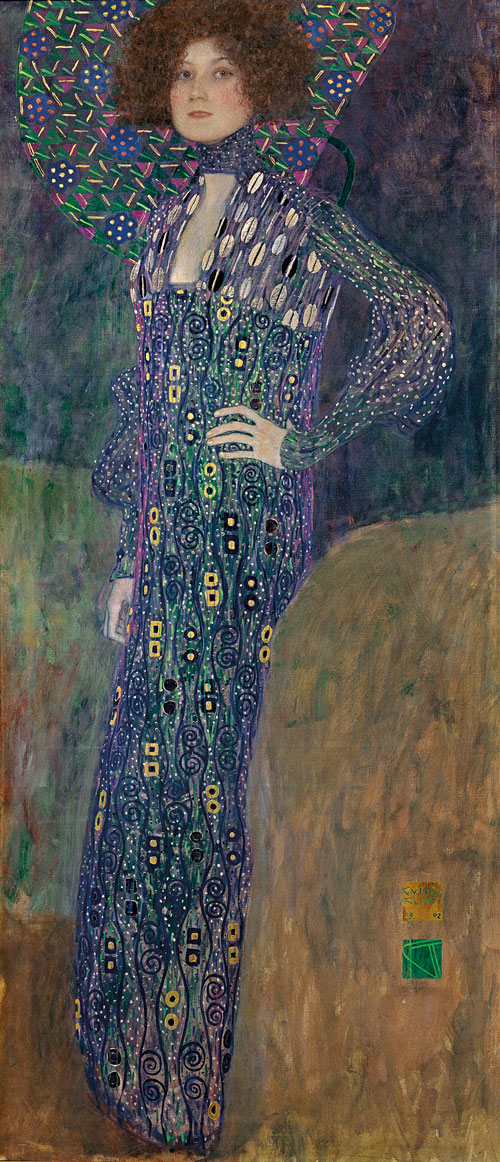
Gustav Klimt (Austrian, 1862-1918) Emilie Flöge 1902
Oil on canvas
178.0 x 80.0cm
Wien Museum, Vienna
Gustav Klimt (Austrian, 1862-1918) Emilie Flöge (installation detail) 1902
Oil on canvas
178.0 x 80.0cm
Wien Museum, Vienna Photo: Marcus Bunyan
Installation view of room five of the exhibition Vienna – Art & Design at the National Gallery of Victoria Photo: Marcus Bunyan
Installation view of first room of the exhibition Vienna – Art & Design at the National Gallery of Victoria showing at right:
Josef Hoffmann (Austrian, 1870-1956) (designer) Collapsible library steps (installation view)
1905 Photo: Marcus Bunyan
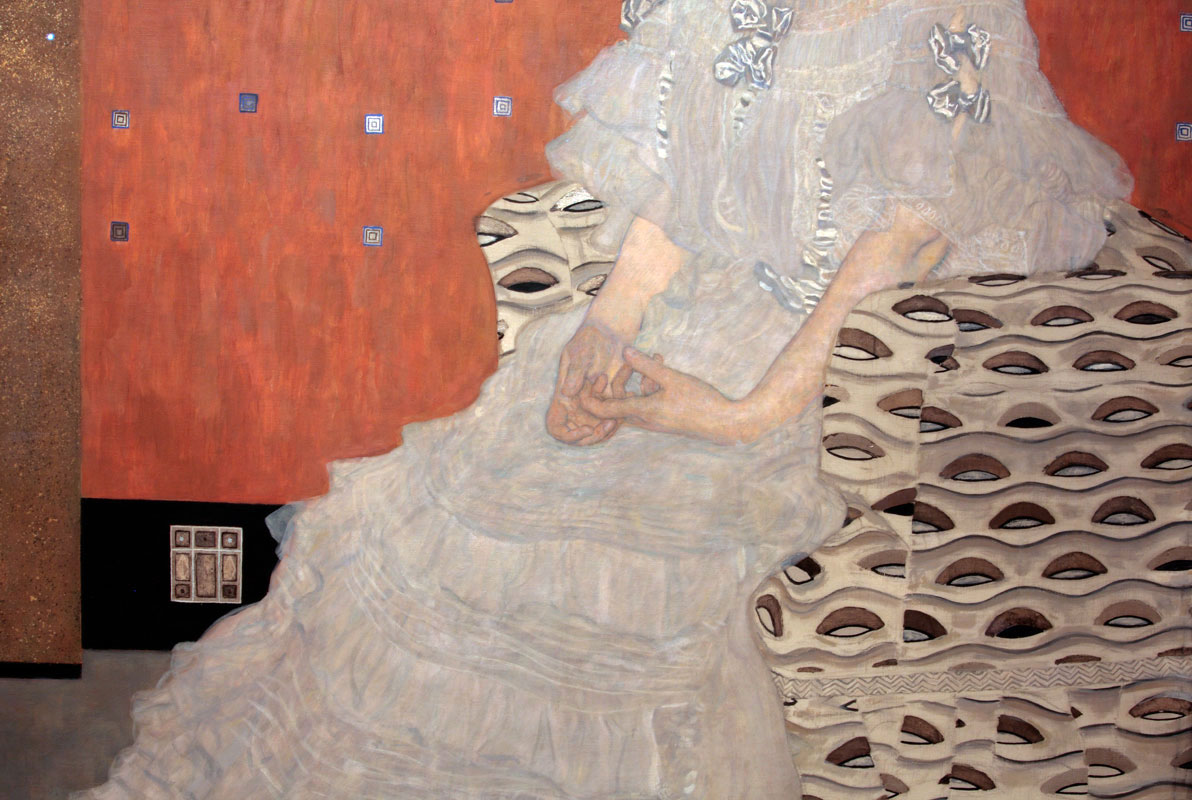
Gustav Klimt (Austrian, 1862-1918) Fritza Riedler (installation detail) 1906
Oil on canvas Photo: Marcus Bunyan
Gustav Klimt (Austrian, 1862-1918) Fritza Riedler 1906
Oil on canvas
152.0 x 134.0cm
Belvedere, Vienna
Installation views of room six of the exhibition Vienna – Art & Design at the National Gallery of Victoria Photos: Marcus Bunyan
Josef Hoffmann (Austrian, 1870-1956) Tea and coffee service (installation view)
1909
Silver, ivory Photo: Marcus Bunyan
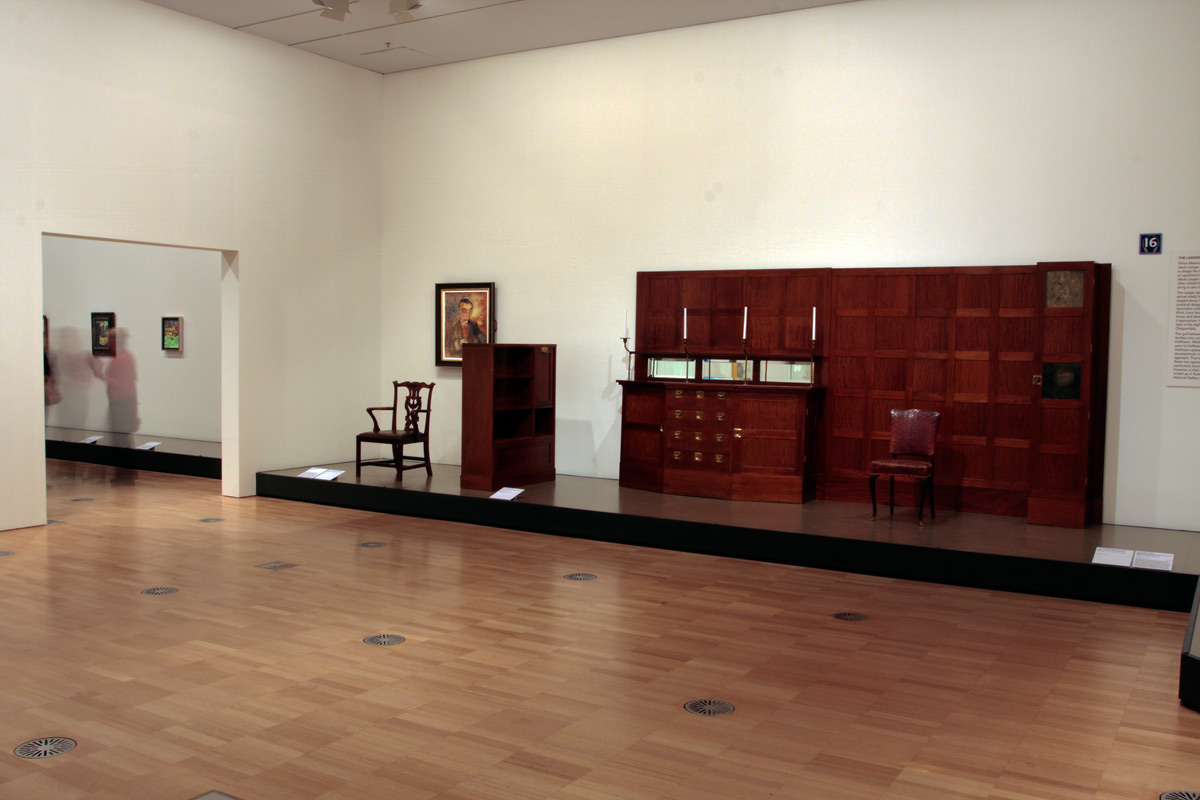
Installation view of room seven of the exhibition Vienna – Art & Design at the National Gallery of Victoria with, against the wall,
Adolf Loos (Austrian, 1870-1933) (designer) Sideboard, from the Langer apartment 1903
Mahogany (Swietenia sp.), mirror, brass Photo: Marcus Bunyan
Adolf Loos (Austrian, 1870-1933) (designer) Johann Heeg (manufacturer) Clock
1906-1907
Brass, glass, clock mechanism, enamel paint, steel
(a-b) 42.7 x 43.0 x 32.7cm (overall) (c) 7.4 x 5.5 x 0.8cm (key)
National Gallery of Victoria, Melbourne
Purchased through The Art Foundation of Victoria with the assistance of Waltons Limited, Fellow, 1987
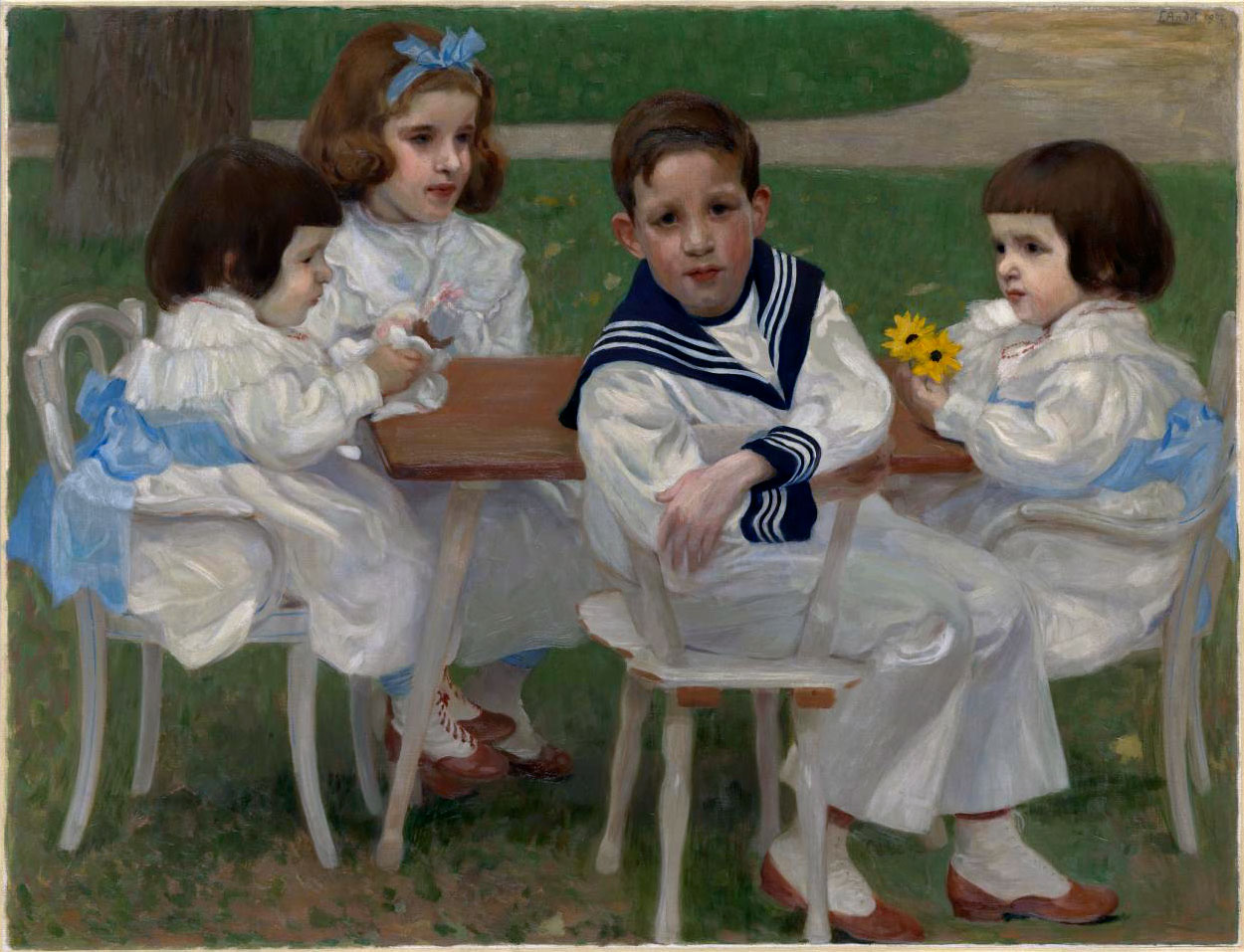
Installation view of room seven of the exhibition Vienna – Art & Design at the National Gallery of Victoria Photo: Marcus Bunyan
Ferdinand Andri (Austrian, 1871-1956) The Gallia children (installation view)
1901
Oil on canvas
with Josef Hoffmann furniture in the foreground Photo: Marcus Bunyan
Gustave Klimt (Austrian, 1862-1918) Portrait of Hermine Gallia (installation view detail)
1904
Oil on canvas Photo: Marcus Bunyan
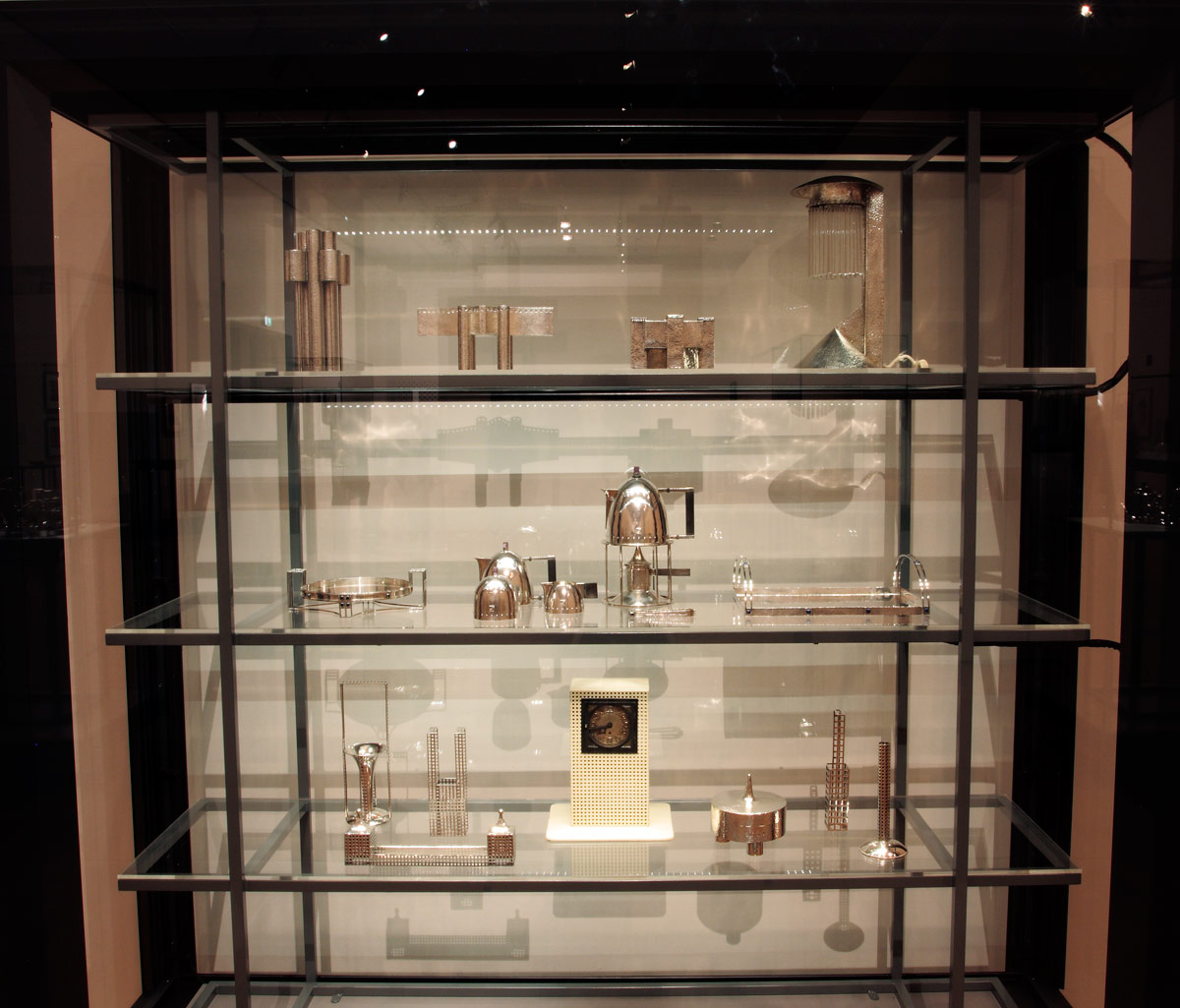
Pieces of Josef Hoffmann and Koloman Mosser silver in the exhibition Vienna – Art & Design at the National Gallery of Victoria Photo: Marcus Bunyan
Love the reflected light!
Installation views of room eight of the exhibition Vienna – Art & Design at the National Gallery of Victoria Photos: Marcus Bunyan
Objects by Dagobert Peche (left, right and second right) and Josef Hoffmann in the exhibition Vienna – Art & Design at the National Gallery of Victoria Photo: Marcus Bunyan
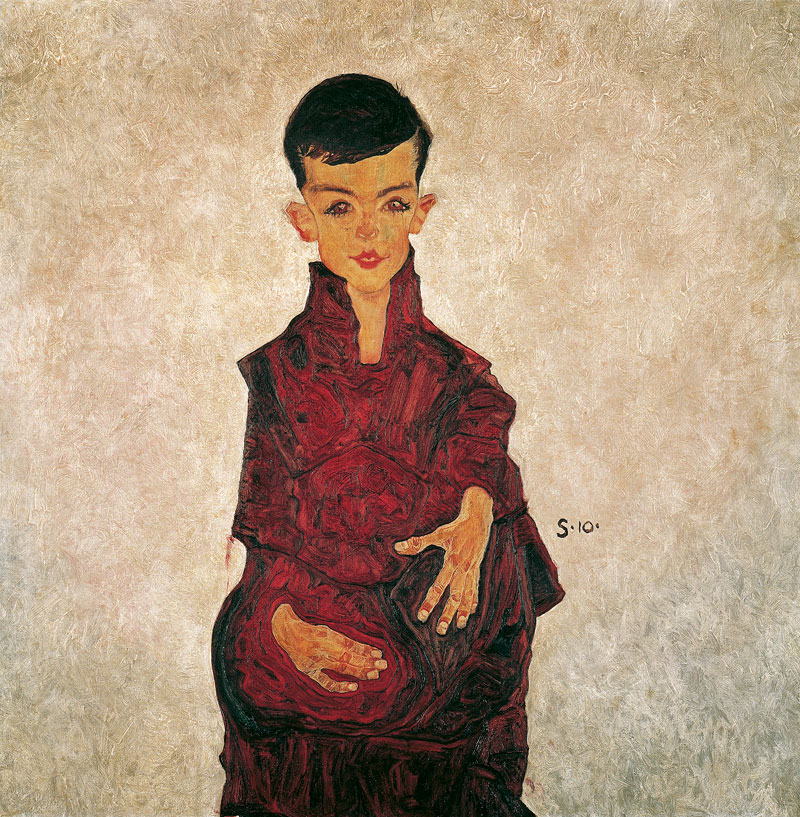
Egon Schiele (Austrian, 1890-1918) Portrait of a boy (Portrait of Herbert Rainer aged approximately six (installation detail) 1910
Oil on canvas Photo: Marcus Bunyan
Egon Schiele (Austrian, 1890-1918) Portrait of a boy (Portrait of Herbert Rainer aged approximately six) 1910
Oil on canvas
101.0 x 101.5cm
Belvedere, Vienna
It is with much sadness that I note the death of respected Australian photographer and teacher Dr John Cato (1926-2011). Son of Australian photographer Jack Cato, who wrote one of the first histories of Australian photography (The Story of the Camera in Australia (1955)), John was apprentice to his father before setting up a commercial studio with Athol Shmith that ran from 1950-1971. Dr Cato then joined Shmith at the fledgling Prahran College of Advanced Education photography course in 1974, becoming head of the course when Shmith retired in 1979, a position he held until John retired in 1991.
I was fortunate enough to get to know John and his vivacious wife Dawn. I worked with him and co-curatored his retrospective with William Heimerman, ‘…and his forms were without number’ at The Photographers’ Gallery, South Yarra, in 2002. My catalogue essay from this exhibition is reproduced below.
John was always generous with his time and advice. His photographs are sensitive, lyrical renditions of the Australian landscape. He had a wonderful ear for the land and for the word, a musical lyricism that was unusual in Australian photographers of the early 1970s. He understood how a person from European background could have connection to this land, this Australia, without being afraid to express this sense of belonging; he also imaged an Aboriginal philosophy (that all spirits have a physical presence and everything physical has a spiritual presence) tapping into one of the major themes of his personal work: the mirror held up to reveal an’other’ world – the language of ambiguity and ambivalence (the dichotomy of opposites e.g. black / white, masculine / feminine) speaking through the photographic print.
His contribution to the art of photography in Australia is outstanding. What are the precedents for a visual essay in Australian photography before John Cato? I ask the reader to consider this question.
It would be fantastic if the National Gallery of Victoria could organise a large exhibition and publication of his work, gathering photographs from collections across the land, much like the successful retrospective of the work of John Davis held in 2010. Cato’s work needs a greater appreciation throughout Australia because of it’s seminal nature, containing as it does the seeds of later development for Australian photographers. His educational contribution to the development of photography as an art form within Australia should also be acknowledged in separate essays for his influence was immense. His life, his teaching and his work deserves nothing less.
Dr Marcus Bunyan
‘… and his forms were without number’
John Cato: A Retrospective of the Photographic Work 1971-1991
This writing on the photographic work of Dr John Cato from 1971-1991 is the catalogue essay to a retrospective of his work held at The Photographers’ Gallery in Prahran, Melbourne in 2002. Dr Cato forged his voice as a photographic artist in the early 1970s when photography was just starting to be taken seriously as an art form in Australia. He was a pioneer in the field, and became an educator in art photography. He is respected as one of Australia’s preeminent photographers of the last century.
With the arrival of ‘The New Photography’1 from Europe in the early 1930’s, the formalist style of Modernism was increasingly adopted by photographers who sought to express through photography the new spirit of the age. In the formal construction of the images, the abstract geometry, the unusual camera angles and the use of strong lighting, the representation ‘of the thing in itself’2 was of prime importance. Subject matter often emphasised the monumentality of the factory, machine or body/landscape. The connection of the photographer with the object photographed was usually one of sensitivity and awareness to an external relationship that resulted in a formalist beauty.
Following the upheaval and devastation of the Second World War, photography in Australia was influenced by the ‘Documentary’ style. This “came to be understood as involved chiefly with creating aesthetic experiences … associated with investigation of the social and political environment.”3 This new movement of social realism, “… a human record intimately bound with a moment of perception,”4 was not dissimilar to Henri Cartier-Bresson’s ‘decisive moment’ (images a la sauvette) where existence and essence are in balance.5
The culmination of the ‘Documentary’ style of photography was The Family of Man exhibition curated by Edward Steichen that toured Australia in 1959.6 This exhibition, seen many times by John Cato,7 had a theme of optimism in the unity and dignity of man. The structure of the images in ‘Documentary’ photography echoed those of the earlier ‘New Photography’.
Max Dupain “stressed the objective, impersonal and scientific character of the camera; the photographer could reveal truth by his prerogative of selection.”8 This may have been an objective truth, an external vocalising of a vision that concerned itself more with exterior influences rather than an internal meditation upon the subject matter.
John Cato (Australian, 1926-2011) Untitled from the series Essay I, Landscapes in a Figure 1971-1979 Silver gelatin photograph
In 1971, John Cato’s personal photographic work was exhibited for the first time as part of the group show Frontiers at the National Gallery of Victoria, Melbourne.9 Earth Song emerged into an environment of social upheaval inflamed by Australian involvement in the Vietnam War. It provided a group of enthusiastic people who were beginning to be interested in photography as art, an opportunity to see the world, and photography, through a different lens. The 52 colour photographic prints in Earth Song, were shown in a sequence that used melodic line and symphonic form as its metaphoric basis, standing both as individual photographs and as part of a total concept.10
In the intensity of the holistic vision, in the connection to the subconscious, the images elucidate the photographers’ search for a perception of the world. This involved an attainment of a receptive state that allowed the cracks, creases and angles inherent in the blank slate of creation to become meaningful. The sequence contained images that can be seen as ‘acts of revelation’,11confirmed and expanded by supporting photographs, and they unearthed a new vocabulary for the discussion of spiritual and political issues by the viewer. They may be seen as a metaphor for life.
The use of sequence, internal meditation and ‘revelation’, although not revolutionary in world terms,12 were perhaps unique in the history of Australian photography at that time. During the production of Earth Song, John Cato was still running a commercial studio in partnership with the photographer Athol Shmith and much of his early personal work was undertaken during holidays and spare time away from the studio. Eventually he abandoned being a commercial photographer in favour of a new career as an educator, but found this left him with even less time to pursue his personal work.13
Earth Song (1970-1971) was followed by the black and white sequences:
Tree – A Journey
18 images
1971-1973
Petroglyphs
14 images
1971-1973
Seawind
14 images
1971-1975
Proteus
18 images
1974-1977
Waterway
16 images
1974-1979
Together they form the extensive series Essay I, Landscapes in a Figure, parts of which are held in the permanent photography collection of the National Gallery of Victoria.14
John Cato (Australian, 1926-2011) Untitled from the series Essay I, Landscapes in a Figure 1971-1979 Silver gelatin photograph
The inspiration for Essay I and later personal work came from many sources. An indebtedness to his father, the photographer Jack Cato, is gratefully acknowledged. Cato also acknowledges the influence of literature: William Shakespeare (especially the Sonnets, and As You Like It), William Blake, Walt Whitman (Leaves of Grass), Lewis Carroll (Through the Looking Glass), the Bible; and of music (symphonic form), the mythology of the Dreamtime and Aboriginal rock paintings.15 Each body of work in Essay I was based on an expression of nature, the elements and the Creation. They can be seen as Equivalents16 of his most profound life experiences, his life philosophy illuminated in physical form.
John Cato was able to develop the vocabulary of his own inner landscape while leaving the interpretation of this landscape open to the imagination of the viewer. Seeing himself as a photographer rather than an artist, he used the camera as a tool to mediate between what he saw in his mind’s eye, the subjects he photographed and the surface of the photographic negative.17 Photographing ‘in attention’, much as recommended by the teacher and philosopher Krishnamurti,18 he hoped for a circular connection between the photographer and the subject photographed. He then looked for verification of this connection in the negative and, eventually, in the final print.
Essay II, Figures in a Landscape, had already been started before the completion of Essay I and it consists of three black and white sequences:
Alcheringa
11 images
1978-1981
Broken Spears
11 images
1978-1983
Mantracks
22 images in pairs
1978-1983
The photographs in Essay II seem to express “the sublimation of Aboriginal culture by Europeans”19 and, as such, are of a more political nature. Although this is not obvious in the photographs of Alcheringa, the images in this sequence celebrating the duality of reality and reflection, substance and shadow, it is more insistent in the symbology of Broken Spears and Mantracks. Using the metaphor of the fence post (white man / black man in Broken Spears) and contrasting Aboriginal and European ‘sacred’ sites (in pairs of images in Mantracks), John Cato comments on the destruction of a culture and spirit that had existed for thousands of years living in harmony with the land.
In his imaging of an Aboriginal philosophy (that all spirits have a physical presence and everything physical has a spiritual presence) he again tapped one of the major themes of his personal work: the mirror held up to reveal an’other’ world. Cato saw that even as they are part of the whole, the duality of positive / negative, black / white, masculine / feminine are always in conflict.20 In the exploration of the conceptual richness buried within the dichotomy of opposites, Cato sought to enunciate the language of ambiguity and ambivalence,21 speaking through the photographic print.
The theme of duality was further expanded in his last main body of work, Double Concerto: An Essay in Fiction:
Double Concerto (Pat Noone)
30 images
1984-1990
Double Concerto (Chris Noone)
19 images
1985-1991
Double Concerto may be seen as a critique of the power of witness and John Cato created two ‘other’ personas, Pat Noone and Chris Noone, to visualise alternative conditions within himself. The Essay explored the idea that if you send two people to the same location they will take photographs that are completely different from each other, that tell a distinct story about the location and their self:
“For the truth of the matter is that people have mixed feelings and confused opinions and are subject to contradictory expectations and outcomes, in every sphere of experience.”22
This slightly schizophrenic confusion between the two witnesses is further highlighted by Pat Noone using single black and white images in sequence. Chris Noone, on the other hand, uses multiple colour images joined together to form panoramic landscapes that feature two opposing horizons. The use of colour imagery in Double Concerto, with its link to the colour work of Earth Song, can be seen to mark the closing of the circle in terms of John Cato’s personal work. In Another Way of Telling, John Berger states that …
“Photography, unlike drawing, does not possess a language. The photographic image is produced instantaneously by the reflection of light; its figuration is not impregnated by experience or consciousness.”23
But in the personal work of John Cato it is a reflection of the psyche, not of light, that allows a consciousness to be present in the figuration of the photographic prints. The personal work is an expression of his self, his experience, his story and t(his) language, is our language, if we allow our imagination to speak.
Dr Marcus Bunyan 2002
Footnotes
1/ Newton, Gael. Shades of Light: Photography and Australia 1839-1988. Sydney: Australian National Gallery, William Collins, 1988, p. 109
2/ Newton, Gael. Max Dupain. Sydney: David Ell Press,1980, p. 34
3/ Ibid., p. 32
4/ Greenough, Sarah (et al). On the Art of Fixing a Shadow: 150 Years of Photography. Boston: National Gallery of Art, Bullfinch Press, 1989, p. 256
5/ Ibid., p. 256
6/ Newton, Gael. Shades of Light: Photography and Australia 1839-1988. Sydney: Australian National Gallery, William Collins, 1988, p. 131
7/ Ibid., p. 131
8/ Newton, Gael. Max Dupain. Sydney: David Ell Press, 1980, p. 32
9/ Only the second exhibition by Australian photographers at the National Gallery of Victoria, Melbourne
10/ Shmith, Athol. Light Vision No.1. Melbourne: Jean-Marc Le Pechoux (editor and publisher), Sept 1977, p. 21
11/ Berger, John and Mohr, Jean. Another Way of Telling. New York: Pantheon Books, 1982, p. 118
12/ Hall, James Baker. Minor White: Rites and Passages. New York: Aperture, 1978
13/ Conversation with the photographer 29/01/1997, Melbourne, Victoria
14/ Newton, Gael. Shades of Light: Photography and Australia 1839-1988. Sydney: Australian National Gallery, William Collins, 1988, p. 135, Footnote 7; p. 149
15/ Conversation with the photographer 22/01/1997, Melbourne, Victoria
16/ Norman, Dorothy. Alfred Stieglitz. New York: Aperture, 1976, p. 5
17/ Ibid.,
18/ Krishnamurti. Beginnings of Learning. London: Penguin, 1975, p. 131
19/ Strong, Geoff. Review. The Age. Melbourne, 28/04/1982
20/ Conversation with the photographer 22/01/1997, Melbourne, Victoria
21/ The principal definition for ambiguity in Websters Third New International Dictionary is: “admitting of two or more meanings … referring to two or more things at the same time.” That for ambivalence is “contradictory and oscillating subjective states.” Quoted in Davis, Fred. Fashion, Culture and Identity. Chicago: University of Chicago Press, 1992, p. 21.
22/ Levine, Donald. The Flight From Ambiguity. Chicago: University of Chicago Press, 1985
23/ Berger, John and Mohr, Jean. Another Way of Telling. New York: Pantheon Books, 1982, p. 95
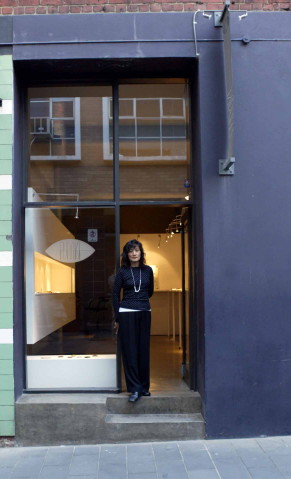
It is with great sadness that I hear of the passing of Mari Funaki on the 13th May 2010.
I met Mari many times and she was always wonderfully generous with her energy, knowledge and enthusiasm. She was an amazing artist, I loved her work especially the stunning anamorphic black bracelets and the fact that she used photography of Bernd and Hiller Becher as part of her inspiration. My conversation with Mari in 2006 and photographs of her work can be found on the Notes from a Conversation with Mari Funaki posting.
Vale Mari Funaki
“A memorial will be held on Tuesday June 1st, 2010 at 11.00am in THE GREAT HALL of the National Gallery of Victoria, International.“
Mari Funaki outside Gallery Funaki Photo: Marcus Bunyan
Camilla Tadich: Slabalong and Mark Hislop: Drawing at Sophie Gannon Gallery; Simon Obarzanek at Karen Woodbury Gallery; Kent Wilson Higher Breeds and Alice Wormald Wayside and Hedgerow at Shifted
Camilla Tadich: Slabalong and Mark Hislop: Drawing at Sophie Gannon Gallery, 2 Albert Street, Richmond March 2nd – March 27th 2010 Sophie Gannon Gallery website
Simon Obarzanek at Karen Woodbury Gallery, 4 Albert Street, Richmond March 3rd – March 27th 2010 This gallery is now closed
Kent Wilson Higher Breeds and Alice Wormald Wayside and Hedgerow at Shifted, Level 1, 15 Albert Street, Richmond This gallery is now closed
All photos by Marcus Bunyan
Sophie Gannon Gallery opening Photo: Marcus Bunyan
Sophie Gannon Gallery opening – Mark Hislop Drawing Photos: Marcus Bunyan
Camilla Tadich (Australian, b. 1982) Bordertown 2010 Photo: Marcus Bunyan
Sophie Gannon Gallery opening – Camila Tadich Slabalong Photo: Marcus Bunyan
Karen Woodbury Gallery opening – Simon Obarzanek Photo: Marcus Bunyan
Simon’s photographs come from observing the physical movements of people pushing through the space around them in a city. He senses a universal language through movement and is drawn to this rather than their faces, as he normally is.
He noted that the “strained movements against gravity struck me with force… When I see a person creating a shape with their body in the street I do not sense the individual but a part, a piece of a larger performance. Each individual connects with others to create a visual language. I did not want faces to interrupt this larger work.”
Simon collects the movements on his camera, as photographic sketches, then he rephotographs the movement using friends and family as models. Removed from the busy streets, dislocated, his subject is isolated and framed against a dark background. Some twist away from the camera, or stagger against an unseen wind, sheltering their face from rain that is not falling. Simon does not show their faces, which emphasises the movement and makes the figures anonymous. These photographs are theatrical and mysterious, emphasising the loneliness and alienation that can be encountered living in a big city.
Roy de Maistre (Australian, 1894-1968) Colour Composition derived from three bars of music in the Key of Green 1935 Oil and pencil on composition board Private Collection
Despite some interesting highlight pieces this is a patchy, thin, incoherent exhibition assembled by the Powerhouse Museum, Sydney now showing at Heide Museum of Modern Art, Melbourne. Featuring a hotchpotch of work ranging across fields such as drawing, architecture, photography, painting, film, graphic design, craft, advertising, Australiana and aboriginal works the exhibition attempts to tell the untold story of Modernism in Australia to little effect. Within the exhibition there is no attempt to define exactly what ‘Modernism’ is and therefore an investigation into Modernism in Australia is all the more confusing for the visitor as there seems to be no stable basis on which to build that investigation. Perhaps reading the catalogue would give a greater overview of the development of Modernism in Australia but for the average visitor to the exhibition there seems to be no holistic rationale for the inclusion of elements within the exhibition which, much like Modernism itself, seems eclectically gathered from all walks of life with little regard for narrative structure.
With work spanning five decades from 1917-1967 we are presented with, variously, Robert Klippel’s kitsch Boomerang table from 1955, Robin Boyd’s ‘House of Tomorrow’ from 1949, Wolfgang Sievers ‘new objective’ photographs, Berlei’s scientific system for calculating beauty in woman in use till the 1960s, swimsuits from the 1920s-1940s, Featherston chairs from the Australian pavilion at the 1967 Expo, a recreation of Australian architect Harry Seidler’s office (the most interesting part of this being the books he had in his office library: Frank Lloyd Wright, Mies van de Rohe and Concerning Town Planning by Le Corbusier) and the wind tunnel test model of the Sydney Opera House in wood from 1960. Etcetera, etcetera, etcetera …
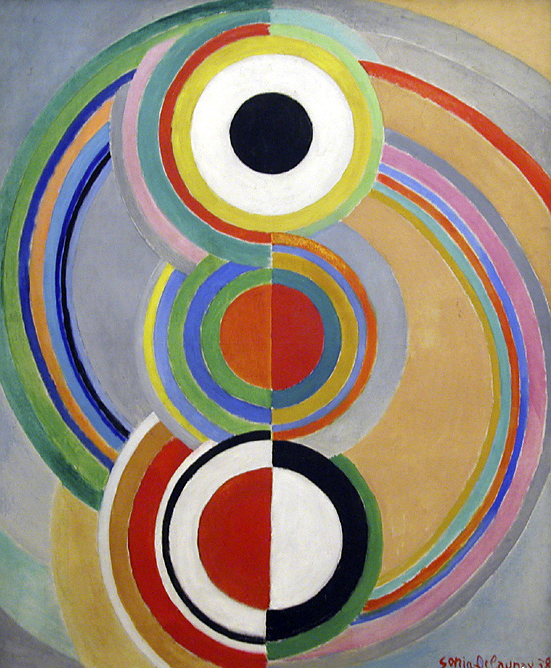
Highlight pieces include the above mentioned test model of the Sydney Opera House which is stunning in its scale and woodenness, in it’s simplicity of shape and form. Other highlight pieces are the colour music compositions of Roy de Maistre which were the tour de force of the show for me, true revelations in their rhythmic synchronic Moebius-like construction with layered planes of colour swirling in purples, greens and yellows. The large vintage photographic print of Sunbaker (1934) by Max Dupain was also a revelation with it’s earthy brown tones, the blending of the atmospheric out of focus foreground with the clouds behind, the architectural nature of the outline of the body almost like the outline of Uluru, the darkness of the head with the sensuality of the head and shoulders framed against the largeness of the hand resting on the sand. Lastly the two paintings and one rug by French artist Sonia Delaunay are a knockout. It says something about an exhibition when the best work in the show are two paintings by a French artist seemingly plucked at random to show external influences on Australian artists and designers.
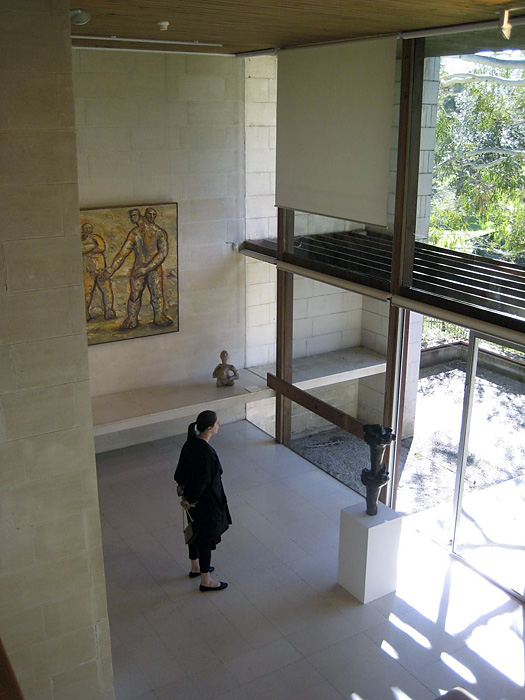
While the exhibition does attempt to portray the breadth of the development of Modernism in Australia ultimately it falls well short in this endeavour. The most striking example of this shortcoming is the true star of the exhibition – the building that is Heide II itself. Commissioned by John and Sunday Reed and designed by the Victorian architect David McGlashan of the architectural firm McGlashan and Eversit in 1963 the building epitomises everything that is good about architectural Modernism and it’s form overshadows the exhibition itself. In this building we have beautiful spaces and volumes, an amazing staircase down into the lower area, suspended decking overlooking gardens, the blending of inside and outside areas, large expanses of glass to view the landscape, nooks and studies for privacy and the simplicity and eloquence of form that is Modernist design. With money one can indulge in the best of elitist Modernism. With position, position, position one can side steep the alienation of the city and the spread of surburbia where the dream of Australians owning a home of their own still continues in the vast, tasteless expanses of McMansion estates.
Robert Nelson in his review of this exhibition sees the car as creating the suburbs and Modernism as the emptying of the city after 6pm, the lessening of community and the devaluing of space he insists that there is little difference between a Californian bungalow in the suburbs and a utopian geometric neo-Corbusian box by Harry Seidler because they were equally shackled to motor transport.1 This is to miss the point.
Although Modernism in its basic form influenced most walks of life in Australia from swimsuit design to milk bars, from cinema to naturism, from bodies to advertising the most effective expressions of Modernism are architectural (as evidenced by Heide II) and were only open to those with money, power and position. Although Le Corbusier’s concept of public housing was a space ‘for the people’ the most interesting of his houses were the private commissions for wealthy clients. And so it proves here. One can imagine the parties on the deck at Heide II in the 1960s with men in their tuxedo and bow ties and woman in their gowns, or the relaxation of the Reed’s sitting in front of their fire in the submerged lounge. For the ordinary working class person Modernism brought a sense of alienation from the aspirational things one cannot buy in the world, an alienation that continues to this day; for the privileged few Modernism offered the exclusivity of elitism (or is it the elitism of exclusivity!) and an aspirational alienation of a different kind – that of the separation from the masses.
Go to Heide for the glorious gardens, the wonders of Heide II but don’t go to this exhibition expecting grand insights into the basis of Australian Modernism for that story, as Robert Nelson rightly notes, remains as yet untold.
Dr Marcus Bunyan
Many thankx to Heide Museum of Modern Art for allowing me to publish the art work in the posting. Please click on the photographs for a larger version of the image.
An excellent review of the exhibition by Jill Julius Matthews, “Modern times: The untold story of modernism in Australia,” (reCollections Volume 4 number 1) can be found on the Journal of the National Museum of Australia website [Online] Cited 20/02/2019
1/ “Emanating from Sydney’s Powerhouse Museum, Modern Times“explores how modernism transformed Australian culture from 1917 to 1967.” But something is missing. The overwhelming modern development in these 50 years was the proliferation of automotive transport, which redefined the layout and function of Australian cities.The cars created the suburbs; and as the individual bungalow drew out the vast dormitories of Sydney and Melbourne, the city centre was spiritually drained, dedicated to bureaucratic and commercial premises.The story at Heide emphasises the gradual triumph of the tall buildings of the CBD. It doesn’t really reflect how these abstract monuments didn’t contain a soul after 6pm.Although the project makes such a big deal of being interdisciplinary, the social history doesn’t have a robust geographical basis. And because of this, the exhibition and book fail to handle the new alienation that modernism brings: the evacuation of the city and the insularity of suburban people in bungalows with little street life and roads increasingly deemed unsafe for children.
What does it really matter if a house looks like a Californian bungalow or a utopian geometric neo-Corbusian box by Harry Seidler? In social terms, they’re structurally the same, equally retracting from a sense of community and equally shackled to motor transport. In this sense, the styles are immaterial, except that one of them gives you a feeling of intimacy while the other has a bit more light and is easily wiped with a sponge.
At the end of the chosen period, the folly of the dominant suburban pattern came to be understood in its dire ecological consequences. Alas, it was too late. The modernist devaluation of space had already occurred, and our whole society had been reorganised around petrol.”
Robert Nelson. The Age. Wednesday 6th May, 2009
Roy de Maistre (Australian, 1894-1968) Arrested Movement from a Trio 1934 Oil and pencil on composition board 72.3 × 98.8cm National Gallery of Victoria, Melbourne
In late 1918, Roy de Maistre collaborated with fellow artist Roland Wakelin in exploring the relationship between art and music. Their experiments produced Australia’s first abstract paintings, characterised by high-key colour, large areas of flat paint and simplified forms. The works received critical acclaim, but modernist developments were largely derided by the conservative establishment.
This painting exemplifies de Maistre’s theory of colour harmonisation based on analogies between colours of the spectrum and notes of the musical scale. It is also aligned with de Maistre’s search for spiritual meaning through abstraction, akin to other artists such as Kandinsky who were interested in the ideas of the theosophy and anthroposophy movements, spiritualism and the occult.
Text from the Art Gallery of New South Wales website
Sonia Delaunay (Ukraine, b. 1885 moved Paris 1905-1979) Rhythm 1938 Oil on canvas
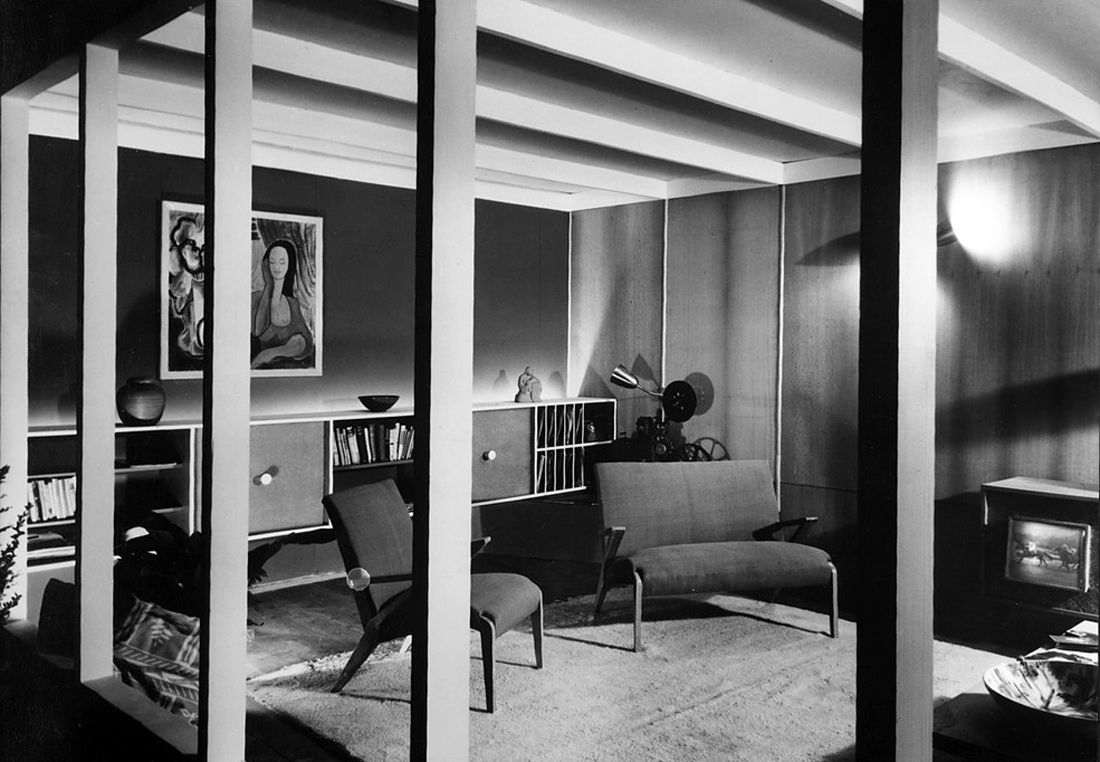
Wolfgang Sievers (Australian born Germany, 1913-2007) “House of Tomorrow” exhibition at Exhibition Building, Melbourne 1949 Gelatin silver print National Library of Australia
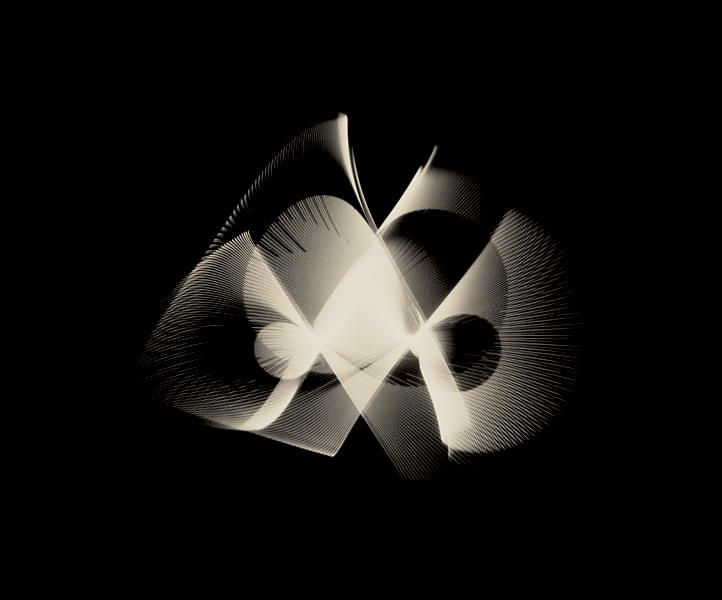
Stanislaus Ostoja-Kotkowski (Australian born Poland, 1922-1994) Nymphex 1966 Gelatin silver photograph from electronic image 50.6 x 60.8cm Gift of Dr George Berger 1978 Art Gallery of New South Wales @ Estate of Stanislaus Ostoja-Kotkowski
Rayner Hoff (Australian born United Kingdom, 1894-1937) Decorative portrait – Len Lye 1925 Marble 30.5 x 22.5 x 16.5cm Purchased 1938 Art Gallery of New South Wales
Cossington Smith captures the drama of a crowd in Rushing, which depicts commuters clamouring down to the ferries of Circular Quay to get home after work. The flying scarf and fallen hat emphasise the speed at which the travellers are moving and the peril and claustrophobia of a, mostly faceless, city crowd. The steep gangplank and diagonal composition accentuates the dynamism of the painting.
A brilliant colourist, Cossington Smith’s work of the early 1920s adopts a darker palette than the vivid colours she is usually associated with. Inspired by a visit to Sydney in 1920 by the tonalist painter and teacher Max Meldrum, her paintings became studies in tone, rather than colour, a practice she had abandoned by 1925.
Text from the Art Gallery of New South Wales website
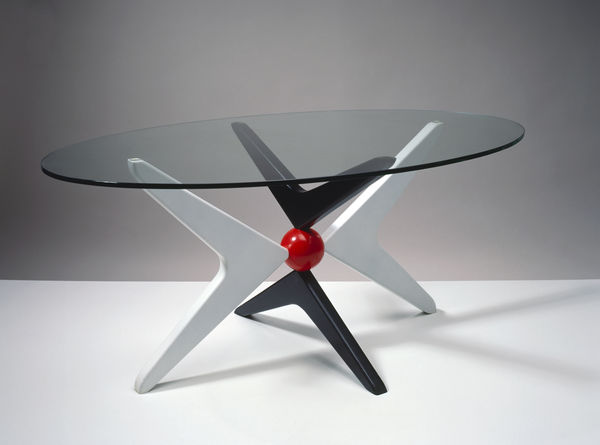
Robert Klippel (Australian, 1920-2001) Boomerang coffee table 1955
The Powerhouse Museum travelling exhibition Modern times: the untold story of modernism in Australia explores how modernism transformed Australian culture from 1917 to 1967, a period of great social, economic, political and technological change. From the ideals of abstraction and functionalism to the romance of high-rise cities, new leisure activities and the healthy body, modernism encapsulated the possibilities of the twentieth century. This exhibition is the first interdisciplinary survey of the impact of modernism in Australia, spanning art, design, architecture, advertising, photography, film and fashion.
Modern times is presented at Heide across all four of the Museum’s gallery spaces. It unfolds in thematic sections highlighting key stories about international exchange, the modern body, modernist ‘primitivism’, the city, modern pools, and the Space Age. Comprising over 300 objects and artworks, it showcases works by major artists including Sidney Nolan, Margaret Preston, Albert Tucker, Grace Cossington Smith, Max Dupain, Wolfgang Sievers, and Clement Meadmore, key architects Robin Boyd, Roy Grounds and Harry Seidler, and designers Fred Ward and Grant and Mary Featherston. An installation, Cannibal Tours, by Madrid-based Australian artist Narelle Jubelin is a contemporary adjunct to the exhibition.
Inspired by the futurist visions of various European avant-gardes, modernist ideas were often controversial and shaped by many competing positions. Modern times reveals how these ideas were circulated and took hold in Australia, via émigrés, expatriates, exhibitions, films and publications. Australian contact with significant international modernist sources, such as the Bauhaus school in Germany, occurred through figures such as influential artist and teacher Ludwig Hirschfeld-Mack, who taught Bauhaus principles at Geelong Grammar, and renowned architect Harry Seidler, who played a central role in shaping the modern city in Australia. Hirschfeld-Mack’s extraordinary film Colour Light Play of 1923 is shown for the first time in Australia, and Seidler’s 1948 studio, designed on his arrival from New York, has been re-created for the exhibition.
While modernism was international in character, an ‘Australian modernism’ was first championed in the 1920s by artist Margaret Preston, whose promotion of Aboriginal forms and motifs was important to the understanding of their artistic value. Preston’s designs, Len Lye’s stunning animation Tusalava (1929), Robert Klippel’s boomerang table (c. 1955) and other works show the development of a vernacular modernism.
Other highlights of Modern times include works from the visionary experiment in colour theory by Roy de Maistre and Roland Wakelin in 1919, a model of Robin Boyd’s innovative House of Tomorrow (1949), the iconic Featherston wing sound chairs from the Australian pavilion at the 1967 Montreal Expo, and a large wooden model for Jørn Utzon’s Sydney Opera House.
Text from the Heide Museum of Art website [Online] Cited 06/06/2009. No longer available online
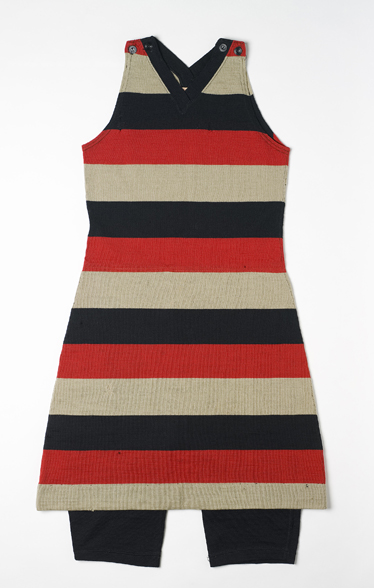
Athlete and movie-star Annette Kellerman’s Modern Kellerman Bathing Suit for Women which became commercially available by the mid-1920s. The one-piece bathing suit became Kellermans trademark Gift of Dennis Wolanski Library, Sydney Opera House, 2000 Photo: Powerhouse Museum
On hot summer days cool off with Tooth’s KB Lager About 1940 Advertising poster Colour and process lithograph, artist name “Parker” in image lower right 100.4 x 75.4cm Sydney Living Museums
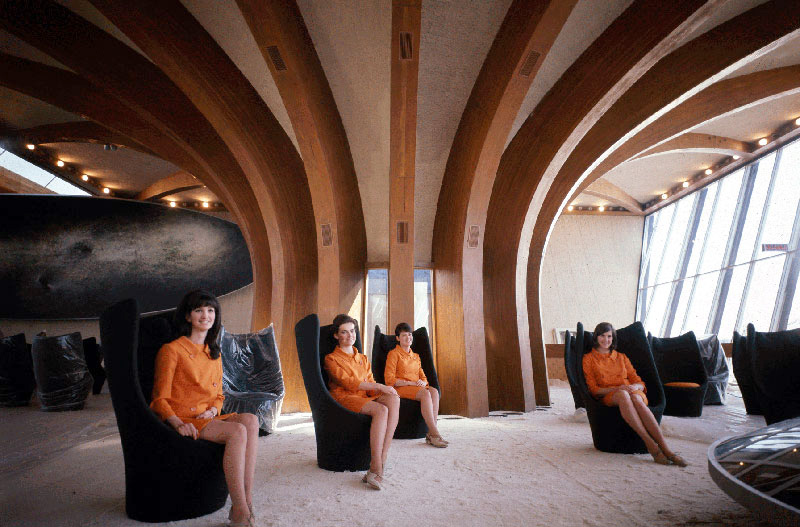
Grant Featherston (Australian, 1922-1995) and Mary Featherston (Australian, b. London 1943, migrated to Australia 1952) Expo mark II sound chair 1967 Aristoc Industries Polystyrene, polyurethane foam, Dunlopillo foam rubber, Pirelli webbing, fibreglass, hardwood, sound equipment, upholstery fabric Powerhouse Collection
The Expo Mark II sound chair, adapted for the Australian domestic market after Expo 67 in Montreal.
A cloth-covered high back winged chair with a circular base. The chair has a circular orange cloth covered cushion in the base and an integral full-width headrest. Two 125mm diameter inserts are pressed into the top of the back of the chair where speakers are fitted inside it. There is a cylindrical knob on the side of the chair.
National Archives of Australia A modernist vision of Australia: Grant and Mary Featherston’s wing sound chairs were a feature of the Australian Pavilion, designed by architect James Maccormick with exhibits selected by Robin Boyd, at Expo 67 in Montreal, 1967 1967
In 1967 Australia participated in the International and Universal Exposition held in Montreal, Canada. Australia’s Expo ’67 theme was the ‘Spirit of Adventure’. In the 30,000 square feet glass-walled Australian Pavilion, developed by the Australian Government and designed by Robin Boyd, exhibits explored Australian science, arts, people and development. The pavilion was designed as a ‘haven’ of ‘space and tranquillity’ floating above an Australian bushland setting. Inside, 240 innovative sound chairs offered ‘foot-weary Expo visitors’ the chance to hear the voices of famous Australians describing the exhibits, in French as well as English. The Great Barrier Reef was re-created in a lagoon beneath the pavilion while wallabies and kangaroos could be viewed in a sunken enclosure.
Text from the National Museum of Australia website [Online] Cited 20/02/2019
James Birrell (Australian, 1928-2019) View of the elevated restaurant, Centenary Pool, Brisbane Nd Powerhouse Museum
“A major exhibition opening for Sydney Design 08 in August, Modern times looks closely at the transformation of modern city life. The advent of cars, freeways, skyscrapers and new entertainment such as cinemas, milk bars, swimming pools, cafes and pubs are all legacies of modernism as revealed through the exhibition. The exhibition spans five decades from 1917 to 1967 – a tumultuous period marked by global wars, economic depression, a technological revolution and major social changes – out of which a modern cosmopolitan culture was shaped.
“The modernist movement was inspired by various European avant-gardes that projected visions of a better future, shaped by many competing positions. It was through émigrés, expatriates, exhibitions and publications that modernism become known in Australia,” Ann Stephen said. Encompassing art, design and architecture, Modern times focuses on seven themes: 1. the human body, image and health; 2. international influences and exchanges; 3. Indigenous art and modernism; 4. Interdisciplinary projects with retailers; 5. city landscapes and urban life; 6. public pools and milk bars; and 7. the space age.
Several great modern public pools were designed in Australia initially as part of an international swimming boom in the 1930s and boosted by the 1956 Melbourne Olympics. These will be shown on a large, immersive, panoramic audio visual screen celebrating the most Australian of past-times, being poolside. The earliest 1920s swimming costumes by silent film star Annette Kellerman, several decades of Australian icon ‘Speedo’ cossies and an early bikini will also be on display.
The much-loved corner milk bar from the 1930s will also be recreated in the exhibition for visitors to enter, complete with lolly jars, milkshakes and a juke box.
Other story highlights in the exhibition include Robin Boyd’s ‘House of Tomorrow’ that featured at the 1949 Modern Home Exhibition in Melbourne; and Boyd’s memorable Australian pavilion at the 1967 Montreal Expo that showcased Australian design including the iconic Featherston wing sound chairs and hostess uniforms designed by Zara Holt, wife of then prime minister Harold Holt.
Modernism also inspired new forms of public art and design like the abstract fountains by Tom Bass on Sydney’s former P&O building and Robert Woodward’s El Alamein Memorial Fountain, a popular tourist site in Sydney’s Kings Cross. Modernism shaped an exultant explosion of experiment as part of the Space Age informing such spectacular architectural feats as Roy Grounds’ dome for the Australian Academy of Science in Canberra and Jørn Utzon’s internationally-acclaimed Sydney Opera House, both featured in the exhibition.”
Ruzan Haruriunyan, “Modern Times: Untold Story Of Modernism In Australia,” on the Huliq News website [Online] Cited 20/02/2019
Hedie II photographs by Rory Hyde. More photos of Heide are on his Flickr photoset
Heide II – commissioned by John and Sunday Reed 1963, designed 1964, constructed 1964-1967
Designed by Melbourne architect David McGlashan of McGlashan Everist, it was intended as “a gallery to be lived in” and served as the Reeds’ residence between 1967 and 1980. The building is considered one of the best examples of modernist architecture in Victoria and awarded the Royal Institute of Architects (Victorian Chapter) Bronze Medal – the highest award for residential architecture in the State – in 1968. It is currently used to display works from the Heide Collection and on occasion projects by contemporary artists.
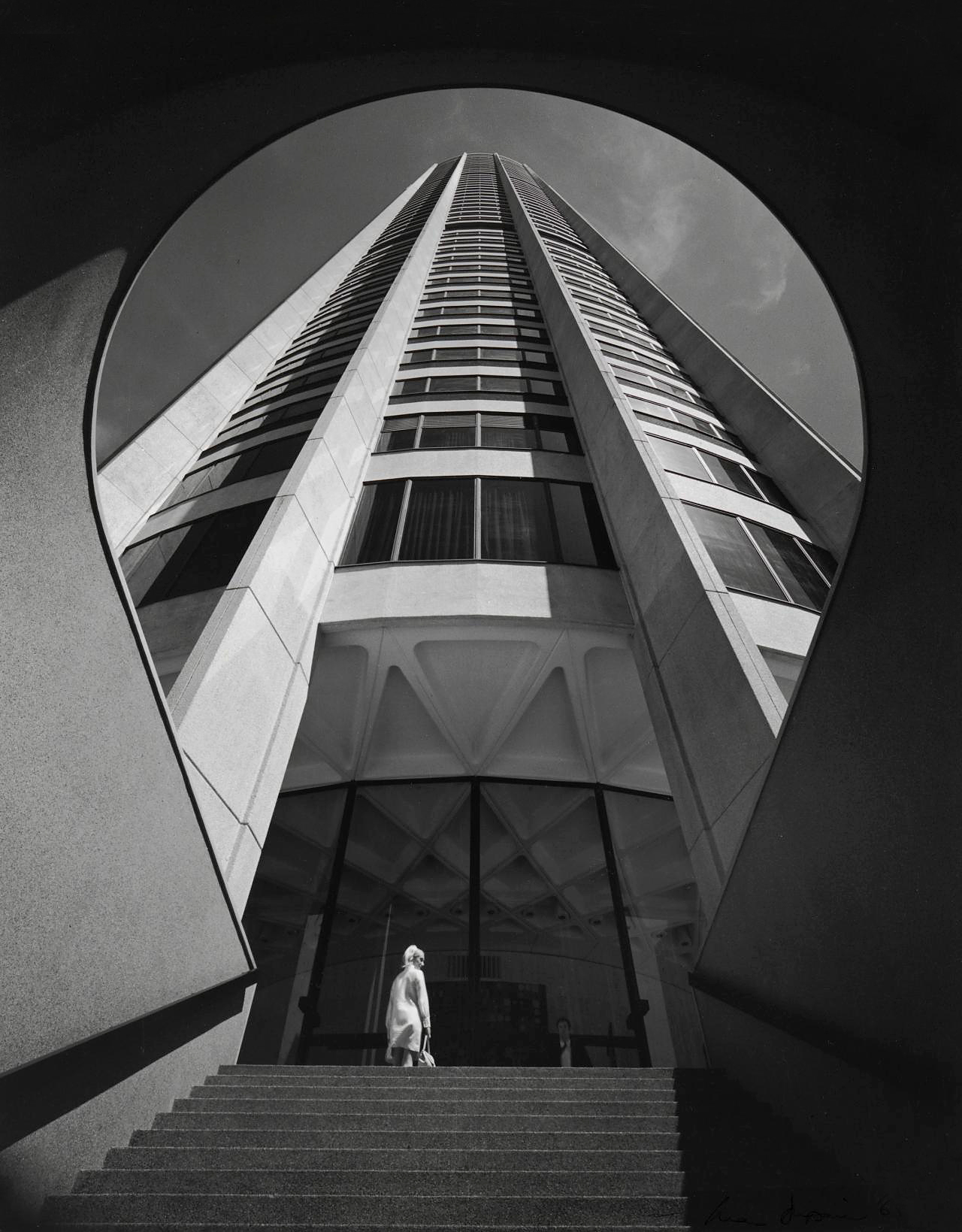
Max Dupain (Australian, 1911-1992) Australia Square: a keyhole to the future [Australia Square Tower] 1968 Gelatin silver print 49.9 × 39.2cm Courtesy of Max Dupain and Associates
Jeff Carter (Australian, 1928-2010) At the Pasha Nightclub, Cooma c. 1957-1959 Gelatin silver print
Modern Times: The Untold Story of Modernism in Australia, edited by Ann Stephen, Philip Goad and Andrew McNamara, Powerhouse Publishing, 2008 (paperback).
Heide Museum of Modern Art 7 Templestowe Road, Bulleen, Victoria 3105
Opening hours: Tuesday – Sunday Public holidays 10am – 5pm
“Sciagraphy: the art of depicting an object through its shadow.”
(William Henry Fox Talbot’s private name for photography)
Schaaf, Larry. “The Paper Multiple: Talbot’s Invention and Early Photographic Books,” in Foster, S., Heiting, M. and Stuhlman, R. Imagining Paradise. Rochester NY: George Eastman House, 2007, p. 45.






























 Art Blart _ art and cultural memory archive
You must be logged in to post a comment.