Exhibition: ‘Saul Leiter Retrospective’ at The House of Photography at Deichtorhallen Hamburg

Exhibition dates: 3rd February – 15th April, 2012

Curators: Ingo Taubhorn and Brigitte Woischnik


Saul Leiter (American, 1923-2013) 'Joanna' c. 1947 from the exhibition 'Saul Leiter Retrospective' at The House of Photography at Deichtorhallen Hamburg, February - April, 2012


Saul Leiter (American, 1923-2013)
Joanna
c. 1947
© Saul Leiter
Courtesy: Saul Leiter, Howard Greenberg Gallery, New York


“I always assumed that I would simply be forgotten and disappear from view.”


Saul Leiter


The second of two postings on the colour photography of Saul Leiter. The first posting was for the exhibition Saul Leiter: New York Reflections at the Jewish Historical Museum, Amsterdam, October 2011 – March 2012. This exhibition is the first major retrospective of his work. At last this artist seems to be getting the recognition he deserves!

The prosaic nature of the titles of the photographs belies their complexity. They remind me of the refractions of Lee Friedlander, the colour fields of Mark Rothko, the emotional intensity of Abstract Expressionism and the impression of spontaneous, subconscious creation that is Surrealism.

His photographs are the glorious spirit of the city writ large – unique, atmospheric and with great psychological use of colour and space.

I can’t think of any other colour photographer of the era (or for that matter, any era) that occludes the picture plane as much as Leiter does, and to such psychological affect, as in the last two photographs in this posting. The viewer becomes like a Peeping Tom, a voyeur of the world.

Leiter deserves to be one of the modern masters of colour photography. I am so glad that he hasn’t disappeared from view. The world would be a poorer place without his visualisation.

Dr Marcus Bunyan


Many thankx to The House of Photography at Deichtorhallen for allowing me to publish the photographs in the posting. Please click on the photographs for a larger version of the image.


Saul Leiter (American, 1923-2013) 'Untitled (Self-portrait)' 1950s


Saul Leiter (American, 1923-2013)
Untitled (Self-portrait)
1950s
© Saul Leiter
Courtesy: Howard Greenberg Gallery, New York


Saul Leiter (American, 1923-2013) 'Phone Call' c. 1957 from the exhibition 'Saul Leiter Retrospective' at The House of Photography at Deichtorhallen Hamburg, February - April, 2012


Saul Leiter (American, 1923-2013)
Phone Call
c. 1957
© Saul Leiter
Courtesy: Saul Leiter, Howard Greenberg Gallery, New York


Saul Leiter (American, 1923-2013) 'Taxi' 1957


Saul Leiter (American, 1923-2013)
Taxi
1957
© Saul Leiter
Courtesy: Saul Leiter, Howard Greenberg Gallery, New York


Saul Leiter (American, 1923-2013) 'Postmen' 1952


Saul Leiter (American, 1923-2013)
Postmen
1952
© Saul Leiter
Courtesy: Saul Leiter, Howard Greenberg Gallery, New York


Saul Leiter (American, 1923-2013) 'Walking' 1956


Saul Leiter (American, 1923-2013)
Walking
1956
© Saul Leiter
Courtesy: Saul Leiter, Howard Greenberg Gallery, New York


Saul Leiter (American, 1923-2013) 'Shopping' c. 1953


Saul Leiter (American, 1923-2013)
Shopping
c. 1953
© Saul Leiter
Courtesy: Saul Leiter, Howard Greenberg Gallery, New York


“Leiter is a rare artist, one whose vision is so encompassing, so refined, so in touch with a certain lyrical undertone, that his best photographs occasionally seem literally to transcend the medium.”


Jane Livingston


House of Photography at Deichtorhallen will from February 3 to April 15, 2012 be highlighting the oeuvre of 88-year-old photographer and painter Saul Leiter in the world’s first major retrospective. The exhibition covers more than 400 works and brings together in marvellous combination his early black-and-white and colour photographs, fashion images, painted-over nude photographs, paintings and his sketchbooks, which have never gone on public view before. Then final chapter in the exhibition is dedicated to Saul Leiter’s most recent photographic works, which he continues to take on the streets in his neighbourhood in New York’s East Village.

 Saul Leiter was born in 1923 in Pittsburgh and it was not until a few years ago that his work received due recognition for its pioneering role in the emergence of colour photography. As early as 1946, and thus well before the representatives of New Color Photography in the 1970s (such as William Eggleston and Stephen Shore) he was one of the first to use colour photography, despite it being despised by artists of the day, for his free artistic shots.

“The older photo-aesthetic views on the hegemony of black-and-white and the dating in photo history of the artistic use of color photography to the early 1970s need to be critically revisited. With Saul Leiter’s oeuvre, the history of photography essentially has to be rewritten,” comments curator Ingo Taubhorn. 

Saul Leiter has always seen himself as both painter and photograph. In his painting and in his photographs he tends clearly to abstraction and a surface feel. Often there are large, deep black surfaces caused by shadows that take up as much as three quarters of the photographs. These are images that do not present passers-by as individuals, but as blurred colour impulses, behind panes of glass or wedges between house walls and traffic signs. He espouses a fluid transition between the abstract and the figurative in his paintings and photographs. Saul Leiter’s street photography, and in this genre his work is quite without precedent, is actually painting that has become photography, as Rolf Nobel writes in the book accompanying the exhibition.

On Saul Leiter

Saul Leiter discovered his passion for art at an early date and started painting as a teenager at the end of the 1940s. His family did not support him in his artistic endeavours as his father, a renowned Talmudic rabbi and scholar, always hoped his son Saul would one day follow him in the family tradition and become a rabbi. Leiter was self-taught, but by no means uneducated. He read and learned a lot about art, such that his knowledge and understanding constantly grew. In this way, he could be certain that his own thought and artistic efforts were duly related to the historical context, as Carrie Springer, curator at the Whitney Museum in New York, points out in the catalog.

 In 1946, shortly after he had moved to New York, Leiter got to know Richard Poussette-Dart, who introduced him to photography, a medium that Leiter found very much to his liking and which he quickly made his own. Leiter soon resolved to make use of photography not only as a means of making art but as a way of earning a living. He started taking fashion photographs and thanks to his good eye, his playful sense of humour, and his pronounced sense of elegance, swiftly emerged as an extraordinary fashion photographer.
 In the 1950s, LIFE magazine brought out the first photo-spreads of Saul Leiter’s first black-and-white images. For example, he took part in the exhibition on Always the young strangers (1953) curated by Edward Steichen at the Museum of Modern Art. From 1958 to 1967, Leiter worked for Harper’s Bazaar. All in all he was to spend some 20 years photographing for both the classic magazines and more recent ones, such as Esquire and Harper’s: Show, Elle, British Vogue, Queen and Nova.

Saul Leiter was born in 1923 in Pittsburgh and has lived since 1946 in New York. For over 40 years, until her death in 2002 New York artist Soames Bantry was his partner. During the preparations for the Hamburg exhibition, Saul Leiter once remarked that he wished that Soames Bantry has received the same attention from the art world as he is now receiving. This spawned the idea of an homage to Soames Bantry, an exhibition in the exhibition at House of Photography that Saul Leiter has himself curated – with over 20 paintings: For Soames with Love Saul. 

In his photographs, the genres of street life, portraiture, still lifes, fashion and architectural photography meld. He comes across his themes, such as shop windows, passers-by, cars, signs and (a recurrent motif) umbrellas, in the direct vicinity of his apartment in New York, where he has now lived for almost 60 years. The lack of clear detail, the blurring of movement and the reduction in depth of field, the compensation for or deliberate avoidance of the necessary light as well as the alienation caused by photographing through windows and by reflections all blend to create a language of colour fuelled by a semi-real, semi-abstract urban space. These are the works of an as good as undiscovered modern master of colour photography of the 1940s and 1950s. The Hamburg exhibition and the major monograph by Kehrer Verlag seek to prevent this happening.

Press release from The House of Photography website


Saul Leiter (American, 1923-2013) 'Red Umbrella' c. 1958


Saul Leiter (American, 1923-2013)
Red Umbrella
c. 1958
© Saul Leiter
Courtesy: Howard Greenberg Gallery, New York


Saul Leiter (American, 1923-2013) 'Snow' 1960


Saul Leiter (American, 1923-2013)
Snow
1960
© Saul Leiter
Courtesy: Saul Leiter, Howard Greenberg Gallery, New York


Saul Leiter (American, 1923-2013) 'Man with Straw Hat' c. 1955


Saul Leiter (American, 1923-2013)
Man with Straw Hat
c. 1955
© Saul Leiter
Courtesy: Howard Greenberg Gallery, New York


Saul Leiter (American, 1923-2013) 'Pizza, Patterson' 1952


Saul Leiter (American, 1923-2013)
Pizza, Patterson
1952
© Saul Leiter
Courtesy: Howard Greenberg Gallery, New York


Saul Leiter (American, 1923-2013) 'Canopy' c. 1957


Saul Leiter (American, 1923-2013)
Canopy
c. 1957
© Saul Leiter
Courtesy: Saul Leiter, Howard Greenberg Gallery, New York


Saul Leiter (American, 1923-2013) 'Through Boards' c. 1957


Saul Leiter (American, 1923-2013)
Through Boards
c. 1957
© Saul Leiter
Courtesy: Saul Leiter, Howard Greenberg Gallery, New York


Deichtorhallen Hamburg
Deichtorstrasse 1-2
20095
Hamburg
Phone: +49 (0)40 32103-0

Opening hours:
Tuesday – Sunday 11am – 6pm
Closed Mondays

Deichtorhallen Hamburg website

LIKE ART BLART ON FACEBOOK

Back to top

Vale Helen Levitt: Always ‘Here and There’

“Levitt’s superb lush colour photographs taken after 1970 engage the viewer not in memory but in the moment, not in nostalgia but in joy.” Dr Marcus Bunyan

April 2009


Helen Levitt (American, 1913-2009) 'New York' c. 1971


Helen Levitt (American, 1913-2009)
New York
c. 1971
© Helen Levitt


“For the perfect flaneur, for the passionate spectator, it is an immense joy to set up house in the heart of the multitude, amid the ebb and flow of movement, in the midst of the fugitive and infinite. To be away from home and yet to feel oneself everywhere at home; to see the world, to be at the centre of the world, and yet to remain hidden from the world … Thus the lover of universal life enters into the crowd as though it were an immense reservoir of electrical energy …”


Charles Baudelaire. The Painter of Modern Life 1863


“At least a dozen of Helen Levitt’s photographs seem to me as beautiful, perceptive, satisfying, and enduring as any lyrical work that I know. In their general quality and coherence, moreover, the photographs as a whole body, as a book, seem to me to combine into a unified view of the world, an uninsistent but irrefutable manifesto of a way of seeing, and in a gently and wholly unpretentious way, a major poetic work.”


James Agee


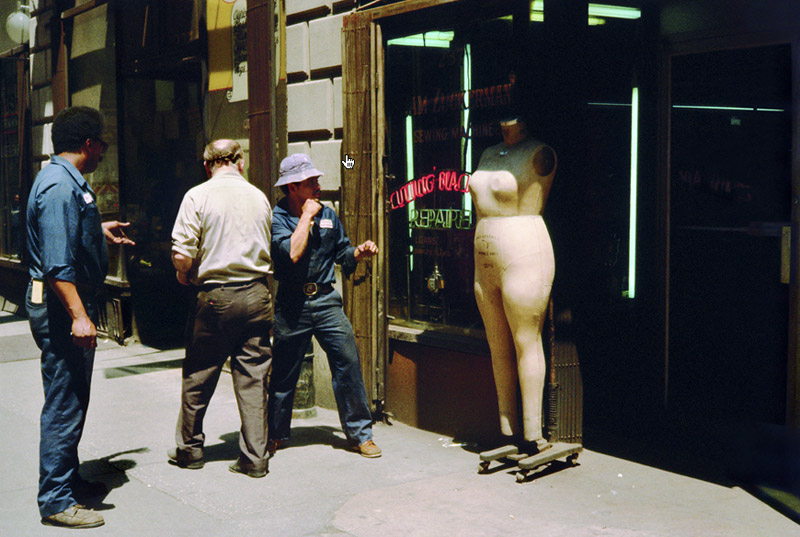
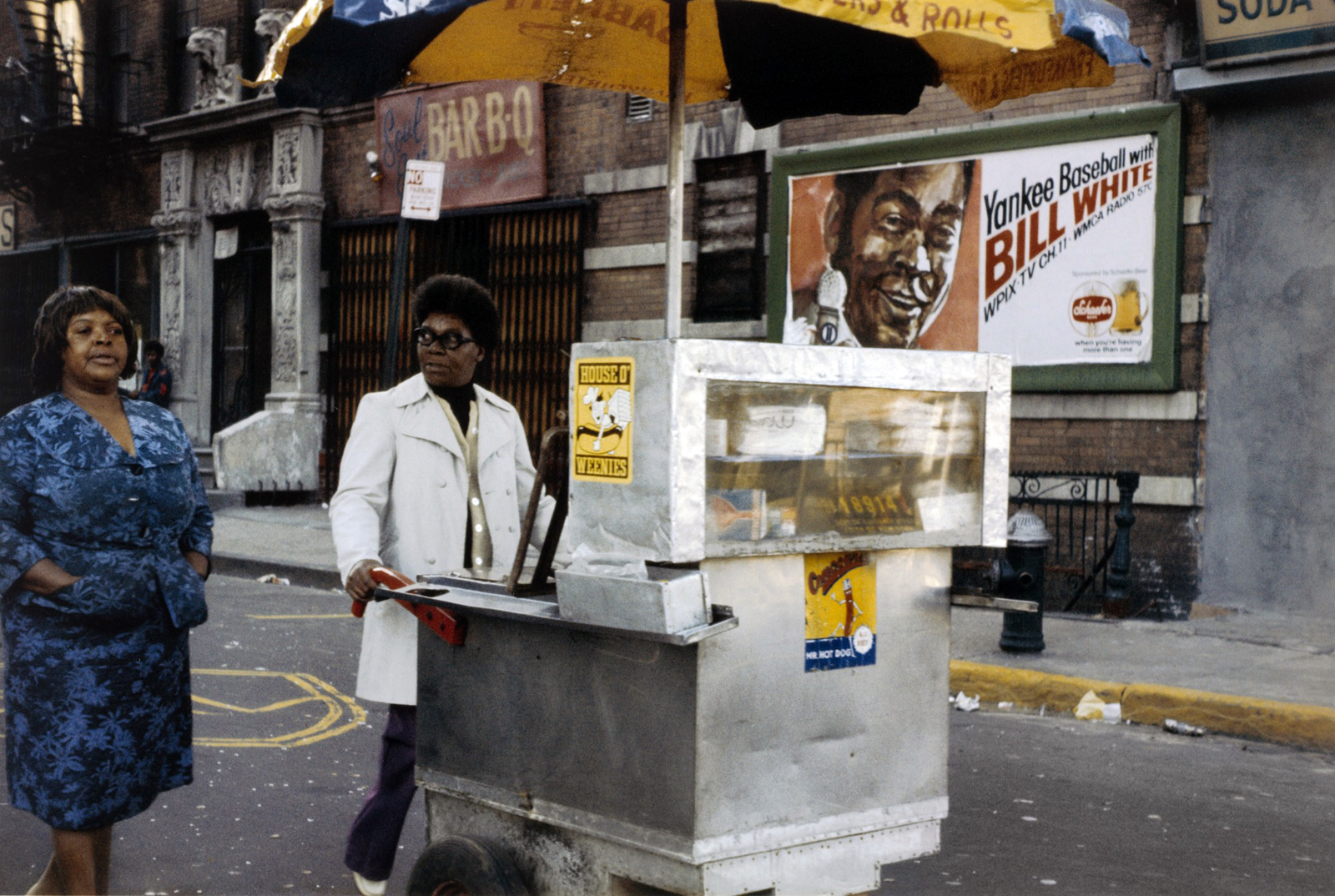
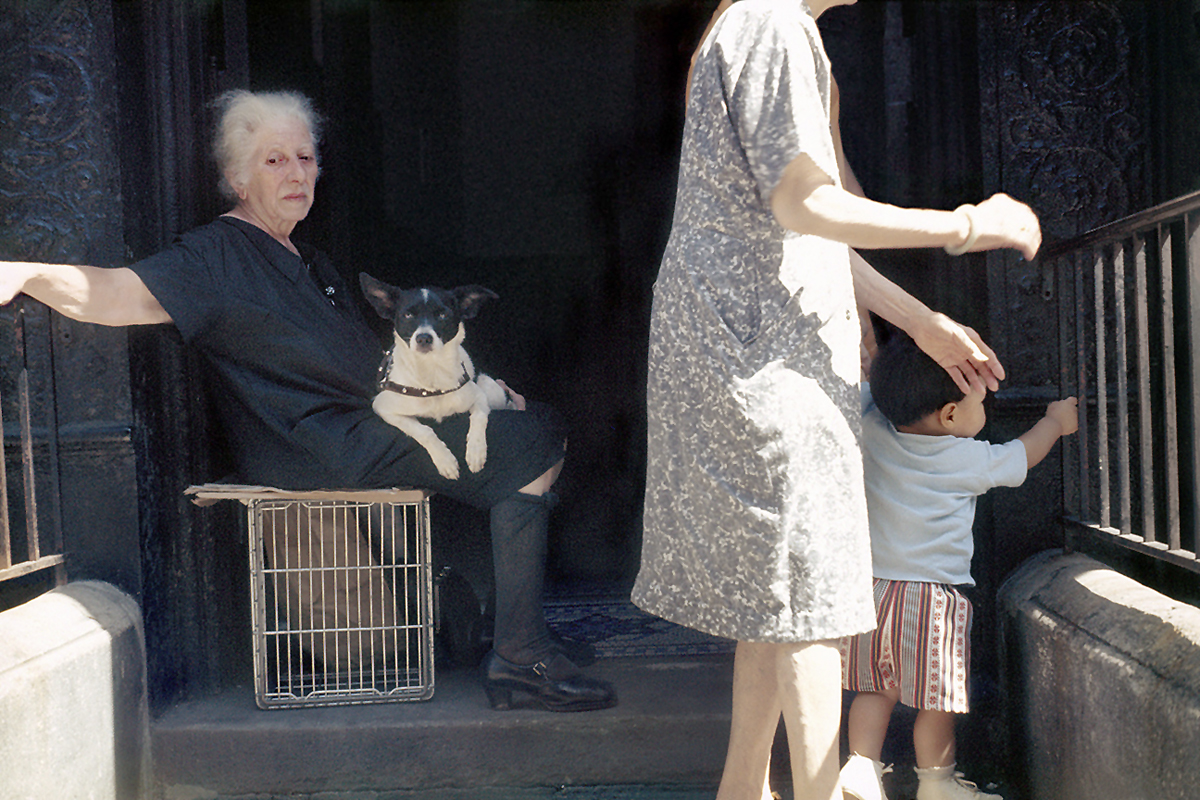
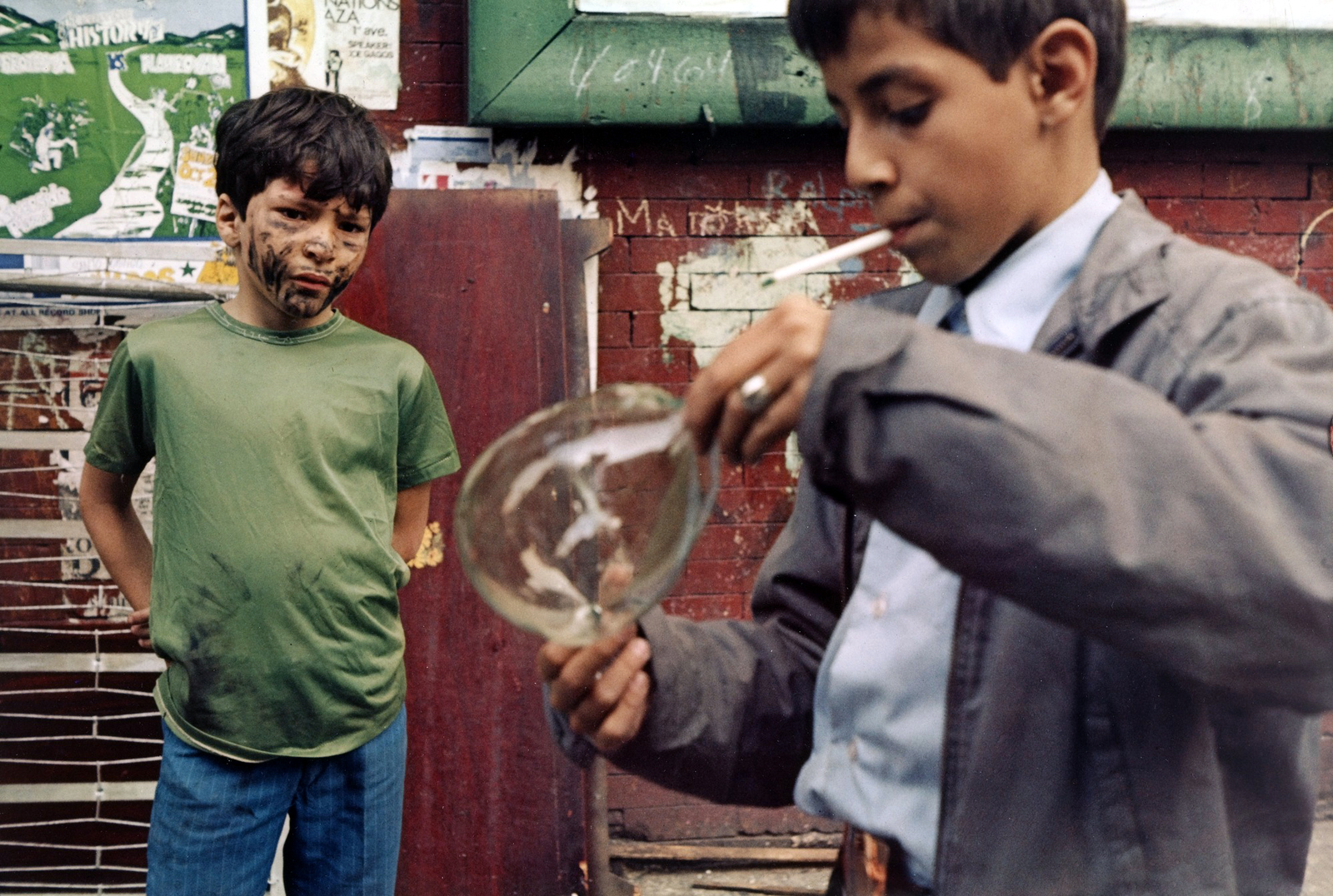
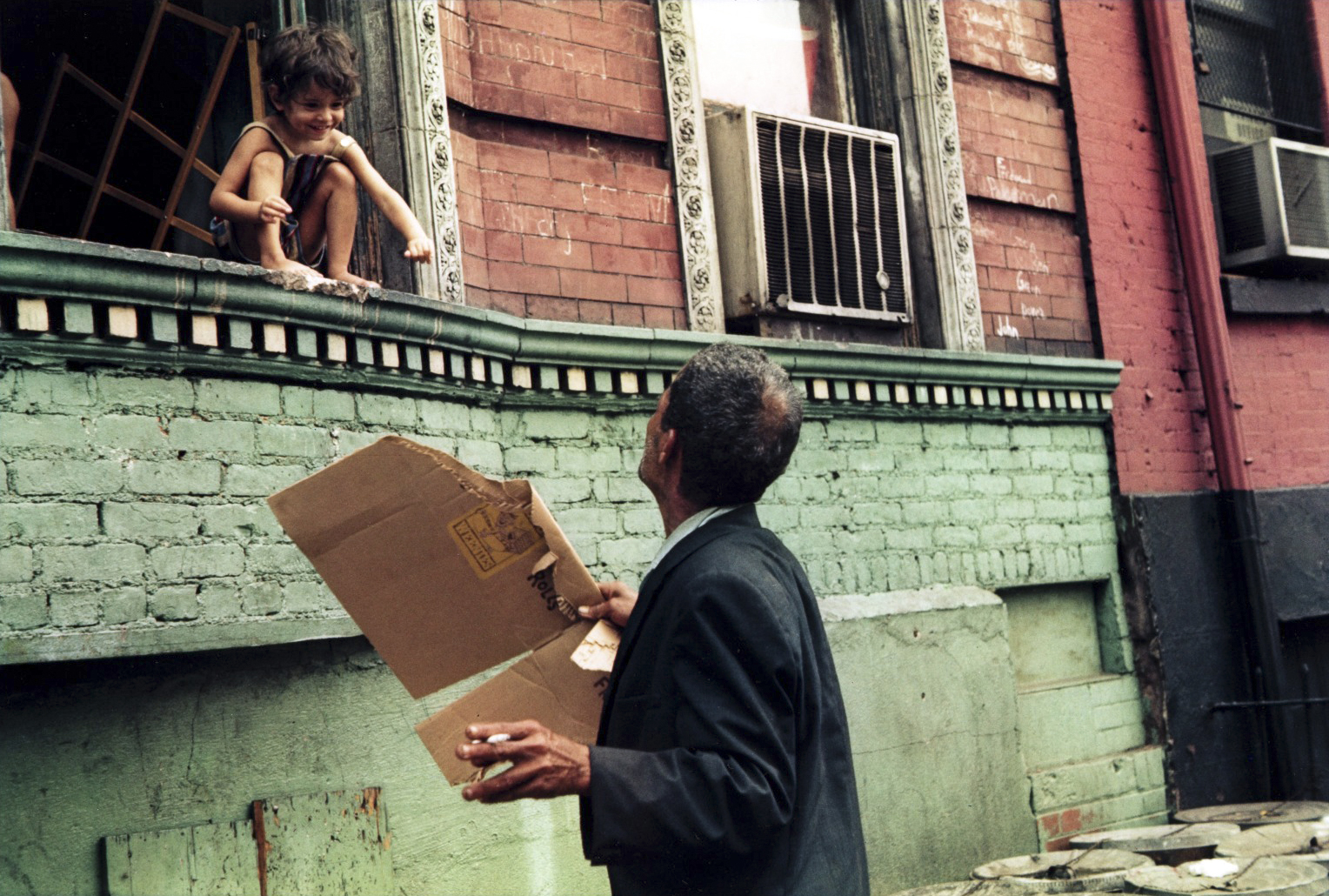
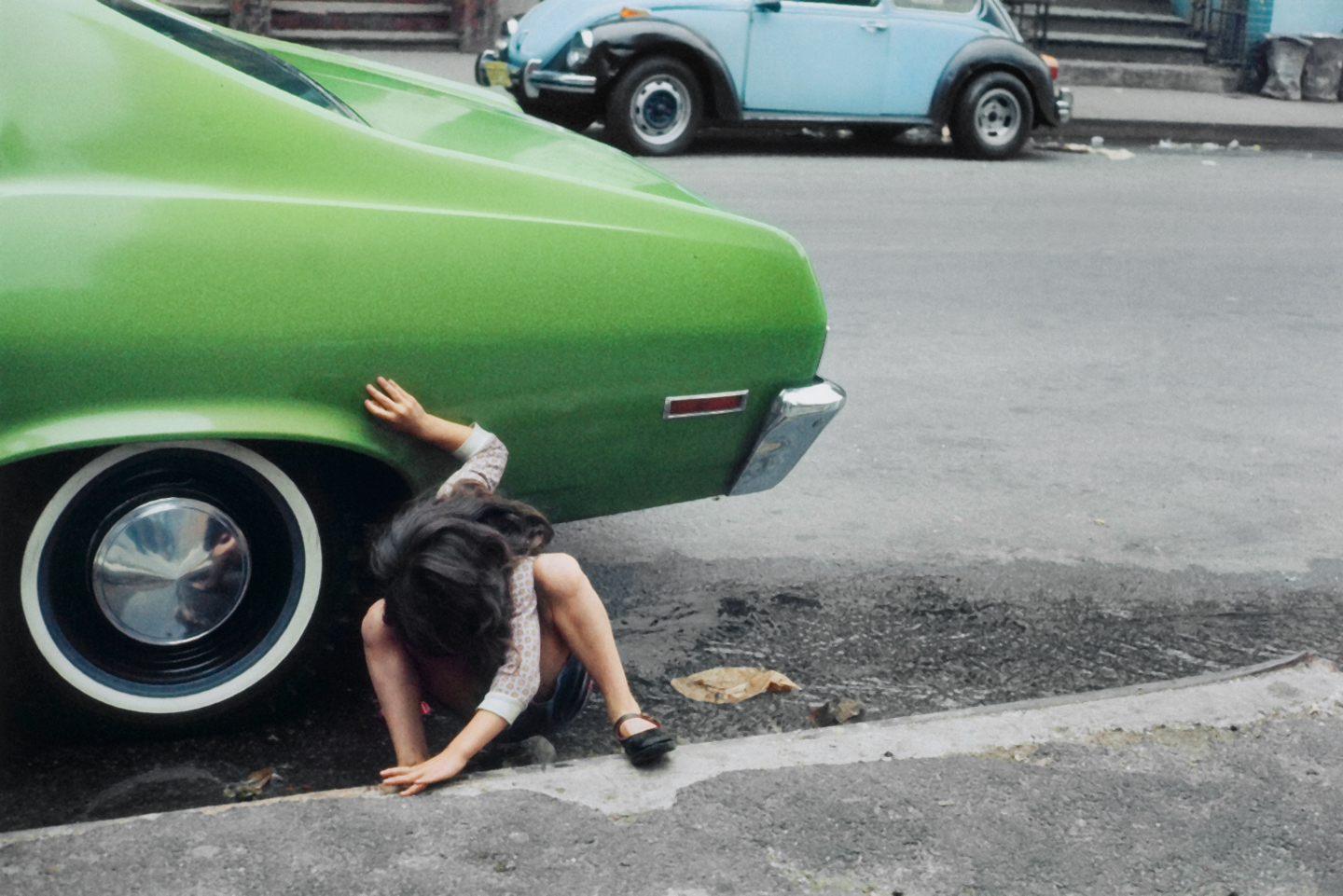
Speaking of pioneers of colour photography the wonderful American photographer Helen Levitt died recently at the end of March.

Here is a selection of her colour work from the 1970s – 1980s. With two Guggenheim Foundation grants in 1959 and 1960 she switched from black and white to colour dye-transfer prints photographing the theatre of the street, the serendipity of the decisive moment previsualised and captured through awareness and an intimate knowledge of her subject matter. Unfortunately in a burglary in 1970 most of her colour transparencies and prints were stolen from that initial period.

What remains, as Sally Mann would say, are the eloquent bones of the matter: superb lush colour photographs taken after 1970 that engage the viewer not in memory but in the moment, not in nostalgia but in joy.

In colour she found “beauty in correspondences.”

Dr Marcus Bunyan


Please click on some of the photographs for a larger version of the image.


Helen Levitt (American, 1913-2009) 'New York' c. 1971


Helen Levitt (American, 1913-2009)
New York
c. 1971
© Helen Levitt


Helen Levitt (American, 1913-2009) 'New York' 1972


Helen Levitt (American, 1913-2009)
New York
1972
© Helen Levitt


Helen Levitt (American, 1913-2009) 'New York' c. 1971


Helen Levitt (American, 1913-2009)
New York
c. 1971


Helen Levitt (American, 1913-2009) 'New York' 1971


Helen Levitt (American, 1913-2009)
New York
1971
© Helen Levitt


Helen Levitt

… Her pictures were mostly of Spanish Harlem and the Lower East Side. She shot them in black and white, as silver gelatin prints, in the 1930s and 1940s and in colour dye-transfer prints in the 1960s and 1970s. In between, she got into movie-making for a while. Her theme was the same, the streets of New York. Apart from a trip in 1941 to Mexico City, she never found a better subject in her life.

The grittier parts were her particular joy. Her world was run-down streets, rubble-filled building sites, warehouses and litter-strewn front steps. This was urban photography with a vengeance: small scraps of sky, no trees. When she was going with Walker Evans in 1938, borrowing his camera as well (“of course”) as sleeping with him, he used to be afraid of going as far uptown as she did. Some of her young male subjects, lounging around in their zoot suits and fedoras, had an unmistakable air of menace. But mostly she brought back images of gossiping women and her favourite, scrambling children. A right-angle viewfinder allowed her to take the picture without them knowing, even, as Evans showed her, when riding right beside them in the subway.

Here and there

Her birthplace was in Brooklyn, where her father was in the wholesale knitwear business. She aspired to something more artistic, but found she couldn’t draw. For a time she trained in ballet, which taught her to appreciate the musculature of posing bodies and the spontaneous grace of her child subjects. After dropping out of high school she went to work in the darkroom of Florian Mitchell’s commercial portrait-photography studio on $6 a week. There she was hooked.

A good image, she thought, was just lucky. But her New Yorker’s instinct seemed to tell her exactly where to wait for one. A broken-down car would soon attract people to lie under it, peer under the hood or try to push it. A cane chair, put out on the sidewalk, would draw an elderly man with cigar and newspaper, or a plump young woman in a housecoat wilting in the heat. With luck dogs would come out too, rough-haired mutts or poodles with fresh-shampooed coats. The open back of a truck would reveal delivery men moping on piles of sacks, or dozing among pink and blue bales of cloth. Any abandoned thing – a tea-chest, a mirror frame, the pillared entry of an empty building – would soon sport knots of children diving in, climbing up, fighting and contorting their small bodies in every kind of way.

Her pictures did not have names. “New York”, and the year, was the label on most of them. They did not need explaining; they were “just what you see”. Many had a backdrop of posters, graffiti or billboards, which gave a commentary of sorts. “Special Spaghetti 25 cents.” “Post No Bills.” “Nuts roasted daily.” “Buttons and Notions, One Flight Up.” “Bill Jones Mother is a Hore.” Her earliest project with her first, secondhand camera was to photograph children’s chalk drawings on the pavements. She never tried to speculate on them. What mattered was the patterns they made.

In the 1960s, when she got two Guggenheim grants, she began to shoot the streets in colour. The tricky developing ultimately frustrated her, and the streets, too, had changed. The children had retreated indoors to watch television. But where she had found grace and texture in black and white, colour now provided beauty in correspondences. The multi-coloured balls in bubble-gum machines could be picked up in a girl’s dress, or the red of a stiletto shoe matched with the frame of a shop window. Her broken-down cars were now lurid beasts against the stucco walls. And out of her peeling, greenish doorways could come women in furs, or pink hair-curlers, or orange-striped socks.

She did not rate her own work highly. Though her original prints eventually sold for tens of thousands of dollars, she let them pile up in her apartment in boxes labelled “Nothing good” or “Here and there”. Her hopes when she started were for photographs that would make a socialist statement of some sort, but she abandoned that on Cartier-Bresson’s advice. A “nice picture”, as she reluctantly admitted some of hers were, was a work of art that had value in itself, as well as a celebration of the random, teeming work of art that is the city of New York.

Anonymous. “Helen Levitt,” on The Economist website April 8th 2009 [Online] Cited 16/04/2009. No longer available online. Used under fair use conditions for the purposes of education and research


Helen Levitt (American, 1913-2009) 'New York' c. 1972


Helen Levitt (American, 1913-2009)
New York
c. 1972
© Helen Levitt


Helen Levitt (American, 1913-2009) 'New York' c. 1972


Helen Levitt (American, 1913-2009)
New York
c. 1972
© Helen Levitt


Helen Levitt (American, 1913-2009) 'New York' 1972


Helen Levitt (American, 1913-2009)
New York
1972
© Helen Levitt


Helen Levitt (American, 1913-2009) 'New York' 1980


Helen Levitt (American, 1913-2009)
New York
1980
© Helen Levitt


Helen Levitt (American, 1913-2009) 'New York' 1971


Helen Levitt (American, 1913-2009)
New York
1971
© Helen Levitt


Slide Show: The Color Photographs of Helen Levitt by John Szarkowski, Powerhouse Books, 2005 is available from the Amazon website. The photograph above is used on the cover of the book.

LIKE ART BLART ON FACEBOOK

Back to top