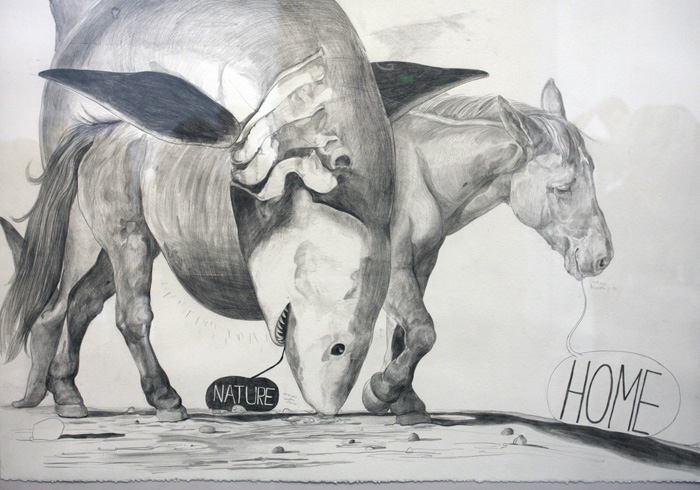
Richard Grigg (Australian) New Work exhibition Opening night crowd at Block Projects, Melbourne
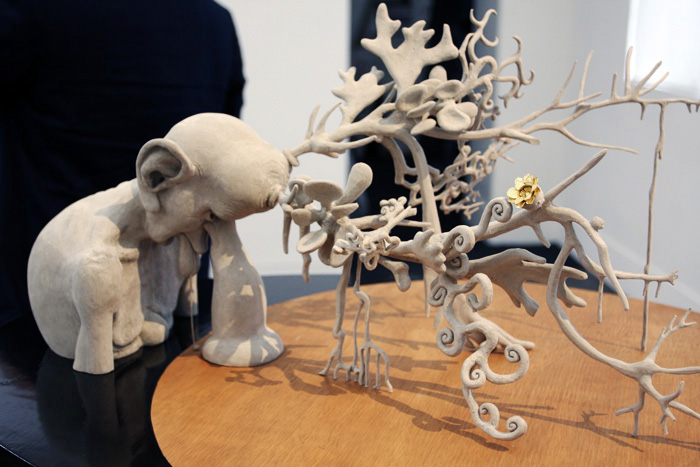
Moving down Flinders Lane we ascended to the fourth floor and entered the beautiful light filled gallery space at Block Projects to view the ‘new work’ of Richard Grigg. An eclectic mix of sculpture, painting, drawing, and collage was presented. Preparatory drawings for one of the sculptures, a pencil drawing of two old men debating, a canvas of a camera in tempera, gold leaf and gesso vie for attention with the two standout pieces of the show: No more songs at funerals/hero today gone tomorrow (2007) and He can’t read well because of his horns (2009), surrealist sculptures both made of compressed cardboard (below).
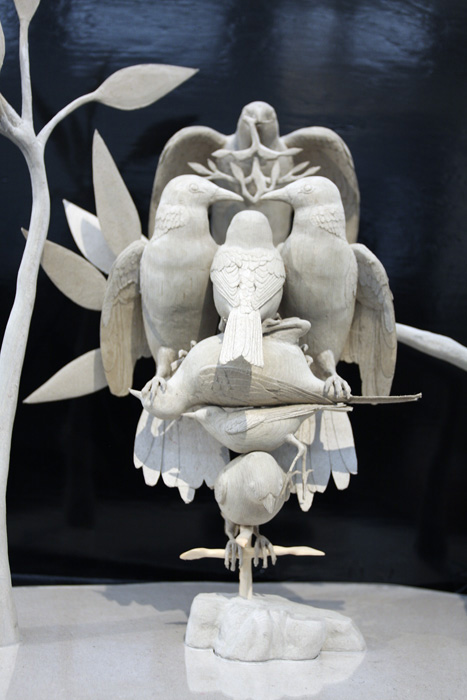
These two sculptures are fantastic: the first forming a skull made out of birds perched on a cross surmounted by a bird holding an olive branch, the title deliciously ironic; the second a stooped gargoyle like creature with a massive extrusion for a nose, hanging tongue dripping saliva and phantasmagorical protrusions emerging from it’s head making it impossible for the creature to ‘read well’ in both the metaphorical and literal sense. This is a beautiful but grotesque primordial fantasy with the horns putting roots down in the soil like the roots of a mangrove tree, a gold leaf flower blooming at their outer reaches, the creature exhausted by the effort of trying to keep his head up.
Unfortunately the rest of the exhibition lacked core strength: conceptually the show is not strong. Evidence of beauty in decay and concerns about the process of ageing vie with environmental contexts; slippages in time (The Moment Between) contrast with cameras and their sight lines; Pinocchio lies under a shroud with a camera trapped in the back of a horse drawn cart (Dream of Rest). Apparently, the cameras do not signify the capturing of the frozen moment of beauty but they are there because the artist’s father collected cameras. To me they seemed to be defining the nature of our interaction with the world, the surface of the image controlling the interface between technology and earth.
One of the problems with undertaking an exhibition titled New Work is the assumption that the new work being produced hangs together holistically and tells a not necessarily linear narrative story but one that the viewer can investigate, question, and tease the pertinent concepts from – something the viewer can hang their hat on (perhaps the horns of a dilemma!) This was not the case here. The bits n bobs approach of this exhibition falls slightly flat but go see the show for the two sculptures – they alone are worth the effort!
Dr Marcus Bunyan
Many thankx to Block Projects for allowing me to publish the photographs in the posting. Please click on the photographs for a larger version of the image.

Richard Grigg (Australian) No more songs at funerals/hero today gone tomorrow 2007-2009 Layered boxboard, wood dowel, glue, pine, black gloss enamel, Perspex
Richard Grigg (Australian) He can’t read well because of his horns 2009 Layered boxboard, gold leaf, wood dowel, glue, pine, black gloss enamel, wood stain
Richard Grigg (Australian) A Late Night Story 2007 pencil on paper
Richard Grigg (Australian) Older than the value of beauty (detail) 2009 Tempera, gold leaf and gesso on board
Richard Grigg (Australian) Cloak 2008 Tempera, gold leaf and gesso on board
Block Projects Level 1 / 252 Church Street Richmond Victoria 3121 Australia Phone: +61 3 9429 0660
Damiano Bertoli (Australian, 1969-2021) Continuous Moment: Bad Infinity 2009 Video stills
In a busy night of openings in Melbourne we arrive to watch, to be a spectator and voyeur at Damiano Bertoli’s new twin video installation at The Narrows on Flinders Lane, ensconced in the darkness of the gallery space. The looped installation features on the left scenes from the original Miami Vice TV series and on the right approximate scenes from the 2006 feature film of the same name. The synchronicity of the two splices of time moving in and out of register is uncanny. We have memories of these appearances, flickering signifiers embedded in our psyche which are called to presence in the space between screen and viewer as we add our own layer of temporal distortion to the unfolding events.
In an erudite catalogue note Bertoli expounds on the nature of the performative and the question of authorship by analysing Glenn Gould’s two recordings of J. S. Bach’s Goldberg Variations, one recorded at the beginning of his career and one in the final year of his life. Bertoli posits that Gould used counterpoint “as a formal construct for its capacity to produce ‘an explosion of simultaneous idea’s’ … as a solution for his dissatisfaction with singularity and linear definition.”
He notes that, “As an interpreter of others work, Gould occupied a position of equivalence – we are aware that we are listening to Bach and Gould – simultaneously … These co-existing yet distinct voices move in and out of synchronicity, as does the listener’s experience of Gould’s interpretation (actually an interpretation of an interpretation) as the latter version iterates and embodies the version which precedes it. We are constantly comparing the two, as is Gould.”
This is quite true but I do not think the metaphor can be so literally applied to the video installation Bertoli has constructed. Firstly Gould’s interpretations and our recognition of them requires knowledge of the authoritative voice of the author as composer and the author as performer: Bach and Gould. Conversely in the videos the directors are unknown by most and the actors anonymous except by those with specific memory of appearances. There is no contrapuntal fugue like working of the sound or images in search of the purity of musical ideas – the dialogue talks over each other and splice cuts jump the scene from one location to another – forming a fractured hypertextual narrative driven by the spectacular gaze of the viewer, a simularcrum of the ‘real’. The simultaneity of being in three worlds at once is the world of simulacra not of equivalence.
As Ron Burnett has observed
“Video creates what I will describe as a logic of the present while simultaneously producing an image-event in the past. This generates a somewhat different temporal context than we are normally accustomed to – a mixture of present and past that is both, and neither, simultaneously. The disjuncture that results is part of the attraction but also part of what makes the electronic image so puzzling. It suggests that history has already been made while one continues to make it. It is this suppleness that allowed broadcasters for example to repeat the Rodney King beating in Los Angeles over and over again, as if each showing would somehow reconstitute the event, as if to prove that this was not a dramatisation, not a fiction. In order to gain control over the many disjunctures, repetition was used … But this only validates the contradictions, proposing that the disjunctures in time and place can be controlled, that there is some way of gaining authority over the impact of the event as image.”1
I would argue that what Bertoli’s installation does offer is a release from inert rationalist geometries, a deterritorialization and reterritorialization of temporal time in a heterotopic space, juxtaposing in a single real place several spaces, several sites that are in themselves incompatible. These are layered images of hyper-performativity and hypermediacy, where the fragmented images become a process and a performance, where the spectator becomes the screen not the author.
As Baudrillard has said, “Today we live in the imaginary world of the screen, of the interface and the reduplication of contiguity and networks. All our machines are screens. We too have become screens, and the interactivity of men has become the interactivity of screens. Nothing that appears on the screen is meant to be deciphered in depth, but actually to be explored instantaneously, in an abreaction immediate to meaning.”2
Here is the immediacy of continuous time – the removal of psychological depth, the reduction of life to a series continuous presents and surface phenomena that repeat over and over again. Is this bad infinity? We will never know… as we can never have knowledge of infinity. It is a noumenal concept, an event known only to the imagination, independent of the senses.
This is an interesting and fun installation. Well worth a visit.
Dr Marcus Bunyan
1/ Burnett, Ron. Cultures of Vision: Images, Media, & the Imaginary. Bloomington: Indiana University Press, 1995, p. 249
2/ Baudrillard, Jean. Xerox and Infinity (trans. Agitac). Paris: Touchepas, 1988, p. 7
Many thankx to The Narrows gallery for allowing me to publish the photographs in the posting. Please click on the photographs for a larger version of the image.
Damiano Bertoli Continuous Moment: Bad Infinity(2009)
Damiano Bertoli (Australian, 1969-2021) Continuous Moment: Bad Infinity 2009 video stills
Vale Damiano Bertoli (1969-2021)
In September, artist Damiano Bertoli passed away unexpectedly at the age of 52. Bertoli was a staple in the Melbourne art community. He could be relied upon to regularly attend openings and see most exhibitions. Along the way, he would dish out wit, sarcasm and charm. Seeing him across a crowded room, he would go cross-eyed as a form of greeting, breaking the ice with humour. Bertoli had a rich and expansive artistic practice, spanning collage, film, sculpture, installation, even theatre, but he was equally known for his large personality. In preparation for this piece, I spoke to several of Bertoli’s closest friends who had many things to say about him, but some underlying themes proved unanimous. He possessed a great sense of curiosity and generosity; he loved sharing knowledge; he built rich relationships with others through engagement with art; and that he has left behind a massive legacy – albeit one that could have been much, much bigger.
Read more about Damiano Bertoli’s legacy. Amelia Winata. “Damiano Bertoli 1969-2021,” on the MeMO website 13 Oct 2021 [Online] Cited 12/06/2022
Damiano Bertoli (Australian, 1969-2021) Continuous Moment: Bad Infinity 2009 video stills
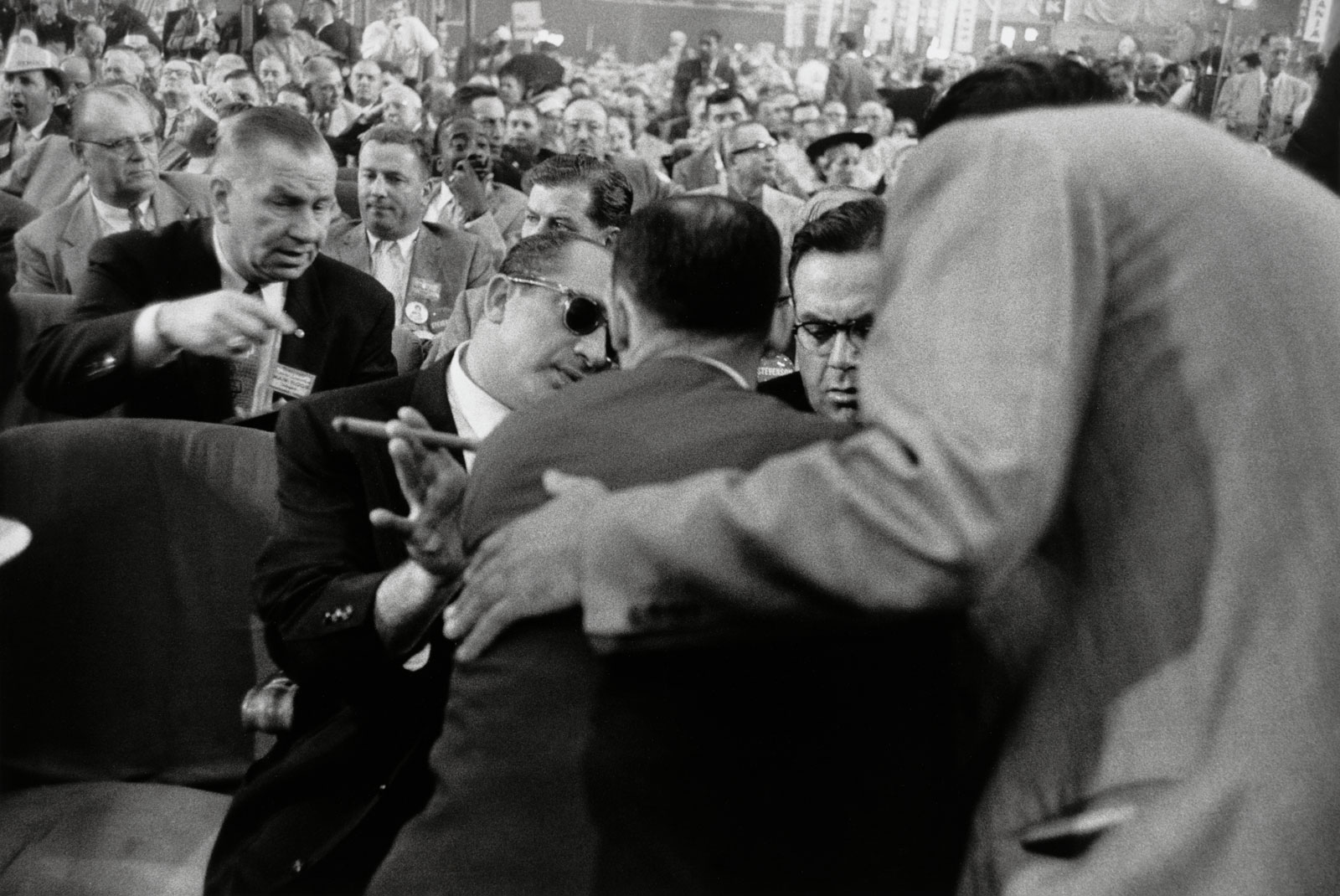
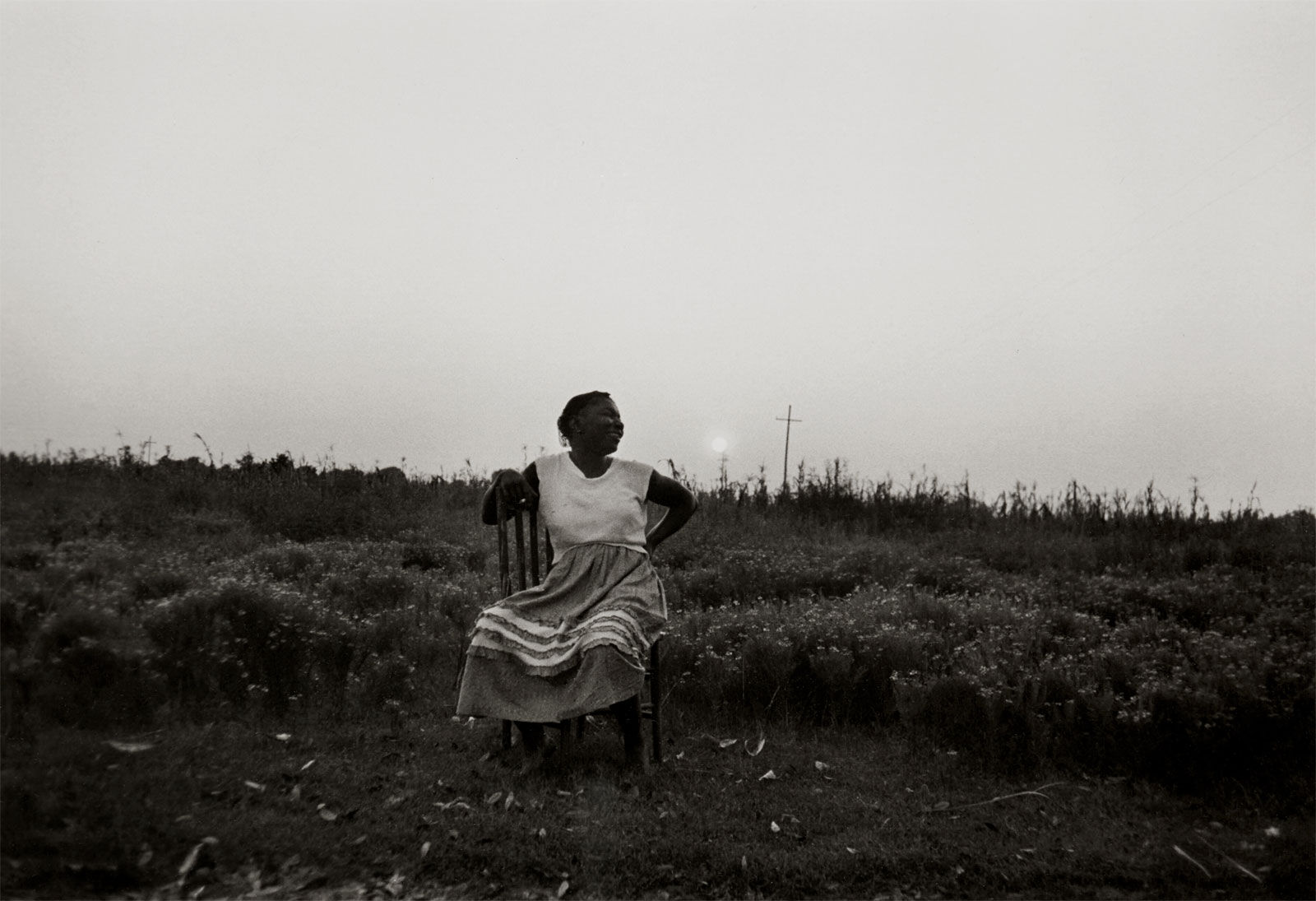
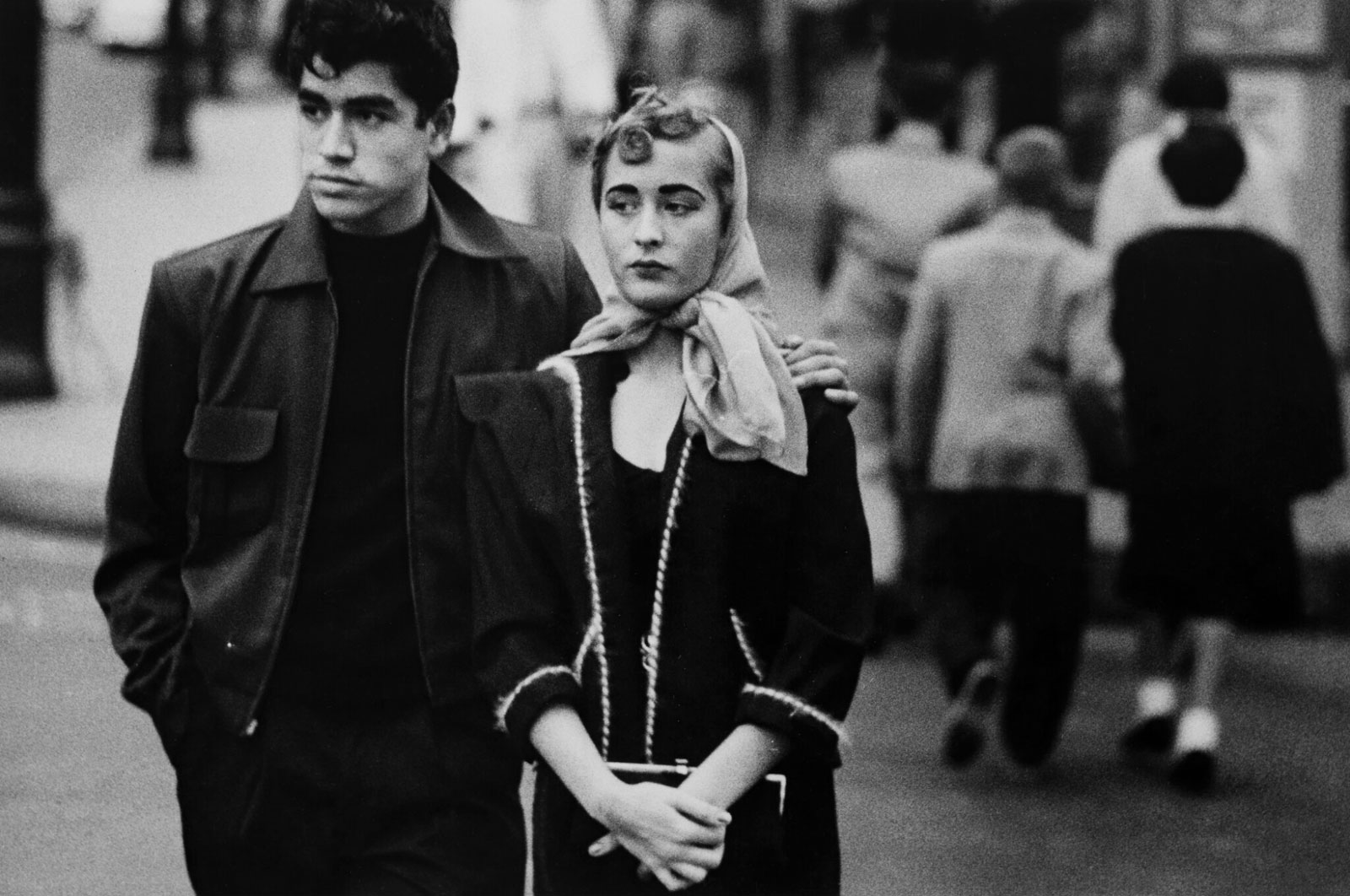
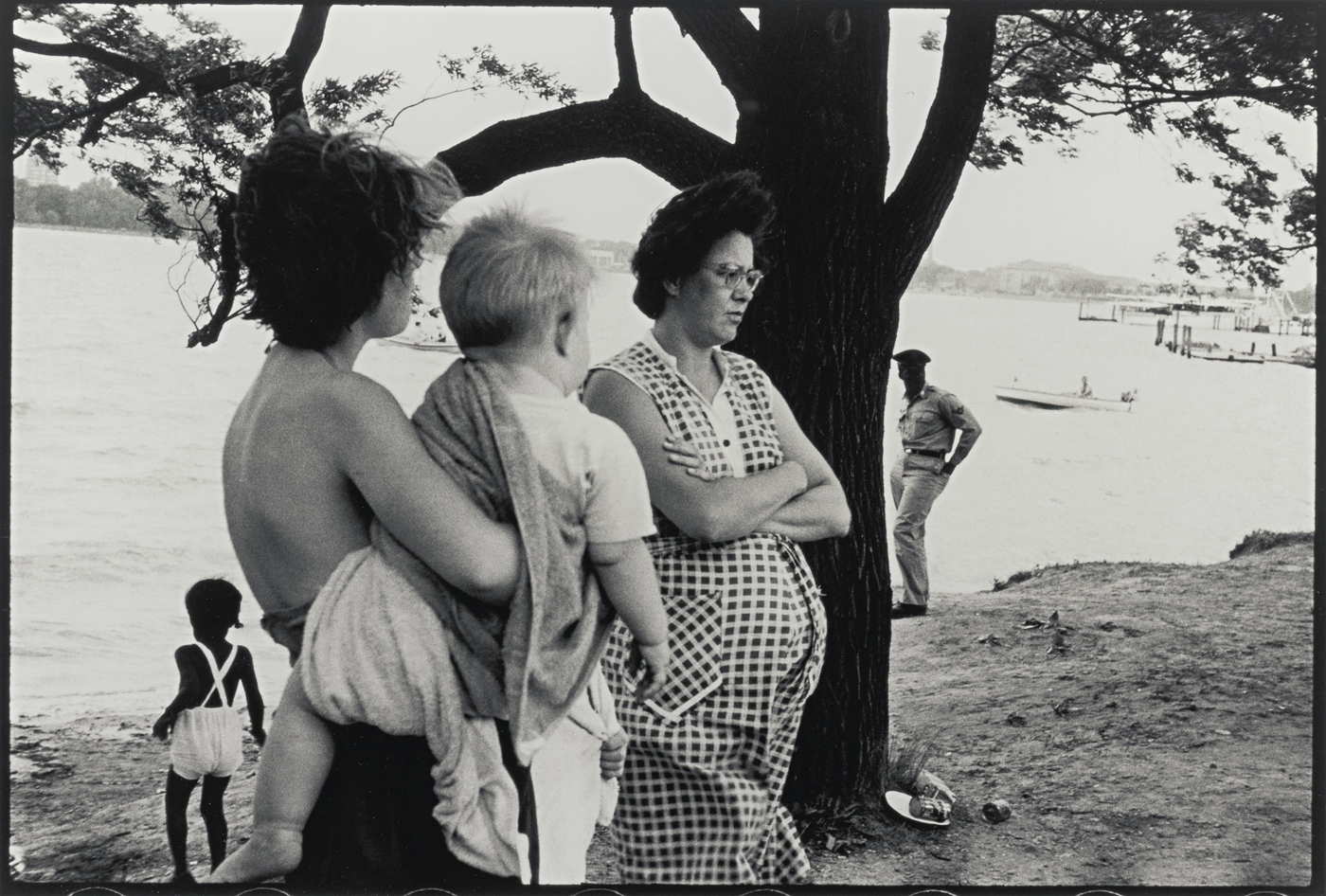
Inge Morath (American born Austria, 1923-2002) From the series about Regensburg Museums 1999 Gelatin silver print
“To take pictures had become a necessity and I did not want to forgo it for anything.”
Inge Morath
The Magnum Foundation and the Inge Morath Foundation announce the sixth annual Inge Morath Award. The annual prize of $5,000 is awarded by the Magnum Foundation to a female documentary photographer under the age of 30, to support the completion of a long-term project. One award winner and up to two finalists are selected by a jury composed of Magnum photographers.
Inge Morath was an Austrian-born photographer who was associated with Magnum Photos for nearly fifty years. After her death in 2002, the Inge Morath Foundation was established to manage Morath’s estate and facilitate the study and appreciation of her contribution to photography.
Because Morath devoted much of her enthusiasm to encouraging women photographers, her colleagues at Magnum Photos established the Inge Morath Award in her honour. The Award is now given by the Magnum Foundation as part of its mission of supporting new generations of socially-conscious documentary photographers, and is administered by the Magnum Foundation in collaboration with the Inge Morath Foundation.
Past winners of the Inge Morath Award include: Kathryn Cook (US, ’08) for Memory Denied: Turkey and the Armenian Genocide; Olivia Arthur (UK, ’07) for The Middle Distance; Jessica Dimmock (US, ’06) for The Ninth Floor; Mimi Chakarova (US, ’06) for Sex Trafficking in Eastern Europe; Claudia Guadarrama (MX, ’05) for Before the Limit; and Ami Vitale (US, ’02), for Kashmir.
Text from The Inge Morath Foundation website [Online] Cited 01/03/2009. No longer available online
Inge Morath (American born Austria, 1923-2002) Visitor in the Metropolitan Museum 1958 Gelatin silver print
“I have photographed since 1952 and worked with Magnum Photos since 1953, first out of Paris, later out of New York. I am usually labeled as a photojournalist, as are all members of Magnum. I am quoting Henri Cartier-Bresson’s explanation for this: He wrote to John Szarkowski in answer to an essay in which Szarkowski stated that Cartier-Bresson labels himself as a photojournalist.
“May I tell you the reason for this label? As well as the name of its inventor? It was Robert Capa. When I had my first show in the Museum of Modern Art in New York in 1948 he warned me: ‘watch out what label they put on you. If you become known as a surrealist […] then you will be considered precious and confidential. Just go on doing what you want to do anyway but call yourself a photojournalist, which puts you into direct contact with everything that is going on in the world.'”
It is in this understanding that we have been working as a group and yet everyone following their own way of seeing. The power of photography resides no doubt partly in the tenacity with which it pushes whoever gets seriously involved with it to contribute in an immeasurable number of forms his own vision to enrich the sensibility and perception of the world around him.
[In the 1950s] the burden of the already photographed was considerably less than now. There was little of the feeling of being a latecomer who has to overwhelm the huge existing body of the photographic oeuvre – which, in photography as in painting and literature, necessarily leads first to the adoption and then rejection of an elected model, until one’s own work is felt to be equal or superior, consequently original.
Photography is a strange phenomenon. In spite of the use of that technical instrument, the camera, no two photographers, even if they were at the same place at the same time, come back with the same pictures. The personal vision is usually there from the beginning; result of a special chemistry of background and feelings, traditions and their rejection, of sensibility and voyeurism. You trust your eye and you cannot help but bare your soul. One’s vision finds of necessity the form suitable to express it.”
Inge Morath, Life as a Photographer, 1999
Text from The Inge Morath Foundation website [Online] Cited 01/03/2009. No longer available online
Many thankx to the Nelson-Atkins Museum of Art for allowing me to publish the photographs in the posting. Please click on the photographs for a larger version of the image.
Gregory Crewdson (American, b. 1962) Untitled from the series Beneath the Roses 2006 Digital pigment print
Famed photographer Gregory Crewdson will present the inaugural discussion in a series sponsored by the Photography Society of The Nelson-Atkins Museum of Art, Kansas City…
Crewdson’s work has been widely exhibited and reviewed. He makes large-scale photographs of elaborate and meticulously staged tableaux, which have been described as “micro-epics” that probe the dark corners of the psyche. Working in the manner of a film director, he leads a production crew, which includes a director of photography, special effects and lighting teams, casting director and actors. He typically makes several exposures that he later digitally combines to produce the final image.
“Crewdson is one of the most daring and inventive contemporary artists using photography,” said Keith F. Davis, Curator of Photography at the Nelson-Atkins. “His meticulously crafted works are immensely rich in both narrative and psychological terms. They prod us to rethink our ‘usual’ relationship to photographs as physical objects and as records of worldly fact. Crewdson is a genuinely important figure in today’s art world. He has an international reputation and has influenced an entire generation of younger photographic artists.”
Attendance to the program is free.
Text from ArtDaily.org website
Gregory Crewdson (American, b. 1962) Untitled from the series Beneath the Roses 2005 Digital pigment print
Gregory Crewdson (American, b. 1962) Untitled (Sunday Roast)Â from the series Beneath the Roses 2005 Digital pigment print
Nelson-Atkins Museum of Art 4525 Oak Street Kansas City, MO 64111
Dale Chihuly (American, b. 1941) Palazzo Ducale Chandelier 1998
Visit the Dale Chihuly website and click on the “Work” link to see a truly remarkable artist at work!
Marcus
Please click on the photographs for a larger version of the image.
Dale Chihuly (American, b. 1941) Chiostro di Sant’apollonia Chandelier 1996
Dale Chihuly is most frequently lauded for revolutionising the Studio Glass movement by expanding its original premise of the solitary artist working in a studio environment to encompass the notion of collaborative teams and a division of labor within the creative process. However, Chihuly’s contribution extends well beyond the boundaries both of this movement and even the field of glass: his achievements have influenced contemporary art in general. Chihuly’s practice of using teams has led to the development of complex, multipart sculptures of dramatic beauty that place him in the leadership role of moving blown glass out of the confines of the small, precious object and into the realm of large-scale contemporary sculpture. In fact, Chihuly deserves credit for establishing the blown glass form as an accepted vehicle for installation and environmental art beginning in the late twentieth century and continuing today.
Stylistically over the past forty years, Chihuly’s sculptures in glass have explored colour, line, and assemblage. Although his work ranges from the single vessel to indoor/outdoor site-specific installations, he is best known for his multipart blown compositions. These works fall into the categories of mini-environments designed for the tabletop as well as large, often serialised forms that are innovatively displayed in groupings on a wide variety of surfaces ranging from pedestals to bodies of natural water. Masses of these blown forms also have been affixed to specially engineered structures that dominate large exterior or interior spaces.
Over the years Chihuly and his teams have created a wide vocabulary of blown forms, revisiting and refining earlier shapes while at the same time creating exciting new elements, such as his Fiori, all of which demonstrate mastery and understanding of glassblowing techniques. Earlier forms, such as the Baskets, Seaforms, Ikebana, Venetians, and Chandeliers, from the late 1970s through the 1990s have been augmented since the early to mid-1990s with new blown elements. Chihuly and his teams primarily developed these while working in glass factories in France, Finland, Ireland, and Mexico. The resulting Reeds, Saguaros, Herons, Belugas, Seal Pups, and other forms are now juxtaposed with the earlier series, including Macchia, Niijima Floats, and Persians in lively new contexts.
“Since the early 1980s, all of Chihuly’s work has been marked by intense, vibrant colour and by subtle linear decoration. At first he achieved patterns by fusing into the surface of his vessels “drawings” composed of prearranged glass threads; he then had his forms blown in optic moulds, which created ribbed motifs. He also explored in the Macchia series bold, colourful lip wraps that contrasted sharply with the brilliant colours of his vessels. Finally, beginning with the Venetians of the early 1990s, elongated, linear blown forms, a product of the glassblowing process, have become part of his vocabulary, resulting in highly baroque, writhing elements. In recent years Chihuly has experimented with Polyvitro to create new interpretations of some of his glass forms.
Exhibition dates: 25th February – 14th March, 2009
Junko Go (Australian born Japan, b. 1955) Opium Poppy 2008
“One person’s heaven is another’s nightmare. Seeing both sides to every story can be a blessing and a curse. Good and bad, right and wrong, purity and impurity are inextricably linked.”
A delicate, refined but strong presence is felt in the work of Junko Go in the her new exhibition ‘all about … blooming’ at Gallery 101, Melbourne. Nominally landscape painting about flowers but featuring thoughts and ideas about the seed, the shoot, pollen and the breath of life the work addresses the essence of what it is to be human and live compassionately on this earth in an intelligent and profound way.
Denying the nihilism of abstract expressionism each mark is fully considered by being attentive to the connection between brush, hand and meaning. Almost childlike in their use of charcoal and acrylic her dogs, crosses and flowers, jottings and dashes, rain and rivers, seeds and people show a Zen like contemplation in the marks she makes on the canvas – just so. A releasement towards things is proffered, a letting go of the ego to create an awareness of just being. There is genuine warmth and humility to this work.
In Opium Poppy (2008, above) the darkness of the nightmare is represented by the black marks, ascending like Jacob’s ladder balanced by the mandala like poppies whose petals seem like feathers of a bird’s wing – a flight of fancy both good and bad. In Pollen (2009) bees swarm around a sunflower leaving traces of their presence, a bird flies close to a tiny blue cloud, the sun burst forth in a tiny patch of aqua colour, and people hug arm in arm. As Go says, “Bees in a flower bear pollen unawares and play a crucial roll for the plant to survive. Our love, kindness, warmth and wisdom affect one another unawares and play a crucial roll for our planet to survive.” In New Shoot (2008, below) the puzzle of our existence, the nature of our existential being is laid bare for all to see.
In Seeds (2008) Go reminds us that rather than being focused on what we hoped for, we must make the most of whatever opportunities we are blessed with. This means being aware of the gifts one possesses, not the distance between ‘I’ and want, need and desire – now! The seed of our experience – the calm before the force that propelled us into existence – is already present within us.
Go’s musings on the existential nature of our being are both full and empty at one and the same time and help us contemplate the link to the breath of the sublime. In the end Go’s paintings are about endings and beginnings, about being strong or not, about the infinity of the seed and about our responses to living in harmony on this planet. Through the seed, the shoot, the flower and the earth access may be granted to the sublime and this perfectly sums up the work of this artist, a reflection of her energy and radiance transferred to the canvas. I loved it.
Dr Marcus Bunyan
Many thankx to Gallery 101 for allowing me to publish the art work in the posting. Please click on the art work for a larger version of the image.
Junko Go (Australian born Japan, b. 1955) New Shoot 2008
“Each of us is born to fill a special place in this world. In the process, we sometimes have trouble finding our niche. Life is like a jigsaw puzzle in which we make every effort to find our own place that makes a right connection with others, with the world and even with the whole universe.”
Junko Go (Australian born Japan, b. 1955) Red Hot Poker 2009
“Push and pull our inner strength. Sometimes, we need courage to take risks in confronting pain and loss in order to gain a deep and profound experience.”
“We live in a world where high achievers are congratulated, yet true achievements are not related to what we can get done, but to how deeply we aware of how wonderful it is to be alive. In this exhibition, flowers are not only a predominant source of visual inspiration, looking at them also engenders a kind of appreciation and wonder. The fragile and ephemeral flower provokes in me an awareness of the human condition that reveals the true nature of our existence.
My goal is to create images which are strong and soft, bold and precise, beautiful and ugly, figurative and abstract, all at once. My greatest challenge is to make art about what it is to be human … What really matters in art making to me is a kind of awareness – a being able to say, ‘I am as I am’.”
Óscar Muñoz (Colombian, b. 1951) BiografÃas (installation views) 2002 5 video projections, 7 ‘, loop, without sound, DVD, mdf support, metal grids, variable dimensions
“How can one construe a notion of time in this immemorial setting? How can one assimilate and articulate in one’s memory all these events that have been happening for so many years now?”
“My work today … is based on my endeavour to understand the mechanism developed by a society which has ultimately suffered the routinisation of war… A past, a present and in all likelihood a future full of violent events on a daily basis, which are stubbornly repeated, in a practically identical fashion.”
Óscar Muñoz
Óscar Muñoz is something of a gentle magician. His ‘disappearing’ drawings are poignant and beautiful, combining consummate skill with conceptual subtlety and rigour.
Muñoz is a senior Colombian artist. He plays an important role in mentoring younger artists but his own work is very focused on a personal language that is closely tied to the body and its disappearance. His work has always combined traditional drawing skills with video in a completely original and surprising way.
Although Muñoz is not assertively political, his work is more about mortality than specific acts of violence but it is impossible not to look at it in the context of Colombian life. A common technique for social control has become the ‘disappearing’ of people. The work shown in this exhibition, BiografÃas 2002 is structured to reflect this pervasive theme of disappearance.
BiografÃas is one of a series of works in which portraits slowly disappear, reflecting the disappearance of people on a regular basis in Colombia. Muñoz has made silk screen portraits of people but instead of forcing ink through the screen onto paper he has dusted fine coal dust through the screen onto a flat basin of water. The portrait in coal is then transferred to float on the surface of the water. After a while the water starts to drain out of a plug hole in the basin causing the image to begin to distort. Eventually the image is compressed becomes unrecognisable and finally disappears down the drain.
Five such portraits are shown in BiografÃas by projecting video of the performed drawings onto screens on the floor complete with plug holes beneath which you hear the sound of water running down the drain.
Text from the Art Gallery of New South Wales website [Online] Cited 22/02/2009 (no longer online)
Many thankx to Art Gallery of New South Wales for allowing me to publish the art work in the posting. Please click on the art work for a larger version of the image.
Óscar Muñoz (Colombian, b. 1951) BiografÃas (stills) 2002 5 video projections, 7 ‘, loop, without sound, DVD, mdf support, metal grids, variable dimensions
Óscar Muñoz BiografÃas
The work refers to the idea of death, disappearance and transience of memory, linked to acts of violence.
Muñoz is also known for his use of ephemeral materials, in poetic reflections upon memory and mortality.
Art Gallery of New South Wales Art Gallery Road, The Domain Sydney NSW 2000, Australia
Opening hours: Open every day 10am – 5pm except Christmas Day and Good Friday
Bill Viola’s video installation, Ocean Without a Shore, is presented in the atmospheric setting of the church of San Gallo, Venice. Monitors positioned on three stone altars in the church show a succession of individuals slowly approaching out of darkness and moving into the light, as if encountered at the intersection between death and life. Viola talks about his artistic intentions and the technical challenges of the piece.
Originally installed inside the intimate 15th century Venetian church of San Gallo as part of the 2007 Venice Biennale (see above) incorporating its internal architecture into the piece using the three existing stone altars as support for the video screens, the installation has been recreated in a small darkened room at The National Gallery of Victoria in Melbourne. What an installation it is.
Deprived of the ornate surroundings of the altars of the Venetian chapel – altars of which Viola has said that, “… as per the original development of the origins of Christianity these alters actually are a place where the dead kind of reside and connect with those of us, the living, who are here on earth. And they really are a connection between a cross, between a tomb and an alter – a place to pray,”1 – the viewer is forced to concentrate on the images themselves. This is no bad thing, stripping away as it does a formalised, religious response to mortality.
In the work Viola combines the use of a primitive twenty five year old security black and white analogue video surveillance camera with a high definition colour video camera through the use of a special mirror prism system. This technology allows for the seamless combination of both inputs: the dead appear far off in a dark obscure place as grey ghosts in a sea of pulsating ‘noise’ and gradually walk towards you, crossing the invisible threshold of a transparent water wall that separates the dead from the living, to appear in the space transformed into a detailed colour image. As they do so the sound that accompanies the transformation grows in intensity reminding me of a jet aircraft. You, the viewer, are transfixed watching every detail as the ghosts cross-over into the light, through a water curtain.
The performances of the actors (for that is what they are) are slow and poignant. As Viola has observed, “I spent time with each person individually talking with them and you know when you speak with people, you realise then that everybody has experienced some kind of loss in their life, great and small. So you speak with them, you work with them, you spend time and that comes to the surface while we were working on this project together, you know? I didn’t want to over-direct them because I knew that the water would have this kind of visual effect and so they were able to, I think, use this piece on their own and a lot of them had their own stories of coming back and visiting a relative perhaps, who had died.”1
The resurrected are pensive, some wringing the hands, some staring into the light. One offers their hands to the viewer in supplication before the tips of the fingers touch the wall of water – the ends turning bright white as they push through the penumbrae of the interface. As they move forward the hands take on a stricken anguish, stretched out in rigour. Slowly the resurrected turn and return to the other side. We watch them as we watch our own mortality, life slipping away one day after another. Here is not the distraction of a commodified society, here is the fact of every human life: that we all pass.
The effect on the viewer is both sad but paradoxically uplifting. I cried.
A friend who I went with said that the images reminded her not of the dead temporarily coming back to life, but the birth of a new life – the breaking of water at the birth of a child. The performers seemed to her to behave like children brought anew into the world. One of my favourite moments was when the three screens were filled with just noise and a figure then appears out of the beyond, a dim and distant outline creating a transcendental moment. Unfortunately there are no images of these grainy figures. As noted below Viola uses a variety of different ethnic groups and cultures for his performers but the one very small criticism I have is they have no real individuality as people – there are no bikers with tattoos, no cross dressers, no punks because these do not serve his purpose. There is the black woman, the old woman, the middle aged man, the younger 30s man in black t-shirt: these are generic archetypes of humanity moulded to Viola’s artistic vision.
Viola has commented, “I think I have designed a piece that’s open ended enough, where the people and the range of people, the kind of people we chose are from various ethnic groups and cultures. And I think that the feeling of more this is a piece about humanity and it’s about the fragility of life, like the borderline between life and death is actually not a hard wall, it’s not to be opened with a lock and key, its actually very fragile, very tenuous.
You can cross it like that in an instant and I think religions, you know institutions aside, I think just the nature of our awareness of death is one of the things that in any culture makes human beings have that profound feeling of what we call the human condition and that’s really something I am really interested in. I think this piece really has a lot to do with, you know, our own mortality and all that that means.”1
These series of encounters at the intersection of life and death are worthy of the best work of this brilliant artist. He continues to astound with his prescience, addressing what is undeniable in the human condition.
Long may he continue.
Dr Marcus Bunyan
1/ TateShots. Venice Biennale: Bill Viola. 30 June 2007 [Online] Cited 23/09/2009. No longer available online
“The unfolding of consciousness, the revelation of beauty, present even after death, the moment of awe, the space without words, the emptiness that builds mountains, the joy of loving, the sorrow of loss, the gift of leaving something behind for the next traveler.”
Bill Viola
Bill Viola (American, 1951-2024) Ocean Without A Shore (excerpt) 2007 Installation in the church of San Gallo, Venice
Bill Viola (American, 1951-2024) Ocean Without A Shore (excerpt) 2007
“Ocean Without a Shore is about the presence of the dead in our lives. The three stone altars in the church of San Gallo become portals for the passage of the dead to and from our world. Presented as a series of encounters at the intersection between life and death, the video sequence documents a succession of individuals slowly approaching out of darkness and moving into the light. Each person must then break through an invisible threshold of water and light in order to pass into the physical world. Once incarnate however, all beings realise that their presence is finite and so they must eventually turn away from material existence to return from where they came. The cycle repeats without end.”
The work was inspired by a poem by the twentieth century Senegalese poet and storyteller Birago Diop:
Hearing things more than beings, listening to the voice of fire, the voice of water. Hearing in wind the weeping bushes, sighs of our forefathers.
The dead are never gone: they are in the shadows. The dead are not in earth: they’re in the rustling tree, the groaning wood, water that runs, water that sleeps; they’re in the hut, in the crowd, the dead are not dead.
The dead are never gone, they’re in the breast of a woman, they’re in the crying of a child, in the flaming torch.
The dead are not in the earth: they’re in the dying fire, the weeping grasses, whimpering rocks, they’re in the forest, they’re in the house, the dead are not dead.
Text from the Ocean Without A Shore website [Online] Cited 23/09/2009. No longer available online
Installation photographs of Ocean Without A Shore at the National Gallery of Victoria, Melbourne Photos: Marcus Bunyan
Bill Viola (American, 1951-2024) Ocean Without A Shore (still) 2007 Original installation at church of San Gallo
Photographs are available from this series for purchase. As a guide, a digital colour 16″ x 20″ costs $1000 plus tracked and insured shipping. For more information please see my Store web page.
Marcus Bunyan (Australian, b. 1958) Untitled from the series Momentum 2009 Digital colour photograph
You must be logged in to post a comment.