Opening 2: ‘Colour, Time’ by David Thomas at Nellie Castan Gallery, Melbourne

Exhibition dates: 2nd April – 2nd May, 2009

Opening: Thursday 2nd April 2009


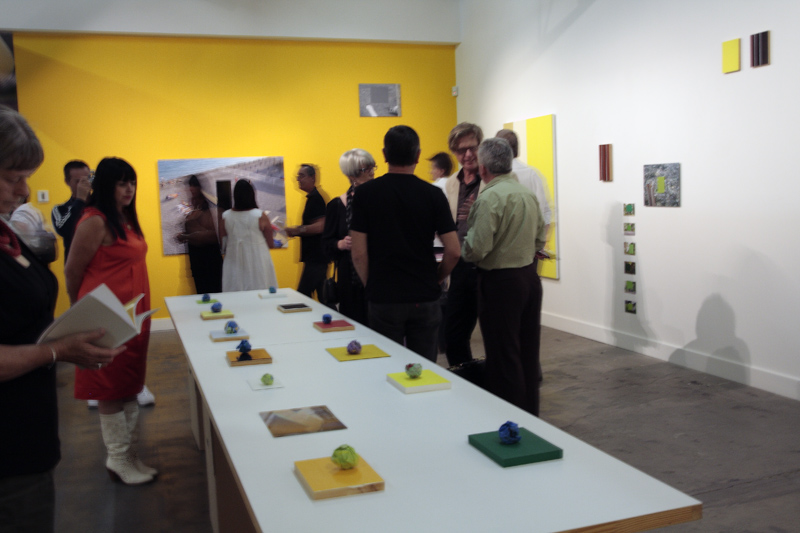
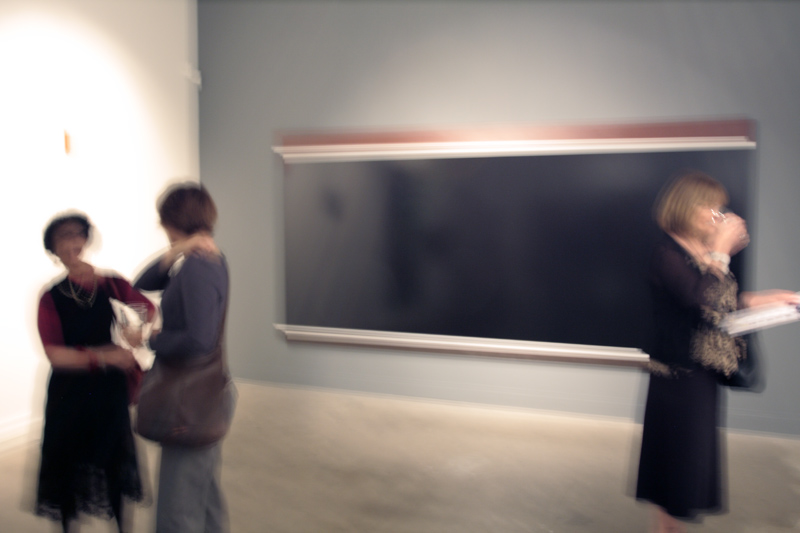
Opening night crowd at 'Colour, Time' by David Thomas at Nellie Castan Gallery, Melbourne, 2nd April, 2009


Opening night crowd at Colour, Time by David Thomas with from right to left Farbenfreude Series: Movement of Colour, Heart (Large) 2008; Farbenfreude Series: Amid Dark and Light (Dark Painting) 2008; and Farbenfreude Series: A Gentle Pasing (Large) 2008 on back wall
Photo: Marcus Bunyan


“A photographed real space and an expanding undefinable painting space (the non-figurative form) confront each other. The result is a coexistence of various models of space, a coexistence and entanglement of inconsistent things.”


Christoph Dahlhausen. David Thomas EIKON nr 53, Vienna, Austria, 2006


A slow burn painting, photography and composites show at Nellie Castan Gallery. Minimalist grid paintings combine with squares of colour taken out of photographs (again! as at the recent Richard Grigg show at Block Projects). This supposedly imparts profundity to insubstantial and mundane photographs that aim to comment on the existential nature of our being through the presence / absence of the missing spatio-temporal slice. This exhibition just didn’t hit the spot for me. Nice to catch up with Jason Smith Director of Heide Museum of Modern Art who was in attendance.

Dr Marcus Bunyan


Many thankx to Nellie Castan Gallery for allowing me to publish the photographs in the posting. Please click on the photographs for a larger version of the image.


Opening night crowd at 'Colour, Time' by David Thomas at Nellie Castan Gallery, Melbourne, 2nd April, 2009


Opening night crowd at Colour, Time by David Thomas with the series Length of Time 2009 on table
Photo: Marcus Bunyan


David Thomas (Australian born Northern Ireland, b. 1951) 'Length of Time Series: Blue tape on red monochrome' 2009


David Thomas (Australian born Northern Ireland, b. 1951)
Length of Time Series: Blue tape on red monochrome
2009
Photo: Marcus Bunyan


David Thomas (Australian born Northern Ireland, b. 1951) 'End of Summer: Homage a Tati (small splash) 2009


David Thomas (Australian born Northern Ireland, b. 1951)
End of Summer: Homage a Tati (small splash)
Enamel on photograph
2009


Opening night crowd in front of David Thomas' 'Black Reflection Painting: For William Barak' 2009


Opening night crowd in front of David Thomas’ Black Reflection Painting: For William Barak 2009
Photo: Marcus Bunyan


Nellie Castan Gallery

This gallery closed in 2013.

LIKE ART BLART ON FACEBOOK

Back to top

Opening 1: ‘Territories’ at Project Space/Spare Room, Melbourne

Exhibition dates: 3rd April – 1st May, 2009

Curator: Shane Hulbert
Opening: Thursday 2nd April, 2009

Group photography show with artists: Shane Hulbert (Aus), John Billan (Aus), So Hing Keung (HK), Stephanie Neoh (Aus), Darren Sylvester (Aus), Ming Tse Ching (HK), Kellyann Geurts (Aus), Andrew Guthrie (HK), Kim Lawler (Aus), Law Sum Po Jamsen (HK), and Lyndal Walker (Aus).


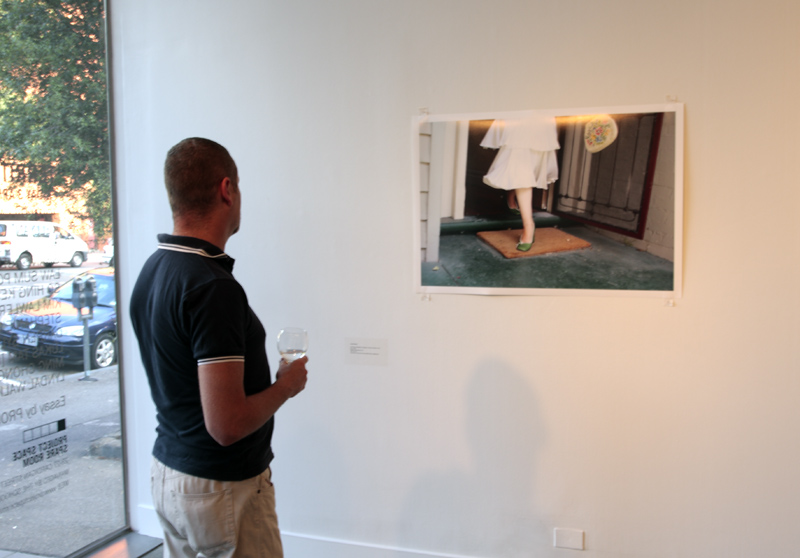
Sculptor Fredrick White in front of Lyndal Walker's 'The Time to Hesitate is Trough, no Time to Wallow in the Mire' 2009


Sculptor Fredrick White in front of Lyndal Walker’s The Time to Hesitate is Through, no Time to Wallow in the Mire 2009


Great to catch up again with John Billan, Shane Hulbert and Les Walkling!

Marcus


Please click on the photographs for a larger version of the image.


Lyndal Walker (Australian, b. 1973) 'The Time to Hesitate is Through, no Time to Wallow in the Mire' 2009 from the exhibition 'Territories' at Project Space/Spare Room, Melbourne, April - May, 2009


Lyndal Walker (Australian, b. 1973)
The Time to Hesitate is Through, no Time to Wallow in the Mire
2009


“The images in this show all reflect on an exploration of intersecting territories within Australia and the Chinese Special Administration Region [SAR] of Hong Kong. Central to this exploration are the cultural linkages between claimed and reclaimed territories, social territories and psychological territories and the way this in turn influences national identity. The claim is that these things of importance, and the way we respond to the notion of territory, have recurring similarities between different cultures.

Despite the broadness of the title, the notion of territories is becoming increasingly relevant in a global community, as the traditional borderlines and barriers that define who we are and what we stand for as a culture change in response to internal and external shifts.”

Shane Hulbert 2009


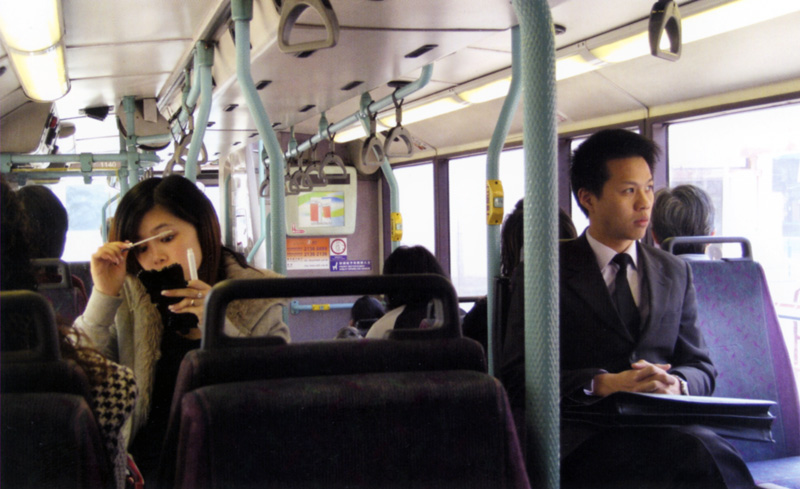
'Territories' opening night crowd at Project Space/Spare Room, Melbourne


Territories opening night crowd at Project Space/Spare Room, Melbourne


Ming Tse Chong (Chinese, b. 1960) 'City Still Life II' 2008 from the exhibition 'Territories' at Project Space/Spare Room, Melbourne, April - May, 2009


Ming Tse Chong (Chinese, b. 1960)
City Still Life II
2008


Project Space/Spare Room

PROJECT SPACE and SPARE ROOM closed in March 2022

LIKE ART BLART ON FACEBOOK

Back to top

Book: ‘Thomas Ruff: jpegs’ from Aperture Foundation

March 2009


Thomas Ruff (German, b. 1958) 'jpeg sh01' 2005


Thomas Ruff (German, b. 1958)
jpeg sh01
2005
C-print
© Thomas Ruff


I greatly admire this series of work. It takes a very special artist and a very special person to look at the world – and specifically how the world is represented and presented to us in scrappy, low quality jpgs – and recognise a different perspective, an alternate reality that is staring us in the face, that is confronting us every single day. No body but Ruff did.

Great artists are always ahead of their time, always probing beyond, offering up a mirror to an inchoate, uninformed society. Robert Frank did it with The Americans in the 1950s, and the Americans didn’t like what they were being shown by an outsider, a foreigner. Lee Friedlander did it in the 1970s with his segmented images and reflections, his informality and perspicacity. Now Ruff abstracts an already abstracted and distracted world, a world flooded with meaningless images. He makes giant the landscape, war, eruption, disruption and destruction until when we approach too close… the image dissolves before our eyes. Into nothingness. We retreat in confusion.

He is aware, while so many of us are unaware. He is fully conscious and observant of the processes and effects of contemporary digital photography. And yet. And yet, these fractured images approach the sublime in some mysterious way.

Dr Marcus Bunyan


Thomas Ruff (German, b. 1958) 'jpeg ca02' 2004
Screenshot


Thomas Ruff (German, b. 1958)
jpeg ca02
2004
C-print
© Thomas Ruff


“How much visual information is needed for image recognition? A pretty small quantity of data will go a long way for the brain and the computer, both of which take shortcuts for the sake of speedy comprehension. In the Jpegs series, German photographer Thomas Ruff exploits this imprecision in digital technology, locating online jpegs and enlarging them until the pixels emerge in a chessboard pattern of near abstraction. A closer look at these images reveals that, in addition to the degeneration of the image into a digital grid, the colour and brightness generated by the algorithms of the compression also become visible. Many of Ruff’s works in this series focus on idyllic, seemingly untouched landscapes, or conversely, on scenes of war and nature disturbed by human manipulation – subjects ill suited to disruptive pixelation, and therefore perfect for Ruff’s purposes. Taken together, these images constitute an encyclopaedic compendium of contemporary visual culture that also engages the history of landscape painting. A fittingly deluxe and oversize volume, Jpegs is the first monograph dedicated exclusively to this monumental series.”

Text from the Amazon website


Thomas Ruff (German, b. 1958) 'jpeg cdf01' 2004


Thomas Ruff (German, b. 1958)
jpeg cdf01
2004
C-print
69 5/8 x 87 3/4 in. (177 x 223cm)
© Thomas Ruff


Thomas Ruff (German, b. 1958) 'jpeg bb03' 2007


Thomas Ruff (German, b. 1958)
jpeg bb03
2007
C-print
72 7/8 x 98 1/4 in. (185.1 x 249.56cm)
© Thomas Ruff


Thomas Ruff (German, b. 1958) 'jpeg ny02' 2004


Thomas Ruff (German, b. 1958)
jpeg ny02
2004
C-print
© Thomas Ruff


Thomas Ruff is among the most important international photographers to emerge in the last fifteen years, and one of the most enigmatic and prolific of Bernd and Hilla Becher’s former students, a group that includes Andreas Gursky, Thomas Struth, Candida Höfer, and Axel Hutte. In 2007, Ruff completed his monumental and very timely Jpegs series in which he explores the distribution and reception of images in the digital age. Starting with images he culls primarily from the Web, Ruff enlarges them to a gigantic scale, which exaggerates the pixel patterns, until they become sublime geometric displays of colour. A fittingly deluxe and oversized volume, Jpegs (Aperture, June 2009) is the first monograph dedicated exclusively to the publication of Ruff’s remarkable series.

When viewed up close the images in Jpegs look abstract; as you move away they merge into decipherable photographic images. Like Impressionistic paintings, Ruff’s photographs require the viewer’s active participation and shift in perspective in order to make a complete assessment of the image content. The work ranges from idyllic, seemingly untouched landscapes and popular tourist spots, to scenes of war and nature disturbed by human manipulation. Places and global events that have defined the visual media world of recent decades are represented, including the familiar, almost iconic pictures of atomic bomb tests; 9/11; scenes of warfare in Baghdad, Beirut, and Grozny; the killing fields of Cambodia; and the ravaged Asian coasts after the 2004 tsunami, among others. Taken together, these masterworks create an encyclopaedic compendium of contemporary visual culture that also actively engages the history of landscape painting. Jpegs is a testament to the effects of the digital age on the medium of photography.

Text from Artdaily.org website


Thomas Ruff (German, b. 1958) 'jpeg soi01' 2005


Thomas Ruff (German, b. 1958)
jpeg soi01
2005
C-print
© Thomas Ruff


Thomas Ruff (German, b. 1958) 'jpeg msh01' 2004


Thomas Ruff (German, b. 1958)
jpeg msh01
2004
C-print
© Thomas Ruff


Thomas Ruff (German, b. 1958) 'jpeg ny01' 2004


Thomas Ruff (German, b. 1958)
jpeg ny01
2004
C-print
276 × 188cm
© Thomas Ruff


Thomas Ruff (German, b. 1958) 'jpeg td02' 2006


Thomas Ruff (German, b. 1958)
jpeg td02
2006
C-print
261 × 188cm
© Thomas Ruff


Thomas Ruff (German, b. 1958) 'Jpeg rl104' 2007


Thomas Ruff (German, b. 1958)
Jpeg rl104
2007
C-print
© Thomas Ruff


Thomas Ruff (German, b. 1958) 'Jpeg icbm05' 2007


Thomas Ruff (German, b. 1958)
Jpeg icbm05
2007
C-print
© Thomas Ruff


Book available from the Amazon website

LIKE ART BLART ON FACEBOOK

Back to top

Exhibition: ‘Plant Studies by Karl Blossfeldt and Related Works’ at Die Photographische Sammlung/SK Stiftung Kultur, Cologne

Exhibition dates: March 13th – 17th June, 2009


Many thankx to the Die Photographische Sammlung/SK Stiftung Kultur for allowing me to publish the photographs in the posting. Please click on the photographs for a larger version of the image.


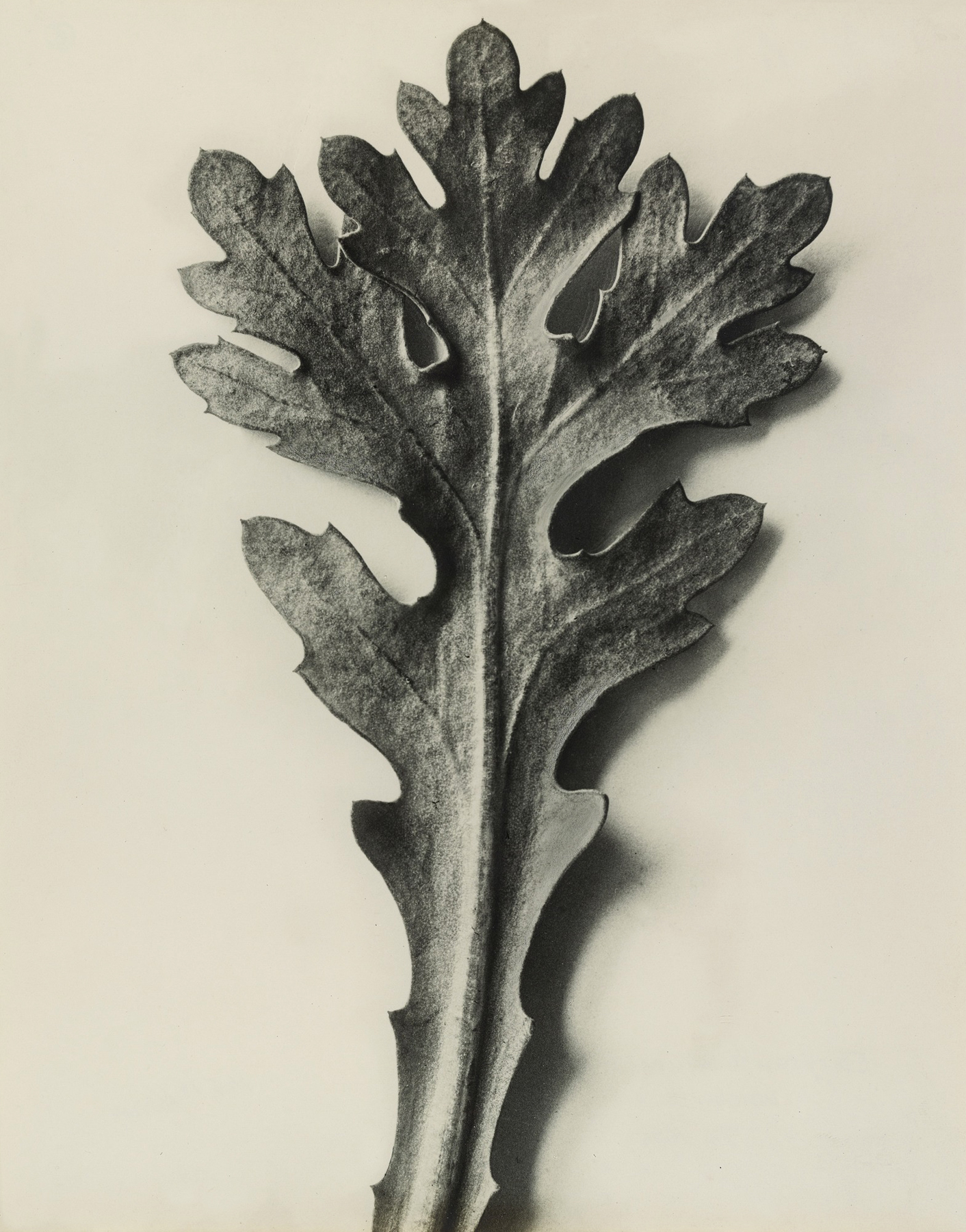
Karl Blossfeldt (German, 1865-1932) 'Acanthus - Bear's breech' before 1928 from the exhibition 'Plant Studies by Karl Blossfeldt and Related Works' at Die Photographische Sammlung/SK Stiftung Kultur, Cologne, March - June, 2009


Karl Blossfeldt (German, 1865-1932)
Acanthus – Bear’s breech
before 1928
Gelatin silver print
Karl Blossfeldt Collection at the University of the Arts Berlin


Die Photographische Sammlung presents Plant Studies by Karl Blossfeldt and Related Works, an exhibition presented by Die Photographische Sammlung/SK Stiftung Kultur, Cologne in co-operation with the Berlin University of the Arts, compiled by Gabriele Conrath-Scholl, Rajka Knipper and Claudia Schubert. The exhibition will present for the first time in this volume the famous and influential plant studies by Karl Blossfeldt (1865-1932) from the collection of the Berlin University of the Arts as original prints. Blossfeldt’s photographs will be accompanied by the artist’s herbaria and sculptures based on plants, the latter produced in cooperation with his teacher Moritz Meurer.

The amalgamation and presentation of the various groups of work from the Berlin Blossfeldt collection provides detailed insight into the working style of the artist, who taught the study of natural forms in Berlin for over thirty years. His plant photographs were used primarily as reference aids during lessons in his classes. It was only towards the end of his working life that his photographs became known to the larger public through an exhibition at the Galerie Nierendorf in Berlin in 1926.The publication of the book Art Forms in Nature in 1928 led to an ongoing appreciation of his photographs. Karl Blossfeldt developed in year-long concentration on one theme a highly aesthetic picture language which up until today still fascinates the viewer with its clarity and focus on the object.

The exhibition highlights the topic of plant studies against a background of research into form and structure using selected historical and contemporary works. They mirror the development and technical possibilities of the medium, as well as the artistic reflection into their characteristics and decorative aspects. Thus the scope of the 300 exhibits reaches from detailed analyses of the form of individual botanical structures to the documentation of complex natural and populated areas, up to a symbolic contemplation of plants.

The exhibition is the result of years of cooperation between the Universität der Künste Berlin and Die Photographische Sammlung / SK Stiftung Kultur, two institutions committed to the ongoing academic study and extensive public presentation of the Karl Blossfeldt collection in the possession of the Universität der Künste.

The presentation gives Die Photographische Sammlung once again an opportunity to draw attention to its own institutional orientation. In addition to the co-operation on the work by Karl Blossfeldt these include avant-garde objective and conceptual photographic works, which developed in particular in line with the sense of a new era in the 1920s and the 1960s / 1970s or are artistically related to them. Works which the Cologne institution purchased during the past years in connection with the botanical subject or were obtained as permanent loans, are now part of the current presentation. They include works by Pietro Guidi, August Kotzsch, Paul Dobe, works from the Folkwang-Auriga Verlag, by Fred Koch, Albert Renger-Patzsch, Else Thalemann, August Sander, Ruth Lauterbach-Baehnisch, Ruth Hallensleben, Dr. Herbert W. Franke and Lawrence Beck. Although works by the younger artists Natascha Borowsky and Simone Nieweg are already part of the collection, in light of their more recent work both artists have made photographs from their own collections available for the show.

The current show is a thematically oriented insight into Die Photographische Sammlung’s collection which ranges from the historical to the contemporary and in the last few years has been extended by a number of corresponding groups of photographic works. In order to provide a comprehensive, but lively background to Karl Blossfeld’s work and to display illuminative positions, which were frequently mentioned in connection with the reception of Blossfeldt’s work, but were rarely, if ever, presented together in exhibitions, and also to permit new assessments and links, important loans have been integrated into the exhibition. They have been borrowed from the Karl-Blossfeldt-Archiv / Ann and Jürgen Wilde, Zülpich, which contains the largest collection of original photographs by the artist.

Karl Blossfeldt received essential support from Moritz Meurer (1839-1916) who worked as a graphic artist and painter, and for whom Blossfeldt worked as an assistant in Rome from 1892 to 1895. On the basis of Meurer’s concept, reference aids in the form of sculptures and drawings, as well as photographs, were developed for later use in lessons. Meurer’s idea, to take the basic forms in nature, which could be seen in the composition of a plant, as models for architecture, artistic and craftwork objects or ornaments, was integrated by Blossfeldt into his photographs.

According to the records, attention was drawn to Karl Blossfeldt’s work in particular by the fact that the Berlin gallerist Karl Nierendorf heard about his work and presented the first exhibition of his photographs outside the school context in 1926. The plant photographs, still under the influence of the ornamental art nouveau although more as a reaction to it were highly appreciated in the early days of New Objectivity. These studies seemed to put into practice the newly formed principles contained in the art of the 1920s, in which there was a demand for things to be presented without artistic digression, in a clear, authentic pictorial language, at the same time providing insight into their nature. It is therefore even more surprising that Blossfeldt was able to achieve this so easily, considering that he accomplished it seemingly uninfluenced by questions of artistic or photographic history categories. His motivation stemmed from his didactic and pragmatic aims to depict plant forms with precise accuracy, in order to provide flawless reference aids which would encourage his students to transform them artistically. His straightforward, passionate concentration on one theme, which he almost endlessly varied within a limited field, opened it up for comparative viewing. In particular since the 1970s, in the light of a new-orientation of the medium, his work was highly regarded and gained indirect influence on contemporary art, to the extent that knowledge of his images influences today s viewing perspectives.

On the occasion of the exhibition Plant Studies by Karl Blossfeldt and Related Works Die Photographische Sammlung / SK Stiftung Kultur is presenting on its website a directory they have created of all 631 photographs, 39 herbaria and 57 sculptures from the Universität der Künste’s Karl Blossfeldt collection together with documents from the University archive. A distinctive feature of the research is the fact that every photograph is accompanied not only by a concordance of primary and secondary literature but also Blossfeldt negatives and transparencies from the Deutsche Fotothek in Dresden and, in the near future, from the Karl Blossfeldt Archive/Ann and Jürgen Wilde. The website provides a text forum on the topic, which uses selected documents to illustrate Blossfeldt’s teaching work in the context of the history of the University and includes various aspects of his reception in publications and exhibitions.

Press release from Die Photographische Sammlung


Karl Blossfeldt (German, 1865-1932) 'Cucurbita - Pumpkin tendrils' before 1928 from the exhibition 'Plant Studies by Karl Blossfeldt and Related Works' at Die Photographische Sammlung/SK Stiftung Kultur, Cologne, March - June, 2009


Karl Blossfeldt (German, 1865-1932)
Cucurbita – Pumpkin tendrils
before 1928
Gelatin silver print
Karl Blossfeldt Collection at the University of the Arts Berlin


Karl Blossfeldt (German, 1865-1932) 'Allium ostrowskianum - garlic plant' before 1928


Karl Blossfeldt (German, 1865-1932)
Allium ostrowskianum – garlic plant
before 1928
Gelatin silver print
Karl Blossfeldt Collection at the University of the Arts Berlin


“In 1928 Karl Blossfeldt (1865-1932) published the now legendary photographic book “Art Forms in Nature.” Brought together were a selection of images of plants that this craftsman had photographed only as illustrative material for his students at the college in Berlin. He photographed the plants isolated in front of a neutral background, their blossoms, buds, stems, umbels and seed capsules often greatly magnified to serve as a distinct model for the decorative art forms of the Art Nouveau movement, whose own bloom period was already fading …

It is quite clearly the particular combination of subject matter and photographic style that gives the works a classic timelessness, allowing them to be discovered “afresh” again and again. So the isolating, monumental and formalistic approach to nature not only tied in well with concepts of New Functionalism, but was also successively interpreted as illustrating the relationship between Art and Nature and as a precursor of Conceptual Art.”

Text from the Karl Blossfeldt Archive website


Karl Blossfeldt (German, 1865-1932) 'Chrysanthemum segetum - Feverfew' before 1928


Karl Blossfeldt (German, 1865-1932)
Chrysanthemum segetum – Feverfew
before 1928
Gelatin silver print
Karl Blossfeldt Collection at the University of the Arts Berlin


Karl Blossfeldt (German, 1865-1932) 'Dipsacus laciniatus - Cutleaf Teasel' before 1928


Karl Blossfeldt (German, 1865-1932)
Dipsacus laciniatus – Cutleaf Teasel
before 1928
Gelatin silver print
Karl Blossfeldt Collection at the University of the Arts Berlin


Karl Blossfeldt (German, 1865-1932) 'Thorned Bulbous Plant' before 1928


Karl Blossfeldt (German, 1865-1932)
Thorned Bulbous Plant
before 1928
Gelatin silver print
Karl Blossfeldt Collection at the University of the Arts Berlin


“He photographed plants by the thousands – photographs which feature flowers, buds, branched stems, clusters or seed capsules shot directly from the side, seldom from an overhead view, and rarely from a diagonal perspective. He usually placed the subjects of his photographs against white or grey cardboard, sometimes against a black background. Hardly ever can details of the rooms be detected. The light for his shots was obtained from northern windows, making it diffuse, but it fell from the side, creating volume. The technique and processing conditions were very simple; only the medium size of the negative format was somewhat out of the ordinary. Nothing detracted from the subject. This man produced such pictures for over thirty years.

The man’s name was Karl Blossfeldt, and his life’s achievement occupies a firm place in the history of 20th-century art, although the aims of his undertaking place him firmly within the 19th century. Blossfeldt shares this bridging of two centuries with other great collectors in the history of photography, such as the Parisian Eugene Atget, and it is to this bridging of two centuries that his influence may be attributed today …

The plant photographs were produced by simple means. Legend has it that a relatively straight-forward homemade camera was used, one common in its time and not very large, with a format of 9 x 12cm. The glass plates which served as negatives were coated with inexpensive but not completely neutral-coloured orthochromatic emulsion, and occasionally – after 1902, as they became more widely available – with panchromatic emulsions, making possible a neutral reproduction of the colour red in halftones. Since the first emulsion was thin and therefore enabled high contrast with extremely sharp edges, it served especially to stress the structural elements. It was thus used primarily for photographs with white or grey backgrounds. The rarer photos with panchromatic emulsions were used to illustrate entire clusters or beds of flowers with a wider variation of chromatic values or halftones.”

Text by Rolf Sachse from the book Karl Blossfeldt Benedikt Taschen Verlag (April 1997) available on Amazon.


Karl Blossfeldt (German, 1865-1932) 'Papaver orientale - Oriental Poppy' before 1928


Karl Blossfeldt (German, 1865-1932)
Papaver orientale – Oriental Poppy
before 1928
Gelatin silver print
Karl Blossfeldt Collection at the University of the Arts Berlin


Originally developed from a practice at the Unterrichtsanstalt des Königlichen Kunstgewerbemuseums Berlin [Institute of the Berlin Royal Arts and Crafts Museum] at the end of the 19th century and designed specifically for use as teaching materials, Karl Blossfeldt’s plant photographs rank today among the classic works of art and photography history.

Blossfeldt taught “Modelling from Live Plants” from 1899 to 1930, first at the Unterrichtsanstalt des Königlichen Kunstgewerbemuseums, later at the Vereinigte Staatsschulen für Freie und Angewandte Kunst [United State Schools for Fine and Applied Arts] that emerged from the Unterrichtsanstalt’s amalgamation with the Hochschule für Bildende Künste [University of the Visual Arts] – predecessors of the present-day Berlin University of the Arts. A major role in the introduction of that subject was played by Moritz Meurer, for whom Karl Blossfeldt worked as a scholarship-holder in Rome from 1892 to 1895. There, prepared plant specimens, sculptures, castings, drawings and photographs were made as models for classroom use. Blossfeldt took up and systematically developed Meurer’s idea of using the basic natural forms inherent in the structure of a plant for the design of architectural, art or craft objects and ornaments.

A letter written to the director of the Arts and Crafts Museum in 1906 shows that Blossfeldt was already in possession of thousands of photographs, from which he intended gradually to make prints. The plan to enlarge the images came about for a number of reasons:

~ The plants that Blossfeldt collected for his students underwent relatively rapid change, either because they grew or because they wilted and withered. Captured in a photograph, they became a lasting model

~ Photographic enlargements allowed even the tiniest natural forms to be made out

~ Photographic enlargements offered the opportunity to present “unadulterated nature” – in contrast to sketched enlargements, which Blossfeldt contended “always contain a subjective element”

~ Blossfeldt wanted his material seen as a specimen collection that would also be available for future generations of students


There is no detailed record showing the technical facilities at Karl Blossfeldt’s disposal. The Karl Blossfeldt Archive/Ann and Jürgen Wilde and the Deutsche Fotothek in Dresden have preserved glass plates and transparencies of various formats (6/6.5 x 9cm, 9 x 12cm, 9 x 18cm and 13 x 18cm). Blossfeldt’s camera – or cameras, because he may have had several – is known to have been an entirely or partly home-made affair. The work collages in the collection of the Karl Blossfeldt Archive / Ann and Jürgen Wilde give a good idea of his negatives because the images that appear in them are from contact prints made by Blossfeldt.

The fact that Karl Blossfeldt became a major celebrity was due to the fortunate circumstance that his photographs came to the attention of the Berlin gallerist Karl Nierendorf. He staged the first exhibition of Blossfeldt’s work in a non-school context in 1926, presenting it alongside sculptures from Africa and New Guinea and work by the artist Richard Janthur. In 1928, in another Nierendorf initiative, Urformen der Kunst [Art Forms in Nature] was published with 120 plates of plants by Blossfeldt. The book was given such a rapturous reception that the following years saw more editions published and foreign-language editions launched in English, French and Swedish. These studies were very much in tune with the new maxim of 1920s art that called for things to be represented authentically, with no artistic frills, in a clear visual idiom designed to explore and reveal their nature. The fact that Blossfeldt succeeded in this is all the more astonishing since he started out working with no thoughts of pushing forward any boundaries in art or photography. He was primarily motivated by a didactic and pragmatic intention to produce highly accurate plant images which, as models for study, would reveal natural forms to the human eye and inspire students to turn them into art.

With his passionate concentration on a single subject, addressed in close-up in almost infinite variations and thus revealed for comparative examination, Blossfeldt became a highly respected figure, especially after the re-think on photography in the 1970s. As a result, he has had an indirect influence on contemporary art and knowledge of his work helps shape the way we view art today. Karl Blossfeldt did not experience his success for long. He died in December 1932, the year in which his second book Wundergarten der Natur (Art Forms in Nature) was published. The largest collections of his photographs are in the Karl Blossfeldt Archive/Ann and Jürgen Wilde, the Archive of the Berlin University of the Arts and the Deutsche Fotothek Dresden.

Text from the Die Photographische Sammlung/SK Stiftung Kultur website [Online] Cited 25/03/2009. No longer available online


Karl Blossfeldt (German, 1865-1932) 'Papaver Orientalis - Oriental Poppy capsules' before 1928


Karl Blossfeldt (German, 1865-1932)
Papaver Orientalis – Oriental Poppy capsules
before 1928
Gelatin silver print
Karl Blossfeldt Collection at the University of the Arts Berlin


Karl Blossfeldt (German, 1865-1932) 'Dryopteris filix mas - Common male fern' before 1928


Karl Blossfeldt (German, 1865-1932)
Dryopteris filix mas – Common male fern
before 1928
Gelatin silver print
Karl Blossfeldt Collection at the University of the Arts Berlin


Die Photographische Sammlung/SK Stiftung Kultur
Im Mediapark 7
50670 Cologne
Phone: 0049-(0)221-88895 300

Opening hours:
Open daily 14 – 19hrs
Closed Wednesdays

Die Photographische Sammlung/SK Stiftung Kultur website

LIKE ART BLART ON FACEBOOK

Back to top

Exhibition: ‘Francis Bacon’ at the Museo Nacional del Prado, Madrid

Exhibition dates: 3rd February – 19th April, 2009

Curator: Manuela Mena, co-curator of the exhibition at the Prado


Francis Bacon (British, 1909-1992) 'Triptych inspired by T.S. Eliot's 'Sweeney Agonistes'' 1967 from the exhibition 'Francis Bacon' at the Museo Nacional del Prado, Madrid, Feb - April, 2009


Francis Bacon (British, 1909-1992)
Triptych inspired by T.S. Eliot’s ‘Sweeney Agonistes’
1967
Oil on canvas
198 x 147.5cm (each)
Washington, D.C. Hirshhorn Museum and Sculpture Garden, Smithsonian Institution. Gift of the Joseph H. Hirshhorn Foundation, 1972


Looks like an amazing exhibition of Francis Bacon’s work, one of my favourite artists – I wish I could see it!


Many thankx to the Museo Nacional del Prado for allowing me to publish the art work in the posting. Please click on the photographs for a larger version of the image.


The exhibition is constructed in different sections:

~ Animal
~ Zone
~ Apprehension
~ Crucifixion
~ Crisis
~ Archive
~ Portrait
~ Memorial
~ Epic
~ Late


Bacon’s work demonstrates marked similarities to that of many of the Spanish artists he admired. (Manuela Mena, co-curator of the exhibition at the Prado, has written an excellent essay on this topic that can be found in the exhibition’s catalog.) The retrospective at the Prado provides a rare opportunity to compare Bacon to some of the Spanish masters that influenced him.

Start by meandering through the vast Bacon exhibition. Spread between two floors of the new wing of the Prado, the exhibition has brought together Bacon’s most important works from nearly his entire artistic production. It begins with the work that put Bacon on the map, “Three Studies for Figures at the Foot of a Crucifixion” (1944), and follows his work through the interpretations of Velázquez, crucifixion triptychs, his unique portraits and the late works through the years shortly before his death.

Text from the Prado website


Francis Bacon (British, 1909-1992) 'Three Studies for Figures at the Base of a Crucifixion' c. 1944 from the exhibition 'Francis Bacon' at the Museo Nacional del Prado, Madrid, Feb - April, 2009


Francis Bacon (British, 1909-1992)
Three Studies for Figures at the Base of a Crucifixion
c. 1944
Oil on board
94 x 73.7cm
London, Tate, presented by Eric Hall 1953


Animal

A philosophical attitude to human nature first emerges in Francis Bacon’s works of the 1940s. They reflect his belief that, without God, humans are subject to the same natural urges of violence, lust and fear as any other animal. He showed Figure in a Landscape and Three Studies for Figures at the Base of a Crucifixion in April 1945, and exhibited consistently thereafter. The bestial depiction of the human figure was combined with specific references to recent history and especially the devastating events of the Second World War. Bacon often drew his inspiration from reproductions, acquiring a large collection of books, catalogues and magazines. He repeatedly studied key images in order to probe beneath the surface appearance captured in photographs. Early concerns that would persist throughout his work include the male nude, which reveals the frailty of the human figure, and the scream or cry that expresses repressed and violent anxieties. These works are among the first in which he sought to balance psychological insights with the physical identity of flesh and paint.


Francis Bacon (British, 1909-1992) 'Study after Velázquez’s Portrait of Pope Innocent X' 1953


Francis Bacon (British, 1909-1992)
Study after Velázquez’s Portrait of Pope Innocent X
1953
Oil on canvas
153 x 118cm
Des Moines, Nathan Emory Coffin Collection of the Des Moines Arts Center, purchased with funds from the Coffin Fine Arts Trust


Zone

In his paintings from the early 1950s, Bacon engaged in complex experiments with pictorial space. He started to depict specific details in the backgrounds of these works and created a nuanced interaction between subject and setting. Figures are boxed into cage-like structures, delineated ‘space-frames’ and hexagonal ground planes, confining them within a tense psychological zone. In 1952 he described this as “opening up areas of feeling rather than merely an illustration of an object”. Through his technique of ‘shuttering’ with vertical lines of paint that merge the foreground and background, Bacon held the figure and the setting together within the picture surface, with neither taking precedence in what he called “an attempt to lift the image outside of its natural environment”.

A theme that emerged in the 1950s was the extended series of variants of Velázquez’s Portrait of Pope Innocent X, 1650 (Rome, Galleria Doria Pamphilj), a work Bacon knew only from illustrations. He used this source to expose the insecurities of the powerful – represented most often in the scream of the caged figure. Through the open mouth Bacon exposed the tension between the interior space of the body and the spaces of its location, which is explored more explicitly in the vulnerability of the ape-like nudes.


Francis Bacon (British, 1909-1992) 'Chimpanzee' 1955


Francis Bacon (British, 1909-1992)
Chimpanzee
1955
Oil on canvas
152.5 x 117cm
Stuttgart, Staatsgalerie


Apprehension

Implicit throughout Bacon’s work of the mid 1950s is a sense of dread pervading the brutality of everyday life. Not only a result of Cold War anxiety, this seems to have reflected a sense of menace at a personal level emanating from Bacon’s chaotic affair with Peter Lacy (who was prone to drunken violence) and the wider pressures associated with the continuing illegality of homosexuality. The Man in Blue series captures this atmosphere, concentrating on a single anonymous male figure in a dark suit sitting at a table or bar counter on a deep blue-black ground. Within their simple painted frames, these awkwardly posed figures appear pathetically isolated.

Bacon’s interest in situations that combine banality with acute apprehension was also evident in other contemporary works. From figures of anxious authority, his popes took on malevolent attributes and physical distortions that were directly echoed in the paintings of animals, whose actions are also both sinister and undignified. Some of these images derived from Bacon’s close scrutiny of the sequential photographs of animals and humans taken by Eadweard Muybridge (1830-1904), which he called “a dictionary” of the body in motion.


Francis Bacon (British, 1909-1992) 'Three Studies for a Crucifixion' 1962


Francis Bacon (British, 1909-1992)
Three Studies for a Crucifixion
1962
Oil on canvas
198.2 x 144.8cm
New York, Solomon R. Guggenheim Museum


Crucifixion

Bacon made paintings related to the Crucifixion at pivotal moments in his career, which is why these key works are gathered here. The paradox of an atheist choosing a subject laden with Christian significance was not lost on Bacon, but he claimed, “as a non-believer, it was just an act of man’s behaviour”. Here the instincts of brutality and fear combine with a deep fascination with the ritual of sacrifice. Bacon had already made a very individual crucifixion image in 1933 before returning to the subject with his break-through triptych Three Studies for Figures at the Base of a Crucifixion in 1944. This is a key precursor to later themes and compositions, containing the bestial distortion of human figures within the triptych format. These monstrous creatures displace the traditional saints and Bacon later related them to the Eumenides – the vengeful furies in Greek mythology. In resuming the theme in the 1960s, especially in 1962 as the culmination of his first Tate exhibition, Bacon used references to Cimabue’s 1272-1274 Crucifixion to introduce a more explicitly violent vision. Speaking after completing the third triptych in 1965 he simply stated: “Well, of course, we are meat, we are potential carcasses”.


Francis Bacon (British, 1909-1992) 'Paralytic Child Walking on All Fours (from Muybridge)' 1961


Francis Bacon (British, 1909-1992)
Paralytic Child Walking on All Fours (from Muybridge)
1961
Oil on canvas
198 x 142cm
The Hague, Collection Gemeentemuseum Den Haag


Crisis

Between 1956 and 1961, Bacon travelled widely. He spent time in places marginal to the art world, in Monaco, the South of France and Africa, and particularly with Peter Lacy in the ex-patriot community in Tangier. In this rather unsettled context, he explored new methods of production, shifting to thicker paint, violently applied and so strong in colour as to indicate an engagement with the light of North Africa. This was most extreme in his series based on a self-portrait of Van Gogh, The Painter on the Road to Tarascon (1888, destroyed), which became an emblem of the modern predicament. Despite initial acclaim, Bacon’s Van Gogh works were soon criticised for their “reckless energy” and came to be viewed as an aberration. They can now be recognised as pivotal to Bacon’s further development, however, and allow glimpses into his search for new ways of working. His innovations were perhaps in response to American Abstract Expressionism, of which he was publicly critical. Although he eventually returned to a more controlled approach to painting, the introduction of chance and the new vibrancy of colour at this moment would remain through out his career.


Montage of material from Bacon's Studio (including pictures of Velázquez's Innocent X, The Thinker by Rodin etc.) 7 Cromwell Place, c. 1950


Montage of material from Bacon’s Studio (including pictures of Velázquez’s Innocent X, The Thinker by Rodin etc.)
7 Cromwell Place
c. 1950
© Sam Hunter


Archive

The posthumous investigation of Bacon’s studio confirmed the extent to which he used and manipulated photographic imagery. This practice was already known from montages recorded in 1950 by the critic Sam Hunter. Often united by a theme of violence, the material ranges between images of conflict, big game, athletes, film stills and works of art.

An important revelation that followed the artist’s death was the discovery of lists of potential subjects and preparatory drawings, which Bacon had denied making. Throughout his life, he asserted the spontaneous nature of his work, but these materials reveal that chance was underpinned by planning.

Photography offered Bacon a dictionary of poses. Though he most frequently referred to Eadweard Muybridge’s (1830-1904) survey of human and animal locomotion, images of which he combined with the figures of Michelangelo, he remained alert to photographs of the body in a variety of positions.

A further extension of Bacon’s preparatory practices can be seen in his commissioning of photographs of his circle of friends from the photographer John Deakin (1912-1972). The results – together with self-portraits, photo booth strips, and his own photographs – became important prompts in his shift from generic representations of the human body to portrayals of specific individuals.

A matrix of images

Bacon’s use of photographic sources has been known since 1950 when the critic Sam Hunter took three photographs of material he had selected from a table in Bacon’s studio in Cromwell Place, South Kensington. Hunter observed that the diverse imagery was linked by violence, and this fascination continued throughout Bacon’s life. Images of Nazis and the North African wars of the 1950s were prominent in his large collection of sources. Films stills and reproductions of works of art, including Bacon’s own, were also common. The dismantling of Bacon’s later studio, nearby at Reece Mews, after his death confirmed that the amassing of photographic material had remained an obsession. While some images were used to generate paintings, he also seems to have collected such an archive for its own sake.

The mediated image

From the 1960s, Bacon’s accumulation of chance images began to include a more deliberate strategy of using photographs of his close circle. They became key images for the development of the portraits that dominated his paintings at this time. Snap shots and photo booth strips were augmented by the unflinching photographs taken by his friend John Deakin. Bacon specifically commissioned some of these from Deakin as records of those close to him – notably his partner from 1962, George Dyer – and they served as sources for likenesses and for poses for the rest of his career.

The Physical Body

Bacon drew more from Eadweard Muybridge’s sequential photographs of human and animal locomotion than from any other source. These isolated the naked figure in a way he clearly found stimulating. He also, however, spoke of projecting on to them Michelangelo’s figures which for him had more “ampleness” and “grandeur of form”.

His fascination in photography’s freezing of the body in motion led him to collect sports photographs, particularly boxing, cricket and bullfighting. It was not just movement but the physicality of the body that Bacon scrutinised, using found images to provoke new ways of picturing its strength and vulnerability.


Francis Bacon (British, 1909-1992) 'Portrait of Isabel Rawsthorne Standing in a Street in Soho' 1967


Francis Bacon (British, 1909-1992)
Portrait of Isabel Rawsthorne Standing in a Street in Soho
1967
Oil on canvas
198 x 147.5cm
Berlin, Staatliche Museen zu Berlin, Nationalgalerie


Portrait

During the 1960s, the larger part of Bacon’s work shifted focus to portraits and paintings of his close friends. These works centre on two broad concerns: the portrayal of the human condition and the struggle to reinvent portraiture. Bacon drew upon the lessons of Van Gogh and Velázquez, but attempted to rework their projects for a post-photographic world. His approach was to distort appearance in order to reach a deeper truth about his subjects. To this end, Bacon’s models can be seen performing different roles. In the Lying Figures series, Henrietta Moraes is naked and exposed. This unprecedented raw sexuality reinforces Bacon’s understanding of the human body simply as meat. By contrast Isabel Rawsthorne, a fellow painter, always appears in control of how she is presented. With a mixture of contempt and affection, Bacon depicted George Dyer, his lover and most frequent model, as fragile and pathetic. This is especially evident in Dyer’s first appearance in Bacon’s work, in Three Figures in a Room, in which he represents the absurdities, indignities and pathos of human existence. Everyday objects occasionally feature in these works, hollow props for lonely individuals which reinforce the sense of isolation that Bacon associated with the human condition.


Francis Bacon (British 1909-1992) 'Triptych in Memory of George Dyer' 1971


Francis Bacon (British 1909-1992)
Triptych in Memory of George Dyer
1971
Oil on canvas


Francis Bacon (British, 1909-1992) 'Triptych - August 1972' 1972


Francis Bacon (British, 1909-1992)
Triptych – August 1972
1972
Oil on canvas
198 x 147.5cm
London, Tate


Memorial

This room is dedicated to George Dyer who was Bacon’s most important and constant companion and model from the autumn of 1963. He committed suicide on 24 October 1971, two days before the opening of Bacon’s major exhibition at the Grand Palais in Paris. Influenced by loss and guilt, the painter made a number of pictures in memorial to Dyer. From this period onwards the large-scale triptych was his established means for major statements, having the advantage of simultaneously isolating and juxtaposing the participating figures, as well as guarding against narrative qualities that Bacon strove to avoid. But while evading narrative, Bacon drew more than ever from literary imagery; the first of the sequence, Triptych In Memory of George Dyer 1971, refers to a specific section of T.S. Eliot’s The Waste Land (1922). In addition to his own memory, for Triptych – August 1972 Bacon relied on photographs, taken by John Deakin, of Dyer in various poses on a chair. He confined his dense and energetic application of paint to the figures in these works. The dark openings consciously evoke the abyss of mortality that would become a recurring concern in Bacon’s later works.


Francis Bacon (British, 1909-1992) 'Triptych' 1987


Francis Bacon (British, 1909-1992)
Triptych
1987
Oil on canvas
198 x 147.5cm
London, The Estate of Francis Bacon, courtesy Faggionato Fine Art


Epic

References to poetry and drama became a central element in Bacon’s work from the second half of the 1960s. Alongside images of friends and single figures (often self-portraits), he produced a series of grand works that identified with great literature. Imbued with the inevitability and constant presence of death, the poetry of T.S. Eliot was a particular source of inspiration. The sentiments of the poet’s character Sweeney could be said to echo the painter’s perspective on life:

Birth, and copulation, and death.

That’s all the facts when you come to

brass tacks:

Birth, and copulation, and death.

The works in this room refer to and derive from literature. Some make direct references in their titles, others depict, sometimes abstractly, a certain scene or atmosphere within the narratives themselves. Bacon repeatedly stated that none of his paintings were intended as narratives, so rather than illustrations, these works should perhaps be understood as evoking the experience of reading of Eliot’s poetry or Aeschylus’s tragedies: their violence, threat or erotic charge. Thus, of the triptych created after reading Aeschylus, Bacon explained “I tried to create images of the sensations that some of the episodes created inside me”.


Francis Bacon (British, 1909-1992) 'Portrait of John Edwards' 1988


Francis Bacon (British, 1909-1992)
Portrait of John Edwards
1988
Oil on canvas
198 x 147.5cm
The Estate of Francis Bacon, courtesy of Faggionato Fine Arts, London, and Tony Shafrazi Gallery, New York


Late

When Bacon turned seventy in 1979, more than a decade of work lay ahead of him. Neither his legendarily hedonistic lifestyle nor his work pattern seemed to age him, but he was continually facing up to mortality through the deaths of those around him. This unswerving confrontation, however mitigated by youthful companions such as John Edwards, became the great theme of his late style. Constantly stimulated by new source material – for example the photographs and the poetry of Federico García Lorca which triggered his bullfight paintings – he was able to adapt them to his abiding concerns with the vulnerability of flesh. Exploring new techniques he also extended his fascination with how appropriate oil paint is for rendering the human body’s sensuality and sensitivity. A certain despairing energy may also be felt in the forceful throwing of paint that dominates some of these final works: the controlled chance as a defiant gesture. Ultimately, and appropriately, Bacon’s last triptych of 1991 returns to the key image of sexual struggle that had frequently recurred in his work. He faced death with a defiant concentration on the exquisiteness of the lived moment.


Francis Bacon (British, 1909-1992) 'Three Studies for Self-Portrait' 1979-1980


Francis Bacon (British, 1909-1992)
Three Studies for Self-Portrait
1979-1980
Oil on canvas
37.5 x 31.8cm
Nueva York, The Metropolitan Museum of Art, Jacques and Natasha Gelman collection, 1998


Francis Bacon

Francis Bacon is internationally acknowledged as among the most powerful painters of the twentieth century. His vision of the world was unflinching and entirely individual, encompassing images of sensuality and brutality, both immediate and timeless. When he first emerged to public recognition, in the aftermath of the Second World War, his paintings were greeted with horror. Shock has since been joined by a wide appreciation of Bacon’s ability to expose humanity’s frailties and drives.

This major retrospective gathers many of his most remarkable paintings and is arranged broadly chronologically. Bacon’s vision of the world has had a profound impact. It is born of a direct engagement that his paintings demand of each of us, so that, as he famously claimed, the “paint comes across directly onto the nervous system”.

As an atheist, Bacon sought to express what it was to live in a world without God or afterlife. By setting sensual abandon and physical compulsion against hopelessness and irrationality, he showed the human as simply another animal. As a response to the challenge that photography posed for painting, he developed a unique realism which could convey more about the state of existence than photography’s representation of the perceived world. In an era dominated by abstract art, he amassed and drew upon a vast array of visual imagery, including past art, photography and film. These artistic and philosophical concerns run like a spine through the present exhibition.


Museo Nacional Del Prado
Paseo del Prado, s/n,
28014 Madrid, Spain

Opening hours:
Monday – Saturday 10am – 8pm
Sunday 10am – 7pm

Museo Nacional del Prado website

LIKE ART BLART ON FACEBOOK

Back to top

Exhibition: ‘Daidō Moriyama: Tokyo Photographs’ at Philadelphia Museum of Art

Exhibition dates: 28th February – 31st July, 2009

Curator: Peter Barberie, Curator of Photographs


Many thankx to Philadelphia Museum of Art for allowing me to publish the photographs in the posting. Please click on the photographs for a larger version of the image.


Daido Moriyama (Japanese, b. 1938) 'Untitled' from the series 'Memory of Dog' 1982 from the exhibition 'Daidō Moriyama: Tokyo Photographs' at Philadelphia Museum of Art, Feb - July, 2009


Daidō Moriyama (Japanese, b. 1938)
Untitled from the series Memory of Dog
1982
Gelatin silver print
Image: 8 1/16 × 11 13/16 inches (20.5 × 30cm)
Purchased with funds contributed by the E. Rhodes and Leona B. Carpenter Foundation, 1990
Philadelphia Museum of Art
© Daidō Moriyama


Daidō Moriyama often calls himself a “stray dog,” a reference to one of his iconic early pictures of a roaming mongrel, but also to his preferred incidental vantage points in relation to his subjects and his beguiled yet wary stance toward modernising Japanese society. In the series Memory of Dog, he revisited photographic scenarios and motifs from his previous two decades of work, overlaying his peripheral approach with another quality that he finds crucial to photography: its relationship to memory.


Daidō Moriyama (Japanese, born 1938) 'Untitled (Rose)' 1984 from the exhibition 'Daidō Moriyama: Tokyo Photographs' at Philadelphia Museum of Art, Feb - July, 2009


Daidō Moriyama (Japanese, b. 1938)
Untitled (Rose)
1984
Gelatin silver print
© Daidō Moriyama


Daidō Moriyama (Japanese, born 1938) 'Viaduct 1, Bunkyo-ku, Tokyo' 1981


Daidō Moriyama (Japanese, b. 1938)
Viaduct 1, Bunkyo-ku, Tokyo
1981
Gelatin silver print
© Daidō Moriyama


Daidō Moriyama (Japanese, born 1938) 'Untitled (Bottle)' from the series 'Light and Shadow' 1982


Daidō Moriyama (Japanese, b. 1938)
Untitled (Bottle) from the series Light and Shadow
1982
Gelatin silver print
Image: 7 13/16 x 11 13/16 inches (19.8 x 30cm)
Purchased with funds contributed by the E. Rhodes and Leona B. Carpenter Foundation, 1990
© Daidō Moriyama


Daidō Moriyama is one of the most important and exciting Japanese photographers of our time, having made prolific, often experimental pictures of modern urban life since the 1960s. This exhibition showcases a group of approximately 45 photographs made in and around Tokyo in the 1980s, when Moriyama focused his mature aesthetic on the city with renewed intensity.

Moriyama approaches the world with an equalising eye, capturing disparate peripheral details that in themselves account for little, but together add up to a powerful diagnosis of modern experience. In 1980s Japan such details encompassed the disorienting and sometimes brutal juxtaposition of traditional culture and modernisation, most visible in the glut of consumer goods and images. But in Moriyama’s photographs these subjects appear alongside the banal elements of any streetscape: a derelict patch of pavement and wall, a car with an aggressive key scratch running its full length, even a single rose blossom.

Moriyama’s urban imagery shares some of its qualities with other great street photography of the 20th century, and he has cited the photographs of William Klein as a major influence. But his work involves strong responses to a wide range of modern art and literature, including photographs and graphic designs by many of his Japanese contemporaries, Andy Warhol’s silkscreens, and the novels of Jack Kerouac and James Baldwin. Moriyama’s mix of international and Japanese trends to represent modern Tokyo is one source of his photography’s power, and the exhibition will include a small number of works by other artists to demonstrate his visual sensibility, including prints and photographs by Warhol, Klein, Shomei Tomatsu, and Tadanori Yokoo.

Text from the Philadelphia Museum of Art website [Online] Cited 23/03/2009


Daidō Moriyama (Japanese, born 1938) 'Memory of Dog 2' 1981


Daidō Moriyama (Japanese, b. 1938)
Memory of Dog 2
1981
Gelatin silver print
© Daidō Moriyama


Daidō Moriyama (Japanese, born 1938) 'Untitled' c. 1981-1985


Daidō Moriyama (Japanese, b. 1938)
Untitled
c. 1981-1985
Gelatin silver print
Image: 8 1/4 x 11 7/8 inches (21 x 30.2cm)
Purchased with funds contributed by the E. Rhodes and Leona B. Carpenter Foundation, 1990
© Daidō Moriyama


Daidō Moriyama (Japanese, born 1938) 'Untitled' from the series 'Light and Shadow' 1982


Daidō Moriyama (Japanese, b. 1938)
Untitled from the series Light and Shadow
1982
Gelatin silver print
Image: 7 3/4 x 11 13/16 inches (19.7 x 30cm)
Purchased with funds contributed by the E. Rhodes and Leona B. Carpenter Foundation, 1990
© Daidō Moriyama


Daidō Moriyama (Japanese, b. 1938) 'Untitled (Twin Chairs)' 1986


Daidō Moriyama (Japanese, b. 1938)
Untitled (Twin Chairs)
1986
Gelatin silver print
© Daidō Moriyama


Daidō Moriyama (Japanese, born 1938) 'On the Road (Chair)' from the series 'Light and Shadow' 1981


Daidō Moriyama (Japanese, b. 1938)
On the Road (Chair) from the series Light and Shadow
1981
Gelatin silver print
Image: 7 3/4 x 11 13/16 inches (19.7 x 30cm)
Purchased with funds contributed by the E. Rhodes and Leona B. Carpenter Foundation, 1990
© Daidō Moriyama


Since the 1960s Japanese photographer Daidō Moriyama (born 1938) has been making dynamic, often experimental images of modern urban life, establishing a reputation as one of the most important and exciting photographers of our time. The Philadelphia Museum of Art will present an exhibition of approximately 45 photographs by Moriyama, made in and around Tokyo in the 1980s, when the artist focused his mature aesthetic on the city with renewed intensity. The exhibition will be on view from February 28-June 30, 2009 in the Julien Levy Gallery at the Ruth and Raymond G. Perelman Building.

Born in 1938 in Ikeda-cho (now Ikeda-shi), Osaka, Moriyama witnessed the dramatic changes that swept over Japan in the decades following World War II. After his father’s death in a train accident, he began working as a freelance graphic designer at age 20. He was intrigued by the graphic possibilities of screenprinting, the cheapest and most prolific form for printed imagery, and by international trends in contemporary art. These interests, along with attention to the various forms of visual stimuli that populate the urban landscape have been a hallmark of Moriyama’s career.

In 1960 Moriyama took up the study of photography under Takeji Iwamiya and one year later moved to Tokyo hoping to join the eminent photographers’ group VIVO, a short-lived cooperative whose members were exploring and confronting the revolution in modern Japanese society in their work. Although VIVO disbanded a week after Moriyama’s arrival in the capital, the visual and existential turmoil they explored would become one of the core subjects in Moriyama’s photographs. His gritty, black and white images of streets and highways express the conflicting realities of contemporary Japan, the disorienting and sometimes brutal juxtaposition of traditional culture and modernisation. 

“It is a pleasure to present this group of photographs from the Museum’s collection reflecting the distinctive vision of Daidō Moriyama, who is undoubtedly among the great urban photographers of the 20th century,” Curator of Photographs Peter Barberie said. These particular images focus on the visual experience of modern-day Tokyo, but through them Moriyama is documenting broader global trends of modernisation, and at the same time exploring the unique aesthetic qualities of his medium.”

His early images from the 1960s and 70s tested the notion of photographic artistry in an extreme fashion. He chose seemingly arbitrary subjects, and experimented with motion and overexposure to create blurred or nearly blank images, adopting an anti-aesthetic position. Other Japanese photographers were also working in this vein, but Moriyama’s 1972 book Bye Bye Photography became the defining statement of this particular style. The later photographs presented in this exhibition are generally sharper in focus but maintain the peripheral vantage point that Moriyama so often employed, as well as the seemingly random content. His images capture with an equalising eye the kinds of disparate peripheral details that litter the modern urban experience: shadows, cars, and abandoned corners, as well as the glut of consumer goods and commodities. 

Profoundly influenced by Japanese photographers Eikoh Hosoe and Shomei Tomatsu, Moriyama’s vision was also enriched by his acquaintance with the work of American photographers William Klein and Robert Frank. Like them he practiced a new, more action-oriented street photography. His images are often out of focus, vertiginously tilted, or invasively cropped. 

His work also involves strong responses to a wide range of modern art and literature, including photographs and graphic designs by many of his Japanese contemporaries, Andy Warhol’s silkscreens, and the novels of Jack Kerouac and James Baldwin. The exhibition will include a small number of works by other artists to demonstrate his visual sensibility, including prints and photographs by Warhol, Klein, Shomei Tomatsu, and Tadanori Yokoo.

Press release from the Philadelphia Museum of Art


Daidō Moriyama (Japanese, born 1938) 'Tunnel' 1982


Daidō Moriyama (Japanese, b. 1938)
Tunnel
1982
Gelatin silver print
Image: 7 15/16 x 11 7/8 inches (20.2 x 30.2cm)
Purchased with funds contributed by the E. Rhodes and Leona B. Carpenter Foundation, 1990
© Daidō Moriyama


Daidō Moriyama (Japanese, born 1938) 'Untitled' from the series 'Light and Shadow' 1982


Daidō Moriyama (Japanese, b. 1938)
Untitled from the series Light and Shadow
1982
Gelatin silver print
Image: 7 3/4 × 11 3/4 inches (19.7 × 29.8cm)
Purchased with funds contributed by the E. Rhodes and Leona B. Carpenter Foundation, 1990
© Daidō Moriyama


Daidō Moriyama (Japanese, b. 1938) 'Untitled' c. 1981-1985


Daidō Moriyama (Japanese, b. 1938)
Untitled
c. 1981-1985
Gelatin silver print
Image: 8 3/8 × 11 5/8 inches (21.2 × 29.6cm)
Sheet: 10 × 11 15/16 inches (25.4 × 30.4cm)
Purchased with funds contributed by the E. Rhodes and Leona B. Carpenter Foundation, 1990
© Daidō Moriyama


Daidō Moriyama (Japanese, b. 1938) 'Untitled', from the series 'Light and Shadow' 1982


Daidō Moriyama (Japanese, b. 1938)
Untitled, from the series Light and Shadow
1982
Gelatin silver print
Image: 7 3/4 x 11 13/16 inches (19.7 x 30cm)
Sheet: 10 x 12 1/8 inches (25.4 x 30.8cm)
Purchased with funds contributed by the E. Rhodes and Leona B. Carpenter Foundation, 1990
© Daidō Moriyama


Daidō Moriyama (Japanese, b. 1938) 'Setagaya-ku, Tokyo, Midnight' 1986


Daidō Moriyama (Japanese, b. 1938)
Setagaya-ku, Tokyo, Midnight
1986
Gelatin silver print
© Daidō Moriyama


Philadelphia Museum of Art
26th Street and the Benjamin Franklin Parkway
Philadelphia, PA 19130

Opening hours:
Thursday – Monday, 10.00am – 5.00pm
Closed Tuesday and Wednesday

Daido Moriyama website

Philadelphia Museum of Art website

LIKE ART BLART ON FACEBOOK

Back to top

Photograph: The Passing of Memory: resurrecting a photograph for the series ‘The Shape of Dreams’

March 2009


Marcus Bunyan (Australian born England, b. 1958) 'Oakland, 7-'51' from the series 'The Shape of Dreams' 2009


Marcus Bunyan (Australian born England, b. 1958)
Oakland, 7-’51 from the series The Shape of Dreams (restored)
2009


“Fragments of harmonic lines assemble and collapse as the meaning of each interval must be continually revised in light of the unfolding precession of further terms in an ultimately unsustainable syntax. The mind’s ear tries to remember the sum of passing intervals, but without the ability to incorporate them into larger identifiable units each note inevitably lapses back into silence, surrendered to the presence of the currently sounding tone, itself soon to give way to another newly isolated note in its turn.”


Craig Dworkin1


The Passing of Memory

Thinking about this photograph

I bought an album on Ebay that contained an anonymous aviator with snapshots of his life: photographs of him in Oakland, California, Cologne in Germany and flying out of Italy – photos of his buddies and the work they did, the places they visited, the fun they had.

This one photograph has haunted me more than the rest.

Who was he? What was his life like? Do he get married and have children? Is he still alive?

When scanned the image was so dirty, so degraded, that I spent 7 weeks of my life cleaning and restoring the photograph working all hours of the day and night. I was obsessive almost to the point of obstinacy. Many times I nearly gave up as I thought the task impossible – thousands of dots and hairs inhabited the surface of the image and, surely, it was just another photograph one of millions that circle the world. Why expend so much energy just to resurrect this one particular image?

Some things that can be said about this photograph

It is small measuring only 9cm high by 7.5 cm wide

It is printed on cheap glossy photographic paper which now has a slight yellow tinge to it.

The image is creased at top left.

The back is annotated ‘Oakland, 7-’51’

The dark roundel with the wing on the side of the aircraft has faint text that spells out the words ‘AERO ACE’.

There is no engine in the aircraft and it looks from the parts lying on the ground that the aircraft is being broken up or used for spares.

The man is wearing work overalls with unidentifiable insignia on them, a worker on the aircraft being dismantled or just a fitter on the base.

Someone standing on the ground has obviously called out the man’s name and he has turned around in response to the call and lent forward and put out his hand in greeting – a beautiful spontaneous response – and the photograph has been taken.

Some other things that can be said about this photograph, in passing

The sun splashes the man’s face. He smiles at the camera.

His arm rests gently on the metal of the aircraft, shielded from the sun.

Perhaps he wears a ring on his fifth finger.

He is blind.

This photograph is an individual, isolated note in the fabric of time. It could easily pass into silence as memory and image fade from view. Memories of the individual form the basis for remembering and photographs act as an aide-memoire both for individual memory and the collective memory that flows from individual memory. Memory is always and only partial and fragmentary – who is remembering, what are they remembering, when do they remember, what prompts them to remember and how these memories are incorporated into the collective memory, an always mediated phenomenon that manifests itself in the actions and statements of individuals, are important questions.

Images are able to trigger memories and emotional responses to a particular time and place, but since this photograph has no personal significance what is going on here? Why did I cry when I was restoring it? What emotional association was happening inside me?

“To remember is always to give a reading of the past, a reading which requires linguistic skills derived from the traditions of explanation and story-telling within a culture and which [presents] issues in a narrative that owes its meaning ultimately to the interpretative practices of a community of speakers. This is true even when what is remembered is one’s own past experience… [The] mental image of the past … becomes a phenomenon of consciousness only when clothed with words, and these owe their meaning to social practices of communication.”2


His blindness stares at us while underneath his body walks away into his passing.

I have become the speaker for this man, for this image.

His brilliant face is our brilliant face.

In this speaking, the phenomenon of making the image conscious, the gap between image and presence, between the photo and its shadow has collapsed. There is no past and present but a collective resonance that has presence in images.

“Such reasoning questions the separation of past and present in a fundamental way. As a consequence it becomes fruitless to discuss whether or not a particular event or process remembered corresponds to the actual past: all that matters are the specific conditions under which such memory is constructed as well as the personal and social implications of memories held.”3

‘The personal and social implications of memories held’. Or not held, if images are lost in passing.

It is such a joyous image, the uplifted hand almost in supplication. I feel strong connection to this man. I bring his presence into consciousness in my life, and by my thinking into the collective memory. Perhaps the emotional response is that as I get older photographs of youth remind me of the passing of time more strongly. Perhaps the image reminds me of the smiling father I never had. These are not projections of my own feelings but resonances held in the collective memory.

As Susan Sontag has observed,

“Remembering is an ethical act, has ethical value in and of itself. Memory is, achingly, the only relation we can have with the dead. So the belief that remembering is an ethical act is deep in our natures as humans, who know we are going to die, and who mourn those who in the normal course of things die before us – grandparents, parents, teachers and older friends.”4


Remembering is an ethical act. It is also a voluntary act. We can choose not to remember. We can choose to forget. In this photograph I choose to remember, to not let pass into the dark night of the soul. My mind, eyes and heart are open.

This is not a simulacra of an original image but an adaptation, an adaptation that tries to find resonances between past and present, between image and shadow. As such this photograph is no longer an isolated tone that inevitably lapses back into silence but part of a bracketing of time that is convulsingly beautiful in it’s illumination, it’s presence. The individual as collective, collected memory present for all to see.

The form of formlessness, the shape of dreams.

Dr Marcus Bunyan


1/ Dworkin, Craig. “Grammar Degree Zero (Introduction to Re-Writing Freud)” (2005) [Online] Cited 23rd March, 2009 (no longer available online)

2/ Holtorf, Cornelius. “Social Memory,” part of a doctoral thesis Monumental Past: The Life-histories of Megalithic Monuments in Mecklenburg-Vorpommern (Germany) submitted 1998 [Online] Cited 23/03/2009

3/ Ibid.,

4/ Sontag, Susan. Regarding the Pain of Others. London: Hamish Hamilton, 2003, p. 103


    Marcus Bunyan (Australian born England, b. 1958) 'Oakland, 7-'51' from the series 'The Shape of Dreams' 2009 (detail before cleaning)

    Before


    Marcus Bunyan (Australian born England, b. 1958) 'Oakland, 7-'51' from the series 'The Shape of Dreams' 2009 (detail after cleaning)

    After


    Marcus Bunyan (Australian born England, b. 1958) 'Oakland, 7-'51' from the series 'The Shape of Dreams' 2009 (detail before cleaning)

    Before


    Marcus Bunyan (Australian born England, b. 1958) 'Oakland, 7-'51' from the series 'The Shape of Dreams' 2009 (detail after cleaning)

    After


    Marcus Bunyan (Australian born England, b. 1958) 'Oakland, 7-'51' from the series 'The Shape of Dreams' 2009 (detail before cleaning)

    Before


    Marcus Bunyan (Australian born England, b. 1958) 'Oakland, 7-'51' from the series 'The Shape of Dreams' 2009 (detail after cleaning)

    After


    Marcus Bunyan (Australian born England, b. 1958) 'Oakland, 7-'51' from the series 'The Shape of Dreams' 2009 (detail before cleaning)

    Before


    Marcus Bunyan (Australian born England, b. 1958) 'Oakland, 7-'51' from the series 'The Shape of Dreams' 2009 (detail after cleaning)

    After


    Marcus Bunyan (Australian born England, b. 1958) 'Oakland, 7-'51' from the series 'The Shape of Dreams' 2009 (detail before cleaning)

    Before


    Marcus Bunyan. 'Oakland, 7-'51' from the series 'The Shape of Dreams' 2009

    After


    LIKE ART BLART ON FACEBOOK

    Back to top

    Review: ‘Order and disorder: archives and photography’ at the National Gallery of Victoria International, Melbourne

    Exhibition dates: 18th October, 2008 – 19th April, 2009


    Patrick Pound (New Zealander, b. 1962, worked in Australia 1989- ) 'Writing in a library' 1996 from the exhibition 'Order and disorder: archives and photography' at the National Gallery of Victoria International, Melbourne, October, 2008 - April, 2009


    Patrick Pound (New Zealander, b. 1962, worked in Australia 1989- )
    Writing in a library
    1996
    Photocopies, oil stick, card
    169.4 x 127.2cm (image); 180.2 x 137.2cm (sheet)
    National Gallery of Victoria, Melbourne
    Purchased, 1997
    © Patrick Pound  


    “These fragments I have shored against my ruins.”


    T.S. Eliot


    An interesting exhibition is presented in the [now closed] permanent third floor photography gallery at NGV International, Melbourne on a subject that deserved a much more rigorous investigation than could been undertaken in this small gallery space. Presenting single works by Ed Ruscha, Bernd and Hilla Becher, Patrick Pound, Robert Rooney, Simon Obarzanek, Penelope Davis, Candid Hofer, Linda Judge and Charles Green and Lyndell Brown the works seek to investigate the nature of the relationship between photography and the archive, between the semi-permanences of an archival memory and the spaces of a transgressive intertexuality marked by fragmentary, ironic counter-performances.

    As noted in the catalogue essay by NGV curator Maggie Finch the archive is a place for holding knowledge that contains elements of truth and error, order and disorder; archives are able to shape history and memory, depending on how, when and by whom the records are accessed. Any disruption of order, governance and authority can lead to alternative readings and interpretations as the arcane ‘mysteries’ of the methods of classification are overturned. Since Victorian times when the body came under the self-surveillance of the camera and was found wanting, photographs have documented the faces of criminals, the physiognomy of degeneration and the fever of war.

    As Yiannis Papatheodorou has observed when reviewing Jacques Derrida Mal d’Archive,

    “Derrida declares that since the dominant power of the archive derives from the economy of knowledge, it also provides the institutional responsibility of the interpretation. The localisation of the information transforms the inscription, provided by the function of the archive, into the impression of a memory’s trace, conscious or unconscious …

    The preservation of memory, the access to information, the “resources” of the sources and the working environment are not just the representation of a future memory. They are active practices and discourses that create hierarchies and exclusions. The archives are the languages of the past, activated however dialogically, according to scientific and social demands. The content of our choice is marked by the way we are seeking information. Far from being an abstract principle, our choice is an ideologically oriented negotiation closely related to the politics of interpretation.”1


    And there’s the rub. Not only is this exhibition a reordering of an unpublished memory (for that is what an archive is, a unique unpublished memory), it is also a reiteration of the authority of the gallery itself, the “institutional responsibility of the interpretation.”2 Deciding what was in this exhibition and what to leave out creates hierarchies of inclusion and exclusion – and in this case the inclusions are mainly ‘safe’ works, ones that challenge the ontology of existence, the cataloguing of reality in a slightly ironic way but oh – nothing too shocking! nothing too disordered! Nothing here then of the archive of images that substantiate the horrors of war, the trans/disfiguration of men in both World Wars for example. There are few images to haunt us, none to refresh our memories in a problematic way.

    The more successful pieces, the works that challenge the order of the archive (“what is no longer archived in the same way is no longer lived in the same way”)3, are the ones by Ed Ruscha, Penelope Davis and Simon Obarzaneck (all below).

    Ruscha’s vertical inverted cityscape is trapped in a display cabinet opened out on the horizontal plane in concertina format, like one of those optical illusion images in which you see an image looking from one direction and a different image from the other direction. Ruscha’s personal experience of driving down Sunset Strip in Los Angeles and his anthropological recording of the urban experience has been disseminated in a mass produced ‘artists’ book. No unique unpublished archive here. Beneath the facades of the shops other narratives emerge – images are stitched together, cars chopped off, people dismembered – all in a very linear, conceptual way; a journey from one point to another, one that is both subjective (the voice  and hand of the author) and objective (the en masse production of the book).

    As Chris Balaschak has noted, “The images, taken during the day, capture only the facades of the buildings. Ignorance is given to cars or people, both of which are often cut in half between separate exposures. The imperfections of matching the facades are cracks along Ruscha’s drive. Through these cracks we find Ruscha, not such an anonymous author after all. Splitting cars in two, and mismatching facades we become keenly aware of the passage of time. The facades of buildings may appear as stage sets but they are active points on other itineraries, anticipating future and past narratives.”4


    This is Ruscha’s trace through the city but also our intersection with his journey, our chance to make our own itineraries as Balaschak (in his insightful writing) rightly points out. The fragmentary dismembering becomes the space between, the disorder of the linear into a heterotopic space of remembering. We the viewer create our own narrative, flitting through the cracks in the archive of memory, the photographer, the author of our own journey.

    Penelope Davis photograms are luminous objects. She makes resin casts of the spine of discarded books and places the casts directly onto photographic paper and then exposes them to light. The books glow and hover in the blackness, the words on the spine reversed. Stripped of their context, of their memory, they become ethereal books, phantom texts, liminal images that hover between what is known and what is imagined. As Davis has said, “Most people assume that when they look at a photo that they are looking at the thing photographed – but they are not. They are looking at a photo. Books and photographic images and archives are enigmatic – you can’t be sure of a singular definition or meaning.”

    Davis is ‘messing around’ with the idea of veracity, the truth of photography and the ordering of the archive of our mind through the images we collate. We seek to grasp the original memory of an event, of the reading and ordering of our life through images and none is available to us, for as Foucault has observed memories are only ever fragmentary and distorted representations, partial truths a best. Like Jorge Luis Borges’ journey into the infinite universe of The Library of Babel, for Foucault the psyche is not an archive but a mirror, like the shining silver foil surface of the cover of the Ed Ruscha book:

    “The search for the self is a journey into a mental labyrinth that takes random courses and ultimately ends at impasses. The memory fragments recovered along the way cannot provide us with a basis for interpreting the overall meaning of the journey. The meanings that we derive from our memories are only partial truths, and their value is ephemeral. For Foucault, the psyche is not an archive but only a mirror. To search the psyche for the truth about ourselves is a futile task because the psyche can only reflect the images we have conjured up to describe ourselves. Looking into the psyche, therefore, is like looking into the mirror image of a mirror. One sees oneself reflected in an image of infinite regress. Our gaze is led not toward the substance of our beginnings but rather into the meaninglessness of previously discarded images of the self.”5


    This leads us nicely onto the images of Simon Obarzanek.

    In a fantastic series of photographs, the only ones of this exhibition that seemed to haunt me (as Susan Sontag says images do), Obarzanek photographs people in an ordered, almost scientific, manner. Photographed face on against a non-contextual background using a low depth of field, these repetitive, collective, unnamed people remind me of the images of Galton. But here the uniformity is overwhelmed by quirky differences – the placement of eyes and lips seem large offering a strange, surreal physiognomy. These images resonate, the challenge, they remain with you, they question the order of things as no other photograph in this exhibition does. From simplicity comes eloquence.

    To finish I must address the elephant in the room, in fact two elephants!

    There is not one digital photograph contained in the exhibition, the work being collage, Type C colour or black and white silver gelatin prints. There is no mention in the catalogue of the crisis of cultural memory that is now permeating our world. Some believe the ever expanding digital archive, the Internet, threatens our lived memories “amidst the process of the ‘digitisation of culture’ and the new possibilities of storing.”6 This vision entails the fear of loosing cultural contents, hitting the delete button so that  memory passes into forgetting. This is a vision to which I do not subscribe, but the issue needed to be addressed in this exhibition: how are digital technologies altering our re-assemblance of memory, altering photography’s ability inherent ability to record, store and organise visual images? What about the aura of the original or was there never such a thing?

    Furthermore, it would seem that with photographs becoming less and less a fixed essence; with the meaning of the photograph more and more divorced from its referent; with the spectators look the key to reading photographs; and the performance of the photograph a cut and paste reality… then perhaps we are left not with the two polar opposites of order and disorder but some orthogonal spaces in-between.

    The second elephant in the room in the gallery space itself.

    Whilst the curators of photography at the National Gallery of Victoria do an amazing job running large exhibitions such as the Andreas Gursky and Rennie Ellis shows that have starred this year, the NGV ‘International’ is shooting itself in the foot with the current permanent photography gallery space. Small, jaded and dour it seems an addendum to other larger spaces in the gallery and to be honest photography and Melbourne deserves better. Personally I feel more alive in the fashion gallery that is on the floor below and that, for an photographer, is a hard thing to say.

    As the theme for this exhibition deserved a greater in depth investigation so the gallery needs to expand it’s horizons and give the permanent photography gallery a redesign and overhaul. Where is the life and passion of contemporary photography displayed in a small space for all to see in a gallery that sees itself as ‘International’? In an occularcentric world the key word is intertexuality: the gallery space should reflect the electri-city, the mixing of a gallery design ethos with images to surround us in a space that makes us passionate about contemporary photography. Now that would really be a new order of things!

    Dr Marcus Bunyan


    1/ Papatheodorou, Yiannis. History in the promised land of memory. Review of  Jacques Derrida, Mal d’Archive, Paris, Éd. Galilée, 1995 [Online] Cited on 20th March 2009 (no longer available online)

    2/ “The archive is understood as collective reservoir of knowledge fulfilling diverse functions and conditioned by three main factors: conservation, selection and accessibility. How are contents stored and which media are used to conserve them? What is selected for storage and what is decided to be cleared out and thus forgotten? Who decides what is archived and who has access to the resources? All these questions paint the archive as a political space where relations of power cross aspects of culture and collective identity.”
    Assmann, A. (2003) Erinnerungsräume, Formen und Wandlungen des kulturellen Gedächtnis. [Memory Spaces, Forms and Transformations of Cultural Memory] Special paperback editon, 1st edition publ. 1999, München: Beck, p. 343-346

    3/ Derrida, Jacques. (1996) Archive Fever, A Freudian Impression. Transl. by E. Prenowitz, p. 18 orig. publ. as Mal d’Archive: une impression freudienne in 1995, Chicago, London: The University of Chicago Press

    4/ Balaschak, Chris. Itineraries [part 3] [Online] Cited on 20th March 2009 (no longer available online)

    5/ Hutton, Patrick. “Foucault, Freud, and the Technologies of the Self,” in Martin, Luther and Gutman, Huck and Hutton, Patrick (eds.,). Technologies of the Self: A Seminar with Michel Foucault. London: Tavistock Publications, 1988, p. 139

    6/ Featherstone, M. (2000) “Archiving Cultures,” in British Journal of Sociology, 51(1), pp. 161-184


    Many thankx to the National Gallery of Victoria for allowing me to publish the images in the posting. Please click on the photographs for a larger version of the image.


    Ed Ruscha (American, b. 1937) 'Every Building on Sunset Strip' 1966 from the exhibition 'Order and disorder: archives and photography' at the National Gallery of Victoria International, Melbourne, October, 2008 - April, 2009

    Ed Ruscha (American, b. 1937) 'Every Building on Sunset Strip' 1966 from the exhibition 'Order and disorder: archives and photography' at the National Gallery of Victoria International, Melbourne, October, 2008 - April, 2009

    Ed Ruscha (American, b. 1937) 'Every Building on Sunset Strip' 1966

    Ed Ruscha (American, b. 1937) 'Every Building on Sunset Strip' 1966


    Ed Ruscha (American, b. 1937)
    Every building on the Sunset Strip
    1966
    Artist book: photo-offset lithographs, letterpress, concertina, cardboard cover, silver-coated plastic-covered slipcase, 1st edition
    17.8 x 760.7cm (open); 17.8 x 14.4 x 0.8cm (closed); 18.6 x 14.6 x 1.4cm (slipcase)
    Private collection, Melbourne
    © Ed Ruscha, courtesy Gagosian Gallery, New York


    Penelope Davis (Australian, b. 1963) 'Shelf' 2008


    Penelope Davis (Australian, b. 1963)
    Shelf
    2008
    From the Fiction-Non-Fiction series 2007-2008
    Type C photograph
    90.0 x 70.0cm
    National Gallery of Victoria, Melbourne
    Purchased, Victorian Foundation for Living Australian Artists, 2008


    Archives contain elements of truth and error, order and disorder and are infinitely fascinating. As both collections of records and repositories of data, archives are able to shape history and memory depending on how, when and by whom the materials are accessed. Their vastness allows for multiple readings to be unravelled over time.

    Photography is naturally associated with archives because of its inherent ability to record, store and organise visual images. With this in mind, this exhibition brings together artists drawn largely from the permanent collection of the NGV who explore the idea of archives as complex, living and occasionally mysterious systems of knowledge. Several of the selected artists act as archivists, collecting and ordering their own unique bodies of photographs, while others create disorder by critiquing the ideas and systems of archives.

    Text from the NGV International website [Online] Cited 13/06/2022


    Simon Obarzanek (Israeli/Australian, b. 1968, worked in United States 1995-2001) '6 faces from 123 faces' 2000-2002


    Simon Obarzanek (Israeli/Australian, b. 1968, worked in United States 1995-2001)
    6 faces from 123 faces
    2000-2002
    Gelatin silver photographs
    (a) 33.1 x 25.4cm; (b) 33.4 x 25.4cm; (c) 33.2 x 25.3cm; (d) 33.4 x 25.4cm; (e) 33.4 x 25.4cm; (f) 33.4 x 25.4cm
    National Gallery of Victoria, Melbourne
    Purchased with funds arranged by Loti Smorgon for Contemporary Australian Photography, 2003
    © Simon Obarzanek


    Simon Obarzanek (Israeli/Australian 1968-, worked in United States 1995-2001) 'Box Hill girl' 2000-2002


    Simon Obarzanek (Israeli/Australian, b. 1968, worked in United States 1995-2001)
    Box Hill girl
    2000-2002
    Gelatin silver photograph
    33.4 × 25.4cm
    National Gallery of Victoria, Melbourne
    Purchased with funds arranged by Loti Smorgon for Contemporary Australian Photography, 2003
    © Simon Obarzanek


    Simon Obarzanek (Israeli/Australian 1968-, worked in United States 1995-2001) 'Boy with eyes' 2000-2002


    Simon Obarzanek (Israeli/Australian, b. 1968, worked in United States 1995-2001)
    Boy with eyes
    2000-2002
    Gelatin silver photograph
    33.4 × 25.4cm
    National Gallery of Victoria, Melbourne
    Purchased with funds arranged by Loti Smorgon for Contemporary Australian Photography, 2003
    © Simon Obarzanek


    Candida Höfer (German, b. 1944) 'Teylers Museum Haarlem II' 2003


    Candida Höfer (German, b. 1944)
    Teylers Museum Haarlem II
    2003
    Type C photograph
    150.0 x 120.0cm
    National Gallery of Victoria, Melbourne
    Purchased, 2004
    © Candida Höfer/VG Bild-Kunst, Bonn. Licensed by Copyright Agency, Australia


    Bernd and Hilla Becher (German, 1931-2007 and 1934-2015) 'Coal tipple, Goodspring, Pennsylvania' 1975


    Bernd and Hilla Becher (German, 1931-2007 and 1934-2015)
    Coal tipple, Goodspring, Pennsylvania
    1975
    From the Artists and photographs folio 1975
    Gelatin silver photographs
    24.0 × 33.9cm (image and sheet) 40.7 × 49.6cm (support)
    National Gallery of Victoria, Melbourne
    Purchased, 1976


    NGV International
    180 St Kilda Road

    Opening hours:
    10am – 5pm daily

    National Gallery of Victoria website

    LIKE ART BLART ON FACEBOOK

    Back to top

    Exhibition: ‘Hyper’ by Denis Darzacq at Australian Centre for Photography (ACP), Sydney

    Exhibition dates: 13th March – 12th April, 2009


    Denis Darzacq (French, b. 1961) 'Hyper #4' 2007 from the exhibition 'Hyper' by Denis Darzacq at Australian Centre for Photography (ACP), Sydney, March - April, 2009


    Denis Darzacq (French, b. 1961)
    Hyper #4
    2007


    These images form an interesting body of work: levitating bodies suspended between heaven and earth, neither here nor there, form a hyper-real image grounded in the context of the fluorescent isles of French supermarkets. The mainly anonymous humans look like mannequins in their inertness, frozen at the moment of throwing themselves/being thrown into the consumer environment. After his brilliant series La Chute (The Fall) Darzacq has taken people gathered in a casting call from around the town of Rouen and made their frozen bodies complicit in the mass production of the supermarket and the mass consumption of the image as tableaux vivant: the mise en scène directed by the photographer to limited effect. There is something unsettling about these images but ultimately they are unrewarding, as surface as the environment the bodies are suspended in, and perhaps this is the point.

    Suspension of bodies is not a new idea in photography. Jacques Henri Lartigue used the freeze frame to good effect long before Henri Cartier-Bresson came up with his ‘decisive moment’: playing with the effect of speed and gravity in an era of Futurism, Lartigue used the arrested movement of instant photography then afforded by smaller cameras and faster film to capture the spirit of liberation in the ‘Belle Epoque’ period before the First World War.

    “All the jumping and flying in Lartigue’s photographs, it looks like the whole world at the turn of the century is on springs or something. There’s a kind of spirit of liberation that’s happening at the time and Lartigue matches that up with what stop action photography can do at the time, so you get these really dynamic pictures. And for Lartigue part of the joke, most of the time, is that these people look elegant but they are doing these crazy stunts.”1


    One of the greatest, if not the greatest ever, series of photographs of levitating bodies is that by American photographer Aaron Siskind. Called Pleasures and Terrors of Levitation (sometimes reversed as Terrors and Pleasures of Levitation as on the George Eastman House website) the images feature divers suspended in mid-air with the sky as their blank, background canvas. The images formal construction makes the viewer concentrate on the state of the body, its positioning in the air, and the look on the face of some of the divers caught between joy and fear.

    “Highly formal, yet concerned with their subject as well as the idea they communicate, the ‘Pleasures and Terrors of Levitation’ photographs depict the dark shapes of divers suspended mid-leap against a blank white sky. Shot with a hand-held twin-lens reflex camera at the edge of Lake Michigan in Chicago, the balance and conflict suggested by the series’ title is evident in the divers’ sublime contortions.”2


    Perhaps because of their air of balance and conflict we can return to these vibrant images again and again and they never loose their freshness, intensity and wonder. The same cannot be said of Denis Darzacq’s Hyper photographs. Slick and surface like the consumer society on which they comment the somnambulistic bodies are more like floating helium balloons, perhaps even tortured souls leaving the earth. Reminiscent of the magicians trick where the girl is suspended and a hoop passed around her body to prove the suspension is real these photographs really are more smoke and mirrors than any comment on the binary between being and having as some commentators (such as Amy Barrett-Lennard, Director Perth Institute of Contemporary Arts) have suggested. There is no spirit of liberation here, no sublime revelation as the seemingly lifeless bodies are trapped between the supermarket shelves, as oblivious to and as anonymous as the products that surround them. The well shot images perhaps possess a sense of fun, if I am being generous, as Darzacq plays with our understanding of reality… but are they more than that or is the Emperor just wearing very thin consumer clothing?

    Dr Marcus Bunyan


    1/ Kevin Moore (Lartigue biographer) quoted in “Genius of Photography,” on the BBC website [Online] Cited 15/03/2009

    2/ Text from the Museum of Contemporary Photography website [Online] Cited 15/03/2009 (no longer available)


    Many thankx to the Australian Centre for Photography for allowing me to publish the Darzacq photographs in the posting. Please click on the photographs for a larger version of the image. All other images are used under “fair use” for the purpose of education, research and critical discourse.


      Denis Darzacq (French, b. 1961) 'Hyper #8' 2007 from the exhibition 'Hyper' by Denis Darzacq at Australian Centre for Photography (ACP), Sydney, March - April, 2009


      Denis Darzacq (French, b. 1961)
      Hyper #8
      2007


      “The astonishing photographs that make up Hyper involve no digital manipulation, just close collaboration between young dancers and sportspeople as they jump for the camera to form strange, exaggerated poses and body gestures. Denis Darzacq was drawn to the trashy, consumerist nature of the French Hypermarkets (the equivalent of our supermarkets) and the hyper coloured backgrounds they provided. These supermarkets offered a sharp juxtaposition to the sublime, almost-spiritual bodies that appear to float in their aisles.

      Hyper is the latest series of works by French photographer Denis Darzacq, who continues to explore the place of the individual in society, a theme which has been crucial to his work in the last few years.”

      Text from the ACP website [Online] Cited 15/03/2009. No longer available online


      Jacques Henri Lartigue (French, 1894-1986) 'L'envol de Bichonnade' 1905


      Jacques Henri Lartigue (French, 1894-1986)
      Bichonnade, 40, Rue Cortambert, Paris
      1905
      Gelatin silver print


      Jacques Henri Lartigue (French, 1894-1986) 'Mr Folletete (Plitt) et Tupy, Paris, March 1912' 1912


      Jacques Henri Lartigue (French, 1894-1986)
      Mr Folletete (Plitt) et Tupy, Paris, March 1912
      1912
      Gelatin silver print


      Jacques Henri Lartigue (French, 1894-1986) 'Fuborg' 1929


      Jacques Henri Lartigue (French, 1894-1986)
      Fuborg
      1929
      Gelatin silver print


      Herni Cartier-Bresson (French, 1908-2004) 'Behind Saint Lazare Station, Paris, France' 1932


      Herni Cartier-Bresson (French, 1908-2004)
      Behind Saint Lazare Station, Paris, France
      1932
      Gelatin silver print


      Aaron Siskind (American, 1903-1991) 'Pleasures and Terrors of Levitation #37' 1954


      Aaron Siskind (American, 1903-1991)
      Pleasures and Terrors of Levitation #37
      1956
      Gelatin silver print


      Aaron Siskind (American, 1903-1991) 'Pleasures and Terrors of Levitation #47' 1954


      Aaron Siskind (American, 1903-1991)
      Pleasures and Terrors of Levitation #47
      1954
      Gelatin silver print


      Aaron Siskind (American, 1903-1991) 'Pleasures and Terrors of Levitation #93' 1961


      Aaron Siskind (American, 1903-1991)
      Pleasures and Terrors of Levitation #93
      1961
      Gelatin silver print


      Aaron Siskind (American, 1903-1991) 'Pleasures and Terrors of Levitation #99' 1953


      Aaron Siskind (American, 1903-1991)
      Pleasures and Terrors of Levitation #99
      1956
      Gelatin silver print


      Aaron Siskind (American, 1903-1991) 'Pleasures and Terrors of Levitation #491' 1954


      Aaron Siskind (American, 1903-1991)
      Pleasures and Terrors of Levitation #491
      1956
      Gelatin silver print


      Denis Darzacq (French, b. 1961) 'Hyper #3' 2007


      Denis Darzacq (French, b. 1961)
      Hyper #3
      2007


      Hyper picks up on La Chute while explicitly focusing the artist’s message on the consumerism which hovered in the background of several previous series. In Casques de Thouars Darzacq explored the connecting power and the limits of a consumer product; here the critique is more biting. Hyper opposes bodies in movement and the saturated, standardised space of mass distribution outlets. In this totally commercial setting, the body’s leap expresses the freedom and unhampered choice of its movement. It is a clear challenge to the marketing strategies which seek to control our behaviour. Some of the figures, glowing with an aura, impose glory and give off a sense of spirituality in total contrast with the temples of consumption in which they are found.

      “Hyper 1, 2007-2010,” on the Denis Darzacq website Nd [Online] Cited 13/06/2022


      Denis Darzacq (French, b. 1961) 'Hyper #14' 2007


      Denis Darzacq (French, b. 1961)
      Hyper #14
      2007


      Australian Centre for Photography

      This gallery has now closed

      Denis Darzacq website

      Denis Darzacq Hyper images

      LIKE ART BLART ON FACEBOOK

      Back to top

      Exhibition: ‘Walker Evans and the Picture Postcard’ at The Metropolitan Museum of Art, New York

      Exhibition dates: 3rd February – 25th May 2009


      Unknown Artist. 'Front Street, Looking North, Morgan City, LA' 1929 from the exhibition 'Walker Evans and the Picture Postcard' at The Metropolitan Museum of Art, New York, Feb - March, 2009


      Unknown artist (American)
      Front Street, Looking North, Morgan City, LA
      1929
      Postcard, Photomechanical reproduction
      3 1/2 x 5 1/2 in. (8.9 x 14 cm)
      The Metropolitan Museum of Art, New York, Walker Evans Archive, 1994


      This looks a very interesting exhibition – I wish I could see the actual thing!


      Many thankx to The Metropolitan Museum of Art for allowing me to publish the photographs and art work in the posting. Please click on the photographs for a larger version of the image.


      This exhibition will focus on a collection of 9,000 picture postcards amassed and classified by the American photographer Walker Evans (1903-1975), now part of the Metropolitan’s Walker Evans Archive. The picture postcard represented a powerful strain of indigenous American realism that directly influenced Evans’s artistic development. The dynamic installation of hundreds of American postcards drawn from Evans’s collection will reveal the symbiotic relationship between Evans’s own art and his interest in the style of the postcard. This will also be demonstrated with a selection of about a dozen of his own photographs printed in 1936 on postcard format photographic paper.

      Text from The Metropolitan Museum of Art website


      Walker Evans (American, 1903-1975) 'Street Scene, Morgan City, Louisiana' 1935 from the exhibition 'Walker Evans and the Picture Postcard' at The Metropolitan Museum of Art, New York, Feb - March, 2009


      Walker Evans (American, 1903-1975)
      Street Scene, Morgan City, Louisiana
      1935
      Film negative
      8 x 10 in. (20.3 x 25.4cm)
      The Metropolitan Museum of Art, New York, Walker Evans Archive, 1994


      “Sold in five-and-dime stores in every small town in America, postcards satisfied the country’s need for human connection in the age of the railroad and Model T when, for the first time, many Americans regularly found themselves traveling far from home. At age twelve, Walker Evans began to collect and classify his cards. What appealed to the nascent photographer were the cards’ vernacular subjects, the simple, unvarnished, “artless” quality of the pictures, and the generic, uninflected, mostly frontal style that he later would borrow for his own work with the camera. Both the picture postcard and Evans’s photographs seem equally authorless – quiet documents that record the scene with an economy of means and with simple respect. Walker Evans and the Picture Postcard proposes that the picture postcard represented a powerful strain of indigenous American realism that directly influenced Evans’s artistic development.”

      Text from the Steidl website


      The American postcard came of age around 1907, when postal deregulations allowed correspondence to be written on the address side of the card. By 1914, the craze for picture postcards had proved an enormous boon for local photographers, as their black-and-white pictures of small-town main streets, local hotels and new public buildings were transformed into handsomely coloured photolithographic postcards that were reproduced in great bulk and sold in five-and-dime stores in every small town in America. Postcards met the nation’s need for communication in the age of the railroad and Model T, when, for the first time, many Americans often found themselves traveling far from home. In the Walker Evans Archive at New York’s Metropolitan Museum of Art, there is a collection of 9,000 such postcards amassed by the great American photographer, who began his remarkable collection at the age of 10. What appealed to Evans, even as a boy, were the vernacular subjects, the unvarnished, “artless” quality of the pictures and the generic, uninflected, mostly frontal style that he later would borrow for his own work. The picture postcard and Evans’ photographs seem equally authorless, appearing as quiet documents that record a scene with both economy of means and simple respect. This volume demonstrates that the picture postcard articulated a powerful strain of indigenous American realism that directly influenced Evans’ artistic development.

      Text from the Amazon website


      Unknown artist (American) 'Main Street, Showing Confederate Monument, Lenoir, N. C.,' 1930s


      Unknown artist (American)
      Main Street, Showing Confederate Monument, Lenoir, N. C.
      1930s
      Postcard, Photomechanical reproduction
      3 1/2 x 5 1/2 in. (8.9 x 14cm)
      The Metropolitan Museum of Art, New York, Walker Evans Archive, 1994


      Walker Evans was the progenitor of the documentary style in American photography, and he argued that picture postcard captured a part of America that was not recorded in any other medium. In the early 20th century, picture postcards, sold in five-and-dime stores across America, depicted small towns and cities with realism and hometown pride – whether the subject was a local monument, a depot, or a coal mine.

      Evans wrote of his collection: “The very essence of American daily city and town life got itself recorded quite inadvertently on the penny picture postcards of the early 20th century .… Those honest direct little pictures have a quality today that is more than mere social history .… The picture postcard is folk document.”

      Walker Evans and the Picture Postcard is the first exhibition to focus primarily on works drawn from The Walker Evans Archive. The installation is designed to convey the incredible range of his collection and to reflect the eclectic and obsessional ways in which the artist organised his picture postcards. For example, Evans methodically classified his collection into dozens of subject categories, such as “American Architecture,” “Factories,” “Automobiles,” “Street Scenes,” “Summer Hotels,” “Lighthouses,” “Outdoor Pleasures,” “Madness,” and “Curiosities”.

      Marty Weil. “Walker Evans’ Picture Postcard Collection on the ephemera: exploring the world of old paper website Feb 24, 2009 [Online] Cited 12/06/2022. No longer available online


      Unknown artist (American) 'Tennessee Coal, Iron, & R. R. Co.'s Steel Mills, Ensley, Ala.,' 1920s


      Unknown artist (American)
      Tennessee Coal, Iron, & R. R. Co.’s Steel Mills, Ensley, Ala.
      1920s
      Postcard, Photomechanical reproduction
      3 1/2 x 5 1/2 in. (8.9 x 14cm)
      The Metropolitan Museum of Art, New York, Walker Evans Archive, 1994


      Walker Evans (American, 1903-1975) 'View of Easton, Pennsylvania' 1935


      Walker Evans (American, 1903-1975)
      View of Easton, Pennsylvania
      1935
      Postcard format gelatin silver print


      Walker Evans (American, 1903-1975) 'View of Ossining, New York' 1930-1931


      Walker Evans (American, 1903-1975)
      View of Ossining, New York
      1930-1931
      Gelatin silver print
      4 1/8 x 7 13/16 in. (10.5 x 19.8cm)
      The Metropolitan Museum of Art, New York, Purchase, The Horace W. Goldsmith Foundation Gift through Joyce and Robert Menschel, 1999


      Unknown artist (American) 'Holland Vehicular Tunnel, New York City' 1920s


      Unknown artist (American)
      Holland Vehicular Tunnel, New York City
      1920s
      Postcard, Photomechanical reproduction
      3 9/16 x 5 1/2 in. (9 x 14cm)
      The Metropolitan Museum of Art, New York, Walker Evans Archive, 1994


      Unknown artist (American) 'Santa Fe station and yards, San Bernardino, California' c. 1910


      Unknown artist (American)
      Santa Fe station and yards, San Bernardino, California
      c. 1910
      Postcard, Photomechanical reproduction
      3 9/16 x 5 1/2 in. (9 x 14cm)
      The Metropolitan Museum of Art, New York, Walker Evans Archive, 1994


      Unknown artist (American) 'Men's Bathing Department, Bath House, Hot Springs National Park, Ark.' 1920s


      Unknown artist (American)
      Men’s Bathing Department, Bath House, Hot Springs National Park, Ark.
      1920s
      Postcard, Photomechanical reproduction
      3 9/16 x 5 1/2 in. (9 x 14cm)
      The Metropolitan Museum of Art, New York, Walker Evans Archive, 1994


      Walker Evans and the Picture Postcard


      Walker Evans and the Picture Postcard


      In 1903, the year Walker Evans was born, the US Postal service handled 700 million picture postcards. Evans would later recall his fondness for those “honest, direct, little pictures that once flooded the mail.” By the age of twelve he was a collector and through his lifetime, an obsessive. “Yes, I was a postcard collector at an early age. Every time my family would take me around for what they thought was my education, to show me the country in a touring car, to go to Illinois, to Massachusetts, I would rush into Woolworth’s and buy all the postcards.” For Evans, the addition of hand-colouring added a great deal of aesthetic value. …

      Walker Evans and the Picture Postcard reproduces hundreds of cards from his collection including the three magazine features mentioned above. Also the fine addition of an “illustrated transcript” of his now famous Lyric Documentary lecture at Yale in 1964 makes this a bit more interesting than the title may suggest. …

      Later in life Evans had friends around the country while on photo trips keeping an eye for postcards that might interest. He had a particular love for ones produced by the Detroit Publishing Company which were considered the “Cadillac” of postcards. Lee Friedlander related the following from a recent interview: “The Detroit Publishing Company had a formula. If a town had 2,000 people or so, it got a main street postcard; if it had 3,500, it got the main street and also a courthouse square. Walker liked the formula. He had everyone looking for this or that. He told me once in Old Lyme, “If you run across any ‘Detroits,’ get them for me.” I found sixty or seventy cards for him. He loved them.”

      “Walker Evans and the Picture Postcard by Jeff L. Rosenheim,” on the 5B4: Photography and Books blog, March 1, 2009 [Online] Cited 12/06/2022


      Walker Evans (American, 1903-1975) 'Stable, Natchez, Mississippi' March 1935


      Walker Evans (American, 1903-1975)
      Stable, Natchez, Mississippi
      March 1935
      Gelatin silver print
      10 x 8 in. (25.4 x 20.3cm)
      The Metropolitan Museum of Art, New York, Gilman Collection, Purchase, The Horace W. Goldsmith Foundation Gift through Joyce and Robert Menschel, 2005


      Unknown artist (American) 'Future New York, The City of Skyscrapers' 1910s


      Unknown artist (American)
      Future New York, The City of Skyscrapers
      1910s
      Postcard, Photomechanical reproduction
      3 9/16 x 5 1/2 in. (9 x 14cm)
      The Metropolitan Museum of Art, New York, Walker Evans Archive, 1994


      Unknown artist (American) 'Woolworth and Municipal Buildings from Brooklyn Bridge, New York' 1910s


      Unknown artist (American)
      Woolworth and Municipal Buildings from Brooklyn Bridge, New York
      1910s
      Postcard, Photomechanical reproduction
      3 9/16 x 5 1/2 in. (9 x 14cm)
      The Metropolitan Museum of Art, New York, Walker Evans Archive, 1994


      Unknown artist (American) 'Curve at Brooklyn Terminal, Brooklyn Bridge, New York' 1907


      Unknown artist (American)
      Curve at Brooklyn Terminal, Brooklyn Bridge, New York
      1907
      Postcard, Photomechanical reproduction
      3 9/16 x 5 1/2 in. (9 x 14cm)
      The Metropolitan Museum of Art, New York, Walker Evans Archive, 1994


      Unknown artist (American) 'Empire State Building, New York' 1930s


      Unknown artist (American)
      Empire State Building, New York
      1930s
      Postcard, Photomechanical reproduction
      3 9/16 x 5 1/2 in. (9 x 14cm)
      The Metropolitan Museum of Art, New York, Walker Evans Archive, 1994


      The Metropolitan Museum of Art
      1000 Fifth Avenue at 82nd Street
      New York, New York 10028-0198
      Phone: 212-535-7710

      Opening hours:
      Sunday – Tuesday and Thursday: 10am – 5pm
      Friday and Saturday: 10am – 9pm
      Closed Wednesday

      Walker Evans and the Picture Postcard (Hardcover)
      by Jeff Rossenheim and Walker Evans

      The Metropolitan Museum of Art website

      LIKE ART BLART ON FACEBOOK

      Back to top