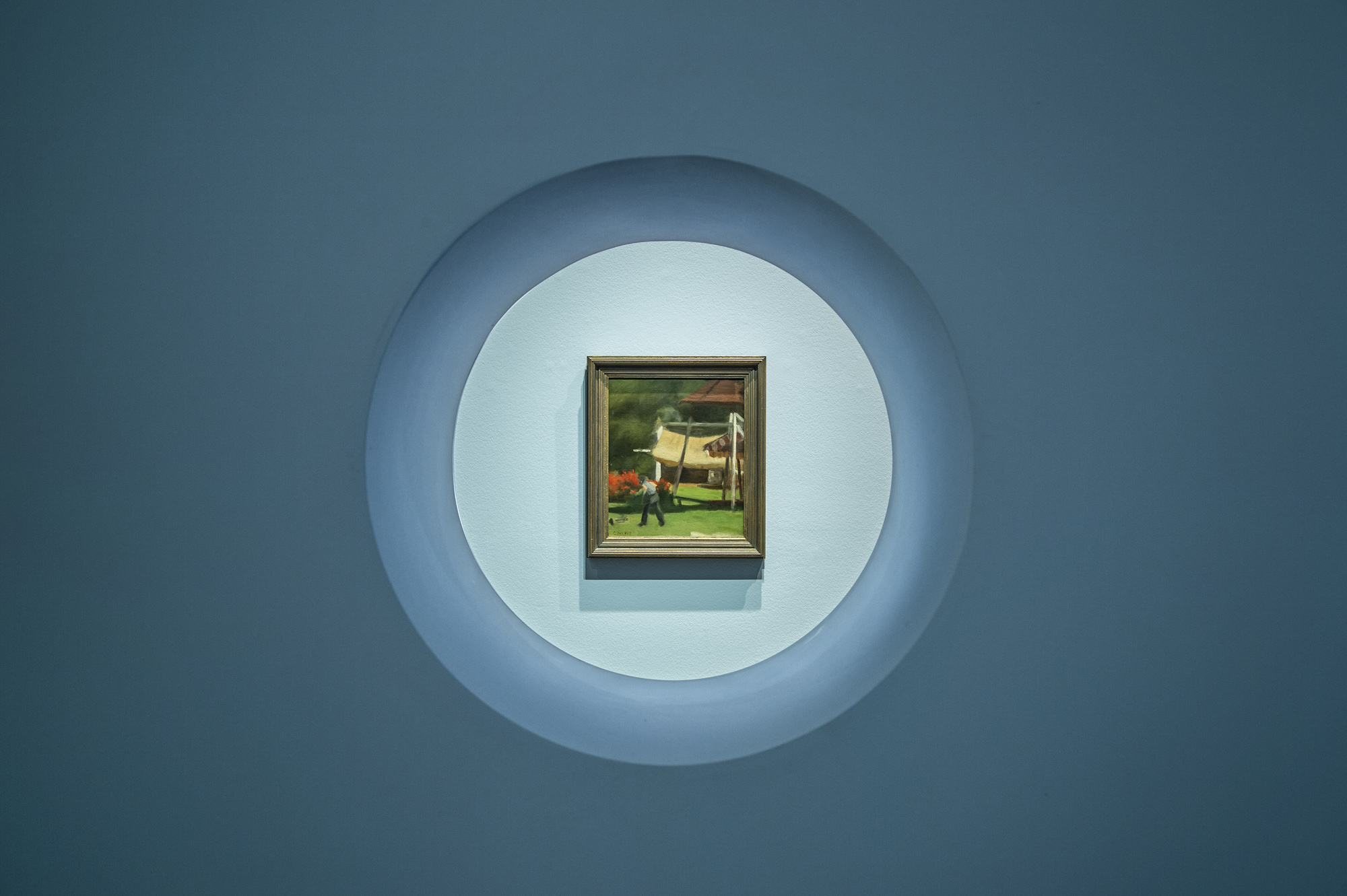
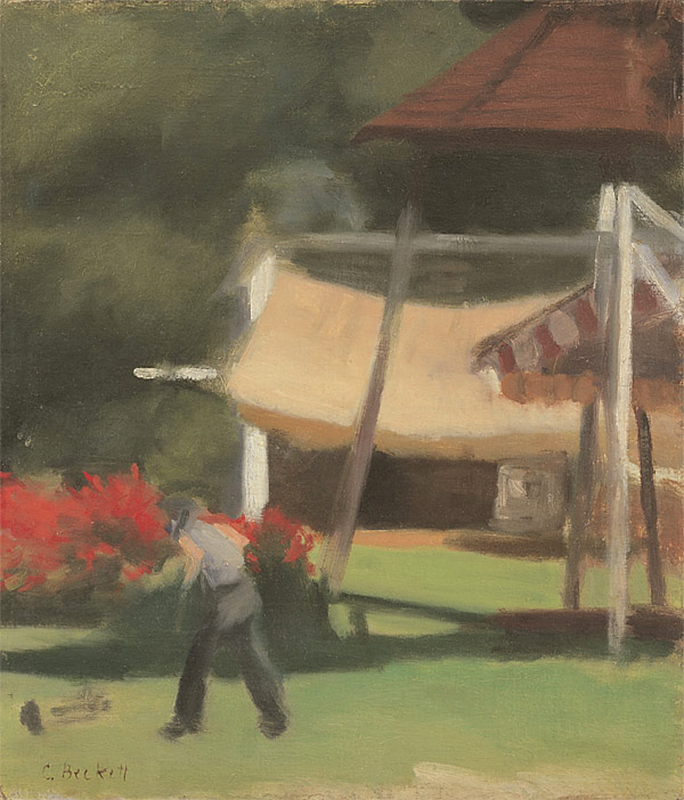
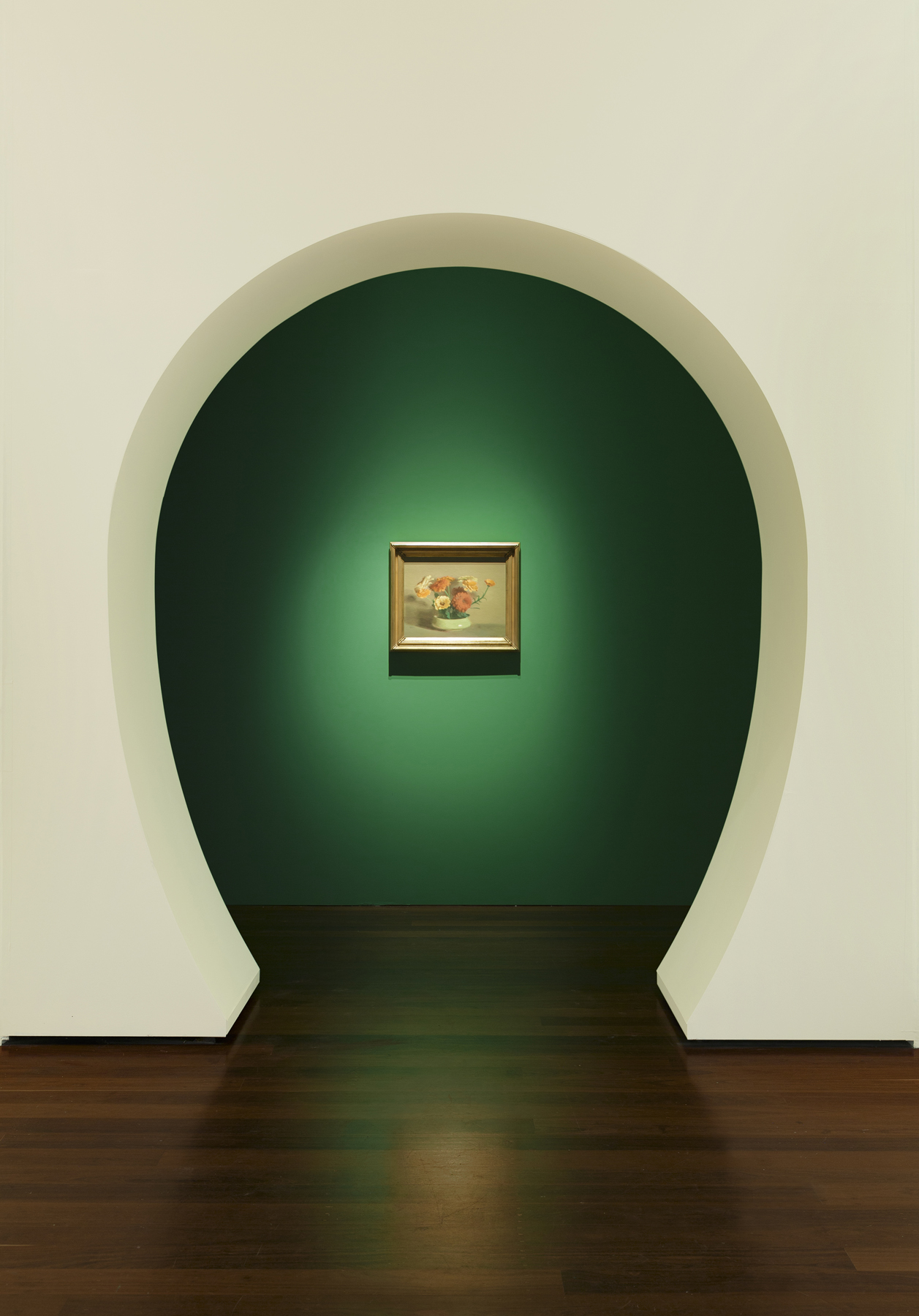
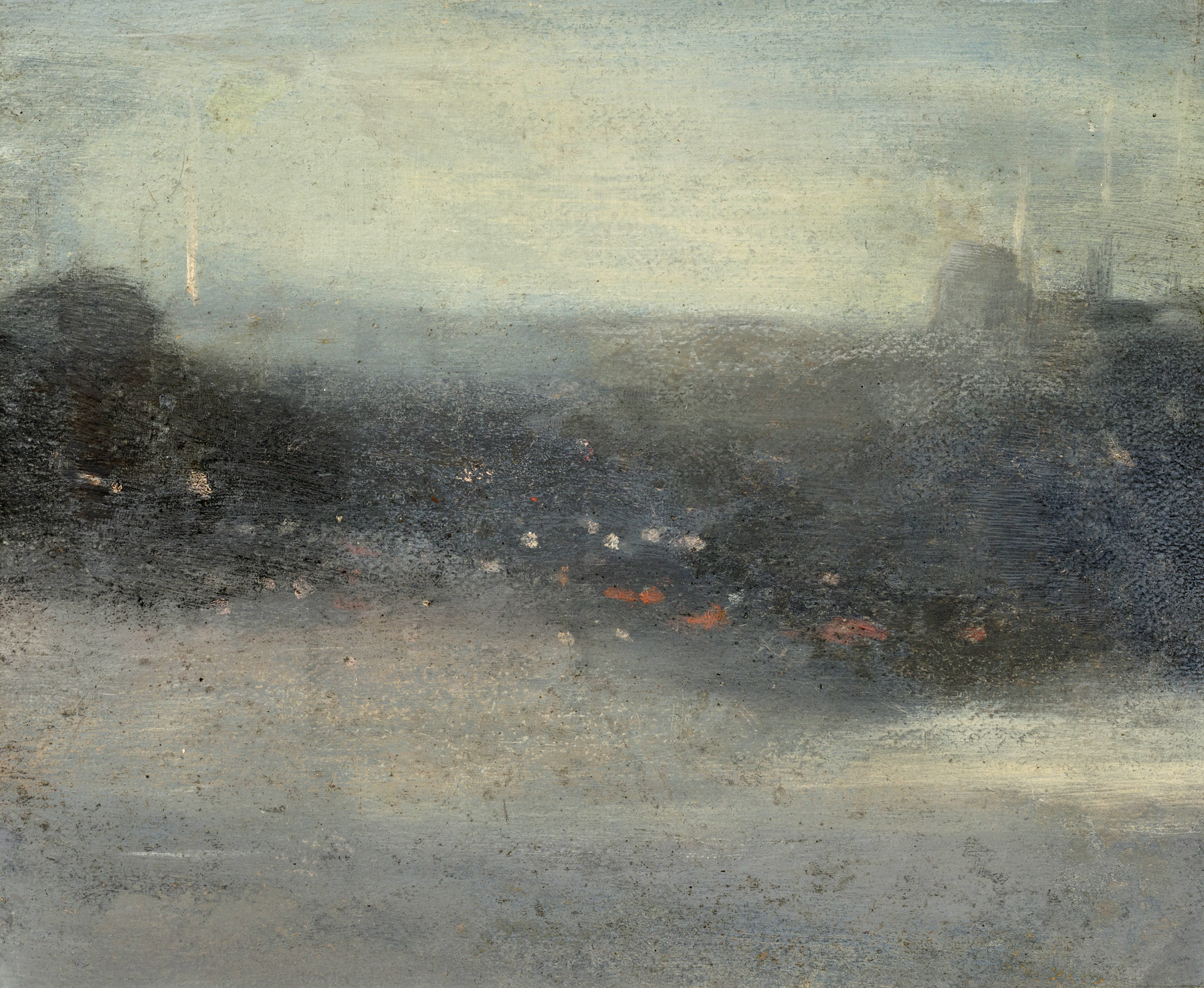
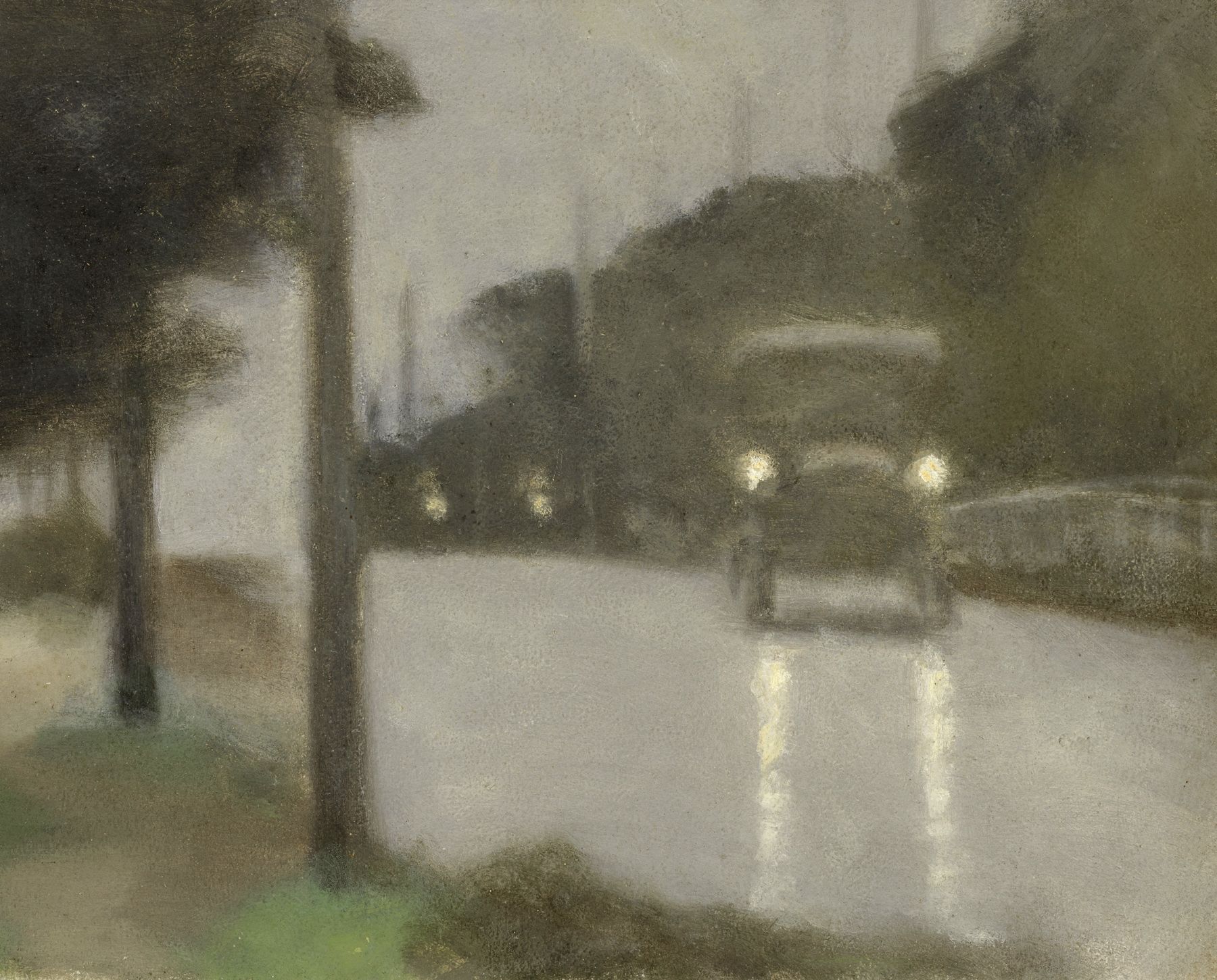
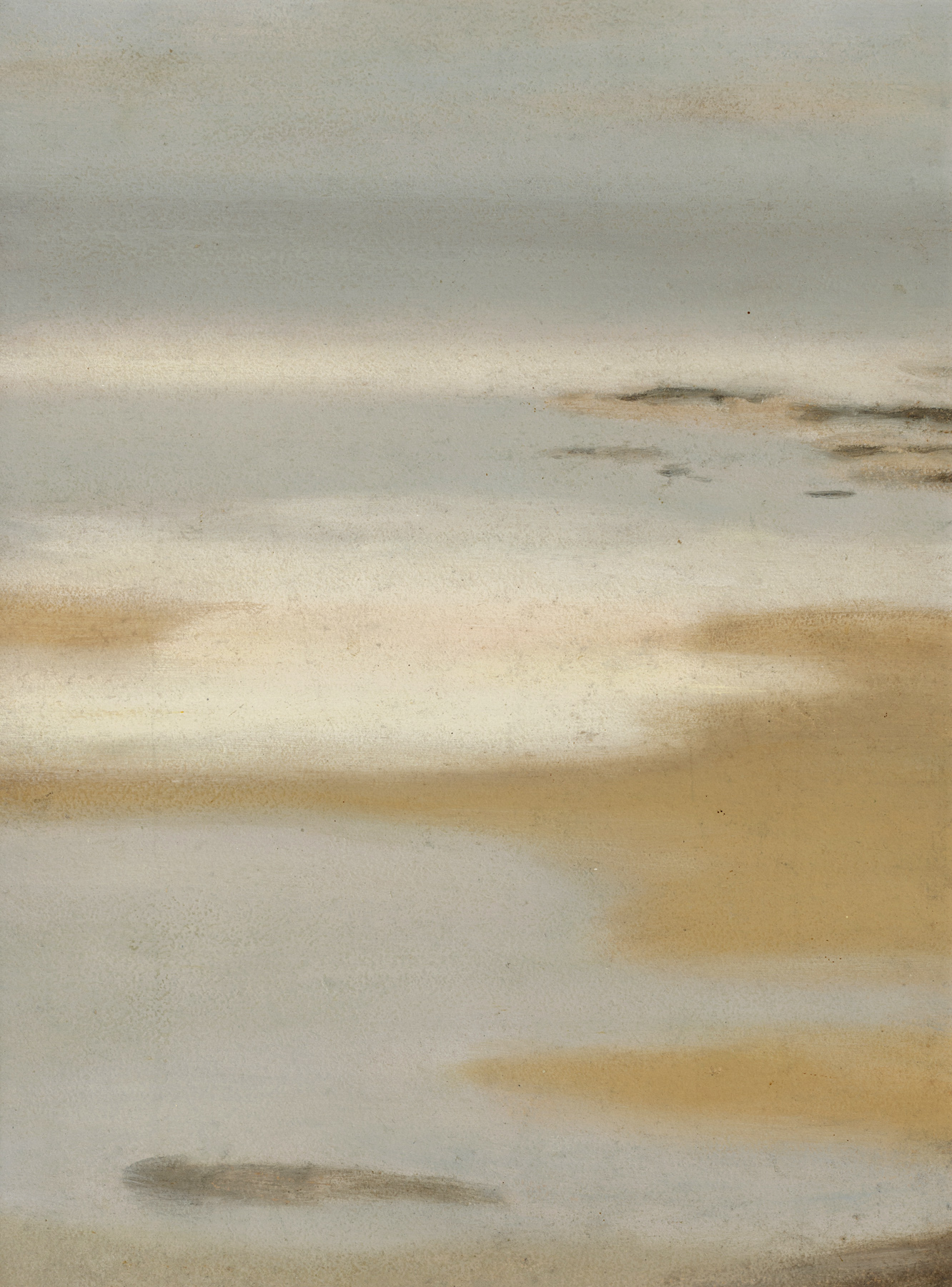
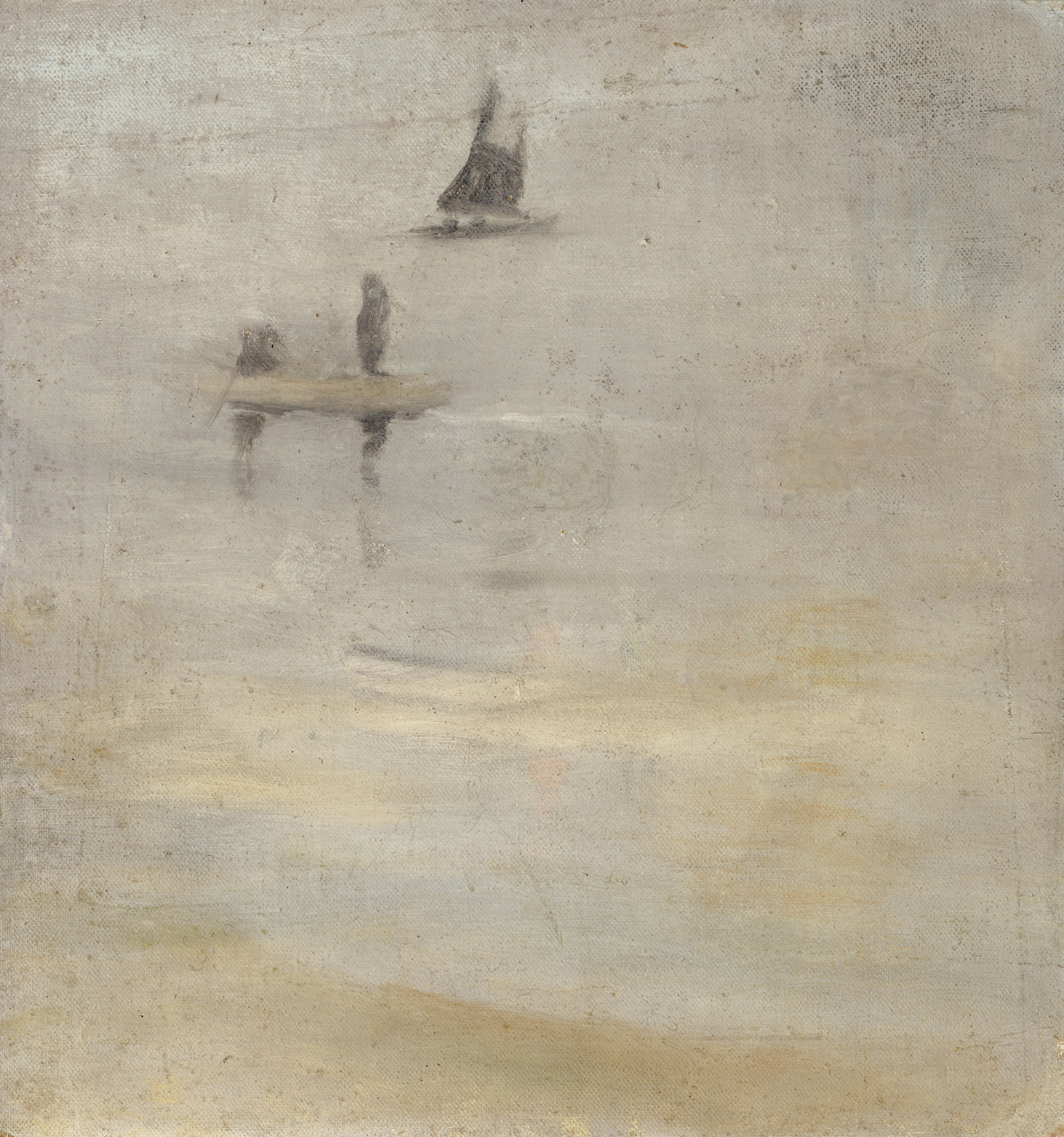
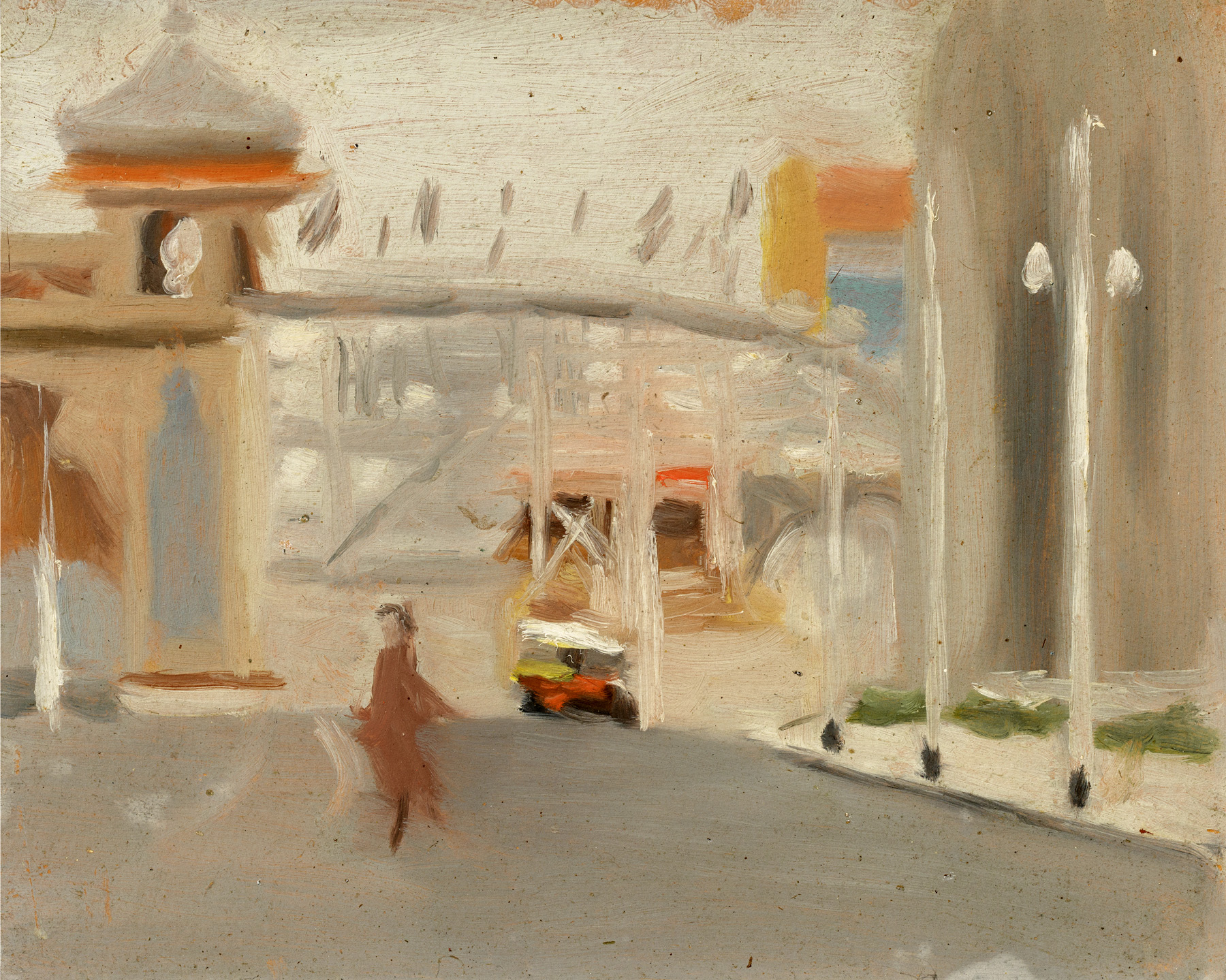
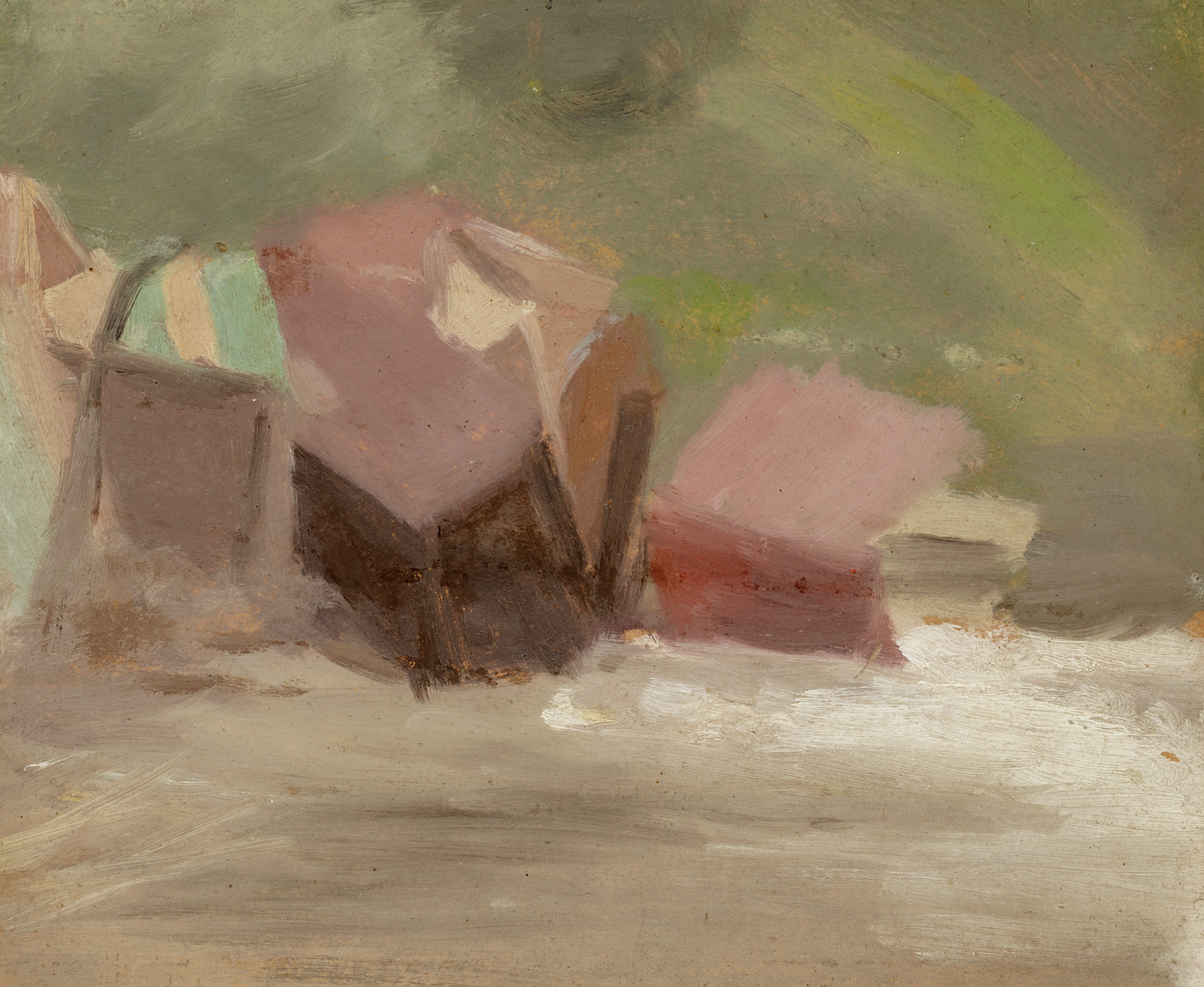
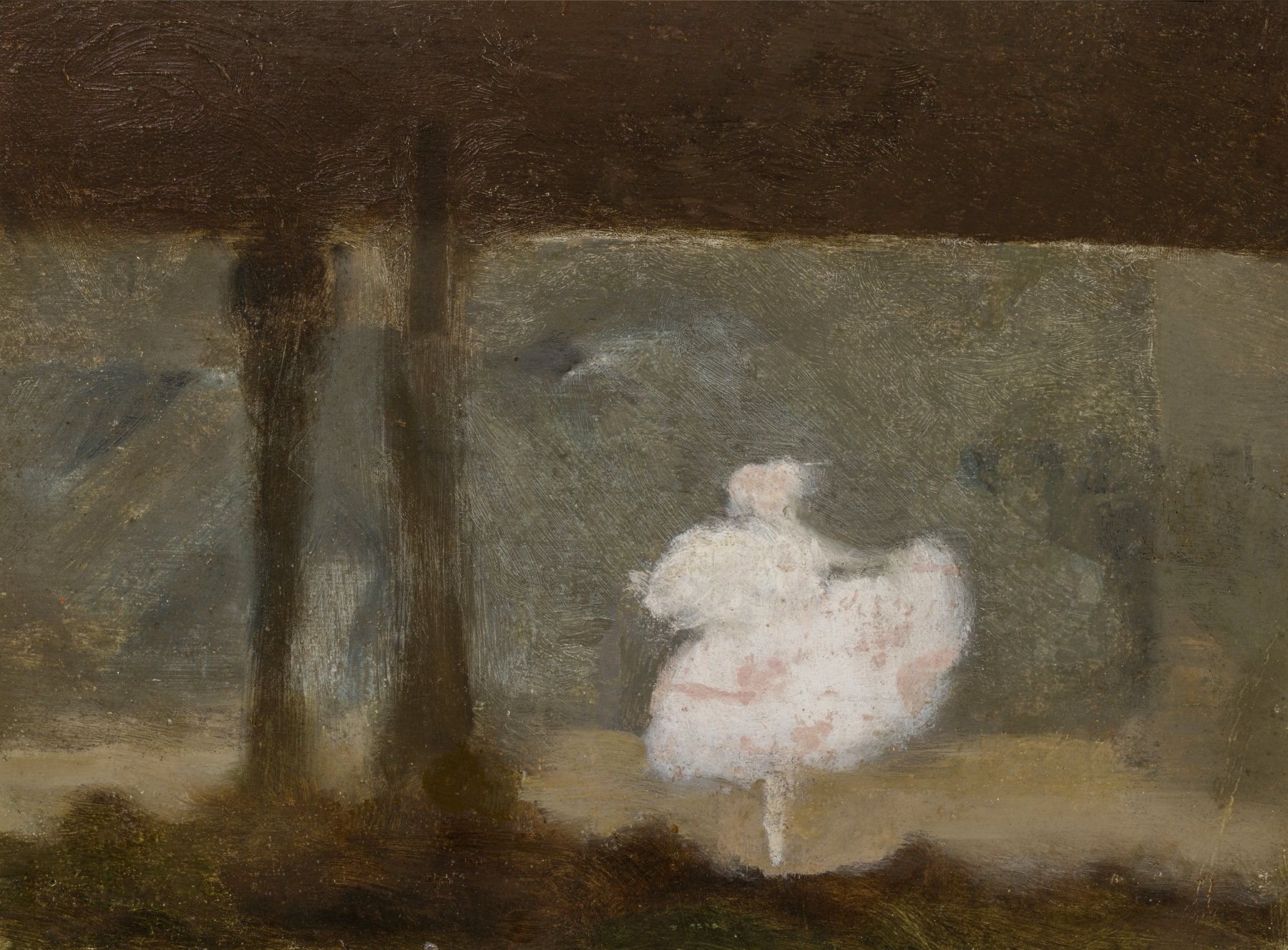
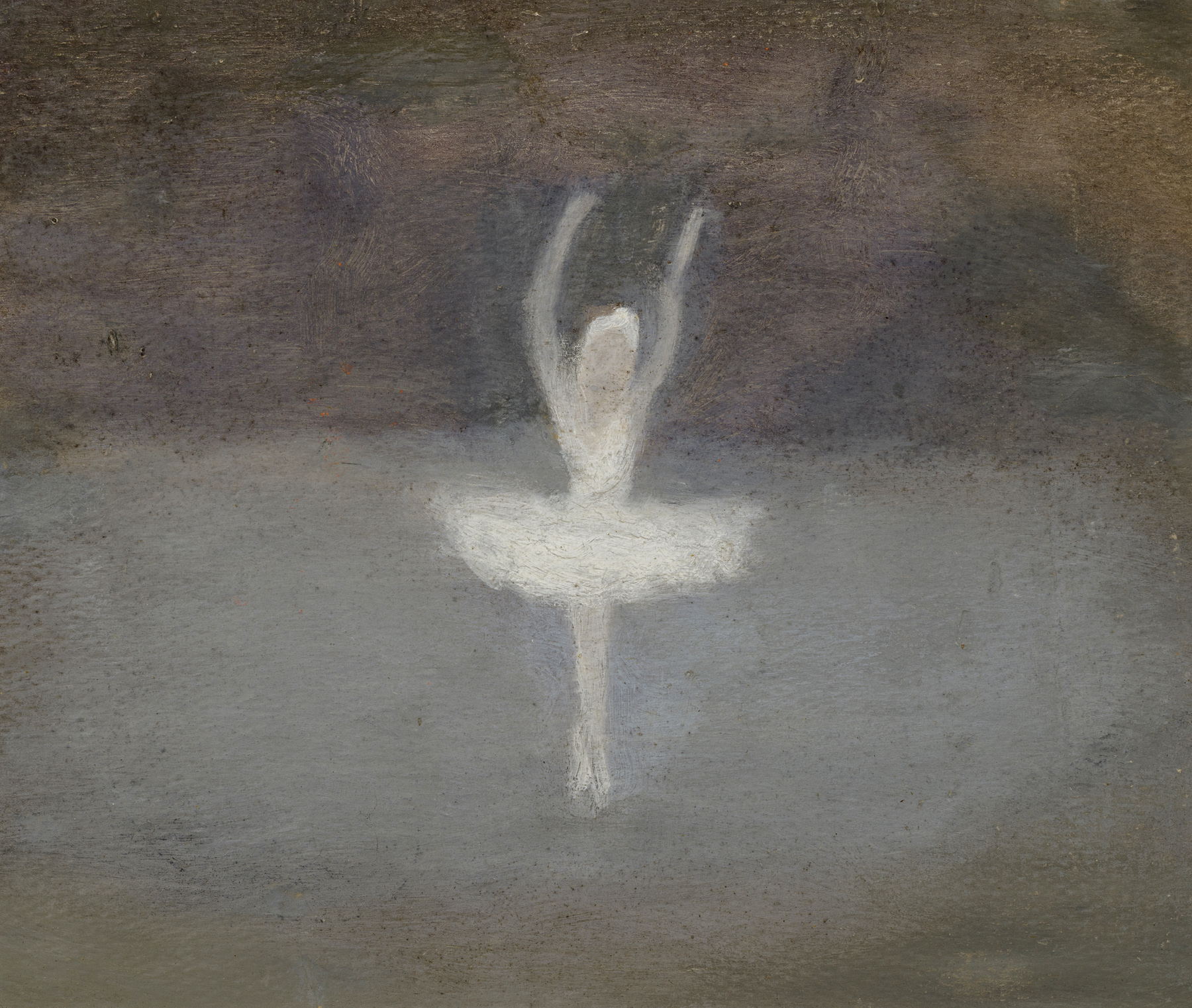
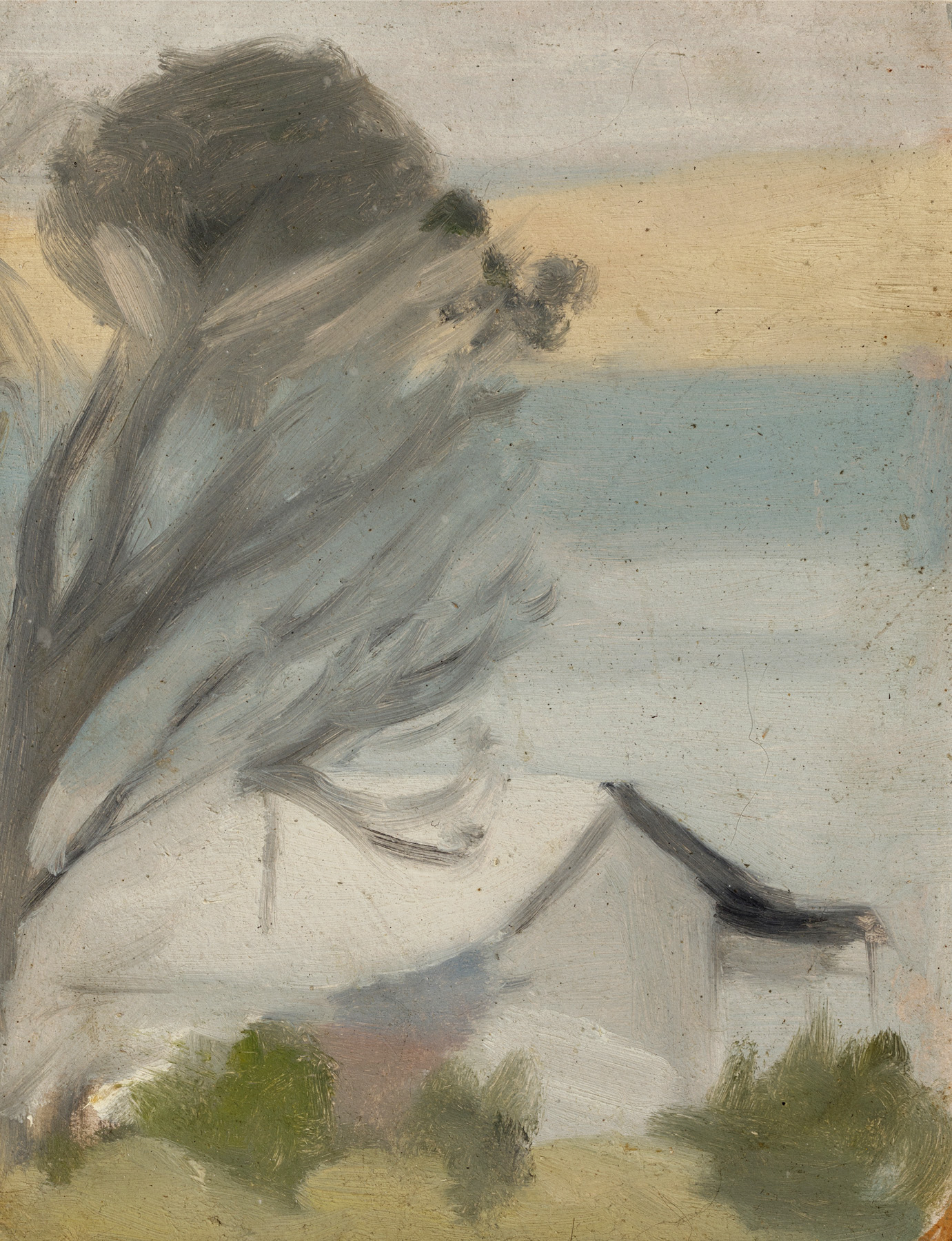
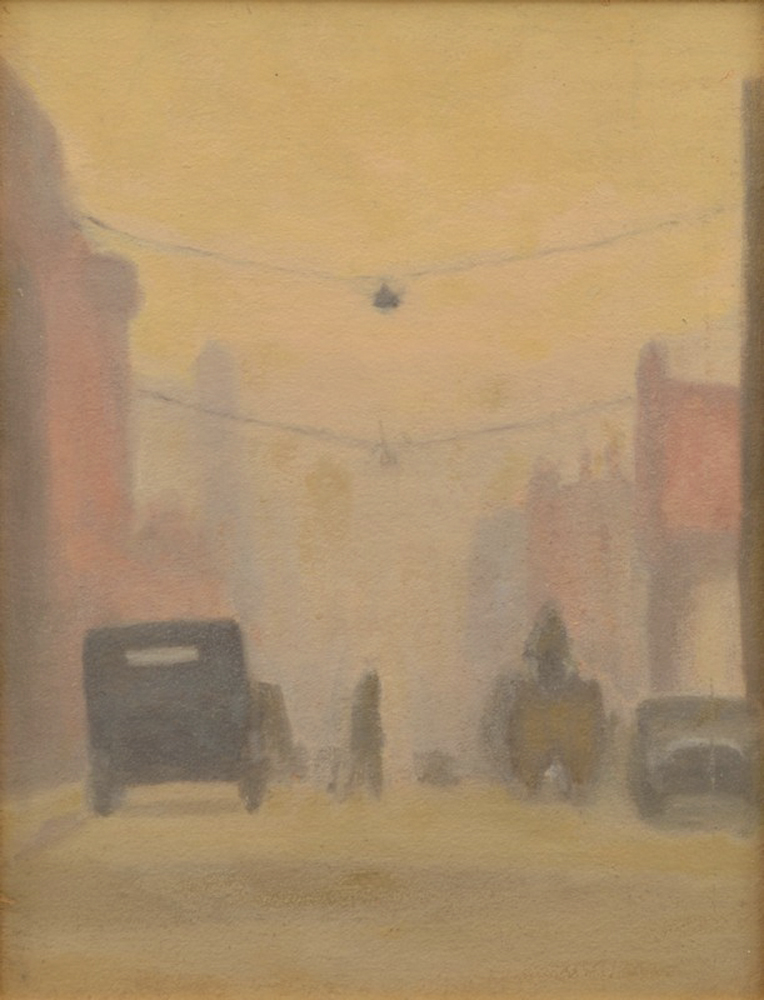
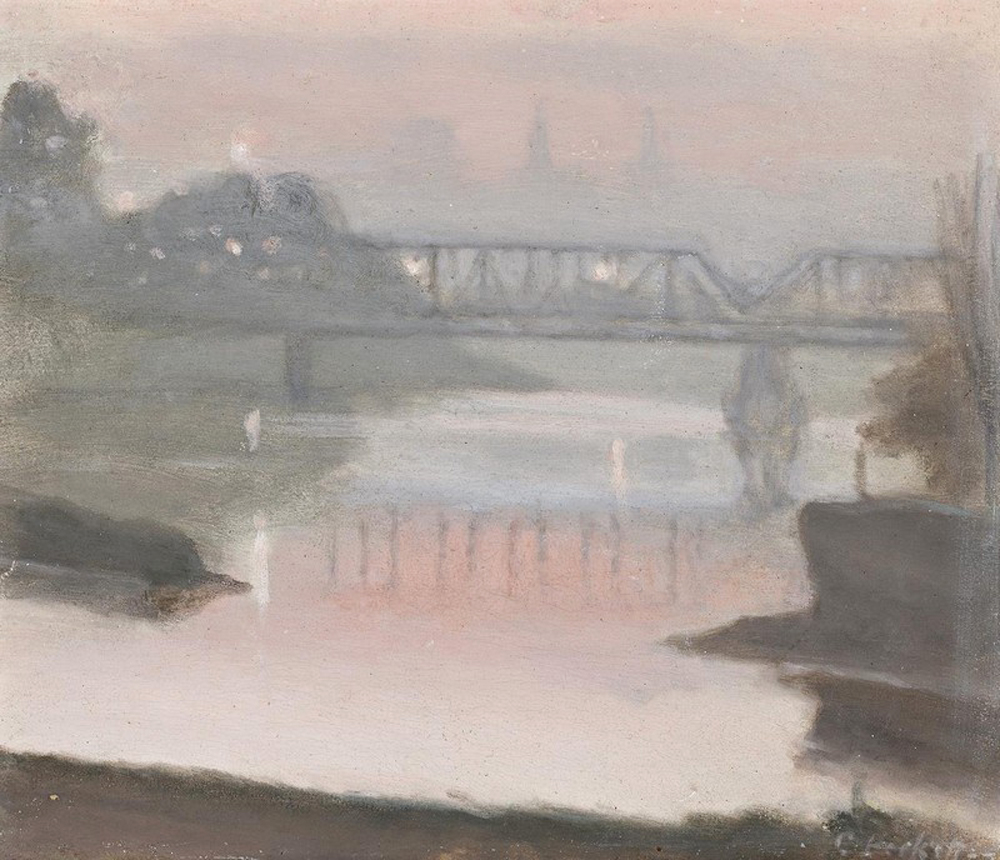
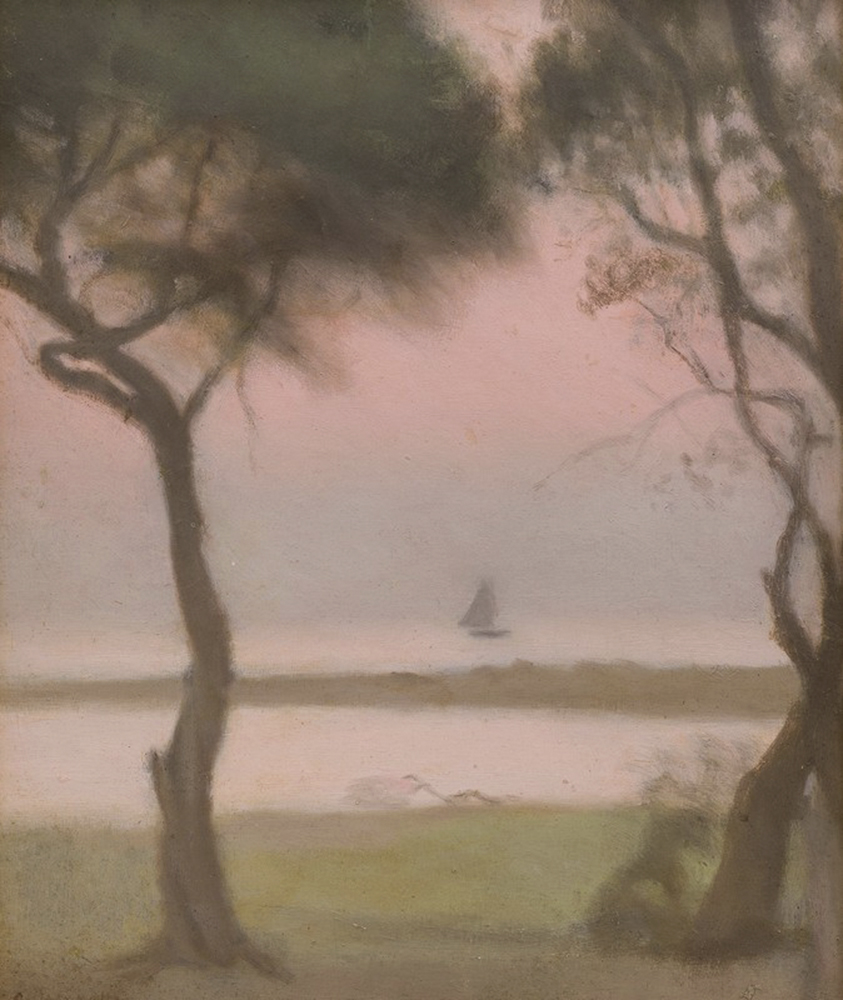
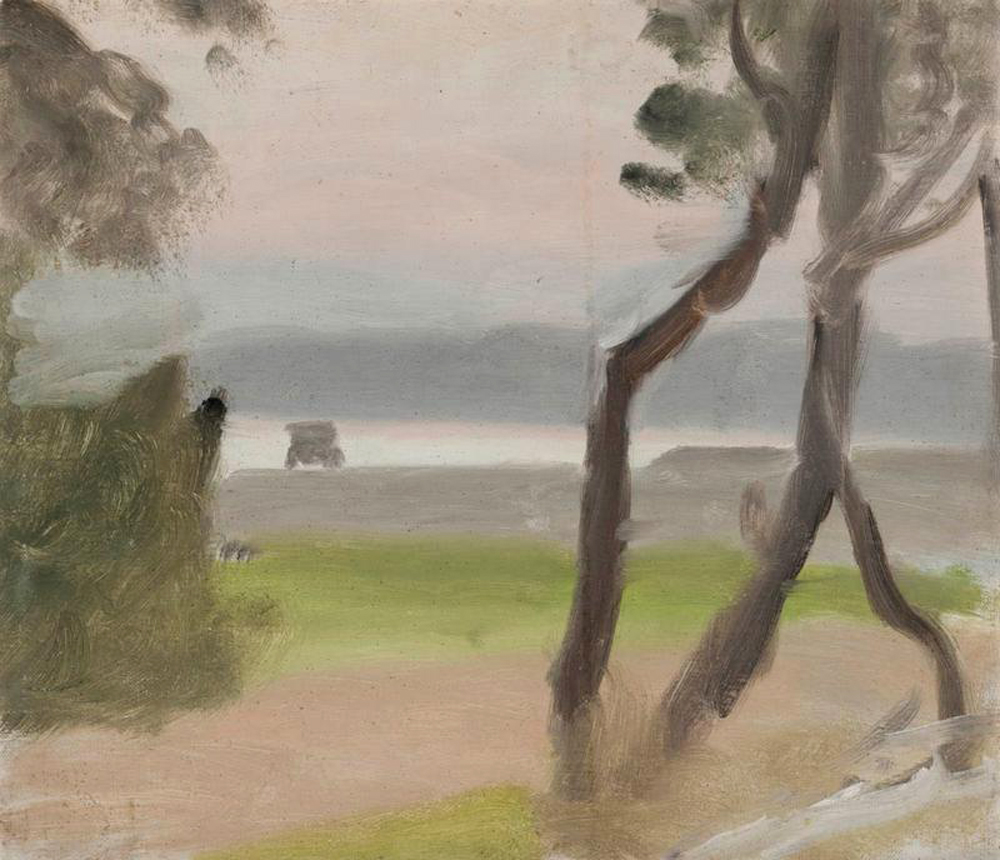
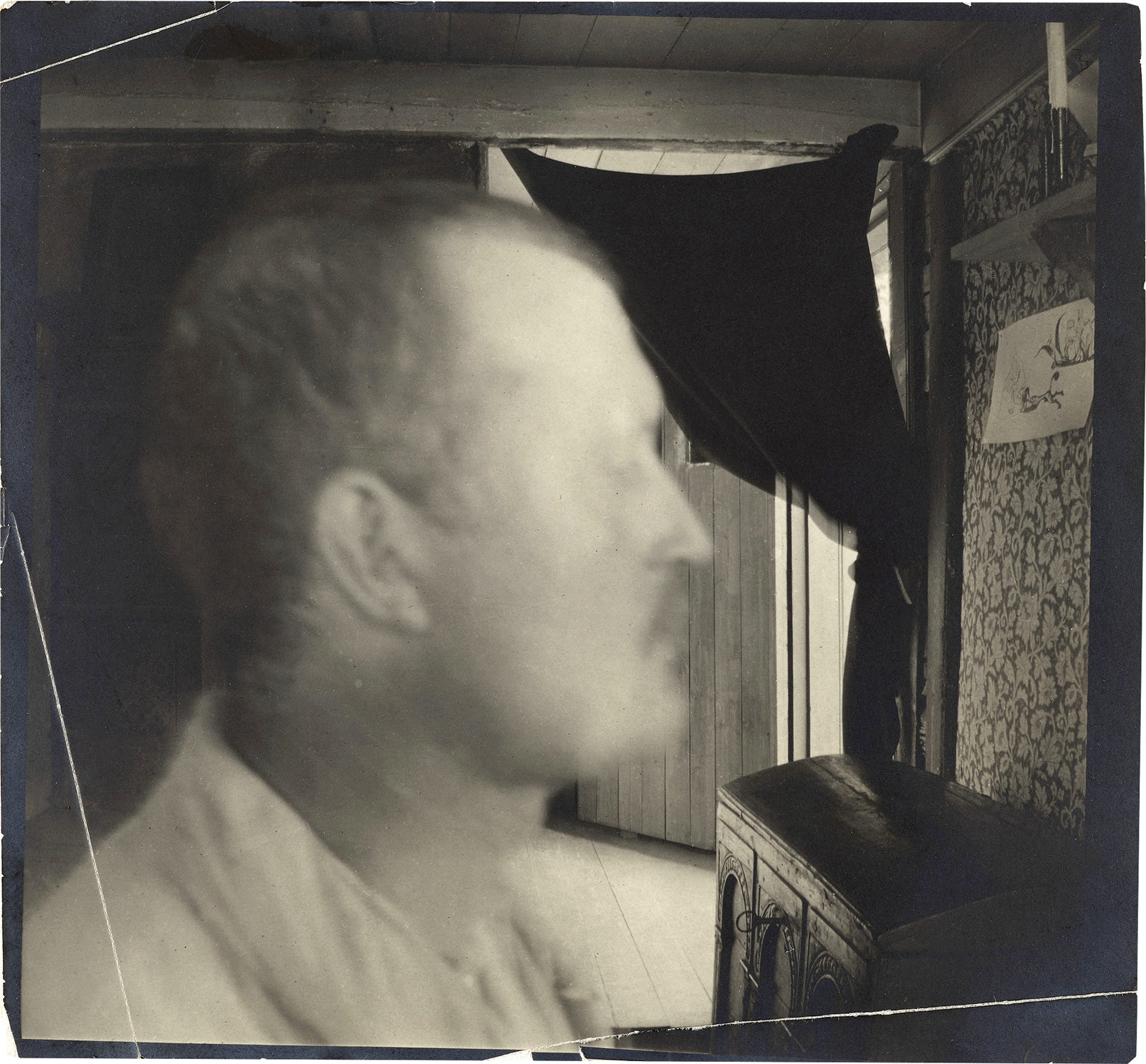
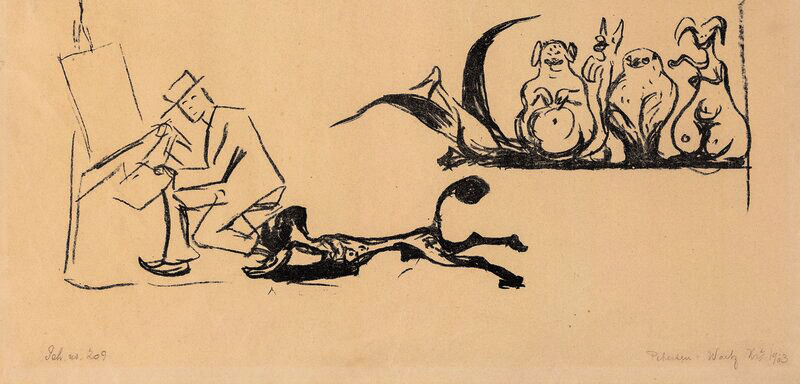
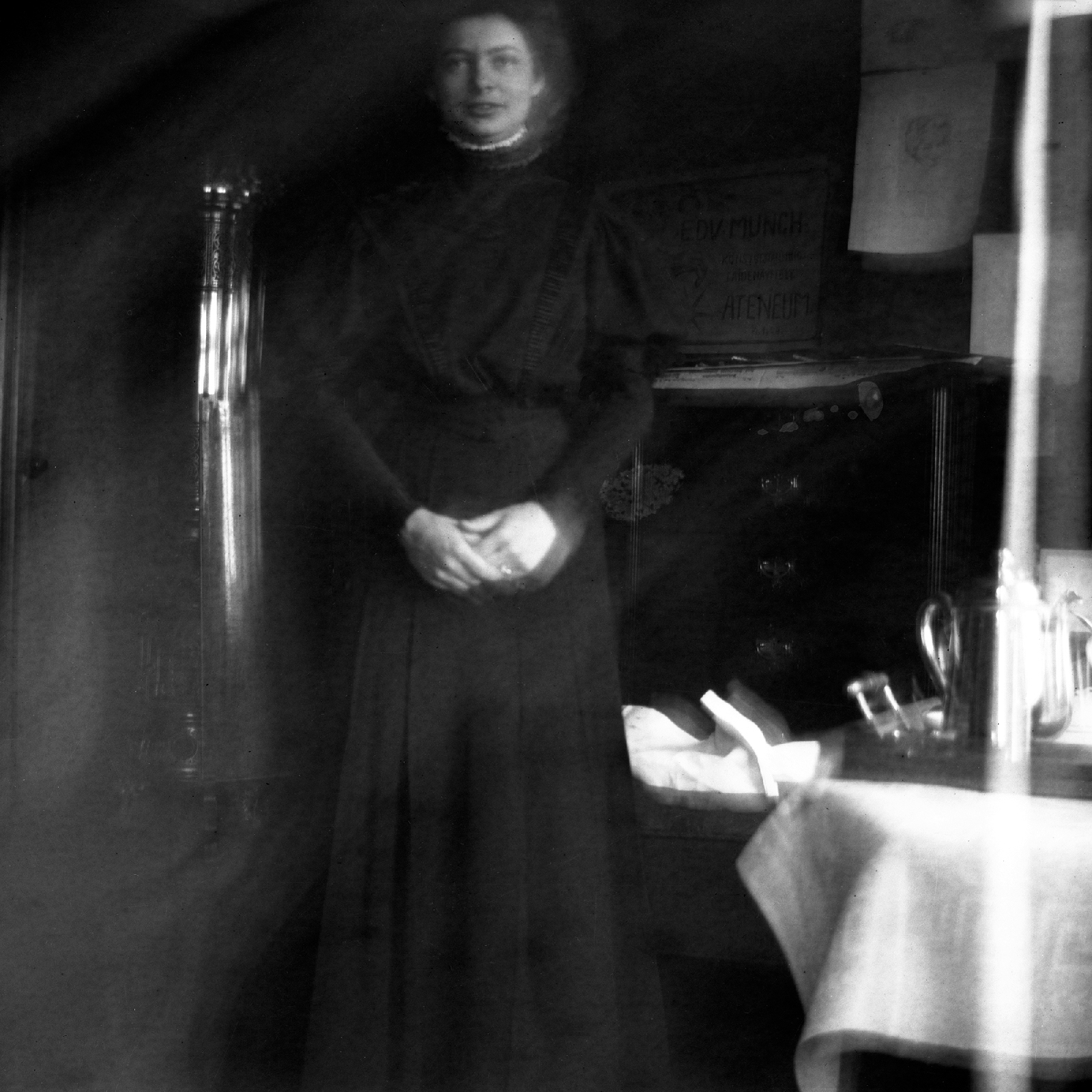
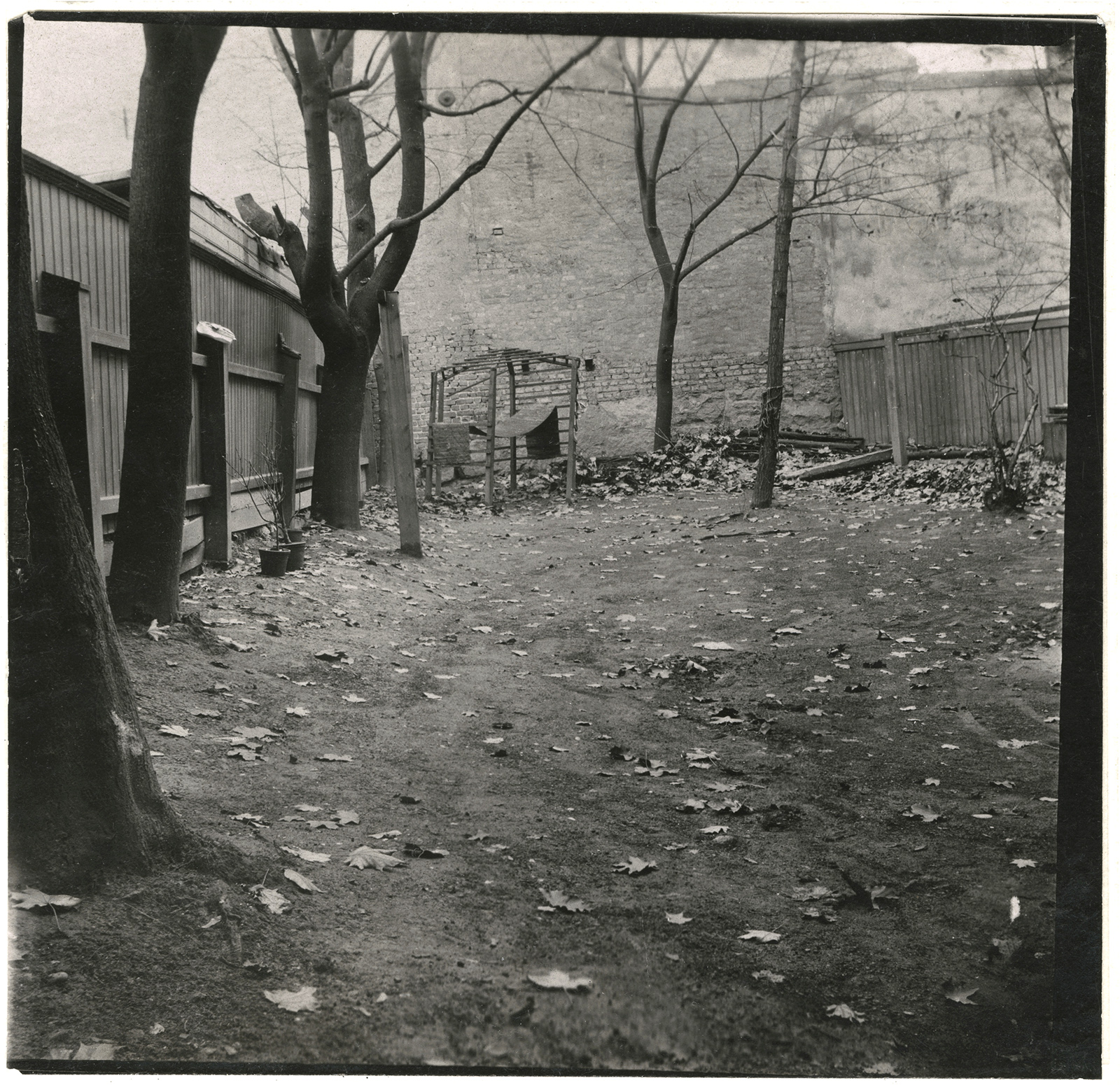
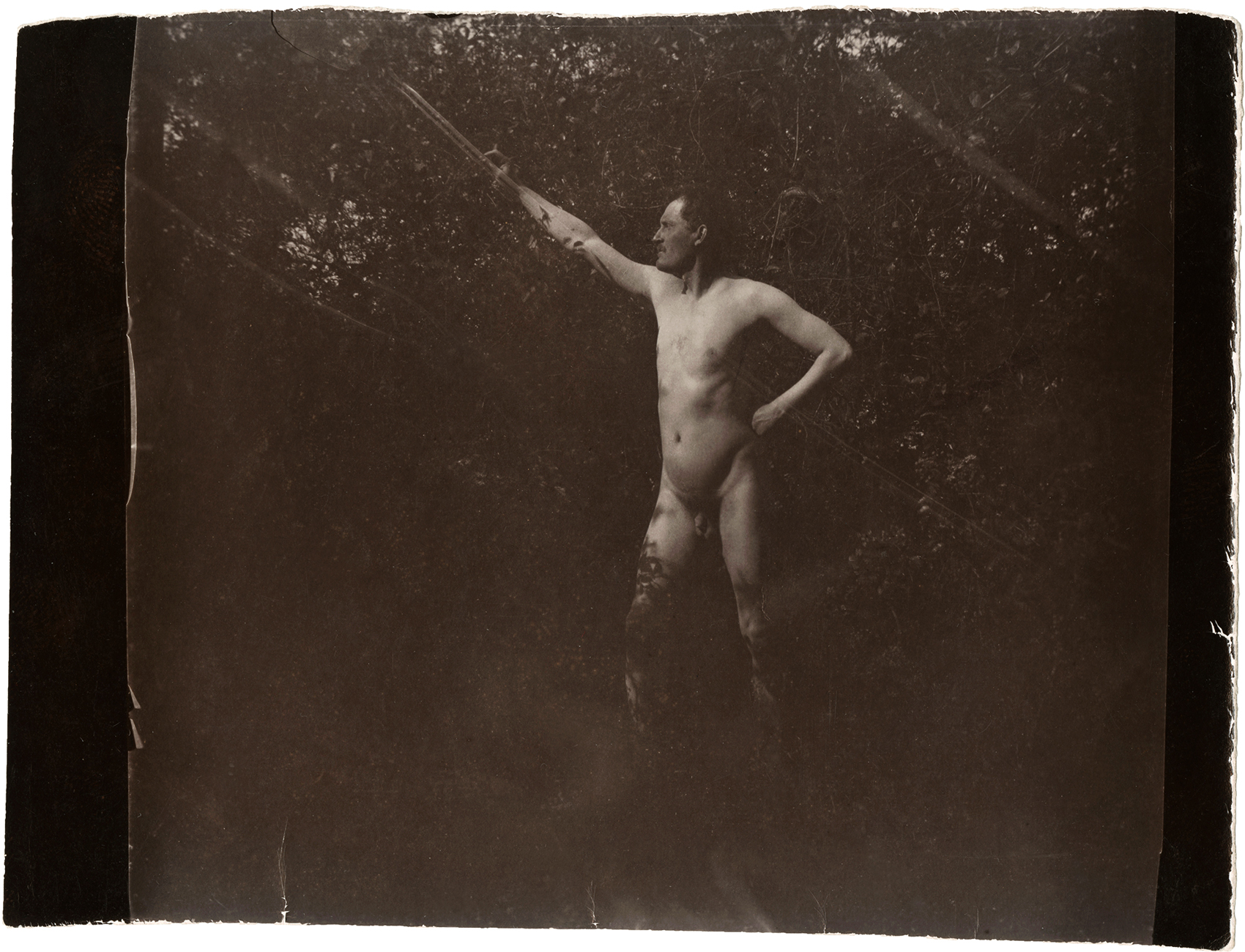
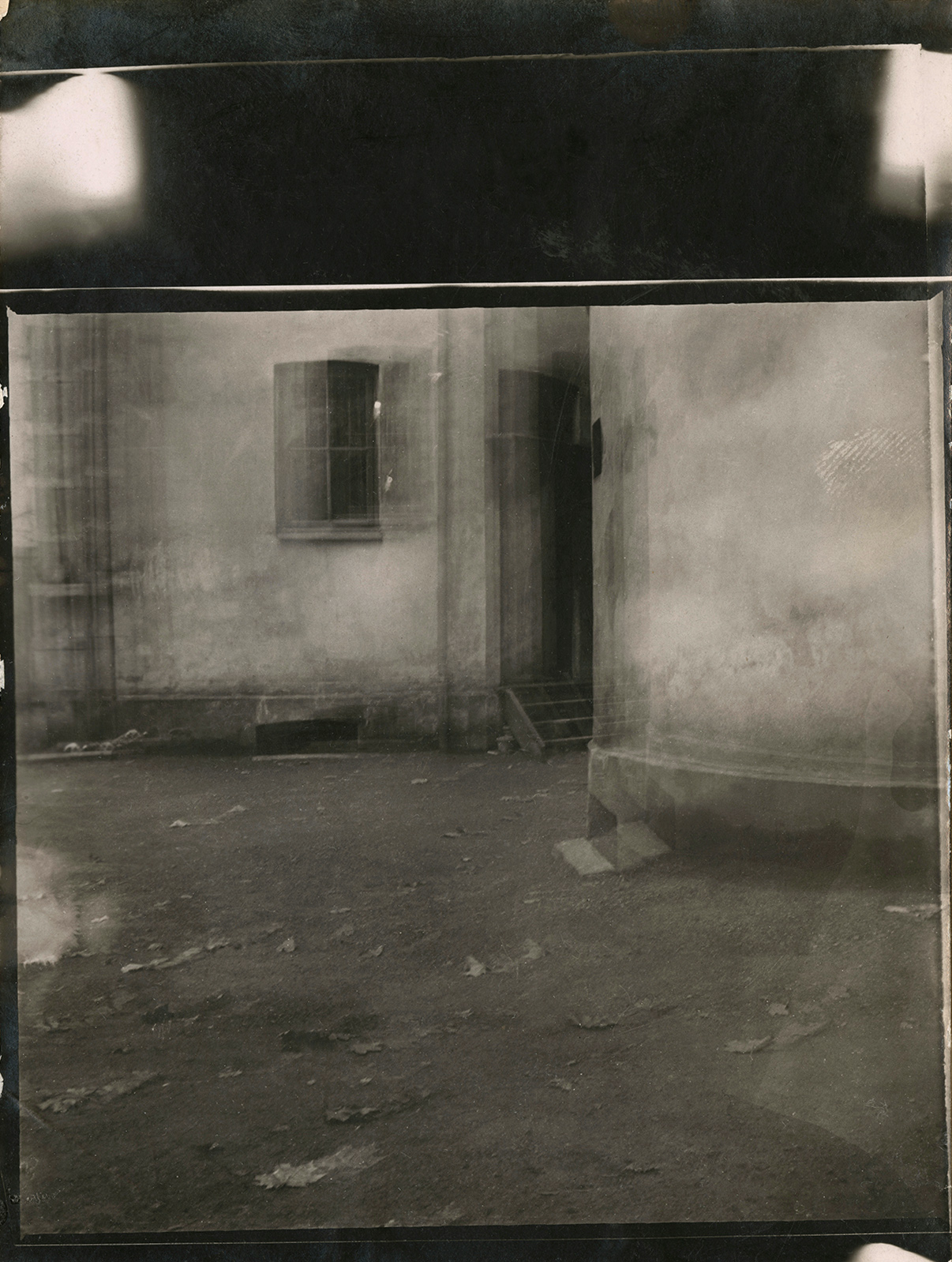
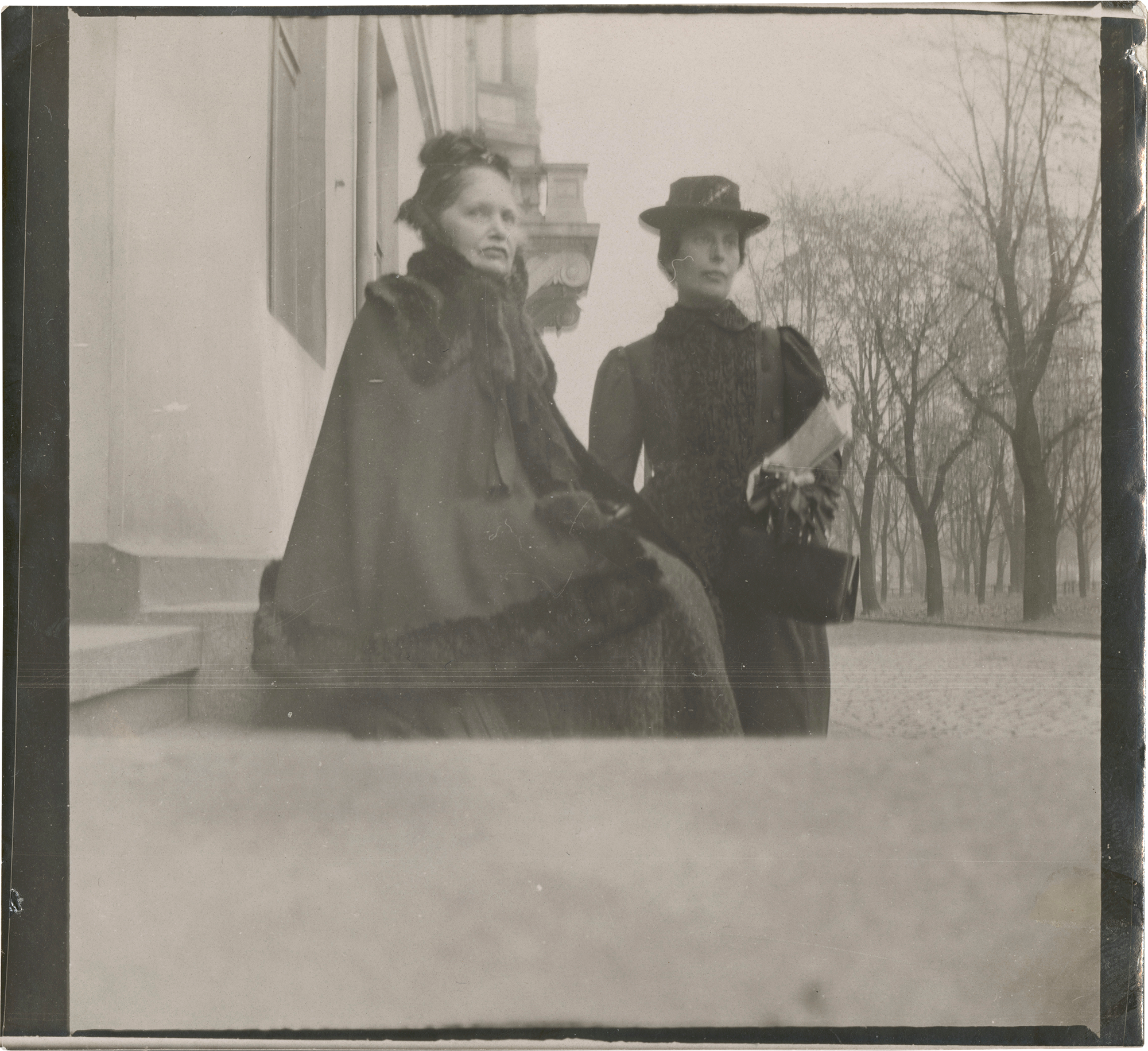
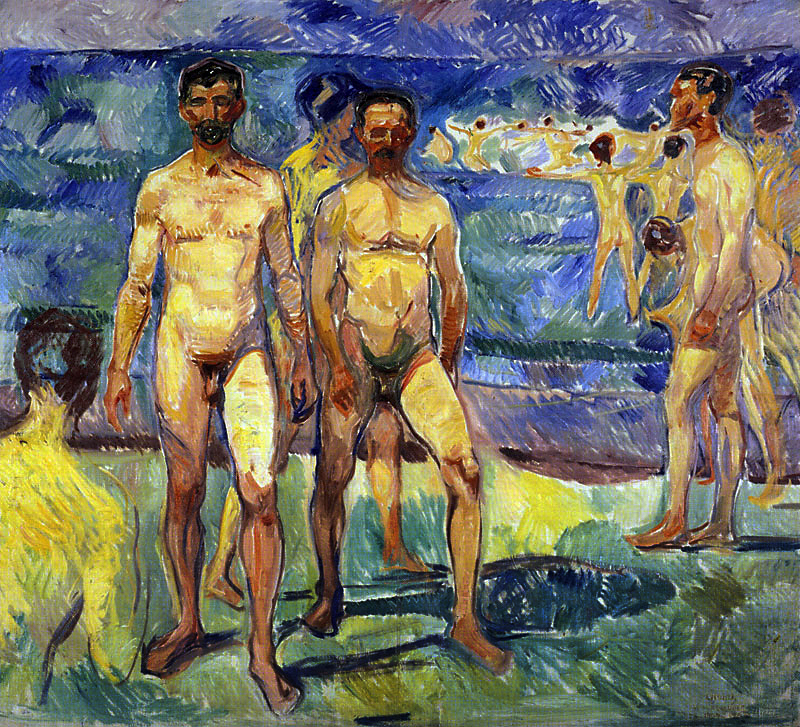
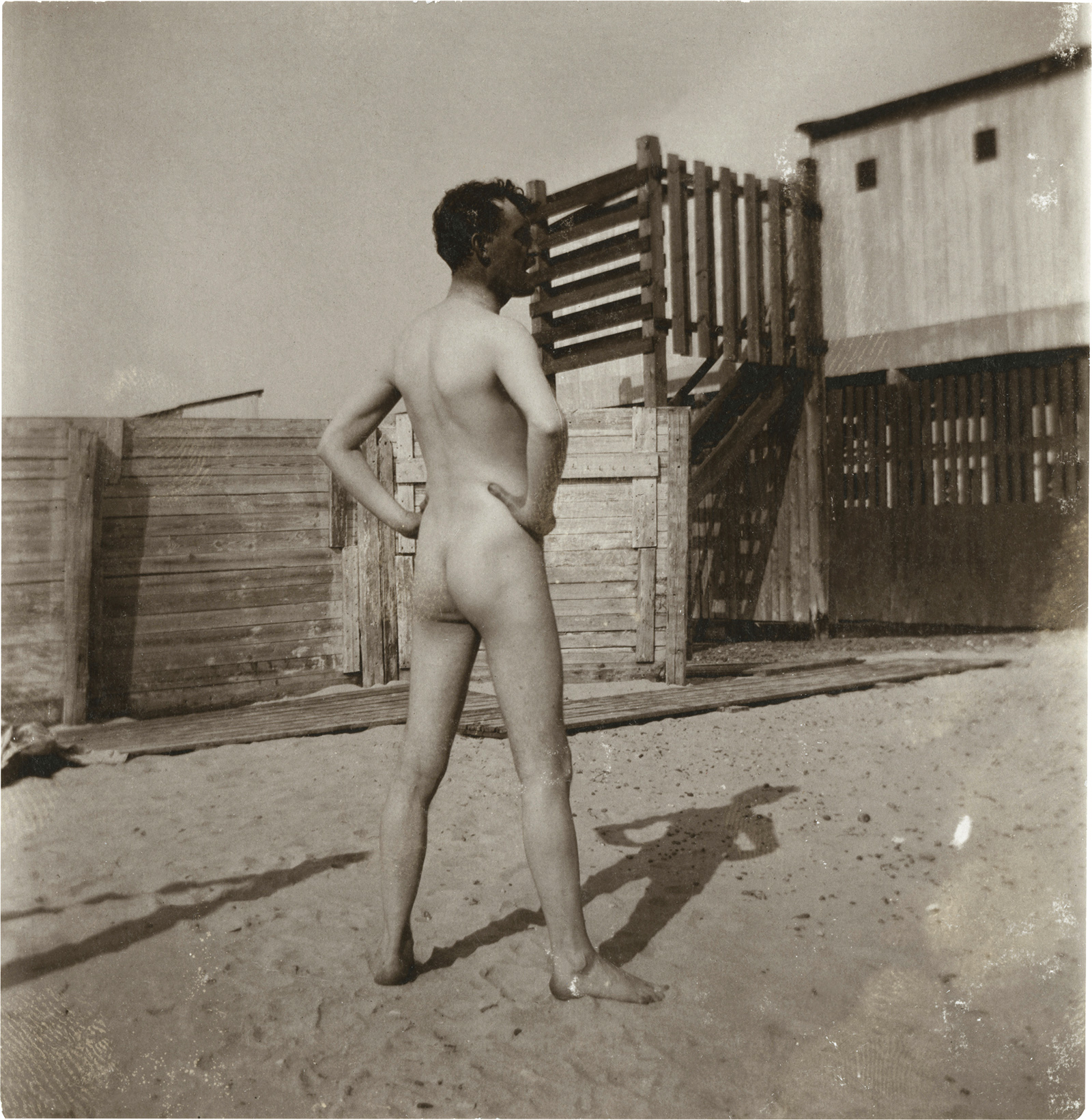
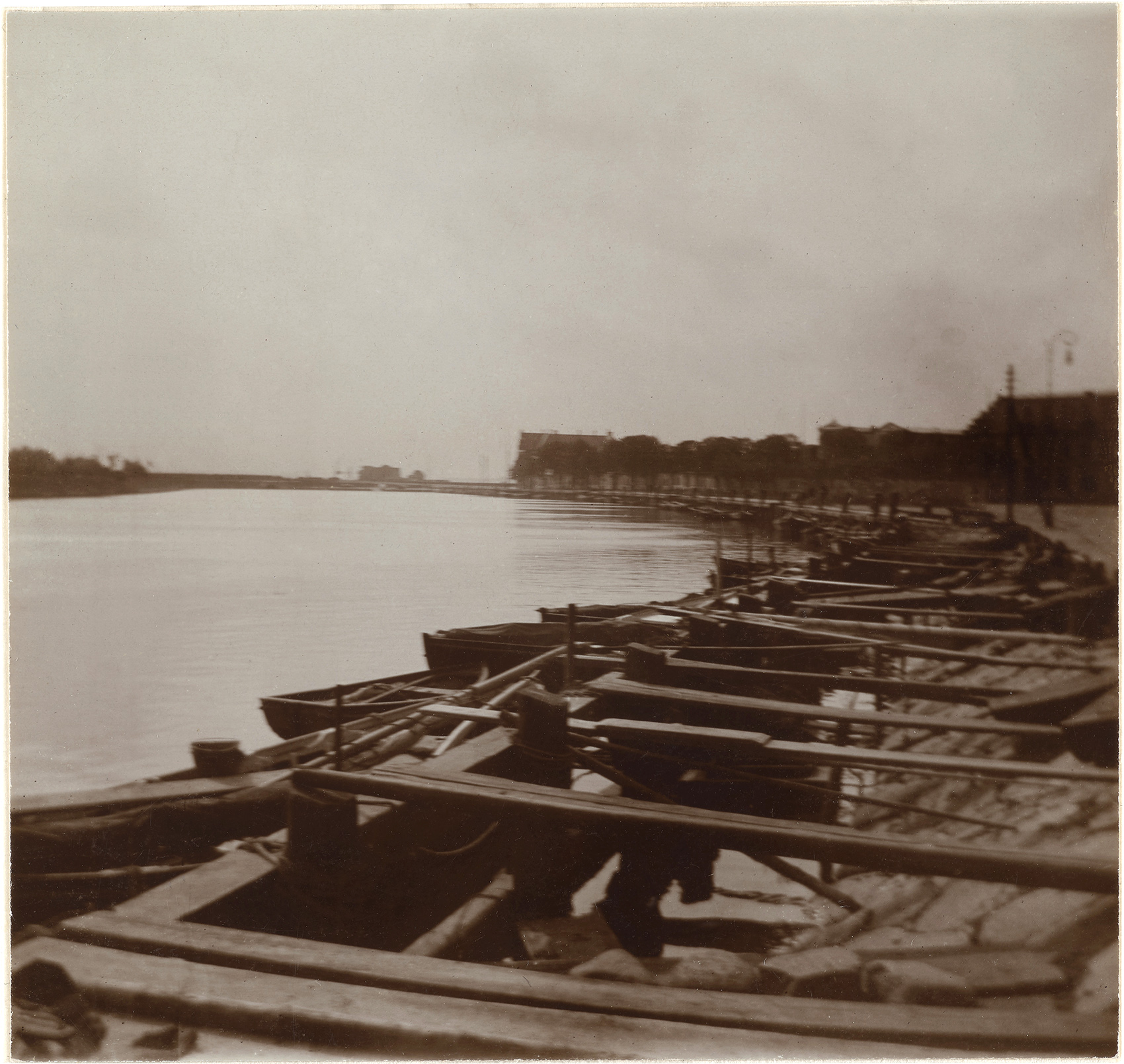
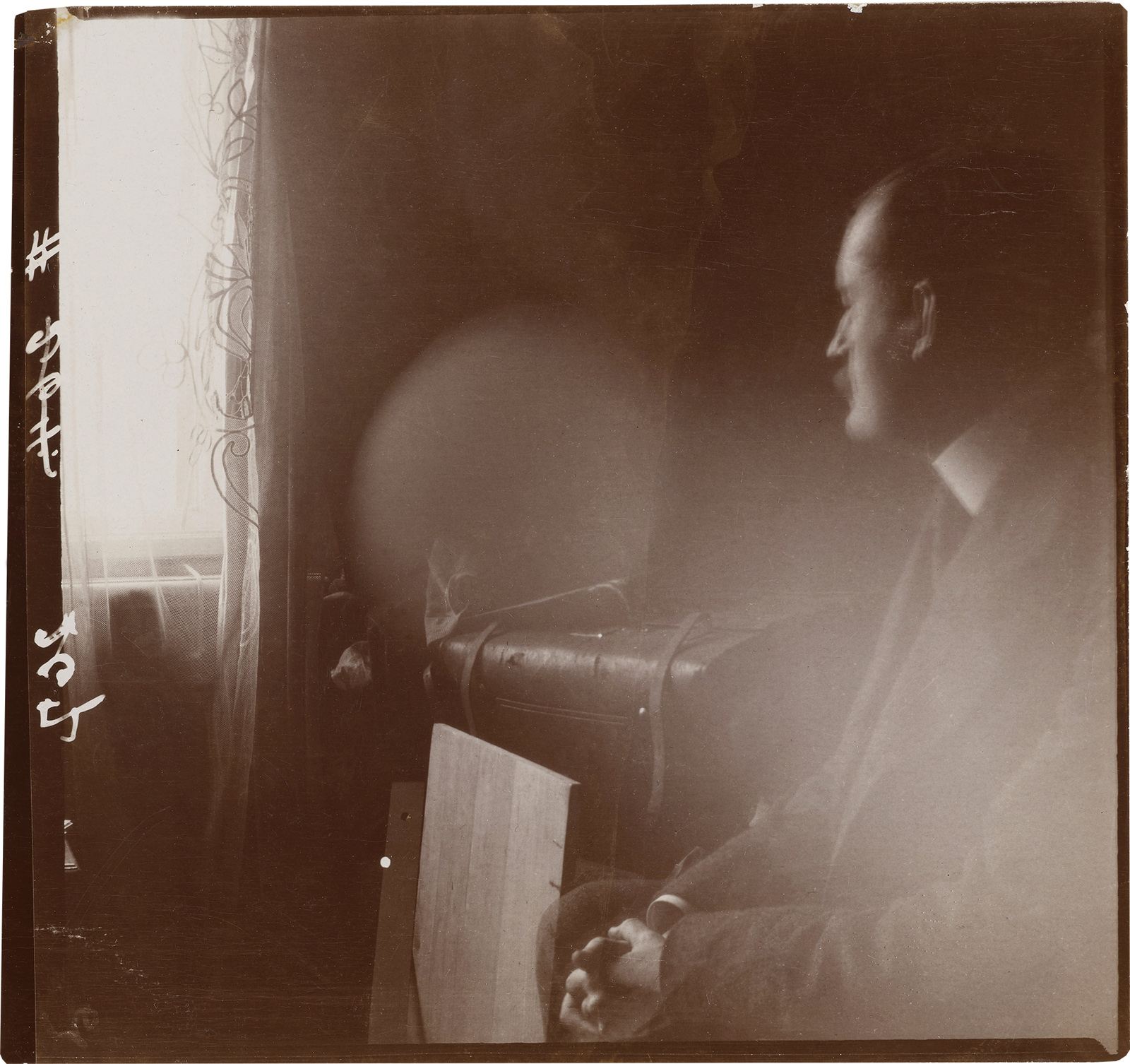
Exhibition: ‘In Lady Barclay’s Salon – Art and Photography around 1900’ at Moderna Museet, Stockholm

Exhibition dates: 19th June, 2021 – 9th January, 2022

Curator: Anna Tellgren

Artists represented in the exhibition: Anna Boberg, Helmer Bäckström, Julia Margaret Cameron, Uno Falkengren, Gustaf Fjæstad, Ferdinand Flodin, Henry B. Goodwin, John Hertzberg, Gösta Hübinette, Eugène Jansson, Nicola Perscheid and Ture Sellman.


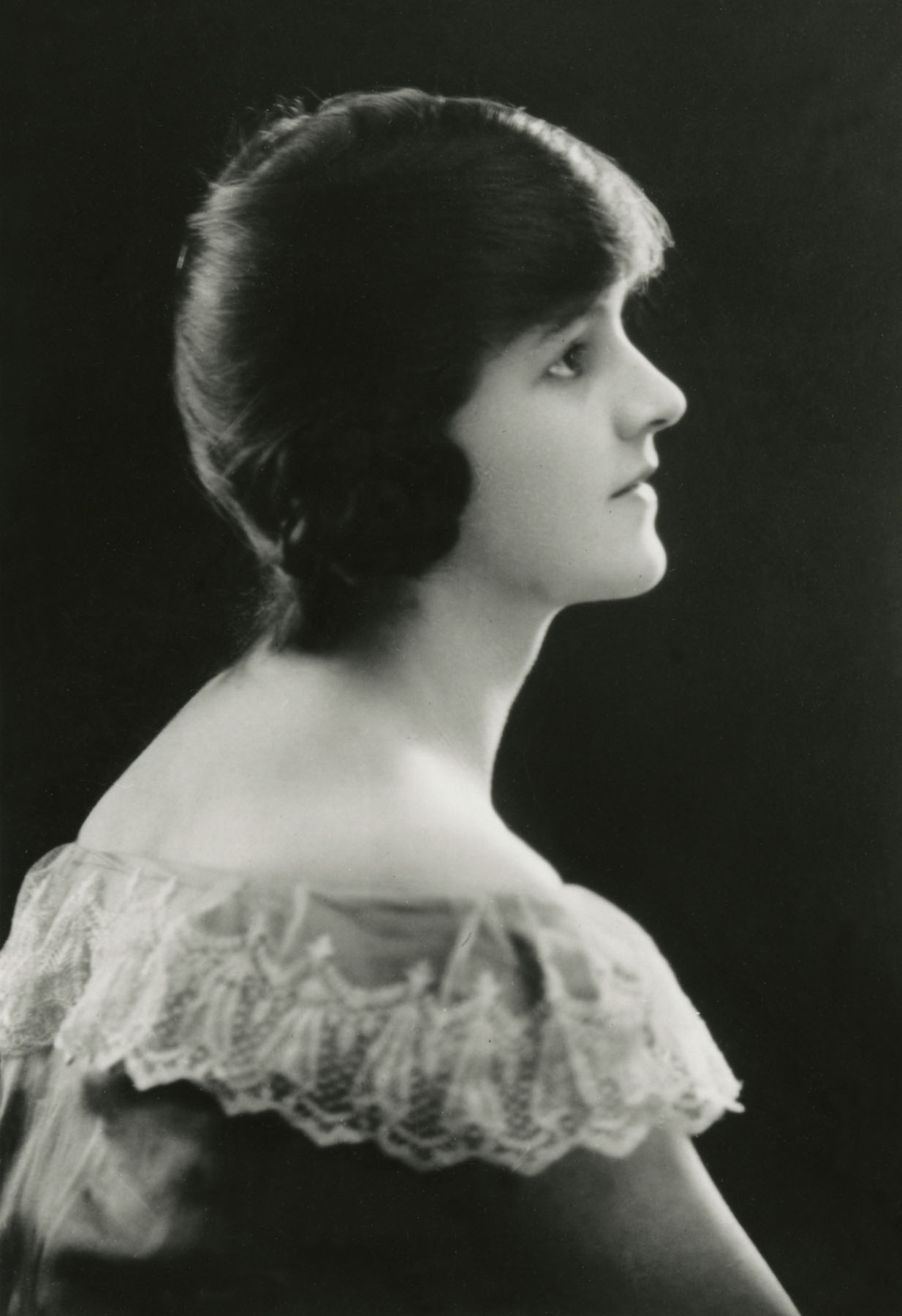
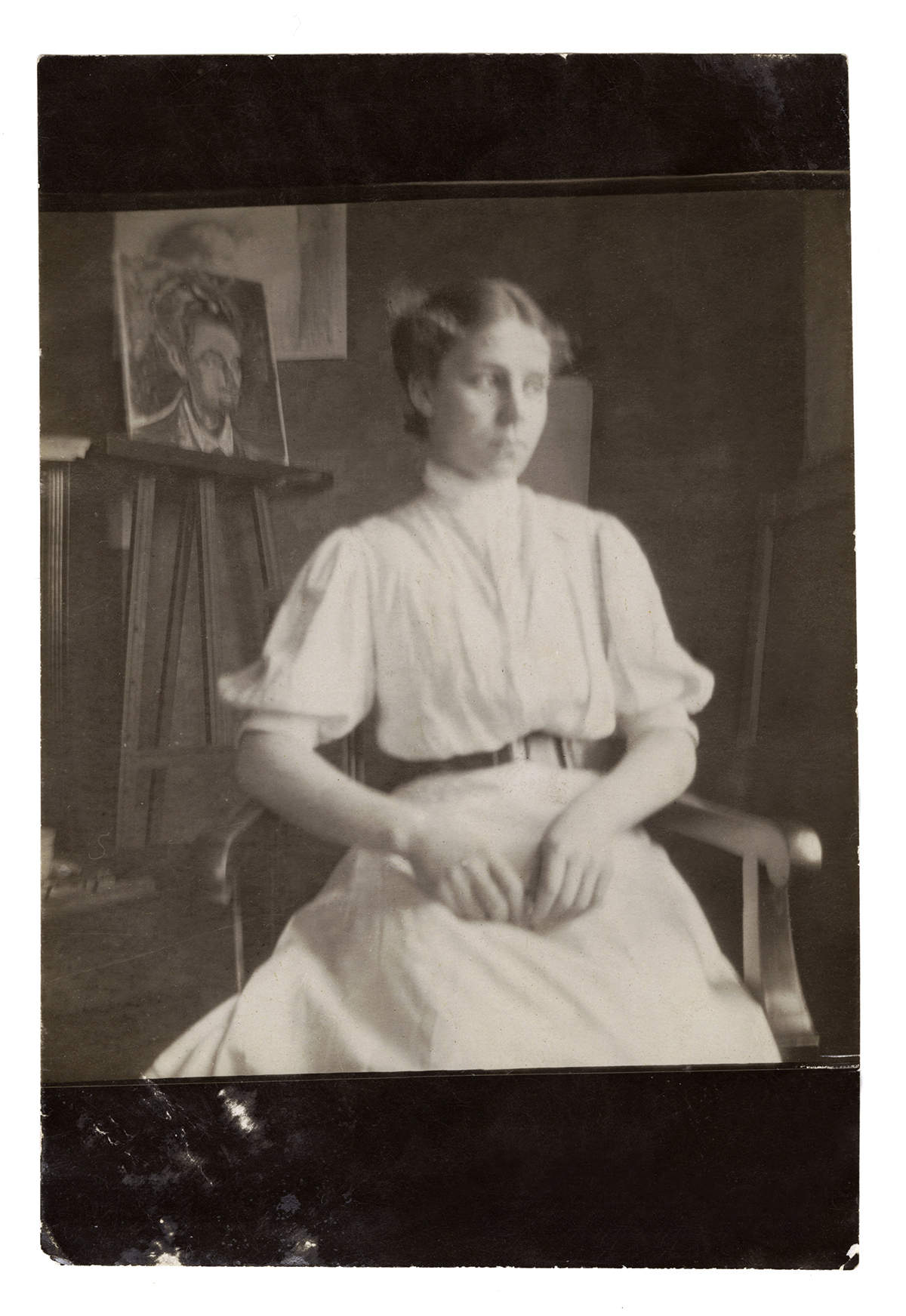
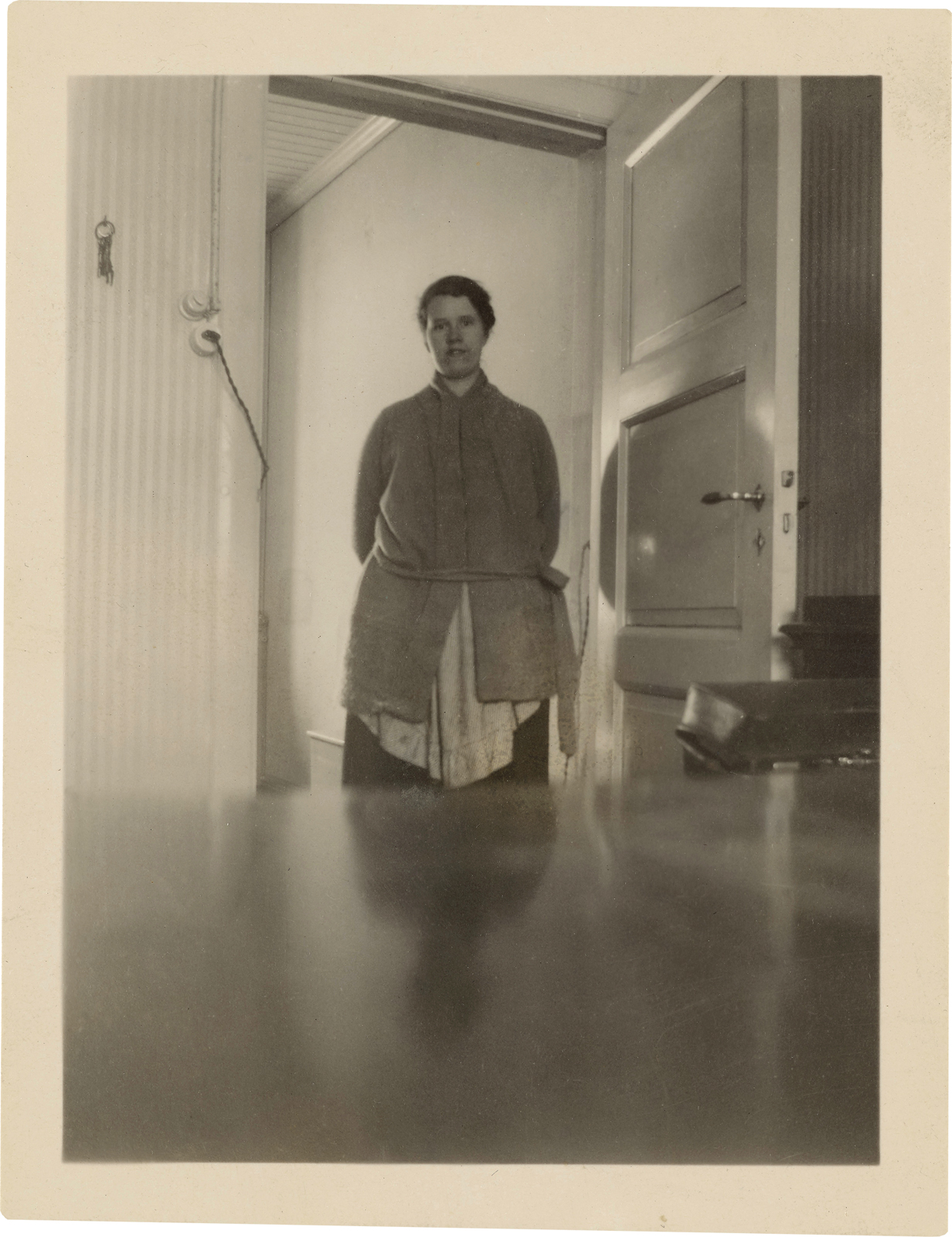
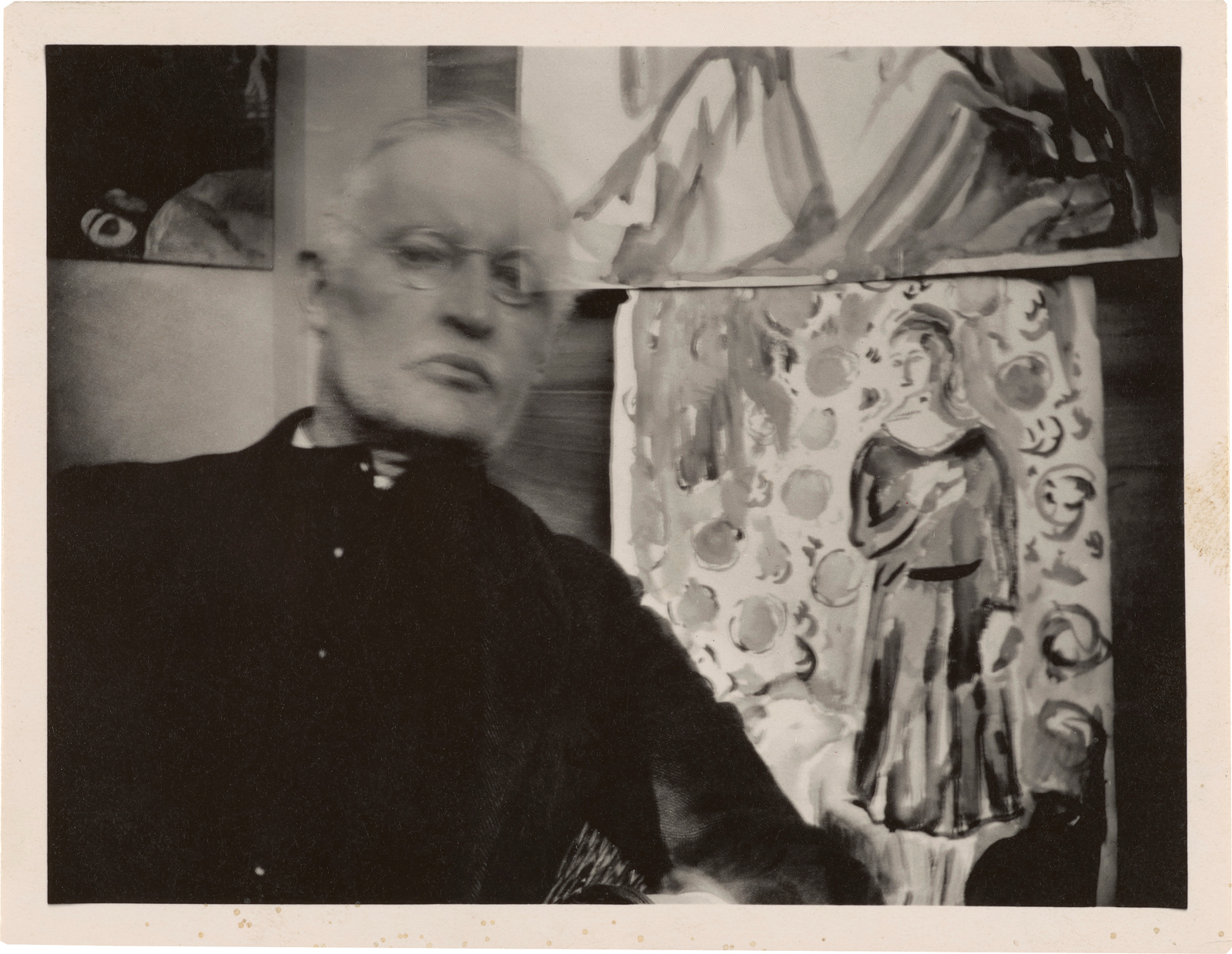
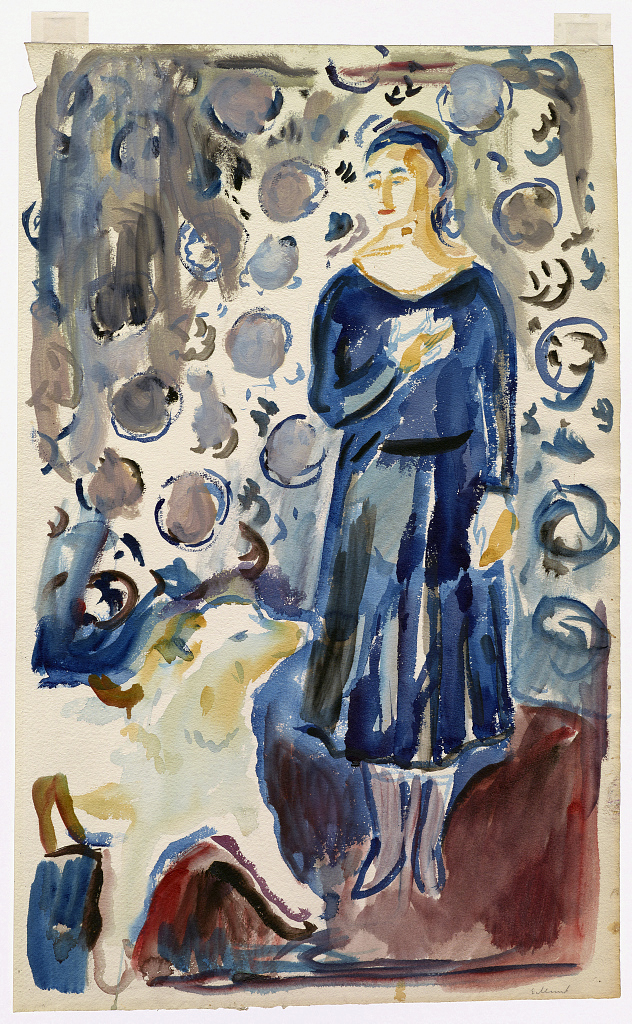
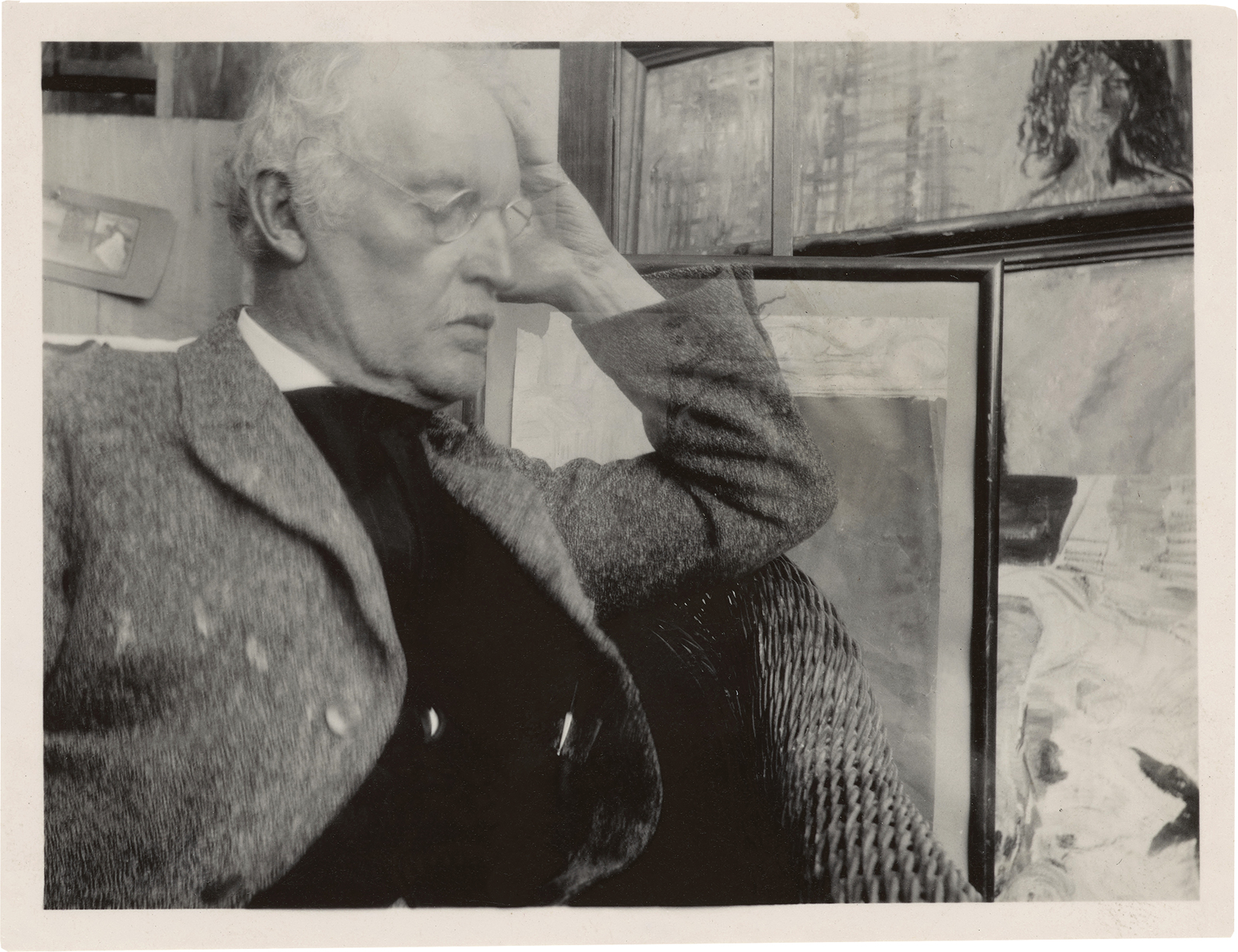
Otto. 'Girl in Chair' c. 1892 from the exhibition 'In Lady Barclay's Salon – Art and Photography around 1900' at Moderna Museet, Stockholm, June 2021 - Jan 2022


Otto
Girl in Chair
c. 1892
Reproduction photo: Prallan Allsten/Moderna Museet


Apologies, a short text today… my lower back is not very good and I am not feeling that well.

Another “niche” exhibition that Art Blart likes to promote, one that fills a gap in our greater knowledge of world art and artists. But why the distinction in the title of the exhibition between art and photography? That old chestnut rears its ugly head again… why not just ‘art around 1900’?

My particular favourites in the posting are the muscular yet translucent Anna Boberg painting A Quiet Evening. Study from North Norway (Nd); the gossamer wispiness and beauty of Ferdinand Flodin’s Portrait of a young lady (1922); and the velvety softness and light of Ture Sellman’s Untitled landscape (c. 1915).

I have added detail of the artists and sitters where possible and information on early photographic processes.

Enjoy!

Dr Marcus Bunyan


Many thankx to the Moderna Museet for allowing me to publish the photographs and the text in the posting. Please click on the photographs for a larger version of the image.


Moderna Museet highlights Pictorialism – a movement in photography that arose around 1900. The exhibition In Lady Barclay’s Salon – Art and Photography Around 1900 also includes paintings from the same period, treating visitors to a selection of nearly 300 works from the collections of Moderna Museet and Nationalmuseum.

This exhibition is based on the rich collections of Moderna Museet and Nationalmuseum, with art and photography dating from the late 1800s to the First World War. During this period, pictorialism was a style that many prominent photographers worked in; it was inspired by impressionism, symbolism and naturalism.

Pictorialism was the first international art photography movement, with many active practitioners throughout Europe and the USA. Sweden was on the periphery of this movement, but the style became popular here too among several influential amateur and professional photographers. This was a pivotal period in painting, where the younger artists who went abroad and were inspired by a freer approach broke with the more conservative academic painters. This exhibition will highlight works by famous photographers and painters from the years around the turn of the century.

Dark haired, almond eyed, and irresistibly charming, Lady Sarita Enriqueta Barclay was an influential figure of Stockholm’s Pictorialism movement. Captivated by the experimental nature of Swedish art during the fin de siècle, she hosted elaborate viewings and events, and was photographed often. Known for diffused light, sepia tones, and romanticism, the impressionistic photographs of the era capture a cultural moment in Swedish history.


Look into Lady Barclays Salon: Live curator talk

Look into Lady Barclay’s salon and discover Pictorialism, the first art photo stream. Many prominent photographers worked in the style that prevailed from the 1890s and a few decades onwards. Anna Tellgren, curator and Karin Malmquist, program curator, talk about Pictorialism and some of the approximately 300 paintings and photographs that you can see in the exhibition “In Lady Barclays Salon”.


August Strindberg (Swedish, 1849-1912) 'Underlandet' (The Wonderland) 1894 from the exhibition 'In Lady Barclay's Salon – Art and Photography around 1900' at Moderna Museet, Stockholm, June 2021 - Jan 2022


August Strindberg (Swedish, 1849-1912)
Underlandet (The Wonderland)
1894
Oil on cardboard
72.5cm (28.5 in) x 52cm (20.4 in)
Nationalmuseum (Stockholm)


Johan August Strindberg

Johan August Strindberg (22 January 1849 – 14 May 1912) was a Swedish playwright, novelist, poet, essayist and painter. A prolific writer who often drew directly on his personal experience, Strindberg’s career spanned four decades, during which time he wrote more than sixty plays and more than thirty works of fiction, autobiography, history, cultural analysis, and politics. A bold experimenter and iconoclast throughout, he explored a wide range of dramatic methods and purposes, from naturalistic tragedy, monodrama, and history plays, to his anticipations of expressionist and surrealist dramatic techniques. From his earliest work, Strindberg developed innovative forms of dramatic action, language, and visual composition. He is considered the “father” of modern Swedish literature and his The Red Room (1879) has frequently been described as the first modern Swedish novel. In Sweden, Strindberg is known as an essayist, painter, poet, and especially as a novelist and playwright, but in other countries he is known mostly as a playwright. …

Strindberg, something of a polymath, was also a telegrapher, theosophist, painter, photographer and alchemist. Painting and photography offered vehicles for his belief that chance played a crucial part in the creative process.

Strindberg’s paintings were unique for their time, and went beyond those of his contemporaries for their radical lack of adherence to visual reality. The 117 paintings that are acknowledged as his were mostly painted within the span of a few years, and are now seen by some as among the most original works of 19th-century art.

Today, his best-known pieces are stormy, expressionist seascapes, selling at high prices in auction houses. Though Strindberg was friends with Edvard Munch and Paul Gauguin, and was thus familiar with modern trends, the spontaneous and subjective expressiveness of his landscapes and seascapes can be ascribed also to the fact that he painted only in periods of personal crisis.

Text from the Wikipedia website


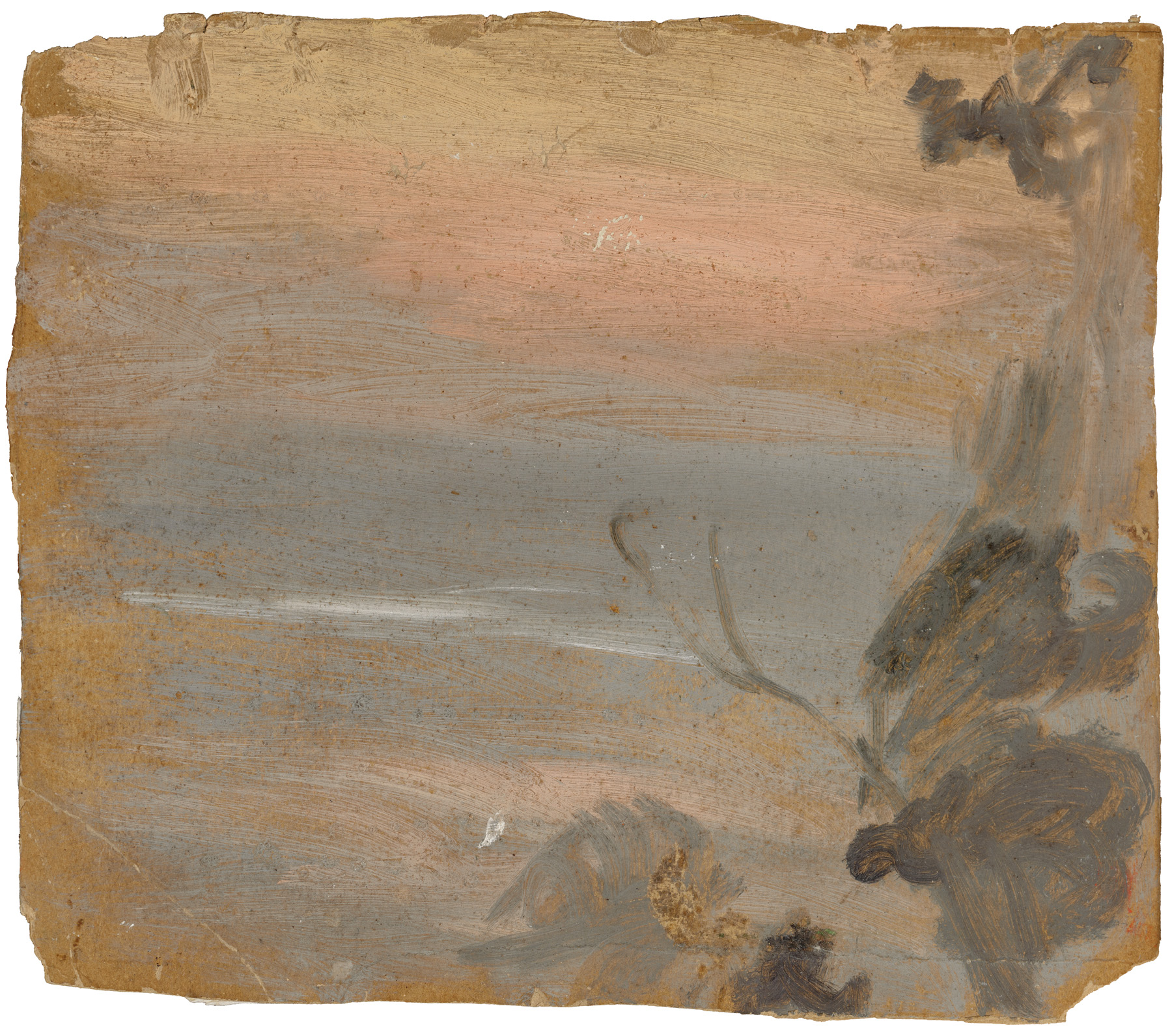
Joseph Mallard William Turner (British, 1775-1851) 'A View of Deal' Nd


Joseph Mallard William Turner (British, 1775-1851)
A View of Deal
Nd
Oil on paper on panel
32 x 24cm (12.6 x 9.6 inches)
Nationalmuseum (Stockholm)


The years from 1890 to the first World War were a golden era for the arts in Sweden. This exhibition presents beautiful Pictorialist photographs and selected paintings from this period. The more than 300 works from the rich collections of Moderna Museet and Nationalmuseum give us an insight into art at the time.
In Lady Barclay’s Salon, we imagine a meeting between photographers and painters, their friends and the public. Lady Sarita Enriqueta Barclay (1891-1985) was married to a British diplomat, and they both lived in Stockholm for a few years around 1921. She was portrayed several times in the studio of the photographer Henry B. Goodwin. We can assume that she was prominent in the city’s social life and went to previews, dinners and other events.

This exhibition is an opportunity to see a selection of some 300 works by famous photographers and painters in the Moderna Museet and Nationalmuseum collections, including Anna Boberg, Helmer Bäckström, Julia Margaret Cameron, Uno Falkengren, Gustaf Fjæstad, Ferdinand Flodin, Henry B. Goodwin, John Hertzberg, Gösta Hübinette, Eugène Jansson, Nicola Perscheid and Ture Sellman.

Around the end of the previous century

In the years around 1900, a number of colourful personalities emerged in literature, music, art and architecture, and patrons such as Prince Eugen and Ernest Thiel were building major art collections. The Art and Industry Exhibition in Stockholm in 1897 and the Baltic Exhibition in Malmö in 1914 had sections for art and photography.

The exhibition “In Lady Barclay’s Salon” gives a picture of the visual culture at the time. It features mainly Swedish material, with a few international highlights. The works date from the late-19th century to 1930, a period when Pictorialism was emerging in photography. The style was inspired by impressionism, symbolism and naturalism, and there were lively debates on how to make photography more artistic.

Unlike the increasing number of amateur and professional photographers – who had gained access to the medium thanks to technological progress – the Pictorialists emphasised craftsmanship. Their images are characterised by soft focus and with colours ranging from brown, earthy tones to strong reds and blues. They worked with a variety of processes with the purpose of creating or “painting” on light-sensitive paper. This was the first international art photography movement, and it had many prominent practitioners throughout Europe and the USA.

A pivotal time for painting

This was a pivotal period in painting, when the younger artists who travelled abroad and were inspired by a freer approach broke with the more conservative academic painters. The French painter Paul Gauguin and the Pont-Aven school had a strong influence on Swedish artists who adopted symbolist or synthetist approaches. Images were reproduced and distributed more widely in books, posters and magazines, making it easier to share ideas. No longer was it necessary to visit other countries to see the latest art, but Paris was still a mecca for art students. Towards the end of the century, however, Paris was rivalled by Berlin, Munich, Dresden and Hamburg. Copenhagen, with its international relations and exhibitions, also offered a natural meeting place for Swedes.

Text from the Moderna Museet website


Ferdinand Flodin (Swedish, 1863-1935) 'View from My Window over Skeppsholmen, Stockholm' 1929


Ferdinand Flodin (Swedish, 1863-1935)
View from My Window over Skeppsholmen, Stockholm
1929
Bromoil print mounted on board
Moderna Museet
Reproduction photo: Prallan Allsten/Moderna Museet


Eugène Jansson (Swedish, 1862-1915) 'Hornsgatan nattetid' (Hornsgatan at night) 1902


Eugène Jansson (Swedish, 1862-1915)
Hornsgatan nattetid (Hornsgatan at night)
1902
Oil on canvas
152cm (59.8 in) x 182cm (71.6 in)
National Museum (Stockholm)


Moderna Museet highlights Pictorialism – a movement in photography that arose around 1900. The exhibition In Lady Barclay’s Salon – Art and Photography Around 1900 also includes paintings from the same period, treating visitors to a selection of nearly 300 works from the collections of Moderna Museet and Nationalmuseum.

Lady Sarita Enriqueta Barclay (1891-1985) became a prominent figure on the Stockholm arts scene after her husband, a British diplomat, had been posted to Stockholm. Lady Barclay frequently hosted cultural gatherings and events in the five years following the end of the First World War when she lived here. The photographer Henry B. Goodwin (1878-1931) portrayed Lady Barclay on several occasions, and his pictures show her as a stylish woman with a cosmopolitan air – an emblem of Sweden’s flourishing arts scene at the time.

In the years around 1900, a number of colourful personalities emerged in literature, music, art and architecture, and patrons such as Prince Eugen and Ernest Thiel were building major art collections. The Art and Industry Exhibition in Stockholm in 1897, and the Baltic Exhibition in Malmö in 1914, included separate sections for art and photography.

The exhibition In Lady Barclay’s Salon gives a picture of the visual culture at the time, and consists mainly of Swedish material, with a few international highlights. The works date from the late-19th century to 1930, a period when Pictorialism was emerging in photography. The style embraced inspiration from impressionist, symbolist and naturalism, and there was a lively debate on how to make photography more artistic. Unlike the increasing number of amateur and professional photographers – who had gained access to the medium thanks to technological progress – the Pictorialists emphasised craftsmanship. Their images are characterised by soft focus and with colours ranging from brown, earthy tones to strong reds and blues. They worked with a variety of processes with the purpose of creating or “painting” on light-sensitive paper.

Painting also moved into a new phase around 1900. While the older members of the artist federation Konstnärsförbundet, founded in 1886, maintained their dominance, a younger generation was beginning to step in at the turn of the century. The French artist Paul Gauguin and the Pont-Aven school had a strong influence on Swedish artists who adopted symbolist or synthetist approaches. Ideas could be shared more easily with mass-produced images in books, posters and magazines.

In Lady Barclay’s Salon presents a fictive encounter between photographers and painters, their friends and the audience. The exhibition features some 300 works from the collections of Moderna Museet and Nationalmuseum, including works by Anna Boberg, Helmer Bäckström, Julia Margaret Cameron, Uno Falkengren, Gustaf Fjæstad, Ferdinand Flodin, Henry B. Goodwin, John Hertzberg, Gösta Hübinette, Eugène Jansson, Nicola Perscheid and Ture Sellman.

“This is an opportunity to discover a less well-known part in the history of photography, where the artistic aspects of the medium were discussed fervently, and where there are many intriguing links to painting at the time,” says the exhibition’s curator, Anna Tellgren. “The exhibition highlights both famous and unknown photographers and artists who were practising around 1900, and reveals some fantastic visual treasures from our collection.”

Press release from Moderna Museet


Prince Eugen, Duke of Närke (Swedish, 1865-1947) 'Tidig vintermorgon' (Early winter morning) 1906-1907


Prince Eugen, Duke of Närke (Swedish, 1865-1947)
Tidig vintermorgon (Early winter morning)
1906-1907
Oil on canvas
77cm (30.3 in) x 89cm (35 in)
Nationalmuseum (Stockholm)


Prince Eugen

After finishing high school, Prince Eugen studied art history at Uppsala University. Although supported by his parents, Prince Eugen did not make the decision to pursue a career in painting easily, not least because of his royal status. He was very open-minded and interested in the radical tendencies of the 1880s. The Duke became one of the era’s most prominent landscape painters. He was first trained in painting by Hans Gude and Wilhelm von Gegerfelt.

Between 1887 and 1889, he studied in Paris under Léon Bonnat, Alfred Philippe Roll, Henri Gervex and Pierre Puvis de Chavannes. Puvis de Chavannes’s classical simplicity had the greatest influence on Prince Eugen’s work. The Duke devoted himself entirely to landscape painting. He was mainly interested in the lake Mälaren, the countryside of Stockholm (such as Tyresö, where he spent his summers), Västergötland (most notably Örgården, another summer residence) and Skåne (especially Österlen).

Text from the Wikipedia website


Henry B. Goodwin (Swedish born Germany, 1878-1931) 'Bragevägen Stockholm's loveliest street' 1917


Henry B. Goodwin (Swedish born Germany, 1878-1931)
Bragevägen Stockholm’s loveliest street
1917
Reproduction photo: Prallan Allsten/Moderna Museet


About the exhibition In Lady Barclay’s Salon

The exhibition “In Lady Barclay’s Salon – Art and Photography around 1900” highlights the period from 1890 and up to the First World War. It was a golden age for the arts in Sweden. A number of noteworthy figures appear within the fields of literature, music, art and architecture. Among them are Verner von Heidenstam, Ellen Key, Selma Lagerlöf and August Strindberg.

Art patrons Prince Eugen and Ernest Thiel acquired large art collections, that can still be admired in their respective homes: Waldermarsudde and Thielska Galleriet on Djurgården. Both buildings were designed by the architect Ferdinand Boberg, who included Renaissance, oriental and late Jugend style elements.

The renowned artist Eva Bonnier was another important figure. Better communications in the form of railways and telephone networks contributed to the development of cities, and a growing, export-oriented industry in Sweden. The 1897 Art and Industry Exposition in Stockholm and, a few years later, the 1914 Baltic Exhibition in Malmö, were manifestations of this progressive outlook. Both included sections that showed art and photography.

It was a time of Scandinavianism, and many Nordic collaborations and groups were formed. The women’s movement gained momentum, and in 1919 women were finally given the right to vote. For the first time, after a long struggle, they were able to cast their vote in the 1921 lower house election – exactly one hundred years ago.

Pictorialism developed as a photographic movement

This exhibition offers a glimpse of visual culture from this period by means of some 300 works from the rich collections of Moderna Museet and National museum. While most of these are Swedish in origin, there are some international examples.

The works span a period from the late 19th century to 1930. During this period, Pictorialism developed as a distinct movement that took a different direction from amateur and professional photography. Technical advances, the arrival of roll film for example, made photography accessible to a wider circle of practitioners. The Pictorialists, however, were interested in the craft of photography.

The style was inspired by impressionism, symbolism and naturalism, and there was a heated debate on how to develop photography as an art form. The monochrome portrait paintings of the symbolist Eugène Carrière, for example, clearly influenced art photography around 1900.

The Pictorialists’ images are characterised by soft focus and a palette that ranges from brown, earthy tones to strong reds and blues. They worked with a variety of processes such as gum bichromate, platinum and bromoil printing with the purpose of creating or “painting” on light-sensitive paper.

This was the first international art photography movement to have a large number of prominent practitioners across Europe and the United States. Clubs were formed to promote this new art photography, among them were the Wiener Camera-Club, the Photo-Club de Paris and the Photo-Secession in New York, with famous members such as Alfred Stieglitz and Edward Steichen. The works were judged in competitions and shown in galleries and museums and at international salons. The style thus spread to Belgium, Holland, Italy, Poland, Russia, Spain and the Nordic countries.

The artistic period

Sweden was on the periphery of this movement, but it found a following here too, with a number of talented photographers. This period is known as the “artistic period” (konstnärstiden), a term coined in an article by the keen Pictorialist Professor Helmer Bäckström. Bäckström was also an active member of Fotografiska Föreningen (the Photographic Association), a Swedish version of the clubs abroad. The association was established in 1888. Its purpose was to organise meetings and dinners where photography was discussed.

In the 1890s, the professional photographer Herman Hamnqvist was an important introducer of Pictorialism. He promoted artistic photography in his many articles and lectures. Other colourful representatives were Uno Falkengren, Ferdinand Flodin, John Hertzberg, Gösta Hübinette and Ture Sellman.

In Sweden, these new ideas were first picked up by the older generation. They were followed by a younger generation of photographers who introduced and disseminated Pictorialism. This second wave includes Henry B. Goodwin, a major figure in Sweden and the Nordic countries. Goodwin was renowned for his expressive, subdued portraits and his many Stockholm cityscapes.

He also kept up with what went on abroad; among his contacts was the well-known portrait photographer Nicola Persheid, who was active in Berlin for many years. Women photographers disappeared from the history of photography during this period. The networking that took place in clubs and associations seems to have excluded many women, even if they had their own successful studios.

Atmospheric style typical of the period

Around 1900, painters entered a new, exciting era. The older members of Konstnärsförbundet (the Artists’ Association), established in 1886, continued to dominate, but a new generation came to the fore around the turn of the century. The French artist Paul Gaugin and the Pont-Aven school were important influences among the Swedish artists.

Helmer Osslund was able to visit Gauguin’s studio, and he later put this experience to practice in his northern landscapes. Carl Wilhelmson was known for his many portraits with motifs from his native West Coast. He taught at the Valand art school in Gothenburg and had a major influence on many artists. Maja and Gustaf Fjæstad founded an artists’ colony by Lake Racken in Värmland where a style in line with current national romanticism tendencies developed. Several local circles or schools in a similar vein were formed across Sweden.

Other important artists at the time were Richard Bergh, Eugène Jansson, Nils Kreuger and Karl Nordström, who all represented and developed an atmospheric style typical of the period. New ideas were now rapidly disseminated via mass-produced pictures in books, volumes of prints and magazines. The artists did not always have to travel abroad in order to find inspiration. However, study trips to Paris, the current art hub, were still important, although Berlin, Munich, Dresden and Hamburg were taking over that role at the end of the 1800s. To Swedish artists, Copenhagen, with its international outlook and exhibitions, became a natural place to gather.

New ways of framing and cropping

Japanese art, especially colour woodcuts, which reached Europe via the impressionists were fashionable and encouraged painters and photographers to try new ways of cropping and framing their motifs. The ornamental details and undulating lines that are typical of the Jugend (Art Noveau) period also inspired many painters. Eccentrics such as Ivar Arosenius and Olof Sager-Nelson (see below) were renowned for their sensitive, almost fairy tale-like portraits.

The author August Strindberg (see above) experimented with both painting and photography, which has been studied closely in recent years. Around the turn of the last century, an intermediary generation were overshadowed by great national artists such as Bruno Liljefors, Carl Larsson and Anders Zorn. However, they became an important link to the emerging expressionism and other modernist movements that came to the fore in the first decades of the 20th century.

Lady Barclay’s Salon

In Lady Barclay’s Salon we have created a fictional encounter between photographers, painters, their friends and audiences. Sarita Barclay was married to a British diplomat, and the couple lived in Stockholm for a few years around 1921. During these years she attended several portrait sittings with Henry B. Goodwin. We can assume she visited exhibition openings, dinners and other society events.

Social circles do not seem to have mixed a great deal, but there is clear evidence of links between painting and photography. Portraits are a common motif, but the many landscapes, cityscapes, dancers and nudes also offer us information about and a glimpse of the past.

Text from the Moderna Museet website


Ferdinand Flodin (Swedish, 1863-1935) 'Greta Gustavsson Garbo' 1923


Ferdinand Flodin (Swedish, 1863-1935)
Greta Gustavsson Garbo
1923
Reproduction photo: Prallan Allsten/Moderna Museet


Greta Garbo

Greta Garbo (born Greta Lovisa Gustafsson 18 September 1905 – 15 April 1990) was a Swedish-American actress. She was known for her melancholic, somber persona due to her many portrayals of tragic characters in her films and for her subtle and understated performances. In 1999, the American Film Institute ranked Garbo fifth on its list of the greatest female stars of classic Hollywood cinema. She was nicknamed “The Divine” because of her whimsical attitude and her willingness to avoid the press. Garbo launched her career with a secondary role in the 1924 Swedish film The Saga of Gösta Berling.


James Bourn (Swedish) 'No title' 1905 


James Bourn (Swedish, Gothenburg)
No title
1905


Herrman Sylwander (Swedish, 1883-1948) 'Tora Teje in 'Inom lagens gränser'' (Tora Teje in 'Within the Limits of the Law') 1914 


Herrman Sylwander (Swedish, 1883-1948)
Tora Teje in ‘Inom lagens gränser’ (Tora Teje in ‘Within the Limits of the Law’)
1914


Tora Teje (17 January 1893 – 30 April 1970) was a Swedish theatre and silent film actress. She appeared in ten films between 1920 and 1939.


Photographic Processes and Materials around 1900

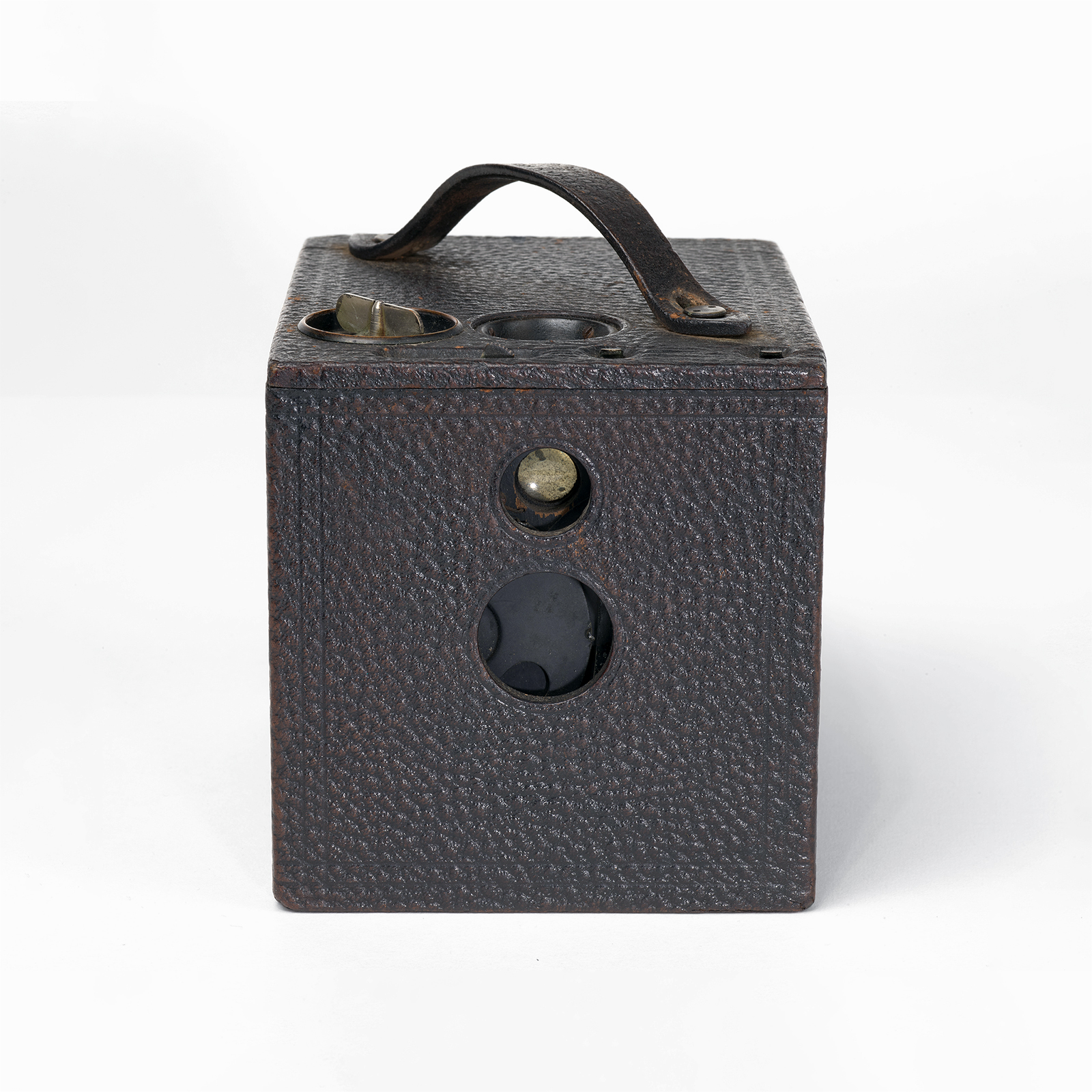
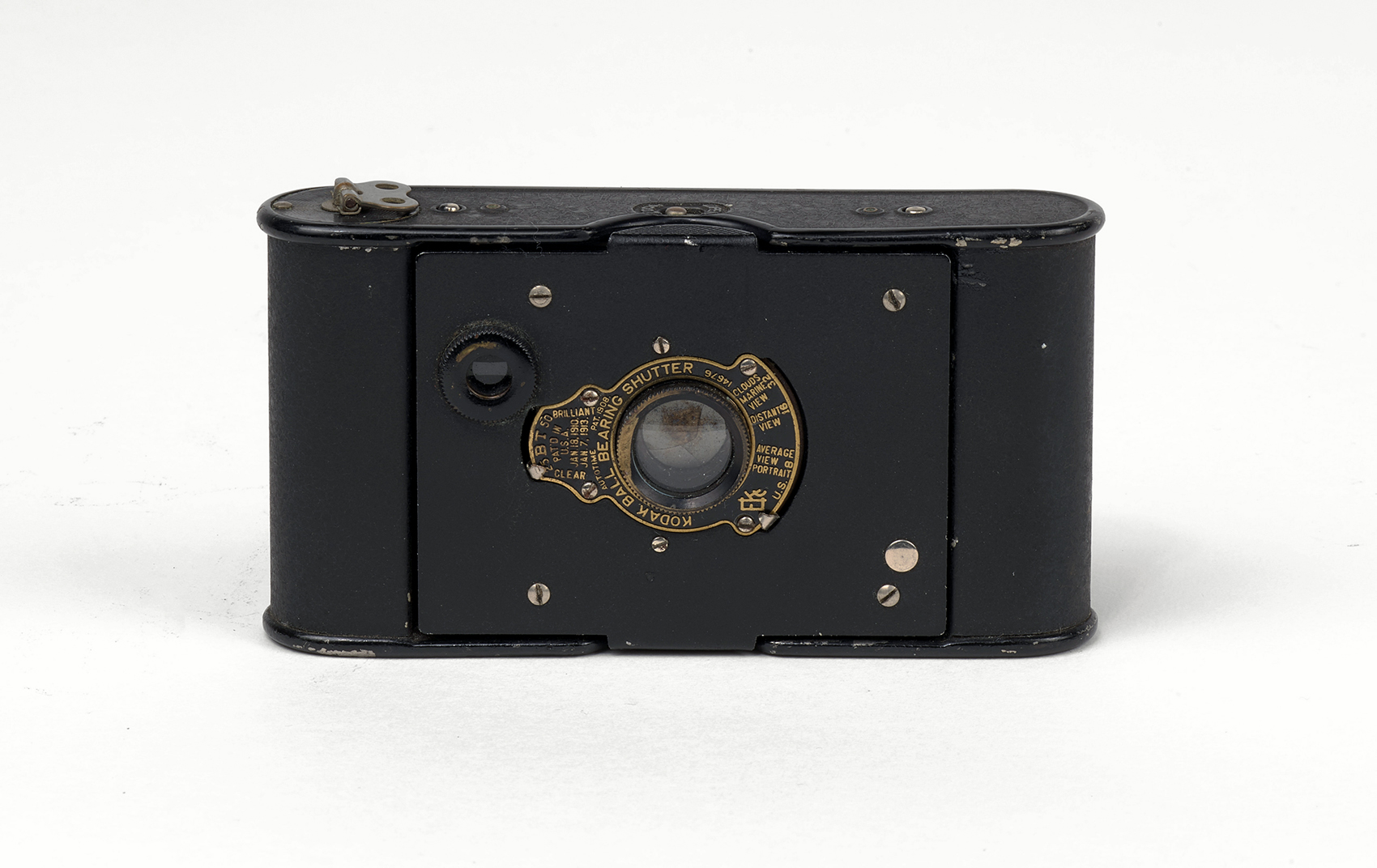
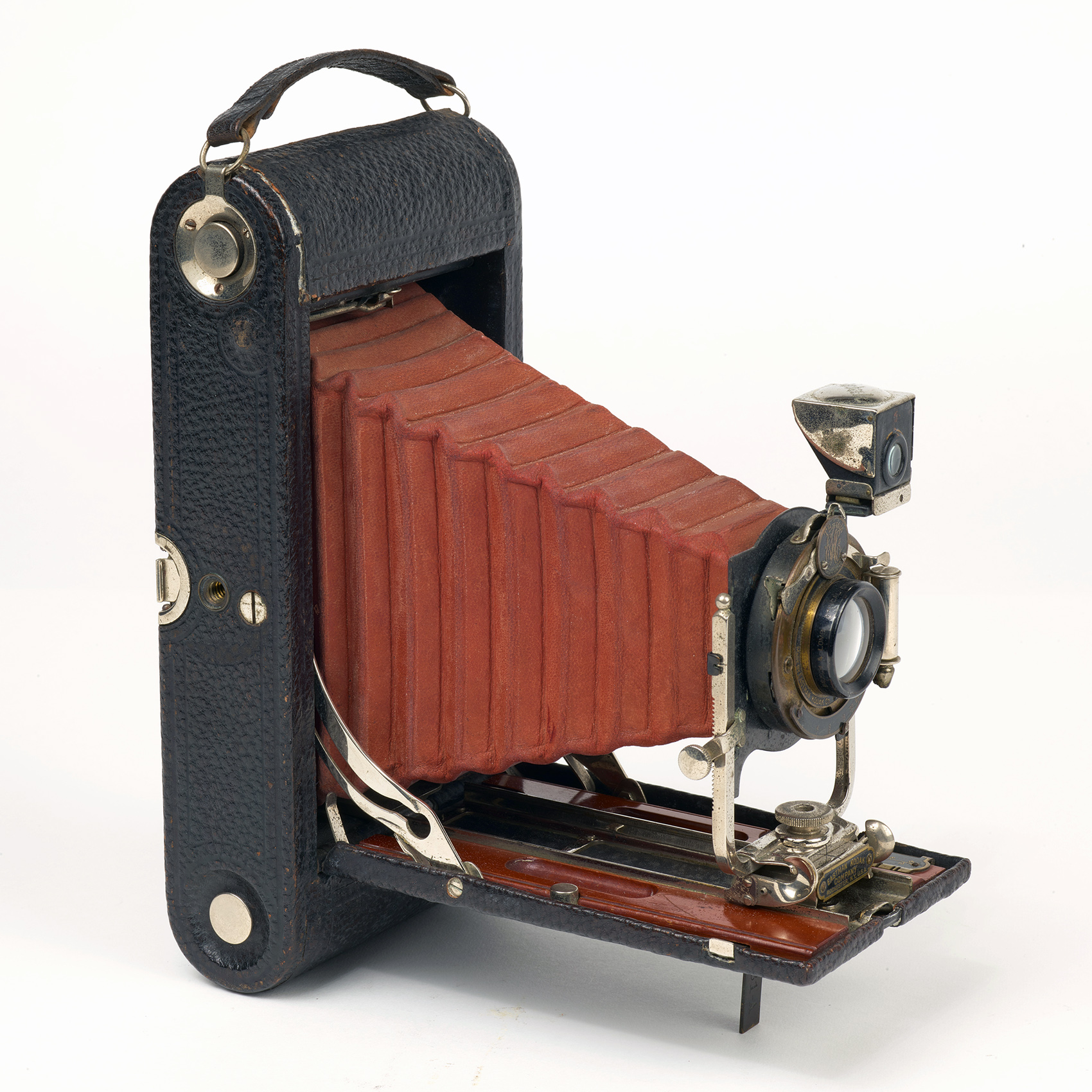
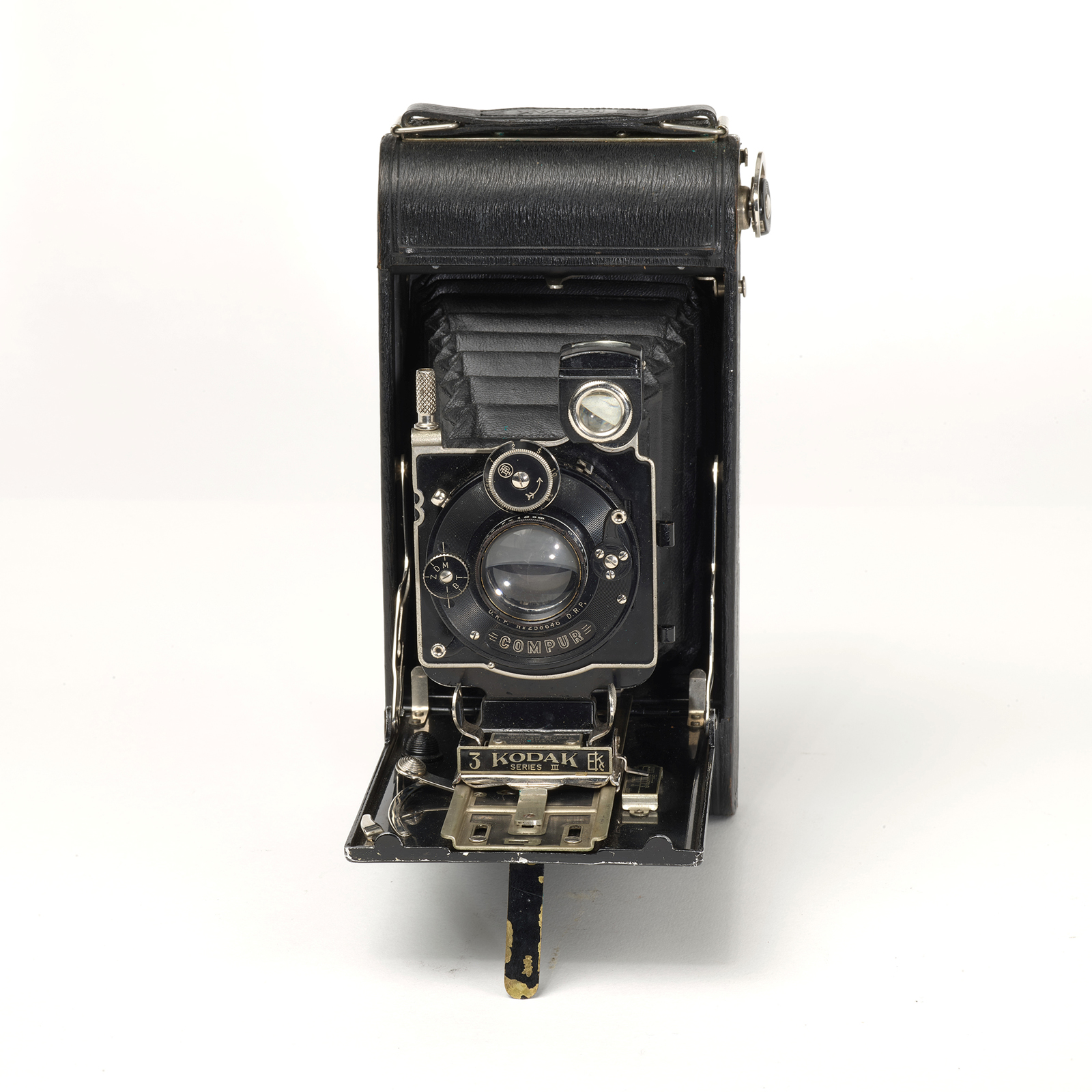
In 1888, Kodak launched the first roll-film hand camera. It revolutionised the market and turned photography into something everyone could enjoy. The specially constructed cameras were sent back to the factory where the pictures were processed. In 1900, Kodak introduced the popular Brownie, a classic box camera.
Another aspect of the increased interest in and use of photographs was that mass produced pictures were now easy to publish in books, volumes of prints and magazines. One example is photogravure, but there were many other processes. The Pictorialists used various processing methods and materials, some of which were closer to printmaking and painting, and they avoided regular photographic materials. The craft of making photographs was important, which was in line with an interest in and revival of older techniques as industrialism gained momentum during the Jugend period.

Professional photographers engaged in portrait photography and took on other commissions for their customers. Among the most prominent Pictorialists, many had second jobs. The tension between, or the different preconditions for photographers who embraced a more artistic form of expression and those who were forced to earn a living from selling their photographs is relevant to this day. There were many conflicts between members of Fotografiska Föreningen (the Photographers’ Association) – which to begin with only accepted amateurs – and the industry association Svenska Fotografers Förbund (the Association of Professional Photographers). At the same time, there are many examples of contacts and collaborations between different types of photographers around the turn of the last century.

Terminology was often translated from German and English, and in older literature you often find processes described in Swedish as gummitryck (gum print), pigmenttryck (pigment print) or oljetryck (oil print). However, the process is not strictly “printing”; the images were developed on light-sensitive paper. Instead of using the most common type of photographic paper with light-sensitive coating of silver salts in gelatine or albumin, the Pictorialists worked with other light-sensitive solutions. The image was often contact printed under a negative, which resulted in a picture with the same dimensions as the negative. The Pictorialists’ images are characterised by soft focus and often a grainy, print-like texture in hues that go from earthy browns to strong reds and blues.

Carbon print

A pigment, potassium bichromate and gelatine emulsion on thin paper is subjected to natural light in contact with a negative. The image is formed with the help of pigment in the desired colour. After exposure, the image is transferred to a new paper. This is the original. The image stands out in clear relief and is reversed, which can be corrected by repeating the transfer process onto a new paper. The tone is often dark brown or black, but it varies depending on the type of pigment used. Factory-made paper by Bühler and Höchheimer were sensitised in alcohol. This process is called carbon print, especially when it features black pigment. It was in use between 1864 until the end of the 1930s.
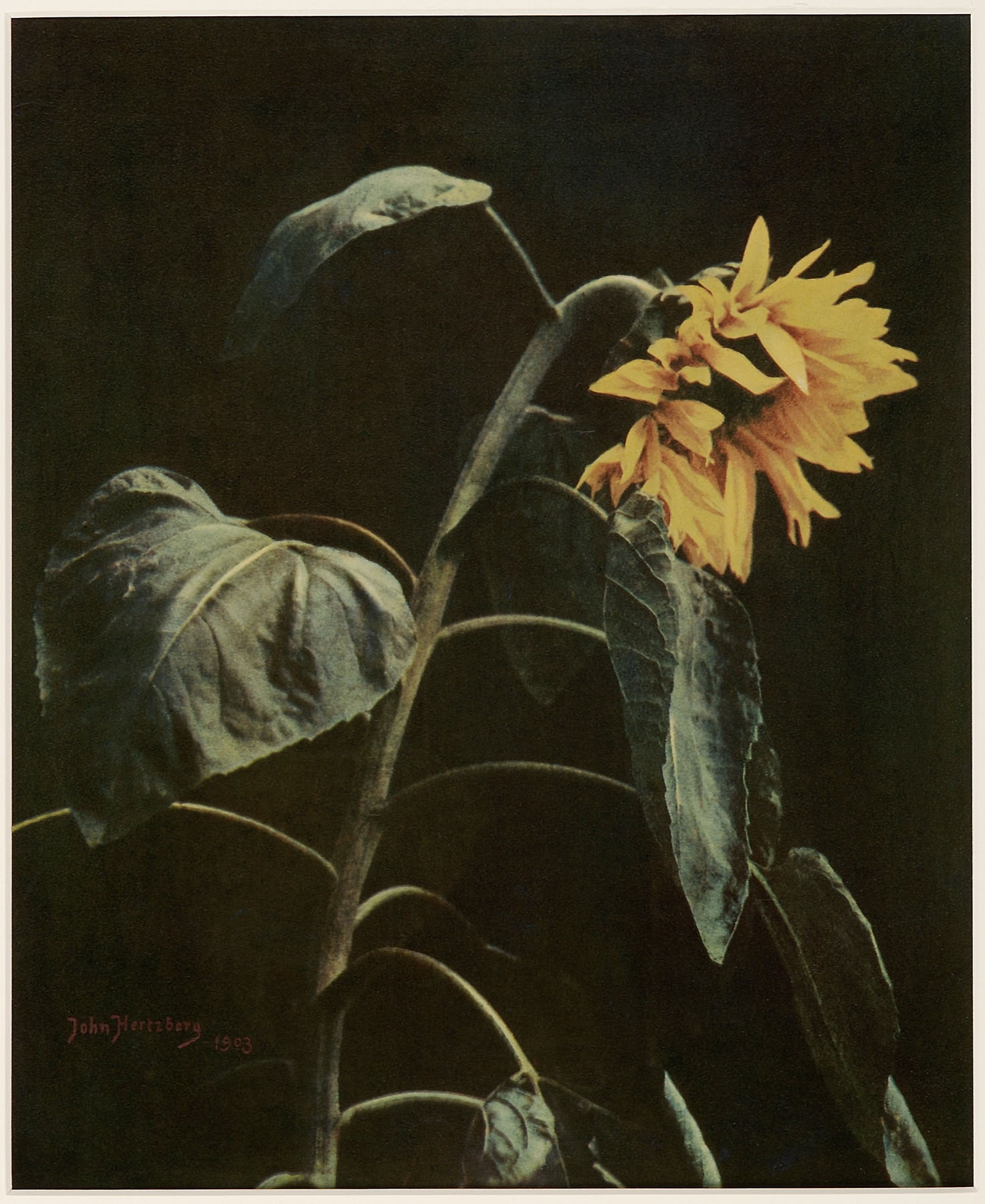
 

John Hertzberg (Swedish, 1871-1935) 'No title' 1903


John Hertzberg (Swedish, 1871-1935)
No title
1903
Gum Bichromate Print


Gum Bichromate print

The gum bichromate process was invented in 1894. It is achieved by applying a solution of pigment, potassium bicharbonate and gum arabic to paper. The components are mixed in water and brushed on. When the coat has dried, it is light-sensitive, and the areas under the negative that are not exposed to light is stabilised. The rest is rinsed off in water. The colour range is very limited. The motif is often built up through multiple coats, erasures and applications of colour. The images are generally monochrome, reminiscent of charcoal or pastels. It is necessary to use a coarse-grained or uneven paper for the emulsion to adhere, which enhances the graphic qualities of the image. Custom-made paper for this method was marketed by Höchheimer, Bühler and Fresson.


Ture Sellman (Swedish, 1888-1969) 'Landskap' (Landscape) c. 1913


Ture Sellman (Swedish, 1888-1969)
Landskap (Landscape)
c. 1913
Pigment print mounted on board
27.5 × 21.4​cm


Oil print

An emulsion consisting of potassium bichromate and gelatine is applied to paper and exposed to light. It results in an almost invisible gelatine image in relief. The gelatine absorbs and repels greasy pigments, which can be fixed by means of a rubber roller or brush. This method gives a grainy image that resembles art prints and drawings.


Olof Sager-Nelson (Swedish, 1868–1896) 'Flickhuvud II' (A Girl's Head II) 1902


Olof Sager-Nelson (Swedish, 1868–1896)
Flickhuvud II (A Girl’s Head II)
1902
Oil on canvas
41cm (16.1 in) x 33cm (12.9 in)
Nationalmuseum (Stockholm)


Ebba-Lisa Roberg (Swedish, 1904-1993) 'No title' 1927


Ebba-Lisa Roberg (Swedish, 1904-1993)
No title
1927
Bromoil print


Bromoil print

Colour pigments on a silver, potassium bichromate and gelatine emulsion on paper. A silver bromide image on paper is sensitised by means of potassium bichromate with an addition of copper sulphate and potassium bromide, then fixer is added. The image is soaked in water, and a gelatine relief is produced, which can be coloured multiple times by brushing or rolling on greasy ink. The tone is determined by the pigments in the ink. A variation is achieved when the wet, tinted gelatine relief is pressed against a paper and the ink is transferred. The image is reversed with a matt finish and pressure marks from the original print. This method was used between 1907 and the 1940s.


Uno Falkengren (Swedish, 1889-1964) 'Nöd'. Arranged dance group with Anna Behle in the middle, Stockholm 1917


Uno Falkengren (Swedish, 1889-1964)
Nöd. Arranged dance group with Anna Behle in the middle, Stockholm
1917
Sepia platinum type mounted on paper
23.7 x 24.2cm


Platinum print

A paper is given a coat of a potassium chloropatinate and iron oxalate. It is then exposed to daylight through a negative. The image is developed as potassium oxalate dissolves the iron salts and transform the platinum salts to metallic platinum embedded in the paper fibres. This process offers few opportunities for manual manipulation. Platinum prints are characterised by a smooth, neutral greyscale. Platinum was relatively inexpensive before the First World War, and prepared papers were readily available. Today, platinum is used in combination with palladium. The method was used as far back as in 1873.

Photogravure

Colour pigment on paper. A paper base coated in potassium bichromates in gelatine are exposed to UV light in contact with a transparent positive. The gelatine coating is thereby stabilised and is then transferred face down to a copper plate. When ink is applied to the plate, it adheres to the etched areas after which the image is printed on paper in a printing press. Photogravures have a clearly defined depression from the edges of the plate, and each print is an original. Shadows are similar to charcoal pigment and highlights match the colour of the paper. This method is classified as a photomechanical print and is not in fact a true photograph. It has been used since the 1880s.


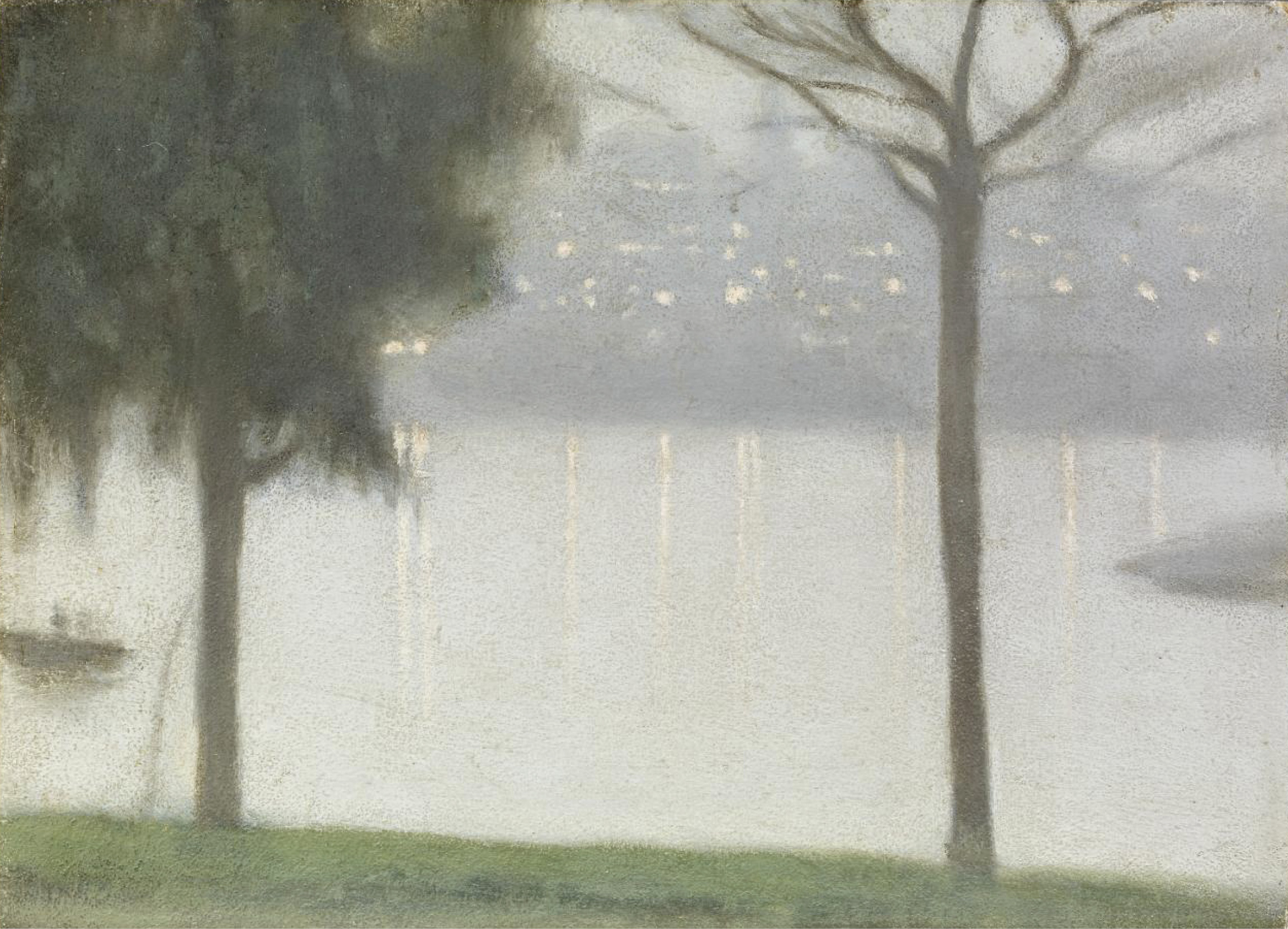
Nils Kreuger (Swedish, 1838-1930) 'Vårafton' (Spring evening) 1896


Nils Kreuger (Swedish, 1838-1930)
Vårafton (Spring evening)
1896
Oil on mahogany panel
48.5cm (19 inches) x 60.1cm (23.6 inches)
Nationalmuseum (Stockholm)


Nils Edvard Kreuger

Nils Edvard Kreuger (11 October 1858 – 11 May 1930) was a Swedish painter. He specialised in landscapes and rural scenes.

In 1874, he began his studies at the Royal Swedish Academy of Fine Arts, but was forced to discontinue them due to illness. In 1878, he was able to resume studying at the private painting school of Edvard Perséus. He then went to Paris, in 1881, and studied with Jean-Paul Laurens at the Académie Colarossi. Much of his time was spent painting en plein air in Grez-sur-Loing. As his style progressed, he showed a preference for painting at dawn or dusk, in haze or rain. His first exhibition at the Salon came in 1882.

After 1885, he was a supporter of the “Opponenterna [sv]”, a group that was opposed to the outmoded teaching methods at the Royal Academy. He was also active in creating the Konstnärsförbundet [sv] (Artists’ Union). At this time, he abandoned painting en plein air in favour of Romantic nationalism. In 1886, he married Bertha Elisabeth von Essen (1857-1932), the daughter of an army officer, and settled in Bourg-la-Reine.

In 1887, he returned to Sweden, looking for a quiet place to paint, and chose Varberg, where he worked with Richard Bergh and Karl Nordstrom to establish what came to be known as the Varbergsskolan [sv]; a term coined by Prince Eugen, himself an amateur artist. It was a reaction to the prevailing realistic style of landscape painting and may have been inspired by Bergh’s attraction to the works of Paul Gauguin. He was also influenced by Van Gogh, whose paintings were exhibited in Copenhagen in 1893.

In 1896, he moved to Stockholm, but visited Öland in the summers, where he painted cows and horses. After 1900, his palette lightened and he began adding dots to his work. He also did illustrations, designed furniture and produced some humorous paintings called the “historiska baksidor” (historic backs), showing famous rulers from behind. Between 1904 and 1905, he executed some large wall paintings at the Engelbrektsskolan [sv]. In his final years, he had problems with his eyesight, but was able to continue painting.

Text from the Wikipedia website


Gösta Hübinette (Swedish, 1897-1980) 'Forntida' (Ancient) 1928


Gösta Hübinette (Swedish, 1897-1980)
Forntida (Ancient)
1928
Gelatine Silver Print


Gelatine silver print

The most common form of black and white photography in the 20th century. A photo paper with a coating of light-sensitive silver halogens in gelatine are exposed and developed. There are many varieties of this process with different texture and glossiness, dynamic range and contrast. The result depends on the types of paper, developer and additive tones that are used.

Bibliography

Håkan Petersson, “Photographic materials”, Another Story. Photography from the Moderna Museet Collection, ed. Anna Tellgren, Stockholm: Moderna Museet and Göttingen: Steidl, 2011, pp. lxi-lxiii.

Pär Rittsel and Rolf Söderberg, “Konstnärstidens metoder”, Den svenska fotografins historia 1840–1940, Stockholm: Bonnier Fakta Bokförlag AB, 1983, p. 240-241.

Lena Johannesson, Den massproducerade bilden. Ur bildindustrialismens historia, Stockholm: Almqvist & Wiksell Förlag AB, 1978.

Impressionist Camera. Pictorial Photography in Europe, 1889-1918, ed. Philip Prodger, London/New York: Merrell Publishers Limited, 2006, pp. 322-324.

Text from the Moderna Museet website


Henry B. Goodwin (Swedish born Germany, 1878-1931) 'Carin' 1920


Henry B. Goodwin (Swedish born Germany, 1878-1931)
Carin
1920
Reproduction photo: Prallan Allsten/Moderna Museet


Henry B. Goodwin (Swedish born Germany, 1878-1931)

Henry B. Goodwin, born in Munich as Henry Buergel, was the most successful representative of Pictorialism. He arrived in Sweden in 1905 in order to teach German at Uppsala University. Some ten years later, in 1914, he moved to Stockholm where he opened a studio, Kamerabilder, which was popular with painters and artists.

His many superb portraits were achieved with small means: the subject is captured against a dark, neutral backdrop. His soft, smoky Stockholm cityscapes have been collected in a series of special editions, and Goodwin’s keen interest in gardening was expressed through meticulously arranged close-ups of plants.

Goodwin enjoyed a large, international network and launched the term bildmässig (pictorial) photography as an alternative to artistic photography. It was a term that came to be used frequently in the photographic debate.

Text from the Moderna Museet website


Julia Margaret Cameron (British, 1815-1879) 'The Mountain Nymph, Sweet Liberty' 1866


Julia Margaret Cameron (British, 1815-1879)
The Mountain Nymph, Sweet Liberty
1866


Julia Margaret Cameron (British, 1815-1879)

A small pioneering group of photographers in Victorian England were the first to experiment with, and who attempted to formulate, an aesthetic around artistic photography. Julia Margaret Cameron was part of this group. She left behind a wonderful collection of intimate portraits of members of her family and large circle of friends. She was an amateur, predominantly active during the 1860s and 1870s.

Cameron specialised in expressive soft-focus photographs of staged motifs borrowed from mythology, the Bible or English literature, as in her rendering of Alfred Tennyson’s famous poem “Maud” from 1855.

Cameron’s photographs evoke the Pre-Raphaelites with their penchant for the Middle Ages and Renaissance painting. She was a precursor of the photographers that a few decades later formed part of the pictorial movement.

Text from the Moderna Museet website


Helmer Bäckström (Swedish, 1891-1964) 'Segel till tork' (Drying sails) 1923


Helmer Bäckström (Swedish, 1891-1964)
Segel till tork (Drying sails)
1923


Helmer Bäckström (Swedish, 1891-1964)

Helmer Bäckström was an important member of Fotografiska Föreningen (the Photographic Association). The association, which was formed in 1888, organised meetings where photography was discussed. A library of books on photography was accumulated, but most important were the photo competitions. Bäckström was a researcher, collector, historian and photographer. In 1948, he was appointed professor of photography at the Royal Institute of Technology. Throughout his career, he wrote about early photography and technical innovations in a series of articles entitled “Samlingar till kamerans och fotografins svenska historia” (Collections of the Swedish History of Cameras and Photography). They were published in the association’s journal, “Nordisk Tidskrift för Fotografi”.

Bäckström was also a Pictorialist; studies of flora and fauna were his favourite motifs. His large collection of photographs was acquired by the Swedish state in 1965. It has been part of the Moderna Museet collection since 1971.

Text from the Moderna Museet website


Anna Boberg (Swedish, 1864-1935) 'Stilla afton. Studie från Nordlandet' (A Quiet Evening. Study from North Norway) Nd


Anna Boberg (Swedish, 1864-1935)
Stilla afton. Studie från Nordlandet (A Quiet Evening. Study from North Norway)
Nd
40.5 x 70.5cm
Nationalmuseum (Stockholm)


Anna Boberg (Swedish, 1864-1935)

Anna Scholander’s family was part of the Stockholm elite. She was well educated and moved with ease in the salons of Paris and other cities. In Paris she met Ferdinand Boberg, who was to become one of Sweden’s leading architects. They were married in 1888. The couple dedicated their lives to work and travel.

Anna Boberg was highly versatile. She designed textiles, glass and Jugend pottery – one example is the elegant peacock vase from around 1897 for Rörstrand. In 1901, she made a life-changing trip to northern Norway where she fell in love with the rocky landscape around Lofoten, which seemed to rise out of the sea. It woke in her an irresistible urge to paint.

Anna Boberg returned to this location over a period of thirty years. Contrary to her life as a society lady, she embarked on strenuous expeditions on foot and by sea, and she made oil sketches of what she saw which she later used as inspiration in her studio.

Text from the Moderna Museet website


Ferdinand Flodin (Swedish, 1863-1935) 'Portrait of a young lady' 1922


Ferdinand Flodin (Swedish, 1863-1935)
Portrait of a young lady
1922


Ferdinand Flodin (Swedish, 1863-1935)

One of the foremost portrait photographers of the period was Ferdinand Flodin. During his long career he tried all the different processes that were typical of Pictorialism, and he became a highly skilled photographer. As a young man, he travelled to the United States, and for a number of years he worked in Worcester near Boston. After his return in 1889, he opened a studio in Stockholm where he received celebrities associated with the theatre, art, politics and science.

Besides portraits, his large body of work includes a number of beautiful cityscapes in different colour tones. Flodin continued to travel; he was interested in the international scene and he knew a great deal about early photography. He went on to build a collection of historical photographs, later acquired by Helmer Bäckström. Flodin was active in Svenska Fotografers Förbund (the Swedish Association of Professional Photographers) for many years, and he regularly wrote about technical and financial matters in the association’s journal.

Text from the Moderna Museet website
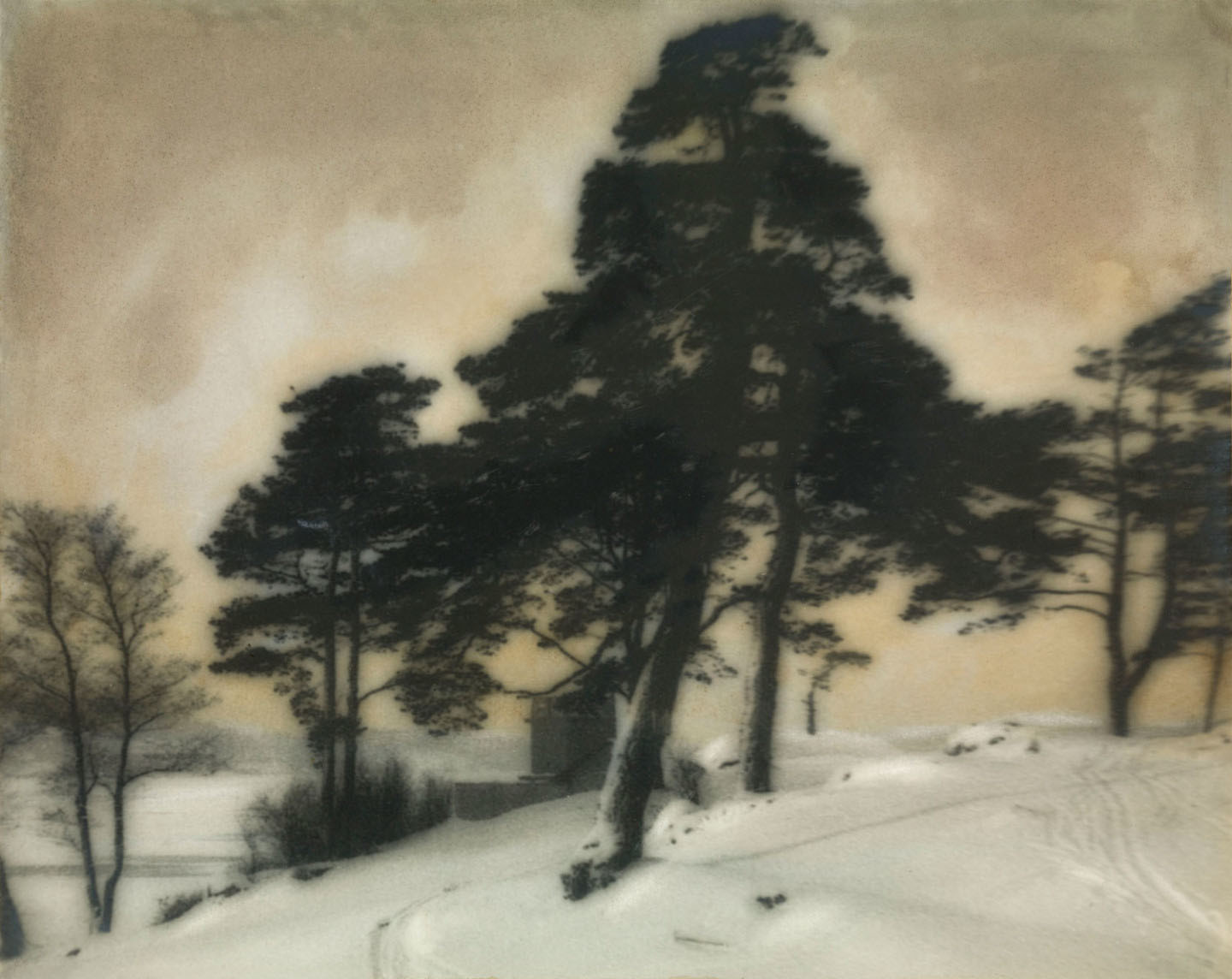
 

Gösta Hübinette (Swedish, 1897-1980) 'Japanskt' c. 1925


Gösta Hübinette (Swedish, 1897-1980)
Japanskt
c. 1925


Gösta Hübinette (Swedish, 1897-1980)

With their more independent position and experimental approach, amateur photographers were fundamental to the development of the pictorial movement in Sweden and internationally. Gösta Hübinette was interested in art from an early age, but on his family’s advice he studied business administration, and he worked at the carpet business, Myrstedts Matthörna, until he retired. He practiced several disciplines, including painting, but he was most successful as a photographer. Hübinette was part of the circle around Henry B. Goodwin, and in the 1920s he often took part in exhibitions and the important photo competitions.

Hübinette’s photographs are testament to his proficiency in painting, drawing and printmaking. With delicate works such as “Japanskt” (c. 1925) he is also one of the Swedish photographers for whom Japanese woodcuts served as inspiration.

Text from the Moderna Museet website
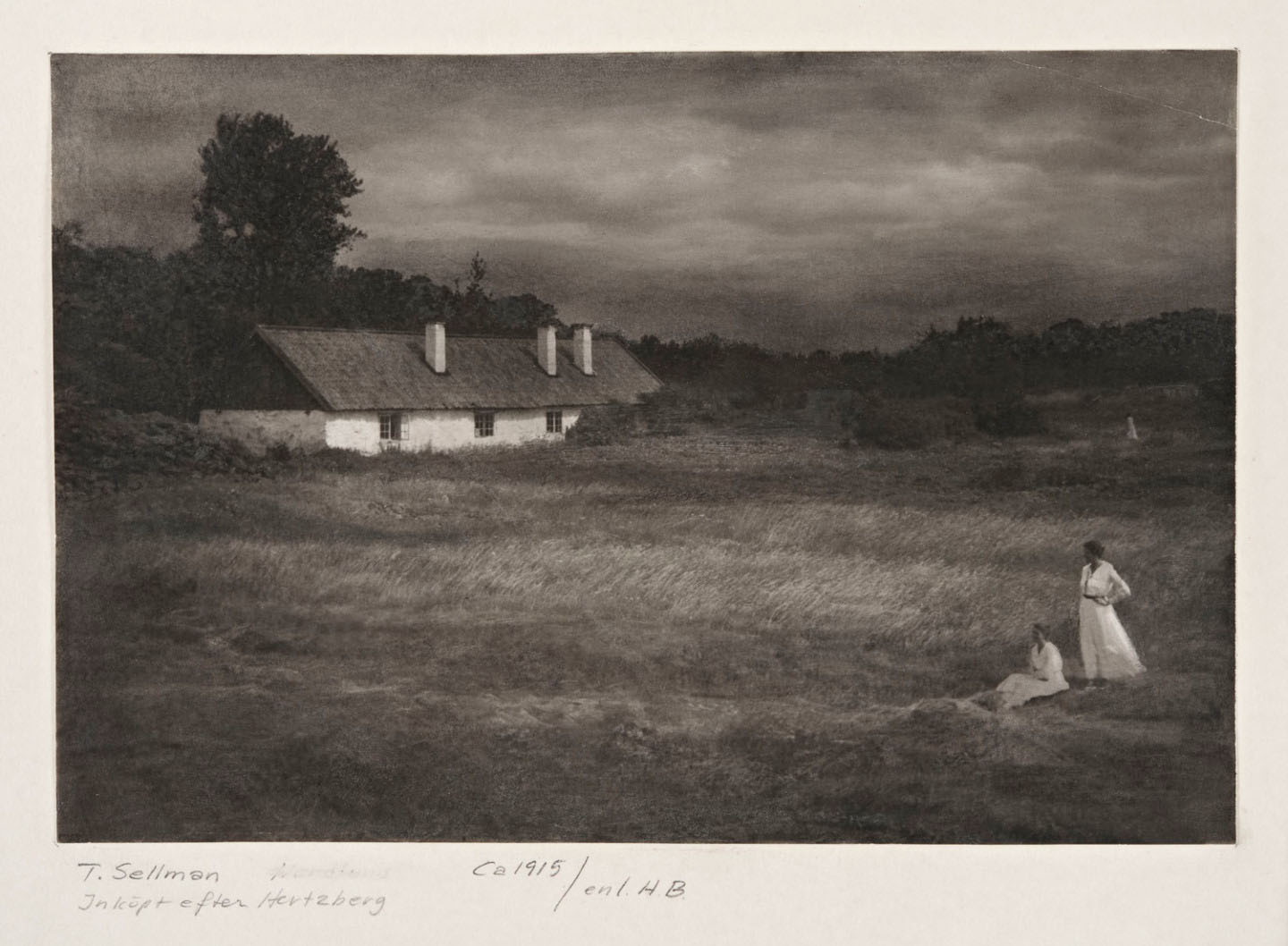
 

Ture Sellman (Swedish, 1888-1969) 'No title' c. 1915


Ture Sellman (Swedish, 1888-1969)
No title
c. 1915


Ture Sellman (Swedish, 1888-1969)

As an architect, Ture Sellman had his own approach to photography. He was well acquainted with the compositional and technical aspects and was therefore an important figure who also gave lectures. He later became an astute critic. Sellman was among the most vociferous advocates of photography as an artistic medium. His early Bromoil prints are some of the most graphic examples of Swedish Pictorialism.

After having experimented with different artisan processes, Sellman did a complete U-turn in 1920 and became a supporter of the straight photography expression, but his interest in tonality and composition are still visible in his soft-focus photographs from the 1920s.

Sellman designed some seventy buildings, and many of his photographs are testament to his eye for architecture.

Text from the Moderna Museet website


Nicola Perscheid (German, 1864-1930) 'No title' c. 1920


Nicola Perscheid (German, 1864-1930)
No title
c. 1920


Nicola Perscheid (German, 1864-1930)

Nicola Perscheid was one of the international figures that came to have a major influence on Pictorialism in Sweden. In the autumn of 1913, he arrived in Stockholm in order to conduct what we would today call a workshop. It was enormously popular. His fame had reached Sweden partly via his former pupil, Henry B. Goodwin.

Perscheid was against retouching, which meant he spend a great deal of time on preparations. Among his portraits are many full-length and half-length photographs of distinguished men and nameless women. Especially his expansive, pared down photographs of women with their soft lines and ornamental jewellery and flowers evoke the pictorial language of symbolism, but also older painting practices.

The Perscheid lens was launched in 1920. This soft-focus lens became especially popular in Europe and Japan.

Text from the Moderna Museet website


Uno Falkengren (Swedish, 1889-1964) 'Nöd'. Arranged dance group with Anna Behle in the middle, Stockholm 1917


Uno Falkengren (Swedish, 1889-1964)
Nöd. Arranged dance group with Anna Behle in the middle, Stockholm
1917
Sepia platinum type mounted on paper
23.7 x 24.2cm


Uno Falkengren (Swedish, 1889-1964)

Uno Falkengren belonged to the inner circle around Henry B. Goodwin. Goodwin was also instrumental in allowing Falkengren to study under the distinguished German photographer Nicola Perscheid in Berlin. It was a formative period during which Falkengren developed a minimalistic, elegant style. Among his works are a number of interesting portraits of famous dancers in expressive scenes and groups.

In 1916, he was appointed head of the Nordiska Kompaniet studio. He then worked at his own studio for a few years until he moved to Berlin in 1924. Only a year later, he returned to Stockholm and gave up photography completely. On account of his homosexuality, Falkengren lived an itinerant, partly secret, life. There are elements of queer culture within Pictorialism, as practitioners were often attracted to alternative settings or artists’ communities.

Text from the Moderna Museet website


Anna Behle (Swedish, 1876-1966)

Anna Charlotta Behle (Stockholm, August 9, 1876 – Gothenburg, October 2, 1966) was a Swedish dancer and dance teacher. Considered a pioneer of modern dance in Sweden, she first became interested in the art after watching Isadora Duncan perform. She was born to unwed parents, and was adopted, along with her brother August, by the Granbäck family, who ensured that she had a full education. After initial studies in singing with Eugène Crosti and Emile Wartel in Paris, she studied dance with Duncan and with Emile Jacques-Dalcroze; later she would open her own school in Stockholm.

Text from the Wikipedia website


John Hertzberg (Swedish, 1871-1935) 'No title' 1903


John Hertzberg (Swedish, 1871-1935)
No title
1903
Gum Bichromate Print


John Hertzberg (1871-1935)

John Hertzberg was a technically accomplished photographer. He developed colour photography in Sweden. He was educated in Vienna and was later offered to teach at the Royal Institute of Technology where he was later senior lecturer in photography. He was thereby a key figure in photographic circles.

When Nils Strindberg’s rolls of film were discovered on Kvitøya in the Svalbard archipelago thirty years after S. A. Andrée’s failed balloon Arctic Expedition in 1897, Hertzberg was given the prestigious task of developing the exposed films. He was also editor of the journal “Nordisk Tidskrift för Fotografi” for many years and chairman of Fotografiska Föreningen.

He experimented with different techniques and groups of motifs in a style typical of the time. These include pictures of Stockholm from the water as well as compositions of clouds and shadows.

Text from the Moderna Museet website


Eugène Jansson (Swedish, 1862-1915) 'Hornsgatan nattetid' (Hornsgatan at night) 1902


Eugène Jansson (Swedish, 1862-1915)
Hornsgatan nattetid (Hornsgatan at night)
1902
Oil on canvas
152cm (59.8 in) x 182cm (71.6 in)
National Museum (Stockholm)


Eugène Jansson (Swedish, 1862-1915)

Eugène Jansson became a member of the Konstnärsförbundet association of artists in 1886. Inspired by periods spent in France, they painted plein air, impressionist landscapes. Jansson was influenced by these movements from early on. However, he soon progressed to depicting moods rather than the concrete objects he observed.

Many know him from his blue, early evening panoramas of south Stockholm, where he moved in the mid-1890s. In “Hornsgatan nattetid” (1902), everything seems to merge into a blue vision where houses, gas lights and sky form a synthesis.

When Eugène Jansson embarked on a new phase a few years into the 20th century, his motifs were athletic, sun-lit, bathing men. Many found these paintings offensive. Eugène Jansson was a homosexual man at a time when sexual activity between men was against the law.

Text from the Moderna Museet website


Gustaf Fjæstad (Swedish, 1868-1948) 'Vinterafton vid en älv' (Winter evening by a river) 1907


Gustaf Fjæstad (Swedish, 1868-1948)
Vinterafton vid en älv (Winter evening by a river)
1907
Oil on canvas
150cm (59 in) x 185cm (72.8 in)
Nationalmuseum (Stockholm)


Gustaf Fjæstad (Swedish, 1868-1948)

After having attended art school in Stockholm, Gustaf Fjæstad settled by Lake Racken in Värmland where he founded an artists’ colony. The collective had no common programme, but they supported each other and exhibited their work together. There was also an idea of not distinguishing art from craft.

Fjæstad was not only a painter, he also designed furniture and textiles. “Vinterafton vid en älv” (Winter Evening at the River Bank, 1907) is testament to Fjæstad’s interest in Japanese woodcuts. The painting communicates a strong sense of nature and existential intensity. The surface is accentuated by fields of colour and a Jugend-inspired linear pattern. The motif is a seemingly random section of the river. The trees are cropped at the top of the canvas but touch the water where the eddies evoke the growth rings of the wood.

Text from the Moderna Museet website


Henry B. Goodwin (Swedish born Germany, 1878-1931) 'Lady Barclay' 1921


Henry B. Goodwin (Swedish born Germany, 1878-1931)
Lady Barclay
1921


Lady Sarita Enriqueta Barclay (British, 1891-1985)

The portraits that Henry B. Goodwin took of Lady Barclay between 1920 and 1922 show a fashion-conscious society woman. Sarita Barclay moved to Stockholm just after the end of the First World War with her husband, Sir Colville Barclay, and their three children. Her husband was Minister to Sweden, a high-ranking British diplomat.

During the five years that Lady Barclay lived in Stockholm she hosted various events, including a dinner in conjunction with an exhibition of French art at the Liljevalchs art gallery at the initiative of Prince Eugen in 1923. Sarita was the daughter of the British sculptor Herbert Ward.

After the death of her first husband, she married Robert Vansittart, a diplomat who spoke out against Nazism before and during the Second World War.

Text from the Moderna Museet website


Moderna Museet, Stockholm

Moderna Museet is ten minutes away from Kungsträdgården, and twenty minutes from T-Centralen or Gamla Stan. Walk past Grand Hotel and Nationalmuseum on Blasieholmen, opposite the Royal Palace. After crossing the bridge to Skeppsholmen, continue up the hill. The entrance to Moderna Museet and Arkitekturmuseet is on the left-hand side.

Opening hours:
Tuesday – Sunday 11 – 18
Monday closed

Moderna Museet website

LIKE ART BLART ON FACEBOOK

Back to top

Exhibition: ‘Barbara Hepworth: Art & Life’ at the Hepworth Wakefield, Wakefield, West Yorkshire

Exhibition dates: 21st May 2021 – 27th February, 2022

 Curator: Eleanor Clayton


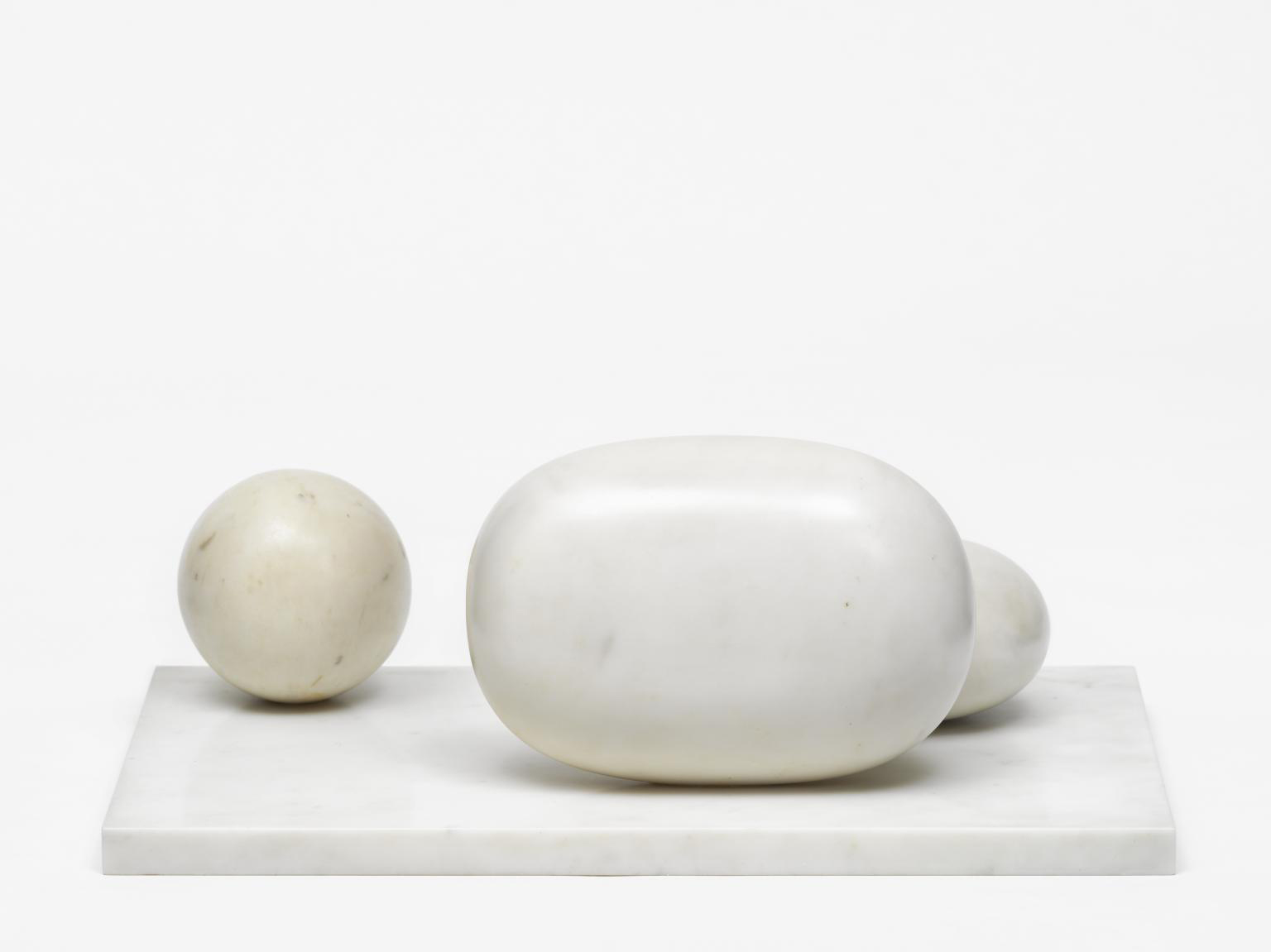
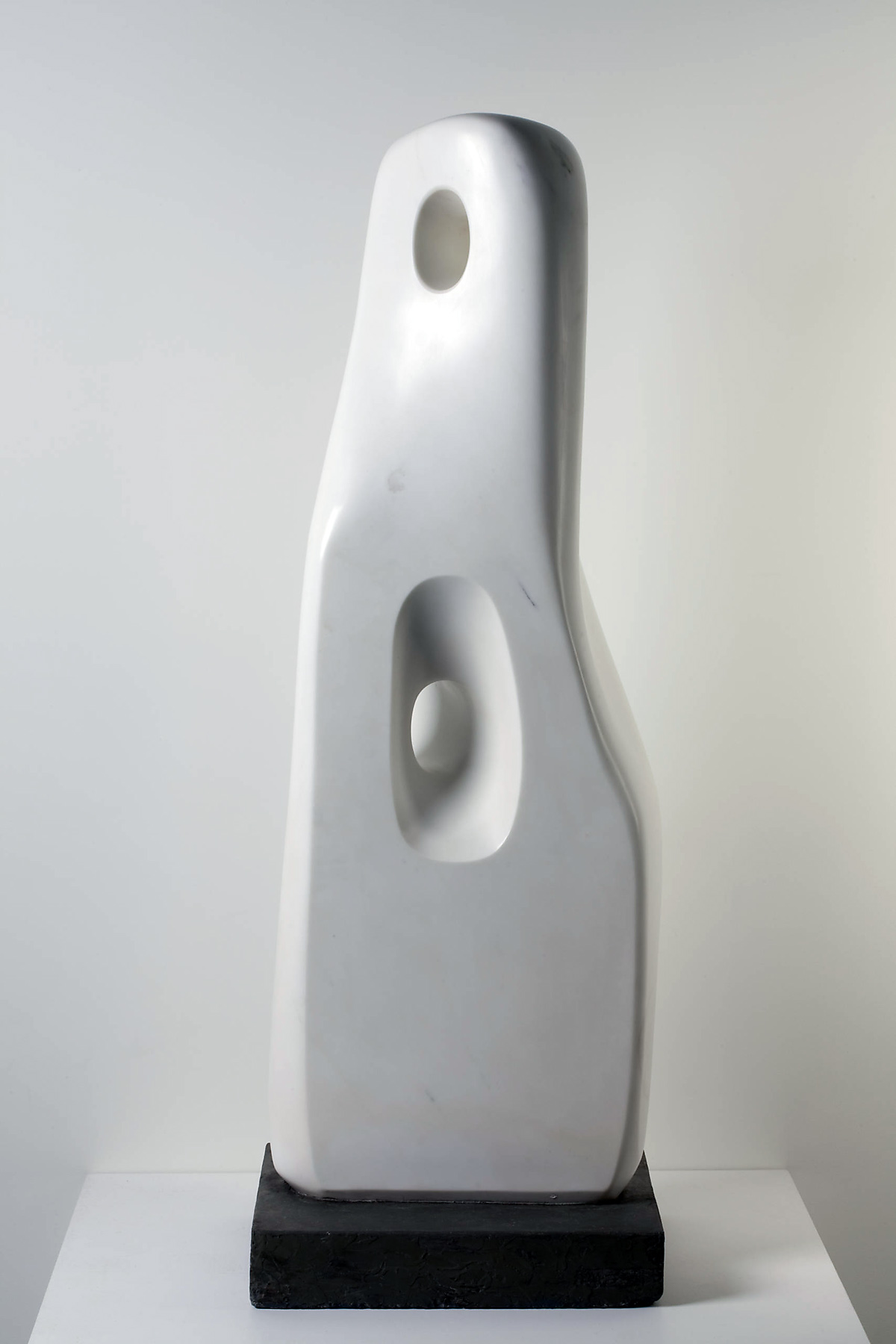
Barbara Hepworth (English, 1903-1975) 'Pierced Hemisphere' 1937 from the exhibition 'Barbara Hepworth: Art & Life' at the Hepworth Wakefield, Wakefield, West Yorkshire, May 2021 - Feb 2022


Barbara Hepworth (English, 1903-1975)
Pierced Hemisphere
1937
White marble
The Hepworth Wakefield (Wakefield Permanent Art Collection)
Barbara Hepworth © Bowness
Photo: Norman Taylor


As a bit of a break from photography, something very special this weekend especially for me. I adore this artist’s work.

Solid / voids
space / forms
still / movements
pierced / circles
memory / landscapes
music / curves
Spirit / leaps!


Dr Marcus Bunyan


Many thankx to the Hepworth Wakefield for allowing me to publish the photographs in the posting. Please click on the photographs for a larger version of the image.


“The relationship between humans and landscape played a key role in Hepworth’s creative development. In 1949, she settled down in St Ives, Cornwall, where she stayed until her death. The harmony of the sea, earth and rocks in this remote part of England had a significant impact on her.”


“Barbara Hepworth is one of the most important artists of the 20th century, with a unique artistic vision that demands to be looked at in-depth. This exhibition will shine a light on Hepworth’s wide-ranging interests and how they infused her art practice. Deeply spiritual and passionately engaged with political, social and technological debates in the 20th century, Hepworth was obsessed with how the physical encounter with sculpture could impact the viewer and alter their perception of the world.”


Eleanor Clayton, Curator


“Hole turned out to be spelt with a W as well as an H. Holes were not gaps, they were connections. Hepworth made the hole into a connection between different expressions of form, and she made space into his own form.”


Jeannette Winterson


“I rarely draw what I see –
I draw what I feel in my body”


Barbara Hepworth


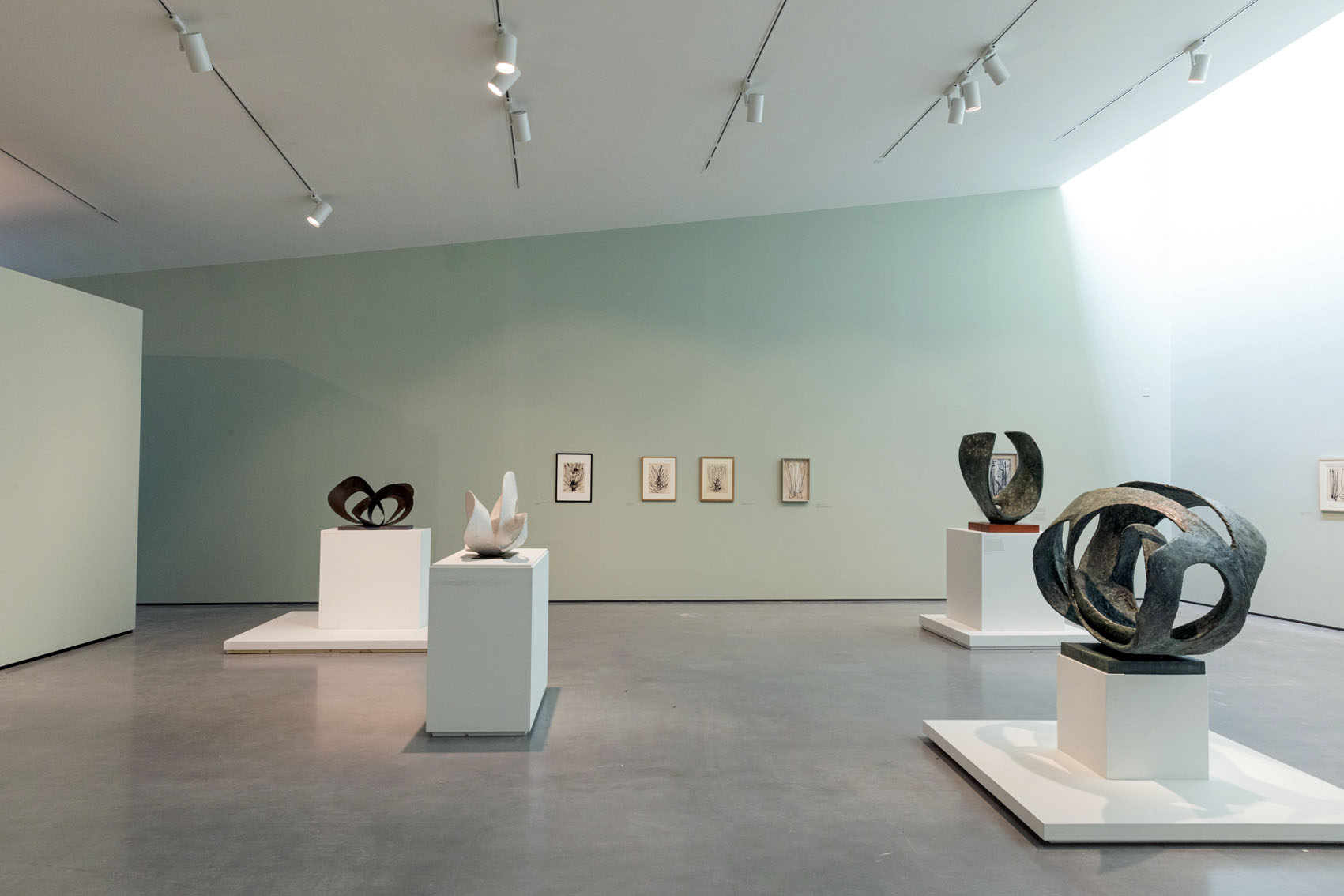
Installation image of 'Barbara Hepworth: Art & Life' at the Hepworth Wakefield

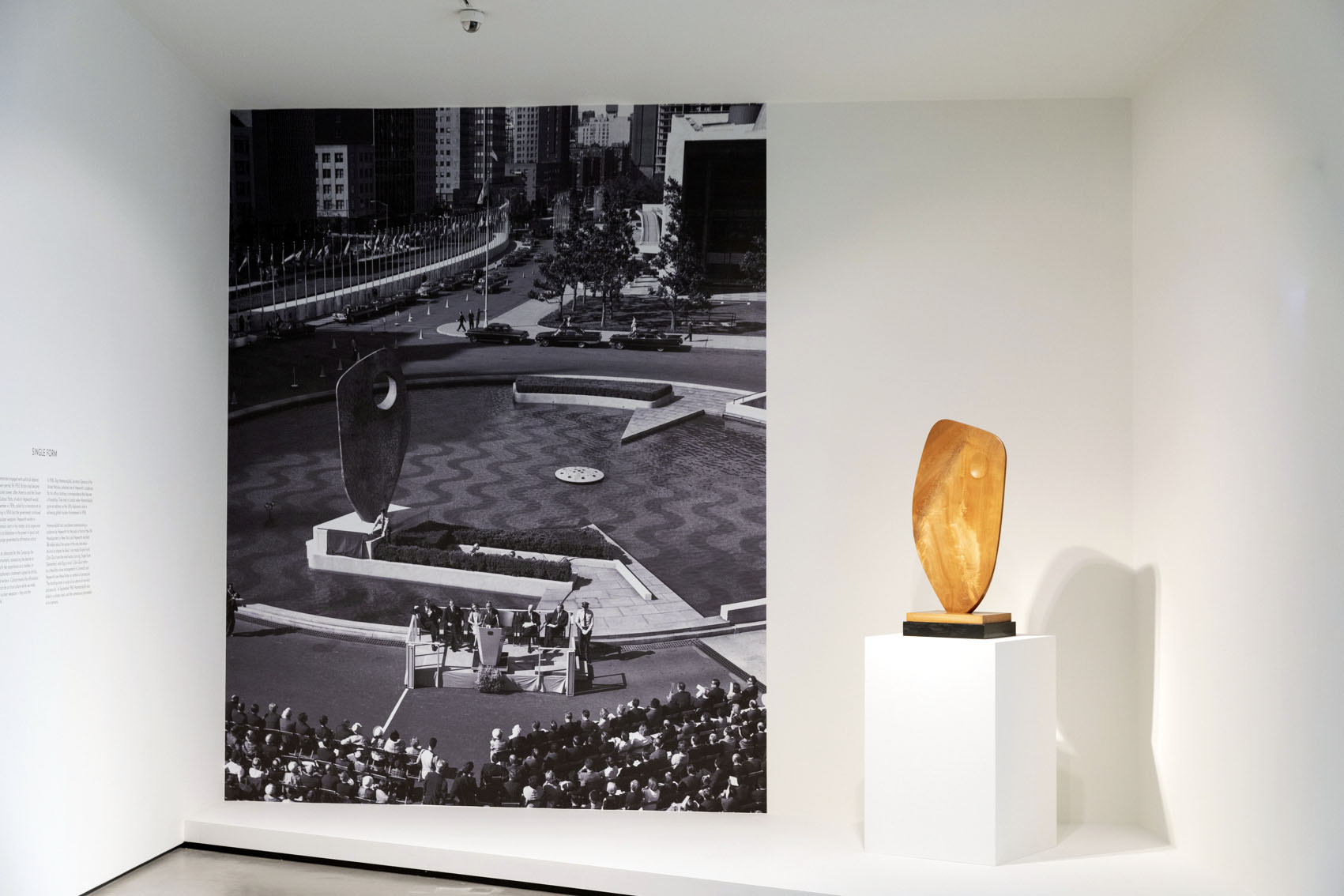
Installation image of 'Barbara Hepworth: Art & Life' at the Hepworth Wakefield showing in the bottom image at right Single Form (September) (BH 312) in figured walnut, and a photograph at left of Single Form (1964) displayed near the pool in front of the United Nations Secretariat Building


Installation images of Barbara Hepworth: Art & Life at the Hepworth Wakefield showing in the bottom image at right Single Form (September) (BH 312) in figured walnut, and a photograph at left of Single Form (1964) displayed near the pool in front of the United Nations Secretariat Building.
Photos: Nick Singleton


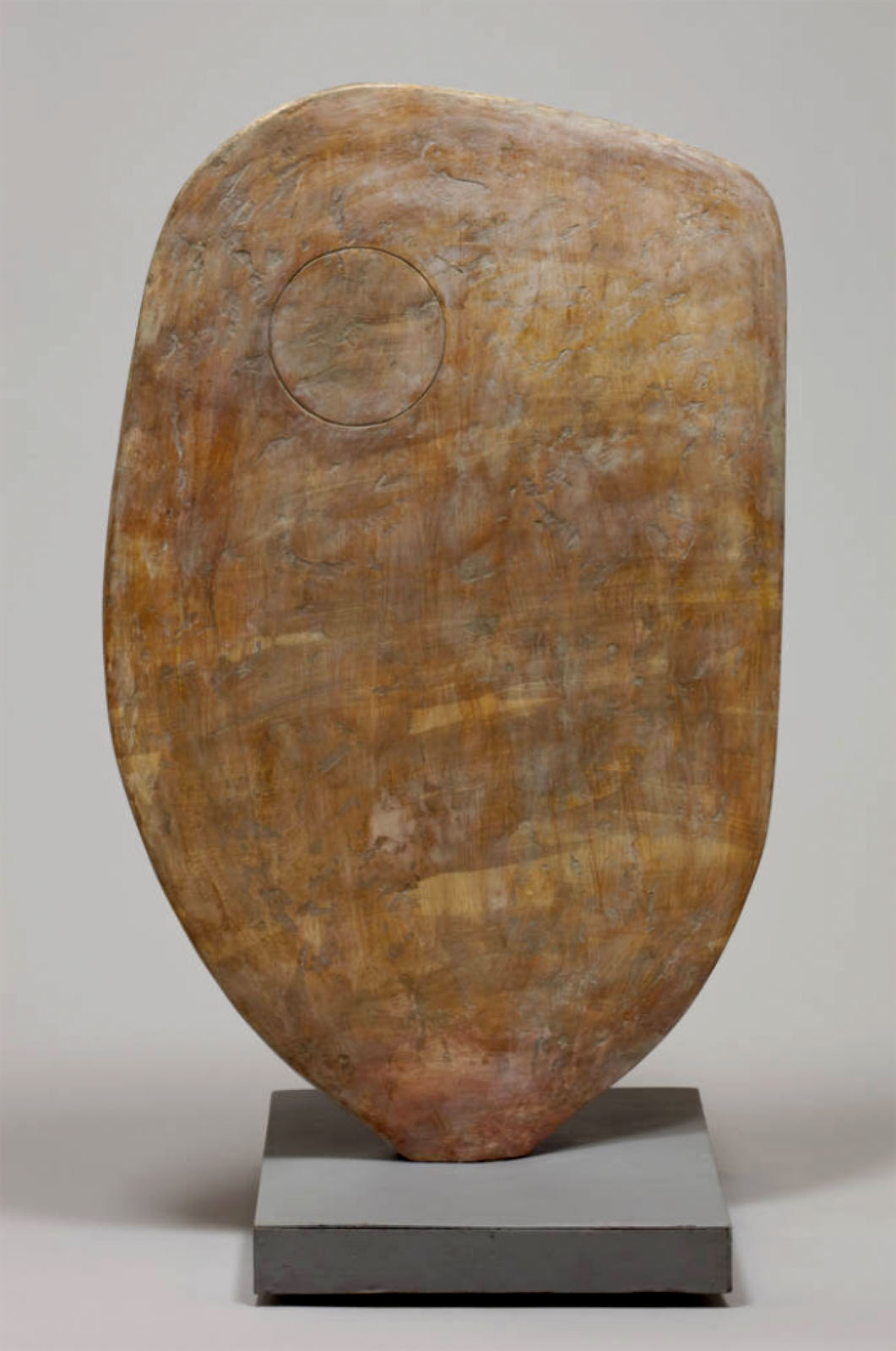
Barbara Hepworth (English, 1903-1975) 'Single Form (Chun Quoit)' 1961 from the exhibition 'Barbara Hepworth: Art & Life' at the Hepworth Wakefield, Wakefield, West Yorkshire, May 2021 - Feb 2022


Barbara Hepworth (English, 1903-1975)
Single Form (Chun Quoit)
1961
Plaster, painted brown
© Bowness, Hepworth Estate
Photo: Mark Heathcote


Barbara Hepworth working on the armature of 'Single Form' in the Palais de Danse, St Ives 1961


Barbara Hepworth working on the armature of Single Form in the Palais de Danse, St Ives
1961
© Bowness
Photo: Studio St Ives


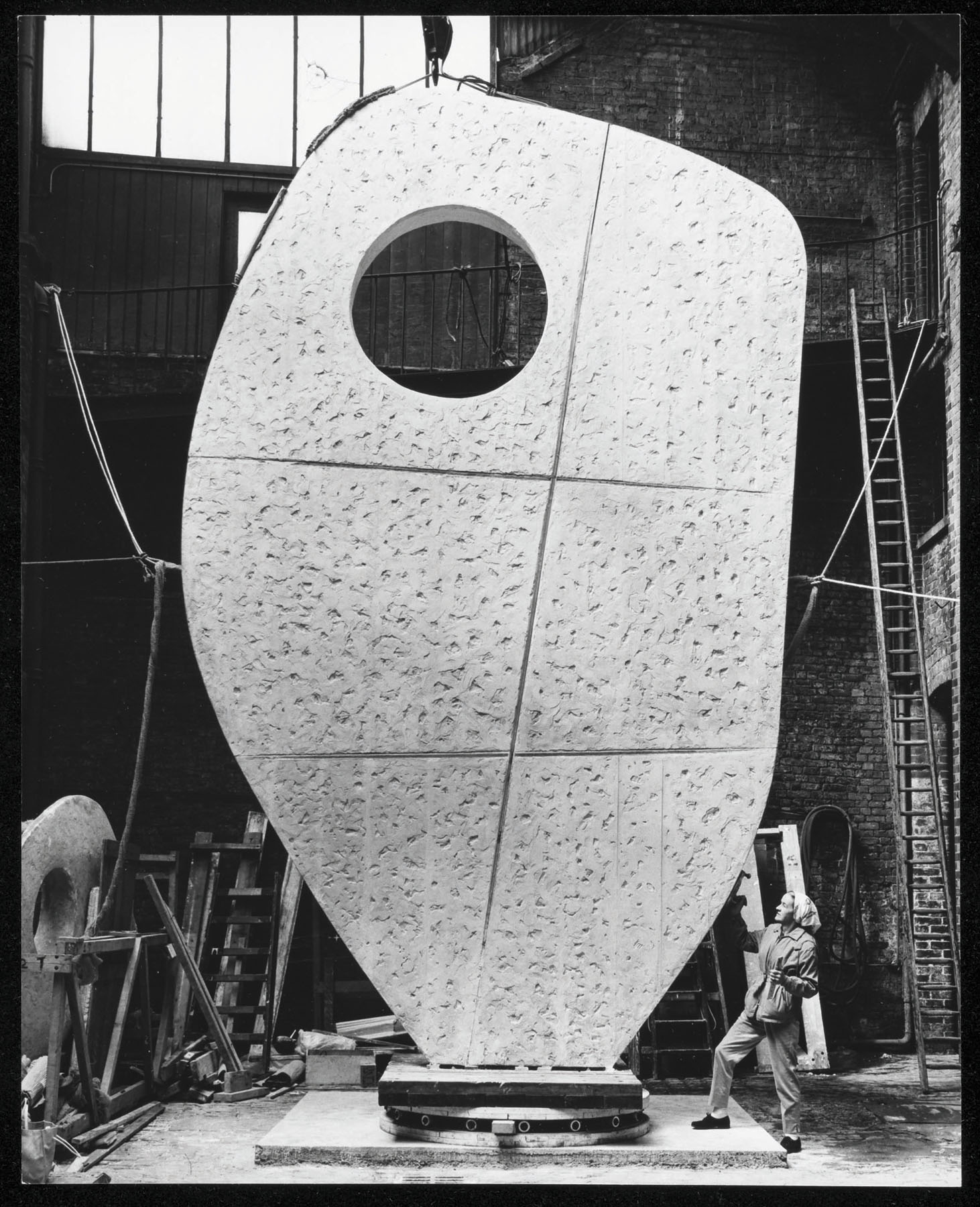
Barbara Hepworth with the plaster prototype for the United Nations 'Single Form' at the Morris Singer foundry, London May 1963


Barbara Hepworth with the plaster prototype for the United Nations Single Form at the Morris Singer foundry, London
May 1963
Photo: Morgan-Wells
Barbara Hepworth © Bowness


'Barbara Hepworth: Art & Life' poster


Barbara Hepworth: Art & Life poster


Installation image of 'Barbara Hepworth: Art & Life' at the Hepworth Wakefield

Installation image of 'Barbara Hepworth: Art & Life' at the Hepworth Wakefield

Installation image of 'Barbara Hepworth: Art & Life' at the Hepworth Wakefield

Installation image of 'Barbara Hepworth: Art & Life' at the Hepworth Wakefield


Installation images of Barbara Hepworth: Art & Life at the Hepworth Wakefield.
Photos: Nick Singleton


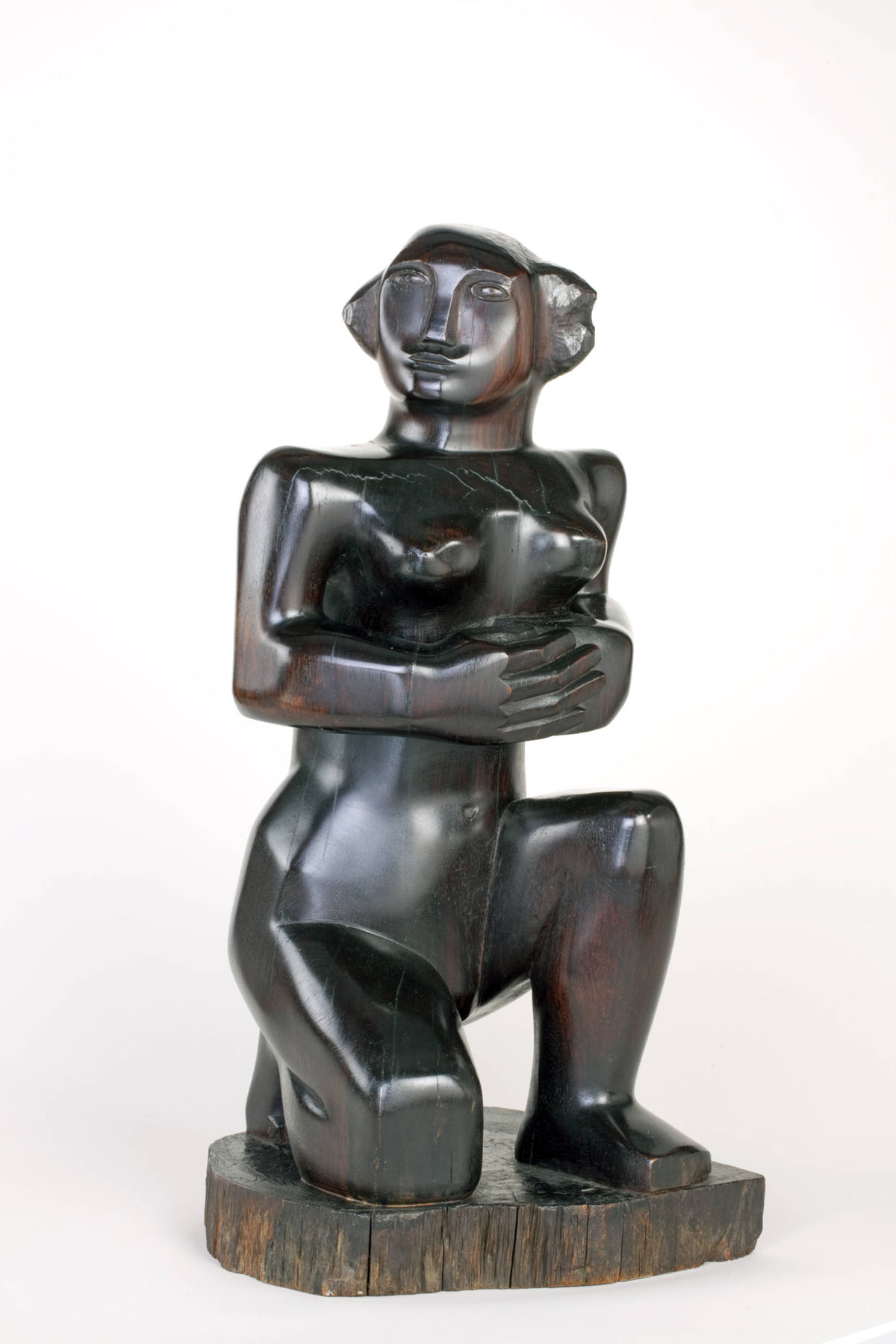
Barbara Hepworth (English, 1903-1975) 'Kneeling Figure' 1932


Barbara Hepworth (English, 1903-1975)
Kneeling Figure
1932
Rosewood
Purchased with aid from the Wakefield Permanent Art Fund (Friends of Wakefield Art Galleries and Museums), V&A Purchase Grant Fund and Wakefield Girls’ High School, 1944
© Bowness, Hepworth Estate
Photo: Jerry Hardman-Jones


Installation image of 'Barbara Hepworth: Art & Life' at the Hepworth Wakefield

Installation image of 'Barbara Hepworth: Art & Life' at the Hepworth Wakefield

Installation image of 'Barbara Hepworth: Art & Life' at the Hepworth Wakefield showing in the image at centre, 'Spring' (1966)


Installation images of Barbara Hepworth: Art & Life at the Hepworth Wakefield showing in the bottom image at centre, Spring (1966)
Photos: Nick Singleton


Barbara Hepworth (English, 1903-1975) 'Spring' 1966


Barbara Hepworth (English, 1903-1975)
Spring
1966
© Bowness, Hepworth Estate
Photo: Jerry Hardman


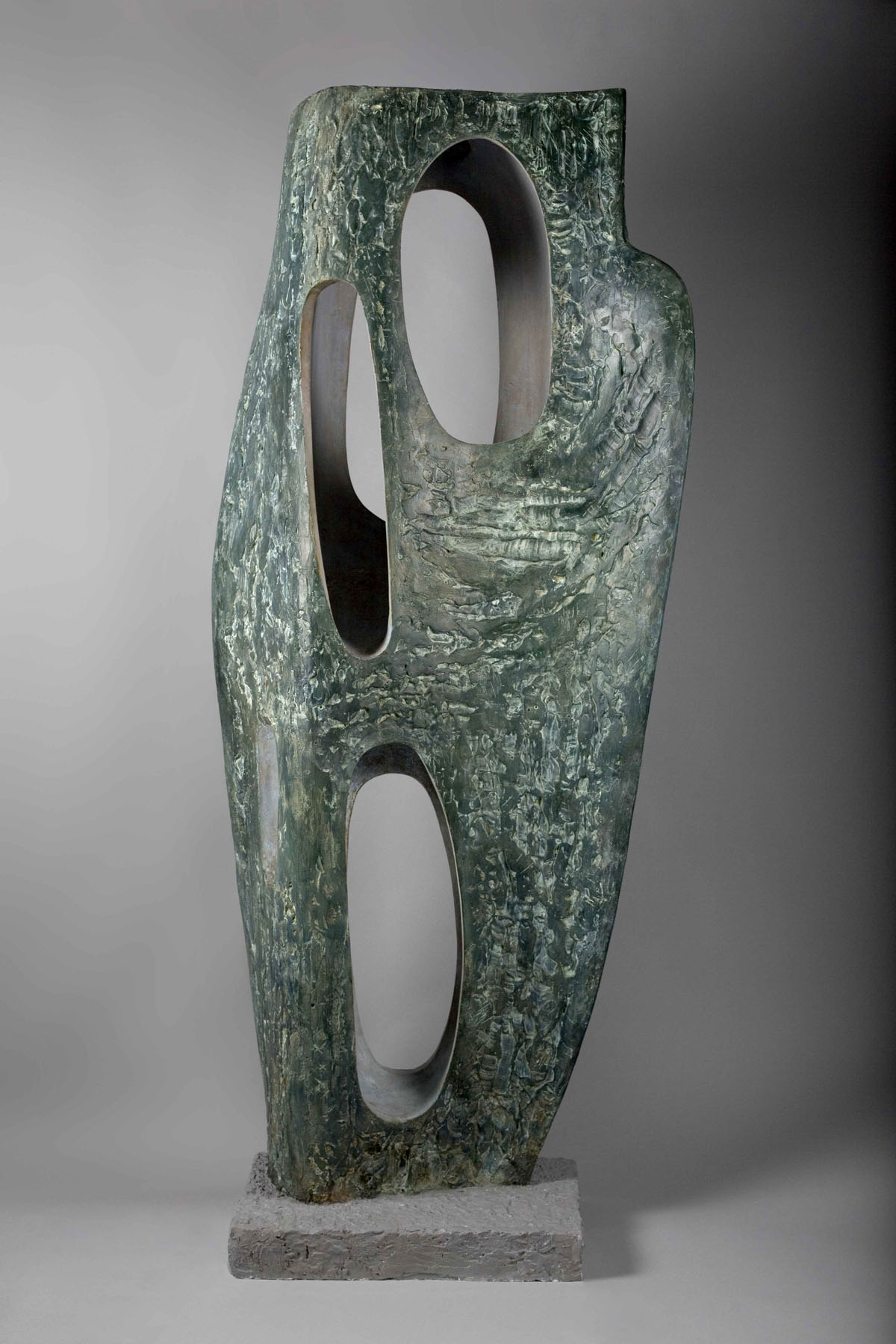
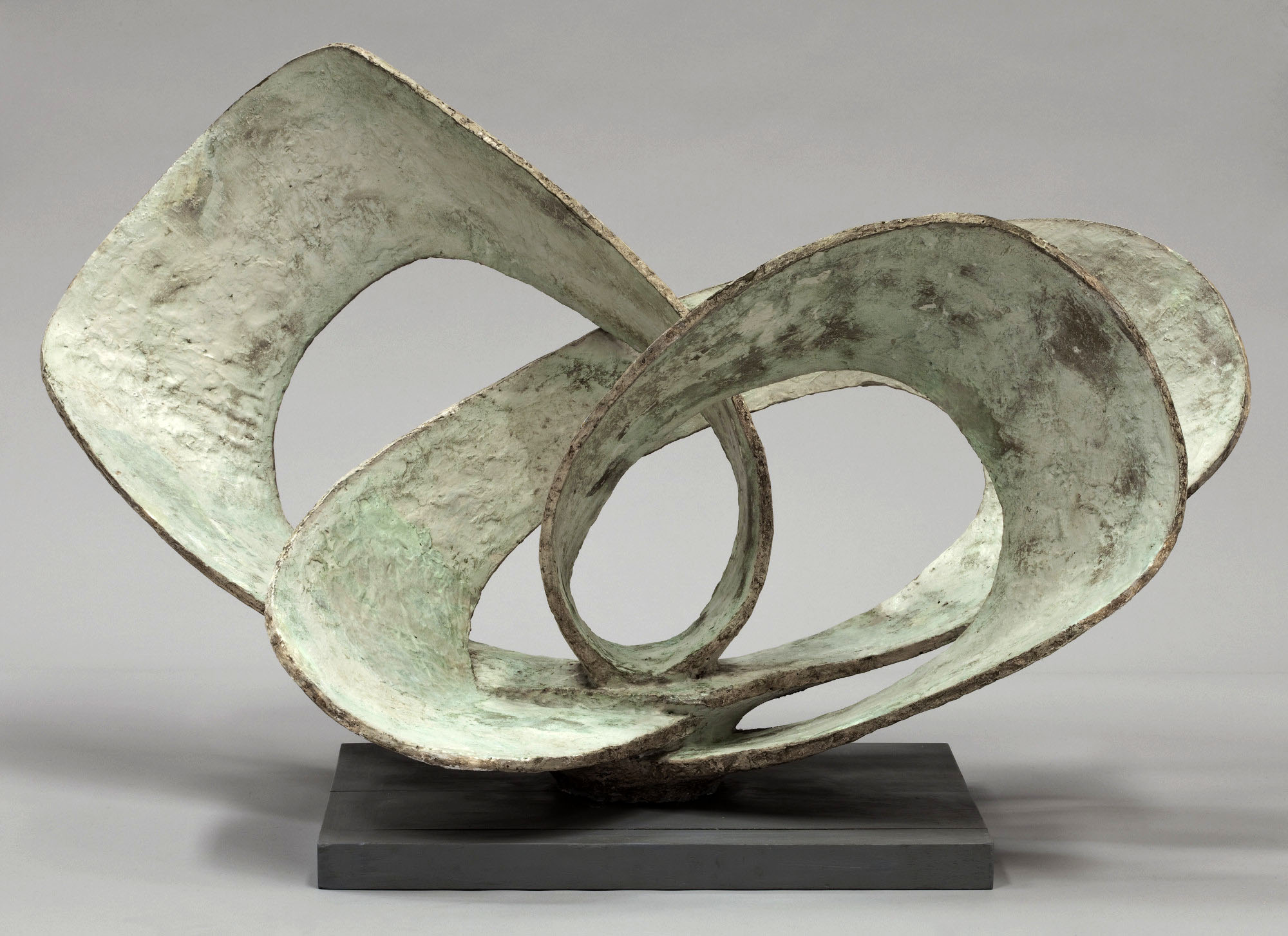
Installation image of 'Barbara Hepworth: Art & Life' at the Hepworth Wakefield showing at second left 'Winged Figure' (1961-62), and second right 'Rock Form (Porthcurno)' (1964)


Installation images of Barbara Hepworth: Art & Life at the Hepworth Wakefield showing at second left Winged Figure (1961-62 below), and second right Rock Form (Porthcurno) (1964, below)


Barbara Hepworth (English, 1903-1975) 'Winged Figure' 1961-1962


Barbara Hepworth (English, 1903-1975)
Winged Figure
1961-1962
© Bowness, Hepworth Estate
Photo: Jonty Wilde


Barbara Hepworth (English, 1903-1975) 'Rock Form (Porthcurno)' 1964


Barbara Hepworth (English, 1903-1975)
Rock Form (Porthcurno)
1964
Plaster, painted green on the outside and blue/grey on the interior
© Bowness, Hepworth Estate
Photo: Jonty Wilde


To mark The Hepworth Wakefield‘s 10th anniversary, the Yorkshire-based gallery opened the most expansive exhibition of Barbara Hepworth’s work in the UK since the artist’s death in 1975.

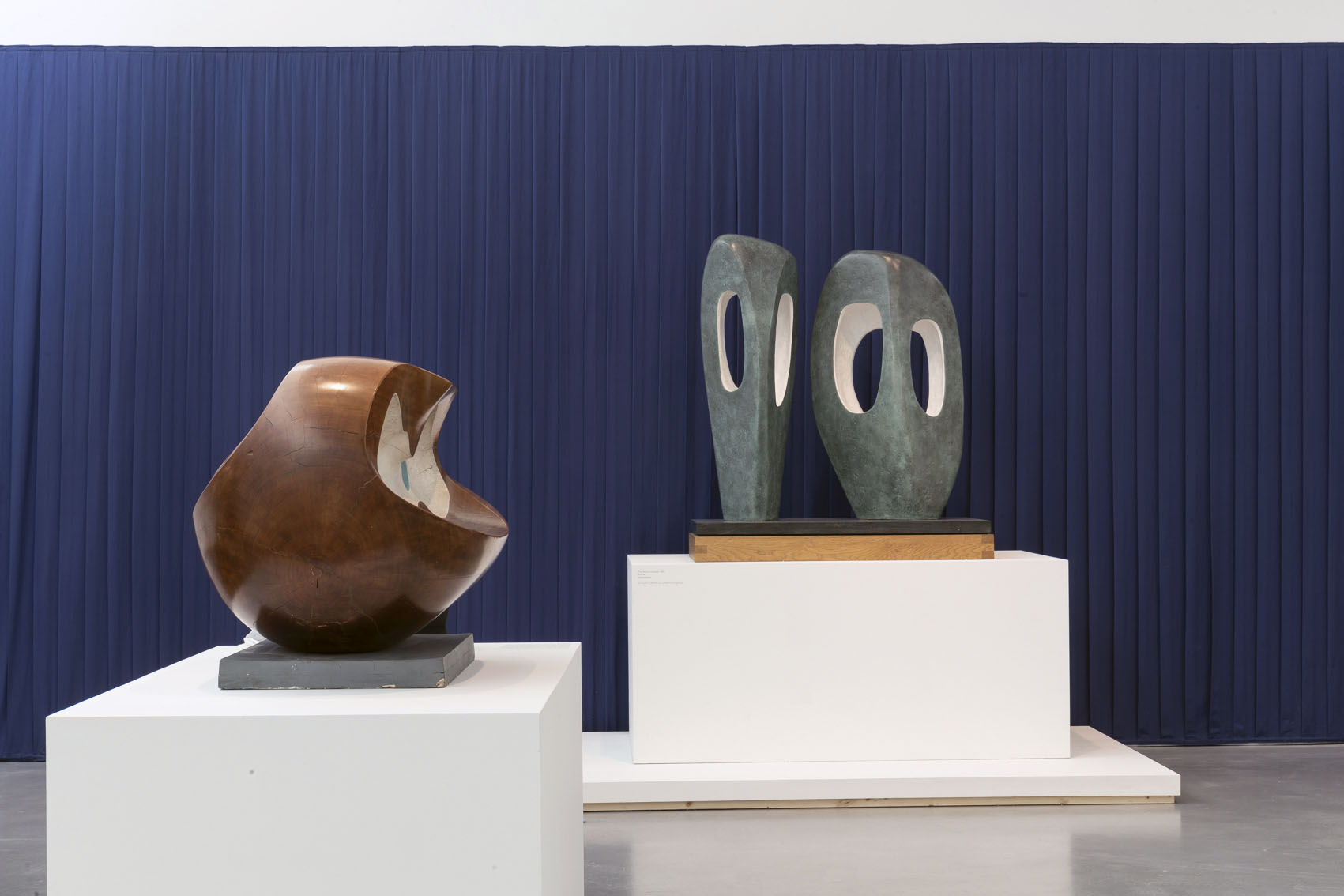
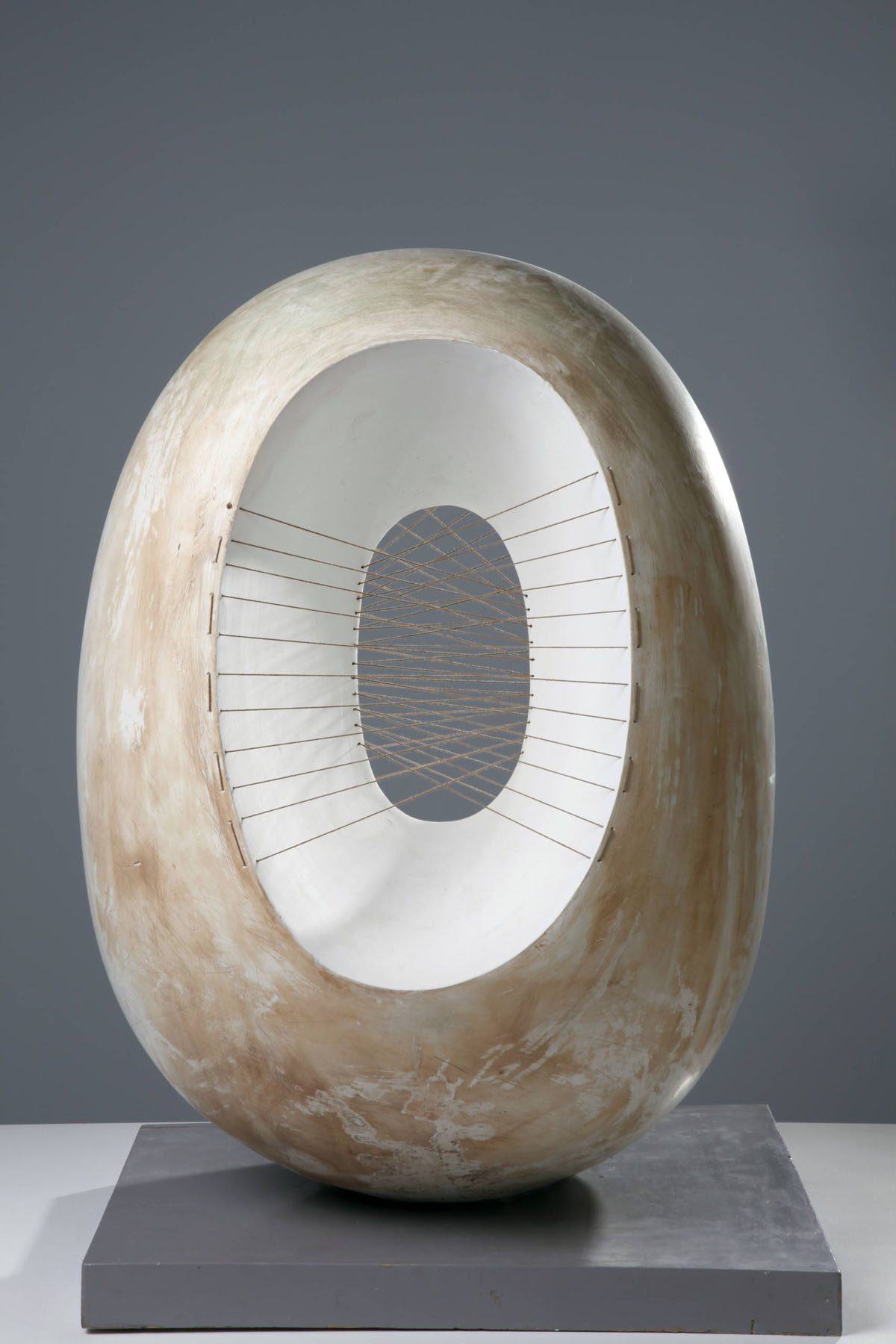
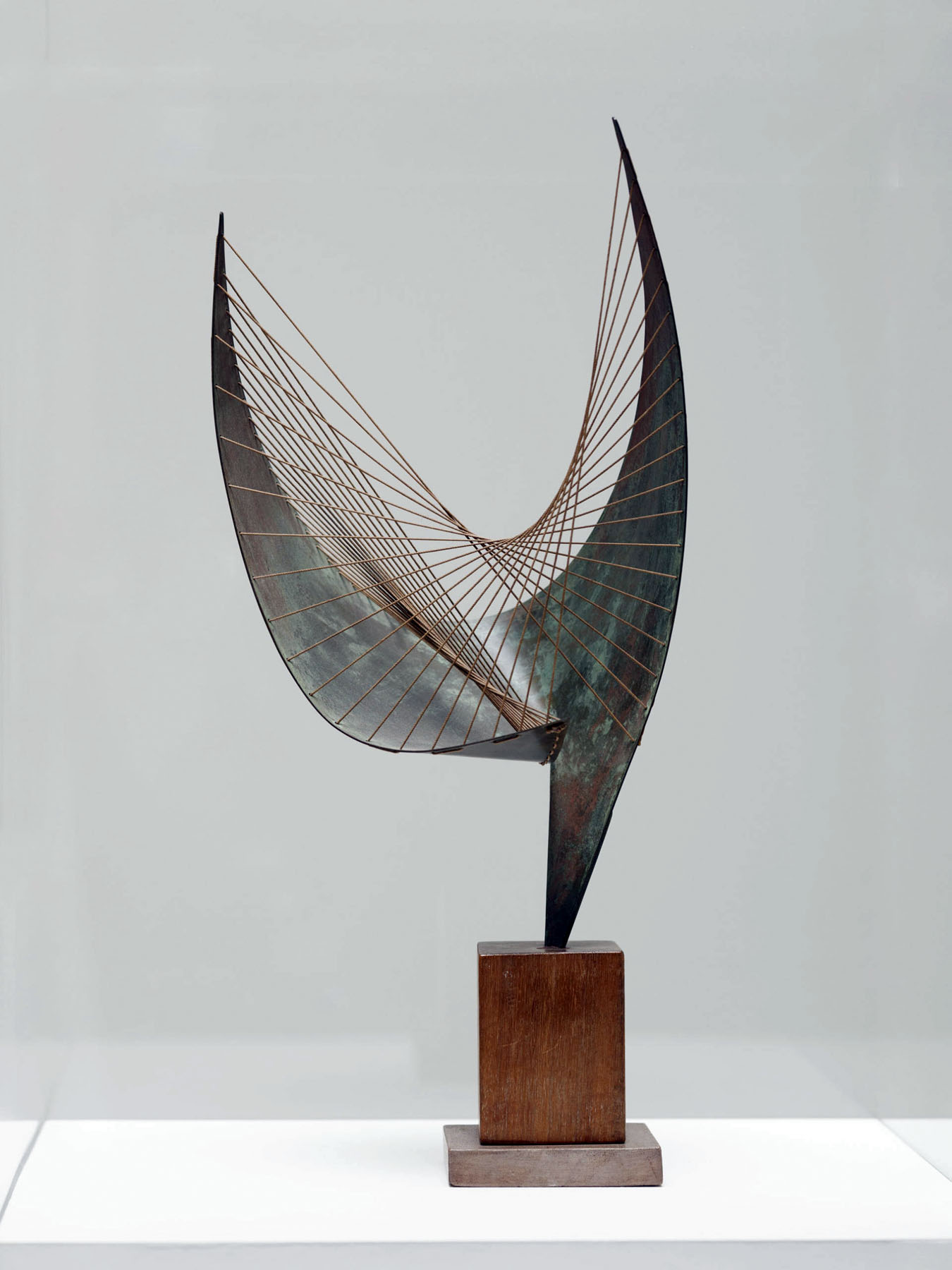
The exhibition presents an in-depth view of the Wakefield-born artist’s life, interests, work and legacy. It displays some of Hepworth’s most celebrated sculptures including the modern abstract carving that launched her career in the 1920s and 1930s, her iconic strung sculptures of the 1940s and 1950s, and large scale bronze and carved sculptures from later in her career. Key loans from national public collections are being shown alongside works from private collections that have not been on public display since the 1970s, as well as rarely seen drawings, paintings and fabric designs. It reveals how Hepworth’s wide sphere of interests comprising music, dance, science, space exploration, politics and religion, as well as events in her personal life, influenced her work.

Contemporary artists Tacita Dean and Veronica Ryan have been commissioned to create new works which are being presented within the exhibition. Each artist explores themes and ideas that interested Hepworth and that continue to resonate with their own work. Artworks by Bridget Riley from the 1960s are also being presented in dialogue with Hepworth’s work from the same period.

To coincide with the exhibition, The Hepworth Wakefield’s curator Eleanor Clayton has written a major new biography on the artist, published by Thames & Hudson. Eleanor Clayton said: ‘Barbara Hepworth is one of the most important artists of the 20th century, with a unique artistic vision that demands to be looked at in depth. This exhibition will shine a light on Hepworth’s wide-ranging interests and how they infused her art practice. Deeply spiritual and passionately engaged with political, social and technological debates in the 20th century, Hepworth was obsessed with how the physical encounter with sculpture could impact the viewer and alter their perception of the world.’

Simon Wallis, Director of The Hepworth Wakefield, said: ‘Lockdown continues to be an ongoing challenge for us all, so I’m delighted we’ll be celebrating, post-lockdown, our 10th anniversary with an in-depth exploration of the art and life of Barbara Hepworth, Wakefield’s most famous daughter. With this major exhibition and new book, we’ll continue to build on the legacy and influence of a key pioneer of modern sculpture. Hepworth is a daily inspiration for us at the gallery and we look forward to sharing some of her greatest work with a wide new audience.’

The exhibition in detail

The exhibition opens with an introduction to Barbara Hepworth’s work, showing the three sculptural forms she returned to repeatedly throughout her career using a variety of different materials. A detailed look at Hepworth’s childhood in Yorkshire through archive material and photographs includes some of the artist’s earliest- known paintings, carvings and life drawings as she began to explore movement and the human form. A proponent of direct carving, Hepworth combined an acute sensitivity to the organic materials of wood and stone with the development of a radical new abstract language of form.

Hepworth’s determination to break free from accepted tradition was enhanced by travelling to Paris in 1932 where she visited the studios of many of the leading European avant-garde artists including Jean Arp, Constantin Brancusi and Pablo Picasso. A large section looks at Hepworth’s development of abstraction in the 1930s including Three Forms (1935) created shortly after she gave birth to triplets, an event she felt invigorated her work towards a bolder language of geometric form. One of the few examples in existence of Hepworth’s first coloured stringed sculptures in plaster, made during World War Two, is being shown alongside the many drawings she created during this period when sculptural materials were scarce. She described these drawings as ‘my sculptures born in the disguise of two dimensions.’

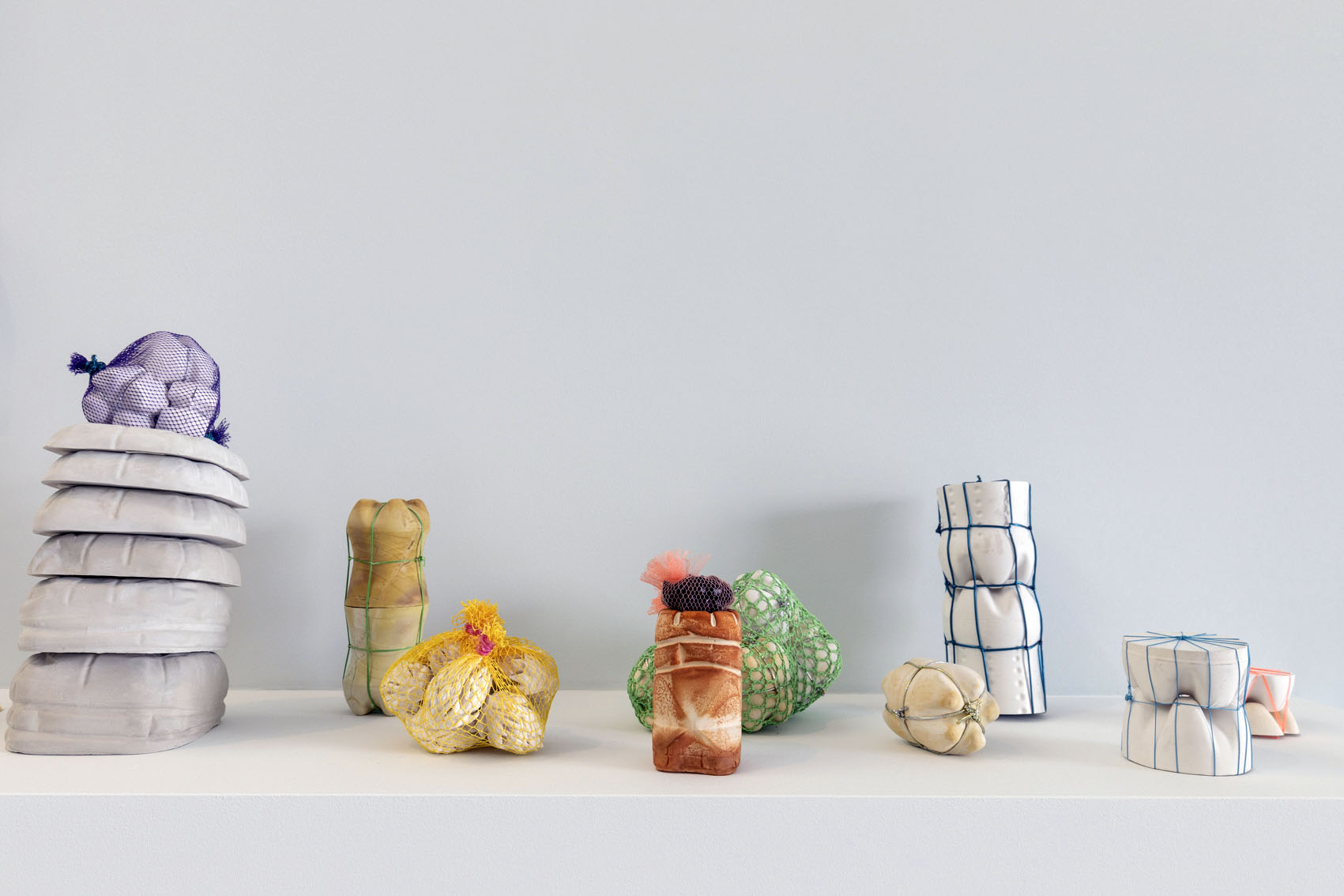
The exhibition reveals the artist’s creative process, drawing on new research from the recently established Hepworth Research Network (HRN), in collaboration with the Universities of York and Huddersfield, into the ways material factors shaped Hepworth’s sculptures and how they related to her broader conceptual and aesthetic concerns. This includes how starting bronze casting in the 1950s enabled Hepworth to create new forms and how, later in life, she experimented with new materials such as lead crystal and aluminium. On display is The Hepworth Wakefield’s unique collection of 44 surviving prototypes in plaster, aluminium and wood, many of which show the marks of Hepworth’s own hand and tools. These are being shown with a specially commissioned intervention by artist Veronica Ryan, the first artist to undertake a residency in Hepworth’s old studio in St Ives, where the prototypes once stood.

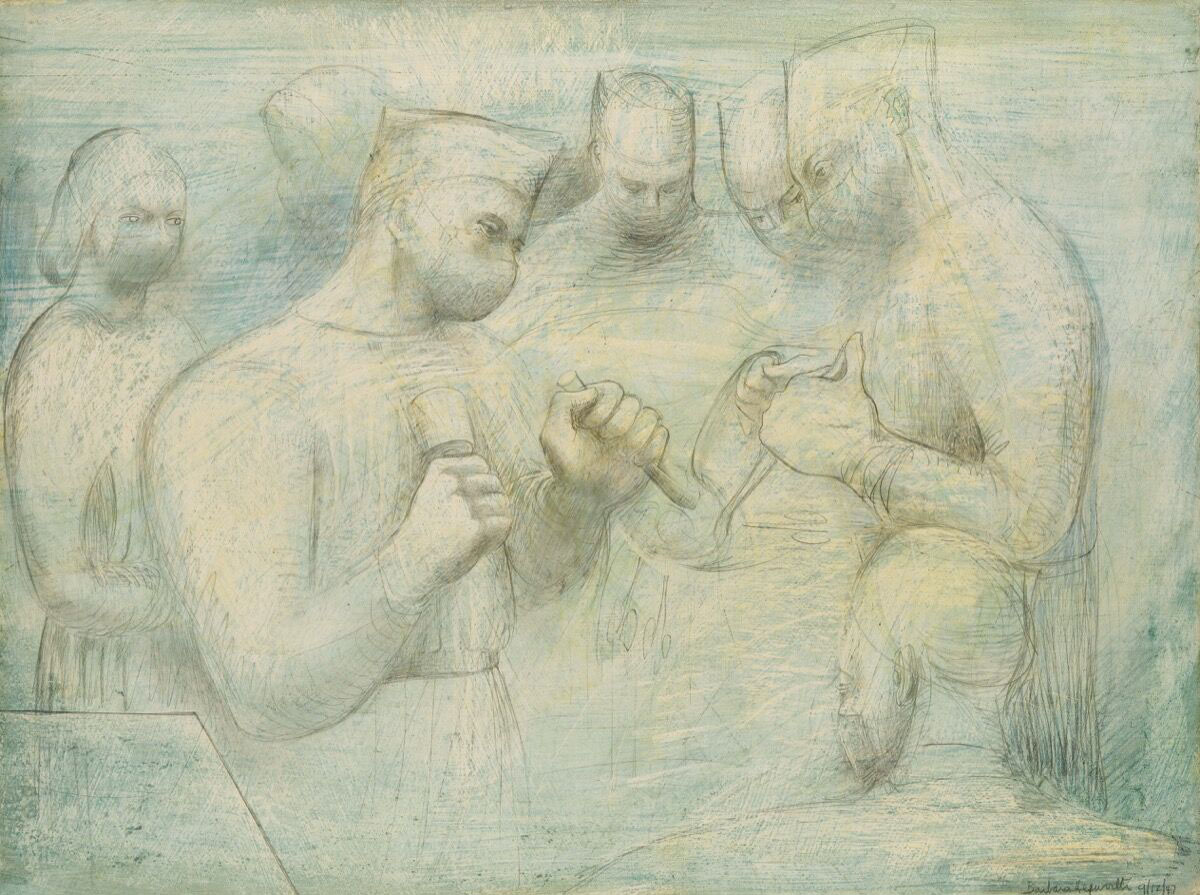
Hepworth’s broader interests – such as music, dance, theatre, politics, Greek mythology, and science – influenced her sculptures throughout her life. In the immediate post-war period she became fascinated with the interaction between figures – both in groups in her studio and observed around her, and also in a series of ‘Hospital drawings’, capturing surgeons at work in the early days of the National Health Service. These paintings and drawings capture her belief in the importance of unifying mental and physical existence – the ‘proper coordination between hand and spirit in our daily life’, to create a productive and positive society.

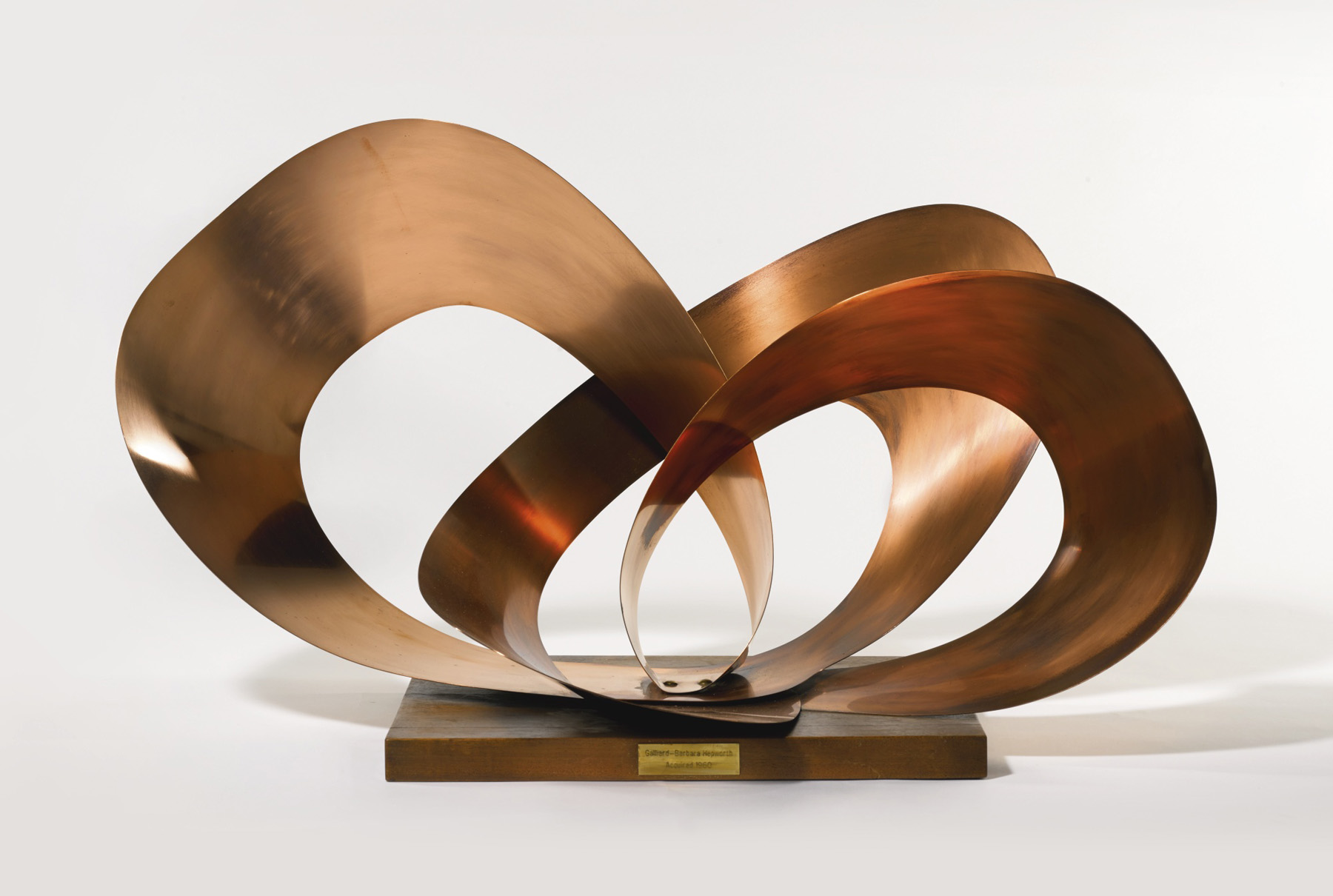
In 1951 Hepworth met composer Priaulx Rainier, and subsequently made several works inspired by the parallels between musical form and abstract sculpture. This coincided with her first theatrical design, for the 1951 production of Electra at The Old Vic. Archive photographs are being displayed together with Apollo (1951), a metal sculpture that formed part of the stage set, along with costume and set designs for the 1955 opera by Michael Tippett, A Midsummer Marriage, staged in 1955 at the Royal Opera House. This section of the exhibition also explores Hepworth’s passion for dance, and how she captured movement with gestural paintings and sculptures such as Forms in Movement (Galliard) (1956) and Curved Form (Pavan) (1956).

During the 1960s, Hepworth was a key cultural figure. She staged major exhibitions, presented work in experimental ways, made large-scale sculptures and explored colour in the patination of bronzes or painted surfaces of her carving. She played an active role in both local and international politics, campaigned for nuclear disarmament and supported pacifist causes. Her political values were encapsulated in the monumental Single Form, commissioned for the United Nations in 1964, of which she declared, ‘The United Nations is our conscience. If it succeeds it is our success. If it fails it is our failure.’ Rare footage of Hepworth’s speaking at the unveiling of this work as been included in the exhibition.

A group of works have been brought together to reveal the influence of the decade of space exploration on Hepworth, from Disc with Strings (Moon) (1969), made the year Neil Armstrong landed on the moon, to Four Hemispheres, inspired by the Telstar satellite. Hepworth noted at the end of the decade, ‘Man’s discovery of flight has radically altered the shape of our sculpture, just as it has altered our thinking.’

The final section of the exhibition looks at Hepworth’s last years, featuring her experiments with new materials and techniques, which incorporate bold colours and luminescent surfaces, while consistently seeking to use abstract form to express universal human experiences.

Barbara Hepworth is one of the most important artists of the twentieth century, and her organic sculptures have come to exemplify three-dimensional modernist art. Published at a time of increasing interest in her work, this biography moves beyond the traditional narratives of modernism to provide comprehensive insight into Hepworth’s remarkable life, work, and legacy.

Press release from the Hepworth Wakefield website


'Barbara Hepworth growing up' c. 1919


Barbara Hepworth growing up
c. 1919
Courtesy Bowness


Barbara Hepworth (English, 1903-1975) 'Mother and Child' 1934


Barbara Hepworth (English, 1903-1975)
Mother and Child
1934
Pink Ancaster stone
Purchased by Wakefield Corporation in 1951
Barbara Hepworth © Bowness


Barbara Hepworth (English, 1903-1975) 'Three Forms' 1935


Barbara Hepworth (English, 1903-1975)
Three Forms
1935
Serravezza marble on marble base
210 × 532 × 343mm, 23 kg
Tate. Presented by Mr and Mrs J.R. Marcus Brumwell 1964
On loan to The Hepworth Wakefield
Barbara Hepworth © Bowness


In 1934 Barbara Hepworth’s abstraction based on the human figure gave way to an art of pure form. With such works as Three Forms she reduced her sculpture to the most simple shapes and eradicated almost all colour. She said later that she was ‘absorbed in the relationships in space, in size and texture and weight, as well as the tensions between forms’. While the three elements are slightly imperfect in shape, their sizes and the spaces between them are precisely proportional to each other. This reflects her concern with the craft of hand-carving and with harmonious arrangement of form.

Gallery label, September 2004

Text from the Tate website


Barbara Hepworth (English, 1903-1975) 'Reconstruction' 1947


Barbara Hepworth (English, 1903-1975)
Reconstruction
1947
© Bowness, Hepworth Estate / Arts Council Collection, Southbank Centre, London
Courtesy of the Hepworth Wakefield


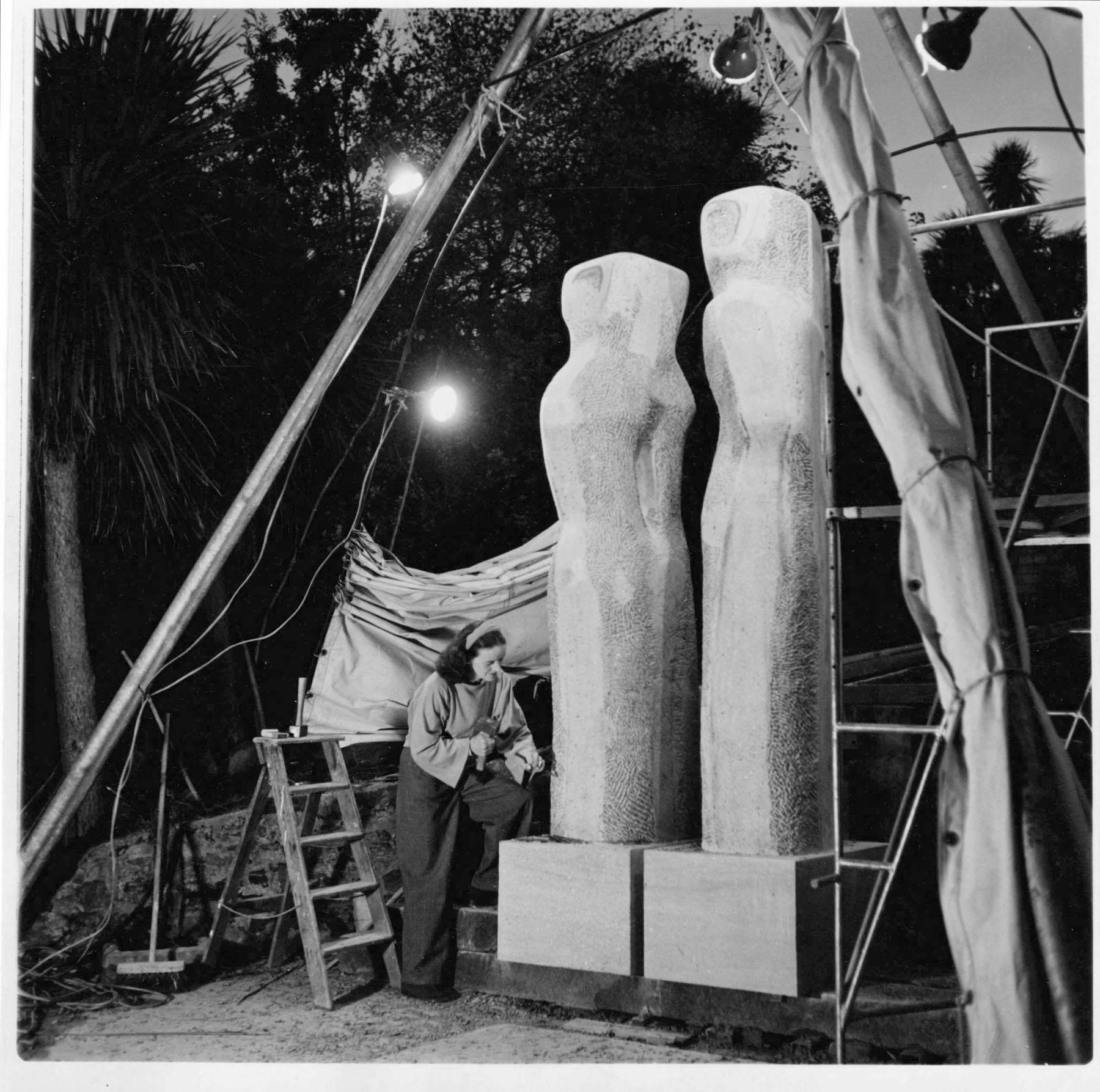
Barbara Hepworth at work on 'Contrapuntal Forms' by floodlight 25 October 1950


Barbara Hepworth at work on Contrapuntal Forms by floodlight
25 October 1950
Official Festival photograph
National Archives © Bowness


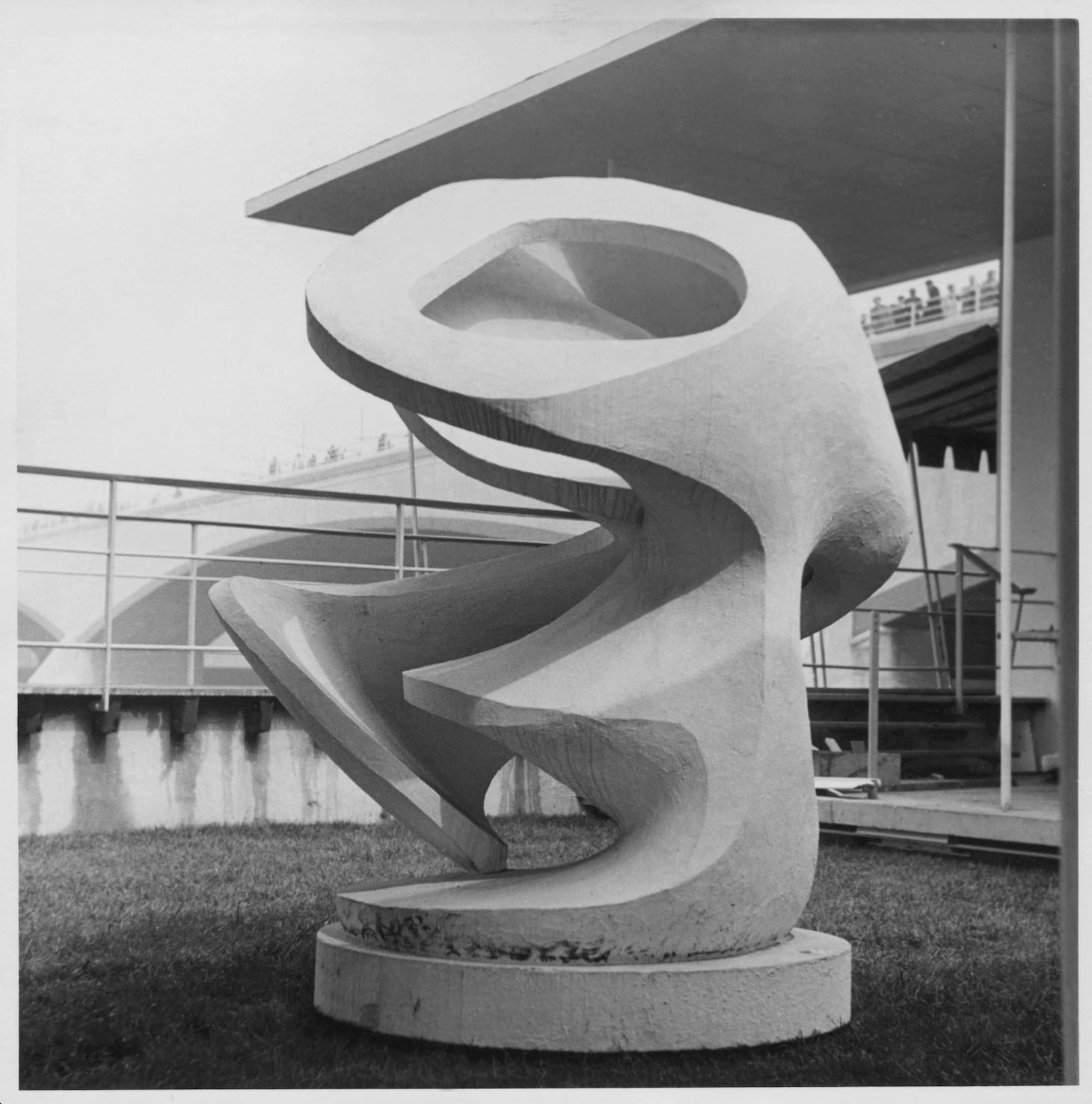
Barbara Hepworth. 'Turning Forms' at the Festival of Britain 1951


Barbara Hepworth – Turning Forms at the Festival of Britain
1951
© Bowness
Photo: Anthony Panting


A richly illustrated biography on the life and work of Barbara Hepworth, one of the twentieth century’s most inspiring artists and a pioneer of modernist sculpture.

Barbara Hepworth is one of the most important artists of the twentieth century, and her organic sculptures have come to exemplify three-dimensional modernist art. Published at a time of increasing interest in her work, this biography moves beyond the traditional narratives of modernism to provide comprehensive insight into Hepworth’s remarkable life, work, and legacy.

In her lifetime, Hepworth was reproached for single-mindedness, with critics and commentators framing her work and demeanour as “cool and restrained.” Moreover, most exhibitions of her work in the twentieth century focused on Hepworth’s modernist abstract sculpture of the 1930s and its relation to her male contemporaries, leaving vast swathes of work overlooked, such as her largest and most significant public commission, the sculpture outside the UN building in New York.

This fully illustrated biography reflects Hepworth’s multifaceted and interdisciplinary approach, shedding new light on her interests in music, dance, poetry, contemporary politics, science, and technology. Author Eleanor Clayton uncovers Hepworth’s engagement with these fields through friends and networks and examines how they show up in Hepworth’s artistic practice, and how the artist synthesised seemingly conflicting disciplines and ideas into one coherent and inspirational philosophy of art and life.


Installation view of Barbara Hepworth, 'Orpheus' 1956


Installation view of Barbara Hepworth, Orpheus
1956
Photographed at The Hepworth Wakefield, March 2020
Photo: Lewis Ronald


Barbara Hepworth (English, 1903-1975) 'Forms In Movement (Galliard)' 1956


Barbara Hepworth (English, 1903-1975)
Forms In Movement (Galliard)
1956
Copper
89cm


Barbara Hepworth (English, 1903-1975) 'Curved Forms (Pavan)' 1956


Barbara Hepworth (English, 1903-1975)
Curved Forms (Pavan)
1956
Impregnated plaster, painted, on an aluminium armature
52 x 80 x 48.5cm
Presented by the artist’s daughters, Rachel Kidd and Sarah Bowness, through the Trustees of the Barbara Hepworth Estate and the Art Fund
Barbara Hepworth © Bowness
Photo: Mark Heathcote


Barbara Hepworth (English, 1903-1975) 'Totem' 1960-1962


Barbara Hepworth (English, 1903-1975)
Totem
1960-1962
Wakefield Permanent Art Collection
Barbara Hepworth © Bowness
Photo: Jerry Hardman-Jones


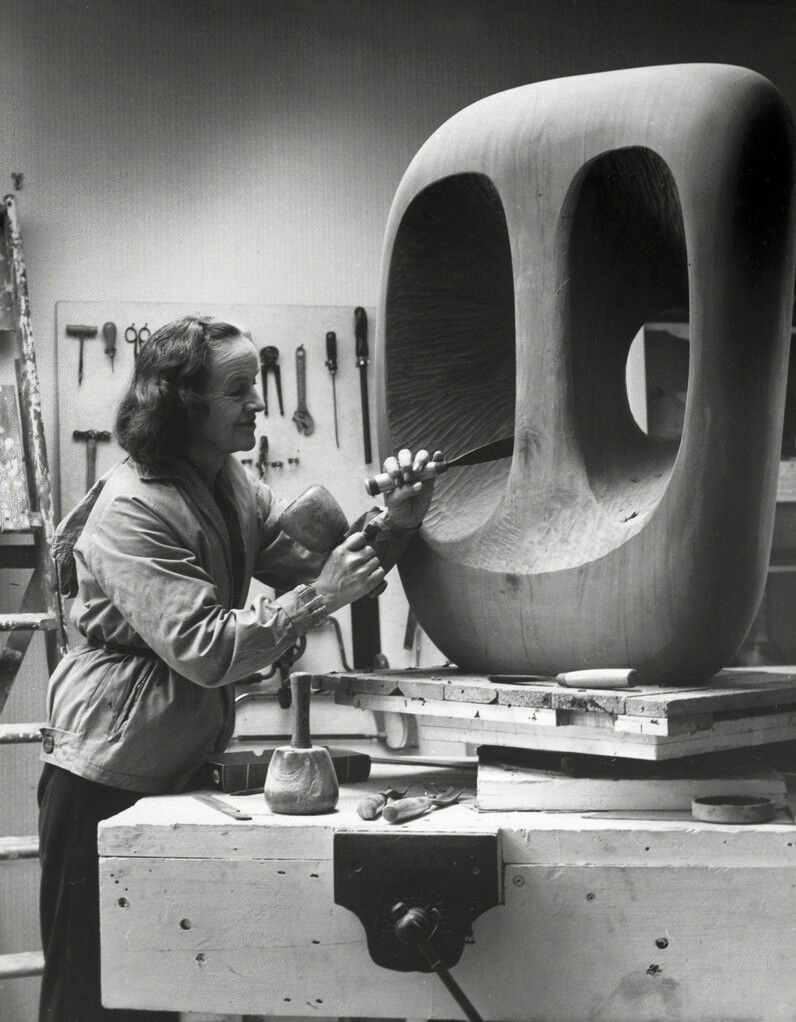
Val Wilmer. 'Barbara Hepworth in the Palais de la Danse studio, St Ives, at work on the wood carving 'Hollow Form with White Interior'' 1963


Val Wilmer
Barbara Hepworth in the Palais de la Danse studio, St Ives, at work on the wood carving ‘Hollow Form with White Interior’
1963
© Bowness, Hepworth Estate


Barbara Hepworth at work on the plaster for 'Oval Form (Trezion)' 1963


Barbara Hepworth at work on the plaster for Oval Form (Trezion)
1963
© Bowness
Photo: Val Wilmer Barbara Hepworth


Barbara Hepworth with the Gift plaster of 'Figure for Landscape' and a bronze cast of 'Figure (Archaean)' November 1964


Barbara Hepworth with the Gift plaster of Figure for Landscape and a bronze cast of Figure (Archaean)
November 1964
Barbara Hepworth © Bowness
Photo: Lucien Myers


Barbara Hepworth (English, 1903-1975) 'Genesis III' 1966


Barbara Hepworth (English, 1903-1975)
Genesis III
1966
Barbara Hepworth © Bowness
Photo: Jerry Hardman-Jones


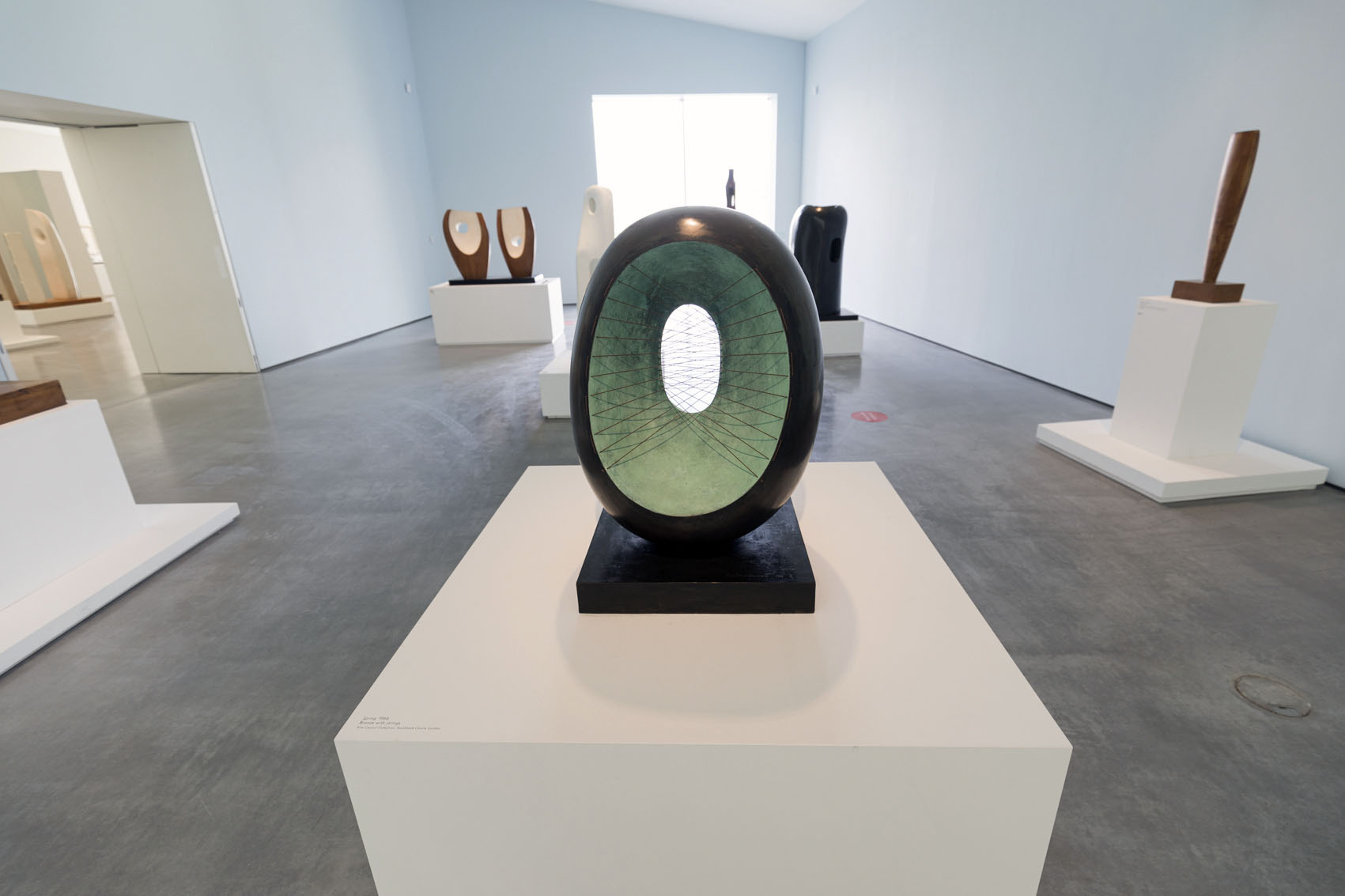
Barbara Hepworth (English, 1903-1975) 'Disc with Strings (Moon)' 1969


Barbara Hepworth (English, 1903-1975)
Disc with Strings (Moon)
1969


Fifteen years before Hepworth (1903-1975) made Disc with Strings (Moon), the author William Golding wrote these words:

“Somewhere over the darkened curve of the world the sun and moon were pulling; and the film of water on the earth planet was held, bulging slightly on one side while the solid core turned. The great wave of the tide moved further along the island and the water lifted.”


Though Golding was not writing about the British Isles, his words suggest the kind of large-scale, god-like perspective of earth which mid-century artists like himself and Hepworth were capable of. Disc with Strings (Moon) carries an undertow of planet-sized thinking, and the work is concerned not with reference to human life but, rather, with the fluid, open-ended life of the universe. …

When Disc with Strings (Moon) is viewed from the front, the two halves of the concave disc have subtly different colour values. Though the brushed aluminium surface is uniform all over the work, a viewer perceives two different values because the two halves of the sculpture reflect light differently. While the forward-facing half of the disc reflects the light directly into the viewer’s eye, the other canted half reflects light away and therefore appears comparatively darker. When viewed from the other side, the colour values of the two halves are reversed.

The introduction of string into the sculpture contributes further to this subtle interplay of visual effects. Speaking to the critic Herbert Read in 1952, Hepworth said that “[t]he strings were the tension I felt between myself and the sea, the wind or the hills.” In short, they were a metaphor for her deeply personal response to the elements of nature. In Disc with Strings (Moon), they also seem to register the rippling of waves, passing over the surface of the moon when it appears reflected in the sea.

Anonymous. “InSight No. XII,” on the Piano Nobile website May 13, 2020 [Online] Cited 12/07/2021.


Barbara Hepworth (English, 1903-1975) 'Four Hemispheres' 1970


Barbara Hepworth (English, 1903-1975)
Four Hemispheres
1970
Glass lead crystal


Barbara Hepworth (English, 1903-1975) 'Sun Setting, The Aegean Suite' 1971


Barbara Hepworth (English, 1903-1975)
Sun Setting, The Aegean Suite
1971
Lithograph on paper
The Hepworth Wakefield (Wakefield Permanent Art Collection)
Barbara Hepworth © Bowness


Barbara Hepworth (English, 1903-1975) 'Cone and Sphere' 1973


Barbara Hepworth (English, 1903-1975)
Cone and Sphere
1973
White marble
Hepworth Estate, on long loan to The Hepworth Wakefield (Wakefield Permanent Art Collection)
Barbara Hepworth © Bowness
Photo: Mark Heathcote


'Barbara Hepworth: Art & Life' catalogue cover


Barbara Hepworth: Art & Life catalogue cover


The Hepworth Wakefield
Gallery Walk, Wakefield
West Yorkshire, WF1 5AW
Phone: +44 (0)1924 247360

Opening hours:
Tuesday – Sunday 10am – 5pm

The Hepworth Wakefield website

LIKE ART BLART ON FACEBOOK

Back to top

Exhibition: ‘Reproductive: Health, Fertility, Agency’ at the Museum of Contemporary Photography, Columbia College Chicago

Exhibition dates: 19th January – 23rd May, 2021

Artists: Laia Abril, Candice Breitz, Elinor Carucci, Krista Franklin, Doreen Garner Candy Guinea, Joanne Leonard, Carmen Winant


Laia Abril (Spanish, b. 1986) 'Poison, Pesticide & Desperation / A deadly solution for many women' Nd from the exhibition 'Reproductive: Health, Fertility, Agency' at the Museum of Contemporary Photography, Columbia College Chicago, Jan - May, 2021


Laia Abril (Spanish, b. 1986)
Poison, Pesticide & Desperation
A deadly solution for many women

Nd
Courtesy of the artist
© Laia Abril


Toxic religion

This is a harrowing exhibition. In reality, in the 21st century, it shouldn’t be, for the problems that it investigates – the psychological, physical, and emotional realities people encounter in the years leading up to, during, and after fertility; the lack of open acknowledgement of pleasure, the lack of access to abortion, and trauma – should no longer exist. Women’s bodies are not vehicles for reproduction as seen through a patriarchal, capitalist lens.

Basically it comes down to two things: men and religion.

Men dominate religious doctrine and government. Religion and governments decide whether abortion is legal or illegal (Poland, United States of America), whether women are sentenced to years in jail for abortion (El Salvador) or whether a women is handcuffed to a hospital bed after trying to give herself an abortion (Brazil). In religious countries untold harm is being done to women in the name of Christ the saviour. What a joker our imaginary friend is. Never will women be seen as equal in the eyes of God for the dogma of teaching denies their humanity. No compassion, no equality, no freedom.

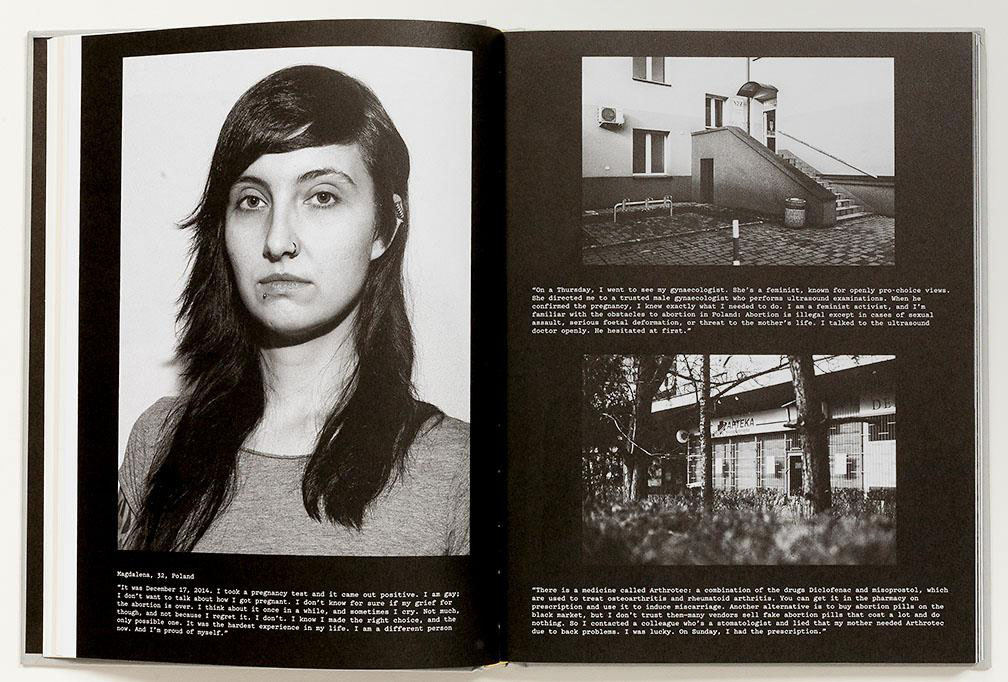
The standout works in this exhibition are the devastating photo-stories of Laia Abril from On Abortion, the first part of her new long-term project, A History of Misogyny; and the surrealist collages of Joanne Leonard taken from Journal of a Miscarriage (1973). I have transcribed the text under Abril’s photographs so you can read the horror which is propagated and reproduced in the name of religion. Dark ages indeed.

Dr Marcus Bunyan


Many thankx to the Museum of Contemporary Photography, Columbia College Chicago for allowing me to publish the photographs in the posting. Please click on the photographs for a larger version of the image.


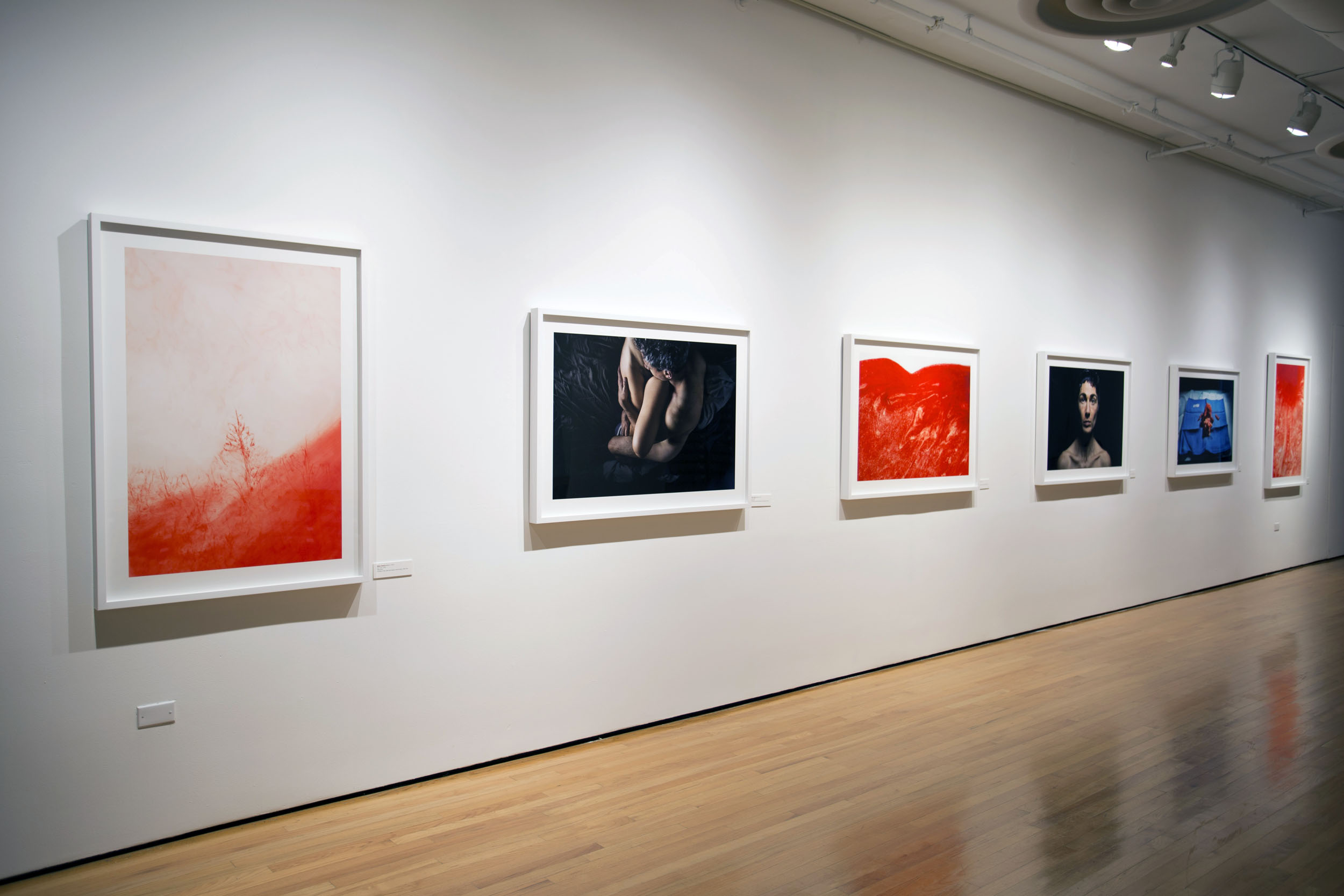
Installation view of the exhibition 'Reproductive: Health, Fertility, Agency' at the Museum of Contemporary Photography

Installation view of the exhibition 'Reproductive: Health, Fertility, Agency' at the Museum of Contemporary Photography

Installation view of the exhibition 'Reproductive: Health, Fertility, Agency' at the Museum of Contemporary Photography


Installation views of the exhibition Reproductive: Health, Fertility, Agency at the Museum of Contemporary Photography


Installation view of the exhibition 'Reproductive: Health, Fertility, Agency' at the Museum of Contemporary Photography showing Laia Abril's photographs. Top left: 'The Oral Solution'; top right: 'Deadly Grapevine'; bottom left: 'A Night Outside'; bottom second left: 'Poison, Pesticide & Desperation'; bottom third left: 'Coat Hanger'


Installation view of the exhibition Reproductive: Health, Fertility, Agency at the Museum of Contemporary Photography showing Laia Abril’s photographs. Top left: The Oral Solution; top right: Deadly Grapevine; bottom left: A Night Outside; bottom second left: Poison, Pesticide & Desperation; bottom third left: Coat Hanger


Laia Abril (Spanish, b. 1986) 'Ancient Herbs and Oral Solutions, depicting herbs used in El Salvador to induce abortion' Nd from the exhibition 'Reproductive: Health, Fertility, Agency' at the Museum of Contemporary Photography, Columbia College Chicago, Jan - May, 2021


Laia Abril (Spanish, b. 1986)
The Oral Solution
Ancient Herbs and Oral Solutions, depicting herbs used in El Salvador to induce abortion

Nd
Courtesy of the artist
© Laia Abril


Laia Abril (Spanish, b. 1986) 'Coat Hanger' Nd


Laia Abril (Spanish, b. 1986)
Coat Hanger
Nd
From History of Misogyny
© Laia Abril


Laia Abril

“I’m trying to visualise a history of misogyny so we don’t forget what’s in the past and don’t get too comfortable in the present; so we take a look at things that sometimes we don’t want to – in a visual way that doesn’t make you just turn the page but makes you engage somehow and think a little bit.”

Under ‘natural’ circumstances, the average woman would get pregnant about 15 times in her life, resulting in ten births. Seven of those babies would survive childhood. For centuries, people have searched for ways to delay or terminate pregnancy. Today, safe and efficient means of abortion finally exist, yet women around the world continue to use ancient, illegal or risky home methods: Every year, 47,000 women die from botched abortions.

Across many countries and religions, millions of women are still denied access to abortion by the law or by social coercion. They are forced to carry pregnancies to term against their will, even minors and rape victims, and for many the pregnancy is not viable or poses a health risk. But all can be criminalised for trying to abort.

On Abortion is the first part of Laia Abril’s new long-term project, A History of Misogyny. The work was first exhibited at Les Rencontres in Arles in 2016 and awarded the Prix de la Photo Madame Figaro and the Fotopress Grant. Abril documents and conceptualises the dangers and damage caused by women’s lack of legal, safe and free access to abortion. She draws on the past to highlight the long, continuing erosion of women’s reproductive rights through to the present-day, weaving together questions of ethics and morality, to reveal a staggering series of social triggers, stigmas, and taboos around abortion that have been largely invisible until now.

Laia Abril is a visual artist, photographer and bookmaker from Barcelona. After graduating in Journalism, she enrolled at FABRICA – the Benetton artist residency; where she worked at COLORS Magazine as a creative editor and staff photographer for 5 years. Her projects have been shown throughout Europe, in the United States, and in China and have been published in media worldwide. Her work is held in many private and public collections. Her first book with Dewi Lewis Publishing, the critically acclaimed The Epilogue (2014), was shortlisted for the Paris Photo-Aperture First Book Award, Kassel PhotoBook Festival and the Photo España Best Book Award.

Text from the Dewi Lewis Publishing website [Online] Cited 14/04/2021


Installation view of the exhibition 'Reproductive: Health, Fertility, Agency' at the Museum of Contemporary Photography showing Laia Abril's photographs. Top left: 'Sentenced to Decades'; bottom left: 'The latrine where Manuela had her miscarriage'; right: 'Manuela in El Salvador'


Installation view of the exhibition Reproductive: Health, Fertility, Agency at the Museum of Contemporary Photography showing Laia Abril’s photographs. Top left: Sentenced to Decades; bottom left: The latrine where Manuela had her miscarriage; right: Manuela in El Salvador


Laia Abril (Spanish, b. 1986) 'Sentenced to Decades' Nd


Laia Abril (Spanish, b. 1986)
Sentenced to Decades
Las 17’s court records in the headquarters of the Citizens’ Coalition for the Decriminalization of Abortion

Nd
From On Abortion
Courtesy of the artist
© Laia Abril


El Salvador and ‘Las 17’

“Last month in El Salvador, a young woman walked free after nearly a decade behind bars. Carmen Guadalupe Vásquez Aldana was just 18 when, in 2008, she was sentenced to 30 years in jail. Her crime? Having a miscarriage.

El Salvador has one of the world’s most draconian abortion statutes. It criminalises abortion on all grounds, including when the mother’s life or health is in danger, and in cases of rape. Women and girls cannot access an abortion even if continuing their pregnancy will kill them, or if their fetuses are not viable.

Those who defy the law and seek unsafe, clandestine abortions face horrifying consequences: The World Health Organization in 2008 reported that 9 percent of maternal deaths in Central America are due to such procedures.”

Erika Guevara-Rosas. “El Salvador and ‘Las 17’,” on the Amnesty International website 3rd March 2015 [Online] Cited 12/05/2021


Laia Abril (Spanish, b. 1986) 'The latrine where Manuela had her miscarriage' Nd


Laia Abril (Spanish, b. 1986)
Manuela in El Salvador
The latrine where Manuela had her miscarriage

Nd
From On Abortion
Courtesy of the artist
© Laia Abril


In February 2008, Manuela – an eight-months-pregnant, 33-year-old mother of two – suffered a miscarriage in the outdoor toilet of her home in a rural area of El Salvador. After losing, and then regaining, consciousness, Manuela (not her real name) managed to make it back to her house and ask her parents for help. When she got to the hospital, she was handcuffed to the bed for a week. Authorities suspected that Manuela’s miscarriage was actually “an abortion to hide her infidelity”; her husband had left her seven years prior, and she did not have the financial means to divorce him. During a trial that took place later that year, Manuela’s mother was accused of being an accomplice. Law-enforcement officials also took statements from Manuela’s illiterate father, who ended up signing documents that implicated his daughter. Manuela was condemned to 30 years in prison. Following her death behind bars two years later, in 2010, her family learned that her miscarriage had been the result of undiagnosed lymphatic cancer.

Text under the photograph


Laia Abril (Spanish, b. 1986) 'Guadalupe, 26, El Salvador' Nd


Laia Abril (Spanish, b. 1986)
Guadalupe, 26, El Salvador
Guadalupe, one of the Las 17, was released from prison in February 2015. She had served seven years and three months in prison after a miscarriage resulting from a rape and subsequent pregnancy.

Nd
From On Abortion
Courtesy of the artist
© Laia Abril


I was raped when I was 17, and became pregnant. I was sentenced to 30 years in prison for homicide, after losing my baby during an obstetric emergency while working at my employer’s house. My employer would not allow me to go home, and I passed out. I was in my third trimester. I wanted my baby – I don’t know what happened to her. They never returned her body to my family. I served seven years and seven months before I was pardoned. The day I was released was very joyful. It had been a long fight, but my lawyers and family never stopped visiting me. I have a newborn baby daughter and I’m thrilled to be a mum.

Text under the photograph


Abortion has been illegal in El Salvador since 1998. This is the case in any and all circumstances, including when the pregnancy poses a risk to the life of the mother. The extremely conservative politics of the country are due in part to the Roman Catholic Church, which exerts an outsized influence on Salvadoran politics and spearheaded a campaign in the 1990s that led to some of the most draconian laws against reproductive rights in the world.


Installation view of the exhibition 'Reproductive: Health, Fertility, Agency' at the Museum of Contemporary Photography showing Laia Abril's photographs


Installation view of the exhibition Reproductive: Health, Fertility, Agency at the Museum of Contemporary Photography showing Laia Abril’s photographs


Laia Abril (Spanish, b. 1986) 'Neil, 33, Ireland' Nd From 'On Abortion' (installation view)


Laia Abril (Spanish, b. 1986)
Neil, 33, Ireland (installation view)
Nd
From On Abortion
Courtesy of the artist
© Laia Abril


(Main photograph)

In 2010, my wife Michelle and I found out we were pregnant. She was over the moon, although I was worries and realistic – she had been fighting cancer since 2001 and was terminal. Unfortunately, her chemotherapy treatment had probably damaged the foetus, before we even knew there was one. Michelle was also unlikely to survive a pregnancy. Her oncologist prescribed an abortion. Michelle did not want to, but we had no other option. To our surprise, Cork University Hospital refused to do it.

(Right top)

The hospital told us that Michelle’s life was not at immediate risk [the only circumstance in which abortion is legal in Ireland]. Her doctor helped us to coordinate a trip to England, where the law is more flexible. Michelle was English, but she had no passport – she had not planned to travel! Waiting for the paperwork took two months, during which she was also denied treatment for her cancer [due to the pregnancy]. The trip itself was a nightmare, she was so sick and heartbroken. We had planned a medical abortion, but the pills didn’t work. In the end, she underwent a surgical procedure, which took a big toll on her health.

(Right bottom)

Michelle became quite active in the media, speaking out against the state. The [Irish government] ended up paying her compensation for the injustice. Before her pregnancy, Michelle had been responding very well to her treatment, and doctors said she could end up living for five more years. She was a very spiritual and optimistic person. But after we cam back from England, she took another scan. Her cancer had become more aggressive and spread to her brain. She died in November 2011.

Text under the three photographs above


Laia Abril (Spanish, b. 1986) 'Magdalena, 32, Poland' 2018 From 'On Abortion'


Laia Abril (Spanish, b. 1986)
Magdalena, 32, Poland
2018
From On Abortion
Courtesy of the artist
© Laia Abril


Installation view of the exhibition 'Reproductive: Health, Fertility, Agency' at the Museum of Contemporary Photography showing Laia Abril's photographs 'Magdalena, 32, Poland' (2018)

Installation view of the exhibition 'Reproductive: Health, Fertility, Agency' at the Museum of Contemporary Photography showing Laia Abril's photographs 'Magdalena, 32, Poland' (2018)


Installation views of the exhibition Reproductive: Health, Fertility, Agency at the Museum of Contemporary Photography showing Laia Abril’s photographs Magdalena, 32, Poland (2018)


(Main photograph)

It was December 17, 2014. I took a pregnancy test and it came out positive. I am gay – I don’t want to talk about how I got pregnant. I don’t know for sure if my grief for the abortion is over, if I left it all behind. I think about it once in a while, and sometimes I cry. Not much, though, and not because I regret it. I don’t. I know I made the right choice, and the only possible one. It was the hardest experience in my life. I am a different person now. And I’m proud of myself.

(Top left)

On a Thursday, I went to see my gynaecologist. She’s a feminist, known for openly pre-choice views. She directed me to a trusted male gynaecologist, who performs ultrasound examinations. She he confirmed the pregnancy, I knew exactly what I needed to do. I am a feminist activist, and I was familiar with the obstacles to abortion in Poland: abortion is illegal except in cases of sexual assault, serious metal deformation, or threat to the mother’s life. I talked to the ultrasound doctor openly. He hesitated at first.

(Top middle)

There is a medicine called Arthrotec: it’s a combination of the drugs Diclofenac and Minoprostol, which are used to treat cateoarthritis and rheumatoid arthritis. You can buy it in the pharmacy with a prescription, and use it to induce miscarriage. Another alternative is to buy abortion pills on the black market, but I don’t trust them – many vendors fake abortion pills that cost a lot and do nothing. So I contacted a colleague who’s a stomatologist and lied that mom need Arthrotec due to back problems. I was lucky. On Sunday, I had the prescription.

(Top right)

On the evening of December 22, 2014, I stayed at my friend Tomo’s. I took my first pull around 10 pm in her kitchen. You take Arthritic in three phases – four pills every three hours, three times. It’s extremely unpleasant. You can’t simply swallow the ill. You have to hold it under your tongue until it melts, then spit out the small part of analgesic Diclofenac. The pills are bitter and your moth gets numb. It rook almost one hour for the first four pills. The bleeding really started two and half hours after the first set.

(Middle left)

I felt cold and freezing. Timo cooked some potatoes and beetroots for me. Also sauerkraut – I remember I had a great craving for that. I needed someone to take care of me, and anyway it’s recommended as a presentation in case of extended bleeding or other problems. It was hard for me to pick a person, but Timo asked no questions, and gave me her full support from the beginning to the very end of this experience.

(Middle centre)

After the pills, I took several showers, and changed my sanitary napkins ofter. We watched Stardust with Claire Dens and Robert De Niro. They always sooth me. i mostly slept thorough the next day and night. But the bleeding didn’t stop. I became a bit worried, so I phone my doctor. It seems I hadn’t fully purged, he said, and advised that I take another set to pills. He also prescribed antibiotics. The second time was a horror. I was literally giving birth. I was exhausted, but even after that, clots of blood remained in my uterus. A procedure called “curettage” would be need to get rid of them.

(Middle right)

I checked into my doctor’s hospital on December 31. He told me exactly what to say: “I’m pregnant. Recently some bleeding has begun. I hope everything is fine, please just check on me.” My doctor and I pretended we didn’t know each other, so other hospital staff wouldn’t get suspicious. The plan was to state that the foetus was dead, which would me the curettage legally. My doctor winked when I was supposed to say “yes” or “no” to the procedure. It was absurd and humiliating at the same time. The curettage was scheduled for the first day of the New Year. Honestly, I didn’t care.

(Bottom left)

The next morning I had the curettage, First anaesthesia in my life. I was numb enough not to feel much fear. I stayed in the hospital until late evening. Another chat with my doctor. I thanked him a lot. I don’t know what would have happened to me if he hadn’t guided, me, advised me. answered my phone calls, then worked out a safe and legal hospital scenario. A lot of things might have happened, but I was lucky. I physically recovered quickly.

(Bottom middle)

But I was traumatised. I remember lying in bed two days before I took pills, with my hand on my belly, thinking that it would nice to able to keep that pregnancy. I cried so much the day I took the pills and told Timo how much I did and did not want to do it at the same time. How much irrational sadness I felt, even though I didn’t want to have a kid, not then, and probably not ever. It was hormones. But it was also something more than that; you can’t really talk about it unless you’ve had the experience yourself. I grieved some time after.

(Bottom right)

Later, I created a private group on Facebook so that women could help each other. exchange addresses and phone number of trusted doctors, and give each other advice. Sometimes a woman contacts me and I give her all the info and contact I have. I feel like that’s the least I can do. I still have a few mementos related to my abortion, including an ultrasound photo of the foetus. Sometime I want to throw it away. But I never do.

Text under the photographs


Laia Abril. 'Magdalena, 32, Poland' 2018 from the book 'On Abortion'


Magdalena, 32, Poland 2018 from the book On Abortion by Laia Abril


Installation view of the exhibition 'Reproductive: Health, Fertility, Agency' at the Museum of Contemporary Photography showing at right, Laia Abril's photographs 'Marta, 29, Poland' (Nd)

Installation view of the exhibition 'Reproductive: Health, Fertility, Agency' at the Museum of Contemporary Photography showing Laia Abril's photographs 'Marta, 29, Poland' (Nd)


Installation views of the exhibition Reproductive: Health, Fertility, Agency at the Museum of Contemporary Photography showing Laia Abril’s photographs Marta, 29, Poland (Nd)


Installation view of the exhibition 'Reproductive: Health, Fertility, Agency' at the Museum of Contemporary Photography showing Laia Abril's photographs. At centre bottom, 'An FBI warrant for James Kopp' (Nd); at right top, 'Prisoner #14681: Dr. Fenner' (Nd); right middle, 'Midwife's Mugshot' (Nd); right bottom, 'Prisoner #5603 Dr. William H. Johnson'


Installation views of the exhibition Reproductive: Health, Fertility, Agency at the Museum of Contemporary Photography showing Laia Abril’s photographs. At centre bottom, An FBI warrant for James Kopp (Nd); at right top, Prisoner #14681: Dr. Fenner (Nd); right middle, Midwife’s Mugshot (Nd); right bottom, Prisoner #5603 Dr. William H. Johnson


Prisoner #14681: Dr. Fenner

In 1941, Dr. Fenner was charged with feticide and sentenced to 16 months of hard labor in Nebraska. The doctor denied that he had performed the alleged abortion but admitted that he had performed ‘curettage” on a female patient. He claimed that his patient would have died due to inflammation otherwise.

Midwife’s Mugshot

Brazilian midwife Maria Berlimont practiced medicine without a licence and was accused of providing abortions illegally. “Dessie [current] public condemnation of both women and providers, law enforcement more often goes after the abortion provider. Police action and the media reports focus on illegal clinics while remaining silent on the women who seek out illegal abortion services.”

Prisoner #5603: Dr. William H. Johnson

In May 1910, doctor William H. Johnson of Nebraska was found guilt of having performed an illegal abortion resulting in the death of sixteen-year-old Amanda Mueller. He was sentenced to two years of hard labor. Johnson was paroled on April 14, 1911, pardoned by the governor, and discharged on April 25.


Laia Abril. 'An FBI warrant for James Kopp, a member of The Lambs of Christ, who killed a doctor who worked at an New York abortion clinic in 1998' Nd


Laia Abril (Spanish, b. 1986)
An FBI warrant for James Kopp, a member of The Lambs of Christ, who killed a doctor who worked at an New York abortion clinic in 1998
Nd
Courtesy of the artist
© Laia Abril


Installation view of the exhibition 'Reproductive: Health, Fertility, Agency' at the Museum of Contemporary Photography showing at right, Laia Abril's 'Telephone – Voice mail, Florida Abortion Clinic' (Nd)


Installation view of the exhibition Reproductive: Health, Fertility, Agency at the Museum of Contemporary Photography showing at right, Laia Abril’s Telephone – Voice mail, Florida Abortion Clinic (Nd)


Installation view of the exhibition 'Reproductive: Health, Fertility, Agency' at the Museum of Contemporary Photography showing at right, Laia Abril's 'Hippocratic Betrayal and Obstetric Violence'


Installation view of the exhibition Reproductive: Health, Fertility, Agency at the Museum of Contemporary Photography showing at right, Laia Abril’s Hippocratic Betrayal and Obstetric Violence


Laia Abril. 'Hippocratic Betrayal and Obstetric Violence' Nd


Laia Abril (Spanish, b. 1986)
Hippocratic Betrayal and Obstetric Violence
Nd
From On Abortion
Courtesy of the artist
© Laia Abril


Hippocratic Betrayal and Obstetric Violence, by Laia Abril, referring to the case of a woman in Brazil who was handcuffed to her hospital bed after trying to give herself an abortion

This time, the found material and loaded objects – from an operating chair to a tangled heap of coathangers – make the testimonies all the more stark. One of the most resonant images is a staged photograph of a pair of handcuffs hanging from the rail of a hospital bed. It is titled Hippocratic Betrayal and refers to the case of a 19-year-old woman from São Paulo, who was taken to hospital with severe abdominal pains after ingesting abortion pills. After treating her, the doctor called the police, saying he would autopsy the foetus if she did not confess to trying to abort. She was handcuffed to her hospital bed and freed only after agreeing to pay £200 bail. Denunciation by doctors is common in Brazil, Peru and El Salvador.

“There are so many stories,” says Abril, “and it was important to find ways of telling them visually. The image of the handcuffs is a reconstruction because, of course, I was not present. No one was. The stories are true, the research is journalistic, the imagery is sometimes imaginative and sometimes documentary.”

Sean O’Hagan. “‘I’ve seen horrible things’: photographer Laia Abril on her history of misogyny,” on the Guardian website Wed 20 July 2016 [Online] Cited 14/04/2021


Installation view of the exhibition 'Reproductive: Health, Fertility, Agency' at the Museum of Contemporary Photography showing photographs from Laia Abril's 'On Abortion' (2018) with at second left, 'Soap and Enema Syringes'


Installation view of the exhibition Reproductive: Health, Fertility, Agency at the Museum of Contemporary Photography showing photographs from Laia Abril’s On Abortion (2018) with at second left, Soap and Enema Syringes


Laia Abril (Spanish, b. 1986) 'Soap and Enema Syringes' 2018


Laia Abril (Spanish, b. 1986)
Soap and Enema Syringes
2018
From On Abortion
Courtesy of the artist
© Laia Abril


In the picture a set of household abortion tools. In places where abortion is illegal, certain medical instruments can be a giveaway. For this reason, specific supplies have rarely been developed or sold for this procedure. Instead, doctors, back-street abortionists and pregnant women turn to common household tools: knitting needles, wire clothes hangers, urinary catheters and a wide variety of other objects long enough to reach into the uterus.

In the history of coercive reproduction, before the legalisation of abortion – and currently in the countries which remains illegal; was dominated for centuries by restrictive laws, based on demographic and religious agendas. Due the lack of alternatives, women was forced to apply dangerous methods for termination of her pregnancy, facing serious physical damage or even death. Both safe and very effective methods were only developed as of the middle of the last century.  The lives and the survival rate of women have thereby greatly improved.

Museum of contraception and Abortion, Vienna, Austria, 2015. Laia Abril.


Laia Abril (Spanish, b. 1986) 'Soap and syringes used for abortion, from the Museum of Contraception and Abortion in Vienna' Nd


Laia Abril (Spanish, b. 1986)
Soap and syringes used for abortion, from the Museum of Contraception and Abortion in Vienna
Nd
From On Abortion
Courtesy of the artist
© Laia Abril


Reproductive: Health, Fertility, Agency explores the psychological, physical, and emotional realities people encounter in the years leading up to, during, and after fertility. The exhibition features eight artists who consider a range of topics including birth, miscarriage, pleasure, the lack of access to abortion, trauma, and the loss of fertility. The term “reproductive” is twofold. It implies the characteristics of a photograph, bringing attention to a notable lack of visual representation of the experiences of the female body. Additionally, the term is a reference to a common patriarchal, capitalist view of women’s bodies as vehicles for reproduction. This exhibition aims to add visual presence and a deeper understanding of the precarious nature of female rights and freedoms in a time where the future of these rights is uncertain.

The Museum of Contemporary Photography at Columbia College Chicago (MoCP) presents Reproductive: Health, Fertility, Agency from January 19 – May 23, 2021. The exhibition explores the psychological, physical, and emotional realities women encounter in the years leading up to, during, and after fertility. The exhibition features eight artists who consider a range of topics including birth, miscarriage, pleasure, the lack of access to abortion, trauma, and the loss of fertility. The exhibition is organised by MoCP chief curator and deputy director Karen Irvine and curator of academic programs and collections Kristin Taylor.

With works ranging from photography to video installations, the exhibition includes work by artists Laia Abril, Candice Breitz, Elinor Carucci, Krista Franklin, Doreen Garner, Candy Guinea, Joanne Leonard, and Carmen Winant. This exhibition seeks to provide a deeper understanding of the precarious nature of reproductive rights in a time where the future of these rights is uncertain.

Works on view cover a range of issues all linking back to the theme of reproductive justice. Highlights include Candice Breitz’s installation Labour (2017-ongoing), which probes the many meanings of the word “labour” in terms of capitalism, from the act of giving birth to the labour that is inherent in mothering and nurturing a child, as well as the domestic labor that has historically been assigned to women.

Artists Carmen Winant and Elinor Carucci both explore female sexuality, implicitly and explicitly critiquing the patriarchal gaze at different stages of female life and fertility. Winant’s photographic assemblage of female sexuality in History of My Pleasure (2019-2020) highlights the agency of the libidinous female body, while Carucci explores sensuality and pleasure after menopause, emphasising imagery that is seldom made visible within art history and popular culture.

Other works on view highlight the often-invisible struggles of the reproductive body, including Under the Knife (2018), a project created by Chicago-based artist Krista Franklin, which intimately details the artist’s long struggle with uterine fibroids, a condition that can cause infertility and disproportionately affects Black women. Joanne Leonard explores a different kind of trauma in her Journal of a Miscarriage series (1973), a series of collages that grapple with the loss of her first pregnancy to miscarriage.

Taking a historical approach to understanding the contemporary state of reproductive healthcare, Laia Abril investigates the history of birth control and the subsequent consequences of restricting women’s access to safe and legal abortion, while Doreen Garner hauntingly pays tribute to Black women who were subject to torture in the name of medical research. Looking closely at the contemporary moment from an LGBTQ+ perspective, Candy Guinea depicts the artist’s journey with her partner as they attempt to conceive their first child through insemination, revealing pervasive gender binaries surrounding maternal health care.

The exhibition’s title, Reproductive, refers to both the act of copying something, like a photograph, and the biological creation of offspring. Additionally, the active tense of the verb “to reproduce” points to the capacity that these artists are at once demonstrating and demanding agency.

“The artists featured in this exhibition create space for themselves – and for others – to claim their power,” said exhibition curators Karen Irvine and Kristin Taylor, “revolutionising the prevailing sense of what it means for a woman to be (re)productive.”

Press release from the Museum of Contemporary Photography


Candy Guinea. 'Still from Mariposa' 2017


Candy Guinea (American, b. 1984)
Still from Mariposa
2017
Single-channel video, looped
17 minutes
Courtesy of the artist


This short film convos the family story of Candy Guinea and her partner Castro as they move through the heteronormative childbirth industry. Guinea documents their journey as a queer, Latinx couple as they attempt to conceive their first child through insemination, navigating numerous trials and errors with the process, and considering the larger emotional and social realities of those who undergo this often-arduous form of conception. As the film progresses, we follow the couple as they attempt to find gender-neutral maternity clothing, as well as LGBTQ+ friendly prenatal care, revealing pervasive gender binaries surrounding maternal health care.


Installation view of the exhibition 'Reproductive: Health, Fertility, Agency' at the Museum of Contemporary Photography showing work by Joanne Leonard


Installation view of the exhibition Reproductive: Health, Fertility, Agency at the Museum of Contemporary Photography showing work by Joanne Leonard


Installation view of the exhibition 'Reproductive: Health, Fertility, Agency' at the Museum of Contemporary Photography showing three works by Joanne Leonard: at left, 'Censored journal page (Romanticism is Ultimately Fatal and 1964 police photograph of Gerri Santoro, left to die after botched abortion), from Journal of miscarriage' 1973; at centre, 'Tears, November 28, 1973 from Journal of a Miscarriage', 1973; and at right, 'Untitled (cowry shells), November 30, 1973' from 'Journal of a Miscarriage', 1973


Installation view of the exhibition Reproductive: Health, Fertility, Agency at the Museum of Contemporary Photography showing three works by Joanne Leonard: at left, Censored journal page (Romanticism is Ultimately Fatal and 1964 police photograph of Gerri Santoro, left to die after botched abortion), from Journal of miscarriage 1973; at centre, Tears, November 28, 1973 from Journal of a Miscarriage, 1973; and at right, Untitled (cowry shells), November 30, 1973 from Journal of a Miscarriage, 1973


Joanne Leonard (American, b. 1940) 'Censored journal page (Romanticism is Ultimately Fatal and 1964 police photograph of Gerri Santoro, left to die after botched abortion)' 1973 From 'Journal of a miscarriage' 1973 (installation view)


Joanne Leonard (American, b. 1940)
Censored journal page (Romanticism is Ultimately Fatal and 1964 police photograph of Gerri Santoro, left to die after botched abortion) (installation view)
1973
From Journal of a miscarriage, 1973
Collage
Courtesy of Jeremy Stone, San Francisco


Gerri Santoro

Geraldine “Gerri” Santoro (née Twerdy; August 16, 1935 – June 8, 1964) was an American woman who died because of an illegal abortion in 1964. A police photograph of her dead body, published in 1973, became a symbol of the abortion-rights movement.

Biography

Santoro was raised, along with 14 siblings, on the farm of a Ukrainian-American family in Coventry, Connecticut. She was described by those who knew her as “fun-loving” and “free-spirited”. At age 18 she married Sam Santoro; the couple had two daughters together.

Circumstances of death

In 1963, her husband’s domestic abuse prompted Santoro to leave, and she and her daughters returned to her childhood home. She took a job at Mansfield State Training School, where she met another employee, Clyde Dixon. The two began an extramarital affair and Santoro became pregnant.

When Sam Santoro announced he was coming from California to visit his daughters, Gerri Santoro feared for her life. On June 8, 1964, twenty-eight weeks into her pregnancy, she and Dixon checked into the Norwich Motel in Norwich, Connecticut, under aliases. They intended to perform a self-induced abortion, using surgical instruments and information from a textbook which Dixon had obtained from Milton Ray Morgan, a teacher at the Mansfield school. Dixon fled the motel after Santoro began to bleed. She died, and her body was found the following morning by a maid.

Dixon and Morgan were arrested three days later. Dixon was charged with manslaughter and Morgan was charged with conspiring to commit an illegal abortion. Dixon was sentenced to a year and day in prison.

Famous photograph

Police took a photograph of Santoro’s body as she was found: naked, kneeling, collapsed upon the floor, with a bloody towel between her legs. The picture was used in placards and famously published in Ms. magazine in April 1973, all without identifying Santoro. The photo has since become an abortion-rights symbol, used to illustrate that access to legal and professionally performed abortion reduces deaths from unsafe abortion.

Leona Gordon, Santoro’s sister, saw the photo in Ms. magazine and recognised the subject. Santoro’s daughters had been told their mother died in a car accident, which they believed until the photo became widely distributed. Of the photo’s publication, Santoro’s daughter, Joannie Santoro-Griffin, was quoted in 1995 as saying, “How dare they flaunt this? How dare they take my beautiful mom and put this in front of the public eye?” In more recent years, Joannie has become an abortion rights activist, attending the March for Women’s Lives in 2004 along with Leona and Joannie’s teenage daughter Tara, and blogging about the memory of her mother.

Text from the Wikipedia website


Joanne Leonard (American, b. 1940) 'Untitled (cowry shells), November 30, 1973' 1973 From 'Journal of a Miscarriage' 1973


Joanne Leonard (American, b. 1940)
Untitled (cowry shells), November 30, 1973 (installation view)
1973
From Journal of a Miscarriage, 1973
Collage
Courtesy of Jeremy Stone, San Francisco


Joanne Leonard (American, b. 1940) 'Par/NoPair/OhPere October 9, 1973' (installation view)


Joanne Leonard (American, b. 1940)
Par/NoPair/OhPere October 9, 1973 (installation view)
From Journal of a Miscarriage, 1973
Collage
Courtesy of Jeremy Stone, San Francisco


Joanne Leonard (American, b. 1940) 'Par/NoPair/OhPere October 9, 1973'


Joanne Leonard (American, b. 1940)
Par/NoPair/OhPere October 9, 1973
From Journal of a Miscarriage, 1973
Collage
Courtesy of Jeremy Stone, San Francisco


Installation view of the exhibition 'Reproductive: Health, Fertility, Agency' at the Museum of Contemporary Photography showing two works by Joanne Leonard: at left, 'Untitled (woman/flower/snail)' from 'Journal of a Miscarriage' 1973; and at right, 'Love Letter, November 16, 1973' from 'Journal of a Miscarriage' 1973


Installation view of the exhibition Reproductive: Health, Fertility, Agency at the Museum of Contemporary Photography showing two works by Joanne Leonard: at left, Untitled (woman/flower/snail) from Journal of a Miscarriage, 1973; and at right, Love Letter, November 16, 1973 from Journal of a Miscarriage, 1973


Joanne Leonard (American, b. 1940) 'Untitled (woman/flower/snail)' From 'Journal of a Miscarriage' 1973 (installation view)


Joanne Leonard (American, b. 1940)
Untitled (woman/flower/snail) (installation view)
From Journal of a Miscarriage, 1973
Collage
Courtesy of Jeremy Stone, San Francisco


Installation view of the exhibition 'Reproductive: Health, Fertility, Agency' at the Museum of Contemporary Photography showing works by Joanne Leonard: at right, 'Untitled (clam/shell/birth), November 30, 1973' from 'Journal of a Miscarriage' 1973; and at second right, 'Untitled (Joanne, frog and sperm)' from 'Journal of a Miscarriage' 1973


Installation view of the exhibition Reproductive: Health, Fertility, Agency at the Museum of Contemporary Photography showing works by Joanne Leonard: at right, Untitled (clam/shell/birth), November 30, 1973 from Journal of a Miscarriage, 1973; and at second right, Untitled (Joanne, frog and sperm) from Journal of a Miscarriage, 1973


Installation view of the exhibition 'Reproductive: Health, Fertility, Agency' at the Museum of Contemporary Photography showing works by Joanne Leonard: at left 'Magic Act' (with painting my M. Ner) from 'Journal of a Miscarriage', 1973

Installation view of the exhibition 'Reproductive: Health, Fertility, Agency' at the Museum of Contemporary Photography showing works by Joanne Leonard: at left 'Magic Act (with painting my M. Ner)' from 'Journal of a Miscarriage' 1973


Installation view of the exhibition Reproductive: Health, Fertility, Agency at the Museum of Contemporary Photography showing works by Joanne Leonard: at left Magic Act (with painting my M. Ner) from Journal of a Miscarriage, 1973


Installation view of the exhibition 'Reproductive: Health, Fertility, Agency' at the Museum of Contemporary Photography showing works by Elinor Carucci from her series 'Midlife' (2012-2019) with at left, 'Winter' 2016


Installation view of the exhibition Reproductive: Health, Fertility, Agency at the Museum of Contemporary Photography showing works by Elinor Carucci from her series Midlife (2012-2019) with at left, Winter 2016


Installation view of the exhibition 'Reproductive: Health, Fertility, Agency' at the Museum of Contemporary Photography showing works by Elinor Carucci from her series 'Midlife' (2012-2019)

Installation view of the exhibition 'Reproductive: Health, Fertility, Agency' at the Museum of Contemporary Photography showing works by Elinor Carucci from her series 'Midlife' (2012-2019)

Installation view of the exhibition 'Reproductive: Health, Fertility, Agency' at the Museum of Contemporary Photography showing works by Elinor Carucci from her series 'Midlife' (2012-2019)

Installation view of the exhibition 'Reproductive: Health, Fertility, Agency' at the Museum of Contemporary Photography showing works by Elinor Carucci from her series 'Midlife' (2012-2019)

Installation view of the exhibition 'Reproductive: Health, Fertility, Agency' at the Museum of Contemporary Photography showing works by Elinor Carucci from her series 'Midlife' (2012-2019)


Installation views of the exhibition Reproductive: Health, Fertility, Agency at the Museum of Contemporary Photography showing works by Elinor Carucci from her series Midlife (2012-2019)


Elinor Carucci (Israeli-American, b. 1971) 'My Uterus' 2015


Elinor Carucci (Israeli-American, b. 1971)
My Uterus
2015
From Midlife 2012-2019
Courtesy of the artist and Edwynn Houk Gallery, New York


The intimate images show Elinor Carucci as she approaches the age of fifty and enters menopause – the last cycle of female fertility. Photographs of attempts to remain psychologically balanced and youthful in appearance are coupled with close-up images of blood – a longtime symbol of fertility and the female body. In one poignant image, the artist’s uterus lies starkly on a medical cart just after a hysterectomy – a powerful metaphor for ageing and the grieving that often accompanies a long life. Also included in the series are images of Carucci’s sexual intimacy with her husband Eran, augmenting her bold look at the physical and mental struggles of losing fertility with a hopeful meditation on the longevity of sensuality, physical pride, and pleasure.


Doreen Garner (American, b. 1986) 'Betsey's Flag' 2019 (installation view)


Doreen Garner (American, b. 1986)
Betsey’s Flag (installation view)
2019
Courtesy of the artist and JTT, New York


Doreen Garner (American, b. 1986) 'Betsey's Flag' 2019 (installation view)


Doreen Garner (American, b. 1986)
Betsey’s Flag (installation view)
2019
Courtesy of the artist and JTT, New York


Doreen Garner (American, b. 1986) 'Betsey's Flag' 2019 (installation view)


Doreen Garner (American, b. 1986)
Betsey’s Flag (installation view)
2019
Courtesy of the artist and JTT, New York


Krista Franklin (American, b. 1970) 'Self-Portrait in the Aftermath' 2020 (installation view)


Krista Franklin (American, b. 1970)
Self-Portrait in the Aftermath (installation view)
2020
Courtesy of the artist


Installation view of the exhibition 'Reproductive: Health, Fertility, Agency' at the Museum of Contemporary Photography showing work by Doreen Garner (American, b. 1986)


(left to right)

Doreen Garner (American, b. 1986)
The Success of the Silver Suture: As Told by Sadist
2018
Plexiglass, rubber, inkjet print, menstrual blood, urine, epoxy resin
Courtesy of JTT Gallery, New York

Doreen Garner (American, b. 1986)
The First Operation: As Told by Sadist
2018
Plexiglass, rubber, inkjet print, menstrual blood, urine, epoxy resin
Courtesy of JTT Gallery, New York

Doreen Garner (American, b. 1986)
Death Would Have Been Preferable: As Told by Sadist
2018
Plexiglass, rubber, inkjet print, menstrual blood, urine, epoxy resin
Courtesy of JTT Gallery, New York


Carmen Winant (American, b. 1983) 'A History of My Pleasure' 2019-2020 (installation view)

Carmen Winant (American, b. 1983) 'A History of My Pleasure' 2019-2020 (installation view)

Carmen Winant (American, b. 1983) 'A History of My Pleasure' 2019-2020 (installation view)

Carmen Winant (American, b. 1983) 'A History of My Pleasure' 2019-2020 (installation view)

Carmen Winant (American, b. 1983) 'A History of My Pleasure' 2019-2020 (installation view)

Carmen Winant (American, b. 1983) 'A History of My Pleasure' 2019-2020 (installation view)

Carmen Winant (American, b. 1983) 'A History of My Pleasure' 2019-2020 (installation view)

Carmen Winant (American, b. 1983) 'A History of My Pleasure' 2019-2020 (installation view)


Carmen Winant (American, b. 1983)
A History of My Pleasure (installation views)
2019-20
Courtesy of the artist


Museum of Contemporary Photography
Columbia College Chicago
600 S Michigan Avenue
Chicago, IL 60605

Opening hours:
Tuesday – Sunday 10am – 5pm

The MoCP is CLOSED when Columbia College Chicago is closed, including all major holidays.

Museum of Contemporary Photography website

LIKE ART BLART ON FACEBOOK

Back to top

Text / Exhibition: ‘Clarice Beckett: The present moment’ at the Art Gallery of South Australia, Adelaide

Exhibition dates: 27th February – 16th May, 2021

Curator: AGSA Curator of Australian Art and Exhibition Curator Tracey Lock


Clarice Beckett (Australia, 1887-1935) 'Solitude' c. 1932 from the exhibition 'Clarice Beckett: The present moment' at the Art Gallery of South Australia, Adelaide, Feb - May, 2021


Clarice Beckett (Australia, 1887-1935)
Solitude
c. 1932
Melbourne
Oil on board
Gift of Alastair Hunter OAM and the late Tom Hunter in memory of Elizabeth through the Art Gallery of South Australia Foundation 2019
Art Gallery of South Australia, Adelaide


Realist structuralist illusionist

The only four words that you really need to know are this: I bought the catalogue.

Beckett’s story of tragedy and redemption is briefly told. Trained as a painter under Max Meldrum in the modernist Australian tonalist school (which she far surpassed). Painted the hazy, misty suburbs of Melbourne en plein air in all weather conditions, usually in the early morning or at dusk. Worked incredibly hard at her art but, as with a lot of artists, had little recognition during her brief career despite numerous solo exhibitions. Died at a young age of double pneumonia after an outdoor painting session. Work lost to the mists of time until the art historian Rosalind Hollinrake salvaged a mere 369 paintings – 1,600 were beyond repair – from an open sided barn in country Victoria. Sadness at the loss of a young life cut short, of so many paintings lost to the elements and possums, but a deep gratitude that we still have what remains of her reality, as seen through her paintings. Now become, in my humble opinion, one of the greatest Australian painters of all time.

In her review of the exhibition Catherine Speck observes that Beckett’s works are a “study in transience”; another commentary has her as the “master of the half-light”; curator Tracey Lock has said her work is “luminous, ethereal, and very gentle… producing some of the most radically minimalist landscapes of the period … atmospheric abstractions of the commonplace.” All true.

Beckett had studied theosophy – a belief in divine wisdom via mysticism – and had read Madame Blavatsky’s book The Voice of Silence. Blavatsky urged her followers to seek spiritual knowledge beyond sensory experience – a sense of “limitless” and expanse. As John MacDonald observes, Beckett “explored the spiritual dimension of modernism” but only in so far “as a function of the open-minded, open-hearted way she approached the subject of a painting.” Again, all true.

But I find there is something more grounded in Beckett’s work than just smoke and mirrors.

While Beckett’s work can be seen as both radically minimalist landscapes and “atmospheric abstractions”, if you really look at these paintings – seemingly just daubs of paint over layers of thin background washes – there is an incredible draughtsmanship and structure to all of her paintings. The underpinning of these transient paintings are anything but random tones applied to the canvas. A foundation built on sand cannot last, cannot sustain such a penetrating inquiry.

In many ways I see Beckett as much a structuralist as a modernist or tonalist. Following Meldrum’s ideas about the rational analytic observation of subtle visual patterns of tones and accents, we can say that Beckett worked to uncover the structures that underlie all the things that humans do, think, perceive, and feel in the immediacy of her painting, in her painting outdoors, in her inner vision of a reality that she felt and saw. In the phenomena of her life she envisaged, intimately, her interrelations with the world, and understood that below the surface phenomena there are constant laws of abstract structure.

How she evinces that structure in the solitude of a man in a boat, or passing trams, the warmth of the setting sun, or motor car lights in rain shows her “characteristic ability to catch the spontaneity of a lived moment.” As with a legion of great artists – van Gogh’s bedroom, Cezanne’s still life, Hooper’s diner at night – it is her ability to make the ordinary extraordinary that sets her apart from the rest. “She found a distinctive beauty in the ordinary objects such as telegraph poles, strips of road, trams, cars, buses and the daily activity taking place in the street.”

In paintings such as The Red Bus (Nd), Morning Ride (Nd), Out Walking (c. 1928-1929), The Bus Stop (1930), Evening light, Beaumaris (c. 1925), Beach Road after the rain (Street scene) (c. 1927), Walking home (1931) and Dusk (Nd) it is the spatial distance between objects, not just physically but mentally – that leap of faith that the viewer must make into the space of the painting – that draws you in, that immerses you into that time and space that Beckett observed so truthfully. Poetic and lyrical yes, but also grounded and spatial, opening out this vista in front of you … humans as colourful accretions of paint (in)distinct in their existence, placed in fleeting moments, caught on the wind.

MacDonald notes, “If this show were being staged at Tate Modern or the Museum of Modern Art, Beckett would be hailed as a figure of world renown.” I heartily concur. Much as the Swedish artist Hilma af Klint (1862-1944) – whose lyrical abstract canvases were hidden for 20 years after her death – has recently had blockbuster exhibitions at Moderna Museet Malmö, Solomon R. Guggenheim Museum, New York and coming to the Art Gallery of New South Wales Sydney later in 2021, so I believe that Clarice Beckett will be recognised as an important world artist.

You really can’t pick out a bad painting by Beckett. Each has its own personality and seduction. I am ravished by them all.

Dr Marcus Bunyan


Many thankx to the Art Gallery of South Australia for allowing me to publish the photographs in the posting. Please click on the photographs for a larger version of the image.


“To give a sincere and truthful representation of a portion of the beauty of Nature, and to show the charm of light and shade, which I try to give forth in correct tones so as to give as nearly as possible an exact illusion of reality.”


Clarice Beckett


“It sometimes sounds as though [Max] Meldrum actually invented the idea of tone, but artists had understood this quality since the days of Leonardo da Vinci and Velasquez. In brief, it refers to the lightness or darkness of colours and the way they relate to each other in a composition. Meldrum’s innovation was to make tone the defining feature of painting – the inflexible standard to which every other aspect of a work must conform.”


John MacDonald. “Misty Moderns,” on the Sydney Morning Herald website, November 21, 2009 [Online] Cited 19/03/2021


“The facts of Beckett’s life may be told in short order. She was born in 1887 into a well-heeled, middle-class family. She had a passion for art and literature and would go on to study drawing under Fred McCubbin at the National Gallery School, then spend nine months attending the independent art school run by the outspoken Max Meldrum. It was an experience that would help mould her technique and views on art, although not so much as many have presumed. Although Beckett had admirers, she turned down several offers of marriage and would end her life living at home in the bayside suburb of Beaumaris, having spent years looking after her invalid mother.

In 1935, shortly after her mother’s death, Beckett caught double pneumonia and passed away at the age of 48. What happened next is just as tragic, as her father burnt paintings that he didn’t consider finished or good enough. Her sister, Hilda, would store the remaining 2000 canvases in an open-sided shed in the countryside near Benalla. When Hollinrake tracked them down in 1970, only 369 were salvageable. The weather and the possums had laid waste to the rest.

The loss of so many works ranks as one of the great disasters of Australian art history. We may all be thankful that Hollinrake saved what she could.”


John MacDonald. “This exhibition is so phenomenal I saw it three days in row,” on the Sydney Morning Herald website, March 25, 2021 [Online] Cited 29/03/2021


“Modern science maintains that all colours in the universe are founded in three elements: hue (colour), saturation (chroma) and tone (value). Hue refers to the spectral colours such as red, green, blue, and so on, that are visibly distinct from each other…

Saturation represents the intensity, or quantity, of colour… The best way to understand this is if you take a can of blue paint and gradually stir in some white, rather than getting a new colour, the result is a lighter blue. An exception to this rule is that by adding white to red, we make pink. Red is a highly saturated pink; they are of the same hue but the quantity of red colour is less in pink.

Tone refers to how light or dark a colour is. On a scale of 0 to 10, 0 is colourless (or white), 5 is a medium grey [think Zone V in the black and white zone system] and 10 is black. So, as the tone increases, it intensifies the darkness [of the colour]. Tone begins to impact the saturation … once it reaches a percentage high enough to overpower it. This percentage varies with each colour, just as the saturation range varies with hues. For example, saturation in a yellow … may reach as high as ninety percent, whilst in a blue … it may only reach three percent, with the result that a small percentage increase in tone on a blue … would have a far greater impact on the blue, resulting in the grey becoming more noticeable. [Colours] with a higher saturation, such as yellow, would require correspondingly higher levels of tone for the brown to be observed. When the percentage of tone exceeds the saturation, the brown or grey will actually become the body (primary) colour and the hue the modifier, for example bluish-grey.”


Hamish Sharma. “Colour: How we see diamonds and gemstones,” in the Leonard magazine, Issue 90, February – March 2021 Cited 19/03/2021.


Tracey Lock – Clarice Beckett from Art Gallery of South Australia.


 Clarice Beckett: The present moment TVC from Art Gallery of South Australia.


Clarice Beckett: The present moment – walking Tour with Rosalind Holinrake and Tracey Lock (no captions) from Art Gallery of South Australia.


Featuring the artist’s luscious and distinctive soft focus, the Art Gallery of South Australia’s newly opened Clarice Beckett exhibition, curated by Tracey Lock, presents her paintings as a sensorium – with colour, music and video to enhance the experience.

Each room in the gallery’s exhibition space is dedicated to her paintings of specific times of the day, from sunrise, to early morning, then midday and sunset, concluding with the nocturnes. She was fascinated with temporal change. The exhibition is very much an experiential journey. Viewers enter through an elliptical portal to an immersive rounded space filled with magnified projections of her paintings, and music from Simone Slattery’s specially commissioned soundscape.

Beckett was musical too. The transcendence to another realm has begun. The mood changes with each room in the exhibition.

A sad loss but precious works remain

The poignant Clarice Beckett story is known by many. She died from pneumonia in 1935 at 48 years of age, and left behind a large cache of work. It was stored for a number of years in an open-side shed in rural Victoria, only to be discovered in the late 1960s, in a poor state of repair, by art historian Rosalind Hollinrake. She salvaged a mere 369 paintings – 1,600 were beyond repair.

Hollinrake guided the artist’s rediscovery at a time when numerous women artists were reinserted into the canon. The impetus for this exhibition is the generous donation by Alastair Hunter of a large collection of Beckett’s work previously held by Hollinrake.

Mysticism meets science

Theosophy – a belief in divine wisdom via mysticism – was a major influence on her approach to painting. Like others around the world, Beckett came under the popular esoteric movement’s spell in the early years of the 20th century. She owned a well-thumbed copy of Madame Blavatsky’s seminal occult text The Voice of Silence, attended spiritualist meetings and moved in artistic circles where post-dinner seances were often held.

But Beckett also took on board painter Max Meldrum’s quasi-scientific ideas about rational analytic observation of subtle visual patterns of tones and accents. She studied with him for nine months, although it is widely accepted she surpassed him with her brilliant tonal landscapes. This is the hybrid intellectual and artistic milieu she moved in, supplemented by an interest in Eastern philosophy and Freud.

For Beckett, painting was as much about performing her spiritual beliefs as it was about portraying that which was observable. Her friends in the Melbourne Society of Women Painters and Sculptors, to which she belonged, recall she loved talking about theories behind her work.

What emerges in the exhibition is her finely honed and daring visual language.

Artist without a studio

A curatorial coup is achieved with the installation of a domestic kitchen in the exhibition space. Her father had declined her request for a studio to work in. He suggested she use the kitchen table instead.

While most of her paintings were completed outdoors, she did paint still life and portraits, and finish off larger en plein air works at home. This work was indeed done on the kitchen table, which is so tellingly included in the exhibition, surrounded by her still life paintings including Marigolds (1925).

Catherine Speck. “Clarice Beckett exhibition is a sensory appreciation of her magical moments in time,” on The Conversation website March 1, 2021 [Online] Cited 06/03/2021.


Clarice Beckett (Australia, 1887-1935) 'Passing trams' c. 1931 from the exhibition 'Clarice Beckett: The present moment' at the Art Gallery of South Australia, Adelaide, Feb - May, 2021


Clarice Beckett (Australia, 1887-1935)
Passing trams
c. 1931
Oil on board
48.60 mm (1.91 in); Width: 44.20 mm (1.74 in)
Art Gallery of South Australia
Public domain, Google Art Project


Clarice Beckett (Australia, 1887-1935) 'Summer fields' 1926


Clarice Beckett (Australia, 1887-1935)
Summer fields
1926
Naringal, Western District, Victoria
Oil on board
Gift of Alastair Hunter OAM and the late Tom Hunter in memory of Elizabeth through the Art Gallery of South Australia Foundation 2019
Art Gallery of South Australia, Adelaide


Clarice Beckett (Australia, 1887-1935) 'The plains' 1926


Clarice Beckett (Australia, 1887-1935)
The plains
1926
Naringal, Western District, Victoria
Oil on board; Gift of Alastair Hunter OAM and the late Tom Hunter in memory of Elizabeth through the Art Gallery of South Australia Foundation 2019
Art Gallery of South Australia, Adelaide


Clarice Beckett (Australia, 1887-1935) 'Wet sand, Anglesea' 1929


Clarice Beckett (Australia, 1887-1935)
Wet sand, Anglesea
1929
Victoria
Oil on board
Gift of Alastair Hunter OAM and the late Tom Hunter in memory of Elizabeth through the Art Gallery of South Australia Foundation 2019
Art Gallery of South Australia, Adelaide


Clarice Beckett (Australia, 1887-1935) 'The boatshed' 1929


Clarice Beckett (Australia, 1887-1935)
The boatshed
1929
Melbourne
Oil on board
Gift of Alastair Hunter OAM and the late Tom Hunter in memory of Elizabeth through the Art Gallery of South Australia Foundation 2019
Art Gallery of South Australia, Adelaide


Clarice Beckett (Australia, 1887-1935) 'October morning' c. 1927


Clarice Beckett (Australia, 1887-1935)
October morning
c. 1927
Melbourne
Oil on board
Gift of Alastair Hunter OAM and the late Tom Hunter in memory of Elizabeth through the Art Gallery of South Australia Foundation 2019
Art Gallery of South Australia, Adelaide


Clarice Beckett (Australia, 1887-1935) 'Walking home' c. 1931


Clarice Beckett (Australia, 1887-1935)
Walking home
c. 1931
Oil on board
Gift of Alastair Hunter OAM and the late Tom Hunter in memory of Elizabeth through the Art Gallery of South Australia Foundation 2019
Art Gallery of South Australia, Adelaide


The Art Gallery of South Australia is presenting the most comprehensive retrospective ever staged of Clarice Beckett, one of Australia’s most enigmatic and admired modernist painters. Clarice Beckett: The present moment, sees nearly 130 works by the artist on display as part of the 2021 Adelaide Festival in February 2021.

Associated with a legendary story of rediscovery, Clarice Beckett is today celebrated for her ethereal, atmospheric landscape paintings that capture the commonplace. In 1935 Clarice Beckett died at the age of forty-eight, and for the next thirty-five years her work vanished from art history before being rescued by Dr Rosalind Hollinrake. Hollinrake salvaged 369 of the artist’s neglected canvases from a remote, open-sided shed in rural Victoria. Hollinrake’s extensive research and promotion led to Beckett’s recognition as a major force in Australian modernism.

The present moment includes many of the salvaged paintings, as well as her master works drawn from national public collections as well as private collections including Russell Crowe and Ben Quilty. Misunderstood in her lifetime, The present moment presents Beckett as a visionary mystic who saw nature as all powerful and as an artist driven by spiritual impulses rather than worldly success.

Her timeless and incidental everyday scenes have been curated to chart the chronology of one single day. The present moment exhibition will take visitors on a sensory journey from the first breath of sunrise, through to the hush of sunset and finally a return into the enveloping mists of nightfall.

AGSA Curator of Australian Art and Exhibition Curator Tracey Lock says, ‘Audiences experience an affinity with the art of Clarice Beckett. On one level Beckett represents the triumph of the spirit over adversity and certainly the ideal of an artist driven by something beyond worldly success. On a deeper level they sense a profound humanity, something that has united the world in such adversity over the past year.

‘There is a certain magnetism to her paintings: an experiential quality of sound, sight or feeling that transcends language. Enveloped in diffused light and exuding peacefulness, her paintings invite a sense of stillness that points to a healing, spiritual quality.’

AGSA Director Rhana Devenport ONZM says, ‘The Art Gallery of South Australia is thrilled to stage this important exhibition which was initiated following the significant acquisition of 21 paintings by Clarice Beckett early in 2020, made possible thanks to the extraordinary generosity of Alastair Hunter OAM.’

Press release from the Art Gallery of South Australia


Clarice Beckett (Australia, 1887-1935) 'Sandringham Beach' c. 1933


Clarice Beckett (Australia, 1887-1935)
Sandringham Beach
c. 1933
Oil on canvas
55.8 x 50.9cm
National Gallery of Australia


Centre painting in the second installation image below.


Clarice Beckett’s Sandringham Beach is a dynamic and modern composition of sand, bathing boxes and beach walkers. Beckett depicted the scene from an unusual perspective – from a cliff looking down onto the beach. Captured in the glare of a summer day, the smooth body of sand appears to shimmer with ‘white heat’. Backing onto scruffy vegetation, the brightly coloured striped roofs of the bathing boxes are the most solid aspects of the composition.

The ocean occupies a small portion of Beckett’s view, with beachgoers strolling along the water’s edge and a game of beach cricket taking place. The bright modern swimsuits and exposed skin of the walkers have been brushed onto the canvas with soft dabs of colour. The playful atmosphere of Sandringham Beach encapsulates Australian’s love of the beach as a key site of recreation and relaxation.

Beckett first studied in Ballarat, and then from 1914 to 1916 with Frederick McCubbin at the National Gallery School. In 1917 she attended Max Meldrum’s public lecture on tonal painting at Melbourne’s Athenaeum Theatre and, impressed by his theories, enrolled in his classes. While Beckett was considered a ‘Meldrumite’ – a devotee of her teacher’s theories of tonal values as the best means of depicting nature – she adapted his ideas to create her own lyrical vision of the Australian landscape.

Text © National Gallery of Australia, Canberra 2014
From: Collection highlights: National Gallery of Australia, National Gallery of Australia, Canberra, 2014.


Clarice Beckett (Australia, 1887-1935) 'Beach Scene' 1932


Clarice Beckett (Australia, 1887-1935)
Beach Scene
1932
Oil on canvas
52.1 x 62.0cm
Cbus art collection


Second left painting in the second installation image below.


Installation view of the exhibition 'Clarice Beckett: The present moment', Art Gallery of South Australia, Adelaide, 2021

Installation view of the exhibition 'Clarice Beckett: The present moment', Art Gallery of South Australia, Adelaide, 2021

Installation view of the exhibition 'Clarice Beckett: The present moment', Art Gallery of South Australia, Adelaide, 2021

Installation view of the exhibition 'Clarice Beckett: The present moment', Art Gallery of South Australia, Adelaide, 2021

Installation view of the exhibition 'Clarice Beckett: The present moment', Art Gallery of South Australia, Adelaide, 2021


Installation view of the exhibition Clarice Beckett: The present moment, Art Gallery of South Australia, Adelaide, 2021
Photos: Saul Steed


It may be that a dash of Meldrum had a beneficial effect on artists who took only what they wanted and never became followers. By contrast, those who bought the full package seem to belong to a single family, sharing the same DNA. The true Meldrumites in this show are Colin Colahan, Clarice Beckett, Percy Leason, A.D.Colquhoun, Hayward Veal, Justus Jorgensen, A.E.Newbury, John Farmer and Polly Hurry. Most took part in the first group exhibitions of the Meldrum School held in 1919, 1920 and 1921, in which paintings were exhibited in uniform black frames and identified only by numbers. A photograph in the catalogue shows pictures crammed together like items on a supermarket shelf.

This was not simply a way of submerging the ego of the student into that of the great God, Meldrum, it was intended to demonstrate the futility of any personal, subjective approach. For Meldrum, learning to paint was largely synonymous with learning to look. In his first major public lecture, given in 1917, he argued:  “The art of painting is a pure science – the science of optical analysis.”

Needless to say there were numerous techniques to master, all of them expounded at great length in an anthology of 1950, titled The Science of Appearances – which has been freshly issued in a new (but expensive) paperback edition. The Meldrumite palette was restricted to only five tones, with outlines being strictly forbidden. This was one of the master’s articles of faith from his earliest days. …

Meldrum’s famous method required a lot of squinting and stepping back from the canvas to compare one’s impression with the true tones of the motif. Some students wore sunglasses to get the appropriate frisson, some put their palettes on trolleys that could be wheeled back and forth. They cared so little for the subject that detractors thought the School motto should be: “Anything’ll do.”

The paintings that resulted were remarkably similar in their blurred edges and smudgy, atmospheric surfaces. Looking at a large number of these works side by side one begins to see the world as a dim, misty, melancholy place. Even though Meldrum despised the word, this penchant for gloom seems to have been a temperamental preference among his students. They liked to paint on rainy, overcast days, which may explain why Melbourne remained the heartland of the movement.

Despite the self-imposed bondage of Meldrum’s method many of these artists were exceptionally talented. Painting in a doctrinaire style that eschewed individuality, squinting at the most ordinary scenery in the rain, they still managed to produce beautiful and poetic pictures.

Following her rediscovery in recent decades, Clarice Beckett is firmly established as a significant figure in Australian modern art. By almost universal assent she is now considered the greatest of the Meldrumites; her previous obscurity being caused by her early death at the age of forty-eight in 1935 and the misfortune of having many of her works in storage eaten by possums.

John MacDonald. “Misty Moderns,” on the Sydney Morning Herald website, November 21, 2009 [Online] Cited 19/03/2021.


Installation view of the exhibition 'Clarice Beckett: The present moment', Art Gallery of South Australia, Adelaide, 2021 featuring 'Tea Gardens' by Clarice Beckett, c. 1933, Gift of Sir Edward Hayward 1980, Art Gallery of South Australia, Adelaide, 2021


Installation view of the exhibition Clarice Beckett: The present moment featuring Tea Gardens by Clarice Beckett, c. 1933, Gift of Sir Edward Hayward 1980, Art Gallery of South Australia, Adelaide, 2021
Photos: Saul Steed


Clarice Beckett (Australia, 1887-1935) 'Hawthorn Tea Gardens' 1933


Clarice Beckett (Australia, 1887-1935)
Hawthorn Tea Gardens
1933
Oil on canvas laid on pulpboard
51.0 x 43.7cm
Gift of Sir Edward Hayward 1980
Art Gallery of South Australia


Installation view of the exhibition 'Clarice Beckett: The present moment', Art Gallery of South Australia, Adelaide, 2021 featuring 'Zinnias (Flower piece)' by Clarice Beckett, 1927, Private collection, Art Gallery of South Australia, Adelaide, 2021


Installation view of the exhibition Clarice Beckett: The present moment featuring Zinnias (Flower piece) by Clarice Beckett, 1927, Private collection, Art Gallery of South Australia, Adelaide, 2021
Photos: Saul Steed


Australian tonalism

Australian tonalism was an art movement that emerged in Melbourne during the 1910s. Known at the time as tonal realism or Meldrumism, the movement was founded by artist and art teacher Max Meldrum, who developed a unique theory of painting, the “Scientific Order of Impressions”. He argued that painting was a pure science of optical analysis, and believed that a painter should aim to create an exact illusion of spatial depth by carefully observing in nature tone and tonal relationships (shades of light and dark) and spontaneously recording them in the order that they had been received by the eye.

Meldrum’s followers – among the most notable being Clarice BeckettColin Colahan and William Frater – began staging group exhibitions at the Melbourne Athenaeum in 1919. They favoured painting in adverse weather conditions, and often went out together in the morning or towards evening in search of fog and wintry wet surfaces, which provided increased spatial effects. Their subtle, “misty” depictions of Melbourne’s beaches and parks, as well as its everyday, unadorned suburbia, show an interest in the interplay between softness and structure, nature and modernity.

The movement peaked during the interwar period, and its lingering influence can be seen in experimental works by other Australian artists, such as Lloyd Rees and Roland Wakelin. Although dismissed by many of their art world contemporaries, today the Australian tonalists are well-represented in Australia’s major public art galleries. The minimum of means they used to distil the essence of their subjects has drawn comparisons to the haiku form of poetry, and the movement has been described as prefiguring the late modernist style minimalism. [Tonalism opposed Post-Impressionism and Modernism and is now regarded as a precursor to Minimalism and Conceptualism.]

Text from the Wikipedia website


Clarice Beckett (Australia, 1887-1935) 'Evening, after Whistler' c. 1931


Clarice Beckett (Australia, 1887-1935)
Evening, after Whistler
c. 1931
Melbourne
Oil on board
Gift of Alastair Hunter OAM and the late Tom Hunter in memory of Elizabeth through the Art Gallery of South Australia Foundation 2019
Art Gallery of South Australia, Adelaide


Clarice Beckett (Australia, 1887-1935) 'Motor lights' 1929


Clarice Beckett (Australia, 1887-1935)
Motor lights
1929
Melbourne
Oil on board
Gift of Alastair Hunter OAM and the late Tom Hunter in memory of Elizabeth through the Art Gallery of South Australia Foundation 2019
Art Gallery of South Australia, Adelaide


Clarice Beckett (Australia, 1887-1935) 'Tranquility' c. 1933


Clarice Beckett (Australia, 1887-1935)
Tranquility
c. 1933
Melbourne
Oil on board
Gift of Alastair Hunter OAM and the late Tom Hunter in memory of Elizabeth through the Art Gallery of South Australia Foundation 2019
Art Gallery of South Australia, Adelaide


Clarice Beckett (Australia, 1887-1935) 'Sea Drift' c. 1930


Clarice Beckett (Australia, 1887-1935)
Sea Drift
c. 1930
Melbourne
Oil on canvas on board
Gift of Alastair Hunter OAM and the late Tom Hunter in memory of Elizabeth through the Art Gallery of South Australia Foundation 2019
Art Gallery of South Australia, Adelaide


Clarice Beckett

Clarice Marjoribanks Beckett (21 March 1887 – 7 July 1935) was an Australian artist and a key member of the Australian tonalist movement. Her works are featured in the collections of Australia’s major public galleries, including the National Gallery of Australia, National Gallery of Victoria and the Art Gallery of South Australia. …

Work

Beckett is recognised as one of Australia’s most important modernist artists, though some have classified her as a ‘daughter of Monet’. In his review of the first of two exhibitions held at the Rosalind Humphrey Gallery in 1971 and 1972, Patrick McCaughey described Beckett as a remarkable Modernist, because of the ‘flatness of the surface in her painting’. Despite a talent for portraiture and a keen public appreciation for her still lifes, the subject matter favoured by her teacher Meldrum, Beckett preferred the solo, outdoor process of painting landscapes. She persistently and diligently painted sea and beachscapes, rural and suburban scenes, often enveloped in the atmospheric effects of early mornings or evening. Candice Bruce describes “a sense of an ever-present melancholy: a vulnerability mixed with a calm that, even if one were in total ignorance of the details of the artist’s life, would still be felt.” Her subjects were often drawn from the Beaumaris area, where she lived for the latter part of her life. She was one of the first of her group to use a painting trolley, or mobile easel to make it easier to paint outdoors in different locations.

Formal qualities and reception

In her mid-thirties, Beckett elucidated her artistic aims in the catalogue accompanying the sixth annual exhibition of the Twenty Melbourne Painters in 1924:

To give a sincere and truthful representation of a portion of the beauty of Nature, and to show the charm of light and shade, which I try to give forth in correct tones so as to give as nearly as possible an exact illusion of reality.

By 1931, however, Percy Leason, writing a long review in Table Talk, draws comparison with Rembrandt, Whistler and Corot to say;

Miss Beckett’s work has so much in common with them: there is a like success in achieving the first essential, a convincing illusion of actual space and air and light; the same refinement and delicacy of true colour; the same regard for true form and character; and the same complete indifference to conventions and the mere clever handling of paint for the sake of it. (Leason in the next issue of Table Talk reiterated his praise, calling the show “one of the best exhibitions of the year.”)

However, like her female contemporaries, Beckett faced considerable prejudice from conservative male artists. Meldrum, commenting as late as 1939 on Nora Heyson’s receiving the Archibald Prize, expressed his opinion on women’s capacity to be great artists; “Men and women are differently constituted. Women are more closely attached to the physical things of life, and to expect them to do some things equally as well as men is sheer lunacy […] A great artist has to tread a lonely road. He becomes great only by exerting himself to the limit of his strength the whole time. I believe that such a life is unnatural and impossible for a women,” an attitude he qualified in relation to his favourite pupil Beckett, announcing in the event of her death that “Beckett had done work of which any nation should be proud.”

During her lifetime no Beckett work was purchased for a public collection, though now almost every major Australian gallery holds examples. By 2001 her paintings had achieved six figures at auction.

Australian Tonalism

Tonalism opposed Post-Impressionism and Modernism, but is now regarded as a precursor to Minimalism. The whole movement had been under fierce controversy and they were unpopular amongst other artists and derided as “Meldrumites”. Influential Melbourne artist and teacher George Bell described Australian Tonalism as a “cult which muffles everything in a pall of opaque density”.

Meldrum blamed social decadence for artists’ exaggerated interest in colour over tone and proportion. Beckett’s painting however represents a departure from Meldrum’s strict principles which dictated that tone should take precedence over colour, as commented upon in a newspaper critique of her 1931 solo exhibition. A reviewer of her 1932 Atheneum show expressed her particular version of this as “an adaptation of art to nature, which belongs neither to the realm of the orthodox normalist or the avowed modern, but is a purely individual expression of certain sensations in light, form and colour…” Rosalind Hollinrake, who was largely responsible for Beckett’s revival, notes a use colour to reinforce form, and more daring design, in the later years of the artist’s short life.

Text from the Wikipedia website


Clarice Beckett (Australia, 1887-1935) 'Luna Park' 1919


Clarice Beckett (Australia, 1887-1935)
Luna Park
1919
Melbourne
Oil on board
Gift of Alastair Hunter OAM and the late Tom Hunter in memory of Elizabeth through the Art Gallery of South Australia Foundation 2019
Art Gallery of South Australia, Adelaide


Clarice Beckett (Australia, 1887-1935) 'Bathing boxes, Brighton' 1933


Clarice Beckett (Australia, 1887-1935)
Bathing boxes, Brighton
1933
Melbourne
Oil on board
Gift of Alastair Hunter OAM and the late Tom Hunter in memory of Elizabeth through the Art Gallery of South Australia Foundation 2019
Art Gallery of South Australia, Adelaide


Clarice Beckett (Australia, 1887-1935) 'The red sunshade' 1932


Clarice Beckett (Australia, 1887-1935)
The red sunshade
1932
Melbourne
Oil on board
Gift of Alastair Hunter OAM and the late Tom Hunter in memory of Elizabeth through the Art Gallery of South Australia Foundation 2019
Art Gallery of South Australia, Adelaide


Clarice Beckett (Australia, 1887-1935) 'Wet day, Brighton' c. 1928


Clarice Beckett (Australia, 1887-1935)
Wet day, Brighton
c. 1928
Melbourne
Oil on board
Gift of Alastair Hunter OAM and the late Tom Hunter in memory of Elizabeth through the Art Gallery of South Australia Foundation 2019
Art Gallery of South Australia, Adelaide


Clarice Beckett (Australia, 1887-1935) 'Bathing boxes in the storm' 1934


Clarice Beckett (Australia, 1887-1935)
Bathing boxes in the storm
1934
Melbourne
Oil on board
Gift of Alastair Hunter OAM and the late Tom Hunter in memory of Elizabeth through the Art Gallery of South Australia Foundation 2019
Art Gallery of South Australia, Adelaide


Clarice Beckett (Australia, 1887-1935) 'Bathing boxes after the storm' 1934


Clarice Beckett (Australia, 1887-1935)
Bathing boxes after the storm
1934
Melbourne
Oil on board
Gift of Alastair Hunter OAM and the late Tom Hunter in memory of Elizabeth through the Art Gallery of South Australia Foundation 2019
Art Gallery of South Australia, Adelaide


During the 1920s and 1930s Clarice Beckett surrendered to the sensory impressions of her everyday world with such intensity that the force of her painted observations created an entirely new visual language. The extreme economy of her painting tested her Australian audiences, and yet distinguished her as working at the avant-garde of international modernism. Drawn from national public and private collections, highlights include the artist’s famed ethereal images of commonplace motifs such as lone figures, waves, trams and cars.

Driven by spiritual impulses beyond worldly success, she was a visionary mystic that saw nature as all powerful. Through veils of natural light she captured the eternal in the temporal. Accordingly, the 130 paintings in The present moment will be thematically displayed around shifts in time that chart the chronology of one single day. The exhibition will take visitors on a sensory journey from the first breath of sunrise, through to the hush of sunset and finally a return into the enveloping mists of nightfall.

The Art Gallery of South Australia is renowned for collecting, displaying and publishing the work of modern Australian women artists. Clarice Beckett: The present moment showcases Alastair Hunter OAM’s recent support of the acquisition of 21 Clarice Beckett paintings and proudly announces the AGSA’s ongoing commitment to the promotion and celebration of the work of great Australian women artists.

Text from the Art Gallery of South Australia website [Online] Cited 19/03/2021


Clarice Beckett (Australia, 1887-1935) 'Pavlova, the dying swan' 1929


Clarice Beckett (Australia, 1887-1935)
Pavlova, the dying swan
1929
Melbourne
Oil on board
Gift of Alastair Hunter OAM and the late Tom Hunter in memory of Elizabeth through the Art Gallery of South Australia Foundation 2019
Art Gallery of South Australia, Adelaide


Clarice Beckett (Australia, 1887-1935) 'Pavlova, the dying swan' 1929


Clarice Beckett (Australia, 1887-1935)
Pavlova, the dying swan
1929
Melbourne
Oil on board
Gift of Alastair Hunter OAM and the late Tom Hunter in memory of Elizabeth through the Art Gallery of South Australia Foundation 2019
Art Gallery of South Australia, Adelaide


Clarice Beckett (Australia, 1887-1935) 'The cottage San Remo' c. 1931


Clarice Beckett (Australia, 1887-1935)
The cottage San Remo
c. 1931
Melbourne
Oil on board
Gift of Alastair Hunter OAM and the late Tom Hunter in memory of Elizabeth through the Art Gallery of South Australia Foundation 2019
Art Gallery of South Australia, Adelaide


Clarice Beckett (Australia, 1887-1935) 'Sunset' Nd


Clarice Beckett (Australia, 1887-1935)
Sunset
Nd
Melbourne
Oil on card
Gift of Alastair Hunter OAM and the late Tom Hunter in memory of Elizabeth through the Art Gallery of South Australia Foundation 2019
Art Gallery of South Australia, Adelaide


Clarice Beckett (Australia, 1887-1935) 'Across the Yarra' c. 1931


Clarice Beckett (Australia, 1887-1935)
Across the Yarra
c. 1931
Oil on cardboard
32.5 × 45.9cm
National Gallery of Victoria, Melbourne
Purchased through The Art Foundation of Victoria with the assistance of the Marjorie Webster Memorial, Governor, 1985


Clarice Beckett (Australia, 1887-1935) 'Marigolds' c. 1925


Clarice Beckett (Australia, 1887-1935)
Marigolds
c. 1925
Oil on board
40.5 x 30.5cm


Unknown photographer. 'Portrait of Clarice Beckett' Nd


Unknown photographer
Portrait of Clarice Beckett
Nd
Art Gallery of South Australia


Further works by Clarice Beckett


Clarice Beckett (Australia, 1887-1935) '(Phillip Island from San Remo)' c. 1930-1933


Clarice Beckett (Australia, 1887-1935)
(Phillip Island from San Remo)
c. 1930-1933
Oil on cardboard
18.6 × 23.7cm
National Gallery of Victoria, Melbourne
Gift of Jennifer Rogers in memory of her father, Ron Lilburne, 2008


Clarice Beckett (Australia 1887-1935) 'Taxi rank' c. 1931


Clarice Beckett (Australia, 1887-1935)
Taxi rank
c. 1931
Oil on canvas on board
58.5 x 51.0cm
National Gallery of Australia


Clarice Beckett. 'The Red Bus' Nd


Clarice Beckett (Australia, 1887-1935)
The Red Bus
Nd
Oil on canvas on composition board
36.5 x 44cm


The Red Bus is an excellent example of one of Clarice Beckett’s outer Melbourne suburban street scenes. It expresses her characteristic ability to catch the spontaneity of a lived moment, in an intensely lyrical and poetic manner. She found a distinctive beauty in the ordinary objects such as telegraph poles, strips of road, trams, cars, buses and the daily activity taking place in the street.

In this painting the everyday scene is made extraordinary by an atmospheric dreamlike slice of landscape which in turn is contrasted with the subtle feeling of action. This comes from the sensation of the motion of the bus travelling uphill in opposition to the gently felt abstract figures moving away downhill. Beckett’s use of the enveloping haze does not detract from the effect of the fresh atmosphere of a bright sunny morning in this painting, but serves to unify the scene and evoke a sense of quiet calm.

Beckett achieves this with her famed use of soft dissolving edges, a difficult technical feat employed to create an atmospheric reality of emotional content, a characteristic of her modernist style. The lumbering red bus moves towards the viewer and alerts our attention with its bright colour and dark windows which eerily suggest no visible driver. This creates an eerie feeling of uncertainty and mystery which is reminiscent of the paintings of Edward Hopper who worked at a similar time to Beckett although half a world away. Beckett’s modernism lies in her minimalist aesthetic and her ability to arouse an emotional response with her images.

She was hailed for making the tarred road artistically acceptable and as the critic Mervyn Skipper wrote in The Bulletin 29 October 1930: “She has become the most original painter. She has merely abandoned conventions which earlier artists brought from Europe, has in fact done quite quietly and as if by accident what Australian poets and writers are only just beginning to do.”

Beckett was an innovative and extremely important figure in Australia’s art history during the 1920’s and early 30’s. Her work is seldom found in auction rooms or galleries, and The Red Bus is a part of the first private collection to have ever come up for sale. Her influence and inspiration has been wide in contemporary Australian art beginning fifty years after her death. Her original label of artist’s artist continues to be vindicated, although a more receptive public now are beginning to appreciate the beauty and allure of her ability to capture transient moments of life and the calming effect of her beautiful meditative images.


Clarice Beckett. 'Winter Morning, Beaumaris' c. 1927-1931


Clarice Beckett (Australia, 1887-1935)
Winter Morning, Beaumaris
c. 1927-1931
Oil on canvas
39.3 x 55cm


Beckett was renowned for her innovative compositions, her remarkable poetic lyricism and the dramatic intensity she was able to create. This work shows the essence of the atmospheric moment as well as creating an illusion of the actual temperature and a sense of atmospheric space all characteristic traits of the artist.

Winter Morning Beaumaris has a typically Melbourne winter mood and is a very strong image due to the compositional choice where the image is dramatically strengthened by a stark tree trunk which contrasts with Zen-like meditative softness of shifting fog shrouding the headland and flora. Subtle in its poetic style, it holds the wonderful sense of the mysterious unknown that sea fog brings to the landscape. Another characteristic of Beckett’s work was her ability to create a sense of place and a sense of the actual temperature of the subject. This was due to her ability to mix the finest degrees of tonal range that the landscape before her held and her ability to run her soft edges into each other to form a unified and genuine sense of airy atmosphere. This is even difficult to achieve in a studio environment.

This large size work is a rare example of a limited number (approx. 10) paintings on canvas and stretcher that survived the destruction of at least 60 works of this size and even larger which were burnt straight after her death. The challenge of painting an impression of nature en plein air on this size canvas is immense. Fleeting sunsets, sunrises and gathering dusk and moving sea fogs last for only minutes and the image and tones in a landscape changes constantly. The painter must work with enormous speed and a great knowledge of tones, being able to know what colours to mix to achieve the perfect reflection of what is being painted. Incredible skill with handling the paint and keeping a freedom of the impression is evident in this image. Beckett was greatly admired for achieving all those requirements of painting to achieve a sense of living breathing elusive reality.

This work was painted from Beckett’s favourite haunts on the cliff tops along the foreshore looking out to Port Phillip Bay. It shows her classic poetic lyricism and a contemporary daring with her sparing use of paint and her paring back of form.

Rosalind Hollinrake on the Lauraine Diggins Fine Art website [Online] Cited 08/03/2021.


Clarice Beckett (Australia, 1887-1935) 'Out Walking' c. 1928-1929


Clarice Beckett (Australia, 1887-1935)
Out Walking
c. 1928-1929
Oil on canvas on board
29 x 34.5cm


Out Walking, c. 1928-29, depicts a view close to Clarice Beckett’s home in the Melbourne bay-side suburb of Beaumaris. Beckett moved there from Casterton, near Bendigo, in 1919 with her parents whose health was failing; and the suburb is aptly named, being a truncation of the French ‘beau marais’, meaning ‘beautiful marsh’. Following Melbourne’s European settlement, Beaumaris became a popular holiday destination noted for its winding coastal trails, atmospheric tangles of ti-tree and capacious views over Port Phillip Bay. At the base of the weathered sandstone cliffs lie secluded beaches and rock ledges full of fossils. Beckett would return to these familiar sites many times throughout her career – and in all weathers – to such an extent that it is impossible to walk the same territory today and not see it through her eyes.

The family lived at ‘St. Enoch’s’ in Dalgetty Road, and Out Walking shows that street’s intersection with Beach Road, with the shimmering blue of the bay beyond. Beckett would already have been a familiar sight to locals, as she walked the paths with her hand-built painting trolley. Her painting technique was aligned to the group of artists called the ‘tonalists’ who gathered around Max Meldrum; and the trolley, in fact, had a particular use beyond mere transport. ‘Tonalist works were created to be viewed, when complete, from a distance of about six metres (approximately twenty feet). The painting process required much to-ing and fro-ing between the subject and the observation point by both the painter and the painting … Consequently to assist with this process, many of the artists constructed custom-built wheeled easels or painting trolleys. Clarice Beckett was one of the first to adopt a trolley.’1 This description of the dedicated process involved in constructing such images belies the spontaneous sensation given by Out Walking, that of a snapshot briefly glimpsed before being captured in a hurried application of paint. As noted by the curator Ted Gott, ‘Beckett’s compositions have an elusive, phantasmic mystique. [By comparison] everything in our world today is sharp, crystal clear, hard and fast.’2 Not surprisingly, critics often attached the term ‘Whistler-ian’ to her work.

Judging by the long coats, Out Walking was painted on an early Spring morning, with the overcast sky punctured at points by sunshine which illuminates patches of the sandy road and grassed verge. To the left, a carer in a blue coat watches a red-caped girl as she rushes towards the intersection. Two older ladies in grey hats and coats walk the other way, deep in conversation; and, crunching the unsealed road between them, the hand-propelled cart in the middle-centre. The rows of telegraph poles create a frame within the frame, anchored horizontally by the white fence line indicating the cliff path. To the left, a flash of muted red indicates an emergency box, a tiny detail of colour which links visually to the girl’s cape and the man’s cart. Like the companion work with the same title,3 Beckett’s paintings of pedestrians are predominantly solo studies, making this version of Out Walking one of the rarer compositions to include small groups of people.

We are grateful to Rosalind Hollinrake for her assistance with this catalogue entry.

Andrew Gaynor. “Clarice Beckett, Out Walking, c. 1928-29,” on the Invaluable website [Online] Cited 08/03/2021.

1/ Lock-Weir, T. Misty Moderns: Australian tonalists 1915-1950, Art Gallery of South Australia, Adelaide, 2008, p. 46

2/ Gott, T. ‘Foreword’, Clarice Beckett: 1887-1935, Niagara Galleries, Melbourne, 29 February – 1 April 2000, p. 5

3/ Rosalind Hollinrake describes this alternate version as being of Beckett’s young niece Patricia walking along the cliff top path


Clarice Beckett (Australia, 1887-1935) 'Silent Approach' c. 1924


Clarice Beckett (Australia, 1887-1935)
Silent Approach
c. 1924
Oil on board
48.0 x 58.0cm
National Gallery of Australia


Clarice Beckett, like the visual arts equivalent of a haiku master, was able to distil the essence of her subjects with a minimum of means. Silent approach is a particularly fine example of the strength and delicacy of Beckett’s approach in which no mark is wasted. While the painting exudes a pervasive stillness, the green vegetation in the foreground appears to have a vitality of its own, extending out to the shadowy figure. This fluid organic form is balanced by the vertical power pole (with echoes of the form receding into the distance), a classic Beckett subject indicating modernity. The interplay between structure and softness gives way on the left to the foggy atmosphere in which space itself is the dominant aspect.

A magical aspect of Silent approach is that, for all the restraint of Beckett’s palette, subtle tonalities and subject matter, it is full of presence and imbued with an inner life. In 1919, Beckett moved with her parents to the bayside suburb of Beaumaris, an environment that provided her with evocative inspiration. Despite many challenges, she was driven to paint every day and in all weathers. She also exhibited regularly. While each work is self-sufficient, she felt considerable pleasure in seeing the cumulative effects of her paintings shown together – each illuminating the other.

Beckett’s interest in a tonal approach was informed by Max Meldrum, an influential teacher in Melbourne who espoused a theory of Tonalism. Meldrum considered her his star pupil and, before long, her independent vision shone through – a fact that he acknowledged in a tribute to her at a memorial exhibition at the Athenaeum Gallery in 1936. Tragically, she died far too early, at the age of forty-seven, from pneumonia after catching a chill while painting in inclement weather.

After Beckett’s death, a large number of her paintings were left to deteriorate in a barn and were unsalvageable. Thanks to the great generosity of a number of donors, the Gallery has been able to add Silent approach, one of her most accomplished remaining works, to the national collection.

Deborah Hart, Senior Curator of Australian Painting and Sculpture post 1920 in artonview, issue 80, Summer 2014.


Clarice Beckett (Australia, 1887-1935) 'Princes Bridge Station' c. 1928


Clarice Beckett (Australia, 1887-1935)
Princes Bridge Station
c. 1928
Oil on board
25.0 x 35.0cm
Private collection


Clarice Beckett (Australia, 1887-1935) 'Chestnut Avenue, Ballarat Gardens' c. 1927


Clarice Beckett (Australia, 1887-1935)
Chestnut Avenue, Ballarat Gardens
c. 1927
Oil on canvas board
30.5 x 40.5cm
Private collection


Clarice Beckett’s connection with Ballarat was more than that of a happy visit to its beautiful lakeside gardens in 1927. Born in Casterton, she attended school in Ballarat at Queen’s College and also studied charcoal drawing under a Miss Eva Hopkins, before her family moved to Melbourne in 1904. Some years later, in 1914 she returned to art, studying drawing under Frederick McCubbin at the National Gallery School, and then painting with Max Meldrum from 1917. While she became Meldrum’s ‘star’ pupil, the poetic and philosophical inclination of her art was, no doubt, encouraged by McCubbin, whose philosophising had led to him being dubbed ‘The Proff’ by his friends. From 1919, when her parents retired to the Melbourne suburb of Beaumaris, its beach sides and surrounds became a major inspiration for her paintings. Captured early and late in the day, in different seasons, and focused on the everyday of unglamorous roads and telegraph poles, or bathing boxes, through her art the ordinary was metamorphosed into paintings of profound beauty. Evening Light, Beaumaris, c.1925, in the collection of the National Gallery of Victoria, Melbourne, and Sandringham Beach, c. 1933, in the National Gallery of Australia, Canberra are captivating examples of the prosaic transformed into the poetic. In Melbourne city she painted light-filled streets on wet nights and tranquil views across the Yarra River, often embraced by the spans of its most handsome bridges. One such major work, Princes Bridge, 1930, was sold by Deutscher and Hackett in Melbourne on 29 April 2009, lot 100.

Paintings of foggy mornings, dreamy sunsets, Collins Street, the Dandenongs and Olinda were among the sixty works that made up Beckett’s 1927 exhibition, which included Chestnut Walk, Avenue Gardens, c. 1927. There were only two other Ballarat subjects in the show – Ballarat Gardens and Ash Tree, Ballarat Gardens, clearly rare examples in her oeuvre. Ballarat Botanical Gardens would have appealed to Beckett both through recollections from childhood and in their own right as highly significant cool climate gardens. Established in 1858, they are noted for their many mature trees, the avenue of Horse Chestnuts being one of the four main axes running north south through the gardens.1 Beckett captures the quiet, natural grandeur of the avenue in Chestnut Walk, Avenue Gardens, greens contrasted with terracottas, verticals with horizontals, classic in balance. The shadows are as substantial as the trees that cast them, adding a sense of drama within the harmony of forms and colours wrapped in stillness. According to Beckett scholar and curator, Rosalind Hollinrake, one of the most striking features of Beckett’s art is her sense of place, which ‘… became heightened by the growing intimacy she developed for certain locations’.2 While this has been noted in her Beaumaris works, Chestnut Walk, Avenue Gardens captures perfectly the stately feel and calm of the place. Its sense of time past is touched by the universal through a seemingly disarming simplicity that invites contemplation of its profundity. Of art, Beckett said her aim was: ‘To give a sincere and truthful representation of a portion of the beauty of Nature, and to show the charm of light and shade, which I try to set forth in correct tones so as to give as nearly as possible an exact illusion of reality’.3

David Thomas on the Invaluable website [Online] Cited 13/03/2021

1/ Since 1940 this avenue has also accommodated the avenue of Prime Ministers’ bronze busts. The Botanical Gardens are rich in earlier sculptures, especially Italian marble figures donated by Thomas Stoddart in 1884 and the later Flight from Pompeii and others in the Statuary Pavilion of 1887

2/ Hollinrake, R., Clarice Beckett: Politically Incorrect, The Ian Potter Museum of Art, The University of Melbourne, Melbourne, 1999, p. 21

3/ Clarice Beckett, Twenty Melbourne Painters, 6th Annual Exhibition Catalogue, Melbourne, 1924


Clarice Beckett (Australia, 1887-1935) 'Beaumaris Foreshore' Nd


Clarice Beckett (Australia, 1887-1935)
Beaumaris Foreshore
Nd
Oil on board
37 x 29cm


Clarice Beckett (Australia, 1887-1935) 'Evening landscape' c. 1925


Clarice Beckett (Australia, 1887-1935)
Evening landscape
c. 1925
Oil on cardboard
35.5 x 40.7cm
Purchased 1974
National Gallery of Australia


Clarice Beckett (Australia, 1887-1935) 'From the Boatshed Roof' Nd


Clarice Beckett (Australia, 1887-1935)
From the Boatshed Roof
Nd


Clarice Beckett (Australia, 1887-1935) 'The Bus Stop' 1930


Clarice Beckett (Australia, 1887-1935)
The Bus Stop
1930
Oil on canvas
41 x 34cm


Clarice Beckett (Australia, 1887-1935) 'Early Morning (The Fishermen)' c. 1930


Clarice Beckett (Australia, 1887-1935)
Early Morning (The Fishermen)
c. 1930
Oil on canvas on board
45.5 x 38cm


Clarice Beckett (Australia, 1887-1935) 'Evening light, Beaumaris' c. 1925


Clarice Beckett (Australia, 1887-1935)
Evening light, Beaumaris
c. 1925
Oil on canvas on cardboard
0.3 × 40.2cm
National Gallery of Victoria, Melbourne
Presented by the National Gallery Society of Victoria to mark the retirement of Paton Forster, General Secretary of the Society (1968-1989), 1989


‘For an artist of her time, and especially a woman artist, it must have been a leap of faith on her part to paint four ‘ordinary’ poles as revered and exalted lyrical subject matter. This was not only innovative, it was nothing short of daring.’

Painting ordinary elements of modern suburban life which included wet roads, telegraph poles, motor vehicles, bathing boxes and petrol bowsers was unique for its time. In contrast to the popular idealised views of rural landscapes often painted in panoramic scale, Beckett showed a sensitivity to beauty in the everyday in her modestly scaled paintings. In Evening light Beaumaris (c. 1925), seen above, she has taken a humble telegraph pole and turned it into something worthy of contemplation.

Hollinrake, Rosalind. ‘Clarice Beckett’, The Ordinary Instant, The Gallery at Bayside Arts and Cultural Centre: Melbourne, 2016, p. 11 quoted in Anonymous. “Her Own Path: Clarice Beckett,” in the Bayside City Council website [Online] Cited 08/03/2021.


Clarice Beckett (Australia, 1887-1935) 'Evening on the Yarra from Alexandra Avenue' Nd


Clarice Beckett (Australia, 1887-1935)
Evening on the Yarra from Alexandra Avenue
Nd
Oil on pulpboard
29 x 39.5cm


Clarice Beckett (Australia, 1887-1935) 'Dusk' Nd


Clarice Beckett (Australia, 1887-1935)
Dusk
Nd
Oil on canvas on pulpboard
24.5 x 34.5cm


Clarice Beckett (Australia, 1887-1935) 'Anglesea' 1929


Clarice Beckett (Australia, 1887-1935)
Anglesea
1929
Oil on pulpboard
24.5 x 34.5cm


An uncharacteristically sun-drenched work, this scene depicts Beckett’s companions on the foreshore in front of what is now the Anglesea Caravan Park. A land of rich resources for the Wathaurong people, the area had been popular with campers from Geelong since the 1860s. Like all of Beckett’s outdoor images, it was painted in one plein air session, capturing her friends on a perfect summer’s day without a cloud in the sky, and only a single distant yacht sharing the experience. Beckett has utilised broad, simplified bands of colour – caramel and blue highlighted by white – with the only pronounced brush stokes representing the waves rolling to the shore and the casual poses of the figures. Anglesea, is also an environmental record of the time for the foreshore has been much changed by ninety years of storms and erosion. The beach remains but the ochre-coloured limestone cliffs have crumbled leaving the shore strewn with large boulders. Beckett included a group of Anglesea paintings in her solo exhibition at the Athenaeum Gallery in October 1930.

Andrew Gaynor. “Anglesea, 1929,” on the Invaluable website [Online] Cited 08/03/2021


Clarice Beckett (Australia, 1887-1935) 'Beach Road after the rain (Street scene)' c. 1927


Clarice Beckett (Australia, 1887-1935)
Beach Road after the rain (Street scene)
c. 1927
Oil on cardboard
35.7 × 25.5cm
National Gallery of Victoria, Melbourne
Bequest of Harriet Minnie Rosebud Salier, 1984


Clarice Beckett (Australia, 1887-1935) 'Sunset across Beaumaris Bay' c. 1930-1931


Clarice Beckett (Australia, 1887-1935)
Sunset across Beaumaris Bay
c. 1930-1931
Oil on composition board
Bayside City Council Art and Heritage Collection
Purchased 2014


In 1919, her father retired due to ill health and the Beckett family moved to the Bayside suburb of Beaumaris, living in a newly built weatherboard house on the corner of Beach Road and Tramway Parade. Built without any consideration for Clarice’s painting practice, the new house had no space for an art studio, however she cleverly constructed a small cart which would hold her easel and painting equipment which she could transport to the sites she was to paint around the area. She had a relentless work ethic, painting most days of her life and became a known character in Beaumaris, wearing her dowdy art clothes as she painted the foreshore and suburban streets, occasionally selling a work to a local passer-by.

Aside from a brief stint teaching art at a girl’s school in Mount Macedon in 1927 and yearly painting trips to San Remo with fellow Meldrumites, Beckett was to remain in Beaumaris for the rest of her life and many of her paintings are synonymous with the area.

Anonymous. “Her Own Path: Clarice Beckett,” in the Bayside City Council website [Online] Cited 08/03/2021.


Clarice Beckett (Australia, 1887-1935) 'Cliff path' c. 1929


Clarice Beckett (Australia, 1887-1935)
Cliff path
c. 1929
Oil on composition board
Bayside City Council Art and Heritage Collection
Purchased 2000


Clarice Beckett (Australia, 1887-1935) 'Ship at sea or Warship on the Bay' c. 1925


Clarice Beckett (Australia, 1887-1935)
Ship at sea or Warship on the Bay
c. 1925
Oil on canvas on board
30 x 41.2cm
Courtesy Cruthers Collection of Women’s Art, The University of Western Australia


Clarice Beckett (Australia, 1887-1935) 'Reflected Lights, Beaumaris Bay' c. 1930-1931


Clarice Beckett (Australia, 1887-1935)
Reflected Lights, Beaumaris Bay
c. 1930-1931
Oil on composition board
Bayside City Council Art and Heritage Collection
Purchased 2014


Max Meldrum believed that the tonal values (areas of dark and light) of a subject were of utmost importance and privileged them over detailed draughtsmanship or the use of colour. Despite being criticised for it, Beckett embraced Meldrum’s theories and her work shows his influence in their limited colour and handling of tone.

In Reflected lights, Beaumaris Bay (c. 1930-1931), seen above, through an economy of brushstrokes and paint, Beckett has captured the hazy quality of her nocturnal coastal scene. Here Beckett records the atmosphere and unique evocation of the reflected lights rather than focusing on details.

Anonymous. “Her Own Path: Clarice Beckett,” in the Bayside City Council website [Online] Cited 08/03/2021.


Clarice Beckett (Australia, 1887-1935) '(Summer Day, Beaumaris)' c. 1933


Clarice Beckett (Australia, 1887-1935)
(Summer Day, Beaumaris)
c. 1933
Oil on canvas on board
55 x 45cm


Writing in the catalogue of the sixth annual exhibition of the Twenty Melbourne Painters in 1924, Clarice Beckett defined her artistic aim as being ‘To give a sincere and truthful representation of a portion of the beauty of Nature, and to show the charm of light and shade, which I try to give forth in correct tones so as to give as nearly as possible an exact illusion of reality’.1 A student of the Melbourne tonal realist painter Max Meldrum, whose theory and teaching of art as a science based on optical analysis upset conservative art circles and presented a direct challenge to the strict academic approach of the National Gallery School, Beckett absorbed his methods but developed a personal style and distinctive range of subject matter that made her work unique within early twentieth century Australian art. As curator Rosalind Hollinrake has noted, ‘She saw in soft focus and there were no edges in her work. She was concerned with achieving an harmonic atmospheric unity … While many paintings were completed in situ, many others were worked upon indoors, taken from colour notations, sketches and memory with later imaginative touches.’2

Beckett and her family moved to Beaumaris in 1919, the Melbourne bayside suburb where they had previously spent many summer holidays. The streets and surrounding coastal landscape of this and other nearby areas including Black Rock, Sandringham and Brighton soon became favourite subjects for her painting. In a vivid expression of her determination to succeed as a professional artist, Beckett responded to her father’s refusal to build a dedicated studio by constructing a small cart to house her painting materials which she wheeled around as she worked, using the lid of her painting box as a mobile easel.3 Her first solo exhibition was held at the Athenaeum Gallery, Melbourne in 1923 and in another measure of her drive and commitment, Beckett continued to exhibit there annually throughout the next decade before her premature death from pneumonia in 1935. During these years she reportedly painted almost every day, six hours in the morning and another six in the evening when, like so many other female artists, she worked at the kitchen table.

A gift from the artist to a friend which is still housed in its original Thallon frame, (Summer Day, Beaumaris), c. 1933 is classic Clarice Beckett. Tall gnarled trees shaped by their coastal environment and a row of bathing boxes – a familiar feature of Melbourne’s bayside beaches that appears frequently in her work – provide the backdrop for a trio of figures walking along the beach. The heat is palpable, glimpses of the pale bleached blue sky appear as part of a scene that has been recorded quickly and viewed through the haze of a hot summer afternoon. Her mature colour sense comes to the fore in this work, the muted tones of the trees enlivened by the subtle play of the pinks, brown and ochres of the bathing boxes and the brilliant flashes of blue and yellow that attract the eye to the movement of the foreground figures. Beckett found a seemingly endless array of inspiration in her immediate surrounds and when asked why she didn’t travel overseas replied, ‘Why would I wish to go somewhere else … I’ve only just got the hang of painting Beaumaris.’4

Kirsty Grant on the Invaluable website [Online] Cited 13/03/2021

1/ Beckett, C., Twenty Melbourne Painters 6th Annual Exhibition Catalogue, 1924 quoted in Hollinrake, R., Clarice Beckett: Politically Incorrect, exhibition catalogue, The Ian Potter Museum of Art, Melbourne, 1999, p. 19

2/ Hollinrake, R., ibid., p. 17

3/ Op. cit., pp. 14-15

4/ Mundy, A., quoted in interview with Hollinrake, R., op. cit., p. 24.


Clarice Beckett (Australia, 1887-1935) '(At Rickett's Point, Beaumaris)' Nd


Clarice Beckett (Australia, 1887-1935)
(At Rickett’s Point, Beaumaris)
Nd
Oil on canvas on composition board
35.5 x 45.5cm


Clarice Beckett (Australia, 1887-1935) 'Rose and Grey' c. 1928-1929


Clarice Beckett (Australia, 1887-1935)
Rose and Grey
c. 1928-1929
Oil on pulpboard
27.5 x 37.5cm


Clarice Beckett (Australia, 1887-1935) 'After Sunset' c. 1929


Clarice Beckett (Australia, 1887-1935)
After Sunset
c. 1929
Oil on canvas on board
26 x 29cm


Clarice Beckett (Australia, 1887-1935) 'Evening on the Yarra' Nd


Clarice Beckett (Australia, 1887-1935)
Evening on the Yarra
Nd
Oil on board
35 x 39.5cm


Clarice Beckett (Australia, 1887-1935) 'Evening Calm' c. 1928


Clarice Beckett (Australia, 1887-1935)
Evening Calm
c. 1928
Oil on board
40.5 x 30.5cm


Clarice Beckett (Australia, 1887-1935) 'Saturday' Nd


Clarice Beckett (Australia, 1887-1935)
Saturday
Nd
Oil on pulpboard
30.5 x 23.7cm


Clarice Beckett (Australia, 1887-1935) 'Collins Street' Nd


Clarice Beckett (Australia, 1887-1935)
Collins Street
Nd
Oil on board
39.5 x 29.5cm


Time has been Clarice Beckett’s friend both in terms of her art and her reputation. Largely overlooked during her lifetime, her posthumous recognition as one of Australia’s leading modernists has now far surpassed her initial cool reception at the hands of critics. Beckett’s interest in the everyday features of modern life were long captured through the poetic and ephemeral half-light of dusk and dawn or the soft darkness of the evening light.

To great effect, Beckett employs a rose-gold ambient light in City Street, Melbourne c. 1925 to reveal the dual realities of her hometown where cars share the road with a horse-led delivery cart and a pedestrian in transit – not an uncommon sight, but perhaps also the artist’s subtle signifier of transition as Melbourne transforms itself into the metropolis we know it as today.


Clarice Beckett (Australia, 1887-1935) 'The Yarra, Sunset' c. 1930


Clarice Beckett (Australia, 1887-1935)
The Yarra, Sunset
c. 1930
Oil on board
30.5 x 35.5cm


‘When we look back at the 20th century from a vantage point in the next, certain Australian artists stand out, not just for the aesthetic quality of their work, but also for their significant contribution to our understanding of what constitutes the Australian identity. Clarice Beckett is one such artist. Her works capture the essence of Australian city life, in particular that of Melbourne and more specifically that of the bayside suburbs, at a time between the World Wars when the advent of the modern age was signified by the motor car and the ubiquitous telegraph pole’.1

Although enjoying universal admiration and acclaim today, Clarice Beckett’s highly evocative works that celebrated modernity and the quiet beauty of suburbia were nevertheless challenging for her time. Not only was the momentous task of expressing Australian values in landscape painting a distinctly male prerogative, with flower pieces and indoor scenes the only subject matter deemed suitable for women artists. Moreover, the ridicule and critical denigration she frequently encountered in reviews of her paintings was the direct result of her association with her teacher, tonal realist painter Max Meldrum a ferociously argumentative man whose theory and teaching of art as a science based upon exact optical analysis upset conservative art circles and undermined the strict academic approach endorsed by the National Gallery School. Indeed, that Beckett never compromised her unique vision, continuing to paint ‘against all odds’ and that today her legacy endures despite near obscurity at the time of her death in 1935 and the vast destruction of her works subsequently poignantly highlights the compelling and inspirational nature of her achievements.

Recalling Whistler’s lyrical nocturnes, The Yarra, Sunset, c. 1930 offers one of the most exquisite elaborations of the artist’s signature motif the city enveloped in a rosy toned, transparent veil of luminosity evoking the last moments of twilight. Painted on the Richmond side of the Yarra River, from a position near the Chapel Street bridge, the composition features the railway bridge still present today (although altered in appearance) that carries busy suburban trains to and from the city, with the tall gothic spires of the city churches, Scots and the Independent, just perceptible in the palest silhouette of the background. Although conveying a very definite sense of time and place Melbourne of the 1930s paradoxically the work also bears an unmistakable sense of the universal, of silence within its stillness. Rich in lyricism and beauty, it encapsulates the artist’s preference for early evening subjects which, importantly, was not simply to enhance poetic effect. Rather, Beckett delighted in the technical challenge of capturing the essence of her subject within the fleeting moment of observing the transient, atmospheric effects of light to develop delicate tonal nuances that blurred the boundaries between reality and illusion. As the artist herself aptly elucidated in the catalogue accompanying the sixth annual exhibition of the Twenty Melbourne painters in 1924, her artistic aim was always ‘To give a sincere and truthful representation of a portion of the beauty of Nature, and to show the charm of light and shade, which I try to give forth in correct tones so as to give as nearly as possible an exact illusion’.

No author. Text from the Invaluable website [Online] Cited 13/03/2021


Clarice Beckett (Australia, 1887-1935) 'Yacht at Sunset' c. 1928


Clarice Beckett (Australia, 1887-1935)
Yacht at Sunset
c. 1928
Oil on board
38 x 32cm


Clarice Beckett (Australia, 1887-1935) 'The Old Model T Ford' Nd


Clarice Beckett (Australia, 1887-1935)
The Old Model T Ford
Nd
Oil on board
43 x 52cm


Clarice Beckett (Australia, 1887-1935) 'Sunset Glow' 1928


Clarice Beckett (Australia, 1887-1935)
Sunset Glow
1928
Oil on pulpboard
24.5 x 34.5cm


Clarice Beckett (Australia, 1887-1935) 'Path to the Beach' Nd


Clarice Beckett (Australia, 1887-1935)
Path to the Beach
Nd
Oil on board
49 x 43.5cm


Clarice Beckett (Australia, 1887-1935) 'Morning Ride' Nd


Clarice Beckett (Australia, 1887-1935)
Morning Ride
Nd
Oil on canvas on composition board
31 x 36cm


Clarice Beckett (Australia, 1887-1935) 'Dusk' Nd


Clarice Beckett (Australia, 1887-1935)
Dusk
Nd
Oil on board
28 x 41cm


Clarice Beckett (Australia, 1887-1935) 'Evening, St Kilda Road' c. 1930


Clarice Beckett (Australia, 1887-1935)
Evening, St Kilda Road
c. 1930
Oil on board
35.5 x 40.5cm


Times of transience and soft-focus realism unite in the art of Clarice Beckett, suited ideally to sunrises and sunsets, foggy days and heat haze. Evening, St Kilda Road, c. 1930 provides the perfect moment as Beckett cloaks the city scene in a diaphanous veil, highlighted by lights and anchored in the darker forms of cars and trams. Its aesthetic appeal is enormous. But there is twofold pleasure in the reminiscence of a scene well known to Melburnians from a time less crowded than today. The absence of narrative allows for the better presentation of beauty, like music, free from the demands of verisimilitude. As Beckett once said, ‘My pictures like music should speak for themselves.’1 The likeness was appreciated in her own time, as witness The Bulletin art critic, who said, when reviewing her solo exhibition at the Athenaeum Hall in 1930, ‘Her counterpoint is so simple in its elements that the intrusion of the slightest false accent would destroy the harmony.’2 Therein lies a happy paradox. The stillness which envelops her paintings, allies itself to silence, leitmotifs wherein comes so much of the magic of her art. In painting, as in music, there is harmony, rhythm, and colour. Painting gives you its pleasures in a moment, its realms of silence are unique. The seeming simplicity with which Beckett creates profoundly moving visual statements is disarming. While her subjects are the everyday, her creativity transforms the pedestrian into poetic vision.

While Beckett painted many scenes of Melbourne’s bayside beaches – Silver Morning (Near Beaumaris), c. 1931 or Sandringham Beach, c. 1933 (National Gallery of Australia, Canberra) – she found the city of Melbourne rich in subject matter, especially the River Yarra and its bridges. City street scenes include Collins Street, Evening, 1931 (National Gallery of Australia) and Taxi Rank, c. 1931. The latter, with its lights reflecting on wet roads, is so free and painterly that it might pass for a work of lyric abstraction. As in Evening, St Kilda Road, the illusion of depth is halted either by reflection or string of lights, with paint thin, and sky and ground similar in tone to maintain a flatness of the picture plane. Beckett seeks no illusion of reality, preferring the beauty of creativity and its inner harmonies. St Kilda Road and the suburb of St Kilda itself featured often as a sources of inspiration, as in St Kilda Road, Wet Night, and from her 1923 exhibition Sand Pump, Foreshore, St Kilda and Grey Morning, St Kilda. The mellifluous luminosity and handling of tone in Evening, St Kilda Road recalls the lyricism of Whistler in a nocturne, mellow of poesy, and dreamily romantic.

David Thomas on the Invaluable website [Online] Cited 13/03/2021

1/ Beckett, quoted in R. Hollinrake, Clarice Beckett: Politically Incorrect, Ian Potter Museum of Art, University of Melbourne, 1999, p. 19

2/ The Bulletin, Sydney, 29 October 1930, p. 33


Clarice Beckett (Australia, 1887-1935) 'Warm Shallows' c. 1930


Clarice Beckett (Australia, 1887-1935)
Warm Shallows
c. 1930
Oil on card
21 x 25cm


Clarice Beckett (Australia, 1887-1935) 'Summer Morning, Beaumaris' Nd


Clarice Beckett (Australia, 1887-1935)
Summer Morning, Beaumaris
Nd
Oil on pulpboard
22 x 31cm


Clarice Beckett (Australia, 1887-1935) 'Moonrise Beaumaris, Sunset and Trees' Nd


Clarice Beckett (Australia, 1887-1935)
Moonrise Beaumaris, Sunset and Trees
Nd
Oil on pulpboard
17.5 x 19.5cm


Clarice Beckett (Australia, 1887-1935) 'Wet Evening' c. 1927


Clarice Beckett (Australia, 1887-1935)
Wet Evening
c. 1927
25.7 x 30.4cm
Oil on cardboard
Castlemaine Art Museum, Maud Rowe Bequest, acq. 1937


Clarice Beckett (Australia, 1887-1935) 'Boatshed, Beaumaris' c. 1928


Clarice Beckett (Australia, 1887-1935)
Boatshed, Beaumaris
c. 1928
Oil on cardboard
30.5 x 36.0cm
Castlemaine Art Museum, Maud Rowe Bequest, acq. 1937


Art Gallery of South Australia
North Terrace Adelaide
Public information: 08 8207 7000

Opening hours:
Daily 10am – 5pm (last admissions 4.30pm)

Art Gallery of New South Wales website

LIKE ART BLART ON FACEBOOK

Back to top

Exhibition: ‘From Becher to Blume – Photographs from the Garnatz Collection and Die Photographische Sammlung/SK Stiftung Kultur in Dialogue’ at Die Photographische Sammlung/SK Stiftung Kultur, Cologne

Exhibition dates: 12th March – 8th August, 2021

Artists: Bernd and Hilla Becher, Boris Becker, Anna and Bernhard Blume, Chargesheimer, Jim Dine, Frank Dömer, Gina Lee Felber, Candida Höfer, Benjamin Katz, Jürgen Klauke, Astrid Klein, Werner Mantz, Augustina von Nagel, Floris Neusüss, Sigmar Polke, Arnulf Rainer, Albert Renger-Patzsch, Tata Ronkholz, Thomas Ruff, Hugo Schmölz, Wilhelm Schürmann, and Thomas Struth.


Werner Mantz (German, 1901-1983) 'Waldecker Str., Cologne-Buchforst (formerly Kalker Feld)' 1928 from the exhibition Exhibition: 'From Becher to Blume – Photographs from the Garnatz Collection and Die Photographische Sammlung/SK Stiftung Kultur in Dialogue' at Die Photographische Sammlung/SK Stiftung Kultur, Cologne, March - August, 2021


Werner Mantz (German, 1901-1983)
Waldecker Str., Köln-Buchforst (ehemals Kalker Feld)
Waldecker Str., Cologne-Buchforst (formerly Kalker Feld)
1928
© VG Bild-Kunst, Bonn 2020


A Kodak Brownie camera launched Werner Mantz‘s photographic career. As an adolescent, he photographed Cologne and the surrounding landscape and later studied photography at the Bavarian State Academy in Munich. He returned to Cologne, set up a studio and began a freelance career. Mantz soon distinguished himself as an architectural photographer, receiving numerous commissions. In 1932 he moved to Maastricht, in the Netherlands near the German border. He opened a second studio there and closed the Cologne studio in 1938. Mantz received public and private commissions throughout his career and retired in 1971.
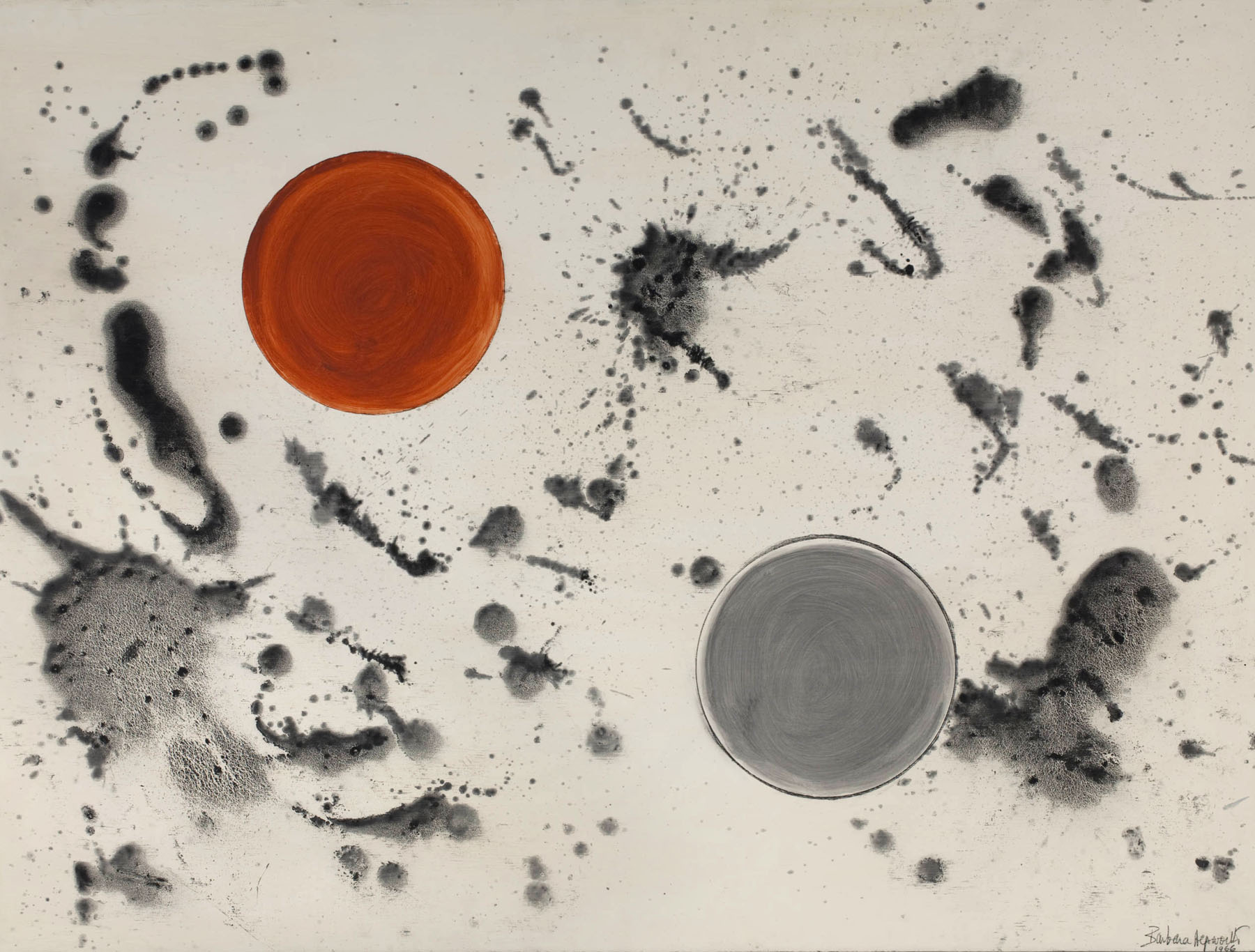
Text from the Getty website [Online] Cited 19/03/2021


Werner Mantz‘s (German, 1901-1983) youthful passion for taking pictures inspired him to study photography at the Bayerische Lehr-und Versuchsanstalt in Munich in 1920-1921. After that he opened a portrait photography studio in Cologne and joined the artists group Kölner Progressive. Around 1926, encouraged by architect Wilhelm Ripahn, Mantz became one of the leading contemporary photographers of modern architecture in the Rhineland. He worked for architects such as Bruno Paul and Hans Schumacher and was under exclusive contract with the architects Ripahn & Grod. In 1932 he relocated to Maastricht in the Netherlands close to the German border. He opened a second studio there and closed the Cologne studio in 1938. In addition to his architectural work he devoted himself to photographing children.

Text from the Kicken Berlin website [Online] Cited 19/03/2021


The Renger-Patzsch is a cracker.

Further information about the Dusseldorf School artists and their successors can be found at ‘Photographs Become Pictures. The Becher Class’ at the Städel Museum, Frankfurt, April – August 2017.

Marcus


Many thankx to the Die Photographische Sammlung / SK Stiftung Kultur for allowing me to publish the photographs in the posting. Please click on the photographs for a larger version of the image.


Albert Renger-Patzsch (German, 1897-1966) 'Untitled (Grimberg colliery, Bergkamen)' 1951-1952 from the exhibition Exhibition: 'From Becher to Blume – Photographs from the Garnatz Collection and Die Photographische Sammlung/SK Stiftung Kultur in Dialogue' at Die Photographische Sammlung/SK Stiftung Kultur, Cologne, March - August, 2021


Albert Renger-Patzsch (German, 1897-1966)
Ohne Titel (Zeche Grimberg, Bergkamen)
Untitled (Grimberg colliery, Bergkamen)
1951-1952
© 2020 Albert Renger-Patzsch / Archiv Ann und Jurgen Wilde, Zulpich / VG Bild-Kunst, Bonn


Tata Ronkholz (German, 1940-1977) 'Trinkhalle, Sankt-Franziskusstraße 107' 1977


Tata Ronkholz (German, 1940-1977)
Trinkhalle (Refreshment Stand), Sankt-Franziskusstraße 107
1977
© VAN HAM Art Estate: Tata Ronkholz


Along with Thomas Ruff, Candida Höfer, and Thomas Struth, Tata Ronkholz (German, 1940-1997) was among the first students of Bernd Becher at the Kunstakademie Düsseldorf. Ronkholz is perhaps best known for her most extensive series Trinkhallen: kiosks and small shops around the corner that are witnesses of social neighbourhoods and vernacular cultures. In her work, Tata Ronkholz shows elements of urban architecture, which due to their transient nature turn the photographs into valuable historical documents. Ronkholz found her characteristic subjects in Cologne, Düsseldorf, Bochum, and parts of the Rhineland. Together with Thomas Struth, Tata Ronkholz documented a part of the port of Düsseldorf between 1978 and 1980, shortly before it was torn down. Struth and Ronkholz created a unique historical document, which also received great recognition from the city of Düsseldorf. In 1979 Ronkholz took part in the seminal exhibition In Deutschland (In Germany) at the Rheinisches Landesmuseum in Bonn.

Text from the Kicken Berlin website [Online] Cited 19/03/2021


Cigarette and gumball machines are fixed to exterior walls. Advertising posters overlap. Beverages, magazines and sweets are visibly lined up behind glass. It is Tata Ronkholz’ serial presentation that enables the comparison of the kiosks and their study as a social phenomenon in urban contexts.

Kiosks are everyday meeting points and the setting for social life. At the same time their role fundamentally changed in the past decades. Ronkholz photographs kiosks as socially grown places. She positions them centrally in their architectural environment – people are absent. This is what the photos have in common with Becher-photographs. Like her teachers, Ronkholz is committed to the conservation and archiving of a changing urban culture.

More information about the work of Tata Ronkholz: ‘Photographs Become Pictures. The Becher Class’ at the Städel Museum, Frankfurt


Tata Ronkholz (German, 1940-1977) Thomas Struth (German, b. 1954) 'Rheinhafen, Düsseldorf' 1979-1980


Tata Ronkholz (German, 1940-1977)
Thomas Struth (German, b. 1954)
Rheinhafen, Düsseldorf
1979-1980
© VAN HAM Art Estate: Tata Ronkholz
© Thomas Struth


Tata Ronkholz was born in 1940 in Krefeld under the female name Roswitha Tolle. She studied architecture and interior design at the School of Applied Arts in Krefeld. Thereafter, she completed a one-year apprenticeship at the Schroer Furniture Store in Krefeld. She subsequently began work as a freelance product designer. Tata Ronkholz first encountered photography through her husband, Coco Ronkholz, who managed the production of a catalogue for Bernd Becher. In 1977, she enrolled in the State Art Academy in Düsseldorf and studied photography shortly thereafter with Prof. Becher. Along with Volker Döhne, Andreas Gursky, Candida Höfer, Axel Hütte, Thomas Ruff, and Thomas Struth, Ronkholz counts among Becher’s earliest (and later legendary) students at the Academy. In 1985, she gave up photography and worked for photography agency in Cologne from 1985-95 to support herself. In 1997, Ronkholz died at Burg Kendenich near Cologne. Her photographs of refreshment stands, of which few remain, were arguably her most substantial works. In 1978, she also began to collaborate with Thomas Struth on documenting the Rhine harbor. Ronkholz called her final group of photographs Schaufenster (Display Windows).

Text from the Van Ham Art Estate website [Online] Cited 19/03/2021


Wilhelm Schürmann (German, b. 1946) 'Untitled (construction trailer and view of Cologne Cathedral)' 1988


Wilhelm Schürmann (German, b. 1946)
Ohne Titel (Bauwagen und Blick auf Kölner Dom)
Untitled (construction trailer and view of Cologne Cathedral)
1988
© Wilhelm Schürmann


Bernd and Hilla Becher. 'Charleroi-Montigny, B' 1984


Bernd (German, 1931-2007) and Hilla (German, 1934-2015) Becher
Charleroi-Montigny, B
1984
© Estate Bernd & Hilla Becher, vertreten durch Max Becher, courtesy Die Photographische Sammlung / SK Stiftung Kultur – Bernd und Hilla Becher Archiv, Köln, 2020


Boris Becker (German, b. 1961) 'Zeebrugge' 2003


Boris Becker (German, b. 1961)
Zeebrugge
2003
© VG Bild-Kunst, Bonn 2020


“The great charm of Boris Becker’s photographs is due to the fact that through the consequent isolation of his objects they appear mysterious and alienated which makes us curious to look closer with greater attention and to see things in a different way.”

Rupert Pfab, Exhibition catalogue: “Boris Becker”, published by Städtisches Museum Zwickau, 1995, p. 15.


Frank Dömer (German, b. 1961) 'Äbnet' 2002


Frank Dömer (German, b. 1961)
Äbnet
2002
© Frank Dömer


Anna and Bernhard Blume. 'Telekinetisch hysterische Szene' (Telekinetically hysterical scene) 1986-1987


Anna (German, 1936-2020) and Bernhard (German, 1937-2011) Blume
Telekinetisch hysterische Szene (Telekinetically hysterical scene)
1986-87
From the series Trautes Heim (Sweet home)
© VG Bild-Kunst, Bonn 2020


Anna and Bernhard Blume were a collaborative duo of German artists, best known for their large-scale, monochromatic photographs. Throughout their practice, they captured themselves dynamically engaging with Minimalist sculpture, resulting in humorous investigations into space, art history, and contemporary life. Anna was born Anna Helming in Bork, Germany and Bernhard was born in Dortmond, Germany, both in 1937. They went on to study at the Staatliche Kunstakademie in Düsseldorf from 1960 to 1965, where they met and were married in 1966. Notably, their work is entirely self-produced, from conceptualisation to finished product, with total mastery of technical components. “We paint with our camera,” Anna Blume explained, “and this painterly work continues in the lab, too.”

Anna and Bernhard Blume’s work has been widely acclaimed, resulting in such exhibitions as at the Museum Ludwig in Cologne in 2005, The Museum of Modern Art in New York in 1989, and documenta 6 in Kassel in 1977. Bernhard Blume died in Cologne, Germany on September 1, 2011. Anna Blume passed away on June 18, 2020 at the age of 84 after a long illness.

Text from the Artnet website [Online] Cited 19/03/2021


Jim Dine. 'Leaves Painted in the Eastern Part of the State' 2010


Jim Dine (American, b. 1935)
Leaves Painted in the Eastern Part of the State
2010
© VG Bild-Kunst, Bonn 2020


Candida Höfer. 'Kunsthalle Karlsruhe V' 1999


Candida Höfer (German, b. 1944)
Kunsthalle Karlsruhe V
1999
© VG Bild-Kunst, Bonn 2020


Thomas Struth (German, b. 1954) 'Rijksmuseum Amsterdam 1' 1990


Thomas Struth (German, b. 1954)
Rijksmuseum Amsterdam 1
1990
© Thomas Struth


The exhibition From Becher to Blume provides in-depth insights in particular into the influential photography of the 1980s and 90s, a period that produced a number of innovative bodies of work and concepts. A central role is played by the Rhineland, home to numerous artists, museums, and galleries. The collector couple Ute and Eberhard Garnatz were part of this extremely lively scene, and began as early as the 1970s to pursue their collecting activities with great dedication. In addition to amassing a large number of paintings, sculptures, and prints, they also built a distinctive and remarkably diverse collection of photographs, some of them dating back to the 1950s but for the most part produced during the 1980s to the 2000s. During that decade, photography was more and more becoming part of the fine arts cosmos. The medium resolutely carved out a place for itself with and alongside the traditional genres. And the collectors followed this development with an alert eye. Keeping pace with the times, they began to focus on artists who used the photographic image as basis for their work and for whom the camera was hence a matter-of-fact technical tool in their artistic practice. Some of these artists chose the documentary image as their springboard, while others were far less interested in the medium’s ability to faithfully reproduce reality and instead ventured into experimental realms. There were also those who attempted to confound the world of objects in their photos, or who staged or made use of the chemical nature of the photographic process to arrive at pictorial works in a more painterly idiom.

Showcasing the Garnatz Collection offers Die Photographische Sammlung / SK Stiftung Kultur the opportunity to arrange photographs from both collections in a productive dialogue. A common denominator can be found in particular in the works of Bernd and Hilla Becher, while photographers including Boris Becker, Candida Höfer, Thomas Ruff, and Thomas Struth are likewise represented in both collections. The exhibition furthermore places rare staged and experimental works in context. These are juxtaposed with other works that straddle the genres of photography and painting. As much as the medium of photography claims to reproduce reality, the range of possibilities it offers equally inspires artists to create works verging on the abstract or lyrical.

From Becher to Blume thus unfurls a broad and extremely varied spectrum of photographic approaches, which come together here in a refreshingly informal way to reveal their many contrasts and contradictions. On display are over 150 exhibits, including extensive serial works, by a total of 22 artists who have been instrumental in shaping recent German photography through their innovative contributions and continue to exert a major influence on the artistic medium.

A catalogue has been published by Snoeck Verlag to accompany the exhibition.

Press release from Die Photographische Sammlung/SK Stiftung Kultur


Chargesheimer (Karl-Heinz Hargesheimer) (German, 1924-1972) 'Untitled (girl scattering confetti)' c. 1956-1957


Chargesheimer (Karl-Heinz Hargesheimer) (German, 1924-1972)
Ohne Titel (Konfetti streuendes Mädchen)
Untitled (girl scattering confetti)
c. 1956-1957
© Museum Ludwig Köln


Chargesheimer (Karl Heinz Hargesheimer) belongs among the most outstanding artists of his generation – as photographer, sculptor, stage designer and director. The press called Chargesheimer a “restlessly proliferative creative spirit” and an artist “who loves to provoke.”

He was during his entire life an individual who never compromised. “Chargesheimer was insatiable, a person for whom nothing was ever enough, who consumed himself, a malcontent with an entirely crazy life (…). He made life for himself and his peers as difficult as possible.” (Georg Ramseger)

Chargesheimer began his career in 1947 as an independent photographer for various theaters in Germany. Towards the end of the 1940s he was in contact with the photographic group “fotoform.” In 1950 he participated in the “photo-kino” exhibition in Cologne and also in the legendary exhibitions of “Subjective Photography” in 1952 and 1954. At the core of Chargesheimer’s photographic oeuvre, alongside portraiture and experimental photography, stands his Street Photography, depictions of street life in Cologne and other cities of post-war Germany. These works were as a rule put by Chargesheimer into different series, and from 1957 to 1970 published in book form.

In 1958 he published concurrently two photography books, Unter Krahnenbäumen (the name of a tiny and notorious street behind the train station in Cologne) and Im Ruhrgebiet (In the Ruhr Valley), with texts from the Nobel Prizewinner for Literature Heinrich Böll. In these works Chargesheimer portrays the everyday life of ordinary people from a radical subjective perspective without a trace of sentimentality. In close succession are found all the basic human emotions and behaviours: love and sadness, cares and conflicts, reflectiveness and high spirits, the dignity of age and the exuberance of youth…

Text from the Priska Pasquer website [Online] Cited 19/03/2021


Floris Neusüss (German, 1937-2020) 'Neusüss leaves the shadows, Kassel' 1976


Floris Neusüss (German, 1937-2020)
Neusüss verlässt den Schatten, Kassel
Neusüss leaves the shadows, Kassel
1976
© Floris Neusüss


Floris Neusüss was born in Lennep, Germany, on 3 March 1937. He began as a painter the took up photography which he studied at the Wuppertal School of Arts and Crafts in North Rhine-Westphalia, before continuing at the Bavarian State Institute of Photography in Munich. He trained alongside photographer Heinz Hajek-Halke at the Berlin University of the Arts. In 1957, he began making photograms and photomontages.

His series Körperbilder (whole-body photograms) set him in the 1960s on a lifelong exploration of conceptual, technical and artistic possibilities of camera-less photography. From 1964 he has also experimented with chemical painting on photograms. Neusüss brought the photogram out of the darkroom and out of the studio to the objects recording motifs not with a camera but rather a folder with photo paper, on which he exposed subjects such as plants or windows, as in the photo series Dream Images. Continuing into the 1970s are his nudograms; silhouettes of nude figures; and also life-size portraits, including several using his friend and frequent collaborator, Robert Heinecken as the subject; and shadowy reproductions of museum sculptures, such as those of Greek statues from the Glypothek in Munich For Neusüss, the photographic medium was not an impression, but a contact image. According to this interpretation, the original object touched the image;

“It is true that the subject resting on the photo-sensitive paper presents its reverse side to be recorded, the side that is in shadow, the shadow cast by the object itself. This intimate physical connection inscribes into the paper, and this, if you are open to it, is the real fascination of photograms: the tension between the hidden and the revealed.”

Text from the Wikipedia website


Floris Neusüss is a contemporary experimental German photographer known for his use of camera-less photography (photograms). His most famous works are the Nudogramms from the late 1960s, in which he exposed a nude figure directly onto photographic paper “Photograms don’t show us what’s beyond the visible, but they give us a hint of it,” Neusüss has said. “It is true that the subject resting on the photo-sensitive paper presents its reverse side to be recorded, the side that is in shadow, the shadow cast by the object itself. This intimate physical connection inscribes into the paper, and this, if you are open to it, is the real fascination of photograms: the tension between the hidden and the revealed.” Born on March 3, 1937 in Remscheid Lennep, Germany, he studied at a number of schools throughout Germany before completing his education at the School of Art in Berlin, where he studied under the revered photographer Heinz Hajek-Halke. Graduating in 1960, Neusüss went on to teach at the Academy of Fine Arts in Kassel while beginning to experiment with photograms. The artist continues to live and work in Kassel, Germany. Today, his works are held in the collections of the Victoria and Albert Museum in London, the San Francisco Museum of Modern Art, and the Art Institute of Chicago, among others.

Text from the Artnet website [Online] Cited 19/03/2021


Arnulf Rainer (Austrian, b. 1929) 'Selbst mit Ei (Self with an egg)' c. 1969-1971


Arnulf Rainer (Austrian, b. 1929)
Selbst mit Ei (Self with an egg)
c. 1969-1971
© Arnulf Rainer


Arnulf Rainer (born 8 December 1929) is an Austrian painter noted for his abstract informal art.

Rainer was born in Baden, Austria. During his early years, Rainer was influenced by Surrealism. In 1950, he founded the Hundsgruppe (dog group) together with Ernst Fuchs, Arik Brauer, and Josef Mikl. After 1954, Rainer’s style evolved towards Destruction of Forms, with blackenings, overpaintings, and maskings of illustrations and photographs dominating his later work. He was close to the Vienna Actionism, featuring body art and painting under the influence of drugs. He painted extensively on the subject of Hiroshima such as it relates to the nuclear bombing of the Japanese city and the inherent political and physical fallout.

In 1978, he received the Grand Austrian State Prize. In the same year, and in 1980, he became the Austrian representative at the Venice Biennale. From 1981 to 1995, Rainer held a professorship at the Academy of Fine Arts in Vienna – the same place where he aborted his own studies after three days, unsatisfied.

Text from the Wikipedia website


Sigmar Polke (German, 1941-2010) 'Untitled (Oberkassel Bridge)' 1971-1983


Sigmar Polke (German, 1941-2010)
Ohne Titel (Oberkasseler Brücke)
Untitled (Oberkassel Bridge)
1971-83
© The Estate of Sigmar Polke, Cologne / VG Bild-Kunst, Bonn 2020


Sigmar Polke (13 February 1941 – 10 June 2010) was a German painter and photographer.

Polke experimented with a wide range of styles, subject matters and materials. In the 1970s, he concentrated on photography, returning to paint in the 1980s, when he produced abstract works created by chance through chemical reactions between paint and other products. In the last 20 years of his life, he produced paintings focused on historical events and perceptions of them…

Work

In 1963, Polke founded the painting movement “Kapitalistischer Realismus” (“Capitalist realism”) with Gerhard Richter and Konrad Fischer (alias Konrad Lueg as artist). It is an anti-style of art, appropriating the pictorial shorthand of advertising. This title also referred to the realist style of art known as “Socialist Realism”, then the official art doctrine of the Soviet Union and its satellites (from one which he had fled with his family), but it also commented upon the consumer-driven art “doctrine” of western capitalism. He also participated in “Demonstrative Ausstellung”, a store-front exhibition in Düsseldorf with Manfred Kuttner, Lueg, and Richter. Essentially a self-taught photographer, Polke spent the next three years painting, experimenting with filmmaking and performance art.

Photography

In 1966-1968, during his most conceptual period, Polke used a Rollei camera to capture ephemeral arrangements of objects in his home and studio.[6] In 1968, the year after he left the art academy, Polke published these images as a portfolio of 14 photographs of small sculptures he had made from odds and ends – buttons, balloons, a glove. From 1968 to 1971, he completed several films and took thousands of photographs, most of which he could not afford to print.

During the 1970s, Polke slowed his art production in favour of travel to Afghanistan, Brazil, France, Pakistan, and the U.S., where he shot photographs (using a handheld 35mm Leica camera) and film footage that he would incorporate in his subsequent works during the 1980s. In 1973 he visited the U.S. with artist James Lee Byars in search of the “other” America; the fruit of that journey was a series of manipulated images of homeless alcoholics living on New York’s Bowery. He produced an additional series of photographic suites based on his journeys to Paris (1971), Afghanistan and Pakistan (1974) and São Paulo (1975), often treating the original image as raw material to be manipulated in the dark room, or in the artist’s studio. Beginning with his 1971 Paris photographs printed using chemical staining to create works full of strange presences while under the influence of LSD, Polke exploited the photographic process as a means to alter “reality.” He combined both negatives and positives with images that had both vertical and horizontal orientations. The resulting collage-like compositions take advantage of under- and overexposure and negative and positive printing to create enigmatic narratives. With the negative in his enlarger, the artist developed large sheets selectively, pouring on photographic solutions and repeatedly creasing and folding the wet paper.

Completed in 1995 in collaboration with his later wife Augustina von Nagel, a suite of 35 prints entitled “Aachener Strasse” combine street photography with images from Polke’s paintings, developed using techniques of multiple exposures and multiple negatives.

Text from the Wikipedia website


Benjamin Katz (Belgium, b. 1939) 'Sigmar Polke in Düsseldorf' 1984


Benjamin Katz (Belgium, b. 1939)
Sigmar Polke in Düsseldorf
1984
© VG Bild-Kunst, Bonn 2020


More information about and images from the artist: ‘Benjamin Katz Berlin Havelhöhe, 1960/61’ at Museum Ludwig, Cologne


Astrid Klein (German, b. 1951) 'Zwischenbereich (Intermediate area)' 1986


Astrid Klein (German, b. 1951)
Zwischenbereich (Intermediate area)
1986
© Astrid Klein / Courtesy Sprüth Magers


Astrid Klein (b. 1951) is one of Germany’s most distinguished conceptual artists. Collage constitutes the main formal and artistic principal of her work. Her large-scale wall pieces often combine found images with her own text or quotes from philosophy, theory or science to illuminate suppressed aspects of the collective unconscious and to question conventional power structures and modes of representation. Her oeuvre – comprising photographic work but also neon and mirror sculptures, installations, painting and drawing – oscillates between poetry and criticism, skepticism and longing.

Photoworks

Klein began working with photography in 1978. Her early works were based on themes of human tragedy and often combined texts with images.

Klein produces photographic images on a large scale to make what she refers to as ‘photoworks’, distinguishing them from straightforward photographs. Starting with images drawn from newspapers and magazines, Klein transforms them with a variety of processing and printing techniques in the darkroom, often verging on abstraction. The resulting works question assumptions about photography as an accurate documentary medium.

Text from the Wikipedia website


Gina Lee Felber (German, b. 1957) 'Tacet (Silent)' 1988


Gina Lee Felber (German, b. 1957)
Tacet (Silent)
1988
© Gina Lee Felber


Jürgen Klauke (German, b. 1943) 'Untitled (Flying Hats)' 1990-1992


Jürgen Klauke (German, b. 1943)
Ohne Titel (Fliegende Hüte)
Untitled (Flying Hats)
1990-92
From the series Sonntagsneurosen (Sunday Neuroses)
© Jürgen Klauke


Jürgen Klauke (born 6 September 1943) is a German artist. Beginning in the 1960s, he used his own body as a subject of his photographs. He also experimented with minimalism and surrealism. The ZKM in Karlsruhe exhibits his work. Since 1968 he lives and works in Cologne.


Augustina von Nagel (German, b. 1952) 'Der Denker (The Thinker)' 1997


Augustina von Nagel (German, b. 1952)
Der Denker (The Thinker)
1997
© Augustina von Nagel


Married to Sigmar Polke.


Die Photographische Sammlung/SK Stiftung Kultur
Im Mediapark 7
50670 Cologne
Phone: 0049-(0)221-88895 300

Opening hours:
Open daily 14 – 19hrs
Closed Wednesdays
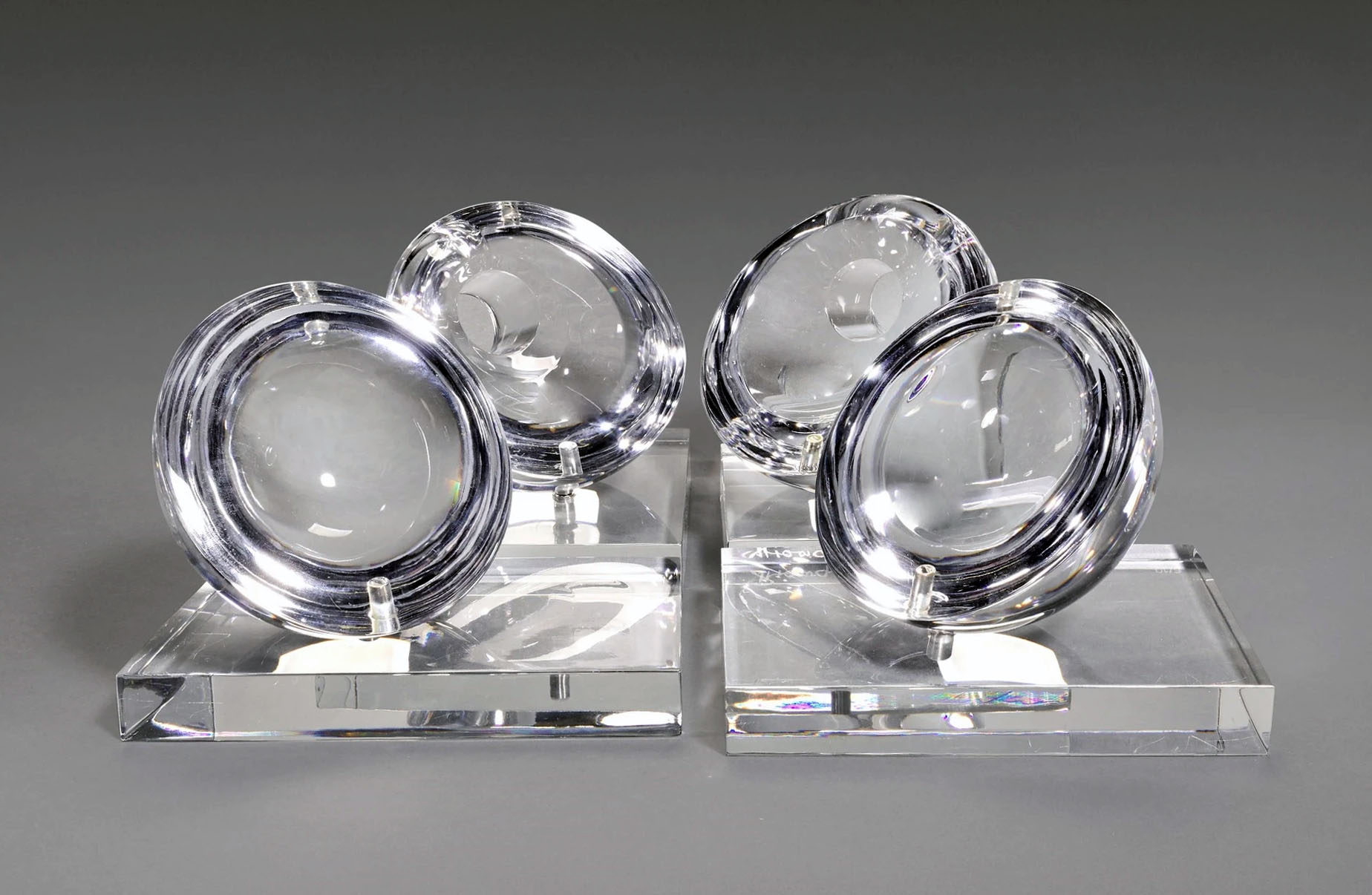
Die Photographische Sammlung/SK Stiftung Kultur website

LIKE ART BLART ON FACEBOOK

Back to top

Exhibition: ‘The Experimental Self: Edvard Munch’s Photography’ at the National Nordic Museum, Seattle

Exhibition dates: 29th October, 2020 – 31st January, 2021

Curator: Dr Patricia Berman


Edvard Munch (Norwegian, 1863-1944) 'Self-Portrait in Åsgårdstrand' 1904 from the exhibition 'The Experimental Self: Edvard Munch's Photography' at the National Nordic Museum, Seattle, Oct 2020 - Jan 2021


Edvard Munch (Norwegian, 1863-1944)
Self-Portrait in Åsgårdstrand
1904
Silver gelatin contact print


The camera is located so close to Munch that his looming head is out of focus. Reversing photographic norms, the background is in sharp focus, revealing a chest that had been given to the artist by his on-and-off-girlfriend Tulla Larsen, and a lithograph tacked to the wallpaper above it – a bitterly satirical commentary on their relationship.


Munch says to a woman friend – “What do you think of me?”
She says, “I think you are the Christ”


Peter Watkins (director) Edvard Munch (film) 1974


The semi-transparent self

What a fascinating study of an artist in motion – physically and spiritually.

Through his informal, experimental photographs, Munch explores issues of identity and self-representation, friendship, work and location. In his photographs, he “assumes a range of personalities, from the vulnerable patient at the clinic to the vital, naked artist on the beach”, many of which undermine “the function of a camera as a straight-forward documentary tool.”

“Faulty” focus, distorted perspectives and eccentric camera angles combined with low and selective depth of field allow Munch to create a body of self-images in which “the artist himself appears in some pictures as a shadow or a smear rather than a physical presence.” There is a subtle mystery to much of the artist’s photographic work, a sense of loneliness and isolation trading off visions of heroic creatures; mirror images questioning the stability of him/self playing off the vitalism of male body culture; and variations of melancholy opposing a better life which lay in nature and good health, stages in the theatre of life.

His ghost-like, semi-transparent self-image appears as if seen in a far off dream – flickering images in light – out of space and time / asynchronous with the effects of time and motion.

What strong, e-motionless photographs of self these are. Here is observation but not self pity. Here is Munch investigating, probing, the mirror stage of “the formation of the Ego via the process of identification, the Ego being the result of identifying with one’s own specular image.”1 (Lacan). Munch explores the tension between the subject and the image, between the whole and fragmented body as revealed in psychoanalytic experience, seeking access to representations of the unified self, in order to understand the human condition, of becoming. Who am I? How am I represented to myself, and to others?

The attempt to locate a fixed subject proves ever elusive. “The mirror stage is a drama… which manufactures for the subject, caught up in the lure of spatial identification, the succession of phantasies that extends from a fragmented body-image to a form of its totality.” (Écrits 4). With its link to a belief in spiritualism (popular in his day), Munch speculates that if we had different eyes we would be able to see our external astral casing, our different shapes. The exhibition text notes, “It is easy to read his layered, flickering images in light of such speculation.” Indeed it is. But the spectres that haunt Munch’s photographs are as much grounded in the reality of the everyday struggle to live a life on earth as they are in the spirit world. They are of the order of something, something that haunts and perturbs the mind, a questioning as to the nature of the self: am I a good person, am I worthy of a good life, where does the path lead me. I have been there, I am still there, I know his joy and pain.

Dr Marcus Bunyan


1/ The specular image refers to the reflection of one’s own body in the mirror, the image of oneself which is simultaneously oneself and other – the “little other”.


Many thankx to the National Nordic Museum for allowing me to publish the photographs in the posting. Please click on the photographs for a larger version of the image.


Edvard Munch (Norwegian, 1863-1944) 'Caricature: The Assault' 1903 from the exhibition 'The Experimental Self: Edvard Munch's Photography' at the National Nordic Museum, Seattle, Oct 2020 - Jan 2021


Edvard Munch (Norwegian, 1863-1944)
Caricature: The Assault
1903
Lithograph printed in black on medium heavy cream paper
Sheet: 237 x 487mm
Image: 180 x 415mm


Internationally celebrated for his paintings, prints, and watercolours, Norwegian artist Edvard Munch (1863-1944) also took photographs. This exhibition of his photographs, prints, and films emphasises the artist’s experimentalism, examining his exploration of the camera as an expressive medium. By probing and exploiting the dynamics of “faulty” practice, such as distortion, blurred motion, eccentric camera angles, and other photographic “mistakes,” Munch photographed himself and his immediate environment in ways that rendered them poetic. In both still images and in his few forays with a hand-held moving-picture camera, Munch not only archived images, but invented them.

On loan from the Munch Museum in Oslo, Norway, the 46 copy prints in the exhibition and the continuous screening of the DVD containing Munch’s films are accompanied by a small selection of prints from private collections, as well as contextualising panels and others that examine Munch’s photographic exploration. Similar to the ways in which the artist invented techniques and approaches to painting and graphic art, Munch’s informal photography both honoured the material before his lens and transmuted it into uncommon motifs.


” … these photographic images of the artist rise to the level of what Munch called “selfscrutinies”: emotional but hard-edged, and pierced with a dread of modern life that has outlived the Modernist era.” ~ New York Times

” … an unfinished playfulness with technical manipulation and subject matter that is not as readily seen in Munch’s more well-known work” ~ Hyperallergic


Edvard Munch (Norwegian, 1863-1944) 'Nurse at the Clinic, Copenhagen' 1908-1909


Edvard Munch (Norwegian, 1863-1944)
Nurse at the Clinic, Copenhagen
1908-1909
Scan from negative


One of the nurses at Daniel Jacobson’s clinic in Copenhagen posed in a fontal manner that mirrors representations of women throughout Munch’s work. The slight movement of the camera blurs the figure and her surroundings, undermining the function of a camera as a straight-forward documentary tool.
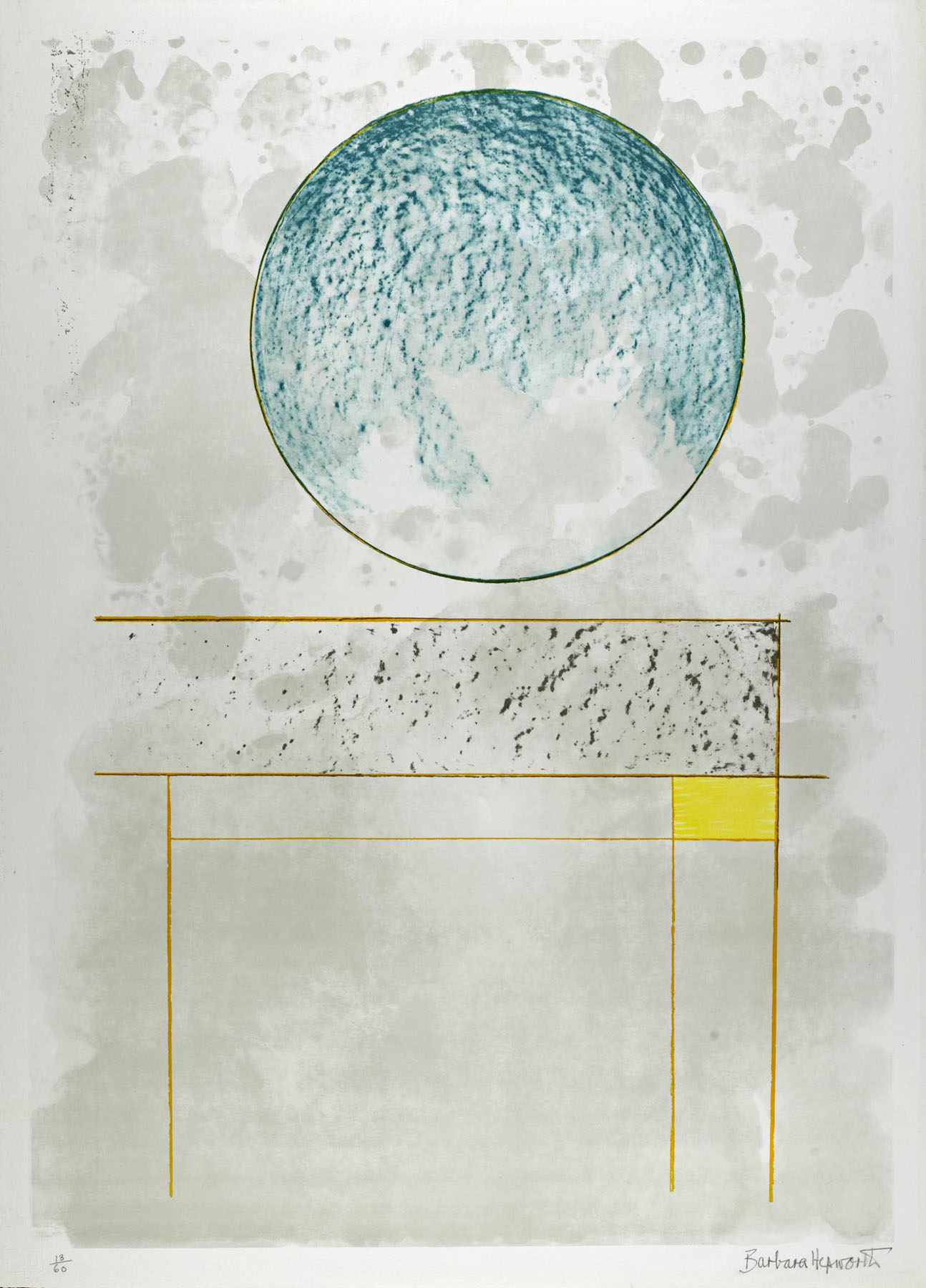
 

Edvard Munch (Norwegian, 1863-1944) 'Nurse at the Clinic, Copenhagen' 1908-1909


Edvard Munch (Norwegian, 1863-1944)
Nurse at the Clinic, Copenhagen
1908-09
Silver gelatin contact print


After a successful run at New York’s Scandinavia House that received great reviews from New York Times and others, the photography of Edvard Munch is currently on display at the National Nordic Museum in Seattle now through January 31, 2021. Curated by distinguished Munch scholar, Dr. Patricia Berman of Wellesley College, The Experimental Self: Edvard Munch’s Photography presents works from the rich collection of Oslo’s Munch Museum and shares new research on one of the most significant artists of his day.

“After displaying the journalistic photography of Jacob Riis this spring and discussing a picture’s power to change lives, it is wonderful to host another celebrated Nordic artist whose photography reflects the artistic potential found in the camera of the late 19th and early 20th century,” said Executive Director / CEO Eric Nelson.

Internationally celebrated for his paintings, prints, and watercolours, Norwegian artist Edvard Munch (1863-1944) experimented with both still photography and early motion picture cameras. The Experimental Self: Edvard Munch’s Photography displays his photographs and films in a way that emphasises the artist’s exploration of the camera as an expressive medium. By probing and exploiting the dynamics of “faulty” practice, such as distortion, blurred motion, eccentric camera angles, and other photographic “mistakes,” Munch photographed himself and his immediate environment in ways that rendered them poetic.

“In many ways, these works reveal an unknown Munch,” said Leslie Anne Anderson, Director of Collections, Exhibitions, and Programs at the National Nordic Museum. “The photographs were never displayed during the artist’s lifetime, and this exhibition invites visitors to peer into the keyhole of Munch’s private life.”

Press release from the National Nordic Museum


Ragnvald Vaering. 'Munch in his Winter Studio in Ekely on his seventy fifth birthday' 1938


Ragnvald Vaering
Munch in his Winter Studio in Ekely on his seventy fifth birthday
1938
Silver gelatin contact print


Introduction: The Experimental Self

Edvard Munch was among the first artists in history to take “selfies.” Like his paintings, prints and writings, his amateur photographs are often about self-representation. Munch assumes a range of personalities, from the vulnerable patient at the clinic to the vital, naked artist on the beach. Sometimes he staged himself and people around him almost theatrically. Munch pursued his informal photography as an experimental medium, just like his paintings and prints. The artist himself was more than often the experimental subject. This exhibition, containing around 60 photographs and movie fragments in dialogue with graphic works, highlights the connection between Munch’s amateur photography and his more recognised work as an artist.
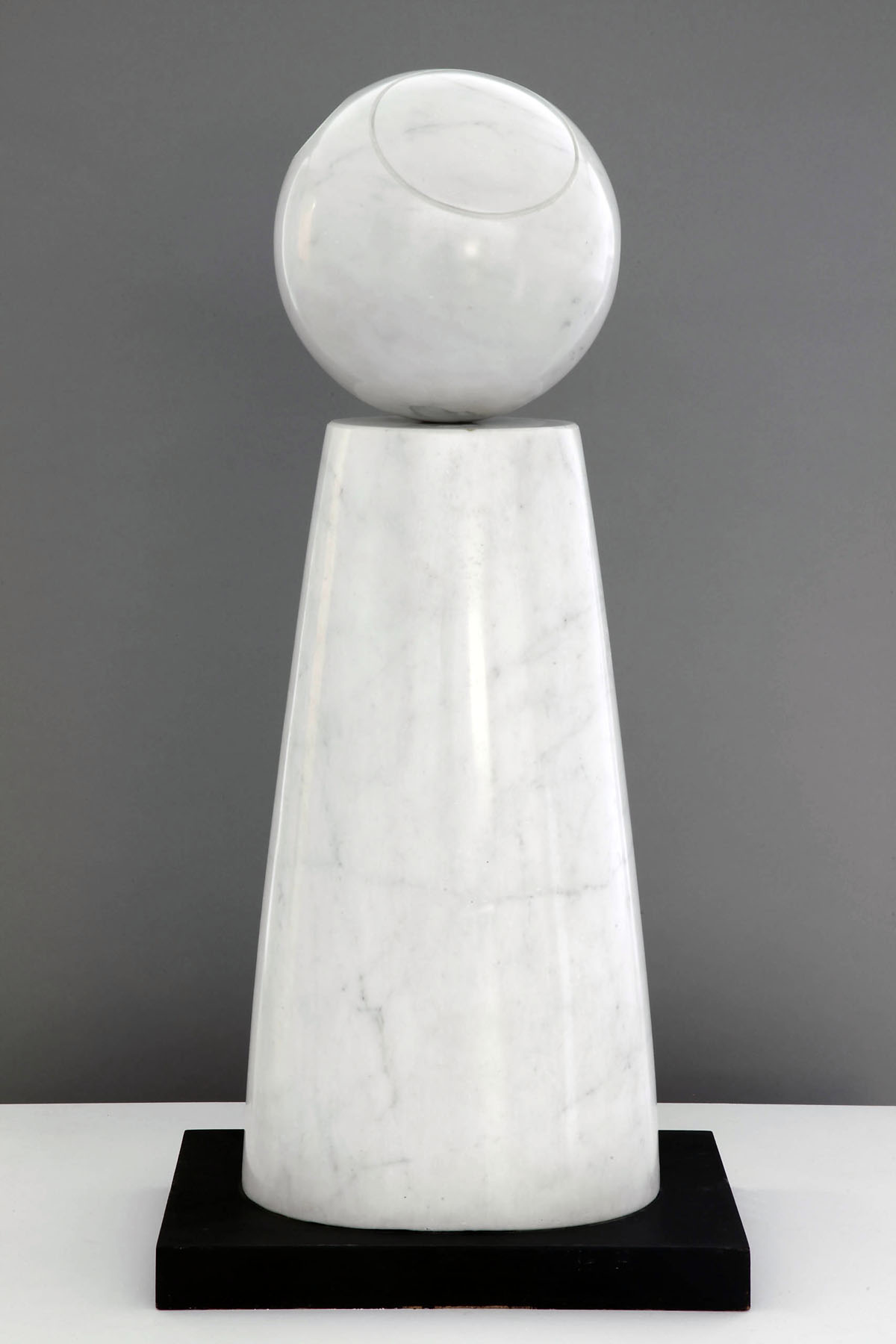
Munch took up photography in 1902, months before he and his lover Tulla Larsen ended a multi-year relationship with a pistol shot that mutilated one of his fingers. This event, and an accelerating career, triggered a period of increasing emotional turmoil that culminated in a rest cure in the private Copenhagen clinic of Dr. Daniel Jacobson in 1908-09. After a pause of almost two decades, Munch picked up the camera again in 1927. This second period of activity lasted into the mid-1930s and was bracketed by triumphant retrospective exhibitions in Berlin and Oslo but also by a haemorrhage in his right eye, temporarily impairing his vision. This was also the time that Munch tried his hand at home movies.
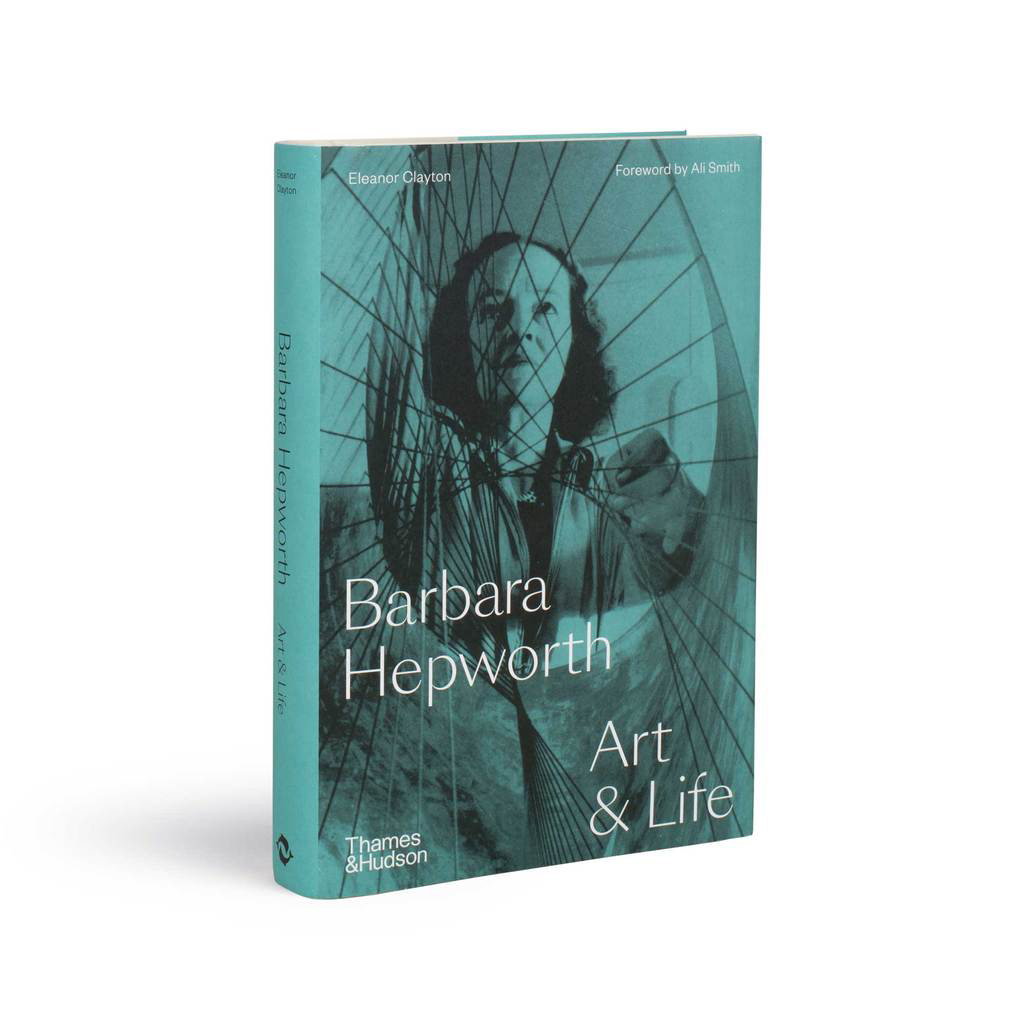
Unlike his prints and paintings, however, Munch did not exhibit his tiny, copy-printed photographs. Yet he wrote in 1930, “I have an old camera with which I have taken countless pictures of myself, often with amazing results … Some day when I am old, and I have nothing better to do than write my autobiography, all my self-portraits will see the light of day again.”

The Amateur Photographer

Munch’s photographs are often out of focus, and the artist himself appears in some pictures as a shadow or a smear rather than a physical presence. As an amateur photographer, he seems to have exploited the expressive potential in photographic “mistakes” such as “faulty” focus, distorted perspectives and eccentric camera angles. By including the platforms on which he stabilised his small, hand-held camera, he created out-of-focus, undefined areas cutting across the foreground. What may have begun as accidents, eventually became a habitual element in his work.

In many of his self-portrait photographs, Munch moved during the camera’s exposure time, transforming his own body into a ghost-like figure. In the photographs from his studio, Munch and his work seem to exist out of space and time with one another. He often experimented with such effects: “Had we different, stronger eyes,” wrote Munch, “we would be able, like X-rays … to see our external astral casing – and we would have different shapes.” It is easy to read his layered, flickering images in light of such speculation. On the other hand, Munch also regarded his self-images with humour. Writing to his relative Ludvig Ravensberg in June 1904, he confessed: “When I saw my body photographed in profile, I decided, after consulting with my vanity, to dedicate more time to throwing stones, throwing the javelin, and swimming.”


Edvard Munch (Norwegian, 1863-1944) 'Self-Portrait on a Valise in the Studio, Berlin' 1902


Edvard Munch (Norwegian, 1863-1944)
Self-Portrait on a Valise in the Studio, Berlin
1902
Collodion contact print


Munch took up photography in 1902, the same year that this picture was taken. There are three preserved versions of the motif, with subtle variations. Munch sent two of the images to his aunt Karen in Norway with the description: “Here are two photographs taken with a little camera I procured. You can see that I have just shaved off my moustache.”


Edvard Munch (Norwegian, 1863-1944) 'Self-Portrait on a Valise in the Studio, Berlin' 1902


Edvard Munch (Norwegian, 1863-1944)
Self-Portrait on a Valise in the Studio, Berlin
1902
Collodion contact print


The artist stages himself amidst his paintings (see below) in the studio he rented in Berlin at the time. The valise doubles as furniture and a symbol of Munch’s restless nature – he was often on the move.


Edvard Munch (Norwegian, 1863-1944) 'Evening on Karl Johan' 1892


Edvard Munch (Norwegian, 1863-1944)
Evening on Karl Johan
1892
Oil on canvas
84.5cm (33.2 in) x 121cm (47.6 in)
KODE, Rasmus Beyers samlinger
Public domain


Edvard Munch (Norwegian, 1863-1944) 'The Back Yard at 30B Pilestredet, Kristiania' 1902(?)


Edvard Munch (Norwegian, 1863-1944)
The Back Yard at 30B Pilestredet, Kristiania
1902(?)
Silver gelatin contact print


Edvard Munch (Norwegian, 1863-1944) 'Nude Self-Portrait, Åsgårdstrand' 1903


Edvard Munch (Norwegian, 1863-1944)
Nude Self-Portrait, Åsgårdstrand
1903
Collodion contact print


Edvard Munch (Norwegian, 1863-1944) 'The Courtyard at 30B Pilestredet, Kristiania' 1902(?)


Edvard Munch (Norwegian, 1863-1944)
The Courtyard at 30B Pilestredet, Kristiania
1902(?)
Silver gelatin contact print


This is assumed to be one of Munch’s earliest photographs, taken in one of his childhood homes. An inscription on the back reads “Outhouse window. 30-40 years old. Photograph of Pilestredet 30. A swan on the wall.” The swan that Munch refers to is actually a stain on the wall by the door. Can you see it? In moving the camera during the exposure, Munch erased the communal outhouse of his childhood and transformed it into a kind of dream image. This effect was later explored in avant-garde photography.


Edvard Munch (Norwegian, 1863-1944) 'Karen Bjølstad and Inger Munch on the steps of 2 & 4 Olaf Ryes Plass, Kristiania' 1902(?)


Edvard Munch (Norwegian, 1863-1944)
Karen Bjølstad and Inger Munch on the steps of 2 & 4 Olaf Ryes Plass, Kristiania
1902(?)
Silver gelatin contact print


Munch has photographed his aunt Karen and his sister Inger on the steps of one of his childhood homes in Oslo. The camera is stabilised on a flat surface that dominates the foreground of the image. This is the case in several of Munch’s photographs, perhaps to mark the camera’s position, create a sense of distance and frame the subjects. What likely began as the accident of an amateur eventually became an aesthetic choice.


Edvard Munch (Norwegian, 1863-1944) 'Nude Self-Portrait, Åsgårdstrand' 1904(?)


Edvard Munch (Norwegian, 1863-1944)
Nude Self-Portrait, Åsgårdstrand
1904(?)
Collodion contact print


In the summer of 1904, Munch organised an informal “health vacation” for several of his friends in Åsgårdstrand by the Oslo fjord. Munch had owned a small fisherman’s cabin there since 1898. In that period, he worked on the painting Bathing Young Men. Munch described to his relative and close associate Ludvig Ravensberg “a huge canvas … ready to be populated by the strong men wandering among the waters. Here we train our muscles by swimming, boxing, and throwing rocks.”


Edvard Munch (Norwegian, 1863-1944) 'Ludvig Ravensberg in Åsgårdstrand' 1904


Edvard Munch (Norwegian, 1863-1944)
Ludvig Ravensberg in Åsgårdstrand
1904
Collodion contact print


Ludvig Ravensberg was Munch’s close friend and relative who helped him organise exhibitions and get other practical work done. He also assisted Munch when the artist took some of his self-portraits in Åsgårdstrand. Here Ravensberg gets to pose in front of the camera himself.


Edvard Munch (Norwegian, 1863-1944) 'Self-Portrait in the Garden, Åsgårdstrand' 1904


Edvard Munch (Norwegian, 1863-1944)
Self-Portrait in the Garden, Åsgårdstrand
1904
Collodion contact print


Was this picture taken by Munch himself or another person? The filtered light, the human shadow projected onto Munch’s body and the dynamics of his pose help set the stage for the subtle mystery.


Edvard Munch (Norwegian, 1863-1944) 'Self-Portrait in a Room on the Continent' 1906(?)


Edvard Munch (Norwegian, 1863-1944)
Self-Portrait in a Room on the Continent
1906(?)
Silver gelatin contact print


This photograph exists in two versions. One mirrors the other, probably a result of Munch flopping the negative as he developed the picture. The mirroring of motifs is something Munch often explored in his graphic work, such as the woodcuts Evening. Melancholy and Melancholy III – perhaps a dynamic he wanted to emulate in his photography. Chemical stains on the print testify to Munch’s hands-on approach to development and printing. In contrast to the products of a commercial printing house, he was not terribly concerned with a perfect print.


Edvard Munch (Norwegian, 1863-1944) 'Self-Portrait in a Room on the Continent (mirrored)' 1906(?)


Edvard Munch (Norwegian, 1863-1944)
Self-Portrait in a Room on the Continent (mirrored)
1906(?)
Silver gelatin contact print


Edvard Munch (Norwegian, 1863-1944) 'Evening. Melancholy I (Aften. Melankoli I)' 1896


Edvard Munch, Berlin (Norwegian, 1863-1944)
M.W. Lassally, Berlin (printer)
Evening. Melancholy I (Aften. Melankoli I)
1896
Woodcut
Composition: 16 1/4 x 18″ (41.2 x 45.7cm)
Sheet: 16 15/16 x 21″ (43 x 53.3cm)


Edvard Munch (Norwegian, 1863-1944) Melancholy III (Melankoli III)' 1902


Edvard Munch (Norwegian, 1863-1944)
Melancholy III (Melankoli III)
1902
Woodcut with gouache additions
Composition: 14 3/4 x 18 9/16″ (37.5 x 47.2cm)
Sheet: 20 1/2 x 25 7/8″ (52 x 65.8cm)


Variations of Melancholy

Edvard Munch made his first woodcuts and lithographs in 1896. He mastered an innovative technique in which he used the wood grain to emphasise his own lines. Using this technique, he created a number of related woodcuts on the theme of melancholy, including Evening. Melancholy I (1896), in which the brooding figure sits facing right, under an imposing crimson sky.


Edvard Munch (Norwegian, 1863-1944) 'Edvard Munch and Ludvig Ravensberg, Åsgårdstrand' 1904


Edvard Munch (Norwegian, 1863-1944)
Edvard Munch and Ludvig Ravensberg, Åsgårdstrand
1904
Collodion contact print


Munch used himself and his friends as models for his canvas Bathing Men. Here is a description by his friend Christian Gierløff: “The sun baked us all day and we let it do so. Munch worked a little on a painting of bathers, but for most of the day, we lay, overcome by the sun, in the sand by the water’s edge, between the large boulders, and we let our bodies drink in all of the sun they could. No one asked for a bathing suit.”


Edvard Munch (Norwegian, 1863-1944) 'The Painting "Bathing Young Men" in the Garden, Åsgårdstrand' 1904


Edvard Munch (Norwegian, 1863-1944)
The Painting “Bathing Young Men” in the Garden, Åsgårdstrand
1904
Collodion contact print


Several photographs from the summer of 1904 picture Munch’s painting Bathing Young Men. Shadows cast by leaves at the upper left of the painting seem integral to canvas and have the effect of linking the painting to its natural surroundings. Ludvig Ravensberg stands on the extreme right, seemingly holding the painting. The out-of-focus foreground, the painted figures, and the living man holding the canvas aloft document not only the painting but, playfully, photographic representation itself.


Edvard Munch (Norwegian, 1863-1944) 'Bathing Young Men' 1904


Edvard Munch (Norwegian, 1863-1944)
Bathing Young Men
1904
Oil on canvas
Munch Museum
Public domain


Bathers were a popular subject around the turn of the last century. Sojourns at health spas were fashionable and people pursued sports, nudism and the healthful effects of the natural environment. It was seen as cleansing to bathe in the sea, while the sun constituted a rejuvenating force of life.

In this painting we see a virile, muscular, naked man emerging from the cool, turquoise sea after a swim. The picture can be read as a reflection of the period’s “vitalism” – a world view that assumed all living things to be suffused with a magical life force. This philosophy found its pictorial expression in particular in dynamic motifs of naked men and youths.

As a cultural phenomenon, vitalism was a reaction against the decadence of the period, and against industrialism, with the great cities and ways of life it brought with it. Instead of cool-headed rationalism and scientific technology, vitalism preferred to emphasise instinct and intuition – and believed the key to a better life lay in nature and good health.

Text from the National Museum website


Edvard Munch (Norwegian, 1863-1944) 'Exhibition at Blomqvist, Kristiania' 1902


Edvard Munch (Norwegian, 1863-1944)
Exhibition at Blomqvist, Kristiania
1902
Collodion contact print


Munch took this image of his one-man exhibition at the influential art dealer Blomqvist in 1902. He also recorded himself, standing in the background, out of focus, hands in his pockets, facing directly into the camera.


Edvard Munch (Norwegian, 1863-1944) 'Model in the Studio, Berlin' 1902


Edvard Munch (Norwegian, 1863-1944)
Model in the Studio, Berlin
1902
Collodion contact print


This is among the few photographs that directly relate to Munch’s work in paint and graphic media. There are two versions of the motif, and subtle variations suggest that the photographer himself might have offered some instructions.


Edvard Munch (Norwegian, 1863-1944) 'Nude with Long Red Hair' 1902


Edvard Munch (Norwegian, 1863-1944)
Nude with Long Red Hair
1902
Oil on canvas


A Record of Healing

Munch often photographed in times and places where he struggled with his health and sought new energy. The pictures from the town of Warnemünde on Germany’s Baltic Coast show him as part of male body culture and include images of the artist naked and semi-naked on the beach. Munch also took tourist shots with his female models on the sand during the summers he spent there in 1907 and 1908.

In autumn 1908, Munch checked into a private clinic in Copenhagen managed by the physician Daniel Jacobson and his nurses. Munch was broken down by exhaustion, distress and alcoholism. The clinic became his home for over half a year. Within its walls, he painted, drew, created graphic motifs, organised exhibitions and took photographs in which he consistently appears semi-transparent. In the pictures of Munch’s room at the clinic we often get a glimpse of his paintings and prints. Sometimes he seems to have staged his body in postures that echo these paintings.


Edvard Munch (Norwegian, 1863-1944) 'Rosa Meissner at Hotel Rohn, Warnemünde' 1907


Edvard Munch (Norwegian, 1863-1944)
Rosa Meissner at Hotel Rohn, Warnemünde
1907
Silver gelatin contact print


Most of Munch’s photographs cannot be firmly associated with specific artworks. This photograph is however closely related to the motif Weeping Woman, which Munch rendered in several oil versions, a lithograph and a sculpture. While the foreground figure has remained static, the figure in the background has moved. Blurred movement is specific to photography and film, a phenomenon that Munch exploited repeatedly in his photographs. The effect of motion reproduces the appearance of spirit photographs – the spectral bodies of the departed allegedly registered on photographic plates and film. Munch expressed interest in such photographs in the 1890s. Ghosts and spectres also began to appear in cinema in the medium’s infancy.


Edvard Munch (Norwegian, 1863-1944) 'Edvard Munch and his Housekeeper, Warnemünde' 1907


Edvard Munch (Norwegian, 1863-1944)
Edvard Munch and his Housekeeper, Warnemünde
1907
Collodion contact print


In this picture, Munch has exploited the effects of movement and time. His housekeeper in Warnemünde has moved during exposure and is out of focus. Munch himself is sharply rendered in the background, and at the same time barely present. He has perched on a dark sofa long enough to be registered in detail and then moved out of the camera’s range. He now appears almost as a ghost where both the couch and the back wall are visible through his body. This effect mirrors his experimentation with layered woodblock printing in his graphic work, in which figures appear embedded in wood graining.


Edvard Munch (Norwegian, 1863-1944) 'Edvard Munch with Model on the Beach, Warnemünde' 1907


Edvard Munch (Norwegian, 1863-1944)
Edvard Munch with Model on the Beach, Warnemünde
1907
Collodion contact print


This photograph stages the beach at Warnemünde as Munch’s outdoor studio. The painter is strategically covered beside his monumental canvas Bathing Men. The naked man is one of Munch’s models holding a pose depicted in the painting.


Edvard Munch (Norwegian, 1863-1944) 'Bathing Men' 1907-1908


Edvard Munch (Norwegian, 1863-1944)
Bathing Men
1907-1908
Oil on canvas
206 x 227cm


Edvard Munch (Norwegian, 1863-1944) 'Nude Self-Portrait, Warnemünde' 1907


Edvard Munch (Norwegian, 1863-1944)
Nude Self-Portrait, Warnemünde
1907
Collodion contact print


Edvard Munch (Norwegian, 1863-1944) 'Canal in Warnemünde' 1907


Edvard Munch (Norwegian, 1863-1944)
Canal in Warnemünde
1907
Collodion contact print


Edvard Munch (Norwegian, 1863-1944) 'Self-Portrait with a Valise' c. 1906


Edvard Munch (Norwegian, 1863-1944)
Self-Portrait with a Valise
c. 1906
Collodion contact print


Back lit and smudged with chemicals, this photograph deviates from the instructions that accompanied the popular Kodak cameras intended for amateur use. Munch’s bodily envelopment by darkness and the light that dissolves the window in the background make this a staged image of isolation and longing. It echoes the mood and composition of the woodcut Evening. Melancholy I (above).


Edvard Munch (Norwegian, 1863-1944) 'Edvard Munch and Rosa Meissner on the Beach, Warnemünde' 1907


Edvard Munch (Norwegian, 1863-1944)
Edvard Munch and Rosa Meissner on the Beach, Warnemünde
1907
Collodion contact print


Munch posed for this photograph with Rosa Meissner, a model with whom he had worked in Berlin and later in in Warnemünde. Rosa’s sister Olga Meissner, who appears in another photograph in the same location, may have taken the image. A similar picture exists with double exposure, perhaps as a result of instructions given by Munch himself.


Edvard Munch (Norwegian, 1863-1944) 'Edvard Munch and Rosa Meissner, Warnemünde (mirrored)' 1907


Edvard Munch (Norwegian, 1863-1944)
Edvard Munch and Rosa Meissner, Warnemünde (mirrored)
1907
Collodion contact print


By flopping the negative Munch demonstrated a curiosity with the dynamics of motif. This is something he explored over many years when he translated one of his painted motifs into a graphic image – the result was always mirrored. Sometimes Munch went even further and mirrored the motif itself on the printing stone or block – just as he did with this negative.


Edvard Munch (Norwegian, 1863-1944) 'Self-Portrait at the Clinic, Copenhagen' 1908-1909


Edvard Munch (Norwegian, 1863-1944)
Self-Portrait at the Clinic, Copenhagen
1908-09
Silver gelatin contact print


In the autumn of 1908 Munch suffered a psychological and physical collapse and sought treatment at the private Copenhagen clinic of Dr. Daniel Jacobson. He remained there for over half a year. Some years earlier, he had been wounded by a shot from his own pistol in a quarrel with his then lover Tulla Larsen. Munch’s voluminous writings attribute this event to the beginning of the decline for which he sought treatment. Here, the wounded hand is sharply focused in the foreground. Towards the end of his stay at the clinic, Munch painted a self-portrait which is related in posture and gesture, if not in mood, with this photograph.


Edvard Munch (Norwegian, 1863-1944) 'Self-Portrait in the Clinic' 1909


Edvard Munch (Norwegian, 1863-1944)
Self-Portrait in the Clinic
1909
Oil on canvas
KODE, Rasmus Meyers samlinger


Edvard Munch (Norwegian, 1863-1944) 'Edvard Munch à la Marat at the Clinic, Copenhagen' 1908-1909


Edvard Munch (Norwegian, 1863-1944)
Edvard Munch à la Marat at the Clinic, Copenhagen
1908-09
Silver gelatin contact print


Munch has staged himself semi-naked next to a bathtub, suggesting a reference to Jacques-Louis David’s canonical painting of the murdered French revolutionary Jean-Paul Marat. Munch made several paintings with the title The Death of Marat. The photograph can also be seen in relation to Munch’s painting On the operating table, which he made following the accident that wounded his hand. Unlike in his heroically staged nude self-portraits from Åsgårdstrand and Warnemünde, Munch appears softened and vulnerable. Whether this is a homage or satire, we can only imagine.


Edvard Munch (Norwegian, 1863-1944) 'The Death of Marat' 1907


Edvard Munch (Norwegian, 1863-1944)
The Death of Marat
1907
Oil on canvas


The starting point for The Death of Marat was the harrowing break-up with Tulla Larsen, who Munch was engaged to from 1898 to 1902. During a huge quarrel at his summer house at Aagaardsstrand in 1902, a revolver went off by accident, injuring Munch’s left hand. Munch laid the lame on Tulla Larsen and the engagement was broken off. The episode developed into a trauma which was to haunt Munch for many years, and which he worked on in several paintings, such as The Death of Marat I and The Death of Marat II, also called The Murderess.

The title Death of Marat refers to the murder of the French revolutionary Jean Paul Marat who, in 1793, was murdered by Charlotte Corday when he was lying in the bathtub. This was a motif many artists had treated up through the years. Marat was often presented as a hero, whilst Corday was regarded as a traitor.

Text from the Google Arts and Culture website


Edvard Munch (Norwegian, 1863-1944) 'Self-portrait on the Operating Table' 1902-1903


Edvard Munch (Norwegian, 1863-1944)
Self-portrait on the Operating Table
1902-03
Oil on canvas


Edvard Munch (Norwegian, 1863-1944) 'Self-Portrait with a Sculpture Draft, Kragerø' 1909-1910


Edvard Munch (Norwegian, 1863-1944)
Self-Portrait with a Sculpture Draft, Kragerø
1909-10
Silver gelatin contact print


Following his return to Norway in 1909, Munch tried his hand at designing a monument for the centennial of Norway’s constitution. He identified this composition as “Old Mother Norway and Her Son.” It is one of the few informal images that picture the artist at work, or posing as though in the process of making his art.


Munch’s Selfies

When Munch picked up the camera again in 1927, after a pause of over fifteen years, he often posed in and around his life’s work at his home. The small size and flexibility of the popular camera models that he had chosen – about the size of a smartphone – made it easy to hold the apparatus in one hand and take a picture. Munch’s “selfies”, sometimes playful and always self-analytical, reveal a public life lived in private. They show us the artist outside of public scrutiny, as his camera recorded both staged and spontaneous moments of his everyday life. In his many self-portraits, we might recognise our own daily practices as we turn the camera back on ourselves.

In the late spring of 1930, Munch suffered a haemorrhage in his right eye, seriously compromising his vision. In that year, he created a series of “selfies.” In one photograph of great pathos, Munch closed his eyes, transforming his camera into both mirror and eye. “The camera cannot compete with brush and palette as long as it cannot be used in Heaven or in Hell,” Munch had written. With Munch’s eye closed and his aperture open, his own camera – disclosing both humour and pain – surely came close.
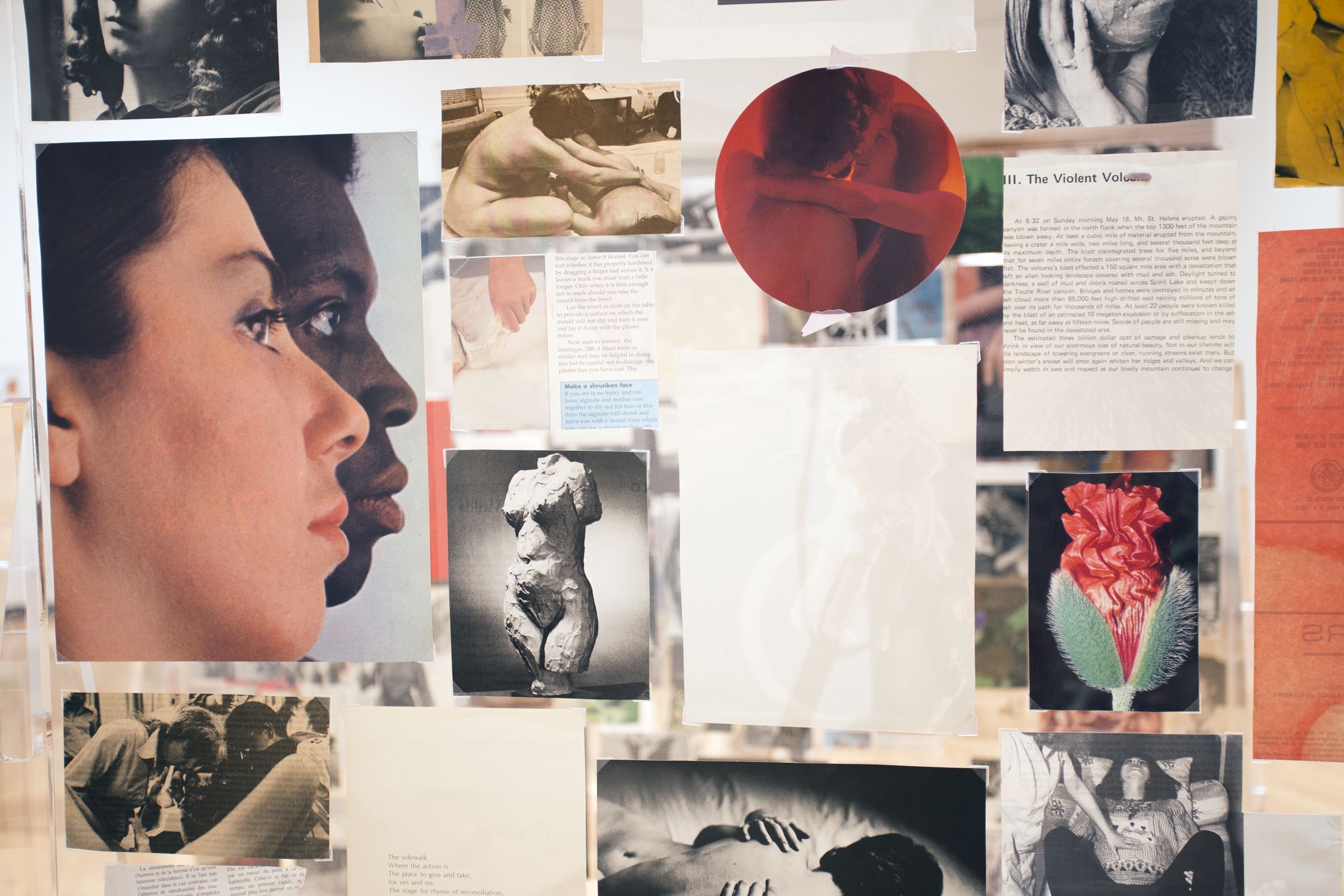
 

Edvard Munch (Norwegian, 1863-1944) 'Edvard Munch's Housekeeper, Ekely' 1932


Edvard Munch (Norwegian, 1863-1944)
Edvard Munch’s Housekeeper, Ekely
1932
Silver Gelatin


In the years 1927-1932, during Munch’s second period of photographic activity, the artist almost exclusively took photographs of himself and his work. This is a rare exception. Munch’s housekeeper is posing in a doorway and is doubled as a reflection on the shiny table on which the artist placed the camera. In fact, the woman is tripled, as a light, located behind her, throws her shadow onto the door to her left. The shadowing and expressive use of the foreground seem to have been strategic – an electrical plug and cord, snaking around the door jamb, appear to lead to a light source behind the model.


Edvard Munch (Norwegian, 1863-1944) 'Self-Portrait with Paintings, Ekely' 1930


Edvard Munch (Norwegian, 1863-1944)
Self-Portrait with Paintings, Ekely
1930
Silver gelatin contact print


In several of Munch’s pictures, his body is transparent or ghosted as he moved his body during a time exposure. The images in the background (below), on the other hand, are rendered sharply. Perhaps the photograph tells us something about how volatile a human life is, while art endures.


Edvard Munch (Norwegian, 1863-1944) 'Woman with a Samoyed' 1929-1930


Edvard Munch (Norwegian, 1863-1944)
Woman with a Samoyed
1929-30
Watercolour


Edvard Munch (Norwegian, 1863-1944) 'Self-Portrait with Paintings, Ekely' 1930


Edvard Munch (Norwegian, 1863-1944)
Self-Portrait with Paintings, Ekely
1930
Silver gelatin contact print


Edvard Munch (Norwegian, 1863-1944) 'Fips on the Veranda, Ekely' 1930


Edvard Munch (Norwegian, 1863-1944)
Fips on the Veranda, Ekely
1930
Silver gelatin contact print


This “self-portrait” with the artist’s dog together with his own shadow exploits the effects of architectural space and direct and reflected light. Charmingly, Fips’s head and right paw are perfectly aligned with the shadow of a wall and light thrown through its mullioned window. Munch often photographed motifs with his back to the sun, causing his shadow to fall into the frame. A similar exploration of shadows appears in his painting and prints, sometimes with foreboding or pathos, and sometimes, as seen here, with humour.


Edvard Munch (Norwegian, 1863-1944) 'Double Exposure of "Charlotte Corday", Ekely' c. 1930


Edvard Munch (Norwegian, 1863-1944)
Double Exposure of “Charlotte Corday”, Ekely
c. 1930
Silver gelatin contact print


In this photograph of the painting Charlotte Corday, Munch appears almost as a ghost. To achieve this affect, he used double exposure, taking two pictures on top of each other. Shadow figures such as this were emblematic of an absent presence, a kind of haunting, in Munch’s work. What began as a “mistake” in amateur snapshot photography became a common motif in experimental photography of the 1920s and ’30s as well as macabre effects in horror films from the same period.


Edvard Munch (Norwegian, 1863-1944) 'Charlotte Corday' 1930


Edvard Munch (Norwegian, 1863-1944)
Charlotte Corday
1930
Oil on canvas


Edvard Munch (Norwegian, 1863-1944) 'Self-Portrait at Ekely' 1930


Edvard Munch (Norwegian, 1863-1944)
Self-Portrait at Ekely
1930
Silver gelatin contact print


This is one of several prints that carries the words: “Photo: E. Munch 1931. After the eye disease.”


Edvard Munch (Norwegian, 1863-1944) 'Self-Portrait at Ekely' 1930


Edvard Munch (Norwegian, 1863-1944)
Self-Portrait at Ekely
1930
Silver gelatin contact print


In this image Munch is a spectral presence through which his well-lit paintings materialise. A similar union of body and material is found in the paintings and graphics, where figures become enmeshed in paint drips or wood grain patterning. Here the artist seems to stage himself as a figure in Evening. Melancholy (see above), embodying the contemplative state of mind conveyed by the title.


Edvard Munch (Norwegian, 1863-1944) 'Still Life with Cabbage and other Vegetables' 1926-1930


Edvard Munch (Norwegian, 1863-1944)
Still Life with Cabbage and other Vegetables
1926-30
Oil on wooden panel


Edvard Munch (Norwegian, 1863-1944) 'Self-Portrait in front of "Metabolism", Ekely' 1931-1932


Edvard Munch (Norwegian, 1863-1944)
Self-Portrait in front of “Metabolism”, Ekely
1931-32
Silver gelatin contact print


Munch stretches his arm outward and moves slightly to render himself out-of-focus. He appears almost transparent in this self-portrait at the feet of the figures in the painting Metabolism.


Edvard Munch (Norwegian, 1863-1944) 'Metabolism' 1898-1999


Edvard Munch (Norwegian, 1863-1944)
Metabolism
1898-99
Oil on canvas


Munch’s Films

Munch’s short films can best be described as the charming experiments of an amateur. This was, however, an amateur with a long-term exploration of motion in art and photography. Electrified by cinema, Munch had even announced his intention of opening his own movie house. The short sequences he shot both mirror popular cinema, such as the films of Charlie Chaplin, and explore the industrial aesthetic of Dziga Vertov’s silent documentary Man with a Movie Camera from 1929.

Munch shot his “home movies” in the summer of 1927 using a Pathé-Baby camera that he had purchased in Paris. The portable device, which had come on the market in 1922, had helped to spark a surge of amateur home movies all over the world. The 9.5 mm projector that accommodated the film, and which Munch also owned, was likewise inexpensive and marketed for home projection. “Every decade extends the influence of cinema, enlarges its domain and multiplies its applications,” stated the Pathé promotional literature, ” …Today, in order to enter our home, it has made itself small, simple, affordable.”

Munch’s camera had a spring-loaded drive, rather than a hand-driven crank, allowing for a uniform recording speed and simplifying his act of filming. His fascination with the effects of time and motion are played out with humour and deliberation in his few forays into motion pictures. The artist peering into his own lens is a performance knowingly looking at a self that will be projected later, an actor in his large body of self-images.


Munch’s Films
1927
3:40


Munch’s short amateur films, stitched together in this video, were shot in Dresden, Oslo and on his property Ekely. One segment, a panning shot in a park, includes a man and woman seated on a bench, echoing Munch’s 1904 painting Kissing Couples in the Park. The high-angle shot of the boys looking through a fence, as we watch them, points to the artist’s canny and humorous analysis of point of view. Munch’s fragmentary films share the experimental camerawork with the genre of “city symphony” films of the 1920s.


Munch’s cameras

Munch purchased his first camera in Berlin in February 1902. This was most likely a Kodak Bulls-Eye No. 2, a simple and hugely popular amateur’s model. Because his later prints exist in three additional formats, he probably owned or borrowed other cameras. The first Kodak hand-held film camera was marketed in 1888. Successive innovations by Kodak made picture taking increasingly simple and inexpensive, establishing a mass market of amateur photographers. Early amateur photography was marketed as “fun” and “sport.” Munch was an early and eccentric practitioner.

The photographic manuals instructed amateurs to avoid mistakes such as out-of-focus or tilted images, ghosted figures, or shadows laid across the subjects. These were the very photographic elements that Munch repeated, turning the rules of good picture taking upside down.

Munch likely made his own contact prints using an Eastman Kodak-marketed kit outfitted for home use. There are both fingerprints and chemical spills on some of the images. He occasionally double-exposed his photographs or flopped the negative to achieve mirror-image prints, demonstrating a curiosity about the printing process itself. Munch’s exploration of the means and materials of amateur photography extends his groundbreaking strategies in lithography and woodcut.


Kodak Bulls-Eye No. 2


Kodak Bulls-Eye No. 2

This popular portable model seems to have been the type that Munch had as his first camera. Because the camera used light-proof film cartridges, had a fixed focus lens, and a small window indicating the exposure number, Kodak advertised this model as “Easy Photography,” suitable for the unskilled amateur. An instruction manual from the Eastman Kodak Company was sold with each camera. It included helpful graphics to guide the aspiring amateur and warnings against “absolute failure” to follow instructions. These “failures” were the effects that Munch seemed to favour.


Kodak Vest-Pocket Autographic


Kodak Vest-Pocket Autographic

This small, lightweight camera could be folded to fit a shirt pocket. Released during the Great War, it was advertised by Kodak to be “as accurate as a watch and as simple to use.” Requiring just a small pressure on the shutter release, the modest size and flexibility of the camera was well suited to some of the intimate images taken by Munch in the 1920s and 1930s.


Kodak No. 3A Series III


Kodak No. 3A Series III

Eastman Kodak issued the No. 3A, its first postcard format camera, between 1903 and 1915. The company produced variants such as the Series III until 1943. A bellows that collapsed into a folding bed made the camera portable.


Kodak No. 3 Series III Folding Pocket Camera


Kodak No. 3 Series III Folding Pocket Camera

Munch took most of the “selfies” at Ekely using this model. First produced from 1900 to 1915, and then with variants issued though the early 1940s, it was a camera that, like the No. 3A, could be operated by direct touch or via a pneumatic release.


Pathé Baby Ciné Camera


Pathé Baby Ciné Camera

This is one of the first cinema cameras intended for home use. The lightweight apparatus had a built-in clockwork which enabled amateurs such as Munch to make hand-held films. Pathé’s projectors made it possible to view the results at home.


Unknown photographer. 'Portrait of Edvard Munch' Nd


Unknown photographer
Portrait of Edvard Munch
Nd


Edvard Munch (Norwegian, 1863-1944)

Edvard Munch (Norwegian, 12 December 1863 – 23 January 1944) was a Norwegian painter. His best known work, The Scream, has become one of the most iconic images of world art.

His childhood was overshadowed by illness, bereavement and the dread of inheriting a mental condition that ran in the family. Studying at the Royal School of Art and Design in Kristiania (today’s Oslo), Munch began to live a bohemian life under the influence of nihilist Hans Jæger, who urged him to paint his own emotional and psychological state (‘soul painting’). From this emerged his distinctive style.

Travel brought new influences and outlets. In Paris, he learned much from Paul Gauguin, Vincent van Gogh and Henri de Toulouse-Lautrec, especially their use of colour. In Berlin, he met Swedish dramatist August Strindberg, whom he painted, as he embarked on his major canon The Frieze of Life, depicting a series of deeply-felt themes such as love, anxiety, jealousy and betrayal, steeped in atmosphere.

The Scream was conceived in Kristiania. According to Munch, he was out walking at sunset, when he ‘heard the enormous, infinite scream of nature’. The painting’s agonised face is widely identified with the angst of the modern person. Between 1893 and 1910, he made two painted versions and two in pastels, as well as a number of prints. One of the pastels would eventually command the fourth highest nominal price paid for a painting at auction.

As his fame and wealth grew, his emotional state remained insecure. He briefly considered marriage, but could not commit himself. A breakdown in 1908 forced him to give up heavy drinking, and he was cheered by his increasing acceptance by the people of Kristiania and exposure in the city’s museums. His later years were spent working in peace and privacy. Although his works were banned in Nazi Germany, most of them survived World War II, securing him a legacy.

Text from the Wikipedia website


National Nordic Museum
2655 NW Market Street,
Seattle, WA 98107
Phone: 206.789.5707

Opening hours:
Tuesday – Sunday 10am – 5pm
Closed Monday

National Nordic Museum website

LIKE ART BLART ON FACEBOOK

Back to top

Exhibition: ‘Max Beckmann: feminine-masculine’ at Hamburger Kunsthalle, Hamburg

Exhibition dates:

Curator: Dr Karin Schick


Max Beckmann (German, 1884-1950) 'Early humans – primeval landscape' 1939 (revised 1947/48) from the exhibition 'Max Beckmann: feminine-masculine' at Hamburger Kunsthalle, Hamburg, Sept 2020 - Jan 2021


Max Beckmann (German, 1884-1950)
Frühe Menschen – Urlandschaft
Early humans – primeval landscape

1939 (revised 1947/48)
Gouache, watercolour and ink
49.8 x 64.5cm
Courtesy of Daxer & Marschall, München
© VG Bild-Kunst, Bonn 2020
© Foto: Daxer & Marschall, München


If ever there were a time in history that I would like to go back to and work as an artist, it is most definitely the interwar years in Paris, or Berlin up until 1933 when the Nazis took control of German culture. I would have revelled in the freedom of expression, freedom of identity, sexuality, gender, New Objectivity (Neue Sachlichkeit), New Woman, news ways of experimentation, and new ways of thinking about the human condition (Jung, Freud, Benjamin). I would have been empowered as an artist to push the boundaries of conservative society, to break prescriptive and outdated cultural norms.

And so with Max Beckmann. There is a basic and fundamental feeling to his paintings, a primordial feeling, in which the artist breaks the boundaries of the taboo fully aware that there may be consequences for doing so. In his paintings Beckmann crafts his stories of passion, desire, mythology and the jouissance of everyday life, expressed through ever more delineated black-outlined caricatures which feature elongated claw-like hands, distorted bodies and mobile, multiple perspectives (see Das Bad (The bathroom) 1930, below). These paintings so generate and compose their own existence (their presence) – one which opposes conventional classical portraiture – that the Nazis labelled them De/generate Art. “Although not Jewish, he was beleaguered by the Nazis, who dismissed him from his teaching post in Frankfurt in 1933 and removed his “degenerate” work from public collections.” (NY Times)

As with any artist, the journey is the key to the development of the work. Look at the assured, slightly fey, well-dressed man in Beckmann’s classical Self-portrait, Florence (1907, below) and then compare it to his Self-Portrait with Horn (1938, below). In the first self-portrait Beckmann is aged 23, seemingly untouched by the vicissitudes of life, debonair, staring straight at the camera, ooh I mean mirror – sorry, canvas – the mouth held in a small thin line, eyes almost blank, cigarette in nonchalantly curled hand. Thirty one years later, age/d 54, Beckmann’s features (having lived through the desolation of the First World War, famine, revolution, the Great Depression, assassination, violence) are gnarled and wizened, his expression grim, his clothing that of a concentration camp inmate, his horn silent and occluded, reminding me of the hearing trumpet of the composer Beethoven. Unable to hear, not wanting to face, the clamour of the onrushing maelstrom.

Dr Marcus Bunyan


Many thankx to the Hamburger Kunsthalle for allowing me to publish the photographs in the posting. Please click on the photographs for a larger version of the image.


Max Beckmann (German, 1884-1950) 'Self-portrait, Florence' 1907 from the exhibition 'Max Beckmann: feminine-masculine' at Hamburger Kunsthalle, Hamburg, Sept 2020 - Jan 2021


Max Beckmann (German, 1884-1950)
Self-portrait, Florence
1907
Oil on canvas
98 x 90cm
Hamburger Kunsthalle Dauerleihgabe Nachlass Peter und Maja Beckmann
© VG Bild-Kunst, Bonn 2020
© Hamburger Kunsthalle / bpk
Foto: Elke Walford


Max Beckmann (German, 1884-1950) 'Self-Portrait with Horn' 1938


Max Beckmann (German, 1884-1950)
Self-Portrait with Horn
1938
Oil on canvas
101 x 110cm
Neue Galerie New York and Private Collection
Used under fair use conditions


Max Beckmann (German, 1884-1950) 'Adam and Eve' 1917


Max Beckmann (German, 1884-1950)
Adam and Eve
1917
Oil on canvas
79.8 x 56.7cm
Staatliche Museen zu Berlin, Nationalgalerie
Erworben mit Unterstützung der Ernst von Siemens Kunststiftung
© VG Bild-Kunst, Bonn 2020
© bpk / Nationalgalerie, SMB
Foto: André van Linn


Max Beckmann (German, 1884-1950) 'Portrait of a Romanian (Portrait of Dr. Heidel)' 1922


Max Beckmann (German, 1884-1950)
Bildnis einer Rumänin (Bildnis Frau Dr. Heidel)
Portrait of a Romanian (Portrait of Dr. Heidel)
1922
Oil on canvas
100 x 65cm
Dauerleihgabe der Stiftung Hamburger Kunstsammlungen
© VG Bild-Kunst, Bonn 2020
© SHK / Hamburger Kunsthalle / bpk
Foto: Elke Walford


Max Beckmann (German, 1884-1950) 'Portrait of Käthe von Porada' 1924


Max Beckmann (German, 1884-1950)
Bildnis Käthe von Porada (Portrait of Käthe von Porada)
1924
Oil on canvas
120 x 43cm
Städel Museum, Frankfurt am Main
© VG Bild-Kunst, Bonn 2020
© Städel Museum – ARTOTHEK
Foto: U. Edelmann


Max Beckmann (German, 1884-1950) 'Portrait of Ludwig Berger' 1945


Max Beckmann (German, 1884-1950)
Bildnis Ludwig Berger (Portrait of Ludwig Berger)
1945
Oil on canvas
135.6 x 90.9cm
Saint Louis Art Museum, Bequest of Morton D. May
© VG Bild-Kunst, Bonn 2020
© Foto: Saint Louis Art Museum, Bequest of Morton D. May


Max Beckmann (German, 1884-1950) 'Das Bad' (The bathroom) 1930


Max Beckmann (German, 1884-1950)
Das Bad (The bathroom)
1930
Oil on canvas
174.9 x 121.3cm
Saint Louis Art Museum, Bequest of Morton D. May
© VG Bild-Kunst, Bonn 2020
© Foto: Saint Louis Art Museum, Bequest of Morton D. May


Max Beckmann: feminine-masculine is the first exhibition to examine in detail the often contradictory roles played by women and men in the works of Max Beckmann (1884-1950), one of the great artists of modernism and a potent interpreter of his times. With some 140 paintings, sculptures and works on paper, the show demonstrates the impressive breadth of this subject area in the artist’s oeuvre while enabling viewers to come to a deeper understanding of Beckmann’s multifaceted art. Important loans from public and private collections in Germany and abroad – including the Max Beckmann Estate, the Städel Museum, Frankfurt on the Main, the Saint Louis Art Museum, Missouri / USA, and the Stedelijk Museum in Amsterdam – supplement the Hamburger Kunsthalle’s extensive Beckmann holdings.

The exhibition explores both the historical significance of Beckmann’s paintings as well as their relevance in today’s world. His incisive self-portraits, his double portraits with his wives, the stately likenesses of his sponsors and patrons as well as his mythological and biblical figure paintings compellingly evoke basic constants of human togetherness: desire, devotion and conflict, power and powerlessness, the urge for freedom and the longing to become one with another human being.

Beckmann both exaggerated and blurred gender roles; he discovered tenderness in both female and male figures, power in the heroine as well as the hero. Fascinated by the myths of different cultures, he was familiar with the age-old notion that male and female once split off from a single, androgynous gender and are doomed to yearn forever to be reunified. The artist also read and commented on contemporary writings by Carl Gustav Jung and Otto Weininger that are still the subject of frequent discussion today and which explain individuality as a combination of female and male elements. Beckmann nonetheless liked to style himself as a manfully resolute interpreter of the world, an image that to this day dominates the reception of his work, hindering a more open understanding of his many-layered art.

Accompanying the exhibition are a richly illustrated scholarly catalogue (Prestel Verlag, Munich), an audio guide and regular theme-based guided tours (Saturdays at 3 pm). The museum education offerings uncover multiple perspectives on Beckmann’s art and enable visitors to take part in an on-site dialogue between the curator and further experts (for example on gender research). On 15 January 2021, the Kunsthalle will also host a public, international symposium on Beckmann’s multifaceted examination of the topic of “femaleness and masculinity”.

The exhibition Max Beckmann: feminine-masculine is a true highlight on the Hamburger Kunsthalle’s agenda for 2020. It represents a further instalment in a series of highly acclaimed exhibitions devoted to Beckmann’s art, including Self-Portraits (1993), Landscape as Stranger (1998) and Max Beckmann: The Still Lifes (2014).

Press release from the Hamburger Kunsthalle


Max Beckmann (German, 1884-1950) 'Double portrait (Max and Mathilde Beckmann)' 1941


Max Beckmann (German, 1884-1950)
Doppelbildnis (Max und Mathilde Beckmann)
Double portrait (Max and Mathilde Beckmann)
1941
Oil on canvas
193.5 x 89cm
Collection Stedelijk Museum Amsterdam
© VG Bild-Kunst, Bonn 2020
© Foto: Stedelijk Museum, Amsterdam


Max Beckmann (German, 1884-1950) 'Messingstadt' 1944


Max Beckmann (German, 1884-1950)
Messingstadt (City of Brass)
1944
Oil on canvas
115 x 150cm
Saarlandmuseum – Moderne Galerie, Saarbrücken, Stiftung Saarländischer Kulturbesitz
© VG Bild-Kunst, Bonn 2020
© Saarlandmuseum – Moderne Galerie, Saarbrücken, Stiftung Saarländischer Kulturbesitz
Foto: Tom Gundelwein


Max Beckmann addresses the relationship between man and woman as the starting point for the repetitive torments of human existence. In this question too, he is inspired by the archetype of the fairy tale Messingstadt “Brass City”. (From “The Thousand and One Nights” or “Arabian nights”) In this story it is the hero Musa who manages to get inside the brass city. He enters a palace where he discovers a girl as “beautiful as the shining sun”. At the same time, he realises that it’s just her lifeless body.

Note: The Thousand and One Nights, also called The Arabian Nights, Arabic Alf laylah wa laylah, collection of largely Middle Eastern and Indian stories of uncertain date and authorship. Its tales of Aladdin, Ali Baba, and Sindbad the Sailor have almost become part of Western folklore, though these were added to the collection only in the 18th century in European adaptations.


Max Beckmann (German, 1884-1950) 'Odysseus and Calypso' 1943


Max Beckmann (German, 1884-1950)
Odysseus and Calypso
1943
Oil on canvas
150 x 115.5cm
Hamburger Kunsthalle
© VG Bild-Kunst, Bonn 2020
© Hamburger Kunsthalle / bpk
Foto: Elke Walford


Max Beckmann

Max Carl Friedrich Beckmann (February 12, 1884 – December 27, 1950) was a German painter, draftsman, printmaker, sculptor, and writer. Although he is classified as an Expressionist artist, he rejected both the term and the movement. In the 1920s, he was associated with the New Objectivity (Neue Sachlichkeit), an outgrowth of Expressionism that opposed its introverted emotionalism. His work became full of horrifying imagery and distorted forms with combination of brutal realism and social criticism.

Life

Max Beckmann was born into a middle-class family in Leipzig, Saxony. From his youth he pitted himself against the old masters. His traumatic experiences of World War I, in which he volunteered as a medical orderly, coincided with a dramatic transformation of his style from academically correct depictions to a distortion of both figure and space, reflecting his altered vision of himself and humanity.

He is known for the self-portraits painted throughout his life, their number and intensity rivalled only by those of Rembrandt and Picasso. Well-read in philosophy and literature, Beckmann also contemplated mysticism and theosophy in search of the “Self”. As a true painter-thinker, he strove to find the hidden spiritual dimension in his subjects (Beckmann’s 1948 Letters to a Woman Painter provides a statement of his approach to art).

Beckmann enjoyed great success and official honours during the Weimar Republic. In 1925 he was selected to teach a master class at the Städelschule Academy of Fine Art in Frankfurt. Some of his most famous students included Theo Garve, Leo Maillet and Marie-Louise von Motesiczky. In 1927 he received the Honorary Empire Prize for German Art and the Gold Medal of the City of Düsseldorf; the National Gallery in Berlin acquired his painting The Bark and, in 1928, purchased his Self-Portrait in Tuxedo. By the early 1930s, a series of major exhibitions, including large retrospectives at the Städtische Kunsthalle Mannheim (1928) and in Basel and Zurich (1930), together with numerous publications, showed the high esteem in which Beckmann was held.
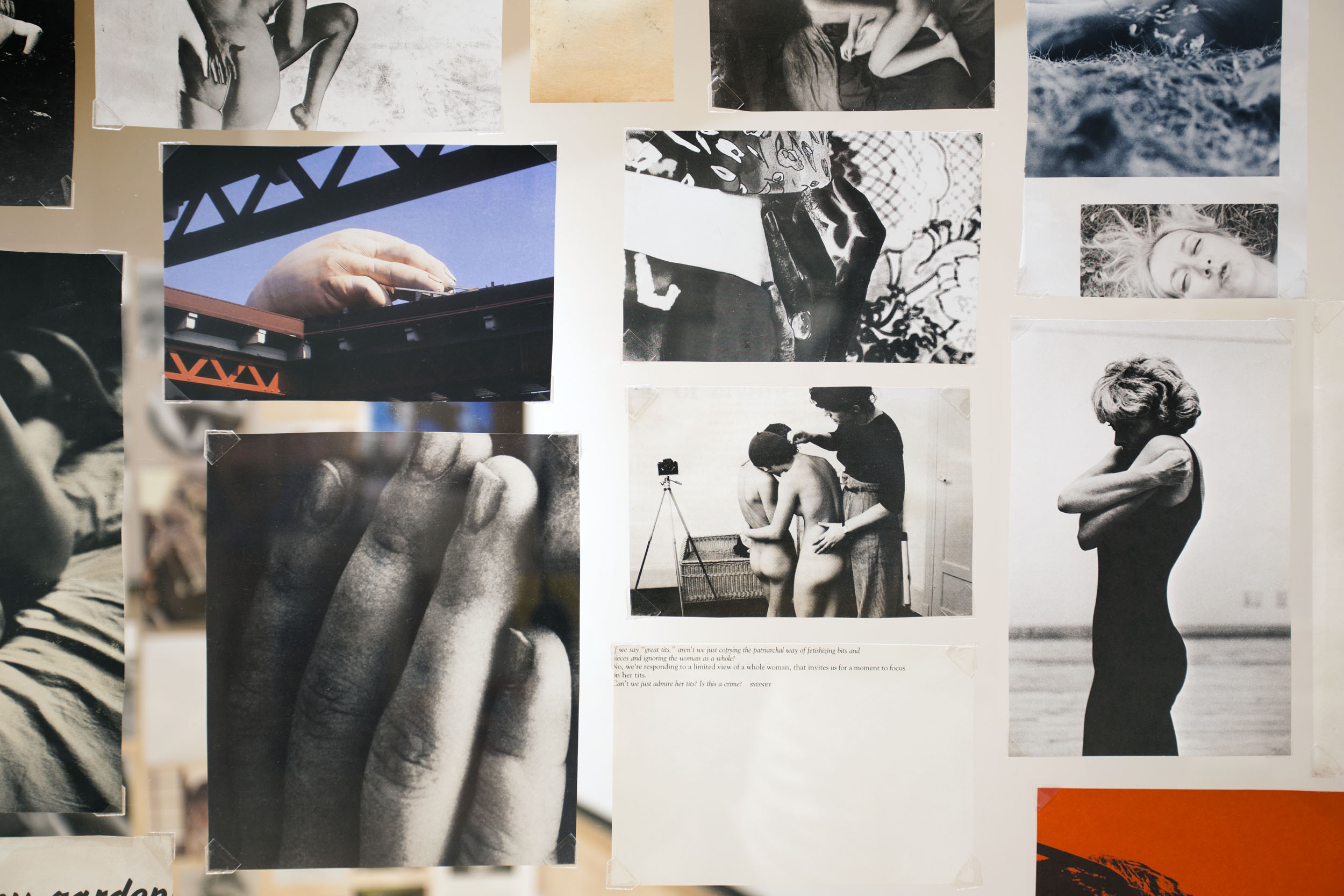
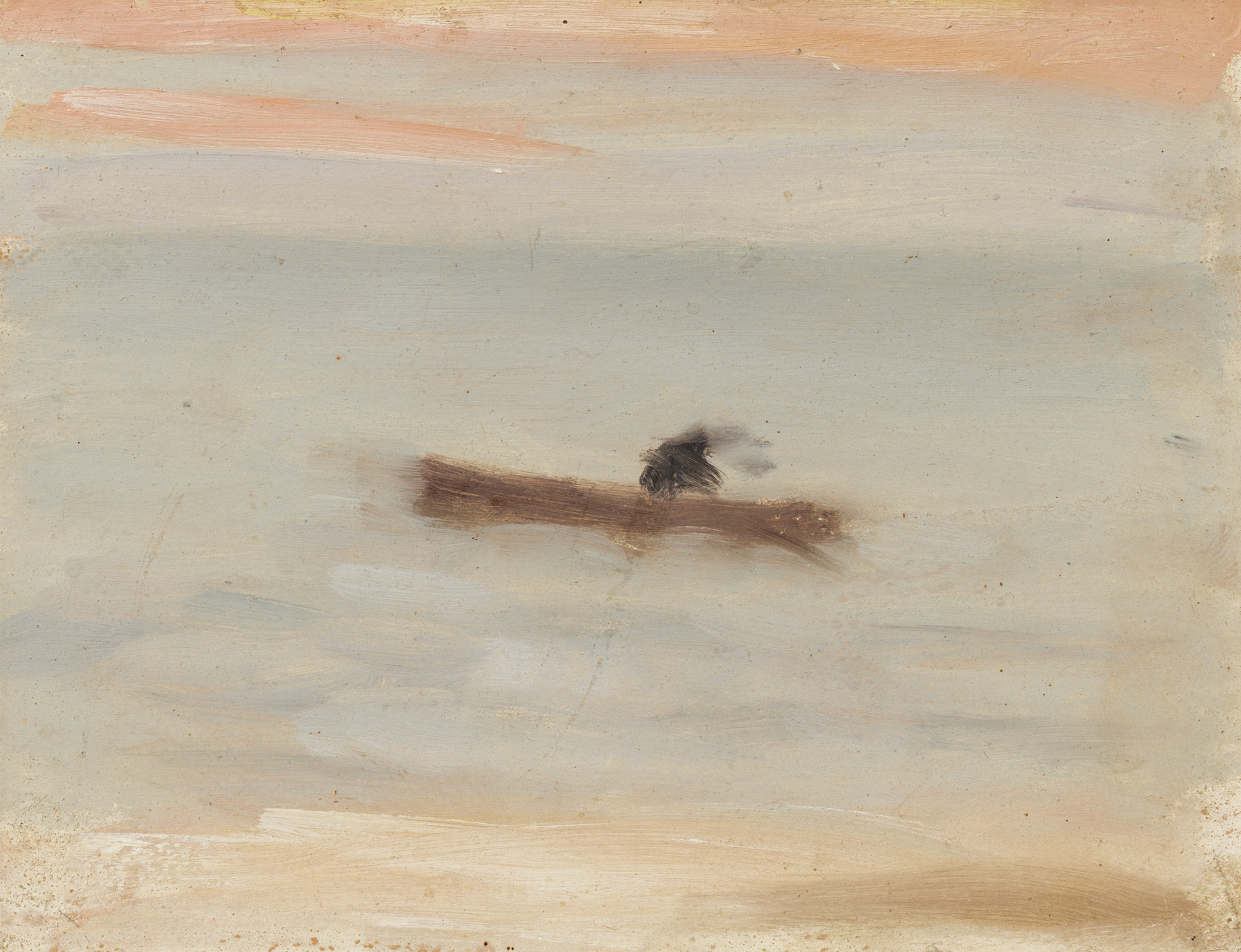
His fortunes changed with the rise to power of Adolf Hitler, whose dislike of Modern Art quickly led to its suppression by the state. In 1933, the Nazi government called Beckmann a “cultural Bolshevik” and dismissed him from his teaching position at the Art School in Frankfurt. In 1937 the government confiscated more than 500 of his works from German museums, putting several on display in the notorious Degenerate Art exhibition in Munich. The day after Hitler’s radio speech about degenerate art in 1937, Beckmann left Germany with his second wife, Quappi, for the Netherlands.
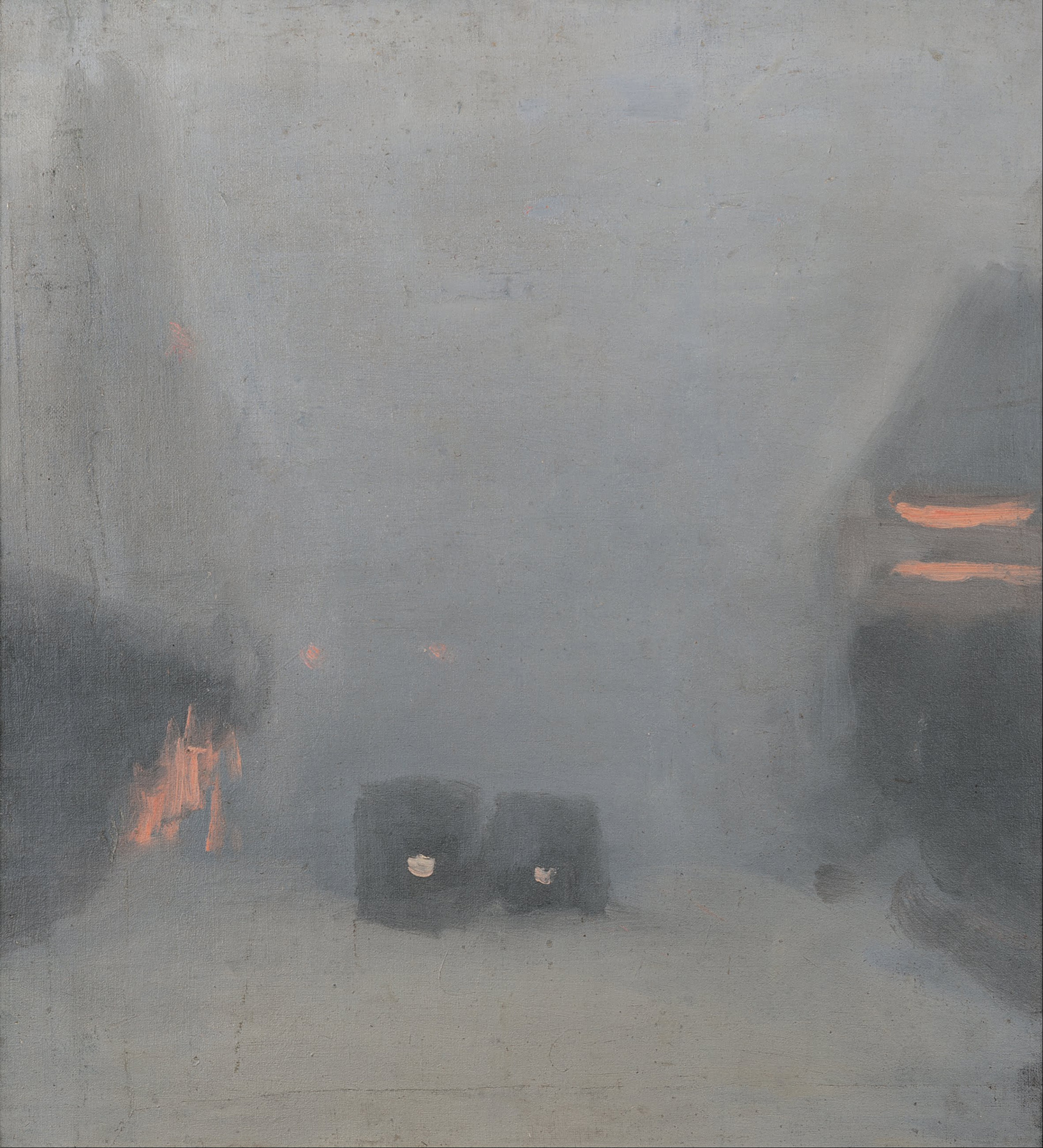
For ten years, Beckmann lived in self-imposed exile in Amsterdam, failing in his desperate attempts to obtain a visa for the United States. In 1944 the Germans attempted to draft him into the army, although the sixty-year-old artist had suffered a heart attack. The works completed in his Amsterdam studio were even more powerful and intense than the ones of his master years in Frankfurt. They included several large triptychs, which stand as a summation of Beckmann’s art.

In 1948, Beckmann moved to the United States. During the last three years of his life, he taught at the art schools of Washington University in St. Louis (with the German-American painter and printmaker Werner Drewes) and the Brooklyn Museum. He came to St. Louis at the invitation of Perry T. Rathbone, who was director of the Saint Louis Art Museum. Rathbone arranged for Washington University in St. Louis to hire Beckmann as an art teacher, filling a vacancy left by Philip Guston, who had taken a leave. The first Beckmann retrospective in the United States took place in 1948 at the City Art Museum, Saint Louis. In St. Louis, Morton D. May became his patron and, already an avid amateur photographer and painter, a student of the artist. May later donated much of his large collection of Beckmann’s works to the St. Louis Art Museum. Beckmann also helped him learn to appreciate Oceanian and African art. After stops in Denver and Chicago, he and Quappi took an apartment at 38 West 69th Street in Manhattan. In 1949 he obtained a professorship at the Brooklyn Museum Art School.

He suffered from angina pectoris and died after Christmas 1950, struck down by a heart attack at the corner of 69th Street and Central Park West in New York, not far from his apartment building. As the artist’s widow recalled, he was on his way to see one of his paintings at the Metropolitan Museum of Art. Beckmann had a one-man show at the Venice Biennale of 1950, the year of his death.

Themes

Unlike several of his avant-garde contemporaries, Beckmann rejected non-representational painting; instead, he took up and advanced the tradition of figurative painting. He greatly admired not only Cézanne and Van Gogh, but also Blake, Rembrandt, and Rubens, as well as Northern European artists of the late Middle Ages and early Renaissance, such as Bosch, Bruegel, and Matthias Grünewald. His style and method of composition are partially rooted in the imagery of medieval stained glass.

Engaging with the genres of portraiture, landscape, still life, and history painting, his diverse body of work created a very personal but authentic version of modernism, one with a healthy deference to traditional forms. Beckmann reinvented the religious triptych and expanded this archetype of medieval painting into an allegory of contemporary humanity.

From his beginnings in the fin de siècle to the period after World War II, Beckmann reflected an era of radical changes in both art and history in his work. Many of Beckmann’s paintings express the agonies of Europe in the first half of the 20th century. Some of his imagery refers to the decadent glamour of the Weimar Republic’s cabaret culture, but from the 1930s on, his works often contain mythologised references to the brutalities of the Nazis. Beyond these immediate concerns, his subjects and symbols assume a larger meaning, voicing universal themes of terror, redemption, and the mysteries of eternity and fate.

His Self-Portrait with Horn (1938), painted during his exile in Amsterdam, demonstrates his use of symbols. Musical instruments are featured in many of his paintings; in this case, a horn that the artist holds as if it were a telescope by which he intends to explore the darkness surrounding him. The tight framing of the figure within the boundaries of the canvas emphasise his entrapment. Art historian Cornelia Stabenow terms the painting “the most melancholy, but also the most mystifying, of his self-portraits”.

Text from the Wikipedia website


Max Beckmann (German, 1884-1950) 'Venus – Mars' 1945


Max Beckmann (German, 1884-1950)
Venus – Mars
1945
India ink and watercolour
36,2 x 19.5cm
Private collection
© VG Bild-Kunst, Bonn 2020
© Foto: Privatbesitz


Max Beckmann. 'Two women (in glass door)' 1940


Max Beckmann (German, 1884-1950)
Zwei Frauen (in Glastür)
Two women (in glass door)
1940
Oil on canvas
80 x 61cm
Museum Ludwig, Köln
© VG Bild-Kunst, Bonn 2020
© Foto: Rheinisches Bildarchiv Köln


Hamburger Kunsthalle
Glockengießerwall 20095 Hamburg
Phone: +49 (0)40-428 131 204

Opening hours:
Tuesdays to Sundays 10am – 6pm
Thursdays 10am – 9pm
Closed Mondays

Hamburger Kunsthalle website

LIKE ART BLART ON FACEBOOK

Back to top

Exhibition: ‘Unearthed: Photography’s Roots’ at the Dulwich Picture Gallery, London

Exhibition dates: 8th December 2020 – 9th May 2021

Curator: Alexander Moore

The exhibition will include work by the following 41 artists (in alphabetical order):

Nobuyoshi Araki, Anna Atkins, Alois Auer, Cecil Beaton, Karl Blossfeldt, Adolphe Braun, Jan Brueghel the Elder, Mat Collishaw, Imogen Cunningham, Roger Fenton, Adam Fuss, Ori Gersht, Cecilia Glaisher, Joy Gregory, William Henry Fox Talbot, Sir John Herschel, Gyula Holics, Jan van Huysum, Henry Irving, Charles Jones, Sarah Jones, André Kertész, Nick Knight, Lou Landauer, Richard Learoyd, Pradip Malde, Robert Mapplethorpe, John Moffat, Sarah Moon, James Mudd, Kazumasa Ogawa, T Enami, Dr Albert G Richards, Scowen & Co., Scheltens & Abbenes, Helen Sear, Edward Steichen, Josef Sudek, Lorenzo Vitturi, Edward Weston, Walter Woodbury.


Charles Jones (British, 1866-1959) 'Broccoli Leamington' c. 1895-1910 from the exhibition 'Unearthed: Photography's Roots' at the Dulwich Picture Gallery, London, Dec 2020 - May 2021


Charles Jones (British, 1866-1959)
Broccoli Leamington
c. 1895-1910
© Sean Sexton
Photo copyright Dulwich Picture Gallery


A difficult thing said simply

What a wonderful selection of photographs to start the year 2021.

As Laura Cumming observes, there is a profound connection between photography and photosynthesis – both created through light, both constructed and political. For the photograph is ALWAYS the choice of the photographer, and the landscape has ALWAYS been shaped and constructed since human beings emerged on this earth. Nothing in the natural world is ever “natural” but always mediated by time, space, context, power and desire. Desire to control the direction of a river, desire for food and shelter, desire for Lebensraum or living space as a practice of settler colonialism, desire to celebrate the “natural” world, desire to procreate, desire to propagate the (genetically modified) vegetable. A desire to desire.

Photography’s symbiotic relationship with the natural world is the relationship of photography and transmutation (the action of changing or the state of being changed into another form), photography and transmogrification (the act or process of changing or being changed completely). The natural world, through an action (that of being photographed), changes its state (flux) and, further, changes its state to a completely different form (fixed in liquid fixer; fixed, saved, but fluid, in the digital pixel). Flowers and vegetables are alive then wither and die, only to remain “the same” in the freeze frame of the death-defying photograph.

Photography’s fluidity and fixity – of movement, time, space, context, representation – allows “the infinite possibility of experimentation” not, as Cumming argues, “without the interference of humanity, accident, sound or movement” but through their very agency. It is the human hand that arranges these pyramidal broccoli, the accident of light in the photogram that allows us to pierce a clump of Bory’s Spleenwort root structure. It is human imagination, the movement of the human mind, that allows the artist Charles Jones to darken the Bean Longpod cases so that these become seared in the mind’s eye, fixed in all time and space as iconic image: the “transformation of an earthy root vegetable into an abstracted object worthy of adulation.”

While the process of photographing flower and vegetable may well be due to the interference of humanity, accident, sound or movement, contemplation or decisive moment, the final outcome of the image – the representation of the natural in the physicality of the print – usually attempts to hide these processes in images that are frozen in time, images that play on the notion of memento mori and the transient nature of life. In the presence of a triple death (ie. the death of the plant or flower, the time freeze or death moment of the photograph, and our knowledge that these plants and flowers in the photograph have already died), it is the abstraction of the death reality in images of flowers, plants and vegetables that allows for a touch of the soul. These photographs “provide a glimpse into the terrain of the unseen, or what German philosopher and cultural critic Walter Benjamin coined the “optical unconsciousness”.”1 Here, photography allows us to capture the realm of the unseen and also allows us to glimpse the expansive terrain of the human imaginary. The camera reveals aspects of reality that register in our senses but never quite get processed consciously. (Is there anything “real” about Cunningham’s Two Callas 1929 other than a vibration of the energy of the cosmos?)

Still, still, still we are (unconsciously) aware of all that is embedded within a photograph for photography makes us feel, makes us remember “that which lies beyond the frame, or what photographs compel us to remember and forget, what they enable us to uncover and repress…”. Like any great work of art, when we look at a great photograph it is not what we BELIEVE that matters when we look, but how the art work makes us FEEL, how it touches the depths of our soul. These are the roots of photography, un/earthed, in the languages of image – (sub)conscious stories of the human imagination which seek to make sense of our roots in Earth.

Dr Marcus Bunyan


Footnotes

1/ A different nature presents itself to the movie camera than to the naked eye. Instead of being something we enter into unconsciously or vaguely, in film we enter nature analytically. While a painter lovely caresses the surfaces of nature, the cameraman chucks a piece of dynamite at it, then reassembles the pieces:

“Our taverns and our metropolitan streets, our offices and furnished rooms, our railroad stations and our factories appeared to have us locked up hopelessly. Then came the film and burst this prison-world asunder by the dynamite of the tenth of a second, so that now, in the midst of its far-clung ruins and debris, we calmly and adventurously go travelling.”

A movie camera can be mounted on a speeding locomotive, dropped down a sewer, or secreted in a valise and carried surreptitiously around a city. The camera reveals aspects of reality that register in our senses but never quite get processed consciously. Film changed how we view the least significant minutiae of reality just as surely as Freud’s Psychopathology of Everyday Life changed how we look at incidental phenomenon like slips of the tongue. In other words, film serves as an optical unconscious. Benjamin asserts the film camera “introduces us to unconscious optics as does psychoanalysis to unconscious impulses.

“Richard Prouty. “The optical unconsciousness,” on the One-Way Street website Oct 16, 2009 [Online] Cited 03/01/2021


Many thankx to the Dulwich Picture Gallery for allowing me to publish the artwork in the posting. Please click on the photographs for a larger version of the image.


“The Dulwich show amounts to a political history of photography by other means. Should it aspire to nothing more than the fictions of painting? Should it be a catalogue, a document, a celebration of the natural life? Where Glaisher records the precise difference between two varieties of fern, Jones observes the Sputnik-like eccentricity of a plucked turnip. Where Imogen Cunningham sees the perfect abstraction of a calla lily, Edward Weston anthropomorphises a pepper, so that it momentarily resembles the torso of a body-builder. …

Perhaps the desire to photograph the vegetable world brings its own peace, as well as the infinite possibility of experimentation without the interference of humanity, accident, sound or movement. But perhaps it also has something to do with the profound connection between photography and photosynthesis. The very light that gives life to a rose, before its petals drop, is the same light that preserves it in a death-defying photograph.”


Laura Cumming. “Unearthed: Photography’s Roots review – cauliflowers saying cheese…” on the Guardian website Sun 29 Nov 2020 [Online] Cited 23/12/2020


Anna Atkins (English, 1799-1871) 'Ceylon' c. 1850 from the exhibition 'Unearthed: Photography's Roots' at the Dulwich Picture Gallery, London, Dec 2020 - May 2021


Anna Atkins (English, 1799-1871)
Ceylon [examples of ferns]
c. 1850
Cyanotype


After publishing her own book of cyanotype photograms of British algae in the 1840s, Atkins collaborated with her childhood friend and fellow scholar Anna Dixon on a second book of photograms. The book, Cyanotypes of British and Foreign Ferns, was published in 1853 and now resides in the J. Paul Getty Museum in Los Angeles.

This particular image [above] is a selection from Cyanotypes of British and Foreign Ferns. A collection of four distinct ferns, it’s simply captioned “Ceylon”. At the time these cyanotypes were being made, the island of Ceylon – modern day Sri Lanka – was under British rule. It would be nearly another century before the island declared independence from Atkins’ home country. Despite the abundant difficulties of travel in the 1850s, Atkins’s many scientific and business connections no doubt helped her obtain several foreign specimens for this book of fern cyanotypes.

Anonymous text on the 20 x 200 website [Online] Cited 24/12/2020


This unique camera-less photograph was part of an extensive project to document plants from Great Britain and British colonies like Ceylon (now Sri Lanka), and illustrates an early example of how important photography would become in our attempts to learn about and protect the natural world. Anna Atkins (British, 1799-1871) was a trained botanist who adopted photographic processes in order to describe, analyse, and, in a manner of speaking, preserve plant specimens from around the world. She is widely considered the first person to use photographs to illustrate a book, her British Algae: Cyanotype Impressions published in 1843. This particular photograph was produced with Anna Dixon for a later compilation: Cyanotypes of British and Foreign Flowering Plants and Ferns in 1854. With these and other projects, Atkins helped establish photography as an important tool in scientific and ecological observation. …

Atkins made all of her cyanotypes in England, often receiving specimens through imperial trade. This image, therefore, was produced over 5,000 miles away from where the plant originated

Brian Piper. “Object Lesson: Ceylon cyanotype by Anna Atkins,” on the New Orleans Museum of Art website March 23, 2020 [Online] Cited 24/12/2020.


Anna Atkins (English, 1799-1871) 'Plate 55 – Dictyota dichotoma, in the young state and in fruit' 1853


Anna Atkins (English, 1799-1871)
Plate 55 – Dictyota dichotoma, in the young state and in fruit
1853
From Photographs of British Algae: Cyanotype Impressions Volume 1 (Part 1)
Cyanotype
Photo copyright Horniman Museum and Gardens


Cecilia Glaisher (British, 1828-1892) 'Bory's Spleenwort (Asplenium onopteris)' c. 1853-1856


Cecilia Glaisher (British, 1828-1892)
Bory’s Spleenwort (Asplenium onopteris)
c. 1853-1856
Salted paper print


Cecilia Glaisher (British, 1828-1892)

Cecilia Glaisher (20 April 1828 – 28 December 1892) was an English amateur photographer, artist, illustrator and print-maker, working in the 1850s world of Victorian science and natural history. …

The British Ferns – Photographed from Nature by Mrs Glaisher was planned as an illustrated guide to identifying ferns, with the entomologist Edward Newman (1801-1876), a fern expert and publisher. Made using William Henry Fox Talbot’s photogenic drawing process during what has come to be known as the Victorian fern craze, it was to be published in a number of parts and intended to appeal to the growing number of fern collectors whose enthusiasm was fuelled by increasingly informative and magnificently illustrated fern publications. The use of photography, according to the printed handbill produced by Newman to promote the work, would allow fern specimens to be “displayed with incomparable exactness, producing absolute facsimiles of the objects, perfect in artistic effect and structural details”. A portfolio of ten prints, in mounts embossed with Newman’s publishing details, was presented by him to the Linnean Society in London in December 1855. However, perhaps due to an inability to raise sufficient subscriptions, or difficulties in producing prints in consistent quantities, the project appears to have been abandoned by 1856.

Text from the Wikipedia website


Roger Fenton (British, 1819-1869) 'Fruit and Flowers' 1860


Roger Fenton (British, 1819-1869)
Fruit and Flowers
1860
Albumen print from a collodion negative
Victoria & Albert Museum


In tackling still lifes, Roger Fenton gave form to his ardent belief that no subject was off limits to photography, even one intimately linked to the history of painting and seemingly so dependent on colour. Faced with terrible weather in 1860 that curtailed his ability to photograph landscapes, Fenton drew upon the skills he had perfected earlier in the decade while photographing the collection of the British Museum and trained his lens on carefully balanced still-life arrangements. Cleverly massing and juxtaposing forms and tonal values, and brazenly taking advantage of photography’s ability to convey detail, Fenton quickly produced a series of unprecedented vivaciousness that convincingly demonstrated why photography should be counted as an art. Fruit and Flowers is among the last images this towering figure in the history of photography made before quitting photography for good at age 41.

Fruit and Flowers is an ebullient, in-your-face celebration of summer’s bounty. Shot head on and close up, the densely packed arrangement seems ready to tumble from the large, glossy 14- by nearly 17-inch albumen print made from a collodion negative. Dozens of juicy, sensuous grapes flank a tall, centred vase decorated with a tendril pattern; the vase holds pansies at its top while plums nestle at the base. At right, a few grapes dangle over the edge of a marble tabletop, falling into the viewer’s space, as does a striped, tasseled cloth at left. Star-shaped hoyas are reflected in a chased silver goblet, and two immense lilies, their stems obscured, appear to hover untethered above. The lilies are balanced compositionally by a large rose that faces the viewer, while a second rose, near the bottom, separates the grapes and a nude figurine. Ferns and lily of the valley complete the floral medley.

The prominent roses and lilies may allude to the sacred, as both are associated with the Virgin Mary, but myriad wine references, such as the grapes, the chalice decorated with grape vines, and especially the impish figurine, whose physical attributes link him to bacchanalian Roman festivals, point decidedly to the profane. At the same time, the withering rose, drooping leaves, and tired-looking plums remind the viewer that such pleasures are ephemeral.

Anonymous. “Fruit and Flowers: Roger Fenton,” on the National Gallery of Art website [Online] Cited 24/12/2020.


Charles Jones (British, 1866-1959) 'Bean Longpod' c. 1895-1910


Charles Jones (British, 1866-1959)
Bean Longpod
c. 1895-1910
© Sean Sexton
Photo copyright Dulwich Picture Gallery


In Bean Longpod (1895-1910), now on view in “Unearthed,” the titular plant cuts through the centre of the composition, leaving little room for anything else. Other works play with their subjects’ placement: Broccoli Leamington (1895-1910), for instance, finds large broccoli heads sitting atop one another in a pyramid-like formation. The overall effect of this unusual treatment, notes the Michael Hoppen Gallery, is the “transformation of an earthy root vegetable into an abstracted” object worthy of adulation. …

According to the Michael Hoppen Gallery, which hosted a 2015 exhibition on Jones, “[t]he extraordinary beauty of each Charles Jones print rests in the intensity of focus on the subject and the almost portrait-like respect with which each specimen is treated.”


Ogawa Kazumasa (Japanese, 1860-1929) 'Iris Kaempferi' c. 1894


Ogawa Kazumasa (Japanese, 1860-1929)
Iris Kaempferi
c. 1894
From Some Japanese Flowers
Chromo-collotype
Hand-coloured photograph
Photo copyright Dulwich Picture Gallery


Ogawa Kazumasa (Japanese, 1860-1929) 'Japanese Lilies' c. 1894


Ogawa Kazumasa (Japanese, 1860-1929)
Japanese Lilies
c. 1894
From Some Japanese Flowers
Chromo-collotype
Hand-coloured photograph
Photo copyright Dulwich Picture Gallery


Ogawa Kazumasa lived from the 1860s to almost the 1930s, surely one of the most fascinating 70-year stretches in Japanese history. Ogawa’s homeland “opened” to the world when he was a boy, and for the rest of his life he bore witness to the sometimes beautiful, sometimes strange, sometimes exhilarating results of a once-isolated culture assimilating seemingly everything foreign – art, technology, customs – all at once. Naturally he picked up a camera to document it all, and history now remembers him as a pioneer of his art. During the 1890s he published Some Japanese Flowers, a book containing his pictures of just that.

The following year, Ogawa’s hand-coloured photographs of Japanese flowers also appeared in the American books Japan, Described and Illustrated by the Japanese, edited by the renowned Anglo-Irish expatriate Japanese culture scholar Francis Brinkley and published in Boston, the city where Ogawa had spent a couple of years studying portrait photography and processing.

Ogawa’s varied life in Japan included working as an editor at Shashin Shinpō (写真新報), the only photography journal in the country at the time, as well as at the flower magazine Kokka (国華), which would certainly have given him the experience he needed to produce photographic specimens such as these. Though Ogawa invested a great deal in learning and employing the highest photographic technologies, they were the highest photographic technologies of the 1890s, when colour photography necessitated adding colours – of particular importance in the case of flowers – after the fact.

… Even as everything changed so rapidly all around him, as he mastered the just-as-rapidly developing tools of his craft, Ogawa nevertheless kept his eye for the natural and cultural aspects of his homeland that seemed never to have changed at all.

Colin Marshall. “Beautiful Hand-Colored Japanese Flowers Created by the Pioneering Photographer Ogawa Kazumasa (1896),” on the Open Culture website March 22nd, 2019 [Online] Cited 24/12/2020.


The stunning floral images … are the work of Ogawa Kazumasa, a Japanese photographer, printer, and publisher known for his pioneering work in photomechanical printing and photography in the Meiji era. Studying photography from the age of fifteen, Ogawa moved to Tokyo aged twenty to further his study and develop his English skills which he believed necessary to deepen his technical knowledge. After opening his own photography studio and working as an English interpreter for the Yokohama Police Department, Ogawa decided to travel to the United States to learn first hand the advance photographic techniques of the time. Having little money, Ogawa managed to get hired as a sailor on the USS Swatara and six months later landed in Washington. For the next two years, in Boston and Philadelphia, Ogawa studied printing techniques including the complicated collotype process with which he’d make his name on returning to Japan.

In 1884, Ogawa opened a photographic studio in Tokyo and in 1888 established a dry plate manufacturing company, and the following year, Japan’s first collotype business, the “K. Ogawa printing factory”. He also worked as an editor for various photography magazines, which he printed using the collotype printing process, and was a founding member of the Japan Photographic Society.

Anonymous. “Ogawa Kazumasa’s Hand-Coloured Photographs of Flowers (1896),” on The Public Domain Review website [Online] Cited 24/12/2020.


Ogawa Kazumasa (Japanese, 1860-1929) 'Chrysanthemum' c. 1894


Ogawa Kazumasa (Japanese, 1860-1929)
Chrysanthemum
c. 1894
From Some Japanese Flowers
Chromo-collotype
Hand-coloured photograph
Photo copyright Dulwich Picture Gallery


Ogawa Kazumasa (Japanese, 1860-1929) 'Morning Glory' c. 1894


Ogawa Kazumasa (Japanese, 1860-1929)
Morning Glory
c. 1894
From Some Japanese Flowers
Chromo-collotype
Hand-coloured photograph
Photo copyright Dulwich Picture Gallery


A central focus for the show and a truly rare opportunity for visitors will be a display of 11 works by the inventor and pioneer, Kazumasa Ogawa, whose effectively coloured photographs were created 30 years before colour film was invented. Ogawa combined printmaking and traditions in Japan to create truly original and pioneering photographs. By developing up to 16 different colour plates per image from expertly hand coloured prints he made Japan the world’s leading producer of coloured photographs, the display of which is hoped to be a revelation for many.


Imogen Cunningham (American, 1883-1976) 'Agave Design I' 1920s


Imogen Cunningham (American, 1883-1976)
Agave Design I
1920s
Gelatin silver print


Edward Steichen (American, 1879-1973) 'Magnolia Blossoms, Voulangis, France' c. 1921


Edward Steichen (American, 1879-1973)
Magnolia Blossoms, Voulangis, France
c. 1921
Gelatin silver print
19.4 x 23.8cm


Edward Steichen (American, 1879-1973) 'Foxgloves, France' 1925


Edward Steichen (American, 1879-1973)
Foxgloves, France
1925
Gelatin silver print


Karl Blossfeldt (German, 1865-1932) 'Adiantum pedatum. Maidenhair Fern' before 1926


Karl Blossfeldt (German, 1865-1932)
Adiantum pedatum. Maidenhair Fern
before 1926
Private Collection, Derbyshire


Karl Blossfeldt (German, 1865-1932) 'Impatiens Glandulifera' 1928


Karl Blossfeldt (1865-1932)
Impatiens Glandulifera
1928
Gelatin silver print
27 x 20.5cm


Imogen Cunningham (American, 1883-1976) 'Two Callas' 1929


Imogen Cunningham (American, 1883-1976)
Two Callas
1929
Gelatin silver print


Edward Weston (American, 1886-1958) 'Pepper No. 30' 1930


Edward Weston (American, 1886-1958)
Pepper No. 30
1930
Gelatin silver print contact print
24.1 × 19.2cm


A year later, during a four-day period from August 2-6, 1930, Weston took at least thirty more negatives of peppers. He first tried again with plain muslin or a piece of white cardboard as the backdrop, but for these images he thought the contrast between the backdrop and the pepper was too stark. On August 3 he found a large tin funnel, and, placing it on its side, he set a pepper just inside the large open end. He wrote:

It was a bright idea, a perfect relief for the pepper and adding reflecting light to important contours. I still had the pepper which caused me a week’s work, I had decided I could go no further with it, yet something kept me from taking it to the kitchen, the end of all good peppers. I placed it in the funnel, focused with the Zeiss, and knowing just the viewpoint, recognizing a perfect light, made an exposure of six minutes, with but a few moments’ preliminary work, the real preliminary was on in hours passed. I have a great negative, – by far the best!

It is a classic, completely satisfying, – a pepper – but more than a pepper; abstract, in that it is completely outside subject matter. It has no psychological attributes, no human emotions are aroused: this new pepper takes one beyond the world we know in the conscious mind.

To be sure, much of my work has this quality… but this one, and in fact all of the new ones, take one into an inner reality, – the absolute, – with a clear understanding, a mystic revealment. This is the “significant presentation” that I mean, the presentation through one’s intuitive self, seeing “through one’s eyes, not with them”: the visionary.”

By placing the pepper in the opening of the funnel, Weston was able to light it in a way that portrays the pepper in three dimensions, rather than as a flat image. It is this light that gives the image much of its extraordinary quality.

Edward Weston (1961). Nancy Newhall (ed.,). The Day-books of Edward Weston, Volume II. NY: Horizon Press. p. 180 quoted on the Wikipedia website.


Edward Steichen (American, 1879-1973) 'Delphiniums' 1940


Edward Steichen (American, 1879-1973)
Delphiniums
1940
Dye imbibition print
Digital image courtesy of the George Eastman Museum
© 2019 The Estate of Edward Steichen/Artists Rights Society (ARS), New York


Gyula Holics (Hungarian, 1919-1989) 'Peas' 1950s


Gyula Holics (Hungarian, 1919-1989)
Peas
1950s
Gelatin silver print
23.8 x 18.1cm


Robert Mapplethorpe (American, 1946-1989) 'Tulip' 1984


Robert Mapplethorpe (American, 1946-1989)
Tulip
1984
© Robert Mapplethorpe Foundation
Used by permission


Robert Mapplethorpe (American, 1946-1989) 'Orchid' 1985


Robert Mapplethorpe (American, 1946-1989)
Orchid
1985
© Robert Mapplethorpe Foundation
Used by permission


Trace the history of photography from the 1840s to present day, as seen through depictions of nature. In Summer 2020, we present our first major photography exhibition, tracing the rich history of the medium told through depictions of nature, bringing together over 100 works by 25 leading international photographers.

This autumn, Dulwich Picture Gallery will present the first exhibition to trace the history of photography as told through depictions of nature, revealing how the subject led to key advancements in the medium, from its very beginnings in 1840 to present day. Unearthed: Photography’s Roots will be the first major photography show at Dulwich Picture Gallery, bringing together over 100 works by 35 leading international photographers, many never seen before.

Presenting just one of the many possible histories of photography, this exhibition follows the lasting legacy of the great pioneers who made some of the world’s first photographs of nature, examining key moments in the medium’s history and the influences of sociological change, artistic movements and technological developments, including Pictorialism through to Modernism, experiments with colour and contemporary photography and new technologies.

Arranged chronologically and with a focus on botany and science throughout, the exhibition will highlight the innovations of some of the medium’s key figures, including William Henry Fox Talbot (1800-1877), Imogen Cunningham (1883-1976) and Robert Mapplethorpe (1946-1989) as well as several overlooked photographers including Japanese artist, Kazumasa Ogawa (1860-1929) and the English gardener, Charles Jones (1866-1959). It will be the first show to publicly exhibit work by Jones, whose striking modernist photographs of plants remained unknown until 20 years after his death, when they were discovered in a trunk at Bermondsey Market in 1981.

Questioning the true age of photography, the exhibition will open with some of the first known Victorian images by William Henry Fox Talbot, positioning his experimentation with paper negatives as the very beginning of photography. It will also introduce a key selection of cyanotypes by one of the first women photographers, Anna Atkins (1799-1871), who created camera-less photograms of the algae specimens found along the south coast of England. Displayed publicly for the first time, these works highlight the ground-breaking accuracy of Atkins’ approach, and the remarkably contemporary appearance of her work which has inspired many artists and designers.

The exhibition will also foreground the artists who produced unprecedented photographic art in the twentieth century without artistic intention. The medium allowed for quick documentation of nature’s infinite specimens, making it an important tool for scientists and botanists such as the German photographer and teacher Karl Blossfeldt (1865-1932) who captured close-up views of plant specimens in order to study and share an understanding of nature’s ‘architecture’. A selection of Blossfeldt’s ‘study aids’ will be displayed alongside work by the proud gardener Charles Jones, who used a glass plate camera to keep a meticulously illustrated record of his finest crops. Seen together for the first time, the two artists will be examined for their pragmatic approach that set them apart from the romanticised style of their time.

A central focus for the show and a truly rare opportunity for visitors will be a display of 11 works by the inventor and pioneer, Kazumasa Ogawa, whose effectively coloured photographs were created 30 years before colour film was invented. Ogawa combined printmaking and traditions in Japan to create truly original and pioneering photographs. By developing up to 16 different colour plates per image from expertly hand coloured prints, he made Japan the world’s leading producer of coloured photographs, the display of which is hoped to be a revelation for many.

Unearthed: Photography’s Roots will aim to highlight how nature photography has remained consistently radical, inventive and influential over the past two centuries with the final rooms in the exhibition dedicated to more recent advancements in the medium. A selection of work by the renowned symbolist photographers Imogen Cunningham and Robert Mapplethorpe will highlight the coded language of nature in photography. Both artists used nature to tackle the oppression experienced in their lives by channelling the strength and the sexuality of the natural subjects they photographed. This powerful symbolism, in works such as Mapplethorpe’s Tulips (1984) and Cunningham’s Agave Design I (1920s), allowed both artists to express themselves at a time when homosexuality was criminalised and women artists fought for recognition.

The final room culminates with contemporary works that reveal the enduring influence of early forms of photography and still life, with a spotlight on the artists today who are re-shaping the definition of these mediums through digital processes. Mat Collishaw’s (b.1966) Auto-Immolation (2010) combines new technology and ancient religious ideals, whilst Richard Learoyd’s (b.1966) camera-obscura photographs present a new dimension in the traditional still life genre pioneered by the artists of the Dutch Golden Age. The Gallery’s Mausoleum will host On Reflection (2014), by renowned Israeli video artist, Ori Gersht (b.1967), displayed publicly for the first time in the UK. An homage to the work of Flemish still-life painter Jan Brueghel the Elder, this ambitious work uses modern technolgy to capture the dynamic explosion of mirrored glass reflecting meticulously detailed floral arrangements by the Old Master. Brueghel’s Still Life A Stoneware Vase of Flowers, 1607-08, will also be included in the exhibition, on loan from St John’s College, Oxford for the first time in 300 years.

Unearthed: Photography’s Roots is curated by Alexander Moore, Creative Producer at Dulwich Picture Gallery, and former Head of Exhibitions for Mario Testino. He said:

“I am thrilled to present this extensive survey of photography which celebrates botany in its various guises – from Robert Mapplethorpe’s beautifully shot tulips, to Anna Atkins’ algae specimens. There is beauty to be found in all of the works in the exhibition, which includes some new discoveries. More than anything though, this exhibition reveals nature as the gift that keeps on giving – a conduit for the development of photography, it is also a force for hope and well-being that we have come to depend on so much in recent months. I hope the energy of this timely exhibition provides visitors with a new perspective on the power of the natural world – and perhaps the encouragement to take some pictures themselves!”


The exhibition will include a number of major loans from public and private collections, many never displayed publicly before. Lenders include The Horniman Museum, the Museum of Domestic Design and Architecture, Michael Hoppen Gallery and Blain Southern. A catalogue will accompany featuring essays by Alexander Moore and art historian and 17th-century still life painting specialist, Dr Fred Meijer.

Press release from the Dulwich Picture Gallery


Mat Collishaw (English, b. 1966) 'Auto Immolation 002' 2010 (still)


Mat Collishaw (English, b. 1966)
Auto Immolation 002 (still)
2010
Hard Drive, LCD Screen, Steel, Surveillance Mirror, Wood
300 x 113.5 x 52cm


Lorenzo Vitturi (Italian, b. 1980) 'Yellow and Red Bokkom Mix #2' 2013


Lorenzo Vitturi (Italian, b. 1980)
Yellow and Red Bokkom Mix #2
2013
Giclee print on Hahnemuhle bamboo paper
29.5 x 44cm
Edition of 7
© Lorenzo Vitturi
Courtesy of Flowers Gallery


Ori Gersht (Israeli, b. 1967) 'On Reflection' 2014


Ori Gersht (Israeli, b. 1967)
On Reflection
2014
© the Artist


Ori Gersht explores the binary oppositions of attraction and repulsion by capturing the moment when “destruction in the exploding mirrors becomes… the moment of creation.”

In the adjacent exhibition rooms, viewers are faced with ten enlarged video stills from the film presented as archival pigment prints. The images somewhat reverse the symbolic value of still-life paintings, or the idea that they are meant to immortalise the experience of nature. Frozen in time, images of the explosion also plays on the notion of memento mori and the transient nature of life. Thanatotic [the name chosen by Freud to represent a universal death instinct] undertones are also seen in the fine network of cracks in the mirrors, which are especially noticeable in On Reflection, Material E01 and On Reflection, Material B02 (both 2014). Gersht’s works provide a glimpse into the terrain of the unseen, or what German philosopher and cultural critic Walter Benjamin coined the “optical unconsciousness.” The outcome is a powerful reminder of the fragility of existence.

Crystal Tong. “On Reflection: Ori Gersht,” on the ArtAsiaPacific website [Online] Cited 24/12/2020.


Ori Gersht (Israeli, b. 1967) 'On Reflection' 2014 (detail)


Ori Gersht (Israeli, b. 1967)
On Reflection (detail)
2014
© the Artist


Ori Gersht (Israeli, b. 1967) 'On Reflection' 2014 (detail)


Ori Gersht (Israeli, b. 1967)
On Reflection (detail)
2014
© the Artist


Richard Learoyd (British, b. 1966) 'Large Poppies' 2019


Richard Learoyd (British, b. 1966)
Large Poppies
2019
© the Artist
Image courtesy of Michael Hoppen Gallery


Dulwich Picture Gallery
Gallery Road, London
SE21 7AD
Phone: 020 8693 5254

Opening hours:
Tuesday – Sunday 10am – 5pm
Closed Mondays (except Bank Holiday Mondays)

Dulwich Picture Gallery website

LIKE ART BLART ON FACEBOOK

Back to top

European art research tour exhibition: ‘Cy Twombly: Sculpture’ at Gagosian, Grosvenor Hill, London

Exhibition dates: 30th September – 21st December, 2019, posted December 2020


Installation view of the exhibition 'Cy Twombly: Sculpture' at Gagosian, London


Installation view of the exhibition Cy Twombly: Sculpture at Gagosian, London
Photo: Marcus Bunyan


Recovered time

For my friend and mentor Ian Lobb, who is a Twombly aficionado. I posted him back three Twombly posters from the pop up shop…

“Twombly made his sculptures from found materials such as plaster, wood, and iron, as well as objects that he habitually used and handled in the studio. Often modest in scale, they embody his artistic language of handwritten glyphs and symbols, evoking narratives from antiquity and fragments of literature and poetry.”

“This thought, that within each piece there is an underlying poetry, an underlying history, to be uncovered, elucidates the potential within each sculpture.”

A Time To Remain, A Time To Go Away.

Marcus


All iPhone images © Marcus Bunyan. Please click on the photographs for a larger version of the image.


“I would like to think in the sculptures there is a tendency towards the fundamental principle in Homer’s world. That poetry belongs to the defeated and to the dead.”

“White paint is my marble.”


Cy Twombly


Installation view of the exhibition 'Cy Twombly: Sculpture' at Gagosian, London

Installation view of the exhibition 'Cy Twombly: Sculpture' at Gagosian, London

Installation view of the exhibition 'Cy Twombly: Sculpture' at Gagosian, London

Installation view of the exhibition 'Cy Twombly: Sculpture' at Gagosian, London


Installation views of the exhibition Cy Twombly: Sculpture at Gagosian, London
Photos: Marcus Bunyan


Gagosian is pleased to present an exhibition of Cy Twombly’s sculptures, in association with the Cy Twombly Foundation. The exhibition marks the publication of the second volume of the catalogue raisonné of sculptures, edited by Nicola Del Roscio, President of the Cy Twombly Foundation, and published by Schirmer/Mosel.

Twombly made his sculptures from found materials such as plaster, wood, and iron, as well as objects that he habitually used and handled in the studio. From 1946 onward, he created many assemblages, though they were rarely exhibited before the 1997 publication of the first volume of his catalogue raisonné. Often modest in scale, they embody his artistic language of handwritten glyphs and symbols, evoking narratives from antiquity and fragments of literature and poetry.

Many of Twombly’s sculptures are coated in white paint, which unifies and neutralises the assembled materials and renders the newly formed object into a coherent whole. In referring to white paint as his “marble,” Twombly recalls traditions of Egyptian, Greek, and Roman sculpture while also subverting marble’s classical connotation of perfection through his roughly painted surfaces. The intimate scale of these works, together with their textural coats of paint, underscores their fundamentally haptic nature.

Some of Twombly’s sculptures allude to architecture, geometry, and Egyptian and Mesopotamian statuary, as in the rectangular pedestals and circular structures of Untitled (1977) and Chariot of Triumph (1990-98). Untitled (In Memory of Álvaro de Campos) (2002) comprises a rounded wooden trough stacked with a rectangular box, an elongated mound, and a vertical wooden board – all accumulating into a form that resembles a headstone or cenotaph. Thickly daubed in white, the sculpture bears the titular inscription scrawled in the graffiti-like hand so typical of Twombly’s drawings and paintings, and below it, the words “to feel all things in all ways.” Drawn from a poem by Álvaro de Campos (one of Portuguese poet Fernando Pessoa’s pseudonyms), the inscription suggests the legibility of the sculpture itself, and positions the three-dimensional object as a surface to be worked on.

In 1979, Twombly began casting some of his assemblages in bronze. The first iteration of Untitled (2002), on view in this exhibition, was made in 1955, soon after his return to New York from Europe and North Africa. Like other works from this period, this sculpture makes reference to the ancient artefacts the artist encountered in his travels. Consisting of bundled sticks, it evokes an object of private devotion or fetish. By casting this work in bronze in 2002, Twombly literally and figuratively substantiated the small sculpture into something like an archeological treasure recovered from the past.

A fully illustrated catalogue will accompany this exhibition.

Press release from the Gagosian website [Online] Cited 08/11/2020


Twombly made his sculptures from found materials such as plaster, wood, and iron, as well as objects that he habitually used and handled in the studio. Often modest in scale, they embody his artistic language of handwritten glyphs and symbols, evoking narratives from antiquity and fragments of literature and poetry.


Cy Twombly (American, 1928-2011) 'Untitled (To Apollinaire)' 2009 (installation view)


Cy Twombly (American, 1928-2011)
Untitled (To Apollinaire) (installation view)
2009
Painted bronze
Photo: Marcus Bunyan


Cy Twombly (American, 1928-2011) 'Untitled (To Apollinaire)' 2009 (installation view)


Cy Twombly (American, 1928-2011)
Untitled (To Apollinaire) (installation view)
2009
Painted bronze
Photo: Marcus Bunyan


Cy Twombly (American, 1928-2011) 'Humul' 1986 (installation view) from the exhibition 'Cy Twombly: Sculpture' at Gagosian, Grosvenor Hill, London, Sept - Dec, 2019


Cy Twombly (American, 1928-2011)
Humul (installation view)
1986
Painted bronze
Photo: Marcus Bunyan


Cy Twombly (American, 1928-2011) 'Untitled' 2004 (installation view) from the exhibition 'Cy Twombly: Sculpture' at Gagosian, Grosvenor Hill, London, Sept - Dec, 2019


Cy Twombly (American, 1928-2011)
Untitled (installation view)
2004
Bronze, edition 4/6
31 7/8 × 15 1/4 × 11 5/8 inches (81 × 38.5 × 29.5cm)
Photo: Marcus Bunyan


Cy Twombly (American, 1928-2011) 'Untitled (In Memory Of Babur)' 2009 (installation view)


Cy Twombly (American, 1928-2011)
Untitled (In Memory Of Babur) (installation view)
2009
Bronze
Photo: Marcus Bunyan


Babur (14 February 1483 – 26 December 1530), born Zahīr ud-Dīn Muhammad, was the founder of the Mughal Empire and first Emperor of the Mughal dynasty (r. 1526-1530) in the Indian subcontinent. He was a descendant of Timur and Genghis Khan through his father and mother respectively.


Cy Twombly (American, 1928-2011) 'Turkish Delight' 2000 (installation view)


Cy Twombly (American, 1928-2011)
Turkish Delight (installation view)
2000
Wood, plaster, acrylic, and brass
45 1/2 × 18 × 16 1/2 inches (115.6 × 45.7 × 41.9cm)
Photo: Marcus Bunyan


Installation view of the exhibition 'Cy Twombly: Sculpture' at Gagosian, London


Installation view of the exhibition Cy Twombly: Sculpture at Gagosian, London showing from left to right, Herat (1998) and Batrachomyomachia (1998)
Photo: Marcus Bunyan


Cy Twombly (American, 1928-2011) 'Herat' 1998


Cy Twombly (American, 1928-2011)
Herat (installation view)
1998
Painted bronze
Photo: Marcus Bunyan


Herāt is the third-largest city of Afghanistan.


Cy Twombly (American, 1928-2011) 'Batrachomyomachia' 1998 (installation view)


Cy Twombly (American, 1928-2011)
Batrachomyomachia (installation view)
1998
Painted bronze
Photo: Marcus Bunyan


The Batrachomyomachia or Battle of the Frogs and Mice is a comic epic, or a parody of the Iliad, commonly attributed to Homer, although other authors have been proposed.


Cy Twombly (American, 1928-2011) 'Untitled' 1998 (installation view)


Cy Twombly (American, 1928-2011)
Untitled (installation view)
1998
Painted bronze
Photo: Marcus Bunyan


Cy Twombly (American, 1928-2011) 'A Time To Remain, A Time To Go Away' 1998-2001


Cy Twombly (American, 1928-2011)
A Time To Remain, A Time To Go Away (installation view)
1998-2001
Painted bronze
Photo: Marcus Bunyan


Cy Twombly (American, 1928-2011) 'A Time To Remain, A Time To Go Away' 1998-2001 (installation view detail)


Cy Twombly (American, 1928-2011)
A Time To Remain, A Time To Go Away (installation view detail)
1998-2001
Painted bronze
Photo: Marcus Bunyan


Cy Twombly (American, 1928-2011) 'Untitled (AOEDE)' Nd (installation view)


Cy Twombly (American, 1928-2011)
Untitled (AOEDE) (installation view)
Nd
Photo: Marcus Bunyan


Cy Twombly (American, 1928-2011) 'Untitled (AOEDE)' Nd (installation view detail)


Cy Twombly (American, 1928-2011)
Untitled (AOEDE) (installation view detail)
Nd
Photo: Marcus Bunyan


Aoede

In Greek mythology, Aoede was one of the three original Boeotian muses, which later grew to five before the Nine Olympian Muses were named. Her sisters were Melete and Mneme. She was the muse of voice and song. According to Greek mythology, she is the daughter of Zeus, the King of the Gods, and Mnemosyne, the goddess of memory.

She lends her name to the moon Jupiter XLI, also called Aoede, which orbits the planet Jupiter.

Text from the Wikipedia website


Installation view of the exhibition 'Cy Twombly: Sculpture' at Gagosian, London


Installation view of the exhibition Cy Twombly: Sculpture at Gagosian, London
Photo: Marcus Bunyan


Cy Twombly (American, 1928-2011) 'Chariot of Triumph' 1990-98 (installation view)


Cy Twombly (American, 1928-2011)
Chariot of Triumph (installation view)
1990-98
Wood, paint, cloth, and nails
42 1/2 × 20 7/8 × 74 3/8 inches (108 × 53 × 189cm)
Photo: Marcus Bunyan


Cy Twombly (American, 1928-2011) 'Untitled' 2005 (installation view)


Cy Twombly (American, 1928-2011)
Untitled (installation view)
2005
Photo: Marcus Bunyan


Cy Twombly (American, 1928-2011) 'Untitled' 2005 (installation view)


Cy Twombly (American, 1928-2011)
Untitled (installation view)
2005
Photo: Marcus Bunyan


Cy Twombly (American, 1928-2011) 'Untitled' 2009 (installation view)


Cy Twombly (American, 1928-2011)
Untitled
2009
Bronze, edition 2/3
94 3/4 × 15 7/8 × 12 3/8 inches (240.4 × 40.3 × 31.5cm)
Photo: Marcus Bunyan


Cy Twombly (American, 1928-2011) 'Untitled' 2009 (installation view detail)


Cy Twombly (American, 1928-2011)
Untitled (installation view detail)
2009
Bronze, edition 2/3
94 3/4 × 15 7/8 × 12 3/8 inches (240.4 × 40.3 × 31.5cm)
Photo: Marcus Bunyan


Cy Twombly Shop

Gagosian is pleased to announce a pop-up shop devoted to Cy Twombly at Gagosian, Davies Street, London, to open on the occasion of the exhibition Cy Twombly: Sculpture at Gagosian, Grosvenor Hill, London.

The shop will celebrate the newly published Cy Twombly: Catalogue Raisonne of the Sculpture, vol. 2, 1998-2011, and Cy Twombly: Homes & Studios, both from Schirmer / Mosel, and will feature an extensive selection of historically important reference books on the artist. Rare ephemera from many of Twombly’s exhibitions in Italy from the 1960s will also be included, alongside vintage and contemporary posters and a selection of prints and photographs by the artist.

Text from the Gagosian website [Online] Cited 08/11/2020


Cy Twombly shop


Cy Twombly Shop
Photo: Marcus Bunyan


Cy Twombly shop


Cy Twombly Shop
Photo: Marcus Bunyan


Cy Twombly Shop interior showing posters

Cy Twombly Shop interior showing posters


Cy Twombly Shop interior showing posters
Photo: Marcus Bunyan


Heiner Bastian (ed.,). 'Cy Twombly: The Printed Graphic Work Catalogue Raisonné' 2017 book cover (installation view)


Heiner Bastian (ed.,). Cy Twombly: The Printed Graphic Work Catalogue Raisonné 2017 book cover

Along with his celebrated drawings, paintings, sculptures, and photographs, Cy Twombly has left an imposing body of graphic work as well. As early as 1984, the Berlin-based art writer and Twombly expert, Heiner Bastian, compiled the first catalogue raisonné of the artist’s printed graphics which has been out of print for 18 years. Now back in print for the first time, this new edition of the catalogue raisonné has been updated and includes the graphic works Twombly created since 1984 until his death in 2011.

Cy Twombly’s graphic oeuvre is characterised by a variety of graphic and printing techniques. Along with monotypes, etchings, lithographs, and silkscreens, the artist tested his expertise using offset lithographs and the combination of various print and reproduction techniques.


Cy Twombly: Camino Real 2010 catalogue front cover (installation view)


Cy Twombly: Camino Real 2010 catalogue front cover

Published in 2010, on the occasion of the exhibition “Cy Twombly: Camino Real” at Gagosian Gallery Paris
Text by Marie-Laure Bernadac
10 7/8 x 13 1/2 inches (27.6 x 34.3cm); 32 pages; Fully illustrated
Designed by Graphic Thought Facility, London; Printed by Shapco Printing, Minneapolis, MN


Carlos Basualdo. 'Cy Twombly: Fifty Days at Iliam' 2018 book cover (installation view)


Carlos Basualdo. Cy Twombly: Fifty Days at Iliam, 2018 book cover.

This revelatory publication provides a comprehensive and multifaceted account of Cy Twombly’s masterpiece Fifty Days at Iliam (1978), a series of ten paintings based on Alexander Pope’s 18th-century translation of Homer’s Iliad. Essays by a team of both art historians and scholars of Greco-Roman studies explore topics including the paintings’ literary and cultural references to antiquity and Twombly’s broader engagement with the theme of the Trojan War, which first appeared in his work in the early 1960s and was a subject to which he would return throughout his career. Firsthand accounts of the artist at work complement the essays. Images of the canvases and related drawings and sculptures are joined by previously unpublished photographs showing Fifty Days at Iliam in the artist’s studio at the time of their completion.


Eva Keller and Heiner Bastian. 'Audible Silence: Cy Twombly at Daros' 2002 (installation view)

Eva Keller and Heiner Bastian. 'Audible Silence: Cy Twombly at Daros' 2002 (installation view)

Eva Keller and Heiner Bastian. 'Audible Silence: Cy Twombly at Daros' 2002 (installation view)

Eva Keller and Heiner Bastian. 'Audible Silence: Cy Twombly at Daros' 2002 (installation view)

Eva Keller and Heiner Bastian. 'Audible Silence: Cy Twombly at Daros' 2002 (installation view)

Eva Keller and Heiner Bastian. 'Audible Silence: Cy Twombly at Daros' 2002 (installation view)


Eva Keller and Heiner Bastian. Audible Silence: Cy Twombly at Daros 2002


Cy Twombly. 'Gaeta Sets' 1987 (installation view)

Cy Twombly. 'Gaeta Sets' 1987 (installation view)

Cy Twombly. 'Gaeta Sets' 1987 (installation view)


Cy Twombly
Gaeta Sets
1987
Hine Editions
28.2 x 23.8cm (11.1 x 9.4 in.)


Colour photolithographs throughout. (4to) original cream wrappers, slipcase. One of 1500 copies


Installation view of the exhibition 'Cy Twombly: Sculpture' at Gagosian, London

Installation view of the exhibition 'Cy Twombly: Sculpture' at Gagosian, London

Installation view of the exhibition 'Cy Twombly: Sculpture' at Gagosian, London

Installation view of the exhibition 'Cy Twombly: Sculpture' at Gagosian, London


Installation views of the Cy Twombly Shop at Gagosian, London
Photos: Marcus Bunyan


Edmund De Waal. 'Cy Twombly – Photographs. Gagosian Gallery' 2012 and Mary Jacobus. 'Cy Twombly – Photographs Volume II' Gagosian Gallery, 2015 (installation view)


Edmund De Waal. Cy Twombly – Photographs. Gagosian Gallery, 2012 and Mary Jacobus. Cy Twombly – Photographs Volume II. Gagosian Gallery, 2015 book covers


Cy Twombly. 'Fotografie di Gaeta'. Published by Fondazione Nicola Del Roscio, 2014; Vincent Katz. 'Cy Twombly: Photographs 1951-1999'. Schirmer Mosel, 2004; and Laszlo Glozer. 'Cy Twombly: Photographs 1951-2007'. Schirmer Mosel, 2008 book covers (installation view)


Cy Twombly. Fotografie di Gaeta. Published by Fondazione Nicola Del Roscio, 2014.

Published on the occasion of the exhibition Cy Twombly. Fotografie di Gaeta on view at the Museo Diocesano, Gaeta (July 5 – September 28, 2014)

Vincent Katz. Cy Twombly: Photographs 1951-1999. Schirmer Mosel, 2004.

This world premiere is an aesthetic sensation. Since his student days in the early 50s, American painter and sculptor Cy Twombly, one of the greatest artists alive today, has concerned himself with photography. In this volume, he presents his photographic work of 50 years to the public for the first time ever. Taking up 19th-century Pictorialist traditions, Twombly’s photographs are, just like his paintings, drawings and sculptures, documents of a profound personal poetry. Studio shots, details of his own statuary, sculptures from his collection, romantic landscapes, flowers, and portraits of friends constitute the cosmos of his photographic oeuvre. Printed with matte colours on matte paper, a special “dryprint” process lends these images a velvety, porous, almost grainy quality. On the stage of today’s art, they touch long-lost chords. Resonant of the concepts of fin de siècle art they are, yet, thoroughly contemporary in their minimalism, creating an aesthetic vision by the commonest means.

Laszlo Glozer. Cy Twombly: Photographs 1951-2007. Schirmer Mosel, 2008.

Ever since his student days, Cy Twombly has concerned himself with photography, but only in recent years has he turned it into a unique artistic concept – and an aesthetic sensation. Twombly’s photographic pieces are documents of a fascinatingly enigmatic and personal poetry. His studios in Lexington and Gaeta, details of his own sculptures and collected sculptural items, landscape motifs, fruits and flowers appear in a mysteriously transformed manner on these delicate sheets. Printed in matte colours on matte paper using a dry-print process that imbues them with velvet and an almost grainy hue, the images are vaguely reminiscent of the pictorialist tradition in fin de siecle photography. In their minimalist way, however, generating aesthetic visions by the simplest of means, they are utterly contemporary. Photographs 1951-2007 presents Twombly’s photographic works of over fifty years- full of surprises and breathtaking beauty.


Hubertus von Amelunxen. 'Cy Twombly: Photographs 1951-2010'. Schirmer Mosel, 2011 and Achim Hochdörfer. 'Cy Twombly Vol. IV: Unpublished Photographs 1951-2011'. Schirmer Mosel, 2013 book covers (installation view)


Hubertus von Amelunxen. Cy Twombly: Photographs 1951-2010. Schirmer Mosel, 2011.

Cy Twombly’s photographs are a late revelation. The painter, world-famous for his scribbled abstract paintings and his nervous drawings, has been a prolific photographer from his early student days. In this late stage of his career, he unveils his poetic treasures step by step. The new volume Photographs III brings together early works and combines them with flower studies and studio interiors. Most interesting are Twombly’s photographic studies on his own paintings and sculptures, casting a special light on the interpretation of these works. The book features some 130 hitherto unpublished photographs. It accompanies an exhibition that starts off in Munich in 2011 and will then travel through Europe. With an essay by art and photo historian Hubertus Von Amelunxen.

Achim Hochdörfer. Cy Twombly Vol. IV: Unpublished Photographs 1951-2011. Schirmer Mosel, 2013.

As his final creative surprise, Cy Twombly, one of the greatest 20th-century artists, has given to the world a huge body of photographic works emphasising his unique artistic vision. Contrary to his sharp and teeming drawings his photographs are not sharp at all. They are colourful, soft, and warm and generate a painterly impression. Their colouring is as unique as their fine sense of composition. The photographs reveal the artist’s vision embedded both in the world of objects and the nature that surrounds him. His own artistic creations and collection of art objects in his various homes are a favourite subject of his photographic studies. Twombly’s photographic work offers a new dimension for understanding the artist’s paintings, drawings, and sculptures. The new book features some 120 photographic prints from the Cy Twombly Estate in Gaeta, most of them previously unpublished.


Nicholas Cullinan et al. 'Le Temps Retrouvé: Cy Twombly photographe & artistes invites'. Collection Lambert en Avignon musée d'art contemporain. Actes Sud, 2012 book cover (installation view)


Nicholas Cullinan et al. Le Temps Retrouvé: Cy Twombly photographe & artistes invites. Collection Lambert en Avignon musée d’art contemporain. Actes Sud, 2012.

Although world-famous for his paintings and sculptures, Cy Twombly (1928-2011) was also a photographer, and his practice of photographing interiors, the sea and still lifes, as well as his paintings and sculptures, spanned the duration of his 60-year career. This massive two-volume catalogue gathers this lesser-known aspect of the artist’s output, contextualising it through an exhibition that Twombly himself curated at the Collection Lambert in Avignon. His selection of works was both original and revealing: Jacques Henri Lartigue’s albums, the marine horizons of Hiroshi Sugimoto, the serial photographs of Ed Ruscha and Sol Lewitt, and the portraits of Diane Arbus and his close friend Sally Mann. With this publication, Twombly also draws a direct lineage between himself and earlier photographer-artists such as Édouard Vuillard and Edgar Degas (a lineage that provides this catalogue’s Proustian subtitle). The two volumes are held together with a blue printed ribbon.


Gagosian
20 Grosvenor Hill
London w1k 3qd
Phone: +44 20 7495 1500

Opening hours:
Tuesday – Saturday 10am – 6pm by appointment only

Gagosian website

LIKE ART BLART ON FACEBOOK

Back to top

European art research tour: Vasarely Museum, Budapest permanent exhibition

Visited September 2019 posted November 2020


Victor Vasarely (Hungarian-French, 1906-1997) 'Zebras. Prekinetic study (Preliminary study for the kinetic theory. Graphic Period, 1929-1939)' 1939 (installation view)


Victor Vasarely (Hungarian-French, 1906-1997)
Zebras. Prekinetic study (Preliminary study for the kinetic theory. Graphic Period, 1929-1939) (installation view)
1939
Gouache, pencil, colour and white chalk on paper
Photo: Marcus Bunyan


While on my European art trip in 2019, I ventured by tram to the deepest suburbs of Budapest to visit the Vasarely Museum on a Sunday – one of only three days the museum is open. The journey was an experience in itself. The reward was that I got to see an artists work I have always admired (I have a Vasarely serigraph in my collection), set in one of the most beautiful art galleries I have ever seen in my life. What’s not too like.

Critically, I got to examine Vasarely’s work up close and personal, on a large scale. I noted how gestural his work is, even as it is geometric – emerging from his Gesture Drawings. Ground Plans of 1946. There is a mesmerising flow to his compositions, even as they are supposedly set, fixed, in their mathematical complexity.

Even as Josef Albers explored colour in the belief that colours have no inherent emotional associations, so Vasarely investigated the formula for a “plastic alphabet”, a universal visual language based on the structural interplay of form and colour, a programmed language with an infinite number of form and colour variations. Through serialisation and the processes of re-creation, multiplication and expansion, “in pictures based on the mutual association between forms and colours, he claimed to perceive a ‘grammar’ of visual language, with which a set of basic forms making up a composition could be arranged into a system similar to musical notation… He regarded colour-forms as the cells or molecules out of which the universe was made.”

Don’t believe all that is written on the can. While both artists want to euthanise the authenticity of the hand, the feeling of he eye, and the beauty of the object through an investigation of concept, form and replication, when in the presence of these paintings, once, twice, three times, one cannot deny the intimacy of their construction.

Unlike flat reproductions of these paintings in books, their serial reproduction, in these installation photographs you can see the ripples in the surface of these paintings. Their meticulous, hand-crafted production. For example, look at the surface of paintings such as Lom-Lan 2 (1953, below); Marsan (1950 / 1955 / 1958, below); and Sonora (1973, below). From a distance their patterns are stable but optically disturbing. Up close, their surface dis/integrates into swirls and ripples at a molecular level. The musical annotation – colour, form, pattern, repetition – of these optical illusions is subsumed into an aura, an earthly divination of a transient ‘planetary folklore’.

Dr Marcus Bunyan

.
All iPhone images © Dr Marcus Bunyan. Please click on the photographs for a larger version of the image.


Downstairs galleries


View of the downstairs galleries of the Vasarely Museum, Budapest


View of the downstairs galleries of the Vasarely Museum Budapest
Photo: Marcus Bunyan


View of one of the downstairs galleries of the Vasarely Museum, Budapest showing at second left, Gesture Drawings. Ground Plans (1946); and at second right, Composition (1948)


View of one of the downstairs galleries of the Vasarely Museum, Budapest showing at second left, Gesture Drawings. Ground Plans (1946); and at second right, Composition (1948)
Photo: Marcus Bunyan


Victor Vasarely (Hungarian-French, 1906-1997) 'Gesture Drawings. Ground Plans' 1946 (installation view)


Victor Vasarely (Hungarian-French, 1906-1997)
Gesture Drawings. Ground Plans (installation view)
1946
Pencil on paper
Vasarely Museum Budapest
Photo: Marcus Bunyan


The Galerie Denise René opened in 1944. Its first exhibition was Les dessins et composition de Vasarely (Vasarely’s drawings and graphic compositions). Surrealism influenced his works, and even caught the attention of André Breton. As Denise René recalled: ‘André Breton was even convinced we had found a Surrealist painter; it was mostly the trompe l’œils that made him think so, which abounded in Vasarely’s graphic innovations. Breton invited me and Vasarely to visit him in rue Fontaine. Éluard and Breton both came to see the exhibition, though on different days because Éluard had broken with Breton and Surrealism.’ Vasarely had a painterly turn. Shortly he made experimentations in gesture painting. (Victor Vasarely, Jazz, 1942, inv. V. 195) Later, despite his artistic discoveries, he described his earliest period as Les Fausses Routes (Wrong Roads).

Text from the Vasarely Museum website [Online] Cited 26/10/2020


Victor Vasarely (Hungarian-French, 1906-1997) 'Man in motion. Study of Motion (The Man)' 1943


Victor Vasarely (Hungarian-French, 1906-1997)
Hombre en movimiento – Estudio del movimiento (El hombre)
Man in motion. Study of Motion (The Man)
1943
Tempera on plywood
117 x 132cm
Vasarely Museum Budapest


Victor Vasarely (Hungarian-French, 1906-1997) 'Composition' 1948 (installation view)


Victor Vasarely (Hungarian-French, 1906-1997)
Composition (installation view)
1948
Oil on canvas
Vasarely Museum Budapest
Photo: Marcus Bunyan


Magyar Grafika (Hungarian Graphics). 'Az Ujság Hirdetés' (The Newspaper is Advertised) Edition 12 1931 (installation view)


Magyar Grafika (Hungarian Graphics)
Az Ujság Hirdetés (The Newspaper is Advertised) (installation view)
Edition 12
1931
Vasarely Museum Budapest
Photo: Marcus Bunyan


A journal for the development of graphic industries and related professions. Budapest, 1. 1920 – 13. 1932


Installation view of the downstairs galleries of the Vasarely Museum, Budapest

Installation view of the downstairs galleries of the Vasarely Museum, Budapest

Installation view of the downstairs galleries of the Vasarely Museum, Budapest


Installation views of the downstairs galleries of the Vasarely Museum, Budapest with in the last photo at left, Versant (1952)
Photos: Marcus Bunyan


Victor Vasarely (Hungarian-French, 1906-1997) 'Versant' 1952 (installation view)


Victor Vasarely (Hungarian-French, 1906-1997)
Versant (installation view)
1952
Acrylic on plywood
Vasarely Museum Budapest
Photo: Marcus Bunyan


Installation view of the Vasarely Museum, Budapest


Installation view of the Vasarely Museum, Budapest with at right, Lom-Lan 2 (1953)
Photo: Marcus Bunyan


Victor Vasarely (Hungarian-French, 1906-1997) 'Lom-Lan 2' 1953 (installation view)


Victor Vasarely (Hungarian-French, 1906-1997)
Lom-Lan 2 (installation view)
1953
Oil on fibreboard
Vasarely Museum Budapest
Photo: Marcus Bunyan


Installation views on one of the downstairs galleries of the Vasarely Museum, Budapest showing the painting 'Amir ("Rima")' 1953

Installation views on one of the downstairs galleries of the Vasarely Museum, Budapest showing the painting 'Amir ("Rima")' 1953


Installation views on one of the downstairs galleries of the Vasarely Museum, Budapest showing the painting Amir (“Rima”) 1953 (installation view)
Photos: Marcus Bunyan


Victor Vasarely (Hungarian-French, 1906-1997) 'Amir ("Rima")' 1953 (installation view)


Victor Vasarely (Hungarian-French, 1906-1997)
Amir (“Rima”) (installation view)
1953
Acrylic on plywood
Vasarely Museum Budapest
Photo: Marcus Bunyan


Victor Vasarely (Hungarian-French, 1906-1997) 'MORA' Oeuvre profonde cinétique 1954/1960 (installation view)

Victor Vasarely (Hungarian-French, 1906-1997) 'MORA' Oeuvre profonde cinétique 1954/1960 (installation view)


Victor Vasarely (Hungarian-French, 1906-1997)
MORA (Oeuvre profonde cinétique) (installation views)
1954/1960 (?)
Deep kinetic object, silk screen on plexiglas, glass and steel
Vasarely Museum Budapest
Photos: Marcus Bunyan


Installation view one of the downstairs galleries of the Vasarely Museum, Budapest showing at left, 'Orion noir' (1970); and at right, 'Norma' (1962-1979)


Installation view one of the downstairs galleries of the Vasarely Museum, Budapest showing at left, Orion noir (1970); and at right, Norma (1962-1979)
Photo: Marcus Bunyan


Victor Vasarely (Hungarian-French, 1906-1997) 'Orion noir' 1970


Victor Vasarely (Hungarian-French, 1906-1997)
Orion noir
1970
Acrylic on canvas
Vasarely Museum Budapest


Victor Vasarely (Hungarian-French, 1906-1997) 'Norma' 1962-1979 (installation view)


Victor Vasarely (Hungarian-French, 1906-1997)
Norma (installation view)
1962-1979
Acrylic on canvas
Vasarely Museum Budapest
Photo: Marcus Bunyan


Installation view of the Vasarely Museum, Budapest


Installation view of the Vasarely Museum, Budapest
Photo: Marcus Bunyan


Victor Vasarely (Hungarian-French, 1906-1997) 'Chess Set' 1980 (installation view)

Victor Vasarely (Hungarian-French, 1906-1997) 'Chess Set' 1980 (installation view)


Victor Vasarely (Hungarian-French, 1906-1997)
Chess Set
1980
Multiple, plexiglass
Vasarely Museum Budapest
Photos: Marcus Bunyan


Installation view of one of the downstairs galleries of the Vasarely Museum, Budapest showing at left, 'Marsan-2' (1964/1974); at centre, 'Gizeh' (1955/1962); and at right, 'Marsan' (1950/1955/1958)


Installation view of one of the downstairs galleries of the Vasarely Museum, Budapest showing at left, Marsan-2 (1964/1974); at centre, Gizeh (1955/1962); and at right, Marsan (1950/1955/1958)
Photo: Marcus Bunyan


Victor Vasarely (Hungarian-French, 1906-1997) 'Marsan-2' 1964/1974 (installation view)

Victor Vasarely (Hungarian-French, 1906-1997) 'Marsan-2' 1964/1974 (installation view)


Victor Vasarely (Hungarian-French, 1906-1997)
Marsan-2 (installation views)
1964/1974
Acrylic on canvas
Vasarely Museum Budapest
Photos: Marcus Bunyan


Victor Vasarely (Hungarian-French, 1906-1997) 'Gizeh' 1955/1962 (installation view)


Victor Vasarely (Hungarian-French, 1906-1997)
Gizeh (installation view)
1955/1962
Oil on canvas
Donation of Victor Vasarely, 1970
Vasarely Museum Budapest
Photo: Marcus Bunyan


Victor Vasarely (Hungarian-French, 1906-1997) 'Marsan' 1950/1955/1958 (installation view)


Victor Vasarely (Hungarian-French, 1906-1997)
Marsan (installation view)
1950/1955/1958
Oil on canvas
Donation of Victor Vasarely, 1970
Vasarely Museum Budapest
Photo: Marcus Bunyan


Victor Vasarely (Hungarian-French, 1906-1997) 'Naissances' 1954/1960 (installation view)


Victor Vasarely (Hungarian-French, 1906-1997)
Naissances (installation view)
1954/1960
From the album Hommage à Johann Sebastian Bach (Éd. Pierre belford, Paris, 1973. Éxemplaire XIV/XX), Supplement no. 3.
Deep kinetic object, plexiglass, silk screen
Vasarely Museum Budapest
Photo: Marcus Bunyan


Victor Vasarely (Hungarian-French, 1906-1997) 'Zilia' 1981 (installation view)


Victor Vasarely (Hungarian-French, 1906-1997)
Zilia (installation view)
1981
Acrylic on canvas
Vasarely Museum Budapest
Photo: Marcus Bunyan


Victor Vasarely (Hungarian-French, 1906-1997) 'Stridio-Z' 1976-1977 (installation view)


Victor Vasarely (Hungarian-French, 1906-1997)
Stridio-Z (installation view)
1976-1977
Acrylic on canvas
Vasarely Museum Budapest
Photo: Marcus Bunyan


Victor Vasarely (Hungarian-French, 1906-1997) 'Tri-Axo' 1972/1976 (installation view)


Victor Vasarely (Hungarian-French, 1906-1997)
Tri-Axo (installation view)
1972/1976
Acrylic on canvas
Vasarely Museum Budapest
Photo: Marcus Bunyan


William Seitz. 'The responsive eye' Museum of Modern Art, 1965


William Seitz
The responsive eye (book cover)
Museum of Modern Art, 1965
Photo: Marcus Bunyan


Installation view of the downstairs galleries of the Vasarely Museum, Budapest


Installation view of the downstairs galleries of the Vasarely Museum, Budapest
Photo: Marcus Bunyan


Installation view of the Vasarely Museum, Budapest showing 'Yllus' (1978)


Installation view of the Vasarely Museum, Budapest showing Yllus (1978)
Photo: Marcus Bunyan


Victor Vasarely (Hungarian-French, 1906-1997) 'Yllus' 1978 (installation view)


Victor Vasarely (Hungarian-French, 1906-1997)
Yllus
1978
Acrylic on canvas
Vasarely Museum Budapest
Photo: Marcus Bunyan


Upstairs galleries


Installation view of the upstairs galleries of the Vasarely Museum, Budapest


Installation view of the upstairs galleries of the Vasarely Museum, Budapest
Photo: Marcus Bunyan


Installation view of the Vasarely Museum, Budapest showing 'V.P. 102' (1979)


Installation view of the Vasarely Museum, Budapest showing V.P. 102 (1979)
Photo: Marcus Bunyan


Victor Vasarely (Hungarian-French, 1906-1997) 'V.P. 102' 1979 (installation view)


Victor Vasarely (Hungarian-French, 1906-1997)
V.P. 102 (installation view)
1979
Acrylic on cardboard, mounted on plywood
Vasarely Museum Budapest
Photo: Marcus Bunyan


Installation view of the upstairs galleries of the Vasarely Museum, Budapest showing at left in the display cabinet, 'KROA-MC' (1969); and at centre, 'Quivar (Ouivar)' (1974)


Installation view of the upstairs galleries of the Vasarely Museum, Budapest showing at left in the display cabinet, KROA-MC (1969); and at centre, Quivar (Ouivar) (1974)
Photo: Marcus Bunyan


Installation view of the upstairs galleries of the Vasarely Museum, Budapest showing at left, 'Eroed-Pre' (1978); and at right, 'Quivar (Ouivar)' (1974)


Installation view of the upstairs galleries of the Vasarely Museum, Budapest showing at left, Eroed-Pre (1978); and at right, Quivar (Ouivar) (1974)
Photo: Marcus Bunyan


Victor Vasarely (Hungarian-French, 1906-1997) 'Eroed-Pre' 1978 (installation view)


Victor Vasarely (Hungarian-French, 1906-1997)
Eroed-Pre (installation view)
1978
Acrylic on canvas
Vasarely Museum Budapest
Photo: Marcus Bunyan


Victor Vasarely (Hungarian-French, 1906-1997) 'Quivar (Ouivar)' 1974 (installation view)


Victor Vasarely (Hungarian-French, 1906-1997)
Quivar (Ouivar) (installation view)
1974
Collage, gouache on cardboard, mounted on plywood
Vasarely Museum Budapest
Photo: Marcus Bunyan


Installation view of the upstairs galleries of the Vasarely Museum, Budapest showing at right, 'Stri-oet' (1979)


Installation view of the upstairs galleries of the Vasarely Museum, Budapest showing at right, Stri-oet (1979)
Photo: Marcus Bunyan


Victor Vasarely (Hungarian-French, 1906-1997) 'Stri-oet' 1979 (installation view)


Victor Vasarely (Hungarian-French, 1906-1997)
Stri-oet (installation view)
1979
Acrylic on canvas
Vasarely Museum Budapest
Photo: Marcus Bunyan


Installation view of the upstairs galleries of the Vasarely Museum, Budapest showing at left centre, 'Stri-oet' (1979); and in the display cabinet, 'KROA-MC' (1969)


Installation view of the Vasarely Museum, Budapest showing at left centre, Stri-oet (1979); and in the display cabinet, KROA-MC (1969). Love the reflection of the colours on the wall behind!
Photo: Marcus Bunyan


Installation view of the Vasarely Museum, Budapest showing 'KROA-MC' (1969)


Installation view of the Vasarely Museum, Budapest showing KROA-MC (1969)
Photo: Marcus Bunyan


Installation view of the upstairs galleries of the Vasarely Museum, Budapest showing at left, 'Bull' (1973/74); and at centre left, 'Orion noir' (1963)


Installation view of the upstairs galleries of the Vasarely Museum, Budapest showing at left, Bull (1973/74); and at centre left, Orion noir (1963)
Photo: Marcus Bunyan


Victor Vasarely (Hungarian-French, 1906-1997) 'Bull' 1973/1974 (installation view)


Victor Vasarely (Hungarian-French, 1906-1997)
Bull (installation view)
1973/1974
Acrylic on canvas
Vasarely Museum Budapest
Photo: Marcus Bunyan


Victor Vasarely (Hungarian-French, 1906-1997) 'Vega Mir' 1954/1960 (installation view)


Victor Vasarely (Hungarian-French, 1906-1997)
Vega Mir (Oeuvre profonde cinétique) (installation view)
1954/1960
From the album Hommage à Johann Sebastian Bach (Éd. Pierre belford, Paris, 1973. Éxemplaire XIV/XX), Supplement no. 1.
Multiple, silk screen on anodised aluminium
Vasarely Museum Budapest
Photo: Marcus Bunyan


Victor Vasarely (Hungarian-French, 1906-1997) 'Vega Mir' 1954/1960 (installation view detail)


Victor Vasarely (Hungarian-French, 1906-1997)
Vega Mir (Oeuvre profonde cinétique) (installation view detail)
1954/1960
From the album Hommage à Johann Sebastian Bach (Éd. Pierre belford, Paris, 1973. Éxemplaire XIV/XX), Supplement no. 1.
Multiple, silk screen on anodised aluminium
Vasarely Museum Budapest
Photo: Marcus Bunyan. Self portrait with ‘Vega Mir’ 2019


Installation view of the upstairs galleries of the Vasarely Museum, Budapest showing at left, 'Bi. Octans' (1979)


Installation view of the upstairs galleries of the Vasarely Museum, Budapest showing at left, Bi. Octans (1979)
Photo: Marcus Bunyan


Victor Vasarely (Hungarian-French, 1906-1997) 'Bi. Octans' 1979 (installation view)


Victor Vasarely (Hungarian-French, 1906-1997)
Bi. Octans (installation view)
1979
Acrylic on canvas
Vasarely Museum Budapest
Photo: Marcus Bunyan


Installation view of the upstairs galleries of the Vasarely Museum, Budapest showing at left, 'Kotzka' (1973-1976); and at right, 'Trybox' (1979)


Installation view of the upstairs galleries of the Vasarely Museum, Budapest showing at left, Kotzka (1973-1976); and at right, Trybox (1979)
Photo: Marcus Bunyan


Victor Vasarely (Hungarian-French, 1906-1997) 'Kotzka' 1973-1976 (installation view)


Victor Vasarely (Hungarian-French, 1906-1997)
Kotzka (installation view)
1973-1976
Acrylic on canvas
Vasarely Museum Budapest
Photo: Marcus Bunyan


Victor Vasarely (Hungarian-French, 1906-1997) 'Trybox' 1979 (installation view)


Victor Vasarely (Hungarian-French, 1906-1997)
Trybox (installation view)
1979
Acrylic on canvas
Vasarely Museum Budapest
Photo: Marcus Bunyan


Installation view of the upstairs galleries of the Vasarely Museum, Budapest showing at centre right, 'Vonal-Ket' (1972/1977)


Installation view of the upstairs galleries of the Vasarely Museum, Budapest showing at centre right, Vonal-Ket (1972/1977)
Photo: Marcus Bunyan


Victor Vasarely (Hungarian-French, 1906-1997) 'Vonal-Ket' 1972/1977 (installation view)

Victor Vasarely (Hungarian-French, 1906-1997) 'Vonal-Ket' 1972/1977 (installation view)


Victor Vasarely (Hungarian-French, 1906-1997)
Vonal-Ket (installation views)
1972/1977
Acrylic on canvas
Vasarely Museum Budapest
Photos: Marcus Bunyan


Installation view of the upstairs galleries of the Vasarely Museum, Budapest showing at centre left, 'Sonora' (1973)


Installation view of the upstairs galleries of the Vasarely Museum, Budapest showing at centre left, Sonora (1973)
Photo: Marcus Bunyan


Victor Vasarely (Hungarian-French, 1906-1997) 'Sonora' 1973 (installation view)


Victor Vasarely (Hungarian-French, 1906-1997)
Sonora (installation view)
1973
Acrylic on canvas
Vasarely Museum Budapest
Photo: Marcus Bunyan


Vasarely Museum
1033, Budapest Szentlélek tér 6
Phone: + 36 1 388 7551

Opening hours:
Friday 11am – 4.00pm
Saturday – Sunday 11am – 4.00pm

Vasarely Museum website

LIKE ART BLART ON FACEBOOK

Back to top