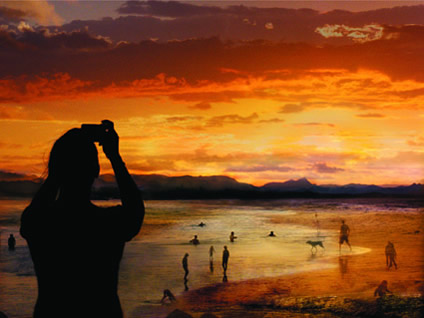
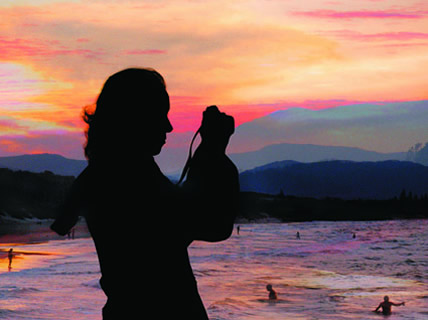
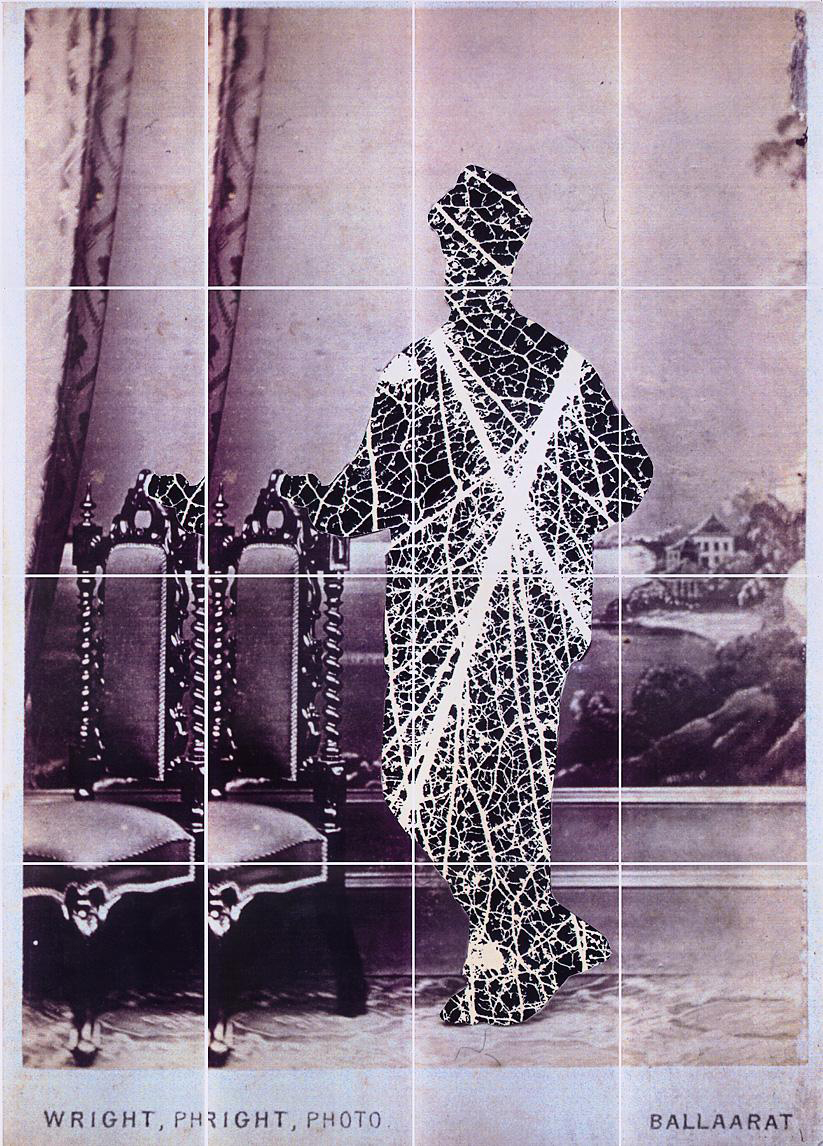
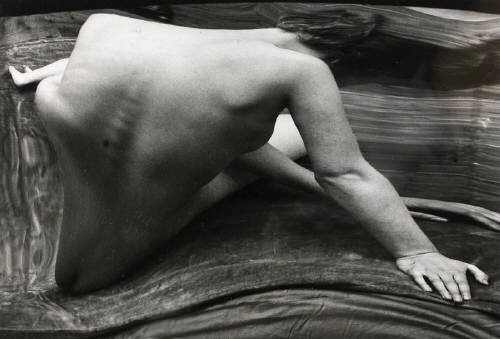
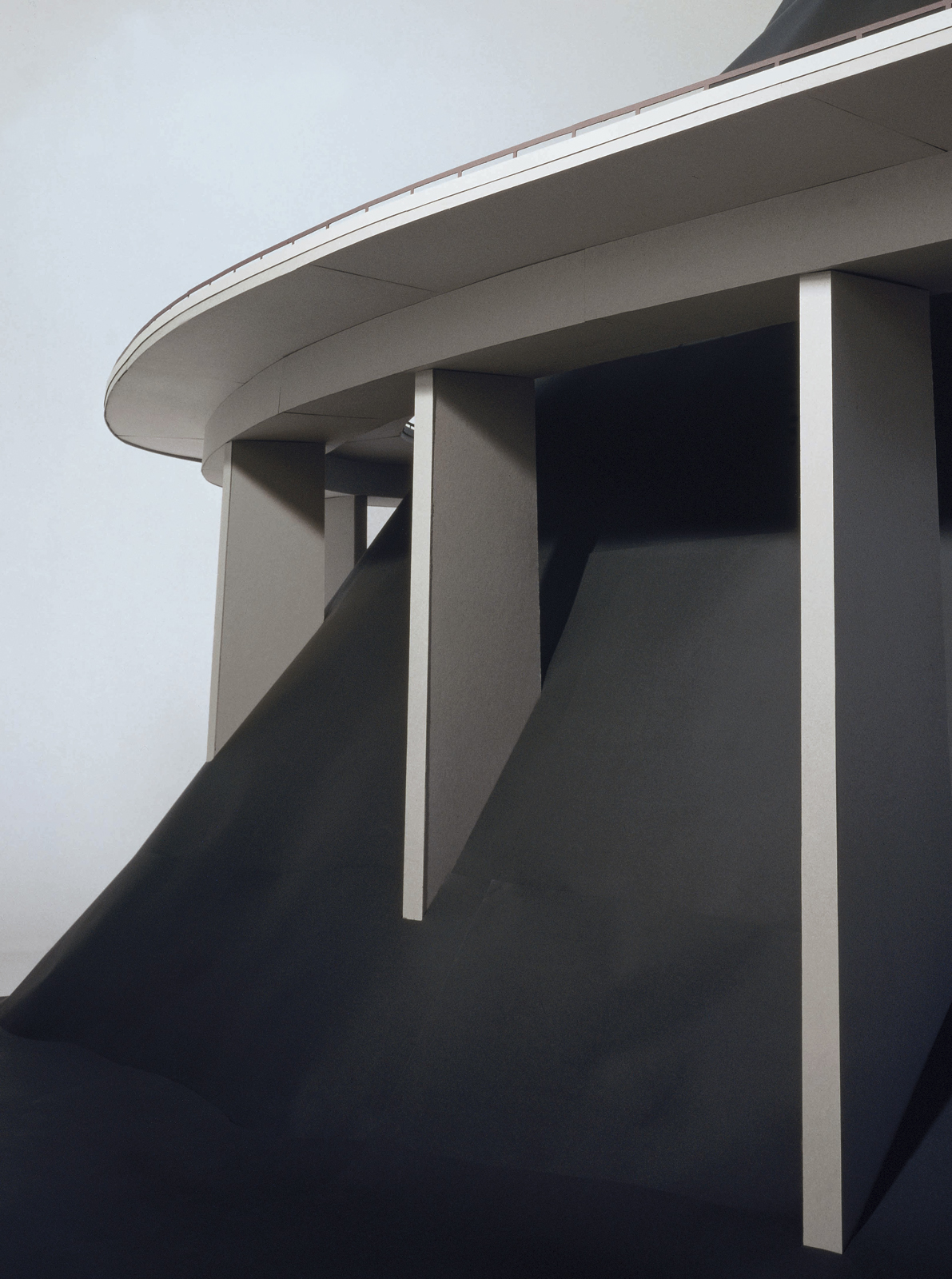
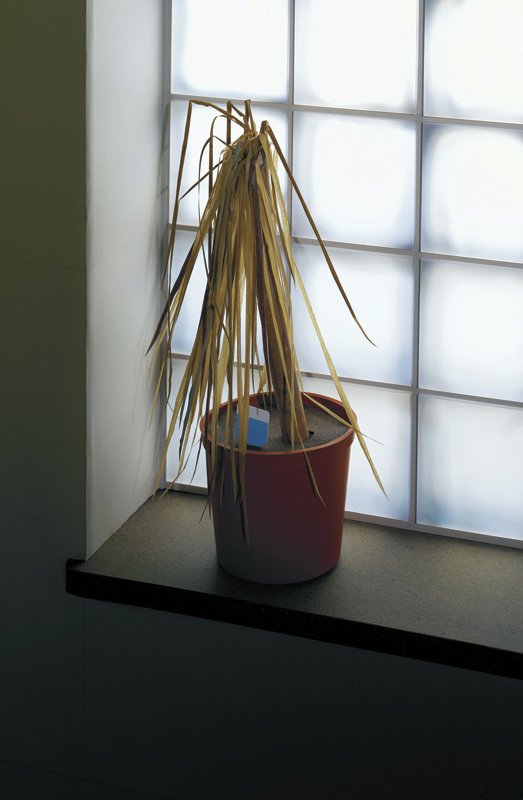
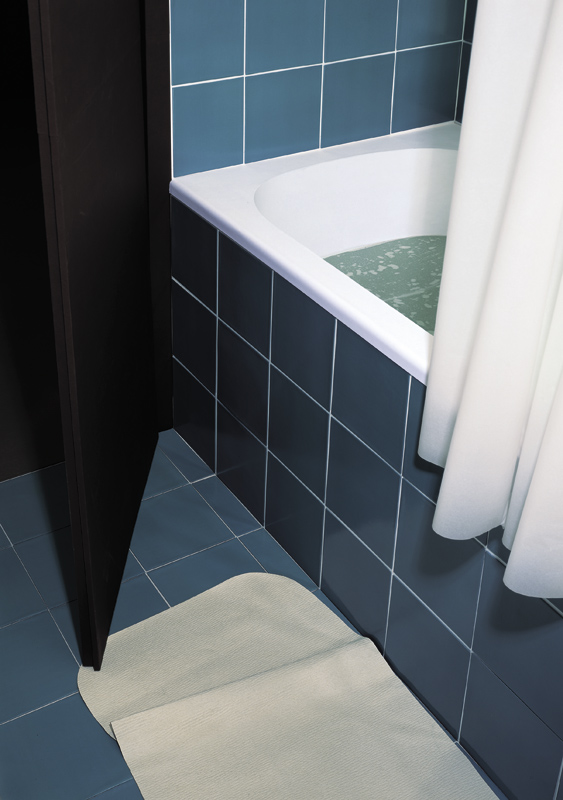
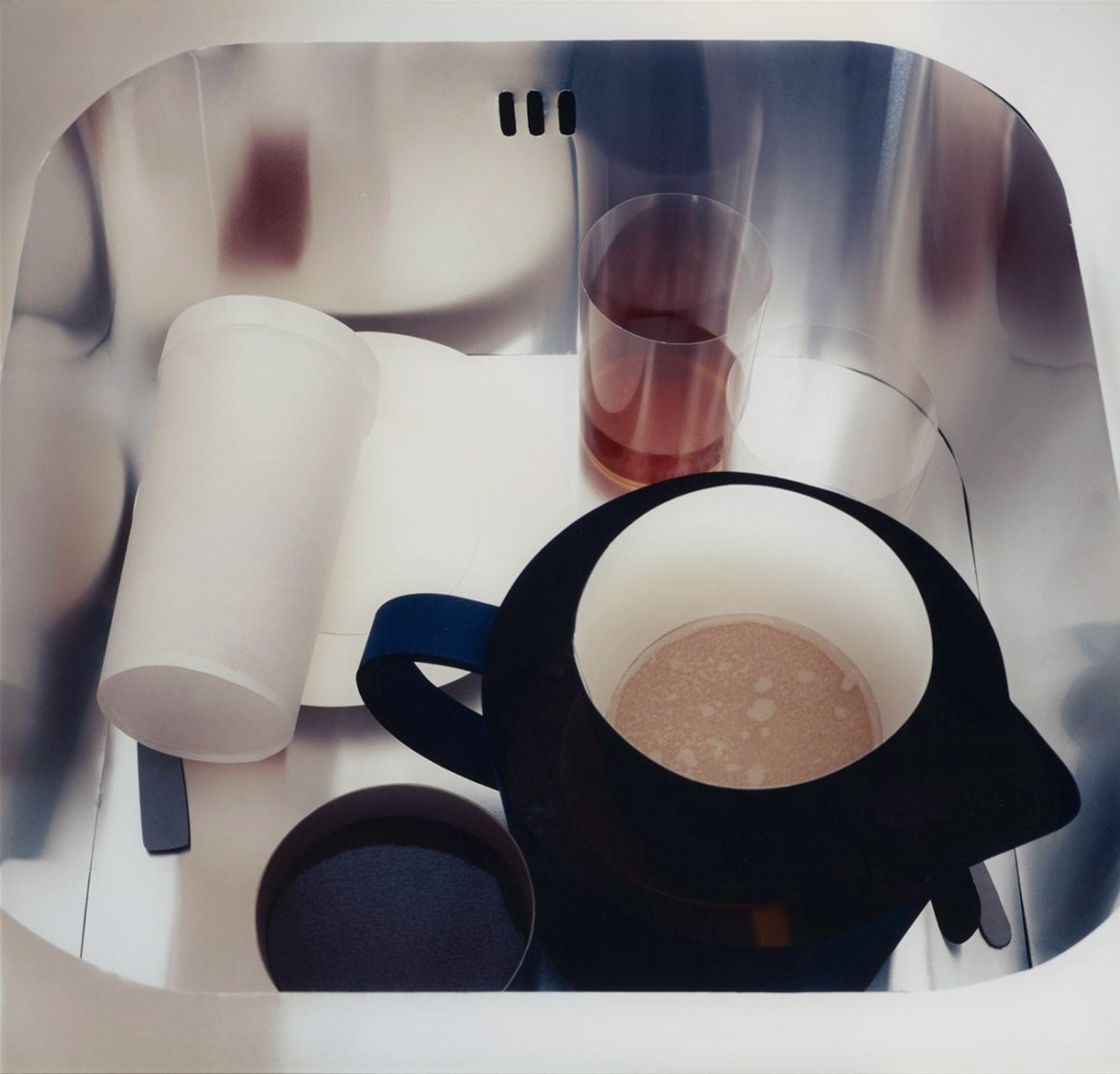
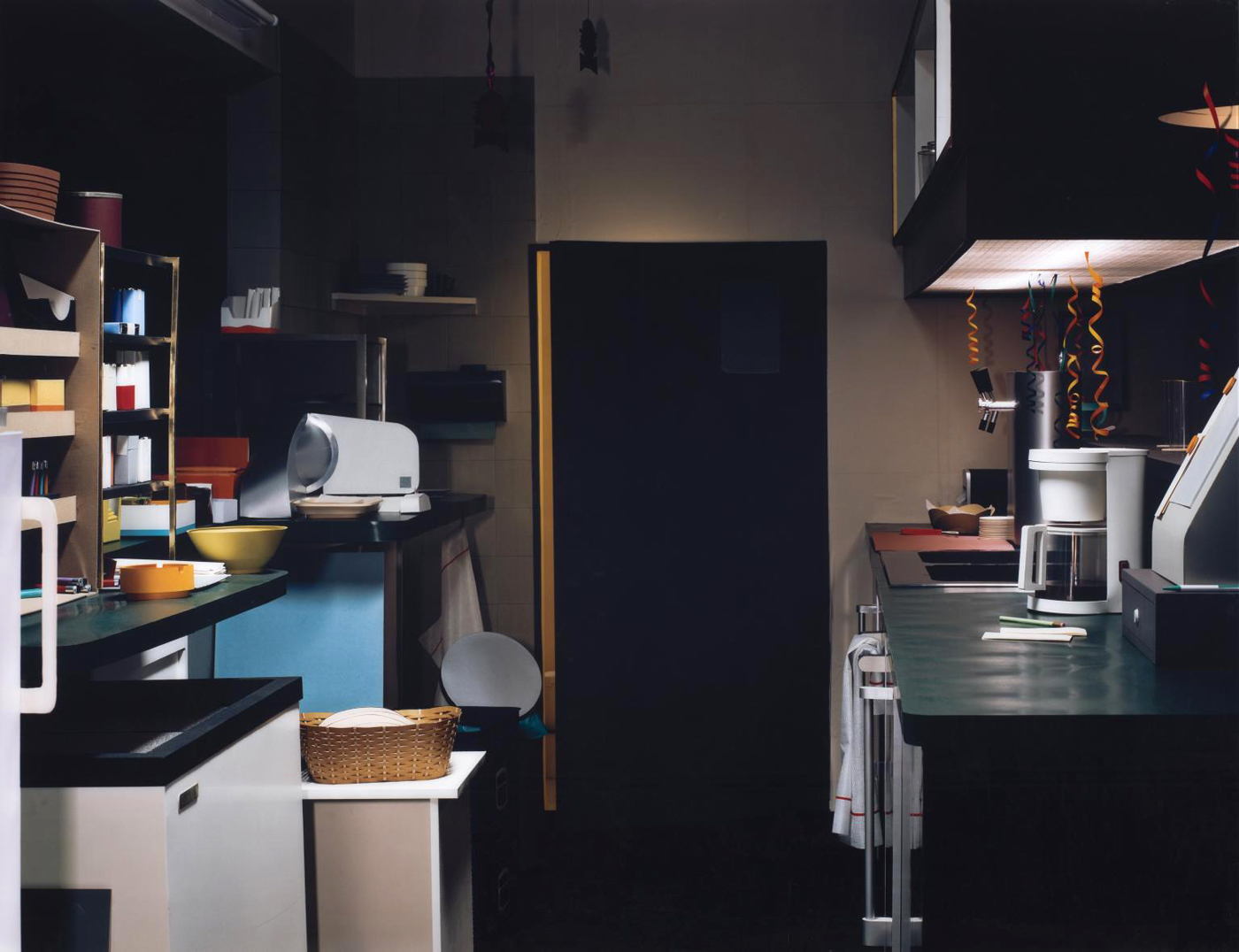
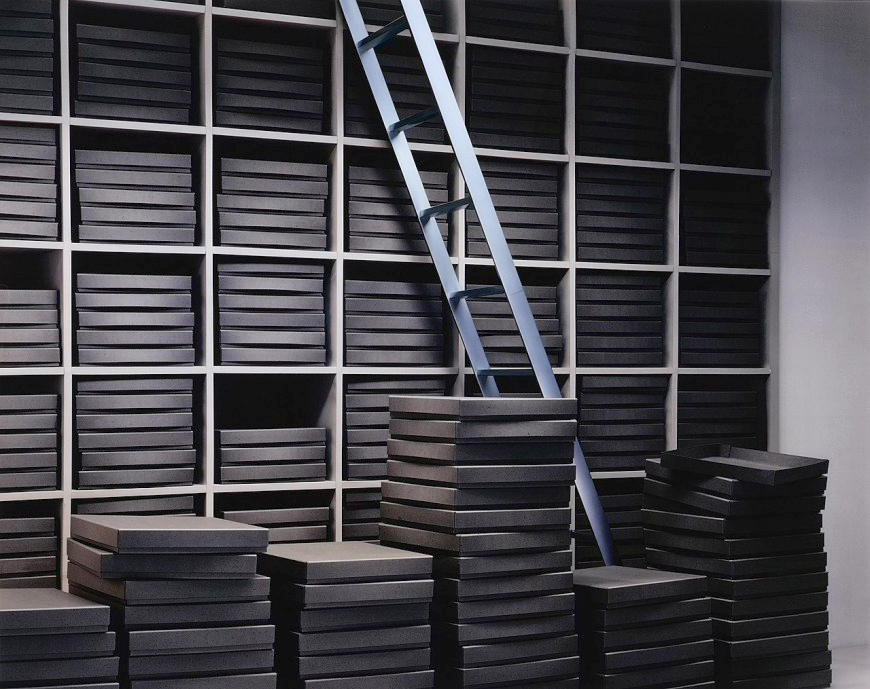
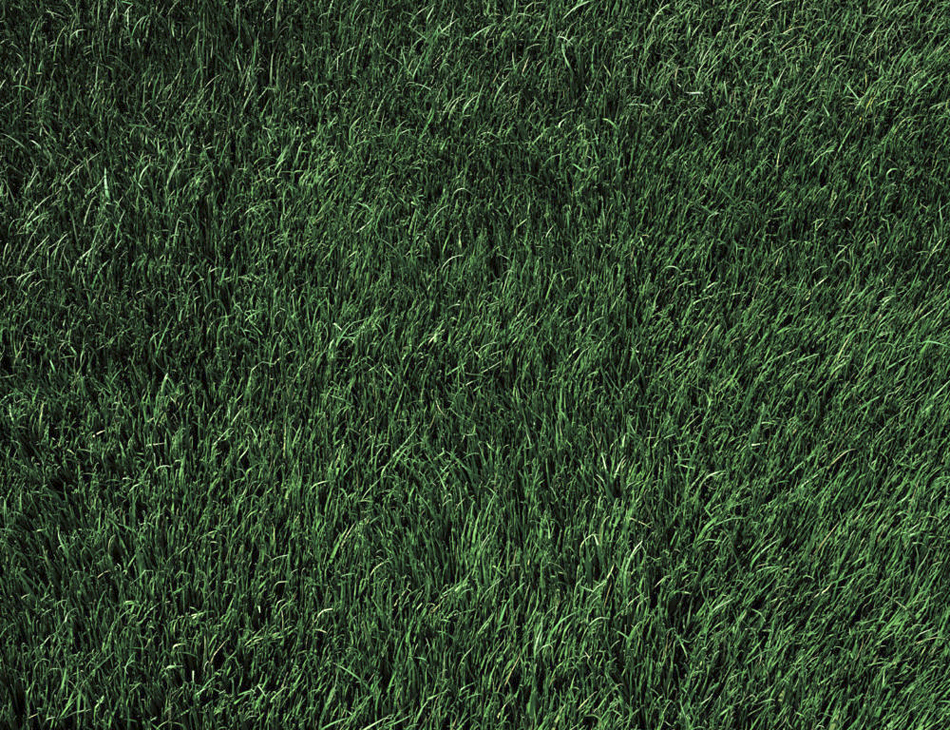
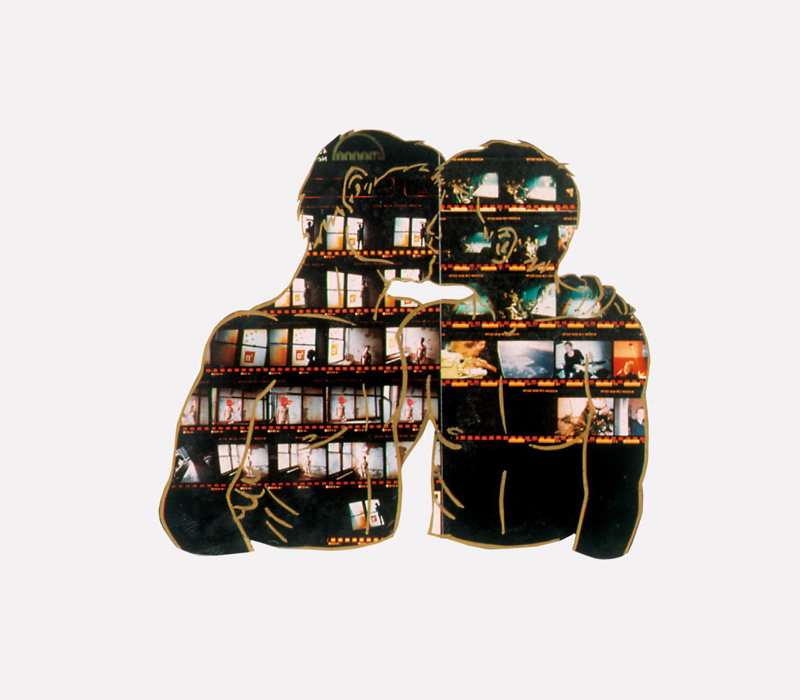
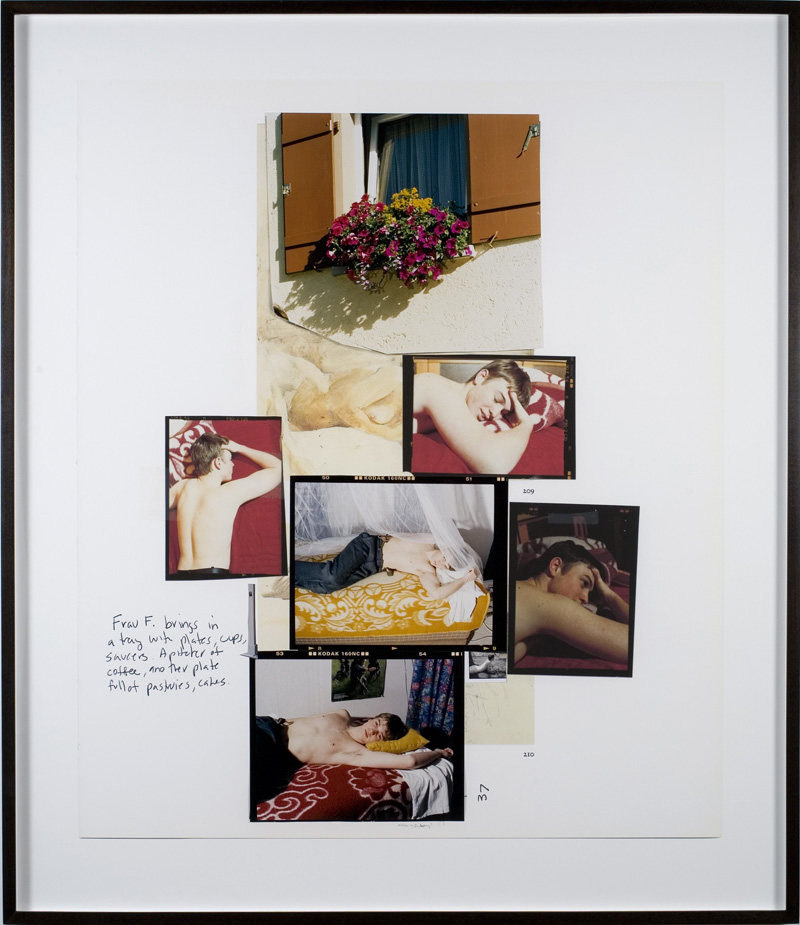
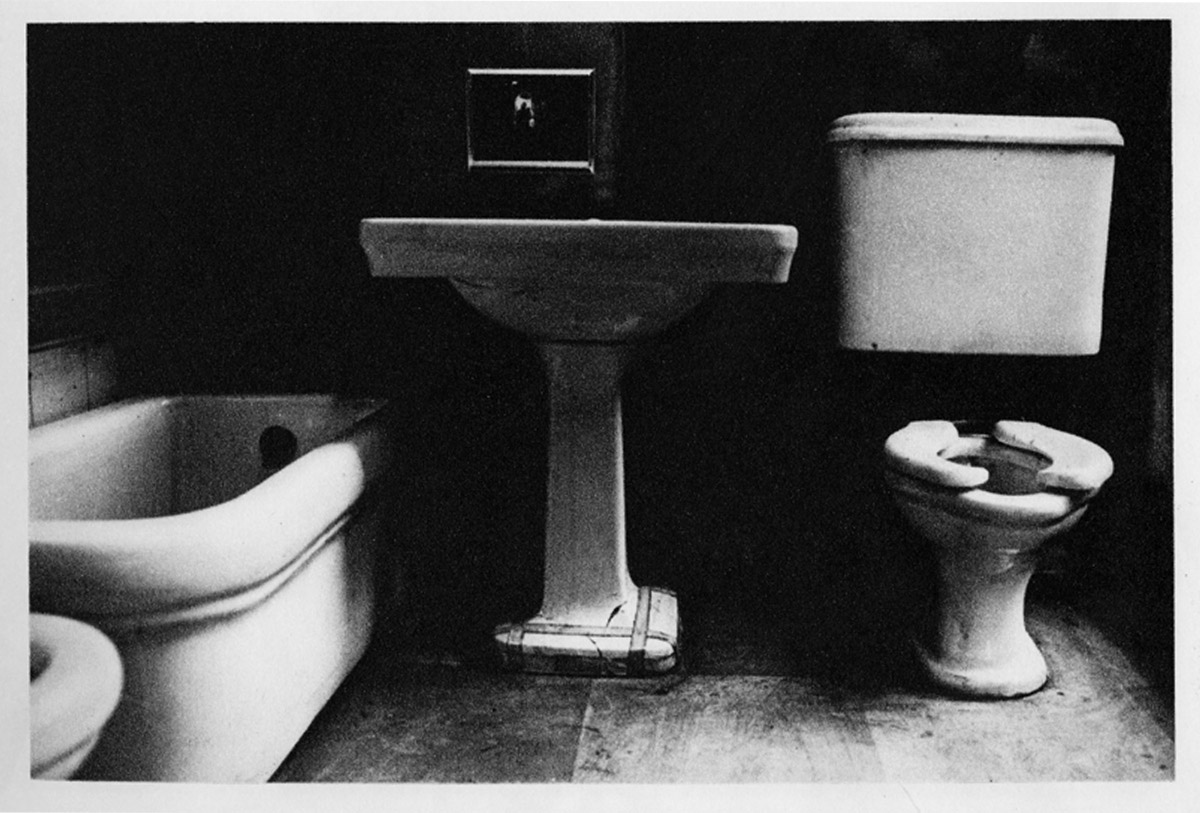
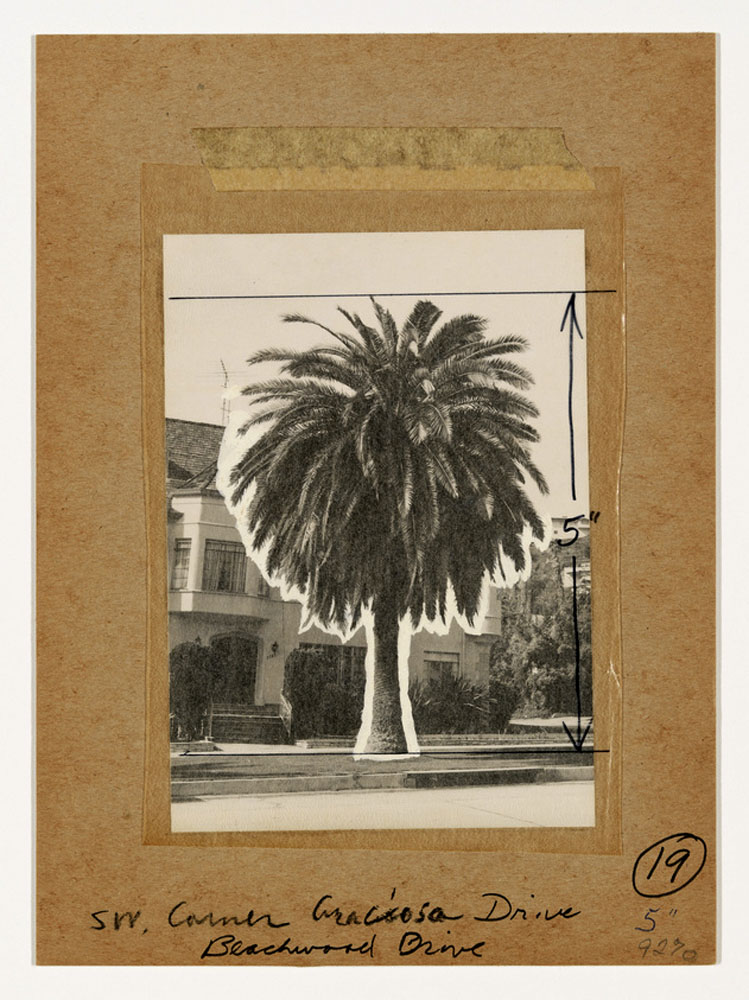
David Wojnarowicz (American, 1954-1992) Untitled 1988 Synthetic polymer on two chromogenic prints 11 x 13 1/4 in. (27.9 x 33.7cm) Whitney Museum of American Art, New York Purchase with funds from the Photography Committee Courtesy of The Estate of David Wojnarowicz and P.P.O.W. Gallery, New York, NY
I gently massaged more photographs of the work in the exhibition from the Whitney press office after initially only being able to download one press image! Many thankx to the Whitney for supplying more images.
As the press release mentions them by name, presumably there will be some of the Robert Frank contact sheets which you can see at the posting Looking In: Robert Frank’s The Americans and the water towers of Bernd and Hilla Becher two photographs of which can be seen at the posting Notes on a conversation with Mari Funaki.
In case you don’t know the work of artist David Wojnarowicz he was a gay man who died of HIV/AIDS aged 37 in 1992: I believe he was one of the most talented and subversive artists of his generation and his powerful images of identity, sexuality, power and death remain seared in my memory. Unfortunately there are not many good images to be found online but there is an excellent Aperture book, Aperture 137 Fall 1994 (David Wojnarowicz: Brush Fires in the Social Landscape) available from Amazon.
Dr Marcus Bunyan
Many thankx to the Whitney Museum of American Art for allowing me to publish the photographs in the posting. Please click on the photographs in the posting for a larger version of the image.
In this selection of works drawn principally from the Whitney’s permanent collection, the repetitive image of the proof sheet is the leitmotif in a variety of works spanning the range of the museum’s photography collection, including the works of Paul McCarthy, Robert Frank, Ed Ruscha, and Andy Warhol. The exhibition is co-curated by Elisabeth Sussman, Whitney Curator and Sondra Gilman Curator of Photography, and Tina Kukielski, Senior Curatorial Assistant. A Few Frames opens on September 25, 2009 in the Sondra Gilman Gallery and runs through January 3, 2010.
Decisions about which photograph to exhibit or print are frequently the end result of an editing process in which the artist views all of the exposures he or she has made on a contact sheet – a photographic proof showing strips or series of film negatives – and then selects individual frames to print or enlarge. Repetition, seriality, and sequencing – inherited from the contact sheet – are evident in all of the works on view. As co-curator Tina Kukielski notes, “this presentation includes a variety of photographs that build on the formal, thematic, and technical logic of the editing process.”
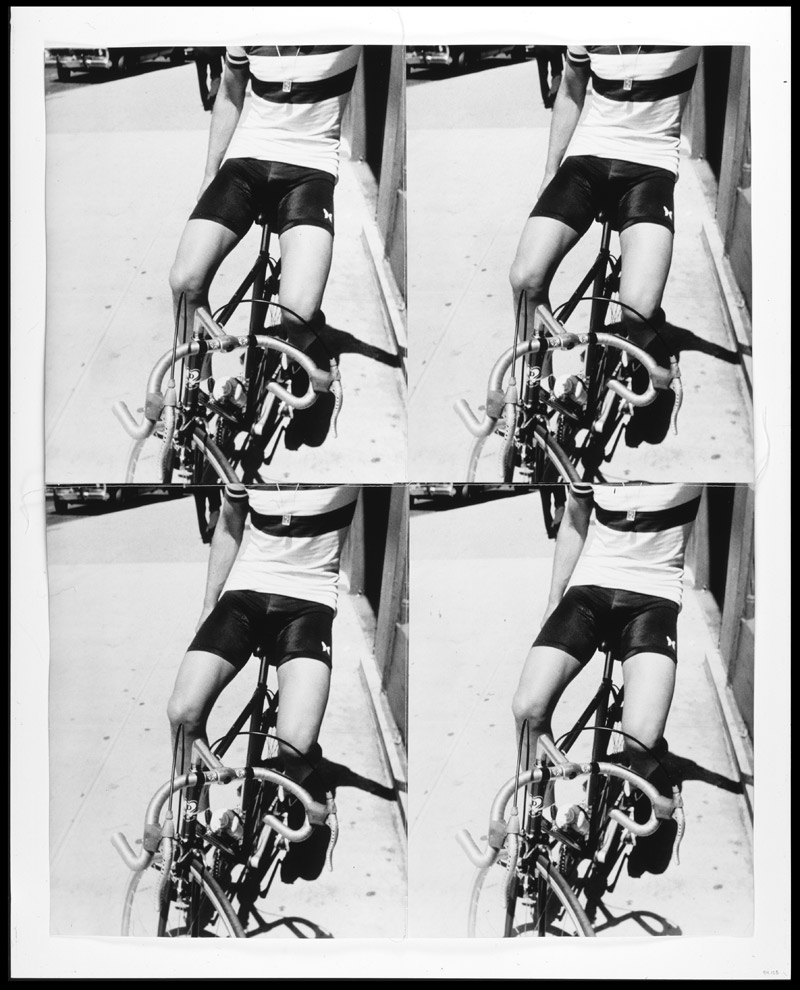
The exhibition includes photo-based works from sixteen featured artists in the Whitney’s collection. The work of David Wojnarowicz and Paul McCarthy present the contact sheet as a work of art, while those of artists such as Andy Warhol, Harold Edgerton, and Robert Frank play with its repeating forms. Other works call to mind the format of the contact sheet, such as Bernd and Hilla Becher’s typological study of industrial water towers and Silvia Kolbowski’s grid of appropriated images of female fashion models.
Works by contemporary artists such as Rachel Harrison and Collier Schorr in their continued interest in the contact sheet, despite perhaps growing trends toward digital photography, reveal the residual and sustained effects of this process.
Press release from the Whitney Museum of American Art website [Online] Cited 01/11/2009 no longer available online
Collier Schorr (American, b. 1963) Day Dream (Sky) 2007 Collage 48 x 43 in. (121.9 x 109.2cm) Courtesy 303 Gallery, New York
Ellen Gallagher (American, b. 1965) Bouffant Pride 2003 Layered photogravure, cut-outs, collage, acrylic, plasticine, and toy eyes Overall: 13 1/2 × 10 1/2 × 3/16in. (34.3 × 26.7 × 0.5cm) Sheet: 13 1/2 × 10 1/2in. (34.3 × 26.7cm) Whitney Museum of American Art, New York; purchase, with funds from the Print Committee
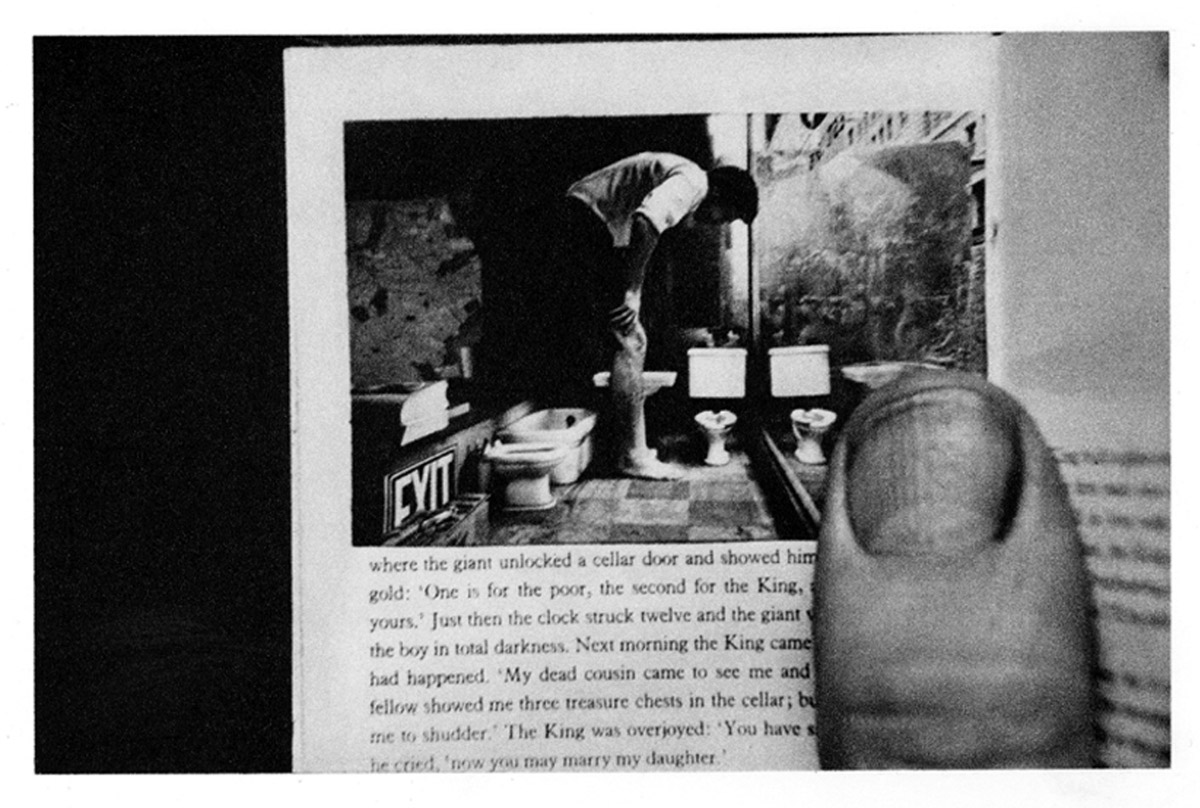
Duane Michals (American, 1932-2026) Things are Queer 1973 Nine silver gelatin prints Whitney Museum of American Art, New York; gift of David Kezur
Exhibition dates: 24th September – 13th December, 2009
Curators: Wang Huangsheng, An Ge and Hu Wugong
Many thankx to the China Institute in America for allowing me to publish the photographs in the posting. Please click on the photographs for a larger version of the image.
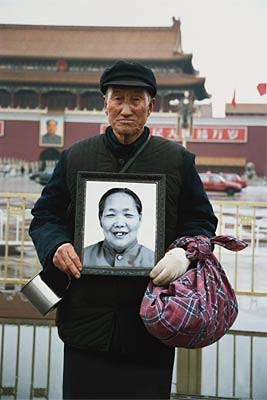
Hao Junchen (Chinese) Hugging a portrait of his wife deceased wife, an elderly man fulfils their dream of visiting Beijing 2003 Gelatin silver print
Feng Jianxin (Chinese) A soldier bids farewell to his wife and child who have just visited him and are now returning home Weichang, Hebei Winter 1987
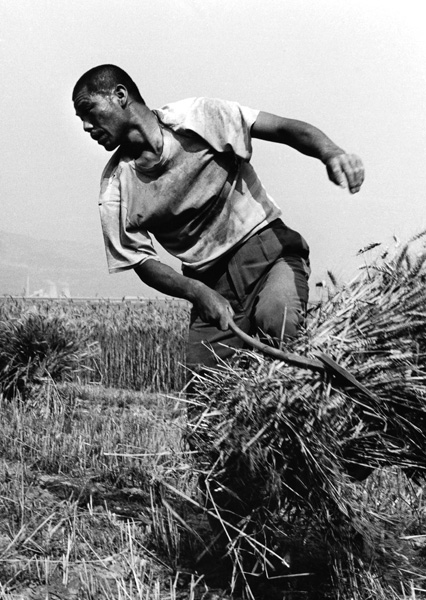
Hu Wugong (Chinese) Migrant wheat farmer in the field in Guanzhong 1998 Gelatin silver print
Wei Dezhong (Chinese, b. 1934) At the Red Flag Canal construction project, suspended labourers cut a channel 1960 Gelatin silver print
Liu Jun (Chinese) A Parent-Official Like This 1985 Gelatin silver print 51 × 40.7cm
A new exhibition of documentary photography, Humanism in China: A Contemporary Record of Photography, will be on view at China Institute Gallery from September 24 through December 13, 2009, revealing a glimpse of China never before seen in the U.S. The photographs, dating from 1951 though 2003, offer intimate portraits of rural and urban daily life in China, beyond the glossy veneer of the economic boom. A fully illustrated catalogue will accompany the exhibition.
Much in the way that The Family of Man, the 1955 landmark photography exhibition curated by Edward Steichen at The Museum of Modern Art in New York, explored the universality of the human experience, Humanism in China: A Contemporary Record of Photography offers rare insight into ordinary and extraordinary human experiences – in this case, taking place in China over the last 50 years.
Humanism in China: A Contemporary Record of Photography was organised by the Guangdong Museum of Art and represents the first large-scale collection of photography acquired permanently by any museum in China. Opening at the Guangdong Museum in 2003, the exhibition has since travelled to seven venues in China, Germany and Scotland. The curators, Wang Huangsheng, An Ge and Hu Wugong, visited photographers’ homes and studios in more than 20 provinces and viewed an estimated 100,000 photographs before selecting 600 images by 248 photographers. The exhibition at China Institute Gallery will offer a more tightly focused selection – 100 photographs by more than 80 photographers – chosen by Dr. Jerome Silbergeld, Professor of Chinese Art History at Princeton University.
Together the images present an unvarnished, starkly realistic view of the hardships and rewards of social modernisation. “These photographs are not just about society and history but are equally about photography itself and the history of documentary photography in China,” Silbergeld writes in the catalogue essay.
Willow Hai Chang, the Director of China Institute Gallery, notes “The medium and language of photography provide an exceptional opportunity to foster a dialogue, enhancing communication and understanding about everyday life in China. Growing up in China and returning there often, I have witnessed the transforming relationship the Chinese have experienced with photography – from the fear that the camera could steal one’s soul that still exists in some remote regions to the urban proliferation of cell-phone cameras and social-networking sites filled with portraits. Photography also provides a most compelling method of recording history, and Humanism in China: A Contemporary Record of Photography creates a contextual framework for both the traditional and modern elements of life in China.”
The emerging themes from the exhibition span an enormous range of human emotions. Tragedy can be seen in the eyes of a man holding a portrait of his deceased wife, while fear is evident as victims flee rising floodwaters. There is also a graceful patience on view as a couple awaits their country wedding, and utter joy is clearly evident as a man displays his wads of cash after winning the lottery.
One of the most striking images in the exhibition is Iron Rice Bowl (see below), Hei Ming’s 2000 portrait of a Muslim chef squatting in front of a crude construction workers’ restaurant, his skullcap mimicking the customers’ rice bowls hanging on the restaurant’s facade. Another notable image, Geng Yensheng’s painterly photograph Miners at Wumeng Mountain (see below), 2003, depicts the harsh working conditions in the mountainous district where Yunnan, Sichuan and Guizhou provinces come together. As Silbergeld writes, the photograph of the young bathing miners “brings social bitterness and formal beauty into a perfectly fused relationship.”
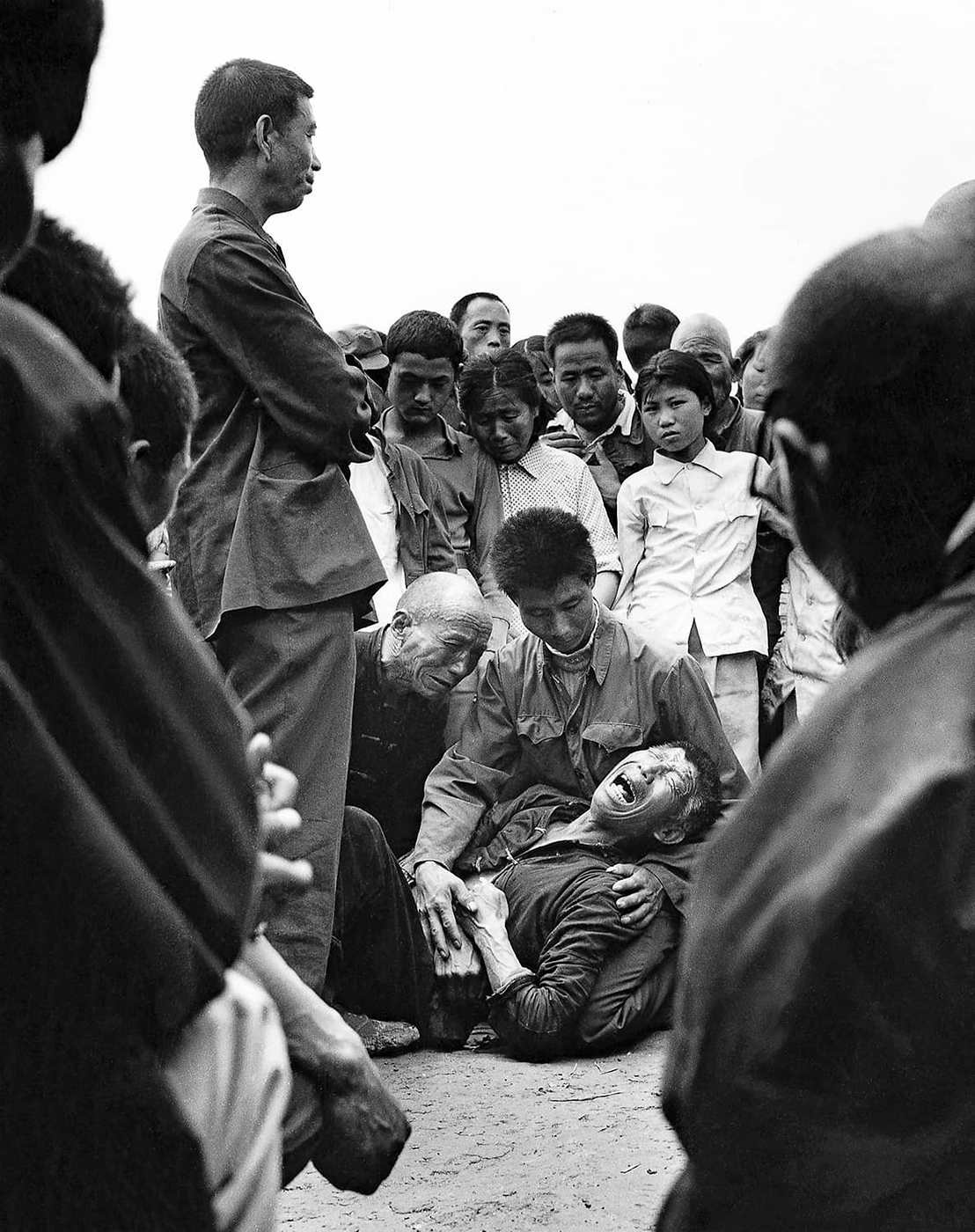
One of the images, A Parent-Official Like This (see above), became well known in China. In May 1985, Liu Jun had his camera ready when he witnessed a rural deputy chief from the Baishui region in Shaanxi province forcefully push a 60-year-old villager to the ground in a dispute over migration. The resulting photograph captures the horrific arrogance of the authority figure as he towers over the powerless villager whose mouth is contorted in pain. The award-winning image is considered the foremost work of photographic social criticism since the 1949 revolution.
Press release from the China Institute in America website [Online] Cited 20/10/2009 no longer available online
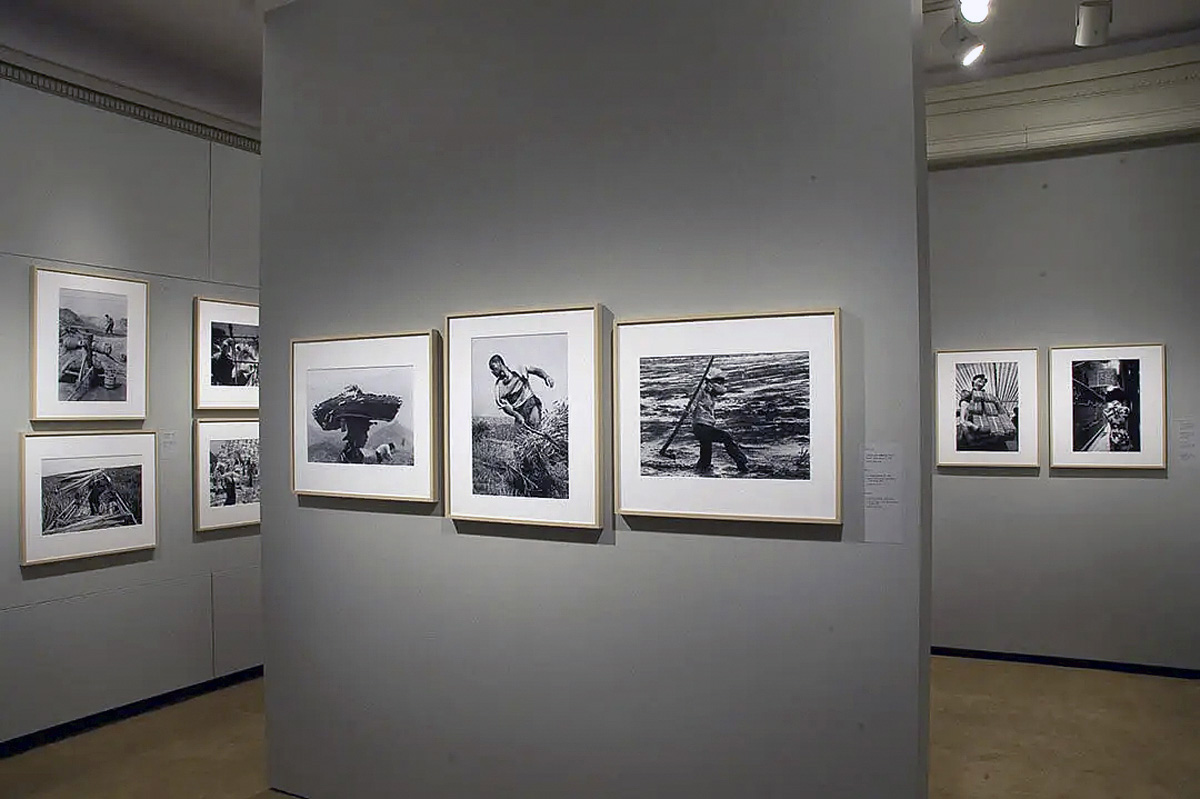
Installation view of the exhibition Humanism in China: A Contemporary Record of Photography at the China Institute in America, New York, September – December, 2009
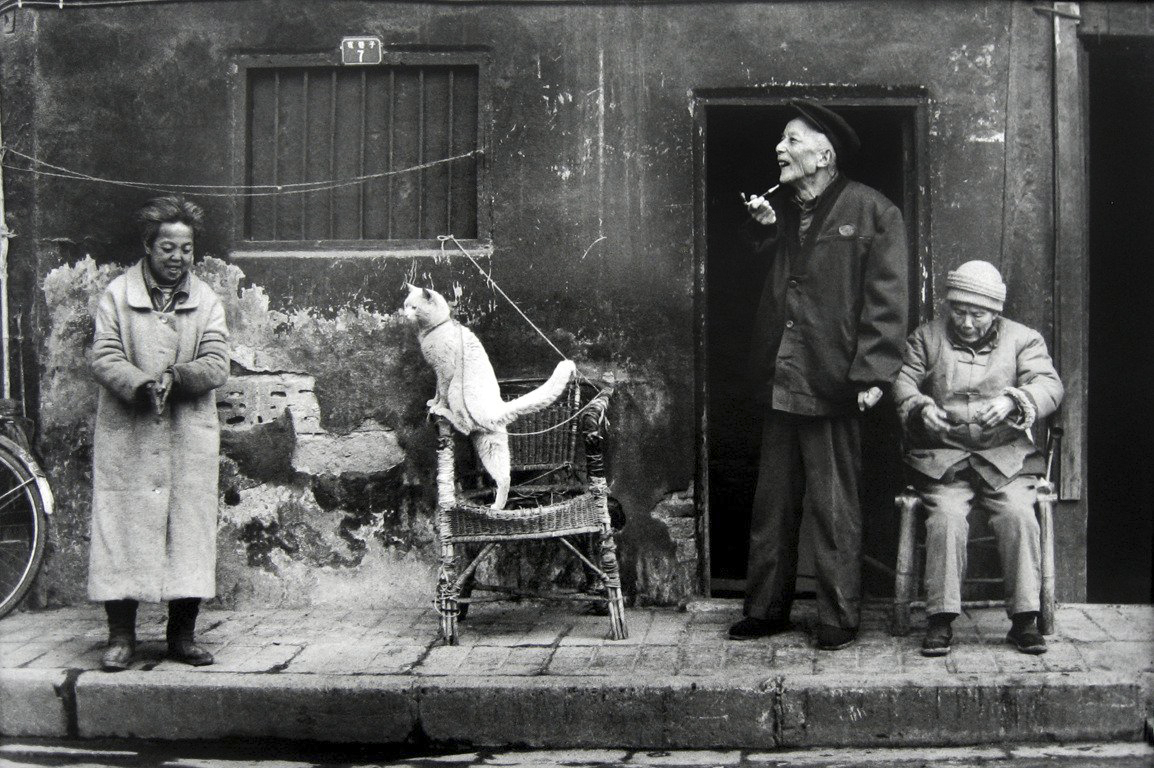
Wu Jialin (Chinese, b. 1926) Having a Chat, Cheng Du 1999 Gelatin silver print
Hei-Ming (Chinese, b. 1964) Iron Rice Bowl 2000 Gelatin silver print
Li Dan (Chinese) Tourists at the Wenshu Temple in Chengdu taking a souvenir photograph 1983 Gelatin silver print
Max Pam (born Australia 1949, lived in Brunei 1980-1983) Road from Bamiyan 1971 Gelatin silver photograph 20.1 x 20.1cm National Gallery of Victoria, Melbourne Purchased, 1979
Long Distance Vision is a disappointingly wane exploration of travel photography at NGV Australia. With the exception of the work of Max Pam the exhibition lacks insight into the phenomena that the curators want the work to philosophically investigate: namely how photographs shape our expectations of a place (even before we arrive) and how photographs also serve to confirm our experience – the picture as powerful mnemonic tool.
Firstly a quick story: when travelling in America to study at the Kinsey Institute I boarded a train from Chicago to what I thought was Bloomington, Indiana only to arrive many hours later at Bloomington, Illinois. Unbeknownst to me this Bloomington also had a motel of the same name as I was staying at in Indiana! After much confusion I ended up at the local airport trying to catch a single seater aircraft to Bloomington, Indiana with no luck – at the end of my tether, fearful in a foreign country, in tears because I just had to be at this appointment the next morning. Riding to my rescue was a nineteen year old kid with no shoes, driving an ex-cop car, who drove me across the Mid-West states stopping at petrol stops in the dead of night. It was a surreal experience, one that I will never forget for the rest of my life … fear, apprehension, alienation, happiness, joy and the sublime all rolled into one.
I tell this story to illustrate a point about travel – that you never know what is going to happen, what experiences you will have, even your final destination. To me, photographs of these adventures not only document this dislocation but step beyond pure representation to become art that re-presents the nature of our existence.
Matthew Sleeth‘s street photographs could be taken almost anywhere in the world (if it were not for a building with German writing on it). His snapshot aesthetic of caught moments, blinded people and dissected bodies in the observed landscape are evinced (to show in a clear manner; to prove beyond any reasonable doubt; to manifest; to make evident; to bring to light; to evidence – yes to bring to light, to evidence as photography does!) in mundane, dull, almost lifeless prints – ‘heavy’ photographs with a lack of shadow detail combined with a shallow depth of field. His remains, the people walking down the street and their shadow, are odd but as as The Age art critic Robert Nelson succinctly notes in his review of this exhibition, “To become art, the odd cannot remain merely quaint but has to signify an existential anomaly by implication.”1
If we look at the seminal photographs from the book The Americans by Robert Frank we see in their dislocated view of America a foreigners view of the country the artist was travelling across – a subjective view of America that reveals as much about the state of mind of the artist as the country he was exposing. No such exposition happens in the works of Matthew Sleeth.
Christine Godden‘s photographs of family and friends have little to do with travel photography and I struggle to understand their inclusion in this exhibition. Though they are reasonable enough photographs in their own right – small black and white photographs of small intimacies (at the beach, in the garden, at the kitchen table, on the phone, on the porch, on the float, etc…) Godden’s anthropomorphist bodies have nothing to do with a vision of a new land as she had been living in San Francisco, New York and Rochester for six years over the period that these photographs were taken. Enough said.
The highlight of the exhibition is the work of Max Pam. I remember going the National Gallery of Victoria in the late 1980s to view this series of work in the collection – and what a revelation they were then and remain so today. The square formatted, dark sepia toned silver gelatin prints of the people and landscapes of Tibet are both monumental and personal at one and the same time. You are drawn into their intimacies: the punctum of a boys feet; the gathering of families; camels running before a windstorm; human beings as specks in a vast landscape.
“If the world is unfair or beyond our understanding, sublime places suggest it is not surprising things should be thus. We are the playthings of the forces that laid out the oceans and chiselled the mountains. Sublime places acknowledge limitations that we might otherwise encounter with anxiety or anger in the ordinary flow of events. It is not just nature that defies us. Human life is as overwhelming, but it is the vast spaces of nature that perhaps provide us with the finest, the most respectful reminder of all that exceeds us. If we spend time with them, they may help us to accept more graciously the great unfathomable events that molest our lives and will inevitably return us to dust.”2
The meditation on place and space that the artist has undertaken gives true insight into the connection of man and earth, coming closest to Alain de Botton’s understanding of the significance of sublime places. Through a vision of a distant land the photographs transport us in an emotional journey that furthers our understanding of the fragility of life both of the planet and of ourselves.
While the National Gallery of Victoria holds some excellent photography exhibitions (such as Andreas Gursky and Rennie Ellis for example) this was a missed opportunity. The interesting concept of the exhibition required a more rigorous investigation instead of such a cursory analysis (which can be evidenced by the catalogue ‘essay’: one page the size of a quarter of an A4 piece of paper that glosses over the whole history of travel photography in a few blithe sentences).
Inspiration could have easily been found in Alain de Botton’s excellent book The Art of Travel. Here we find chapters titled “On Anticipation”, “On Travelling Places”, “On the Exotic”, “On Curiosity”, “On the Country and the City” and “On the Sublime” to name but a few, with places and art work to illustrate the journey: what more is needed to excite the mind!
Take Charles Baudelaire for example. He travelled outside his native France only once and never ventured abroad again. Baudelaire still dreamt of going to Lisbon, or Java or to the Netherlands but “the destination was not really the point. The true desire was to get away, to go, as he concluded, ‘Anywhere! Anywhere! So long as it is out of the world!'”3
Heavens, we don’t even have to leave home to create travel photography that is out of the world! Our far-sighted vision (like that of photographer Gregory Crewdson) can create psychological narratives of imaginative journeys played out for the camera.
Perhaps what was needed was a longer gestation period, further research into the theoretical nuances of travel photography (one a little death, a remembrance; both a dislocation in the non-linearity of time and space), a gathering of photographs from collections around Australia to better evidence the conceptual basis for the exhibition and a greater understanding of the irregular possibilities of travel photography – so that the work and words could truly reflect the title of the exhibition Long Distance Vision.
Dr Marcus Bunyan
1/ Nelson, Robert. “In blurred focus: le freak c’est chic,” in The Age newspaper. Friday, October 23rd 2009, p. 18
2/ de Botton, Alain. The Art of Travel. London: Penguin, 2002, p. 178-179
“The National Gallery of Victoria will celebrate the work of Christine Godden, Max Pam and Matthew Sleeth in a new exhibition, Long Distance Vision: Three Australian Photographers opening 28 August.
Long Distance Vision will include over 60 photographs from the NGV Collection exploring the concept of the ‘tourist gaze’ and its relationship with the three artists.
Susan van Wyk, Curator Photography, NGV said the exhibition provides a fascinating insight into the unusual perspective brought by the three photographers to their varied world travel destinations.
“There’s a sense in the works in the exhibition that the photographers are not from the places they choose to photograph, and that each is a visitor delighting in the scenes they encounter.
“What is notable about the photographs in Long Distance Vision is that rather than focussing on the well known scenes that each artist encountered, they have turned their attention to the ‘little things’, the details of the everyday,” said Ms van Wyk.
From the nineteenth century, photography has been a means by which people could discover the world, initially through personal collection and albums, and later via postcards, magazines, books and the internet.
Dr Gerard Vaughan, Director, NGV said that both contemporary photographers and tourists use the camera as a means to explore and capture the world.
“Through their photographs, the three artists featured in Long Distance Vision show us highly individual ways of seeing the world. This exhibition will surprise and delight visitors as our attention is drawn to not only what is different but what remains the same as we travel the world,” said Dr Vaughan.
Born in Melbourne in 1949, Max Pam began his career in various commercial photography studios in the 1960s. After responding to a university notice for assistance to drive a Volkswagen from Calcutta to London in 1969, Pam got his first taste of being a traveller. The body of Pam’s work in this exhibition is from the series The Himalayas, which was photographed over a number of early visits to India.
Christine Godden also travelled the popular overland route between Europe and India in the early 1970s, returning to Sydney in 1978. In 1972, after a period of travelling, Godden found her home in the US where she remained for six years. Godden’s photographs in this exhibition were taken between 1972 and 1974 during her stay in the US.
Born in Melbourne in 1972, Matthew Sleeth is another seasoned traveller. During the late 1990s, Sleeth settled in Opfikon, an outer suburb of Zurich, Switzerland. The series of photographs in Long Distance Vision were taken during this time, showing Sleeth’s interest not only in street photography, but also in the narrative possibilities in everyday scenes. Dotted with garishly coloured playhouses, naive sculptures and whimsical arrangements of garden gnomes Sleeth’s photographs go beyond the ‘picture-perfect’ scenes of typical tourist photography.
Long Distance Vision: Three Australian Photographers is on display at The Ian Potter Centre: NGV Australia, Federation Square from 28 August 2009 to 21 February 2010.”
Text from the National Gallery of Victoria press release
Exhibition dates: 12th September – 8th November, 2009
Many thankx to the Morris Museum of Art for allowing me to publish the photographs in the posting. Please click on the photographs for a larger version of the image.
William Christenberry (American, 1936-2016) Green Warehouse, Newbern, Alabama 1997 Dye coupler print
Widely recognised as a pioneer in the field of colour photography, William Christenberry has used this expressive medium to explore the American South for forty years. While pursuing this artistic quest he has drawn inspiration from Walker Evans, and influenced a generation of emerging photographers. William Christenberry: Photographs, 1961-2005 surveys his poetic documentation of southern vernacular architecture, signage, and landscape using a wide range of cameras, from his earliest Brownie photographs of the early 1960s to his later work with a large-format camera. Combining never-before-seen photographs, both old and new, with images that are now iconic, this exhibition comprises fifty vintage photographic works and one sculpture. Together, they convey the breadth of his singular photographic vision. Discuss the artistic objectives of his long-term interpretation of the Southern landscape with Michelle Norris of National Public Radio, Christenberry explained: “What I really feel very strongly about, and I hope reflects in all aspects of my work, is the human touch, the humanness of things, the positive and sometimes the negative and sometimes the sad.”
Text from the Morris Museum of Art website [Online] Cited 15/10/2009. No longer available online
William Christenberry (American, 1936-2016) House and Car, near Akron, Alabama 1981
William Christenberry (American, 1936-2016) Kudzu with Storm Cloud, near Akron, Alabama 1981
“William Christenberry Photographs, 1961-2005, a phenomenal retrospective exhibition of Christenberry’s photographs, opens to the public at the Morris Museum of Art on September 16, 2009. The Morris Museum is the only Georgia venue hosting this exhibition.
“‘William Christenberry Photographs, 1961-2005’ is an overview of the career of one of the South’s most important living artists,” said Kevin Grogan, director of the Morris Museum of Art. “Organised by the Aperture Foundation, this exhibition brings to Augusta a body of work like no other. No one has so scrupulously and attentively captured a sense of place and time in quite the way that Bill Christenberry has. He is a remarkable artist, as is proven by this extraordinary body of work. He is America’s Proust.”
Since the early 1960s, William Christenberry has plumbed the regional identity of the American South, focusing his attention primarily on his childhood home, Hale County, Alabama. Widely recognised as a pioneer in the field of colour photography, Christenberry draws inspiration from the work of Walker Evans, while paralleling the work of such international practitioners as Bernd and Hilla Becher. Ranging from his earliest Brownie photographs to his later work with a large-format camera, William Christenberry Photographs, 1961-2005 is a survey of the artist’s poetic documentation of the Southern landscape and vernacular architecture that surrounded him as he grew up. The exhibition, coupling never-before-seen photographs with images that are now iconic, reveals how the history, the very story of place, is at the heart of Christenberry’s ongoing project. While the focus of his work is the American South, it touches on universal themes related to family, culture, nature, spirituality, memory, and ageing. Christenberry photographs real things in the real world – ramshackle buildings, weathered commercial signs, lonely back roads, rusted-out cars, whitewashed churches, decorated graves. Dutifully returning to photograph the same locations annually – the green barn, the palmist building, the Bar-B-Q Inn, among others – he has fulfilled a personal ritual and documented the physical changes wrought by every single year. Straddling past and present, Christenberry’s art suggests the gravity and power of the passage of time.
The exhibition is accompanied by a stunning monograph entitled William Christenberry, published by Aperture in cooperation with the Smithsonian American Art Museum. The book, a comprehensive survey, presents all aspects of the artist’s oeuvre as he intended it to be viewed and considered. More than half the work reproduced has not been previously published.”
Text from the press release on the Morris Museum of Art website [Online] Cited 15/10/2009. No longer available online
William Christenberry (American, 1936-2016) Sprott Church in Alabama 1971
William Christenberry (American, 1936-2016) T.B. Hick’s Store, Newbern, Alabama 1976
William Christenberry (American, 1936-2016) Farmhouse, Hale County, Alabama 1977
William Christenberry (American, 1936-2016) House and Car, near Akron, Alabama 1978
William Christenberry (American, 1936-2016) Palmist Building, Havanna, Alabama 1980
The Palmist Building is one of the most iconic structures in Christenberry’s extensive body of work. When he was a child, the clapboard building was a general store operated by his great uncle, but it was later home to a palm reader. The inverted hand-painted sign that covers a broken window initially enticed him to photograph the building in 1961. His earliest photographs pinpoint the sign itself and the peeling whitewash around it. As he became more engrossed in the project, Christenberry carefully examined the relationship of the building to its surroundings, particularly the chinaberry tree that eventually engulfed it.
Text from the High Museum of Art website
William Christenberry (American, 1936-2016) Rabbit Pen, near Moundville, Alabama 1998
William Christenberry (American, 1936-2016) Old House, near Akron, Alabama 1964
Morris Museum of Art 1 Tenth Street Augusta, Georgia 30901 Phone: 706-724-7501
Opening Hours: Tuesday – Saturday: 10.00am – 5.00pm Sunday: 12 – 5.00pm Closed Mondays and major holidays
Media crowd at the Ricky Swallow exhibition The Bricoleur at NGV Australia with Alex Baker, Senior Curator, Contemporary Art, NGV fourth from left with clasped hands. Photo: Marcus Bunyan
Hot off the press straight to you here at Art Blart!
Photographs of the exhibition Ricky Swallow: The Bricoleur at the National Gallery of Victoria Australia, Federation Square. The photographs are in the chronological order that I took them, walking through the three spaces of the exhibition. A spare, visually minimalist aesthetic to the show, where every vanitas, every mark (in)forms the work as transcendent momenti mori. Review to follow.
“I’ve always been interested in how an object can be remembered and how that memory can be sustained and directed sculpturally, pulling things in and out of time, passing objects through the studio as a kind of filter returning them as new forms.”
Ricky Swallow
Ricky Swallow (Australian, b. 1974) The Bricoleur 2006 Jelutong 48 x 9.75 x 9.75 inches Photo: Marcus Bunyan
Ricky Swallow (Australian, b. 1974) Unbroken Ways (for Derek Bailey) 2006 English Limewood 5 x 30 x 7 inches Photo: Marcus Bunyan
Ricky Swallow (Australian, b. 1974) One Nation Underground 2007 Photo: Marcus Bunyan
Ricky Swallow (Australian, b. 1974) One Nation Underground (detail) 2007 Photo: Marcus Bunyan
Ricky Swallow (Australian, b. 1974) Tusk 2007 Bronze with white patina, brass fixtures 19.75 x 41.25 x 2.25 inches Photo: Marcus Bunyan
Ricky Swallow (Australian, b. 1974) Tusk (detail) 2007 Bronze with white patina, brass fixtures 19.75 x 41.25 x 2.25 inches Photo: Marcus Bunyan
Ricky Swallow (Australian, b. 1974) Rehearsal for Retirement (detail) 2008 English Lime Wood, Poplar Photo: Marcus Bunyan
Ricky Swallow (Australian, b. 1974) Bowman’s record (detail) 2008 Bronze Photo: Marcus Bunyan
Ricky Swallow’s sculptures address fundamental issues that lie at the core of who we are. Things have lives. We are our things. We are things. When all is said and done it is our things – our material possessions – that outlive us. Anyone who has lost a family member or close friend knows this: what we have before us once that person is gone are the possessions that formed a life. Just as we are defined and represented by the things that we collect over time, we are ultimately objects ourselves. When we are dead and decomposed what remains are our bones, another type of object. And then there is social science. Archaeology, a subfield of anthropology, is entirely based on piecing together narratives of human relations based on material culture, that is, objects both whole and fragmentary. It may seem obvious but it is worth stressing here that our understanding of cultures from the distant past, those that originated before the advent of writing, is entirely based on the study of objects and skeletal remains. Swallow’s art addresses these basic yet enduring notions and reminds us of our deep symbiotic relationship to the stuff of daily life.
Like the bricoleur put into popular usage by anthropologist Claude Levi-Strauss in his seminal book The Savage Mind, Ricky Swallow creates works of art often based on objects from his immediate surroundings. His method, however, is more of a second order bricolage: his sculptures are not assemblages of found objects, but rather elegantly crafted things. Hand carved from wood or plaster or cast in bronze, these humble objects are transformed into memorials to both the quotidian and the passage of time.
Still life
The still life has been an important touchstone throughout Swallow’s recent practice as it is an inspired vehicle for the exploration of how meaning is generated by objects. Several sculptures in the exhibition reference the still-life tradition in which Swallow updates and personalises this time-honoured genre, in particular the vanitas paintings of 17th century Holland. Vanitas still lifes, through an assortment of objects that had recognisable symbolism to a 17th-century viewer, functioned as allegories on the futility of pleasure and the inevitably of death. Swallow’s embrace of still life convention, however, is non-didactic, secular and open-ended. Swallow is not obsessed by death. On the contrary, his focus on objects is about salvaging them from the dust bin of history and honouring their continued resonance in his life.
Killing time, 2003-2004, and Salad days, 2005, depict animals that Swallow and his family either found or caught when he was young and best highlight how the artist reclaims the still life genre to explore personal narrative. Killing time, which depicts a bounty of fish and crustaceans spread across a table modelled after the Swallow family kitchen table of the artist’s youth, is rife with autobiographical association. It not only references an object from Swallow’s past, but also the profession of his father, a fisherman, and the fact that Swallow was raised by the sea. Salad days is another autobiographical work depicting a range of animals such as birds, a rabbit, mice and a fox skull. Like many boys growing up in rural environments, Swallow recalls shooting magpies, encountering nesting birds in his garage or discovering dead lizards or trapping live ones in an attempt to keep them as pets.
While not an overt still life, History of holding, 2007, suggests the genre in its fragmentary depiction of a musical instrument and the appearance of a lemon with falling rind. The hand holding / presenting a peeled lemon as the rind winds around the wrist in bracelet-like fashion is based on a cast of Swallow’s own hand, insinuating himself into this antiquated tradition. It is as if Swallow is announcing to us his deep interest in the temporality of objects through the presentation of the peeled lemon, which symbolises the passing of time and also appears in Killing time. The second component of History of holding is a sculptural interpretation of the Woodstock music festival icon designed by Arthur Skolnick in 1969, which still circulates today. History of holding, then, also references music, a leitmotif in Swallow’s art that appears both within the work itself, and also through Swallow’s use of titles.
Body fragments
Tusk, 2007 among several other works in the exhibition, explores the theme of body as fragment. Much has been discussed about Swallow’s use of the skeleton as a form rich in meaning within both the traditions of art history as well as popular culture (references range from the Medieval dance macabre and the memento mori of the still life tradition to the skeleton in rock music and skateboard art iconography). Tusk represents two skeletal arms with the hands clasped together in eternal union. A poignant work, Tusk is a meditation on permanence: the permanence of the human body even after death; the permanence of the union between two people, related in the fusion of the hands into that timeless symbol of love, the heart.
Swallow calls his watercolours “atmospheric presentations”, in contradistinction to his obviously more physical sculptures, and he sees them as respites from the intensity of labour and time invested in the sculptural work. They also permit experimentation in ways that sculpture simply does not allow. One nation underground, 2007, is a collection of images based on rock / folk musicians, several who had associations to 1960s Southern California, Swallow’s current home. Most of the subjects Swallow has illustrated in this work are now deceased; several experienced wide recognition only after their deaths. Like many of his sculptures, this group of watercolours tenderly painted with an air of nostalgia has the sensibility of a memorial – or as Swallow has called it “a modest monument”. The title of the work is based on a record album by another under-heralded rock band from the 1960s, Pearls Before Swine, and is a prime example of Swallow’s belief in the importance of titles to the viewing experience as clues or layers of meaning. In this case, the title hints at the quasi-cult status of the musicians and singers depicted. The featured musicians are Chris Bell (Big Star), Karen Dalton (a folk singer), Tim Buckley (legendary singer whose style spanned several genres and father to the late Jeff Buckley), Denny Doherty (The Mamas & the Papas ), Judee Sill (folk singer), Brian Jones (Rolling Stones), Arthur Lee (Love), John Phillips (The Mamas & the Papas ), Skip Spence (Jefferson Airplane and Moby Grape) and Phil Ochs (folk singer).
Installation views of Ricky Swallow: The Bricoleur second space at NGV Australia Photos: Marcus Bunyan
Ricky Swallow (Australian, b. 1974) Caravan (detail) 2008 Bronze Photo: Marcus Bunyan
Ricky Swallow (Australian, b. 1974) Salad days c. 2005 Photo: Marcus Bunyan
Ricky Swallow (Australian, b. 1974) Killing time 2003-2004 Photo: Marcus Bunyan
Ricky Swallow (Australian, b. 1974) Killing time (detail) 2003-2004 Photo: Marcus Bunyan
Ricky Swallow (Australian, b. 1974) Killing time 2003-2004 Photo: Marcus Bunyan
Ricky Swallow (Australian, b. 1974) Killing time (detail) 2003-2004 Photo: Marcus Bunyan
A new exhibition featuring the work of internationally renowned Australian artist Ricky Swallow will open at The Ian Potter Centre: NGV Australia on 16 October 2009.
Ricky Swallow: The Bricoleur is the artist’s first major exhibition in Australia since 2006. This exhibition will feature several of the artist’s well‐known intricately detailed, carved wooden sculptures as well as a range of new sculptural works in wood, bronze and plaster. The exhibition will also showcase two large groups of watercolours, an aspect of Swallow’s practice that is not as well known as his trademark works.
Salad days (2005) and Killing time (2003-2004), which were featured in the 2005 Venice Biennale and are considered Swallow icons, will strike a familiar chord with Melbourne audiences.
Sculptures completed over the past year include bronze balloons on which bronze barnacles seamlessly cling (Caravan, 2008); a series of cast bronze archery targets (Bowman’s Record, 2008) that look like desecrated minimalist paintings; and carved wooden sculpture of a human skull inside what looks like a paper bag (Fig 1, 2008).
A highlight of the show will be Swallow’s watercolour, One Nation Underground (2007), recently acquired by the NGV. The work presents a collection of images based on 1960s musicians including Tim Buckley, Denny Doherty, Brian Jones and John Phillips.
Alex Baker, Senior Curator, Contemporary Art, NGV said the works in this exhibition explore the themes of life and death, time and its passing, mortality and immortality.
“Swallow’s art investigates how memory is distilled within the objects of daily life. His work addresses the fundamental issues that lie at the core of who we are, reminding us of our deep symbiotic relationship to the stuff of everyday life.”
“The exhibition’s title The Bricoleur refers to the kind of activities performed by a handyman or tinkerer, someone who makes creative use of whatever might be at hand. The Bricoleur is also the title of one of the sculptures in the exhibition, which depicts a forlorn houseplant with a sneaker wedged between its branches,” said Mr Baker.
Gerard Vaughan, Director, NGV, said this exhibition reinforces the NGV’s commitment to exhibiting and collecting world‐class contemporary art.
“The NGV has enjoyed a long and successful relationship with Ricky Swallow, exhibiting and acquiring a number of his works over the years. His detailed and exquisitely crafted replicas of commonplace objects never fail to inspire visitors to the Gallery.”
Ricky Swallow was born in Victoria in 1974 and currently lives and works in Los Angeles, California. His career has enjoyed a meteoric rise since winning the NGV’s prestigious Contempora5 art prize in 1999. Since then, Swallow has exhibited in the UK, Europe and the United States, and represented Australia at the 2005 Venice Biennale.”
Press release from the NGV website [Online] Cited 10/10/2009. No longer available online
Ricky Swallow facing the media behind his work Killing time (2003-2004) Photos: Marcus Bunyan
The Ian Potter Centre: NGV Australia Federation Square Corner of Russell and Flinders Streets, Melbourne
Exhibition dates: 15th September – 31st October, 2009
Sally Mann (American, b. 1951) Memory’s Truth 2008 Gelatin silver print Contact print from a wet-plate collodion negative
“I can think of numberless males, from Bonnard to Callahan, who have photographed their lovers and spouses, but I am having trouble finding parallel examples among my sister photographers. The act of looking appraisingly at a man, making eye contact on the street, asking to photograph him, studying his body, has always been a brazen venture for a woman, though, for a man, these acts are commonplace, even expected.”
Sally Mann
Many thankx to Gagosian Gallery for allowing me to publish the photographs in the posting. Please click on some of the photographs for a larger version of the image.
Proud Flesh is for me an emotionally exhausting work about withering. It has elements of 19th century clinical photography done with absolute loving care for the subject. Its factual surface is quickly replaced by metaphor and the haze of imperfection from the wet-plate collodion negatives she employs. In a few of the images, due to the choice of striped bedding on which the figure lays, we might be looking at a historical photograph take from Auschwitz or Bergen Belsen. With Larry’s thin and seemingly weak legs dangling over the edge of a wooden cot, the soiled bedding following the contour of his legs, it is difficult for me to see this image without this harsh historical reference. The following image in the book, he is turned into a martyr – arms out stretched – the sheet underneath him now sharply crinkled like a bed of straw (or an imagined crown of thorns).
The surface texture plays such a strong role in these photos much of the seduction of these photos comes from the beauty of those imperfections. At times they can be nauseating, for their liquid streaks ooze over the images of aged flesh keeping viscera and bodily fluids as a second metaphoric subject. On the cover image, the disturbed collodion emulsion leaves a pattern which seems to be both looking at, and looking inside, the torso standing before the camera. Like Lee Friedlander’s shadow self-portrait (see the cover of Like a One-eyed Cat) where his organs are replaced with a jumble of rocks and his head is filled with straw, Mann’s image turns Larry’s insides into a mix of man and machine – collodion cogs and gears. This is the most wishful, as it portrays the strongest sense of life and the perhaps even the possibility of escaping its mortality. He stands at table’s edge with a steadying hand and a closed fist.
The most remarkable image for me appears as plate 20 and is captioned Time and the Bell (2008). Like the aforementioned cover image, this is an ideal as Mann has turned her husband’s head and shoulders into a profile bust of marble – the washed out light tones give way to a few angular shapes of rich shadow. It could be a still life of artefacts from an artists work space, a table and a sculptural work in progress. The surprise of the photographic description, which is present in most of the photos in Proud Flesh, is so complex and engaging for me it is difficult to not have it outshine all of the rest.
Text from 5B4: Photography and Books blog October 1, 2009 [Online] Cited 28/04/2019. No longer available online
Sally Mann (American, b. 1951) Semaphore 2003 Gelatin silver print Contact print from a wet-plate collodion negative
Sally Mann (American, b. 1951) Hephaestus 2008 Gelatin silver print Contact print from a wet-plate collodion negative
Sally Mann’s poignant image of her husband, Larry, symbolises both his illness and his skill as a blacksmith.
Sally Mann (American, b. 1951) The Nature of Loneliness 2008 Gelatin silver print Contact print from a wet-plate collodion negative 15 x 13 1/2 inches
Sally Mann (American, b. 1951) Somnambulist 2009 Gelatin silver print Contact print from a wet-plate collodion negative
Gagosian Gallery is pleased to present “Proud Flesh”, a series of new photographs by Sally Mann.
Children, landscape, lovers – these iconic subjects are as common to the photographic lexicon as light itself. But Mann’s take on them, rendered through processes both traditional and esoteric, is anything but common. From the outset of her career she has consistently challenged the viewer, rendering everyday experiences at once sublime and deeply disquieting.
In previous projects, Mann has explored the relationships between parent and child, brother and sister, human and nature, site and history. Her latest photographic study of her husband Larry Mann, taken over six years, has resulted in a series of candid nude studies of a mature male body that neither objectifies nor celebrates the focus of its gaze. Rather it suggests a profoundly trusting relationship between woman and man, artist and model that has produced a full range of impressions – erotic, brutally frank, disarmingly tender, and more. While the relation of artist and model is, traditionally, a male-dominated field that has yielded countless appraisals of the female body and psyche, Mann reverses the role by turning the camera on her husband during some of his most vulnerable moments.
Mann’s technical methods and process further emphasise the emotional and temporal aspects of these fragile life studies. The images are contact prints made from wet-plate collodion negatives, produced by coating a sheet of glass with ether-based collodion and submerging it in silver nitrate. Mann exploits the surface aberrations that can result from the unpredictability of the process to produce painterly photographs marked by stark contrasts of light and dark, with areas that resemble scar tissue. In works such as Hephaestus and Ponder Heart, the scratches and marks incurred in the production process become inseparable from the physical reality of Larry’s body.”
Text from the Gagosian Gallery website [Online] Cited 10/10/2009. No longer available online
Sally Mann (American, b. 1951) Kingfisher’s Wing 2007 Gelatin silver print Contact print from a wet-plate collodion negative
Sally Mann (American, b. 1951) The Quality of the Affection 2006 Gelatin silver print Contact print from a wet-plate collodion negative
Sally Mann (American, b. 1951) Ponder Heart 2009 Gelatin silver print Contact print from a wet-plate collodion negative
Sally Mann (American, b. 1951) Was Ever Love 2009 Gelatin silver print Contact print from a wet-plate collodion negative
Gagosian Gallery – Madison Avenue Gallery 980 Madison Avenue New York, NY 10075 Phone: 212.744.2313
Exhibition dates: 29th September – 10th October, 2009
Curator: Amy Barclay
Kim Lawler (Australian) Between Lines #4 Aerial Photograph, Great Sandy Desert, Western Australia 2009
I finally made it to Kim Lawler’s exhibition Between Lines at fortyfive downstairs, Flinders Lane, Melbourne and, in many ways, the trip was well worth it. Lawler presents 12 prints from her eponymous series, aerial photographs taken over Western Australia.
Eschewing the essentially topographic state promoted in the “New Topographics: Photographs of a Man-Altered Landscape” of 1975 that have influenced so many photographers in recent decades (including the hyper-real photographs of the West Australian landscape by Edward Burtynsky where there is an emotional distance between the photograph and the viewer), Lawler instead mines the depths of abstraction in landscape photography.
These are visceral photographs – in #4 the river and surrounds almost become vascular and cellular; in #13 the synapses and electrons infiltrate the highway reminding me of bomb craters from a Second World War landscape. In #7 the shrubs, unlike the precision of the New Topographics, become feckless dots, the landing strip a scar on the body; in #12 the toxic unsutured wound bleeds across the surface of the skin, white scar tissue surrounding it.
In these atypical mappings Lawler employs a taxonomy of disorder. The photographs are very soft in focus, soft in printing, big in the grain of the film and there is very little depth of field employed – in other words there is really nothing in focus at all, nothing that the eye and the mind can fix on. These are interstitial spaces (i.e. gaps between spaces full of structure or matter) and the title Between Lines is entirely appropriate for the work. The photographs contain beautiful textures, colours, surfaces.
This is their strength but also their weakness. The eye and the mind longs for something to hold onto, perhaps just a small fraction of the image to be in focus, so that the disorder plays off the order (for one cannot exist without the other!). Mutation only exists if their is something to mutate against. The other two small problems I had with the work were a matter of semantics and others may disagree – personally I found the size of the prints neither here nor there and they could have done with being about 2-3 inches larger and the white frames were too heavy. That is a funny thing to say about contemporary white frames, that they are too heavy for the work, but this is entirely possible: the moulding was too thick and the depth of the box frames to deep for my liking, detracting from the print itself and making the works darker than they needed to be.
Overall then an excellent exhibition that offers a positive variation on the cliched narrative of aerial photography of the Australian outback, one that questions the munificence of human habitation of the body and of the earth.
Dr Marcus Bunyan
Many thankx to fortyfive downstairs for allowing me to publish the photographs in the posting. Please click on the photographs for a larger version of the image.
Kim Lawler (Australian) Between Lines #7 (Landing Strip) Aerial Photograph, Great Sandy Desert, Western Australia 2009
Kim Lawler (Australian) Between Lines #8 (Jones Soak, position approximate) Aerial Photograph, Great Sandy Desert, Western Australia 2009
“Beyond romance or nostalgia, Lawler’s lucid visual studies reveal the aesthetic beauty of the stories being written and rewritten onto this responsive and at times fragile environment.”
~ Amy Barclay, curator
Between Lines comprises a series of aerial photographs taken in the Kimberley, far north Western Australia. This remote area is embedded with stories of Indigenous and non-Indigenous inhabitants, transitory visitors and scarred by multinational companies resource development. The artist, Kim Lawler, is concerned with markings, both natural and constructed, that tell stories of places, transitions and interruptions that occur within the landscape.
Between Lines is informed by Lawler’s experience of living in these regions and local perspectives on the displacement of people and their consequential relationship to the land that has taken place. It is also informed by the opposing qualities of abandon and connection that occur as the stories within these landscapes continue to unfold.
Competing demands for natural resources, and the resulting impact upon transitional landscapes, resonate with the stories of many generations of people that continue to flow through or inhabit each region. Attuned to the markings on these landscapes, it is these residual narratives ‘Between Lines’ seeks to record.
The imagery seen in Between Lines extends from Lawler’s previous artwork that interrogated additional Kimberley locations including: the remote Buccaneer Archipelago; the isolated far northern reaches of the Kimberley Coastline; Cockatoo Island iron ore mine and resort and; inland regions such as Warmun Aboriginal Community on the periphery of the Great Sandy Desert.
“Lawler’s eye is arrested by markings, natural and constructed, that trace and recount places, transitions and interruptions; the signifiers of change in a landscape millions of years old.”
Amy Barclay, curator
Text from the fortyfive downstairs website
Kim Lawler (Australian) Between Lines #12 Joseph Bonaparte Gulf, Northern Kimberley, Western Australia 2009
Kim Lawler (Australian) Between Lines #13 Great Northern Highway, Kimberley, Western Australia 2009
Kim Lawler (Australian) Between Lines #16 Cockatoo Island Cyanide Settling Pool, Yampi Sound, Western Australia 2009
fortyfive downstairs 45, Flinders Lane Melbourne 3000
Exhibition dates: 2nd September – 26th September, 2009
Jane Burton (Australian, b. 1966) Ivy #1 2009 Pigment print 89 x 75cm
This is another outstanding body of photographic work on display in Melbourne. Featuring 10 large and 2 small sepia toned, vignetted pigment prints Burton’s work creates dark enchanted worlds of faceless female figures placed in the built environment that balance (meta)physical light and shade creating ambiguous narratives of innocence tinged with a darker edge.
The eponymous photograph Ivy #1 (above) is the seminal image of the series: a dark brooding house, hunched down positioned low in the photographic space, covered in ivy with black windows and dark eves has an ominous almost impenetrable presence and sets the tone for the rest of the work.
There are wonderful references to the history of photography if one cares to look (not simply generic references to Victorian daguerreotypes, postcards and family photographs). Ivy #2 (below) is a powerful photograph where the female figure is blindfolded, unable to see the encroaching tumescence of vegetation that surrounds and is about to engulf her. The placement of the hands is exquisite – unsure, reaching out, doubting her surroundings – with the 3-bladed fan hovering behind ready to devour the unwary. This photograph has resonances of the magical photographs of the garden by the Czech photographer Josef Sudek.
Ivy #3 (below) has echoes of the work of the American photographer Ralph Eugene Meatyard and his placement of masked people within built environments. In Burton’s photograph the broken umbrella becomes like insect wings, the faceless whiteness of the three-legged and three-armed creature cocooned among the overhanging predatory ivy, the luminescent sky offering the possibility of redemption. Other photographs such as Ivy #6 (below) and Ivy #7 with their wonderful colours, depth of field, heavy shadows and elegiac romantic feel have references to Eugene Atget and his photographs of the parks of Versailles (see photograph below).
Still further references to the history of photography can be found in the photographs Ivy #9 and Ivy #10 (below). In Ivy #9 the intersection of the two female bodies through double exposure forms a slippage in (photographic) reality and the disappearance of original identity in the layering of the photographs and into the empty non-reflection of the mirror. This non-reflection is confirmed in Ivy #10 where the faceless nude woman holds a mirror with no reflection. These photographs remind me of the photographs of New Orleans prostitutes in the early years of the 20th century by the photographer Bellocq with their masked faces and the ornamentation of the wallpaper behind the figures (see below).
I feel that in these photographs with their facelessness and the non-reflection of the mirror investigate notions of ‘Theoria’ – a Greek emphasis on the vision or contemplation of God where theoria is the lifting up of the individual out of time and space and created being and through contemplative prayer into the presence of God.1 In fact the whole series of photographs can be understood through this conceptualisation – not just remembrances of past time, not a blind contemplation on existence but a lifting up out of time and space into the an’other’ dark but enlightening presence.
The greatest wonder of this series is that the photographs magically reveal themselves again and again over time. Despite (or because of) the references to other artists, the beauty of Burton’s work is that she has made it her own. The photographs have her signature, her voice as an artist and it is an informed voice; this just makes the resonances, the vibrations of energy within the work all the more potent and absorbing. I loved them.
Dr Marcus Bunyan
Many thankx to Karen Woodbury Gallery for allowing me to publish the photographs in the posting. Please click on the photographs for a larger version of the image.
Installation views of Ivy by Jane Burton at Karen Woodbury Gallery, Melbourne Photos: Marcus Bunyan
Jane Burton (Australian, b. 1966) Ivy #2 2009 Pigment print 75 x 75cm
Jane Burton (Australian, b. 1966) Ivy #3 2009 Pigment print 75 x 75cm
Jane Burton (Australian, b. 1966) Ivy #5 2009 Pigment print 75 x 75cm
Jane Burton (Australian, b. 1966) Ivy #7 2009 Pigment print 75 x 75cm
Jane Burton’s exhibition, Ivy comprises a series of photographs captured in black and white. The final prints are rendered with a sepia, peach-champagne tone, with many displaying a mottled hand-coloured effect in faded pastels of pink and green. These works hope to suggest an era past, perhaps Victorian. The imagery is evocative of old picture postcards from Europe and old photographs from the pages of family albums.
Central to the series is an image of a house covered with ivy. Depicted as dark and malevolent, the house is ‘haunted’ by the traces and stains of family history, habitation, and the buried secrets of all that occurred within.
Anonymous female figures are seen in garden settings where the foliage is rampant and encroaching and the shadows deep. There is an air of enchantment perceived with unspecified darker edge. The figures are innocent and playful. The viewer is asked to question if the and girls aware of the camera capturing their activity? Are the poses staged or caught spontaneously. In another photograph, a dilapidated male statue stands broken and armless, the texture of stone worn, and bruised with dark lichen and moss.
In the interior photographs, several nudes are depicted in the style of 19th century French daguerreotype photographs. These vignetted images display women against wall-papered backdrops with theatrical props reminiscent of earlier works by Burton such as the series ‘The other side’ (2003). Posed suggestively for the camera and the viewer’s gaze, the subjects themselves are faceless, their own gaze and features hidden behind dark hair. The surface and texture of these particular works suggests the patina of decay and the damage and wear of time.
Text from the Karen Woodbury Gallery website [Online] Cited 20/09/2009. No longer available online
E. J. Bellocq (American, 1873-1949) Untitled [prostitute of Storyville, New Orleans] 1912
Jane Burton (Australian, b. 1966) Ivy #10 2009 Pigment print
Eugene Atget (French, 1857-1927) Versailles, France 1923 Albumen print
Jane Burton (Australian, b. 1966) Ivy #6 2009 Pigment print 75 x 75cm
Exhibition dates: 7th August – 27th September, 2009
Clare Rae (Australian, b. 1981) Untitled 2009 From the series Climbing the Walls and Other Actions Pigment print on Museo Crane Silver Rag 50 x 50cm
“To withdraw into one’s corner is undoubtedly a meager expression. But despite its meagerness, it has numerous images, some, perhaps, of great antiquity, images that are psychologically primitive. At times, the simpler the image, the vaster the dreams.”
Gaston Bachelard.1
Usually I am not a great fan of ‘faceless’ photography as I call it but this series of work, Climbing the Walls and Other Actions (2009) by the artist Clare Rae is even better than the series by Tracey Moffatt in the previous review.
Exploring activities of the female body in closed domestic spaces these psychologically intense photographs push the physical boundaries of play through the navigation of space. As a child has little awareness about the inherent dangers of a seemingly benign environment so Rae’s self-portraits turn the lens on her conceptualisation of the inner child at play and the activating of the body in and through space. As the artist herself says, “the way children negotiate their surroundings and respond with an unharnessed spatial awareness, which I find really interesting when applied to the adult body.”2
Continuing the themes from the last review, that of spaces of intimacy and reverberation, these photographs offer us fragmentary dialectics that subvert the unity of the archetype, the unity of the body in space. Here the (in)action of the photographic freeze balances the tenuous positions of the body: a re-balancing of both interior and exterior space.
As Noel Arnaud writes, “Je suis l’espace ou je suis” (I am the space where I am). Further, Bachelard notes “… by changing space, by leaving the space of one’s usual sensibilities, one enters into communication with a space that is psychically innovating.”3
In these photographs action is opposed with stillness, danger opposed with suspension; the boundaries of space, both of the body and the environment, the interior and the exterior, memory and dream, are changed.
Space seems to open up and grow with these actions to become poetic space – and the simplicity of the images aids and abets the vastness of our dreams. This change of concrete space does not change our place, but our nature. Here the mapping of self in space, our existence, our exist-stance (to have being in a specified place whether material or spiritual), is challenged in the most beautiful way by these walls and actions, by these creatures, ambiguities, photographs.
Henri Lefebvre insightfully observes, “… each living body is space and has space: it produces itself in space and it also produces that space.”4
I am the (sublime) space where I am, that surrounds me with countless presences.
Dr Marcus Bunyan
1/ Bachelard, Gaston. The Poetics of Space. Boston: Beacon Press, 1969, p. 137
2/ Email from the artist 7th September, 2009
3/ Bachelard, Gaston. The Poetics of Space. Boston: Beacon Press, 1969, p. 206
4/ Lefebvre, Henri. The Production of Space. Oxford: Basil Blackwell, 1974, p. 170
All images by Clare Rae from the series Climbing the Walls and Other Actions 2009. Many thankx to Clare for allowing me to publish them.
Clare Rae (Australian, b. 1981) Untitled 2009 From the series Climbing the Walls and Other Actions Pigment print on Museo Crane Silver Rag 50 x 50cm
Climbing the Walls and Other Actions is primarily concerned with visually representing my experience of femininity, whilst also exploring aspects of representation that relate to feminism. The project considers the relationship between the body and space by including formal elements within each frame such as windows and corners. Through a sequence of precarious poses I explore my relationship with femininity, an approach born of frustration. I use the body to promote ideas of discomfort and awkwardness, resisting the passivity inherent in traditional representations of femininity. The images attempt to de-stabilise the figure, drawing tension from the potential dangers the body faces in these positions. Whilst the actions taking place are not in themselves particularly dangerous, the work demonstrates a gentle testing of physical boundaries and limitations via a child-like exploration of the physical environment.
Text from the Centre for Contemporary Photography website [Online] Cited 15/09/2009. No longer available online
Clare Rae (Australian, b. 1981) Untitled 2009 From the series Climbing the Walls and Other Actions Pigment print on Museo Crane Silver Rag 50 x 50cm
Centre for Contemporary Photography Level 2, Perry St Building Collingwood Yards, Collingwood Victoria 3066
Hill & Adamson (Scottish, active 1843-1848) [Lane and Peddie as Afghans] 1843 Salted paper print from a paper negative 20.6 × 14.3cm (8 1/8 × 5 5/8 in.) The J. Paul Getty Museum
The team of Hill and Adamson initially began making dramatic portrait photographs as studies for one of Hill’s composite paintings. They also produced costume studies, including this scene in which Arabic scholar Mr. Lane and Mr. (Peddie) Redding appear in foreign garb.
What a fabulous selection of photographs to illustrate a fascinating “scene”. I love staged, theatrical, constructed, conceptual, collaged, surreal, imaginary, narrative photography.
Dr Marcus Bunyan
Many thankx to the J. Paul Getty Museum for allowing me to publish the photographs in the posting. Please click on the photographs for a larger version of the image.
Unknown maker, French Woman Reading to a Girl c. 1845 Daguerreotype 9.1 × 7.1cm (3 9/16 × 2 13/16 in.) The J. Paul Getty Museum
Through a skilful manipulation, the light coming from above and behind the figures casts the faces of mother and child in a softly modulated half-shadow. Their close grouping and familiar, intimate gestures evoke tenderness. The reflected light on the woman’s pointing finger and on the glowing white pages of the open book forms a strong visual triangle, drawing the viewer’s eye and serving to integrate and balance the composition.
Oscar Gustave Rejlander (British born Sweden, 1813-1875) The Infant Photography Giving the Painter an Additional Brush c. 1856 Albumen silver print 6 × 7.1cm (2 3/8 × 2 13/16 in.) The J. Paul Getty Museum
Oscar Rejlander’s photograph could be read as a metaphor of his own career. The additional “brush” or image-making tool provided by photography to painters was evident from the beginnings of the medium. Many early practitioners arrived at photography from painting, as did Rejlander. Photographs were often thought of and used as sketching tools for painters. Although photographs never managed to signal the death of painting as initially predicted, they did frequently assume the function that drawing had traditionally held in relation to painting.
Compositionally, this is an unusual photograph. Rejlander employs a narrative device from painting: the use of figures, or parts of figures, as allegorical representations for ideas. A very young child represents the infant medium of photography. The Painter appears only as a hand extending into the frame at the upper left, although the traditional arts are also represented by the sculpture reproduction in the lower left corner. The Infant Photography, identified by the camera on which the child supports himself, faces away from the camera, his features totally obscured. The mirror behind the child gives a clear reflection of Rejlander at his camera, making this image.
Roger Fenton (English, 1819-1869) Contemplative Odalisque 1858 Albumen silver print 35.9 × 43.8cm (14 1/8 × 17 1/4 in.) The J. Paul Getty Museum Gift of Professors Joseph and Elaine Monsen
Three years after traveling in the Crimea, Roger Fenton made a series of Orientalist photographs in his London studio using props gathered during his travels and non-Eastern models. Orientalism refers to just such romanticised depictions of imagined scenes of Muslim culture in the Ottoman Empire and its territories in the Near East and North Africa.
Orientalist scenes were more often fiction than fact. Cultural biases and misunderstandings were laid down on paper or canvas and frequently became the only source of information on the subjects depicted. When a group of these Orientalist photographs was exhibited in 1858, one reviewer described them as “truly representing some phases in the life of this interesting people.”
But not everyone so easily accepted Fenton’s images at face value; a more astute critic called for “the necessity of having real national types as models.” The same model shown here also appears as “Nubian” and “Egyptian” in other photographs by Fenton. This photograph may have originally been exhibited with the title The Reverie. The odalisque, meaning a slave or concubine in a harem, poses upon her sofa. Barefoot, blouse open, her surroundings convey a sensual disarray that conforms to an Orientalising fantasy of the available woman.
Julia Margaret Cameron (British, born India, 1815-1879) The Rosebud Garden of Girls June 1868 Album silver print 29.4 × 26.7cm (11 9/16 × 10 1/2 in.) The J. Paul Getty Museum
As evolutionary science and increasing secularism transformed the way Victorians understood the world, Cameron remained a devout Christian. She photographed influential public figures of her day as well as the women of her household, casting them in allegories of literary and religious subjects. Like her artistic contemporaries, the Pre-Raphaelite painters, who modelled their work on medieval religious and mythological art, Cameron intended her photographs to evince a connection between the spiritual and the natural realms.
Julia Margaret Cameron (British, born India, 1815-1879) Venus Chiding Cupid and Removing His Wings 1872 Album silver print 32.4 × 27.3cm (12 3/4 × 10 3/4 in.) The J. Paul Getty Museum
Lewis Carroll (British, 1832-1898) Saint George and the Dragon June 26, 1875 Albumen silver print 12.2 × 16.2cm (4 13/16 × 6 3/8 in.) The J. Paul Getty Museum
Like Alice’s Adventures in Wonderland and his other books, Carroll’s photographs are fantasies starring the children of his friends. In this production, the Kitchin siblings enacted the romantic legend of Saint George, the patron saint of England, who slayed a child-eating dragon before it devoured a princess. George later married the rescued princess and converted her pagan town to Christianity. Using crude stagecraft to reference key plot points, Carroll condensed the entire legend into a single scene in which the princess appears as both damsel in distress and bride.
Baron Wilhelm von Gloeden (German, 1856-1931) Untitled [Two Male Youths Holding Palm Fronds] c. 1885-1905 Albumen silver print 23.3 × 17.5cm (9 3/16 × 6 7/8 in.) The J. Paul Getty Museum
Baron Wilhelm von Gloeden (German, 1856-1931) L’Offerta (The Offering) 1902 Albumen silver print 22.4 × 16.8cm (8 13/16 × 6 5/8 in.) The J. Paul Getty Museum
Von Gloeden left Germany and settled in a coastal town in Sicily, where he took up photography. His subjects were young native boys, whom he often photographed nude in classical compositions. Rather than reenact specific historical or literary scenes, von Gloeden mused nostalgically on the ancient Greek and Roman ancestry of his attractive models.
Guido Rey (Italian, 1861-1935) [The Letter] 1908 Platinum print 21.9 × 17cm (8 5/8 × 6 11/16 in.) The J. Paul Getty Museum
A deliberate homage to an earlier artistic style that Guido Rey admired, the composition derives from a painting made by Dutch artist Jan Vermeer in the 1600s. In this posed scene, a young suitor bearing flowers approaches a woman seated at her writing desk, with her pen poised in mid-air as she turns to greet him. A leaded glass window opens into her room, providing a natural light source for the photograph’s illumination. The mounted corner clock, decorative jar on the desk, and painting on the wall were Rey’s everyday household items or objects borrowed from friends, carefully chosen for period accuracy. Likewise, a seamstress who lived in the attic of Rey’s home in Turin created the costumes to his specifications.
Photography, although commonly associated with truthfulness, has been used to produce fiction since its introduction in 1839. The acceptance of staging, and the degree of its application, has varied greatly depending on the genre and the historical moment, but it has persisted as an artistic approach. The photographs in this exhibition, drawn exclusively from the J. Paul Getty Museum’s collection, make no pretence about presenting the world as it exists; instead, they are the productions of directors and actors who rely on stagecraft and occasional darkroom trickery to tell stories. Spanning photography’s history and expressing a range of sentiments, the images in this exhibition are inspired by art history, literature, religion, and mainstream media.
Like Alice’s Adventures in Wonderland and his other books, Lewis Carroll’s photographs are fantasies starring his friends’ children. In the image below, children enact the mythological story of Saint George, the patron saint of England, slaying a child-eating dragon before it could devour a princess.
Life Imitating Art
Well-represented in this exhibition are tableaux vivants (living pictures), inspired by the popular Victorian parlour game in which costumed participants posed to resemble famous works of art or literary scenes. The genre paintings of 17th-century Dutch masters Johannes Vermeer and Pieter de Hooch fascinated Guido Rey. Not self-conscious about being slavish to the past, he carefully studied the paintings and then arranged similar tableaux for his camera. His photographs captured equally serene domestic scenes and mimicked the minute architectural details of 17th-century interiors, such as the leaded-glass windowpanes and the checkerboard floor.
Playing Dress Up
The exhibition also includes costume studies of people posing as literary characters and self-portraits of artists pretending to be other people. American painter and photographer Man Ray and the French artist Marcel Duchamp met in New York in 1915, and they began a playful, iconoclastic collaboration that resulted in the photograph (above), among others. Influenced by Dadaism, a cultural movement that rejected reason and logic in favour of anarchy and the absurd, their work embraced games of chance, performance, and wordplay. Here an irreverent Duchamp appears in women’s clothing as his alter ego, Rrose Sélavy, a pun on the French pronunciation “Eros, c’est la vie” (Sex, that’s life).
Imaginary Subjects
A number of photographs in the exhibition explore the medium’s capacity to visualise subjects of the imagination by using darkroom trickery to manipulate prints. An optician and family man, Ralph Eugene Meatyard photographed his children, friends, and neighbours enacting dramas in suburban backyards and abandoned buildings near his Lexington, Kentucky, home. He often used experimental techniques, such as multiple exposures and blurred motion. Uncanny details imbue Meatyard’s otherwise ordinary vernacular scenes with the qualities of a dream or supernatural vision.
Theatricality as a Critical Strategy
In recent decades there has been renewed interest in theatricality among contemporary photographers whose highly artificial scenes critique mainstream media and representation. In her series Family Docudrama Eileen Cowin blurs the boundaries between truth and fiction, and private behaviour and public performance. Drawing equally from family snapshots and soap operas, Cowin presents staged domestic scenes in which she and members of her family, including her identical twin sister, perform as actors. In these ambiguous, open-ended narratives, dramatic moments are exaggerated, and the camera’s glare is ever present.”
When Man Ray moved to Paris, he was greeted by his friend and artistic compatriot Marcel Duchamp, who introduced him to members of the Dada circle of writers and artists. The two men had collaborated in a number of creative endeavours in New York, including the creation of a female alter-ego for Duchamp named Rrose Sélavy (a pun on the French pronunciation Eros, c’est la vie “Sex, that’s life”). Man Ray photographed Duchamp several times as Rrose Sélavy.
Judging from his inclusion of this image in other photographic compositions, Man Ray must have considered Tears one of his most successful photographs. A cropped version of it with a single eye also appears as the first plate in a 1934 book of his photographs.
Like the emotive expression of a silent screen star in a film still, the woman’s plaintive upward glance and mascara-encrusted lashes seem intended to invoke wonder at the cause of her distress. The face belongs to a fashion model who cries tears of glistening, round glass beads; the effect is to aestheticise the sentiment her tears would normally express. Man Ray made this photograph in Paris around the time of his breakup with his lover Lee Miller, and the woman’s false tears may relate to that event in the artist’s life.
In this picture Dora Maar constructed her own reality by joining together several images and rephotographing them. The seamlessness of the photographic surface makes this construction believable and leaves the viewer wondering about the strange world the figure inhabits. On closer examination, the viewer may notice that the floor is an upside-down ceiling vault, that the bricked-in windows are drawn in by hand, and that the figure was added separately. Despite these discoveries, the picture resists logical interpretation.
An optician and family man, Meatyard photographed his children, friends, and neighbours enacting dramas in the suburban backyards and abandoned buildings of Lexington, Kentucky. He often used experimental techniques, such as multiple exposures and blurred motion. Uncanny details imbue Meatyard’s otherwise ordinary vernacular scenes with the qualities of a dream or supernatural vision.
In this self-portrait, Lucas Samaras reaches out as if trapped in the photograph. In sharp contrast to the indistinct background of his upper body, his crisply defined fingers curl forward, as if he is searching for a way to transcend a two-dimensional world of his own creation. An overriding sense of claustrophobia defines this image, underscored by the small scale of the Polaroid print. Samaras, a hermit-like person, made many Polaroid self-portraits like this in the 1970s as a means of observing himself. The images are open to a wide range of interpretation. Here, Samaras may have tried to convey the sense of isolation he experiences as a reclusive person.
As if engaging in a tug-of-war with himself, Lucas Samaras confronts and struggles with his own reflection in this self-portrait. The leg-less reflection is incomplete, however, giving the impression of a deformed adversary. A monochromatic polka-dot background and a vibrant green and red border act as a stage for this dramatic struggle.
Samaras’s Photo-Transformations, which he made in the 1970s as a means to examine various facets of himself, could be understood as visual manifestations of internal conflict. They are complex psychological investigations that, according to at least one critic, illustrate one person’s efforts toward spiritual healing.
Submerged in narcissism, nothing remains… but “me and myself, I am my own audience, the other, contemplating my existence.”
Made in the 1970s as a means of studying himself, Lucas Samaras’s photographs illustrate the internal struggle that can occur between conflicting aspects of one personality. Bent over a captain’s chair, Samaras rests his head as if he is at the guillotine. Another blurry form hovers above, about to violently attack the submissive figure.
Samaras made his Photo-Transformations, a series of self-portraits, with SX-70 Polaroid film. Still wet, the film’s emulsions could be manipulated to alter the finished image. He used straight pins, rubber erasers, and other simple tools to “draw” into the developing surface. For this portrait, he created a diamond pattern over and around the dominant figure that underscores the frenzy of motion.
In her series Family Docudrama Cowin blurs the boundaries between truth and fiction, and private behaviour and public performance. Drawing equally from family snapshots and soap operas, she presents staged domestic scenes in which she and members of her family, including her identical twin sister, perform as actors. In these ambiguous, open-ended narratives, dramatic moments are exaggerated and the camera’s glare is ever present.
The J. Paul Getty Museum 1200 Getty Center Drive Los Angeles, California 90049
You must be logged in to post a comment.