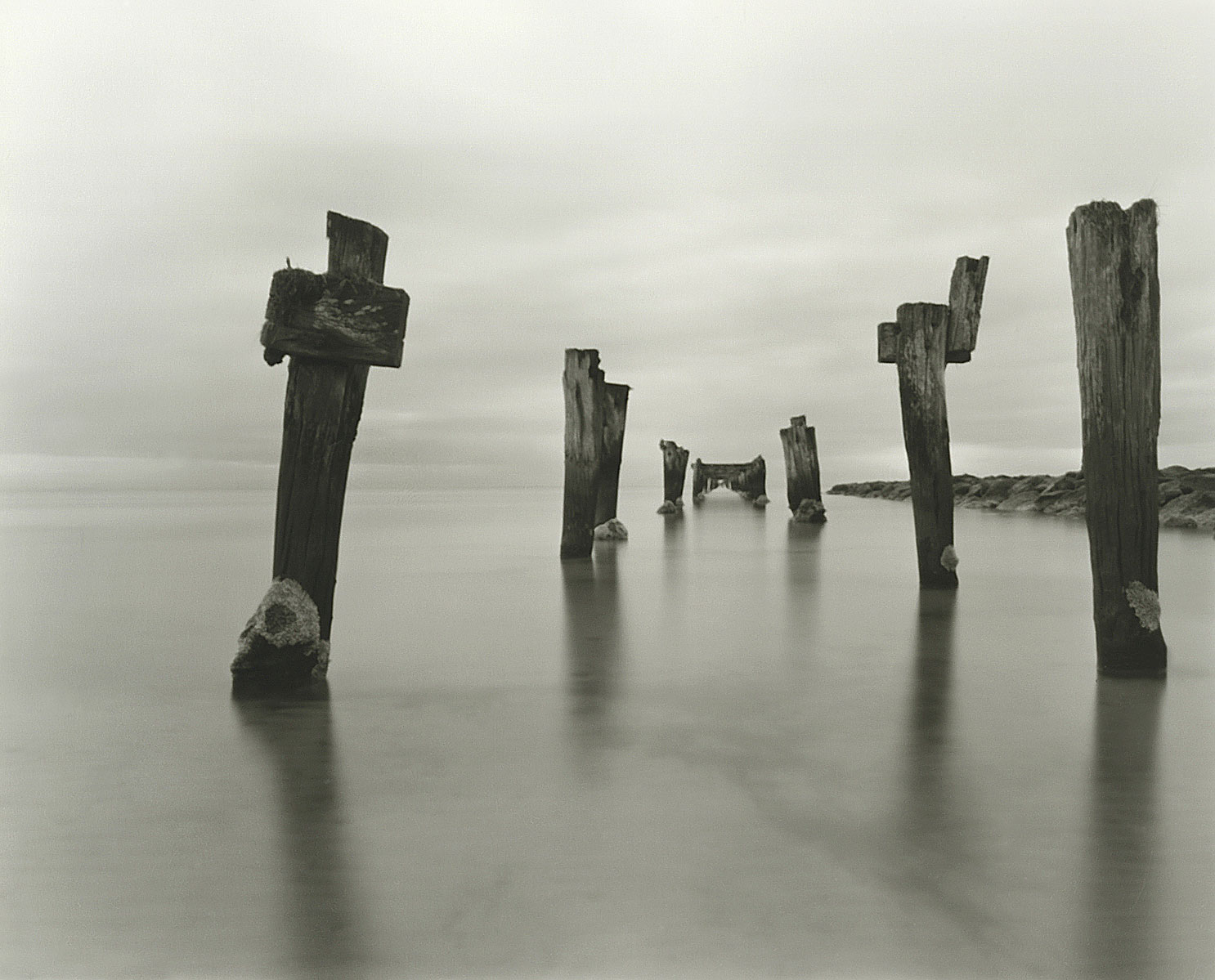
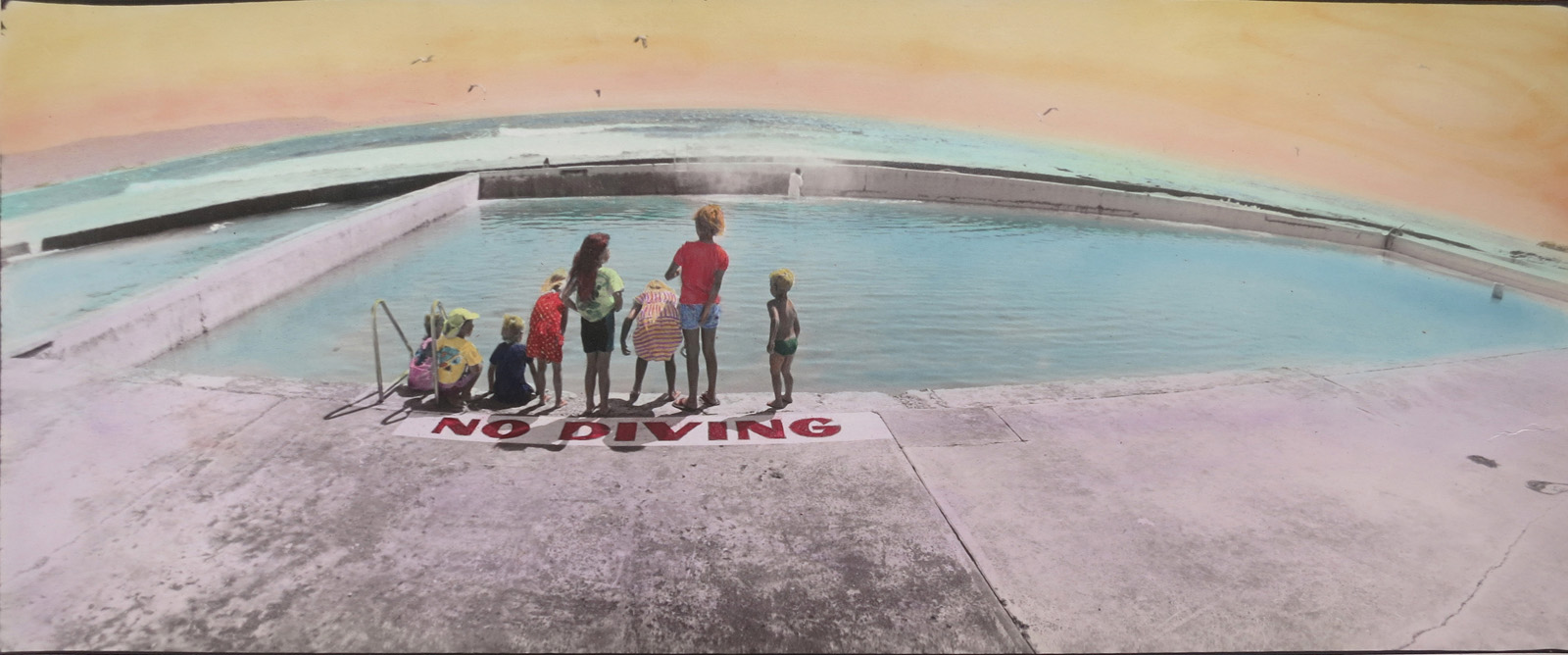
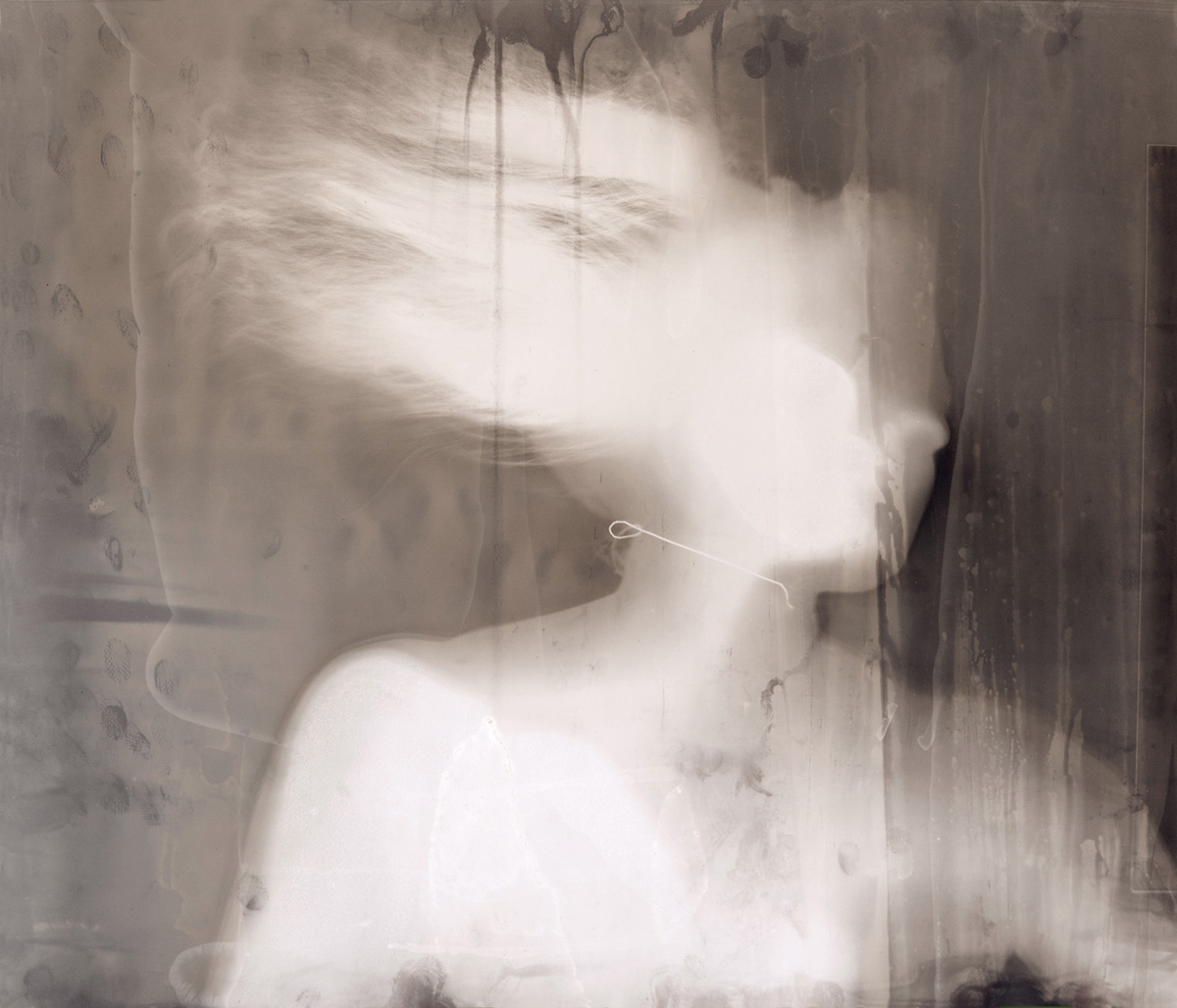
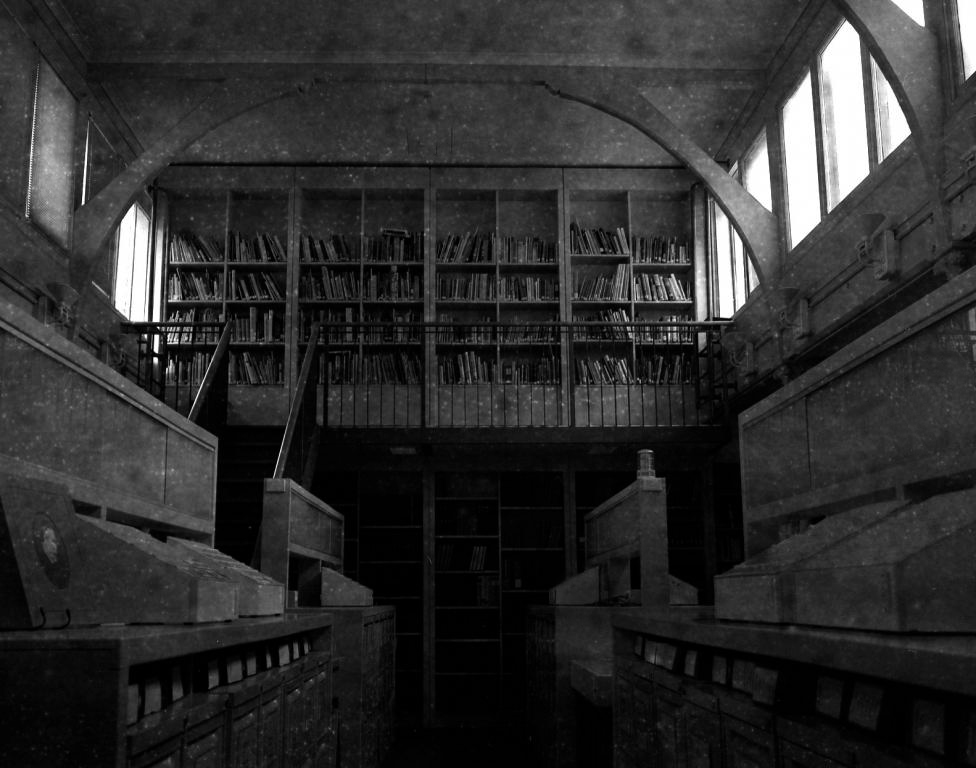
Review: ‘Concrete’ at the Monash University Museum of Art (MUMA), Melbourne

Exhibition dates: 3rd May – 5th July 2014

Curator: Geraldine Kirrihi Barlow

Artists: Laurence Aberhart (NZ), Jananne al-Ani (IRQ/UK), Kader Attia (DEU/DZA), Saskia Doherty (AUS), Fabien Giraud & Raphaël Siboni (FRA), Igor Grubić (CRO), Carlos Irijalba (ESP), Nicholas Mangan (AUS), Rä di Martino (ITY), Ricky Maynard (AUS), Callum Morton (AUS), Tom Nicholson (AUS), Jamie North (AUS), Justin Trendall (AUS) and James Tylor (AUS)


Igor Grubic (Croatia, b. 1969) 'Monument' 2014


Igor Grubic (Croatia, b. 1969)
Monument
2014
Video still
Courtesy of the artist


While not as strong as previous exhibitions such as NETWORKS (cells & silos) (2011) and Reinventing the Wheel: the Readymade Century (2013), this exhilarating show at the Monash University Museum of Art (MUMA) confirms that this is the premier public gallery in Melbourne staging intellectually stimulating group exhibitions on specific ideas, concepts and themes.

There are some really interesting works here and I easily spent an hour and a half on each visit pondering, looking, thinking and inquiring. Some of the work is a little overexposed, such as Tom Nicholson’s Comparative monument (Palestine) (2012) – seen in Melbourne Now; Nicholas Mangan’s Some kinds of duration (2011), Ricky Maynard’s photographs and even more Callum Morton after his appearance in the Reinventing the Wheel exhibition. It’s about time some other local artists were given a go.

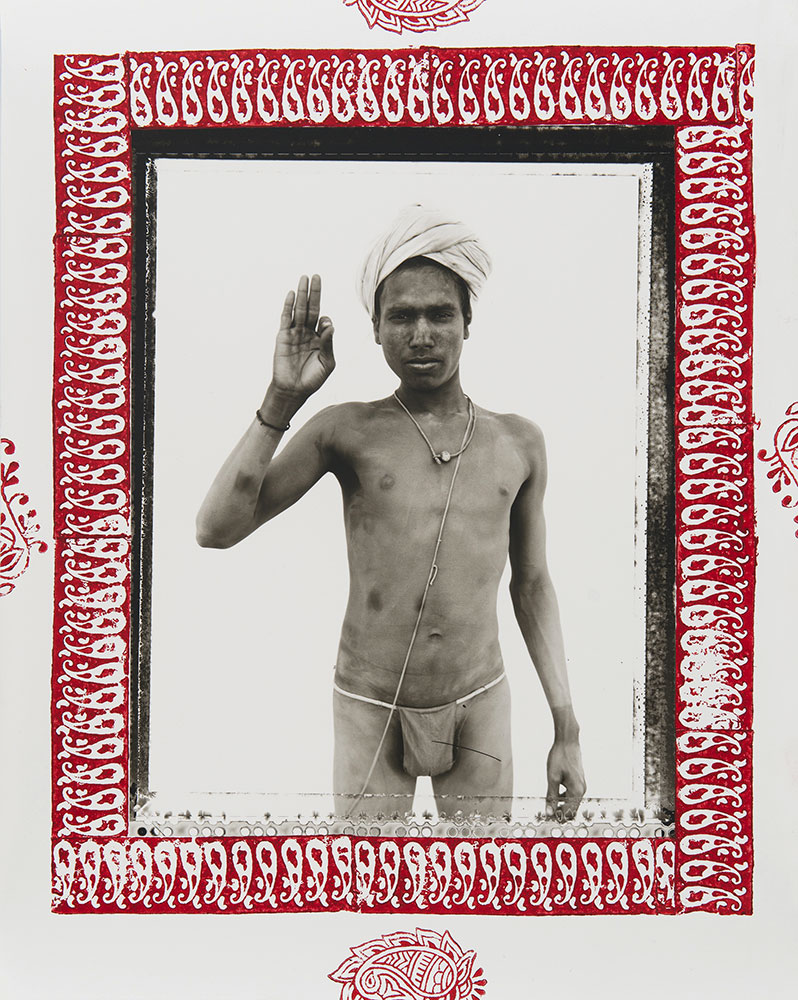
Justin Trendall’s white Lego buildings are stunning; Laurence Aberhart’s war memorials are printed too dark and seemed to be neither a record nor a feeling (they looked so much better in the recently published book); James Tylor’s photographs are adaptive as they seek to place traditional Indigenous dwellings back into the landscape but the base photographs from which he is working are not up to much; Rä di Martino’s Star Wars ruins are just too cute; and Carlos Irijalba’s drilling/tides are fascinating, but only if you know the context from which the work emanates. Video art was the highlight of the exhibition, and I don’t get to make that statement too often. Igor Grubic’s film Monument (2014, below) was mesmerising, as was Jananne al-Ani’s Shadow sites II (2011, below) – two of the best pieces of video art I have seen in a long time.

Monument features a series of meditative ‘portraits’ of the massive concrete memorials called ‘Spomenik’ built by the former Yugoslav communist state. Grubic abstracts these huge, cathedral-like memorials to various battles (usually of the Second World War) and events,  instead focusing on textures, environments and seasons. He photographs the monuments in mist and accompanies the images with ambient soundscapes that are haunting and evocative. The film holds the viewer in the palm of its hand and you are unable to look away, as the artist’s camera scours the surface of concrete and steel, intercut with branches and leaves, angles and vistas, pulling back and pushing forward. Usually video art doesn’t hold my attention for all but a few minutes but this film you can’t take your eyes from. The screen flickers and crackles, fades to orange and back again – its almost like a failure of transmission, as though the signal is not strong enough to support these interstitial spaces.

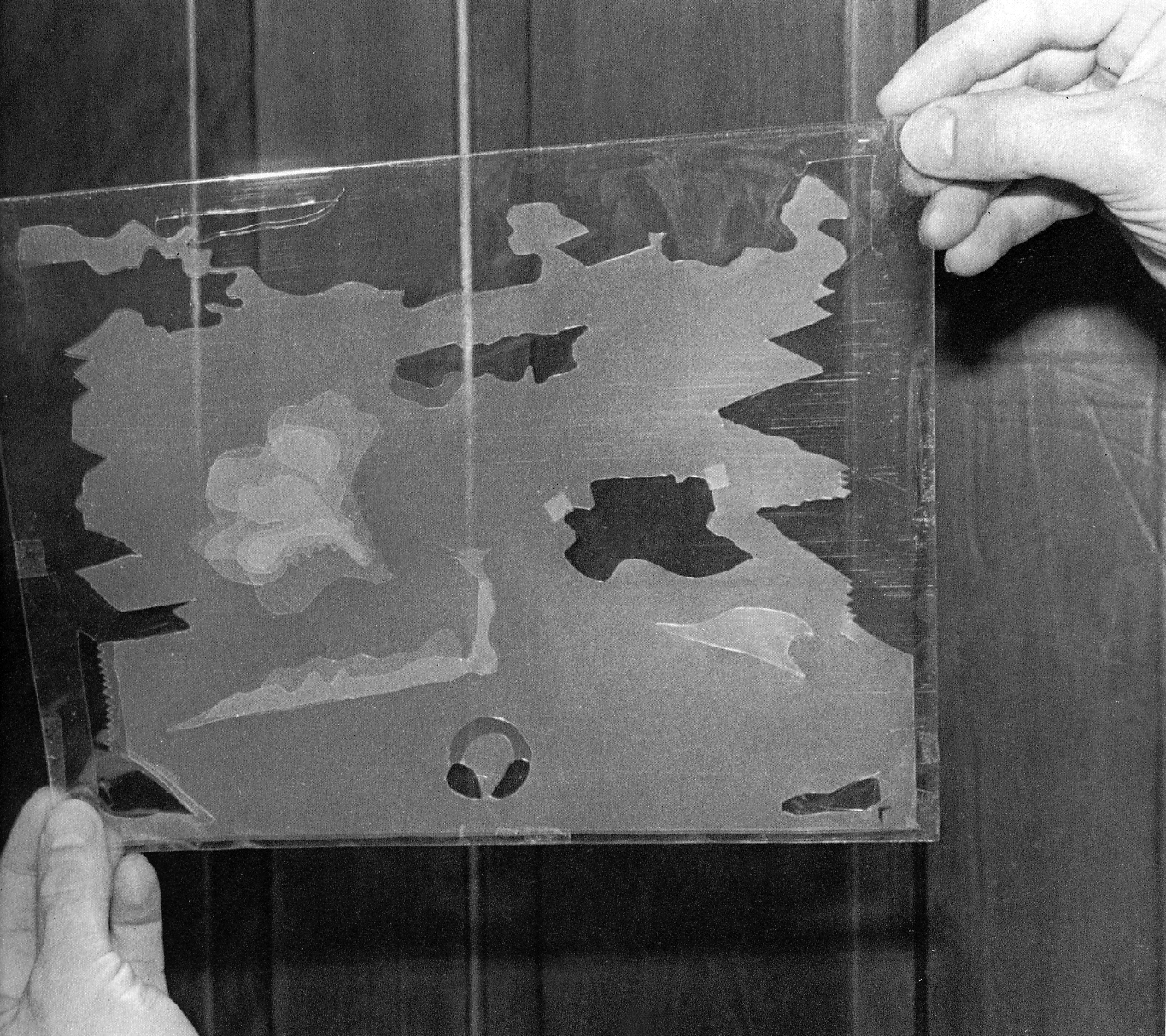
In Jananne al-Ani’s immersive film Shadow sites II, the viewer sits in a darkened room and the screen is full width of the space. Here, we are constantly moving forward and the camera never pulls back from the image. The film offers a sequence of aerial views in sepia tones; second by second our perspective nears the ground – but we never arrive. Accompanied by a David Sylvian style ambient soundtrack, the images are absolutely beautiful and intriguing as they morph one to another. Are you looking at the earth, the ground or a closeup of the surface of concrete, such as the patterns in Man Ray’s Dust Breeding (1920), which documents Duchamp’s The Large Glass after it had collected a year’s worth of dust while he was in New York? You are never quite sure…

The other thing to note with this exhibition is that, like many contemporary exhibitions, there are no wall notes or even a hand-out at the beginning that would enable the casual visitor to gain insight into the nature and meaning of the works. If I had not read the press release and done my own research I would have had no idea about the origins of some of the concepts for the work. This really is not good enough for the casual visitor to the gallery, any gallery. Are visitors expected to spend hours before they arrive, researching what the work is about so that they might actually understand what is going on? I took a friend to the gallery and luckily I was on hand to explain to her the ‘how’ and ‘why’ of the works concepts and origins. For example, if you read the wall label for Monuments you would have no idea that these were in Yugoslavia and that they had mostly been built to honour the dead from World War II; similarly, if you read the wall label to Carlos Irijalba’s High Tides (drilling) (2012) you would gain only the vaguest idea that the soil drilling sample was taken from under the tarmac of a former weapons factory in the Urdaibai or Guernica Estuary, Basque Country. Guernica – that place of horror bombed in the Spanish Civil War and most notably memorialised in the painting by Picasso of the same name. We, the viewer, need to know these things… not as an addendum after hours of reading, or on getting home and reading the catalogue essay – but while we are at the gallery!

While artists hint at the meaning of a work, leaving interpretation open ended and up to the viewer’s imagination and what life history they bring to the work, it may be useful and indeed I think desirable to provide the viewer with some tangible clues. Not much, just a paragraph that they can take with them to help with interpretation. It’s not much to ask, is it?

Dr Marcus Bunyan


Many thankx to MUMA for allowing me to publish the photographs in the posting. Please click on the photographs for a larger version of the image.


“Concrete is an interesting metaphor in the sense that it’s an aggregate that’s then bonded together. In some ways, that might represent this positive idea of pluralism, or it could be this completely hideous idea of homogeneity. Many of the works deal with samples of time and cycles violence and trauma and how we go about representing that history.”


Geraldine Kirrihi Barlow


Igor Grubic (Croatia, b. 1969) 'Monument' 2014


Igor Grubic (Croatia, b. 1969)
Monument
2014
Video still
Courtesy of the artist
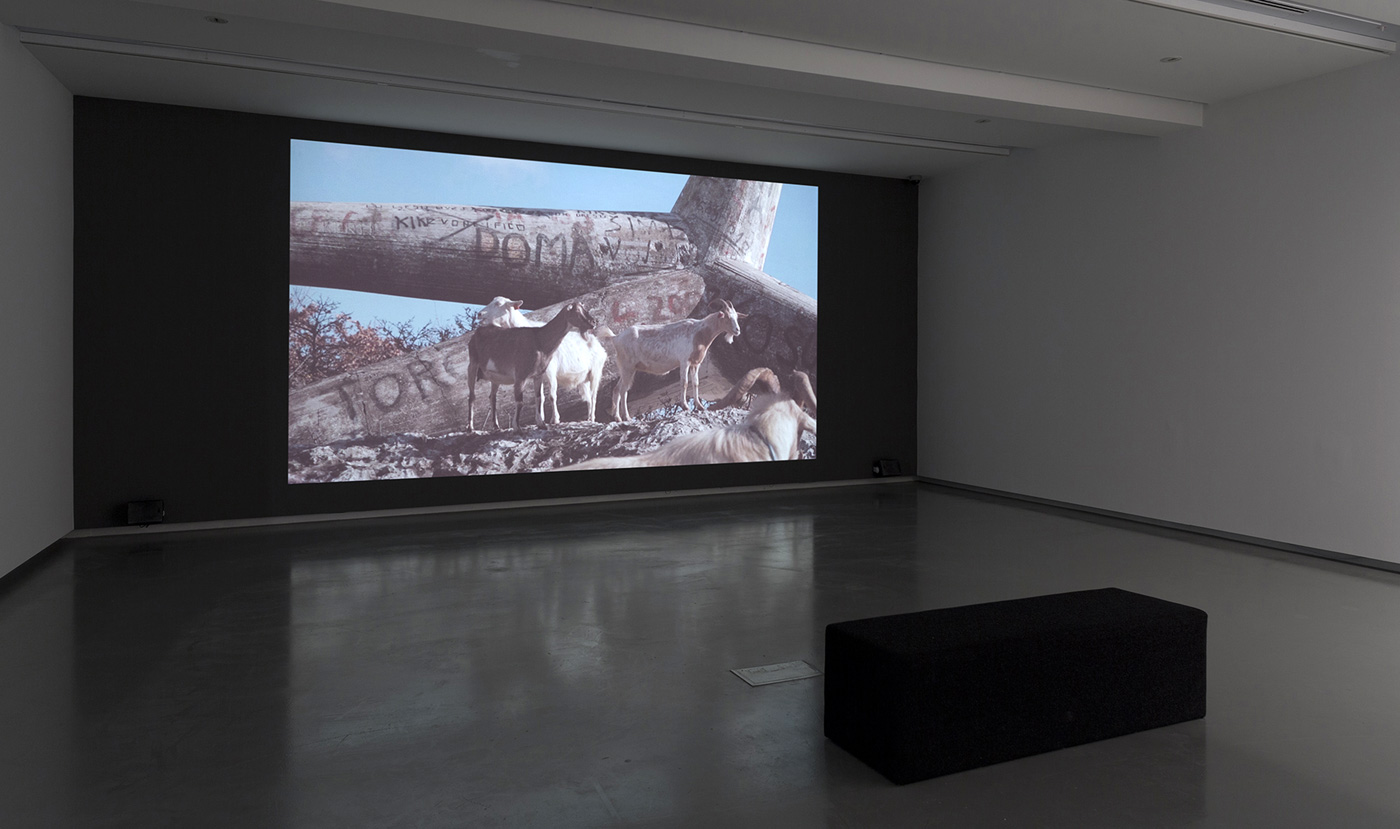
 

Igor Grubic (Croatia, b. 1969) 'Monument (work in progress)' installation view, Monash University Museum of Art, 2014


Igor Grubic (Croatia, b. 1969)
Monument (work in progress) installation view, Monash University Museum of Art, 2014
2014
Video projection, colour, sound
53 minutes
Photo: Christian Capurro


Born in Zagreb, Croatia, 1969. Lives and works in Zagreb

In the film Monument Zagreb-based artist Igor Grubic offers a series of meditative ‘portraits’ of the massive concrete memorials built by the former Yugoslav state. With the rise of neo-fascism these mysterious sentinel forms, originally intended to honour World War II victims of fascism, are increasingly subject to neglect, even attack.

Emphasising the unexpected fragility of these monumental structures, Grubic sets human attempts to fix meaning, memory and the experience of loss against a backdrop of seasonal change. In a landscape which has witnessed so many cycles of trauma and upheaval, this work mirrors the rise and fall of many monuments built to preserve the memory of events which might otherwise be forgotten. Can such forms ever communicate a stable message through time?

“The work is void of explanation or commentary, instead concentrating on the surfaces of the monuments, their surrounding environments and the shifting seasons. We are left with little but their looming presence. “When we were filming, I was trying to read them without ideological background or context, but at the same time I couldn’t help but feel the fact that lots of people died and suffered at these sites – I could feel a real sense of spirituality. I began seeing them as new cathedrals in a way.””

Text from the Sydney Morning Herald website


Jananne al-Ani (Iraq, b. 1966) 'Shadow sites II' 2011


Jananne al-Ani (Iraq, b. 1966)
Shadow sites II
2011
Video still
Courtesy of the artist


Born in Kirkuk, Iraq, 1966. Lives and works in London

Jananne al-Ani’s film Shadow sites II offers a sequence of aerial views in sepia tones; second by second our perspective nears the ground. Our appreciation of the formal beauty of these images co-exists with our unease as we try to determine what it is we are looking at. Are these archaeological sites, or housing compounds damaged by missile or drone strikes? Iraqi-born al-Ani notes as inspiration the ‘strange beauty’ of Edward Steichen’s 1918 photographs of the Western Front taken whilst he was a member of the US Aerial Expeditionary Force.

“UK-based Iraqi artist Jananne al-Ani’s striking video work saw her film archaeological sites in the Middle East from high up in a fixed-wing airplane, the shadows of the early morning and late evening revealing former buildings, structures and sites of significance in extraordinary resolution. While al-Ani’s work evokes the nightmarish recent histories of drone strikes and bombing campaigns, it also digs deep into the past.”

Text from the Sydney Morning Herald website


Extracts from Jananne al-Ani’s film Shadow sites II 2011


James Tylor (Australia, b. 1986) '(Deleted scenes) From an untouched landscape #3' 2013


James Tylor (Australia, b. 1986)
(Deleted scenes) From an untouched landscape #3
2013
Inkjet print on Hahemuhle paper with hole removed to a black velvet void, ed. 4/5
Photo: Christian Capurro


James Tylor (Australia, b. 1986) '(Deleted scenes) From an untouched landscape #1' 2013


James Tylor (Australia, b. 1986)
(Deleted scenes) From an untouched landscape #1
2013
Inkjet print on Hahemuhle paper with hole removed to a black velvet void, ed. 4/5
Photo: Christian Capurro


James Tylor (Australia, b. 1986) 'Un-resettling (stone footing for dome hut)' 2013


James Tylor (Australia, b. 1986)
Un-resettling (stone footing for dome hut)
2013
Hand coloured archival inkjet prints
Courtesy of the artist


Born in Mildura, Victoria. Lives and works in Adelaide, South Australia

Australian cities and communities feature a wide array of memorials, however the long history of Indigenous Australia is almost entirely absent from such solid forms of public acknowledgement. In Un-resettling James Tylor presents the beginnings of a formal typology of Indigenous dwellings, a number of which relate to his own personal heritage. Tylor states, “Un-resettling seeks to place traditional Indigenous dwellings back into the landscape as a public reminder that they once appeared throughout the area.” Tylor’s photographs remind us of the invisible histories of this land, for instance the fertile volcanic plains west of Melbourne with remnants of stone dwellings and larger ceremonial sites of which there is little public knowledge.


Kader Attia (French Algerian, b. 1970) 'Rochers carrés' 2008


Kader Attia (French Algerian, b. 1970)
Rochers carrés [Square rocks]
2008
Courtesy of the artist and Galerie Nagel Draxler, Berlin and Cologne


'Concrete' installation view, Monash University Museum of Art, 2014


Concrete installation view, Monash University Museum of Art, 2014
Justin Trendall (at right), Tom Nicholson (on floor, see below), James Tylor (back wall middle, see above), Kader Attia (back wall left, see above)
Photo: Christian Capurro


'Concrete' installation view, Monash University Museum of Art, 2014


Concrete installation view, Monash University Museum of Art, 2014
Justin Trendall (back left), Tom Nicholson (on floor, see below), Rä di Martino (back wall right, see below)
Photo: Marcus Bunyan


Rä di Martino (Italian, b. 1975) 'No More Stars (Abandoned Movie Set, Star Wars)' 2010 (detail)


Rä di Martino (Italian, b. 1975)
No More Stars (Abandoned Movie Set, Star Wars) 33°50’34 N 7°46’44 E Chot El-Gharsa, Tunisia 01 September 2010 (detail)
2010
Series of 9 photographs, unique edition, lambda prints, wooden frame
30cm x 30cm each


No More Stars (Abandoned Movie Set, Star Wars) 33°50’34 N 7°46’44 E Chot El-Gharsa, Tunisia 01 September 2010 is a series of photographs taken in the abandoned movie sets of the film saga Star Wars, filmed through the years in different locations in the south of Tunisia. Unexpectedly those sets have been left on the locations so after years have now mostly become ruins, almost as some sort strange archeological sites. The particular hot and dry climate has helped maintain intact many parts of the sets, or buried under the sand just sections of it. (Artist statement)


In September 2010, New York-based visual artist and filmmaker Rä di Martino set out on a quest to photograph and document old abandoned film sets in the North African deserts of Tunisia. The project had started when she discovered that it was common practice to abandon these sets without tearing them down, leaving them fully intact and crumbling over time, like archeological ruins. Martino spent that month traveling around Chott el Djerid in Tunisia, finding and photographing three Star Wars sets in all for her photo series No More Stars and Every World’s a Stage.

“I think is very interesting the amazing poetic potential of those ruins, being ruins of something that was the future in our imagination,” Martino explained in an email to The Huffington Post. “It’s bewildering to see the biological decay of those cheap materials, which once built perfect images of our past and future.”
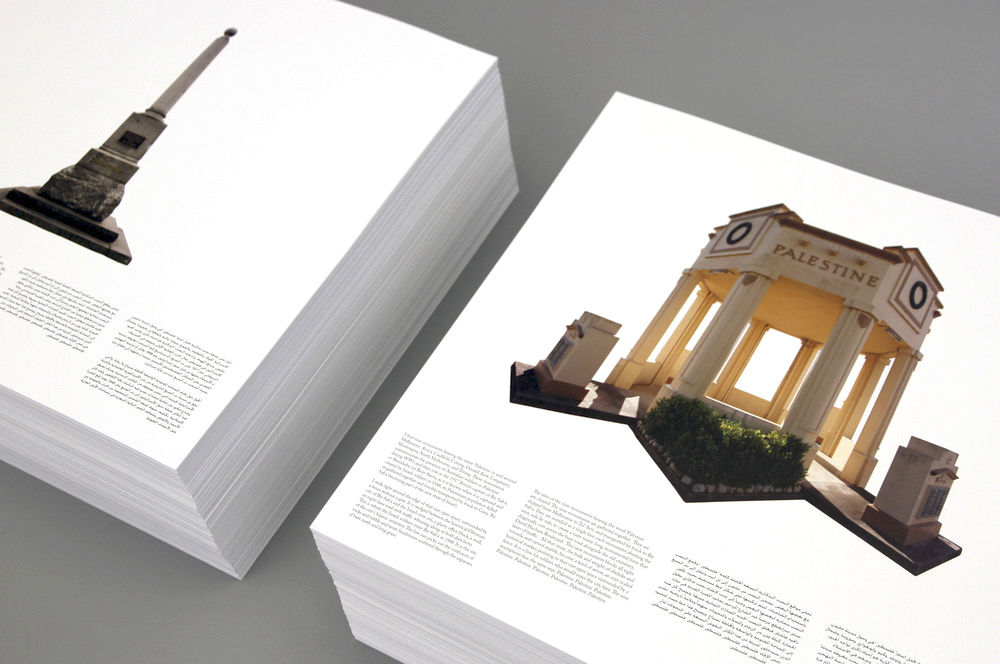
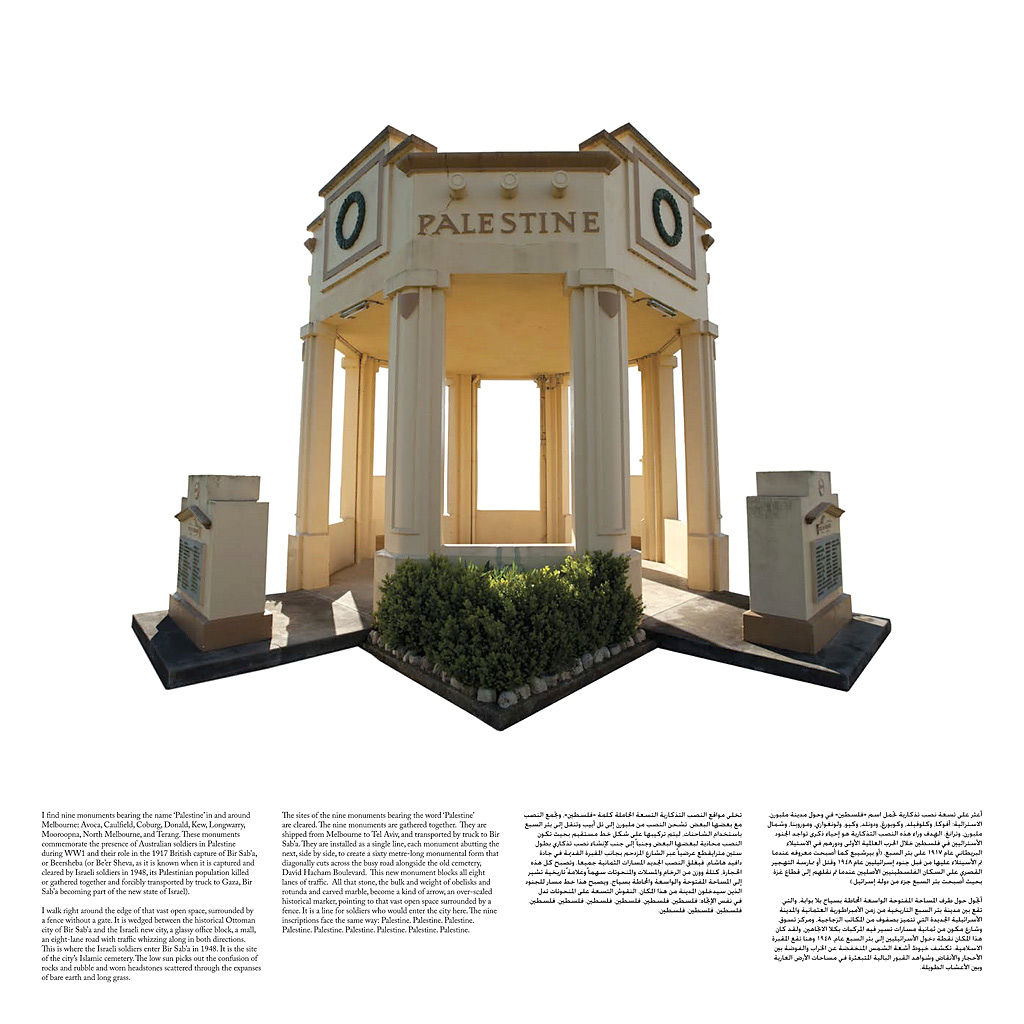
 

Tom Nicholson (Australian, b. 1973) 'Comparative monument (Palestine)' 2012


Tom Nicholson. 'Comparative monument (Palestine)' 2012


Tom Nicholson (Australian, b. 1973)
Comparative monument (Palestine)
2012
9 stacks of 1000 two-sided off-set printed posters
50 x 50cm each


Proposition for a monument, articulated as 9 stacks of 1000 two-sided off-set printed posters, each 50x50cm, for visitors to take away, and also pasted up around Ramallah.

Comparative monument (Palestine) is a proposition for a future monument, which takes the form of nine stacks of posters, from which the audience is free to take a poster. The project began with a search for war monuments bearing the name ‘Palestine’ erected in and around Melbourne in the early 1920s to commemorate the presence of Australian troops in Palestine during WW1. This project rethinks possibilities for the monument and suggests new forms of connection between different parts of the world and their histories.

Throughout Australia, war monuments bear the name “Palestine” to commemorate the presence of Australian troops in Palestine during World War I and, in particular, Australian involvement in the 1917 British capture of Beersheba (in turn a critical city in the events of 1948 and the Nakba). These monuments also reflect the realities of the 1920s (when they were erected) and the era of the British Mandate, when the name Palestine implicitly invoked the shared position of Australia and Palestine within British imperialism. Comparative monument (Palestine) begins with a complete photographic record of these monuments bearing the name “Palestine” in and around Melbourne. Figuring this material into a Palestinian context – both a kind of “homecoming” and exile for these Australian monumental forms – becomes a way to reanimate these linkages between Australia and Palestine. In these forms dedicated to 1917, Nicholson implicates the events and repercussions of 1948 with their echoes of Australian Aboriginal experiences of dispossession and colonial violence. Comparative monument (Palestine) is an attempt to rethink the possibilities of the monument in the face of these histories of dispossession and the acts of imagination and solidarity these histories demand.


Nicholas Mangan (Australian, b. 1979) 'Some kinds of duration' 2011 (detail)


Nicholas Mangan (Australian, b. 1979)
Some kinds of duration (detail)
2011
Installation view, Monash University Museum of Art, 2014
Photo: Marcus Bunyan


Nicholas Mangan (Australian, b. 1979) 'Some kinds of duration' 2011


Nicholas Mangan (Australian, b. 1979)
Some kinds of duration
2011
Installation view, Monash University Museum of Art, 2014
Photo: Christian Capurro


MUMA’s second exhibition for 2014, Concrete brings together the work of twelve artists, both Australian and international. The exhibition explores the concrete, or the solid and its counter: change, the flow of time. As we prepare to mark the centenary of the First World War, the exhibition considers the impact of time upon built and monumental form, reading between materiality and emotion, form and memory.

Monuments reflect a desire for commemoration, truth, honour and justice. Equally, they may function to consolidate political power and national identity. Works in the exhibition locate the monumental in relation to longer cycles of construction, displacement and erasure; archaeology, geology and palaeontology; the shifting politics of memory and ways to describe a history of place.

“Concrete explores the human desire to mark our presence as a complex drive for memory – as well as the need for a blank or negative, a placeholder for the unknowable, the unsayable, the missing.”

Exhibition curator, Geraldine Kirrihi Barlow:

“Concrete introduces a number of artists to Australian audiences for the very first time. Continuing MUMA’s highly regarded series of thematic and discursive exhibitions, and presenting a broad range of significant projects, Concrete considers the function of monuments and ruins from poetic, material and political perspectives.”

Director, Charlotte Day

Text from the MUMA press release
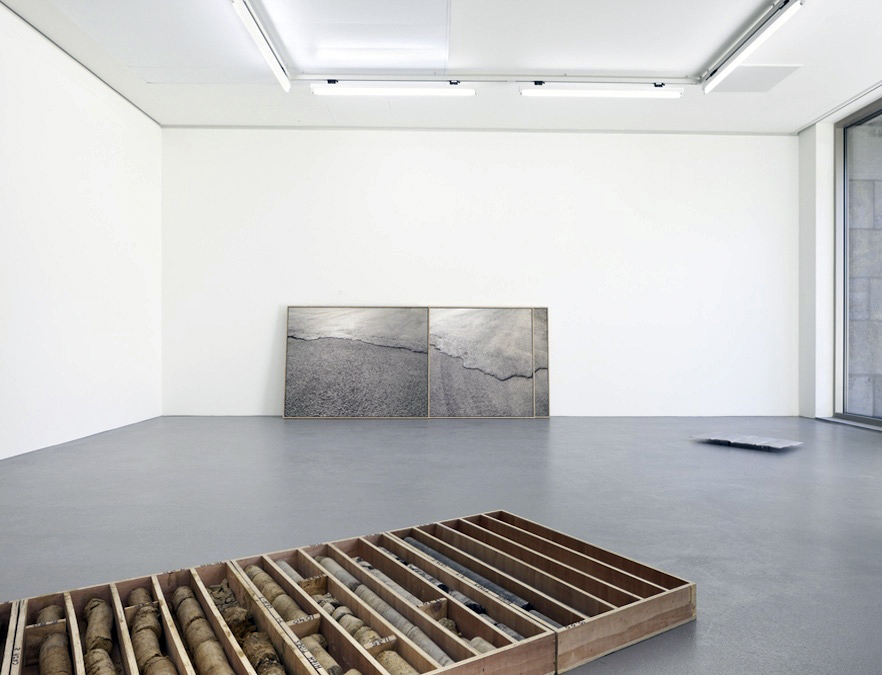
 

Carlos Irijalba (Spanish, b. 1979) 'High Tides (drilling)' 2012 (installation view)


Carlos Irijalba (Spanish, b. 1979)
High Tides (drilling) (installation view)
2012
Installation view
Courtesy of the artist


Carlos Irijalba (Spanish, b. 1979) 'High Tides (drilling)' 2012 (installation view detail)


Carlos Irijalba (Spanish, b. 1979)
High Tides (drilling) (installation view detail)
2012
Photo: Marcus Bunyan


Born in Pamplona, Spain, 1979. Lives and works in Amsterdam, Netherlands

High Tides (drilling) by Carlos Irijalba presents a 17 metre drilling core from the site of a former weapons factory in the Urdaibai or Guernica Estuary, Basque Country. Beneath an asphalt ‘cap’, layers of soil, clay, limestone and the sedimentary rock Marga are evident. The bombing of Guernica is remembered for its devastating impact upon the civilian population and was the subject of an iconic painting by Pablo Picasso. Irijalba offers a window into the history of this place, as well as longer geological measures of time and materiality.

Tides I, II and III 2012 is a series of three photographs of converging layers of asphalt from which the sample has been taken. Together, these images detail a common surface so ubiquitous we cannot value it as rare or particular. And yet these images record a very specific piece of ‘ground’ or earth, just as they also suggest a vast aerial view, perhaps the meeting of two oceans.


'Concrete' installation view, Monash University Museum of Art, 2014


Concrete installation view, Monash University Museum of Art, 2014
Laurence Aberhart (left), Jamie North (doorway), Carlos Irijalba (right)
Photo: Christian Capurro


Laurence Aberhart (New Zealand, b. 1949) 'Auroa Taranaki' 1991


Laurence Aberhart (New Zealand, b. 1949)
Auroa Taranaki
1991
Silver gelatin photograph
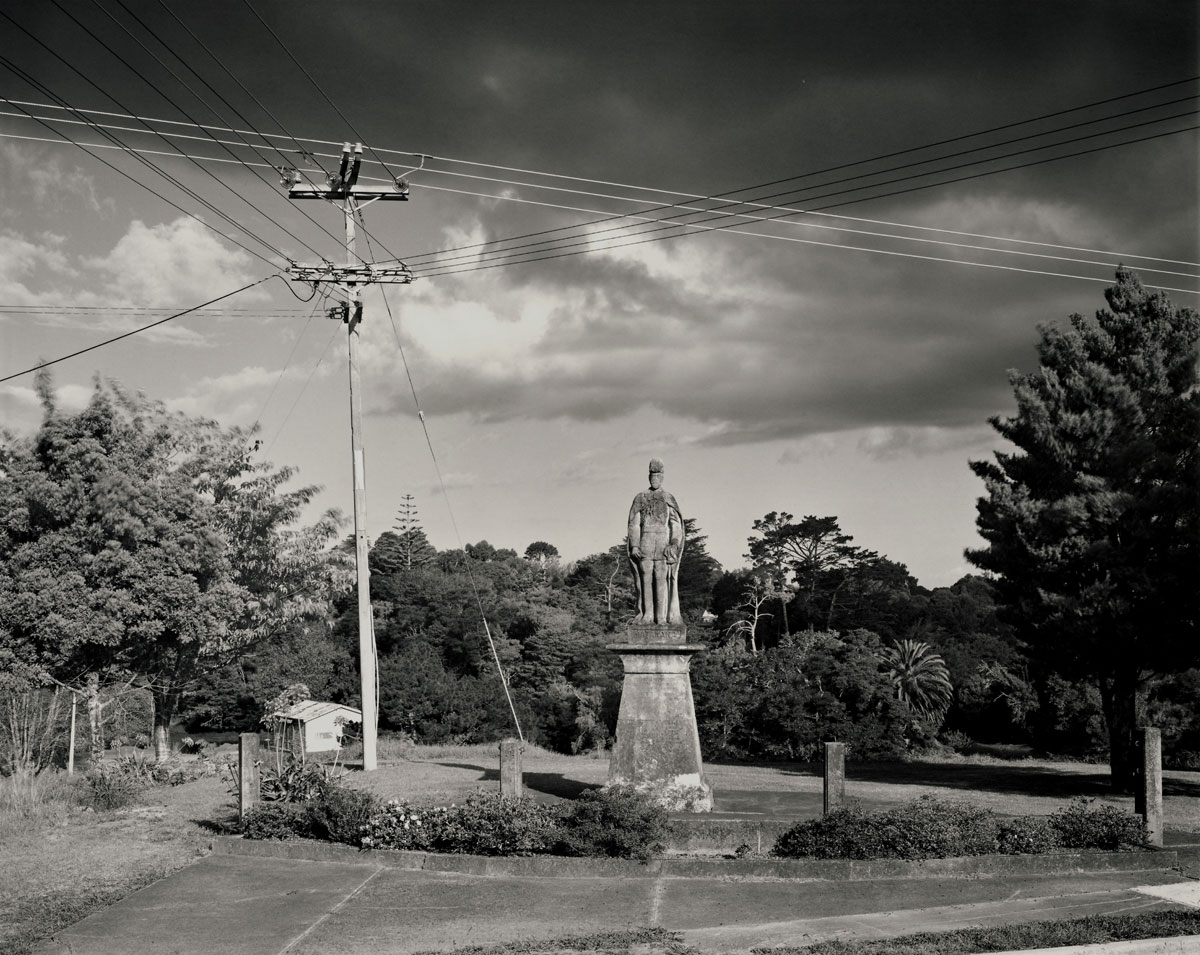
 

Laurence Aberhart (New Zealand, b. 1949) 'Matakana, North Auckland' 1994


Laurence Aberhart (New Zealand, b. 1949)
Matakana, North Auckland
1994
Silver gelatin photograph


Born in New Zealand, 1949. Lives and works in Russell, Northland, New Zealand

Photographer Laurence Aberhart is drawn to the edge of dominant historical narratives, creating archives of built and monumental forms particular to certain places and periods of time. He returns to these chosen subjects repeatedly. His photographs of the ANZAC memorials of Australia and New Zealand have been taken over the past thirty years. Familiar across both countries, the memorials were built after the First World War to commemorate those who served with the Australia and New Zealand Army Corps. Very few families were able to visit the graves of those who died, and so these monuments served the bereaved as well as larger national concerns. As we approach the centenary of the war, these memorials are the focus of greater attention, yet what they mean is difficult to lock down. In these images the single figure on each column is a fixed point against landscapes in states of constant change.


Saskia Doherty. 'Footfalls' 2013-2014


Saskia Doherty
Footfalls
2013-14
Cast concrete and printed paper
Installation view, Monash University Museum of Art, 2014
Photo: Christian Capurro


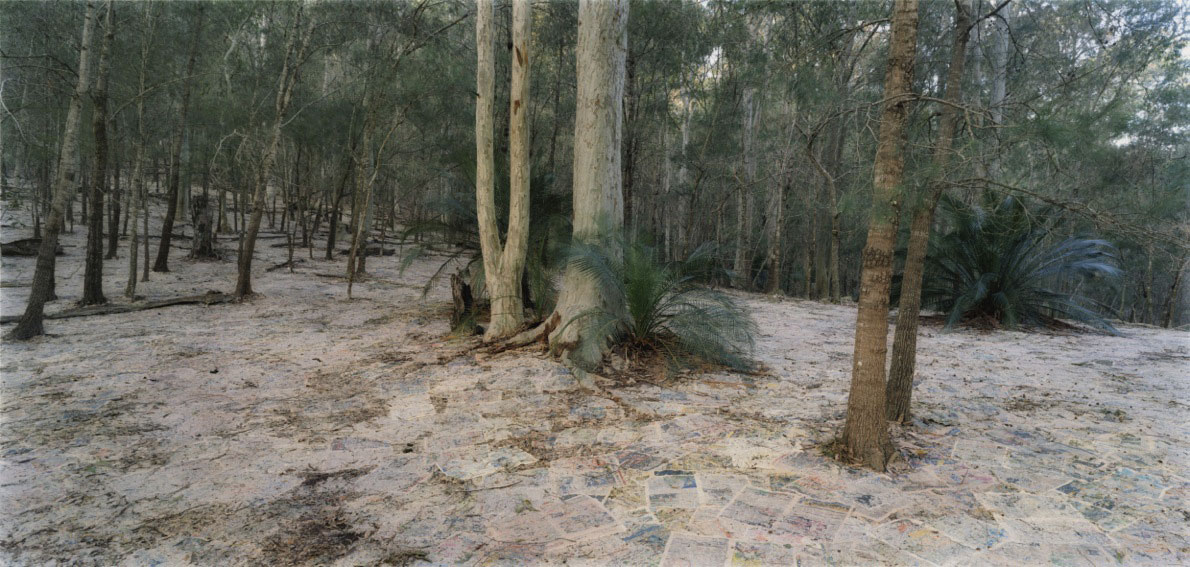
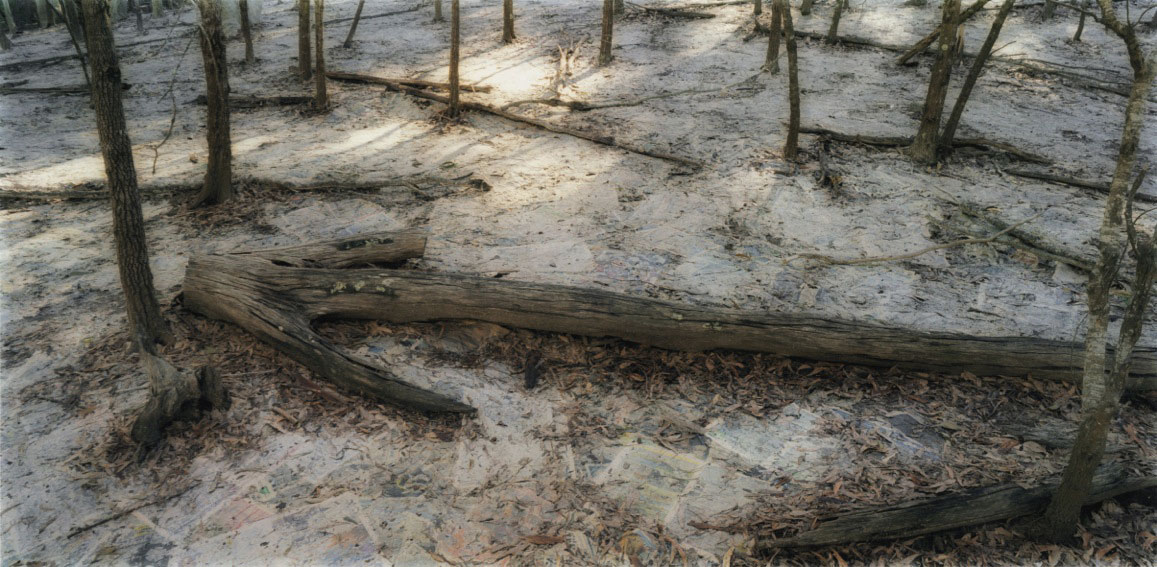
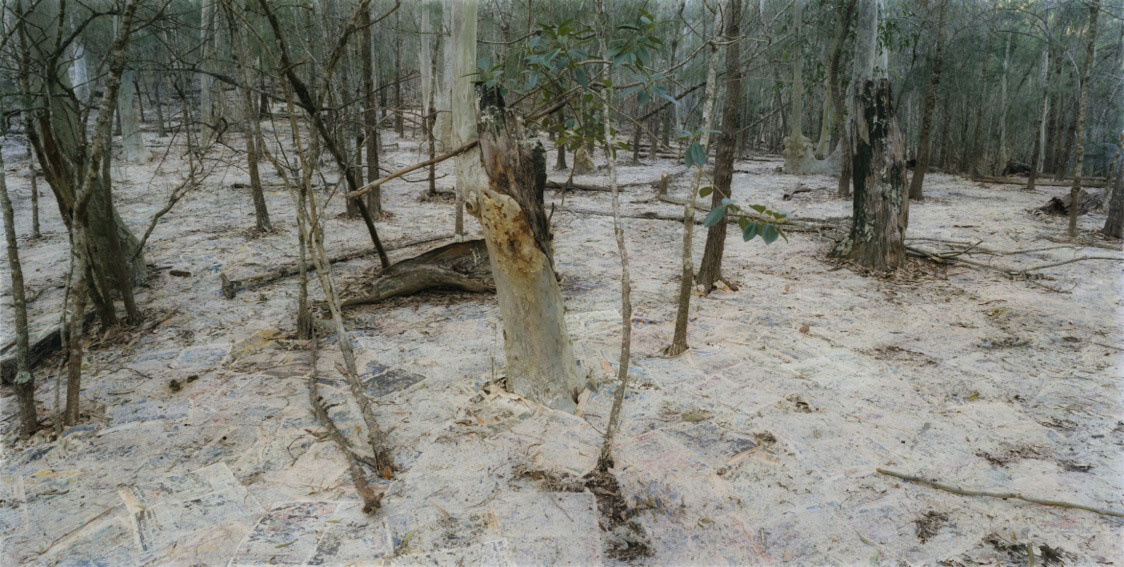
Saskia Doherty poetically references the Samuel Beckett play Footfalls, expanding on an image of famed American palaeontologist Dr Barnum Brown discovering a dinosaur footprint with texts and concrete sculptural gestures, describing the footprint as “a vastly preserved index of a life”.


Jamie North (Australian, b. 1971) 'Tropic cascade #1 and #2' 2014


Jamie North (Australian, b. 1971)
Tropic cascade #1 and #2
2014
Cement, blast furnace slag, coal ash, galvanised steel, Australian native plants
Installation view, Monash University Museum of Art, 2014
Photo: Christian Capurro


Jamie North (Australian, b. 1971) 'Tropic cascade #2' 2014 (installation view detail)


Jamie North (Australian, b. 1971)
Tropic cascade #2 (installation view detail)
2014
Cement, blast furnace slag, coal ash, galvanised steel, Australian native plants
Installation view, Monash University Museum of Art, 2014
Photo: Marcus Bunyan


Monash University Museum of Art (MUMA)
Ground Floor, Building F.
Monash University Caulfield campus
900 Dandenong Road
Caulfield East, VIC 3145
Phone: 61 3 9905 4217

Opening hours:
Tuesday – Friday 10am – 5pm
Saturday 12 – 5pm
Monash University Museum of Art (MUMA) website

LIKE ART BLART ON FACEBOOK

Back to top

Review: ‘The Rennie Ellis Show’ at Monash Gallery of Art, Wheelers Hill, Melbourne

Exhibition dates: 3rd April – 8th June 2014


Ponch Hawkes (Australian, b. 1946) 'Rennie Ellis photographing at the Gay Liberation march, Elizabeth Street, Melbourne, 1973' 1973


Ponch Hawkes (Australian, b. 1946)
Rennie Ellis photographing at the Gay Liberation march, Elizabeth Street, Melbourne, 1973
1973
Silver gelatin photograph
© Ponch Hawkes


In researching photographs for the upcoming exhibition Out of the closets, onto the streets: Gay Liberation photography 1971-73 I came across this photograph taken by Ponch Hawkes of the Gay Liberation march that was part of Gay Pride week in 1973. Ponch had never seen this image before until I scanned the negative. And there, front and centre as always, is Rennie Ellis capturing the action… What a special find and a wonderful photograph by Ponch!


We Are Family

This is FAB, one of the best experiences I have had this year at an exhibition in Melbourne. You know you are having a good time when you laugh out loud at so many photographs, sharing the experience of the artist as though you had been there. As indeed I had, for in many cases the clubs pictured in Rennie Ellis’ photographs are the ones I went to.

I remember: Wednesday nights at Inflation in the late 80s, where to satisfy licensing restrictions you had to be served a “meal” so that you could drink alcohol (Dining Out, Inflation, 1980 below). The famous Razor Club (1986-1992), based at the Light Car Club of Australia’s clubrooms on the corner of Queens Road and Roy Street, opposite the Albert Park Lake and golf course. “It was Melbourne’s version of Studio 54, the hedonistic, off-the-wall New York disco of the late ’70s – both places notoriously hard to get into but once inside a wonderland of celebrities, freaks, transvestites and fantastic music free from the tyranny of genre.” Once on a big party night the gang of us tried to get in but the queue was so long it was impossible – so I went down the side, climbed up the drain pipes past the ladies loo, and up to the first floor balcony where someone pulled me over – completely off my face, just to get my friends in. Zu Zu’s, Cadillac Bar, 397, Commerce Club, Tasty, Freakazoid, Dome, Baseline, Hardware Club, The Peel and so many parties you could poke a stick at – what a time we had!

There to capture it all – affectionately, non-judgementally – was Rennie Ellis. He wasn’t like Diane Arbus, who thrust her camera as an outsider at people, waiting for a reaction. He was always part of the action because he was part of the family. He was a humanist photographer in the true sense of the word, for he loved photographing human beings, their social relations and their habitats, whatever that might be – sunning, partying, boozing, smoking, picking up. He referred to himself as a “people perv.”

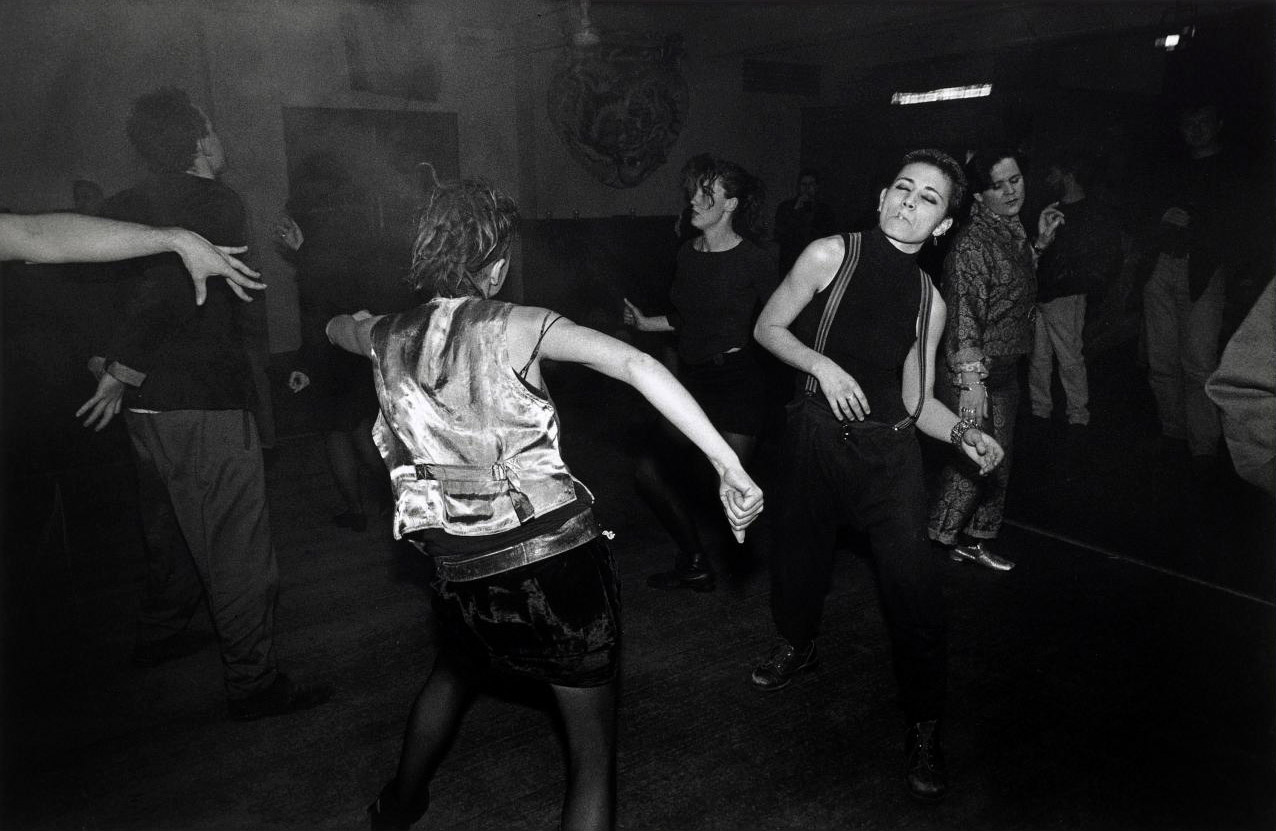
Ellis had an eloquently clumsy eye, and for the type of baroque photographs he took this is a great thing. No perfect framing, no perfect tension points within the image, no regular alignment of horizontals, verticals or diagonals – just instinctual images taken in a split second, with his own particular brand of humour embedded in them. And always with this slight eccentricity in his vision. Look at the image of Dancing People, Razor Club (1991, below) and notice the odd hand poking in at the left hand side and the attitude of the dancers, or Fully equipped, Albert Park Beach (c. 1981, below), with the angle of the three cigarettes, the drink and the bottle of sun tan lotion strapped to the hip – FIERCE!

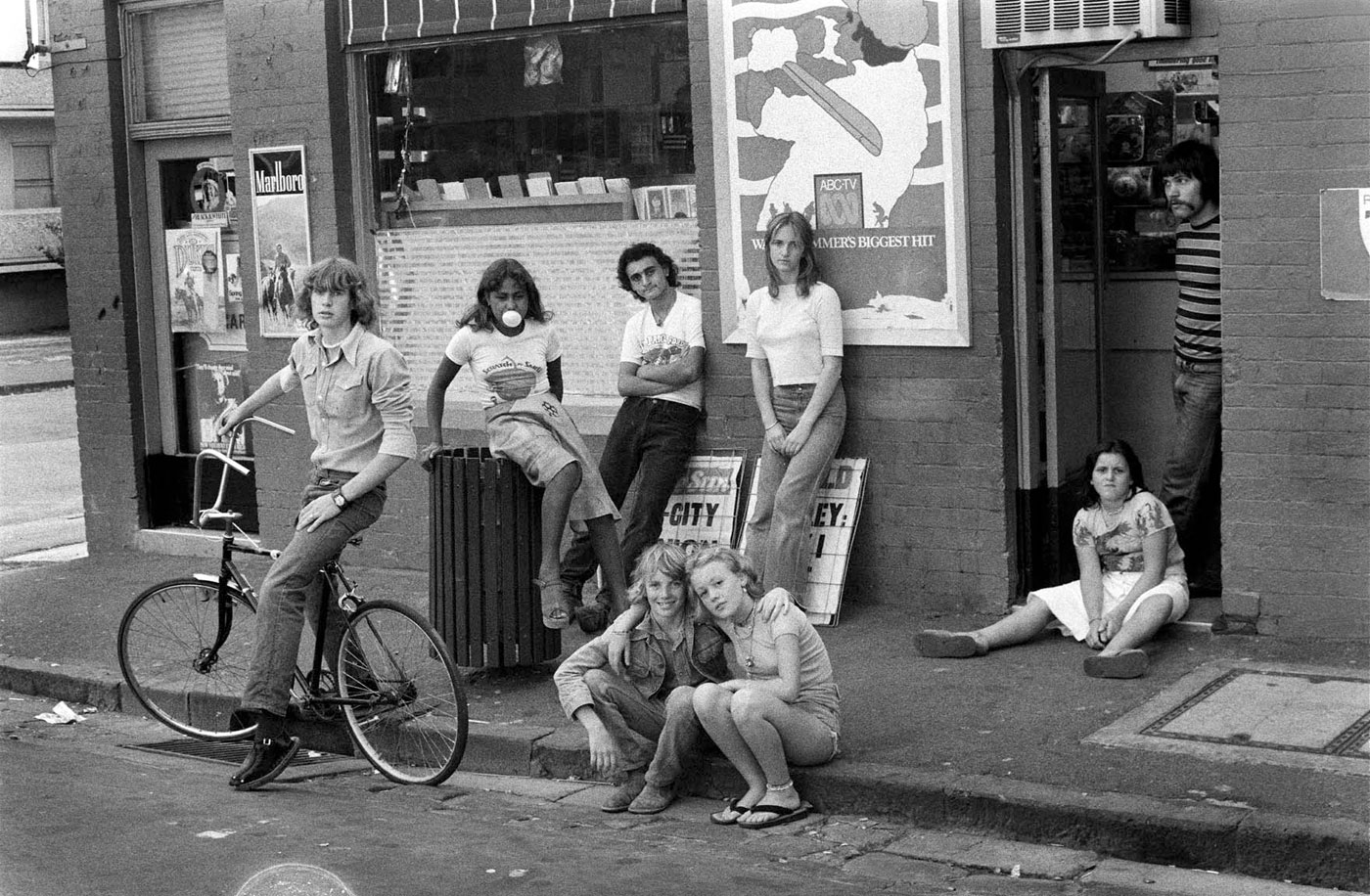
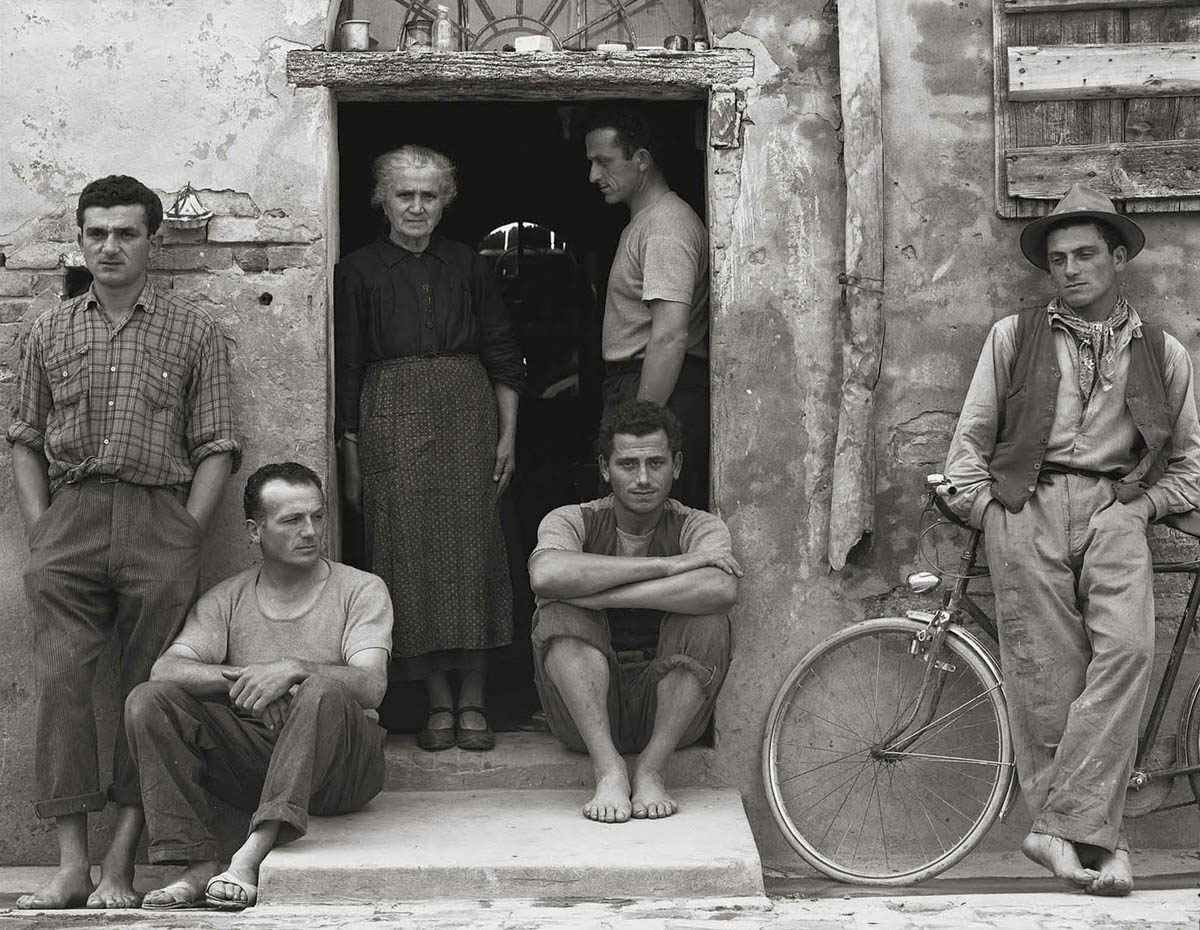
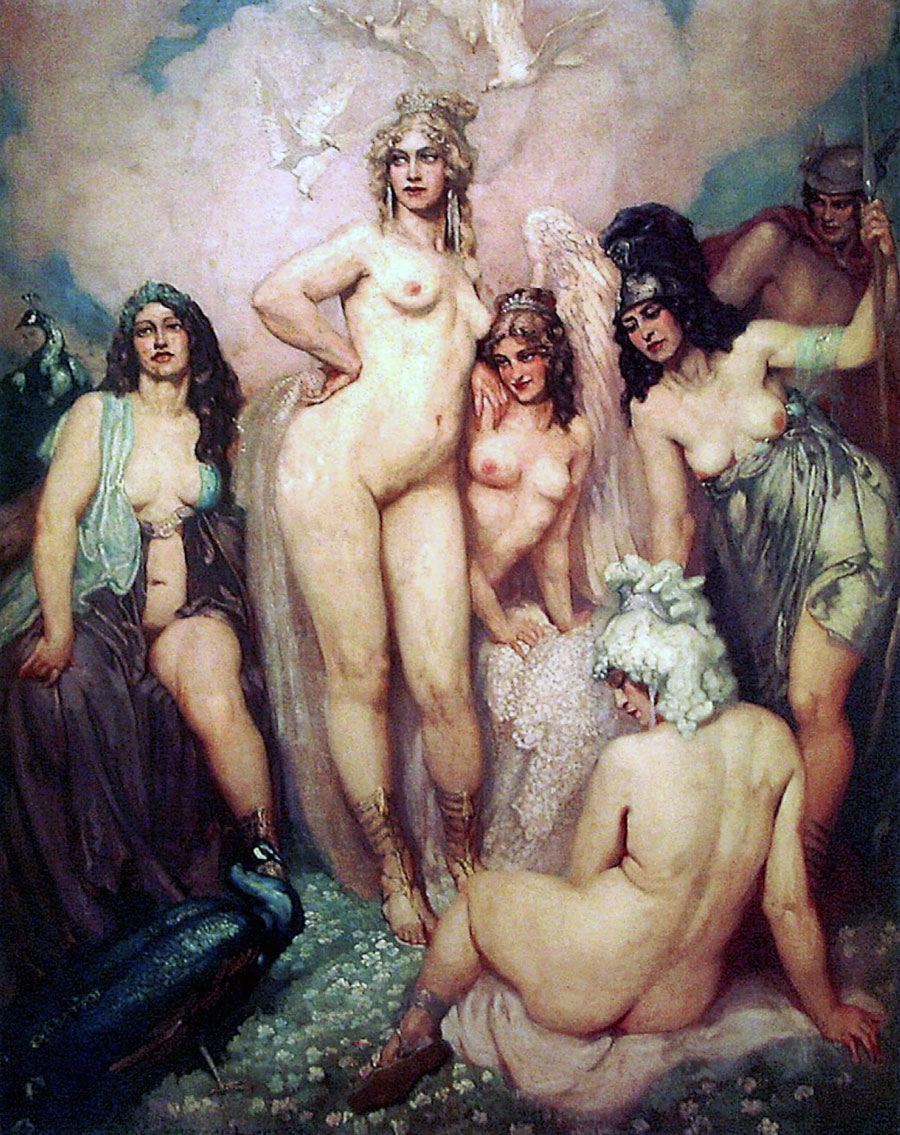
But he was not averse to understanding the structure of his images either, as can be seen by my comparison between the tight, formal structure of Paul Strand’s The Family, Luzzara, Italy (1953, below) and the looser, more natural gathering in Ellis’ The Gang, Windsor (1976, below); or the influence of other artists on his work, for example Norman Lindsay in his My Bare Lady, The Ritz, St Kilda (1977, below). Ellis also liked to push and pull at the pictorial plane; he liked to use pairs of people; he was not afraid of out of focus elements in the foreground of his images; he used chiaroscuro; and his use of light is always excellent. Above all, there is a consistency to his vision that never falters – a concatenation of images that is his style?

This is not just nostalgia. These are bloody good images, and Ellis takes these insightful type of images over and over again – the excesses of hedonism, the influences of wealth, the see-and-be-seen syndrome, things erotic and bizarre and, most importantly, enduring friendships. He photographs what he sees with a love and affection for his subject matter. None of this “staged” vernacular photography that I recently featured in an exhibition at the Art Gallery of New South Wales. This is the real deal. A friend said to me recently, “Ah, but you know, he never did in depth photo-essays like Mary Ellen Mark did of the circus, for example.” To which I have a one word reply: BULLSHIT. His whole oeuvre is a huge photo-essay on the human race, specifically the construction of Australian identity as evidenced in sections like portraits, gangs, sharpies, Aboriginals, Kings Cross, Social Documentary, Decadence, Graffiti, Life’s a Parade, Life’s a Beach etc…

When you look at his photography it would seem to me that his images dissolve the barriers between image / subject / viewer. It’s a strange phenomena to feel so connected to a person’s work. It’s the journey that he takes us on, that we went on too – not so much the destination but the rejoicing in this journey… of company, of environment, friends, places – the joy of being human. He was allowed entry into these public/private spaces because he earned our trust. He lived with the people, and they allowed him to take a bit of their life with him – as a photographic memory, to be retold and relived in the present, allowing us all to relive those times and places. It’s the love, trust, humour and anticipation of the journey that make Ellis’ images truly unique in the history of Australian photography.

Dr Marcus Bunyan


Many thankx to Manuela Furci, Rennie Ellis Photographic Archive and the Monash Gallery of Art for allowing me to publish the photographs in the posting. Please click on the photographs for a larger version of the image.


Rennie Ellis (Australian, 1940-2003) 'Dancing People, Razor Club' 1991


Rennie Ellis (Australian, 1940-2003)
Dancing People, Razor Club
1991
Selenium-toned gelatin silver print
26.7 x 40.7cm
Courtesy of the Rennie Ellis Photographic Archive


Robyn Dean (Australian) 'Marcus dancing at an unknown club, Melbourne' c. 1991-1992


Robyn Dean (Australian)
Marcus dancing at an unknown club, Melbourne
c. 1991-1992


Rennie Ellis (Australian, 1940-2003) 'Dining Out, Inflation' 1980


Rennie Ellis (Australian, 1940-2003)
Dining Out, Inflation
1980
Selenium-toned gelatin silver print
26.7 x 40.7cm
Courtesy of the Rennie Ellis Photographic Archive


SISTER SLEDGE – WE ARE FAMILY (1979) OFFICIAL VIDEO


Rennie Ellis (Australian, 1940-2003) 'Fitzroy extrovert' 1974


Rennie Ellis (Australian, 1940-2003)
Fitzroy extrovert
1974
Selenium-toned gelatin silver print
40.5 x 50.8cm
Courtesy of the Rennie Ellis Photographic Archive


Rennie Ellis (Australian, 1940-2003) 'Dino Ferrari, Toorak Road' 1976


Rennie Ellis (Australian, 1940-2003)
Dino Ferrari, Toorak Road
1976
Selenium-toned gelatin silver print
26.7 x 40.7cm
Courtesy of the Rennie Ellis Photographic Archive


Rennie Ellis (Australian, 1940-2003) 'Bon Scott and Angus Young, Atlanta, Georgia' 1978


Rennie Ellis (Australian, 1940-2003)
Bon Scott and Angus Young, Atlanta, Georgia
1978
Selenium-toned gelatin silver print
26.7 x 40.7cm
Courtesy of the Rennie Ellis Photographic Archive


Ronald Belford “Bon” Scott (9 July 1946 – 19 February 1980) was a Scottish-born Australian rock musician, best known for being the lead singer and lyricist of Australian hard rock band AC/DC from 1974 until his death in 1980.

Angus McKinnon Young (born 31 March 1955) is a Scottish-born Australian guitarist best known as a co-founder, lead guitarist, and songwriter of the Australian hard rock band, AC/DC. Known for his energetic performances, schoolboy-uniform stage outfits, and popularisation of Chuck Berry’s duckwalk, Rolling Stone magazine ranked Young as the 24th greatest guitarist of all time.

AC/DC’s popularity grew throughout the 1970s, initially in Australia, and then internationally. Their 1979 album Highway to Hell reached the top twenty in the United States, and the band seemed on the verge of a commercial breakthrough. However, on 19 February 1980, Scott died after a night out in London. AC/DC briefly considered disbanding, but the group quickly recruited vocalist Brian Johnsonof the British glam rock band Geordie. AC/DC’s subsequent album, Back in Black, was released only five months later, and was a tribute to Scott.

Text from the Wikipedia website


AC/DC – Highways to Hell (Official Video)


Rennie Ellis (Australian, 1940-2003) 'At the Pub, Brisbane' 1982


Rennie Ellis (Australian, 1940-2003)
At the Pub, Brisbane
1982
Selenium-toned gelatin silver print
26.7 x 40.7cm
Courtesy of the Rennie Ellis Photographic Archive


Rennie Ellis (Australian, 1940-2003) 'The Gang, Windsor' 1976


Rennie Ellis (Australian, 1940-2003)
The Gang, Windsor
1976
Selenium-toned gelatin silver print
26.7 x 40.7cm
Courtesy of the Rennie Ellis Photographic Archive


Paul Strand (American, 1890-1976) 'The Family, Luzzara, Italy' 1953


Paul Strand (American, 1890-1976)
The Family, Luzzara, Italy
1953
Silver gelatin photograph


The photographer Rennie Ellis (1940-2003) is a key figure in Australian visual culture. Ellis is best remembered for his effervescent observations of Australian life during the 1970s-90s, including his now iconic book Life is a beach. Although invariably inflected with his own personality and wit, the thousands of social documentary photographs taken by Ellis during this period now form an important historical record.

The Rennie Ellis Show highlights some of the defining images of Australian life from the 1970s and ’80s. This is the period of Gough Whitlam and Malcolm Fraser, Paul Keating and Bob Hawke; AC/DC and punk rock; cheap petrol and coconut oil; Hare Krishnas and Hookers and Deviant balls.

This exhibition of over 100 photographs provides a personal account of what Ellis termed ‘a great period of change’. Photographs explore the cultures and subcultures of the period, and provide a strong sense of a place that now seems worlds away, a world free of risk, of affordable inner city housing, of social protest, of disco and pub rock, of youth and exuberance.

Text from the MGA website


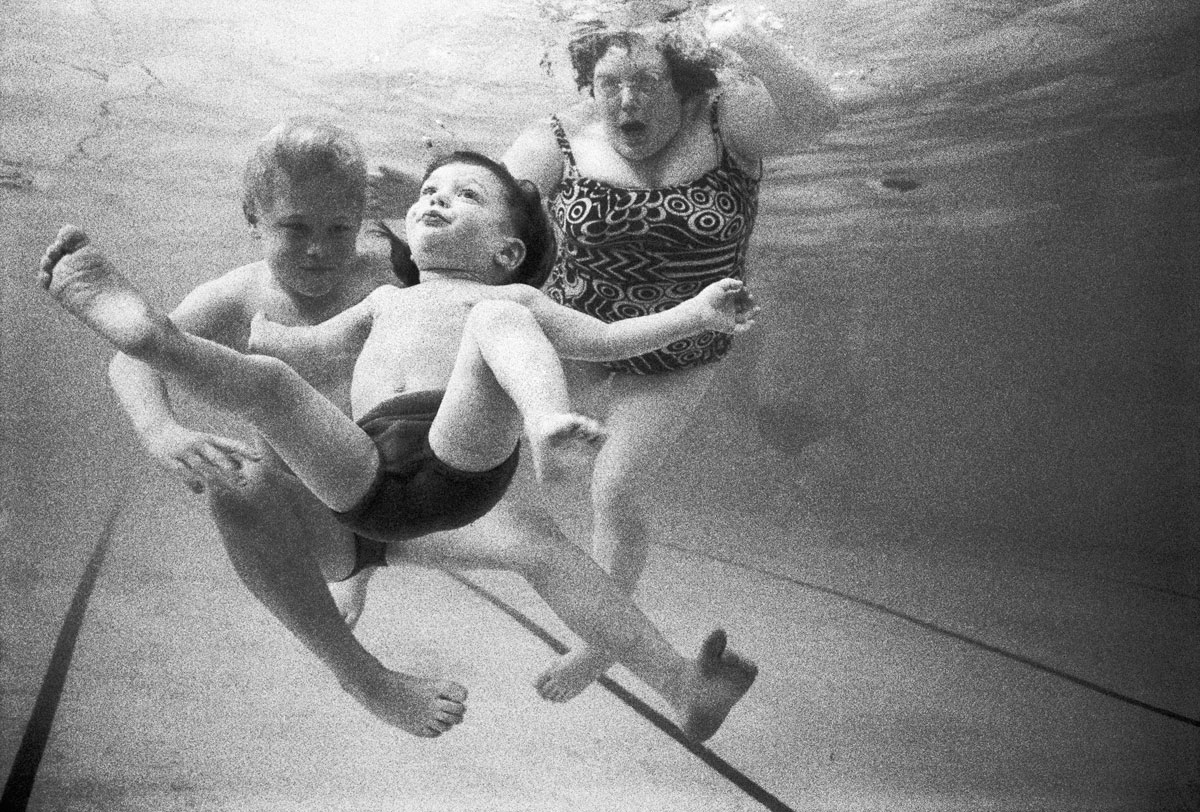
Rennie Ellis (Australian, 1940-2003) 'My son Josh learns to swim' 1972


Rennie Ellis (Australian, 1940-2003)
My son Josh learns to swim
1972
Selenium-toned gelatin silver print
26.7 x 40.7cm
Courtesy of the Rennie Ellis Photographic Archive


Rennie Ellis (Australian, 1940-2003) 'My Bare Lady, The Ritz, St Kilda' 1977


Rennie Ellis (Australian, 1940-2003)
My Bare Lady, The Ritz, St Kilda
1977
Digital C Type photograph
Fuji Crystal Archive print
Courtesy of the Rennie Ellis Photographic Archive


Norman Lindsay (Australian, 1879-1969) 'The Olympians' Nd


Norman Lindsay (Australian, 1879-1969)
The Olympians
Nd
Oil on canvas
Collection of Hamilton Art Gallery


Rennie Ellis (Australian, 1940-2003) 'Richmond fans, Grand Final, MCG' 1974


Rennie Ellis (Australian, 1940-2003)
Richmond fans, Grand Final, MCG
1974
Chromogenic print
40.5 x 50.8 cm
Courtesy of the Rennie Ellis Photographic Archive


Interesting to note that Ellis must have been shooting both black and white and colour film during the VFL Grand Final of 1974. He must have had two cameras with him (this is more likely than swapping between films in the same 35mm camera) to shoot the photograph above in colour and the black and white image of Robbie McGhie (1974, below).


Rennie Ellis (Australian, 1940-2003) 'Mr Muscleman, Albert Park Beach' c. 1986


Rennie Ellis (Australian, 1940-2003)
Mr Muscleman, Albert Park Beach
c. 1986
Chromogenic print
26.7 x 40.7cm
Courtesy of the Rennie Ellis Photographic Archive


Rennie Ellis (Australian, 1940-2003) 'Fully equipped, Albert Park Beach' c. 1981


Rennie Ellis (Australian, 1940-2003)
Fully equipped, Albert Park Beach
c. 1981
Digital C Type photograph
Fuji Crystal Archive print
Courtesy of the Rennie Ellis Photographic Archive


Rennie Ellis (Australian, 1940-2003) 'Don and Patrizia, St Kilda Beach' 1985


Rennie Ellis (Australian, 1940-2003)
Don and Patrizia, St Kilda Beach
1985
Chromogenic print
40.5 x 50.8cm
Courtesy of the Rennie Ellis Photographic Archive


Rennie Ellis (Australian, 1940-2003) 'Berlin Party, Inflation, Melbourne' 1980


Rennie Ellis (Australian, 1940-2003)
Berlin Party, Inflation, Melbourne
1980
Digital C Type photograph
Fuji Crystal Archive print
Courtesy of the Rennie Ellis Photographic Archive


Rennie Ellis book covers: 'Decade, 1970-1980' (left) and 'Decadent, 1980-2000' (right)


Rennie Ellis book covers: Decade: 1970-1980 (left) and Decadent: 1980-2000 (right)


Decade: 1970-1980 is a photography book showcasing Rennie Ellis’ (1940-2003) contribution to photography and social history. With an introduction by film maker and Rennie contemporary Paul Cox and an essay by academic Susan Van Wyk, Decade highlights Ellis as one of Australia’s most important chroniclers of the 1970s. The photographs, predominantly black and white, are drawn from a core selection originally made by Rennie from his own unpublished book, supplemented by other significant and iconic images from 1970 to 1980 drawn from the Rennie Ellis Photographic Archive and the State Library of Victoria Rennie Ellis collection. Many of the photographs are accompanied by extended captions written by Rennie himself, published here for the first time. Decade explores the cultures and sub-cultures of the seventies: the political upheavals, alternative lifestyles and counter culture, the women’s movement, gay liberation, the new religions and cults, pop festivals, Vietnam and other protests, massage parlours, the disco scene, the blossoming of Australia’s film industry, the new sexual freedom, Aboriginal rights, street festivals, the new theatre, fashion, drugs and the emergence of a decadent and hedonistic society that would later characterise the 1980s.

Decadent: 1980-2000 is a photography book showcasing Rennie Ellis’ (1940-2003) contribution to photography and social history. It is a fascinating snapshot of the wild, opulent, sometimes tacky and always decadent 1980s in Australia by a true original. With an introduction by photographer and Rennie contemporary William Yang and an essay by photographer and art critic Robert McFarlane, Decadent highlights Ellis as one of Australia’s most important chroniclers of the 1980s. The photographs, both colour and black and white, are drawn from the Rennie Ellis Photographic Archive and the State Library of Victoria Rennie Ellis collection. Decadent explores the rise of the hedonism that we now associate with the 1980s. Ellis’ boundary-pushing, racy and sometimes voyeuristic works capture a society that seems to be revelling in its abandonment of the politically charged 1970s documented in Decade.

About the Author

No other photographer has documented – in such depth – the life and times in Australia, throughout the 1970s until his death in 2003, with such insight into the human condition as Rennie Ellis. His non-judgmental approach was his ‘access-to-all-areas’ pass. Ellis used his camera as a key to open the doors to the social arenas of the rich and famous and to enter the underbelly of the nightclubs, bearing witness to the indulgences and excesses. In today’s post-Henson era, these captured moments offer an intimate access to an Australia tantalisingly, but sadly, now almost out of reach.


Rennie Ellis (Australian, 1940-2003) 'Robert McGhie, Grand Final, MCG' 1974


Rennie Ellis (Australian, 1940-2003)
Robert McGhie, Grand Final, MCG
1974
Selenium-toned gelatin silver print
50.8 x 40.5cm
Courtesy of the Rennie Ellis Photographic Archive


Robert ‘Robbie’ McGhie is a former Australian rules football player who played in the VFL between 1969 and 1972 and again in 1979 for the Footscray Football Club, from 1973 to 1978 for the Richmond Football Club and in 1980 and 1981 for the South Melbourne Football Club. His height was 192 cm and he weighed 85.5 kg. He played 46 games for Footscray, 80 games for Richmond and 16 games for South Melbourne. He was a Richmond Premiership Player 1973, 1974 (the year this photograph by Rennie Ellis was taken at the Grand Final).


Rennie Ellis (Australian, 1940-2003) 'Property of Hells Angels, Kings Cross' 1970-1971


Rennie Ellis (Australian, 1940-2003)
Property of Hells Angels, Kings Cross
1970-1971
Selenium-toned gelatin silver print
50.8 x 40.5cm
Courtesy of the Rennie Ellis Photographic Archive


Invitation to The Rennie Ellis Show at the Monash Gallery of Art


Invitation to The Rennie Ellis Show at the Monash Gallery of Art


Monash Gallery of Art
860 Ferntree Gully Road, Wheelers Hill
Victoria 3150 Australia
Phone: + 61 3 8544 0500

Opening hours:
Tue – Fri: 10am – 5pm
Sat – Sun: 10pm – 4pm
Mon/public holidays: closed

Monash Gallery of Art website

Rennie Ellis Photographic Archive

LIKE ART BLART ON FACEBOOK

Back to top

Video: ‘klimt02 in conversation with Mari Funaki’

May 2014


A wonderful energy, a wonderful artist, a wonderful human being – sadly missed!

Marcus


Published on April 23, 2014

Interview filmed on the occasion of the solo exhibition Space and Gravity by Mari Funaki at Klimt02 Gallery in Barcelona in February 2008. The artist talks about her work, the process of work: drawing, breaking predictability, her gallery and steel and black concept.


Gallery Funaki website

LIKE ART BLART ON FACEBOOK

Back to top

Review: ‘Standing Stone’ by Catherine Evans at BLINDSIDE, Melbourne

Exhibition dates: 30th April – 17th May 2014


Catherine Evans (Australian) 'Standing Stone' 2014


Catherine Evans (Australian)
Standing Stone
2014
Aluminium, steel, volcanic rocks, sticky tape
7 x 3m
© Catherine Evans
Photo: Matthew Stanton, 2014


I like this exhibition, I like it a lot.

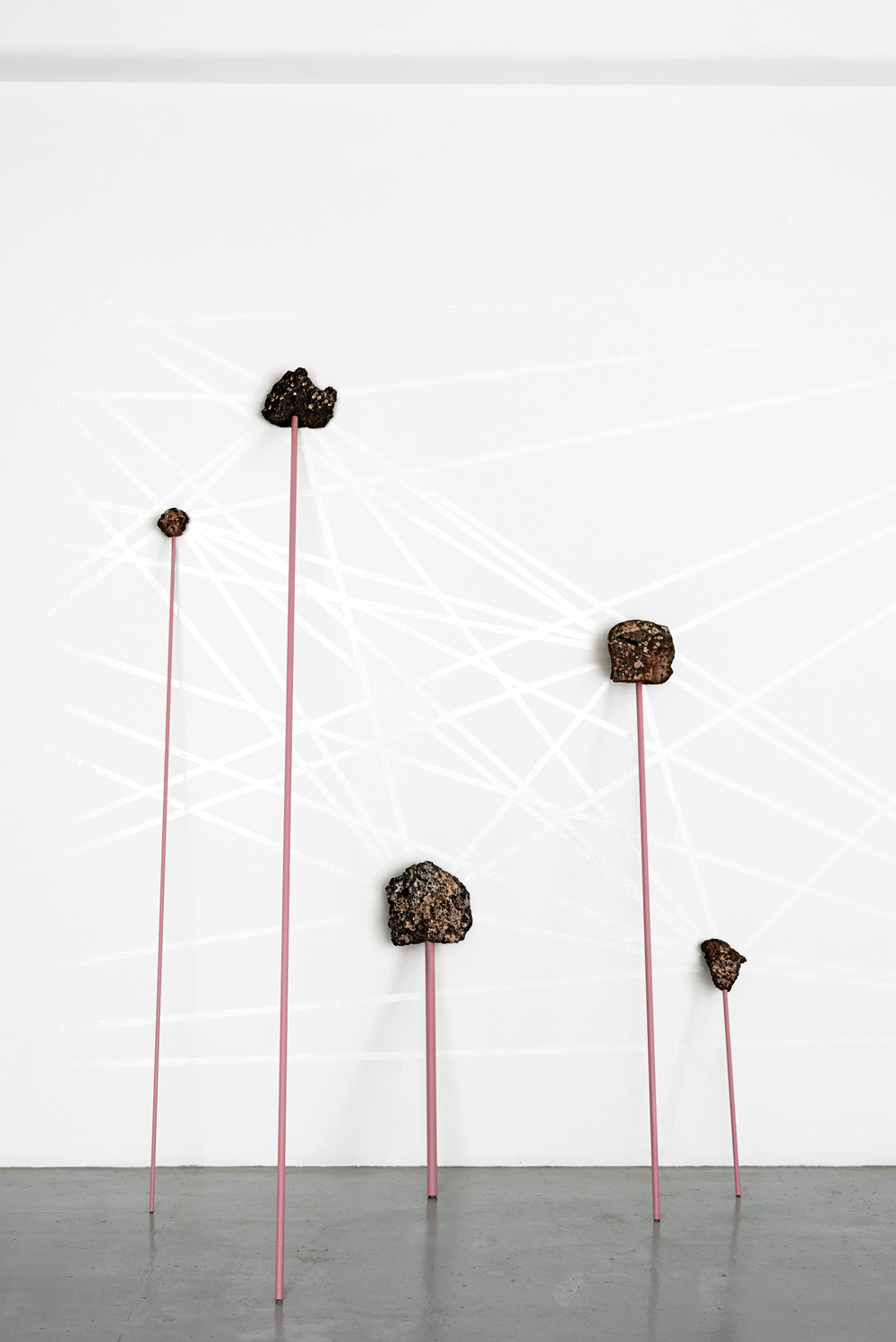
The premise, spelt out in the intelligent and articulate catalogue essay by Laura Skerlj (below), is the holistic connection between an Aboriginal stone circle of the Western Victorian Volcanic Plains used for astronomy > the moles on the artists back as lexias or nodal points of energy > and the energy of celestial bodies in the cosmic sky, arranged by humans into pictures.

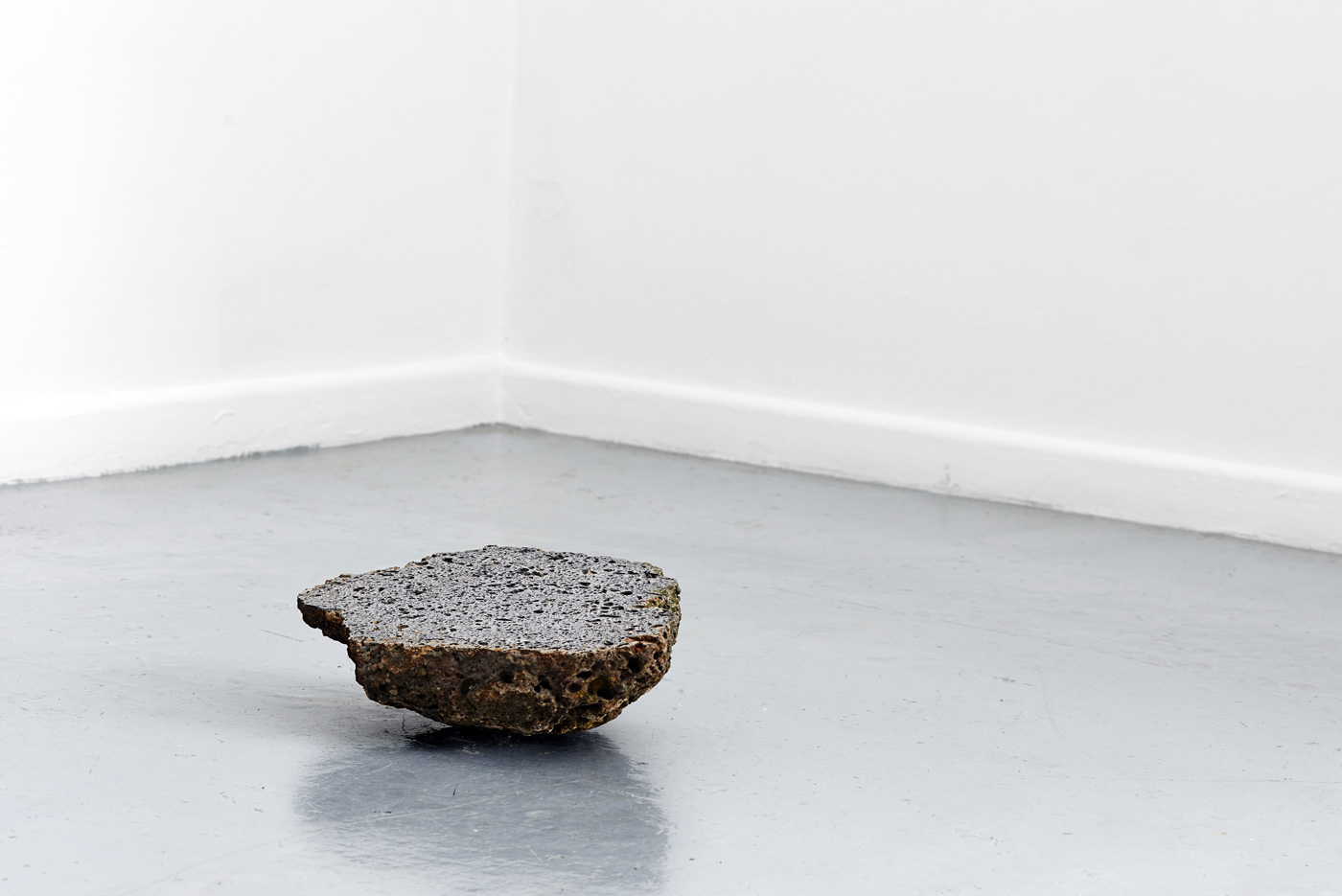
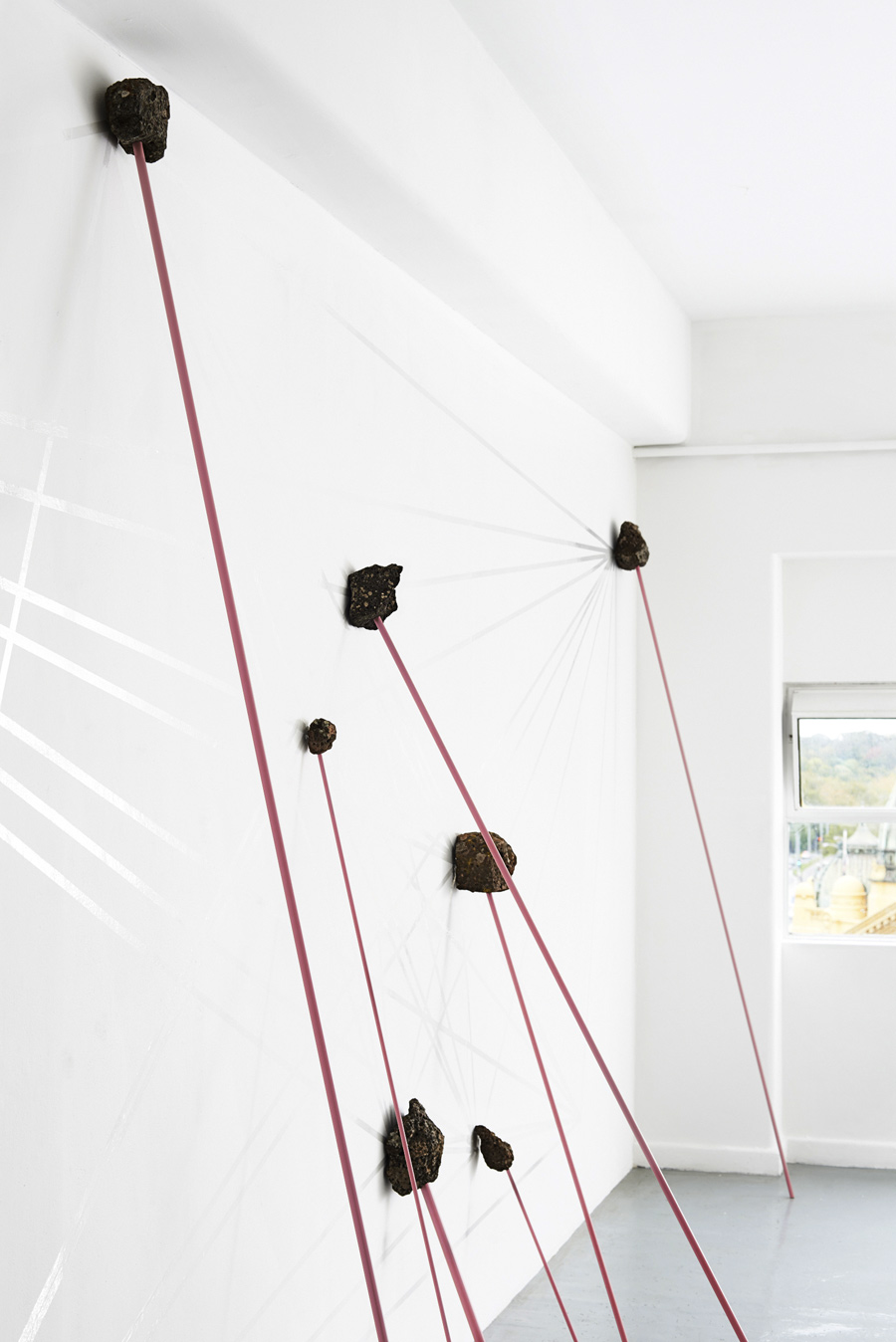
Evans precariously suspends pieces of rock (taken from near the site of the Aboriginal stone circle) in the air on the end of long poles in the position of the moles on her back – and then maps out the energy lines between them, connecting them with translucent Sellotape on the gallery wall. These lines become a trans/figured form of ley line, those lines of energy that exist within the earth that link spiritual places together. The lines could also be linked to reflexology, chakras, the positioning of stones on the body in reiki healing and Kundalini: a form of feminine shakti or “corporeal energy”, an unconscious, instinctive or libidinal force. As the press release notes, “Standing Stone encompasses both the geographic and the corporeal time scales in order to examine the latent histories of these materials – that traverse the mineral to organic, the human and geologic, the infinite to the micro. At once personal and universal, Standing Stone opens up compelling new dialogues about the body and materiality.” The work traverses both time and space, macro and micro. It undermines dichotomies and makes liminal connections which allows the viewer to embrace a quality of ambiguity or disorientation. Ultimately this lets them see the world and the cosmos from different, multiple perspectives via new associations and energies.

There are a couple of missed steps. The colour pink (associated with the flesh of the body) on the poles did not really work for me. It was too didactic. Better some translucent perspex rods that would have continued the theme of the Sellotape and would have made the rocks seem to float in the air more, made the balancing more ambiguous. Both the press release (“the raw materials of photography, such as unprocessed photographic paper exposed to ambient light”) and the catalogue essay (“Flesh-pink geometric shapes, made from unprocessed (and still-processing) photographic paper, provide platforms for rock-relics: two materials accumulating time at vastly different rates”) make reference to elements that were not in the exhibition. Flesh pink geometric shapes were to be placed under rocks on the ground and this would have made the flesh pink rods seem more logical and tied the exhibition together… but they were not necessary. While the installation of such a work is always going to be a fluid process, and the pared down version is ultimately a lot better, it is unfortunate that the catalogue had been printed and the press release not amended to reflect the changes. Such is energy and life.

The other element that envisioned a jarring note was the image of the bruise on the thigh of the artist (which I initially thought was an elbow). A beautifully ambiguous image in its own right I can see why Catherine included it in the exhibition (as it links specifically to the energy of the moles on her back), but it brought to my mind issues of domestic violence, control and power, and I don’t know whether these additional thoughts needed to be placed in the mind of the viewer. I loved the image, I liked some of its energies but others, not so much.

Having said all that, this is a fascinating, intelligent, thoughtful and beautiful installation. Like the artist herself, it has great energy and presence. I really enjoyed spending time with both.

Dr Marcus Bunyan


Many thankx to Catherine Evans for allowing me to publish the photographs in the posting and to Laura Skerlj for allowing me to publish the catalogue essay. Please click on the photographs for a larger version of the image. All artworks courtesy of the artist, installation documentation by Matthew Stanton, 2014


Catherine Evans (Australian) 'Constellation II' 2014


Catherine Evans (Australian)
Constellation II
2014
Ballpoint pen on photographic paper
21 x 30cm
© Catherine Evans


Standing Stone is an exhibition of photographs and sculpture that transposes the marks on our own bodies into a large-scale map using basalt boulders, sticky tape and the raw materials of photography, such as unprocessed photographic paper exposed to ambient light.

In this exhibition the artist will create a large-scale constellation where precariously suspended volcanic rocks collected from the Western Victorian Volcanic Plains mark the positions of moles on the artist’s own back. With reference to the Indigenous stone arrangement, Wurdi Youang,* that is situated on these plains, Standing Stone encompasses both the geographic and the corporeal time scales in order to examine the latent histories of these materials – that traverse the mineral to organic, the human and geologic, the infinite to the micro. At once personal and universal, Standing Stone opens up compelling new dialogues about the body and materiality.

This exhibition is the outcome of a mentorship with artist Susan Jacobs, supported by the Victorian College of the Arts and Arts Victoria through its Graduate Mentorship program. Accompanying the exhibition will be an essay by Laura Skerlj.

About the artist

Catherine Evans is a Melbourne-based artist who incorporates photography, video and sculpture to explore the latent history of materials. Often working with volcanic rocks and the raw materials of photography, she juxtaposes and isolates them against images of the body, testing the limits of scale and gravity.

Since completing first class Honours at the Victorian College of the Arts in 2011, Catherine has participated in many group and solo exhibitions. She is a current recipient of the inaugural VCA Graduate Mentorship (2013-2014) and was selected as a finalist in the Substation Contemporary Art Prize (2013 and 2011). Grants include an Australia Council ArtStart grant (2012) and a National Gallery of Victoria Trustee Award (2010).

Press release from Blindside


This exhibition and research took place on the lands of both the Wurundjeri and Wathaurong people who have been the traditional custodians of these lands for thousands of years, and whose sovereignty was never ceded. This exhibition is supported by the Victorian College of the Arts and Arts Victoria through its Graduate Mentorship program.

*The Wurdi Youang stone arrangement in Victoria was built by the Wathaurung people before European settlement, but all records of its use have now disappeared. This egg-shaped ring of stones, about 50m in diameter, has its major axis almost exactly East-West. In a paper published in May 2013 in Rock Art Research, Ray Norris and his colleagues confirm a suggestion (originally made by John Morieson) that some outlying stones seem to indicate the setting positions of the Sun at the equinoxes and solstices, and have shown that these same astronomically significant directions are built into the shape of the main ring. They also show, using a Monte Carlo statistical test, that this is unlikely to have occurred by chance, but instead the builders of this stone ring intentionally aligned it on the setting Sun on these astronomically significant dates. More information…


Installation view of 'Standing Stone' by Catherine Evans at BLINDSIDE, Melbourne 2014


Installation view of Standing Stone by Catherine Evans at BLINDSIDE, Melbourne
2014
© Catherine Evans
Photo: Matthew Stanton, 2014


Installation view of 'Standing Stone' by Catherine Evans at BLINDSIDE, Melbourne 2014 (detail)


Installation view of Standing Stone by Catherine Evans at BLINDSIDE, Melbourne (detail)
2014
© Catherine Evans
Photo: Matthew Stanton, 2014


With the Universe at Our Backs

We have long looked skyward, consumed by a desire to arrange celestial bodies into pictures. Sometimes these formations are difficult to see amid the city’s night-haze of light and pollution. Yet, on a drive out of town, these cosmic arrangements come into view. Constellations describe a visual relationship between groups of stars, which, over time, become culturally recognisable. To make a constellation, a dreamer must draw a line from one bright body to the next: the stars implicated in this formation need not be close to one another in reality, but merely form a visual engagement when viewed from an Earthly vantage point. For millennia, ancient cultures have made these connections, constructing apparitions in the ether that recall existential stories. However, these cosmic sketches have also served as insightful gauges of time.

In the volcanic plains of Western Victoria – the third largest of its kind in the world – lies a geological constellation. It is an Indigenous ‘map’ made of ancient stones, named by the Wathaurong people as Wurdi Youang. This egg-shaped arrangement is relatively humble in size, and up until recently was thought to be an initiation site. However, Wurdi Youang is now being considered a geological record of equinoxes and solstices, with each stone set at a considered angle, marking the movements of the sun over time.1 For artist Catherine Evans, this cosmic calendar held within it a latent agency that was both intimate and expansive. Through its very construction, the Indigenous peoples of the area had used a prehistoric material to articulate a schema that connected themselves, and their activities, with the unreachable workings of the universe: “I find the contrast in time scales at this site fascinating – that on the one hand we have an ancient time scale of the land (geologic), and on the other the human time scale, which in comparison is only a blip.”2

In Evans’ current exhibition, Standing Stone, the artist has used rocks from the plains nearby Wurdi Youang to recreate a constellation of markings found on her own body. The layout for these marks was initially realised on an inverted black and white photograph Evans took of her back: in this image, her usually pale skin appears darker than its illuminated blemishes. Using a biro and ruler, moles and freckles were connected with diagrammatic lines, just as planets, stars and dark nebula are drawn to one another in astronomical illustrations. In the exhibition, this exact configuration of blemishes is re-presented using volcanic rocks in a sculptural installation. Across the walls and floor, each point is connected with a gleaming line of transparent cello-tape.

Here, two seemingly opposing containers of time – the body and the universe – are depicted as insulated, yet reflexive, systems. Just as skin imperfections are reminders of age, trauma, exposure and adaptation, the individual rocks at Wurdi Youang are conscious notations of the sun’s movements in the sky. Each rock or blemish represents a passed event that, in conjunction, forms the schema for a cosmos. Although more commonly understood as the extraterrestrial zone outside the Earth’s atmosphere (and therefore, outside of ourselves), the etymology of ‘cosmos’ is derived from the less-boastful ‘ornament’: a sphere seen as ultimately expansive is reined into a handheld trinket. This oscillation becomes an underlying consideration in Evans’ new work, as temporality swings between what is known, even embodied, and what is all encompassing.

In understanding these holistic systems, we can draw on biosemiotician Jakob von Uexküll’s concept of ‘umwelt’. Umwelt describes the ‘phenomenal world’ or ‘self world’ of an animal, as shaped by a series of functions necessary for survival. These sets of functions are programmed to suit each specific organism, creating a harmonious motion, or pattern, for existence. In consequence, all animals, from the simplest to the most complex, are fitted into their unique worlds with equal completeness: “A simple world corresponds to a simple animal, a well-articulated world to a complex one.”3 From this theory, both the humble body and the celestial sphere could be seen to exist within an umwelt, or environment, tuned to its innate processes.

In Evans’ work, it is the configuration of a constellation that represents these sets of motions as markers on a temporal scale. For example, the blemishes found on our bodies, or the rocks moved by Indigenous people at Wurdi Youang thousands of years ago, exist in perfect accord with each organism, or system’s, relative lifespan. That could be a sunspot the artist developed one summer, 17 years into her life, or the fusion of gases that combined to form a star 13 billion years ago in the Milky Way’s galactic halo. As Uexküll explains, the animal or subject creates time through its own set of harmonious processes, no matter how simple or complex: “Instead of saying… that without time, there can be no living subject, we shall now have to say that without a living subject, there can be no time.”4

The visualisation of these essential movements is euphonious. Feminist and cultural theorist Elizabeth Grosz articulated Uexküll’s umwelt as nature set to counterpoint.5 In her interpretation, the environment works in a similar way to a musical melody, following a set of instructions that can be syncopated with another. She recalls one of Uexküll’s most examined specimens, the tick, describing the way in which it “lives in a simplified world, a harmonic world of its own rhythms and melody.”6 This melody, according to Grosz, is composed of the animal’s umwelt, as the conjunction of its three most vital processes: moving up a twig following the warmth of the sun; smelling the butyric acid expelled from the sweat of an animal; dropping onto the animal to suck its blood. In turn, the tick becomes what she describes as “a connective, an instrument.”7

This musicality is innate within Evans’ new work. Here, rocks intonate the room, propped at varied heights like notes on musical score, while reflective tape connects the specimens to one another in directional locomotion. Flesh-pink geometric shapes, made from unprocessed (and still-processing) photographic paper, provide platforms for rock-relics: two materials accumulating time at vastly different rates. Just as the vision of celestial space seen at night expands our image of the natural world, the constellation found on the artist’s back is magnified out into the gallery as an assemblage that connects ancient time with personal time. It is within this singular temporal frame that the intimate (that nebula-birthmark on your wrist) is a reflection of the processes that, even now, evade us (tangible stars imagined into dream shapes).

Consequently, Standing Stone envisions landscape as a phenomenological site, where the body and the universe share the same harmonic processes. As British archaeologist Chris Tilley explains, to perceive landscape as phenomenological resists any precise topographical boundary: as we have seen, landscape in its holistic form – as a cosmos – can transcend terrestrial limitations. Instead, he perceives landscape as “embodied sets of relationships between places, a structure of human feeling, emotion, dwelling, movement and practical activity.”8 In this way, Evans presents a landscape that is both intimate and expansive. Just as the celestial exterior looks down upon us, it shifts into us, reflecting back the documents we make. These documents are many, printed on our bodies and arranged in sophisticated groupings in the environment. The constellation, therefore, flips and folds, not just across a horizontal plane, but vertically, between what is cast in the night sky and its earthen recollection.”

Laura Skerlj is a Melbourne-based artist and writer

Laura Skerlj website


Installation view of 'Standing Stone' by Catherine Evans at BLINDSIDE, Melbourne 2014 (detail)

Installation view of 'Standing Stone' by Catherine Evans at BLINDSIDE, Melbourne 2014 (detail)


Installation views of Standing Stone by Catherine Evans at BLINDSIDE, Melbourne (detail)
2014
© Catherine Evans
Photos: Matthew Stanton, 2014


Catherine Evans (Australian) 'Bruise II' 2014


Catherine Evans (Australian)
Bruise II
2014
Framed photograph
51 x 76cm
© Catherine Evans
Photo: Matthew Stanton, 2014


BLINDSIDE
Room 14, Level 7
Nicholas Building,
37 Swanston Street,
Melbourne VIC 3000

Opening hours:
Wednesday – Saturday, 12 – 6pm

BLINDSIDE website

Laura Skerlj website

Catherine Evans website

LIKE ART BLART ON FACEBOOK

Back to top

Text / exhibition: ‘Australian vernacular photography’ at the Art Gallery of New South Wales (AGNSW), Sydney

Exhibition dates: 8th February – 18th May 2014


John F Williams (Australian, 1933-2016) 'The Rocks, Sydney' 1973


John F Williams (Australian, 1933-2016)
The Rocks, Sydney
1973
Gelatin silver photograph
22.6 x 34.1cm
Purchased 1989
© John F Williams


Australian vernacular photography. Such a large subject. Such a small exhibition.

With only 27 photographs from various artists (18 of which are shown in this posting), this exhibition can only ever be seen as the runt of the litter. I would have thought such a large area of photographic investigation needed a more expansive exposition than is offered here. There are no photobook, photo booth, Aboriginal, anonymous, authorless, family, gay or marginalised cultural photographs / snapshots. There are no light leaks, blur, fingers obstructing lenses, double exposures – all examples of serendipity and happenstance which could enter into an aesthetic arena.

Vernacular photography1 can be defined as the “creation of photographs, usually by amateur or unknown photographers both professional and amateur, who take everyday life and common things as subjects… Examples of vernacular photographs include travel and vacation photos, family snapshots, photos of friends, class portraits, identification photographs, and photo-booth images. Vernacular photographs are types of accidental art, in that they often are unintentionally artistic.”2 ‘Found photography’ is the recovery of a lost, unclaimed, or discarded vernacular photograph or snapshot.

While all of the photographs in the exhibition are unique images, some are definitely not vernacular in their construction – they are planned and staged photographs, what I would call planned happenstance (after John Krumboltz’s theory of career development). A perfect example of this are the photographs by Sue Ford (Sue Pike, 1963, printed 1988, below), Anne Zahalka (The girls #2, Cronulla beach, 2007, below) and Fiona Hall (Bondi Beach, Sydney, Australia, October 1975, below) which have an air of ceremonial seriousness that belies their classification as part of this exhibition. My favourites are the fantastic images by Glen Sloggett – witty, colourful, humorous with the photographer “acutely aware of the photographer and photograph’s role in pointedly constructing a narrative around Australian identity and history” – they are nevertheless self-deprecating enough that this does not impact on their innate “found” quality, as though the artist had just wandered along and captured the shot.

The route that the AGNSW has taken is similar to that of MoMA. Residing in the collection and shot by artists, these “vernacular” photographs are placed in a high art context. Their status as amateur or “authorless” photographs is undermined. This exhibit does not present vernacular photographs as just that. As the article on the One Street blog notes, what is being exhibited is as much about what has been collected by the AGNSW, its methodical and historicising classification, as it is about vernacular photographic form: chance, mistake and miscalculation. It is about creating a cliché from which to describe an ideal Australian identity, be it the beach, larrikinism, or the ANZAC / sporting “warrior”, and not about a true emotional resonance in the image that is created by, or come upon by, chance.

Dr Marcus Bunyan


Many thankx to the Art Gallery of New South Wales for allowing me to publish the photographs in the posting. Please click on the photographs for a larger version of the image.


1/ “Vernacular photography,” on One Way Street blog 20th October 2007 [Online] Cited 11/05/2014

“What is vernacular photography? Too broad to be understood as a genre per se, it can encompass anonymous snapshots, industrial photography, scientific photography, “authorless” photography, advertising, smut, as well as work that might be perceived as “other” than any of this random list. It could be understood as an oppositional photography – outside technical or artistic histories, yet, especially with the snapshot, it could also be entirely conventionalised, a manifestation of visual banalities, or an image so enigmatic that its meaning or genesis is entirely obscured. It is mistakes & failures as much as it may not be, & how we understand the images may or may not be separate from their initial intents. Is this a category we are making up?

The idea of the vernacular in photography is also an indication of photography as a medium informing the everyday, prevalent, “naturalised.””

2/ Szarkowski, John. “INTERVIEW: “Eyes Wide Open: Interview with John Szarkowski” (2006)” by Mark Durden, Art in America, May, 2006, cited in “Vernacular photography,” on Wikipedia website [Online] Cited 11/05/2014. No longer available online


Ed Douglas (United States of America, Australia, b. 6 May 1943) 'City-spaces #28, (John Williams), Sydney' 1976 printed 2012


Ed Douglas (United States of America, Australia, b. 6 May 1943)
City-spaces #28, (John Williams), Sydney
1976 printed 2012
From the series City-spaces 1975-78
Purchased with funds provided by the Photography Collection Benefactors’ Program 2012
© Ed Douglas


Words and Photos: Geoffrey Batchen’s Writing About Vernacular Photography

“At first, I was simply interested in bringing attention to a diverse range of photographic objects and practices that had not been much written about. But I soon recognised that these objects represented a significant challenge to the predominant history of photography. This history, dominated by the values ​​and tropes of art history, was not well-equipped to talk about photographs that were openly commercial, hybrid and mundane. Ie: the history of photography ignores most types of photography. My interest, therefore, has become more methodological and theoretical, in an effort to establish new ways to think of photography that could address the medium as a whole. I suggest that any substantial inclusion of vernacular photographs into a general history of photography will require a total transformation of the character of that history…

I suggest that any inclusion of vernacular photography in the larger story, will require a complete transformation of the character of that story; it will require a new kind of history altogether. My writings may have encouraged this idea, but I am just one of many scholars who have been pursuing this goal. Indeed, I would say that this idea is now the norm. The next step is to look beyond this and engage other parts of the history of photography that have been similarly neglected. For example, there are many researchers at the moment that are examining the photographs produced outside Europe and the United States, such as China, Indonesia, and Africa…

Snapshots are complicated objects. They are unique to each maker and almost always completely generic. They happily adopt the visual economy that mediates most photographic practices: same but different. You might say that every snapshot is an authentic copy of a prescribed set of middle-class values and familiar pictorial clichés. That does not make them any less fascinating, especially for people who treasure them. But it does make them difficult to write about…

It is certainly possible to recognise the existence of regional practices of photography. I wrote, for example, about the making of fotoescultura in Mexico, and about a specific form of ambrotype in Japan. No doubt one could claim to see some regional aspects of snapshots made in the United States that distinguish them from ones made in Australia or, say, Indonesia. But the more challenging task is to talk about those things that can’t be seen. For example, snapshots made in Australia and China may look exactly the same to my eye, but it stands to reason that they don’t mean the same thing (after all, access to the camera for personal photos is a fairly recent phenomenon in China). We must learn how to write these kind of differences.”

Interview by LG. “Words and Photos: Geoffrey Batchen’s Writing About Vernacular Photography,” on the LesPHOTOGRAPHES.com website Nd (translated from the French) [Online] Cited 04/05/2014. No longer available online


Ed Douglas (United States of America, Australia, b. 6 May 1943) 'City-spaces #40, Sydney' 1976 printed 2012


Ed Douglas (United States of America, Australia, b. 6 May 1943)
City-spaces #40, Sydney
1976 printed 2012
From the series City-spaces 1975-78
Gelatin silver photograph
23.6 x 30.7cm image
Purchased with funds provided by the Photography Collection Benefactors’ Program 2012
© Ed Douglas


After relocating from USA to Australia in 1973, Ed Douglas spent a few years living in the country prior to taking on a teaching position at Sydney College for the Arts in 1976. The series City-spaces was commenced in Sydney and then developed further when Douglas moved to Adelaide in 1977. Having been schooled in the formal traditions of American documentary photography, Douglas’s images appear like notations of an urban explorer attempting to locate himself in a new country. Seemingly fragmentary, they look at the specificities of the mundane and the ordinary. Close acquaintances such as photographers Ingeborg Tyssen and John F. Williams appear in City spaces #29 and City spaces #28, indicating the personal nature of the series.

Intimately scaled and tonally rich, the black and white images exalt the formal beauty which can be found in the random textures of daily existence. They are also permeated with gentle humour and a sense of quiet drama that unfolds in the strangely misplaced confluences of objects, figures and spaces. Douglas’s interest in the formal and emotional qualities of topography was emblematic of new approaches in documentary photography of the time. His 1983 series of colour photographs depicting the gypsum mine on Kangaroo Island (collection of AGNSW) developed this trajectory further by fusing the aesthetics of abstraction and objective documentation.


Gerrit Fokkema (Papua New Guinea, Australia, b. 1954) 'Woman hosing, Canberra' 1979


Gerrit Fokkema (Papua New Guinea, Australia, b. 1954)
Woman hosing, Canberra
1979
Gelatin silver photograph
34.9 x 46.5 cm image
© Gerrit Fokkema


Gerrit Fokkema’s photographs of everyday Sydney and Canberra in the early 1980s are examples of Australian photography becoming more self-aware. These decisive snapshots of suburban life reveal an irony and conjure Fokkema’s own history growing up in Queanbeyan. Though captured in seemingly banal settings, the images intrigue, pointing to issues beyond what is represented in the frame. The housewife watering the road and a young tattooed man in front of a car are both depicted alone within a sprawling suburban landscape, suggesting the isolation and boredom in the Australian dream of home ownership. The sense of strangeness in these images is consciously sought by Fokkema, aided by his embrace of the glaring and unforgiving ‘natural’ Australian light.

Gerrit Fokkema’s Woman hosing, Canberra is an affectionate and gently ironic portrait of suburban life in Canberra. Fokkema was familiar with his subject matter, raised as he was in the nearby township of Queanbeyan. After studying photography at Canberra Technical College 1974-77 he became the staff photographer for the Canberra Times in 1975. He held his first exhibition in the same year at the Australian Centre for Photography, Sydney. His career as a photo-journalist lead him to work with the Sydney Morning Herald in 1980 and participation with several international Day in the life of…. projects between 1986 and 1989.

Fokkema uses the ‘decisive moment’ of photo-journalism to reveal the incidental quirks of ordinary life in this image. The bland uniformity of the streetscape, with its identical archways and mundanely shuttered doors, is punctuated by the absurd proposition of a woman watering the street rather than the adjacent grass. Her presence is the only sign of life in an otherwise inanimate scene, and her actions suggest a kind of strangeness that lies within the normality of suburbia. Many of Fokkema’s images play with such chance incidences and odd juxtapositions, revealing his interest in surrealism and the notion of automatism. Indeed, the repeated archways and the lone figure inhabiting otherwise empty urban space of Woman hosing, Canberra recall the proto-typical surrealist painting, Mystery and melancholy of a street 1914, by Giorgio de Chirico. Fokkema’s image is, however, very much a product of Australia – of its bright ‘available’ light and of the dream of home-ownership. Fokkema has continued to document the Australian way of life. In 1986 he left newspapers to freelance as a commercial photographer and published Wilcannia, portrait of an Australian town. He has since exhibited works based on tender observations of his family members and of family life.

© Art Gallery of New South Wales Photography Collection Handbook, 2007


Gerrit Fokkema (Papua New Guinea, Australia, b. 1954) 'Blacktown man' 1983


Gerrit Fokkema (Papua New Guinea, Australia, b. 1954)
Blacktown man
1983
Gelatin silver photograph
30.6 x 40.6cm image
© Gerrit Fokkema


The work of Gerrit Fokkema exhibits a particular sensitivity to the uneasiness of people in Australian landscapes, both urban and rural. Fokkema was born in New Guinea in 1954, but raised in Canberra and worked as a press photographer before freelancing from 1986. Although his photographs demonstrate an interest in the formal qualities of landscape, the sense of rhythm his compositions generate also evoke the monotony of Australian space – sweeping terracotta roofs and long straight paths. This monotony is only interrupted by the presence of the human figure, usually isolated, alone and awkwardly out of place. In Blacktown Man 1983, the flat image of the man appears dramatically superimposed on the land and sky of the suburban street. By reminding us of our sometimes uncomfortable relationship with the spaces we inhabit, Fokkema’s work rejects any attempt to romanticise Australian life.


Trent Parke (Australian, b. 1971) 'Backyard swing set, QLD' 2003


Trent Parke (Australian, b. 1971)
Backyard swing set, QLD
2003
From the series Minutes to midnight
Type C photograph
109.9 x 164cm
Gift of Albie Thoms in memory of Linda Slutzkin, former Head of Public Programmes, Art Gallery of New South Wales 2006
© Trent Parke


Australian vernacular photography traces developments in photographic practice from the postwar period through to the present day, with images ranging from documentary or ‘straight’ photography (where the subjects are usually unaware of the camera), through to those that look self-reflexively at the constructed nature of the medium.

The increasing role of photography in the latter part of the 20th century attests to the rising need Australians felt to apprehend the nation, personal identity and society through images. Many of these photographs offer frank perspectives on Australian culture without the romanticising tendencies of earlier photographers. Photographing the everyday became a way of understanding how Australia saw (and sees) itself, with recurrent themes such as beach culture, suburbia, race relations, protest and the role of women among the central concerns of image-makers then and now.

By the 1960s Australian photographers were comparing their work with international peers, thanks to photographic publications and the watershed 1959 tour of The family of man exhibition organised by the Museum of Modern Art, New York. Institutional support for photography didn’t come until the 1970s; however those committed to the medium forged on, intent on capturing their visions of Australia photographically. The family of man exhibition toured Australia in 1959 and was enormously influential, with its themes of birth, love and death common to all humanity. However, possibilities for Australian photographers to be noticed were rare until the 1970s due to the lack of institutional support. Nonetheless, photographers from David Moore and Robert McFarlane to the young Sue Ford forged on, trying to find their own vision of Australian life and how it could be represented photographically. This exhibition looks at some of the photographers from then as well as those working more recently – such as Anne Zahalka, Trent Parke and Glenn Sloggett – to consider their various approaches to the depiction of modern Australian life.

In the Australian Photography Annual of 1947, photographer and director of the Art Gallery of NSW Hal Missingham wrote: “In a country supposedly occupied by people indulging in a vigorous outdoor life, where are the [photographic] records of beach and sport… where are the photographs of the four millions of people who live and work in our cities? What are they like – what do they do – what do they wear, and think?”

Text from the AGNSW website


Jeff Carter (Australia, 05 Aug 1928 - Oct 2010) 'The Sunbather' 1966


Jeff Carter (Australia, 05 Aug 1928 – Oct 2010)
The Sunbather
1966
Gelatin silver photograph
39.1 x 27.6cm image
© Jeff Carter


“I don’t regard photography as an art form, although I know it can be for others… To me the camera is simply an unrivalled reporter’s tool. It is an aid to getting the story “properly true,”” Jeff Carter said in 2006. Working mainly as a photojournalist, Carter wanted to make images that depicted social reality. He aimed to show the ‘unknown’, those people who are rarely seen. His approach resulted in frank, arguably even unflattering, images of Australian life, such as this of a beach-goer in the 1960s, heralding the changing social mores of the time.


John F. Williams (Australia, 1933-2016) 'Sydney' 1964, printed later


John F Williams (Australia, 1933-2016)
Sydney
1964, printed later
Gelatin silver photograph
24.3 x 24.3 cm image
© John F Williams


Sydney photographer, lecturer and historian John F. Williams has a long and personal interest in the ramifications of the Allies’ commitment to and sacrifice in the First World War which he later explored in his 1985 series From the flatlands. Williams became an amateur street photographer, inspired by Henri Cartier-Bresson and the photojournalist W. Eugene Smith. He read The family of man catalogue and saw the exhibition in 1959 but he rejected its “saccharine humanism and deliberate ahistoricism” choosing instead to socially document the raw character of Australia.1

When interviewed in 1994 Williams said: “After the [First World War] you had a range of societies which were pretty much exhausted, and they tended to turn inwards. In a society like Australia which had a poorly formed image of itself, where there was no intellectual underpinning, the image of the soldier replaced everything else as a national identity.”2

Sydney expresses the ‘Anzac spirit’ born in the battlefields of Gallipoli, the Somme and Flanders, a character study of an independent, introspective soldier. With an air of grit, determinedly smoking and wearing his badge, ribbons and rosemary as remembrance, Sydney stands apart from the crowd, not marching with his regiment. Williams embraced the ‘element of chance’ or the ‘decisive moment’ as he documented the soldier in a public place observing the procession. Taken from a low angle and very close up the man is unaware of the photographer at the moment the shot was taken, apparently lost in his own memories. The old soldier represents a generation now lost to history but portraits such as these continue to reinforce the myth of national identity.

1/ Jolly, M. “Faith sustained,” in Art Monthly, September 1989, pp. 18-19
2/ “John Williams – photographer and historian: profile,” in Sirius, winter, Macquarie University, Sydney, 1994, p. 5

© Art Gallery of New South Wales Photography Collection Handbook, 2007


Robert McFarlane (Australia, b. 1942) 'Happening Centennial Park, Sydney' c. 1968


Robert McFarlane (Australia, b. 1942)
Happening Centennial Park, Sydney
c. 1968
Gelatin silver photograph
25.9 x 17.6cm image
© Robert McFarlane


Hal Missingham (Australia, 08 Dec 1906 - 07 Apr 1994) 'Surf carnival, Cronulla' 1968, printed 1978


Hal Missingham (Australia, 08 Dec 1906 – 07 Apr 1994)
Surf carnival, Cronulla
1968, printed 1978
Media category
Gelatin silver photograph
38.1 x 26.3cm image
© Hal Missingham Estate


Photographer and former Art Gallery of NSW director, Hal Missingham wrote in the 1947 Australian Photography annual: “In a country supposedly occupied by people indulging in a vigorous outdoor life, where are the [photographic] records of beach and sport…? Where are the photographs of the four millions of people who live and work in our cities? What are they like – What do they do – What do they wear, and think?” This image points to Missingham’s own attempts to answer that question. An interesting counterpoint to the images taken at Cronulla around 40 years later, here Missingham shows a group of young women standing behind a fence watching as young men train to be lifesavers.

Hal Missingham often holidayed at his beach house at Garie in the Royal National Park south of Sydney, not far from Cronulla. In 1970 he published Close focus a book of photographic details of rocks, pools, sand and driftwood. As a beachcomber and observer of beach culture Missingham delighted in his immediate environment. Surf carnival, Cronulla is a quintessential Australian scene, one that frames an important aspect of national identity and culture. As passive observers, the 1960s was a time when many girls were still ‘minding the towels’ for the boys who surfed or competed in carnivals. Barricaded from the beach and its male activity the young women in bikinis are oblivious to the photographer who has foregrounded their relaxed tanned bodies behind the wire as they in turn observe and discuss the surf lifesavers in formation at the water’s edge. Although a beach is accessible for the majority of Australians and is now an accepted egalitarian space where women bodysurf, ride surfboards and compete along with beachgoers from diverse ethnic backgrounds, Surf carnival, Cronulla suggests a specific demography.

© Art Gallery of New South Wales Photography Collection Handbook, 2007


Fiona Hall (Australia, b. 1953) 'Bondi Beach, Sydney, Australia, October 1975' 1975


Fiona Hall (Australia, b. 1953)
Bondi Beach, Sydney, Australia, October 1975
1975
Gelatin silver photograph
28.2 x 27.9cm image
Hallmark Cards Australian Photography Collection Fund 1987
© Fiona Hall


Australian vernacular photography considers how photographers have used their cameras to depict Australian life, and how ideas of the nation have been constructed through photographic images.

Sixteen Australian photographers are represented by some 27 photographs taken from the 1960s to the 2000s. The photographs range from the more conventionally photo-documentary through to later works by photographers positioned more consciously in an art context. A selection of photography books of the period are also on display.

Artists include: Jeff Carter, Ed Douglas, Peter Elliston, Gerrit Fokkema, Sue Ford, Fiona Hall, Robert McFarlane, Hal Missingham, David Moore, Trent Parke, Roger Scott, Glenn Sloggett, Ingeborg Tyssen, John F Williams, William Yang and Anne Zahalka. Each of these artists in their own way interweave personal, documentary and fictional aspects through their images.

The works in Australian vernacular photography expose the sense of humour or larrikinism often seen as typical to Australia through showing aspects of beach and urban culture that hadn’t been imaged so bluntly before the 1960s. The characters that emerge range from leathery sunbathers, beer-drinking blokes and hippies, to beach babes, student protesters and suburban housewives, shedding light on the sense of liberation and self-recognition that arose during this period.

As photography struggled to gain recognition as an art form in the mid 20th century, the influence of exhibitions such as the Museum of Modern Art, New York’s Family of Man, which toured Australia in 1959, was vital in allowing Australian photographers to compare their work to that of their international peers.

Throughout the 1960s and ’70s, photographers such as Jeff Carter, Sue Ford, David Moore, Roger Scott and John F Williams worked in a photo-documentary mode that was less about staging a shot or creating formal harmony within the frame than about capturing a moment of lived reality. To this end, such photographs involved minimal intervention from the photographer, both before and after the shutter release. Subjects were often unaware of being photographed and extensive darkroom manipulation was frowned upon, the rawness of prints was supposed to signal authenticity.

This approach resulted in images that seemed to offer a frank perspective on Australian culture, without the romanticising tendencies of earlier photography, which had sought to construct ideals rather than document what was actually there. As artists began to realise what they could do with the camera, so too did the images evolve. By the 1980s and ’90s photographers were making images that showed the subject’s awareness of being photographed, as with Gerrit Fokkema, or presented a harsh, even aggressive perspective on the depicted situations by removing people altogether, as with Peter Elliston. This signalled the increasingly self-conscious role of photographers themselves in the equation, suggesting the influence of post-modern theories of subjectivity and their effect on the images produced.

By the time we reach the 2000s, artists such as William Yang, Anne Zahalka and Trent Parke are acutely aware of the photographer and photograph’s role in pointedly constructing a narrative around Australian identity and history. The exhibition maps out this history and offers unexpected insight into the construction of a particularly Australian vernacular within photographic practice.

Press release from the AGNSW


Sue Ford (Australia, 1943 - 06 Nov 2009) 'Sue Pike' 1963, printed 1988


Sue Ford (Australia, 1943 – 06 Nov 2009)
Sue Pike
1963, printed 1988
Media category
Gelatin silver photograph
34.2 x 34.2cm image
Gift of Tim Storrier 1989
© Estate of Sue Ford


Sue Ford’s photograph of her friend Sue Pike blow-drying her hair in the kitchen captures the young woman preparing for a night out. Ford often photographed those close to her as well as continually making self-portraits throughout her career. The photograph is domestic and intimate, showing a common aspect of life for young women in the 1960s. It suggests the procedure of preening necessary to go out and find ‘marriage and children’, while the alcohol and cigarette indicates the emerging movement for women’s liberation.

“My earliest “studio portraits” … were of my friends from school … These photo sessions were approached with a ceremonial seriousness, My friends usually brought different clothes with them and during the sessions we would change clothes and hairstyles.” Sue Ford 1987 1

Sue Ford took the majority of her photographs at this time with the camera set on a 1/60th of a second at f/11, a ‘recipe’ she wrote which had more chance of success. Poetic, fragmentary text relating to Ford’s 1961 photo-essay in “A sixtieth of a second: portraits of women 1961-1981” identify the young women’s recipe for flirtatious endeavour – ‘gossamer hairspray’, ‘peroxide’, ‘plucked eyebrows’, ‘big hair rollers to achieve “La Bouffant”‘, ‘Saturday nite’ and ‘Jive’. Sue Pike exemplifies the era of girls preparing for a night out with the boys in their ‘FJ Holdens and Hot Rods’. Staged in the kitchen, probably on a Saturday afternoon, Sue Pike, in a padded brunch coat with hair in rollers plugged into a portable hair dryer, will be a part of the action, the gossip and camaraderie. A further portrait taken in the same year shows Sue Pike metamorphosed as a beautiful bride, carefully coifed ash blonde hair under a white net veil, eyes momentarily shut, traditionally decorated with pearls and posy. Ford suggests in her prose and portraits that there are choices to be made – ‘marriage and children’ or mini-skirts and the Pill, as her old school friends go in different directions.

1/ Ford. S. “A sixtieth of a second: portraits of women 1961-1981,” Experimental Art Foundation, Adelaide, 1987, p. 4

© Art Gallery of New South Wales Photography Collection Handbook, 2007


Anne Zahalka (Australia, b. 1957) 'The girls #2, Cronulla beach' 2007


Anne Zahalka (Australia, b. 1957)
The girls #2, Cronulla beach
2007
Type C photograph
72.5 x 89.5cm image
Gift of the artist 2011. Donated through the Australian Government’s Cultural Gifts Program
© Anne Zahalka. Licensed by Viscopy, Sydney


As part of a generation of Australian women artists who came to the fore in the early 1980s, Anne Zahalka’s practice has always been concerned with questioning dominant myths and cultural constructs. The broad sweep of Zahalka’s oeuvre has often been underpinned by a common strategy: the world in her images appears as theatre where place, gender and national identity are questioned.

Many of Zahalka’s more recent works are located outside the studio though the natural environment can be seen to be equally constructed. In The girls #2, Cronulla beach, the photographer has returned to the seaside, which was the setting for one of her most iconic series, Bondi: playground of the Pacific 1989. The girls was made as a response to the Cronulla riots and after an introduction to Aheda Zanetti, the designer of the burqini. Zahalka “also knew of a documentary film being made following the recruiting of Lebanese men and women into the lifesaving club. It seemed like there was change adrift on the beachfront.”1 The permutations and post-modern anxiety about what constitutes Australian identity seen in the Bondi… series, have spilled out into the real world. But the image of these young Muslim women lifeguards seems to celebrate the potential to transgress accepted value systems.

Anne Zahalka said in 1995: “I am primarily concerned with… representations to do with place, identity and culture. Through the appropriation and reworking of familiar icons and styles I seek to question (and understand) their influence, meaning and value.” Twelve years later, Zahalka continues this line of inquiry with the series Scenes from the Shire. In this image, three Muslim girls wearing Burqinis (swimwear made for Muslim women conceived by Lebanese-Australian designer Aheda Zanetti) are standing cross-armed on Cronulla beach, a lifesaving raft is in the background. Zahalka made this work in response to the Cronulla riots of 2005. The image juxtaposes Muslim tradition with the Australian icon of the lifesaver, suggesting cultural overlap and changing national identity.

1. A. Zahalka et al, “Hall of mirrors: Anne Zahalka portraits 1987-2007,” Australian centre of photography, Sydney 2007, p. 43


William Yang (Australia, b. 1943) 'Ruby's kitchen Enngonia' 2000, printed 2002


William Yang (Australia, b. 1943)
Ruby’s kitchen Enngonia
2000, printed 2002
From the series miscellaneous obsessions
Type C photograph
35.5 x 53.5cm image
© William Yang


William Yang was born in North Queensland, a third generation Chinese-Australian. He is known both as a photographer and for his monologues with slides which he has presented around the world to great acclaim. One of these, Sadness 1992, was adapted for the screen by Tony Ayres and won AWGIEs amongst other awards. A major retrospective of Yang’s work, Diaries, was held at the State Library of NSW in 1998. Through April 24 – June 1, 2003 Yang presented all his monologues at Belvoir St Theatre, Sydney.

Yang has documented various subcultures over the last 30 years and this is reflected in his photographs as well as his monologues. A remarkable storyteller with a unique style, his current work is a synthesis of his ongoing concerns. While these concerns spring very much from his experiences growing up with a Chinese background in far north Queensland, through to his exploration of the gay community in Sydney, the work transcends the personal and becomes a meditation on the subtleties of the ordinary and everyday.

This series of images reflects Yang’s current life of travel and contact with his far flung friends and extended family. Though the subject, at its most superficial, is food, where, when and who is there at the time is of equal importance. Consequently each photograph in the series presents a web of connections and is underpinned with similar intentions to Yang’s other work, regardless of the subject.

“I don’t think I have a great technical attitude but I am interested in people,” William Yang said in 1998. Yang is known for his candid photographs of friends and situations he encounters. The images are usually accompanied by a story about his life, sometimes handwritten on the print itself, sometimes spoken aloud in performative contexts. He uses narrative as a way of locating his images in a particular moment in his personal history as well as social history at large. Yang explores themes around Australian and gay identity in a way that is frank and sometimes confronting. In this work, from a series about food, a chunk of kangaroo meat sits casually atop a laminate bench; other Australian icons such as Wonder White and Weet-Bix are also visible. The work allows for a multiplicity of signs to coexist: the slaughtered Australian mascot, the drab generic kitchen, the processed ‘white’ bread, with the Chinese-Australian photographer observing it all.


Glenn Sloggett (Australia, b. 1964) 'Cheaper & deeper' 1996


Glenn Sloggett (Australia, b. 1964)
Cheaper & deeper
1996
From the series Cheaper & deeper
Type C photograph
80.0 x 79.9cm image
Gift of Amanda Love 2011. Donated through the Australian Government’s Cultural Gifts Program
© Glenn Sloggett


Based in Melbourne, Glen Sloggett has exhibited extensively across Australia, including a touring exhibition with the Australian Centre for Photography, New Australiana 2001. Internationally, his work was included in the 11th Asian Art Biennale in Bangladesh, 2004 and the 9th Mois de la Photo ‘Image and Imagination’ in Montreal 2005.

Sloggett’s work depicts scenes from Australian suburbia with a startling mix of warmth and melancholy. Devoid of people, his photographs reflect the isolation and abandonment that afflicts the fringes of Australian urban centres. His images don’t flinch from the ugly, kitsch, and bleak. Sloggett says, “No matter where I go, I always find places and environments that are in the process of falling down. These are the images of Australia that resonate most strongly for me as an artist. I want to capture the last signs of optimism before inevitable disrepair.” (Glen Sloggett, quoted in A. Foster. Cheaper and deeper, ex. Bro. ACP 2005) His images of disrepair are infused with black humour and at the same time, affection for Australian suburbia.

From dumpy derelict flats to pavements graffitied with the words ‘mum killers’, Sloggett’s photographs capture an atmosphere of neglect. One classic image depicts a pink hearse, with the slogan Budget burials cheaper & deeper!! stencilled in vinyl on the side window. Another image shows an industrial barrel, on which is scrawled the evocative word ‘Empty’. In a third image, a dog rests on the pavement outside ‘Kong’s 1 hour dry cleaning’ – the bold red and yellow lettering on its window in stark contrast to the cracked paint of the exterior wall, and half-clean sheet that forms a makeshift curtain. These images have a profundity that is at once touching and surprising; as Alasdair Foster has commented, “In a world of rabid materialism and shallow sentiment, Sloggett’s photographs show us that life really is much cheaper and deeper.”

These five works by Glenn Sloggett serve as forms of photographic black humour. Devoid of people and always in colour, his photographs often take mundane elements from the world and make us notice their tragicomedy. This group is rooted in a play with text, where the tension between what is written and what we see is paramount. Sloggett makes comment on Australian life and culture, showing how the fringes of towns and the paraphernalia of the everyday give insight into the Australian psyche.


Glenn Sloggett (Australia, b. 1964) 'Hope Street' 2000


Glenn Sloggett (Australia, b. 1964)
Hope Street
2000
From the series Cheaper & deeper
Type C photograph
80.4 x 80.6cm image
Gift of Amanda Love 2011. Donated through the Australian Government’s Cultural Gifts Program
© Glenn Sloggett


Glenn Sloggett (Australia, b. 1964) 'Empty' 2000


Glenn Sloggett (Australia, b. 1964)
Empty
2000
From the series Cheaper & deeper
Type C photograph
80.4 x 80.6cm image
Gift of Amanda Love 2011. Donated through the Australian Government’s Cultural Gifts Program
© Glenn Sloggett


Glenn Sloggett (Australia, b. 1964) 'Kong's 1 hour dry cleaning' 1998


Glenn Sloggett (Australia, b. 1964)
Kong’s 1 hour dry cleaning
1998
From the series Cheaper & deeper
Type C photograph
80.2 x 80.0cm image
Gift of Amanda Love 2011. Donated through the Australian Government’s Cultural Gifts Program
© Glenn Sloggett


Art Gallery of New South Wales
Art Gallery Road, The Domain
Sydney NSW 2000, Australia

Opening hours:
Open every day 10am – 5pm
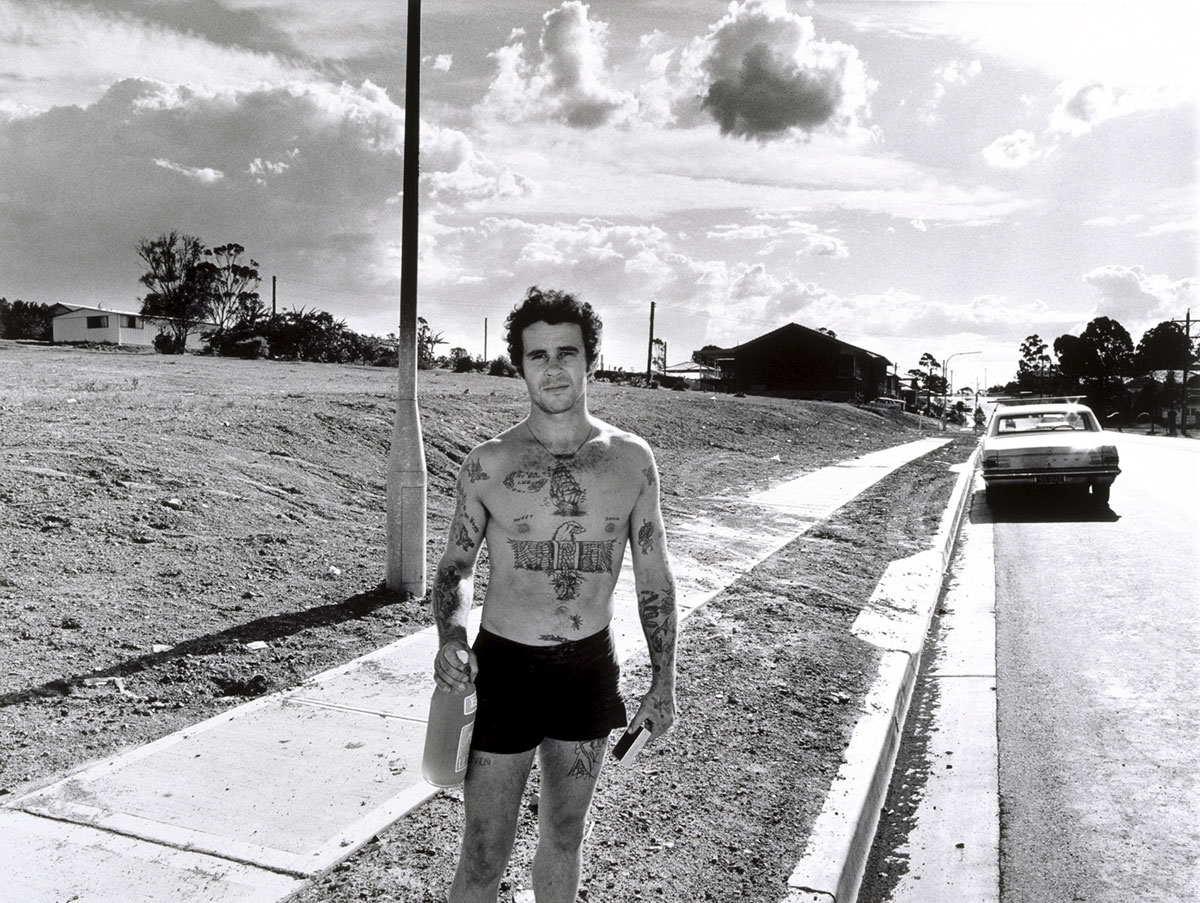
except Christmas Day and Good Friday

Art Gallery of New South Wales website

LIKE ART BLART ON FACEBOOK

Back to top

Exhibition: ‘Charles Marville: Photographer of Paris’ at The Metropolitan Museum of Art, New York / Marville research at the State Library of Victoria

Exhibition dates: 29th January – 4th May 2014


Charles Marville (French, 1813-1879) 'Top of the rue Champlain, View to the Right (Twentieth Arrondissement)' 1877-1878


Charles Marville (French, 1813-1879)
Top of the rue Champlain, View to the Right (Twentieth Arrondissement) 
1877-78
Albumen silver print from glass negative
26 x 36.6 cm (10 1/4 x 14 7/16 in.)
Musée Carnavalet, Paris
© Musée Carnavalet / Roger-Viollet


Great news from the State Library of Victoria!

Following further discussions my research can now take place. As you may recall the research question is, did the Charles Marville photographs that were exhibited at the Melbourne International Exhibition in 1880 influence the work of Melbourne photographers – Charles Nettleton, JW Lindt and Nicholas Caire.

The plan is that I research the photographs of Marville, Nettleton, Lindt and Caire online and then visit the Library to view the original prints. The Library have very helpfully sent me records of the visitors book to the 1880 exhibition and noted that Caire, Lindt and Nettleton exhibited photographs and won awards at the 1880-1881 exhibition.

Further, here are some more glorious images from the touring Charles Marville exhibition, this time at The Metropolitan Museum of Art, New York. The tonality of the prints is incredible, as is the subtle placement of the camera to obtain a unique perspective of the city. The almost modernist take on the lamppost as sculptural object, with the dead centre placement allowing the surrounding environment to flow around the verticality of the post, is breathtaking.

Marcus


Many thankx to The Metropolitan Museum of Art for allowing me to publish the photographs in the posting. Please click on the photographs for a larger version of the image.


Charles Marville (French, 1813-1879) 'Banks of the Bièvre River at the Bottom of the rue des Gobelins (Fifth Arrondissement)' c. 1862


Charles Marville (French, 1813-1879)
Banks of the Bièvre River at the Bottom of the rue des Gobelins (Fifth Arrondissement) 
c. 1862
Albumen print from collodion negative
27.5 x 36.8cm (10 13/16 x 14 1/2 in.)
Musée Carnavalet, Paris
© Musée Carnavalet / Roger-Viollet


Charles Marville (French, 1813-1879) 'Urinal, Jennings System, plateau de l'Ambigu' 1876


Charles Marville (French, 1813-1879)
Urinal, Jennings System, plateau de l’Ambigu 
1876
Albumen silver print from glass negative
26.7 × 36.4cm (10 1/2 × 14 5/16 in.)
Musée Carnavalet, Paris
© Musée Carnavalet / Roger-Viollet


Charles Marville (French, 1813-1879) 'Rue de Constantine (Fourth Arrondissement)' 1866


Charles Marville (French, 1813-1879)
Rue de Constantine (Fourth Arrondissement) 
1866
Albumen silver print from glass negative
27.3 x 36.8cm (10 3/4 x 14 1/2 in.)
The Horace W. Goldsmith Foundation Gift, through Joyce and Robert Menschel, 1986
The Metropolitan Museum of Art, New York


Charles Marville (French, 1813-1879) 'Passage Saint-Guillaume toward the rue Richilieu (First Arrondissement)' 1863-1865


Charles Marville (French, 1813-1879)
Passage Saint-Guillaume toward the rue Richilieu (First Arrondissement) 
1863-65
Albumen silver print from glass negative
31.91 x 27.62cm (12 9/16 x 10 7/8 in.)
Joy of Giving Something, Inc.


Widely acknowledged as one of the most talented photographers of the 19th century, Charles Marville (French, 1813-1879) was commissioned by the city of Paris to document both the picturesque, medieval streets of old Paris and the broad boulevards and grand public structures that Baron Georges-Eugène Haussmann built in their place for Emperor Napoleon III. Charles Marville: Photographer of Paris at The Metropolitan Museum of Art presents a selection of around 100 of his photographs.

Marville achieved moderate success as an illustrator of books and magazines early in his career. It was not until 1850 that he shifted course and took up photography – a medium that had been introduced just 11 years earlier. His poetic urban views, detailed architectural studies, and picturesque landscapes quickly garnered praise. Although he made photographs throughout France, Germany, and Italy, it was his native city – especially its monuments, churches, bridges, and gardens – that provided the artist with his greatest and most enduring source of inspiration.

By the end of the 1850s, Marville had established a reputation as an accomplished and versatile photographer. From 1862, as official photographer for the city of Paris, he documented aspects of the radical modernisation program that had been launched by Emperor Napoleon III and his chief urban planner, Baron Georges-Eugène Haussmann. In this capacity, Marville photographed the city’s oldest quarters, and especially the narrow, winding streets slated for demolition. Even as he recorded the disappearance of Old Paris, Marville turned his camera on the new city that had begun to emerge. Many of his photographs celebrate its glamour and comforts, while other views of the city’s desolate outskirts attest to the unsettling social and physical changes wrought by rapid modernisation.

Haussmann not only redrew the map of Paris, he transformed the urban experience by commissioning and installing tens of thousands of pieces of street furniture, kiosks, Morris columns for posting advertisements, pissoirs, garden gates, and, above all, some twenty thousand gas lamps. By the time he stepped down as prefect in 1870, Paris was no longer a place where residents dared to go out at night only if accompanied by armed men carrying lanterns. Taken as a whole, Marville’s photographs of Paris stand as one of the earliest and most powerful explorations of urban transformation on a grand scale.

By the time of his death, Marville had fallen into relative obscurity, with much of his work stored in municipal or state archives. This exhibition, which marks the bicentennial of Marville’s birth, explores the full trajectory of the artist’s photographic career and brings to light the extraordinary beauty and historical significance of his art.

Related Installation

Concurrent with Charles Marville: Photographer of Paris, a related installation in the adjacent Howard Gilman Gallery will be on view at the Metropolitan Museum. Paris as Muse: Photography, 1840s-1930s (January 27-May 4, 2014) celebrates the first 100 years of photography in Paris and features some 40 photographs, all drawn from the Museum’s collection. The installation focuses primarily on architectural views, street scenes, and interiors. It explores the physical shape and texture of Paris and how artists have found poetic ways to record through the camera its essential qualities.

Press release from The Metropolitan Museum of Art


This slideshow requires JavaScript.


Charles Marville (French, 1813-1879) 'Arts et Métiers (Ancien Modèle)' 1864


Charles Marville (French, 1813-1879)
Arts et Métiers (Ancien Modèle) 
1864
Albumen silver print from glass negative
36.6 x 24.1cm (14 7/16 x 9 1/2 in.)
Purchase, Alfred Stieglitz Society Gifts, 2007
The Metropolitan Museum of Art, New York


Charles Marville (French, 1813-1879) 'Hôtel de la Marine' 1864-1870


Charles Marville (French, 1813-1879)
Hôtel de la Marine 
1864-1870
Albumen silver print from glass negative
36.2 x 23.5cm (14 1/4 x 9 1/4 in.)
National Gallery of Art, Washington, Diana and Mallory Walker Fund


Charles Marville (French, 1813-1879) 'Lamppost, Entrance to the École des Beaux-Arts' c. 1870


Charles Marville (French, 1813-1879)
Lamppost, Entrance to the École des Beaux-Arts 
c. 1870
Albumen silver print from glass negative
35.6 x 25.4cm (14 x 10 in.)
Collection W. Bruce and Delaney H. Lundberg


Charles Marville (French, 1813-1879) 'Spire of Notre Dame, Viollet-le-Duc, Architect' 1859-1860


Charles Marville (French, 1813-1879)
Spire of Notre Dame, Viollet-le-Duc, Architect 
1859-1860
Albumen silver print from glass negative
49.5 x 36.5cm (19 1/2 x 14 3/8 in.)
The AIA/AAF Collection, Prints and Photographs Division, Library of Congress, Washington D.C.


Charles Marville (French, 1813-1879) 'Rue Estienne from the rue Boucher (First Arrondissement)' 1862-1865


Charles Marville (French, 1813-1879)
Rue Estienne from the rue Boucher (First Arrondissement) 
1862-1865
Albumen silver print from glass negative
34.3 x 27.1cm (13 1/2 x 10 11/16 in.)
Gilman Collection, Purchase, Mr. and Mrs. Henry R. Kravis Gift, 2005
The Metropolitan Museum of Art, New York


Charles Marville (French, 1813-1879) 'Rue de la Bûcherie from the cul de sac Saint-Ambroise (Fifth Arrondissement)' 1866-1868


Charles Marville (French, 1813-1879)
Rue de la Bûcherie from the cul de sac Saint-Ambroise (Fifth Arrondissement) 
1866-1868
Albumen silver print from glass negative
32 x 27.1cm (12 5/8 x 10 11/16 in.)
National Gallery of Art, Washington, Horace W. Goldsmith Foundation through Robert and Joyce Menschel


Charles Marville (French, 1813-1879) 'Cour Saint-Guillaume (Ninth Arrondissement)' 1866-1867


Charles Marville (French, 1813-1879)
Cour Saint-Guillaume (Ninth Arrondissement) 
1866-1867
Albumen silver print from glass negative
34.2 x 27.2cm (13 7/16 x 10 11/16 in.)
Gilman Collection, Purchase, Alfred Stieglitz Society Gifts, 2005
The Metropolitan Museum of Art, New York


Charles Marville (French, 1813-1879) 'Passage Saint-Benoît (Sixth Arrondissement)' 1864-1867


Charles Marville (French, 1813-1879)
Passage Saint-Benoît (Sixth Arrondissement) 
1864-1867
Albumen silver print from glass negative
36.5 x 27.6cm (14 3/8 x 10 7/8)
Musée Carnavalet, Paris
© Musée Carnavalet / Roger-Viollet


Charles Marville (French, 1813-1879) 'Impasse de la Bouteille from the rue Montorgeuil (Second Arrondissement)' 1865-1868


Charles Marville (French, 1813-1879)
Impasse de la Bouteille from the rue Montorgeuil (Second Arrondissement) 
1865-1868
Albumen silver print from glass negative
35.9 x 27.7cm (14 1/8 x 10 7/8 in.)
Musée Carnavalet, Paris
© Musée Carnavalet / Roger-Viollet


Charles Marville (French, 1813-1879) 'Man Reclining beneath a Chestnut Tree' c. 1853


Charles Marville (French, 1813-1879)
Man Reclining beneath a Chestnut Tree 
c. 1853
Salted paper print from paper negative
20.9 x 16.2cm (8 1/4 x 6 3/8 in.)
Harris Brisbane Dick Fund, 1946
The Metropolitan Museum of Art, New York


The Metropolitan Museum of Art
1000 Fifth Avenue at 82nd Street
New York, New York 10028-0198
Phone: 212-535-7710

Opening hours:
Sunday – Tuesday and Thursday: 10am – 5pm
Friday and Saturday: 10am – 9pm
Closed Wednesday

The Metropolitan Museum of Art website

LIKE ART BLART ON FACEBOOK

Back to top

Review: ‘The Paper’ by Rosemary Laing at Tolarno Galleries, Melbourne

Exhibition dates: 5th April 2014 – 3rd May 2014


Rosemary Laing (Australian, 1959-2024) 'The Paper, Monday' 2013


Rosemary Laing (Australian, 1959-2024)
The Paper, Monday
2013
C Type photograph
110 x 214cm
Courtesy the artist and Tolarno Galleries, Melbourne


I always look forward to new work by the incomparable Rosemary Laing with great anticipation. I have never been disappointed. This magnificent group of five images is no exception, one of the photographic highlights so far this year in Melbourne.

These large, Type-C analogue landscape format photographs feature decomposing newspapers literally (being words) carpeting the forest floor. These site-specific interventions feature no digital manipulation and, as the erudite catalogue essay by George Alexander observes below, investigate the replacement of our daily newspaper by online information bytes, “the graphic graphic newsprint breaking down like typographic stew,” the “transmigration of matter from one form to another,” “a meditation on time,” recycling, deforestation, information overload. These concepts build on earlier fragments from work by the artist (such as groundspeed2001) into something transformational, transnational and, even, otherworldly.

These entropic panoramas, which hang mysteriously between words and worlds, are indeed meditations on time and space. As Annette Hughes states,

“Laing’s pictorial space, like that of cinema, is generally art-directed, constructed, rehearsed, performed and shot in physical time and space, and though it could easily be Photoshopped these days, that’s not the point. The art object is only the end product of the making of these images. Being able to see the many human hours devoted to their execution is also a way of building duration back into the photograph.”1


Here’s my tuppence worth on Laing’s new work.

This suite of photographs has a panoramic immersiveness. The viewer feels as though time has stood still when looking at these photographs, where the newspapers are analogous to snow upon the ground, imparting something of a dream-like existence to the images. There is a talismanic quality to the images, like a standing stone circle that is believed to have magic powers and cause good things to happen. And they are full of symbols, such as arrows, to mark the way (see The Paper, Wednesday, earlier, 2013, below).

These are not unquiet images, suspended midway between fantasy and reality, but (un)quiet images – a subtle but pivotal difference. They possess the quietness of the forest but also the isolation and loneliness. They are based on a harmonic instability, like a minor chord at the beginning of a Beethoven symphony, which is then eventually resolved in the major. These images are the journey of that resolution. The words, the flesh of the textural body, has been pulped: that immersive instability of the fecund body laying down in the soil of mother earth.

The viewer is disorientated. We have no idea where we are, the paper (the word and world) creating for the body this foggy, dream-like atmosphere. As in all of Laing’s work, there is an inquiring instability here, one that seeks the resolution of stability through the love of the human body and of our existence. I stand still before them.

Dr Marcus Bunyan


1/ Hughes, Annette. “ABIGAIL SOLOMON-GODEAU Rosemary Laing,” Review on The Newtown Review of Books website 3th July 2012 [Online] Cited 27th April 2014. No longer available online


Many thankx to Tolarno Galleries for allowing me to publish the photographs in the posting. Please click on the photographs for a larger version of the image.


Rosemary Laing (Australian, 1959-2024) 'The Paper, Tuesday' 2013


Rosemary Laing (Australian, 1959-2024)
The Paper, Tuesday
2013
C Type photograph
110 x 209cm
Courtesy the artist and Tolarno Galleries, Melbourne


Rosemary Laing (Australian, 1959-2024) 'The Paper, Wednesday, earlier' 2013


Rosemary Laing (Australian, 1959-2024)
The Paper, Wednesday, earlier
2013
C Type photograph
110 x 203cm
Courtesy the artist and Tolarno Galleries, Melbourne


Rosemary Laing

The Paper

A forest is carpeted with truckloads of newspapers. A cacophony of printed voices layers the soil horizon of the ground. The former surface litter of loose and partly decayed organic matter is overlaid with pulped tree product. The 21st century cultural carpet of current events and mercenary babble is already time-lined by weathering, which is fast-tracking the decomposition of the worded pages. The graphic of newsprint is breaking down like typographic stew, falling apart like old lacework, dissolving like paint – it’s losing its imprint as fallen branches and leaves scatter over it. It seems to expect that over time it will disappear beneath what comes after, what fresh coats some future century will lay over it.

For this undertaking, Rosemary Laing located her activity among the woodlands of Bundanon, a casuarina forest peppered with eucalyptus and Burrawang. Located in the Shoalhaven of southern New South Wales, the site was originally the land of the Wodi Wodi people of the Yuin nation. Layered with subsequent occupations since the early 19th century, in 1993 the properties were gifted by Arthur and Yvonne Boyd and became the Bundanon Trust – a place for artists of all disciplines to work and a place for all people to draw inspiration.

Two unique opportunities here were made possible by the Trust to Rosemary Laing. The opportunity to develop and consider her actions unhindered by a time frame; together with access to the Bundanon collection of the influential gnarled ceramics that Arthur’s father Merric Boyd (1888-1959) made with their blue and green underglazes and swaying lines of treescapes on clay.

As it happened, while making this work, the place was inundated with floodwaters. Natural disaster has often enclosed her work, as in swanfires (2002-2004), with its incinerated sheds and buildings, following bushfires in the Sussex Inlet area – also part of the Shoalhaven. Destruction sculpts and re-sculpts the world, and Laing joins the material cycle, the perpetual transmigration of matter from one form to another. A “terrible beauty”, as a friend remarked.

This series is called The Paper, for the daily newspaper – our long time companion and a primary fix for information of the world – that is swiftly being superseded by the new material technologies of our times. If the overwhelming flood of data and culture and spin is hitting us with some 500,000 discrete bits of information at any time, then we may be faced with inabilities to absorb that Total Noise. We probably missed the 25 bits that were important. The latest innovations of the Infosphere replay confections of overstimulation and boredom, sugar-hits of overload followed by emotional numbness.

Yet the covering of the ground that we saw in 2001 with groundspeed – not far geographically from this site – isn’t the same as here in the series The Paper. The point of loungeroom carpets in groundspeed was as an index of the latecomer’s sense of belonging. A kind of comfort zone for the non-indigenous, bridging old world and new. The carpeting this time – as she writes in her notes – “seems to be composting the present as a past about to happen; taking a once-upon- a-time not-that-long-ago standard as the ground-amendment-of- tomorrow already.” It is, among other things, a meditation on time.

Every new presentation of Laing’s work is also a running commentary on her previous corpus of work. The Paper explores themes touched upon in – Natural Disasters (1988), groundspeed (2001) with its patterned loungeroom carpets out in the ‘wild’ and in 2006, weather with its cyclone of newspaper shreds – while constantly replenishing what had remained surplus to that work. And this compost of earlier fragments, that are dismembered and scattered and gathered again, expands her material formation on this site.

From top to bottom the planet is being transfigured. Something essential is changing now and forever. The “global” has become everyone’s “local”. The human race is going through things it has never experienced before – as we are forced to join the caravan of this moment in time.

Hellish or heavenly? Promised Land or Wasteland? Take your pick. You do get the sense – with the dramatic shiny green of the ancient Burrrawang palms scattered about – of human impermanence against the bedrock temporal dimensions of the primitive Gondawan rainforest margins. As anyone who has spent time slogging through genuine bushland, and sensing the century’s long pulse of trees: we’ve fallen out of tune with the eternal present of the animal world, we’ve fallen into Time with its past and future, the chopped-up time of daily newspapers.

Find tongues in trees, books in the running brooks, sermons in stones … wrote Shakespeare (As You Like It, 2.1). The quote recalls the medieval idea of the Book of Nature that we are here to read, whose infinite pages unfold enormous landscapes: some see good, some evil, some both, some neither. Laing’s art takes root in a fissure, in that crack in the covenant between word and world, and the historical moment is right: we are in the age of the “trans-book” with the rise of the Kindle and iGoogle, and with it the end of newspapers, the demise of print and the retrenchment of journalists.

So as you enter the space, walk around the room with the suite of images – named for the days of the week – there’s an entropic feel with their grubby matte and muted beauty. Underfoot, things fall apart, the riggings of the page disintegrate into tissue, print naturalises into leaf mould, and words on paper are composted back into wood pulp and waste slurry. Accordingly, to make the images this time around, she put her dalliances with digital cameras and print-output machines aside, in favour of analogue, for all the lovely limitations and imperfections of light on cellulose triacetate, and the physical shadings of Laing’s printer in the darkroom.

The curving earth is a body, and these lacework landscapes show off the marks of ageing. The woods are a damp chamber, with a thick carpet of newspapers, and many doors open to the wind and faraway light. The images enclose you in brushwork of soft jade while the soggy colours of disintegration make time tangible.

There’s nothing said about the world here (recycling, deforestation, information overload) that you couldn’t find more reliably elsewhere. It’s rather Laing’s process of invention, through the hinterlands of her material imagination, that communicates her unexpected vision, tells her story of an imagined afterwards of along-the-way. There’s a stand of trees in these pictures still growing inside the shellacking and composting of our times.

George Alexander
September 2013

Published with permission


Rosemary Laing (Australian, 1959-2024) 'The Paper, Wednesday' 2013


Rosemary Laing (Australian, 1959-2024)
The Paper, Wednesday
2013
C Type photograph
110 x 197.5cm
Courtesy the artist and Tolarno Galleries, Melbourne


Rosemary Laing (Australian, 1959-2024) 'The Paper, Thursday' 2013


Rosemary Laing (Australian, 1959-2024)
The Paper, Thursday
2013
C Type photograph
110 x 207cm
Courtesy the artist and Tolarno Galleries, Melbourne


Rosemary Laing (Australian, 1959-2024) 'The Paper, Friday' 2013


Rosemary Laing (Australian, 1959-2024)
The Paper, Friday
2013
C Type photograph
110 x 196.3cm
Courtesy the artist and Tolarno Galleries, Melbourne


Tolarno Galleries
Level 4
104 Exhibition Street
Melbourne VIC 3000
Australia
Phone: 61 3 9654 6000

Opening hours:
Tue – Fri 10am – 5pm
Sat 1pm – 4pm

Tolarno Galleries website

LIKE ART BLART ON FACEBOOK

Back to top

Text / review: ‘A Vocabulary of Printing and the Syntax of the Image’ from the exhibition ‘KHEM’ at Strange Neighbour, Fitzroy, Melbourne

Exhibition dates: 11th April – 3rd May 2014

Curator: Linsey Gosper

Artists: Jane Brown, Ponch Hawkes, Siri Hayes, Ruth Maddison, Lloyd Stubber, David Tatnall, Claudia Terstappen


Emmet Gowin printing mask for The Hint That Is a Garden: Siena, Italy 1975


Emmet Gowin printing mask for The Hint That Is a Garden: Siena, Italy 1975 (below)


A Vocabulary of Printing and the Syntax of the Image


“No matter how slow the film, Spirit always stands still long enough for the photographer It has chosen.”

“One should not only photograph things for what they are but for what else they are.”


Minor White


As an artist who originally trained in the alchemical, analogue art of photography, the magic of this process will always hold sway in my heart. No matter how many excellent digital photographs I see, there is always a longing for silver – that indescribable feeling of looking at a master printers work, an image that literally takes your breath away. I hardly ever get that in a digital print. For me, it’s the difference between the fidelity of a CD and the aura of an LP, with all its scratches and pops, hisses and, yes, atmosphere.

Minor White, that guru of enlightenment, knew how difficult it was to capture spirit in a photograph. To make a connection between photographer and object, back through a glass lens and a metal box onto a piece of plastic or glass (completing a Zen circle), then printed onto a piece of paper. There are three ways it goes: you see something (you previsualise it) and you don’t capture it in the negative; you don’t see it, and the negative surprises you; but, best of all, you see it and you capture it – the object of your attention reveals itself to you. Then all you have to do is print it – easier said than done. Much testing and assessing, dodging and burning to balance the print knowing that, as MW says, each negative is like a dragon that an image has to be wrenched from.


No longer for ears …: sound
which like a deeper ear,
hears us, who only seem
to be hearing. Reversal of spaces.


Extract from Rainer Maria Rilke Gong 1925


When you do the analogue printing yourself (or when assessing a digital test print at a lab such as CPL Digital), the most important thing is to understand the vocabulary of printing. In both analogue and digital printing it all starts from the negative/file. If you don’t understand your negative or digital file, what hope have you of attaining a good end result? You must study the negative to understand its pushes and pulls, what needs to be held back, what other areas brought forward in the image. You have to feel the balance within the negative/file in the sensibility of the print. Darren from CPL observes that he has a lot of photographers and students come in and say, “I don’t want it to be like that,” but then they can’t explain what they do want it to be like or how they can get there. They have no vocabulary of printing or how to get the “feel” that they want from the print. I believe this is where training in the analogue darkroom can stand digital photographers in good stead.

What photographers need to understand is the syntax of an image, “the system of organization used in putting lines together to form pictures that can stand as representations of particular objects,”1 where they is a clear association between the structure of photographic prints and the linguistic structure that makes verbal communication possible. Photographers are the Keepers of Light and photography broke the boundaries of the visual field that had been delimited by etchings and prints, to allow human beings to see far beyond the physical field of view, to have photographic power over space and time which fundamentally changed the scope of human consciousness.2 Photography makes drawing unnecessary in the physical sense, but through previsualisation photography is predicated on mental drawing (with light) and through the physical form of the photograph, the print, photography has a syntactical basis – which comes from the languages of the photographer inherent in human consciousness and the chemical, optical and mechanical relationships that make photography possible. Both feeling and technology.

I believe that these two things go hand in hand and when photographers have no language, no vocabulary to describe what they want from a photographic print, then they are basically coming up against the limitations of their feelings, technologies and the machine. “Genius is constantly frustrated – and tempered – by the machine.”3 As William Crawford observes, “You simply cannot look at photographs as if they were ends without means. Each is the culmination of a process in which the photographer makes his decisions and discoveries within a technological framework.”4 “Each step in the photographic process plays a syntactical role to the degree that it affects the way the information, the sentiment, the surprises, and the frozen moments found in photographs actually meet the eye.”5 In the case of the photographic print, this means understanding the emotional linguistic vocabulary of printing through the syntax of the image.


With these thoughts in mind, the two standouts in this delightful group exhibition are Claudia Terstappen and Ponch Hawkes. Terstappen’s Brazilian rainforest photographs are as well seen and exquisitely printed as ever but this time they are slightly let down by the nearness of the frame and the colour of the moulding, both of which seen to limit the breathe of the image. Hawkes’ photographs are sublime (especially the two reproduced below), the best silver gelatin photographs that I have seen by an Australian artist in since Terstappen’s last solo exhibition In the Shadow of Change at Monash Gallery of Art. They have wonderful tonality and presence, and a quietness that really lets you contemplate the image through the beauty of the print – and a snip at only $800 each framed!

Other artists in the exhibition have singular images that are interesting (pictured below), but the major disappointment are the prints of Jane Brown. When I first saw the images of Brown’s Australian Gothic at Edmund Pearce Gallery in 2012 I said that they were, “small, darkly hewn, traditionally printed silver gelatin photographs… surrealist tinged, film noir-ish mise-en-scènes, the ones that emphasise the metaphorical darkness of the elements gathered upon the stage. Photographs such as Big TroutThe Female Factory, Adelong, New South Wales and Captain’s Flat Hotel, New South Wales really invoke a feeling of unhomely (or unheimlich), where nature is out of kilter. These images unsettle our idea of Oztraliana, our perceived sense of Self and our place in the world. They disrupt normal transmission; they transmutate the seen environment, transforming appearance, nature and form.”6 This was again the feeling that I got when I saw the series at a later exhibition at the Centre for Contemporary Photography.

Not this time. The prints shown here are much darker and have become almost ungrammatical; where the syntax of the image has broken down so that the linguistic structure of the image makes communication nearly impossible. It is not enough just to make prints darker and darker, hoping for some mystery to magically appear in the image because it won’t. This is a case of overprinting the negative, forcing the vocabulary of the image through a wish to impart something emphatic, some condition of being from the negative that has been imperfectly understood. Is this because this is Edition 2 out of 7, a different printer and a different size? I don’t know the answer to those questions, but Brown really needs to go back to the negatives and reassess the results, especially as these nearly incomprehensible prints are selling for an overinflated $2,000 each framed.

Dr Marcus Bunyan


Footnotes

1/ Crawford, William. “Photographic Syntax,” in Crawford, William. The Keepers of Light: A History and Working Guide to Early Photographic Processes. Morgan and Morgan, 1979, p. 2

2/ Ibid., p. 5

3/ Ibid., p. 6

4/ Ibid., p. 6

5/ Ibid., p. 7

6/ Bunyan, Marcus. Review: Jane Brown / Australian Gothic at Edmund Pearce Gallery, Melbourne, 6th May 2012 [Online] Cited 21st April 2014


Many thankx to Strange Neighbour for allowing me to publish the photographs in the posting. Please click on the photographs for a larger version of the image.


Emmet Gowin (American, b. 1941) 'The Hint That Is a Garden: Siena, Italy' Dedicated to Frederick Sommer, 1975


Emmet Gowin (American, b. 1941)
The Hint That Is a Garden: Siena, Italy
Dedicated to Frederick Sommer, 1975
Gelatin silver print
19.5 x 24.5cm (7 11/16 x 9 5/8 in.)
Gift of Mrs Saul Reinfeld


William Crawford. "Photographic Syntax," in William Crawford. The Keepers of Light: A History and Working Guide to Early Photographic Processes. Morgan and Morgan, 1979, p. 6.


William Crawford. “Photographic Syntax,” in William Crawford. The Keepers of Light: A History and Working Guide to Early Photographic Processes. Morgan and Morgan, 1979, p. 6.


Claudia Terstappen (Australian born Germany, b. 1959) 'Jungle I (Brazil)' 1991


Claudia Terstappen (Australian born Germany, b. 1959)
Jungle I (Brazil)
1991
From the series Ghosts at the Jucurucu
Silver gelatin print
46 x 68cm


Lloyd Stubber (Australian) 'Untitled' 2012


Lloyd Stubber (Australian)
Untitled
2012
Fibre-based silver gelatin print
11 x 14 inches


David Tatnall (Australian, b. 1955) 'Clifton Springs Jetty' 2012


David Tatnall (Australian, b. 1955)
Clifton Springs Jetty
2012
From the series Coastal Pinholes
Silver gelatin contact print
20 x 25cm


Ruth Maddison (Australian, b. 1945) 'Bellambi, NSW' 1989


Ruth Maddison (Australian, b. 1945)
Bellambi, NSW
1989
Hand coloured gelatin silver print
19.6 x 49cm
Vintage print, unique state


Ruth Maddison (Australian, b. 1945) 'Self-portrait #2' 2004


Ruth Maddison (Australian, b. 1945)
Self-portrait #2
2004
From the series Light touches
Sun print on black and white photographic paper
Vintage print, unique state


“The process of analogue photography is created through darkness and light. To celebrate the launch of the Strange Neighbour Darkroom this exhibition brings together a group of artists who pursue and extend the practice of analogue and darkroom photography. These artists work across many of the countless possibilities of the medium: 35mm, medium format and large format photography, and their diverse processes include pinhole photography, photograms, sun prints, fibre printing and hand colouring. Contemporary photographers are driving the current resurgence in analogue photography and Strange Neighbour is excited to be able to facilitate this irreplaceable art form. Darkroom practice is unique and magickal, alive and well.”

Press release from the Strange Neighbour website


Khem; a possible derivative of the word alchemy, the native name of Egypt, is thought to mean black. Some scholars maintain that Khem is derived from a root meaning wise.1

Alchemy is described as chemistry endowed with magic, and alchemists as those who work with metals and keep these operations secret.2 Apart from the obvious associations of working with metals (silver) and chemistry, there are more subtle and intimate parallels between the art and science of alchemy and darkroom practice.

It is common among darkroom practitioners to consider the process as ‘magic’. When most people encounter printing their first photograph in the darkroom, the simple sight of an image appearing on the paper in the developer tray seems ‘magical’. Even experienced darkroom practitioners never lose this special feeling. Exhibiting artist, Siri Hayes notes, “Watching images come up in developing tray is as mysterious and exciting as any magic show. Perhaps more so as there are no tricks except that the photographic product is the grandest of illusions.”

Distinct from many other forms of photography, darkroom based practice is now specialised, with few people having access to the knowledge, equipment and skills associated with the medium. Like a secret esoteric order, few share this wisdom, and even those willing to teach it may keep special recipes, techniques and discoveries to themselves or within a select dedicated group. Some of this information, although scientific, is not completely understood in rational terms of facts or calculations, but is more related to intuition and perception. It is technical and it is intuitive.

The complex rituals associated with the process allow practitioners to get into a headspace that is conducive to contemplation, bringing forth intuition, allowing space for chance and universal cause and effect. In this art and science there are so many variables with endless possibilities. Ruth Maddison‘s Sun prints are made without camera, film, enlarger or developer. She states, “the tonal range depends on variables like paper stock, length of time in sun or shade, whether the objects are wet or dry … and an unpredictable magic that happens when light sensitive paper is touched by light.”

In this unpredictable environment often mistakes lead to new ideas and create new methodologies. One of the charms of analogue processes is the discovery of beauty through error. Ponch Hawkes recalls this as disasters and wonderful happenstance. Claudia Terstappen remarks it is the number of variables in the darkroom that leaves the creative process wide open and it is often these inaccuracies caused by chemical reactions that lead to a new meaning. This is what makes analogue processes so valuable and irreplaceable. There are many effects in the analogue process that one can recreate with digital technologies, but not invent.

Imperfections caused by these variables or ‘mistakes’ may imbue the image with a ‘spirit’ and otherworldliness, as if the energy of a place or person has been captured. Black and white photography too has the ability to transcend time, memory and death. Jane Brown says, “I examine this a lot in my work – landscapes seem to have vestiges or traces of past life and memorials become otherworldly.” Claudia Terstappen’s work, “is motivated by the stories, beliefs and histories of the people who live there. Here people spoke about the forest spirits that one should be aware of. B+W images suggest a kind of silence.” At a symbolic level, silence is part of most sacred traditions3, and it is part of darkroom practice.

Using analogue processes and working in the darkroom can be aligned to the slow movement, of valuing quality over quantity and returning to a feeling of connectedness. For the images in this exhibition David Tatnall has used an 8 x 10 inch pinhole camera and made contact prints. He expresses of this technology, “my reasons for using this slow, cumbersome and fickle means to make photographs is because I feel it conveys the interaction of the sky and water, the presence of wind and the pulse of nature. I am particularly interested in how the long exposures and lack of sharpness make these features merge into something else… (The) simplicity: no lens, shutter or batteries, no need to upgrade, no click or buzz, no flashing lights or mega pixels no viewfinder and no distortion.” For Ruth Maddision, “she says of working with hand colouring, the pleasure of it – I love working on the real object again, and away from the screen.”

Clearly there is belief and an element of trust in the medium. Lloyd Stubber‘s images in this exhibition are taken from a one-month round the world trip. On return he processed the 15 rolls of film in his laundry. Perhaps the potential fear of loss is overwhelmed by the sense of anticipation, surprise and the flood of memories that return on seeing the work at a later date, as compared to digital, which is immediate and holds none of the mystery.

Another important distinction of darkroom and analogue practice from other forms of photography is the presence of artist’s hand throughout the entire progression of creation to final outcome. In each step of the process, significant choices are made from the many possibilities, from exposing light sensitive film in the camera, developing the film, to printing and finishing the art object. The artist’s mark is therefore not only discernible but also inherently valuable. To Ponch Hawkes, being the maker is of significance. For Terstappen, The physicality of arriving at the ‘perfect’ Gelatin Silver print – with its deep tonal ranges – is something that I highly value.

Contemporary artists are driving the current resurgence in analogue photography. This is a treasured, magickal4 and irreplaceable art form. It is with great pleasure that I declare the Strange Neighbour Darkroom open, and may it provide the space and opportunity for the love of darkroom practice to be enjoyed, shared and fostered.”

Linsey Gosper, curator, darkroom lover, 2014

1/ Francis Melville. The Book of Alchemy. Quarto Publishing plc, 2002, p. 6
2/ Kurt Seligman. Magic, Supernaturalism and Religion. Pantheon Books, 1948, p. 84
3/ Ami Ronnberg (ed.,). The Book of Symbols. Taschen, 2010, p. 676
4/ Magick, in the context of Aleister Crowley’s Thelema, is a term used to differentiate the occult from stage magic and is defined as the Science and Art of causing Change to occur in conformity with Will, including both mundane acts of will as well as ritual magic


Jane Brown (Australian, b. 1967) 'Decommissioned Art History Library, University of Melbourne' 2012-2013


Jane Brown (Australian, b. 1967)
Decommissioned Art History Library, University of Melbourne
2012-2013
Fibre-based gelatin silver print
44 x 49.5cm
Edition 2 of 7


Jane Brown (Australian, b. 1967) 'Lathamstowe' 2011- 2013


Jane Brown (Australian, b. 1967)
Lathamstowe
2011- 2013
Fibre-based, gelatin silver print
46 x 44cm
Edition 2 of 7


Ponch Hawkes (Australian, b. 1946) 'Silken Seam' 2005


Ponch Hawkes (Australian, b. 1946)
Silken Seam
2005
Silver gelatin print
34 x 34cm
Courtesy of the artist and Chrysalis Gallery, Melbourne


Ponch Hawkes (Australian, b. 1946) 'Rouleau' 2005


Ponch Hawkes (Australian, b. 1946)
Rouleau
2005
Silver gelatin print
34 x 34cm
Courtesy of the artist and Chrysalis, Melbourne


Siri Hayes (Australian, b. 1977) 'Aquatic listening device' 2009


Siri Hayes (Australian, b. 1977)
Aquatic listening device
2009
Silver gelatin print
39 x 45cm
Courtesy of the artist and M.33, Melbourne


Strange Neighbour

This gallery has now closed

LIKE ART BLART ON FACEBOOK

Back to top

Review: ‘Stephen Dupont / The White Sheet Series No. 1’ at Edmund Pearce Gallery, Melbourne

Exhibition dates: 2nd April – 3rd May 2014


Stephen Dupont (Australian, b. 1967) 'Untitled #16' 2010


Stephen Dupont (Australian, b. 1967)
Untitled #16
2010
Silver gelatin print and ink
20 x 16″ (51 x 40.5cm) / edition of 5 + 2 AP’s


This is a wonderful exhibition by Stephen Dupont at Edmund Pearce Gallery. Using a 4″ x 5″ Polaroid type 55 and striping away the emulsion, Dupont is left with a fine grain large format black and white negative (which he can use in an enlarger) with the “Polaroid frame look”, which he incorporates into the silver gelatin prints.1

Most of the photographs are glorious, notably the ones where Dupont pulls back from his subject to reveal the context of the sitter (much like taking the mat of a Daguerreotype to reveal more of the studio hidden underneath). I particularly like where you can see two hands poking over the top of the white sheet hiding the person behind (see Untitled #08 2010, below). The spontaneity and improvisation of this act is very appealing. As Dupont observes this allows him “to reveal the audience gathering and the environment around the sheet. This is meant to give the viewer a real sense of place and time, and a window onto the streets of Haridwar.” This technique gives the images real presence, they fairly “sing” to me from the gallery wall. And then! to surround the silver with hand printed Indian textile stamps in red ink… these images are really something.

Dupont’s incisiveness at the coal face of the pictorial plane is also exemplary. Notice the construction of Untitled #14 (2010, below), and observe the arms of the protagonists. An arm is raised aloft mirroring the arm of the swami in the photograph behind and also the supporting pole of the tent at top right. His other arm points to the earth but this is crossed by the arm of an out of focus man at left, which forms a strong diagonal intervention into the image as he reaches out. The money and mobile phone, at bottom left, add to the incongruity of the scene.

I am less enamoured with Dupont’s riff on Richard Avedon’s contextless background portraits. They don’t really possess the power or presence of the photographs mentioned above or of Avedon’s portraits from the series In The American West. I would have also liked to have seen the field journal (the small images at the bottom of the posting) in the exhibition. It would have been fascinating to read the text and view the other textile stamp designs. Finally, a couple of prints at a much larger size would have been good to see, to break the regularity of the series.

Having said that, you really have to see these images in the flesh for they look so much better than when reproduced online. The red is luminous and it is a joy to see good silver gelatin prints instead of so-so digital failures (Polly Borland I hope your ears are burning). This exhibition is a perfect example of what Bill Henson was talking about in his recently curated exhibition Wildcards: Bill Henson shuffles the deck at Monash Gallery of Art (MGA) where he states that his interest “is in the photograph as an object, in the physical presence of the print or whatever kind of technology is being used to make it…”2 where the images appeal not just to the eye but to the whole body, “because photographs are first and foremost objects, their size, shape grouping and texture are as important as the images they’re recording.”3

These photographs have, as Henson notes of some photographs, “the ability to suggest some other thing and that’s what draws you in.”4 You stand in front of the best of these images and contemplate them with a sense of wonder, for they suggest to the viewer – through the hand and eye of the artist in the analogue process, through the hand of the artist when applying the wood block printing which was made with much spontaneity and feeling – other worlds of which we know very little brought close to our imagination. Through their inherent textures and tonalities, their physical presence, there is a sense of the people who populate that place, but more than that, there is a sense of our own fragility and mortality.

A feeling of anOther existence for our life if we had been born into such worlds.
And that is what makes these images so compelling.

Dr Marcus Bunyan


Footnotes

1/ According to Wikipedia, “Type 55 negatives are the famous source of the “Polaroid frame look” … the Polaroid reagent / gel is squeezed between the negative and positive. Some of the reagent is trapped underneath the onion-skin-like frame that crops the print into a perfect 4 x 5 image. This reagent however creates an impression of that frame on the negative, which is not protected. The result is a perfect negative, but with imperfect frame-like image surrounded 3 of the four sides, while the 4th side shows the impression of the connective mesh that controls aspects of the Polaroid packet’s sleeve functionality.”

2/ Interview with Bill Henson by Toby Fehily posted 01 Feb 2014 on the Art Guide Australia website [Online] Cited 18/02/2014. No longer available online

3/ Fiona Gruber. “Review of Wildcards, Bill Henson Shuffles the Deck” on the Guardian website, Wednesday 12 February 2014 [Online] Cited 16/03/2014

4/ Fehily op. cit.,


Many thankx to Edmund Pearce Gallery for allowing me to publish the photographs in the posting. Please click on the photographs for a larger version of the image.


Stephen Dupont (Australian, b. 1967) 'Untitled #08' 2010


Stephen Dupont (Australian, b. 1967)
Untitled #08
2010
Silver gelatin print and ink
20 x 16″ (51 x 40.5cm) / edition of 5 + 2 AP’s


Stephen Dupont (Australian, b. 1967) 'Untitled #14' 2010


Stephen Dupont (Australian, b. 1967)
Untitled #14
2010
Silver gelatin print and ink
20 x 16″ (51 x 40.5cm) / edition of 5 + 2 AP’s


Stephen Dupont (Australian, b. 1967) 'Untitled #04' 2010


Stephen Dupont (Australian, b. 1967)
Untitled #04
2010
Silver gelatin print and ink
20 x 16″ (51 x 40.5cm) / edition of 5 + 2 AP’s


Edmund Pearce is excited to present a solo exhibition by legendary Australian photographer Stephen Dupont, entitled The White Sheet Series Number 1. This new series was shot during India’s most important Hindu Festival, Kumbh Mela, and features portraits of pilgrims and visitors combined with hand printed Indian textile stamps.

Stephen Dupont has produced a remarkable body of visual work throughout his career; hauntingly beautiful photographs of fragile cultures and marginalised peoples. He captures the human dignity of his subjects with great intimacy and his images have received international acclaim for their artistic integrity and valuable insight into the people, culture and communities that have existed for hundreds of years, yet are fast disappearing from our world.

Mark Feeney of the Boston Globe states, “Inevitably, Dupont is an outsider; yet he’s an engaged outsider, full of calm, clear-eyed curiosity. There’s not just a sense of place in his work but also something that matters even more: a sense of the people who populate that place.”

Stephen’s work has earned him a number of photography’s most prestigious prizes, including a Robert Capa Gold Medal citation from the Overseas Press Club of America. His work has featured in influential publications such as The New Yorker, Aperture and The New York Times Magazine; and he has had major exhibitions in London, Paris, New York, Sydney, Canberra, Tokyo, and Shanghai. His photographic artist books and portfolios are held in numerous private collections and by prestigious institutions such as the National Gallery of Australia, the National Library of Australia, the British Library and the Library of Congress in Washington DC to name but a few.

Press release from the Edmund Pearce Gallery website


Stephen Dupont (Australian, b. 1967) 'Untitled #07' 2010


Stephen Dupont (Australian, b. 1967)
Untitled #07
2010
Silver gelatin print and ink
20 x 16″ (51 x 40.5cm) / edition of 5 + 2 AP’s


Stephen Dupont (Australian, b. 1967) 'Untitled #13' 2010


Stephen Dupont (Australian, b. 1967)
Untitled #13
2010
Silver gelatin print and ink
20 x 16″ (51 x 40.5cm) / edition of 5 + 2 AP’s


Stephen Dupont (Australian, b. 1967) 'Untitled #12' 2010


Stephen Dupont (Australian, b. 1967)
Untitled #12
2010
Silver gelatin print and ink
20 x 16″ (51 x 40.5cm) / edition of 5 + 2 AP’s


Stephen Dupont (Australian, b. 1967) 'Untitled #18' 2010


Stephen Dupont (Australian, b. 1967)
Untitled #18
2010
Silver gelatin print and ink
20 x 16” (51 x 40.5cm) / edition of 5 + 2 AP’s


Richard Avedon at work


Richard Avedon at work


Richard Avedon (American, 1923-2004) 'Bill Curry, drifter, Interstate 40, Yukon, Oklahoma, 6/16/80' 1980


Richard Avedon (American, 1923-2004)
Bill Curry, drifter, Interstate 40, Yukon, Oklahoma, 6/16/80
1980
from In the American West, 1979-1984


Stephen Dupont artist book


This body of work is a selection of portraits I made in 2010 at India’s most important Hindu festival called the Kumbh Mela. In one of four locations every four years Hindu pilgrims and visitors descend into the holy waters of the Ganges River to purify the soul in a spiritual ritual considered the largest peaceful gathering in the world. The photographs were taken in Haridwar of pilgrims and sadhus I chose randomly during that festival.

Inspired by an earlier series I made of anonymous portraits of Afghans in Kabul titled Axe Me Biggie, or Mr Take My Picture, but instead of an existing Afghan outdoor studio backdrop I chose the white sheet this time for its purity and simplicity. My subjects were asked to simply stand and pose before my camera. I use a white bed sheet to create an outdoor studio that not only captures my subject but also allows me to reveal the audience gathering and the environment around the sheet. This is meant to give the viewer a real sense of place and time, and a window onto the streets of Haridwar. Had I used the backdrop in a conventional way, to solely isolate a person, you’d have the impression that they were taken anywhere – New York, Sydney, or in a studio. This process is a creative choice and allows me with some control over my sitter but brings with it the spontaneity and surprise of what may take place around the zone I am working in: the gaze of someone holding the sheet that has no idea they are in the frame, or a hand holding the sheet or something else that crops up in front or behind. In the end my portraits are environmental or even landscapes.

Over many years of travel throughout India I have been collecting textile stamps and I decided to use them on my photographs. The research and experiments started in my field journal and then to the final hand printed images in this show. I wanted to create a relationship with Indian design and cloth, the Polaroid borders and the people in my pictures. Much like my photographic practice here the wood block printing was made with much spontaneity and feeling. The photographs have been handcrafted by Chris Reid at Blanco Negro using warmtone paper and processed in a specialised developer for unique tonality.

Stephen Dupont
Sydney, February 28, 2014


Edmund Pearce Gallery

This gallery has now closed.

LIKE ART BLART ON FACEBOOK

Back to top