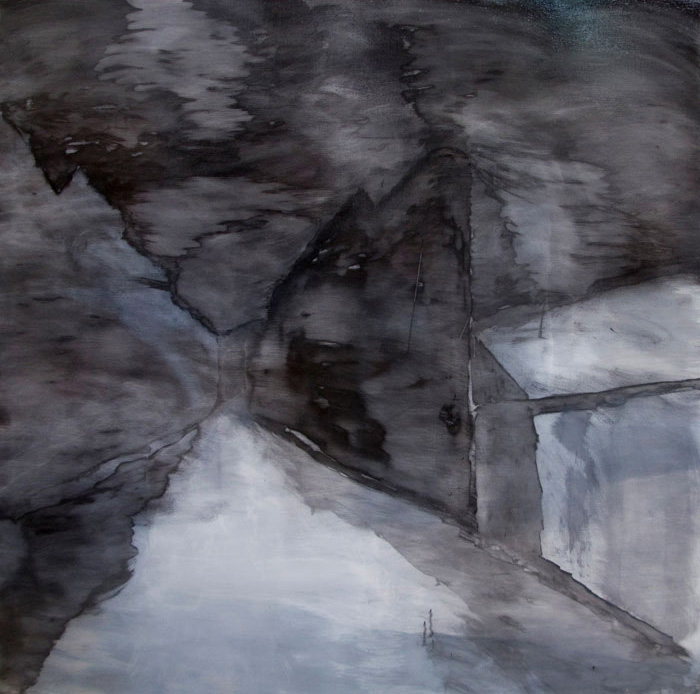
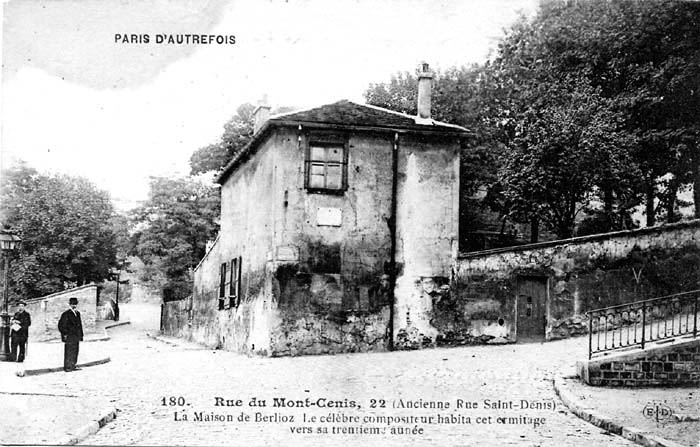
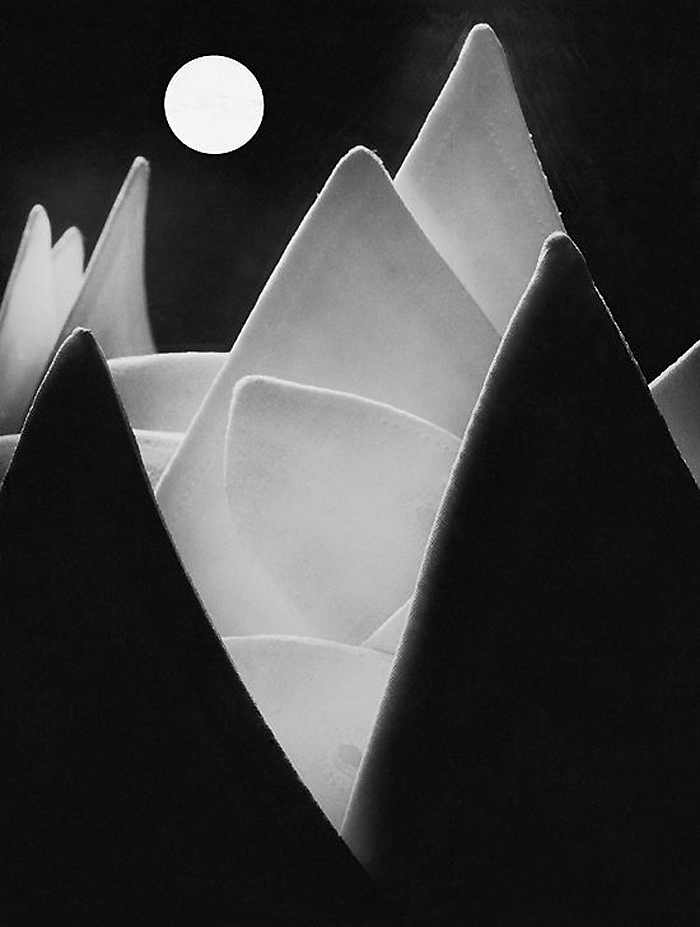
Photograph: The Passing of Memory: resurrecting a photograph for the series ‘The Shape of Dreams’

March 2009


Marcus Bunyan (Australian born England, b. 1958) 'Oakland, 7-'51' from the series 'The Shape of Dreams' 2009


Marcus Bunyan (Australian born England, b. 1958)
Oakland, 7-’51 from the series The Shape of Dreams (restored)
2009


“Fragments of harmonic lines assemble and collapse as the meaning of each interval must be continually revised in light of the unfolding precession of further terms in an ultimately unsustainable syntax. The mind’s ear tries to remember the sum of passing intervals, but without the ability to incorporate them into larger identifiable units each note inevitably lapses back into silence, surrendered to the presence of the currently sounding tone, itself soon to give way to another newly isolated note in its turn.”


Craig Dworkin1


The Passing of Memory

Thinking about this photograph

I bought an album on Ebay that contained an anonymous aviator with snapshots of his life: photographs of him in Oakland, California, Cologne in Germany and flying out of Italy – photos of his buddies and the work they did, the places they visited, the fun they had.

This one photograph has haunted me more than the rest.

Who was he? What was his life like? Do he get married and have children? Is he still alive?

When scanned the image was so dirty, so degraded, that I spent 7 weeks of my life cleaning and restoring the photograph working all hours of the day and night. I was obsessive almost to the point of obstinacy. Many times I nearly gave up as I thought the task impossible – thousands of dots and hairs inhabited the surface of the image and, surely, it was just another photograph one of millions that circle the world. Why expend so much energy just to resurrect this one particular image?

Some things that can be said about this photograph

It is small measuring only 9cm high by 7.5 cm wide

It is printed on cheap glossy photographic paper which now has a slight yellow tinge to it.

The image is creased at top left.

The back is annotated ‘Oakland, 7-’51’

The dark roundel with the wing on the side of the aircraft has faint text that spells out the words ‘AERO ACE’.

There is no engine in the aircraft and it looks from the parts lying on the ground that the aircraft is being broken up or used for spares.

The man is wearing work overalls with unidentifiable insignia on them, a worker on the aircraft being dismantled or just a fitter on the base.

Someone standing on the ground has obviously called out the man’s name and he has turned around in response to the call and lent forward and put out his hand in greeting – a beautiful spontaneous response – and the photograph has been taken.

Some other things that can be said about this photograph, in passing

The sun splashes the man’s face. He smiles at the camera.

His arm rests gently on the metal of the aircraft, shielded from the sun.

Perhaps he wears a ring on his fifth finger.

He is blind.

This photograph is an individual, isolated note in the fabric of time. It could easily pass into silence as memory and image fade from view. Memories of the individual form the basis for remembering and photographs act as an aide-memoire both for individual memory and the collective memory that flows from individual memory. Memory is always and only partial and fragmentary – who is remembering, what are they remembering, when do they remember, what prompts them to remember and how these memories are incorporated into the collective memory, an always mediated phenomenon that manifests itself in the actions and statements of individuals, are important questions.

Images are able to trigger memories and emotional responses to a particular time and place, but since this photograph has no personal significance what is going on here? Why did I cry when I was restoring it? What emotional association was happening inside me?

“To remember is always to give a reading of the past, a reading which requires linguistic skills derived from the traditions of explanation and story-telling within a culture and which [presents] issues in a narrative that owes its meaning ultimately to the interpretative practices of a community of speakers. This is true even when what is remembered is one’s own past experience… [The] mental image of the past … becomes a phenomenon of consciousness only when clothed with words, and these owe their meaning to social practices of communication.”2


His blindness stares at us while underneath his body walks away into his passing.

I have become the speaker for this man, for this image.

His brilliant face is our brilliant face.

In this speaking, the phenomenon of making the image conscious, the gap between image and presence, between the photo and its shadow has collapsed. There is no past and present but a collective resonance that has presence in images.

“Such reasoning questions the separation of past and present in a fundamental way. As a consequence it becomes fruitless to discuss whether or not a particular event or process remembered corresponds to the actual past: all that matters are the specific conditions under which such memory is constructed as well as the personal and social implications of memories held.”3

‘The personal and social implications of memories held’. Or not held, if images are lost in passing.

It is such a joyous image, the uplifted hand almost in supplication. I feel strong connection to this man. I bring his presence into consciousness in my life, and by my thinking into the collective memory. Perhaps the emotional response is that as I get older photographs of youth remind me of the passing of time more strongly. Perhaps the image reminds me of the smiling father I never had. These are not projections of my own feelings but resonances held in the collective memory.

As Susan Sontag has observed,

“Remembering is an ethical act, has ethical value in and of itself. Memory is, achingly, the only relation we can have with the dead. So the belief that remembering is an ethical act is deep in our natures as humans, who know we are going to die, and who mourn those who in the normal course of things die before us – grandparents, parents, teachers and older friends.”4


Remembering is an ethical act.Ā It is also a voluntary act. We can choose not to remember. We can choose to forget.Ā In this photograph I choose to remember, to not let pass into the dark night of the soul.Ā My mind, eyes and heart are open.

This is not a simulacra of an original image but an adaptation, an adaptation that tries to find resonances between past and present, between image and shadow. As such this photograph is no longer an isolated tone that inevitably lapses back into silence but part of a bracketing of time that is convulsingly beautiful in it’s illumination, it’s presence. The individual as collective, collected memory present for all to see.

The form of formlessness, the shape of dreams.

Dr Marcus Bunyan


1/ Dworkin, Craig. “Grammar Degree Zero (Introduction to Re-Writing Freud)” (2005) [Online] Cited 23rd March, 2009 (no longer available online)

2/ Holtorf, Cornelius. “Social Memory,” part of a doctoral thesisĀ Monumental Past:Ā The Life-histories of Megalithic Monuments in Mecklenburg-Vorpommern (Germany) submitted 1998Ā [Online] Cited 23/03/2009

3/ Ibid.,

4/ Sontag, Susan. Regarding the Pain of Others. London: Hamish Hamilton, 2003, p. 103


    Marcus Bunyan (Australian born England, b. 1958) 'Oakland, 7-'51' from the series 'The Shape of Dreams' 2009 (detail before cleaning)

    Before


    Marcus Bunyan (Australian born England, b. 1958) 'Oakland, 7-'51' from the series 'The Shape of Dreams' 2009 (detail after cleaning)

    After


    Marcus Bunyan (Australian born England, b. 1958) 'Oakland, 7-'51' from the series 'The Shape of Dreams' 2009 (detail before cleaning)

    Before


    Marcus Bunyan (Australian born England, b. 1958) 'Oakland, 7-'51' from the series 'The Shape of Dreams' 2009 (detail after cleaning)

    After


    Marcus Bunyan (Australian born England, b. 1958) 'Oakland, 7-'51' from the series 'The Shape of Dreams' 2009 (detail before cleaning)

    Before


    Marcus Bunyan (Australian born England, b. 1958) 'Oakland, 7-'51' from the series 'The Shape of Dreams' 2009 (detail after cleaning)

    After


    Marcus Bunyan (Australian born England, b. 1958) 'Oakland, 7-'51' from the series 'The Shape of Dreams' 2009 (detail before cleaning)

    Before


    Marcus Bunyan (Australian born England, b. 1958) 'Oakland, 7-'51' from the series 'The Shape of Dreams' 2009 (detail after cleaning)

    After


    Marcus Bunyan (Australian born England, b. 1958) 'Oakland, 7-'51' from the series 'The Shape of Dreams' 2009 (detail before cleaning)

    Before


    Marcus Bunyan. 'Oakland, 7-'51' from the series 'The Shape of Dreams' 2009

    After


    LIKE ART BLART ON FACEBOOK

    Back to top

    Exhibition: ‘Overpainted Photographs’ by Gerhard Richter at Centre de la Photographie, Geneva

    Exhibition dates: 20th February – 12th April, 2009


    Gerhard Richter (German, b. 1932) '9.4.89' from the exhibition 'Overpainted Photographs' by Gerhard Richter at Centre de la Photographie, Geneva, Feb - April, 2009


    Gerhard Richter (German, b. 1932)
    9.4.89
    10.1 x 14.8cm
    Oil on colour photograph


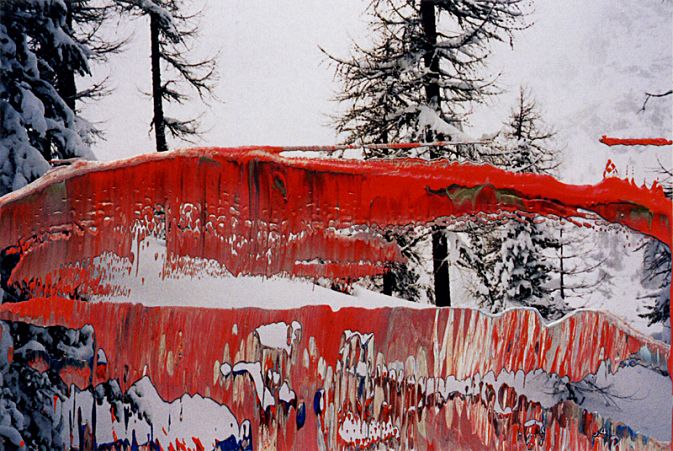
    There is something unsettling in Richter’s serendipitious interventions. Using his own prosaic 10 x 15cm colour photographs that have been commercially printed as the basis of the works, Richter overlays the surface of the photograph with skeins of paint that disturb the reflexivity of each medium. Dragging the photograph through the paint or using a palette knife to apply layers of colour, the surfaces of paint and photograph no longer exist as separate entities. The process produces punctum like clefts rent in the fabric of time and space. If the intervention is judged unsuccessful the result if immediately destroyed.

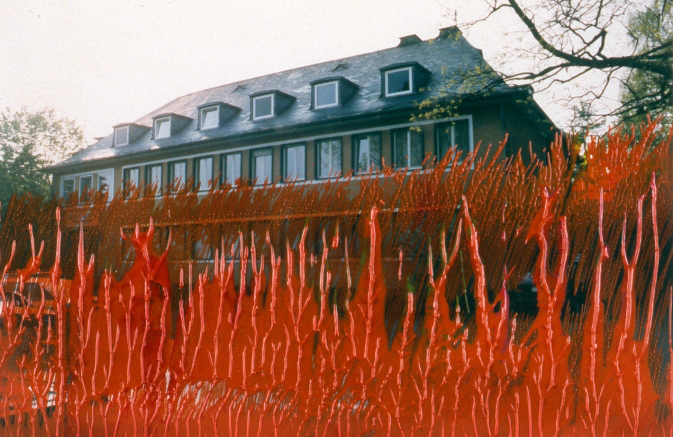
    In 5.Juli.1994 (below) blood red fingers of paint strain upwards as they invade the solidity of a dour suburban home, echoing the invading trees branches at top right of picture. In 11.2.98 (below) green paint slashes across the mouth and forehead of a woman in a floral dress, her eyes seemingly bloodshot and pleading stare into the distance to the left of our view, the silent scream strangled in her throat by the vibrations of paint. These are the instantaneous responses of the artist to the photograph, a single mood expounded in irreversible gestures, the actions of the painter’s hand disturbing the indexical link of the photograph and it’s ability to be ‘read’ as a referent of the object it depicts. Richter’s interventions challenge the concept of momentary awareness and offer the possibility of a space between, where the image stands for something else – access to Other, even a contemplation of the sublime.

    “The colour of paint applied corresponds or contrasts the tonalities of the underlying photograph but link the two through formal relationships of the layers … Often a tense relationship, the results run the gamut of the surreal to the beautiful to the disturbed. It is all the more surprising that each in its perceived completeness was in essence accomplished by chance and trial and error.”1

    “Richter’s painterly gestures bounce off the [photographs] content in peculiar ways, sometimes interacting with it, sometimes overlaying it and sometimes threatening to eclipse it altogether. The final effect is to cause both photography and painting to seem like incredibly bizarre activities, disparate in texture but often complicit in aspiration.”2

    I love the violence, the sometimes subversive, sometimes transcendental ‘equivalence’ of these images: where a Steiglitz cloud can stand for music, where a Minor White infrared photograph posits a new reality, Richter offers us an immediacy that destroys the self-reflexive nature of everyday life. His spontaneous musings, his amorphous worlds, his bleeds and blends crack open the skin of our existential life on earth. Here, certainly, are ‘the clefts in words, the words as flesh’.

    Dr Marcus Bunyan


    1/ “Gerhard Richter: Overpainted Photographs,” on the 5B4 blog, February 9, 2009 [Online] Cited 13/06/2022

    2/ Hatje Cantz. “Gerhard Richter: Overpainted Photographs,” on the Artbook website Nd [Online] Cited 13/06/2022


      Gerhard Richter (German, b. 1932) '11.4.89' from the exhibition 'Overpainted Photographs' by Gerhard Richter at Centre de la Photographie, Geneva, Feb - April, 2009


      Gerhard Richter (German, b. 1932)
      11.4.89
      10 x 15cm
      Oil on colour photograph


      Gerhard Richter (German, b. 1932) '11.3.89'


      Gerhard Richter (German, b. 1932)
      11.3.89
      10 x 14.9cm
      Oil on colour photograph


      Gerhard Richter (German, b. 1932) '5.Juli.1994'


      Gerhard Richter (German, b. 1932)
      5.Juli.1994
      10.2 x 15.2cm
      Oil on colour photograph


      Gerhard Richter (German, b. 1932) '11.2.98'


      Gerhard Richter (German, b. 1932)
      11.2.98
      10 x 14.7cm
      Oil on colour photograph


      Gerhard Richter (German, b. 1932) '22.2.96'


      Gerhard Richter (German, b. 1932)
      22.2.96
      9.6 x 14.7cm
      Oil on colour photograph


      Gerhard Richter (German, b. 1932) '11.Febr.05'


      Gerhard Richter (German, b. 1932)
      11.Febr.05
      10.1 x 14.9cm
      Oil on colour photograph


      The exhibition presents 330 of Richter’s largely unknown overpainted photographs, a technique he has been using since 1982.

      The exhibition UERBERNALTE FOTOGRAFIEN / PHOTOGRAPHIES PEINTES (OVERPAINTED PHOTOGRAPHS) at the Centre de la photographie Geneva (CPG) presented a side of the work of Gerhard Richter largely unknown up till now. Only a few collectors and gallerists close to the artist were aware of the practise that Gerhard Richter, one of the most important artists of our times, had developed systematically since 1982. It is only because of this exhibition that more than 1000 of his over-painted photographs will enter into his catalogue raisone. The CPG presents approximately 330 of them in this show.

      “By placing paint on photographs, with all their random and involuntary expressiveness, Gerhard Richter reinforces the unique aspect of each of these mediums and opens a field of tension rich in paradoxes, as old as the couple – painting / photography – which has largely defined modern art.”

      Text from Centre de la Photographie website


      Gerhard Richter is justly famed for the photorealism of his early canvases, but it is less well known that he has also painted directly onto photographic prints. These (mostly small-format) pieces were reproduced in books as early as the first Atlas, but practically all of the works themselves are housed in private collections and rarely exhibited in public. Overpainted Photographs gathers this body of work, which unites the labor of the hand with the work of mechanical reproduction to produce a kind of art as conceptually rich as Richter’s better-known paintings, neutralizing the expressive powers of each medium to reach an indifference to their potency. In an overture to Duchamp’s “degree zero” found objects, the original photographs are frequently bland in content – an empty office, a ball, a beach scene or tourist snapshot – and Richter’s painterly gestures bounce off that content in peculiar ways, sometimes interacting with it, sometimes overlaying it and sometimes threatening to eclipse it altogether. The final effect is to cause both photography and painting to seem like incredibly bizarre activities, disparate in texture but often complicit in aspiration. This monograph offers a unique opportunity to savour what had previously been a neglected but copious aspect of Richter’s work.

      Text from the Amazon website


      “The public scenes, whether on the beach or the ski slope or children’s theatre, are beset with sudden surges of colour that tend to resemble interventions of the sky or elemental forces, more than the moods of a decorative or ornamental painter annotation. Sometimes they seem like catastrophic visions. Blood-red snowflakes dance above the white fern. The photo shows skyscrapers in the urban morning sun – and the oil paint adds to the sulpherous fire that pours over the city from the sky”

      Botho Strauss in Gerhard Richter: Overpainted Photographs (Hardcover)


      Gerhard Richter (German, b. 1932) '22.1.2000 (Firenze)'


      Gerhard Richter (German, b. 1932)
      22.1.2000 (Firenze)
      12 x 12cm
      Oil on colour photograph


      Gerhard Richter (German, b. 1932) '21.1.2000 (Firenze)'


      Gerhard Richter (German, b. 1932)
      21.1.2000 (Firenze)
      12 x 12cm
      Oil on colour photograph


      Gerhard Richter (German, b. 1932) '22.4.07'


      Gerhard Richter (German, b. 1932)
      22.4.07
      12.6 cm x 16.7 cm
      Oil on colour photograph


      Centre de la Photographie
      28, rue des Bains,
      CH – 1205 GenĆØve
      Phone: + 41 22 329 28 35

      Opening hours:
      Tuesday to Sunday 11.00 – 18.00

      Centre de la Photographie website

      Gerhard Richter website

      LIKE ART BLART ON FACEBOOK

      Back to top

      Opening 3: Review: ‘Show Court 3’ and ‘Mood Bomb’ by Louise Paramor at Nellie Castan Gallery, Melbourne

      Exhibition dates: 5th March – 28th March, 2009

      Opening: Thursday 5th March, 2009


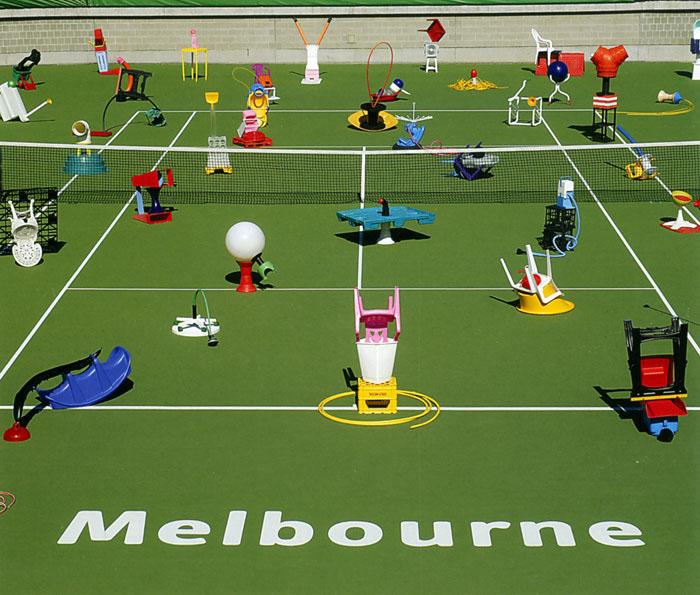
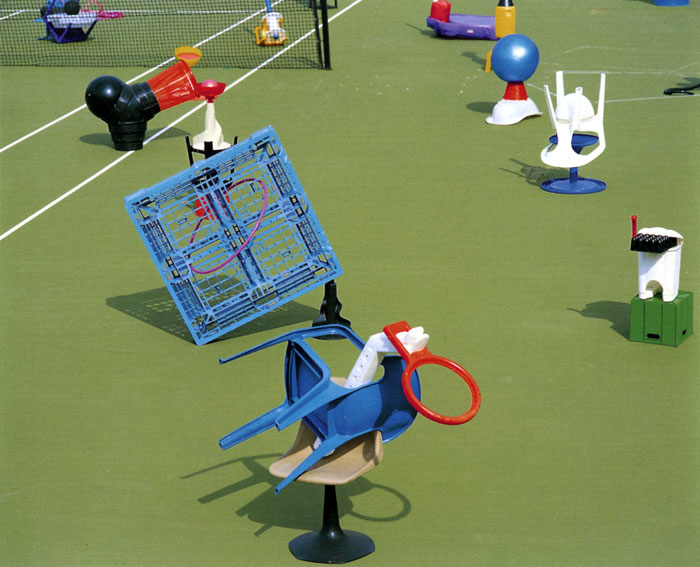
      Louise Paramor (Australian, b. 1964) 'Show Court 3 (II)' 2009


      Louise Paramor (Australian, b. 1964)
      Show Court 3 (II)
      2009


      Boarding a train at Flinders Street we emerge at South Yarra station to stroll down to River Street for our third opening of the night at Nellie Castan Gallery. We are greeted by the ever gracious Nellie Castan who has just returned from an overseas trip to Europe where she was soaking up the wonders of Rome amongst other places. For the latest exhibition in the gallery Louise Paramor is presenting two bodies of work: Show Court 3 and Mood Bomb (both 2009). Lets look at Show Court 3 first as this work has older origins.

      Originally exhibited in 2006 at Nellie Castan under the title Jam Session the sculptures from this exhibition and many more beside (75 in all) were then installed in 2007 on show court 3 at Melbourne & Olympic Parks, hence the title of the installation. In the smaller gallery in 2009 we have six Lambda photographic prints that are records of this installation plus a video of the installation and de-installation of the work.

      While interesting as documentary evidence of the installation these photographs are thrice removed from the actual sculptures – the sculptures themselves, the installation of the sculptures on court and then the photographs of the installation of the sculptures. The photographs lose something in this process – the presence or link back to the referentiality of the object itself. There is no tactile suggestiveness here, no fresh visual connections to be made with the materials, no human interaction. The intertextual nature of the objects, the jamming together of found pieces of bright plastic to make seductive anthropomorphic creatures that ‘play’ off of each other has been lost.

      What has been reinforced in the photographs is a phenomena that was observed in the actual installation.

      “The sculptures created a jarring visual disruption when placed in a location normally associated with play and movement. The stadium seating surrounding the tennis court incited an expectation of entertainment; a number of viewers sat looking at the sculptures, as though waiting for them to spin and jump around. But mostly, the exhibition reversed the usual role of visitors to place where one sits and watches others move; here the objects on the tennis court were static and the spectators moved around.” (2007)1

      In the photographs of these objects and in the installation itself what occurs is an inversion of perception, a concept noted by the urbanist Paul Virilio.2 Here the objects perceive us instead of us perceiving the object: they stare back with an oculocentric ‘suggestiveness’ which is advertising’s raison d’ĆŖtre (note the eye sculpture above). In particular this is what the photographs suggest – a high gloss surface, an advertising image that grabs our attention and forces us to look but is no longer a powerful image.

      In the main gallery was the most interesting work of the whole night – experiments of abstraction in colour “inspired by the very substance of paint itself.” Made by pouring paint onto glass and then exhibiting the smooth reverse side, these paintings are not so much about the texture of the surface (as is Dale Frank’s work below) but a more ephemeral thing: the dreamscapes of the mind that they promote in the viewer, the imaginative connections that ask the viewer to make. Simpler and perhaps more refined than Frank’s work (because of the smooth surface, the lack of the physicality of the layering technique? because of the pooling of amoebic shapes produced, not the varnish that accumulates and recedes?) paint oozes, bleeds, swirls, drips upwards and blooms with a sensuality of intense love. They are dream states that allow the viewer to create their own narrative with the title of the works offering gentle guides along the way: Girl with Flowers, Lovers, Mood Bomb, Emerald God, Mama, and Animal Dreaming to name just a few. To me they also had connotations of melted plastic, almost as if the sculptures of Show Court 3 had dissolved into the glassy surface of a transparent tennis court.

      These are wonderfully evocative paintings. I really enjoyed spending time with them.

      Dr Marcus Bunyan


      1/ O’Neill, Jane. Louise Paramor: Show Court 3. Melbourne: Nellie Castan Gallery, 2009

      2/ Virilio, Paul. The Vision Machine. (trans. Julie Rose). Bloomington: Indiana University Press, 1994, pp. 62-63


      Many thankx to Nellie Castan Gallery for allowing me to publish the photographs in the posting. Please click on the photographs for a larger version of the image.


      Louise Paramor (Australian, b. 1964) 'Show Court 3 (VI)' 2009


      Louise Paramor (Australian, b. 1964)
      Show Court 3 (VI)
      2009


      Louise Paramor (Australian, b. 1964) 'Show Court 3' 2009 (detail)


      Louise Paramor (Australian, b. 1964)
      Show Court 3 (detail)
      2009


      Louise Paramor (Australian, b. 1964) 'Show Court 3' 2009 (detail)


      Louise Paramor (Australian, b. 1964)
      Show Court 3 (detail)
      2009


      Louise Paramor (Australian, b. 1964) Opening night crowd in front of 'Sky Pilot' (left) and 'Mama' (right) 2009


      Louise Paramor (Australian, b. 1964)
      Opening night crowd in front of Sky Pilot (left) and Mama (right)
      2009
      Paint on glass


      Louise Paramor (Australian, b. 1964) Opening night crowd in front of 'Green Eyed Monster' (right) and 'Sky Pilot' (right) 2009


      Louise Paramor (Australian, b. 1964)
      Opening night crowd in front of Green Eyed Monster (right) and Sky Pilot (right)
      2009
      Paint on glass


      Louise Paramor (Australian, b. 1964) Opening night crowd in front of 'Pineapple Express' 2009


      Louise Paramor (Australian, b. 1964)
      Opening night crowd in front of Pineapple Express
      2009
      Paint on glass


      Louise Paramor (Australian, b. 1964) 'A Dog and His Master' 2009 (detail)


      Louise Paramor (Australian, b. 1964)
      A Dog and His Master (detail)
      2009
      Paint on glass


      Louise Paramor (Australian, b. 1964) 'Lovers' 2009


      Louise Paramor (Australian, b. 1964)
      Lovers
      2009
      Paint on glass


      Dale Frank (Australian, b. 1959) '2. One conversation gambit you hear these days: 'Do you rotate?' An interesting change of tack? No suck luck. 'Do you rotate?' simply fishes for information about the extent of your collection. Do you have enough paintings to hang a different one in your dining room every month?' 2005


      Dale Frank (Australian, b. 1959)
      2. One conversation gambit you hear these days: ‘Do you rotate?’ An interesting change of tack? No suck luck. ‘Do you rotate?’ simply fishes for information about the extent of your collection. Do you have enough paintings to hang a different one in your dining room every month?
      2005


      Louise Paramor (Australian, b. 1964) 'Mood Bomb' 2009


      Louise Paramor (Australian, b. 1964)
      Mood Bomb
      2009
      Paint on glass


      Louise Paramor (Australian, b. 1964) 'Slippery Slope' 2009 (detail)


      Louise Paramor (Australian, b. 1964)
      Slippery Slope (detail)
      2009
      Paint on glass


      Louise Paramor (Australian, b. 1964) 'Green Eyed Monster' 2009 (detail)


      Louise Paramor (Australian, b. 1964)
      Green Eyed Monster (detail)
      2009
      Paint on glass


      Nellie Castan Gallery, Melbourne

      This gallery closed in December 2013

      LIKE ART BLART ON FACEBOOK

      Back to top

      Photographic prize: the Magnum Foundation and the Inge Morath Foundation announce the sixth annual Inge Morath Award

      March 2009


      Inge MorathĀ (American born Austria, 1923-2002) From the series about Regensburg Museums 1999


      Inge Morath (American born Austria, 1923-2002)
      From the series about Regensburg Museums
      1999
      Gelatin silver print


      “To take pictures had become a necessity and I did not want to forgo it for anything.”


      Inge Morath


      The Magnum Foundation and the Inge Morath Foundation announce the sixth annual Inge Morath Award. The annual prize of $5,000 is awarded by the Magnum Foundation to a female documentary photographer under the age of 30, to support the completion of a long-term project. One award winner and up to two finalists are selected by a jury composed of Magnum photographers.

      Inge Morath was an Austrian-born photographer who was associated with Magnum Photos for nearly fifty years. After her death in 2002, the Inge Morath Foundation was established to manage Morath’s estate and facilitate the study and appreciation of her contribution to photography.

      Because Morath devoted much of her enthusiasm to encouraging women photographers, her colleagues at Magnum Photos established the Inge Morath Award in her honour. The Award is now given by the Magnum Foundation as part of its mission of supporting new generations of socially-conscious documentary photographers, and is administered by the Magnum Foundation in collaboration with the Inge Morath Foundation.

      Past winners of the Inge Morath Award include: Kathryn Cook (US, ’08) for Memory Denied: Turkey and the Armenian Genocide; Olivia Arthur (UK, ’07) for The Middle Distance; Jessica Dimmock (US, ’06) for The Ninth Floor; Mimi Chakarova (US, ’06) for Sex Trafficking in Eastern Europe; Claudia Guadarrama (MX, ’05) for Before the Limit; and Ami Vitale (US, ’02), for Kashmir.

      Text from The Inge Morath Foundation website [Online] Cited 01/03/2009. No longer available online


      Inge MorathĀ (American born Austria, 1923-2002) 'Visitor in the Metropolitan Museum' 1958


      Inge Morath (American born Austria, 1923-2002)
      Visitor in the Metropolitan Museum
      1958
      Gelatin silver print


      Inge MorathĀ (American born Austria, 1923-2002) 'Window washer' 1958


      Inge Morath (American born Austria, 1923-2002)
      Window washer
      1958
      Gelatin silver print


      “I have photographed since 1952 and worked with Magnum Photos since 1953, first out of Paris, later out of New York. I am usually labeled as a photojournalist, as are all members of Magnum. I am quoting Henri Cartier-Bresson’s explanation for this: He wrote to John Szarkowski in answer to an essay in which Szarkowski stated that Cartier-Bresson labels himself as a photojournalist.

      “May I tell you the reason for this label? As well as the name of its inventor? It was Robert Capa. When I had my first show in the Museum of Modern Art in New York in 1948 he warned me: ‘watch out what label they put on you. If you become known as a surrealist […] then you will be considered precious and confidential. Just go on doing what you want to do anyway but call yourself a photojournalist, which puts you into direct contact with everything that is going on in the world.'”

      It is in this understanding that we have been working as a group and yet everyone following their own way of seeing. The power of photography resides no doubt partly in the tenacity with which it pushes whoever gets seriously involved with it to contribute in an immeasurable number of forms his own vision to enrich the sensibility and perception of the world around him.

      [In the 1950s] the burden of the already photographed was considerably less than now. There was little of the feeling of being a latecomer who has to overwhelm the huge existing body of the photographic oeuvre – which, in photography as in painting and literature, necessarily leads first to the adoption and then rejection of an elected model, until one’s own work is felt to be equal or superior, consequently original.

      Photography is a strange phenomenon. In spite of the use of that technical instrument, the camera, no two photographers, even if they were at the same place at the same time, come back with the same pictures. The personal vision is usually there from the beginning; result of a special chemistry of background and feelings, traditions and their rejection, of sensibility and voyeurism. You trust your eye and you cannot help but bare your soul. One’s vision finds of necessity the form suitable to express it.”

      Inge Morath, Life as a Photographer, 1999

      Text from The Inge Morath Foundation website [Online] Cited 01/03/2009. No longer available online


      Inge MorathĀ (American born Austria, 1923-2002) 'Mrs. Eveleigh Nash, London, 1953' 1953


      Inge Morath (American born Austria, 1923-2002)
      Mrs. Eveleigh Nash, London, 1953
      1953
      Gelatin silver print


      LIKE ART BLART ON FACEBOOK

      Back to top

      Exhibition: ‘The best is often the Memories: Photographic Portraits of Romy Schneider’ at Museum für Kunst Und Gewerbe, Hamburg

      Exhibition dates: 6th February – 13th April, 2009


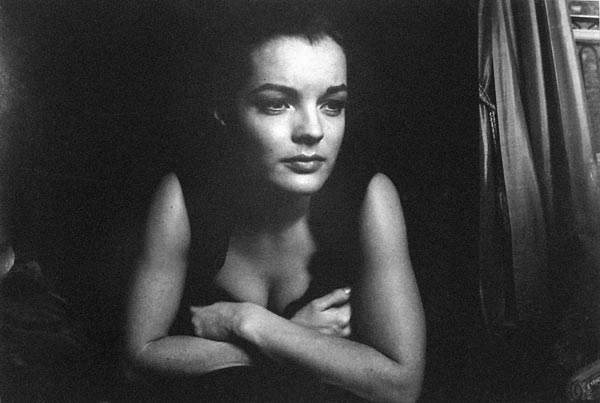
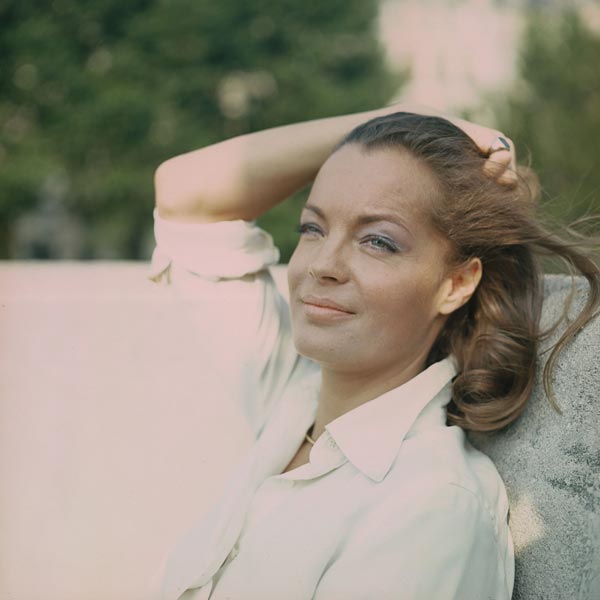
      Will McBride (American, 1931-2015) 'Romy Schneider, Paris, 1964' from the exhibition 'The best is often the Memories: Photographic Portraits of Romy Schneider' at Museum für Kunst Und Gewerbe, Hamburg, Feb - April, 2009


      Will McBride (American, 1931-2015)
      Romy Schneider, Paris, 1964
      1964
      Gelatin silver print


      The legend that was Romy!

      I have never known the filmography of Romy Schneider, never come across this actress before sad to say. But now I do. What great photographs. What a beautiful woman: sensitive, vivacious, stunning. A soul I would have liked to have known.

      Marcus


      Many thankx to the Museum für Kunst Und Gewerbe for allowing me to publish the photographs in the posting. Please click on the photographs for a larger version of the image.


      Romy Schneider (German: born Rosemarie Magdalena Albach; 23 September 1938 – 29 May 1982) was a German-French actress. She began her career in the German Heimatfilm genre in the early 1950s when she was 15. From 1955 to 1957, she played the central character of Empress Elisabeth of Austria in the Austrian Sissi trilogy, and later reprised the role in a more mature version in Luchino Visconti’s Ludwig (1973). Schneider moved to France, where she made successful and critically acclaimed films with some of the most notable film directors of that era.

      Read more about Romy Schneider on the Wikipedia website


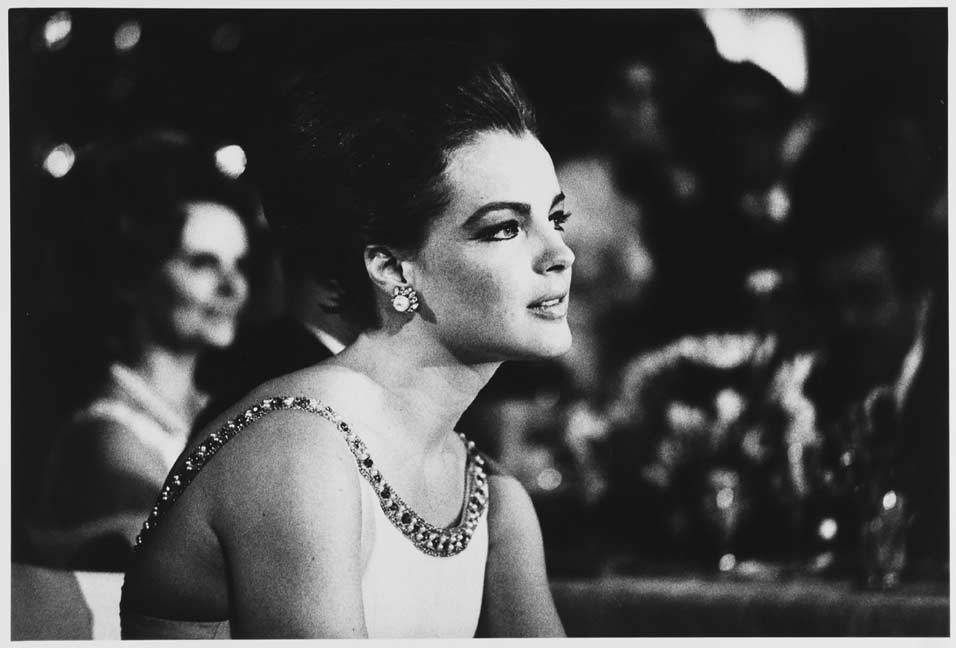
      Peter Brüchmann (German, 1932-2016) 'Romy Schneider, Munich, 1968' from the exhibition 'The best is often the Memories: Photographic Portraits of Romy Schneider' at Museum für Kunst Und Gewerbe, Hamburg, Feb - April, 2009


      Peter Brüchmann (German, 1932-2016)
      Romy Schneider, Munich, 1968
      1968
      Gelatin silver print


      Peter Brüchmann

      Born in Berlin, Peter Brüchmann trained to be a photographer with the fashion and portrait photographer Lotte Sƶhring and subsequently completed a traineeship at the German press agency dpa. In the 1950s and 1960s he worked for well-known magazines, such as Schƶner Wohnen, Stern and Bild am Sonntag. Brüchmann is primarily known for his portraits of celebrities of the movie and music industry. In 2008 the photographer participated in the group exhibition Die Erinnerung ist oft das Schƶnste – Fotografische PortrƤts von Romy Schneider, an exhibition comprising portraits of the famous Franco-German actress Romy Schneider, held at the Stiftung Opelvillen Rüsselheim, Germany. Today Peter Brüchmann works as a freelance photographer for several national and international magazines. Numerous of his photographs are among the collections of the German Historical Museum in Berlin.


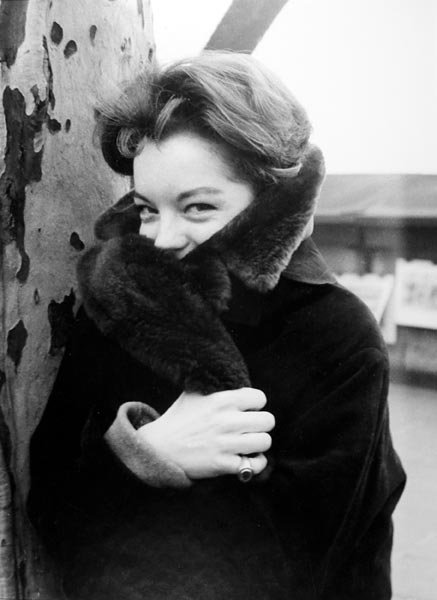
      Roger FritzĀ (German, 1936-2021) 'Romy Schneider, Paris, 1961'


      Roger Fritz (German, 1936-2021)
      Romy Schneider, Paris, 1961
      1961
      Gelatin silver print


      Herbert List, Max Scheler, Roger Fritz, F. C. Gundlach, Will McBride, Peter Brüchmann, Werner Bokelberg, Helga Kneidl and Robert Lebeck took photos of Romy Schneider in quite different ways, as a young girl, in her film roles, together with her children, apparently unobserved in everyday situations or in set poses and dressed up in various costumes, merry or pensive, beautiful and fragile. More than 140 pictures will be on show, of which about 40 are being exhibited for the first time.

      Hardly any other star has left us with so many different and conflicting images as Romy Schneider. She was photographed thousands of times – and yet she always remained enigmatic. Some of the photographers whose work is presented in this exhibition only met Romy once – Herbert List, for instance, captured her as a teenager around 1954 on pictures which remained unknown until recently – or accompanied her throughout her life, like Robert Lebeck, who succeeded in taking disturbingly personal pictures of her from the 1950s through to shortly before her death.

      These snapshots conjure up once again the legend that was Romy, while at the same time making a powerful statement which reveals the transitoriness of existence. Because that is the core of what a photo does: it creates an image in order to bear lasting witness to an event which happened – yet at the very moment of capturing the image on film, it is no more than the proof that the fleeting moment has passed.

      The photos by Herbert List, Werner Bokelberg, Peter Brüchmann, Roger Fritz and Max Scheler are being shown publicly for the first time. This also applies to the majority of the photos by F. C. Gundlach and Will McBride. The pictures by Helga Kneidl and Robert Lebeck have already appeared in books about Romy Schneider. These volumes are however now out of print.

      Text from the Museum für Kunst Und Gewerbe website


      Herbert ListĀ (German, 1903-1975) 'Romy Schneider, Munich, 1954'


      Herbert List (German, 1903-1975)
      Romy Schneider, Munich, 1954
      1954
      Gelatin silver print


      Herbert List

      Herbert List (7 October 1903 – 4 April 1975) was a German photographer, who worked for magazines, including VogueHarper’s Bazaar, and Life, and was associated with Magnum Photos. His austere, classically posed black-and-white compositions, particularly his homoerotic male nudes, taken in Italy and Greece being influential in modern photography and contemporary fashion photography.

      Photographer

      In 1929 he met Andreas Feininger who inspires his greater interest in photography and who gives him a Rolleiflex camera. From 1930 he began taking portraits of friends and shooting still life, is influenced by the Bauhaus and artists of the surrealist movements, Man Ray, Giorgio De Chirico and Max Ernst, and creates a surrealist photograph titled Metaphysique in a style he called fotografia metafisica in homage to De Chirico, his most important influence during this period. He used male models, draped fabric, masks and double-exposures to depict dream states and fantastic imagery. He has explained that his photos were “composed visions where [my] arrangements try to capture the magical essence inhabiting and animating the world of appearances.”

      In 1936, in response to the danger of Gestapo attention to his openly gay lifestyle and his Jewish heritage, List left Germany for Paris, where he met George Hoyningen-Huene with whom he travelled to Greece, deciding then to become a photographer. During 1937 he worked in a studio in London and held his first one-man show at Galerie du Chasseur d’Images in Paris. Hoyningen-Huene referred him to Harper’s Bazaar magazine, and 1936-1939 he worked for Arts et Metiers GraphiquesVerveVoguePhotographie, and Life. List was unsatisfied with fashion photography. He turned back to still life imagery, continuing in his fotografia metafisica style.

      From 1937 to 1939 List traveled in Greece and took photographs of ancient temples, ruins, sculptures, and the landscape for his book Licht über Hellas. In the meantime he supported himself with work for magazines Neue LinieDie Dame and for the press from 1940-1943, and with portraits which he continued to make until 1950. In List’s work the revolutionary tactics of surrealist art and a metaphysical staging of irony and reverie had been honed in an the fashion industry that relied on illusion and spectacle which after World War II returned to a classical fixation on ruins, broken male statuary and antiquity.

      Text from the Wikipedia website


      F. C. GundlachĀ (German, 1926-2021) 'Romy Schneider, Hamburg, 1961'


      F. C. Gundlach (German, 1926-2021)
      Romy Schneider, Hamburg, 1961
      1961
      Gelatin silver print


      F. C. Gundlach

      F. C. Gundlach (Franz Christian Gundlach; born 16 July 1926 in Heinebach, Hesse; died 23 July 2021, Hamburg, Germany) is a German photographer, gallery owner, collector, curator und founder. In 2000 he created the F.C. Gundlach Foundation, since 2003 he has been founding director of the House of Photography – Deichtorhallen Hamburg.

      His fashion photographs of the 1950s, 1960s and 1970s, which in many cases integrated social phenomena and current trends in the visual arts, have left their context of origin behind and found their way into museums and collections. Since 1975 he also curated many internationally renowned photographic exhibitions. On the occasion of the reopening of the House of Photography in April 2005, he curated the retrospective of the Hungarian photographer Martin MunkĆ”csi. Here, the exhibitions A Clear VisionThe Heartbeat of Fashion and Maloney, Meyerowitz, Shore, Sternfeld. New Color Photography of the 1970s from his collection were presented since 2003. Most recently he curated the exhibitions More Than Fashion for the Moscow House of Photography and Vanity for the Kunsthalle Wien 2011.

      The fashion photographer

      F. C. Gundlach attended the Private Lehranstalt für Moderne Lichtbildkunst (Private School for Modern Photography) under Rolf W. Nehrdich in Kassel from 1946 to 1949. Subsequently, he began publishing theatre and film reports in magazines such as Deutsche Illustrierte, Stern, Quick and Revue as a freelance photographer.

      His specialisation in fashion photography began in 1953 with his work for the Hamburg-based magazine Film und Frau, for which he photographed German fashion, Parisian haute couture and fur fashion campaigns. Additionally he photographed portraits of artists such as Romy Schneider, Hildegard Knef, Dieter Borsche and Jean-Luc Godard. For Film und Frau, but also for Stern, Annabelle, Twen and other magazines, F. C. Gundlach has since made fashion and reportage trips to the Near, Middle and Far East as well as to Central and South America. Under an exclusive contract with the magazine Brigitte, he photographed many of the trendsetting fashion pages until 1983, a total of more than 160 covers and 5,000 pages of editorial fashion. In the 1970s and 1980s he worked in South America, Africa, but above all in New York and on the American west coast.

      His retrospective solo exhibitions, such as ModeWelten (1985), Die Pose als Kƶrpersprache (1999), Bilder machen Mode (2004) or F. C. Gundlach. The photographic work (2008) were shown in many museums and galleries in Germany and abroad.

      Ā 
      “He is a photographer whose images show the knowledge of the dominant role of fashion as a cultural social factor. For this reason, he rarely presented the phenomena of fashion in isolation, but rather linked them to the phenomenology of everyday reality and placed them in the socio-cultural context from which they ultimately originated. F. C. Gundlach proves to be a photographic artist with a will to style, a mastery of staging and the ability to shape the photographic image at his leisure, who arranges his models in ever new formal constellations: as a photographer of extraordinary aesthetic quality.”

      ~ Klaus Honnef

      Ā 
      “As a fashion photographer who makes use of a recording medium, the photographer must live, think and feel entirely in his time. Fashion photographs are always interpretations and stagings. They reflect and visualise the zeitgeist of the present and anticipate the spirit of tomorrow. They offer projection screens for identification, but also for dreams, wishes and desires. And yet fashion photographs say more about a time than documentary photographs pretending to depict reality.”
      ~ F.C. Gundlach


      Text from the Wikipedia website


      Werner BokelbergĀ (German, 1937-2024) 'Romy Schneider, London, 1968'


      Werner BokelbergĀ (German, 1937-2024)
      Romy Schneider, London, 1968
      1968
      Gelatin silver print


      Helga KneidlĀ (German, b. 1939) 'Romy Schneider, Paris, 1972'


      Helga Kneidl (German, b. 1939)
      Romy Schneider, Paris, 1972
      1972


      Helga KneidlĀ (German, b. 1939) 'Romy Schneider, Paris, 1973'


      Helga Kneidl (German, b. 1939)
      Romy Schneider, Paris, 1973
      1973


      Museum für Kunst und Gewerbe Hamburg
      Steintorplatz, 20099 Hamburg

      Opening hours:
      Tuesday to Sunday 10am – 6pm
      Thursday 10am – 9pm
      Closed Mondays

      Museum für Kunst Und Gewerbe website

      LIKE ART BLART ON FACEBOOK

      Back to top

      Exhibition: ‘Villa Edur. Eduardo Sourrouille’ at Artium, Basque Centre-Museum of Contemporary Art

      Exhibition dates: 17th January – 19th April, 2009


      Eduardo Sourrouille (Spanish, b. 1970) 'Salon para Gaydjteam' 2008


      Eduardo Sourrouille (Spanish, b. 1970)
      Salon para Gaydjteam
      2008


      Artium, Basque Centre-Museum of Contemporary Art, presents the exhibition Villa Edur. Eduardo Sourrouille (North Gallery, from January 17 to April 19), an intimate self-portrait of this Basque artist based on more than 170 photographs taken in recent years. Sourrouille (Basauri, Bizkaia, 1970) proposes a metaphorical visit to the private rooms of his life, from the most superficial to the most intimate, to explore all aspects of the relationship with others and with oneself. Based on three different series of technically exquisite photographs, the author displays a world in which affection and the need to love and to feel loved predominates, in which there are ever-present allusions to questions such as sexual identity, the demands of friendship and recognition of links with others.

      Villa Edur, the title of the first major one-man show of the work of Eduardo Sourrouille in a Museum, is taken from the maternal home of Eduardo Sourrouille, “the first legacy I received from her, the most valuable of all her bequests: besides being a home, it is an ongoing project, a driving force in my life and a reflection of my artistic career.” As in a home, the exhibition allows the visitors to explore a number of different rooms, each more intimate than the previous one, in which the artist receives visitors, who are converted into a host and guests.

      Thus, in the exhibition, as in his house, “the host receives his guests at the entrance, where newcomers have access to proof of all the visitors that preceded them.” And in this way, the visitor sees two different series of portraits in the first room, Of the folder, people who visited my house and Of the folder, people who visited my house: room for… In the first Gallery, the artist presents different portraits of couples, consisting of himself with the different people with whom he has had some kind of relationship, be this emotional, family, friendship or any other kind. In this case, the photographs come very close to studio portraits, with carefully prepared, static poses, with hardly any atrezzo.

      Each of these photographs is matched in the exhibition with another belonging to the second gallery of images, in which Sourrouille repeats the figures but in this case with a more accentuated theatricality, with a set design that may make the spectator imagine anecdotes or stories that occur in the encounter. The room, dominated by a more than one hundred photographs, reveals an entire “network of relationships, in which friendship, affection, love, fascination, desire, etc. (sometimes mixed up), have a place. The number of people including his father and other relatives, a large number of friends, artists such as Miguel Ɓngel Gaüeca, Manu Arregui and Ignacio Goitia, have been present here and have left their mark, and as the entire exhibition is imbued with games and humour, fictional figures such as DoƱa Rogelia are also included.

      From this broad entrance, densely inhabited by figures ā€œwhose ghost lives onā€, the artist invites first to step into his sitting room, the place in his house that “offers a precise image of what its owner is and would like to be.” In this space, Eduardo Sourrouille presents thirty self-portraits that “show of the people who have coexisted in me” and who “embody in the symbolic manner the different aspects of love and friendship, that can be found in me, as in any other individual.” With this aim in mind, Sourrouille presents in this exhibition space the Selfportrait with a friend series, thirty images in which the artist photographs himself with different animals, ironic portraits in which the human being appears to adopt certain characteristics of the animal.

      There remain two more rooms in this house, the most private of all, where “intimate secret processes” take place. Sourrouille once again portrays himself with his father in the environment where the legacy is transmitted by means of simple rites, before going on to “the most secret room of all (…) in which the intimate world of each person is developed, in other words, what one does not necessarily confess but what one, nevertheless, has decided to experience.” Here, the spectator confronts a video entitled If you could see him through my eyes, in which the sheets are lowered slowly to discover the artist accompanied by two wild boar.

      Press release from Basque Centre-Museum of Contemporary Art


      Eduardo Sourrouille. Villa Edur from Artium Museoa on Vimeo.


      Guided tour of Eduardo Sourrouille

      The house that I show in Villa Edur is my house, as it was (is) my mother’s. It is the first legacy I received from her, the most valuable of all: in addition to a home, it is a perpetual project, a vital engine and a reflection of my career.


      Eduardo Sourrouille (Spanish, b. 1970) 'Self-portrait with impetuous friend' 2008


      Eduardo Sourrouille (Spanish, b. 1970)
      Self-portrait with impetuous friend
      2008


      “The house I depict in Villa Edur is my home, as it was (is) my mother’s home. It is the first legacy I received from her, the most valuable of all her bequests: besides being a home, it is an ongoing project, the driving force in my life and a reflection of my artistic career.

      1

      In my house, the host receives his guests at the entrance, where newcomers find proof of all the visitors that preceded them. Everything takes place in this zealously staged space, and so each decorative element is selected with the very same care. Objects, costumes and scenery make up, both individually and jointly, a system of symbols alluding to the nature of its own contents.

      One by one, the portrait of the person in question confronts his situation within the context that was created for him and which, at the same time, he himself contributed to defining, and whose ghost still lives on. Each portrait determines both a singular identity and the kind of relationship in which at least two individuals interact and this, in turn, is the reflection of a specific experience. Each relationship leaves a visible and definitive mark on the other, like the dent in an aluminium vessel, which reasserts the experience and provides solace (provisionally) as it is the proof of our materiality. The inescapable need to make these marks involves the creation of an entire network of relationships in which friendship, affection, love, fascination, desire, etc. (sometimes mixed up), have a place.

      Next to the door, raised on her solid, light shelf, my mother observes us and invites us in.

      2

      A door leads to the sitting room, a multifunctional and ultimately magical space, an environment in which everything that can be shown to visitors (plus part of what cannot be shown) is put on display. Definitively, the sitting room always offers a precise image of who its owner is and would like to be, of what he deliberately reveals to others and what he cannot prevent from being perceived through the cracks in his subconscious.

      For this reason, the sitting room offers visitors a gallery of thirty self-portraits that show them the different people who coexist in me, what they can expect and the extent of the range of choices permitted. From a conceptual viewpoint and in a symbolic manner, these portraits embody different aspects of love and friendship that can be found in me, as in any other individual.

      3

      Beyond the sitting room lie the private rooms in which intimate, secret processes take place, ceremonies that create individuals and subsequently shape them, mould them and endorse them for the world. In one of these, I share the space with my father because this room is where his offspring receive their legacy through atavistic and recurrent rites – so simple that they scarcely cause pain. In another room, I (at last) dare to make the call I have learnt, the one that I use to invoke the Other, even though in some ways the person I seek is myself. There is anguish and confusion in that call, but also the desire to establish constructive communication, as I also offer myself to the Other so that he might leave his mark on me.

      4

      The intimate world of each person, in other words, what one does not necessarily confess but what one, nevertheless, has decided to experience, is developed in the most secret room of all. It is also the space reserved for the beauty that one finds by one’s own means – as it has not been revealed by any of one’s elders – and which therefore will be treasured as the exclusive property of its discoverer.

      I live in Villa Edur because all the relationships that crystallise around me also reside there. Every individual harbours a space that he uses as a scenario to display his relationships, his family, lovers, friends, and for life, everything that is deposited with the passing of time, following the structure of his stage machinery. That is the space that is often called home.”

      Ianko López Ortiz de Artiñano for Eduardo Sourrouille

      Text from the Artium, Basque Centre-Museum of Contemporary Art website


      Eduardo Sourrouille (Spanish, b. 1970) 'Panolis' 2008


      Eduardo Sourrouille (Spanish, b. 1970)
      Panolis
      2008


      Eduardo Sourrouille (Spanish, b. 1970) 'Double self-portrait' 2008


      Eduardo Sourrouille (Spanish, b. 1970)
      Double self-portrait
      2008


      Eduardo Sourrouille (Spanish, b. 1970) 'Self-portrait with a proud friend' 2008


      Eduardo Sourrouille (Spanish, b. 1970)
      Self-portrait with a proud friend
      2008


      Eduardo Sourrouille (Spanish, b. 1970) 'Self-portrait with a gorgeous friend' 2008


      Eduardo Sourrouille (Spanish, b. 1970)
      Self-portrait with a gorgeous friend
      2008


      Artium, Basque Centre-Museum of Contemporary Art
      24 Francia Street. Vitoria-Gasteiz, 01002 Araba
      Phone: 945 20 90 00

      Opening hours:
      Tuesdays to Fridays: 11am to 2.00pm and 5.00pm to 8.00pm
      Saturdays and Sundays: 11.00am to 8.00pm
      Mondays closed

      Artium, Basque Centre-Museum of Contemporary Art website

      LIKE ART BLART ON FACEBOOK

      Back to top

      Exhibition: ‘Man Ray: Unconcerned, but not indifferent’ at The Hague Museum of Photography, The Netherlands

      Exhibition dates: 24th January – 19th April, 2009


      Man RayĀ (American, 1890-1976) 'Self-portrait' 1924 from the exhibition 'Man Ray: Unconcerned, but not indifferent' at The Hague Museum of Photography, The Netherlands, Jan - April 2009


      Man Ray (American, 1890-1976)
      Self-portrait
      1924
      Gelatin silver print


      Man Ray (1890-1976) used his camera to turn photography into an art – no mean feat for a man who tried almost all his life to avoid being described as a ‘photographer’. He preferred to be identified with his work in other media: drawings, paintings and Dadaist ready-mades. The exhibition entitled Unconcerned, but not indifferent at the Hague Museum of Photography is a large-scale retrospective of Man Ray’s art and life. It links paintings, drawings and (of course) photographs to personal objects, images and documents drawn from his estate to paint a picture of a passionate artist and – whatever his own feelings about the description – a great photographer.

      Unconcerned, but not indifferent is the first exhibition to reveal Man Ray’s complete creative process: from observations, ideas and sketches right through to the final works of art. By establishing the linkage between art and inspiration, it gives a new insight into the work of Man Ray. The three hundred plus items on display are drawn from the estate of the artist, which is managed by the Man Ray Trust. Some of them have never been exhibited since the artist’s death in 1976 while others are on show for the first time ever.

      Man Ray’s real name was Emmanuel Radnitzky. He was born in Philadelphia (USA) in 1890. The family soon moved to New York, where his artistic talent became increasingly apparent. Photography was not yet his medium: Man Ray, as he would later call himself, concentrated on painting and became friendly with Dadaist artist Marcel Duchamp, who persuaded him to move to Paris (France). There, Man Ray moved in highly productive artistic circles full of Surrealists and Dadaists. He began taking photographs of his own (and other people’s) works of art and gradually became more interested in the photographic images than in the originals – which he regularly threw away or lost once he had photographed them.

      By this time, commercial and art photography had become his main source of income and he was displaying an unbridled curiosity about the potential of the medium. This prompted a great urge to experiment and the discovery or rediscovery of various techniques, such as the famous ‘rayographs’ (photograms made without the use of a camera). Man Ray left Paris to escape the Nazi occupation of France and moved to Los Angeles, where he abandoned commercial photography to concentrate entirely on painting and photographic experimentation. However, his next real surge of creativity occurred only after he returned to Paris with his wife Juliet in 1951. In the last twenty-five years of his life, he regularly harked back to his earlier work and was not afraid to quote himself. In that sense, Man Ray can be seen as a true conceptual artist: the idea behind the work of art always interested him more than its eventual execution. Man Ray died in Paris in 1976 and is buried in Montparnasse. His widow, Juliet, summed up the artist’s life in the epitaph inscribed on his tombstone: Unconcerned, but not indifferent.

      The exhibition examines the four separate creative phases in Man Ray’s life. Each is closely connected with the place where he was living (New York, Los Angeles or Paris), his friends at the time and the sources of inspiration around him. Using Man Ray’s artistic legacy and – perhaps more particularly – the everyday objects that were so important to him, Unconcerned, but not indifferent reveals the world as he saw it through the lens of his camera.

      The exhibition is being held in cooperation with the Man Ray Trust in Long Island, New York, and La FƔbrica in Madrid.

      Text from the The Hague Museum of Photography


      Many thankx to The Hague Museum of Photography for allowing me to publish the photographs in the posting. Please click on the photographs for a larger version of the image.


      Man RayĀ (American, 1890-1976) 'Rayograph' 1921 from the exhibition 'Man Ray: Unconcerned, but not indifferent' at The Hague Museum of Photography, The Netherlands, Jan - April 2009


      Man Ray (American, 1890-1976)
      Rayograph
      1921
      Gelatin silver print


      Man RayĀ (American, 1890-1976) 'Noire et blanche' 1926


      Man Ray (American, 1890-1976)
      Noire et blanche
      1926
      Gelatin silver print


      Man RayĀ (American, 1890-1976) 'La priere' (Prayer) 1930


      Man Ray (American, 1890-1976)
      La priere (Prayer)
      1930
      Gelatin silver print


      Man RayĀ (American, 1890-1976) 'Larmes' 1930


      Man Ray (American, 1890-1976)
      Larmes (Tears)
      1930
      Gelatin silver print


      Man RayĀ (American, 1890-1976) 'Solarisation' 1931


      Man Ray (American, 1890-1976)
      Solarisation
      1931
      Gelatin silver print


      Man RayĀ (American, 1890-1976) 'Juliet with Flower' [Juliet Browner] 1950s


      Man Ray (American, 1890-1976)
      Juliet with Flower [Juliet Browner]
      1950s
      Painted transparency


      Man RayĀ (American, 1890-1976) 'Yves Montand' 1950


      Man RayĀ (American, 1890-1976)
      Yves Montand
      1950
      Ā© Man Ray Trust c/o Pictoright Amsterdam


      Man RayĀ (American, 1890-1976) 'Permanent Attraction' 1948 / c. 1971


      Man Ray (American, 1890-1976)
      Permanent Attraction
      1948 / c. 1971
      Wood
      Ā© Man Ray Trust/Artists Rights Society (ARS), NY/ADAGP, Paris 2018


      'Man Ray: Unconcerned, but not indifferent' catalogue cover


      Man Ray: Unconcerned, but not indifferent catalogue cover


      The Hague Museum of Photography
      Stadhouderslaan 43
      2517 HV Den Haag
      Phone: 31 (0)70 – 33 811 44

      Opening hours:
      Tuesday – Sunday, 11 – 5pm
      Closed Mondays

      The Hague Museum of Photography website

      LIKE ART BLART ON FACEBOOK

      Back to top

      Exhibition: ‘TruthBeauty: Pictorialism and the Photograph as Art, 1845-1945’ at George Eastman House, New York

      Exhibition dates: 7th February – 31st May, 2009

      Curator: Elsa Smithgall


      George Davison (English, 1854-1930) 'The Onion Field' 1889 from the exhibition 'TruthBeauty: Pictorialism and the Photograph as Art, 1845-1945' at George Eastman House, New York, Feb - May, 2009


      George Davison (English, 1854-1930)
      The Onion Field
      1889


      George Davison (19 September 1854 – 26 December 1930) was an English photographer, a proponent of impressionistic photography, a co-founder of the Linked Ring Brotherhood of British artists and a managing director of Kodak UK. He was also a millionaire, thanks to an early investment in Eastman Kodak.


      Pictorialism was simultaneously a movement, a philosophy, an aesthetic, and a style, resulting in some of the most spectacular photographs in the history of the medium. This exhibition shows the rise of Pictorialism in the late 19th century from a desire to elevate photography to an art form equal to painting, drawing, and watercolour, and extends the historical period generally associated with it by including its influential precursors, its persistent practitioners, and its seminal effect on photographic Modernism.

      With 130 masterworks from such well-known photographers as Alvin Langdon Coburn, Edward Steichen, Alfred Stieglitz, Robert Demachy, Frederick Evans, and F. Holland Day, this remarkable exhibition will illustrate the Pictorialism movement’s progression from its early influences to its lasting impact on photography and art.

      Text from the George Eastman House website [Online] Cited 26/01/2009. No longer available online


      Many thankx to George Eastman House for allowing me to publish the photographs in the posting. Please click on the photographs for a larger version of the image.


      In this video, Phillips Collection curator Elsa Smithgall introduces special exhibition TruthBeauty: Pictorialism and the Photograph as Art, 1845-1945, on view at The Phillips Collection Oct. 9, 2010 through Jan. 9, 2011.


      Julia Margaret Cameron (British born India, 1815-1879) 'Prayer' 1866 from the exhibition 'TruthBeauty: Pictorialism and the Photograph as Art, 1845-1945' at George Eastman House, New York, Feb - May, 2009


      Julia Margaret Cameron (British born India, 1815-1879)
      Prayer
      1866


      Peter Henry Emerson (British, 1856-1936) 'Polling the Marsh Hay' c. 1885


      Peter Henry Emerson (British, 1856-1936)
      Polling the Marsh Hay
      c. 1885


      Henry Peach Robinson (English, 1830-1901) 'Carolling' 1890


      Henry Peach Robinson (English, 1830-1901)
      Carolling
      1890


      Fredrick Holland Day (American, 1864-1933) "I Thirst" 1898


      Fredrick Holland Day (American, 1864-1933)
      “I Thirst”
      1898


      Frederick Holland Day (American, 1864-1933) 'Ebony and Ivory' 1899


      Frederick Holland Day (American, 1864-1933)
      Ebony and Ivory
      1899
      Photogravure


      Alfred Stieglitz (American, 1864-1946) 'Spring Showers' 1901


      Alfred Stieglitz (American, 1864-1946)
      Spring Showers
      1901


      Alfred Steiglitz (American, 1864-1946) 'Snapshot – In the New York Central Yards' Negative 1903; Printed 1910


      Alfred Steiglitz (American, 1864-1946)
      Snapshot – In the New York Central Yards
      Negative 1903; Printed 1910
      Photogravure


      This photograph of a train departing from Grand Central Terminal was probably made from the 48th Street foot bridge, which crossed over the railroad yard.


      Edward SteichenĀ (American, 1879-1973) 'The Pond - Moonlight' Negative 1904; print 1906


      Edward Steichen (American, 1879-1973)
      The Pond – Moonlight
      Negative 1904; print 1906
      Photogravure


      The Pond – Moonlight (also exhibited as The Pond – Moonrise) is a pictorialist photograph by Edward Steichen. The photograph was made in 1904 in Mamaroneck, New York, near the home of his friend art critic Charles Caffin. The photograph features a forest across a pond, with part of the moon appearing over the horizon in a gap in the trees. The Pond – Moonlight is an early photograph created by manually applying light-sensitive gums, giving the final print more than one colour. Only three known versions of The Pond – Moonlight are still in existence and, as a result of the hand-layering of the gums, each is unique.

      Text from the Wikipedia website


      Edward SteichenĀ (American, 1879-1973) 'Grand Prix at Longchamp, After the Races' 1907


      Edward Steichen (American, 1879-1973)
      Grand Prix at Longchamp, After the Races
      1907
      Photogravure


      About the Exhibition

      Photographic Pictorialism, an international movement, a philosophy, and a style, developed toward the end of the 19th century. The introduction of the dry-plate process, in the late 1870s, and of the Kodak camera, in 1888, made taking photographs relatively easy, and photography became widely practiced. Pictorialist photographers set themselves apart from the ranks of new hobbyist photographers by demonstrating that photography was capable of far more than literal description of a subject. Through the efforts of Pictorialist organisations, publications, and exhibitions, photography came to be recognised as an art form, and the idea of the print as a carefully hand-crafted, unique object equal to a painting gained acceptance.

      The forerunners of Pictorialism were early photographers like Henry Peach Robinson and Julia Margaret Cameron. Robinson found inspiration in genre painting; Cameron’s fuzzy portraits and allegories were inspired by literature. Like Robinson and Cameron, the Pictorialists made photographs that were more like paintings and drawings than the work of commercial portraitists or hobbyists. Pictorialist images were heavily dependent on the craft of nuanced printing. Some photographers, like Frederick H. Evans, a master of the platinum print, presented their work like drawings or watercolours, decorating their mounts with ruled borders filled with watercolour wash, or printing on textured watercolour paper, like Austrian photographer Heinrich Kühn. Kühn achieved painterly effects by using an artist’s brush to manipulate watercolour pigment, instead of silver or platinum, mixed with light-sensitised gum arabic.

      The idea that the primary purpose of photography was personal expression lay behind Pictorialism’s “Secessionist” movement. Alfred Stieglitz’s “Photo-Secession” was the best-known secessionist group. Stieglitz and his magazine, Camera Work, with its high-quality photogravure illustrations, advocated for the acceptance of photography as a fine art.

      Early in the 20th century, Pictorialism began losing ground to modernism: in 1911, Camera Work published drawings by Rodin and Picasso, and its final issue, in 1917, featured Paul Strand’s modernist photographs. Nevertheless, Pictorialism lived on. A second wave of Pictorialists included Clarence H. White, whose students included such photographers as Margaret Bourke-White, Paul Outerbridge, and Dorothy Lange. White’s colleague, Paul Anderson, continued the pictorial tradition until his death in 1956. Five prints of his Vine in Sunlight, 1944, display five different printing techniques, demonstrating how each process subtly shapes the viewer’s response to the image.

      Organised by George Eastman House International Museum of Photography and Film, and Vancouver Art Gallery.

      Text from the Phillips Collection website Nd [Online] Cited 10/06/2022


      Alvin Langdon Coburn (British born United States of America, 1882-1966) 'Fifth Avenue from the St. Regis' c. 1905


      Alvin Langdon Coburn (British born United States of America, 1882-1966)
      Fifth Avenue from the St. Regis
      c. 1905
      Gum bichromate and platinotype on paper


      Alvin Langdon Coburn (British born United States of America, 1882-1966) 'Wapping' 1904


      Alvin Langdon Coburn (British born United States of America, 1882-1966)
      Wapping
      1904


      Alvin Langdon Coburn (British born United States of America, 1882-1966) 'St. Paul's and Other Spires' 1908


      Alvin Langdon Coburn (British born United States of America, 1882-1966)
      St. Paul’s and Other Spires
      1908


      Alvin Langdon Coburn (British born United States of America, 1882-1966) 'The Tunnel Builders' 1908


      Alvin Langdon Coburn (British born United States of America, 1882-1966)
      The Tunnel Builders
      1908


      Eva Watson SchutzeĀ (American, 1867-1935) 'Woman with Lilly' 1905


      Eva Watson Schutze (American, 1867-1935)
      Woman with Lilly
      1905


      Eva Watson-Schütze (American, 1867-1935)

      Eva Watson-Schütze (1867-1935) was an American photographer and painter who was one of the founding members of the Photo-Secession. …

      Around the 1890s Watson began to develop a passion for photography, and soon she decided to make it her career. Between 1894 and 1896 she shared a photographic studio with Amelia Van Buren another Academy alumna in Philadelphia, and the following year she opened her own portrait studio. She quickly became known for her Pictorialist style, and soon her studio was known as a gathering place for photographers who championed this aesthetic vision.

      In 1897 she wrote to photographer Frances Benjamin Johnston about her belief in women’s future in photography: “There will be a new era, and women will fly into photography.”

      In 1898 six of her photographs were chosen to be exhibited at the first Philadelphia Photographic Salon, where she exhibited under the name Eva Lawrence Watson. It was through this exhibition that she became acquainted with Alfred Stieglitz, who was one of the judges for the exhibit.

      In 1899 she was elected as a member of the Photographic Society of Philadelphia. Photographer and critic Joseph Keiley praised the work she exhibited that year, saying she showed “delicate taste and artistic originality”.

      The following year she was a member of the jury for the Philadelphia Photographic Salon. A sign of her stature as a photographer at that time may be seen by looking at the other members of the jury, who were Alfred Stieglitz, Gertrude Kasebier, Frank Eugene and Clarence H. White.

      In 1900 Johnston asked her to submit work for a groundbreaking exhibition of American women photographers in Paris. Watson objected at first, saying “It has been one of my special hobbies – and one I have been very emphatic about, not to have my work represented as ‘women’s work’. I want [my work] judged by only one standard irrespective of sex.” Johnston persisted, however, and Watson had twelve prints – the largest number of any photographer – in the show that took place in 1901.

      In 1901 she married Professor Martin Schütze, a German-born and -trained lawyer who had received his Ph.D. in German literature from the University of Pennsylvania in 1899. He took a teaching position in Chicago, where the couple soon moved.

      That same year she was elected a member of The Linked Ring. She found the ability to correspond with some of the most progressive photographers of the day very invigorating, and she began to look for similar connections in the U.S.

      In 1902 she suggested the idea of forming an association of independent and like-minded photographers to Alfred Stieglitz. They corresponded several times about this idea, and by the end of the year she joined Stieglitz as one of the founding members of the famous Photo-Secession.

      About 1903 Watson-Schütze began to spend summers in Woodstock at the Byrdcliffe Colony in the Catskill Mountains of New York. She and her husband later bought land nearby and built a home they called “Hohenwiesen” (High Meadows) where she would spend most of her summer and autumn months from about 1910 until about 1925.

      In 1905 Joseph Keiley wrote a lengthy article about her in Camera Work saying she was “one of the staunchest and sincerest upholders of the pictorial movement in America.

      Text from the Wikipedia website


      Eva Watson SchutzeĀ (American, 1867-1935) 'Young girl seated on bench' c. 1910


      Eva Watson Schutze (American, 1867-1935)
      Young girl seated on bench
      c. 1910


      Anne Brigman (American, 1869-1960) The 'Heart of the Storm' 1902


      Anne Brigman (American, 1869-1960)
      The Heart of the Storm
      1902


      Anne Brigman (American, 1869-1960) 'The Pine Sprite' 1911


      Anne Brigman (American, 1869-1960)
      The Pine Sprite
      1911


      Frederick EvansĀ (British, 1853-1943) 'York Minster:Ā In Sure and Certain Hope' 1903


      Frederick Evans (British, 1853-1943)
      York Minster: In Sure and Certain Hope
      1903
      Photogravure


      Frederick H. Evans (British, 1853-1943)

      Frederick H. Evans (26 June 1853, London – 24 June 1943, London) was a British photographer, primarily of architectural subjects. He is best known for his images of English and French cathedrals. Evans began his career as a bookseller, but retired from that to become a full-time photographer in 1898, when he adopted the platinotype technique for his photography. Platinotype images, with extensive and subtle tonal range, non glossy-images, and better resistance to deterioration than other methods available at the time, suited Evans’ subject matter. Almost as soon as he began, however, the cost of platinum – and consequently, the cost of platinum paper for his images – began to rise. Because of this cost, and because he was reluctant to adopt alternate methodologies, by 1915 Evans retired from photography altogether.

      Evans’ ideal of straightforward, “perfect” photographic rendering – unretouched or modified in any way – as an ideal was well-suited to the architectural foci of his work: the ancient, historic, ornate and often quite large cathedrals, cloisters and other buildings of the English and French countryside. This perfectionism, along with his tendency to exhibit and write about his work frequently, earned for him international respect and much imitation. He ultimately became regarded as perhaps the finest architectural photographer of his, or any, era – though some professionals privately felt that the Evans’ philosophy favouring extremely literal images was restrictive of the creative expression rapidly becoming available within the growing technology of the photographic field.

      Evans was also an able photographer of landscapes and portraits, and among the many notable friends and acquaintances he photographed was George Bernard Shaw, with whom he also often corresponded. Evans was a member of the Linked Ring photographic society.

      Text from the Wikipedia website


      Frederick Evans (British, 1853-1943) 'Kelmscott Manor: Attics' c. 1896


      Frederick Evans (British, 1853-1943)
      Kelmscott Manor: Attics
      c. 1896


      Getrude KƤsebier (American, 1852-1934) 'Woman seated under a tree' c. 1910


      Getrude KƤsebier (American, 1852-1934)
      Woman seated under a tree
      c. 1910


      The hauntingly beautiful works of the Pictorialist movement are among the most spectacular photographs ever created. Beginning in the late nineteenth century, Pictorialist artists sought to elevate photography – until then seen largely as a scientific tool for documentation – to an art form equal to painting. Adopting a soft-focus approach and utilizing dramatic effects of light, richly coloured tones and bold technical experimentation, they opened up a new world of vision expression in photography. More than a hundred years later, their aesthetic remains highly influential.

      TruthBeautyĀ contains 121 stunning works by the form’s renowned artists, including Julia Margaret Cameron, Alvin Langdon Coburn, Robert Demachy, Peter Henry Emerson, Gertrude KƤsebier, Heinrich Kühn, Edward Steichen and Alfred Stieglitz. Together, the collected works trace the evolution of Pictorialism over the three decades in which it predominated.

      This is the only collection of Pictorialist photographs by artists from North America, the United Kingdom, continental Europe, Japan and Australia in a single publication. Scholarly essays, and a selection of historic texts by Pictoralist artists, complete this rich overview of the first truly international art movement.

      Text from the Amazon website Nd [Online] Cited 10/06/2022


      Robert DemachyĀ (French, 1859-1936) 'Une Balleteuse' 1900


      Robert Demachy (French, 1859-1936)
      Une Balleteuse
      1900
      Gum bichromate print


      Demachy was, with Ɖmile Joachim Constant Puyo, the leader of the French Pictorial movement in France. His aesthetic sophistication and skill with the gum bichromate technique, which he revived in 1894 and pressed into the service of fine art photography, were internationally renowned. With the gum medium, he was able to achieve the appearance of a drawing or printmaking process-in this photograph, he has added marks characteristic of etching during intermediate stages of development-in order to advocate photography’s membership in the fine arts by revealing the intervention of the photographer’s hand in the printmaking stage of the photographic process. The result attested to Demachy’s mastery of his medium, but also proved his ability to unify a composition and select significant details from the myriad of facts available in his negatives. In this picture, Demachy has gently elided the background and erased the features of the left third of the image in order to emphasise the grace and delicacy of the ballet dancer that is its subject.

      Text from the Metropolitan Museum of Art website [Online] Cited 26/01/2009


      John Kauffmann (Australian, 1864-1942) 'Waterlily, Nymphaea Alba' c. 1930


      John Kauffmann (Australian, 1864-1942)
      Waterlily, Nymphaea Alba
      c. 1930
      Gelatin silver print
      National Gallery of Australia


      John Kauffmann was born in South Australia in 1865 and initially trained as an architect. In 1887 he travelled to Europe and became well connected to London’s artistic set, including the young Frank Brangwyn RA. In London and later Vienna, Kauffmann painted and learnt to take and print photographs, exhibiting in various salons and working with a number of important studios. In Austria, he became an enthusiast of Pictorialist photography and pursued studies in photographic chemistry. He returned to Adelaide in 1897 and was championed as the pioneer of Pictorialism in Australia. By 1914, Kauffmann had moved to Melbourne and established his own studio in Collins Street. Kauffmann died in South Yarra, Melbourne in 1942.

      Text from the Monash Gallery of Art website


      John Kauffmann (Australian, 1864-1942) 'The Silent Watcher' 1919


      John Kauffmann (Australian, 1864-1942)
      The Silent Watcher
      Plate in in John Kauffmann, The Art of John Kauffmann
      Melbourne: Alexander McCubbin, 1919 tipped-in plate (halftone)
      National Gallery of Australia Research Library, Canberra


      Pictorialism in Australia was established when photographic journals, such as the Australian Photographic Journal (APJ), launched in 1892, and the Australasian Photo-Review (APR), begun in 1894, appeared.1

      In addition to providing technical advice the magazines covered the controversies in Britain and other centres over the new art photography. Articles on poetic picture making by British artists Henry Peach Robinson and Alfred Horsley Hinton, whose names were often cited by Australian Pictorialist photographers as major influences, were also included.

      These magazines featured work by both professional and amateur photographers, and their editors took pride in the artistic quality of their reproductions; they also encouraged and supported the growth of new societies devoted to art photography.

      The Photographic Society of New South Wales was duly established in Sydney in 1894, joining the older South Australian Photographic Society in Adelaide at the forefront of Pictorialism. The next decades saw a remarkable level of activity in the growing Pictorialist circles. …

      In the years leading up to the war there was growing sentiment that Australian photographers were overly reliant on British models and had failed to advance the art of pictorial photography within an Australian context. A number of the more prominent Australian photographers and art commentators were also increasingly vocal about what they felt to be a decline in the quality of artistic practice despite the feverish activity of exhibitions and proliferation of camera clubs.

      In 1916 a group of artists including Cazneaux, Cecil W. Bostock, a graphic artist who had recently set up a photography studio in Sydney, and James Stening formed the Sydney Camera Circle. They signed a pledge “to advance pictorial photography and to show our own Australia in terms of sunlight rather than those of greyness and dismal shadows.”10 …

      Although it had largely waned in Europe and the United States by then, Pictorialism continued in Australia during the 1920s and 1930s. There was a new generation of artists showing their work alongside that of their more established colleagues in two large Pictorialist salons held in Sydney in 1924 and 1926 accompanied by catalogues called Cameragraphs (designed by Bostock). Perhaps because of the Depression, these salons did not continue.

      Beginning in the 1920s Pictorialist and Modernist photography existed side by side with the professional photographers bridging both movements. Pictorialist photography would remain popular, particularly with the amateur members of the camera clubs up to the 1940s, ironically becoming increasingly conservative and backward looking in subject and execution.

      However, the ascendancy of Modernist photography was now evident, even in the work of Cazneaux and Bostock, who would become active in the 1920s in commercial spheres.

      Extract from Gael Newton. “Australian Pictorial Photography – Seeing The Light,” in TruthBeauty – Pictorialism and the Photograph as Art, 1845-1945. Essay originally published in the 2008 catalogue for the Vancouver Art Gallery exhibition [Online] Cited 12/06/2022


      Cecil W. Bostock (Australian born England, 1884-1939) 'Nude Study' c. 1916

      Cecil W. Bostock (Australian born England, 1884-1939)
      Nude Study
      c. 1916
      Gelatin silver print


      Cecil Westmoreland Bostock (1884-1939) was born in England. He emigrated to New South Wales, Australia, with his parents in 1888. His father, George Bostock, was a bookbinder who died a few years later in 1892.

      Bostock had an important influence on the development of photography in Australia, initiating a response to the strong sunlight. He presided over the transition from Pictorialism to Modernism and was a mentor to several famous Australian photographers: notably Harold Cazneaux and Max Dupain.


      The Sydney Camera Circle

      On 28 November 1916, a group of six photographers met at Bostock’s ‘Little Studio in Phillip Street’ to form the Pictorialist “Sydney Camera Circle”. This initially included Cecil Bostock, James Stening, W. S. White, Malcolm McKinnon and James Paton, and they were later joined by Henri Mallard.

      A “manifesto” was drawn up by Cecil and signed by all six attendees who pledged “to work and to advance pictorial photography and to show our own Australia in terms of sunlight rather than those of greyness and dismal shadows”. This established what was known as the ‘sunshine school’ of photography. The style of Pictorialism practiced by Australians was “concerned with the play of light, sunshine and shadow, and the attention to nature and the landscape, and had an affinity with the Heidelberg School of painters.”

      Text from the Wikipedia website


      Jack Cato (Australian, 1889-1971) 'Snorky' 1924


      Jack Cato (Australian, 1889-1971)
      Snorky
      1924
      Gelatin silver print


      Jack Cato (1889-1971) was born in Tasmania and was introduced to photography by his cousin, renowned photographer John Watt Beattie. Cato trained and worked as a photographer in Launceston from 1901 to 1906 before establishing his own business in Hobart. He travelled to Europe in 1908 and worked in London as a theatre and society photographer from 1909 to 1914. He then spent six years photographing in South Africa. Cato received a fellowship at the Royal Photographic Society in 1917. He returned to Tasmania in 1920 and re-opened his portrait studio in Hobart. He moved his studio to Melbourne in 1927 and became known as a leader in Australian photography. Cato is particularly known for his pictorial portraits.

      Text from the Monash Gallery of Art website


      Olive Cotton (Australian, 1911-2003) 'Grass at sundown' 1939


      Olive Cotton (Australian, 1911-2003)
      Grass at Sundown
      1939
      Gelatin silver print


      Olive Cotton (Australia 1911-2003) worked at Max Dupain’s Bond Street studio from 1934 to 1940. During this time she produced some of her best-known photographs. Her subjects ranged from nature to the built environment as well as still-life and portraiture. Cotton’s often geometric compositions reflect the modernist photographic styles of the time and illustrate her interest in light and shadow. She was included in the London Salon of Photography in 1935 and 1937, and in 1942 returned to the Bond Street studio as manager. She stayed until 1945 before moving to Koorawatha in country New South Wales where she raised her family. From 1964 to 1980, Cotton ran a small photographic studio in Cowra, New South Wales.

      Text from the Monash Gallery of Art website


      John B. Eaton (Australian born England, 1881-1966) 'Wet Day in Melbourne' 1920


      John B. Eaton (Australian born England, 1881-1966)
      Wet Day in Melbourne
      1920
      Gelatin silver print


      John Eaton (b. 1881 England, arrived 1888 Australia, d. 1966) is the most prolific Pictorialist photographer to be based in Melbourne during the early twentieth century. He worked in his father’s picture framing business from a young age and expanded the family business to include fine art prints as his amateur interest in photography developed. He began exhibiting his work in 1917 and was frequently commended for his contributions to international photography exhibitions throughout his life. Eaton is most well-known for his ‘portraits’ of gum trees and his appreciation of the bucolic Victorian countryside.

      Text from the Monash Gallery of Art website


      John Bertram Eaton was born in England and migrated to Australia with his family eight years later. His father ran a small gallery and framing shop in Melbourne, where Eaton began work. In the early 1920s his photographs were included in local and international exhibitions and in 1921 he joined the Victorian Pictorial Workers Society. Four years later he held a solo exhibition of 124 photographs, nearly all of them landscapes. At this time Cazneaux called him ‘a fairly new man amongst the Pictorialists of today’.1 He became a foundation member of the Melbourne Camera Club and remained a prolific exhibitor into the late 1940s.

      Jack Cato called Eaton ‘the Poet of the Australian landscape’.2 Among his contemporaries he was considered one of the most gifted interpreters of the landscape. When this photograph was exhibited at the Victorian Salon in 1936, the reviewer claimed that it already was a ‘picture too well known to need description’.3 Eaton’s reputation as an interpreter of the Australian landscape extended overseas, with one English reviewer noting, ‘when it comes to Australian landscape, we in England regard John B Eaton as its interpreter’.4 Like the painter Elioth Gruner, Eaton frequently depicts wide, expansive landscapes, denuded of trees, with low receding hills in the distance. He was very skilled at rendering atmosphere and it was probably his aerial, rather than linear, perspective – that sense of distance given by atmosphere which seems to veil and lighten certain parts of the landscape – which appealed so strongly to his admirers here and overseas.

      1/ Cazneaux, H. 1925, ‘Review of the pictures’, in Harrington’s Photographic Journal, 1 Apr p. 20
      2/ Cato, J. 1955, The story of the camera in Australia, Georgian House, Melbourne p. 156
      3/ Baillot, L. A. 1936, ‘The sixth international exhibition of the Victorian Salon of Photography’, in Australasian Photo-Review, 1 May p. 226
      4/ Dudley, Johnston J. 1936, ‘London news and doings’, in Australasian Photo-Review, 2 Nov p. 541

      Ā© Art Gallery of New South Wales Photography Collection Handbook, 2007 [Online] Cited 11/06/2022


      Harold Cazneaux (Australian born New Zealand, 1878-1953) 'Slag Dump, Newcastle (NSW)' 1934


      Harold Cazneaux (Australian born New Zealand, 1878-1953)
      Slag Dump, Newcastle (NSW)
      1934
      Gelatin silver print


      Harold Cazneaux (b. New Zealand 1878; a. Australia 1889; d. 1953) was a key figure of the Pictorialist movement in Australia. His career began in photographic studios, first in Adelaide, then Sydney. In Sydney, Cazneaux exhibited in local photographic competitions and held his first solo exhibition in 1909. His photographs, which were mostly portraits, city views and landscapes, show his interest in natural light and reflect his belief that photography should be used as a form of artistic expression. He was a founding member of the Sydney Camera Circle and through his photography, writing and teaching made a significant contribution to Australian photography in the early twentieth century.

      Text from the Monash Gallery of Art website


      Harold Cazneaux (Australian born New Zealand, 1878-1953) 'The Orphan Sisters' c. 1906


      Harold Cazneaux (Australian born New Zealand, 1878-1953)
      The Orphan Sisters
      c. 1906
      Gelatin silver print


      May Moore (New Zealand, 1881-1931) and Mina Moore (New Zealand, 1882-1957) 'Portrait of an Actress ("Lily" Brayton)' c. 1916


      May Moore (New Zealand, 1881-1931) and Mina Moore (New Zealand, 1882-1957)
      Portrait of an Actress (“Lily” Brayton)
      c. 1916
      Gelatin silver print
      19.9 x 15.2cm
      National Gallery of Australia
      Purchased 1989


      May and Mina Moore were New Zealand-born photographers who made careers as professional photographers, first in Wellington, New Zealand, and later in Sydney and Melbourne, Australia. They are known for their Rembrandt-style portrait photography, and their subjects included famous artists, musicians, and writers of the era. …

      In Australia

      After only a few years, the sisters moved their business to Australia, running separate studios in Sydney (1910-1928) and Melbourne (1913-1918). May in Sydney continued to focus on studio portraits, while Mina in Melbourne moved into theatrical photography and portraits of interview subjects. Nonetheless, they continued to often cosign the work produced by their respective studios. Their photographs were frequently published in magazines such as Home and Triad.

      Their styles were very consistent, and they used dramatic lighting to get the effect of making the subject’s face the centre of attention.

      May in Sydney

      In 1910, May took a holiday trip to Australia that resulted in her opening a new studio in Sydney. One of May’s notable images from the Sydney period was a portrait of cartoonist Livingston Hopkins.

      May began writing articles for the Austral-Briton in 1916. In articles like “Photography for Women”, she encouraged more women to take up the medium. Her advocacy extended to her own business, where she mostly employed women. One exception to this rule was her husband, Henry Hammon Wilkes, a dentist whom she married on 13 July 1915 and who gave up his dental practice to help his wife with her photography business.

      May was a member of the Lyceum Club, the Musical Association of New South Wales, the Society of Women Painters (Sydney), and the Professional Photographers’ Association of Australia.

      Around 1928, May was forced into retirement by illness and turned her creative energies to painting landscapes. She died of cancer in her Pittwater home on 10 June 1931; her remains are at the Manly Cemetery. Six months after her death the Lyceum Club mounted a memorial exhibition of her work.

      Mina in Melbourne

      In 1913, Mina joined May in Australia, setting up shop in the Auditorium Building on Collins Street in downtown Melbourne and specialising in theatrical photography. Mina also formed an alliance with a freelance journalist, agreeing to photograph whomever the journalist planned to interview. These images were typically taken during the interview itself, affording a better opportunity to capture a subject’s natural expressions.

      Mina married William Alexander Tainsh on 20 December 1916. When their daughter was born in 1918, Mina retired from professional photography. Her Auditorium Building studio was taken over by photographer Ruth Hollick. She came out of retirement briefly in 1927, when Shell commissioned her to do a series of portraits. At that point she was working out of a home darkroom and caring for an expanded family, so after the Shell series she decided against restarting her photography business.

      Mina died in Croydon, Victoria on 30 January 1957. Her remains were cremated.

      Text from the Wikipedia website


      Elizabeth “Lily” Brayton (23 June 1876 – 30 April 1953) was an English actress and singer, known for her performances in Shakespeare plays and for her nearly 2,000 performances in the First World War hit musical Chu Chin Chow.


      Mina and May Moore’s Actress Elizabeth ‘Lily’ Brayton [Mrs Oscar Asche]

      Sisters Annie May (May) and Minnie Louise (Mina) Moore ran photographic studios, first in Wellington and then in Sydney and Melbourne. Their work was most often jointly stamped ‘May and Mina Moore’ and was remarkably consistent. They portrayed their subjects in head and shoulder shots, focusing attention exclusively on the face through the use of dramatic lighting and dark backgrounds.

      From the 1880s until well after the turn of the century, women in photography were more commonly employed as retouchers and hand-colourists. The number of women running photographic studios, however, increased noticeably around 1910. This was an era in which the graceful and distant Edwardian ‘ladies’ shown in so many paintings of the late 19th and early 20th century were being replaced by the jazz age flappers and mass media celebrities. The Moore sisters were themselves typical ‘modern women’ of the 1910s-1930s in seeking their independence and social mobility through new types of careers in photography. They both mixed in artistic circles and May, in particular, was interested in the theatre. Their success surprised the critics even as late as the 1930s, when the Australian Worker in 1931 stated about May: ‘practically every artist, musician, critic, journalist, story-writer and poet of local celebrity was at some time or other a subject for her camera.’1

      It is not clear which sister made this striking close-up of a stylish young woman (who may have been an actress or entertainer as the image was registered for copyright). She is shown in the recognisable Moore style but with particular verve as she stares straight into the camera, head slightly lowered in the femme fatale guise made popular in celebrity portraits and stills for the silent movies. Through the mass circulation of celebrity images everyone could have their favourite star for their wall.

      Anne O’Hehir

      1/ The Australian Worker, 24 June 1931, p. 1.

      Text Ā© National Gallery of Australia, Canberra 2010
      From: Anne Gray (ed), Australian art in the National Gallery of Australia, National Gallery of Australia, Canberra, 2002


      George Eastman House
      900 East Avenue
      Rochester, NY 14607

      Opening hours:
      Tues – Sat 10am – 5pm
      Sunday 11am – 5pm

      George Eastman House website

      LIKE ART BLART ON FACEBOOK

      Back to top

      Exhibition: ‘Edward Steichen In High Fashion: The Conde Nast Years, 1923 – 1937’ at the International Centre of Photography, New York

      Exhibition dates: 16th January – 3rd May, 2009


      Edward SteichenĀ (American, 1879-1973) 'Gloria Swanson' 1924 'Edward Steichen In High Fashion: The Conde Nast Years, 1923 - 1937' at the International Centre of Photography, New York, Jan - May, 2009


      Edward Steichen (American, 1879-1973)
      Gloria Swanson (Vanity Fair, February 1, 1924)
      1924
      Gelatin silver print
      The Sylvio Perlstein Collection Courtesy of CondƩ Nast Archive, CondƩ Nast Publications, Inc, New York/ Paul Hawryluk, Dawn Lucas and Rachael Smalley


      As part of the International Center of Photography’s 2009 Year of Fashion, the museum will host a retrospective of Edward Steichen’s fashion and celebrity portraiture. Edward Steichen: In High Fashion, The CondĆ© Nast Years, 1923-1937, will be on view at ICP (1133 Avenue of the Americas at 43rd Street) from January 16 through May 3, 2009. It will feature 175 vintage photographs, drawn mainly from the extensive archive of original prints at CondĆ© Nast, along with a selection of important prints from the collection of the George Eastman House Museum. This will be the first exhibition in which the full range of his fashion photography and celebrity portraiture will be shown, including many images that have never been exhibited before. Having previously traveled throughout Europe, the exhibition will be presented on its North American tour in this version only at ICP.

      Edward Steichen (1879-1973) was already a famed Pictorialist photographer and painter in the United States and abroad when he was offered the position of chief photographer for Vogue and Vanity Fair by CondĆ© Nast. Upon assuming the job, the forty-four year old artist began one of the most lucrative and controversial careers in photography. To Alfred Stieglitz and his followers, Steichen was seen as damaging the cause of photography as a fine art by agreeing to do commercial editorial work. Nevertheless, Steichen’s years at CondĆ© Nast magazines were extraordinarily prolific and inspired. He began by applying the soft focus style he had helped create to the photography of fashion. But soon he revolutionised the field, banishing the gauzy light of the Pictorialist era and replacing it with the clean, crisp lines of Modernism. In the process he changed the presentation of the fashionable woman from that of a distant, romantic creature to that of a much more direct, appealing, independent figure. At the same time he created lasting portraits of hundreds of leading personalities in movies, theatre, literature, politics, music, and sports, including Gloria Swanson, Gary Cooper, Marlene Dietrich, Joan Crawford, Colette, Winston Churchill, Amelia Earhart, Jack Dempsey, Noel Coward, Greta Garbo, Dorothy Parker, and Cecil B. De Mille.

      From the ArtDaily.org website


      Many thankx to the International Center of Photography for allowing me to publish the photographs in the posting. Please click on the photographs for a larger version of the image.


      Edward SteichenĀ (American, 1879-1973) 'On George Baher's yacht' 1928 Edward SteichenĀ (American, 1879-1973) 'Gloria Swanson' 1924 'Edward Steichen In High Fashion: The Conde Nast Years, 1923 - 1937' at the International Centre of Photography, New York, Jan - May, 2009


      Edward Steichen (American, 1879-1973)
      On George Baher’s yacht
      1928
      Gelatin silver print
      Courtesy CondƩ Nast Archive


      Edward SteichenĀ (American, 1879-1973) 'Gary Cooper' 1930


      Edward Steichen (American, 1879-1973)
      Gary Cooper
      1930
      Gelatin silver print
      Courtesy CondƩ Nast Archive


      Edward SteichenĀ (American, 1879-1973) 'Joan Crawford' 1932


      Edward Steichen (American, 1879-1973)
      Joan Crawford
      1932
      Gelatin silver print
      © 1932 Condé Nast


      Edward SteichenĀ (American, 1879-1973) 'Princess Nathalie Paley wearing sandals by Shoecraft' 1934


      Edward Steichen (American, 1879-1973)
      Princess Nathalie Paley wearing sandals by Shoecraft
      1934
      Gelatin silver print
      © 1934 Condé Nast


      Princess Natalia Pavlovna PaleyĀ (Russian:Ā ŠŠ°Ń‚Š°Š»ŃŒŃ Павловна Палей; 5 December 1905 – 27 December 1981) was a Russian aristocrat who was a non-dynastic member of theĀ Romanov family. A daughter ofĀ Grand Duke Paul Alexandrovich of Russia, she was a first cousin of the last Russian emperor,Ā Nicholas II. After theĀ Russian Revolution, she emigrated first toĀ FranceĀ and later to theĀ United States. She became a fashion model, socialite,Ā vendeuse, and briefly pursued a career as a film actress.

      Text from the Wikipedia website


      Edward SteichenĀ (American, 1879-1973) 'Sinclair Lewis' 1932


      Edward Steichen (American, 1879-1973)
      Sinclair Lewis
      1932
      Gelatin silver print
      © 1932 Condé Nast


      Harry Sinclair LewisĀ (February 7, 1885 – January 10, 1951) was an American novelist, short-story writer, and playwright. InĀ 1930, he became the first author from the United States (and the first from theĀ Americas) to receive theĀ Nobel Prize in Literature, which was awarded “for his vigorous and graphic art of description and his ability to create, with wit and humour, new types of characters.” Lewis wrote six popular novels:Ā Main StreetĀ (1920),Ā BabbittĀ (1922),Ā ArrowsmithĀ (1925),Ā Elmer GantryĀ (1927),Ā Dodsworth(1929), andĀ It Can’t Happen HereĀ (1935).

      Several of his notable works were critical of AmericanĀ capitalismĀ andĀ materialismĀ during theĀ interwar period. Lewis is respected for his strong characterisations of modern working women.

      Text from the Wikipedia website


      Edward SteichenĀ (American, 1879-1973) 'Patricia Bowman' 1932


      Edward Steichen (American, 1879-1973)
      Patricia Bowman
      1932
      Gelatin silver print
      © 1932 Condé Nast

      Patricia BowmanĀ (December 12, 1908 – March 18, 1999) was an AmericanĀ ballerina,Ā ballroom dancer, musical theatre actress, television personality, and dance teacher.

      Dance criticĀ Jack AndersonĀ described her as “the first American ballerina to win critical acclaim and wide popularity as a classical and a musical-theater dancerĀ … Her sparkling stage personality won her many fans.” She was the first prima ballerina of theĀ Radio City Music HallĀ when it opened in 1932, and is chiefly remembered for her work as a founding member of theĀ American Ballet TheatreĀ with whom she was a principal dancer from 1939 to 1941.

      Text from the Wikipedia website


      An exhibition of 175 works by Edward Steichen drawn largely from the CondĆ© Nast archives, this is the first presentation to give serious consideration to the full range of Steichen’s fashion images. Organised by the MusĆ©e de l’ElysĆ©e, Lausanne, and the Foundation for the Exhibition of Photography, Minneapolis, in conjunction with the International Center of Photography, the exhibition will open at ICP after an extensive tour in Europe. Steichen’s approach to fashion photography was formative and over the course of his career he changed public perceptions of the American woman. An architect of American Modernism and a Pictorialist, Steichen exhibited his fashion images alongside his art photographs. Steichen’s crisp, detailed, high-key style revolutionised fashion photography, and his influence is felt in the field to this day – Richard Avedon, Robert Mapplethorpe, and Bruce Weber are among his stylistic successors.

      Text from the International Centre of Photography website


      Edward SteichenĀ (American, 1879-1973) 'Evening shoes by Vida Moore' 1927


      Edward Steichen (American, 1879-1973)
      Evening shoes by Vida Moore
      1927
      Gelatin silver print
      © 1927 Condé Nast


      Edward SteichenĀ (American, 1879-1973) 'Model posing for Beauty Primer on hand and nail care' 1934


      Edward Steichen (American, 1879-1973)
      Model posing for Beauty Primer on hand and nail care
      1934
      Gelatin silver print
      © 1934 Condé Nast


      Edward SteichenĀ (American, 1879-1973) 'Anna May Wong' 1930


      Edward Steichen (American, 1879-1973)
      Anna May Wong
      1930
      Gelatin silver print
      © 1930 Condé Nast


      Wong Liu TsongĀ (January 3, 1905 – February 3, 1961), known professionally asĀ Anna May Wong, was an American actress, considered the firstĀ Chinese AmericanĀ film star inĀ Hollywood, as well as the first Chinese American actress to gain international recognition. Her varied career spannedĀ silent film, sound film, television, stage, and radio.

      Text from the Wikipedia website


      Edward SteichenĀ (American, 1879-1973) 'Sylvia Sidney' 1929


      Edward Steichen (American, 1879-1973)
      Sylvia Sidney
      1929
      Gelatin silver print
      © 1929 Condé Nast


      Sylvia SidneyĀ (bornĀ Sophia Kosow; August 8, 1910 – July 1, 1999) was an American stage, screen, and film actress whose career spanned 70 years. She rose to prominence in dozens of leading roles in the 1930s. She was nominated for theĀ Academy Award for Best Supporting ActressĀ for her performance inĀ Summer Wishes, Winter DreamsĀ in 1973. She later gained attention for her role as Juno, a case worker in the afterlife, inĀ Tim Burton’s 1988 filmĀ Beetlejuice, for which she won aĀ Saturn Award for Best Supporting Actress.

      Text from the Wikipedia website


      Edward SteichenĀ (American, 1879-1973) 'Pola Negri' 1925


      Edward Steichen (American, 1879-1973)
      Pola Negri
      1925
      Gelatin silver print
      © 1925 Condé Nast


      Pola NegriĀ (/ˈpoʊlÉ™Ā Ėˆnɛɔri/; bornĀ Barbara Apolonia Chałupiec [apÉ”ĖˆlɔɲaĀ xaˈwupʲɛtĶ”s]; 3 January 1897 – 1 August 1987) was a Polish stage and film actress and singer. She achieved worldwide fame during theĀ silentĀ andĀ goldenĀ eras of Hollywood and European film for herĀ tragedienneĀ andĀ femme fataleĀ roles. She was also acknowledged as aĀ sex symbolĀ of her time.

      Text from the Wikipedia website


      Edward SteichenĀ (American, 1879-1973) 'Loretta Young' 1931


      Edward Steichen (American, 1879-1973)
      Loretta Young
      1931
      Gelatin silver print
      © 1931 Condé Nast


      Loretta YoungĀ (bornĀ Gretchen Michaela Young; January 6, 1913 – August 12, 2000) was an American actress. Starting as a child, she had a long and varied career in film from 1917 to 1989. She received numerous honors including anĀ Academy Award, twoĀ Golden Globe Awards, and threeĀ Primetime Emmy AwardsĀ as well as two stars on theĀ Hollywood Walk of FameĀ for her work in film and television.

      Text from the Wikipedia website


      Edward SteichenĀ (American, 1879-1973) 'Mary Heberden' 1935


      Edward Steichen (American, 1879-1973)
      Mary Heberden
      1935
      Gelatin silver print
      © 1935 Condé Nast


      Edward SteichenĀ (American, 1879-1973) 'Mary Heberden' 1935 'Katharine Hepburn wearing a coat by Clare Potter' 1933


      Edward Steichen (American, 1879-1973)
      Katharine Hepburn wearing a coat by Clare Potter
      1933
      Gelatin silver print
      Courtesy CondƩ Nast Archive


      International Centre of Photography website

      LIKE ART BLART ON FACEBOOK

      Back to top

      Exhibition: ‘The Photographs of Homer Page: The Guggenheim Year, New York, 1949-50’ at The Nelson-Atkins Museum of Art, Kansas City

      Exhibition dates:Ā 14th February – 7th June, 2009


      Homer Page (American, 1918-1985) 'New York, August 11, 1949 (girl and coal chute)' 1949 from the exhibition 'The Photographs of Homer Page: The Guggenheim Year, New York, 1949-50' at The Nelson-Atkins Museum of Art, Kansas City, Feb - June, 2009


      Homer Page (American, 1918-1985)
      New York, August 11, 1949 (girl and coal chute)
      1949
      Gelatin silver print


      A brilliant but under appreciated American photographer, Homer Page used a Guggenheim fellowship in 1949-1950 to photograph New York City. Included in the 2006 Hallmark Photographic Collection gift to the Nelson-Atkins were some 100 of his vintage black-and-white prints. The Museum is thus in a unique position to celebrate his remarkable artistic achievement: his vision, at once gritty and lyrical, of the face of metropolitan America at mid-century. In recording the city so intently, Page had a larger goal in mind: to suggest nothing less than the emotional tenor of life at that time and place.

      From an artistic standpoint, Page’s work represents a “missing link” between the warm, humanistic, and socially motivated documentary photographs of the 1930s and early 1940s in the works of Dorothea Lange, and the tougher, grittier and more existential work of the later 1950s as seen in the images of Robert Frank.

      Text from The Nelson-Aitkens Museum of Art website


      Many thankx to The Nelson-Atkins Museum of Art for allowing me to publish the photographs in the posting. Please click on the photographs for a larger version of the image.


      Homer PageĀ (American, 1918-1985) 'The El at 86th, New York' 1949-1950 from the exhibition 'The Photographs of Homer Page: The Guggenheim Year, New York, 1949-50' at The Nelson-Atkins Museum of Art, Kansas City, Feb - June, 2009


      Homer Page (American, 1918-1985)
      The El at 86th, New York
      1949-1950
      Gelatin silver print


      Homer PageĀ (American, 1918-1985) 'New York (boys and manikin)' 1949


      Homer Page (American, 1918-1985)
      New York (boys and manikin)
      1949
      Gelatin silver print
      Gift of Hallmark Cards, Inc.,


      Homer PageĀ (American, 1918-1985) 'New York City' 1949


      Homer Page (American, 1918-1985)
      New York City
      1949
      Gelatin silver print


      Homer PageĀ (American, 1918-1985) 'New York, June 19, 1949' 1949


      Homer Page (American, 1918-1985)
      New York, June 19, 1949
      1949
      Gelatin silver print


      “Page captured both the facts and the feeling of life in post-war New York: commuters in transit to and from their offices, the signs of commercial and consumer culture, leisure pursuits and night life, psychological vignettes of the lonely and dispossessed. His work provides a rich and original vision of 1949 America.

      Page was devoted to the visible facts of his world, but his real goal was something much deeper: the emotional tenor of life at that time and that place. This is a body of work of great passion, intelligence, and artistic integrity – one that is all the more important for having remained essentially unknown to the present day,” Davis (former Hallmark Fine Art Programs Director) said.

      Text from the ArtDaily.org website


      Homer PageĀ (American, 1918-1985) 'New York City' 1949


      Homer Page (American, 1918-1985)
      New York City
      1949
      Gelatin silver print


      Homer PageĀ (American, 1918-1985) 'New York City' 1949


      Homer Page (American, 1918-1985)
      New York City
      1949
      Gelatin silver print


      Homer PageĀ (American, 1918-1985) 'New York City' 1949


      Homer Page (American, 1918-1985)
      New York City
      1949
      Gelatin silver print


      Homer PageĀ (American, 1918-1985) 'New York City' 1949


      Homer Page (American, 1918-1985)
      New York City
      1949
      Gelatin silver print


      Homer PageĀ (American, 1918-1985) 'New York City' 1949


      Homer Page (American, 1918-1985)
      New York City
      1949
      Gelatin silver print


      Homer PageĀ (American, 1918-1985) 'New York City' 1949


      Homer Page (American, 1918-1985)
      New York City
      1949
      Gelatin silver print


      Homer PageĀ (American, 1918-1985) 'New York City' 1949


      Homer Page (American, 1918-1985)
      New York City
      1949
      Gelatin silver print


      Homer PageĀ (American, 1918-1985) 'New York City' 1949


      Homer Page (American, 1918-1985)
      New York City
      1949
      Gelatin silver print


      Homer PageĀ (American, 1918-1985 'New York City' 1949


      Homer Page (American, 1918-1985)
      New York City
      1949
      Gelatin silver print


      Homer PageĀ (American, 1918-1985) 'New York City' 1949


      Homer Page (American, 1918-1985)
      New York City
      1949
      Gelatin silver print


      Homer PageĀ (American, 1918-1985) 'New York City' 1949


      Homer Page (American, 1918-1985)
      New York City
      1949
      Gelatin silver print


      Homer PageĀ (American, 1918-1985) 'New York, June 16, 1949' 1949


      Homer Page (American, 1918-1985)
      New York, June 16, 1949
      1949
      Gelatin silver print


      The Nelson-Atkins Museum of Art
      4525 Oak Street
      Kansas City, MO 64111
      Phone: 816-751-1278

      Opening hours:
      Monday: 10am – 5pm
      Thursday: 10am – 5pm
      Friday: 10am – 9pm
      Saturday: 10am – 5pm
      Sunday: 10am – 5pm
      Tuesday – Wednesday: CLOSED

      The Nelson-Atkins Museum of Art website

      LIKE ART BLART ON FACEBOOK

      Back to top