Exhibition: ‘Cartier-Bresson: A Question of Colour’ at Somerset House, London

Exhibition dates: 8th November 2012 – 27th January 2013

Curator: William E. Ewing


Henri Cartier-Bresson (French, 1908-2004) 'Harlem, New York' 1947


Henri Cartier-Bresson (French, 1908-2004)
Harlem, New York, 1947
1947
Gelatin silver print / printed 1970s
Image: 29.1 x 19.6cm
Paper: 30.4 x 25.4cm
© Henri Cartier-Bresson/Magnum Photos, Courtesy Fondation Henri Cartier-Bresson


They may be channelling the master, but none does it like Cartier-Bresson. There is a spareness and spatial intensity to Cartier-Bresson’s work that is absolutely his own. Look at the photograph directly above (Harlem, New York, 1947). A railing leads the eye in bottom right, echoed by the bottom jamb of the window. The opening is set for the old man to perform complete with curtains, talking stage right. The jamb zig zags above a trilby-wearing, cigarette-smoking man’s head leading to a wire mesh fence that takes the eye out of the frame on the left. The two men, lower than the old man in the framed window, look in a completely different direction to him.

Counterpoise. The image pulls in two directions. Above their head a series of cantilevered staircases ascends to the heavens, thought ascending. A masterpiece.

So many of the other photographers in this posting crowd the plane with people looking in all directions, closed off foregrounds or tensionless images. Images that are too complex or too simple. There is an opposition to Cartier-Bresson’s images that is difficult for the viewer to resolve neatly, yet they appear as if in perfect balance. Look at Brooklyn, New York, 1947 towards the bottom of the posting. Nothing in this still life is out of place (from the light to the multiple, overlapping shadows and the out of focus elements of the composition) yet there is humbling agony about the whole thing. It is almost is if he is saying, “cop a load of this, this is what I can see.” And what a fabulous eye it is.

Dr Marcus Bunyan


Many thankx to Somerset House for allowing me to publish the photographs in the posting. Please click on the photographs for a larger version of the image.


Ernst Haas (Austrian-American, 1921-1986) 'New Orleans, USA' 1960


Ernst Haas (Austrian-American, 1921-1986)
New Orleans, USA,
1960
Chromogenic archival print
50 x 35cm
© Ernst Haas Estate, New York


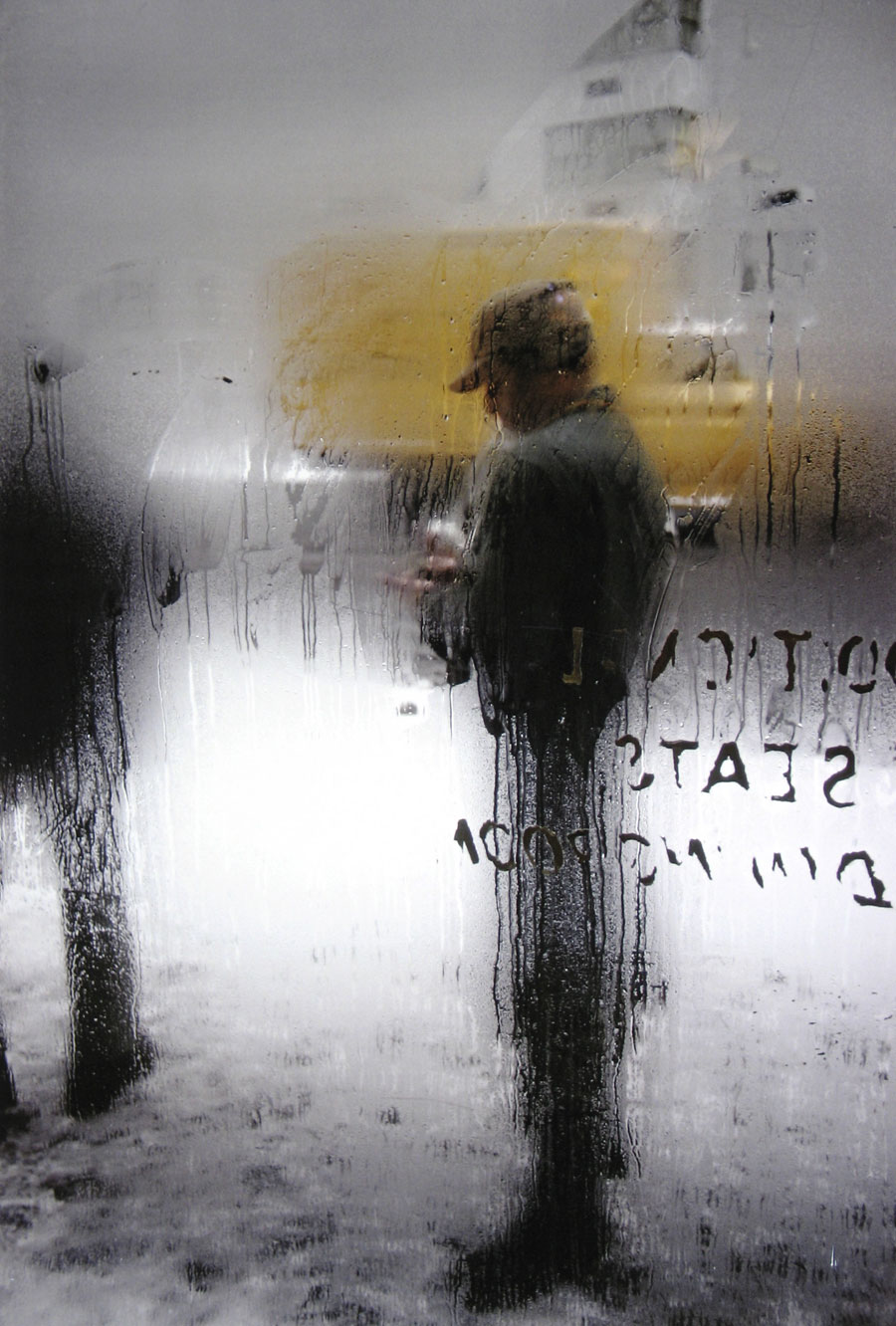
Saul Leiter (American, 1923-2013) 'Snow' 1960


Saul Leiter (American, 1923-2013)
Snow
1960
© Saul Leiter
Courtesy: Saul Leiter, Howard Greenberg Gallery, New York


Helen Levitt (American, 1913-2009) 'Cat next to red car, New York' 1973


Helen Levitt (American, 1913-2009)
Cat next to red car, New York,
1973
Type C prints
18 x 12 inches
© Estate of Helen Levitt


Alex Webb (American, b. 1952) 'Tehuantepec, Mexico' 1985


Alex Webb (American, b. 1952)
Tehuantepec, Mexico
1985
71 x 47cm
Digital Type C print
© Alex Webb


“I only know how to approach a place by walking. For what does a street photographer do but walk and watch and wait and talk, and then watch and wait some more, trying to remain confident that the unexpected, the unknown, or the secret heart of the known awaits just around the corner.”

~ Alex Webb


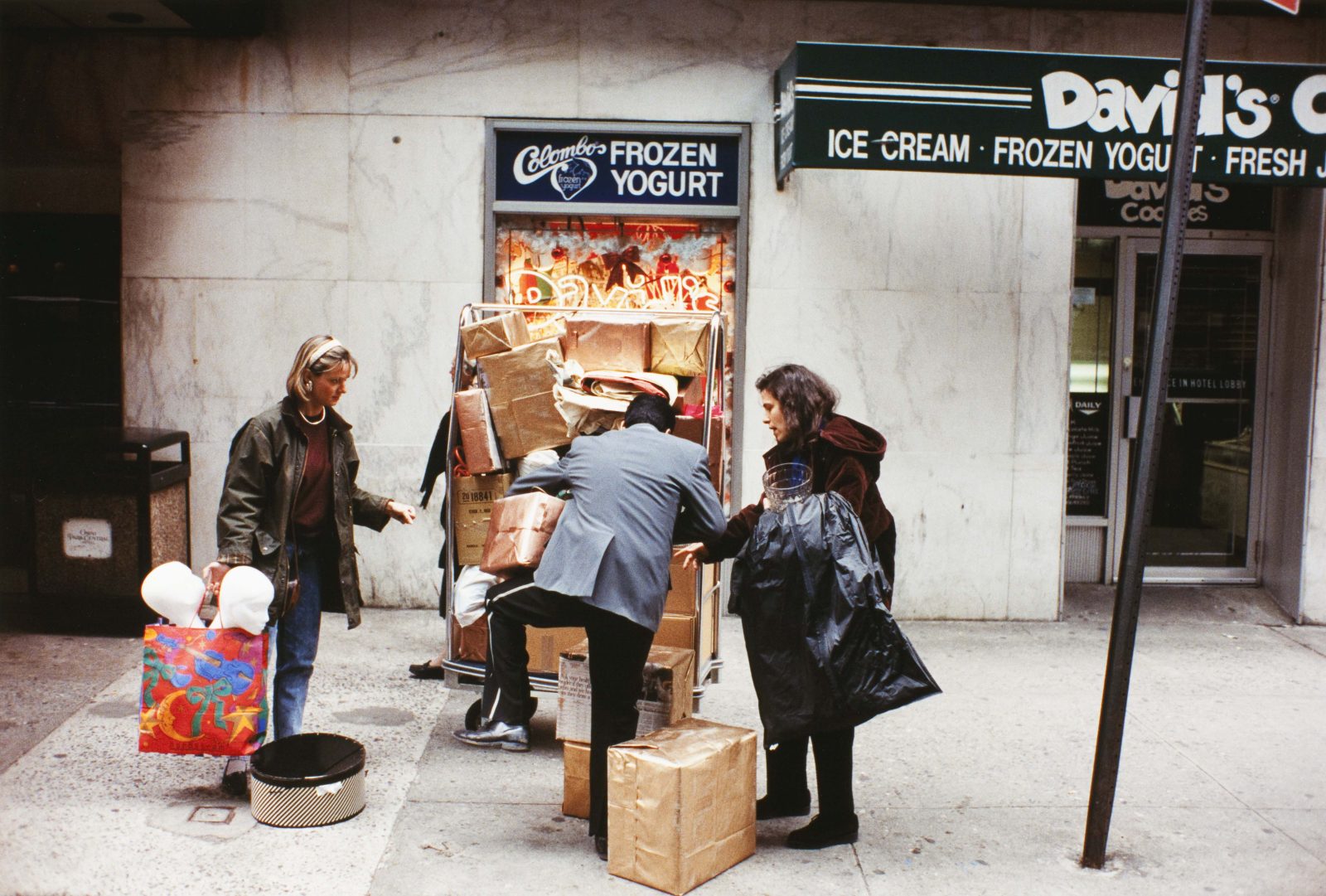
Jeff Mermelstein (American, b. 1957) 'Untitled (Package Pile Up, New York City)' 1995


Jeff Mermelstein (American, b. 1957)
Untitled (Package Pile Up, New York City)
1995
Chromogenic print
© Jeff Mermelstein
Courtesy Rick Wester Fine Art, New York


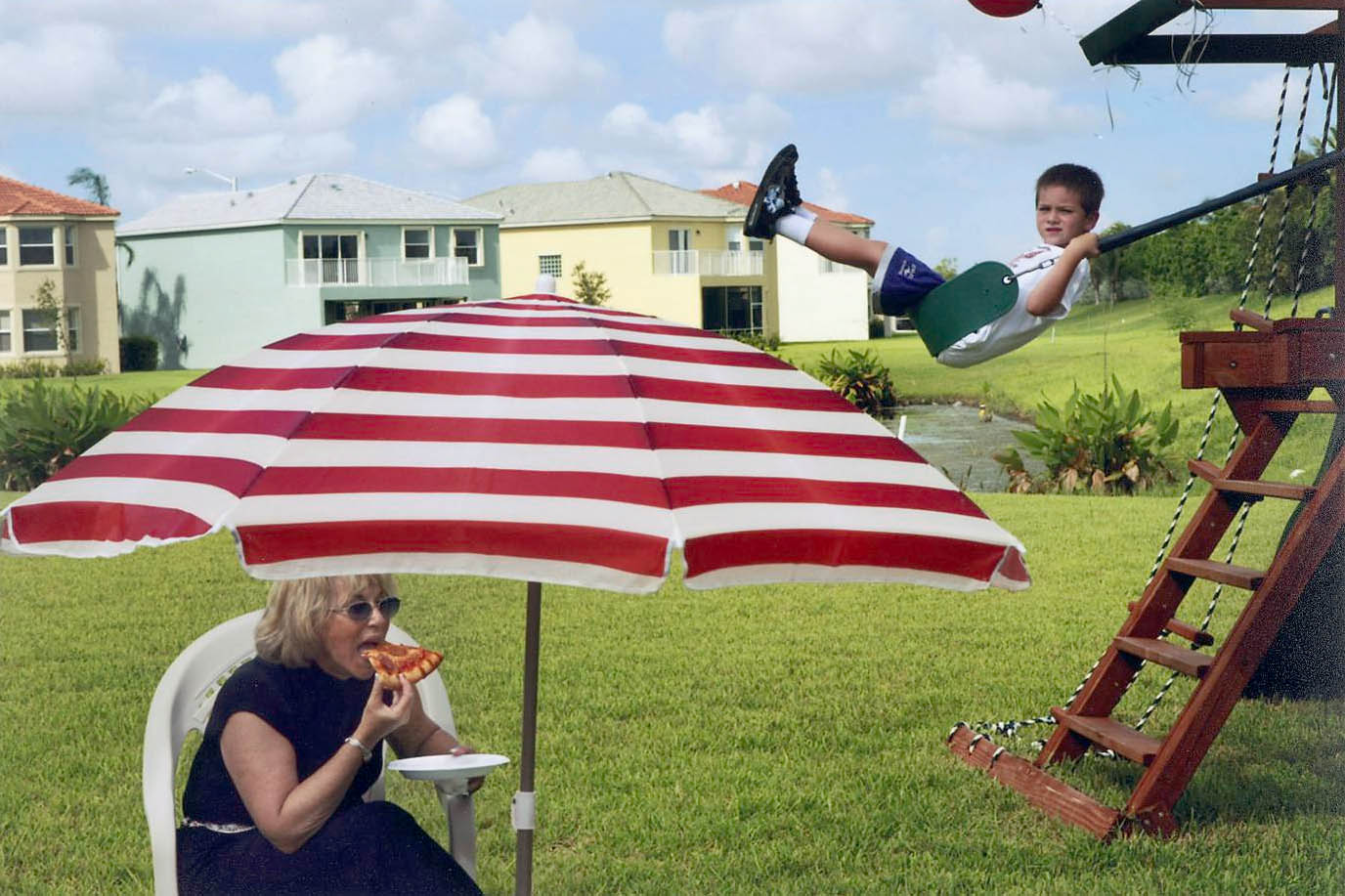
Carolyn Drake (American, b. 1971) 'Birthday party at Olympia, a gated community, Wellington, Florida' 2005


Carolyn Drake (American, b. 1971)
Birthday party at Olympia, a gated community, Wellington, Florida
2005
Digital Pigment Print
© Carolyn Drake / Magnum Photos


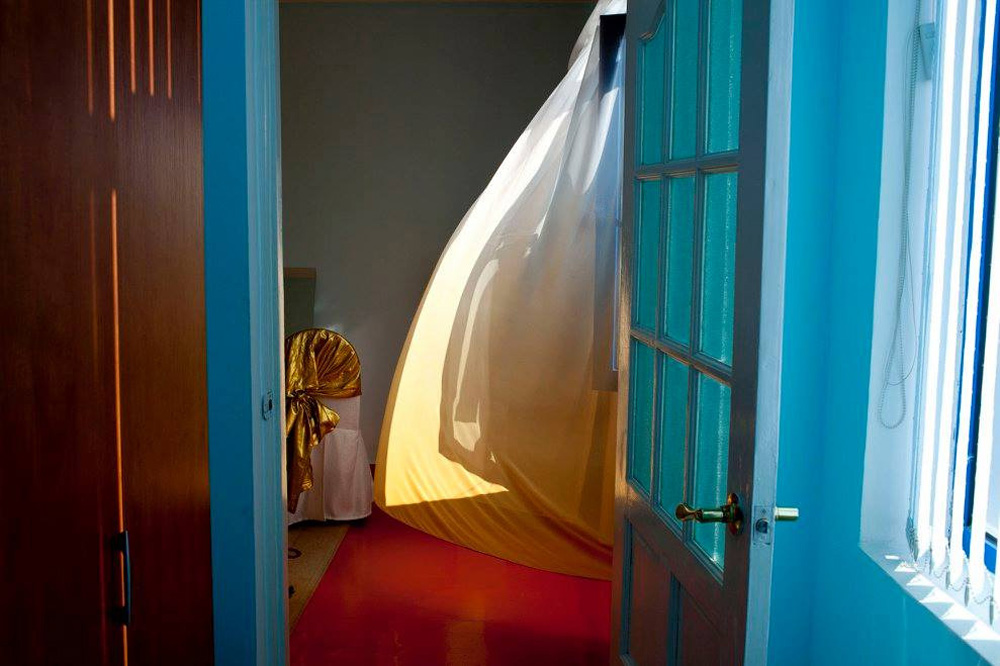
Carolyn Drake (American, b. 1971) 'Hotel room. Zhetisay, Kazakhstan. Carolyn Drake' 2009


Carolyn Drake (American, b. 1971)
Hotel room. Zhetisay, Kazakhstan. Carolyn Drake
2009
Digital Pigment Print
© Carolyn Drake/Magnum Photos


Andy Freeberg (American, b. 1958) 'Sean Kelly, Art Basel Miami' 2010


Andy Freeberg (American, b. 1958)
Sean Kelly, Art Basel Miami
2010
From the series Art Fare
Artist: Kehinde Wiley
63 x 43cm
Pigment ink print
© Andy Freeberg
Courtesy Kopeikin Gallery


Carolyn Drake (American, b. 1971) 'New Kashgar. Kashgar, China'  2011


Carolyn Drake (American, b. 1971)
New Kashgar. Kashgar, China  
2011
30.48 x 20.32cm
Digital Light Jet print
© Carolyn Drake 2012


Positive View Foundation announces its inaugural exhibition Cartier-Bresson: A Question of Colour, to be held at Somerset House, 8 November 2012 – 27 January 2013. Curated by William A. Ewing, the exhibition will feature 10 Henri Cartier-Bresson photographs never before exhibited in the UK alongside over 75 works by 15 international contemporary photographers, including: Karl Baden (US), Carolyn Drake (US), Melanie Einzig (US), Andy Freeberg (US), Harry Gruyaert (Belgium), Ernst Haas (Austrian), Fred Herzog (Canadian), Saul Leiter (US), Helen Levitt (US), Jeff Mermelstein (US), Joel Meyerowitz (US), Trent Parke (Australian), Boris Savelev (Ukranian), Robert Walker (Canadian), and Alex Webb (US).

The extensive showcase will illustrate how photographers working in Europe and North America adopted and adapted the master’s ethos famously known as  ‘the decisive moment’ to their work in colour. Though they often departed from the concept in significant ways, something of that challenge remained: how to seize something that happens and capture it in the very moment that it takes place.

It is well-known that Cartier-Bresson was disparaging towards colour photography, which in the 1950s was in its early years of development, and his reasoning was based both on the technical and aesthetic limitations of the medium at the time. Curator William E. Ewing has conceived the exhibition in terms of, as he puts it, ‘challenge and response’. “This exhibition will show how Henri Cartier-Bresson, in spite of his skeptical attitude regarding the artistic value of colour photography, nevertheless exerted a powerful influence over photographers who took up the new medium and who were determined to put a personal stamp on it. In effect, his criticisms of colour spurred on a new generation, determined to overcome the obstacles and prove him wrong. A Question of Colour simultaneously pays homage to a master who felt that black and white photography was the ideal medium, and could not be bettered, and to a group of photographers of the 20th and 21st centuries who chose the path of colour and made, and continue to make, great strides.”

Cartier-Bresson: A Question of Colour will feature a selection of photographers whose commitment to expression in colour was – or is – wholehearted and highly sophisticated, and which measured up to Cartier-Bresson’s essential requirement that content and form were in perfect balance. Some of these artists were Cartier-Bresson’s contemporaries, like Helen Levitt, or even, as with Ernst Haas, his friends; others, such as Fred Herzog in Vancouver, knew the artist’s seminal work across vast distances; others were junior colleagues, such as Harry Gruyaert, who found himself debating colour ferociously with the master; and others still, like Andy Freeberg or Carolyn Drake, never knew the man first-hand, but were deeply influenced by his example.

Press release from Somerset House website


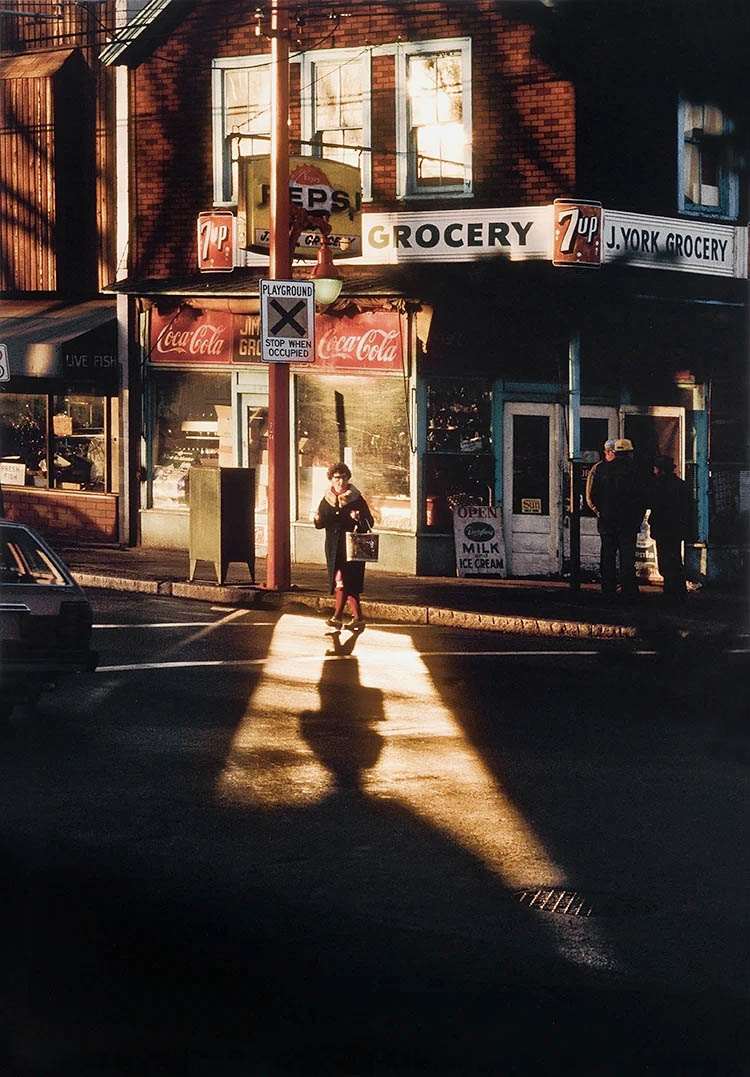
Fred Herzog (Canadian born Germany, 1930-2019)
'Man with Bandage, Vancouver, Canada'
1968


Fred Herzog (Canadian born Germany, 1930-2019)
Man with Bandage, Vancouver, Canada
1968


Joel Meyerowitz (American, b. 1938) 'Madison Avenue, New York City 1975


Joel Meyerowitz (American, b. 1938)
Madison Avenue, New York City
1975
Archival Pigment Print
© Joel Meyerowitz 2012
Courtesy Howard Greenberg Gallery, NYC


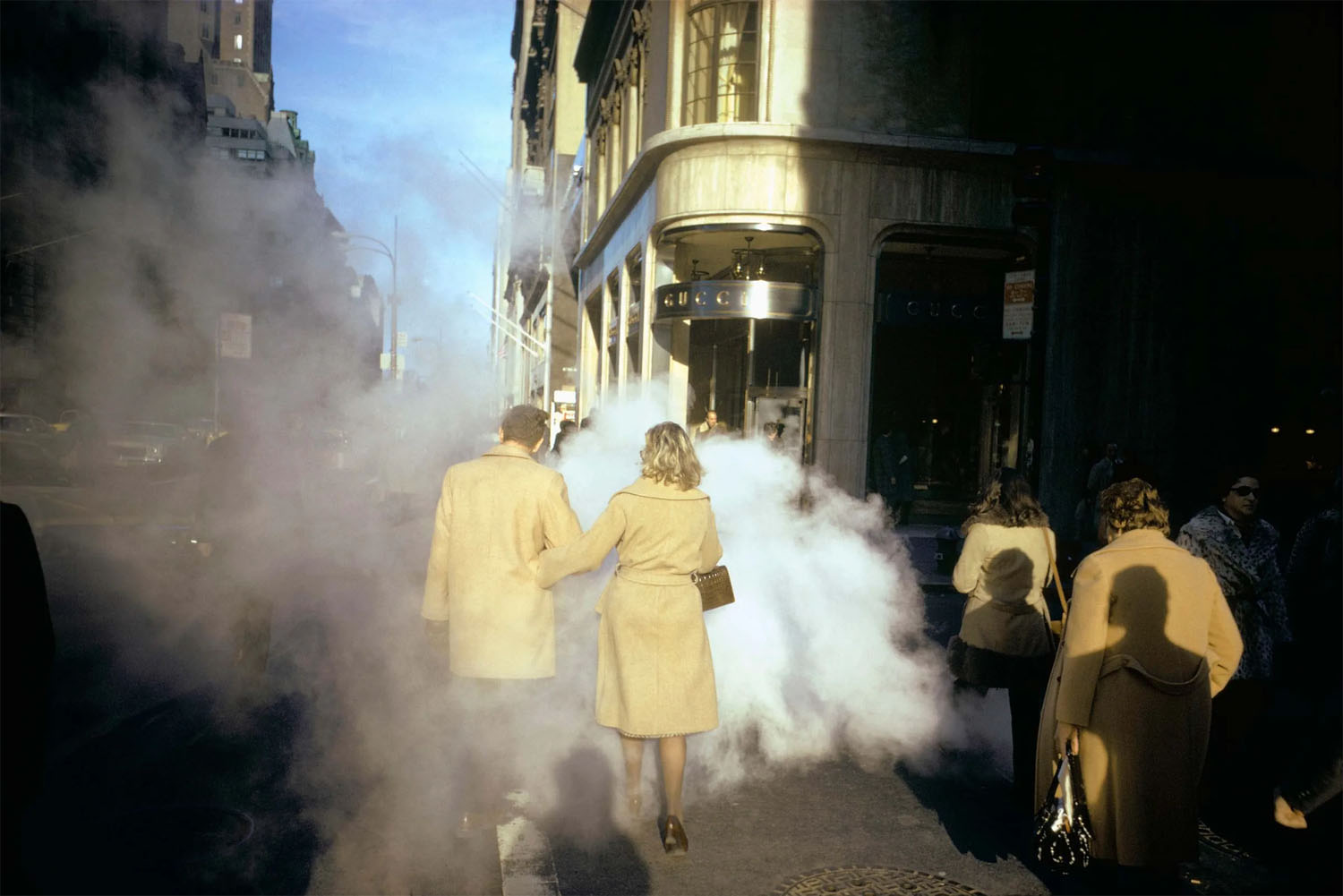
Joel Meyerowitz (American, b. 1938) Camel Coats, Fifth Avenue, New York 1975


Joel Meyerowitz (American, b. 1938)
Camel Coats, Fifth Avenue, New York
1975
Archival Pigment Print
© Joel Meyerowitz 2012
Courtesy Howard Greenberg Gallery, NYC


Ernst Haas (American, 1921-1986) 'New York City, US' 1981


Ernst Haas (American, 1921-1986)
New York City, US
1981


Fred Herzog (Canadian born Germany, 1930-2019) 'Crossing Powell 2' 1984


Fred Herzog (Canadian born Germany, 1930-2019)
Crossing Powell 2
1984
Ink jet print


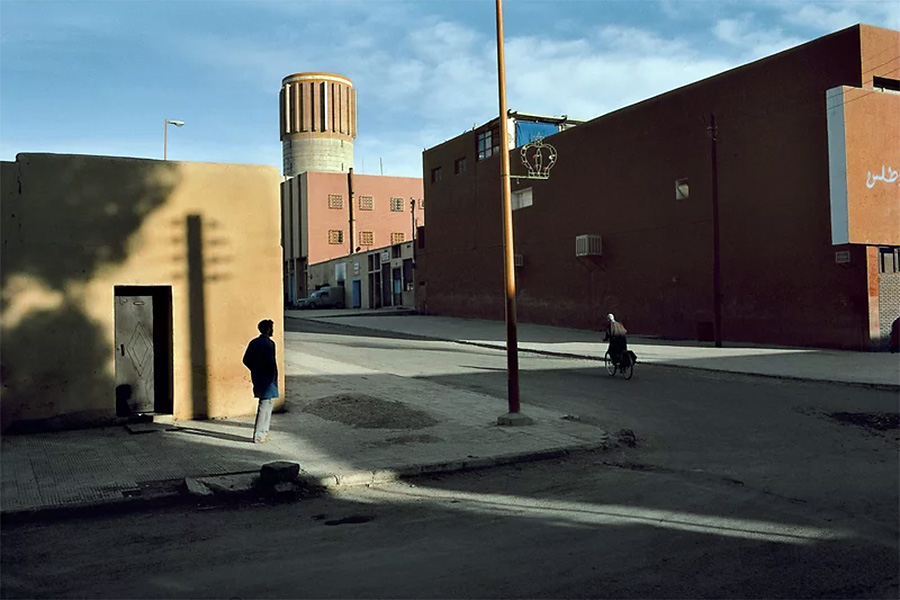
Harry Gruyaert (Belgian, b. 1941) 'Morocco, town of Duarzazte' 1986


Harry Gruyaert (Belgian, b. 1941)
Morocco, town of Duarzazte
1986
© 2015 Harry Gruyaert / Magnum Photos


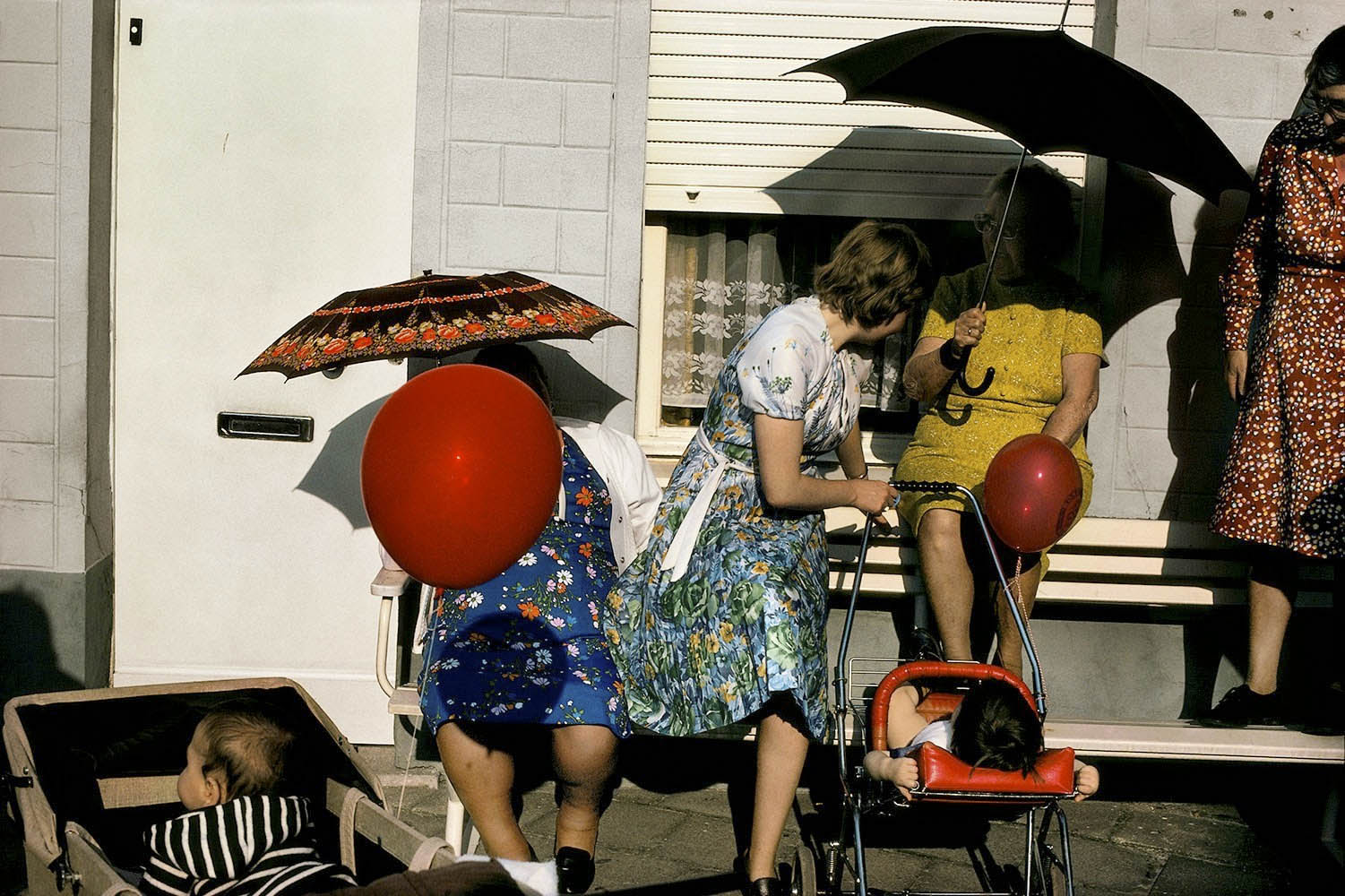
Harry Gruyaert (Belgian, b. 1941) 'Province of Brabant, Flanders region, Belgium' 1988


Harry Gruyaert (Belgian, b. 1941)
Province of Brabant, Flanders region, Belgium
1988
© 2015 Harry Gruyaert / Magnum Photos


Harry Gruyaert is known for his extraordinary photographic work with color. Born in Antwerp in 1941, he originally dreamed of becoming a film director. In the late 1970s, Pop art and a trip to Morocco inspired him to become one of the first photographers in Europe to devote his work entirely to color photography. Gruyaert’s cinematographic background instilled in him an aesthetic conception of photography. Rather than telling stories or documenting the world through his lens, he searches for beauty in everyday elements. His images are simply snapshots of magical moments in which different visual aspects, primarily color, form, light and movement, spontaneously come together in front of his lens.

Text from the Magnum website


Jeff Mermelstein (American, b. 1957) 'Unitled ($10 bill in mouth) New York City' 1992


Jeff Mermelstein (American, b. 1957)
Unitled ($10 bill in mouth) New York City, 1992
1992
Chromogenic print
20 x 16 in.
© Jeff Mermelstein
Courtesy Rick Wester Fine Art, New York


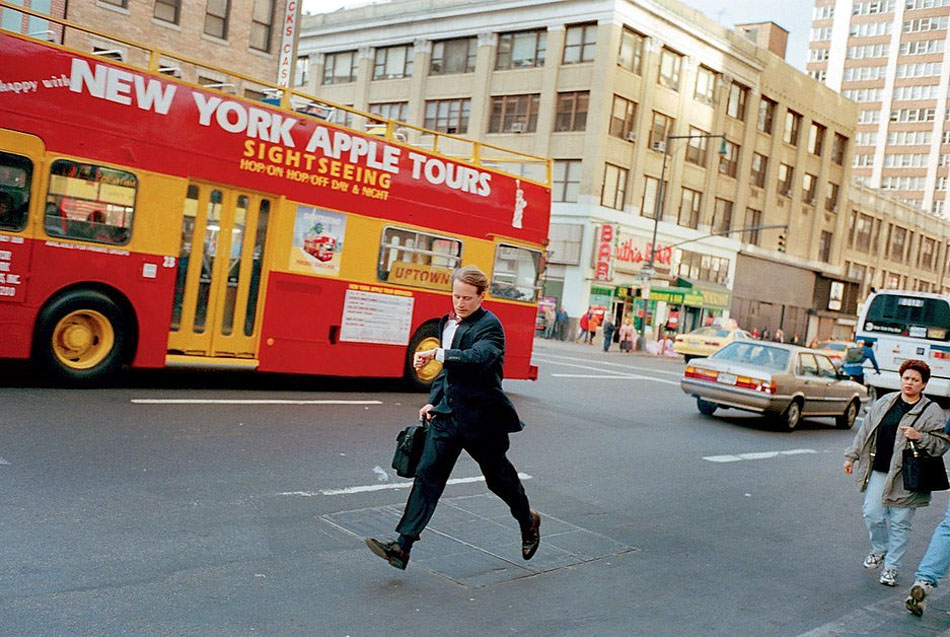
“My process is linked to everyday life. Only on rare occasions do I go out specifically to ‘shoot’. My best photographs were taken going to or from work, or some other destination. Sometimes a picture appears that helps me sum up a strange mood or thought that I’ve struggled with for weeks. Other times my work is more documentary in nature.

Photographing in public keeps me awake and aware, always looking around, in awe at what we humans are up to. In a time when staged narratives and rendered images are popular, I am excited by the fact that life itself offers situations far more strange and beautiful than anything I could set up.”

~ Jeff Mermelstein


Jeff Mermelstein (American, b. 1957) 'Run #9, New York' 1999-2000


Jeff Mermelstein (American, b. 1957)
Run #9, New York
1999-2000
© Jeff Mermelstein


Trent Parke (Australian, b. 1971) 'Man Vomiting, Gerald #1' 2006


Trent Parke (Australian, b. 1971)
Man Vomiting, Gerald #1
2006
Type C print
© Trent Parke
Courtesy Magnum Photos


Karl Baden (American, b. 1952) 'Chestnut Hill, Massachusetts' 2009


Karl Baden (American, b. 1952)
Chestnut Hill, Massachusetts
2009
Archival Inkjet
40.64 x 54.19cm
© Karl Baden


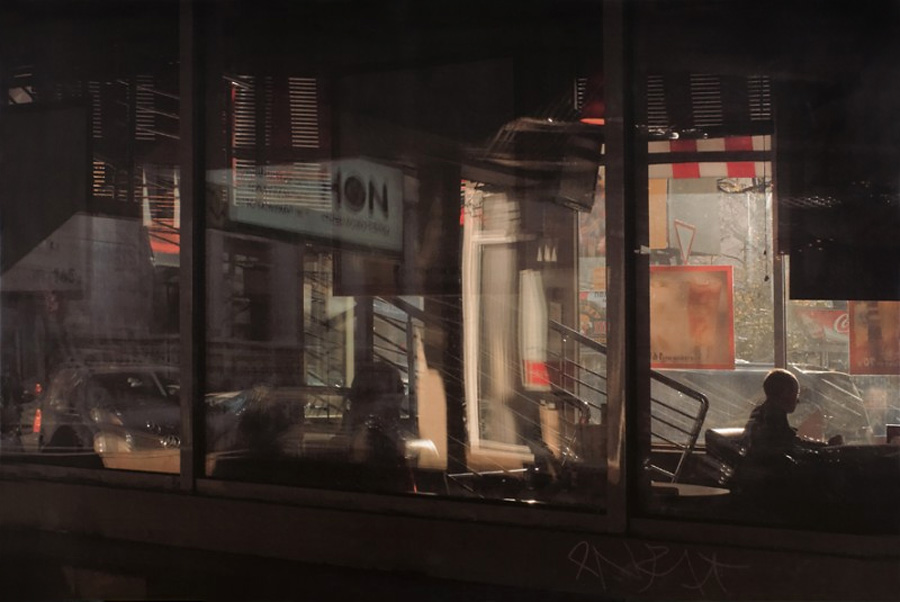
Boris Savelev (Russian, b. 1947) 'Cafe Ion, Moscow' 2009


Boris Savelev (Russian, b. 1947)
Cafe Ion, Moscow
2009
© Boris Savelev


Andy Freeberg (American, b. 1958) 'Nina Menocal, Armory Show' 2011


Andy Freeberg (American, b. 1958)
Nina Menocal, Armory Show
2011
From the series Art Fare
Pigment ink print
© Andy Freeberg
Courtesy Kopeikin Gallery


Henri Cartier-Bresson (French, 1908-2004) 'Brooklyn, New York' 1947


Henri Cartier-Bresson (French, 1908-2004)
Brooklyn, New York, 1947
1947
Gelatin silver print / printed in 2007
Image: 19.8 x 29.8cm
Paper: 22.9 x 30.4cm
© Henri Cartier-Bresson/Magnum Photos, Courtesy Fondation Henri Cartier-Bresson


Melanie Einzig (American, b. 1967) 'September 11th, New York' 2001


Melanie Einzig (American, b. 1967)
September 11th, New York 2001
2001
21 x 33cm
Inkjet print
© Melanie Einzig 2012


Terrace Rooms & Courtyard Rooms, Somerset House
Strand, London, WC2R 1LA

Opening hours:
10am – 6pm daily

Somerset House website

LIKE ART BLART ON FACEBOOK

Back to top

Exhibition: ‘Bob Mizer: ARTIFACTS’ at Invisible-Exports, New York / Research into photographs of men at the Kinsey Institute, Bloomington, Indiana 1999

Exhibition dates: 14th December 2012 – 27th January 2013

** Warning this posting contains male nudity **


Bob Mizer (American, 1922-1992) 'Rick Gordon, rooftop studio, Los Angeles' 1972


Bob Mizer (American, 1922-1992)
Rick Gordon, rooftop studio, Los Angeles
1972
Vintage color transparency
Cibachrome print
10.5 x 10.5 inches
Edition of 5
Printed in 2012


There are some appealing but relatively tame photographs from one of the doyens of male physique photography from the 1950s-1970s in this posting. More interesting to me are the photographs that never get published or shown in a gallery. While visiting The Kinsey Institute in Bloomington, Indiana as part of my PhD research Pressing the Flesh: Sex, Body Image and the Gay Male in 2001 I made a list of all the physique photographers present in their collection, as well as annotated notes on the photographs of Baron von Gloeden, George Platt Lynes, male homosexual catalogue photographs, male homosexual photographs and male2male sex photographs. Unfortunately almost nothing of this amazing collection of photographs at The Kinsey has ever been published, mainly I suspect due to the prudish nature of American society.

The physique photographers include artists such as Russ Warner, Al Urban, Lon of New York (who began their careers in the late 1930’s), Bob Mizer (started Athletic Model Guild (AMG) in 1945 and later, on his own, Physique Pictorial), Charles Renslow (started Kris studio in 1954), Bruce of Los Angeles, Douglas: Detroit, Dick Falcon, Melan, Karl Eller and Physique Culture and Early Homosexual Magazines.

Bob Mizer set up AMG in 1945 to photograph male bodybuilders and it is now the oldest male model photography studio in the United States of America. All models in the photographs that I studied were well built, smooth, toned. Lots of outdoor shots! Models are usually quite young (18-22 approx.) Tiny waists and v shaped. For example Image No. 51820. 3 studio portraits of one smooth boy featuring twisted back, arms and torso to great effect. Total V shape. Lots of erotic wrestling photographs from AMG as well.

Although not showing nudes in publications such as Physique Pictorial, private photographs by Bob Mizer heavily feature nudity. Wide use made of projected backdrops – abstracts, leaves, mountains, ships, classical Roman ruins. 4″ x 5″ prints are much better than the 8″ x 10″ enlargements. The Annotations on back of both size images tell of the models jobs and sexual orientation and what they will or will not do sexually if known. It is interesting to note that these annotations are usually the only thing that places the physical bodies in a social context. The studio shots really have no context while the outdoor shots have slightly more context. The annotations helps define the social and sexual structures within which the models circulated.

What surprised me the most in The Kinsey Institute collection were the black and white and colour photographs of the beefcake models with erect penis and having full on male2male sex out in the open. These photographs are never seen, never published or exhibited but these prurient texts provide an important touchstone when trying to understand the more sexually and aesthetically passive work. It is a pity that the viewer cannot make an informed decision on the development of an artist’s oeuvre without im/morality raising its ugly head.

PLEASE SEE THE NOTES FROM MY RESEARCH AT THE KINSEY INSTITUTE BELOW IN THE POSTING.

Dr Marcus Bunyan


Many thankx to Invisible Exports for allowing me to publish the photographs in the posting.
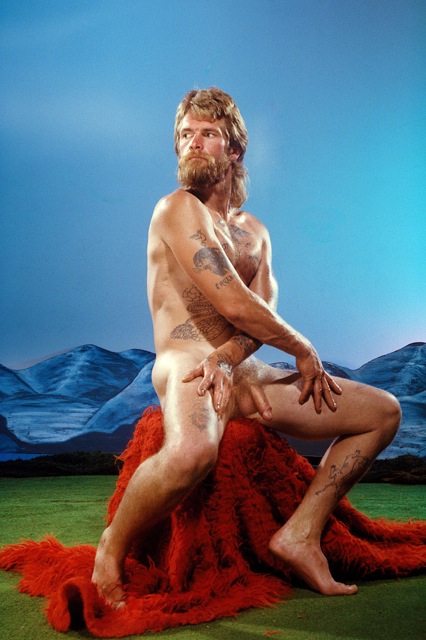


Bob Mizer (American, 1922-1992) 'John Benninghoff' 1991


Bob Mizer (American, 1922-1992)
John Benninghoff
1991
Vintage color transparency
Cibachrome print
7 x 10.5 inches
Edition of 5
Printed 2012
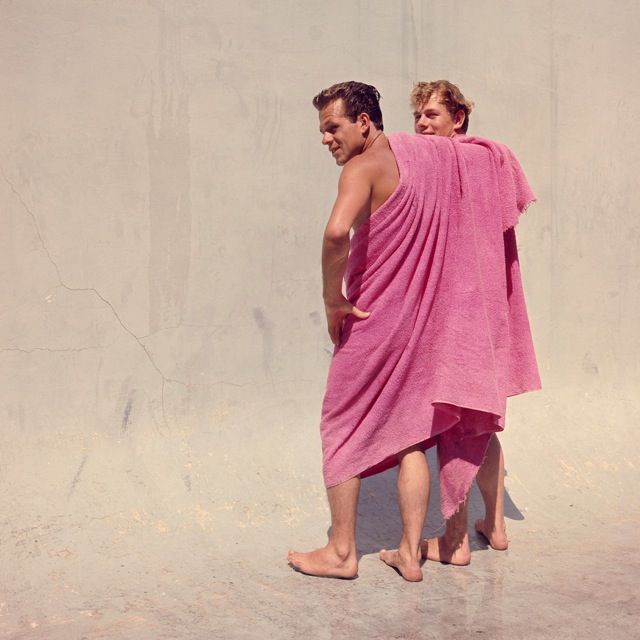
 

Bob Mizer (American, 1922-1992) 'Unknown, Los Angeles' 1972


Bob Mizer (American, 1922-1992)
Unknown, Los Angeles
1972
Vintage color transparency
Cibachrome print
10.5 x 10.5 inches
Edition of 5
Printed in 2012


Bob Mizer (American, 1922-1992) Production still from "Boy Factory", 1969


Bob Mizer (American, 1922-1992)
Production still from “Boy Factory”
1969
Vintage large-format black and white negative
Silver gelatin print
16 x 20 inches
Edition of 3
Printed in 2012


Most widely known as a photographer-filmmaker, independent publisher, and midcentury iconoclast, Bob Mizer (1922-1992) was an erotic auteur and a lyrical chronicler of the pre-Stonewall demimonde. In his meticulously staged idiosyncratic private work, Mizer revealed himself as a conscientious artist of intimacy and depth, a visionary stylist of the male-on-male gaze as it was refracted through a culture suffused with masculine iconography, which yet stymied and redirected the vectors of desire. The objects and photographs here show Mizer to be the progenitor of a new kind of devotional work that honours the kaleidoscopic typology of desire in the final stages of the underground era, while approaching it simultaneously as an improvised and mesmerising ethnography.

Mizer founded the Athletic Model Guild studio in 1945 when American censorship laws permitted women, but not men, to be photographed partially nude, so long as the result was “artistic” in nature. In 1947 he was wrongly accused of having sex with a minor and subsequently served a year-long prison sentence at a desert work camp in Saugus, California. But his career was catapulted into infamy in 1954 when he was convicted of the unlawful distribution of obscene material through the US mail. The material in question was a series of black and white photographs, taken by Mizer, of young bodybuilders wearing what were known as posing straps – a precursor to the G-string.

Upon his release from prison, he continued working undeterred, founding the groundbreaking magazine Physique Pictorial in 1951, which also debuted the work of artists such as Tom of Finland, Quaintance and many others. Models included future Andy Warhol superstar Joe Dallesandro, actors Glenn Corbett, Alan Ladd, Susan Hayward, Victor Mature, and actor-politician Arnold Schwarzenegger.

Throughout his long career he produced a dizzying array of intimate and idiosyncratic imagery, some flattened of explicit content but bathed nevertheless in an unmistakable erotic glow – tributes to the varieties of desire. Although Mizer’s studio was successful, his influence on artists ranging from David Hockney (who moved from England to California in part to seek out Mizer), Robert Mapplethorpe, Francis Bacon, Jack Smith, Andy Warhol and many others is only now beginning to be more widely appreciated.

The works collected in Bob Mizer: ARTIFACTS include a rare selection of staged tableux, images of California subcultures and an intimate collection of objects from various private sessions – preserved by Mizer along with photographs, films, videos and an ever-expanding catalog of props which over time evolved into a haphazard private museum and a natural history of American desire.

Press release from the Invisible-Exports website
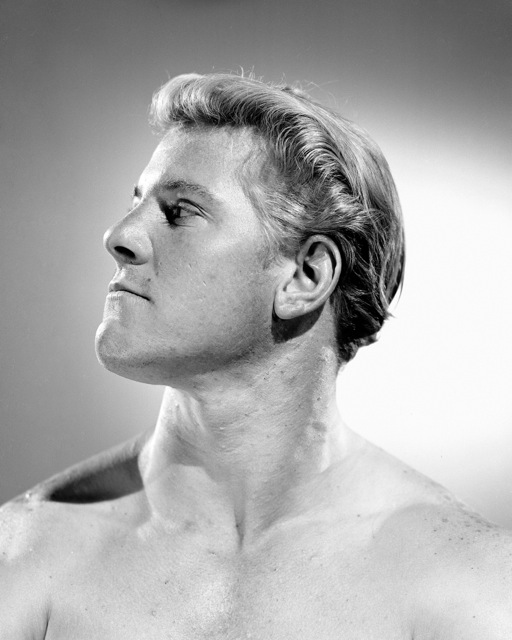
 

Bob Mizer (American, 1922-1992) 'Jim Carroll, Los Angeles' c. 1951


Bob Mizer (American, 1922-1992)
Jim Carroll, Los Angeles
c. 1951
Vintage large-format black and white negative
Silver gelatin print
10.5 x 8.4 inches
Edition of 5
Printed in 2012


Bob Mizer (American, 1922-1992) 'Bill Holland, Los Angeles' c. 1951


Bob Mizer (American, 1922-1992)
Bill Holland, Los Angeles
c. 1951
Vintage large-format black and white negative
Silver gelatin print
10.5 x 8.4 inches
Edition of 5
Printed in 2012


Bob Mizer (American, 1922-1992) 'Beau Rouge, Los Angeles' c. 1954


Bob Mizer (American, 1922-1992)
Beau Rouge, Los Angeles
c. 1954
Vintage large-format black and white negative
Silver gelatin print
10.5 x 8.4 inches
Edition of 5
Printed in 2012


Research at the Kinsey Institute, Bloomington, Indiana

16/08/1999 – 19/08/1999

This research was undertaken as part of my Phd research Pressing the Flesh: Sex, Body Image and the Gay Male at RMIT University, Melbourne.

~ Male homosexual catalogue photographs from the Collection at The Kinsey Institute
~ George Platt Lynes photographs from the Collection at The Kinsey Institute
~ M2M sex photographs from the Collection at The Kinsey Institute
~ Notes on physique culture photographs and magazines from the Collection at The Kinsey Institute
~ Baron von Gloeden photographs from the Collection at The Kinsey Institute


Male homosexual catalogue photographs from the Collection at The Kinsey Institute

Image No. 543-280. Frontier Club, San Diego, California.
**Mr. America – Plus** Frontier #11. Catalogues and ads, December 1967
Image No. 543-281. Frontier Club, San Diego, California.
**Mr. America – Plus** Frontier #5. Catalogues and ads, December 1967

Proof sheet photographs cut up and taped down onto card and the rephotographed. #11 features a solo young man, naked except boots and hat, posing with whip. #5 features natural boys in shorts, shirts, wrestling, one punching the other’s stomach, holding each other just wearing underwear. Really cute, natural bodies and photographs. Some posing by photographer. Lighting obviously just by table lamps or lights, very amateur, but all the more intriguing and interesting for that.

Image No. 2667-9. Anonymous. Nd Acquired 1951

Image No. 2669 is a duplicate of No. 2667. 8″ x 10″ sheet of proofs 6 side by 6 high, each proof oblong in shape. Originally folded in four and now flattened out.

2 men, possibly 3 (hard to tell from small proofs), in the country by a river/pond, diving, fishing, posing, lifting weights, rocks, rowing boats together, archery, playing tennis, wrestling, running. Sunbaking side by side, one back down, the other stomach down on a rock by the river, great bodies – some of the most beautiful physique photographs, if not THE best in the whole collection. Need to have negatives made and printed! 2 men have great bodies, smooth, built, and great poses and rapport with each other. Strong sunlight. They have painted on posing pouches, so originally they must have been nude photographs. American. Social setting and context is interesting – theirs or a friends country property? (tennis courts, lake, etc., …) enabled the privacy needed to photograph them like this, so from a moneyed social class.

Image No. 2864-5. Anonymous. Nd 1950s? Chicago Police Dept., Acquired 05/1961

Image No. 2864. 12 models on a 3″ wide x 4″ high page.
Image No. 2865. 4 models on a 2″ wide x 4″ high page.

Rare physique photographs of nude men with erections. Some are shot using double flash or lights in a house (skirting board visible). A couple on an unmade bed and others in a studio setting with nothing behind. Most models are smiling! Same photographer in both proof sheets as curtain behind bed features in both sheets. Also numbered sequentially 1-12 for first sheet, 13-16 for second sheet.


George Platt Lynes photographs from the Collection at The Kinsey Institute

It is interesting to note that most of the photographs list the names of the models used but I am unable to print them here due to an agreement between GPL and Dr. Kinsey as to their secrecy. Also most of the photographs have annotations in code on the back of them giving details of age, sexual proclivities of models and what they are prepared to do and where they were found. This information gives a vital social context to GPL’s nude photographs of men and positions them within the moral and ethical framework of the era in which they were made. I hope that one day this information, along with the names of the models, can be made available to the public to give them a greater insight into the development of GPL’s personal aesthetic as well as the development of the visible erotic desire of the male body by and for other men during the 1940s-1950s.

Untitled Nude. 1944

Photograph of a well built older (about 25?) nude man reclining on a bench with a high back. Lit by one spot on body forming heavy shadows with the backdrop lit to form outline of body against it. Head is tilted back so face not visible, left arm flung out. man is smooth, toned and quite hunky. Hairy legs with one knee in air. This is a very passive pose and the genitalia are hidden in deep shadow as though afraid to be revealed. Despair/sex/anonymity?

See Kinsey Institute and Crump, James. George Platt Lynes: Photographs From the Kinsey Institute. Boston: Bulfinch Press, 1993, Plate 16.

Some earlier nudes especially portrait of Reginald Beane, 1938, have a very Man Ray quality too them. See Kinsey Institute and Crump, James. George Platt Lynes: Photographs From the Kinsey Institute. Boston: Bulfinch Press, 1993, Plate 47.

Untitled Nude. 1953

Black man lying on a white mattress in a horizontal position, the top of mattress showing creases in the sheet covering it. Photographed from slightly higher than the prone body, horizontal print. This photograph is an exercise in tonal scale and lighting / textures. Beautiful light on body. The image is divided into different planes and spaces.

See Kinsey Institute and Crump, James. George Platt Lynes: Photographs From the Kinsey Institute. Boston: Bulfinch Press, 1993, Plate 57.

Male Nude Hanging. 1940

Close up of fuller length photograph of 1940 Crucifixion showing agony on face, shaved armpits(!) and pubes, legs, ropes cutting into wrists. Beautiful cool brown / grey tonality to print. Lighting is from two sides as can be seen by the shadows formed on the body and the backdrop. Quite a feminine image I feel, with the heavy eyebrows, very smooth ephebe body and the lean of the torso. Print is more tonal than the reproduction in the book.

See Kinsey Institute and Crump, James. George Platt Lynes: Photographs From the Kinsey Institute. Boston: Bulfinch Press, 1993, Plate 75.

Untitled Nude. 1955

Tanned older (25?) nude man with hanging big cut dick standing in front of graffiti wall. Head back and eyes closed, not engaging with the camera. Tan line of shorts very visible. Beautiful smooth body, and lovely skin tones in print.

Untitled Nude. 1952

This photograph has much more life than the reproduction in the book. Every hair on his chest GLOWS. The grey of the print is more intense and the print darker overall. The arm of the left hand side of the print is not so blown out and the hands have more of a feeling of suspension to them.

See Kinsey Institute and Crump, James. George Platt Lynes: Photographs From the Kinsey Institute. Boston: Bulfinch Press, 1993, Plate 41.

Male Nude. 1951

Paper negative? Smooth, young man lying on his back, breathing in, thin waist, arm behind head, looking straight into camera. Backdrop lit by two spots to outline body. Horizontal print with lots of negative space above body. Those eyes really get you and the tufts of pubic hair really stand out in the original photograph. Outline shape is amazing and the reproduction does not do it justice. Real presence. One of the most moving prints yet. It is a privilege to see it!

See Kinsey Institute and Crump, James. George Platt Lynes: Photographs From the Kinsey Institute. Boston: Bulfinch Press, 1993, Plate 72.

Untitled Nude. 1954

Young man on left hand side of photograph wearing necklace, ring on right hand, tattoo of rose on right forearm, rocker haircut, looking down and away from camera. Darker figure. Another smooth, youthful male form behind opaque screen has hand reaching for first figure, touching him with left hand. Lighter figure with tattoo on left hand bicep. Print is mid to light grey in its tonality. Very homoerotic.

Untitled Nude. 1952

Beautiful photograph of a nude young male sitting on a work bench table in a derelict building, 2 windows behind him to either side. His body is very smooth and he has a cut dick. His arms are out behind him on table to support his body which is leaning back. One leg is hanging over edge of table whilst the front leg is raised with knee in the air with the foot resting on the edge of the work bench. The background is lit from the left and the figure is lit from behind and above – great lighting.

Strong use of chiaroscuro and opposite way lighting in later photographs. There are several photographs of men in unmade beds, genitalia showing or face down showing butts off.

Untitled Nude. 1946

One such photograph shows 2 boys lying in single unmade beds next too each other. The second young man is way out of focus in the background. These are not studio shots any of these. They are much more personal. In this photograph the erect, stiff, nodular end post of the bed is like a metaphor for an erect penis, the opposite side of flaccid one of the young man on the bed nearest the camera. The young man has his one hand on his stomach and the other behind his head, eyes closed, as though he is asleep. Flash or strong lights? Definitely flash.

Untitled Nude. 1953

Same backdrop but different pose from Plate 61 in Kinsey Institute and Crump, James. George Platt Lynes: Photographs From the Kinsey Institute. Boston: Bulfinch Press, 1993. Here one of the men has his hand under his chin, arm resting on folded knee, looking down at prone body which is face down beside him. Young man face down has cute butt with tan line. Beautiful tonal print, especially skin tones.

Image No. 141. Untitled Nude. 1942. Acquired GPL 1950

Beautifully toned photograph of a young man kneeling on a mattress with feet hanging over its edge. Backdrop is lit to give outline and form to shoulders / head and fade into darkness above. His balls hang down between his legs and you can see every hair on them. Young man has a cute butt. Photograph is very erotic, very suggestive of anal penetration, and very about form as well.

Image No. 144. Untitled Nude. 1953. Acquired GPL 07/1955

Strong image always quoted as an example of GPL’s more direct way of photographing the male nude in the last years of his life. Male is solid, imposing, lit from above, heavy set, powerful, massive. Eyes are almost totally in shadow. Later photos have more chiaroscuro possibly, more use of contrasting light (especially down lit or up lit figures) but are they more direct? Yes. Models look straight into camera.

See Plate 59 in Ellenzweig, Allen. The Homoerotic Photograph. New York: Columbia University Press, 1992, p. 103.

Image No. 153. Untitled Nude. 1953. Acquired GPL 07/1955

Really strong image of older man sitting on edge of bench, cropped mid thigh and under mouth. Image shows hairy chest, arms, legs, cut dick and great definition of abdominals. Tan line visible, skin tones in print are just above mid grey. Really good shadows on stomach, under pecs. Lit from above, softbox?

Image No. 186-194. Untitled Nudes. 1951. Acquired GPL 09/1954

Whole series of studio shots of male butt and arsehole in different positions. Quite explicit. Some close-up, others full body shots with legs in the air. Not his best work but interesting for its era. Very sexually anal or anally sexual! As in GPL’s work, very about form as well. In one photograph a guy spreads his cheeks while bending over from the waist, in another photograph he spreads his cheeks while standing slightly bent forward.

These are the most explicit of GPL’s images in the collection that I saw, though perhaps not the most successful or interesting photographically. 8″ x 10″ contact print.

See Kinsey Institute and Crump, James. George Platt Lynes: Photographs From the Kinsey Institute. Boston: Bulfinch Press, 1993, Plate 78 for an image from this series.

It is interesting to note that George Platt Lynes photographed his own erect penis as early as 1929, although this photograph is not present in The Kinsey Institute Collection and belongs to The Collection of Anatole Pohorilenko (See Crump, James. “Iconography of Desire: George Platt Lynes and Gay Male Visual Culture in Postwar New York,” in Kinsey Institute and Crump, James. George Platt Lynes: Photographs From the Kinsey Institute. Boston: Bulfinch Press, 1993, p.151, Footnote 19).

I also did not see the photograph titled “Erection, c. 1952,” (See Figure 29 on page 255 of the Hard copy of the Project notes; Crump, James. “Iconography of Desire: George Platt Lynes and Gay Male Visual Culture in Postwar New York,” in Kinsey Institute and Crump, James. George Platt Lynes: Photographs From the Kinsey Institute. Boston: Bulfinch Press, 1993, p.153), while at The Kinsey Institute which illustrates this article. This is the most sexually explicit photograph of GPL’s that I have ever seen but there is no accreditation listed for this photograph in a book which is subtitled ‘Photographs From The Kinsey Institute’. Is this photograph part of The Kinsey Collection and if it is, why didn’t I see it when I was researching there?

Image No. 457. Untitled Nude. 1955

Man on an unmade bed staring into camera. Tattoo of ‘Chuck’ on upper left arm bicep / shoulder. Older man with tan line and cute butt. Behind is a dark, dark background of a bedroom with a Venetian blind over a window, plant just visible in front of it, bookcase in back right of photo, down light from table lamp highlighting books on side table. Printed down background to make it darker? Man stares straight into camera with a penetrating gaze – presence, engagement, defiance! After sex? Before sex? with GPL? Photograph is blurred so slow shutter speed and tungsten lighting. The white highlights of sheet nearest camera are almost blown out by lighting. Very personal and beautiful photograph placing the male body in bedroom available for sex with another male.

See Plate 50 in Ellenzweig, Allen. The Homoerotic Photograph. New York: Columbia University Press, 1992, p. 93.

Image No. 481. Untitled Nude. 1941. Acquired GPL 10/05/1950

Two young men stretched out, intertwined legs and arms, very sensual pose. Horizontal print. Lots of darker negative space above the bodies. Backdrop lit to highlight body outline – usual GPL trademark.

Image No. 482.Untitled Nude. 1941. Acquired GPL 10/05/1950

2 smooth young men, ephebes, about 19 years old, one cut off at the waist, leaning backwards and resting on others stomach. Both have blond hair and the young man at front has his right hand resting on his chest, eyes closed. Rear figure has his head turned away from the camera.

See Plate 52 in Ellenzweig, Allen. The Homoerotic Photograph. New York: Columbia University Press, 1992, p. 95.

One of the best images in the collection. Very evangelical and homoerotic at the same time.

Image No. 483. ‘Charles ‘Tex’ Smutney, Charles ‘Buddy’ Stanley and Bradbury Ball’. 1941. Acquired GPL 10/05/1950

Studio shot of 3 smooth, nude young men in various positions on an unmade mattress bed sitting on GPL’s studio floor. All three young men are intertwined with a white sheet covering some of the bodies and faces. Dark chair in background has clothes lying on it. Lit from above left. Skin tones in print are just above mid grey. According to Leddick, David. Naked Men: Pioneering Male Nudes 1935-1955. New York: Universe Publishing, 1997, p. 21, the names of the models are as above and come from a series of 30 photographs of three boys undressing and lying on a bed together. Image No. 483 and 484 come from the same series as the reproduced photograph.

Image No. 484. ‘Charles ‘Tex’ Smutney, Charles ‘Buddy’ Stanley and Bradbury Ball’. 1941. Acquired GPL 10/05/1950

Different pose from above. No genitalia visible. No touching each other. Darker print than above. Beautiful tone of print.


M2M sex photographs from the Collection at The Kinsey Institute

Image No. 54106-7. M. Koch – O. Reith. ‘Der Act’. Acquired 1946

Early (1880-1910?) male nude photographs used as models for other artists. 2 older males together supporting the pediment of a Roman column, themselves taking the place of the column. In Image No. 54107 they have their arms around each other. Just natural male bodies, smooth, moustaches, uncut.

Image No. 54112. Anonymous photographer. Nd Acquired Chicago Police Dept. 05/1961

VERY RARE location shot of male nudes at baths(?) White nude male laying down, with black man doing handstand on his shins, back to the viewer. In the background is another nude black man, partially visible. Hanging up on pegs behind him are 5 singlets and 1 pair of underwear. Small photograph 2” wide by 4” high. Significant in that the photograph appears to be at the baths, shows interracial nudity and M/M contact.

One of the most significant photographs in the whole collection in my opinion. The sexologists of the era did not collect photographs of gay men and their bodies in social contexts, preferring instead to concentrate on photographs of M/M bodies engaged in sexual acts or physique photographs taken in the studio which generally do not have any context in relationship to the outside world. I know they did not have much of a choice in the material offered to them but surely there must have been photographs of gay men in the park, at the beach lying next too each other. In contemporary research we would embed such photographs within broader situational contexts and theoretical analyses.

Image No. 543-280. Frontier Club, San Diego, California.
**Mr. America – Plus** Frontier #11. Catalogues and ads, December 1967
Image No. 543-281. Frontier Club, San Diego, California.
**Mr. America – Plus** Frontier #5. Catalogues and ads, December 1967

Proof sheet photographs cut up and taped down onto card and the rephotographed. #11 features a solo young man, naked except boots and hat, posing with whip. #5 features natural boys in shorts, shirts, wrestling, one punching the other’s stomach, holding each other just wearing underwear. Really cute, natural bodies and photographs. Some posing by photographer. Lighting obviously just by table lamps or lights, very amateur, but all the more intriguing and interesting for that.

Image No. 55201. Anonymous. Nd Acquired Edina Minneapolis Police Dept., 01/1962

Small photograph 2″ wide x 3″ high. Interior. Male nude with hips thrust to one side, right leg splayed outwards, smooth, uncut, holding cane in left hand and top hat on his head at a rakish angle with right hand. Backdrop probably a Japanese fabric of bamboo canes. Very effeminate photograph of a young nude man in a bedroom possible (?) – very personal.

Image No. 55202. Anonymous. Nd Acquired Chicago Police Dept., 05/1961

Nude man in gaiters (1920s-1940s?), uncut, watch on left hand, drinking from small silver cup which hides mouth. Right hand holds half smoked cigarette. Body has no shape about it at all – really strange. In the background is a standard lamp, skirting board and striped wallpaper. Flash or lamp lit. Personal / private photograph.

Image No. 55203. Anonymous. Nd Acquired Chicago Police Dept., 05/1961

Young man, nude, uncut, flattened against interior wall covered with Arabic scene of horses, men and tigers above skirting board and wooden floor. Possibly 1930s. He has a tattoo on right forearm and the most amazing tan line from wearing shorts and singlet. His body has no shape to it at all, he has thin arms and is about 20-22 years old. Really unusual to see such a tan line, possibly from a bathing suit. With the background, I would say it positions this man socially in the upper classes and is interesting for its social contextualisation of the male body.

Image No. 55259. Anonymous. Nd Acquired Chicago 1940

Photograph one and a half inches square of male nude approx. 25-28 years old, smoking a cigarette, in slip on shoes, standing in front of what looks like army tents with trestle tables inside them. Body is natural, no real shape, smooth, man is smiling.

Image No. 55260. Anonymous. Nd Acquired Chicago Police Dept., 05/1961. 385971

Male nude with dark hair, three quarters side profile standing in lounge room. Very Diane Arbus. Table lamp with big shade and 2 tiered side table. Vinyl chair behind. Print on wall is nearly completely hidden, curtain to top right hand side with wood grain wall as well. Beautiful man, serene, calm, relaxed in his own body – ONE OF THE BEST PHOTOGRAPHS. Flash was used as heavy shadow of man outline falls on the wall behind. Body is smooth, hunky but not a bodybuilder. Cut dick. Hands by side. Nice face, smiling, looking at camera.

Really like this photograph as the man is comfortable in showing off his body in front of the camera yet not really posing or puffing himself up. He and his body are aware but relaxed and just so.

Image No. 55042. Anonymous. Nd Acquired O.W. 05/1954

Small photograph 2″ wide x 3″ high of young nude man sitting in car facing out of the open passenger side door with his trousers down below his knees. Left hand is resting on knee and the right hand is pinned against the seat by the weight of his own body. Uncut dick. Curly dark hair, eyes closed. Car has stick shift left hand drive (American) probably early 1950s. Body is smooth, boyish and young man is about 17-19 years old.

Just before or after sex? Intimacy? Photograph positions the body in an era and specific situation. Was he about to be sucked off? Was he being forced into pulling his pants down and being photographed? I don’t think so from the closed eyes and position of the body within the car. Lover is the photographer?

Image No. 55087. Anonymous. Nd Acquired McG. NYC 1946

Photograph approx. 7″ wide by 5″ high. Smooth young man, about 18, eyes closed, wavy hair, leaning back on one hand on sandy beach. Right hand leg rests on lower of 2 wooden steps. Right hand rests on knee of right leg. Cut dick. Smiling. Lake in background with 3 sailing boats on it, one with sail up and 2 people in it. Pair of shoes sits on second step.

Beautiful photograph – intimacy, again possibly a lover has taken this photo, and it has some context to it – shoreline and people sailing boats in the background, steps leading to holiday shack? Young man is beautiful, happy and at ease in his surroundings, his company and in his own body.

Image No. 54768-54779. Anonymous. Nd Figure Set 41. 1960s(?)

All photographs 3″ wide x 4″ high. 2 nude men, about 25-30 years old, in bedroom, mirror on front of wardrobe, flowers in vase on dressing table, bed, flower patterned wallpaper, window behind dressing table. One man is hairy and cut, the other smooth and uncut. They are using a measuring tape (in inches) to measure each others necks, arms, chests, waists and calves in this series of photographs. Both men are smiling at each other and at other people off camera and are totally unaffected by the cameras presence in one respect whilst posing for it in another. Flash used. In some of the photographs the smooth man has his hand on the others head (for balance?) No, probably lovers.

Great series of photographs, very natural using built bodies in a bedroom setting (their own?), measuring and showing off the results of their bodybuilding. The images are quite a laugh and they are obviously comfortable and having a good time too! Much less formal than the usual physique photograph and show an intimacy between the two models, plus a context for that intimacy, the bedroom.

Image No. 41601. Anonymous. 1935+-. Acquired 1948

Annotation: Swedish boy named Gustav(?) Young man in trousers, white shirt, hair parted down middle, holds a Gladstone bag. He is smiling. House in background with women pulling kid along which is blurred in middle distance. Slim, natural body especially arms.

Image No. 41602. Anonymous. 1935+-. Acquired 1948

Annotation: Took him to baths in Germany. Same young man as above now in a one piece bathing suit, hair wet, slicked back. SLIM, beautiful boy. He is sitting on sand. People lying on beach in background including another boy who is out of focus.

Image No. 41602. Anonymous. 1935+-. Acquired 1948

Annotation: Met in Navarin Masquerade, 1932. Same young man lying on towel on beach, Gladstone bag behind him. Very smooth young man, very Horst P. Horst model. Wearing a one piece bathing suit pulled down to his waist.

Good set of 3 photographs because it shows this young gay man in a variety of different settings posing for the photographer who he obviously knows from the annotations. Relaxed in his body and his surroundings. Perhaps they are on holiday together?

Image No. 41607/41610. Anonymous. c. 1946. San Francisco. Acquired 1958

4 guys in various uniforms, table in front of them filled with alcohol. Hands on each others crutches. Second photograph has friends with Navy coats on coming in door. Like stills from a film?

Image No. 41612. ‘Ray Baker’. c. 1946. Acquired 1950

Annotation: Donny 16-17 years. Bob 25 years. Donny seated, nude, socks on, reading a bit of paper. Bob, standing, hand on Donny’s inner thigh, bent over reading bit of paper as well. Donny is very slim ephebe, beautiful, smooth. Bob is older, hairy chest. Look like a married couple. Very good image.

Image No. 41614. Set of CK. 1950s. Acquired 1953

2 young men nude in shower, back shot with bums.

Image No. 41615. Set of CK. 1950s

Acquired 1953. Same young men, frontal shots in shower, very smooth, not built bodies.

Image No. 44224. Anonymous. 1928-1935. Acquired 1961

2 men sitting on a couch, naked , one with arms crossed looking into camera, smiling, tapestry on wall behind. Older men – 30s? Not young men which is unusual in these muscular mesomorphic photographs. They sit side by side, feet touching, knees touching. Everyday bodies. Good for its openness and body-images.

Image No. 44228. Anonymous. 1935+. Acquired 1947

Beautiful image. 2 slim young men, one seated, one standing by a pond.

Image No. 44263. Anonymous. 1940s?

Good photograph of 2 older men, hairy, naked, with their arms around each other. No erections. Smiling at camera.

Image No. 44426. Anonymous. n.d. 1950s?

2 young men in bathing trunks, standing, hugging each other on a beach, sea behind. Very good photograph.

Image No. 44526/44532. Anonymous. n.d. 1960s?

2 nude young men, one with arm around others shoulder with the guy on left looking warily at the camera. Natural bodies. Small 2″ square print. Image No. 44532 has them seated, laughing and is a much better photograph, less self conscious.


Notes on physique culture photographs and magazines from the Collection at The Kinsey Institute

This section includes my research notes on the physique culture photographs held in the collection at the Kinsey Institute by the photographers listed below. It also includes a description of early homosexual magazines held by the Kinsey Institute.

1/ Bruce of Los Angeles: Project notes pages 343-345
2/ Detroit: Douglas: Project notes page 346
3/ Dick Falcon: Project notes pages 346-347
4/ Melan: Project notes page 347
5/ Bob Mizer/AMG: Project notes page 348
6/ Karl Eller: Project notes pages 348-349
7/ Anonymous: Project notes page 349
8/ Al Urban: Project notes page 350
9/ Bob Mizer/Physique Pictorial: Project notes pages 350-352
10/ Physique culture & early homosexual magazines: Project notes pages 353-354


1. Bruce of Los Angeles

Image No. 52001. Bruce of Los Angeles. 1942-1950. Acquired 1950

Grey backdrop. Young man, nude, about 19, with curly wavy blond hair leaning back with arms behind back. Smooth, toned body with tattoo of owl. Good dick sticking straight out with big fat erection. Young man is looking into camera. Diffused (soft box?) lighting. Doesn’t hide his face to hide his identity – quite open towards camera.

Image No. 52002. Bruce of Los Angeles. 1942-1950. Acquired 1950

Same young man/backdrop. Radio and curtain to right. Carpet floor. Interior of house so shoot not done in the studio. Dressed in sailors uniform with white cap on. Big hands, crossed and clasping each in front of him. Slight shadow on backdrop.

Image No. 52003. Bruce of Los Angeles. 1942-1950. Acquired 1950

Same young man/backdrop, nude, reading a newspaper while being sucked off by an older man dressed in white shirt with cufflinks, stripped trousers, black socks. Young man wears only socks and lace up shoes, watch on left arm, bracelet on right arm. Must be tungsten lighting because boys upper body is slightly blurred.

Image No. 52004. Bruce of Los Angeles. 1942-1950. Acquired 1950

Same young man, backdrop. Frontal pose, with hands behind back. Limp, cut dick. Staring straight into camera. Tattoo of hearts and word ‘mom’ visible of left bicep. Wearing black socks and shoes.

Unusual in that this series shows erections and sexual activity within a specific context and environment (the home) and between an older and younger man.

Also unusual is that these photographs are by a physique photographer, obviously not for publication but for private consumption. These are the only photographs that I found during research at The Kinsey Institute that were explicitly sexual in nature taken by a physique photographer.

Image No. 52005. Bruce of Los Angeles. Acquired 1966

Young man, dark hair, wearing white posing pouch leaning against tree, one arm behind him holding tree, other raised behind his head. Long grass around. Good arms, chest, stomach development. Must have been nearly midday as the shadow of his head is cast onto neck and upper chest. Eyes are closed and looking down, leaving body open for inspection / adoration without challenge of return gaze. Matt surface to print.

Image No. 52006. Bruce of Los Angeles. Acquired 1950

Annotation: Tom Matthews, 24 years old. Older man, dark hair. Big pecs, arms, tanned, hairy arms and chest, looking down and away from camera. Nude, limp cut dick. Sitting on a pedestal which is on a raffia mat. Metal chain wrapped around both wrists which are crossed. Lighting seems to be from 2 sources – high right and mid-left. Unusual in that this physique photograph shows an older, hairy man who is nude.

Image No. 52010. Bruce of Los Angeles. 1948

Numbered 7-12. 6 small (1.5” wide by 2” high) photographs of older (22-25?) muscleman posing outside near a stream with mountains in the background. Mounted on one piece of card. He wears white posing pouch and has BIG arms, chest, back. Real bodybuilder. Tattoo on right bicep.

Image No. 52011. Bruce of Los Angeles. 1948

Numbered 13-16. Same guy as above now posing with an older blond well built man in 3 photographs mounted on one piece of card. Both posing in bathing trunks using fencing swords as props! Both very big men, arms, chest, lats, etc. …

Image No. 52012. Bruce of Los Angeles. 1948

Numbered 17-20. Blond man from above series posing alone but still with fencing sword. Again 3 photographs mounted on one piece of card. Same location used for all 3 series. I think these photographs dispelled the myth that I had built up that all of Bruce of Los Angeles photography was studio based.

Image No. 52017-20. Bruce of Los Angeles. 1950

Annotation: Lewis Tan, 21 years old and Tom Matthews, 24 years old. Taken outdoors, full sunlight / shadow, mountains in background. Wrestling photographs using same raffia mat used in Image No. 52006. Quite erotic. Posed but usually only arms grasping each other. Not full body contact. Developed bodies, masculine, biceps straining, wearing posing pouches.

Image No. 52021-23. Bruce of Los Angeles. 1950?

Annotation: Bert Elliot (stud), 20 years old and Hector De Hoyos, 19 years old. Wrestling, beautiful action shots taken in sand dunes. Both are cute, have dark hair, smooth, tanned bodies and are wearing posing pouches. 8″ x 10″ prints. More full body to body contact in these photographs.

Image No. 52029. Bruce of Los Angeles. 1950

Annotation: Bulldog Football Team. All Married. 3 naked men with dark hair drying themselves after a shower. Bench with cigar a towel on foreground. Location shot using flash. Naturally hairy bigger bodies. Good photograph a la Diane Arbus mould.

Image No. 52062. Bruce of Los Angeles. 1950

Annotation: Dick Fowler 17 years old. Nude, slim body, dark hair with cut dick standing on a beach in front of a water fountain. Typical ephebe. Pylons in background. Strange photograph.


2. Douglas: Detroit

Image No. 52068. Douglas photographer. Detroit. 1946

Annotation: Guy, age 28, Persian descent, Ht 5’10”, Wt 165, skilled factory operator. Hair over whole chest and abdomen shaved off. Posing in nude with trees in background. Triumphant pose with clenched fists.

Interesting to note that body hair has been shaved off before photo shoot. Douglas seems to have photographed a lot of Polish models from the images with annotations that I have seen. His photographs seem to hark back to the more stylised 1930s era.


3. Dick Falcon

Image No. 52202. Models of Dick Falcon. Columbus, Ohio. NYC 1949

2 blond (one slightly darker than the other) haired young men with smooth bodies, washboard abs, limp cut dicks. One young man is standing in water, one sitting on a log. 8″ x 10″ print.

Image No. 52206. Models of Dick Falcon. Columbus, Ohio. NYC 1949

Same young men as in Image No. 52202. Looking away from camera, smooth, washboard abs, limp cut dicks standing in front of a fallen tree. Holding hands – not fully clasped hands but just resting there. Very sensitive photograph. They feel like lovers to me. Small photograph approx. 3″ wide x 4″ high. Very contrasty image. What definition the right hand boy has!! Long and lanky, slim and not big, really toned ephebe.

Image No. 52218. Models of Dick Falcon. Columbus, Ohio. NYC 1949

Same young men as in Image No. 52202-6. Lighter blond haired young man is balanced on one shoulder of other young man.

Image No. 52229. Models of Dick Falcon. Columbus, Ohio. NYC 1949

Same young men as in Image No. 52202-6. Lighter blond haired young man balanced on other man who is on all fours. Blond young man smiling with one arm raised in the air, looking at camera. Other boy looking away. Natural bodies, outdoors.

Strange set of photographs reminds me of later Diane Arbus photographs of nudist camp. Most of this photographers studio work harks back to a more stylised classical romantic tradition.


4. Melan

Image No. 52276. Melan. Numbered 298-306. NYC 1940

Proof sheet of young man at waterfall wearing black posing pouch. One of the best bodies I’ve ever seen photographs of. Tall, beautiful face, abs for days, chest not that big, good arms. Great poses outdoors, sensitive – like to see enlargements! One lying on a rock in a crucifix position. One where he is sitting on edge of rock with feet in water – WOW! Not massively big but what a body and the small size of the images makes them all the more intriguing.

Image No. 54643. Anonymous. Nd (possibly Melan). NYC 1946

5″ x 7″ print off proof sheet above that I said was the most beautiful body that I’d ever seen! Bad print, bottom half of print loosing its tonality, fogging out. Still a magnificent body, really long legs, amazing stomach. By a waterfall, arms outstretched, cut dick. My attribution.


5. Bob Mizer / Athletic Model Guild

Bob Mizer set up AMG in 1945 to photograph male bodybuilders and it is now the oldest male model photography studio in the United States of America. All models in the photographs that I studied were well built, smooth, toned. Lots of outdoor shots! Models are usually quite young (18-22 approx.) Tiny waists and v shaped. For example Image No. 51820. 3 studio portraits of one smooth boy featuring twisted back, arms and torso to great effect. Total v shape. Lots of erotic wrestling photographs from AMG as well.


6. Karl Eller

Image No. 51844. Karl Eller. 1949

Annotation: Ex-German. Unusual shot of male lying on stomach in sunlight/shadow with flowers in hair. Small photograph 5″ wide x 3″ high. Screen behind. Quite sensitive. More an art photograph that just a physique study?

Image No. 51846. Karl Eller. 1949

Same young man, standing, back/side on, head turned so looking into camera. Private reflection/moments. Maybe the photographers lover? Flowers in hair reminder of Fred Holland Day’s Dionysian photographs of ephebes.

Image No. 51848. Karl Eller. 1949

Same young man looking to left, fontal nude. 2 screens behind, one covered with flowered wallpaper (dark), the other with a leaf design wallpaper (light).

Image No. 51850. Karl Eller. 1949

Same young man in a reverie. Much more intimate than usual physique photography.

Image No. 51852. Karl Eller. 1949

Same young man in same positioning as Image No. 51848 but hand to mouth in a pensive mood.

Image No. 51853. Karl Eller. 1949

Same young man by an open window, nude, uncut dick, sunlight falling on chest, flowers in hair. Head turned away from sun so in shadow. Looking down and not into camera. Must be about 18-20 years old.

This series is using the romantic ideal of the young ephebe. It is much more intimate than the usual physique photography images and I wonder what it is doing in this section of the archive?

Present in The Kinsey Institute collection were a lot more nude photographs than were published. Really, most physique photographers used stock standard poses across the board. An exception to this rule was one of the most interesting series of photographs in the collection. It was taken by anonymous photographer and is described below.


7. Anonymous

Image No. 51901-20. Anonymous. n.d. Donated by RES. Acquired 1952-1953

Fantastic series of studio photographs of several different bodies – some are built bodies and some are not. Black background, beautiful skin tones.

Difference: Close up of different body parts. Butts, chests, arms, cut off heads, arms/legs, just sections … in anticipation of Robert Mapplethorpe’s deconstruction of the body in his nudes. Did he see some of these? Interesting thought! Very art shots of buttocks, torsos. Very tonal like Edward Weston’s nudes or Steiglitz in some of his nudes of Georgia O’Keefe. Image No. 51912 shows close up of veins in arms and hair in armpit. 8″ x 10″ prints.

WOW! for the whole series.


8. Al Urban

Much more studio set shots than outdoors. Use of black background or white background. Mainly nudes in The Kinsey Institute collection. There is an occasional black nude (Image No. 53145 from 1949). Most prints are 8″ x 10″ but some, like Image No. 53145, are 3″ x 7″ approx.

Image No. 53247-8. Al Urban. 04/01/1949

Two dark haired young men, 17 and 18, posing nude, both cut. Both have all over tans, arms on hips, looking at each other, laughing kinda – both bodies ‘ripped’ and toned like you wouldn’t believe! Arms, pecs, 8 pak washboard stomachs, skinny legs. Not big built like a muscular mesomorph or bodybuilder but young men, toned and cut. Amazing definition.


9. Bob Mizer / Physique Pictorial

Image No. 52505-9. Bob Mizer. 1954

Annotation: Used by DA to show intent to exh pvt RCT. Both 4″ x 5″ contacts and 8″ x 10″ enlargements. Series of 12 photographs confiscated by police and used in the 1954 court case by the District Attorney to show intent to exhibit partially erect. What happened in court case? Obviously the charge of exhibiting partially erect did not stick but Mizer lost then won on the obscenity of the male rump: “Not long after the first issues of Physique Pictorial began appearing on the newsstands, the magazine drew the published comment of the columnist Paul Coates of the now defunct L.A. Mirror. Vice officers raided the AMG studio and a case was taken to court which Mizer lost. But the decision of an Appellate Court overturned the earlier ruling and declared that “the male rump is not necessarily obscene.””

Siebernand, P. The Beginnings of Gay Cinema in Los Angeles: The Industry and The Audience. Ann Harbor, Michigan: Xerox Microfilms International, 1975, pp. 44-45.

Although not showing nudes in publications such as Physique Pictorial, private photographs by Bob Mizer heavily feature nudity. Wide use made of projected backdrops – abstracts, leaves, mountains, ships, classical Roman ruins. 4″ x 5″ prints are much better than 8″ x 10″ enlargements. Annotations on back of both size images tell of models jobs and sexual orientation and what they will or will not do sexually if known. Interesting in that these annotations are usually the only thing that places the physical bodies in a social context. Studio shots really have no context. Outdoor shots have slightly more. Commentary helps define social and sexual structures of models.

Image No. 52514. Bob Mizer. 1948

Annotation: Charles Brant, 20 years old. Tried suicide because wife refused to take him back. 4″ x 5″ contact. Tiled floor (dark), white drapes both sides. Dark fabric backdrop. Ephebe body, smooth, looking right and up and out of frame. Hands held palm upwards and curled fingers, elbows slightly out from sides. Like he’d just cut his arms, or pleading. Did the photographer pose this in an imitation of an attempted suicide? Strong shadow behind – tungsten or flash? Disturbing photograph.

Image No. 52740. Bob Mizer. 07/01/1952

Great photograph of 3 bodybuilders at a contest. Left hand man seated looking off camera. Middle figure seated looking at figure behind both of them walking out of frame carrying huge trophy. Figure behind smirking at his prize!! To the right and back of photograph is a throne which is really symbolic. 4″ x 5″ contact.

Beautiful. One of the few less posed and more fluid photographs in the collection, shot on location.

Image No. 523-8. Bob Mizer. 28/10/1951

Later photographs such as this have more overt homosexual overtones. Backdrop of projected Italian style waterfront (steps, canvas umbrellas). 2 smooth men, one older, one younger, posing pouches, one held down by the other wearing a sailors cap. Pinned by wrists. Younger man underneath has head turned towards camera, eyes closed in a submissive attitude, very passive. Man on top looking down at his face. Has power over him.

Image No. 523-9. Bob Mizer. 28/10/1951

Same men, looking at each other, smiling, sitting side by side. Young man underneath in last photo has his arm around his “buddy,” both wearing sailors hats. At least 2-3 or possibly 4 lighting sources in this shot because of the shadows at different angles – strong and fill lighting.

Image No. 523-10. Bob Mizer. 28/10/1951

Younger man underneath now face down being hog-tied with the other guy kneeling on his back but upright, showing off his body, over him whilst using rope to tie him up. Good tonality to print, probably 4″ x 5″ contact? Older guy much bigger than younger guy.

Image No. 523-139. Bob Mizer. 27/09/1951

Image of bodybuilder in white trunks looking down about too lift weights. Guy crouched down over weights on tiled floor. Huge negative black space around him.

Image No. 523-140. Bob Mizer. 28/10/1951

Muscular mesomorph. Big legs, arms, chest, smile, everything!! Posing in black trunks with arms in S shape, fists clenched. Big negative black space around him.

Like the idea of using this large expanse of negative space above models in my own work. Some of his nude and posing pouch models have dirty feet. Walking around outside or on dirty studio floors.

Image No. 523-431. Bob Mizer. 28/10/1951

Two young men with dark hair in posing pouches walking along a train track, one on each rail, holding hands/supporting each other across the tracks. Tanned, built, abs, lats, lovers? Mountains and hills in the background.


10. Physique Culture and Early Homosexual Magazines

A. Tomorrow’s Man. Irving Johnson Health, 1952.

B. Body Beautiful. Montreal: Weider Publishing, 1955.

C. Adonis. Montreal: Weider Publishing, 1955.

D. Your Physique. Vol. 1, No. 1. Montreal: Joe Weider, August, 1940.

The first issue is really crude. Headings are hand done and filled in like kids graffiti. Typed content is on A4 pages. Hand drawings also. Only the cover uses magazine paper and it has a photograph printed on it. Cost 15c. The second issue is in a smaller format but is printed all on magazine paper and properly printed. Much more professional. Later editions are back to A4 size.

E. Vim – for Vigorous Living. Vol. 1, No. 1. Chicago: Victory Printing and Publishing Co., May 1954.

Small magazine about 5″ wide x 7″ high.

F. The Greyhuff Review. 1st Edition. Minneapolis, Minn: Directory Services Inc., 1965.

Homosexual magazine. Pictures of lithe, nude young men, articles, cartoons, social comment. “What is Obscenity?” “Discovery: Can a Young Man in a Small Country Town Find Happiness in the Great Big City?” “Is Punishment the Answer? Is There an Effective Way to Eliminate Homosexuality?” “The Public is Watching.”

2nd Edition.
Quotation: “The beginning of wisdom is the realization that there are other points of view than my own. Understanding those points of view is the next step. The final test of wisdom is understanding why those points of view are held.”

G. Der Neue Ring. No.1. Hamburg/Amsterdam: Gerhard Presha, November 1957.

Homosexual magazine.

H. Butch. Issue No. 1. Minneapolis, Minn: DSI Sales, 1965.

Homosexual magazine. Small 5″ wide x 9″ high ‘art’ magazine including nude posing.

I. Der Kries. No.1. Zurich: No Publisher, January, 1952.

Homosexual magazine. Typical photographs of the era in this magazine. No frontal nudity even up to the later 1965 editions. Lithe young men, drawings and articles, including one on the Kinsey Report in the first edition (pp. 6-7).

Some of the photographs in Der Kries of young European men are similar to German naturist movement photographs (Oct, Nov, Dec 1949 – Cat. No. 52423, May, June 1949 – Cat. No. 52452 showing 5 nude boys outdoors throwing medicine ball in the air with their arms upraised).

Also some photographs are similar to von Gloeden’s Italian peasants (July 1952 – Cat. No. 52424, August 1960 – Cat. No. 52425, all 4 photographs in May, Oct 1956 – Cat. No. 52426). The 1949 photographs are possibly taken from earlier German magazines anyway? Discus, javelin, archer and shot putter images. Mainly nudes. George Platt Lynes contributed to the magazine under the pseudonym Roberto Rolf.


Baron von Gloeden photographs from the Collection at The Kinsey Institute

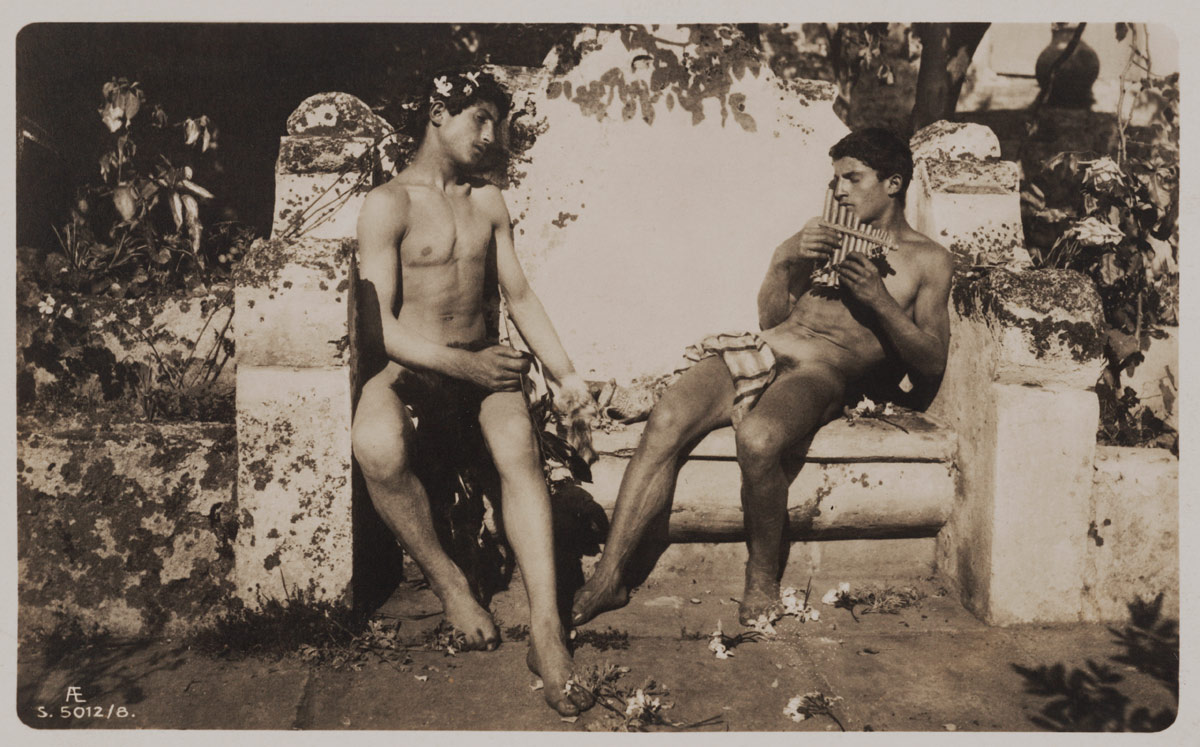
Young peasant boys, all with uncut dicks, pose (unpretentiously some of them) for the camera. Innocence lost to the Baron, to the camera? Most models ages range from 11-18 years old. There are a couple o f portraits of older men with moustaches in the collection. Usually his photographs are full length portraits against walls using steps, props (swords, tiger skins, fish, hats, togas, flowers, vases). He doesn’t rely on classical props as much as I thought he would – just the form of the body with perhaps a ribbon in the hair, for example. Some are incredibly beautiful photographs and have a distinct presence. Catalogue No.’s 79 and 80 are two particularly good photographs I think. Relatively long exposures can be seen in the movement of dogs and trees in prints.

Catalogue No. 18. #9744. Nd

One of my favourites is not a full length composition but a seated boy cropped mid thigh, legs and body turned slightly to the right, staring straight into the camera. The body within the frame takes up a much greater space within the image than in the other photographs. The young mans hair is amazing.

Catalogue No. 129. ANG #60. Nd

2 nude young men, 14 years old, in country landscape, grasses, mountains in far distance. Both have uncut dicks, one is lighter skinned, the other darker. Lighter skinned one has an arm around the other boy. Darker skinned boy is holding lighter skinned boys other hand and affectionately looking at him What an intimate photograph!! What was he thinking! The darker skinned lad looking at the other boy. Catalogue No. 165 is a cropped version of the above print.

Catalogue No. 167. Nd

Magnificent. 2 naked young men reclining on a tiger skins in a courtyard surrounded by flowering plants. Both have rough hands and feet. In bottom left of print you can see the shadow of photographer and camera(?) This has been retouched to try and remove this.

The 100 or so von Gloeden’s are stunning, mainly 8″ x 10″ prints – contact prints?


Bob Mizer (American, 1922-1992) 'Unknown, Handstand, Santa Monica' 1945


Bob Mizer (American, 1922-1992)
Unknown, Handstand, Santa Monica
1945
Vintage large-format black and white negative
Silver gelatin print
10.5 x 8.4 inches
Edition of 5
Printed in 2012


Bob Mizer (American, 1922-1992) 'Unknown Woman Lifting, Santa Monica' c. 1951


Bob Mizer (American, 1922-1992)
Unknown Woman Lifting, Santa Monica
c. 1951
Vintage large-format black and white negative
Silver gelatin print
10.5 x 8.4 inches
Edition of 5
Printed in 2012


Bob Mizer (American, 1922-1992) 'Unknown Woman, Los Angeles' c 1951


Bob Mizer (American, 1922-1992)
Unknown Woman, Los Angeles
c. 1951
Vintage large-format black and white negatives
Silver gelatin print
10.5 x 8.4 inches
Edition of 5
Printed in 2012


Bob Mizer (American, 1922-1992) 'Unknown on Platform, Santa Monica' c. 1945


Bob Mizer (American, 1922-1992)
Unknown on Platform, Santa Monica
c. 1945
Vintage large-format black and white negative
Silver gelatin print
10.5 x 8.4 inches
Edition of 5
Printed in 2012


Invisible-Exports

INVISIBLE-EXPORTS is on semi-permanent hiatus.

Invisible-Exports website

LIKE ART BLART ON FACEBOOK

Back to top

Exhibition: ‘Imogen Cunningham’ at Fundación Mapfre, Madrid

Exhibition dates: 18th September 18 2012 – 20th January 2013


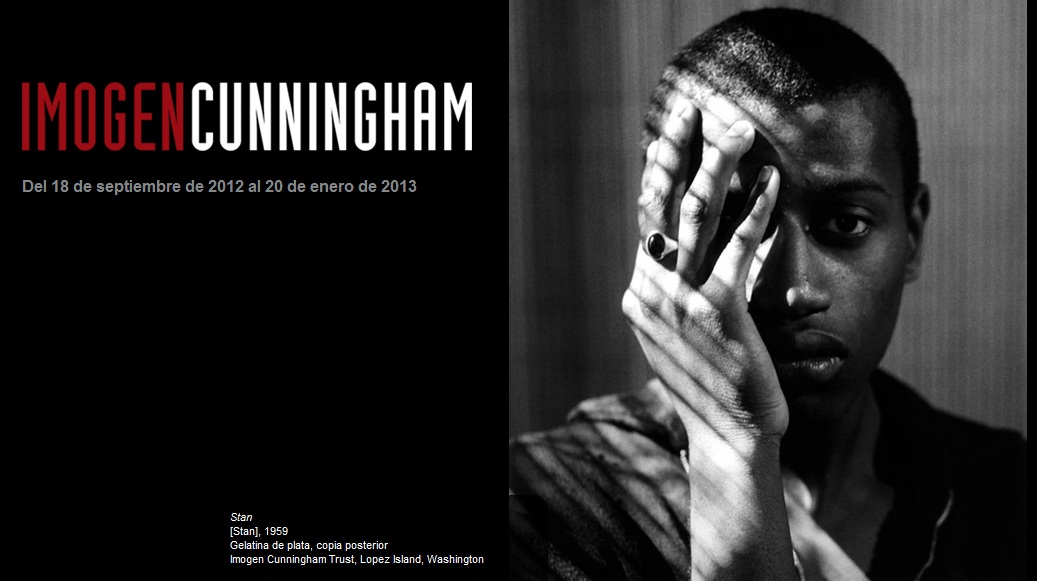
Imogen Cunningham exhibition poster


Imogen Cunningham exhibition poster


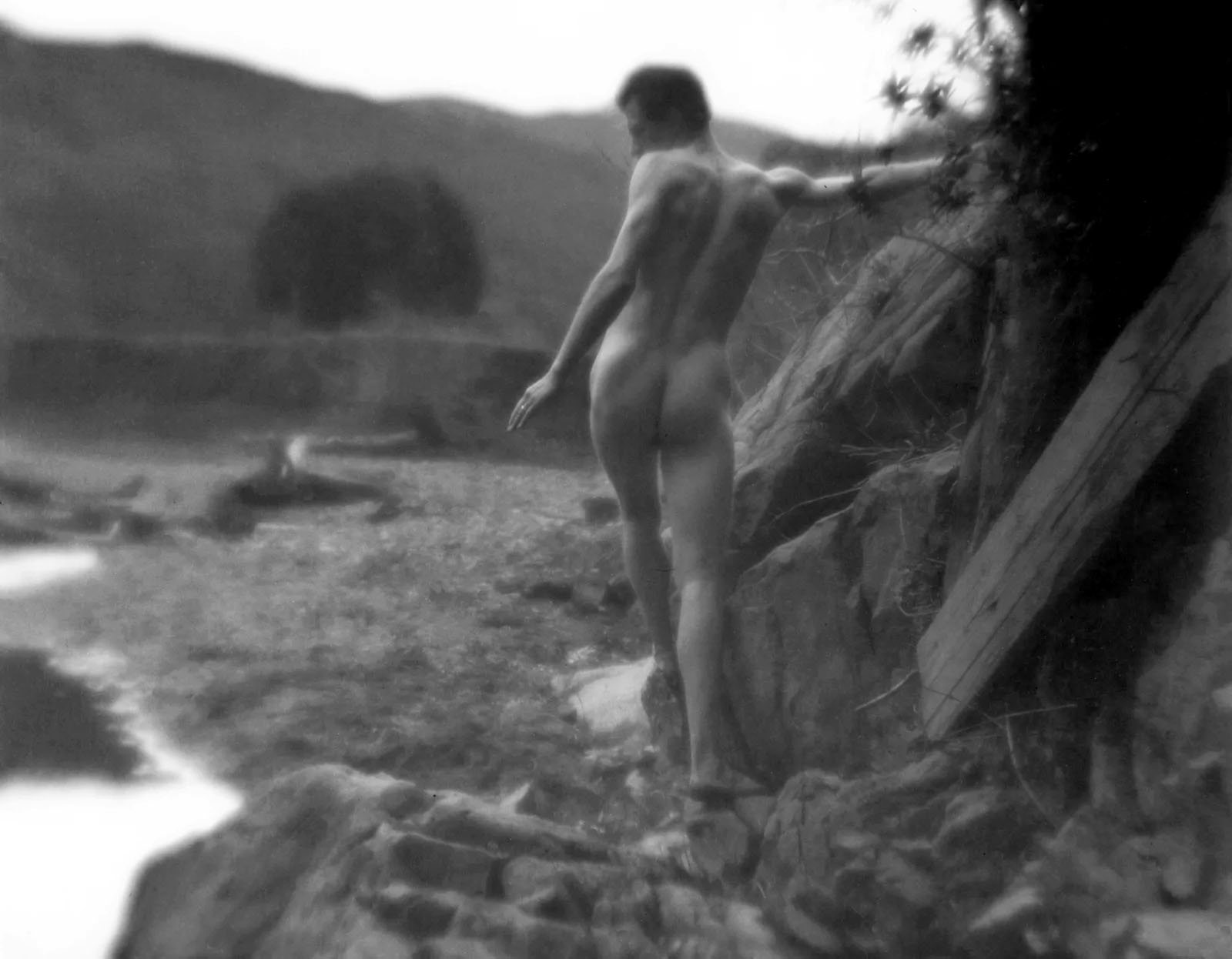
This is the first posting on one of my favourite photographers of all time: Imogen Cunningham. The sensuality of this artist, from the early Pictorialist studies (including her ground breaking depiction of the male nude, her husband artist Roi Partridge) to the later Modernist nudes, portraits, industrial landscapes and botanical photographs is of the highest order. Cunningham reminds me of a photographic version of Georgia O’Keeffe without the undoubted darkness that inhabits some of O’Keeffe’s work.

The portrait of Frida Kahlo Rivera (1931, below) is a magnificent study of a proud woman with delicate use of natural light framing the face and gently clasped hands. Note the textures within the photograph – the dress, the shawl, the wicker chair and the wall – and also notice the reflective light falling behind the sitter upper left to balance the frontal light coming from bottom right. Masterful. Cunningham’s famous Two Callas (1929, below) is an glorious study of form, light and texture, a sensual symphony for the eyes, the background a kind of mutable black that allows the viewer’s gaze to be immersed in the subject. The viewer’s voyeuristic gaze is further engaged by the voluptuous suggestiveness of the copious hair and out of focus breast of Phoenix Recumbent (1968, below) where, “the object of the gaze is not aware of the current viewer (though they may originally have been aware of being filmed, photographed, painted etc. and may sometimes have been aware that strangers could subsequently gaze at their image).” (Daniel Chandler “Notes on ‘The Gaze'” on the Aberystwyth University website [Online] Cited 12/01/2013 no longer available online)

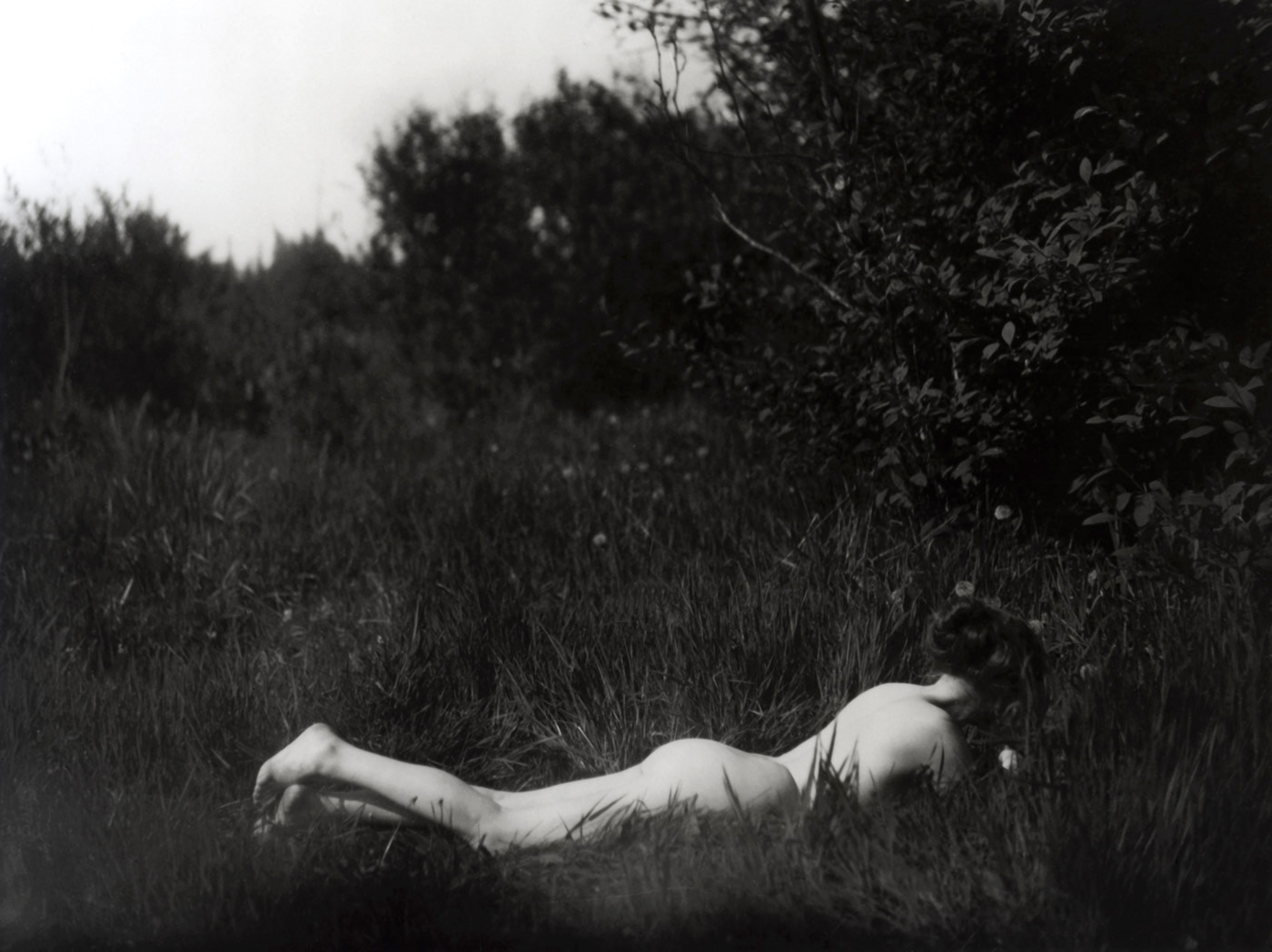
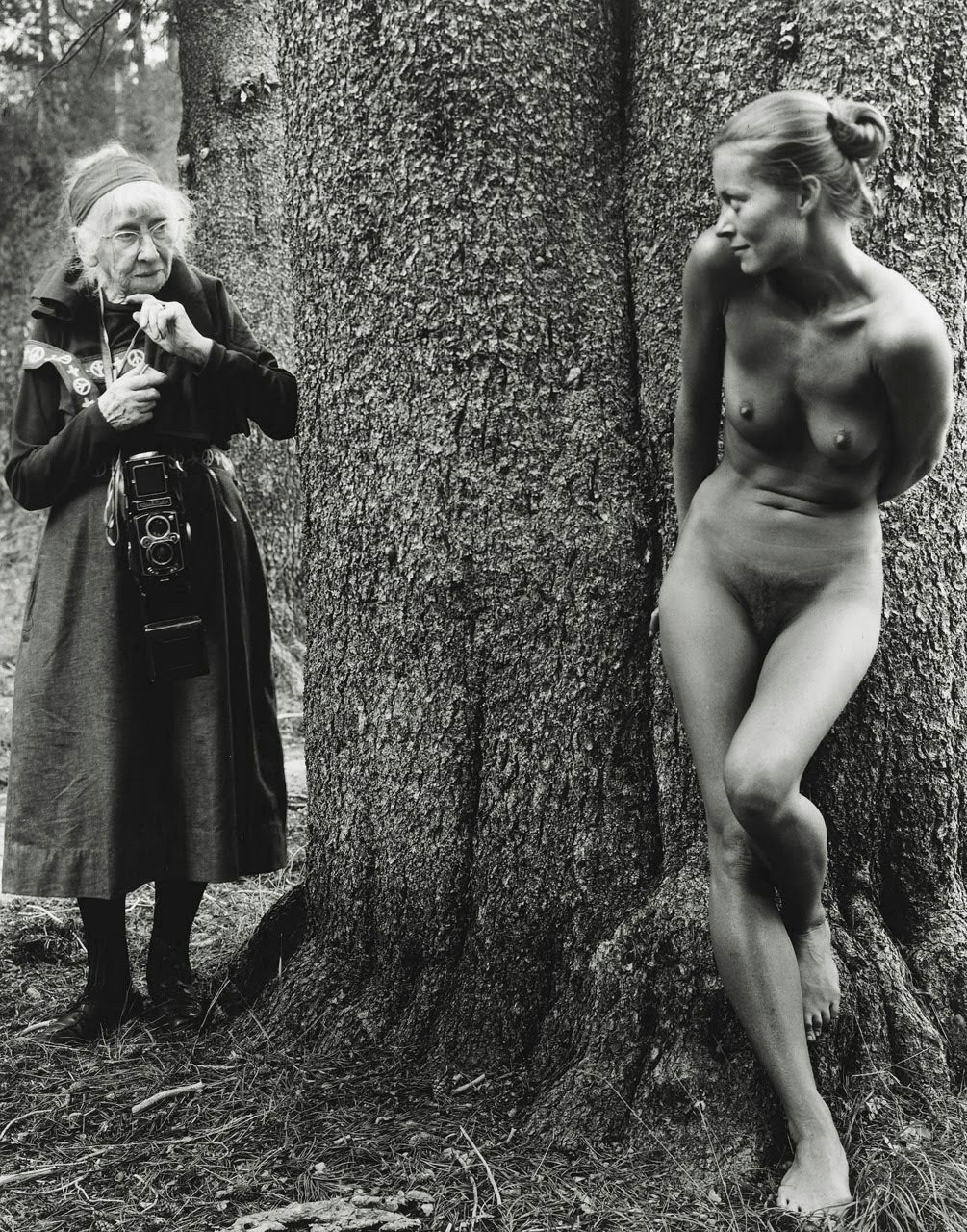
Finally, the photograph of Imogen Cunningham and Twinka Thiebaud by Judy Dater (1974, below) seems to me to capture the spirit of the human being Imogen Cunningham with indelible grace. Youth, beauty, age, wisdom. A constantly inquisitive mind, wanting to know, wanting to see things more clearly, taking photographs right up until her final years. There she is with her twin-lens Rollei dressed as if from another century, the quizzical nature of her left hand and the look that passes between Imogen and Twinka, the space between them seeming to shimmer with possibility. That space seems to wash away the years of Imogen’s life to when she was young, lying naked near some trees (Self-Portrait (1906, below). It is a truly memorable image. In the sensitivity of this image, Dater embodies everything that I admire in Cunningham’s work: light, texture, sensitivity to subject, an understanding of beauty and an irrepressible, joyous sensuality. A fitting tribute to one of the world’s great photographers.

Dr Marcus Bunyan


Many thankx to the Fundación Mapfre, Madrid for allowing me to publish the photographs in the posting. Please click on the photographs for a a larger version of the image.


Imogen Cunningham (American, 1883-1976) 'Self-Portrait' 1906


Imogen Cunningham (American, 1883-1976)
Self-Portrait
1906
Platinum print
©The Imogen Cunningham Trust, 2012


Imogen Cunningham (American, 1883-1976) 'Roi on the Dipsea trail 3' 1918


Imogen Cunningham (American, 1883-1976)
Roi on the Dipsea trail 3
1918
Gelatin sliver print
© The Imogen Cunningham Trust, 2012


Imogen Cunningham (American, 1883-1976) 'Magnolia Blossom' 1925


Imogen Cunningham (American, 1883-1976)
Magnolia Blossom
1925
Gelatin silver print
© The Imogen Cunningham Trust, 2012


Imogen Cunningham (American, 1883-1976) 'Three Dancers, Mills College' 1929


Imogen Cunningham (American, 1883-1976)
Three Dancers, Mills College
1929
Gelatin silver print
© The Imogen Cunningham Trust, 2012


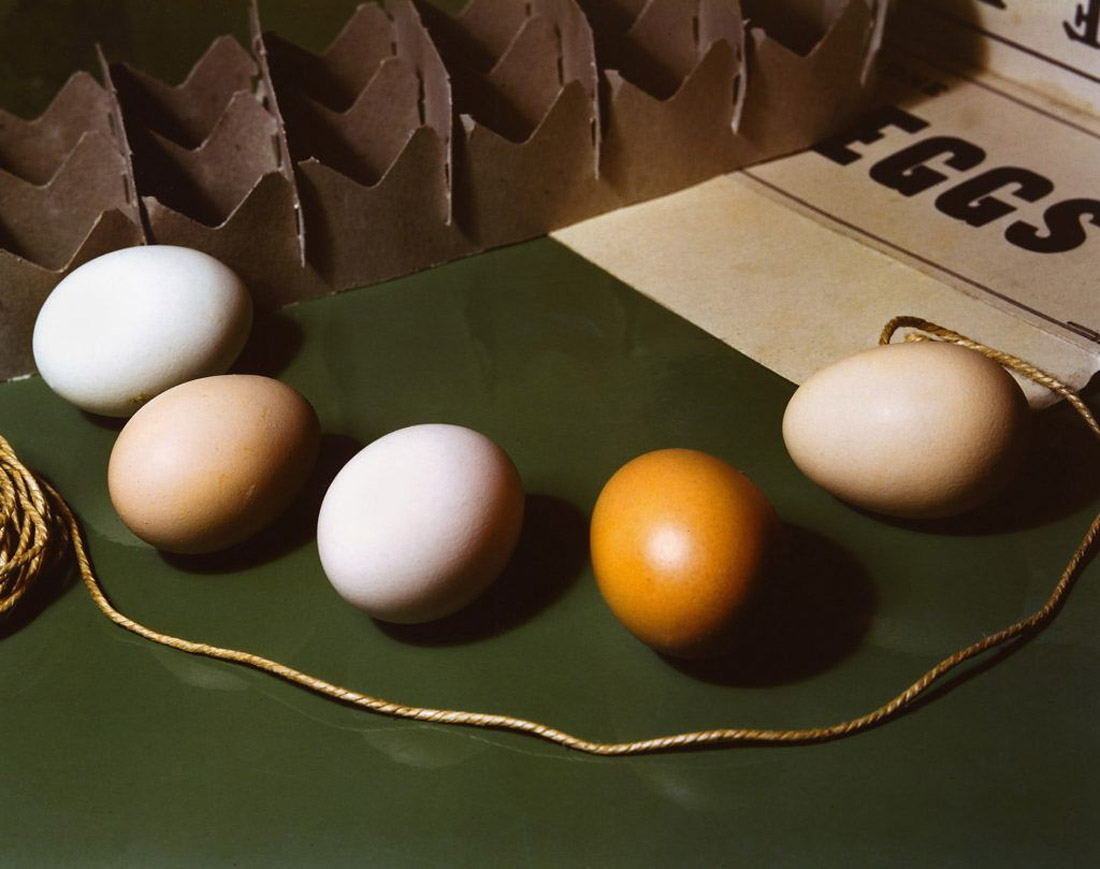
Imogen Cunningham (American, 1883-1976) 'Five Eggs' 1951


Imogen Cunningham (American, 1883-1976)
Five Eggs
1951
Cibachrome
© The Imogen Cunningham Trust


Imogen Cunningham (American, 1883-1976) 'The Unmade Bed' 1957


Imogen Cunningham (American, 1883-1976)
The Unmade bed
1957
Gelatin silver print
© The Imogen Cunningham Trust, 2012


Imogen Cunningham (American, 1883-1976) 'The dream' 1910


Imogen Cunningham (American, 1883-1976)
The dream
1910
Gelatin silver print
© The Imogen Cunningham Trust, 2011


Imogen Cunningham (American, 1883-1976) 'The Wood Beyond the World' c. 1912


Imogen Cunningham (American, 1883-1976)
The Wood Beyond the World
c. 1912
Gelatin silver print
© The Imogen Cunningham Trust


Imogen Cunningham (American, 1883-1976) 'Agave Design 2' 1920s


Imogen Cunningham (American, 1883-1976)
Agave Design 2
1920s
Gelatin silver print
© The Imogen Cunningham Trust


Imogen Cunningham (American, 1883-1976) 'Edward Weston and Margrethe Mather, Photographers I-II' 1922


Imogen Cunningham (American, 1883-1976)
Edward Weston and Margrethe Mather, Photographers I-II
1922
Gelatin silver print
© The Imogen Cunningham Trust, 2011


Imogen Cunningham (American, 1883-1976) 'Aloe' 1925


Imogen Cunningham (American, 1883-1976)
Aloe
1925
Gelatin silver print
© The Imogen Cunningham Trust, 2012


Imogen Cunningham (American, 1883-1976) 'Two Callas' 1929


Imogen Cunningham (American, 1883-1976)
Two Callas
1929
Gelatin silver print
© The Imogen Cunningham Trust, 2012


Imogen Cunningham (American, 1883-1976) 'Hen and Chickens' 1929


Imogen Cunningham (American, 1883-1976)
Hen and Chickens
1929
Gelatin silver print
© The Imogen Cunningham Trust, 2011


Imogen Cunningham (American, 1883-1976) 'Frida Kahlo Rivera, Painter and Wife of Diego Rivera' 1931


Imogen Cunningham (American, 1883-1976)
Frida Kahlo Rivera, Painter and Wife of Diego Rivera
1931
Gelatin silver print
© The Imogen Cunningham Trust, 2012


Imogen Cunningham (American, 1883-1976) 'Cary Grant, Actor' 1932


Imogen Cunningham (American, 1883-1976)
Cary Grant, Actor
1932
Gelatin silver print
© The Imogen Cunningham Trust, 2012


Imogen Cunningham (American, 1883-1976) 'Nude' 1939


Imogen Cunningham (American, 1883-1976)
Nude
1939
Gelatin silver print
© The Imogen Cunningham Trust, 2012


Imogen Cunningham (American, 1883-1976) 'Phoenix Recumbent' 1968


Imogen Cunningham (American, 1883-1976)
Phoenix Recumbent
1968
Gelatin silver print
Private Collection


Judy Dater (American, b. 1941) 'Imogen Cunningham and Twinka Thiebaud' 1974


Judy Dater (American, b. 1941)
Imogen Cunningham and Twinka Thiebaud
1974


FUNDACIÓN MAPFRE – Instituto de Cultura
Paseo de Recoletos, 23
28004 Madrid, Spain
Phone: +34 915 81 61 00

Opening hours:
Monday (except Holidays): 2pm – 8pm
Tuesday to Saturday: 11am to 8pm
Sundays and Holidays: 11am – 7pm

Fundación Mapfre website

LIKE ART BLART ON FACEBOOK

Back to top

Exhibition: ‘Wolfgang Tillmans’ at Moderna Museet Stockholm

Exhibition dates: 6th October 2012 – 20th January 2013


This slideshow requires JavaScript.


Installation photographs of various rooms of the exhibition Wolfgang Tillmans at Moderna Museet Stockholm, including Venus transit (2004) and Man pissing on chair (1997)
Photographs © Carmen Brunner


In this bumper posting, a big call: in my opinion, the greatest photography based image maker in the world today.

Tillmans challenges the way we think and feel about photography. As Tom Holert in his excellent catalogue essay The Unforeseen notes, Tillmans problematises and reconfigures narration and visualisation, experimenting with a sensory experiential backdrop against and within which the photographs are produced. Modes of perception and the regimes of emotion are inducted into the aesthetics of production and meaning so that, “the pictures communicate with each other in a way that is not bound to the pattern of a closed narrative or any particular line of argument. Instead they create a form of aesthetic and thematic interaction that Tillmans sees as ‘a language of personal associations and “thought-maps.”” The mobilisation and reversal of value and meaning are central strategies in Tillmans’ praxis.

In this way Tillmans opens up spaces for research, “in which learning and unlearning, resonance and interference, a new affective solidarity and real experimentation might be possible before the onset of all sorts of methods, all forms of governance, all kinds of discipline and doxa [common belief or popular opinion].

This form of experimentation does not lead to benchmark research results; nothing is ever proved or illustrated, regardless of what is in the images or what they may purport to show. Ever engaging in experiment Tillmans roams through the reality of materials, forms, affects and gives us tangible access to these unportrayble, unreferential realities. Tillmans engages his emotions when he is working, also and specifically when he is photographing people, or plants, machines and cities. Individual emotions separate off from the representation of living beings and objects and form nodes of emotion in the viewer’s mind.”

Through these rhizomic tendencies (a la Delueze and Guittari A Thousand Plateaus) Tillmans images generate emotion and affect, “rhythmically resonating between pictures, from wall to wall, from room to room, from side to side,” so that in each instance, in each publication or exhibition, he can “modify and modulate anew the relations between picture and picture support, representation and presentation, motif and materiality.”

Nothing is ever fixed in linear time. The work is presented as an infinitely variable, spatial and emotional relationship – an orthogonal performativity where the ritual of production and meaning is never fully predetermined at any stage of production and reception.

Tom Holert’s excellent catalogue essay The Unforeseen. On the Production of the New, and Other Movements in the Work of Wolfgang Tillmans includes information on Jacques Rancière’s concept of “‘aisthesis’ for the way in which very different things have been registered as ‘art’ for the last two hundred years or so. As he points out, “this is not about the ‘reception’ of works of art, but about the sensory experiential backdrop against and within which they come about. These are completely material conditions – places of performance or exhibition, forms of circulation and reproduction – but also modes of perception and the regimes of emotion, the categories that identify them and the patterns of thought that classify and interpret them.'” A thought provoking text (extracts below to accompany the photographs).

Dr Marcus Bunyan


Many thankx to the Moderna Museet for allowing me to publish the photographs and the text in the posting. Please click on the photographs for a larger version of the image.


Wolfgang Tillmans (German, b. 1968) 'Arkadia_I' 1996


Wolfgang Tillmans (German, b. 1968)
Arkadia_I
1996
© Wolfgang Tillmans. Courtesy Galerie Buchholz, Cologne/Berlin


Wolfgang Tillmans (German, b. 1968) 'New Family' 2001


Wolfgang Tillmans (German, b. 1968)
New Family
2001
© Wolfgang Tillmans. Courtesy Galerie Buchholz, Cologne/Berlin


Wolfgang Tillmans (German, b. 1968) 'Paper drop (window)' 2006


Wolfgang Tillmans (German, b. 1968)
Paper drop (window)
2006
© Wolfgang Tillmans. Courtesy Galerie Buchholz, Cologne/Berlin


Wolfgang Tillmans is one of the leading artists of his generation and is constantly in the public eye, with exhibitions all over the world. The exhibition at Moderna Museet is Tillmans’ first major show in Sweden and brings nearly twenty years of picture-making to a new audience. Moderna Museet is delighted to welcome Wolfgang Tillmans – an artist who has extended the boundaries of photography and redefined the medium of photography as an artform.

Wolfgang Tillmans (b. 1968) first attracted attention at the beginning of the 1990s, with his apparently mundane pictures of subjects taken from his own surroundings. After studying in Britain, he published photographs in prominent publications such as i-D, Spex and Interview. Today, these pictures are considered trendsetting for the young generation of the 1990s, and raise questions about subcultures and sexual identities. By turning everyday situations into almost monumental images, Tillmans very strikingly captured the spirit of the times. It soon became evident that his pictures renegotiate photographic conventions and reflect contemporary currents related to culture and identity. Since then, Tillmans has continued his in-depth investigations, expanding the the realm of photography and redefining the very medium as an artform.

“Wolfgang Tillmans moves freely between images of the club scene in Berlin, political manifestations, and skyscrapers in Hong Kong; all with the same direct tonality. At the same time, all of his pictures explore photography itself – as a medium, but also as a material, convention and process,” says Curator Jo Widoff.

Recently Tillmans’ art has taken a number of different directions, revolving around various issues, everything from still lifes and modern landscapes to his lifelong interest in astronomy and the night sky. He has also taken his in-depth exploration of abstract photography even further. Tillmans’ abstract images are more closely related to the painterly tradition and he researches photography as a self-reflexive medium. Abstract images, such as Freischwimmer and Silver, are made in the darkroom, striking a balance between the deliberate and chance. Since 1995, Tillmans has been working actively and strategically with the exhibition space, so as to reveal the possibilities and limitations of the space in interplay with the photographs. His installations display a bewildering variety of formats and sizes, ways of composing the hanging of the pictures, and contexts. The exhibition at Moderna Museet should thus be seen as a site-specific installation. In recent years, Tillmans has been travelling the world taking photographs with the general title Neue Welt. These pictures relate to the new world of markets and trade, to politics and economics, and to the hypermodern. The title also refers to the new digital camera that Wolfgang used to take these pictures, which captures and documents more detail than we can perceive with the naked eye.

“Wolfgang Tillmans is one of today’s most prominent artists. Despite its visual complexity, his pictorial language is immediately recognisable. He captures the explosive energy in social situations and crosses boundaries between different artforms. He is able to use photographic means to create a kind of abstract painting,” says Museum Director Daniel Birnbaum.

Press release from the Moderna Museet website


Wolfgang Tillmans (German, b. 1968) 'Lux' 2009


Wolfgang Tillmans (German, b. 1968)
Lux
2009
© Wolfgang Tillmans. Courtesy Galerie Buchholz, Cologne/Berlin


Wolfgang Tillmans (German, b. 1968) 'Iguazu' 2010


Wolfgang Tillmans (German, b. 1968)
Iguazu
2010
© Wolfgang Tillmans. Courtesy Galerie Buchholz, Cologne/Berlin


Wolfgang Tillmans (German, b. 1968) 'Paper drop (Roma)' 2007


Wolfgang Tillmans (German, b. 1968)
Paper drop (Roma)
2007
C-type print
30.5 x 40.6cm
Courtesy the artist and Maureen Paley, London


Wolfgang Tillmans (German, b. 1968) 'Freischwimmer 93' 2004


Wolfgang Tillmans (German, b. 1968)
Freischwimmer 93
2004
© Wolfgang Tillmans. Courtesy Galerie Buchholz, Cologne/Berlin


The Freischwimmer series – Free Swimmer is the most basic Lifesaving level in Germany and Switzerland – is an excellent example of Tillmans’s more experimental works. On one hand, the huge photographic papers were affixed to the wall with simple adhesive tape or paper clips; on the other, the images eluded all description and eschewed portraiture, landscape, still life or other subject matters he had centred on up to then.

The creative process of Freischwimmer, ongoing to the present, seems to speak to pure photography, divested of any form of intervention either in shooting or in enlargement, or indeed optical devices of any kind. We can almost imagine the artist in front of a large tray with reagents, performing some kind of alchemical ritual at the origin of these vaporous images, images containing a refinement that exceeds any human intention, just pure representations of themselves, of a unique and absolutely unrepeatable process. Of their reality.”

José Manuel Costa. “Swimming to Freedom 38,” on the CA2M Centro de Arte Dos de Mayo website [Online] Cited 12/10/2013 no longer available online


The Freischwimmer, which Tillmans started to produce in the early 2000s, form a group or family of images that are not made using a camera lens. As the results of gestural and chemical operations in the dark room, these originals on medium-sized photo paper, which are subsequently scanned and enlarged both as ink-jet prints and as light-jet prints on photo paper, are unrepeatable one-offs. It has been said that these images, which include ensembles such as Peaches, Blushes and Urgency, call to mind microscopically detailed images of biolog­ical processes, hirsute epidermises, highly erogenous zones, and that their aura fills the whole space – above all when they are presented in such large formats as in Warsaw or yet larger still, as in the case of the two monumental Ostgut Freischwimmer (2004) that used to grace the walls of the Panorama Bar at Berghain in Berlin. The Freischwimmer and their kin can be read as diagrams of sexualised atmospheres in private or semi-public spaces, in boudoirs or clubs, as highly non-representational images that both suspend and supplement conventional depic­tions of sex.

Extract from Tom Holert. The Unforeseen. On the Production of the New, and Other Movements in the Work of Wolfgang Tillmans. [Online] Cited 12/10/2013 no longer available online


Wolfgang Tillmans (German, b. 1968) 'Nanbei Hu' 2009


Wolfgang Tillmans (German, b. 1968)
Nanbei Hu
2009
Inkjet print
207 x 138cm
Courtesy the artist and Maureen Paley, London


Wolfgang Tillmans (German, b. 1968) 'Anders pulling splinter from his foot' 2004


Wolfgang Tillmans (German, b. 1968)
Anders pulling splinter from his foot
2004
© Wolfgang Tillmans. Courtesy Galerie Buchholz, Cologne/Berlin


Wolfgang Tillmans (German, b. 1968) 'Onion' 2010


Wolfgang Tillmans (German, b. 1968)
Onion
2010
© Wolfgang Tillmans. Courtesy Galerie Buchholz, Cologne/Berlin


Wolfgang Tillmans (German, b. 1968) 'Venus transit' 2004


Wolfgang Tillmans (German, b. 1968)
Venus transit
2004
© Wolfgang Tillmans. Courtesy Galerie Buchholz, Cologne/Berlin


Wolfgang Tillmans (German, b. 1968) 'Heptathlon' 2009


Wolfgang Tillmans (German, b. 1968)
Heptathlon
2009
Inkjet print
208.5 x 138cm
Courtesy the artist and Maureen Paley, London


Wolfgang Tillmans (German, b. 1968) 'Headlight (a)' 2012


Wolfgang Tillmans (German, b. 1968)
Headlight (a)
2012
© Wolfgang Tillmans. Courtesy Galerie Buchholz, Cologne/Berlin


Wolfgang Tillmans (German, b. 1968) 'Ushuaia Lupine (a)' 2010


Wolfgang Tillmans (German, b. 1968)
Ushuaia Lupine (a)
2010
© Wolfgang Tillmans. Courtesy Galerie Buchholz, Cologne/Berlin


Wolfgang Tillmans (German, b. 1968) 'Tukan' 2010


Wolfgang Tillmans (German, b. 1968)
Tukan
2010
Inkjet print on paper, clips


Wolfgang Tillmans (German, b. 1968) 'Photocopy' 1994


Wolfgang Tillmans (German, b. 1968)
Photocopy
1994
© Wolfgang Tillmans, Courtesy Galerie Daniel Buchholz, Köln


Extracts from Tom Holert. The Unforeseen. On the Production of the New, and Other Movements in the Work of Wolfgang Tillmans. [Online] Cited 12/10/2013. No longer available online

Parallelism – Subjectivism – Objectivism

This all means that the decorative unity of wall and image, which the hanging of the Freischwimmer initially promises, is not only thwarted by the shift in dimensions, the infringement of symmetrical order and the (supposed) discontinuity of abstraction and figuration, and by the fact that the different types of image and their configuration on this wall require the viewer to move around in the space and to continually readjust his or her gaze, bearing in mind that in the corner of one’s eye or following a slight turn of the body more pictures are constantly looming into view, mostly unframed, very small (postcard-sized), very large, hung very low down, but also very high up, portraits and still lifes, gestural abstractions, a close-up of a vagina, a picture of a modern Boy with Thorn, street scenes, an air-conditioning system. It also means that the pictures communicate with each other in a way that is not bound to the pattern of a closed narrative or any particular line of argument. Instead they create a form of aesthetic and thematic interaction that Tillmans sees as ‘a language of personal associations and “thought-maps”‘,1 as ‘… a pattern of parallelism as opposed to one linear stream of thought’,2 and which the critic Jan Verwoert has aptly described as a ‘performative experiment’ with the viewer.3

With all their variability and flexibility – underpinned by an invisible rectilinear grid yet fundamentally open in their interconnections – these installations serve Tillmans as reflections of his own way of perceiving the world, as externalisations of his thinking and feeling, and as a chance to fashion a utopian world according to his own ideas and fantasies.4 However, this Romantic subjectivism of self-expression or externalisation has to be seen in light of a radical objectivism (Tillmans attaches great importance to this) that specifically draws attention not only to the expressive potential arising from the ageing process, from evidence of wear and other precariousnesses in the materials of photography (paper, camera techniques, chemicals, developing equipment etc.) but also to the remarkable resistance and persistence of these same materials.

Amongst the phenomena that inform this objectivism there are those instances of loss of control that can arise during the mechanical production processes of analogue photography or from coding errors, glitches, in digital images. Temporality, finity, brevity come into play here – a certain melancholy that activates rather than paralyses.

Over the years Tillmans has constantly found new ways to explore, to interpret and to stage this dialectic of intention and contingency. His repertoire and means of aesthetic production have multiplied. And this expansion has not been without consequences for the presentation of his work. Tillmans himself feels that the character of his installations has changed since 2006/07, in other words, when different versions of a solo exhibition of his work toured to three museums in the United States. It was during this exhibition tour that Tillmans started to see the benefit of placing greater weight on individual groups of works in the various rooms of larger exhibitions. In so doing he gave visitors the chance to engage in a different kind of concentration, without the pressure of constantly having to deal with the ‘full spectrum’ (Tillmans) of his oeuvre.5

Value Theory, Value Praxis

The visitor to an exhibition of the work of Wolfgang Tillmans in the year 2012, in this case the author of these lines, arrives in expectation of a particular, clearly defined type of art and image experience. A sense (however fragmentary) of the artist’s past exhibitions and publications is always present in any encounter with his work. And this includes the need to see the ‘abstract pictures’ in the context of an oeuvre where realistic and abstract elements have never intentionally been separated from each other. On the contrary, abstraction is always co-present with figurative and representational elements. There is no contradiction between forms and matter free of meaning – that is to say, visual moments that on the face of it neither represent nor illustrate anything – and Tillmans’ photographs of people, animals, objects and landscapes; in fact there is an unbroken connection, a continuum. This applies both to individual images as much as to the internal, dynamic relationalism of his oeuvre as a whole. And it also applies to each individual, concrete manifestation of multiplicity, as in the case of the installation in the first room of the exhibition in Warsaw.

Both aesthetic theory and the institution of art itself provide decisive grounds for discussing photography and visual art in such a way that images are not solely considered in terms of documentary functions or ornamental aspects nor are they reduced to the question as to whether their contents are stage-managed or authentic, but that attention is paid instead to the material nature of the pictures and objects in the space, to their sculptural qualities. Having decided early on against a career as a commercial photographer and in favour of a life in art, there was no need for Tillmans to seek to justify the interest he had already felt in his youth in a non-hierarchical, queer approach to various forms and genres in the visual arts. For the young Wolfgang Tillmans the cover artwork for a New Order LP, a portrait of Barbara Klemm (in-house photographer at the Frankfurter Allgemeine Zeitung), or a screenprint collage of Robert Rauschenberg in Kunstsammlung Nordrhein-Westfalen were all ‘equally important’ images’.7 The mobilisation and reversal of value and meaning are central strategies in his praxis. He questions the ‘language of importance’8 in photography and alters valencies of the visual by, for instance – in a ‘transformation of value’9 – producing C-prints from the supposedly impoverished or inadequate visuality of old black-and-white copies or wrongly developed images and thus raising them to the status of museum art. However much he may set store by refinement and precision, he avoids conventional forms of presentation, that is to say, ‘the signifiers that give immediate value to something, such as the picture frame’.10

Conditions: Subject – Work – Mediation

If we take the line proposed by the philosopher Jacques Rancière, then the ‘aesthetic regime’ of the modern era, which – following the introduction of a modern concept of art and aesthetics – abandoned the regulatory aesthetic canon of the classical age in the nineteenth century, is distinguished by the fact that under its auspices the traditional hierarchies separating the high from the popular branches of narration and visualisation were problematised and reconfigured in such a way that a new politics of aesthetics and a ‘distribution of the sensible’ in the name of art ensued. Rancière has recently proposed the term ‘aisthesis’ for the way in which very different things have been registered as ‘art’ for the last two hundred years or so. As he points out, this is not about the ‘reception’ of works of art, but about the sensory experiential backdrop against and within which they come about. ‘These are completely material conditions – places of performance or exhibition, forms of circulation and reproduction – but also modes of perception and the regimes of emotion, the categories that identify them and the patterns of thought that classify and interpret them.’12

In order to understand why the work of Wolfgang Tillmans – so seemingly casual, so heterogeneous and so wide-ranging – is not only extremely successful, but has, for over twenty years, been intelligible and influential both within and outside the field of art, with the result that by now his praxis seems like a universal, subtly normative style of perception and image-making, it is essential to consider the ‘conditions’ alluded to by Rancière. For these are fundamental to the specific visibility and speakability of this oeuvre and to its legitimacy as art…

The Production of the New

Tillmans thus also makes his contribution to an answer to the question posed by the philosopher John Rajchman (in response to Gilles Deleuze and Michel Foucault and their deliberations on the production of the new and on the creative act in present-day, control-obsessed societies). Rajchman asked how, in and with the arts and their institutions, spaces for open searches and researches could be devised, in which learning and unlearning, resonance and interference, a new affective solidarity and real experimentation might be possible before the onset of all sorts of methods, all forms of governance, all kinds of discipline and doxa.18

This form of experimentation does not lead to benchmark research results; nothing is ever proved or illustrated, regardless of what is in the images or what they may purport to show. Ever engaging in experiment Tillmans roams through the reality of materials, forms, affects and gives us tangible access to these unportrayble, unreferential realities. Tillmans engages his emotions when he is working, also and specifically when he is photographing people, or plants, machines and cities. Individual emotions separate off from the representation of living beings and objects and form nodes of emotion in the viewer’s mind. ‘Artists are presenters of affects, the inventors and creators of affects’, as Gilles Deleuze and Félix Guattari put it in What is Philosophy?, ‘they draw us into the compound’.19 And indeed Tillmans’ laboratories are places where emotion and affect are generated and presented, rhythmically resonating between pictures, from wall to wall, from room to room, from side to side. The dog asleep on the stones, its breathing body warmed by the sun (in the video Cuma, 2011), Susanne’s lowered gaze (in Susanne, No Bra, 2006), with the line of her hair encircling her head like an incomplete figure of eight, but also the disturbed, interrupted, lurking monochromaticism of the Lighter and Silver works – they all open up the longer you look at them, the longer you are with them, to a perceiving in terms of forces and affects. They alert us to the fact that all images are fabricated.

Assimilating Photography into the Paradox

By virtue of the portability and variability of his works, with every print, with every exhibition, with every publication Tillmans can modify and modulate anew the relations between picture and picture support, representation and presentation, motif and materiality. In the two decades that have elapsed since his entry into the art business his praxis has continuously expanded. From the outset photography was his springboard for both integrative and eccentric acts. And even though this oeuvre may create the impression that the medium of photography knows no limits, photography – as discourse, as technique, as history, as convention – has remained the constant point of reference for all of Tillmans’ complex operations. It could also be said that he is immensely faithful to his chosen medium, although – or precisely because – that medium is not always recognisable as such. To quote an older essay on photography and painting by Richard Hamilton (whom Tillmans once photographed), his work is about ‘assimilating photography into the domain of paradox, incorporating it into the philosophical contradictions of art…’30 Since Tillmans’ experiments with a laser copier in the 1980s, he has produced hundreds of images that may be beholden to the etymology of photography (light drawing) but that also constantly undermine or overuse the social and epistemological functions of photography as a means to depict reality, as proof, as an aide mémoire, as documentation or as a form of aesthetic expression. The discourse on photography, with all its ‘post-photographic’ exaggerations, the debate on the status of the photographic image – none of these have been concluded; on the contrary, Tillmans is continuously advancing them on his own terms. His praxis forms the backdrop for experimentation and adventures in perception that are closely intertwined with the past and the present of photography and theories of photography; yet the specific logic of this oeuvre creates a realm of its own in which archive and presentation interlock in such a way that photography still plays an important part as historic and discursive formation, but the problems and paradoxes of fine art have now taken over the key functions.

The contagious impact of the epistemological problems of art has opened up new options for the medium of photography, new contexts of reception. And in this connection it is apparent, as Julie Ault has put it, that ‘Tillmans enacts his right to complex mediation’.31 In other words, photography provides a means for him to engage with a whole range of interactions with the viewer. In his eyes and hands photography becomes a realm of potential, where a never-ending series of constellations and juxtapositions of materialities, dimensions and motifs of the ‘unforeseen’ can come about. Photography thus regains a dimension of experimentation, an openness that is not constrained by aesthetic formats and technical formatting but that does arise from a precise knowledge and understanding of the history of the medium.”

Extracts from Tom Holert. The Unforeseen. On the Production of the New, and Other Movements in the Work of Wolfgang Tillmans. [Online] Cited 12/10/2013 no longer available online


Footnotes from extracts

1/ “Peter Halley in Conversation with Wolfgang Tillmans,” in Jan Verwoert, Peter Halley and Midori Matsui, Wolfgang Tillmans (London: Phaidon, 2002), 8-33 at 29

2/ Steve Slocombe, “Wolfgang Tillmans – The All-Seeing Eye,” in Flash Art, vol. 32, no. 209, November – December 1999, 92-95 at 95

3/ Jan Verwoert, “Survey: Picture Possible Lives: The Work of Wolfgang Tillmans,” in Verwoert et. al., Wolfgang Tillmans, 36-89 at 72

4/ See Slocombe, “Wolfgang Tillmans – The All-Seeing Eye” (see note 2), 95

5/ See Julia Peyton-Jones and Hans Ulrich Obrist, “Interview with Wolfgang Tillmans,” in Wolfgang Tillmans (London: Serpentine Gallery / Koenig Books, 2010), 21-27 at 24

7/ Wolfgang Tillmans, email of 12 May 2012.

8/ Julie Ault, “Das Thema lautet Ausstellen Installations as Possibility in the Practice of Wolfgang Tillmans,” in Wolfgang Tillmans. Lighter (Stuttgart/Berlin: Hatje Cantz/SMB), Nationalgalerie Staatliche Museen zu Berlin, 2008, 27

9/ See Hans Ulrich Obrist, Wolfgang Tillmans (Cologne: Verlag der Buchhandlung Walther König, 2007 = The Conversation Series, 6), 41

10/ Gil Blank, “The Portraiture of Wolfgang Tillmans,” in Influence, 2, autumn 2004, 110-21 at 117

12/ Jacques Rancière, Aisthesis. Scènes du régime esthétique de l’art (Paris: Galilée, 2011), 10

18/ Zepke (ed.), Deleuze, Guattari and the Production of the New (London: Continuum, 2008), 80-90 at 89

19/ See Deleuze and Guattari, What Is Philosophy?, trans. Hugh Tomlinson and Graham Burchell (New York: Columbia University Press, 1994), 175

30/ Richard Hamilton, “Photography and Painting,” in Studio International, vol. 177, no. 909, March 1969, 120-25 at 125

31/ Julie Ault, “The Subject Is Exhibition” (see note 8), 15


Wolfgang Tillmans (German, b. 1968) 'Alex Lutz back' 1992


Wolfgang Tillmans (German, b. 1968)
Alex Lutz back
1992
© Wolfgang Tillmans. Courtesy Galerie Buchholz, Cologne/Berlin


Wolfgang Tillmans (German, b. 1968) 'Smokin Jo' 1995


Wolfgang Tillmans (German, b. 1968)
Smokin Jo
1995
© Wolfgang Tillmans. Courtesy Galerie Buchholz, Cologne/Berlin


Wolfgang Tillmans (German, b. 1968) 'Lutz & Alex sitting in the trees' 1992


Wolfgang Tillmans (German, b. 1968)
Lutz & Alex sitting in the trees
1992
Inkjet print on paper, clips
208 × 138 cm


Moderna Museet, Stockholm

Moderna Museet is ten minutes away from Kungsträdgården, and twenty minutes from T-Centralen or Gamla Stan. Walk past Grand Hotel and Nationalmuseum on Blasieholmen, opposite the Royal Palace. After crossing the bridge to Skeppsholmen, continue up the hill. The entrance to Moderna Museet and Arkitekturmuseet is on the left-hand side.

Opening hours:
Tuesday – Sunday 11 – 18
Monday closed

Moderna Museet website

LIKE ART BLART ON FACEBOOK

Back to top

Text: ‘Orality, (n)framing and enactment in the art of Jacqui Stockdale’ in IANN magazine Vol.8, ‘Unfound in Australia’, October 2012

January 2013


Jacqui Stockdale (Australian, b. 1968) 'Negro Returno, Long Gully' 2012


Jacqui Stockdale (Australian, b. 1968)
Negro Returno, Long Gully
2012
Type C Print
100 x 78cm


“What does it mean, to rediscover an unknown continent through the medium of photography in the 21st century? The seven artists that appear in this “Unfound in Australia” issue are well versed in the photographic technique and language familiar to modern art, yet show cultural distinctness that is nothing short of extraordinary. Our readers might experience a sense of shock or alienation from their work, which combines the new with the old. This kind of unsettling feeling may very well be an unconscious reaction to what we consider to be the ‘other.’ It is my hope that our readers will rediscover the power of photography as a chronological and visual language through these works of long under appreciated modern Australian photography.


IANN magazine
Vol.8, “Unfound in Australia,” October 2012 ‘IANN Magazine’ website [Online] Cited 06/01/2013


My text that appears in IANN magazine Vol.8, “Unfound in Australia” (October 2012) on the art of Jacqui Stockdale is a reworking of the review of her exhibition Jacqui Stockdale: The Quiet Wild at Helen Gorie Galerie in April – May 2012. It is a good piece of writing but it is the “lite” version of the text that I wrote. Instead of the “heavy” version fragmenting away on some long forgotten backup hard drive, and for those of you that like a little more conceptual meat on the bone, it is published below.

Other artists featured in the Volume 8 edition of IANN magazine include Marian Drew, Henri Van Noordenburg, Justine Khamara, Magdalena Bors and Christian Thompson.

Dr Marcus Bunyan


Orality, (n)framing and enactment in the art of Jacqui Stockdale

The concept of Orality is important in the art of Australian Jacqui Stockdale for her works are visual tone poems. Portraying identities in flux, her mythological creatures rise above the threshold of visibility to engage our relationship with time and space, to challenge the trace of experience.

Stockdale uses the body not as passive object but as descriptive and rhapsodic theme, the body as pliable flesh acting as a kind of threshold or hinge of experience – between interior and exterior, viewer and photograph, longing and desire. Drawing on personal places and stories, assemblage and performance (the process of painting the models and the outcome of this interaction), Stockdale creates a wonderful melange of archetypal characters that subvert traditional identities and narratives. Her creatures “shape-shift” and frustrate attempts at categorisation and assimilation.

The artist inverts cultural stereotypes (which embody elements of fixity, repetition, and ambivalence) located within the realms of the fetish, the scopic, and the Imaginary in order to dis/place the collective memory of viewers that have been inscribed with a stereotypical collective vernacular. In this process the work elides “fantasy” which Bhabha suggests plays a formative role in colonial exercises of power.1 In Stockdale’s upside-down world (quite appropriate for the “land down under”), “Each new identity is one of inversion; man becomes woman, child becomes adult, animals transform into humans and vice-versa.”2

An example of this inversion can be seen in her latest series of photographs, The Quiet Wild (2012). Here Stockdale unsettles traditional textual readings, the titles of her photographic portraits indecipherable to the uninitiated, a coded language of identity and place. Lagunta, Leeawuleena and Jaara for example, are three Aboriginal names meaning, respectively, Tasmanian Tiger, the name for the land around Cradle Mountain on that island and the name for the Long Gully region around Bendigo, Victoria (Stockdale’s native area); El Gato is the cat and Gondwanan the name for the southernmost of two supercontinents (the other being Laurasia) before the world split apart into the structure that we known today.

Stockdale’s performative tactics and multiple modes of address, her polyvocal subject if you like, may be said to be an effect of intertextuality3: “a conscious recognition and pursuit of an altogether different set of values and historical and cultural trajectories.”4 Undeniably her re-iterations and re-writings of cultural trajectories as ritual performative acts have links to Bakhtin’s idea of the carnivalesque and the carnival paradigm, which accords to certain patterns of play where “the social hierarchies of everyday life… are profaned and overturned by normally suppressed voices and energies.”5

It is through this “play” that the context of the photographs and their relationship to each other and the viewer are “framed.” This device emphasises the aesthetic rather than information and encourages the viewer to think about the relationship between the body, the world of which it is part and the dream-reason of time.6

This intertextual (n)framing (n meaning unspecified number in mathematics) encourages the viewer to explore the inbetween spaces in the meta-narrative, “and by leaps (intuitive leaps, poetic leaps, leaps of faith)”7 encourage escapism. Through the (n)framing of the body and the enactment of multiple selves Stockdale narrativises her mythological creatures, her charged bodies initiating new conditions of Otherness in the mise-en-scène of being. This is why her images are so powerful for her art approaches Otherness using a visual Orality and a theatrical openness that encourages disparate meanings to emerge into consciousness. It is up to us as viewers to seek the multiple, disparate significances of what is concealed in each photograph – in the myth of origin; in something that can’t be explained by man; in the expression of meaning of the things that are beyond us.

Dr Marcus Bunyan
August 2012


Footnotes

1/ “According to Bhabha, stereotypes are located within the realms of the fetish, the scopic, and the Imaginary. He suggests that fantasy plays a formative role in colonial exercises of power. Bhabha describes the mechanism of cultural stereotypes as embodying elements of fixity, repetition, fantasy, and ambivalence, and suggests that if certain types of images are constantly presented in a range of different contexts, they will become imprinted onto the collective memory of viewers and inscribed within a collective vernacular.”
Vercoe, Caroline. Agency and Ambivalence: A Reading of Works by Coco Fusco,” in Fusco, Coco. The Bodies That Were Not Ours. London: Routledge, 2001, p. 240.

2/ Stockdale, Jacqui. Artist statement 2012

3/ Intertextuality “is always an iteration which is also a re-iteration, a re-writing which foregrounds the trace of the various texts it both knowingly and unknowingly places and dis-places.” Intertexuality is how a text is constituted. It fragments singular readings. “The reader’s own previous readings, experiences and position within the cultural formation” also influences these re-inscriptions.”
Keep, Christopher, McLaughlin, Tim and Parmar, Robin. “Intertextuality,” on The Electronic Labyrinth website [Online] Cited 13/11/2011

4/ Fisher, Jean. “Witness for the Prosecution: The Writings of Coco Fusco,” in Fusco, Coco. The Bodies That Were Not Ours. London: Routledge, 2001, pp. 227-228.

5/ Anon. “Carnivalesque,” on the Wikipedia website. [Online] Cited 13/05/2012

6/ Bacon, Julie Louise. “Liquid Archive: On Ambivalence,” in Liquid Archive. Melbourne: Monash University Museum of Art (MUMA), 2012, p. 119

7/ Kirshenblatt-Gimblett, Barbara. “The Museum – A Refuge for Utopian Thought,” in Rüsen, Jörn; Fehr Michael, and Ramsbrock, Annelie (eds.). Die Unruhe der Kultur: Potentiale des Utopischen. Velbrück Wissenschaft, 2004. In German.


Marcus Bunyan writings

LIKE ART BLART ON FACEBOOK

Back to top

Exhibition: ‘Manuel Álvarez Bravo. A Photographer on the Watch (1902-2002)’ at Jeu de Paume, Paris

Exhibition dates: 16th October 2012 – 20th January 2013

Please note: This posting contains photographs of nudity. If you do not like please do not look


Manuel Álvarez Bravo (Mexican, 1902-2002) 'Waves of paper (Ondas de papel / Vagues de papier)' c. 1928


Manuel Álvarez Bravo (Mexican, 1902-2002)
Waves of paper (Ondas de papel / Vagues de papier)
c. 1928
Vintage silver gelatin photograph
Collection Colette Urbajtel / Archivo Manuel Álvarez Bravo, s.c.
© Colette Urbajtel / Archivo Manuel Álvarez Bravo, s.c.


What a dazzling, sensual (sur)realist Manuel Álvarez Bravo was, one of my favourite photographers of all time. What an eye, what an artist! The beauty of some of his images simply takes my breath away – such as The daughter of the dancers (La hija de los danzantes / La Fille des danseurs) (1933, below). Álvarez Bravo was one of a triumvirate of photographers that greatly influenced me when I started to study photography, along with Eugene Atget and Minor White. I feel a special affinity to him as we share the same initials.

The posting also includes two colour photographs, the first I have ever seen of Manuel Álvarez Bravo. Unfortunately the quality of some of the media photographs was again incredibly poor and I had to spend an inordinate amount of time repairing damage to the scans in order to bring them to you in this posting. Enjoy.

Dr Marcus Bunyan

PS. Please see my posting Photography in Mexico: Selected Works from the Collections of SFMOMA and Daniel Greenberg and Susan Steinhauser for a discussion of Manuel Álvarez Bravo and contemporary Mexican photography.


Many thankx to the Jeu de Paume, Paris for allowing me to publish the photographs in the posting. Please click on the photographs for a larger version of the image.


Manuel Álvarez Bravo au Jeu de Paume

Developed over eight decades, the photographic work of Manuel Álvarez Bravo (Mexico City, 1902-2002) constitutes an essential milestone in 20th-century Mexican culture. Both strange and fascinating, his photography has often been perceived as the imaginary product of an exotic country, or as an eccentric drift of the surrealist avant-garde.


Manuel Álvarez Bravo (Mexican, 1902-2002) 'Colchón / Mattress' 1927


Manuel Álvarez Bravo (Mexican, 1902-2002)
Colchón / Mattress
1927
Gelatin silver print
Collection Familia González Rendón
© Colette Urbajtel / Archivo Manuel Álvarez Bravo, s.c.


Manuel Álvarez Bravo (Mexican, 1902-2002) 'Concrete triptych 2 / La Tolteca (Tri'ptico cemento-2 / La Tolteca / Triptyque béton-2 / La Tolteca)' 1929


Manuel Álvarez Bravo (Mexican, 1902-2002)
Concrete triptych 2 / La Tolteca (Tri’ptico cemento-2 / La Tolteca. Triptyque béton-2 / La Tolteca)
1929
Vintage gelatin silver print
Collection Familia González Rendón
© Colette Urbajtel / Archivo Manuel Álvarez Bravo, s.c.


Manuel Álvarez Bravo (Mexican, 1902-2002) 'Bicycle Heaven (Bicicleta al cielo / Bicyclette au ciel)' 1931


Manuel Álvarez Bravo (Mexican, 1902-2002)
Bicycle Heaven (Bicicleta al cielo / Bicyclette au ciel)
1931
Modern silver gelatin photograph
Collection Colette Urbajtel / Archivo Manuel Álvarez Bravo, s.c.
© Colette Urbajtel / Archivo Manuel Álvarez Bravo, s.c.


Manuel Álvarez Bravo (Mexican, 1902-2002) 'El Soñador' (The dreamer) 1931


Manuel Álvarez Bravo (Mexican, 1902-2002)
El Soñador (The dreamer)
1931
Silver gelatin photograph
Collection Colette Urbajtel / Archivo Manuel Álvarez Bravo, s.c.
© Colette Urbajtel / Archivo Manuel Álvarez Bravo, s.c.


“When will we have sleeping logicians, sleeping philosophers? I would like to sleep, in order to surrender myself to the dreamers….,” wrote André Breton in the first Surrealist manifesto of 1924. Alvarez Bravo, a compatriot of Breton and the Surrealists in Mexico City during the 1920s and ’30s (although he was not an official member of the movement), made photographs that consistently seem to conjure Breton’s wish. His deep appreciation for the folklore and popular history of his native country-in which common objects were often imbued with a mystical symbolism of life and death and daily situations could easily assume political significance-produced moving images that seem to bask in sensuality while maintaining a connection to the intellectual process of metaphor. In this photograph, these seemingly paradoxical elements are solidly in evidence. Alvarez Bravo wrote of it: “There at number 20 Calle de Guatemala, I saw many things that marked me forever. I walked a lot through the adjoining streets; I especially liked to watch the customs porters in Santiago Tlatelolco station, who after work would fall asleep exhausted on the sidewalk. I felt great compassion for them. … I am happy to have lived in those streets. There everything was food for my camera, everything had an inherent social content; in life everything has social content.” His ability to render in this image Mexican life’s visceral confluence of pleasure, exhaustion, vulnerability, and reverie at the intersection of everyday life and the world of dreams is exceptional.

Text from the Metropolitan Museum of Art website


Manuel Álvarez Bravo (Mexican, 1902-2002) 'Muchacha viendo pájaros' (Girl watching birds) 1931


Manuel Álvarez Bravo (Mexican, 1902-2002)
Muchacha viendo pájaros (Girl watching birds)
1931
Silver gelatin photograph
Collection Colette Urbajtel / Archivo Manuel Álvarez Bravo, s.c.
© Colette Urbajtel / Archivo Manuel Álvarez Bravo, s.c.


Manuel Álvarez Bravo (Mexican, 1902-2002) 'Paisaje Y Galope' (Landscape and Gallop) 1932


Manuel Álvarez Bravo (Mexican, 1902-2002)
Paisaje Y Galope (Landscape and Gallop)
1932
Gelatin silver print
Collection Colette Urbajtel / Archivo Manuel Álvarez Bravo, s.c.
© Colette Urbajtel / Archivo Manuel Álvarez Bravo, s.c.


Manuel Álvarez Bravo (Mexican, 1902-2002) 'Striking Worker, Assassinated (Obrero en huelga, asesinado / Ouvrier en grève, assassiné)' 1934


Manuel Álvarez Bravo (Mexican, 1902-2002)
Striking Worker, Assassinated (Obrero en huelga, asesinado / Ouvrier en grève, assassiné)
1934
Vintage silver gelatin photograph
Collection Colette Urbajtel / Archivo Manuel Álvarez Bravo, s.c.
© Colette Urbajtel / Archivo Manuel Álvarez Bravo, s.c.


Manuel Álvarez Bravo (Mexican, 1902-2002) 'The Good Reputation Sleeping (La buena fama durmiendo / La Bonne Renommée endormie)' 1938


Manuel Álvarez Bravo (Mexican, 1902-2002)
The Good Reputation Sleeping (La buena fama durmiendo / La Bonne Renommée endormie)
1938
Vintage silver gelatin photograph
Collection Colette Urbajtel / Archivo Manuel Álvarez Bravo, s.c.
© Colette Urbajtel / Archivo Manuel Álvarez Bravo, s.c.


Manuel Álvarez Bravo (Mexican, 1902-2002) 'La desvendada #2' (The Unbandaged #2) 1939


Manuel Álvarez Bravo (Mexican, 1902-2002)
La desvendada #2 (The Unbandaged #2)
1939
Silver gelatin photograph
Collection Colette Urbajtel / Archivo Manuel Álvarez Bravo, s.c.
© Colette Urbajtel / Archivo Manuel Álvarez Bravo, s.c.


Manuel Álvarez Bravo (Mexican, 1902-2002) 'Que Chiquito es el Mundo' (How Small is the World) 1942


Manuel Álvarez Bravo (Mexican, 1902-2002)
Que Chiquito es el Mundo (How Small is the World)
1942
Silver gelatin photograph
Collection Colette Urbajtel / Archivo Manuel Álvarez Bravo, s.c.
© Colette Urbajtel / Archivo Manuel Álvarez Bravo, s.c.


Manuel Álvarez Bravo (Mexican, 1902-2002) 'Algo alegre' 1942


Manuel Álvarez Bravo (Mexican, 1902-2002)
Algo alegre
1942
Silver gelatin photograph
Collection Colette Urbajtel / Archivo Manuel Álvarez Bravo, s.c.
© Colette Urbajtel / Archivo Manuel Álvarez Bravo, s.c.


Manuel Álvarez Bravo (Mexican, 1902-2002) 'Boy in a triangle' (Running Boy) 1950


Manuel Álvarez Bravo (Mexican, 1902-2002)
Boy in a triangle (Running Boy)
1950
Silver gelatin photograph
Collection Colette Urbajtel / Archivo Manuel Álvarez Bravo, s.c.
© Colette Urbajtel / Archivo Manuel Álvarez Bravo, s.c.


Manuel Álvarez Bravo (Mexican, 1902-2002) 'Bicicletas en Domingo' 1966


Manuel Álvarez Bravo (Mexican, 1902-2002)
Bicicletas en Domingo
1966
Vintage silver gelatin photograph
Collection Colette Urbajtel / Archivo Manuel Álvarez Bravo, s.c.
© Colette Urbajtel / Archivo Manuel Álvarez Bravo, s.c.


Manuel Álvarez Bravo (Mexican, 1902-2002) 'The Colour (El color / La Couleur)' 1966


Manuel Álvarez Bravo (Mexican, 1902-2002)
The Colour (El color / La Couleur)
1966
Vintage chromogenic print
Collection Colette Urbajtel / Archivo Manuel Álvarez Bravo, s.c.
© Colette Urbajtel / Archivo Manuel Álvarez Bravo, s.c.


Manuel Álvarez Bravo (Mexican, 1902-2002) 'Castillo en el Barrio del Niño' (Fireworks for the Child Jesus) 1970


Manuel Álvarez Bravo (Mexican, 1902-2002)
Castillo en el Barrio del Niño (Fireworks for the Child Jesus)
1970
Silver gelatin photograph
Collection Colette Urbajtel / Archivo Manuel Álvarez Bravo, s.c.
© Colette Urbajtel / Archivo Manuel Álvarez Bravo, s.c.


Manuel Álvarez Bravo (Mexican, 1902-2002) 'Current, Texcoco (Corriente, Texcoco / Courant, Texcoco)' 1974-1975


Manuel Álvarez Bravo (Mexican, 1902-2002)
Current, Texcoco (Corriente, Texcoco / Courant, Texcoco)
1974-1975
Vintage chromogenic print
Collection Colette Urbajtel / Archivo Manuel Álvarez Bravo, s.c.
© Colette Urbajtel / Archivo Manuel Álvarez Bravo, s.c.


Getting away from the stereotypes about exotic Surrealism and the folkloric vision of Mexican culture, this exhibition of work by Manuel Álvarez Bravo at Jeu de Paume offers a boldly contemporary view of this Mexican photographer.

The photographic work done by Manuel Álvarez Bravo (Mexico City, 1902-2002) over his eight decades of activity represent an essential contribution to Mexican culture in the 20th century. His strange and fascinating images have often been seen as the product of an exotic imagination or an eccentric version of the Surrealist avant-garde. This exhibition will go beyond such readings. While not denying the links with Surrealism and the clichés relating to Mexican culture, the selection of 150 photographs is designed to bring out a specific set of iconographic themes running through Álvarez Bravo’s practice: reflections and trompe-l’œil effects in the big city; prone bodies reduced to simple masses; volumes of fabric affording glimpses of bodies; minimalist, geometrically harmonious settings; ambiguous objects, etc.

The exhibition thus takes a fresh look at the work, without reducing it to a set of emblematic images and the stereotyped interpretations that go with them. This approach brings out little-known aspects of his art that turn out to be remarkably topical and immediate. Images become symbols, words turn into images, objects act as signs and reflections become objects: these recurring phenomena are like visual syllables repeated all through his œuvre, from the late 1920s to the early 1980s. They give his images a structure and intentional quality that goes well beyond the fortuitous encounter with the raw magical realism of the Mexican scene. Indeed, Álvarez Bravo’s work constitutes an autonomous and coherent poetic discourse in its own right, one that he patiently built up over the years. For it is indeed time that bestows unity on the imaginary fabric of Álvarez Bravo’s photographs. Behind these disturbing and poetic images, which are like hieroglyphs, there is a cinematic intention which explains their formal quality and also their sequential nature. Arguably, Álvarez Bravo’s photographs could be viewed as images from a film. The exhibition explores this hypothesis by juxtaposing some of his most famous pictures with short experimental films made in the 1960s, taken from the family archives. The show also features some late, highly cinematic images, and a selection of colour prints and Polaroids. By revealing the photographer’s experiments, this presentation shows how the poetic quality of Álvarez Bravo’s images is grounded in a constant concern with modernity and language. Subject to semantic ambiguity, but underpinned by a strong visual syntax, his photography is a unique synthesis of Mexican localism and the modernist project, and shows how modernism was a multifaceted phenomenon, constructed around a plurality of visions, poetics and cultural backgrounds, and not built on one central practice.

Press release from the Jue de Paume website


Manuel Álvarez Bravo (Mexican, 1902-2002) 'Caballo de madera' (Wooden horse) c. 1928


Manuel Álvarez Bravo (Mexican, 1902-2002)
Caballo de madera (Wooden horse)
c. 1928
Vintage platinum palladium photograph
Collection Colette Urbajtel / Archivo Manuel Álvarez Bravo, s.c.
© Colette Urbajtel / Archivo Manuel Álvarez Bravo, s.c.


Manuel Álvarez Bravo (Mexican, 1902-2002) 'Maniquí tapado (Mannequin couvert)' 1931


Manuel Álvarez Bravo (Mexican, 1902-2002)
Covered Mannequin (Maniquí tapado / Mannequin couvert)
1931
Vintage platinum palladium photograph
Collection Colette Urbajtel / Archivo Manuel Álvarez Bravo, s.c.
© Colette Urbajtel / Archivo Manuel Álvarez Bravo, s.c.


Manuel Álvarez Bravo (Mexican, 1902-2002) 'Optic Parable' (Parábola óptica) 1931


Manuel Álvarez Bravo (Mexican, 1902-2002)
Optic Parable (Parábola óptica)
1931
Silver gelatin photograph
Collection Colette Urbajtel / Archivo Manuel Álvarez Bravo, s.c.
© Colette Urbajtel / Archivo Manuel Álvarez Bravo, s.c.


Manuel Álvarez Bravo (Mexican, 1902-2002) 'The Daughter of the Dancers' (La hija de los danzantes) 1933


Manuel Álvarez Bravo (Mexican, 1902-2002)
The Daughter of the Dancers (La hija de los danzantes)
1933
Gelatin silver print
Collection Colette Urbajtel / Archivo Manuel Álvarez Bravo, s.c.
© Colette Urbajtel / Archivo Manuel Álvarez Bravo, s.c.


Manuel Álvarez Bravo (Mexican, 1902-2002) 'The daughter of the dancers (La hija de los danzantes / La Fille des danseurs)' 1933


Manuel Álvarez Bravo (Mexican, 1902-2002)
The daughter of the dancers (La hija de los danzantes / La Fille des danseurs)
1933
Vintage platinum / palladium photograph
Collection Colette Urbajtel / Archivo Manuel Álvarez Bravo, s.c.
© Colette Urbajtel / Archivo Manuel Álvarez Bravo, s.c.


Manuel Álvarez Bravo (Mexican, 1902-2002) 'Cuando la buena fama despierta' (when good reputation awakens) 1938


Manuel Álvarez Bravo (Mexican, 1902-2002)
Cuando la buena fama despierta (when good reputation awakens)
1938
Gelatin silver print
Collection Colette Urbajtel / Archivo Manuel Álvarez Bravo, s.c.
© Colette Urbajtel / Archivo Manuel Álvarez Bravo, s.c.


Manuel Álvarez Bravo (Mexican, 1902-2002) 'Hair on Patterned Floor (Mechón / Mèche)' 1940


Manuel Álvarez Bravo (Mexican, 1902-2002)
Hair on Patterned Floor (Mechón / Mèche)
1940
Modern silver gelatin photograph
Collection Colette Urbajtel / Archivo Manuel Álvarez Bravo, s.c.
© Colette Urbajtel / Archivo Manuel Álvarez Bravo, s.c.


Manuel Alvarez Bravo’s photograph of a long lock of wavy hair lying on a geometrically patterned floor juxtaposes texture and materials, dreams and taboos, and invokes questions about the drama taking place outside the photograph. Was this hair placed on the floor intentionally, or did it fall accidentally? The natural presumption is that the hair belonged to a woman, but could it have belonged to a man? Stripped of a luxurious mane, so symbolic of power and passion, is its one-time “owner” now weak and indifferent? This complex image has led one writer to assert that “in theme and form, the photograph is divided between the hint of seduction and that of punishment.”


Manuel Álvarez Bravo (Mexican, 1902-2002) 'Ways to Sleep (De las maneras de dormir / Des manières de dormir)' c. 1940


Manuel Álvarez Bravo (Mexican, 1902-2002)
Ways to Sleep (De las maneras de dormir / Des manières de dormir)
c. 1940
Modern silver gelatin photograph
Collection Colette Urbajtel / Archivo Manuel Álvarez Bravo, s.c.
© Colette Urbajtel / Archivo Manuel Álvarez Bravo, s.c.


Manuel Álvarez Bravo (Mexican, 1902-2002) 'Unpleasant portrait (Retrato desagradable / Portrait désagréable)' 1945


Manuel Álvarez Bravo (Mexican, 1902-2002)
Unpleasant portrait (Retrato desagradable / Portrait désagréable)
1945
Vintage silver gelatin photograph
Collection Colette Urbajtel / Archivo Manuel Álvarez Bravo, s.c.
© Colette Urbajtel / Archivo Manuel Álvarez Bravo, s.c.


Manuel Álvarez Bravo (Mexican, 1902-2002) 'El umbral' / The Threshold 1947


Manuel Álvarez Bravo (Mexican, 1902-2002)
El umbral / The Threshold
1947
Gelatin silver print
Collection Colette Urbajtel / Archivo Manuel Álvarez Bravo, s.c.
© Colette Urbajtel / Archivo Manuel Álvarez Bravo, s.c.


Manuel Álvarez Bravo (Mexican, 1902-2002) 'Tentaciones en casa de Antonio' (The Temptation of Antonio) 1970


Manuel Álvarez Bravo (Mexican, 1902-2002)
Tentaciones en casa de Antonio (The Temptation of Antonio)
1970
Gelatin silver print
Collection Colette Urbajtel / Archivo Manuel Álvarez Bravo, s.c.
© Colette Urbajtel / Archivo Manuel Álvarez Bravo, s.c.


Manuel Álvarez Bravo (Mexican, 1902-2002) 'El trapo negro, Coyoacán, Ciudad de México' 1986


Manuel Álvarez Bravo (Mexican, 1902-2002)
El trapo negro, Coyoacán, Ciudad de México
1986
Gelatin silver print
Collection Colette Urbajtel / Archivo Manuel Álvarez Bravo, s.c.
© Colette Urbajtel / Archivo Manuel Álvarez Bravo, s.c.


Jeu de Paume
1, Place de la Concorde
75008 Paris
métro Concorde
Phone: 01 47 03 12 50

Opening hours:
Tuesday – Friday 12 – 8pm
Saturday – Sunday 11am – 7pm
Closed on Mondays

Jeu de Paume website

LIKE ART BLART ON FACEBOOK

Back to top

Exhibitions: ‘Howard Greenberg, Collection’ and ‘Freaks, The Monstrous Parade: Photographs from Enrico Praloran Collection’ at the Musée de l’Elysée, Lausanne

Exhibition dates: both 21st September 2012 – 6th January 2013


Dorothea Lange (American, 1895-1965) 'Migratory Cotton Picker' Eloy, Arizona 1940


Dorothea Lange (American, 1895-1965)
Migratory Cotton Picker
Eloy, Arizona, 1940
Gelatin silver print
© Library of Congress
Courtesy of Howard Greenberg Collection


This is a meta-post where I have brought together photographs from the second exhibition Freaks, The Monstrous Parade: Photographs from Enrico Praloran Collection and all the good quality images of Todd Browning’s cult film Freaks (1932) that were available online, since the museum only provided me with three media images (the first three) on a fascinating subject. By reflection, the photographs from Freaks have a strange correlation to the photographs that appear in the Howard Greenberg, Collection.

There is an interesting discussion by Amanda Ann Klein on her blog (see link below) about her students reaction to the film that she taught as part of her Trash Cinema class. She observes that, “Freaks preaches acceptance and… the belief that we are all “God’s children.” And yet, the film was intended to “out horror” Frankenstein through its fantastic display of disabled bodies…” but that her students did not see it as an exploitation film, in fact they approved of the revenge taken by the freaks on Cleopatra and Hercules at the end of the film, even though this seemed to replicate the very imagery Browning denounced earlier in the film. Klein insightfully notes that “it did prove to be an interesting example of how a film’s reception can change dramatically over time.”

The content of a work of art is never fixed by the author as the context and meaning of the work is never fixed by the viewer. As David Smail notes the truth changes according to, among other things, developments in our values and understandings. There can be many truths depending on our line-of-sight and point-of-view but a subjective non-final truth has to be actively struggled for:

“Where objective knowing is passive, subjective knowing is active – rather than giving allegiance to a set of methodological rules which are designed to deliver up truth through some kind of automatic process [in this case the image], the subjective knower takes a personal risk in entering into the meaning of the phenomena to be known … Those who have some time for the validity of subjective experience but intellectual qualms about any kind of ‘truth’ which is not ‘objective’, are apt to solve their problem by appealing to some kind of relativity. For example, it might be felt that we all have our own versions of the truth about which we must tolerantly agree to differ. While in some ways this kind of approach represents an advance on the brute domination of ‘objective truth’, it in fact undercuts and betrays the reality of the world given to our subjectivity. Subjective truth has to be actively struggled for: we need the courage to differ until we can agree. Though the truth is not just a matter of personal perspective, neither is it fixed and certain, objectively ‘out there’ and independent of human knowing. ‘The truth’ changes according to, among other things, developments and alterations in our values and understandings … the ‘non-finality’ of truth is not to be confused with a simple relativity of ‘truths’.”

Smail, David. Illusion and Reality: The Meaning of Anxiety. London: J.M. Dent & Sons, 1984, pp.152-153.

Dr Marcus Bunyan


Many thankx to the Musée de l’Elysée, Lausanne for allowing me to publish some of the photographs in the posting. Please click on the photographs for a larger version of the image.


Henri Cartier-Bresson (French, 1908-2004) 'Madrid' 1933


Henri Cartier-Bresson (French, 1908-2004)
Madrid
1933
Gelatin silver print
© Henri Cartier-Bresson/Magnum Photos
Courtesy of Fondation HCB and Howard Greenberg Collection


Henri Cartier-Bresson (French, 1908-2004) 'Children in Seville' 1933


Henri Cartier-Bresson (French, 1908-2004)
Seville
1933
Gelatin silver print
© Henri Cartier-Bresson/Magnum Photos
Courtesy of Fondation HCB and Howard Greenberg Collection


Berenice Abbott (American, 1898-1991) 'Greyhound Bus Terminal, 33rd and 34th Streets between Seventh and Eighth Avenues, Manhattan' 1936


Berenice Abbott (American, 1898-1991)
Greyhound Bus Terminal, 33rd and 34th Streets between Seventh and Eighth Avenues, Manhattan
1936
Gelatin silver print
Courtesy of Howard Greenberg Collection


Ruth Orkin (American, 1921-1985) 'American Girl in Italy' 1951


Ruth Orkin (American, 1921-1985)
American Girl in Italy
1951
Gelatin silver print
© Ruth Orkin
Courtesy of Howard Greenberg Collection


Edward Weston (American, 1886–1958) 'Nahui Olin' 1923


Edward Weston (American, 1886–1958)
Nahui Olin
1923
Platinum print
Courtesy of Howard Greenberg Collection


Edward Steichen (American born Luxembourg, 1879–1973) 'Gloria Swanson' 1924


Edward Steichen (American born Luxembourg, 1879–1973)
Gloria Swanson
1924
Gelatin silver print
Courtesy of Howard Greenberg Collection


Lewis W. Hine (American, 1874-1940) 'Powerhouse Mechanic' 1924


Lewis W. Hine (American, 1874–1940)
Powerhouse Mechanic
1924
Gelatin silver print
Courtesy of Howard Greenberg Collection


André Kertész (American born Hungary, 1894-1985) 'Chez Mondrian' 1926


André Kertész (American born in Hungary, 1894-1985)
Chez Mondrian
1926
Gelatin silver print on carte postale
The Howard Greenberg Collection


Manuel Álvarez Bravo (Mexican, 1902-2002) 'The Daughter of the Dancers' (La hija de los danzantes) 1933


Manuel Alvarez Bravo (Mexican, 1902–2002)
The Daughter of the Dancers
1933
Gelatin silver print
Courtesy of Howard Greenberg Collection


Walker Evans (American, 1903-1975) 'Negro Church, South Carolina' 1936


Walker Evans (American, 1903-1975)
Negro Church, South Carolina
1936
Gelatin silver print
© Library of Congress
Courtesy of Howard Greenberg Collection


Dorothea Lange (American, 1895-1965) 'Migrant Mother, Nipomo, California' 1936


Dorothea Lange (American, 1895-1965)
Migrant Mother, Nipomo, California
1936
Gelatin silver print
© Library of Congress
Courtesy of Howard Greenberg Collection


Consuelo Kanaga (American, 1894-1978) 'Young Girl in Profile' 1948


Consuelo Kanaga (American, 1894-1978)
Young Girl in Profile
1948
Gelatin silver print
Courtesy of Howard Greenberg Collection


Leon Levinstein (American, 1910-1988) 'Fifth Avenue' c. 1959


Leon Levinstein (American, 1910-1988)
Fifth Avenue
c. 1959
© Howard Greenberg Gallery
Courtesy of Howard Greenberg Collection


The Musée de l’Elysée presents different approaches to collecting photography by means of these original exhibitions.

Howard Greenberg, Collection

Howard Greenberg has been a gallery owner for over thirty years and is considered today one of the pillars of the New York photography scene. While his position as a dealer is well established, little was known of his passion for collecting, presently revealed to the public for the first time. The primary reason to explain why it took so long to discover this collection is because building such a collection demands time. Only in time can the maturity of a collection be measured; the time necessary to smooth trends, confirm the rarity of a print, and in the end, validate the pertinence of a vision. In an era of immediacy, when new collectors exhibit unachieved projects or create their own foundation, great original collections are rare. Howard Greenberg’s is certainly one of the few still to be discovered.

The quality of a collection does not rely on the sole accumulation of master pieces but can best be assessed through a dialectical movement: a collection is the collector’s oeuvre, a set of images operating a transformation in the perception not only of the photographs, but also of photography. This renewed perception is two-fold in the Greenberg collection; through the surprising combination of two approaches, the experimental practice of photography that questions the medium as such, bringing it to the limits of abstraction on one hand, and on the other, a documentary practice, carried out through its recording function of the real. This apparently irreconcilable duality takes on a particular signification in the Greenberg collection, an investigation of the possibilities offered by photography, a quest for photography itself, questioning what it is.

Howard Greenberg and his collection have largely contributed to the writing of a chapter of history. While contributing to the recognition of long neglected figures of the New York post-war photography scene, filling a gap, as gallery owner, Howard Greenberg, the collector, ensured the preservation of a coherent body by building over that period a unique collection of major photographs.

This collection of over 500 photographs was patiently built over the last thirty years and stands out for the high quality of its prints. A set of some 120 works are exhibited for the first time at the Musée de l’Elysée, revealing different aspects of Howard Greenberg’s interests, from the modernist aesthetics of the 20s and 30s, with works by Edward Steichen, Edward Weston or the Czech School, to contemporary photographers such as Minor White, Harry Callahan and Robert Frank. Humanist photography is particularly well represented, including among others, Lewis Hine and Henri Cartier-Bresson. An important section is dedicated to the Farm Security Administration’s photographers, such as Walker Evans or Dorothea Lange, witnesses to the Great Depression years of the 30s. Above all, the collection demonstrates the great influence of New York in the history of 20th century photography with the images of Berenice Abbott, Weegee, Leon Levinstein or Lee Friedlander conveying its architecture and urban lifestyle. Commending its work and prominent position, and wishing to make his private collection available to a large audience, Howard Greenberg selected the Musée de l’Elysée to host his collection.

The Musée de l’Elysée and the Fondation Henri Cartier-Bresson jointly produce this exhibition which, after Lausanne, will subsequently be presented in Paris.

Press release from the Musée de l’Elysée website


Freaks, The Monstrous Parade: Photographs from Enrico Praloran Collection

American director Tod Browning (1880-1962) has a particular attraction for the uncanny. Freaks, his cult movie shot in 1932, is inspired by a short story written by Clarence Aaron “Tod” Robbins. Set in a circus, the performers are disabled actors. The movie caused a scandal when it was released and Freaks was soon censored, reedited, shortened, sometimes removed from theatres, and in cases banned in some countries. Not until the 60s, when it was presented at the Cannes Festival, was the movie acclaimed to the point of becoming a reference for artists such as Diane Arbus or David Lynch.

The Musée de l’Elysée presents a selection of some fifty vintage black and white silver prints, gathered by Enrico Praloran, a collector based in Zurich. This unique set is the opportunity for an encounter with the movie’s strange protagonists, Johny Eck, the Half Boy, Daisy and Violet Hilton, the Siamese sisters, Martha Morris, the “Armless Marvel”, or the Bearded Lady and the Human Skeleton. They all are artists for real, coming from the Barnum Circus.

The plot is transcribed in images through stills from the movie’s major scenes, completed by set or shooting photographs, taking us behind the scenes, including on the footsteps of Tod Browning himself.

Press release from the Musée de l’Elysée website


Tod Browning (director) 'Freaks' 1932 Still photograph Courtesy of Praloran Collection, Zurich


Tod Browning (director)
Freaks (Cleopatra followed by the freaks)
1932
Still photograph
1932
Courtesy of Praloran Collection, Zurich


Tod Browning (director) 'Freaks' 1932 Still photograph Courtesy of Praloran Collection, Zurich


Tod Browning (director)
Freaks (Johnny Eck)
1932
Still photograph
Courtesy of Praloran Collection, Zurich


Tod Browning (director) 'Freaks' 1932 Still photograph Courtesy of Praloran Collection, Zurich


Tod Browning (director)
Freaks
1932
Still photograph
Courtesy of Praloran Collection, Zurich


Freaks centres on an enchanting performer, Cleopatra, who entices a “midget,” named Hans, into falling in love with her. They were called midgets then, now they are referred to as little people. The “midget” is in fact engaged to another woman who is incidentally, also a “midget,” named Freida. Cleopatra was at first only trying to fool around with Hans and get money from him occasionally. She soon realised that Hans had inherited quite a large amount of money. She devises a plan to marry Hans and later poison him to inherit the money. Arguably, the most famous scene in Freaks is Hans and Cleo’s wedding reception. The “freaks” reluctantly decide to accept her despite her “normality” and chant the notoriously disturbing yet hilarious quote, “We accept you, one of us! Gooble Gobble!” Afterwards, Hans then becomes very ill by Cleo’s hand. He soon figures out her plan and the freaks become offended. They knew she could not be one of them. The film ends with a horrific and disturbing chase in the rain where the “freaks” follow her slowly and Cleo screams for her life. Her and her lover, the “muscle man,” are caught and not killed, but worse. They become freaks themselves. They are mutilated, castrated, and deformed until they are the subject of a freak show. They became one of the “freaks” they hated so much…

One of the most gut-wrenching things about this films is the fact that every “freak” in the film was a real person with the same deformity their characters had. This gives the story a profound sense of reality, making the betrayal of Hans by Cleo all the more tragic. The film was extremely controversial when released and hated by audiences. The scenes where Cleo and the muscle man were mutilated had to be cut from the film in order to be shown in theatres. That footage has since been lost. In a viewing of the film, a sudden jump takes place after the freaks catch Cleo. The audience feels cheated. We have waited so long to see Cleo get her punishment. Part of that dissatisfaction adds to the mystique of this bizarre trip. The film was forgotten about until the mid 1970s where it was rediscovered as a counterculture cult film. A counterculture film runs counter to the the norm of society. Freaks is a great example of fame by taboos and controversy. It explores themes of humanity that are still relatively unexplored today.

Text from the Cult Films and Cultural Significance website December 6, 2011 [Online] Cited 14/09/2020


Freaks is a tale of love and vengeance in a traveling circus…

In her essay “Intolerable Ambiguity: Freaks as/at the Limit,” Elizabeth Grosz attempts to unpack our fascination with freak shows. She concludes that the individuals most frequently showcased in these spectacles, including Siamese twins, hermaphrodites, “pinheads” (microcephalics), midgets, and bearded ladies “imperil the very definitions we rely on to classify humans, identities and sexes – our most fundamental categories of self-definition and boundaries dividing self from otherness” (57). In other words, while we comfort ourselves by breaking down the world into neat binary oppositions, such as Male/Female, Self/Other, Human/Animal, Child/Adult, “freaks” blur the boundaries between these reassuring oppositions. She concludes, “The freak confirms the viewer as bounded, belonging to a ‘proper’ social category. The viewer’s horror lies in the recognition that this monstrous being is at the heart of his or her identity, for it is all that must be ejected or abjected from self-image to make the bounded, category-obeying self possible” (65). We need the freak to confirm our own static, bounded identities. And yet, I think there is a certain terror that we may not be as bounded as we think. If the hermaphrodite can transcend traditional gender categories, then perhaps our own genders are more fluid. For many that is a truly horrifying thought.

For example, in one of the film’s earliest scenes we witness the “pinheads” Schlitze, Elvira and Jenny Lee dancing and playing in the forest. From a distance they look like innocent, happy children. But as the camera approaches, it is clear that they are neither children, nor are they quite adults either. Thus it is the ambiguity here, rather than the disability itself, which is momentarily disturbing…

Grosz also mentions that “Any discussion of freaks brings back into focus a topic that has had a largely underground existence in contemporary cultural and intellectual life, partly because it is considered below the refined sensibilities of ‘good taste’ and ‘personal politeness’ in a civilised and politically correct milieu” (55).

Amanda Ann Klein. “Teaching Todd Browning’s FREAKS,” on the Judgemental Observer blog, September 13, 2009 update September 1, 2014 [Online] Cited 14/09/2020


~ Grosz, Elizabeth. “Intolerable Ambiguity: Freaks as/at the Limit,” in Rosemarie Garland Thomson (ed.). Freakery: Cultural Spectacles of the Extraordinary Body. New York: New York University Press, 1996, pp. 55-68

~ Hawkins, Joan. “‘One of Us’: Tod Browning’s Freaks,” in Rosemarie Garland Thomson (ed.). Freakery: Cultural Spectacles of the Extraordinary Body. New York: New York University Press, 1996, pp. 265-276

~ Norden, Martin F. The Cinema of Isolation: A History of Physical Disability in the Movies. New Brunswick: Rutgers University Press, 1994


Tod Browning (director) 'Freaks (Cleopatra and freaks)' 1932 (still photograph)


Tod Browning (director)
Freaks (Cleopatra and freaks)
1932
Still photograph


Tod Browning (director) 'Publicity photo for Freaks, featuring much of the cast with director, Tod Browning' 1932


Tod Browning (director)
Publicity photo for Freaks, featuring much of the cast with director, Tod Browning
1932
Still photograph


Tod Browning (director) 'Freaks (with Siamese Twins Daisy and Violet Hilton)' 1932 (still photograph)


Tod Browning (director)
Freaks (with Siamese Twins Daisy and Violet Hilton)
1932
Still photograph


Tod Browning (director) 'Freaks' 1932 (still photograph)


Tod Browning (director)
Freaks
1932
Still photograph


Tod Browning (director) 'Freaks (shooting the wedding banquet)' 1932 (still photograph)


Tod Browning (director)
Freaks (shooting the wedding banquet)
1932
Still photograph


Tod Browning (director) 'Freaks (with Cleopatra and Hans at the wedding banquet)' 1932 (still photograph)


Tod Browning (director)
Freaks (with Cleopatra and Hans at the wedding banquet)
1932
Still photograph


Tod Browning (director) 'Freaks (Olga Baclanova as Cleopatra after her transformation into chicken woman)' 1932 (still photograph)


Tod Browning (director)
Freaks (Olga Baclanova as Cleopatra after her transformation into chicken woman)
1932
Still photograph


Theatrical poster for 'Freaks' 1932


Theatrical poster for Freaks
1932


God’s Children

In this scene from Freaks (1932, Tod Browning), we meet several of the film’s characters.


The Freaks Revenge

In this scene from Freaks (1932, Tod Browning), the freaks take their revenge on Hercules and Cleopatra.


The Musée de l’Elysée 
18, avenue de l’Elysée
CH – 1014 Lausanne
Phone: + 41 21 316 99 11

Opening hours:
Wednesday – Monday 10am – 6pm
Closed Tuesdays

The Musée de l’Elysée website

LIKE ART BLART ON FACEBOOK

Back to top
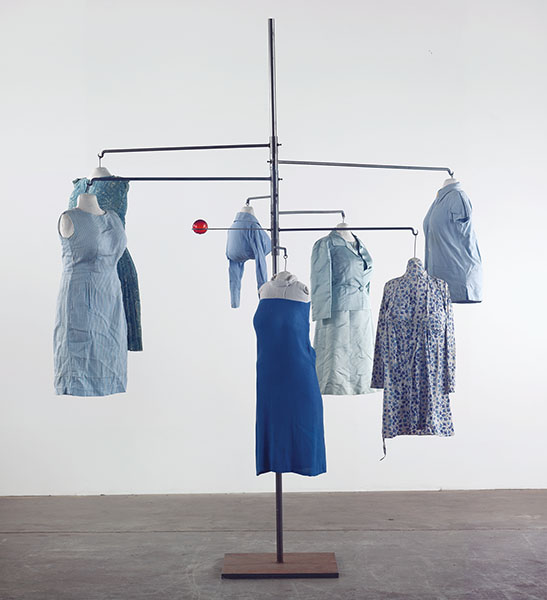
Exhibition: ‘Lewis Hine: Photography for a Change’ at the Netherlands Museum of Photography, Rotterdam

Exhibition dates: 15th September – 6th January 2013


Lewis Hine
 (American, 1874-1940) 'Lunch Time, New York' 1910


Lewis Hine
 (American, 1874-1940)
Lunch Time, New York
1910
Gelatin silver print
© George Eastman House


“In the last analysis, good photography is a question of art.”

“I wanted to show the thing that had to be corrected: I wanted to show the things that had to be appreciated.”


Lewis Wickes Hines


Something that you really don’t get in reproductions is the absolutely beautiful tonality of Hine’s social documentary photography. Even less so when the images provided by the institution are degraded by scratches, dust, spots and colour irregularities. Despite these media images being 300 dpi when I received them from the museum media department they were in very average condition. For example, the image of Christmas Fiddles (below) was in such poor condition when enlarged that I had to spend over half and hour cleaning up the image to make it pictorially legible to the viewer at a larger size.

This is not an unusual occurrence and, unbeknownst to the readers of the archive, I spend many hours quickly cleaning the digital files before they are presented to you. Some individual images and sets of images are of such poor quality that I simply cannot use them at all. I will do a posting on this issue soon, but suffice to say that museums that spend thousands of hours and dollars staging impressive photographic exhibitions really let themselves down in the promotion of the exhibition if they provide dodgy scans and unusable media images to people that promote the exhibition for free. In this world of media saturated images it should be the norm that the “quality” of the image outweighs the indifferent quantity. With faster and faster download speeds larger images can be viewed more readily online and therefore scans provided by institutions must live up to this enlarged capacity.

Hopefully you can get some idea of the work of this socially conscious photographer, an American photographer who saw the camera as both a research tool and an instrument of social reform, whose images helped change the world with regard to child labour. Unfortunately success and reputation counted for nought. He died totally impoverished in 1940, shortly before a resurgence of public interest in his work raised him to the highest level of American photographers. What an infinite sadness.

Dr Marcus Bunyan


Many thankx to the Netherlands Museum of Photography for allowing me to publish the photographs in the posting. Please click on the photographs for a larger version of the image.


Installation view of the exhibition 'Lewis Hine: Photography for a Change' at the Netherlands Museum of Photography, Rotterdam 


Installation view of the exhibition Lewis Hine: Photography for a Change at the Netherlands Museum of Photography, Rotterdam


Lewis Hine
 (American, 1874-1940) 'Belgrade. Christmas Fiddles' 1918


Lewis Hine
 (American, 1874-1940)
Belgrade. Christmas Fiddles
1918
Gelatin silver print
© George Eastman House


Lewis Hine
 (American, 1874-1940) 'Belgrade. Christmas Fiddles' 1918 (detail)


Lewis Hine
 (American, 1874-1940)
Belgrade. Christmas Fiddles (detail)
1918
Gelatin silver print
© George Eastman House


Lewis Hine
 (American, 1874-1940) 'Construction workers, Empire State Building, NYC' 1930-1931


Lewis Hine
 (American, 1874-1940)
Construction workers, Empire State Building, NYC
1930-1931
Gelatin silver print
© George Eastman House


From 15 September 2012 to 6 January 2013, the Netherlands Museum of Photography will present the first large retrospective in the Netherlands of the work of the renowned American photographer Lewis Hine. Hine was an enthusiastic photographer who wished to improve people’s lives through his photos. His pictures of immigrants on Ellis Island, of child labour, and of workers busy on the Empire State Building high above New York belong to the visual icons of the 20th century. The internationally touring exhibition contains more than 200 photos and documents, many in their original state and originating from the collection of the George Eastman House in Rochester, New York State. Lewis Hine is an initiative of three European institutions: Fondation Henri Cartier-Bresson (Paris), Fundación MAPFRE (Madrid) and the Netherlands Museum of Photography (Rotterdam). It is with great pride that the Netherlands Museum of Photography can now present this exhibition that harmonises perfectly with its aim to pay attention to the canon of international documentary photography.

Lewis W. Hine (Wisconsin, 1874 – New York, 1940), a sociologist and photographer, belongs to the group of famous photographers such as Joel Meyerowitz, Robert Frank, Robert Capa, Eugène Atget to whom the Netherlands Museum of Photography has previously devoted impressive exhibitions. Hine is known as a 20th-century pioneer of social documentary photography. It is characteristic of Hine that he strongly believed in the camera’s powers of conviction. Thus, armed only with a heavy camera he fought for social justice. For the National Child Labor Committee he travelled more than 75,000 kilometres through the United States to photograph children working in agriculture, the mines, factories, sewing attics, and on the streets. His photos were partly responsible for reforms in these fields. The themes in Hine’s work – child labour, situations of human indignity, and the vulnerability of immigrants and refugees – are still current. Despite his present reputation, his early successes and the fact that many governmental organisations made use of his photos, he died totally impoverished in 1940.

Empire State Building and Building the Rotterdam

In 1932 Lewis Hine published the famous photographic book entitled Men at Work, which covered the construction of the Empire State Building. From the most audacious vantage points he took photos of the 381-metre building, showing the strength and willpower of humankind, man’s contribution to industry. The tall buildings on the Wilhelminapier have determined the skyline of Rotterdam for many years, just as the Empire State Building did in New York around 1930. The Wilhelminapier is now under full development. De Rotterdam Building, designed by Rem Koolhaas of OMA (Office for Metropolitan Architectural) will be completed in 2013-2014. The photographer Ruud Sies has followed the genesis of the largest building in the Netherlands for four years now. The project entitled Building the Rotterdam – a work in progress by Ruud Sies was inspired by the work of Lewis Hine and establishes the connection with the Wilhelminapier as a historical location. To the Netherlands Museum of Photography, this is a reason to include this project in the exhibition of the work of Lewis Hine.

Exhibition

With 170 vintage photos from the period 1903-1937 as well as 42 documents, this exhibition of Hine’s work is the first extensive and well-documented overview in the Netherlands and even in Europe. Hine’s entire oeuvre is on show, ranging from his earliest portraits of immigrants on Ellis Island to his work in Europe after the First World War. The Lewis Hine touring exhibition was on display in Paris toward the end of 2011, and in Madrid at the beginning of this year. For this international journey, Hine’s work has undergone preventative preservation treatment and is exposed to a minimum amount of light. After the exhibition in the Netherlands, the work will return to the George Eastman House in America to relax in a dark depot.”

Press release from the Netherlands Museum of Photography website


Lewis Hine
 (American, 1874-1940) 'Coal mine worker in West Virginia. Eleven year old boy. Tipple boy at the Turkey Knob coal mine in Macdonald, West Virginia' 1908


Lewis Hine
 (American, 1874-1940)
Coal mine worker in West Virginia. Eleven year old boy
Tipple boy at the Turkey Knob coal mine in Macdonald, West Virginia
1908
Gelatin silver print
© George Eastman House


Lewis Hine
 (American, 1874-1940) 'Little Mother, Pittsburgh District' 1909


Lewis Hine
 (American, 1874-1940)
Little Mother, Pittsburgh District
1909
Gelatin silver print
© George Eastman House


Anonymous photographer (American) 'Lewis Hine photographing children in a slum' 1910


Anonymous photographer (American)
Lewis Hine photographing children in a slum
1910
© George Eastman House


Lewis Hine
 (American, 1874-1940) 'Waiting for the dispensary to open Hull House District, Chicago' 1910


Lewis Hine
 (American, 1874-1940)
Waiting for the dispensary to open Hull House District, Chicago
1910
Gelatin silver print
© George Eastman House


Lewis Hine was born in Oshkosh, Wisconsin, in 1874. He moved to New York City in 1901 to teach at the Ethical Culture School. There Hine used photographs as educational tools, and soon began to photograph immigrants at Ellis Island. He hoped his photographs would encourage people to “exert the force to right wrongs.” While continuing to teach at ECS, Hine began to do freelance work for the National Child Labor Committee, an association that transformed his professional life.

In 1908, the NCLC provided Hine a monthly salary to photographically document children in factories, mills, canneries, textile mills, street trades, and agricultural industries. Through his photographs he sought to alert the public to the extent of child labor in America, and the degree to which it denied these children their childhood, health, and education. In one year, Hine covered 12,000 miles in his quest to end abusive child labor. By 1913, Hine was considered the leading social welfare photographer in America.

Hine enjoyed a long and successful career following his work for the NCLC. He worked for the American Red Cross (1917-1920), photographing refugees and civilians in war-torn Europe, a new series of photographs of immigrants at Ellis Island (1926), a series of photographs documenting the construction of the Empire State Building (1930), photographs of drought-ridden communities in Arkansas and Kentucky (1931), as well as work for the Tennessee Valley Authority.

In 1936-1937 Hine was appointed head photographer for the National Research Project of the Works Progress Administration. The ageing Hine, however, was disappointed at the rebuff of his attempts to secure work with the Farm Services Administration, where director Roy Stryker considered Hine old fashioned and difficult. Lewis Hine died in 1940, shortly before a resurgence of public interest in his work raised him to the highest level of American photographers.

Text from Child Labour in Virginia: Photographs by Lewis Hine web page [Online] Cited 21/12/2012 no longer available online


Lewis Hine
 (American, 1874-1940) 'Paris Gamin' 1918


Lewis Hine
 (American, 1874-1940)
Paris Gamin
1918
Gelatin silver print
© George Eastman House


Lewis Hine
 (American, 1874-1940) 'Mechanic at steam pump in electric power house' 1920


Lewis Hine
 (American, 1874-1940)
Mechanic at steam pump in electric power house
1920
Gelatin silver print
© George Eastman House


Lewis Hine
 (American, 1874-1940) 'Candy Worker, New York' 1925


Lewis Hine
 (American, 1874-1940)
Candy Worker, New York
1925
Gelatin silver print
© George Eastman House


Lewis Hine
 (American, 1874-1940) 'Man on hoisting ball, Empire State building' 1931


Lewis Hine
 (American, 1874-1940)
Man on hoisting ball, Empire State building
1931
Gelatin silver print
© George Eastman House


Lewis Hine
 (American, 1874-1940) 'Steelworker standing on beam' 1931


Lewis Hine
 (American, 1874-1940)
Steelworker standing on beam
1931
Gelatin silver print
© George Eastman House


Lewis Hine
 (American, 1874-1940) 'The Sky Boy' 1931


Lewis Hine
 (American, 1874-1940)
The Sky Boy
1931
Gelatin silver print
© George Eastman House


Netherlands Museum of Photography
Wilhelminakade 332
3072 AR Rotterdam
The Netherlands

Opening hours
Tuesday – Sunday 11am – 5pm
Closed Mondays

Nederlands Museum of Photography website

LIKE ART BLART ON FACEBOOK

Back to top
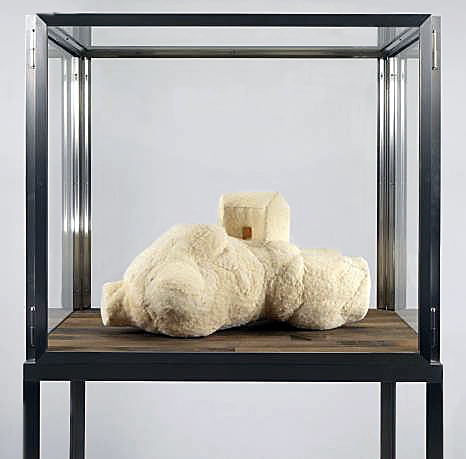
Exhibition: ‘The Serial Portrait: Photography and Identity in the Last One Hundred Years’ at the National Gallery of Art, Washington

Exhibition dates: 30th September 2012 – 31st December 2012


Emmet Gowin (American, b. 1941) 'Edith, Danville, Virginia' 1971


Figure 5. Emmet Gowin (American, b. 1941)
Edith, Danville, Virginia
1971
Gelatin silver print
20.2 x 25.2cm (7 15/16 x 9 15/16 in.)
National Gallery of Art, Washington
Patrons’ Permanent Fund
© Emmet and Edith Gowin, Courtesy Pace/MacGill Gallery, New York


~ Alfred Stieglitz / Georgia O’Keeffe
~ Paul Strand / Rebecca Strand
~ Emmet Gowin / Edith Gowin
~ Harry Callahan / Eleanor and Barbara Callahan
~ Robert Mapplethorpe / Patti Smith
~ Nicholas Nixon / The Brown Sisters
~ Andy Warhol / Serial Photography / Photo Booth Portraits
~ Mario Testino / Kate Moss
~ Baron Adolf de Meyer / Baroness Olga de Meyer
~ Edward Weston / Charis Weston
~ Lee Friedlander / Maria Friedlander
~ Paul Caponigro / The woods of Connecticut
~ Bernd and Hilla Becher / grids
~ Gerhard Richter / Overpainted Photographs
~ Masahisa Fukase / wife and family
~ Seiichi Furuya / Christine Furuya-Gößler
~ Sally Mann / children and husband
~ William Wegman / dogs


Australia?
Nobody that I can think of except Sue Ford.

Notice how all the artists are men except two: Sally Mann and Hilla Becher.

Dr Marcus Bunyan


Many thankx to the National Gallery of Art for allowing me to publish the photographs in the posting. Please click on the photographs for a larger version of the image.


Introduction

Alfred Stieglitz, one of the most influential photographers of the twentieth century, argued that “to demand the [single] portrait… be a complete portrait of any person is as futile as to demand that a motion picture be condensed into a single still.” Stieglitz’s conviction that a person’s character could not be adequately conveyed in one image is consistent with a modern understanding of identity as constantly changing. For Stieglitz, who frequently made numerous portraits of the same sitters – including
striking photographs of his wife, the painter Georgia O’Keeffe – using the camera in a serial manner allowed him to transcend the limits of a single image.

Drawn primarily from the National Gallery of Art’s collection, the
Serial Portrait exhibition features twenty artists who photographed the same subjects – primarily friends, family, or themselves – multiple times over the course of days, months, or years. This brochure presents a selection of works by seven of these artists. Like Stieglitz’s extended portrait of O’Keeffe, Emmet Gowin’s ongoing photographic study of his wife, Edith, explores her character and reveals the bonds of love and affection between the couple. Milton Rogovin’s photographs of working-class residents of Buffalo, New York, record shifts in the appearance and situation of individuals in the context of their community over several decades.

A number of photographers in the exhibition have made serial self-portraits that investigate the malleability of personal identity. Photographing themselves as shadows, blurs, or partial reflections, Lee Friedlander and Francesca Woodman have made disorienting images that hint at the instability of self-representation. Ann Hamilton has employed unusual props and materials to transform herself into a series of hybrid objects. Finally, work by Nikki S. Lee takes the idea of mutable identity to its logical conclusion as the artist photographs herself masquerading as members of different social and ethnic groups.

Text from the NGA website


Emmet Gowin (American, b. 1941) 'Edith, Danville, Virginia' 1963


Figure 4. Emmet Gowin (American, b. 1941)
Edith, Danville, Virginia
1963
Gelatin silver print, printed 1980s
19.7 x 12.7cm (7 3/4 x 5 in.)
National Gallery of Art, Washington
Charina Endowment Fund
© Emmet and Edith Gowin, Courtesy Pace/MacGill Gallery, New York


Emmet Gowin

Emmet Gowin (born 1941) met Edith Morris in 1961 in their hometown of Danville, Virginia, just as he had decided to abandon business school to study art. Several years later at the Rhode Island School of Design, his teacher Harry Callahan, who made numerous photographs of his wife, Eleanor, encouraged Gowin to photograph the subject he knew most intimately – his family and in particular Edith, whom he married in 1964.

The Gowins’ artistic and marital collaboration has endured for half a century, yielding an extraordinary series of quiet, attentive portraits. In some photographs, such as Edith, Danville, Virginia, 1963 (fig. 4, above), Edith appears contemplative, even reserved. The somber beauty of this work stems in part from Gowin’s use of a tripod-mounted, large-format camera, which requires a lengthy exposure but produces photographs with exquisite details, such as the delicate shadow of a twig that falls across Edith’s face. To make the dramatic circular shadow that surrounds her in Edith, Danville, Virginia, 1971 (fig. 5, above), Gowin attached a lens meant for a 4 × 5 camera to a large 8 × 10 camera. This focus draws our attention to her figure, but the screen door simultaneously frames and obscures her form, resulting in a play between presence and elusiveness. While Gowin’s photographs are born of a deep intimacy, they refuse to lay bare his wife’s soul or expose the couple’s private passions.

The same delicate balance between revelation and reserve marks a group of portraits made during the couple’s travels in Central and South America. Edith and Moth Flight, 2002 (fig. 6, below), made at night using a ten-second exposure, combines Gowin’s enchantment with natural beauty and his interest in the nuances of his wife’s gestures and moods. Placing a pulsing ultraviolet light behind Edith’s head, Gowin recorded the luminous traces left by moths as they danced around her blurred face, transforming her into a ghostly and even otherworldly presence, visible yet just out of our reach.

Text from the NGA website


Emmet Gowin (American, b. 1941) 'Edith and Moth Flight' 2002


Figure 6. Emmet Gowin (American, b. 1941)
Edith and Moth Flight
2002
Digital ink jet print
19 x 19cm (7 1/2 x 7 1/2 in.)
National Gallery of Art, Washington
Charina Endowment Fund
© Emmet and Edith Gowin, Courtesy Pace/MacGill Gallery, New York


Francesca Woodman (American, 1958-1981) 'House #3, Providence, Rhode Island' 1976


Francesca Woodman (American, 1958-1981)
House #3, Providence, Rhode Island
1976
Gelatin silver print
16.1 x 16.3cm (6 5/16 x 6 7/16 in.)
National Gallery of Art, Washington
Gift of the Heather and Tony Podesta Collection


Francesca Woodman

Francesca Woodman (1958-1981) began making photographs at age thirteen, and by the time she entered the Rhode Island School of Design in 1975, she was already a skilled photographer. Using herself as the subject of nearly all her work, Woodman put her body in the service of exploring such themes as feminine identity, sexuality, mythology, and the relationship of the body to its surroundings. Conjuring visions of a complex inner world, Woodman’s photographs are powerful for their ability to suggest psychic turmoil within images of serene, ethereal beauty.

Woodman’s interest in the emotional affect of space can be seen in House #3, Providence, Rhode Island, 1976 (fig. 14, above). Using an abandoned house as a makeshift studio, Woodman often photographed herself merging with her surroundings, including doors, walls, and windows, dissolving physical or psychic boundaries. She also frequently moved during long exposures or allowed the camera to record only part of her body in order to obscure her figure. By invoking a ghostly presence, Woodman’s photographs often present her as someone who refuses to commit to a solid image of herself.

Woodman’s lush and intimate photographs thus offer a tantalising glimpse of a mysterious, private world. Yet they are more than romantic expressions of a young woman’s subjective experience. Notes in Woodman’s diary suggest, for instance, that Untitled, Providence, Rhode Island, 1975-1978 (fig. 15, below), alludes to the Greek mythological story of Leda, who was seduced by the god Zeus in the form of a swan.

Toward the end of her brief but prolific career (Woodman committed suicide when she was twenty-two) the artist began working on a much larger scale, using her body more as a structural element. Caryatid, New York, 1980 (fig. 16, below), made as part of a monumental photo-installation called Temple Project, draws both its title and inspiration from the columns carved in the shape of women that were used in ancient Greek and Roman architecture. Although Woodman displays her figure in a more expansive and direct manner than in her earlier work, the gesture that obscures her face and leaves her partial and unknowable is typical for the artist, who always preferred suggestion over declaration.

Text from the NGA website


Francesca Woodman (American, 1958-1981) 'Untitled, Providence, Rhode Island' 1975-1978


Francesca Woodman (American, 1958-1981)
Untitled, Providence, Rhode Island
1975-1978
Gelatin silver print
10.5 x 10.5cm (4 1/8 x 4 1/8 in.)
National Gallery of Art, Washington
Gift of the Collectors
Committee and R. K. Mellon Family Foundation


Francesca Woodman (American, 1958-1981) 'Caryatid, New York' 1980


Francesca Woodman (American, 1958-1981)
Caryatid, New York
1980
National Gallery of Art, Washington
William and Sarah Walton Fund and Gift of the Collectors Committee


Ann Hamilton (American, b. 1956) 'body object series #13, toothpick suit/chair' 1984


Figure 17. Ann Hamilton (American, b. 1956)
body object series #13, toothpick suit/chair
1984
Gelatin silver print, printed 1993
11 x 11cm (4 5/16 x 4 5/16 in.)
National Gallery of Art, Washington
Gift of Heather and Tony Podesta Collection


Ann Hamilton

An artist known for multimedia environments, performances, and videos, Ann Hamilton (born 1956) made the first photographs in the body object series in 1984 with objects left over from an installation she had presented as an MFA student at Yale. Later images from the series were based on subsequent performances and installations, documenting both the objects used and the actions performed with them. Hamilton appears in each photograph with objects attached to or touching her body, her face only rarely visible. The results are striking, unsettling, and often witty.

Despite emerging from Hamilton’s installation and performance practice, the photographs in the series stand on their own as works of art. Paying close attention to the material qualities of familiar objects, Hamilton models creative new uses for them, changing their function and meaning. In body object series #13, toothpick suit/chair, 1984 (fig. 17, above), for example, thousands of toothpicks transform Hamilton’s clothes into a porcupine-like hide while a chair becomes a burdensome instrument of torture. The image elicits visceral emotions – alienation, hostility, fear – though it does so with a dose of absurdist humour.

As self-representations, the photographs in the body object series depart radically from any traditional notion of portraiture. Instead of insisting on Hamilton’s uniqueness as an individual, these images present her body almost as an object on a par with other objects. Some of the photographs are linked directly to her biography: Hamilton had studied textile design before getting her MFA, and the toothpick suit refers to her love of fabrics. In other photographs she makes abstract concepts more graspable through the senses. Sound is given tactile and visual form as tissue paper in body object series #14, megaphone, 1986 (fig. 18, below), while in body object series #15, honey hat, 1989 (fig. 19, below), Hamilton wrings her hands in honey to suggest the idea of washing one’s hands of guilt. Based on an installation in which the artist embedded money – 750,000 pennies – in a layer of honey, this image also gives new meaning to the phrase “sticky fingers” and highlights the connections between language, images, and objects that Hamilton explores in both her photographs and installations.

Text from the NGA website


Ann Hamilton (American, b. 1956) 'body object series #14, megaphone' 1986


Figure 18. Ann Hamilton (American, b. 1956)
body object series #14, megaphone
1986
Gelatin silver print, printed 1993
11 x 11cm (4 5/16 x 4 5/16 in.)
National Gallery of Art, Washington
Gift of Heather and Tony Podesta Collection


Ann Hamilton (American, b. 1956) 'body object series #15, honey hat' 1989


Figure 19. Ann Hamilton (American, b. 1956)
body object series #15, honey hat
1989
Gelatin silver print, printed 1993
11 x 11cm (4 5/16 x 4 5/16 in.)
National Gallery of Art, Washington
Gift of Heather and Tony Podesta Collection


The National Gallery of Art explores how the practice of making multiple portraits of the same subjects produced some of the most revealing and provocative photographs of our time in The Serial Portrait: Photography and Identity in the Last One Hundred Years, on view in the West Building’s Ground Floor photography galleries from September 30 through December 31, 2012. Arranged both chronologically and thematically, the exhibition features 153 works by 20 artists who photographed the same subjects – friends, family, and themselves – numerous times over days, months, or years to create compelling portrait studies that investigate the many facets of personal and social identity.

“The Gallery’s photography collection essentially began with the donation of Alfred Stieglitz’s ‘key set,’ so it is fitting that this exhibition opens with portraits by Stieglitz, who understood that a person’s character was best captured through a series of photographs taken over time,” said Earl A. Powell III, director, National Gallery of Art. “Although the exhibition is drawn largely from the Gallery’s significant collection of photographs, we are grateful to the lenders who have allowed us to present more fully the serial form of portraiture that Stieglitz championed.”

Since the introduction of photography in 1839, portraiture has been one of the most widely practiced forms of the medium. Starting in the early 20th century, however, some photographers began to question whether one image alone could adequately capture the complexity of an individual. As Alfred Stieglitz, the era’s leading champion of American fine art photography, argued: “to demand the [single] portrait that will be a complete portrait of any person is as futile as to demand that a motion picture will be condensed into a single still.”

Along with Stieglitz, some of the 20th century’s most prominent photographers – Paul Strand, Harry Callahan, and Emmet Gowin – used the camera serially to transcend the limits of a single image. Each of these photographers made numerous studies of their lovers that sought to redefine the expressive possibilities of portraiture while probing the affective bonds of love and desire. By employing the camera’s capacity to record fluctuating states of being and mark the passage of time, other photographers such as Nicholas Nixon and Milton Rogovin have documented individuals – in families or communities – over four decades. Capturing subtle and dramatic shifts in appearance, demeanour, and situation, these series are poignant and elegiac memorials that remind us of our own mortality.

Other photographers have made serial self-portraits that explore the malleability of personal identity and the possibility of reinvention afforded by the camera. By photographing themselves as shadows, blurs, or partial reflections, Ilse Bing, Lee Friedlander, and Francesca Woodman have created inventive but elusive images that hint at the instability of self-representation. Conceptual artists of the 1970s and 1980s such as Vito Acconci, Blythe Bohnen, and Ann Hamilton have explicitly combined performance and self-portraiture to stage continual self-transformations. The exhibition concludes with work from the last 15 years by artists such as Nikki S. Lee and Gillian Wearing, who take the performance of self to its limits by adopting masquerades to delve into the ways identity is inferred from external appearance.

Press release from the National Gallery of Art website


Lee Friedlander (American, b. 1934) 'Westport, Connecticut' 1968


Figure 11. Lee Friedlander (American, b. 1934)
Westport, Connecticut
1968
Gelatin silver print
19.8 x 12.3cm (7 13/16 x 4 13/16 in.)
National Gallery of Art, Washington, Trellis Fund
© Lee Friedlander, courtesy Fraenkel Gallery


Lee Friedlander

In the 1960s Lee Friedlander (born 1934) sought, by his own account, to create images of “the American social landscape and its conditions.” Other photographers in his New York circle, including Diane Arbus and Garry Winogrand, also explored the chaotic beauty and contradictions of modern life. Friedlander, however, was the only member of this group to turn repeatedly to self-portraiture in order to understand the world around him. He stalked city streets with camera in hand, recording not only the haphazard incidents of daily life but also his own presence, often as a shadow or a reflection.

In the shop window of Westport, Connecticut, 1968 (fig. 11, above), for example, a reflection of Friedlander’s legs appears to merge with the shapely limbs of a woman in a bathing suit who points a camera at the viewer. The woman is an illusion, a cutout advertisement – but she is also a stand-in for the camera-wielding Friedlander, whose torso and head also appear faintly, as a shadow cast against her legs.

By letting the reflection in a window obscure what is inside, or allowing his shadow to intrude into the frame, Friedlander violates many of the rules of “good” photography. Works such as New York City, 1966 (fig. 12, below) testify to Friedlander’s ability to transform such “mistakes” into witty, ironic juxtapositions. In this case, the startling intrusion of Friedlander’s shadow onto the back of a fellow pedestrian is visually confusing, simultaneously threatening and humorous, as Friedlander’s spiky hair merges with the woman’s fur collar. A sly commentary on the predatory nature of such street photography, the looming shadow that engulfs the subject is also an effect of Friedlander’s equipment, a 35mm Leica with a wide-angle lens. In order to fill the picture frame with his chosen subject, Friedlander had to make the picture at close range, resulting in the inclusion of his own shadow.

Even in self-portraits in which Friedlander makes himself fully visible to the camera, the artist often makes humorously self-deprecating deadpan images, appearing, for example, as a disheveled driver on a manic mission in Haverstraw, New York, 1966 (fig. 13, below). Edgy but unpretentious, brimming with pictorial detail, Friedlander’s self-portraits are visual puzzles that explore the place of the self in the chaos of contemporary urban life.

Text from the NGA website


Lee Friedlander (American, b. 1934) 'New York City' 1966


Figure 12. Lee Friedlander (American, b. 1934)
New York City
1966
Gelatin silver print
21.7 x 32.7cm (8 9/16 x 12 7/8 in.)
National Gallery of Art, Washington
Trellis Fund
© Lee Friedlander, courtesy Fraenkel Gallery


Lee Friedlander (American, b. 1934) 'Haverstraw, New York' 1966


Figure 13. Lee Friedlander (American, b. 1934)
Haverstraw, New York
1966
Gelatin silver print
21.7 x 32.7cm (8 9/16 x 12 7/8 in.)
National Gallery of Art, Washington
Trellis Fund
© Lee Friedlander, courtesy Fraenkel Gallery


Ilse Bing (German, 1899-1998) 'Self-Portrait with Leica' 1931


Ilse Bing (German, 1899-1998)
Self-Portrait with Leica
1931
Gelatin silver print, printed c. 1988
26.7 x 29.7cm (10 1/2 x 11 11/16 in.)
National Gallery of Art, Washington
Gift of Ilse Bing Wolff


Gillian Wearing (English, b. 1963) 'Me as Mapplethorpe' 2009


Gillian Wearing (English, b. 1963)
Me as Mapplethorpe
2009
Gelatin silver print (based upon Robert Mapplethorpe work: Self Portrait, 1988. © Robert Mapplethorpe Foundation)
149.86 x 121.92cm (59 x 48 in.)
Private Collection
Courtesy the artist; Tanya Bonakdar Gallery, New York; Maureen Paley, London, Regen Projects, Los Angeles


Paul Strand (American, 1890-1976) 'Rebecca' 1922


Paul Strand (American, 1890-1976)
Rebecca
1922
Platinum print
24.4 x 19.4cm (9 5/8 x 7 5/8 in.)
National Gallery of Art, Washington
Southwestern Bell Corporation Paul Strand Collection
© Aperture Foundation Inc., Paul Strand Archive


Paul Strand (American, 1890-1976) 'Rebecca, New Mexico' 1932


Paul Strand (American, 1890-1976)
Rebecca, New Mexico
1932
Platinum print
14.9 x 11.8cm (5 7/8 x 4 5/8 in.)
National Gallery of Art, Washington
Southwestern Bell Corporation Paul Strand Collection
© Aperture Foundation Inc., Paul Strand Archive


Alfred Stieglitz (American, 1864-1946) 'Georgia O'Keeffe' probably 1918


Figure 1. Alfred Stieglitz (American, 1864-1946)
Georgia O’Keeffe
probably 1918
Platinum print
18.4 x 23.1cm (7 1/4 x 9 1/8 in.)
National Gallery of Art, Washington
Alfred Stieglitz Collection


Alfred Stieglitz

Alfred Stieglitz (1864-1946) was already an accomplished photographer, publisher, and champion of modern art when he the first encountered the work of Georgia O’Keeffe in 1916. He made his first photographs of her in 1917 and sent them to her with the note, “I think I could do thousands
of things of you – a life work to express you.” Over the next two decades Stieglitz made more than three hundred photographs of O’Keeffe, whom he married in 1924, creating what he called a “composite portrait.” This extraordinary body of work charts the couple’s relationship and
expresses Stieglitz’s conviction that portraiture should function as a kind of “photographic diary.”

Many of the photographs Stieglitz made of O’Keeffe in the early years of their relationship, including Georgia O’Keeffe, c. 1918 (fig. 1, above), are palpably erotic, reflecting the intense passion they shared. Revealing herself to the lens with a bewitching vulnerability, O’Keeffe exudes a tenderness and seductiveness that belie the strain of holding the pose during the long exposures required by Stieglitz’s large-format camera. Often, his photographs express both his desire and admiration for O’Keeffe, at times verging on idealisation of the person he called “Nature’s child – a Woman.” Yet his portraits also look beyond her face to find eloquence in all
parts of her body, as in the print Georgia O’Keeffe – Hands and Thimble (fig. 2, below), where her hands display an almost tactile physicality. Here, Stieglitz used a printing technique that resulted in tonal reversal, causing deep shadows to print as bronze tones and creating the dark outlines that dramatise O’Keeffe’s graceful fingers and emphasise the metallic gleam of the thimble.

After Stieglitz exhibited more than forty portraits of O’Keeffe, including some provocative nudes, in 1921, the painter was dismayed to find that her own art began to be interpreted in a sexualised way, and she rarely posed unclothed after 1923. O’Keeffe’s desire to control her image, along with the increasingly attenuated nature of their relationship after 1929, when
she began spending several months a year working in New Mexico while he stayed in New York, further strained their partnership. In Georgia O’Keeffe, 1930 (fig. 3, below), the artist stands before one of the paintings she had made in New Mexico. Gazing steadily at the camera, she appears as a monumental force at one with her art, confident yet untouchable.

Text from the NGA website


Alfred Stieglitz (American, 1864-1946) 'Georgia O'Keeffe - Hands and Thimble' 1919


Figure 2. Alfred Stieglitz (American, 1864-1946)
Georgia O’Keeffe – Hands and Thimble
1919
Palladium print
24 x 19.4cm (9 7/16 x 7 5/8 in.)
National Gallery of Art, Washington
Alfred Stieglitz Collection


Alfred Stieglitz (American, 1864-1946) 'Georgia O'Keeffe' 1930


Figure 3. Alfred Stieglitz (American, 1864-1946)
Georgia O’Keeffe
1930
Gelatin silver print
23.9 x 19.1cm (9 7/16 x 7 1/2 in.)
National Gallery of Art, Washington
Alfred Stieglitz Collection


Nicholas Nixon (American, b. 1947) 'The Brown Sisters' 1975


Nicholas Nixon (American, b. 1947)
The Brown Sisters
1975
Gelatin silver print
20.2 x 25.2cm (7 15/16 x 9 15/16 in.)
National Gallery of Art, Washington
Patrons’ Permanent Fund
© Nicholas Nixon, courtesy Fraenkel Gallery, San Francisco and Pace/MacGill Gallery, New York


Nicholas Nixon (American, b. 1947) 'The Brown Sisters' 1978


Nicholas Nixon (American, b. 1947)
The Brown Sisters
1978
Gelatin silver print
Promised gift of James and Margie Krebs
© Nicholas Nixon, courtesy Museum of Fine Arts, Boston


For more images from this series please see my posting Nicholas Nixon: Family Album


Milton Rogovin (American, 1909-2011) 'Samuel P. "Pee Wee" West (Lower West Side series)' 1974


Figure 7. Milton Rogovin (American, 1909-2011)
Samuel P. “Pee Wee” West (Lower West Side series)
1974
Gelatin silver print
National Gallery of Art, Washington
Gift of Dr. J. Patrick and Patricia A. Kennedy


Milton Rogovin

Milton Rogovin (1909-2011) belongs to a rich photographic tradition of documenting the social and personal histories of people who would otherwise be forgotten. He did so serially, returning over many years to encapsulate not just single moments but entire lifetimes. Rogovin started his career as an optometrist in Buffalo, New York. In 1957, after he refused to testify before the House Committee on Un-American Activities about his association with the Communist Party, the local paper labeled him the “Top Red in Buffalo.” His optometry practice folded as a result, leaving his family of five to survive on the salary of his wife, Anne. With free time suddenly available, Rogovin turned to photography with a strong sense of purpose. “My voice was essentially silenced,” he recalled, “so I decided to speak out through photographs.”

Rogovin’s candid, powerfully direct pictures gave voice to those who traditionally had none: immigrants, minorities, and working-class people. Even though he traveled around the world making photographs of workers, his best-known work was made closer to home. In 1972 he began photographing residents of Buffalo’s Lower West Side, the city’s poorest
and most ethnically diverse neighbourhood. With his bulky twin-lens Rolleiflex camera, the photographer was sometimes suspected of working for the police or the FBI. Over time, however, Rogovin gained the trust of his sitters by visiting regularly and by giving them prints of their portraits. Dignified and occasionally tender, these photographs depict the circumstances of each subject with sober honesty.

Several times over the next three decades, Rogovin sought out and re-photographed many of his original subjects, capturing the changes wrought by time and circumstance. The series Samuel P. “Pee Wee” West (figs. 7-10) registers changes in the sitter’s situation over the course of twenty-eight years, from 1974 to 2002. In 2003 the oral historian Dave Isay, working
alongside Rogovin, interviewed West, who related the story of his decades of heavy drinking. Reflecting on a photograph Rogovin had made of him in 1985 (fig. 8), West said, “That… picture actually changed my life”; it prompted him to stop drinking for six months before relapsing. A later brush with death led to permanent recovery and the founding of a program to help local youth reject drugs and alcohol. In this and other serial portraits, Rogovin honoured the everyday lives of his subjects, offering a powerful visual legacy of a community he respected and loved.

Text from the NGA website


Milton Rogovin (American, 1909-2011) 'Samuel P. "Pee Wee" West (Lower West Side series)' 1985


Figure 8. Milton Rogovin (American, 1909-2011)
Samuel P. “Pee Wee” West (Lower West Side series)
1985
Gelatin silver print
National Gallery of Art, Washington
Gft of Dr. J. Patrick and Patricia A. Kennedy


Milton Rogovin (American, 1909-2011) 'Samuel P. "Pee Wee" West (Lower West Side series)' 1992


Figure 9. Milton Rogovin (American, 1909-2011)
Samuel P. “Pee Wee” West (Lower West Side series)
1992
Gelatin silver print
National Gallery of Art, Washington
Gft of Dr. J. Patrick and Patricia A. Kennedy


Milton Rogovin (American, 1909-2011) 'Samuel P. "Pee Wee" West (Lower West Side series)' 2002


Figure 10. Milton Rogovin (American, 1909-2011)
Samuel P. “Pee Wee” West (Lower West Side series)
2002
Gelatin silver print
National Gallery of Art, Washington
Gift of Dr. J. Patrick and Patricia A. Kennedy


National Gallery of Art
National Mall between 3rd and 7th Streets
Constitution Avenue NW, Washington

Opening hours:
Daily 11.00am – 4.00pm

National Gallery of Art website

LIKE ART BLART ON FACEBOOK

Back to top
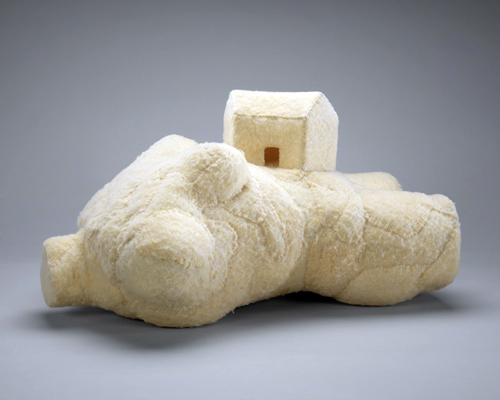
Exhibition: ‘WAR/PHOTOGRAPHY: Images of Armed Conflict and Its Aftermath’ at the Museum of Fine Arts, Houston Part 2

Exhibition dates: 11th November 2012 – 3rd February 2013


This is the biggest posting on one exhibition that I have ever undertaken on Art Blart!

As befits the gravity of the subject matter this posting is so humongous that I have had to split it into 4 separate postings. This is how to research and stage a contemporary photography exhibition that fully explores its theme. The curators reviewed more than one million photographs in 17 countries, locating pictures in archives, military libraries, museums, private collections, historical societies and news agencies; in the personal files of photographers and service personnel; and at two annual photojournalism festivals producing an exhibition that features 26 sections (an inspired and thoughtful selection) that includes nearly 500 objects that illuminate all aspects of WAR/PHOTOGRAPHY.

I have spent hours researching and finding photographs on the Internet to support the posting. It has been a great learning experience and my admiration for photographers of all types has increased. I have discovered the photographs and stories of new image makers that I did not know and some hidden treasures along the way. I hope you enjoy this monster posting on a subject matter that should be consigned to the history books of human evolution.

**Please be aware that there are graphic photographs in all of these postings.** Part 1Part 3Part 4

Dr Marcus Bunyan


Many thankx to the Museum of Fine Arts, Houston for allowing me to publish some of the photographs in the posting. Please click on the photographs for a larger version of the image.


Photographic Essays

14. Photographic Essays showcases selections from two distinct storylines: Larry Burrows’ Yankee Papa 13, published in Life magazine; and Pulitzer Prize winner Todd Heisler’s series Final Salute, for Denver’s Rocky Mountain News. Burrows follows a man through a rescue attempt in Vietnam; Heisler documents a Marine major assigned to casualty notifications. (12 images, 6 from each photographer, as well as the magazine and newspaper in which the series were published)


Larry Burrows (American, 1926-1971) 'The view from inside Marine helicopter Yankee Papa 13, Vietnam, March 1965' 1965


The view from inside Marine helicopter Yankee Papa 13, Vietnam, March 1965


Larry Burrows (English, 1926-1971) 'The caption that accompanied this photograph in the April 16, 1965, issue of LIFE: "From the downed YP3 in the background, the wounded gunner, Sergeant Owens, races to Yankee Papa 13, where Farley waits in the doorway."' 1965


The caption that accompanied this photograph in the April 16, 1965, issue of LIFE: “From the downed YP3 in the background, the wounded gunner, Sergeant Owens, races to Yankee Papa 13, where Farley waits in the doorway.”


Larry Burrows (English, 1926-1971) 'One Ride with Yankee Papa 13' 1965 The caption that accompanied this photograph in LIFE: "Farley, unable to leave his gun position until YP13 is out of enemy range, stares in shock at YP3's co-pilot, Lieutenant Magel, on the floor."


The caption that accompanied this photograph in LIFE: “Farley, unable to leave his gun position until YP13 is out of enemy range, stares in shock at YP3’s co-pilot, Lieutenant Magel, on the floor.”


Larry Burrows (English, 1926-1971) 'Farley and Hoilien, dead tired, linger beside their helicopter and continue to talk over the mission' 1965


Farley and Hoilien, dead tired, linger beside their helicopter and continue to talk over the mission


Larry Burrows (English, 1926-1971) 'One Ride with Yankee Papa 13' 1965 'In a supply shack, hands covering his face, an exhausted, worn James Farley gives way to grief'


In a supply shack, hands covering his face, an exhausted, worn James Farley gives way to grief


Larry Burrows (English, 1926-1971)
One Ride with Yankee Papa 13
1965
Photo Essay
© Time & Life Pictures/Getty Images


Todd Heisler (American, b. 1972) 'Untitled' 2005 From the series 'Final Salute'


Todd Heisler (American, b. 1972)
Untitled
2005
From the series Final Salute
© Todd Heisler/Rocky Mountain News


The night before the burial of her husband’s body, Katherine Cathey refused to leave the casket, asking to sleep next to his body for the last time. The Marines made a bed for her, tucking in the sheets below the flag. Before she fell asleep, she opened her laptop computer and played songs that reminded her of “Cat,” and one of the Marines asked if she wanted them to continue standing watch as she slept. “I think it would be kind of nice if you kept doing it,” she said. “I think that’s what he would have wanted.”


Executions

15. Executions are among the frequent photographs in wartime: Officials and the public seek confirmation that the enemy is dead; the executioners often forcefully request images to signify their power. An 1867 photograph by François Aubert shows the bloodied shirt of Maximilian I after the Austro-Hungarian archduke was shot by a nationalist firing squad in Mexico. Eddie Adams’ Pulitzer Prize-winning photograph of the Vietnamese police chief shooting a Viet Cong prisoner came to symbolise the brutality of the Vietnam War. Jahangir Razmi’s Firing Squad in Iran (1979) also won a Pulitzer; Razmi’s newspaper, Ettela’at, ran the photograph without credit, in order to protect him. He was not recognised until a 2006 Wall Street Journal article. (20 images)


Francois Aubert (French, 1829-1906) 'The Shirt of the Emperor, Worn during His Execution, Mexico' 1867


Francois Aubert (French, 1829-1906)
The Shirt of the Emperor, Worn during His Execution, Mexico
1867
Albumen print
The Metropolitan Museum of Art, Gilman Collection, gift of the Howard Gilman Foundation, 2005
© The Metropolitan Museum of Art / Art Resource, NY


Eddie Adams (American, 1933-2004) 'Saigon Execution (General Nguyen Ngoc Loan executing a Viet Cong prisoner in Saigon)' February 1, 1968


Eddie Adams (American, 1933-2004)
Saigon Execution (General Nguyen Ngoc Loan executing a Viet Cong prisoner in Saigon)
February 1, 1968
Silver gelatin photograph


Although the image brought Adams the Pulitzer Prize, he would express discomfort with it later in life.

“The general killed the Viet Cong; I killed the general with my camera. Still photographs are the most powerful weapon in the world. People believe them; but photographs do lie, even without manipulation. They are only half-truths. … What the photograph didn’t say was, ‘What would you do if you were the general at that time and place on that hot day, and you caught the so-called bad guy after he blew away one, two or three American people?” (Wikipedia)

For Adams, the lie was the omission of context – that the plainclothes Lem had allegedly just been caught having murdered not only South Vietnamese police but their civilian family members; that Loan was a good officer and not a cold-blooded killer… Like any great work of art, Adams’ serendipitous photograph took on a life of its own… and a tapestry of meanings richer than its creator could ever have intended.

Headsman. “1968: Nguyen Van Lem,” on the ExecutedToday website February 1st, 2009 [Online] Cited 03/09/2022


Eddie Adams Talk About The Saigon Execution Photo


Leisure Time

16. Leisure Time is another popular subject. This section features images that range from a 1958 photograph (by Loomis Dean) of an Elvis Presley serenade in the barracks to Stephen Colbert’s 2009 Iraq appearance in a camouflage suit (by Moises Saman). More-intimate moments show an off-duty serviceman sleeping on a cot next to a wall of pinups (by Edouard Gluck) as well as another serviceman listening to music on headphones (by Alvaro Zavala). Army Staff Sergeant Mark Grimshaw captures an American soldier stationed in Iraq, tending grass that the soldier has grown. (The soldier’s wife sent him seeds from the United States, but he couldn’t get the grass to grow until he purchased sod from a local Iraqi farmer.) (21 images) 


Álvaro Ybarra Zavala (Spanish, b. 1979) 'Untitled' 2003 From the series 'Apocalypse'


Álvaro Ybarra Zavala (Spanish, b. 1979)
Untitled
2003
From the series Apocalypse


More images and text from the sequence can be seen at Álvaro Ybarra Zavala’s Projects web page


Mark A. Grimshaw (American, b. 1968) 'First Cut, Iraq' July 2004


Mark A. Grimshaw (American, b. 1968)
First Cut, Iraq
July 2004
Inkjet print, printed 2012
Courtesy of the photographer
© Mark Grimshaw


Support

17. Support features photographs of people planning operations and supplying troops behind the front, from flying troops and supplies to the battlefront, to making bread in factories and building temporary bridges. One iconic 1942 photo by Alfred Palmer shows women aircraft workers polishing the noses of bomber planes. A 1915-18 picture by an unknown photographer depicts two men working early battery-operated phones. In 2001, James Nachtwey captured a firefighter walking over burning rubble at the World Trade Center in New York. (13 images)


Alfred Palmer (American, 1906-1993) 'Women aircraft workers finishing transparent bomber noses for fighter and reconnaissance planes at Douglas Aircraft Co. Plant in Long Beach, California' 1942


Alfred Palmer (American, 1906-1993)
Women aircraft workers finishing transparent bomber noses for fighter and reconnaissance planes at Douglas Aircraft Co. Plant in Long Beach, California
1942
Gelatin silver print
The Museum of Fine Arts, Houston, gift of Will Michels in honor of his sister, Genevieve Namerow


James Nachtwey (American, b. 1948) 'Firefighters search for survivors at Ground Zero' 2001


James Nachtwey (American, b. 1948)
Firefighters search for survivors at Ground Zero
2001
© James Nachtwey


Medicine

18. Medicine, divided into two subsections, presents doctors and nurses at work at the front, and individuals who are surviving with injuries. “Wartime Medicine presents the conditions of medical operations on the battlefield, from Vo Anh Khanh’s photograph of North Vietnam surgeons working in a swamp to Larry Burrows’ emergency dressing station in Vietnam. Subsequent to War showcases survivors. A 2007 photograph by Peter van Agtmael shows a soldier with a prosthetic leg playing with his two sons and light sabres in a field. A 1985 photograph by Michael Coyne pictures a rehabilitation centre stacked with braces and artificial limbs for the victims of war in Iran and Iraq. Nina Berman’s 2004 portrait of PTSD patient Randall Clunen, from the series Purple Hearts, relates the psychic scars of war. (22 images)


Vo Anh Khanh (Vietnamese, 1936-2023) 'A Cambodian guerrilla is carried to an improvised operating room in a mangrove swamp in this Viet Cong haven on the Ca Mau Peninsula' 1970


Vo Anh Khanh (Vietnamese, 1936-2023)
A Cambodian guerrilla is carried to an improvised operating room in a mangrove swamp in this Viet Cong haven on the Ca Mau Peninsula
1970
© National Geographic Society


This scene was an actual medical situation, not a publicity setup.


Peter van Agtmael (American, b. 1981) 'Darien, Wisconsin, October 22, 2007' 2007, printed 2009


Peter van Agtmael (American, b. 1981)
Darien, Wisconsin, October 22, 2007
2007, printed 2009
Chromogenic print, ed. # 1/10
The Museum of Fine Arts, Houston, gift of David and Cindy Bishop Donnelly, John Gaston, Mary and George Hawkins and Mary and Jim Henderson in memory of Beth Block
© Peter van Agtmael / Magnum Photos


Michael Coyne (Australian, b. 1945) 'Rehabilitation Centre – Iran' 1985


Michael Coyne (Australian, b. 1945)
Rehabilitation Centre – Iran
1985
Type C print
55cm x 36.6cm


Nina Berman (American, b. 1960) 'Randall Clunen' 2004 from the series 'Purple Hearts'


Nina Berman (American, b. 1960)
Randall Clunen
2004
From the series Purple Hearts
Pigment print
28 x 28 in.


Faith

19. Faith presents devotion during wartime. The Oath of War (1942), by Mark Markov-Grinberg, taken minutes before a regiment attacked an entrenched German defensive position, shows a soldier kissing his gun. A 1918 image by an unknown photographer depicts a soldier’s grave in France, marked by a wooden cross and the soldier’s helmet, under which his Bible was found. Naval photographer R. Woodward’s 1945 photograph depicts a shipboard service performed after a Japanese plane dropped two bombs on the ship; the officiating chaplain is possibly Father O’Callahan, who subsequently received the Medal of Honor. Three days before the start of the Iraq War in 2003, Hayne Palmour IV captured the baptism of a Marine by a Navy chaplain in Kuwait, in a pool of water constructed from sandbags. (12 images)


Markov-Grinberg Mark Borisovich (Russian, 1907-2003) 'The Oath of War (Soviet soldier kissing his rifle)' 1939


Mark Borisovich Markov-Grinberg (Russian, 1907-2003)
The Oath of War (Soviet soldier kissing his rifle)
1939, printed later
Ferrotyped gelatin silver print


R. Woodward, USNR, American (birth date unknown) 'Religious services under the blasted flight deck of the USS Franklin' March 1945


R. Woodward, USNR, American (birth date unknown)
Religious services under the blasted flight deck of the USS Franklin
March 1945
Gelatin silver print, the Museum of Fine Arts, Houston, gift of St. Paul’s United Methodist Church


Religious services under the blasted flight deck of the USS Franklin (CV-13), for the 807 men killed from two bomb blasts while off the coast of Japan. The only American warship to suffer greater losses was the battleship Arizona at Pearl Harbor. March 1945 by R. Woodward, USNR.

PLEASE NOTE: This information is incorrect. 883 servicemen perished when the heavy cruiser USS Indianapolis was torpedoed and sunk by a Japanese submarine on 30 July 1945 and the survivors were not spotted until three and a half days later. Many succumbed to exposure to the elements, dehydration and shark attacks.


Refugee

20. The focus of Refugee moves away from the combatants’ standpoint and into the perspectives of others, including individuals who have been displaced as well as left behind. This section presents people either fleeing battle or living as expatriates in a new place. The Pulitzer Prize-winning image shot in 1965 by Sawada Kyoichi shows a Vietnamese mother and her children wading across a river to escape from a U.S. napalm strike on their village. An image by Hilmar Pabel depicts a family fleeing across the border in the Bavarian Forest to the West, escaping in the night carrying suitcases. A famous 1993 picture by Gilles Peress, of hands pressing against both sides of a windowpane, documents the evacuation of Jews from Sarajevo. A 1994-1995 portrait by Fazal Sheikh depicts a mother and her two children sitting on the ground somewhere in Tanzania; her newborn’s name, Makantamba, means “one who was born at the time of war.” Jonathan C. Torgovnik’s Valentine with her daughters Amelie and Inez, Rwanda (2006) is taken from the series Intended Consequences. An image by Alexandria Avakian depicts a Lebanese refugee in traditional dress mowing a lawn in suburban Michigan. (8 images)


Sawada Kyoichi (Japanese, 1936-1970) 'Mother and children wade across river to escape U.S. bombing. Qui Nhon, South Vietnam' September 1965


Sawada Kyoichi (Japanese, 1936-1970)
Mother and children wade across river to escape U.S. bombing. Qui Nhon, South Vietnam
September 1965


Hilmar Pabel (German, 1910-2000) 'A family flees across the border in the Bavarian Forest to the West' 1948-1949


Hilmar Pabel (German, 1910-2000)
A family flees across the border in the Bavarian Forest to the West
1948-1949
Gelatin silver print, printed 1995
Collection of Alan Lloyd Paris
© bpk, Berlin / Art Resource, NY


Gilles Peress (French, b. 1946) 'Evacuation of the Jews, Skanderia, Sarajevo, Bosnia' 1993


Gilles Peress (French, b. 1946)
Evacuation of the Jews, Skanderia, Sarajevo, Bosnia
1993
From the book Farewell to Bosnia, 1994
Gelatin silver print
16 x 20 inches


Alexandria Avakian (American, b. 1960) 'Dearborn, Michigan, June 2002: Tufaha Baydayn, a Lebanese American, fled Lebanon's civil war in the 1970s' 2002


Alexandria Avakian (American, b. 1960)
Dearborn, Michigan, June 2002: Tufaha Baydayn, a Lebanese American, fled Lebanon’s civil war in the 1970s
2002


Jonathan C. Torgovnik (American, b. 1969) 'Valentine with her daughters Amelie and Inez, Rwanda' 2006


Jonathan C. Torgovnik (American, b. 1969)
Valentine with her daughters Amelie and Inez, Rwanda
2006
from the series Intended Consequences
Chromogenic print, ed. #11/25
The Museum of Fine Arts, Houston, gift of the artist
© Jonathan Torgovnik


Exhibition posting continued in Part 3…
Exhibition posting Part 1…


Museum of Fine Arts, Houston
1001 Bissonnet Street
Houston, TX 77005

Opening hours:
Wednesday 11.00 am – 5.00 pm
Thursday 11.00 am – 9.00pm
Friday, Saturday 11.00am – 6.00pm
Sunday 12.30 – 6.00pm
Closed Monday and Tuesday

Museum of Fine Arts, Boston website

LIKE ART BLART ON FACEBOOK

Back to top