Exhibition: ‘Colony: Australia 1770-1861’ at NGV Australia at Federation Square, Melbourne Part 1

Exhibition dates: 15th March – 15th July, 2018

Presented in conjunction with the exhibition Colony: Frontier Wars (15 March – 2 September, 2018) which presents a powerful response to colonisation through a range of historical and contemporary works by Indigenous and non-Indigenous artists dating from pre-contact times to present day.

Warning: Aboriginal and Torres Strait Islander readers should be aware that this posting contains images and names of people who may have since passed away.


Installation view of the entrance to the exhibition 'Colony: Australia 1770 - 1861' at NGV Australia at Federation Square, Melbourne featuring 19th century Aboriginal shields from the NGV Collection

Installation view of the entrance to the exhibition 'Colony: Australia 1770 - 1861' at NGV Australia at Federation Square, Melbourne featuring 19th century Aboriginal shields from the NGV Collection

Installation view of the entrance to the exhibition 'Colony: Australia 1770 - 1861' at NGV Australia at Federation Square, Melbourne featuring 19th century Aboriginal shields from the NGV Collection


Installation views of the entrance to the exhibition Colony: Australia 1770-1861 at NGV Australia at Federation Square, Melbourne featuring 19th century Aboriginal shields from the NGV Collection
Photos: © Dr Marcus Bunyan and the National Gallery of Victoria


This is an ambitious double exhibition from the National Gallery of Victoria: historical with a contemporary response. I didn’t have time to take installation photographs of the contemporary exhibition on Level 3 during the media call, concentrating instead on Colony: Australia 1770-1861, the historical exhibition on the ground floor of NGV Australia at Federation Square, Melbourne.

A review, along with the installation photographs of the many early photographs present in the exhibition, will be presented in Part 2 of the posting.

Suffice to say that his exhibition should not be missed by any Australian.

Dr Marcus Bunyan


Many thankx to the National Gallery of Victoria for allowing me to publish the photographs in the posting. Please click on the photographs for a larger version of the image. All installation photographs © Dr Marcus Bunyan and the National Gallery of Victoria.


Colonial Frontier Massacres in Eastern Australia 1788-1872
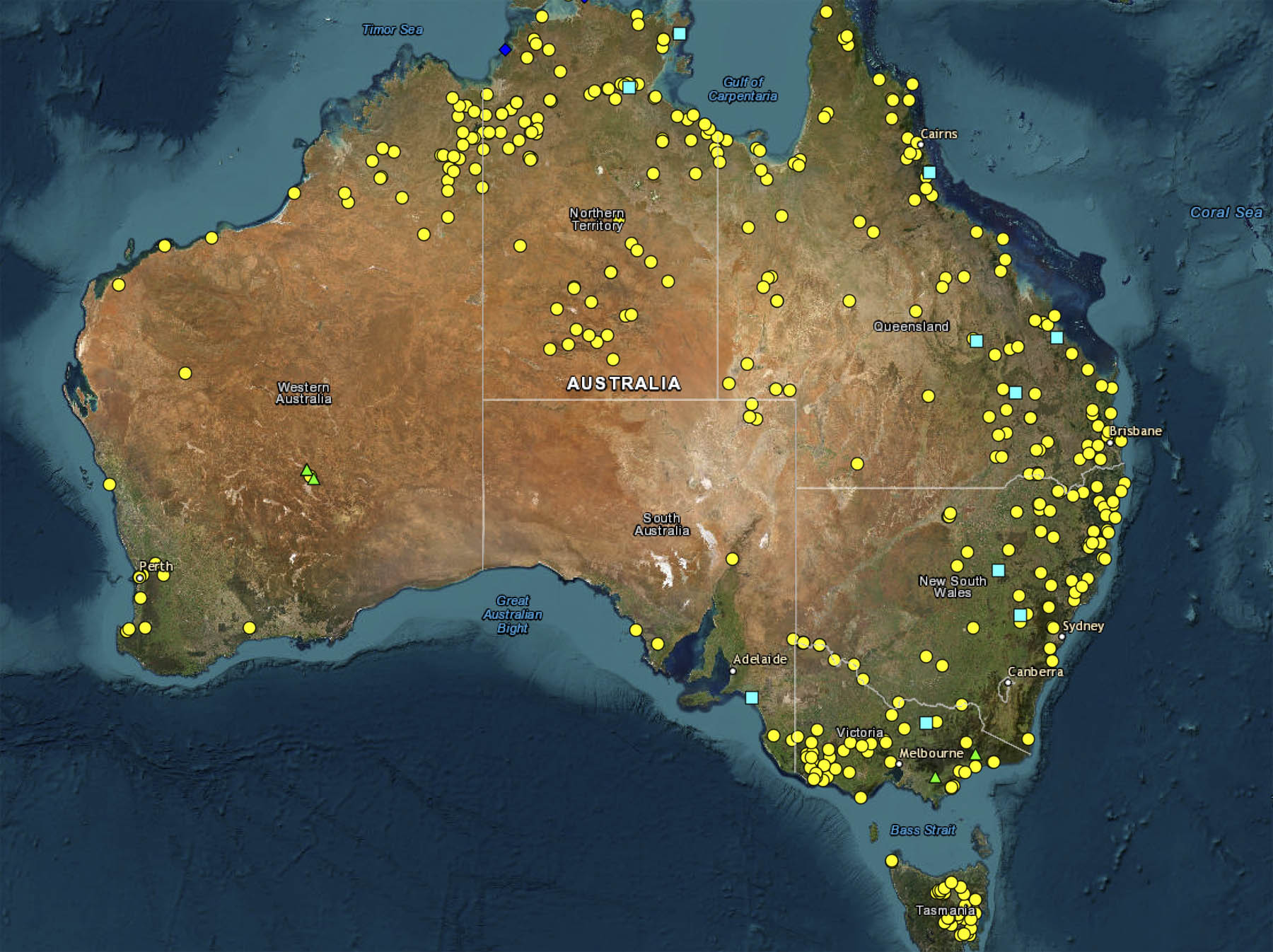
'Colonial Frontier Massacres in Eastern Australia 1788-1872' from The Centre for 21st Century Humanities, The University of Newcastle


Colonial Frontier Massacres in Eastern Australia 1788-1872 from The Centre for 21st Century Humanities, The University of Newcastle


Unknown. 'Broad shield' (early 19th century-mid 19th century) (installation view)


Unknown
Broad shield (early 19th century-mid 19th century) (installation view)
earth pigments on wood, cane, pipeclay
91.3 x 19.5 x 9.5cm irreg.
National Gallery of Victoria, Melbourne
Felton Bequest, 2011
Photo: © Dr Marcus Bunyan and the National Gallery of Victoria


Shields

Aboriginal people have occupied the Australian continent for more than 65,000 years. The arrival and settlement of Europeans, from 1788, affected them profoundly. This proud massing of nineteenth-century shields at the entrance to this exhibition serves as both a reminder of the resilience of Aboriginal people in the face of colonisation, and a representation of the first chapter in Australian art.

The painted and incised designs on the shields are signifiers of the identities and places of these artists whose names, language groups and precise locations were not recorded by European collectors.

There are two kinds of shields traditional to south-east Australia. The first type is narrow and fashioned from a single piece of hardwood, designed to block the forceful blows of clubs, usually in individual combat, and is called a parrying shield. The second is broad and thin with a convex outer face and concave under-surface, and is fashioned from the outer bark or cambium. It is known as a broad or spear shield. This type of shield deflects sharply barbed spears thrown in general fights and also has a ceremonial purpose. These precious cultural objects are of inestimable value to Aboriginal people today.

Text from the NGV website


Melchisédec Thévenot (cartographer, French c. 1620-1692) New Holland, revealed 1644: Terra Australis, discovered 1644 (Hollandia Nova detecta 1644: Terre Australe decouverte l'an 1644) from the exhibition 'Colony: Australia 1770-1861' at NGV Australia at Federation Square, Melbourne, March - July, 2018


Melchisédec Thévenot (cartographer, French c. 1620-1692)
New Holland, revealed 1644: Terra Australis, discovered 1644 (Hollandia Nova detecta 1644: Terre Australe decouverte l’an 1644)
1644
Ink on paper
50 x 37cm
Published in De l’imprimerie de Iaqves Langlois, 1663
National Library of Australia, Canberra
Photo: National Library of Australia


Included in Melchisédec Thévenot’s travel account of 1663, this is the first published large-scale map of Australia. It shows how much of the continent’s coastline was known to Europeans 100 years before James Cook’s Pacific voyages, which would substantially complete European cartographic knowledge about both Australia and New Zealand. Thévenot’s map was published when French colonial aspirations were expanding and it divides the continent along the 135-degree meridian, which marked the western limit of Spain’s imperial claim in the South Pacific. Designating the eastern, undescribed expanse in French (‘Terre Australe’), the map signals French interest in the land east of New Holland.

Exhibition text


European exploration before 1770

The notion that James Cook ‘discovered’ Australia denies the presence of Aboriginal people for 65,000 years and overlooks other European and regional visitors to the Australian coast. The existence of a great southern land, Terra Australis, had long exercised Europeans’ imaginings about the world and began to take a more realistic shape on maps in the early seventeenth century because of maritime exploration. The earliest documented European contact was that of Willem Janszoon and his crew aboard the Dutch ship Duyken, which landed on the west coast of Cape York Peninsula in 1606.

Subsequently, a number of navigators on Dutch and English ships charted the west coast of the continent. Dutch explorer and trader Abel Tasman mapped the west and southern coasts of Van Diemen’s Land in 1642. Two years later, on his second voyage, he reached the north and west coast of Australia, which he named New Holland. The British privateer William Dampier reached the west coast in 1688, and trade between Aboriginal people and the Makassans (from modern-day Indonesia) is documented from around 1720. The Dutch charts of the western coast of Australia were known to the British for more than a century before Cook set sail on his first Pacific voyage.

Text from the NGV website


Unknown 'Beardman jug, from the wreck site of Vergulde Draeck' before 1656 (installation view) from the exhibition 'Colony: Australia 1770-1861' at NGV Australia at Federation Square, Melbourne, March - July, 2018


Unknown
Beardman jug, from the wreck site of Vergulde Draeck (installation view)
before 1656
Earthenware Australian National Maritime Museum, Sydney
Transferred from Australian Netherlands Committee on Old Dutch Shipwrecks, 1991
Photo: © Dr Marcus Bunyan and the National Gallery of Victoria


Thirty years after the Batavia was wrecked off the Australian west coast, the VOC ship Vergulde Draeck was destroyed on a reef 100 kilometres north of current-day Perth. More than 300 years later, in 1963, the submerged wreck was discovered by fisherman, and a large quantity of gold and silver bullion and German beardman or bellarmine jugs retrieved from within. The latter name is popularly associated with late sixteenth- to early seventeenth-century cardinal Robert Bellarmine, an opponent of Protestantism who was known for his fierce anti-alcohol stance. These potbellied, anthropomorphic jugs were certainly intended to ridicule him; they were regularly used to store wine.

Exhibition text


Unknown 'Beardman jug, from the wreck site of Vergulde Draeck' before 1656 (installation view)


Unknown
Beardman jug, from the wreck site of Vergulde Draeck (installation view)
before 1656
Earthenware Australian National Maritime Museum, Sydney
Transferred from Australian Netherlands Committee on Old Dutch Shipwrecks, 1991
Photo: © Dr Marcus Bunyan and the National Gallery of Victoria
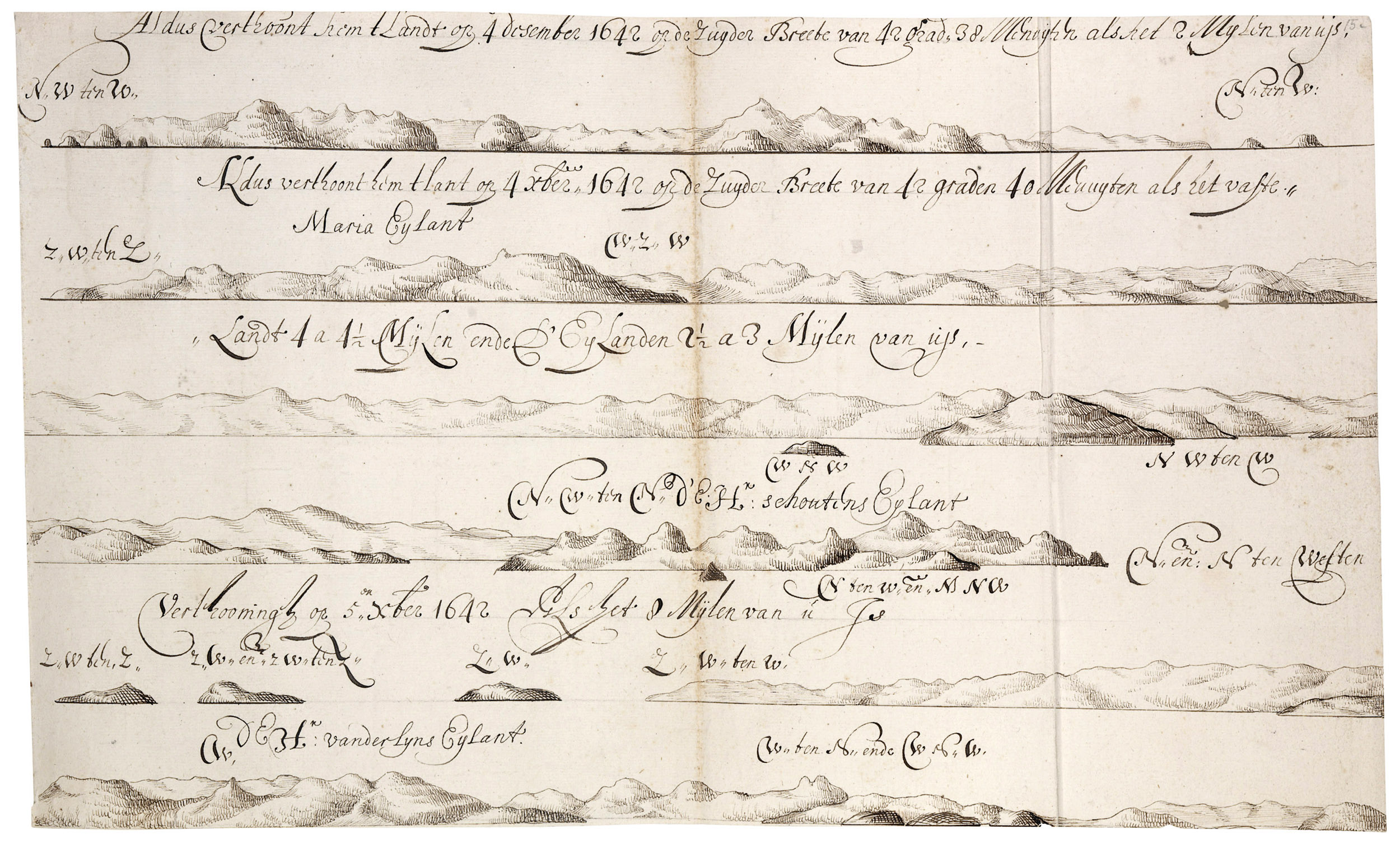
 

Isaac Gilsemans (cartographer) 'Coastal profiles of Van Diemen's Land, 4-5 December 1642' from the exhibition 'Colony: Australia 1770-1861' at NGV Australia at Federation Square, Melbourne, March - July, 2018


Isaac Gilsemans (cartographer) (Dutch, 1606-1646)
Coastal profiles of Van Diemen’s Land, 4-5 December 1642
1642
Bound into Extract from the Journal of the Skipper Commander Abel Janssen Tasman kept by himself in discovering the unknown Southland 1642-43, compiled c. 1643-1647
Pen and ink
23.5 x 37.6cm
State Library of New South Wales, Sydney
Acquired from Martinus Nijhoff, 1926


Victor Victorszoon (draughtsman) Johannes van Keulen II. 'Amsterdam Island, St Paul Island, Black swans near Rottnest Island' c. 1724-1726


Victor Victorszoon (draughtsman) (Dutch, b. 1653)
Johannes van Keulen II
Amsterdam Island, St Paul Island, Black swans near Rottnest Island
c. 1724-1726
Plate from Oud en Nieuw Oost-Indien (The Old and New East Indies) by François Valentijn, vol. 3, part 2, published by Johannes von Braam and Gerard Onder de Linden, Dordrect and Amsterdam, 1724-1726
Engraving
30.4 x 18.5cm (plate)
34.7 x 22.1cm (sheet)
Art Gallery of South Australia, Adelaide
J.C. Earl Bequest Fund 2011


William Ellis (England 1751 - Belgium 1785, Australia 1777) 'View of Adventure Bay, Van Diemen's Land, New Holland' 1777


William Ellis (England 1751 – Belgium 1785, Australia 1777)
View of Adventure Bay, Van Diemen’s Land, New Holland
1777
Watercolour and brush and ink
20.0 x 47.3cm
National Library of Australia, Canberra


William Ellis served as surgeon’s mate on Cook’s Third Voyage and doubled his duties as unofficial natural history draughtsman, producing numerous sketches and watercolours. In these two watercolours he documents the Discovery and the Resolution harboured in the calm waters of Adventure Bay on Bruny Island, and the distinctive geological features of Fluted Cape at the southern end of the bay.

Exhibition text


William Bradley (England c. 1757 - France 1833, Australia 1788-1791) 'Botany Bay. Sirius & Convoy going in: Supply & Agents Division in the Bay. 21 Janry 1788'


William Bradley (England c. 1757 – France 1833, Australia 1788-1791)
Botany Bay. Sirius & Convoy going in: Supply & Agents Division in the Bay. 21 Janry 1788
opposite p. 56 in his A Voyage to New South Wales 1786-92, compiled 1802
Watercolour and pen and ink
19.0 x 24.3cm (sheet)
Mitchell Library, State Library of New South Wales, Sydney


William Bradley sailed with the First Fleet as first lieutenant on board HMS Sirius and remained in the colony until 1792. Like many officers he kept a journal, illustrating key events. This work shows the First Fleet’s second contingent of ships sailing in to Botany Bay to join the advance party already anchored there. Signed and dated 21 January 1788, this and other Bradley images are significant eyewitness accounts of history in the making. Bradley compiled this journal after 1802, and may have made copies of earlier drawings.

Exhibition text


Landing and settlement at Sydney Cove 1788

Although Botany Bay had been chosen as the site for the establishment of the new penal colony, within days of arriving in January 1788, Governor Arthur Phillip relocated the First Fleet north to Sydney Cove in Port Jackson. Here the ships could be safely anchored and a freshwater stream provided a crucial water supply around which the first rudimentary settlement of tents, huts and the governor’s residence was established. The early years were extremely difficult and the colony faced starvation as the crops failed due to the lack of skilled farmers, unfamiliar climate and poor soil. But as farming pushed into more arable lands during the 1790s, settlement expanded and new townships were laid out, competing for resources with the Aboriginal inhabitants and dispossessing them of their lands.

No official artists accompanied the First Fleet and the colony’s earliest works of art were drawings made by officers trained in draughtsmanship and convicts with artistic skills. These drawings largely comprised ethnographic records of local people, natural history images of flora and fauna, charts and coastal views of the harbour’s topography. By the early years of the nineteenth century views of Sydney emphasised its growth, as urban development symbolised for the colonists the progress of Empire.

Text from the NGV website


Installation view of the exhibition 'Colony: Australia 1770 - 1861' at NGV Australia at Federation Square, Melbourne

Installation view of the exhibition 'Colony: Australia 1770 - 1861' at NGV Australia at Federation Square, Melbourne showing at right, 'Sketch and description of the settlement at Sydney Cove, Port Jackson in the County of Cumberland' 1788; and second right top, 'View of the entrance into Port Jackson taken from a boat lying under the North Head' c. 1790


Installation views of the exhibition Colony: Australia 1770-1861 at NGV Australia at Federation Square, Melbourne with in the bottom image at right, Sketch and description of the settlement at Sydney Cove, Port Jackson in the County of Cumberland 1788; and second right top, View of the entrance into Port Jackson taken from a boat lying under the North Head c. 1790
Photos: © Dr Marcus Bunyan and the National Gallery of Victoria


Francis Fowkes (draughtsman) (active c. 1788 - c. 1800) Samuel John Neele (etcher) 'Sketch and description of the settlement at Sydney Cove Port Jackson in the County of Cumberland' 1788


Francis Fowkes (draughtsman) (active c. 1788 – c. 1800)
Samuel John Neele (etcher)
Sketch and description of the settlement at Sydney Cove Port Jackson in the County of Cumberland
1788
Hand-coloured etching and engraving published by R. Cribb, London, 24 July 1789
19.6 x 31.7cm (image)
26.8 x 38.7cm (sheet)
National Library of Australia, Canberra


Dated 16 April 1788, this extremely rare map (there are only three known copies) was drawn by former navy midshipman and convict, Francis Fowkes, some three months after the First Fleet arrived in New South Wales. Published in London in July 1789, it presents a schematised view of the infant settlement with buildings, tents, sawpits, workshops, storehouses, quarries and gardens identified in the key. The eleven ships of the First Fleet are shown at anchor and the Governor’s ‘mansion’ is clearly identified on the eastern side of the cove.

Exhibition text


Port Jackson Painter. 'View of the entrance into Port Jackson taken from a boat lying under the North Head' c. 1790


Port Jackson Painter
View of the entrance into Port Jackson taken from a boat lying under the North Head
c. 1790
Watercolour
11.7 x 24.2cm
Rex Nan Kivell Collection: National Library of Australia and National Gallery of Australia, Canberra


Installation view of the exhibition 'Colony: Australia 1770 - 1861' at NGV Australia at Federation Square, Melbourne with at left lower, George Tobin's 'Native Hut (or Wigwam) of Adventure Bay, Van Diemans (Diemen's) Land' 1792 folio 16 in his 'Sketches on H.M.S. Providence; including some sketches from later voyages on Thetis and Princess Charlotte' album 1791-1831


Installation view of the exhibition Colony: Australia 1770-1861 at NGV Australia at Federation Square, Melbourne with at left lower, George Tobin’s Native Hut (or Wigwam) of Adventure Bay, Van Diemans (Diemen’s) Land 1792 folio 16 in his Sketches on H.M.S. Providence; including some sketches from later voyages on Thetis and Princess Charlotte album 1791-1831 watercolour. State Library of New South Wales, Sydney Acquired from Truslove and Hanson, in 1915 – in the image below at bottom left.
Photo: © Dr Marcus Bunyan and the National Gallery of Victoria


Installation view of the exhibition 'Colony: Australia 1770 - 1861' at NGV Australia at Federation Square, Melbourne with at bottom centre, Sarah Stone's 'Shells' 1781


Installation view of the exhibition Colony: Australia 1770-1861 at NGV Australia at Federation Square, Melbourne with at bottom centre, Sarah Stone’s Shells 1781
Photo: © Dr Marcus Bunyan and the National Gallery of Victoria
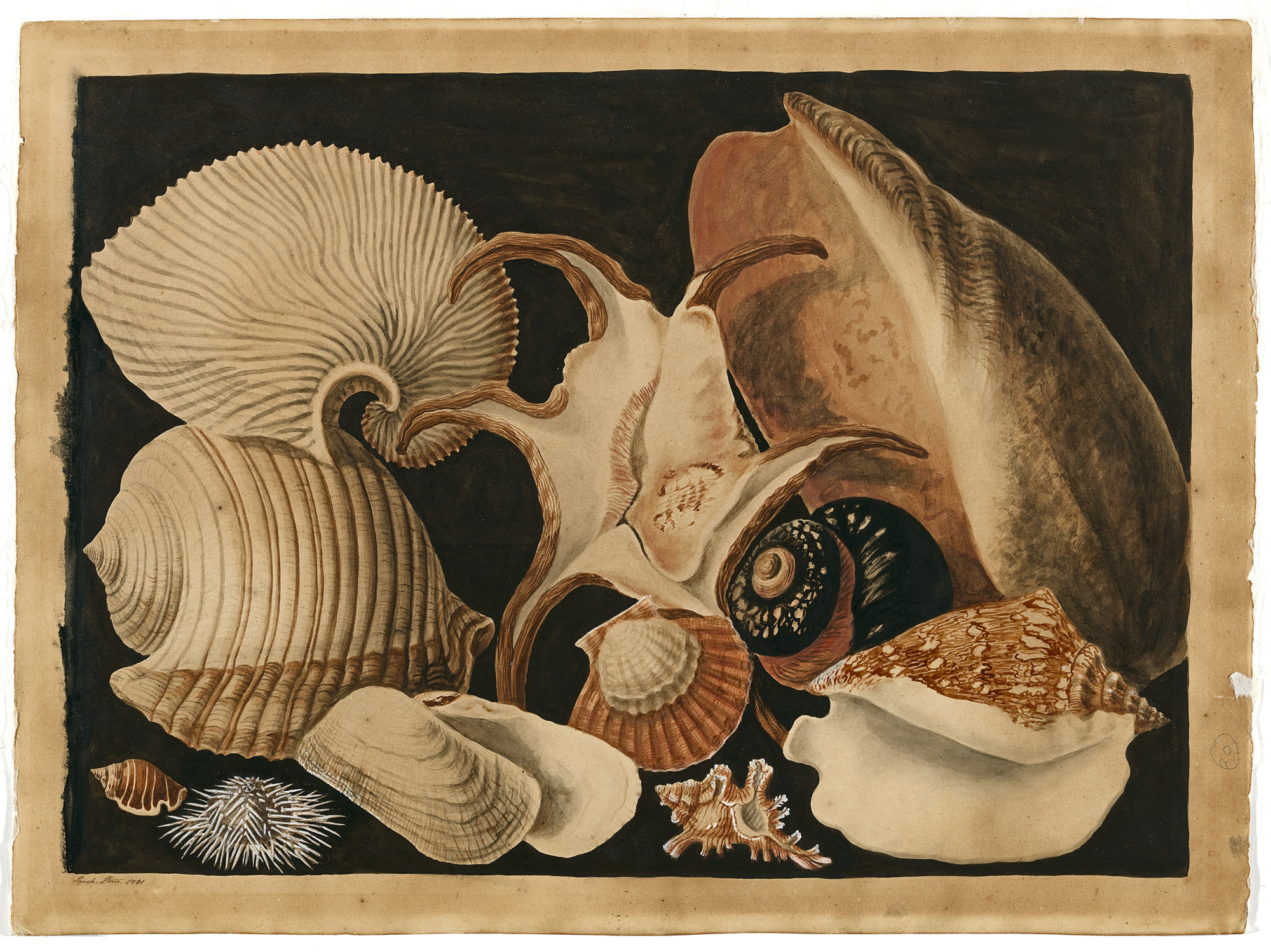
 

Sarah Stone (British, c. 1760 - 1844) 'Shells' 1781 from the exhibition 'Colony: Australia 1770-1861' at NGV Australia at Federation Square, Melbourne, March - July, 2018


Sarah Stone (British, c. 1760 – 1844)
Shells
1781
Watercolour over black pencil
43 x 58cm
National Gallery of Australia, Canberra
Purchased 2016


Sarah Stone (British, c. 1760 – 1844)

Sarah Stone (c. 1760 – 1844), later known as Sarah Smith, was a British natural history illustrator and painter. Her works included many studies of specimens brought back to England from expeditions in Australia and the Pacific. Her illustrations are amongst the first studies of many species and are as scientifically significant.

Stone was the daughter of a fan painter. She worked as a draftsman, natural history and scientific illustrator, and painter between 1777 and 1820. She was commissioned by Sir Ashton Lever in the 1770s to sketch and paint images of objects in his Leverian Museum, which included specimens brought back by British expeditions to Australia, the Americas, Africa and the Far East in the 1780s and 1790s. She exhibited as an “Honorary Exhibitor” at the Royal Academy of Arts in 1781, 1785 and 1786. Stone created numerous watercolour paintings of specimens sent by John White, the First Surgeon General of the Australian colony, between 1789 and 1790. These paintings were used to produce engravings for White’s A Journal of a Voyage to New South Wales (1790). Although beautiful and skilfully drawn the drawings were sometimes compromised by the fact that she was working from skins collected in Australia and reconstructed by a taxidermist in London to reproduce an animal or bird that had never been seen. Her collection of more than a thousand water colours based on specimens from the Leverian Museum were dispersed along with the museum items auctioned in 1806. Some of her paintings were acquired by the Natural History Museum, London while others went into private collections. They may be valuable in resolving some species described by J.F. Gmelin, the specimens of which are now untraceable.

Text from the Wikipedia website


Installation view of the exhibition 'Colony: Australia 1770 - 1861' at NGV Australia at Federation Square, Melbourne with at left, 'View of the town of Sydney in the colony of New South Wales' c. 1799; and second left of the row of four, Juan Ravenet's 'Convicts in New Holland' (Convictos en la Nueva Olanda) and 'English in New Holland' (Ingleses en la Nueva Olanda) 1789-1794


Installation view of the exhibition Colony: Australia 1770-1861 at NGV Australia at Federation Square, Melbourne with at left, View of the town of Sydney in the colony of New South Wales c. 1799; and second left of the row of four, Juan Ravenet’s Convicts in New Holland (Convictos en la Nueva Olanda) and English in New Holland (Ingleses en la Nueva Olanda) 1789-1794 (see below)
Photo: © Dr Marcus Bunyan and the National Gallery of Victoria


Unknown artist (England) Thomas Watling (after) (British, 1762-1814?) 'View of the town of Sydney in the colony of New South Wales' c. 1799


Unknown artist (England)
Thomas Watling (after) (British, 1762-1814?)
View of the town of Sydney in the colony of New South Wales
c. 1799
Oil on canvas
65 x 133cm
Art Gallery of South Australia, Adelaide
Gift of M.J.M. Carter AO through the Art Gallery of South Australia Foundation in recognition of the abilities of James Bennett to promote public awareness and appreciation of Asian art and culture 2015
Donated through the Australian Government’s Cultural Gifts Program


Transportation to New South Wales

The favourable accounts of New South Wales by James Cook and Joseph Banks were influential in the government’s selection of Botany Bay as the site for a new penal colony. Britain’s loss of the American colonies in 1783 ended convict transportation across the Atlantic and increased the pressure for new solutions to the rising rates of crime and incarceration experienced in late eighteenth-century Britain. The founding of a penal settlement in New South Wales was perceived not only as providing a solution to domestic, social and political problems but also as holding the key to territorial expansion in the South Pacific and the promotion of imperial trade.

The lengthy preparation for the First Fleet raised huge public interest. For most people at that time it was a journey of unimaginable length to a place as remote and unknown as the moon. The eleven ships comprising the First Fleet left Portsmouth in May 1787 with more than 1300 men, women and children on board. Although most were British, there were also African, American and French convicts. After a voyage of eight months the First Fleet arrived in Botany Bay in January 1788.

Text from the NGV website
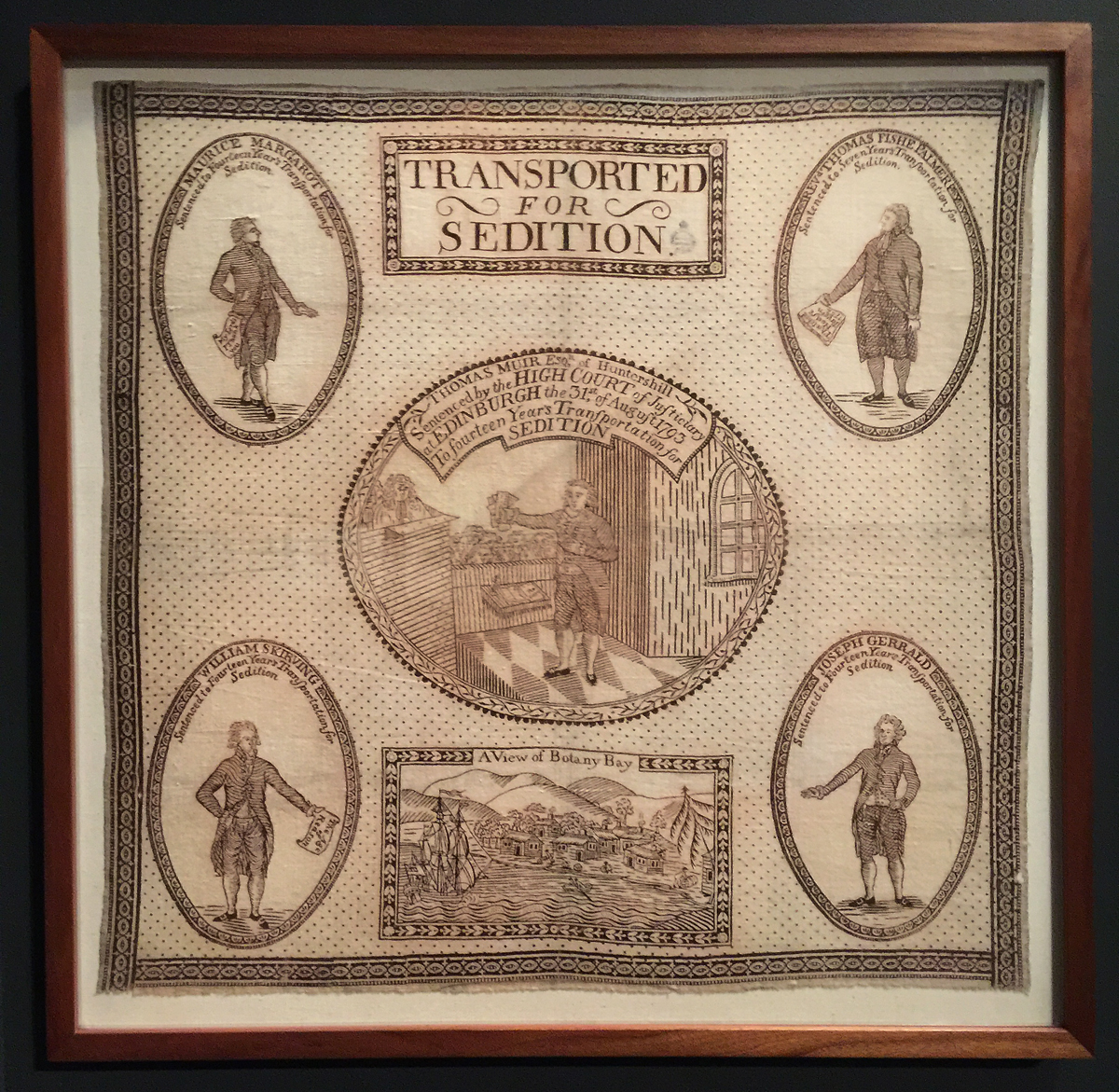
 

Unknown artist. 'Transported for sedition' 1793 (installation view)


Unknown artist
Transported for sedition (installation view)
1793
Woodcut on linen
Mitchell Library, State Library of New South Wales, Sydney
Photo: © Dr Marcus Bunyan and the National Gallery of Victoria


This printed linen handkerchief shows five men popularly known as the ‘Scottish martyrs’. In 1794 they were sentenced to transportation to New South Wales for terms of up to fourteen years for the crime of sedition – inciting rebellion against the government of Britain. When published, or printed on paper, images such as this were also considered seditious and censored. Printed handkerchiefs, however, were not subjected to the same sanctions. They had the added advantage of being easily concealed and, when safe to do so, were displayed to show the owner’s political affiliation.

Exhibition text
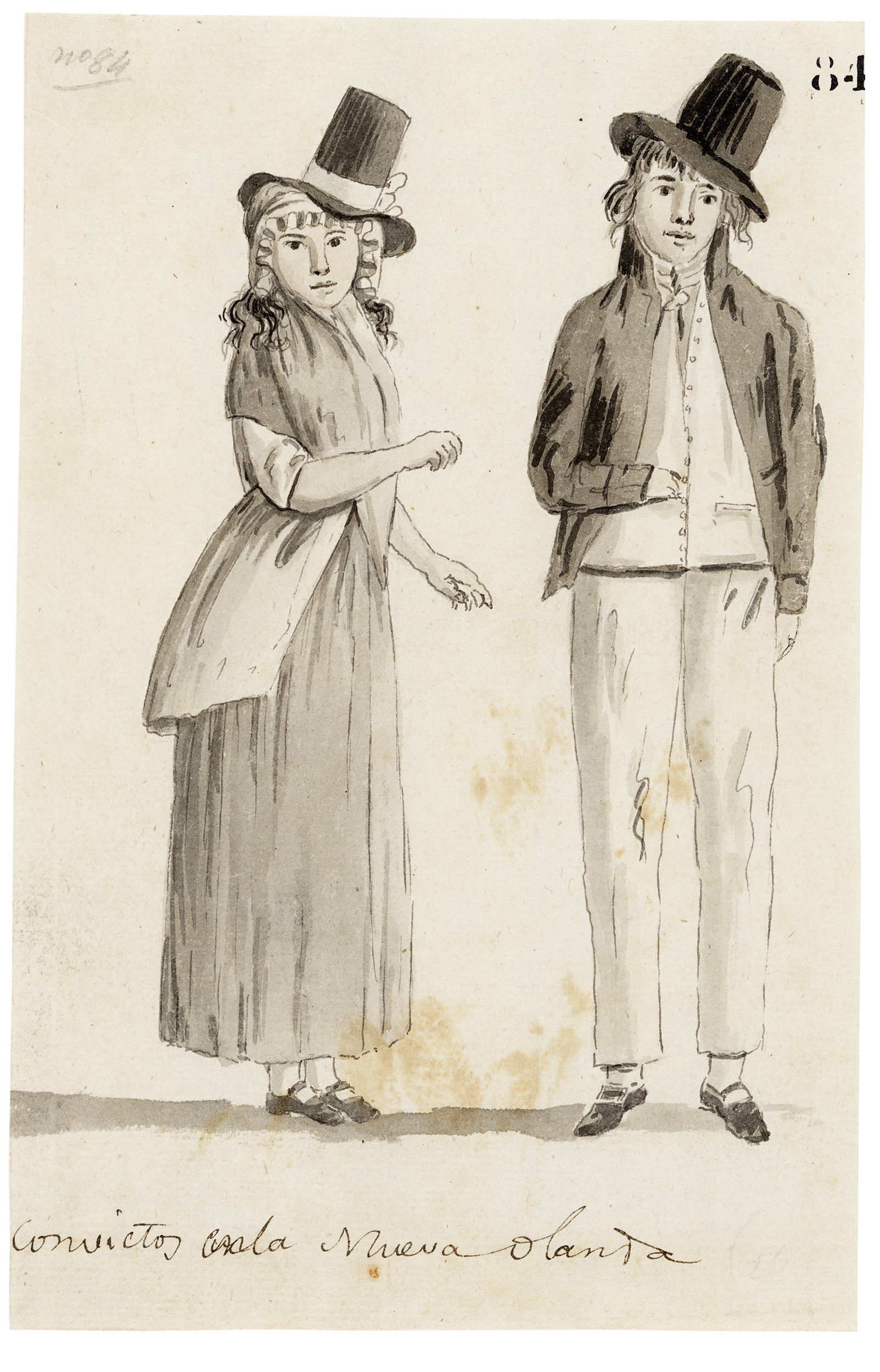
 

Juan Ravenet (Italy 1766 - Spain c. 1821) 'Convicts in New Holland (Convictos en la Nueva Olanda)' 1789-1794


Juan Ravenet (Italy 1766 – Spain c. 1821)
Convicts in New Holland (Convictos en la Nueva Olanda)
1789-1794
From an album of drawings made on the Spanish Scientific Expedition to Australia and the Pacific in the ships Descubierta and Atrevida under the command of Alessandro Malaspina, 1789-1794
Brush and ink and wash
19.5 x 12.5cm
Mitchell Library, State Library of New South Wales, Sydney


Juan Ravenet (Italy 1766 - Spain c. 1821) 'English in New Holland (Ingleses en la Nueva Olanda)' 1789-1794


Juan Ravenet (Italy 1766 – Spain c. 1821)
English in New Holland (Ingleses en la Nueva Olanda)
1789-1794
From an album of drawings made on the Spanish Scientific Expedition to Australia and the Pacific in the ships Descubierta and Atrevida under the command of Alessandro Malaspina, 1789-1794
Brush and ink and wash
19.5 x 12.5cm
Mitchell Library, State Library of New South Wales, Sydney


Extremely few realistic depictions of convicts in Australia are known. These rare portraits, showing garments worn by male and female convicts and by officials, were painted by one of two artists on board the Spanish expedition (1789-1794), led by Alessandro Malaspina, that visited Sydney in 1793. A major scientific expedition, like Cook’s and La Pérouse’s, the visit also had political implications, as Sydney formed a strategic British base in the Pacific that could threaten Spanish interests in the Americas and Philippines.

Exhibition text


Installation view of the exhibition 'Colony: Australia 1770 - 1861' at NGV Australia at Federation Square, Melbourne with at left, 'Half-length portrait of Gna-na-gna-na' c. 1790


Installation view of the exhibition Colony: Australia 1770-1861 at NGV Australia at Federation Square, Melbourne with at left, Half-length portrait of Gna-na-gna-na c. 1790
Photo: © Dr Marcus Bunyan and the National Gallery of Victoria


Port Jackson Painter. 'Half-length portrait of Gna-na-gna-na' c. 1790


Port Jackson Painter
Half-length portrait of Gna-na-gna-na
c. 1790
Gouache
29.4 x 24.0cm
National Library of Australia, Canberra
Rex Nan Kivell Collection


Indigenous representation

In the early years of settlement there was little contact with the Eora, the Traditional Owners of the area around Sydney Cove, who actively avoided the new arrivals, but as the colony grew, communication, and occasionally friendships, developed. The English had little understanding of the deep relationship between the Eora and their lands, and their careful management of resources, which were soon overstretched by the colonists. Famine and introduced diseases also devastated numerous communities. As the nineteenth century progressed, traditional life along the east coast of Australia was irrevocably changed.

Early images of Aboriginal people reflect the curiosity of the early colonists. Studies of the material culture of Indigenous people, and attempts to record everyday activities ranging from ceremonial gatherings to fishing and hunting, reveal the Europeans’ desire to understand Aboriginal people and culture through ethnographic documentation. Importantly, a number of these portraits include the names of the people depicted – they are not generic representations. The European artists who made these images were fascinated by the appearance of the individuals they encountered, sometimes producing finely detailed drawings and watercolours showing the particulars of hairstyles, ornamentation and scarification.

Text from the NGV website


Jean Piron (draughtsman, Belgium 1767/1771 - south-east Asia after 1795) Jacques Louis Copia (engraver, Germany 1764-1799) 'Natives of Cape Diemen fishing (Pêche des sauvages du Cap de Diemen)' 1800


Jean Piron (draughtsman, Belgium 1767/1771 – south-east Asia after 1795)
Jacques Louis Copia (engraver, Germany 1764-1799)
Natives of Cape Diemen fishing (Pêche des sauvages du Cap de Diemen)
1800
Plate 4 from the Atlas pour servir à relation du Voyage à la Recherche de La Pérouse (Atlas of the voyage in search of La Pérouse), by J-J. H. de Labillardière, published by Chez Dabo, Paris 1817
Etching and engraving
National Gallery of Victoria, Melbourne
Purchased NGV Foundation, 2017


Jean Piron was an artist trained in the Neoclassical tradition who accompanied the expedition led by Admiral Joseph-Antoine Raymond Bruni D’Entrecasteaux during 1791-1794. His drawings from this expedition are the earliest surviving visual observations of the Aboriginal people of Tasmania by French explorers. Prints, engraved after his death, show Piron’s idealised vision of Tasmanian Aboriginal people living in tranquil harmony with their surroundings. However, apart from the spear-throwing man and the accurately depicted fibre and kelp baskets, there is little to indicate Tasmania in the classicised representation of the landscape and its people.

Exhibition text


Unknown artist (draughtsman, active in England early 19th century) Samuel John Neele (etcher, England 1758-1825) 'Pimbloy [Pemuluwuy], native of New Holland in a canoe of that country' 1804


Unknown artist (draughtsman, active in England early 19th century)
Samuel John Neele (etcher, England 1758-1825)
Pimbloy [Pemuluwuy], native of New Holland in a canoe of that country
1804
Following p. 170 in The Narrative of a Voyage of Discovery in his Majesty’s vessel the Lady Nelson by James Grant, published by Thomas Egerton, London, 1803
Etching
Special Collections, Deakin University, Melbourne


Pemuluwuy was an important man and warrior of the Eora nation. In December 1790 he gained notoriety after spearing, and killing, Governor Phillip’s gamekeeper. He then went on to lead raids on many of the settlements in the Sydney area, including Parramatta. David Collins, the lieutenant-governor, acknowledged that he was ‘a most active enemy’; however, he also noted that Pemuluwuy’s attacks were precipitated by the vicious ‘misconduct’ of the colonisers. In 1801 Governor King issued a proclamation that Indigenous people could be shot on sight, and placed a bounty on Pemuluwuy. He was murdered by a settler in 1802 and his body was subsequently desecrated.

Exhibition text
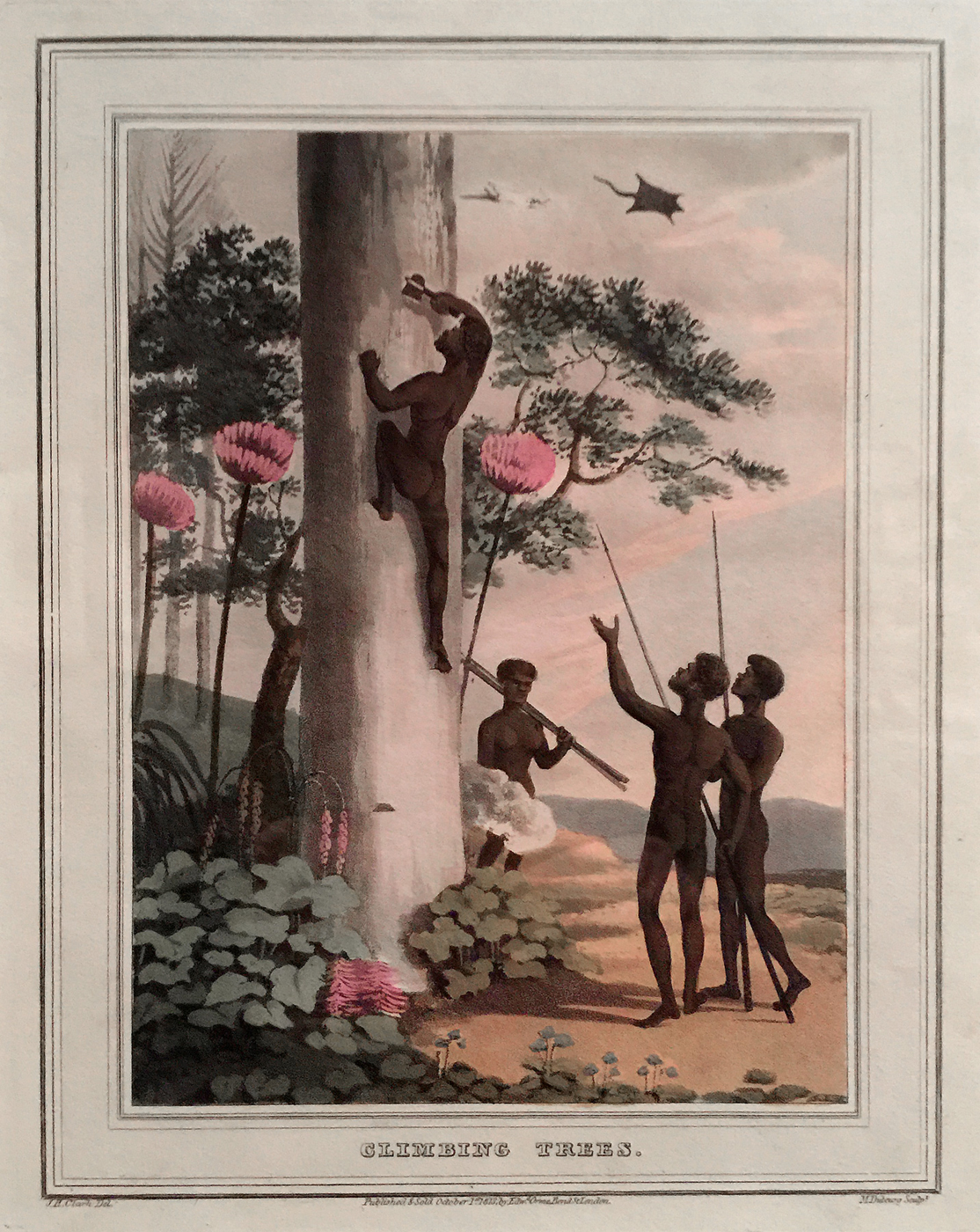
 

John Heaviside Clark (draughtsman Scotland 1770-1863, England 1801-32) Matthew Dubourg (engraver active in England 1786-1838) 'Climbing trees' 1813 (installation view)


John Heaviside Clark (draughtsman Scotland 1770-1863, England 1801-1832)
Matthew Dubourg (engraver active in England 1786-1838)
Climbing trees (installation view)
Plate 4 from Field Sports &c. &c. of the Native Inhabitants of New South Wales, published by Edward Orme, London
1813
Hand-coloured aquatint
National Gallery of Victoria, Melbourne
Gurnett-Smith Bequest, 1999
Photo: © Dr Marcus Bunyan and the National Gallery of Victoria


Field Sports &c. &c. of the Native Inhabitants of New South Wales was the first publication to focus on the representation of Indigenous Australian life. The set of ten colour aquatints was part of a much larger series called Foreign Field Sports, which depicted sporting and hunting pursuits from around the world. These prints contain accurate details, such as the spear thrower, however, the plants and animals are inaccurate and were clearly unfamiliar to the London artists who made them, neither of whom came to Australia.

Exhibition text
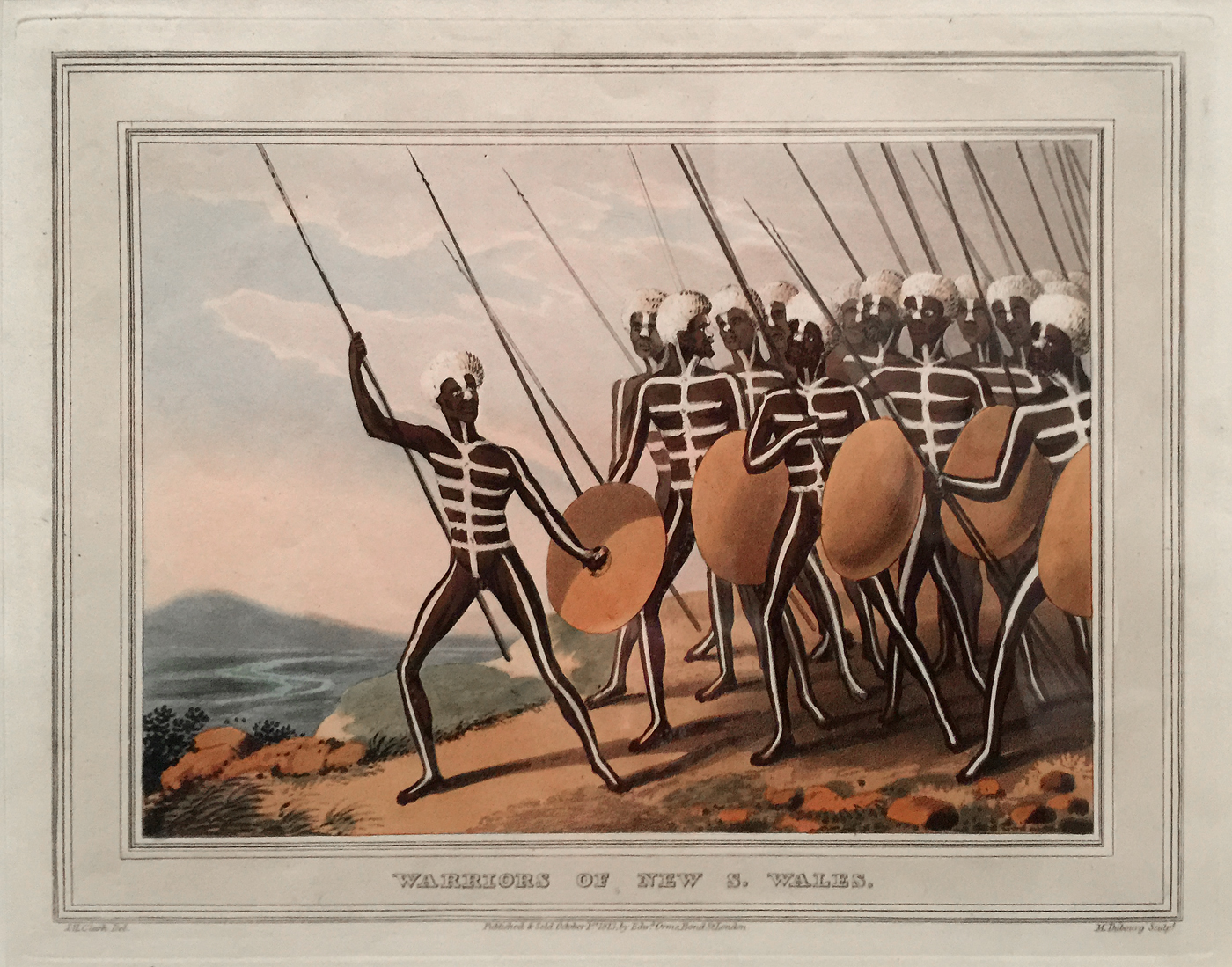
 

John Heaviside Clark (draughtsman Scotland 1770-1863, England 1801-32) Matthew Dubourg (engraver active in England 1786-1838) 'Warriors of New S. Wales' 1813 (installation view)


John Heaviside Clark (draughtsman Scotland 1770-1863, England 1801-1832)
Matthew Dubourg (engraver active in England 1786-1838)
Warriors of New S. Wales (installation view)
Plate 6 from Field Sports &c. &c. of the Native Inhabitants of New South Wales, published by Edward Orme, London
1813
Hand-coloured aquatint
National Gallery of Victoria, Melbourne
Gurnett-Smith Bequest, 1999
Photo: © Dr Marcus Bunyan and the National Gallery of Victoria


The Flinders and Baudin expeditions

Between 1801 and 1804, skilled British navigator Matthew Flinders and his crew aboard the Investigator circumnavigated Australia, funded by the Royal Society and its president Sir Joseph Banks. Their directive was to chart the final stretch of southern coastline that remained unknown on European maps, and learn more about the continent’s extraordinary natural history. A similar French expedition led by Nicolas Baudin on the Géographe and the Naturaliste had already commenced (1800-1804). Sent by the Marine Ministry and Napoleon Bonaparte, the expedition sought to map and explore the unfamiliar land and its inhabitants; however, the British feared that it was a reconnaissance mission with a view to founding a French base in New Holland or Van Diemen’s Land.

The most dazzling record of both voyages’ scientific achievement was produced by the artists on board. Travelling with Baudin on the Géographe was Charles-Alexandre Lesueur, who delineated thousands of animal specimens, and Nicolas-Martin Petit, who represented the Aboriginal people encountered on the voyage. Their drawings were the basis for the engravings published in the official account of the expedition, Voyage of Discovery to the Southern Lands (1807-1811). Aboard the Investigator was the mature natural history artist Ferdinand Bauer and the talented young landscape painter William Westall.

Text from the NGV website
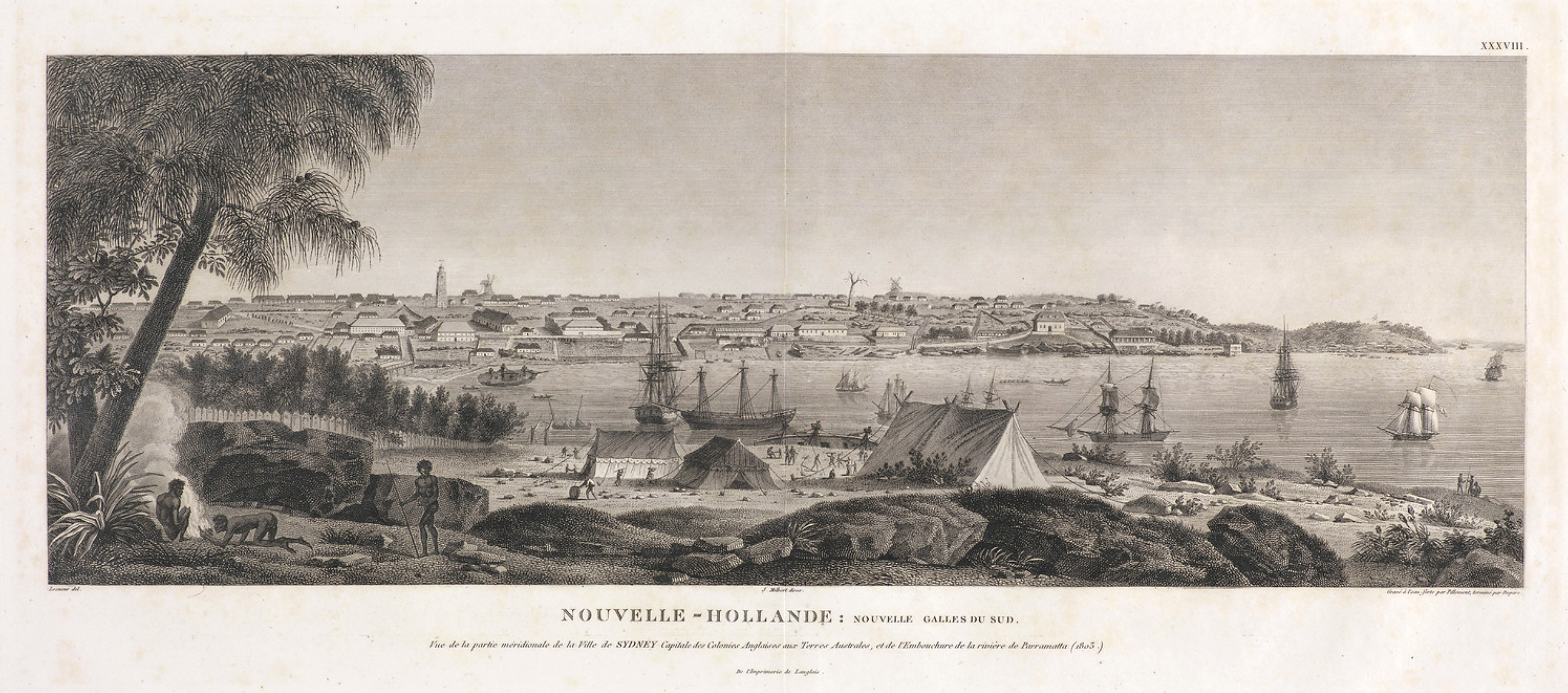
 

Charles-Alexandre Lesueur (draughtsman, France 1778-1846) Victor Pillement (engraver, France 1767-1814) Marie-Alexandre Duparc (engraver, active in France 18th century - 19th century) 'New Holland: New South Wales. View of the southern part of the town of Sydney' Plate 38 from 'Voyage de Découvertes aux Terres Australes' (Voyage of Discovery to the Southern Lands) atlas, by François Peron and Louis de Freycinet, published by L'Imprimerie Impèriale, Paris, 1807-1816


Charles-Alexandre Lesueur (draughtsman, France 1778-1846)
Victor Pillement (engraver, France 1767-1814)
Marie-Alexandre Duparc (engraver, active in France 18th century – 19th century)
New Holland: New South Wales. View of the southern part of the town of Sydney (Nouvelle-Hollande: Nouvelle Galles du Sud. Vue de la partie meridionale de la Ville de Sydney)
Plate 38 from Voyage de Découvertes aux Terres Australes (Voyage of Discovery to the Southern Lands) atlas, by François Peron and Louis de Freycinet, published by L’Imprimerie Impèriale, Paris, 1807-1816
Etching and engraving
National Gallery of Victoria, Melbourne
Presented through the NGV Foundation by John Baird, Member, 2005


Following their lengthy voyage and exploration of the south-east coastline of Australia, the Géographe and Naturaliste struggled into Port Jackson in June 1802. The French crew remained there for five months to recover and repair their ships. The surveying and scientific parties continued with their work, to some British suspicion, and Charles-Alexandre Lesueur drew scenes of Sydney and its surrounds, as well as exquisite natural history records. Taken from their camp on Bennelong Point (where the Sydney Opera House now stands) this view looks across Sydney Cove to where The Rocks and the southern end of the Harbour Bridge are now.

Exhibition text


Ferdinand Bauer (Austria 1760-1826, England 1787-1801, 1805-1814, Australia 1801-1805) 'Gymea Lily' 1806-1813, published 1813 (installation view)


Ferdinand Bauer (Austria 1760-1826, England 1787-1801, 1805-1814, Australia 1801-1805)
Gymea Lily (installation view)
1806-1813, published 1813
Plate 13 from Illustrationes florae Novae Hollandiae, sive icones generum quae in Prodromo Novae Hollandiae et insulae van Diemen decripsit Robertus Brown, published London 1813
Colour engraving with hand-colouring
36.2 x 24.3cm irreg. (image)
39 x 25.2cm (plate)
51 x 34cm (sheet)
National Gallery of Australia, Canberra Purchased 2004
Photo: © Dr Marcus Bunyan and the National Gallery of Victoria
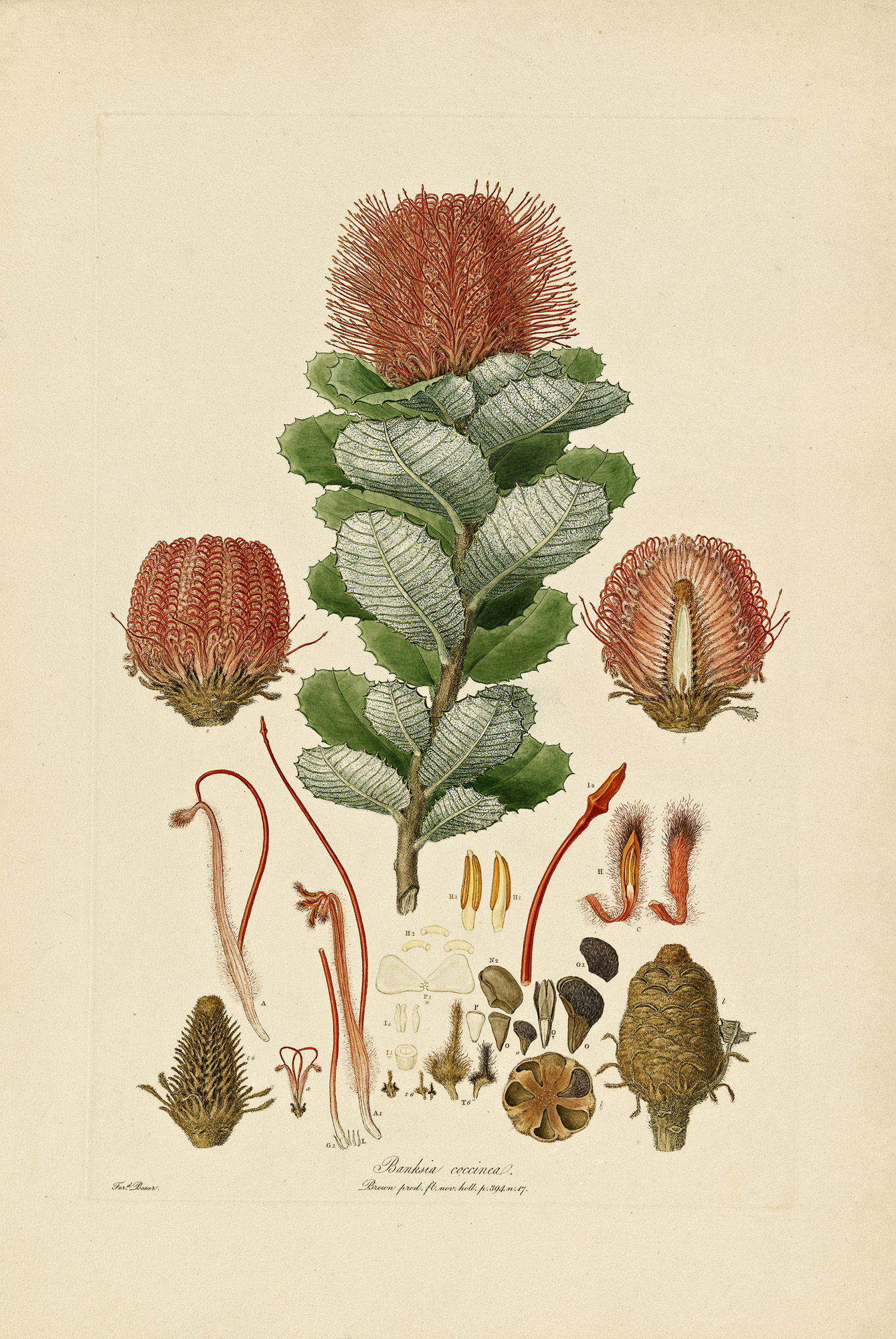
 

Ferdinand Bauer (Austria 1760-1826, England 1787-1801, 1805-1814, Australia 1801-1805) 'Banksia coccinea' 1806-1813


Ferdinand Bauer (Austria 1760-1826, England 1787-1801, 1805-1814, Australia 1801-1805)
Banksia coccinea
1806-1813, published 1813
Plate 3 from Illustrationes florae Novae Hollandiae, sive icones generum quae in Prodromo Novae Hollandiae et insulae van Diemen decripsit Robertus Brown, published London 1813
Colour engraving with hand-colouring
36.2 x 24.3cm irreg. (image)
39 x 25.2cm (plate)
51 x 34cm (sheet)
National Gallery of Australia, Canberra Purchased 2004


Austrian-born Ferdinand Bauer is recognised as one of the most accomplished natural history artists who did much of his art while travelling, both in the Mediterranean and then as an official artist on Matthew Flinders’ circumnavigation of Australia (1801-1803). Working closely with botanist Robert Brown, Bauer produced over 2000 drawings and watercolours, and continued with his meticulous work upon his return to London. This engraving exemplifies his skill: it is engraved, printed in colour and then carefully hand-painted, all by Bauer himself. Regrettably his intended botanical publication ran to only fifteen plates.

Exhibition text
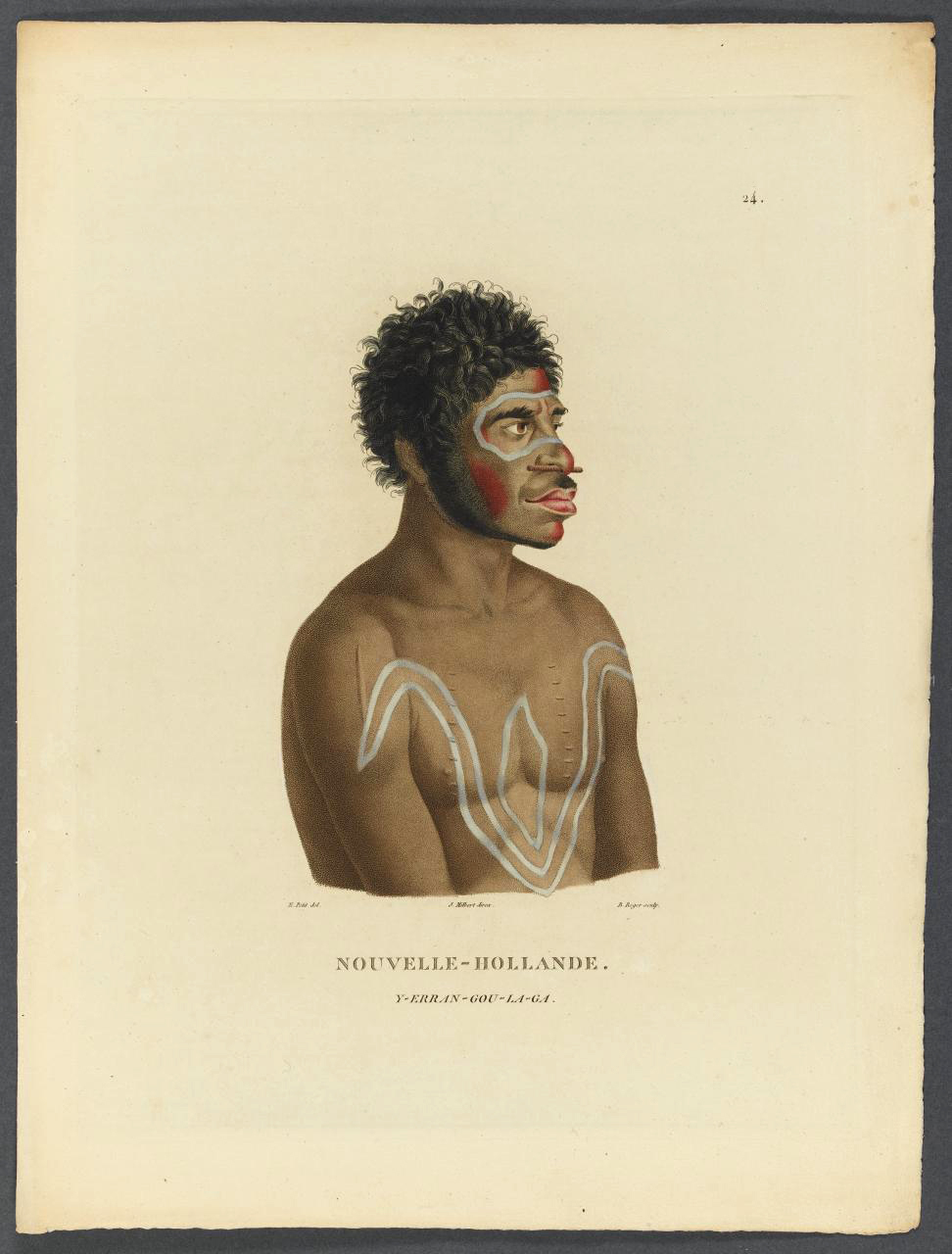
 

Barthélemy Roger (engraver, France 1767-1841) Nicolas-Martin Petit (after) (draughtsman, France 1777-1804) 'Y-erran-gou-la-ga' 1824 Plate 24 in the 'Voyage de Découvertes aux Terres Australes' (Voyage of Discovery to the Southern Lands) atlas Arthus Bertrand, Paris, 1824, 2nd edition


Barthélemy Roger (engraver, France 1767-1841)
Nicolas-Martin Petit (after) (draughtsman, France 1777-1804)
Y-erran-gou-la-ga, a native of the environs of Port Jackson (Y-erran-gou-la-ga, suavage des environs du port Jackson)
1824
Plate 24 in the Voyage de Découvertes aux Terres Australes (Voyage of Discovery to the Southern Lands) atlas
Arthus Bertrand, Paris, 1824, 2nd edition
Hand-coloured engraving, etching and stipple engraving printed in black and brown ink
31.5 x 24.1cm (plate)
36.5 x 27.6cm (sheet)
National Gallery of Victoria, Melbourne
Joe White Bequest, 2010


William Westall (England 1781-1850, Australia 1801-1803) 'Chasm Island, native cave painting' 1803


William Westall (England 1781-1850, Australia 1801-1803)
Chasm Island, native cave painting
1803
Watercolour
26.7 x 36.6cm
National Library of Australia, Canberra


William Westall (England 1781-1850, Australia 1801-1803) 'A view of King George's Sound' 1802


William Westall (England 1781-1850, Australia 1801-1803)
A view of King George’s Sound
1802
Watercolour and pen and brown ink
27.9 x 42.9cm
National Gallery of Victoria, Melbourne
Purchased, 1978


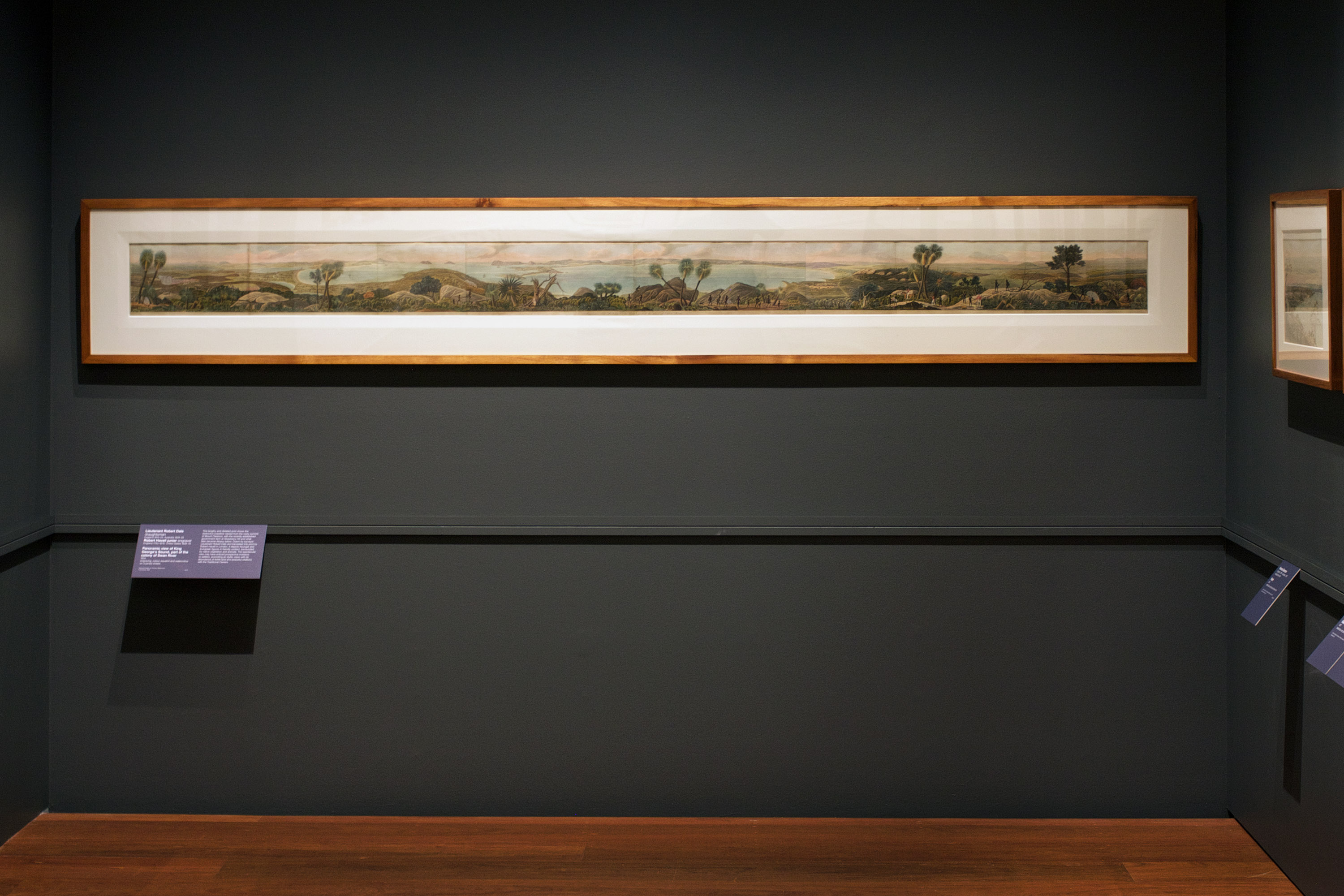
William Westall was one of two artists who accompanied Matthew Flinders on the Investigator as it circumnavigated Australia between 1801 and 1803. This highly finished watercolour of King George’s Sound in south-western Australia is not a topographical study, but a romantic vision of a vast, silent and forbidding land. Two generic Aboriginal people figures are included in the foreground in the guise of the noble savage. Their classicised robes and the lack of a European presence, particularly the explorers encountering them, shows Westall casting the scene in an Arcadian period prior to British encounter.

Exhibition text
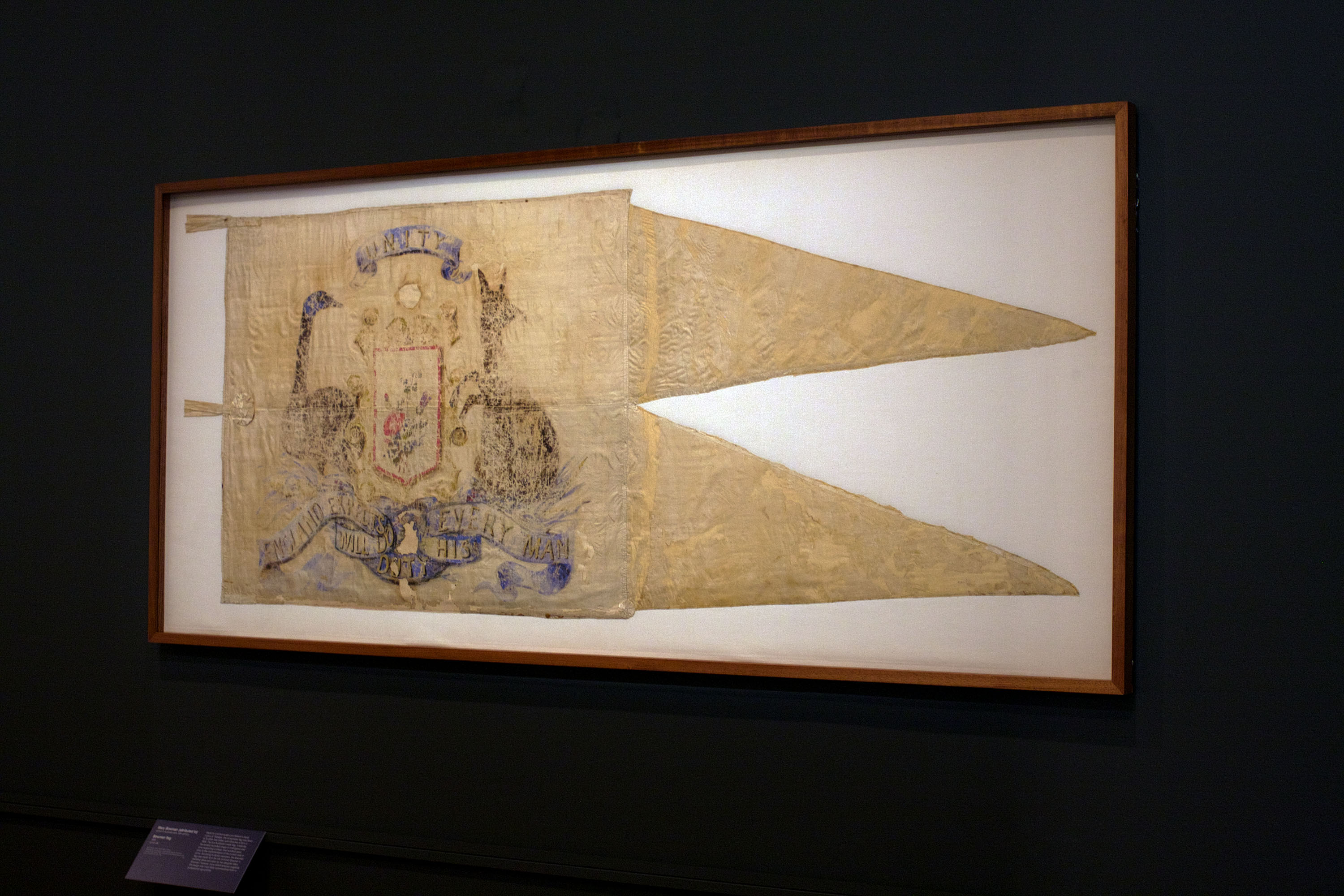
 

Installation view of the exhibition 'Colony: Australia 1770 - 1861' at NGV Australia at Federation Square, Melbourne showing the 'Bowman flag' 1806

Installation view of the exhibition 'Colony: Australia 1770 - 1861' at NGV Australia at Federation Square, Melbourne showing the 'Bowman flag' 1806


Installation view of the exhibition Colony: Australia 1770-1861 at NGV Australia at Federation Square, Melbourne showing the Bowman flag 1806
Photos: © Dr Marcus Bunyan and the National Gallery of Victoria


Mary Bowman (attributed to) (active in Australia early 19th century)
Bowman flag
1806
Oil on silk
State Library of New South Wales, Sydney
Presented by John Bowman’s great grandchildren to Richmond Superior Public School, 1905; transferred to the Mitchell Library by the Dept. of Public Instruction, 1916


Made to commemorate Lord Nelson’s naval victory at Trafalgar, this remarkable flag was flown at Scottish free settler John Bowman’s farm in 1806. The first Australian-made flag, it features the earliest recorded image of a kangaroo and emu supporting a shield, one hundred years prior to the implementation of the current coat of arms. According to family members, the Bowman flag was made from the silk of Honor Bowman’s wedding dress and sewn by her daughter Mary Bowman; however, more recent analysis suggests the design was most likely commissioned from a professional sign painter.

Exhibition text


John Lewin (England 1770 - Australia 1819, Australia from 1800) 'Koala and young' 1803


John Lewin (England 1770 – Australia 1819, Australia from 1800)
Koala and young (installation view)
1803
Watercolour and gouache
Mitchell Library, State Library of New South Wales, Sydney
Purchased from a descendant of Governor King, 1983
Photo: © Dr Marcus Bunyan and the National Gallery of Victoria


Surprisingly, koalas were not captured by colonists until 1803, although their existence had been known of for several years, and they were described as cullawine or colo, the names used by Aboriginal hunters. In August 1803 a female and two joeys were taken to Sydney, where they were reported in the recently founded Sydney Gazette. After one joey died, the mother and surviving joey were painted, proficiently by the Sydney-based artist John Lewin, and exquisitely by expedition artist Ferdinand Bauer. Bauer was unable to complete his watercolour in time to be sent on a departing ship, and thus Lewin’s was the first visual record of this animal to reach England.

Exhibition text


John Lewin (England 1770 - Australia 1819, Australia from 1800) 'The gigantic lyllie of New South Wales' 1810


John Lewin (England 1770 – Australia 1819, Australia from 1800)
The gigantic lyllie of New South Wales
1810
Watercolour
54.1x 43.6cm
Art Gallery of New South Wales, Sydney Purchased 1968


Natural history

In the late eighteenth and nineteenth centuries, the world was being studied and described by Europeans on a scale never seen before. Exploration in the Pacific revealed unanticipated communities and environments and the vast quantities of material brought back – objects, artefacts, specimens, maps, records, descriptions – were regarded with awe and astonishment. Enlightenment ambitions to understand the world through empirical observation led to intense scientific scrutiny, as people sought to comprehend and to classify this exciting, bemusing abundance. In this period, visual imagery became increasingly important, far exceeding a written description and surpassing dried or dead specimens in its ability to depict form, texture, colour, oddity and beauty.

From the time of the British landing in 1770, the people of Britain and Europe were astounded by what they saw in the colony. Captain (later Governor) John Hunter wrote ‘it would require the pencil of an able limner [artist] to give a stranger an idea of [the colourful birds], for it is impossible by words to describe them’. John Lewin was the first professional artist to arrive in New South Wales. Trained in natural history illustration and printmaking, Lewin promptly began drawing and making etchings of local moths and birds perched on Australian plants.

Text from the NGV website


George Stubbs after (England 1724-1806) Unknown (etcher active in England 1770s) 'The kanguroo, an animal found on the coast of New Holland' 1773 Plate in 'An Account of the Voyages undertaken ... for making Discoveries in the Southern Hemisphere by John Hawkesworth', printed for W. Strahan and T. Cadell, London, 1773


George Stubbs after (England 1724-1806)
Unknown (etcher active in England 1770s)
The kanguroo, an animal found on the coast of New Holland
1773
Plate in An Account of the Voyages undertaken … for making Discoveries in the Southern Hemisphere by John Hawkesworth, printed for W. Strahan and T. Cadell, London, 1773
Etching
Rare Books Collection, State Library Victoria, Melbourne


Of all the ‘discoveries’ made in Australia by the crew of the Endeavour, one completely unexpected creature captured European imaginations; an animal, Cook wrote, like a greyhound except that ‘it jump’d like a Hare or Deer’. Several of these were caught in northern Queensland where they were called gangurru by the local Guugu Yimithirr. In London, Banks commissioned leading animal painter George Stubbs to paint the kangaroo, although he had only skins, skulls and sketches by Parkinson as his guide. This painting was reproduced in the official account of the voyage, published in 1773, two years after the Endeavour returned home.

Exhibition text


Installation view of the exhibition 'Colony: Australia 1770 - 1861' at NGV Australia at Federation Square, Melbourne with at third right top, James Sowerby's 'Embothrium speciosissimum' (now Telopea speciosissima) 1793

Installation view of the exhibition 'Colony: Australia 1770-1861' at NGV Australia at Federation Square, Melbourne with at second right top, James Sowerby's 'Embothrium speciosissimum' (now Telopea speciosissima) 1793


Installation views of the exhibition Colony: Australia 1770-1861 at NGV Australia at Federation Square, Melbourne with at second right top in the bottom image, James Sowerby’s Embothrium speciosissimum (now Telopea speciosissima) 1793
Photos: © Dr Marcus Bunyan and the National Gallery of Victoria


James Sowerby (England 1757 - France 1822) 'Embothrium speciosissimum (now Telopea speciosissima)' 1793


James Sowerby (England 1757 – France 1822)
Embothrium speciosissimum (now Telopea speciosissima)
1793
Plate 7 from A Specimen of the Botany of New Holland, part 2, by James Edward Smith, published by James Sowerby, London 1793
Hand-coloured etching and gum arabic
23.6 x 16cm (image and plate)
30 x 23.2cm (sheet)
National Gallery of Victoria, Melbourne
Joe White Bequest, 2015


A Specimen of the Botany of New Holland by the preeminent English botanist James Edward Smith was the first book dedicated to the study of Australia’s flora. The publication was illustrated by one of England’s leading botanical artists, James Sowerby, who was working from drawings made by John White, surgeon-general of New South Wales, as well as from dried specimens. The detailed illustrations and use of proper Latin names in Smith and Sowerby’s publication follows the authors’ intention to publish a scientific book that also reached a lay audience.

Exhibition text
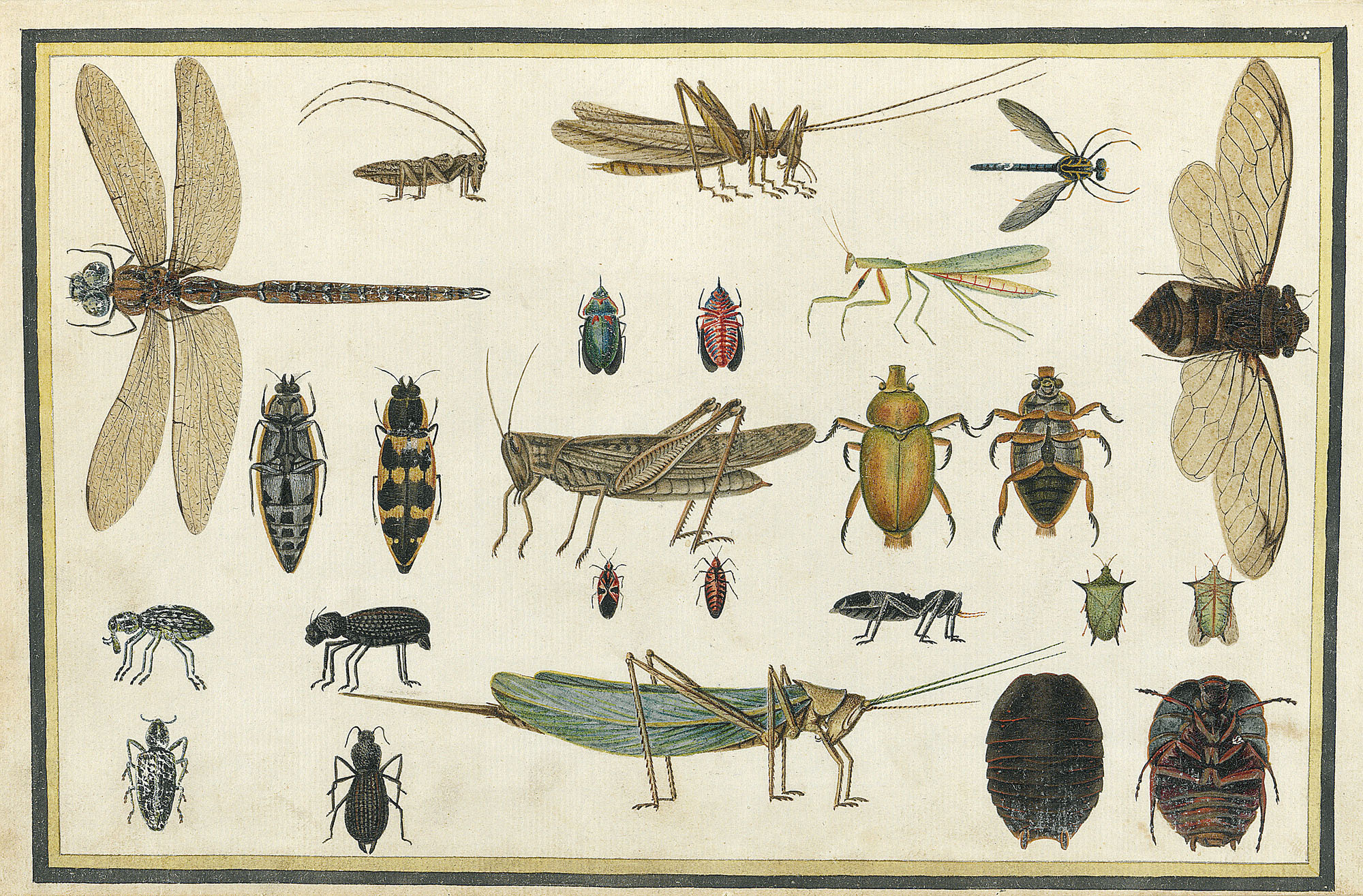
 

Richard Browne (illustrator, Ireland 1776 - Australia 1824, Australia from 1811) 'Insects' 1813


Richard Browne (illustrator, Ireland 1776 – Australia 1824, Australia from 1811)
Insects
1813
Page 52 in Select Specimens from Nature of the Birds Animals &c &c of New South Wales collected and arranged by Thomas Skottowe 1813
Watercolour
18.7 x 30.0cm (page)
Mitchell Library, State Library of New South Wales, Sydney
Bequeathed by D.S. Mitchell, 1907


Convicts with artistic talent were often put to work by their overseers. This was the case for convict Richard Browne who was assigned to Newcastle commandant Thomas Skottowe. Browne hand-painted the illustrations in Skottowe’s 1813 book, Select Specimens from Nature. Upon his release, Browne returned to Sydney, where he continued to paint stylised images of emus, lyrebirds and other animals. He also made portraits of Awabakal and Eora individuals, with the intention of selling these drawings to the developing local market, or as souvenirs to people aboard visiting ships.

Exhibition text


Installation view of the exhibition 'Colony: Australia 1770 - 1861' at NGV Australia at Federation Square, Melbourne

Installation view of the exhibition 'Colony: Australia 1770 - 1861' at NGV Australia at Federation Square, Melbourne showing at right, John Lewin's 'Fish catch and Dawes Point, Sydney Harbour' c. 1813; and second right, John Lewin's 'Platypus' 1810


Installation views of the exhibition Colony: Australia 1770-1861 at NGV Australia at Federation Square, Melbourne with in the bottom image at right, John Lewin’s Fish catch and Dawes Point, Sydney Harbour c. 1813; and second right, John Lewin’s Platypus 1810
Photos: © Dr Marcus Bunyan and the National Gallery of Victoria


Installation view of the exhibition 'Colony: Australia 1770-1861' at NGV Australia at Federation Square, Melbourne showing John Lewin (English-Australian, 1770-1819) 'Fish catch and Dawes Point, Sydney Harbour' c. 1813 (installation detail)


John Lewin (English-Australian, 1770-1819)
Fish catch and Dawes Point, Sydney Harbour (installation detail)
c. 1813
Oil on canvas
86.5 x 113cm
Art Gallery of South Australia, Adelaide
Gift of the Art Gallery of South Australia Foundation and South Australian Brewing Holdings Limited 1989
Given to mark the occasion of the Company’s 1988 Centenary
Photo: © Dr Marcus Bunyan and the National Gallery of Victoria


John Lewin (England 1770 - Australia 1819, Australia from 1800) 'Fish catch and Dawes Point, Sydney Harbour' c. 1813 


John Lewin (England 1770 – Australia 1819, Australia from 1800)
Fish catch and Dawes Point, Sydney Harbour
c. 1813
Oil on canvas
86.5 x 113cm
Art Gallery of South Australia, Adelaide
Gift of the Art Gallery of South Australia Foundation and South Australian Brewing Holdings Limited 1989
Given to mark the occasion of the Company’s 1988 Centenary


In 1812, John Lewin wrote to a friend that he had two oil paintings underway, one of which is believed to be this unusual composition of a haul of fish caught in Sydney Harbour set against the background of Dawes Point (now The Rocks, Sydney). It is thus the earliest oil painting known to have been produced in Australia. Pictured in the composition are various identifiable fish varieties, including a crimson squirrelfish, estuary perch, rainbow wrasse, sea mullet and hammerhead shark, later named the Zygaena lewini (now Sphyrna lewini) after the artist.

Exhibition text
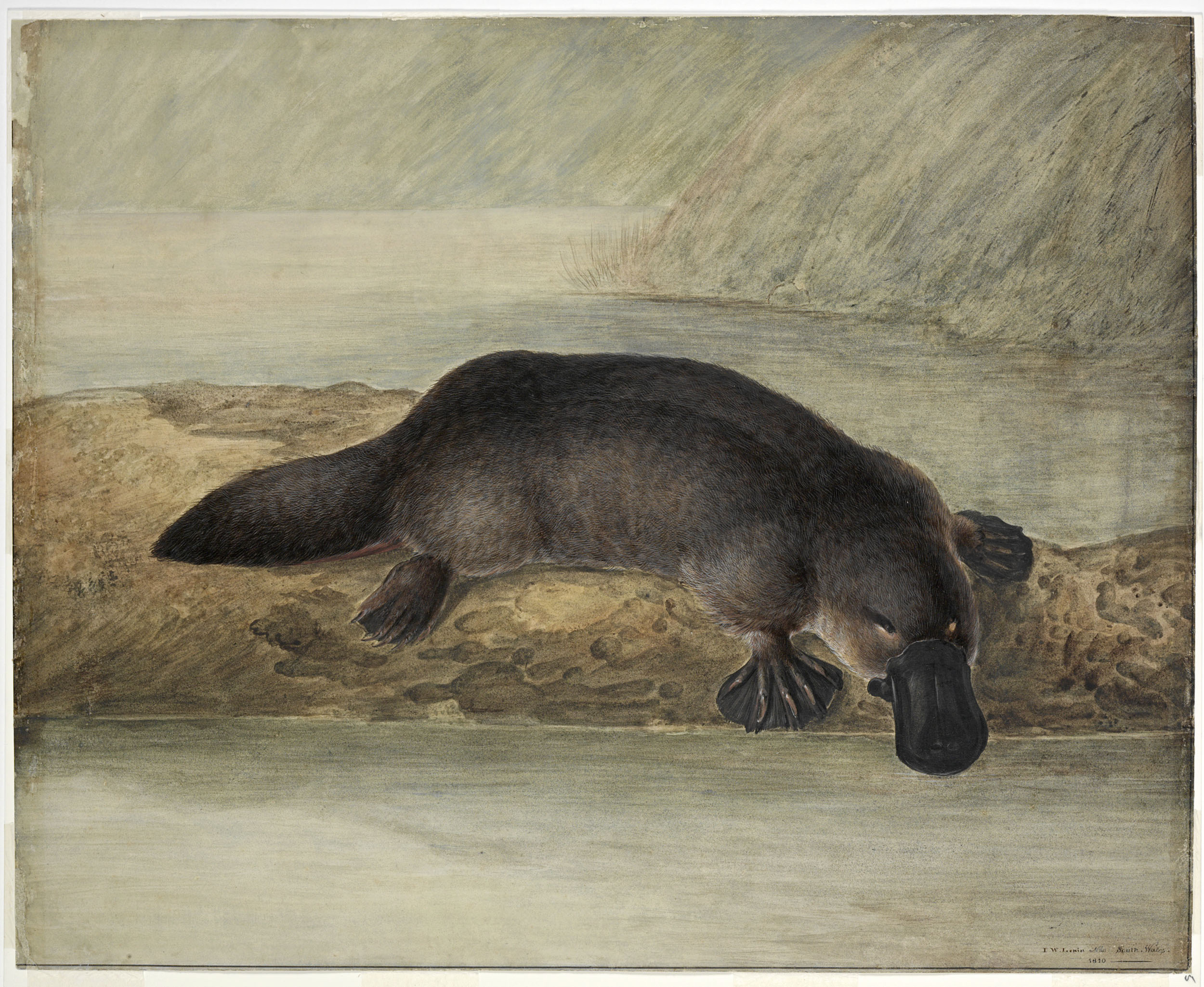
 

John Lewin (England 1770 - Australia 1819, Australia from 1800) 'Platypus' 1810 (installation view)


John Lewin (England 1770 – Australia 1819, Australia from 1800)
Platypus (installation view)
1810
Watercolour and gouache
Mitchell Library, State Library of New South Wales, Sydney
Bequeathed to the Trustees of the National Art Gallery of N.S.W. by Helen Banning; transferred to the Mitchell Library 1913
Photo: © Dr Marcus Bunyan and the National Gallery of Victoria


Sydney Bird Painter. 'Black Swan' c. 1790


Sydney Bird Painter
Black Swan
c. 1790
Watercolour and ink
48.1 x 29.2cm
Kerry Stokes Collection, Perth


Images of the black swan, as well as living birds and skins, were sent back to a fascinated Europe. One depiction became the pose de rigueur – a swan afloat, shown in profile like a heraldic symbol, with wings raised to show the white flight feathers. Like the Stubbs kangaroo, this black swan appeared in numerous forms. This beautiful watercolour was painted by an unidentified artist, possibly a member of the First Fleet, whose hand has also been identified in a volume of watercolours depicting birds held in the Mitchell Library, Sydney. Two or three artists made these drawings, and they are now collectively referred to as the Sydney Bird Painter.

Exhibition text


Peter Brown (active in England 1758-1799) 'Blue-bellied parrot' 1776


Peter Brown (active in England 1758-1799)
Blue-bellied parrot
1776
Plate VII in New Illustrations of Zoology: Containing Fifty Coloured Plates of New, Curious, and Non-Descript Birds, with a Few Quadrupeds, Reptiles and Insects, published by B. White, London 1776
Hand coloured etching
19 x 24.6cm (image and plate)
24 x 30.5cm (sheet)
Special Collections, Deakin University, Melbourne


It is unusual to know about an individual bird but this rainbow lorikeet (as it is now known) was captured at Botany Bay by Tupaia, the skilled Polynesian navigator and arioi (priest) who joined the Endeavour in Tahiti. The bird was taken back alive to London, and presented by Joseph Banks to the wealthy collector Marmaduke Tunstall. A watercolour of it was painted in 1772, and this print was published in 1776, carefully hand-coloured to show the bird’s distinctive plumage.

Exhibition text
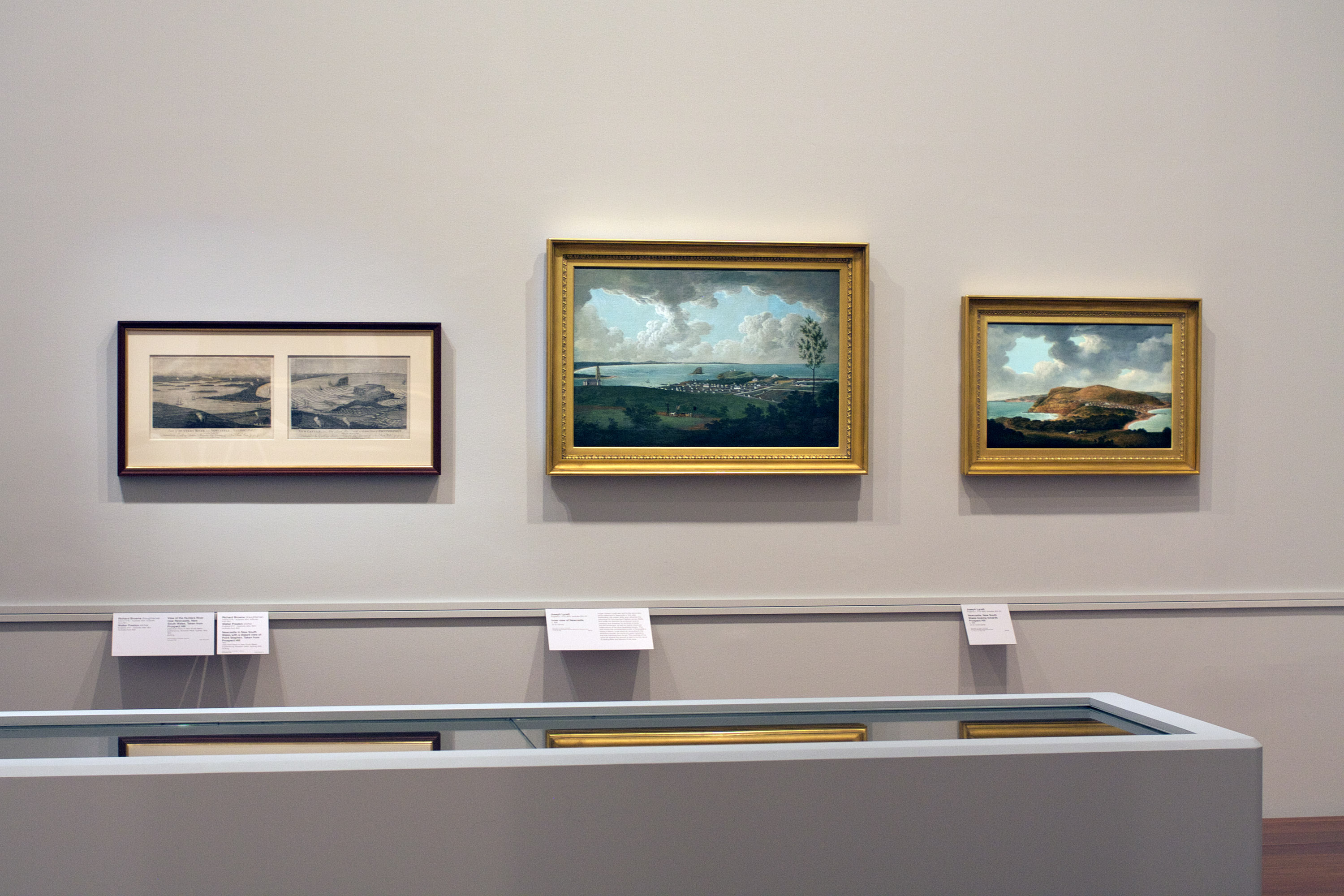
 

Installation view of the exhibition 'Colony: Australia 1770 - 1861' at NGV Australia at Federation Square, Melbourne with at centre, Joseph Lycett's 'Inner view of Newcastle' c. 1818


Installation view of the exhibition Colony: Australia 1770-1861 at NGV Australia at Federation Square, Melbourne with at centre, Joseph Lycett’s Inner view of Newcastle c. 1818
Photo: © Dr Marcus Bunyan and the National Gallery of Victoria
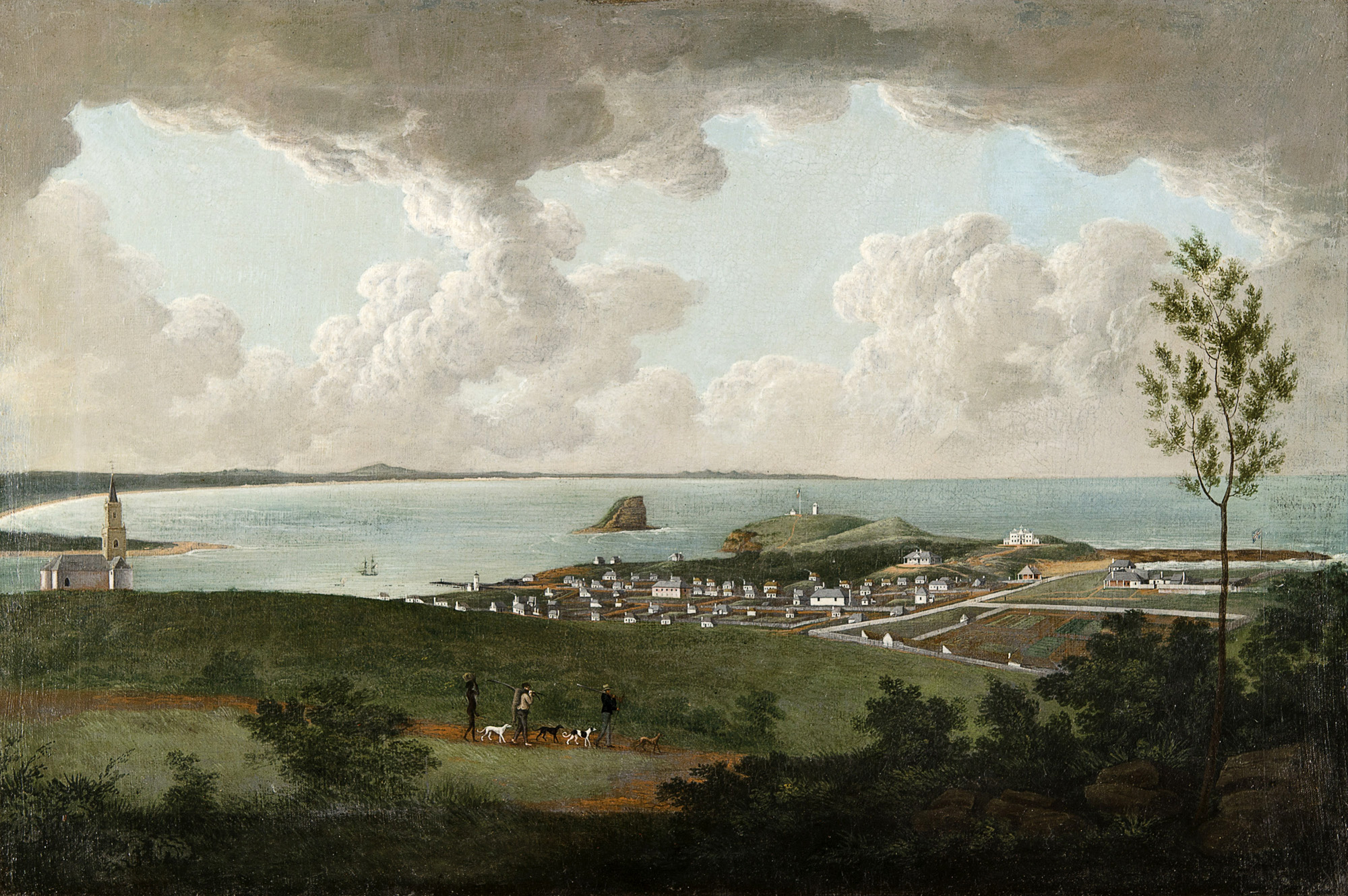
 

Joseph Lycett (England c. 1775-1828, Australia 1814-1822) 'Inner view of Newcastle' c. 1818


Joseph Lycett (England c. 1775-1828, Australia 1814-1822)
Inner view of Newcastle
c. 1818
Oil on canvas
59.6 x 90cm
Newcastle Art Gallery, Newcastle
Purchased with assistance from the National Art Collections Fund, London UK 1961


Forger Joseph Lycett was sent to the secondary penal settlement in Newcastle in 1815 after reoffending. His artistic skills soon attracted the patronage of Commandant Captain James Wallis, and under his direction he produced several paintings and drawings for etchings of birds and the landscape, as well as keenly observed watercolours of the local Awabakal people. This view shows the unmistakable profile of Newcastle’s Nobby’s Island, a site which is, according to the Awabakal people, the home of a giant kangaroo that was banished from its kin. The crashing of his great tail against the ground is said to be the cause of earthquakes and tremors in the area.

Exhibition text


Newcastle 1804

A penal settlement was established in Newcastle in 1804 as a place of secondary punishment for convicts. The area was rich in natural resources, including timber in the hinterland, large deposits of coal in the cliffs at the entrance to the harbour and shell middens for lime burning. Reoffenders sent to Newcastle experienced gruelling physical labour extracting these materials and desertion occurred frequently.

Yet, from this brutal setting, a rich body of work was born which represents the first local art movement by settlers within the Australian colonies. Over a decade, two commandants overseeing the settlement, Lieutenant Thomas Skottowe (1811-1818) and Captain James Wallis (1816-1822), both of whom were appointed by Governor Lachlan Macquarie, used convicts with artistic skills on a range of projects and capital works programs. They set artists to work documenting the Newcastle region and the local flora and fauna in drawings, paintings and prints. Others interacted with the local Awabakal people and produced important visual documents recording specific individuals and their way of life. Convicted forger Joseph Lycett was sent to Newcastle in 1815, and was the most significant artist involved in these projects, executing a group of major oil paintings, numerous watercolours, and drawings for subsequent etchings.

Text from the NGV website
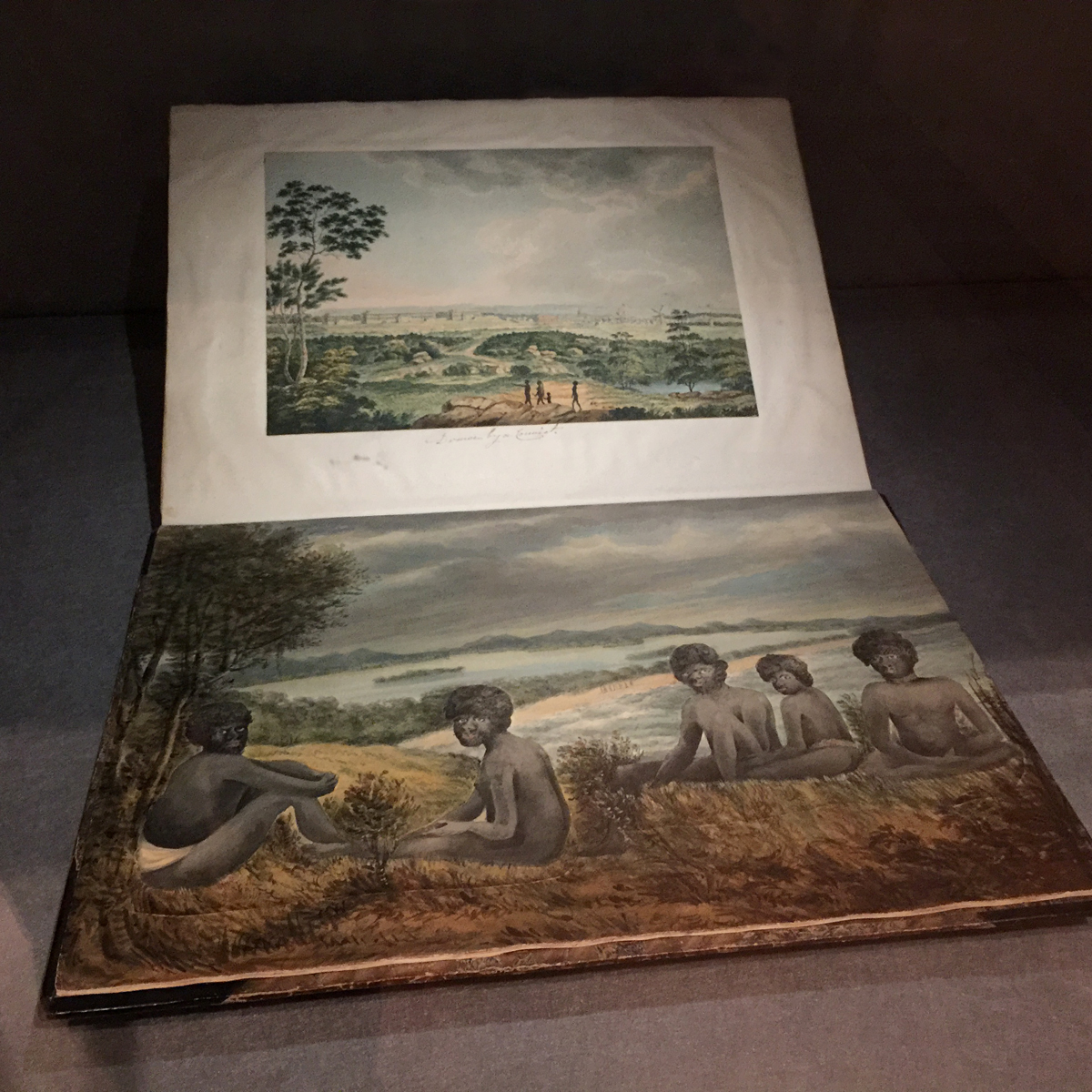
 

James Wallis (Ireland c. 1785 - England 1858, Australia 1814-19) 'View of Awabakal Aboriginal people, with beach and river inlet, and distant Aboriginal group in background' c. 1818 (installation view)


James Wallis (Ireland c. 1785 – England 1858, Australia 1814-1819)
View of Awabakal Aboriginal people, with beach and river inlet, and distant Aboriginal group in background (installation view)
c. 1818
in his Album of original drawings by Captain James Wallis and Joseph Lycett, bound with An Historical Account of the Colony of New South Wales by James Wallis, published by R. Ackerman, London, 1821 (c. 1817-1821)
Watercolour and collaged watercolour
Mitchell Library, State Library of New South Wales, Sydney
Purchased 2011
Photo: © Dr Marcus Bunyan and the National Gallery of Victoria


This image is one of a number of watercolours painted by Captain James Wallis that were bound into his personal copy of this publication. This naive image shows Awabakal people from the Newcastle region, whose figures have been cut out and collaged over the coastal scene behind. This presents a harmonious relationship between the Awabakal, colonisers and the military. Such a suggestion is at odds with earlier events of April 1816 when Wallis, under the direction of Governor Macquarie, led an armed regiment against Dharawal and Gandangara people south of Sydney, in what is now acknowledged as the first officially sanctioned massacre of Indigenous people in Australia.

Exhibition text


Installation view of the exhibition 'Colony: Australia 1770 - 1861' at NGV Australia at Federation Square, Melbourne showing the 'Dixson collector's chest' c. 1818-1820


Installation view of the exhibition Colony: Australia 1770-1861 at NGV Australia at Federation Square, Melbourne showing the Dixson collector’s chest c. 1818-1820
Photo: © Dr Marcus Bunyan and the National Gallery of Victoria


William Temple (cabinetmaker) (Australian born England, 1779-1839) Patrick Riley (cabinetmaker) (Australian born Ireland, 1786-1841) John Webster (cabinetmaker) Joseph Lycett (attributed to) (decorator) (British active Australia, c. 1774 - 1828) James Wallis (after) William Westall (after) 'Dixson collector's chest' c. 1818-1820


William Temple (cabinetmaker) (Australian born England, 1779-1839)
Patrick Riley (cabinetmaker) (Australian born Ireland, 1786-1841)
John Webster (cabinetmaker)
Joseph Lycett (attributed to) (decorator) (British active Australia, c. 1774 – 1828)
James Wallis (after)
William Westall (after)
Dixson collector’s chest
c. 1818-1820
Australian Rose Mahogany (Dysoxylum fraserianum), Red Cedar (Toona ciliata), brass, oil, natural history specimens
56 x 71.3 x 46.5cm (closed)
Dixson Galleries, State Library of New South Wales, Sydney
Presented by Sir William Dixson, 1937


The Dixson collector’s chest

The Dixson collector’s chest, c. 1818-1820, and its close relation, the Macquarie collector’s chest, c. 1818, are rare examples of colonial ‘cabinets of curiosity’ and among the most fascinating and complex objects of the colonial period. The Macquarie collector’s chest was commissioned and likely designed by Captain James Wallis, commandant of Newcastle, to present to Governor Lachlan Macquarie. It is debated whether the Dixson collector’s chest, on display here, was produced as its prototype or subsequently as a second version.

Crafted by expert convict cabinet-makers from local Australian timbers, the cabinet opens to reveal painted panels by convict artist Joseph Lycett. Several show the Newcastle region, while others are painted after views by exploration artist William Westall. The drawers contain shells and originally would have also held other natural history specimens including birds, insects, coral and seaweed, tagged and arranged fastidiously by shape, colour and/or type. It is believed these specimens were collected with the assistance of the local Awabakal people, as Wallis had an amicable relationship with their kinsman Burigon.

Both of these chests were only discovered in the twentieth century; the example owned by Macquarie was found in a Scottish castle in the late 1970s, while the Dixson collector’s chest was acquired by Sir William Dixson, benefactor of the State Library of New South Wales, from a London dealer in 1937.

Text from the NGV website


Installation view of the exhibition 'Colony: Australia 1770 - 1861' at NGV Australia at Federation Square, Melbourne with in foreground, showing 'Dress uniform worn by Sir Edward Deas Thomson, Colonial Secretary of New South Wales' 1832-1842; and in the background, Augustus Earle's 'Captain John Piper' c. 1826 and 'Mary Ann Piper and her children' c. 1826

Installation view of the exhibition 'Colony: Australia 1770 - 1861' at NGV Australia at Federation Square, Melbourne with in foreground, showing 'Dress uniform worn by Sir Edward Deas Thomson, Colonial Secretary of New South Wales' 1832-1842; and in the background, Augustus Earle's 'Mary Ann Piper and her children' c. 1826


Installation views of the exhibition Colony: Australia 1770-1861 at NGV Australia at Federation Square, Melbourne with in foreground, showing Dress uniform worn by Sir Edward Deas Thomson, Colonial Secretary of New South Wales 1832-1842; and in the background, Augustus Earle’s Captain John Piper c. 1826 and Mary Ann Piper and her children c. 1826
Photos: © Dr Marcus Bunyan and the National Gallery of Victoria


In the three years he spent in the colonies, Augustus Earle established himself as one of its leading artists, specialising in portraiture. He was commissioned to produce several portraits of prominent officials including surveyor George Evans, also on display; the departing governor, Sir Thomas Brisbane; and this pair of canvases depicting Captain John Piper and his family. Dressed in a uniform of his own design, Piper is portrayed as a man at the height of his power. The accompanying portrait of Mary Ann with four of their thirteen children depicts the family at home. Her gentility is emphasised by her fashionable dress, banishing all trace of her origins as the daughter of First Fleet convicts.

Exhibition text


Installation view of the exhibition 'Colony: Australia 1770 - 1861' at NGV Australia at Federation Square, Melbourne showing 'Dress uniform worn by Sir Edward Deas Thomson, Colonial Secretary of New South Wales' 1832-1842 (detail)


Installation view of the exhibition Colony: Australia 1770-1861 at NGV Australia at Federation Square, Melbourne showing Dress uniform worn by Sir Edward Deas Thomson, Colonial Secretary of New South Wales (detail) 1832-1842
Photo: © Dr Marcus Bunyan and the National Gallery of Victoria


Unknown, England / Australia (maker)
Firmin & Sons, London (button maker England est. 1677)
Dress uniform worn by Sir Edward Deas Thomson, Colonial Secretary of New South Wales
1832-1842
Wool, silver brocade (appliqué), metal (buttons)
Museum of Applied Arts and Sciences, Sydney Purchased 1966


Worn by Sir Edward Deas Thomson, Colonial Secretary of New South Wales between 1837 and 1856, this dress coat and trousers formed part of Thomson’s official livery. Loosely based on the Windsor uniform, introduced by King George III, the outfit’s striking red collar and cuffs with oak leaf and acorn hand embroidery impart splendour. In the nascent colony, uniforms were a way to differentiate status, easing anxieties about social mobility and instilling discipline and obedience.

Exhibition text
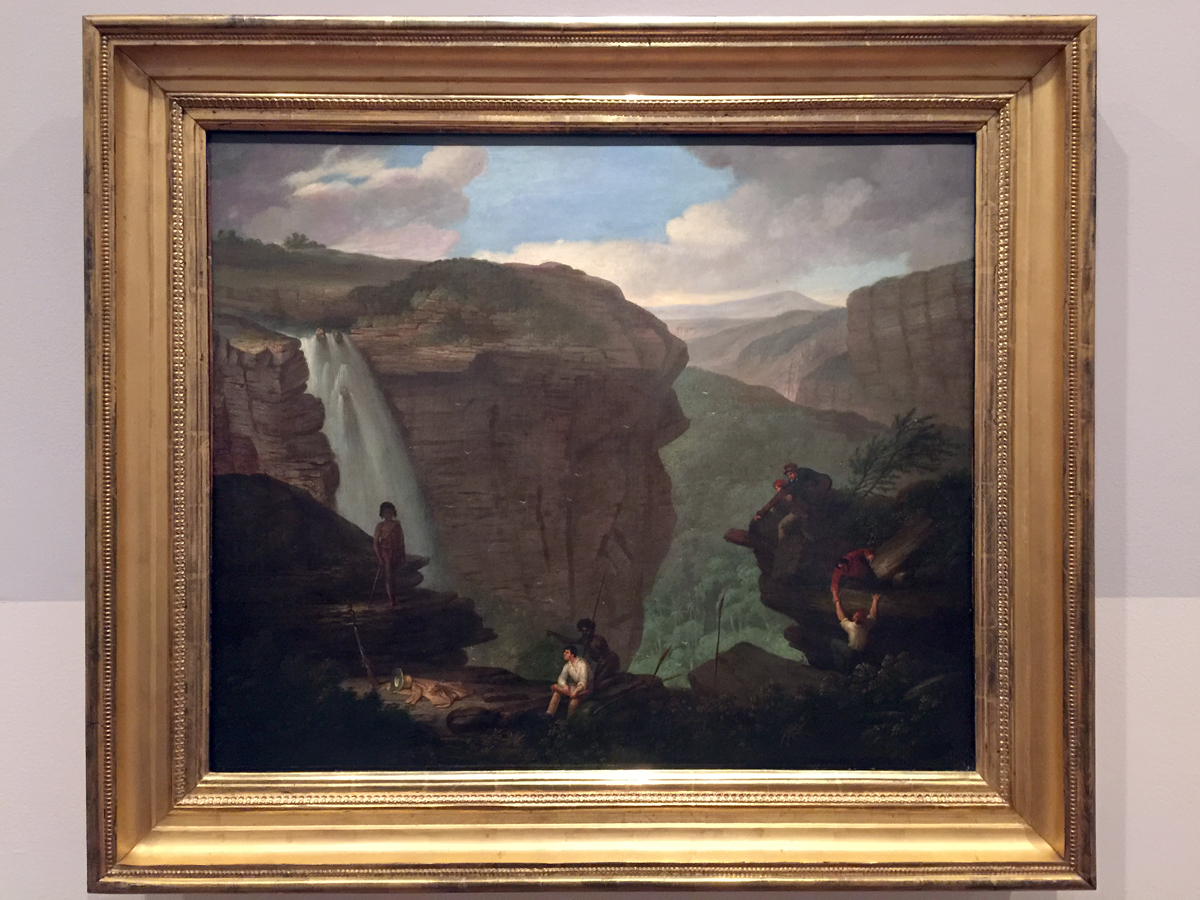
 

Augustus Earle (England 1793-1838, Brazil 1820-24, Australia 1825-28) 'Wentworth Falls' c. 1830 (installation view)


Augustus Earle (England 1793-1838, Brazil 1820-1824, Australia 1825-1828)
Wentworth Falls
c. 1830
Oil on canvas
Rex Nan Kivell Collection: National Library of Australia and National Gallery of Australia, Canberra
Photo: © Dr Marcus Bunyan and the National Gallery of Victoria


The intrepid artist and adventurer Augustus Earle arrived in Australia in January 1825 at a time when the economic and social hierarchies of the new colony were still in flux. An accidental émigré, rescued from the tiny island of Tristan da Cunha, where he had been marooned, Earle’s enterprising nature and versatile talents saw him build up a rich visual record of the colonial encounter for local and international audiences. These large oils were produced in England, several years after his return from the colony, and are among the first to evoke the scale and grandeur of the Australian wilderness.

Exhibition text


Augustus Earle (England 1793-1838, Brazil 1820-24, Australia 1825-28) 'A bivouac of travellers in Australia in a cabbage-tree forest, day break' c. 1838


Augustus Earle (England 1793-1838, Brazil 1820-1824, Australia 1825-1828)
A bivouac of travellers in Australia in a cabbage-tree forest, day break (see installation photograph below at left)
c. 1838
Oil on canvas
118 x 82cm
Rex Nan Kivell Collection: National Library of Australia and National Gallery of Australia, Canberra
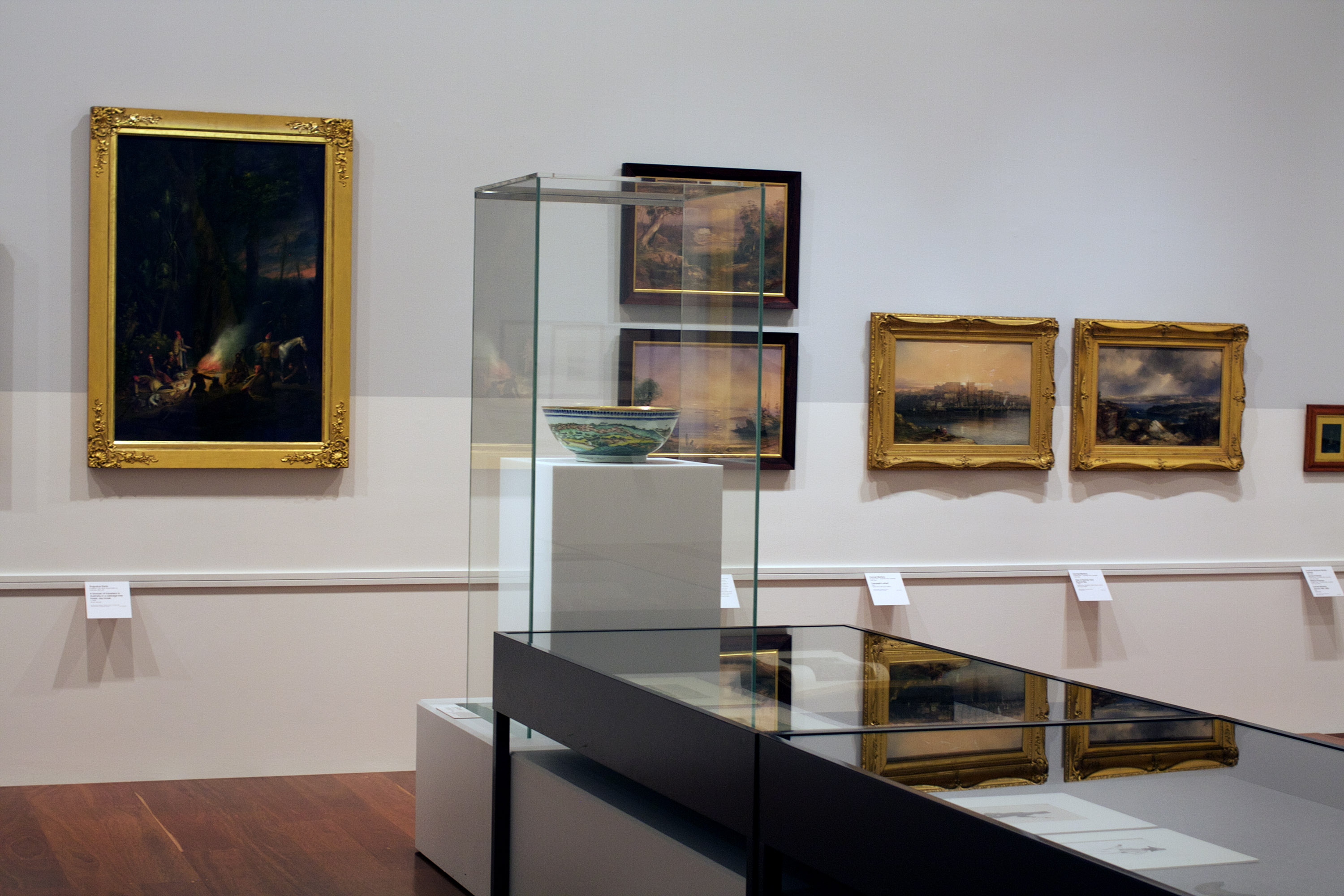
 

Installation view of the exhibition 'Colony: Australia 1770 - 1861' at NGV Australia at Federation Square, Melbourne

Installation view of the exhibition 'Colony: Australia 1770 - 1861' at NGV Australia at Federation Square, Melbourne

Installation view of the exhibition 'Colony: Australia 1770 - 1861' at NGV Australia at Federation Square, Melbourne showing at centre, Augustus Earle's 'Portrait of Bungaree, a native of New South Wales' c. 1826


Installation views of the exhibition Colony: Australia 1770-1861 at NGV Australia at Federation Square, Melbourne showing in the bottom image at centre, Augustus Earle’s Portrait of Bungaree, a native of New South Wales c. 1826
Photos: © Dr Marcus Bunyan and the National Gallery of Victoria


Bungaree (Australian / Kuringgai, 1775-1830)

Bungaree, or Boongaree, (1775 – 24 November 1830) was an Aboriginal Australian from the Kuringgai people of the Broken Bay area, who was known as an explorer, entertainer, and Aboriginal community leader. He is significant in that he was the first person to be recorded in print as an Australian.

By the end of his life, he had become a familiar sight in colonial Sydney, dressed in a succession of military and naval uniforms that had been given to him. His distinctive outfits and notoriety within colonial society, as well as his gift for humour and mimicry, especially his impressions of past and present governors, made him a popular subject for portrait painters.

Bungaree first came to prominence in 1798, when he accompanied Matthew Flinders on a coastal survey as an interpreter, guide and negotiator with local indigenous groups. He later accompanied Flinders on his circumnavigation of Australia between 1801 and 1803 in the Investigator. Flinders was the cartographer of the first complete map of Australia, filling in the gaps from previous cartographic expeditions, and was the most prominent advocate for naming the continent “Australia”. Flinders noted that Bungaree was “a worthy and brave fellow” who, on multiple occasions, saved the expedition. Bungaree continued his association with exploratory voyages when he accompanied Phillip Parker King to north-western Australia in 1817 in the Mermaid.

In 1815, Governor Lachlan Macquarie dubbed Bungaree “Chief of the Broken Bay Tribe” and presented him with 15 acres (61,000 m2) of land on George’s Head. He also received a breastplate inscribed “BOONGAREE – Chief of the Broken Bay Tribe – 1815”. Bungaree was also known by the titles “King of Port Jackson” and “King of the Blacks”. Bungaree spent the rest of his life ceremonially welcoming visitors to Australia, educating people about Aboriginal culture (especially boomerang throwing), and soliciting tribute, especially from ships visiting Sydney. In 1828, he and his clan moved to the Governor’s Domain, and were given rations, with Bungaree described as ‘in the last stages of human infirmity’. He died at Garden Island on 24 November 1830 and was buried in Rose Bay. Obituaries of him were carried in the Sydney Gazette and The Australian.

Text from the Wikipedia website


Augustus Earle (England 1793-1838, Brazil 1820-1824, Australia 1825-1828) 'Portrait of Bungaree, a native of New South Wales' c. 1826


Augustus Earle (England 1793-1838, Brazil 1820-1824, Australia 1825-1828)
Portrait of Bungaree, a native of New South Wales
c. 1826
Oil on canvas
68.5 x 50.5cm
Rex Nan Kivell Collection: National Library of Australia and National Gallery of Australia, Canberra


Sydney 1810s-1850s

The 1810s through to the 1850s was an era of expansion for the colonists who had settled in New South Wales and a time of continuing dispossession for Aboriginal people. Transportation ended in 1840, but convict labour continued to be assigned to assist with building roads and clearing land for pastoralists. The settler population grew and continued to occupy land further inland, north and south of Sydney. Emigration commissioners in London, and advocates within the colony, worked to encourage the arrival of free settlers, particularly women.

Throughout this period Sydney was the local centre of political power, and social and cultural sophistication. Artistic patronage was fostered. This is reflected in the proliferation of images in which nature and civilisation are pleasantly unified; the newly tamed wilderness placed against views of newly constructed Georgian buildings, demonstrating the colony’s ability to create order and flourish. Portraits were also in demand, and not only reflected the material success of prominent families but were commissioned by the expanding middle class. A print industry was established and expanded as the demand for locally produced prints increased. Images of colonial subjects, including portraits of Aboriginal people, account for a significant proportion of the art market at this time.

Text from the NGV website
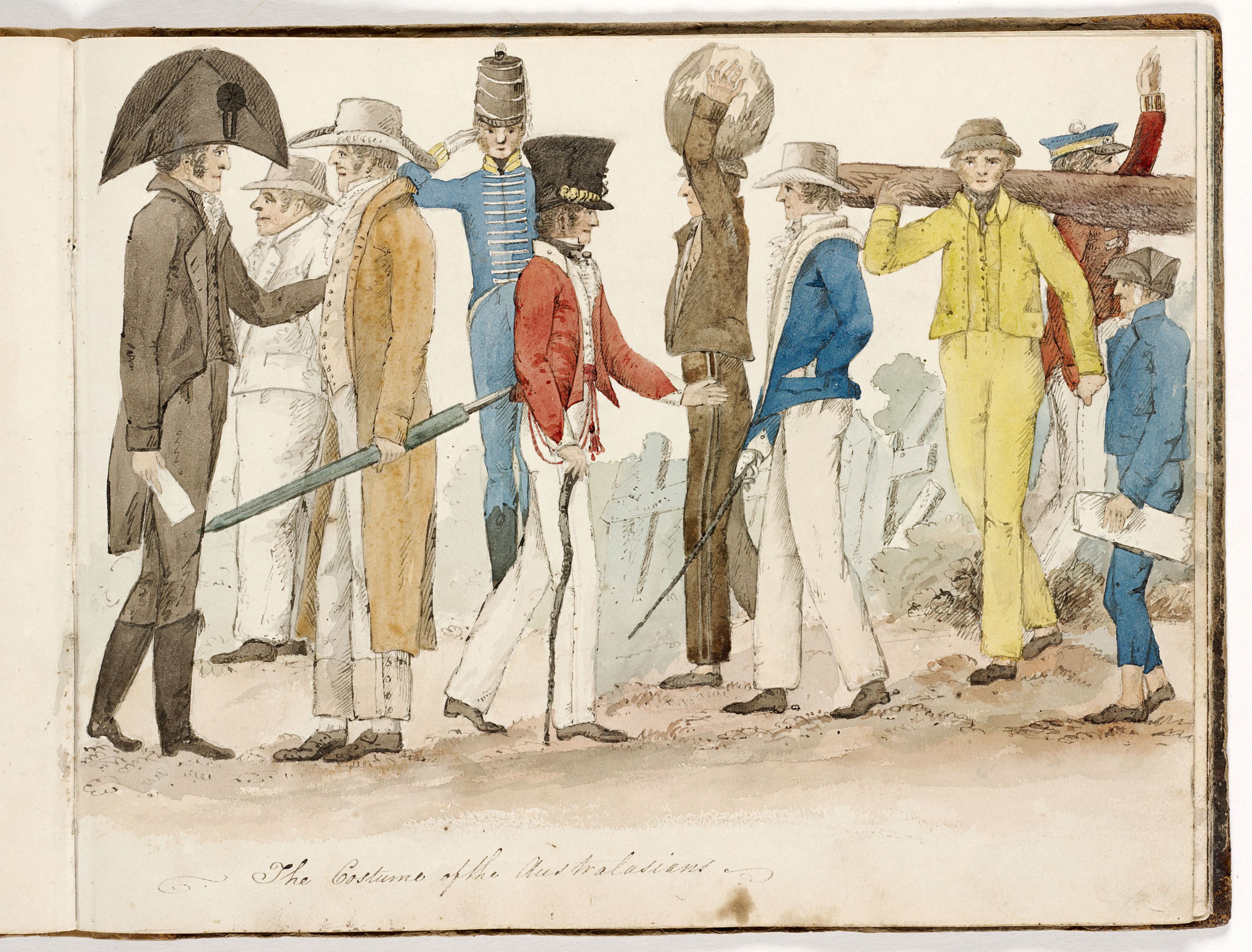
 

Edward Charles Close (Bengal (Bangladesh) 1790 - Australia 1866, Australia from 1817) 'The costume of the Australasians' c. 1817


Edward Charles Close (Bengal (Bangladesh) 1790 – Australia 1866, Australia from 1817)
The costume of the Australasians
c. 1817
In his New South Wales Sketchbook: Sea Voyage, Sydney, Illawarra, Newcastle, Morpeth c. 1817-1840
Watercolour
Mitchell Library, State Library of New South Wales, Sydney
Purchased 2009


Installation view of the exhibition 'Colony: Australia 1770 - 1861' at NGV Australia at Federation Square, Melbourne showing 'Elizabeth Macquarie', 'Governor Lachlan Macquarie' and 'Lachlan Macquarie junior' c. 1817-1819


Installation view of the exhibition Colony: Australia 1770-1861 at NGV Australia at Federation Square, Melbourne showing Elizabeth Macquarie, Governor Lachlan Macquarie and Lachlan Macquarie junior
Photo: © Dr Marcus Bunyan and the National Gallery of Victoria


Unknown artist
Elizabeth Macquarie
c. 1819
Watercolour on ivory
State Library of New South Wales, Sydney
Presented by F. W. Lawson, 1928

Unknown artist
Governor Lachlan Macquarie
c. 1819
Watercolour on ivory
State Library of New South Wales, Sydney
Presented by Miss M. Bather Moore and Mr T. C. Bather Moore, 1965

Unknown artist
Lachlan Macquarie junior
c. 1817-1818
Watercolour on ivory State Library of New South Wales, Sydney
Presented by Miss M. Bather Moore and Mr T. C. Bather Moore, 1965


Portrait miniatures were produced in England from the sixteenth century, with the first example on ivory painted in 1707. They remained a popular form of portraiture, as they were both intimate and easy to carry, until photography gradually took over all but the high end of the market. In Australia miniatures were similarly popular with the more affluent colonists. Lachlan Macquarie was the governor of New South Wales from 1810 to 1821. This suite of miniatures, painted in Australia by a skilled but now unknown artist, show Macquarie, his wife Elizabeth and their young son. They were presented to Captain John Cliffe Watts, Macquarie’s aide-de-camp, as a gift and memento of friendship, prior to Cliffe’s return to England in April 1819.

Exhibition text


Installation view of the exhibition 'Colony: Australia 1770 - 1861' at NGV Australia at Federation Square, Melbourne showing Henry Gritten's oil on canvas 'Hobart, Tasmania' 1856


Installation view of the exhibition Colony: Australia 1770-1861 at NGV Australia at Federation Square, Melbourne showing Henry Gritten’s oil on canvas Hobart, Tasmania 1856 National Gallery of Victoria, Melbourne Felton Bequest, 1975
Photo: © Dr Marcus Bunyan and the National Gallery of Victoria


Hobart’s Mount Wellington was a landmark of such majestic beauty that for many it rivalled the magnificent natural harbour of Sydney. The site naturally attracted the pen and brush of many colonial artists including John Glover, Knud Bull and Eugene von Guérard. Henry Gritten, who lived in Hobart from 1856 until at least 1858, painted it many times, and it is almost as common in his oeuvre as his views of Melbourne from the Botanic Gardens of the 1860s. Most artists painted the view from the same vantage point adopted by Gritten, looking across the Derwent River towards the settlement nestled at the foot of the rising mountain.

Exhibition text


Van Diemen’s Land 1803

In 1803, 160 years after the Dutch explorer Abel Tasman named and charted Van Diemen’s Land, the British laid claim to the island by relocating convicts and officers from New South Wales to forestall any incursion by the French. Convict transports continued to arrive intermittently in Van Diemen’s Land, mostly bringing prisoners from Britain and Ireland, until 1856, by which time more than 72,000 convicts had been sent there. There were several penal settlements established in Van Diemen’s Land, the most notorious of which were at Macquarie Harbour and Port Arthur.

In 1804, a year after the arrival of the first transports of convicts, Hobart Town was founded on the banks of the Derwent River and it quickly became an important southern trading port.

Over the next twenty years the settlement developed into a cultured, albeit provincial, Georgian township. Local sandstone was widely used to build fine buildings, including places of worship and civic and commercial buildings, and in turn the cultural life of the colony developed. In 1822 fifty-eight per cent of the population of Van Diemen’s Land were convicts, and consequently the majority of artists and artisans came from their ranks.

Text from the NGV website


Installation view of the exhibition 'Colony: Australia 1770 - 1861' at NGV Australia at Federation Square, Melbourne showing Unknown, Tasmania. 'Waistcoat' mid 19th century (installation view)


Unknown, Tasmania
Waistcoat (installation view)
Mid 19th century
Wool, cotton, bone
Collection of Port Arthur Historic Site Management Authority, Hobart
Photo: © Dr Marcus Bunyan and the National Gallery of Victoria


Installation view of the exhibition 'Colony: Australia 1770 - 1861' at NGV Australia at Federation Square, Melbourne showing Unknown, Tasmania 'Jacket' mid 19th century


Unknown, Tasmania
Jacket (installation view)
Mid 19th century
Wool, linen, cotton, bone
Collection of Port Arthur Historic Site Management Authority, Hobart
Photo: © Dr Marcus Bunyan and the National Gallery of Victoria
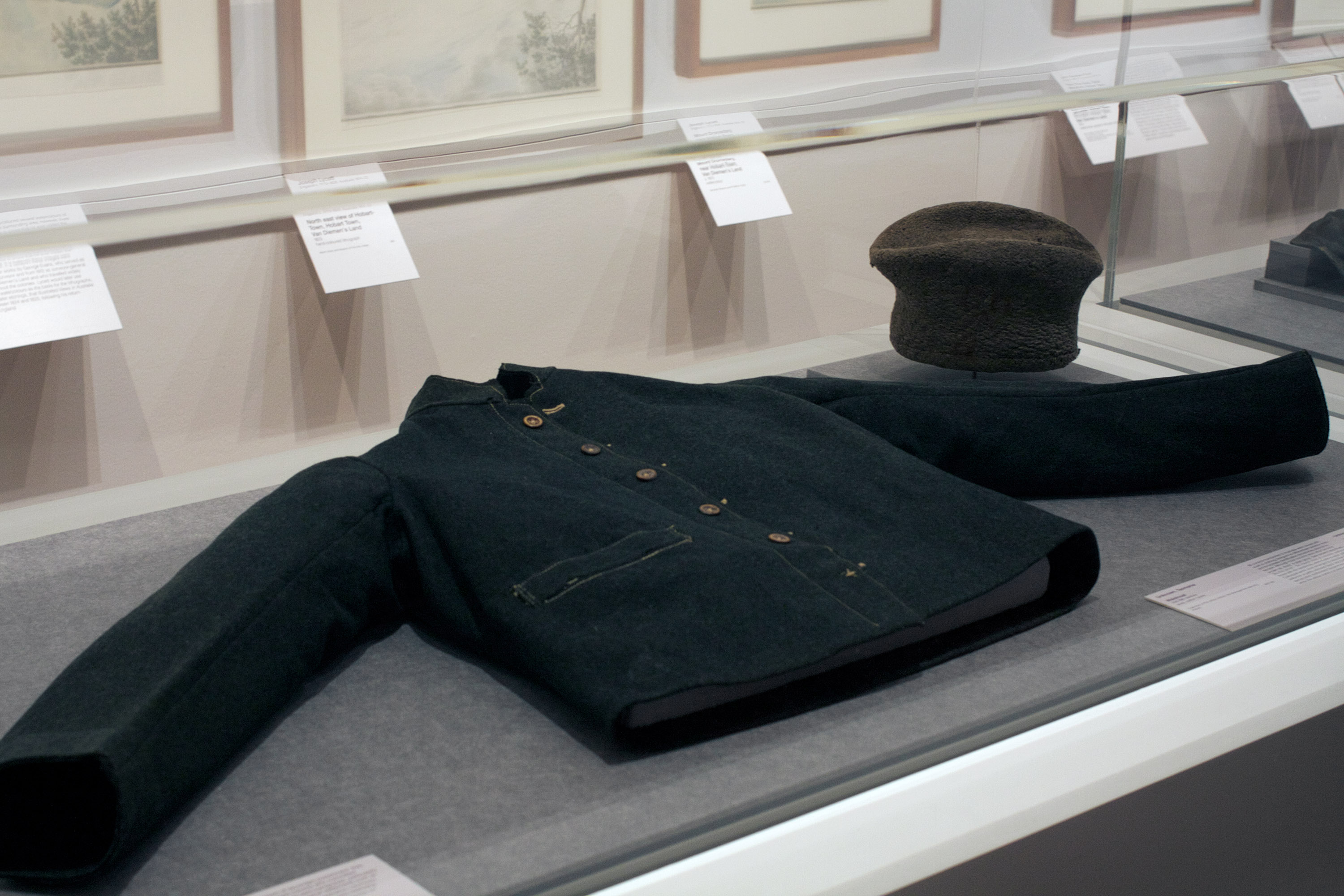
 

Installation view of the exhibition 'Colony: Australia 1770 - 1861' at NGV Australia at Federation Square, Melbourne showing Unknown, Tasmania 'Jacket and Indoor cap' mid 19th century


Installation view of the exhibition Colony: Australia 1770-1861 at NGV Australia at Federation Square, Melbourne showing Unknown, Tasmania Jacket and Indoor cap mid 19th century, wool, linen, cotton, bone
Photo: © Dr Marcus Bunyan and the National Gallery of Victoria


Unknown
Tasmania Jacket
Mid 19th century
Wool, linen, cotton, bone
Collection of Port Arthur Historic Site Management Authority, Hobart

Unknown, Tasmania
Indoor cap
Mid 19th century
Wool
Collection of Port Arthur Historic Site Management Authority, Hobart


All convicts transported to Australia were issued with a set of clothing designed to differentiate between them and to facilitate identification should they attempt to escape. Although most convicts wore what became known as ‘slops’ in plain greys, dark browns and blues – like this jacket – the lowest class of convicts, particularly those with life sentences, were made to wear yellow. Colloquial terms soon emerged to describe these uniforms: a partly coloured black and buff uniform that demarcated reoffenders became known as a ‘magpie’, while the yellow-suited convicts were called ‘canaries’.

Exhibition text


Installation view of the exhibition 'Colony: Australia 1770 - 1861' at NGV Australia at Federation Square, Melbourne showing Lion's head, Book-shaped puzzle box, Bell and Fork mid 19th century


Installation view of the exhibition Colony: Australia 1770-1861 at NGV Australia at Federation Square, Melbourne showing Lion’s head, Book-shaped puzzle box, Bell and Fork mid 19th century
Photo: © Dr Marcus Bunyan and the National Gallery of Victoria


Unknown, Tasmania
Lion’s head
Mid 19th century
Iron
Collection of Port Arthur Historic Site Management Authority, Port Arthur

Unknown, Tasmania
Book-shaped puzzle box
Mid 19th century wood
Queen Victoria Museum and Art Gallery, Launceston Beattie Collection

Unknown, Tasmania
Bell
Mid 19th century
Wood, brass, iron, bronze
Collection of Port Arthur Historic Site Management Authority, Hobart

Unknown, Tasmania
Fork
Mid 19th century
Wood
Collection of Port Arthur Historic Site Management Authority, Port Arthur


NGV Australia will host two complementary exhibitions that explore Australia’s complex colonial history and the art that emerged during and in response to this period. Presented concurrently, these two ambitious and large-scale exhibitions, Colony: Australia 1770-1861 and Colony: Frontier Wars, offer differing perspectives on the colonisation of Australia.

Featuring an unprecedented assemblage of loans from major public institutions around Australia, Colony: Australia 1770-1861 is the most comprehensive survey of Australian colonial art to date. The exhibition explores the rich diversity of art, craft and design produced between 1770, the arrival of Lieutenant James Cook and the Endeavour, and 1861, the year the NGV was established.

The counterpoint to Colony: Australia 1770-1861, Colony: Frontier Wars presents a powerful response to colonisation through a range of historical and contemporary works by Indigenous and non-Indigenous artists dating from pre-contact times to present day. From nineteenth-century drawings by esteemed Wurundjeri artist and leader, William Barak, to the iridescent LED light boxes of Jonathan Jones, this exhibition reveals how Aboriginal people have responded to the arrival of Europeans with art that is diverse, powerful and compelling.

Tony Ellwood, Director, NGV said: ‘Cook’s landing marks the beginning of a history that still has repercussions today. This two-part exhibition presents different perspectives of a shared history with unprecedented depth and scope, featuring a breadth of works never-before-seen in Victoria. In order to realise this ambitious project, we have drawn upon the expertise and scholarship of many individuals from both within and outside the NGV. We are extremely grateful to the Aboriginal Elders and advisory groups who have offered their guidance, expertise and support,’ said Ellwood.

Joy Murphy-Wandin, Senior Wurundjeri Elder, said: ‘I am overwhelmed at the magnitude and integrity of this display: such work and vision is a credit to the curatorial team. The NGV is to be congratulated for providing a visual truth that will enable the public to see, and hopefully understand, First Peoples’ heartache, pain and anger. Colony: Australia 1770-1861 / Frontier Wars is a must see for all if we are to realise and action true reconciliation.’

Charting key moments of history, life and culture in the colonies, Colony: Australia 1770-1861 includes over 600 diverse and significant works, including examples of historical Aboriginal cultural objects, early watercolours, illustrated books, drawings, prints, paintings, sculpture and photographs, to a selection of furniture, fashion, textiles, decorative arts, and even taxidermy specimens.

Highlights from the exhibition include a wondrous ‘cabinet of curiosities’ showcasing the earliest European images of Australian flowers and animals, including the first Western image of a kangaroo and illustrations by the talented young water colourist Sarah Stone. Examples of early colonial cabinetmaking also feature, including the convict made and decorated Dixson chest containing shells and natural history specimens, as well as a rarely seen panorama of Melbourne in 1841 will also be on display.

Following the development of Western art and culture, the exhibition includes early drawings and paintings by convict artists such as convicted forgers Thomas Watling and Joseph Lycett; the first oil painting produced in the colonies by professional artist John Lewin; work by the earliest professional female artists, Mary Morton Allport, Martha Berkeley and Theresa Walker; landscapes by John Glover and Eugene von Guérard; photographs by the first professional photographer in Australia, George Goodman, and a set of Douglas Kilburn’s silver-plated daguerreotypes, which are the earliest extant photographs of Indigenous peoples.

Colony: Frontier Wars attests to the resilience of culture and Community, and addresses difficult aspects of Australia’s shared history, including dispossession and the stolen generation, through the works of Julie Gough, Brook Andrew, Maree Clarke, Ricky Maynard, Marlene Gilson, Julie Dowling, S. T. Gill, J. W. Lindt, Gordon Bennett, Arthur Boyd, Tommy McRae, Christian Thompson, and many more.

Giving presence to the countless makers whose identities have been lost as a consequence of colonialism, Colony: Frontier Wars also includes a collection of anonymous photographic portraits and historical cultural objects, including shields, clubs, spear throwers and spears, by makers whose names, language groups and Countries were not recorded at the time of collection. Challenging global museum conventions, the exhibition will credit the subjects and makers of these cultural objects as ‘once known’ rather than ‘unknown’.

Press release from the National Gallery of Victoria


Installation view of the exhibition 'Colony: Australia 1770 - 1861' at NGV Australia at Federation Square, Melbourne showing William Francis Emery's 'View of Ipswich from Limestone Hill' c. 1861


Installation view of the exhibition Colony: Australia 1770-1861 at NGV Australia at Federation Square, Melbourne showing William Francis Emery’s (active in Australia c. 1850-1865) oil on canvas View of Ipswich from Limestone Hill c. 1861 Ipswich Art Gallery Collection, Ipswich
Photo: © Dr Marcus Bunyan and the National Gallery of Victoria


Installation view of the exhibition 'Colony: Australia 1770 - 1861' at NGV Australia at Federation Square, Melbourne featuring Australian 19th century earthenware and stoneware


Installation view of the exhibition Colony: Australia 1770-1861 at NGV Australia at Federation Square, Melbourne featuring 19th century earthenware and stoneware
Photo: © Dr Marcus Bunyan and the National Gallery of Victoria


Left

Andreas Fritsch (Germany 1808 – Australia 1896, Australia from 1849)
Teapot
c. 1850
Earthenware
National Gallery of Victoria, Melbourne
Gift of W. G. Tuck, 1972

Middle

Andreas Fritsch (Germany 1808 – Australia 1896, Australia from 1849)
Coffee pot
c. 1850
Earthenware
National Gallery of Victoria, Melbourne
Gift of W. G. Tuck, 1972

Right

Trewenack, Magill, South Australia (pottery 1853-1928)
John Henry Trewenack (potter England 1853 – Australia 1883, Australia from 1849)
Lidded storage jar
c. 1855
Stoneware
National Museum of Australian Pottery, Holbrook, New South Wales


This sharply waisted coffee pot, with its flat lid and nipped-in knob, is of a traditional German type. Fritsch arrived in Melbourne from Schwarzenbek in northern Germany in 1849, accompanied by his wife and four children. He showed eight earthenware objects (which may have included this coffee pot and teapot) at the Victoria Industrial Society exhibition in Melbourne in 1851. The Argus commented on 30 January that Fritsch’s exhibits, which earned him a large silver medal, ‘shewed [sic] how little necessity there is for Victoria being dependent in this article on any other portion of the globe’.

Exhibition text


Edward Robert Mickleburgh (England 1814 - late 19th century, Australia from c. 1841-1870s) 'The barque Terror commencing after Sperm Whales' 1840s (installation view)


Edward Robert Mickleburgh (England 1814 – late 19th century, Australia from c. 1841-1870s)
The barque Terror commencing after Sperm Whales (installation view)
1840s
Panbone and pigment
Australian National Maritime Museum, Sydney
Purchased, 2004
Photo: © Dr Marcus Bunyan and the National Gallery of Victoria


Edward Robert Mickleburgh was navigator on the whaling vessel Terror, and like many sailors practised the art of scrimshaw. Scrimshaw entails engraving or incising into bone, teeth or ivory and rubbing ink, or other pigments, into the lines to reveal the image. This particularly fine example illustrates both the art of the whaler and the industry of whaling. Mickleburgh has use the pantone, or lower jawbone of the sperm whale, to incise an image of the ship under full sail during the chase, lookouts atop its masts, boiling-down furnace fired up.

Exhibition label text


Installation view of the exhibition 'Colony: Australia 1770 - 1861' at NGV Australia at Federation Square, Melbourne

Installation view of the exhibition 'Colony: Australia 1770 - 1861' at NGV Australia at Federation Square, Melbourne showing Lieutenant Robert Dale (draughtsman England 1810-1853, Australia 1829-1833) Robert Havell junior (engraver England 1793-1878, United States 1839-1878) 'Panoramic view of King George's Sound, part of the colony of Swan River' 1834


Installation view of the exhibition Colony: Australia 1770-1861 at NGV Australia at Federation Square, Melbourne showing Panoramic view of King George’s Sound, part of the colony of Swan River 1834
Photos: © Dr Marcus Bunyan and the National Gallery of Victoria


Lieutenant Robert Dale (draughtsman England 1810-1853, Australia 1829-1833)
Robert Havell junior (engraver England 1793-1878, United States 1839-1878)
Panoramic view of King George’s Sound, part of the colony of Swan River
1834
Engraving, colour aquatint and watercolour on 3 joined sheets
National Gallery of Victoria, Melbourne
Purchased, 1958


This lengthy and detailed print shows the distinctive coastline viewed from the rocky summit of Mount Clarence, with the recently established government farm at Strawberry Hill and what later became Albany below. Drawn by surveyor Lieutenant Robert Dale and translated into print by Robert Havell in London, it depicts Nyungar and European figures in friendly contact, surrounded by native vegetation and animals. The spectacular view may have enticed prospective investors or settlers, promoting an idyllic vision with its abundance of fertile land and peaceful relations with the Traditional Owners.

Exhibition text


Installation view of the exhibition 'Colony: Australia 1770 - 1861' at NGV Australia at Federation Square, Melbourne showing John Glover's 'The Island of Madeira' 1831-1839

Installation view of the exhibition 'Colony: Australia 1770 - 1861' at NGV Australia at Federation Square, Melbourne showing John Glover's 'The Island of Madeira' 1831-1839


Installation view of the exhibition Colony: Australia 1770-1861 at NGV Australia at Federation Square, Melbourne showing at bottom, John Glover’s oil on canvas The Island of Madeira 1831-1839 National Gallery of Australia, Canberra
Photos: © Dr Marcus Bunyan and the National Gallery of Victoria
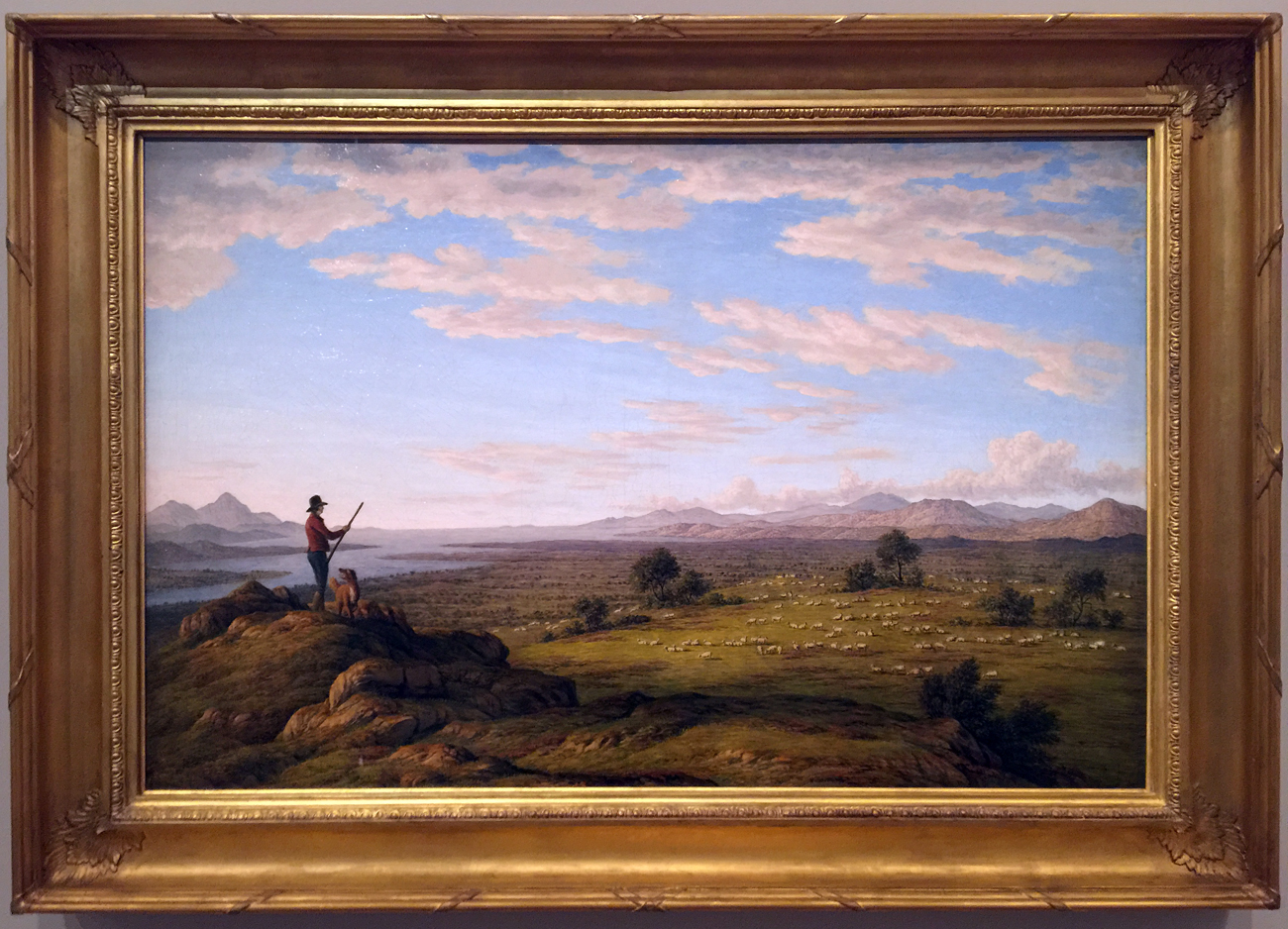
 

John Glover (England 1767 - Australia 1849, Australia from 1831) 'Moulting Lagoon and Great Oyster Bay, from Pine Hill' c. 1838 (installation view)


John Glover (England 1767 – Australia 1849, Australia from 1831)
Moulting Lagoon and Great Oyster Bay, from Pine Hill (installation view)
c. 1838
Oil on canvas
National Gallery of Victoria, Melbourne
Purchased with assistance of an anonymous donor and the M. G. Chapman Bequest, 2011
Photo: © Dr Marcus Bunyan and the National Gallery of Victoria


John Glover (England 1767 - Australia 1849, Australia from 1831) 'View of Mills Plains, Van Diemen's Land' 1833


John Glover (England 1767 – Australia 1849, Australia from 1831)
View of Mills Plains, Van Diemen’s Land
1833
Oil on canvas
76.2 x 114.6cm
Art Gallery of South Australia, Adelaide
Morgan Thomas Bequest Fund 1951


John Glover was a mature and well-established artist by the time he immigrated to Van Diemen’s Land in 1831. He had enjoyed a long and mostly successful career as a painter in England and had exhibited at London’s Royal Academy on several occasions. He took to the bright light and colour of Van Diemen’s Land easily, depicting the distinctive terrain and vegetation with unerring naturalism and the selective, idealising eye of the picturesque painter. He established a farm named Patterdale in Deddington, outside of Launceston, with his sons. The property and surrounding Mills Plains countryside often feature as a subject in his paintings.

Exhibition text


Van Diemen’s Land 1820s-1850s

The increased arrival of free settlers from the 1820s onwards saw the colony of Van Diemen’s Land evolve from a brutal penal settlement into an economically sound and vibrant cultural centre. With its pleasant climate, few droughts and floods, and open grassland, which seemed pre-prepared for aspiring pastoralists, Van Diemen’s Land became the preferred destination for immigrants. By 1830, almost a third of the arrivals to Australia settled in the south, and the small island experienced economic prosperity.

Colonial society was increasingly able to support a vibrant artistic community, composed of amateurs and professionals, free settlers, highly skilled convicts and emancipists who found patronage despite their unsavoury backgrounds. In August 1837 the colony asserted its cultural superiority when Hobart hosted the first exhibition of art to be held in Australia, under the patronage of Lieutenant-Governor John Franklin and his wife, Jane. The Franklins had arrived in Hobart earlier that year, and during their tenure (1837-43) enthusiastically fostered the development of intellectual life, regarding the visual arts as an outward signifier of culture in the colony. The Vandemonian art, decorative arts and design produced from the 1830s to the early 1850s are among the most sophisticated and diverse of the colonial era.

Text from the NGV website


Installation view of the exhibition 'Colony: Australia 1770 - 1861' at NGV Australia at Federation Square, Melbourne with at left, John Glover's 'The River Nile, Van Diemen's Land, from Mr Glover's farm' 1837; at centre, 'Hamilton Inn Sofa' c. 1825; and in cabinet 'Necklace' late 19th century


Installation view of the exhibition Colony: Australia 1770-1861 at NGV Australia at Federation Square, Melbourne with at left, John Glover’s The River Nile, Van Diemen’s Land, from Mr Glover’s farm 1837; at centre, Hamilton Inn Sofa c. 1825; and in cabinet Necklace late 19th century
Photo: © Dr Marcus Bunyan and the National Gallery of Victoria
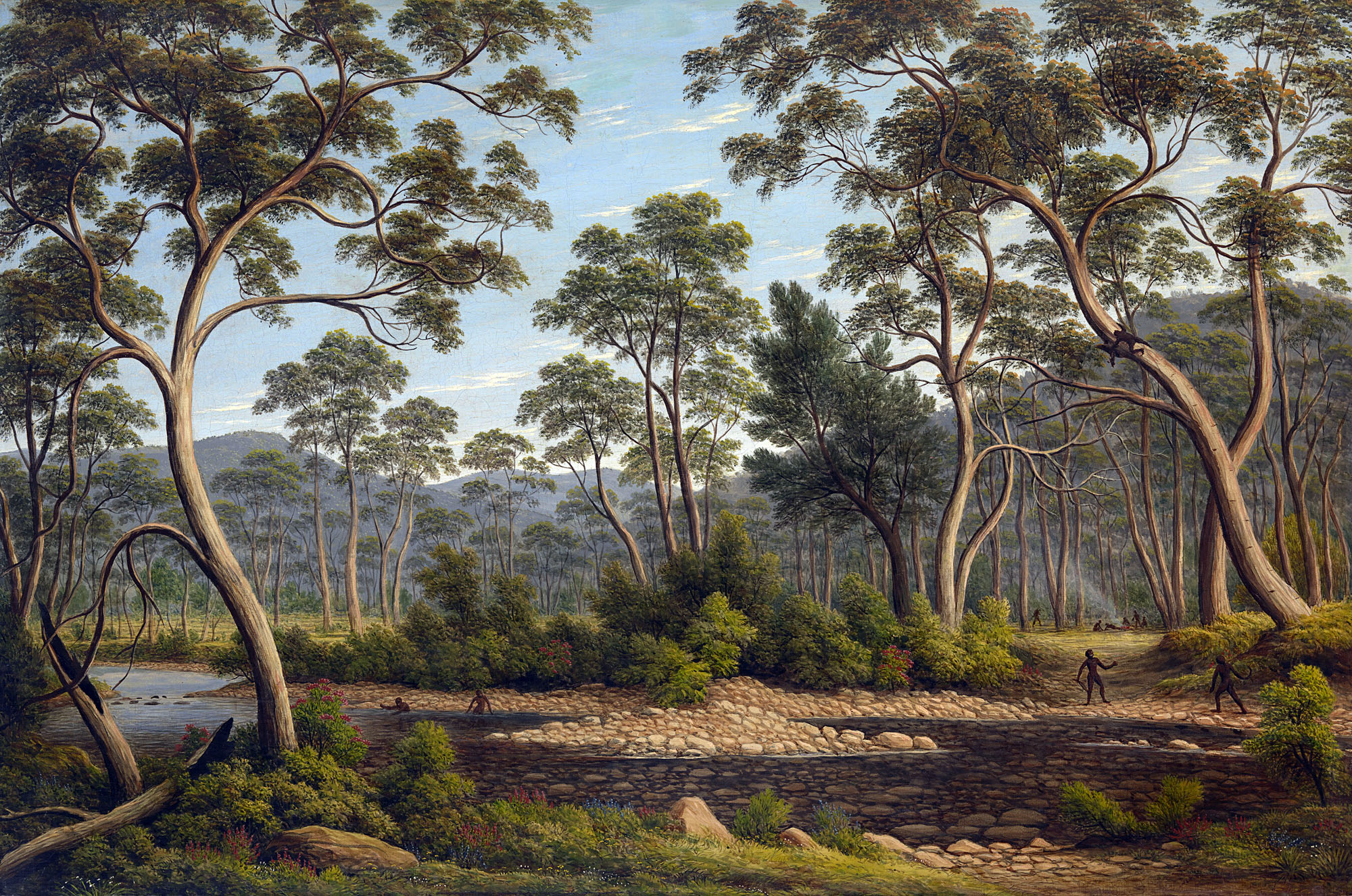
 

John Glover (England 1767 - Australia 1849, Australia from 1831) 'The River Nile, Van Diemen's Land, from Mr Glover's farm' 1837


John Glover (England 1767 – Australia 1849, Australia from 1831)
The River Nile, Van Diemen’s Land, from Mr Glover’s farm
1837
Oil on canvas
76.4 x 114.6cm
National Gallery of Victoria, Melbourne
Felton Bequest, 1956


John Glover’s colonial landscapes can be divided into two groups: pastoral scenes of the land surrounding his own property, and pre-contact Aboriginal Arcadias. Although the Aboriginal figures are at times generic, they are shown as active participants in the landscape. Such scenes were, however, entirely imagined, as Glover encountered very few Tasmanian Aboriginal people while in the colony. Glover had not experienced the conflict or witnessed the violence between Tasmanian Aboriginal resistance fighters and white settlers during the 1820s. By the time of his arrival in 1831, the Tasmanian Aboriginal survivors had been forced to leave Country and relocate to Flinders Island.

Exhibition text


Installation view of the exhibition 'Colony: Australia 1770 - 1861' at NGV Australia at Federation Square, Melbourne with at front left, 'Necklace' late 19th century


Installation view of the exhibition Colony: Australia 1770-1861 at NGV Australia at Federation Square, Melbourne with at front left, Necklace late 19th century
Photo: © Dr Marcus Bunyan and the National Gallery of Victoria


Unknown (Tasmanian Aboriginal active late 19th century)
Necklace
Late 19th century
Maireener shells (Phasianotrochus sp.)
Tasmanian Museum and Art Gallery, Hobart


Shell necklace-making represents the most significant cultural tradition of Tasmanian Aboriginal women, one of few customary practices that has continued without interruption from long before British colonisation of Van Diemen’s Land in 1803. This necklace is strung from the rarest and most highly prized of shells, the maireneer (Phasianotrochus sp.). Seasonally gathered directly from the sea, maireneer shells are painstakingly processed to remove the outer brown casing and reveal their pearlescent lustre before being pierced and strung. Eighteenth-century French explorers remarked on the iridescent beauty of maireneer shell necklaces, and the esteem in which they were held by their skilled makers.

Exhibition text
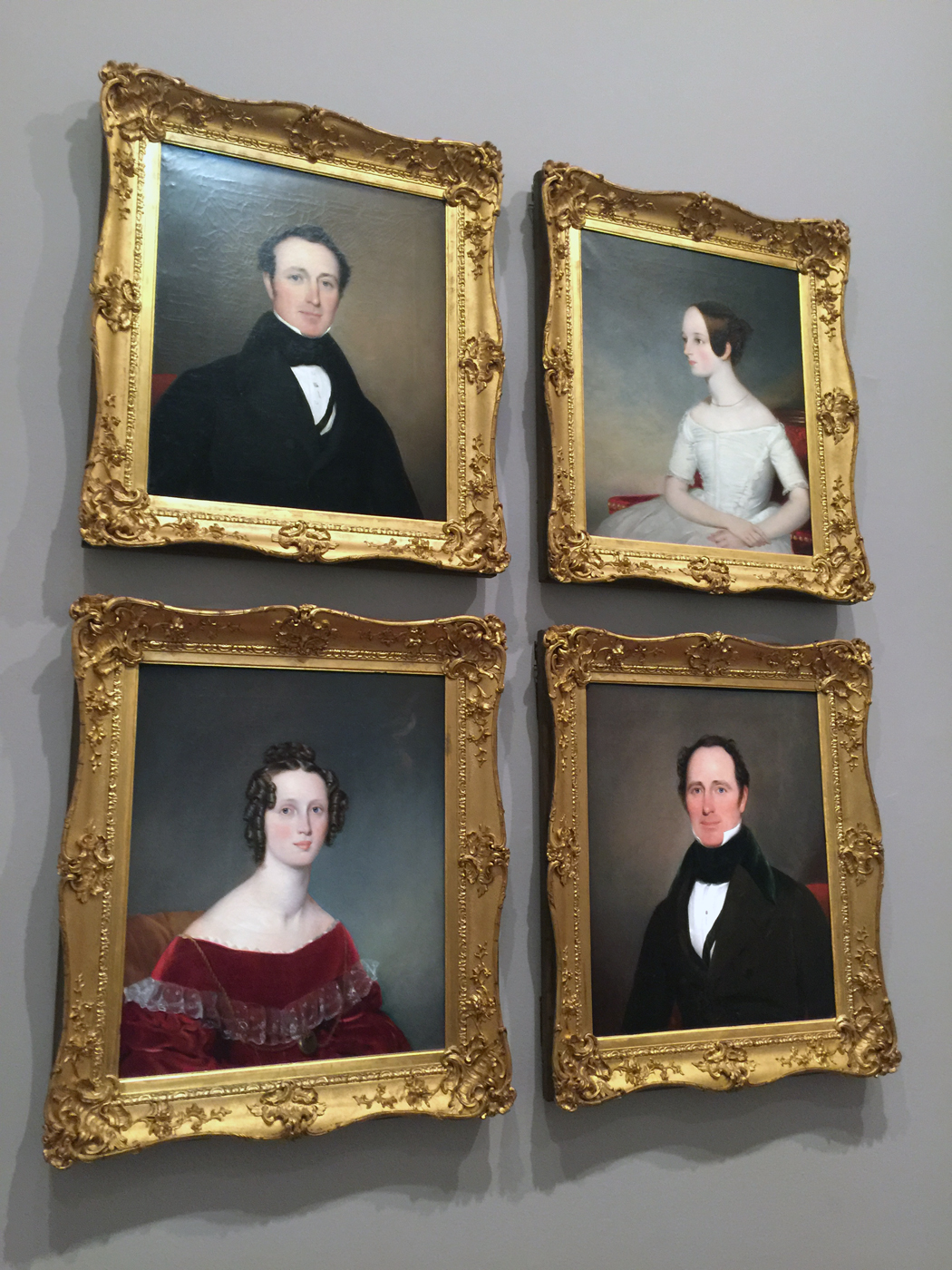
 

Installation view of the exhibition 'Colony: Australia 1770 - 1861' at NGV Australia at Federation Square, Melbourne showing Thomas Bock's paintings 'John Robertson' 1850 (top left); 'Mrs William Robertson' mid 1830s (bottom left); 'Jessie Robertson' 1850 (top right); and 'Captain William Robertson' 1830s (bottom right)

Installation view of the exhibition 'Colony: Australia 1770 - 1861' at NGV Australia at Federation Square, Melbourne showing Thomas Bock's paintings 'John Robertson' 1850 (top left); 'Mrs William Robertson' mid 1830s (bottom left); 'Jessie Robertson' 1850 (top right); and 'Captain William Robertson' 1830s (bottom right)


Installation views of the exhibition Colony: Australia 1770-1861 at NGV Australia at Federation Square, Melbourne showing Thomas Bock’s paintings John Robertson 1850 (top left); Mrs William Robertson mid 1830s (bottom left); Jessie Robertson 1850 (top right); and Captain William Robertson 1830s (bottom right) all oil on canvas, Art Gallery of South Australia, Adelaide Mrs Mary Overton Gift Fund 1996
Photos: © Dr Marcus Bunyan and the National Gallery of Victoria


Sentenced to transportation for fourteen years, Thomas Bock arrived in Hobart in 1824. He was already successful as an engraver in Birmingham so was put to work by government officials, engraving bank notes for the Bank of Van Diemen’s Land, stationery and illustrations for locally printed publications. Following his pardon, he was kept busy with painting commissions. His elegant and flattering portraits, executed in the grand Georgian manner fashionable in England, were greatly prized by colonists. In addition to painting these likenesses, Bock is believed to have photographed Captain Robertson, his wife and their son William junior in the early 1850s.

Exhibition text


Installation view of the exhibition 'Colony: Australia 1770 - 1861' at NGV Australia at Federation Square, Melbourne with at centre, 'Hamilton Inn Sofa' c. 1825


Installation view of the exhibition Colony: Australia 1770-1861 at NGV Australia at Federation Square, Melbourne with at centre, Hamilton Inn Sofa c. 1825
Photo: © Dr Marcus Bunyan and the National Gallery of Victoria


Unknown, (Tasmania)
Hamilton Inn Sofa
c. 1825
Red Cedar (Toona ciliata), Eucalyptus (Eucalyptus sp.), pearwood, Mahogany, metal (steel and brass fittings), horsehair, wool, cotton
Tasmanian Museum and Art Gallery, Hobart
Purchased for the Tasmanian Museum and Art Gallery by Federal Group with the assistance of the Art Foundation of Tasmania, 2005


This sofa is believed to be one of the earliest pieces of Tasmanian-made furniture. It is characteristically austere and reflects the Greek Revival taste popular in Britain during the Regency period, relying on the discipline of its refined line and silhouette for effect with ornamentation restricted to geometric motifs. Significantly, it has only been subject to repairs to stabilise the upholstery and framework, meaning it is in near original condition, rare for colonial furniture of this type. Usually, upholstery of this age has been replaced multiple times due to daily wear and tear and changing tastes in home furnishings.

Exhibition text


Little is known of the sofa’s provenance before the late 19th century, when it entered the Sonners family of Hamilton – residents of the original Hamilton Inn from 1912 until the 1990s. Its earliest confirmed owner was Albert Sonners (1860-1935). The sofa’s maker, their client and the circumstances of production – including the date of manufacture – remain the subject of ongoing research.

However, it appears likely that the sofa was made during the 1820s, when wealthy colonists started to build large houses of the kind implied by the scale of the Hamilton Inn sofa. The sofa’s ambitious design would have been the height of fashion in the first decade of the 19th century, and is typical of the then fashionable, Greek-revival style. Pattern books became increasingly important as sources of ideas and promulgators of fashions from the late eighteenth century.

Thomas Hope’s (1769-1831) Household Furniture and Interior Decoration, published in 1807, was the first to promote the Greek-revival style and may have indirectly influenced the design of the Hamilton Inn sofa. The double-ended sofa – with scrolled arms and ‘sabre’ legs – displays an aesthetic that is restrained and geometric, consisting of shaped and relieved panels, reeding and tablets of decorative veneers.

The apparent simplicity emphasises the sofa’s elegant, curved and sweeping profile. Structural components made in Tasmanian hardwoods are disguised by either the upholstery or by cedar panels that also serve to disguise the attaching points for the upholstery. Ultimately, the design and scale of the sofa records the rapid transmission of British fashions to the new island colony, as well as the early presence of highly skilled furniture makers in Tasmania.

Tasmanian Museum and Art Gallery. “Hamilton Inn sofa: c. 1825,” on the ABC website 15 February, 2013 [Online] Cited 16/02/2022


In November 2005, an unrestored red cedar couch discovered in a Tasmanian shed came up for auction in Hobart. The owner of the couch only wanted to make enough money to mend a fence. Instead, the couch sold at a drama-fuelled auction for more than $310,000.

At the auction, the couch was initially knocked down for $48,000 but a bidder protested and the auctioneer was forced to reopen the bidding. When the new round of bidding finally ceased, the sale was one of the highest prices ever paid for a piece of Australian furniture.

The couch was purchased by the Federal Group, a local Tasmanian hospitality and tourism group, with the assistance of the Art Foundation of Tasmania. It donated it to Hobart’s Tasmanian Museum and Art Gallery. …

When the gallery received the couch it faced a dilemma. The timber finish and upholstery were in poor condition and there was discussion over whether it should be restored or left untouched. After much consultation with experts, it was decided to improve the appearance without compromising the historical significance.

“It has the original upholstery, which is very unusual for this age,” says Hughes. “The finish and the wood are also pretty much original. So this makes it an extremely rare historical document, as well as a fantastic object.

“It has survived with more information than almost any other piece of colonial furniture. It has much to tell us about craftsmanship, materials and design in the early years of the Australian colonies.”

Bronwyn Watson. “Public works: Hamilton Inn couch,” on The Australian website 15/7/2011 [Online] Cited 16/02/2022


Mary Morton Allport (England 1806 - Australia 1895, Australia from 1830) 'John Glover' c. 1832


Mary Morton Allport (England 1806 – Australia 1895, Australia from 1830)
John Glover
c. 1832
Watercolour on ivory, Huon Pine veneer, gilt
11.8 x 9.3cm
Allport Library and Museum of Fine Arts, Hobart


Installation view of the exhibition 'Colony: Australia 1770 - 1861' at NGV Australia at Federation Square, Melbourne showing Frederick Woodhouse Senior's 'Owner, trainer, horse and jockey' 1858 (installation view)


Frederick Woodhouse Senior (England 1820 – Australia 1909, Australia from 1858)
Owner, trainer, horse and jockey (installation view)
1858
Oil on canvas
Art Gallery of South Australia, Adelaide
Elder Bequest Fund 1980
Photo: © Dr Marcus Bunyan and the National Gallery of Victoria


Installation views= of the exhibition 'Colony: Australia 1770 - 1861' at NGV Australia at Federation Square, Melbourne

Installation view of the exhibition 'Colony: Australia 1770 - 1861' at NGV Australia at Federation Square, Melbourne

Installation view of the exhibition 'Colony: Australia 1770 - 1861' at NGV Australia at Federation Square, Melbourne

Installation view of the exhibition 'Colony: Australia 1770 - 1861' at NGV Australia at Federation Square, Melbourne with at right, Benjamin Duterrau's 'Tasmanian Aboriginal' 1837; and at bottom third from left, Thomas Bock's 'Woureddy (Wurati): Native of Bruné Island, Van Diemen's Land' c. 1837


Installation views of the exhibition Colony: Australia 1770-1861 at NGV Australia at Federation Square, Melbourne with in the bottom image at right, Benjamin Duterrau’s (England 1761 – Australia 1851, Australia from 1832) oil on canvas Tasmanian Aboriginal 1837; and at bottom third from left, Thomas Bock’s Woureddy (Wurati): Native of Bruné Island, Van Diemen’s Land c. 1837
Photos: © Dr Marcus Bunyan and the National Gallery of Victoria


Tasmanian Aboriginal People

Between the establishment of the settlement of Hobart in 1804 and the early 1820s the British government granted to settlers just over 100,000 acres of land already occupied by Tasmanian Aboriginal people. By the beginning of the 1830s more than fourteen times this acreage had been taken over by Europeans. During these decades, Tasmanian Aboriginal communities were ravaged by introduced diseases and famine as their hunting grounds disappeared, and were involved in violent clashes with the settler population. These conflicts escalated during the 1820s and came to be known as the Black War.

In 1830, George Augustus Robinson was engaged in the so-called Friendly Mission, which sought to make peaceful contact with the Tasmanian Aboriginal people remaining on Country. With the assistance of groups of Aboriginal individuals, he persuaded those still living freely on the land to relocate to the Wybalenna settlement on Flinders Island. By 1835, many of the Tasmanian Aboriginal population lived permanently on Flinders Island, waiting to return to Country as they had been promised. Their numbers dwindled rapidly and in 1847 the remaining forty-seven individuals were forced to move to a former penal settlement at Oyster Cove, until the site was closed in 1874. Their traditions have lived on through Tasmanian Aboriginal people living outside of the official Wybalenna settlement in other coloniser and fishing communities.

Text from the NGV website


Benjamin Duterrau (England 1761 - Australia 1851, Australia from 1832) 'Tasmanian Aboriginal' 1837


Benjamin Duterrau (England 1761 – Australia 1851, Australia from 1832)
Tasmanian Aboriginal
1837
Oil on canvas on composition board
National Library of Australia, Canberra
Presented by Mrs A. M. Barker 1936
Photo: © Dr Marcus Bunyan and the National Gallery of Victoria
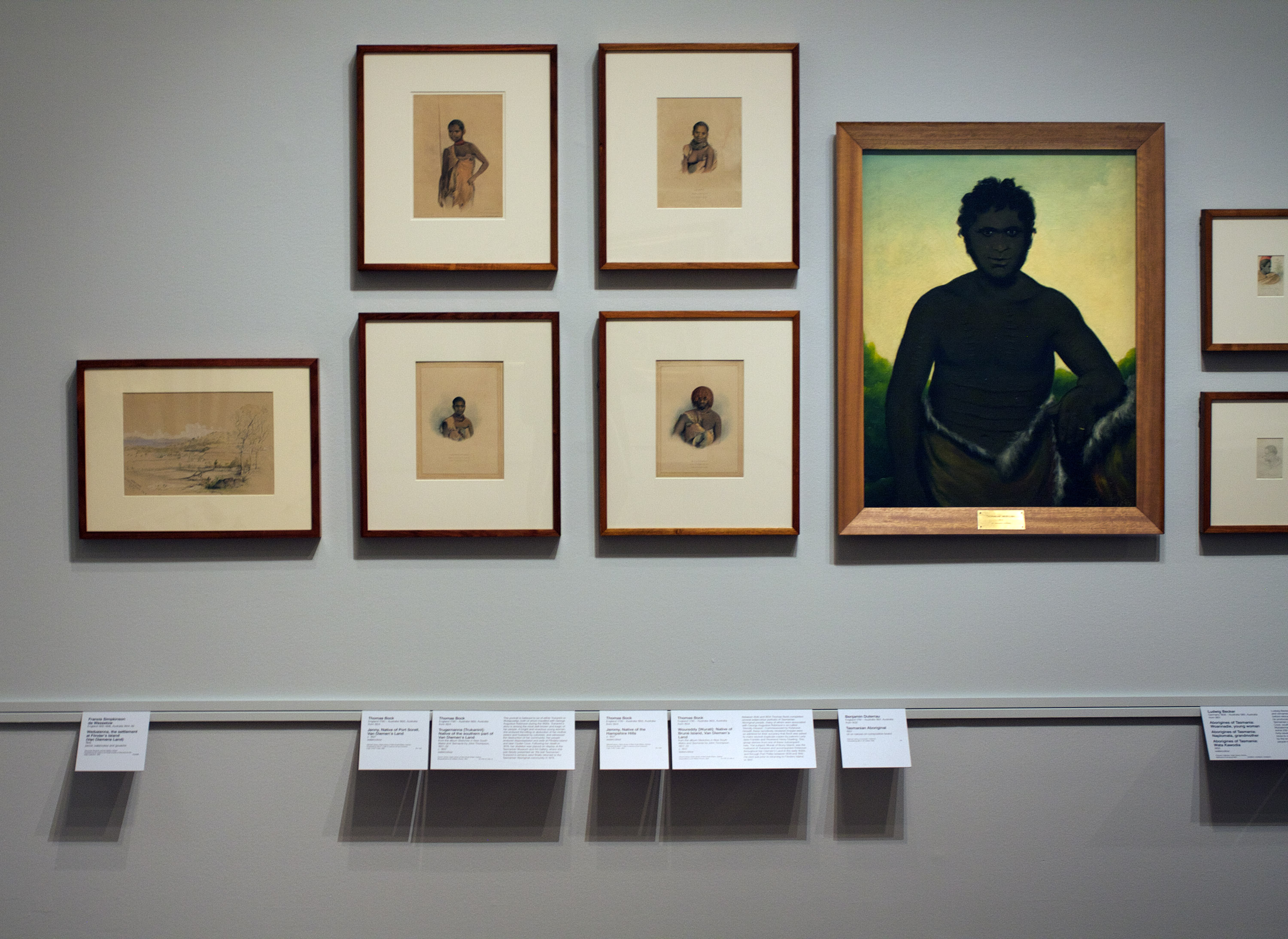
 

Benjamin Duterrau arrived in Van Diemen’s Land at the age of sixty-five as a free settler. He had planned to take up the position of drawing and music master at Ellinthrop Hall in Hobart, a fashionable school for ladies; however, this post was instead taken up by Henry Mundy. He lectured often on the importance of the fine arts in the developing colony after his arrival. Working predominantly in portraiture and occasionally in landscape, he is best known for producing the first Australian history paintings, which recorded the so-called ‘conciliation’ between Chief Protector of the Aborigines George Augustus Robinson and the Tasmanian Aboriginal people.

Exhibition text


Thomas Bock (England 1790 - Australia 1855, Australia from 1824) 'Woureddy [Wurati]: Native of Bruné Island, Van Diemen's Land' c. 1837


Thomas Bock (England 1790 – Australia 1855, Australia from 1824)
Woureddy (Wurati): Native of Bruné Island, Van Diemen’s Land
c. 1837
From the album Sketches in New South Wales and Tasmania by John Thompson, 1827-1832
watercolour
28.3 x 21cm
Dixson Library, State Library of New South Wales, Sydney
Bequeathed by Sir William Dixson, 1952


Between 1830 and 1834 Thomas Bock completed several watercolour portraits of Tasmanian Aboriginal people, many of whom were associated with George Augustus Robinson’s so-called ‘friendly mission’. Commissioned by Robinson himself, these sensitively rendered images were so admired for their accuracy that Bock was asked to make several duplicate copies by patrons Lady Jane Franklin and Reverend Henry Dowling. This group derives from one of these subsequent sets. The subject, Wurati of Bruny Island, was the husband of Trukanini and accompanied Robinson throughout Van Diemen’s Land in the early 1830s, and through Port Phillip between 1839 and 1842. He died just prior to returning to Flinders Island in 1842.

Exhibition text
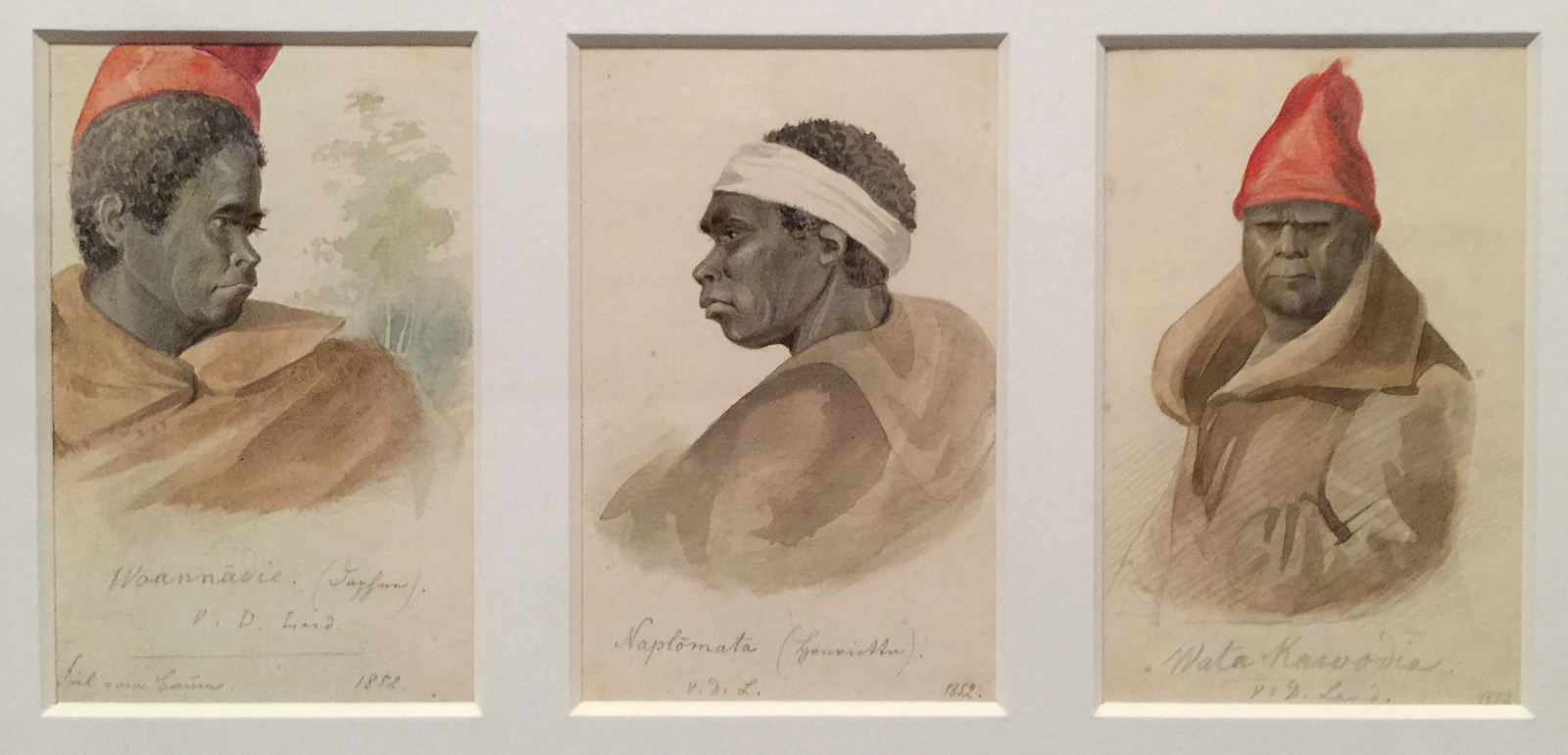
 

Installation view of the exhibition 'Colony: Australia 1770 - 1861' at NGV Australia at Federation Square, Melbourne showing Ludwig Becker's 'Aborigines of Tasmania' 1852


Installation view of the exhibition Colony: Australia 1770-1861 at NGV Australia at Federation Square, Melbourne showing Ludwig Becker’s Aborigines of Tasmania 1852
Photo: © Dr Marcus Bunyan and the National Gallery of Victoria


Ludwig Becker (Germany 1808 - Australia 1861, Australia from 1851) 'Aborigines of Tasmania: Woannadie, young woman' 1852


Ludwig Becker (Germany 1808 – Australia 1861, Australia from 1851)
Aborigines of Tasmania: Woannadie, young woman
1852
Watercolour
Pictures Collection, State Library Victoria, Melbourne
Purchased 1960


Ludwig Becker (Germany 1808 - Australia 1861, Australia from 1851) 'Aborigines of Tasmania: Naplomata, grandmother' 1852


Ludwig Becker (Germany 1808 – Australia 1861, Australia from 1851)
Aborigines of Tasmania: Naplomata, grandmother
1852
Watercolour
Pictures Collection, State Library Victoria, Melbourne
Purchased 1960


Ludwig Becker arrived in Launceston in 1851 and remained in Van Diemen’s Land for a year before relocating to Melbourne. During this time he produced small but poignant portraits of Tasmanian Aboriginal women living at Oyster Cove, south of Hobart. In 1847, the survivors of Wybalenna had returned to the mainland. Of the some 200 who were removed to Bass Strait, only forty-seven returned. By the time of Becker’s visit, close to a third of their population had died, and by the end of the decade approximately twelve people remained.

Exhibition text


Douglas T. Kilburn (English-Australian, 1811-1871) 'No title (Group of Koori men)' c. 1847


Douglas T. Kilburn (English-Australian, 1811-1871)
No title (Group of Koori men)
c. 1847
Daguerreotype; leather, wood, velvet, brass
7.5 x 6.5cm (image)
9.2 x 7.9 x 1.7cm (case)(closed)
National Gallery of Victoria, Melbourne
Purchased from Admission Funds, 1983
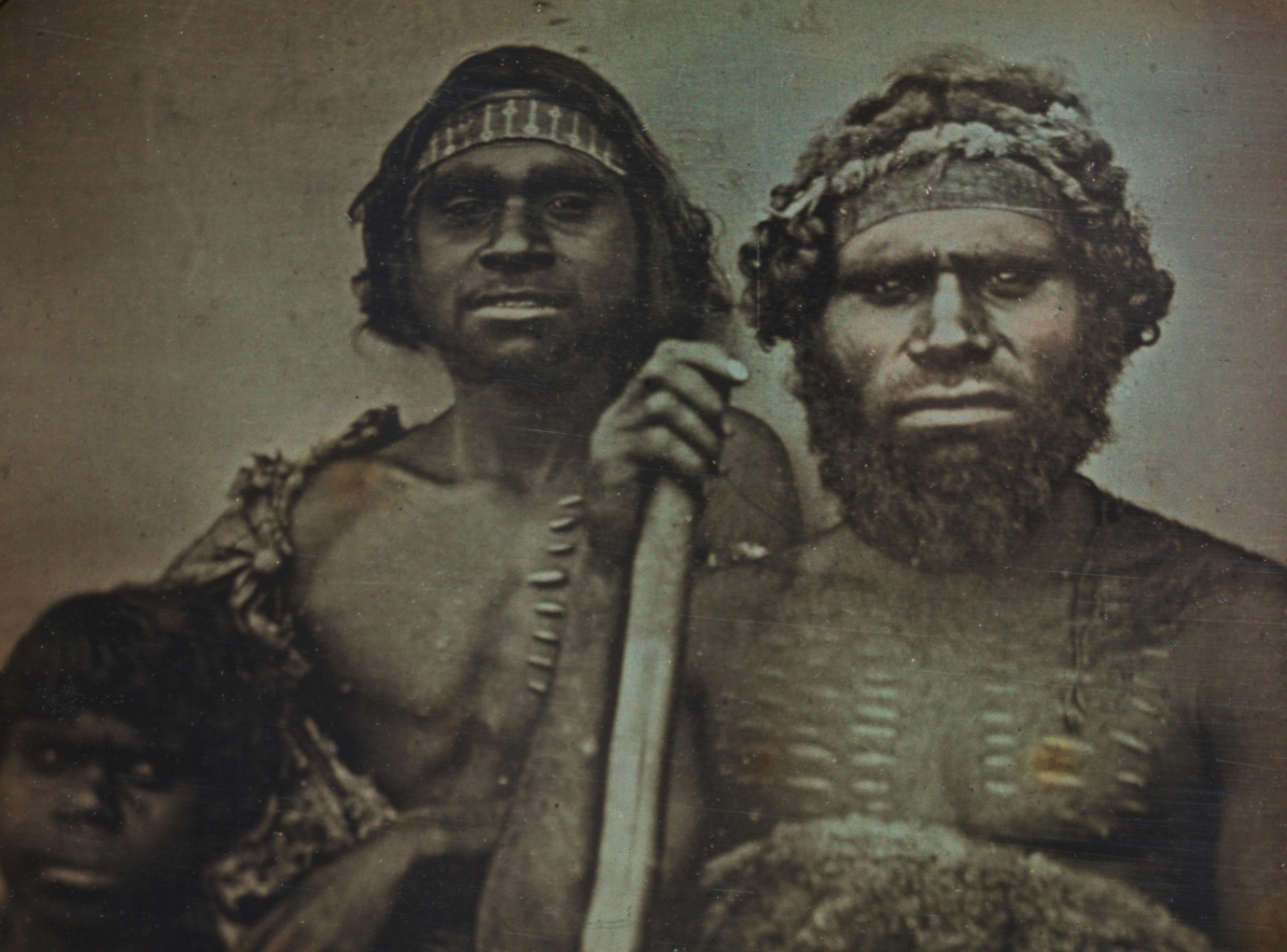
 

Douglas T. Kilburn (English-Australian, 1811-1871) 'No title (Group of Koori men)' c. 1847 (detail)


Douglas T. Kilburn (English-Australian, 1811-1871)
No title (Group of Koori men) (detail)
c. 1847
Daguerreotype; leather, wood, velvet, brass
7.5 x 6.5 cm (image)
9.2 x 7.9 x 1.7 cm (case)(closed)
National Gallery of Victoria, Melbourne
Purchased from Admission Funds, 1983


As a way of attracting attention to his newly opened business Douglas Kilburn took at least eight daguerreotypes of Aboriginal people in the lands of the Kulin nation. As a result of the nineteenth-century belief that the Aboriginal people were doomed to annihilation, Kilburn intended the images as ethnographic studies rather than individual portraits; nevertheless, his unnamed sitters project a proud and dignified presence. His photographs were popular with local artists such as Eugene von Guérard and John Skinner Prout, who copied them, and they also reached an international audience when they were used as the basis for wood engravings in William Westgarth’s Australia Felix in 1848, Nordisk Penning-Magazin in 1849 and the Illustrated London News in 1850.

Exhibition text


The Port Phillip District

In 1835, Melbourne was established on the Country of the Kulin nation on the northern bank of Birrarung, the ‘river of mists and shadows’. Contact between Indigenous peoples and European explorers and raiding groups of sealers had begun prior to the arrival of hopeful colonists from Van Diemen’s Land. They were soon followed by John Pascoe Fawkner and John Batman, each leading separate parties of settlers keen to secure acreage on the fertile lands found in what was soon to be known as the Port Phillip District.

In the early years Melbourne went through a period of rapid development, quickly becoming a progressive provincial town. In 1839 a visitor noted: ‘When I was here three years ago there were but two houses of any note whatever … Now I find a town occupying an area of nearly a mile square, on which are some hundreds of houses, and many of them spacious and well-built edifices’. In tandem with the settlement of Melbourne, pastoral expansion devastated Aboriginal communities already severely affected by disease. Dispossessed of their traditional lands and forced from Country and the food sources that had long sustained them, the remaining populations faced starvation.

Text from the NGV website


Unknown (New South Wales / Victorian Aboriginal active 19th century) 'Club' 19th century (installation view)


Unknown (New South Wales / Victorian Aboriginal active 19th century)
Club
19th century
Wood
Koorie Heritage Trust, Melbourne
Photo: © Dr Marcus Bunyan and the National Gallery of Victoria


Douglas T. Kilburn (English-Australian, 1811-1871) 'No title (Group of Koori women)' 1847


Douglas T. Kilburn (English-Australian, 1811-1871)
No title (Group of Koori women)
1847
Daguerreotype; glass, brass, gold
6.6 x 5.4cm (image)
National Gallery of Victoria, Melbourne
Purchased, 1999


Douglas T. Kilburn (English-Australian, 1811-1871) 'No title (Group of Koori women)' 1847 (detail)


Douglas T. Kilburn (English-Australian, 1811-1871)
No title (Group of Koori women) (detail)
1847
Daguerreotype; glass, brass, gold
6.6 x 5.4 cm (image)
National Gallery of Victoria, Melbourne
Purchased, 1999
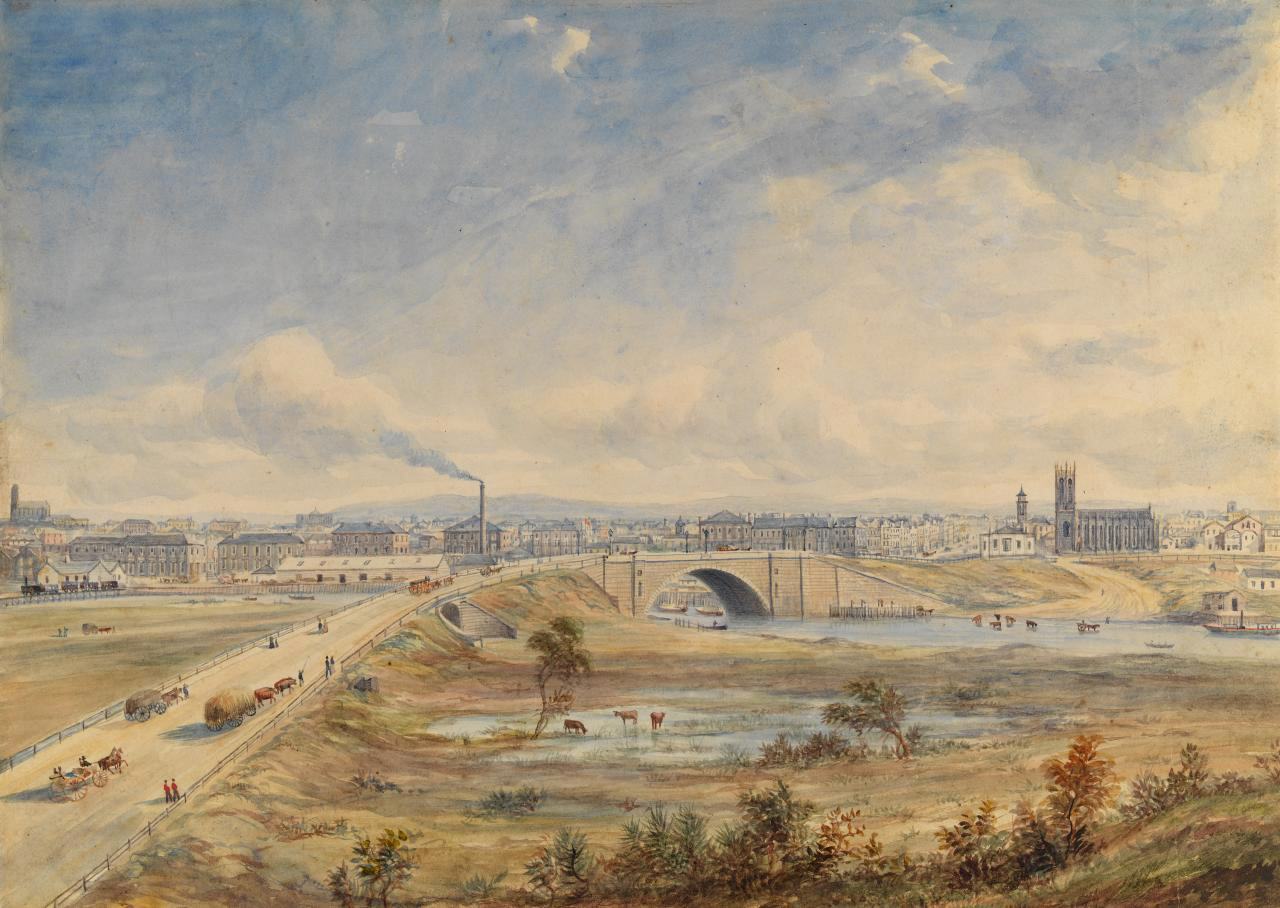
 

Henry Gritten (England 1818 - Australia 1873, Australia from 1853) 'Melbourne from the south bank of the Yarra' 1856


Henry Gritten (England 1818 – Australia 1873, Australia from 1853)
Melbourne from the south bank of the Yarra
1856
Watercolour over traces of pencil
(25.6 x 35.8cm) (image)
National Gallery of Victoria, Melbourne
Gift of John H. Connell, 1914
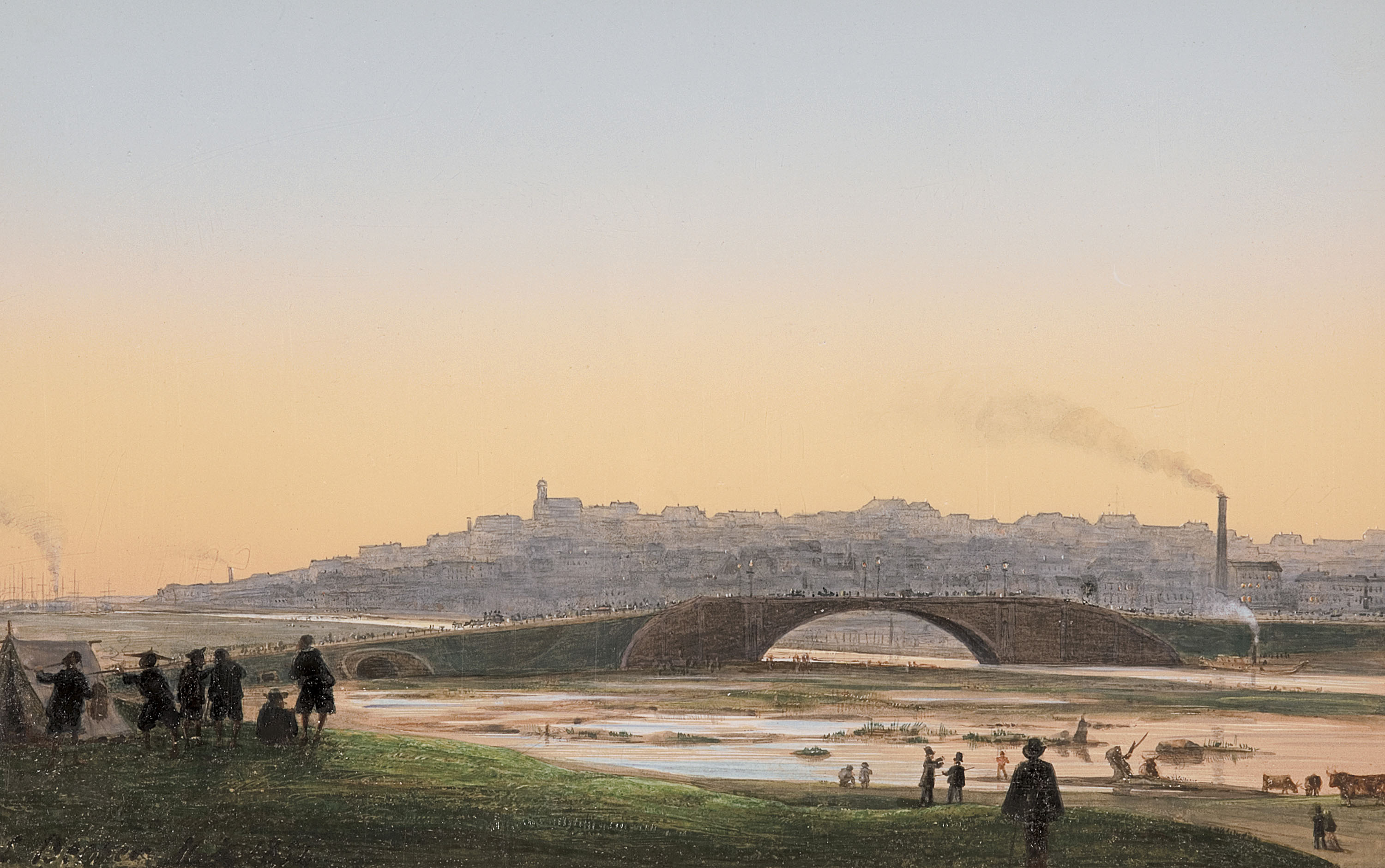
 

Ludwig Becker (Germany 1808 - Australia 1861, Australia from 1851) 'Melbourne from across the Yarra' 1854


Ludwig Becker (Germany 1808 – Australia 1861, Australia from 1851)
Melbourne from across the Yarra
1854
Tempera and watercolour on gesso on cardboard
Art Gallery of South Australia, Adelaide
V. K. Burmeister Bequest Fund and South Australian Government Grant 1990


Robert Dowling (England 1827-1886, Australia 1834-1857, 1884-1886) 'Jane Sceales with daughters, Mary Jane and Hilda' c. 1856 (installation view)


Robert Dowling (England 1827-1886, Australia 1834-1857, 1884-1886)
Jane Sceales with daughters, Mary Jane and Hilda (installation view)
c. 1856
Oil on canvas
National Gallery of Australia, Canberra
Purchased 2016. Acquired through family of Ella Lewis (nee Hood), granddaughter of Jane Hood (nee Sceales)
Photo: © Dr Marcus Bunyan and the National Gallery of Victoria


Jane Sceales and her daughters lived at Merrang, the pastoral run next to Minjah, owned by Joseph Ware. This is one of two known mourning portraits commissioned by Jane after the death of her husband Adolphus Sceales in 1855, produced while Robert Dowling was staying and working at Minjah. Scottish-born Jane is depicted in mourning dress, a teal and black tartan bow knotted elegantly at her collar. The skirt of her elder daughter, Mary Jane, is trimmed in the same fabric. By the close of 1856, Jane had remarried Robin Hood, becoming the matriarch of one of the most prominent families of the Western District.

Exhibition text
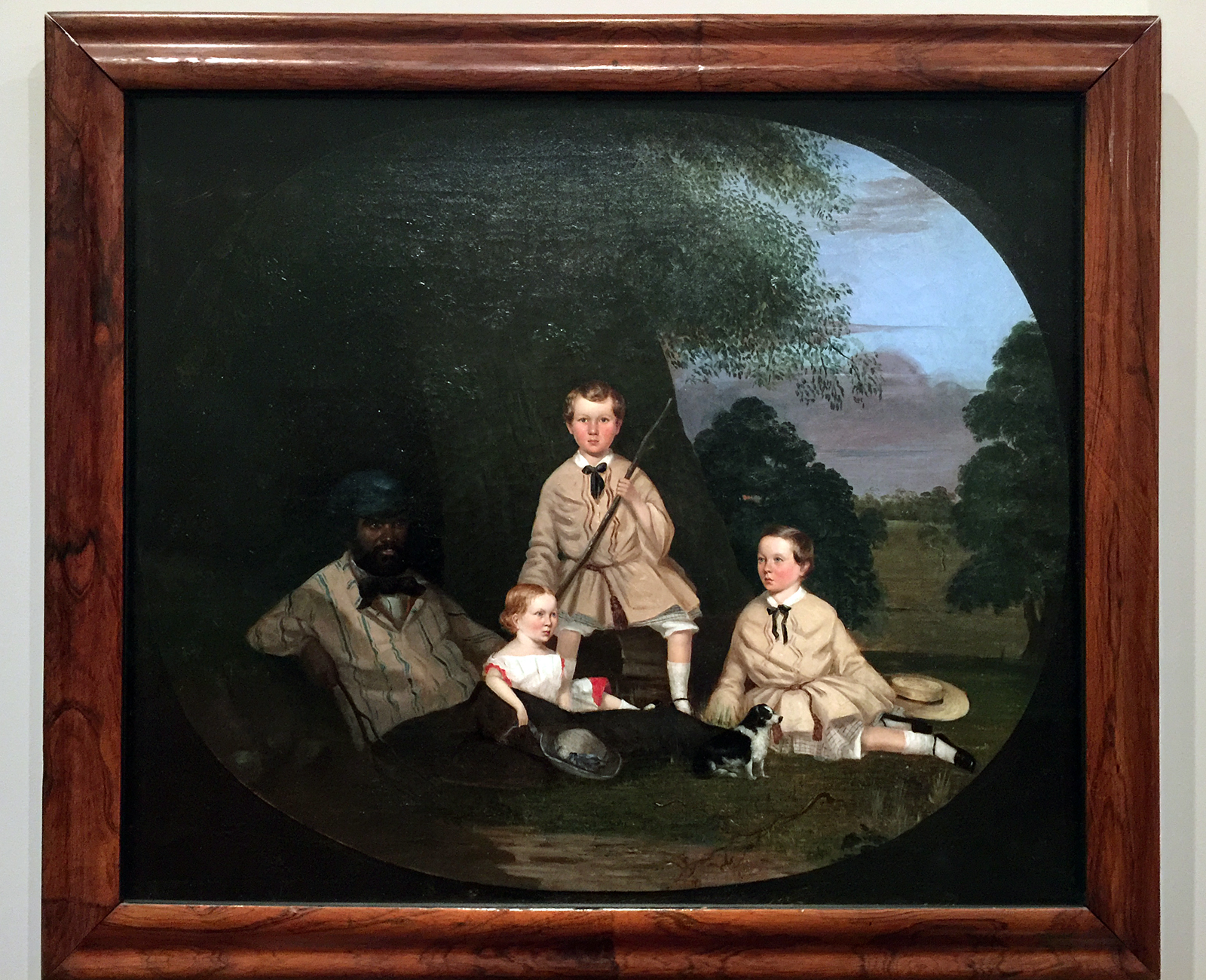
 

Robert Dowling (England 1827-1886, Australia 1834-1857, 1884-1886) 'Masters George, William and Miss Harriet Ware with the Aborigine Jamie Ware' 1856 (installation view)


Robert Dowling (England 1827-1886, Australia 1834-1857, 1884-1886)
Masters George, William and Miss Harriet Ware with the Aborigine Jamie Ware (installation view)
1856
Oil on canvas
National Gallery of Australia, Canberra
Eleanor M. Borrow Bequest, 2007
Photo: © Dr Marcus Bunyan and the National Gallery of Victoria


Robert Dowling (England 1827-1886, Australia 1834-1857, 1884-1886) 'Masters George, William and Miss Harriet Ware with the Aborigine Jamie Ware' 1856


Robert Dowling (England 1827-1886, Australia 1834-1857, 1884-1886)
Masters George, William and Miss Harriet Ware with the Aborigine Jamie Ware
1856
Oil on canvas
National Gallery of Australia, Canberra
Eleanor M. Borrow Bequest, 2007


In the late 1830s the young brothers Jeremiah, Joseph and John Ware, the eldest just twenty years of age, had played a major role in the settlement of the Western District in Victoria. By 1856 they were established and notable figures in the colony and had become significant patrons of the fine arts.

Robert Dowling’s family portrait Masters George, William, and Miss Harriet Ware and the Aborigine Jamie Ware is set in the grounds of pastoralist Joseph Ware’s property, Minjah. The group is headed by the eldest son, George, who bears a staff, the Biblical symbol of leadership often associated with Moses. To the right sits his younger brother, William, on the left is their sister Harriet and the Mopor youth from Spring Creek who took the family name, Jamie Ware. The portrait has remained with the descendants of the Ware family since its commission and is a poignant depiction of interracial accord.

There is an obvious affection between Jamie and Harriet: he reclines comfortably while the young girl drapes her arm casually over his leg. The absence of Jamie’s employers – the children’s parents, John and Barbara Ware, gives added resonance to the work, revealing the trust and intimate position Jamie held in the family. The depiction of the youth in European dress rather than as an anthropological study expresses the family’s concern for harmonious relations with Indigenous people.

Jamie’s inclusion is also symbolic of the Ware family’s awareness of the traumatic post-contact history experienced by Indigenous Australians, an understanding that was not generally shared in mid-nineteenth-century Victoria. By the 1850s it was reported that Tasmania’s Indigenous population had been decimated, which would have been a significant issue for Dowling and the Wares who had all migrated from the southern-most colony. Dowling painted a number of works that were intended as memorials, such as the NGV’s Tasmanian Aborigines, 1856, and Warrnambool Art Gallery’s Minjah in the old time, 1856. While these works look to the past and convey a sense of mourning, the Ware family portrait looks positively towards a more harmonious future and therefore is a transformative work to enter the NGV’s nineteenth-century Australian collection.

Masters George, William, and Miss Harriet Ware and the Aborigine Jamie Ware joins a number of works in the NGV collection that share a Ware family provenance. Joseph Ware commissioned six works from Dowling between 1855 and 1856, and the NGV collection contains works acquired by his younger brother, John Ware, that were donated in 2004 as part of the Joseph Brown Collection. These include Eugène von Guérard’s Spring in the valley of the Mitta Mitta with the Bogong Ranges in the distance, 1863, and the homestead portrait of John Ware’s Yalla-y-Poora, 1864.

Dowling continued to receive Ware family patronage after he left Australia in 1857; his portrait Miss Annie Ware, 1882, the daughter of John Ware, being commissioned during the sitter’s European travels.

Humphrey Clegg, Assistant Curator, Australian Art, NGV (in 2007)


Installation view of the exhibition 'Colony: Australia 1770 - 1861' at NGV Australia at Federation Square, Melbourne with at centre middle, Martha Berkeley's 'Georgina, Emily and Augusta Rose' c. 1848


Installation view of the exhibition Colony: Australia 1770-1861 at NGV Australia at Federation Square, Melbourne with at centre middle, Martha Berkeley’s oil on metal Georgina, Emily and Augusta Rose c. 1848
Photo: © Dr Marcus Bunyan and the National Gallery of Victoria


The Province of South Australia 1836

As early as 1829 the development of a convict‑free colony, home to settlers and migrants from Britain, was mooted. Seven years later, with regal approval, the Province of South Australia was officially proclaimed. Nine ships carrying free settlers to the colony set sail from England in 1836. They landed at Kangaroo Island and Holdfast Bay and finally settled on the banks of the Torrens River, where the township of Adelaide was established. With a number of trained artists among the early colonists, South Australia rapidly secured a position comparable to that of Hobart as a sophisticated centre for the visual arts.

These artists documented the earliest years of the colony and the first settlers. In 1845, Australia’s first solo exhibition was held by George French Angas, and two years later Adelaide artists held a group exhibition in the new colony. The discovery of gold in Victoria led to an exodus to the eastern colonies, slowing but not halting activity in South Australia.

The Province of South Australia was established on the land of the Kaurna people; the South Australia Act of 1834 included a guarantee of the rights of ‘any Aboriginal Natives’ and their descendants to lands they ‘now actually enjoy’. Despite these worthy ambitions, colonial expansion did ultimately dispossess and marginalise Aboriginal people.

Text from the NGV website


Alexander Schramm (Germany 1813 - Australia 1864, Australia from 1849) 'A scene in South Australia' c. 1850 (installation view)


Alexander Schramm (Germany 1813 – Australia 1864, Australia from 1849)
A scene in South Australia (installation view)
c. 1850
Oil on canvas
Art Gallery of South Australia, Adelaide
South Australian Government Grant 1982
Photo: © Dr Marcus Bunyan and the National Gallery of Victoria
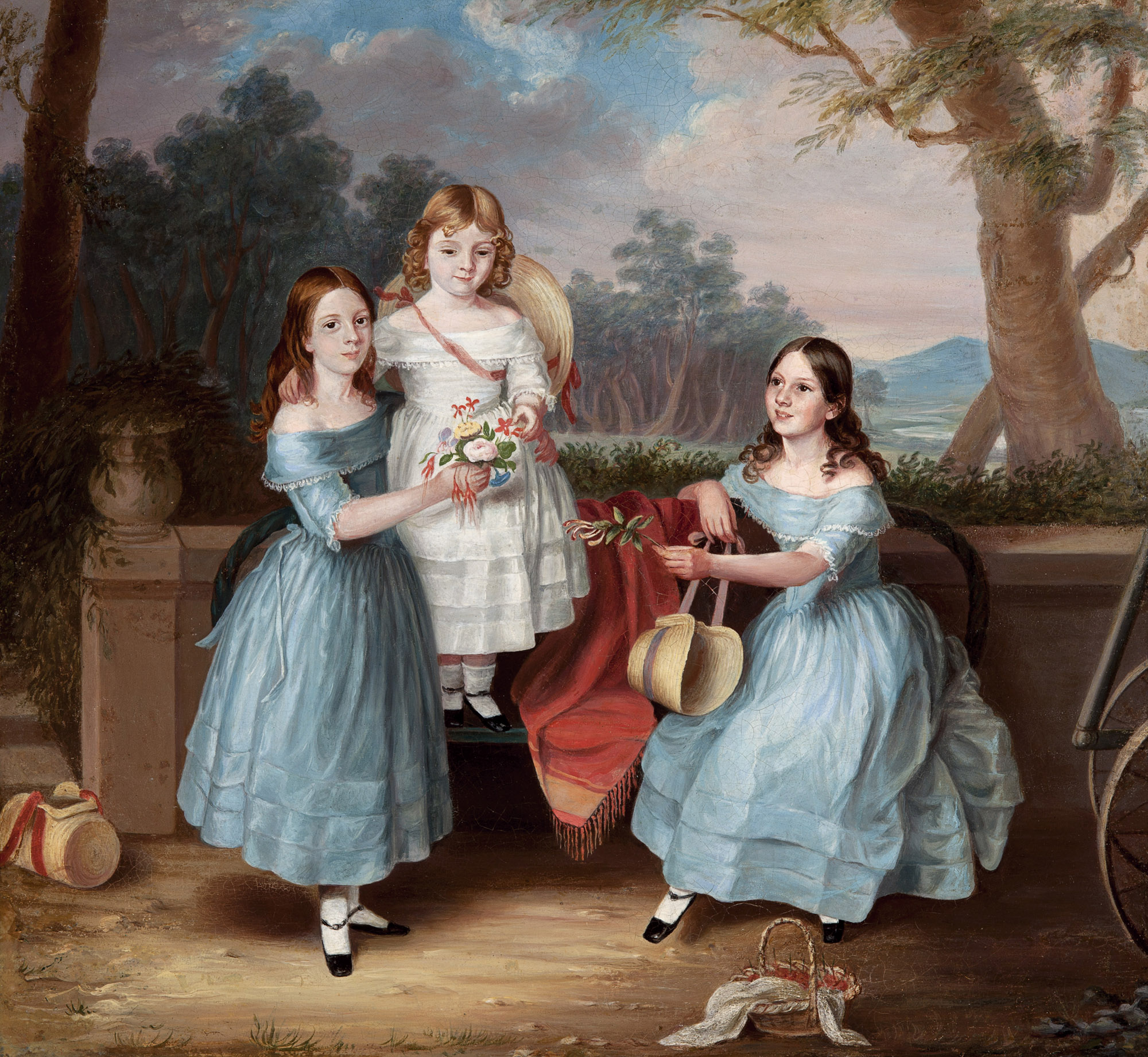
 

Martha Berkeley (England 1813 - Australia 1899, Australia from 1837) 'Georgina, Emily and Augusta Rose' c. 1848


Martha Berkeley (England 1813 – Australia 1899, Australia from 1837)
Georgina, Emily and Augusta Rose
c. 1848
Oil on metal
36.4 x 39.5cm
Art Gallery of South Australia, Adelaide
M.J.M. Carter AO Collection 2007
Given in memory of Di Townsend, Betty McIlwham and fellow Gallery Guides’ education programs for children


Martha Berkeley’s painting practice encompassed landscapes and views of the infant settlement, flower studies and portraiture. She depicted her family on several occasions and her portraits of her husband Charles, sister Theresa, brother-in-law and children are among her finest paintings. This charming group portrait presents her three daughters against the backdrop of their home in Adelaide. Berkeley adopts a format typical of Regency depictions of children; the youthful trio are happily engaged in the wholesome activity of posy-making, with the eldest, Augusta Rose, looking towards the viewer, as though appealing to them to join in.

Exhibition text


S.T. Gill (England 1819 - Australia 1880, Australia from 1839) 'Port Adelaide looking north along Commercial Road' 1847


S.T. Gill (England 1819 – Australia 1880, Australia from 1839)
Port Adelaide looking north along Commercial Road
1847
Watercolour
20.3 x 32cm
Art Gallery of South Australia, Adelaide
Morgan Thomas Bequest Fund 1923


S.T. Gill (England 1819 - Australia 1880, Australia from 1839) 'Country NW of tableland, Aug. 22 1846' 1846


S.T. Gill (England 1819 – Australia 1880, Australia from 1839)
Country NW of tableland, Aug. 22 1846
1846
Watercolour
19 x 30.7cm
National Library of Australia, Canberra
Gift of her Majesty Queen Elizabeth II to the Australian Government, 1956


Along with government-supported expeditions, individuals also sought to discover new stock routes and pastures. In 1846 John Ainsworth Horrocks organised one such venture to explore beyond Lake Torrens, and S. T. Gill volunteered to accompany the party, with goats for food and a pack camel, named Harry. The trip ended abruptly when Horrocks accidentally shot himself at a desolate salt lake – he died later at his property in the Clare Valley. Gill subsequently painted a series of ‘faithful scenic representations’ documenting their tragic journey and exhibited them in Adelaide in 1847, providing the public with an accurate indication of South Australia’s dry interior.

Exhibition text


George French Angas (England 1822-1886, Australia 1844-1845, 1850-1863) 'Encounter Bay looking south' 1844


George French Angas (England 1822-1886, Australia 1844-1845, 1850-1863)
Encounter Bay looking south
1844
Watercolour
26.2 x 35.9cm
Art Gallery of South Australia, Adelaide
Bequest of J. Angas Johnson 1902


George French Angas was the eldest son of one of the founding members of the South Australian Land Company, formed to develop a settlement in South Australia, and came to Australia as an experienced naturalist, artist and author. He travelled widely throughout South Australia, to the Murray River and down to Lake Coorong, sketching the countryside, and the customs and dwellings of the Aboriginal people he met, as well as spending time in New Zealand. Angas exhibited his watercolours in Adelaide and Sydney and upon his return to London, where his book South Australia Illustrated, with impressive full-page coloured lithographs, was published.

Exhibition text


Melbourne 1851-1861

The township of Melbourne grew steadily as migrants from Britain and other European countries sought economic opportunities and political and religious freedom. In 1851, the Port Phillip District became an independent colony and was named Victoria in honour of the Queen. The town’s fortunes were further transformed that year when gold was discovered. Victoria was the richest source of gold in Australia, and consequently experienced the greatest levels of growth and change. The population exploded as enthusiastic and optimistic prospectors poured in from around the world with the hope of making their fortunes. Despite enormous social turmoil and environmental destruction, gold propelled Melbourne into an unprecedented phase of expansion and prosperity.

This had a profound impact on the arts and cultural life in colonial Australia. The desire to replicate the cultural institutions of European capitals reached new heights and wealth from gold enabled these aspirations to be realised, with the establishment of a university, library and museum. In 1861, in a moment of great significance and pride, the Museum of Art – Australia’s first art museum, later known as the National Gallery of Victoria – opened at the Melbourne Public Library on Swanston Street.

Text from the NGV website


Installation view of the exhibition 'Colony: Australia 1770 - 1861' at NGV Australia at Federation Square, Melbourne

Installation view of the exhibition 'Colony: Australia 1770 - 1861' at NGV Australia at Federation Square, Melbourne

Installation view of the exhibition 'Colony: Australia 1770 - 1861' at NGV Australia at Federation Square, Melbourne with to the left, George Cavenagh's 'Glorious News! Separation at last!' 1850; and at centre top in the same image, Henry Burn's 'Swanston Street from the Bridge' 1861


Installation views of the exhibition Colony: Australia 1770-1861 at NGV Australia at Federation Square, Melbourne with to the left in the bottom image, George Cavenagh’s Glorious News! Separation at last! 1850; and at centre top in the same image, Henry Burn’s oil on canvas Swanston Street from the Bridge 1861
Photos: © Dr Marcus Bunyan and the National Gallery of Victoria


George Cavenagh (editor and publisher) (India 1808 - Australia 1869, Australia from 1825) 'Glorious News! Separation at last!' Issued with the Melbourne Morning Herald 11 November 1850 (installation view)


George Cavenagh (editor and publisher) (India 1808 – Australia 1869, Australia from 1825)
Glorious News! Separation at last! (installation view)
Issued with the Melbourne Morning Herald
11 November 1850
Letterpress on buff paper
Pictures Collection, State Library Victoria, Melbourne
Photo: © Dr Marcus Bunyan and the National Gallery of Victoria


From the establishment of Melbourne in 1835, its colonial inhabitants campaigned for it to be a separate colony, rather than a distant district within New South Wales, controlled by the Sydney-based governor and legislative council. A public campaign began in 1839 and petitions were repeatedly sent to London. After many delays, on 11 November 1850 news was received that independence was to be granted. A jubilant population celebrated with fireworks, parades, balls and a three-day public holiday. Further festivities were held when the colony was formally proclaimed on 1 July 1851, and the first parliament sat in November of that year.

Exhibition text


Henry Burn (England c. 1807 - Australia 1884, Australia from 1853, died 1884) 'Swanston Street from the Bridge' 1861


Henry Burn (England c. 1807 – Australia 1884, Australia from 1853, died 1884)
Swanston Street from the Bridge
1861
Oil on canvas
71.8 x 92.2cm
National Gallery of Victoria, Melbourne
Gift of John H. Connell, 1914


Painted just twenty-six years after foundation, Henry Burn’s view of young Melbourne looks north from the Yarra towards the centre of the city. It reveals a number of identifiable landmarks including the original St Paul’s Church; the coroner’s office and Registry of Births, Deaths and Marriages, at what is now Federation Square; and Johnson’s Bridge Hotel, now the Young & Jackson Hotel.

Exhibition text


Unknown, Australia. 'Dress' c. 1855


Unknown, Australia
Dress (see installation photo below right)
c. 1855
Cotton, silk, metal, mother-of-pearl, baleen
152.0cm (centre back)
34.5cm (waist, flat)
National Gallery of Victoria, Melbourne
Gift of Mrs Michael Parker, 1983

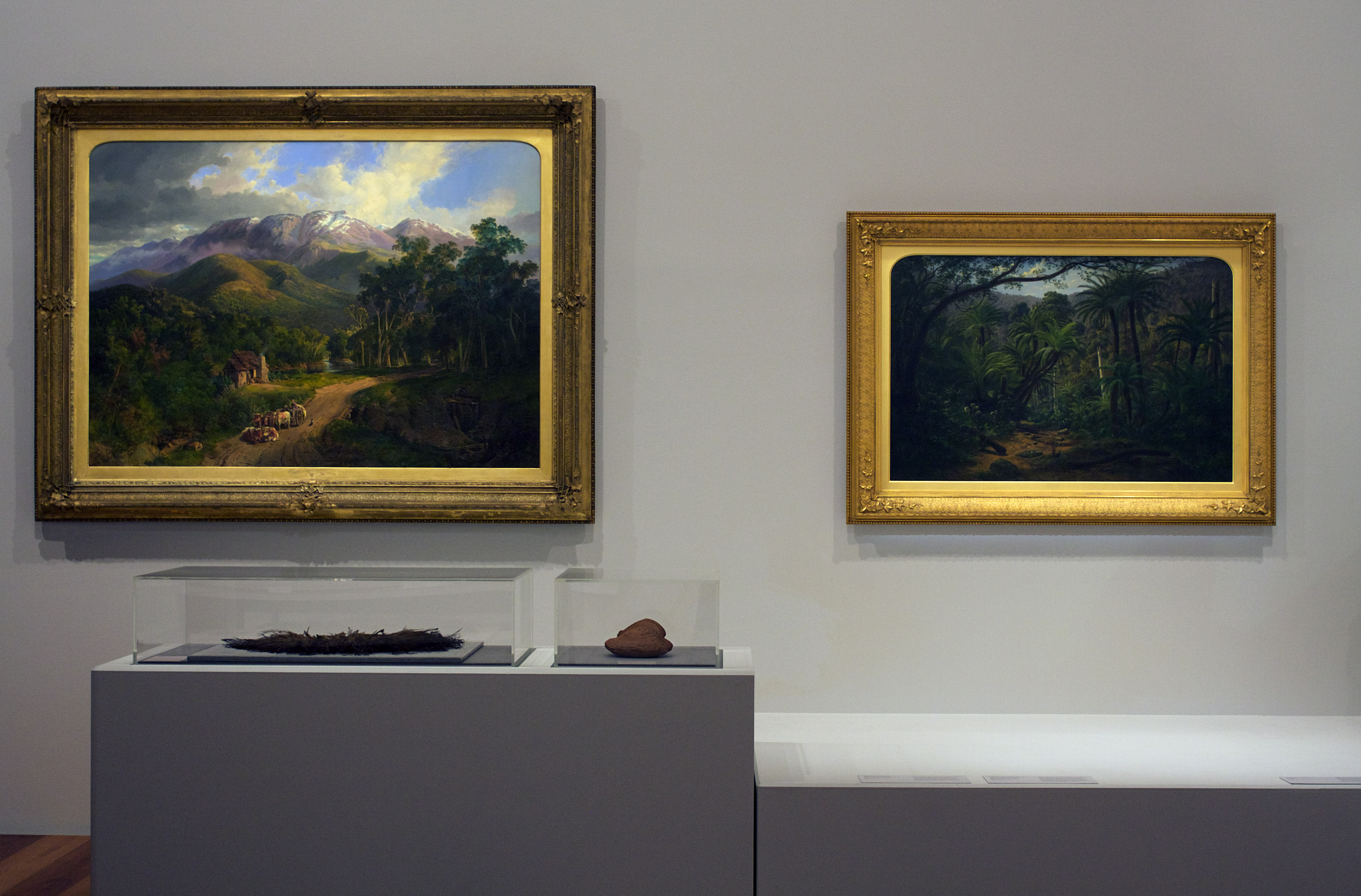
 

Installation view of the exhibition 'Colony: Australia 1770 - 1861' at NGV Australia at Federation Square, Melbourne with at centre right, Eugene von Guérard's 'Ferntree Gully in the Dandenong Ranges' 1857

Installation view of the exhibition 'Colony: Australia 1770 - 1861' at NGV Australia at Federation Square, Melbourne with at right, Eugene von Guérard's 'Ferntree Gully in the Dandenong Ranges' 1857


Installation views of the exhibition Colony: Australia 1770-1861 at NGV Australia at Federation Square, Melbourne with at centre right, Eugene von Guérard’s oil on canvas Ferntree Gully in the Dandenong Ranges 1857
Photos: © Dr Marcus Bunyan and the National Gallery of Victoria


Eugene von Guérard (Austria 1811 - England 1901, Italy 1830-1838, Australia 1852-1882, Germany 1838-1852, 1882-1891, England from 1891) 'Ferntree Gully in the Dandenong Ranges' 1857


Eugene von Guérard (Austria 1811 – England 1901, Italy 1830-1838, Australia 1852-1882, Germany 1838-1852, 1882-1891, England from 1891)
Ferntree Gully in the Dandenong Ranges
1857
Oil on canvas
92 x 138cm
National Gallery of Australia, Canberra
Gift of Dr Joseph Brown AO OBE 1975


Within five years of arriving in Victoria to try his luck on the Ballarat goldfields, Eugene von Guérard had undertaken several trips to sketch remote wilderness regions of Victoria, Tasmania and South Australia. These meticulous studies were translated into sublime panoramic vistas of volcanic plains and mountain ranges, and primordial bushland views, which melded his romantic European sensibility with scientific intensity. In early 1857 he returned a second time to the Dandenong Ranges east of Melbourne and later completed this scene in his studio. This celebration of nature was an immediate local success and became an important image that was reproduced in subsequent drawings and engravings.

Exhibition text


Daniel Thomas discusses Eugene Von Guérard’s Ferntree Gully in the Dandenong Ranges
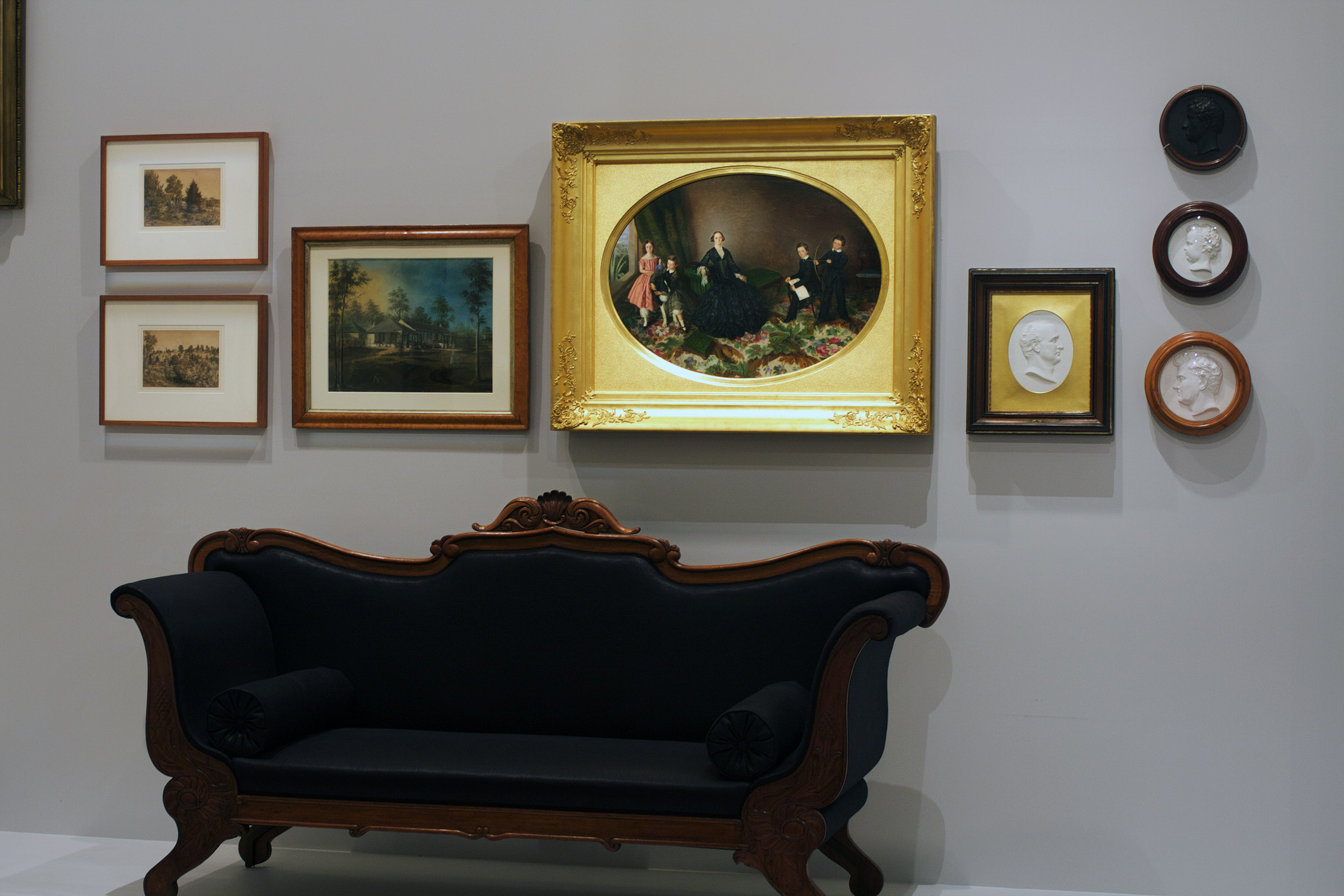
 

Installation view of the exhibition 'Colony: Australia 1770 - 1861' at NGV Australia at Federation Square, Melbourne with at centre 'Sofa' 1840s


Installation view of the exhibition Colony: Australia 1770-1861 at NGV Australia at Federation Square, Melbourne with at centre Sofa 1840s
Photo: © Dr Marcus Bunyan and the National Gallery of Victoria


Unknown (Victoria / South Australia) 'Sofa' 1840s


Unknown (Victoria / South Australia)
Sofa
1840s
Red Cedar (Toona ciliata), upholstery, (other materials)
National Gallery of Victoria, Melbourne
Gift of Michael and Traudl Moon, 1996


The success of German immigrants in South Australia saw the establishment of the German Immigration Committee in Melbourne in 1849 to encourage their settlement in Victoria. By the close of the decade, German immigrants had settled near Geelong, establishing Germantown, now the suburb of Grovedale, and by the 1850s were expanding into the Western District. It is likely this sofa was produced by German makers in either of these South Australian or Victorian communities. Its sweeping curves recall the architectural forms of the German Biedermeier style, but its lines and elaborate carved ornamentation reveal more Classical influences.

Exhibition text


Further images

Tommy McRae (Kwat Kwat/Wiradjuri) (c. 1836-1901) 'Ceremony; hunting and fishing' 1860


Tommy McRae (Kwat Kwat/Wiradjuri) (c. 1836-1901)
Ceremony; hunting and fishing
1860
Pen and ink on blue paper
Pictures Collection, State Library Victoria, Melbourne
Accessioned c. 1931


As a consequence of colonisation Tommy McRae created cross-cultural pen and ink drawings on paper as a dialogue with the colonisers and a means of recording a culture often subjected to change and silencing. On a single sheet, McRae creates a holistic picture of his rich culture, which includes two distinct corroborees, a eucalypt with bird perched atop its foliage and a hunting story of four emus being stalked by men in camouflage while another spears a large fish. Two lines of male dancers are freely sketched in silhouette upon Country, indicated by a light tangle of lines.

Exhibition text
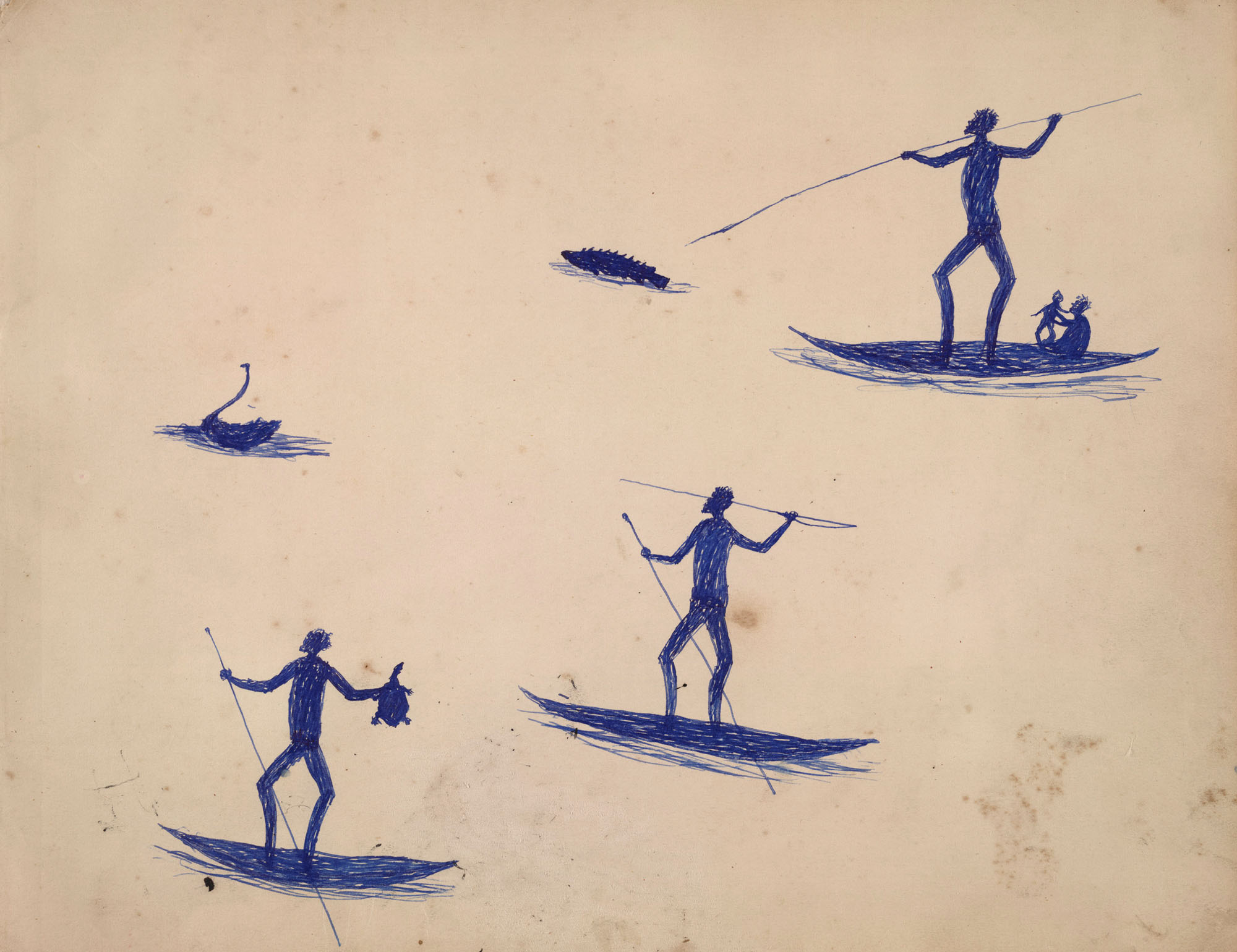
 

Tommy McRae (Kwat Kwat/Wiradjuri) (c. 1836-1901) Page from 'Sketchbook' c. 1891 Sketchbook

Tommy McRae (Kwat Kwat/Wiradjuri) (c. 1836-1901) Page from 'Sketchbook' c. 1891 Sketchbook

Tommy McRae (Kwat Kwat/Wiradjuri) (c. 1836-1901) Page from 'Sketchbook' c. 1891 Sketchbook


Tommy McRae (Kwat Kwat/Wiradjuri) (c. 1836-1901)
Pages from Sketchbook
c. 1891
Sketchbook: pen and blue ink, 26 pages, paper and cardboard cover, stitched binding
24.4 x 31.2cm (image and sheet)
24.4 x 31.2cm (page)
24.4 x 31.2 x 1cm (closed)
24.4 x 62.4 x 0.5cm (open)
National Gallery of Victoria, Melbourne
Purchased, 2001
Purchased with the assistance of Ian Hicks AM, John Higgins and two anonymous donors, 2008


The Ian Potter Centre: NGV Australia

Federation Square
Corner of Russell and 
Flinders Streets, Melbourne

Opening hours:
Daily 10am – 5pm

National Gallery of Victoria website

LIKE ART BLART ON FACEBOOK

Back to top

Review: ‘All the better to see you with: Fairy tales transformed’ at The Ian Potter Museum of Art, The University of Melbourne

Exhibition dates: 13th January – 3rd March, 2018

Curator: Samantha Comte

Artists: Broersen and Lukács, Kate Daw, Peter Ellis, Dina Goldstein, Mirando Haz, Vivienne Shark Le Witt, Amanda Marburg, Tracey Moffatt, Polixeni Papapetrou, Patricia Piccinini, Paula Rego, Lotte Reiniger, Allison Schulnik, Sally Smart, Kiki Smith, Kylie Stillman, Tale of Tales, Janaina Tschäpe, Miwa Yanagi, Kara Walker and Zilverster (Goodwin and Hanenbergh).

Review synposis: Simply put, this is the best local exhibition I have seen this year. A must see before it closes.


Polixeni Papapetrou (Australian, 1960-2018) 'Hanging Rock 1900 #3' 2006 from the exhibition 'All the better to see you with: Fairy tales transformed' at The Ian Potter Museum of Art, The University of Melbourne, Jan - March, 2018


Polixeni Papapetrou (Australian, 1960-2018)
Hanging Rock 1900 #3
2006
Pigment ink print
105 x 105cm
Courtesy the artist, Michael Reid Gallery, Sydney + Berlin and Jarvis Dooney Galerie, Berlin


Oh my, what big teeth you have! Wait just a minute, they need a good clean and they’re all crooked and subverted (or a: how well-known stories are turned on their head and b: how real histories become fantasies, and how fantasies are reimagined)


This is going to be the shortest review in the known universe. Just one word

SUPERLATIVE


Every piece of artwork in this extraordinary, quirky, spellbinding exhibition (spread over the three floors of the The Ian Potter Museum of Art at The University of Melbourne) is strong and valuable to the investigation of the overall concept, that of fairy tales transformed.

The hang, the catalogue, and the mix of a: international and local artists; b: historical and contemporary works; and c: animation, video, gaming, sculpture, photography, painting, drawing and other art forms – is dead set, spot on.

There are too many highlights, but briefly my favourites were the historical animations of Lotte Reiniger; the painting Born by Kiki Smith which adorns the catalogue cover; the theatrical tableaux of Polixeni Papapetrou; the mesmerising video art of Allison Schulnik; and the subversive etchings of both Peter Ellis and Mirando Haz. But really, every single artwork had something interesting and challenging to say about the fabled construction of fairy tales and their place in the mythic imagination, a deviation from the normative, patriarchal telling of tales.

My only regret, that a: there hadn’t been another three floors of the exhibition; b: that there was only one work by Kiki Smith; and c: that there were not another set of disparate voices other than the feminine and black i.e. transgender, gay, disabled – other artists (if they exist?) that were working with this concept.

Simply put, this is the best local exhibition I have seen this year. A must see before it closes.

Dr Marcus Bunyan


Many thankx to The Ian Potter Museum of Art for allowing me to publish the photographs in the posting. Please click on the photographs for a larger version of the image. Installation photographs by Christian Capurro.


All the better to see you with: Fairy tales transformed, the Ian Potter Museum of Art’s 2017 summer show, traces the genre of the fairy tale, exploring its function in contemporary society. The exhibition presents contemporary art work alongside a selection of key historical fairy tale books that provide re-interpretations of the classic fairy tales for a 21st-century context, including Little Red Riding HoodHansel and Gretel and The Little Mermaid.

Ground floor


Installation view of the exhibition 'All the better to see you with: Fairy tales transformed' at The Ian Potter Museum of Art, Melbourne showing the work of Lotte Reiniger with 'Cinderella/Aschenputtel' (1922) at left


Installation view of the exhibition All the better to see you with: Fairy tales transformed at The Ian Potter Museum of Art, Melbourne showing the work of Lotte Reiniger with Cinderella/Aschenputtel (1922) at left


Lotte Reiniger (born 1899, Berlin-Charlottenburg, Germany; died 1981, Dettenhausen, West Germany)
with new music by Karim Al-Zand
Cinderella/Aschenputtel
1922
Silhouette animation film
Primrose Productions
Directed and animated by Lotte Reiniger
Production team: Carl Coch, Louis Hagen, Vivian Milroy Music: Freddie Phillips
12.35 minutes


Lotte Reiniger began making her ground-breaking animations in Berlin during the 1920s. Influenced by early fairy tale illustrations, in particular, Andrew Lang’s The Blue Fairy (1887), Reiniger was attracted to the graphic nature of the imagery but also the compelling complexities of fairy tale narratives. Adapting the art of shadow puppetry, she created more than forty intricately crafted fairy tale films.

In 1935, she left Berlin for England, in response to the unjust treatment of the Jewish people. World War II had an enduring impact on Reiniger’s work and life. For example, when she made Hansel and Gretel, in 1953-1954, she changed the ending of the narrative from the Brothers Grimm original, in which the witch is burnt in the over after being tricked by the children, because the taboo nature of this imagery was understandably too close to the horrors of the Holocaust. From her first film, Reiniger was attracted to the timelessness of fairy tale stories for her animations. Aschenputtel (Cinderella) (1922) was among her first filmic subjects and is amongst the words presented here. While Reiniger belonged to the cinematic avant-garde, working in independent production and experimental film making, her spirit harked back to an earlier age of innocence.

Wall text from the exhibition


The Art of Lotte Reiniger, 1970 | From the Vaults

Lotte Reiniger is known today for her extraordinarily elaborate silhouette animations. Her 1926 feature, “The Adventures of Prince Achmed,” is the oldest surviving full-length animated film. This short documentary provides a fascinating look at Reiniger’s process, offering viewers the opportunity to watch a prolific and pioneering artist at work. Here, she works on two projects: her fantastical short animation, “Papageno” (1935), about the cheerful bird-catcher from Mozart’s opera “The Magic Flute,” along with a dazzling struggle between the Frog Prince and a covetous octopus.

Text from the YouTube website


Installation view of the exhibition 'All the better to see you with: Fairy tales transformed' at The Ian Potter Museum of Art, Melbourne showing the work of Lotte Reiniger (left) and Sally Smart (right)


Installation view of the exhibition All the better to see you with: Fairy tales transformed at The Ian Potter Museum of Art, Melbourne showing the work of Lotte Reiniger (left) and Sally Smart (right)


Installation view of the exhibition 'All the better to see you with: Fairy tales transformed' at The Ian Potter Museum of Art, Melbourne showing Sally Smart's work 'Blaubart (The Choreography of Cutting)' 2017


Installation view of the exhibition All the better to see you with: Fairy tales transformed at The Ian Potter Museum of Art, Melbourne showing Sally Smart’s work Blaubart (The Choreography of Cutting) 2017


Sally Smart‘s Blaubart (The Choreography of Cutting) is a complex assemblage of elements and ideas that relate to Smart’s recent work on the Russian Fairy tale, Chout (1921) where she found connections to Perrault’s murderous tale of Blue Beard, a lurid story about a noble man who marries numerous women killing each of them and storing their bodies in an underground bloody chamber.

Smart’s work explores this narrative by combining the blue and black silhouetted forms from Lotte Reiniger’s animation of The Adventures of Prince Achmed (1926) with the black and white photographs of a modern dance performance of Blue Beard devised by Pina Bausch, a noted German dance choreographer. In Smart’s dramatic work a series of hanging dresses and wigs stand in for blue beards wives, whose bodies, in the story, were gruesomely hung from hooks. Blue Beard is a story of violence and betrayal that contains one of the most powerful fairy tale symbols, that of the forbidden room and the quest for knowledge. While we often try to make sense of the world through chronological narrative, Smart’s work suggests that it is the disconnected layers of experiences, stories, images and sensations that lead to a rich life of possibility.

Wall text


Sally Smart (born 1960, Quorn, South Australia; lives and works Melbourne, Victoria) 'Blaubart (The Choreography of Cutting)' 2017 (detail)

Sally Smart (born 1960, Quorn, South Australia; lives and works Melbourne, Victoria) 'Blaubart (The Choreography of Cutting)' 2017 (detail)


Sally Smart (born 1960, Quorn, South Australia; lives and works Melbourne, Victoria)
Blaubart (The Choreography of Cutting) (detail)
2017
Mixed media installation
Dimensions variable
Courtesy of the artist and Sarah Scout Presents, Melbourne


Installation view of the exhibition 'All the better to see you with: Fairy tales transformed' at The Ian Potter Museum of Art, Melbourne showing the work of Miwa Yanagi (left to right, 'Little Match Girl' 2004; 'Gretel' 2004; 'Untitled IV' 2004; and 'Erendira' 2004)


Installation view of the exhibition All the better to see you with: Fairy tales transformed at The Ian Potter Museum of Art, Melbourne showing the work of Miwa Yanagi (left to right, Little Match Girl 2004; Gretel 2004; Untitled IV 2004; and Erendira 2004)


Japanese photographer, Miwa Yanagi constructs elaborate and complex images that examine the representation of women in contemporary Japanese society. Her third major series of works, Fairy tales focuses on a key theme, that of the young girl moving into womanhood and her relationship to the older woman.

Recasting the familiar tales of Grimm and Hans Christian Andersen, Yanagi explores the complex relationship between old women and young girls, often presented as the witch and the innocent princess. In this series, Yanagi returns to traditional methods of photography, creating complex backdrops, lighting and costumes. She dresses some of the young girls in wigs, make up and masks to look old and witch-like, creating a strangely unresolved image of an old woman with a young body, playing with the idea of binaries – innocence and heartlessness, maturity and youth.

Wall text from the exhibition


Miwa Yanagi (born in born in 1967 in Kobe, Japan; lives and works in Kyoto, Japan) 'Gretel' 2004


Miwa Yanagi (born in born in 1967 in Kobe, Japan; lives and works in Kyoto, Japan)
Gretel
2004
Gelatin silver print
116 x 116cm (framed)
Collection of the Hara Museum of Contemporary Art


Installation view of the exhibition 'All the better to see you with: Fairy tales transformed' at The Ian Potter Museum of Art, Melbourne showing the work of Amanda Marburg (right) and Miwa Yanagi (left)


Installation view of the exhibition All the better to see you with: Fairy tales transformed at The Ian Potter Museum of Art, Melbourne showing the work of Amanda Marburg (right) and Miwa Yanagi (left)


Installation view of the exhibition 'All the better to see you with: Fairy tales transformed' at The Ian Potter Museum of Art, Melbourne showing the work of Amanda Marburg ('Juniper Tree' 2016; 'Hansel and Gretel' 2016; 'Maiden without hands' 2016; 'Death and the Goose boy' 2015; 'The Golden Ass' 2016; 'Hans My Hedgehog' 2016; 'Briar Rose' 2016; and 'All Fur' 2016)


Installation view of the exhibition All the better to see you with: Fairy tales transformed at The Ian Potter Museum of Art, Melbourne showing the work of Amanda Marburg (Juniper Tree 2016; Hansel and Gretel 2016; Maiden without hands 2016; Death and the Goose boy 2015; The Golden Ass 2016; Hans My Hedgehog 2016; Briar Rose 2016; and All Fur 2016)


Amanda Marburg has an enduring fascination with the macabre, referencing dark tales from film, literature and art history to create distinctive paintings that often picture sinister and menacing subjects within brightly rendered, plasticine environments. In this body of work, Marburg looks to the famous Brothers Grimm tales, particularly the first edition of Grimm’s Fairy Tales, published in 1812. The brothers were dedicated to collecting largely oral folk tales from their German heritage, and among the first hey collected were narratives that told of the brutal living conditions of the time. In the better known 1857 edition of their Grimm’s Fairy Tales, more than thirty of the original stories have been removed from the earlier publication including ‘Death and the Goose Boy’ and ‘Juniper Tree’. These stories were often cautionary tales that encompassed gritty themes such as cannibalism, murder and child abuse and while they were popular when first published, they were deemed unsuitable for the later edition.

Wall text from the exhibition


Amanda Marburg (born 1976, Melbourne Australia; lives and works in Melbourne, Australia) 'Maiden without hands' 2016


Amanda Marburg (born 1976, Melbourne Australia; lives and works in Melbourne, Australia)
Maiden without hands
2016
Oil on linen
122 x 92cm
Courtesy the artist and Sutton Gallery, Melbourne


Installation view of the exhibition 'All the better to see you with: Fairy tales transformed' at The Ian Potter Museum of Art, Melbourne showing the work of Lotte Reiniger (left), Sally Smart (middle), and Miwa Yanagi (right)


Installation view of the exhibition All the better to see you with: Fairy tales transformed at The Ian Potter Museum of Art, Melbourne showing the work of Lotte Reiniger (left), Sally Smart (middle), and Miwa Yanagi (right)


Broersen and Lukács (Persijn Broersen born in Delft, The Netherlands in 1974 and Margit Lukács, in Amsterdam, The Netherlands in 1973; both live and work in Amsterdam, The Netherlands and Paris, France) 'Mastering Bambi' 2011 (video still)


Broersen and Lukács (Persijn Broersen born in Delft, The Netherlands in 1974 and Margit Lukács, in Amsterdam, The Netherlands in 1973; both live and work in Amsterdam, The Netherlands and Paris, France)
Mastering Bambi (video still)
2011
HD video
12:30 minutes
Courtesy of the artists and Akinci, Amsterdam


Mastering Bambi Preview, 2010 – Persijn Broersen & Margit Lukács from AKINCI Gallery on Vimeo.

Walt Disney’s 1942 classic animation film Bambi is well known for its distinct main characters – a variety of cute, anthropomorphic animals. However, an important but often overlooked protagonist in the movie is nature itself: the pristine wilderness as the main grid on which Disney structured his ‘Bambi’. One of the first virtual worlds was created here: a world of deceptive realism and harmony, in which man is the only enemy. Disney strived to be true to nature, but he also used nature as a metaphor for human society. In his view, deeply rooted in European romanticism, the wilderness is threatened by civilisation and technology. The forest, therefore, is depicted as a ‘magic well’, the ultimate purifying ‘frontier’, where the inhabitants peacefully coexist. Interestingly, the original 1924 Austrian novel Bambi, A Life in the Woods by Felix Salten (banned in 1936 by Hitler) shows nature (and human society) more as a bleak, Darwinist reality of competition, violence and death.

Broersen and Lukács recreate the model of Disney’s pristine vision, but they strip the forest of its harmonious inhabitants, the animals. What remains is another reality, a constructed and lacking wilderness, where nature becomes the mirror of our own imagination. The soundtrack is made by Berend Dubbe and Gwendolyn Thomas. They’ve reconstructed Bambi’s music, in which they twist and fold the sound in such a way that it reveals the dissonances in the movie.

Text from AKINCI Gallery Vimeo web page


Broersen and Lukács (Persijn Broersen born in Delft, The Netherlands in 1974 and Margit Lukács, in Amsterdam, The Netherlands in 1973; both live and work in Amsterdam, The Netherlands and Paris, France) 'Mastering Bambi' 2011 (video still)


Broersen and Lukács (Persijn Broersen born in Delft, The Netherlands in 1974 and Margit Lukács, in Amsterdam, The Netherlands in 1973; both live and work in Amsterdam, The Netherlands and Paris, France)
Mastering Bambi (video still)
2011
HD video
12:30 minutes
Courtesy of the artists and Akinci, Amsterdam


All the better to see you with: Fairy tales transformed, the Ian Potter Museum of Art’s 2017 summer show, traces the genre of the fairy tale, exploring its function in contemporary society. The exhibition presents contemporary art work alongside a selection of key historical fairy tale books that provide re-interpretations of the classic fairy tales for a 21st-century context, including Little Red Riding HoodHansel and Gretel and The Little Mermaid.

Featuring international and Australian contemporary artists including Kiki Smith, Patricia Piccinini, Amanda Marburg, Miwa Yanagi, Kara Walker, Allison Schulnik, Tracey Moffatt, Paula Rego, Broersen and Lukacs and Peter Ellis, All the better to see you with explores artists’ use of the fairy tale to express social concerns and anxieties surrounding issues such as the abuse of power, injustice and exploitation.

Curator, Samantha Comte said: “Fairy tales help us to articulate the way we might see and challenge such issues and, through transformation, triumph in the end. This exhibition looks at why fairy tales still have the power to attract us, to seduce us, to lure us and stir our imagination.”

A major exhibition across all three levels of the museum, the exhibition will be accompanied by a raft of public and education programs. American artist Kiki Smith uses fairy tales like Little Red Riding Hood as a metaphor to express her feelings about the feminist experience in patriarchal culture. The Portuguese-British artist Paula Rego has constructed the same tale as a feminist farce, with Red Riding Hood’s mother flaunting the wolf ‘s pelt as a stole. Japanese photographer Miwa Yanagi, in her “Fairy Tale” series has created large scale images enacted by children and adolescents in which playfulness and cruelty, fantasy and realism, merge.

The theme of the lost child in the forest is played out through tales such as Snow White and Hansel and Gretel. Tracey Moffatt’s Invocations series of 13 images is composed of three disjointed narratives about a little girl in a forest, a woman and man in the desert and a foreboding horde of spirits. The little girl lost in the forest is familiar from childhood fairy tales, and the style of these images is reminiscent of Disney movies.

Broersen and Lukacs’ powerful video work, Mastering Bambi depicts the forest as a mysterious, alluring and sinister place. Often the setting of a fairy tale, the forest is used as a metaphor for human psychology. Australian artist Amanda Marburg, in her series How Some Children Played at Slaughtering looks to the stories that both excited and haunted generations of children and adults the infamous Grimm’s fairy tales. The melancholy of Marburg’s subjects is counteracted by her use of bewitching bright colour, which creates fairy tale-like landscapes with deceptive charm.

Fairy tales can comfort and entertain us; they can divert, educate and help shape our sense of the world; they articulate desires and dilemmas, nurture imagination and encapsulate good and evil. All the Better to See You With invites us to delve into this shadowy world of ancient stories through the eyes of a diverse range of artists and art works.

Press release from the Ian Potter Museum of Art


Second floor


Installation view of the exhibition 'All the better to see you with: Fairy tales transformed' at The Ian Potter Museum of Art, Melbourne showing the work of Paula Rego at left; Kylie Stillman's 'Scape' (2017) middle; and Kiki Smith's 'Born' (2002) at right


Installation view of the exhibition All the better to see you with: Fairy tales transformed at The Ian Potter Museum of Art, Melbourne showing the work of Paula Rego at left; Kylie Stillman’s Scape (2017) middle; and Kiki Smith’s Born (2002) at right


Installation view of the exhibition 'All the better to see you with: Fairy tales transformed' at The Ian Potter Museum of Art, Melbourne showing the work of Paula Rego (from left to right, 'Happy Family - Mother, Red Riding Hood and Grandmother' 2003; 'Red Riding Hood on the Edge' 2003; 'The Wolf' 2003; 'The wolf chats up Red Riding Hood' 2003; 'Mother Takes Her Revenge' 2003; and 'Mother Wears the Wolf's Pelt' 2003)


Installation view of the exhibition All the better to see you with: Fairy tales transformed at The Ian Potter Museum of Art, Melbourne showing the work of Paula Rego (from left to right, Happy Family – Mother, Red Riding Hood and Grandmother, 2003; Red Riding Hood on the Edge, 2003; The Wolf, 2003; The wolf chats up Red Riding Hood, 2003; Mother Takes Her Revenge, 2003; and Mother Wears the Wolf’s Pelt, 2003)


Portuguese born, British based artist Paula Rego subverts traditional folk stories and fairy tales, adapting these narratives to reflect and challenge the values of contemporary society, playing with feminine roles in culturally determined contexts and turning male dominance on its head.

In Little Red Riding Hood (2003), Rego presents an alternative telling of this well-known story. Her suite of paintings is based on Charles Perrault’s version of this fairy tale Le Petit Chaperon Rouge, 1695 in which the girl and the grandmother are eaten by the wolf, rather than the more famous Grimm version in which the girl and the grandmother survive after being rescued by a male protagonist. Rego reshapes the story for a contemporary context, reflecting on current ideas around gender roles in society and casting the mother as a sharply dressed avenger who overcomes the man-wolf without the aid of a male rescuer.

Wall text from the exhibition


Paula Rego (Portuguese-British, b. 1935) 'The wolf chats up Red Riding Hood' 2003


Paula Rego (Portuguese-British, b. 1935)
The wolf chats up Red Riding Hood
2003
Pastel on paper
104 x 79cm
Collection of Gracie Smart, London
Courtesy Malborough Fine Art, London
© Paula Rego


Paula Rego (Portuguese-British, b. 1935) 'Mother Wears the Wolf's Pelt' 2003


Paula Rego (Portuguese-British, b. 1935)
Mother Wears the Wolf’s Pelt
2003
Pastel on paper
75 x 4 x 92cm
Collection of Gracie Smart, London
Courtesy Malborough Fine Art, London
© Paula Rego
Photo: Marcus Bunyan


Installation view of the exhibition 'All the better to see you with: Fairy tales transformed' at The Ian Potter Museum of Art, Melbourne showing Kylie Stillman's 'Scape' (2017) at left and Kiki Smith's 'Born' (2002) at right


Installation view of the exhibition All the better to see you with: Fairy tales transformed at The Ian Potter Museum of Art, Melbourne showing Kylie Stillman’s Scape (2017) at left and Kiki Smith’s Born (2002) at right


Kylie Stillman (born in Mordialloc, Victoria, Australia in 1975 lives and works in Melbourne Australia) 'Scape' 2017 (installation view)


Kylie Stillman (born in Mordialloc, Victoria, Australia in 1975 lives and works in Melbourne Australia)
Scape (installation view)
2017
Hand cut plywood
200 x 240 x 30cm
Courtesy of the artist and Utopian Art, Sydney


Kiki Smith (born Nuremberg, Germany 1954; lives and works in USA) 'Born' 2002


Kiki Smith (born Nuremberg, Germany 1954; lives and works in USA)
Born
2002
Lithograph in 12 colours
172.72 x 142.24cm
Edition 28
Published by Universal Limited Art Editions
© Kiki Smith / Universal Limited Art Editions Courtesy of the Artist and PACE Gallery, NY


Kiki Smith‘s practice has been shaped by her enduring interest in the human condition and the natural world. She evocatively reworks representations and imagery found in religion, mythology and folklore. Exploring themes recurrent to her practice such as birth, death and regeneration, in Born (2002) Smith alludes to an idea that has fascinated her for many years, the relationship of animals, particularly wolves and human beings. This illustration of Red Riding Hood and her grandmother emerging from the wolf’s stomach, subverts the story line of this well-known fairy tale, depicting the couple rising from the body of he wolf rather than being consumed by him. The image is simultaneously savage and tender. Significantly the illustrations of the child and the grandmother are, in fact, both portraits of the artist, the depiction of the child’s face is derived from a drawing of Smith as a child. In this work, the two female figures are no longer victims and the wolf is no longer the aggressor. Instead there is a complicity between characters. Smith’s ongoing use of surprising narrative associations allows her to interrogate ideas around gender and identity, providing a disconcerting view of traditional fairy tale narratives.

Wall text from the exhibition


Installation view of the exhibition 'All the better to see you with: Fairy tales transformed' at The Ian Potter Museum of Art, Melbourne showing Kylie Stillman's 'Scape' (2017) at left, Kiki Smith's 'Born' (2002) middle and Polixeni Papapetrou's work at right


Installation view of the exhibition All the better to see you with: Fairy tales transformed at The Ian Potter Museum of Art, Melbourne showing Kylie Stillman’s Scape (2017) at left, Kiki Smith’s Born (2002) middle and Polixeni Papapetrou’s work at right


Polixeni Papapetrou (Australian, 1960-2018) 'The Encounter' 2003


Polixeni Papapetrou (Australian, 1960-2018)
The Encounter
2003
Type C print
100 x 100cm
Courtesy the artist, Michael Reid Gallery, Sydney + Berlin and Jarvis Dooney Galerie, Berlin
Reproduced with permission


Polixeni Papapetrou was fascinated with costume and disguise throughout her more than thirty years of photographic practice. In her Fairy Tales series (2004-2014), she restages well-known stories in highly theatrical environments, combining recognisable motifs, such as the snowy-white owl in The Encounter (2006) and the brightly coloured candy house in her work The Witch’s House (2003). Papapetrou places her child actors in fantastical landscapes, capturing them performing in front of vividly painted trompe l’oeil backdrops; that evocatively suggest the rich interior world of the child’s imagination.

In her work, Papapetrou also explored the narrative of the lost child, which in the European tradition has a parallel in the tale ‘Hansel and Gretel’. In Australia, the most famous story of children lost in the bush is Joan Lindsay’s Picnic at Hanging Rock (1967), a tale embedded in our cultural imagination through both the novel and subsequent movie (1975). Set on St Valentine’s Day 1900, it is the story of three young girls on the cusp of womanhood disappearing without a trace. Papapetrou’s Hanging Rock 1900 #3 (2006), from the Haunted Country series (2006), captures the eerie quality of the Australian landscape and the hopelessness of the lost girls.

Wall text from the exhibition


Polixeni Papapetrou (Australian, 1960-2018) 'The Witch's House' 2003


Polixeni Papapetrou (Australian, 1960-2018)
The Witch’s House
2003
Type C print
100 x 100cm
Courtesy the artist, Michael Reid Gallery, Sydney + Berlin and Jarvis Dooney Galerie, Berlin
Reproduced with permission


Polixeni Papapetrou (Australian, 1960-2018) 'By the Yarra 1857 #1' 2006


Polixeni Papapetrou (Australian, 1960-2018)
By the Yarra 1857 #1
2006
Pigment ink print
105 x 105cm
Courtesy the artist, Michael Reid Gallery, Sydney + Berlin and Jarvis Dooney Galerie, Berlin
Reproduced with permission


Polixeni Papapetrou (Australian, 1960-2018) 'By the Yarra 1857 #2' 2006


Polixeni Papapetrou (Australian, 1960-2018)
By the Yarra 1857 #2
2006
Pigment ink print
105 x 105cm
Courtesy the artist, Michael Reid Gallery, Sydney + Berlin and Jarvis Dooney Galerie, Berlin
Reproduced with permission


Polixeni Papapetrou (Australian, 1960-2018) 'Lost' 2005


Polixeni Papapetrou (Australian, 1960-2018)
Lost
2005
Type C print
100 x 100cm
Courtesy the artist, Michael Reid Gallery, Sydney + Berlin and Jarvis Dooney Galerie, Berlin
Reproduced with permission


Installation view of the exhibition 'All the better to see you with: Fairy tales transformed' at The Ian Potter Museum of Art, Melbourne showing Polixeni Papapetrou's work at left and Kate Daw's work at centre right


Installation view of the exhibition All the better to see you with: Fairy tales transformed at The Ian Potter Museum of Art, Melbourne showing Polixeni Papapetrou’s work at left and Kate Daw’s work at centre right


Installation view of the exhibition 'All the better to see you with: Fairy tales transformed' at The Ian Potter Museum of Art, Melbourne showing Kate Daw's work 'Lights No Eyes Can See (2)' (2017) at left; the work of Paula Rego middle; and Kylie Stillman's 'Scape' (2017) right


Installation view of the exhibition All the better to see you with: Fairy tales transformed at The Ian Potter Museum of Art, Melbourne showing Kate Daw’s work Lights No Eyes Can See (2) (2017) at left; the work of Paula Rego middle; and Kylie Stillman’s Scape (2017) right


Installation view of the exhibition 'All the better to see you with: Fairy tales transformed' at The Ian Potter Museum of Art, Melbourne showing Kate Daw's work 'Lights No Eyes Can See (2)' (2017) at left, and her paintings 'Arietta's House' (2016), 'Lenci dolls (Lenu and Lila)' (2016), and 'Lenci doll (back to the before)' (2016) left to right


Installation view of the exhibition All the better to see you with: Fairy tales transformed at The Ian Potter Museum of Art, Melbourne showing Kate Daw’s work Lights No Eyes Can See (2) (2017) at left, and her paintings Arietta’s House (2016), Lenci dolls (Lenu and Lila) (2016), and Lenci doll (back to the before) (2016) left to right


Kate Daw (Australian, 1965-2020) 'Lights No Eyes Can See (2)' 2017


Kate Daw (Australian, 1965-2020)
Lights No Eyes Can See (2)
2017
Fired and painted clay dimensions variable
Courtesy the artist and Sarah Scout Presents, Melbourne


Kate Daw‘s practice was shaped by her ongoing interest in authorship, narrative and creative process. Daw’s work for this exhibition Lights No Eyes Can See (2) (2017, above), is one of many iterations that the artist has made: its original lyric form was written as the song ‘Attics of my Life’, in 1970 by Jerry Garcia and Robert Hunter for the rock band The Grateful Dead. In its first iteration Daw reshapes the lyrics into a typed canvas work scaled up to a giant print and a performative iteration in which she asked art students to sing this song at set times of the day.

For this exhibition, Daw transformed an excerpt of the song into a wall piece made in clay. The text describes the dreamy, subconscious space that fairy tales occupy, while the colour and form of the work suggests domestic decoration. Continuously moving between the domestic and the social, the everyday and the imagined, this work reflects Daw’s interest in how we constantly reshape and remake objects, texts and narratives to make sense of the world.

Wall text from the exhibition


Kate Daw. 'Lenci dolls (Lenu and Lila)' 2016 (installation view)


Installation view of Kate Daw’s work Lenci dolls (Lenu and Lila) 2016
Photo: Marcus Bunyan


Installation view of the exhibition 'All the better to see you with: Fairy tales transformed' at The Ian Potter Museum of Art, Melbourne

Installation view of the exhibition 'All the better to see you with: Fairy tales transformed' at The Ian Potter Museum of Art, Melbourne with a still from the video work 'Mound' (2011) by Allison Schulnik at left, and the work of Dina Goldstein from her 'Fallen Princess' series at right


Installation view of the exhibition All the better to see you with: Fairy tales transformed at The Ian Potter Museum of Art, Melbourne with a still from the video work Mound (2011) by Allison Schulnik at left, and the work of Dina Goldstein from her Fallen Princess series at right


Allison Schulnik (born in 1978, San Diego; lives and works in Los Angeles, USA)
Mound
2011
Clay-animated stop motion video
4.24 minutes
Courtesy the artist and Mark Moore Gallery, California


Allison Schulnik (born in 1978, San Diego; lives and works in Los Angeles, USA) 'Mound' 2011 (video still)


Allison Schulnik (born in 1978, San Diego; lives and works in Los Angeles, USA)
Mound (video still)
2011
Clay-animated stop motion video
4.24 minutes
Courtesy the artist and Mark Moore Gallery, California


Dina Goldstein (born 1969 in Tel Aviv, Israel; lives and works Vancouver, Canada) 'Cinder' 2007


Dina Goldstein (born 1969 in Tel Aviv, Israel; lives and works Vancouver, Canada)
Cinder
2007
From the Fallen Princess series
Digital photograph
76.2 x 106.7cm
Courtesy of the artist


Dina Goldstein (born 1969 in Tel Aviv, Israel; lives and works Vancouver, Canada) 'Princess Pea' 2009


Dina Goldstein (born 1969 in Tel Aviv, Israel; lives and works Vancouver, Canada)
Princess Pea
2009
From the Fallen Princess series
Digital photograph
76.2 x 106.7cm
Courtesy of the artist


Dina Goldstein (born 1969 in Tel Aviv, Israel; lives and works Vancouver, Canada) 'Snowy' 2008


Dina Goldstein (born 1969 in Tel Aviv, Israel; lives and works Vancouver, Canada)
Snowy
2008
From the Fallen Princess series
Digital photograph
76.2 x 106.7cm
Courtesy of the artist


Installation view of the exhibition 'All the better to see you with: Fairy tales transformed' at The Ian Potter Museum of Art, Melbourne showing the work of Dina Goldstein at left, and the video 'Untitled (scream)' by Janaina Tschäpe at right


Installation view of the exhibition All the better to see you with: Fairy tales transformed at The Ian Potter Museum of Art, Melbourne showing the work of Dina Goldstein at left, and the video Untitled (scream) by Janaina Tschäpe at right


Installation view of the exhibition 'All the better to see you with: Fairy tales transformed' at The Ian Potter Museum of Art, Melbourne showing the work of Vivienne Shark LeWitt (born Sale, Victoria, Australia in 1956; lives and works in Melbourne, Victoria) with 'The Bloody Chamber' (1983) left and 'Charles Meryon the voyeur 1827-1868. La belle et la bête' (1983) right


Installation view of the exhibition All the better to see you with: Fairy tales transformed at The Ian Potter Museum of Art, Melbourne showing the work of Vivienne Shark LeWitt (born Sale, Victoria, Australia in 1956; lives and works in Melbourne, Victoria) with The Bloody Chamber (1983) left and Charles Meryon the voyeur 1827-1868. La belle et la bête (1983) right


Vivienne Shark LeWitt (born Sale, Victoria, Australia in 1956; lives and works in Melbourne, Victoria) 'The Bloody Chamber' 1983 (installation view)


Installation view of Vivienne Shark LeWitt’s The Bloody Chamber 1983
Photo: Marcus Bunyan


Vivienne Shark LeWitt (born Sale, Victoria, Australia in 1956; lives and works in Melbourne, Victoria) 'Charles Meryon the voyeur 1827-1868. La belle et la bête' 1983 (installation view)


Installation view of Vivienne Shark LeWitt’s Charles Meryon the voyeur 1827-1868. La belle et la bête (The Beauty and the Beast) 1983
Photo: Marcus Bunyan


Installation view of the exhibition 'All the better to see you with: Fairy tales transformed' at The Ian Potter Museum of Art, Melbourne

Installation view of the exhibition 'All the better to see you with: Fairy tales transformed' at The Ian Potter Museum of Art, Melbourne

Installation view of the exhibition 'All the better to see you with: Fairy tales transformed' at The Ian Potter Museum of Art, Melbourne showing the work of Kara Walker centre and Peter Ellis right


Installation view of the exhibition All the better to see you with: Fairy tales transformed at The Ian Potter Museum of Art, Melbourne showing the work of Kara Walker centre and Peter Ellis right


Kara Walker (born in 1969, Stockton, California; lives and works in New York, USA) 'Burning African Village Play Set with Big House and Lynching' 2006 (installation view)


Kara Walker (born in 1969, Stockton, California; lives and works in New York, USA)
Burning African Village Play Set with Big House and Lynching (installation view)
2006
Painted laser cut steel – 22 parts
Dimensions variable (61 x 97.2 x 228.6cm)
Collection of Naomi Milgrom AO, Melbourne


Kara Walker is well known for her investigation of race, gender, sexuality, and violence through her elaborate silhouetted works. Since the early 1990s, Walker has been creating works that present disturbing and often taboo narratives using the disarming iconography of historical fiction.

Through the form of a child’s play set Walker reveals the brutal racism and inequality in American history. Burning African Village Play Set with Big House and Lynching (2006) uses simple cut-out silhouettes to create a series of characters and motifs that occupy a chilling, nightmarish world. Drawing from Civil War imagery of the American south, Walker creates parts for the play set – a plantation mansion, small huts, weeping willows, shackled slaves, Confederate soldiers and southern belles – then arranges these into a narrative. In the artists words, she questions how ‘real histories become fantasies and fairy tales’ and how it is, perversely, that ‘fairy tales sometimes pass for history, for truth’. In this work, Walker suggests histories can be played with – manipulated and parts removed – but also that storytelling can be adapted and reshaped to remember and reimagine the past.

Wall text from the exhibition


Kara Walker (born in 1969, Stockton, California; lives and works in New York, USA) 'Burning African Village Play Set with Big House and Lynching' 2006 (detail)


Kara Walker (born in 1969, Stockton, California; lives and works in New York, USA)
Burning African Village Play Set with Big House and Lynching (detail)
2006
Painted laser cut steel – 22 parts
Dimensions variable (61 x 97.2 x 228.6cm)
Collection of Naomi Milgrom AO, Melbourne


Installation view of the exhibition 'All the better to see you with: Fairy tales transformed' at The Ian Potter Museum of Art, Melbourne showing the work of Kara Walker left and Peter Ellis right


Installation view of the exhibition All the better to see you with: Fairy tales transformed at The Ian Potter Museum of Art, Melbourne showing the work of Kara Walker left and Peter Ellis right


The prince and the bee mistress portfolio 1986

Melbourne based artist, Peter Ellis is a prolific image maker who creates hallucinatory scenes of make-believe animals and human-like creatures. His work takes its inspiration from diverse historical sources including children’s art and literature, detective novels, the legacies of Dada and Surrealism and the transformative qualities of fairy tales.

In this narrative etching The Prince and the Bee Mistress (1986), the artist illustrates a contemporary adult fairy tale by writer Tobsha Learner. It’s a surreal Gothic horror tale about the seduction of a young prince who succumbs to the disastrous ‘charms’ of the Bee Mistress. The Bee Mistress is capable of altering and morphing her body, which is comprised of a swarm of bees. Using his encyclopaedic knowledge of animals, objects and images, Ellis creates densely layered configurations of surprising and unsettling forms. This disturbing and perplexing imagery also references traditional fairy tales, with the puppet prince (plate 3) wearing the same costume as Heinrich Hoffmann’s little boy from the 1845 German children’s book Der Struwwelpeter (Shock Haired Peter).

Wall text from the exhibition


Peter Ellis (born 1956 in Sydney, Australia, New South Wales; lives and works in Melbourne Australia) 'The Princes Dream' 1986


Peter Ellis (born 1956 in Sydney, Australia, New South Wales; lives and works in Melbourne Australia)
The Princes Dream
1986
Etching, soft-ground, drypoint, sugar-lift, photo-etching, plate-tone and relief printing
35.2 × 50.6cm (plate) 50.4 × 65.9cm (sheet)
Courtesy of the artist


Peter Ellis (born 1956 in Sydney, Australia, New South Wales; lives and works in Melbourne Australia) 'Dog Screaming' 1986


Peter Ellis (born 1956 in Sydney, Australia, New South Wales; lives and works in Melbourne Australia)
Dog Screaming
1986
Etching, soft-ground, drypoint, sugar-lift, photo-etching, plate-tone and relief printing
35.2 × 50.6cm (plate) 50.4 × 65.9cm (sheet)
Courtesy of the artist


Peter Ellis (born 1956 in Sydney, Australia, New South Wales; lives and works in Melbourne Australia) 'Examining the Bee Sting' 1986


Peter Ellis (born 1956 in Sydney, Australia, New South Wales; lives and works in Melbourne Australia)
Examining the Bee Sting
1986
Etching, soft-ground, drypoint, sugar-lift, photo-etching, plate-tone and relief printing
35.2 × 50.6cm (plate) 50.4 × 65.9cm (sheet)
Courtesy of the artist


Installation view of the exhibition 'All the better to see you with: Fairy tales transformed' at The Ian Potter Museum of Art, Melbourne showing the work of Peter Ellis left and Mirando Haz (Amedeo Pieragostini) right


Installation view of the exhibition All the better to see you with: Fairy tales transformed at The Ian Potter Museum of Art, Melbourne showing the work of Peter Ellis left and Mirando Haz (Amedeo Pieragostini) right


Installation view of the exhibition 'All the better to see you with: Fairy tales transformed' at The Ian Potter Museum of Art, Melbourne showing the work of Mirando Haz (Amedeo Pieragostini), left to right The Little Mermaid (La Sirenetta), The Needle (L'Ago), The Emperor's New Clothes (Gli Abiti Nuovi Dell'Imperatore), The Old Street Lamp (Il Vecchio Fanale), The Old House (La Vecchia Casa) all 1977


Installation view of the exhibition All the better to see you with: Fairy tales transformed at The Ian Potter Museum of Art, Melbourne showing the work of Mirando Haz (Amedeo Pieragostini), left to right The Little Mermaid (La Sirenetta), The Needle (L’Ago), The Emperor’s New Clothes (Gli Abiti Nuovi Dell’Imperatore), The Old Street Lamp (Il Vecchio Fanale), The Old House (La Vecchia Casa) all 1977


Mirando Haz (Amedeo Pieragostini) 'The Needle (L'Ago)' 1977 (installation view)


Installation view of Mirando Haz’s (Amedeo Pieragostini) work The Needle (L’Ago) 1977
Photo: Marcus Bunyan


Mirando Haz (Amedeo Pieragostini) (Italian, 1937-2018) 'The Little Mermaid (La Sirenetta)' 1977


Mirando Haz (Amedeo Pieragostini) (Italian, 1937-2018)
The Little Mermaid (La Sirenetta)
1977
Etching Plate
15.5 x 11.5; sheet 19.0 x 15.3cm
The University of Melbourne Art Collection
Gift of the Italian Cultural Institute 1985
Courtesy of the artist


Installation view of the exhibition 'All the better to see you with: Fairy tales transformed' at The Ian Potter Museum of Art, Melbourne showing the work of Zilverster (Sharon Goodwin born in Dandenong, Australia in 1973 and Irene Hanenbergh born in Erica, The Netherlands in 1966 formed the collaborative art practice Zilverster in 2010. They live and work in Melbourne, Australia) including 'The Table of Moresnet' (2016) at centre


Installation view of the exhibition All the better to see you with: Fairy tales transformed at The Ian Potter Museum of Art, Melbourne showing the work of Zilverster (Sharon Goodwin born in Dandenong, Australia in 1973 and Irene Hanenbergh born in Erica, The Netherlands in 1966 formed the collaborative art practice Zilverster in 2010. They live and work in Melbourne, Australia) including The Table of Moresnet (2016) at centre


Third floor


Installation view of the exhibition 'All the better to see you with: Fairy tales transformed' at The Ian Potter Museum of Art, Melbourne showing Tracey Moffat's 'Invocations' series (2000) (13 framed photo silkscreen works, dimensions variable, Museum of Contemporary Art Australia Collection)

Installation view of the exhibition 'All the better to see you with: Fairy tales transformed' at The Ian Potter Museum of Art, Melbourne showing Tracey Moffat's 'Invocations' series (2000) (13 framed photo silkscreen works, dimensions variable, Museum of Contemporary Art Australia Collection)

Installation view of the exhibition 'All the better to see you with: Fairy tales transformed' at The Ian Potter Museum of Art, Melbourne showing Tracey Moffat's 'Invocations' series (2000) (13 framed photo silkscreen works, dimensions variable, Museum of Contemporary Art Australia Collection)


Installation views of the exhibition All the better to see you with: Fairy tales transformed at The Ian Potter Museum of Art, Melbourne showing Tracey Moffat’s Invocations series (2000) (13 framed photo silkscreen works, dimensions variable, Museum of Contemporary Art Australia Collection)


Tracey Moffat‘s practice deals with the human condition in all its complexities, drawing on the history of cinema, art, photographs as well as popular culture and her own childhood memories to create works that explore themes around power, identity, passion, resistance and survival.

In her Invocations series, Moffatt explores a bizarre fairy tale world, inhabited by witches and spirits, a lost girl in a forest, and a man and woman in the desert battling their nightmares. It is a journey through landscape and scenes found in a rich array of different sources, from early Disney animations, Hitchcock movies such as The Birds, Goya paintings and the disturbing folkloric tales of the Brothers Grimm.

Using her skills as a filmmaker, Moffatt spent a year constructing the sets an directing actors to create each dramatic scene. She then worked with a printer for another year building the richly textured surfaces that give a powerful sense of illusion and otherworldliness to these works. Drawing on archetypal anxieties and fears, the lost child, the teenager yearning for escape and adult passions Moffatt’s Invocations series reveals the struggle for survival and the quest for power in a harsh and threatening environment.

Wall text from the exhibition


Tracey Moffatt (Australian, b. 1960) 'Invocations #5' 2000


Tracey Moffatt (Australian, b. 1960)
Invocations #5
2000
Photo silkscreen
156 x 131.5cm (framed)
Museum of Contemporary Art, donated through the Australian Government’s Cultural Gifts Program by the artist, 2013
Courtesy of the artist and and Roslyn Oxley9 Gallery, Sydney


Tracey Moffatt (Australian, b. 1960) 'Invocations #7' 2000


Tracey Moffatt (Australian, b. 1960)
Invocations #7
2000
Photo silkscreen
156 x 131.5cm (framed)
Museum of Contemporary Art, donated through the Australian Government’s Cultural Gifts Program by the artist, 2013
Courtesy of the artist and and Roslyn Oxley9 Gallery, Sydney


Tracey Moffatt (Australian, b. 1960) 'Invocations #11' 2000


Tracey Moffatt (Australian, b. 1960)
Invocations #11
2000
Photo silkscreen
119 x 105cm (framed)
Museum of Contemporary Art, donated through the Australian Government’s Cultural Gifts Program by the artist, 2013
Courtesy of the artist and and Roslyn Oxley9 Gallery, Sydney


Installation view of the exhibition 'All the better to see you with: Fairy tales transformed' at The Ian Potter Museum of Art, Melbourne showing a still from Allison Schulnik's video 'Eager' (2013-2014) at left, and Patricia Piccinini's 'Still Life with Stem Cells' (2002) at right


Installation view of the exhibition All the better to see you with: Fairy tales transformed at The Ian Potter Museum of Art, Melbourne showing a still from Allison Schulnik’s video Eager (2013-2014) at left, and Patricia Piccinini’s Still Life with Stem Cells (2002) at right


Allison Schulnik (American, b. 1978)
Eager
2013-2014
Clay-animated stop motion video
8.25 minutes
Courtesy the artist and Mark Moore Gallery, California


Allison Schulnik (American, b. 1978) 'Eager' 2013-2014 (video still)


Allison Schulnik (American, b. 1978)
Eager (video still)
2013-2014
Clay-animated stop motion video
8.25 minutes
Courtesy the artist and Mark Moore Gallery, California


Installation view of the exhibition 'All the better to see you with: Fairy tales transformed' at The Ian Potter Museum of Art, Melbourne showing at left, Patricia Piccinini's 'Still Life with Stem Cells' (2002, silicone, polyurethane, human hair, clothing, carpet dimensions variable Monash University Collection), and at right a still from her DVD 'The Gathering' (2007)


Installation view of the exhibition All the better to see you with: Fairy tales transformed at The Ian Potter Museum of Art, Melbourne showing at left, Patricia Piccinini’s Still Life with Stem Cells (2002, silicone, polyurethane, human hair, clothing, carpet dimensions variable Monash University Collection), and at right a still from her DVD The Gathering (2007)


These two works by Patricia Piccinini focus on one of the artists enduring interests, that of children and their ambiguous relationship with the imaginary creates that populate her work.

The child is the central character of most fairy tales, often at the point of transition to adulthood. Many of the tales reflect adult anxieties around this stage of childhood. But children, as both readers and central characters, often welcome fairy tales, as the stories nurture their desire for change and independence, and provide hope in a world that can be harsh and brutal. Children are also more willing to take on the strange and the magical, which we see in Piccinini’s sculptural work Still Life with Stem Cells (2002) in which a young girl is seated on the floor playing with her toys. These are not toys we are familiar with however, they are stem cells scaled up from their microscopic size, and each is different, as stem cell have the unique ability to change into other types of cells. The child is relaxed and happy, willing to take on this unfamiliar new environment. Piccinini re-enchants the world of the child, presenting an alternative narrative of the world we know. Creating possibility and wonder, she uses the fairy tale narrative to suggest new ways to look at issues facing contemporary culture.

In Piccinini’s video work The Gathering (2009) a young girl is lying on the floor of a dark house, asleep or unconscious. We watch with trepidation as furry blobs crawl towards her. Piccinini often depicts children in her work to evoke a sense of vulnerability and innocence, but it is often ambiguous as to who is more vulnerable, the creatures or the child. She confronts us with the strange and sometimes monstrous, just as fairy tales do.

Wall text from the exhibition


Patricia Piccinini (born in Freetown, Sierra Leone in 1965; lives and works in Melbourne, Australia) 'Still Life with Stem Cells' 2002 (photo detail)


Patricia Piccinini
(born in Freetown, Sierra Leone in 1965; lives and works in Melbourne, Australia)
Still Life with Stem Cells (photo detail)
2002
Silicone, polyurethane, human hair, clothing, carpet dimensions variable
Monash University Collection Purchased 2002
Courtesy the artist and Tolarno Galleries, Melbourne; Roslyn Oxley9 Gallery, Sydney; Hosfelt Gallery, San Francisco


The Gathering by Patricia Piccinini from MMAFT on Vimeo.


Patricia Piccinini (born in Freetown, Sierra Leone in 1965; lives and works in Melbourne, Australia)
The Gathering
2009
DVD, 16:9 PAL, stereo
3.30 mins
Courtesy the artist and Tolarno Galleries, Melbourne; Roslyn Oxley9 Gallery, Sydney; Hosfelt Gallery, San Francisco


Auriea Harvey and Michaël Samyn. 'The Path' 2009 (screen capture)


Auriea Harvey and Michaël Samyn (game designers and co-directors of tale of tales) Auriea Harvey was born in Indianapolis, USA in 1971 and Michaël Samyn was born in 1968 in Poperinge, Belgium; they live and work in Ghent, Belgium
The Path (screen capture)
2009
Computer game developed by TALE OF TALES
Music by Jarboe and Kris Force
Courtesy of tale of tales, Belgium


The Ian Potter Museum of Art
The University of Melbourne,
Corner Swanston Street and Masson Road
Parkville, Victoria 3010

Opening hours: Tuesday – Saturday 11am – 5pm

The Ian Potter Museum of Art website

LIKE ART BLART ON FACEBOOK

Back to top

Exhibition: ‘The Summer of Love: Photography and Graphic Design’ at the Museum of Fine Arts, Boston

Exhibition dates: 6th July – 22nd October, 2017


Bonnie MacLean (American, 1939-2020) 'Muddy Waters, Buffalo Springfield, Richie Havens (Fillmore Auditorium, 1-6 August 1967)' 1967 from the exhibition 'The Summer of Love: Photography and Graphic Design' at the Museum of Fine Arts, Boston, July - Oct, 2017


Bonnie MacLean (American, 1939-2020)
Muddy Waters, Buffalo Springfield, Richie Havens (Fillmore Auditorium, 1-6 August 1967)
1967
Offset lithographic poster
Gift of Robert Bradford Wheaton and Barbara Ketcham Wheaton
Photograph: © Museum of Fine Arts, Boston


Aubrey Beardsley and “The Yellow Book,” Art Nouveau and the Vienna Secession, Josef Albers, Dada, Surrealism, William Blake (a favourite of mine), photography, typography and graphic design. You couldn’t ask for more… except for those psychedelic colours!

As a friend of mine observed of the Grateful Dead, Oxford Circle (1966) poster – look where the tickets were sold: psychedelic shops, book stores, record shops and coffee houses. He actually saw the Grateful Dead play live while he was in America, and he said it was quite a trip. As Mark Feeney keenly observes, this art was “liberation in two dimensions.”

He is correct, for these posters and record covers reflect the cultural era from which they emerge – the official beginnings of Gay Liberation, Feminism, student revolt, protests against war and racism, civil rights, drugs, free love and peace. They are powerful and eloquent works of art that summon the noisy spirit of the age, a riotous poltergeist hell bent on change.

And all these years later, they still look as fresh and as relevant (perhaps even more so in this conservative world), as they day they were created. Just fab!

Dr Marcus Bunyan

PS. It always amazes me the cultural contexts in which photography can be put to use.


Many thankx to the Museum of Fine Arts, Boston for allowing me to publish the photographs in the posting. Please click on the photographs for a larger version of the image.


“What’s fascinating is how the graphic designs manage to have a kind of coherence despite being such a jumble. Certain principles recur: curves, yes, angles, no; a pugilistic employment of colour (psychedelia really did look … psychedelic); legibility as afterthought. So do certain influences: Aubrey Beardsley and “The Yellow Book,” Art Nouveau and the Vienna Secession, Dada, Surrealism (among the album covers on display is, yes, the Jefferson Airplane’s “Surrealistic Pillow”). The presiding spirit is William Blake: “The road of excess leads to the palace of wisdom.” The last thing the Haight cared about was history, but history’s hand lay all over it.

The look of these designs is assaultive, overly busy, restrained only by the confines of poster size or album cover. That look still feels exhilarating: liberation in two dimensions. It must have felt close to Martian back then. NASA wanted to put a man on the moon. Why stop there? Gravity was just another law to flout. One of the 32 Herb Greene photographs in “The Summer of Love” shows Airplane lead singer Grace Slick looking at the camera and flipping the bird. Maybe that image, even more than Blakean excess, is the presiding spirit.”


Mark Feeney. “The MFA celebrates San Francisco’s Summer of Love,” on the Boston Globe website July 6th 2017 [Online] Cited 02/01/2022. No longer available online


Victor Moscoso (American born Spain, b. 1936) 'The Chambers Brothers (The Matrix, 28 March-6 April 1967)' 1967 from the exhibition 'The Summer of Love: Photography and Graphic Design' at the Museum of Fine Arts, Boston, July - Oct, 2017


Victor Moscoso (American born Spain, 1936)
The Chambers Brothers (The Matrix, 28 March-6 April 1967)

1967
Offset lithographic poster
Gift of Robert Bradford Wheaton and Barbara Ketcham Wheaton
© ’67 Neon Rose
Photograph: © Museum of Fine Arts, Boston


Victor Moscoso (Spanish-American, b. 1936)

Victor Moscoso (born Galicia in 1936) is a Spanish-American artist best known for producing psychedelic rock posters, advertisements, and underground comix in San Francisco during the 1960s and 1970s.

Moscoso was the first of the rock poster artists of the 1960s era with formal academic training and experience. After studying art at Cooper Union in New York City and at Yale University, he moved to San Francisco in 1959. There, he attended the San Francisco Art Institute, where he eventually became an instructor. Moscoso’s use of vibrating colours was influenced by painter Josef Albers, one of his teachers at Yale. He was the first of the rock poster artists to use photographic collage in many of his posters.

Professional success came in the form of the psychedelic rock and roll poster art created for San Francisco’s dance halls and clubs. Moscoso’s posters for the Family Dog dance-concerts at the Avalon Ballroom and his Neon Rose posters for the Matrix resulted in international attention during the 1967 Summer of Love.

Text from the Wikipedia website


Stanley Miller (Mouse) (American, born in 1940) and Alton Kelley (American, 1940-2008) 'Moby Grape, Sparrow, The Charlatans (Avalon Ballroom, 13-14 January 1967)' 1967


Stanley Miller (Mouse) (American, b. 1940) and Alton Kelley (American, 1940-2008)
Moby Grape, Sparrow, The Charlatans (Avalon Ballroom, 13-14 January 1967)
1967
Poster, offset lithograph
Collection of Patrick Murphy
Courtesy, Museum of Fine Arts, Boston


Bonnie MacLean (American, 1939-2020) 'The Yardbirds, The Doors, James Cotton Blues Band, Richie Havens (Fillmore Auditorium, 25-30 July 1967)' 1967


Bonnie MacLean (American, 1939-2020)
The Yardbirds, The Doors, James Cotton Blues Band, Richie Havens (Fillmore Auditorium, 25-30 July 1967)
1967
Poster, offset lithograph
Collection of Patrick Murphy
Photograph: © Museum of Fine Arts, Boston


Bonnie MacLean (American, 1939-2020)

Bonnie MacLean, also known as Bonnie MacLean Graham is an American artist known for her classic rock posters. In the 1960s and 1970s she created posters and other art for the promotion of rock and roll concerts managed by Bill Graham, using the iconic psychedelic art style of the day. MacLean went on to continue her art as a painter focusing mostly of nudes, still lifes and landscapes.

Fillmore posters

Artist Wes Wilson was the main poster artist for the Fillmore Auditorium when he and Bill Graham had a “falling out” and Wilson quit. MacLean had been painting noticeboards at the auditorium in the psychedelic style, and took up the creation of the posters after Wilson left, creating about thirty posters, most in 1967. MacLean’s posters are included in many museum collections including at the Brooklyn Museum, the Fine Arts Museums of San Francisco collection and at the DeYoung museum. A few examples of her posters are in the San Francisco Museum of Modern Art collection.

Text from the Wikipedia website


Stanley Miller (Mouse) (American, b. 1940) and Alton Kelley (American, 1940-2008) 'Grateful Dead, Oxford Circle (Avalon Ballroom, 16-17 September 1966)' 1966


Stanley Miller (Mouse) (American, b. 1940) and Alton Kelley (American, 1940-2008)
Grateful Dead, Oxford Circle (Avalon Ballroom, 16-17 September 1966)
1966
Handbill, offset lithograph
Collection of Patrick Murphy
Photograph: © Museum of Fine Arts, Boston


Stanley Miller (Mouse) (American, b. 1940)

Stanley George Miller (born October 10, 1940), better known as Mouse and Stanley Mouse, is an American artist, notable for his 1960s psychedelic rock concert poster designs for the Grateful Dead and Journey albums cover art as well as many others.

Psychedelic posters

In 1965, Mouse travelled to San Francisco, California with a group of art school friends. Settling initially in Oakland, Mouse met Alton Kelley. Kelley, a self-taught artist, had recently arrived from Virginia City, Nevada, where he had joined a group of hippies who called themselves the Red Dog Saloon gang. Upon arrival in San Francisco Kelley and other veterans of the gang renamed themselves The Family Dog, and began producing rock music dances. In 1966, when Chet Helms assumed leadership of the group and began promoting the dances at the Avalon Ballroom, Mouse and Kelley began working together to produce posters for the events. Later the pair also produced posters for promoter Bill Graham and for other events in the psychedelic community.

In 1967, Mouse collaborated with artists Kelley, Rick Griffin, Victor Moscoso and Wes Wilson to create the Berkeley Bonaparte Distribution Agency. Mouse and Kelley also worked together as lead artists at Mouse Studios and The Monster Company – producing album cover art for the bands Journey and Grateful Dead. The Monster Company also developed a profitable line of T-shirts, utilising the four colour process for silk screening.

The psychedelic posters Mouse and Kelley produced were heavily influenced by Art Nouveau graphics, particularly the works of Alphonse Mucha and Edmund Joseph Sullivan. Material associated with psychedelics, such as Zig-Zag rolling papers, were also referenced. Producing posters advertising for such musical groups as Big Brother and the Holding Company, Quicksilver Messenger Service, and Grateful Dead led to meeting the musicians and making contacts that were later to prove fruitful.

Text from the Wikipedia website


Alton Kelley (American, 1940-2008)

Alton Kelley (June 17, 1940 in Houlton, Maine – June 1, 2008 in Petaluma, California) was an American artist best known for his psychedelic art, in particular his designs for 1960s rock concerts and albums. Along with artists Rick Griffin, Stanley Mouse, Victor Moscoso and Wes Wilson, Kelley founded the Berkeley Bonaparte distribution agency in order to produce and sell psychedelic poster art.

Along with fellow artist Stanley Mouse, Kelley is credited with creating the wings and beetles on all Journey album covers as well as the skull and roses image for the Grateful Dead. Kelley’s artwork on the 1971 self-titled live album, Grateful Dead, incorporated a black and white illustration of a skeleton by Edmund Sullivan, which originally appeared in a 19th-century edition of the Rubáiyát of Omar Khayyám.

Text from the Wikipedia website


Herb Greene (American, 1942-2025) 'Jefferson Airplane' 1966


Herb Greene (American, 1942-2025)
Jefferson Airplane
1966
Photograph, gelatin silver print
Gift of Arlette and Gus Kayafas and The Living New England Artists Purchase Fund, created by The Stephen and Sybil Stone Foundation
© Herb Greene
Photograph: © Museum of Fine Arts, Boston


Cover photograph by Herb Greene (American, 1942-2025) 'Jefferson Airplane, Surrealistic Pillow' 1967


Cover photograph by Herb Greene (American, 1942-2025)
Jefferson Airplane, Surrealistic Pillow
1967
Album cover, offset lithograph
Collection of Patrick Murphy
Photograph: © Museum of Fine Arts, Boston


Wes Wilson (American, 1937-2020) Photograph by Herb Greene (American, 1942-2025) 'Jefferson Airplane, Junior Wells Chicago Blues Band, Tim Rose (Fillmore Auditorium, 16-18 December 1966)' 1966


Wes Wilson (American, 1937-2020)
Photograph by Herb Greene (American, 1942-2025)
Jefferson Airplane, Junior Wells Chicago Blues Band, Tim Rose (Fillmore Auditorium, 16-18 December 1966)
1966
Offset lithographic poster
Gift of Robert Bradford Wheaton and Barbara Ketcham Wheaton
Photograph: © Museum of Fine Arts, Boston


In celebration of the Summer of Love’s 50th anniversary, this exhibition explodes with a profusion of more than 120 posters, album covers and photographs from the transformative years around 1967. That summer, fuelled by sensational stories in the national media, San Francisco’s Haight-Ashbury neighbourhood became a mecca for thousands seeking an alternative to the constrictions of postwar American society. A new graphic vocabulary emerged in posters commissioned to advertise weekly rock concerts at the Fillmore Auditorium and the Avalon Ballroom, with bands such as Jefferson Airplane, the Grateful Dead, and the Janis Joplin-led Big Brother & The Holding Company.

A group of more than 50 concert posters highlights experiments with psychedelic graphic design and meandering typography – often verging on the illegible. These include works by Wes Wilson, who took inspiration from earlier art movements such as the Vienna Secession, and Victor Moscoso, whose studies of colour theory with Josef Albers at Yale University translated into striking use of bright, saturated colours in his own designs. A grid of 25 album covers traces the influence of the famously amorphous lettering in the Beatles’ 1965 album Rubber Soul on countless covers and posters from later in the decade.

At the heart of the exhibition is a group of 32 photographs by Herb Greene, a pioneering member of the Haight-Ashbury counterculture and now a resident of Massachusetts. Many of his iconic images document the city’s burgeoning music scene, while a selection from a newly published portfolio offers a glimpse at everyday life in the Haight during the fabled summer of 1967.

Text from the Museum of Fine Arts website


Herb Greene (American, 1942-2025) 'Ohio to San Fransico: Haight Street 1967 (Plate 17)' 1967, printed 2013


Herb Greene (American, 1942-2025)
Ohio to San Fransico: Haight Street 1967 (Plate 17)
1967, printed 2013
Photograph, gelatin silver print
Private collection
Courtesy, Museum of Fine Arts, Boston


Herb Greene (American, 1942-2025) 'Ohio to San Fransico: Haight Street 1967 (Plate 20)' 1967, printed 2013


Herb Greene (American, 1942-2025)
Ohio to San Fransico: Haight Street 1967 (Plate 20)
1967, printed 2013
Photograph, gelatin silver print
Private collection
Courtesy, Museum of Fine Arts, Boston


Herb Greene (American, 1942-2025) 'Ohio to San Fransico: Haight Street 1967 (Plate 30)' 1967, printed 2013


Herb Greene (American, 1942-2025)
Ohio to San Fransico: Haight Street 1967 (Plate 30)
1967, printed 2013
Photograph, gelatin silver print
Private collection
Courtesy, Museum of Fine Arts, Boston


Herb Greene (American, 1942-2025) 'Dead on Haight' From the portfolio 'Brief Encounters with the Dead' 1966, printed 2006


Herb Greene (American, 1942-2025)
Dead on Haight
From the portfolio Brief Encounters with the Dead
1966, printed 2006
Photograph, gelatin silver print
Collection of Jeanne and Richard S. Press
Photograph: © Museum of Fine Arts, Boston


Herb Greene (American, 1942-2025)

Herb “Herbie” Greene (born April 3, 1942 – March 3, 2025) was an American photographer best known for his portraits of The Grateful Dead, the iconic psychedelic rock band led by Jerry Garcia. Over 50 years, Greene’s photographs traced the band’s evolution from its roots in San Francisco’s psychedelic underground to global stardom.

His portraits of other rock and roll luminaries – including Janis Joplin, Grace Slick, Led Zeppelin, Rod Stewart, Jeff Beck, The Pointer Sisters, Carlos Santana, Sly Stone, and more – have been regularly featured in Rolling Stone magazine and several books documenting the music of the 1960s counterculture.

Known as “Herbie” by his friends, Greene won high praise for his ability to capture intimate portraits of the most revered figures in rock. That access was largely due to his relationships with the bands he photographed. Although he refers to himself as “just the guy with the long hair and the camera,” Greene lived in San Francisco during the 1960s rock revolution and was friends with renowned musicians, promoters, and artists.

1960s San Francisco

In 1961, Greene took photography classes at City College of San Francisco and later enrolled at San Francisco State University, where he majored in anthropology and communications. After moving into an apartment near the famed Haight-Ashbury district, he met Jerry Garcia at a bluegrass café called the Fox and Hound. The two became friends and Greene booked his first gig, a portrait session with Garcia’s band, The Warlocks. (The band would eventually change its name to The Grateful Dead).

As Greene’s reputation grew, some of the decade’s most iconic performers came to him for portraits and album covers. He photographed Big Brother and the Holding Company and its lead singer, Janis Joplin. He shot the cover for the Jefferson Airplane’s second album, Surrealistic Pillow, and captured rare portrait sessions with Rod Stewart, Jeff Beck, Led Zeppelin, Jethro Tull, Procol Harem and others. His portfolio landed him a job as a fashion photographer with Joseph Magnin and Co, a prominent San Francisco department store. Greene began to split his time between San Francisco and a new studio in Los Angeles. As the 1960s came to a close, his work with The Grateful Dead and other iconic rockers continued.

Greene and The Grateful Dead

Greene first met Jerry Garcia in 1963 at The Fox and Hound, a bluegrass café on North Beach in San Francisco. Both were just 21 years old, and Garcia had not yet formed The Warlocks, the band that would eventually become The Grateful Dead. He was playing as part of the Sleepy Hollow Hog Stompers, a folk trio. After one of the Garcia’s sets, Greene introduced himself. It was the start of a lifelong friendship. The pair remained friends until Garcia’s death in August 1995.

While many photographers have captured The Grateful Dead on film, Greene is widely regarded as the group’s unofficial photographer. Over 50 years, he shot just 10 sit-down sessions with the band, but his images’ intimacy offer a rare glimpse into the band’s evolution from a fledgling group to international stars.

Photography style and equipment

Despite ample opportunities, Greene did not photograph musicians on stage. Instead, he shot portraits of his subjects in his studios, backstage, and in his home. His pieces include both one-on-one and group shots, and he is renowned for his ability to capture intimate expressions from revered musical figures.

Green’s portraits were shot in both colour and black-and-white, and the bulk of his work was captured on Kodak Tri-X 120-roll film, using D76 developer. His go-to cameras were a Hasselblad and Mamiya RB67.

Text from the Wikipedia website


Wes Wilson (American, 1937-2020) Photographs by Herb Greene (American, 1942-2025) 'Jefferson Airplane, Grateful Dead (Fillmore Auditorium, 12-13 August 1966)' 1966


Wes Wilson (American, 1937-2020)
Photographs by Herb Greene (American, 1942-2025)
Jefferson Airplane, Grateful Dead (Fillmore Auditorium, 12-13 August 1966)
1966
Poster, offset lithograph
Collection of Patrick Murphy
Photograph: © Museum of Fine Arts, Boston


Alfred Roller (Austrian, 1864-1935) 'Ver Sacrum Calendar: August' 1902


Alfred Roller (Austrian, 1864-1935)
Ver Sacrum Calendar: August
1902
Calendar illustrated with colour woodcuts
William A. Sargent Fund
Photograph: © Museum of Fine Arts, Boston


Alfred Roller (Austrian, 1864-1935)

Alfred Roller (2 October 1864 – 21 June 1935) was an Austrian painter, graphic designer, and set designer.

Roller was born in Brünn (Brno), Moravia. He at first studied painting at the Academy of Fine Arts in Vienna under Christian Griepenkerl and Eduard Peithner von Lichtenfels, but eventually became disenchanted with the Academy’s traditionalism. In 1897 he co-founded the Viennese Secession with Koloman Moser, Joseph Maria Olbrich, Josef Hoffmann, Gustav Klimt, and other artists who rejected the prevalent academic style of art. He became a professor of drawing at the University of Applied Arts Vienna (Kunstgewerbeschule) in 1899, and president of the Secession in 1902.

In his early career Roller was very active as a graphic designer and draughtsman. He designed numerous covers and vignettes for the pages the Secessionist periodical Ver Sacrum, as well as the posters for the fourth, fourteenth, and sixteenth Secession exhibitions. He also designed the layout of the exhibitions themselves.

In 1902 Roller was introduced to the composer Gustav Mahler by Carl Moll. Roller expressed an interest in stage design and showed Mahler several sketches he had made for Wagner’s Tristan und Isolde. Mahler was impressed and decided to employ Roller to design the sets for a new production of the piece. The production, which premiered in February 1903, was a great critical success. Roller continued to design sets for Mahler’s productions. Eventually Roller left the Secession and his teaching post at the Kunstgewerbeschule to be appointed chief stage designer to the Vienna State Opera, a position he held until 1909. He died in Vienna in 1935.

Text from the Wikipedia website


Museum of Fine Arts, Boston
Avenue of the Arts
465 Huntington Avenue
Boston, Massachusetts

Opening hours:
Sunday 10am – 5pm
Monday 10 am – 5pm
Tuesday Closed
Wednesday 10am – 5pm
Thursday 10am – 10pm
Friday 10am – 10pm
Saturday 10am – 5pm

Museum of Fine Arts, Boston website

LIKE ART BLART ON FACEBOOK

Back to top

Review: ‘Brave New World: Australia 1930s’ at The Ian Potter Centre: NGV Australia, Melbourne

Exhibition dates: 14th July – 15th October, 2017


Installation view of 'Brave New World: Australia 1930s' at NGVA


Installation view of the exhibition Brave New World: Australia 1930s at NGVA
Photo: Eugene Hyland


Brave New World: Australia 1930s at NGV Australia, Melbourne is a small but stylishly designed exhibition that presents well in the gallery spaces. The look and feel of the exhibition is superb, and it was a joy to see so many works in so many disparate medium brought together to represent a decade in the history of Australia: photography, sculpture, painting, drawing, ceramic art, magazine art, travel posters, Art Deco radios, film, couture, culture, Aboriginal art, and furniture making, to name but a few.

The strong exhibition addresses most of the concerns of the 1930s – The Great Depression, beach and body culture, style, fashion, identity, culture, prelude to WW2, dystopian and utopian cities etc., – but it all felt a little cramped and truncated. Such a challenging time period needed a more expansive investigation. What there is was excellent but one display case on slums or magazine art was not substantive enough. The same can be said for most of the exhibition.

There needed to a lot more about the impact of the Great Depression and people living in poverty, for you get the feeling from this exhibition that everyone was living the Modernist high-life, wearing fashionable frocks and smoking cigarettes sitting around beautifully designed furniture surrounded by geometric textiles. The reality is that this paradigm was the exception rather than the rule. Many people struggled to even feed themselves due to The Great Depression, and it was a time of extreme hardship for people in Australia. Life for many, many people in Australia during the 1930s was a life of disenfranchisement, assimilation, oppression, social struggle, poverty, hunger and a hand to mouth existence.

“After the crash unemployment in Australia more than doubled to twenty-one per cent in mid-1930, and reached its peak in mid-1932 when almost thirty-two per cent of Australians were out of work… The Great Depression’s impact on Australian society was devastating. Without work and a steady income many people lost their homes and were forced to live in makeshift dwellings with poor heating and sanitation.” (Text from “The Great Depression,” on the Australian Government website [Online] Cited 06/10/2017. No longer available online)

New artists and designers may have been emerging, new skyscrapers being built and the new ‘Modern Woman’ may have made her appearance but the changes only affected white, middle and upper social classes. Migrants, particularly those from Italy and southern Europe, were resented because they worked for less wages than others; and only brief mention is made of the White Australia policy in the exhibition but not by name (see text under Indigenous art and culture below). This section was more interested in how white artists appropriated Aboriginal design during this period for their own ends.

With this in mind, it is instructive to read sections of the illustrated handbook (see cover below, handbook not in the exhibition) produced by the National Museum of Victoria (in part, the forerunner of the NGV) to accompany a special exhibition of objects illustrating Australian Aboriginal Art in 1929:

“The subject of aboriginal Art – in this case the Art of the Australian Aboriginal – has to be approached with the utmost caution, for, though it comes directly within the domain of anthropology, it is in an indirect way a very important question in psychology and pedagogies. We possess some knowledge of our own mentality through the kind of offices of psychology; but though we have some – many in certain classes – material relics of our primitive and prehistoric ancestor, the only evidence of evolution of thought and the development of his powers of abstract conception must be derived from his art…

Still it appears possible that the study of primitive man, as represented by our Australian black, will throw some new light on the subject, and even if not more important than the old world pictographs themselves, his art work will enable the efforts of the Aurignacian and Magdalenian artists [cultures of the Upper Paleolithic in western Europe] to be better comprehended, and their import understood. But, for that study to achieve even a modicum of success, it is essential that the inquiring psychologist divest his mind of all civilized conceptions and mentality and assume those of the prehistoric man – or of the infant of the present day.”1


This is the attitude towards Aboriginal art that pervaded major art institutions right across Australia well into the 1950s. That the white has to “divest his mind of all civilised conceptions and mentality and assume those of the prehistoric man” – in other words, he has to become a savage – in order to understand Aboriginal art. It says a lot that the Trustees of the National Museum of Victoria then decided to reprint the illustrated handbook in 1952 without amendment, reprinting the publication originally used for the Exhibition in 1929. Nothing had changed in 22 years!

Other small things in the exhibition rankle. The preponderance of the work of photographer Max Dupain is so overwhelming that from this exhibition, it would seem that he was the only photographer of note working in Australia throughout the decade. While Dupain was the first Modernist photographer in Australia, and a superb artist, Modernist photography was very much on the outer during most of the 1930s… the main art form of photography being that of Pictorialism. None of this under appreciated style of photography makes an appearance in this exhibition because it does not fit the theme of “Brave New World”. This dismisses the work of such people as Cecil Bostock, Harold Cazneaux, Henri Mallard, John Eaton et al as not producing “brave”, or valuable, portraits of a country during this time frame. This is a perspective that needs to be corrected.

Highlights in this exhibition included an earthenware vase by Ethel Blundell; a painting by that most incredible of atmospheric painters, Clarice Beckett (how I long to own one of her paintings!); a wonderful portrait by the underrated Cybil Craig; two stunning Keast Burke photographs; two beautiful stained glass windows of a male and female lifesaver; the slum photographs of F. Oswald Barnett (more please!); and the graphic covers of mostly short-lived radical magazines.

These highlights are worth the price of admission alone. A must see before the exhibition closes.

Dr Marcus Bunyan


Footnotes

1/ A. S. Kenyon. “The Art of the Australian Aboriginal.” in Australian Aboriginal Art. Melbourne: Trustees of the National Museum of Victoria, (1929) reprinted 1952, p. 15.


Many thankx to the National Gallery of Victoria for allowing me to publish the photographs in the posting. Some installation photographs © Dr Marcus Bunyan. Please click on the photographs for a larger version of the image.


Australian Aboriginal Art 1952 (reprint of 1929 illustrated handbook)


National Museum of Victoria
Australian Aboriginal Art (cover)
1952 (reprint of 1929 illustrated handbook)
Brown, Prior, Anderson Pty. Ltd., Melbourne (publishers)
Trustees of the National Museum of Victoria
39 pages

See the whole pamphlet


The 1930s was a turbulent time in Australia’s history. During this decade major world events, including the Depression and the rise of totalitarian regimes in Europe, shaped our nation’s evolving sense of identity. In the arts, progressive ideas jostled with reactionary positions, and artists brought substantial creative efforts to bear in articulating the pressing concerns of the period. Brave New World: Australia 1930s encompasses the multitude of artistic styles, both advanced and conservative, which were practised during the 1930s. Included are commercial art, architecture, fashion, industrial design, film and dance to present a complete picture of this dynamic time.

The exhibition charts the themes of celebrating technological progress and its antithesis in the nostalgia for pastoralism; the emergence of the ‘New Woman’ and consumerism; nationalism and the body culture movement; the increasing interest in Indigenous art against a backdrop of the government policy of assimilation and mounting calls for Indigenous rights; the devastating effects of the Depression and the rise of radical politics; and the arrival of European refugees and the increasing anxiety at the impending threat of the Second World War. Brave New World: Australia 1930s presents a fresh perspective on the extraordinary 1930s, revealing some of the social and political concerns that were pertinent then and remain so today.

Text from the NGV website


Harold Cazneaux (New Zealand 1878 - Australia 1953, Australia from 1886) 'No title (Powerlines and chute)' c. 1935 from the exhibition 'Brave New World: Australia 1930s' at The Ian Potter Centre: NGV Australia, Melbourne, July - Oct, 2017


Harold Cazneaux (New Zealand 1878 – Australia 1953, Australia from 1886)
No title (Powerlines and chute)
c. 1935
Gelatin silver photograph
National Gallery of Victoria, Melbourne
Purchased through The Art Foundation of Victoria with the assistance of the H. J. Heinz II Charitable and Family Trust, Governor, 1993


In 1934 BHP (Broken Hill Proprietary Company Limited) commissioned leading pictorialist photographer Harold Cazneaux to record their mining and steel operations for a special publication to mark their fiftieth anniversary in 1935. Cazneaux’s dramatic industrial images blended a soft, atmospheric focus with a modernist sense of space, form and geometry. In 1935-36 Australia exported close to 300,000 tonnes of iron ore to Japan; however, after Japan’s invasion of China in 1937 fear of its expansionist aims in the Pacific increased and soon afterwards the federal government announced a ban on the export of all iron ore to Japan.


Fred Ward (designer) (Australia 1900-90) Sideboard, side table and tray table' c. 1932 from the exhibition 'Brave New World: Australia 1930s' at The Ian Potter Centre: NGV Australia, Melbourne, July - Oct, 2017


Fred Ward (designer) (Australian, 1900-1990)
E. M. Vary, Fitzroy, Melbourne (attributed to) (manufacturer) active 1920s-1940s

Sideboard
c. 1932
Mountain ash (Eucalyptus sp.), painted wood, painted plywood, steel
(a-e) 84.0 x 119.7 x 48.7cm (overall)
Proposed acquisition

Side table
c. 1932
Mountain ash (Eucalyptus sp.), jarrah (Eucalyptus marginata), steel
55.7 x 66.0 x 49.2cm
Proposed acquisition

Tray table
c. 1932
Mountain ash (Eucalyptus sp.), blackwood (Acacia melanoxylon), steel
(a-b) 52.0 x 60.9 x 42.5cm (overall)
Proposed acquisition


A new generation of artists and designers

While modern art was a source of debate and controversy throughout the 1930s, modernism in architecture, interior design, industrial design and advertising became highly fashionable. In Melbourne a small group of designers pioneered modern design in Australia. Furniture designer Fred Ward first designed and made furniture for his home in Eaglemont, where he had established a studio workshop. It was admired by friends and he was encouraged to produce furniture for sale. In 1932 Ward opened a shop in Collins Street, Melbourne. There he offered his furniture, as well as linens and Scandinavian glass. The fabrics for curtains and upholstery were printed by Australian designer Michael O’Connell with bold designs that shocked some but were favoured by a new generation looking to create modern interiors.

More than in most periods, in the 1930s art, design and architecture were closely integrated with the changing realities of contemporary life. It was a time when the last vestiges of the conservative art establishment were swept away by a new generation of artists and designers who were to drive Australian art in the second half of the twentieth century.


Installation view of 'Brave New World: Australia 1930s' at NGVA

Installation view of the exhibition 'Brave New World: Australia 1930s' at NGVA with Max Dupain's 'Illustration for Kelvinator' advertisement at left and Ethel Blundell's 'Vase' centre on sideboard


Installation views of the exhibition Brave New World: Australia 1930s at NGVA with Max Dupain’s Illustration for Kelvinator advertisement at left and Ethel Blundell’s Vase centre on sideboard
Photos: Courtesy NGV Photographic Services


Fred Ward was one of the first and most important designers of modern furniture in Australia. He began making furniture around 1930, and in 1932 opened a shop in Collins Street selling his furniture, as well as textiles by Michael O’Connell and other modern design pieces. In 1934 Ward went into partnership with Myer Emporium and established the Myer Design Unit, for which he designed a line of modular ‘unit’ furniture for commercial production. Ward’s simple, functional aesthetic and use of local timbers with a natural waxed finish was in contrast to the luxurious materials and decorative motifs of the contemporary Art Deco style.

The armchair, sideboard and occasional tables were designed by Fred Ward and purchased by Maie Casey in the early 1930s. The wife of R. G. Casey, federal treasurer in the Lyons Government, Maie was a prominent supporter of modern art and design. Moving to Canberra in 1932, she furnished her house at Duntroon in a modern style with furniture by Ward and textiles by Michael O’Connell. The design of Ward’s armchair closely resembles a 1920s armchair by German Bauhaus furniture designer Erich Dieckmann, who was known for his standardised wooden furniture based on geometric designs.


Michael O'Connell designer (England 1898-1976, Australia 1920-37) 'Textile' c. 1933 from the exhibition 'Brave New World: Australia 1930s' at The Ian Potter Centre: NGV Australia, Melbourne, July - Oct, 2017


Michael O’Connell designer (England 1898-1976, Australia 1920-1937)
Textile
c. 1933
Block printed linen
National Gallery of Victoria, Melbourne Purchased, 1988


Michael O’Connell pioneered modernist textiles in Melbourne and was an influential advocate of modern design. Working with his wife Ella from his studio in Beaumaris, O’Connell used woodblocks and linocuts to hand print onto raw linens and silks, which were used for fashion garments and home furnishing. O’Connell’s boldly patterned and highly stylised designs were considered startlingly modern. Some of his early fabrics featured ‘jazz age’ scenes of nightclubs and dancing, while later motifs were based on Australian flora and fauna, or derived from Oceanic and Aboriginal art.


Sam Atyeo. 'Album of designs: tables' c. 1933 - c. 1936


Sam Atyeo (Australian, 1910-1990)
Album of designs: tables
c. 1933 – c. 1936
Album: watercolour, brush and coloured inks, coloured pencils, 14 designs tipped into an album of 16 grey pages, card covers, tape and stapled binding
30.0 x 19.2 cm (page) 30.0 x 20.8 x 0.8cm (closed)
National Gallery of Victoria, Melbourne
Gift of the artist, 1988


Sam Atyeo was a leading figure in Melbourne’s emerging modernist circles in the early 1930s, the partner of artist Moya Dyring and lover of Sunday Reed. He had studied at the National Gallery School, where he was a brilliant and rebellious student. Around 1932 Atyeo became friendly with Cynthia Reed, who managed Fred Ward’s furniture shop and interior design consultancy on Collins Street. After she opened Cynthia Reed Modern Furnishings in Little Collins Street, Atyeo designed furniture for Reed, that was strongly influenced by Ward’s designs.


Max Dupain (Australia 1911-92) 'Illustration for Kelvinator advertisement' 1936


Max Dupain (Australia 1911-1992)
Illustration for Kelvinator advertisement
1936
Gelatin silver photograph
32.8 x 25.3cm
Art Gallery of New South Wales, Sydney
Purchased with funds provided by the Photography Collection Benefactors’ Program 2000


Ethel Blundell. 'Vase' 1936


Ethel Blundell (Australian, 1918-2010, worked in Switzerland 1946-2010)
Vase
1936
Earthenware
17.6 x 16.8cm diameter
National Gallery of Victoria, Melbourne
Presented through The Art Foundation of Victoria by Mrs Margaret Howie, Governor, 1999
© Ethel Blundell


Utopian cities

Modernity reflected what was new and progressive in Australian urban life. The image of the city became an allegory for this in art, and efficiency and speed became watchwords for modernity. Many artists celebrated the city and technological advancements in works utilising a modern style of hard-edged forms, flat colours and dynamic compositions. The engineering marvel of the Sydney Harbour Bridge, which opened in 1932, was an ongoing source of fascination for artists, as were images of building the city, industry and modern modes of transport.

The skyscraper was also a powerful symbol of modern prosperity, especially when the Great Depression cast doubt on the inevitability of progress; hence the advent of tall buildings in Australian cities was hailed with relief and optimism. In 1932, at the peak of the Depression, the tallest building in Melbourne was opened: the Manchester Unity Building at the corner of Swanston and Collins streets. With its ornamental tower and spire taking its overall height to 64 metres, the building was welcomed by The Age newspaper as ‘a new symbol of enterprise and confidence, undaunted by the “temporary eclipse” of the country’s economic fortune’.


Installation view of the exhibition 'Brave New World: Australia 1930s' at NGVA with 'Seventh city of the Empire - Melbourne, Victoria' at left; and 'Evening dress' at right


Installation view of the exhibition Brave New World: Australia 1930s at NGVA with Seventh city of the Empire – Melbourne, Victoria at left; and Evening dress at right
Photo: Eugene Hyland


Percy Trompf (Australia 1902-64) 'Seventh city of the Empire - Melbourne, Victoria' 1930s


Percy Trompf (Australian, 1902-1964)
Seventh city of the Empire – Melbourne, Victoria
1930s
Colour lithograph printed by J. E. Hackett, Melbourne
State Library Victoria, Melbourne
Gift of Mr Grant Lee, 2007


Percy Trompf’s poster celebrates Melbourne’s first skyscraper, the iconic Manchester Unity Building on the corner of Swanston and Collins streets. Designed by architect Marcus Barlow in the Art Deco ‘Gothic’ style, it was built at high speed between 1930 and 1932, and provided much needed employment during the Depression. At twelve storeys high and topped with a decorative tower it was Melbourne’s tallest building and contained the city’s first escalators. A powerful symbol of the city’s modernity, it was often featured in images of Melbourne.


Unknown, Australia 'Evening dress' c. 1935


Unknown, Australia
Evening dress
c. 1935
Silk
144cm (centre back), 36cm (waist, flat)
National Gallery of Victoria, Melbourne
Gift of Miss Irene Mitchell, 1975


Ethel Spowers (Australia 1890-1947, England and France 1921-24) 'The works, Yallourn' 1933


Ethel Spowers (Australia 1890-1947, England and France 1921-1924)
The works, Yallourn
1933
Colour linocut, ed. 3/50
National Gallery of Victoria, Melbourne
The Joseph Brown Collection
Presented through the NGV Foundation by Dr Joseph Brown AO OBE, Honorary Life Benefactor, 2004


Ethel Spowers and Eveline Syme were leading figures in modern art in Melbourne. In the 1920s they studied with modernist Claude Flight at the Grosvenor School in London, where they learnt to make colour linocuts that followed Flight’s principles of rhythmic design combined with flat colour. In April 1933 Spowers and Syme visited the Yallourn Power Station in Gippsland, which had been opened in 1928 and was the largest supplier of electricity to the state.


Vida Lahey (Australia 1882-1968) 'Sultry noon (Central Station Brisbane)' 1931


Vida Lahey (Australian, 1882-1968)
Sultry noon (Central Station Brisbane)
1931
Oil on canvas on plywood
44.7 x 49.2cm
Queensland Art Gallery, Brisbane Purchased 1983
© QAGOMA


Clarice Beckett (Australia 1887-1935) 'Taxi rank' c. 1931


Clarice Beckett (Australian, 1887-1935)
Taxi rank
c. 1931
Oil on canvas on board
Kerry Stokes Collection, Perth


Installation view of Herbert Badham's 'George Street, Sydney' (1934) from the exhibition 'Brave New World: Australia 1930s' at NGVA


Installation view of Herbert Badham’s George Street, Sydney (1934) from the exhibition Brave New World: Australia 1930s at NGVA
Photo: Dr Marcus Bunyan


After serving in the Royal Australian Navy during the First World War, Herbert Badham studied at the Sydney Art School and began exhibiting in 1927. In his paintings he was a keen observer of everyday urban life: streets with shoppers, city workers on their lunch break and drinkers in the pub were painted in a contemporary, hard-edged realist style.


Max Dupain (Australia 1911-92) 'Rush hour in King's Cross' 1938, printed c. 1986


Max Dupain (Australian, 1911-1992)
Rush hour in King’s Cross
1938, printed c. 1986
Gelatin silver photograph
41.2 x 40.3cm
National Gallery of Victoria, Melbourne
Purchased through The Art Foundation of Victoria with the assistance of Mr A.C. Goode, Fellow, 1987


During the 1930s the city provided a rich source of imagery for artists working in modern styles, who celebrated the speed and efficiency of modern transport technology and expanding road and rail networks. Yet as car ownership increased during the 1930s, larger cities began to suffer congestion and the rush hour became part of urban life. Throughout the decade the pace and stress of modern life became a topic of public debate, with conservative commentators decrying this transformation of the Australian lifestyle.


Installation view of the exhibition 'Brave New World: Australia 1930s' at NGVA with Max Dupain's Rush hour in King's Cross at right


Installation view of the exhibition Brave New World: Australia 1930s at NGVA with Max Dupain’s Rush hour in King’s Cross at right
Photo: Courtesy NGV Photographic Services


Installation view of the exhibition 'Brave New World: Australia 1930s' at NGVA with Grace Cossington Smith's 'The Bridge in-curve' at right


Installation view of the exhibition Brave New World: Australia 1930s at NGVA with Grace Cossington Smith’s The Bridge in-curve at right
Photo: Courtesy NGV Photographic Services


Grace Cossington Smith. 'The Bridge in-curve' 1930


Grace Cossington Smith (Australia 1892-1984, England and Germany 1912-14, England and Italy 1949-1951)
The Bridge in-curve
1930
Tempera on cardboard
83.6 x 111.8cm
National Gallery of Victoria, Melbourne
Presented by the National Gallery Society of Victoria, 1967
© Estate of Grace Cossington Smith


The slow rise of the Sydney Harbour Bridge above the city was recorded by numerous painters, printmakers and photographers, including Sydney modernist Grace Cossington Smith. Her iconic The Bridge-in-curve depicts the bridge just before its two arches were joined in August 1930, and conveys the sense of wonder, achievement and hope that was inspired by this engineering marvel. By painting the emerging, rather than the complete bridge, Cossington Smith also focuses our attention on the energy and ambition required to create it.


Frank Hinder (Australia 1906-92, United States 1927-34) 'Trains passing' 1940 (installation view)


Installation view of Frank Hinder’s Trains passing (1940) from the exhibition Brave New World: Australia 1930s at NGVA
Photo: Dr Marcus Bunyan


Frank Hinder (Australia 1906-92, United States 1927-34) 'Trains passing' 1940


Frank Hinder (Australian, 1906-1992, United States 1927-1934)
Trains passing
1940
Oil on composition board
National Gallery of Australia, Canberra
Purchased 1974


Frank Hinder was one of the first abstract artists in Australia. After living and studying in the United States, Hinder and his wife, the American sculptor Margel, returned to Sydney in 1934. There they became part of a small avant-garde group that included Grace Crowley, Rah Fizelle, Ralph Balson and the German sculptor and art historian Eleanore Lange, all of whom were interested in Cubist, Constructivist and Futurist art. Hinder later said that this work was inspired by seeing Lange, sitting next to him on a train, reflected in the windows of a passing train.


Frank Hinder (Australia 1906-92, United States 1927-34) 'Commuters' 1938


Frank Hinder (Australia 1906-1992, United States 1927-1934)
Commuters
1938
Tempera on paper on board
Private collection


Victorian Railways, Melbourne (publisher) Australia 1856-1976 'The Victorian Railways present The Spirit of Progress' 1937


Victorian Railways, Melbourne (publisher) (Australia, 1856-1976)
The Victorian Railways present The Spirit of Progress
1937
Booklet: colour photolithographs and letterpress,
12 pages, cardboard cover
printed by Queen City Printers, Melbourne
20.8 x 26.8cm (closed)
State Library Victoria, Melbourne


Launched in November 1937, The Spirit of Progress express passenger train was a source of immense pride to Victorians. Built in Newport, Victoria, the train featured many innovations, including all-steel carriages and full air-conditioning. Designed in the Art Deco, streamlined style by architectural firm Stephenson & Turner, the passenger carriages were fitted out to a level of comfort not previously seen in Australia, and included a full dining carriage. The train ran between Melbourne and the New South Wales state border at Albury, the longest non-stop train journey in Australia at that time, at an average speed of 84 kilometres per hour.


Installation view of Ivor Francis' 'Speed!' from the exhibition 'Brave New World: Australia 1930s' at NGVA


Installation view of Ivor Francis’ Speed! from the exhibition Brave New World: Australia 1930s at NGVA
Photo: Dr Marcus Bunyan


Ivor Francis (England 1906-Australia 1993, Australia from 1924) 'Speed!' 1931


Ivor Francis (England 1906 – Australia 1993, Australia from 1924)
Speed!
1931
Colour process block print
Art Gallery of South Australia
Adelaide South Australian Government Grant 1986


Randille, Melbourne (maker) active 1930s 'Night gown' c. 1938


Randille, Melbourne (maker) active 1930s
Night gown
c. 1938
Silk (a) 166cm (centre back) 38.9cm (waist, flat) (dress) (b) 121cm (centre back) 38cm (waist, flat) (slip)
National Gallery of Victoria, Melbourne
Presented by Mrs A. G. Pringle, 1982


Installation view of the exhibition 'Brave New World: Australia 1930s' at NGVA with Max Dupain's 'Rush hour in King's Cross' left and Frank Hinder's 'Jackhammer' third from right and Margel Hinder's 'Man with jackhammer' second right


Installation view of the exhibition Brave New World: Australia 1930s at NGVA with Max Dupain’s Rush hour in King’s Cross left and Frank Hinder’s Jackhammer third from right and Margel Hinder’s Man with jackhammer second right
Photo: Courtesy NGV Photographic Services


Margel Hinder (United States 1906-Australia 1995, Australia from 1934) 'Man with jackhammer' 1939


Margel Hinder (United States 1906 – Australia 1995, Australia from 1934)
Man with jackhammer
1939
Cedar
National Gallery of Victoria, Melbourne
Purchased through the NGV Foundation with the assistance of J. B. Were & Son, Governor, 2001


American-born Margel Hinder was one of Australia’s leading modernist sculptors. She had studied art in Boston, where she met and married Sydney artist Frank Hinder. In 1934 they moved to Australia and became an important part of Sydney’s small modern art scene. In Man with jackhammer Hinder has simplified and contained the figure within a square frame, the strong diagonal form of the jackhammer creating a sense of compressed energy and force. Man and machine have fused in this celebration of industry and progress.


Frank Hinder (Australia 1906-92, United States 1927-34) 'Jackhammer' 1936


Frank Hinder (Australia 1906-1992, United States 1927-1934)
Jackhammer
1936
Airbrush on black paper
52 x 38cm
Private collection, Sydney
© Enid Hawkins


Modern Woman

In the 1930s the new ‘Modern Woman’ made her appearance as a more serious and emancipated version of the giddy 1920s ‘flapper’. A woman who worked, she often lived alone in one of the new city apartment buildings, visited nightclubs and showed less interest in traditional marriage and child rearing. A lean body type became fashionable and was enhanced by the lengthened hemlines and defined waists introduced by French couturier Jean Patou in 1929. This slender silhouette was supported by form-fitting foundation garments by manufacturers such as Berlei.

The Modern Woman became one of the most potent images of contemporary life, being celebrated in women’s magazines such as the ultra-stylish Home and the Australian Women’s Weekly, launched in 1933. While such magazines were congratulating her and promoting new consumer goods to the Modern Woman, at the same time she was criticised by conservative commentators. In 1937 photographer Max Dupain wrote: ‘There must be a great shattering of modern values if woman is to continue to perpetuate the race… In her shred of a dress and little helmet of a hat, her cropped hair, and stark bearing, the modern woman is a sort of a soldier… It is not her fault it is her doom’.


Installation view of the exhibition 'Brave New World: Australia 1930s' at NGVA with Peter Purves Smith's 'Maisie' left, Cybil Craig's 'Peggy' second left and Peter Purves Smith's 'Lucile' at  top right


Installation view of the exhibition Brave New World: Australia 1930s at NGVA with Peter Purves Smith’s Maisie left, Cybil Craig’s Peggy second left and Peter Purves Smith’s Lucile at  top right
Photo: Eugene Hyland


Installation view of the exhibition 'Brave New World: Australia 1930s' at NGVA with Cybil Craig's 'Peggy' second left and Lina Bryans 'The babe is wise' at right


Installation view of the exhibition Brave New World: Australia 1930s at NGVA with Cybil Craig’s Peggy second left and Lina Bryans The babe is wise at right
Photo: Courtesy NGV Photographic Services


Peter Purves Smith (Australia 1912-1949, England 1935-1936, England and France 1938-1940) 'Maisie' 1938-1939


Peter Purves Smith (Australia 1912-1949, England 1935-1936, England and France 1938-1940)
Maisie
1938-1939
Gouache
National Portrait Gallery, Canberra
Bequest of Lady Maisie Drysdale 2001


In 1937 the striking, auburn-haired Maisie Newbold was a student at the George Bell School in Melbourne, where she met fellow student Peter Purves Smith and his best friend Russell Drysdale. Maisie and Purves Smith were married in 1946, only three years before latter’s premature death from tuberculosis. Purves Smith painted this portrait at the start of their relationship. It depicts Maisie as a stylish woman wearing the latest fashion, the angularity of her features contrasted by the soft fur of her collar and feathers of her hat. Many years later Maisie married Drysdale.


Installation view of Sybil Craig's work 'Peggy' c. 1932


Installation view of Sybil Craig’s work Peggy c. 1932
Photo: Dr Marcus Bunyan


Sybil Craig (England 1901 - Australia 1909, Australia from 1902) 'Peggy' c. 1932


Sybil Craig (England 1901 – Australia 1909, Australia from 1902)
Peggy
c. 1932
Oil on canvas
40.4 x 30.4cm
National Gallery of Victoria, Melbourne Purchased, 1978
© The Estate of Sybil Craig


Lina Bryans (Germany (of Australian parents) 1909-Australia 2000, Australia from 1910) 'The babe is wise' 1940


Lina Bryans (Germany (of Australian parents) 1909 – Australia 2000, Australia from 1910)
The babe is wise
1940
Oil on cardboard
National Gallery of Victoria, Melbourne
Gift of Miss Jean Campbell, 1962


Lina Bryans’s portrait of author Jean Campbell is titled after Campbell’s 1939 novel The Babe is Wise, a contemporary story set in Melbourne and in which the main protagonists are European migrants. A well-known figure in Melbourne’s literary circles, Campbell was noted for her ‘quick and slightly audacious wit’. Bryans had begun painting in 1937 with the support of William Frater. In the late 1930s she lived at Darebin Bridge House, which became an informal artists’ colony and meeting place for writers associated with the journal Meanjin.


Peter Purves Smith (Australia 1912-1949, England 1935-1936, England and France 1938-1940) 'Lucile' 1937


Peter Purves Smith (Australian, 1912-1949, England 1935-1936, England and France 1938-1940)
Lucile
1937
Oil on board
Queensland Art Gallery, Brisbane
Purchased 2011 with funds raised through the Queensland Art Gallery Foundation Appeal


Nora Heysen (Australia 1911-2003, England and Italy 1934-37) 'Self-portrait' 1932


Nora Heysen (Australian, 1911-2003, England and Italy 1934-1937)
Self-portrait
1932
Oil on canvas
National Gallery of Australia, Canberra
Acquired with the assistance of the Masterpieces for the Nation Fund 2011


During the first decade of her life as a professional artist, Nora Heysen completed numerous self-portraits. In many of these she depicts herself in the act of drawing or painting, holding a palette and brush or with other accoutrements of the artist, and thereby asserting her professional identity. Yet these are also highly charged works in which Heysen scrutinises herself (and the viewer) with an unflinching and unsmiling gaze.


Installation view of the exhibition 'Brave New World: Australia 1930s' at NGVA with Arthur Challen's 'Miss Moira Madden' above chair


Installation view of the exhibition Brave New World: Australia 1930s at NGVA with Arthur Challen’s Miss Moira Madden above chair
Photo: Eugene Hyland


Arthur Challen 'Miss Moira Madden' 1937


Arthur Challen (Australian, 1911-1964)
Miss Moira Madden
1937
Oil on canvas
89.8 x 77.4cm (framed)
State Library of Victoria
Gift of Mrs S. M. Challen, 1966
© The Estate of Arthur Challen


Body culture

The terrible physical losses and psychological traumas of the First World War changed Australian society and prompted anxious concerns about the direction of the nation. For some this meant an inward-looking isolationism, a desire that Australian culture should develop independently and untouched by the ‘degenerate’ influences of Europe.

The search for rejuvenation frequently involved explorations of the capabilities and vulnerabilities of the human body. In the hands of artists, corporeal forms came to symbolise nationhood, most often expressed through references to the art of Classical Greece and mythological subjects. The evolution of a new Australian ‘type’ was also proposed in the 1930s – a white Australian drawn from British stock, but with an athletic and streamlined shape honed by time spent swimming and surfing on local beaches.

This art often has a distinctive quality to it, which in the light of history can sometimes make for disquieting viewing. With the terrible knowledge of how the Nazi Party in Germany subsequently used eugenics in its systematic slaughter of those with so-called ‘bad blood’, the Australian enthusiasm for ‘body culture’ can now seem problematic. Images of muscular nationalism soon lost their cache in Australia following the Second World War, tainted by undesirable fascistic overtones.


Keast Burke (New Zealand 1896 - Australia 1974, Australia from 1904) 'Harvest' c. 1940


Keast Burke (New Zealand 1896 – Australia 1974, Australia from 1904)
Harvest
c. 1940
Gelatin silver photograph (25.6 x 30.5cm)
National Gallery of Victoria, Melbourne
Gerstl Bequest, 2000


Keast Burke (New Zealand 1896 - Australia 1974, Australia from 1904) 'Husbandry 1' c. 1940


Keast Burke (New Zealand 1896 – Australia 1974, Australia from 1904)
Husbandry 1
c. 1940
Gelatin silver photograph
Art Gallery of New South Wales, Sydney
Gift of Iris Burke 1989


Max Dupain (Australia 1911-92) 'Discus thrower' 1937, printed (c. 1939)


Max Dupain (Australian, 1911-1992)
Discus thrower
1937, printed (c. 1939)
Gelatin silver photograph
38.5 x 37.5cm
National Gallery of Victoria, Melbourne
Purchased, 2003


Max Dupain (Australia 1911-1992) 'Souvenir of Cronulla' 1937


Max Dupain (Australian, 1911-1992)
Souvenir of Cronulla
1937
Gelatin silver photograph
National Gallery of Victoria, Melbourne
Purchased through The Art Foundation of Victoria with the assistance of National Australia Bank Limited, Honorary Life Benefactor, 1992


In the 1930s Max Dupain responded to Henri Bergson’s book Creative Evolution (1907) in which he considered creativity and intuition as central to the renewed development of society, and the artist as prime possessor of these powers. Vitalism, as this philosophy was termed, was believed to be expressed through polarised sexual energies. In this work Dupain focuses on the sexually differentiated ‘energies’ of men and women, associating women with the forces of nature.


Installation view of the exhibition 'Brave New World: Australia 1930s' at NGVA with Daphne Mayo's 'A young Australian' in foreground


Installation view of the exhibition Brave New World: Australia 1930s at NGVA with Daphne Mayo’s A young Australian in foreground
Photo: Eugene Hyland


Daphne Mayo (Australia 1895-1982, England 1919-1923, France 1923-1925) 'A young Australian' 1930, cast 1931


Daphne Mayo (Australian, 1895-1982, England 1919-1923, France 1923-1925)
A young Australian
1930, cast 1931
Bronze, marble
(a-b) 51.0 x 35.2 x 18.1cm (overall)
Art Gallery of New South Wales, Sydney Purchased 1930
© 1982 by The Surf Life Saving Foundation and the Uniting Church in Australia Property Trust (Q.)


Installation view of the exhibition 'Brave New World: Australia 1930s' at NGVA with Dorothy Thornhill's 'Neo-classical nudes' and 'Resting Diana' at left; Tom Purvis' 'Australia's 150th Anniversary Celebrations' (wall print) at centre rear; and Jean Broome-Norton's 'Abundance' on plinth at right


Installation view of the exhibition Brave New World: Australia 1930s at NGVA with Dorothy Thornhill’s Neo-classical nudes and Resting Diana at left; Tom Purvis’ Australia’s 150th Anniversary Celebrations (wall print) at centre rear; and Jean Broome-Norton’s Abundance on plinth at right
Photo: Courtesy NGV Photographic Services


Tom Purvis (England 1888-1959) 'Australia's 150th Anniversary Celebrations' c. 1938


Tom Purvis (England, 1888-1959)
Australia’s 150th Anniversary Celebrations
c. 1938
Colour lithograph
Courtesy of Josef Lebovic Gallery, Sydney


Installation view of Dorothy Thornhill's 'Neo-classical nudes' from the exhibition 'Brave New World: Australia 1930s' at NGVA


Installation view of Dorothy Thornhill’s Neo-classical nudes from the exhibition Brave New World: Australia 1930s at NGVA
Photo: Dr Marcus Bunyan


Dorothy Thornhill (England 1910 - Australia 1987, New Zealand 1920-1929, Australia from 1929) 'Resting Diana' 1931


Dorothy Thornhill (England 1910 – Australia 1987, New Zealand 1920-1929, Australia from 1929)
Resting Diana
1931
Oil on canvas
National Gallery of Australia, Canberra
Purchased 1977


The invocation of the Classical body as a modern prototype was a powerful idea in the 1930s. The Graeco- Roman goddess Diana, the virgin patron goddess of the hunt, was popularly invoked as an ideal of female perfection, and represented with a slender and athletic physique. Dorothy Thornhill’s Diana is a remarkable visualisation of such a ‘modern Diana’, her angular body and defined musculature reflecting the masculinisation of female bodies at this time. She is a formidable presence, the quiver of arrows slung nonchalantly across her shoulders a trophy of her victory over the male gender.


Jean Broome-Norton (Australia 1911-2002) 'Abundance' 1934


Jean Broome-Norton (Australian, 1911-2002)
Abundance
1934
Plaster, bronze patination
National Gallery of Victoria, Melbourne
Purchased through The Art Foundation of Victoria with the assistance of ICI Australia Limited, Fellow, 1994


“High-rise buildings, fast trains and engineering feats such as the Sydney Harbour Bridge jostled against the Great Depression, conservatism and a looming Second World War during the 1930s, one of the most turbulent decades in Australian history. The major exhibition at the NGV, Brave New World: Australia 1930s, will explore the way artists and designers engaged with these major issues providing a fresh look at a period characterised by both optimism and despair. The exhibition will present a broad-ranging collection of more than 200 works spanning photography, painting, printmaking, sculpture and decorative arts as well as design, architecture, fashion, graphics, film and dance.

Tony Ellwood, Director, NGV, commented, “Brave New World explores an important period of Australian art history during which Abstraction, Surrealism and Expressionism first emerged, and women artists arose as trailblazers of the modern art movement. It will offer an immersive look at the full spectrum of visual and creative culture of the period, from Max Dupain’s iconic depictions of the Australian body and beach culture to a vast display of nearly 40 Art Deco radios, which were an indispensable item for the Australian home during the 1930s.”

Presented thematically, Brave New World will show how artists and designers responded to major social and political concerns of the 1930s. The Great Depression, which saw Australia’s unemployment rate rise to 32% by 1932, is seen through the eyes of photographer F. Oswald Barnett in his powerful images of poverty-stricken inner Melbourne suburbs such as Fitzroy, Collingwood and Carlton, and in the works of Danila Vassilieff, Yosl Bergner, Arthur Boyd and Albert Tucker who were among the first artists to depict Australia’s working class and destitute.

In contrast, many other artists at the time chose to focus upon the vibrant city streets, cafes and buildings of contemporary Australian cities, such as renowned modernist Grace Cossington Smith with her energetic canvasses of flat colours and abstracted forms. Other artists featured in Brave New World including Hilda Rix Nicholas and Elioth Gruner concentrated on more traditional scenes of the Australian bush, which was seen as a place of respite from the frenetic pace of modern city life.

The exhibition will explore artists’ responses to the growing calls for Indigenous rights during the 1930s, which was accompanied by a rising interest in Aboriginal art and particularly the work of Albert Namatjira, the first Indigenous artist of renown in Australia; and the rise of the ‘modern woman’, a female who favoured urban living, freedom and equality over marriage and child rearing.

The 1930s also saw the idea of the ‘Australian body’, a tanned, muscular archetype shaped by sand and surf, come to the fore of the Australian identity. Artists who engaged with this idea, including Max Dupain, Charles Meere and Olive Cotton, will be presented in Brave New World. The exhibition will be accompanied by a fully-illustrated, 212-page hardback publication, featuring essays by leading writers on each of the exhibition themes. A series of public programs will also be offered including a major symposium, an Art Deco walking tour of Melbourne and a dance performance, recreating Demon machine (1924) by the Bodenweiser company that toured Australia in the late 1930s as well as an original solo by the choreographer, Carol Brown (NZ).

Press release from the NGV


Nanette Kuehn (Germany 1911-Australia 1980, Australia from 1937) 'Borislav Runanine and Tamara Grigorieva in Jeux D'Enfants, original Ballets Russes, Australian tour' 1939-1940


Nanette Kuehn (Germany 1911 – Australia 1980, Australia from 1937)
Borislav Runanine and Tamara Grigorieva in Jeux D’Enfants, original Ballets Russes, Australian tour
1939-1940
Gelatin silver photograph
Performing Arts Collection, Arts Centre, Melbourne
The Australian Ballet Collection. Gift of The Australian Ballet, 1998


The expressive body: dance in Australia

If modern art encapsulated the ideals and conflicting forces of the early twentieth century, then modern dance embodied its restless vitality and the quest for a different kind of subjectivity and expression. To many, modern dance is the pivotal art form for a mid twentieth century concerned with plasticity, the expressive body and tensions between the individual and its collective formation.

The decade of the 1930s is framed by the 1928-1929 tour of Anna Pavlova’s dance company and the three tours of the remnant Ballets Russes companies (1936-1937, 1938-1939,1939-1940) that excited many aspiring modernist artists. These tours sowed the seeds for subsequent ballet narratives in Australia, because the eruption of war in 1939 meant that Ballets Russes dancers, including Helene Kirsova and Edouard Borovansky, stayed in the country and established ballet companies. While trained in Russian dance technique, these artists were also influenced by the aesthetics of change in European art and dance that included new bodily techniques, dynamic movement patterns and modern technologies. It was the individual dancers of modern dance, however, including Louise Lightfoot and Sonia Revid, who produced the expressive intensity of a more autonomous art of movement.


Installation view of 'Brave New World: Australia 1930s' at NGVA

Installation views of the exhibition 'Brave New World: Australia 1930s' at NGVA featuring a wall print of 'Sonia Revid dancing on Brighton beach' c. 1935 by an unknown Australian photographer


Installation views of the exhibition Brave New World: Australia 1930s at NGVA featuring a wall print of Sonia Revid dancing on Brighton beach c. 1935 by an unknown Australian photographer
Photos: Courtesy NGV Photographic Services


Australia, Unknown photographer. 'Sonia Revid dancing on Brighton beach' c. 1935


Australia, Unknown photographer
Sonia Revid dancing on Brighton beach
c. 1935
Courtesy of State Library Victoria, Melbourne


Sonia Revid was one of the leading proponents of modern interpretative dance in Melbourne. Born in Latvia, she studied with the great dancer Mary Wigman in Germany before coming to Australia in 1932. Revid is credited with introducing the ‘German Dance’ to Australian audiences, and in the mid 1930s established the Sonia Revid School of Art and Body Culture in Collins Street. She composed her own dances, one of the best known being Bushfire drama (1940), based on the 1939 Victoria Bushfires.


Max Dupain (Australia 1911-1992) 'Ballet (Emmy Towsey and Evelyn Ippen, Bodenwieser Dancers performing Waterlilies)' 1937, printed (c. 1939)


Max Dupain (Australian, 1911-1992)
Ballet (Emmy Towsey and Evelyn Ippen, Bodenwieser Dancers performing Waterlilies)
1937, printed (c. 1939)
Gelatin silver photograph
44.5 x 33.5cm
National Gallery of Victoria, Melbourne
Purchased, 2003


Jack Cato (Australia 1889-1971, England 1909-1914, South Africa 1914-1920) 'Helene Kirsova and Igor Youskevitch in Les Presages, Monte Carlo Russian Ballet' 1936-1937


Jack Cato (Australia 1889-1971, England 1909-1914, South Africa 1914-1920)
Helene Kirsova and Igor Youskevitch in Les Presages, Monte Carlo Russian Ballet
1936-1937
Gelatin silver photograph
24.8 x 19.4cm
Performing Arts Collection, Arts Centre, Melbourne
The Australian Ballet Collection
Gift of The Australian Ballet, 1998


Choreographed by Léonide Massine in 1933, Les Presages (Destiny) was a popular and avant-garde work during the Ballets Russes tours to Australia in 1936-1937. It was one of the first contemporary ballets to be choreographed to an existing musical score, Tchaikovsky’s Fifth Symphony. Portrayed in this picture are two principal dancers from the Monte Carlo Ballets Russes: Hélène Kirsova, who remained in Australia and formed her own ballet company in Sydney in the early 1940s, and Igor Youskevitch, who became a leading American ballet dancer, appearing here in the role of the Hero.


Evelyn Ippen (designer and maker active in Australia 1930s) 'Dress for Slavonic Dances' 1939


Evelyn Ippen designer and maker active in Australia 1930s
Dress for Slavonic Dances
1939
Cotton, silk (velvet) (appliqué), elastic, metal (zip) for a production of the Bodenwieser Ballet, choreographed by Gertrud Bodenwieser
Performing Arts Collection, Arts Centre, Melbourne
Bodenwieser Collection. Gift of Barbara Cuckson, 2000


The Slavonic Dances were choreographed by Gertrud Bodenwieser to represent what she described as the ‘vigour and passionate feelings of the Slavonic people’, and toured with her first company in Australia in 1939. Loosely using folk-dance motifs, this ensemble work would have been a stylish crowd-pleaser in contrast to more serious dances. The appliqué and colourful flower motifs on this dress are similar to designs by Natalia Goncharova for the Ballets Russes, although the simplified appeal of its ‘red bodice, long, swirling skirt, and gathered white sleeves’ were probably designed by one of the company dancers, Evelyn Ippen.


Max Dupain (Australia 1911-1992) 'Tamara Tchinarova in Presages' 1937


Max Dupain (Australian, 1911-1992)
Tamara Tchinarova in Presages
Published in Art in Australia, February 15, 1937
National Gallery of Victoria
Melbourne Shaw Research Library


Australia Tunes Into The World

These radios comprise a selection of Australian designed and manufactured tabletop models from the 1930s at a time when this new method of communication became an integral part of every home. They reflect the rapid spread of the streamlined style to Australia from the United States, England and Europe, where industrial designers applied machine-age styling to everyday household appliances. The use of new synthetic plastics (Bakelite) and mass production helped to make radios affordable for ordinary people, even in the depths of the Depression, and radio transmission brought the world into every Australian home. As cheap alternatives to the expensive wooden console in the lounge room, these small, portable radios allowed individual family members to listen to serials, quizzes and popular music in other rooms such as the kitchen, bedroom and verandah, as well as in the workplace.

Radios of the 1930s are now appreciated as quintessential examples of Art Deco styling, and one of the first expressions of art meeting industry. These colourful and elegant radio sets were one of the first pieces of modern styling in the Australian home. They were also a symbol of modern technology and a new future.


Installation view of Australian Art Deco radios from the exhibition 'Brave New World: Australia 1930s' at NGVA


Installation view of Australian Art Deco radios from the exhibition Brave New World: Australia 1930s at NGVA
Photo: Eugene Hyland


Airzone (1931) Ltd, Sydney (manufacturer) 'Mullard' 1938


Airzone (1931) Ltd, Sydney (manufacturer)
Mullard (white)
1938
Collection of Peter Sheridan and Jan Hatch

Airzone (1931) Ltd, Sydney (manufacturer)
Mullard (speckled green)
1938
Collection of Peter Sheridan and Jan Hatch

Airzone (1931) Ltd, Sydney (manufacturer)
Mullard (black)
1938
Collection of Peter Sheridan and Jan Hatch
Photo © Peter Sheridan


Amalgamated Wireless (Australasia) Ltd., Sydney (manufacturer) est. 1913 'AWA 'Egg crate' (various colours)' 1938


Amalgamated Wireless (Australasia) Ltd., Sydney (manufacturer) est. 1913
AWA ‘Egg crate’ (various colours)
1938
Bakelite
21.0 x 33.0 x 19.0cm (each)
Collection of Peter Sheridan and Jan Hatch
Photo © Peter Sheridan


Amalgamated Wireless (Australasia) Ltd., Sydney (manufacturer) est. 1913 'AWA Radiolette 'Empire State' and cigarette box (green)' 1934


Amalgamated Wireless (Australasia) Ltd., Sydney (manufacturer) est. 1913
AWA Radiolette ‘Empire State’ and cigarette box (green)
1934
Bakelite
(a) 28.0 x 27.0 x 15.0cm (radio) (b) 8.0 x 8.0 x 4.5cm (cigarette box)
Collection of Peter Sheridan and Jan Hatch
Photo © Peter Sheridan


Installation view of Australian Art Deco radios from the exhibition 'Brave New World: Australia 1930s' at NGVA

Installation view of Australian Art Deco radios from the exhibition 'Brave New World: Australia 1930s' at NGVA


Installation views of Australian Art Deco radios from the exhibition Brave New World: Australia 1930s at NGVA
Photos: Courtesy NGV Photographic Services


Sun and surf

The beach was a complex location in the Australian creative imagination. It was a democratic site in which the trappings of wealth and position were abandoned as people stripped down to their bathers. It was a place of hedonistic pleasures that offered sensuous engagement with sun and surf, and a primitive landscape where natural forces restored the bodies of those depleted by modern life. It was a playground for the tourist that was considered distinctively Australian. As war loomed again in the late 1930s, it was also a pseudo-militaristic zone in which the lifesaver was honed for ‘battle’ in the surf.

The lifesavers that helped protect the beach-going public were regularly praised as physical exemplars who could build the eugenic stock of the nation. As the Second World War approached, the connection of these trained lifesavers to military servicemen also became painfully apparent.

Male lifesavers were used by artists in promoting Australia to tourists: a poster commemorating the opening of the Sydney Harbour Bridge in 1932 positioned the lifesaver as the quintessential representative of Australian manhood. Douglas Annand and Arthur Whitmore’s virile lifesaver proudly gestures towards the new bridge, his muscles as strong and protective as the steel girders that span the harbour.


Max Dupain (Australia 1911-1992) 'On the beach. Man, woman, boy' 1938


Max Dupain (Australian, 1911-1992)
On the beach. Man, woman, boy
1938
Gelatin silver photograph
39.2 x 47.2cm
National Gallery of Australia, Canberra
Purchased 1982


Showing a naked family on the beach, Max Dupain’s work is a perfect illustration of social concerns of the times. As Australia moved closer to engagement in another world war, fears about the poor physical fitness of the population were debated, with a ‘national fitness’ campaign instituted by the government in 1938. Dupain’s father, George, was one of the country’s first physical educationalists, opening the Dupain Institute of Physical Education and Medical Gymnastics in 1900 and writing extensively on the subject of health and fitness. Max Dupain attended the gym and was well versed in contemporary concerns about fitness.


Installation view of 'Brave New World: Australia 1930s' at NGVA


Installation view of the exhibition Brave New World: Australia 1930s at NGVA
Photo: Eugene Hyland


Installation view of 'Male lifesaver, window' and 'Female lifesaver, window' (both c. 1935)


Installation view of Male lifesaver, window and Female lifesaver, window (both c. 1935) from the exhibition Brave New World: Australia 1930s at NGVA
Photo: Dr Marcus Bunyan


Unknown, Melbourne. 'Male lifesaver, window' c. 1935


Unknown, Melbourne
Male lifesaver, window
c. 1935
Stained glass, lead
47.5 x 40.8cm
Williamstown Swimming and Life Saving Club, Williamstown
Donated by C. J Dennis


‘On golden and milky sands, bodily excellence is displayed the year round, clearly defined by the sun in an atmosphere as viewless and benign as the air of Hellas as described by Euripides.’

J. S. Macdonald, 1931


Unknown, Melbourne. 'Female lifesaver, window' c. 1935


Unknown, Melbourne
Female lifesaver, window
c. 1935
Stained glass, lead
47.0 x 40.9cm
Williamstown Swimming and Life Saving Club, Williamstown
Donated by Councillor R. T. Bell


Although much was made of the ‘gods of the golden sand’, as one poet glowingly described lifesavers, lifesaving clubs were not entirely male in membership. Women lifesavers also made their mark, albeit in more limited numbers and with much less recognition. At the Williamstown Lifesaving Club in Melbourne a woman lifesaver was included in this fine and very rare stained glass window that, along with its counterpart featuring a male lifesaver, graced the newly established clubhouse around 1935.


Installation view of the exhibition 'Brave New World: Australia 1930s' at NGVA with the male and female lifesavers (centre); Max Dupain's 'The carnival at Bondi' (fourth from right); 'Sydney Bridge celebrations' (second right); and Douglas Annand and Max Dupain's 'Australia' (right)


Installation view of the exhibition Brave New World: Australia 1930s at NGVA with the male and female lifesavers (centre); Max Dupain’s The carnival at Bondi (fourth from right); Sydney Bridge celebrations (second right); and Douglas Annand and Max Dupain’s Australia (right)
Photo: Courtesy NGV Photographic Services


Max Dupain (Australian 1911-1992) 'Sunbaker' 1937


Max Dupain (Australian 1911-1992)
Sunbaker
(1938), dated 1937, printed c. 1975
Gelatin silver photograph
38.0 x 43.1cm
National Gallery of Victoria, Melbourne
Purchased with the assistance of the Visual Arts Board, 1976


Taken on a camping trip near Culburra, on the Shoalhaven River in New South Wales, in January 1938, Max Dupain’s original version of the Sunbaker was a much darker image that existed at the time only in an album gifted to his friend Chris Van Dyke. Dupain lost the original negative and printed this variant version in 1975 for an exhibition. It is an image that is now considered an icon in Australian photography, and has come to represent key values of the interest in ‘body culture’, celebrating health and fitness in the context of the beach.


Max Dupain (Australian, 1911-1992) 'The carnival at Bondi' 1938


Max Dupain (Australian, 1911-1992)
The carnival at Bondi
1938
Gelatin silver photograph
National Gallery of Australia, Canberra
Purchased 1982


‘The lifesaving teams … are splendid examples of the physique, resourcefulness and vitality of our youth and manhood. They are typical of the outdoor life which Australians lead and they are living testimonies to the value of surfing and the vigour and stamina of our race.’

DAILY EXAMINER, July 1935


Max Dupain (Australian, 1911-1992) 'Manly' 1938, printed c. 1986


Max Dupain (Australian, 1911-1992)
Manly
1938, printed c. 1986
Gelatin silver photograph
National Gallery of Victoria, Melbourne
Purchased from funds donated by Hallmark Cards Australia Pty Ltd, 1987


Gert Sellheim (Russia (of German parents) 1901-Australia 1970, Australia from 1926) 'The seaside calls - go by train - take a Kodak' 1930s


Gert Sellheim (Russia (of German parents) 1901 – Australia 1970, Australia from 1926)
The seaside calls – go by train – take a Kodak
1930s
Colour lithograph
Printed by F. W. Niven, Melbourne
State Library Victoria, Melbourne
Gift of Mr Grant Lee


Gert Sellheim was born to German parents in Estonia, at that time part of the Russian Empire. After studying architecture in Europe he travelled to Western Australia in 1926, before settling in Melbourne in 1931, where he began working as an industrial and commercial designer. Working for the Australian National Travel Association, Sellheim created a series of posters promoting beach holidays, which incorporated Art Deco motifs and typography. His most famous design is the flying kangaroo logo for Qantas, which he created in 1947.


Douglas Annand (Australian, 1903-1976) Arthur Whitmore (Australian, 1910-1965) 'Sydney Bridge celebrations' 1932


Douglas Annand (Australian, 1903-1976)
Arthur Whitmore (Australian, 1910-1965)
Sydney Bridge celebrations
1932
Colour lithograph
47.6 x 63.6cm (image and sheet)
Australian National Maritime Museum Purchased, 1991
© Courtesy of the artist’s estate


Douglas Annand (Australian, 1903-1976) Max Dupain (Australian, 1911-1992) 'Australia' c. 1937


Douglas Annand (Australian, 1903-1976)
Max Dupain (Australian, 1911-1992)
Australia
c. 1937
Colour and process lithograph
105.3 x 68.4cm (image and sheet)
Australian National Maritime Museum Purchased, 1991
© Courtesy of the artist’s estate


Douglas Annand (attributed to) (Australian, 1903-1976) 'Follow the sun - Australia's 150th Anniversary celebrations' 1938


Douglas Annand (attributed to) (Australian, 1903-1976)
Follow the sun – Australia’s 150th Anniversary celebrations
1938
Colour lithograph and photolithograph
Courtesy of Josef Lebovic Gallery, Sydney


The 1930s were the heyday of the travel poster. Posters were commissioned by railway and tourism groups or shipping companies and airlines to promote Australian holiday destinations, both at home and overseas. The Australian National Travel Association was formed in 1929 to promote Australia to overseas markets. As part of its strategy it commissioned posters from leading graphic artists, such as Percy Trompf, James Northfield and Douglas Annand. From the late 1920s Australia began to actively promote itself to the world by using the beach, sun and surf as motifs.


Installation view of the exhibition 'Brave New World: Australia 1930s' at NGVA with the work of John Rowell, Hilda Rix Nicholas, Gert Sellheim and Percy Trompf on the far wall, and Robert E. Coates 'Photographs of Australian Pavilion at New York World's Fair' (1939) on the projector screen at left

Installation view of the exhibition 'Brave New World: Australia 1930s' at NGVA with the work of John Rowell, Hilda Rix Nicholas, Gert Sellheim and Percy Trompf on the far wall, and Robert E. Coates 'Photographs of Australian Pavilion at New York World's Fair' (1939) on the projector screen at left


Installation views of the exhibition Brave New World: Australia 1930s at NGVA with the work of John Rowell, Hilda Rix Nicholas, Gert Sellheim and Percy Trompf on the far wall, and Robert E. Coates Photographs of Australian Pavilion at New York World’s Fair (1939) on the projector screen at left
Photos: Courtesy NGV Photographic Services


The Australian Pavilion at the New York World’s Fair projected an image of Australia as a young and healthy nation, a place of industry, sport and tourism. Designed by John Oldham of Sydney architectural firm Stephenson & Turner, the modern design of the building was complemented by Douglas Annand’s interior displays featuring the latest graphic design, and audio-visual and photomontage techniques. These photographs of the Australian Pavilion at the New York World’s Fair were taken by commercial photographer Robert E. Coates.


Installation view of Robert E. Coates' 'Photographs of Australian Pavilion at New York World's Fair' (1939)

Installation view of Robert E. Coates' 'Photographs of Australian Pavilion at New York World's Fair' (1939)

Installation view of Robert E. Coates' 'Photographs of Australian Pavilion at New York World's Fair' (1939)

Installation view of Robert E. Coates' 'Photographs of Australian Pavilion at New York World's Fair' (1939)

Installation view of Robert E. Coates' 'Photographs of Australian Pavilion at New York World's Fair' (1939)


Installation views of Robert E. Coates’ Photographs of Australian Pavilion at New York World’s Fair (1939) (digital images, looped)
Photos: Dr Marcus Bunyan


Pastoral landscapes

Along with the beach, another national myth evolved around the Australian bush. Although most Australians lived in cities, in the years following the First World War the nation became increasingly informed by a mythology centred on the bush and the landscape. For those who considered the modern city a profoundly depleting force, the bush was a touchstone of traditional ‘values’. It was nostalgically conceived of as an idyllic natural realm whose soil, literally and metaphorically, sustained its people. Both the classical Pastoral ideal of a land in which only sheep and cattle roam, and the Georgic tradition, which celebrated the achievements of agriculture, became dominant themes in landscape art.

Pastoral landscapes were admired above all as representing the antithesis of ‘decadent’ modern life. As art critic and gallery director J. S. Macdonald wrote, such art would ‘point the way in which life should be lived in Australia, with the maximum of flocks and the minimum of factories’. With their emphasis on farming and pastoral industries, such works affirmed white landownership, with Indigenous people largely absent.


John Rowell (Australian, 1894-1973) 'Blue hills' c. 1936


John Rowell (Australian, 1894-1973)
Blue hills
c. 1936
Oil on canvas
National Gallery of Victoria, Melbourne Felton Bequest, 1936


Gert Sellheim (Russia (of German parents) 1901-Australia 1970, Australia from 1926) 'Spring in the Grampians' 1930s


Gert Sellheim (Russia (of German parents) 1901 – Australia 1970, Australia from 1926)
Spring in the Grampians
1930s
Colour photolithograph
State Library Victoria, Melbourne
Purchased 2000


Hilda Rix Nicholas (Australian, 1884-1961, Europe 1911-1918) 'The fair musterer' c. 1935


Hilda Rix Nicholas (Australian, 1884-1961, Europe 1911-1918)
The fair musterer
c. 1935
Oil on canvas
Queensland Art Gallery, Brisbane
Purchased 1971


As a young artist Hilda Rix Nicholas had a successful career in France before returning to Australia after the First World War. In 1934, several years after the birth of her son, Rix Nicholas returned to painting and depicted her new life living on the family property Knockalong, on the Monaro Plains in New South Wales. Depicting the governess of her young son holding the reins of her horse, dog at her feet, and sheep in the distance, in The fair musterer Rix Nicholas claims for women an active role in the masculine world of pastoral Australia.


Hilda Rix Nicholas (Australian, 1884-1961, Europe 1911-1918) 'The shepherd of Knockalong' 1933


Hilda Rix Nicholas (Australian, 1884-1961, Europe 1911-1918)
The shepherd of Knockalong
1933
Oil on canvas
Collection of Peter Rix, Sydney
Courtesy of Deutscher & Hackett


Depicting the artist’s husband and young son, The shepherd of Knockalong is a reminder of the traditional importance of the wool industry to the nation’s economy. With his legs firmly connected to the ground and pictured as a large figure dominating the landscape setting, the farmer is the benign owner and ‘shepherd’ of the land spreading out behind him, the presence of his young son ensuring dynastic succession. At a time when Aboriginal people were confined to reservations and denied citizenship, Hilda Rix Nicholas’s painting can also be considered as an assertion of the British colonisers’ right to ownership of Australia.


Percy Trompf (Australian, 1902-1964) 'Western Australia' c. 1936


Percy Trompf (Australian, 1902-1964)
Western Australia
c. 1936
Colour lithograph
Courtesy of Josef Lebovic Gallery, Sydney


Indigenous art and culture

During the 1930s Aboriginal people were often pejoratively referred to as a ‘dying race’. The Australian Government continued to enforce a ‘divide and rule’ assimilationist policy. Determined by eugenics, this entailed removing Aboriginal people of mixed descent from their families and reserves, and absorbing them into the dominant society, with consequent loss of their own language and customary ritual practices. Increasingly during this period, Aboriginal people formed their own organisations and agitated for full citizenship rights.

This was also a decade that saw increasing awareness of, and interest in, Indigenous art. Albert Namatjira astonished Melbourne audiences at his first solo exhibition at the Athenaeum Gallery in 1938. Comprising forty-one watercolour paintings, all of his works sold within three days of the opening. The following year the Art Gallery of South Australia purchased one of Namatjira’s works. Indigenous art also inspired non-Indigenous artists, including Margaret Preston and Frances Derham who appropriated design elements in their works. The idea of ‘Aboriginalism’, in which settlers sought an Australian identity in the context of Britishness and the Empire, saw artists travelling to the outback to paint and sketch subjects they believed connected them to Indigenous history.


Frances Derham (Australian, 1894–1987, New Zealand and Ireland 1902-1908) Kangaroo and 'Aboriginal motifs' 1925-1940


Frances Derham (Australian, 1894-1987, New Zealand and Ireland 1902-1908)
Kangaroo and Aboriginal motifs
1925-1940
Linocut printed in brown ink on buff paper
4.6 x 7.3cm (image) 12.6 x 10.3cm (sheet)
National Gallery of Victoria, Melbourne
Gift of Mr Richard Hodgson Derham, 1988
© Estate of Frances Derham


Best known as a progressive educator and advocate of children’s art, Frances Derham was also an active member of the Arts and Crafts Society of Victoria, and with potter Allan Lowe shared Margaret Preston’s interest in the appropriation of Indigenous art. From the mid 1920s Derham began to incorporate Aboriginal motifs into her linocuts and in 1929, synchronous with the exhibition Australian Aboriginal Art at the Museum of Victoria, Derham presented a lecture to the Arts and Crafts Society, entitled ‘The Interest of Aboriginal Art to the Modern Designer’.


Frances Derham (Australian, 1894-1987, New Zealand and Ireland 1902-1908) 'Kangaroo (at the zoo)' c. 1931


Frances Derham (Australian, 1894-1987, New Zealand and Ireland 1902-1908)
Kangaroo (at the zoo)
c. 1931
Linocut printed in brown ink on Chinese paper
National Gallery of Victoria, Melbourne
Gift of Mr Richard Hodgson Derham, 1988


Frances Derham (Australian, 1894-1987, New Zealand and Ireland 1902-1908) 'The Aboriginal artist' 1931


Frances Derham (Australia 1894-1987, New Zealand and Ireland 1902-1908)
The Aboriginal artist
1931
Colour linocut on Japanese paper
National Gallery of Victoria, Melbourne
Gift of Mr Richard Hodgson Derham, 1988


Margaret Preston (Australian, 1875-1963, Germany and France 1904-1907, France, England and Ireland 1912-1919) 'Shoalhaven Gorge, New South Wales' 1940-1941


Margaret Preston (Australia 1875-1963, Germany and France 1904-1907, France, England and Ireland 1912-1919)
Shoalhaven Gorge, New South Wales
1940-1941
Oil and gouache on canvas
53.7 x 45.8cm
National Gallery of Victoria, Melbourne
Purchased with funds donated from the Estate of Dr Donald Wright, 2008
© Margaret Preston/Licensed by VISCOPY, Australia


During the 1920s Margaret Preston considered Aboriginal art a source of good design in the decoration of household items. In the 1930s her study of Aboriginal culture intensified, as she developed a greater interest in its anthropological and cosmological elements. In 1940 Preston travelled to the Northern Territory to study Aboriginal art. On her return she developed a more explicit Aboriginal style in paintings featuring earthy tones, strong black outlines and patterns of dots and lines.


Unknown Walamangu active (1930s) 'Dhukurra dhaawu (Sacred clan story)' c. 1935


Unknown
Walamangu active (1930s)
Dhukurra dhaawu (Sacred clan story)
c. 1935
Earth pigments on Stringybark (Eucalyptus sp.), resin
128.3 x 63.9cm
The Donald Thomson Collection
Donated by Mrs Dorita Thomson to the University of Melbourne and on loan to Museums Victoria, Melbourne


During the late nineteenth and early twentieth centuries, segregation was the main government policy regarding Aboriginal people. It was re-enforced by the 1909 Aborigines Protection Act, which gave the Aborigines Protection Board the power to control where Aboriginal people lived in New South Wales. In 1937 the Commonwealth Government adopted a policy of assimilation, whereby Aboriginal people of mixed descent were henceforth to be assimilated into white society, while others were confined to reserves. In 1931 Arnhem Land was declared an Aboriginal Reserve by the government and non-Indigenous entry into the region was restricted.


Tjam Yilkari Katani Liyagalawumirr active 1930s 'Wagilag dhaawu (Wagilag Sisters story)' 1937


Tjam Yilkari Katani
Liyagalawumirr active 1930s
Wagilag dhaawu (Wagilag Sisters story) (installation view)
1937
Earth pigments on Stringybark (Eucalyptus sp.)
The Donald Thomson Collection Donated by Mrs Dorita Thomson to the University of Melbourne and on loan to Museums Victoria, Melbourne
Photo: Dr Marcus Bunyan


For Yolgnu people, painting on bark or objects is intimately connected with painting on the body, and the Yolgnu term barrawan means both ‘skin’ and ‘bark’. These paintings are transcriptions of the sacred designs that were painted onto men’s bodies and convey the power of the Yolgnu ancestors whose actions created their world. The Wagilag Sisters Dreaming story chronicles the creative acts of the sisters as they travelled across Arnhem Land. Such stories pass on important knowledge, cultural values and belief systems to later generations.


Arthur Murch (Australian, 1902-1989, Europe 1936-1940) 'Walila, Pintupi tribe' 1934


Arthur Murch (Australian, 1902-1989, Europe 1936-1940)
Walila, Pintupi tribe
1934
Pencil
National Gallery of Victoria, Melbourne
Purchased, 1934


In 1933, on the invitation of Professor H. Whitridge Davies, Sydney artist Arthur Murch accompanied a research team from Sydney University to Hermannsburg Lutheran Mission, south-west of Alice Springs. Murch remained there for six weeks painting the landscapes and making portraits of Indigenous people. These were exhibited in Sydney soon after his return.


Percy Leason (Australia 1888-United States 1959, United States from 1938) 'Thomas Foster' (installation view) 1934


Percy Leason (Australia 1888 – United States 1959, United States from 1938)
Thomas Foster (installation view)
1934
Oil on canvas
State Library Victoria, Melbourne
Gift of Mrs Isabelle Leason, 1969
Photo: Dr Marcus Bunyan


Thomas Foster was born at Coranderrk Station in 1882, the son of Edward Foster and Betsy Benfield. Foster’s was one of the last portraits painted by Leason as part of the unfortunately titled exhibition The Last of the Victorian Aborigines. These portraits were debuted on 11 September at the Athenaeum Gallery in Collins Street, Melbourne, to great public acclaim. Foster, like most of Leason’s subjects, appears shirtless, his arms folded behind his back, pushing forward his chest and clearly showing his scarification marks.


Gert Sellheim (Russia (of German parents) 1901 - Australia 1970, Australia from 1926) 'Corroboree Australia' 1934


Gert Sellheim (Russia (of German parents) 1901 – Australia 1970, Australia from 1926)
Corroboree Australia
1934
Colour lithograph printed by F. W. Niven, Melbourne
State Library Victoria, Melbourne
Gift of the Australian National Travel Association, 1934


Dystopian cities

Australia was hit hard by the Great Depression. The worst year was 1932, when unemployment reached nearly thirty-two per cent, and by the following year almost a third of all unemployed men had been without work for three years. With wages cut and unemployment rising, many families were left struggling to survive and this poverty was most evident in run-down, inner-city areas. Two émigrés, Danila Vassilieff and Yosl Bergner, were the first Australian artists to turn their attention to the plight of the urban poor and the disposed. Their powerful, expressive style was influential upon young artists, including Arthur Boyd and Albert Tucker.

Economic hardship fostered bitterness and political unrest, and membership of radical groups on both the left and right increased. Boundaries between political agendas and art production became porous in this decade, and many artists believed, like Bergner, ‘that by painting we would change the world’. The complex enmeshment of the creative and political became a defining feature of the decade, and art in Australia became increasingly political, with the political realm involving itself with art.

By the end of the decade the worsening political situation overseas and a sense that another world war was inevitable contributed to a growing sense of unease. Many artists expressed this anxiety and foreboding in their works.


Laurence Le Guay (Australian, 1917-1990) 'No title (War montage with globe)' c. 1939


Laurence Le Guay (Australian, 1917-1990)
No title (War montage with globe)
c. 1939
Gelatin silver photograph
30.4 x 24.9cm
National Gallery of Victoria, Melbourne
Purchased through the NGV Foundation with the assistance of Mrs Mem Kirby, Fellow, 2001


Max Dupain (Australian, 1911-1992) 'Hot rhythm!' 1936


Max Dupain (Australian, 1911-1992)
Hot rhythm!
1936
Silver gelatin photograph
24.7 x 17.8cm
National Gallery of Victoria, Melbourne
William Kimpton Bequest, 2016


In this work, Max Dupain has the shadow of a slide trombone seemingly bisect the naked body of a woman in a photograph that, in the context of his known views, is less an erotic celebration of modern jazz culture and nightlife than a comment on the disruptive nature of modernity.


Max Dupain (Australian, 1911-1992) 'Doom of youth' 1937


Max Dupain (Australian, 1911-1992)
Doom of youth
1937
Gelatin silver photograph
National Gallery of Australia, Canberra
Purchased 1982


In Doom of youth – a title taken from Wyndham Lewis’s 1932 polemical book of the same name – Max Dupain creates an allegorical photograph in which a naked male body represents his vision of modern Australia. Using symbols that suggest disempowerment, Dupain implies that the flywheel of mechanisation has doomed youth (the representatives of a nation’s future) to a bleak fate.


Max Dupain (Australian, 1911-1992) 'Night with her train of stars and her gift of sleep' 1936-1937


Max Dupain (Australian, 1911-1992)
Night with her train of stars and her gift of sleep
1936-1937
Gelatin silver photograph
National Gallery of Victoria, Melbourne
William Kimpton Bequest, 2016


Referring to Edward Hughes’s 1912 Symbolist work of the same name, Max Dupain has replaced the painter’s dark-winged goddess of the night, who tries to calm the putti (or ‘stars’) that cling to her, with an updated modern version in which city lights replace starlight. The symbolism of the giant breast that towers over the electric lights of the urban landscape suggests an inversion of the natural for the man-made. The personification of night refers to the Greek goddess Nyx, a powerful force born of Chaos, and the mother of children including Sleep, Death and Pain. Given his often gloomy assessment of modernity, Dupain’s invocation of Nyx seems appropriate in the context.


Installation view of the exhibition 'Brave New World: Australia 1930s' at NGVA with Herbert Badham's 'Paint and morning tea' second left and Albert Tucker's 'Self-portrait' third from right

Installation view of the exhibition 'Brave New World: Australia 1930s' at NGVA with Herbert Badham's 'Paint and morning tea' second left and Albert Tucker's 'Self-portrait' third from right


Installation views of the exhibition Brave New World: Australia 1930s at NGVA with Herbert Badham’s Paint and morning tea second left and Albert Tucker’s Self-portrait third from right
Photos: Courtesy NGV Photographic Services


Herbert Badham (Australian, 1899-1961) 'Paint and morning tea' 1937


Herbert Badham (Australian, 1899-1961)
Paint and morning tea
1937
Oil on cardboard
75.6 x 71.5cm
National Gallery of Victoria, Melbourne Felton Bequest, 1937
© The Estate of Herbert Badham


Installation view of the exhibition 'Brave New World: Australia 1930s' at NGVA with Albert Tucker's 'Self-portrait' (1937) at left


Installation view of the exhibition Brave New World: Australia 1930s at NGVA with Albert Tucker’s Self-portrait (1937) at left
Photo: Eugene Hyland


Installation view of Albert Tucker's 'Self-portrait' from the exhibition 'Brave New World: Australia 1930s' at NGVA


Installation view of Albert Tucker’s Self-portrait (1937) from the exhibition Brave New World: Australia 1930s at NGVA
Photo: Dr Marcus Bunyan


In the late 1930s Albert Tucker’s contact with émigré artists Yosl Bergner and Danila Vassilieff was to provide important encouragement for him to pursue his artistic vocation and to make art that was responsive to the issues of his time. In 1938 Tucker was a founding member of the Contemporary Art Society, and he became one of the most articulate voices in the often bitter debates between modernists and conservatives. In the 1940s, together with his partner Joy Hester, Tucker was a key member of the group of artists and writers that formed around John and Sunday Reed at Heide.

From 1936 until the early 1940s Albert Tucker chronicled himself with numerous painted and drawn self-portraits. In these works we witness a harrowing disintegration of his physical self, which mirrored the artist’s overwrought emotional state. He recalled: ‘It was a period when the whole world, and all the people I knew, seemed to be seething with ideas and energies and experiences; and my own mind was a seething mess … The highly emotional, overwrought expressionist paintings suited my state at the time’.


Installation view of the exhibition 'Brave New World: Australia 1930s' at NGVA with work by Danila Vassilieff on the centre black wall including 'Street scene with graffiti' (left), 'Truth, Woolloomooloo' (second left) and 'Young girl (Shirley)' the large painting at right; and F. Oswald Barnett's photographs of Melbourne slums in the display cabinet


Installation view of the exhibition Brave New World: Australia 1930s at NGVA with work by Danila Vassilieff on the centre black wall including Street scene with graffiti (left), Truth, Woolloomooloo (second left) and Young girl (Shirley) the large painting at right; and F. Oswald Barnett’s photographs of Melbourne slums in the display cabinet
Photos: Courtesy NGV Photographic Services


Danila Vassilieff (Russia 1897-Australia 1958, Australia from 1923, Central and South America, Europe, England 1929-1934) 'Street scene with graffiti' 1938


Installation view of Danila Vassilieff ‘s Street scene with graffiti (1938) from the exhibition Brave New World: Australia 1930s at NGVA
Photo: Dr Marcus Bunyan


Danila Vassilieff (Russia 1897-Australia 1958, Australia from 1923, Central and South America, Europe, England 1929-1934) 'Truth, Woolloomooloo' 1936


Danila Vassilieff (Russia 1897 – Australia 1958, Australia from 1923, Central and South America, Europe, England 1929-1934)
Truth, Woolloomooloo
1936
Oil on canvas
Private collection


It is notable that the first artists to depict the poverty of inner-city slums were two recently arrived émigrés, Danila Vassilieff and Yosl Bergner. Russian-born Vassilieff, who had fought with the white Russian army, first arrived in Australia in 1923 before leaving again in 1929. On his return in 1935 he painted a series of dark streetscapes, depicting the inner suburban areas of Woolloomooloo and Surry Hills in Sydney. Moving to Melbourne, Vassilieff’s expressionist style influenced many young artists, including Lina Bryans, Albert Tucker, Arthur Boyd and Sidney Nolan.


Danila Vassilieff (Russia 1897-Australia 1958, Australia from 1923, Central and South America, Europe, England 1929-1934) 'Young girl (Shirley)' 1937


Danila Vassilieff (Russia 1897 – Australia 1958, Australia from 1923, Central and South America, Europe, England 1929-1934)
Young girl (Shirley)
1937
Oil on canvas on composition board
National Gallery of Victoria, Melbourne
National Gallery Society of Victoria Century Fund, 1984


F. Oswald Barnett (Australian, 1883-1972) 'Fitzroy. View from the Brotherhood of St Lawrence'

F. Oswald Barnett (Australian, 1883-1972) 'Fitzroy. Rear view of house'

F. Oswald Barnett (Australian, 1883-1972) 'North Melbourne. Group of children in Erskine Place'

F. Oswald Barnett (Australian, 1883-1972) 'West Melbourne. A Dudley Mansion'

F. Oswald Barnett (Australian, 1883-1972) 'Carlton. Wash-house and bath-room 48 Palmerston Street'

F. Oswald Barnett (Australian, 1883-1972) 'North Melbourne. No. 19 Byron Street'

F. Oswald Barnett. 'West Melbourne rubbish tip'


F. Oswald Barnett (Australian, 1883-1972)

Fitzroy. View from the Brotherhood of St Lawrence
Fitzroy. Rear view of house
North Melbourne. Group of children in Erskine Place
West Melbourne. A Dudley Mansion
Carlton. Wash-house and bath-room, 48 Palmerston Street
North Melbourne. No. 19 Byron Street
West Melbourne rubbish tip

c. 1930 – c. 1935
Gelatin silver photograph and typewriting on card
State Library Victoria, Melbourne
F. Oswald Barnett Collection
Gift of Department of Human Services, Victoria 2001


One of the most visible and lasting effects of the Great Depression was the housing crisis in the poor working class areas of Melbourne and Sydney. Many of the nineteenth-century houses had fallen into disrepair, overcrowding was endemic and a great number of families lived in squalid and unhealthy conditions. Throughout the decade ‘slum’ abolition movements in Melbourne and Sydney ran public campaigns to place public housing on the political agenda, leading to the creation of the first state Housing Commissions.

In Melbourne, Methodist layman F. Oswald Barnett led a campaign calling for slum demolition and the rehousing of residents in government-financed housing. He took hundreds of photographs that were used in public lectures and to illustrate the 1937 report of the Housing Investigation and Slum Abolition Board. This led to the creation of the Housing Commission of Victoria in 1938, with its first major project being the Garden City estate at Fishermans Bend. In Sydney a similar campaign led to the Housing Improvement Act of 1936 and the construction of the first fifty-six home units at Erskineville. (NGV)

The photographs in the F. Oswald Barnett Collection were taken by Barnett and other unidentified photographers in the 1930s. Many of them were used to illustrate a government report on slum housing and/or made into lantern slides for lectures in a public campaign.  F. Oswald Barnett was born in Brunswick, Victoria. A committed Methodist and housing reformer, he led a crusade against Melbourne’s inner city slums. In 1936 he was appointed to the Slum Abolition Board and from 1938-1948 he was the vice-chair of the Housing Commission. In this position he attempted to shape compassionate public housing policy. He later protested vigorously against proposed high-rise housing (Monash Biographical Dictionary of 20th century Australia).

See my text, “Communities dismantled,” on the photographs of Frederick Oswald Barnett.


Scenes from Melbourne during the depression (extract)
c. 1935
Black and white film transferred to media player
1 min. 51 sec. silent (looped)
Courtesy of National Film and Sound Archive of Australia, Canberra
Video: Dr Marcus Bunyan


While there is an abundance of newspaper and documentary photographs which document the 1930s shanty towns, slums, relief and charity works, there is very little moving image recordings available. Instead, the moving image medium at the time was primarily focused on providing entertainment that would allow the audience temporary relief from the Depression. This rare footage depicts slum areas of inner Melbourne, and provides great insight into the horrible living conditions that many Australian families experienced.


Ola Cohn (Australian, 1892-1964, England 1926-1930) 'The sundowner' 1932


Ola Cohn (Australian, 1892-1964, England 1926-1930)
The sundowner
1932
Painted plaster
National Gallery of Victoria, Melbourne
Gift of Jack and Zena Cohn, 2016


Ola Cohn studied sculpture with Henry Moore at the Royal College of Art in London in the 1920s. She returned to Melbourne in 1930, where the following year her solo exhibition established her as a leading proponent of modern sculpture. During the Depression the sight of ‘swagmen’ or ‘sundowners’ became commonplace as unemployed men travelled across the country in order to find work. In 1932 Cohn submitted this maquette of a sundowner to a competition for a full-scale sculpture to be erected in Fitzroy Gardens in Melbourne: unsurprisingly it was not chosen as the winning entry.


Installation view of the exhibition 'Brave New World: Australia 1930s' at NGVA with Bernard Smith's 'The advance of Lot and his Brethren' at centre and Albert Tucker's 'The futile city' at right


Installation view of the exhibition Brave New World: Australia 1930s at NGVA with Bernard Smith’s The advance of Lot and his Brethren at centre and Albert Tucker’s The futile city at right
Photo: Eugene Hyland


Installation view of Bernard Smith's 'The advance of Lot and his Brethren' from the exhibition 'Brave New World: Australia 1930s' at NGVA


Installation view of Bernard Smith’s The advance of Lot and his Brethren from the exhibition Brave New World: Australia 1930s at NGVA
Photo: Dr Marcus Bunyan


Bernard Smith (Australian, 1916-2011, England and Europe 1948-1951) 'The advance of Lot and his Brethren' 1940


Bernard Smith (Australian, 1916-2011, England and Europe 1948-1951)
The advance of Lot and his Brethren
1940
Oil on canvas
National Gallery of Australia, Canberra
Gift of the artist, 2008


In the early 1930s, artists depicted the city as a modern utopia, a place of triumphant progress and aspiration later in the decades, a new radical iconography of the city as a place of moral decay and corruption appeared. Painted at the start of the Second World War, Lot and his brethren expresses Bernard Smith’s despair at the conflagration that the world had been plunged into. Based on the biblical story of Lot, who fled from God’s destruction of Sodom, Smith depicts Karl Marx as the saviour who leads his people from the burning city.


Albert Tucker (Australian, 1914-1999, Europe and United States 1947-1960) 'The futile city' 1940


Albert Tucker (Australian, 1914-1999, Europe and United States 1947-1960)
The futile city
1940
Oil on cardboard
Heide Museum of Modern Art, Bulleen, Melbourne
Purchased from John and Sunday Reed, 1980


At the start of the Second World War Surrealism was an important influence upon Albert Tucker, as were the writings of T. S. Eliot. The futile city was inspired by Eliot’s epic poem The Waste Land (1922): ‘I came on T. S. Eliot, and instantly I recognised a twin soul because here was horror, outrage, despair, futility, and all the images that went with them. He confirmed my own feelings and also became a source … because of the images that would involuntarily form while I was reading the poetry’.


Installation view of the exhibition 'Brave New World: Australia 1930s' at NGVA with Yosl Bergner's 'Citizen' (c. 1940) at left


Installation view of the exhibition Brave New World: Australia 1930s at NGVA with Yosl Bergner’s Citizen (c. 1940) at left
Photo: Eugene Hyland


Installation view of Yosl Bergner's 'Citizen' from the exhibition 'Brave New World: Australia 1930s' at NGVA


Installation view of Yosl Bergner’s Citizen (c. 1940) from the exhibition Brave New World: Australia 1930s at NGVA
Photo: Dr Marcus Bunyan


Yosl Bergner was one of approximately 7000-8000 Jewish people, mainly from Germany, Austria and Czechoslovakia, who arrived in Australia between 1933 and 1939 fleeing Nazi persecution. This number included many artists, musicians, architects, writers and intellectuals who were to contribute greatly to Australia’s cultural life. However, government policy remained opposed to large-scale intake of Jewish refugees, and some were met with anti-Semitic sentiments upon their arrival.


Yvonne Atkinson (Australia 1918-99) 'The tram stop' 1937


Installation view of Yvonne Atkinson The tram stop (1937) from the exhibition Brave New World: Australia 1930s at NGVA
Photo: Dr Marcus Bunyan


Max Dupain (Australian, 1911-92) 'Brave New World' 1938


Max Dupain (Australian, 1911-1992)
Brave New World
1938
Gelatin silver photograph
29 x 20cm
National Gallery of Victoria, Melbourne
William Kimpton Bequest, 2017


In 1935 Max Dupain referred to Aldous Huxley’s book Brave New World (1932) in his photograph of a woman trapped by technology. Dupain was attracted to this biting satire on the ethical dilemmas of social engineering because it appeared to endorse his own fervently held ideas of how modernity was affecting the individual and national body. At the time his choice to directly reference this book was surprisingly provocative: Brave New World had been banned by the Australian customs department, with existing copies rounded up and burned. Dupain returned again to the theme in 1938, producing this variant version.


Installation view of the exhibition 'Brave New World: Australia 1930s' at NGVA with Max Dupain's 'Brave New World' (wall print) at centre rear with Sideboard and Chest of drawers at right


Installation view of the exhibition Brave New World: Australia 1930s at NGVA with Max Dupain’s Brave New World (wall print) at centre rear with Sideboard and Chest of drawers at right
Photo: Eugene Hyland


Installation view of Sideboard and Chest of drawers from the exhibition 'Brave New World: Australia 1930s' at NGVA


Installation view of Sideboard and Chest of drawers from the exhibition Brave New World: Australia 1930s at NGVA
Photo: Eugene Hyland

Unknown, Australia
Sideboard
1920s-1940s
Painted wood, wood, tin
National Gallery of Victoria, Melbourne
Purchased NGV Foundation, 2013

Unknown, Australia
Chest of drawers
1920s-1940s
Painted wood, wood, tin
National Gallery of Victoria, Melbourne
Purchased NGV Foundation, 2013


Unknown, Australia. 'Sideboard' 1920s-1940s


Unknown, Australia
Sideboard
1920s-1940s
Painted wood, wood, tin
National Gallery of Victoria, Melbourne
Purchased NGV Foundation, 2013


Unknown, Australia. 'Chest of drawers' 1920s-1940s


Unknown, Australia
Chest of drawers
1920s-1940s
Painted wood, wood, tin
National Gallery of Victoria, Melbourne
Purchased NGV Foundation, 2013


Working-class people were the most affected by the high levels of unemployment during the Depression. By 1932 more than 60,000 men, women and children were dependent on the susso, a state-based sustenance payment that enabled families to buy only the bare minimum of food. Many families unable to pay their rent were evicted from their homes. For those suffering economic hardship, ‘making do’ became a way of life, and furniture would be constructed from found items such as kerosene tins and packing crates.


J. M. Harcourt (writer) John Long (publisher) 'Upsurge' 1934


J. M. Harcourt (writer) (Australian, 1902-1971)
John Long (publisher)
Upsurge
1934
London, March 1934
State Library Victoria, Melbourne


Censorship of books was vigorously pursued by federal and state governments during the 1930s. Australia was one of only two countries in the world to ban Aldous Huxley’s Brave New World when it was first published in 1932. Australian author J. M. Harcourt’s novel Upsurge (1934) was the first book to be banned following a recommendation by the newly established Book Censorship Board in 1934. Portraying the lives of Western Australia’s working class during the Depression, it was described by one customs official as ‘thinly disguised propaganda on behalf of Communism and social revolution’.


Activism

During the 1930s a small number of artists became active in the militant working-class struggle through their involvement in social and cultural organisations affiliated with the Communist Party, such as the Friends of the Soviet Union, the Workers’ Art Club and the Workers’ Theatre Group, which were formed in Sydney, Melbourne and other metropolitan centres. A number of these artists were also involved with a variety of mostly short-lived radical magazines, helping with their production, as well as providing covers and illustrations. Linocuts were a preferred medium for these artists, as the materials were inexpensive and the images reproduced well.


Jack Maughan illustrator (Australian, 1897-1980) 'Masses' 1932


Jack Maughan (illustrator) (Australia 1897-1980)
Masses
Cover illustration for Masses, vol. 1, no. 1, printed by Bright Printing Services, published by the Workers’ Art Club, Melbourne, November 1932
1932
Linocut printed in red and black ink
State Library Victoria, Melbourne


Installation view of Herbert McClintock's cover illustration for 'Strife', vol. 1, no. 1


Installation view of Herbert McClintock’s cover illustration for Strife, vol. 1, no. 1 (1930) from the exhibition Brave New World: Australia 1930s at NGVA
Photo: Dr Marcus Bunyan


Edited by eighteen-year-old communist Judah Waten, with Herbert McClintock as art editor, Strife declared itself ‘an organ of the new culture, destructive and constructive’. The first issue was due for release in October 1930; however, a blasphemous poem by Brian Fitzpatrick published in the magazine prompted a police raid on the Strife office and the editor’s hasty destruction of (most) copies of the issue.


Installation view of cover illustration for 'Proletariat', vol. 2, no. 1 (1933) by an unknown illustrator


Installation view of cover illustration for Proletariat, vol. 2, no. 1 (1933) by an unknown illustrator from the exhibition Brave New World: Australia 1930s at NGVA
Photo: Dr Marcus Bunyan


The Ian Potter Centre: NGV Australia
Federation Square
Corner of Russell and 
Flinders Streets, Melbourne

Opening hours:
Open daily 10am – 5pm
National Gallery of Victoria website

LIKE ART BLART ON FACEBOOK

Back to top

Exhibition: ‘Louise Lawler: WHY PICTURES NOW’ at the Museum of Modern Art (MoMA), New York

Exhibition dates: 30th April – 30th July, 2017

Curators: Roxana Marcoci, Senior Curator, with Kelly Sidley, Curatorial Assistant, Department of Photography.


Louise Lawler (American, b. 1947) 'Pollyanna (adjusted to fit) distorted for the times' 2007/2008/2012 from the exhibition 'Louise Lawler: WHY PICTURES NOW' at the Museum of Modern Art (MoMA), New York, April - July, 2017


Louise Lawler (American, b. 1947)
Pollyanna (adjusted to fit) distorted for the times
2007/2008/2012
As adjusted for the MoMA exhibition WHY PICTURES NOW, 2017
Dimensions variable
Courtesy the artist and Metro Pictures
© 2017 Louise Lawler


I missed the closing date for this exhibition due to the ongoing problems with my hand. However, I believe it is valuable to post these images because Louise Lawler is an always provocative, thoughtful and interesting artist. She shines a light or, more possibly, pokes a big stick at patriarchal systems of value in art – turning perceived points of view, ways of seeing, and “the cultural circumstances that support art’s production, circulation, and presentation” on their head.

“… behind Ms. Lawler’s shape-shifting works lies a poetic intelligence, a political sharpness and an understanding of the artwork as a form of value, but also as a source and an object of love.”

Well said.

Lawler possesses a unique understanding of the forms of culture embodied within images and also an intimate knowledge of the archetypal forms buried deep within their bones. Is the pattern immanent in the paper (the cosmos), or is the paper a blank slate to be written on by the creator?

Distorted, restaged, reframed and re-presented for the times…

Dr Marcus Bunyan


Many thankx to MoMA for allowing me to publish the photographs in posting. Please click on the photographs for a larger version of the image.

#art #moma #museumofmodernart #museum #modernart #nyc #education #artist #photography #womenartists #femaleartists #louiselawler #whypicturesnow


Louise Lawler (American, b. 1947) 'Pollyanna (adjusted to fit)' 2007/2008/2012 from the exhibition 'Louise Lawler: WHY PICTURES NOW' at the Museum of Modern Art (MoMA), New York, April - July, 2017


Louise Lawler (American, b. 1947)
Pollyanna (adjusted to fit)
2007/2008/2012
As adjusted for the MoMA exhibition WHY PICTURES NOW, 2017
Dimensions variable
Courtesy the artist and Metro Pictures
© 2017 Louise Lawler


Louise Lawler (American, b. 1947) 'Produced in 1988, Purchased in 1989; Produced in 1989, Purchased in 1993 (adjusted to fit), distorted for the times' 1995/2010


Louise Lawler (American, b. 1947)
Produced in 1988, Purchased in 1989; Produced in 1989, Purchased in 1993 (adjusted to fit), distorted for the times
1995/2010
Dimensions variable
Courtesy the artist and Metro Pictures
© 2017 Louise Lawler


(Note on reproducing Lawler’s Adjusted to Fit works: Each time these images are reproduced, they should be stretched to the space given to the reproduction. The original file (un-stretched) is the origin point for anything that is then adjusted by the photo editor.)


Louise Lawler (American, b. 1947) 'Produced in 1988, Purchased in 1989; Produced in 1989, Purchased in 1993 (adjusted to fit)' 1995/2010


Louise Lawler (American, b. 1947)
Produced in 1988, Purchased in 1989; Produced in 1989, Purchased in 1993 (adjusted to fit), distorted for the times
1995/2010
Dimensions variable
Courtesy the artist and Metro Pictures
© 2017 Louise Lawler


Louise Lawler: WHY PICTURES NOW is the first major survey in New York of the artist Louise Lawler (American, b. 1947), spanning the 40-year creative output of one of the most influential artists working in the fields of image production and institutional critique. The exhibition takes its title from one of Lawler’s most iconic works, Why Pictures Now (1982), a black-and-white photograph showing a matchbook propped up in an ashtray. Reminiscent of an advertising photograph or a film noir still, it asks the viewer to consider why the work takes the form of a picture, and why the artist is making pictures now. Lawler came of age as part of the Pictures Generation, a loosely knit, highly independent group of artists named for an influential exhibition, Pictures, organised in 1977 by art historian Douglas Crimp at Artists Space in New York. These artists used photography and appropriation-driven strategies to examine the functions and codes of representation. Lawler’s signature style was established in the late 1970s and early 1980s, when she began taking pictures of other artists’ works displayed in collectors’ homes, museums, storage spaces, and auction houses to question the value, meaning, and use of art.

WHY PICTURES NOW is organised by Roxana Marcoci, Senior Curator, with Kelly Sidley, Curatorial Assistant, Department of Photography.


“Ms. Lawler and Roxana Marcoci, the exhibition’s curator, have devised something quite different: an open, airy survey with lots of room for roaming, some chairs for sitting and two conjoined, markedly different halves focusing on Ms. Lawler’s activities with pictures and then words. The first half is dominated by photographs in various shapes and guises, including mural-size images. The second, which seems almost empty at first, contains two large vitrines of ephemera that show off Ms. Lawler’s gifts for graphic design and for language, with displays of everything from matchbook covers and napkins to exhibition announcements and art books that she photo-edited. …

Ms. Lawler’s images have multiple lives, exposing the ceaseless flexibility of photographs. Constantly recycled, they go from framed and portable to paperweights to the wall-covering murals of her “adjusted to fit” series. In the show’s first half, four “adjusted” photos cover immense, staggered walls, looming like ocean liners sliding out of their docks. Their monumentality thrills but also chides the art world for its embrace of spectacle and the overblown. …

It is hard to know if these words [“Why Pictures Now”] proclaim the power, or the worthlessness, of pictures. Probably both. Either way, behind Ms. Lawler’s shape-shifting works lies a poetic intelligence, a political sharpness and an understanding of the artwork as a form of value, but also as a source and an object of love.”


Roberta Smith. “Louise Lawler’s Stealth Aesthetic (and Muted Aura),” on the New York Times website May 11, 2017 [Online] Cited 29/12/2021


Louise Lawler: WHY PICTURES NOW | MoMA LIVE

Join us for a conversation with MoMA director Glenn Lowry and curator Roxana Marcoci on the opening of the exhibition, Louise Lawler: WHY PICTURES NOW. The first New York museum survey of the work of American artist Louise Lawler, this exhibition is an exploration of her creative output, which has inspired fellow artists and cultural thinkers alike for the past four decades.

Among the most intriguing aspects of Lawler’s working process is her continuous re-presentation, reframing, or restaging in the present, a strategy through which she revisits her own images by transferring them to different formats – from photographs to paperweights, tracings, and works she calls “adjusted to fit” (images stretched or expanded to fit the location of their display). Lawler’s critical strategies of reformatting existing content not only suggest the idea that pictures can have more than one life, but underpin the intentional, relational character of her farsighted art.


Louise Lawler | HOW TO SEE the artist with MoMA curator Roxana Marcoci

Can the exact same image have a completely different meaning if its title or medium is changed? Explore the work of one of today’s most influential female artists, Louise Lawler, in the new exhibition Louise Lawler: WHY PICTURES NOW.

MoMA curator Roxana Marcoci gives us a tour of the exhibition that charts Lawler’s continuous re-presentation, reframing, or restaging of the present, a strategy through which Lawler revisits her own images by transferring them to different formats – from photographs to paperweights, tracings, and works she calls “adjusted to fit” (images stretched or expanded to fit the location of their display).


Louise Lawler’s Birdcalls at MoMA

You’re not hearing things. For the duration of the Louise Lawler exhibition, a stroll through our Abby Aldrich Rockefeller Sculpture Garden places you squarely in the middle of Birdcalls, the artist’s defiant, humorous critique of the art world’s captivation with male artists. Find out what exhibition inspired Lawler’s sole sound piece with MoMA curator Roxana Marcoci.


Installation view of 'Louise Lawler: WHY PICTURES NOW' at The Museum of Modern Art

Installation view of 'Louise Lawler: WHY PICTURES NOW' at The Museum of Modern Art

Installation view of 'Louise Lawler: WHY PICTURES NOW' at The Museum of Modern Art

Installation view of 'Louise Lawler: WHY PICTURES NOW' at The Museum of Modern Art

Installation view of 'Louise Lawler: WHY PICTURES NOW' at The Museum of Modern Art

Installation view of 'Louise Lawler: WHY PICTURES NOW' at The Museum of Modern Art

Installation view of 'Louise Lawler: WHY PICTURES NOW' at The Museum of Modern Art

Installation view of 'Louise Lawler: WHY PICTURES NOW' at The Museum of Modern Art

Installation view of 'Louise Lawler: WHY PICTURES NOW' at The Museum of Modern Art


Installation views of Louise Lawler: WHY PICTURES NOW
© 2017 The Museum of Modern Art
Photos: Martin Seck


Lawler’s study of art in its commercial context will be complemented by the display of a work by a younger artist that highlights a different kind of economy. The sculpture New York State Unified Court System (top photo), by artist Cameron Rowland, included in the artist’s knockout exhibition at Artists Space this winter, takes the form of four oak benches used in courtrooms and built using prison labour.

Brian Boucher. “MoMA Plans a Giant Louise Lawler Retrospective for 2017,” on the Artnet website June 23, 2016 [Online] Cited 29/12/2021


Louise Lawler (American, b. 1947) 'Why Pictures Now' 1981


Louise Lawler (American, b. 1947)
Why Pictures Now
1981
Gelatin silver print
3 x 6” (7.6 x 15.2cm)
The Museum of Modern Art, New York
Acquired with support from Nathalie and Jean-Daniel Cohen in honour of Roxana Marcoci
© 2016 Louise Lawler


Louise Lawler (American, b. 1947) 'Why Pictures Now (traced)' 1981/2013


Louise Lawler (American, b. 1947)
Why Pictures Now (traced)
1981/2013
Dimensions variable
Courtesy the artist and Metro Pictures
© 2016 Louise Lawler


Louise Lawler (American, b. 1947) '(Roy Lichtenstein and Other Artists) Black' 1982


Louise Lawler (American, b. 1947)
(Roy Lichtenstein and Other Artists) Black
1982
Silver dye bleach print
28 1/2 x 37 1/4″ (72.4 x 94.6cm)
Courtesy the artist and Metro Pictures
© 2016 Louise Lawler


Louise Lawler (American, b. 1947) '(Andy Warhol and Other Artists) Tulip' 1982


Louise Lawler (American, b. 1947)
(Andy Warhol and Other Artists) Tulip
1982
Silver dye bleach print
38 1/2 x 60 1/2″ (97.8 x 153.7cm)
Courtesy the artist and Metro Pictures
© 2016 Louise Lawler


Louise Lawler (American, b. 1947) 'Monogram' 1984


Louise Lawler (American, b. 1947)
Monogram
1984
Silver dye bleach print
39 1/2 × 28″ (100.3 × 71.1cm)
Courtesy the artist and Metro Pictures, New York
© 2017 Louise Lawler


“Swimming among the show’s images are words and wordplay that can have a few layers. One of Ms. Lawler’s better-known photographs shows Jasper Johns’s creamy “White Flag” (1955) hanging above a bed with an equally creamy monogrammed satin spread. The image is sensibly titled “Monogram,” all the more fittingly since “Monogram” is also the title of one of Robert Rauschenberg’s combines from the 1950s, when he and Mr. Johns were lovers.

Roberta Smith. “Louise Lawler’s Stealth Aesthetic (and Muted Aura),” on the New York Times website May 11, 2017 [Online] Cited 29/12/2021


Louise Lawler (American, b. 1947) 'Untitled, 1950-51' 1987


Louise Lawler (American, b. 1947)
Untitled, 1950-51
1987
Silver dye bleach print
29 3/8 × 39 1/4″ (74.6 × 99.7cm)
Courtesy the artist and Metro Pictures, New York
© 2017 Louise Lawler


Louise Lawler (American, b. 1947) 'Does Andy Warhol Make You Cry?' 1988


Louise Lawler (American, b. 1947)
Does Andy Warhol Make You Cry?
1988
Silver dye bleach print with text on Plexiglass wall label
Image (shown): 27 1/4 x 39″ (69.2 x 99.1cm)
Label: 4 3/8 x 6 3/8 in. (11.1 x 16.2cm)
The Museum of Modern Art, New York
Gift of Gabriella de Ferrari in honour of Karen Davidson
© 2016 Louise Lawler


“Lawler’s suspicion of the image is nothing new. In WHY PICTURES NOW, her career survey currently on view at the Museum of Modern Art, the Pictures Generation artist is again and again engaged in taking the familiar – a famous work of art, different forms of banal ephemera – and making it abnormal through clever subversion. There is a timid jostling of her male peers, a slight nudge off the pedestal of reverence, which is evident in much of her work and makes it eminently appealing – even if some of its institutional critique is diminished under the museum’s glow of prestige. But what is often obscured in Lawler’s work is the way that it’s not only questioning the apparatus of making and displaying art, but also its reception – the formalised way that we, the spectators, are looking.”


Craig Hubert. “Louise Lawler Screens a Movie with No Images,” on the Hyperallergic website May 5, 2017 [Online] Cited 29/12/2021


The Museum of Modern Art announces Louise Lawler: WHY PICTURES NOW, the first major survey in New York of the artist Louise Lawler (American, b. 1947). Spanning the 40-year creative output of one of the most influential artists working in the fields of image production and institutional critique, the exhibition will be on view from April 30 to July 30, 2017, in The Joan and Preston Robert Tisch Exhibition Gallery, sixth floor, along with one sound work, Birdcalls (1972-1981), which will be installed in The Abby Aldrich Rockefeller Sculpture Garden. The exhibition takes its title from one of Lawler’s most iconic works, Why Pictures Now (1982), a black-and-white photograph showing a matchbook propped up in an ashtray. Reminiscent of an advertising photograph or a film noir still, it asks the viewer to consider why the work takes the form of a picture, and why the artist is making pictures at this moment. Lawler came of age as part of the Pictures Generation, a loosely knit, highly independent group of artists named for an influential exhibition, Pictures, organised in 1977 by art historian Douglas Crimp at Artists Space in New York. These artists used photography and appropriation-driven strategies to examine the functions and codes of representation. Lawler’s signature style was established in the late 1970s and early 1980s, when she began taking pictures of other artists’ works displayed in collectors’ homes, museums, storage spaces, and auction houses to question the value, meaning, and use of art. WHY PICTURES NOW is organised by Roxana Marcoci, Senior Curator, with Kelly Sidley, Curatorial Assistant, Department of Photography.

Lawler’s work offers a defiant, witty, and sustained feminist analysis of the strategies that inform art’s production and reception. In 1971, she was invited to assist several artists for independent curator Willoughby Sharp’s Pier 18, an exhibition that featured 27 male artists on an abandoned pier on the Hudson River. While walking home after leaving the pier one evening, Lawler began to mimic birdlike sounds in order to ward off any unwanted interactions, chanting “Willoughby! Willoughby!” This parody evolved into Birdcalls, a seven-minute audio piece in which Lawler squawks, chirps, and twitters the names of famous male artists, from Vito Acconci to Lawrence Weiner – an astute critique of the name recognition enjoyed by her male contemporaries. Birdcalls thematises Lawler’s strategy of resistance to the authoritative and the patronymic proper name. This work will be played throughout the course of the exhibition, in MoMA’s Abby Aldrich Rockefeller Sculpture Garden.

An intriguing aspect of Lawler’s practice is her process of continuous re-presentation, reframing, or restaging in the present: she revisits her own work by transferring her images to different formats, from a photograph to a tracing, and to works that she calls “adjusted to fit.” The “tracings” are large-format black-and-white line versions of her photographs that eliminate colour and detail, functioning instead as “ghosts” of the originals. “Adjusted to fit” images are stretched or expanded to fit the location of their display, not only suggesting the idea that pictures can have more than one life, but also underpinning the intentional, relational character of Lawler’s farsighted art.

The exhibition consists of a sequence of mural-scale, “adjusted to fit” images set in dynamic relation to non-linear groupings of photographs – of collectors’ homes, auction houses, and museum installations – distinctive of Lawler’s conceptual exercises. Additionally, a deceptively empty gallery presents black-and-white tracings of Lawler’s photographs that have been printed on vinyl and mounted directly on the wall. A display of the artist’s ephemera from the 1970s to today highlights the feminist and performative undercurrents of her art. Lawler’s long history of artistic collaborations, with Sherrie Levine, Allan McCollum, Andrea Fraser, Felix Gonzalez-Torres, Christopher d’Arcangelo, Peter Nadin, and Lawrence Weiner, among others, come full circle in the ephemera on display. Furthermore, on the platform outside the gallery space, two “adjusted to fit” images are shown together with Cameron Rowland’s work New York State Unified Court System. Comprised of four oak courtroom benches, it was included in Rowland’s exhibition 91020000, presented at Artists Space in 2016. Lawler and Rowland share an interest in examining the imbalances of exploitative economies, the use value and exchange value of art, the politics of space, and the interplay of power between human relations and larger institutional structures, including markets, museums, prisons, and governments. Additionally, Andrea Fraser will perform her work May I Help You? in the exhibition space. In foregrounding her work’s relationship to the economies of collaboration and exchange, Lawler shifts focus from the individual picture to the broader history of art. Her careful attention to artistic contexts, modes of presentation, and viewers’ receptions generates witty, affective situations that contribute to institutional transformation.

Press release from MoMA


Louise Lawler (American, b. 1947) 'Untitled (Salon Hodler)' 1992


Louise Lawler (American, b. 1947)
Untitled (Salon Hodler)
1992
Paperweight (silver dye bleach print, crystal, felt) with text on wall
Paperweight: 2″ (5.1cm) high, 3 1/2″ (8.9cm) diam.
Courtesy the artist and Metro Pictures, New York
© 2017 Louise Lawler


Louise Lawler (American, b. 1947) 'Salon Hodler (traced)' 1992/1993/2013


Louise Lawler (American, b. 1947)
Salon Hodler (traced)
1992/1993/2013
Dimensions variable
Courtesy the artist and Metro Pictures
© 2016 Louise Lawler


Louise Lawler (American, b. 1947) 'Sentimental' 1999/2000


Louise Lawler (American, b. 1947)
Sentimental
1999/2000
Silver dye bleach print
40 3/4 x 46 3/4 inches (103.5 x 118.7cm)
The Museum of Modern Art, New York
Promised gift of Glenn and Amanda Fuhrman
© 2016 Louise Lawler


Louise Lawler (American, b. 1947) 'WAR IS TERROR' 2001/2003


Louise Lawler (American, b. 1947)
WAR IS TERROR
2001/2003
Silver dye bleach print
30 × 25 3/4″ (76.2 × 65.4cm)
Courtesy the artist and Metro Pictures, New York
© 2017 Louise Lawler


Louise Lawler (American, b. 1947) 'Nude' 2002/2003


Louise Lawler (American, b. 1947)
Nude
2002/2003
Silver dye bleach print
59 1/2 × 47 1/2 inches (151.1 × 120.7cm)
Courtesy the artist and Metro Pictures, New York
© 2017 Louise Lawler


Louise Lawler (American, b. 1947) 'White Gloves' 2002/2004


Louise Lawler (American, b. 1947)
White Gloves
2002/2004
Silver dye bleach print
29 × 27 1/2 inches (73.7 × 69.9cm)
Courtesy the artist and Metro Pictures, New York
© 2017 Louise Lawler


Louise Lawler (American, b. 1947) 'Life After 1945 (Faces)' 2006/2007


Louise Lawler (American, b. 1947)
Life After 1945 (Faces)
2006/2007
Silver dye bleach print
40 x 33 1/4 inches (101.6 x 84.5cm)
The Museum of Modern Art, New York
Promised gift of Glenn and Amanda Fuhrman
© 2016 Louise Lawler


Louise Lawler (American, b. 1947) 'Triangle (adjusted to fit)' 2008/2009/2011


Louise Lawler (American, b. 1947)
Triangle (adjusted to fit)
2008/2009/2011
Dimensions variable
Courtesy the artist and Metro Pictures
© 2016 Louise Lawler


Louise Lawler (American, b. 1947) 'No Drones' 2010/2011


Louise Lawler (American, b. 1947)
No Drones
2010/2011
Chromogenic colour print
29 1/4 x 19 3/4 inches (74.3 x 50.2cm)
Courtesy the artist and Metro Pictures
© 2016 Louise Lawler


Louise Lawler (American, b. 1947) 'Marie +270' 2010/2012


Louise Lawler (American, b. 1947)
Marie +270
2010/2012
Chromogenic colour print
59 x 45 1/2 inches (149.9 x 115.6cm)
The Museum of Modern Art, New York
Promised gift of Ricki Gail Conway
© 2016 Louise Lawler


Louise Lawler (American, b. 1947) 'Pollock and Tureen (traced)' 1984/2013


Louise Lawler (American, b. 1947)
Pollock and Tureen (traced)
1984/2013
Dimensions variable
The Museum of Modern Art, New York
The Abby Aldrich Rockefeller Endowment
© 2016 Louise Lawler


One of her most famous images, “Pollock and Tureen” (1984), shows a fragment of a painting by Jackson Pollock above an antique soup tureen. In the photograph, the colour relationships are clear, offering insight into the choices of the collectors who “arranged” (a favourite word of Lawler’s) the scene. The work is about class, capitalism, and domesticity, not to mention reality and fiction. But when all the site-specific context is removed [in the tracing] … all we’re left with is contemplating the original Lawler artwork’s role in art history and the market.

In Benjamin Buchloh’s essay for Lawler’s retrospective last year at the Museum Ludwig, one of his most cogent points is about the nature of melancholy in her original photographs. “[H]er images,” he writes, “leave equally little doubt that there is hardly a more melancholic space than that of a fulfilled and seemingly satisfied utopian aspiration, one that has, however, not quite lived up to the originary promises … “

Hrag Vartanian. “The Values of Louise Lawler,” on the Hypoallergic website July 21, 2014 [Online] Cited 29/12/2021


Louise Lawler (American, b. 1947) 'Hand on Her Back (traced)' 1997/1998/2013


Louise Lawler (American, b. 1947)
Hand on Her Back (traced)
1997/1998/2013
Dimensions variable
Courtesy the artist and Metro Pictures
© 2016 Louise Lawler


Louise Lawler (American, b. 1947) 'Evening Sale' 2010/2015


Louise Lawler (American, b. 1947)
Evening Sale
2010/2015
Silver dye bleach print
50 x 36 5/8 inches (127 x 93cm)
Courtesy the artist and Metro Pictures
© 2016 Louise Lawler


Louise Lawler (American, b. 1947) 'Big (adjusted to fit)' 2002/2003/2016


Louise Lawler (American, b. 1947)
Big (adjusted to fit)
2002/2003/2016
Dimensions variable
The Museum of Modern Art, New York
Acquired through the generosity of The Modern Women’s Fund and The Contemporary Arts Council
© 2016 Louise Lawler


Louise Lawler (American, b. 1947) 'Still Life (Candle) (adjusted to fit)' 2003/2016


Louise Lawler (American, b. 1947)
Still Life (Candle) (adjusted to fit)
2003/2016
Dimensions variable
Courtesy the artist and Metro Pictures
© 2016 Louise Lawler


Louise Lawler (American, b. 1947) 'Arranged by Donald Marron, Susan Brundage, Cheryl Bishop at Paine Webber Inc. (adjusted to fit)' 1982/2016


Louise Lawler (American, b. 1947)
Arranged by Donald Marron, Susan Brundage, Cheryl Bishop at Paine Webber Inc. (adjusted to fit)
1982/2016
Dimensions variable
Courtesy the artist and Metro Pictures
© 2016 Louise Lawler


The Museum of Modern Art
11 West 53 Street
New York, NY 10019
Phone: (212) 708-9400

Opening hours:
10.30am – 5.30pm
Open seven days a week

MoMA website

LIKE ART BLART ON FACEBOOK

Back to top

Exhibition: ‘The Original Gus Wagner: The Maritime Roots of Modern Tattoo’ at the South Street Seaport Museum, New York

Exhibition dates: 29th January – 4th June, 2017

Curators: Alan Govenar, with Martina Caruso, Collections Manager and Registrar, and Michelle Kennedy, Collections Assistant at the Seaport Museum


'Tattooing Tools' c. 1900-1940 from the exhibition 'The Original Gus Wagner: The Maritime Roots of Modern Tattoo' at the South Street Seaport Museum, New York, Jan - June, 2017


Tattooing Tools
c. 1900-1940 (metal, wood, bone, plastic, textile, paper)
Courtesy South Street Seaport Museum


THIS IS THE FIRST POSTING SINCE MY OPERATION. THIS AND THE NEXT FEW POSTINGS WERE CREATED WELL BEFORE THE OPERATION. I AM NOT USING MY INJURED HAND WHICH IS IN A CAST UNTIL THE 15th JUNE 2017. THANK YOU!

I love the (hand coloured) photographs of Australia and New Zealand among the pages of the Souvenirs of the Travels and Experiences of the Original Gus Wagner, Globe Trotter & Tattoo Artist scrapbook, and the photographs of early Australian tattooing.

The ink work over the background photograph of Victor Lundblad (?) tattooed by Gus Wagner 1902 (left) and Gus Age 30 (right) (1902, below) adds an altered dimension to the photographic image, both physical and visual … from the hand coloured roses on the studio background, to the all seeing eyes staring at the viewer on the back of Victor Lundblad’s legs and on to the eyelashes of both men, which are like that of a Victorian doll. The male body as tattoo schematic, as a representational topography.

Dr Marcus Bunyan


Many thanks to the South Street Seaport Museum for allowing me to publish the artwork in the posting. Please click on the photographs for a larger version of the image.


“There is something about tattooing which I cannot explain… and why so many people have it done I don’t know. It may be vain, but I find it fascinating and very useful in traveling. Every symbol and every design made up of symbols has a meaning. These on my body, for instance, are mementos featuring incidents of my life and travels. Then, too,
in every country where tattooing is practiced a tattooed person who is able to tattoo needs to further introduction to the natives, be they civilised or uncivilised, or even barbaric and cannibalistic.”


Gus Wagner


'Tattooing Tools' c. 1900-1940 from the exhibition 'The Original Gus Wagner: The Maritime Roots of Modern Tattoo' at the South Street Seaport Museum, New York, Jan - June, 2017

'Tattooing Tools' c. 1900-1940


Tattooing Tools
c. 1900-1940 (metal, wood, bone, plastic, textile, paper)
Courtesy South Street Seaport Museum


Augustus "Gus" Wagner (American, 1872-1941) "Souvenirs of the Travels and Experiences of the Original Gus Wagner, Globe Trotter & Tattoo Artist" scrapbook c. 1897-1941


Augustus “Gus” Wagner (American, 1872-1941)
Souvenirs of the Travels and Experiences of the Original Gus Wagner, Globe Trotter & Tattoo Artist scrapbook
c. 1897-1941
Leather, paper, photographic print, ink, thread
Courtesy South Street Seaport Museum


Augustus "Gus" Wagner (American, 1872-1941) 'Pages from "Souvenirs of the Travels and Experiences of the Original Gus Wagner, Globe Trotter & Tattoo Artist" scrapbook' c. 1897-1941


Augustus “Gus” Wagner (American, 1872-1941)
Pages from Souvenirs of the Travels and Experiences of the Original Gus Wagner, Globe Trotter & Tattoo Artist scrapbook
c. 1897-1941
Leather, paper, photographic print, ink, thread
Courtesy South Street Seaport Museum


Augustus "Gus" Wagner (American, 1872-1941) "Taken on board R.M.S. Ormuz in Sydney Harbor Sydney new South Wales Australia, March 1899" 1899 from 'Pages from "Souvenirs of the Travels and Experiences of the Original Gus Wagner, Globe Trotter & Tattoo Artist" scrapbook' c. 1897-1941 (detail)


Augustus “Gus” Wagner (American, 1872-1941)
Taken on board R.M.S. Ormuz in Sydney Harbor Sydney new South Wales Australia, March 1899
1899
Pages from Souvenirs of the Travels and Experiences of the Original Gus Wagner, Globe Trotter & Tattoo Artist scrapbook (detail)
c. 1897-1941
Leather, paper, photographic print, ink, thread
Courtesy South Street Seaport Museum

 (colour correction and light digital clean)


RMS Ormuz, built in the Glasgow shipyards and she was capable of sailing from Sydney, as it was advertised locally, to London in just 30 days.


RMS Ormuz, built in the Glasgow shipyards and she was capable of sailing from Sydney, as it was advertised locally, to London in just 30 days. The truth is that she was indeed capable, and she even did it once, however, filled with passengers and with suitable ports of call for the enjoyment of the ships guests, the voyage would usually take six weeks…

In 1883 The Orient Steam Navigation Co. Ltd., of London signed a contract with the Government of New South Wales, Australia to carry emigrants from the United Kingdom. The Company would be paid £15 per head for up to four hundred persons and £14 and 10 Shillings for numbers between four and six hundred persons per voyage…

Having been carefully planned and using one of the company’s finest interior designers, such as  J. J. Stevenson F.R.I.B.A., who had already worked on a number of earlier ships and would now place his stamp on the Ormuz! Thus an order was placed for her to be built at Fairfield Shipbuilding and Engineering Co. Ltd., Glasgow, where her hull was laid down in Yard 317.

The new almost completed liner was officially launched on September 29, 1886 and after her fit-out and trials were completed, on December 29, 1886 she was registered at Glasgow in the ownership of the Orient Steam Navigation Co. Ltd., London, named the “Ormuz.” She was then officially handed over to the Orient Line at Tilbury.

The 6,031 GRT (Gross Registered Ton) RMS Ormuz was 464.5ft – 141.55m long and she accommodated 334 passengers in comfortable First and Second Class accommodations. In addition there were the more humble migrant accommodations, which were generally large all male and female dormitories with some 6 to 8 berth cabins and a few 4 berth cabins for ladies with babies, or very young children sailing. In all there would be 300 migrants onboard, thus a total of 634 passengers, that is if the ship was fully booked!

When it came to cargo she carried general cargoes in her five holds, but she did have 44,501 cubic feet of refrigerated cargo space to transport lamb, butter, and fruit from Australia to Great Britain, and as we have already ready it arrived in a fresh and excellent condition!

The RMS Ormuz departed on her maiden voyage from London (Tilbury) to Australia on February 3, 1887 and it was a most successful voyage. She received a wonderful welcome in Sydney as what was the grand new four mast twin funnelled Orient Line steamship, which for her day would have looked quite a sight as she entered Sydney in record time!

Having arrived again in Melbourne on November 20, 1887, the RMS Ormuz had improved on her earlier time, thus the very next day the “Melbourne Daily Telegraph” described the Ormuz as “The Fastest Ship in the World” on the basis that it had “placed the metropolis of the world within twenty-seven days six hours of its antipodes.”

Text from the ss Maritime website


Augustus "Gus" Wagner (American, 1872-1941) "Hobart, Tasmania, taken 1899 Years" from 'Pages from "Souvenirs of the Travels and Experiences of the Original Gus Wagner, Globe Trotter & Tattoo Artist" scrapbook' c. 1897-1941 (detail)


Augustus “Gus” Wagner (American, 1872-1941)
Hobart, Tasmania, taken 1899 Years
1899
Pages from Souvenirs of the Travels and Experiences of the Original Gus Wagner, Globe Trotter & Tattoo Artist scrapbook (detail)
c. 1897-1941
Leather, paper, photographic print, ink, thread
Courtesy South Street Seaport Museum


Augustus "Gus" Wagner (American, 1872-1941) 'Pages from "Souvenirs of the Travels and Experiences of the Original Gus Wagner, Globe Trotter & Tattoo Artist" scrapbook' c. 1897-1941


Augustus “Gus” Wagner (American, 1872-1941)
Pages from Souvenirs of the Travels and Experiences of the Original Gus Wagner, Globe Trotter & Tattoo Artist scrapbook
c. 1897-1941
Leather, paper, photographic print, ink, thread
Courtesy South Street Seaport Museum


Augustus "Gus" Wagner (American, 1872-1941) "As seen by Gus" from 'Pages from "Souvenirs of the Travels and Experiences of the Original Gus Wagner, Globe Trotter & Tattoo Artist" scrapbook' c. 1897-1941 (detail)


Augustus “Gus” Wagner (American, 1872-1941)
As seen by Gus
Pages from Souvenirs of the Travels and Experiences of the Original Gus Wagner, Globe Trotter & Tattoo Artist scrapbook (detail)
c. 1897-1941
Leather, paper, photographic print, ink, thread
Courtesy South Street Seaport Museum


Augustus "Gus" Wagner (American, 1872-1941) 'Pages from "Souvenirs of the Travels and Experiences of the Original Gus Wagner, Globe Trotter & Tattoo Artist" scrapbook' c. 1897-1941


Augustus “Gus” Wagner (American, 1872-1941)
Pages from Souvenirs of the Travels and Experiences of the Original Gus Wagner, Globe Trotter & Tattoo Artist scrapbook
c. 1897-1941
Leather, paper, photographic print, ink, thread
Courtesy South Street Seaport Museum


Augustus "Gus" Wagner (American, 1872-1941) "Sydney N.S.W. Australia" from 'Pages from "Souvenirs of the Travels and Experiences of the Original Gus Wagner, Globe Trotter & Tattoo Artist" scrapbook' c. 1897-1941 (detail)


Augustus “Gus” Wagner (American, 1872-1941)
Sydney N.S.W. Australia
Pages from Souvenirs of the Travels and Experiences of the Original Gus Wagner, Globe Trotter & Tattoo Artist scrapbook (detail)
c. 1897-1941
Leather, paper, photographic print, ink, thread
Courtesy South Street Seaport Museum


Augustus "Gus" Wagner (American, 1872-1941) "New Castle N.S.W. Australia" from 'Pages from "Souvenirs of the Travels and Experiences of the Original Gus Wagner, Globe Trotter & Tattoo Artist" scrapbook' c. 1897-1941 (detail)


Augustus “Gus” Wagner (American, 1872-1941)
New Castle N.S.W. Australia
Pages from Souvenirs of the Travels and Experiences of the Original Gus Wagner, Globe Trotter & Tattoo Artist scrapbook (detail)
c. 1897-1941
Leather, paper, photographic print, ink, thread
Courtesy South Street Seaport Museum


Augustus "Gus" Wagner (American, 1872-1941) "Gus shell hunting in the Islands (?)" from 'Pages from "Souvenirs of the Travels and Experiences of the Original Gus Wagner, Globe Trotter & Tattoo Artist" scrapbook' c. 1897-1941 (detail)


Augustus “Gus” Wagner (American, 1872-1941)
Gus shell hunting in the Islands (?)
Pages from Souvenirs of the Travels and Experiences of the Original Gus Wagner, Globe Trotter & Tattoo Artist scrapbook (detail)
c. 1897-1941
Leather, paper, photographic print, ink, thread
Courtesy South Street Seaport Museum

(colour correction and light digital clean)


Augustus "Gus" Wagner (American, 1872-1941) "tattooed by Gus Wagner 1899" 1899 from 'Pages from "Souvenirs of the Travels and Experiences of the Original Gus Wagner, Globe Trotter & Tattoo Artist" scrapbook' c. 1897-1941 (detail)


Augustus “Gus” Wagner (American, 1872-1941)
tattooed by Gus Wagner 1899
1899
Pages from Souvenirs of the Travels and Experiences of the Original Gus Wagner, Globe Trotter & Tattoo Artist scrapbook (detail)
c. 1897-1941
Leather, paper, photographic print, ink, thread
Courtesy South Street Seaport Museum


Augustus "Gus" Wagner (American, 1872-1941) "tattooed by Gus Wagner 1901" 1901 from 'Pages from "Souvenirs of the Travels and Experiences of the Original Gus Wagner, Globe Trotter & Tattoo Artist" scrapbook' c. 1897-1941 (detail)


Augustus “Gus” Wagner (American, 1872-1941)
tattooed by Gus Wagner 1901
1901
Pages from Souvenirs of the Travels and Experiences of the Original Gus Wagner, Globe Trotter & Tattoo Artist scrapbook (detail)
c. 1897-1941
Leather, paper, photographic print, ink, thread
Courtesy South Street Seaport Museum


The Original Gus Wagner: The Maritime Roots of Modern Tattoo explores Augustus “Gus” Wagner’s (American, 1872-1941) early life as a merchant seaman and tattoo artist who traveled the world from 1898-1902, and his return to the United States as a professional tattooist and tattooed man.

Gus Wagner was born in 1872 in Marietta, Ohio, a trading and boat building town on the Ohio River. At age twelve he saw his first heavily tattooed man, “Captain Costentenus the Greek Albanian,” in a traveling show. In his 20’s, he set out as an itinerant salesman and labourer. In 1897 he boarded the cargo steamer Bellona at Newport News, Virginia, thus embarking on a four-year career as a merchant seaman. By traveling around the world, Gus Wagner got to know many seaports: Vera Cruz, London, Cape Town, Sydney, Auckland, Honolulu, New York, San Francisco, and others. It was during this time that he discovered the art of tattooing.

By 1901 Gus reportedly had 264 tattoos of his own, (and over 800 by 1908) allowing him to promote himself as “the most artistically marked up man in America.” After briefly moving home to Ohio, Gus embarked on a forty-year career as a traveling tattooist, tattooed man, and circus performer. He largely eschewed the new electric tattooing machines that transformed the art form after 1890, and remained faithful to his hand-held instruments. With other wandering artists, he carried tattooing inland from coastal ports, making it part of the culture of small-town America in the 20th century.

The exhibition will show original and reproduced artefacts from the Seaport Museum’s Alan Govenar and Kaleta Doolin Tattoo Collection such as tattooing tools, a selection of tattoo flashes (drawings and sketches, on recycled paper based materials, displaying variations of tattoo designs) and a selection of pages from the artist’s scrapbook – a 400 page book composed of press clippings, postcards, business cards, sketches, and photographs, that relate to his introduction to tattooing as a sailor.

The exhibition will familiarise viewers with hand tattoo techniques, and make the case for the importance of researching, documenting, and preserving tattoo collections in museums and research institutes. Most of the artefacts are not on view due to their fragile condition and conservation needs. The reproductions and video projection in the exhibition are a testimony of the richness of Gus Wagner’s image vocabulary, his life and artistic influences, and a relatively unknown area of American history during the period from the 1890s to the 1930s.

The exhibition is curated by Alan Govenar, with Martina Caruso, Collections Manager and Registrar, and Michelle Kennedy, Collections Assistant at the Seaport Museum. The design and art direction is curated by Rob Wilson and Christine Picone of Bowne Printers, the Museum’s historic print shop.

Press release from the South Street Seaport Museum


Unknown photographer. 'Maud Stevens Wagner, tattoo artist' Nd


Unknown photographer
Maud Stevens Wagner, tattoo artist
Nd


Maud Wagner (wife of Gus Wagner). Gus taught her to tattoo (in trade for a date, they say) and she was also an aerialist and contortionist in a circus.


Unknown photographer. 'Gus and Maude' Nd


Unknown photographer
Gus and Maude
Nd


Unknown photographer. 'Gus Wagner tattooing' Nd


Unknown photographer
Gus Wagner tattooing
Nd


Augustus "Gus" Wagner (American, 1872-1941) 'Pages from "Souvenirs of the Travels and Experiences of the Original Gus Wagner, Globe Trotter & Tattoo Artist" scrapbook' c. 1897-1941


Augustus “Gus” Wagner (American, 1872-1941)
Pages from Souvenirs of the Travels and Experiences of the Original Gus Wagner, Globe Trotter & Tattoo Artist scrapbook
c. 1897-1941
Leather, paper, photographic print, ink, thread
Courtesy South Street Seaport Museum


Augustus "Gus" Wagner (American, 1872-1941) "Jeneoffly (?). Australian By bennell Australia. Tattooed by John W. Bennell" c. 1901 from 'Pages from "Souvenirs of the Travels and Experiences of the Original Gus Wagner, Globe Trotter & Tattoo Artist" scrapbook' c. 1897-1941 (detail)


Augustus “Gus” Wagner (American, 1872-1941)
Jeneoffly (?). Australian By bennell Australia. Tattooed by John W. Bennell
c. 1901
Pages from Souvenirs of the Travels and Experiences of the Original Gus Wagner, Globe Trotter & Tattoo Artist scrapbook (detail)
c. 1897-1941
Leather, paper, photographic print, ink, thread
Courtesy South Street Seaport Museum


Augustus "Gus" Wagner (American, 1872-1941) 'Pages from "Souvenirs of the Travels and Experiences of the Original Gus Wagner, Globe Trotter & Tattoo Artist" scrapbook' c. 1897-1941


Augustus “Gus” Wagner (American, 1872-1941)
Pages from Souvenirs of the Travels and Experiences of the Original Gus Wagner, Globe Trotter & Tattoo Artist scrapbook
c. 1897-1941
Leather, paper, photographic print, ink, thread
Courtesy South Street Seaport Museum


Augustus "Gus" Wagner (American, 1872-1941) Tattoo design from 'Souvenirs of the Travels and Experiences of the Original Gus Wagner, Globe Trotter & Tattoo Artist scrapbook' c. 1897-1941 (detail)


Augustus “Gus” Wagner (American, 1872-1941)
Tattoo design from Souvenirs of the Travels and Experiences of the Original Gus Wagner, Globe Trotter & Tattoo Artist scrapbook (detail)
c. 1897-1941
Leather, paper, photographic print, ink, thread
Courtesy South Street Seaport Museum


Augustus "Gus" Wagner (American, 1872-1941) Tattoo design from 'Souvenirs of the Travels and Experiences of the Original Gus Wagner, Globe Trotter & Tattoo Artist scrapbook' c. 1897-1941 (detail)


Augustus “Gus” Wagner (American, 1872-1941)
Tattoo design from Souvenirs of the Travels and Experiences of the Original Gus Wagner, Globe Trotter & Tattoo Artist scrapbook (detail)
c. 1897-1941
Leather, paper, photographic print, ink, thread
Courtesy South Street Seaport Museum


Augustus "Gus" Wagner (American, 1872-1941) 'Pages from "Souvenirs of the Travels and Experiences of the Original Gus Wagner, Globe Trotter & Tattoo Artist" scrapbook' c. 1897-1941


Augustus “Gus” Wagner (American, 1872-1941)
Pages from Souvenirs of the Travels and Experiences of the Original Gus Wagner, Globe Trotter & Tattoo Artist scrapbook
c. 1897-1941
Leather, paper, photographic print, ink, thread
Courtesy South Street Seaport Museum


Augustus "Gus" Wagner (American, 1872-1941) 'Pages from "Souvenirs of the Travels and Experiences of the Original Gus Wagner, Globe Trotter & Tattoo Artist" scrapbook' c. 1897-1941


Augustus “Gus” Wagner (American, 1872-1941)
Pages from Souvenirs of the Travels and Experiences of the Original Gus Wagner, Globe Trotter & Tattoo Artist scrapbook
c. 1897-1941
Leather, paper, photographic print, ink, thread
Courtesy South Street Seaport Museum


Augustus "Gus" Wagner (American, 1872-1941) 'Tattoo design from "Souvenirs of the Travels and Experiences of the Original Gus Wagner, Globe Trotter & Tattoo Artist" scrapbook' c. 1897-1941 (detail)


Augustus “Gus” Wagner (American, 1872-1941)
Tattoo design from Souvenirs of the Travels and Experiences of the Original Gus Wagner, Globe Trotter & Tattoo Artist scrapbook (detail)
c. 1897-1941
Leather, paper, photographic print, ink, thread
Courtesy South Street Seaport Museum


Augustus "Gus" Wagner (American, 1872-1941) 'Pages from "Souvenirs of the Travels and Experiences of the Original Gus Wagner, Globe Trotter & Tattoo Artist" scrapbook' c. 1897-1941


Augustus “Gus” Wagner (American, 1872-1941)
Pages from Souvenirs of the Travels and Experiences of the Original Gus Wagner, Globe Trotter & Tattoo Artist scrapbook
c. 1897-1941
Leather, paper, photographic print, ink, thread
Courtesy South Street Seaport Museum


Augustus "Gus" Wagner (American, 1872-1941) 'Tattoo designs from "Souvenirs of the Travels and Experiences of the Original Gus Wagner, Globe Trotter & Tattoo Artist" scrapbook' c. 1897-1941 (detail)


Augustus “Gus” Wagner (American, 1872-1941)
Tattoo designs from Souvenirs of the Travels and Experiences of the Original Gus Wagner, Globe Trotter & Tattoo Artist scrapbook (detail)
c. 1897-1941
Leather, paper, photographic print, ink, thread
Courtesy South Street Seaport Museum


Augustus "Gus" Wagner (American, 1872-1941) 'Pages from "Souvenirs of the Travels and Experiences of the Original Gus Wagner, Globe Trotter & Tattoo Artist" scrapbook' c. 1897-1941


Augustus “Gus” Wagner (American, 1872-1941)
Pages from Souvenirs of the Travels and Experiences of the Original Gus Wagner, Globe Trotter & Tattoo Artist scrapbook
c. 1897-1941
Leather, paper, photographic print, ink, thread
Courtesy South Street Seaport Museum


Augustus "Gus" Wagner (American, 1872-1941) 'Tattoo designs from "Souvenirs of the Travels and Experiences of the Original Gus Wagner, Globe Trotter & Tattoo Artist" scrapbook' c. 1897-1941 (detail)


Augustus “Gus” Wagner (American, 1872-1941)
Tattoo designs from Souvenirs of the Travels and Experiences of the Original Gus Wagner, Globe Trotter & Tattoo Artist scrapbook (detail)
c. 1897-1941
Leather, paper, photographic print, ink, thread
Courtesy South Street Seaport Museum


Augustus "Gus" Wagner (American, 1872-1941) 'Pages from "Souvenirs of the Travels and Experiences of the Original Gus Wagner, Globe Trotter & Tattoo Artist" scrapbook' c. 1897-1941


Augustus “Gus” Wagner (American, 1872-1941)
Pages from Souvenirs of the Travels and Experiences of the Original Gus Wagner, Globe Trotter & Tattoo Artist scrapbook
c. 1897-1941; these photographs 1902
Leather, paper, photographic print, ink, thread
Courtesy South Street Seaport Museum


Augustus "Gus" Wagner (American, 1872-1941) "Victor Lundblad (?) tattooed by Gus Wagner 1902 (left) and Gus Age 30 (right) 1902" from 'Pages from "Souvenirs of the Travels and Experiences of the Original Gus Wagner, Globe Trotter & Tattoo Artist" scrapbook' c. 1897-1941 (detail)


Augustus “Gus” Wagner (American, 1872-1941)
Victor Lundblad (?) tattooed by Gus Wagner 1902 (left) and Gus Age 30 (right)
1902
Page from Souvenirs of the Travels and Experiences of the Original Gus Wagner, Globe Trotter & Tattoo Artist scrapbook (detail)
c. 1897-1941
Leather, paper, photographic print, ink, thread
Courtesy South Street Seaport Museum


Augustus "Gus" Wagner (American, 1872-1941) "Victor Lundblad (?) tattooed by Gus Wagner 1902 (left) and Gus Age 30 (right) 1902" from 'Pages from "Souvenirs of the Travels and Experiences of the Original Gus Wagner, Globe Trotter & Tattoo Artist" scrapbook' c. 1897-1941 (detail)


Augustus “Gus” Wagner (American, 1872-1941)
Victor Lundblad (?) tattooed by Gus Wagner 1902 (left) and Gus Age 30 (right)
1902
Page from Souvenirs of the Travels and Experiences of the Original Gus Wagner, Globe Trotter & Tattoo Artist scrapbook (detail)
c. 1897-1941
Leather, paper, photographic print, ink, thread
Courtesy South Street Seaport Museum


Augustus "Gus" Wagner (American, 1872-1941) "Victor Lundblad (?) tattooed by Gus Wagner 1902 (left) and Gus Age 30 (right) 1902" from 'Pages from "Souvenirs of the Travels and Experiences of the Original Gus Wagner, Globe Trotter & Tattoo Artist" scrapbook' c. 1897-1941


Augustus “Gus” Wagner (American, 1872-1941)
Victor Lundblad (?) tattooed by Gus Wagner 1902 (left) and Gus Age 30 (right)
1902
Page from Souvenirs of the Travels and Experiences of the Original Gus Wagner, Globe Trotter & Tattoo Artist scrapbook (detail)
c. 1897-1941
Leather, paper, photographic print, ink, thread
Courtesy South Street Seaport Museum


Augustus "Gus" Wagner (American, 1872-1941) "Victor Lundblad (?) tattooed by Gus Wagner 1902 (left) and Gus Age 30 (right) 1902" from 'Pages from "Souvenirs of the Travels and Experiences of the Original Gus Wagner, Globe Trotter & Tattoo Artist" scrapbook' c. 1897-1941 (detail)


Augustus “Gus” Wagner (American, 1872-1941)
Victor Lundblad (?) tattooed by Gus Wagner 1902 (left) and Gus Age 30 (right)
1902
Page from Souvenirs of the Travels and Experiences of the Original Gus Wagner, Globe Trotter & Tattoo Artist scrapbook (detail)
c. 1897-1941
Leather, paper, photographic print, ink, thread
Courtesy South Street Seaport Museum


Augustus "Gus" Wagner (American, 1872-1941) 'Self-Portrait, Tattoo Flash' c. 1910-1930


Augustus “Gus” Wagner (American, 1872-1941)
Self-Portrait, Tattoo Flash
c. 1910-1930
Photographic print, ink, cardboard
Courtesy South Street Seaport Museum


Augustus "Gus" Wagner (American, 1872-1941) 'Self-Portrait, Tattoo Flash' c. 1910-1930 (detail)


Augustus “Gus” Wagner (American, 1872-1941)
Self-Portrait, Tattoo Flash (detail)
c. 1910-1930
Photographic print, ink, cardboard
Courtesy South Street Seaport Museum


Augustus "Gus" Wagner (American, 1872-1941) 'Self-Portrait, Tattoo Flash' c. 1910-1930


Augustus “Gus” Wagner (American, 1872-1941)
Self-Portrait, Tattoo Flash
c. 1910-1930
Photographic print, ink, cardboard
Courtesy South Street Seaport Museum


Augustus "Gus" Wagner (American, 1872-1941) 'Self-Portrait, Tattoo Flash' c. 1910-1930 (detail)


Augustus “Gus” Wagner (American, 1872-1941)
Self-Portrait, Tattoo Flash (detail)
c. 1910-1930
Photographic print, ink, cardboard
Courtesy South Street Seaport Museum


South Street Seaport Museum
12 Fulton Street
New York, NY 10038
Phone: 212-748-8600

Opening hours:
Saturday – Sunday 11.00am – 5.00pm

South Street Seaport Museum website

LIKE ART BLART ON FACEBOOK

Back to top

Exhibition: ‘Tattooed New York’ at the New-York Historical Society, New York

Exhibition dates: 3rd February – 30th April, 2017

Curator: Cristian Petru Panaite, Assistant Curator of Exhibitions at the New-York Historical Society


Thomas Edison (American, 1847-1931) 'Electric pen' 1876 from the exhibition 'Tattooed New York' at the New-York Historical Society, New York, Feb - April, 2017


Thomas Edison (American, 1847-1931)
Electric pen
1876
Nickel-plated flywheel, cast iron, steel stylus, and electric motor
Collection of Brad Fink, Daredevil Tattoo NYC


The first of two postings on the history of tattooing and tattoo artists of New York (the second posting being on the exhibition The Original Gus Wagner: The Maritime Roots of Modern Tattoo).

“The exhibition focuses special attention on women and tattoos, from the sideshow era through today. Photographs capture famous sideshow tattooed stars, including Nora Hildebrandt, “the first professional tattooed lady;” La Belle Irene, “the original tattooed lady;” and Lady Viola, “the most beautiful tattooed lady in the world.” A painting by tattoo artist Ace Harlyn depicting famed Bowery tattooer Charlie Wagner tattooing Mildred Hull – the “first and only tattooist woman on the Bowery” – shows some of the 300+ tattoos she created on herself. The exhibition also addresses tattooing as an art form that enabled women to challenge gender roles and turn tattoos into signs of empowerment.”

This posting includes extra information on the people featured and a wonderful song about Charlie Wagner’s tattoos – the Bowery neighbourhood, where his studio was located, being “a hotbed of tattoo culture in the 1920s-30s.”

Enjoy!

Dr Marcus Bunyan


Many thankx to the New-York Historical Society for allowing me to publish the art work in the posting. Please click on the photographs for a larger version of the image.


John Simon (English, c. 1675-1751) after John Verelst (Dutch, 1648-1734) 'Sa Ga Yeath Qua Pieth Tow, King of the Maquas' 1710 from the exhibition 'Tattooed New York' at the New-York Historical Society, New York, Feb - April, 2017


John Simon (English, c. 1675-1751) after John Verelst (Dutch, 1648-1734)
Sa Ga Yeath Qua Pieth Tow, King of the Maquas
1710
Mezzotint
New-York Historical Society Library


A new exhibition at the New-York Historical Society will examine three centuries of tattooing in New York, including the city’s central role in the development of modern tattooing and the successive waves of trend and taboo surrounding the practice. Tattooed New York, on view February 3 – April 30, 2017, will feature more than 250 works dating from the early 1700s to today – exploring Native American body art, tattoo craft practiced by visiting sailors, sideshow culture, the 1961 ban that drove tattooing underground for three decades, and the post-ban artistic renaissance.

“We are proud to present Tattooed New York and offer our visitors an immersive look into the little-known history of modern tattooing,” said Dr. Louise Mirrer, president and CEO of the New-York Historical Society. “At the convergence of history and pop culture, the exhibition will track the evolution of this fascinating form of self-expression and the city’s influence on the phenomenon.”

Tattooed New York will explore early communities of body art aficionados – such as Native Americans, sailors and soldiers, society women, and “tattooed ladies” – as well as examine how identity is expressed through tattoos today. It will follow the evolution of tattoo technology, from pricking and poking techniques to machines; track the rise of New York City’s Bowery neighbourhood as a hotbed of tattoo culture in the 1920s-30s; share the creative and secretive ways that tattooing continued during the ban; and feature artwork by some of the finest New York tattoo artists working today. Tattooed New York is curated by Cristian Petru Panaite, Assistant Curator of Exhibitions at the New-York Historical Society.

Text from the New-York Historical Society


Installation view of the exhibition 'Tattooed New York' at the New-York Historical Society, New York

Installation view of the exhibition 'Tattooed New York' at the New-York Historical Society, New York

Installation view of the exhibition 'Tattooed New York' at the New-York Historical Society, New York

Installation view of the exhibition 'Tattooed New York' at the New-York Historical Society, New York

Installation view of the exhibition 'Tattooed New York' at the New-York Historical Society, New York

Installation view of the exhibition 'Tattooed New York' at the New-York Historical Society, New York

Installation view of the exhibition 'Tattooed New York' at the New-York Historical Society, New York

Installation view of the exhibition 'Tattooed New York' at the New-York Historical Society, New York

Installation view of the exhibition 'Tattooed New York' at the New-York Historical Society, New York

Installation view of the exhibition 'Tattooed New York' at the New-York Historical Society, New York

Installation view of the exhibition 'Tattooed New York' at the New-York Historical Society, New York

Installation view of the exhibition 'Tattooed New York' at the New-York Historical Society, New York

Installation view of the exhibition 'Tattooed New York' at the New-York Historical Society, New York

Installation view of the exhibition 'Tattooed New York' at the New-York Historical Society, New York

Installation view of the exhibition 'Tattooed New York' at the New-York Historical Society, New York

Installation view of the exhibition 'Tattooed New York' at the New-York Historical Society, New York

Installation view of the exhibition 'Tattooed New York' at the New-York Historical Society, New York

Installation view of the exhibition 'Tattooed New York' at the New-York Historical Society, New York

Installation view of the exhibition 'Tattooed New York' at the New-York Historical Society, New York

Installation view of the exhibition 'Tattooed New York' at the New-York Historical Society, New York


Installation views of the exhibition Tattooed New York at the New-York Historical Society, New York
Photos: Glenn Castellano, New-York Historical Society


Exhibition highlights

Among the earliest items in the exhibition are the New-York Historical Society’s Four Indian Kings mezzotints from 1710, featuring portraits of Mohawk and Mohican tribal kings who traveled to London seeking military aid against the French and their Ojibwe allies. The King of the Maquas (or Mohawk tribe) is depicted with black linear patterns covering his chest and lower face. Also on view is a 1706 pictograph by a Seneca trader that represents his distinctive serpent and bird tattoos as his personal signature, one of the earliest recorded in Western accounts. Tattooed New York also features a Native American tattooing kit used for medicinal purposes and a mid-18th century Ojibwe ball club with carvings suggestive of tattoo patterns that likely adorned the warrior’s body.

As soldiers and sailors traveled the world in the early 19th century, tattoos served as mementos of faraway lands, good luck charms, and protection against induction into the British Royal Navy. Passing through New York, seamen also earned extra money by showing off their tattoos in pop-up sideshows. An early Protection Certificate and a manual tattooing kit belonging to a sailor are featured in the exhibit, along with examples of patriotic and religious art that inspired tattoo designs.

The exhibition charts the evolution of advances in the art of tattooing, many of them pioneered in New York. Martin Hildebrandt, often credited as the first professional tattoo artist in New York City, set up a permanent tattoo business in Lower Manhattan as early as 1859. The trade was revolutionised by Samuel O’Reilly’s invention of the electric tattoo machine on the Bowery in 1891. O’Reilly’s machine was based on Thomas Edison’s Electric Autographic Pen, an example of which is on view. The invention instantly made tattooing cheaper, faster, and more widely available. New York tattooers also changed the way designs were drawn, marketed, and sold. Flash – the sample tattoo drawings that still adorn many studios today – was developed and popularised by Lew Alberts, whose drawings are displayed along with work by Bob Wicks, Ed Smith, and the legendary Moskowitz Brothers.

The exhibition focuses special attention on women and tattoos, from the sideshow era through today. Photographs capture famous sideshow tattooed stars, including Nora Hildebrandt, “the first professional tattooed lady;” La Belle Irene, “the original tattooed lady;” and Lady Viola, “the most beautiful tattooed lady in the world.” A painting by tattoo artist Ace Harlyn depicting famed Bowery tattooer Charlie Wagner tattooing Mildred Hull – the “first and only tattooist woman on the Bowery” – shows some of the 300+ tattoos she created on herself. The exhibition also addresses tattooing as an art form that enabled women to challenge gender roles and turn tattoos into signs of empowerment.

In 1961, New York City’s Health Department declared it was “unlawful for any person to tattoo a human being,” citing Hepatitis B as a concern. The ban sent tattoo artists underground and many continued working quietly from their homes, often taking clients at odd hours of the night. The exhibition features photographs from the apartment studios of Thom deVita and Mike Bakaty and tattoo designs from the era, including some made to be quickly concealed in case of random police raids. The work of fine artists who began to explore tattooing during the ban years will also be on display, including Ruth Marten, Mike Bakaty, and Spider Webb.

The tattoo ban was lifted in February 1997. Today, more than 270 tattoo studios are flourishing across the five boroughs. Footage of tattooing, filmed for the exhibition in several New York studios, demystifies the process. An audio tour invites visitors to listen to the voices of legendary tattoo artists who worked in New York City during the late 20th century. The international reach of New York’s influence on the art world today is demonstrated in works by tattoo artists from Denmark, Japan, Mexico, China, Brazil, the UK, and Italy.

The exhibition closes by depicting some of the ways in which New Yorkers today use tattoos for self-expression and empowerment. Tattoos covering mastectomy scars, for instance, represent a new beginning for breast cancer survivors. Commemorative tattoos worn by survivors of 9/11 are a permanent reminder to “never forget.”

Press release from the New-York Historical Society


Charles Eisenmann (American born Germany, 1855-1927) 'Nora Hildebrandt' c. 1880


Charles Eisenmann (American born Germany, 1855-1927)
Nora Hildebrandt
c. 1880
Albumen photograph
Collection of Adam Woodward


“Then I begin talking about Nora Hildebrandt, the first “official” tattooed woman. She had a short-lived career at Barnum & Bailey’s circus, where she’d show off her tattoos on stage. But a woman named Irene Woodward quickly replaced Nora because she was considered more attractive. This ties into the present – how many of the most famous tattoo artists are heavily sexualised – and it relates to how men fetishise the female body. In the 19th century, people who visited the freak shows could buy cabinet cards – photographs – of these women and bring them home as souvenirs. People would collect them. It was like their version of Instagram followers. Both practices relate to the female body being “circulated” and “owned”.”

Anni Irish quoted in Zach Sokol. “The History of Tattooed Ladies from Freakshows to Reality TV,” on the Vice website 14th May 2015 [Online] Cited 09/12/2021


Unknown photographer. 'La Belle Irene' c. 1880s


Unknown photographer
La Belle Irene
c. 1880s

This photograph is not in the exhibition but is used under fair use conditions for the purposes of education and research.


'La Belle Irene French postcard' 1890


La Belle Irene French postcard
1890

This postcard is not in the exhibition but is used under fair use conditions for the purposes of education and research.


Unknown photographer. 'La Belle Irene' c. 1880s


Unknown photographer
La Belle Irene
c. 1880s

This photograph is not in the exhibition but is used under fair use conditions for the purposes of education and research.


Samuel O'Reilly (American, 1854-1909) 'Eagle and shield' c. 1875-1905


Samuel O’Reilly (American, 1854-1909)
Eagle and shield
c. 1875-1905
Watercolour, ink, and pencil on paper
Collection of Lift Trucks Project


O’Reilly was a New York tattoo artist, who patented the first electric tattoo machine on December 8, 1891. He began tattooing in New York around the mid-1880s. O’Reilly’s machine was based on the rotary technology of Thomas Edison’s autographic printing pen. Although O’Reilly held the first patent for an electric tattoo machine, tattoo artists had been experimenting with and modifying a variety of different machines prior to the issuance of the patent. O’Reilly’s first pre-patent tattoo machine was a modified dental plugger, which he used to tattoo several dime museum attractions for exhibition between the years 1889 and 1891. From the late 1880s on, tattoo machines continually evolved into what we now consider a modern tattoo machine. O’Reilly first owned a shop at #5 Chatham Square on the New York Bowery. In 1904, he moved to #11 Chatham Square when the previous tenant, tattoo artist Elmer Getchell, left the city. Charles Wagner was allegedly apprenticed to O’Reilly and later assumed ownership of his #11 Chatham Square shop. On April 29, 1909, Samuel O’Reilly fell while painting his house and died. He is buried in the Cemetery of the Holy Cross, Section: St. Michaels, Range: 22, Grave: 209 Brooklyn, Kings, NY.

Text from the Wikipedia website


The tattoo industry was “revolutionized overnight,” according to Steve Gilbert’s Tattoo History: A Source Book, which adds that, “O’Reilly was swamped with orders and made a small fortune within a few years.” His electric machine was capable of making many more punctures per minute, and its puncturing was more precise – resulting in more accurate tattoos and less bleeding for the recipient.

Not only was he an innovative craftsman, but Prof. O’Reilly also would become the leading tattoo artist of his era. Perhaps the ultimate confirmation of his talents was that even circus tattoo-freaks sought out his services so they could revivify their illustrated bodies. But as tattoos became more popular, these circus tattoo-freaks were losing business, as their ink-laden bodies were no longer that rare.

O’Reilly’s steadiest source of clientele was the U.S. Navy. In his view, an American sailor without a tattoo was “not seaworthy,” according to Albert Parry’s Tattoo: Secrets of a Strange Art. The inventor’s studio often was packed with young men looking to be “seaworthy.” A shrewd marketer, O’Reilly circulated a pamphlet about tattooed U.S. military members fighting in the Spanish-American War. Part of this pamphlet reads: “Brave fellows! Little fear had they of shot and shell amid the smoke of battle, and after the scrub down they gloried in their tattoos.”

Ray Cavanaugh. “O’Reilly’s Tattoo Machine: Fine Art for the Masses,” on the Irish America website April/May 2016 [Online] Cited 09/12/2021


'Lady Viola the most beautiful TATTOOED WOMAN in the world' c. 1920s


Lady Viola the most beautiful TATTOOED WOMAN in the world
c. 1920s

This photograph is not in the exhibition but is used under fair use conditions for the purposes of education and research.


Lady Viola was born March 27, 1898 in Covington, Kentucky, and her real name Ethel Martin Vangi. She was tattooed in 1920 by Frank Graf and soon became known as “the most beautiful tattooed woman in the world.” Lady Viola worked in museums and participated in the Thomas Joyland Show until 73 years old.

Read more on the Tattoo History A-Z website


Unknown photographer. 'Lady Viola (Ethel Vangi)' c. 1920s


Unknown photographer
Lady Viola (Ethel Vangi)
c. 1920s

This photograph is not in the exhibition but is used under fair use conditions for the purposes of education and research.


Ed Smith (American, 1868-1930, active c. 1900-1930) 'Self-portrait showing Rock of Ages back piece' c. 1920


Ed Smith (American, 1868-1930, active c. 1900-1930)
Self-portrait showing Rock of Ages back piece
c. 1920
Ink on paper
Collection of Adam Woodward


Charles Edward Smith aka Ed Smith was an early Boston tattooer, active from the early 1900s until his death in 1930. Not to be confused with New York Bowery tattoo artist, Denver Ed Smith.


Unidentified Maker and Charlie Wagner (American, 1873-1953) 'Statue from Charlie Wagner's tattoo shop at 11 Chatham Square' c. 1930


Unidentified Maker and Charlie Wagner (American, 1873-1953)
Statue from Charlie Wagner’s tattoo shop at 11 Chatham Square
c. 1930
Polychromed papier-mâché and linen on wood turned base
Collection of Adam Woodward


Bob Wicks (American, 1902-1990) 'Flash sheet #36' c. 1930


Bob Wicks (American, 1902-1990)
Flash sheet #36
c. 1930
Pen and watercolour on art board
Collection of Ohio Tattoo Museum


Eli Jacobi (American born Russia, 1898-1984) 'Tattoo Artist' c. 1935


Eli Jacobi (American born Russia, 1898-1984)
Tattoo Artist
c. 1935
Lithograph
New-York Historical Society Library


Ace Harlyn (American, active c. 1930-1940) 'Charlie Wagner tattooing Millie Hull' 1939


Ace Harlyn (American, active c. 1930-1940)
Charlie Wagner tattooing Millie Hull
1939
Oil on canvas
Collection of Brad Fink, Daredevil Tattoo NYC


Mildred Hull, the mother of modern tattooing during the height of the city’s tattoo boom in the early 20th century, was a woman of many talents. Born in 1897, Hull dropped out of school when she was just 13 years old according to The Tattoo Archive, later on joining the circus [before becoming an exotic dancer] …

According to Untapped Cities, by 1939 Hull had left the circus and had begun to put ink to skin with a little help from her long time tattoo artist, Charlie Wagner. In the following years, Hull elevated her tiny studio, aptly named The Tattoo Emporium, to one of the most renowned tattoo shops anywhere along that infamous stretch of seedy land…

In 1936 Hull graced the cover of Family Circle – tattoos and all – in what became an unprecedented, monumental moment in history, one that until now has gone widely overlooked. It’s important to note that at the time, the magazine’s main mission was to provide women with home economic tips.

Alex Wikoff. “Flash from the Past: Millie Hull,” on the Tattoodoo website Nd [Online] Cited 09/12/2021. No longer available online


Unknown photographer. 'Untitled [Millie Hull tattooing in her studio]' Nd


Unknown photographer
Untitled [Millie Hull tattooing in her studio]
Nd

This photograph is not in the exhibition but is used under fair use conditions for the purposes of education and research.


The intersection of Bowery, Chatham Square, and Division Street in what is now New York’s Chinatown has seen a lot of changes in the past century or so, but none were as influential to the history of the city than what happened on those streets at the turn of the century – the birth of modern tattooing. The Bowery was home to a whole host of influential artists whom would later come to be known as the founding fathers of the tattoo community, but among them was a diamond in the rough, “New York’s only lady tattooer,” Millie Hull. “Millie Hull learned how to tattoo from Charlie Wagner on the Bowery,” explains Michelle Myles, artist and co-owner of Daredevil Tattoo and Museum. “I mean, can you imagine what a tough broad she must have been?”

Alex Wikoff. “Flash from the Past: Millie Hull,” on the Tattoodoo website Nd [Online] Cited 09/12/2021. No longer available online


Capt. Don Leslie – Wagner’s Tattooed Lady

I first met her on the Bow’ry at a place called Chatham Square.
It was not her eyes that drew me near, her lips or pretty hair.
It was not her dress of velvet or her patent leather shoes,
But on her hide she wore with pride Charlie Wagner’s tattoos.

Chorus:

Well, red roses she wore on her breast; what a sight!
Oh the colour so vivid, so vivid and bright!
And the blues notes danced ’round about her pretty blouse.
Some say it was a waltz, like Johann Strauss.

I swear on my child and the gold in my teeth
That the memory of that tattooed queen still lingers sweet.
Oh, she came down to Charlie there at Chatham Square
To get tattooed by the master there.

Well, I left the Bowery in ’42,
Stopped my gamblin’ and runnin’ hooch,
But I always dreamed of that tattooed queen
And Charlie Wagner’s fascinating tattoo machines.

Chorus:

Well, red roses she wore on her breast; what a sight!
Oh the colour so vivid, so vivid and bright!
And the blues notes danced ’round about her pretty blouse.
Some say it was a waltz, like Johann Strauss.

I’ve seen beautiful designs like “Duel in the Sun,”
“Rock of Ages,” battleships and military guns.
Well, they all have their place, like a heart with “Mom,”
But Charlie Wagner’s tattooed lady’s still Number One.

They preachers all say, “There’s a land so fair.”
Some folks call it “heaven” or the “golden stair.”
Well, some call it “paradise,” and I really do not care,
For I’d rather be down in Chatham Square.
And, to the right of the throne, are a chosen few:
Picasso, Rembrandt and Michelangelo too.
Hey, let me name them all for you,
And don’t you forget Professor Wagner too.
Some painted on canvas and some on chapel walls.
Their art’s worth millions for fame and all.
But Charlie Wagner’s the king of this man’s dreams,
For he painted the beautiful tattooed queen.

Chorus:

Well, red roses she wore on her breast; what a sight!
Oh the colour so vivid, so vivid and bright!
And the blues notes danced ’round about her pretty blouse.
Some say it was a waltz, like Johann Strauss.

Charlie Wagner, you’re the greatest and there ain’t no doubt.


Unknown photographer. 'Untitled [Charlie Wagner tattooing in his studio]' Nd


Unknown photographer
Untitled [Charlie Wagner tattooing in his studio]
Nd

This photograph is not in the exhibition but is used under fair use conditions for the purposes of education and research.


Unknown photographer. '"Painless" Jack Tyron tattooed by Charlie Wagner and Lewis (Lew) Alberts' Nd


Unknown photographer
“Painless” Jack Tyron tattooed by Charlie Wagner and Lewis (Lew) Alberts
Nd

This photograph is not in the exhibition but is used under fair use conditions for the purposes of education and research.


Painless Jack Tryon, also sometimes known as “Three Star Jack”, was often billed as the “World’s Most Handsomely Tattooed Man.” Charlie Wagner and Lew Alberts tattooed him around the turn of the 20th century.

Tryon worked as an attraction. Little is known where Tryon learned the art of tattooing, but by early 1910 he was making a name for himself as a tattooist. He was a man of many talents. Bob Shaw remembered Tryon as a magician, wirewalker, a hand balancer and fire-eater. Jack’s wife was a snake handler and often worked with him. Tyron also worked as a boss canvas man on railroad shows like Sells-Floto in 1923.

While in the United States Air Force in the late 1940s Col. William Todd was stationed at San Antonio, Texas. He recalls that there were “lots of tattoo shops in San Antonio. On the weekends I would visit the tattoo shops and get a little piece of work from a gentleman by the name of Painless Jack Tyron. I got to talking with Jack and wanted to buy a machine. He fixed me up with a little machine, a bottle of colour and 4 or 5 stencils of Air Force wings and such. I took it back to the base, we only got off Sunday, so Saturday I was tattooing a bunch of my buddies. I did this for about three weeks. One day the Officer of the Watch came in and made me wrap my stuff up, and he took it to the Orderly Room and confiscated it from me. I wanted my machine and stuff back but I was afraid to say anything. I left there and never heard any more about it”.

Just a few years later, Tryon played a part in Bob Shaw’s tattoo career. At that time, Bob was working for Bert Grimm in St. Louis. “By the Fall of ’48 business was just so slow. Bert contacted an old circus friend who was in San Antonio, Painless Jack Tryon, and he gave me a job. I went to San Antonio in May of 1949.”

It is interesting that Jack Tryon had an affect on both Bob Shaw and Col. Todd early in their tattoo careers. Shaw and Todd went on to work together in Clarksville, Tennessee in the 1950s, at Long Beach, California in the 1960s, and owned a shop together in Portland, Oregon in the 1970s. Tex Rowe drifted through San Antonio in the 1940s and remembered Tryon as “a tattooed man covered by Wagner and Albert, and an old-time circus tattooer who worked out of an antique circus wagon. Staked me to my first square meal in days and let me sit-in for a while to make a little ‘walking around’ money.”

Originally published by the Tattoo Archive © 2003 Updated 2017

Anonymous text. “”Painless” Jack Tryon,” on the Tattoo Archive website [Online] Cited 09/12/2021


Irving Herzberg (American, 1915-1992) 'Tattoo shop of "Coney Island Freddie" just prior to New York City's ban on tattooing' 1961


Irving Herzberg (American, 1915-1992)
Tattoo shop of “Coney Island Freddie” just prior to New York City’s ban on tattooing
1961
Digital print
Brooklyn Public Library


“A Jewish tattoo artist, Fred Grossman (aka Coney Island Freddie) sued the city for illegitimately crushing his business. (Mike Bakaty, the founder of Fineline Tattoo and an East Village tattoo legend, who died last year, told a journalist that Grossman felt that the Health Department’s motive was to “clean up the city” before showing it off at the 1964 World’s Fair.) Grossman lost, then lost again on appeal. State appellate judge Aron Steuer (the son of Max Steuer, my husband’s cousin who defended the Triangle Factory owners – the New York Steuers were clearly charming people) ruled that the city had the right to decide what was healthy behaviour and what wasn’t. And furthermore, he noted, “the decoration, so-called, of the human body by tattoo designs is, in our culture, a barbaric survival, often associated with a morbid or abnormal personality.” (Another Jewish judge, Samuel Rabin, dissented, saying that “the testimony of the defendants’ medical experts indicates that the practice of tattooing can be safe, if properly conducted in accordance with appropriate principles of asepsis. That being so, I am of the opinion that the outright prohibition of the practice of tattooing is an unwarranted extension of the police power and therefore is invalid.” Medically correct, but societally unpopular.)”

Marjorie Ingall. “Jews and Tattoos: A New York Story,” on the Tablet website [Online] Cited 15/04/2017. No longer available online


Tony D'Annessa (b. 1935) 'Window shade with flash designs from Tony D'Annessa's tattoo shop on W. 48th Street' c. 1962


Tony D’Annessa (b. 1935)
Window shade with flash designs from Tony D’Annessa’s tattoo shop on W. 48th Street
c. 1962
Ink outline with markers coloring on vinyl
Collection of Tony D’Annessa and Dave Cummings, PSC Tattoo, Montreal


Tattoo Tony: 83-year-old artist keeps old-school style alive

Tony D’Annessa just might be Canada’s oldest tattoo artist. Although he is now located in Montreal’s Pointe-Sainte-Charles neighbourhood, Tony started tattooing in New York City way back in the 1950s.


John Wyatt (American, b. 1942) 'Thom de Vita and client in his studio at 326 E 4th Street' 1976


John Wyatt (American, b. 1942)
Thom de Vita and client in his studio at 326 E 4th Street
1976
Gelatin silver print
Courtesy of the artist


Ruth Marten (American, b. 1949) 'Marquesan Heads' 1977


Ruth Marten (American, b. 1949)
Marquesan Heads
1977
Enamel paint on masonite
Collection of the artist


Ruth Marten’s drawings occupy and enact upon the historical spaces of vintage prints by detourning them with the precision of the tattoo artist. Delicate, controlled and highly illusionistic, they utilise the trope of the visual malaprop to create an imaginary third space in which surreal and subversive narratives are entwined. Central to Marten’s work is the idea that the visual classificatory systems and conventions of natural history and encyclopaedic illustrations are inherently partial and unstable, and she exploits this knowledge to create a surreal and subversive world in which hip-hop Phoenicians can co-exist with hirsute Counts.

In Marten’s indelible vision, tables are tapped by snakes, picnic baskets and bizarre forms of horticulture, whilst a priapic primate supports a giant wig on the back of a marmoset. Her drawings map these fantastical spaces with a technical subtlety that makes them appear quasi-scientific: like rogue illustrations from a Raymond Roussel novel, or key evidence in a pataphysical court of enquiry. In fusing the historical aspects of her chosen prints with contemporary concerns, Marten’s work speak to us across time and, in doing so, it take the weights, measures and protocols of the taxonomic process to forge a magical world that is distinctly her own.

“Born and living in N.Y., Ruth Marten has worn several hats, in spite of the hair. From 1972 to 1980 she was an important figure in the tattoo underground and, as one of the few women practicing the craft, influenced people’s ideas about body decoration. Working during the disco and punk era, she also tattooed in the Musée D’Art Moderne de La Ville de Paris during the 10th Biennale de Paris in 1977.

Hired by Jean-Paul Goude for her first illustration (and for 30 years after) she illustrated books, albums and magazines and is most associated with the “Year in Provence” books of Peter Mayle, art-directed for A.A.Knopf by Carol Devine Carson. That love of the printed image informs her newest interest: changing, through over-drawing and collage, the configuration and content of 18th century engravings.”

Anonymous text from the LittleJohn Contemporary website [Online] Cited 13/12/2021


Maury Englander (b. 1943) 'Tattooed family at the first New York City Tattoo Convention' 1998


Maury Englander (b. 1943)
Tattooed family at the first New York City Tattoo Convention
1998
Digital print
© Maury Englander, All Rights Reserved


New-York Historical Society
170 Central Park West
at Richard Gilder Way (77th Street)
New York, NY 10024
Phone: (212) 873-3400

Opening hours:
Monday CLOSED
Tuesday – Thursday 11am – 5pm
Friday 11am – 8pm
Saturday – Sunday 11am – 5pm

New-York Historical Society website

LIKE ART BLART ON FACEBOOK

Back to top

Exhibition: ‘A Revolutionary Impulse: The Rise of the Russian Avant-Garde’ at the Museum of Modern Art (MoMA), New York

Exhibition dates: 3rd December, 2016 – 12th March, 2017

Curators: Roxana Marcoci, Senior Curator, Department of Photography, and Sarah Suzuki, Curator, Department of Drawings and Prints; with Hillary Reder, Curatorial Assistant, Department of Drawings and Prints.


Various artists. 'Mirskontsa (Worldbackwards)' 1912 from the exhibition 'A Revolutionary Impulse: The Rise of the Russian Avant-Garde' at the Museum of Modern Art (MoMA), New York, Dec 2016 - March 2017


Various artists with Natalia Goncharova, Mikhail Larionov, Nikolai Rogovin, Vladimir Tatlin
Mirskontsa (Worldbackwards)
1912


My apologies to readers of Art Blart, but my postings will be short of comment in the next month or so as I try to take as much rest as possible. I have bad hands which is preventing me from using the keyboard. At the moment I am using dictation software to do the writing for me. I will keep the blog going as much as possible because it is my form of therapy for my mental health.

Which brings me to this posting, another slice of the brilliance of the European inter-war avant-garde, this time from Russia. Design, intense colouration (or lack of it), and complexity of form are hallmarks of this “new, militant art.” Photomontage, form and propaganda go hand in hand with this New Vision. The photograph and the cinema were social and essential elements of this new world order.

Perspective shifted. Pictorial planes fractured. Points of view pictured the unusual: from below, from above, with few vanishing points contained within the image or photomontage. Films had no sound and often no story and no actors. They were experimental intersections of man, machinery, and the world. Art was exciting and revolutionary. For me, Aleksandr Rodchenko is the star of the show. You only have to look at images such as Mother, Pioneer with Bugle, Pioneer girl, and the two photographs titled Dive (1934, below) – both with a sense of weightlessness and perspectival difference – to understand the genius of this artist.

It is indeed a telling indictment that such creativity, in both Russia and Germany (and by default, the rest of Europe), was snuffed out by two dictators who imposed on art a (usually masculine) utopian purity which stifled any hint of militant subversion and originality.

Dr Marcus Bunyan


Many thankx to the Museum of Modern Art for allowing me to publish the photographs in the posting. Please click on the photographs for a larger version of the image.


We are breaking with the past, because we cannot accept its hypotheses. We ourselves are creating our own hypotheses anew and only upon them … can we build our new life and new world view.


Lyubov Popova


Russian Avant-Garde | HOW TO SEE the art movement with MoMA curator Roxana Marcoci

For the hundredth anniversary of the 1917 Russian Revolution, MoMA curator Roxana Marcoci explains how artists such as Malevich, Rodchenko, and Vertov attempted to revolutionise Russian society through new means of artistic production – and how the styles developed by the Russian Avant-Garde still affect how we look at art today.


Natalia Goncharova (Russian, 1881-1962) 'Rayonism, Blue-Green Forest' 1913


Natalia Goncharova (Russian, 1881-1962)
Rayonism, Blue-Green Forest
1913
Oil on canvas
21 1/2 x 19 1/2″ (54.6 x 49.5cm)
The Museum of Modern Art, New York. The Riklis Collection of McCrory Corporation


Olga Rozanova (Russian, 1886-1918) 'The Factory and the Bridge' 1913


Olga Rozanova (Russian, 1886-1918)
The Factory and the Bridge
1913
Oil on canvas
32 3/4 x 24 1/4″ (83.2 x 61.6cm)
The Museum of Modern Art, New York. The Riklis Collection of McCrory Corporation


Kazimir Malevich (Russian, born Ukraine. 1878-1935) 'Suprematist Composition: Airplane Flying' 1915


Kazimir Malevich (Russian born Ukraine, 1878-1935)
Suprematist Composition: Airplane Flying
1915
Oil on canvas
22 7/8 x 19″ (58.1 x 48.3cm)
The Museum of Modern Art, New York. Acquisition confirmed in 1999 by agreement with the Estate of Kazimir Malevich and made possible with funds from the Mrs. John Hay Whitney Bequest (by exchange)


Lyubov Popova (Russian, 1889-1924) 'Untitled' c. 1916-1917


Lyubov Popova (Russian, 1889-1924)
Untitled
c. 1916-1917
Gouache on board
19 1/2 x 15 1/2″ (49.5 x 39.5cm)
The Museum of Modern Art, New York. The Riklis Collection of McCrory Corporation


Kazimir Malevich (Ukrainian, 1878-1935) 'Suprematist Composition: White on White' 1918


Kazimir Malevich (Ukrainian, 1878-1935)
Suprematist Composition: White on White
1918
Oil on canvas
31 1/4 x 31 1/4″ (79.4 x 79.4cm)
1935 Acquisition confirmed in 1999 by agreement with the Estate of Kazimir Malevich and made possible with funds from the Mrs. John Hay Whitney Bequest (by exchange)


Aleksandr Rodchenko (Russian, 1891-1956) ' Non-Objective Painting no. 80 (Black on Black)' 1918


Aleksandr Rodchenko (Russian, 1891-1956)
Non-Objective Painting no. 80 (Black on Black)
1918
Oil on canvas
32 1/4 x 31 1/4″ (81.9 x 79.4cm)
Gift of the artist, through Jay Leyda


This work belongs to a series of eight black paintings Rodchenko made in direct response to a group of white paintings of the same year by the older and more established artist Kazimir Malevich. Malevich relied on a severely reduced palette of whites to suggest a floating form in an infinite spatial expanse; Rodchenko moved toward eliminating colour completely in order to focus instead on the material quality of the paintings surface. “Where the black works are winning is in the fact that they have no colour, they are strong through painting …,” declared artist Varvara Stepanova, Rodchenko’s wife. “Nothing besides painting exists.” Both series were first shown in Moscow in April 1919, in the 10th State Exhibition: Non-Objective Art and Suprematism. The black works were received with enthusiasm and helped establish Rodchenko as a leader of the Russian avant-garde.

MoMA gallery label 2015


Jean Pougny (Ivan Puni) (Russian born Finland, 1892-1956) 'Flight of Forms' 1919


Jean Pougny (Ivan Puni) (Russian born Finland, 1892-1956)
Flight of Forms
1919
Gouache and pencil on paper
51 1/8 x 51 1/2″ (129.7 x 130.8cm)
The Museum of Modern Art, New York. Abby Aldrich Rockefeller Fund
© 2016 Artists Rights Society (ARS), New York / ADAGP, Paris


A new art was needed, armed by technology and chemistry, an art that stood side by side with socialist industry, a new, militant art, which could organise the will of the masses.


Gustav Klutsis


In the first decades after the 1917 Revolution, a central focus of the nascent Soviet Union was the modernisation of its vast territories. Through a series of comprehensive economic development plans, the socialist state attempted to institute rapid industrialisation, collectivise agriculture, achieve nationwide literacy, and update the infrastructure of towns and cities. Artists, often working in official capacities, captured these aspirations in a variety of projects, many of which were propagandistic.

Some turned to agitational photomontage, in which photographs and images culled from mass media were spliced together to create ideologically charged designs for posters, book covers, advertisements, and postcards. Artists also made illustrations for children’s books that feature didactic tales aimed at rallying the next generation of Soviet citizens. Architects were tasked with reconceiving domestic and civic spaces in order to advance a communal way of life, reflected in studies for buildings and triumphant photographs of construction. While much of this work celebrates Soviet might and ingenuity, Joseph Stalin’s repressive regime began to reign in the activities of artists and other cultural producers in the 1920s, terminating this period of utopian innovation in the early 1930s with the declaration of Socialist Realism as the official Soviet style.


El Lissitzky (Russian, 1890-1941) 'Proun 1 D' 1920


El Lissitzky (Russian, 1890-1941)
Proun 1 D
1920
One from a portfolio of eleven lithographs
Composition: 8 7/16 x 10 9/16″ (21.5 x 26.9cm)
Sheet: 13 1/2 x 17 5/8″ (34.3 x 44.7cm)
The Museum of Modern Art, New York. Vincent d’Aquila and Harry Soviak Bequest, by exchange, Committee on Prints and Illustrated Books Fund, Orentreich Family Foundation, Sue and Edgar Wachenheim III Endowment, Mrs. Sash A. Spencer, Sue and Edgar Wachenheim III, Peter H. Friedland, Maud I. Welles, Deborah Wye Endowment Fund, Riva Castlemen Endowment Fund, Lily Auchincloss Fund, Monroe Wheeler Fund, and John M. Shapiro
© 2016 Artists Rights Society (ARS), New York / VG Bild-Kunst, Bonn


El Lissitzky (Russian, 1890-1941) 'Proun 19D' 1920 or 1921


El Lissitzky (Russian, 1890-1941)
Proun 19D
1920 or 1921
Gesso, oil, varnish, crayon, coloured papers, sandpaper, graph paper, cardboard, metallic paint, and metal foil on plywood
38 3/8 x 38 1/4″ (97.5 x 97.2cm)
The Museum of Modern Art, New York. Katherine S. Dreier Bequest


Aleksandr Rodchenko (Russian, 1891-1956) 'Spatial Construction no. 12' c. 1920


Aleksandr Rodchenko (Russian, 1891-1956)
Spatial Construction no. 12
c. 1920
Plywood, open construction partially painted with aluminium paint, and wire
24 x 33 x 18 1/2″ (61 x 83.7 x 47cm)
Acquisition made possible through the extraordinary efforts of George and Zinaida Costakis, and through the Nate B. and Frances Spingold, Matthew H. and Erna Futter, and Enid A. Haupt Funds


The nesting ovals that compose this construction were measured out on a single sheet of aluminium-painted plywood, precisely cut, then rotated and suspended to make a three-dimensional object suggestive of planetary orbits. It was made at a time of both civic turmoil and great possibility in Russia, when Rodchenko and his fellow Constructivist artists sought to apply aesthetic ideals to everyday materials. They hoped their approach to art would help create a new language for the Communist state. Reflecting back on this time, Rodchenko said, “We created a new understanding of beauty, and enlarged the concept of art.”


Nikolai Suetin (Russian, 1897-1954) 'Teapot' c. 1923


Nikolai Suetin (Russian, 1897-1954)
Teapot
c. 1923
Porcelain with overglaze painted decoration
5 1/2 x 4 1/2″ (14 x 11.4cm)
The Museum of Modern Art, New York. Estée and Joseph Lauder Design Fund


Installation view of 'A Revolutionary Impulse: The Rise of the Russian Avant-Garde'. The Museum of Modern Art, New York, December 3, 2016-March 12, 2017

Installation view of 'A Revolutionary Impulse: The Rise of the Russian Avant-Garde'. The Museum of Modern Art, New York, December 3, 2016-March 12, 2017

Installation view of 'A Revolutionary Impulse: The Rise of the Russian Avant-Garde'. The Museum of Modern Art, New York, December 3, 2016-March 12, 2017

Installation view of 'A Revolutionary Impulse: The Rise of the Russian Avant-Garde'. The Museum of Modern Art, New York, December 3, 2016-March 12, 2017


Installation views of A Revolutionary Impulse: The Rise of the Russian Avant-Garde. The Museum of Modern Art, New York, December 3, 2016 – March 12, 2017
© 2016 The Museum of Modern Art
Photo: Robert Gerhardt


The Museum of Modern Art presents A Revolutionary Impulse: The Rise of the Russian Avant-Garde, an exhibition that brings together 260 works from MoMA’s collection, tracing the arc of a period of artistic innovation between 1912 and 1935. The exhibition will be on view December 3, 2016 – March 12, 2017. Planned in anticipation of the centennial year of the 1917 Russian Revolution, the exhibition highlights breakthrough developments in the conception of Suprematism and Constructivism, as well as in avant-garde poetry, theatre, photography, and film, by such figures as Alexandra Exter, Natalia Goncharova, El Lissitzky, Kazimir Malevich, Vladimir Mayakovsky, Lyubov Popova, Alexandr Rodchenko, Olga Rozanova, Vladimir and Georgii Stenberg, and Dziga Vertov, among others. The exhibition features a rich cross-section of works across several mediums – opening with displays of pioneering non-objective paintings, prints, and drawings from the years leading up to and immediately following the Revolution, followed by a suite of galleries featuring photography, film, graphic design, and utilitarian objects, a transition that reflects the shift of avant-garde production in the 1920s. Made in response to changing social and political conditions, these works probe and suggest the myriad ways that a revolution can manifest itself in an object. A Revolutionary Impulse: The Rise of the Russian Avant-Garde is organised by Roxana Marcoci, Senior Curator, Department of Photography, and Sarah Suzuki, Curator, Department of Drawings and Prints; with Hillary Reder, Curatorial Assistant, Department of Drawings and Prints.

A series of works by artists including Natalia Goncharova and her husband and artistic collaborator Mikhail Larionov open the exhibition. Goncharova and Larionov sought to combine Western European developments such as Cubism and Futurism with a distinctly Russian character, drawing on history, folklore, and religious motifs for inspiration. One outgrowth of their efforts was Rayonism, an abstract style that derived its name from the use of dynamic rays of contrasting colour, exemplified in Goncharova’s Rayonism, Blue-Green Forest (1913). A hallmark of this period was a fertile collaboration between painters and poets that resulted in illustrated books, also on view in the exhibition. These collaborations rejected fine-art book traditions in favour of small, distinctly handmade volumes, such as the rare book Worldbackwards (1912), shown in an astonishing four variations, each with a unique, collaged cover.

Radical new efforts in painting and poetry are also featured, such as an unpublished, uncut sheet from poets Aleksei Kruchenykh and Velimir Khlebnikov’s Te li le (1914), with images by Olga Rozanova. The sheet features a poetic language conceived in 1913 by the pair called Zaum (“transrational,” “beyonsense,” or “transreason”), which frees letters and words from specific meanings, instead emphasising their aural and visual qualities. Painters likewise sought to push their medium to its limits, dismissing the strictures of realism and rationality in favour of advancing new abstract forms. The Last Futurist Exhibition of Paintings 0.10 (zeroten), held in Petrograd (now St. Petersburg) in December 1915, highlighted two new models of abstraction. One, developed by Vladimir Tatlin, focused on a group of nonrepresentational Counter-Reliefs (“reliefs with a particular pronounced tension”). An example can be found in the exhibition in the exceedingly rare Brochure for Tatlin’s counter-reliefs exhibited at 0.10 (1915). The other, proposed by Kazimir Malevich, unveiled a radically new mode of abstract painting that abandoned reference to the outside world in favour of coloured geometric shapes floating against white backgrounds. Because this new style claimed supremacy over the forms of nature, Malevich called it Suprematism. The exhibition includes Malevich’s Suprematist Composition: Airplane Flying (1915), which was featured in 0.10, and Suprematist Composition: White on White (1918), which ranks among the most iconoclastic paintings of its day.

While Suprematism’s focus on pure form had a spiritual bent, the adherents of Constructivism privileged the creation of utilitarian objects with orderly, geometric designs. In 1918, Rodchenko made Non-Objective Painting no. 80 (Black on Black), one of a series of eight black paintings he conceived in direct response to the group of white paintings by Malevich. By eliminating colour almost completely, Rodchenko underscored the material quality of the painting’s surface. Around this time, he also produced a series of “spatial constructions” focused on kineticism, marking a significant leap from his exploration of the painted surface to three-dimensional objects. 5 x 5 = 25: An Exhibition of Painting (1921), a brochure for an exhibition of the same title, typed by Varvara Stepanova, features contributions from Rodchenko, Lyubov Popova, Alexandra Exter, and Aleksandr Vesnin. Held in Moscow at the All-Russian Union of Poets in September 1921, the exhibition featured five works by each of the five participants, and was the Constructivist group’s last presentation of painting.

Between 1919 and 1927 El Lissitzky produced a large body of paintings, prints, and drawings that he referred to as Proun, an acronym for “Project for the Affirmation of the New” in Russian. A particular highlight is the portfolio Proun (1920), made during Lissitzky’s short but prolific period working at the art school in Vitebsk, alongside Malevich. Lissitzky asserted Proun is “the station on the way to the construction of a new form,” and in these lithographs, he arranges geometric forms in dynamic, overlapping relationships to create imagined spaces. It will be the first time this rare portfolio, acquired in 2013, will be on view. New developments in theatre are surveyed through the example of Alexandra Exter, an artist deeply engaged with theatrical design and production, including several examples of her innovative set designs and costumes for the science-fiction film Aelita (1924). These are shown alongside prints from Lissitzky’s portfolio Victory Over the Sun, which he made after seeing a 1920 restaging of the seminal Cubo-Futurist opera of the same name, and features characters from the production transformed into “electromechanical” figurines.

As the 1920s progressed, photography and film surpassed painting and sculpture as the chosen medium for the avant-garde, moving works from the studio to the public sphere. The exhibition includes an in-depth look at Soviet avant-garde cinema, in a gallery that features clips from seminal films by Alexander Dovzhenko, Sergei Eisenstein, Vsevolod Pudovkin, and Dziga Vertov, highlighting a variety of strategies in montage, including disjunctive cutting, extreme close-ups, unusual angles, and image superimposition. At this time, Lissitzky began to describe his work as fotopis (painting with photographs), a neologism that first appeared in the title of a maquette for a mural version of Record (1926), a photomontage included in the show. After turning away from painting, Rodchenko also found new means to build networks of communication – in photographs and book design. He collaborated with the progressive writers Nikolai Aseev, Osip Brik, Vladimir Mayakovsky, and Sergei Tret’iakov on covers and layouts for the journal Novyi LEF (1927-1928), a complete run of which is on view. Eschewing the conventional belly-button view in his photographs, Rodchenko’s pictures of this era – such as Mother (1924), Assembling for a Demonstration (1928-1930), and Pioneer Girl (1930) – favour dynamic camera angles. Advocating for a cinematic, fractured representation of his subjects, Rodchenko also tried his hand at film, designing inter-titles for Dziga Vertov’s Kino-Pravda newsreel series.

The ideology of the Revolution touched all aspects of daily life, from economy to education. The most significant artists of the day, in accordance with state orders, were soon applying avant-garde tactics to create propagandistic work that would be easily comprehensible to the Soviet public at large. The final gallery of the exhibition contains this kind of material, including children’s books created by Vladimir Lebedev and Samuil Marshak, whose book designs balanced sophistication and accessibility, drawing on Cubism and Suprematism, with stories that nourished the intellectual and visual imagination. Also on view are film posters, by the brothers Vladimir and Georgii Stenberg, which feature radical uses of typography and colour, underscoring the relationship between graphic arts and the burgeoning Soviet cinema. The Constructivist architect Iakov Chernikov applied his ideas to imagine a future reflecting the avant-garde culture of the new Soviet Union. His Architectural Fantasies: 101 Compositions in Color, 101 Architectural Miniatures (1933) featured here, however, never had a chance to materialise. Joseph Stalin’s repressive regime effectively put an end to Constructivism and other avant-garde activities in the cultural sphere by the mid-1930s.


El Lissitzky (Russian, 1890-1941) 'Announcer (Ansager) from Figurines: The Three-Dimensional Design of the Electro-Mechanical Show "Victory over the Sun" (Figurinen, die plastische Gestaltung der elektro-mechanischen Schau "Sieg über die Sonne")' 1920-1921, published 1923


El Lissitzky (Russian, 1890-1941)
Announcer (Ansager) from Figurines: The Three-Dimensional Design of the Electro-Mechanical Show “Victory over the Sun” (Figurinen, die plastische Gestaltung der elektro-mechanischen Schau “Sieg über die Sonne”)
1920-1921, published 1923
One from a portfolio of ten lithographs
Composition (irreg.): 13 3/4 x 11 7/8″ (35 x 30.2cm)
Sheet: 21 x 18″ (53.3 x 45.7cm)
Purchase


El Lissitzky (Russian, 1890-1941) 'The Globetrotter from Figurines: Plastic Representations of the Electro-Mechanical Production Entitled "Victory over the Sun" (Figurinen, die plastische Gestaltung der elektro-mechanischen Schau "Sieg über die Sonne")' 1920-1921, published 1923


El Lissitzky (Russian, 1890-1941)
The Globetrotter from Figurines: Plastic Representations of the Electro-Mechanical Production Entitled “Victory over the Sun” (Figurinen, die plastische Gestaltung der elektro-mechanischen Schau “Sieg über die Sonne”)
1920-1921, published 1923
One from a portfolio of ten lithographs
Composition (irreg.): 14 3/16 x 10 1/4″ (36 x 26cm)
Sheet: 21 x 17 7/8″ (53.3 x 45.4cm)
Purchase


Alexandra Exter (Russian-French, 1882-1949) 'Construction' 1922-1923


Alexandra Exter (Russian-French, 1882-1949)
Construction
1922-1923
Oil on canvas
35 1/8 x 35 3/8″ (89.2 x 89.9cm)
The Riklis Collection of McCrory Corporation


Aleksandra Aleksandrovna Ekster (née Grigorovich) (Russian: Алекса́ндра Алекса́ндровна Эксте́р, Ukrainian: Олекса́ндра Олекса́ндрівна Е́кстер; 18 January 1882 – 17 March 1949), also known as Alexandra Exter, was a Russian and French painter and designer.

As a young woman, her studio in Kiev attracted all the city’s creative luminaries, and she became a figure of the Paris salons, mixing with Picasso, Braque and others. She is identified with the Russian/Ukrainian avant-garde, as a Cubo-futurist, Constructivist, and influencer of the Art Deco movement.

Read a fuller biography on the Wikipedia website


Aleksandr Rodchenko (Russian, 1891-1956) 'Pro eto. Ei i mne' (About This. To Her and to Me) "Pro eto" by Vladimir Mayakovsky 1923


Aleksandr Rodchenko (Russian, 1891-1956)
Pro eto. Ei i mne (About This. To Her and to Me)
“Pro eto” by Vladimir Mayakovsky
1923
Book with letterpress cover and illustrations
Overall (closed): 9 1/16 x 6 1/8 x 1/8″ (23 x 15.5 x 0.3cm)
The Museum of Modern Art, New York. Gift of The Judith Rothschild Foundation


Yakov Protozanov
Aelita Queen of Mars
NTSC
1924


A mysterious radio message is beamed around the world, and among the engineers who receive it are Los, the hero, and his colleague Spiridonov. Los is an individualist dreamer. Aelita is the daughter of Tuskub, the ruler of a totalitarian state on Mars in which the working class are put into cold storage when they are not needed.


Alexandra Exter (Russian-French, 1882-1949) "Guardian of Energy" 1924


Alexandra Exter (Russian-French, 1882-1949)
“Guardian of Energy” (costume design for the film “Aelita” by Yakov Protozanov)
1924
Ink, gouache, and pencil on paper
21 1/4 x 14 1/4″ (54 x 36.2cm)
The J. M. Kaplan Fund, Inc.


Aleksandr Rodchenko (Russian, 1891-1956) 'Mother' 1924


Aleksandr Rodchenko (Russian, 1891-1956)
Mother
1924
Gelatin silver print
8 7/8 x 6 1/2″ (22.5 x 16.5cm)
Gift of the Rodchenko family
© 2017 Aleksandr Rodchenko/Licensed by VAGA, New York, NY


El Lissitzky (Russian, 1890-1941) 'Record' 1926


El Lissitzky (Russian, 1890-1941)
Record
1926
Gelatin silver print
10 1/2 x 8 13/16″ (26.7 x 22.4cm)
The Museum of Modern Art, New York. Thomas Walther Collection. Gift of Thomas Walther
© 2016 Artists Rights Society (ARS), New York / VG Bild-Kunst, Bonn


El Lissitzky (Russian, 1890-1941) 'Self-Portrait' 1924


El Lissitzky (Russian, 1890-1941)
Self-Portrait
1924
Gelatin silver print
5 1/2 x 3 1/2″ (13.9 x 8.9cm)
Thomas Walther Collection. Gift of Shirley C. Burden, by exchange


The essence of New Vision photography is pointedly expressed in this picture, commonly known as The Constructor, which puts the act of seeing at centre stage. Lissitzky’s hand, holding a compass, is superimposed on a shot of his head that explicitly highlights his eye: insight, it expresses, is passed through the eye and transmitted to the hand, and through it to the tools of production. Devised from six different exposures, the picture merges Lissitzky’s personae as photographer (eye) and constructor of images (hand) into a single likeness. Contesting the idea that straight photography provides a single, unmediated truth, Lissitzky held instead that montage, with its layering of one meaning over another, impels the viewer to reconsider the world. It thus marks a conceptual shift in the understanding of what a picture can be.

Gallery label from The Shaping of New Visions: Photography, Film, Photobook, April 16, 2012 – April 29, 2013


The (painted) picture fell apart together with the old world which it had created for itself. The new world will not need little pictures. If it needs a mirror, it has the photograph and the cinema.


El Lissitzky


By the mid-1920s, leading figures of the Soviet vanguard extolled photography, theatre, and film as quintessential mediums of the future. Eager to answer Lenin’s call to build a new Soviet mass culture in the wake of the Revolution, artists embraced performative and lens-based mediums for their democratising potential. They also seized the opportunity presented by stage and costume design to realise Constructivist principles in real space.

Film, one of the most experimental mediums of these years, wielded a profound influence on Soviet visual culture, particularly graphic design and photography, as well as on international cinema. Dziga Vertov redefined still and motion-picture photography with the concept of kino-glaz (cine-eye), according to which the camera lens creates a novel perception of the world. Aleksandr Rodchenko was likewise inspired by photography’s ability to energise audiences with its thrilling images of a transformed reality, which he shaped with distinctive strategies: unconventional camera angles, radical foreshortening, and close-ups. Rodchenko’s commitment to mass communication is also manifest in his engagement with the illustrated press, exemplified by his cover and layout designs for the avant-garde journal Novyi Lef.


Aleksandr Rodchenko (Russian, 1891-1956) Cover design for 'Novyi LEF: Journal of the Left Front of the Arts', no. 1 1928


Aleksandr Rodchenko (Russian, 1891-1956)
Cover design for Novyi LEF: Journal of the Left Front of the Arts, no. 1
1928
Letterpress
Page: 9 1/16 x 6″ (23 x 15.2cm)
The Museum of Modern Art, New York. Gift of The Judith Rothschild Foundation


Aleksandr Rodchenko (Russian, 1891-1956) 'Novyi LEF. Zhurnal levogo fronta iskusstv' (New LEF: Journal of the Left Front of the Arts), no. 7 1927


Aleksandr Rodchenko (Russian, 1891-1956)
Novyi LEF. Zhurnal levogo fronta iskusstv (New LEF: Journal of the Left Front of the Arts), no. 7
1927
Journal with letterpress cover and illustrations
Page: 8 15/16 x 5 15/16″ (22.7 x 15.1cm)
Publisher: Gosudarstvennoe izdatel’stvo, Moscow
Gift of The Judith Rothschild Foundation


Sergei Eisenstein (Russian, 1898-1948)
Battleship Potemkin
1925
35mm film (black and white and hand-coloured, silent)
75 min.
Acquired from Reichsfilmarchiv


Vsevolod Pudovkin (Russian, 1893-1953)
Mat (Mother)
1926
35mm film (black and white, silent)
90 min.
Acquired from N.I.S., Soyuzintorkino, Moscow 1985


Mother (1926) (film based on Maxim Gorky’s famous novel)

In this film, the mother of Pavel Vlasov is drawn into the revolutionary conflict when her husband and son find themselves on opposite sides during a worker’s strike. After her husband dies during the failed strike, she betrays her son’s ideology in order to try, in vain, to save his life. He is arrested, tried in what amounts to a judicial farce, and sentenced to heavy labor in a prison camp. During his incarceration, his mother aligns herself with him and his ideology and joins the revolutionaries. In the climax of the movie, the mother and hundreds of others march to the prison in order to free the prisoners, who are aware of the plan and have planned their escape. Ultimately, the troops of the Tsar suppress the uprising, killing both mother and son in the final scenes.


Esther Shub (Ukrainian, 1894-1959)
The Fall of the Romanov Dynasty
1927
35mm film (black and white, silent)


Gustav Klutsis (Russian born Latvia, 1895-1938) 'Memorial to Fallen Leaders' 1927


Gustav Klutsis (Russian born Latvia, 1895-1938)
Memorial to Fallen Leaders
1927
Cover with lithographed photomontage illustrations on front and back
13 1/2 x 10 1/4″ (34.3 x 26cm)
The Museum of Modern Art, New York. Gift of The Judith Rothschild Foundation
© 2016 / Artists Rights Society (ARS), New York


Vladimir Stenberg (Russian, 1899-1982) and Georgii Stenberg (Russian, 1900-1933) 'Symphony of a Big City' 1928


Vladimir Stenberg (Russian, 1899-1982) and Georgii Stenberg (Russian, 1900-1933)
Symphony of a Big City
1928
Lithograph
41 x 27 1/4″ (104 x 69cm)
The Museum of Modern Art, New York. Marshall Cogan Purchase Fund


Aleksandr Rodchenko (Russian, 1891-1956) 'Untitled' 1927


Aleksandr Rodchenko (Russian, 1891-1956)
Untitled
1927
Gelatin silver print
8 11/16 x 5 13/16″ (22.1 x 14.8cm)
Gift of the Rodchenko family


Semyon Fridlyand (Russian, 1905-1964) 'In the Gallery' 1927


Semyon Fridlyand (Russian, 1905-1964)
In the Gallery
1927
Gelatin silver print
8 9/16 x 6 5/8″ (21.7 x 16.8cm)
Thomas Walther Collection. Gift of Harold Edgerton, by exchange


Semyon Fridlyand (Russian, 1905-1964)

Semyon Fridlyand (1905-1964) was a socially-grounded photographer with a remarkably gifted eye for colour. His career would begin at Ogonyok when at age 20, he was invited to work as a photo laboratory assistant; and would conclude with Ogonyok, where he would eventually serve as its director.

Fridlyand began taking photographs after his early darkroom training at the Ogonyok magazine’s photography lab. By the 1930s, Fridlyand had become embedded in Moscow’s milieu of photojournalists. In 1930 he joined Soyuzfoto, a state-sponsored photographer’s union that helped disseminate its members’ photographs throughout the world. Through Soyuzfoto, many of his photographs were published in the internationally-distributed periodical USSR in Construction, that featured innovative graphic design by El Lissitzky, Varvara Stepanova, among others. In 1933, Fridlyand also began working for the newspaper Pravda home to the period’s most prominent photojournalists such as Arkady Shaikhet and Boris Ignatovich.

Fridlyand was both an artists and a voice for Soviet photojournalism. He and his colleagues Arkady Shaikhet, Yakov Khalip, and Max Alpert founded the Revolutionary Society of Proletarian Photographers (ROPF), dedicated to producing accessible photographs of Soviet life and labor for a wide proletarian audience. In the 1931 article “About Creative Methods” for the magazine Proletarskoe Foto, Fridlyand acknowledges how the ruling class influences the appearance of people’s everyday surroundings through their control of artistic taste and commerce. His response was a fresh photographic style that truthfully reflected the realities of the proletarian subject. His photographs for ROPF for his reason are focused on proletarian workers, and their labor on farms and in factories. Fridlyand’s subject-focused approach differed from that of his colleagues in the October organisation, who radically experimented with form and composition, and have been historically associated with Constructivism. Nevertheless members from both organisations explored formalist techniques such as worms-eye view, and unusual lighting and perspective.

Fridlyand began his explorations of colour photography in the 1940s. Using German-made Agfa colour film, he created thousands of photographs of Soviet life and recreation on diverse subject matter. In some of these photographs he continued to explore themes of labor and industry that were popular in the 1930s. In others, he captured stunning landscapes of the Caucasus, and the intricately painted folk designs around ceramic figurines. In his larger series, he captured life in the 1950s on a Kalinin Soviet Cruiser, and an idyllic summer in the sea-side town of Vladivostok. Many of these photographs were published in the popular illustrated weekly Ogonyok, where he served as director. Ogonyok continues to publish today. Fridlyand passed away in 1964 at age 59.

Anonymous text. “Semyon Fridlyand,” on the Nailya Alexander Gallery website [Online] Cited 03/12/2021


Dziga Vertov (Russian, 1895-1954)
The Man with the Movie Camera
1929
35mm film (black and white, silent)
Acquired on exchange with Gosfilmofund


Man with a Movie Camera is an experimental 1929 silent documentary film, with no story and no actors by Soviet-Russian director Dziga Vertov, edited by his wife Elizaveta Svilova. Vertov’s feature film, produced by the film studio VUFKU, presents urban life in the Soviet cities of Kiev, Kharkov, Moscow and Odessa. From dawn to dusk Soviet citizens are shown at work and at play, and interacting with the machinery of modern life. To the extent that it can be said to have “characters,” they are the cameramen of the title, the film editor, and the modern Soviet Union they discover and present in the film.

This film is famous for the range of cinematic techniques Vertov invents, deploys or develops, such as double exposure, fast motion, slow motion, freeze frames, jump cuts, split screens, Dutch angles, extreme close-ups, tracking shots, footage played backwards, stop motion animations and self-reflexive visuals (at one point it features a split-screen tracking shot; the sides have opposite Dutch angles).

In the British Film Institute’s 2012 Sight & Sound poll, film critics voted Man with a Movie Camera the 8th best film ever made. In 2014 Sight & Sound also named it the best documentary of all time.


Dziga Vertov (Russian, 1895-1954) 'The Man with the Movie Camera' 1929


Dziga Vertov (Russian, 1895-1954)
The Man with the Movie Camera
1929
35mm film (black and white, silent)
Acquired on exchange with Gosfilmofund


Alexander Dovzhenko (Russian, born Russia (Chernigov province) 1894-1956)
Zemlya (Earth)
1930
35mm film (black and white, silent)
62 min.
Acquired from Gosfilmofond


Aleksandr Rodchenko (Russian, 1891-1956) 'Pioneer with a Bugle' 1930


Aleksandr Rodchenko (Russian, 1891-1956)
Pioneer with a Bugle
1930
Gelatin silver print
9 1/4 x 7 1/16″ (23.5 x 18cm)
The Museum of Modern Art, New York. Gift of the Rodchenko Family


Aleksandr Rodchenko (Russian, 1891-1956) 'Pioneer Girl' 1930


Aleksandr Rodchenko (Russian, 1891-1956)
Pioneer Girl
1930
Gelatin silver print
19 1/2 x 14 9/16″ (49.6 x 37cm)
Gift of Alex Lachmann and friends of the Rodchenko family


Aleksandr Rodchenko (Russian, 1891-1956) 'Assembling for a Demonstration' 1928-1930


Aleksandr Rodchenko (Russian, 1891-1956)
Assembling for a Demonstration
1928-30
Gelatin silver print
19 1/2 x 13 7/8″ (49.5 x 35.3cm)
Mr. and Mrs. John Spencer Fund


Iakov Chernikhov (Russian, 1889-1951) 'Arkhitekturnye Fantazii' before 1933 Letterpress


Iakov Chernikhov (Russian, 1889-1951)
Arkhitekturnye Fantazii
before 1933
Letterpress
12 x 8 7/8″ (30.5 x 22.5cm)
Arthur A. Cohen Purchase Fund


Yakov Georgievich Chernikhov (Яков Георгиевич Чернихов) (5 (17) December 1889 in Pavlograd, Yekaterinoslav Governorate, Russian Empire (now Pavlohrad, Ukraine) – 9 May 1951 in Moscow, Soviet Union) was a constructivist architect and graphic designer. His books on architectural design published in Leningrad between 1927 and 1933 are amongst the most innovative texts (and illustrations) of their time.


In his introduction to Architectural Fantasies: 101 Compositions, Iakov Chernikov’s sixth and final volume on design theory, he defended the significance of visionary paper architecture: “Not without reason, however, have great thinkers of all times accorded vast importance to fantasy, as being the forerunner of any kind of progress. To look one-sidedly at the idea of fantasy and not to consider its positive role in all fields of culture and art-this is to make a great mistake.” For Chernikov the fantasy drawing offered the architect an effective means of liberating himself from convention and imagining a future reflecting the avant-garde culture of the new Soviet Union.

As a Constructivist, and like contemporaries such as Kasimir Malevich and El Lissitzky, Chernikov was possessed by the powers of abstraction and geometry. This is reflected in the phrase Combination of curvilinear and rectilinear forms along principles of design, the rather perfunctory subtitle for Complex Architectural Invention (composition no. 49 from Architectural Fantasies): this is a formal composition based on line (curved or straight), plane, surface, body, and volume. The excitement and brilliance of Chernikov’s fantasy lie in his dynamic handling of diagonal lines, ellipses, and bright colours, presented in a dizzying axonometric view. The imagery, unabashedly industrial in character yet devoid of any context or program, is remarkably fresh and pregnant with possibility.

In producing his Architectural Fantasies Chernikov was interested not only in self-discovery but in inspiring his viewers. The seeds of his fantasies, however, never had a chance to germinate in the Soviet Union: Stalin’s repressive regime, which effectively put an end to Constructivism in the 1930s, favoured a banal architecture based on monumental classicism and Social Realism. The potential of Architectural Fantasies lay dormant until Chernikov and other Constructivist architects were “rediscovered” in the 1980s, inspiring a new generation of architects worldwide in a movement that was labeled “deconstructivist.”

Publication excerpt from Matilda McQuaid, ed., Envisioning Architecture: Drawings from The Museum of Modern Art, New York: The Museum of Modern Art, 2002, pp. 78-79


Aleksandr Rodchenko (Russian, 1891-1956) 'Dive' 1934


Aleksandr Rodchenko (Russian, 1891-1956)
Dive
1934
Gelatin silver print
11 3/4 x 9 5/16″ (29.9 x 23.6cm)
Thomas Walther Collection. Gift of Shirley C. Burden, by exchange


Aleksandr Rodchenko (Russian, 1891-1956) 'Dive' 1934


Aleksandr Rodchenko (Russian, 1891-1956)
Dive
1934
Gelatin silver print
11 11/16 x 9 3/8″ (29.7 x 23.8cm)
Thomas Walther Collection. Gift of Shirley C. Burden, by exchange


The Museum of Modern Art
11 West 53 Street
New York, NY 10019
Phone: (212) 708-9400

Opening hours:
10.30am – 5.30pm
Open seven days a week

MoMA website

LIKE ART BLART ON FACEBOOK

Back to top

Exhibition: ‘Gay Gotham: Art and Underground Culture in New York’ at the Museum of the City of New York, New York City, Part 2
Exhibition dates: 7th October, 2016 – 26th February, 2017

An exhibition showcasing Lesbian, Gay, Bisexual, Transgender, and Queer artistic life in New York City through the social networks of Leonard Bernstein, Mercedes de Acosta, Harmony Hammond,  Bill T. Jones, Lincoln Kirstein, Greer Lankton, George Platt Lynes,  Robert Mapplethorpe, Richard Bruce Nugent, and Andy Warhol.

Curators: Donald Albrecht, MCNY curator of architecture and design, and Stephen Vider, MCNY Mellon Postdoctoral Fellow.


'The Young Physique' October/November 1964 from the exhibition 'Gay Gotham: Art and Underground Culture in New York' at the Museum of the City of New York, New York City, Oct 2016 - Feb 2017


The Young Physique
October/November 1964
Collection of Kelly McKaig


Part two of this monster posting on the exhibition Gay Gotham: Art and Underground Culture in New York at the Museum of the City of New York.

Highlights include photographs by Carl Van Vechten; art work by and of Andy Warhol; a video of the “Panzy Craze” of the the 1920s and 1930s; a photograph of a very young and skinny Robert Mapplethorpe and some of his early art work; some wonderful subversiveness from Greer Lankton; two glorious photographs from one of my favourite artists, Peter Hujar; and a great selection of book covers and posters, including the ever so sensual, German Expressionist inspired Nocturnes for the King of Naples cover art by Mel Odom.

See Part 1 of the posting

Dr Marcus Bunyan


Many thank to the Museum of the City of New York for allowing me to publish the art work in the posting. Please click on the photographs for a larger version of the image.


Themes ~

Printing


Foujita (Japanese-French, 1886-1968) "Helen Morgan Jr. And Jean Malin at the Smart Club Abbey," 'Vanity Fair' February 1931 from the exhibition 'Gay Gotham: Art and Underground Culture in New York' at the Museum of the City of New York, New York City, Oct 2016 - Feb 2017


Foujita (Japanese-French, 1886-1968)
“Helen Morgan Jr. And Jean Malin at the Smart Club Abbey”
Vanity Fair
February 1931
Private collection


Léonard Tsuguharu Foujita (藤田 嗣治 Fujita Tsuguharu, November 27, 1886 – January 29, 1968) was a Japanese-French painter and printmaker born in Tokyo, Japan, who applied Japanese ink techniques to Western style paintings. He has been called “the most important Japanese artist working in the West during the 20th century”. His Book of Cats, published in New York by Covici Friede, 1930, with 20 etched plate drawings by Foujita, is one of the top 500 (in price) rare books ever sold, and is ranked by rare book dealers as “the most popular and desirable book on cats ever published”.


André Tellier (French, b. 1902) 'Twilight Men' (Greenberg, New York) 1931


André Tellier (French, b. 1902)
Twilight Men (Greenberg, New York)
1931
Fales Library and Special Collections, New York University


First published in 1931, this is an extremely uncommon early novel set in New York City of homosexuality and a young man whose gay tendencies infuriates his father, who attempts to set him upon the “path of normality” by hiring a mistress to seduce him.

“Like many early gay novels, the book does not have a happy ending: the main character becomes addicted to drugs, murders his father, and kills himself. This theme (the gay monster or the gay degenerate) occurs very frequently before the 1960’s. Originally, this was the only way that a book with any kind of gay themes could even be published; that is, it was only palatable – or even legal – to feature a gay protagonist if that person “gets what’s coming to him” in the end.

The February 1934 issue of Chanticleer, a gay literary “magazine,” includes reviews by Henry Gerber of several novels, including Twilight Men. He wrote: “TWILIGHT MEN, by Andre Tellier, deals with a young Frenchman, who comes to America, is introduced into homosexual society in New York, becomes a drug addict for no obvious reason, finally kills his father and commits suicide. It is again excellent anti-homosexual propaganda, although the plot is too silly to convince anyone who has known homosexual people at all.”

Little has been written about the author, Andre Tellier, himself. He wrote other books, including A Woman of Paris, The Magnificent Sin, Vagabond April, and Witchfire; but nothing else is really known about him.”

Anonymous text. “First Pages: Twilight Men by Andre Tellier,” on the Somewhere Books website December 28, 2012 [Online] Cited 22/11/2012.


Blair Niles (American, 1880-1959) 'Strange Brother' (Horace Liveright, New York) 1931


Blair Niles (American, 1880-1959)
Strange Brother (Horace Liveright, New York)
1931
Fales Library and Special Collections, New York University


Strange Brother is a gay novel written by Blair Niles published in 1931. The story is about a platonic relationship between a heterosexual woman and a gay man and takes place in New York City in the late 1920s and early 1930s. Strange Brother provides an early and objective documentation of homosexual issues during the Harlem Renaissance.

Mark Thornton, the story’s protagonist, moves to New York City in hopes of feeling like less of an outsider. At a nightclub in Harlem he meets and befriends June Westbrook. One night they witness a man named Nelly being arrested. June encourages Mark to investigate. This leads Mark to attend Nelly’s trial, where he is found guilty and sentenced to six months’ imprisonment on Welfare Island for his feminine affections and gestures. Next Mark researches the crimes against nature sections of the penal code. Shaken up by his findings and the events, Mark confesses his own homosexuality to June.

Mark and June’s friendship continues to grow, and June introduces Mark to a number of friends in her social circle. Various social interactions ensue including a dinner party for a departing professor, a trip to a nightspot featuring a singer called Glory who sings Creole Love Call and attending a drag ball. Despite reading Walt Whitman’s poetry collection Leaves of Grass, Edward Carpenter’s series of papers Love’s Coming of Age, and Countee Cullen’s poetry, Mark is afraid to come out. Subsequently, Mark is threatened with being outed at work. In response to this threat, Mark commits suicide by shooting himself.

Text from the Wikipedia website


Ann Bannon (American, b. 1932) 'I Am a Woman' (Gold Medal Books, New York) 1959


Ann Bannon (American, b. 1932)
I Am a Woman (Gold Medal Books, New York)
1959
Private collection


The classic 1950s novel from the Queen of Lesbian Pulp. “For contemporary readers the books offer a valuable record of gay and lesbian life in the 1950s. Most are set in Greenwich Village, and Ms. Bannon’s descriptions of bars, clubs and apartment parties vividly evoke a vanished community. Her characters also have historical value. Whereas most lesbians in pulp are stereotypes who get punished for their desires, Beebo and her friends are accessibly human. Their struggles with love and relationships are engrossing today, and half a century ago they were revolutionary.” ~ New York Times “Sex. Sleaze. Depravity. Oh, the twisted passions of the twilight world of lesbian pulp fiction.” ~ Chicago Free Press “Little did Bannon know that her stories would become legends, inspiring countless fledgling dykes to flock to the Village, dog-eared copies of her books in hand, to find their own Beebos and Lauras and others who shared the love they dared not name.” ~ San Francisco Bay Guardian “Ann Bannon is a pioneer of dyke drama.” ~ On Our Backs “When I was young, Bannon’s books let me imagine myself into her New York City neighbourhoods of short-haired, dark-eyed butch women and stubborn, tight-lipped secretaries with hearts ready to be broken. I would have dated Beebo, no question.” ~ Dorothy Allison “Bannon’s books grab you and don’t let go.” ~ Village Voice


'Muscleboy' March/April 1965


Muscleboy
March/April 1965
Collection of Kelly McKaig


Design by Gran Fury for Art Against AIDS/On The Road and Creative Time, Inc. 'Kissing Doesn't Kill: Greed and Indifference Do' 1989


Design by Gran Fury for Art Against AIDS/On The Road and Creative Time, Inc.
Kissing Doesn’t Kill: Greed and Indifference Do
1989
Bus poster
Gran Fury, Courtesy The New York Public Library Manuscripts and Archives Division


Placemaking: Cruising


Anonymous photographer. 'New York City street photograph' 1960s


Anonymous photographer
New York City street photograph
1960s
Collection of Philip Aarons and Shelley Fox Aarons, New York


Leonard Fink (American, 1930-1993) 'Charley Inside Ramrod' c. 1976


Leonard Fink (American, 1930-1993)
Charley Inside Ramrod
c. 1976
Courtesy LGBT Community Center National History Archive


THE RAMROD, 394 West Street, (between Charles and West 10th Streets). Constructed in the 1850’s this building (actually two, that were attached) housed S. J. Seely & Co., a lime dealer, and C. August, (on the corner) a porter house, and private residence. In the late 70’s it was one of the most popular leather bars in New York. Attracting a large motorcycle clientele, West Street always had a plethora of bikes parked out front. The doorman, Rico, had a long black bushy beard, and an ever present black cowboy hat, also he wore on his hand a glove with sharp stainless steel blades attached to it, (sort of a precursor to Freddie Kruger). The bar, and Rico could be very intimidating, if you were new, or “Brown” as the uninitiated were called… referring to the brown leather they wore.

Anonymous text. “Greenwich Village: A Gay History,” on the Huzzbears website [Online] Cited 15/02/2021. No longer available online


In June 1993, the Estate of Leonard Fink donated a photographic collection to The Center in New York City through its executor, Steven E. Bing. The materials in the Fink Estate was willed to four AIDS related organisations who gave all of the rights to the photos to the Center Archive. Some of these were signed “Len Elliot,” which might have ben a pseudonym of Fink’s. The collection consists of over 25,000 negatives and images capturing Greenwich Village and much of the spirit of the late 60s and 70s. Some of the most well known images in the collection are Fink’s work at “The Piers” along the Hudson River. Fink documented over 25 years of gay life in New York City but his photography was never exhibited or published in his lifetime. He was self taught and used an old 35mm camera while working out of a homemade darkroom in his West 92nd Street apartment.

Jeffrey James Keyes. “PHOTOS: An Exclusive Peek Inside The Estate of Leonard Fink,” on the Gay Cities website May 27, 2014 [Online] Cited 22/11/2021


Leonard Fink (American, 1930-1993)

Leonard Fink was an amateur photographer who documented over 25 years of gay life in New York including parades, bars, and especially the west side piers. He worked in complete obscurity and was apparently very reclusive. His photographs were seen by only a few close friends and were never exhibited or published in his lifetime. He seems to have taught himself photography using an old 35mm camera and a homemade darkroom in his small apartment on West 92nd street. He lived frugally, spending much of his income on photographic supplies which he bought in bulk and stored in his darkroom and his bedroom. He stored the prints and negatives in a file cabinet. By the time of his death, the photos in the file cabinet covered a period from 1954 to 1992. His photographs of gay life begin with groups of gay men photographed in Greenwich Village in 1967. His photographs of Gay Pride parades begin with the first parade in 1970. His earlier photographs are of friends, trips to Europe, and scenes in New York. Leonard Fink was a colourful and ubiquitous character in the Village and at Pride parades, usually appearing on roller skates in short cut-offs, and a tight t-shirt with cameras always around his neck. He sometimes arrived on a bicycle or a motorcycle. He was born in 1930. His father and older brother were both physicians. He worked for many years as an attorney for the New York Transit Authority. He died of AIDS in 1993.

Anonymous text. “Leonard Fink Photographs,” on The Center website [Online] Cited 22/11/2021


Posing


James VanDerZee (African-American, 1886-1983) 'Beau of the Ball' 1926


James VanDerZee (American, 1886-1983)
Beau of the Ball
1926
Gelatin silver print
Donna Mussenden VanDerZee


James VanDerZee (American, 1886-1983)

James Van Der Zee (June 29, 1886 – May 15, 1983) was an African-American photographer best known for his portraits of black New Yorkers. He was a leading figure in the Harlem Renaissance. Aside from the artistic merits of his work, Van Der Zee produced the most comprehensive documentation of the period. Among his most famous subjects during this time were Marcus Garvey, Bill “Bojangles” Robinson and Countee Cullen…

Van Der Zee worked predominantly in the studio and used a variety of props, including architectural elements, backdrops, and costumes, to achieve stylised tableaux vivant in keeping with late Victorian and Edwardian visual traditions. Sitters often copied celebrities of the 1920s and 1930s in their poses and expressions, and he retouched negatives and prints heavily to achieve an aura of glamour…

Works by Van Der Zee are artistic as well as technically proficient. His work was in high demand, in part due to his experimentation and skill in double exposures and in retouching negatives of children. One theme that recurs in his photographs was the emergent black middle class, which he captured using traditional techniques in often idealistic images. Negatives were retouched to show glamor and an aura of perfection. This affected the likeness of the person photographed, but he felt each photo should transcend the subject. His carefully posed family portraits reveal that the family unit was an important aspect of Van Der Zee’s life. “I tried to see that every picture was better-looking than the person.” “I had one woman come to me and say ‘Mr.Van Der Zee my friends tell thats a nice picture, But it doesn’t look like you.’ That was my style.” Said Van Der Zee.

Text from the Wikipedia website


Carl Van Vechten (American, 1880-1964) 'Anna May Wong' 1932


Carl Van Vechten (American, 1880-1964)
Anna May Wong
1932
Gelatin silver print
Museum of the City of New York, Gift of Carl Van Vechten


Carl Van Vechten (American, 1880-1964)

Little known today, Carl Van Vechten was a prolific novelist, critic, photographer, and promoter of all things modern, most actively engaged in the city’s cultural life during the 1920s and ’30s. The City Museum is rich in Van Vechten materials; its collections include about 2,200 photographs taken by him and 3,000 Christmas cards sent to him and his wife, film and theatre actress Fania Marinoff. Taken together, they chronicle Van Vechten’s influential circles of friends and colleagues – a hybrid mash-up that defines the modern America at the heart of White’s new book. Images and correspondence in the City Museum’s collection range from Harlem Renaissance poet Langston Hughes to writer Zelda Fitzgerald (wife of F. Scott), and playwright Eugene O’Neill.

Around 1920 Van Vechten gave up journalism for fiction and over the next decade wrote hotly debated novels about Jazz Age Manhattan. His 1923 book The Blind Bow-Boy, for example, is a classic of gay camp and a public expression of Van Vechten’s sexual orientation; while he and Marinoff were married from 1914 until Van Vechten’s death in 1964, he had numerous homosexual relationships… Van Vechten’s role in the Harlem Renaissance remains a controversial topic. To some he’s a valuable bridge between white and black New Yorkers, to others he’s an outsider who patronised and exploited his African-American subjects…

Carl Van Vechten abandoned writing altogether in the early 1930s and embraced photography, a field he would pursue until his death. All told, it is estimated that Van Vechten took some 15,000 photographs. Because his inherited wealth offered him financial independence, Van Vechten took pictures for his own pleasure, usually inviting local and visiting celebrities to a studio he set up in his own apartment. While Van Vechten was aware of the stylistic artifice of such contemporary commercial photographers as Edward Steichen and Cecil Beaton, he stood apart from them. He used a small-format camera, and his aesthetic, which included deep and dramatic shadows that sometimes obscured his subjects’ faces, resulted in picture-making that was far more immediate and spontaneous than that of his contemporaries. Using this technique, Van Vechten photographed musicians Billie Holiday and George Gershwin, Hollywood actors Laurence Olivier and Anna May Wong, and writers Sinclair Lewis and Clifford Odets, to name only a few. The sum of Van Vechten’s work, according to photography historian Keith F. Davis, “constitutes the single most integrated vision of American arts and letters produced in his era.”

Donald Albrecht. “Carl Van Vechten and Modern New York,” on the Museum of the City of New York website August 26, 2014 [Online] Cited 22/11/2021


Anna May Wong (American, 1905-1961)

Anna May Wong (January 3, 1905 – February 3, 1961) was an American actress. She is considered to be the first Chinese American movie star, and also the first Asian American actress to gain international recognition. Her long and varied career spanned silent film, sound film, television, stage and radio…

Wong’s image and career have left a legacy. Through her films, public appearances and prominent magazine features, she helped to humanise Asian Americans to white audiences during a period of overt racism and discrimination. Asian Americans, especially the Chinese, had been viewed as perpetually foreign in U.S. society but Wong’s films and public image established her as an Asian-American citizen at a time when laws discriminated against Asian immigration and citizenship. Wong’s hybrid image dispelled contemporary notions that the East and West were inherently different.

See an excellent short biography on the Wikipedia website


Carl Van Vechten (American, 1880-1964) 'Hugh Laing' 1941


Carl Van Vechten (American, 1880-1964)
Hugh Laing
1941
Gelatin silver print
Museum of the City of New York, Gift of Carl Van Vechten


Hugh Laing (American, 1911-1988)

Hugh Laing (6 June 1911 – 10 May 1988) was one of the most significant dramatic ballet dancers of the 20th-century. He was the partner of choreographer Antony Tudor. Known for his good looks and the intensity of his stage presence, Laing was never considered a great technician, yet his powers of characterisation and his sense of theatrical timing were considered remarkable. His profile as a significant dancer of his era was almost certainly enhanced by Tudor’s choreographing to his undoubted strengths and Laing is generally regarded as one of the finest dramatic dancers of 20th-century ballet. He remained Tudor’s artistic collaborator and companion until the choreographer’s death in 1987.


Carl Van Vechten (American, 1880-1964) 'Alvin Ailey' 1955


Carl Van Vechten (American, 1880-1964)
Alvin Ailey
1955
Gelatin silver print
Museum of the City of New York, Gift of Carl Van Vechten


Alvin Ailey (American, 1931-1989)

Alvin Ailey (January 5, 1931 – December 1, 1989) was an African-American choreographer and activist who founded the Alvin Ailey American Dance Theater in New York City. He is credited with popularising modern dance and revolutionising African-American participation in 20th-century concert dance. His company gained the nickname “Cultural Ambassador to the World” because of its extensive international touring. Ailey’s choreographic masterpiece Revelations is believed to be the best known and most often seen modern dance performance…

Ailey made use of any combination of dance techniques that best suited the theatrical moment. Valuing eclecticism, he created more a dance style than a technique. He said that what he wanted from a dancer was a long, unbroken leg line and deftly articulated legs and feet (“a ballet bottom”) combined with a dramatically expressive upper torso (“a modern top”). “What I like is the line and technical range that classical ballet gives to the body. But I still want to project to the audience the expressiveness that only modern dance offers, especially for the inner kinds of things.”

Ailey’s dancers came to his company with training from a variety of other schools, from ballet to modern and jazz and later hip-hop. He was unique in that he did not train his dancers in a specific technique before they performed his choreography. He approached his dancers more in the manner of a jazz conductor, requiring them to infuse his choreography with a personal style that best suited their individual talents. This openness to input from dancers heralded a paradigm shift that brought concert dance into harmony with other forms of African-American expression, including big band jazz.

Text from the Wikipedia website


Larry Rivers (American, 1923-2002) 'O'Hara Nude With Boots' 1954


Larry Rivers (American, 1923-2002)
O’Hara Nude With Boots
1954
Oil on canvas
Collection of the Larry Rivers Foundation


“Among Rivers’ portraits of the mid-1950s, the most notable and controversial work for a discussion of the relationship among autobiography, sexuality, and art is O’Hara, which he painted during January 1954 as he re-entered an emotional relationship with the sitter. According to [poet Frank] O’Hara’s biographer, Brad Gooch, Rivers and O’Hara had a relatively short, turbulent romance that began in 1952m but during 1953 the two men became involved in other romantic relationships… Beginning in 1954, however, Rivers and O’Hara resumed their intimate relationship, which then lasted less than a year…

A nude of a contemporary figure on such a huge scale as O’Hara appeared unusual and even controversial in the 1950s New York art world. Rivers recalled that when the painting was first shown at the Whitney Annual in 1955, a guard often stood in front of it to ensure that the painting would not be defaced or damaged: “There was something about the male nude that seemed to be more of a problem than the female nude.” Some contemporary viewers where shocked by O’Hara, given its depiction of a naked male body with meticulous attention to the genitals.”

Dong-Yeon Koh. Larry Rivers and Frank O’Hara: Reframing Male Sexualities. Phd dissertation 2006, pp. 196-198.


Beauford Delaney (American, 1901-1979) 'James Baldwin' c. 1957


Beauford Delaney (American, 1901-1979)
James Baldwin
c. 1957
Oil on canvas board
Halley K. Harrisburg and Michael Rosenfeld, New York


Beauford Delaney (American, 1901-1979)

Beauford Delaney (December 30, 1901 – March 26, 1979) was an American modernist painter. He is remembered for his work with the Harlem Renaissance in the 1930s and 1940s, as well as his later works in abstract expressionism following his move to Paris in the 1950s.

In his Introduction to the Exhibition of Beauford Delaney opening December 4, 1964 at the Gallery Lambert, James Baldwin wrote, “the darkness of Beauford’s beginnings, in Tennessee, many years ago, was a black-blue midnight indeed, opaque and full of sorrow. And I do not know, nor will any of us ever really know, what kind of strength it was that enabled him to make so dogged and splendid a journey.”

James Arthur Baldwin (American, 1924-1987)

James Arthur Baldwin (August 2, 1924 – December 1, 1987) was an American novelist, essayist, playwright, poet, and social critic. His essays, as collected in Notes of a Native Son (1955), explore palpable yet unspoken intricacies of racial, sexual, and class distinctions in Western societies, most notably in mid-20th-century America, and their inevitable if unnameable tensions. Some Baldwin essays are book-length, for instance The Fire Next Time (1963), No Name in the Street (1972), and The Devil Finds Work (1976).

Baldwin’s novels and plays fictionalise fundamental personal questions and dilemmas amid complex social and psychological pressures thwarting the equitable integration not only of black people, but also of gay and bisexual men, while depicting some internalised obstacles to such individuals’ quests for acceptance. Such dynamics are prominent in Baldwin’s second novel, Giovanni’s Room, written in 1956, well before the gay liberation movement.

Text from the Wikipedia website


Performing


The Pansy Craze on Stage and Screen

New York’s queer cultures gained remarkable visibility on the city’s stages in the 1920 and 1930s. Broadway producers and nightclub owners put on plays and acts exploring gay and lesbian themes. They launched a popular “Panzy Craze,” where minorities where accepted. This period lasted until the mid-1930s when morals and ethics changed because of right-wing pressure. The film code was then in full force to protect society’s “morals” and there was, once more, open hostility towards minorities that latest into the 1970s.

With permission of the Museum of the City of New York for Art Blart

The Museum of the City of New York
Film compiliation
Produced by Cramersound


Max Ewing (American, 1903-1934) 'Gallery of Extraordinary Portraits' 1928


Max Ewing (American, 1903-1934)
Gallery of Extraordinary Portraits
1928
Courtesy Yale University, Beinecke Rare Books and Manuscripts Library


Max Ewing’s Gallery of Extraordinary Portraits encapsulates the exhibition’s wider exploration of queer communities in 20th-century New York. Ewing was a novelist, composer, pianist, and sculptor who created this gallery in the walk-in closet of his Manhattan studio apartment on West 31st Street. His semi-public closet exhibition paid homage to interracial, gay, and artistic communities with images of friends and celebrities plastered floor to ceiling, corner to corner.


Sterling Paige. 'Gladys Bentley at the Ubangi Club in Harlem' early 1930s


Sterling Paige
Gladys Bentley at the Ubangi Club in Harlem
early 1930s
Gelatin silver print
Courtesy of the Visual Studies Workshop, Rochester, NY


1960-1995

Portraits
Andy Warhol


Andy Warhol (American, 1928-1987) 'Studies for a Boy Book' exhibition announcement for Bodley Gallery c. 1956


Andy Warhol (American, 1928-1987)
Studies for a Boy Book exhibition announcement for Bodley Gallery
c. 1956
Offset lithograph Susan Sheehan Gallery, New York


Andy Warhol (American, 1928-1987) 'Gee, Merrie Shoes' 1956


Andy Warhol (American, 1928-1987)
Gee, Merrie Shoes
1956
Hand coloured offset lithograph
Susan Sheehan Gallery, New York


Andy Warhol (American, 1928-1987) 'Cecil Beaton's Feet' 1961


Andy Warhol (American, 1928-1987)
Cecil Beaton’s Feet
1961
Black ink on buff wove paper
Philadephia Museum of Art
The Henry P. Mcllhenny Collection in memory of Frances P. Mcllhenny, 1986


Cecil Beaton (British, 1904-1980) 'Andy Warhol and Candy Darling, New York' 1969


Cecil Beaton (British, 1904-1980)
Andy Warhol and Candy Darling, New York
1969
Gelatin silver print
© The Cecil Beaton Studio Archive at Sotheby’s


Candy Darling (November 24, 1944 – March 21, 1974) was an American transgender actress, best known as a Warhol Superstar. She starred in Andy Warhol’s films Flesh (1968) and Women in Revolt (1971), and was a muse of the protopunk band The Velvet Underground.


Edie Sedgwick Screen Test

Andy Warhol’s silent screen test for his future “super star.”


Harmony Hammond


'Liberation News Service #624' July 3, 1974


Liberation News Service #624, featuring Harmony Hammond, right, with daughter, Tanya, at the Christopher Street Liberation Day Gay Pride March, photograph by Cidne Hart for Liberation News Service, July 3, 1974
Private collection


Harmony Hammond (American, b. 1944) 'An Oval Braid' 1972


Harmony Hammond (American, b. 1944)
An Oval Braid
1972
Charcoal on paper
Courtesy the artist and Alexander Gray Associates, New York


Harmony Hammond (American, b. 1944) 'Fan Lady meets Cactus Lady' 1981


Harmony Hammond (American, b. 1944)
Fan Lady meets Cactus Lady
1981
Lithograph
Courtesy the artist and Alexander Gray Associates, New York


Robert Mapplethorpe


Judy Linn (American, b. 1947) 'Robert Gets Dressed at the Chelsea, #3' 1970


Judy Linn (American, b. 1947)
Robert Gets Dressed at the Chelsea, #3
1970
Modern digital print
Courtesy the Artist and Susanne Hilberry Gallery


'Gay Power', Volume 1, No 16, April 15, 1970


Gay Power, Volume 1, No 16, April 15, 1970
Alternative Press Collection, Archives & Special Collections at the Thomas J. Dodd Research Center, University of Connecticut Libraries


Robert Mapplethorpe (American, 1946-1989) 'Light Gallery invitation' 1973


Robert Mapplethorpe (American, 1946-1989)
Light Gallery invitation
1973
Getty Research Institute, Los Angeles California


Ultra Violet modeling Mapplethorpe-designed jewelry, c. 1975


Ultra Violet modeling Mapplethorpe-designed jewelry
c. 1975
Gift of the Robert Mapplethorpe Foundation to The J. Paul Getty Trust and the Los Angeles County Museum of Art


Isabelle Collin Dufresne (French-American, 1935-2014)

Isabelle Collin Dufresne (stage name Ultra Violet; 6 September 1935 – 14 June 2014) was a French-American artist, author, and both a colleague of Andy Warhol and one of the pop artist’s so-called superstars. Earlier in her career, she worked for and studied with surrealist artist Salvador Dalí. Dufresne lived and worked in New York City, and also had a studio in Nice, France…

In 1954, after a meeting with Salvador Dalí, she became his “muse”, pupil, studio assistant, and lover in both Port Lligat, Spain, and in New York City. Later, she would recall, “I realised that I was ‘surreal’, which I never knew until I met Dalí”. In the 1960s, Dufresne began to follow the progressive American Pop Art scene including Jasper Johns, Robert Rauschenberg and James Rosenquist.

In 1963, Dalí introduced Dufresne to Andy Warhol, and soon she moved into the orbit of his unorthodox studio, “The Factory”. In 1964 she selected the stage name “Ultra Violet” at Warhol’s suggestion, because it was her preferred fashion – her hair colour at the time was often violet or lilac. She became one of many “superstars” in Warhol’s Factory, and played multiple roles in over a dozen films between 1965 and 1974…

In the 1980s, she gradually drifted away from the Factory scene, taking a lower profile and working independently on her own art. In her autobiography, published the year after Warhol’s unexpected demise in 1987, she chronicled the activities of many Warhol superstars, including several untimely deaths during and after the Factory years…

In 1990 she opened a studio in Nice and wrote another book detailing her own ideas about art, L’Ultratique. She lived and worked as an artist in New York City, and also maintained a studio in Nice for the rest of her life.

Text from the Wikipedia website


Valerie Santagto (American, b. 1947) 'Robert Mapplethorpe, front, and Jay Johnson in Mapplethorpe designed jewelry' c. 1970-1975


Valerie Santagto (American, b. 1947)
Robert Mapplethorpe, front, and Jay Johnson in Mapplethorpe designed jewellery
c. 1970-75
Gift of the Robert Mapplethorpe Foundation to The J. Paul Getty Trust and the Los Angeles County Museum of Art


Robert Mapplethorpe (American, 1946-1989) 'Jim, Sausalito' 1977


Robert Mapplethorpe (American, 1946-1989)
X Portfolio with Jim, Sausalito
1978
Black silk clamshell case with gelatin silver print photographs mounted on pure rag board
Designed by John Cheim
Courtesy Yoshi Gallery, New York and Cheim & Read, New York


Greer Lankton


'Einsteins' installation designed by Paul Monroe for 'Gay Gotham', 2016 featuring works by Greer Lankton and Andy Warhol


Einsteins installation designed by Paul Monroe for Gay Gotham, 2016
Courtesy of Greer Lankton Archives Museum

Greer Lankton (American, 1958-1996)
Mini-Einsteins
1987
Cardboard, glass, paint, styrofoam board

Andy Warhol
1990
Fabric, wire, glass, human hair

Teri Toye
1988
Fabric, wire, glass, human hair

Siamese Twins
1988
Paper, wire, fabric


Greer Lankton (American, 1958-1996) (dolls and photo) 'Einsteins "Circus" window display by Greer Lankton and Paul Monroe' 1986


Greer Lankton (American, 1958-1996) (dolls and photo)
Einsteins “Circus” window display by Greer Lankton and Paul Monroe
1986
Courtesy Paul Monroe for Greer Lankton Archives Museum


Greer Lankton (American, 1958-1996)

Greer Lankton (1958 – November 18, 1996) was an American artist known for creating lifelike, sewn dolls that were often modelled on friends and celebrities and posed in elaborate theatrical settings. She was a key figure in the East Village art scene of the 1980s in New York.

Gender and sexuality are recurring themes in Lankton’s art. Her dolls are created in the likeness of those society calls “freaks”, and have often been compared to the surrealist works of Hans Bellmer, who made surreal dolls with interchangeable limbs. She created figures that were simultaneously distressing and glamorous, as if they were both victim and perpetrator of their existence.

In 1981 Lankton was featured in the seminal “New York/New Wave” exhibition at P.S.1 in Long Island City, and began to show her work in the East Village at Civilian Warfare. She gained an almost cult following among East Village residents from her highly theatrical window displays she designed for Einstein’s, the boutique that was run by her husband, Paul Monroe, at 96 East Seventh Street. Besides her more emotionally charged dolls, Lankton also created commissioned portrait dolls. These include a 1989 doll of Diana Vreeland that was commissioned for a window display at Barney’s as well as shrines to her icons, such as Candy Darling.

Critic Roberta Smith described her works in the New York Times as: “Beautifully sewn, with extravagant clothes, make-up and hairstyles, they were at once glamorous and grotesque and exuded intense, Expressionistic personalities that reminded some observers of Egon Schiele. They presaged many of the concerns of 90’s art, including the emphasis on the body, sexuality, fashion and, in their resemblance to puppets, performance.” 

Photographer Nan Goldin said of her work, “Greer was one of the pioneers who blurred the line between folk art and fine art.” She had spots in the prestigious Whitney Biennial and the Venice Biennale, both in 1995, where her busts of Candy Darling, circus fat ladies, and dismembered heads gained her notoriety…

Greer was friends with photographer Nan Goldin, and lived in her apartment in the early 80’s, often posing for her. She also played muse to photographers like David Wojnarowicz and Peter Hujar.

Text from the Wikipedia website


“Writing about the wax dolls of German artist Lotte Pritzel (to whom Lankton’s own work bears a strong family resemblance), Rainer Maria Rilke noted: “With the doll we had to assert ourselves, because if we surrendered to it there was nobody there. It made no response, so we got into the habit of doing things for it, splitting our own slowly expanding nature into opposing parts and to some extent using the doll to establish distance between ourselves and the amorphous world pouring into us” [“Dolls: On the Wax Dolls of Lotte Pritzel,” tr. Idris Parry]. This relationship imbues the doll with its “soul,” Rilke writes, arguing that it is the extremity of this attachment that leads us to both desire and reject the doll. Unalterable strangeness: Lankton’s own work is plotted along the rejection-desire axis, granting the work a peculiar levity that hovers between fearsome and friendly…

Lankton’s art is both realistic and unrealistic, a difficult balance that is not unlike Candy Darling’s work as an actor, which often operated at the juncture between self-conscious play and unanticipated reality to evoke, again, unalterable strangeness. Following Douglas Crimp’s description of the superstar as someone whose “self … recognises otherness already there in itself [and] performs its own self-alienation” [Our Kind of Movie: The Films of Andy Warhol, Cambridge: MIT Press, 2012], Lankton likewise performs the double work of representing bodies (hers and others) while asserting their alienation. Darling rehearsed and played herself in order to be someone else. It might be said that Lankton rehearsed and played others in order to be herself.”

Extract from “Unalterable Strangeness: Andrew Durbin and Paul Monroe on Greer Lankton,” on the Flash Art website, March – April 2015. No longer available online


Paul Monroe. 'Chanel No. 5 earrings' 1985


Paul Monroe
Chanel No. 5 earrings
1985
Glass (actual miniature Chanel products filled with No. 5), 14k gold wire and glass pearls

Candelabra ring
1986
Metal, chain, glass jewels and wax

Paul Monroe and Greer Lankton (American, 1958-1996)
Teri Toye necklace
1985
Clay, acrylic paint, gold metal chain and rhinestones

Einsteins promotional cards 1986-1992
Einsteins business card, 1985


Nan Goldin (American, b. 1953) 'Greer Lankton and Paul Monroe wedding' 1987


Nan Goldin (American, b. 1953)
Greer Lankton and Paul Monroe wedding
1987
Greer Lankton Archives Museum


Bill T. Jones


Lois Greenfield (American, b. 1949) 'Bill T. Jones and Arnie Zane' 1982


Lois Greenfield (American, b. 1949)
Bill T. Jones and Arnie Zane
1982
Modern print Courtesy Lois Greenfield Studio


Robert Mapplethorpe (American, 1946-1989) 'Studio Portrait (Bill T. Jones and Arnie Zane)' 1986


Robert Mapplethorpe (American, 1946-1989)
Studio Portrait (Bill T. Jones and Arnie Zane)
1986
Private Collection of Bill T. Jones


Tseng Kwong Chi (American born Hong Kong, 1950-1990) 'Bill T. Jones Body Painting with Keith Haring' 1983


Tseng Kwong Chi (American born Hong Kong, 1950-1990)
Bill T. Jones Body Painting with Keith Haring
1983
Silver gelatin selenium-toned print
© Muna Tseng Dance Projects, Inc., New York. Body Drawing on Bill T. Jones by Keith Haring
© 1983 Keith Haring Foundation


Huck Snyder (American, b. 1993) Small mask from 'Last Supper at Uncle Tom's Cabin' 1990


Huck Snyder (American, b. 1993)
Small mask from Last Supper at Uncle Tom’s Cabin
1990
Painted cardboard and fabric
New York Live Arts


Huck Snyder (American, b. 1993)

Huck Snyder was a visual artist and a designer of vivid stage settings for dancers and performance artists. He created sets and stage furniture that were surrealistic yet extremely simple and almost childlike at times. Imaginative and free in their execution and unmistakably his work, his sets often seemed inseparable from the vision of the performers with whom he worked. Huck had designed stage sets for the performance artist John Kelly beginning with sets for Diary of a Somnambulist in 1985…

Mr. Snyder also created sets for dances by Bill T. Jones and Bart Cook, and for theater pieces by Ishmael Houston-Jones. He conceived, directed and designed his own work “Circus,” a performance-art piece presented in 1987 at La Mama E.T.C. Mr. Snyder’s work has been displayed at the Lincoln Center for the Performing Arts, the Brooklyn Academy of Music and the Dance Theater Workshop in New York. His paintings and installations have been exhibited at galleries throughout the United States and in solo and group shows in Europe and Japan.

Anonymous text. “Huck Snyder,” on the Visual AIDS website Nd [Online] Cited 22/11/2021


Themes ~

Downtown


'Shazork! invitation, Danceteria' late 1980s


Downtown invitations
Shazork! invitation, Danceteria
Late 1980s
Museum of the City of New York, Gift of Carrie Goteiner and Miriam Montaug Ashkenazy in memory of Haoui Montaug


Peter Hujar (American, 1934-1987) 'Quentin Crisp' 1982


Peter Hujar (American, 1934-1987)
Quentin Crisp
1982
Vintage gelatin silver print
© The Peter Hujar Archive; Courtesy Pace/MacGill Gallery, New York and Fraenkel Gallery, San Francisco


Quentin Crisp (English, 1908-1999)

Quentin Crisp was born Denis Charles Pratt in Surrey, England, on December 25, 1908. A self-described flamboyant homosexual, Crisp changed his name in his early 20s as part of his process of reinvention. Teased mercilessly at school as a boy, Crisp left school in 1926. He studied journalism at King’s College London, but failed to graduate. He then moved on to take art classes at Regent Street Polytechnic. Crisp began visiting the cafés of Soho, London, and even worked as a prostitute for six months. Crisp was always true to himself and expressed himself by dying his long hair lavender, polishing his fingernails and toenails, and dressing in an often androgynous style. Despite the ridicule and violence often directed toward him, Crisp carried on. He tried to join the army with the outbreak of World War II, but was rejected by the medical board, who determined that he was suffering from sexual perversion. Instead, Crisp remained in London during the Blitz, entertaining American GIs, whose friendliness inculcated a love for Americans.

Crisp held a number of jobs, including engineer’s tracer, life model, and author. His most famous work, The Naked Civil Servant, detailed his life in a homophobic British society. When the book was adapted for television, Crisp began a new career as a performer and lecturer. He moved to Manhattan in 1981, when he was 72 years old; settling in a studio apartment in the Bowery. Upon meeting and spending time with Crisp, Sting was inspired to pen his hit song, “An Englishman in New York.”

Crisp continued to tour, write, and lecture; including instructions on how to live life with style and the importance of manners. Crisp landed a few roles on American television and the 1990s became his busiest decade as an actor. In 1992, Crisp took on the role of Elizabeth I in the film Orlando.

Quentin Crisp died in November 1999, just shy of his 91st birthday, while touring his one-man show.

Anonymous text. “Quentin Crisp,” on the Biography website Nd [Online] Cited 15/02/2017. No longer available online


Peter Hujar (American, 1934-1987) 'Susan Sontag' 1975, printed 2014


Peter Hujar (American, 1934-1987)
Susan Sontag
1975, printed 2014
Pigmented ink print
© The Peter Hujar Archive; Courtesy Pace/MacGill Gallery, New York and Fraenkel Gallery, San Francisco


Peter Hujar (American, 1934-1987)

Peter Hujar (born 1934) died of AIDS in 1987, leaving behind a complex and profound body of photographs. Hujar was a leading figure in the group of artists, musicians, writers, and performers at the forefront of the cultural scene in downtown New York in the 1970s and early 80s, and he was enormously admired for his completely uncompromising attitude towards work and life. He was a consummate technician, and his portraits of people, animals, and landscapes, with their exquisite black-and-white tonalities, were extremely influential. Highly emotional yet stripped of excess, Hujar’s photographs are always beautiful, although rarely in a conventional way. His extraordinary first book, Portraits in Life and Death, with an introduction by Susan Sontag, was published in 1976, but his “difficult” personality and refusal to pander to the marketplace insured that it was his last publication during his lifetime.

Anonymous text. “About Peter Hujar” on the Peter Hujar Archive website [Online] Cited 22/11/2021

Susan Sontag (American, 1933-2004)

Susan Sontag (January 16, 1933 – December 28, 2004) was an American writer, filmmaker, teacher, and political activist. She published her first major work, the essay “Notes on ‘Camp'”, in 1964. Her best-known works include On Photography, Against Interpretation, Styles of Radical Will, The Way We Live Now, Illness as Metaphor, Regarding the Pain of Others, The Volcano Lover, and In America.

Sontag was active in writing and speaking about, or travelling to, areas of conflict, including during the Vietnam War and the Siege of Sarajevo. She wrote extensively about photography, culture and media, AIDS and illness, human rights, and communism and leftist ideology. Although her essays and speeches sometimes drew controversy, she has been described as “one of the most influential critics of her generation.” …

It was through her essays that Sontag gained early fame and notoriety. Sontag wrote frequently about the intersection of high and low art and expanded the dichotomy concept of form and art in every medium. She elevated camp to the status of recognition with her widely read 1964 essay “Notes on ‘Camp’,” which accepted art as including common, absurd and burlesque themes.

In 1977, Sontag published the series of essays On Photography. These essays are an exploration of photographs as a collection of the world, mainly by travellers or tourists, and the way we experience it… She became a role-model for many feminists and aspiring female writers during the 1960s and 1970s.

Text from the Wikipedia website


Printing


Liza Cowan (American) (designer) 'DYKE, A Quarterly' c. 1974


Liza Cowan (American) (designer)
DYKE, A Quarterly
c. 1974
Flyer
Courtesy Liza Cowan and Penny House


'DYKE, A Quarterly Call for poster design flyer' 1976


DYKE, A Quarterly Call for poster design flyer
1976
Illustration by Liza Cowan Penny House


'Christopher Street' September 1977


Christopher Street
September 1977
Private collection


'Christopher Street' June 1978


Christopher Street
June 1978
Private collection


Edmund White (American, b. 1940) 'Nocturnes for the King of Naples' Paperback edition with cover art by Mel Odom, 1980


Edmund White (American, 1940-2025)
Nocturnes for the King of Naples
Paperback edition with cover art by Mel Odom, 1980 (originally published 1978)
Private collection


Edmund White (American, 1940-2025)

Edmund Valentine White III (1940-2025) is an American novelist, memoirist, playwright, biographer and an essayist on literary and social topics. Since 1999 he has been a professor at Princeton University. France made him Chevalier (and later Officier) de l’Ordre des Arts et des Lettres in 1993.

White’s books include The Joy of Gay Sex, written with Charles Silverstein (1977); his trilogy of semi-autobiographic novels, A Boy’s Own Story (1982), The Beautiful Room Is Empty (1988) and The Farewell Symphony (1997); and his biography of Jean Genet. Much of his writing is on the theme of same-sex love.

White has also written biographies of three French writers: Jean Genet, Marcel Proust and Arthur Rimbaud. He is the namesake of the Edmund White Award for Debut Fiction, awarded annually by Publishing Triangle.

Text from the Wikipedia website


'New York Magazine' June 20, 1994


New York Magazine
June 20, 1994
1994
Courtesy New York Magazine


Posing


Eva Weiss (American born Hong Kong, b. 1950) 'From left, Lois Weaver, Peggy Shaw, and Deb Margolin performing as Split Britches in 'Upwardly Mobile Home'' 1984


Eva Weiss (American born Hong Kong, b. 1950)
From left, Lois Weaver, Peggy Shaw, and Deb Margolin performing as Split Britches in ‘Upwardly Mobile Home’
1984
Contemporary archival print
Courtesy Eva Weiss Photography


Alice O'Malley (American, b. 1962) 'Melanie Hope, Clit Club' c. 1992


Alice O’Malley (American, b. 1962)
Melanie Hope, Clit Club
c. 1992
Vintage gelatin silver print
Alice O’Malley Photography


Tseng Kwong Chi (American born Hong Kong, 1950-1990) 'New York, NY (Statue of Liberty)' 1979


Tseng Kwong Chi (American born Hong Kong, 1950-1990)
New York, NY (Statue of Liberty)
1979
Gelatin silver print
Muna Tseng Dance Projects Inc.


Tseng Kwong Chi (American born Hong Kong, 1950-1990)

Tseng Kwong Chi, known as Joseph Tseng prior to his professional career (Chinese: 曾廣智; c. 1950 – March 10, 1990), was a Hong Kong-born American photographer who was active in the East Village art scene in the 1980s.

Tseng was part of an circle of artists in the 1980s New York art scene including Keith Haring, Kenny Scharf, and Cindy Sherman. Tseng’s most famous body of work is his self-portrait series, East Meets West, also called the “Expeditionary Series”. In the series, Tseng dressed in what he called his “Mao suit” and sunglasses (dubbed a “wickedly surrealistic persona” by the New York Times), and photographed himself situated, often emotionlessly, in front of iconic tourist sites. These included the Statue of Liberty, Cape Canaveral, Disney Land, Notre Dame de Paris, and the World Trade Center. Tseng also took tens of thousands of photographs of New York graffiti artist Keith Haring throughout the 1980s working on murals, installations and the subway. In 1984, his photographs were shown with Haring’s work at the opening of the Semaphore Gallery’s East Village location in a show titled “Art in Transit”. Tseng photographed the first Concorde landing at Kennedy International Airport, from the tarmac. According to his sister, Tseng drew artistic influence from Brassai and Cartier-Bresson.

Text from the Wikipedia website


Chantal Regnault (French-Haitian) 'From left, Whitney Elite, Ira Ebony, Stewart and Chris LaBeija, Ian and Jamal Adonis, Ronald Revlon, House of Jourdan Ball, New Jersey' 1989


Chantal Regnault (French-Haitian)
From left, Whitney Elite, Ira Ebony, Stewart and Chris LaBeija, Ian and Jamal Adonis, Ronald Revlon, House of Jourdan Ball, New Jersey
1989
Gelatin silver print
© Chantal Regnault


Museum of the City of New York
1220 Fifth Ave at 103rd St.,

Opening hours:
Open Daily 10am – 6pm

Museum of the City of New York website
LIKE ART BLART ON FACEBOOK

Back to top

Exhibition: ‘Gay Gotham: Art and Underground Culture in New York’ at the Museum of the City of New York, New York City Part 1

Exhibition dates: 7th October, 2016 – 26th February, 2017

An exhibition showcasing Lesbian, Gay, Bisexual, Transgender, and Queer artistic life in New York City through the social networks of Leonard Bernstein, Mercedes de Acosta, Harmony Hammond,  Bill T. Jones, Lincoln Kirstein, Greer Lankton, George Platt Lynes,  Robert Mapplethorpe, Richard Bruce Nugent, and Andy Warhol.

Curators: Donald Albrecht, MCNY curator of architecture and design, and Stephen Vider, MCNY Mellon Postdoctoral Fellow.


Richard Bruce Nugent (American, 1906-1987) 'Lucifer' 1930 from the exhibition 'Gay Gotham: Art and Underground Culture in New York' at the Museum of the City of New York, New York City Part 1, Oct 2016 - Feb 2017


Richard Bruce Nugent (American, 1906-1987)
Lucifer
1930
From the Salome series
Watercolour on cardstock
Art & Artifacts Division, Schomburg Center for Research in Black Culture, The New York Public Library, Astor, Lenox and Tilden Foundations


#POD

This is part 1 of a monster, two-part posting on this fabulous extravaganza: Gay Gotham: Art and Underground Culture in New York at the Museum of the City of New York, “a groundbreaking exhibition that explores New York’s role as a beacon for lesbian, gay, bisexual, and transgender (LGBT) artists seeking freedom, acceptance, and community.”

Freedom. Acceptance. Community. A tripartite motto to which we could add equality (different from acceptance), echoing the Brotherhood of man of the Third Republic of France. In these days of Lumpism, we do have an idea how important these concepts are – for our civil liberties, for our sexual freedom, and for our right, our write, to choose and voice an opinion which is different from that of the oligarchy. We know we have to stand up to these bigots.

Freedom to be ourselves has always been at the core of GLBTQI identity. Our Point of Difference (#POD).

While I came out in London six short years after Stonewall, and was wearing silver hair, eye shadow, rings on every hand and pink and cream satin bomber jackets in London in the 1970s, many of the people pictured in this posting had no doubt endured numerous persecutions for who they were many years before it was acceptable to be GLBTQI. And still today in many parts of the world (Russia, Papua New Guinea, South America, and Africa) GLBTQI people face discrimination and death.

But do you know what?

The world would be a much poorer, less creative place without all of the GLBTQI people who have lived over all of the centuries of human existence… continuing to be themselves in the face of adversity and resentment. Continuing to enrich the lives of themselves and other human beings.

Are we going away? Hell no!

I have spent hours researching the people in this posting, adding sound and video provided by the Museum of the City of New York. Because this information deserves to be out there on the WWW.

As we still strive for equality or even just existence in the world, our #POD, in New York or wherever – not our assimilation into the main stream – is what makes us relevant and interesting and emotional in this world. Long may it remain so.

Dr Marcus Bunyan

PS The dancing in the Audio and video excerpts from Filling Station (1938) and Billy the Kid (1938), especially the latter, are a joy to behold!

See Part 2 of the posting.


Many thank to the Museum of the City of New York for allowing me to publish the art work in the posting. Please click on the photographs for a larger version of the image.


Richard Bruce Nugent (American, 1906-1987) 'Drawing from Alexander Gumby's scrapbook' 1920s from the exhibition 'Gay Gotham: Art and Underground Culture in New York' at the Museum of the City of New York, New York City Part 1, Oct 2016 - Feb 2017


Richard Bruce Nugent (American, 1906-1987)
Drawing from Alexander Gumby’s scrapbook
1920s
Ink on paper Alexander Gumby Collection of Negroiana, Rare Book and Manuscript Library, Columbia University


1910-1960: Portraits

Richard Bruce Nugent

Richard Bruce Nugent (July 2, 1906 – May 27, 1987), aka Richard Bruce and Bruce Nugent, was a writer and painter in the Harlem Renaissance. (The Harlem Renaissance, a cultural, social, and artistic explosion that took place in Harlem, New York spanned from about 1918 until the mid-1930s). One of many gay artists of the Harlem Renaissance, he was one of few who was out publicly. Recognised initially for the few short stories and paintings that were published, Nugent had a long productive career bringing to light the creative process of gay and black culture. …

During his career in Harlem, Nugent lived with writer Wallace Thurman from 1926-1928 which led to the publishing of “Smoke, Lilies, and Jade” in Thurman’s publication “Fire!!!”. The short story was written in a modernist stream-of-consciousness style, its subject matter was bisexuality and more specifically interracial male desire. Many of his illustrations were featured in publications, such as “Fire!!!” along with his short story. Four of his paintings were included in the Harmon Foundation’s exhibition of Negro artists, which was one of the few venues available for black artists in 1931. His only stand-alone publication, “Beyond Where the Stars Stood Still,” was issued in a limited edition by Warren Marr II in 1945. …

Nugent’s aggressive and honest approach to homoerotic and interracial desire was not necessarily in the favour of his more discreet homosexual contemporaries. Alain Locke chastised the publication “Fire!!!” for its radicalism and specifically Nugent’s “Smoke, Lilies, and Jade” for promoting the effeminacy and decadence associated with homosexual writers.

Nugent bridged the gap between the Harlem Renaissance and the black gay movement of the 1980s and was a great inspiration to many of his contemporaries… As one of the last survivors of the Harlem Renaissance, Nugent was a sought-after interview subject in his old age, consulted by numerous biographers and writers on both black and gay history. He was interviewed in the 1984 gay documentary, “Before Stonewall,” and his work was featured in Isaac Julien’s 1989 film, Looking for Langston.

Text from the Wikipedia website


Richard Bruce Nugent (American, 1906-1987) '"Drawings for Mulattoes" Number 2' 1927

Richard Bruce Nugent (American, 1906-1987) '"Drawings for Mulattoes" Number 3' 1927


Richard Bruce Nugent (American, 1906-1987)
“Drawings for Mulattoes” Numbers 2 and 3
1927
Illustration in Ebony and Topaz: A Collectanea
Fales Library and Special Collections, New York University


Richard Bruce Nugent (American, 1906-1987) 'Self-portrait' 1930s


Richard Bruce Nugent (American, 1906-1987)
Self-portrait
1930s
Pencil on paper
Art & Artifacts Division, Schomburg Center for Research in Black Culture, The New York Public Library, Astor, Lenox and Tilden Foundations


Richard Bruce Nugent (American, 1906-1987) 'Smoke, Lilies and Jade' c. 1925


Richard Bruce Nugent (American, 1906-1987)
Smoke, Lilies and Jade
c. 1925
Mixed-media work
Howard University Gallery of Art, Washington, DC


Richard Bruce Nugent poems and prose read by Rodney Evans, director of the 2004 film Brother to Brother. Audio produced for the exhibition by Tim Cramer.


Abram Poole (American, 1883-1961) 'Mercedes de Acosta' 1923


Abram Poole (American, 1883-1961)
Mercedes de Acosta
1923
Oil on canvas
Santa Barbara Museum of Art, Gift of Mercedes de Acosta in honour of Ala Story


Mercedes de Acosta (American, 1893-1968)

Mercedes de Acosta (March 1, 1893 – May 9, 1968) was an American poet, playwright, and novelist. Four of de Acosta’s plays were produced, and she published a novel and three volumes of poetry. …

De Acosta was involved in numerous lesbian relationships with Broadway’s and Hollywood’s elite and she did not attempt to hide her sexuality; her uncloseted existence was very rare and daring in her generation. In 1916 she began an affair with actress Alla Nazimova and later with dancer Isadora Duncan. Shortly after marrying Abram Poole in 1920, de Acosta became involved in a five-year relationship with actress Eva Le Gallienne. De Acosta wrote two plays for Le Gallienne, Sandro Botticelli and Jehanne de Arc. After the financial failures of both plays they ended their relationship.

Over the next decade she was involved with several famous actresses and dancers including Greta Garbo, Marlene Dietrich, Ona Munson, and Russian ballerina Tamara Platonovna Karsavina. Additional unsubstantiated rumors include affairs with Pola Negri, Eleonora Duse, Katherine Cornell, and Alice B. Toklas.

An ardent liberal, de Acosta was committed to several political causes. Concerned about the Spanish Civil War, which began in 1936, for example, she supported the loyalist Republican government that opposed the fascist Franco regime. A tireless advocate for women’s rights, she wrote in her memoir, “I believed… in every form of independence for women and I was… an enrolled worker for women’s suffrage.” …

De Acosta’s best-known relationship was with Greta Garbo. When Garbo’s close friend, author Salka Viertel, introduced them in 1931, they quickly became involved. As their relationship developed, it became erratic and volatile with Garbo always in control. The two were very close sporadically and then apart for lengthy periods when Garbo, annoyed by Mercedes’ obsessive behaviour, coupled with her own neuroses, ignored her. In any case, they remained friends for thirty years during which time Garbo wrote de Acosta 181 letters, cards, and telegrams. About their friendship, Cecil Beaton, who was close to both women, recorded in his 1958 memoir, “Mercedes is [Garbo’s] very best friend and for 30 years has stood by her, willing to devote her life to her”.

De Acosta was described in 1955 by Garbo biographer, John Bainbridge, as “a woman of courtly manners, impeccable decorative taste and great personal elegance… a woman with a passionate and intense devotion to the art of living… and endowed with a high spirit, energy, eclectic curiosity and a varied interest in the arts.”

Text from the Wikipedia website


“After Cecil Beaton accompanied her to the theater one night in 1930, he wrote in his diary that he sensed people looking at him and questioning why he associated with “that furious lesbian.” She often boasted of her sexual prowess, saying “I can get any woman from any man.” There was perhaps justification for Alice B. Toklas’s observation, “Say what you will about Mercedes de Acosta, she’s had the most important women of the twentieth century.” …

Even though she avoided direct representation of same-sex eroticism in her writing, she freely “smuggled in” ideas and issues common to those of us in the homosexual community but she put them in a heterosexual setting. It is what one scholar calls “queening.”

Mercedes de Acosta was not hugely famous. Her contributions to the theater were minimal. Yet her story reveals a woman who stood up courageously for her beliefs and values. She seldom stumbled, even when her friends and peers turned against her. She lived her desire and paid the price. Her love for other women and her struggle for acceptance were certainly sources of her originality and fuelled her writing. Perhaps the description of her as “that furious lesbian” should become an admirable attribute rather than a scornful slur.”

Robert A Schanke. “Mercedes de Acosta,” on the Robert Schanke website Nd [Online] Cited 06/07/2016. No longer available online


Abram Poole (American, 1883-1961) 'Mercedes de Acosta' 1923 (detail)


Abram Poole (American, 1883-1961)
Mercedes de Acosta (detail)
1923
Oil on canvas
Santa Barbara Museum of Art, Gift of Mercedes de Acosta in honour of Ala Story


Anonymous photographer. 'Eva Le Gallienne in 'Jehanne d'Arc'' 1925


Anonymous photographer
Eva Le Gallienne in Jehanne d’Arc
1925
Museum of the City of New York
Gift of Mercedes De Acosta


Anonymous photographer. 'Effie Shannon as Marie-Louise (left) and Michael Strange in the title role of 'L'Aiglon'' 1927


Anonymous photographer
Effie Shannon as Marie-Louise (left) and Michael Strange in the title role of L’Aiglon
1927
Gelatin silver print
Museum of the City of New York, Gift of Mr and Mrs Spencer Merriam Berger


Janet Flanner (American, 1892-1978) 'Letter in the shape of a tulip from Janet Flanner to Mercedes de Acosta' 1928


Janet Flanner (American, 1892-1978)
Letter in the shape of a tulip from Janet Flanner to Mercedes de Acosta
1928
The Rosenbach, Philadelphia


Janet Flanner (March 13, 1892 – November 7, 1978) was an American writer and pioneering narrative journalist who served as the Paris correspondent of The New Yorker magazine from 1925 until she retired in 1975. She wrote under the pen name “Genêt”. She also published a single novel, The Cubical City, set in New York City. She was a prominent member of America’s expatriate community living in Paris before WWII. Along with her longtime partner Solita Solano, Flanner was called “a defining force in the creative expat scene in Paris.” She returned to New York during the war and split her time between there and Paris until her death in 1978.

Text from the Wikipedia website


George Platt Lynes (American, 1907-1955) 'Cecil Beaton' Undated


George Platt Lynes (American, 1907-1955)
Cecil Beaton
Undated
Inscribed by Beaton to Mercedes de Acosta
The Rosenbach, Philadelphia


George Hoyningen-Huene (American-Russian, 1900-1968) 'Mercedes de Acosta' 1934


George Hoyningen-Huene (American-Russian, 1900-1968)
Mercedes de Acosta
1934
Modern print
Courtesy The Rosenbach, Philadelphia


De Acosta dabbled in several art forms, but her most impressive creation was herself – a strong and original personality and an unabashedly out lesbian. “In a period of time that many people even doubted the reality of female orgasm, De Acosta was making women-on-women pleasure the smart, chic, and glamorous thing to do,” wrote a colleague, Christopher Harrity … “Her biography, with back-up documentation, proves that same-sex love was alive and well in a period of time when it could have been buried under the usual denial and subterfuge.” She also had great personal style, cutting a dashing figure with her arresting profile, her short, slicked-back hair, and her usual garb of tricorn hat and cape. She famously boasted, “I can get any woman from a man.”

Anonymous. “Women Who Paved the Way: Mercedes De Acosta,” on the Advocate website Nd [Online] Cited 27/02/2023


Cecil Beaton (British, 1904-1980) 'From left, Alfred Stieglitz, Mercedes de Acosta, and Georgia O'Keeffe' c. 1943


Cecil Beaton (British, 1904-1980)
From left, Alfred Stieglitz, Mercedes de Acosta, and Georgia O’Keeffe
c. 1943
Gelatin silver print
The Rosenbach, Philadelphia


Works by Mercedes de Acosta works read by performers Moe Angelos and Carmelita Tropicana. Audio produced for the exhibition by Tim Cramer.


The Museum of the City of New York presents Gay Gotham: Art and Underground Culture in New York, a groundbreaking exhibition that explores New York’s role as a beacon for lesbian, gay, bisexual, and transgender (LGBT) artists seeking freedom, acceptance, and community.

The first exhibition of its kind to be presented by a New York City cultural institution in terms of depth and scope, Gay Gotham peels back the layers of New York City’s LGBT, or queer, life that thrived even in the shadows to reveal an often-hidden side of the city’s history and underscore the power of artistic collaboration to transcend oppression. The exhibition, which runs through February 26, 2017, will examine the worlds of New York’s famous LGBT cultural innovators, as well as those of ordinary citizens. The exhibition will also identify historical trends that led to the increased visibility of LGBT artists over the course of the 20th century.

“New York City, an international source of creativity throughout its history, provided the canvas, stage, and backdrop for LGBT artists and cultural innovators, and helped make it possible for them to transcend oppression and discrimination,” says Whitney Donhauser, Ronay Menschel Director of the Museum of the City of New York. “Gay Gotham not only exhibits, but also celebrates the vibrant lives of artists who were suffering from injustice, and offers optimism for tomorrow.”

Gay Gotham brings to life the queer networks that sprang up in the city from the early-20th century through the mid-1990s – a series of artistic subcultures whose radical ideas had lasting effects on the mainstream. It explores the artistic achievements and creative networks of ten individuals, as well as four key ways that such networks are made: place-making (making places to meet and work together); posing (creating portraits of friends and artists); printing (creating publications); and performing (representing LGBT life in theater and film). The show is also organised into three chronological sections, dividing LGBT art and underground culture in 20th century New York:

Visible Subcultures: 1910-1930
Open Secrets: 1930-1960
Out New York: 1960-1995


Occupying two full galleries, Gay Gotham features 225 works from a mix of iconic and lesser-known LGBT artists, whose work will be presented chronologically to reveal the trajectory of queer life in 20th century New York: composer Leonard Bernstein; playwright, poet and novelist Mercedes de Acosta; activist Harmony Hammond; dancer and choreographer Bill T. Jones; arts impresario Lincoln Kirstein; artist Greer Lankton; photographer George Platt Lynes; artist and photographer Robert Mapplethorpe; artist and author Richard Bruce Nugent; and artist Andy Warhol. Each of these individuals will be examined within the overlapping networks of numerous fellow artists and colleagues who advanced their professional careers, sustained their social lives, and propelled them into the city and nation’s cultural mainstream.

Gay Gotham, curated by Donald Albrecht, MCNY curator of architecture and design, and Stephen Vider, MCNY Mellon Postdoctoral Fellow, includes paintings, drawings, photographs, sound recordings, and films that explore queer artistic achievements in music, the visual arts and theatre during the 20th century. Ephemera such as correspondence and scrapbooks are also displayed, illuminating the artists’ personal bonds and revealing secrets that were scandal provoking in their time and remain largely unknown today.

On the impetus behind the show, Curator Donald Albrecht explained: “While exploring New York City’s gay artistic communities in past shows here at the Museum, I found them to be consistently hidden in plain sight and thought an exhibition ‘un-hiding’ these queer networks would be a revelation. Gay Gotham is the result, and I hope visitors gain an understanding of the cultural communities that formed as a response to injustice.”

Some of the works that will be featured in the show are: Bernstein’s own annotated copy of Romeo and Juliet, the inspiration for the 1957 Broadway musical West Side Story, alongside original drawings of the production’s sets and costumes; a circa 1970 handmade, collaged scrapbook by Robert Mapplethorpe that includes images of friends and lovers like Patti Smith; Arnie Zane’s video of Keith Haring hand painting the body of Zane’s partner, dancer and choreographer Bill T. Jones – a collaboration of three leaders of the 1980s queer downtown art scene;  several of artist Greer Lankton’s dolls, including a life-size one of Diana Vreeland made in 1989 for a Barneys display window.

Joel Sanders Architects designed the exhibition to give spatial expression to the show’s two main themes: the people and places that allowed queer artistic life to flourish in New York City. On both floors of the exhibition, the perimeter gallery walls are painted a deep purple, the colour traditionally associated with queer culture. The centre of both galleries will feature maps setting artistic explorations against the evolving backdrops of LGBT life in New York City, including gay neighbourhoods and nightspots, as well as activist groups and key social and cultural events, such as protests and parades.

Gay Gotham will be accompanied by a 304-page book, Gay Gotham: Art and Underground Culture in New York, by Donald Albrecht, with Stephen Vider and published by Skira Rizzoli. It includes more than 350 images, illustrations and background essays on the social and cultural themes of the LGBT artistic underground, as well as portraits of the show’s iconic artistic figures.

Press release from the Museum of the City of New York


George Platt Lynes (American, 1907-1955) 'Lincoln Kirstein' 1940s-1950s


George Platt Lynes (American, 1907-1955)
Lincoln Kirstein
1940s-1950s
Gelatin silver print
The Metropolitan Museum of Art, Gift of Lincoln Kirstein, 1985


Lincoln Kirstein (American, 1907-1996)

Lincoln Edward Kirstein (May 4, 1907 – January 5, 1996) was an American writer, impresario, art connoisseur, philanthropist, and cultural figure in New York City, noted especially as co-founder of the New York City Ballet. He developed and sustained the company with his organising ability and fundraising for more than four decades, serving as the company’s General Director from 1946 to 1989. …

Beginning in 1919, Kirstein kept a diary continuing through the practice until the late 1930s. In a 2007 biography of Kirstein, The Worlds of Lincoln Kirstein, Martin Duberman drew on his diaries, as well as Kirstein’s numerous letters. Kirstein wrote about enjoying sex with various men including Harvard undergraduates, sailors, street boys, and casual encounters in the showers at the 63rd St. YMCA. He had longer affairs with Pete Martinez, a dancer, Dan Maloney, an artist, and Jensen Yow, a conservator. Kirstein had both platonic relationships and many that started as casual sex and developed into long-term friendships…

Kirstein’s eclectic interests, ambition and keen interest in high culture, funded by independent means, drew a large circle of creative friends from many fields of the arts. These included: Glenway Wescott, George Platt Lynes, Jared French, Bernard Perlin, Pavel Tchelitchev, Katherine Anne Porter, Barbara Harrison, Gertrude Stein, Donald Windham, Cecil Beaton, Jean Cocteau, W. H. Auden, George Tooker, Margaret French Cresson, Walker Evans, Sergei Eisenstein and others. 

In his later years, Kirstein struggled with bipolar disorder – mania, depression, and paranoia. He destroyed the studio of friend Dan Maloney. He sometimes had to be constrained in a straitjacket for weeks at a psychiatric hospital. His illness did not generally affect his professional creativity until the end of his life.

Text from the Wikipedia website


Ballet in America

After seeing ballets by George Balanchine, including Prodigal Son (the first Balanchine work he was to experience) in 1929 and Les Ballets 1933 in Paris, Kirstein met the choreographer for the first time in London in 1933 and immediately invited him to work in the United States where together they would build an American ballet tradition. Balanchine’s response, “But, first a school.” is now part of ballet history. In 1934, the School of American Ballet opened its doors on Madison Avenue with Kirstein as president, a post he held until his retirement in 1989.

Together, Balanchine and Kirstein embarked on the creation of a permanent company to realise their vision. There would be four such enterprises before the establishment of New York City Ballet in 1948. The first of these, American Ballet Company, toured in the eastern United States and was the resident ballet troupe for the Metropolitan Opera (performing under the name American Ballet Ensemble) from 1935-1938. A second company, Ballet Caravan was founded in 1936 to tour and produced notably, among other American works, Lew Christensen’s Filling Station and Eugene Loring’s Billy the Kid with libretti by Kirstein. It was succeeded by American Ballet Caravan which made a much-acclaimed tour of South America in 1941 before disbanding. Upon Kirstein’s return to the States from military service in World War II, Ballet Society was founded in 1946 to present performances for a subscription audience. Following a 1948 performance of Orpheus, the invitation came from City Center’s then-Chairman of the Executive Committee, Morton Baum, to establish a resident company to be known as New York City Ballet as part of the City Center of Music and Drama. Kirstein became the Company’s General Director and served in that capacity until relinquishing the post in 1989. …

The distinguished English critic Clement Crisp has written, “Lincoln Kirstein was a man of protean gifts and immense intellectual and organisational energy. He was one of those rare talents who touched the entire artistic life of their time: ballet, film, literature, theatre, paintings, sculpture, photography – all occupied his attention. These many and other seemingly disparate concerns were united by a guiding intelligence which was uncompromising and uncompromisingly generous and served as the artistic conscience of his era. This was the essentially American quality of his work: that desire to ameliorate and inspire a society to the goal of a more humane and imaginatively rich world. To a grand extent his work was as intermediary between the arts and a vast public who benefited from his genius.”

Classical dance amplified by Balanchine’s own genius, expressed perfectly Lincoln’s immovable conviction that each human being contains the seeds of perfectibility. When he was 28, a significant year, he wrote that ballet provided the means for the human body in heightened capability, to set a poetic standard for each person’s ideal capacity. And he wrote and worked toward that standard in connection with everything he cared for all his life. Lincoln’s unending personal struggles, and searching and learning, led him in turn to give so much of himself to others. With uncanny intuition he understood who each one of us was: artists, students, friends, supporters alike were woven into a family with common cause.

Text from the New York City Ballet website [Online] Cited 06/02/2017. No longer available online


Lincoln Kirstein (American, 1907-1996) 'Blast at Ballet: A Corrective for the American Audience' (Marstin Press, New York) 1938


Lincoln Kirstein (American, 1907-1996)
Blast at Ballet: A Corrective for the American Audience (Marstin Press, New York)
1938
Private collection


George Platt Lynes (American, 1907-1955) 'From left, Michael Kidd, Beatrice Tomkins, and Ruby Asquith in 'Billy the Kid'' 1938, printed c. 1953


George Platt Lynes (American, 1907-1955)
From left, Michael Kidd, Beatrice Tomkins, and Ruby Asquith in Billy the Kid
1938, printed c. 1953
Gelatin silver print
The Metropolitan Museum of Art, Gift of Lincoln Kirstein, 1985


Paul Cadmus (American, 1904-1999) '"Ray" costume design for the ballet 'Filling Station'' 1937


Paul Cadmus (American, 1904-1999)
“Ray” costume design for the ballet Filling Station
1937
Gouache, pencil, and ink on paper
The Museum of Modern Art, New York. Gift of Lincoln Kirstein, 1941


Paul Cadmus (American, 1904-1999)

In the gorgeous, occasionally garish, always gratifying works of the great American artist Paul Cadmus, sailors and sunbathers, models and mannequins, nitwits and nudes all are suffused with a sensuality born equally of idyllic splendour and urban squalor, natural grace and graceful artifice. Active since the 1930s as a renderer of pretty boys and ugly ploys, Cadmus has spent many remarkable decades honing a singularly complex style of idealized sexuality and vivid displeasure in justly celebrated paintings, drawings and etchings of nude figures, fantastical scenes and supercharged allegories.

While often working quite deliberately in the genres of social satire and community critique, Cadmus is just as compelling when exploring the personal and political proclivities of bodies in rest and motion. Male bodies, that is. More than most artists of his substantial stature, Cadmus has detailed with exquisite tenderness and unblinking bluntness the manner in which gay males – and the gay male gaze – represent the polemics of aesthetics. …

As much as some younger artists would like to see Cadmus adopt the persona of nonagenarian poster boy for Gay Y2K, he’s generally content to let his images speak for themselves. That’s his choice to make; more perplexing, frankly, is the majority of critical writing on Cadmus that blatantly ignores his gay perspective and homoerotic imagery. Lincoln Kirstein, founding director of the New York City Ballet and the artist’s self-defined bisexual brother-in-law (married to Cadmus’s sister, Fidelma), wrote the “definitive” Cadmus monograph with nary a mention of the artist’s crucial homoeroticism, preferring to tiptoe around the truth with statements like, “As for sexual factors, he has without ostentation or polemic long celebrated somatic health in boys and young men for its symbolic range of human possibility. His addiction to aspects of physical splendor has never been provocative, sly, nor ambitious to proselytize.”

I wish Kirstein had taken a more careful look at the slender lad sporting a box kite and a noticeable bulge in “Aviator,” or the mine’s-bigger-than-yours posturing and relentless cruising on display in “Y.M.C.A. Locker Room” … Even more telling is “Manikins,” in which two small artist’s models lovingly do the nasty atop a copy of Corydon, André Gide’s plea for queer rights.

Steven Jenkins. “Paul Cadmus: The Body Politic,” on the Queer Arts Resource website [Online] Cited 18/11/2021. No longer available online


Excerpts from Filling Station, a seminal ballet with an American theme and setting, choreographed and performed by Lew Christensen with Ballet Caravan (1938). Perhaps the most enduring and popular work by Christensen, the comic ballet combined classical dancing with vaudevillian antics.

And excerpts from Billy the Kid (1938) a ballet written by the American composer Aaron Copland on commission from Lincoln Kirstein. It was choreographed by Eugene Loring for Ballet Caravan. Along with Rodeo and Appalachian Spring, it is one of Copland’s most popular and widely performed pieces.

With permission of the Museum of the City of New York for Art Blart.


George Platt Lynes (American, 1907-1955)

The greatest photographer of the male nude the world has ever seen – George Platt Lynes (American, April 15, 1907 – December 6, 1955).

Lynes worked as a fashion photographer in his own studio in New York (which he opened in 1932) before moving to Hollywood in 1946 where he took the post of Chief Photographer for the Vogue studios. Although an artistic success the sojourn was a financial failure and he returned to New York in 1948. Although continuing his commercial work he became disinterested in it, concentrating his energies on photographing the male nude. He began a friendship with Dr Alfred Kinsey of the Kinsey Institute in Bloomington, Indiana and helped with his sex research. Between 1949 and 1955, Lynes sold and donated much of his erotic nudes to Kinsey.1 By May 1955 he had been diagnosed terminally ill with lung cancer. He closed his studio. He destroyed much of his print and negative archives particularly his male nudes. However, it is now known that he had transferred many of these works to the Kinsey Institute. After a final trip to Europe, Lynes returned to New York City where he died.

See my full text George Platt Lynes and the male nude including many photographs and another text by Associate Professor Elspeth H. Brown (University of Toronto).


George Platt Lynes (American, 1907-1955) 'Self-Portrait, in Tights' 1948


George Platt Lynes (American, 1907-1955)
Self-Portrait, in Tights
1948
Gelatin silver print
Solomon R. Guggenheim Museum, New York
Gift, Anonymous and In Kind
Canada, 1998


George Platt Lynes (American, 1907-1955) 'Marsden Hartley' 1942


George Platt Lynes (American, 1907-1955)
Marsden Hartley
1942
Gelatin silver print
Marsden Hartley Memorial Collection, Bates College Museum of Art


George Platt Lynes (American, 1907-1955) 'George Tooker at 5 St. Luke's Place, New York, with Paul Cadmus and Jared French in Mirror' c. 1940


George Platt Lynes (American, 1907-1955)
George Tooker at 5 St. Luke’s Place, New York, with Paul Cadmus and Jared French in Mirror
c. 1940
Vintage silver print
Estate of George Tooker, Courtesy of DC Moore Gallery, New York


George Tooker (American, 1920-2011)

George Clair Tooker, Jr. (August 5, 1920 – March 27, 2011) was an American figurative painter. His works are associated with Magic realism, Social realism, Photorealism and Surrealism. His subjects are depicted naturally as in a photograph, but the images use flat tones, an ambiguous perspective, and alarming juxtapositions to suggest an imagined or dreamed reality. He did not agree with the association of his work with Magic realism or Surrealism, as he said, “I am after painting reality impressed on the mind so hard that it returns as a dream, but I am not after painting dreams as such, or fantasy.” …

His most well known paintings carry strong social commentary, and are often characterised as his “public” or “political” pieces. Some of these include: The Subway (1950), Government Bureau (1955-1956), The Waiting Room (1956-1957), Lunch (1964), Teller (1967), Waiting Room II (1982), Corporate Decision (1983), and Terminal (1986). These works are particularly influential, because they draw from universal experiences of modern, urban life. Many portray visually literal depictions of social withdrawal and isolation. In many ways, these images reveal the negative side of the subject matter celebrated in Impressionism. Modernity’s anonymity, mass-production, and fast pace are cast under an unforgiving, bleak, shadow-less light that conveys a sense of foreboding and isolation…

While Tooker’s “public” imagery is hostile and solemn, his “private” images are often more intimate and positive. Some of these include the ten images of the Windows series (1955-1987), Doors (1953), Guitar (1957), Toilette (1962), and the Mirror series (1962-1971). Many of these images juxtapose beauty and ugliness, youth and age, in the analysis of the female body. The space is often compressed by a curtain or close-up wall, so that the viewer is confronted by the symbolic identity of the protagonist.

Text from the Wikipedia website


“Mr. Cadmus’s exuberant use of homosexual themes in his work also encouraged Mr. Tooker to address that aspect of his identity in paintings like the terrifying, Bruegel-esque “Children and Spastics” (1946), in which a group of leering sadists torment three frail, effeminate men.

Equally influential was Jared French, part of Mr. Cadmus’s intimate circle, whose interest in Jungian archetypes and in the frigid, inscrutable forms of archaic Greek and Etruscan art inspired Mr. Tooker to take a more symbolic, mythic approach to his subject matter.”

William Grimes. “George Tooker, Painter Capturing Modern Anxieties, Dies at 90,” on The New York Times website, March 29, 2011 [Online] Cited 18/11/2021


George Platt Lynes (American, 1907-1955) 'Jared French' 1938


George Platt Lynes (American, 1907-1955)
Jared French
1938
Gelatin silver print
The Metropolitan Museum of Art, David Hunter McAlpin Fund, 1941


Jared French (American, 1905-1988)

Born in Ossining, New York, French received a Bachelor of Arts degree from Amherst College in 1925. Soon after this he met and befriended Paul Cadmus (1904-1999) in New York City, who became his lover. French persuaded Cadmus to give up commercial art for what he deemed, “serious painting”.

Jungian psychology is thought to have played an important influence upon the dream-like imagery in the paintings of French’s maturity. The highly stylised, archaic-looking figures in his paintings suggest that they are representative of the ancestral memory of all mankind, what Carl Jung called “the collective unconscious”. French himself was never explicit about the sources of his imagery, although on a stylistic level, the influence of early Italian Renaissance paintings by such masters as Mantegna and Piero della Francesca is evident, as it is also in the work of both Tooker and Cadmus. On the level of content, he made only one, short, public statement regarding his intentions:

“My work has long been concerned with the representation of diverse aspects of man and his universe. At first it was mainly concerned with his physical aspect and his physical universe. Gradually I began to represent aspects of his psyche, until in The Sea (1946) and Evasion (1947), I showed quite clearly my interest in man’s inner reality.” …

In 1938, French and Cadmus posed for a series photographs with the noted photographer George Platt Lynes (1907-1955). These photographs were not published or exhibited while Lynes was living and show the intimacy and relationship of the two. In the photographs, 14 of which survive today, the subjects, Cadmus and French, vacillate between exposure and concealment, with French generally being the more exhibitionist of the two. Cadmus stated that French was the model for all four male figures in his 1935 painting, Gilding the Acrobats, as well as his 1931 painting, Jerry.

Text from the Wikipedia website


Jared French (American, 1905-1988) 'Billy the Kid costume sketch for "Billy's Last Act"' 1938


Jared French (American, 1905-1988)
Billy the Kid costume sketch for “Billy’s Last Act”
1938
Watercolour and pencil on printed paper on cardboard with ink and pencil
The Metropolitan Museum of Art, David Hunter McAlpin Fund, 1941


Jared French (American, 1905-1988) 'Billy the Kid costume sketch for "Billy's Last Act"' 1938 (detail)


Jared French (American, 1905-1988)
Billy the Kid costume sketch for “Billy’s Last Act” (detail)
1938
Watercolour and pencil on printed paper on cardboard with ink and pencil
The Metropolitan Museum of Art, David Hunter McAlpin Fund, 1941


Jared French (American, 1905-1988) 'Billy the Kid costume sketch for "Alias as Drunken Cowboy"' 1938


Jared French (American, 1905-1988)
Billy the Kid costume sketch for “Alias as Drunken Cowboy”
1938
Watercolour on paper on cardboard with felt-tip pen
The Museum of Modern Art, New York, Gift of Lincoln Kirstein, 1941


Jared French (American, 1905-1988) 'Billy the Kid costume sketch for "Alias as Drunken Cowboy"' 1938 (detail)


Jared French (American, 1905-1988)
Billy the Kid costume sketch for “Alias as Drunken Cowboy” (detail)
1938
Watercolour on paper on cardboard with felt-tip pen
The Museum of Modern Art, New York, Gift of Lincoln Kirstein, 1941


George Platt Lynes (American, 1907-1955) 'Fidelma Cadmus Kirstein' 1941


George Platt Lynes (American, 1907-1955)
Fidelma Cadmus Kirstein
1941
Gelatin silver print
George Platt Lynes Collection, Harry Ransom Center, The University of Texas at Austin


George Platt Lynes (American, 1907-1955) 'Orpheus (Nicholas Magallanes and Francisco Moncion)' 1950


George Platt Lynes (American, 1907-1955)
Orpheus (Nicholas Magallanes and Francisco Moncion)
1950
Modern print
Courtesy ClampArt, New York


George Platt Lynes (American, 1907-1955) 'Jimmie Daniels' Undated


George Platt Lynes (American, 1907-1955)
Jimmie Daniels
Undated
Gelatin silver print
George Platt Lynes Collection, Harry Ransom Center, The University of Texas at Austin


Jimmie Daniels (American, 1907-1984)

A fresh-faced teenager, Jimmie Daniels arrived in Harlem sometime during the mid-1920’s. He was lithe, delicate, and had an engaging, infectious smile that he would soon learn to use to his advantage. Singer Alberta Hunter, a lifelong friend, remembered the time well. “This one was just a little one” she said. “Handsome? Oh, was he handsome! He had hair as red as fire, and his folks had money.” Dare anyone have said that they thought the young, refined singer with the impeccable style, grace and proper enunciation was just a little snobbish and pretentious too?

It wouldn’t have mattered! It certainly would not have stopped the young, attractive Daniels from enjoying the ride of his youth, and becoming one of the most popular cafe singers and masters of ceremonies of the Harlem Renaissance. In demand from New York to Paris, these accomplishments were but stepping stones toward bigger and better things. Fortunately, the journey was documented by some of the leading photographers and artists of the time like George Platt Lynes, Carl Van Vechten and Richmond Barthe. And having several high profile, rich white boyfriends didn’t hurt him not one bit!

Anonymous text from the Fire Island Pines History website [Online] Cited 06/02/2017. No longer available online


Museum of the City of New York
1220 Fifth Ave at 103rd St., New York

Opening hours:
Open Daily 10am – 6pm

Museum of the City of New York website

LIKE ART BLART ON FACEBOOK

Back to top