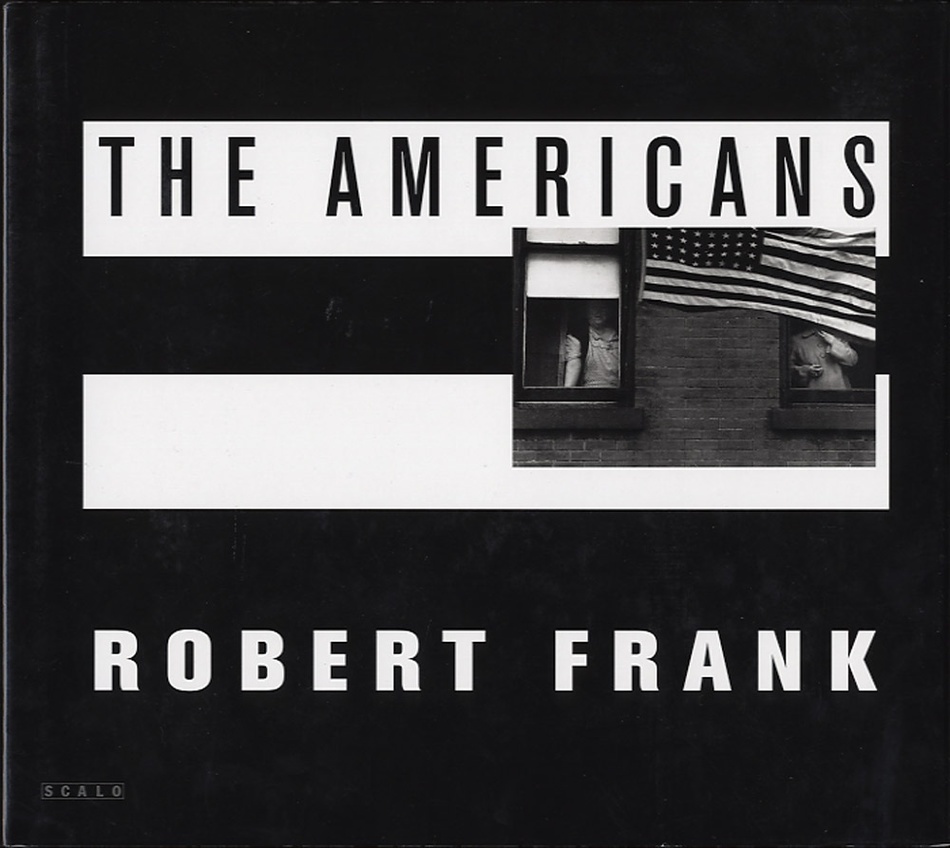
The Americans. Photographs by Robert Frank. Introduction by Jack Kerouac. Scalo, Zürich/D.A.P., New York, 1993. First Scalo edition. 179 pp. Oblong quarto. Hardbound in photo-illustrated dust jacket. Black-and-white reproductions.
WOW! One of the seminal books of photography and signed as well.
“It was Frank’s The Americans that made the photographic book into an art form in its own right. Frank was following a lead set by [Wright] Morris’ book (The Inhabitants) and, especially, by Evans’ American Photographs, both of which are designed to let pictures play off each other in a way that controls and reinforces their effect on the viewer. Even Klein’s New York book displays this tendency. But Frank’s goes much further, creating a denser, richer, deeper structure of images than any book before it.”
Colin Westerbeck in Michel Frizot, et. al., The New History of Photography.
Many thankx to the Musée national Eugène Delacroix for allowing me to publish the artwork in the posting. Please click on the photographs for a larger version of the image.
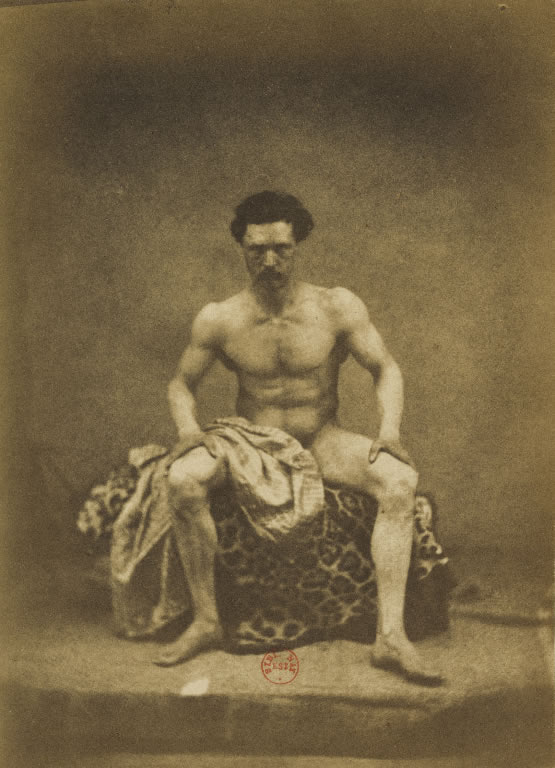
Jean Louis Marie Eugène Durieu (1800-1874) was an early French amateur nude photographer, primarily known for his early nude photographs of men and women. A number of his male and female models were also painted by Eugène Delacroix, with whom he was friends.
Durieu was born in Nîmes, and became known for making studies of nudes for Delacroix. During his career Durieu was a lawyer. His last job was inspector for education and culture. In 1849 he went into early retirement and devoted himself to the newly developing technology of photography. In 1853, Durieu worked with Delacroix on a series of photographs of different male and female nude models.
In the early 1850s, Durieu, like many of his photographic peers, gravitated from the daguerreotype to the calotype. None of the works from his daguerreotypical oeuvre can be attributed to him with any certainty. Apart from the Delacroix album held at the Bibliothèque Nationale de Paris, another work on paper does exist, however, a more personal album preserved at the George Eastman House in Rochester, which was once part of the Gabriel Cromer collection. Its repertoire is more varied and includes female nudes in fairly elaborate settings, as well as portraits and reproductions of paintings and engravings. …
In 1851, along with Delacroix, Durieu became one of the founder members of the Société Heliographique, the first French institution to be created specifically for photographers. Above all, its brief was to encourage the development of photography on paper and in particular the calotype as opposed to the daguerreotype.
It was at precisely this time in the early 1850s that Delacroix’s interest in photography was at its height, coinciding with that of Durieu. In February 1850, he wrote in his journal: “ask Boissard for some daguerreotypes on paper,” and later, in September 1850: “Laurens tells me that Ziegler is producing a sizeable number of daguerreotypes, including portrayals of nude men. I intend to go and see him to ask if he can lend me a few.” In May 1853, he showed Pierret and his cousin Léon Riesener the prints given to him by Durieu. In November 1853, he discussed the topic of photography with Riesener, who in the 1840s had not only been a painter but an ‘author’ of daguerreotypes. Delacroix maintained that the term author was a misnomer for what he regarded as a mechanical recording process, a machine-led art: “He referred to the solemn account the good Durieu and his friend, who assists him in these operations, give of their time and trouble, whilst taking much of the credit for the success of the aforementioned operations, or more precisely their results.” He made fun of Riesener, who had asked them with great trepidation if he could use their pictures as models for his paintings without being accused of plagiarism. Finally, on two successive Sundays, 18 and 25 June 1854, he visited Durieu on the seventh floor of his home at 40 rue de Bourgogne to ask him to make a series of photographs of models under his guidance…
Extract from Sylvie Aubenas. “Eugène Durieu, senior civil servant, photographer and forger,” in No 32 Printemps 2015 (translation Caroline Bouché) on the Etudes photographiques website [Online] Cited 04/10/2018
“I look with passion and without fatigue at these photographs of naked men, this admirable poem, this human body on which I learn to read and whose sight tells me more than the inventions of scribblers.”
Delacroix, ‘Journal’, October 5, 1855
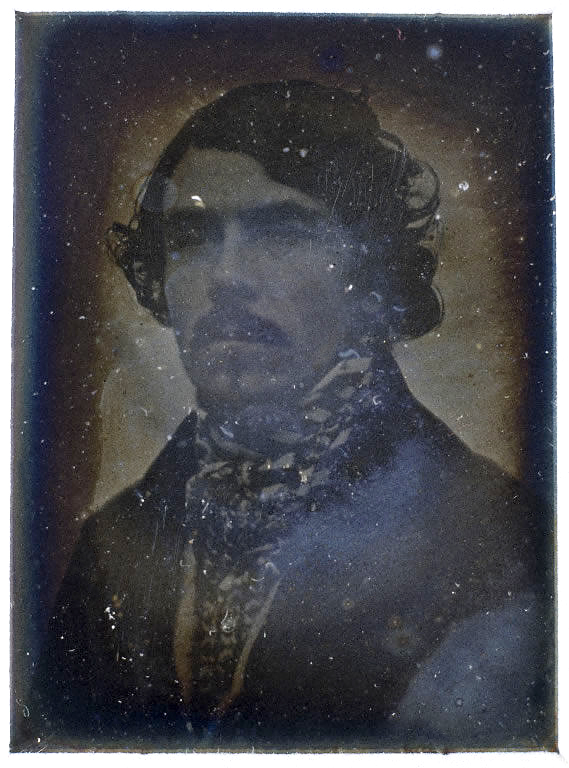
Delacroix was confronted, like his entire generation, with the emergence of photography. An intriguing tool fascinating for the painter, this medium occupies a place apart in all of his work. He is at the source of a deep reflection on artistic truth in the face of photographic realism.
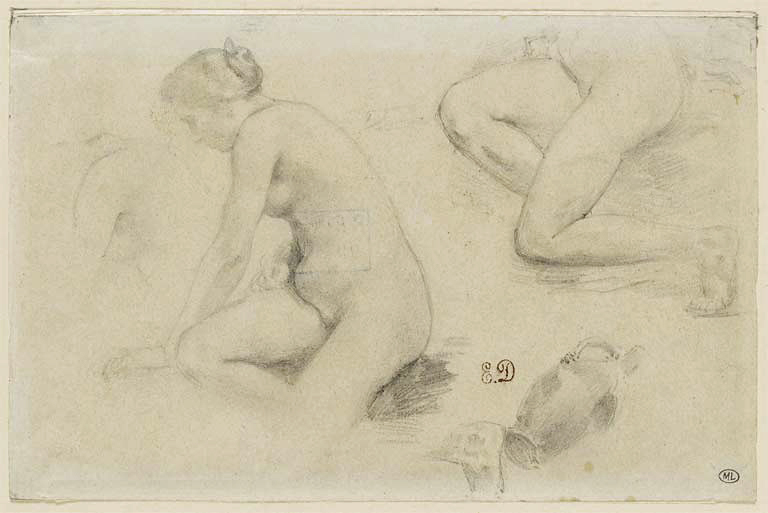
Far from seeing photography as a potential rival to painting, Delacroix took a keen interest in the development of this new medium, following its technical progress with sufficient curiosity to become a founding member of the Heliographic Society in 1851. He amassed a considerable photographic collection-of frescoes by Raphael, paintings by Rubens, and cathedral sculptures. Moreover, although he did not use a camera himself, a series of male and female nude models were photographed at his request by Eugène Durieu, in 1854. We know from his diary and letters that he sometimes used these photographs to practice drawing when no live models were available. These shots, which he sometimes carries with him, are a valuable tool for practicing drawing during his stays in the province. They meet very personal criteria; Delacroix wanted to use images voluntarily a little blurry and mostly stripped of all the quaint accessories conveyed by commercial photographs to the attention of artists.
However, despite a deep fascination for photography, Delacroix keeps a critical eye on this new medium. He adopts an attitude sometimes skeptical about his proper use and mastery of the technique, refusing to award benefits beyond its instrumental value. His reluctance is particularly keen with regard to one’s own photographed image: he even goes so far as to demand the destruction of some negatives, fortunately in vain.
Almost all the photographs and the drawings done from them (together with a number of paintings) have been assembled for the first time at the Musée Delacroix, with the generous support of the Bibliothèque Nationale de France and other collections. The exhibition also features a surprising series of photographic portraits of Delacroix himself, ranging from the precious intimate daguerreotypes of the 1840s to the more posed and strikingly dignified pictures taken by Carjat or Nadar toward the end of his life-many of which images the great man himself would rather have had destroyed.
Press release from the Musée National Eugène Delacroix
The Durieu Album
The album of thirty-two photographs preserved in the department Prints and Photography of the National Library de France and commonly known as “Durieu Album”, by the name of the author of the photographs contains mainly photographs of two nude models, a man and a woman, taken by Eugene Durieu in the presence and on the indications of Delacroix during two sessions of successive poses, on Sunday 18 and 25 June 1854. The album was probably in lot 1532 of the sale after the painter’s death, bought by the critic Philippe Burty, who said on the front page: “All this sequence of photographs was bought by me at the posthumous sale of Eugène Delacroix’s workshop. He used it often and his cartons contained a considerable number of pencil studies from these photographs some of which were made expressly for him by one of his friends, and the models posed by him.” This album went on to the bibliographer and historian of the art Maurice Tourneux, who offered it in 1899 to the Cabinet des Prints.
The examination of the album, whose pages are all presented here in the order of the pages, shows that divides into four distinct sequences. Plate I represents a seated male nude model. His black beard and its abundant hair absolutely distinguishes him from the model with the better drawn musculature having posed in the following photographs. This test is undoubtedly part of a different set provided by Durieu to Delacroix.
The twenty-six photographs that follow in the album are, like the first, calotypes, that is to say prints from negative on paper. The calotype is characterised by a slight blur that Delacroix’s eyes found useful and tolerable photography, the grain of the negative paper producing, in the prints, less precise contours than in the daguerreotype or prints based on collodion glass. These twenty-six photographs of June 1854 form a very homogeneous series, with two models. The man that Delacroix calls “the Bohemian” appears by the development of his musculature and his ease to pose, as a professional model. He is present alone on seventeen views, and on the other nine in the company of a female model, probably an Italian, also a professional model, who posed again in 1855 for two other photographers.
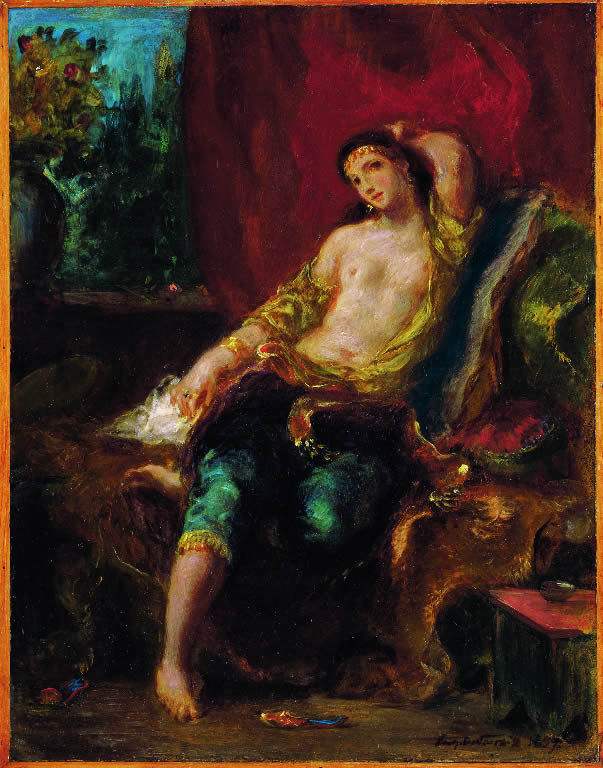
After this series, the album contains two studies (plates XXVIII and XXIX) of the same young woman, of which one served as the model for Odalisque of 1857 (private collection). The model is Miss Hamély, a small actress who appeared in tableaux vivants and pantomimes at the Porte-Saint-Martin theater (1853) but who also posed for photographers. The freedom that Delacroix takes in the painting in relation to the photography confirms that, he only uses it as a support for the imagination, unlike a painter like Gérôme for whom the cliche really replaces the model. So photography is amalgamated, among other ingredients, in a personal universe, not to mention the colours of the painting.
The album ends with three prints, based on a glass negative, of the same model draped to the waist, sitting in front of a plain canvas background. The sharpness, due to the negative on glass, the rigorous composition and images, their “professional” aspect make them totally different from the previous ones, to such that we can hesitate to attribute them to Durieu. While the calotypes posed by Delacroix are very rare, these last three images are seen in more than one collection; they have been broadcast to a wider audience.
Text from the Delacroix et la photographie exhibition pdf (translated from the French by Google translate)
Louis Antoine Léon Riesener (21 January 1808 in Paris – 25 May 1878 in Paris) was a French Romantic painter.
Enchanted by the play of light and reflections which transformed the appearance of matter, Riesener began a new aesthetic that made him one of the precursors of impressionism. A passionate colourist, he researched all the nuances of colour and studied the techniques of ancient Greece and the Renaissance, including Titian, Veronese and Corregio. Impressed by his research into colour, he turned towards Rubens, which for him was the Shakespeare of painting. Very early in his career Riesener studied tonal divisions, well before the physician Chevreul discovered their scientific basis. His tactile taste led him to look for the most perfect expression of matter and particularly of skin. He put poetry into his painting by the play of shadow and he passionately admired nature, life and all the beauties they produced.
He researched the subject of life in the countryside and, liking to paint reality, said he wanted to express “the heat of the day, the melancholy of the evening, meadows, flowers as they are in nature”. His study of the elements caused him to paint a series of skies which varied according to the light and time of day – the subjects were ahead of their time and Riesener had to fight hard against the Salon juries and the Institut. Using pure colours, he excluded the blacks and whites which had been used for shadows and light before him. His material science of colour was the opposition which gave birth to contrasts from juxtaposed pigments. He did not portray faces by contours, but by shadows and modelling.
Relations with Delacroix
After his father’s return from Russia in 1823 Léon got to know Eugène Delacroix better. Ten years older than Riesener, Delacroix was his first-cousin – they shared a grandmother, Marguerite-Françoise Vandercruse, whose daughter by her first marriage was Delacroix’s mother and whose second husband Jean-Henri Riesener was Riesener’s grandfather. Delacroix quickly recognised Riesener’s talent and originality and he supported his early career by recommending him to civil servants he knew. On trips to the countryside they met at Valmont, near Fécamp, the home of their cousin Bataille, owner of the abbaye from 1822 onwards. Riesener devotedly attended Pierret’s salon (Pierret was a school friend of Delacroix), where he met Mérimée, Viel-Castel, Sauvageot, Feuillet de Conches, Viollet-le-Duc, Lasus and Guillemardet. Later, Riesener became friends with Fantin-Latour, Ernest Chausson and the Morisots (the Morisot family was very friendly with the Riesener family, with Rosalie Riesener’s friend Berthe Morisot researching Léon’s opinions, listening to his advice and copying out about 135 pages of his writings) – his friends were artists and he preferred a quiet life rather than the high life favoured by Delacroix.
From childhood, Riesener and Delacroix were friends and confidants. So different in life and character and so independent, they were preoccupied by the same artistic problems and enjoyed exchanging ideas, both having been formed by the 18th century and its neo-classical culture. They discussed their study of the classical world and they were both colourist painters searching for new techniques in tonal division. The difference in their temperaments expressed itself in their ways of looking at nature – Delacroix thought of drama, Riesener thought of sensuality. Delacroix bought Riesener’s painting Angélique as an exemplar for all painters and put it in his studio. On his death in 1863, Delacroix left Riesener his country house at Champrosay.
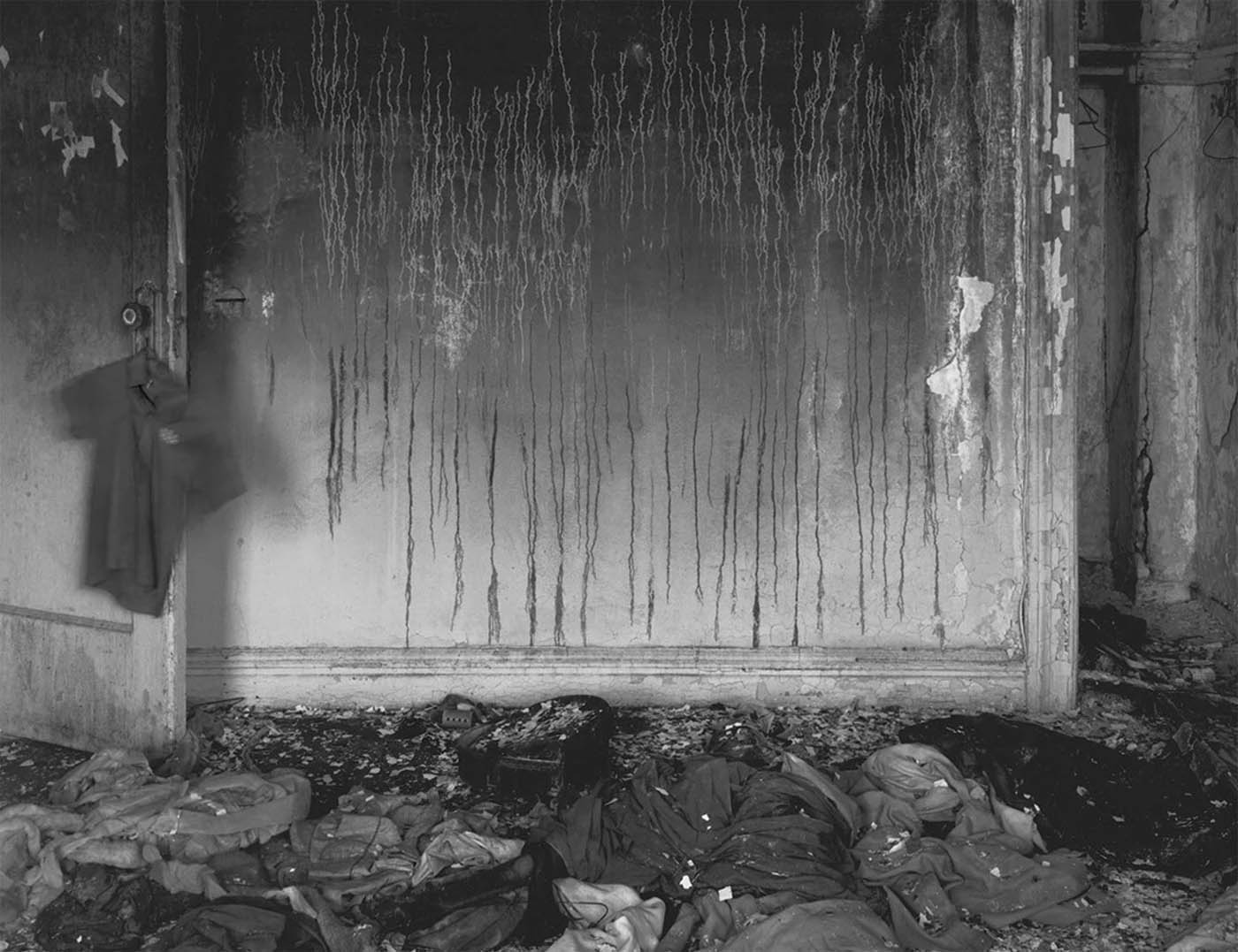
William Clift (American, b. 1944) Somebody’s House, Baltimore, Maryland, 1964 1964
from the book
Certain Places Photographs and Introduction by William Clift. William Clift Editions, Santa Fe, 1987. 44 pp., twenty-two tritone illustrations.
One of the most ravishing photographic books ever produced. Sensitive photography, luminous images, wonderful reproductions on quality stock. Nothing more need be said. My favourite of so many great images is above.
Dr Marcus Bunyan
All photographs are used under fair use conditions for the purpose of education and research. Please click on the photographs for a larger version of the image.
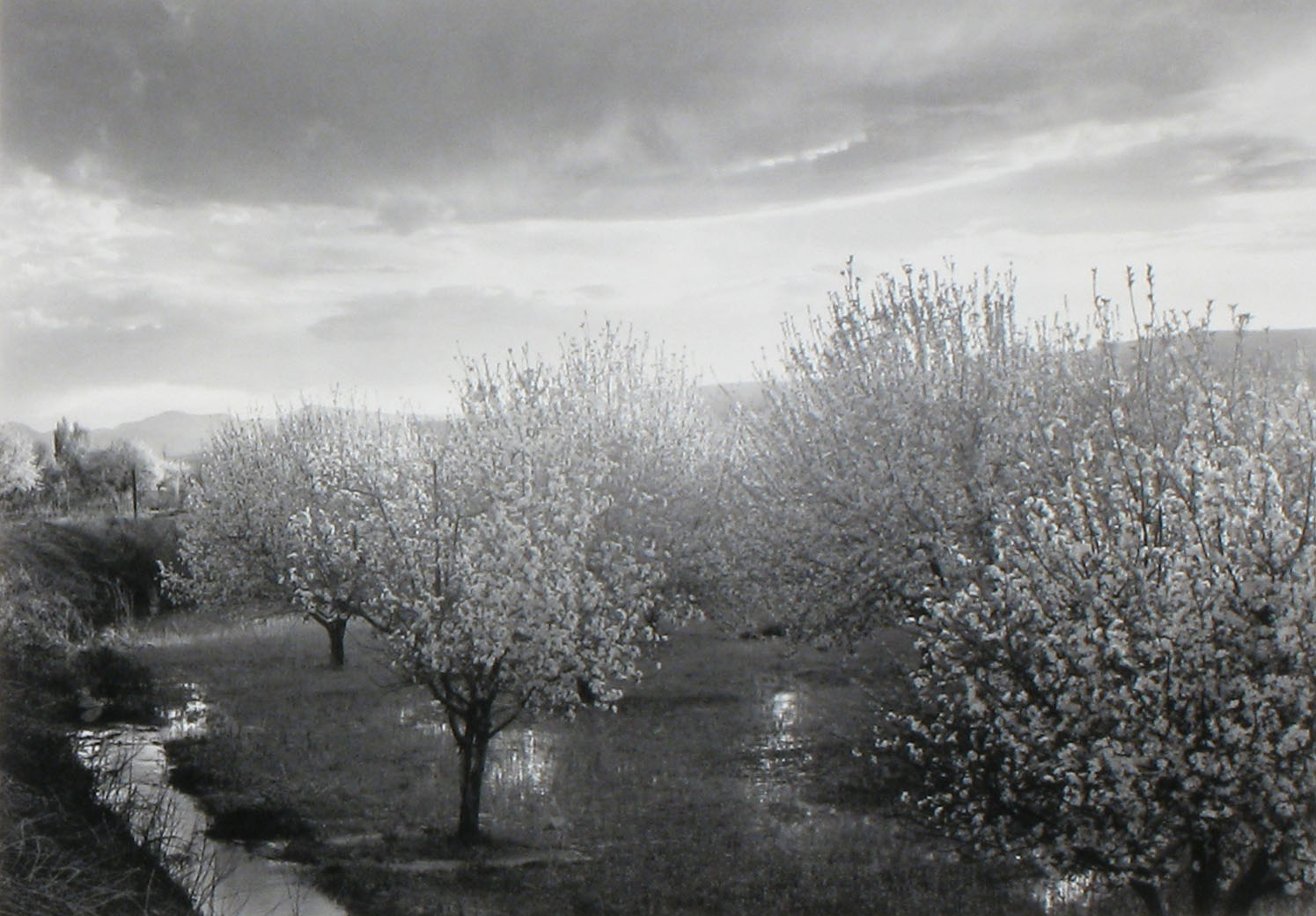
William Clift (American, b. 1944) Apple Blossoms, Velarde, New Mexico, 1973 1973
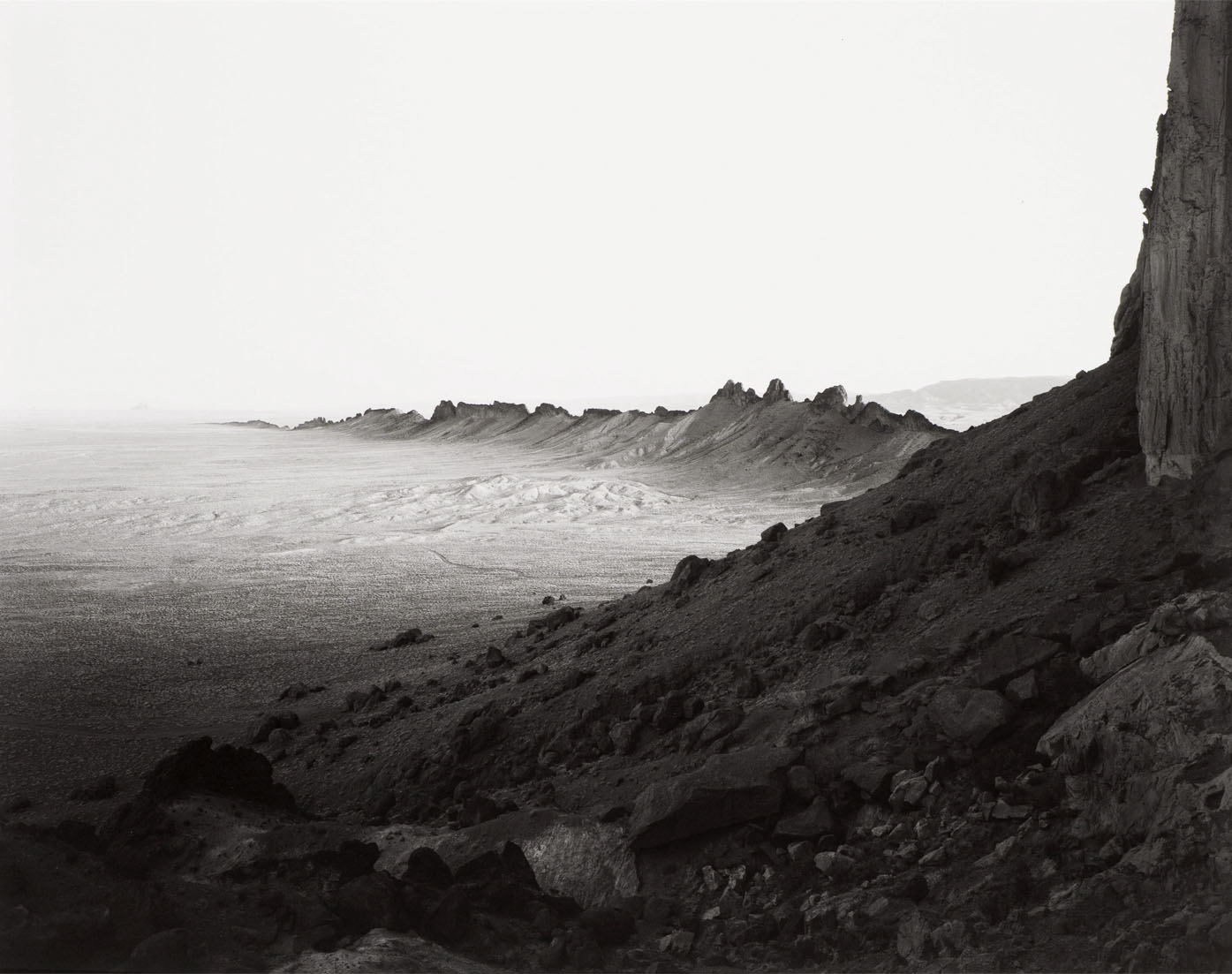
William Clift (American, b. 1944) Desert Form No. 1, New Mexico, 1984 1984
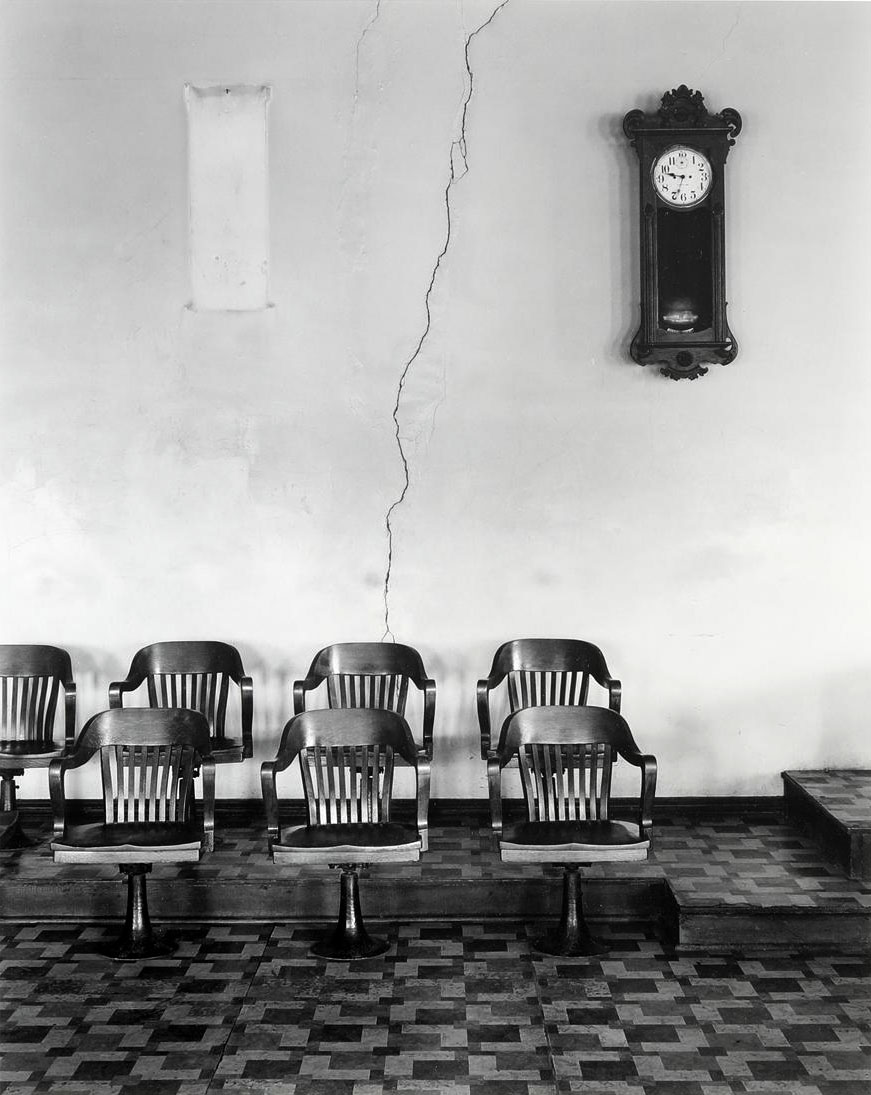
William Clift (American, b. 1944) Untitled 1976 From the County Courthouse series Gelatin silver print 16.5 h x 13 w inches
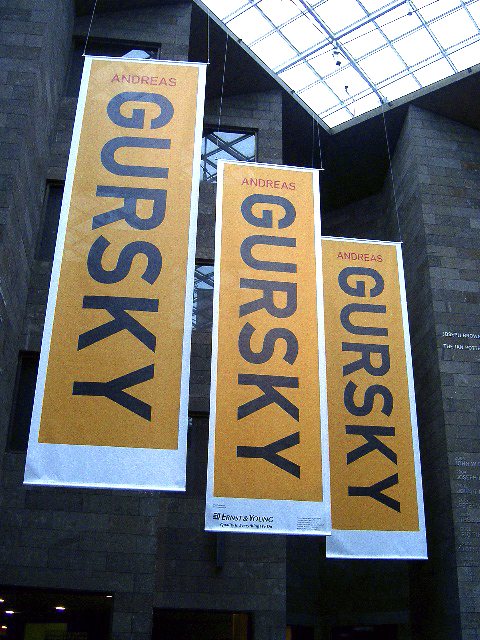
Andreas Gursky banner at NGV International exhibition, Melbourne
A large but plain crowd assembled for the opening of the first exhibition by world renowned German photographer Andreas Gursky at the National Gallery of Victoria in St Kilda Road, Melbourne. After some lively conversation with friends and following the opening speeches we wandered into a large clean gallery space with minimal design elements. The use of space within the gallery allowed the work to speak for itself. It is a minimal hang and the exhibition works all the better for this.
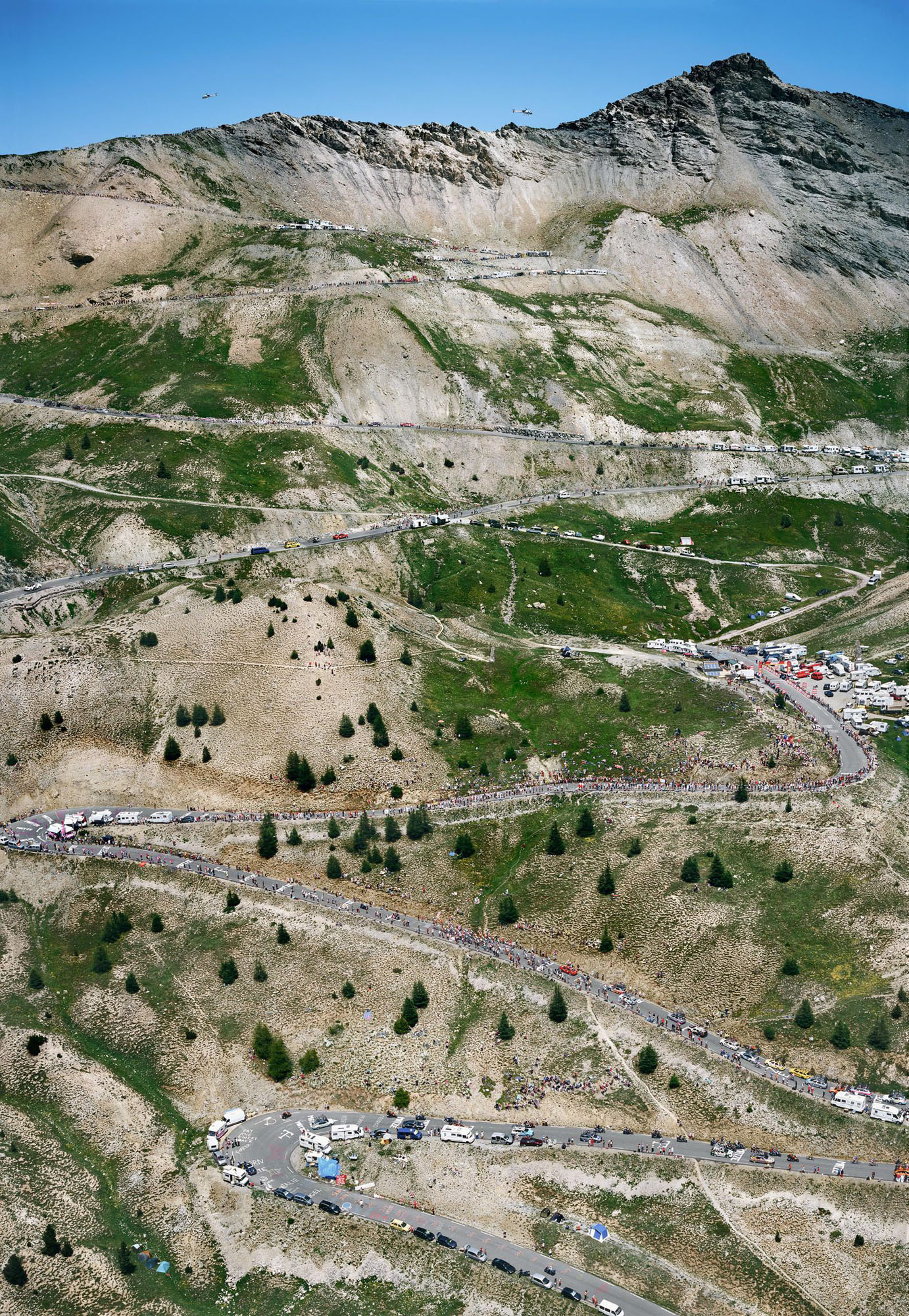
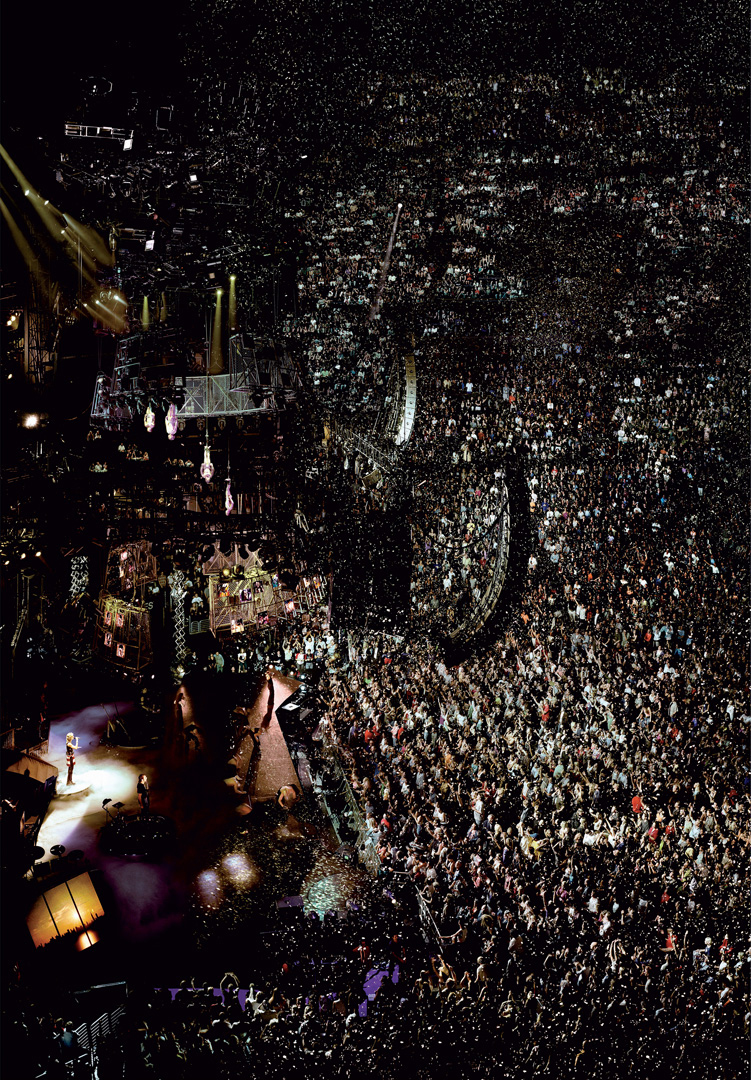
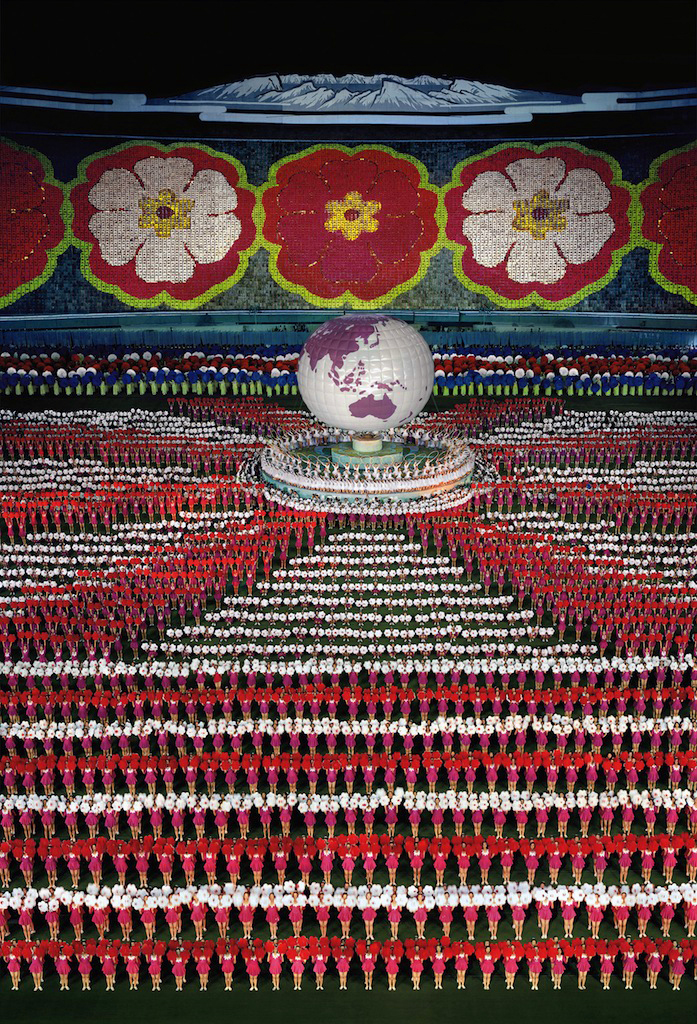
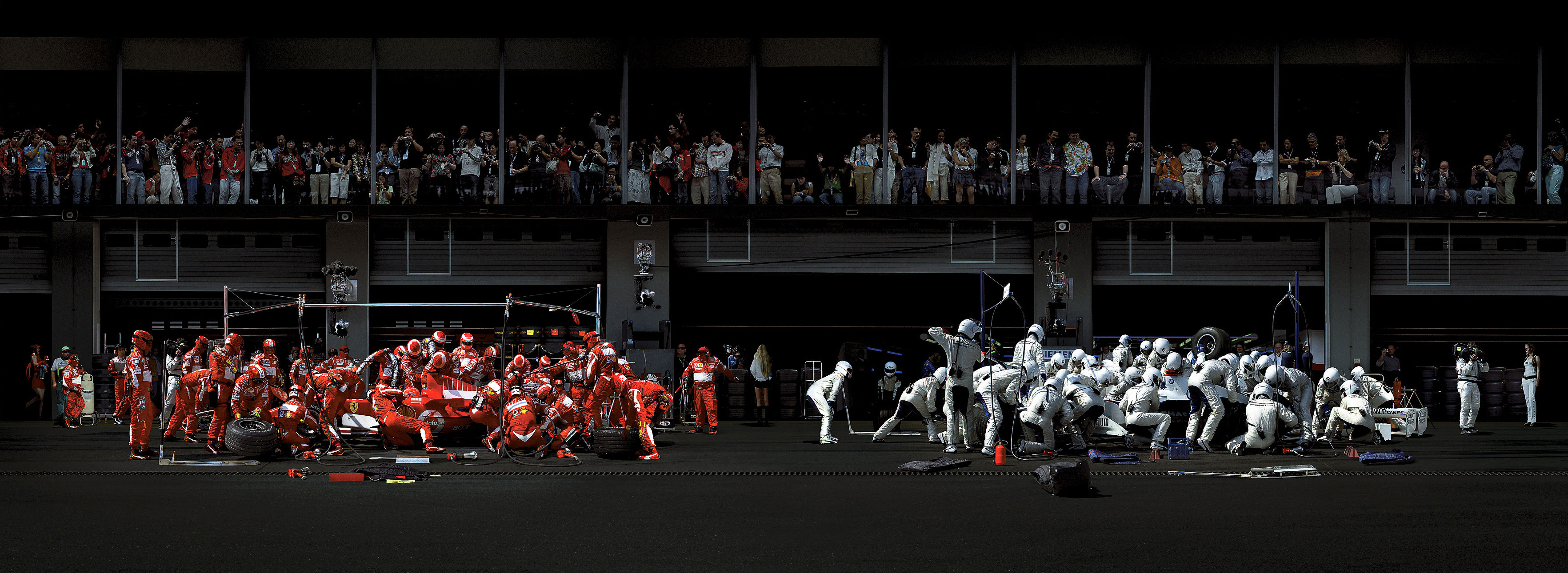
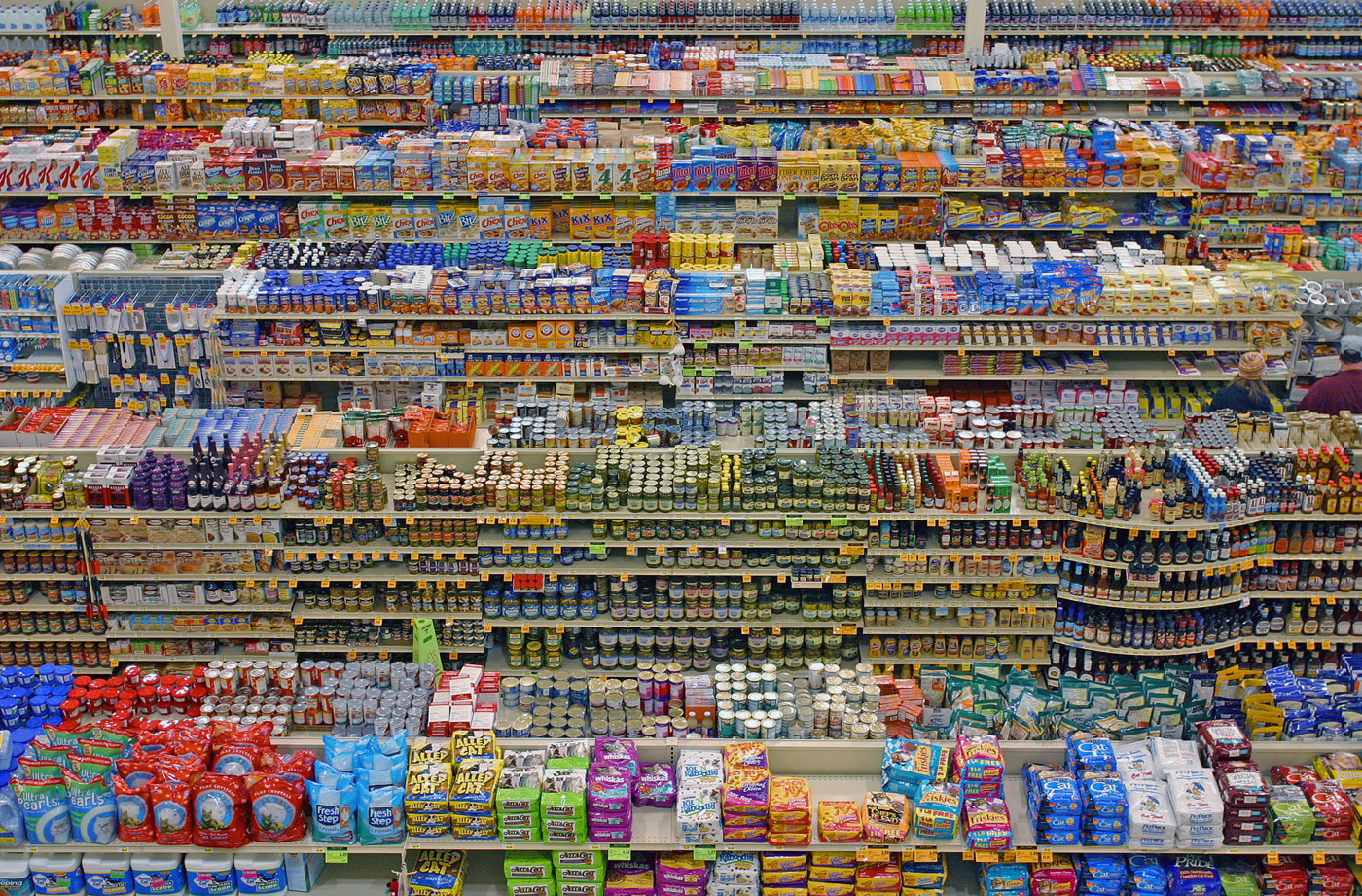
As for the work itself 21 large photographs are presented ranging from landscapes to buildings, race tracks to formula 1 pits, Madonna concerts to the Tour de France. Most work successfully in building a hyperreal vision of the world. We are not sure what is ‘real’ or hyperreal, what is a straight photograph or what has been digitally manipulated and woven together. The colour and sharpness of the images is often intensified: in reproductions of the famous photograph of the 99c supermarket in America the colours seem flat but ‘in the flesh’ the colours are almost fluoro in their saturation and brightness.
Having said that the photographs are nearly always unemotional – as though seen from above in the third person, they observe with detachment. The intrigue for the viewer is in the detail, in working out what is going on, but these are not passionate photographs on the surface. It is beneath the surface that the photographs have their psychological effect: the best of the images work on the subconscious of the viewer. Like a fantastical dance the three very wide images of the Formula 1 pits feature pit crews practicing tyre changes, frozen in a choreographed ballet. People in the galleries above stare down; pit lane girls seem to have been inserted digitally into the images, standing at side or behind the pit crews in a seemingly surreal comment on these worlds. These are theatrical tableaux vivant, splashed with teams colours. Fantastic photographs.
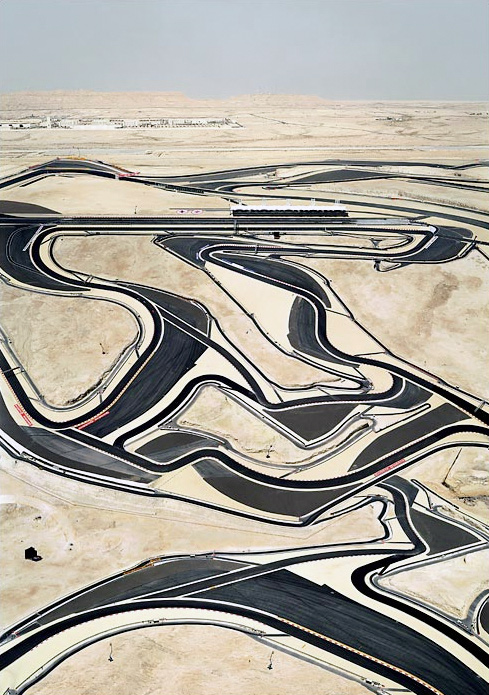
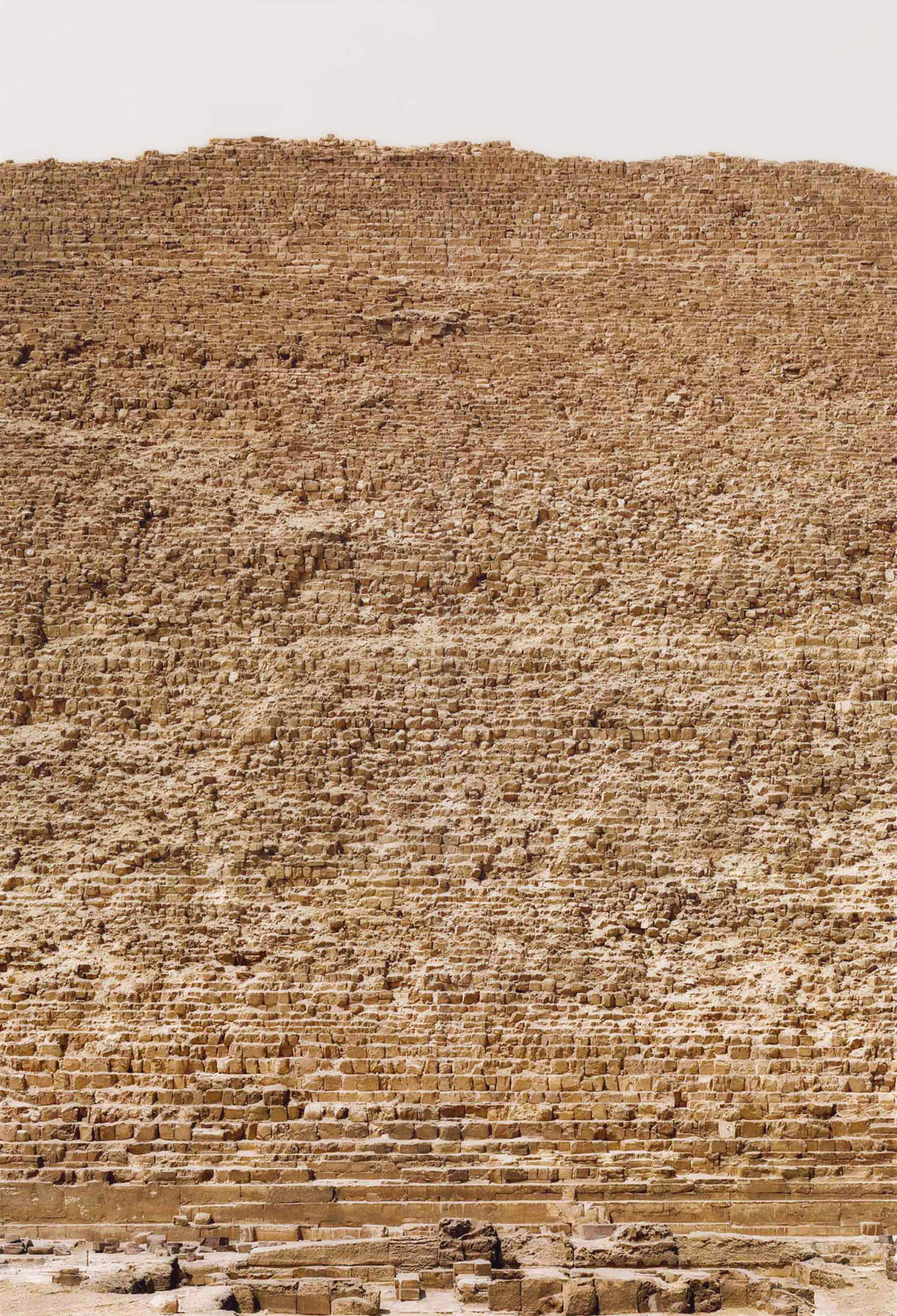
In some of the images, such as the Madonna concert or the photograph of the Bahrain Formula 1 racetrack, space seems to have folded in on itself and the viewer is unsure of the structure of the image and of their vantage point in looking at them. Space also collapses in the photograph of the pyramid of Cheops (2006, below), where the depth of field from foreground to background of the image is negligible. Less successful are images of a Jackson Pollock painting and a green grass bank with running river (Rhein II 1996, below), intensified beyond belief so that the river seems almost to be made of liquid silver.
A wonderful exhibition in many aspects, well worth a visit to see one the worlds best photographers at work. The photographs tell detached but psychologically emotional stories about what human beings are doing to the world in which they live. These images are a commentary on the state of this relationship – images of repetition, pattern, construction, use, abuse and fantasy woven into hyperreal visions of an unnatural world.
Dr Marcus Bunyan
Many thankx to the National Gallery of Victoria for inviting me to the opening and for allowing me to publish the photographs in the posting. Please click on the photographs for a larger version of the image.
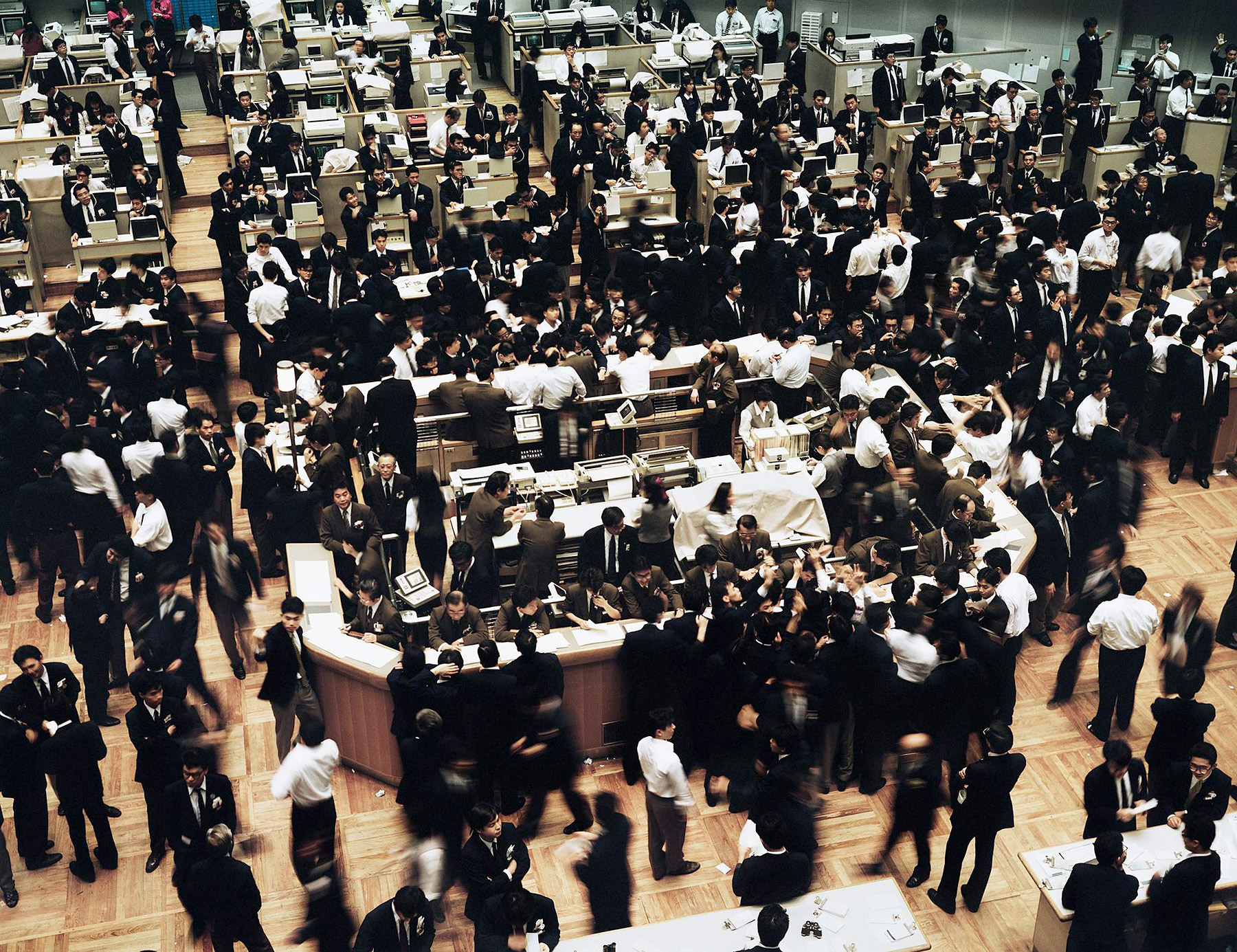
For the first time in Australia, an exhibition by German contemporary photographer Andreas Gursky opened at the National Gallery of Victoria. From the Haus der Kunst in Munich, Andreas Gursky presents 21 major works for which the artist is internationally acclaimed. The photographs range from 1989 to 2007 and include seminal works such as Tokyo Stock Exchange and the diptych 99 cent store. Andreas Gursky is recognised as one of the world’s leading contemporary artists. On view through 22 February, 2009.
Well known for his large-scale (generally measuring an astounding four to five metres) and extraordinarily detailed photographs of contemporary life, Gursky continues the lineage of ‘new objectivity’ in German photography which was brought to contemporary attention by Bernd and Hilla Becher.
In the 1990s, Gursky became inspired by the various manifestations of global capitalism. His interest was piqued looking at a newspaper photograph of the crowded floor of the Tokyo Stock Exchange and he began to photograph its flurry of suited traders, somehow moving according to some inbuilt order.
Dr Gerard Vaughan, Director, NGV said the Andreas Gursky exhibition represented a significant coup for Melbourne: “The National Gallery of Victoria is the only Australian venue for this extraordinary show – the first major exhibition of Gursky’s work ever to be seen in this country. Generously organised by the Haus der Kunst Museum in Munich we are extremely fortunate to have had the works in this show selected for us by Andreas Gursky himself.”
Andreas Gursky was born in 1955 and grew up in Düsseldorf, Germany. In the early 1980s, he studied at the Kunstakademie Düsseldorf, Germany’s State Art Academy. Whilst there he was heavily influenced by his teachers Bernd and Hilla Becher, who were well known for their methodical black and white photographs of industrial machinery.
In 1984 Gursky began to move away from the Becher style, choosing instead to work in colour. Since then he has travelled across the world to cities such as Tokyo, Cairo, Hong Kong, Stockholm, Singapore and Los Angeles photographing factories, hotels and office buildings – places he considered to be symbols of contemporary culture. His world-view photographs during this period are considered amongst the most original achievements in contemporary photography.
Gursky has been the subject of numerous international exhibitions including the Internationale Foto-Triennale in Esslingen, Germany in 1989 and 1995, the Venice Biennale in 1990, and the Biennale of Sydney in 1996 and 2000. In 2001, Gursky was the subject of an exhibition at the Museum of Modern Art in New York.
Press release from the National Gallery of Victoria website
Exhibition dates: 14th November, 2008 – 12th April, 2009
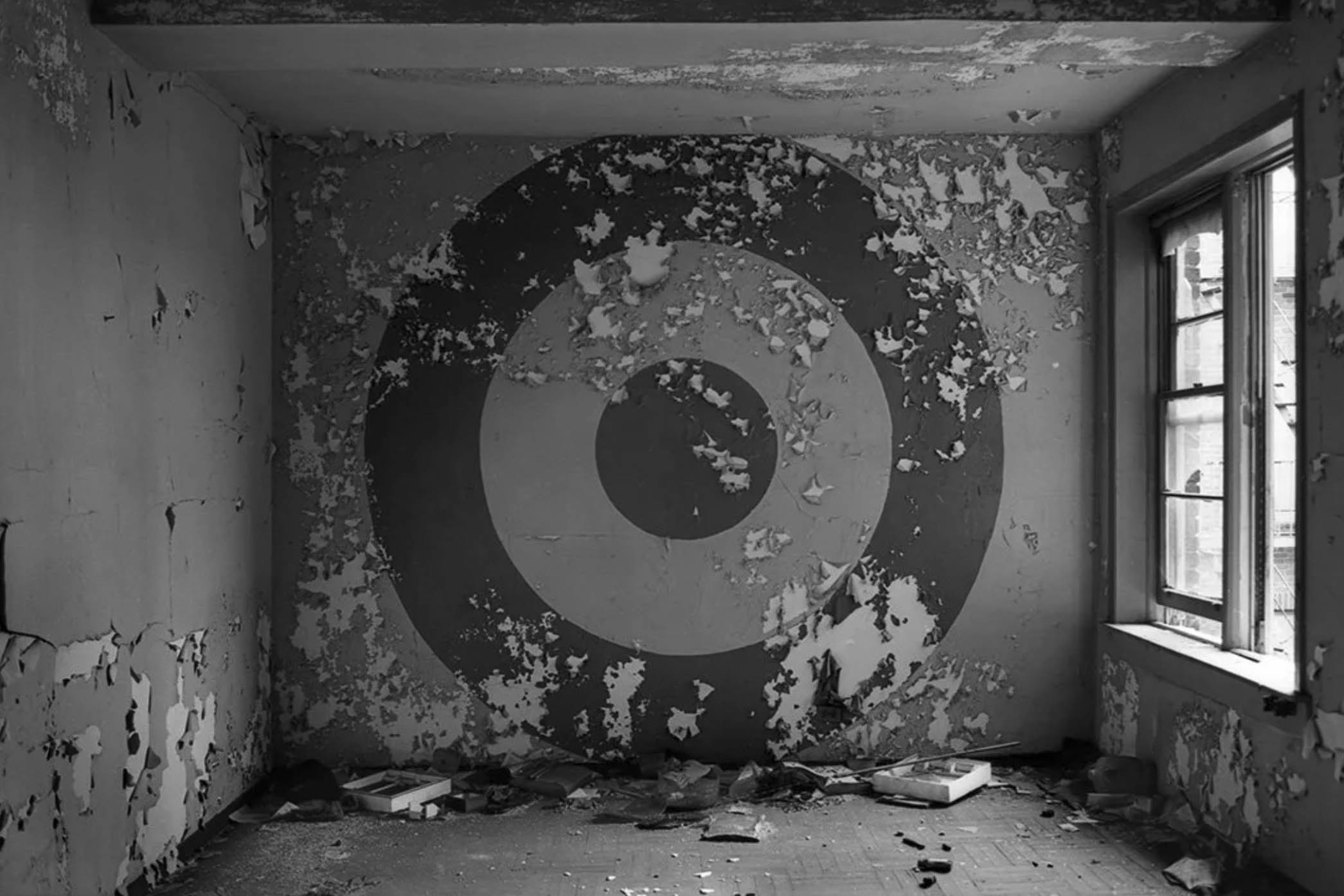
Ray Mortenson (American, b. 1944) Untitled (7-16-6) 1984 Gelatin silver print Courtesy of Janet Borden, Inc.
Documenting the abandoned, burnt out, and razed structures of entire city blocks in the South Bronx in the aftermath of the 1970s, during which this neighbourhood experienced dramatic decline, Broken Glass: Photographs of the South Bronx by Ray Mortenson will be on view at the Museum of the City of New York from November 14, 2008 through March 9, 2009. The 50 black and white cityscapes and interiors on view – five of which are large-scale – were taken between 1982 and 1984, and they vividly illustrate the results of a downslide that began in the Great Depression of the 1930s and accelerated with the construction of the Cross Bronx Expressway in the 1950s and the fiscal crisis of the 1970s. Broken Glass is Mortenson’s first museum exhibition in New York City, and it is the first presentation of the South Bronx photographs.
The 50 photographs on view, all black and white, range in size from the smallest at approximately 11″ by 14″, to the most monumental at 40″ by 60″. Each conveys a devastating silence, serving as a reminder that these city blocks were once the homes of individuals, families, and a large community. Mortenson has written, “The buildings were like tombs – sealed up, broken open and plundered. Inside, stairways with missing steps led up to abandoned apartments. Doors opened into rooms that were once bedrooms or kitchens. Small things left behind hint at who the occupants might have been – a hairbrush, photographs, or bits of clothing.” Ghostly remnants of the once prosperous and thriving neighbourhoods can be glimpsed in his images which document the extent and severity of the urban decline experienced in the South Bronx.
These photographs document an important chapter in the history of a New York City neighbourhood, augmenting their aesthetic power. The decline of the South Bronx began as early as the Great Depression when previously sustained development came to an abrupt halt. After World War II an exodus of New York’s middle class began and continued into the 1970s. This caused a population decline throughout the city, but the effects were particularly hard on the South Bronx as more than 200,000 residents left the community between 1970 and 1980. As entire communities left the city, Robert Moses’ road building and slum clearance, along with other urban renewal initiatives had dramatic effects on the lives of all who remained. In the 1970s New York City faced another economic crisis and virtual bankruptcy. City government was unable to maintain services in the South Bronx and “planned shrinkage” became an unofficial policy as services were slowly withdrawn. With little incentive for landlords to upgrade or even maintain their property, waves of arson and “insurance fires” decimated the by now largely minority community. Astonishingly, some 12,000 fires a year occurred through the 1970s, averaging more than 30 a day.
A successful resurrection of the South Bronx began in the mid-1980s, as grass roots organisations and community development corporations, along with financial reinvestment by the City, sparked its regeneration. The photographs on view stand in starkest contrast to today’s revitalised neighbourhood, which has been the result of the dedication of its citizens combined with government support. The photographs serve as a reminder of the ruins that once dominated the now-vibrant streets and that the balance between prosperity and urban decline can be fragile.
Brief Biography
Ray Mortenson was born in Wilmington, Delaware in 1944 and studied art at the Carnegie Institute of Technology and the San Francisco Art Institute. In the early 1970s, Mortenson moved to New York and began working with photography. His first significant photographic project was a comprehensive investigation of the industrial landscapes of New Jersey’s Meadowlands (1974-1982). Since then, Mortensen has continued to focus on landscape photography that is often interested in liminal places of transition, set apart from everyday life. His photographs have been accepted into the collections of The Metropolitan Museum of Art, New York; The Art Institute of Chicago, and the Bibliothèque Nationale, Paris.
Press release from the Museum of the City of New York website
Ray Mortenson (American, b. 1944) Untitled 1983 Gelatin silver print Courtesy of Janet Borden, Inc.
Ray Mortenson (American, b. 1944) Untitled 1984 Gelatin silver print Courtesy of Janet Borden, Inc.
Ray Mortenson (American, b. 1944) Untitled 1983 Gelatin silver print Courtesy of Janet Borden, Inc.
Ray Mortenson (American, b. 1944) Untitled 1984 Gelatin silver print Courtesy of Janet Borden, Inc.
Ray Mortenson (American, b. 1944) Untitled 1984 Gelatin silver print Courtesy of Janet Borden, Inc.
Museum of the City of New York 1220 Fifth Avenue at 103rd Street New York, NY 10029 Phone: 212-534-1672
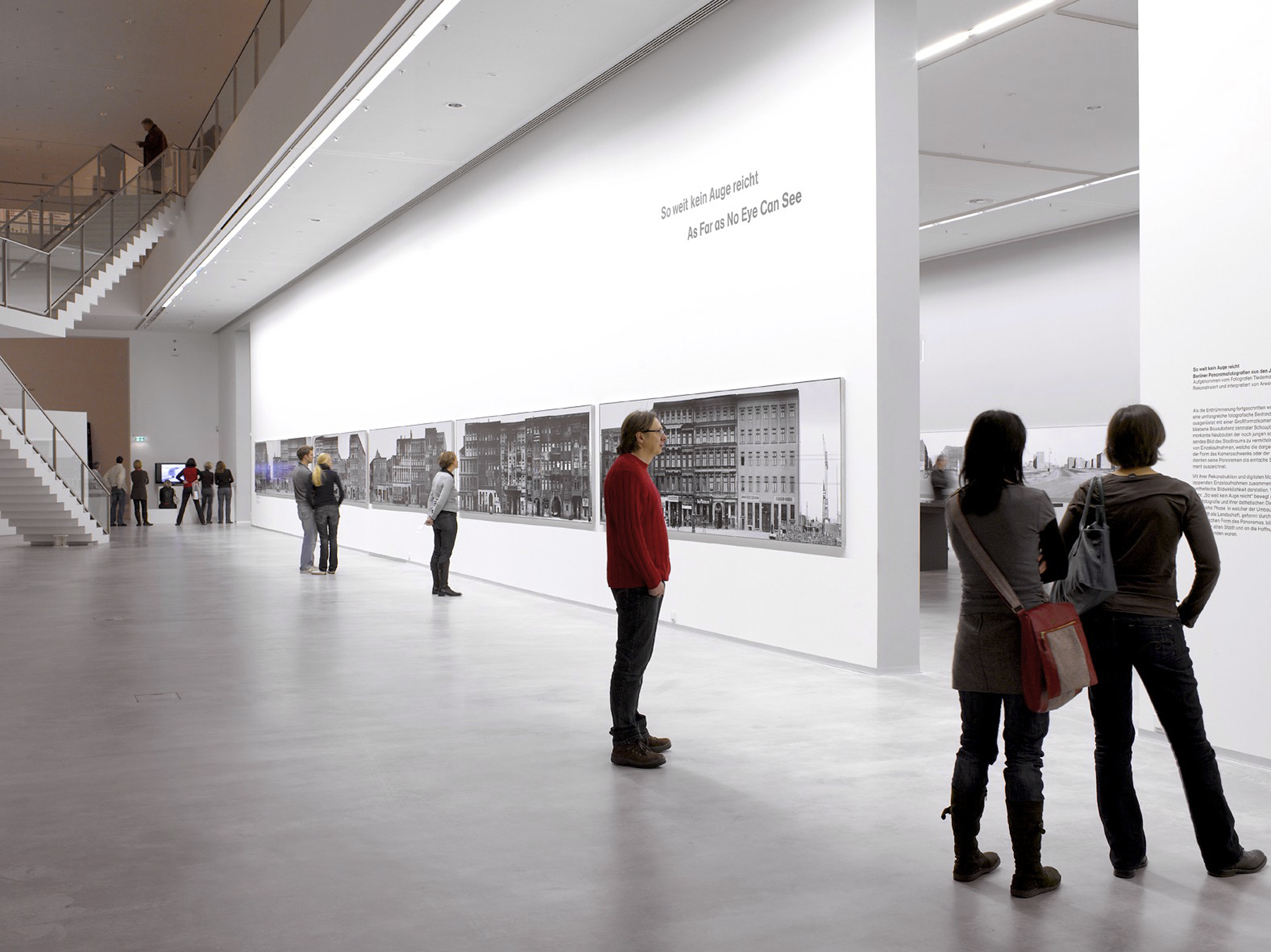
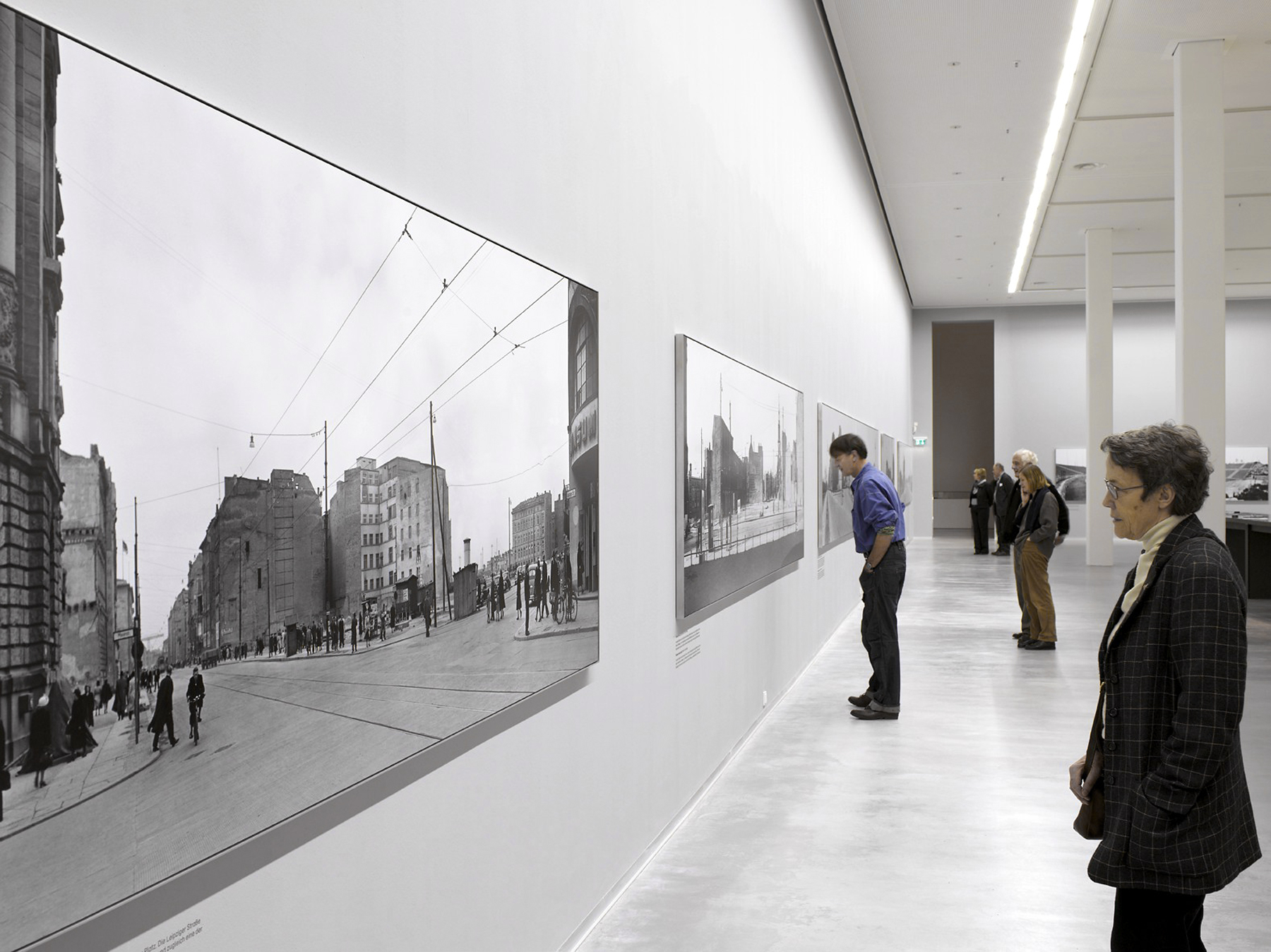
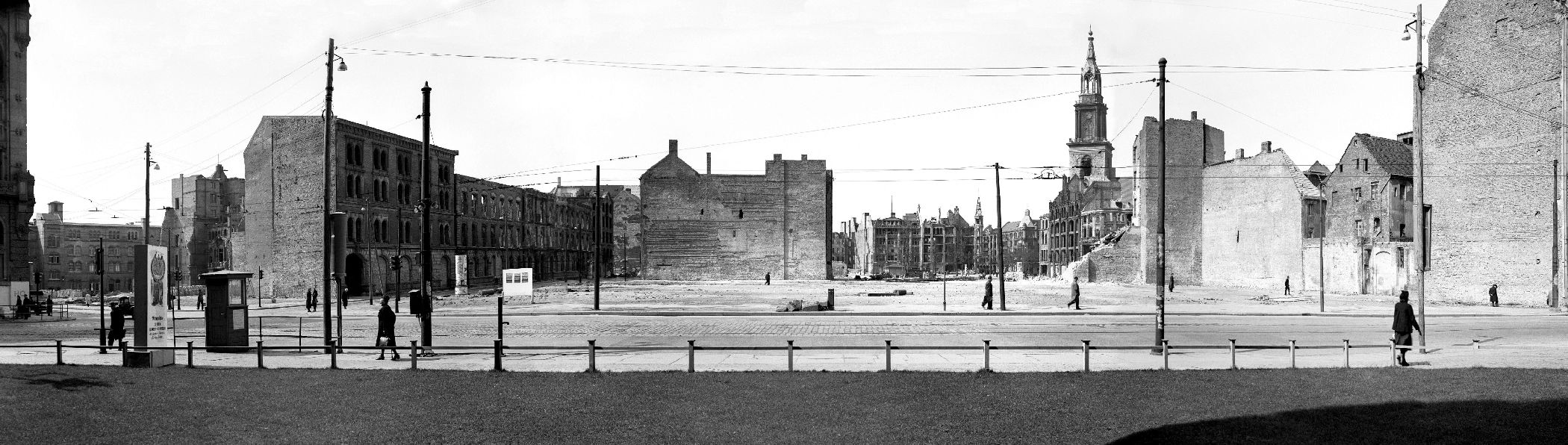
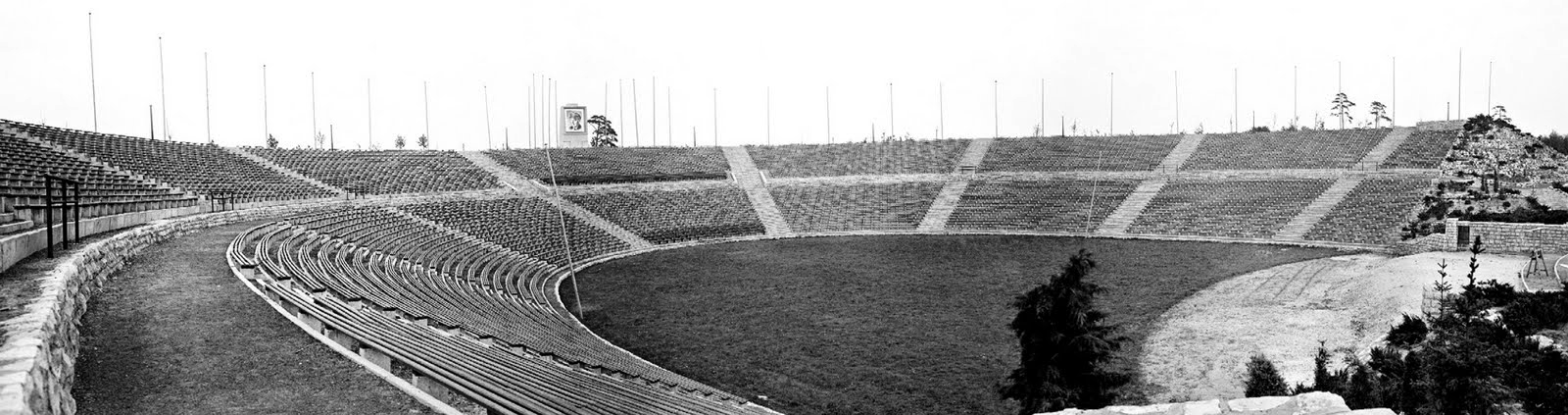
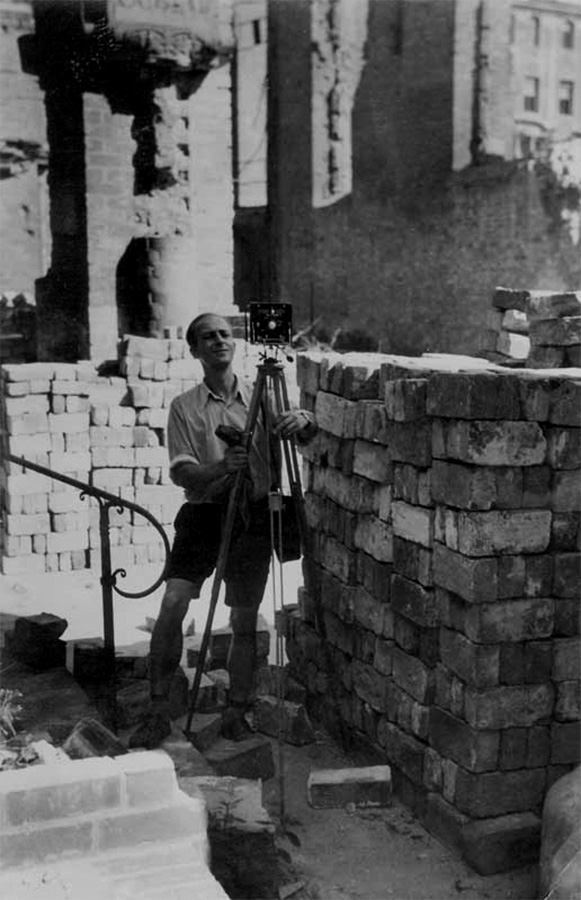
As far as the eye can see shows 13 reconstructed and digitally reassembled panorama photos by Tiedemann from his 1,500-footage work. The city views from the years 1949-1952 were enlarged to almost gigantic dimensions (up to 25.5 m in length) and thus provide a fascinating view of the destruction of the war and the reconstruction of Berlin.
Fritz Tiedemann (German, 1915-2001) was a trained surveying technician and was trained in the military as a photogrammeter (specialist for photographic measuring methods). He documented the city as a photographer at the Office of Preservation. The photographer Arwed Messmer came across Tiedemann’s photographs during research work for his book project “Anonyme Mitte – Berlin” in the Berlinische Galerie and then developed the idea for this exhibition.
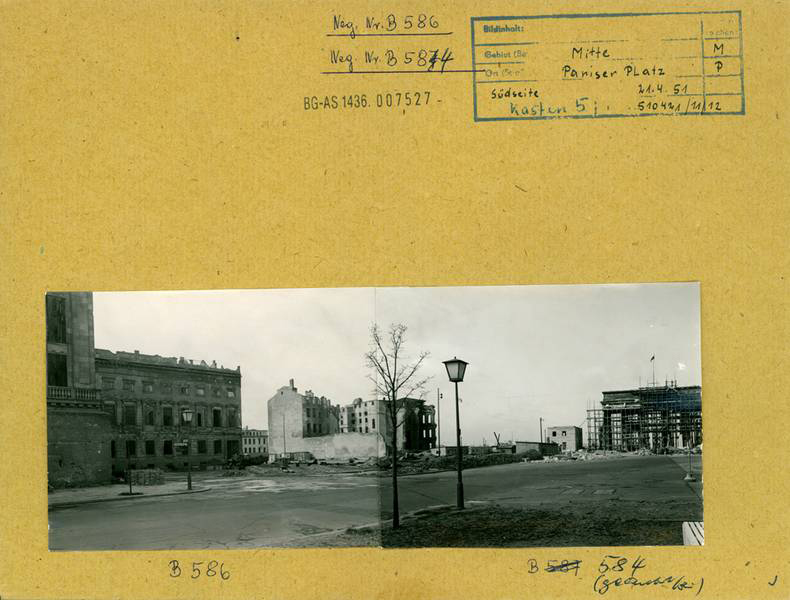
After WW 2, rubble clearance had made considerable progress and rebuild had begun, a remarkable photographic inventory was done in East Berlin. By order of the magistrate of the capital of the GDR an – up to now – unknown photographer documented central places and areas that were of importance concerning the urban planning in the early 50s. He captured the Pariser Platz and the Schloßplatz area as well as the works on the Walter Ulbricht Stadium or a sand storage area in the outskirts. In order to adequately picture the void and the vastness of the destroyed city as well as the remaining urban structures, the photographer made horizontal turns with the camera and thus produced sequences that – once brought together – turned into panoramic pictures.
The concealed quality of these pictures was lately discovered by Berlin photographer Arwed Messmer. By means of digital mounting of the sequences he created synthetic large-size pictorial worlds that show the destroyed Berlin as an empty stage. Thus inspired, the Photo Archive of the East Berlin magistrate, preserved by the Berlinische Galerie and documented in the catalogue “Ost-Berlin und seine Bauten. Fotografien 1945-1990” / “East Berlin Architecture”, was searched through anew. Thus the exhibition operates at the interface between applied photography and new photographic technology as well as between collective memory and an unfamiliar optic experience.
Press release from the Berlinische Galerie Museum of Modern Art
Installation views of the exhibition As far as the eye can see at the Berlinische Galerie, Berlin
Between 1948 and 1953, photographer and technical surveyor Fritz Tiedemann (German, 1915-2001) was commissioned by the urban administration of East Berlin to undertake extensive documentation of architecture and urban planning in the capital of the GDR. Many of his early visual documents are series of images conceived as panoramas, whereby the sweep of the camera gives a comprehensive impression of emptiness and the extent of war damage in the city. Processed as contact copies and stuck onto archive covers, his many photographs are one important, early basic collection of a photo archive that was extended consistently until 1990. It has been kept in the architectural collection of the Berlinische Galerie since 1992.
An in-depth study of the collection was facilitated with support from the Getty Foundation, Los Angeles, and the results were made available to the public in the shape of the publication “Ost-Berlin und seine Bauten” in 2006. In 2008 a selection of Tiedemann’s photographs was shown to the public in the exhibition So weit kein Auge reicht. Berliner Panoramafotografien aus den Jahren 1949-1952. Aufgenommen von Fritz Tiedemann. Rekonstruiert und interpretiert von Arwed Messmer (As far as no eye can see. Berlin panorama photographs from the years 1949-1952. Taken by Fritz Tiedemann. Reconstructed and interpreted by Arwed Messmer). A catalogue of the same name was also published; it has since been produced in a second, revised edition.
Text from the Berlinische Galerie Museum of Modern Art
14 February 1915 Hamburg – 23 November 2001 Münster, Westfalen
The identity behind the name “Tiedemann” could be clarified during the course of the exhibition. A former colleague of Fritz Tiedemann as well as descendents of the photographer learned about the exhibition due to the nationwide media coverage and contacted the museum.
As a professional surveying technician Fritz Tiedemann received additional specialist qualification as a topographer during his military service. His photographic skills and expertise were of great importance for the documentation of wartime damage and a visual basis for future urban planning. Indeed, his photographs can be considered as new documents showing the vastness and emptiness of the destroyed city.
In February 1948 he began working as a photographer for the Berlin Historic Buildings’ and Memorials’ Conservation Office. In October 1949 due to the political division of Greater Berlin he was to continue his work for the East Berlin government’s city planning office. Besides historical aspects the documentation then also focused on the architectural development of East Berlin as is also displayed by the exhibition’s panoramic photographs.
On February 28, 1953 Fritz Tiedemann was arrested by the East German police forces for his attempts to have West Berlin authorities share in those historically valuable photographs. He was tried and imprisoned and after the events of June 17, 1953 granted amnesty. Together with his family he subsequently fled to West Germany where he was acknowledged as political refugee. In January 1954 he took up work as a topographer with a company called Plan und Karte, later Hansa Luftbild, in Münster, Westphalia, where he remained employed until his retirement in 1978.
Photography had not only been part of Fritz Tiedmann’s professional activities, it was in fact his life-long passion, the results of which are considered by his family as a great heritage.
Text from the Berlinische Galerie Museum of Modern Art
Exhibition dates: 22nd October – 15th November, 2008
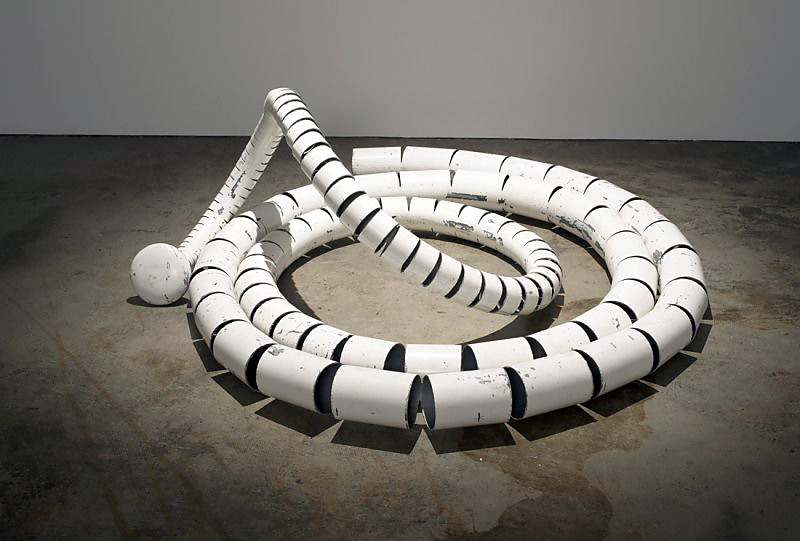
Robbie Rowlands (Australian, b. 1968) Scored 2008 Goal post, steel 160cm x 130cm x 50cm Photograph: Christian Capurro
“The philosopher Martin Heidegger argued that objects are often invisible to us gathered up as they are within a context of functionality and use. It is only when things break down that we become aware of them, seeing them with fresh eyes. In many ways Heidegger’s observation could form the basis of an approach to Robbie Rowlands’ work. Rowlands takes objects that are often forgotten, invisible or transparent to us, objects that exist on the verge of disappearance, and stages a kind of ‘breakdown’, inviting us to rediscover the object, poised somewhere between what it was and what it might become.”
Simon Cooper. Catalogue essay
Sitting in pools of light in the elegant modern space of Place Gallery in Richmond, six theatrically lit sculptures are presented by artist Robbie Rowlands. Made of everyday objects (a boom gate, desk, chair, single bed, electricity pole, desk and footy goalpost) they have been de/constructed by the artist and reformed into curved objects. With ironic titles such as Down for the felled electricity pole and Collapse for the dismembered chair Rowland’s work hovers between one fixed state and an’other’ transformative state of being.
While the catalogue essay by Simon Cooper suggests that all of these objects are abandoned or nearly forgotten sharing a context of quasi-obsolescence, this is not the case. These were objects of purpose and form, the acts of ritualised production of a consumer society that contained signs that symbolised their status. In his creativity Rowland has used these technologies of production, which permit us to produce, transform or manipulate things to create new sensual forms of life. Some of the sculptures such as Boom (the boom gate; 2008, below) and Scored (the goal post; 2008, above) remind me of creatures emerging from the recesses of the unconscious, curling and rearing up like monsters from the deep. One of the most beautiful forms is the constructed white chair where the function of the object has collapsed into the essence of the form, like the surreal spatiality of a poetic Miro. As Gaston Bachelard reminds use in The Poetics of Space:
“The grace of a curve is an invitation to remain. We cannot break away from it without hoping to return. For the beloved curve has nest-like powers; it incites us to possession, it is a curved corner, inhabited geometry.”1
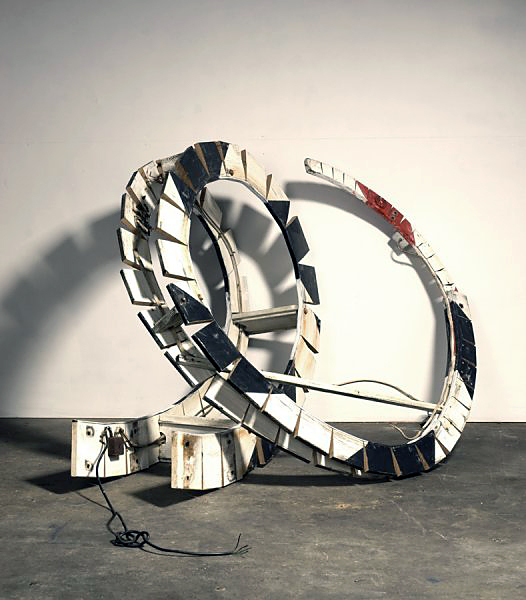
Cooper suggests that the curved forms that Rowland creates were “already there in the original object, even as it was sat on, written on, or passed by on the way to work.” He rightly notes that the process used contains a certain violence, but that we remember and reconstruct the old form even as we respond to the new construction. For these sculptures are a construction not, I believe, inherent in the original form. This can be seen in the sculpture Boom (2008, below) for example, where Rowland has used additional pieces of metal to hold the curve of the boom gate in place. Without this skilfully added, hidden sub-structure the transformative shape would collapse onto the floor. Rowland inhabits and possesses his new geometry with as much technology as the original but not in such an obvious form.
At their best these sculptures are both poetic palimpsest and heterotopic objects of otherness that are neither here nor there. The work would have been stronger if only four pieces were presented in the gallery space – the sculptures needed more room to breathe (understanding the dictum that less is more). The sculptures themselves also needed greater thematic cohesiveness perhaps using the colour white as the unifying theme. But they are sensual and beautiful gestures and deserve the attention of your visit.
Dr Marcus Bunyan
1/ Bachelard, Gaston. The Poetics of Space. Boston: Beacon, 1969 [originally 1958] p. 146
Robbie Rowlands (Australian, b. 1968) Boom 2008 Rail boom gate, wooden 160cm x 160cm x 130cm Photograph: Wren
Place Gallery 120 Collins Street Melbourne VIC 3000 Phone: (03) 9527 6378
“Sciagraphy: the art of depicting an object through its shadow.”
(William Henry Fox Talbot’s private name for photography)
Schaaf, Larry. “The Paper Multiple: Talbot’s Invention and Early Photographic Books,” in Foster, S., Heiting, M. and Stuhlman, R. Imagining Paradise. Rochester NY: George Eastman House, 2007, p. 45.
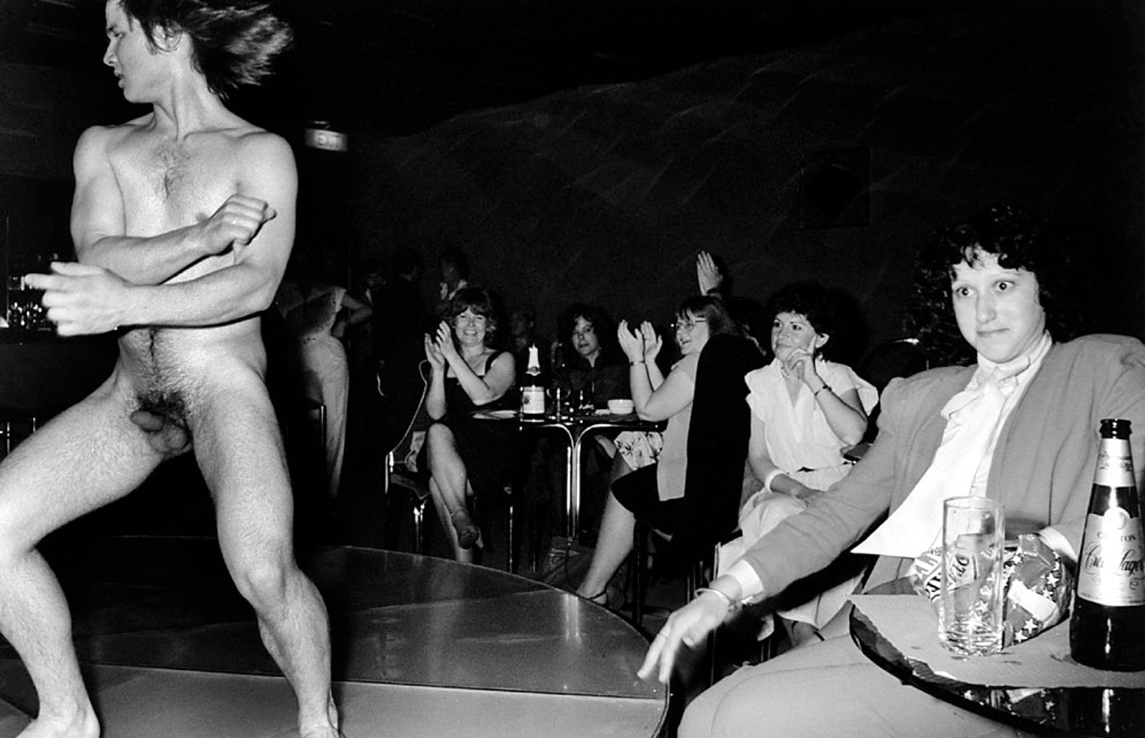
Rennie Ellis (Australian, 1940-2003) Girls’ Night Out, Prahran 1980 Silver gelatin, selenium toned fibre based print
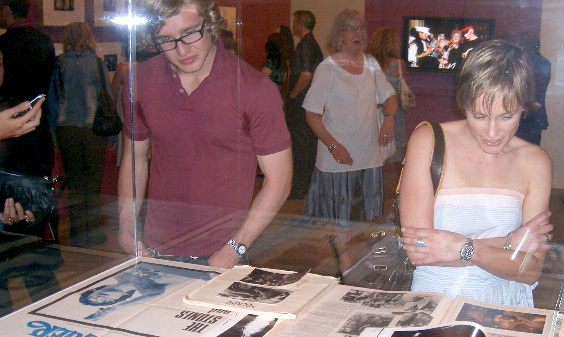
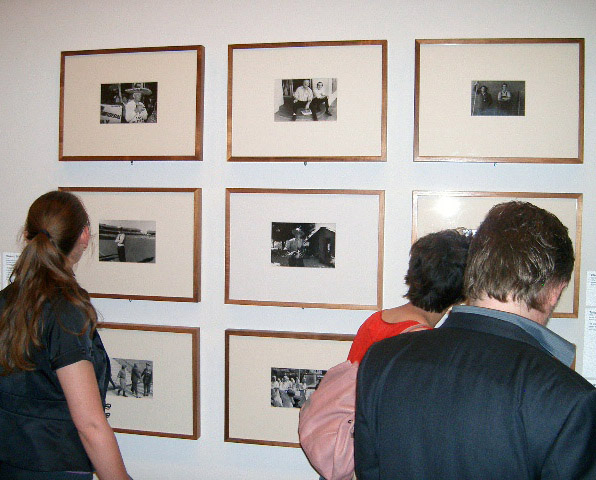
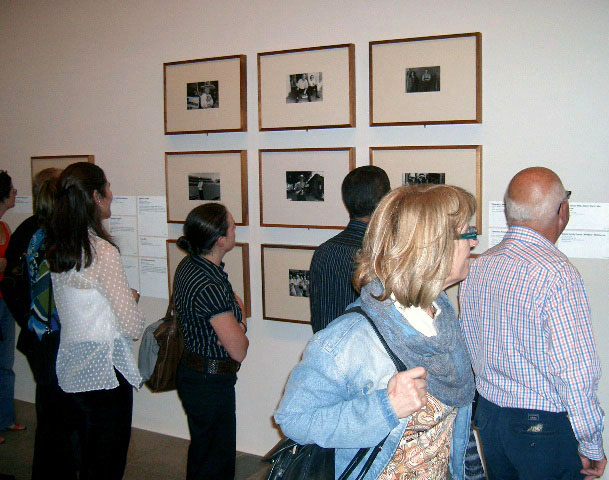
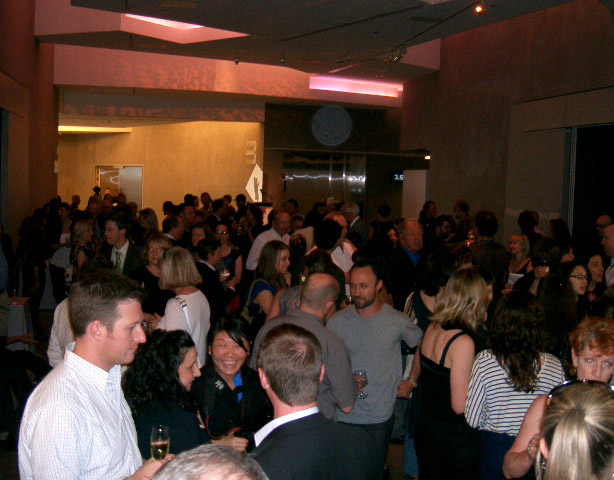
A very social and lively crowd gathered at The Ian Potter Centre: NGV Australia at Federation Square on the evening of 30th October to celebrate the life and work of the Australian social photographer Rennie Ellis.
After opening comments by the NGV Director Dr Gerard Vaughan there was a funny and erudite speech by Phillip Adams AO who had flown down from Sydney to open the exhibition. The crowd enjoyed the anecdotes about his relationship with Rennie and said he thought that dying was a good career move on Rennie’s behalf and that he would have loved the fact that he had a retrospective at the NGV. Adams observed that Ellis used to be everywhere, at every party and opening, using his astute eye to record and never to judge. Applause all round for a life well lived.
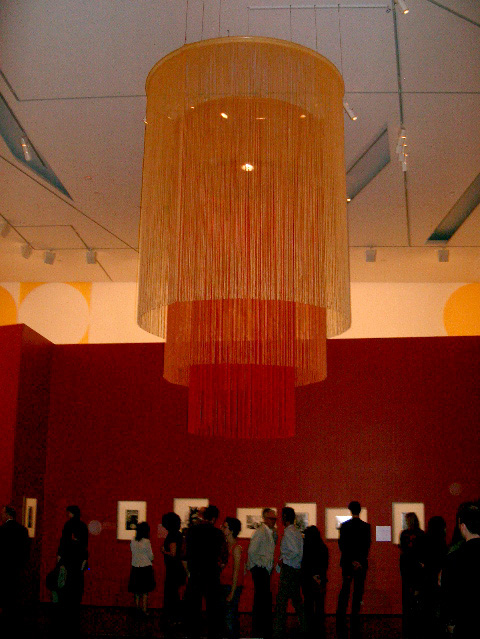
On entering the exhibition space viewers were treated to a simple but effective installation of his work, with overtones of the 1970’s-1980s interior decor with yellow and white circle graphics and hanging fabric chandelier. The curatorial staff at the NGV (notably Susan van Wyk) have chosen over 200 works from an archive of over half a million images for the exhibition in a process that has taken over two and a half years.
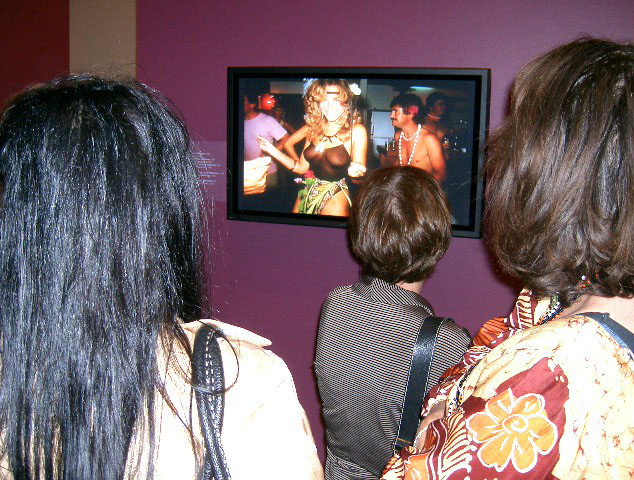
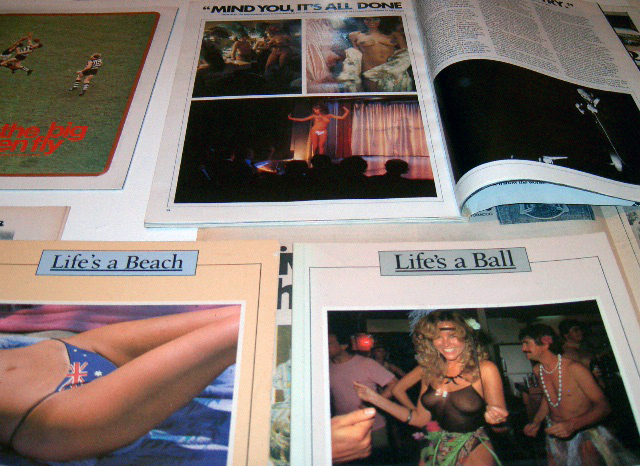
As an immigrant arriving in Australia in 1986 I remember 397 Club that used to be at 397 Swanston Street. After every other place had closed this club attracted people from every walk of life: pimps, prostitutes, drag queens, faggots, lesbians, straights and druggies. Rennie was probably there recording the scene. We were there just for a good time. It was fun and this is what Ellis’ photography is. Not burdened by overarching conceptual ideas Ellis recorded what he saw insightfully, balancing social commentary and spatial organisation in the construction of his images. The image Girls’ Night Out, Prahran 1980 (above) is a pearler (with the look on the woman’s face) and neatly encapsulates the magic of his image making.
Klippel/Klippel: Opus 2008 exhibition sculpture and installation from the first space
A magical exhibition of the work of the Australian sculptor Robert Klippel (1920-2001) is presented together with a soundscape to accompany the works by his son Andrew Klippel. The exhibition presents two distinct rooms of light and shade and finishes with a singular monumental bronze work No. 709, but it is the two rooms that astound. They contain small assemblages and bronze sculpture made in the 1980s-1990s.
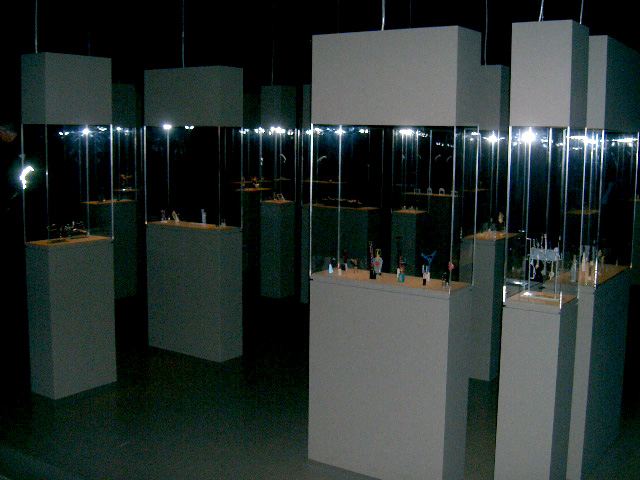
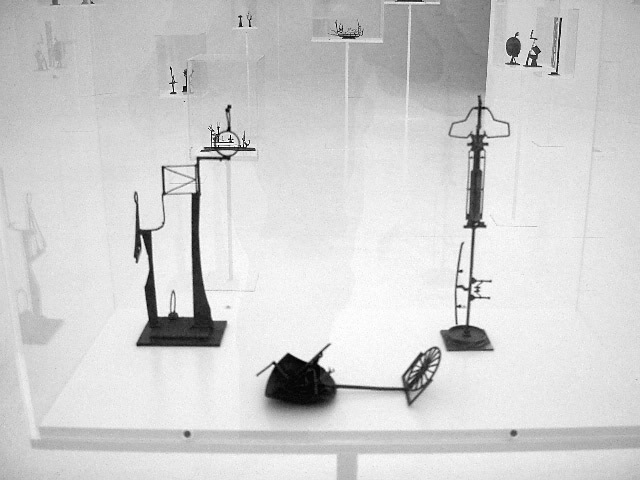
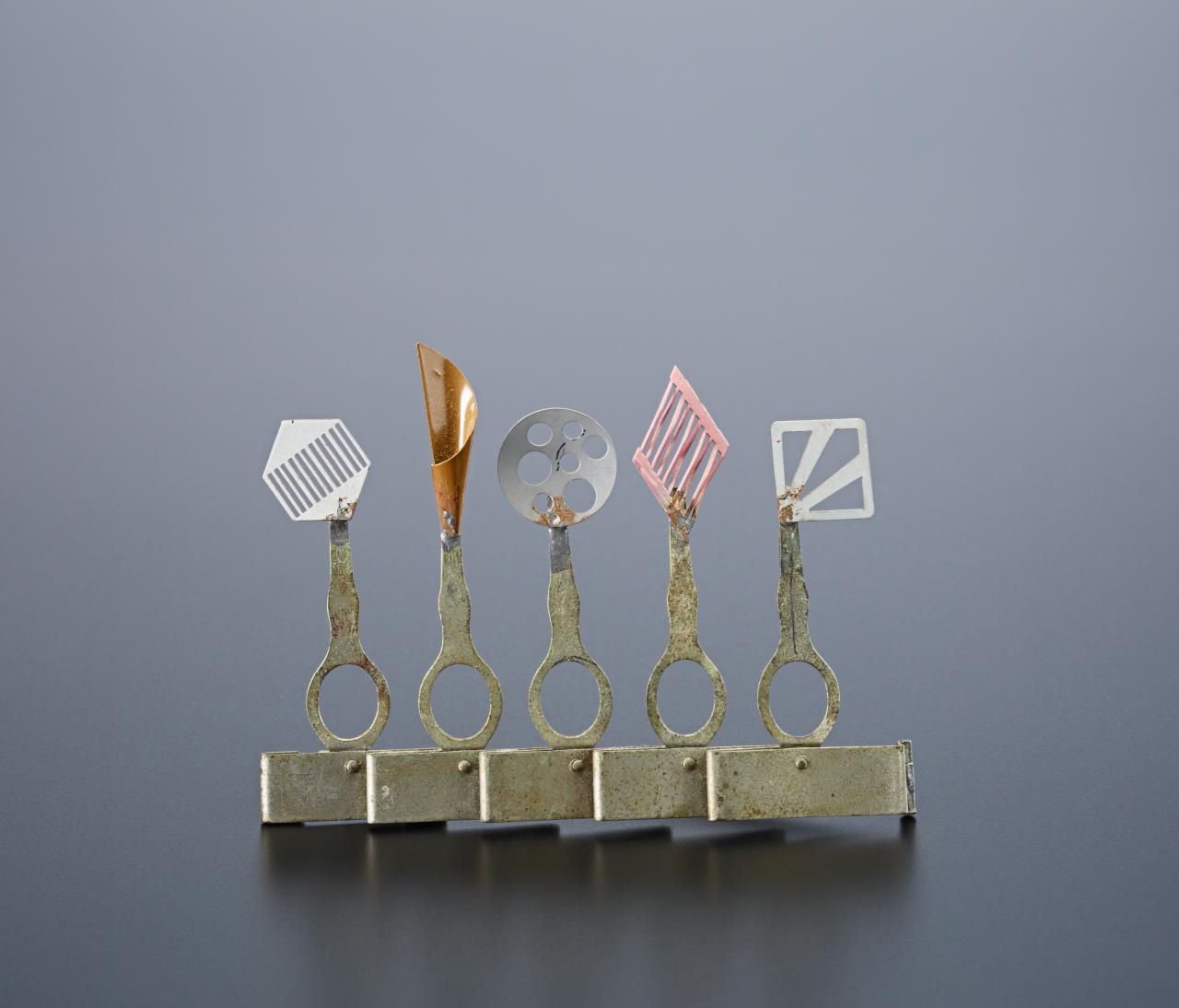
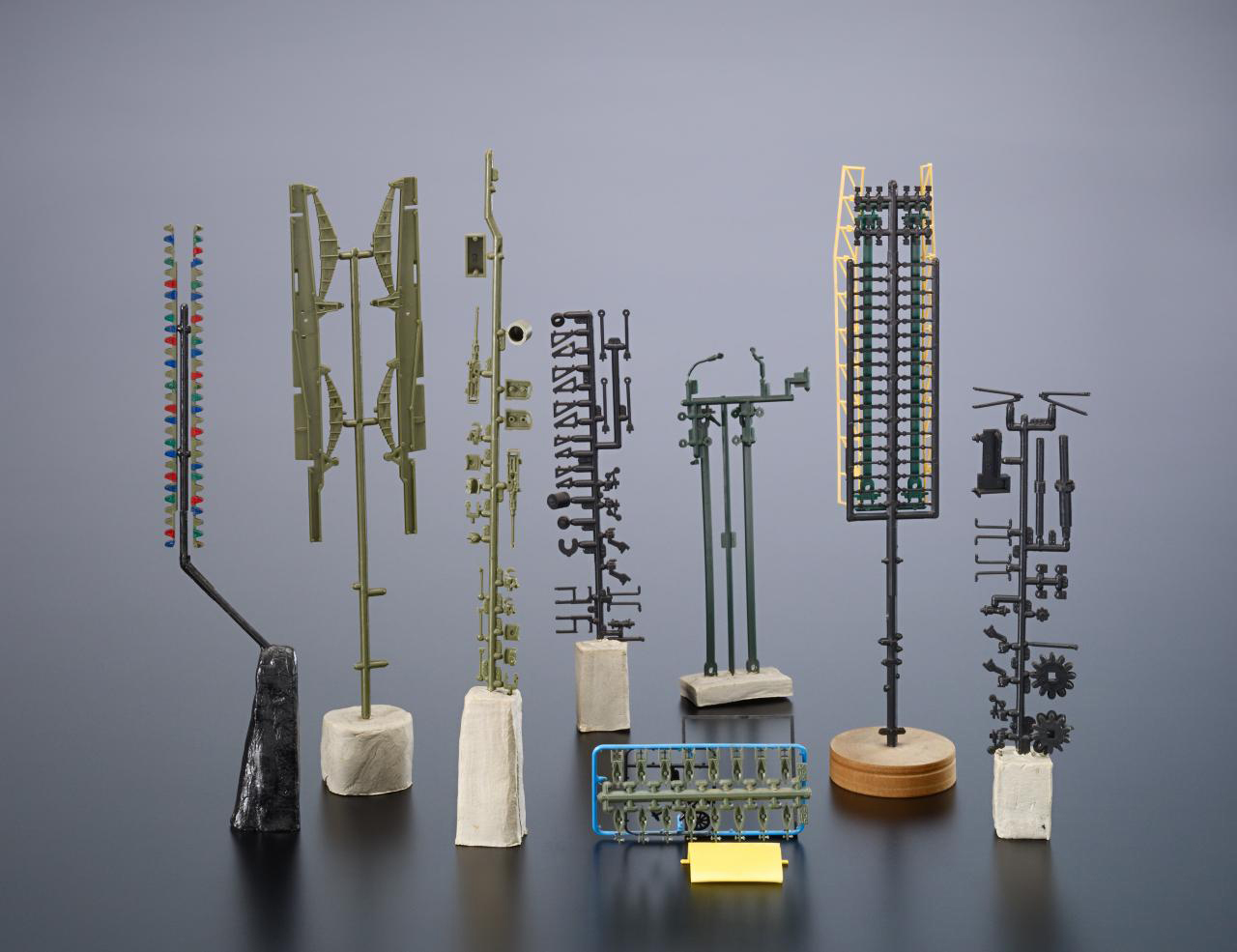
In the first space lit glass cases hover in darkness, containing delicate constructions of found objects, beautifully crafted. Made of plastic and metal, some parts taken from modelling kits, the sculptures morph and weave a delicate narrative, a powerful artistic vision. Mostly totemic in nature they transport the viewer with wonder and delight, the artists vision fully realised: no unnecessary flourishes, no wasted energy on forms that are redundant.
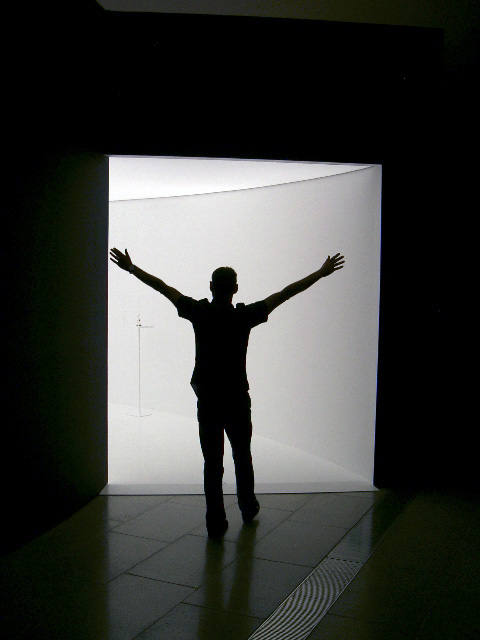
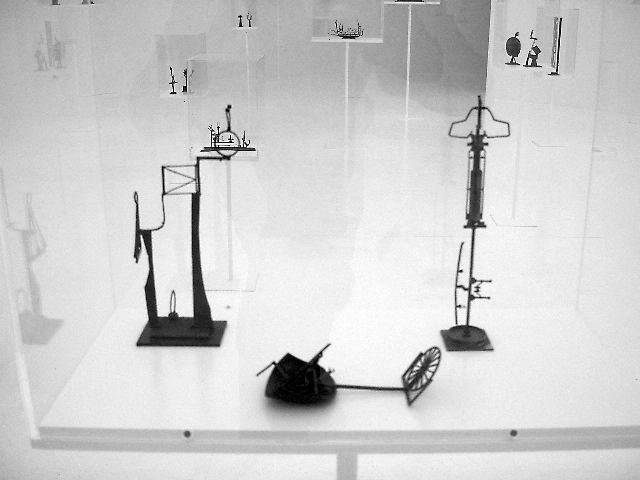
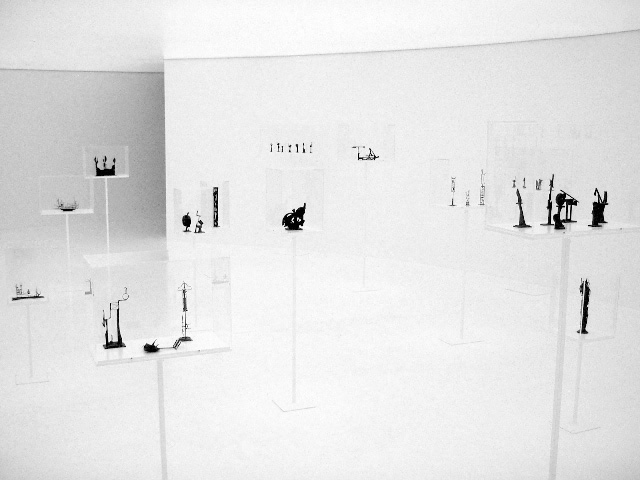
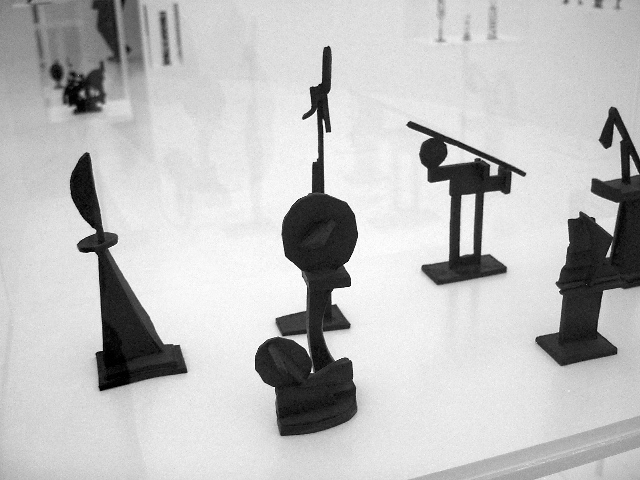
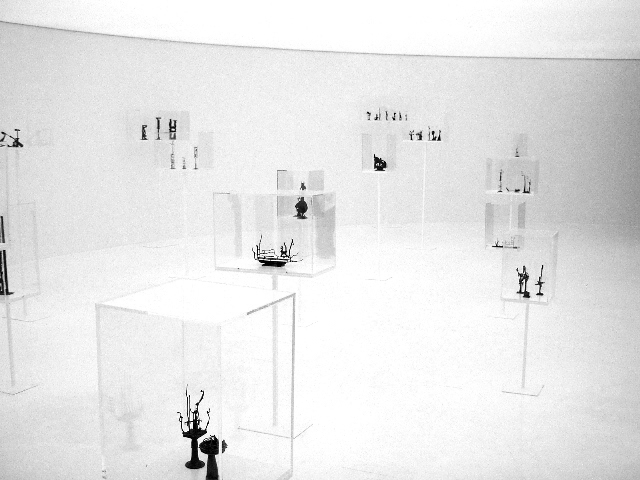
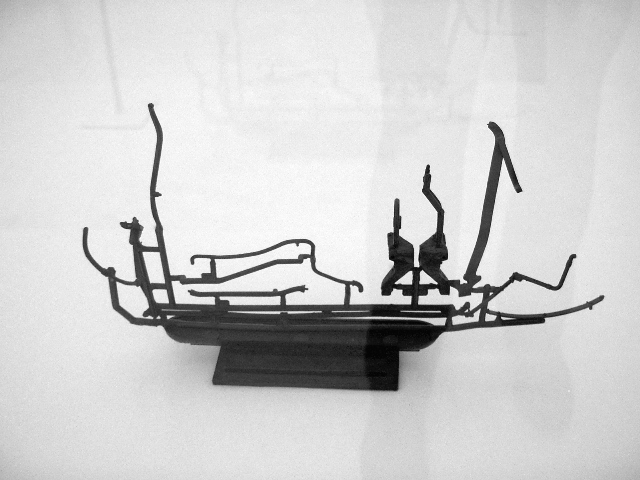
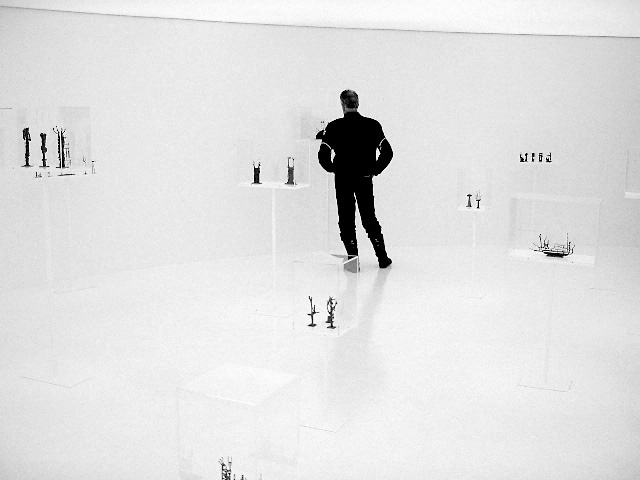
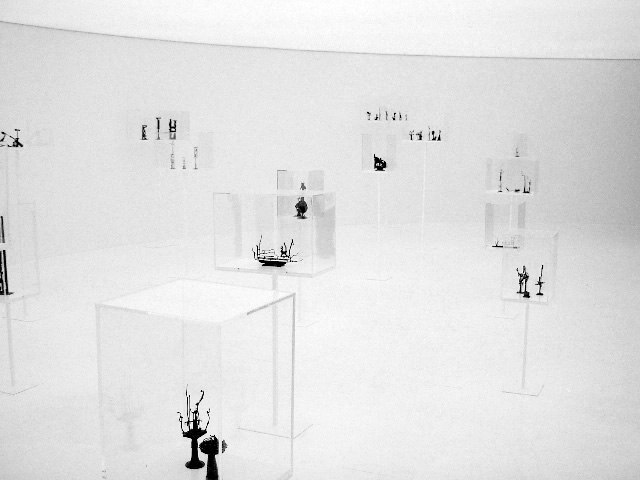
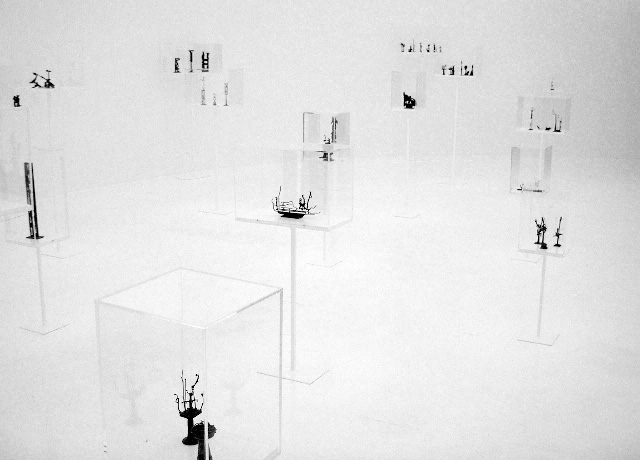
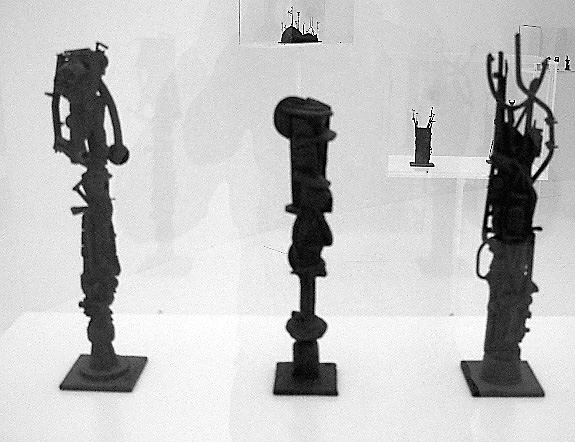
Wandering from the first darkened space we face a curved wall of black with a bright white opening, almost like the mouth of a Nautilus shell. Upon entering we are enveloped in white – walls, floor, stretched acrylic ceiling and stands upon which glass cases sit all being pure white. It is like stepping into the spacecraft from Stanley Kubrick’s 2001: A Space Odyssey – quite disorientating but transformational. In the cases sit small very dark bronze sculptures contrasting with the white. Again mostly totemic in nature the sculptures have great power and presence. Some portray small cities on top of hills. Others intricate machine and figure like constructions. All of the cases are mounted at different eye levels, unlike the first room.
When looking across the gallery space, the boxes and sculpture within create a diorama, almost a tableaux vivant, where you can move the focus of your gaze from foreground to mid to background, all suspended in white. If you can be in this space alone with the work and wander around soaking in the vision of this artist so much the better. The contrast and parallels between the two rooms is striking – here is an artist at the height of his powers commanding his materials and his vision in two distinct bodies of work: one delicate, found, plastic the other solid, dark and essential, both dealing with the essence of human creativity and being, leaving the viewer with a sensory experience long remembered.
Klippel/Klippel: Opus 2008 exhibition entrance to the second space
Robert Klippel is regarded as Australia’s most important sculptor of the post-war 20th century period. Known for his abstract assemblages created from found objects he is a distinguished figure in the history of Australian art. Andrew Klippel, Robert’s son, is a composer and musician who has achieved international recognition as a solo musician, songwriter and influential music producer.
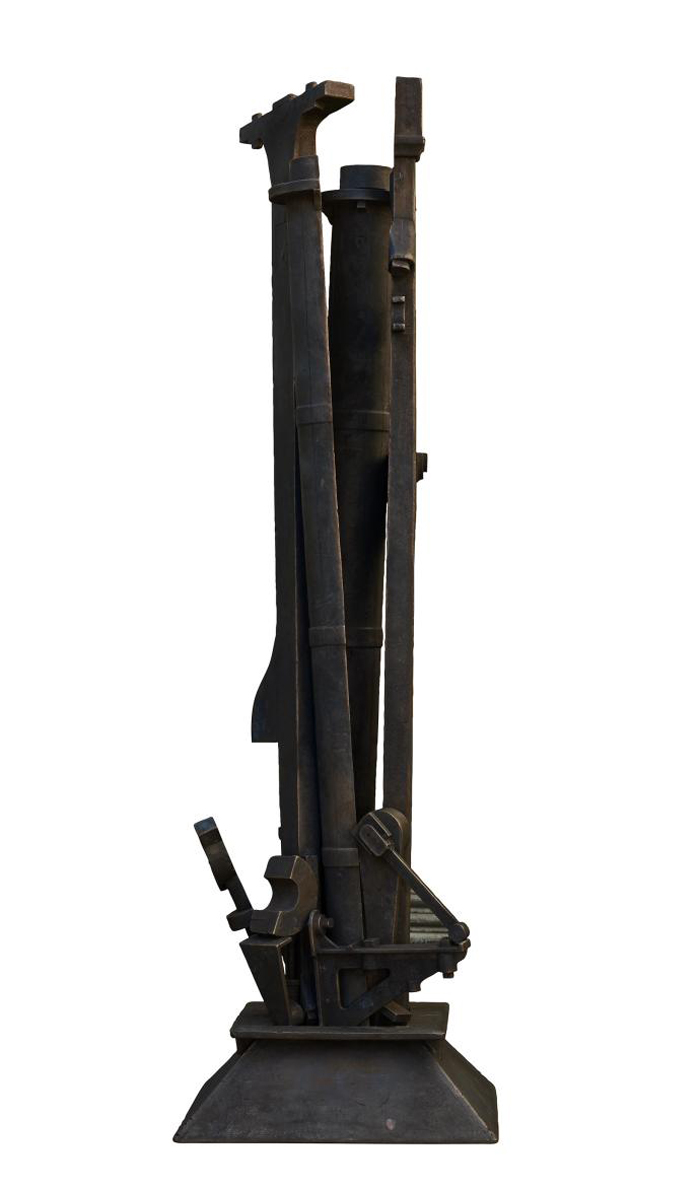
Klippel/Klippel: Opus 2008 is a unique and compelling sensory experience which presents a group of Robert Klippel’s small-scale sculptures that were produced during the 1980s and 1990s – some of these have never been publicly displayed. It also includes the monumental bronze work No. 709. Andrew has arranged for this work, which Robert was preparing to cast at the time of his death, to be executed for the National Gallery of Victoria and included in the exhibition. And, in an important artistic response, Andrew Klippel has created a soundscape – a meditation on his father’s work.
Klippel/Klippel: Opus 2008 is an extraordinary and immersive exhibition that celebrates the creative process.

















 Art Blart _ art and cultural memory archive
You must be logged in to post a comment.