Review: ‘Ben Quilty: After Afghanistan’ at the Castlemaine Art Gallery and Historical Museum

Exhibition dates: 15th January – 15th April, 2016

Curator: Laura Webster, Curator of Art at the Australian War Memorial (AWM)


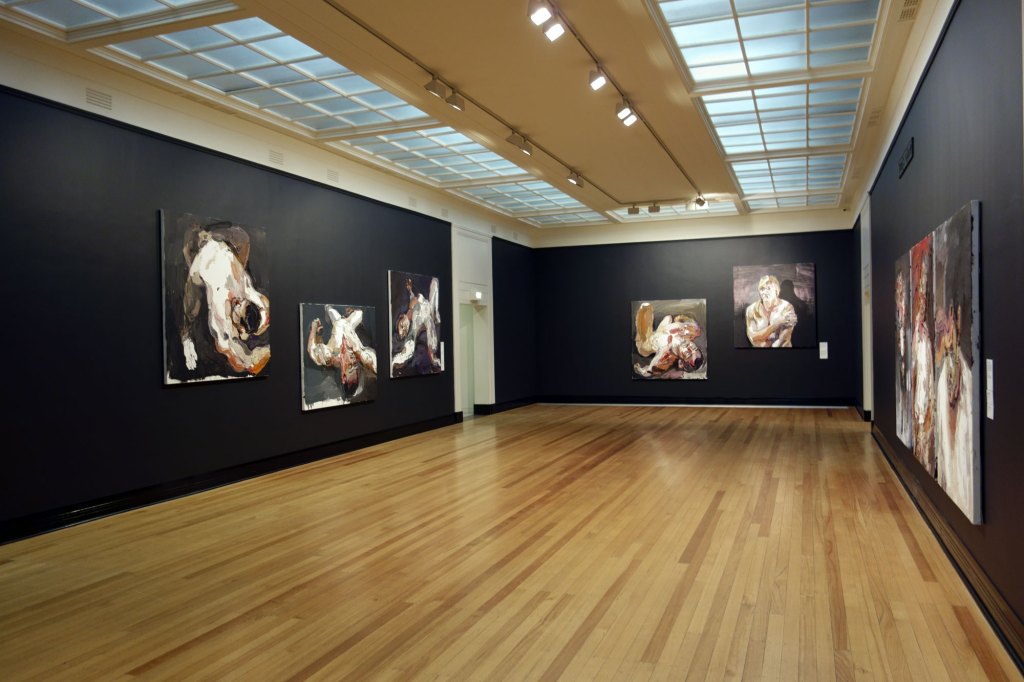
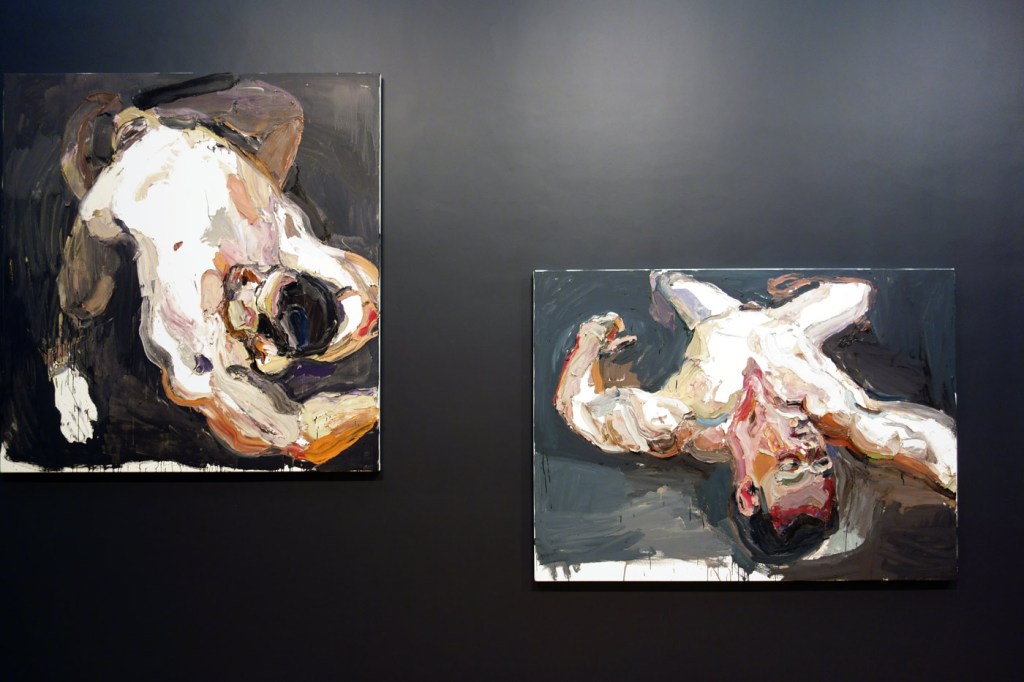
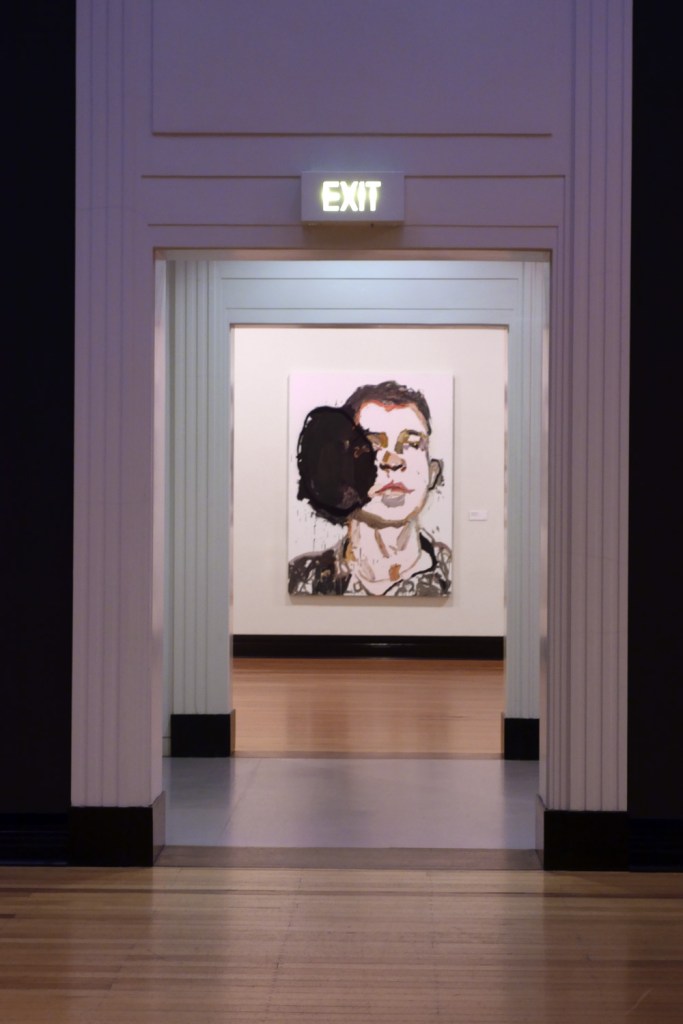
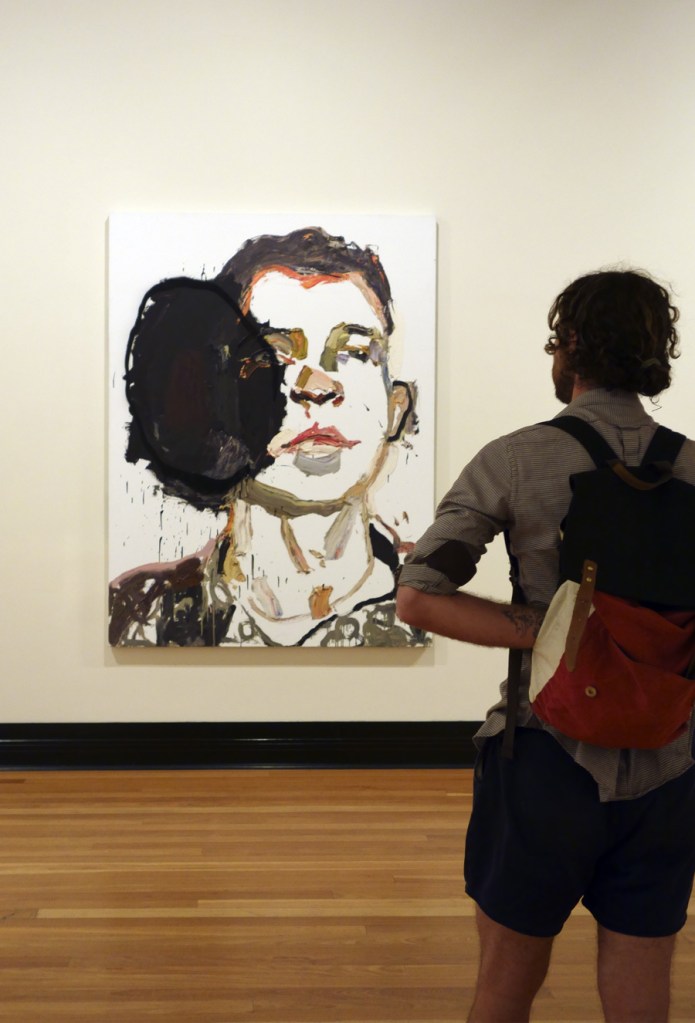
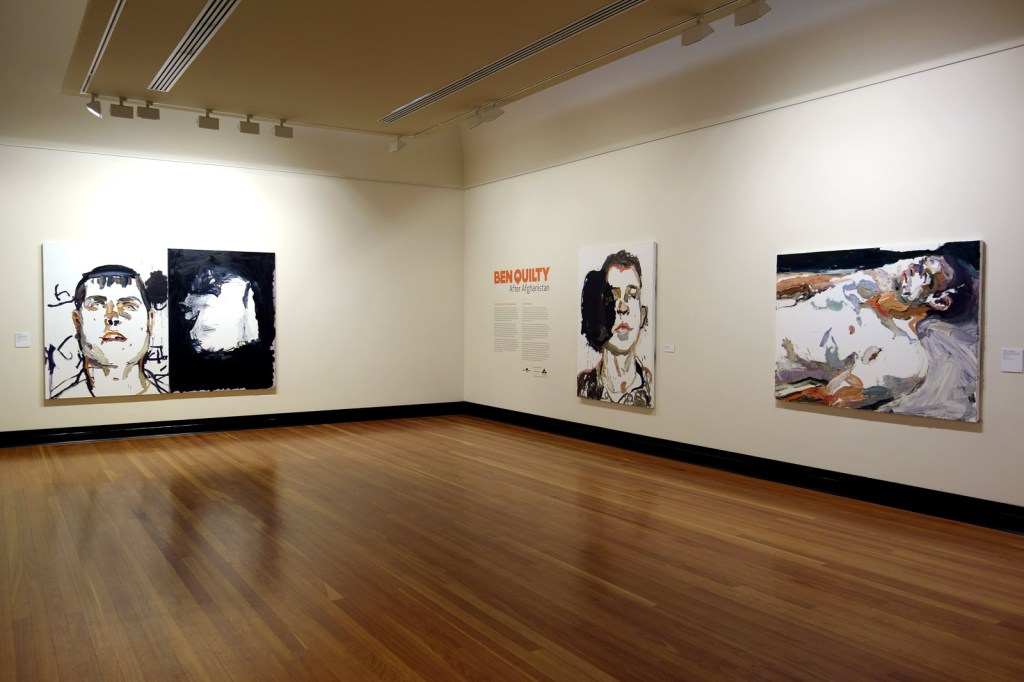
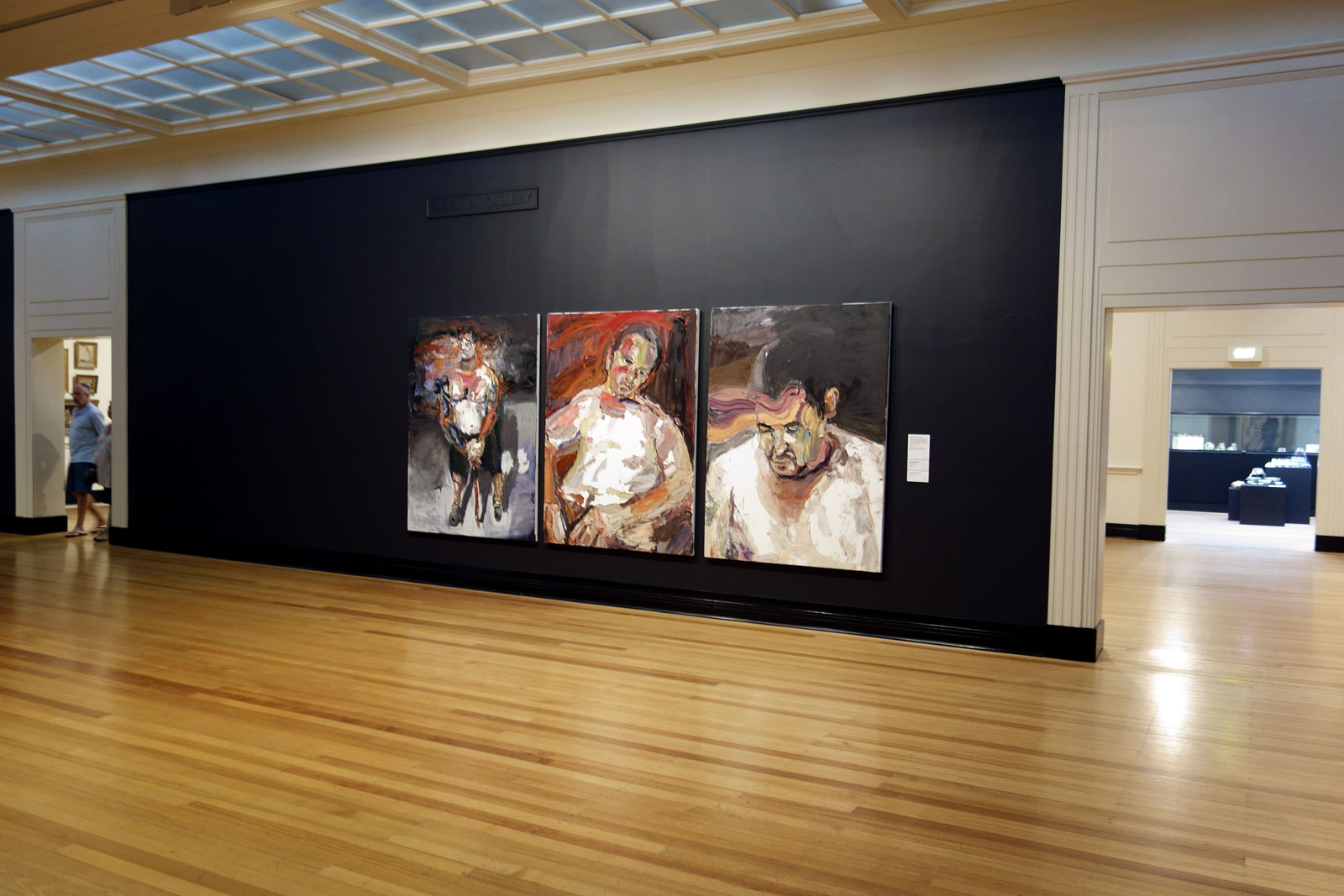
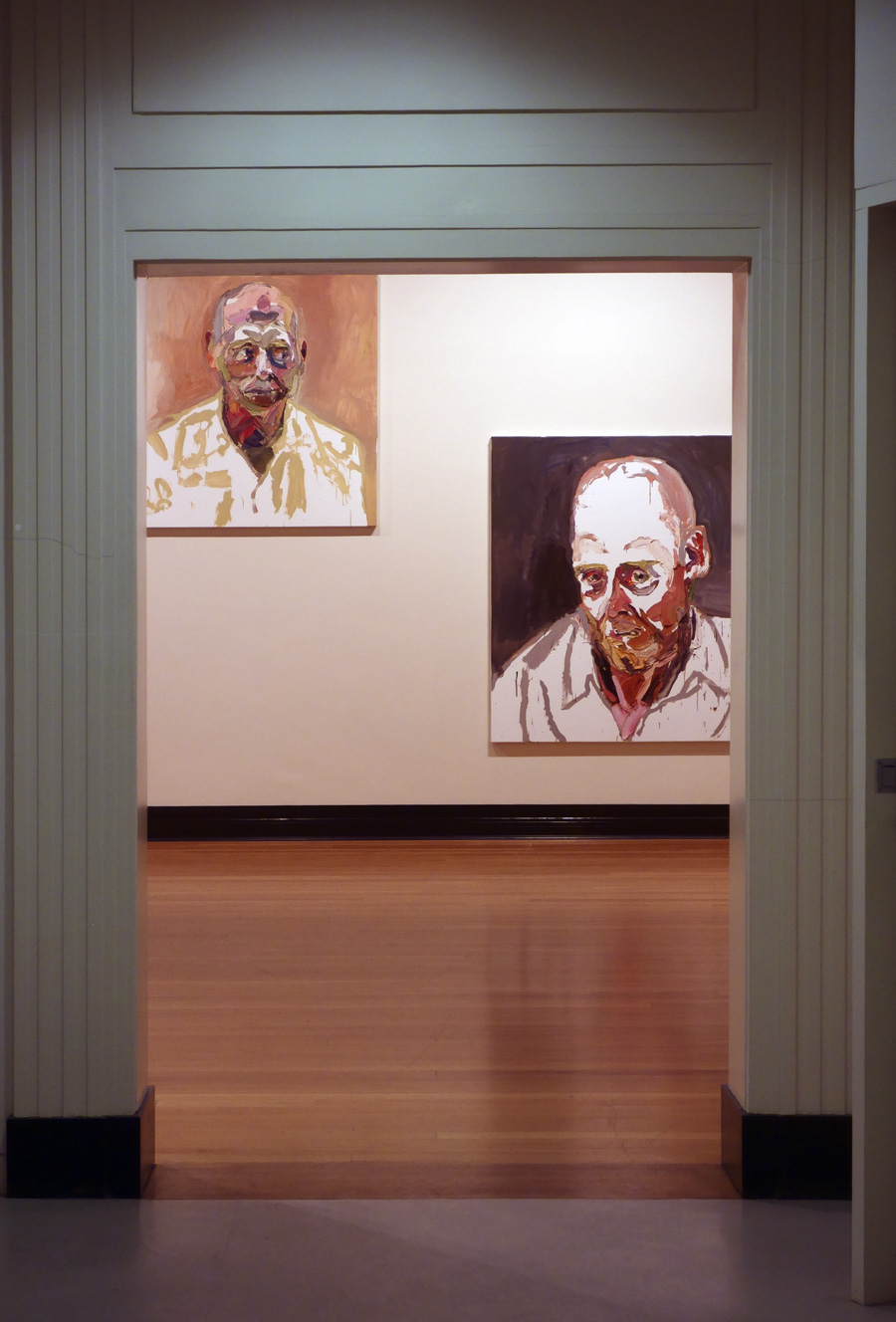
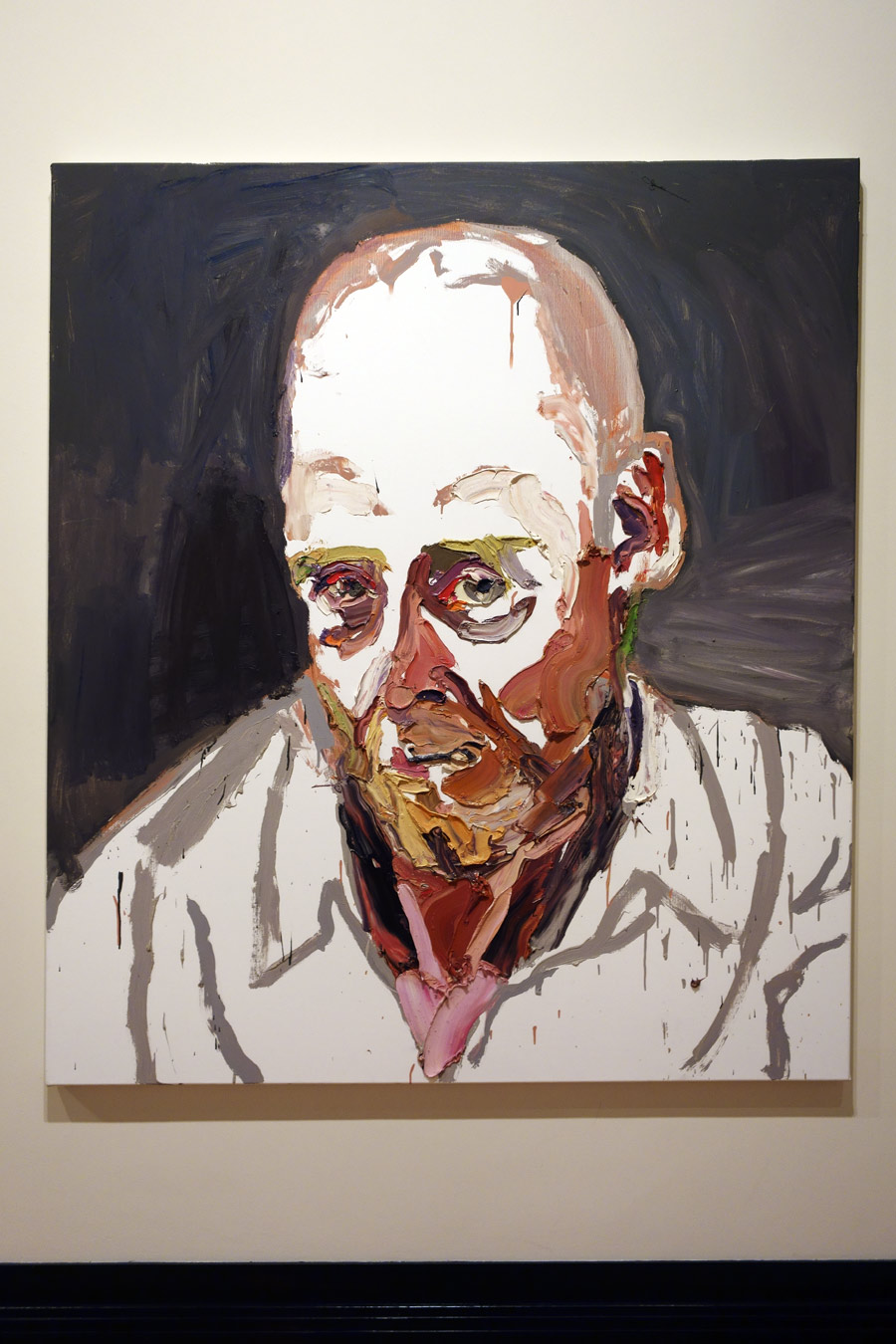
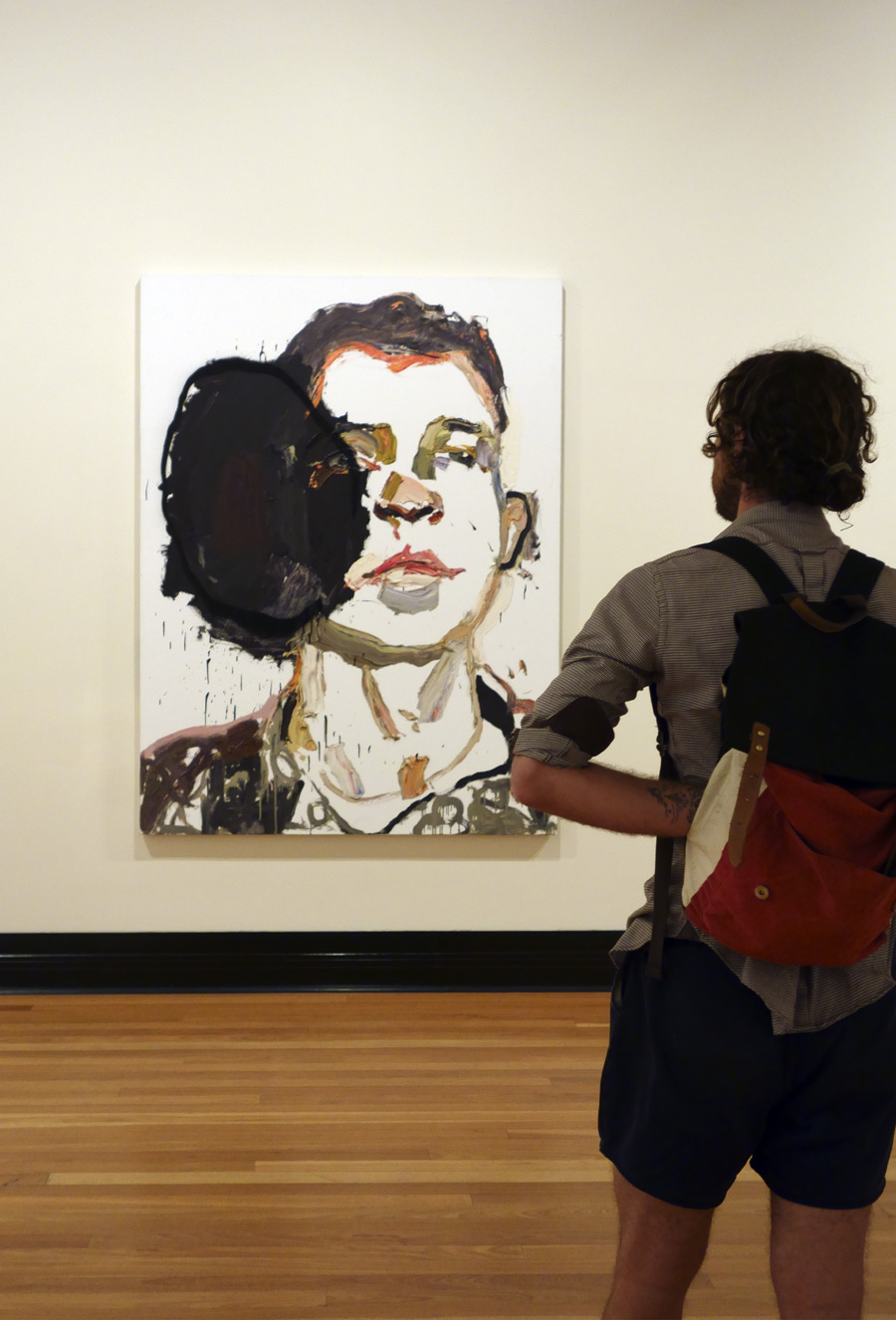
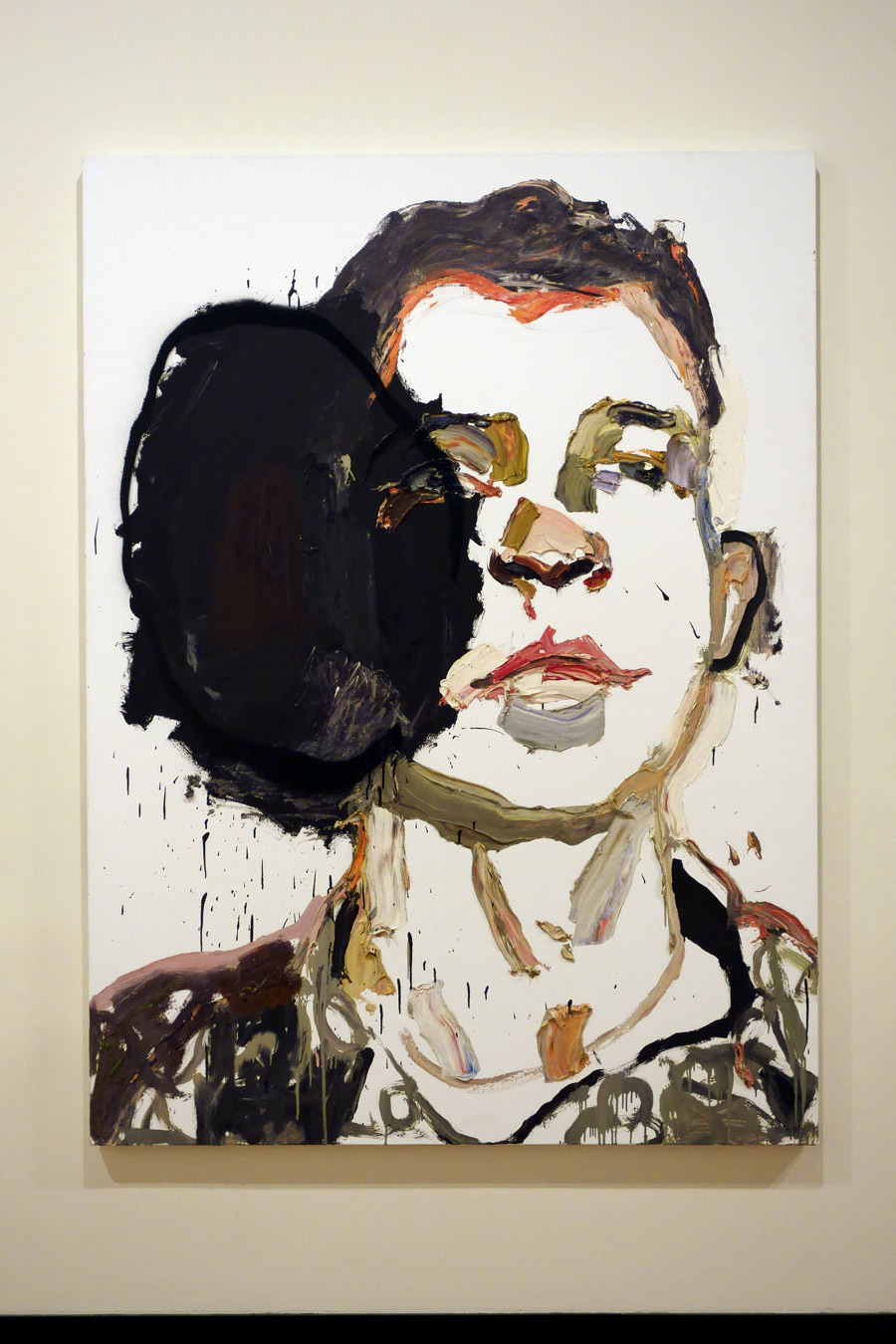
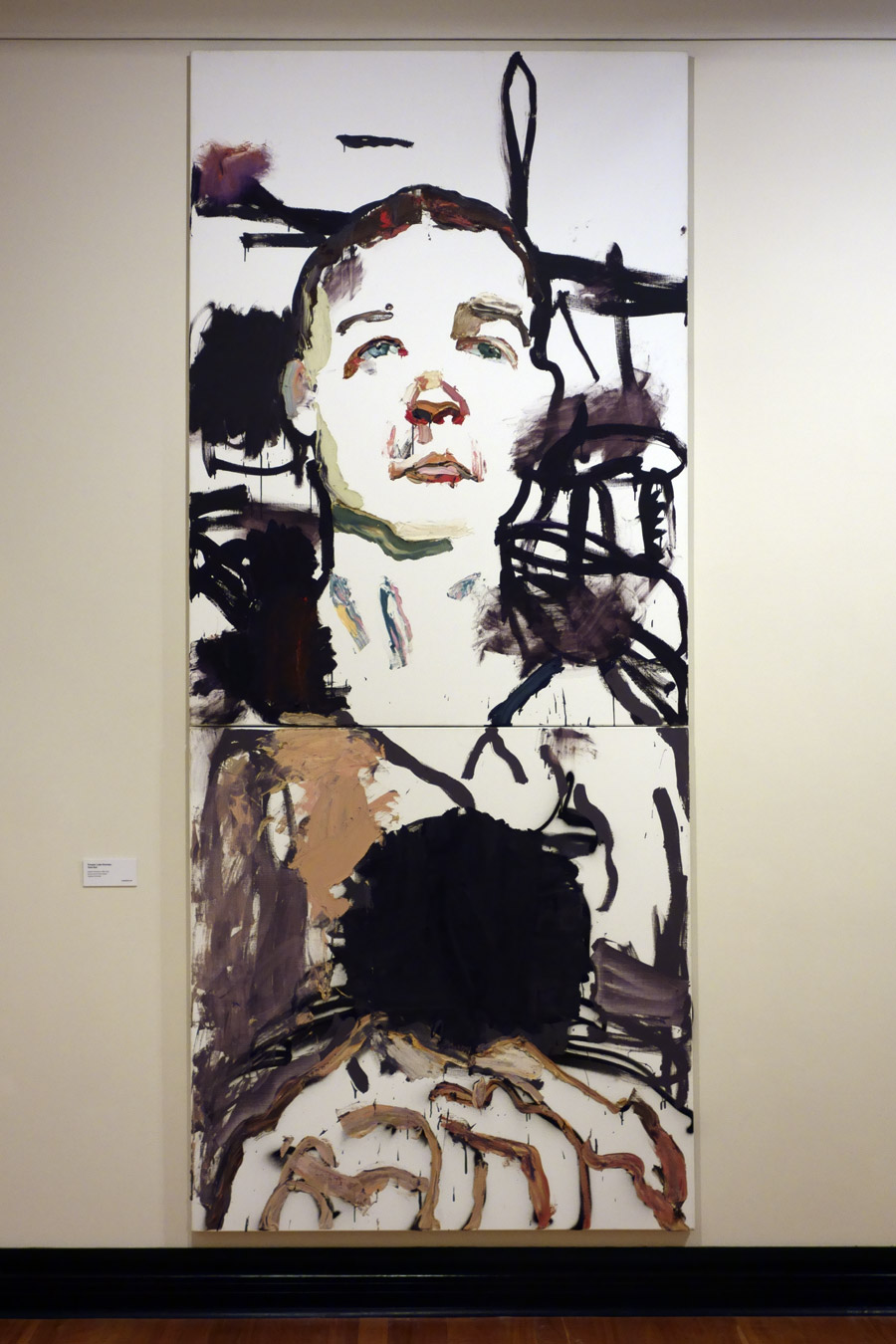
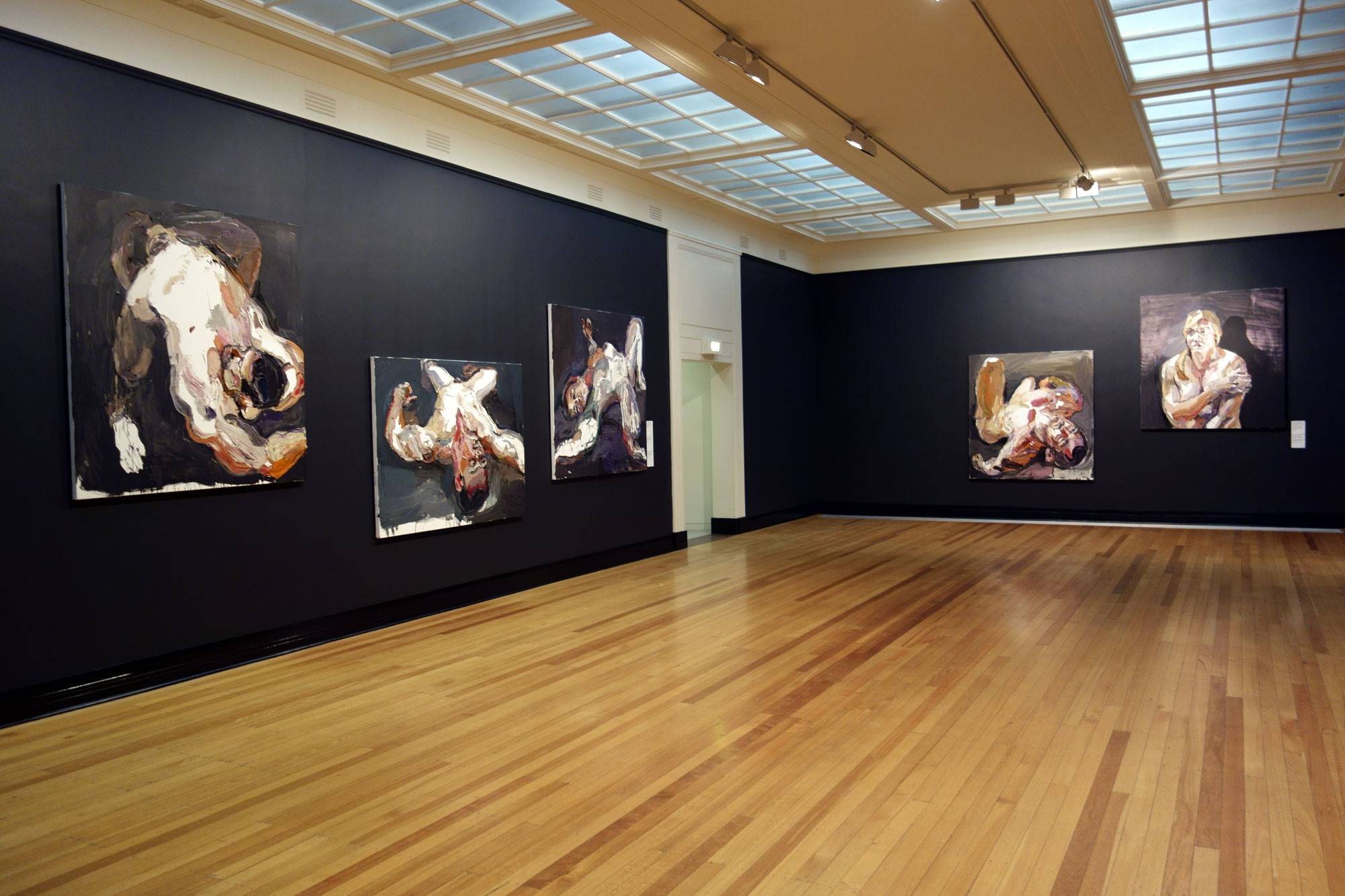
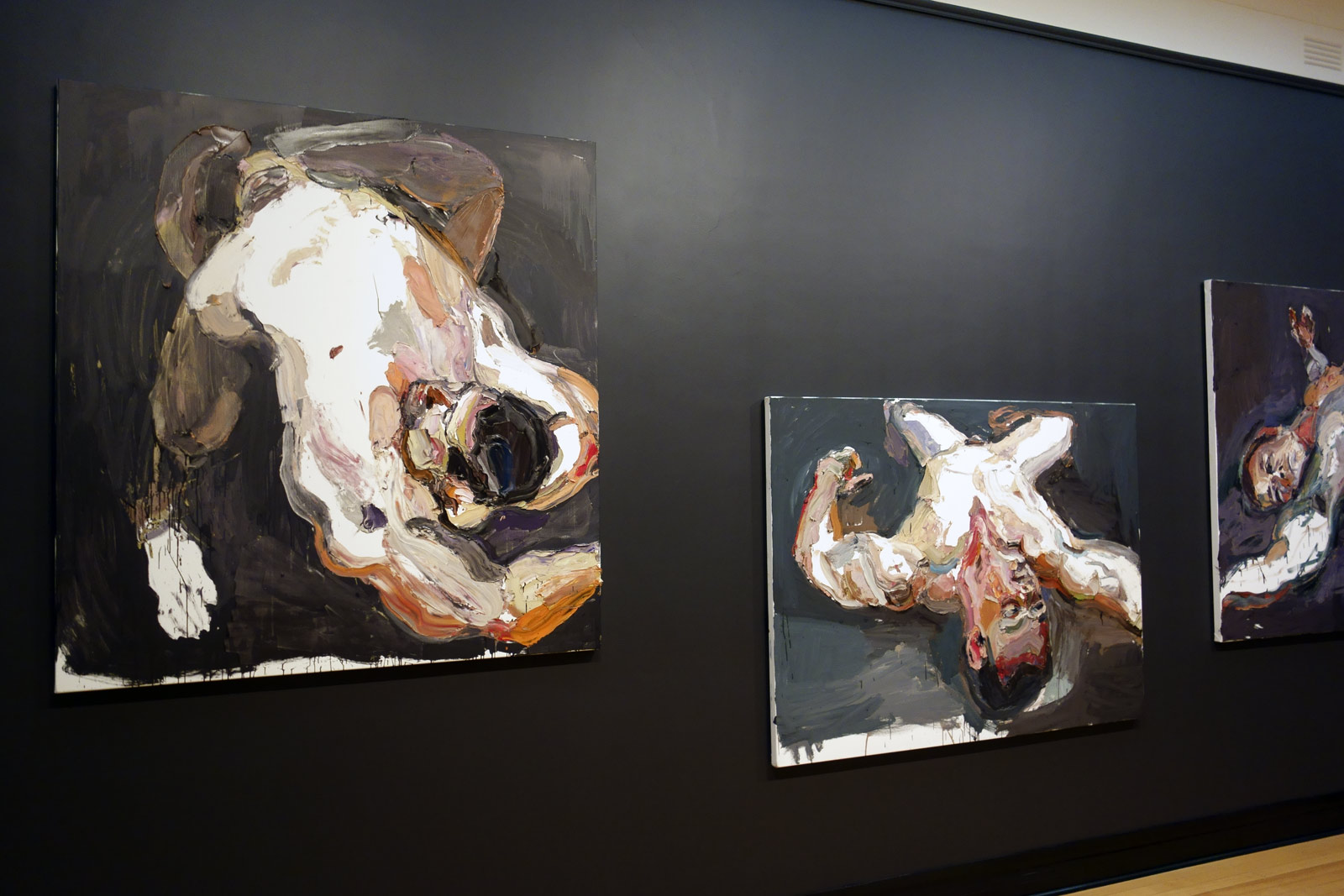
Installation view of the exhibition 'Ben Quilty: After Afghanistan' at the Castlemaine Art Gallery showing from left to right, 'Trooper M, after Afghanistan' (2012); and 'Trooper M, after Afghanistan, no. 2' (2012)


Installation view of the exhibition Ben Quilty: After Afghanistan at the Castlemaine Art Gallery showing from left to right, Trooper M, after Afghanistan (2012); and Trooper M, after Afghanistan, no. 2 (2012)
Photo: Marcus Bunyan


This is the most profound exhibition that I have seen so far this year. Simply put, the exhibition is magnificent … a must see for any human being with an ounce of understanding and compassion in their body.

While I am vehemently anti-war, and believe that we should have never have been in Afghanistan in the first place, these sensual and skeletal paintings represent the danger that these soldiers exposed themselves to in the line of duty. The sensuousness and vulnerability of their solitary, contorted poses – poses which they themselves chose to for Quilty to paint – reflect an actual event, such as taking cover to engage insurgents. That these naked poses then turn out to have a quiet eroticism embedded in them confirms the link between eroticism, death and sensuality as proposed by Georges Bataille. The three forms of eroticism (physical, emotional, religious) try to substitute continuity (life) for discontinuity (death). In these paintings the soldiers lay bare their inner self. They bring forth experiences that have been buried – their dissociation from the reality of what occurred, the experiences they have repressed, the post-traumatic stress – brought to the surface and examined in these paintings through the re-presentation of suppressed emotions, through a form of emotional eroticism, a primordial rising of eroticism, death and sensuality. An affirming act of life over death.

As an artist, Quilty intimately understands this process. I think a strong element of this exhbition is the feeling that there is something missing, that the range of concerns is lacking something. I suspect this is deliberate. Something is being withheld. And what is being withheld in the paintings is, I believe, narrative.

While there is an overarching text narrative – soldiers painted “after Afghanistan” – and individual paintings have titles such as Sergeant P, Troy Park, Trooper M and Trooper Daniel Westcott, these paintings could almost be of any human being who has been a soldier. Other than the specific triptych of Air Commodore John Oddie (and even then the portraits remind me of the ambiguity of Francis Bacon’s Study after Velázquez’s Portrait of Pope Innocent X, 1953), these paintings could be of any soldier. As Gerhard Ricther observes, “You can only express in words what words are capable of expressing, what language can communicate. Painting has nothing to do with that.” After Richter, you might say that “there is no plan”, there is only feeling in the work of Ben Quilty, embodied through his brush. Here, I see links to the work of that great British painter, Francis Bacon.

“Bacon was deeply suspicious of narrative. For him, narrative seems to be the natural enemy of vision; it blinds… Bacon seems to propose an opposition between narrative as a product that can be endlessly reproduced, as re-presentation – the ‘boredom’ is inspired by the deja vu of repetition – and narrative as process, as sensation. Conveying a story implies that a pre-existing story, fictional or not, is transferred to an addressee. Narrative is then reduced to a kind of transferable message. Opposed to this ‘conveying of story’, ‘telling a story’ focuses on the activity or process of narrative. This process is not repeatable; it cannot be iterative because it takes place, it happens, whenever ‘story’ happens… Bacon’s hostility toward narrative is directed against narrative as product, as re-presentation, not against narrative as process.
(Bacon) does not paint characters, but figures. Figures, unlike characters, do not imply a relationship between an object outside the painting and the figure in the painting that supposedly illustrates that object. The figure is, and refers only to itself.”1

The figure is, and refers only to itself, and it is up to the viewer to actively interpret this telling of the story each time they view one of Quilty’s paintings. There is no transferable message.

Further, much like Bacon’s triptychs, Quilty’s paintings depict isolated figures or figural events on the panels. The figures are isolated in their space and their is never any clear interaction between the figures. “Bacon explains the use of the triptych as follows: ‘It helps to avoid storytelling if the figures are painted on three different canvases’ … The figures never fully become characters, while the figural events are never explained by being embedded in a sequence of events. The figures interact neither with each other nor with their environment. Although Bacon’s paintings display many signs which traditionally signify narrativity, by the same token any attempt to postulate narratives based on the paintings is countered.”2

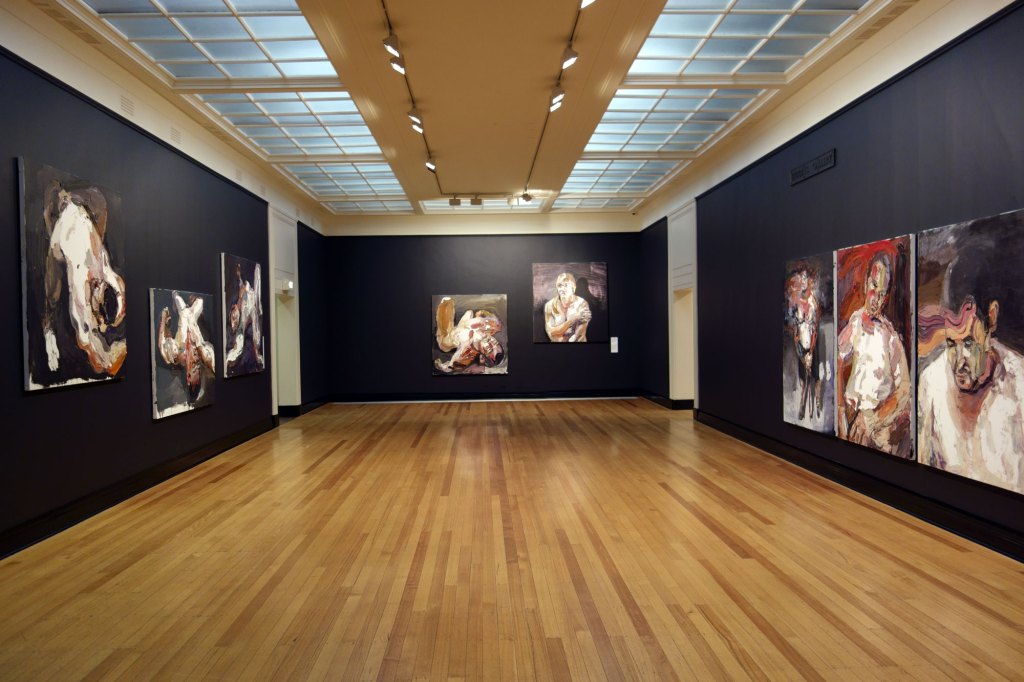
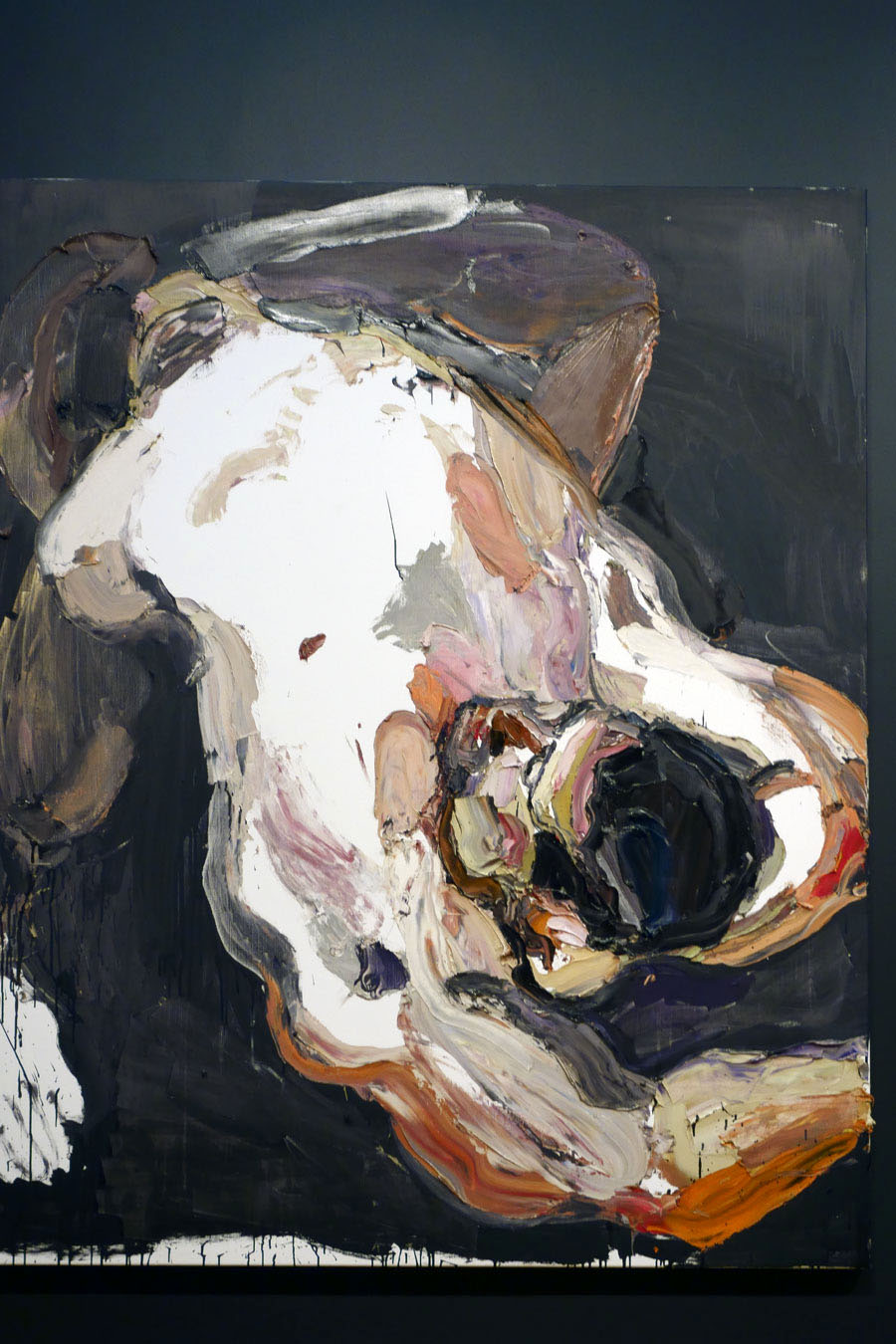
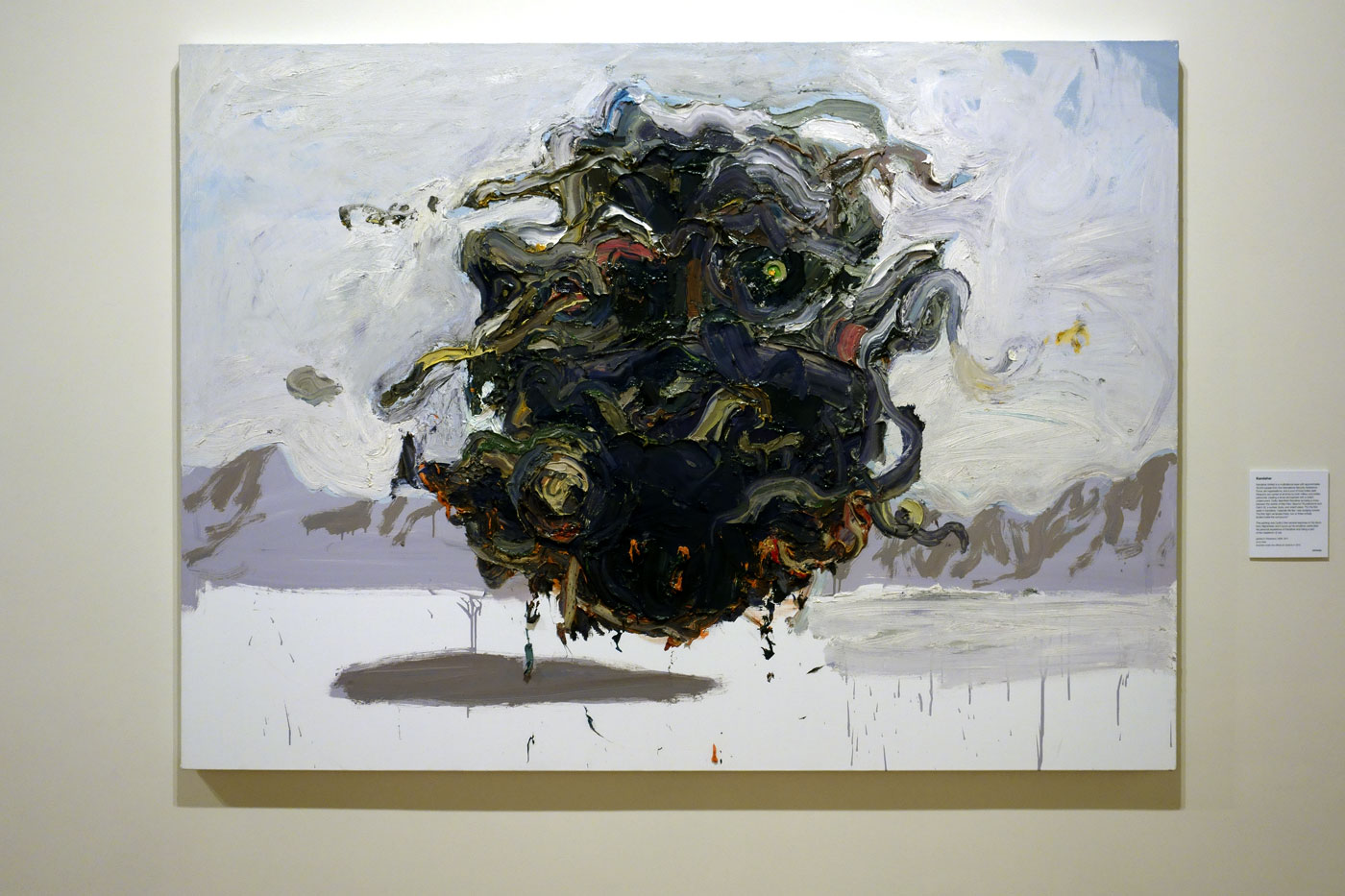
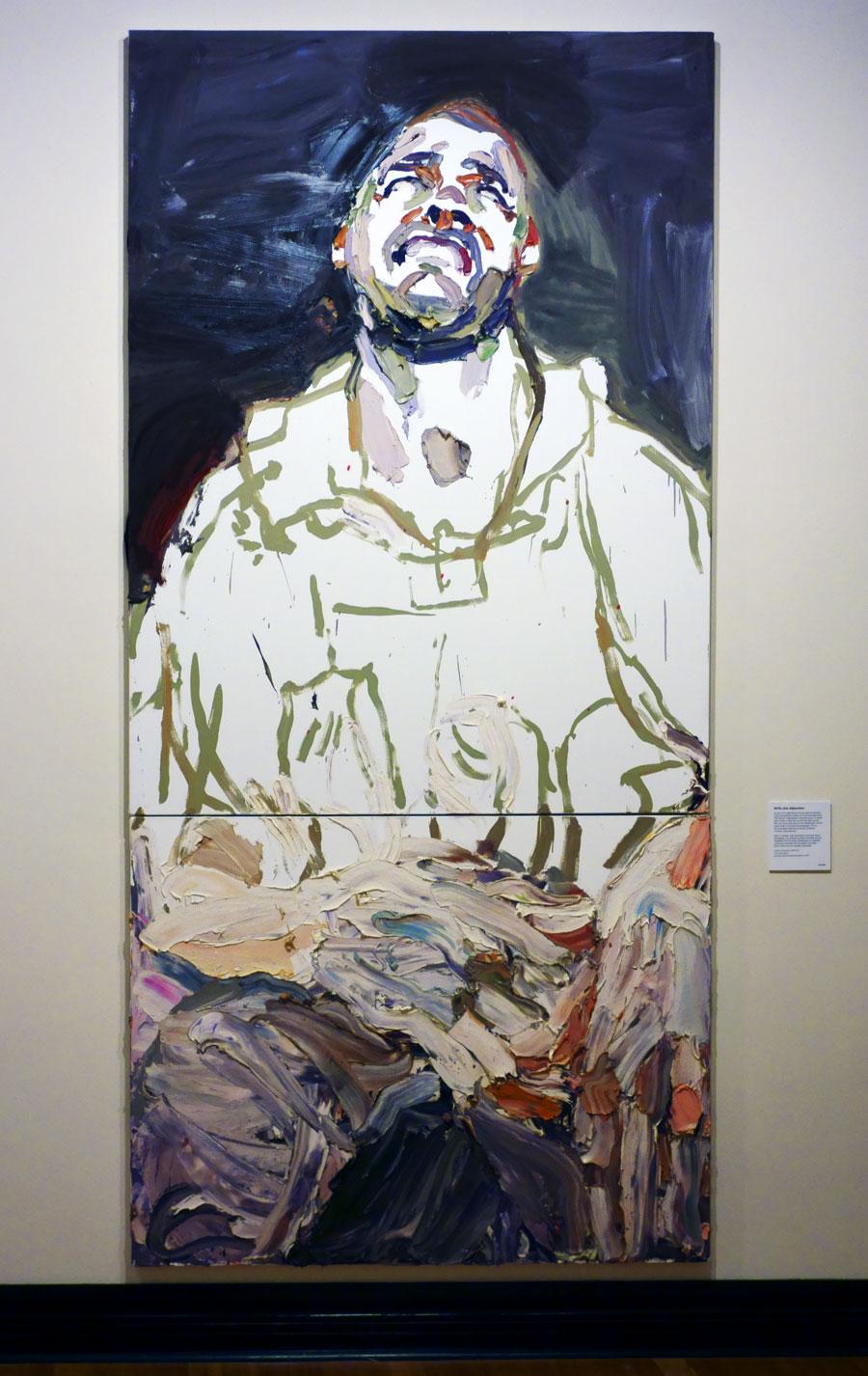
In these paintings, Quilty does not turn away from the evidence of the soldiers before him who express through their bodies that life is violent. He does not attempt to save the viewer from such unpleasantries. As Bacon comments, “The feelings of desperation and unhappiness are more useful to an artist than the feeling of contentment, because desperation and unhappiness stretch your whole sensibility.” Quilty stretches his sensibility as an artist and as a human being by getting down and dirty with his subject matter, both physically and emotionally. In fact, I would say Quilty becomes his subject, so close does the artist get to the object of his attention (after all, this is also Quilty’s experience of Afghanistan, as much as it is the soldiers who he is painting. The artist is always present in the work). The closer you get to one of his paintings, the more the detail vanishes and the more the paint becomes like blood and guts. The artist presses up against his subject which dissolves into abstraction. A bravura tour de force of painting that it so confident in its intent… [that there are] huge stretches of bare white canvas as flesh, with these striking gestures for throat and nipple executed without fear in one stroke of the brush. The black hole appearing out of the side of the soldiers head reminds me of Carl Jung’s ambivalent feelings toward his unconscious shadow; and at one end of the gallery you have a black hole (Trooper Luke Korman, Tarin Kot, 2012, below) and at the other a white hole (Trooper Luke Korman, 2012, below), such are the energies of yin yang that flow through the lighter of the gallery spaces.

Using what the photographer Imogen Cunningham termed the ‘paradox of expansion via reduction’ – closing in on subject (either physically and/or mentally), the intensity and focus attendant to a clear way of seeing – allows Quilty’s work to be flooded with sensuality and reductive power. The horror of the body, of how fragile we are (Damien Hirst) is expressed through the visceral paint. The viewer’s mind tells the story, creates the horror, the closer you get to the work. As I said earlier, there is no transferable message, no actual interpretation but universal triggers that impinge on the viewer’s mind.

Quilty plays with the flow of time and space, memory and war by disassociating himself from traditional narrative. As the quotation below from Peter Handke’s novel Across eloquently expresses it, it is a sense of “being-empty” (Zen), an empty form that is also full at the same time. Every object in Quilty’s opus moves into place and we pass over, quietly, into a place we have never been before, through paintings that picture the unknowable. Something we have never seen or felt before.

In painting, I don’t think there are many artists that could have achieved what Quilty has with this body of work.

Dr Marcus Bunyan

Word count: 1,125


Many thankx to Castlemaine Art Gallery and Historical Museum for allowing me to publish the photographs in the posting. Please click on the photographs for a larger version of the image. All installation photographs © Marcus Bunyan, the artist and Castlemaine Art Gallery and Historical Museum


1/ Ernst Van Alphen. Francis Bacon and the Loss of Self, 1992 quoted in “Francis Bacon and ‘Narrative’, the Natural Enemy of Vision,” on the ASX website, June 27 2013 [Online] Cited 29/03/2016.

2/ Ibid.,


“With the light of that moment, silence fell. The warming emptiness that I need so badly spread. My forehead no longer needed a supporting hand. It wasn’t exactly a warmth, but a radiance; it welled up rather than spread; not an emptiness, but a being-empty; not so much my being-empty as an empty form. And the empty form meant: story. But it also meant that nothing happened. When the story began, my trail was lost. Blurred. This emptiness was no mystery; but what made it effective remained a mystery. It was as tyrannical as it was appeasing; and its peace meant: I must not speak. Under its implosion, everything (every object) moved into place. “Emptiness!” The word was equivalent to the invocation of the Muse at the beginning of an epic. It provoked not a shudder but lightness and joy, and presented itself as a law: As it is now, so shall it be. In terms of image, it was a shallow river crossing.”


Peter Handke. Across. Ralph Manheim (translator). Farrar, Straus and Giroux, 2000, p. 5.


“I do not want to avoid telling a story, but I want very, very much to do the thing that Valery said – to give the sensation without the boredom of its conveyance. And the moment the story enters, the boredom comes upon you.”


Francis Bacon


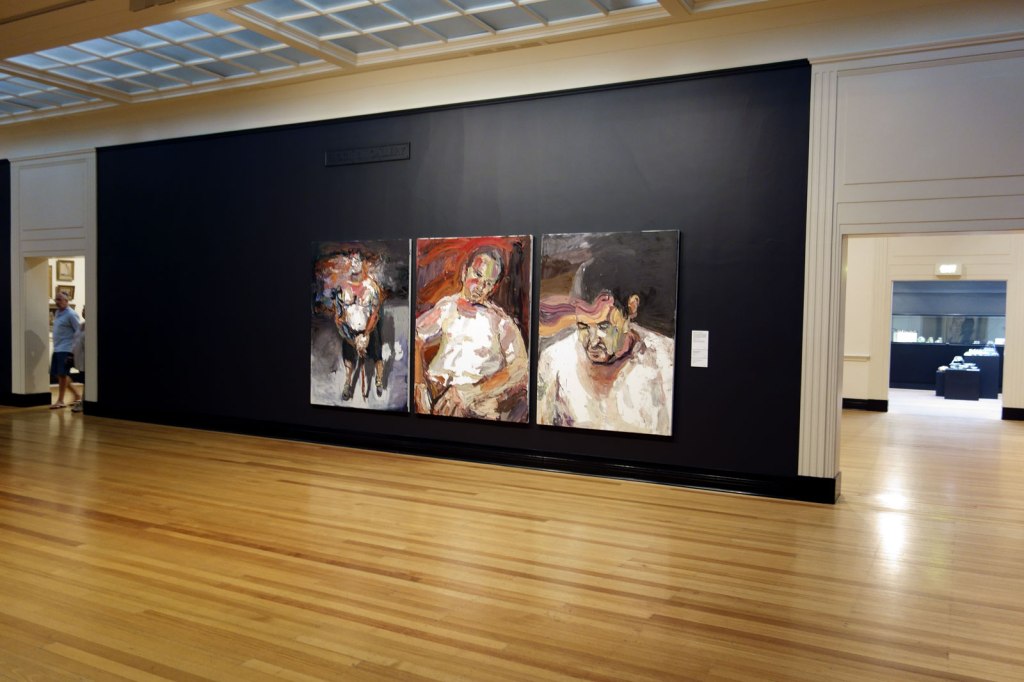
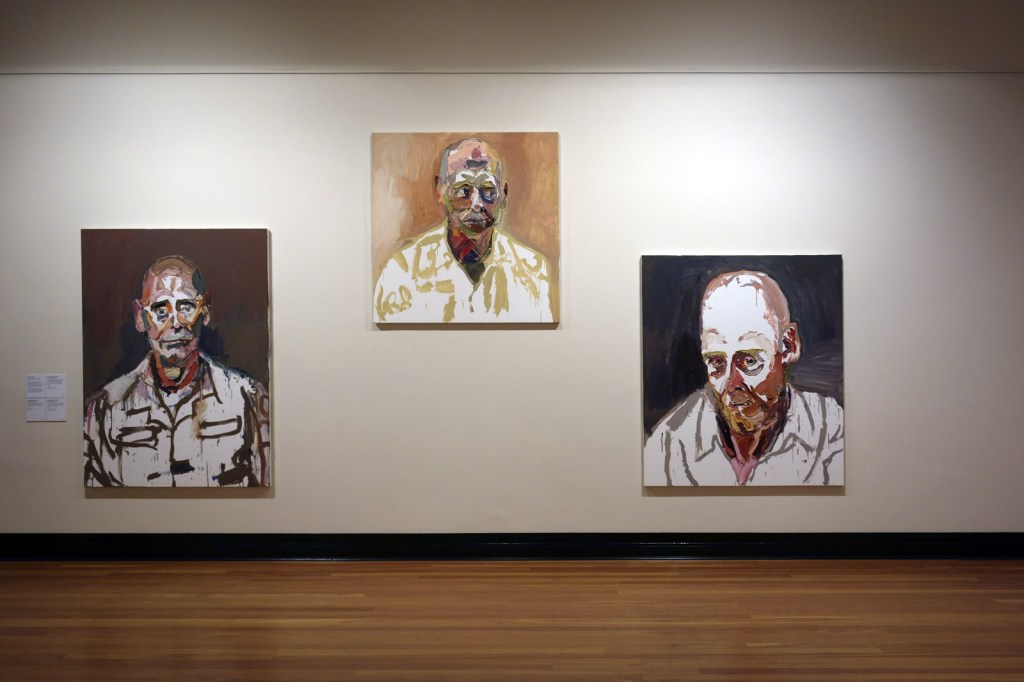
Installation view of the exhibition 'Ben Quilty: After Afghanistan' at the Castlemaine Art Gallery showing from left to right, 'Sergeant P, after Afghanistan' (2012); 'Trooper Daniel Westcott, after Afghanistan' (2012); and 'Troy Park, after Afghanistan' (2012)


Installation view of the exhibition Ben Quilty: After Afghanistan at the Castlemaine Art Gallery showing from left to right, Sergeant P, after Afghanistan (2012); Trooper Daniel Westcott, after Afghanistan (2012); and Troy Park, after Afghanistan (2012)
Photo: Marcus Bunyan


Sergeant P, a Special Operations Task Group soldier, is a survivor of a Black Hawk helicopter crash that claimed the lives of three Australians. Some of the soldiers depicted in the other portraits witnessed the crash and were first on the scene to provide assistance. The memory of this experience, and the friends who did not make it, will stay with these men for a long time.
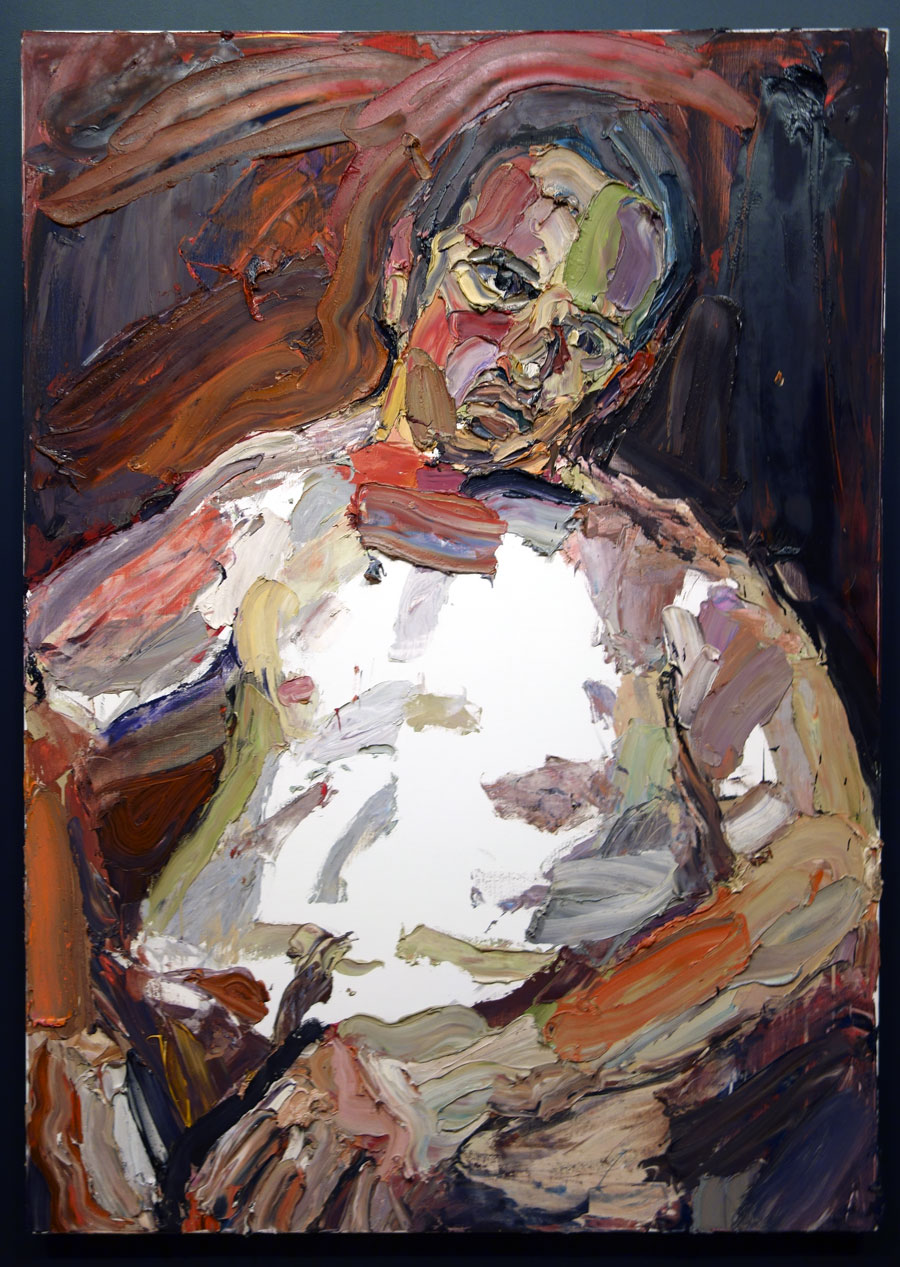
 

Ben Quilty (Australian, b. 1951) 'Trooper Daniel Westcott, after Afghanistan' 2012 (installation view)


Ben Quilty (Australian, b. 1951)
Trooper Daniel Westcott, after Afghanistan (installation view)
2012
Oil on linen
Collection of the artist
Photo: Marcus Bunyan
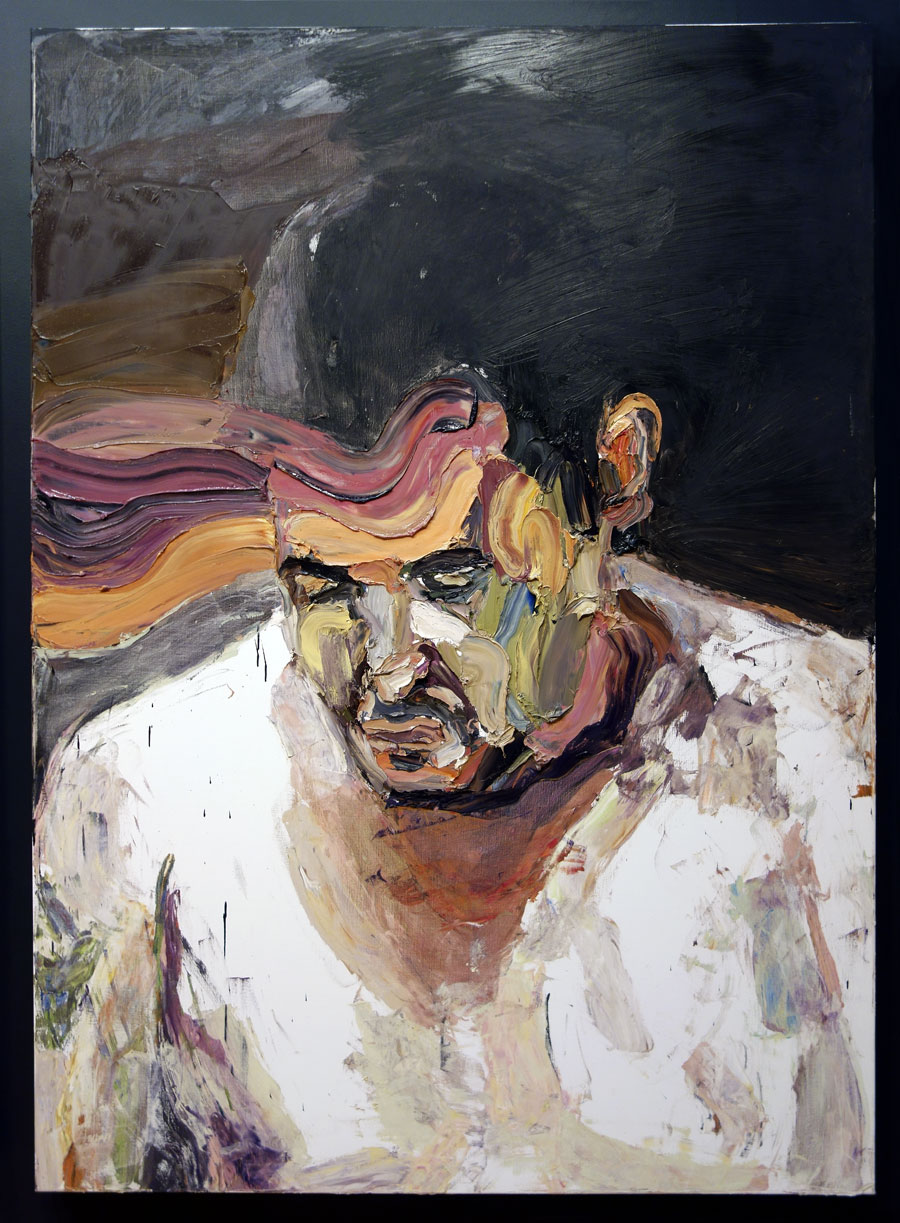
 

Ben Quilty (Australian, b. 1951) 'Troy Park, after Afghanistan' 2012 (installation view)


Ben Quilty (Australian, b. 1951)
Troy Park, after Afghanistan (installation view)
2012
Oil on linen
Collection of the artist
Photo: Marcus Bunyan


Installation view of the exhibition 'Ben Quilty: After Afghanistan' at the Castlemaine Art Gallery

Installation view of the exhibition 'Ben Quilty: After Afghanistan' at the Castlemaine Art Gallery

Installation view of the exhibition 'Ben Quilty: After Afghanistan' at the Castlemaine Art Gallery

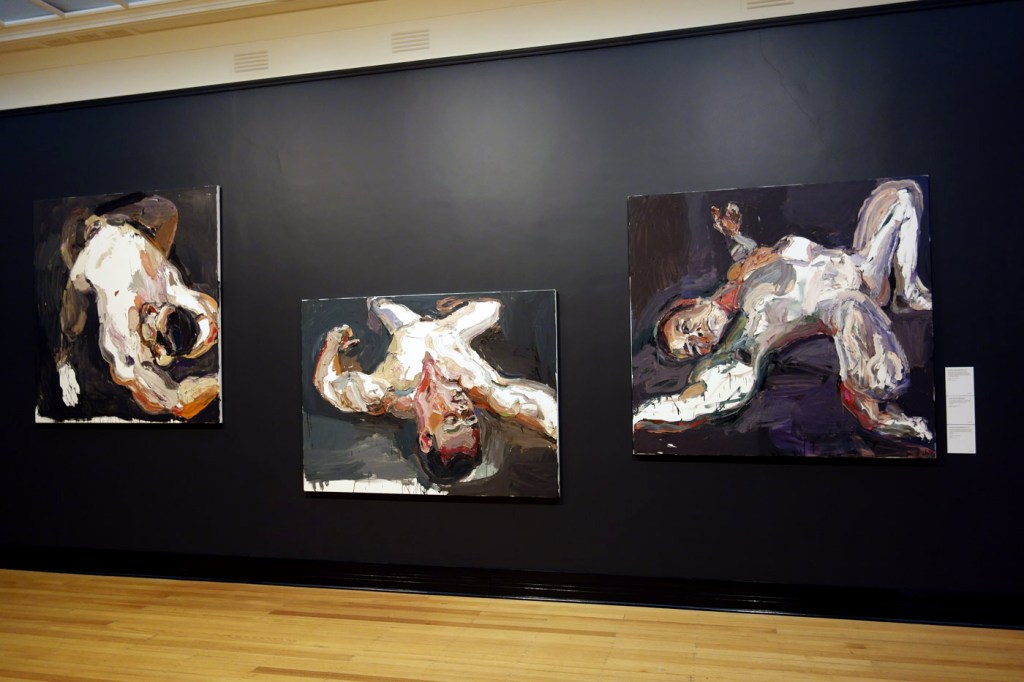
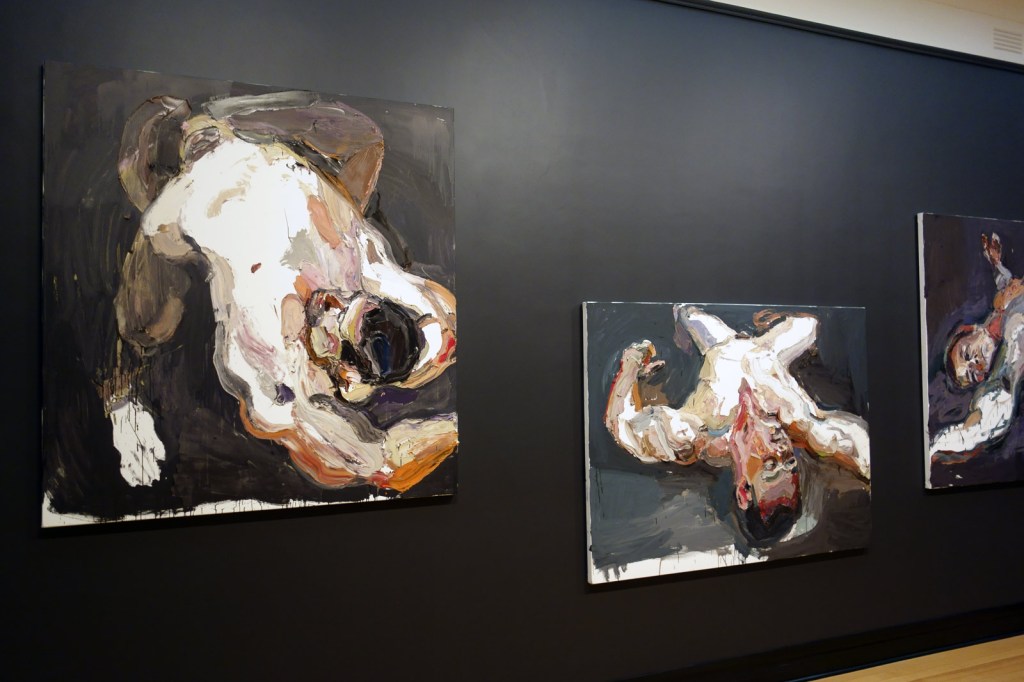
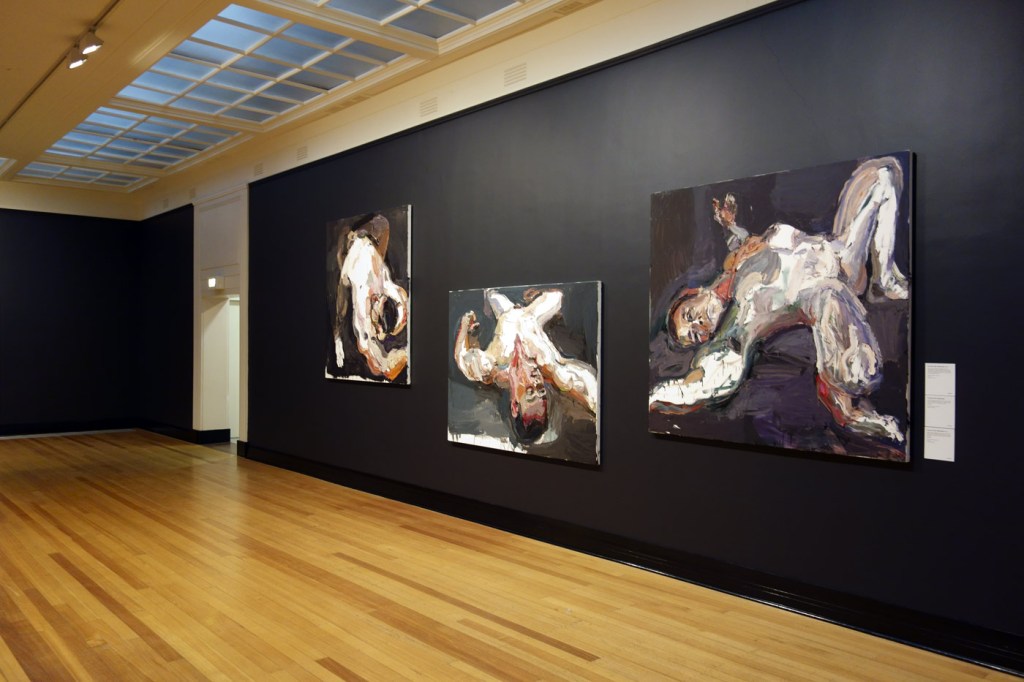
Installation view of the exhibition 'Ben Quilty: After Afghanistan' at the Castlemaine Art Gallery showing from left to right, 'Troy Park, after Afghanistan, no. 2' (2012); 'Trooper M, after Afghanistan' (2012); and 'Trooper M, after Afghanistan, no. 2' (2012)

Installation view of the exhibition 'Ben Quilty: After Afghanistan' at the Castlemaine Art Gallery showing from left to right, 'Troy Park, after Afghanistan, no. 2' (2012); 'Trooper M, after Afghanistan' (2012); and 'Trooper M, after Afghanistan, no. 2' (2012)

Installation view of the exhibition 'Ben Quilty: After Afghanistan' at the Castlemaine Art Gallery showing from left to right, 'Troy Park, after Afghanistan, no. 2' (2012); 'Trooper M, after Afghanistan' (2012); and 'Trooper M, after Afghanistan, no. 2' (2012)


Installation views of the exhibition Ben Quilty: After Afghanistan at the Castlemaine Art Gallery showing from left to right in the bottom three images, Troy Park, after Afghanistan, no. 2 (2012); Trooper M, after Afghanistan (2012); and Trooper M, after Afghanistan, no. 2 (2012)
Photos: Marcus Bunyan


Ben Quilty (Australian, b. 1951) 'Troy Park, after Afghanistan, no. 2' 2012 (installation view)


Ben Quilty (Australian, b. 1951)
Troy Park, after Afghanistan, no. 2 (installation view)
2012
Oil on linen
Collection of the artist
Photo: Marcus Bunyan


Quilty asked the soldiers to suggest a post that encapsulated some of the emotions that surrounded their experience in Afghanistan. Often the pose is quite contorted, as it reflects an actual event, such as taking cover to engage insurgents.


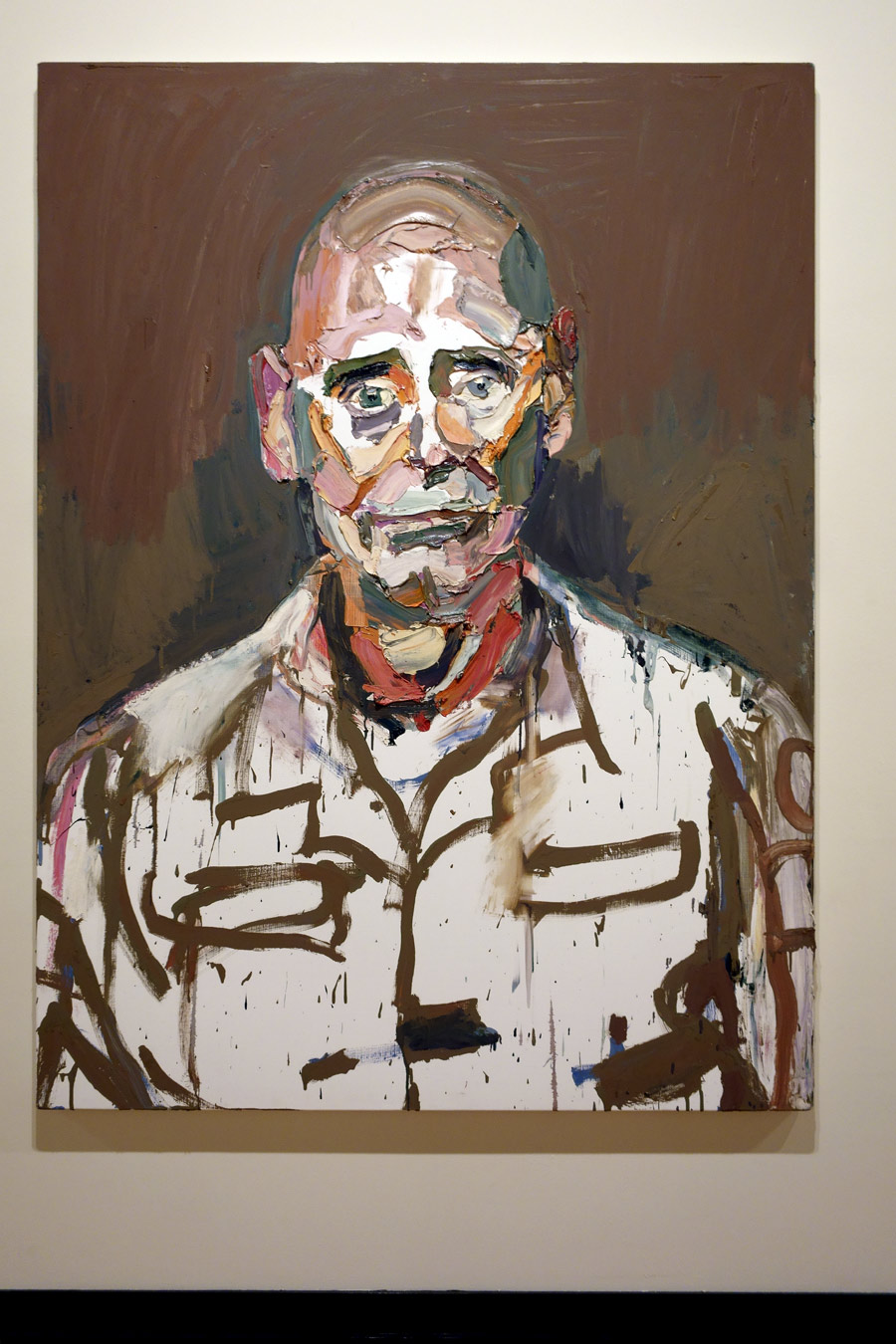
Ben Quilty (Australian, b. 1951) 'Trooper M, after Afghanistan' 2012 (installation view)


Ben Quilty (Australian, b. 1951)
Trooper M, after Afghanistan (installation view)
2012
Oil on linen
Collection of the artist
Photo: Marcus Bunyan
 

“You can’t really stop out there. You have to keep doing your job and keep moving forward … There is no time, until you get home, to stop and think about it.”

Trooper M


Ben Quilty (Australian, b. 1951) 'Trooper M, after Afghanistan, no. 2' 2012 (installation view detail)


Ben Quilty (Australian, b. 1951)
Trooper M, after Afghanistan, no. 2 (installation view detail)
2012
Oil on linen
Collection of the artist
Photo: Marcus Bunyan


“Sitting for Ben is therapeutic; it does get a lot of stuff off your chest. And actually seeing your portrait on canvas, I think for me it’s definitely a chapter that I can close and leave there.”

Trooper M


Ben Quilty (Australian, b. 1951) 'Bushmaster' 2012 (installation view)


Ben Quilty (Australian, b. 1951)
Bushmaster (installation view)
2012
Aerosol and oil on linen
Donated by Ben Quilty through the Australian Government’s Cultural Gifts Program in 2013
Photo: Marcus Bunyan


Portraiture for Quilty can also take a vehicle as its subject. This destroyed Bushmaster reflects the soldiers’ identity and is a vestige of their physical experience. They risk their lives while carrying out their duties in these versatile military vehicles.

“I met a young man who’d been in the back of a Bushmaster that had blown up. The Bushmaster is the big armoured four-wheel-drive vehicle that’s saving a lot of Australian lives, but even so the explosion caused every single you man inside that vehicle to suffer from concussion and one of them was blown out of the gun turret and landed in front of the vehicle among possibly more hidden explosive devices.”

Ben Quilty


Ben Quilty (Australian, b. 1951) 'Captain S, after Afghanistan' 2012 (installation view)


Ben Quilty (Australian, b. 1951)
Captain S, after Afghanistan (installation view)
2012
Oil on linen
Acquired under the official art scheme 2012
Photo: Marcus Bunyan


“I think when Ben paints, he’s not looking for what’s on the outside … He’s more after what they’re feeling o what they’ve been through … He’s looking at the inner instead of just the outer.”

Captain S


Ben Quilty (Australian, b. 1951) 'Lance Corporal M, after Afghanistan' 2012 (installation view)


Ben Quilty (Australian, b. 1951)
Lance Corporal M, after Afghanistan (installation view)
2012
Oil on linen
Collection of the artist
Photo: Marcus Bunyan


Ben Quilty (Australian, b. 1951) 'Lance Corporal M, after Afghanistan' 2012 (installation view detail)


Ben Quilty (Australian, b. 1951)
Lance Corporal M, after Afghanistan (installation view detail)
2012
Oil on linen
Collection of the artist
Photo: Marcus Bunyan


The naked portraits have a sensuousness and vulnerability in their solitary, contorted poses. The rough surface signifies the uniform and body armour that have been stripped away in front of us, and them. We and they recognise what they have endured and achieved.

“I wanted [this soldier] to be naked, showing not only his physical strength but also the frailty of human skin and the darkness of the emotional weight of the war.”

Ben Quilty


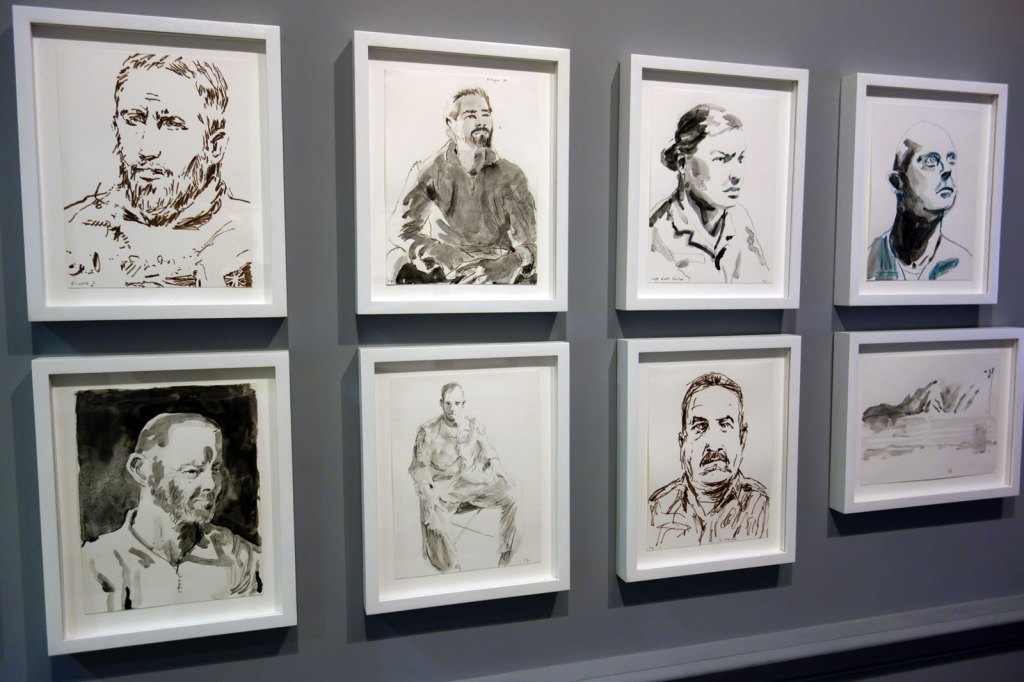
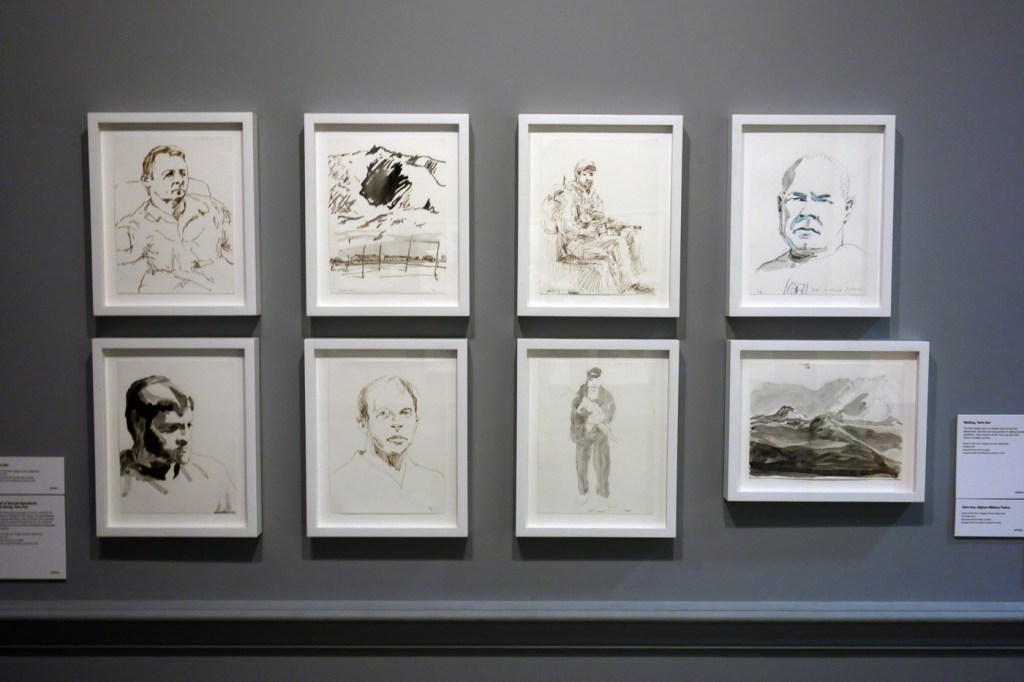
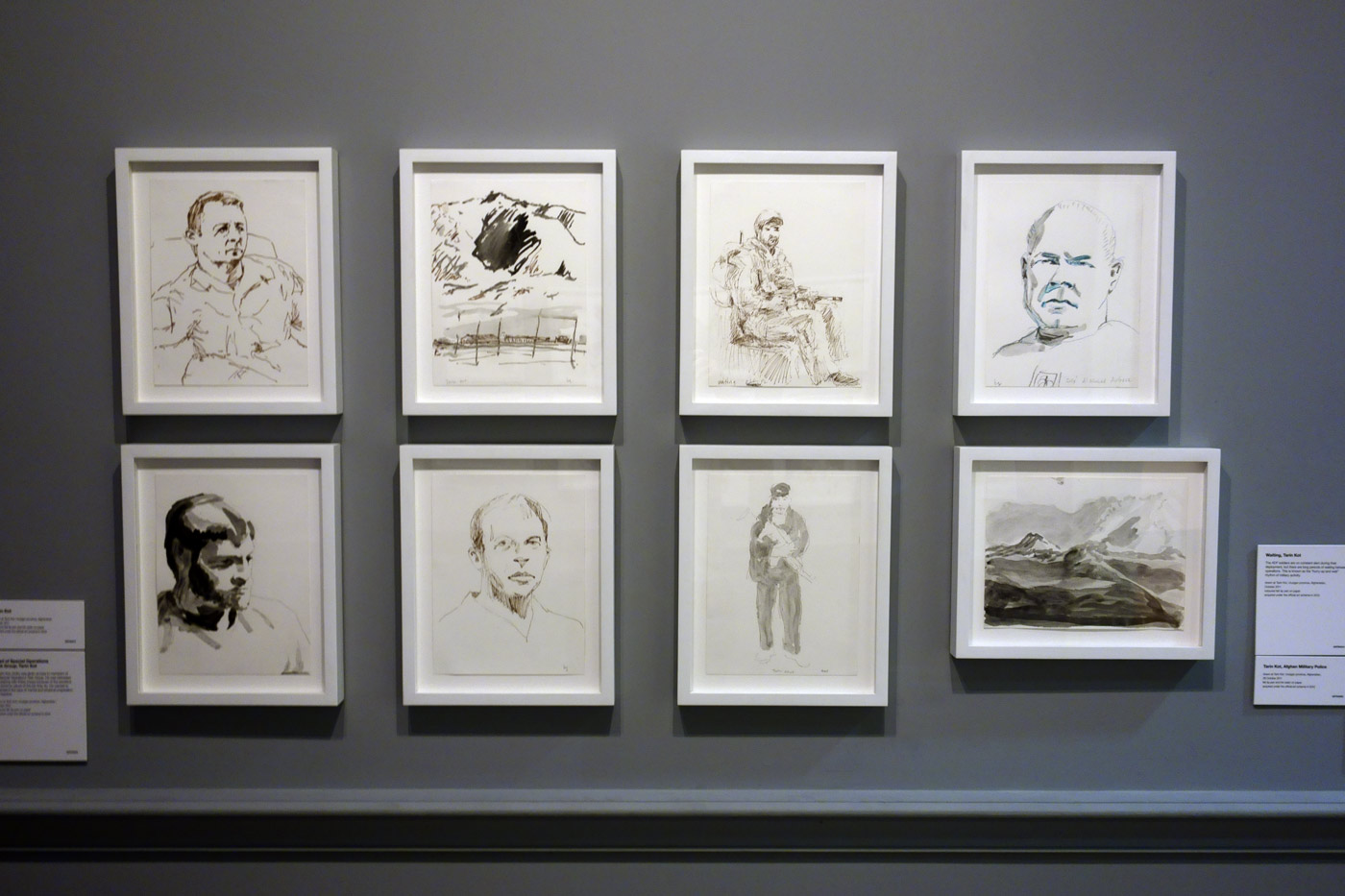
Installation view of drawings from the exhibition 'Ben Quilty: After Afghanistan' at the Castlemaine Art Gallery including, at bottom left, 'Captain M II, Tarin Kot' (October 2011) and third from left top, 'Waiting, Tarin Kot' (October 2011)


Installation view of drawings from the exhibition Ben Quilty: After Afghanistan at the Castlemaine Art Gallery including, at bottom left, Captain M II, Tarin Kot (October 2011, below) and third from left top, Waiting, Tarin Kot (October 2011, below)
Photo: Marcus Bunyan


“This very wild place”

Sitting and talking with the Australian soldiers in Afghanistan, Quilty became intrigued by their experiences. He came to feel responsible for telling the stories of these young men and women.

“I started doing drawings of the soldiers, and hearing their stories about their experiences of being in this very wild place. I realised that I needed to just sit with them … making portraits of these guys in Tarin Kot or wherever I was … getting them to sit still and talk to me about their experience. Those little drawings are a reminder to me of the time that I spent with those people. I hoped that there’d be some remnant of that experience that I could then draw out … to put into the paintings when I returned to Australia.”

Ben Quilty

The trust that Quilty developed with these soldiers in Afghanistan was strong enough to continue at home in Quilty’s studio, where he invited some to sit for larger portraits.


Installation view of drawings from the exhibition 'Ben Quilty: After Afghanistan' at the Castlemaine Art Gallery


(top row, first three from left)

Ben Quilty (Australian, b. 1951)
Private C, Tarin Kot
October 2011
Drawn at Tarin Kot, Uruzgan province, Afghanistan
Coloured felt tip pen on paper
Acquired under the official art scheme 2012

Ben Quilty (Australian, b. 1951)
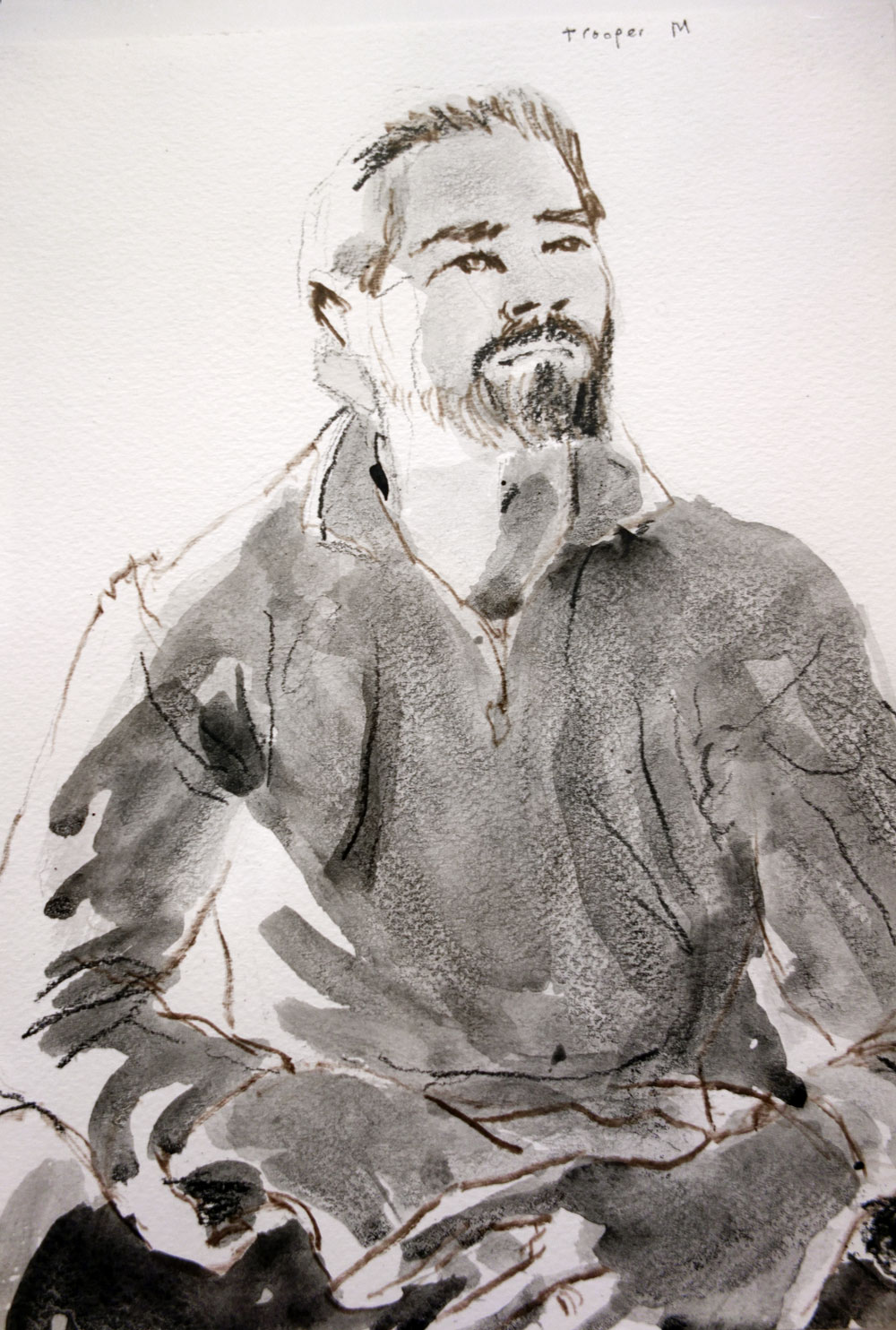
Trooper M, Special Forces, Tarin Kot
October 2011
Drawn at Tarin Kot, Uruzgan province, Afghanistan
Coloured felt tip pen, pencil and ink wash on paper
Collection of the artist

Ben Quilty (Australian, b. 1951)
Captain Kate Porter
27 October 2011
Drawn at Tarin Kot, Uruzgan province, Afghanistan
Coloured pencil and ink wash on paper
Acquired under the official art scheme 2012

(bottom row, first three from left)

Ben Quilty (Australian, b. 1951)
Sergeant M II, Tarin Kot
October 2011
Drawn at Tarin Kot, Uruzgan province, Afghanistan
Pencil and ink wash on paper
Collection of the artist

Ben Quilty (Australian, b. 1951)
Chinook pilot, Kandahar Airfield
October 2011
Drawn at Kandahar Airfield, Kandahar province, Afghanistan
Pencil and ink wash on paper
Collection of the artist

Ben Quilty (Australian, b. 1951)
Brigadier General Noorullah, Afghan National Army, Tarin Kot
22 October 2011
Drawn at Tarin Kot, Uruzgan province, Afghanistan
Coloured felt tip pen on paper
Acquired under the official art scheme 2012

Photo: Marcus Bunyan


While in Tarin Kot, Quilty attended a marching out parade of 400 Afghan National Army (ANA) soldiers who had completed training under the Australian Mentoring Task Fore. There he met a senior ANA commander, Brigadier General Noorullah. Just days later, three Australian soldiers were killed at a similar training parade being held at Forward Operating Base Sorkh Bed (aka Pacemaker). Quilty learnt of the incident the day after he left Afghanistan, giving him an even greater sense of the dangers that the soldiers he met face daily.


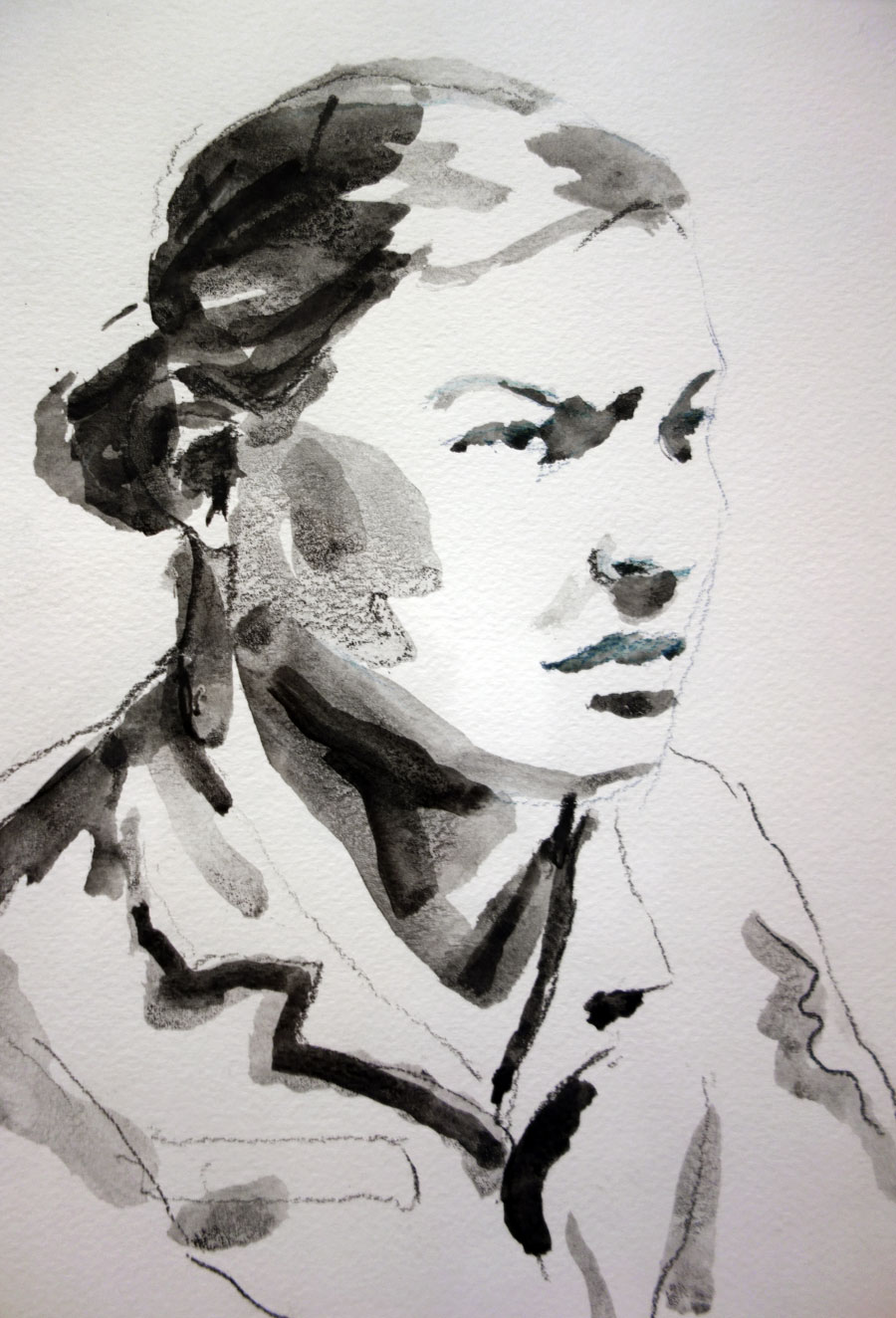
Ben Quilty (Australian, b. 1951) 'Captain Kate Porter' 27 October 2011 (installation view)


Ben Quilty (Australian, b. 1951)
Captain Kate Porter (installation view)
27 October 2011
Drawn at Tarin Kot, Uruzgan province, Afghanistan
Coloured pencil and ink wash on paper
Acquired under the official art scheme 2012
Photo: Marcus Bunyan


Quilty wanted to meet a cross-section of people serving in Afghanistan – soldiers driving Bushmasters, Chinook pilots, Special Forces soldiers, and both men and women of all ranks – to try to understand who makes up the Australian Defence Force. He met Captain Kate Porter at Tarin Kot. There he spoke to her about her experiences as female in the very masculine community of the Special Operations Task Group, as well as her general experience as a soldier in Afghanistan.


Ben Quilty (Australian, b. 1951) 'Trooper M, Special Forces, Tarin Kot' October 2011 (installation view)


Ben Quilty (Australian, b. 1951)
Trooper M, Special Forces, Tarin Kot (installation view)
October 2011
Drawn at Tarin Kot, Uruzgan province, Afghanistan
Coloured felt tip pen, pencil and ink wash on paper
Collection of the artist
Photo: Marcus Bunyan
 

Ben Quilty (Australian, b. 1951) 'Waiting, Tarin Kot' October 2011 (installation view)


Ben Quilty (Australian, b. 1951)
Waiting, Tarin Kot (installation view)
October 2011
Drawn at Tarin Kot, Uruzgan province, Afghanistan
Coloured felt tip pen on paper
Acquired under the official art scheme 2012
Photo: Marcus Bunyan


Ben Quilty (Australian, b. 1951) 'Captain M II, Tarin Kot' October 2011 (installation view)


Ben Quilty (Australian, b. 1951)
Captain M II, Tarin Kot (installation view)
October 2011
Drawn at Tarin Kot, Uruzgan province, Afghanistan
Pencil and ink wash on paper
Collection of the artist
Photo: Marcus Bunyan
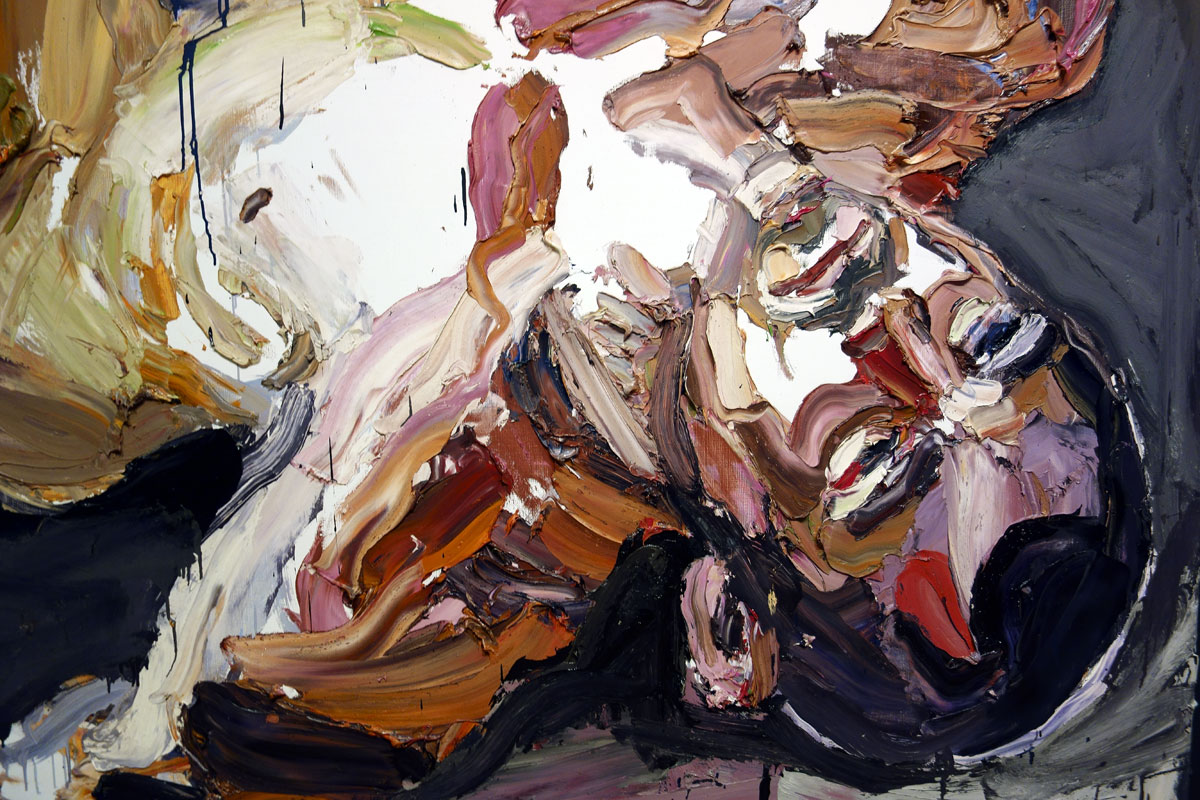


“Ben Quilty: After Afghanistan is an extraordinary Australian War Memorial Touring Exhibition by one of the nation’s most incisive artists, and is of great relevance to all Australians. The exhibition officially opens at Castlemaine Art Gallery on Friday 15 January 2016.

The exhibition itself was the result of the Archibald Prize-winning artist’s three-week tour across Afghanistan in October 2011. Engaged as an Official War Artist, his purpose was to record and interpret the experiences of Australians deployed as part of Operation Slipper in Kabul, Kandahar, and Tarin Kot in Afghanistan and at Al Minhad Airbase in the United Arab Emirates. In fulfilling his brief, Quilty spoke with many Australian servicemen and women, gaining an insight into their experiences whilst serving in the region, and ultimately leaving with an overwhelming need to tell their stories.

Quilty recently spoke on ANZAC Day 2015 and paid tribute not only to those who did not return from Afghanistan and their grieving families, but also to “the young men and women who live amongst us who have paid so dearly and will quietly wear the thick cloak of trauma for many years to come, after Afghanistan.”

The exhibition is a must see as Quilty is arguably one of Australia’s greatest living painters, and this exhibition, with its intense and emotional subject matter is particularly important to Castlemaine, a town with a history of young men and women serving their country far from home. The exhibition has been very well received across the country with over 70,000 visitors attending the works when on display most recently in Darwin. Dr Brendan Nelson, Director of the Australian War Memorial believes Quilty should be considered one of Australia’s great official war artists.

“Ben Quilty’s works follows a truly great tradition at the Australian War Memorial of appointing artists to record and interpret the Australian experience of war.”

“Ben brought to this task all his brilliance, sensitivity and compassion. The works he produced will leave Australians a legacy which informs them not only about the impact of war on our country, but even more importantly, about the effects on the men and women he has depicted,” said Dr Nelson.

Dr Jan Savage, President of the Castlemaine Art Gallery and Historical Museum Committee of Management said the exhibition, “was significant in understanding the impact of war on serving members of the Australian armed forces and I encourage visitors to attend this most important exhibition.”

Ben Quilty: After Afghanistan is on display at Castlemaine Art Gallery from 15 January until 15 April 2016.

An Australian War Memorial Touring Exhibition, proudly sponsored by Thales.”

Text from the Castlemaine Art Gallery and Historical Museum website


Ben Quilty (Australian, b. 1951) 'Tarin Kot, Hilux' 2012 (installation view)


Ben Quilty (Australian, b. 1951)
Tarin Kot, Hilux (installation view)
2012
Oil on linen
Collection of the artist
Photo: Marcus Bunyan
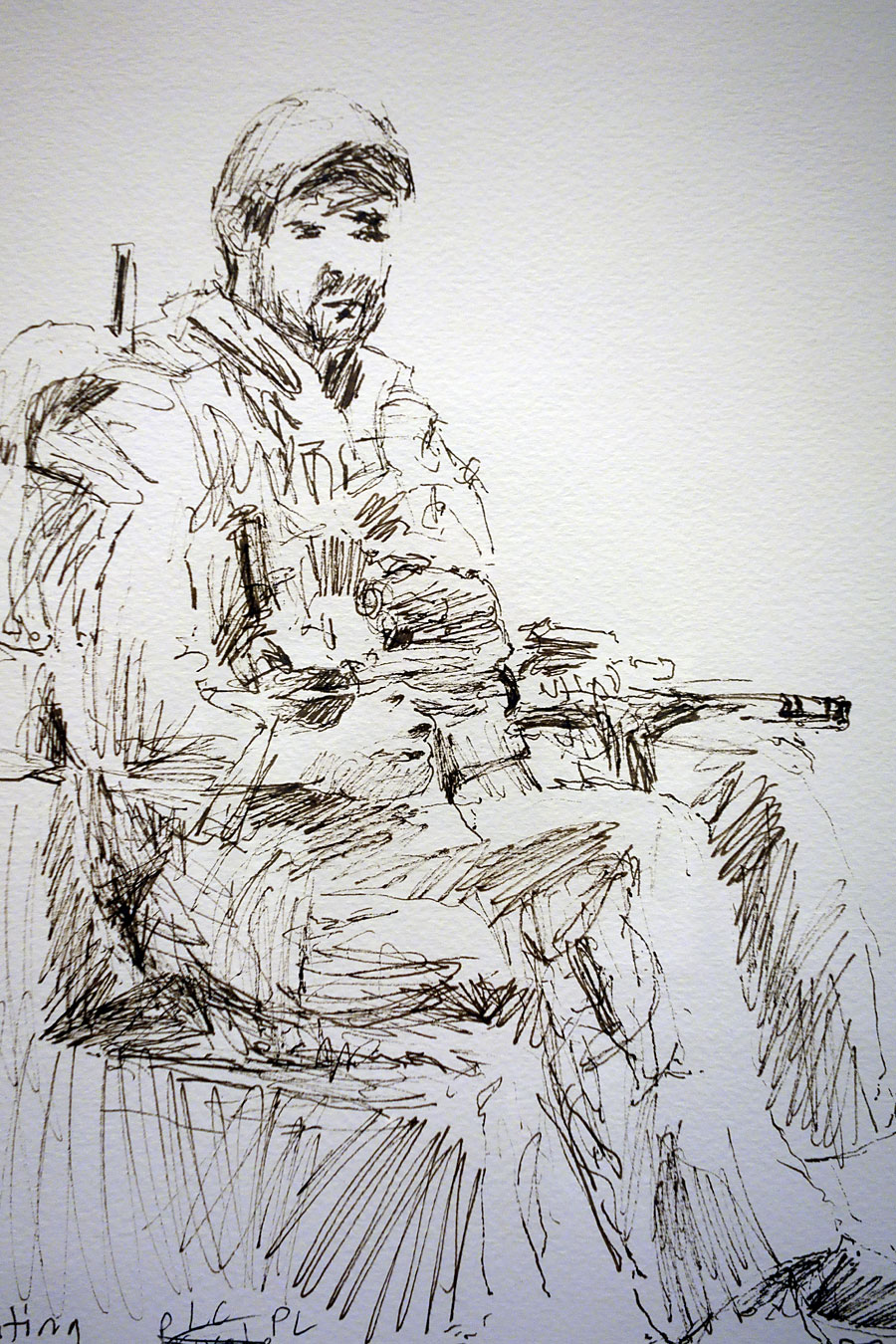
 

Ben Quilty (Australian, b. 1951) 'Kandahar' 2012 (installation view)


Ben Quilty (Australian, b. 1951)
Kandahar (installation view)
2012
Oil on linen
Acquired under the official art scheme 2012
Photo: Marcus Bunyan
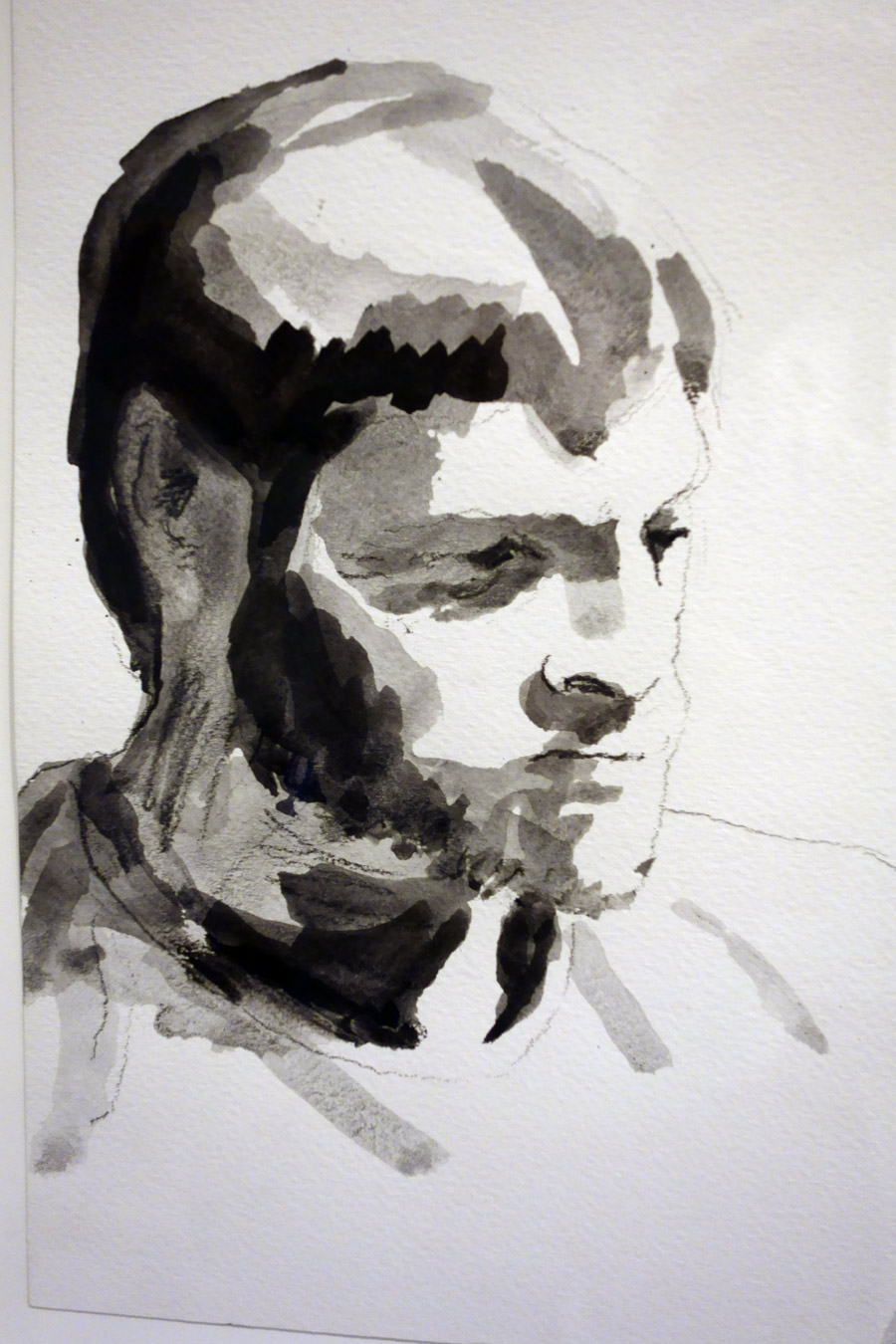
 

Ben Quilty (Australian, b. 1951) 'Kandahar' 2012 (installation view detail)


Ben Quilty (Australian, b. 1951)
Kandahar (installation view detail)
2012
Oil on linen
Acquired under the official art scheme 2012
Photo: Marcus Bunyan


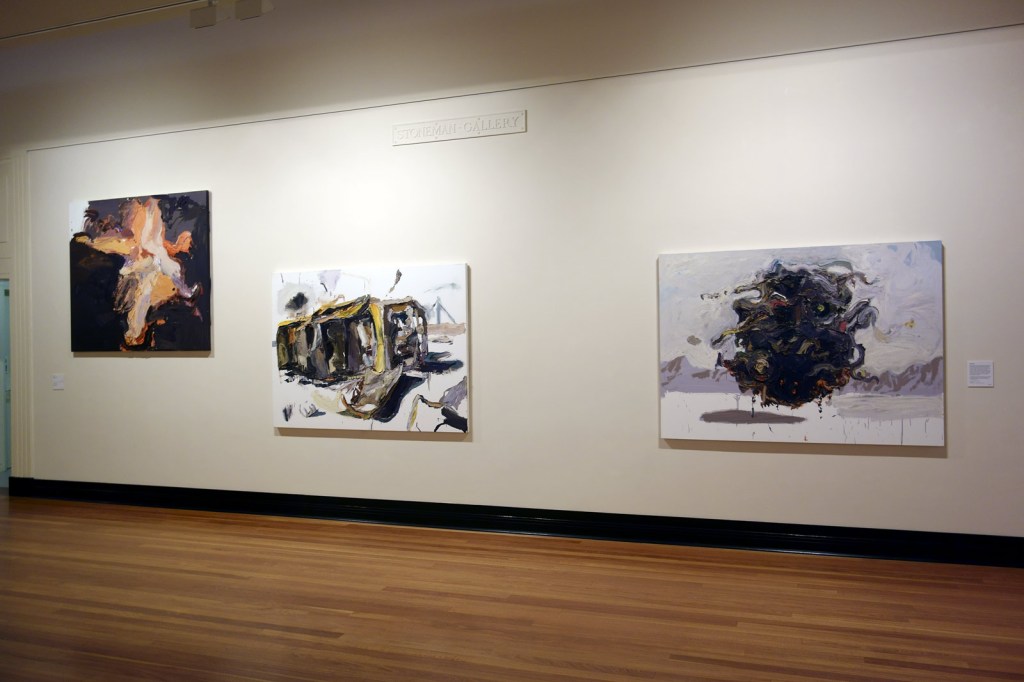
Kandahar Airfield is a multinational vase with approximately 35,000 people from the International Security Assistance Fore, aid organisations, and a pool of local civilian staff. Weapons are carried at all times by both military and civilian personnel, creating a tense atmosphere with a violent undercurrent. Quilty described Kandahar as being a cross between the worlds of Mad Max: Beyond Thunderdome and Catch 22, a surreal, dusty, and violent place. “For the first week in Kandahar, I basically felt like I was dodging rockets. The first night we landed there, two or three rockets landed inside the compound.”

This painting was Quilty’s first visceral response on his return from Afghanistan and i sums up his emotions, particularly his personal experience of Kandahar and being a part of the maelstrom of war.


Installation view of the exhibition 'Ben Quilty: After Afghanistan' at the Castlemaine Art Gallery showing at centre, 'Tarin Kot, Hilux' (2012); and at right, 'Kandahar' (2012)


Installation view of the exhibition Ben Quilty: After Afghanistan at the Castlemaine Art Gallery showing at centre, Tarin Kot, Hilux (2012); and at right, Kandahar (2012)
Photo: Marcus Bunyan


Installation view of the exhibition 'Ben Quilty: After Afghanistan' at the Castlemaine Art Gallery


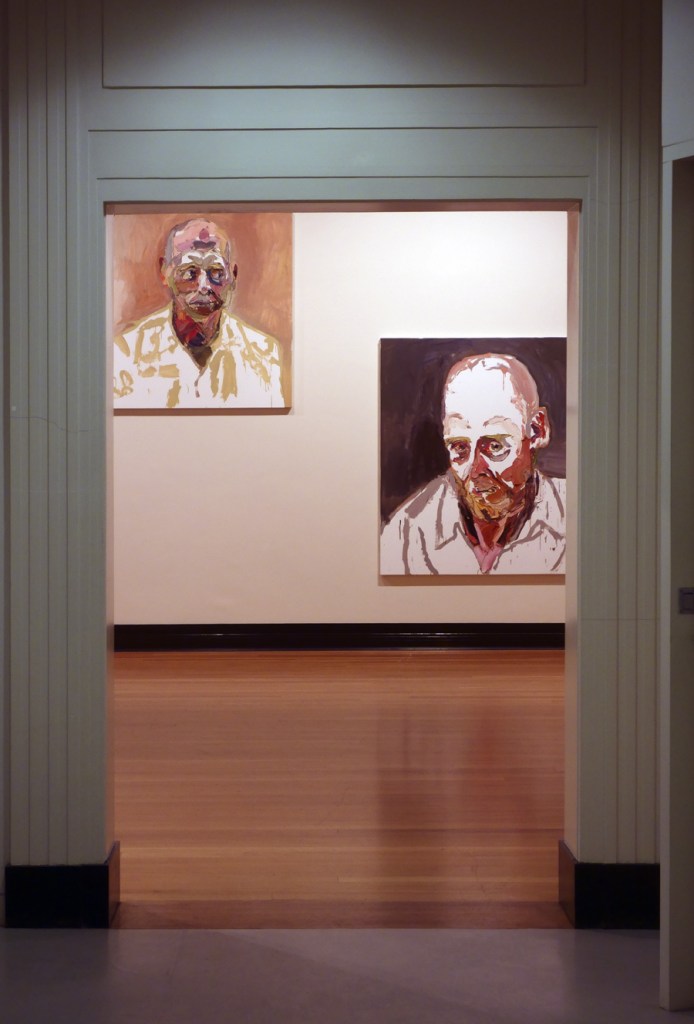
Installation view of the exhibition 'Ben Quilty: After Afghanistan' at the Castlemaine Art Gallery showing at left, 'Air Commodore John Oddie, after Afghanistan, no. 3' (2012)

Installation view of the exhibition 'Ben Quilty: After Afghanistan' at the Castlemaine Art Gallery showing at left, 'Air Commodore John Oddie, after Afghanistan, no. 3' (2012)

Installation view of the exhibition 'Ben Quilty: After Afghanistan' at the Castlemaine Art Gallery showing at left, 'Air Commodore John Oddie, after Afghanistan, no. 3' (2012)


Installation views of the exhibition Ben Quilty: After Afghanistan at the Castlemaine Art Gallery showing at left in the bottom image, Air Commodore John Oddie, after Afghanistan, no. 3 (2012, below)
Photos: Marcus Bunyan


Returning from war

“You can’t take the experiences out of your head.
You can’t take the damages out of your head.”

John Oddie


On his return to Australia, Ben Quilty contacted Air Commodore John Oddie (Ret’d), whom he had met during his Afghanistan deployment, to invite him to sit for a portrait in his studio. From February to October 2011, Oddie had been the Deputy Commander of Australian forces in the Middle east, a position of immense responsibility.

Quilty eventually produced three portraits over five months. These works reveal a man returning from war and its burden of responsibility, exhausted emotionally and mentally, and his progress towards a more positive view of life and of himself as a survivor.


Ben Quilty (Australian, b. 1951) 'Air Commodore John Oddie, after Afghanistan, no. 3' 2012 (installation view)


Ben Quilty (Australian, b. 1951)
Air Commodore John Oddie, after Afghanistan, no. 3 (installation view)
2012
Oil on linen
Collection of the artist
Photo: Marcus Bunyan


Ben Quilty (Australian, b. 1951) 'Air Commodore John Oddie, after Afghanistan, no. 3' 2012 (installation view detail)


Ben Quilty (Australian, b. 1951)
Air Commodore John Oddie, after Afghanistan, no. 3 (installation view detail)
2012
Oil on linen
Collection of the artist
Photo: Marcus Bunyan


“I don’t necessarily see beauty, I see insight in what Ben does. That’s reflected in the way he paints … I think his later portraits, done after he’s got to know us better, are different from the raw emotion of the first ones.”

John Oddie


Ben Quilty (Australian, b. 1951) 'Air Commodore John Oddie, after Afghanistan, no. 1' 2012 (installation view)


Ben Quilty (Australian, b. 1951)
Air Commodore John Oddie, after Afghanistan, no. 1 (installation view)
2012
Oil on linen
Collection of the artist
Photo: Marcus Bunyan


“With through a lack of insight or through an unwillingness … I wasn’t always admitting the truth to myself about my life. Ben really took that out and put it on a table in front of me like a three-course dinner and said, well, how about that? And you know, I sort of thought well, I’m not going to come to this restaurant again in a hurry!”

John Oddie


Ben Quilty (Australian, b. 1951) 'Air Commodore John Oddie, after Afghanistan, no. 2' 2012 (installation view)


Ben Quilty (Australian, b. 1951)
Air Commodore John Oddie, after Afghanistan, no. 2 (installation view)
2012
Oil on linen
Collection of the artist
Photo: Marcus Bunyan


“He’s got this one little gash of paint and it brings out this wry smile that I didn’t even know I had … When I stood back and had a look, I was just stunned at the honesty of the painting – until then I hadn’t really been fully honest with myself about what I was feeling.”

John Oddie


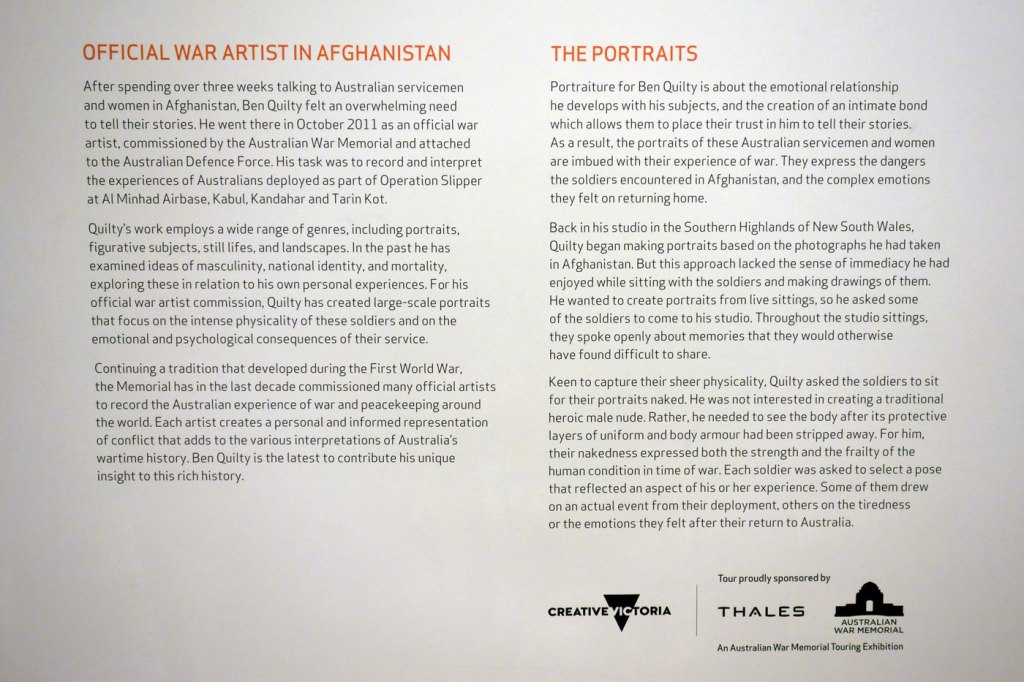
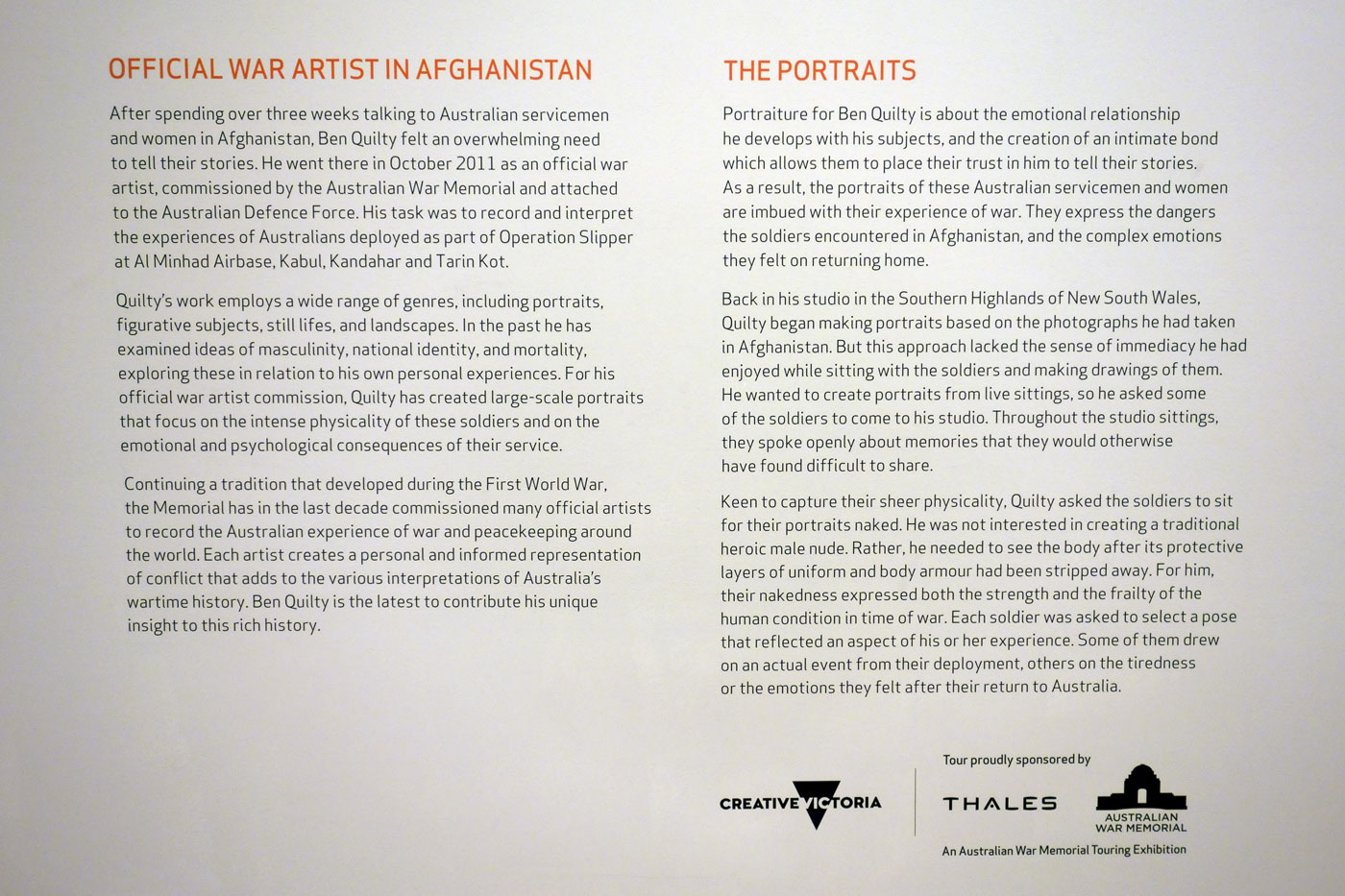
Introductory titles and text for the exhibition 'Ben Quilty: After Afghanistan' at the Castlemaine Art Gallery

Introductory titles and text for the exhibition 'Ben Quilty: After Afghanistan' at the Castlemaine Art Gallery


Introductory titles and text for the exhibition Ben Quilty: After Afghanistan at the Castlemaine Art Gallery
Photos: Marcus Bunyan


Installation view of the exhibition 'Ben Quilty: After Afghanistan' at the Castlemaine Art Gallery showing the work 'Trooper Daniel Spain, Tarin Kot' (2012)


Installation view of the exhibition Ben Quilty: After Afghanistan at the Castlemaine Art Gallery showing the work Trooper Daniel Spain, Tarin Kot (2012, below)
Photo: Marcus Bunyan


Ben Quilty (Australian, b. 1951) 'Trooper Daniel Spain, Tarin Kot' 2012 (installation view)


Ben Quilty (Australian, b. 1951)
Trooper Daniel Spain, Tarin Kot (installation view)
2012
Oil on linen diptych
Collection of the artist
Photo: Marcus Bunyan


In some of the works, Quilty has used dramatic symbols to represent the emotional weight and the sense of emptiness he felt some soldiers brought home with them after Afghanistan. The black hole motif also reflects his own feelings of anxiety and uncertainty during his time there.

“I had such extreme feelings about the smell, sound, emotions of being in Afghanistan … I wanted to convey this.”


Ben Quilty (Australian, b. 1951) 'Trooper Luke Korman' 2012 (installation view)


Ben Quilty (Australian, b. 1951)
Trooper Luke Korman (installation view)
2012
Aerosol and oil on linen
Acquired under the official art scheme 2012
Photo: Marcus Bunyan


Installation view of the exhibition 'Ben Quilty: After Afghanistan' at the Castlemaine Art Gallery showing on the far wall, 'Trooper Luke Korman, Tarin Kot' (2012, left) and 'SOTG, after Afghanistan' (2011, right)


Installation view of the exhibition Ben Quilty: After Afghanistan at the Castlemaine Art Gallery showing on the far wall, Trooper Luke Korman, Tarin Kot (2012, left) and SOTG, after Afghanistan (2011, right)
Photo: Marcus Bunyan


Ben Quilty (Australian, b. 1951) 'Trooper Luke Korman, Tarin Kot' 2012 (installation view)


Ben Quilty (Australian, b. 1951)
Trooper Luke Korman, Tarin Kot (installation view)
2012
Aerosol and oil on linen diptych
Collection of the artist
Photo: Marcus Bunyan


Ben Quilty (Australian, b. 1951) 'SOTG, after Afghanistan' 2011 (installation view)


Ben Quilty (Australian, b. 1951)
SOTG, after Afghanistan (installation view)
2011
Oil on linen diptych
Acquired under the official art scheme 2012
Photo: Marcus Bunyan


As part of his initial idea for the war artist commission, Quilty photographed soldiers of the Special Operations Task Group in Afghanistan in the same pose. He asked each of them to face the sun with their eyes closed, then open them and stare into the blinding light. At that instant Quilty would take the photograph. “To me, this symbolises what they’re facing, something immense, overwhelming.”

Back in Australia, Quilty attempted to work from these photographs, and created a handful of portraits. He was dissatisfied with the results. Determined to re-establish a personal connection with his subjects, he invited some of them to sit for portraits in his studio.


Castlemaine Art Gallery and Historical Museum
14 Lyttleton Street (PO Box 248)
Castlemaine, Vic 3450 Australia
Phone: (03) 5472 2292
Email: info@castlemainegallery.com

Opening hours:
Thursday – Saturday 11am – 4pm
Sunday 12pm – 4pm

Castlemaine Art Gallery and Historical Museum website
LIKE ART BLART ON FACEBOOK

Back to top

Exhibition: ‘Cosa Mentale: Art and Telepathy in the 20th century’ at the Centre Pompidou-Metz, Paris

Exhibition dates: 28th October, 2015 – 28th March, 2016

Curator: Pascal Rousseau, Professor of Contemporary History of Art at the University of Paris I Panthéon Sorbonne


Louis Darget (French, 1847-1923) 'Fluidic Thought-Image Photography' 1896 from the exhibition 'Cosa Mentale: Art and Telepathy in the 20th century' at the Centre Pompidou-Metz, Paris, Oct 2015 - March 2016
 

Louis Darget (French, 1847-1923)
Fluidic Thought-Image Photography
1896

(L) Inscribed: “Photo… of thought. Head obtained by Mr. Henning, having a plate wrapped in black paper on his forehead while he played the piano. Opposite him on the piano was a portrait of Beethoven. Could this be that [same] portrait reflected by the brain onto the plate through the black paper. Comt. Darget”

(R) “Photograph of a Dream: The Eagle.” 25 June, 1896.
Inscribed: “Obtained by placing a photographic plate above the forehead of Mme Darget while she was asleep.”


Telepathic art in the 20th century. What a fascinating subject for a spiritual, phantasmagoric exhibition which explores artists’ fascination with the direct transmission of thought and emotion. A lot of phenomena – for example telepathy, X-rays, psychoanalysis – were named or discovered in the last half of the nineteenth century or are concepts and things that began to gain popularity in the collective consciousness at that time, such as the unconscious mind, the anima and animus, the study of signs, photographs of thought, photographs of hysteria (Charcot) and notes and photographs on unexplained paranormal experiences.

“The exhibition enables the spectator to understand how, throughout the 20th century, attempts to give material and visible form to thought processes coincide with the experiments of avant-garde artists. This fantasy of a direct projection of thought not only had a decisive impact on the birth of abstraction but also influenced surrealism and its obsession with the collective sharing of creation and, in the post war period, it gave rise to numerous visual and sound installations inspired by the revolution in information technology, leading to the declaration of “the dematerialisation of art” in conceptual practices.”

Love the work of Émile Cohl and Len Lye, both a revelation to me.

Dr Marcus Bunyan


Many thankx to the Centre Pompidou-Metz for allowing me to publish the photographs in the posting. Please click on the photographs for a larger version of the image.


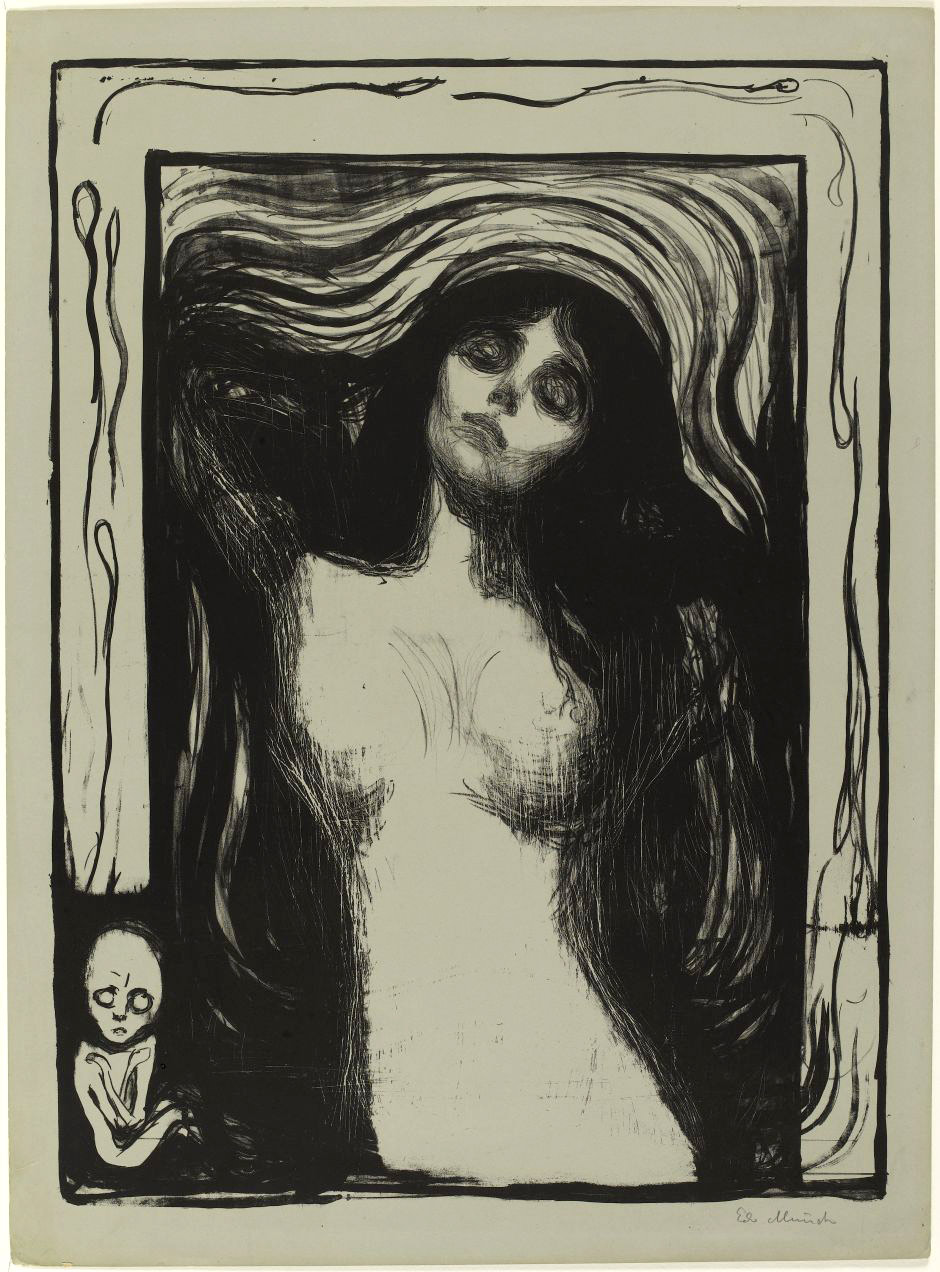
Edvard Munch (Norwegian, 1863-1944) 'Madonna' 1895 from the exhibition 'Cosa Mentale: Art and Telepathy in the 20th century' at the Centre Pompidou-Metz, Paris, Oct 2015 - March 2016


Edvard Munch (Norwegian, 1863-1944)
Madonna
1895
Paris, Centre Pompidou, Musée national d’Art moderne
© Centre Pompidou, MNAM-CCI, Dist. RMN-Grand Palais / Georges Meguerditchian


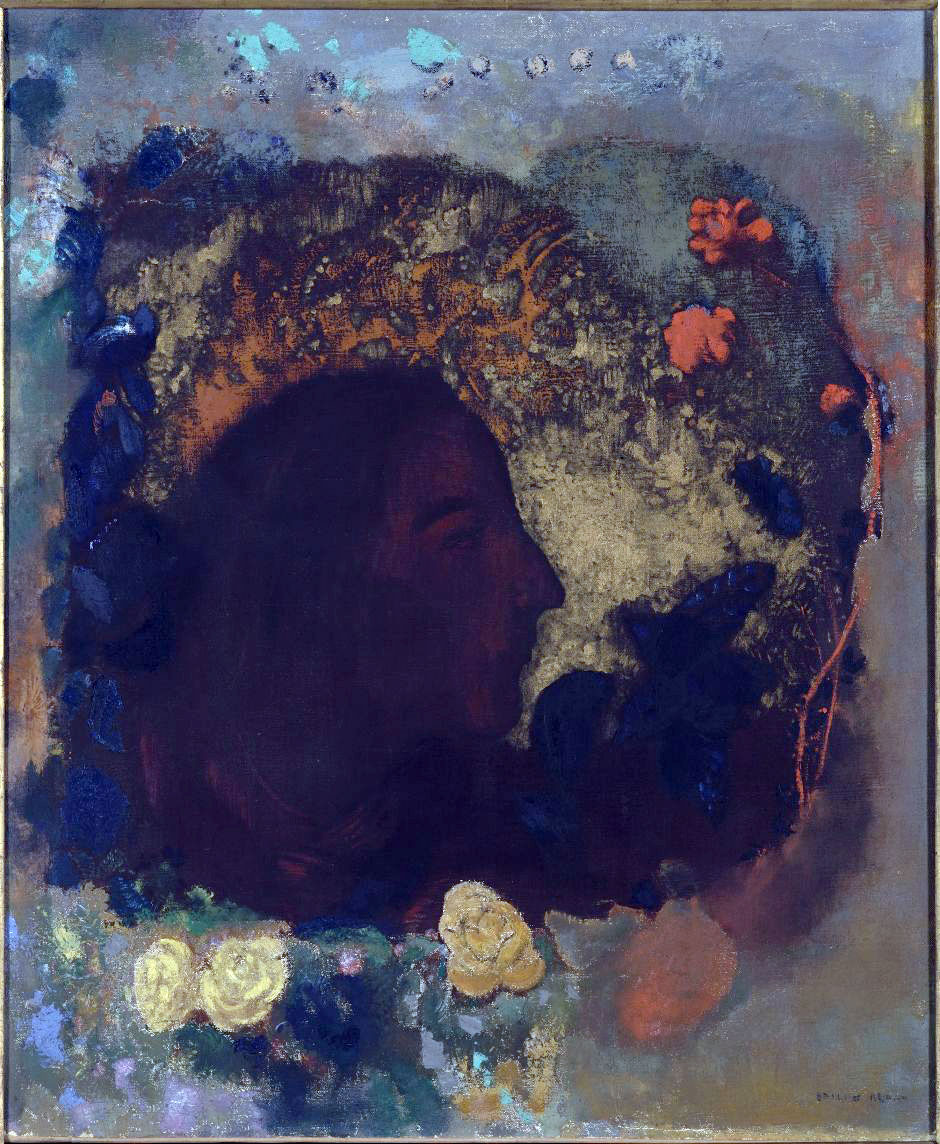
Odilon Redon (French, 1840-1916) 'Portrait de Paul Gauguin' 1903-1906


Odilon Redon (French, 1840-1916)
Portrait of Paul Gauguin
1903-1906
Paris, Musée d’Orsay
© RMN-Grand Palais (musée d’Orsay) / Hervé Lewandowski


Émile Cohl (French, 1857-1938)
Le retapeur de cervelles (The creators brain)
1910


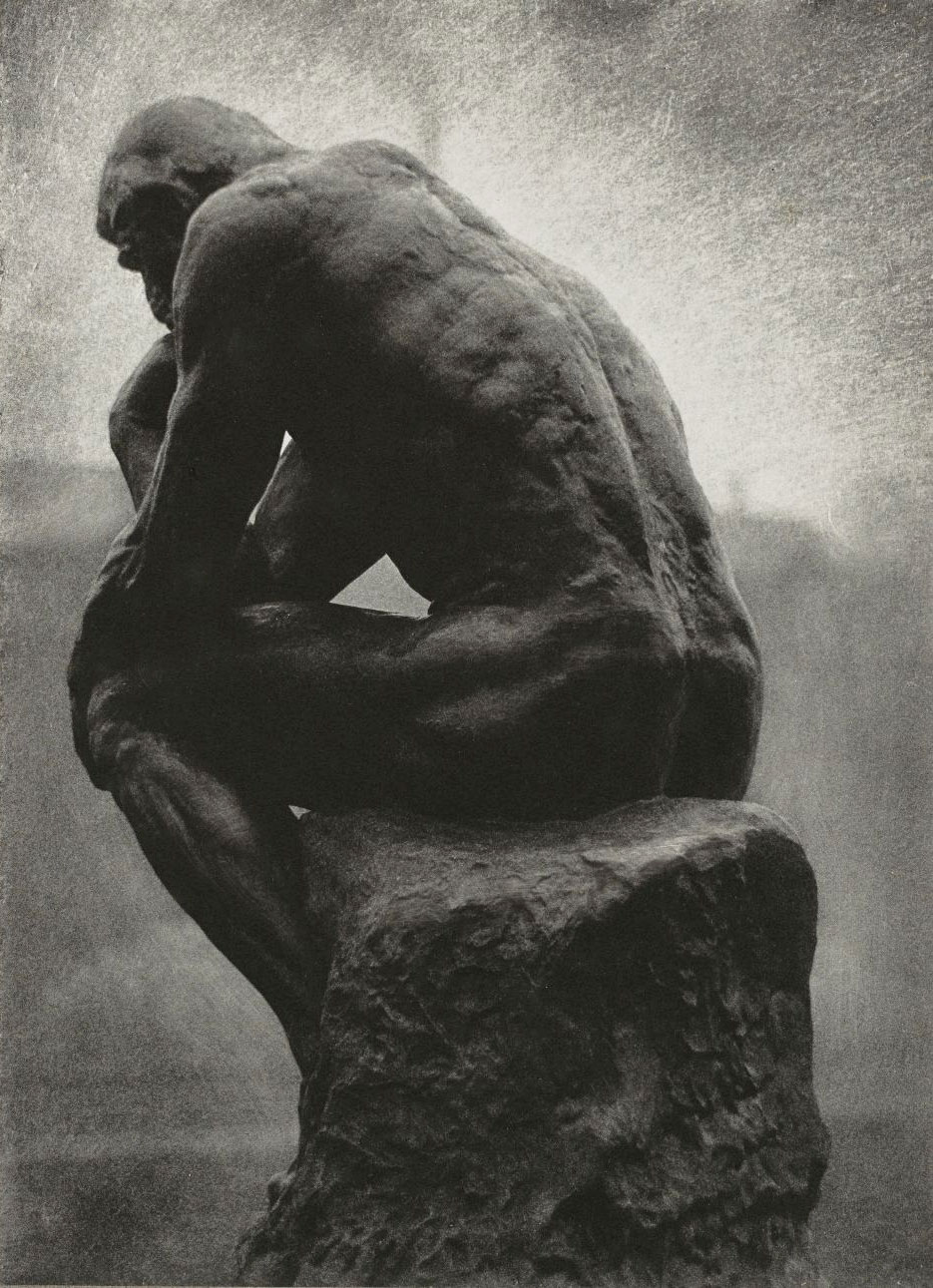
Auguste Rodin (French, 1840-1917) 'Le Penseur [The Thinker]' 1903


Auguste Rodin (French, 1840-1917)
Le Penseur [The Thinker]
1903
Plâtre patiné / patinated plaster
72 x 37 x 57.50cm
© Photographe: Christian Baraja
© Musée Rodin, Paris


When conceived in 1880 in its original size (approx. 70cm) as the crowning element of The Gates of Hell, seated on the tympanum, The Thinker was entitled The Poet. He represented Dante, author of the Divine Comedy which had inspired The Gates, leaning forward to observe the circles of Hell, while meditating on his work. The Thinker was therefore initially both a being with a tortured body, almost a damned soul, and a free-thinking man, determined to transcend his suffering through poetry. The pose of this figure owes much to Carpeaux’s Ugolino (1861) and to the seated portrait of Lorenzo de Medici carved by Michelangelo (1526-31).

While remaining in place on the monumental Gates of Hell, The Thinker was exhibited individually in 1888 and thus became an independent work. Enlarged in 1904, its colossal version proved even more popular: this image of a man lost in thought, but whose powerful body suggests a great capacity for action, has became one of the most celebrated sculptures ever known. Numerous casts exist worldwide, including the one now in the gardens of the Musée Rodin, a gift to the City of Paris installed outside the Panthéon in 1906, and another in the gardens of Rodin’s house in Meudon, on the tomb of the sculptor and his wife.

Text from the Rodin Museum website [Online] Cited 22/03/2016. No longer available online


Stephen Haweis (British, 1878-1969) and Henry Coles 'Le Penseur' c. 1903-1904


Stephen Haweis (British, 1878-1969) and Henry Coles
Le Penseur
c. 1903-1904
Epreuve au charbon / Charcoal
23 x 16.60cm
© Musée Rodin, Paris


Cosa Mentale is a unique exhibition that offers a re-reading of the history or art from 1990 to modern day by exploring artists’ fascination with the direct transmission of thought and emotion. It invites the spectator to re-live one of the unexpected adventures of modernity: telepathic art in the 20th century. This exhibition traces a chronological path from symbolism to conceptual art with a collection of some one hundred works by major artists, ranging from Edvard Munch to Vassily Kandinsky, and from Joan Miró to Sigmar Polke. These artists provide innovative ways of communicating with spectators that take us beyond conventional linguistic codes.

The exhibition enables the spectator to understand how, throughout the 20th century, attempts to give material and visible form to thought processes coincide with the experiments of avant-garde artists. This fantasy of a direct projection of thought not only had a decisive impact on the birth of abstraction but also influenced surrealism and its obsession with the collective sharing of creation and, in the post war period, it gave rise to numerous visual and sound installations inspired by the revolution in information technology, leading to the declaration of “the dematerialisation of art” in conceptual practices.

The exhibition begins with the invention of the term “telepathy” in 1882, at a time when the study of psychology interacted with rapid developments in telecommunications. Endeavours ranged from the creation of “photographs of thought” in 1895 to the first “encephalograms” in 1924 (the year when the Surrealist Manifesto was published) and it was the actual activity of the brain which was to be shown in all its transparency, which encouraged artists to reject the conventions of representation by suppressing all restrictions of translation. Telepathy was far from remaining an obscure paranormal fantasy and consistently intrigued and enthralled artists throughout the 20th century. Always present in the world of science fiction, it resurfaced in psychedelic and conceptual art in the period from 1960 to 1970 before reappearing today in contemporary practices enraptured by technologies of “shared knowledge” and the rapid development of neuroscience.

Curator

Pascal Rousseau, professor of contemporary history of art at the University of Paris I Panthéon Sorbonne. Pascal Rousseau has also curated Robert Delaunay exhibitions: From impressionism to abstraction, 1906-1914, at the Centre Pompidou (1999) and To the origins of abstraction (1800-1914) at the Musée d’Orsay (2003).

Press release from the Centre Pompidou-Metz


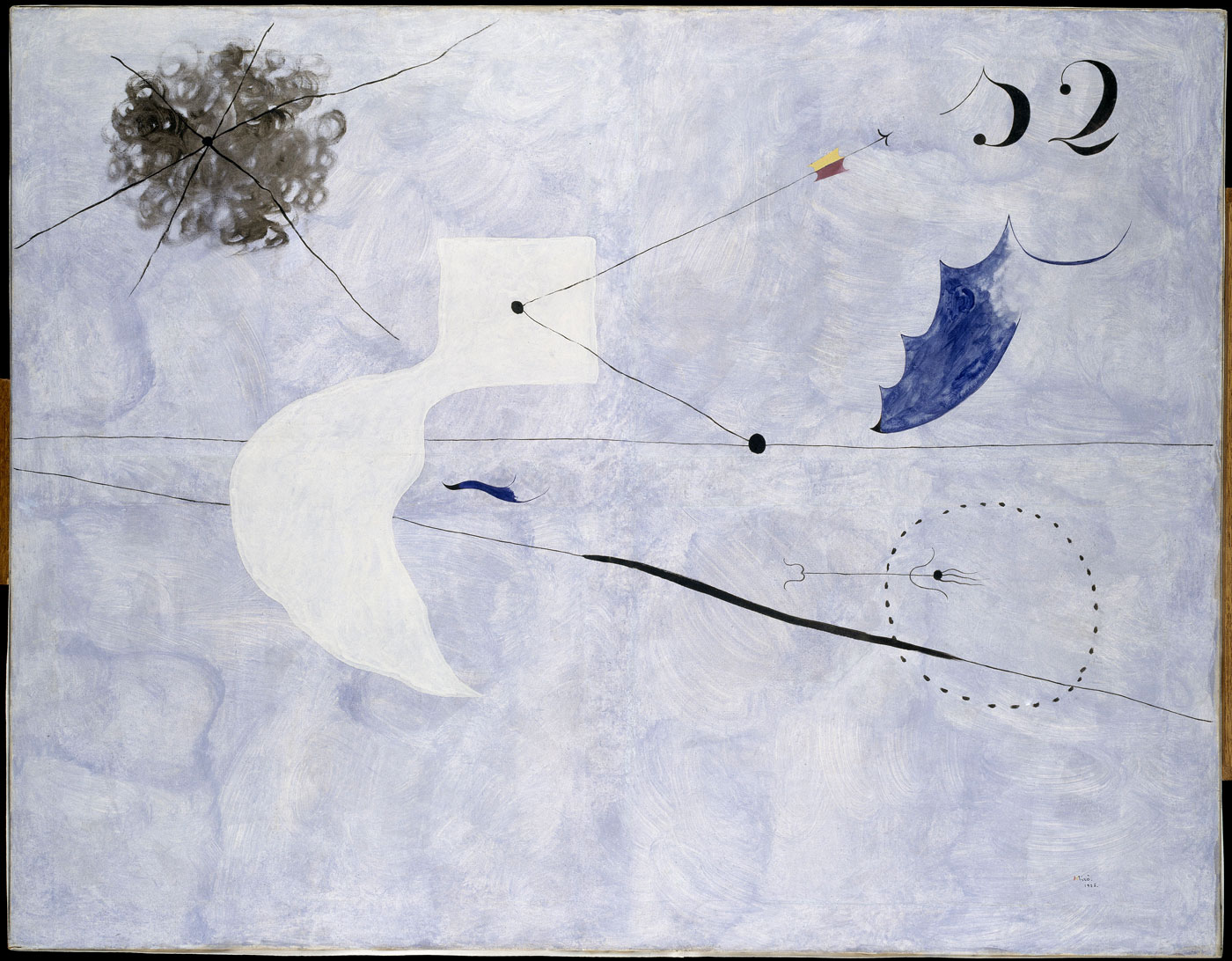
Joan Miró (Spanish, 1893-1983) 'La Sieste' July-September 1925


Joan Miró (Spanish, 1893-1983)
La Sieste
July – September 1925
© Successió Miró/ ADAGP, Paris, 2015


Vassily Kandinsky (Russian, 1866-1944) 'Bild mit rotem Fleck [Tableau à la tache rouge / Image with red spot]' 25 February 1914


Vassily Kandinsky (Russian, 1866-1944)
Bild mit rotem Fleck [Tableau à la tache rouge / Image with red spot]
25 February 1914
Paris, Centre Pompidou – Musée national d’art moderne
© Centre Pompidou, MNAM-CCI, Dist. RMN-Grand Palais / Adam Rzepka


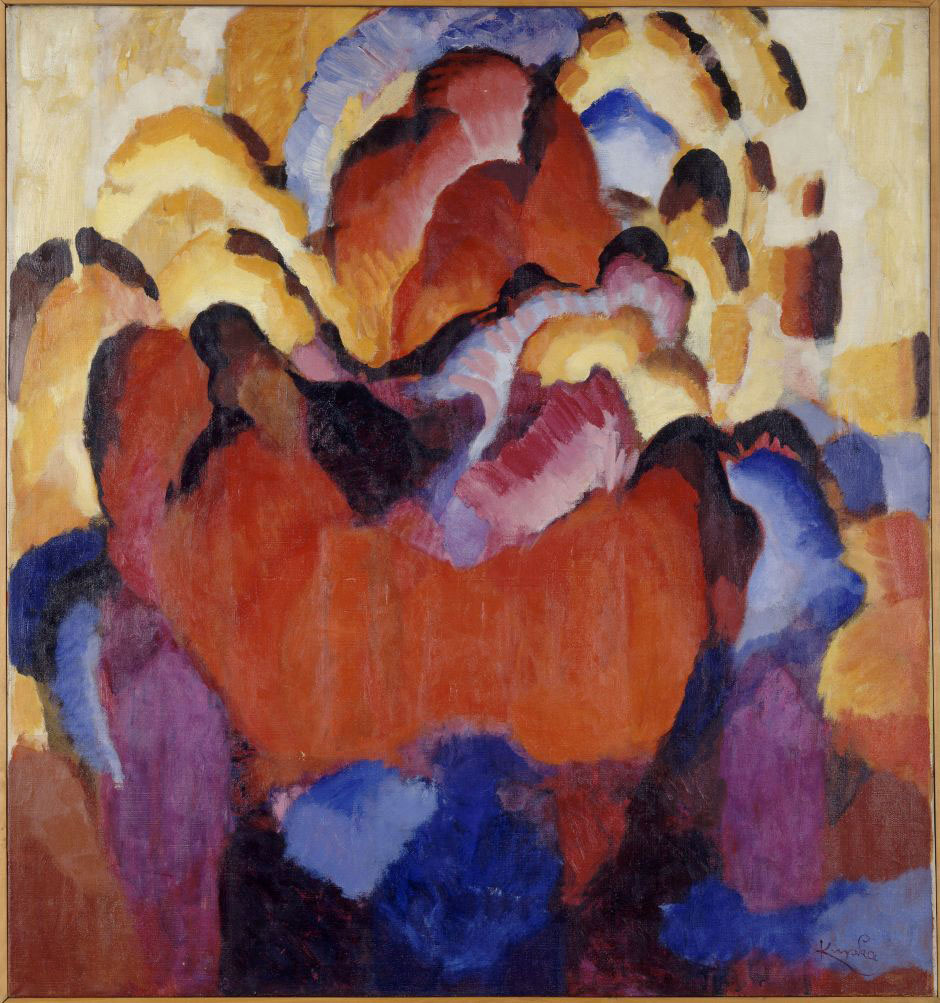
Frantisek Kupka (Czech, 1871-1957) 'Facture robuste' 1920


Frantisek Kupka (Czech, 1871-1957)
Facture robuste
1920
Strasbourg, Musée d’Art moderne et contemporain
© ADAGP, Paris, 2015
© Centre Pompidou, MNAM-CCI, Dist. RMN-Grand Palais / Jacques Faujour


Len Lye (New Zealand/America, 1901-1980)
Tusalava
1929
Film
10 min. 5 sec.


As a student, Lye became convinced that motion could be part of the language of art, leading him to early (and now lost) experiments with kinetic sculpture, as well as a desire to make film. Lye was also one of the first Pākehā artists to appreciate the art of Māori, Australian Aboriginal, Pacific Island and African cultures, and this had great influence on his work. In the early 1920s Lye travelled widely in the South Pacific. He spent extended periods in Australia and Samoa, where he was expelled by the New Zealand colonial administration for living within an indigenous community.

Working his way as a coal trimmer aboard a steam ship, Lye moved to London in 1926. There he joined the Seven and Five Society, exhibited in the 1936 International Surrealist Exhibition and began to make experimental films. Following his first animated film Tusalava, Lye began to make films in association with the British General Post Office, for the GPO Film Unit. He reinvented the technique of drawing directly on film, producing his animation for the 1935 film A Colour Box, an advertisement for “cheaper parcel post”, without using a camera for anything except the title cards at the beginning of the film. It was the first direct film screened to a general audience. It was made by painting vibrant abstract patterns on the film itself, synchronising them to a popular dance tune by Don Baretto and His Cuban Orchestra. A panel of animation experts convened in 2005 by the Annecy film festival put this film among the top ten most significant works in the history of animation (his later film Free Radicals was also in the top 50).

Text from the Wikipedia website


Rudolf Steiner (Austrian, 1861-1925) 'Untitled (drawing on blackboard at a conference of 14 May 1924)' Dornach, 14 May 1924


Rudolf Steiner (Austrian, 1861-1925)
Untitled (drawing on blackboard at a conference of 14 May 1924)
Dornach, 14 May 1924
Chalk on black paper
Rudolf Steiner Archive, Dornach
© Rudolf Steiner Archiv, Dornach
© ADAGP, Paris, 2015


A room of the exhibition features ten blackboards by Rudolf Steiner. They are the instructions of a new design language that the artist wants to develop. Steiner believes in the development of a supersensible consciousness, a big change for the future of humanity. He gives many lectures in which he details his research on the concept of transmission and its influence on the social. Whether true or not, artists such as Piet Mondrian, Wassily Kandinsky and others are interested in the complex graphics of Steiner and his research. Mondrian will even write: “Art is a way of development of mankind.”

Text from the Culture Box website translated from the French


Victor Brauner (Romanian, 1903-1966) 'Signe' 1942-1945


Victor Brauner (Romanian, 1903-1966)
Signe
1942-45
© ADAGP, Paris, 2015


Exhibition layout

Introduction

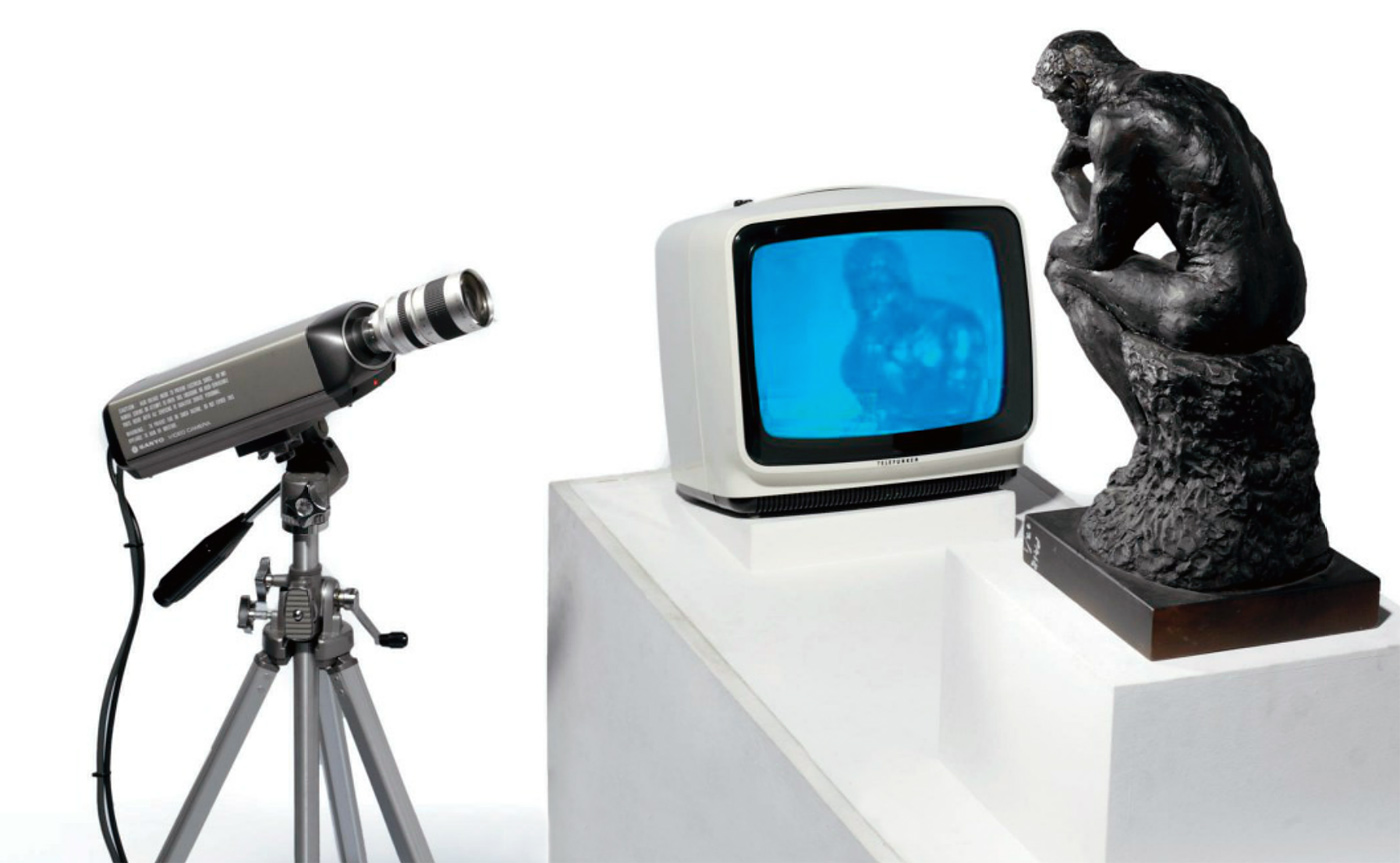
The exhibition starts with a version of the famous figure of Rodin’s Thinker, set off against a sequence of seven photographs from the start of the century, in which the Pictorialist dimension seems to attempt to show lighting emissions produced by the cerebral concentration of the subject. This collection is presented opposite TV Rodin, a video installation created by the artist Nam June Paik who, in the 1970s, reinterpreted electromagnetic animation of closed-circuit thought, when interest in cybernetics was at its peak.

Auras

The direct visualisation of thought and emotional states and the impact of this on the beginnings of abstraction at the start of the 20th century.

The first room focuses on the passion during the century for “photography of thought.” As a direct response to the discovery of radiography by Röntgen, in 1895, numerous amateur researchers attempted to produce images of the brain on photosensitive plates. Since it was possible to see through opaque bodies, why not try to see through the skull, which was now transparent? A curiosity cabinet presents the photographic experiments of Hippolyte Baraduc and Louis Darget with “psychic ones” or “images of thought.” This selection of photographs interacts with two film animation extracts by Émile Cohl, showing, with some humour, the direct projection of thought onto the big screen with the arrival of the cinema.

In the second room, a collection of engravings from the theosophical works of Annie Besant and Charles Leadbeater, presented by the American artist Christian Sampson, reveals the close relationship between the representation of emotional states (thought-patterns) and early abstract painting. They inspired many pioneers of abstract painters, including Kupka and Kandinsky. A group of auras and halos is shown, associated with a colour code for different effects, captured by Kandinsky in order to paint authentic abstract (auto) portraits. In the same vein, paintings by Wilhelm Morgner, Janus de Winter and Jacob Bendien present “psychic portraits” which illustrate a psychological range of emotions by means of chromatic signs.

The third room presents a sequence of ten “blackboards” by Rudolph Steiner, the founder of anthroposophy (the “science of the mind” that was a major influence on some of the members of the avant-garde abstract movement), showing how he developed his theories of the “mental body” and “psychic force”. Next to this is a collection of watercolours by the Swedish painter Hilma af Klint, a pioneer of abstract art. Around this area a multimedia installation by the artist Tony Oursler has been specially created for this exhibition reinterpreting the historical imagination of these “mental projections”.

Magnetic fields

The spread of telepathy in the inter-war period and its influence on surrealism.

In 1924, André Breton published the Surrealist Manifesto (1924) just when the neurologist Hans Berger invented the first electroencephalogram as a result of experimental research into telepathy: this being a less than accidental coincidence, relating to automated transcriptions of the mind. The “exquisite corpses” or “communicated drawings” of the surrealists are linked to experiments that took place at that time into the telepathic transfer of images.

The first room presents a sequence of photographs of the surrealist group in poses in which heads and bodies communicate with each other to produce a collective work under the mysterious influence of “magnetic fields.” Tusalava (1929), a film by the Australian artist Len Lye, illustrates the cinematographic solution found to make mental activity visible, in the form of abstract ideograms taken from aboriginal language.

The second room shows a collection of photographs from the 1920s, some of which are presented by the artist Frédéric Vaesen, relating to the materialisation of psychic entities, the famous “ectoplasms” which give a more tangible reality to imponderable thought. Next to this is a series of works by Joan Miró, in which the painter depicts coloured auras, including a mental map of emotional states, a “photograph of his dreams”.

Mind expander

With the reconstruction of the post war period, divided between the cybernetic model and psychedelic liberation, telepathy remained more than ever a creative horizon for artists in search of perception extended to the electromagnetic manifestations of consciousness.

The New Age spirit of the 1960s witnessed the curious revival of “photographs of thought” (Ted Serios and Salas Portugal), which influenced experimental cinema and psychedelic video (Jordan Belson), a well as some photographic practices (Anna and Bernhard Blume, Dieter Appelt, Suzanne Hiller, John Baldessari and Sigmar Polke).

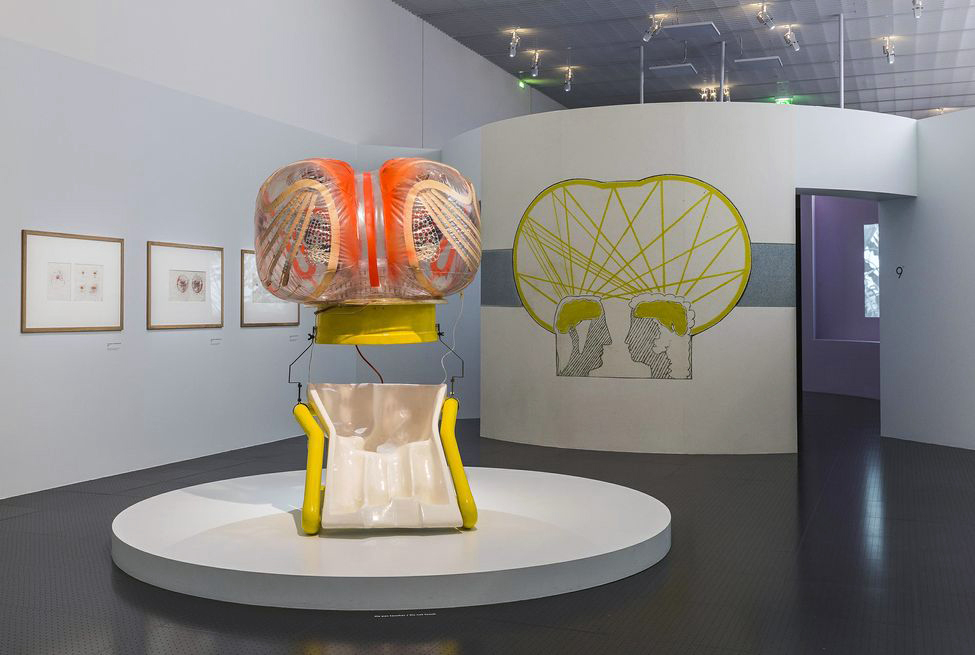
Under the influence of psychotropic drugs or immersed in highly intense audiovisual devices, electric thought in motion is captured with a penetrating eye. Experimental and radical architectural patterns embody “expanded consciousness”, as is seen in the Mind Expander project (1967) by the Austrian group Haus Rucker Co, which invites the spectator to venture into “superception.” Music has its role here, with the rise in “biomusic” at the end of the 1960s, led by Alvin Lucier, Pierre Henry and David Rosenboom, who produced authentic “brain symphonies,” by means of the sound transcription of the activity of electric waves emitted by the brain, directly captured by electrodes.

Telepathy

The establishment of telepathic art in the 1970s influenced by conceptual practices.

On the margins of pop art, avant-garde artists in the 1970s produced a critique of both form and the art market, by means of strategies that emphasised language and sociological discourse. This also involved a major project in the dematerialisation of art works in which telepathy could be an ideal model for a new non-standard form of communication.

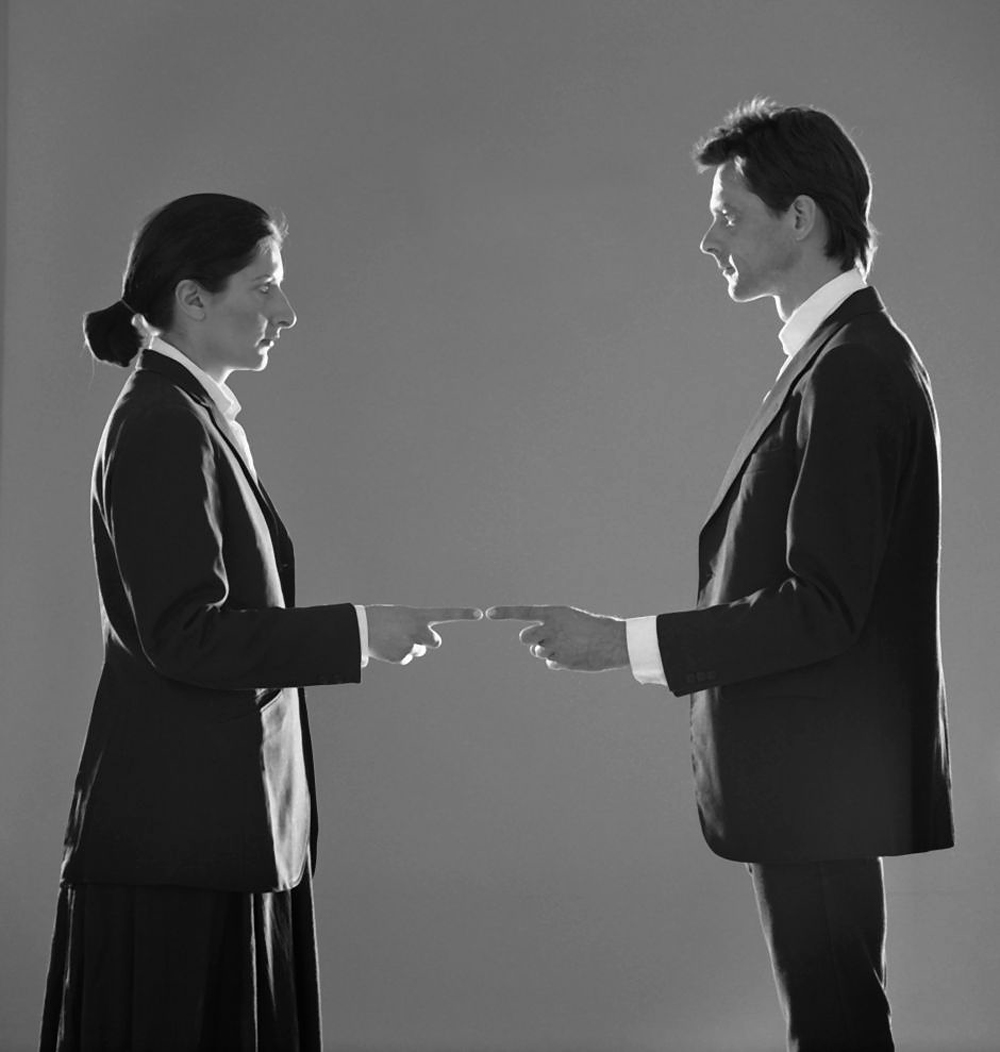
The American artist Robert Morris produced his own Autoportrait in the form of an encephalogram (EEG Portrait) at the same time as his compatriot Robert Barry, a central figure in conceptual art, produced Telepathic Pieces (1969) and Vito Acconci explored extra sensory perception through the form of video (Remote Control, 1971). Against this backdrop, we see considerable new interest in a utopia of shared creation (Robert Filliou and Marina Abramovic) in the era of global communication and the “noosphere” prophetically declared by Teilhard de Chardin and Marshall McLuhan.

The exhibition ends with a vast installation by the artist Fabrice Hyber, a major figure of contemporary art in France, with experimental telepathic booths, paintings, drawings and “prototypes of operating objects” (POF). Hyber invites the spectator to participate, alone or in groups, in an experience which has several surprises, reminding us how, today, under the influence of information networks, neuroscience and the globalised internet, telepathy (ultra democratic and utopian yet also obscure) is more topical than ever and can be explored by artists with the same spirit of derision or anticipation.

Press release from the Centre Pompidou-Metz


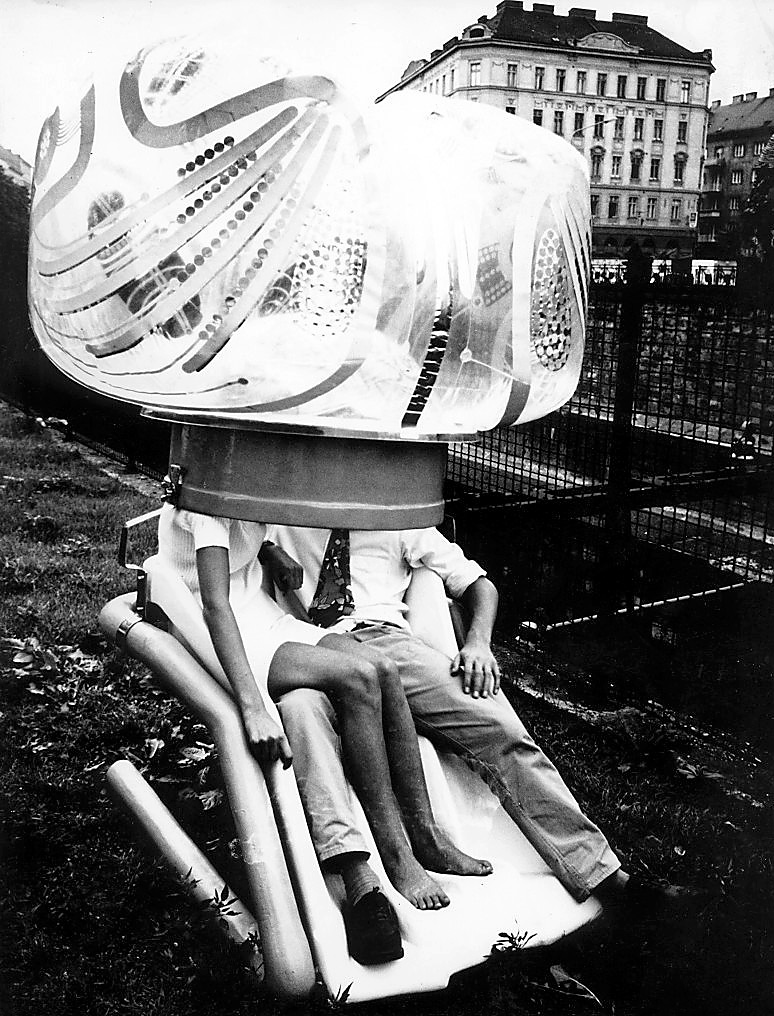
Haus-Rucker-Co (Viennese, founded 1967) Laurids, Zamp and Pinter with 'Environment Transformern (Flyhead, Viewatomizer and Drizzler)' 1968, from the 'Mind Expander project'


Haus-Rucker-Co (Viennese, founded 1967)
Laurids, Zamp and Pinter with Environment Transformern (Flyhead, Viewatomizer and Drizzler)
1968
From the Mind Expander project
Photo: Gert Winkler


Taking their cue from the Situationist’s ideas of play as a means of engaging citizens, Haus-Rucker-Co created performances where viewers became participants and could influence their own environments, becoming more than just passive onlookers. These installations were usually made from pneumatic structures such as Oase No. 7 (1972), which was created for Documenta 5 in Kassel, Germany. An inflatable structure emerged from the façade of an existing building creating a space for relaxation and play, of which contemporary echoes can be found in the ‘urban reserves’ of Santiago Cirugeda. The different versions of the Mind Expander series (1967-1969), consisted of various helmets that could alter the perceptions of those wearing them, for example the ‘Fly Head’ disoriented the sight and hearing of the wearer to create an entirely new apprehension of reality; it also produced one of their most memorable images.

Haus-Rucker-Co’s installations served as a critique of the confined spaces of bourgeois life creating temporary, disposable architecture, whilst their prosthetic devices were designed to enhance sensory experience and highlight the taken-for-granted nature of our senses, seen also in the contemporaneous work of the Brazilian artist Lygia Clark. Contemporary versions of such work can be found in the pneumatic structures favoured by Raumlabor and Exyzt.

Anonymous text from the Spatial Agency website [Online] Cited 22/03/2016.


Installation view of Haus-Rucker-Co, 'Mindexpander 1' 1967 in the exhibition 'Cosa mentale' at the Centre Pompidou-Metz


Installation view of Haus-Rucker-Co, Mindexpander 1 1967 in the exhibition Cosa mentale at the Centre Pompidou-Metz.
Photo Pompidou Centre. MNAM CCI-distrib. RMN / G. Meguerditchian.


In 1968, the Austrian collective Haus-Rucker-Co designed the Mind Expander as an immersive capsule propelling the audience into a new mode of perception of reality: the “Superception”. This, then, is a synthesis of avant-garde utopias, throughout the twentieth century, influenced by the imagination that gave rise to the development of telecommunications, seeking to develop a way of live transmission of emotion. Its aim was to invent a new, immediate, relationship between the artist and the viewer.


Haus-Rucker-Co. 'Mind Expander' 1967


Haus-Rucker-Co (Viennese, founded 1967)
Mind Expander
1967 Vienna
Epreuve gélatino-argentique
Photo: Michael Plitz. Haus-Rucker-Co.


David Rosenboom (American, b. 1947) 'Portable Gold and Philosophers' Stones in Paris 1' 1975


David Rosenboom (American, b. 1947)
Portable Gold and Philosophers’ Stones in Paris 1
1975
© David Rosenboom 1975
All rights reserved


Pianist-composer J.B. Floyd, a long-time collaborator with David Rosenboom is seen with electrodes attached to his head while performing a solo version of Rosenboom’s brainwave music composition Portable Gold and Philosophers’ Stones at Centre Culturel Americain in Paris on 7 January 1975. The equipment shown includes a brainwave monitoring device and an ARP 2600 Synthesizer. The performance occurred simultaneously with a lecture given by David Rosenboom in a presentation titled Biofeedback and the Arts. Artist Jacqueline Humbert, who also participated in the performance, is seated off to the right of the picture frame.


Nam June Paik (American, 1932-2006) 'TV Rodin' 1976-1978 (detail)


Nam June Paik (American, 1932-2006)
TV Rodin (detail)
1976-1978
Plaster, video camera, tripod, monitor, pedestal
132 x 110 x 115 cm


Long considered the most important video artist since the advent of the form in the late 1960s, Nam June Paik’s TV Rodin is one of several related works that involve sculpture – in this case, a cast of Auguste Rodin’s Thinker, studying itself in a small video monitor via closed circuit television. As museum visitors walk around the work and look over the sculpture’s shoulder, their image also appears on the screen. Paik’s influential vision of television as a global cultural force found intelligent and witty form in his videotapes, video sculptures, and intercontinental satellite performances.

Text from the Carnegie Museum of Art website [Online] Cited 22/03/2016.


Nam June Paik (American, 1932-2006) 'TV Rodin' 1976-1978


Nam June Paik (American, 1932-2006)
TV Rodin
1976-1978
Plaster, video camera, tripod, monitor, pedestal
132 x 110 x 115cm
Photo: Primae / Claude Germain. The Estate of Nam June Paik


Marina Abramovic (Serbian, b. 1946) and Ulay (Frank Uwe Laysiepen) (German, 1943-2020) 'That Self – Point of Contact' 1980


Marina Abramovic (Serbian, b. 1946) and Ulay (Frank Uwe Laysiepen) (German, 1943-2020)
That Self – Point of Contact
1980
Performance au De Appel Art Centre, Amsterdam
© Adagp, Paris 2015
Courtesy Marina Abramovic Archives


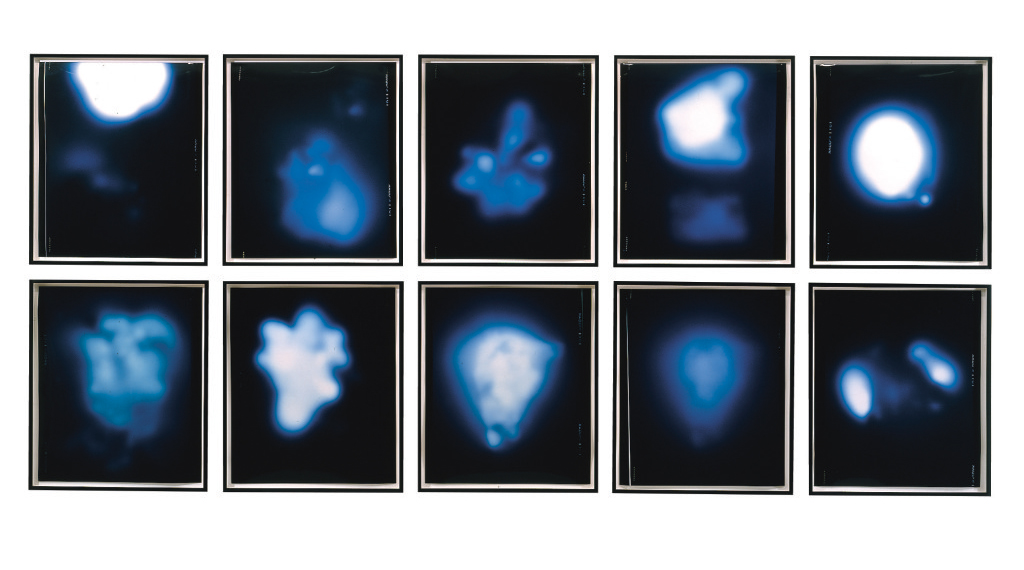
Sigmar Polke (German, 1941-2010) 'Untitled (Blue)' 1992


Sigmar Polke (German, 1941-2010)
Untitled (Blue)
1992
Set of 10 Cibachromes trials
61 x 51cm
The estate of Sigmar Polke / ADAGP, Paris, 2015


Fabrice Hyber (French, b. 1961) 'screen+télépathy' 2013


Fabrice Hyber (French, b. 1961)
screen+télépathy
2013
Watercolour, charcoal on paper
76 x 57cm
Collection of the artist
© Photographie Marc Domage


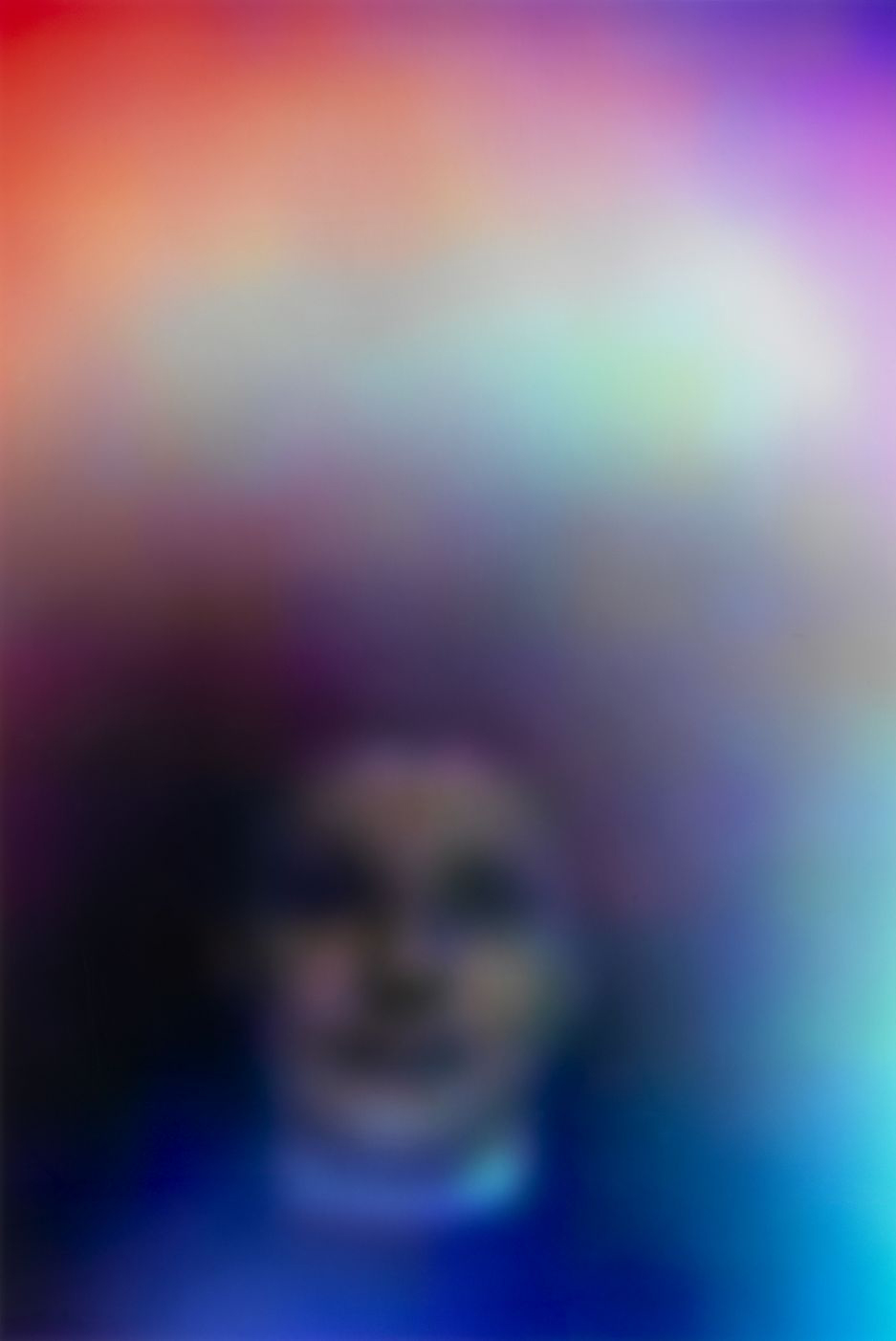
Susan Hiller (American, 1940-2019) 'Homage to Marcel Duchamp: Aura (Blue Boy)' 2011


Susan Hiller (American, 1940-2019)
Homage to Marcel Duchamp: Aura (Blue Boy)
2011
© Susan Hiller


Centre Pompidou-Metz
1, parvis des Droits-de-l’Homme
CS 90490
F-57020 Metz Cedex 1
Phone: +33 (0)3 87 15 39 39

Opening hours:
Monday 10am – 6pm
Tuesday closed
Wednesday 10am – 6pm
Thursday 10am – 6pm
Friday 10am – 7pm
Saturday 10am – 7pm
Sunday 10am – 7pm

Centre Pompidou-Metz website

LIKE ART BLART ON FACEBOOK

Back to top

Exhibition: ‘In Focus: Daguerreotypes’ at The J. Paul Getty Museum, Getty Center, Los Angeles

Exhibition dates: 3rd November, 2015 – 20th March, 2016

Curator: Karen Hellman, Assistant Curator of Photographs in the Department of Photographs at The J. Paul Getty Museum


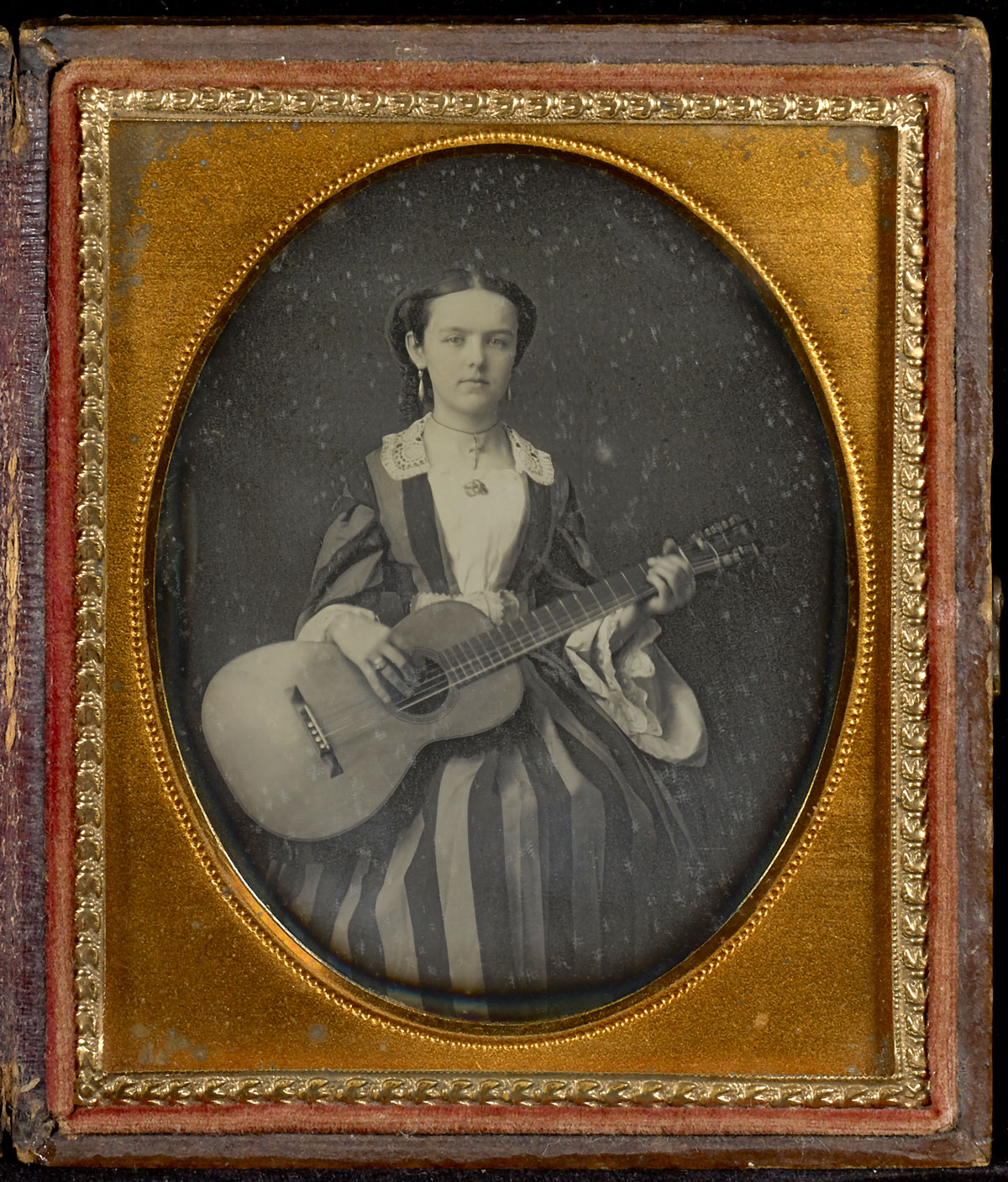
Unknown maker (American) 'Portrait of Young Girl with a Guitar' c. 1850 from the exhibition 'In Focus: Daguerreotypes' at the J. Paul Getty Museum, Getty Center, Los Angeles, Nov 2015 - March 2016


Unknown maker (American)
Portrait of Young Girl with a Guitar
c. 1850
Daguerreotype
1/6 plate
Open: 9.2 x 15.2cm (3 5/8 x 6 in.)
Graham Nash Collection


The last in my trilogy of postings on 19th century photography features a rather uninspiring collection of daguerreotypes. Perhaps there were better ones in the exhibition.

Of most interest to me are two:

Nude Woman in Photographer’s Studio (c. 1850, below) with its almost van Gogh-esque perspective of the figure, chair and rug. The image is also notable for the daguerreotypes of men who stare down on the women from the wall behind: the objectification of the male gaze – of the photographer and of the observers. This daguerreotype also reminds me of the later haunting photographs by E. J. Bellocq (1873-1949) of the prostitutes of Storyville, New Orleans.

Joseph-Philibert Girault de Prangey’s ghostly, evocative Facade and North Colonnade of the Parthenon on the Acropolis, Athens (1842, below). Can you imagine being shown this full plate, I repeat, full plate daguerreotype of one of the wonders of Ancient Greece just 3 years after the public announcement of the invention of photography. You would have never seen many, if any, images of foreign places in your life before, and that moment of initiation into the magic arts of photography would have taken on the deepest significance. Even now, the effect of this plate on the imagination and consciousness of the viewer is outstanding.

The rest of the daguerreotypes in this posting are more prosaic: vaguely interesting still life vanitas or portrait social documentation. If you were not told that these were images of a president of the United States, the inventor of the daguerreotype, or the writer Edgar Allen Poe they could be any “Portrait of a man” or “Portrait of a woman”.

It’s amazing how even at this early stage of photography the codification of the image, its semiotic language if you like, was intimately tied up with the caption and text that accompanied it. Of course, unless we know that it’s called the Eiffel Tower then a photograph of the object without that knowledge would mean very little; but as soon as that title is present in collective consciousness, then anywhere an image of that structure is found, it is already known as such.

Now there’s a good idea for an exhibition: the influence of the title on the interpretation of the photographic image. ‘(Un)titled images’ anyone?

Dr Marcus Bunyan


Many thankx to the J. Paul Getty Museum for allowing me to publish the photographs in the posting. Please click on the photographs for a larger version of the image.


James Maguire (American, 1816-1851) '[Portrait of Zachary Taylor]' 1847 from the exhibition 'In Focus: Daguerreotypes' at the J. Paul Getty Museum, Getty Center, Los Angeles, Nov 2015 - March 2016


James Maguire (American, 1816-1851)
[Portrait of Zachary Taylor]
1847
Daguerreotype
1/4 plate
Image: 7.9 x 5.4cm (3 1/8 x 2 1/8 in.)
Mat: 12.7 x 10.8cm (5 x 4 1/4 in.)
The J. Paul Getty Museum, Los Angeles


James Maguire (American, 1816-1851)

James Maguire (American, 1816-1851) Daguerreotypist, dealer in daguerreian supplies; active Tuscaloosa, Ala., before 1842; New Orleans 1842-50; Natchez, Miss., 184; Vicksburg, Miss., 1842; Plaquemine, La., 1842; Baton rouge, La., 1842; Belfast, Ireland, 1844; London, England, 1844; Paris, France, 1844.

According to his obituary, James Maguire was born in Belfast, Ireland, around 1815. By early 1842 he had learned the daguerreian art from Frederick A. P. Barnard and Dr. William H. Harrington in Tuscaloosa, Alabama. Maguire was one of the earliest daguerreians to establish a permanent gallery in New Orleans. In that city on January 28, 1842 he advertised that he had opened a portrait gallery at 31 Canal Street, upstairs, where he would “remind a short time.” …

Maguire’s New orleans gallery flourished during the Mexican War, when the city enjoyed a boom as a key shipping centre and rendezvous for troops bound for Mexico…

When General Zachary Taylor passed through New Orleans in late 1847 on his triumphant return from the Mexican War, he favoured Acquire by sitting for his portrait. The Daily Picayune noted not January 11, 1848, that Macquire’s portrait was ‘the best and most striking likeness of ‘Old Zach’ we have yet seen of him anywhere.”

Peter E. Palmquist and Thomas R. Kailbourn. Pioneer Photographers from the Mississippi to the Continental Divide: A Biographical Dictionary 1839-1865. Stanford: Stanford University Press, 2005, pp. 411-412.

Zachary Taylor (American, 1784-1850)

Zachary Taylor (November 24, 1784 – July 9, 1850) was the 12th President of the United States, serving from March 1849 until his death in July 1850. Before his presidency, Taylor was a career officer in the United States Army, rising to the rank of major general.

Taylor’s status as a national hero as a result of his victories in the Mexican-American War won him election to the White House despite his vague political beliefs. His top priority as president was preserving the Union, but he died seventeen months into his term, before making any progress on the status of slavery, which had been inflaming tensions in Congress.

Text from the Wikipedia website


Unknown maker (American) 'Nude Woman in Photographer's Studio' c. 1850


Unknown maker (American)
Nude Woman in Photographer’s Studio
c. 1850
Daguerreotype
1/6 plate
Image: 9.5 x 7.6cm (3 3/4 x 3 in.)
Graham Nash Collection


Unknown maker (American) 'Nude Woman in Photographer's Studio' c. 1850 (detail)


Unknown maker (American)
Nude Woman in Photographer’s Studio (detail)
c. 1850
Daguerreotype
1/6 plate
Image: 9.5 x 7.6cm (3 3/4 x 3 in.)
Graham Nash Collection


Unknown maker (American) 'Portrait of Edgar Allan Poe' late May - early June 1849


Unknown maker (American)
Portrait of Edgar Allan Poe
late May – early June 1849
Daguerreotype
1/2 plate
Image: 12.2 x 8.9cm (4 13/16 x 3 1/2 in.)
Mat (and overmat): 15.6 x 12.7cm (6 1/8 x 5 in.)
Object (whole): 17.9 x 14.9cm (7 1/16 x 5 7/8 in.)
The J. Paul Getty Museum, Los Angeles


Unknown maker (American) 'Portrait of a Nurse and a Child' c. 1850


Unknown maker (American)
Portrait of a Nurse and a Child
c. 1850
Daguerreotype, hand-coloured
1/6 plate
Image: 6.2 x 4.8cm (2 7/16 x 1 7/8 in.)
Mat: 8.3 x 7.1cm (3 1/4 x 2 13/16 in.)
The J. Paul Getty Museum, Los Angeles


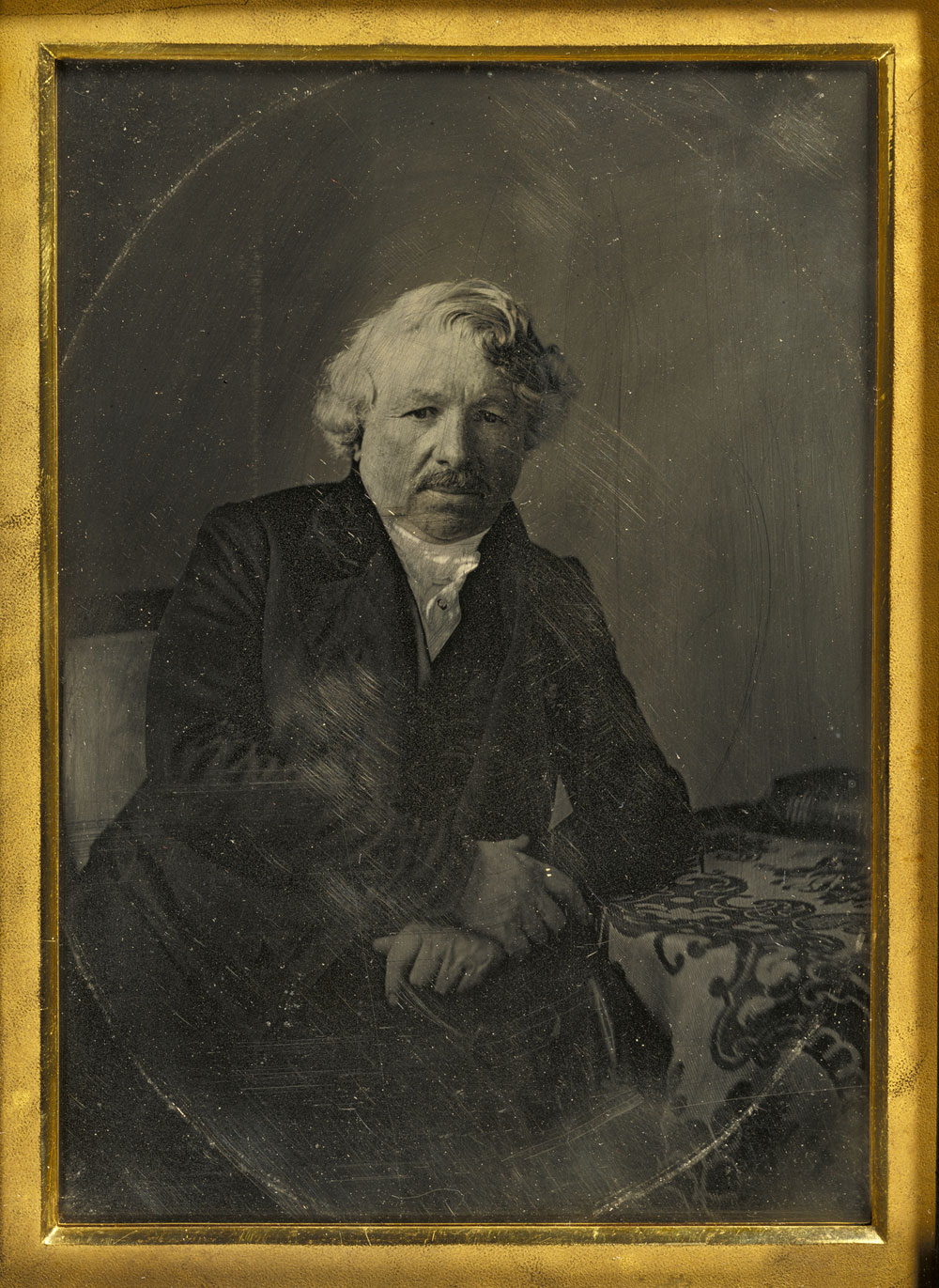
Charles Richard Meade (American, 1826-1858) 'Portrait of Louis-Jacques-Mandé Daguerre' 1848


Charles Richard Meade (American, 1826-1858)
Portrait of Louis-Jacques-Mandé Daguerre
1848
Daguerreotype, hand-coloured
1/2 plate
Image: 15.7 x 11.5cm (6 3/16 x 4 1/2 in.)
Mat: 16 x 12cm (6 5/16 x 4 13/16 in.)
Object (whole): 22.1 x 17.8cm (8 11/16 x 7 in.)
The J. Paul Getty Museum, Los Angeles


Louis Daguerre (French, 1787-1851)

Louis Daguerre (1787 – 10 July 1851) was born in Cormeilles-en-Parisis, Val-d’Oise, France. He was apprenticed in architecture, theatre design, and panoramic painting to Pierre Prévost, the first French panorama painter. Exceedingly adept at his skill of theatrical illusion, he became a celebrated designer for the theatre, and later came to invent the diorama, which opened in Paris in July 1822.

In 1829, Daguerre partnered with Nicéphore Niépce, an inventor who had produced the world’s first heliograph in 1822 and the first permanent camera photograph four years later. Niépce died suddenly in 1833, but Daguerre continued experimenting, and evolved the process which would subsequently be known as the daguerreotype. After efforts to interest private investors proved fruitless, Daguerre went public with his invention in 1839. At a joint meeting of the French Academy of Sciences and the Académie des Beaux Artson 7 January of that year, the invention was announced and described in general terms, but all specific details were withheld. Under assurances of strict confidentiality, Daguerre explained and demonstrated the process only to the Academy’s perpetual secretary François Arago, who proved to be an invaluable advocate. Members of the Academy and other select individuals were allowed to examine specimens at Daguerre’s studio. The images were enthusiastically praised as nearly miraculous, and news of the daguerreotype quickly spread. Arrangements were made for Daguerre’s rights to be acquired by the French Government in exchange for lifetime pensions for himself and Niépce’s son Isidore; then, on 19 August 1839, the French Government presented the invention as a gift from France “free to the world”, and complete working instructions were published. In 1839, he was elected to the National Academy of Design as an Honorary Academician.

Daguerre died on 10 July 1851 in Bry-sur-Marne, 12 km (7 mi) from Paris. A monument marks his grave there.

Text from the Wikipedia website


James P. Weston (American, active South America about 1849 and New York 1851-1852 and 1855-1857) '[Portrait of an Asian Man in Top Hat]' c. 1856


James P. Weston (American, active South America about 1849 and New York 1851-1852 and 1855 -1857)
[Portrait of an Asian Man in Top Hat]
c. 1856
Daguerreotype, hand-coloured
1/9 plate
Image: 5.4 x 4.3cm (2 1/8 x 1 11/16 in.)
Mat: 6.4 x 5.1cm (2 1/2 x 2 in.)
Open: 5.1 x 10.8cm (2 x 4 1/4 in.)
The J. Paul Getty Museum, Los Angeles


A “mirror with a memory,” a daguerreotype is a direct-positive photographic image fixed on a silver-coated metal plate. The earliest form of photography, this revolutionary invention was announced to the public in 1839. In our present image-saturated age, it is difficult to imagine a time before the ability to record the world in the blink of an eye and the touch of a fingertip. This exhibition, drawn from the Getty Museum’s permanent collection with loans from two private collections, presents unique reflections of people, places, and events during the first two decades of the medium.

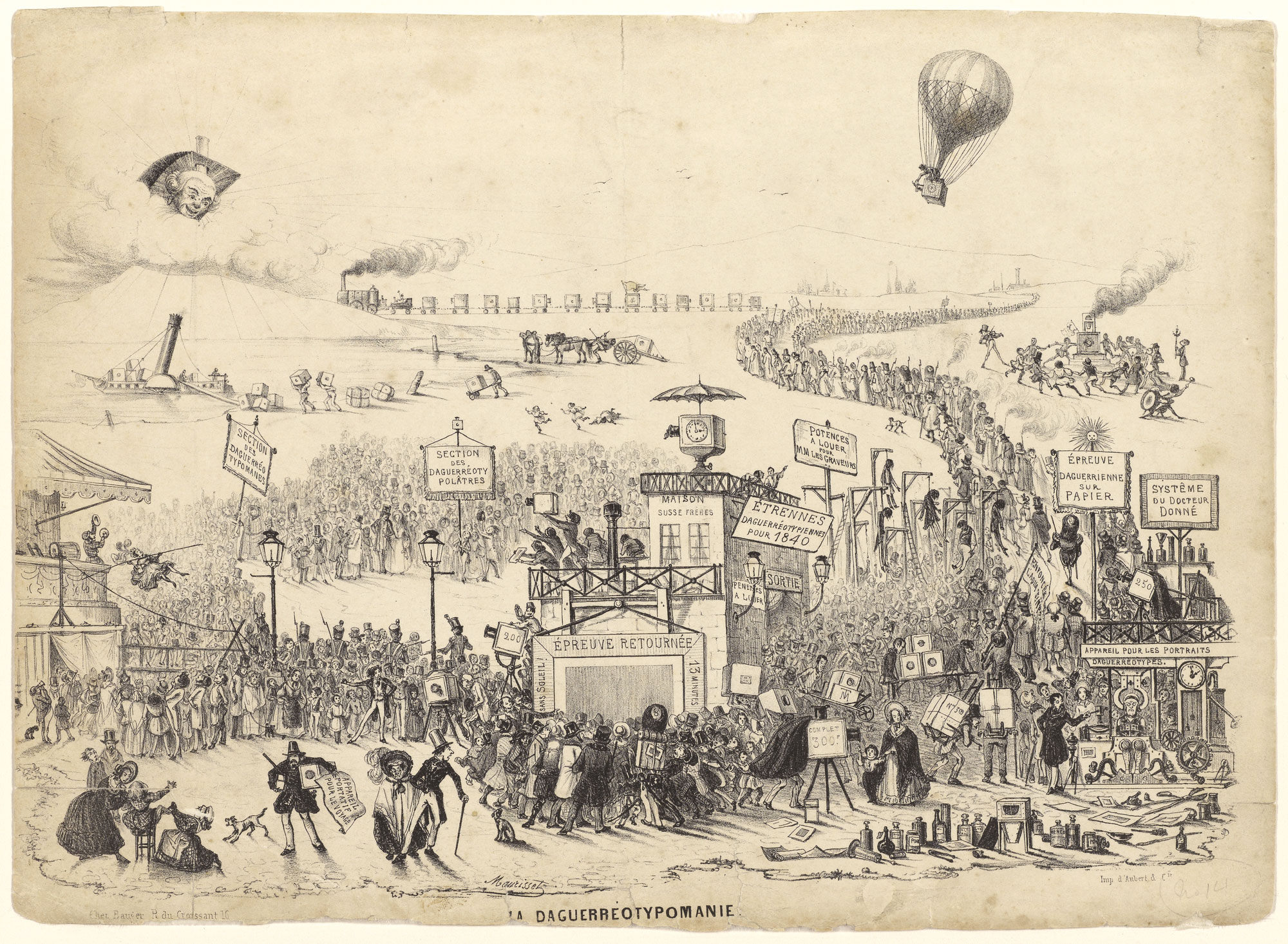
Popularly described as “a mirror with a memory,” the daguerreotype was the first form of photography to be announced to the world in 1839 and immediately captured the imagination of the public. The “Daguerreotypomania” that followed may seem surprising today, as photographs have become an omnipresent part of contemporary life. In Focus: Daguerreotypes, on view from November 3, 2015 – March 20, 2016 at the Getty Center, offers the photography enthusiast and the general visitor alike a unique opportunity to view rare and beautiful examples of this early photographic process. The works in the exhibition are drawn from the Getty Museum’s exceptional collection of more than two thousand daguerreotypes alongside loans from the outstanding private collections of musician Graham Nash and collector Paul Berg.

“Today, photographs can be taken, edited, and deleted within seconds and are the principal record of our everyday lives,” says Timothy Potts, director of the J. Paul Getty Museum. “It takes a leap of the imagination to appreciate what they represented to the pioneer inventors and to the public of the day. This exhibition explores how these first captured images – fragile, one-of-a-kind works – were treasured, not only by those who were just discovering the possibilities of the medium, but by those being photographed as well.”

By the mid-1840s, exposure times and costs had decreased markedly and, as a result, daguerreotypes became more accessible to a broader audience. Over the years, attempts were made to enhance the capabilities of the daguerreotype. To make up for the deficiency of colour, many portrait daguerreotypists employed former miniature painters to hand-paint each plate; an example of which is Portrait of a Woman with a Mandolin (1860), where light specks of colour enhance the ornamentation on the costume. Daguerreotypes were also nearly impossible to reproduce, though some attempts were made, including making the daguerreotype plate into a printing plate. Examples of this process will be on view in the exhibition.

Inside the Portrait Studio

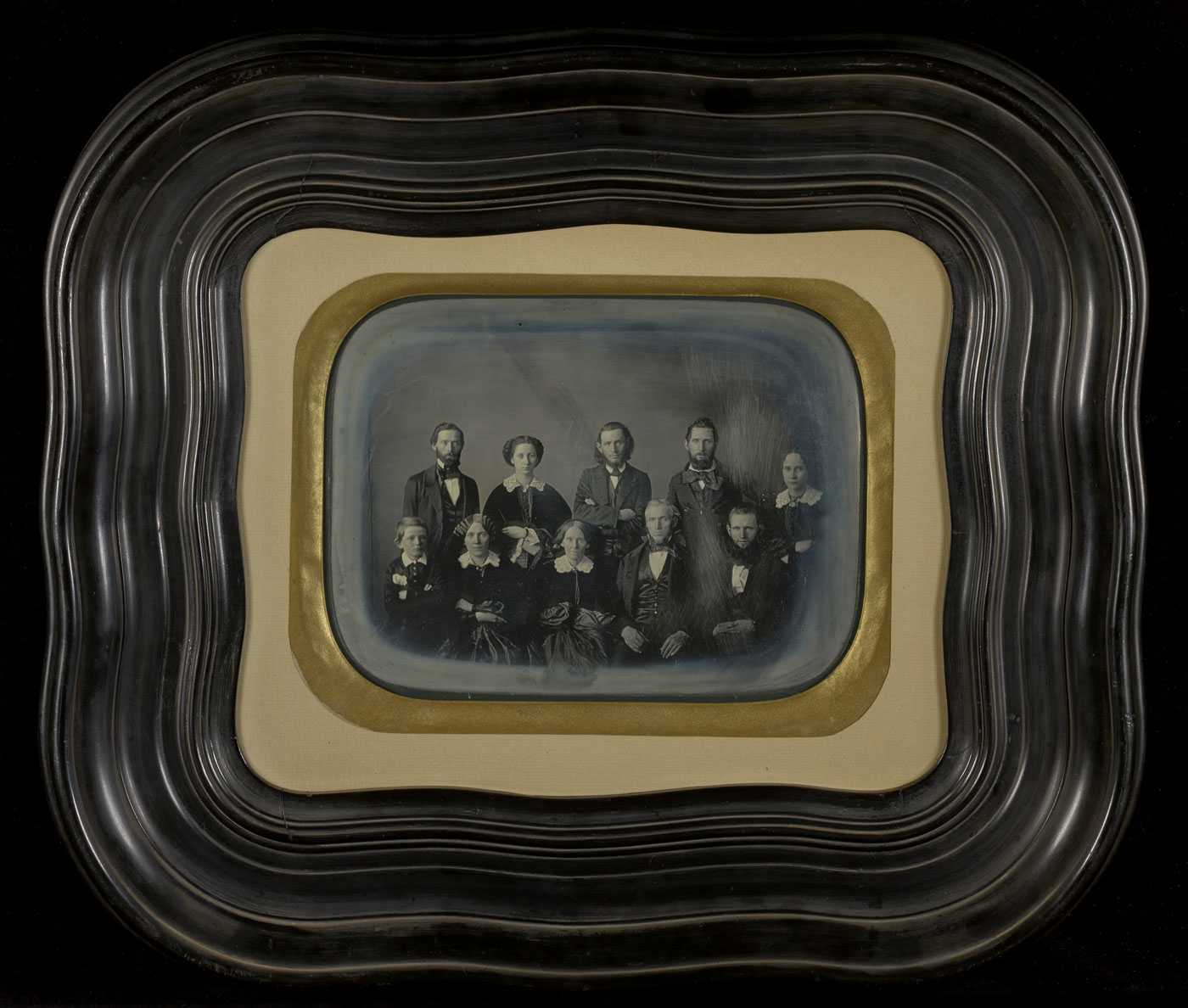
Daguerreotype studios were plentiful by the mid-19th century, and each studio developed novel ways to create distinctive and personal images for its customers. Confined to a well-lit indoor or outdoor location, many daguerreotypists would stage everyday scenes that might include painted backdrops of domestic interiors and subjects posing as if in conversation or seated at tables with everyday props. As it was extremely difficult to capture a smiling face without blurring the features, most sitters wore somber expressions. An unusual exception on view in the exhibition is Portrait of a Father and Smiling Child (about 1855).

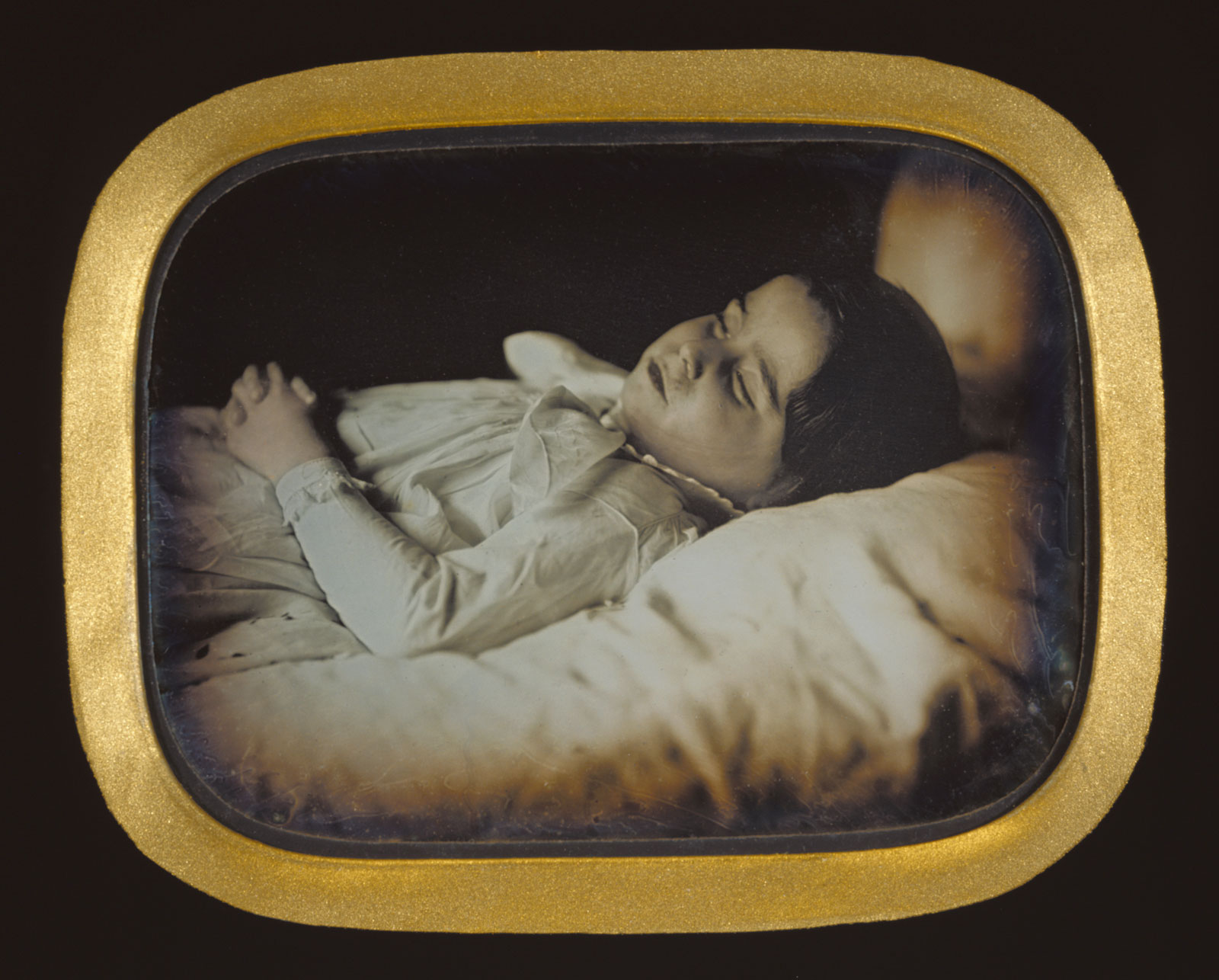
Customers remarked on the incredible fidelity of the silver image and praised it as a means of preserving a loved one’s presence. Some family members – often children – passed away before they could pose for the camera, and their likenesses were preserved in post-mortem portraits, as in Carl Durheim’s (Swiss, 1810-1890) Postmortem Portrait of a Child (about 1852), which creates the illusion of quiet slumber rather than death.

Prominent and well-known members of society also had their daguerreotype portraits taken, which made their likenesses more accessible to the public than ever before. “The exhibition will include daguerreotypes of the Duke of Wellington, Edgar Allen Poe, and Queen Kalama of Hawaii,” says Karen Hellman, assistant curator of photographs in the J. Paul Getty Museum’s Department of Photographs and curator of the exhibition. “Because of the unique direct positive process, we find ourselves face to face with these historical figures.”

Outside the Portrait Studio

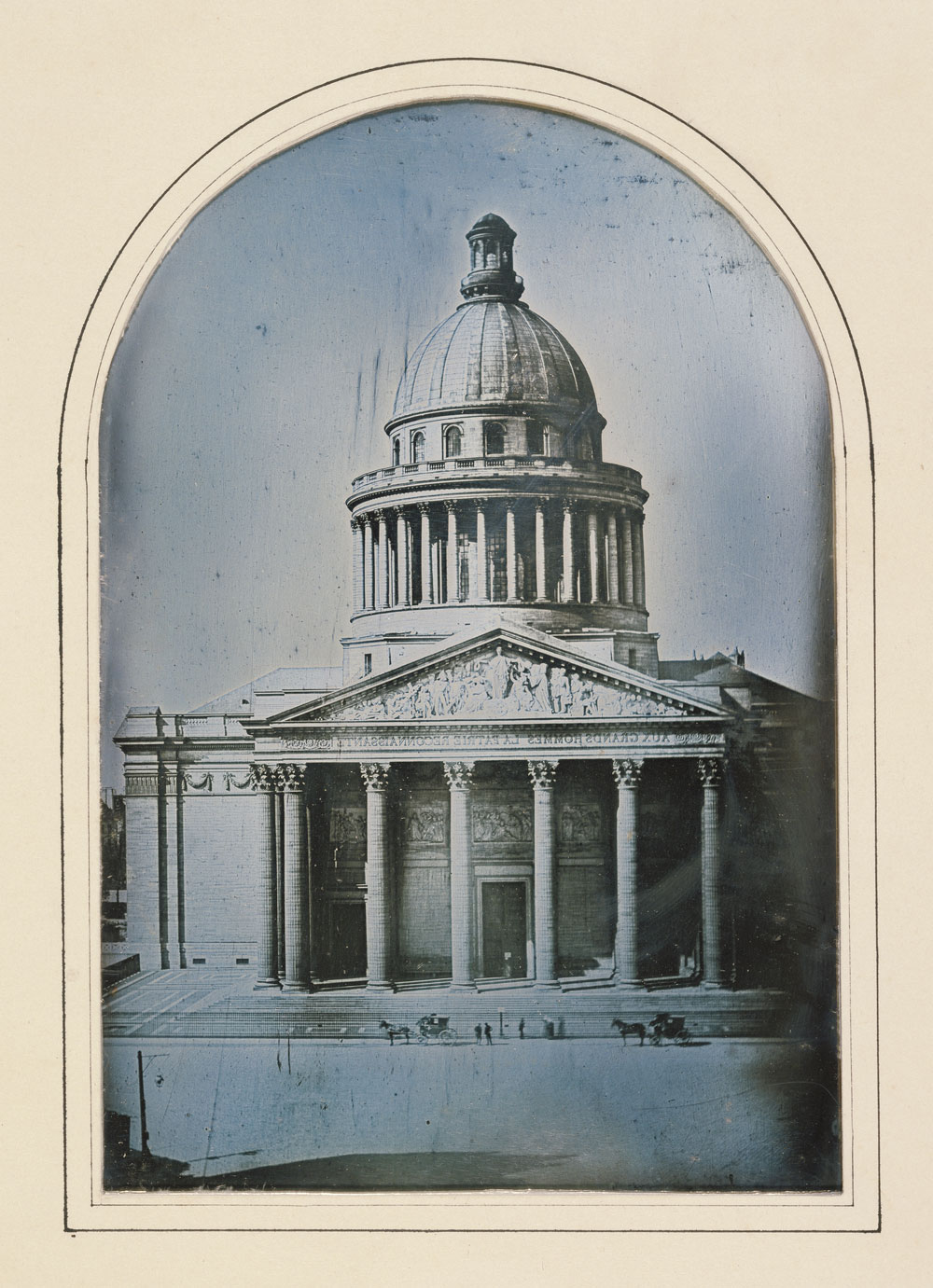
Some of the first subjects for the daguerreotype process were ancient monuments and far-off cityscapes that were previously accessible only to a small, educated elite. Some photographers traveled long distances to capture these remote locales; the exhibition includes images of the Parthenon in Athens, the Pantheon in Rome, and the Temple of Seti I in Egypt. Others trained their lenses closer to home, focusing on vernacular architecture or such structures of national significance as John Plumbe Jr.’s (American, born Wales, 1809-1857) 1846 image of the United States Capitol.

Despite its inability to capture fleeting moments, the daguerreotype nevertheless was used to document historical events. The exhibition includes images of parades and military festivals as well as pivotal historical moments, such as Ezra Greenleaf Weld’s (American, 1801-1874) image of the 1850 Fugitive Slave Law Convention in Cazenovia, New York.

Because it was perceived as a faithful record, it was difficult to elevate the daguerreotype to the status of an art form. Nevertheless some photographers attempted to expand their studio practice to create more artistic scenes, such as The Sands of Time (1850-52), a still-life by Thomas Richard Williams (English, 1825-1871) that features books, glasses, an hourglass, and a human skull. Daguerreotypes were sometimes used for scientific experimentation, as is the case with Antoine Claudet, who used the medium as an instrument to measure focal distance.

The exhibition also features a selection of distinctive daguerreotype cases – wrapped in leather or decorated with oil painting, shell inlay, and gold foil. These elaborate cases emphasise the care that families took in protecting these treasured images, and the value they held from generation to generation.

In Focus: Daguerreotypes is on view November 3, 2015-March 20, 2016 at the J. Paul Getty Museum, Getty Center. The exhibition is curated by Karen Hellman, assistant curator of photographs in the Getty Museum’s Department of Photographs.

Press release from the J. Paul Getty Museum


William Langenheim (American, born Germany, 1807-1874) 'Portrait of Frederick Langenheim' c. 1848


William Langenheim (American, born Germany, 1807-1874)
Portrait of Frederick Langenheim
c. 1848
Daguerreotype
1/4 plate
Image: 8.9 x 7cm (3 1/2 x 2 3/4 in.)
Mat: 10.6 x 8.3cm (4 3/16 x 3 1/4 in.)
The J. Paul Getty Museum, Los Angeles


As a young man, William Langenheim emigrated to the United States from Germany. He settled in Texas, where he served in the Mexican-American War under General Samuel Houston and helped to recapture the Alamo in 1836. In 1840 William moved to Philadelphia with his brother Frederick. They opened a daguerreian gallery in Philadelphia’s Mercantile Exchange, displaying samples of their work to build their clientele. Their daguerreotype business flourished, placing the brothers among the first successful commercial photographers in America. 

Upon learning of William Henry Fox Talbot’s calotype process, William Langenheim acquired the patent rights for the United States, but that investment proved to be a failure. Although the calotype was never commercially successful for them, the Langenheims used the process and exhibited a calotype panorama at the Crystal Palace Exposition in London in 1851. They were later pioneers in the use of the stereograph and the lantern slide. After William’s death, Frederick sold the photographic business.

Text from The J. Paul Getty Museum website


In 1841-1842, William and Frederick Langenheim opened a daguerreotype studio in Philadelphia. Known for their technical innovations the former journalists were not the city’s first but were certainly its most celebrated photographers. The brothers pioneered a technique of hand-coloring daguerreotypes (1846), purchased Henry Talbot’s United States patent for paper photography (1849), invented a system of making negatives and positives on glass (1848-1850), and introduced stereoscopic photography to the American public (1850).

Text from The Metropolitan Museum of Art website


Carl Durheim (Swiss, 1810-1890) 'Postmortem of a Child' c. 1852


Carl Durheim (Swiss, 1810-1890)
Postmortem of a Child
c. 1852
Daguerreotype, hand-coloured
1/4 plate
Image: 6.8 x 9.4cm (2 11/16 x 3 11/16 in.)
Object (whole): 12.7 x 15.1cm (5 x 5 15/16 in.)
The J. Paul Getty Museum, Los Angeles


Carl or Charles Durheim was a lithographer and photographer with a studio in Bern, Switzerland. According to a label affixed on the back of one of his daguerreotypes, his studio specialized in lithography, pen and crayon drawings, cartes-de-visite, and daguerreotype portraits. The studio also featured a glass pavilion, a sure selling point in the early years when photographs were made using sunlight.


Unknown maker (American) 'Portrait of a Family' c. 1850


Unknown maker (American)
Portrait of a Family
c. 1850
Framed: 35.6 x 40.6cm (14 x 16 in.)
Graham Nash Collection


Unknown maker (American) 'Portrait of a Family' c. 1850 (detail)


Unknown maker (American)
Portrait of a Family (detail)
c. 1850
Framed: 35.6 x 40.6cm (14 x 16 in.)
Graham Nash Collection


Théodore Maurisset (French, active 1834-1859) 'La Daguerreotypomanie (Daguerreotypomania)' December 1839


Théodore Maurisset (French, active 1834-1859)
La Daguerreotypomanie (Daguerreotypomania)
December 1839
Lithograph
Image: 26 x 35.7cm (10 1/4 x 14 1/16 in.)
The J. Paul Getty Museum, Los Angeles, Gift of Samuel J. Wagstaff, Jr.


Very little is known about Theodore Maurisset. He was a painter, lithographer, engraver, and caricaturist in Paris who is best remembered for his caricature of daguerreotypy published in 1839.


Louis-Jacques-Mandé Daguerre began investigating the possibilities of copying an image from nature using sunlight and chemicals in the early 1820s and entered into a partnership in 1829 with Nicéphore Niépce, who was also experimenting with similar concepts. Daguerre made the first successful daguerreotype in 1837, four years after Niépce’s death. In the summer of 1839 the French government agreed to pay Daguerre along with Niépce’s son a pension for their lifetimes in exchange for patent rights to the daguerreotype process and then immediately transferred the rights into the public domain. Once the secret procedures and chemical formulas were made known, the need for users to pay royalties or license fees to Daguerre was eliminated, causing a great rush by opportunity seekers. The situation was very different across the Channel, where licensing fees still had to be paid to William Henry Fox Talbot for the right to use his processes. Similarly, in order to use Daguerre’s process in England, a licensing fee had to be paid to entrepreneur Richard Beard, who had the sole patent rights for daguerreotypes in England, Wales, and the British colonies.

Théodore Maurisset’s lithograph playfully presents a time when vast crowds would line up to have their likenesses made. It chronicles the many ways entrepreneurs hoped to cash in on the craze, from selling supplies and equipment to giving lessons on how to make a daguerreotype. 

Maurisset imagines a world dominated by photography and where even time, in the form of a camera-like clock, is measured by it. Notice the engravers to the right of center who are committing suicide because their jobs have been taken away by the advent of the camera. In a comically exaggerated way, Maurisset was expressing the fears of artists about a discovery many believed posed a threat to their profession.

Adapted from Weston Naef, The J. Paul Getty Museum Handbook of the Photographs Collection (Los Angeles: J. Paul Getty Museum, 1995), 32. © 1995 The J. Paul Getty Museum on The J. Paul Getty Museum website [Online] Cited 23/12/2025


Horatio B. King (American, 1820-1889) 'Seth Eastman at Dighton Rock, July 7, 1853' 1853


Horatio B. King (American, 1820-1889)
Seth Eastman at Dighton Rock, July 7, 1853
1853


Dighton Rock

The Dighton Rock is a 40-ton boulder, originally located in the riverbed of the Taunton River at Berkley, Massachusetts (formerly part of the town of Dighton). The rock is noted for its petroglyphs (“primarily lines, geometric shapes, and schematic drawings of people, along with writing, both verified and not.”), carved designs of ancient and uncertain origin, and the controversy about their creators. In 1963, during construction of a coffer dam, state officials removed the rock from the river for preservation. It was installed in a museum in a nearby park, Dighton Rock State Park. In 1980 it was listed on the National Register of Historic Places (NRHP).

Seth Eastman (American, 1808-1875)

Seth Eastman (1808-1875) and his second wife Mary Henderson Eastman (1818 – 24 February 1887) were instrumental in recording Native American life. Eastman was an artist and West Point graduate who served in the US Army, first as a mapmaker and illustrator. He had two tours at Fort Snelling, Minnesota Territory; during the second, extended tour he was commanding officer of the fort. During these years, he painted many studies of Native American life. He was notable for the quality of his hundreds of illustrations for Henry Rowe Schoolcraft’s six-volume study on Indian Tribes of the United States (1851-1857), commissioned by the US Congress. From their time at Fort Snelling, Mary Henderson Eastman wrote a book about Dakota Sioux life and culture, which Seth Eastman illustrated. In 1838, he was elected into the National Academy of Design as an Honorary Academician…

Having retired as a Union brigadier general for disability during the American Civil War, Seth Eastman was reactivated when commissioned by Congress to make several paintings for the US Capitol. Between 1867 and 1869, he painted a series of nine scenes of American Indian life for the House Committee on Indian Affairs. In 1870 Congress commissioned Eastman to create a series of 17 paintings of important U.S. forts, to be hung in the meeting rooms of the House Committee on Military Affairs. He completed the paintings in 1875.

Text from the Wikipedia website


In 1849 Horatio B. King operated a daguerreotypy studio in Boston at 121 Washington Street. In 1850 he moved to Taunton, Massachusetts, where he maintained various studios and residences until 1876. On at least one occasion, he collaborated with draftsman and painter Seth Eastman near Taunton. Little else is known about his life or career.

Text from The J. Paul Getty Museum website


Thomas Richard Williams (English, 1825-1871) 'The Sands of Time' 1850-1852


Thomas Richard Williams (English, 1825-1871)
The Sands of Time
1850-1852
Stereo-daguerreotype
Two 1/6 plates
Image (each): 7 x 5.9cm (2 3/4 x 2 5/16 in.)
Object (whole): 8.3 x 17.1cm (3 1/4 x 6 3/4 in.)
The J. Paul Getty Museum, Los Angeles


Thomas Richard Williams (English, 1825-1871) 'The Sands of Time' 1850-1852 (detail)


Thomas Richard Williams (English, 1825-1871)
The Sands of Time (detail)
1850-1852
Stereo-daguerreotype
Two 1/6 plates
Image (each): 7 x 5.9cm (2 3/4 x 2 5/16 in.)
Object (whole): 8.3 x 17.1cm (3 1/4 x 6 3/4 in.)
The J. Paul Getty Museum, Los Angeles


Thomas Richard Williams (British, 1824-1871)

Thomas Richard Williams (5 May 1824 – 5 April 1871) was a British professional photographer and one of the pioneers of stereoscopy.

Williams’s first business was in London around 1850. He is known for his celebrated stereographic daguerreotypes of the Crystal Palace. He also did portrait photography, now in the Getty Museum’s archives, which he regarded as his greatest success…

Williams’ first studio in Lambeth served both as business and home. Here, “Williams rapidly acquired a fine reputation as portraitist. One source describes how the vicinity of the studio was often ‘blocked with a dozen carriages awaiting the visitors at Mr. Williams’ studio.’ His portraits were exquisitely crafted, and displayed a restrained elegance which became his hallmark.”

Soon his success allowed him to open a studio separate from his home, in Regent Street in 1854. With over twenty photography studios nearby competition was keen – and included his former mentor and teacher, Claudet. “Williams, with his characteristic discretion and low-key approach, did not advertise his business or put up large signs to attract clientele. It seems, though, that the gentry beat a path to his door, and his stereoscopic portraits became highly popular.”

While the mainstay of his business was his stereoscopic (3-D) portraits, he was coming into his own with an artistic vision of what photography could and would become. He became one of the first photographers on record to shoot still life and other artistic compositions. These images became popular to the point that they became “part of the birth of a new genre that was to become the stereoscopic boom of the 1850s.” The Victorians loved them; sales boomed.

In the mid-1850s, Williams contracted with the London Stereoscopic Company to publish his images. The LSC published the work of many eminent stereo photographers, including William England, and was able to mass-produce his works, which helped meet growing demand for his prints.

The LSC published three stereoscopic series by Williams.

His “First Series” was made up of portraits, artistic compositions and still life, many taken in his studio. Dr. Brian May and Elena Vidal write: “The still life studies, with their fine detail and careful composition, showed a clear influence from the 17th century Dutch painting tradition, and a profound knowledge of the iconography surrounding this genre. Photographs such as ‘The Old Larder,’ ‘Mortality’ and ‘Hawk and Duckling’ are superb examples of the unique power of stereography, with their superb three-dimensional compositions, and wealth of detail, which, combined with an outstanding artistic sensibility, resulted in images of astonishing finesse. Another remarkable group of images in this series, entitled “The Launching of the Marlborough”, taken on 31 July 1855, was highly praised in the Victorian press, since they embodied the achievement of ‘instantaneous’ photography, executed as they were from a moving boat, and managing to ‘freeze’ the waves on the surface of the sea.”

The second series was “The Crystal Palace,” this time at Sydenham, as the original Palace in Hyde Park had been dismantled. “The quality of Williams’ original daguerreotypes from this event are such that, though they contain images of hundreds of people, individual facial features of Queen Victoria and her party are clearly discernible.” …

May and Vidal write, “Through his work, Williams is now widely recognised as pivotal in the history of stereoscopic photography, since his stereo cards were the first examples of photographic art for its own sake ever to achieve wide commercial success.”

Text from the Wikipedia website


Joseph-Philibert Girault de Prangey (French, 1804-1892) 'Facade and North Colonnade of the Parthenon on the Acropolis, Athens' 1842


Joseph-Philibert Girault de Prangey (French, 1804-1892)
Facade and North Colonnade of the Parthenon on the Acropolis, Athens
1842
Daguerreotype
Whole plate
Image: 18.8 x 24cm (7 3/8 x 9 7/16 in.)
Object (whole): 18.8 x 24cm (7 3/8 x 9 7/16 in.)
The J. Paul Getty Museum, Los Angeles


Joseph-Philibert Girault de Prangey (French, 1804-1892)

Until recently, pioneering daguerreotypist Joseph-Philibert Girault de Prangey was unknown in the world of fine-art photography. His extraordinary images were discovered in a storeroom of his estate in the 1920s and only made known some eighty years later. 

Girault de Prangey studied painting at the École des Beaux-Arts in Paris and learned daguerreotypy in 1841, the same year inventor Louis-Jacques-Mandé Daguerre publicly demonstrated the process. Girault de Prangey may have learned photography from Daguerre himself, or from Hippolyte Bayard, with whom he shared a mutual artist friend. 

Aside from his creative interests, Girault de Prangey was an avid student of Ancient Near East architecture and in 1842 embarked on a three-year tour of Italy, Greece, Egypt, Turkey, Syria, and Palestine. He carried hundreds of pounds of photography equipment and made more than 800 daguerreotypes. His pictures of the Acropolis are the earliest surviving photographs of the famous site. 

After returning to his home in Langres, France, Girault de Prangey made watercolor and pen-and-ink studies after his photographs and created a small-edition publication of lithographs from them. He also made stereographs of his estate and the exotic plants he collected. Girault de Prangey was apparently quite proud of his Near East photographs but did not exhibit or otherwise make them known before his death in 1892.

Text from The J. Paul Getty Museum website


Alphonse-Louis Poitevin (French, 1819-1882) 'The Pantheon, Paris' 1842


Alphonse-Louis Poitevin (French, 1819-1882)
The Pantheon, Paris
1842
Daguerreotype
1/2 plate
Image: 15.1 x 10.2cm (5 15/16 x 4 in.)
Mat: 21.5 x 15.6cm (8 7/16 x 6 1/8 in.)
Object (whole): 27.9 x 21.9cm (11 x 8 5/8 in.)
The J. Paul Getty Museum, Los Angeles


Alphonse-Louis Poitevin, a chemical engineer, photographed landscapes near his family home, as well as his coworkers at the saltworks factory at Montmorot, France. He was known for his use of carbon printing and photolithography, both photomechanical processes. By the mid-1850s he was printing work by other photographers, including Nadar.


Unknown maker (American) 'Portrait of a Young Man in a Top Hat' c. 1850s


Unknown maker (American)
Portrait of a Young Man in a Top Hat
c. 1850s
Daguerreotype
1/9 plate
Open: 7.3 x 12.4cm (2 7/8 x 4 7/8 in.)
Graham Nash Collection


Attributed to Dr. Hugo Stangenwald (Austrian born Germany, 1829-1899) 'Portrait of Queen Kalama of Hawaii' c. 1853-1854


Attributed to Dr. Hugo Stangenwald (Austrian born Germany, 1829-1899)
Portrait of Queen Kalama of Hawaii
c. 1853-1854
Daguerreotype, hand-coloured
1/16 plate
Image: 3 x 2.5cm (1 3/16 x 1 in.)
Mat: 4.1 x 3.5cm (1 5/8 x 1 3/8 in.)
Open: 5.1 x 8.9cm (2 x 3 1/2 in.)
The J. Paul Getty Museum, Los Angeles


Kalama Hakaleleponi Kapakuhaili (1817 – September 20, 1870) was a Queen consort of the Kingdom of Hawai’i alongside her husband, Kauikeaouli, who reigned as King Kamehameha III. Her second name is Hazelelponi in Hawaiian.

Dr Hugo Stangenwald was an Austrian physician and pioneer photographer who arrived in Honolulu in 1853.

“In January 1853m Stangenwald landed at Hilo, on the island of Hawaii, aboard a British brig. He was bound for Sydney, Australia, with his partner, Stephen Goodfellow, recently a resident of San Franciso. Together, as Stangenwald and Goodfellow, they found a profitable field of enterprise taking portraits of American missionaries and views of Hawaiian scenery during what was to have been a temporary stay. Missionary titus Coan called Stangenwald “the chief artist” and “a physician (so reported),” and summed him up as “a pleasant and pious young man.” On February 10, Coan wrote that Stangenwald and Goodfellow “are now using up all the faces in Hilo, and they soon with be through.” Can added that their prices were comparatively moderate; they charged “3$ for the smallest plates in a neat case, and a frame in proportion to the size, the amount of gold in ornamentation.” This helpful missionary went so far as to enlist the help of his colleagues in Honolulu to assist Stangenwald and Goodfellow in establishing themselves in that town.

By March 26, Stangenwald and Goodfellow were advertising the imminent opening of the daguerreian rooms next to the shoe store of J. H. Woods in Honolulu. After a week engaged in setting up their equipment and adjusting there work to the light, they were prepared to take portraits and “correct views of gentlemen’ residences, vessels, machinery and parts of the city … without reversing.” When a devastating outbreak of smallpox hit Honolulu in May, Goodfellow elected to dissolve his partnership with Stangenwald and resume his voyage to Australia. Stangenwald decided to remain in Hawaii.”

Peter E. Palmquist and Thomas R. Kailbourn. Pioneer Photographers of the Far West: A Biographical Dictionary 1840-1865. Stanford: Stanford University Press, 2000, p. 515.


Unknown maker (American) '[Portrait of an Unidentified Daguerreotypist Displaying a Selection of Daguerreotypes] / Daguerreotypist (?) Displaying Thirteen Daguerreotypes' 1845


Unknown maker (American)
[Portrait of an Unidentified Daguerreotypist Displaying a Selection of Daguerreotypes] / Daguerreotypist (?) Displaying Thirteen Daguerreotypes
1845
Daguerreotype, hand-coloured
1/6 plate
Image: 6.7 x 5.2cm (2 5/8 x 2 1/16 in.)
Mat: 8.3 x 7cm (3 1/4 x 2 3/4 in.)
Open: 8.9 x 15.2cm (3 1/2 x 6 in.)
The J. Paul Getty Museum, Los Angeles


Unknown maker (American) '[Chinese Woman with a Mandolin]' 1860


Unknown maker (American)
[Chinese Woman with a Mandolin]
1860
Daguerreotype, hand-coloured
1/4 plate
Image: 9 x 6.5cm (3 9/16 x 2 9/16 in.)
Mat: 10.8 x 8.3cm (4 1/4 x 3 1/4 in.)
Open: 12.7 x 20.6cm (5 x 8 1/8 in.)
The J. Paul Getty Museum, Los Angeles


Unknown maker (American) '[Chinese Woman with a Mandolin]' 1860 (detail)


Unknown maker (American)
[Chinese Woman with a Mandolin] (detail)
1860
Daguerreotype, hand-coloured
1/4 plate
Image: 9 x 6.5cm (3 9/16 x 2 9/16 in.)
Mat: 10.8 x 8.3cm (4 1/4 x 3 1/4 in.)
Open: 12.7 x 20.6cm (5 x 8 1/8 in.)
The J. Paul Getty Museum, Los Angeles


Unknown maker (American) 'Portrait of a Girl Holding a Doll' c. 1845


Unknown maker (American)
Portrait of a Girl Holding a Doll
c. 1845
Daguerreotype
Framed: 24.1 x 19.1cm (9 1/2 x 7 1/2 in.)
Graham Nash Collection


Auguste Belloc (French, 1800-1867) 'Portrait of a Woman' May 1844


Auguste Belloc (French, 1800-1867)
Portrait of a Woman
May 1844
Daguerreotype
Image: 10.2 x 7.6cm (4 x 3 in.)
Framed: 24.8 x 22.9cm (9 3/4 x 9 in.)
Graham Nash Collection


Auguste Belloc (French, 1800-1867) 'Portrait of a Woman' May 1844 (detail)


Auguste Belloc (French, 1800-1867)
Portrait of a Woman (detail)
May 1844
Daguerreotype
Image: 10.2 x 7.6cm (4 x 3 in.)
Framed: 24.8 x 22.9cm (9 3/4 x 9 in.)
Graham Nash Collection


Auguste Belloc (French, 1800-1867)

Auguste Belloc (French, 1800-1867) was born in the beginning of the 19th century, in Montrabe, located in the Southwest of France (Haute-Garonne).

He began his career as a painter of miniatures and watercolours. Belloc’s first photographic studio was mentioned in 1851. Practicing daguerreotype, he became involved in wet collodion development and improved the wax coating process, helping the pictures to keep their wet-like luster.

But the most important research he led was about color stereoscopy (3 dimensional photography). Known for his nudes and portraits, he looked for the best way to express the reality and found a new method. This practice considered erotic photography and was declared illegal by the police in 1856 and 1860.

Marion Perceval. “Auguste Belloc,” in John Hannavy (ed.,). Encyclopedia of Nineteenth-Century Photography. Routledge, 2008, p. 146.


The J. Paul Getty Museum
1200 Getty Center Drive
Los Angeles, California 90049

Opening hours:
Daily 10am – 5pm

The J. Paul Getty Museum website

LIKE ART BLART ON FACEBOOK

Back to top

Review: ‘On the beach’ at the Mornington Peninsula Regional Art Gallery, Mornington

Exhibition dates: 11th December, 2015 – 28th February, 2016

Curator: Wendy Garden


Installation view of the exhibition 'On the beach' at the Mornington Peninsula Regional Art Gallery


Installation view of the exhibition On the beach at the Mornington Peninsula Regional Art Gallery
Photo: © Marcus Bunyan and the Mornington Peninsula Regional Art Gallery


This is another solid thematic group exhibition at the Mornington Peninsula Regional Art Gallery (curator Wendy Garden), following on from their recent success, Storm in a teacup.

The exhibition is not as successful as Storm in a teacup, mainly because most of the works are based on the monolithic, monosyllabic representation of beach culture, and its figuration, during the early decades of the twentieth century (White Australia policy, Australian stereotypes of the interwar period) and the re-staging of these ideas in the contemporary art presented through a diachronic (through/time), performative discourse.

There is so much re-staging in this exhibition I was left to wonder whether there was any original art work being produced that does not quote sources of history, memory, identity, representation and art from past generations. Daniel Boyd re-stages Captain Cook’s landing at Botany Bay with said hero as a pirate. Stephen Bowers replicates the Minton willow pattern motif and early paintings of kangaroos. Leanne Tobin re-stages Bungaree’s disrobing on the beach during his journey with Matthew Flinders. Diane Jones re-stages Max Dupain’s Sunbaker replacing the anonymous prostrate man with her head looking into the camera, or Dupain’s Form at Bondi with her head turned towards the camera. Worst offender is Anne Zahalka who re-states Dupain’s Sunbaker (again!) as a red-headed white women on the beach; or re-presents Charles Meere’s Australian beach pattern (1940, below) not once but twice – the first time in The bathers (1989) broadening the racial background of people to depict multicultural Australia in the 1980s, the second time in The new bathers (2013) broadening the mix even further. Most successful of these re-stagings is Michael Cook’s series of photographs Undiscovered in which the artist subverts deeply ingrained understandings of settlement, that of terra nullius, by depicting Captain Cook as black and positioning him in high-key, grey photographs of impressive beauty and power, surveying the land he has ‘discovered’ while perched upon an invisibly balanced ladder.

But with all of the works that quote from the past there is a sense that, even as the artists are critiquing the culture, they are also buying into the system of patriarchy, racism and control that they seek to comment on. They do not subvert the situation, merely (and locally) extrapolate from it. The idealised, iconic representation of early 20th century Australia culture in the paintings from the 1920-30s and the photographs from the 1940s-70s – specimens of perfect physical beauty – are simply shifted to a new demographic – that of iconic, individual figures in the same poses as the 1940s but of a different ethnicity. The colour of the figure and the clothing might have changed, but the underlying structure remains the same. And if you disturb one of the foundation elements, such as the base figure in one of George Caddy’s balancing beachobatics photographs, the whole rotten edifice of a racism free, multicultural Australia will come tumbling down, just as it did during the Cronulla Riot.

What I would have liked to have seen in this exhibition was a greater breadth of subject matter. Where are the homeless people living near the beach, the sex (for example, as portrayed in Tracey Moffat’s voyeuristic home video Heaven which shows footage of male surfers changing out of their wetsuits in car parks – “shot by Moffatt and a number of other women as if they were making a birdwatching documentary” – which challenges the masculinity of Australian surf culture and the ability of women to stare at men, instead of the other way around), death (drownings on beaches, the heartbreak of loss), and debauchery (the fluxus of Schoolies, that Neo-Dada performance of noise and movement), the abstract nature of Pictorialist photographs of the beach, not to mention erosion and environmental loss due to global warming. The works presented seem to have a too narrowly defined conceptual base, and a present narrative constructed on a coterie of earlier works representing what it is to be Australian at the beach. The contemporary narrative does not address the fluidity of the landscape in present time (in works such as Narelle Autio’s series Watercolours or The place in between).

The dark underside of the beach, its abstract fluidity, its constant movement is least well represented in this exhibition. Although I felt engaged as a viewer the constant re-quoting and rehashing of familiar forms left me a little bored. I wanted more inventiveness, more insight into the conditions and phenomena of beach culture in contemporary Australia. An interesting exhibition but an opportunity missed.

Dr Marcus Bunyan


Many thankx to the Mornington Peninsula Regional Art Gallery for allowing me to publish most of the photographs in the posting. Other photographs come from Art Blart’s archive and those freely available online. Thankx also go to Manuela Furci, Director of the Rennie Ellis Photographic Archive for allowing me to publish his photographs in the posting. Please click on the photographs for a larger version of the image. All text comes from the wall labels to the exhibition. Images noted © Marcus Bunyan and the Mornington Peninsula Regional Art Gallery.


Installation view of the exhibition 'On the beach' at the Mornington Peninsula Regional Art Gallery with Daniel Boyd's 'We call them pirates out here' (2006)


Installation view of the exhibition On the beach at the Mornington Peninsula Regional Art Gallery with Daniel Boyd’s We call them pirates out here (2006, below)
Photo: © Marcus Bunyan and the Mornington Peninsula Regional Art Gallery


Daniel Boyd (Australian, b. 1982) 'We call them pirates out here' 2006 (installation view)


Daniel Boyd (Australian, b. 1982)
We call them pirates out here (installation view)
2006
Museum of Contemporary Art
Purchased with funds provided by the Coe and Mordant families, 2006
Photo: © Marcus Bunyan and the Mornington Peninsula Regional Art Gallery


“The landing of Captain Cook in Botany Bay, 1770 by E. Phillips Fox is such an iconic and important image relating to the birth of Australia. Shifting the proposed view of Fox’s painting to something that was an indigenous person’s perspective allowed for me to challenge the subjective history that has been created.”

Daniel Boyd, 2008


In this painting Daniel Boyd parodies E. Phillips Fox’s celebrated painting which was commissioned in 1902 by the Trustees of the National Gallery of Victoria to commemorate federation. No longer an image valorising colonial achievement, Boyd recasts the scene as one of theft and invasion. Captain Cook is depicted as a pirate to contest his heroic status in Australia’s foundation narratives. Smoke in the distance is evidence of human occupation and is a direct retort to the declaration that Australia was ‘terra nullius’ – land belonging to no-one, which was used to justify British possession.


Stephen Bowers (Australian, b. 1952) Peter Walker (board maker) (Australian, b. 1961) 'Antipodean willow surfboard' 2012 'Antipodean willow surfboard (Mini Simmons)' 2012 (installation view)


Stephen Bowers (Australian, b. 1952)
Peter Walker (board maker) (Australian, b. 1961)
Antipodean willow surfboard (installation view)
2012
Antipodean willow surfboard (Mini Simmons) (installation view)
2012
Hollow core surfboard, Paulownia wood, fibreglass, synthetic polymer paint
Courtesy of the artist and Lauraine Diggins Fine Art, Caulfield
Photo: © Marcus Bunyan and the Mornington Peninsula Regional Art Gallery


Stephen Bowers (Australian, b. 1952) Peter Walker (board maker) (Australian, b. 1961) 'Antipodean willow surfboard (Mini Simmons)' 2012 (installation view detail)


Stephen Bowers (Australian, b. 1952)
Peter Walker (board maker) (Australian, b. 1961)
Antipodean willow surfboard (Mini Simmons) (installation detail)
2012
Hollow core surfboard, Paulownia wood, fibreglass, synthetic polymer paint
Courtesy of the artist and Lauraine Diggins Fine Art, Caulfield
Photo: © Marcus Bunyan and the Mornington Peninsula Regional Art Gallery


In these works Bowers combines the willow pattern motif, a ready-made metaphor of hybridity, with an image of a kangaroo as envisioned by George Stubbs in 1772. The willow pattern as an English invention, created by Thomas Minton in 1790. It is an imaginative geography and, like the first known European painting of a kangaroo, considers other lands as strange, exotic places. In this work the imagery of colonial occupation is visualised as a fusion of cultures underpinned by half-truths, fantasy and desire.


Leanne Tobin (Australian, b. 1961) 'Clothes don't always maketh the man' 2012 (installation view)

Leanne Tobin (Australian, b. 1961) 'Clothes don't always maketh the man' 2012 (installation view detail)


Installation views of Leanne Tobin’s Clothes don’t always maketh the man (2012)


Leanne Tobin (Australian, b. 1961)
Clothes don’t always maketh the man (installation details)
2012
Sand, textile, wood
Collection of the artist
Photos: © Marcus Bunyan and the Mornington Peninsula Regional Art Gallery


Bungaree (c. 1755-1830) was a Garigal man who circumnavigated the continent of Australia with Matthew Flinders on the H.M.S. Investigator between 1802-1803. Unlike Bennelong, who attempted to assimilate with British ways and Pemulwuy, who resisted, Bungaree made the decision to navigate a relationship with the British while still maintaining his cultural traditions. He played an important role as an envoy on Flinder’s voyages, negotiating with the different Aboriginal groups they encountered. A skilled mediator, Bungaree was adept at living between both worlds. When coming ashore he would shed his white man’s clothes so that he could conduct protocol relevant to the local elders. In this respect the beach became a zone of transformation and exchange.


Installation view of the exhibition 'On the beach' at the Mornington Peninsula Regional Art Gallery with in the foreground, Leanne Tobin's 'Clothes don't always maketh the man' (2012), and in the background left, photographs from Michael Cook's 'Undiscovered' series (2010)

Installation view of the exhibition 'On the beach' at the Mornington Peninsula Regional Art Gallery with in the foreground, Leanne Tobin's 'Clothes don't always maketh the man' (2012), and in the background right, photographs from Michael Cook's 'Undiscovered' series (2010)


Installation views of the exhibition On the beach at the Mornington Peninsula Regional Art Gallery with in the foreground, Leanne Tobin’s Clothes don’t always maketh the man (2012), and in the background photographs from Michael Cook’s Undiscovered series (2010, below)
Photos: © Marcus Bunyan and the Mornington Peninsula Regional Art Gallery


Michael Cook (Australian, b. 1968) 'Undiscovered 4' 2010 from the exhibition 'On the beach' at the Mornington Peninsula Regional Art Gallery, Mornington, Dec 2015 - Feb 2016


Michael Cook (Australian, b. 1968)
Undiscovered 4
2010
inkjet print on Hahnemuhle paper
124.0 x 100.0cm
Australian National Maritime Museum


A selection of works from a series of ten photographs in which Michael Cook contests the idea of ‘discovery’ that underpins narratives of the British settlement of Australia… Cook depicts the historic Cook as an Aboriginal man replete in his British naval officers attire. His ship, the famed Endeavour, is anchored in the sea behind him. By mimicking the moment of first discovery Cook subverts deeply ingrained understandings of settlement and asks us to consider what type of national Australia would be if the British had acknowledged Aboriginal people’s prior ownership.


Installation view of the exhibition 'On the beach' at the Mornington Peninsula Regional Art Gallery showing, at top left, Max Dupain's 'Form at Bondi' (1939); to the right of that Dupain's 'At Newport' (1952); to the right upper is George Caddy's 'Chest strength and breathing exercise, 20 February 1937'; followed at far right by Rennie Ellis' 'St Kilda Lifesavers' (1968, top) and David Moore's 'Lifesavers at Manly' (1959, bottom)


Installation view of the exhibition On the beach at the Mornington Peninsula Regional Art Gallery showing, at top left, Max Dupain’s Form at Bondi (1939); to the right of that Dupain’s At Newport (1952, below); to the right upper is George Caddy’s Chest strength and breathing exercise, 20 February 1937 (below); followed at far right by Rennie Ellis’ St Kilda Lifesavers (1968, top) and David Moore’s Lifesavers at Manly (1959, bottom)
Photo: © Marcus Bunyan and the Mornington Peninsula Regional Art Gallery


Max Dupain (Australian, 1911-1992) 'At Newport' 1952, Sydney from the exhibition 'On the beach' at the Mornington Peninsula Regional Art Gallery, Mornington, Dec 2015 - Feb 2016


Max Dupain (Australian, 1911-1992)
At Newport
1952, Sydney
Silver gelatin photograph


George Caddy (Australian, 1914-1983) 'Chest strength and breathing exercise, 20 February 1937' 1937


George Caddy (Australian, 1914-1983)
Chest strength and breathing exercise, 20 February 1937
1937
Digital print on paper
Paul Caddy collection
Courtesy of Paul Caddy


Like Max Dupain, who was three years his senior, Caddy was interested in the new modernist approach to photography. During 1936 he read magazines such as Popular Photography from New York and US Camera rather than Australasian Photo-Review which continued to champion soft-focus pictorialism. This photograph was taken the same year as Dupain’s famous Sunbather photograph. The framing and angle is similar reflecting their common interest in sharp focus, unusual vantage points and cold composition.


George Caddy (Australian, 1914-1983) 'Freshwater Surf Life Saving Club reel team march past, 3 April 1938' 1938


George Caddy (Australian, 1914-1983)
Freshwater Surf Life Saving Club reel team march past, 3 April 1938
1938
Digital print
Collection of the Mitchell Library, State Library of New South Wales
Purchased from Paul Caddy, 2008


This photograph was taken only months after an infamous rescue at Bondi. On 6 February 1938 a sand bar collapsed sweeping two hundred people out to sea. 80 lifesavers rescued all but 5 people in a day subsequently described as Black Sunday. By 1938 the Surf Life Saving Association, which incorporated clubs from around Australia, had rescued 39,149 lives in its 30 year history. In 1938 alone there were 3,442 rescues. Up until the events of Black Sunday no one had drowned while lifesavers were on duty at Australian beaches. In comparison 2,000 people drowned in England each year.1

1/ Alan Davies, Bondi Jitterbug: George Caddy and his amera, Sydney: State Library of New South Wales, p. 13.


Installation view of the exhibition 'On the beach' at the Mornington Peninsula Regional Art Gallery showing at far left, Anne Zahalka's 'The sunbather #2' (1989) and, at right, a selection of George Caddy's beachobatics photographs


Installation view of the exhibition On the beach at the Mornington Peninsula Regional Art Gallery showing at far left, Anne Zahalka’s The sunbather #2 (1989, below) and, at right, a selection of George Caddy’s beachobatics photographs
Photo: © Marcus Bunyan and the Mornington Peninsula Regional Art Gallery


Installation view of the exhibition 'On the beach' at the Mornington Peninsula Regional Art Gallery showing at far left, Max Dupain's 'Sunbaker' (1937, top) with Diane Jones 'Sunbaker' (2003, below); in the centre Anne Zahalka's 'The sunbather #2' (1989); then Max Dupain's 'Form at Bondi' (1939, top) with Diane Jones 'Bondi' (2003) underneath


Installation view of the exhibition On the beach at the Mornington Peninsula Regional Art Gallery showing at far left, Max Dupain’s Sunbaker (1937, top) with Diane Jones Sunbaker (2003, below); in the centre Anne Zahalka’s The sunbather #2 (1989, below); then Max Dupain’s Form at Bondi (1939, top) with Diane Jones Bondi (2003) underneath
Photo: © Marcus Bunyan and the Mornington Peninsula Regional Art Gallery


Anne Zahalka (Australian, b. 1957) 'The sunbather #2' 1989


Anne Zahalka (Australian, b. 1957)
The sunbather #2
1989
From the series Bondi: playground of the Pacific 1989
Type C photograph


Installation photograph of Charles Meere's painting 'Australian beach pattern' (1940) and Anne Zahalka's photograph 'The bathers' (1989) from the series 'Bondi: playground of the Pacific' 1989


Installation photograph of Charles Meere’s painting Australian beach pattern (1940, below) and Anne Zahalka’s photograph The bathers (1989) from the series Bondi: playground of the Pacific 1989
Photo: © Marcus Bunyan and the Mornington Peninsula Regional Art Gallery


Zahalka restates Charles Meere’s painting in order to subvert the narrow stereotype of the Australian ideal… In this work Zahalka broadens the racial background of people depicted to create a more representative image of multicultural Australia in the 1980s


Charles Meere (Australian born England, 1890-1961) 'Australian beach pattern' 1940 (installation view detail)


Charles Meere (Australian born England, 1890-1961)
Australian beach pattern (installation view detail)
1940
Oil and wax on canvas
Collection of Joy Chambers-Grundy and Reg Grundy AC OBE
Photo: © Marcus Bunyan and the Mornington Peninsula Regional Art Gallery


A now iconic representation of early 20th century Australia culture… The scene is dominated by a mass of suntanned bodies: muscular, square-jawed white Australians – specimens of perfect physical beauty – enjoying the strenuous physical activities of the beach. A glorification of the strong, healthy, racially pure Australian ideal of the 1930s, it is eerily reminiscent of Nazi German Aryan propaganda between the wars.

Notably, the figures themselves all appear anonymous and disconnected, with indistinct facial features that show no acknowledgement of their fellow beach-goers. Their identities are overwhelmed by Meere’s obsession with arrangement. Rather than reflect real life, the figures are placed to create an idealised work of perfect balance. It is fascinating to consider that this iconic representation of Australian beach culture actually came from the imagination of an Englishman, who had only lived in Australia since the mid-1930s and who, according to his apprentice, ‘never went to the beach’ and ‘made up most of the figures’.1

1/ Freda Robertshaw quoted in Linda Slutzkin, Charles Meere 1890-1961. Sydney: S. H. Ervin Gallery, 1987, p. 6.


Installation view of the exhibition 'On the beach' at the Mornington Peninsula Regional Art Gallery showing at far left, George Caddy's beachobatic photographs, and on the far wall Sidney Nolan's 'Bathers' (1943) and Jeffrey Smart's 'Surfers Bondi' (1963)


Installation view of the exhibition On the beach at the Mornington Peninsula Regional Art Gallery showing at far left, George Caddy’s beachobatic photographs, and on the far wall Sidney Nolan’s Bathers (1943, below) and Jeffrey Smart’s Surfers Bondi (1963, below)
Photo: © Marcus Bunyan and the Mornington Peninsula Regional Art Gallery


Sidney Nolan (Australian, 1917-1992) 'Bathers' 1943 (installation view)


Sidney Nolan (Australian, 1917-1992)
Bathers (installation view)
1943
Ripolin enamel on canvas
Headed Museum of Modern Art, Melbourne
Bequest of John and Sunday Reed, 1982
Photo: © Marcus Bunyan and the Mornington Peninsula Regional Art Gallery


Jeffrey Smart (Australian, 1921-2013) 'Surfers Bondi' 1963 (installation view)


Jeffrey Smart (Australian, 1921-2013)
Surfers Bondi
1963
Oil on board
Private collection


When bans on daylight bathing were lifted in 1902, the beach became a prime leisure destination. The beach became not only as a public space of recreation but also as a place where the Australian identity was developing, for many epitomising the liberties of Australia’s society. On the beach brings together 76 outstanding and iconic paintings, photographs and installations to consider the defining relationship we have to the shore.

Works by artists including Vernon Ah Kee, Arthur Boyd, Gordon Bennett, Daniel Boyd, Max Dupain, Charles Meere, Tracey Moffatt, David Moore, Sidney Nolan, Polixeni Papapetrou, John Perceval, Scott Redford, Jeffrey Smart, Albert Tucker, Guan Wei and Anne Zahalka, as well as outstanding recently discovered works by George Caddy (see above). A champion jitterbug dancer, Caddy’s photographs of ‘beachobatics’ were kept undisturbed in a shoebox for 60 years until they were ‘discovered’ by his son after his death. They capture the exuberance and optimism of Australian society between the wars.

The beach first became a prime leisure destination in the early decades of the twentieth century. Up to Federation many artists had looked to the bush to galvanise a fledging nationalism, but during the interwar years this shifted and increasingly the beach became the site of Australian identity. Already by 1908 one Melbourne newspaper commented upon the ‘vast throng of holidaymakers all along the coast.’ In the years following the First World War, against a backdrop of a growing interest in physical fitness, the beach was seen as a place for creating ‘a fine healthy race of men.’ Understandings of the beach as an Australian way of life emerged during this period and increasingly the Australian type was associated with bronzed athletic bodies on the beach.

On the beach looks at artists’ responses to the stereotype of the interwar period and juxtaposes modernist works with contemporary artists’ responses to include a more culturally diverse mix of people. Other artists in the exhibition challenge understandings of the beach as a benign space and consider the history of violence that is latent.

Press release from the Mornington Peninsula Regional Art Gallery


Photographer Joyce Evans looking at two colour photographs by Rennie Ellis in the exhibition 'On the beach' at the Mornington Peninsula Regional Art Gallery


Photographer Joyce Evans looking at two colour photographs by Rennie Ellis in the exhibition
Photo: © Marcus Bunyan and the Mornington Peninsula Regional Art Gallery


Installation view of the exhibition 'On the beach' at the Mornington Peninsula Regional Art Gallery showing on the wall left hand side, photographs by Rennie Ellis


Installation view of the exhibition On the beach at the Mornington Peninsula Regional Art Gallery showing on the wall left hand side, photographs by Rennie Ellis
Photo: © Marcus Bunyan and the Mornington Peninsula Regional Art Gallery


Installation view of the exhibition 'On the beach' at the Mornington Peninsula Regional Art Gallery showing on the wall right hand side, photographs by Rennie Ellis; and at right, Fiona Foley's 'Nulla 4 eva IV' (2009)


Installation view of the exhibition On the beach at the Mornington Peninsula Regional Art Gallery showing on the wall right hand side, photographs by Rennie Ellis; and at right, Fiona Foley’s Nulla 4 eva IV (2009)
Photo: © Marcus Bunyan and the Mornington Peninsula Regional Art Gallery


Rennie Ellis (Australian, 1940-2003) 'Union Jack, Lorne' c. 1968


Rennie Ellis (Australian, 1940-2003)
Union Jack, Lorne
c. 1968
Silver gelatin selenium toned fibre-based print
Rennie Ellis Photographic Archive


Rennie Ellis (Australian, 1940-2003) 'Four Sunbathers, Lorne' c. 1968


Rennie Ellis (Australian, 1940-2003)
Four Sunbathers, Lorne
c. 1968
Type C photograph (ed. AP)
Rennie Ellis Photographic Archive


Rennie Ellis (Australian, 1940-2003) 'Bondi, New South Wales' 1997


Rennie Ellis (Australian, 1940-2003)
Bondi, New South Wales
1997


“On the beach we chuck away our clothes, our status and our inhibitions and engage in rituals of sun worship and baptism. It’s a retreat to our primal needs.”

Rennie Ellis


Vernon Ah Kee (Australian, b. 1967; Kuku Yalandji, Waanji, Yidinji and Gugu Yimithirr) 'cantchant' 2007-2009 (installation view)

Vernon Ah Kee (Australian, b. 1967; Kuku Yalandji, Waanji, Yidinji and Gugu Yimithirr) 'cantchant' 2007-2009 (installation view detail)

Vernon Ah Kee (Australian, b. 1967; Kuku Yalandji, Waanji, Yidinji and Gugu Yimithirr) 'cantchant' 2007-2009 (installation view detail)

Vernon Ah Kee (Australian, b. 1967; Kuku Yalandji, Waanji, Yidinji and Gugu Yimithirr) 'cantchant' 2007-2009 (installation view detail)

Vernon Ah Kee (Australian, b. 1967; Kuku Yalandji, Waanji, Yidinji and Gugu Yimithirr) 'cantchant' 2007-2009 (installation view detail)

Vernon Ah Kee (Australian, b. 1967; Kuku Yalandji, Waanji, Yidinji and Gugu Yimithirr) 'cantchant' 2007-2009 (installation view detail)

Vernon Ah Kee (Australian, b. 1967; Kuku Yalandji, Waanji, Yidinji and Gugu Yimithirr) 'cantchant' 2007-2009 (installation view detail)

Vernon Ah Kee (Australian, b. 1967; Kuku Yalandji, Waanji, Yidinji and Gugu Yimithirr) 'cantchant' 2007-2009 (installation view detail)

Vernon Ah Kee (Australian, b. 1967; Kuku Yalandji, Waanji, Yidinji and Gugu Yimithirr) 'cantchant' 2007-2009 (installation view detail)


Installation views of Vernon Ah Kee’s cantchant 2007-09


Vernon Ah Kee (Australian, b. 1967; Kuku Yalandji, Waanji, Yidinji and Gugu Yimithirr)
cantchant (installation views)
2007-2009
Synthetic polymer paint and resin over digital print on roamer, vinyl
Courtesy of the artist and Milani Gallery, Brisbane
Photos: © Marcus Bunyan and the Mornington Peninsula Regional Art Gallery


Vernon Ah Kee’s response to the events at Cronulla (the Cronulla Riot) us a powerful retort to the racists and their mantra ‘we grew here, you flew here’ chanted on the beach during the riots. Ah Kee takes issue pointing out the hypocrisy in their statement.

“We grew here, you flew here is an insincere statement and they were chanting it over and over again. It’s a way to exercise racism. I’m like ‘WE’ grew here, say what you want, but we’re the fellas that grew here.”

The surfboards are printed with Yidinji shield designs and the portraits are members of the artists family. The work was exhibited in the Australian Pavilion at the 2009 Venice Biennale.


Installation view of the exhibition 'On the beach' at the Mornington Peninsula Regional Art Gallery showing on the far wall, Charles Blackman's 'Sunbather' (c. 1954) and Arthur Boyd's 'Kite flyers (South Melbourne)' (1943)


Installation view of the exhibition On the beach at the Mornington Peninsula Regional Art Gallery showing on the far wall, Charles Blackman’s Sunbather (c. 1954, below) and Arthur Boyd’s Kite flyers (South Melbourne) (1943, below)
Photo: © Marcus Bunyan and the Mornington Peninsula Regional Art Gallery


Charles Blackman (Australian, b. 1928) 'Sunbather' c. 1954 (installation view)


Charles Blackman (Australian, b. 1928)
Sunbather (installation view)
c. 1954
Oil on board
Private collection, Melbourne
Photo: © Marcus Bunyan and the Mornington Peninsula Regional Art Gallery


This is one of a number of paintings and drawings made in response to Blackman’s observations of life on Melbourne’s beaches. Blackman moved from Sydney to Melbourne in 1945 to be part of Melbourne’s burgeoning art scene, making friends with John Perceval, Joy Hester and John and Sunday Reed amongst others.

During this period Blackman regularly took the tram to St Kilda beach to swim and paint. Although he enjoyed spending time on the beach, there is a sinister overtone to this painting of a prostrate figure lying on the sand. A bleak, grey palette articulates the pallid lifeless flesh amplifying a sense of death. The hollow slits that substitute for eyes further accentuate the corpse-like appearance. It is a stark contrast to many paintings of the era that emphasise physical vitality and wellbeing. Rather the sense of isolation and heavy treatment of shadows and water creates a painting that is psychologically disturbing. This painting can be seen as a response to his wife, Barbara’s developing blindness. It has been noted that as the ‘darkness grew in her life, his pictures got darker.’1 Blackman stated many years later ‘I was trying to paint pictures which were unseeable.’2

1/ Barry Humphries quoted in Peter Wilmoth. “An artist in wonderland,” in The Age, 21 May 2006
2/ Charles Blackman interviewed by James Gleeson, 28 April 1979


Arthur Boyd (Australian, 1920-1999) 'Kite flyers (South Melbourne)' 1943 (installation view)


Arthur Boyd (Australian, 1920-1999)
Kite flyers (South Melbourne) (installation view)
1943
Oil on canvas mounted on cardboard
46.3 x 60.9cm
National Gallery of Victoria
The Arthur Boyd Gift, 1975
Photo: © Marcus Bunyan and the Mornington Peninsula Regional Art Gallery


Installation view of the exhibition 'On the beach' at the Mornington Peninsula Regional Art Gallery showing in the centre, Brett Whiteley's 'Balmoral' (1975-1978). To the left of this painting is Nancy Kilgour's 'Figures on Manly Beach' (1930) and to the right Norma Bull's 'Bathing Beach' (c. 1950-1960s) with at bottom, George W. Lambert's 'Anzacs bathing in the sea' (1915)

Installation view of the exhibition 'On the beach' at the Mornington Peninsula Regional Art Gallery showing in the centre, Brett Whiteley's 'Balmoral' (1975-1978). To the left of this painting is Nancy Kilgour's 'Figures on Manly Beach' (1930) and to the right Norma Bull's 'Bathing Beach' (c. 1950-1960s) with at bottom, George W. Lambert's 'Anzacs bathing in the sea' (1915)

Installation view of the exhibition 'On the beach' at the Mornington Peninsula Regional Art Gallery showing in the centre, Brett Whiteley's 'Balmoral' (1975-1978). To the left of this painting is Nancy Kilgour's 'Figures on Manly Beach' (1930) and to the right Norma Bull's 'Bathing Beach' (c. 1950-1960s) with at bottom, George W. Lambert's 'Anzacs bathing in the sea' (1915)


Installation views of the exhibition On the beach at the Mornington Peninsula Regional Art Gallery showing in the centre, Brett Whiteley’s Balmoral (1975-1978, below). To the left of this painting is Nancy Kilgour’s Figures on Manly Beach (1930, below) and to the right Norma Bull’s Bathing Beach (c. 1950-1960s, below) with at bottom, George W. Lambert’s Anzacs bathing in the sea (1915, below)
Photos: © Marcus Bunyan and the Mornington Peninsula Regional Art Gallery


Brett Whiteley (Australian, 1939-1992) 'Balmoral' 1975-1978 (installation view detail)


Brett Whiteley (Australian, 1939-1992)
Balmoral (installation detail)
1975-1978
Oil and collage on canvas
180 x 204cm
Collection of the Hunter-Dyer family
Photo: © Marcus Bunyan and the Mornington Peninsula Regional Art Gallery


Nancy Kilgour (Australian, 1904-1954) 'Figures on Manly Beach' c. 1930


Nancy Kilgour (Australian, 1904-1954)
Figures on Manly Beach
c. 1930
Oil on canvas
76 x 117cm
Manly Art Gallery and Museum, Sydney
Purchase with the assistance of the NSW Ministry for the Arts, 1986


Nancy Kilgour’s artificial arrangement of figures is believed to have been painted in the 1930s before Charles Meere painted his highly contrived composition Australian Beach Pattern, 1940. The staged poses create a tableau of Australians enjoying the freedoms of life on the beach. What is interesting about Kilgour’s painting is that a number of people are depicted fully clothed. so the emphasis is not so much on toned physiques but rather the pleasures of relaxing on the beach. The painting is also unusual because, whereas most beach scenes are cast in brilliant sunshine, the figures in the foreground in this painting are rendered in shadow suggesting the presence of the towering Norfolk Island Pine trees which form a crescent along the Manly foreshore.


Norma Bull (Australian, 1906-1980) 'Bathing Beach' c. 1950-1960s


Norma Bull (Australian, 1906-1980)
Bathing Beach
c. 1950s-60s
Oil on aluminium
30.5 x 40cm
Collection of the Warrnambool Art Gallery, Victoria


Norma Bull began her career at the National Gallery School in 1929, Receiving acclaim for her portraits she won the Sir John Longstaff Scholarship in 1937 and travelled to London where she worked as a war artist during the Second World War. After nine years in Europe, Bull returned to Australia and spent the next year following Wirth’s Circus, painting acrobats, clowns and scenes from circus life. She settled in the Melbourne suburb of Surrey Hills and spent her summer holidays at Anglesea which provided the opportunity to paint seascapes and beach scenes.


George W. Lambert (Australian, 1867-1930) 'Anzacs bathing in the sea' 1915 (installation view)

George W. Lambert (Australian, 1867-1930) 'Anzacs bathing in the sea' 1915 (installation view detail)


George W. Lambert (Australian, 1867-1930)
Anzacs bathing in the sea (installation full and detail)
1915
Oil on canvas
25 x 34cm
Mildura Arts Centre
Senator R.D. Elliott Bequest, presented to the City of Mildura by Mrs Hilda Elliott, 1956
Photos: © Marcus Bunyan and the Mornington Peninsula Regional Art Gallery


George Lambert, Australia’s official war artist, travelled to Gallipoli where he created detailed studies of large battle scenes. He also painted a number of smaller, more intimate works which were execute rapidly on the spot such as this scene of men bathing in the sea. Lambert’s focus is the musculature of their bodies. They are depicted as exemplars of heroic Australian masculinity. Historian C.E.W. Bean reflected in the 1920s that it was through the events on Anzac Cove on 25th April 1915 ‘that the consciousness of Australian nationhood was born.’1 In this respect the painting can be seen to have baptismal overtures.

1/ C.E.W. Bean, Official history of Australia in the War of 1914-1918 Volume 2, Sydney: Angus and Robertson, 1934, p. 346.


Installation view of the exhibition 'On the beach' at the Mornington Peninsula Regional Art Gallery showing at second left, Anne Zahalka's 'The girls #2, Cronulla Beach' (2007); at left on the far wall John Anderson's 'Abundance' (2015) followed by John Hopkins 'The crowd' (1970)


Installation view of the exhibition On the beach at the Mornington Peninsula Regional Art Gallery showing at second left, Anne Zahalka’s The girls #2, Cronulla Beach (2007, below); and at left on the far wall John Anderson’s Abundance (2015, below) followed by John Hopkins The crowd (1970, below)
Photo: © Marcus Bunyan and the Mornington Peninsula Regional Art Gallery


Anne Zahalka (Australian, b. 1957) 'The girls #2, Cronulla Beach' 2007 from the series 'Scenes from the Shire' 2007


Anne Zahalka (Australian, b. 1957)
The girls #2, Cronulla Beach
2007
From the series Scenes from the Shire 2007
Type C photograph
73.3 x 89.2cm
Mornington Peninsula Regional Art Gallery
Gift of the artist, 2012


John Anderson (Australian, b. 1947) 'Abundance' 2015 (installation view detail)


John Anderson (Australian, b. 1947)
Abundance (installation view detail)
2015
Oil on linen
Courtesy of the artist and Australian Galleries, Melbourne and Sydney
Photo: © Marcus Bunyan and the Mornington Peninsula Regional Art Gallery


John Hopkins (Australian, b. 1943) 'The crowd' 1970


John Hopkins (Australian, b. 1943)
The crowd
1970
Synthetic polymer paint on canvas
172.7 x 245.2cm
Mornington Peninsula Regional Art Gallery
Gift of the artist, 1974


Polixeni Papaetrou (Australian, 1960-2018) 'Ocean Man' 2013


Polixeni Papaetrou (Australian, 1960-2018)
Ocean Man
2013
From the series The Ghillies 2012-13
National Gallery of Victoria, Melbourne
Purchased NGV Foundation, 2013


The ghillie suit is a form of camouflage originally used by hunters and the military. Recently popularised in the video game, Call of duty, the ghillie suit is worn by Papapetrou’s son, Solomon, who poses on the beach at Queenscliff. Appearing neither man nor nature, his indistinct form speaks of transformation and becoming – of prison and absence. By depicting the figure as some sort of monster emerging from the depths of the ocean, Papapetrou creates an image that draws upon Jungian understanding of the sea as a symbol of the collective unconscious – both a source of life and return.


Mornington Peninsula Regional Art Gallery
Civic Reserve, Dunns Road, Mornington

Opening hours:
Tuesday – Sunday 10am – 5pm

Mornington Peninsula Regional Art Gallery website

LIKE ART BLART ON FACEBOOK

Back to top

Exhibition: ‘The Younger Generation: Contemporary Japanese Photography’ at The J. Paul Getty Museum, Getty Centre, Los Angeles

Exhibition dates: 6th October, 2015 – 21st February, 2016

Curator: Amanda Maddox, assistant curator in the Museum’s Department of Photographs


Otsuka Chino (Japanese, b. 1972) ‘1976 and 2005, Kamakura, Japan’ 2005 from the exhibition 'The Younger Generation: Contemporary Japanese Photography' at The J. Paul Getty Museum, Getty Centre, Los Angeles, Oct 2015 - Feb 2016


Otsuka Chino (Japanese, b. 1972)
1976 and 2005, Kamakura, Japan
2005
From the series Imagine Finding Me
Chromogenic print
12.7 x 18.1cm (5 x 7 1/8 in.)
Wilson Centre for Photography
© Otsuka Chino


I’ll leave you to make up your own mind about these works by contemporary Japanese photographers. I particularly like Sawada Tomoko’s OMIAI ♡ (2001, below). The J. Paul Getty Museum recently acquired the series for their collection.

Dr Marcus Bunyan


Many thankx to the J. Paul Getty Museum for allowing me to publish the photographs in the posting. Please click on the photographs for a larger version of the image.


The history of Japanese photography, long dominated by men, experienced a dramatic change at the turn of the 21st century. Challenging the tradition that relegated women to the role of photographic subject, a number of young women photographers rose to prominence during this period by turning their cameras on themselves. The resulting domestic, private scenes and provocative self-portraits changed the landscape of the Japanese art world. The Younger Generation: Contemporary Japanese Photography, on view at the Getty Center October 6, 2015 – February 21, 2016, features works by five contemporary photographers born in Japan who emerged in the 1990s and 2000s: Kawauchi Rinko, Onodera Yuki, Otsuka Chino, Sawada Tomoko, and Shiga Lieko.

“These photographers bring a variety of approaches to their explorations of living in contemporary Japan and how they observe and respond to their country’s deep cultural traditions,” says Timothy Potts, director of the J. Paul Getty Museum. “From quiet morning rituals to scenes of matchmaking and marriage, this body of work provides a rich perspective on Japan’s ongoing examination of its cultural uniqueness and place in the wider world.”

As these younger photographers began to emerge at the end of the 20th century they were often viewed collectively and their work labelled onnanoko shashin, or “girl photographs,” despite their wide-ranging aesthetics and interests. This term, coined by critic Iizawa Kōtarō, was largely perceived as derisive, though some considered it a celebration of these women’s achievements. Countering the idea that “girl photography” could define a generation of practitioners, The Younger Generation showcases the breadth of work made by five mid-career photographers during the past twenty years. Selected images from one series by each of the five photographers will be featured in the exhibition, including recent acquisitions of photographs by Sawada Tomoko and Shiga Lieko made possible by the support of the Getty Museum Photographs Council.


The Photographers


Kawauchi Rinko (Japanese, b. 1972) ‘Untitled’ 2005 from the exhibition 'The Younger Generation: Contemporary Japanese Photography' at The J. Paul Getty Museum, Getty Centre, Los Angeles, Oct 2015 - Feb 2016


Kawauchi Rinko (Japanese, b. 1972)
Untitled
2005
From the series Cui Cui
Chromogenic print
24.5 x 24.5cm (9 5/8 x 9 5/8 in.)
Courtesy of and © Kawauchi Rinko


Kawauchi Rinko (Japanese, b. 1972) ‘Untitled’ 2005 from the exhibition 'The Younger Generation: Contemporary Japanese Photography' at The J. Paul Getty Museum, Getty Centre, Los Angeles, Oct 2015 - Feb 2016


Kawauchi Rinko (Japanese, b. 1972)
Untitled
2005
From the series Cui Cui
Chromogenic print
24.5 x 24.5cm (9 5/8 x 9 5/8 in.)
Courtesy of and © Kawauchi Rinko


Kawauchi Rinko (Japanese, b. 1972) ‘Untitled’ 2005


Kawauchi Rinko (Japanese, b. 1972)
Untitled
2005
From the series Cui Cui
Chromogenic print
24.5 x 24.5cm (9 5/8 x 9 5/8 in.)
Courtesy of and © Kawauchi Rinko


Kawauchi Rinko (Japanese, b. 1972) ‘Untitled’ 2005


Kawauchi Rinko (Japanese, b. 1972)
Untitled
2005
From the series Cui Cui
Chromogenic print
24.5 x 24.5cm (9 5/8 x 9 5/8 in.)
Courtesy of and © Kawauchi Rinko


In 2001, Kawauchi Rinko burst onto the Japanese photography scene with her signature snapshot style of photographing moments of everyday life that frequently escape notice. Using color film and often employing a 6×6 cm Rolleiflex camera, she presents the world around her in quiet, fragmentary scenes, as if suspended in a dreamlike state. In the featured project Cui Cui, named after the French onomatopoeia for the twitter sound made by birds, Kawauchi concentrated on the passage of time as it relates to her family and hometown. Some photographs feature ordinary objects and everyday rituals such as meals and prayer, while other images record significant events that constitute turning points in Kawauchi’s life.


Otsuka Chino (Japanese, b. 1972) ‘1982 and 2005, Paris, France’ 2005


Otsuka Chino (Japanese, b. 1972)
1982 and 2005, Paris, France
2005
From the series Imagine Finding Me
Chromogenic print
9.5 x 14cm (3 3/4 x 5 1/2 in.)
Wilson Centre for Photography
© Otsuka Chino


Otsuka Chino (Japanese, b. 1972) ‘1979 and 2006, Kitakamakura, Japan’ 2006


Otsuka Chino (Japanese, b. 1972)
1979 and 2006, Kitakamakura, Japan
2006
From the series Imagine Finding Me
Chromogenic print
14 x 9.8cm (5 1/2 x 3 7/8 in.)
Wilson Centre for Photography
© Otsuka Chino


Otsuka Chino (Japanese, b. 1972) ‘1980 and 2009, Nagayama, Japan’ 2009


Otsuka Chino (Japanese, b. 1972)
1980 and 2009, Nagayama, Japan
2009
From the series Imagine Finding Me
Chromogenic print
14 x 9.5cm (5 1/2 x 3 3/4 in.)
Wilson Centre for Photography
© Otsuka Chino


Caught between two cultures for much of her life after leaving Japan to study in England at the age of ten, Otsuka Chino draws upon the intersection of her Japanese and British identities for many of her photographic projects. The “double self-portraits” from Otsuka’s series Imagine Finding Me, a selection of which will be featured in The Younger Generation, were motivated by her curiosity about the prospect of speaking with her younger self. With the help of a digital retoucher, Otsuka seamlessly inserts contemporary self-portraits into old photographs of herself from a family photo album. The results combine pictures from different ages and moments in her life. In this context, the photograph acts as a portal to the past, a time machine that allows the artist to become a tourist in her own memory.


Shiga Lieko (Japanese, b. 1980) ‘Rasen Kaigan 21’ 2012


Shiga Lieko (Japanese, b. 1980)
Rasen Kaigan 21
2012
From the series Rasen Kaigan (Spiral Shore)
Chromogenic print
60 x 90cm (23 5/8 x 35 7/16 in.)
The J. Paul Getty Museum, Los Angeles, Purchased with funds provided by the Photographs Council
© Shiga Lieko


Shiga Lieko (Japanese, b. 1980) ‘Rasen Kaigan 39’ 2009


Shiga Lieko (Japanese, b. 1980)
Rasen Kaigan 39
2009
From the series Rasen Kaigan (Spiral Shore)
Chromogenic print
60 x 90cm (23 5/8 x 35 7/16 in.)
The J. Paul Getty Museum, Los Angeles, Purchased with funds provided by the Photographs Council
© Shiga Lieko


Shiga Lieko (Japanese, b. 1980) ‘Portrait of Cultivation’ 2009


Shiga Lieko (Japanese, b. 1980)
Portrait of Cultivation
2009
From the series Rasen Kaigan (Spiral Shore)
Chromogenic print
120 x 180cm (47 1/4 x 70 7/8 in.)
The J. Paul Getty Museum, Los Angeles, Purchased with funds provided by the Photographs Council
© Shiga Lieko


Shiga Lieko (Japanese, b. 1980) ‘Candy Castle’ 2011


Shiga Lieko (Japanese, b. 1980)
Candy Castle
2011
From the series Rasen Kaigan (Spiral Shore)
Chromogenic print
90 x 60cm (35 7/16 x 23 5/8 in.)
The J. Paul Getty Museum, Los Angeles, Purchased with funds provided by the Photographs Council
© Shiga Lieko


Shiga Lieko (Japanese, b. 1980) ‘Mother’s Gentle Hands’ 2009


Shiga Lieko (Japanese, b. 1980)
Mother’s Gentle Hands
2009
From the series Rasen Kaigan (Spiral Shore)
Chromogenic print
90 x 60cm (35 7/16 x 23 5/8 in.)
The J. Paul Getty Museum, Los Angeles, Purchased with funds provided by the Photographs Council
© Shiga Lieko


In her practice, Shiga Lieko works with local communities, immersing herself in them and incorporating their histories and myths into her photographs. In 2008 Shiga moved to the Tōhoku region in northern Japan, a largely rural area known for its association with Japanese folklore. Working out of a small studio in Kitakama, she became the official photographer of the town, documenting local events, festivals, and residents. After much of Kitakama was devastated by the 2011 Tōhoku earthquake and tsunami, Shiga continued to photograph, recording the impact on the land and people. Made between 2008 and 2012, the series Rasen Kaigan (Spiral Shore) showcases the chaos and mysteriousness of this strange place. With a history associated with mythology, natural disaster, and trauma, Kitakama resembles an otherworldly, post-apocalyptic site. Six works from Rasen Kaigan will be on display, including photographs made after the disaster in Tōhoku, during which Shiga was forced to flee her home.”


Onodera Yuki (Japanese, b. 1962) ‘Portrait of Second-hand Clothes No. 1’ 1994


Onodera Yuki (Japanese, b. 1962)
Portrait of Second-hand Clothes No. 1
1994
Gelatin silver print
41.9 x 40.6cm (16 1/2 x 16 in.)
Courtesy of the artist and Yossi Milo Gallery, New York
© Onodera Yuki, Courtesy Yossi Milo Gallery, New York


Onodera Yuki (Japanese, b. 1962) ‘Portrait of Second-hand Clothes No. 42’ 1997


Onodera Yuki (Japanese, b. 1962)
Portrait of Second-hand Clothes No. 52
1997
Gelatin silver print
41.9 x 41.3 cm (16 1/2 x 16 1/4 in.)
Courtesy of the artist and Yossi Milo Gallery, New York
© Onodera Yuki, Courtesy Yossi Milo Gallery, New York


Onodera Yuki (Japanese, b. 1962) ‘Portrait of Second-hand Clothes No. 52’ 1997


Onodera Yuki (Japanese, b. 1962)
Portrait of Second-hand Clothes No. 42
1997
Gelatin silver print
41.9 x 41.3cm (16 1/2 x 16 1/4 in.)
Courtesy of the artist and Yossi Milo Gallery, New York
© Onodera Yuki, Courtesy Yossi Milo Gallery, New York


Onodera Yuki (Japanese, b. 1962) ‘Portrait of Second-hand Clothes No. 8’ 1994


Onodera Yuki (Japanese, b. 1962)
Portrait of Second-hand Clothes No. 8
1994
Gelatin silver print
41.9 x 41.9cm (16 1/2 x 16 1/2 in.)
Courtesy of the artist and Yossi Milo Gallery, New York
© Onodera Yuki, Courtesy Yossi Milo Gallery, New York


Born in Tokyo, but based in France, Onodera Yuki pursued photography after her disenchantment with the fashion industry. Interested in subverting the notion that photography represents the world accurately – the Japanese word for photography, shashin, translates as “to copy reality” – Onodera uses the medium to generate surrealistic images that defy reality. On view in the exhibition will be photographs from her series Portrait of Second-hand Clothes, wherein Onodera repurposes garments she collected from Dispersion, an installation by the artist Christian Boltanski that contained large piles of clothing for visitors to take home and “disperse.” Onodera photographed each piece against an open window in her apartment in Montmartre, and her use of flash enhances the ghostlike quality of the garments.


Sawada Tomoko (Japanese, b. 1977) ‘OMIAI ♡’ 2001


Sawada Tomoko (Japanese, b. 1977)
OMIAI
2001
Chromogenic print
12.2 x 9.7cm (4 13/16 x 3 13/16 in.)
The J. Paul Getty Museum, Los Angeles, Purchased with funds provided by the Photographs Council
© Sawada Tomoko


Sawada Tomoko (Japanese, b. 1977) ‘OMIAI ♡’ 2001


Sawada Tomoko (Japanese, b. 1977)
OMIAI 
2001
Chromogenic print
31.7 x 25.1cm (12 1/2 x 9 7/8 in.)
The J. Paul Getty Museum, Los Angeles, Purchased with funds provided by the Photographs Council
© Sawada Tomoko


Sawada Tomoko (Japanese, b. 1977) ‘OMIAI ♡’ 2001


Sawada Tomoko (Japanese, b. 1977)
OMIAI 
2001
Chromogenic print
46.4 x 36.7cm (18 1/4 x 14 7/16 in.)
The J. Paul Getty Museum, Los Angeles, Purchased with funds provided by the Photographs Council
© Sawada Tomoko


Sawada Tomoko (Japanese, b. 1977) ‘OMIAI ♡’ 2001


Sawada Tomoko (Japanese, b. 1977)
OMIAI 
2001
Chromogenic print
46.4 x 36.7cm (18 1/4 x 14 7/16 in.)
The J. Paul Getty Museum, Los Angeles, Purchased with funds provided by the Photographs Council
© Sawada Tomoko


Sawada Tomoko (Japanese, b. 1977) ‘OMIAI ♡’ 2001


Sawada Tomoko (Japanese, b. 1977)
OMIAI 
2001
Chromogenic print
46.4 x 36.7cm (18 1/4 x 14 7/16 in.)
The J. Paul Getty Museum, Los Angeles, Purchased with funds provided by the Photographs Council
© Sawada Tomoko


Sawada Tomoko (Japanese, b. 1977) ‘OMIAI ♡’ 2001


Sawada Tomoko (Japanese, b. 1977)
OMIAI 
2001
Chromogenic print
46.4 x 36.7cm (18 1/4 x 14 7/16 in.)
The J. Paul Getty Museum, Los Angeles, Purchased with funds provided by the Photographs Council
© Sawada Tomoko


Sawada Tomoko (Japanese, b. 1977) ‘OMIAI ♡’ 2001


Sawada Tomoko (Japanese, b. 1977)
OMIAI 
2001
Chromogenic print
70.6 x 56cm (27 13/16 x 22 1/16 in.)
The J. Paul Getty Museum, Los Angeles, Purchased with funds provided by the Photographs Council
© Sawada Tomoko


Sawada Tomoko (Japanese, b. 1977) ‘OMIAI ♡’ 2001


Sawada Tomoko (Japanese, b. 1977)
OMIAI 
2001
Chromogenic print
70.8 x 56cm (27 13/16 x 22 1/16 in.)
The J. Paul Getty Museum, Los Angeles, Purchased with funds provided by the Photographs Council
© Sawada Tomoko


Sawada Tomoko (Japanese, b. 1977) ‘OMIAI ♡’ 2001


Sawada Tomoko (Japanese, b. 1977)
OMIAI 
2001
Chromogenic print
70.8 x 56cm (27 13/16 x 22 1/16 in.)
The J. Paul Getty Museum, Los Angeles, Purchased with funds provided by the Photographs Council
© Sawada Tomoko


Sawada Tomoko (Japanese, b. 1977) ‘OMIAI ♡’ 2001


Sawada Tomoko (Japanese, b. 1977)
OMIAI 
2001
Chromogenic print
83 x 65.6cm (32 11/16 x 25 13/16 in.)
The J. Paul Getty Museum, Los Angeles, Purchased with funds provided by the Photographs Council
© Sawada Tomoko


Born and raised in Kobe, Japan, Sawada Tomoko has used self-portraiture to explore identity. She transforms into various characters with the help of costumes, wigs, props, makeup, and weight gain, all of which drastically alter her appearance. Her work – a cross between portraiture and performance – plays upon stereotypes and cultural traditions in order to showcase modes of individuality and self-expression. Her project OMIAI♡, recently acquired by the J. Paul Getty Museum, includes thirty self-portraits, each one made in the same photo studio but intended to represent a different kind of woman. These images mimic photographs traditionally produced as part of the Japanese custom of omiai, or a formal meeting that occurs as part of the arranged marriage tradition. This unique set of OMIAI♡ includes vintage frames selected by Sawada to represent how such portraits would traditionally be displayed in the windows of local photo studios in Japan.

“Sawada’s playful, charming self-portraits belie a deeper commentary on her culture,” says Amanda Maddox, assistant curator in the Department of Photographs at the J. Paul Getty Museum and curator of the exhibition. “With OMIAI♡ she reminds us how such traditions still play a significant role in Japanese society.”

Press release from the J. Getty Museum website


The J. Paul Getty Museum
1200 Getty Center Drive
Los Angeles, California 90049

Opening hours:
Daily 10am – 5am

The J. Paul Getty Museum website

LIKE ART BLART ON FACEBOOK

Back to top

Exhibition: ‘Ishiuchi Miyako: Postwar Shadows’ at the J. Paul Getty Museum, Getty Centre, Los Angeles

Exhibition dates: 6th October, 2015 – 21st February, 2016

Curator: Amanda Maddox, assistant curator, Department of Photographs, the J. Paul Getty Museum.


Ishiuchi Miyako (Japanese, b. 1947) ‘Yokosuka Story #98’ 1976-1977 from the exhibition 'Ishiuchi Miyako: Postwar Shadows' at the J. Paul Getty Museum, Getty Centre, Los Angeles, Oct 2015 - Feb 2016


Ishiuchi Miyako (Japanese, b. 1947)
Yokosuka Story #98
1976-1977
Gelatin silver print
45.5 x 55.9cm (17 15/16 x 22 in.)
Collection of Yokohama Museum of Art
© Ishiuchi Miyako
Digital file © Yokohama Museum of Art


This is a compelling body of work from Japanese artist Ishiuchi Miyako. I especially like the work from the 1970s period which is, I feel, stronger than the later work from the 1990s onwards. The 1970s work has a biting quality of observation and pathos that the later work somehow lacks. And, more generally, I have always loved Japanese photography from the 1950-70s for these very qualities.

You have to ask, why you would want to print an intimate object like your mother’s lipstick over a metre tall… other than to buy into the current fashion in contemporary photographic art, which is to print big. The same goes for some of the photographs of clothing in Miyako’s latest series ひろしま/ hiroshima (2007, below).

From a distance they may look fine, but when you get up close the image would just fall apart. No sense of the intimacy and privacy of the object here … except for the small prints, such as ひろしま/ hiroshima #41 (Kawamuki Eiko) (2007, below) which evidence the delicacy of the object as part of life, history and memory.

For me it is the essential quality of the earlier work – the large grain, the desperate looking individuals, the unnoticed corners of existence imagined in contrasty, handmade analogue prints – which really strikes at the emotions. The personal interweaved with the political. The brightness of hope mixed with a heavy dash of desolation.

Dr Marcus Bunyan


Many thankx to the J. Paul Getty Museum for allowing me to publish the photographs in the posting. Please click on the photographs for a larger version of the image. All text from the J. Paul Getty Museum press release.


“In the 1970s Ishiuchi Miyako shocked Japan’s male-dominated photography establishment with Yokosuka Story, a gritty, deeply personal project about the city where she spent her childhood and where the United States established a naval base in 1945. Working prodigiously ever since, Ishiuchi has consistently fused the personal and political in her photographs, interweaving her own identity with the complex history of postwar Japan that emerged from the shadows cast by American occupation.

This exhibition is the first in the United States to survey Ishiuchi’s prolific career and will include photographs, books, and objects from her personal archive. Beginning with Yokosuka Story (1977-78), the show traces her extended investigation of life in postwar Japan and culminates with her current series ひろしま/ hiroshima, on view seventy years after the atomic bombing of Hiroshima.”


Ishiuchi Miyako (Japanese, b. 1947) ‘Yokosuka Story #58’ 1976-1977 from the exhibition 'Ishiuchi Miyako: Postwar Shadows' at the J. Paul Getty Museum, Getty Centre, Los Angeles, Oct 2015 - Feb 2016


Ishiuchi Miyako (Japanese, b. 1947)
Yokosuka Story #58
1976-1977
Gelatin silver print
45.5 x 55.9cm (17 15/16 x 22 in.)
Collection of Yokohama Museum of Art
© Ishiuchi Miyako
Digital file © Yokohama Museum of Art


Ishiuchi Miyako (Japanese, b. 1947) ‘Yokosuka Story #62’ 1976-1977


Ishiuchi Miyako (Japanese, b. 1947)
Yokosuka Story #62
1976-1977
Gelatin silver print
45.5 x 55.8cm (17 15/16 x 22 in.)
Collection of Yokohama Museum of Art
© Ishiuchi Miyako
Digital file © Yokohama Museum of Art


Survey exhibition includes Ishiuchi’s series ひろしま/ hiroshima, presented during the 70th anniversary year of the bombing of Hiroshima

The first major exhibition in the United States and the first comprehensive English-language catalogue on celebrated Japanese photographer Ishiuchi Miyako (born Fujikura Yōko in 1947) will showcase the artist’s prolific, groundbreaking career and offer new scholarship on her personal background, her process, and her place in the history of Japanese photography.

On view at the J. Paul Getty Museum, Getty Center from October 6, 2015 – February 21, 2016, Ishiuchi Miyako: Postwar Shadows will feature more than 120 photographs that represent the evolution of the artist’s career, from her landmark series Yokosuka Story (1976-77) that established her as a photographer to her current project ひろしま/ hiroshima (2007-present) in which she presents images of garments and objects that survived the atomic bombing of Hiroshima.

“About eight years ago, the Getty Museum began a concerted effort to expand our East Asian photography holdings and since that time work by Japanese photographers has become an important part of the collection,” explains Timothy Potts, director of the J. Paul Getty Museum. “As part of this effort, the Museum acquired 37 photographs by Ishiuchi, some of them gifts of the artist, which constitute the largest holdings of her work outside Japan.” Potts adds, “Particularly poignant during this 70th anniversary of the bombing of Hiroshima, and shown for the first time in an American institution, is Ishiuchi’s ひろしま/ hiroshima, a delicate and profound series of images depicting objects affected by the atomic blast.”

Born in Kiryū in the aftermath of World War II, Ishiuchi Miyako spent her formative years in Yokosuka, a Japanese city where the United States established an important naval base in 1945. She studied textile design at Tama Art University in Tokyo in the late 1960s before quitting school prior to graduation and ultimately pursuing photography. In 1975 she exhibited her first photographs under her mother’s maiden name, Ishiuchi Miyako, which she adopted as her own.

For the past forty years Ishiuchi has consistently interwoven the personal with the political in her work. Her longstanding engagement with the subject of postwar Japan, specifically the shadows that American occupation and Americanisation cast over her native country following World War II, serves as the organising principle of the exhibition. Across three interconnected yet distinct phases of her career, Ishiuchi explores the depths of her postwar experience.

Early Career: From Yokosuka Story to Yokosuka Again

Shortly after adopting photography as her means of personal expression, Ishiuchi began to take pictures of Yokosuka, where she and her family lived between 1953 and 1966. The prevalence of American culture there had shocked Ishiuchi as a child. Though it informed her love of pop music and denim jeans, it also caused her to harbour fears of the U.S. naval base and develop a hatred of the city. Armed with a camera and fuelled by painful memories, Ishiuchi returned to Yokosuka in the 1970s to address her fears. The act of photographing old haunts, as well as unfamiliar places, proved to be a catharsis. Using money her father had saved for her wedding, Ishiuchi financed the production of prints, as well as the related publication, Yokosuka Story, which she named after the title of a Japanese pop song.

In 1953 Ishiuchi and her family left their home in Kiryū for Yokosuka, a port city with a large U.S. naval base. Shocked by the prevalence of American culture there, she quickly developed fears of the base, its soldiers, and specific neighbourhoods. Harbouring these anxieties for years, Ishiuchi viewed Yokosuka as “a place that I thought I’d never go back to, a city I wouldn’t want to walk in twice” after leaving in 1966.

But Ishiuchi eventually returned on weekends between October 1976 and March 1977 to photograph the city for her first major project. Filled with emotion and fuelled by hatred and dark memories, Ishiuchi traversed the city on foot and by car, chauffeured by her mother who worked as a driver for the U.S. military. Questioned by police multiple times while making this work, Ishiuchi experienced the danger she sensed during childhood.

Using a darkroom she set up in her parents’ home, Ishiuchi printed the photographs on view here for an exhibition at Nikon Salon in Tokyo in 1977. The work features black borders and heavy grain, which represent memories Ishiuchi “coughed up like black phlegm onto hundreds of stark white developing papers.” With money her father reserved for her wedding, Ishiuchi financed the production of prints, as well as the related publication, Yokosuka Story, named after the title of a Japanese pop song.

“With Yokosuka Story, and ultimately the other series she produced at the beginning of her career, Ishiuchi attempted to transfer her emotions and dark memories into the prints through physical means,” says Amanda Maddox, assistant curator of photographs at the Getty Museum and curator of the exhibition. “By carefully controlling how she processed film, and by intentionally printing the photographs with heavy grain and deep black tones, she injected her feelings into the work. She loved working in the darkroom, in part because the tactile nature of processing film and printing photographs related to her training in textile production.”

Interested in blurring the boundary between documentation and fiction, Ishiuchi tested the limits of this approach in her second major series Apartment. Isolating derelict, cheaply constructed apartments that resembled the cramped one-room apartment that her family occupied in Yokosuka, Ishiuchi photographed ramshackle facades, rooms, and interiors of buildings in Tokyo and Yokohama. Despite criticism of the series from other photographers, Ishiuchi ultimately earned the prestigious Ihei Kimura Memorial Photography Award for her book Apartment.

When Ishiuchi exhibited Yokosuka Story at Nikon Salon in 1977, the chairman of the Salon’s steering committee asked about her next project. Without hesitation, she responded “apartments.” Although she had only photographed a few apartment buildings in Yokosuka, Ishiuchi recognised the potential of this subject. For thirteen years she and her family lived in a cheaply constructed postwar building in Yokosuka, inhabiting a tiny apartment with an earthen floor and communal bathroom.

In 1977 Ishiuchi began to seek out similarly derelict apartments in Tokyo and other cities. With the permission of residents, Ishiuchi photographed rooms and interiors in the buildings, occasionally portraying the occupants. Her images inside these cramped quarters reveal the grim condition of each building – peeling paint, dimly lit hallways, and stained walls “steeped in the odour of people who move about” – and suggest many stories housed within these living spaces.

Ishiuchi wanted the disparate interiors featured in Apartment to feel as though one building contained them. Her desire to create a fictitious place – with different apartments from various locations presented together as one residential complex – met with criticism from traditional documentary photographers, but Ishiuchi ultimately earned the prestigious 4th Kimura Ihei Memorial Photography Award for her book Apartment.

Endless Night, a series that developed as a result of her work on Apartment, features buildings across Japan that formerly functioned as brothels. In 1958 the Japanese government began to enforce an anti-prostitution law, causing many red-light districts to close. Brothels were either abandoned or transformed into inns, hotels, or private accommodations. With memories of walking past a red-light district in Yokosuka on her way to school, Ishiuchi felt a connection to this subject matter and to the women who once inhabited these places, their traces still palpable.

While photographing for Apartment, Ishiuchi sensed something “eerie” inside several buildings. She later discovered that those particular locations had formerly functioned as brothels. In 1958 the Japanese government began to enforce an anti-prostitution law, and as a result many red-light districts closed and some brothels became private accommodations or inns. Growing up in Yokosuka, where she passed through a red-light district on her way to school and where her identity as a woman was shaped by the masculine energy that emanated from the U.S. naval base, Ishiuchi felt particularly drawn to this subject.

Intent on photographing red-light neighbourhoods across Japan, Ishiuchi started in Tokyo and eventually traveled to Sendai and Ishinomaki in northern Japan, as well as to Osaka, Kyoto, and Nara in the Kansai region. Entering these buildings proved an emotional experience for Ishiuchi, which she described as follows: “The space of the entryway froze me, the intruder, in my tracks. Inhaling it, I felt ill, as if I might vomit… Though I had only come to take photographs, all of the women who had once inhabited this room came wafting out from the stains on the walls, the shade under the trees, the shine on the well-tread stairs.”

In 1980 Ishiuchi returned to depict places not represented in Yokosuka Story, targeting locations that terrified her. For this new project she focused on Honchō – the central neighbourhood where the presence of America felt especially concentrated, with the U.S. naval base and EM (Enlisted Men’s) Club located there. For six months Ishiuchi rented an abandoned cabaret on Dobuita Dōri (Gutter Alley). With the help of friends she converted the cabaret into an exhibition space, where she displayed the new work alongside images from Yokosuka Story. She continued to photograph in Yokosuka intermittently until 1990, when the dilapidated EM Club was finally razed. Her final Yokosuka projects, Yokosuka Again, 1980-1990, represents a triumph over the conflicting emotions she possessed toward the city.

Midcareer: On the Body

Following her exhaustive investigation of Yokosuka, Ishiuchi contemplated quitting photography altogether. But as she celebrated her 40th birthday in 1987, she recognised that the traces of time and experience left on her body could inspire new work and spark another phase of her career. For 1·9·4·7, titled after her birth year, she approached friends also born that year and asked to photograph them – specifically their hands and feet. As news of the project spread, Ishiuchi expanded the series to include women she did not know. In intimate, close-up views, Ishiuchi draws attention to the calluses, hangnails, wrinkles, and other imperfections that develop on the skin during a lifetime of activity.

Ultimately Ishiuchi chose to eliminate the facial portraits from the series, enhancing the anonymity of the project, to focus on extremities that are exposed to the world but often overlooked. In intimate, close-up views, she draws attention to the calluses, hangnails, wrinkles, and other imperfections that develop on the body during a lifetime. Ishiuchi includes the occupation of each sitter in captions published in the book 1·9·4·7 but excludes that information in exhibitions. Though the women remain anonymous, their body parts, photographed with great sensitivity, appear very distinct.

Inspired by 1·9·4·7, Ishiuchi developed many projects that focused on the body as subject. Among the most powerful is Scars, a series she began in 1991 that remains a work in progress. As reminders of past trauma and pain, scars evoke memories that the skin retains on its surface. Ishiuchi regards these marks as battle wounds and symbols of victory. She also likens them to photographs, which serve simultaneously as visible markers of history and triggers of personal memory. For each large-scale print, Ishiuchi provides only the year that a wound was inflicted as well as its cause – such as accident, illness, attempted suicide, or war.

In her book Scars (Tokyo: Sokyū-sha, 2005), Ishiuchi explains her interest in this subject as follows: “Scars themselves carry a story. Stories of how each person was very sad, or very hurt, and it is because the memory remained in the form of the scar that the story can be narrated in words.” As reminders of past trauma and pain, scars are memories inscribed onto the body and retained into the present moment. Yet rather than view scars only as blemishes or manifestations of injury, Ishiuchi perceives them as battle wounds and symbols of victory over possible defeat. She likens them to photographs, which also serve simultaneously as visible markers of history and triggers of personal memory.

Scars developed as a sideline interest when Ishiuchi noticed old wounds on some of the men she photographed for a project called Chromosome XY. The stories associated with each scar are distilled in the titles, but Ishiuchi provides only the year that a wound was inflicted and its cause – such as accident, illness, suicide, and war. Photographing scars since 1991, Ishiuchi believes that some kind of wound – healed or open – exists on every body.

Fascinated by the idea that a Polaroid camera operates as a portable, self-contained darkroom, Ishiuchi often shared Polaroid portraits with sitters immediately after they were produced. Her series Body and Air features some of these Polaroids – fragments of the body – grouped together by sitter. One of the people included in Body and Air is Ishiuchi’s mother; though her mother was camera-shy, she found the playful, interactive nature of this particular project appealing. Her acquiescence to serve as a photographic subject ultimately laid the foundation for Ishiuchi’s next major series.

An essential aspect of Ishiuchi’s photographic process involves work that must occur in the darkroom: developing film and printing negatives. The tactile nature of the medium immediately appealed to her, in part because it related to her training in textile design but also because it offered room to express her emotions via the contrast, grain, and texture she controlled in the print. She has noted that “photographs are my creations. I create them, brooding in the darkroom, immersed in chemicals.”

Recent Projects: Life and Death

Shortly before her mother died in 2000, Ishiuchi began to photograph her skin and face. While select photographs from this period can be found in the series Scars and Body and Air, Ishiuchi eventually generated a project specifically about her mother. Spurred by her decision to photograph her mother’s personal effects rather than simply dispose of them, Ishiuchi created the series Mother’s, in which she includes images of old shoes, girdles, and used lipstick once owned by her mother as well as photographs of her mother’s body made in 2010, soon before her death.

Ishiuchi’s mother died in 2000, about one year after Ishiuchi began photographing her. Unsure if she should keep or dispose of her mother’s personal effects, Ishiuchi decided to photograph them. She taped worn chemises and girdles to the sliding glass door in her parents’ home, allowing the sun to backlight the undergarments when photographed. Old shoes, dentures, used lipstick cases, tattered gloves, and other accessories owned by her mother also feature as subjects. Combining these images with the pictures of her mother made before she died, Ishiuchi generated a somber, gentle portrait with the series Mother’s. When exhibiting this work at the Venice Biennale in 2005, Ishiuchi realised that sharing these intimate views of her mother’s life resonated with many visitors, thus transforming the work from a private expression of sorrow into a powerful, universal eulogy.

The shared experience of trauma as a photographic subject registers most poignantly in Ishiuchi’s current series ひろしま/ hiroshima. Ishiuchi first visited Hiroshima when commissioned to photograph there in 2007. She chose as her principal subjects the artefacts devastated by the U.S. atomic bombing of the city, now housed at the Hiroshima Peace Memorial Museum. Aware that Tōmatsu Shōmei, Tsuchida Hiromi, and others had previously photographed some of the same objects, Ishiuchi nevertheless wanted to photograph this material in order to present it from a different, distinctly feminine perspective. (The title of the series ひろしま/ hiroshima intentionally includes the word Hiroshima in Hiragana, a Japanese writing system that women used extensively in previous eras).

The title of the project, ひろしま / hiroshima, includes the word Hiroshima written in Hiragana, a Japanese writing system that women used extensively in previous eras. Images in this series typically feature objects once owned by women, primarily garments that had been in direct contact with their bodies at the time of the bombing. Ishiuchi sometimes speaks to the objects while photographing them and initially used a light box to illuminate fabrics, conjuring the ghostlike auras of the victims – which the artist reinforces by “floating” the photographs on the walls – and alluding to the “artificial sun” of the bomb. But the effects of irradiation – visible in the holes, stains, and frayed edges – are offset by the fashionable textiles, vibrant colours, and intricate, hand-stitched details. Included in the titles are names of individuals who donated each article to the Peace Memorial Museum, further animating the stories these photographs tell.

Ishiuchi Miyako: Postwar Shadows is curated by Amanda Maddox, assistant curator, Department of Photographs, the J. Paul Getty Museum. A fully illustrated scholarly catalogue, with essays by Maddox; Itō Hiromi, poet; and Miryam Sas, professor, University of California, Berkeley, accompanies the exhibition.

Text from the press release; text from “Ishiuchi Miyako: Postwar Shadows,” published online 2015, The J. Paul Getty Museum, Los Angeles Cited 03/02/2016.


Ishiuchi Miyako (Japanese, b. 1947) ‘Yokosuka Story #61’ 1976-1977


Ishiuchi Miyako (Japanese, b. 1947)
Yokosuka Story #61
1976-1977
Gelatin silver print
45 x 55.3cm (17 11/16 x 21 3/4 in.)
Collection of Yokohama Museum of Art
© Ishiuchi Miyako
Digital file © Yokohama Museum of Art


Ishiuchi Miyako (Japanese, b. 1947) ‘Yokosuka Story #34’ 1976-1977


Ishiuchi Miyako (Japanese, b. 1947)
Yokosuka Story #34
1976-1977
Gelatin silver print
45.2 x 55.7cm (17 13/16 x 21 15/16 in.)
Collection of Yokohama Museum of Art
© Ishiuchi Miyako
Digital file © Yokohama Museum of Art


Ishiuchi Miyako (Japanese, b. 1947) ‘Yokosuka Story #64’ 1976-1977


Ishiuchi Miyako (Japanese, b. 1947)
Yokosuka Story #64
1976-1977
Gelatin silver print
45.5 x 55.9cm (17 15/16 x 22 in.)
Collection of Yokohama Museum of Art
© Ishiuchi Miyako
Digital file © Yokohama Museum of Art


Ishiuchi Miyako (Japanese, b. 1947) ‘Yokosuka Story #121’ 1976-1977


Ishiuchi Miyako (Japanese, b. 1947)
Yokosuka Story #121
1976-1977
Gelatin silver print
43.7 x 54cm (17 3/16 x 21 1/4 in.)
Collection of Yokohama Museum of Art
© Ishiuchi Miyako
Digital file © Yokohama Museum of Art


Ishiuchi Miyako (Japanese, b. 1947) ‘Yokosuka Story #73’ 1976-1977


Ishiuchi Miyako (Japanese, b. 1947)
Yokosuka Story #73
1976-1977
Gelatin silver print
43.7 x 53.7cm (17 3/16 x 21 1/8 in.)
Collection of Yokohama Museum of Art
© Ishiuchi Miyako
Digital file © Yokohama Museum of Art


Ishiuchi Miyako (Japanese, b. 1947) 'Apartment #1' 1977-1978


Ishiuchi Miyako (Japanese, b. 1947)
Apartment #1
1977-1978
Gelatin silver print
50.5 x 60.3 x 2.5cm (19 7/8 x 23 3/4 x 1 in.)
The J. Paul Getty Museum, Los Angeles, Gift of Ishiuchi Miyako
Courtesy of and © Ishiuchi Miyako


Ishiuchi Miyako (Japanese, b. 1947) 'Apartment #55' 1977-1978


Ishiuchi Miyako (Japanese, b. 1947)
Apartment #55
1977-1978
Gelatin silver print
50.5 x 62.8cm (19 7/8 x 24 3/4 in.)
The J. Paul Getty Museum, Los Angeles, Gift of Ishiuchi Miyako
© Ishiuchi Miyako


Ishiuchi Miyako (Japanese, b. 1947) 'Apartment #47' 1977-1978


Ishiuchi Miyako (Japanese, b. 1947)
Apartment #47
1977-1978
Gelatin silver print
50 x 60 x 2.5cm (19 11/16 x 23 5/8 x 1 in.)
The J. Paul Getty Museum, Los Angeles, Gift of Ishiuchi Miyako
Courtesy of and © Ishiuchi Miyako


Ishiuchi Miyako (Japanese, b. 1947) 'Apartment #19' 1977-1978


Ishiuchi Miyako (Japanese, b. 1947)
Apartment #19
1977-1978
Gelatin silver print
50 x 60 x 2.5cm (19 11/16 x 23 5/8 x 1 in.)
The J. Paul Getty Museum, Los Angeles, Gift of Ishiuchi Miyako
Courtesy of and © Ishiuchi Miyako


Ishiuchi Miyako (Japanese, b. 1947) 'Apartment #10' 1977-1978


Ishiuchi Miyako (Japanese, b. 1947)
Apartment #10
1977-1978
Gelatin silver print
50 x 60cm (19 11/16 x 23 5/8 in.)
The J. Paul Getty Museum, Los Angeles, Gift of Ishiuchi Miyako
Courtesy of and © Ishiuchi Miyako


Ishiuchi Miyako (Japanese, b. 1947) 'Endless Night #2' 1978-1980


Ishiuchi Miyako (Japanese, b. 1947)
Endless Night #2
1978-1980
Gelatin silver print
78.7 x 106.5cm (31 x 41 15/16 in.)
Courtesy of and © Ishiuchi Miyako


Ishiuchi Miyako (Japanese, b. 1947) 'Endless Night #71' 1978-1980


Ishiuchi Miyako (Japanese, b. 1947)
Endless Night #71
1978-1980
Gelatin silver print
78.7 x 106.5cm (31 x 41 15/16 in.)
Courtesy of and © Ishiuchi Miyako


Ishiuchi Miyako (Japanese, b. 1947) 'Endless Night #98' 1978-1980


Ishiuchi Miyako (Japanese, b. 1947)
Endless Night #98
1978-1980
Gelatin silver print
50 x 63cm (19 11/16 x 24 13/16 in.)
Courtesy of and © Ishiuchi Miyako


Ishiuchi Miyako (Japanese, b. 1947) 'EM Club #28' 1990


Ishiuchi Miyako (Japanese, b. 1947)
EM Club #28
1990
Gelatin silver print
77.2 x 104.8cm (30 3/8 x 41 1/4 in.)
Courtesy of and © Ishiuchi Miyako


Ishiuchi Miyako (Japanese, b. 1947) '1·9·4·7 #61' 1994


Ishiuchi Miyako (Japanese, b. 1947)
1·9·4·7 #61
1994
Gelatin silver print
39.5 x 54.6cm (15 9/16 x 21 1/2 in.)
The J. Paul Getty Museum, Los Angeles
© Ishiuchi Miyako


Ishiuchi Miyako (Japanese, b. 1947) '1·9·4·7 #15' negative 1988-1989; print 1994


Ishiuchi Miyako (Japanese, b. 1947)
1·9·4·7 #15
1988-1989; print 1994
Gelatin silver print
39.4 x 54.5cm (15 1/2 x 21 7/16 in.)
The J. Paul Getty Museum, Los Angeles, Gift of Ishiuchi Miyako
© Ishiuchi Miyako


Ishiuchi Miyako (Japanese, b. 1947) '1·9·4·7 #11' 1988-1989


Ishiuchi Miyako (Japanese, b. 1947)
1·9·4·7 #11
1988-1989
Gelatin silver print
85.7 x 114.2cm (33 3/4 x 44 15/16 x in.)
Collection of the National Museum of Modern Art, Tokyo
© Ishiuchi Miyako


Ishiuchi Miyako (Japanese, b. 1947) '1·9·4·7 #12' 1988-1989


Ishiuchi Miyako (Japanese, b. 1947)
1·9·4·7 #11
1988-1989
Gelatin silver print
85.7 x 114.2cm (33 3/4 x 44 15/16 x in.)
Collection of the National Museum of Modern Art, Tokyo
© Ishiuchi Miyako


Ishiuchi Miyako (Japanese, b. 1947) '1·9·4·7 #49' 1988-1989


Ishiuchi Miyako (Japanese, b. 1947)
1·9·4·7 #49
1988-1989
Gelatin silver print
85.7 x 114.2cm (33 3/4 x 44 15/16 x in.)
Collection of the National Museum of Modern Art, Tokyo
© Ishiuchi Miyako


Ishiuchi Miyako (Japanese, b. 1947) 'Scars #45 (Illness 1955)' 2000


Ishiuchi Miyako (Japanese, b. 1947)
Scars #45 (Illness 1955)
2000
Gelatin silver print
111 x 76.7cm (43 11/16 x 30 3/16 in.)
Courtesy of and © Ishiuchi Miyako


Ishiuchi Miyako (Japanese, b. 1947) 'Scars #27 (Illness 1977)' 1999


Ishiuchi Miyako (Japanese, b. 1947)
Scars #27 (Illness 1977)
1999
Gelatin silver print
160 x 108cm (63 x 42 1/2 in.)
Collection of the National Museum of Modern Art, Tokyo
© Ishiuchi Miyako


Ishiuchi Miyako (Japanese, b. 1947) 'Mother’s #57' 2004


Ishiuchi Miyako (Japanese, b. 1947)
Mother’s #57
2004
Chromogenic print
19.2 x 28.8cm (7 9/16 x 11 5/16 in.)
The J. Paul Getty Museum, Los Angeles
© Ishiuchi Miyako


Ishiuchi Miyako (Japanese, b. 1947) 'Mother’s #35' 2002


Ishiuchi Miyako (Japanese, b. 1947)
Mother’s #35
2002
Chromogenic print
107.5 x 74cm (42 5/16 x 29 1/8 in.)
Courtesy of and © Ishiuchi Miyako


Ishiuchi Miyako (Japanese, b. 1947) 'Mother’s #49' 2002


Ishiuchi Miyako (Japanese, b. 1947)
Mother’s #49
2002
Gelatin silver print
107.5 x 74cm (42 5/16 x 29 1/8 in.)
Courtesy of and © Ishiuchi Miyako


Ishiuchi Miyako (Japanese, b. 1947) 'Mother’s #16' 2001


Ishiuchi Miyako (Japanese, b. 1947)
Mother’s #16
2001
Gelatin silver print
Framed: 107.5 x 74cm (42 5/16 x 29 1/8 in.)
Courtesy of and © Ishiuchi Miyako


Ishiuchi Miyako (Japanese, b. 1947) 'ひろしま/hiroshima #69 (Abe Hatsuko)' 2007


Ishiuchi Miyako (Japanese, b. 1947)
ひろしま/hiroshima #69 (Abe Hatsuko)
2007
Chromogenic print
108 x 74cm (42 1/2 x 29 1/8 in.)
The J. Paul Getty Museum, Los Angeles
© Ishiuchi Miyako


Ishiuchi Miyako (Japanese, b. 1947) 'ひろしま/hiroshima #9 (Ogawa Ritsu)' 2007


Ishiuchi Miyako (Japanese, b. 1947)
ひろしま/hiroshima #9 (Ogawa Ritsu)
2007
Chromogenic print
187 x 120cm (73 5/8 x 47 1/4 in.)
Courtesy of and © Ishiuchi Miyako


Ishiuchi Miyako (Japanese, b. 1947) 'ひろしま/hiroshima #33 (Nishimoto Oyuki)' 2007


Ishiuchi Miyako (Japanese, b. 1947)
ひろしま/hiroshima #33 (Nishimoto Oyuki)
2007
Chromogenic print
108 x 74cm (42 1/2 x 29 1/8 in.)
Courtesy of and © Ishiuchi Miyako


Ishiuchi Miyako (Japanese, b. 1947) 'ひろしま/hiroshima #60 (Abe Hatsuko)' 2007


Ishiuchi Miyako (Japanese, b. 1947)
ひろしま/hiroshima #60 (Abe Hatsuko)
2007
Chromogenic print
33.5 x 23cm (13 3/16 x 9 1/16 in.)
Courtesy of and © Ishiuchi Miyako


Ishiuchi Miyako (Japanese, b. 1947) 'ひろしま/hiroshima #97F (Wada Yasuko)' 2010


Ishiuchi Miyako (Japanese, b. 1947)
ひろしま/hiroshima #97F (Wada Yasuko)
2010
Chromogenic print
108 x 74cm (42 1/2 x 29 1/8 in.)
Courtesy of and © Ishiuchi Miyako


Ishiuchi Miyako (Japanese, b. 1947) 'ひろしま/hiroshima #82 (Uesugi Ayako)' 2007


Ishiuchi Miyako (Japanese, b. 1947)
ひろしま/hiroshima #82 (Uesugi Ayako)
2007
Chromogenic print
23 x 33.5cm (9 1/16 x 13 3/16 in.)
Courtesy of and © Ishiuchi Miyako


Ishiuchi Miyako (Japanese, b. 1947) 'ひろしま/hiroshima #41 (Kawamuki Eiko)' 2007


Ishiuchi Miyako (Japanese, b. 1947)
ひろしま/hiroshima #41 (Kawamuki Eiko)
2007
Chromogenic print
23 x 33.5cm (9 1/16 x 13 3/16 in.)
Courtesy of and © Ishiuchi Miyako


The J. Paul Getty Museum
1200 Getty Center Drive
Los Angeles, California 90049

Opening hours:
Daily 10am – 5pm

The J. Paul Getty Museum website

LIKE ART BLART ON FACEBOOK

Back to top

Text/Exhibition: ‘The multiple singularities of photography’ on the exhibition ‘Every Photograph is an Enigma’ at Fotomuseum Winterthur, Zurich

Exhibition dates: 24th October, 2015 – 14th February, 2016

 Curator: Michel Frizot


Anonymous photographer. 'Untitled' c. 1930 from the exhibition 'Every Photograph is an Enigma' at Fotomuseum Winterthur, Zurich, October 2015 - February 2016


Anonymous photographer
Untitled
c. 1930
Silver gelatin print
13 x 18cm
© Private collection


The multiple singularities of photography

Photograph, photographer, negative, print


I have never thought of photography as a “singularity” – the singularity of photography. For me, photography has always been about possibilities, multiplicities rather than singularities.

In Kathrin Yacavone’s text below, the “singularity of photography” is defined as the relationship – the hierarchy – among valuable, perceptual and imaginative relations between the beholder and the image. It is the singularity of the individual and their response at any time to a photograph, but these responses cannot be systematically codified, in the sense that no response can ever be relied upon… certainly, no response to a photograph of a mother could be more singular than the response of a son (as claimed by Barthes Camera Lucida).

In other words, the singularity of photography is how the viewer engages and reads a photograph in a singular way at one point in time, from one “point of view.”

While this point of view is singular, it changes from moment to moment, from context to context, from different points of view. Hence, we have a multiplicity of singularities or, if you like, a multiple singularity of photography. Hasn’t it always seemed false to you in Camera Lucida where Barthes talks about his response to an image (for example, the supposed “lost” image of his mother*), he allows it to freeze in his text? Surely he would feel different later (another singularity). And yet the freezing is necessary for the arguments Barthes makes.

It continues to haunt me – much as photographs haunt our memory – why Barthes stuck with the singularity of a photograph, when at the same time he was pushing the multiplicity of readings in his other texts eg. S/Z (1970). Are we missing something really basic here? Why should a photograph be frozen and a text not?

In this exhibition, Michel Frizot defines a series of classifications (or themes, see below) that seek to organise the ambiguity and perplexity of vernacular and surprising photography. As Frizot himself puts it, “the photograph is not in its essence a transparency through which we gain access to a known reality but, on the contrary, a source of ambiguity and often, perplexity. The photographic image is a constellation of questions for the eye because it offers viewers forms and signs they have never perceived as such and which conflict with their natural vision”.

Frizot suggests questions for the eye offered through forms and signs that are in conflict with natural vision. Barthes pushes further, suggesting that it is not the forms and signs of the photograph that challenge natural vision, but a shift away from a semiology of photography to a phenomenology of photography. From guided message (forms/signs) to emotive response (imagination). Umberto Eco comments that, “Semiology shows us the universe of ideologies, arranged in codes and sub-codes, within the universe of signs, and these ideologies are reflected in our pre-constituted ways of using the language,”1 but Barthes, in works such as S/Z, stresses the multiplicity of a reading (its intertextuality). He contends that there can be no originating anchor of meaning in the possible intentions of the author, and that meaning must be actively created by the reader through a process of textual analysis.

An emotive response to a photograph is an “encounter with the represented other [is] a dialectical relationship between the specific and the general, between the personal and the universal, where the dialectic is seen in the psychologically unsettling potential of photographic images, the status of the photographic referent and the poignancy of the relation between time and image.” Thus the photograph can have a capacity for plurality of meaning which is not restrictive.

This response is based on an individuated, ‘feeling’ viewer whose encounter with the photograph is guided by desire and emotion, grounded in his or her unique experience and life history. It is to engage with the photograph in imaginative, affective, and emotional ways. Here, the codified reading is subsumed? by the emotive reading of an enlightened and fully “conscious” reader in the phenomenology of photography. Phenomenology is the study of structures of consciousness as experienced from the first-person point of view. The central structure of an experience is its intentionality, its being directed toward something, as it is an experience of or about some object – a photograph for example – by the imagination, by thought. Phenomenology requires a bit to grasp – to read a phenomenologial text like Gaston Bachelard’s Poetics of Space as its author intended requires a cultivated mindset – but a prepared reader has many pleasures.

This is one possible response by the viewer to unsettling photographs. But what of the photographer?

Les Walking (my lecturer at RMIT University for many years), used to ask “what are you pointing your camera at?”… so this would permit an imaginative journey on his part as he imagined the subject matter, what he knew of the person, and all possibilities. Sometimes everything happens at once (in photography), and sometimes we recognise the richness of where we are in photography’s ability to generate many singularities within us at rapid fire.

As a photographer we go on an imaginative journey when we take a photograph – we previsualise, snap, extend the “point” of exposure (long time exposure), double expose or do away with the camera altogether. Taking a photograph is a multiplicity before the moment of the pushing of the shutter (decisions, angles, camera, film, light, place etc..), and a multiplicity afterwards… but for that split second it is a singularity, “an encounter with the represented other” as Walter Benjamin puts it… as though time, history and memory are all focused through the lens (of the camera, of the enlarger, of the scanner) at the object – like a funnel – which then expands afterwards. At the point of “exposure” there is only ever one singularity. Multiple contexts before and after, multiple phenomena if you like, but only one outcome when the negative is exposed. Being aware of all that happens around us leads to that one singularity – the negative. That’s what photographers do, they focus that energy into a singularity.

But the resulting negative is NOT singular!

Of course, there are some things that are forever predetermined in the analogue negative, eg the depth of field, the focus, the grain. Even in the digital negative these determinations apply. But then you think, if I push this film or pull it back in development “other” things may appear. Probably the Leica manual is as good as any for what come after that – they say that when shooting a roll of film with a variety of tonal scales the exposure should be more than the meter indicated, and the development time less. In the Zone System this would be N-1. And a negative like this is what gives the greatest options with graded papers. Multiple options for printing, multiple options for interpreting a negative. I feel these multiple options have been more or less forgotten in the era of the digital print. What you see on the screen is what you aim to see in the print, which negates the multiplicity of the (digital) negative, often leading to bland and underwhelming digital prints. The pre-determination of the screen leads to an over-determination of the print.

While Minor White observed that there was a dragon in the negative that could be reached by careful printing, this locks you into looking for the “one road” in the negative. One person who didn’t was the English photographer Bill Brandt who printed first in a straight documentary style before “unlocking” the surrealist elements of his negs with very contrasty work. He was open to the multiple contexts of the point of exposure of the negative, and it is his later reprinting of his earlier work for which he has become famous.

While it comes down to only several elements when talking about the phenomena of the negative, it is our direct experience of it IN OUR IMAGINATION that, perhaps, gives the negative presence and transcendence. It is the direction of our thought towards the object of our being. And that is what makes us truly human.

Dr Marcus Bunyan

* Of course, the photograph of his mother did exist, it was just necessary for his argument that we never see it, and that he said that it did not exist.


Word count: 1,400.

1/ Eco, U. (1970). “Articulations of the Cinematic Code,” in Cinematics, 1(1), pp. 590-605


Many thankx to my mentor for his advice and thoughts on this text. Many thankx to the Fotomuseum Winterthur for allowing me to publish the photographs in the posting. Please click on the photographs for a larger version of the image.


Anonymous (Press Photo) 'Rock and Mud 'Grand Finale',' California, c. 1930 from the exhibition 'Every Photograph is an Enigma' at Fotomuseum Winterthur, Zurich, October 2015 - February 2016


Anonymous (Press Photo)
Rock and Mud ‘Grand Finale’
California, c. 1930
Silver gelatin print
19.7 x 24.7cm
© Private collection


Photographs often seem familiar and understandable, a visual common sense intimately related to our daily lives. But they can also provoke a spark of amazement or generate a more sustained perplexity and inquiry. Curated by the renowned French photo historian, Michel Frizot, Every Photograph is an Enigma interrogates this paradox. Drawing exclusively from photographs in his private collection, many of them anonymous, he presents a selection of photographic moments at once ordinary and marvellous. Frizot develops a system of classification that explores the strangeness generated by the camera lens. Taken by family members, lovers, or unheralded professional and amateur photographers, the assembled images amount to nothing less than a phenomenology of photography.

The exhibition and book are divided into eleven themes, such as:

Ambiguous assemblages
The enigma of relationship
The enigma of context
The enigma of attentiveness
Challenging the figurative order
The aesthetic solution
Original configurations
The photographer’s options
The space of the gaze
The spirit of the place


Anonymous (Keystone) 'Professor Piccards Balloon' c. 1930


Anonymous (Keystone)
Professor Piccard’s Balloon Destroyed by Flames
25th May 1937
Silver gelatin print
13.4 x 18.5cm
© Private collection


The stratosphere balloon of Professor Piccard catches fire in the moment of ascending over the area of Brussels, Belgium.

Auguste Antoine Piccard (28 January 1884 – 24 March 1962) was a Swiss physicist, inventor and explorer known for his record-breaking helium-filled balloon flights, with which he studied the Earth’s upper atmosphere. Piccard was also known for his invention of the first bathyscaphe, FNRS-2, with which he made a number of unmanned dives in 1948 to explore the ocean’s depths.


“Every photograph is an enigma for the gaze: for the enigma is part of the photographic act itself. It ensues from the distance between the natural vision and the camera’s photosensitive capture process. By widening this gap, the modes of capture, the photographer’s intentions, and the reactions and involvement of the “photographer” together create new forms and perceptual requirements specific to photography. It is a question, above all, of understanding how much photographs, by transcending our visual capacities and going beyond our intuitions, also give rise to empathy and the need to project personal concerns. The element of enigma in photography bears witness, in fact, to what it is to “be human”.”

“The answer to the Sphinx’s riddle, it should be remembered, is humankind. And looking at a photograph means discovering oneself and the human species. Through the disparity and the dissonance between what it shows and what we experience, photography testifies above all, and at every moment, to what “being human” means. And the riddle, the enigma inherent in looking at a photograph is that of our presence in the world.”


Michel Frizot


Kathrin Yacavone. "Photography and Subjectivity," in 'Benjamin, Barthes and the Singularity of Photography'. Bloomsbury Academic, 2012, pp. 123-124


Kathrin Yacavone. Benjamin, Barthes and the Singularity of Photography. Bloomsbury Academic, 2012, pp. 123-124


Mr. Brodsky. 'Marchand ties, Paris' 1935


Mr. Brodsky
Marchand ties, Paris
1935
Silver gelatin print
© Private collection


Anonymous photographer. 'Untitled' c. 1930


Anonymous photographer
Untitled
c. 1930
Silver gelatin print
5.9 x 8.1cm
© Private collection


Anonymous photographer. 'Untitled' c. 1950


Anonymous photographer
Untitled
c. 1950
Silver gelatin print
6.5 x 9cm
© Private collection


Anonymous photographer (Hollywood Press photo) 'The Photographer set on by His "Victim",' Hollywood Press photo 1938


Anonymous photographer (Hollywood Press photo)
The Photographer set on by His “Victim”
1938
Silver gelatin photograph
16.9 x 22cm
© Private collection


Anonymous photographer (International News Photos). 'Untitled' Nd


Anonymous photographer (International News Photos)
Untitled
Nd
Silver gelatin print
16.5 x 21.5cm
© Private collection


Anonymous photographer (International News Photos). 'Untitled' Nd (detail)


Anonymous photographer (International News Photos)
Untitled (detail)
Nd
Silver gelatin print
16.5 x 21.5cm
© Private collection


France-Presse. 'C’est demain mardi-gras', 5 mars 1935


France-Presse
C’est demain mardi-gras / Tomorrow is Shrove Tuesday
March 5, 1935
Silver gelatin photograph
© Private collection


Interpress. 'Avant l’ouverture du Salon des Surindépendants' Paris, 1952


Interpress
Avant l’ouverture du Salon des Surindépendants / Prior to the opening of Superintendent’s Fair
Paris, 1952
Silver gelatin photograph
© Private collection


Mondial Photo-Presse. 'Réunion de modélistes' c. 1930


Mondial Photo-Presse
Réunion de modélistes
c. 1930
Silver gelatin photograph
12.8 × 17.6cm
© Private collection


NYT Photo. 'Wind Tunnel in Chalais Meudon' 1935


NYT Photo
Wind Tunnel in Chalais Meudon
1935
Silver gelatin print
18 x 24cm
© Private collection


Photographs often seem familiar and understandable, a visual common sense intimately related to our daily lives. But they can also provoke a spark of amazement or generate a more sustained perplexity and inquiry. Curated by the renowned French photo historian, Michel Frizot, Every Photograph is an Enigma interrogates this paradox. Drawing exclusively from photographs in his private collection, many of them anonymous, he presents a selection of photographic moments at once ordinary and marvellous. Frizot develops a system of classification that explores the strangeness generated by the camera lens. Taken by family members, lovers, or unheralded professional and amateur photographers, the assembled images amount to nothing less than a phenomenology of photography.

Immediately a photograph is taken it generates a distance between what the image reveals and what we have seen for ourselves only seconds before. This observation of disparity is central to the phenomenon of photography, creating a sense of indeterminacy that we might describe as the singularity of the photographic. As Frizot himself puts it, “the photograph is not in its essence a transparency through which we gain access to a known reality but, on the contrary, a source of ambiguity and often, perplexity. The photographic image is a constellation of questions for the eye because it offers viewers forms and signs they have never perceived as such and which conflict with their natural vision”. Every Photograph is an Enigma draws out the full implications of this disparity, everything which constitutes the singularity of the photographic process. This begins with the selection procedure itself: Frizot has collected the photographs over many years, with no predetermined objective, finding scraps and castoffs at flea markets and jumble sales. Abandoned photographs escape traditional standards of classification and judgement and are often the work of anonymous photographers. For Frizot, this artlessness offers ‘an extra touch of photographic naturalness which is not shrouded in conventions’. It is the work of the exhibition to reveal, and the role of the visitor to discover, this photographic supplement.

The exhibition explores the modalities of photographic capture and the out-distancing of the senses that results, above all in the relationship between photographer, subject photographed and the operations of the camera, a technical device. Recording different intensities of light on a photosensitive surface, photography is an index of states of light rather than the reality perceived by the eye. The formal consequences of photographic technique are considerable, whether determined by exposure time, framing, exhaustive detail, or the projection of three-dimensional space onto a two-dimensional surface. At the same time, what are fundamentally physical processes are also determined by the split-second decisions taken by the camera operator. It is precisely this that gives rise to the puzzle of photography: the contradictions between the precision of a physical world and the decision-making of the photographer.

Every Photograph is an Enigma explores other aspects of the riddle of photography, including the complexity of the exchange with the subject of the photograph, embodied by a reciprocal glance. The ability of the camera to record human form and gesture is what lends it its quasi-magical vocation. However, that act of recording is dependent on a vast array of potentialities and constraints, including perhaps the demeanour of the participants. The photographic act transforms emotionally-charged, interpersonal experience into uncertain, interpretable signs, a distillation of affect. At the same time, those signs are also dependent on the astuteness of the eyes that scrutinise the photograph, igniting, perhaps, an empathy with others. A photograph is a fragmentary capture and the gaze of the viewer operates in similarly fragmentary bursts. A viewer’s optical capacities are decisive, interpreting, for example, the photograph’s excess of data. The enigma of photography also emerges from the inadequacies and impasses of the energetic viewer’s scrutiny. These, and many other riddles, are explored across eleven separate chapters in the exhibition, which together provide a method for specifically photographic viewing. They probe the way the photographic device is used to celebrate the subject, or the way that processes unique to photography and the photographer’s command of his or her equipment help determine the final image. A further theme investigates the way that viewers are involved in a perceptual relationship which ordinary vision has not accustomed them to, including a display of stereo images. We encounter the myriad ways that photography overwhelms our senses and the many puzzles it presents.

Every Photograph is an Enigma brings together a remarkable selection of everyday photographs, selected over many years by one of the sharpest eyes in the history photography. It offers us the opportunity of a liberated escape into a ‘pure’ photographic act stripped of artistic pretension or historical portent. As Frizot proposes, there are no hierarchies in photography – it is the activity of the gaze that reveals the richness of the image. For the eye, every photograph is an enigma.

Catalogue

The exhibition is accompanied by the fully-illustrated catalogue Toute photographie fait énigme/Every photography is an enigma, by Michel Frizot, in collaboration with Cédric de Veigy. Published by Éditions Hazan. English/French with a German translation of the main texts. Price 45 CHF.

Credits

The exhibition is curated by Michel Frizot and organised by the Maison Européenne de la Photographie, Paris and the Musée Nicéphore Niépce, Chalon-sur-Saône in collaboration with Fotomuseum Winterthur.”

Text from the Fotomuseum Winterthur website


B.W. Kilburn (American, 1827-1909) 'The Surging Sea of Humanity at the Opening of the Columbian Exposition, Chicago' 1893


B.W. Kilburn (American, 1827-1909)
The Surging Sea of Humanity at the Opening of the Columbian Exposition, Chicago
1893
Stereocard
Albumen photographs
© Private collection


B.W. Kilburn (American, 1827-1909) 'The Surging Sea of Humanity at the Opening of the Columbian Exposition, Chicago' 1893 (detail)


B.W. Kilburn (American, 1827-1909)
The Surging Sea of Humanity at the Opening of the Columbian Exposition, Chicago (detail)
1893
Stereocard
Albumen photograph
© Private collection


Anonymous photographer. 'Untitled' c. 1900


Anonymous photographer
Untitled
c. 1900
© Private collection


Anonymous photographer. 'Untitled' c. 1955


Anonymous photographer
Untitled (Flagrants délits / Egregious crimes)
c. 1955
Silver gelatin print
5.5 x 5.5cm
© Private collection


Anonymous photographer. 'Untitled' c. 1970


Anonymous photographer
Untitled
Instamatic Kodak
c. 1970
© Private collection


Anonymous photographer. 'Children Watching the Apollo 12 Flight on Television' 1969


Anonymous photographer
Children Watching the Apollo 12 Flight on Television
1969
Silver gelatin photograph
© Private collection


For many years, Michel Frizot the historian and theorist has been collecting neglected photographs which have been overlooked because they were taken by anonymous, unknown photographers, unheard-of or non-celebrated artists, throughout the entire history of photography. Avoiding “museumification” and classification, selected first of all for their capacity for surprise, these photographs are no less generous, moving and perhaps “photographic” than others. This exhibition reflects on the element of mystery in all photography.

“Because they are so familiar to us, because they are part of our visual space, photographic images seem to be immediately accessible and understandable. But everyone has experienced that sudden burst of amazement they can set off through suspended movements, the rendering of colours, unexpected coincidences or abruptly frozen expressions. If we pay attention to such features, they provoke the feeling that we are faced at once with something obvious and with a question. When we can look at a photograph as soon as we have “taken” it, we immediately, moreover, sense the distance between what the image tells us and what we have been able to see for ourselves only seconds before. The observation of this disparity, recognisable at every moment, is proper to the photographic phenomenon. We grant each photograph an element of truth but suspect its indeterminacy and sense its contradictions.

The photographic image is a constellation of questions for the eye because it offers viewers forms and signs they have never perceived as such and which conflict with their natural vision.

The enigma, the riddle, the puzzle would thus be fundamental to the photographic act itself.

Inherent in the photographic process, it results from the irreducible distance between the human senses and the camera’s light-sensitive capture: it arises from the split between visual perception and the photographic process.

For the eye, every photograph is an enigma.

Whether they are kept in archives, family albums or agencies, or dumped in the street, photographs are virtual objects which only begin to exist when they find a viewer. The selective collecting process is thus carried out “by eye” and not the eye of the connoisseur or the historian, but the paradoxical eye which goes against the tide of the canonically “good” photograph, it is a slow eye which opens itself to the pleasure of choice. The pursuit of irreplaceable strangeness. A determined eye, in search of what it does not yet know and yet perceives as the baring of the “photographic”, the liberated escape into a “pure” photographic act stripped of its eloquence. By repeating the selections, the eye discovers the unknown properties of the photographic image: it spots the elements of a puzzle to be savoured without anticipation of any solution. As a kind of practical application, when we look closely, these photographs seem more “photographic” than so many other images with more conventional features that quickly lose their interest. They reveal what escapes us in the recognition of the world, what lies beyond its photographic figures repeated over and over again.

The answer to the Sphinx’s riddle, it should be remembered, is humankind. And looking at a photograph means discovering oneself and the human species. Through the disparity and the dissonance between what it shows and what we experience, photography testifies above all, and at every moment, to what “being human” means. And the riddle, the enigma inherent in looking at a photograph is that of our presence in the world.”

Michel Frizot
Extract from the book Toute photographie fait énigme  / Every photograph is an enigma, Hazan, 2014

Michel Frizot quoted in “Every Photograph is an enigma,” on the Musée Nicéphore Niépce website [Online] Cited 07/20/2021


Marius, Paris. 'Photomontage' c. 1865


Marius, Paris
Photomontage
c. 1865
Albumen print
© Private collection


Anonymous photographer. 'Untitled' c. 1910


Anonymous photographer
Untitled
c. 1910
© Private collection


Anonymous photographer. 'Photomontage' (photographic postcard), c. 1920


Anonymous photographer
Photomontage (photographic postcard)
c. 1920
Silver gelatin print
© Private collection


Anonymous photographer. 'Studio Portrait' (Photographic postcard), c. 1910


Anonymous photographer
Studio Portrait (Photographic postcard)
c. 1910
Silver gelatin print
9 x 14cm
© Private collection


Anonymous photographer. 'Untitled' c. 1930


Anonymous photographer
Untitled
c. 1930
Silver gelatin print
© Private collection


Anonymous photographer. 'Transcendental photography with faces of ectoplasm' 1939


Anonymous photographer
Photographie transcendetale avec visages d’ectoplasms / Transcendental photography with faces of ectoplasm
1939
Silver gelatin print
© Private collection


Anonymous photographer. 'Untitled' c. 1935


Anonymous photographer
Untitled (Surimpression)
c. 1935
Silver gelatin photograph
8.2 × 5.4cm
© Private collection


L. Olivier. 'Recherches sur l'appareil tégumentaire des racines Marsilea Quadrifolia' (Photomicrographic plate), 1881


L. Olivier 
Recherches sur l’appareil tégumentaire des racines Marsilea Quadrifolia 
(Photomicrographic plate)
1881
© Private collection


Anonymous photographer (Press photo). 'Patriot Missile Warheads Promoters' 1991


Anonymous photographer (Press photo)
Patriot Missile Warheads Promoters
1991
Gelatin silver print
25.3 x 20.2cm
© Private collection


Anonymous photographer. 'Members of the State Protection Authority, ÁVH', Budapest, 1956


Anonymous photographer
Dans un local désaffecté de Budapest, les corps de patriotes hongrois voisinent avec une statue déboulonnée à la gloire du sport soviétique
In some abandoned premises in Budapest, the bodies of Hungarian patriots lie beside a statue removed from its base [dedicated] to the glory of Soviet sports
Members of the State Protection Authority, ÁVH
Budapest, 1956
Gelatin silver print
29.8 × 22.6cm
© Private collection


Victims of the Hungarian Revolution of 1956 brutally put down by the Russians.

Addendum

According to the experts at Fortepan, an open access public resource of the Hungarian audio-visual culture, the dead men in the photograph above are very likely (~99%) not patriots, but members of the State Protection Authority, ÁVH- Államvédelmi Hatóság. The State Protection Authority was the secret police of the People’s Republic of Hungary from 1945 until 1956.

The photograph below recently found on the Fortepan website showing the above sculpture at second back left of the image.


Unknown photographer. 1956 Hungary, Budapest XIII. Jász utca 74, the yard of the sculptural foundry of the Fine Art Designer and Industrial Company


Ismeretlen fotós. 1956. Magyarország, Budapest XIII. Jász utca 74., a Képzőművészeti Kivitelező és Iparvállalat szoboröntödéjének udvara. Sóváry János Táncoló gyerekek alkotása és a mögötte lévő Pátzay Pál Integető című alkotása Budapesten, Antal Károly Birkózók és Mikus Sándor Labdarúgók szobra a Népstadion szoborkertjében, Szomor László Kígyóölő szobra Szolnokon a vérellátónál, Kisfaludi Strobl Zsigmond Kossuth Lajost ábrázoló szobra a Hősök terén került később felállításra.

Unknown photographer. 1956 Hungary, Budapest XIII. Jász utca 74, the yard of the sculptural foundry of the Fine Art Designer and Industrial Company. János Sóváry Creation of Dancing Children and the Pátzay Pál Integető, behind the Antal Károly Birkozók and Mikus Sándor Football Sculpture in the Népstadion Sculpture Garden, The Statue of László Szomor, The Snake Statue in Szolnok, The statue of Kisfaludi Strobl Zsigmond Kossuth Lajost was later erected in the Heroes’ Square.


The Hungarian Revolution of 1956 or the Hungarian Uprising of 1956 (Hungarian: 1956-os forradalom or felkelés) was a nationwide revolt against the government of the Hungarian People’s Republic and its Soviet-imposed policies, lasting from 23 October until 10 November 1956. Though leaderless when it first began, it was the first major threat to Soviet control since the USSR’s forces drove out Nazi Germany from its territory at the end of World War II and broke into Central and Eastern Europe.

The revolt began as a student demonstration, which attracted thousands as they marched through central Budapest to the Parliament building, calling out on the streets using a van with loudspeakers via Radio Free Europe. A student delegation, entering the radio building to try to broadcast the students’ demands, was detained. When the delegation’s release was demanded by the demonstrators outside, they were fired upon by the State Security Police (ÁVH) from within the building. One student died and was wrapped in a flag and held above the crowd. This was the start of the revolution. As the news spread, disorder and violence erupted throughout the capital.

The revolt spread quickly across Hungary and the government collapsed. Thousands organised into militias, battling the ÁVH and Soviet troops. Pro-Soviet communists and ÁVH members were often executed or imprisoned and former political prisoners were released and armed. Radical impromptu workers’ councils wrested municipal control from the ruling Hungarian Working People’s Party and demanded political changes. A new government formally disbanded the ÁVH, declared its intention to withdraw from the Warsaw Pact, and pledged to re-establish free elections. By the end of October, fighting had almost stopped and a sense of normality began to return.

After announcing a willingness to negotiate a withdrawal of Soviet forces, the Politburo changed its mind and moved to crush the revolution. On 4 November, a large Soviet force invaded Budapest and other regions of the country. The Hungarian resistance continued until 10 November. Over 2,500 Hungarians and 700 Soviet troops were killed in the conflict, and 200,000 Hungarians fled as refugees. Mass arrests and denunciations continued for months thereafter. By January 1957, the new Soviet-installed government had suppressed all public opposition. These Soviet actions, while strengthening control over the Eastern Bloc, alienated many Western Marxists, leading to splits and/or considerable losses of membership for Communist Parties in the West.

Text from the Wikipedia website


International Newsreel Photo. 'Governor of Alabama Arrested for Breaking Prohibition Laws' 24 november 1926


International Newsreel Photo
Governor of Alabama Arrested for Breaking Prohibition Laws
24th November 1926
Gelatin silver print
20 x 15cm
© Private collection


Anonymous photographer. 'Untitled' c. 1950


Anonymous photographer
Untitled
c. 1950
Gelatin silver print
7 x 4.5cm
© Private collection


Fotomuseum Winterthur
Grüzenstrasse 44 + 45
CH-8400
Winterthur (Zürich)

Opening hours:
Tuesday to Sunday 11am – 6pm
Wednesday 11am – 8pm
Closed on Mondays

Fotomuseum Winterthur website

LIKE ART BLART ON FACEBOOK

Back to top

Photographs: ‘Andrew Follows: Carmania’

February 2016


Andrew Follows (Australian, d. 2019) 'XB Faclon 500 coupe John Goss special 1975' 2016


Andrew Follows (Australian, d. 2019)
XB Faclon 500 coupe John Goss special 1975
2016
From the series Carmania
Digital photograph


Australian vernacular

Hats off to my photographer friend Andrew Follows for a stunning set of Australian automobile photographs.

These photographs, taken during daylight at the BP station before the West Gate Bridge in Melbourne, and at twilight on the opposite side of the freeway at the corresponding BP station after the cars have returned from their drive to Frankston, are superb.

Andrew and I have an intense passion for cars. Only through this true immersion and engagement can you get photographs that are so evocative of subject matter, that are so atmospheric of place, space and the cars themselves. These are some of the best car photographs I have seen in a very long time… a kind of Australian vehicular vernacular.

I have sequenced these photographs for Andrew so that they tell a story, a modernist story of light, form and design, interspersed with vibrations of energy (punctum) such as Buick 1956 or XA Ford Faclon coupe GT 1974 Faze 4. Look at the crack in the concrete of this image as it leads into the car which both crouches down and seems to float in the air. Then just look at the clean presence of XB Faclon 500 coupe John Goss special 1975 or the space and light in the image VE Valiant sedan with red Ford pick up truck. God I love them…

To then finish the sequence with that classic Aussie car, HDT Holden LH Torana L34 1978, captured in such an eloquent image of movement and light. Just sensational.

Andrew, you could make a living taking photographs of car art!

Marcus

** Please make sure you enlarge these images to see them to best advantage. **


Many thankx to Andrew Follows for allowing me to publish the photographs in the posting. Please click on the photographs for a larger version of the image. All images © Andrew Follows 2016.


Andrew Follows (Australian, d. 2019) 'Ford Falcon S Pack 1982' 2016


Andrew Follows (Australian, d. 2019)
Ford Falcon S Pack 1982
2016
From the series Carmania
Digital photograph


Andrew Follows (Australian, d. 2019) 'HQ Holden Monaro GTS 1972' 2016


Andrew Follows (Australian, d. 2019)
HQ Holden Monaro GTS 1972
2016
From the series Carmania
Digital photograph


Andrew Follows (Australian, d. 2019) 'VH Holden Commodore SL/E 1983' 2016


Andrew Follows (Australian, d. 2019)
VH Holden Commodore SL/E 1983
2016
From the series Carmania
Digital photograph


Andrew Follows (Australian, d. 2019) 'Ford XY Fairmont 1969' 2016


Andrew Follows (Australian, d. 2019)
Ford XY Fairmont 1969
2016
From the series Carmania
Digital photograph


Andrew Follows (Australian, d. 2019) 'XW GT Ford Falcon 1968' 2016


Andrew Follows (Australian, d. 2019)
XW GT Ford Falcon 1968
2016
From the series Carmania
Digital photograph


Andrew Follows (Australian, d. 2019) 'HK Holden Monaro GTS 127ci' 2016


Andrew Follows (Australian, d. 2019)
HK Holden Monaro GTS 127ci
2016
From the series Carmania
Digital photograph


Andrew Follows (Australian, d. 2019) 'Cadillac Coupe de Ville 1965' 2016


Andrew Follows (Australian, d. 2019)
Cadillac Coupe de Ville 1965
2016
From the series Carmania
Digital photograph


Andrew Follows (Australian, d. 2019) 'Ford Mustang Fastback 1966' 2016


Andrew Follows (Australian, d. 2019)
Ford Mustang Fastback 1966
2016
From the series Carmania
Digital photograph


Andrew Follows (Australian, d. 2019) 'Ford Mustang 302 Boss 1970' 2016


Andrew Follows (Australian, d. 2019)
Ford Mustang 302 Boss 1970
2016
From the series Carmania
Digital photograph


Andrew Follows (Australian, d. 2019) 'Ford Mustang 2 door hardtop' 2016


Andrew Follows (Australian, d. 2019)
Ford Mustang 2 door hardtop
2016
From the series Carmania
Digital photograph


Andrew Follows (Australian, d. 2019) 'Buick 1956' 2016


Andrew Follows (Australian, d. 2019)
Buick 1956
2016
From the series Carmania
Digital photograph


Andrew Follows (Australian, d. 2019) 'Black Ford pick up truck' 2016


Andrew Follows (Australian, d. 2019)
Black Ford pick up truck
2016
From the series Carmania
Digital photograph


Andrew Follows (Australian, d. 2019) 'VE Valiant sedan with red Ford pick up truck' 2016


Andrew Follows (Australian, d. 2019)
VE Valiant sedan with red Ford pick up truck
2016
From the series Carmania
Digital photograph


Andrew Follows (Australian, d. 2019) 'VF Valiant coupe 1969' 2016


Andrew Follows (Australian, d. 2019)
VF Valiant coupe 1969
2016
From the series Carmania
Digital photograph


Andrew Follows (Australian, d. 2019) 'VF Valiant coupe 1969' 2016


Andrew Follows (Australian, d. 2019)
VF Valiant coupe 1969
2016
From the series Carmania
Digital photograph


Andrew Follows (Australian, d. 2019) 'XA Ford Faclon coupe GT 1974 Faze 4' 2016


Andrew Follows (Australian, d. 2019)
XA Ford Faclon coupe GT 1974 Faze 4
2016
From the series Carmania
Digital photograph


Andrew Follows (Australian, d. 2019) 'HQ Holden Kingswood wagon 1972' 2016


Andrew Follows (Australian, d. 2019)
HQ Holden Kingswood wagon 1972
2016
From the series Carmania
Digital photograph


Andrew Follows (Australian, d. 2019) 'VK Chrysler Valiant 1976' 2016


Andrew Follows (Australian, d. 2019)
VK Chrysler Valiant 1976
2016
From the series Carmania
Digital photograph


Andrew Follows (Australian, d. 2019) 'HDT Holden LH Torana L34 1978' 2016


Andrew Follows (Australian, d. 2019)
HDT Holden LH Torana L34 1978
2016
From the series Carmania
Digital photograph


Andrew Follows Photographer website

LIKE ART BLART ON FACEBOOK

Back to top

Exhibition: ‘Art Nouveau. The Great Utopia’ at Museum für Kunst und Gewerbe Hamburg

Exhibition dates: 17th October, 2015 – 7th February, 2016

Among the artists exhibited are: Emile Bernard, Edward Burne-Jones, Peter Behrens, Carlo Bugatti, Mariano For-tuny, Loïe Fuller, Emile Gallé, Paul Gauguin, Karl Gräser, Josef Hoffmann, Gustav Klimt, Fernand Khnopff, René Lalique, Elena Luksch-Makowsky, Charles R. Mackintosh, Madame D’Ora, Louis Majorelle, Paula Modersohn-Becker,  William Morris, Alfons Mucha, Richard Riemerschmid, Dante Gabriel Rossetti, Louis C. Tiffany, Henry van de Velde.


Anonymous photographer. 'Sports at the beach in Wyk on the island of Föhr' c. 1912 from the exhibition 'Art Nouveau. The Great Utopia' at Museum für Kunst und Gewerbe Hamburg, Oct 2015 - Feb 2016


Anonymous photographer
Sports at the beach in Wyk on the island of Föhr
Sanatorium Carl Gmelin, c. 1912
Collection The Ingwersen Family
© Fotoarchiv Ingwersen Wyk


What a memorable exhibition!

The presentation of the work is excellent, just what one would hope for, and the works themselves are magnificent – objects that you would hope existed, but didn’t know for sure that they did.

Particularly interesting are the use of large historical photographs of the objects in use in situ, behind the actual object itself; the presence of large three-dimensional structures (such as the Erkerzimmer for the Hotel Gallia in Nice, 1894-1900) built in the gallery; and the welcome lack of “wallpaper noise” (as I call it) that has dogged recent exhibitions at the National Gallery of Victoria (eg. the ongoing Andy Warhol / Ai Weiwei exhibition). It is so nice to be able to contemplate these objects without the additional and unnecessary “noise” of competing wallpaper behind each object.

The work itself reflects the time from which it emanates – visual, disruptive, psychological, technical, natural, beautiful and sensual – locating “Art Nouveau in its historical context of ideas as a reform movement with all its manifold facets and extremes. Adopting a particular focus on the relationship between nature and technology, [the exhibition] illuminates the most varied disciplines, ranging far beyond the movement of arts and crafts and reaching as far as the history of medicine and the technology of film-making… The ideal of superior craft in contrast to industrial articles collides with the commercial idea of competition and the marketing strategies at that time. Therefore the exhibition project manoeuvres at the intersection of utopia and capitalism.”

One of the most vital periods of creativity in all fields in recent history.

Dr Marcus Bunyan


Many thankx to the Museum für Kunst und Gewerbe Hamburg for allowing me to publish the photographs in the posting. Please click on the photographs for a larger version of the image.


Paul Gauguin (French, 1848-1903) 'Manao Tupapau (The Ghost of the Dead awakens)' 1894 from the exhibition 'Art Nouveau. The Great Utopia' at Museum für Kunst und Gewerbe Hamburg, Oct 2015 - Feb 2016


Paul Gauguin (French, 1848-1903)
Manao Tupapau (The Ghost of the Dead awakens)
Manao Tupapau (Der Geist der Toten wacht) | Manao Tupapau (The Spirit Watches Over Her)

1894
Lithograph on zinc sheet
Sheet: 30.6 x 46cm
© Kunsthalle Bremen – Der Kunstverein in Bremen


Gustav Klimt (Austrian, 1862-1918) 'Lying Female Nude' Vienna, 1914-1915


Gustav Klimt (Austrian, 1862-1918)
Lying Female Nude
Vienna, 1914-1915
Pencil
37.6 x  57.1cm
© Wien Museum


Anne Brigman (American, 1869-1950) 'The Wondrous Globe' 1912


Anne Brigman (American, 1869-1950)
The Wondrous Globe
1912
Photogravure (from Camera Work)
21.1 x 19.9cm
Museum für Kunst und Gewerbe Hamburg
© Museum für Kunst und Gewerbe Hamburg


George Méliès (French, 1861-1938) (Regie) 'Voyage to the Moon' 1902


George Méliès (French, 1861-1938) (Regie)
Le Voyage dans la Lune | Die Reise zum Mond | Voyage to the Moon
France, 1902
16 Min.
© BFI National Archive


A Trip to the Moon – the 1902 Science Fiction Film by Georges Méliès

A Trip to the Moon (French: Le Voyage dans la Lune) is a 1902 French silent film directed by Georges Méliès. It’s considered one of the first science fiction film.

A Trip to the Moon ( Le Voyage dans la Lune) is a 1902 French adventure film directed by Georges Méliès. Inspired by a wide variety of sources, including Jules Verne’s novels From the Earth to the Moon and Around the Moon, the film follows a group of astronomers who travel to the Moon in a cannon-propelled capsule, explore the Moon’s surface, escape from an underground group of Selenites (lunar inhabitants), and return to Earth with a captive Selenite. It features an ensemble cast of French theatrical performers, led by Méliès himself in the main role of Professor Barbenfouillis, and is filmed in the overtly theatrical style for which Méliès became famous.A Trip to the Moon was named one of the 100 greatest films of the 20th century by The Village Voice, ranked 84th. The film remains the best-known of the hundreds of films made by Méliès, and the moment in which the capsule lands in the Moon’s eye remains one of the most iconic and frequently referenced images in the history of cinema. It is widely regarded as the earliest example of the science fiction film genre and, more generally, as one of the most influential films in cinema history.


Fernand Khnopff (Belgian, 1858-1921) 'Mask' c. 1897


Fernand Khnopff (Belgian, 1858-1921)
Mask
c. 1897
Gypsum, mounted
18.5 x 28 x 6.5cm
© bpk, Hamburger Kunsthalle, Elke Walford


Installation photograph of the exhibition 'Art Nouveau. The Great Utopian Vision' at Museum für Kunst und Gewerbe Hamburg

Installation photograph of the exhibition 'Art Nouveau. The Great Utopian Vision' at Museum für Kunst und Gewerbe Hamburg


Installation photographs of the exhibition Art Nouveau. The Great Utopian Vision at Museum für Kunst und Gewerbe Hamburg


Damon & Colin (Maison Krieger) 'Erkerzimmer for the Hotel Gallia in Nice' 1894-1900

Damon & Colin (Maison Krieger) 'Erkerzimmer for the Hotel Gallia in Nice' 1894-1900 (detail)


Damon & Colin (Maison Krieger)
Erkerzimmer for the Hotel Gallia in Nice
1894-1900
Museum für Kunst und Gewerbe Hamburg
© Museum für Kunst und Gewerbe Hamburg


Installation photograph of the exhibition 'Art Nouveau. The Great Utopian Vision' at Museum für Kunst und Gewerbe Hamburg

Installation photograph of the exhibition 'Art Nouveau. The Great Utopian Vision' at Museum für Kunst und Gewerbe Hamburg

Installation photograph of the exhibition 'Art Nouveau. The Great Utopian Vision' at Museum für Kunst und Gewerbe Hamburg

Installation photograph of the exhibition 'Art Nouveau. The Great Utopian Vision' at Museum für Kunst und Gewerbe Hamburg


Installation photographs of the exhibition Art Nouveau. The Great Utopian Vision at Museum für Kunst und Gewerbe Hamburg


Peter Behrens (German, 1868-1940) 'Salonflügel aus dem Haus Behrens' | Salon grand from house Behrens, Darmstadt c. 1901


Peter Behrens (German, 1868-1940)
Salonflügel aus dem Haus Behrens | Salon grand from house Behrens, Darmstadt
c. 1901
Execution: J. P. Schiedmayer Pianofortefabrik, Stuttgart; Intarsienwerkstatt G. Wölfel & Kiessling
Palisander, mahagony, maple, cherry and walnut, burl birch, partly coloured red, lapis lazuli and mother of peral inlay
H. 99cm x B. 150cm x 192cm
Museum für Angewandte Kunst, Köln
© Rheinisches Bildarchiv Köln


The Museum für Kunst und Gewerbe Hamburg (MKG) would like to dare a quite new approach to the epoch of the Art Nouveau in its exhibition project Art Nouveau. The Great Utopia. In contrast to the period about a century ago, when Art Nouveau was le dernier cri, it can be seen today not just as a mere historical stylistic era, but can open up parallels to complex phenomena familiar to visitors from their own experience: scarcity of resources and issues of what materials to use, precarious working conditions and consumer behaviour, the trade-off between ecological and aesthetic considerations in manufacturing processes or the desire for stylishly elegant, prestigious interior furnishings. These are just a few of the aspects which emerge as central motives common to both the reform movement of the years around 1900 and for the decisions facing today’s consumers. The exhibition has therefore been chosen in order to bring out as clearly as possible in this new setting the roots of the ideas and motives which informed Art Nouveau. The new presentation still revolves, for instance, around the World Exhibition of 1900 as an international platform of modern design. Furthermore the flight away from European industrialisation and the march of technology to imagined places of yearning such as the Middle Ages or nature is highlighted.

A further aspect is the change in the way people experienced their bodies in the fashion of the rational dress reform movement and modern dance. The exhibition project will attempt to locate Art Nouveau in its historical context of ideas as a reform movement with all its manifold facets and extremes. Adopting a particular focus on the relationship between nature and technology, it illuminates the most varied disciplines, ranging far beyond the movement of arts and crafts and reaching as far as the history of medicine and the technology of film-making. The exhibits can be read as artistic positions that address technological innovation as well as theories from Karl Marx (1818-1883) to Sigmund Freud (1856-1939). The ideal of superior craft in contrast to industrial articles collides with the commercial idea of competition and the marketing strategies at that time. Therefore the exhibition project manoeuvres at the intersection of utopia and capitalism. Visitors will be able to see paintings, sculptures, drawings and prints, posters, books, tapestries, reform dresses, photo-graphs and films as well as scientific and historical medical apparatus and models.

Text from the Museum für Kunst und Gewerbe Hamburg website


Rudolph Dührkoop (German, 1848-1918) 'Head with Halo' 1908


Rudolph Dührkoop (German, 1848-1918)
Kopf mit Heiligenschein | Head with Halo
1908
Platinotype
21 x 16cm
Museum für Kunst und Gewerbe Hamburg
© Museum für Kunst und Gewerbe Hamburg


Gabriel Charles Rossetti (English, 1828-1882) 'Helen of Troy' 1863


Gabriel Charles Rossetti (English, 1828-1882)
Helena von Troja | Helen of Troy
1863
Oil on mahogany
32.8 x 27.7cm
Hamburger Kunsthalle
© bpk, Hamburger Kunsthalle
Photo: Elke Walford


Paula Modersohn-Becker (German, 1876-1907) 'Kniender Mädchenakt vor blauem Vorhang' | 'Kneeling Nude Girl', Worpswede, 1906/1907


Paula Modersohn-Becker (German, 1876-1907)
Kniender Mädchenakt vor blauem Vorhang | Kneeling Nude Girl
Worpswede, 1906/1907
Oil on canvas
72 x 60cm
© Landesmuseum Oldenburg, H. R. Wacker – ARTOTHEK


Unknown photographer. 'Ein Bogenschütze "Naturmenschenkolonie" bei Zürich | Archer "Naturmenschenkolonie" near Zurich' (Naked archer, member of a nudists' community in Zurich, Switzerland) 1910


Unknown photographer
Ein Bogenschütze “Naturmenschenkolonie” bei Zürich | Archer “Naturmenschenkolonie” near Zurich
Naked archer, member of a nudists’ community in Zurich, Switzerland
1910
From Berliner Illustrierte Zeitung, Nr. 34, 1910
© Ullstein Bild


Ferdinand Hodler (Swiss, 1853-1918) 'Childhood' c. 1894


Ferdinand Hodler (Swiss, 1853-1918)
Die Kindheit | Childhood
c. 1894
Oil on canvas
50 x 31cm
© Städel Museum – U. Edelmann – ARTOTHEK


Elena Luksch-Makowsky (Russian, 1878-1967) 'Adolescentia' 1903


Elena Luksch-Makowsky (Russian, 1878-1967)
Adolescentia
1903
Oil on canvas
172 x 79cm
Österreichische Galerie Belvedere, Wien
© Österreichische Galerie Belvedere, Wien


Atelier d'Ora (Dora Philippine Kallmus) (1881-1963) 'Red Hair' 1911


Atelier d’Ora (Dora Philippine Kallmus) (1881-1963)
Rotes Haar | Red Hair
1911
Gummidruck
38 x 28.2cm
Museum für Kunst und Gewerbe Hamburg
© Museum für Kunst und Gewerbe Hamburg


Alfons Mucha (Czech, 1860-1939) 'Salon des Cent' Paris 1896


Alfons Mucha (Czech, 1860-1939)
Salon des Cent
Paris, 1896
Lithograph
63.5 x 46cm
Museum für Kunst und Gewerbe Hamburg
© Museum für Kunst und Gewerbe Hamburg


Alfons Mucha (Czech, 1860-1939) 'Salon des Cent' Exhibition, Paris, 1897


Alfons Mucha (Czech, 1860-1939)
Salon des Cent
Paris, 1897
Lithograph
63.5 x 46cm
Museum für Kunst und Gewerbe Hamburg
© Museum für Kunst und Gewerbe Hamburg


Eugène Grasset (Swiss, 1845-1917) 'Ausstellungsplakat für eine eigene Ausstellung im Salon des Cent | Exhibition poster for an exhibition at the Salon des Cent' 1894


Eugène Grasset (Swiss, 1845-1917)
Print: G. de Malherbe, Zinkätzung
Ausstellungsplakat für eine eigene Ausstellung im Salon des Cent | exhibition poster for his own exhibition at Salon des Cents
1894
Stencil
60 x 40cm
Museum für Kunst und Gewerbe Hamburg
© Museum für Kunst und Gewerbe Hamburg


Verm. Albert Londe (French, 1858-1917) 'Hysterics' Nd


Verm. Albert Londe (French, 1858-1917)
Hysterischer Anfall (Bâillement hystérique) | Hysterics
Silver print
9 x 12cm
Bibliothèque de Toulouse
© Bibliothèque Municipale de Toulouse


Albert Londe (French, 1858-1917)

Albert Londe (1858-1917) was an influential French photographer, medical researcher and chronophotographer. He is remembered for his work as a medical photographer at the Salpêtrière Hospital in Paris, funded by the Parisian authorities, as well as being a pioneer in X-ray photography. During his two decades at the Salpêtrière, Albert Londe developed into arguably the most outstanding scientific photographer of his time.

In 1878 neurologist Jean-Martin Charcot hired Londe as a medical photographer at the Salpêtrière. In 1882 Londe devised a system to photograph the physical and muscular movements of patients (including individuals experiencing epileptic seizures). This he accomplished by using a camera with nine lenses that were triggered by electromagnetic energy, and with the use of a metronome he was able to sequentially time the release of the shutters, therefore taking photos onto glass plates in quick succession. A few years later Londe developed a camera with twelve lenses for photographing movement. In 1893 Londe published the first book on medical photography, titled La photographie médicale: Application aux sciences médicales et physiologiques. In 1898 he published Traité pratique de radiographie et de radioscope: technique et applications médicales.

Text from the Wikipedia website


Paul Gauguin (French, 1848-1903) 'Vase mit Selbstbildnis | Vase with self-portrait' 1889


Paul Gauguin (French, 1848-1903)
Vase mit Selbstbildnis | Vase with self-portrait
1889
Stoneware, engobe, copper and oxblood glaze
19.5 x 12cm
Designmuseum Danmark, Kopenhagen
Photo: Pernille Klemp


Ernst Haeckel (German, 1834-1919) 'Discomedusae – Scheibenquallen | Scyphozoans' 1904


Ernst Haeckel (German, 1834-1919)
Discomedusae – Scheibenquallen | Scyphozoans
Table 8 from Ernst Haeckel, Kunstformen der Natur, Leipzig und Wien
1904
© Museum für Kunst und Gewerbe Hamburg


Eugène Feuillâtre (French, 1870-1916) 'Vase "La Mer"' c. 1900


Eugène Feuillâtre (French, 1870-1916)
Vase “La Mer”
c. 1900
Cloisonné enamel, gilded copper
37.5cm
Petit Palais, Musée des Beaux-Arts de la Ville de Paris
© Petit Palais, Musée des Beaux-Arts de la Ville de Paris


The goldsmiths and jewellers of the second half of the nineteenth century constantly strove to perfect and develop the techniques of enamelling for artistic purposes. Eugène Feuillâtre, who headed the Lalique enamelling workshop before opening his own workshop in 1897, specialised in enamel on silver. The dilatation of the metal and its reactions with the colouring agents made this technique difficult. But it allowed Feuillâtre to obtain the blurred, milky, pearly tones that are so characteristic of his work. Feuillâtre’s use of colours illustrates his ability to choose materials to suit the effect he wanted. He is one of the craftsmen whose talent swept artistic enamelling to a veritable apotheosis about 1900.


Daum Frères (Hersteller | Manufacturer) 'Vase in Kürbisform | Vase formed like a pumpkin' Nancy, around 1909


Daum Frères (Hersteller | Manufacturer)
Vase in Kürbisform | Vase formed like a pumpkin
Nancy c. 1909
Cameo glass, mould blown, etched and cut
29.2 x 11.7cm
Düsseldorf, Museum Kunstpalast
© Museum Kunstpalast – Horst Kolberg – ARTOTHEK


Louis C. Tiffany (American, 1848-1933) 'Pond Lily-Lampe | Pont Lily-lamp' New York, 1900, execution around 1910


Louis C. Tiffany (American, 1848-1933)
Pond Lily-Lampe | Pont Lily-lamp
New York, 1900, execution around 1910
Favrile glass, Bronze
57cm
Museum für Kunst und Gewerbe Hamburg
© Museum für Kunst und Gewerbe Hamburg


Albert Klein (German, 1871-1926) 'Irisvase' 1900


Albert Klein (German, 1871-1926)
Irisvase
1900
Execution: Königliche Porzellanmanufaktur, Berlin
Porcelain with glaze and sculptural decoration
61.5cm
Bröhan-Museum
© Bröhan-Museum
Photo: Martin Adam, Berlin


William Morris (British, 1834-1896) 'Decoration fabric Strawberry Thief' London, 1883


William Morris (British, 1834-1896)
Decoration fabric Strawberry Thief
London, 1883
Execution: Morris & Co., Merton Abbey/Surrey, 1883
Cotton, indigo discharge print, block print, 3-coloured
518 x 98cm, Rapport 51 x 45cm
Museum für Kunst und Gewerbe Hamburg
© Museum für Kunst und Gewerbe Hamburg


William Morris (British, 1834-1896) 'Decoration fabric Strawberry Thief' London, 1883 (detail)


William Morris (British, 1834-1896)
Decoration fabric Strawberry Thief (detail)
London, 1883
Execution: Morris & Co., Merton Abbey/Surrey, 1883
Cotton, indigo discharge print, block print, 3-coloured
518 x 98cm, Rapport 51 x 45cm
Museum für Kunst und Gewerbe Hamburg
© Museum für Kunst und Gewerbe Hamburg


René Lalique (French, 1860-1945) 'Haarkamm | Hair comb' 1898-1899


René Lalique (French, 1860-1945)
Haarkamm | Hair comb
1898-1899
Horn, gold, enamel
15.5cm
Designmuseum Danmark, Kopenhagen
Photo: Pernille Klemp


Unknown maker. 'Tageskleid einer Suffragetten-Sympathisantin | Day dress of a sufragette sympathiser' England, 1905-1909


Unknown maker
Tageskleid einer Suffragetten-Sympathisantin | Day dress of a sufragette sympathiser
England, 1905-1909
Studio work or self-made, cotton, canvas lining, machine-made lace
L. 143cm
Museum für Kunst und Gewerbe Hamburg
© Museum für Kunst und Gewerbe Hamburg


Mariano Fortuny y Madrazo (designer) (Spanish, 1871-1949) 'Damenkleid Delphos | Lady's dress Delphos' Venice, 1911-1913


Mariano Fortuny y Madrazo (designer) (Spanish, 1871-1949)
Damenkleid Delphos | Lady’s dress Delphos
Venice, 1911-1913
Label: Mariano Fortuny Venise
Pleated silk satin, silk cord, Murano glass beads
L. 148cm
Museum für Kunst und Gewerbe Hamburg
© Museum für Kunst und Gewerbe Hamburg


Carlo Bugatti (Italian, 1856-1940) 'Stuhl | Chair' Milan 1902


Carlo Bugatti (Italian, 1856-1940)
Stuhl | Chair
Milan, 1902
Oak, parchment, brass
98 x 48 x 48cm
Museum für Kunst und Gewerbe Hamburg
© Museum für Kunst und Gewerbe Hamburg


Karl Gräser (Austro-Hungarian, 1849-1899) 'Sessel im Stil seiner Zimmereinrichtung auf dem Monte Verità | Chair in the style of his room furnishings on Monte Verità' Museum Casa Anatta, Monte Verita, Ascona, 1910


Karl Gräser (Austro-Hungarian, 1849-1899)
Sessel im Stil seiner Zimmereinrichtung auf dem Monte Verità | Chair in the style of his room furnishings on Monte Verità
Museum Casa Anatta, Monte Verità, Ascona, um Verità 1910
Unhandeled branches, wooden panel
84 x 66 x 60cm
Photo: Elena Mastrandrea
© Museum für Kunst und Gewerbe Hamburg


In the nineteenth century, Europe is shaken by the arrival of industrialisation which upsets the social organisation. This crisis is particularly felt in Germany where signs of rejection of the industrial world appear as early as 1870. Thus, in response to the urbanisation generated by a new organisation of work, Naturism appears. Attempting to flee the pollution of the cities, to create communities and “garden city” to live in harmony with nature. Those who share this view soon gather around the movement of Reform of the life (Lebensreform, 1892). The movement attracts followers of vegetarianism, naturism, spiritism, natural medicines, the Hygienism, the Theosophical Society, as well as artists.

In 1889, Franz Hartmann, German astrologer and Alfredo Pioda, a local man into progressive politics, both loving theosophical theories under strong Hindu influence, launched the idea of ​​a “secular monastery” bringing together individuals “regardless of race, creed, sex, caste or colour. ” But nothing came of it. Eleven years later, he resurfaced with seven young men from good families, born in Germany, Holland, Slovenia and Montenegro, who landed in Ascona (Switzerland), attracted by the beauty of the place, its climate and possible telluric forces which the place would wear. The clan consists of Henri Oedenkoven (son of wealthy industrialists Antwerp), Karl Gräser (former officer of the Imperial Army, founder of the peace group Ohne Zwang, Unconstrained), his brother, the painter Gustav Gräser, Ida Hoffman (a feminist intellectual) Jeny and her sister, Lotte Hattemer (a beautiful young girl with anarchist ideas, breaking with a father who nonetheless supports herself needs) and Ferdinand Brune.

Spiritualist sects, pharmacists, nudists, philosophical circles, feminist movements, pacifists, socialists, libertarians, gurus, Theosophists, come together to form a nebula of more or less related interest, a band that will unite in a place that combines lifestyle and utopian effervescence. The hill is named Monte Verità, the Mountain of the truth. The group advocated free love, equality between men and women, they gardening scantily clad (or bare), alcohol was banned, meals consist of raw vegetables and fruits. As often, the ideal was overtaken by reality: after several months of reciprocity disagreement appears, especially between Henry Oedenkoven, who plans to open a place of cure, and the brothers Gräser. They who dedicate themselves to self-sufficiency and barter reject this conversion to money. Monte Verita knowns immediately two trends: the bourgeois dream paradise enjoying the modern comfort (water, electricity) and potentially profitable; and aspiration of returning to a liberated state of nature.

L.M.L.M. “Karl Gräser,” text translated from the La Maud La Maud website January 23, 2014 [Online] Cited 30/01/2016


Unknown photographer. 'Monte Verita' c. 1900


Unknown photographer
Monte Verita
c. 1900


Charles Rennie Mackintosh (Scottish, 1868-1928) 'Stuhl für den Argyle Tea Room | Chair for the Argyle Tea Room' Glasgow 1897


Charles Rennie Mackintosh (Scottish, 1868-1928)
Stuhl für den Argyle Tea Room | Chair for the Argyle Tea Room
Glasgow, 1897
Oak, stained
81cm x 60cm x 45cm
Museum für Kunst und Gewerbe Hamburg
© Museum für Kunst und Gewerbe Hamburg


Museum für Kunst und Gewerbe Hamburg
Steintorplatz, 20099 Hamburg

Opening hours:
Tuesday to Sunday 10am – 6pm
Thursday 10am – 9pm
Closed Mondays

Museum fur Kunst und Gewerbe Hamburg website

LIKE ART BLART ON FACEBOOK

Back to top

Exhibition: ‘The Time Between: The Sequences of Minor White’ at the Museum of Photographic Arts, San Diego

Exhibition dates: 20th October, 2015 – 31st January, 2016

Curator: Paul Martineau, Associate Curator of Photographs at the J. Paul Getty Museum


Minor White (American, 1908-1976) 'Jupiter Portfolio' 1975


Minor White (American, 1908-1976)
Jupiter Portfolio
1975
Portfolio of 12 gelatin silver prints

~ Please click on the photograph to see a larger version of the sequence, and then click again to enlarge the photographs ~


This is such a disappointing posting… not for the quality of the work, which is exceptional, but for the lack of it.

I have been waiting for this exhibition for a very long time and asked MoPA for the press images:

1/ Nine were supplied from the Jupiter Portfolio, NOT even the whole sequence, to illustrate the exhibition
2/ The images supplied were so small as to be more than useless
3/ I then wrote to the Minor White Archive at Princeton University asking for more images. No reply


So I have scanned the images from the Jupiter Portfolio myself so that at least you can see one whole MW sequence online. You can feel the space between the images, that frisson between two disparate images (what MW calls ice/fire) that is part of ** what you should FEEL in your HEART – if you click on the small horizontal photograph below to see the sequence in larger photographs.

In the sequence we have the line of light over the sea in the first image, Devil’s Slide, San Mateo County, California (1947), which is then picked up in the line of the upper thigh and buttock in the second image Nude Foot, San Francisco (1947) with its gorgeous sensuality. Again, that line is illuminated in the third image Columbus Avenue, San Francisco (1949) by the white above the sandblaster’s head, while the heart shape arrow points back to the buttock in the previous image, perhaps subconsciously referencing White’s homosexuality. The white lettering of this image is then intensified, expanded and abstracted in the next image, Birdlime and Surf, Point Lobos, California (1951), these markings then flowing through into the lines of the telegraph pole in the infra red photograph of two barns Vicinity of Danville, New York (1955).

Transposing down a pitch, MW then turns these lines from the horizontal plane to the vertical and they descend softly into the swirling cosmos of Windowsill Daydreaming, Rochester, New York (1958), one of my favourite photographs by the artist for its indeterminate, morphic “air.” These striations and nodules of presence are then repeated in varying forms through the next four images – through peeling paint, ice crystals, rock and the darkly printed ivy and wood. These photographs move you through the elements, like a piece of music. The markings on wood in Ivy, Portland, Oregon (1964) are then echoed in the marker in the photograph Cape Breton, Nova Scotia (1970), to be finally stretched and elongated vertically in the sublime Vermont (1971).

Just imagine holding this composition, this music (“visual literacy”) in your head for nigh on 28 years before you sequenced these images, before you had them all together and you knew what you needed to say… as a human being and as an artist.

** The time between does indeed reference White’s belief that the space between the images is as important as the image itself, but it is also the ability of the images to speak to images further down the line (and time) of the sequence, and further down the line of the imagination. How seeds planted earlier in the sequence can reappear as puncture, prick, punctum, spirit, revelation even, the closer we come in meditation and a sense of quietness to the photographs. This is the joy of the art of Minor White.

To finish let me say a couple of things. As far as I can ascertain, this is about the only complete sequence of his online. It is such a pity that so great an artist, who taught photography as art to the world (and was my absolute hero when I started studying photography in 1991), should not have his work available to be seen as it should be seen, in a sequence. Free for everyone to see around the world, to study and to understand what he was trying to say with his revelatory art.

I am so over museums trying to protect what they have, instead of spreading the love and the understanding of the art. They are custodians of the art NOT the owners. Some of them should remember that…

Dr Marcus Bunyan

PS. Minor White was always the person I most looked up to when I started photography as I tried to photograph in meditation, forming a link between myself, the object back through the camera to the film, hoping for some form of revelation in the negative and the subsequent print. MW, Paul Strand and Eugene Atget, with a bit of Stieglitz and Aaron Siskind thrown in for good measure, where my guiding stars.


Please click on the photographs for a larger version of the image.


“Photographs side by side cannot help being mutually affected. Transpose them, the meaning changes.”


Minor White, 1976


Minor White (American, 1908–1976) 'Jupiter Portfolio' 1975 Portfolio of 12 gelatin silver prints


Minor White (American, 1908-1976)
Jupiter Portfolio
1975
Portfolio of 12 gelatin silver prints


The Museum of Photographic Arts (MOPA) presents an original exhibition dedicated to the work and legacy of American photographer Minor White (1908-1976) in The Time Between: The Sequences of Minor White.

The exhibition is the first major museum examination solely focusing on White’s sequences, a unique style of presentation he refined throughout his career. As a poet, writer, educator, curator and photographer, White believed in the power of images to be transformed when positioned sequentially, creating a new whole and a new level of interpretation, said MOPA Executive Director Deborah Klochko.

“One the most important American photographers of the 20th century, White’s work is still vital and important 40 years after his death,” Klochko said. “The title of the exhibition, The Time Between, references White’s belief that the space between the images is as important as the image itself.”

Many of the images in The Time Between are considered to be White’s most iconic. The exhibition features two bound albums, three digital sequences and eight print sequences presented together for the first time as White intended. White promoted the idea of “visual literacy,” which teaches the reading of images, similar to how his sequences encourage viewers to see the images in a larger context.

Press release from MOPA


Grouping photographs was Minor White’s preferred mode of presentation, and the sequence, of all his arrangements, was his most sophisticated form of pictorial expression.

Initially the sequence was an outgrowth of White’s work in poetry. However, in the realm of photographic art, perhaps his most important inspiration was the sequences of Alfred Stieglitz begun in the 1920s. Stieglitz taught that no all photographs need function as individual or summational works, but that certain images in a structured context could serve in support of others and could create a total statement more complex and multifaceted than single works alone or loose assortments of related pictures.

In addition to the influence of Stieglitz’s sequences, White learned a great deal about laying out of photographs from Nancy Newhall at the Museum of Modern Art in New York in 1945-46. She had been influenced by Stieglitz’s work and by her conversations with him beginning in the late 1930s, and it was she who encouraged Minor White to meet Stieglitz.

While White was at the museum, Nancy Newhall was organising a retrospective of Edward Weston’s photographs. Her installation of this exhibition was a revelation to him. Nancy Newhall was gifted in her understanding of photographs and had a remarkable feeling for the dynamics of expression in pictorial art and an acute sensitivity for the photographer’s unique approach. Her interpretation of the iconographic elements contained in individual photographs was superb, and the way in which she could create a sympathetic ordering of such pictures was extraordinary.

Minor White’s sequences, highly structured groupings of pictures with similar formats, sometimes contain ten, twenty, or thirty photographs. They need to be studied in a state of concentration, or heightened awareness, and involve recognition of both the content and feeling, the intellectual and emotional aspects, of each image in relation to its adjacent images. However, one must read the images as an ensemble, in their cumulative assertion of a complex and inter-connected idea, to sense the import of the artist’s statement.

Describing the sequence as “a cinema of stills,” Minor White wrote, “The time between photographs is filled by the beholder, first of all from himself, then from what he can read in the implications of design, the suggestions springing from treatment, and any symbolism that might grow from within the work itself … The meaning appears in the mood they [the symbols] raise in the beholder; and the flow of the sequence eddies in the river of his associations as he passes from picture to picture.”

Reading White’s sequences depends on understanding both the symbolic and the descriptive capabilities of his photography…

“The Sequence,” from Bunnell, Peter. Minor White: The Eye That Shapes. The Art Museum, Princeton University, 1989, p. 231


Minor White (American, 1908–1976) 'Devil's Slide, San Mateo County, California' 1947


Minor White (American, 1908-1976)
Devil’s Slide, San Mateo County, California
1947
No. 1 from Jupiter Portfolio, sequenced 1975
Gelatin silver print
The Minor White Archive, Princeton University Art Museum, bequest of Minor White
© Trustees of Princeton University


Minor White (American, 1908–1976) 'Nude Foot, San Francisco' 1947


Minor White (American, 1908-1976)
Nude Foot, San Francisco
1947
No. 2 from Jupiter Portfolio, sequenced 1975
Gelatin silver print
The Minor White Archive, Princeton University Art Museum, bequest of Minor White
© Trustees of Princeton University


Minor White (American, 1908–1976) 'Columbus Avenue, San Francisco' 1949


Minor White (American, 1908-1976)
Columbus Avenue, San Francisco
1949
No. 3 from Jupiter Portfolio, sequenced 1975
Gelatin silver print
The Minor White Archive, Princeton University Art Museum, bequest of Minor White
© Trustees of Princeton University


Minor White (American, 1908–1976) 'Birdlime and Surf, Point Lobos, California' 1951


Minor White (American, 1908-1976)
Birdlime and Surf, Point Lobos, California
1951
No. 4 from Jupiter Portfolio, sequenced 1975
Gelatin silver print
The Minor White Archive, Princeton University Art Museum, bequest of Minor White
© Trustees of Princeton University


Minor White (American, 1908–1976) 'Vicinity of Danville, New York' 1955


Minor White (American, 1908-1976)
Vicinity of Danville, New York
1955
No. 5 from Jupiter Portfolio, sequenced 1975
Gelatin silver print
The Minor White Archive, Princeton University Art Museum, bequest of Minor White
© Trustees of Princeton University


Minor White (American, 1908–1976) 'Windowsill Daydreaming, Rochester, New York' 1958


Minor White (American, 1908-1976)
Windowsill Daydreaming, Rochester, New York
1958
No. 6 from Jupiter Portfolio, sequenced 1975
Gelatin silver print
The Minor White Archive, Princeton University Art Museum, bequest of Minor White
© Trustees of Princeton University


Minor White (American, 1908–1976) 'Rochester, New York' 1959


Minor White (American, 1908-1976)
Rochester, New York
1959
No. 7 from Jupiter Portfolio, sequenced 1975
Gelatin silver print
The Minor White Archive, Princeton University Art Museum, bequest of Minor White
© Trustees of Princeton University


Minor White (American, 1908–1976) 'Beginnings, Rochester, New York' 1962


Minor White (American, 1908-1976)
Beginnings, Rochester, New York
1962
No. 8 from Jupiter Portfolio, sequenced 1975
Gelatin silver print
The Minor White Archive, Princeton University Art Museum, bequest of Minor White
© Trustees of Princeton University


Minor White (American, 1908-1976) 'Notom, Utah' 1963


Minor White (American, 1908-1976)
Notom, Utah
1963
No. 9 from Jupiter Portfolio, sequenced 1975
Gelatin silver print
The Minor White Archive, Princeton University Art Museum, bequest of Minor White
© Trustees of Princeton University


Minor White (American, 1908-1976) 'Ivy, Portland, Oregon' 1964


Minor White (American, 1908-1976)
Ivy, Portland, Oregon
1964
No. 10 from Jupiter Portfolio, sequenced 1975
Gelatin silver print
The Minor White Archive, Princeton University Art Museum, bequest of Minor White
© Trustees of Princeton University


Minor White (American, 1908–1976) 'Cape Breton, Nova Scotia' 1970


Minor White (American, 1908-1976)
Cape Breton, Nova Scotia
1970
No. 11 from Jupiter Portfolio, sequenced 1975
Gelatin silver print
The Minor White Archive, Princeton University Art Museum, bequest of Minor White
© Trustees of Princeton University


Minor White (American, 1908-1976) 'Vermont' 1971


Minor White (American, 1908-1976)
Vermont
1971
No. 12 from Jupiter Portfolio, sequenced 1975
Gelatin silver print
The Minor White Archive, Princeton University Art Museum, bequest of Minor White
© Trustees of Princeton University


Museum of Photographic Arts
1649 El Prado
San Diego, CA 92101
Phone: 619.238.7559

Opening hours:
Thursday – Sunday: 11.00 am – 4.00 pm

MOPA website

LIKE ART BLART ON FACEBOOK

Back to top