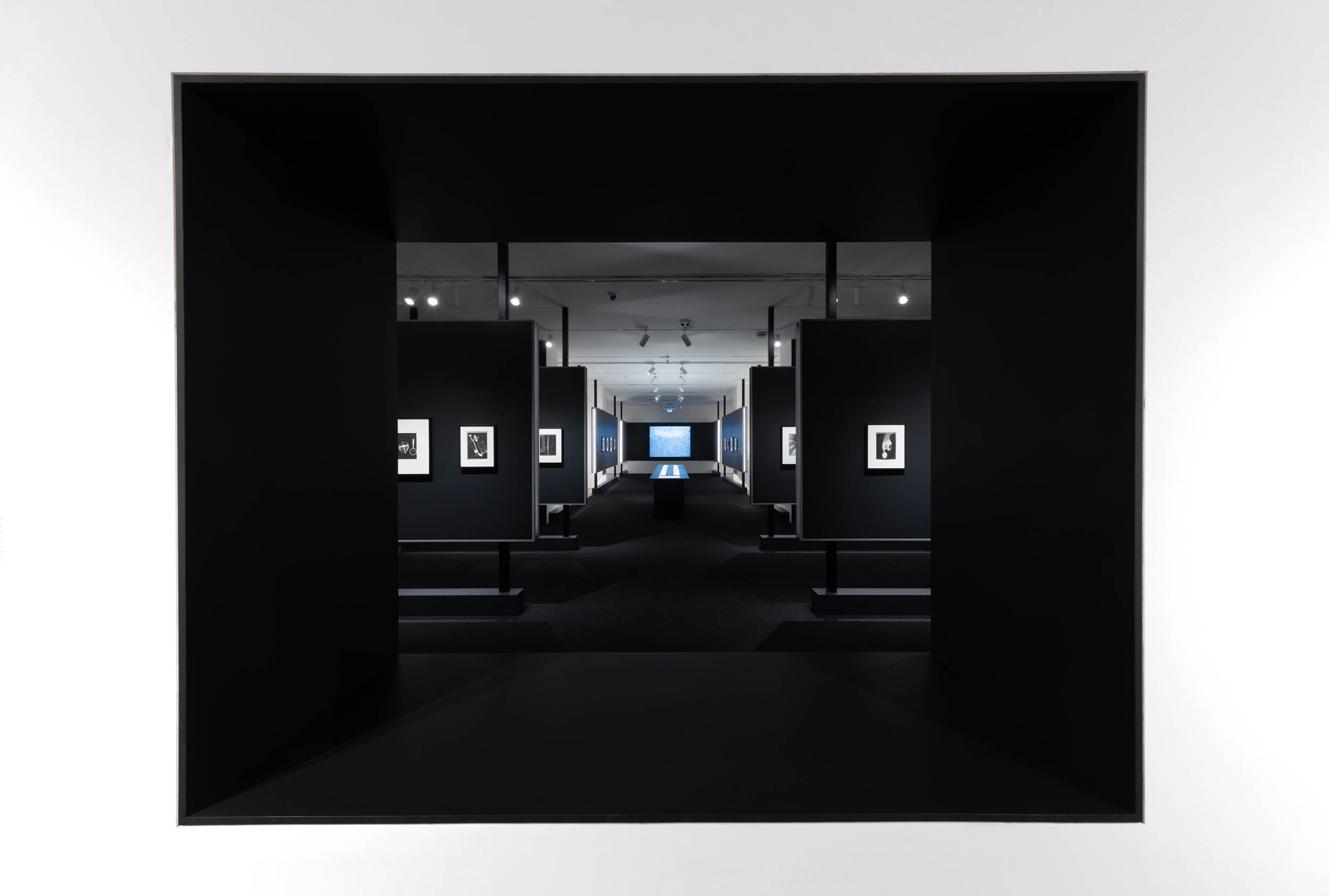
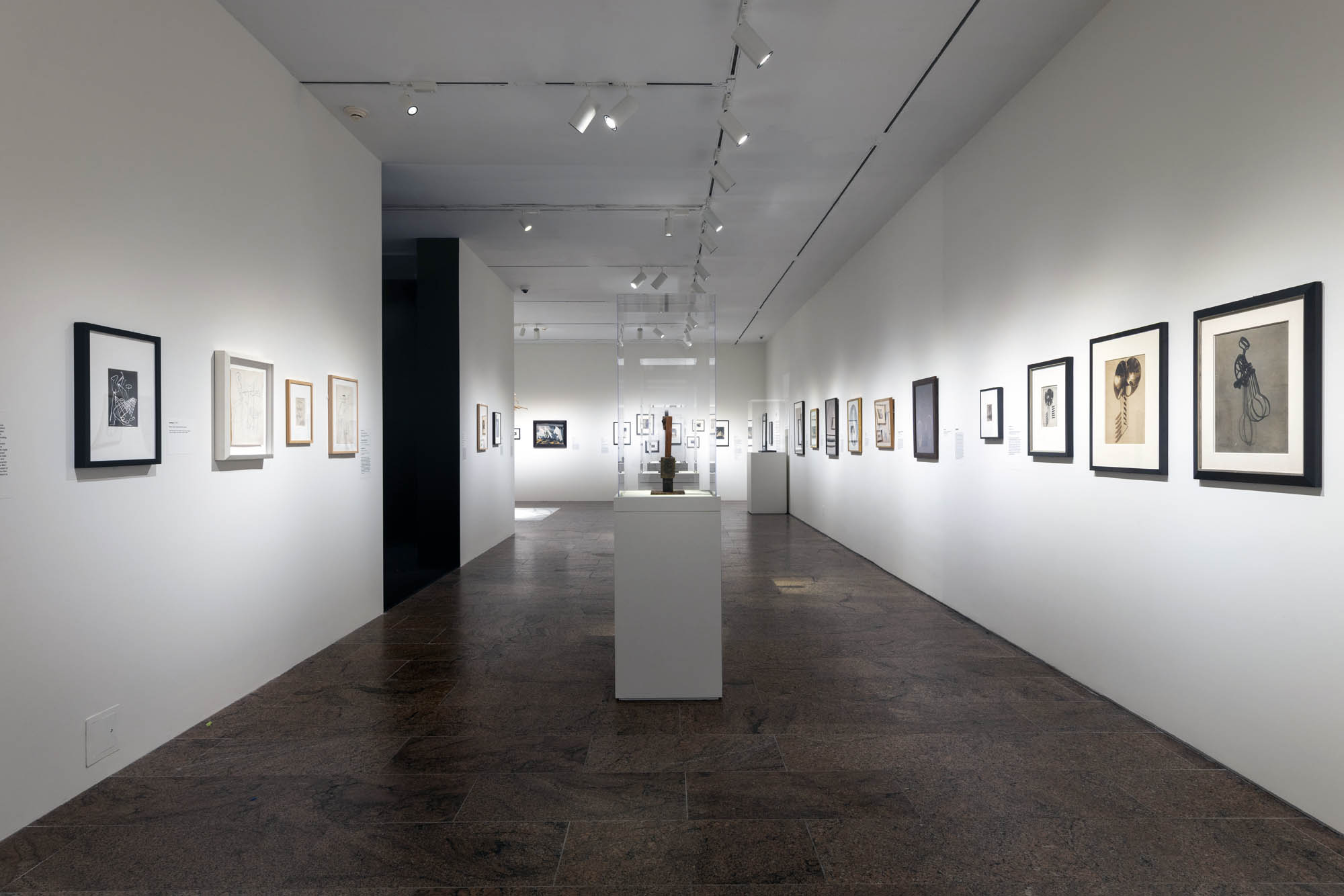
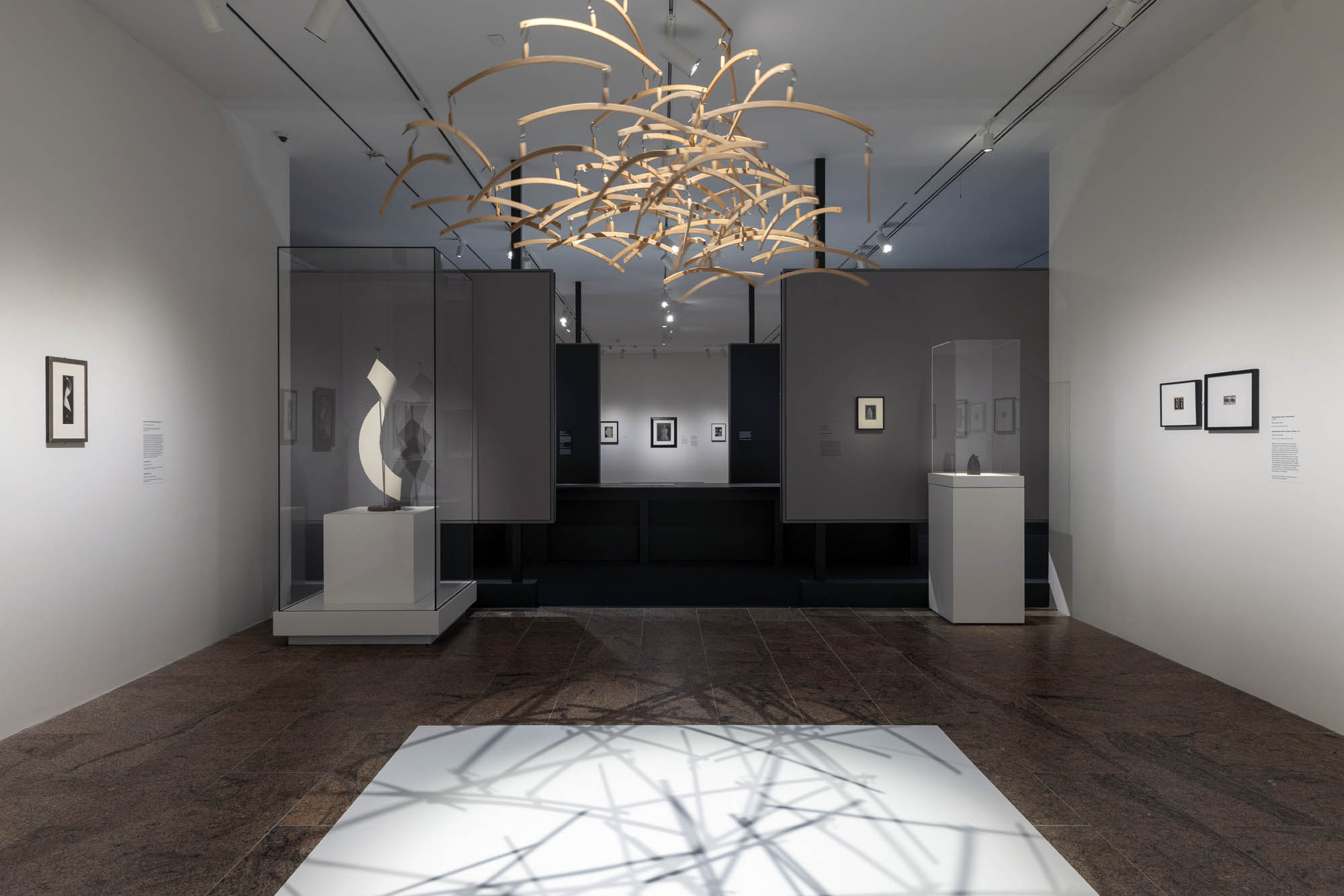
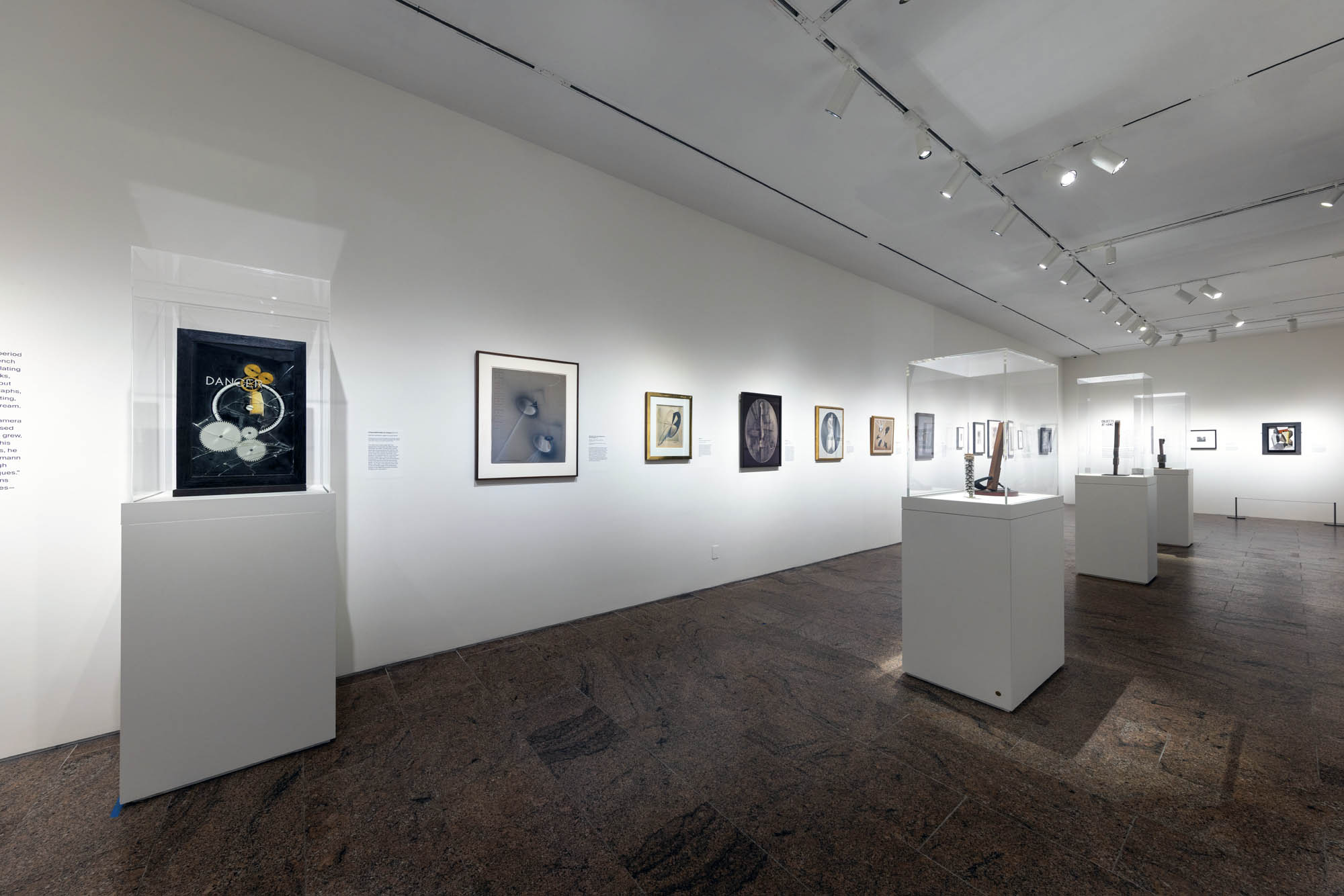
Exhibition: ‘Lucia Moholy – Exposures’ at Fotostiftung Schweiz, Winterthur, Zurich

Exhibition dates: 8th February – 9th June, 2025

Curator: Jan Tichy


Lucia Moholy (British born Czech, 1894-1989) 'Roof of the Atelier-House, Bauhaus Dessau' 1926 from the exhibition 'Lucia Moholy – Exposures' at Fotostiftung Schweiz, Winterthur, Feb - June, 2025


Lucia Moholy (British born Czech, 1894-1989)
Roof of the Atelier-House, Bauhaus Dessau
1926
© 2025, ProLitteris, Zürich


I love Bauhaus design and photographs of the Bauhaus School and these are excellent photographs of both by Lucia Moholy: powerful, graphic, minimalist, modernist, echoing the ethos of the school itself. The strong portraits are pretty damn good as well…

It’s interesting to note then that Moholy was not particularly enamoured of this new modernist vision: “From her diaries, we know that Moholy didn’t like living in Dessau and her photos of the school, which are very alluring, also hint at her despair and dislike of being there.”

Then to learn that Walter Gropius, founder of the Bauhaus School, “had taken the negatives with him when he emigrated to the USA via London leading to years of negotiation with lawyers to get the negatives back.”

Why would you take the negatives of another artist, use them without credit and then refuse to give them back for many years without lawyers being involved? It’s incredible what human beings especially males will do (power and control), all because Gropius found the images useful for him to use! (see below)

While it is wonderful to be able to publish the first posting on Art Blart on the artist, I wish galleries and museums would stop making claims such as, Moholy “was one of the 20th century’s most internationally recognised and important female photographers.”

Let’s be frank: she wasn’t, not anywhere close.

Even in Europe in the 1930s we think of Florence Henri, Germaine Krull, Claude Cahun and Marcel Moore, Ilse Bing, Edith Tudor-Hart, Dora Maar etc etc… without even considering American female photographers of the era, or indeed the rest of the century. Today, many have more significance in the history of photography than Lucia Moholy ever will have.

This is in no way denigrating her work at all which I like tremendously, but just to assert that statements not thought through by marketing and media departments may come back to bite you on the arse.

Best just to say that Lucia Moholy was an accomplished artist who made focused, thoughtful, beautiful photographs of an era now nearly a century past. What more do you need to say.

Dr Marcus Bunyan


Many thankx to the Fotostiftung Schweiz for allowing me to publish the photographs in the posting. Please click on the photographs for a larger version of the image.


“In 1938, while Moholy lived in London, Walter Gropius used about fifty of Moholy’s images from the Bauhaus years – from her negatives that he still had in his possession – in the Museum of Modern Art (MoMA) exhibition and the accompanying catalogue, without giving her any credit. …

Gropius had been using her photographs without crediting her. She repeatedly reached out to Gropius to reclaim her images and he would continuously protest. Moholy resorted to hiring a lawyer to retrieve her work.

Some relevant letters between Walter Gropius and Lucia Moholy are displayed on the website 99% Invisible. Moholy stated, “These negatives are irreplaceable documents which could be extremely useful, now more than ever” to which Gropius replied, “[…] long years ago in Berlin, you gave all these negatives to me. You will imagine that these photographs are extremely useful to me and that I have continuously made use of them; so I hope you will not deprive me of them.” Lucia Moholy responded, “Surely you did not expect me to delay my departure in order to draw up a formal contract stipulating date and conditions of return? No formal agreement could have carried more weight than our friendship. It is a friendship I have always relied on, and which, also, I am now invoking.

Moholy did not get physical possession of her original material until 1957, but even then she only could recover a portion of them, 230 out of the 560 Bauhaus-era negatives she took, while 330 negatives, according to Moholy’s own card catalogue, are still missing.”

Anonymous. “Lucia Moholy,” on the Wikipedia website [Onloine] Cited 30/05/2025


Lucia Moholy (British born Czech, 1894-1989) 'Workshop wing, design by Walter Gropius, Bauhaus Dessau' around 1926 from the exhibition 'Lucia Moholy – Exposures' at Fotostiftung Schweiz, Winterthur, Feb - June, 2025


Lucia Moholy (British born Czech, 1894-1989)
Workshop wing, design by Walter Gropius, Bauhaus Dessau
around 1926
© 2025, ProLitteris, Zürich


Lucia Moholy (1894-1989) was one of the 20th century’s most internationally recognised and important female photographers. Her architectural photographs and portraits from her years at the Bauhaus in Dessau, which have become icons of photographic history, still shape how that institution is perceived today. However, Moholy was not just a photographer, but also an art historian, critic, writer and archivist; she described herself as a ‘documentalist’ and made a name for herself in the field of information science.

The exhibition Lucia Moholy – Exposures is the first to show the broad scope of her work from the 1910s to the 1970s. Her photographic oeuvre is presented together with numerous documents, some of them newly discovered, which shed light on Moholy’s role in the avant-garde during the interwar period, as well as her youth in Prague, her editorial work in Germany, her activity as a portraitist in London, and her involvement with early microfilm technology in England and Turkey.

Finally, the exhibition also invites visitors to encounter Lucia Moholy in the context of Zurich, where she spent the last thirty years of her life. During that time, she also maintained a relationship with the then fledgling Fotostiftung Schweiz, which today is home to a large collection of her photographs.

Text from the Fotostiftung Schweiz website


Lucia Moholy (British born Czech, 1894-1989) 'Gropius House in Dessau' 1925


Lucia Moholy (British born Czech, 1894-1989)
Gropius House in Dessau
1925
© 2025, ProLitteris, Zürich


“This street view of Gropius’s house in Dessau is glimpsed through a line of birch trees that conjures a feeling of entrapment, almost like prison bars. It reinforces this sense of being fenced in or fenced off – a feature of many of Moholy’s images of the Masters’ Houses, which provided accommodation for Bauhaus teachers.

“The photograph really captures the modernist style of Gropius’s buildings, with the rectilinear geometric shapes and the dark windows inserted into the white facades. While living in Dessau, Moholy’s relationship with Gropius and his wife Isa was amiable and continued to be so when the Gropiuses emigrated to the United States.

“It was only in the 1950s, when she learned how the negatives she left behind in Berlin in 1933 had been used to build the legacy of the school without her knowledge, that the relationship turned sour and she engaged a lawyer to help her recover the images.”

Meghan Forbes, co-curator of the exhibition when it was at Kunsthalle Praha quoted in Alyn Griffiths. “Lucia Moholy’s photographs provide a different perspective on the Bauhaus,” on the Dezeen website, 9th August, 2024 [Online] Cited 10/05/2025


Lucia Moholy (British born Czech, 1894-1989) 'Workshop wing from south-west, Bauhaus Dessau' 1926


Lucia Moholy (British born Czech, 1894-1989)
Workshop wing from south-west, Bauhaus Dessau
1926
© 2025, ProLitteris, Zürich


Lucia Moholy (British born Czech, 1894-1989) 'Bauhaus Dessau: Workshop building from the southwest' c. 1926


Lucia Moholy (British born Czech, 1894-1989)
Bauhaus Dessau: Workshop building from the southwest
c. 1926
© 2025, ProLitteris, Zürich


Lucia Moholy (British born Czech, 1894-1989) 'Workshop wing of the Bauhaus Building in Dessau' c. 1926


Lucia Moholy (British born Czech, 1894-1989)
Workshop wing of the Bauhaus Building in Dessau
c. 1926
© 2025, ProLitteris, Zürich


“To me, this photograph of Walter Gropius’s Bauhaus building with a muddy, unpaved road in the foreground shows the messier, dirtier aspects of constructing a new modernist vision. From her diaries, we know that Moholy didn’t like living in Dessau and her photos of the school, which are very alluring, also hint at her despair and dislike of being there.

“Moholy’s photographs documenting the Bauhaus buildings and design objects already appeared – with and without credits – in books at the time, as well as in the popular press. In the 1950s, she discovered that at least 40 of her images were used in the catalogue of the seminal 1938 Bauhaus exhibition held at MoMA in New York.

“It kickstarted a life-long campaign of letter-writing to try to obtain both the possession of her glass negatives from the Bauhaus years and appropriate author credit and compensation for the publication of her images.”

Meghan Forbes, co-curator of the exhibition when it was at Kunsthalle Praha quoted in Alyn Griffiths. “Lucia Moholy’s photographs provide a different perspective on the Bauhaus,” on the Dezeen website, 9th August, 2024 [Online] Cited 10/05/2025


Lucia Moholy (British born Czech, 1894-1989) 'Dining room Moholy-Nagy, Meistersiedlung Bauhaus Dessau' 1926


Lucia Moholy (British born Czech, 1894-1989)
Dining room Moholy-Nagy, Meistersiedlung Bauhaus Dessau
1926
© 2025, ProLitteris, Zürich


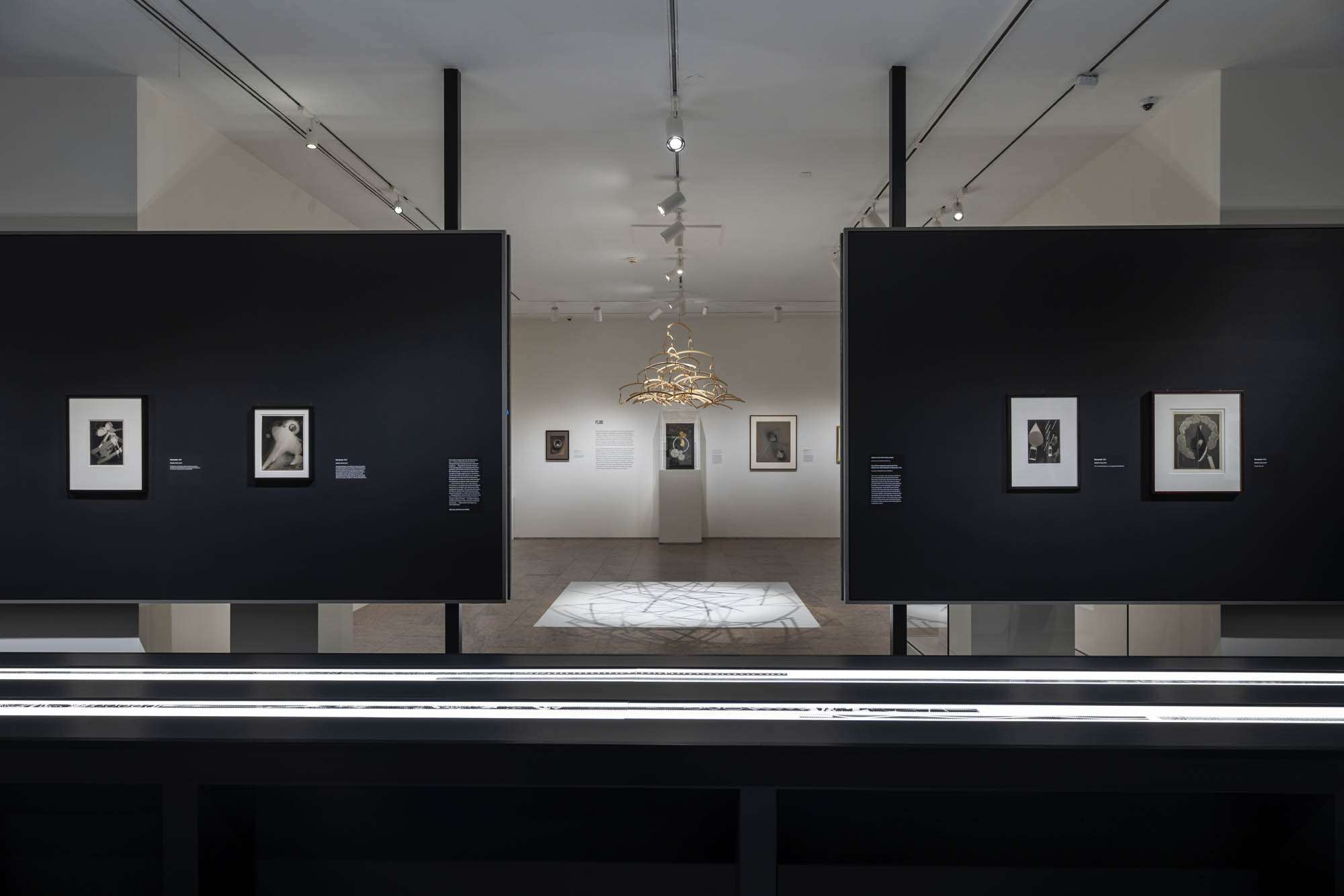
In the exhibition Lucia Moholy – Exposures, Fotostiftung Schweiz is honouring the oeuvre of a versatile 20th-century pioneer. The famous Bauhaus photographs taken by Lucia Moholy (1894-1989) still shape how that institution is seen today. She also left a significant legacy via her work as an art historian, critic, writer and microfilm expert. The exhibition shines a spotlight on this long-underestimated figure, who spent the last 30 years of her life in Zollikon, near Zurich.

Lucia Moholy – Exposures presents, for the first time, the full breadth of her work from the 1910s to the 1970s. Photographs, letters, diaries, publications and microfilms are shown, spread across three exhibition rooms. The focus is on key periods of her life: her youth in Prague, her time at the Bauhaus, her exile in London and her pioneering work on microfilm technology. One point of emphasis is her connection with Zurich and with Fotostiftung Schweiz, which holds many of her images. Works by the contemporary Czech artist and curatorJan Tichy will also be on display. The exhibition is realised in cooperation with Kunsthalle Praha.

Photographer of the Bauhaus

Lucia Moholy left Prague in 1915 to work for various German publishers. In Berlin, she met Hungarian artist László Moholy-Nagy, whom she married in 1921. Together, they explored new reproduction technologies and the possibilities of the photogram. When Moholy-Nagy was appointed as a master at the Bauhaus, Moholy accompanied him and began to take photographs: Between 1923 and 1928, she documented Bauhaus design objects and Walter Gropius’s famous Dessau buildings. Her clearly composed shots still characterise the visual legacy of that institution to this day. Moholy’s portraits of Bauhaus figures like Anni Albers, Walter Gropius and Florence Henri are particularly impressive, and have been made central to the exhibition.

Exile and a new beginning

In 1928, Lucia Moholy and László Moholy-Nagy left the Bauhaus and moved to Berlin, where they soon separated. Moholy took charge of the photography class at Johannes Itten’s art school, while simultaneously trying her hand at photojournalism. Her flight from the Nazis in 1933 took her to London. There, she opened a photo studio and wrote the bestseller A Hundred Years of Photography, 1839-1939. After her studio was destroyed by bombing in 1940, she turned to microfilm technology. She founded her own documentation service and set up a microfilm centre in Ankara as a UNESCO expert.

The search for the glass negatives

After the end of the Second World War, Moholy noticed many of her Bauhaus photographs appearing in newly released publications. After extensive research, she eventually learnt that Walter Gropius had taken the negatives with him when he emigrated to the USA via London. It was not until 1957, after years of legal negotiations, that Lucia Moholy was able to get a large number of her negatives back, which are now in the Bauhaus Archive in Berlin.

Late recognition of the photographer

Moholy moved to Zurich in 1959. Here, she wrote about Zurich exhibitions for English magazines and was a prominent figure on the art scene. During the 1970s and 1980s, interest in Moholy’s photographic works finally grew. They were shown in exhibitions and published in magazines. In 1981, a solo exhibition was held in her honour at Gallery Ziegler in Zurich. Four years later, her first monograph was published, with in-depth analysis of her work by art historian Rolf Sachsse. Moreover, two founding members of Fotostiftung Schweiz, Rosellina Burri-Bischof and Walter Binder, maintained contact with Lucia Moholy. Thanks to a purchase and a donation from Moholy’s estate, Fotostiftung Schweiz now holds 146 of her prints, which can be accessed via the Online Image Archive and constitute the largest collection outside the Bauhaus Archive.

Jan Tichy – Weight of Glass

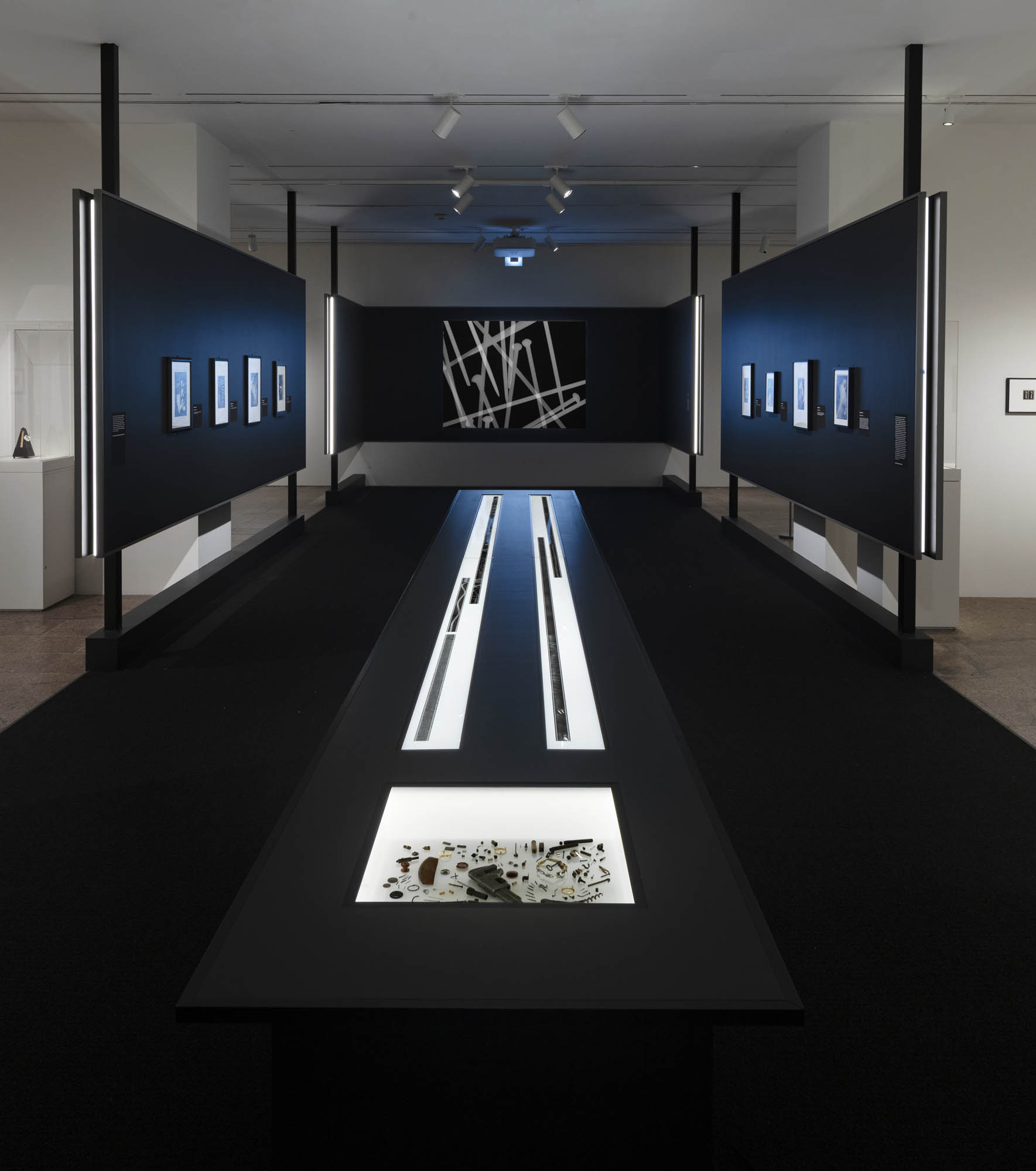
The exhibition at Fotostiftung Schweiz is supplemented with contemporary works by the artist and curator Jan Tichy, who has been engaging with Moholy’s legacy for almost 20 years. His microfilm installation can be seen in the passage leading to the photo library. In addition, contemporary video works, installations and photographs are being shown at oxyd-Kunsträume from the 7th of February to the 2nd of March 2025, including the impressive Installation no. 30 (Lucia), for which Tichy arranges and illuminates 330 glass plates in the size of the original negatives. Set up in a dark room, the installation creates a fleeting and fragile memorial to an important protagonist of the 20th century.

Lucia Moholy – Exposures is a Kunsthalle Praha exhibition project, organised in cooperation with Fotostiftung Schweiz, Winterthur, and the Bauhaus Archive, Berlin.

Press release from Fotostiftung Schweiz, Winterthur


Lucia Moholy (British born Czech, 1894-1989) 'Metal workshop, design by Marianne Brandt, Bauhaus Dessau' 1924 from the exhibition 'Lucia Moholy – Exposures' at Fotostiftung Schweiz, Winterthur, Feb - June, 2025


Lucia Moholy (British born Czech, 1894-1989)
Metal workshop, design by Marianne Brandt, Bauhaus Dessau
1924
© 2025, ProLitteris, Zürich


“Marianne Brandt is a really important Bauhaus designer who ended up living in East Germany in relative obscurity, although her work is now also receiving due attention. The somewhat static composition of the two objects side by side is dynamised by the diagonals produced by the larger vessel’s slender spout and the decision to slant in the ashtray’s top, emphasizing the use value.

“It also shows how Moholy played with reflective surfaces when photographing metal objects, evoking the work of Florence Henri who was at the Bauhaus at the same time. Henri was known for capturing her own portrait as she played with glass and metal in her photographs.

“We can also occasionally catch a glimpse of Moholy in some of her metal studies. But in other instances, she focuses on highlighting the lustrous quality of the objects in isolation. These images of metal objects are perhaps the best-known of her Bauhaus product photographs. But she also took pictures of pieces made from ceramics or wood that indicate the evolution of design thinking at the school.”

Meghan Forbes, co-curator of the exhibition when it was at Kunsthalle Praha quoted in Alyn Griffiths. “Lucia Moholy’s photographs provide a different perspective on the Bauhaus,” on the Dezeen website, 9th August, 2024 [Online] Cited 10/05/2025


Lucia Moholy (British born Czech, 1894-1989) 'Edith Tschichold, Bauhaus Dessau' 1926


Lucia Moholy (British born Czech, 1894-1989)
Edith Tschichold, Bauhaus Dessau
1926
© ProLitteris, Zürich


Edith Tschichold was the wife of Bauhaus typographer and graphic designer Jan Tschichold (German, 1905-1986)


Lucia Moholy (British born Czech, 1894-1989) 'László Moholy-Nagy, Bauhaus Dessau' 1926


Lucia Moholy (British born Czech, 1894-1989)
László Moholy-Nagy, Bauhaus Dessau
1926
© 2025, ProLitteris, Zürich


~ European art research tour exhibition: ‘László Moholy-Nagy and New Typography: A Reconstruction of a Berlin Exhibition from 1929’ at the Staatliche Museen zu Berlin, August – September 2019, posted November 2020
~ Exhibition: ‘Moholy-Nagy: Future Present’ at the Los Angeles County Museum of Art, February – June 2017
~ Exhibition: ‘Moholy-Nagy: Future Present’ at the Solomon R. Guggenheim Museum, New York, May – September 2016
~ Exhibition: ‘László Moholy-Nagy. The Art of Light’ at the Ludwig Museum, Budapest, June – September 2011
~ Exhibition: ‘László Moholy-Nagy – Art of Light’ at Martin Gropius-Bau, Berlin, November 2010 – January 2011
~ Exhibition: ‘László Moholy-Nagy 
Retrospective’ at Schirn Kunsthalle, Frankfurt, October 2009 – February 2010


Lucia Moholy (British born Czech, 1894-1989) 'Walter Gropius, Bauhaus Dessau' 1926


Lucia Moholy (British born Czech, 1894-1989)
Walter Gropius, Bauhaus Dessau
1926
© 2025, ProLitteris, Zürich


Lucia Moholy (British born Czech, 1894-1989) 'Ingeborg Lebert' 1927


Lucia Moholy (British born Czech, 1894-1989)
Ingeborg Lebert
1927
Gelatin silver print
22 x 29.8cm
© 2025, ProLitteris, Zürich


Lucia Moholy (British born Czech, 1894-1989) 'Lou Scheper' 1927


Lucia Moholy (British born Czech, 1894-1989)
Lou Scheper
1927
© 2025, ProLitteris, Zürich


Lou Scheper-Berkenkamp née Hermine Luise Berkenkamp (German, 1901-1976) was a painter, colour designer, the avant-garde author of children’s books, fairy-tale illustrator and costume designer.

More information on the Wikipedia website


Lucia Moholy (British born Czech, 1894-1989) 'Florence Henri, Bauhaus Dessau' 1927


Lucia Moholy (British born Czech, 1894-1989)
Florence Henri, Bauhaus Dessau
1927
© 2025, ProLitteris, Zürich


“Henri’s sophisticated, avante-garde, sculptural compositions have an almost ‘being there’ presence: a structured awareness of a way of looking at the world, a world in which the artist questions reality. She confronts the borders of an empirical reality (captured by a machine, the camera) through collage and mirrors, in order to take a leap of faith towards some form of transcendence of the real. Here she confronts the limitless freedom of creativity, of composition, to go beyond objectivity and science, to experience Existenz (Jaspers) – the realm of authentic being.*

These photographs are her experience of being in the world, of Henri observing the breath of being – the breath of herself, the breath of the objects and a meditation on those objects. There is a stillness here, an eloquence of construction and observation that goes beyond the mortal life of the thing itself. That is how these photographs seem to me to live in the world. I may be completely wrong, I probably am completely wrong – but that is how these images feel to me: a view, a perspective, the artist as prospector searching for a new way of authentically living in the world.”

Marcus Bunyan commenting on the exhibition Florence Henri. Compositions at the Pinakothek der Moderne, Munich, March – September 2014


Lucia Moholy (British born Czech, 1894-1989) 'Gypsy, Jugoslavia' 1930-1931


Lucia Moholy (British born Czech, 1894-1989)
Gypsy, Jugoslavia
1930-1931
© 2025, ProLitteris, Zürich


Lucia Moholy (British born Czech, 1894-1989) 'Ruth Fry' 1936


Lucia Moholy (British born Czech, 1894-1989)
Ruth Fry
1936
© 2025, ProLitteris, Zürich


Anna Ruth Fry (British , 1878-1962), usually known as Ruth Fry, was a Quaker writer, pacifist and peace activist.

More information on the Wikipedia website


Lucia Moholy (British born Czech, 1894-1989) 'Emma, Countess of Oxford and Asquith, London' 1937


Lucia Moholy (British born Czech, 1894-1989)
Emma, Countess of Oxford and Asquith, London
1937
© 2025, ProLitteris, Zürich


Hans Peter Klauser (Swiss, 1910-1989) 'Lucia Moholy in her studio in Zollikon' 1972


Hans Peter Klauser (Swiss, 1910-1989)
Lucia Moholy in her studio in Zollikon
1972
© Hans Peter Klauser/Fotostiftung Schweiz


Hans Peter Klauser (Swiss, 1910-1989) 'Lucia Moholy in her studio in Zollikon' 1972


Hans Peter Klauser (Swiss, 1910-1989)
Lucia Moholy in her studio in Zollikon
1972
© Hans Peter Klauser/Fotostiftung Schweiz


Fotostiftung Schweiz
Grüzenstrasse 45
CH-8400 Winterthur (Zürich)
Phone: +41 52 234 10 30

Opening hours:
Tuesday – Sunday 11am – 6pm
Wednesday 11am – 8pm
Closed on Mondays

Fotostiftung Schweiz website

LIKE ART BLART ON FACEBOOK

Back to top

Exhibition: ‘Hill & Adamson | Fashion & Textiles 1843-1848’ at the National Galleries of Scotland, Edinburgh

Exhibition dates: 15th February – 8th June, 2025


David Octavius Hill & Robert Adamson. 'Mr Finlay, deerstalker in the employ of Campbell of Islay [b]' 1843-1847


David Octavius Hill & Robert Adamson
David Octavius Hill (Scottish, 1802-1870)
Robert Adamson (Scottish, 1821-1848)
Mr Finlay, deerstalker in the employ of Campbell of Islay [b]
1843-1847
Salted paper print
20.1 x 13.6cm
Scottish National Gallery


This photograph shows Mr Finlay in Highland dress, possibly chosen by his employer. Although there is a rich history of tartan appearing in earlier portrait painting, Hill and Adamson were among the first to photograph this iconic Scottish fabric. The calotype process does not show colour, but it offered a means to capture the detail of the different styles of woven fabric. The differences in weave density and pattern between two tartans is clearly visible.


I have supplemented the meagre seven media images with other photographs from the Scottish National Gallery collection (public domain) which I have selected to further illustrate the fashion & textile theme of the exhibition.

Beautiful textiles, intricate fashion, beguiling portraits.

Taken within the first few years of the invention of photography, Hill & Adamson had a profound understanding of how the spirit of a person could be captured by the camera, clothed in working class attire, the robes of respectable society, or fantastical creations of their imagination.

Dr Marcus Bunyan


Many thankx to the National Galleries of Scotland for allowing me to publish the photographs in the posting. Please click on the photographs for a larger version of the image.


David Octavius Hill & Robert Adamson. 'Sir George Harvey' 1806-1876


David Octavius Hill & Robert Adamson
David Octavius Hill (Scottish, 1802-1870)
Robert Adamson (Scottish, 1821-1848)
Sir George Harvey, 1806 – 1876. Artist [a]
1843-1847
Salted paper print
20 x 16cm
Scottish National Gallery
Elliot Collection, bequeathed 1950


George Harvey’s boldly patterned coat was likely selected to make this portrait of an artist appear exotic. In the final print this flamboyant garment draws our eye to the sitter, in contrast with the softly draping fabric background and the hard stone of the statue in the corner.


This small display highlights the remarkable skill of pioneering photographers Hill and Adamson in using this very new technology to showcase the fashions of the 1840s.

David Octavius Hill and Robert Adamson were working in Edinburgh when photography was in its infancy. They used the calotype process, where a paper negative prepared with a salt solution is used to print a positive photograph. It created a much softer image than later photographs made with glass negatives, making it harder to capture detail.

Hill and Adamson depicted many Edinburgh residents during their partnership, from working men to society ladies. They often focused on people’s clothing to demonstrate what was unique about their lives and posed their sitters to highlight particularly interesting details. They embraced the technical challenge of photographing the varied textiles and fashions of the day. Still experimenting with the calotype process, they successfully show us the delicate pattern on a pair of lace gloves, the rough wool of tartans and tweeds and the sheen of silk.

Text from the National Galleries of Scotland website


David Octavius Hill & Robert Adamson. 'Lady Mary Hamilton (Campbell) Ruthven, 1789 - 1885. Wife of James, Lord Ruthven [a]' 1843-1847


David Octavius Hill & Robert Adamson
David Octavius Hill (Scottish, 1802-1870)
Robert Adamson (Scottish, 1821-1848)
Lady Mary Hamilton (Campbell) Ruthven, 1789 – 1885. Wife of James, Lord Ruthven [a]
1843-1847
Salted paper print
19.8 x 15.3cm
Scottish National Gallery
Gift of Mrs. Riddell in memory of Peter Fletcher Riddell, 1985


The subject of this photograph is Lady Ruthven but the focus is on her clothing. The pose, with her body angled diagonally away from the camera, allowed Hill and Adamson to capture how light fell on the different textures in her outfit. In both the negative and the final print, the intricate lace of her shawl is almost translucent draped over the delicate pattern of the dress below. This is one of the most technically accomplished photographs made by Hill and Adamson during their partnership.


David Octavius Hill & Robert Adamson. 'Mr Laing or Laine' 1843


David Octavius Hill & Robert Adamson
David Octavius Hill (Scottish, 1802-1870)
Robert Adamson (Scottish, 1821-1848)
Mr Laing or Laine
1843
Salted paper print
19.6 x 14.3cm
Scottish National Gallery


The identity of the smartly dressed tennis player in this staged scene is uncertain and yet this calotype has become a popular picture postcard. Hill and Adamson are best remembered for the subtlety and perceptiveness of their photographic portraits but at times they showed a keenness for the representation of movement. Here movement is easy to detect in the blur of the racket and the man’s forearm. The player’s intense gaze furthermore suggests that a tennis ball just just gone out of the picture frame.


David Octavius Hill & Robert Adamson. 'Misses Binney' 1843-1847


David Octavius Hill & Robert Adamson
David Octavius Hill (Scottish, 1802-1870)
Robert Adamson (Scottish, 1821-1848)
Misses Binney
1843-1847
Salted paper print
20.4 x 14.6cm
Scottish National Gallery
Given by Miss Janet Notman


These photographs of the aristocratic Misses Binney have been carefully staged to highlight the rich and varied textiles in their outfits. The positioning in this photograph of Miss Binney’s lace-gloved hand on the dark fabric of her sister’s shawl enhances the contrast between the delicate pattern and her pale skin. This image demonstrates Hill and Adamson’s skill in capturing the unique qualities of lace, silk and satin.


David Octavius Hill & Robert Adamson. 'Jimmy Miller. Son of Professor James Miller [c]' 1843-1847


David Octavius Hill & Robert Adamson
David Octavius Hill (Scottish, 1802-1870)
Robert Adamson (Scottish, 1821-1848)
Jimmy Miller. Son of Professor James Miller [c]
1843-1847
Salted paper print
20.5 x 14.3cm
Scottish National Gallery
Given by Miss Janet Notman


Jimmy Miller was the son of James Miller, a professor of surgery at the University of Edinburgh from 1842, and an advocate of the temperance movement. The family were supporters of and had taken part in the disruption of 1843 , where a group of 450 ministers broke away from the Church of Scotland to establish the Free Church of Scotland. Jimmy was one of the few children to appear in Hill’s painting commemorating the event. Hill referred to him as ‘The Young Savage’.


David Octavius Hill & Robert Adamson. 'Mr Lane [called John Lane, Dr Lane and Edward William Lane] [a]' 1843-1847


David Octavius Hill & Robert Adamson
David Octavius Hill (Scottish, 1802-1870)
Robert Adamson (Scottish, 1821-1848)
Mr Lane [called John Lane, Dr Lane and Edward William Lane] [a]
1843-1847
Materials: Salted paper print
19.8 x 14.5cm
Scottish National Gallery
Elliot Collection, bequeathed 1950


Although this sitter is named as Mr Lane, his identity and connection to India are uncertain. During their partnership, Hill and Adamson made a small number of portraits of sitters in South Asian national dress. Mr Lane has been posed to show the layering of different patterns and textures. His position also allows us to see the shape of his headdress, and the way the beads around his neck interact with the ornate fabric of his robe and the pale undershirt below.


More Hill & Adamson photographs showing fashion not in the display


David Octavius Hill & Robert Adamson. 'Mrs Anne (Palgrave) Rigby 1777 - 1872 [f]' 1843-1847


David Octavius Hill & Robert Adamson
David Octavius Hill (Scottish, 1802-1870)
Robert Adamson (Scottish, 1821-1848)
Mrs Anne (Palgrave) Rigby 1777 – 1872 [f]
1843-1847
Salted paper print
19 x 14.4cm
Scottish National Gallery
Elliot Collection, bequeathed 1950


Anne Rigby was the widowed wife of a doctor and had fourteen children. While living in Edinburgh in the 1840s, she and her daughters were photographed on a number of occasions by Hill and Adamson. This photograph bears a striking resemblance to Whistler’s famous portrait of his mother, which is not at all surprising given that the two ladies were friends. Mrs Whistler may have owned a copy of this calotype of Mrs Rigby.


David Octavius Hill & Robert Adamson. 'Mrs Kinloch. Of Park; nee Napier [b]' 1843-1846


David Octavius Hill & Robert Adamson
David Octavius Hill (Scottish, 1802-1870)
Robert Adamson (Scottish, 1821-1848)
Mrs Kinloch. Of Park; nee Napier [b]
1843-1846
Salted paper print
20.9 x 15.4cm
Scottish National Gallery


David Octavius Hill & Robert Adamson. 'Lady Elizabeth (Rigby) Eastlake, 1809-1893. Writer' 1843-1847


David Octavius Hill & Robert Adamson
David Octavius Hill (Scottish, 1802-1870)
Robert Adamson (Scottish, 1821-1848)
Lady Elizabeth (Rigby) Eastlake, 1809 – 1893. Writer [m]
1843-1847
Salted paper print
20.8 x 15.7cm
Scottish National Gallery
Gift of Mrs. Riddell in memory of Peter Fletcher Riddell, 1985


David Octavius Hill & Robert Adamson. 'Mrs Elizabeth (Johnstone) Hall [Newhaven]' 1843-1847


David Octavius Hill & Robert Adamson
David Octavius Hill (Scottish, 1802-1870)
Robert Adamson (Scottish, 1821-1848)
Mrs Elizabeth (Johnstone) Hall [Newhaven]
1843 – 1847
Carbon print
19.80x 14.6cm
Scottish National Gallery
Edinburgh Photographic Society Collection, gifted 1987


David Octavius Hill & Robert Adamson. 'Miss Ellen and Miss Agnes Milne [Group 194]' 1843-1847


David Octavius Hill & Robert Adamson
David Octavius Hill (Scottish, 1802-1870)
Robert Adamson (Scottish, 1821-1848)
Miss Ellen and Miss Agnes Milne [Group 194]
1843-1847
Salted paper print
18.6 x 14cm
Scottish National Gallery
Edinburgh Photographic Society Collection, gifted 1987


David Octavius Hill & Robert Adamson. 'Rev. John Wilson' 1804-1875. Vice-Chancellor of the University of Bombay' 1843-1847; printed later


David Octavius Hill & Robert Adamson
David Octavius Hill (Scottish, 1802-1870)
Robert Adamson (Scottish, 1821-1848)
Rev. John Wilson, 1804 – 1875. Vice-Chancellor of the University of Bombay
1843-1847; printed later
Salted paper print
22.8 x 16.1cm
Scottish National Gallery
The MacKinnon Collection. Acquired jointly with the National Library of Scotland with assistance from The National Lottery Heritage Fund, Scottish Government and Art Fund


David Octavius Hill & Robert Adamson. 'Willie Liston, 'Redding [cleaning or preparing] the line'; Newhaven fisherman [Newhaven 3]' 1843-1847


David Octavius Hill & Robert Adamson
David Octavius Hill (Scottish, 1802-1870)
Robert Adamson (Scottish, 1821-1848)
Willie Liston, ‘Redding [cleaning or preparing] the line’; Newhaven fisherman [Newhaven 3]
1843-1847
Salted paper print
20 x 14.1cm
Scottish National Gallery
Gift of Mrs. Riddell in memory of Peter Fletcher Riddell, 1985


David Octavius Hill & Robert Adamson. 'Dr George Bell. Founder of 'Ragged Schools' [c]' 1843-1847


David Octavius Hill & Robert Adamson
David Octavius Hill (Scottish, 1802-1870)
Robert Adamson (Scottish, 1821-1848)
Dr George Bell. Founder of ‘Ragged Schools’ [c]
1843-1847
Carbon print
21.3 x 16cm
Scottish National Gallery
Elliot Collection, bequeathed 1950


David Octavius Hill & Robert Adamson. 'Rev. Peter Jones or Kahkewaquonaby' 1802-1856. Indian chief and missionary in Canada


David Octavius Hill & Robert Adamson
David Octavius Hill (Scottish, 1802-1870)
Robert Adamson (Scottish, 1821-1848)
Rev. Peter Jones or Kahkewaquonaby, 1802 – 1856. Indian chief and missionary in Canada [c]
1843-1847
Salted paper print
20.2 x 14.6cm
Scottish National Gallery
Purchased from the estate of Sophia Finlay (Charles Finlay’s Trust), 1937


Born in Canada, Peter Jones’ father was a Welsh-born, American immigrant and his mother was of Ojibwa Indian ancestry. He grew up as a Native-American Indian with the name ‘Kahkewāquonāby’, meaning sacred waving feathers. Following his father’s wishes he was baptised by the Methodist church which led to his role as an Indian missionary. To fundraise he toured the United States and the United Kingdom, giving speeches and sermons to captivated audiences. He arrived in Edinburgh in July 1845 and this calotype is one of a series showing Jones in both Indian attire and western clothes. These are some of the oldest surviving photographs of a North American Indian.


David Octavius Hill & Robert Adamson. 'Lady Abercromby (or Hon Mrs Abercromby)' 1843-1847


David Octavius Hill & Robert Adamson
David Octavius Hill (Scottish, 1802-1870)
Robert Adamson (Scottish, 1821-1848)
Lady Abercromby (or Hon Mrs Abercromby)
1843-1847
Carbon print
20.2 x 15.7cm (trimmed)
Scottish National Gallery
Elliot Collection, bequeathed 1950


David Octavius Hill & Robert Adamson. 'Lane and Lewis in oriental dress' 1843-1847


David Octavius Hill & Robert Adamson
David Octavius Hill (Scottish, 1802-1870)
Robert Adamson (Scottish, 1821-1848)
Lane and Lewis in oriental dress
1843-1847
Salted paper print
20 x 14.2cm
Scottish National Gallery


David Octavius Hill & Robert Adamson. 'James Drummond, 1816 - 1877. History painter; curator of the National Gallery of Scotland [b]' 1843-1847


David Octavius Hill & Robert Adamson
David Octavius Hill (Scottish, 1802-1870)
Robert Adamson (Scottish, 1821-1848)
James Drummond, 1816 – 1877. History painter; curator of the National Gallery of Scotland [b]
1843-1847
Salted paper print
19.3 x 14.7cm


James Drummond was an accomplished artist and antiquarian, who specialised in history paintings. He studied at the Trustees’ Academy in Edinburgh and was elected to the Royal Scottish Academy in 1852. Between 1848 and 1859 Drummond produced a series of pencil and wash drawings of closes, streets and buildings in Edinburgh. They were later published as lithographs in a folio volume entitled ‘Old Edinburgh’. In 1868 Drummond became curator of the Scottish National Gallery, a position he held until his death in 1877. An admirer of the new medium of photography, he was a member of the Photographic Society of Scotland and owned two albums of Hill and Adamson’s calotypes.


National Galleries of Scotland
The Mound, Edinburgh, EH2 2EL

Opening hours:
Daily, 10am – 5pm

National Galleries of Scotland website

LIKE ART BLART ON FACEBOOK

Back to top


Exhibition: ‘The basement: photography from Prahran College (1968-1981)’ at the Museum of Australian Photography, Wheelers Hill, Melbourne

Exhibition dates: 1st March – 25th May, 2025

Curators: Angela Connor, MAPh Senior Curator, and Stella Loftus-Hills, MAPh Curator

Exhibiting artists: Colin Abbott, Robert Ashton, Con Aslanis, Polly Borland, Peter Bowes, John Brash, Peter Burgess, Nanette Carter, John Cato, Andrew Chapman, Lyn Cheong, Jon Conte, Kim Corbel, Paul Cox, Mimmo Cozzolino, Christina de Water, Duncan Frost, Rob Gale, Sandra Graham, Bill Henson, Julie Higginbotham, Graham Howe, Carol Jerrems, Moira Joseph, Peter Kelly, Christopher Köller, Johann Krix, Paul Lambeth, Derrick Lee, Peter Leiss, Carolyn Lewens, Steven Lojewski, Ian Macrae, James McArdle, Jim McFarlane, Rod McNicol, Julie Millowick, Peter Milne, Jacqueline Mitelman, Richard Muggleton, Martin Munz, Nicholas Nedelkopoulos, Greg Neville, Glen O’Malley, Viki Petherbridge, Ross Powell, Philip Quirk, Leonie Reisberg, Susan Russell, Stella Sallman, Athol Shmith, Geoff Strong, Ian Tippett, George Volakos, Stephen Wickham, Andrew Wittner, Ken Wright, Lynette Zeeng


Andrew Chapman (Australian, b. 1954) 'Lest we forget' 1980 from the exhibition 'The basement: photography from Prahran College (1968-1981)' at the Museum of Australian Photography, Wheelers Hill, Melbourne, March - May 2025


Andrew Chapman (Australian, b. 1954)
Lest we forget
1980
Gelatin silver print
Museum of Australian Photography, City of Monash Collection donated 2024


Nurture

A world of creativity and transformation

This is a magnificent exhibition at the Museum of Australian Photography which showcases the work of students and teachers at Prahran College between 1958-1981.

People more eminent than myself have commented on the exhibition.

Gael Newton AM – formerly curator of photography at the Art Gallery of New South Wales, and the Senior Curator of Australian and International Photography at the National Gallery of Australia (NGA) in Canberra – “highlights the diverse and passionate nature of the Prahran College community, where an unstructured curriculum and open debates encouraged multiple approaches – from documentary and still life to collage and staged tableau – while the influence of European cinematic sensibilities and the local film and music scenes added depth to the artistic expression.”1

Daniel Palmer – Professor in the School of Art at RMIT University, his research and professional practice focuses on contemporary art and cultural theory, with a particular emphasis on photography and digital media – commenting on the era “frames the 1970s as a transformative era for Australian society and photography, characterised by social activism.”1

Helen Ennis – formerly Curator of Photography at the National Gallery of Australia and outstanding writer on Australian photography and photographers – emphasises “productive intergenerational exchanges between students and their older educators Prahran represented a space of creative possibility and hope” while acknowledging Prahran’s limitations including gender imbalance, “noting examination records from 1974 showing only five of twenty students were female, with the first woman (Julie Millowick) not appointed to teach until 1983.”1

“Ennis’s address brings to light from The Basement a critical reassessment of how we understand and present 1970s Australian photography. She advocated for approaches that preserve the complexity, contradictions, and energy of this formative period rather than imposing retrospective order that might simplify or misrepresent it. Her reflections bridge historical understanding with contemporary curatorial practice, suggesting ways to engage more authentically with photography’s rich past.”2

Bill Henson AO – former student and internationally acclaimed photographer – acknowledges that “that political movements such as feminism were present among Prahran’s students in the 1970s – “there were the feminists; there were little groups doing their social diligence” – he noted that these stances did not overshadow the college’s overarching emphasis on beauty and creative exploration. “There wasn’t this righteousness, this indignation, this kind of territorial thing about issues,” he said. In contrast there was an openness and enthusiasm that defined Prahran during his time there – a place where beauty and creativity were paramount.”3

On reflection

What struck me most about this exhibition was the creative strength of the STUDENT work … and that is something nobody mentions. This was student work.

These were artists finding their personal voice, exploring the world, being creative, learning how to envision the world in their photographs – through social documentary or conceptual, experimental photographs that challenged how Australian viewed itself. As Assoc. Professor James McArdle, a former student and one of the many driving forces behind this exhibition, insightfully observes:

“Prahran, at this time, was a nexus for the ‘New Photography’ movement in Australia, bringing to our country international developments from the 1960s, the candid, loosely structured photographic language that contrasted sharply with the rigid narratives of photojournalism and the increasingly commercial aesthetics of colour photography.

Prahran College itself played a critical role in the legitimisation of photography as an art form within Australia. It spearheaded the integration of art photography into tertiary education curricula, fostering an environment where young artists … could experiment formally and conceptually.”4

Indeed, Melbourne in the late 1960s and early 1970s could be seen as the nurturing centre of photography in Australia.

As my friend Ian Lobb said to me before he died, “In 1970 where did you go to see a fine art photograph on exhibition in a non-institutional gallery in Melbourne? The only place was the doorway to the John Cato / Athol Shmith / Peter Barr studio in Collins Street. You would never know which of the three photographers would have a print placed in that doorway.”5

But then things changed.

Variously, Melbourne had Jenny Boddington appointed curator of photography in 1972 at the National Gallery of Victoria, becoming the first such curator in Australia and perhaps only the third in the world.

Melbourne also had three commercial art photography galleries that supported local and international exhibitions, exposing major international photographers to local artists. These included Brummels Gallery of Photography reopened in the early 1970s by that wonderful photographer Rennie Ellis and deputy director Robert Ashton (Prahran), the first privately run art gallery in the country to be devoted specifically to photography; The Photographers’ Gallery and Workshop founded in 1973 by Paul Cox (Prahran), Ingeborg Tyssen, John F. Williams and Rod McNicol (Prahran), taken over by Ian Lobb in 1974 and joined by co-director Bill Heimerman in 1976 showcasing mostly American and some European original fine prints from major artists which were influential on Australian audiences and practitioners; and Church Street Photographic Centre opened by Joyce Evans OAM in 1976, the third commercial photographic gallery in 1970s Melbourne which exhibited international 19th and 20th Century photography

Prahran College was closely followed by Phillip Institute of Technology (PIT) which was a tertiary college in Bundoora which had an art photography course run by Ian Lobb and Les Walkling, from 6 January 1982 to 30 June 1992 at which time the school integrated as part of RMIT University. I attended PIT in 1991 and then RMIT University where I completed by doctorate, after having undertaken two years at Brighton Technical College completing two years on the basics of photography, a grounding for many budding photographers in those years under the direction of Peter Barker.

I remember at RMIT fine art photography course we would have reviews of student work every 4 weeks, where over 2 days students put up new work and we all sat together with the lecturers and discussed the ideas contained in the work. The atmosphere was electric, the disparate work, the in-depth conversations, the passion. Look at Greg Neville’s photograph Tutorial: lecturers and students [back row L–R Derrick Lee, Bryan Gracey, Athol Shmith, Paul Cox, Elizabeth Tainsh] (c. 1971, below) and you can feel a similar energy…

So Melbourne has been particularly blessed – I dislike that word but there is no other that really conveys what I mean – by this confluence of events, people and places that supported the rigorous investigation of photography and life that Prahran College was a part of. At Prahran there was optimism, social conscience, and an engagement with the street and with life, there was “creative rebellion and intellectual engagement”. I asked James McArdle at an artist’s talk about this: how exciting this would have been, the bouncing of ideas one off another, the sense of community and camaraderie, and yes they were all there … encouraging an “atmosphere” of creativity which has produced a generation of outstanding photographers who will leave a lasting legacy in the history of Australian photography.

As an artist who arrived as a “second generation” photographer after Prahran College I have a great affection for the people and the work produced in the exhibition.

I knew John Cato and his delightful wife Dawn Cato well and went down to their house for afternoon tea to discuss photography and life; together with Bill Heimerman I co-curated his retrospective at The Photographers’ Galley and Workshop in 2002, the text ‘and his forms were without number’ used in the book accompanying the exhibition John Cato Retrospective at the Ballarat International Foto Biennale in 2013 where Paul Cox and I made opening speeches. Both were good friends.

Joyce Evans was my substitute mother in Australia. What a wonderful, bohemian, creative, intelligent woman she was. I wrote “Nothing emerges from nothing,” foreword to her book We Had Such High Hopes: Student Activism and the Peace Movement 1949-1952, A Photographic Memoir by Joyce Evans 2019 published before she died, a book that instils the social conscience ethos emerging in postwar Australia which leads into the work of the Prahran College photographers. I still her miss greatly.

As I do both Ian Lobb and Bill Heimerman (pictured below in Peter Leiss’ Untitled [Bill Heimerman (right) and Ian Lobb (left) at the rear of The Photographers’ Gallery] c. 1975-1980), both good friends. Ian Lobb was my first photography lecturer at PIT and became my mentor and friend for over 30 years; Bill gave me three solo exhibitions at The Photographer’s Gallery and Workshop in my early days as an artist, and much excellent advice, for which I am forever grateful.

James McArdle and Gael Newton remain valued friends, both amazing fonts of knowledge in all aspects of photography and photographic research.


In conclusion, congratulations to all who have been involved in bringing this exhibition to fruition: artists, writers and curators. It is a magnificent achievement and a testament to the creativity and passion of the times, both theatre and document reflecting an era that sadly can no longer be repeated.

Prahran College photographers followed their heart and their eye, they possessed a curiosity which “evokes the care one takes for what exists or could exist; an acute sense of the real which, however, never becomes fixed; a readiness to find our surroundings strange and singular; a certain restlessness in ridding ourselves of our familiarities and looking at things otherwise; a passion for seizing what is happening now and what is passing away; a lack of respect for traditional hierarchies of the important and the essential.”6

However long I live, it has always been a privilege to be part of this community, to be part of the Melbourne photographic community.

Dr Marcus Bunyan


1/ James McArdle. “Launched!,” on the On This Date in Photography website, 6th April 2025 [Online] Cited 06/04/2025

2/ Helen Ennis quoted in James McArdle. “Unfixing,” on the On This Date in Photography website, 29th March 2025 [Online] Cited 06/04/2025

3/ Bill Henson opening speech summarised in James McArdle. “Opening!” on the On This Date in Photography website, 1st March, 2025 [Online] Cited 18/04/2025

4/ James McArdle. “Epoch,” on the On This Date in Photography website, 25th April, 2025 [Online] Cited 28/04/2025

5/ “Steve Lojewski [in the year ahead of me at PCAE] and I job shared at Shmith / Cato / Barr. A fantastic opportunity to work mainly in the darkroom, occasionally assisting in the studio and as they gained confidence in me sent out on [mickey mouse] jobs when they were double booked. A HUGE break and when Peter Barr bought out John and Athol and established Peter Barr & Associates he invited me to freelance out of his new studio. That offer would not have happened without the prior experience of the darkroom & studio work. My first job on the Monday morning of my 2 week trial for Athol, John and Peter was 250 prints [on fibre paper] of Malcom Fraser by 11.00 am [ie the wet deadline was 11.00. Dry and out the door was, from memory, 12.noon].”

Julie Millowick in conversation with Marcus Bunyan via Facebook, 20th May 2025

6/ Michel Foucault, “The Masked Philosopher” in Politics, philosophy, culture: interviews and other writings, 1977-1984. London: Routledge, 1988, p. 328


All installation photographs © Marcus Bunyan. Please click on the photographs for a larger version of the image.

Apologies if a couple of the photographs are slightly out of focus, these were digital RAW files shot on a Sony rx100 handheld at 1000ASA with low depth of field.

For more information please see The Prahran Photography website which upholds the legacy of Prahran College 1970s photography through posts on profiles of the alumni and lecturers (an ongoing project).


“Curiosity is a vice that has been stigmatized in turn by Christianity, by philosophy and even by a certain conception of science. Curiosity, futility. I like the word however. To me it suggests something all together different: it evokes concern; it evokes the care one takes for what exists or could exist; an acute sense of the real which, however, never becomes fixed; a readiness to find our surroundings strange and singular; a certain restlessness in ridding ourselves of our familiarities and looking at things otherwise; a passion for seizing what is happening now and what is passing away; a lack of respect for traditional hierarchies of the important and the essential.”


Michel Foucault, “The Masked Philosopher” in Politics, philosophy, culture: interviews and other writings, 1977-1984. London: Routledge, 1988, p. 328


Gallery One (clockwise)


Installation view of the exhibition 'The basement: photography from Prahran College (1968-1981)' at the Museum of Australian Photography, Wheelers Hill, Melbourne
Wall text from the exhibition 'The basement: photography from Prahran College (1968-1981)' at the Museum of Australian Photography, Wheelers Hill, Melbourne, March - May, 2025
Installation view of the exhibition 'The basement: photography from Prahran College (1968-1981)' at the Museum of Australian Photography, Wheelers Hill, Melbourne, March - May, 2025


Installation views of the exhibition The basement: photography from Prahran College (1968-1981) at the Museum of Australian Photography, Wheelers Hill, Melbourne
Photos: Marcus Bunyan


In May 1968 the newly formed photography department of Prahran Technical School (known as Prahran College of Advanced Education (PCAE) from 1973) moved into the basement of a freshly completed art and design building on the corner of High Street and Thomas Street in Melbourne’s inner southeastern suburb of Prahran. Here, for the first time in Australia, photography was taught as an artform.

Featuring the work of approximately 60 artists, The basement brings to light rare vintage prints from the 1960s through to the early 1980s, key archival ephemera and folio work – from students and teachers of the College’s Diploma of Art & Design (Photography). It was a period where new discussions developed quickly around the possibilities of what photography could be. These students and teachers were part of a progressive, edgy wave of image-makers excited about the medium’s potential.

Under the vanguard of influential photographers such as John Cato, Paul Cox and Athol Shmith, the school became a breeding ground for some of this country’s most important art photographers: Carol Jerrems, Bill Henson, Nanette Carter, Rod McNicol, Polly Borland, Peter Milne, Robert Ashton, Philip Quirk, Peter Leiss, Jacqueline Mitelman, Mimmo Cozzolino, Graham Howe and Julie Millowick, among many others.

The exhibition’s accompanying publication elucidates the experience from several perspectives. As we hear from the curators, students, colleagues and academics, it’s clear that this course, in this time, was of great consequence to our photographic ecosystem and its development.

Curated by Angela Connor, MAPh Senior Curator, and Stella Loftus-Hills, MAPh Curator, The basement gathers works from close to 60 artists, traversing over 13 years of image-making and adjacent subcultures in music, protest, fashion and art criticism. This landmark exhibition will deliver new research into the canon of Australia’s cultural history through its assembled works and attendant publication.

Text from the Museum of Australian Photography website


Installation view of the reverse of the opening wall of the exhibition 'The basement: photography from Prahran College (1968-1981)' at the Museum of Australian Photography, Wheelers Hill, Melbourne


Installation view of the reverse of the opening wall of the exhibition The basement: photography from Prahran College (1968-1981) at the Museum of Australian Photography, Wheelers Hill, Melbourne
Photo: Marcus Bunyan


Moira Joseph (Australian, b. 1955)
'Jack with a cigarette sitting in the church garden, St Kilda'  1974 (installation view) from the exhibition 'The basement: photography from Prahran College (1968-1981)' at the Museum of Australian Photography, March - May, 2025


Moira Joseph (Australian, b. 1955)
Jack with a cigarette sitting in the church garden, St Kilda (installation view)
1974
Gelatin silver print
Museum of Australian Photography, City of Monash Collection
Acquired 2024
Photo: Marcus Bunyan


Moira Joseph (Australian, b. 1955)
'Herald boys, Fitzroy Street, St Kilda' 1975 (installation view)


Moira Joseph (Australian, b. 1955)
Herald boys, Fitzroy Street, St Kilda (installation view)
1975
Gelatin silver print
Museum of Australian Photography, City of Monash Collection
Acquired 2024
Photo: Marcus Bunyan


Moira Joseph is a Melbourne-based professional photographer, filmmaker and teacher. She studied photography at Prahran College from 1974 to 1977. Joseph created the works on display here while she was a student. Armed with her Mamiya 220 medium-format camera, Joesph often walked between the College and her home in St Kilda, affectionately documenting the characters she regularly encountered. Jack with a cigarette sitting in the church garden, St Kilda (1974), for example, shows an elderly gentleman from a nearby men’s refuge sitting alone in Acland Street’s church square. Children regularly feature in Joseph’s student work, and she spent time photographing at luna park, as well as Prahran Primary School.

Wall text from the exhibition

Moira Joseph alumni profile on the Prahran Legacy website


Moira Joseph (Australian, b. 1955)
'Three Herald boys, Acland Street, St Kilda' 1975 (installation view)


Moira Joseph (Australian, b. 1955)
Three Herald boys, Acland Street, St Kilda (installation view)
1975
Gelatin silver print
Museum of Australian Photography, City of Monash Collection
Acquired 2024
Photo: Marcus Bunyan


Installation view of the exhibition 'The basement: photography from Prahran College (1968-1981)' at the Museum of Australian Photography, Wheelers Hill, Melbourne showing Julie Millowick 's photographs


Installation view of the first gallery of the exhibition The basement: photography from Prahran College (1968-1981) at the Museum of Australian Photography, Wheelers Hill, Melbourne showing Julie Millowick ‘s photographs from clockwise: ANZAC woman alone, draped in leopard skin coat, 1975; Carlisle Street shopping, 1975; Luna Park, St Kilda, 1975; Mother and child from 46 Blanche Street, St Kilda, 1977 from the series Portraits of women
Photo: Marcus Bunyan


Julie Millowick studied photography at Prahran College from 1974 to 1976 and gained early experience working in the darkroom of Athol Shmith, John Cato and Peter Bart. She is widely known for her work as a commercial photographer and photojournalist as well as her personal documentary projects.

1975 was Millowick’s second year at Prahran College, and also International Women’s Year, as designated by the United Nations. With the spotlight set firmly on women’s rights, Millowick made an extensive series of photographs entitled Portraits of women, which she continued in subsequent years. This human-centred series with feminist undertones, sympathetically captured women in a variety of locations and depicted moments of motherhood, friendship, loneliness, old-age and youth.

Wall text from the exhibition

Read my review “Down with Earth,” on the exhibition Julie Millowick: Surrounding at the Castlemaine Art Museum, June 2024

Julie Millowick Alumni profile on the Prahran Legacy website


Julie Millowick (Australian, b. 1948)
'Mother and child from 46 Blanche Street, St Kilda' 1977 from the exhibition 'The basement: photography from Prahran College (1968-1981)' at the Museum of Australian Photography, Wheelers Hill, Melbourne, March - May 2025


Julie Millowick (Australian, b. 1948)
Mother and child from 46 Blanche Street, St Kilda
1977
Gelatin silver print
15.9 x 23.7cm
Museum of Australian Photography, City of Monash Collection donated by Julie Millowick 2024


Wall text from the exhibition 'The basement: photography from Prahran College (1968-1981)' at the Museum of Australian Photography, Wheelers Hill, Melbourne


Wall text from the exhibition The basement: photography from Prahran College (1968-1981) at the Museum of Australian Photography, Wheelers Hill, Melbourne
Photo: Marcus Bunyan


Installation view of the exhibition 'The basement: photography from Prahran College (1968-1981)' at the Museum of Australian Photography, Wheelers Hill, Melbourne
Installation view of the first gallery of the exhibition 'The basement: photography from Prahran College (1968-1981)' at the Museum of Australian Photography, Wheelers Hill, Melbourne


Installation views of the first gallery of the exhibition The basement: photography from Prahran College (1968-1981) at the Museum of Australian Photography, Wheelers Hill, Melbourne
Photos: Marcus Bunyan


Installation view of the exhibition 'The basement: photography from Prahran College (1968-1981)' at the Museum of Australian Photography, Wheelers Hill, Melbourne showing photography by George Volakos and Graham Howe


Installation view of the first gallery of the exhibition The basement: photography from Prahran College (1968-1981) at the Museum of Australian Photography, Wheelers Hill, Melbourne showing at left, George Volakos’ photograph Vietnam moratorium 1 1970; at top centre, Graham Howe’s photograph Protester, moratorium to end the war in Vietnam 1970 followed by two photographs Moratorium to end the war in Vietnam 1970 (below)
Photo: Marcus Bunyan


As a student at Prahran College in the early 1970s, Graham Howe embraced photography’s ability to document social change. For Howe, photography was the perfect medium for observing the world around him and expressing a point of view. This is evident in his images of a Vietnam War moratorium in Melbourne in September 1970. Immersed in a sea of people, placards and peace signs, Howe made a series of tightly framed and often close-up views of the protesters, showing the event from his perspective as an impassioned participant rather than an objective observer. Other Prahran College students, such as Johann Kris and George Volvos, also took photographs at these demonstrations, documenting the intensity of the activist movement

Wall text from the exhibition

Graham Howe alumni profile on the Prahran Legacy website


Graham Howe (Australian, b. 1950)
'Moratorium to end the war in Vietnam' 1970, printed 2024  (installation view)


Graham Howe (Australian, b. 1950)
Moratorium to end the war in Vietnam (installation view)
1970, printed 2024
Pigment inkjet print
Collection of the artist
Photo: Marcus Bunyan


Graham Howe (Australian, b. 1950)
'Moratorium to end the war in Vietnam' 1970, printed 2024  (installation view) from the exhibition 'The basement: photography from Prahran College (1968-1981)' at the Museum of Australian Photography, March - May, 2025


Graham Howe (Australian, b. 1950)
Moratorium to end the war in Vietnam (installation view)
1970, printed 2024
Pigment inkjet print
Collection of the artist
Photo: Marcus Bunyan


Installation view of the exhibition 'The basement: photography from Prahran College (1968-1981)' at the Museum of Australian Photography, Wheelers Hill, Melbourne showing from left clockwise, Ken Wright's 'Rally for Gough' 1975; Andrew Chapman's 'Street protest, November 11th' 1975; Richard Muggleton's 'Untitled (F19 protest)' c. 1977; and Andrew Chapman's 'Lest we forget' 1980


Installation view of the first gallery of the exhibition The basement: photography from Prahran College (1968-1981) at the Museum of Australian Photography, Wheelers Hill, Melbourne showing from left clockwise, Ken Wright’s Rally for Gough 1975; Andrew Chapman’s Street protest, November 11th 1975; Richard Muggleton’s Untitled (F19 protest) c. 1977; and Andrew Chapman’s Lest we forget 1980
Photo: Marcus Bunyan


Ken Wright (Australian / New Zealand, 1948-1998)
'Rally for Gough' 1975 (installation view)


Ken Wright (Australian/New Zealand, 1948-1998)
Rally for Gough (installation view)
1975
Gelatin silver print
Private collection
Photo: Marcus Bunyan


Andrew Chapman (Australian, b. 1954) 'Lest we forget' 1980 (installation view)


Andrew Chapman (Australian, b. 1954)
Lest we forget (installation view)
1980
Gelatin silver print
Museum of Australian Photography, City of Monash Collection donated 2024
Photo: Marcus Bunyan


Andrew Chapman studied photography at Prahran College from 1974 to 1976 and then again in 1980. His Street protest, November 11th (1975) documents a politically motivated rally. It was taken on the corner of Albert Street and moray Street in South Melbourne. Chapman was in his second year at Prahran College and had been listening to parliament on the radio in the office of the then photography technician Murray White. When the news broke of the Whitlam Government’s dismissal, Chapman was quick to join the rallies that broke out in the streets. Later, in 1980, the streets were still politically charged when Chapman returned to Prahran to complete his course. His image, Lest we forget (1980) was made in City Square on Swanston Street at an anti-Fraser demonstration in the lead-up to the 1980 federal election. Described by Julie Millowick as the student who never stopped photographing, even during class, Chapman always has his Leica camera ready. Throughout his career Chapman has photographed much of Australia’s social and political landscape, working both personally and for clients, including as a photojournalist for major Australian newspapers and magazines.

Wall text from the exhibition

Andrew Chapman alumni profile on the Prahran Legacy website


Wall text from the exhibition 'The basement: photography from Prahran College (1968-1981)' at the Museum of Australian Photography, Wheelers Hill, Melbourne


Wall text from the exhibition The basement: photography from Prahran College (1968-1981) at the Museum of Australian Photography, Wheelers Hill, Melbourne
Photo: Marcus Bunyan


Installation view of the exhibition 'The basement: photography from Prahran College (1968-1981)' at the Museum of Australian Photography, Wheelers Hill, Melbourne showing from top left clockwise photographs by Julie Higginbotham: 'Greville Street Market', 1975; 'Catching butterflies, Prahran Park', 1974; and 'Greville Street', 1976


Installation view of the first gallery of the exhibition The basement: photography from Prahran College (1968-1981) at the Museum of Australian Photography, Wheelers Hill, Melbourne showing from top left clockwise photographs by Julie Higginbotham: Greville Street Market, 1975; Catching butterflies, Prahran Park, 1974; and Greville Street, 1976
Photo: Marcus Bunyan


Julie Higginbotham practiced a style of unobtrusive street photography in the mid-1970s, making candid expressive images such as ‘Catching butterflies, Prahran Park’ (1974), which records a moment of human interaction with a keen eye for composition and synchronicity. Higginbotham recalls being offered a bohemian, European-inspired style of education at Prahran College while she was there from 1971 to 1974, particularly by Cox whose emphasis on freedom of expression and personal choice resonated. Through her street photography, Higginbotham was interested in recording the cultural changes that were taking place in Melbourne at the time. Living above a shop in the heart of Greville Street in 1975, she was part of a lively hippie community in Prahran. While living conditions were squalid, the cheap rents attracted artists, musicians and alternative thinkers to the area. Greville Street at this time was one of Melbourne’s key counterculture locations, known for live music, organic food and second-hand clothes shops. Higginbotham produced several images that document the vibrancy of this movement, including a series of street photographs she made at the Greville Street Market on Saturday in 1975.

Wall text from the exhibition

Julie Higginbotham alumni profile on the Prahran Legacy website


Julie Higginbotham interview Prahran CAE 1971 – 74 Photography


Installation view of the exhibition 'The basement: photography from Prahran College (1968-1981)' at the Museum of Australian Photography, Wheelers Hill, Melbourne showing from left, Andrew Chapman's photographs 'Anti Fraser demonstrator, Collins Street Melbourne' 1979; 'Tribune newspaper seller, Melbourne' 1980; 'Party supporter, Liberal Party campaign launch, Moorabbin Town Hall' 1980


Installation view of the first gallery of the exhibition The basement: photography from Prahran College (1968-1981) at the Museum of Australian Photography, Wheelers Hill, Melbourne showing from left, Andrew Chapman’s photographs Anti Fraser demonstrator, Collins Street Melbourne 1979; Tribune newspaper seller, Melbourne 1980; Party supporter, Liberal Party campaign launch, Moorabbin Town Hall 1980
Photo: Marcus Bunyan


Andrew Chapman (Australian, b. 1954) 'Tribune newspaper seller, Melbourne' 1980 (installation view)


Andrew Chapman (Australian, b. 1954)
Tribune newspaper seller, Melbourne (installation view)
1980
Gelatin silver print
Museum of Australian Photography, City of Monash Collection donated 2024
Photo: Marcus Bunyan


Andrew Chapman (Australian, b. 1954) 'Tribune newspaper seller, Melbourne' 1980 from the exhibition 'The basement: photography from Prahran College (1968-1981)' at the Museum of Australian Photography, Wheelers Hill, Melbourne, March - May 2025


Andrew Chapman (Australian, b. 1954)
Tribune newspaper seller, Melbourne (installation view)
1980
Gelatin silver print
Museum of Australian Photography, City of Monash Collection donated 2024


Andrew Chapman (Australian, b. 1954) 'Party supporter, Liberal Party campaign launch, Moorabbin Town Hall' 1980 (installation view)


Andrew Chapman (Australian, b. 1954)
Party supporter, Liberal Party campaign launch, Moorabbin Town Hall (installation view)
1980
Gelatin silver print
Museum of Australian Photography, City of Monash Collection donated 2024
Photo: Marcus Bunyan


Installation view of the exhibition 'The basement: photography from Prahran College (1968-1981)' at the Museum of Australian Photography, Wheelers Hill, Melbourne showing at left, George Volakos' 'Flinders Street Station' 1972; and at right, Graham Howe's 'Man on tram, Melbourne' 1970


Installation view of the exhibition The basement: photography from Prahran College (1968-1981) at the Museum of Australian Photography, Wheelers Hill, Melbourne showing at left, George Volakos’ Flinders Street Station 1972; and at right, Graham Howe’s Man on tram, Melbourne 1970
Photo: Marcus Bunyan


Installation view of the exhibition 'The basement: photography from Prahran College (1968-1981)' at the Museum of Australian Photography, Wheelers Hill, Melbourne


Installation view of the exhibition The basement: photography from Prahran College (1968-1981) at the Museum of Australian Photography, Wheelers Hill, Melbourne showing photographs by Rob Gale from his Dogs and their humans (1978) and Swanston Street 5pm (1978) series
Photo: Marcus Bunyan


Rob Gale (Australian, b. 1953) 'Untitled 01' 1978 (installation view)


Rob Gale (Australian, b. 1953)
Untitled 01 (installation view)
1978
From the series Swanston Street 5pm
Pigment ink-jet print, printed 2024
Collection of the artist
Photo: Marcus Bunyan


Rob Gale studied photography at Prahran Collect from 1976 to 1978. For his series, Swanston Street, 5pm (1978), Gale took inspiration from an iconic painting by the Australian artist John Brack, Collins Street, 5pm (1955). Gale’s photographic exploration of Brack’s stylised view of Melbourne’s office workers was made during peak hour at a busy tram stop near Flinders Street Station. Influenced by American street photographers such as Bruce Golden and Weegee, Gale used a hand-held flash to illuminate his subjects. In a nod to Brack’s painting, this technique allowed Gale to create harsh, stylised views of impatient commuters. The flash also seems to have induced grimaces and sideways stares which, along with the harsh lighting, shadows and unusual camera angles, served to accentuate the strange and surreal atmosphere in the photographs.

Wall text from the exhibition

Rob Gale alumni profile on the Prahran Legacy website


Rob Gale (Australian, b. 1953)
'Untitled 12' 1978 from the series 'Swanston Street 5pm' from the exhibition 'The basement: photography from Prahran College (1968-1981)' at the Museum of Australian Photography, Wheelers Hill, Melbourne, March - May 2025


Rob Gale (Australian, b. 1953)
Untitled 12
1978
From the series Swanston Street 5pm
Pigment ink-jet print, printed 2024
Collection of the artist


Installation view of the exhibition 'The basement: photography from Prahran College (1968-1981)' at the Museum of Australian Photography, Wheelers Hill, Melbourne showing photographs from left clockwise, Steven Lojewsi's 'Man with umbrella near curb, Melbourne' 1975; Johann Krix's 'Proud moment, Moomba' c. 1971; and Andrew Wittner's 'Where's my car, Melbourne' 1973


Installation view of the exhibition The basement: photography from Prahran College (1968-1981) at the Museum of Australian Photography, Wheelers Hill, Melbourne showing photographs from left clockwise, Steven Lojewsi’s Man with umbrella near curb, Melbourne 1975; Johann Krix’s Proud moment, Moomba c. 1971; and Andrew Wittner’s Where’s my car, Melbourne 1973
Photo: Marcus Bunyan


Andrew Wittner (Australian, b. 1955) 'Where's My Car?' 1973, printed 2024


Andrew Wittner (Australian, b. 1955)
Where’s My Car?
1973, printed 2024
Gelatin silver print
Collection of the artist

Andrew Wittner alumni profile on the Prahran Legacy website


Steven Lojewsi (Australian born England, b. 1952) 'Man with umbrella near curb, Melbourne' 1975 (installation view)


Steven Lojewsi (Australian born England, b. 1952)
Man with umbrella near curb, Melbourne (installation view)
1975
Gelatin silver print
Museum of Australian Photography, City of Monash Collection donated 2025
Photo: Marcus Bunyan


Steven Lojewski was born in London and grea up in Canada before arriving in Australian in 1969. He studied photography at Prahran College from 1974 to 1976 and later at Sydney College of the Arts. While studying at Prahran, Lojewski made a number of photographs on the streets of Melbourne. Sparsely populated, these early-career vintage prints demonstrate Lojewski’s highly defined, formal approach to documenting the urban landscape and illustrate his ability to produce a subtle range of silvery mid-tones and carefully styled compositions.

Wall text from the exhibition

Steven Lojewski alumni profile on the Prahran Legacy website


Steven Lojewsi (Australian born England, b. 1952) 'Man with umbrella near curb, Melbourne' 1975


Steven Lojewsi (Australian born England, b. 1952)
Man with umbrella near curb, Melbourne
1975
Gelatin silver print
Museum of Australian Photography, City of Monash Collection donated 2025


Installation view of the exhibition 'The basement: photography from Prahran College (1968-1981)' at the Museum of Australian Photography, Wheelers Hill, Melbourne showing at left, John Conte's 'Telephone, Prahran' 1971; at centre top, Philip Quirk's 'Lone ranger (Prahran resident with Royal Show souvenirs)' 1973; at centre bottom, Philip Quirk's 'The headmistress, sports day, Como Park' 1975; and at right, Johann Krix's 'Toorak Road, South Yarra' 1972


Installation view of the exhibition The basement: photography from Prahran College (1968-1981) at the Museum of Australian Photography, Wheelers Hill, Melbourne showing at left, John Conte’s Telephone, Prahran 1971; at centre top, Philip Quirk’s Lone ranger (Prahran resident with Royal Show souvenirs) 1973; at centre bottom, Philip Quirk’s The headmistress, sports day, Como Park 1975; and at right, Johann Krix’s Toorak Road, South Yarra 1972
Photo: Marcus Bunyan


Philip Quirk (Australian, b. 1948)
'Lone ranger (Prahran resident with Royal Show souvenirs)' 1973 (installation view)


Philip Quirk (Australian, b. 1948)
Lone ranger (Prahran resident with Royal Show souvenirs) (installation view)
1973
Gelatin silver print
15.9 x 23.8cm
Museum of Australian Photography, City of Monash Collection acquired 2024
Photo: Marcus Bunyan


Based in Sydney, Philip Quirk has been a practising documentary photographer since the 1970s. He studied photography at Prahran College from 1971 to 1973 and has frequently used his camera to capture endearing images of humanity. Influenced by international photographers such as Henri Cartier-Bresson and Diane Arbus, Quirk’s images feature unusual characters and situations, often incorporating humour and incongruity. His work, Lone ranger (Prahran resident with Royal Show souvenirs) (1973) formed part of his final portfolio assessment at Prahran College. Walking through the streets of Prahran, Quirk stopped to talk to this elderly resident and photographed him in the afternoon sunlight. With its emphasis on light and composition combined with an interest in Australian culture, this photograph is a precursor to the street and social documentary work Quirk produced in the years immediately following his time at Prahran College.

Wall text from the exhibition

Phil Quirk alumni profile on the Prahran Legacy website


Johann Krix (Australian born Austria, b. 1948) 'Toorak Road, South Yarra' 1972 (installation view)


Johann Krix (Australian born Austria, b. 1948)
Toorak Road, South Yarra (installation view)
1972
Gelatin silver print
Collection of the artist
Photo: Marcus Bunyan


Installation view of the exhibition 'The basement: photography from Prahran College (1968-1981)' at the Museum of Australian Photography, Wheelers Hill, Melbourne showing Robert Ashton's photographs, 'Champion Jackpot' 1974; 'Builders Arms Hotel' 1974; 'Family' 1974 from the series 'Fitzroy'


Installation view of the exhibition The basement: photography from Prahran College (1968-1981) at the Museum of Australian Photography, Wheelers Hill, Melbourne showing Robert Ashton’s photographs, Champion Jackpot 1974; Builders Arms Hotel 1974; Family 1974 from the series Fitzroy
Photo: Marcus Bunyan


Robert Ashton (Australian, b. 1950)
'Champion Jackpot' 1974, printed 2008 (installation view)


Robert Ashton (Australian, b. 1950)
Champion Jackpot (installation view)
1974, printed 2008
Pigment inkjet print
Museum of Australian Photography, City of Monash Collection acquired 2010
Photo: Marcus Bunyan


Robert Ashton studied photography at Prahran college from 1968 to 1970 and first exhibited his work at Brummels Gallery of Photography in 1973. As a student at Prahran, Ashton recalls being taught to follow his heart and his eye in a way that was free of constraints, developing a visual language influenced by the style of European black-and-white photography that he was introduced to by Paul Cox. His early documentary work concentrated on inner-city subjects, and he is widely known for his acclaimed series Fitzroy, which warmly documents the people of Fitzroy, focusing on human life and community connection. This series was originally published as a photobook, Into the hollow mountains a portrait of Fitzroy, in 1974.

Wall text from the exhibition

Robert Ashton alumni profile on the Prahran Legacy website


Installation view of the exhibition 'The basement: photography from Prahran College (1968-1981)' at the Museum of Australian Photography, Wheelers Hill, Melbourne  showing from left clockwise, Geoff Strong's 'Bald man enjoying the sun, St Kilda' 1975; Steven Lojewski's 'Man with hat and lighthouse, St Kilda' 1975; Glen O'Malley's 'St Kilda' 1973; and Steven Lojewski's 'Man on bench, Stardust St Kilda' 1975


Installation view of the exhibition The basement: photography from Prahran College (1968-1981) at the Museum of Australian Photography, Wheelers Hill, Melbourne showing from left clockwise, Geoff Strong’s Bald man enjoying the sun, St Kilda 1975; Steven Lojewski’s Man with hat and lighthouse, St Kilda 1975; Glen O’Malley’s St Kilda 1973; and Steven Lojewski’s Man on bench, Stardust St Kilda 1975
Photo: Marcus Bunyan


Geoff Strong (Australian, b. 1950) 'Bald man enjoying the sun, St Kilda'
1975


Geoff Strong (Australian, b. 1950)
Bald man enjoying the sun, St Kilda
1975
Gelatin silver print
19.1 x 26.3cm
Museum of Australian Photography, City of Monash Collection donated 2025


Geoff Strong moved to Melbourne from Brisbane for the photography course at Prahran College, which he began in 1975 after already having established himself as a political journalist. Strong’s image, Bald man enjoying the sun, St Kilda (1975) showcases his acute interest in the qualities of Melbourne’s sunlight. The human element, a man’s bald head, becomes a formal, compositional device, which appears more like a bronze ball than a human form. Strong’s depiction of harsh light in this sparse composition accentuates the photograph’s formal elements and calls to mind the surreal paintings of Georgio de Chirico.

Text from the Museum of Australian Photography website

Geoff Strong alumni profile on the Prahran Legacy website


Steven Lojewsi (Australian born England, b. 1952) 'Man with hat and lighthouse, St Kilda' 1975 (installation view)


Steven Lojewsi (Australian born England, b. 1952)
Man with hat and lighthouse, St Kilda (installation view)
1975
Gelatin silver print
Museum of Australian Photography, City of Monash Collection donated 2025
Photo: Marcus Bunyan


James McArdle (Australian, b. 1950)
'Couple, Luna Park' 1976 (installation view)


James McArdle (Australian, b. 1950)
Couple, Luna Park (installation view)
1976
Gelatin silver print
Museum of Australian Photography, City of Monash Collection donated 2025
Photo: Marcus Bunyan


James McArdle (Australian, b. 1950)
'Conscript, Luna Park' 1976 (installation view)


James McArdle (Australian, b. 1950)
Conscript, Luna Park (installation view)
1976
Gelatin silver print
Museum of Australian Photography, City of Monash Collection donated 2025
Photo: Marcus Bunyan


James McArdle is a photographic artist, curator, writer and educator based in Castlemaine, Victoria. While studying photography at Prahran College from 1974 to 1976, McArdle took his camera out onto the streets of Melbourne. He made several social documentary images as well as more playful, abstract compositions, which highlight his interest in shadow and form. The vintage silver gelatin prints on display here come mostly from McArdle’s first-and second-year street photography folios. They were made during long walks around St Kilda and Elwood. Conscript, Luna Park (1976) formed part of McArdle’s third-year major project on Luna Park, which included portraits taken in the Penny Arcade. Created using a Linhof 4 x 5 inch press camera and flash, this folio was assessed by Wolfgang Sievers.

Wall text from the exhibition

Dr James McArdle profile on the Academia website


Installation view of the exhibition 'The basement: photography from Prahran College (1968-1981)' at the Museum of Australian Photography, Wheelers Hill, Melbourne


Installation view of the exhibition The basement: photography from Prahran College (1968-1981) at the Museum of Australian Photography, Wheelers Hill, Melbourne
Photo: Marcus Bunyan


Installation view of the exhibition 'The basement: photography from Prahran College (1968-1981)' at the Museum of Australian Photography, Wheelers Hill, Melbourne showing from left clockwise, James McArdle's 'Hungry puddle, Elwood' 1975 and 'St Kilda Courthouse' 1974; Martin Munz's 'Man at crossing, Lower Esplanade St Kilda' 1979; and Greg Neville's 'Man and shadow' 1971


Installation view of the exhibition The basement: photography from Prahran College (1968-1981) at the Museum of Australian Photography, Wheelers Hill, Melbourne showing from left clockwise, James McArdle’s Hungry puddle, Elwood 1975 and St Kilda Courthouse 1974; Martin Munz’s Man at crossing, Lower Esplanade St Kilda 1979; and Greg Neville’s Man and shadow 1971
Photo: Marcus Bunyan


James McArdle (Australian, b. 1950)
'Hungry puddle, Elwood' 1975


James McArdle (Australian, b. 1950)
Hungry puddle, Elwood
1975
Gelatin silver print
27.0 x 18.5cm
Museum of Australian Photography, City of Monash Collection donated by James McArdle in honour of John Cato 2025


Greg Neville (Australian, b. 1950) 'Man and shadow' 1971 (installation view)


Greg Neville (Australian, b. 1950)
Man and shadow (installation view)
1971
Gelatin silver print
Collection of the artist
Photo: Marcus Bunyan


Installation view of the exhibition 'The basement: photography from Prahran College (1968-1981)' at the Museum of Australian Photography, Wheelers Hill, Melbourne showing Sandra Graham's photographs 'Walls 3 (Joseph)' and 'Walls 2 (cloak 1)' 1976 from the series 'Walls' (left); and 'Backstage, Chapel street bridge, Prahran' 1976 (right)


Installation view of the exhibition The basement: photography from Prahran College (1968-1981) at the Museum of Australian Photography, Wheelers Hill, Melbourne showing Sandra Graham’s photographs Walls 3 (Joseph) and Walls 2 (cloak 1) 1976 from the series Walls (left); and Backstage, Chapel street bridge, Prahran 1976 (right)
Photo: Marcus Bunyan


Sandra Graham (Australian, b. 1947)
'Walls 3 (Joseph)' 1976 (installation view)


Sandra Graham (Australian, b. 1947)
Walls 3 (Joseph) (installation view)
1976
Gelatin silver print
Collection of the artist
Photo: Marcus Bunyan


Formal concerns permeate the street portraits by Sandra Graham who studied photography at Prahran college fromollege from 1974-1975. In her series Walls, Graham relates the human forms of her subjects to the textured walls behind them. For instance, in Walls 3 (Joseph) (1976), the weathered face and stained clothes of a painter are shown in front of a mottled wall that he is about to paint white. Graham blends figure and ground in this image, playing with tonal relationships in black and white. She creates a painterly style of flatness through this series, which was made on streets around St Kilda and Albert Park.

Wall text from the exhibition

Sandra Graham alumni profile on the Prahran Legacy website


Sandra Graham (Australian, b. 1947)
'Walls 3 (Joseph)' 1976


Sandra Graham (Australian, b. 1947)
Walls 3 (Joseph)
1976
Gelatin silver print
Collection of the artist


Gallery two section one (clockwise)


Installation view of the exhibition 'The basement: photography from Prahran College (1968-1981)' at the Museum of Australian Photography, Wheelers Hill, Melbourne


Installation views of the second gallery part A of the exhibition The basement: photography from Prahran College (1968-1981) at the Museum of Australian Photography, Wheelers Hill, Melbourne
Photos: Marcus Bunyan


Wall text from the exhibition 'The basement: photography from Prahran College (1968-1981)' at the Museum of Australian Photography, Wheelers Hill, Melbourne


Wall text from the exhibition The basement: photography from Prahran College (1968-1981) at the Museum of Australian Photography, Wheelers Hill, Melbourne
Photo: Marcus Bunyan


Lyn Cheong (Australian, b. 1954)
'Self-portrait' 1977; 'Self-portrait' 1977 (installation view)


Lyn Cheong (Australian, b. 1954)
Self-portrait (installation view)
1977
Self-portrait (installation view)
1977
Dye diffusion transfer prints
Collection of the artist
Photo: Marcus Bunyan


Nicholas Nedelkopoulos (Australian, b. 1955)
'Shrunken head' 1978-1991; 'Dark wedding' 1978-1990 (installation view)


Nicholas Nedelkopoulos (Australian, b. 1955)
Shrunken head (installation view)
1978-1991
Dark wedding (installation view)
1978-1990
Chromogenic prints
Museum of Australian Photography, City of Monash Collection acquired 1992
Photo: Marcus Bunyan


Nicholas Nedelkopoulos (Australian, b. 1955) 'Shrunken head' 1978-1991 (installation view)


Nicholas Nedelkopoulos (Australian, b. 1955)
Shrunken head (installation view)
1978-1991
Chromogenic print
Museum of Australian Photography, City of Monash Collection acquired 1992
Photo: Marcus Bunyan


Leonie Reisberg (Australian, b. 1955) 'Portrait of Peggy Silinski, Merimbula, NSW' 1974 (installation view)


Leonie Reisberg (Australian, b. 1955)
Portrait of Peggy Silinski, Merimbula, NSW (installation view)
1974
Gelatin silver print
Museum of Australian Photography, City of Monash Collection donated by Janice Hinderaker through the Australian Government’s Cultural Gifts Program 2023
Photo: Marcus Bunyan


Leonie Reisberg attended Prahran College between 1974 and 1975, where she developed her photographic practice. Her work from this period is often associated with a growing interest in experimental and documentary photography that emerged in Melbourne during the 1970s.

Reisberg’s approach blends real-life moments with a more composed and conceptual style, often exploring themes of intimacy, femininity and social dynamics. She is part of a cohort of photographers that helped shape the trajectory of contemporary Australian photography, particularly within the context feminist and documentary practices.

Wall text from the exhibition

Leonie Reisberg alumni profile on the Prahran Legacy website


Leonie Reisberg (Australian, b. 1955)
'Portrait of Peggy Silinski, Merimbula, NSW' 1974


Leonie Reisberg (Australian, b. 1955)
Portrait of Peggy Silinski, Merimbula, NSW
1974
Gelatin silver print
Museum of Australian Photography, City of Monash Collection donated by Janice Hinderaker through the Australian Government’s Cultural Gifts Program 2023


Installation view of the exhibition 'The basement: photography from Prahran College (1968-1981)' at the Museum of Australian Photography, Wheelers Hill, Melbourne


Installation view of the exhibition The basement: photography from Prahran College (1968-1981) at the Museum of Australian Photography, Wheelers Hill, Melbourne showing at centre, Andrew Chapman’s Self-portrait in bath 1975; and at right, Viki Petherbridge’s Frames 10-18 1975 from the series Frames
Photo: Marcus Bunyan


Viki Petherbridge (Australian, b. 1954) 'Frames 10-18' 1975 (installation view)


Viki Petherbridge (Australian, b. 1954)
Frames 10-18 (installation view)
1975
from the series Frames
Gelatin silver print
Collection of the artist
Photo: Marcus Bunyan


Wall text from the exhibition 'The basement: photography from Prahran College (1968-1981)' at the Museum of Australian Photography, Wheelers Hill, Melbourne


Wall text from the exhibition The basement: photography from Prahran College (1968-1981) at the Museum of Australian Photography, Wheelers Hill, Melbourne
Photo: Marcus Bunyan


Installation view of the exhibition 'The basement: photography from Prahran College (1968-1981)' at the Museum of Australian Photography, Wheelers Hill, Melbourne showing Peter Milne's photographs from top clockwise, 'Rowland S Howard' 1977; 'Polly Borland' 1979; and 'Rowland S Howard, Nick Cave, Ollie Olsen, Megan Bannister, Anita Lane, Bronwyn Adams' 1977


Installation view of the exhibition The basement: photography from Prahran College (1968-1981) at the Museum of Australian Photography, Wheelers Hill, Melbourne showing Peter Milne’s photographs from top clockwise, Rowland S Howard 1977; Polly Borland 1979; and Rowland S Howard, Nick Cave, Ollie Olsen, Megan Bannister, Anita Lane, Bronwyn Adams 1977
Photo: Marcus Bunyan


Peter Milne (Australian, b. 1960)
'Rowland S Howard' 1977 (installation view)


Peter Milne (Australian, b. 1960)
Rowland S Howard (installation view)
1977
Pigment inkjet print
Museum of Australian Photography, City of Monash Collection donated by Helen Frajman 2023
Photo: Marcus Bunyan


Peter Milne began his studies at Prahran College in 1980. Prior to this, he had already begun photographing his friends, family, and the Melbourne punk scene in the mid-to late 1970s. Over the following decades, Milne captured a range of cultural icons, including Nick Cave, Rowland S Howard and Polly Borland. Known for his intimate and warm portraiture, Milne uses dramatic lighting to create strong compositions. His images of Rowland S Howard, in particular, highlight these techniques, with some photographs featuring Howard in striking light or set against brutalist architecture.

Wall text from the exhibition

See the exhibition Juvenilia: Peter Milne at Strange Neighbour, Fitzroy, Melbourne February – March 2015


Peter Milne (Australian, b. 1960)
'Polly Borland' 1979


Peter Milne (Australian, b. 1960)
Polly Borland
1979
Pigment ink-jet print
48 x 32cm
Museum of Australian Photography, City of Monash Collection donated by Helen Frajman 2021


Installation view of the exhibition 'The basement: photography from Prahran College (1968-1981)' at the Museum of Australian Photography, Wheelers Hill, Melbourne showing portraits by Polly Borland from 1983


Installation view of the exhibition The basement: photography from Prahran College (1968-1981) at the Museum of Australian Photography, Wheelers Hill, Melbourne showing portraits by Polly Borland from 1983
Photo: Marcus Bunyan


Polly Borland (Australian, b. 1959)
'Dave' 1983, printed 2025 (installation view)


Polly Borland (Australian, b. 1959)
Dave (installation view)
1983, printed 2025
Silver dye bleach print
Collection of the artist
Photo: Marcus Bunyan


Polly Borland attended Prahran College between 1980 and 1983. Borland shot most of her student work, featured here, on Kodachrome. She shot the works in her Camberwell apartment with direct sunlight pouring through the window. Pieces of carefully placed cellophane on the window created coloured shadows across the subjects’ faces. …

Borland and Cave first began working together in the early 1980s after they met at a party in St Kilda in 1979. The image of Borland at the St Kilda party is documented by fellow friend Peter Milne. Borland’s formative photographs in the early 1980s were part of a new wave of experimental images that departed from renderings of ordinary life.

Wall text from the exhibition


Polly Borland (Australian, b. 1959) 'Nick' 1983, printed 2025 (installation view)


Polly Borland (Australian, b. 1959)
Nick (installation view)
1983, printed 2025
Silver dye bleach print
Museum of Australian Photography, City of Monash Collection acquired 2025
Photo: Marcus Bunyan


Polly Borland (Australian, b. 1959) 'Nick' 1983, printed 2025


Polly Borland (Australian, b. 1959)
Nick
1983, printed 2025
Silver dye bleach print
Museum of Australian Photography, City of Monash Collection acquired 2025


Polly Borland made this work during her student days at Prahran College where she studied between 1980 and 1983. Borland shot most of her student work on Kodachrome. Shot on Kodachrome, this work forms part of a series of portraits Borland made in her Camberwell apartment with direct sunlight pouring through the window. Pieces of carefully placed cellophane on the window created coloured shadows across the subjects’ faces. 

Borland’s images of Nick Cave from the 1980s and 1990s have become legendary. Often described as raw and intense, these images highlight the tension between the public persona of the famous musician and the more vulnerable, human side of the singer and artist. Borland and Cave first began working together in the early 1980s after they met at a party in St Kilda in 1979.

Text from the Museum of Australian Photography website


Installation view of the exhibition 'The basement: photography from Prahran College (1968-1981)' at the Museum of Australian Photography, Wheelers Hill, Melbourne showing from top left clockwise, Christopher Köller's photographs 'Past self portrait' 1980; 'Philip and Maria' 1981; 'Joe as a Russian soldier' 1980; and 'Bauhausler (homage to Oscar Schlemmer and August Sander)' 1980


Installation view of the exhibition The basement: photography from Prahran College (1968-1981) at the Museum of Australian Photography, Wheelers Hill, Melbourne showing from top left clockwise, Christopher Köller’s photographs Past self portrait 1980; Philip and Maria 1981; Joe as a Russian soldier 1980; and Bauhausler (homage to Oscar Schlemmer and August Sander) 1980
Photo: Marcus Bunyan


Christopher Köller (Australian born England, b. 1943) 'Past self-portrait' 1980


Christopher Köller (Australian born England, b. 1943)
Past self-portrait
1980
Gelatin silver print
23.0 x 24.0cm
Museum of Australian Photography, City of Monash Collection acquired 2024


Christopher Köller trained as a silk-screen printer before travelling extensively throughout the late 1960s and 1970s. Upon his return to Australia, Köller studied photography at Prahran college fromollege, graduating in 1980. Köller enrolled in Prahran with the intention of doing an expose on the conditions experienced by the miners of Bolivia as he had learnt about their plight while travelling in South America.

In his second year Köller stopped looking at photography books and started poring over the pages of art book, influenced by his now partner and historian Nanette Carter and lecturer Norbert Loeffler. Inspired by these teachings, Köller started to set up his images. His first self-portrait titled Past self portrait (1980) is an image of a young artist arriving at Station Pier, Melbourne with his passport in hand. It was part of a series of self-portraits that were shown at The Photographers’ Gallery and Workshop. Other works in this period were influenced by Russian Constructivism – particularly Vladimir Mayakovsky – and 1930s German avant-garde art. In another image, Köller’s subject, dressed in a shirt and tie, stand in front of an Oskar Schlemmer drawing, made by the artist.

Wall text from the exhibition

Christopher Köller alumni profile on the Prahran Legacy website


Christopher Köller (Australian born England, b. 1943) 'Joe as a Russian soldier' 1980 (installation view)


Christopher Köller (Australian born England, b. 1943)
Joe as a Russian soldier (installation view)
1980
Gelatin silver print
Museum of Australian Photography, City of Monash Collection acquired 2024
Photo: Marcus Bunyan


Christopher Köller (Australian born England, b. 1943) 'Joe as a Russian soldier' 1980


Christopher Köller (Australian born England, b. 1943)
Joe as a Russian soldier
1980
Gelatin silver print
Museum of Australian Photography, City of Monash Collection acquired 2024


Installation view of the exhibition 'The basement: photography from Prahran College (1968-1981)' at the Museum of Australian Photography, Wheelers Hill, Melbourne showing Nanette Carter's photographs 'Proof' 1979 and 'Newspaper' 1980


Installation view of the exhibition The basement: photography from Prahran College (1968-1981) at the Museum of Australian Photography, Wheelers Hill, Melbourne showing Nanette Carter’s photographs Proof 1979 and Newspaper 1980
Photo: Marcus Bunyan


Nanette Carter (Australian, b. 1954) 'Proof' 1979 (installation view)


Nanette Carter (Australian, b. 1954)
Proof (installation view)
1979
Gelatin silver print
Museum of Australian Photography, City of Monash Collection acquired 1981
Photo: Marcus Bunyan


Nanette Carter studied first-year photography at Prahran College in 1974 and then completed a diploma (1977) and post graduate diploma (1980) in fine art at the Phillip Institute of Technology, majoring in photography. Her practice explored feminist issues with autobiographical overtones, and she exhibited her work widely between 1981 and 1995. She ceased practising as a Photographer in the early 1990s to pursue her career as a lecturer in design history.

Carter’s image Proof (1979) is a striking self-portrait that reflects on the concept of identity and addresses the idea of photographic ‘proof’ in a multifaceted way. The word written across her face explores the proof of identity and the assertion of existence that photography claims. Newspaper (1980) utilities her partner Christopher Köller as subject. From early on in their relationship, Carter and Köller used each other as models.

Wall text from the exhibition

Nanette Carter alumni profile on the Prahran Legacy website


Nanette Carter (Australian, b. 1954)
'Proof' 1979


Nanette Carter (Australian, b. 1954)
Proof
1979
Gelatin silver print
Museum of Australian Photography, City of Monash Collection acquired 1981


Installation view of the exhibition 'The basement: photography from Prahran College (1968-1981)' at the Museum of Australian Photography, Wheelers Hill, Melbourne showing from left clockwise, Rod McNicol's photographs 'Nanette' 1978; 'Stewart' 1978; and 'Kent' 1978 from the series 'Permanent mirrors'


Installation view of the exhibition The basement: photography from Prahran College (1968-1981) at the Museum of Australian Photography, Wheelers Hill, Melbourne showing from left clockwise, Rod McNicol’s photographs Nanette 1978; Stewart 1978; and Kent 1978 from the series Permanent mirrors
Photo: Marcus Bunyan


Rod McNicol (Australian, b. 1946)
'Nanette' 1978 (installation view)


Rod McNicol (Australian, b. 1946)
Nanette (installation view)
1978
From the series Permanent mirrors
Gelatin silver print
Museum of Australian Photography, City of Monash Collection donated 2024
Photo: Marcus Bunyan


Rod McNicol (Australian, b. 1946) 'Nanette' 1978 from the series 'Permanent mirrors'


Rod McNicol (Australian, b. 1946)
Nanette
1978
From the series Permanent mirrors
Gelatin silver print
Museum of Australian Photography, City of Monash Collection donated 2024


Rod McNicol has been drawn to portraiture ever since he attended Prahran College in 1974. His fellow classmates included Nanette Carter and Bill Henson, and he formed a close connection with Athol Shmith, who would become, in McNicol’s words, ‘a lifelong mentor and friend’. McNicol held his first exhibition and Brummels Gallery of Photography with Carol Jerrems, where he exhibited works from his Permanent mirrors series. This exhibition marked a transition to what McNicol would call his structured approach to portraiture. In the image Nanette, McNicol made a makeshift studio on Paul Cox’s front veranda and placed Carter against a neutral backdrop.

In late 1978, McNicol moved into his warehouse apartment on Smith Street, Fitzroy. Since this move, he has incorporated this space into his work and it has become an important component, both as a location and as an aesthetic context.

Wall text from the exhibition

Rod McNicol alumni profile on the Prahran Legacy website


Rod McNicol (Australian, b. 1946)
'Kent' 1978 (installation view)


Rod McNicol (Australian, b. 1946)
Kent (installation view)
1978
From the series Permanent mirrors
Gelatin silver print
Museum of Australian Photography, City of Monash Collection acquired 2013
Photo: Marcus Bunyan


Rod McNicol’s series of portraits Permanent mirrors grew out of his interest in nineteenth-century photographic portraiture, whereby the slow exposure times necessitated what he calls a ‘gauche, self-conscious, fatalist stare’. For McNicol, these portraits carried the ‘spectre of mortality itself’. The environmental portraits that make up his Permanent mirrors series embody many of the formal attributes of nineteenth-century portraiture that appealed to him, insofar as the sitters are seated in highly static poses, staring directly and blankly at the camera. Soon after, McNicol introduced a range of highly significant formal changes to his portraits, whereby sitters were photographed on a kitchen chair against a plain, neutral background in the artist’s Fitzroy studio. McNicol continues to photograph people from his neighbourhood in this way.

Text from the Museum of Australian Photography website


Installation view of the exhibition 'The basement: photography from Prahran College (1968-1981)' at the Museum of Australian Photography, Wheelers Hill, Melbourne showing from left top to bottom, Stella Sallman's photographs 'Sue at the mirror' 1977; 'Sue on the bed' 1977; 'Sue and Carmen' 1978; 'Sue, Simon and Carmen' 1977; 'Beautiful transvestite' 1975


Installation view of the exhibition The basement: photography from Prahran College (1968-1981) at the Museum of Australian Photography, Wheelers Hill, Melbourne showing from left top to bottom, Stella Sallman’s photographs Sue at the mirror 1977; Sue on the bed 1977; Sue and Carmen 1978; Sue, Simon and Carmen 1977; Beautiful transvestite 1975
Photo: Marcus Bunyan


Stella Sallman (Australian, b. 1956)
'Sue and Carmen' 1978 (installation view)


Stella Sallman (Australian, b. 1956)
Sue and Carmen (installation view)
1978
Chromogenic print
Museum of Australian Photography, City of Monash Collection acquired 2025
Photo: Marcus Bunyan


Stella Sallman attended Prahran College from 1976 to 1978. She had originally planned to study fashion design at RMIT, but she was unable pursue the course because she didn’t have a folio. Instead, after completing the preliminary year in Art and Design at Prahran College, she discovered a deep fascination with photography.

Sallman was invited by Rennie Ellis to exhibit her series of glam punks, which she started in her second year, at Brummels Gallery of Photography in 1978, as a support for fellow photographer Jon Rhodes. She said, ‘Rennie came and did some lectures at Prahran. I found him very inspiring because he wasn’t about things looking technically correct.’ He was also brimming with ‘exuberant enthusiastic positive energy.’ The 13 works exhibited at Brummels were portraits of people that Sallman had encountered. Sallman had seen Sue whilst travelling on a train and asked if she could take her portrait. ‘I was very curious about people that didn’t conform.’ In Sallman’s images, she uses colour to emphasise the personality and mood of her subjects, challenging the more traditional, formal portraiture that had prevailed at the time.

Wall text from the exhibition

Stella Sallman alumni profile on the Prahran Legacy website


Gallery two section two (clockwise)


Installation view of the exhibition 'The basement: photography from Prahran College (1968-1981)' at the Museum of Australian Photography, Wheelers Hill, Melbourne
Installation view of the exhibition 'The basement: photography from Prahran College (1968-1981)' at the Museum of Australian Photography, Wheelers Hill, Melbourne showing at left, Carol Jerrems 'Alphabet folio' 1968 dated 1969


Installation view of the exhibition The basement: photography from Prahran College (1968-1981) at the Museum of Australian Photography, Wheelers Hill, Melbourne showing at left, Carol Jerrems Alphabet folio 1968 dated 1969
Photos: Marcus Bunyan


Carol Jerrems (Australian, 1949-1980) Letter from the 'Alphabet folio' 1968 dated 1969 (installation view)


Carol Jerrems (Australian, 1949-1980)
Letters from the Alphabet folio (installation views)
1968 dated 1969
Gelatin silver print
National Gallery of Victoria, Melbourne
Purchased 1971
Photos: Marcus Bunyan


Carol Jerrem’s Alphabet folio is one of her most celebrated and iconic works, and it holds an important place in the history of Australian photography, Created as an assignment during her time as a student at Prahran College, the Alphabet folio consists of 25 letters, with the letter ‘S’ deliberately omitted by Jerrems. The assignment left a lasting impression on Jerrems, as she regularly set this assignment for her own students when she was teaching at the Heidelberg Technical School and the Tasmania School of Art.

Wall text from the exhibition

Carol Jerrems studied at Prahran College between 1967-1969 and graduated in 1970, studying under lecturers McKenzie, Cox, and Lee.

Carol Jerrems alumni profile on the Prahran Legacy website


Installation view of the exhibition 'The basement: photography from Prahran College (1968-1981)' at the Museum of Australian Photography, Wheelers Hill, Melbourne


Installation view of the exhibition The basement: photography from Prahran College (1968-1981) at the Museum of Australian Photography, Wheelers Hill, Melbourne showing Carol Jerrems’ No title photographs 1968/1969
Photos: Marcus Bunyan


These photographs of the model Lynn Allen and her then boyfriend are part of a set of assignment images from the late 1960s, when Jerrems was studying at Prahran College. Jerrems and Allen met at High School (Jerrems was one year ahead) and they lived one street apart from each other when these images were taken. Allen modelled for Jerrems for two years.

Wall text from the exhibition


Carol Jerrems (Australian, 1949-1980) 'No title' 1969; 'No title' 1969 (installation view)


Carol Jerrems (Australian, 1949-1980)
No title (installation view)
1969
No title (installation view)
1969
Gelatin silver print
Museum of Australian Photography, City of Monash Collection donated 2024
Photo: Marcus Bunyan


Carol Jerrems (Australian, 1949-1980) 'No title' 1969 (installation view)


Carol Jerrems (Australian, 1949-1980)
No title (installation view)
1969
Gelatin silver print
Museum of Australian Photography, City of Monash Collection donated 2024
Photo: Marcus Bunyan


Installation view of the exhibition 'The basement: photography from Prahran College (1968-1981)' at the Museum of Australian Photography, Wheelers Hill, Melbourne showing photographs by Carol Jerrems


Installation view of the exhibition The basement: photography from Prahran College (1968-1981) at the Museum of Australian Photography, Wheelers Hill, Melbourne showing photographs by Carol Jerrems
Photo: Marcus Bunyan


Installation view of the exhibition 'The basement: photography from Prahran College (1968-1981)' at the Museum of Australian Photography, Wheelers Hill, Melbourne


Installation view of the exhibition The basement: photography from Prahran College (1968-1981) at the Museum of Australian Photography, Wheelers Hill, Melbourne showing Carol Jerrems’ photographs at left top, Kath Walker 1974; at bottom left, Thancouple (Gloria Fletcher) and Carole Johnson 1974; and at right, Ron Johnson 1974
Photo: Marcus Bunyan


Carol Jerrems (Australian, 1949-1980) 'Thancouple (Gloria Fletcher) and Carole Johnson' 1974 (installation view)


Carol Jerrems (Australian, 1949-1980)
Thancouple (Gloria Fletcher) and Carole Johnson (installation view)
1974
Gelatin silver print
National Gallery of Australia, Canberra
Gift of Mrs Joy Jerrems 1981
Photo: Marcus Bunyan


Carol Jerrems (Australian, 1949-1980) 'Ron Johnson' 1974


Carol Jerrems (Australian, 1949-1980)
Ron Johnson
1974
Gelatin silver print
Museum of Australia Photography, City of Monash Collection donated through the Australian Government’s Cultural Gifts Program 2015
Photo: Marcus Bunyan


Installation view of the exhibition 'The basement: photography from Prahran College (1968-1981)' at the Museum of Australian Photography, Wheelers Hill, Melbourne


Installation view of the exhibition The basement: photography from Prahran College (1968-1981) at the Museum of Australian Photography, Wheelers Hill, Melbourne showing Carol Jerrem’s photographs at left, Esoteric personal (mini) recent exhibition 1976; at top right, Vale Street 1975; at bottom right, Juliet holding ‘Vale Street’ at Murray Road 1976
Photo: Marcus Bunyan


Carol Jerrems (Australian, 1949-1980) 'Esoteric personal (mini) recent exhibition' 1976 (installation view)


Carol Jerrems (Australian, 1949-1980)
Esoteric personal (mini) recent exhibition (installation view)
1976
Gelatin silver prints
Private collection
Photo: Marcus Bunyan


Carol Jerrems (Australian, 1949-1980) 'Vale Street' 1975 (installation view)


Carol Jerrems (Australian, 1949-1980)
Vale Street (installation view)
1975
Gelatin silver print
Museum of Australia Photography, City of Monash Collection donated through the Australian Government’s Cultural Gifts Program by Susan Hesse 2012
Photo: Marcus Bunyan


Carol Jerrems (Australian, 1949-1980) 'Vale Street' 1975


Carol Jerrems (Australian, 1949-1980)
Vale Street
1975
Gelatin silver print
Museum of Australia Photography, City of Monash Collection donated through the Australian Government’s Cultural Gifts Program by Susan Hesse 2012


In 1975, Carol Jerrems made what would become her most famous photograph. Vale Street shows Jerrem’s friend Catriona Brown standing in front of Mark Lean and Jon Bourke, teenage boys from Heidelberg Technical School where Jerrems was teaching at the time. The photograph, taken in the back yard of a house at 52 Vale Street, St Kilda, comes from a series of pictures that show the three subjects socialising, smoking and, under the direction of Jerrems, gradually disrobing. Jerrems carefully set up and managed this no-iconic image, which quickly came to personify the optimism and ambitions of countercultural and feminist politics at the time

Wall text from the exhibition


Installation view of the exhibition 'The basement: photography from Prahran College (1968-1981)' at the Museum of Australian Photography, Wheelers Hill, Melbourne showing photographs by Carol Jerrems (left) and Paul Cox (centre)


Installation view of the exhibition The basement: photography from Prahran College (1968-1981) at the Museum of Australian Photography, Wheelers Hill, Melbourne showing photographs by Carol Jerrems (left) and Paul Cox (centre)
Photo: Marcus Bunyan


Installation view of the exhibition 'The basement: photography from Prahran College (1968-1981)' at the Museum of Australian Photography, Wheelers Hill, Melbourne


Installation view of the exhibition The basement: photography from Prahran College (1968-1981) at the Museum of Australian Photography, Wheelers Hill, Melbourne showing Paul Cox’s photographs with at left, Age of Aquarius (Carol Jerrems, Jan Hurrell) 1970; at centre top, Elizabeth 1 1972; at centre bottom, Fantasy of divine illusion 1972; and at right, Prahran 2 1974
Photo: Marcus Bunyan


Paul Cox (Australian born Netherlands, 1940-2016) 'Age of Aquarius (Carol Jerrems, Jan Hurrell)' 1970 (installation view)


Paul Cox (Australian born Netherlands, 1940-2016)
Age of Aquarius (Carol Jerrems, Jan Hurrell)
1970
Gelatin silver print
Museum of Australia Photography, City of Monash Collection donated by the artist through the Australian Government’s Cultural Gifts Program
Photo: Marcus Bunyan


Paul Cox played a pivotal role in the Photography Department at Prharan College, initially appointed part-time in February 1968, he transitioned to full-time position in 1970 and continued teaching photography and filmmaking until his departure in 1982. Younger than colleagues such as Cato and Shmith, Cox’s age helped him forge strong, personal connections with his students. Many alumni attribute their exposure to international photography luminaries to Cox’s influence. However, it was Cox’s own distinctive approach to photography that left a lasting impact on his students. Cox moved to Australia from the Netherlands in 1965 and although he was not formally trained as a teacher, he brought with him a European sensibility.

In 1973, Cox founded The Photographers’ Gallery and Workshop, alongside Ingeborg Tyssen, John F William and Rod McNicol, a groundbreaking space that played a crucial role in establishing photography as a respected art form in Australia and provided a vital platform for contemporary photographers.

Wall text from the exhibition

Paul Cox on the Prahran Legacy website


Paul Cox (Australian born Netherlands, 1940-2016) 'Age of Aquarius (Carol Jerrems, Jan Hurrell)' 1970


Paul Cox (Australian born Netherlands, 1940-2016)
Age of Aquarius (Carol Jerrems, Jan Hurrell)
1970
Gelatin silver print
Museum of Australia Photography, City of Monash Collection donated by the artist through the Australian Government’s Cultural Gifts Program


Paul Cox (Australian born Netherlands, 1940-2016) 'Fantasy of divine illusion' 1972 (installation view)


Paul Cox (Australian born Netherlands, 1940-2016)
Fantasy of divine illusion (installation view)
1972
Gelatin silver print
Museum of Australia Photography, City of Monash Collection donated by the artist through the Australian Government’s Cultural Gifts Program
Photo: Marcus Bunyan


Paul Cox (Australian born Netherlands, 1940-2016) 'Prahran 2' 1974 (installation view)


Paul Cox (Australian born Netherlands, 1940-2016)
Prahran 2 (installation view)
1974
Gelatin silver print
Museum of Australia Photography, City of Monash Collection donated by the artist through the Australian Government’s Cultural Gifts Program
Photo: Marcus Bunyan


Wall text from the exhibition 'The basement: photography from Prahran College (1968-1981)' at the Museum of Australian Photography, Wheelers Hill, Melbourne


Wall text from the exhibition The basement: photography from Prahran College (1968-1981) at the Museum of Australian Photography, Wheelers Hill, Melbourne
Photo: Marcus Bunyan


Installation view of the exhibition 'The basement: photography from Prahran College (1968-1981)' at the Museum of Australian Photography, Wheelers Hill, Melbourne showing a poster for an exhibition by Tod McNicol and Carol Jerrems at Brummels Gallery of Photography, August - September 1978
Installation view of the exhibition 'The basement: photography from Prahran College (1968-1981)' at the Museum of Australian Photography, Wheelers Hill, Melbourne two letters from Carol Jerrems including at bottom a letter to William (Bill) Heimerman (1950-2017) co-director at the time of The Photographers' Gallery and Workshop
Installation view of the exhibition 'The basement: photography from Prahran College (1968-1981)' at the Museum of Australian Photography, Wheelers Hill, Melbourne


Installation views of the exhibition The basement: photography from Prahran College (1968-1981) at the Museum of Australian Photography, Wheelers Hill, Melbourne with artefacts in a vitrine, showing a poster for an exhibition by Tod McNicol and Carol Jerrems at Brummels Gallery of Photography, August – September 1978; two letters from Carol Jerrems including at bottom a letter to William (Bill) Heimerman (1950-2017) co-director at the time of The Photographers’ Gallery and Workshop; and two gelatin silver prints by Carol Jerrems
Photos: Marcus Bunyan


Installation view of the exhibition 'The basement: photography from Prahran College (1968-1981)' at the Museum of Australian Photography, Wheelers Hill, Melbourne showing at centre, work by John Cato


Installation view of the exhibition The basement: photography from Prahran College (1968-1981) at the Museum of Australian Photography, Wheelers Hill, Melbourne showing at far left a photograph by Paul Cox, at second and third left photographs by Athol Shmith and at centre, photographs by John Cato
Photo: Marcus Bunyan


Installation view of the exhibition 'The basement: photography from Prahran College (1968-1981)' at the Museum of Australian Photography, Wheelers Hill, Melbourne


Installation view of the exhibition The basement: photography from Prahran College (1968-1981) at the Museum of Australian Photography, Wheelers Hill, Melbourne showing at left, Paul Cox’s Portrait of Athol Shmith 2 1983; and at right, Athol Shmith’s Anamorphic image No. 17 and Anamorphic image No. 1 both 1973
Photo: Marcus Bunyan


Athol Shmith is widely known for his commercial portraiture and fashion photography. His style became emblematic of an era that was transitioning from the more formal rigid photographic style of the early 20th century to something more dramatic. His portraits are highly polished, sophisticated and capture the essence of the post-war era’s glamour.

Shmith’s sale was characterised by a strong focus on lighting and composition, often using dramatic lighting setups to create bold, striking images. As Head of the Photography Department from 1972 to 1979 Art Prahran College, Shmith brought a high level of technical expertise.

Shmith created his Anamorphic series while teaching at Prahran College, and exhibited the series at Realities Gallery in 1973. Student Suzanne Budds recalls being a model for one of the images in this series.

Wall text from the exhibition

Athol Shmith Lecturer profile on the Prahran Legacy website


Paul Cox (Australian born Netherlands, 1940-2016) 'Portrait of Athol Shmith 2' 1983 (installation view)


Paul Cox (Australian born Netherlands, 1940-2016)
Portrait of Athol Shmith 2 (installation view)
1983
Gelatin silver print
Museum of Australia Photography, City of Monash Collection donated by the artist through the Australian Government’s Cultural Gifts Program 2000
Photo: Marcus Bunyan


Installation view of the exhibition 'The basement: photography from Prahran College (1968-1981)' at the Museum of Australian Photography, Wheelers Hill, Melbourne showing from left, John Cato's photographs 'Seawind' 1871-1975; 'Tree - a journey' 1971-1973; and 'Tree - a journey #13' 1971-1973 from the series 'Essay I: landscape in a figure' 1971-1979


Installation view of the exhibition The basement: photography from Prahran College (1968-1981) at the Museum of Australian Photography, Wheelers Hill, Melbourne showing from left, John Cato’s photographs Seawind 1871-1975; Tree – a journey 1971-1973; and Tree – a journey #13 1971-1973 from the series Essay I: landscape in a figure 1971-1979
Photo: Marcus Bunyan


John Cato (Australian, 1926-2011) 'Tree - a journey' 1971-1973 (installation view)


John Cato (Australian, 1926-2011)
Tree – a journey (installation views)
1971-1973
Gelatin silver print
Museum of Australian Photography, City of Monash Collection donated by the Cato Estate 2021


John Cato (Australian, 1926-2011) 'Tree - a journey' 1971-1973


John Cato (Australian, 1926-2011)
Tree – a journey
1971-1973
Gelatin silver print
Museum of Australian Photography, City of Monash Collection donated by the Cato Estate 2021


John Cato began his informal studies in photography with his father, the photographer Jack Cato, in 1938. He worked as a commercial photographer from 1947 to 1974, including a notable stint as a press photographer for The Argus from 1947 to 1950. Over the course of his career, Cato collaborated with Athol Shmith for more than two decades, before shifting away from commercial photography in 1974 to focus on his own fine art practice. That same year, Cato also embarked on his career as a photography educator, taking a teaching position at Prahran College, eventually succeeding Shmith as Head of the Photography Department in 1980.

Cato was known for his mystical and spiritual approach to photography, a philosophy that deeply influenced both his teaching style and his own photographic work. His method was unconventional, emphasising not just technical skill, but the creation of images with a deeper, almost transcendent resonance. Many of Cato’s works are minimalist, capturing quiet, still moments in nature, where form and texture take precedence over literal representation. These images often have an abstract quality, inviting the viewer to engage with the landscape on a more introspective, emotional level. Cato’s photography was not just about capturing a scene, it was about evoking a deeper connection to the transformative power of the natural world.

Wall text from the exhibition

Read my Vale to Dr John Cato (1926-2011)

John Cato on the Prahran Legacy website


John Cato (Australian, 1926-2011) 'Tree - a journey #13' 1971-1973 (installation view)


John Cato (Australian, 1926-2011)
Tree – a journey #13 (installation views)
1971-1973
Gelatin silver print
Museum of Australian Photography, City of Monash Collection donated by the artist
Acquired 1981


John Cato (Australian, 1926-2011) 'Tree - a journey #13' 1971-1973


John Cato (Australian, 1926-2011)
Tree – a journey #13
1971-1973
Gelatin silver print
Museum of Australian Photography, City of Monash Collection donated by the artist
Acquired 1981


“Thanks are due to…. Phil Quirk, Peter Leiss, and the now deceased Jon Conte, who started finding alumni (starting with those of 1968-1972) in 2012; Colin Abbott who encouraged Photonet gallery (now MAGNET) in 2014 to put on a show of 1 sample each of student-era and contemporary work of most of the 1974-1976 cohort; Colin has generously part-funded the book that MAPh has produced; designer and archivist Mimmo Cozzolino has contributed beautifully preserved ephemera from his College years, as well as donating his design skills to the ongoing project. Peter Leiss, assisted by Nicholas Nedelkopoulos, produced fine video interviews with alumni… a labour of love!

James McArdle joined the project in 2017. Merle Hathaway, who accepted an invitation to work with the team in 2021, has been an invaluable and key driver of the project in getting this exhibition (and future showings). Merle has secured upcoming shows of contemporary work by 1968-1991 alumni for MAGNET (through May 2025),  the BIFB (August 2025) and elsewhere…

Above all, MAPh curators, Angela Connor and Stella-Loftus-Hills, have been extraordinary in their enthusiasm for the concept, and their realisation of it through their expertise and hard work and is beyond our wildest expectations.  To have contributing writers of the calibre of Gael Newton, Helen Ennis, Daniel Palmer, Adrian Danks et al. is an honour and a further tribute to MAPh organisation and thoroughness.”

Associate Professor James McArdle


For more information please see The Prahran Photography website which upholds the legacy of Prahran College 1970s photography through posts on profiles of the alumni (an ongoing project). The site was initiated by James McArdle, who graduated in 1977 with a Diploma of Art and Design from Prahran College and Merle Hathaway, who coined the title, and who joins James in writing some of the posts.


Making film

Required to collaborate on a class film or create one of their own, photography students often took on multiple roles in each other’s projects. Paul Cox frequently cast his students as actors in his films, forging relationships that continued long after they graduated from college. In Cox’s productions, students also filled essential technical roles such as stills photographer and cinematographer. As well as developing their skills, this collaborative environment fostered a sense of community among aspiring filmmakers.

Paul Cox is known for his distinctive, often introspective films that explore human relationships, emotions, and existential themes. His work, while not always mainstream, is highly regarded in the Australian film industry and internationally for its emotional depth and unique storytelling style.

Mirka is a short film that features French-Australian visual artist Mirka Mora, a key figure in the Melbourne art scene. Mora gained recognition for her distinctive and colourful works, and her blend of surrealism, fantasy and personal experiences. The film explores her journey as an artist and her personal life, showcasing her experiences and her unique approach to art. The film offers a personal perspective into her world and is a rare glimpse into the life of one of Australia’s most beloved and influential artists.

Mirka was a collaborative project, directed by Paul Cox with the assistance of several Prahran students.

Student life

The students at Prahran College were part of a vibrant and dynamic environment that nurtured creativity, experimentation and community. Many drew inspiration from their immediate circles – friends and acquaintances – for their class assignments. They actively participated in exhibitions, showcasing their work to the public and their peers. Students presented their works in critique sessions that played a vital role in the learning process, providing a forum for discussion, debate and critical feedback.

Assignments often revolved around chosen topics such as fashion, portraiture or family, and sometimes involved field trips out into the landscape or excursions to places like hospitals, factories and the beach. Taking advantage of a ‘free assignment’ in 1976 a group of rebellious students got together to produce images of themselves dressed as revolutionaries, wearing clothes sourced from local opportunity shops and carrying real guns.

The images of students from Prahran College in the 1970s serve as visual documents of the bohemian spirit and encapsulate the idealism of the time. The way students were photographed, often in unposed and relaxed settings, captures the free-spirited nature of the College, with the camera becoming a tool for exploring vulnerability and personal expression, rather than just recording events or situations.

The legacy of the bohemian spirit that was cultivated at Prahran College during the 1970s is still evident in the work of contemporary Australian artists today, many of whom continue to embrace self-expression, individuality and alternative narratives.

Text from the Museum of Australian Photography website


Gallery three


Installation view of the exhibition 'The basement: photography from Prahran College (1968-1981)' at the Museum of Australian Photography, Wheelers Hill, Melbourne


Installation view of the exhibition The basement: photography from Prahran College (1968-1981) at the Museum of Australian Photography, Wheelers Hill, Melbourne
Photo: Marcus Bunyan


Installation view of the exhibition 'The basement: photography from Prahran College (1968-1981)' at the Museum of Australian Photography, Wheelers Hill, Melbourne showing Andrew Wittner's photograph 'John Cato leading a group on a photographic expedition, Steve Lojewski using a film camera' 1975; and George Volakos' 'Rye back beach 1' 1972


Installation view of the exhibition The basement: photography from Prahran College (1968-1981) at the Museum of Australian Photography, Wheelers Hill, Melbourne showing at left, Andrew Wittner’s photograph John Cato leading a group on a photographic expedition, Steve Lojewski using a film camera 1975; and at right, George Volakos’ Rye back beach 1 1972
Photo: Marcus Bunyan


Andrew Wittner (Australian, b. 1955) 'John Cato leading a group on a photographic expedition, Steve Lojewski using a film camera' 1975, printed 2024 (installation view)


Andrew Wittner (Australian, b. 1955)
John Cato leading a group on a photographic expedition, Steve Lojewski using a film camera (installation view)
1975, printed 2024
Gelatin silver print
Collection of the artist
Photo: Marcus Bunyan


George Volakos (Australian born Greece, b. 1948) 'Rye back beach 1' 1972, printed 2024 (installation view)


George Volakos (Australian born Greece, b. 1948)
Rye back beach 1 (installation view)
1972, printed 2024
Gelatin silver print
Collection of the artist
Photo: Marcus Bunyan


Installation view of the exhibition 'The basement: photography from Prahran College (1968-1981)' at the Museum of Australian Photography, Wheelers Hill, Melbourne showing photographs by Richard Muggleton, George Volakos, Colin Abbott, Graham Howe, Philip Quirk, Jim McFarlane, Greg Neville, Andrew Wittner, Peter Bowes, and an unknown photographer


Installation view of the exhibition The basement: photography from Prahran College (1968-1981) at the Museum of Australian Photography, Wheelers Hill, Melbourne showing photographs by Richard Muggleton, George Volakos, Colin Abbott, Graham Howe, Philip Quirk, Jim McFarlane, Greg Neville, Andrew Wittner, Peter Bowes, and an unknown photographer
Photo: Marcus Bunyan


Installation view of the exhibition 'The basement: photography from Prahran College (1968-1981)' at the Museum of Australian Photography, Wheelers Hill, Melbourne showing photographs by Philip Quirk, Jim McFarlane, Peter Bowes, and Peter Leiss


Installation view of the exhibition The basement: photography from Prahran College (1968-1981) at the Museum of Australian Photography, Wheelers Hill, Melbourne showing photographs by Philip Quirk, Jim McFarlane, Peter Bowes, and Peter Leiss
Photo: Marcus Bunyan


Installation view of the exhibition 'The basement: photography from Prahran College (1968-1981)' at the Museum of Australian Photography, Wheelers Hill, Melbourne showing photographs by Julie Higginbotham, Andrew Wittner, and Colin Abbott


Installation view of the exhibition The basement: photography from Prahran College (1968-1981) at the Museum of Australian Photography, Wheelers Hill, Melbourne showing photographs by Julie Higginbotham, Andrew Wittner, and Colin Abbott
Photo: Marcus Bunyan


Julie Higginbotham (Australian, b. 1953) 'Mirka film' 1973


Julie Higginbotham (Australian, b. 1953)
Mirka film
1973
Pigment ink-jet print
Courtesy of the artist


Installation view of the exhibition 'The basement: photography from Prahran College (1968-1981)' at the Museum of Australian Photography, Wheelers Hill, Melbourne


Installation view of the exhibition The basement: photography from Prahran College (1968-1981) at the Museum of Australian Photography, Wheelers Hill, Melbourne showing photographs by Philip Quirk, Peter Leiss, and Peter Bowes including at centre left, Peter Leiss’ Untitled [Bill Heimerman (right) and Ian Lobb (left) at the rear of The Photographers’ Gallery] c. 1975-1980 (below); and at centre Peter Leiss’ Jean-Marc Le Pechoux 1976
Photo: Marcus Bunyan


Ian Lobb was co-director of The Photographers’ Gallery and Workshop with Bill Heimerman. Jean-Marc Le Pechoux was editor of the important Light Vision: Australia’s international photography magazine launched in September 1977.

Read my Vale Ian Lobb (1948-2023), photographer
Read my Vale William Heimerman (1950-2017)


Peter Leiss (Australian born England, b. 1951) 'Untitled [Bill Heimerman and Ian Lobb at the rear of the Photographers' Gallery]' c. 1975-1980


Peter Leiss (Australian born England, b. 1951)
Untitled [Bill Heimerman and Ian Lobb at the rear of the Photographers’ Gallery]
c. 1975-1980
Silver gelatin print


Greg Neville (Australian, b. 1950)
'Tutorial: lecturers and students [back row L–R Derrick Lee, Bryan Gracey, Athol Shmith, Paul Cox, Elizabeth Tainsh]' c. 1971 (installation view)


Greg Neville (Australian, b. 1950)
Tutorial: lecturers and students [back row L–R Derrick Lee, Bryan Gracey, Athol Shmith, Paul Cox, Elizabeth Tainsh] (installation view)
c. 1971
Pigment ink-jet print
Collection of the artist
Photo: Marcus Bunyan

Greg Neville alumni profile on the Prahran Legacy website


Greg Neville (Australian, b. 1950)
'Tutorial: lecturers and students [back row L–R Derrick Lee, Bryan Gracey, Athol Shmith, Paul Cox, Elizabeth Tainsh]' c. 1971


Greg Neville (Australian, b. 1950)
Tutorial: lecturers and students [back row L–R Derrick Lee, Bryan Gracey, Athol Shmith, Paul Cox, Elizabeth Tainsh]
c. 1971
Pigment ink-jet print
Collection of the artist

Unidentified students with lecturers editing 35mm transparencies on a light box.


Summary of Bill Henson’s opening speech for The basement exhibition, 1st March, 2025

Internationally acclaimed photographer Bill Henson delivered a characteristically personal, challenging and reflective speech to mark the opening of The Basement.

He began his address by reminiscing about his time at Prahran in the mid-1970s – a period he remembered as unconventional and formative, despite his own intermittent attendance. “The only catch in my experience there is that I never went,” he quipped to rising laughter from the audience. Henson recalled how his interactions with lecturers such as John Cato and Athol Shmith shaped his artistic philosophy more than technical instruction ever could. “They were setting a moral example, an ethical example, an example of empathy,” he said, emphasising the profound impact their mentorship had on him.

Henson fondly and colourfully described Shmith, a glamorous portraitist who photographed Hollywood stars, and Cato, a figure of quiet wisdom, conjuring their style as an “imperious insouciance” – a blend of grandeur and carefree independence. He emphasised that, unlike today’s art educators who have to navigate academic formalities, these lecturers were practicing artists who brought hard-won experience into the classroom.

“They hadn’t gone through a professional teaching career,” Henson explained. “They weren’t like the kind of lecturer that I seem to see in art schools now, who have to go and get a ‘doctorate of painting’ to keep their job,” but were decidedly “outlandish” and unorthodox.

Their focus was not on rigid curricula but on fostering creativity and curiosity. “They were very generous with their comments,” Henson noted, recalling how they encouraged him to pursue his own path. He would disappear for months at a time, working on his own projects before returning with a bundle of photographs to share with his lecturers; “John would turn around and say, ‘Fuck, we thought you’d left!'” Despite his absences, they were formative in shaping his artistic independence, Shmith advised him to “just piss off and do your own work.”

Henson also shared anecdotes that highlighted the camaraderie and spontaneity of those years. One memorable moment was when Shmith surprised Henson by arranging for his work to be shown at the National Gallery of Victoria – a gesture that underscored his pride in his students’ potential. “That was as big a shock for me as anyone else,” Henson admitted.

Henson advised aspiring young artists to “try to be true to yourself, and don’t… stop… working!” Also important was intergenerational dialogue in art; he urged young people to seek wisdom from older artists before their insights are lost. Drawing on his own friendships with figures like Barry Humphries, Leo Schofield and Marc Newson, he highlighted how such exchanges enrich both parties through shared experiences and perspectives.

Beyond personal anecdotes, Henson used his speech to reflect on broader themes in art education and practice. He lamented what he sees as the increasing politicisation of contemporary art, which he believes has shifted focus away from aesthetics toward “box-ticking exercises” driven by ideology. While acknowledging that political movements such as feminism were present among Prahran’s students in the 1970s – “there were the feminists; there were little groups doing their social diligence” – he noted that these stances did not overshadow the college’s overarching emphasis on beauty and creative exploration. “There wasn’t this righteousness, this indignation, this kind of territorial thing about issues,” he said. In contrast was an openness and enthusiasm that defined Prahran during his time there – a place where beauty and creativity were paramount. Quoting Plato, he remarked, “Beauty is the splendour of truth,” positioning this ideal as central to artistic endeavour.

In opening The Basement exhibition Henson’s speech served not only as a tribute to Prahran College’s legacy – the enduring influence of its educators and alumni on Australia’s photographic landscape – but also as a call to preserve the values of curiosity, independence, and beauty in art.

Bill Henson opening speech summarised in James McArdle. “Opening!” on the On This Date in Photography website, 1st March, 2025 [Online] Cited 18/04/2025

Many thankx to James McArdle for allowing me to reproduce this text.


 Julie Millowick (Australian, b. 1948)
'John Cato, PCAE basement, Prahran' 1976 (installation view)


Julie Millowick (Australian, b. 1948)
John Cato, PCAE basement, Prahran (installation view)
1976
Gelatin silver print
Museum of Australian Photography, City of Monash Collection donated by Julie Millowick 2024
Photo: Marcus Bunyan


Julie Millowick (Australian, b. 1948)
'John Cato, PCAE basement, Prahran'
1976


Julie Millowick (Australian, b. 1948)
John Cato, PCAE basement, Prahran
1976
Gelatin silver print
Museum of Australian Photography, City of Monash Collection donated by Julie Millowick 2024
Photo: Marcus Bunyan


Peter Leiss (Australian born United Kingdom, b. 1951) 'Robert Besanko and Nanette Carter at The Photographers' Gallery, Punt Road' 1976 (installation view)


Peter Leiss (Australian born United Kingdom, b. 1951)
Robert Besanko and Nanette Carter at The Photographers’ Gallery, Punt Road (installation view)
1976
Gelatin silver print
Collection of the artist
Photo: Marcus Bunyan

Peter Leiss alumni profile on the Prahran Legacy website


Stella Sallman (Australian, b. 1956)
'Peter Leiss' 1976 (installation view)


Stella Sallman (Australian, b. 1956)
Peter Leiss (installation view)
1976
Gelatin silver print
Private collection
Photo: Marcus Bunyan


Carol Jerrems (Australian, 1949-1980) 'Rennie Ellis and Robert Ashton'
1976 (installation view)


Carol Jerrems (Australian, 1949-1980)
Rennie Ellis and Robert Ashton (installation view)
1976
Gelatin silver print
Private collection
Photo: Marcus Bunyan


In the early 1970s, advertising photographer and photojournalist Rennie Ellis with deputy director Robert Ashton reopened the space as Brummels Gallery of Photography. Assisted with two Arts Council grants, it was non-profit, and the first privately run art gallery in the country to be devoted specifically to photography…

The gallery closed in January 1980, the month before the premature death of its inaugural exhibitor, Carol Jerrems. Having run for eight years, the gallery had advanced the standing of photography as art and the careers of many Australian photographers including Warren Breninger, Godwin BradbeerPonch HawkesDavid Moore, Gerard Groeneveld, Peter Leiss, Steven Lojewski, Rod McNicol, Wesley Stacey, Robert Ashton, Ian Dodd, Sue FordGeorge Gittoes, Ashe Venn, John Williams, Jon Rhodes, Geoff Strong, Jean-Marc Le Pechoux and Henry Talbot.

“Brummels Gallery,” on the Wikipedia website


Carol Jerrems (Australian, 1949-1980) 'Paul Cox' 1977 (installation view)


Carol Jerrems (Australian, 1949-1980)
Paul Cox (installation view)
1977
Gelatin silver print
Private collection
Photo: Marcus Bunyan


Museum of Australian Photography
860 Ferntree Gully Road, Wheelers Hill
Victoria 3150 Australia
Phone: + 61 3 8544 0500

Opening hours:
Tue – Fri: 10am – 5pm
Sat – Sun: 10pm – 5pm
Mon/public holidays: closed

Museum of Australian Photography website

LIKE ART BLART ON FACEBOOK

Back to top

Exhibition: ‘Felipe Romero Beltrán. Bravo’ at Fundación MAPFRE, Barcelona

Exhibition dates: 15th February – 18th May, 2025

Curator: Victoria del Val


Felipe Romero Beltrán (Colombian, b. 1992) 'Breach #1' 2021-2024


Felipe Romero Beltrán (Colombian, b. 1992)
Breach #1
2021-2024
40 x 50cm
Lambda print


At their best there are some wonderfully spare and tensioned photographs of “crossing points” in this posting which examine the space between one state and another, one land and another, one country and another.

Other photographs go the usual performative “dead pan” route, some more successfully than others, and documentary observations of seemingly unremarkable spaces, derivative of the work of the Canadian photographer Jeff Wall who did the same thing more effectively way back in 1993 (see Diagonal Composition below).

Dr Marcus Bunyan


Many thankx to Fundación MAPFRE for allowing me to publish the photographs in the posting. Please click on the photographs for a larger version of the image.


Felipe Romero Beltrán (Colombian, b. 1992) 'Breach #18' 2021-2024


Felipe Romero Beltrán (Colombian, b. 1992)
Breach #18
2021-2024
40 x 50cm
Lambda print


After earning a degree in Visual Arts in Buenos Aires, Felipe Romero Beltrán (Bogotá, Colombia, 1992) traveled to Jerusalem on a scholarship, where he developed photographic projects in the Middle East. In 2016, he moved to Madrid to further his studies in photography.

Throughout his work, Felipe Romero has been drawn to territories that have been or continue to be sites of tension, conflict and visual reflection.

In the Bravo project, he focuses on the more than 1,000 kilometers of the Río Bravo (known as the Rio Grande in the United States) that form the border between the United States and Mexico. His images place the viewer in a specific section of the Mexican side. People from Colombia, Honduras, El Salvador and Guatemala arrive, reaching the final stage of a long and arduous journey. In this setting, the river dictates everything, ultimately shaping the identity and way of life of those who encounter it.

Bravo is conceived as a photographic essay composed of fifty-two images that explore this reality through a series of photographs of architecture, people and landscapes: closures, bodies and breaches. Almost bare interiors, walls and surfaces where textures, colors and portraits of individuals the artist has encountered during his travels to the region stand out. Ultimately: a poignant visual essay, both stark and poetic, on the themes of waiting and border identity.

Text from the Fundación MAPFRE website


Felipe Romero Beltrán (Colombian, b. 1992) 'Breach #33' 2021-2024


Felipe Romero Beltrán (Colombian, b. 1992)
Breach #33
2021-2024
40 x 50cm
Lambda print


Felipe Romero Beltrán (Colombian, b. 1992) 'Breach #57' 2021-2024


Felipe Romero Beltrán (Colombian, b. 1992)
Breach #57
2021-2024
40 x 50cm
Lambda print


Felipe Romero Beltrán (Colombian, b. 1992) 'El Friki's friend and pink wall'
2021-2024


Felipe Romero Beltrán (Colombian, b. 1992)
El Friki’s friend and pink wall
2021-2024
120 x 150cm
Lambda print


Felipe Romero Beltrán (Colombian, b. 1992) 'Sound system' 2021-2024


Felipe Romero Beltrán (Colombian, b. 1992)
Sound system
2021-2024
120 x 150cm
Lambda print


Felipe Romero Beltrán (Colombian, b. 1992) 'San Juan Bautista. Nina's visit'
2021-2024


Felipe Romero Beltrán (Colombian, b. 1992)
San Juan Bautista. Nina’s visit
2021-2024
120 x 150cm
Lambda print


Felipe Romero Beltrán (Colombian, b. 1992)
'Sofa and table. Rebeca's house' 2021-2024


Felipe Romero Beltrán (Colombian, b. 1992)
Sofa and table. Rebeca’s house
2021-2024
120 x 150cm
Lambda print


Introduction

In 2021, Fundación MAPFRE launched its first KBr Photo Award, a prize created with the aim of reaffirming the institution’s commitment to emerging artistic creation, offering the winner of the contest significant visibility in both the national and international art scenes. In keeping with the biennial nature of this award, the second edition took place in 2023, with Colombian artist Felipe Romero Beltrán as the winner.

The artist

Felipe Romero Beltrán was born in 1992 in Bogota , Colombia. After studying visual arts in Buenos Aires, he traveled to Jerusalem on a scholarship to work on photographic projects in the Middle East. In 2016, he moved to Madrid to continue his training in photography and in 2024, he received his PhD from the Faculty of Information Sciences of the Complutense University with a thesis on the documentary image. Romero Beltrán’s photographic practice lies at the edge of documentary photography, using typical elements of this genre – direct recordings of everyday life, documentation of specific historical realities, etc. – and placing them in dialogue with other artistic, pictorial, and performative elements. The result consists of images that transcend the purely photographic realm to encompass the entire field of visual representation.

Throughout his career, Romero Beltrán has always been interested in territories that are or have been marked by tension, conflict and visual reflection.

The first project that brought him recognition was Magdalena, one of Colombia’s most important rivers and a witness to the armed struggle that began in 1960 between the guerrilla organisation Revolutionary Armed Forces of Colombia (FARC) and the country’s government, one of the bloodiest events in history, which ended with a peace agreement in late 2016. For more than fifty years, the river became a graveyard where the bodies of those killed were hidden. Many of these bodies, either intact or dismembered, were later swept away by the Magdalena’s powerful currents.

Later, in Dialecto/Dialect, the author explored the situation of the Strait of Gibraltar – a crossing point for immigrants entering Europe through Spain – through a group of migrant minors who, once at their destination – a center in Seville – find themselves in legal limbo under the guardianship of the Spanish State. This second work, which was accompanied by a series of performative audiovisual pieces, Recital (2020), Instrucción/Instruction (2022) and Esta es tu ley/This is Your Law, a reference to immigration law, marked a turning póint in his career, as he began to gain international recognition as an artist and photographer and his work was exhibited at the Fotografiemuseum in Amsterdam (FOAM) in January 2024.

Bravo

Bravo, the winning project of this second edition of the KBr Photo Award, is once again structured around a border as its leitmotif. The Bravo River has a dual identity: it is both a river and a border between the United States and Mexico. Its geography carries a heavy political burden that has accumulated conflicts and tensions since the nineteenth century, reaching an unsustainable situation in recent years. In this case, Romero Beltrán places the viewer in a specific stretch of this river, more than three thousand kilometers long. It is an area near the Mexican city of Monterrey, where both the river and the flow of people attempting to cross it shape the identity and way of life of the local population. This movement of people affects not only Mexican citizens, but extends to all of Central and South America. Migrants also come from Colombia, Honduras, El Salvador and Guatemala; for them, crossing the river is the last stage of a long and arduous journey. The border acts as a magnet, drawing people in despite the risks involved in crossing it and the fact that it has almost become a militarized zone. The author considers the river as a political actor, as a border, although throughout the photographs it only appears as a supporting character. As Romero Beltrán himself points out: “The Bravo River, rather than being the central axis that structures the project, functions as its limit, that is to say, it is an exercise in exhaustion until one reaches the river, without the possibility of crossing it. In this sense, the river exists as its visual negation, focusing interest on what comes after it: the entrance to the United States.”

Bravo was conceived as a photographic essay of fifty-two photographs that explore this reality through a series of images of architecture, people and landscapes: endings, bodies and breaches. Almost bare interiors, walls and surfaces where textures and colors stand out; fragments and remains of roads and buildings that show the traces of the passage of migrants; and portraits of people that the artist encountered during his visits to the area where he carried out the project.

The audiovisual work El cruce (The Crossing), which accompanies the exhibition, was created by the artist before the photographs. Romero Beltran thus expands the visual reflection on the river, showing us scenes that challenge its condition as a border, revealing other uses and situations linked to its dual geographical and political character: a Protestant baptism in the river itself; a fishing competition between the United States and Mexico at La Amistad dam, built in the 20th century to control the waters of the Bravo River; a series of interviews between the author and some migrants focused on linguistic changes; the testimonies of Guadalupe, a man who grew up on the Mexican side of the river and regularly swims in it with no intention of crossing it, and Luis, who frequently crosses the river to collect the wet clothes that migrants leave behind in the illegal breaches after crossing, so that he can sell them once he brings them back to Mexico.

Catalogue

The catalog accompanying the exhibition contains reproductions of all the works on display, as well as an essay by the curator, Victoria del Val, and an interview with Felipe Romero Beltrán himself. The publication also includes texts by Albert Corbí , who writes an essay on the very nature of the photographic medium in the context of migration; by artist Alejandra Aragon, on what it means to be a border person; and by Dominick Bermudez, a migrant of Salvadoran origin who describes how, after a long journey, he arrived in Monterrey, where he currently lives. Finally, the catalog features illustrations from the diary of Thom Díaz, Romero Beltrán’s “traveling companion”.

The catalog is published in Spanish by Fundación MAPFRE. The English version is co-published with Loose Joint Publishing.

Text from Fundación MAPFRE


Felipe Romero Beltrán (Colombian, b. 1992) 'Grecia Evangelina. Thom's house' 2021-2024


Felipe Romero Beltrán (Colombian, b. 1992)
Grecia Evangelina. Thom’s house
2021-2024
120 x 150cm
Lambda print


Jeff Wall (Canadian, b. 1946) 'Diagonal Composition' 1993


Jeff Wall (Canadian, b. 1946)
Diagonal Composition
1993
Transparency in light box, AP
40 x 46cm
Collection of the artist
© Jeff Wall


Felipe Romero Beltrán (Colombian, b. 1992) 'Piping. Dominick's house'
2021-2024


Felipe Romero Beltrán (Colombian, b. 1992)
Piping. Dominick’s house
2021-2024
40 x 50cm
Lambda print


Felipe Romero Beltrán (Colombian, b. 1992)
'Marco. Rafa's room'
2021-2024


Felipe Romero Beltrán (Colombian, b. 1992)
Marco. Rafa’s room
2021-2024
40 x 50cm
Lambda print


Felipe Romero Beltrán (Colombian, b. 1992) 'Martel'
2021-2024


Felipe Romero Beltrán (Colombian, b. 1992)
Martel
2021-2024
40 x 50cm
Lambda print


Felipe Romero Beltrán (Colombian, b. 1992) 'Mirror. El Sower's house'
2021-2024


Felipe Romero Beltrán (Colombian, b. 1992)
Mirror. El Sower’s house
2021-2024
40 x 50cm
Lambda print


Felipe Romero Beltrán (Colombian, b. 1992)
'Wall and two doors. Rebeca's house'
2021-2024


Felipe Romero Beltrán (Colombian, b. 1992)
Wall and two doors. Rebeca’s house
2021-2024
120 x 150cm
Lambda print


KBr Fundación MAPFRE
Av. del Litoral, 30 08005 Barcelona
Phone: +34 932 723 180

Opening hours:
Tuesdays – Sundays (and public holidays) 11am – 8pm

Fundación MAPFRE website

LIKE ART BLART ON FACEBOOK

Back to top

Exhibition: ‘Sakiko Nomura: Tender is the Night’ at Fundación MAPFRE, Madrid

Exhibition dates: 6th February – 11th May, 2025

Curator: Enrique Juncosa


Sakiko Nomura (Japanese, b. 1967)
'Night flight 017' 2008 from the exhibition 'Sakiko Nomura: Tender is the Night' at Fundación MAPFRE, Madrid, February - May, 2025


Sakiko Nomura (Japanese, b. 1967)
Night flight 017
2008
Chromogenic copy
Courtesy of Akio Nagasawa Gallery
© Sakiko Nomura


This photographer was unknown to me before starting to assemble this posting.

I love Japanese photography. In Nomura’s photographs I particularly like the “shadowy atmospheres” contained and revealed in her work, the fact that a female has turned the camera lens on the nude male body, and how the artist has combined bodies “with other nighttime views of animals, urban and natural landscapes, airplanes, ships, empty roads, streets, trees, flowers, fireworks, cemeteries, the sea, the sky, weather events, and bedrooms. The photographs are dark, grainy, and even blurry; they depict a world of ambiguous and mysterious, albeit celebratory, shadows.”

The press release puts it more eloquently than ever I could:

“The black and white male nudes, barely illuminated or sometimes silhouetted against nocturnal and shadowy atmospheres, are the best-known pieces in her body of work. The subjects are young and attractive, like the protagonists of Tender Is the Night, the novel by F. Scott Fitzgerald that is explicitly referenced in the title, as power and erotic tension in these images are wrapped in an air of tenderness and certain mystery. These portraits (a real challenge to certain taboos and traditional stereotypes in Japanese culture) alternate in the exhibition with images of animals, still lifes, urban landscapes, atmospheric phenomena, lights and shifting reflections, creating a series of fragmented narratives with a cinematic quality, rich with allegorical meanings about the fleetingness of existence.”

Making a lateral connection, the idea of “atmosphere” can be related to the theatrical work (both landscape and portrait) of the German born British photographer Bill Brandt (1904-1983) who in his landscapes “aimed to introduce an atmosphere that connects with the viewer in order to provoke an emotional response from contemplation of the work.”1

“When these landscapes started to include stone constructions such as tombs and crosses Brandt considered that he had achieved his aim: “Thus it was I found atmosphere to be the spell that charged the commonplace with beauty. … I only know it is a combination of elements … which reveals the subject as familiar and yet strange.””1

In his book Literary Britain published in 1951 “an explanation of his somewhat imprecise concept of “atmosphere” can be found: the moment when the different elements that make up the landscape (nature, light, viewpoint, weather conditions) converge in an aesthetic canon rooted in a cultural tradition.”1

Extending this principle we acknowledge in Nomura’s photographs of nudes, animals, still lifes, urban landscapes, atmospheric phenomena, lights and shifting reflections et al an aesthetic canon rooted in the Japanese cultural tradition, photographs so Japanese that they could be no other, so utterly familiar and yet so magnificently strange.

Dr Marcus Bunyan


1/ Text from the exhibition Bill Brandt at the Fundación Mapfre, Madrid, June – August, 2021


Many thankx to Fundación MAPFRE for allowing me to publish the photographs in the posting. Please click on the photographs for a larger version of the image.


Sakiko Nomura (Japanese, b. 1967)
'Moonlit Night 015' 2023 from the exhibition 'Sakiko Nomura: Tender is the Night' at Fundación MAPFRE, Madrid, February - May, 2025


Sakiko Nomura (Japanese, b. 1967)
Moonlit Night 015
2023
Chromogenic copy
© Sakiko Nomura
Courtesy of Akio Nagasawa Gallery


Sakiko Nomura (Japanese, b. 1967)
'Fate in spring 001' 2020 from the exhibition 'Sakiko Nomura: Tender is the Night' at Fundación MAPFRE, Madrid, February - May, 2025


Sakiko Nomura (Japanese, b. 1967)
Fate in spring 001
2020
Gelatin silver print
© Sakiko Nomura
Courtesy of Akio Nagasawa Gallery


Sakiko Nomura (Japanese, b. 1967)
'Hotel Pegasus 030' 2013


Sakiko Nomura (Japanese, b. 1967)
Hotel Pegasus 030
2013
Chromogenic copy
© Sakiko Nomura
Courtesy of Akio Nagasawa Gallery


Sakiko Nomura (Japanese, b. 1967)
'Black Darkness 061' 2008


Sakiko Nomura (Japanese, b. 1967)
Black Darkness 061
2008
Gelatin silver print
© Sakiko Nomura
Courtesy of Akio Nagasawa Gallery


Sakiko Nomura (Japanese, b. 1967)
'Black Darkness 017'
2008


Sakiko Nomura (Japanese, b. 1967)
Black Darkness 017
2008
Gelatin silver print
© Sakiko Nomura
Courtesy of Akio Nagasawa Gallery


Sakiko Nomura (Japanese, b. 1967)
'Naked Time 053' 1997


Sakiko Nomura (Japanese, b. 1967)
Naked Time 053
1997
Gelatin silver print
© Sakiko Nomura
Courtesy of Akio Nagasawa Gallery


Sakiko Nomura (Japanese, b. 1967)
'On Love 229' 2017


Sakiko Nomura (Japanese, b. 1967)
On Love 229
2017
Gelatin silver print
© Sakiko Nomura
Courtesy of Akio Nagasawa Gallery


Sakiko Nomura (Japanese, b. 1967) 'GO WEST 011' 2019


Sakiko Nomura (Japanese, b. 1967)
GO WEST 011
2019
Chromogenic copy
© Sakiko Nomura
Courtesy of Akio Nagasawa Gallery


Sakiko Nomura (1967) is one of the most outstanding Japanese photographers of her generation. She worked for 20 years as an assistant to Nobuyoshi Araki and since 1993 has exhibited regularly in Japan and other Asian countries, as well as in Europe and Mexico. This exhibition is her first major retrospective.

The black and white male nudes, barely illuminated or sometimes silhouetted against nocturnal and shadowy atmospheres, are the best-known pieces in her body of work. The subjects are young and attractive, like the protagonists of Tender Is the Night, the novel by F. Scott Fitzgerald that is explicitly referenced in the title, as power and erotic tension in these images are wrapped in an air of tenderness and certain mystery. These portraits (a real challenge to certain taboos and traditional stereotypes in Japanese culture) alternate in the exhibition with images of animals, still lifes, urban landscapes, atmospheric phenomena, lights and shifting reflections, creating a series of fragmented narratives with a cinematic quality, rich with allegorical meanings about the fleetingness of existence.

The exhibition also devotes special attention to her photobooks, which constitute a significant part of her career.

Text from the Fundación MAPFRE website


Sakiko Nomura (Japanese, b. 1967)
'Naked Time 025' 1997


Sakiko Nomura (Japanese, b. 1967)
Naked Time 025
1997
Gelatin silver print
© Sakiko Nomura
Courtesy of Akio Nagasawa Gallery


Sakiko Nomura (Japanese, b. 1967)
'Flower 055' 2015


Sakiko Nomura (Japanese, b. 1967)
Flower 055
2015
Chromogenic copy
© Sakiko Nomura
Courtesy of Akio Nagasawa Gallery


Sakiko Nomura (Japanese, b. 1967)
'NUDE/ A ROOM/ FLOWERS 001' 2012


Sakiko Nomura (Japanese, b. 1967)
NUDE/ A ROOM/ FLOWERS 001
2012
Gelatin silver print
© Sakiko Nomura
Courtesy of Akio Nagasawa Gallery


Sakiko Nomura (Shimonoseki, Yamaguchi Prefecture, 1967) is one of the most prominent Japanese photographers of her generation, the first to include a significant number of women. In 1990 Nomura graduated in photography from the University of Kyushu Sangyo (Fukuoka), known for its innovative artistic and cultural programs. Upon completing her studies, she became the assistant of Nobuyoshi Araki, the renowned Japanese photographer, with whom she worked for twenty years. Nomura’s career began in 1993, exhibiting and publishing photobooks. Now numbering close to forty, these publications have always been carefully produced by the artist herself and represent a key aspect of her work. This exhibition constitutes her first retrospective in Europe.

Sakiko Nomura is best known for her dark and nocturnal photographs of male nudes in black and white. She alternates these works with other nighttime views of animals, urban and natural landscapes, airplanes, ships, empty roads, streets, trees, flowers, fireworks, cemeteries, the sea, the sky, weather events, and bedrooms. The photographs are dark, grainy, and even blurry; they depict a world of ambiguous and mysterious, albeit celebratory, shadows. Seen together, these images form temporal narratives that are reminiscent of cinema. Although she also makes portraits of women, as a woman who photographs male nudes, Nomura breaks Japanese stereotypes, taking on feminist perspectives. 

The 1990s are known as the “lost years” in Japan: the economic bubble and the financial crisis of 1989 had stifled the growth of Japanese society. Conversely, photography and art experienced a period of internationalization and change. Museums and galleries opened, while infrastructures surrounding photography were strengthened and both public and private institutions began to collect photographs. Nevertheless, Japanese society, at that time, harbored enormous discrimination against women, which was no different in the world of photography. There were outstanding women photographers, but they were few and far between, and it was difficult for them to abandon anonymity. It was precisely in this context, within a traditional society, that women’s consciousness changed radically, and a true blossoming of new women artists emerged. Nomura was part of this wave and began to pave her way as an important Japanese photographer.

This exhibition presents the works of Sakiko Nomura in thematic categories, which may be specific, such as flowers, nudes, animals, and portraits of a renowned kabuki actor. Likewise, the show features the artist’s photobooks, including Night Flight, and photographs grouped together based on technical characteristics, such as the series Another Black Darkness. Lastly, a selection of photographs produced in Granada during the summer of 2024 that were commissioned by Fundación MAPFRE on the occasion of this exhibition will also be on display.

Night Flight

Night Flight is the title of a photobook produced by Sakiko Nomura in 2008; one of her few publications in color. In this instance, the artist alternates photographs of nude men – who look directly at the camera as they pose on beds in dark hotel rooms and are either smoking or with their lovers – with images of airplanes taking off or landing, out-of-focus night lights, fuming industrial chimneys, and fireworks that acquire obvious erotic undertones. These images appear to be the memories of different sexual encounters and are centered on the moments before or after said encounters, as if ultimately each one were a journey.

The photobook includes a text authored by the filmmaker Tatsushi Omori, in which he recalls posing nude for Nomura ten years earlier, in a dark room with orange light. According to Omori, Nomura places her subjects in a melancholic, chaotic, and seemingly fleeting world of light and shadow, with no precise boundaries, in which the beds are a representation of the sky. Everything is shifty and unstable, conjuring a metaphor of memory as something emotional that is simultaneously precise and inaccurate.

Flowers

Many of the motifs photographed by Sakiko Nomura evoke the intrinsic relationship between life and death. Likewise, the staging of her compositions, the darkness of their atmospheres, and the monotony of tonalities also suggest the coldness of death, as if – despite the artist’s restraint – they were expressing hidden notions of tenderness and intimacy. An example of this can be found in her series of flowers, in which orchids, lilies, roses, chrysanthemums, and other decomposing flowers are placed in vases in the middle of a room; together their form an extension of baroque vanitas and represent allegories of the fleetingness of existence, its beauty being purely transitory.

Three Photobooks

Black Darkness (2008), NUDE / A ROOM / FLOWERS (2012), and Fate in spring (2020) are three of Nomura’s most cherished photobooks, perhaps because they all include photographs that bear the artist’s hallmarks: dark photographs that convey an epic of intimacy.

Black Darkness – a Buddhist term that is related to hell – was jokingly proposed to the artist as a title by the master photographer Nobuyoshi Araki. This book includes images of male nudes, skyscrapers that become visible through the fog, empty bedrooms, flowers, and the seafoam created by crashing waves, all depicted in black and white. The photographs are rather dark, conjuring a variety of dreamlike meanings and ancient emotions.

NUDE / A ROOM / FLOWERS includes a number of photographs in colour and broadens Nomura’s vocabulary with images of trips through different cities – such as Venice, Berlin, Beijing, and Krakow – combined with interiors of hospitals, churches, cemeteries, and a few daytime scenes.

Conversely, in Fate in spring the artist presents pairs of images – which are not necessarily related to one another – that evoke unexpected ideas when combined. 

Another Black Darkness

After participating at the Rencontres d’Arles photography festival in 2016, Nomura published her first experimental works utilising the technique of solarisation. These images were printed with glossy black ink on matte black paper under the title Another Black Darkness.

Dark and hermetic at first sight, on this occasion the viewer is forced into contemplating this untitled and undated series. One must make a considerable effort to decipher the content of these images, which is practically hidden. The figures appear as landscapes flickering in distant memories – the silhouette of a naked man laying on a bed, another of a man sitting down and smoking with his back turned to the viewer as a woman exposes her buttocks, a kiss, the outlines of a city, a forest, a car, a flower, and a tree can all be spotted amidst the shadows – akin to images found in the work of Junichiro Tanizaki.

Nudes

Nomura’s male nudes first appear in her 1994 photobook titled Naked Room. She has since produced this type of portrait recurrently in private or semi-private spaces. When she published her book in the 1990s, Japanese society exerted much discrimination towards women, which extended into the world of photography. Then it was common for women to be the protagonists of nudes, exhibiting themselves for the patriarchal gaze. Nomura subverted the norms that had been tacitly accepted for decades by featuring males as her subjects, despite her work being distanced from the cliché of the naked body as a sexual fantasy. Hiroki Kurotaki was the first model to pose nude for her. The artist portrayed him over the course of twenty years, until his death. Through Kurotaki, Nomura conveyed one of her main beliefs regarding the medium: “Photography is taking pictures of nudes, confronting bare existence,” as she pointed out in an interview in 2022.

Miscellaneous

Koshiro Matsumoto X is another individual who Nomura has portrayed for decades. Born into a family of male Kabuki actors – a genre of Japanese theater that originated in Kyoto in the early 17th century – dating back to his great grandfather, Matsumoto began his career as Kintaro Matsumoto at the age of six. Two years later, he changed his name to Somegoro Ichikawa and acquired his current name in 2018 at the age of forty-five, which he inherited from his father and had been previously carried by nine actors in his family. Nomura published My Last Remaining Dream in 2018, documenting the actor’s career through 593 photographs.

In the photobook majestic, published in 2022, Nomura gathers images of tattooed men who are part of the Edo-choyukai association in their yearly pilgrimage to Mount Oyama. Along with these photographs, this room also includes images of animals – which the artist is interested in as symbols of instinct and desire – combined with others that capture the precise moment when sight is about to vanish at dawn and dusk.

Exhibition texts from Fundación MAPFRE


Sakiko Nomura (Japanese, b. 1967)
'Naked Room 006 - Nude / A Room / Flowers #041' 1994


Sakiko Nomura (Japanese, b. 1967)
Naked Room 006 – Nude / A Room / Flowers #041
1994
Gelatin silver print
© Sakiko Nomura
Courtesy of Akio Nagasawa Gallery

There seems to be no consensus online about the title, which is either Naked Room 006 OR Nude / A Room / Flowers #041


Sakiko Nomura (Japanese, b. 1967)
'majestic 012' 2022


Sakiko Nomura (Japanese, b. 1967)
majestic 012
2022
Gelatin silver print
© Sakiko Nomura
Courtesy of Akio Nagasawa Gallery


Sakiko Nomura (Japanese, b. 1967)
My Last Remaining 'Dream 460' 2018


Sakiko Nomura (Japanese, b. 1967)
My Last Remaining Dream 460
2018
Gelatin silver print
© Sakiko Nomura
Courtesy of Akio Nagasawa Gallery


The 1990s are known as “the lost years” in Japan: the financial crisis of 1989 and the bursting of the economic bubble inhibited Japanese society’s growth. Conversely, photography and art experienced a period of change and internationalisation. Museums and galleries opened, while infrastructures surrounding photography were strengthened. Public and private institutions alike began to treasure collections that featured this artform. Nevertheless, Japanese society, at that time, harboured enormous discrimination against women, which was no different in the world of photography. There were outstanding women photographers, but they were few and far between, and it was difficult for them to abandon anonymity. It was precisely in this context that women’s consciousness changed radically, and a true blossoming of new women artists – whose work was often disrespectfully referred to as “girl photographs” – emerged.

Sakiko Nomura (Shimonoseki, Yamaguchi Prefecture, 1967) was part of this current and began to shape her path as a relevant photographer in her country, with interests that would differentiate her from her contemporaries. Nomura worked as Nobuyoshi Araki’s (Tokyo, 1940) assistant for twenty years, one of the most prominent Japanese photographers. In 1993 she began to exhibit her work frequently in Japan and other Asian nations, as well as in Europe and Mexico. Aside from her images, photobooks make up a large portion of her artistic production, publishing close to forty to this day.

Presented by Fundación MAPFRE, this retrospective borrows its title from the renowned F. Scott-Fitzgerald novel Tender Is the Night, published in 1934. Much like the book, the protagonists that make up the artist’s photographs are young and attractive. Likewise, Nomura’s images also convey the power and tension of erotic desire, albeit with much tenderness.

Portrayed almost exclusively in black and white, in mysterious nighttime settings that are full of shadows, and often grainy or out-of-focus, Nomura’s male nudes, which she is best known for, alternate with images of animals, still lives (particularly flowers), views of cities, hotel room interiors, weather events, lights, and moving reflections, to name a few of the motifs developed by the artist.

As a whole, these images have temporal connotations that are reminiscent of cinema. Scenes that the viewer can infer and are loaded with allegorical meanings, such as the transient nature of things and the fleetingness of time; in other words, the passing of life.

Photographs often serve as a registry of events or people. They refer to a date, or to the place where they were taken; they speak of one or several specific individuals. However, Nomura avoids these inquiries. Thus, a chronological order encompassing all of her works does not exist.

For this reason, most rooms have been organised according to the photographs that make up the artist’s photobooks. In others, works are grouped thematically, with occasional overlaps. The show also features a selection of images produced in Granada during the summer of 2024, commissioned by Fundación MAPFRE on the occasion of this exhibition, along with eighteen photobooks and a film created from three shorter films – HIROKI, FLOWER, and, SEA – directed by Nomura herself.

KEYS

Nudes

Titled Naked Room, Nomura’s first book was published in 1994 and includes a cover featuring the silhouette of a young man’s naked chest. The image is grainy, low in contrast, and out of focus. These are some of the traits that would define the artist’s work from that point onward. Alternatively, the history of nudes in photography suggests that this genre has been geared toward a male perspective and is often produced by male photographers, who use the female body as an object to portray. By focusing on male bodies, Nomura has subverted the rules and has challenged the stereotypes of an entire tradition that is greatly influential in both the West and the Far East, particularly in Japan.

Journey Into the Night

Attracted to darkness as the counterpart of light, Nomura’s photographs feature out-of-focus nighttime scenes, shadows, and dim light, as if the artist were seeking a way out, or the light at the end of a journey. The elements and subjects that she captures seem to appear within the magic brought about by darkness, which the artist occasionally discovers only after the film is developed.

Photobooks

Sakiko Nomura has published close to fourty photobooks throughout her career, which is still far from the 450 published by her mentor, the renowned photographer Nobuyoshi Araki, yet play a key role in Nomura’s work. The artist herself supervises their publication with great care and often finds meaning in her work through this process. Viewed from a different perspective, perhaps it is the audience who discovers their meaning, since her photographs – which are undated and do not include specific references – are not always easy to decipher and require some effort. Viewers must be committed to their role as active subjects.

Information and texts from Fundación MAPFRE


Sakiko Nomura (Japanese, b. 1967)
'Naked Time 052 - Nude / A Room / Flowers #166' 1997


Sakiko Nomura (Japanese, b. 1967)
Naked Time 052 – Nude / A Room / Flowers #166
1997
Gelatin silver print
© Sakiko Nomura
Courtesy of Akio Nagasawa Gallery

There seems to be no consensus online about the title, which is either Naked Time 052 OR Nude / A Room / Flowers #166


Sakiko Nomura (Japanese, b. 1967)
'Black darkness 072'
2008


Sakiko Nomura (Japanese, b. 1967)
Black darkness 072
2008
Gelatin silver print
© Sakiko Nomura
Courtesy of Akio Nagasawa Gallery


Sakiko Nomura (Japanese, b. 1967)
'Granada' 2024


Sakiko Nomura (Japanese, b. 1967)
Granada
2024
Gelatin silver print
© Sakiko Nomura
Courtesy of Akio Nagasawa Gallery


Sakiko Nomura (Japanese, b. 1967)
'My Last Remaining Dream 578' 2018


Sakiko Nomura (Japanese, b. 1967)
My Last Remaining Dream 578
2018
Gelatin silver print
© Sakiko Nomura
Courtesy of Akio Nagasawa Gallery


Fundación MAPFRE
Paseo de Recoletos, 23
28004 Madrid

Opening hours:
Mondays (except public holidays): 2pm – 8pm
Tuesdays to Saturdays: 11am – 8pm
Sundays and public holidays: 11am – 7pm

Fundación MAPFRE website

LIKE ART BLART ON FACEBOOK

Back to top

Exhibition: ‘Dawoud Bey: Street Portraits’ at the Denver Art Museum

Exhibition dates: 17th November, 2024 – 11th May, 2025

Curator: Eric Paddock, Curator of Photography at Denver Art Museum


Dawoud Bey (American, b. 1953) 'Two Girls from a Marching Band, Harlem, NY' 1990


Dawoud Bey (American, b. 1953)
Two Girls from a Marching Band, Harlem, NY
1990
Pigment print
Courtesy the artist and Stephen Daiter Gallery, Chicago
© Dawoud Bey


Street cred

I have posted twice before on Art Blart on Dawoud Bey’s An American Project exhibition – once when it was at the High Museum of Art (November 2020 – March 2021) and then the Whitney Museum of American Art (April – October, 2021)

I waxed lyrical about his photographs which I greatly admire.

“From formal to informal portraiture, through conceptual “bodies”, Bey’s work visualises Black American history in the present moment, not by using the trope of reusing colonial photographs or memorabilia, but by presenting afresh the history of injustice enacted on a people and a culture, picturing their ongoing pain and disenfranchisement – in the here and now – through powerful and deeply political photographs…

From his early street photographs through the later large format Polaroid work and on to the conceptual series, Bey’s photographs have an engaging directness and candour to them. There are no photographic or subjective histrionics here, just immensely rich social documentary photographs that speak truth to subject. The subjects stare directly at the camera and reveal themselves with a poignant honesty.”

If you look at the installation photographs of both postings you will notice the small-scale prints of his notable black and white large-format (4 × 5-inch) camera and Polaroid Type 55 film photographs. But in this exhibition, Dawoud Bey: Street Portraits at the Denver Art Museum, Bey has used the large format negatives “to make large-scale, highly detailed prints that could be enlarged to create monumental portraits.”

To my eye and mind, these monumental portraits simply don’t work … on many levels.

Firstly, the size seems totally inappropriate as a form of theatre (for that is what Bey is making them at this size) and as a photographic document to the honest representation of these people – to me, completely at odds with the spirit of the subject being captured.

Secondly – and remembering that I have not seen the exhibition or walked through it but I am using the numerous installation photographs as my guide – there seems to be little flow to the images, installed as they are cheek by jowl, on the line, with no groupings or spacing, facing off against each other, face after face – with seemingly no understanding by curator or artist of Minor White’s idea of ice/fire, or the space between, the frisson that is generated between two or more images, in conversation, in sequence. Even the lines of sight between exhibition spaces leave little to be discovered afresh.

I have never understood this need for “monumentalism” in contemporary photography especially when the work does not need it and the energy of the work does not support it.

The advent of digital printing and large scale printers have enabled the production of gigantic contemporary photographs. “Large-scale photography challenges traditional notions of what constitutes a photograph and can be seen as a way to engage with the history of painting and cinema… Large-scale photography allows artists to explore the relationship between the overall composition and the individual details within the image. This can create a sense of both macro and micro, where the viewer can zoom in and out to appreciate different aspects of the image… Large-scale photography is used by many artists to explore themes related to identity, technology, consumerism, and environmental issues. The size of the prints can be a way to amplify these themes and create a more impactful visual statement. Large-scale photographs are well-suited for exhibition spaces where they can be displayed in a way that maximizes their impact. The large size of the prints can also create a sense of awe and wonder for the viewer.” (Generative AI on Google)

“In the 1990s, the group most commonly associated with large-scale photography, and in many ways responsible for the worldwide popularity of the technique, were the students of Bernd and Hilla Becher at the Kunstakademie Düsseldorf, including Thomas StruthAndreas GurskyCandida Höfer, and Thomas Ruff.” (Artsy website) With the work of artist’s such as Jeff Wall or Gregory Crewdson we become immersed in their cinematically constructed, staged fantasy worlds through the sheer scale of the photographs. With the gigantic portraits of Thomas Ruff it is not so much about the individual persona in the photograph as their every pore, a scientific examination of the surface micro death contained within every image.

Of course, I understand the desire for large photographs in creating a sense of immersion and exploring themes related to scale, power, identity and the human experience … but I don’t necessarily agree with the conditions of their becoming, nor do I think scale necessarily works for every photographic image. A photograph can be printed so that it has many sizes where it “speaks” to you and the viewer, but not every size works. I vividly remember seeing the exhibition Richard Avedon People at The Ian Potter Museum of Art, Melbourne in 2015 and observing that Avedon’s reaction to the ever expanding size of postmodern “gigantic” photography were floor to ceiling photographs, vertiginous overblown edifices which fell as flat as a tack.

I get the same feeling here.

Impact not intimacy, (visually) overwhelming not (visually) engaging.

Fundamentally, these “monumental” photographs by Dawoud Bey are no longer “street portraits” for they lack the intimacy and intensity of that style, becoming something rather less … beguiling, in the process.

Dr Marcus Bunyan


Many thankx to the Denver Art Museum for allowing me to publish the photographs in the posting. Please click on the photographs for a larger version of the image.


Installation view of the exhibition 'Dawoud Bey: Street Portraits' at the Denver Art Museum


Installation views of the exhibition Dawoud Bey: Street Portraits at the Denver Art Museum


From 1988 to 1991, Dawoud Bey (American, born 1953) photographed African Americans in the streets of various American cities. He asked a cross section of these communities to pose for him, creating a space of self-presentation and performance in their urban environments. Bey used a large format tripod-mounted camera and a unique positive/negative Polaroid film that created both an instant print and a reusable negative. As part of every encounter, Bey gave each person the small black-and-white print as a way of reciprocating and returning something to the people who allowed him to make their portraits. The resulting photographs reveal the Black subjects in their psychological complexity, presenting themselves openly and intimately to the camera, the viewer, and the world.


Installation view of the exhibition 'Dawoud Bey: Street Portraits' at the Denver Art Museum


Installation views of the exhibition Dawoud Bey: Street Portraits at the Denver Art Museum


Dawoud Bey: Street Portraits is the first standalone museum show to explore a transformational phase of the celebrated photographer and 2017 MacArthur Fellow Dawoud Bey’s work. The show features 37 portraits he made between 1988 and 1991, when he collaborated with Black Americans of all ages whom he met on the streets of various American cities. He asked a cross section of people in these communities to pose for him, creating a space of self-presentation and performance in their urban environments.

Bey used a large format tripod-mounted camera and a unique positive/negative Polaroid film that created both an instant print and a reusable negative. Bey considers photography an ethical practice that requires collaboration with his subjects. As part of every encounter, he gave each person a small black-and-white Polaroid print as a way of reciprocating and returning something to the people who allowed him to make their portrait.

Street Portraits is organised by the community the photographs were made in: Brooklyn; Washington, D.C.; Rochester; Amityville; and Harlem. Bey defies racial stereotypes by encouraging Black people to present themselves openly and intimately to the camera, the viewer, and the world.

Text from the Denver Art Museum website


Dawoud Bey (American, b. 1953) 'A Young Man Resting on an Exercise Bike, Amityville, NY' 1988


Dawoud Bey (American, b. 1953)
A Young Man Resting on an Exercise Bike, Amityville, NY
1988
Pigment print
Courtesy the artist and Stephen Daiter Gallery, Chicago
© Dawoud Bey


Dawoud Bey (American, b. 1953)
'Sunshine Bracey and Friend, Brooklyn, NY' 1990


Dawoud Bey (American, b. 1953)
Sunshine Bracey and Friend, Brooklyn, NY
1990
Pigment print
Courtesy the artist and Stephen Daiter Gallery, Chicago
© Dawoud Bey


Dawoud Bey (American, b. 1953)
'A Girl with School Medals, Brooklyn, NY' 1988


Dawoud Bey (American, b. 1953)
A Girl with School Medals, Brooklyn, NY
1988
Pigment print
Courtesy the artist and Stephen Daiter Gallery, Chicago
© Dawoud Bey


Dawoud Bey (American, b. 1953)
'A Couple at a Main Street Bus Stop, Rochester, NY' 1989


Dawoud Bey (American, b. 1953)
A Couple at a Main Street Bus Stop, Rochester, NY
1989
Pigment print
Courtesy the artist and Stephen Daiter Gallery, Chicago
© Dawoud Bey


Dawoud Bey (American, b. 1953)
'A Young Woman and a Girl, Amityville, NY'
1988


Dawoud Bey (American, b. 1953)
A Young Woman and a Girl, Amityville, NY
1988
Pigment print
Courtesy the artist and Stephen Daiter Gallery, Chicago
© Dawoud Bey


Dawoud Bey (American, b. 1953)
'Peg's Grandson, Brooklyn, NY' 1988


Dawoud Bey (American, b. 1953)
Peg’s Grandson, Brooklyn, NY
1988
Pigment print
Courtesy the artist and Stephen Daiter Gallery, Chicago
© Dawoud Bey


Dawoud Bey (American, b. 1953)
'Peg, Brooklyn, NY' 1988


Dawoud Bey (American, b. 1953)
Peg, Brooklyn, NY
1988
Pigment print
Courtesy the artist and Stephen Daiter Gallery, Chicago
© Dawoud Bey


 The Denver Art Museum (DAM) is proud to present Dawoud Bey: Street Portraits, featuring 37 portraits by celebrated photographer and 2017 MacArthur Fellow Dawoud Bey (American, born 1953). 

From 1988 to 1991, Bey collaborated with Black Americans of all ages whom he met on the streets of various American cities. He asked a cross section of people in these communities to pose for him, creating a space of self-presentation and performance in their urban environments. 

“We’re pleased to present the first standalone museum show of this important work,” said Eric Paddock, Curator of Photography for DAM. “Dawoud Bey’s Street Portraits mark a turning point where the deliberate, closely observed portraits he had been making with a handheld camera began to contain what he has called ‘the kind of lush physical description’ he wanted his pictures to convey – and that is a consistent part of all the work he has made since. The slower process of working with a camera on a tripod invited collaboration between the artist and his subjects, making each picture both an experiment and a discovery.” 

Bey used a large format tripod-mounted camera and a unique positive/negative Polaroid film that created both an instant print and a reusable negative. Bey considers photography an ethical practice that requires collaboration between the artist and his subjects. As part of every encounter, he gave each person a small black-and-white Polaroid print as a way of reciprocating and returning something to the people who allowed him to make their portrait. 

The exhibition is organised by the community the photographs were taken in: Brooklyn; Washington, D.C.; Rochester; Amityville; and Harlem. Defying racial stereotypes, the resulting photographs reveal the Black subjects in all of their psychologically rich complexity, presenting themselves openly and intimately to the camera, the viewer, and the world. 

Press release from the Denver Art Museum


Dawoud Bey (American, b. 1953)
'Mrs. Bracey, Brooklyn, NY' 1988


Dawoud Bey (American, b. 1953)
Mrs. Bracey, Brooklyn, NY
1988
Pigment print
Courtesy the artist and Stephen Daiter Gallery, Chicago
© Dawoud Bey


Dawoud Bey (American, b. 1953)
'A Young Man Leaning on a Striped Wall' 1989


Dawoud Bey (American, b. 1953)
A Young Man Leaning on a Striped Wall
1989
Pigment print
Courtesy the artist and Stephen Daiter Gallery, Chicago
© Dawoud Bey


Dawoud Bey (American, b. 1953)
'A Young Man in a Bandana and Swimming Trunks, Rochester, NY' 1989


Dawoud Bey (American, b. 1953)
A Young Man in a Bandana and Swimming Trunks, Rochester, NY
1989
Pigment print
Courtesy the artist and Stephen Daiter Gallery, Chicago
© Dawoud Bey


Dawoud Bey (American, b. 1953)
'A Young Man with His Hotdog Cart, Rochester, NY' 1989


Dawoud Bey (American, b. 1953)
A Young Man with His Hotdog Cart, Rochester, NY
1989
Pigment print
Courtesy the artist and Stephen Daiter Gallery, Chicago
© Dawoud Bey


Dawoud Bey (American, b. 1953)
Two Boys on 'Carrollsburg Place, Washington, DC' 1989


Dawoud Bey (American, b. 1953)
Two Boys on Carrollsburg Place, Washington, DC
1989
Pigment print
Courtesy the artist and Stephen Daiter Gallery, Chicago
© Dawoud Bey


Dawoud Bey (American, b. 1953) 'Young Man at a Tent Revival, Brooklyn, NY' 1989, printed 2019


Dawoud Bey (American, b. 1953)
A Young Man at a Tent Revival Meeting, Brooklyn, NY
1989
Pigment print
Courtesy the artist and Stephen Daiter Gallery, Chicago
© Dawoud Bey


Dawoud Bey (American, b. 1953) 'A Boy Eating a Foxy Pop, Brooklyn, NY' 1988, printed 2019


Dawoud Bey (American, b. 1953)
A Boy Eating a Foxy Pop, Brooklyn, NY
1988
Pigment print
Courtesy the artist and Stephen Daiter Gallery, Chicago
© Dawoud Bey


Dawoud Bey (American, b. 1953) 'A Cute Couple in Prospect Park, Brooklyn, NY' 1990


Dawoud Bey (American, b. 1953)
A Cute Couple in Prospect Park, Brooklyn, NY
1990
Pigment print
Courtesy the artist and Stephen Daiter Gallery, Chicago
© Dawoud Bey


Dawoud Bey (American, b. 1953) 'A Young Man with His Hair Brush, Rochester, NY' 1989


Dawoud Bey (American, b. 1953)
A Young Man with His Hair Brush, Rochester, NY
1989
Pigment print
Courtesy the artist and Stephen Daiter Gallery, Chicago
© Dawoud Bey


Dawoud Bey (American, b. 1953) 'A Woman Wearing Denim, Rochester, NY' 1989


Dawoud Bey (American, b. 1953)
A Woman Wearing Denim, Rochester, NY
1989
Pigment print
Courtesy the artist and Stephen Daiter Gallery, Chicago
© Dawoud Bey


Dawoud Bey (American, b. 1953) 'A Woman at Fulton Street and Washington Avenue, Brooklyn, NY, 1988' 1988


Dawoud Bey (American, b. 1953)
A Woman at Fulton Street and Washington Avenue, Brooklyn, NY, 1988
1988
Pigment print
Courtesy the artist and Stephen Daiter Gallery, Chicago
© Dawoud Bey


Denver Art Museum
100 W 14th Ave Pkwy,
Denver, CO 80204, United States
Phone: (720) 865-5000

Opening hours:
Open daily from 10am – 5pm, 10am – 8pm on Tuesdays

Denver Art Museum website

LIKE ART BLART ON FACEBOOK

Back to top

Exhibition: ‘FOTOGAGA: Max Ernst and Photography. A Visit from the Würth Collection’ at Museum für Fotografie, Staatliche Museen zu Berlin

Exhibition dates: 18th October, 2024 – 27th May, 2025

Curators: Katja Böhlau and Ludger Derenthal, Kunstbibliothek – Staatliche Museen zu Berlin


Max Ernst (German, 1891-1976) 'Frontispiece' 1921 From 'Paul Éluard: Répétitions' from the exhibition 'FOTOGAGA: Max Ernst and Photography. A Visit from the Würth Collection' at Museum für Fotografie, Oct 2024 - May 2025


Max Ernst (German, 1891-1976)
Frontispiece
1921
From Paul Éluard: Répétitions
Print from collage
5.5 x 10.3cm
Sammlung Würth
© VG Bild-Kunst, Bonn 2024


“Although these artists were explicitly not dealing with mundane reality but instead with what lies beneath, behind and in-between, the still relatively new medium of photography was of great importance for many. Last but not least, they also used it to make visible what remains hidden to the naked eye without technical means: the distant, the tiny, the moving.” (Press release)

Expressing the unconscious mind through illogical, dreamlike imagery and ideas, exploring the irrational, challenging notions of reality through a technical instrument – the camera – to create “a rich and multifarious cosmos of idiosyncratic realities that radically transcended traditional aesthetics.”

In the dream of the mind and the camera’s eye. Over and above the real.

Dr Marcus Bunyan


Many thankx to the Museum für Fotografie for allowing me to publish the photographs in the posting. Please click on the photographs for a larger version of the image.


“The invention of modern photomontage in the early twentieth century by Max Ernst with his Dada colleagues Hannah Höch, John Heartfield, George Grosz and Raoul Hausmann established new history in a variety of ways. Expanding modern art with multimedia as well as placing found photographs into art cut from printed magazines, rather than chemical made prints from the darkroom. Redefining final works of art without the paint brush or canvas. Ernst freed imagery into the unconscious by self-made combinations of drawing with torn and pasted photographic fragments, evoking memories and other responses by viewers that continue today.”


Steve Yates, Fulbright scholar, photographic artist, author and curator


Max Ernst (German, 1891-1976)
Die chinesische Nachtigall / Le rossignol chinois / The Chinese Nightingale 1920 from the exhibition 'FOTOGAGA: Max Ernst and Photography. A Visit from the Würth Collection' at Museum für Fotografie, Oct 2024 - May 2025


Max Ernst (German, 1891-1976)
Die chinesische Nachtigall / Le rossignol chinois / The Chinese Nightingale
1920
Collage and ink on paper
15.5 x 9cm
Musée de Grenoble
© VG Bild-Kunst, Bonn 2024


Max Ernst (German, 1891-1976) Lichtrad / la roue de la lumière / The wheel of light 1926 from the exhibition 'FOTOGAGA: Max Ernst and Photography. A Visit from the Würth Collection' at Museum für Fotografie, Oct 2024 - May 2025


Max Ernst (German, 1891-1976)
Lichtrad / la roue de la lumière / The wheel of light
1926
From Histoire Naturelle, sheet 29
Photogravure after frottage
32.5 x 50cm
Sammlung Würth
© VG Bild-Kunst, Bonn 2024


Max Ernst (German, 1891-1976) Max Ernst, Marie-Berthe Aurenche und Jean Aurenche / Max Ernst, Marie-Berthe Aurenche and Jean Aurenche, Photomaton c. 1929


Max Ernst (German, 1891-1976)
Max Ernst, Marie-Berthe Aurenche und Jean Aurenche / Max Ernst, Marie-Berthe Aurenche and Jean Aurenche, Photomaton
c. 1929
Silver gelatin paper
20.9 x 3.7cm
Sammlung Würth
© VG Bild-Kunst, Bonn 2024


Max Ernst (German, 1891-1976) "…unter meinem weißen Gewand, in meinem Taubenhaus, werdet ihr nicht mehr arm sein, ihr tonsurierten Tauben. Ich werde euch zwölf Tonnen Zucker bringen. Aber berührt nicht mein Haar“ / "…sous mon blanc vêtement, dans mon colombodrôme, vous ne serez plus pauvres, pigeons tonsurés. Je vous apporterai douze tonnes de sucre. Mais ne touchez pas à mes cheveux!" / "…you won't be poor anymore, head-shaven pigeons, under my white dress, in my columbarium. I'll bring you a dozen tons of sugar. But don't you touch my hair!" 1930


Max Ernst (German, 1891-1976)
“…unter meinem weißen Gewand, in meinem Taubenhaus, werdet ihr nicht mehr arm sein, ihr tonsurierten Tauben. Ich werde euch zwölf Tonnen Zucker bringen. Aber berührt nicht mein Haar“ / “…sous mon blanc vêtement, dans mon colombodrôme, vous ne serez plus pauvres, pigeons tonsurés. Je vous apporterai douze tonnes de sucre. Mais ne touchez pas à mes cheveux!” / “…you won’t be poor anymore, head-shaven pigeons, under my white dress, in my columbarium. I’ll bring you a dozen tons of sugar. But don’t you touch my hair!”
1930
From Das Karmelienmädchen. Ein Traum / Rêve d’une petite fille qui voulut entrer au Carmel / Dream of a little girl who wanted to enter Carmel
Print from collage
7.7 x 11.3cm
Sammlung Würth
© VG Bild-Kunst, Bonn 2024


Max Ernst (German, 1891-1976) Das Innere der Sicht 3 / A l'intérieur de la vue 3 / Inside View 3 1931/1947


Max Ernst (German, 1891-1976)
Das Innere der Sicht 3 / A l’intérieur de la vue 3 / Inside View 3
1931/1947
From Paul Éluard : A l’intérieur de la vue. 8 Poèmes visibles
Collage
22.3 x 15.5cm
Sammlung Würth
© VG Bild-Kunst, Bonn 2024


Max Ernst (German, 1891–1976) …des vollständig auf sie beschränkten, des vom Rest der Welt isolierten / … d'absolument limité à eux, d'isolant du reste du monde / of the one who is completely confined to them, isolated from the rest of the world 1936


Max Ernst (German, 1891–1976)
…des vollständig auf sie beschränkten, des vom Rest der Welt isolierten / … d’absolument limité à eux, d’isolant du reste du monde / of the one who is completely confined to them, isolated from the rest of the world
1936
From André Breton: Le château étoilé
Photogram after frottage
25 x 20cm
Sammlung Würt
© VG Bild-Kunst, Bonn 2024


Max Ernst (German, 1891-1976) Eine weitere Laune der Venus / Un autre caprice de Venus / Another whim of Venus 1961


Max Ernst (German, 1891-1976)
Eine weitere Laune der Venus / Un autre caprice de Venus / Another whim of Venus
1961
Oil on canvas
27 x 22cm
Sammlung Würth
© VG Bild-Kunst, Bonn 2024


Max Ernst holds a prominent position within Dada and Surrealist Art. His name stands for genre-bending works that combine dream and reality. The exhibition FOTOGAGA: Max Ernst and Photography. A Visit from the Würth Collection is the first to search for points of intersection between his work and photography. Commemorating Surrealism’s centenary, the Museum für Fotografie (Museum of Photography) is showing a representative overview of Max Ernst’s artworks from the Würth Collection. These are complemented by works from the Kunstbibliothek, Kupferstichkabinett, Sammlung Scharf-Gerstenberg and the Staatsbibliothek zu Berlin, and other exceptional loans from museums and private collections in France and Germany.

Max Ernst and Photography – A Special Connection

The art of Max Ernst (1891-1976) was created at a time characterised by a new, creative approach to photography. Snapshots, scientific photographs and images of war machinery inspired him and served as working materials, especially for his collages. Technical and artistic developments in the medium of photography significantly influenced his work. He used photographic reproduction techniques to increase the visual impact of his works: enlargements allowed his small-format collages to hold their own alongside paintings in exhibitions; the production of photo postcards of the collages ensured that the works could be distributed quickly and easily; and the inversion of the tonal values in a photogram enhanced the effect of his frottages.

Max Ernst himself never used a camera for his art, but he liked to pose for the camera, whether for images taken by well-known photographers or made in photo booths. At times serious, at times a little “gaga”, the portraits illustrate not just the artist’s love for playfulness but also an occasionally strategic use of photography to promote his artistic agenda. The title of the exhibition – “FOTOGAGA” – is derived from a group of works by Hans Arp and Max Ernst, which they called “FATAGAGA”: the “FAbrication de TAbleaux GAsométriques Garantis (Fabrication of Guaranteed Gasometric Images)”. One of these photocollages, in which the two artists address their relationship as friends, can be seen in the exhibition.

A Century of Surrealism

Some 270 works will be exhibited, primarily works on paper but also paintings by Max Ernst and photographs, photograms, collages, and illustrated books by his Surrealist contemporaries. Although these artists were explicitly not dealing with mundane reality but instead with what lies beneath, behind and in-between, the still relatively new medium of photography was of great importance for many. Last but not least, they also used it to make visible what remains hidden to the naked eye without technical means: the distant, the tiny, the moving.

Max Ernst’s works are framed within the context of both contemporary and historical references. There are numerous and surprising parallels to photographs by other artists. An avid delight in experimentation and a creative game played with chance characterise the works selected for the exhibition. Their originators reflected on forgotten photographic processes from the 19th century and developed new techniques using light-sensitive materials. Semi-automatic methods, working with found objects, unusual combinations, and the blurring of traces have equally shaped the work of Max Ernst and the photographic oeuvres of many of his contemporaries and other artists that followed. Even a century after André Breton published the first Surrealist Manifesto on 15 October 1924, they have not lost any of their fascination.

A cooperation with tradition

The Staatliche Museen zu Berlin look back on a longstanding cooperation with the Würth Collection. FOTOGAGA: Max Ernst and Photography is the fourth exhibition in a series that began in 2019‒2020 with Anthony Caro: The Last Judgement Sculpture from the Würth Collection at the Gemä-ldegalerie. It was followed in 2021‒2022 by Illustrious Guests: Treasures from the Kunstkammer Würth in the Kunstgewerbemuseum and David Hockney – Landscapes in Dialogue. “The Four Seasons” from the Würth Collection in 2022, also shown at the Gemäldegalerie. The exhibition at the Museum für Fotografie draws on the Würth Collection’s extensive holdings, especially of Max Ernst’s graphic works, which are now being shown in Berlin for the first time.

Press release from the Museum für Fotografie


Max Ernst (German, 1891-1976) 'Above the Clouds Midnight Passes' 1920


Max Ernst (German, 1891-1976)
Above the Clouds Midnight Passes
1920
Photographic enlargement of a collage and ink, facsimile, 2024
73 x 55cm
Kunsthaus Zürich
Public domain


László Moholy-Nagy (Hungarian, 1895-1946) 'The broken marriage' 1925


László Moholy-Nagy (Hungarian, 1895-1946)
The broken marriage
1925
Photomontage
16.5 x 12.2cm
Sammlung Siegert, München
Public domain


Max Ernst (German, 1891-1976) 'The Stall of the Sphinx' 1925


Max Ernst (German, 1891-1976)
The Stall of the Sphinx
1925
Pencil on paper
16.4 x 15.2cm
Sammlung Ulla und Heiner Pietzsch, Berlin


Max Ernst (German, 1891-1976) 'Little Tables around the Earth' (Petites tables autour de la terre) 1926


Max Ernst (German, 1891-1976)
Little Tables around the Earth (Petites tables autour de la terre)
1926
From Natural History (Histoire naturelle)
Collotype of a frottage
50 x 32.5 cm (sheet)
Paris: Éditions Jeanne Bucher
Portfolio with 34 collotypes of frottages
51.7 x 35 x 1cm


Jean Painlevé (French, 1902-1989)
Hummerschere / Pince d'homard, Port-Blanc, Bretagne / Lobster claw, Port-Blanc, Brittany 1929


Jean Painlevé (French, 1902-1989)
Hummerschere / Pince d’homard, Port-Blanc, Bretagne / Lobster claw, Port-Blanc, Brittany
1929
Silver gelatin paper
23 x 16.7cm
Sammlung Dietmar Siegert
© Archives Jean Painlevé/Les Documents cinématographiques, Paris
Repro: Christian Schmieder


Aenne Biermann (German, 1898-1933) 'Cactus' 1929


Aenne Biermann (German, 1898-1933)
Cactus
1929
Silver gelatin paper
12.4 x 17.3cm


“The object, which, in its surroundings, is never seen other than in its most mundane aspect, is given new life when isolated in the lens of the viewfinder. […] It seemed to me that the clarity of a constructed form, when removed from its overly distracting surroundings, could be depicted convincingly through the use of photography.”

~ Aenne Biermann


Max Ernst (German, 1891–1976) 'Quiétude' from 'The Hundred-Headless Woman' 1929


Max Ernst (1891–1976)
Quiétude from The Hundred-Headless Woman
1929
Collage novel with 147 reproductions of collages
Paris: Éditions du Carrefour
25 x 19cm


The Hundred Headless Woman is Ernst’s first collage novel. It features a loosely narrative sequence of uncanny Surrealist collages, made by cutting up and reassembling nineteenth-century illustrations, accompanied by Ernst’s equally strange captions. Ernst’s French title, La Femme 100 têtes, is a double entendre; when read aloud it can be understood as either “the hundred-headed woman” or “the headless woman.” Along with this enigmatic title character, the book marks the introduction of Ernst’s favourite alter ego, Loplop, “the Bird Superior.” Ernst was deeply engaged with illustrated books during the 1930s; in addition to collage novels, he created many etchings and lithographs to complement the poems and stories of Surrealist writers with whom he was closely associated.

Gallery label from Max Ernst: Beyond Painting, September 23, 2017-January 1, 2018 on the MoMA website Nd [online] Cited 31/03/2025


Max Ernst (German, 1891-1976) 'Loplop presents the members of the Surrealist group' 1931


Max Ernst (German, 1891-1976)
Loplop presents the members of the Surrealist group
1931
Reproduction of a collage in Le Surréalisme au service de la revolution, No. 4
27.4 x 19.9cm


Claude Cahun (French, 1894-1954) / Marcel Moore (French, 1892-1972)
'Aveux non avenus' / Disavowals (frontispiece) 1930 Paris: Éditions du Carrefour


Claude Cahun (French, 1894-1954) / Marcel Moore (French, 1892-1972)
Aveux non avenus / Disavowals (frontispiece)
1930
Paris: Éditions du Carrefour
Book with 11 heliogravures of collages
22 x 17 x 2.8cm
Sammlung Siegert, München


Man Ray (American, 1890-1976) 'Untitled'
1931 from 'Électricité. Dix rayogrammes de Man Ray et un texte de Pierre'


Man Ray (American, 1890-1976)
Untitled
1931
From Électricité. Dix rayogrammes de Man Ray et un texte de Pierre
Bost, Paris: La Compagnie Parisienne de Distribution d’Électricité
Heliogravure after photogram
Collotype
38.8 x 29.3cm
Kunstbibliothek – Staatliche Museen zu Berlin
© Man Ray Trust / VG Bild-Kunst, Bonn 2024
Repro: Dietmar Katz


Hans Bellmer (German, 1902-1975) 'The Doll' 1935


Hans Bellmer (German, 1902-1975)
The Doll
1935
Silver gelatin paper
17.5 x 16 cm
Sammlung Siegert, München


Brassaï (British born Germany, 1899-1984) 'Night Moth' 1935


Brassaï (British born Germany, 1899-1984)
Night Moth
1935
Reproduction in Minotaure No. 7
31.6 x 24.8cm
Kunstbibliothek


Joseph Breitenbach (German, 1896-1984) 'Max Ernst, Paris' 1936


Joseph Breitenbach (German, 1896-1984)
Max Ernst, Paris
1936
Silver gelatin paper
35.3 x 27.8cm
Sammlung Würth
© The Josef and Yaye Breitenbach Charitable Foundation


Raoul Ubac (Belgian, 1910-1985) 'The Battle of the Penthesilea II' 1937


Raoul Ubac (Belgian, 1910-1985)
The Battle of the Penthesilea II
1937
Photomontage, silver gelatin paper
18 x 24.2cm
Sammlung Siegert, München


Max Ernst (1891-1976) is one of the most important representatives of Dadaism and Surrealism, two artistic movements that turned traditional norms on their head from the 1920s onwards. His boundary-crossing works combine dream and reality. His art also was created at a time characterized by a new, creative approach to photography. Snapshots, scientific photographs and images of war machinery inspired him and served as working materials, especially for his collages. Although he never used a camera for his art himself, technical and artistic developments in the medium of photography significantly influenced his work. Last but not least, Max Ernst liked to pose for the camera, whether for images taken by well-known photographers or made in photo booths. 

Some 270 works will be exhibited, primarily works on paper but also paintings by Max Ernst and photographs, photograms, collages, and illustrated books by his Surrealist contemporaries. Although these artists were explicitly not dealing with mundane reality but instead with what lies beneath, behind and in-between, the still relatively new medium of photography was of great importance for many. Last but not least, they also used it to make visible what remains hidden to the naked eye without technical means: the distant, the tiny, the moving. 

Max Ernst’s works are framed within the context of both contemporary and historical references. There are numerous and surprising parallels to photographs by other artists. Semi-automatic methods, working with found objects, unusual combinations, and the blurring of traces have equally shaped the work of Max Ernst and the photographic oeuvres of many of his contemporaries and other artists that followed. Even a century after André Breton published the first Surrealist Manifesto on 15 October 1924, they have not lost any of their fascination.

Gazes and Visions 

The Motif of the Eye as a Surrealist Symbol

For the Surrealists, free, wild seeing opened up perspectives on an untamed world beyond reality – provided that the eyes were used in the right way or equipped with appropriate devices. Thus the motif of the eye symbolizes the translation of visions into perceptible images. Max Ernst’s frottages show radically enlarged, wide-open eyes hovering over a flat horizon. Visionary seeing can also be assisted by various instruments. In a coloured collage for Les malheurs des immortels, a young man gazes through two pipes, cheeks flushed with excitement: what might he be looking at? 

The focus on inner vision becomes the theme of a 1929 collage, in which the portrait photos of the Surrealists, all shown with eyes closed, are arranged around the reproduction of a nude painting by René Magritte. In so doing, a very masculinely connoted group activity is simulated in which sexual desire makes possible the liberation of thought. A violent variation – a blinding, likewise understood as liberation – appears in the famous eyeball-slicing scene in the prologue of the 1928 film Un chien andalou by Luis Buñuel and Salvador Dalí. 

Flora, fauna, firmament 

Frottage, Nature Printing, and Plant Photography

Plantlike animals, seashell flowers, fishbone forests, crocheted stars – the visual world of Max Ernst is full of fantastic forms. For him, nature served as both inspiration and material. In his frottages, he used wood, leaves and much more for rubbings on paper. This is how the portfolio Histoire naturelle (Natural History) was created in 1926. The frottages were reproduced as collotype prints, photomechanically produced prints using an exposed glass plate as a printing block. 

With Histoire Naturelle, Max Ernst drew on natural history encyclopaedias, but reworked the originals to create his own natural history. In so doing he dissected nature, showed the tiny and the distant, and created planar structures rather than views. This interest in the formal language of nature also resonates in the photography of the New Objectivity from around the same time, which reveal the aesthetic power of natural forms. That also made them interesting to the Surrealist movement. 

In his artist’s book Maximiliana or the Illegal Practice of Astronomy from 1964, Max Ernst devoted himself entirely to celestial phenomena. As in photograms, Ernst used objects here like spirals or gears as stencils to evoke comets and nebulas.

Between Positive and Negative 

Photogram, Cliché Verre, and Other Darkroom Experiments

The play of positive and negative effects is a recurring theme in Max Ernst’s oeuvre. Early works created using fine lines incised on a black ground show motifs that appear fragile and vague. He also used photographic techniques for some of his works and transformed his frottages into negative forms in Man Ray’s studio. In 1931, for example, he created dark photograms as illustrations for René Crevel’s text Mr. Knife, Miss Fork

Max Ernst’s use of manually produced prototypes relates to a technique borrowed from the early days of photography: cliché verre, or glass printing. In this hybrid process, an etching is created on a glass plate coated with paint or ink, which then serves as a negative for the print. The twentieth century witnessed a rediscovery of cliché verre and the further amalgamation of photographic and drawing processes. The growing interest in camera-less photography led to a wide range of experiments using light and unconventional materials in various avant-garde circles.

Invisible Cuts 

(Photo-) Collages, Collage Novels, and Surrealist Photography

For Max Ernst, collage is the fundamental mode of artistic production. It encompasses a colorful variety of methods for combining materials of all kinds, initiating an open-ended artistic process. Max Ernst had already experimented with collages of printed photographs during his Dada years. The combination of the most diverse illustrations and their fusion into a new image by painting and drawing over them all took place within the working process. 

For his wood engraving collages, Max Ernst made use of old-fashioned illustrations from popular scientific magazines of the nineteenth century. Many of these images were also based on photographs; at that time, however, photos could not yet be reproduced and thus had to be rendered as wood engravings. His three collage novels featured visions and hallucinations alongside blasphemy, the critique of bourgeois morals, and the glorification of free love and revolution. 

Photographers of the Surrealist movement from Claude Cahun to Karel Teige, from Georges Hugnet to Emila Medková created with the help of camera and darkroom as well as scissors and glue, a rich and multifarious cosmos of idiosyncratic realities that radically transcended traditional aesthetics. 

Max Ernst in Front of the Camera 

From Studio Portrait to Photo Booth

Max Ernst is one of the most frequently photographed artists of the twentieth century. He posed for the cameras of important photographers such as Berenice Abbott, Arnold Newman, Lee Miller, Irving Penn, and Man Ray. Their portraits demonstrate just how individual the view of a person can be. A whole series of photographs shows the artist at work, with his art, or in the studio. Whether in focused concentration wearing his painter’s smock, in the midst of creative chaos, or in intimate relation to his sculptures – such photographs reinforce or even create the iconic conception of the artist. 

Another group of images shows Max Ernst with female companions such as the artists Leonora Carrington or Dorothea Tanning, which convey the intensity of their relations. As a member of the Surrealists Max Ernst frequently appears in group portraits. These images bear witness to the various stations of the movement – its beginnings in Paris or exile in America – as well as to constellations of fashion and gender. Whether individually or in a group, pensive, playful, joyful or serious, the photographs tell of Max Ernst’s delight in self-representation and in theatrical play.

Text from the Museum für Fotografie


George Platt Lynes (American, 1907-1955) 'Max Ernst, New York' 1941


George Platt Lynes (American, 1907-1955)
Max Ernst, New York
1941
Silver gelatin paper, new print
25.1 x 20.1cm


Josef Breitenbach (German, 1896-1984) 'Max Ernst and the seahorse, New York' 1942


Josef Breitenbach (German, 1896-1984)
Max Ernst and the seahorse, New York
1942
Silver gelatin paper
24 x 19cm


Arnold Newman (American, 1918-2006) 'Max Ernst, New York' 1942


Arnold Newman (American, 1918-2006)
Max Ernst, New York
1942
Silver gelatin paper
24.2 x 18.6cm


Frederick Sommer (American, 1905-1999) 'Max Ernst' 1946


Frederick Sommer (American, 1905-1999)
Max Ernst
1946
Gelatin silver print

A reproduction of this image on postcard for the Max Ernst retrospective: 30 Years of his Work – A Survey, Copley Galleries, Beverly Hills 1949 is included in the exhibition.


John Kasnetzis. 'Dorothea Tanning and Max Ernst with the sculpture Capricorne, Arizona' 1948


John Kasnetzis
Dorothea Tanning and Max Ernst with the sculpture Capricorne, Arizona
1948
Silver gelatin print, later print
23.6 x 18.8cm


In the summer of 1947, Max Ernst, exuberant and inspired by the arrival of water piped to our house (up to then we had hauled it daily from a well 5 miles away), began playing with cement and scrap iron with assists from box tops, eggshells, car springs, milk cartons and other detritus, The result: Capricorn, a monumental sculpture of regal but benign deities that consecrated our “garden” and watched over its inhabitants. Years later, when we had gone, a sculptor friend made molds and sent them to their creator in Huismes, France where he reassembled his Capricorn for casting in bronze. The above photo is a one-shot, spur-of-the-moment caper made after taking a people-less documentary photo.

Dorothea Tanning from Birthday, Santa Monica: The Lapis Press, 1986


Emila Medková (Czech, 1928-1985)
Schwarz / Black 1949


Emila Medková (Czech, 1928-1985)
Schwarz / Black
1949
Silver gelatin paper
17.7 x 23cm
Sammlung Dietmar Siegert
© Eva Kosakova Medkova
Repro: Christian Schmieder


Denise Colomb (French, 1902-2004) 'Max Ernst on the roof terrace on the Quai Saint-Michel in Paris' 1953


Denise Colomb (French, 1902-2004)
Max Ernst on the roof terrace on the Quai Saint-Michel in Paris
1953
Silver gelatin paper, later print
28 x 22cm


Fritz Kempe (German, 1909-1988) 'Max Ernst, Hamburg' 1964


Fritz Kempe (German, 1909-1988)
Max Ernst, Hamburg
1964
Silver gelatin print
12.8 x 17.7cm


Max Ernst (German, 1891-1976) 'Seen at the Neuilly fair' 1971


Max Ernst (German, 1891-1976)
Seen at the Neuilly fair
1971
Colour reproduction of a collage, sheet 3 from the portfolio: Commonplaces. Eleven Poems and Twelve Collages
49 x 34.5cm


Museum für Fotografie
Jebensstraße 2, 10623 Berlin

Opening hours:
Tuesday + Wednesday 11am – 7pm
Thursday 11am – 8pm
Friday – Sunday 11am – 7pm

Museum für Fotografie website

LIKE ART BLART ON FACEBOOK

Back to top

Review: ‘Grant Mudford: Attention to Detail’ at Joseph Bellows Gallery, La Jolla, California

March 2025

Online exhibition


Grant Mudford (Australian, b. 1944)
'El Paso, Texas' 1976


Grant Mudford (Australian, b. 1944)
El Paso, Texas
1976
Vintage gelatin silver print
16 x 20 inches
Joseph Bellows Gallery


Let There Be Light

For so long I have wanted to do a posting on the Australian photographer Grant Mudford (b. 1944) and finally the time is here. Mudford has lived in the United States of America since his final move to the Los Angeles area in mid-1977 but I still think of him as Australian.

Between 1974-1977 he undertook an intensive program of travel and work in the United States before his final move. In 1977 he had major exhibitions at the Australian Centre for Photography, Sydney; The Photographers’ Gallery, London; and Light Gallery, New York and is represented in major collections such as The J. Paul Getty Museum, Los Angeles; Los Angeles County Museum of Art, Los Angeles; International Museum of Photography, George Eastman House; and the National Gallery of Australia, Canberra which holds sixty six of his photographs in their collection.

Mudford’s mature style – capturing in beautiful, minimalist black and white photographs the essence and reality of the built landscape envisioned without people, usually working with common, generally uncelebrated subject-matter – emerged at a time that was parallel to that of the groundbreaking exhibition of contemporary landscape photography New Topographics: Photographs of a Man-Altered Landscape held at the George Eastman House’s International Museum of Photography, October 1975 – February 1976.

This important exhibition proposed a new way of looking at the American landscape, a concept that was historically grounded in the Neue Sachlichkeit (New Objectivity) – new order – movement of Germany in the 1920s, developed further and most importantly by the German artists Bernd and Hiller Becher in the late 1960s – early 1970s.

The New Topographics photographers (including the Bechers) “documented built and natural landscapes in America, often capturing the tension between natural scenery and the mundane structures of post-war America: parking lots, suburban homes, crumbling coal mines. The photographs, stark and documentary, are often devoid of human presence. William Jenkins [curator of the New Topographics exhibition] described the images as “neutral” in style, “reduced to an essentially topographic state, conveying substantial amounts of visual information but eschewing entirely the aspects of beauty, emotion, and opinion”.1

As I have argued elsewhere I believe that the photographs of the Bechers and alike are just as much about the beauty of the subject as they are their topographic state.

“Despite protestations to the contrary (appeals to the objectivity of the image, eschewing entirely the aspects of beauty, emotion and opinion; the rigorous frontality of the individual images giving them the simplicity of diagrams, while their density of detail offers encyclopaedic richness) these are subjective images for all their objective desire. The paradox is the more a photographer strives for objectivity, the more ego drops away, the more the work becomes their own: subjective, beautiful, emotive.”2

At least Mudford is honest enough to own up to desiring beauty. “I am deeply interested in the relationship between man-made structures and the landscape,” says Mudford. “Photography allows me to capture that intersection, where design meets nature, light, and texture. I strive to create images that reflect both beauty and complexity.” (Text from the Joseph Bellows website)

Evidence of the development of his later mature style can be seen in photographs taken in Australia such as Jenolan (1972, below) and Woolloomooloo (Stop sign) (1973, below) which already contain a minimalist, paired back, topographic yet beautiful aesthetic. But it was his move to Los Angeles, and above all the LIGHT and TEXTURE of the new world, that seem to have brought forth the best within this artist.

While, as Foucault observes, texts “are caught up in a system of references to … other texts, other sentences: it is a node within a network …  Its unity is variable and relative”3 – in other words there is a close relationship between the work of Mudford and the New Topographics movement – his work is very much his own.

There is a crispiness, frontality and seeming simplicity to Mudford’s photographs and yet also almost a painterly aspect, that belies the complexity of these well resolved and beautiful images. He captures “the emotional resonance of a moment, whether it be the play of light on a building’s surface or the dynamic contrasts found in nature.” (Text from the Joseph Bellows website) And unlike the huge photographs of Dawoud Bey in an upcoming posting – which seem to me completely at odds with the spirit of the subject being captured – Mudford’s 16 x 20 inches photographs allow the viewer to focus on the images inherent qualities of beauty, nature, light and texture.

Finally, it is beyond me why Grant Mudford has not received greater recognition in the country of his birth. Forget that he has lived for years in the United States of America, Mudford is a magnificent photographer par excellence and his worldwide achievement should be celebrated at a national level. Perhaps it is time that a gallery such as the National Gallery of Australia or the Museum of Australian Photography should put on a major retrospective of this artist’s work… before it is too late!

We are loosing too many great photographers from this era already.

Dr Marcus Bunyan


1/ New Topographics: Photographs of a Man-Altered Landscape was a groundbreaking exhibition of contemporary landscape photography held at the George Eastman House’s International Museum of Photography (Rochester, New York) from October 1975 to February 1976. The show, curated by William Jenkins, had a lasting impact on aesthetic and conceptual approaches to American landscape photography. The New Topographics photographers, including Robert AdamsLewis BaltzBernd and Hilla BecherFrank GohlkeNicholas Nixon, and Stephen Shore, documented built and natural landscapes in America, often capturing the tension between natural scenery and the mundane structures of post-war America: parking lots, suburban homes, crumbling coal mines. The photographs, stark and documentary, are often devoid of human presence. Jenkins described the images as “neutral” in style, “reduced to an essentially topographic state, conveying substantial amounts of visual information but eschewing entirely the aspects of beauty, emotion, and opinion”.

Text from the Wikipedia website

2/ Marcus Bunyan commenting on the exhibition Bernd and Hilla Becher: Mines and Mills – Industrial Landscapes at Fotomuseum Winterthur, Zurich, November 2011 – February 2012

3/ Foucault, Michel. The Order of Things: An Archeology of the Human Sciences.New York: Vintage, 1973 quoted in Thumlert, Kurt. Intervisuality, Visual Culture, and Education. [Online] Cited 10/08/2006. www.forkbeds.com/visual-pedagogy.htm (link no longer active)


Many thankx to Joseph Bellows Gallery for allowing me to publish the photographs in the posting. Please click on the photographs for a larger version of the image.


“Photographs reveal unexpected mysteries within the familiarities of our existence. We over familiarise ourselves with our surroundings and after become unaware and insensitive to the forces of the essence or reality before us. It is that essence or reality which I strive to photograph.”


Grant Mudford quoted in Graham Howe (ed.,). New Photography Australia. Paddington, N.S.W.: Australian Centre for Photography, 1974, p. 8


“I think it is incredibly difficult to define a building with photographs. Space and spatial relationships within and around a building are not fully experienced from photographs. The photograph imposes its own sense of these relationships, which to me are abstract representations having little to do with architecture or reality. So what I am interested in are the photographic manifestations of what buildings and structures can present when specifically scrutinised as a photograph. To extend this transformation, I prefer to work with common, generally uncelebrated subject-matter”


Grant Mudford in Archetype Magazine Spring 1981 quoted in Reimund Zunde. Photography: An Approach For Secondary Schools. Education Department of Victoria, Curriculum Services Unite, in association with the Secondary Art/Craft Standing Committee, 1982


Grant Mudford (Australian, b. 1944)
'Jenolan' 1972


Grant Mudford (Australian, b. 1944)
Jenolan
1972
Gelatin silver print
34.5 h x 38.8 w cm
National Gallery of Australia
Gift of the artist, 1985


Grant Mudford (Australian, b. 1944)
'Woolloomooloo (Stop sign)' 1973


Grant Mudford (Australian, b. 1944)
Woolloomooloo (Stop sign)
1973
Gelatin silver print
34.5 h x 38.4 w cm
National Gallery of Australia
Gift of the artist, 1985


Grant Mudford (Australian, b. 1944)
'Houston, Texas' 1975


Grant Mudford (Australian, b. 1944)
Houston, Texas
1975
Gelatin silver print
33.8 h x 49.8 w cm
National Gallery of Australia
Gift of the Phillip Morris Arts Grant 1982


Grant Mudford quoted in Graham Howe (ed.,). 'New Photography Australia'. Paddington, N.S.W.: Australian Centre for Photography, 1974, p. 8


Graham Howe (ed.,). New Photography Australia. Paddington, N.S.W.: Australian Centre for Photography, 1974, p. 8.


Grant Mudford in 'Archetype Magazine' Spring 1981 quoted in Reimund Zunde. 'Photography: An Approach For Secondary Schools'. Education Department of Victoria, Curriculum Services Unite, in association with the Secondary Art/Craft Standing Committee, 1982


Reimund Zunde. Photography: An Approach For Secondary Schools. Education Department of Victoria, Curriculum Services Unite, in association with the Secondary Art/Craft Standing Committee, 1982


Renowned photographer Grant Mudford had made his mark in the art world with a distinctive vision, capturing anonymous structures with a profound sense of space, light, texture and form. With a career spanning several decades, Mudford’s work remains a testament to his unique ability to meld the art of photography with the subtle intricacies of design, nature, and human influence.

Mudford’s photographic style is known for its dramatic compositions and meticulous attention to detail. Whether focusing on the clean lines of modern architecture or the rugged textures of natural landscapes, his work consistently transcends traditional photographic boundaries. His images invite viewers to engage with the built environment and the natural world in new and thought-provoking ways.

His work has been described by Keith Davis in An American Century of Photography as “an appreciation for both the alienations and incongruities of the urban landscape.”

“I am deeply interested in the relationship between man-made structures and the landscape,” says Mudford. “Photography allows me to capture that intersection, where design meets nature, light, and texture. I strive to create images that reflect both beauty and complexity.”

Mudford’s approach to photography is marked by his commitment to capturing the emotional resonance of a moment, whether it be the play of light on a building’s surface or the dynamic contrasts found in nature. His work not only documents his subjects but also engages viewers in a deeper conversation about the spaces they inhabit.

Mudford’s photographs have been exhibited internationally in solo and group exhibitions since the mid 1970’s; beginning this history with a solo show at the notable Light Gallery. His photographs are in numerous private and public collections, including the Los Angeles County Museum of Art, the J. Paul Getty Museum, the Museum of Modern Art, the George Eastman House, the Nelson-Atkins Museum, and the National Museum of American Art. In 2014, Mudford received the Julius Shulman Institute Excellence in Photography Award. His photographs have been featured in publications such as Architectural Digest, The New York Times, and Artforum, solidifying his place as one of the most respected photographers of his generation.

Grant Mudford’s photography is more than just an aesthetic experience; it is an invitation to reconsider how we perceive the world around us. His lens captures what is often overlooked – the powerful simplicity of everyday structures and the quiet majesty of the natural world. Through his work, Mudford encourages viewers to find beauty in both the grand and the subtle, offering a fresh perspective on the environments we encounter.

Text from the Joseph Bellows Gallery website


Grant Mudford (Australian, b. 1944)
'Los Angeles, CA' 1977


Grant Mudford (Australian, b. 1944)
Los Angeles, CA
1977
Vintage gelatin silver print
16 x 20 inches


Grant Mudford (Australian, b. 1944)
'Los Angeles, CA' 1976


Grant Mudford (Australian, b. 1944)
Los Angeles, CA
1976
Vintage gelatin silver print
16 x 20 inches


Grant Mudford (Australian, b. 1944)
'Irvine, CA' 1976


Grant Mudford (Australian, b. 1944)
Irvine, CA
1976
Vintage gelatin silver print
16 x 20 inches


Grant Mudford (Australian, b. 1944)
'Los Angeles, CA' 1976


Grant Mudford (Australian, b. 1944)
Los Angeles, CA
1976
Vintage gelatin silver print
16 x 20 inches


Grant Mudford (Australian, b. 1944)
'Los Angeles, CA' 1977


Grant Mudford (Australian, b. 1944)
Los Angeles, CA
1977
Vintage gelatin silver print
16 x 20 inches


Grant Mudford

b. 1944

Grant Mudford (b. 1944) is a Sydney-born, Los Angeles-based photographer renowned for his large-format, abstract depictions of the urban landscape and built environment. Mudford developed an interest in photography as a child, and turned the laundry into a darkroom at the age of ten. For several years in his teens he photographed children on Santa Claus’ lap at Christmas. After studying architecture at the University of NSW for two years from 1964-1964, he chose to focus on photography, opening his own studio. In the 1960s and early 1970s he photographed for a range of advertising, fashion and theatre clients, as well as working as a cinematographer on short films. Mudford held his first solo show at Bonython Gallery in Sydney in 1972 and shortly after received funding from the Australia Council for the Arts, enabling him to travel throughout the USA and Mexico between 1975 and 1977. He then settled in Los Angeles, where he worked for various American and international publications including Harper’s Bazaar, Esquire, Architectural Digest, Vanity Fair, the LA Times and the New York Times. The Museum of Contemporary Art in Los Angeles commissioned him as photographer for the exhibition and book, Louis I. Kahn: In the Realm of Architecture (1991). Mudford’s work is in many American and international collections including the Museum of Modern Art, the J. Paul Getty Museum and Los Angeles County Museum of Art, Art Gallery of NSW and National Gallery of Australia.

Text from the National Portrait Gallery of Australia website


Grant Mudford (Australian, b. 1944)
'Los Angeles, CA' 1977


Grant Mudford (Australian, b. 1944)
Los Angeles, CA
1977
Vintage gelatin silver print
16 x 20 inches


Grant Mudford (Australian, b. 1944)
'El Paso, Texas' 1976


Grant Mudford (Australian, b. 1944)
El Paso, Texas
1976
Vintage gelatin silver print
16 x 20 inches


Grant Mudford (Australian, b. 1944)
'Mexico' 1976


Grant Mudford (Australian, b. 1944)
Mexico
1976
Vintage gelatin silver print
16 x 20 inches


Grant Mudford (Australian, b. 1944)
'Mexico' 1976


Grant Mudford (Australian, b. 1944)
Mexico
1976
Vintage gelatin silver print
16 x 20 inches


Grant Mudford (Australian, b. 1944)
'Mexico' 1976


Grant Mudford (Australian, b. 1944)
Mexico
1976
Vintage gelatin silver print
16 x 20 inches


Grant Mudford (Australian, b. 1944)
'New York' 1978


Grant Mudford (Australian, b. 1944)
New York
1978
Vintage gelatin silver print
16 x 20 inches


Grant Mudford (Australian, b. 1944)
'Los Angeles, CA' 1975


Grant Mudford (Australian, b. 1944)
Los Angeles, CA
1975
Vintage gelatin silver print
16 x 20 inches


Grant Mudford (Australian, b. 1944)
'Oklahoma' 1975


Grant Mudford (Australian, b. 1944)
Oklahoma
1975
vintage gelatin silver print
16 x 20 inches


Grant Mudford (Australian, b. 1944)
'Saltillo, Texas' 1976


Grant Mudford (Australian, b. 1944)
Saltillo, Texas
1976
Vintage gelatin silver print
20 x 16 inches


Grant Mudford (Australian, b. 1944)
'New York' 1976


Grant Mudford (Australian, b. 1944)
New York
1976
Vintage gelatin silver print
20 x 16 inches


Grant Mudford (Australian, b. 1944)
'Los Angeles, CA' 1978


Grant Mudford (Australian, b. 1944)
Los Angeles, CA
1978
Vintage gelatin silver print
20 x 16 inches


Grant Mudford (Australian, b. 1944)
'From Oean Blvd., Long Beach, CA' 1979


Grant Mudford (Australian, b. 1944)
From Oean Blvd., Long Beach, CA
1979
Vintage gelatin silver print
24 x 20 inches


Joseph Bellows Gallery
7661 Girrard Avenue
La Jolla, California
Phone: 858 456 5620

Opening hours:
Tuesday – Saturday 11am – 5pm and by appointment

Joseph Bellows Gallery website

LIKE ART BLART ON FACEBOOK

Back to top

Exhibition: ‘True Colors: Color in Photography from 1849 to 1955’ at Albertina Modern, Vienna

Exhibition dates: 24th January – 21st April, 2025

Curators: Dr. Anna Hanreich and Dr. Astrid Mahler


Auguste and Louis Lumière (French, 1862-1954) (French, 1864-1948) 'Bangles' 1893-1900 from the exhibition 'True Colors: Color in Photography from 1849 to 1955' at Albertina Modern, Vienna, January - April, 2025


Auguste and Louis Lumière (French, 1862-1954) (French, 1864-1948)
Bangles
1893-1900
ALL Chroma
8.4 x 17.8cm
The ALBERTINA Museum, Vienna – Permanent loan by Höhere Graphische Bundes-Lehr- und Versuchsanstalt


What a wonderful exhibition.

It’s so exciting to see the history and development of colour photography pre the ubiquitous, American artists William Eggleston and Stephen Shore, much as I like both artists.

I would have liked to have seen some early autochromes from Albert Kahn and The Archives of the Planet; some photographs by Bernard F. Eilers whom I greatly admire; and some early colour photographs by Paul Outerbridge Jr.

In my eyes, that would have made the exhibition even better!

Dr Marcus Bunyan


Many thankx to the Albertina Modern for allowing me to publish the photographs in the posting. Gracious thankx also to Karin Svadlenak-Gomez for allowing me to use her wonderful photographs of the exhibition in the posting, noted below each image. Please click on the photographs for a larger version of the image.


Installation view of the exhibition 'True Colors: Color in Photography from 1849 to 1955' at Albertina Modern, Vienna


Installation view of the exhibition True Colors: Color in Photography from 1849 to 1955 at Albertina Modern, Vienna showing in the bottom image, Léon Vidal’s photograph Oriental Onyx Saucier, 16th century, from Le Tresor artistique de la France, c. 1876-1878 (below)


Léon Vidal (French, 1833-1906)
'Oriental Onyx Sardonyx Cup (16th century)' 1876 from the exhibition 'True Colors: Color in Photography from 1849 to 1955' at Albertina Modern, Vienna, January - April, 2025


Léon Vidal (French, 1833-1906)
Oriental Onyx Sardonyx Cup (16th century)
1876
Photomechanical proof (photochromy using the Léon Vidal process) mounted on cardboard
H. 20.8 ; L. 26.2 cm.
Don Fondation Kodak-Pathé, 1983


Installation view of the exhibition 'True Colors: Color in Photography from 1849 to 1955' at Albertina Modern, Vienna showing at left, Heinrich Kühn's 'Twilight' 1896 (below); and at right, Heinrich Bachmann's 'Winter Landscape' 1903


Installation view of the exhibition True Colors: Color in Photography from 1849 to 1955 at Albertina Modern, Vienna showing at left, Heinrich Kühn’s Twilight 1896 (below); and at right, Heinrich Bachmann’s Winter Landscape 1903


Heinrich Kühn (Austrian-German, 1866-1944) 'Twilight' 1896


Heinrich Kühn (Austrian-German, 1866-1944)
Twilight
1896
Two-tone gum print
Photo: Karin Svadlenak-Gomez


The Pictorialist Aesthetic: Photography as Art

One of my personal highlights from True Colours was the section dedicated to pictorialist photography. Emerging in the late 19th and early 20th centuries, pictorialism sought to elevate photography to the level of fine art, favouring soft focus, painterly compositions, and atmospheric effects. In fact the Albertina modern had a whole exhibition on Pictorialism in 2023, which was a great joy to me.

Heinrich Kühn’s Twilight (1896, above), produced through the autochrome process, was a standout for me, its subtle gradations of light and shadow creating an almost dreamlike serenity. Kühn was also one of the pioneers of the autochrome process, the first commercially successful colour photography method introduced by the Lumière brothers in 1907. Autochromes used a fine layer of dyed potato starch grains to filter light, creating rich and softly textured images. Kühn masterfully employed this process to enhance the painterly, impressionistic quality of his photographs, further bridging the gap between photography and fine art. Seeing these images up close, I was reminded of how photographers of the past fought for their medium to be recognised as more than mere documentation – it was, and remains, an art form in its own right.

Karin Svadlenak-Gomez. “Photography in Full Spectrum,” on the ViennaCultgram website 13th March 2025 [Online] Cited 25/03/2024


Installation view of the exhibition 'True Colors: Color in Photography from 1849 to 1955' at Albertina Modern, Vienna


Installation view of the exhibition True Colors: Color in Photography from 1849 to 1955 at Albertina Modern, Vienna
Photo: Karin Svadlenak-Gomez


Installation view of the exhibition 'True Colors: Color in Photography from 1849 to 1955' at Albertina Modern, Vienna showing Anonymous. 'Laboratory Still Life' 1906


Installation view of the exhibition True Colors: Color in Photography from 1849 to 1955 at Albertina Modern, Vienna showing Anonymous. Laboratory Still Life 1906


Anonymous photographer.
'Laboratory Still Life Around' 1906 from the exhibition 'True Colors: Color in Photography from 1849 to 1955' at Albertina Modern, Vienna, January - April, 2025


Anonymous photographer
Laboratory Still Life
Around 1906
14.2 x 11.2 cm
Pinatype
The Albertina Museum, Vienna – Permanent Loan by Höhere Graphische Bundes-Lehr- und Versuchsanstalt
© Photo: The Albertina Museum, Vienna


Ad. Braun et Cie. (Jean Adolphe Braun (French, 1812-1877))
'Sample board of various pigment papers from Ad. Braun et Cie.' around 1910


Ad. Braun et Cie. (Jean Adolphe Braun (French, 1812-1877))
Sample board of various pigment papers from Ad. Braun et Cie.
Around 1910
38.2 x 32.5cm
Pigment prints
The Albertina Museum, Vienna – Permanent loan by Höhere Graphische Bundes- Lehr- und Versuchsanstalt
© Photo: The Albertina Museum, Vienna


Ad. Braun et Cie. (Jean Adolphe Braun (French, 1812-1877))
'Sample board of various pigment papers from Ad. Braun et Cie.' around 1910 (detail)
Ad. Braun et Cie. (Jean Adolphe Braun (French, 1812-1877))
'Sample board of various pigment papers from Ad. Braun et Cie.' around 1910 (detail)


Ad. Braun et Cie. (Jean Adolphe Braun (French, 1812-1877))
Sample board of various pigment papers from Ad. Braun et Cie. (details)
Around 1910
38.2 x 32.5cm
Pigment prints
The Albertina Museum, Vienna – Permanent loan by Höhere Graphische Bundes- Lehr- und Versuchsanstalt
© Photo: The Albertina Museum, Vienna


Installation view of the exhibition 'True Colors: Color in Photography from 1849 to 1955' at Albertina Modern, Vienna showing two photographs by Atelier D'Ora with at right, 'Maria Delvard as Tambour' 1913


Installation view of the exhibition True Colors: Color in Photography from 1849 to 1955 at Albertina Modern, Vienna showing two photographs by Atelier D’Ora with at right, Maria Delvard as Tambour 1913


The aesthetics of fine art photography had their greatest impact on studio photograph. In the early twentieth century, such progressive studios as Atelier d’Ora (later called Atelier d’Ora Benda) adopted the reformed portrait style and its elaborate techniques. The bromoil and broccoli transfer processes finally offered an alternative to gum prints, so that works in colour could be produced in a much less complicated and inexpensive way.

Wall text from the exhibition


Installation view of the exhibition 'True Colors: Color in Photography from 1849 to 1955' at Albertina Modern, Vienna showing Kurt Husnik's three photographs 'Untitled' 1950s


Installation view of the exhibition True Colors: Color in Photography from 1849 to 1955 at Albertina Modern, Vienna showing Kurt Husnik’s three photographs Untitled 1950s


Installation view of the exhibition 'True Colors: Color in Photography from 1849 to 1955' at Albertina Modern, Vienna


Installation view of the exhibition True Colors: Color in Photography from 1849 to 1955 at Albertina Modern, Vienna showing Kurt Husnik’s Untitled 1950s


Installation view of the exhibition 'True Colors: Color in Photography from 1849 to 1955' at Albertina Modern, Vienna showing at left, Hans Madensky's 'Fashion Portrait - Student of the Vienna-Hetzendorf School of Fashion' 1952 (below)


Installation view of the exhibition True Colors: Color in Photography from 1849 to 1955 at Albertina Modern, Vienna showing at left, Hans Madensky’s Fashion Portrait – Student of the Vienna-Hetzendorf School of Fashion 1952 (below)


Hans Madensky (Austrian, 1902-1978) 'Fashion Portrait - Student of the Vienna-Hetzendorf School of Fashion' 1952


Hans Madensky (Austrian, 1902-1978)
Fashion portrait – Student from the Vienna Hetzendorf Fashion School
1952
27 x 22.8cm
Kodak Dye Transfer Print
The Albertina Museum, Vienna – Permanent Loan by Höhere Graphische Bundes-Lehr- und Versuchsanstalt
© Photo: The Albertina Museum, Vienna


How did colour get into photography?

The exhibition True Colors – Color in Photography from 1849 to 1955 answers this question with outstanding works from the Albertina Museum’s photo collection.

The desire for colour in photography has dominated the world of photography from the very beginning. True Colors traces the development of colour photography, from the first experimental techniques in the 19th century to generally applicable analog colour photography.

Even in the early days of photography, daguerreotypes and salt paper prints were colored by hand to create colorful images. Monochrome pigment papers, which enjoyed great popularity until the 1890s, also contributed to the broad chromatic diversity of 19th century photographs.

The first successful color process, which was reserved for an exclusive circle, was introduced in 1891. The brilliant images in the so-called interference colour process are based on the physical principle of standing waves, which also allows us to see coloured reflections in soap bubbles. The unique pieces from the Albertina Museum’s Collection represent a unique focal point.

The autochrome process, which was introduced in 1907, brought about a major change in image culture. It was also practicable for amateurs and helped its inventors, the Lumière brothers, to achieve great commercial success. However, it was mainly used as a glass slide for projection. At the same time, around 1900, fine art printing processes were developed that used color pigments to produce multicolored image solutions. They fulfilled the artistic aspirations of the Pictorialists and were commonplace in large photo studios until the 1930s. For a long time, the challenge was to obtain colored prints on paper. This was also achieved at the beginning of the 20th century with the use of various three-color processes, which were assembled in several steps.

Kodak finally achieved the breakthrough to easy-to-use and therefore mass-market colour photography in 1936 with the first 35mm colour slide films. These products revolutionised the use of colour photography in the following decades, which form the conclusion of this Albertina Museum exhibition.

True Colors provides an insight into the rich holdings of the Albertina Museum’s photography collection, the historical part of which is based on the collection of the Höhere Graphische Bundes- Lehr- und Versuchsanstalt (GLV). The exhibition demonstrates the great public interest, the constant development and the various fields of application of historical photography in colour. True Colors also explores the impact of popular colour processes on the visual culture of the early 20th century.

The exhibition is on view from 24 January until 21 April 2025 at the Albertina Modern


Wilhelm Horn (Czech, 1809-1891)
'Portrait of a Young Officer' 1849


Wilhelm Horn (Czech, 1809-1891)
Portrait of a Young Officer
1849
11 x 8.3cm
Daguerreotype, coloured
The Albertina Museum, Vienna – Permanent loan by Höhere Graphische Bundes- Lehr- und Versuchsanstalt
© Photo: The Albertina Museum, Vienna


Installation view of the exhibition 'True Colors: Color in Photography from 1849 to 1955' at Albertina Modern


Installation view of the exhibition True Colors: Color in Photography from 1849 to 1955 at Albertina Modern
Photo: Karin Svadlenak-Gomez


Richard Neuhauss (German, 1855-1915) 'Parrot' 1899


Richard Neuhauss (German, 1855-1915)
Parrot
1899
8.3 x 6.4cm
Colour photography
The Albertina Museum, Vienna – Permanent Loan by Höhere Graphische Bundes-Lehr- und Versuchsanstalt
© Photo: The Albertina Museum, Vienna


Photochrom Print Collection (photographer) 'The Falls of the Rhine, by Bengal Light, Schaffhausen, Switzerland' between 1890 and 1900


Photochrom Print Collection (photographer)
The Falls of the Rhine, by Bengal Light, Schaffhausen, Switzerland
Between 1890 and 1900
Print no. “16491”.; Forms part of: Views of Switzerland in the Photochrom print collection.; Title from the Detroit Publishing Co., Catalogue J-foreign section, Detroit, Mich.: Detroit Publishing Company, 1905.
Photomechanical print, photochrom, colour


Arthur von Hübl (Austrian, 1853-1932) 'Exotic Butterflies' 1908-1914


Arthur von Hübl (Austrian, 1853-1932)
Exotic Butterflies
1908-1914
6.3 x 6.9cm
Autochrome
The Albertina Museum, Vienna – Permanent Loan by Höhere Bundes-Lehr- und Versuchsanstalt
© Photo: The Albertina Museum, Vienna


Heinrich Kühn (Austrian-German, 1866-1944) 'The Parasol' 1912


Heinrich Kühn (Austrian-German, 1866-1944)
The Parasol
1912
18 x 13cm
Autochrome
The Albertina Museum, Vienna
© Photo: The Albertina Museum, Vienna


Philippe Pottier (French, 1905-1991)
'Evening Gown by Madame Grès' 1950/1954


Philippe Pottier (French, 1905-1991)
Evening Gown by Madame Grès
1950/1954
22.2 x 16.5cm
Kodak Dye Transfer Print
The Albertina Museum, Vienna – Permanent Loan by Höhere Graphische Bundes-Lehr- und Versuchsanstalt
© Photo: The Albertina Museum, Vienna


Exhibition Texts

Introduction

True Colors: Color in Photography from 1849 to 1955

Today, colour photography is omnipresent, but the knowledge about its complex genesis is not very familiar. This exhibition highlights the multifaceted developments that were initiated starting in the mid-nineteenth century to bring colour into photography. Thanks to the extensive photographic collection of the Imperial-Royal Institution of Graphic Education and Research, the Albertina possesses unique holdings of important examples from this exciting chapter of photographic history.

As early as the middle of the nineteenth century, individual scientists managed to create unique photographs in color, which, however, were not intended for everyday use. Therefore, it was common from the early days to employ colouration or toned photographic papers. In 1891, Gabriel Lippmann achieved a crucial success in direct color photography by formulating the interferential colour process, which produced brilliantly vivid images. The Lumière brothers finally accomplished the first revolution in color photography: in 1907, they brought industrially manufactured autochromes to market. It was now for the first time that photographers and amateurs could access a practicable process for the production of colour glass slides. Thanks to more elaborate three-colour processes and Pictorialist fine art printing, which were developed around the same time, it was also possible to produce photographs in colour on paper.

The desire for colour in photography, which had been evident since it had existed, continued to prevail in the twentieth century. A decisive breakthrough was achieved by the Kodak Company in the mid-1930s, when it produced the first 35 mm photographic color slide film. Starting out from the USA, more practical materials for analog color photography, which had been developed gradually, also established themselves in Europe after World War II. It was now impossible to stop the triumph of modern colour photography.

All objects on display here come from the holdings of the Albertina or are on permanent loan from the collection of the Höhere Graphische Bundes-Lehr- und Versuchsanstalt [Higher Federal Institution of Graphic Education and Research].

Chromatic Diversity

Before it was possible to produce color photographs, photographers made use of a number of methods to bring color into their images. Even in the early days, daguerreotypes and salted paper prints were coloured by hand. While daguerreotypes were usually colored only partially, salted paper prints were sometimes heavily painted over. The so-called pigment papers, which enjoyed great popularity from the 1850s onward, enabled monochrome prints in various colours. Industrial manufacturers offered a wide range of nuances that could be variably used depending on the motif. Another way of lending prints uniform colour effects were toning baths. It was thus variable methods that were employed to produce photographs displaying a rich chromatic diversity.

A vital contribution to photography in colour was the introduction of the so called orthochromatic negative plates. In 1873, Hermann Wilhelm Vogel discovered the sensitisation of the photographic emulsion, so that the plates truthfully rendered the brightness values of blue, orange, yellow, and green. Earlier, the grey values of the blue areas had appeared overly bright, while the other colours had often seemed too dark. With the development of so-called panchromatic negative material it became possible from 1902 on to accurately record the entire visible spectral range according to tonal values. This progress was crucial for colour photography, as an incorrect recording of the tonal values during a shot could result in a distorted colour impression in the final product.

A Solitaire – the Interferential Colour Process

The interferential colour process, with which Gabriel Lippmann went public in Paris in 1891, is considered a first milestone in direct color photography. The method ensured permanently stable, brilliantly vivid colour images. It is based on the interference of light waves caused during exposure by the reflections of incident light rays off a reflective layer of mercury behind the negative. In the photographic emulsion, the finest layers are created alongside the standing waves, in which accumulations of silver are deposited. The spacing between the
layers corresponds to the wavelength of the recorded colour, so that when the image is viewed at the correct angle, the individual parts reflect their original colour. Standing waves are the phenomenon that also causes the colour effects on soap bubbles.

The process, which had its pitfalls, was enthusiastically received by specialists. The Lumière brothers, who as producers of photographic plates were highly interested in colour photography, collaborated with Lippmann to improve emulsions. The Berlin-based scientist Richard Neuhauss also dealt intensively with this method, based on the research conducted by the Viennese photochemist Eduard Valenta. Due to its chromatic purity, the spectrum offered itself as an ideal motif for images. Neuhauss’s plates fascinate us not only because of their luminous colours, but mainly for their wide range of motifs, which was facilitated by the reduction of exposure times.

Photomechanical Color Printing Processes

Since the development of chromolithography in 1837, color reproductions had been increasingly used for luxury volumes. In combination with photography, the printing plates could either be exposed directly, or the photographic images were transferred to the plates by means of transfer printing. This and related procedures led to an increase of elaborately produced publications of scholarly character. For the work Le Trésor artistique de la France, which contained high-quality colour reproductions of art objects held by the Louvre, the French photographer Léon Vidal developed a complex process referred to as photochromie. Photographic prints constituted the base layer onto which he printed several tinted lithographic plates. Through the additional use of metallic colours or papers and a layer of varnish, Vidal achieved three-dimensional effects.

Another important step was the introduction of the collotype process, which, from 1868 onward, allowed printing black-and-white photographs in halftones. Institutions like the Imperial-Royal Austrian Trade Museum in Vienna published such luxurious scholarly publications as the illustrated volume Orientalische Teppiche [Oriental Rugs], which appeared in 1892. For this work, black-and-white collotypes and the chromolithographic plates were partly each executed across the entire surface and partly combined with each other in order to document the knotting technique and the colouration of the objects equally accurately. A colour sample based on the original rug was first painted on the collotype and then transferred by lithography. Up to thirteen individually tinted printing plates were employed in the process. Both publications stand out for the effort to imitate the object character in the coloured reproduction.

Commercial Successes – the Autochrome and Other Color Screen Processes

In 1893, in search of a viable color process, the industrialists Auguste and Louis Lumière developed the ALL Chroma, a transparency made up of three coloured layers. Since its production and use involved a high input of costs and time, the method did not prevail, despite the vivid colors it produced. Following further research, the Lumière brothers eventually achieved a breakthrough with the autochrome in 1907, which was to revolutionise colour photography for the first time. The autochrome is also a positive transparency, yet based on the principle of additive color synthesis. A glass plate functioning as carrier material is covered with a photosensitive layer on one side. A mixture of red, green, and blue starch granules is applied on top of it, forming an irregular pattern. The image is created after exposure and negative and positive development, as the granules fuse together to form coloured areas when viewed in transmitted light. Its vibrant colors and uncomplicated handling earned the inventors of this method great commercial success. The autochrome was no longer exclusively accessible to specialists. The process was not only employed for scientific images, but also and mainly in amateur photography.

In addition to the autochrome, there were numerous products relying on the principle of additive color synthesis, such as the Joly process, which had already been developed in England ten years earlier and which was based on a grid of vertical lines. By 1910, further colour screen processes had made it onto the market, such as Omnicolore or the Agfacolor plate. But the autochrome remained the most widely used colour process until the early 1930s because of its unsurpassed chromatic brilliance.

Colour by “Indirect” Means – Three-Colour Processes

Three-colour photographic printing methods on paper are based on the principle of subtractive colour mixing. The processes, their implementation differing in detail, followed a multistep procedure. At first, three subsequent black-and-white shots were taken behind red, green, and blue filters. The so called colour separation negatives were then inverted into positives. From the three positives, three matrices – in the complementary colours cyan,
magenta, and yellow – were then produced. The colour image was finally composed of these three colours.

For the pinatype, three matrices were transferred onto a sheet of prepared paper. What mattered for an accomplished picture was not only proper colour adjustment, but also an absolutely precise alignment of the images. The still life of various laboratory utensils demonstrates the individual steps leading to a colourful picture. The so-called interpositives provide the basis for the coloured matrices, which, printed one upon the other, provide the final version of the picture. Apart from still lifes, photographers also employed this technique, which was developed to market maturity by Ernst König in 1905, for portraits. In these photographs, they showcased their creative skills in handling colour.

Pictorialist Endeavors – Fine Art Printing Processes

Artistic photography around 1900 was propagated by wealthy amateurs who wished to elevate photography to the level of fine art. Their ambition was to be able to manipulate the photographic print by hand, as the mechanical aspect of photography was criticised as being inartistic. The gum bichromate print, a so-called fine art printing process, allowed them to control the work as much as possible. A mixture of pigments, gum arabic, and photosensitive salts was applied to coarse paper and then exposed. After washing out the unexposed areas, the image became visible. For multicolor works, this process could be repeated as often as desired, each time using a different pigment. This advancement of the gum bichromate printing technique toward multicolour printing was first implemented by members of the Camera Club in Vienna, an association of amateur photographers. The possibility of creating such colourful images that could be used as decorative works of art on the wall and sometimes reach large dimensions, was particularly enthusiastically received in German-speaking countries.

Paths to Modern Colour Photography

The consequential breakthrough to mass-market color photography was achieved in the mid-1930s, when the companies Eastman Kodak (USA) and, shortly thereafter, Agfa (Germany) put so-called modern multilayer films with dye couplers on the market. By 1936, the first 35mm colour slide films and, by 1942, the first colour films and corresponding photographic papers for the negative-positive process were available, the latter of which revolutionised colour photography a second time. Yet the outbreak of World War II initially delayed the spread of these innovations in Europe. But from the 1950s onward, the triumph of modern analog colour photography could not longer be stopped.

However, contemporary high-quality copying and printing processes were still extremely expensive and complicated. The Duxochrome and dye-transfer processes, for example, were valued not only for the brilliance and stability of their colours, but also because they could be manipulated during the production process. But due to the high cost of production, they were mainly used for commercial purposes. Product and fashion photography accommodated the needs of advertising and the press. In Vienna, the photographers Arthur Benda and Hans Madensky were very successful in these fields.

Text from the Albertina Museum


Installation view of the exhibition 'True Colors: Color in Photography from 1849 to 1955' at Albertina Modern
Installation view of the exhibition 'True Colors: Color in Photography from 1849 to 1955' at Albertina Modern, Vienna


Installation views of the exhibition True Colors: Color in Photography from 1849 to 1955 at Albertina Modern
Photos: Karin Svadlenak-Gomez


Ernst König (German, 1869-1924) 'Still-life with flowers' 1905


Ernst König (German, 1869-1924)
Still-life with flowers
1905
Pinatype
Photo: Karin Svadlenak-Gomez


Atelier D'Ora (est. 1907) 'Mrs. Oergan' 1924


Atelier D’Ora (est. 1907)
Mrs. Oergan
1924
Bromoil transfer print
Photo: Karin Svadlenak-Gomez


Installation view of the exhibition 'True Colors: Color in Photography from 1849 to 1955' at Albertina Modern, Vienna showing Kodak Company. 'Photo Magazines for Amateurs' 1957-1959


Installation view of the exhibition True Colors: Color in Photography from 1849 to 1955 at Albertina Modern, Vienna showing Kodak Company. Photo Magazines for Amateurs 1957-1959


Installation view of the exhibition 'True Colors: Color in Photography from 1849 to 1955' at Albertina Modern, Vienna


Installation views of the exhibition True Colors: Color in Photography from 1849 to 1955 at Albertina Modern, Vienna
Photos: Karin Svadlenak-Gomez


'True Colors: Color in Photography from 1849 to 1955' at Albertina Modern poster


True Colors: Color in Photography from 1849 to 1955 at Albertina Modern poster


The Albertina Museum
Albertinaplatz 1
1010 Vienna
Phone: +43 (0)1 534 83 0

Daily 10am – 6pm
Except Wednesday and Friday 10am – 9pm
The Albertina Museum website

LIKE ART BLART ON FACEBOOK

Back to top

Exhibition: ‘Saul Leiter – An Unfinished World’ at Foam, Amsterdam

Exhibition dates: 24th January – 23rd April, 2025

Curator: Anne Morin of diChroma Photography in collaboration with Les Rencontres d’Arles and diChroma Photography


Saul Leiter (American, 1923-2013) 'Jean Pearson' c. 1948 from the exhibition 'Saul Leiter - An Unfinished World' at Foam, Amsterdam, Jan - April 2025


Saul Leiter (American, 1923-2013)
Jean Pearson
c. 1948
From the series In My Room
Gelatin silver print
© Saul Leiter Foundation


Words, words, words, words, words, words, words, words, words, words, words, words, words, words, words, words, words, words, words, words, words, words, words, words, words, words, words, words, words, words.

So many words, so much verbiage about the work of American artist Saul Leiter (1923-2013).

I’d rather not add to that noise.

It is well to reinforce the meaning of an image with text but it is not necessary.

Just be aware …. of the beauty of the image and your feelings towards it.

Lucidly, appreciate the integrity of the image.

Nothing more but certainly nothing less.

Dr Marcus Bunyan

PS. It’s wonderful to see the earlier black and white work, breadcrumb trail of the colour work to come.


Many thankx to Foam for allowing me to publish the photographs in the posting. Please click on the photographs for a larger version of the image.


“Photographs are often treated as important moments, but really they are fragments and souvenirs of an unfinished world.”


Saul Leiter


“I may be old-fashioned. But I believe there is such a thing as a search for beauty – a delight in the nice things in the world. And I don’t think one should have to apologise for it.”


Saul Leiter, In No Great Hurry, 2013


“His photos feel – as Akiko Atake puts it – like “quiet stolen glimpses”; moments plucked from the everyday and preserved in the eye of Leiter’s camera.”


Sophie Mulgrew. “Feb 9 Book Review: Forever Saul Leiter,” on the Musee Magazine website Nd [Online] Cited 18/03/2025


“I’ve always felt a closeness to Japan in Leiter’s work; the photographs in the snow; the women under their umbrellas; the improbable perspectives and revolutionary compositions reminiscent of Japanese woodblocks, ukiyo-e; the presence of the seasons and the verticality of the compositions evoking Japanese scroll paintings, kakajiku; the beauty he found in cracks and broken surfaces, in the unfinished, the worn out, the imperfect – the endurance of the elements and the effects of time. There is a “mono no aware”* beauty to his photographs, in the color work especially – an acute awareness of the beauty of the transient, of the ephemeral, which might explain, in part, their magical and poetic essence.”


Paul Vermare. “Saul Leiter, the New York Nabi,” on the Blind Magazine website, July 3, 2023 [Online] Cited 08/04/2025


“Leiter was destined to become a rabbi like his father, but moved to New York to be a painter, then choosing photography – which appalled his father. Beginning in 1948, Leiter using an Argus C3 camera, then a Leica and a Rolleiflex

In the 2012 documentary, In No Great Hurry, Saul Leiter said: “There are the things that are out in the open, and there are the things that are hidden, and life has more to do, the real world has more to do with what is hidden.” These tender and graceful depictions of “the things that are hidden” – images that Leiter rarely showed – retain their essential mystery, defying interpretation.”


Anonymous. “Saul Leiter’s nude friends and lovers – in pictures,” on The Guardian website 15th August 2018 [Online] Cited 18/03/2025


* mono no aware = a Japanese concept that describes a poignant awareness of the transient nature of existence, a sensitivity to the beauty of things that are fleeting, and a gentle sadness at their passing


Leiter’s love of beauty, Bonnard, Japan, Buddhism, Ukiyo-e prints, Japanese scroll paintings, “ma” (space), kyūdō, haiku.

“The unorthodox and seemingly disproportionate compositions… the emphasis on shapes; the presence of calligraphy; unusual viewpoints and perspectives, everyday subject matter; the ubiquity of women; and a fondness for the ordinary and the ephemeral”

Paul Vermare. “Saul Leiter, the New York Nabi,” on the Blind Magazine website, July 3, 2023 [Online] Cited 08/04/2025


~ Leiter’s complex and impressionistic photographs are as much about evoking an atmosphere as nailing the decisive moment.

~ Leiter was a keen observer as life unfolded before him, somehow finding a way to reliably pluck a sublime split-second out of a mundane moment. ‘I like to take things that are very common and to find something in them,’ he once said.

~ Photographs are often considered important moments, but according to Leiter they are tiny fragments of an unfinished world. Such is his own world: little fragments of images juxtaposed and conjoined, amassing and forming vast, ever-expanding fields.

~ He photographed that which obstructs, hides, encloses, and thus reveals new depths of reality.

~ Everything is a matter of balance, exactitude and humility in the works of this man, who nonetheless accorded great importance to imperfection.

Anonymous. “‘There’s nothing quite like them’: Saul Leiter’s photos and paintings – in pictures,” on The Guardian website Wed 9 Aug 2023 [Online] Cited 08/04/2025


Saul Leiter (American, 1923-2013) 'Exacta' 1948


Saul Leiter (American, 1923-2013)
Exacta
1948
Gelatin silver print
© Saul Leiter Foundation


He photographed that which obstructs, hides, encloses, and thus reveals new depths of reality.


Saul Leiter (American, 1923-2013) 'Selfportrait' 1950s from the exhibition 'Saul Leiter - An Unfinished World' at Foam, Amsterdam, Jan - April 2025


Saul Leiter (American, 1923-2013)
Selfportrait
1950s
Gelatin silver print
© Saul Leiter Foundation


Saul Leiter (American, 1923-2013) 'Ana' 1950s


Saul Leiter (American, 1923-2013)
Ana
1950s
Gelatin silver print
© Saul Leiter Foundation


Saul Leiter (American, 1923-2013) 'Sidewalk' 1954


Saul Leiter (American, 1923-2013)
Sidewalk
1954
Gelatin silver print
© Saul Leiter Foundation


Saul Leiter (American, 1923-2013) 'Hats' c. 1948 from the exhibition 'Saul Leiter - An Unfinished World' at Foam, Amsterdam, Jan - April 2025


Saul Leiter (American, 1923-2013)
Hats
c. 1948
Gelatin silver print
© Saul Leiter Foundation


Installation view of the exhibition 'Saul Leiter - An Unfinished World' at Foam, Amsterdam


Installation view of the exhibition Saul Leiter – An Unfinished World at Foam, Amsterdam


Saul Leiter (American, 1923-2013) 'Untitled' Nd


Saul Leiter (American, 1923-2013)
Untitled
Nd
Gelatin silver print
© Saul Leiter Foundation


Foam is proud to present a major retrospective exhibition of the celebrated American artist Saul Leiter (1923-2013). Leiter is seen as one of the most important photographers of the 1950’s in the United States and a pioneer of colour photography. This exhibition brings together over 200 works, consisting of photography, both black-and-white and colour, as well as his abstract paintings. His eclectic oeuvre reveals a practice using shadow, light, and reflections to craft layered compositions.

About the artist

Saul Leiter (1923-2013) began painting and photographing in his teenage years, gaining an early recognition for his paintings. After moving to New York in 1946, he turned to photography as a profession while continuing to paint. His abstract forms and groundbreaking compositions possess a painterly quality that distinguishes them from the works of other photographers of that era. His work significantly contributed to the emergence of what is now known as the New York School of photography.

In 1957, he began working for major publications like Esquire and Harper’s Bazaar, balancing his commercial success with his personal passion for street photography in his Manhattan neighbourhood. Leiter’s groundbreaking work in colour photography gained widespread acclaim with the release of his first book, Early Colour (2006). By the time of his death in 2013, Leiter had achieved international recognition, with his work featured in numerous museum exhibitions and publications worldwide.

Text from the Foam website


Installation view of the exhibition 'Saul Leiter - An Unfinished World' at Foam, Amsterdam


Installation views of the exhibition Saul Leiter – An Unfinished World at Foam, Amsterdam


Saul Leiter remained dedicated to painting throughout his career, producing many gouaches (opaque watercolours), which were essential to his artistic expression. While most of his works are abstract, with large areas of colour, some feature playful lines that suggest landscapes or figures. His expressive use of colour is distinctive, often favouring muted tones like soft violets, mauves, and faded ochres or yellows. Although Leiter is best known for his photography, his paintings reflect a similarly poetic and intimate vision of the world.⁠

Text from the Foam Facebook page


Installation view of the exhibition 'Saul Leiter - An Unfinished World' at Foam, Amsterdam


Installation view of the exhibition Saul Leiter – An Unfinished World at Foam, Amsterdam showing Leiter’s photograph The Pull (c. 1960, below)


Saul Leiter (American, 1923-2013) 'Pull' c. 1960


Saul Leiter (American, 1923-2013)
Pull
c. 1960
Chromogenic print
© Saul Leiter Foundation


Leiter was a keen observer as life unfolded before him, somehow finding a way to reliably pluck a sublime split-second out of a mundane moment. ‘I like to take things that are very common and to find something in them,’ he once said.


Installation view of the exhibition 'Saul Leiter - An Unfinished World' at Foam, Amsterdam


Installation view of the exhibition Saul Leiter – An Unfinished World at Foam, Amsterdam showing Leiter’s photograph


Saul Leiter (American, 1923-2013) 'Harlem' 1960 from the exhibition 'Saul Leiter - An Unfinished World' at Foam, Amsterdam, Jan - April 2025


Saul Leiter (American, 1923-2013)
Harlem
1960
Chromogenic print
© Saul Leiter Foundation


Foam is proud to present a major retrospective exhibition of the celebrated American artist Saul Leiter (1923-2013). Leiter is seen as one of the most important photographers of the 1950’s in the United States, and a pioneer of colour photography. This exhibition brings together over 200 works, consisting of photography, both black-and-white and colour, as well as his abstract paintings. His eclectic oeuvre reveals a practice using shadow, light, and reflections to craft layered compositions.

For nearly sixty years, Leiter photographed daily, capturing everyday moments of New York City life. With various techniques and mediums, and the use of telephoto lenses, Leiter would enhance the painterly quality of his images and transform seemingly mundane street scenes into visual poetry. New York, a symbol of modernity in the 1950s, became the backdrop for Leiter’s aesthetic discoveries.

By shooting in the rain and snow, and using windows and other reflective surfaces, he created abstract images. A red umbrella, a green traffic light, or the yellow flash of a passing taxi add an unexpected play of colour to his photographs. In the 1940s and 1950s, Leiter was virtually the only non-commercial photographer to work in colour. The use of aged or damaged film allowed him to include surprising compositions with shifts in light and colour. Once lost to obscurity, his work was rediscovered in the mid 2010s for its ground-breaking role in the emergence of colour photography.

By shooting in the rain and snow, and using windows and other reflective surfaces, he created abstract images. A red umbrella, a green traffic light, or the yellow flash of a passing taxi add an unexpected play of colour to his photographs. In the 1940s and 1950s, Leiter was virtually the only non-commercial photographer to work in colour. The use of aged or damaged film allowed him to include surprising compositions with shifts in light and colour. Once lost to obscurity, his work was rediscovered in the mid 2010s for its ground-breaking role in the emergence of colour photography.

Leiter was a self-taught photographer whose strong sense of curiosity made him a lifelong student. He maintained his experimental and spontaneous approach throughout his career, which is evident in both his street photography and fashion work.

Upon his death in 2013, Leiter left behind a remarkable collection of approximately 15,000 black-and-white prints, at least 40,000 colour slides, a similar number of black-and-white negatives and over 4000 paintings, only a handful of which have been seen publicly. The exhibition An Unfinished World offers visitors the chance to admire the endless poetry of Saul Leiter’s artistic practice through his paintings, photography and unique view on the world around him.

Press release from Foam


Saul Leiter (American, 1923-2013) 'Footprints' c. 1950 from the exhibition 'Saul Leiter - An Unfinished World' at Foam, Amsterdam, Jan - April 2025


Saul Leiter (American, 1923-2013)
Footprints
c. 1950
Chromogenic print
© Saul Leiter Foundation


Saul Leiter (American, 1923-2013) 'Untitled' Nd from the exhibition 'Saul Leiter - An Unfinished World' at Foam, Amsterdam, Jan - April 2025


Saul Leiter (American, 1923-2013)
Untitled
Nd
Chromogenic print
© Saul Leiter Foundation


Saul Leiter (American, 1923-2013) 'Untitled' Nd


Saul Leiter (American, 1923-2013)
Untitled
Nd
Chromogenic print
© Saul Leiter Foundation


Saul Leiter (American, 1923-2013) 'Untitled' Nd


Saul Leiter (American, 1923-2013)
Untitled
Nd
Chromogenic print
© Saul Leiter Foundation


Saul Leiter (American, 1923-2013) 'Untitled' Nd


Saul Leiter (American, 1923-2013)
Untitled
Nd
Chromogenic print
© Saul Leiter Foundation


Everything is a matter of balance, exactitude and humility in the works of this man, who nonetheless accorded great importance to imperfection.


Saul Leiter (American, 1923-2013) 'Untitled' Nd


Saul Leiter (American, 1923-2013)
Untitled
Nd
Chromogenic print
© Saul Leiter Foundation


“This ambidextrous painter and photographer recognised no limits. If, in the silence of his studio, his movement inscribed on paper imperceptible little rhythmic abbreviations, like an everyday exercise, his gaze penetrated the tumult of the city, challenging what draws the eye and scrutinising what is not seen.”

“If only we give them just a little more attention, these voices also tell us that the images are fragments containing enigmas, and that they journey through time and endure, intact, despite the darkness that may prevail in the world.”


Anne Morin


Saul Leiter (American, 1923-2013) 'Taxi' 1957


Saul Leiter (American, 1923-2013)
Taxi
1957
Chromogenic print
© Saul Leiter Foundation


Leiter’s complex and impressionistic photographs are as much about evoking an atmosphere as nailing the decisive moment.


Saul Leiter (American, 1923-2013) 'Untitled' Nd


Saul Leiter (American, 1923-2013)
Untitled
Nd
Chromogenic print
© Saul Leiter Foundation


Saul Leiter (American, 1923-2013) 'Red Curtain' 1956


Saul Leiter (American, 1923-2013)
Red Curtain
1956
Chromogenic print
© Saul Leiter Foundation


“For nearly sixty years, Leiter photographed daily, capturing everyday moments of New York City life. With various techniques and mediums, and the use of telephoto lenses, Leiter would enhance the painterly quality of his images and transform seemingly mundane street scenes into visual poetry. New York, a symbol of modernity in the 1950s, became the backdrop for Leiter’s aesthetic discoveries. By shooting in the rain and snow, and using windows and other reflective surfaces, he created abstract images. A red umbrella, a green traffic light, or the yellow flash of a passing taxi add an unexpected play of color to his photographs. In the 1940s and 1950s, Leiter was virtually the only non-commercial photographer to work in color. The use of aged or damaged film allowed him to include surprising compositions with shifts in light and color.”

Dimitris Lempesis. “PHOTO: Saul Leiter – An Unfinished World,” on the Dream Idea Machine website Nd [Online] Cited 15/03/2025


Saul Leiter (American, 1923-2013) 'Lanesville' 1958


Saul Leiter (American, 1923-2013)
Lanesville
1958
Chromogenic print
© Saul Leiter Foundation


Saul Leiter (American, 1923-2013) 'Cap' c. 1960


Saul Leiter (American, 1923-2013)
Cap
c. 1960
Chromogenic print
© Saul Leiter Foundation


Foam
Keizersgracht 609
1017 DS Amsterdam
The Netherlands
Phone: + 31 20 5516500

Opening hours:
Monday – Wednesday 10am – 6pm
Thursday – Friday 10am – 9pm
Sat – Sun 10am – 6pm

Foam website

LIKE ART BLART ON FACEBOOK

Back to top