Exhibition: ‘John Divola: As Far As I Could Get’ at the Los Angeles County Museum of Art (LACMA)

Exhibition dates: 6th October 2013 – 6th July 2014


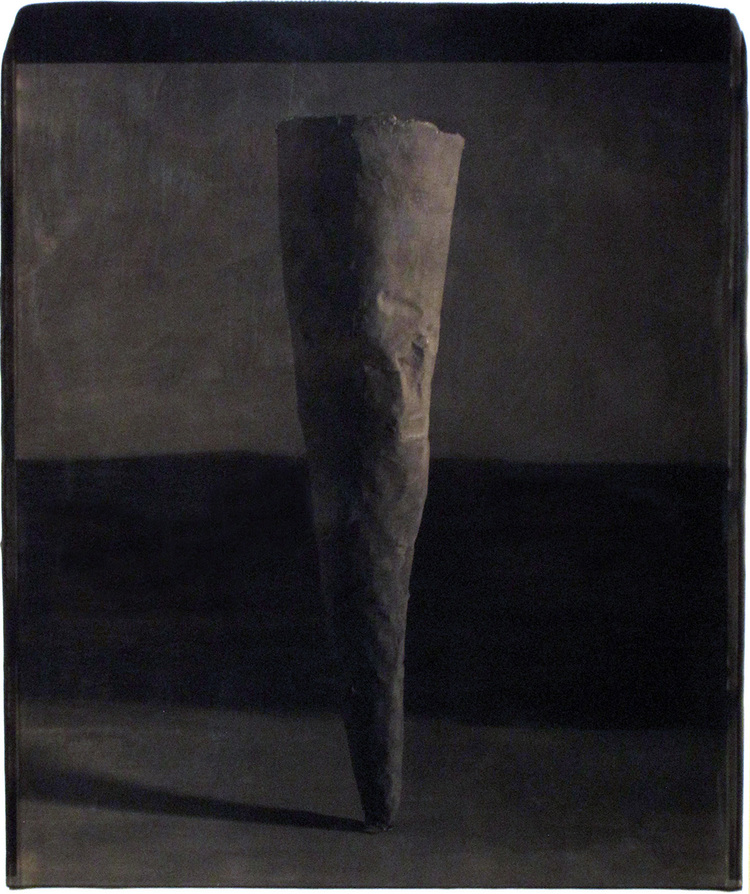
John Divola (American, b. 1949) 'Cone, 87CN09' 1987


John Divola (American, b. 1949)
Cone, 87CN09
1987
Black and White Polapan Print (Polaroid)
20 x 24 inches
© John Divola


FINALLY… two postings on consecutive days by conceptual artists who use photography to document their staging, performance, sculpture, body, earth-body, action art, found art, land art – WORK THAT I REALLY LIKE AND CAN REALLY CARE ABOUT.

I care about both artists work not so much because of the quality of the photography but because of their passion, insight, ideas and general human nous, their need to understand humans and the worlds we inhabit: that INTELLIGENCE necessary for understanding what is true or real, using their intuition to root out, to dig down into the human psyche.

In this posting Divola eloquently investigates the mysterious process of creation through imagination (only for the original “model” then to be destroyed); the notion of photographic authenticity and an interrogation of the human impulse to master the natural world; photography at its most deceptively naturalistic revealing hidden, dead animals; and the landscape altered by human presence and staged to serve as a theatre for creative activity through the “captured” act of running away.

Dr Marcus Bunyan


Many thankx to the Los Angeles County Museum of Art (LACMA) for allowing me to publish the photographs in the posting. Please click on the photographs for a larger version of the image.


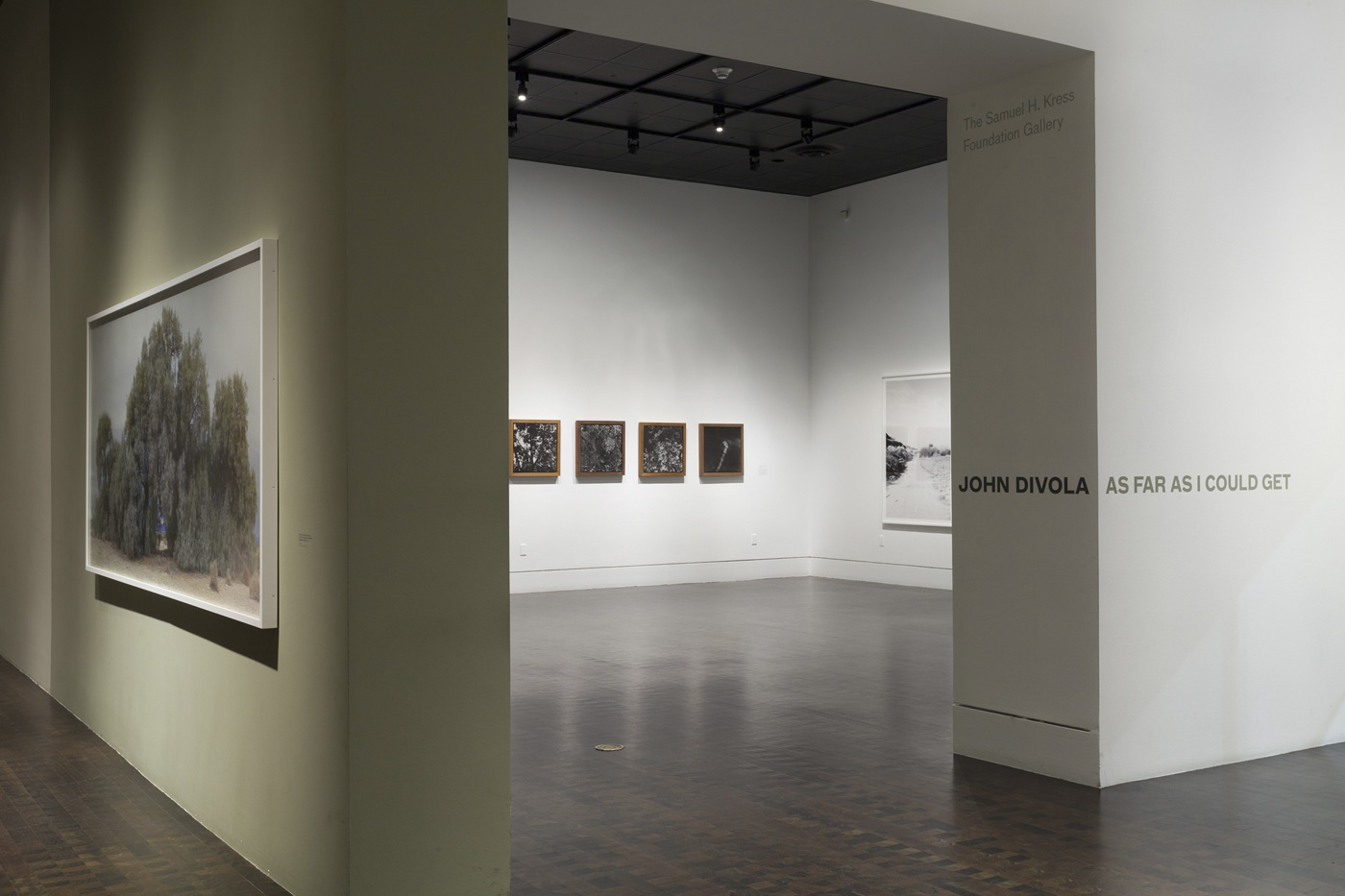
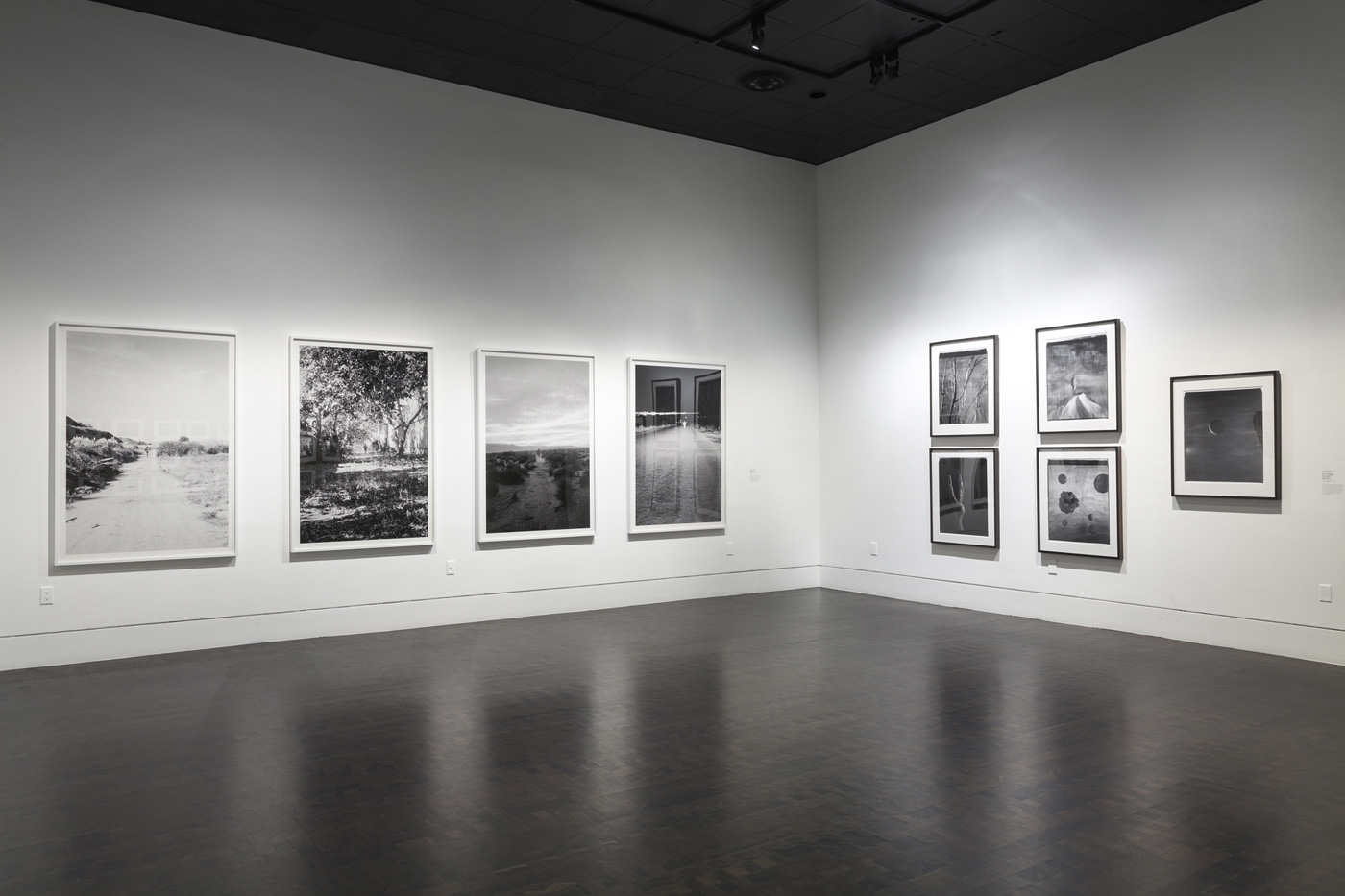
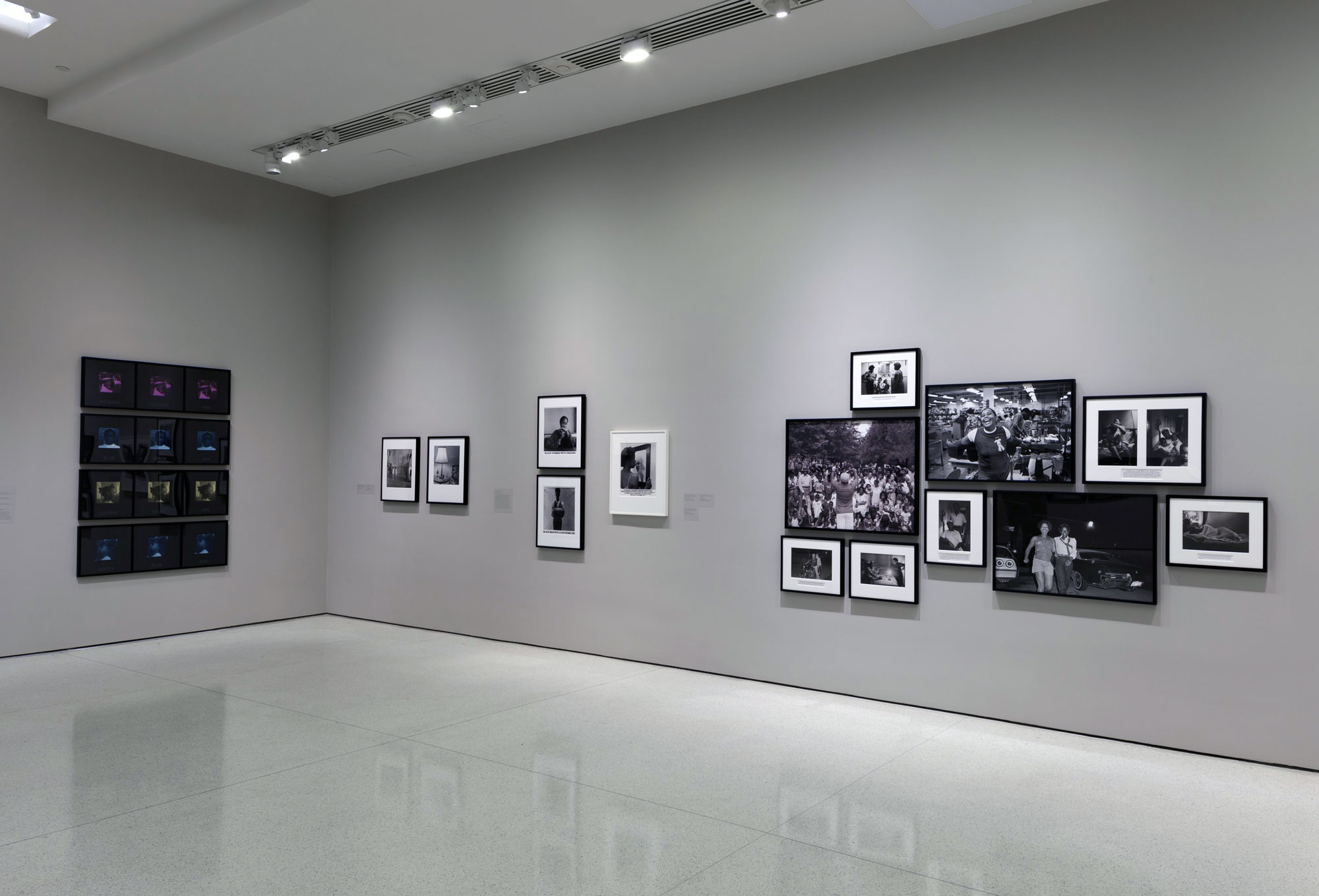
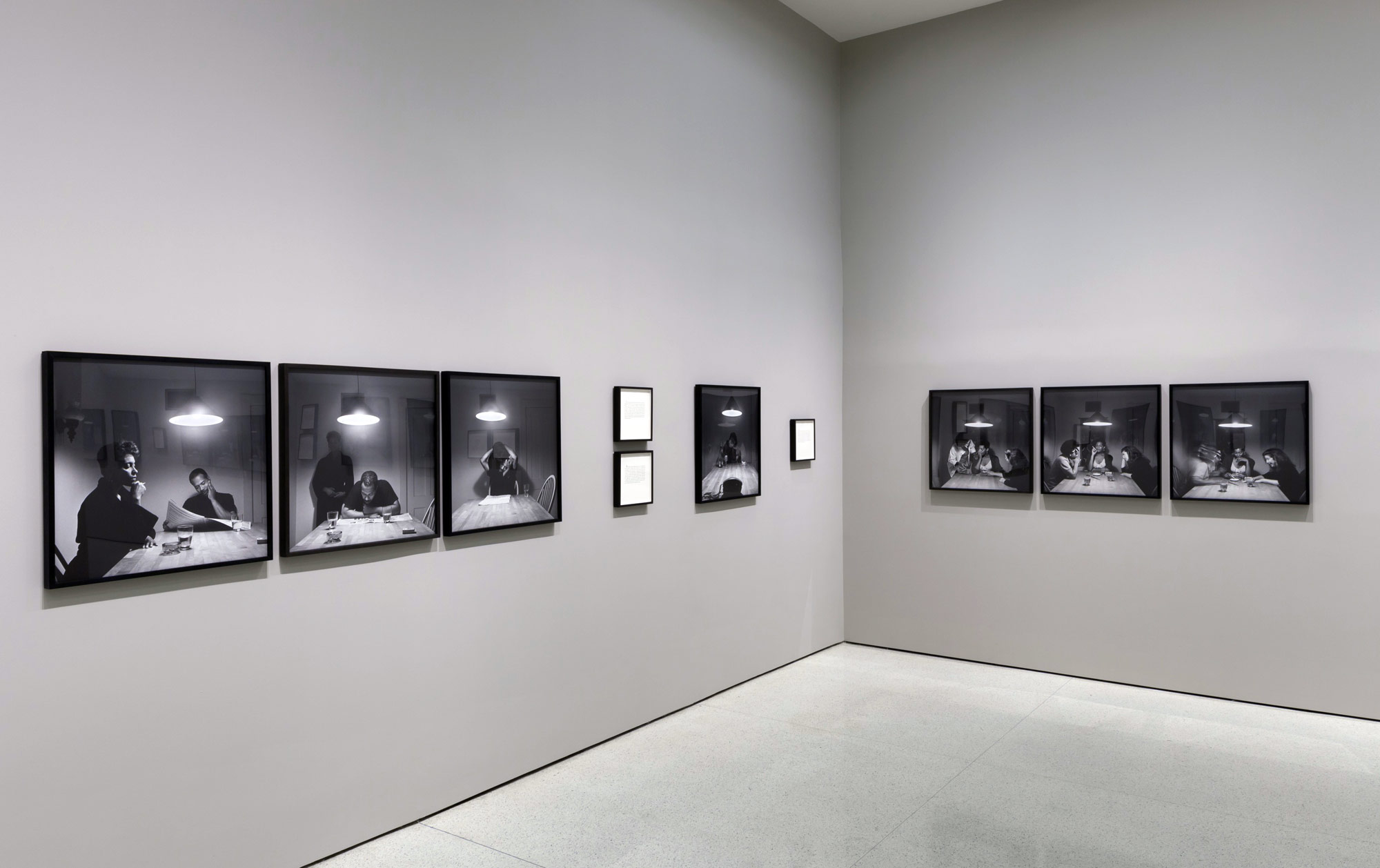
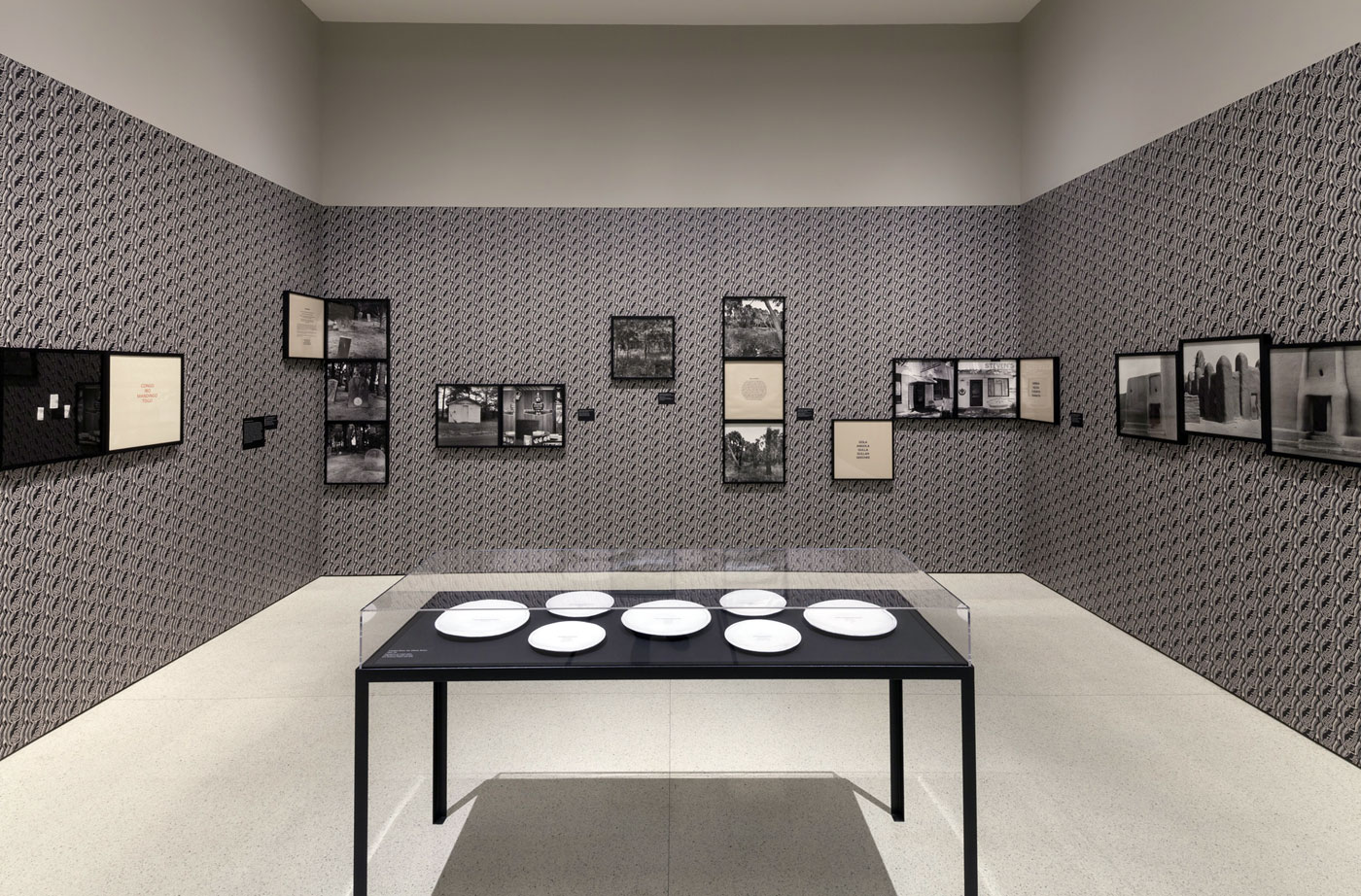
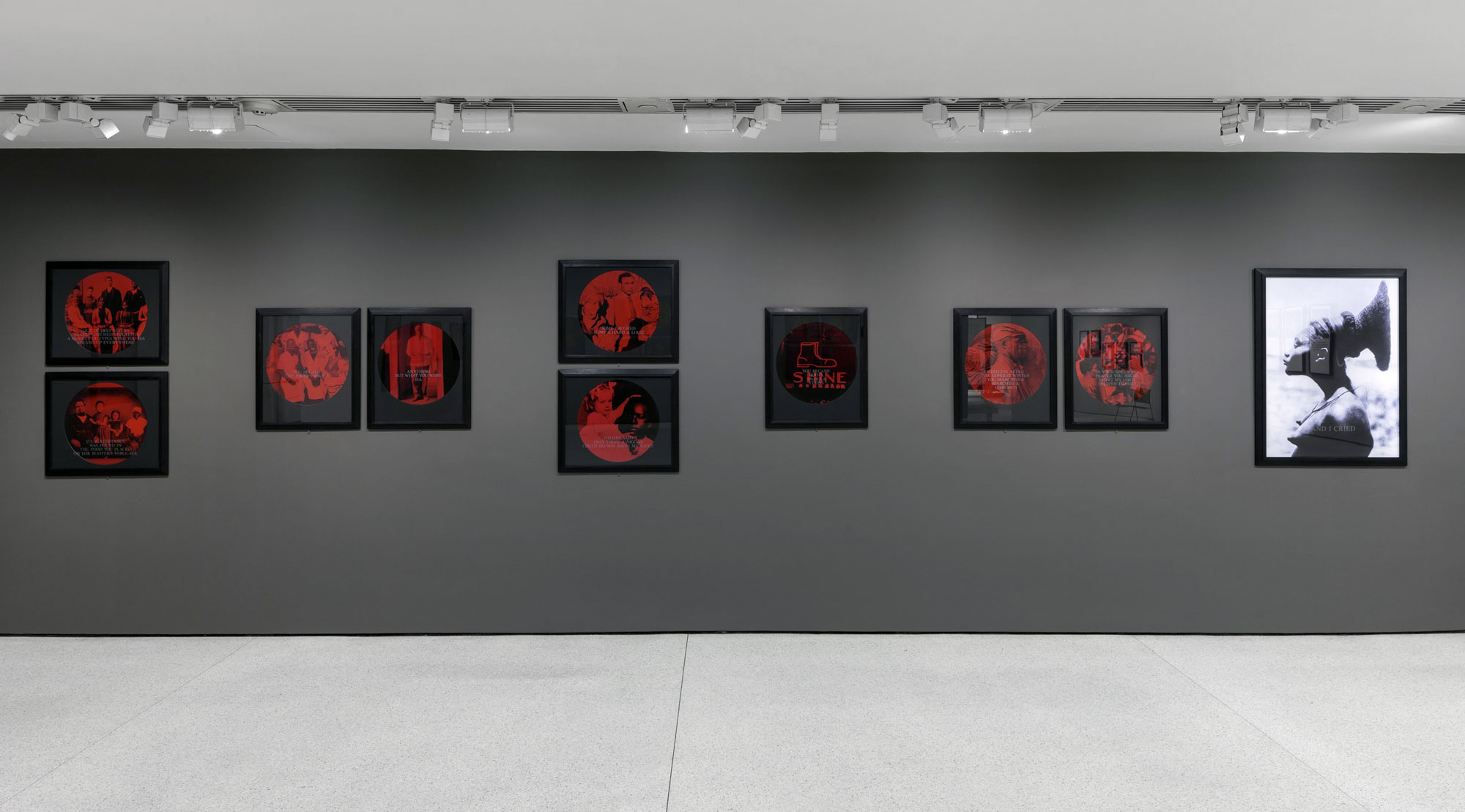
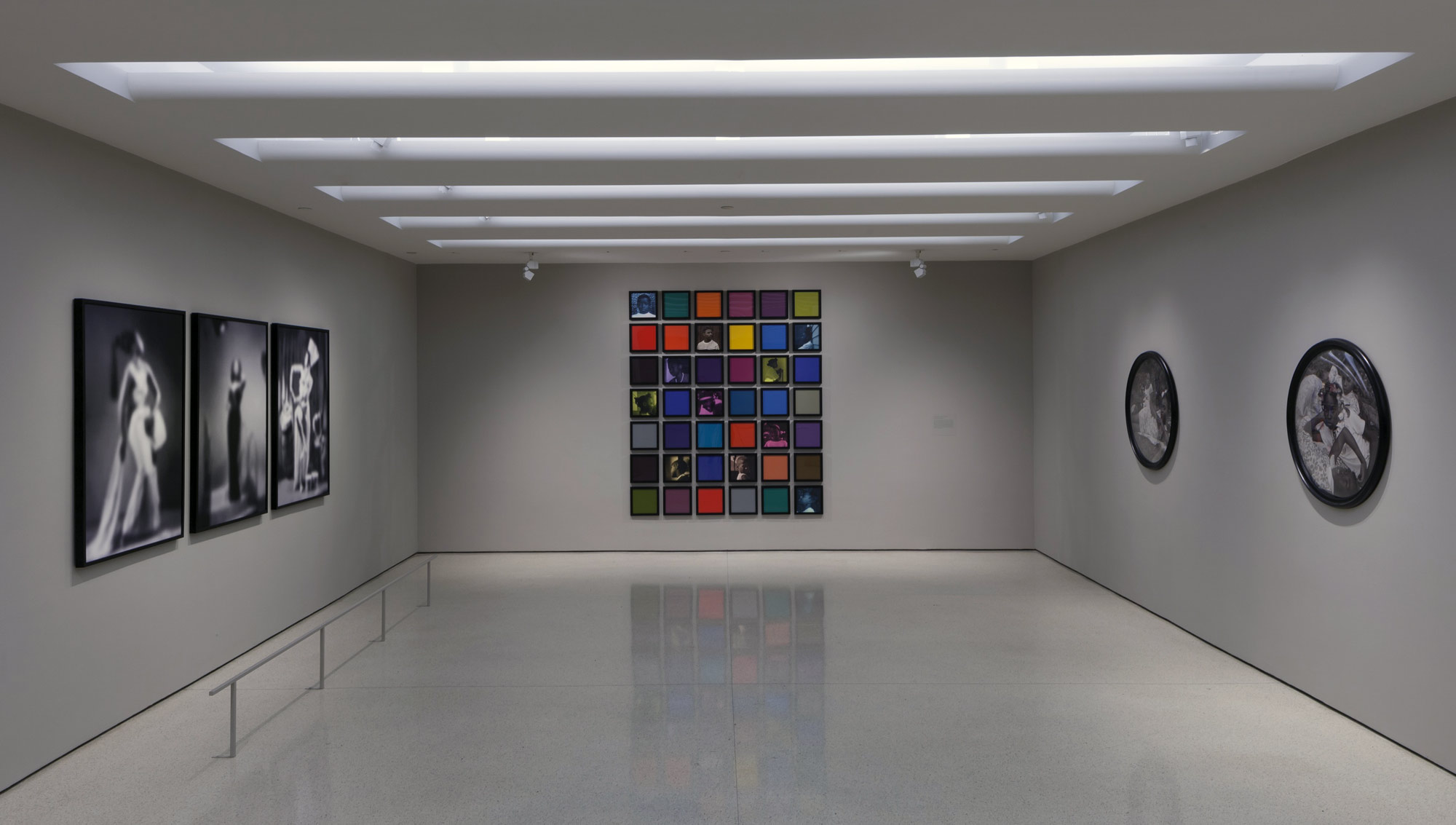
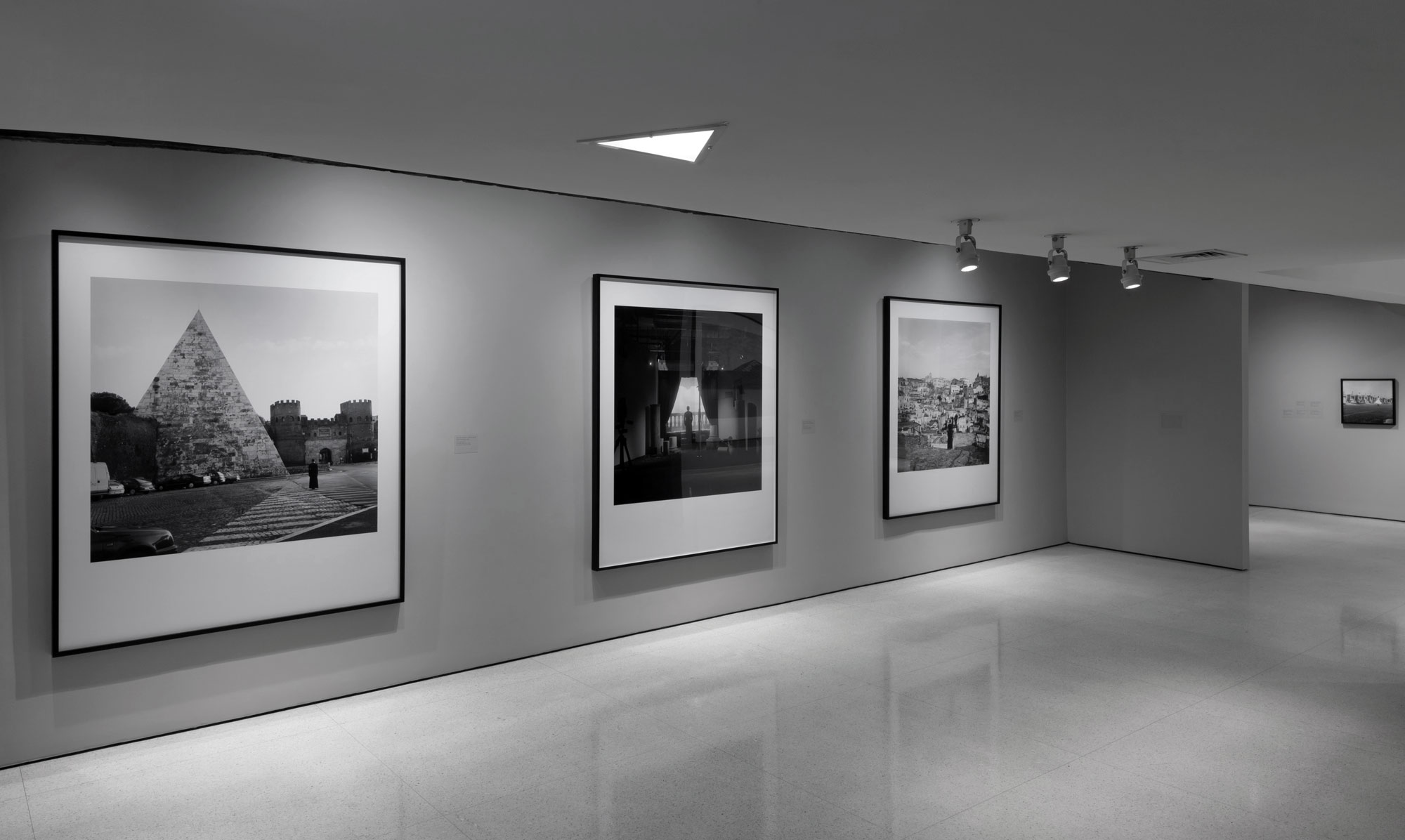
Installation view of 'John Divola: As Far As I Could Get' at the Los Angeles County Museum of Art (LACMA)

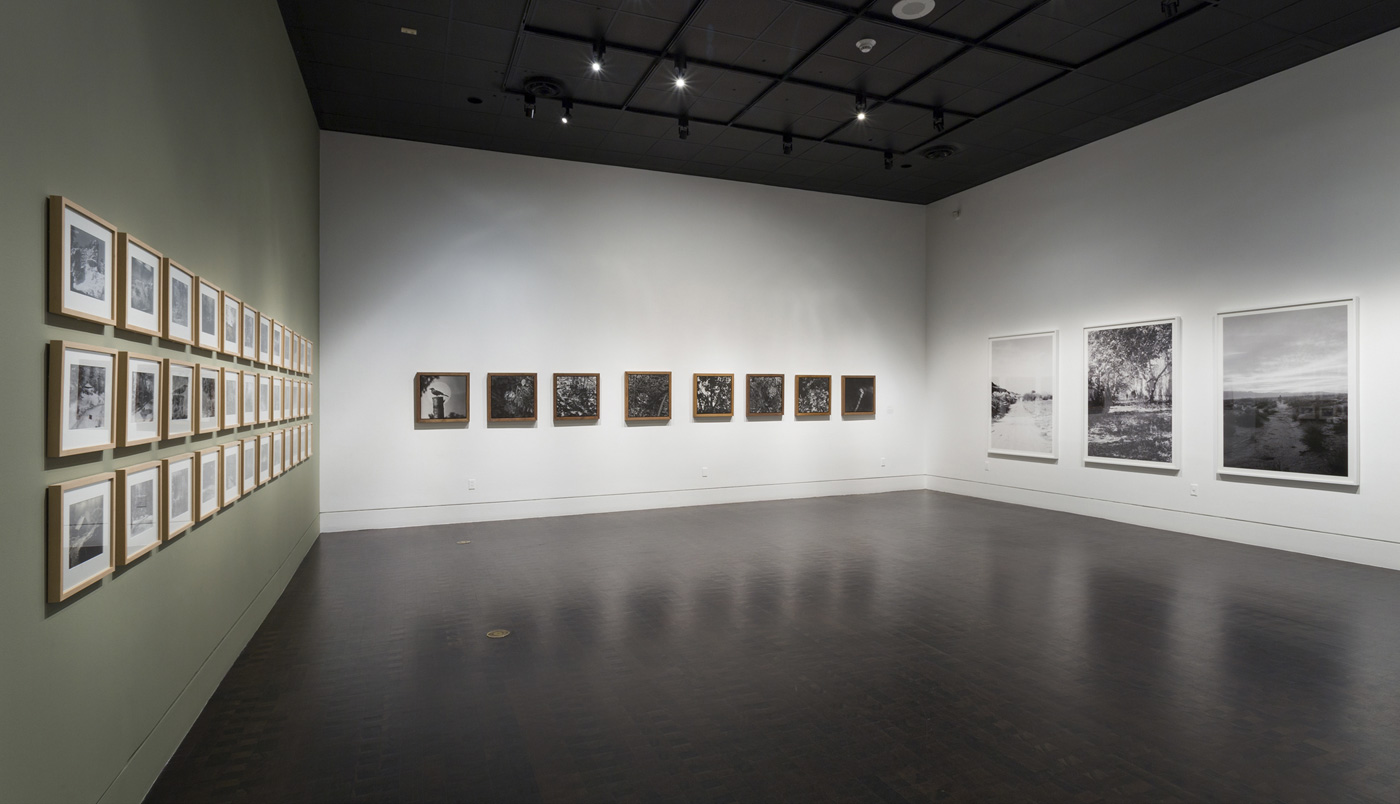
Installation view of 'John Divola: As Far As I Could Get' at the Los Angeles County Museum of Art (LACMA)

Installation view of 'John Divola: As Far As I Could Get' at the Los Angeles County Museum of Art (LACMA)


Installation views of John Divola: As Far As I Could Get at the Los Angeles County Museum of Art (LACMA)
© John Divola
Photo
© 2013 Museum Associates/LACMA


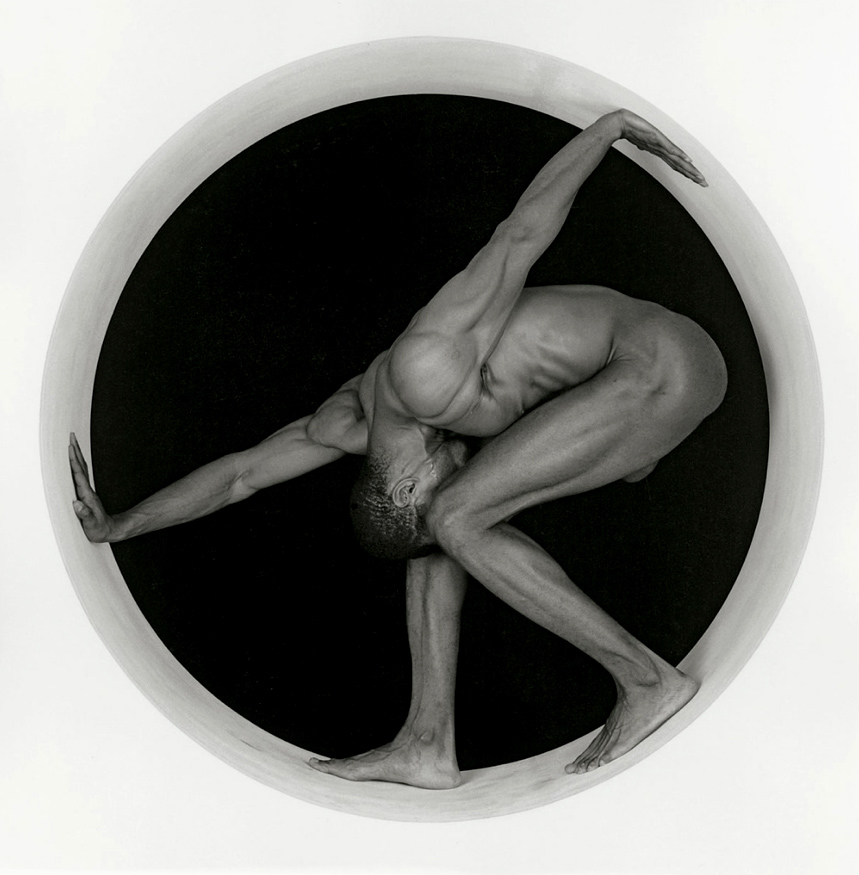
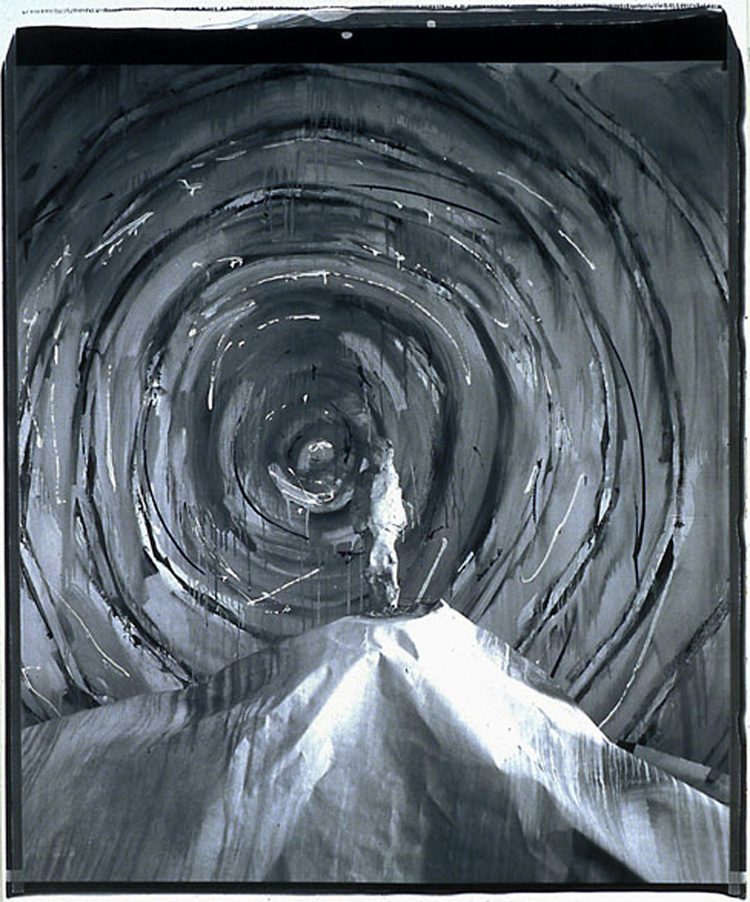
John Divola (American, b. 1949) 'Man in Vortex, 87CA2' 1987


John Divola (American, b. 1949)
Man in Vortex, 87CA2
1987
Black and White Polapan Print (Polaroid)
20 x 24 inches
© John Divola


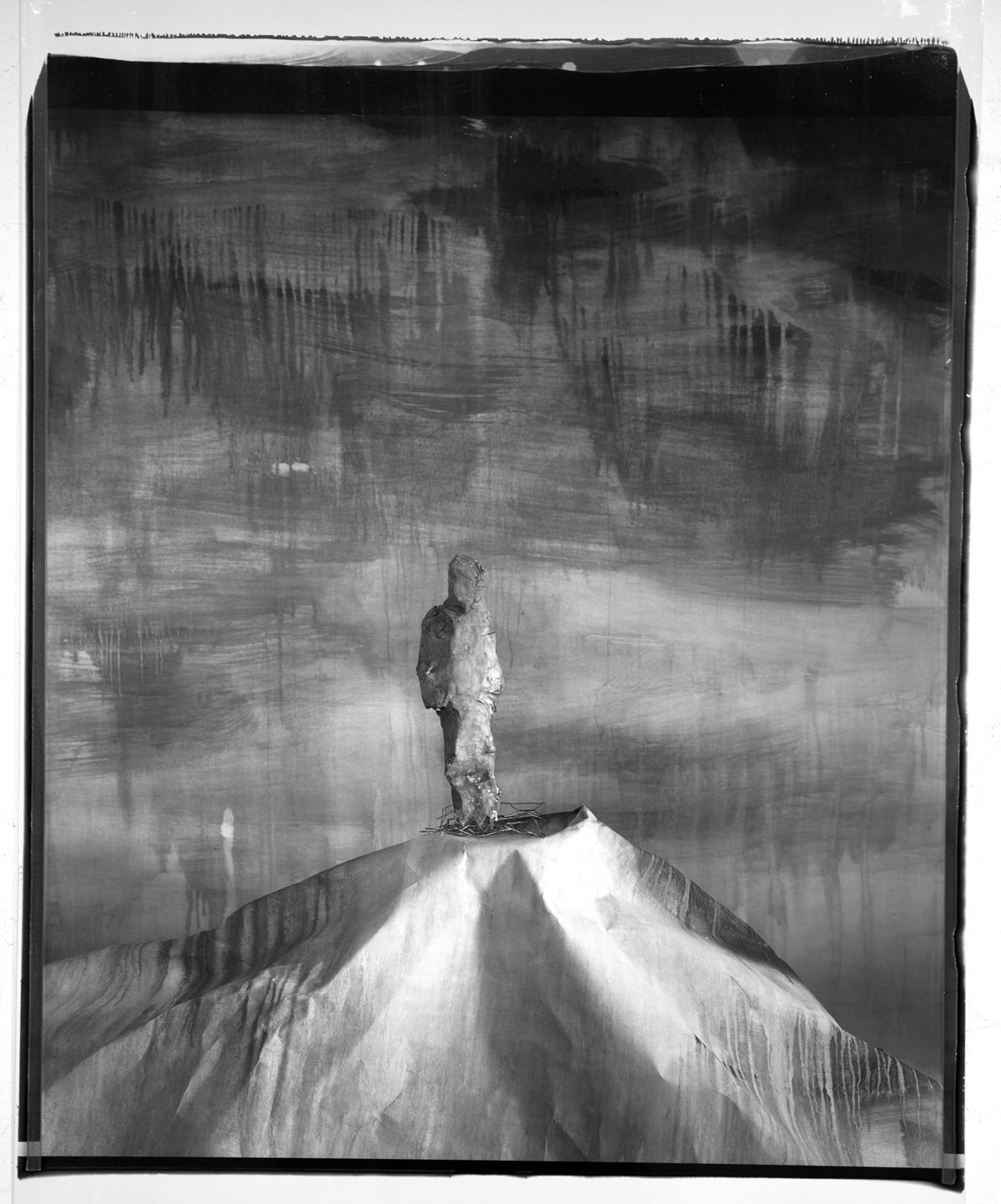
In Divola’s words, the Polaroids feature “The photograph as an object has an relationship to that which it represents, something like the relationship the snake skin has to the snake that sheds it. The relationship of something dead to something living.” The Polapan prints especially lend themselves to this associate with skin. Their plasticity and their alchemical marks bear witness to a mysterious process of creation; their subject matter conjured up, and then discarded. Divola’s “studio constructions,” as he called them, were temporary structures made solely for the purpose of photographic depiction, including funnels, human and animal figures, and expressively painted backdrops. Divola’s photographs are themselves echo chambers: they replicate and reverberate light from objects that have long since vanished.

Divola’s process has important photo-conceptual precedents: Richard Long’s photographic records of lines made by walking, Jan Dibbets’ play with optical illusion through the camera’s lens, or Robert Smithson’s Yucatan Mirror Displacements. Divola’s work, though, is equally in conversation with the work of Jasper Johns. Johns, known for his paintings of numbers, flags, maps, and targets, focused on flat subjects as a means to conjoining the surface of subject matter with a painting’s flat picture plane. Divola has transmuted the achievements and medium-specificity of high modern painting into images that explore photography’s mimetic qualities and its sheer surface. These are images are about a recognisable reality we cannot access, dim echoes of a familiar world, yet one that has vanished.

“JOHN DIVOLA – Echo Chamber” on the Gallery Luisotti website [Online] Cited 01/07/2014. No longer available online


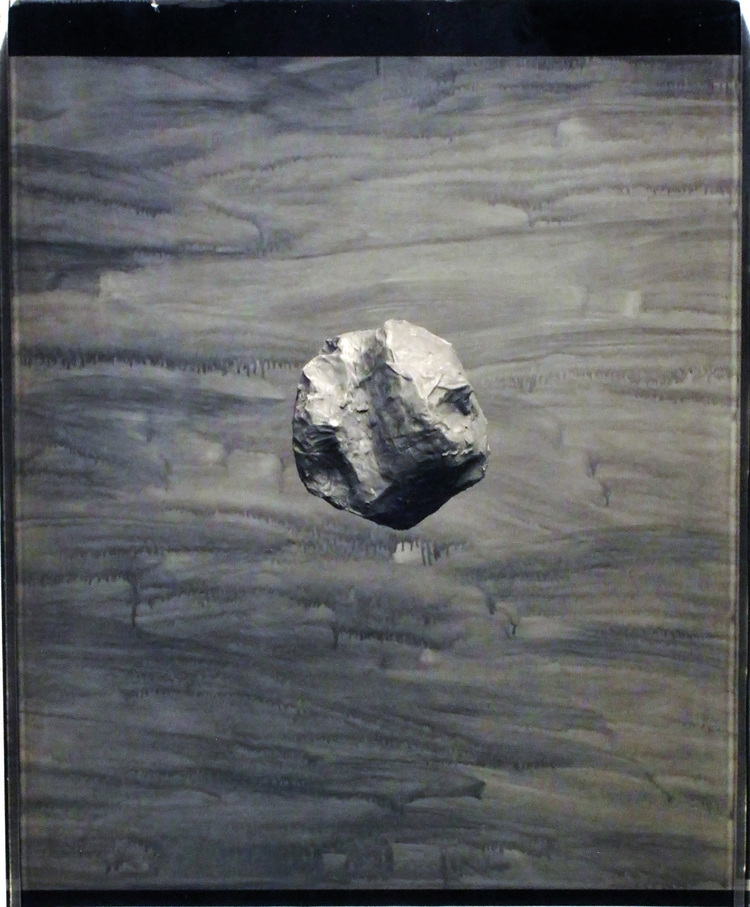
John Divola (American, b. 1949) 'Rock and Water #1, 88RW1' 1988


John Divola (American, b. 1949)
Rock and Water #1, 88RW1
1988
Black and White Polapan Print (Polaroid)
20 x 24 inches
© John Divola


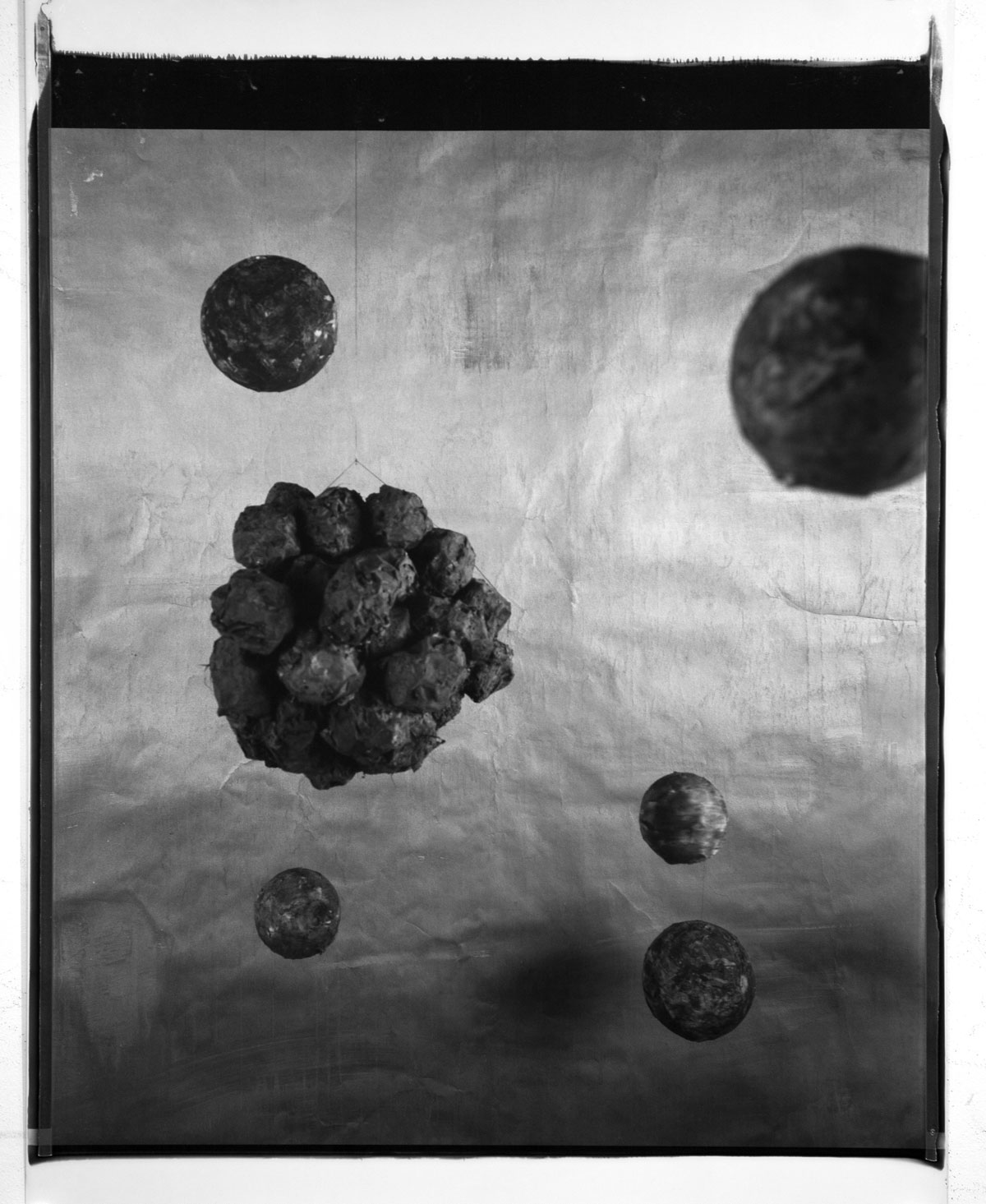
John Divola (American, b. 1949) 'Cells, 87CA1' 1987-1989


John Divola (American, b. 1949)
Cells, 87CA1
1987-1989
Internal Dye-diffusion print
20 x 24 inches
© John Divola


John Divola (American, b. 1949) 'Man on Hill, 89MHA1' 1987-1989


John Divola (American, b. 1949)
Man on Hill, 89MHA1
1987-1989
Internal Dye-diffusion Print
20 x 24 inches
© John Divola


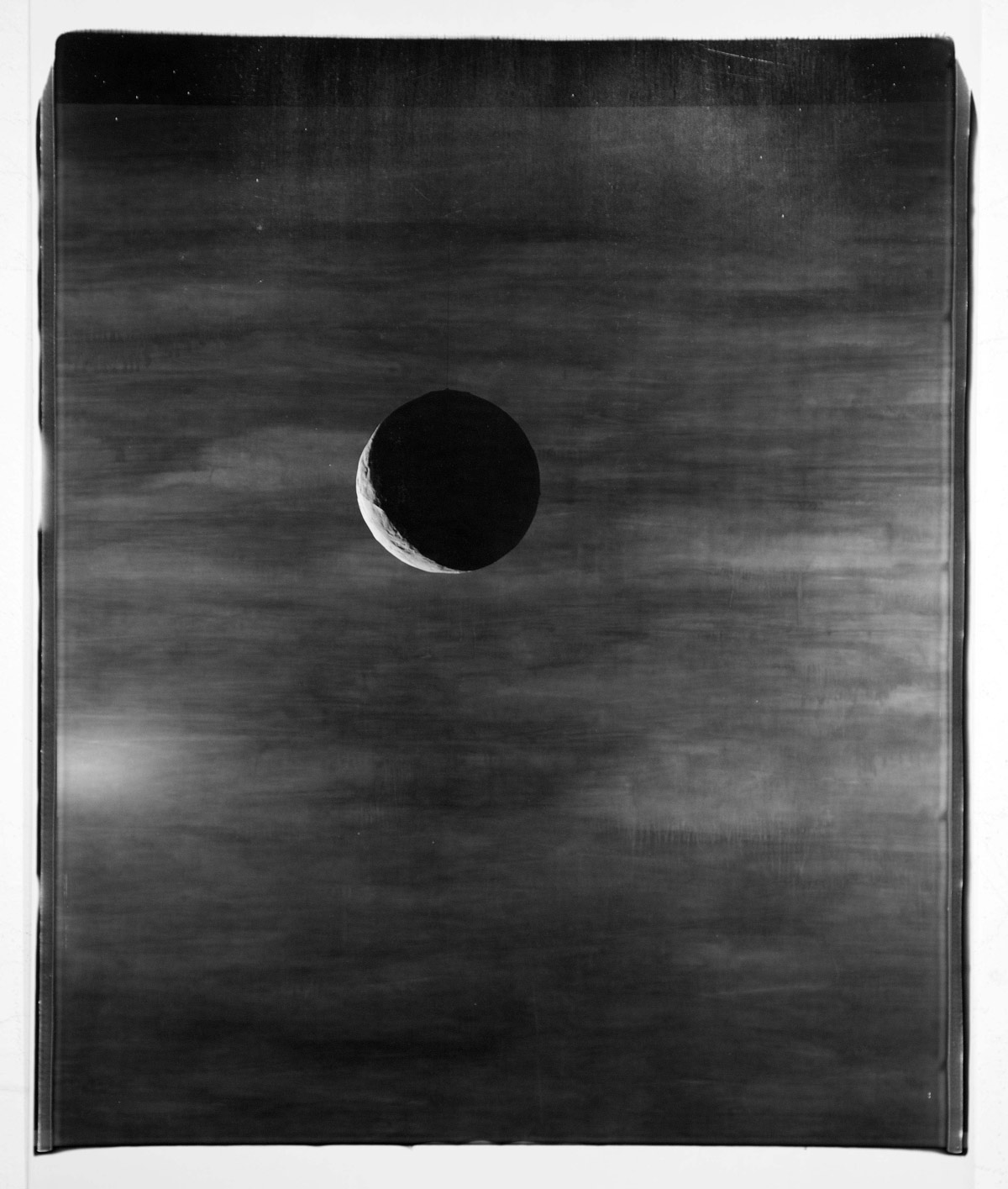
John Divola (American, b. 1949) 'Moon, 88MOA1' 1988


John Divola (American, b. 1949)
Moon, 88MOA1
1988
Internal Dye-diffusion print
20 x 24 inches
Courtesy of the artist
© John Divola


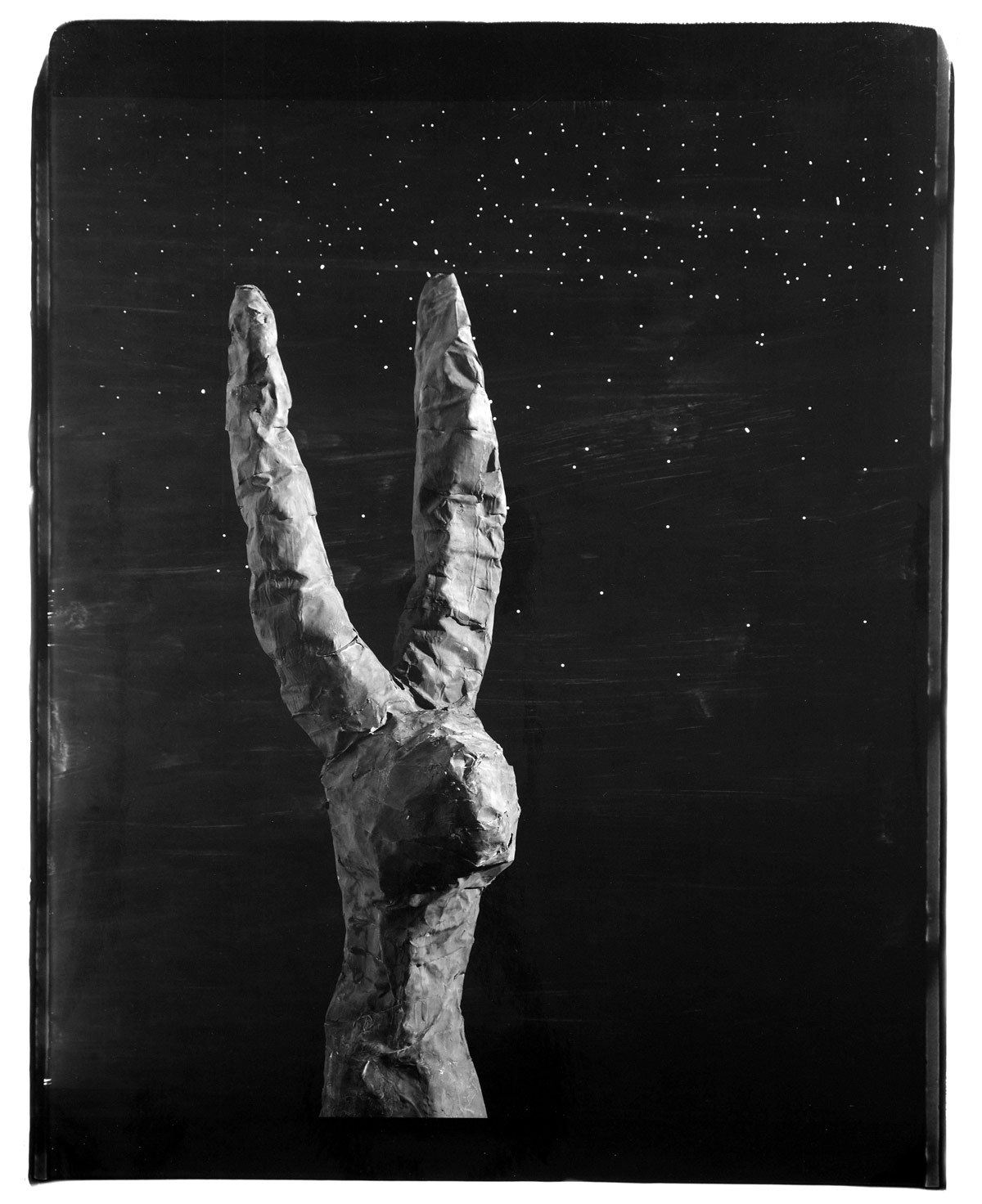
John Divola (American, b. 1949) 'Rabbit, 87RBA1' 1987


John Divola (American, b. 1949)
Rabbit, 87RBA1
1987
Internal Dye-diffusion print
20 x 24 inches
Courtesy of the artist
© John Divola


John Divola (American, b. 1949) 'Artificial Nature' (detail, 1 of 36) 2002


John Divola (American, b. 1949)
Artificial Nature (detail, 1 of 36)
2002
Gelatin Silver Print
8 x 10 in.
Los Angeles County Museum of Art, purchased with funds provided by the Ralph M. Parsons Fund and the Photographic Arts Council, 2013
© John Divola


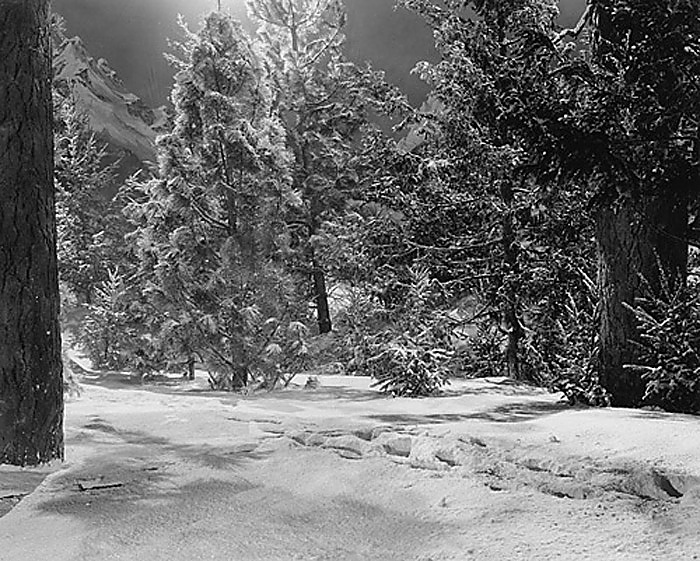
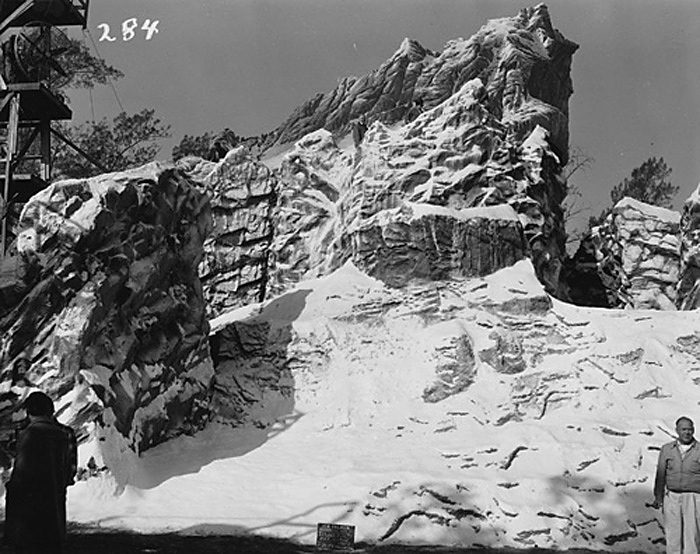
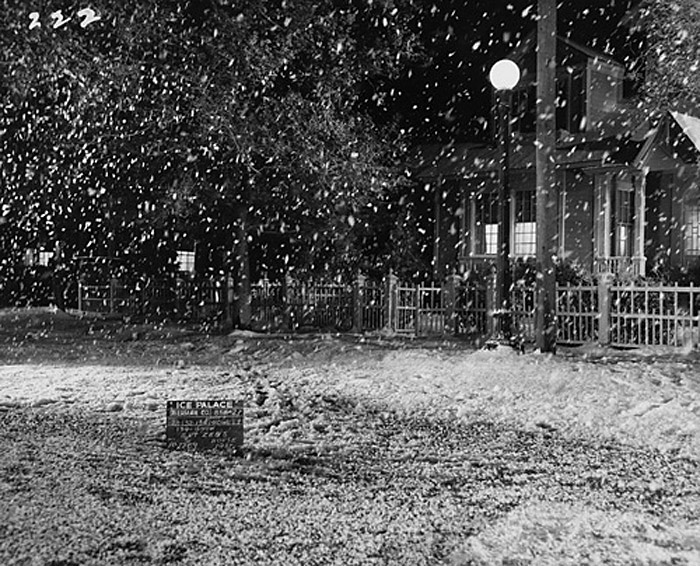
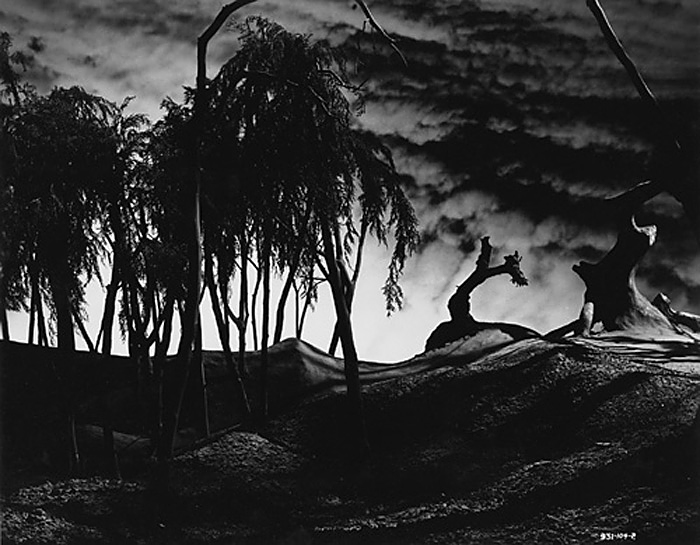
Across the gallery is a series of found photographs, “Artificial Nature” (2002), made up of continuity stills (the photographs taken on film sets to make ensure uniformity from scene to scene) from mid-century films. The photographs show fabricated landscapes created in studio backlots. The images zero in on the notion of photographic truth – the idea that when you look at a photograph, what you’re seeing is an accurate representation of the world – by presenting a false natural landscape. Without outside knowledge, upon first glance, the photographs look like ordinary landscapes.

Maxwell Williams. “John Divola’s SoCal Moment,” on the Art in America website [Online] Cited 01/07/2014. No longer available online


“Artificial Nature” (2002) stands out, and as with many of Divola’s series, the bluntness of the title belies the delicacy and actual locus of interest. Composed of thirty-six “continuity stills”, these black and white prints have been repurposed from movie studio archives, framed and hung in a tight grid. Ranging in provenance from the 1930s to the 1960s, each picture documents a movie set dressed as a lush, natural landscape. A clapperboard sign planted in the foreground might identify the scene as “wooded hillside” or “the beach.” At once romantic and businesslike, the series opens a delicious gap between intention and effect. To view these pictures only through the lens of nature vs. artifice would be reductive and superficial at best. Treat them instead as a peek into the cabinetry of early pop mechanics, or evidence of a peculiar temporality where worlds should be fixed with a sign because they so routinely congeal and vanish.

Kristin Posehn. “John Divola: As Far As I Could Get,” on The Miami Rail website [Online] Cited 01/07/2014.


John Divola (American, b. 1949) 'Artificial Nature' (detail, 1 of 36) 2002

John Divola (American, b. 1949) 'Artificial Nature' (detail, 1 of 36) 2002

John Divola (American, b. 1949) 'Artificial Nature' (detail, 1 of 36) 2002

John Divola (American, b. 1949) 'Artificial Nature' (detail, 1 of 36) 2002


John Divola (American, b. 1949)
Artificial Nature (detail, 4 of 36)
2002
Gelatin Silver Print
8 x 10 in.
Los Angeles County Museum of Art, purchased with funds provided by the Ralph M. Parsons Fund and the Photographic Arts Council, 2013
© John Divola


With a career compromising four decades, John Divola is as distinctive for his commitment to the photographic community as for his thought-provoking work, Divola’s influence within the field of photography is widely recognised by curators, critics, scholars and photographers throughout the country; yet, his work has remained largely uncelebrated. Many of his former students have achieved illustrious careers and far more recognition, even as Divola continues to mentor and inspire both undergraduate and graduate students in contemporary practice.

As Far As I Could Get is the first over-arching presentation of Divola’s work and is a collaborative project led by the Santa Barbara Museum of Art (SBMA), shown simultaneously at SBMA, the Los Angeles County Museum of Art (LACMA), and the Pomona College Museum of Art (PCMA) in the fall of 2013. Though Divola’s photographic series are diverse in subject matter, this approach as one exhibition among three Southern California venues emphasises the consistent conceptual and performative threads that run through Divola’s entire body of work.

Divola was born in Los Angeles in 1949. After graduating with a BA from California State University, Northridge, he entered the MFA program at the University of California Los Angeles. There, under the tutelage of Robert Heineken, the artist began to develop his own unique photographic practice, one that merges photography, painting, and conceptual art. In addition to his own studio practice, he teaches contemporary art in the underserved California inland empire and writes on current photographic practice for a national audience.

John Divola’s photos of photographs range widely but the intellectual rigour from which they spring is unvarying. Whether testing the visual limits of photography by vandalising abandoned houses, interrogating the iconography of the divine through paint, flour, and film, or emphasising the distance between image and reality through the blurred figure of a running dog, Divola’s work is simultaneously fun and philosophical, visually appealing as well as intellectually stimulating.

LACMA On view: Four series of John Divola’s work in the Ahmanson Building, 2nd Floor

The series 20 x 24 Polaroids is Divola’s earliest work exhibited at LACMA, shot between 1987 and 1989. Hastily fabricated sculptures created out of impermanent materials attempt, on one level, to approximate actual physical objects in the world – branches, a rabbit, the moon, etc. At the same time, the roughly-hewn surfaces and ticky-tacky backdrops insist on the artificiality of what is depicted. These works express Divola’s ambivalence to the idea of photography as a descriptive medium with a one-to-one relationship to the real. Photography, in this case, is not employed in the service of documentary truth, but instead is held up as a crucial interlocutor in a creative exercise.

Artificial Nature (2002) offers a clear example of Divola’s interrogation of the human impulse to master the natural world. The work is a collection of 36 continuity stills from films made between the 1930s and the 1960s. These photographs, taken on film sets to establish consistency across multiple cuts (to ensure that the placement of objects remains constant from take to take), document fabricated landscapes contained within the artificial space of the film studio. Representing the diversity of natural topographies add weather patterns, the images also include accessories such as signage and clapperboards, highlighting the distance between ourselves and the natural world – a distance that is only accentuated by cinematic representation.

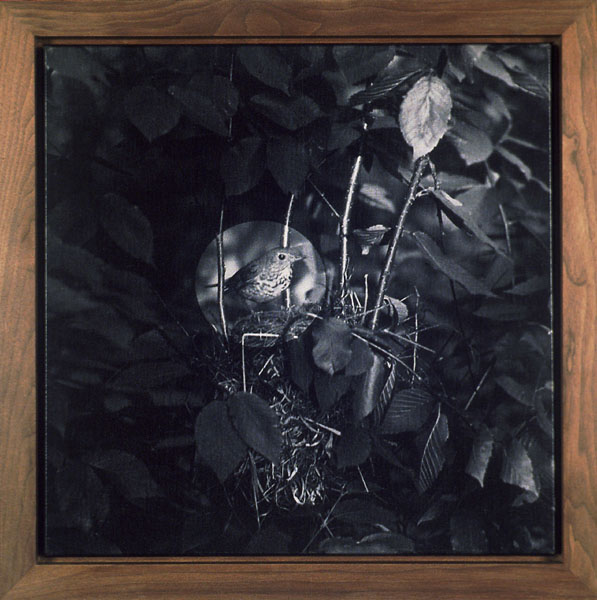
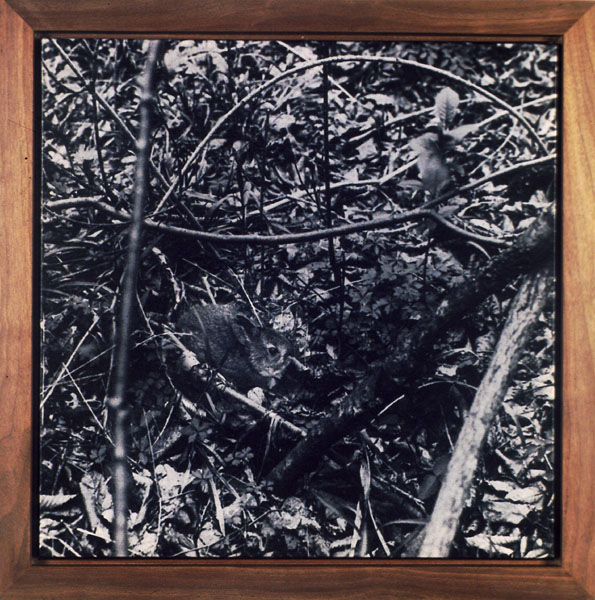
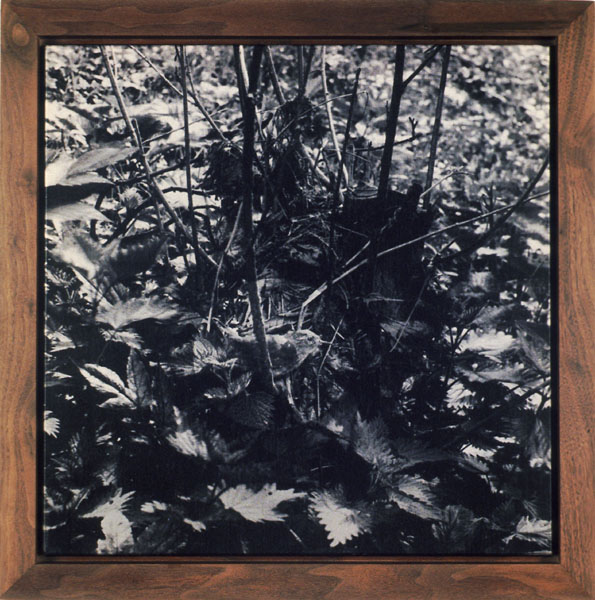
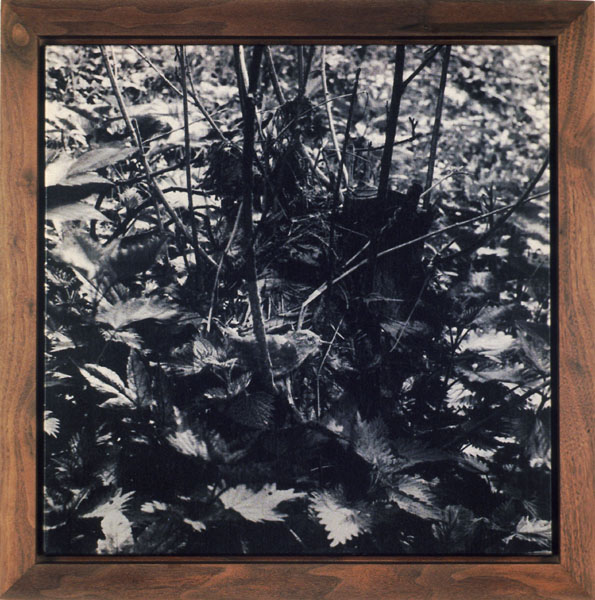
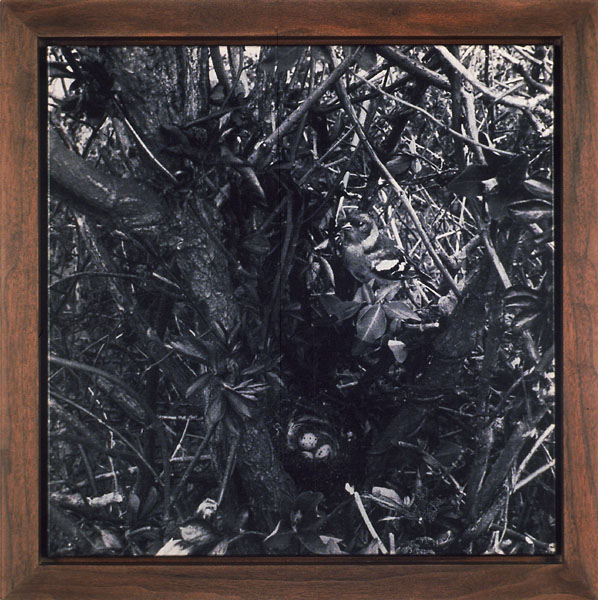
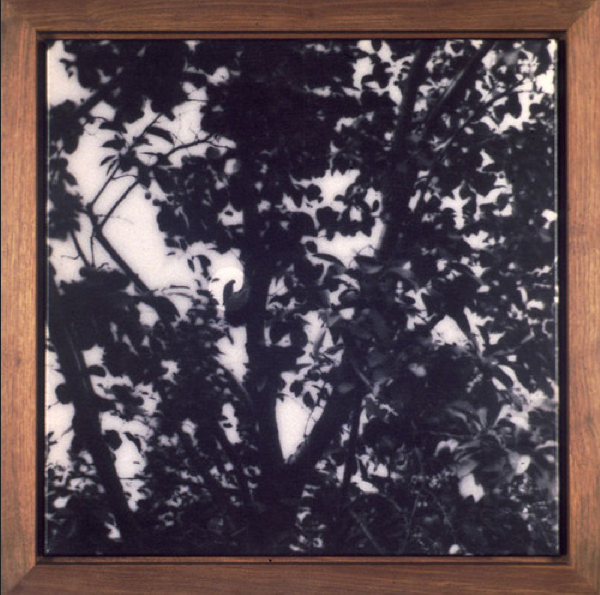
Seven Songbirds and a Rabbit (1995) is a series of details from the Keystone Mast collection of stereographic negatives housed at the California Museum of Photography, University of California Riverside. Stereoscopy, a three-dimensional imaging technology popular from the mid 19th to the early 20th century, exemplifies photography at its most deceptively naturalistic. When Divola began to examine the original glass-plate negatives in the Keystone collection, he found a wealth of detail, such as the birds and rabbit nestled amidst the foliage that gave the series its title.

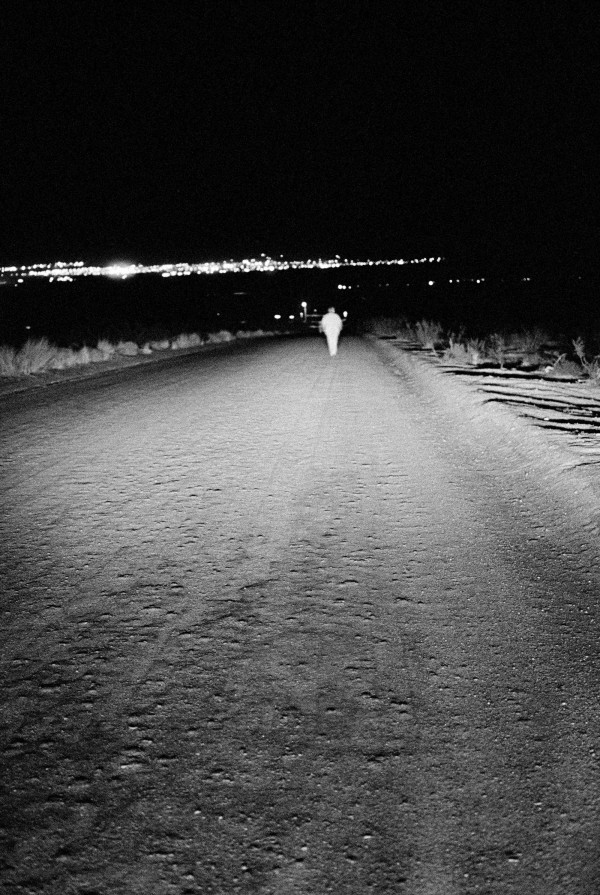
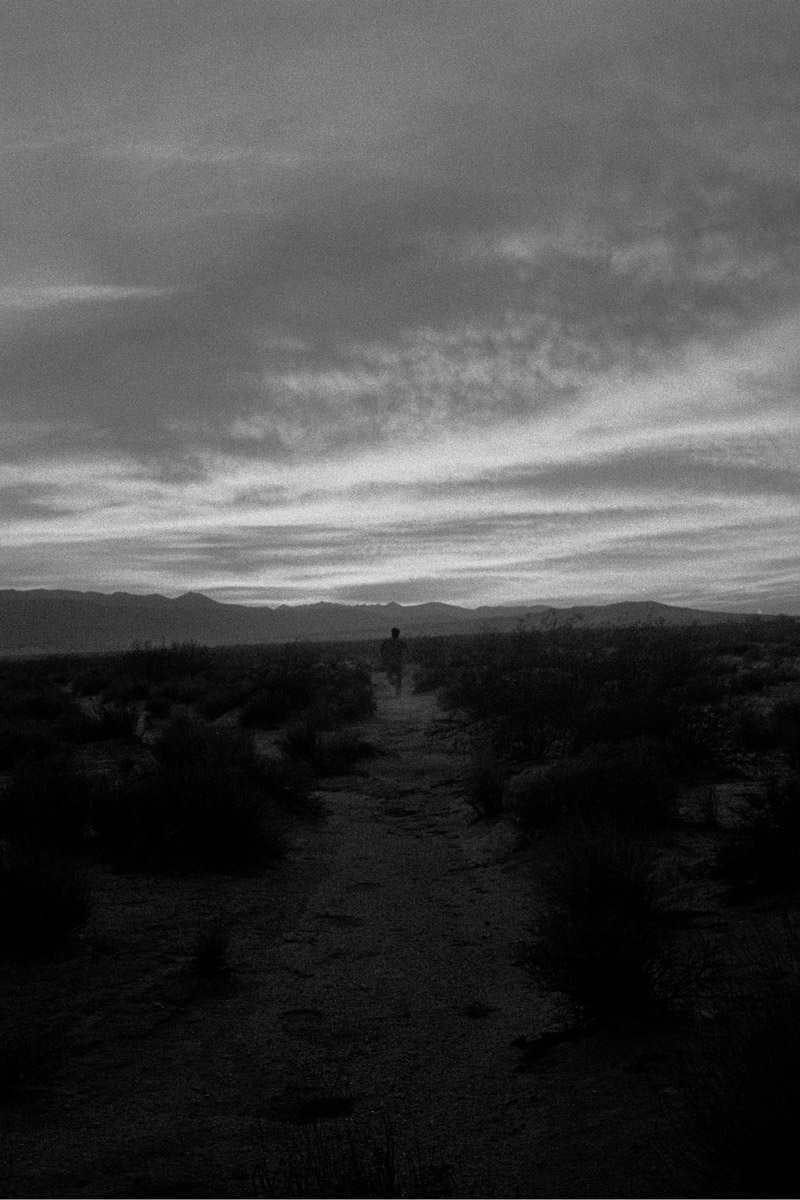
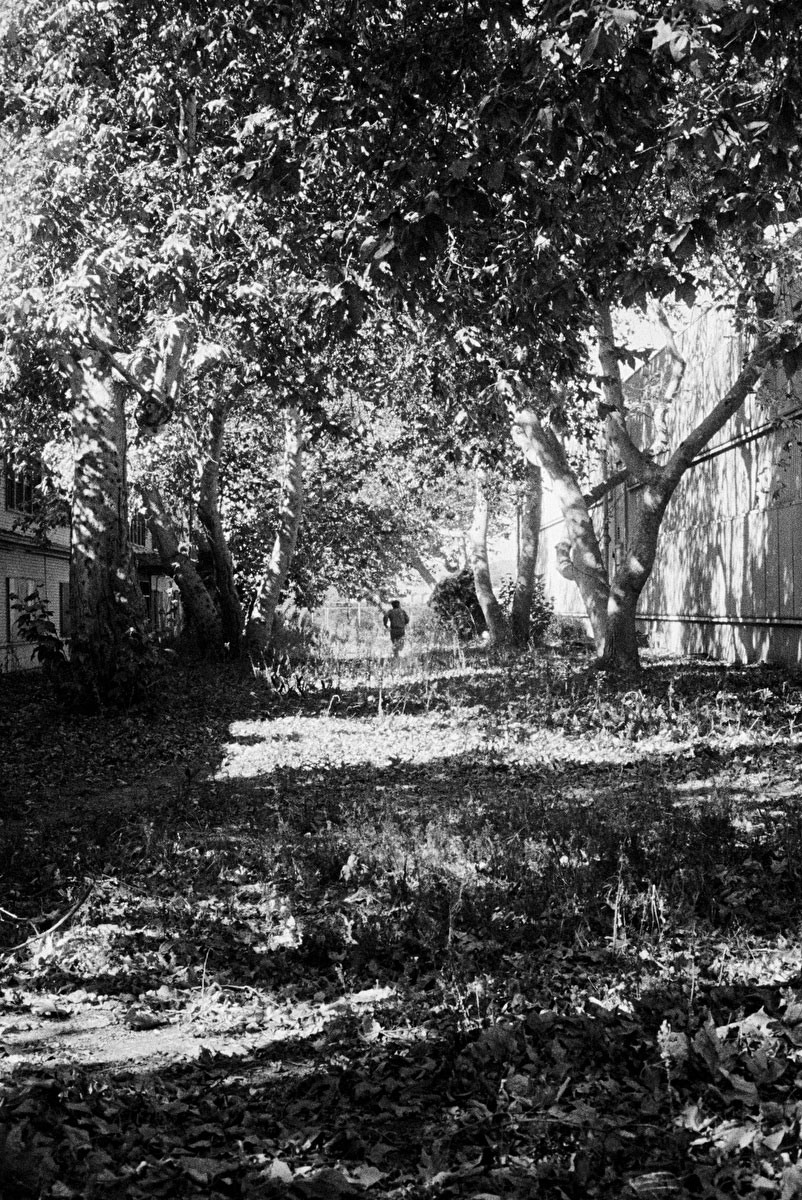
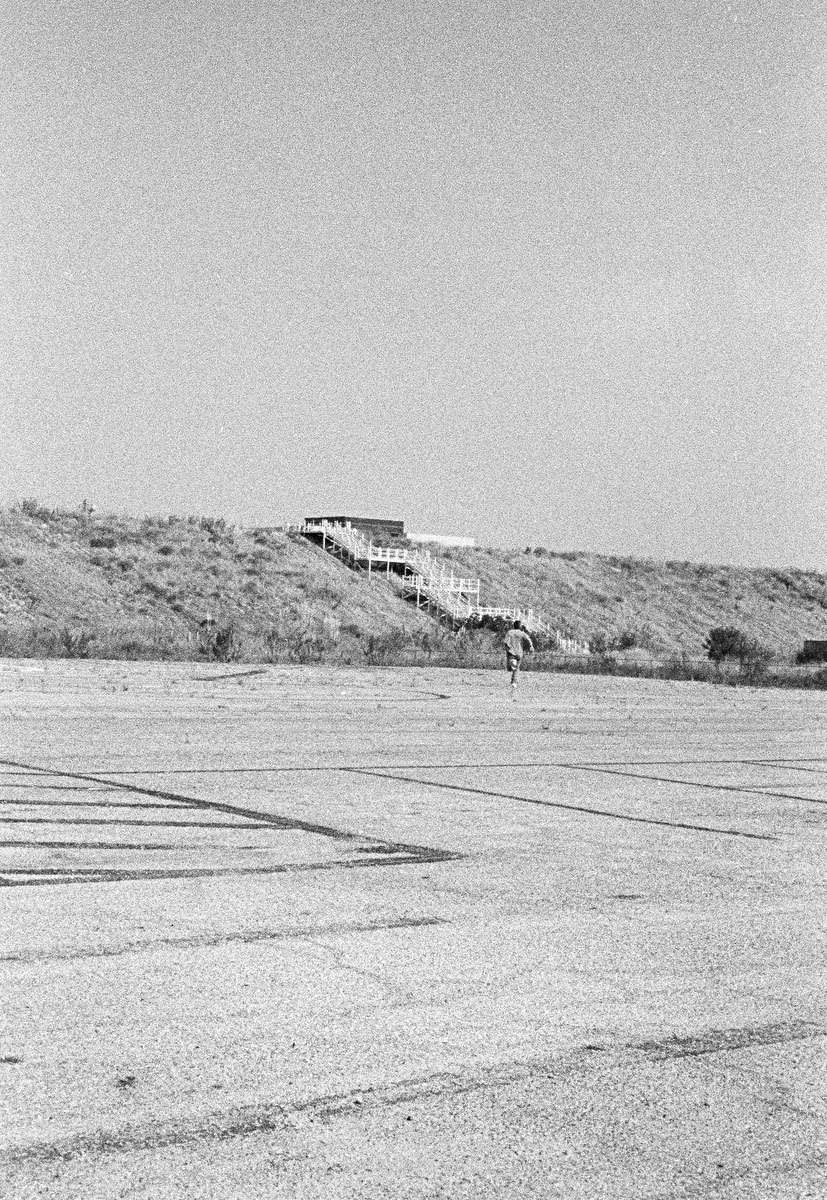
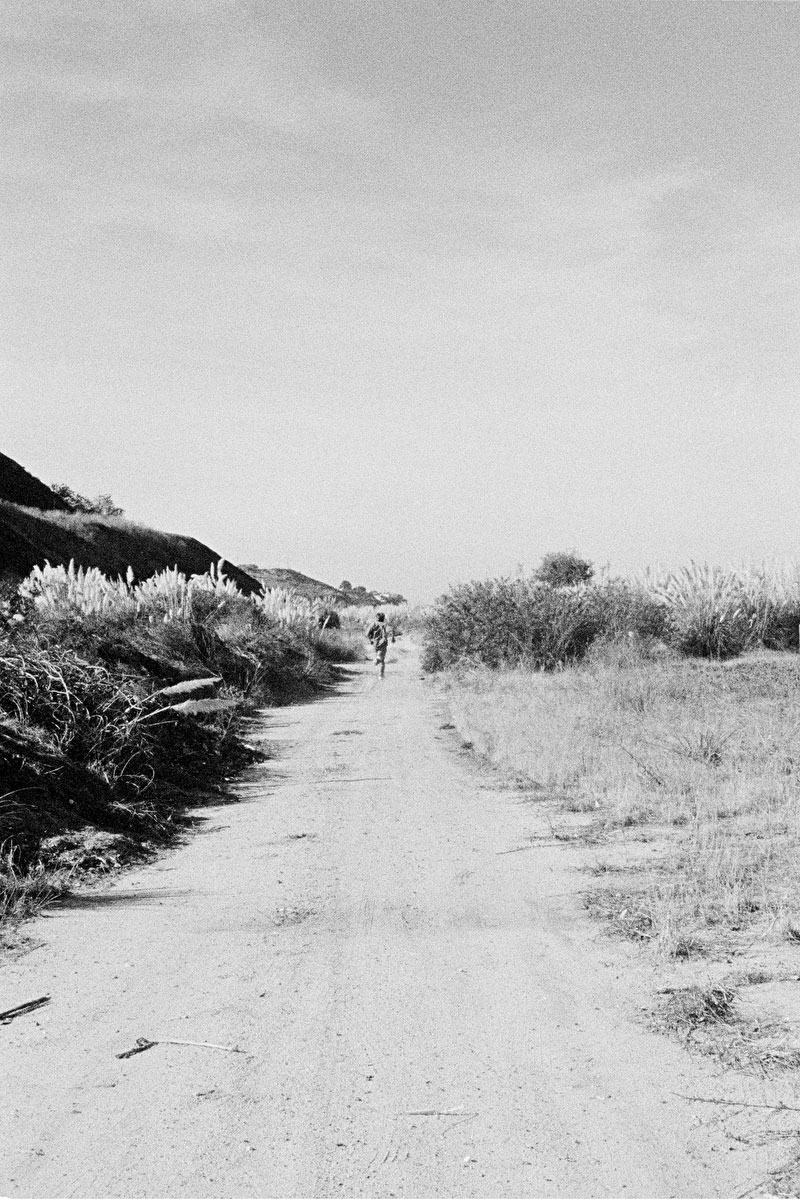
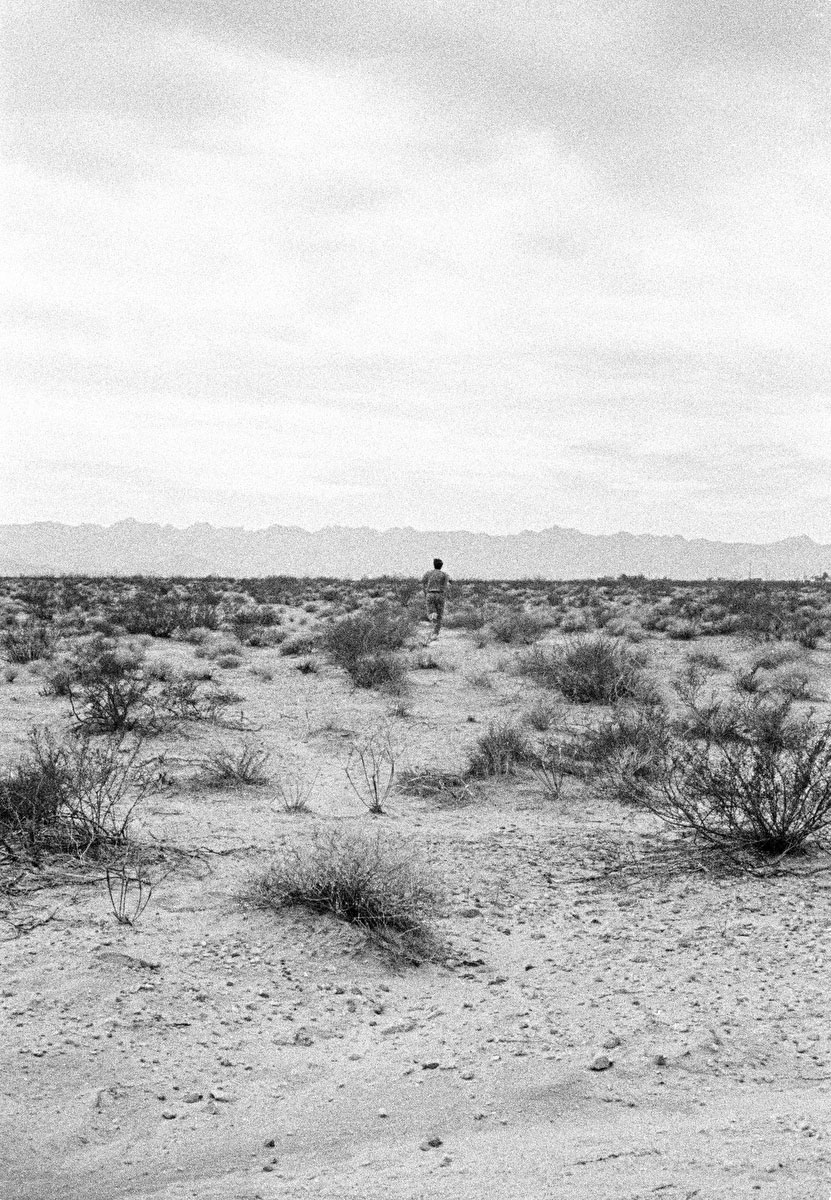
The series As Far As I Could Get (1996-2010), five works of which are included in the LACMA exhibition, has Divola once again engaging with the natural environment, but this time in a more performative vein. Divola positioned his camera on a tripod, set the timer for ten seconds, and then ran straight into the established frame. At one level, this was a completely dispassionate endeavour. On another level, because the resulting pictures depict a man in a landscape, not in a controlled experimental setting, the viewer cannot suppress a frisson of physical and emotional tension. The works engage the viewer with the natural landscape – a landscape altered by human presence and staged to serve as a theatre for creative activity.

Press release from the LACMA website


John Divola (American, b. 1949) 'Seven Songbirds and a Rabbit' 1995 (detail)

John Divola (American, b. 1949) 'Seven Songbirds and a Rabbit' 1995 (detail)

John Divola (American, b. 1949) 'Seven Songbirds and a Rabbit' 1995 (detail)

John Divola (American, b. 1949) 'Seven Songbirds and a Rabbit' 1995 (detail)

John Divola (American, b. 1949) 'Seven Songbirds and a Rabbit' 1995 (detail)

John Divola (American, b. 1949) 'Seven Songbirds and a Rabbit' 1995 (detail)


John Divola (American, b. 1949)
Seven Songbirds and a Rabbit (details)
1995
Gelatin Silver Print on Linen
20 x 20 inches
© John Divola


John Divola (American, b. 1949) 'As Far As I Could Get (R02F09), 10 Seconds' 1996-1997


John Divola (American, b. 1949)
As Far As I Could Get (R02F09), 10 Seconds
1996-1997
Pigment Print
60 x 40 inches
© John Divola


John Divola (American, b. 1949) 'As Far As I Could Get (R02F06), 10 Seconds' 1996-1997


John Divola (American, b. 1949)
As Far As I Could Get (R02F06), 10 Seconds
1996-1997
Pigment Print
60 x 40 inches
© John Divola


“Divola is a photographer who works in distinct conceptual series that span and stretch the reaches of photography as art. For instance, at LACMA, the works include a series called “As Far As I Could Get” (1996-2010), where Divola sets a 10-second timer and sprints as far from the camera as he can. It’s performative, simple, amusing and alienating – a tiny body in full physical exertion, far off in the landscape.”

Maxwell Williams. “John Divola’s SoCal Moment,” on the Art in America website [Online] Cited 01/07/2014. No longer available online.


John Divola (American, b. 1949) 'As Far As I Could Get (R02F33), 10 Seconds' 1996-1997


John Divola (American, b. 1949)
As Far As I Could Get (R02F33), 10 Seconds
1996-1997
Pigment Print
60 x 40 inches
© John Divola


John Divola (American, b. 1949) 'As Far As I Could Get, 10 Seconds' 1996-1997


John Divola (American, b. 1949)
As Far As I Could Get, 10 Seconds
1996-1997
Pigment Print
60 x 40 inches
© John Divola


John Divola (American, b. 1949) 'As Far As I Could Get, 10 Seconds' 1996-1997


John Divola (American, b. 1949)
As Far As I Could Get (R02F33), 10 Seconds
1996-1997
Pigment Print
60 x 40 inches
© John Divola


John Divola (American, b. 1949) 'As Far As I Could Get, 10 Seconds' 1996-1997


John Divola (American, b. 1949)
As Far As I Could Get (R02F33), 10 Seconds
1996-1997
Pigment Print
60 x 40 inches
© John Divola


Los Angeles County Museum of Art (LACMA)
5905 Wilshire Boulevard (at Fairfax Avenue)
Los Angeles, CA, 90036
Phone: 323 857 6000

Opening Hours:
Monday, Tuesday, Thursday: 11am – 6pm
Friday: 11am – 8pm
Saturday, Sunday: 10am – 7pm
Closed Wednesday

LACMA website

LIKE ART BLART ON FACEBOOK

Back to top

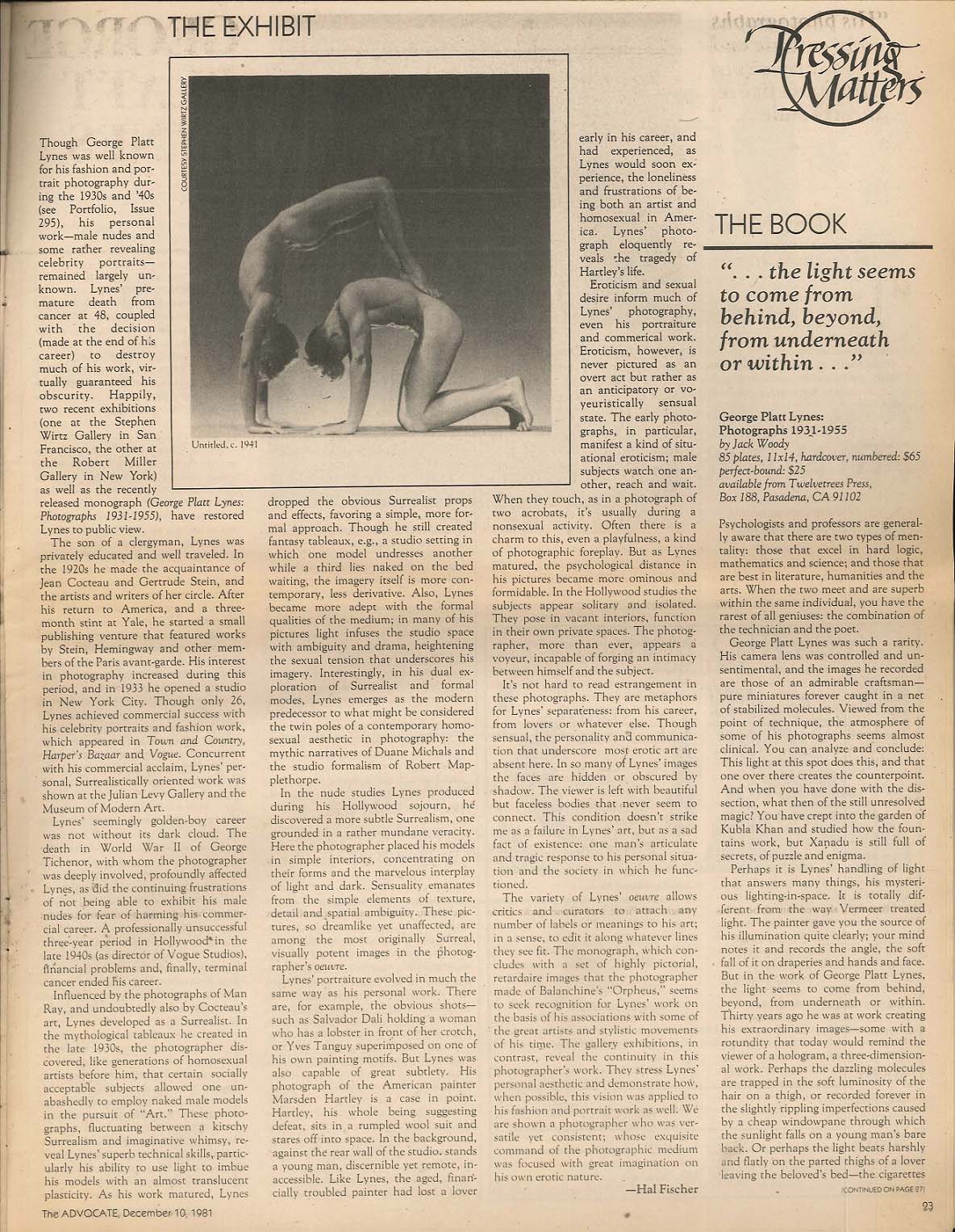
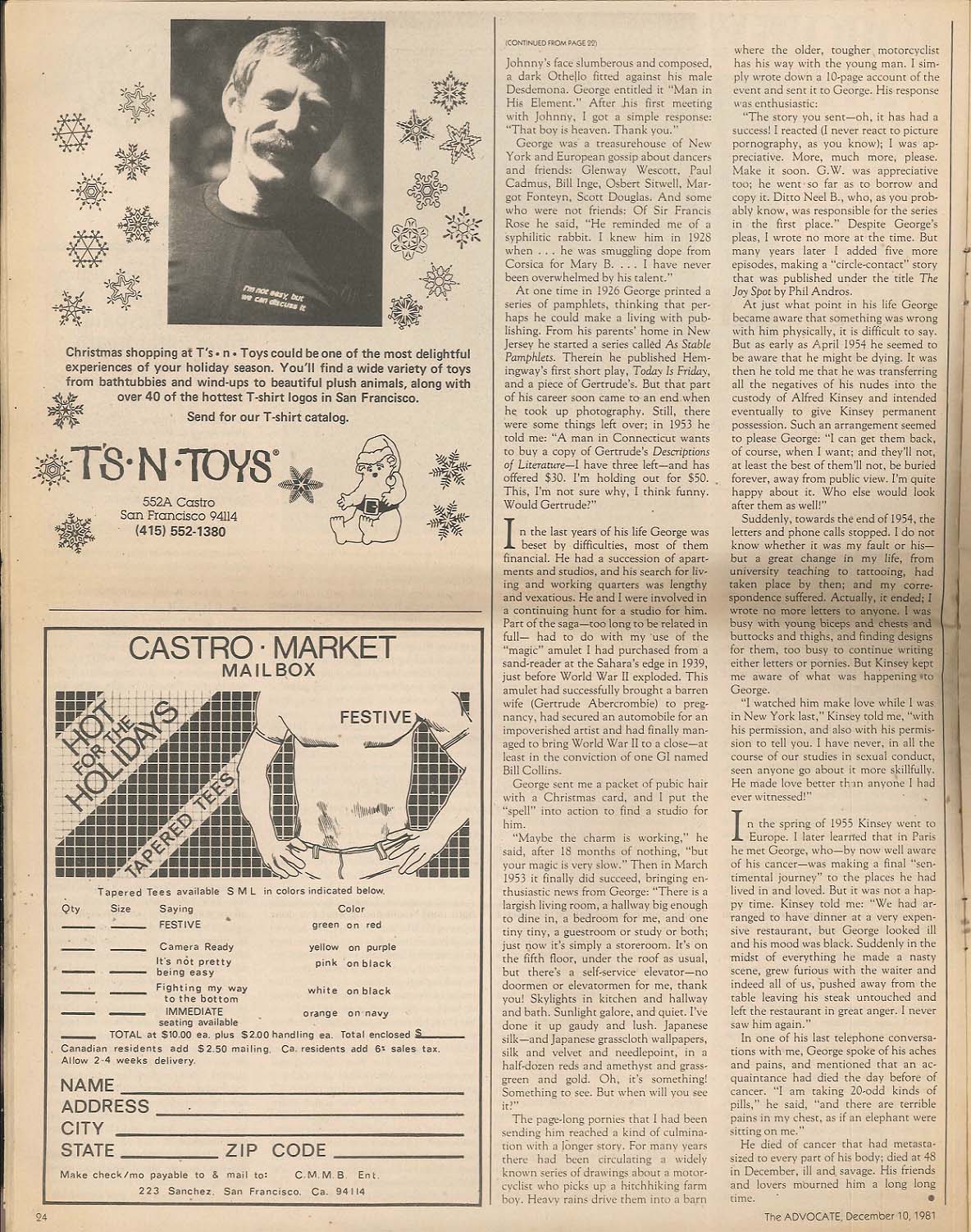
Photographs and text: George Platt Lynes and the male nude

June 2014

*PLEASE NOTE THIS POSTING CONTAINS ART PHOTOGRAPHS OF MALE NUDITY – IF YOU DO NOT LIKE PLEASE DO NOT LOOK, FAIR WARNING HAS BEEN GIVEN*


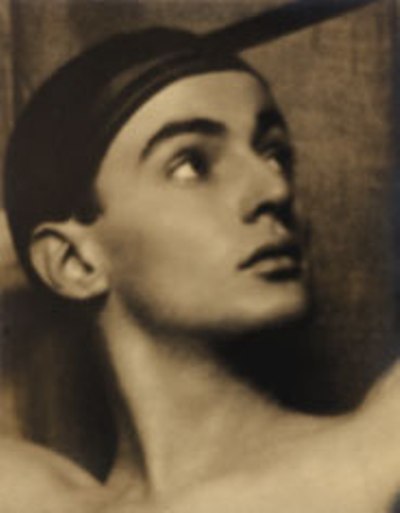
Man Ray (American, 1890-1976) 'George Platt Lynes' 1927


Man Ray (American, 1890-1976)
George Platt Lynes
1927


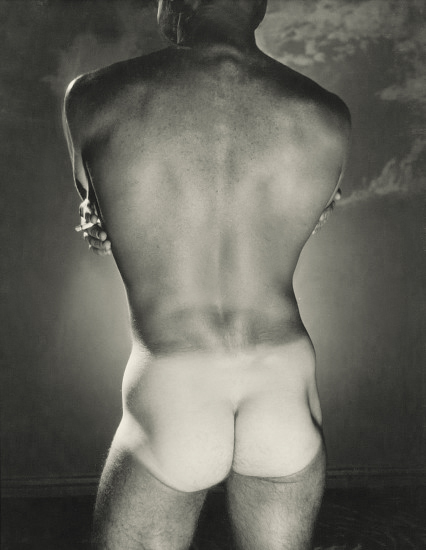
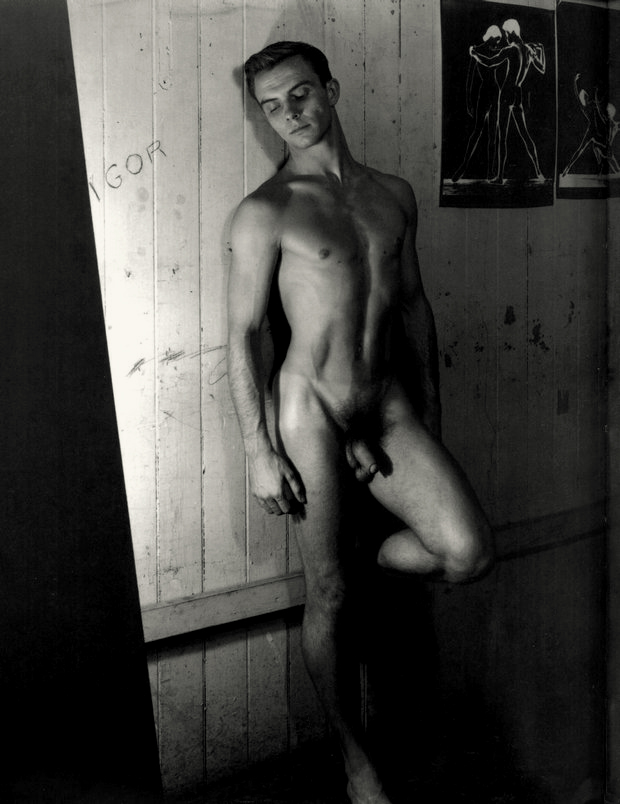
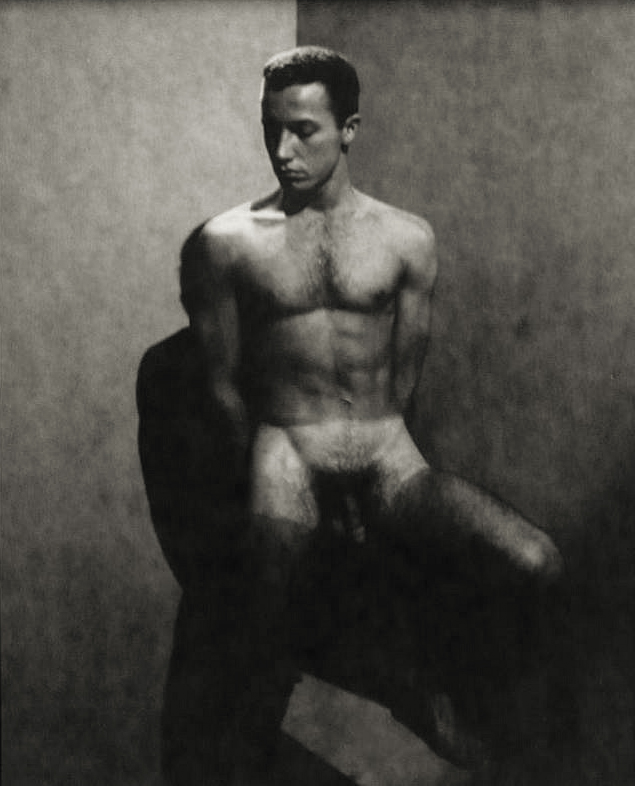
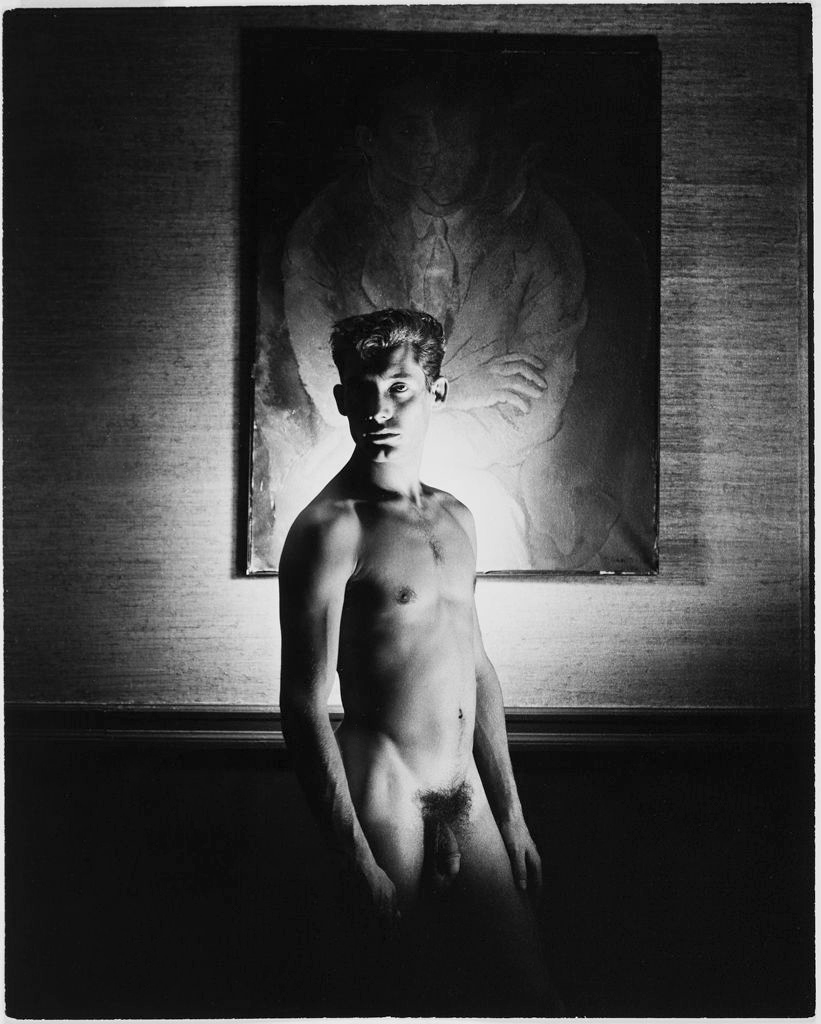
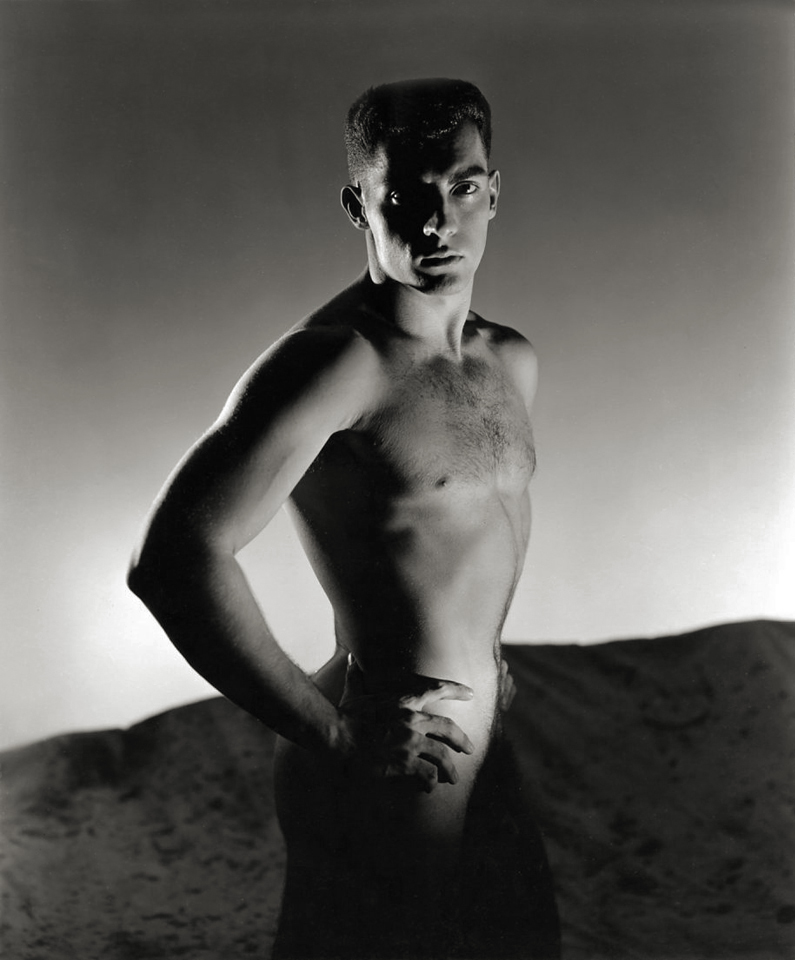
The greatest photographer of the male nude the world has ever seen – George Platt Lynes (American, April 15, 1907 – December 6, 1955).

Lynes worked as a fashion photographer in his own studio in New York (which he opened in 1932) before moving to Hollywood in 1946 where he took the post of Chief Photographer for the Vogue studios. Although an artistic success the sojourn was a financial failure and he returned to New York in 1948. Although continuing his commercial work he became disinterested in it, concentrating his energies on photographing the male nude. He began a friendship with Dr Alfred Kinsey of the Kinsey Institute in Bloomington, Indiana and helped with his sex research. Between 1949 and 1955, Lynes sold and donated much of his erotic nudes to Kinsey.1 By May 1955 he had been diagnosed terminally ill with lung cancer. He closed his studio. He destroyed much of his print and negative archives particularly his male nudes. However, it is now known that he had transferred many of these works to the Kinsey Institute. After a final trip to Europe, Lynes returned to New York City where he died.2

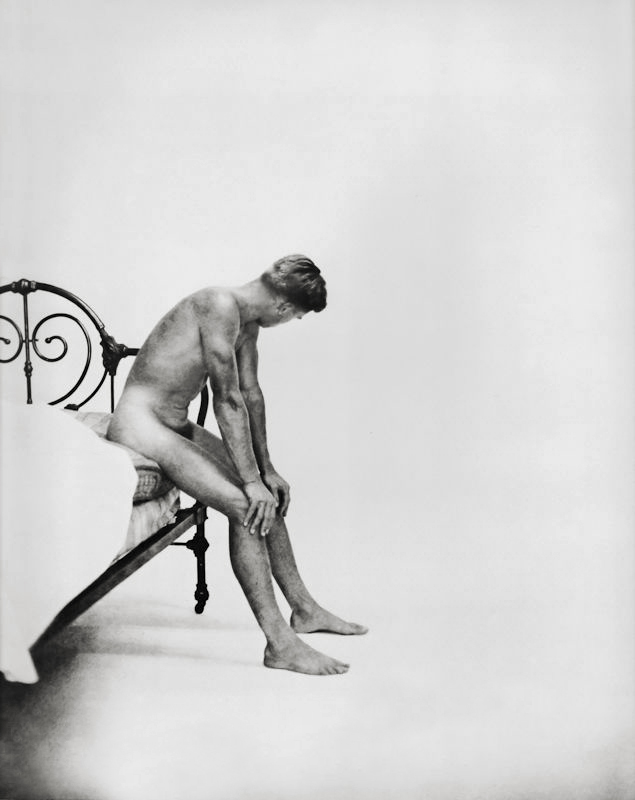
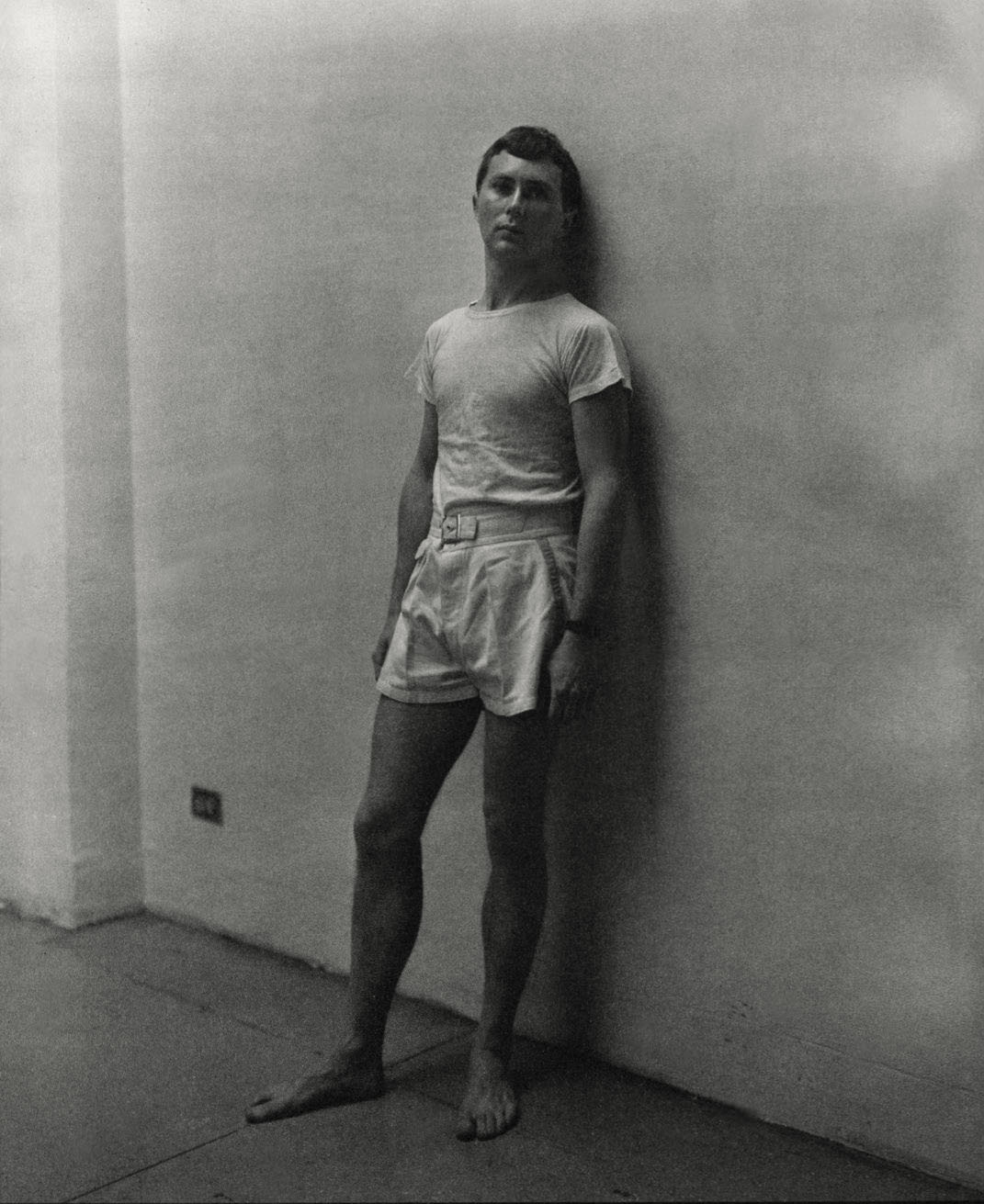
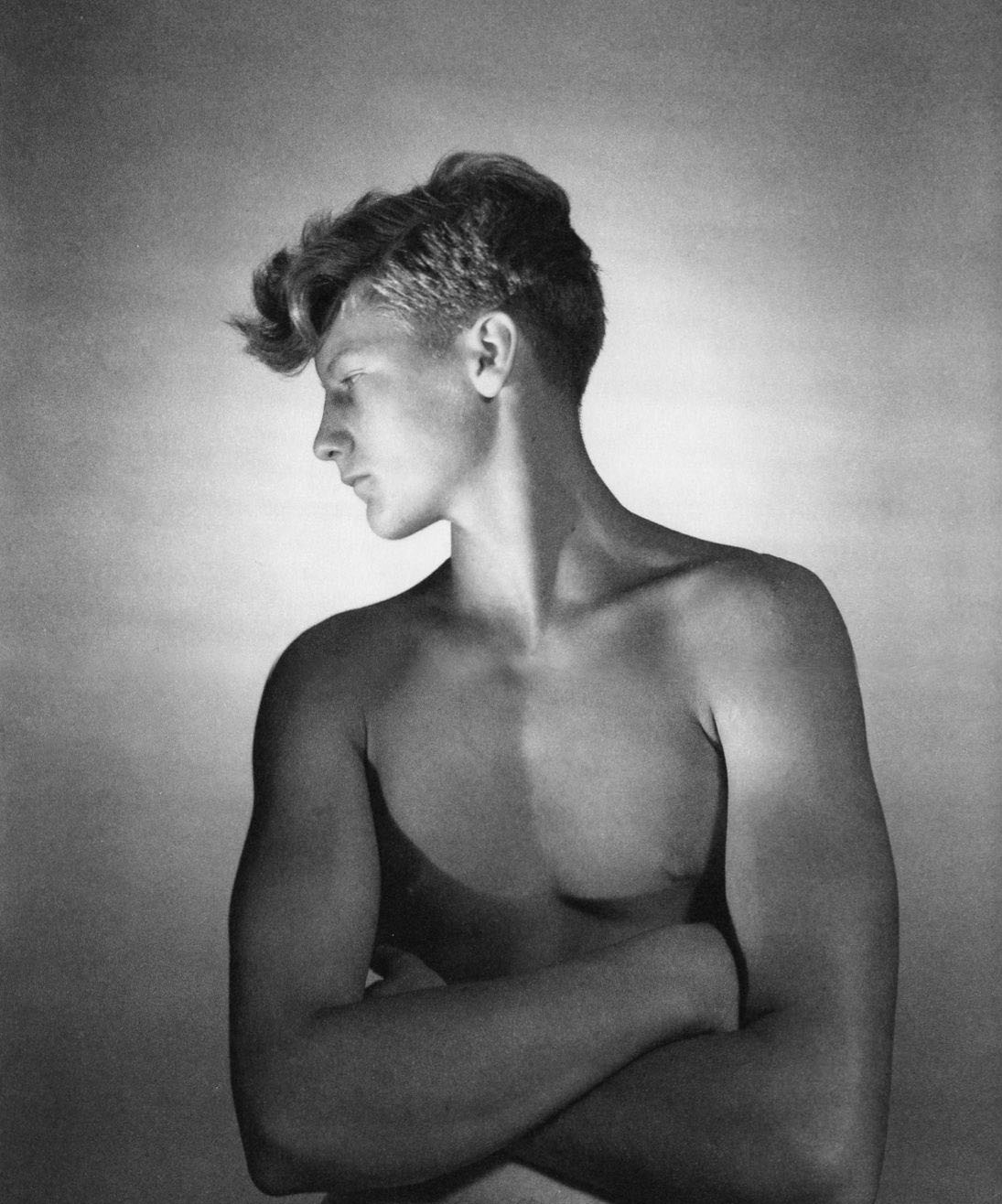
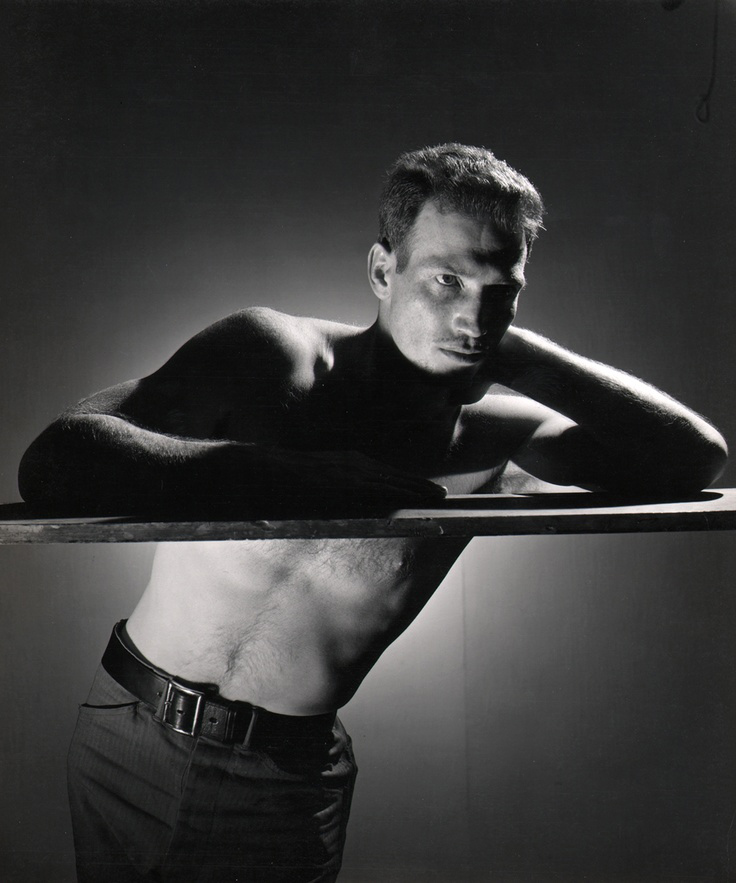
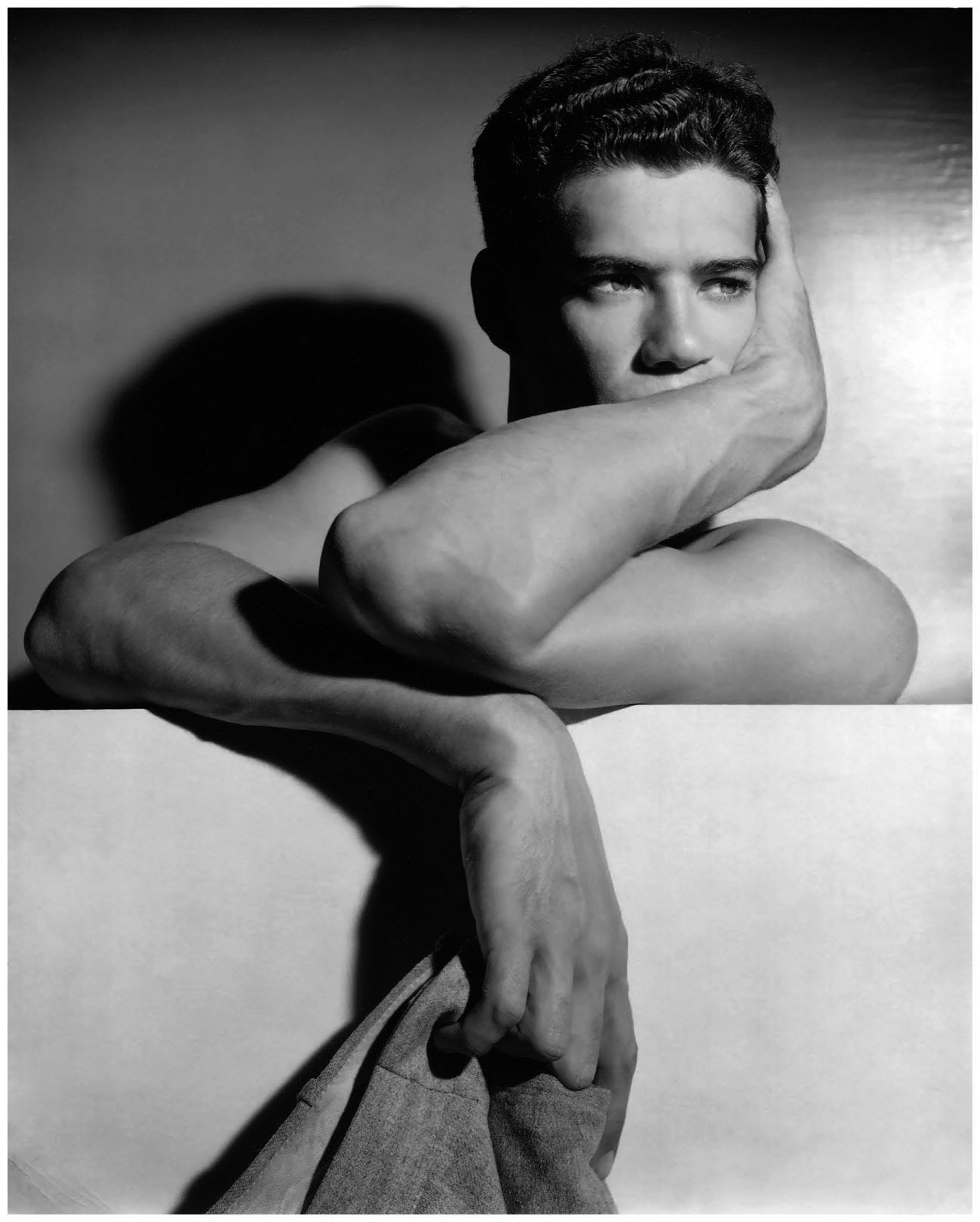
Since the early 1930s Lynes had photographed male nudes and distributed the images privately to his circle of friends. He was reluctant to show them in public for fear of the harm that they could do to his reputation and business with the fashion magazines, for he was a gay man “passing” in a homophobic society. Generally his earlier male nude photographs concentrate on the idealised youthful body or ephebe. As Lynes became more despondent with his career as a fashion photographer his private photographs of male nudes tend to take on a darker and sharper edge. After a period of residence in Hollywood he returned to New York nearly penniless. His style of photographing the male nude underwent a revision. While the photographs of his European colleagues still relied on the sun drenched bodies of young adolescent males evoking memories of classical beauty and the mythology of Ancient Greece the later nudes of Platt Lynes feature a mixture of youthful ephebes and heavier set bodies which appear to be more sexually knowing. The compositional style of dramatically lit photographs of muscular torsos of older, rougher men shot in close up were possibly influenced by a number of things – his time in Hollywood with its images of handsome, swash-buckling movie stars with broad chests and magnificent physiques; the images of bodybuilders by physique photographers that George Platt Lynes visited; the fact that his lover George Tichenor had been killed during WWII; and the knowledge that he was penniless and had cancer. There is, I believe, a certain sadness but much inner strength in his later photographs of the male nude that harnesses the inherent sexual power embedded within their subject matter.

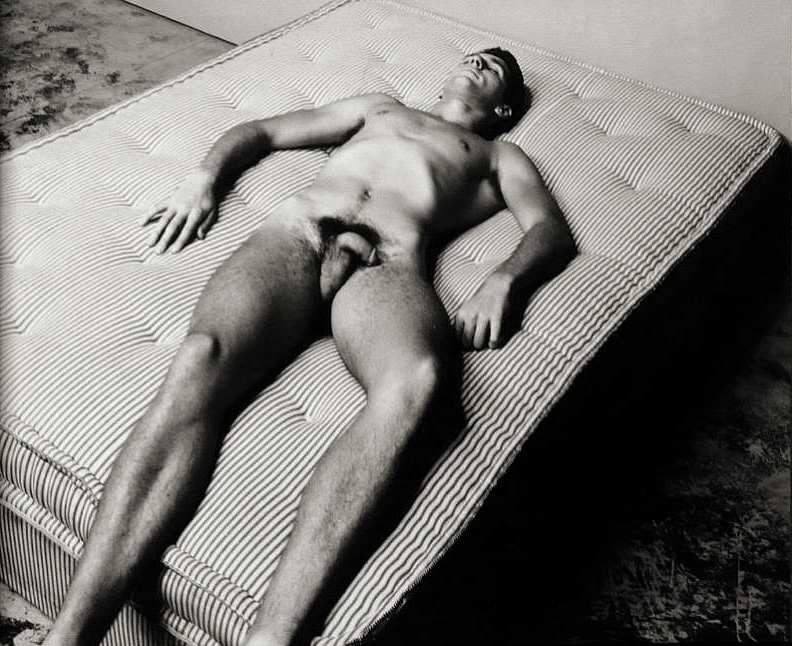
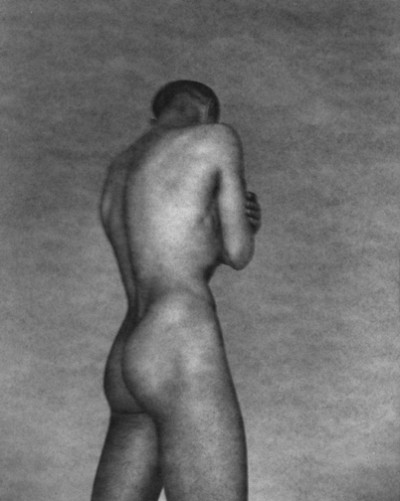
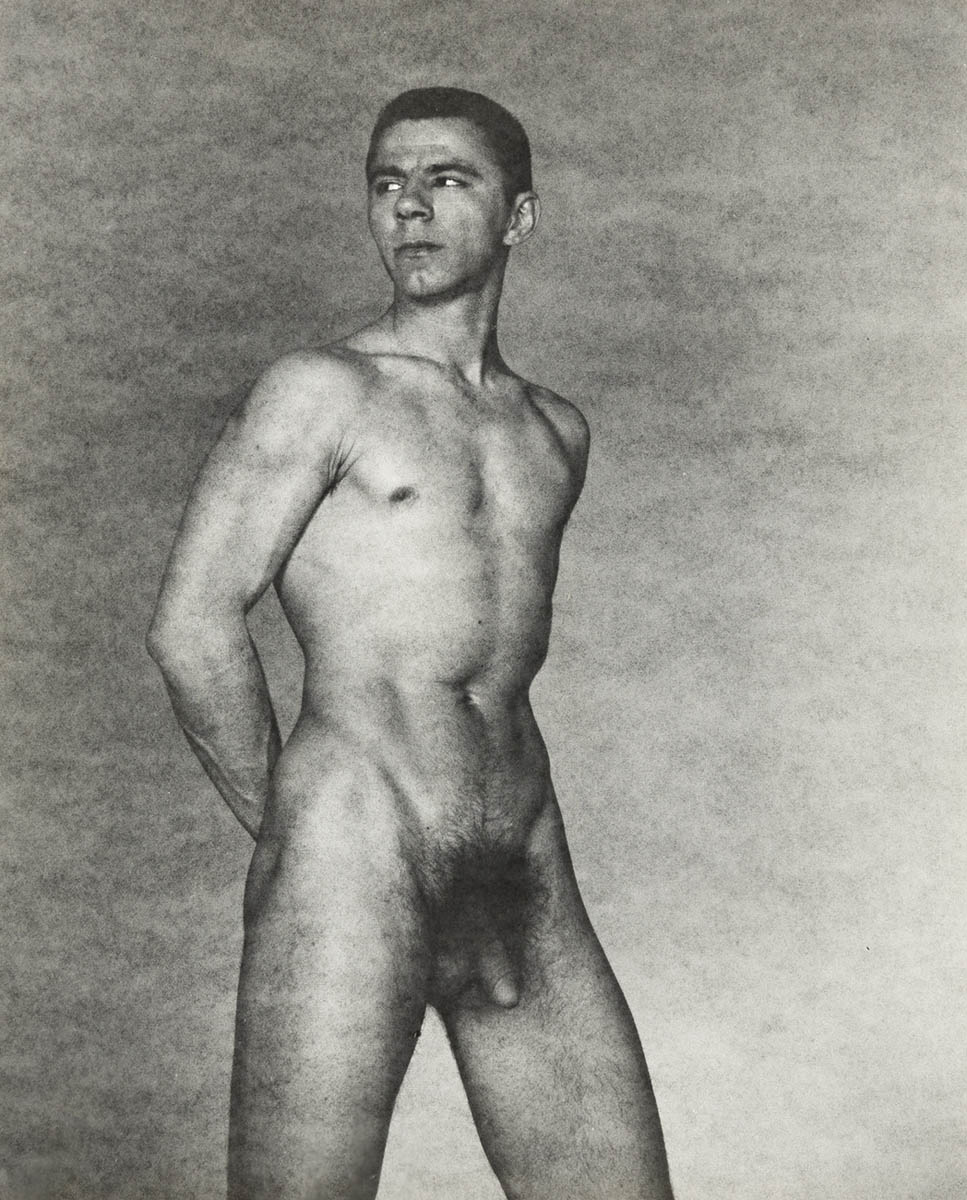
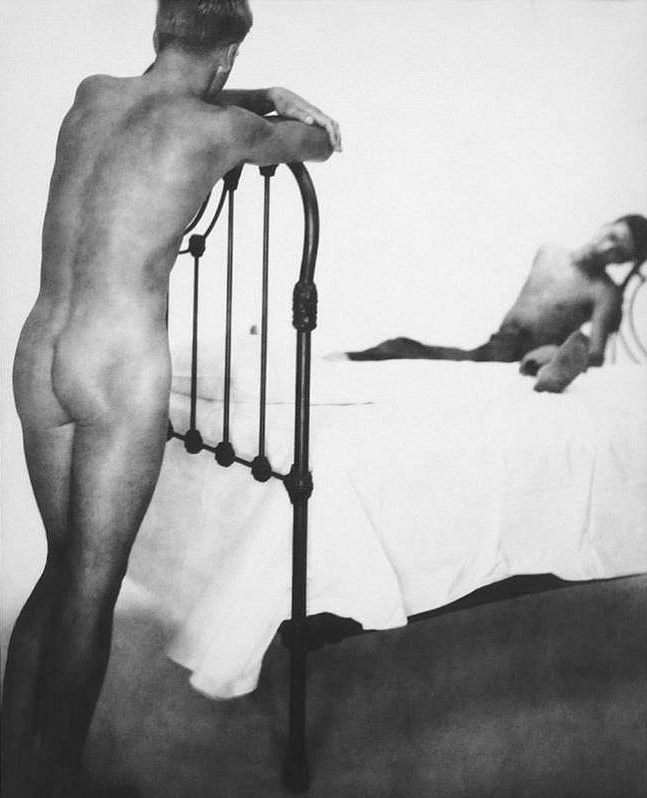
This monumentality of body and form was matched by a new openness in the representation of sexuality. There are intimate photographs of men in what seem to be post-coital revere, in unmade beds, genitalia showing or face down showing their butts off (see Untitled [Charles ‘Tex’ Smutney, Charles ‘Buddy’ Stanley, and Bradbury Ball] c. 1942, below). Some of the faces in these later photographs remain hidden, as though disclosure of identity would be detrimental for fear of persecution or prosecution. However, this photograph is quite restrained compared to the most striking series of GPL’s photographs which involves an exploration the male anal area (a photograph from the 1951 series can be found in the book titled George Platt Lynes: Photographs from The Kinsey Institute). This explicit series features other photographs of the same model – in particular one that depicts the male with his buttocks in the air pulling his arse cheeks apart. After Lynes found out he had cancer he started to send his photographs to the German homoerotic magazine Der Kries under the pseudonym Roberto Rolf, and in the last years of his life he experimented with paper negatives (see below), which made his images of the male body even more grainy and mysterious.

Further, when undertaking research into GPL’s photographs at The Kinsey Institute as part of my PhD I noted that most of the photographs had annotations in code on the back of them giving details of age, sexual proclivities of models and what they are prepared to do and where they were found. This information gives a vital social context to GPL’s nude photographs of men and positions them within the moral and ethical framework of the era in which they were made. Most of the photographs list the names of the models used but we are unable to print them due to an agreement between GPL and Dr. Kinsey as to their secrecy.

I believe that Lynes understood, intimately, the different physical body types that gay men find desirable and used them in his photographs. He visited Lon of New York (a photographer of beefcake men) in his studio and purchased photographs of bodybuilders for himself, as did the German photographer George Hoyningen-Huene. It is likely that these images of bodybuilders influenced his later compositional style of images of men; it is also possible that he detected the emergence of this iconic male body type as a potent sexual symbol, one that that was becoming more visible and sexually available to gay men.

Dr Marcus Bunyan


1/ Brown, Elspeth. “Queer Desire and Cold War Homophobia,” on the In The Darkroom blog May 2013 [Online] Cited 24/06/2014. No longer available online

2/ “He clearly was concerned that this work, which he considered his greatest achievement as a photographer, should not be dispersed or destroyed…We have to remember the time period we’re talking about – America during the post-war Red Scare… ”

Quotation from George Platt Lynes, The Male Nudes. Rizzoli International Pub, 2011 cited on “George Platt Lynes” on the Wikipedia website [Online] Cited 24/06/2014.


Many thankx to Associate Professor Elspeth H. Brown for allowing me to publish her text “Queer Desire and Cold War Homophobia”. Please click on the photographs for a larger version of the image.


“The depth and commitment he had in photographing the male nude, from the start of his career to the end, was astonishing. There was absolutely no commercial impulse involved – he couldn’t exhibit it, he couldn’t publish it.”


Allen Ellenzweig


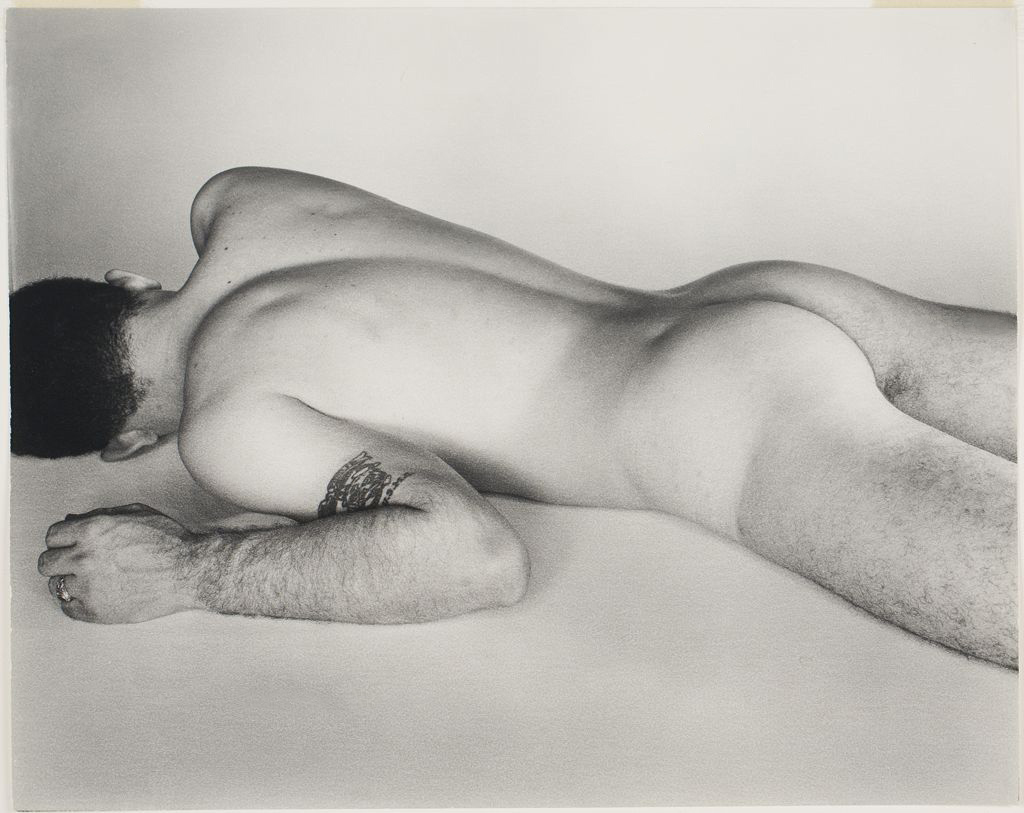
George Platt Lynes (American, April 15, 1907 - December 6, 1955) 'Untitled (male nude with tattoo)' 1950-1955


George Platt Lynes (American, April 15, 1907 – December 6, 1955)
Untitled (male nude with tattoo)
1950-1955
Silver gelatin photograph
24.5 x 19.5cm


George Platt Lynes (American, April 15, 1907 - December 6, 1955) 'Untitled' Nd [c. 1951]


George Platt Lynes (American, April 15, 1907 – December 6, 1955)
Untitled
Nd [c. 1951]
Silver gelatin photograph


George Platt Lynes (American, April 15, 1907 - December 6, 1955) 'Jack Fontan' c. 1950


George Platt Lynes (American, April 15, 1907 – December 6, 1955)
Jack Fontan
c. 1950
Silver gelatin photograph


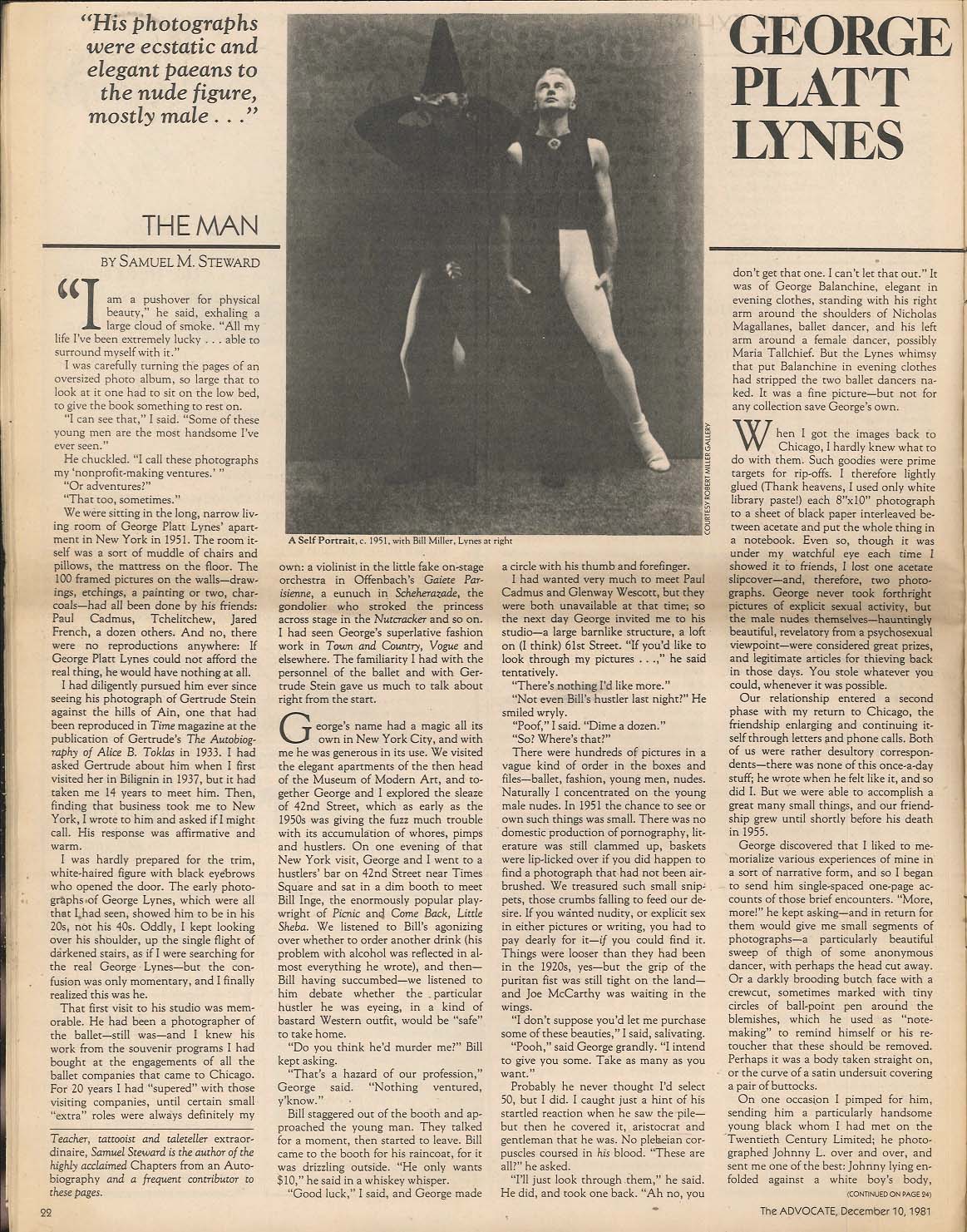
Samuel M. Steward,. "George Platt Lynes," in 'The Advocate', No. 332, December 10, 1981, p.22

Samuel M. Steward,. "George Platt Lynes," in 'The Advocate', No. 332, December 10, 1981, p.23

Samuel M. Steward,. "George Platt Lynes," in 'The Advocate', No. 332, December 10, 1981, p.24


Samuel M. Steward. “George Platt Lynes,” in The Advocate, No. 332, December 10, 1981, pp. 22-24


George Platt Lynes (American, April 15, 1907 - December 6, 1955) 'Untitled [Charles 'Tex' Smutney, Charles 'Buddy' Stanley, and Bradbury Ball]' c. 1942


George Platt Lynes (American, April 15, 1907 – December 6, 1955)
Untitled [Charles ‘Tex’ Smutney, Charles ‘Buddy’ Stanley, and Bradbury Ball]
c. 1942
Silver gelatin photograph


According to David Leddick the models are Charles ‘Tex’ Smutney, Charles ‘Buddy’ Stanley, and Bradbury Ball. The image comes from a series of 30 photographs of these three boys undressing and lying on a bed together. Leddick, David. Naked Men: Pioneering Male Nudes 1935-1955. New York: Universe Publishing, 1997, p. 21.


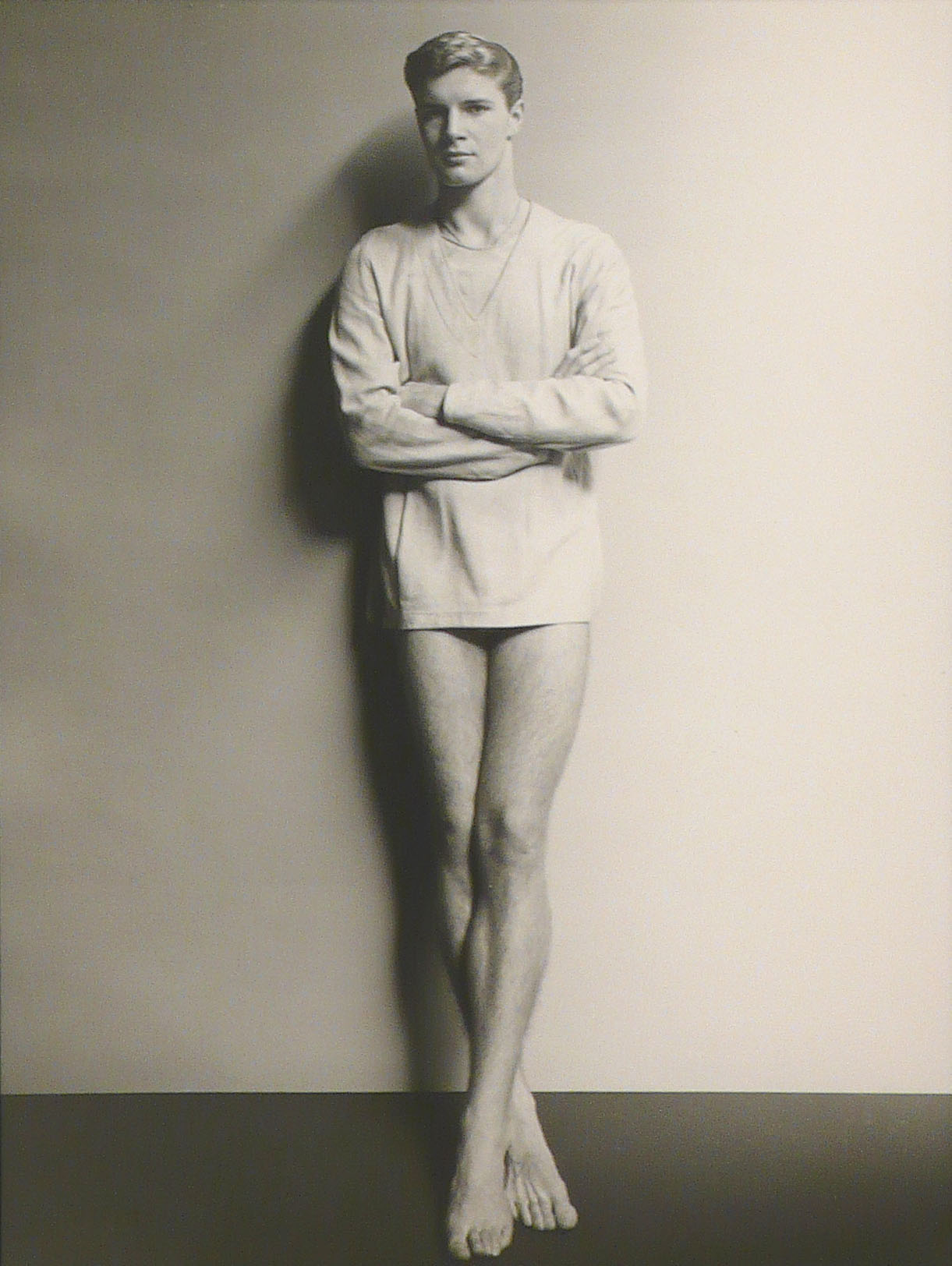
George Platt Lynes (American, April 15, 1907 - December 6, 1955) 'Ted Starkowski (standing, arms folded)' c. 1950


George Platt Lynes (American, April 15, 1907 – December 6, 1955)
Ted Starkowski (standing, arms folded)
c. 1950
Silver gelatin photograph from a paper negative


George Platt Lynes (American, April 15, 1907 - December 6, 1955) 'Ted Starkowski (standing, arms behind back)' c. 1950


George Platt Lynes (American, April 15, 1907 – December 6, 1955)
Ted Starkowski (standing, arms behind back)
c. 1950
Silver gelatin photograph from a paper negative
22.9 x 19.1cm


George Platt Lynes (American, April 15, 1907 - December 6, 1955) 'Untitled' 1952


George Platt Lynes (American, April 15, 1907 – December 6, 1955)
Untitled
1952
Silver gelatin photograph


George Platt Lynes (American, April 15, 1907 - December 6, 1955) 'Untitled (male nude study)' Nd


George Platt Lynes (American, April 15, 1907 – December 6, 1955)
Untitled (male nude study)
Nd
Silver gelatin photograph


Queer Desire and Cold War Homophobia

Associate Professor Elspeth H. Brown

This photograph [above] archives queer, illicit desire in Cold War America. It was made by George Platt Lynes, and is part of a set of male nudes that the photographer made in the decades leading to his death, from lung cancer, in 1955. Because exhibiting these photographs was a impossibility during Lynes’s lifetime due to Cold War homophobia, he circulated them privately among his queer kinship networks.

Lynes was part of a closely connected circle of elite gay men who dominated American arts and letters in the interwar and early post-war years. For 16 years, Lynes lived with the writer Glenway Wescott and museum curator Monroe Wheeler, who were a couple for over fifty years; they had a variety of other sexual partners throughout, including Lynes, who shared a bedroom with Wheeler during their years together. All three of them, as well as friends and colleagues Lincoln Kirstein, Paul Cadmus, and other leading figures, participated in sex parties in the 1940s and 1950s, as documented in their personal papers. However, in the context of 1950s-era red scares, which particularly focused on homosexuals, the more open sexual subcultures of the 1930s and 1940s were driven even further underground.

In April of 1950, Glenway Wescott wrote George Platt Lynes that while the erotic explicitness of George’s nudes didn’t personally concern him, he was worried for Monroe Wheeler, since Wheeler held a public position as a curator at the Museum of Modern Art. “I really don’t mind scabrousness, etc., on my account, as you must know,” he wrote. “Only that our poor M [Monroe] must conclude his career with good effect and honor, I am anxious not to involve him in what is now called (in the nation’s capital) ‘guilty by association’ (have you been reading the columns and columns in the newspapers upon this and correlative points?).”

Although McCarthyism is often understood as the effort to purge suspected communists from the State Department and other branches of the federal government, the Red Scare equally targeted homosexuals, who were forced out of public service and into the closet. Wescott may well have been referring to the front page of the New York Times on March 1, 1950, where Secretary of State Dean Acheson testified about the Alger Hiss trial and the loyalty program at the State Department. Although the article purportedly concerned communism, it shows that the red scare mainly affected homosexuals, as Wescott clearly understood. Senator Bridges asked John E. Peurifoy, Deputy Under-Secretary of State in charge of the security program, how many members of the State Department had resigned since the investigations began in 1947. “Ninety-one persons in the shady category,” Mr. Peurifoy replied, “most of these were homosexuals.” This was not necessarily newsworthy in and of itself, so far as the New York Times was concerned in 1950, and the remainder of the article detailed the testimony relating to other aspects of the hearings.

Lynes continued to make and circulate his portraits, despite this climate of homophobia. He was very concerned that the work find an audience, and published it in several issues of the German homosexual journal Der Kreis in the 1950s. He also became an important informant for Alfred Kinsey’s research, as did Glenway Wescott and other members of their circle. Between 1949 and 1955, Lynes sold and donated much of his erotic nudes to Kinsey, where they are now part of the Kinsey Institute collections in Bloomington, Indiana.

© Elspeth H. Brown 2013
Associate Professor of History
University of Toronto

Reproduced with permission of the author.

Elspeth H. Brown website


George Platt Lynes (American, April 15, 1907 - December 6, 1955) 'Untitled' 1951


George Platt Lynes (American, April 15, 1907 – December 6, 1955)
Untitled
1951
Silver gelatin photograph


George Platt Lynes (American, April 15, 1907 - December 6, 1955) 'Untitled (Charles Romans in the artist's apartment)' 1953


George Platt Lynes (American, April 15, 1907 – December 6, 1955)
Untitled (Charles Romans in the artist’s apartment)
1953
Silver gelatin photograph
19.5 x 24.5cm


George Platt Lynes (American, April 15, 1907 - December 6, 1955) 'Don Cerulli' 1952


George Platt Lynes (American, April 15, 1907 – December 6, 1955)
Don Cerulli
1952
Silver gelatin photograph


George Platt Lynes (American, April 15, 1907 - December 6, 1955) 'Male nude study' 1951


George Platt Lynes (American, April 15, 1907 – December 6, 1955)
Male nude study
1951
Silver gelatin photograph


George Platt Lynes (American, April 15, 1907 - December 6, 1955) 'Untitled' 1951


George Platt Lynes (American, April 15, 1907 – December 6, 1955)
Untitled
1951
Silver gelatin photograph
22.9 x 19.1cm


George Platt Lynes (American, April 15, 1907 - December 6, 1955) 'Untitled' 1936


George Platt Lynes (American, April 15, 1907 – December 6, 1955)
Untitled
1936
Silver gelatin photograph


George Platt Lynes (American, April 15, 1907 - December 6, 1955) 'George Tooker' 1945


George Platt Lynes (American, April 15, 1907 – December 6, 1955)
George Tooker
1945
Silver gelatin photograph


George Platt Lynes (American, April 15, 1907 - December 6, 1955) 'Tex Smutney' 1943


George Platt Lynes (American, April 15, 1907 – December 6, 1955)
Tex Smutney
1943
Silver gelatin photograph


Chronology by Jack Woody

1907-1924 Born April 15, 1907, East Orange, New Jersey. Raised in comfortable circumstances and privately educated. Schoolmate Lincoln Kirstein described the young Lynes as “precocious,” crediting him with a subsequent introduction to George Balanchine.

1925 Makes first trip to Europe. Meets lifetime companions Glenway Wescott and Monroe Wheeler. Befriends Gertrude Stein, Pavel Tchelitchew and Jean Cocteau during his stay. Returns to New York City, works at Brentano’s Bookstore for a short time.

1926 Publishes the As Stable Pamphlets in his parents’ house, Englewood, New Jersey. Includes Gertrude Stein’s DESCRIPTIONS OF LITERATURE and Ernest Hemingway’s first published play TODAY IS FRIDAY with cover designs by Pavel Tchelitchew and Jean Codeau. Enters Yale University in Autumn, leaves in December.

1927 Opens Park Place Book Shop in Englewood. The gift of a view camera encourages Lynes to make a career of photography.

1928-1930 During 1928 Lynes exhibits his celebrity portraits at Park Place Book Shop to launch a portrait business in the shop. Continues travelling to Europe, teaching himself by trial-and-error a technical understanding of the medium.

1931 Introduced to Julien Levy. Together they experiment with photographing surrealistic still-lifes. Levy arranges to include Lynes in Surrealism exhibition at Wadsworth Atheneum, Hartford, Connecticut. Visits and photographs Gertrude Stein at Bilignin.

1932 First important exhibition at the Julien Levy Gallery in tandem with Walker Evans. The death of his father forces Lynes to take up photography as a means of economic support.

1933 Opens first New York City studio on East 50th Street. Continued public showings of his work and interest in his celebrity portraits attracts a large clientele of New York socialites and their families.

1934 Begins publishing his fashion and portrait work in such magazines as Town and Country, Harpers’ Bazaar and Vogue magazines.

1935 Invited by Lincoln Kirstein and George Balanchine to document the repertoire and principal dancers in their fledgling American Ballet (now New York City Ballet), a collaboration that will continue until Lynes’ death in 1955.

1936 Surrealistic composition The Sleepwalker included in New York Museum of Modern Art’s exhibition, Fantastic Art, Dada and Surrealism. Lynes undertakes an extensive project to photographically interpret mythological situations.

1937-1940 Continues involvement with mythology series. Successful commercial career now headquartered in a large studio at 604 Madison Avenue. Commercial fashion accounts include Hattie Carnegie, Henri Bendel, Saks Fifth Avenue and Bergdorf Goodman.

1941-1945 Photographs airfield activities for First Air Force’s publicity and documentation. Begins to lose interest in commercial work, a process accelerated by the death of George Tichenor in 1942. Disillusioned with New York and his private life Lynes closes his studio and leaves for Los Angeles to head Vogue Magazine‘s Hollywood studio.

1946-1947 Lynes begins to photograph in his rented Hollywood Hills home, experimenting with effects achieved with minimal amounts of available light. Photographs Christopher Isherwood, Igor Stravinsky, Thomas Mann and Aldous Huxley.

1948-1950 Friends sponsor the financially troubled Lynes’ return to New York where he is uninterested in and unable to repeat his earlier commercial successes. Economics force Lynes to experiment with cheaper photographic tools. He is particularly interested in the paper negative. Meets sex researcher Alfred Kinsey; impressed with Lynes’ work, Kinsey arranges to purchase hundreds of photographs for his Bloomington, Indiana institute.

1951-1954 Publishes his male nudes in homoerotic magazine Der Kries using the pseudonyms Roberto Rolf and Robert Orville. Declares bankruptcy. Lives in a succession of apartments and studios as illness becomes apparent.

1955 In May diagnosed terminally ill with cancer. Last portrait sitting is June 16 with Monroe Wheeler. Closes studio and undergoes radium and drug therapy. Lynes begins to destroy large portions of his negative and print archives. In the Autumn he leaves for Europe, returning to New York in November to be hospitalised. At night Lynes leaves the hospital to attend the theatre and ballet. He dies on December sixth, forty-eight years old.


George Platt Lynes (American, April 15, 1907 - December 6, 1955) 'Mel Fillini' 1950


George Platt Lynes (American, April 15, 1907 – December 6, 1955)
Mel Fillini
1950
Silver gelatin photograph


George Platt Lynes (American, April 15, 1907 - December 6, 1955) 'Robert McVoy' c. 1941


George Platt Lynes (American, April 15, 1907 – December 6, 1955)
Robert McVoy
c. 1941
Silver gelatin photograph


LIKE ART BLART ON FACEBOOK

Back to top

Exhibition: ‘Bill Cunningham: Facades’ at the New York Historical Society, New York

Exhibition dates: 14th March – 15th June 2014


Unknown artist. 'Bill Cunningham Photographing Three Models at New York County Court House' c. 1968-1976


Unknown artist
Bill Cunningham Photographing Three Models at New York County Court House
c. 1968-1976
Gelatin silver photograph
New-York Historical Society, Gift of Bill Cunningham


Now this is more like it!

If you want fabulousness with flair, and a dash of savoir-faire; if you want architecture with fashion, history with panache, you need look no further. Camp, kitsch, OTT but with poise, aplomb, grace and sophistication – here is the artist for the job. Oh, what fun he and his muse Editta Sherman must have had with this project.

But behind it all is a damn good photographer, with a great eye for composition. Look at the hat, the building and the “attitude” of the hands in Guggenheim Museum (c. 1968-1976, below). This is how you make people smile and think (about the city, conservation and creativity), not with some overblown frippery like the photographs of Lagerfeld in the last posting.

It’s a pity the press images were initially so poor. I had to spend hours cleaning up the images they were so badly scratched to present them to you in a viewable state. Be that as it may, these are a joy, I love them…

Dr Marcus Bunyan


Many thankx to the New York Historical Society for allowing me to publish the photographs in the posting. Please click on the photographs for a larger version of the image.


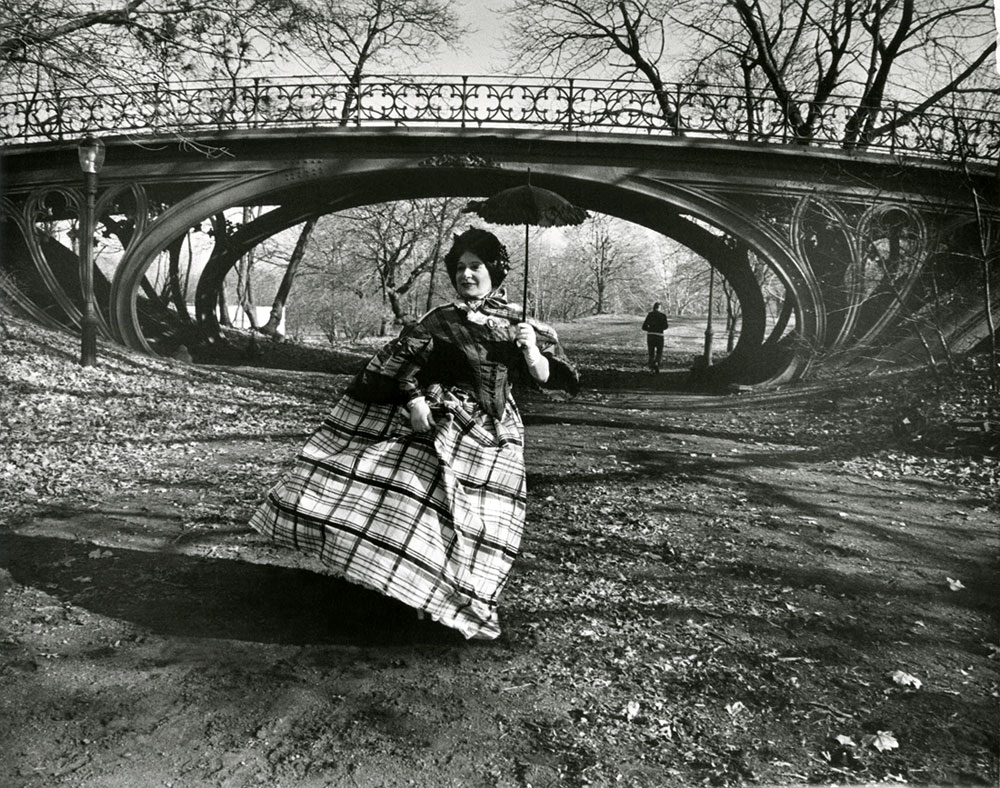
Bill Cunningham (American, 1929-2016) 'Gothic bridge in Central Park (designed 1860)' c. 1968-1976


Bill Cunningham (American, 1929-2016)
Gothic bridge in Central Park (designed 1860)
c. 1968-1976
Gelatin silver photograph
New-York Historical Society, Gift of Bill Cunningham


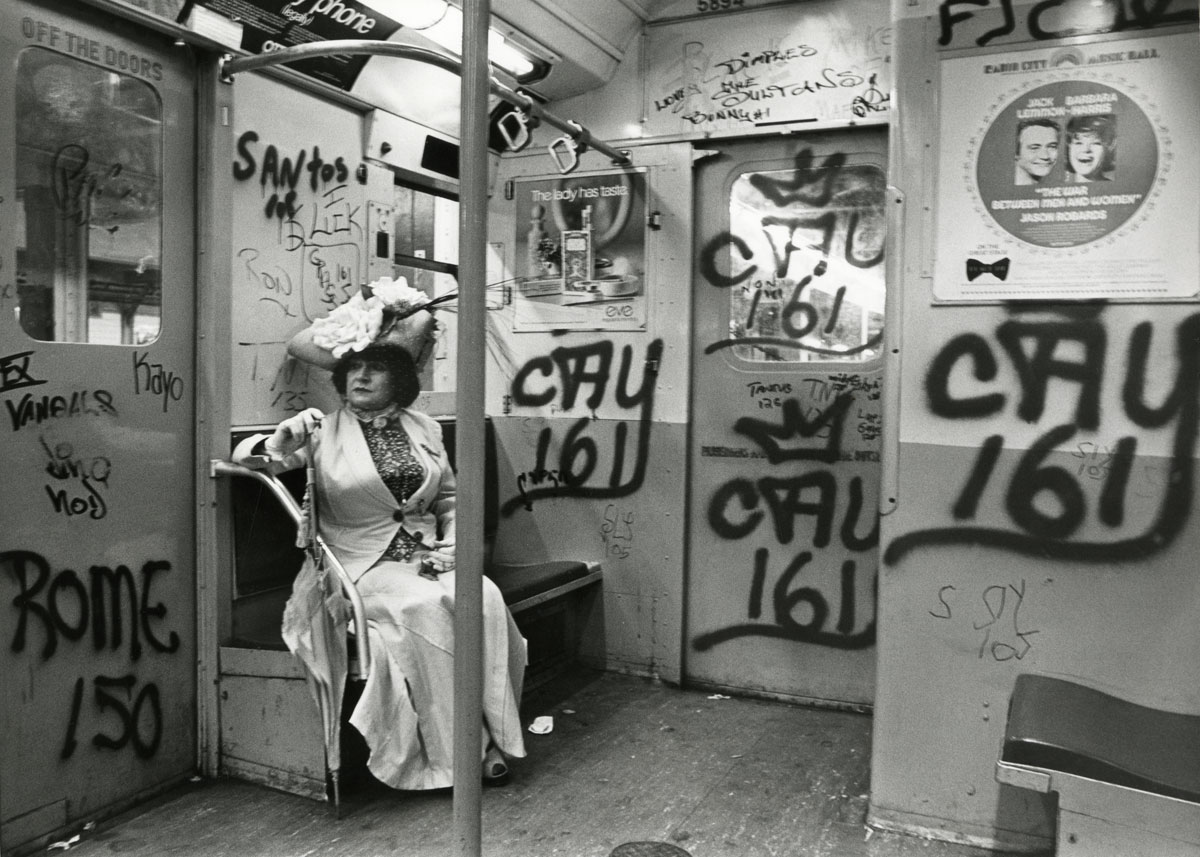
Bill Cunningham (American, 1929-2016) 'Editta Sherman on the Train to the Brooklyn Botanic Garden' c. 1972


Bill Cunningham (American, 1929-2016)
Editta Sherman on the Train to the Brooklyn Botanic Garden
c. 1972
Gelatin silver photograph
New-York Historical Society, Gift of Bill Cunningham


Bill Cunningham (American, 1929-2016) 'Guggenheim Museum (built 1959)' c. 1968-1976


Bill Cunningham (American, 1929-2016)
Guggenheim Museum (built 1959)
c. 1968-1976
Gelatin silver photograph
New-York Historical Society, Gift of Bill Cunningham


This spring, the New-York Historical Society presents a special exhibition celebrating the creative intersection of fashion and architecture through the lens of a visionary photographer. Bill Cunningham: Facades, on view from March 14 through June 15, 2014, explores the legendary photographer’s project documenting the architectural riches and fashion history of New York City.

Beginning in 1968, Bill Cunningham scoured the city’s thrift stores, auctions and street fairs for vintage clothing and scouted architectural sites on his bicycle. The result was a photographic essay entitled Facades (completed in 1976), which paired models – most particularly his muse, fellow photographer Editta Sherman – posed in period costumes at historic New York settings.

Nearly four decades after Cunningham donated 88 gelatin silver prints from the series to the New-York Historical Society in 1976, approximately 80 original and enlarged images from this whimsical and bold work are being reconsidered in a special exhibition curated by Dr. Valerie Paley, New-York Historical Society Historian and Vice President for Scholarly Programs. The exhibition offers a unique perspective on both the city’s distant past and the particular time in which the images were created, examining Cunningham’s project as part of the larger cultural zeitgeist in late 1960s-70s New York City, an era when historic preservation and urban issues loomed large.

“We are thrilled to feature these important photographs by New York Times photographer Bill Cunningham, who captured an uncertain moment in our city’s history, when New York seemed on the brink of losing its place of privilege as a capital of the world. Cunningham’s vivid sense of New York’s illustrious past and his unfettered optimism about its future make the photographs among the most dramatic and important documentation of the city’s social history,” said Louise Mirrer, President and CEO of the New-York Historical Society. “The exhibition is especially timely, as Mrs. Editta Sherman, Bill Cunningham’s muse for his project and the famed ‘duchess of Carnegie Hall,’ passed away last November 2013 at the age of 101. Mrs. Sherman’s indomitable spirit, humour and creativity are powerfully felt through the photographic images. We are gratified that many of her family members will be with us for our opening exhibition event.”

Over eight years, Bill Cunningham collected more than 500 outfits and photographed more than 1,800 locations for the Facades project, jotting down historical commentary on the versos of each print. The selection of 80 images on view evoke the exuberance of Cunningham and Sherman’s treasure hunt and their pride for the city they called home. Cunningham’s images are contextualised with reproductions of original architectural drawings from New-York Historical’s collection.

During the years that Cunningham worked on Facades, New York City was in a municipal financial crisis that wreaked havoc on daily existence, with crime, drugs, and garbage seemingly taking over the city. However, the 1970s also was an era of immense creativity, when artists and musicians experimented with new forms of expression. While Cunningham’s photographs offer an unsullied version of the tough cityscape during this chaotic time, his vision was part of a larger movement towards preserving the historic heritage of the built environment to improve the quality of urban life.

Most images in Facades feel timeless, such as Gothic Bridge (designed 1860), featuring Editta Sherman strolling through a windswept Central Park, framed by the wrought-iron curves of a classic bridge. However, at least one will offer a peek behind the scenes of the project. Cunningham and Sherman often traveled to locations by public transportation to avoid wrinkling the costumes, and Editta Sherman on the Train to the Brooklyn Botanical Garden (c. 1972) captures the jarring juxtaposition of Sherman sitting primly in a graffiti-covered subway car.

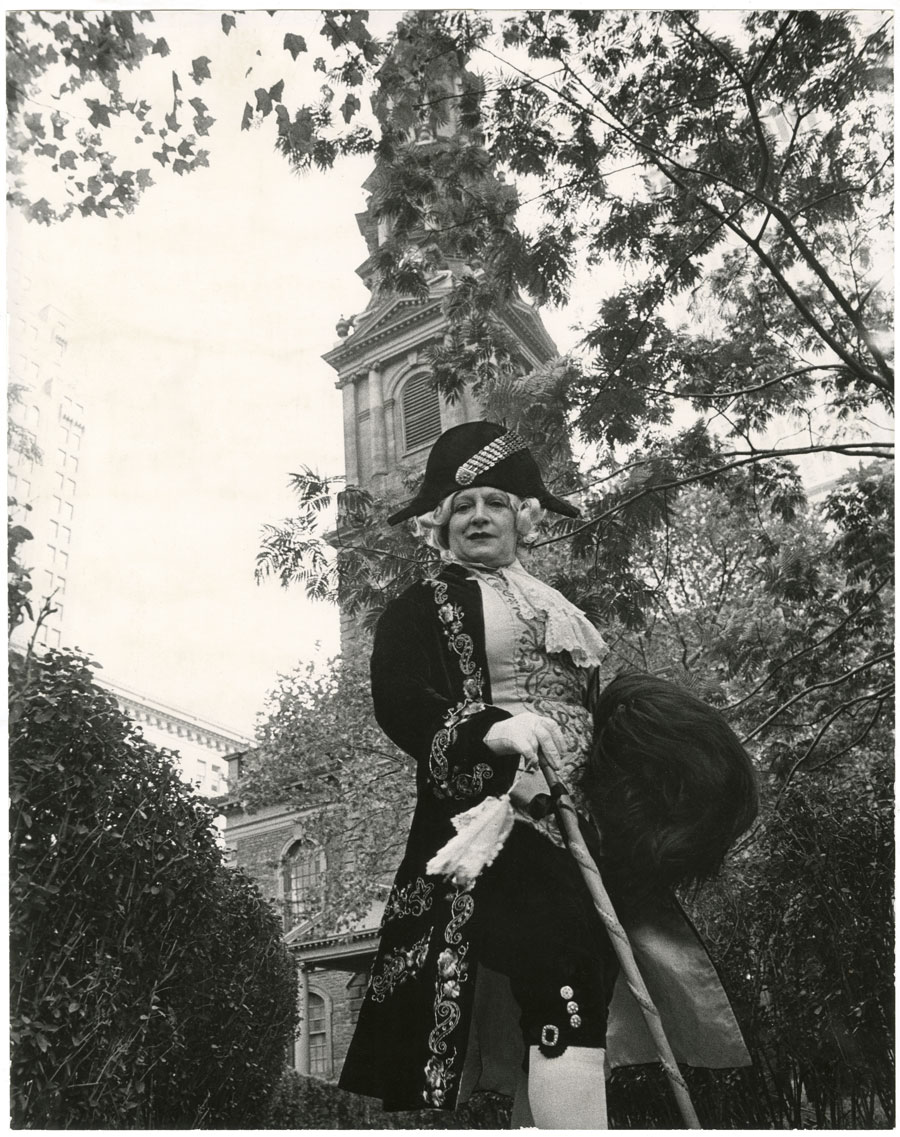
Other exhibition highlights include Sherman dressed in a man’s Revolutionary War-era hat, powdered wig, overcoat and breeches at St. Paul’s Chapel and Churchyard (built c. 1766-1796), the oldest surviving church in Manhattan, where George Washington worshipped. In Federal Hall (built c. 1842), Cunningham paired the Parthenon-like architectural details of the building with a Grecian-style, 1910s pleated Fortuny gown. For Grand Central Terminal (built c. 1903-1913), Cunningham drew on his millinery background to create a voluminous feathered hat that echoes the spirit of the “crown of the Terminal,” the ornate rooftop sculpture with monumental figures of Mercury, Minerva, and Hercules.

Bill Cunningham (1929-2016) was a fashion photographer for the New York Times, known for his candid street photography. Cunningham moved to New York in 1948, initially working in advertising and soon striking out on his own to make hats under the name “William J.” After serving a tour in the U.S. Army, he returned to New York and began writing for the Chicago Tribune. While working at the Tribune and Women’s Wear Daily, he began taking photographs of fashion on the streets of New York. The Times first published a group of his impromptu pictures in December 1978, which soon became a regular series. In 2008 Cunningham was awarded the title chevalier dans l’ordre des Arts et des Lettres by the French Ministry of Culture. He is the subject of the award-winning documentary film Bill Cunningham New York (2010). Bill Cunningham and Editta Sherman were neighbours in the Carnegie Hall Studios, a legendary artists’ residence atop the concert hall, for 60 years.

Press release from the New York Historical Society website


Bill Cunningham (American, 1929-2016) 'St. Paul’s Chapel and Churchyard (built c. 1766-1796)' c. 1968-1976


Bill Cunningham (American, 1929-2016)
St. Paul’s Chapel and Churchyard (built c. 1766-96)
c. 1968-1976
Gelatin silver photograph
New-York Historical Society, Gift of Bill Cunningham


Bill Cunningham (American, 1929-2016) 'Grand Central Terminal (built c. 1903-1913)' c. 1968-1976


Bill Cunningham (American, 1929-2016)
Grand Central Terminal (built c. 1903-1913)
c. 1968-1976
Gelatin silver photograph
New-York Historical Society, Gift of Bill Cunningham


Bill Cunningham (American, 1929-2016) 'Federal Hall (built c. 1842, costume c. 1910)' c. 1968-1976


Bill Cunningham (American, 1929-2016)
Federal Hall (built c. 1842, costume c. 1910)
c. 1968-1976
Gelatin silver photograph
New-York Historical Society, Gift of Bill Cunningham


Bill Cunningham (American, 1929-2016) 'Bowery Savings Bank (built c. 1920)' c. 1968-1976


Bill Cunningham (American, 1929-2016)
Bowery Savings Bank (built c. 1920)
c. 1968-1976
Gelatin silver photograph
New-York Historical Society, Gift of Bill Cunningham


Bill Cunningham (American, 1929-2016) 'Club 21' (founded c. 1920s; costume c. 1940) c. 1968-1976


Bill Cunningham (American, 1929-2016)
Club 21 (founded c. 1920s; costume c. 1940)
c. 1968-1976
Gelatin silver photograph
New-York Historical Society, Gift of Bill Cunningham


Bill Cunningham (American, 1929-2016) 'Associated Press Building at Rockefeller Center (built c. 1939)' c. 1968-1976


Bill Cunningham (American, 1929-2016)
Associated Press Building at Rockefeller Center (built c. 1939)
c. 1968-1976
Gelatin silver photograph
New-York Historical Society, Gift of Bill Cunningham


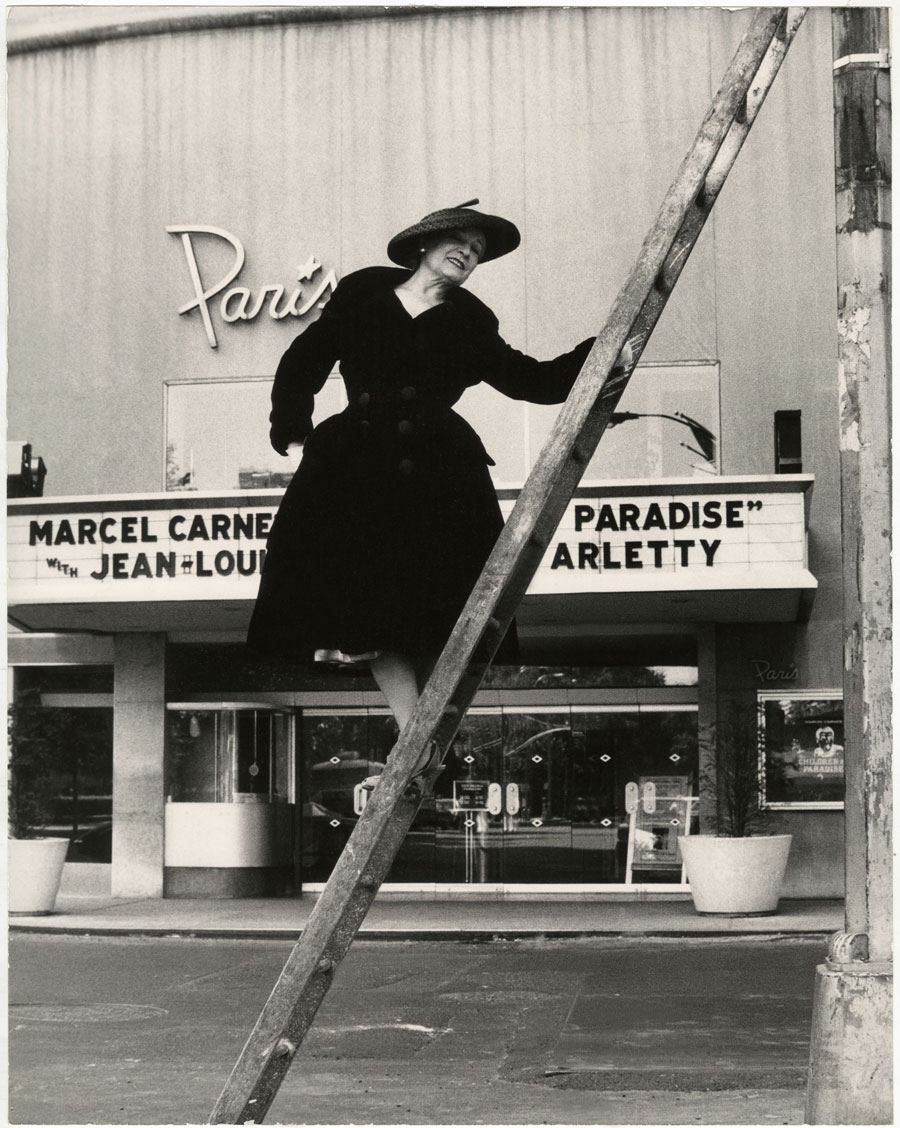
Bill Cunningham (American, 1929-2016) 'Paris Theater (built 1947)' c. 1968-1976


Bill Cunningham (American, 1929-2016)
Paris Theater (built 1947)
c. 1968-1976
Gelatin silver photograph
New-York Historical Society, Gift of Bill Cunningham


Bill Cunningham (American, 1929-2016) 'General Motors Building' c. 1968-1976


Bill Cunningham (American, 1929-2016)
General Motors Building
c. 1968-1976
Gelatin silver photograph
New-York Historical Society, Gift of Bill Cunningham


The New York Historical Society

170 Central Park West
at Richard Gilder Way (77th Street)
Phone: (212) 873-3400

Opening hours:
Monday CLOSED
Tuesday – Sunday 11am – 5pm

The New York Historical Society
 website

LIKE ART BLART ON FACEBOOK

Back to top

Exhibition: ‘Garry Winogrand’ at the National Gallery of Art, Washington

Exhibition dates: 2nd March – 8th June 2014


More photographs by Gary Winogrand.


Many thankx to the National Gallery of Art for allowing me to publish the photographs in the posting. Please click on the photographs for a larger version of the image.


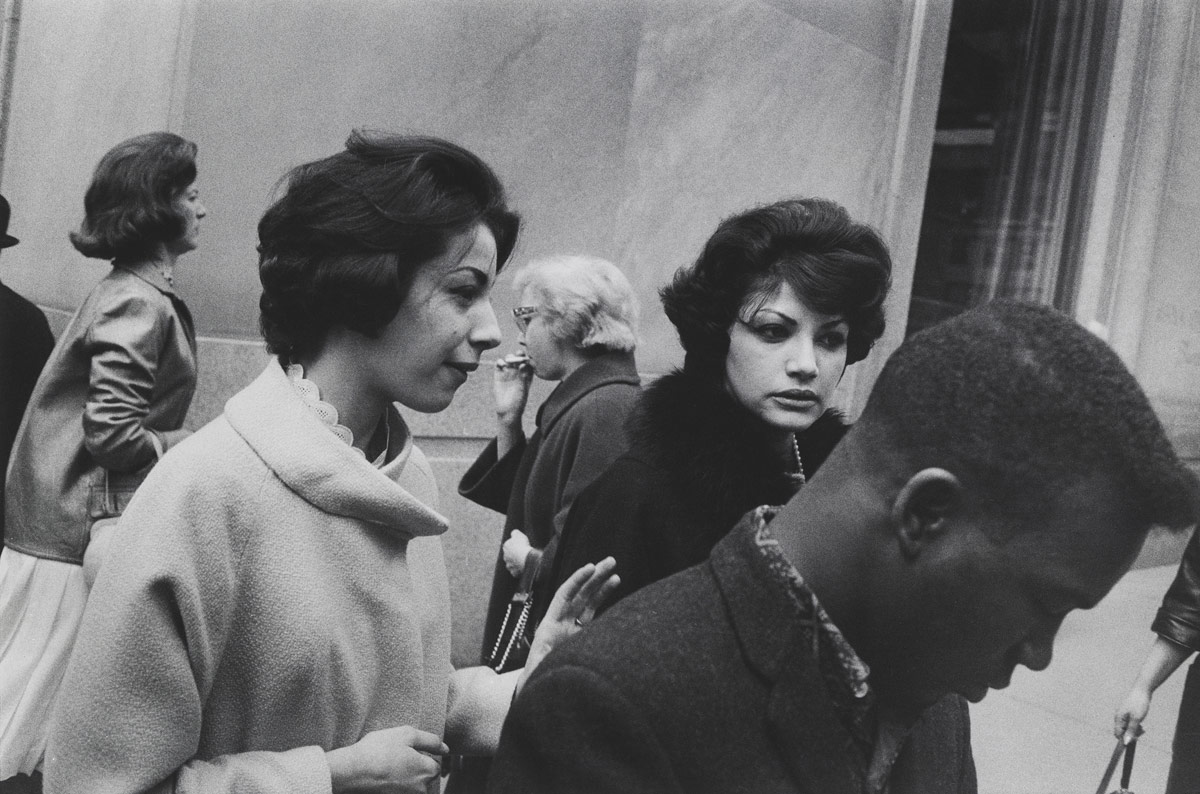
Garry Winogrand (American, 1928-1984) 'New York' 1950


Garry Winogrand (American, 1928-1984)
New York
1950
Gelatin silver print
Framed: 40.64 x 50.8cm (16 x 20 in.)
San Francisco Museum of Modern Art, Fractional and promised gift of Carla Emil and Rich Silverstein
© The Estate of Garry Winogrand, courtesy Fraenkel Gallery, San Francisco


Garry Winogrand (American, 1928-1984) 'Coney Island, New York' c. 1952


Garry Winogrand (American, 1928-1984)
Coney Island, New York
c. 1952
Gelatin silver print
Framed: 40.64 x 50.8cm (16 x 20 in.)
The Museum of Modern Art, New York. Purchase and gift of Barbara Schwartz in memory of Eugene M. Schwartz
© The Estate of Garry Winogrand, courtesy Fraenkel Gallery, San Francisco


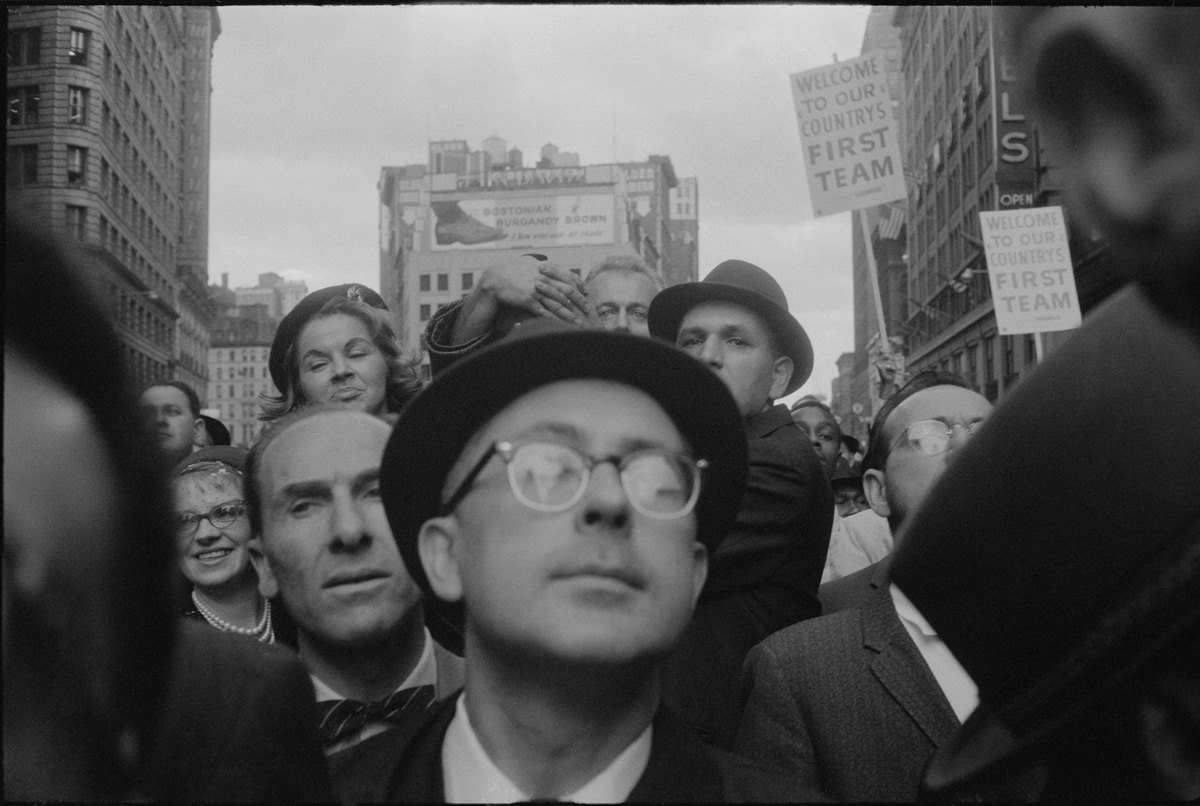
Garry Winogrand (American, 1928-1984) 'Richard Nixon Campaign Rally, New York' 1960


Garry Winogrand (American, 1928-1984)
Richard Nixon Campaign Rally, New York
1960
Gelatin silver print
Framed: 45.72 x 55.88cm (18 x 22 in.)
Posthumous print made from original negative on the occasion of the Garry Winogrand exhibition organised by the National Gallery of Art and the San Francisco Museum of Modern Art, courtesy Center for Creative Photography, The University of Arizona
© The Estate of Garry Winogrand, courtesy Fraenkel Gallery, San Francisco


Garry Winogrand (American, 1928-1984) 'John F. Kennedy, Democratic National Convention, Los Angeles' 1960


Garry Winogrand (American, 1928-1984)
John F. Kennedy, Democratic National Convention, Los Angeles
1960
Gelatin silver print
Framed: 45.72 x 55.88cm (18 x 22 in.)
Posthumous print made from original negative on the occasion of the Garry Winogrand exhibition organised by the National Gallery of Art and the San Francisco Museum of Modern Art, courtesy Center for Creative Photography, The University of Arizona
© The Estate of Garry Winogrand, courtesy Fraenkel Gallery, San Francisco


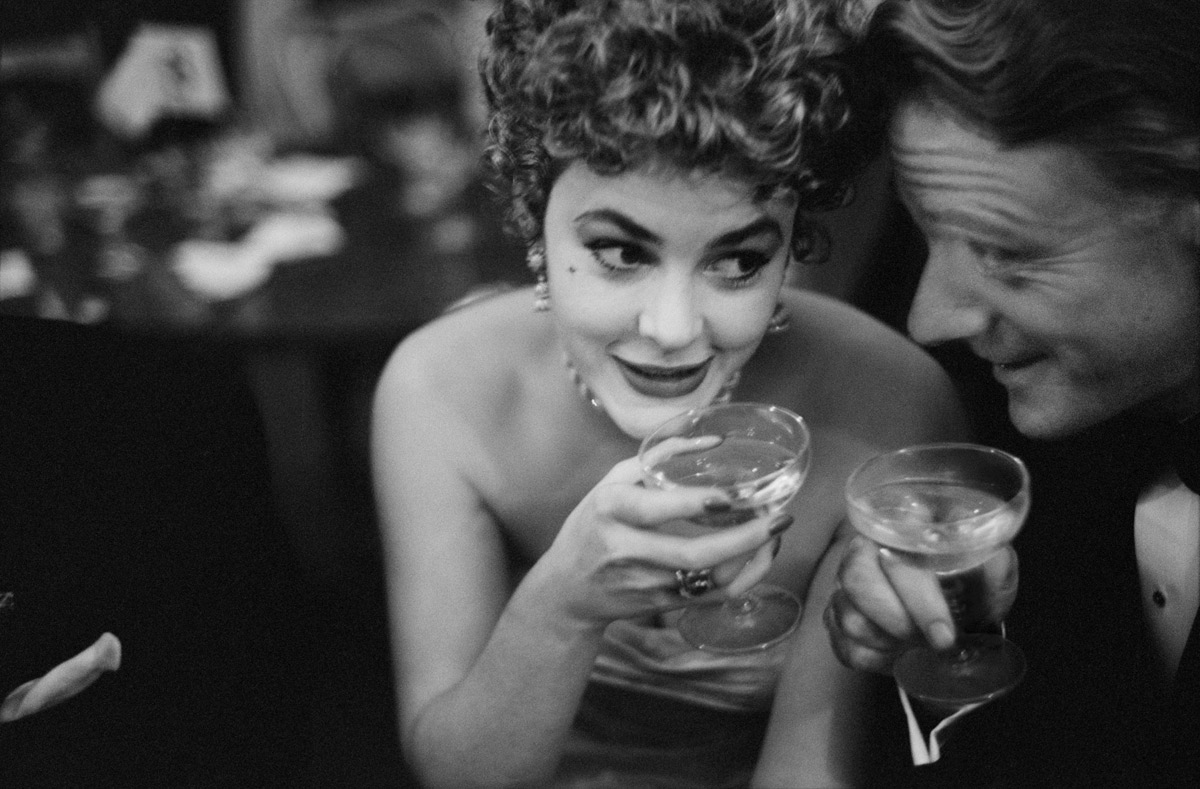
Garry Winogrand (American, 1928-1984) 'Metropolitan Opera, New York City' c. 1951


Garry Winogrand (American, 1928-1984)
Metropolitan Opera, New York City
c. 1951
Gelatin silver print
Framed: 45.72 x 55.88cm (18 x 22 in.)
Posthumous print made from original negative on the occasion of the Garry Winogrand exhibition organised by the National Gallery of Art and the San Francisco Museum of Modern Art, courtesy Center for Creative Photography, The University of Arizona
© The Estate of Garry Winogrand, courtesy Fraenkel Gallery, San Francisco


The first retrospective in 25 years of work by artist Garry Winogrand – renowned photographer of New York City and postwar American life – will be on view at the National Gallery of Art, Washington, March 2 through June 8, 2014. Revealing the full breadth of his art for the first time, Garry Winogrand brings together some 190 of the artist’s most iconic images – many never before exhibited or reproduced.

“Winogrand is widely recognised as one of the preeminent photographers of postwar America, though his work remains largely unexplored and incompletely published,” said Earl A. Powell III. “Building on several recent exhibitions of 20th-century American photographers, such as Robert Frank and Harry Callahan, the Gallery is proud to present another major American photographer to our visitors.”

The exhibition was on view at the San Francisco Museum of Modern Art (SFMOMA) from March 9 through June 2, 2013. After Washington, the exhibition will travel to the Metropolitan Museum of Art, New York (June 27 through September 21, 2014); the Jeu de Paume, Paris (October 14, 2014, through January 25, 2015); and the Fundación MAPFRE, Madrid (March 3 through May 10, 2015).

Exhibition highlights

Garry Winogrand (1928-1984), a New Yorker who roamed the United States during the postwar decades, left behind a sweeping portrait of American life. His photographs powerfully combine the hope and exhilaration as well as the anxiety and turbulence that characterised America during these vital years, revealing a country that glitters with possibility but threatens to spin out of control. From Fifth Avenue to Sunset Boulevard, from Cape Kennedy to the Texas State Fair, he made the American middle class the primary subject of his pictures. Endlessly curious, Winogrand scrutinised both cities and suburbs, always on the lookout for those instants when happenstance and optics might join to make a good picture that exposes some deep current in American culture.

Working in the tumultuous postwar decades, Winogrand captured moments of everyday American life, producing an expansive picture of a nation rich with possibility yet threatening to spin out of control. He did much of his best-known work in New York City in the 1960s, but he also traveled widely around the United States, from California and Texas to Miami and Chicago. Combining hope and buoyancy with anxiety and instability, his photographs trace the mood of the country itself, from the ebullience of the postwar optimism to the chaos of the 1960s and the gloom and depression of the post-Vietnam era.

When he died suddenly at age 56, Winogrand left behind thousands of rolls of exposed but undeveloped film and unedited contact sheets – some 250,000 frames in total. Many of these pictures have been printed for the first time for this long-awaited retrospective of his work. By presenting such archival discoveries alongside celebrated pictures, Garry Winogrand reframes a career that was, like the artist’s America, both epic and unresolved.

The exhibition is divided into three sections over seven galleries, each presenting a broad variety of subjects found in Winogrand’s art. “Down from the Bronx” presents photographs taken in New York City from his start in 1950 to 1971; “A Student of America” looks at work made in the same period during journeys outside New York; and “Boom and Bust” addresses Winogrand’s late period – from 1971, when he moved away from New York, to his death in 1984 – including photographs from Texas and Southern California, as well as Chicago, Washington, and Miami. The third section also presents a small number of Manhattan photographs made during Winogrand’s return visits; like much of his later work, they express a sense of desolation unprecedented in his earlier photographs.

Plunging headlong into his work, Winogrand preferred shooting film to editing his pictures or producing books and exhibitions. As a result, many of his strongest early photographs fell into obscurity as he matured, while numerous later ones remained unprocessed at his death. Winogrand never published or exhibited approximately one-third of the photographs presented here, and more than sixty have been printed for this exhibition and are being shown in public for the first time. By presenting such discoveries alongside his celebrated pictures, Garry Winogrand reinterprets a career that was, like the artist’s America, both epic and unresolved. A video of Winogrand at Rice University in the 1970s, edited for the exhibition, allows visitors to experience rare footage of the artist talking to students in a casual, extemporaneous manner.

Garry Winogrand (1928-1984)

Born in the Bronx, Winogrand is known primarily as a New York City street photographer, often associated with famed contemporaries Diane Arbus and Lee Friedlander. Exposing some 20,000 rolls of film in his short lifetime, Winogrand photographed business moguls, everyday women on the street, famous actors and athletes, hippies, politicians, antiwar demonstrators, soldiers, animals in zoos, rodeos, car culture, and airports. He was also an avid traveler who roamed around the United States to locations that included Los Angeles, San Francisco, Dallas, Houston, Chicago, Ohio, Colorado, and the open country of the Southwest.

After serving in the military as a weather forecaster, Winogrand began working as a photographer while studying painting on the G.I. Bill at Columbia University (1948-1951). He supplied commercial photographs to such general-interest magazines as Life, Look, Sports Illustrated, Collier’s, and Pageant. His career was further shaped by the decline of these popular magazines and the rise of a new culture of photography centred in the art world.

Although Winogrand was a prolific photographer throughout his career, he largely postponed printing and editing his work, especially at the end of his life. He published five books, but they contain only a fraction of his oeuvre. In his later years he spoke of reviewing and reediting all of his photographs, but he died abruptly, leaving behind more than 6,500 rolls of film (almost 250,000 images) that he had never seen, as well as proof sheets from his earlier years that he had marked but never printed. Winogrand’s archive, including his film and proof sheets, is now housed at the Center for Creative Photography of the University of Arizona, Tucson.

Press release from the National Gallery of Art website


Garry Winogrand (American, 1928-1984) 'New York' c. 1960


Garry Winogrand (American, 1928-1984)
New York
c. 1960
Gelatin silver print
Framed: 40.64 x 50.8cm (16 x 20 in.)
The Garry Winogrand Archive, Center for Creative Photography, The University of Arizona
© The Estate of Garry Winogrand, courtesy Fraenkel Gallery, San Francisco


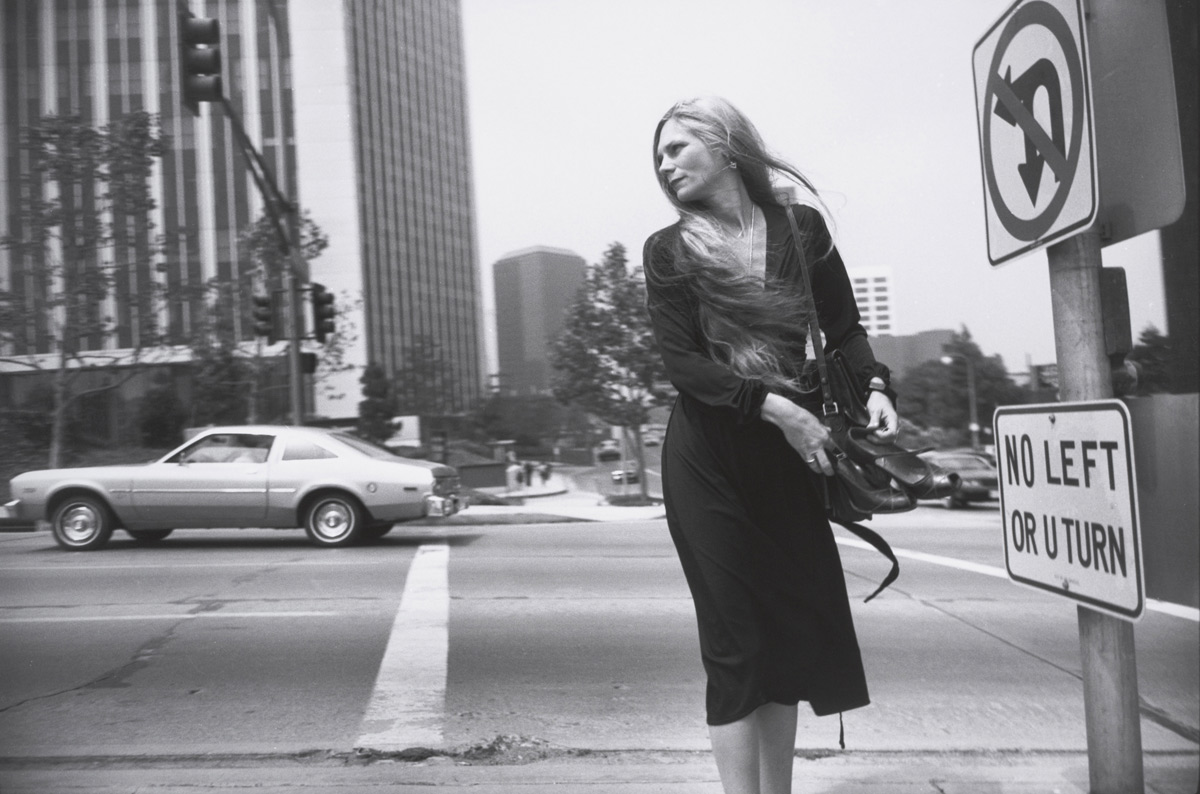
Garry Winogrand (American, 1928-1984) 'Los Angeles' 1980-1983


Garry Winogrand (American, 1928-1984)
Los Angeles
1980-1983
Gelatin silver print
Framed: 40.64 x 50.8cm (16 x 20 in.)
The Garry Winogrand Archive, Center for Creative Photography, The University of Arizona
© The Estate of Garry Winogrand, courtesy Fraenkel Gallery, San Francisco


Garry Winogrand (American, 1928-1984) 'Los Angeles' 1980-1983


Garry Winogrand (American, 1928-1984)
Los Angeles
1980-1983
Gelatin silver print
Framed: 45.72 x 55.88cm (18 x 22 in.)
Posthumous print made from original negative on the occasion of the Garry Winogrand exhibition organised by the National Gallery of Art and the San Francisco Museum of Modern Art, courtesy Center for Creative Photography, The University of Arizona
© The Estate of Garry Winogrand, courtesy Fraenkel Gallery, San Francisco


Garry Winogrand (American, 1928-1984) 'Los Angeles' 1983


Garry Winogrand (American, 1928-1984)
Los Angeles
1983
Gelatin silver print
Framed: 45.72 x 55.88cm (18 x 22 in.)
Posthumous print made from original negative on the occasion of the Garry Winogrand exhibition organised by the National Gallery of Art and the San Francisco Museum of Modern Art, courtesy Center for Creative Photography, The University of Arizona
© The Estate of Garry Winogrand, courtesy Fraenkel Gallery, San Francisco


Garry Winogrand (American, 1928-1984) 'New York' 1961


Garry Winogrand (American, 1928-1984)
New York
1961
Gelatin silver print
Framed: 50.8 x 40.64cm (20 x 16 in.)
The Museum of Modern Art, New York. Purchase and gift of Barbara Schwartz in memory of Eugene M. Schwartz
© The Estate of Garry Winogrand, courtesy Fraenkel Gallery, San Francisco


Garry Winogrand (American, 1928-1984) 'Park Avenue, New York' 1959


Garry Winogrand (American, 1928-1984)
Park Avenue, New York
1959
Gelatin silver print
Framed: 40.64x 50.8cm (16 x 20 in.)
National Gallery of Art, Patrons’ Permanent Fund
© The Estate of Garry Winogrand, courtesy Fraenkel Gallery, San Francisco


National Gallery of Art
National Mall between 3rd and 7th Streets
Constitution Avenue NW, Washington

Opening hours:
Daily 10.00am – 5.00pm

National Gallery of Art website

LIKE ART BLART ON FACEBOOK

Back to top

Exhibition / text: ‘Vivian Maier (1926-2009). A Photographic Revelation’ at Château de Tours

Exhibition dates: 9th November 2013 – 1st June 2014


Vivian Maier (American, 1926-2009) 'Untitled' 1954


Vivian Maier (American, 1926-2009)
Untitled
1954
© Vivian Maier / Maloof Collection, Courtesy Howard Greenberg Gallery, New York


“Maier doesn’t have a partner to dance with. She sees something well enough, whereas Lee Friedlander expects something. If there is an idea out there in the ether she grabs onto it in a slightly derivative way. Maier states that these things happened with this subject matter but with Arbus, for example, she meets something extra/ordinary and alien – and goes beyond, beyond, beyond.”


Dr Marcus Bunyan May 2014


The next best thing

The photographs of Vivian Maier. Unknown in her lifetime (nanny as secretive photographer), her negatives discovered at an auction after her death – some developed, all scanned, in some cases cropped, the medium format images then printed. The latest “must have” for any self respecting photography collection, be it private or public. But are they really that good?

To be unequivocal about it, they are good – but, in most cases, they are not “great”. Maier is a very good photographer but she will never be a great photographer. This might come as a surprise to the legions of fans on Facebook (and the thousands of ‘Likes’ for each image), those who think that she is the best thing since sliced bread. But let’s look at the evidence – the work itself.

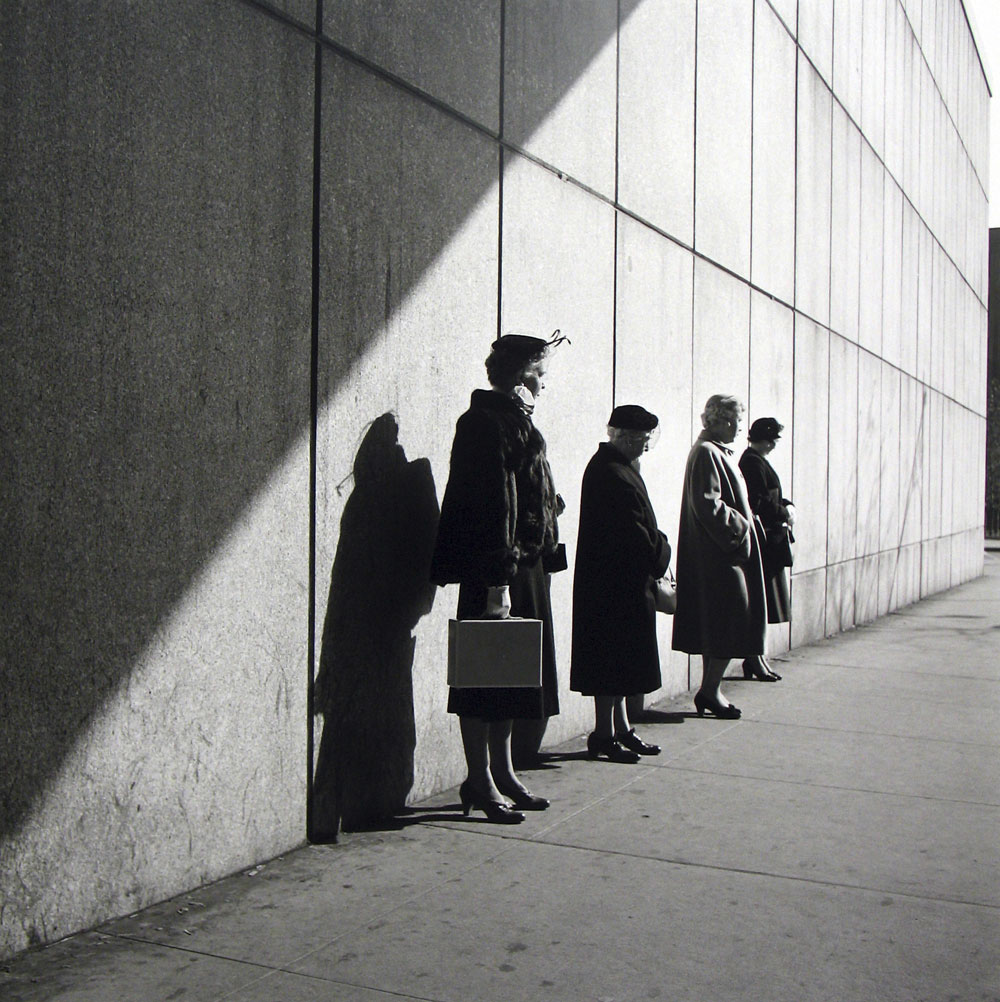
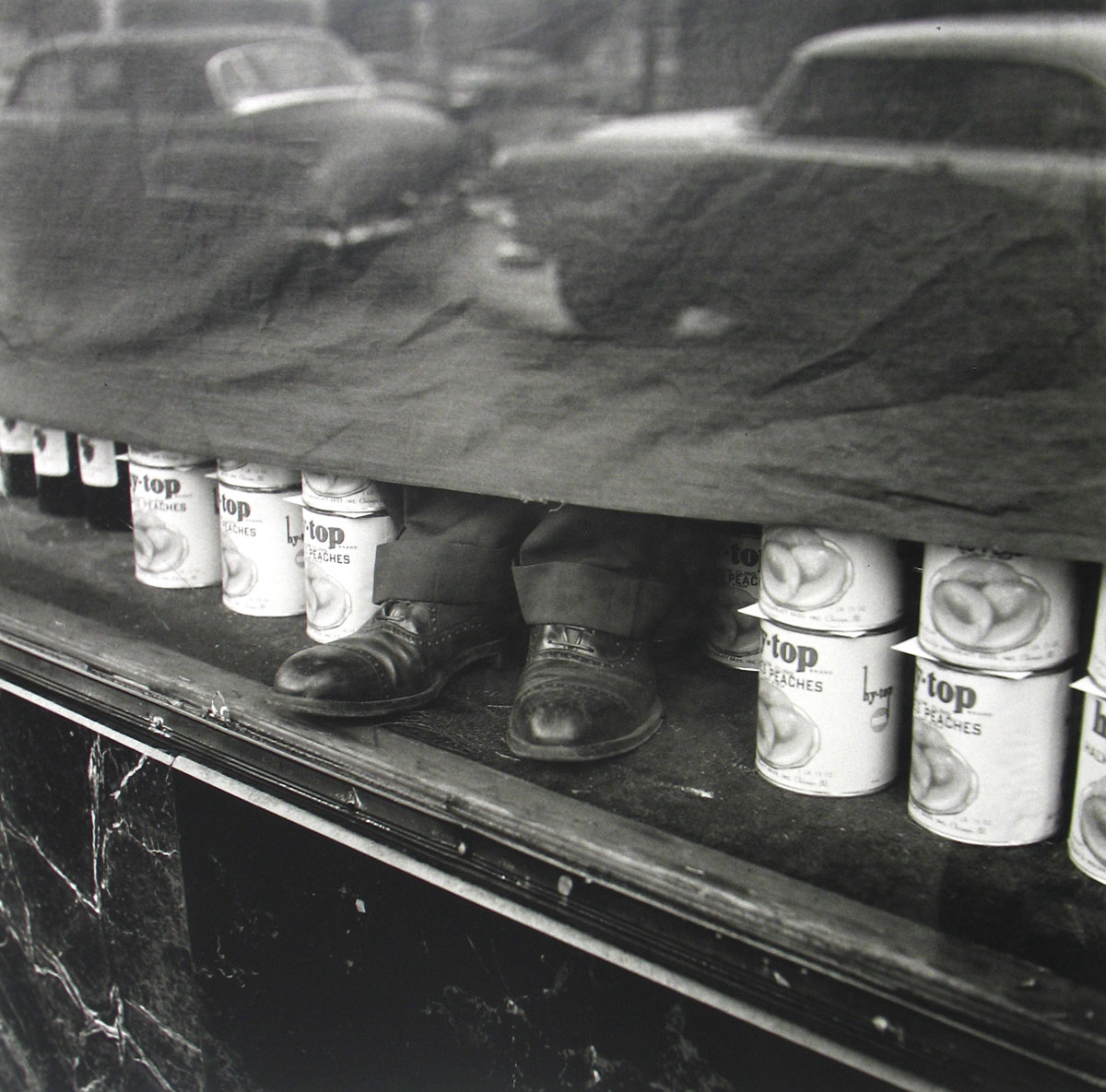
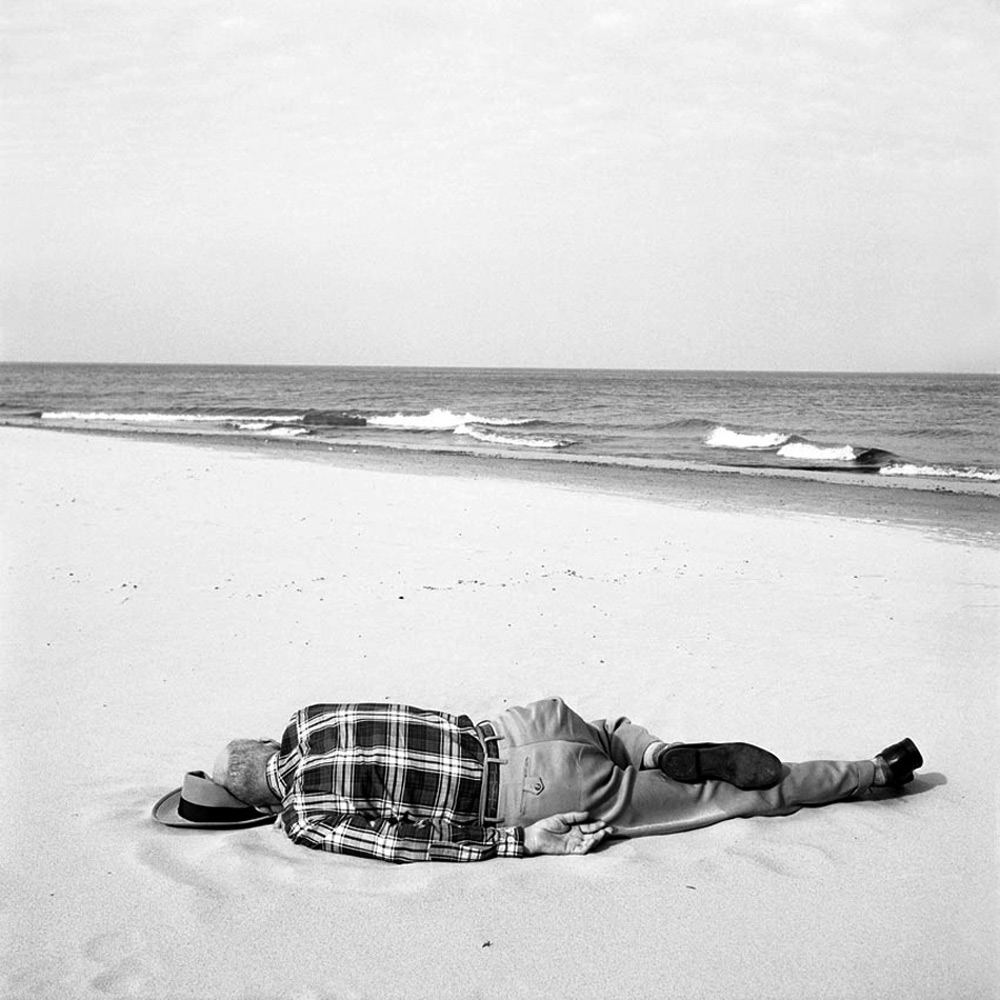
The photographs can seen on the Vivian Maier Official website and I have spent quite a lot of time looking at them. As with any artist, there are some strong images and some not so strong ones but few reach ‘master’ status. The lighting is good, the use of low depth of field, the location and the presence of the people she photographed are all there, as are the influences that you recite in your mind as to the people her photographs remind you of: Lewis Hine, Berenice Abbott, Lisette Model, Diane Arbus, Helen Levitt, Lee Friedlander et al. Somehow through all this she makes the photographs she takes her own for she has a “rare sense of photographic vision” as Edward Petrosky expressed it on my LinkedIn page, but ultimately they don’t really take you anywhere. It’s like she has an addiction to taking photographs (a la Gary Winogrand), but no way of advancing her art to the next level.

Vivien Maier’s photographs stand out because she hasn’t withheld enough within them. What do I mean by that? Let’s look at some examples to explain what I mean…

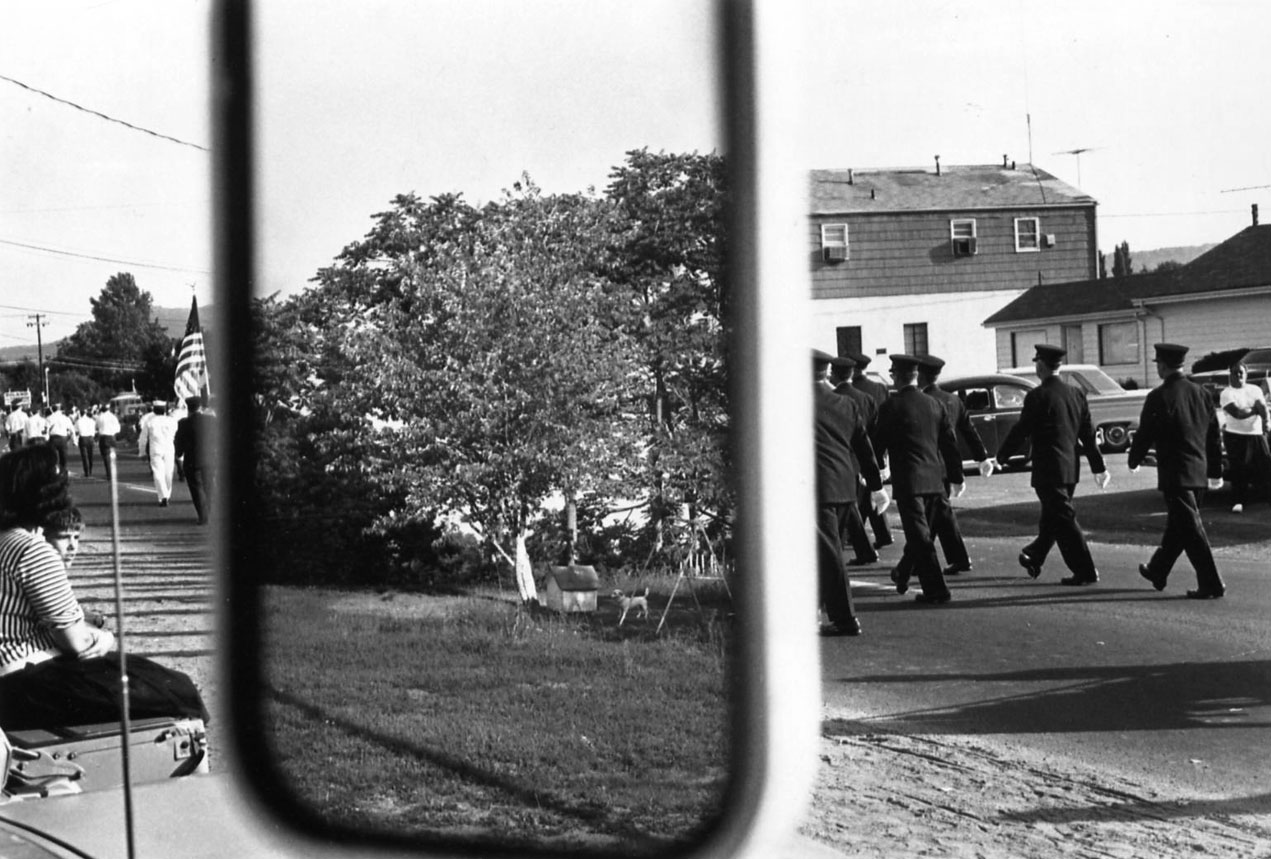
Included in the postings are two comparisons: Vivian Maier, June 19, 1961, Chicago IL, 1961 / Lee Friedlander, Stony Point, New York, 1966; and Vivian Maier, New York, Nd 1966 / Berenice Abbott, New York at Night, 1932. As with most of Maier’s photography, she relies on intuition when taking a photograph and a bloody good intuition it is too. This intuition usually stands her in good stead and she almost always gets the shot, but there is an underlying lack of structure to her images. Here I am talking as much about psychological structure as physical structure, for both go hand in hand.

If we compare the Maier with the Friedlander we can say that, if we look at the windows in the Friedlander, every one is a masterpiece! From the mother and son at left with the white-coated marchers, to the central window with the miniature house, dog and tree, to the dark-suited marchers at right. Everything feels compelling, intricate weavings of a narrative that the viewer has to try and make sense of. Each part of the Friedlander image is absolutely necessary for that picture… whereas there are so many things in the Vivien Maier that belong in other pictures ie. a good picture but a lot that doesn’t belong in that picture. Things that should have been held back, by making another image somewhere else. Her narrative is confusing and thus the eye is also confused.

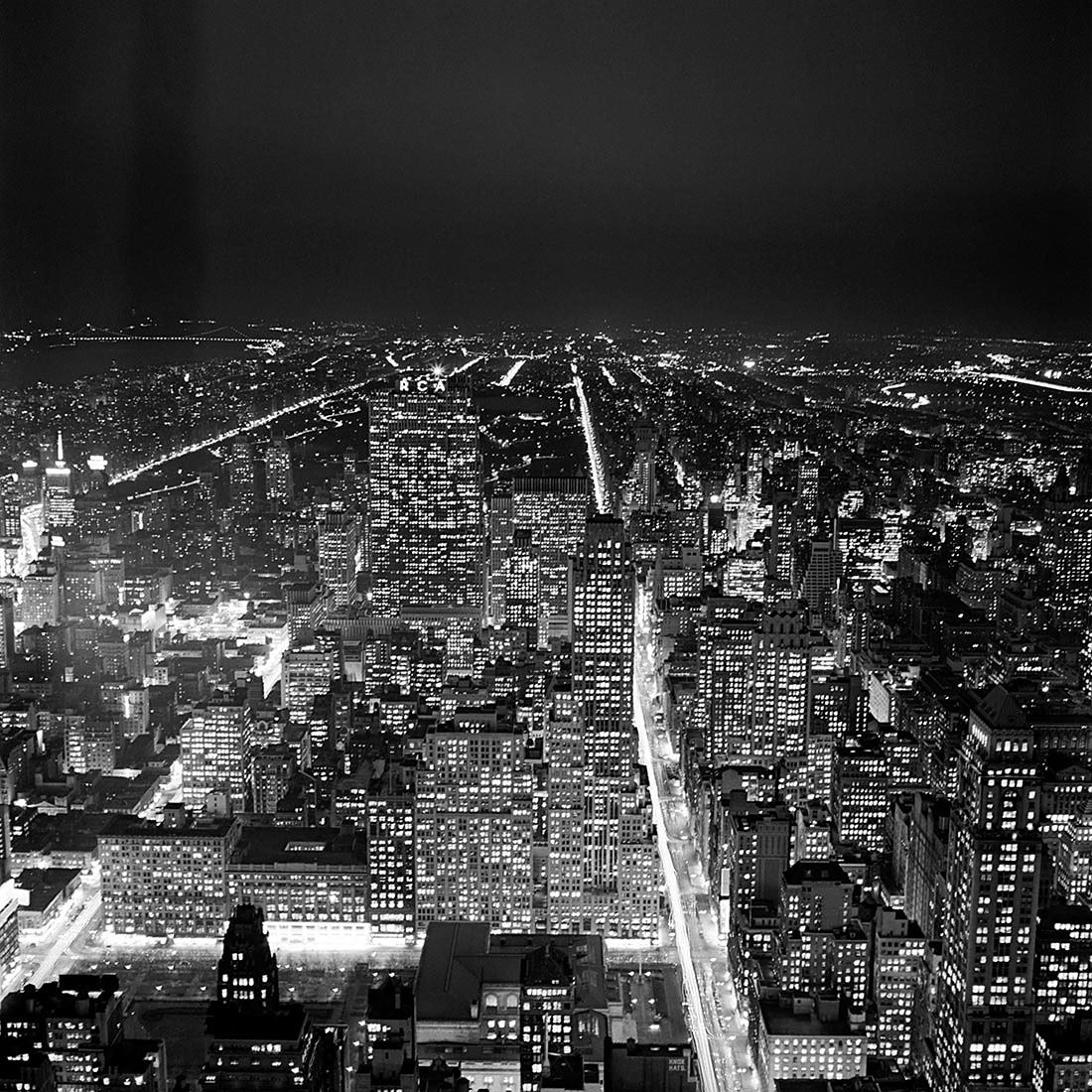
A similar scenario can be observed when comparing the photographs of New York at night by Abbott and Maier. Abbott’s photograph is a tight, orchestrated and muscular rendition of the city which seethes with energy and form. Maier’s interpretation fades off into nothingness, the main arterials of the city leading the eye up to the horizon line and then [nothing]. It is a pleasant but wishy-washy photograph, with all the energy of the city draining away in the mind and in the eye.

One of Maier’s photographs that most resonates with me is September 1953, New York, NY (1953, below). This IS a masterpiece. There is a conciseness of vision here, reminiscent of Weston’s Nude of 1938 with its link to the anamorphic structure of his photographs of peppers. There is nothing auxiliary to the purpose of the photograph, yet there is that indefinable something that takes it out of itself. The dirt of the clothes, under the fingers, the ring on the hand, the shape that no human should be in and its descent onto the pavement, the despair of that descent captured in the angle of the camera looking down on the victim. The photograph has empathy, promotes understanding and empathy in the viewer. Most of us have been there. Other photographs that approach a higher perspective are Maier’s self-portraits, in which there is a conscious exploration of her reflection in/of the world: a slightly dour, serious figure reflected back from the world into the lens of the camera – a refracted identity, the phenomenon of self as light passing obliquely through the interface between one medium and another, between living, the camera and memory.

But too often Maier’s photographs are just so… obvious. Did she wait long enough for the composition to reveal itself to her more, god what’s the word, more ambiguously. Maier doesn’t have a partner to dance with. She sees something well enough, whereas Lee Friedlander expects something. If there is an idea out there in the ether she grabs onto it in a slightly derivative way. Maier states that these things happened with this subject matter but with Arbus, for example, she meets something extra/ordinary and alien – and goes beyond, beyond, beyond.

What we can say is that Maier’s vision is very good, her intuition excellent, but there is, critically, not that indefinable something that takes her images from good to great. This is the key thing – everything is usually thrown at the image, she withholds nothing, and this invariably stops them taking that step to the next level. This is a mighty difficult step for any artist to take, let alone one taking photographs in the shadows. Personally I don’t believe that these images are a “photographic revelation” in the spirit of Minor White. What is a revelation is how eagerly they have been embraced around the world as great images without people really looking deeply at the work; how masterfully they have been promoted through films, books, websites and exhibitions; how Maier’s privacy has been expunged in the quest for dollars; and how we know very little about her vision for the negatives as there are no extant prints of the work.

Dr Marcus Bunyan


Many thankx to the Château de Tours for allowing me to publish the photographs in the posting. Please click on the photographs for a larger version of the image.


Edward Weston (American, 1886-1958) 'Nude' 1936


Edward Weston (American, 1886-1958)
Nude
1936
Gelatin silver print


Vivian Maier (American, 1926-2009) 'September 1953, New York, NY' 1953


Vivian Maier (American, 1926-2009)
September 1953, New York, NY
1953
© Vivian Maier / Maloof Collection, Courtesy Howard Greenberg Gallery, New York


Vivian Maier (American, 1926-2009) 'June 19, 1961, Chicago IL' 1961


Vivian Maier (American, 1926-2009)
June 19, 1961, Chicago IL
1961
© Vivian Maier / Maloof Collection, Courtesy Howard Greenberg Gallery, New York


Lee Friedlander (American, b. 1934) 'Stony Point, New York, 1966' 1966


Lee Friedlander (American, b. 1934)
Stony Point, New York, 1966
1966
Silver gelatin photograph


Vivian Maier (American, 1926-2009) 'New York' Nd


Vivian Maier (American, 1926-2009)
New York
Nd
© Vivian Maier / Maloof Collection, Courtesy Howard Greenberg Gallery, New York


Berenice Abbott (American, 1898-1991) 'New York at Night' 1932


Berenice Abbott (American, 1898-1991)
New York at Night
1932
Gelatin silver print
12 7/8 x 10 9/16″ (32.7 x 26.9cm)


Vivian Maier (American, 1926-2009) 'New York, NY, 18 Octobre 1953' 1953


Vivian Maier (American, 1926-2009)
New York, NY, 18 Octobre 1953
1953
© Vivian Maier / Maloof Collection, Courtesy Howard Greenberg Gallery, New York


Vivian Maier (American, 1926-2009) 'New York, NY' c. 1953


Vivian Maier (American, 1926-2009)
New York, NY
c. 1953
© Vivian Maier / Maloof Collection, Courtesy Howard Greenberg Gallery, New York


Vivian Maier (American, 1926-2009) 'St East nº108, New York , NY, September 28, 1959' 1959


Vivian Maier (American, 1926-2009)
St East nº108, New York , NY, September 28, 1959
1959
© Vivian Maier / Maloof Collection, Courtesy Howard Greenberg Gallery, New York


Vivian Maier (American, 1926-2009) 'New York, NY' 1954


Vivian Maier (American, 1926-2009)
New York, NY
1954
© Vivian Maier / Maloof Collection, Courtesy Howard Greenberg Gallery, New York


Vivian Maier was the archetypal self-taught photographer with a keen sense of observation and an eye for composition. She was born in New York in 1926, but spent part of her childhood in France before returning to New York in 1951 when she started taking photos. In 1956, she moved to Chicago, where she lived until her death in 2009.

Her talent is comparable with that of the major figures of American street photography such as Lisette Model, Helen Levitt, Diane Arbus and Garry Winogrand. The exhibition presented at the Château de Tours by the Jeu de Paume, in partnership with the Municipality of Tours and diChroma photography, is the largest ever exhibition in France devoted to Vivian Maier. It includes 120 black and white and colour gelatin silver prints from the original slides and negatives, as well as extracts from Super 8 films she made in the 60s and 70s. This project, which is sourced from John Maloof’s collection, with the valuable assistance of Howard Greenberg Gallery in New York, reveals a poetic vision that is imbued with humanity.

John Maloof discovered Vivian Maier’s astonishing photos completely by chance in 2007 at an auction in Chicago. At the time, this young collector was looking for historical documentation about a specific neighbourhood of the city and he bought a sizeable lot of prints, negatives and slides (of which a major part had not even been developed) as well as some Super 8 films by an unknown and enigmatic photographer, Vivian Maier. By all accounts, Vivian Maier was a discreet person and somewhat of a loner. She took more than 120,000 photos over a period of thirty years and only showed this consequential body of work to a mere handful of people during her lifetime.

Vivian Maier earned her living as a governess, but all her free time and every day off was spent walking through the streets of New York, then later Chicago, with a camera slung around her neck (first of all box or folding cameras, later a Leica) taking photos. The children she looked after describe her as a cultivated and open-minded woman, generous but not very warm. Her images on the other hand bear witness to her curiosity for everyday life and the attention she paid to those passers – by who caught her eye: facial features, bearing, outfits and fashion accessories for the well-to-do and the telltale signs of poverty for those who were less fortunate.

While some photos are obviously furtively taken snapshots, others bear witness to a real encounter between the photographer and her models, who are photographed face-on and from close up. Her photos of homeless people and people living on the fringe of society demonstrate the depth of her empathy as she painted a somewhat disturbing portrait of an America whose economic boom was leaving many by the wayside.

Vivian Maier remained totally unknown until her death in April 2009. She had been taken in by the Gensburgs, for whom she had worked for almost seventeen years, and many of her possessions as well as her entire photographic output had been placed in storage. It was seized and sold in 2007 to settle unpaid bills.

Her biography has now been reconstructed, at least in part, thanks to a wealth of research and interviews carried out by John Maloof and Jeffrey Goldstein after the death of Vivian Maier. Jeffrey Goldstein is another collector who purchased a large part of her work. According to official documents, Vivian Maier was of Austro-Hungarian and French origin and her various trips to Europe, in particular to France (in the Alpine valley of Champsaur where she spent part of her childhood) have been clearly identified and documented. However, the circumstances that led her to take an interest in photography and her life as an artist remain veiled in mystery.

Photography seemed to be much more than a passion: her photographic activity was the result of a deeply felt need, almost an obsession. Each time she changed employers and had to move house, all her boxes and boxes of films (that she hadn’t had developed for want of money), as well as her archives comprising books and press cuttings about various stories in the news, came along too.

Vivian Maier’s body of work highlights those seemingly insignificant details that she came across during her long walks through the city streets: odd gestures, strange figures and graphic arrangements of figures in space. She also produced a series of captivating self-portraits from her reflection in mirrors and shop windows.

Press release from the Château de Tours


Vivian Maier (American, 1926-2009) 'Self-portrait' Nd


Vivian Maier (American, 1926-2009)
Self-portrait
Nd
© Vivian Maier / Maloof Collection, Courtesy Howard Greenberg Gallery, New York


Vivian Maier (American, 1926-2009) 'Chicago' Nd


Vivian Maier (American, 1926-2009)
Chicago
Nd
© Vivian Maier / Maloof Collection, Courtesy Howard Greenberg Gallery, New York


Vivian Maier (American, 1926-2009) 'Florida, 9 January 1957' 1957


Vivian Maier (American, 1926-2009)
Florida, 9 January 1957
1957
© Vivian Maier / Maloof Collection, Courtesy Howard Greenberg Gallery, New York


Vivian Maier (American, 1926-2009) 'Untitled' 1954


Vivian Maier (American, 1926-2009)
Untitled
1954
© Vivian Maier / Maloof Collection, Courtesy Howard Greenberg Gallery, New York


Vivian Maier (American, 1926-2009) 'Chicago, IL, January, 1956' 1956


Vivian Maier (American, 1926-2009)
Chicago, IL, January, 1956
1956
© Vivian Maier/Maloof Collection, Courtesy Howard Greenberg Gallery, New York


Vivian Maier (American, 1926-2009) 'Chicago, August 22, 1956' 1956


Vivian Maier (American, 1926-2009)
Chicago, August 22, 1956
1956
© Vivian Maier/Maloof Collection, Courtesy Howard Greenberg Gallery, New York


Château de Tours
25 Avenue André Malraux
37000 Tours

Opening hours:
Tuesday to Friday: 2pm – 6pm
Saturday and Sunday: 3pm – 6pm

Vivian Maier Official website

LIKE ART BLART ON FACEBOOK

Back to top

Exhibitions: ‘New Women’ and ‘The Chanel Legend’ at Museum für Kunst und Gewerbe Hamburg

The Chanel Legend exhibition dates: 28th February – 18th May 2014
New Women exhibition dates: 28th February – 27th July 2014


Yva (German, 1900-1944) 'Silk stockings' Nd


Yva (German, 1900-1944)
Silk stockings
Nd
Silver gelatin print
Museum für Kunst und Gewerbe Hamburg


Yva (26 January 1900 – 31 December 1944) was the professional pseudonym of Else Ernestine Neuländer-Simon who was a German Jewish photographer renowned for her dreamlike, multiple exposed images. She became a leading photographer in Berlin during the Weimar Republic. When the Nazi Party came to power, she was forced into working as a radiographer. She was deported by the Gestapo in 1942 and murdered, probably in the Majdanek concentration camp during World War II.


Do you feel like a new woman?

Do you feel like a god?

You, in the oft mentioned (ten times in the accompanying texts) LBD (Little Black Dress) or Chanel Suit (ten times as well)

It’s like the ten commandments.


And ~ on we go… say after me,

“Sashay! Shantay!”

PS some of the photos ain’t half bad tho!

Dr Marcus Bunyan


Many thankx to the Museum für Kunst und Gewerbe Hamburg for allowing me to publish the photographs in the posting. Please click on the photographs for a larger version of the image.


‘Sleeping with the Enemy, Coco Chanel and the Secret War’ written by Hal Vaughan further solidifies the consistencies of the French intelligence documents released by describing Coco as a “vicious anti-Semite” who praised Hitler.

World War II, specifically the Nazi seizure of all Jewish-owned property and business enterprises, provided Chanel with the opportunity to gain the full monetary fortune generated by Parfums Chanel and its most profitable product, Chanel No. 5. The directors of Parfums Chanel, the Wertheimers, were Jewish. Chanel used her position as an “Aryan” to petition German officials to legalise her claim to sole ownership.

“On 5 May 1941, she wrote to the government administrator charged with ruling on the disposition of Jewish financial assets. Her grounds for proprietary ownership were based on the claim that Parfums Chanel “is still the property of Jews” and had been legally “abandoned” by the owners”. …

Chanel was not aware that the Wertheimers, anticipating the forthcoming Nazi mandates against Jews had, in May 1940, legally turned control of Parfums Chanel over to Félix Amiot, a Christian French businessman and industrialist. At war’s end, Amiot returned “Parfums Chanel” to the hands of the Wertheimers.

During the period directly following the end of World War II, the business world watched with interest and some apprehension the ongoing legal wrestle for control of Parfums Chanel. Interested parties in the proceedings were cognisant that Chanel’s Nazi affiliations during wartime, if made public knowledge, would seriously threaten the reputation and status of the Chanel brand. Forbes magazine summarised the dilemma faced by the Wertheimers: [it is Pierre Wertheimer’s worry] how “a legal fight might illuminate Chanel’s wartime activities and wreck her image – and his business.”


Text from the Wikipedia website


Aenne Biermann (German, 1898-1933) 'Self-Portrait with silver ball' 1931


Aenne Biermann (German, 1898-1933)
Self-Portrait with silver ball
1931
Silver gelatin print
Museum für Kunst und Gewerbe, Hamburg


Aenne Biermann (March 8, 1898 – January 14, 1933), born Anna Sibilla Sternfeld, was a German photographer of Ashkenazi origin. She was one of the major proponents of New Objectivity, a significant art movement that developed in Germany in the 1920s.

Major exhibitions of her work include the Munich Kunstkabinett, the Deutscher Werkbund and the exhibition of Folkwang Museum in 1929. Other important exhibitions include the exhibition entitled Das Lichtbild held in Munich in 1930 and the 1931 exhibition at the Palace of Fine Arts (French: Palais des Beaux Arts) in Brussels.

Text from the Wikipedia website


Horst P. Horst (German-American, 1906-1999) 'Coco Chanel' 1937


Horst P. Horst (German-American, 1906-1999)
Coco Chanel
1937
Silver gelatin print
Museum für Kunst und Gewerbe Hamburg


Horst Paul Albert Bohrmann (August 14, 1906 – November 18, 1999), who chose to be known as Horst P. Horst, was a German-American fashion photographer. …

Horst is best known for his photographs of women and fashion, but is also recognised for his photographs of interior architecture, still lifes, especially ones including plants, and environmental portraits. One of the great iconic photos of the Twentieth-Century is “The Mainbocher Corset” with its erotically charged mystery, captured by Horst in Vogue‘s Paris studio in 1939. Designers like Donna Karan continue to use the timeless beauty of “The Mainbocher Corset” as an inspiration for their outerwear collections today. His work frequently reflects his interest in surrealism and his regard of the ancient Greek ideal of physical beauty.

His method of work typically entailed careful preparation for the shoot, with the lighting and studio props (of which he used many) arranged in advance. His instructions to models are remembered as being brief and to the point. His published work uses lighting to pick out the subject; he frequently used four spotlights, often one of them pointing down from the ceiling. Only rarely do his photos include shadows falling on the background of the set. Horst rarely, if ever, used filters. While most of his work is in black & white, much of his colour photography includes largely monochromatic settings to set off a colourful fashion. Horst’s colour photography did include documentation of society interior design, well noted in the volume Horst Interiors. He photographed a number of interiors designed by Robert Denning and Vincent Fourcade of Denning & Fourcade and often visited their homes in Manhattan and Long Island. After making the photograph, Horst generally left it up to others to develop, print, crop, and edit his work.

One of his most famous portraits is of Marlene Dietrich, taken in 1942. She protested the lighting that he had selected and arranged, but he used it anyway. Dietrich liked the results and subsequently used a photo from the session in her own publicity.

Text from the Wikipedia website


Boris Lipnitzki (French born Ukraine, 1887-1971) 'Coco Chanel' 1937


Boris Lipnitzki (French born Ukraine, 1887-1971)
Coco Chanel
1937
© Getty Images


Boris Lipnitzki (1887-1971) was a Ukrainian-born French photographer of the arts; ballet, fashion, cinema, visual art, writing and music.

Haim Efime Boris Lipnitzki (or Lipnitzky) was born into a Jewish family in Oster, in Chernihiv Province of the Russian Empire (now Ukraine) on 4 February 1887. He died in Paris on 6 July 1971, aged 84, and is buried in Pere Lachaise cemetery.

Lipnitzki first worked for a photographer in Odessa, then opened his own studio in Pultusk. He arrived in Paris in the early 1920s. There, he established a studio at 40 rue du Colisée, where he photographed many of the artistic personalities of the 20th century from the 1920s-1960s, as well as picturing them in their own surroundings. His friendship with fashion designer Paul Poiret, with whom he would stay to photograph in Biarritz, provided an entrée into these circles.

His subjects included Maurice Ravel, René Hubert, Albert Camus, Blaise Cendrars, Jean Cocteau, Otto Preminger, Igor Strawinsky, Arthur Honegger, Leonid Massine, Serge Lifar, Paul Poiret, Coco Chanel, Olga Spessivtseva, Nyota Inyoka, Tamara Karsavina, Serge Gainsbourg, Les Six, Marc Chagall, Pablo Picasso, as well as Josephine Baker of whom in 1926 he made a famous series of nude photographs.

Text from the Wikipedia website


New Women

In the 1920s Coco Chanel chiefly influenced the type of the “new woman”. She established skirts that reached just below the knee, encouraged women to wear trousers and represents functional ladies wear. In the photographs by among others Yva, Franz Roth, Lotte Jacobi and Hein Gorny presented here, women show legs in silk stockings, wear cropped hair, drive motorbikes or automobiles and play tennis or go into baths. In this period women begin to take charge of their lives. Being a photographer offered the opportunity to express this new notion of the self in images and in life. The special display of the Photography Department coincides with the exhibition The Chanel Legend.

The Chanel Legend

Coco Chanel (1883-1971) is one of the most eminent couturières of the twentieth century. She already appears as an advocate of simple, comfortable clothes in the years just after 1910, thus helping to pave the way for a style which has retained its major importance in the fashion world till today. Such outstanding fashion classics as the “little black dress”, the Chanel Suit and the Chanel handbag are inseparably linked with her person. Since her start-up in 1913, Chanel has built up an international and, till the present day, astoundingly successful fashion empire. It is not until 1983, in the shape of Karl Lagerfeld, that a personality with anything like her charisma and influence becomes her successor. Coco – her real name was Gabrielle – Chanel launched her perfume Chanel N° 5, whose overwhelming commercial success guaranteed her a financial independence which was to last all her life, at the beginning of the 1920s. She combined fashion jewellery and genuine gemstones with surefooted confidence and had herself portraited by celebrity photographers such as Man Ray or Horst P. Horst.

The Chanel Legend investigates why it is that the person of Coco Chanel and the brand she established have attracted such huge attention up to and including the present. It will turn the spotlight both on the fashion designer’s biography and the image which she created for herself, as well as the brilliant achievement of Karl Lagerfeld (b. 1933) in combining this legacy with the fluctuating currents of contemporary taste since 1983. The exhibition shows a total of more than 200 objects from eminent collections, including women’s suits, accessoires, jewellery, advertising graphic, historical photographs and over 75 fashion magazines spanning a period from 1920 to1971. Besides more than 54 original garments, among them 38 created by Coco Chanel, and some 50 jewellery creations, over 35 adaptions of the Chanel classics can be seen for the first time, which in their own individual way give us a new appreciation of the “Chanel Legend”.

The exhibition approaches the “Chanel Legend” in three chapters. The first documents, with 38 original garments, accessoires and more than 50 items of fashion jewellery from the period between 1925 and 1971 the fashion designer’s oeuvre. Designs for evening and day wear and the perfume Chanel N° 5, of which an original flacon is on show, belong to Chanel’s pre-Second World War creative phase. After her return to Paris in 1954, Chanel continued to lead her firm up to her death in 1971. The exhibition shows, among other items from this period, some 10 garments which Chanel designed for the actress and singer Marlene Dietrich, including day wear and garments for representative occasions. On top of this, a large quantity of pieces of fashion jewellery can be seen, supplemented by original photographs.

The second chapter throws light on the Chanel classics, which have retained their fascination till today. Thus historical original examples of the Chanel Suit are juxtaposed with some 20 different adaptations of it, including models from other fashion houses, unknown ateliers and garment manufacturers. The procession of “lookalikes” and “distant cousins” by no means comes to an end with Chanel’s lifetime, but integrates aspects of contemporary fashion. A selection of the endless variations on the theme of the “little black dress” from the 1920s till the present will also be on show, some of them by designers such as Yves Saint Laurent, Max Heyman and Issey Miyake or Nina Ricci. They should by no means be seen as just copies of Chanel models. The short black dress was in keeping with the modern, dynamic lifestyle of the 1920s. Later the “little black dress” is an indispensable requisite in every woman’s wardrobe and, in the Fifties and Sixties, the epitome of Parisian chic.

In the third section, the focus is on Karl Lagerfeld’s creations for the House of Chanel. He succeeded in modernising the brand without sacrificing the features which were typical for it. The exhibition shows in particular items which quote the Chanel classics, or pay homage to his revered predecessor in some of their details. This selection, too, is complemented by fashion jewellery. The development comes full circle here, since Lagerfeld’s present winter collection for 2013-14 playfully quotes references to Coco Chanel’s legendary initial phase in the 1920s. More than 100 historical fashion magazines spanning a period from 1920 to 1971 can also be seen in the exhibition, including an issue of the American Vogue dated 1st October 1926 in which the “little black dress” is shown. Magazines were the most important medium for the propagation and reception of Chanel’s fashion. Visitors can leaf through them on the tablet computers provided.

Text from press release from the Museum für Kunst und Gewerbe Hamburg website


Aenne Biermann (German, 1898-1933) 'Portrait of Anneliese Schiesser' 1929


Aenne Biermann (German, 1898-1933)
Portrait of Anneliese Schiesser
1929
Silver gelatin print
Museum für Kunst und Gewerbe, Hamburg


Hein Gorny (German, 1904-1967) 'Portrait of a Woman' c. 1930/1972


Hein Gorny (German, 1904-1967)
Portrait of a Woman
c. 1930/1972
Silver gelatin print, Reprint ofHeinrich Riebesehl
Museum für Kunst und Gewerbe, Hamburg


Hein Gorny (1904-1967) was a highly versatile photographer. Self-taught, he had extensive, in-depth knowledge of photographic techniques and was specialised both in photographic and darkroom processes. He photographed a broad range of subject matter, including portraits, architecture, and animals as well as images used in industrial, commercial, and illustrational contexts. In addition he created experimental photographs, primarily working with macrophotography. Advertising photography was the field in which Hein Gorny carried out numerous commissions and was most well-known. He was primarily active in Hanover and Berlin. Hein Gorny is described by Heinrich Riebesehl as a “pioneer of modern commercial photography” in a catalogue published in conjunction with the Spectrum Photogalerie’s inaugural exhibition of 1972. He was masterful in his groundbreaking ability to fuse the photographic spirit of his time with the demands of advertising photography.

“Especially in his early work, the joy of experimentation and the openness to everything new and unusual is clearly visible. His positive attitude towards life, his carefree, almost exuberant way of using the medium of photography made him – consciously or unconsciously – adopt the taste of the times.” ~ Heinrich Riebesehl


Atelier Benda/d'Ora. 'The actress Marlene Dietrich with beret' 1927


Atelier Benda/d’Ora
The actress Marlene Dietrich with beret
1927
Silver gelatin print
Museum für Kunst und Gewerbe Hamburg


Madame D'Ora. 'The fashion designer Coco Chanel' about 1927


Madame D’Ora
The fashion designer Coco Chanel
about 1927
Silver gelatin print
Museum für Kunst und Gewerbe Hamburg


Dora Philippine Kallmus (20 March 1881 – 28 October 1963), also known as Madame D’Ora or Madame d’Ora, was an Austrian fashion and portrait photographer.

She became interested in the photography field while assisting the son of the painter Hans Makart, and in 1905 she was the first woman to be admitted to theory courses at the Graphische Lehr- und Versuchsanstalt (Graphic Training Institute). That same year she became a member of the Association of Austrian photographers. At that time she was also the first woman allowed to study theory at the Graphischen Lehr- und Versuchsanstalt, which in 1908 granted women access to other courses in photography.

In 1907, she established her own studio with Arthur Benda in Vienna called the Atelier d’Ora or Madame D’Ora-Benda. The name was based on the pseudonym “Madame d’Ora”, which she used professionally. D’ora and Benda operated a summer studio from 1921 to 1926 in Karlsbad, Germany, and opened another gallery in Paris in 1925. She was represented by Schostal Photo Agency (Agentur Schostal) and it was her intervention that saved the agency’s owner after his arrest by the Nazis, enabling him to flee to Paris from Vienna.

Her subjects included Josephine Baker, Coco Chanel, Tamara de Lempicka, Alban Berg, Maurice Chevalier, Colette, and other dancers, actors, painters, and writers.

Text from the Wikipedia website


Unknown photographer. 'Chanel' 1931


Unknown photographer
Chanel
1931
© Corbis Images


Man Ray (American, 1890-1976) 'Chanel with cigarette' 1935


Man Ray (American, 1890-1976)
Chanel with cigarette
1935
© VG Bildkunst Bonn, 2014, and Man Ray Trust


Roger Schall (French, 1904-1995) 'Ritz Apartment' Nd


Roger Schall (French, 1904-1995)
Ritz Apartment
Nd
© Roger Schall-Collection Schall


Roger Schall was a photographer during the interwar period, a contemporary of Brassaï. He excelled in photojournalism, in which he was one of the pioneers, as well as in the photographic disciplines of fashion and portraits. In the early 30s, the “revolution” Leica and Rolleiflex allowed him to fulfill his passion for images taken on the spot. Paris was his main exploration ground, where the night allowed him to capture and expose with strength and delicacy the particular shapes of a city made of diversities.

Text from the Artsper website [Online] Cited 25/03/2021


During World War II, Schall secretly documented the Nazi occupation of Paris. He also produced fashion photography for the fetish clothing company Diana Slip.


Douglas Kirkland (American, b. 1934) 'Chanel im Atelier' (Chanel in the studio) 1962


Douglas Kirkland (American, b. 1934)
Chanel im Atelier (Chanel in the studio)
1962
© Corbis Images


Coco Chanel

Gabrielle Chanel, who grew up in humble circumstances, opened her first Couture Salon in Paris in 1913, after she had already set up in business in 1908 as a modiste. In 1919 she moved to the Rue Cambon 31, which is still the address of the House of Chanel today. Coco Chanel’s first creative phase ended with the outbreak of war in 1939. Her fashion house stayed shut for 15 years before she dared a comeback in 1954, at the age of 70. The exhibition shows creations by Chanel from both periods. The “little black dress” becomes her trademark. Further models of day and evening wear show to what extent the fashion designer had her finger on the pulse of her time, and at the same time bear witness to the high quality of her models both in design and execution. In the 1950s and 1960s it is her women’s suits which cause a furore, first and foremost the “Chanel Suit”, which she first presented at a fashion show in 1957. Her celebrated quilted handbag, launched in February 1955 and called, simply, “2.55”, has long since attained the status of a classic and is a must in every collection of the luxury label. Her collections were always supplemented by matching fashion jewellery. Till today, Coco Chanel appears as an enigmatic and fascinating personality, and has been the theme of many films and books. Fierce controversy also surrounds her links to decision-makers of the Third Reich too, however, up to the present day.

The “little black dress” and suits by Chanel – their reception

he reception of Coco Chanel’s fashion and her style is already very widespread in her lifetime. A comparison with other contemporary couturiers reveals that Coco Chanel operated a very tolerant policy as regards the copyright for her models: The fashion designer allowed her models to be copied up to a certain point with her consent. For her, it was an acknowledgement of her eminence if women all over the world dressed in her style – an aspect whose influence on the “Chanel Legend” should not be underestimated, and which is investigated in this exhibition for the first time. In October 1926, the American Vogue magazine described a short black dress by Chanel as “The Chanel Ford – the frock that all the world will wear”. This drew a parallel between Chanel’s dress in its universality and modernity and one of the most important inventions of the time and prophesied a great future for it.

This is the birth of the “little black dress”. And although Chanel was not the first couturier to design simple black dresses for day wear it nevertheless remains inseparably linked with her name. Even the perhaps most celebrated “little black dress”, that worn by Audrey Hepburn in the film classic “Breakfast at Tiffany’s”, is often wrongly attributed to Chanel. The exhibition traces the development of the fashion classic from the 1920s till today. Another model which has gone down as an icon in fashion history is the “Chanel Suit” with its boxy, collarless jacket and often contrasting braided edgings. The term “Chanel Suit” is even quoted as a reference in the Duden. The exhibition shown here also document the fact that Coco Chanel produced a whole range of women’s suits which were adapted by other fashion houses or even home dressmakers. It is mostly no longer possible today to reconstruct whether individual models were made under licence or whether they were freely interpreted or simply copied. Irrespective of this, however, it is certain that all these models also made their contribution to the “Chanel Legend”.

Text from press release from the Museum für Kunst und Gewerbe Hamburg website


Gabrielle Chanel (French, 1883-1971) 'Ensemble' 1960s


Gabrielle Chanel (French, 1883-1971)
Ensemble
1960s
Jahre Seidencloqué mit Lurex
Deutsche Kinemathek – Marlene Dietrich Collection, Berlin
© Draiflessen Collection, Mettingen, Fotografie von Christin Losta


Gabrielle Chanel (French, 1883-1971) 'Tageskleid/Day Dress' 1960-62


Gabrielle Chanel (French, 1883-1971)
Tageskleid/Day Dress
1960-62
Seiden-Crêpe de Chine
Gemeentemuseum, Den Haag
© Draiflessen Collection, Mettingen, Fotografie von Christin Losta


Gabrielle Chanel (French, 1883-1971) 'Costume, C. H. Kuehne & Zn' Autumn / Winter 1966/67, licensed by Chanel


Gabrielle Chanel (French, 1883-1971)
Costume, C. H. Kuehne & Zn
Autumn / Winter 1966/67, licensed by Chanel
Silk brocade
Gemeentemuseum, Den Haag © Draiflessen Collection, Mettingen, Fotografie von Christin Losta


Karl Lagerfeld (German, 1933-2019) 'Costume, Chanel Boutique' Autumn/Winter 1989/90


Karl Lagerfeld (German, 1933-2019)
Costume, Chanel Boutique
Autumn/Winter 1989/90
Wool tweed, Wool georgette
Museum für Kunst und Gewerbe Hamburg
© Draiflessen Collection, Mettingen, Fotografie von Christin Losta


Karl Lagerfeld (German, 1933-2019) 'Costume, Chanel Boutique' Spring/Summer 1986


Karl Lagerfeld (German, 1933-2019)
Costume, Chanel Boutique
Spring/Summer 1986
Cotton poplin, cotton pique
Museum für Kunst und Gewerbe Hamburg
© Draiflessen Collection, Mettingen, Fotografie von Christin Losta


Museum für Kunst und Gewerbe Hamburg
Steintorplatz, 20099 Hamburg

Opening hours:
Tuesday to Sunday 11am – 6pm
Wednesday and Thursday 11am – 9pm

Museum fur Kunst und Gewerbe Hamburg website

LIKE ART BLART ON FACEBOOK

Back to top

Exhibition: ‘Carrie Mae Weems: Three Decades of Photography and Video’ at The Solomon R. Guggenheim Museum, New York

Exhibition dates: 24th January – 14th May 2014


Installation view: 'Carrie Mae Weems: Three Decades of Photography and Video', Solomon R. Guggenheim Museum, New York, January 24-May 14, 2014


Installation view: Carrie Mae Weems: Three Decades of Photography and Video, Solomon R. Guggenheim Museum, New York, January 24-May 14, 2014
Photo: David Heald © Solomon R. Guggenheim Foundation.


A busy time with postings on the archive over the next week with a lot of exhibitions finishing on the 18th May 2014. The posting about this artist is one of the best of them. I have been wanting to show this artist on this site since it started, nearly 6 years ago. Finally, I get my chance!


I ask the question:

Who are the interesting photographers anywhere who are alive now?

That is – by looking at the ideas that are present in poetry, music, philosophy or even politics – who is there that is truly taking these ideas forward (or ideas that are as interesting). Or, who is arranging images with the elegance of a Sommer or an Atget or the dynamics of Arbus.

In other words whose acts am I hanging upon, so that I am waiting with great anticipation to see what they are going to do next?

Which living photographers would I walk over broken glass to see their work? = some

If I was being essential (and if you were walking over glass you would be), the list would be very short:

Carrie Mae Weems and Wolfgang Tillmans.


What both these image makers – for they are not photographers in the traditional sense – do, is problematise and reconfigure narration and visualisation in the conceptualisation of subject. Tillmans experiments with a sensory experiential backdrop against and within which the photographs are produced. Modes of perception and the regimes of emotion are inducted into the aesthetics of production and meaning so that, “the pictures communicate with each other in a way that is not bound to the pattern of a closed narrative or any particular line of argument.” The mobilisation and reversal of value and meaning are central strategies in Tillmans’ praxis, where realistic and abstract elements are never intentionally separated from each other, and where the physicality and space of the photographs is also acknowledged in the installation of the work.

A similar sensory experience can be observed in the work of Carrie Mae Weems, only this artist invites contemplation of issues surrounding race, gender, and class inequality – bringing to light the voices of marginalised and oppressed people and histories – through a multidimensional picture of history and humanity, intended to spur greater cultural awareness and compassion. As the press release observes, “Although her subjects are often African American, Weems wants “people of color to stand for the human multitudes” and for her art to resonate with audiences of all backgrounds… Weems often appropriates words and images, re-presenting them to viewers as biting reminders of the persistence of bigoted attitudes in the United States.”

This is the power of both artists work, the creation of open ended narratives, multidimensional pictures of history and humanity which allows the viewer to create a space beyond the art works.

Using ekphrasis – the structuring patterns of language, in Weems’ case emphasising the role of both spoken and written narrative – to vividly represent a wide range of perceptual experiences, she creates a complementary space outside of the art work in the reader’s mind. The author creates links, “designating the paths along which the reader may travel, and thus, in a much freer manner than modernist authors, structures the network of allusions, parallelisms, and juxtapositions that contribute to the sense of textual space.”1 This allows the viewer to create a language of personal associations and engages in them an autonomy of experience, one encouraged by the products, the texts and images that these authors create.

These thoughts come to mind. Some things we interpret and then remember that interpretation, but we are no longer involved in the actual act of interpretation – and there are other, probably fewer things that continue to involve us – where we never finish the first way of looking at them, we are always coming to them and not arriving. Unfortunately, I find a lot of things in the first group, and as much as theoreticians try to inspire me to re-interpret, the work they have done often only works as an adjunct to something that has settled.

The art of Weems and Tillmans resides, lives and breathes of the second category, for we can never be sure of the pattern of narrative, the form of aesthetic and thematic interaction and the specificity of the marginalised histories they examine. These histories apply to all of us.

Dr Marcus Bunyan


1/ Tolva, John. Ut Pictura Hyperpoesis: Spatial Form, Visuality, and the Digital World,” in HYPERTEXT ’96 Proceedings of the the seventh ACM conference on Hypertext, 1996, p. 71.


Many thankx to The Solomon R. Guggenheim Museum for allowing me to publish the photographs in the posting. Please click on the photographs for a larger version of the image.


“Over the past thirty years, Carrie Mae Weems has yearned to insert marginalized peoples into the historical record. She does this not only to bring ignored or erased experiences to light but to provide a more multidimensional picture of humanity as a whole, a picture that ultimately will spur greater awareness and compassion. Weems believes deeply that “my responsibility as an artist is to … make art. beautiful and powerful, that adds and reveals; to beautify the mess of a messy world, to heal the sick and feed the helpless; to shout bravely from the roof-tops and storm barricaded doors and voice the specifics of our historic moment.””


Carrie Mae Weems quoted in Kathryn E. Delmez. “Introduction,” from Kathryn E. Delmez (ed.,). Carrie Mae Weems: Three Decades of Photography and Video. Yale University Press 2012, p. 1.


“Weems [work] exist at the intersection of photography and race, image and text.”


John Pultz


“Belying the myth that conceptual artists disdain the old-fashioned notion of aesthetics, Weems has long been consumed and galvanized by the idea of beauty. The notion of beauty encompasses and reaches beyond aesthetics. It is not a simple concept, as often there are unspoken political implications in her use. Beauty is a powerful adjective in her hands and an important tool in her work. Her work is always about beauty and purposely so. She seduces the viewer through the very process of creating luscious prints, or beautiful images, without ever using beauty purely to seduce. But no matter what one encounters within the text or within one’s own revelations about what the texts ultimately say, the religion of beauty always undergirds Weem’s vision and informs her work.”


Thelma Golden. “Some Thoughts on Carrie Mae Weems,” in Golden, T. and Piché Jr., T. Carrie Mae Weems: Recent Work, 1992-1998. New York: George Braziller, 1998, p. 32 quoted in Deborah Willis. “Photographing between the Lines: Beauty, Politics, and the Poetic Vision of Carrie Mae Weems,” in Kathryn E. Delmez (ed.,). Carrie Mae Weems: Three Decades of Photography and Video. Yale University Press 2012, p. 33.


Installation view: 'Carrie Mae Weems: Three Decades of Photography and Video', Solomon R. Guggenheim Museum, New York, January 24-May 14, 2014

Installation view: 'Carrie Mae Weems: Three Decades of Photography and Video', Solomon R. Guggenheim Museum, New York, January 24-May 14, 2014

Installation view: 'Carrie Mae Weems: Three Decades of Photography and Video', Solomon R. Guggenheim Museum, New York, January 24-May 14, 2014

Installation view: 'Carrie Mae Weems: Three Decades of Photography and Video', Solomon R. Guggenheim Museum, New York, January 24-May 14, 2014

Installation view: 'Carrie Mae Weems: Three Decades of Photography and Video', Solomon R. Guggenheim Museum, New York, January 24-May 14, 2014


Installation views: Carrie Mae Weems: Three Decades of Photography and Video, Solomon R. Guggenheim Museum, New York, January 24-May 14, 2014
Photos: David Heald © Solomon R. Guggenheim Foundation.


The Solomon R. Guggenheim Museum presents Carrie Mae Weems: Three Decades of Photography and Video, the first major New York museum retrospective devoted to this socially motivated artist. Weems has long been acclaimed as one of the most eloquent and respected interpreters of African American experiences, and she continues to be an important influence for many young artists today. Featuring more than 120 works – primarily photographs, but also texts, videos, and an audio recording – as well as a range of related educational programs, this comprehensive survey offers an opportunity to experience the full breadth of the artist’s oeuvre and gain new insight into her practice.

Carrie Mae Weems: Three Decades of Photography and Video is organised by the Frist Center for the Visual Arts, Nashville, Tennessee. The exhibition has been curated by Kathryn Delmez, the Frist Center, where it opened in September 2012. The Solomon R. Guggenheim Museum presentation is organised by Jennifer Blessing, Senior Curator, Photography, with Susan Thompson, Assistant Curator. This exhibition is supported in part by The Robert Mapplethorpe Foundation. The Leadership Committee for Carrie Mae Weems: Three Decades of Photography and Video is also gratefully acknowledged for its support, including Jo Carole and Ronald S. Lauder, Robert Menschel Vital Projects, and Jack Shainman Gallery, as well as Henry Buhl, Crystal R. McCrary and Raymond J. McGuire, Beth Rudin DeWoody, Rhona Hoffman Gallery, Toby Devan Lewis, Louise and Gerald W. Puschel, and Miyoung Lee and Neil Simpkins. Additional funding is provided by the William Talbott Hillman Foundation and the New York State Council on the Arts.

The work of Carrie Mae Weems (b. 1953, Portland, Oregon) invites contemplation of issues surrounding race, gender, and class inequality. Over the past thirty years, Weems has used her art to bring to light the ignored or erased experiences of marginalised people. Her work proposes a multidimensional picture of history and humanity, intended to spur greater cultural awareness and compassion. Although her subjects are often African American, Weems wants “people of colour to stand for the human multitudes” and for her art to resonate with audiences of all backgrounds.

Organised in a loosely chronological order throughout two of the museum’s Annex Levels, the exhibition begins on Level 2 with the series Family Pictures and Stories (1978-1984). This series, like many of Weems’s early works, explores matters relating to contemporary black identity, highlighting individuals in social contexts – including in this case her own kin. Her landmark Kitchen Table Series (1990) employs text and photography to explore the range of women’s roles within a community, pointedly situating the photographs’ subject within a domestic setting. Selections from Weems’s Sea Islands Series (1991-1992), Africa (1993), and Slave Coast (1993) demonstrate her ongoing interest in language and storytelling. These works, made during the artist’s travels to the titular locales, pair images with evocative vernacular texts or etymological investigations that trace English words to African roots. The artist’s practice emphasises the role of both spoken and written narrative, reflecting her graduate studies in folklore.

Weems often appropriates words and images, re-presenting them to viewers as biting reminders of the persistence of bigoted attitudes in the United States. Her renowned series From Here I Saw What Happened and I Cried (1995-1996), presented on Annex Level 4, layers new text over found historical imagery to critique and lament prejudiced attitudes toward African Americans throughout the nineteenth and twentieth centuries. A yearning to investigate the underlying causes and effects of racism, slavery, and imperialism has spurred Weems to travel widely throughout the United States, Africa, Europe, and the Caribbean. During extended visits to these places, depicted in series such as Dreaming in Cuba (2002), The Louisiana Project (2003), and Roaming (2006), all represented in the exhibition, she looks to the surrounding land and architecture in order to foster communion with inhabitants past and present.

Video is a natural extension of Weems’s narrative photographic practice, also providing an opportunity for the artist to include music in her work. Although she worked in film during her undergraduate years at the California Institute of the Arts, Weems’s first major endeavour in the medium came in 2003-2004 with Coming Up for Air, a work comprised of series of poetic vignettes that will be screened in the New Media Theater in the Guggenheim’s Sackler Center for Arts Education. Other video works, including Italian Dreams (2006), Afro Chic (2009), and Constructing History: A Requiem to Mark the Moment (2008) will be integrated into the exhibition near related photographs.

Press release from The Solomon R. Guggenheim Museum website


Carrie Mae Weems (American, b. 1953) 'Blue Black Boy (from 'Colored People')' 1989-1990


Carrie Mae Weems (American, b. 1953)
Blue Black Boy (from Colored People)
1989-90
Triptych, three toned gelatin silver prints with Prestype and frame
16 x 48 inches (40.6 x 121.9cm) overall
Whitney Museum of American Art, New York, Purchase, with funds from the Photography Committee
© Carrie Mae Weems


Carrie Mae Weems (American, b. 1953) 'An Anthropological Debate' (from 'From Here I Saw What Happened and I Cried') 1995-1996


Carrie Mae Weems (American, b. 1953)
An Anthropological Debate (from From Here I Saw What Happened and I Cried)
1995-96
Chromogenic print with etched text on glass
26 1/2 x 22 3/4 inches (67.3 x 57.8cm)
The Museum of Modern Art, New York, Gift on behalf of The Friends of Education of the Museum of Modern Art
From an original daguerreotype taken by J.T. Zealy, 1850. Peabody Museum, Harvard University.Copyright President & Fellows of Harvard College, 1977. All rights reserved.
Photo: © 2012, MoMA, NY


Carrie Mae Weems (American, b. 1953) 'Afro-Chic' 2010


Carrie Mae Weems (American, b. 1953)
Afro-Chic
2010
Digital colour video, with sound, 5 min., 30 sec.
Collection of the artist, courtesy Courtesy the artist and Jack Shainman Gallery, New York
© Carrie Mae Weems


Carrie Mae Weems (American, b. 1953) 'Family Reunion' (from 'Family Pictures and Stories') 1978-84


Carrie Mae Weems (American, b. 1953)
Family Reunion (from Family Pictures and Stories)
1978-1984
Gelatin silver print
30 x 40 inches (76.2 x 101.6cm)
Collection of the artist, courtesy Jack Shainman Gallery, New York
© Carrie Mae Weems


Carrie Mae Weems (American, b. 1953) 'Untitled (Man and mirror)' (from 'Kitchen Table Series') 1990


Carrie Mae Weems (American, b. 1953)
Untitled (Man and mirror) (from Kitchen Table Series)
1990
Gelatin silver print
27 1/4 x 27 1/4 inches (69.2 x 69.2 cm)
Collection of Eric and Liz Lefkofsky, Promised gift to The Art Institute of Chicago
© Carrie Mae Weems
Photo: © The Art Institute of Chicago


Carrie Mae Weems (American, b. 1953) 'Untitled (Woman and daughter with makeup)' (from 'Kitchen Table Series') 1990


Carrie Mae Weems (American, b. 1953)
Untitled (Woman and daughter with makeup) (from Kitchen Table Series)
1990
Gelatin silver print
27 1/4 x 27 1/4 inches (69.2 x 69.2cm)
Collection of Eric and Liz Lefkofsky, Promised gift to The Art Institute of Chicago
© Carrie Mae Weems
Photo: © The Art Institute of Chicago


Carrie Mae Weems (American, b. 1953) 'A Broad and Expansive Sky - Ancient Rome' (from 'Roaming') 2006


Carrie Mae Weems (American, b. 1953)
A Broad and Expansive Sky – Ancient Rome (from Roaming)
2006
Chromogenic print
73 x 61 inches (185.4 x 154.9cm)
Private collection, Portland, Oregon
© Carrie Mae Weems


Carrie Mae Weems (American, b. 1953) 'Listening for the Sounds of Revolution' (from 'Dreaming in Cuba') 2002


Carrie Mae Weems (American, b. 1953)
Listening for the Sounds of Revolution (from Dreaming in Cuba)
2002
Gelatin silver print
28 1/2 x 28 1/2 inches (72.4 x 72.4cm)
Collection of the artist, courtesy Courtesy the artist and Jack Shainman Gallery, New York
© Carrie Mae Weems


Carrie Mae Weems. 'Untitled (Box Spring in Tree)' (from 'Sea Islands Series') 1991-92
Carrie Mae Weems (American, b. 1953)
Untitled (Box Spring in Tree) (from Sea Islands Series)
1991-1992
Gelatin silver print
20 x 20 inches (50.8 x 50.8cm)
Whitney Museum of American Art, New York, Gift of Carrie Mae Weems and P•P•O•W, 97.97.1
© Carrie Mae Weems
Photo: Robert Gerhardt


Carrie Mae Weems (American, b. 1953) 'Untitled (Colored People Grid)' 2009-2010


Carrie Mae Weems (American, b. 1953)
Untitled (Colored People Grid)
2009-2010
11 inkjet prints and 31 coloured clay papers
Dimensions variable overall; individual components: 10 x 10 inches (25.4 x 25.4cm) each
Collection of Rodney M. Miller
© Carrie Mae Weems


Solomon R. Guggenheim Museum
1071 5th Avenue (at 89th Street)
New York

Opening hours:
Sunday – Monday, 11am – 6pm
Wednesday – Friday 11am – 6pm
Saturday 11am – 8pm
Closed Tuesday

Solomon R. Guggenheim Museum website

LIKE ART BLART ON FACEBOOK

Back to top

Exhibition: ‘Brancusi, Rosso, Man Ray – Framing Sculpture’ at Museum Boijmans Van Beuningen, Rotterdam

Exhibition dates: 8th February – 11th May 2014


Installation photograph of the exhibition 'Brancusi, Rosso, Man Ray – Framing Sculpture' at Museum Boijmans Van Beuningen, 2014


Installation photograph of the exhibition Brancusi, Rosso, Man Ray – Framing Sculpture
Museum Boijmans Van Beuningen, 2014
Foto / Photo: Gert-Jan de Rooij, Amsterdam


What a magnificent exhibition. We all know Brancusi and Man Ray but it is the work of Medardo Rosso that surprises and delights here, an artist I admit I knew nothing about before this posting. What a revelation, both his sculptures and photographs. I must try and do a whole posting just on his photographs!

The two self-portraits of the artists in the studio are telling… Rosso, pensive, brooding, with a stack of chopped wood surrounding him, face wreathed in shadow, head titled slightly down and hands stuffed in pockets; Brancusi, seated on a plinth, legs crossed, swarthy arms folded replete with large hands, staring directly at the camera and surrounded by his work. Rosso in malleable darkness, Brancusi in towering light. The photographs reflect their respective personalities and inform the art which represents them.

Dr Marcus Bunyan


Many thankx to Museum Boijmans Van Beuningen for allowing me to publish the art work in the posting. Please click on the image for a larger version of the art.


Alessio delli Castelli considers the Italian sculptor’s photographic legacy.

“Medardo Rosso was born in Turin in 1858 and died in Milan 1928. However, he spent most of his life away from Italy, in Paris especially, from where he travelled to all the major European capitals. It was in Paris that, towards the close of the 19th century, he emerged alongside Auguste Rodin as a serious contender for the title of father of modern sculpture. Yet it was Rodin who achieved universal recognition. In spite of Rosso’s influence on sculptors such as Constantin Brancusi – whose Sleeping Muse (1909-10), with its radically abstracted features of a female head, is strongly reminiscent of Rosso’s Madame X (1896) – he was long held hostage by a provincial criticism which saw his practice confined, chronologically, thematically and formally, to the 19th century. Although it is true that Rosso only created two original sculptural works in the 20th century, to claim that he was no longer a practicing artist would be to overlook the variations he made of his sculptures, and the copies from antiquity. More importantly, it would be to dismiss his photographic work of that period merely as images of sculptures that already existed. This would mean ignoring the fact that his photography showed all the signs of rigorous artistic investigation – and was not, as critics in the 20th century often declared, indicative of either an accident that injured his leg and made him weak or a more general creative block.

It is only in recent years that Rosso’s photographs have acquired the status of art objects in and of themselves…”


Installation photograph of the exhibition 'Brancusi, Rosso, Man Ray – Framing Sculpture' at Museum Boijmans Van Beuningen, 2014

Installation photograph of the exhibition 'Brancusi, Rosso, Man Ray – Framing Sculpture' at Museum Boijmans Van Beuningen, 2014

Installation photograph of the exhibition 'Brancusi, Rosso, Man Ray – Framing Sculpture' at Museum Boijmans Van Beuningen, 2014

Installation photograph of the exhibition 'Brancusi, Rosso, Man Ray – Framing Sculpture' at Museum Boijmans Van Beuningen, 2014

Installation photograph of the exhibition 'Brancusi, Rosso, Man Ray – Framing Sculpture' at Museum Boijmans Van Beuningen, 2014


Installation photographs of the exhibition Brancusi, Rosso, Man Ray – Framing Sculpture
Museum Boijmans Van Beuningen, 2014
Foto / Photos: Gert-Jan de Rooij, Amsterdam


In mythology, Leda is a girl who is seduced by Zeus who turns her into a swan. In the Brancusi sculpture, Leda (foreground, above) is that metamorphosis. The swan is an animal whose body is often associated with a hybrid identity between male and female. His neck is close to a phallic shape while her body has feminine attributes. The bird and woman, male and female mingle in the same sculptural movement. This transfiguration is reflected in the complex forms of sculpture, asymmetrical contours, the offset top shape intersecting with the lower form, giving rise to multiple passages and perceptions.

In 1932, Brancusi sculpture adds a large polished steel disc which suggests the presence of water and Leda is reflected in the mirror which changes its shape. Modifications qu’accentuera still provide a motor and a ball bearing arranged in the circular plate. Within the workshop, the body of Leda is in a state of constant metamorphosis. The shimmer of light on the surface of polished bronze sculpture blends with its reflection in the steel circle and absorbs its environment. Leda becomes a pure luminous presence. Weight and lightness, balance and imbalance are the same event within a continuous time duration in the sculptures of Constantin Brancusi.

Translated from the French on the Constantin Brancusi web page of the Centre Pompidou website [Online] Cited 05/05/2014 no longer available online


Installation photograph of the exhibition 'Brancusi, Rosso, Man Ray – Framing Sculpture' at Museum Boijmans Van Beuningen, 2014


Installation photograph of the exhibition Brancusi, Rosso, Man Ray – Framing Sculpture
Museum Boijmans Van Beuningen, 2014
Foto / Photo: Gert-Jan de Rooij, Amsterdam


In the spring of 2014 Museum Boijmans Van Beuningen brings together works from all over the world by three artists who were decisive for the development of modern art. This is the first exhibition to combine sculptures by Brancusi, Rosso and Man Ray together with their photographs, affording a unique insight into the artists’ working methods.

Masterpieces that have rarely or never been seen in the Netherlands will be lent by important museums such as the Centre Pompidou, MoMA and Tate. Museum Boijmans Van Beuningen will show more than 40 sculptures and hundred photographs by Constantin Brancusi (Hobita 1876 – Paris 1957), Medardo Rosso (Turin 1858 – Milan 1928) and Man Ray (Philadelphia 1890 – Paris 1976). The exhibition will feature sculptures such as Brancusi’s Princesse X (1915-1916) and Rosso’s Ecce Puer (1906) alongside works by Man Ray from the museum’s collection, including the sculpture L’Énigme d’Isidore Ducasse (1920 / 1971). Presenting the sculptures together with the artists’ photographs of their sculptures reveals their often-surprising perspectives on their own works.

Framing Sculpture

Brancusi, Rosso and Man Ray employed photography not so much as a means of recording their work. The photographs show how they interpreted their sculptures and how they wanted them to be seen by others. Brancusi is considered the father of modern sculpture with his highly simplified sculptures of people and animals. In his photographs he experimented with light and reflection so that his sculptures absorb their environment and appear to come to life. Rosso is the artist who introduced impressionism in sculpture. The indistinct contours of his apparently quickly modelled figures in plaster and wax make them appear to fuse with their surroundings. Rosso cut up the soft-focus photographs of his work, made them into collages and reworked them with ink so that the sculptures appear even flatter and more contourless. Man Ray is best known as a photographer but was also a painter and sculptor. His choice of materials was unconventional: he combined existing objects to create new works, comparable to the ‘readymades’ of his friend Marcel Duchamp. Man Ray’s experimental use of photography led him to make photographs without the use of a camera. He made these so-called ‘rayographs’ by placing objects directly on photographic paper and exposing them briefly to light, leaving behind a ghostly impression.

Press release from the Museum Boijmans Van Beuningen


Man Ray (American, 1890-1976) 'L'Énigme d'Isidore Ducasse' (The Riddle of Isidore Ducasse) 1920 (1971)


Man Ray (American, 1890-1976)
L’Énigme d’Isidore Ducasse (The Riddle of Isidore Ducasse)
1920 (1971)
Iron, textile, rope, cardboard
45.4 x 60 x 24cm
Collection Museum Boijmans Van Beuningen
© Man Ray Trust / ADAGP, c/o Pictoright Amsterdam 2013.


Man Ray (American, 1890-1976) 'L'Énigme d'Isidore Ducasse' (The Riddle of Isidore Ducasse) 1920 (1975)


Man Ray (American, 1890-1976)
L’Énigme d’Isidore Ducasse (The Riddle of Isidore Ducasse)
1920 (1975)
Gelatin silver print
47.5 x 59cm
Courtesy Fondazione Marconi, Milan
© Man Ray Trust / ADAGP, c/o Pictoright Amsterdam 2013


Medardo Rosso (Italian, 1858-1928) 'Enfant à la Bouchée de pain' (Child in the soup kitchen) 1897 (1892-1893)


Medardo Rosso (Italian, 1858-1928)
Enfant à la Bouchée de pain (Child in the soup kitchen)
1897 (1892-1893)
Wax over plaster
46 x 49 x 37cm
Galleria Nazionale d’Arte Moderna e Contemporanea, Rome


Medardo Rosso (Italian, 1858-1928) ''Enfant à la Bouchée de pain' in the Cézanne room at the Salon d'Automne' 1904


Medardo Rosso (Italian, 1858-1928)
Enfant à la Bouchée de pain in the Cézanne room at the Salon d’Automne
1904
Felatin silver print
12.3 x 15.5cm
Private collection


The Italian sculptor Medardo Rosso (1858-1928) is the oldest and most traditional of the three artists. He stands in the Impressionist tradition of French sculptor August Rodin. Rosso has made many portraits of children, which he adored. They were one of his favourite subjects. Rosso kept working on the same pieces throughout his career, making changes to their titles, shapes or materials. Sometimes he combined materials or poured another substance over the original. A work of plaster then became a wax sculpture. Other times he made two different versions of the same image, using different materials…

Rosso… used his camera to present his art in the way he preferred. By taking pictures and displaying them next to the actual sculptures he could show the audience what was, in his opinion, the right angle to look at his piece. Of course, everyone is free to walk around the sculpture, but the photographs show what the artist had in mind when he created it. Many times he would cut up his pictures, tear away corners or colour them with ink. This way he even reinterpreted his interpretations. Together the sculptures, photographs and collages give a complete picture of the work by Medardo Rosso. Never before have there been so many of his works on display in the Netherlands.

Text by Evita Bookelmann on the Kunstpedia website [Online] Cited 05/05/2014. No longer available online


Constantin Brancusi (Romanian, 1876-1957) 'Tête d’enfant endormi' (Head of a Sleeping Child) 1906-1907


Constantin Brancusi (Romanian, 1876-1957)
Tête d’enfant endormi (Head of a Sleeping Child)
1906-1907
Plaster, coloured dark brown
10.8 x 13.6 x 15.2cm
Private collection


A previously unknown sculpture by Constantin Brancusi (1876-1957) can be seen in Brancusi, Rosso, Man Ray – Framing Sculpture, the exhibition opening at Museum Boijmans Van Beuningen on Saturday. The museum is especially delighted by the arrival of Tête d’enfant endormie (Head of a Sleeping Child, 1906-07). This early sculpture is an important key work in Brancusi’s development of his famous ‘ovoid’.

The exhibition, which features more than forty sculptures by Constantin Brancusi, Medardo Rosso and Man Ray and a hundred vintage photographs taken by them, runs in Museum Boijmans Van Beuningen for three months from 8 February. The plaster sculpture was purchased at a sale by a French private collector. Leading expert Friedrich Teja Bach has recently confirmed that it is a version of the ‘head of a sleeping child’. Curators Francesco Stocchi and Peter van der Coelen remarked, “It is unusual for a previously unknown work by Brancusi to turn up at a sale. Works by Brancusi are rare and almost all of them are in prominent museum collections like those of the Centre Pompidou, the Tate and MoMA.”

The Road to Abstraction

The child’s head with natural features is in the tradition of the contemporary Impressionists Auguste Rodin and Medardo Rosso. At the same time, this early work is a starting point in Brancusi’s journey towards a more abstract style, which culminated in an entirely smooth oval form, devoid of any facial features. This process can also be seen in the photographs taken by Brancusi himself, in which he pictured Tête d’enfant endormie in his studio with Le Nouveau-Ne II, a work he made ten years later. The exhibition in Rotterdam examines the artistic practices and development of Brancusi, Rosso and Man Ray by showing the sculptures alongside the photographs they took of them.

Painted Bronze

Brancusi’s oeuvre contains a number of recurring subjects, which the artist executed in a variety of materials, including plaster, marble and bronze. This allowed Brancusi to explore various effects, such as the reflection of light. The signed Tête d’enfant endormie is an early version in the series. It is unusual that Brancusi painted the plaster, making it look like bronze.

Press release from the Museum Boijmans Van Beuningen


Constantin Brancusi (Romanian, 1876-1957) 'La Muse endormie' (Sleeping muse) 1910


Constantin Brancusi (Romanian, 1876-1957)
La Muse endormie (Sleeping muse)
1910
Bronze
16.1 x 27.7 x 19.3cm
Arthur Jerome Eddy Memorial Collection. The Art Institute of Chicago
© 2013 c/o Pictoright Amsterdam


Man Ray (American, 1890-1976) 'Noire et blanche (Black and white)' 1926


Man Ray (American, 1890-1976)
Noire et blanche (Black and white)
1926
Gelatin silver print
18 x 23.5cm
© Man Ray Trust / ADAGP – PICTORIGHT / Telimage – 2013


Man Ray’s Noire et blanche is a photograph exemplary of Surrealist art. The striking faces of the pale model and the dark mask have a doubling effect. This repetition is a reminder that a photograph is a double of what it represents, namely, a sign or an index of reality. In Surrealism the act of doubling indicates that we are all divided subjects made up of the conscious and unconscious. In reading this photograph as typical of primitivism, the woman can be understood as European civilisation and the mask as “primitive” Africa. The image draws a parallel between the two faces presenting them as related to each another. The title “black and white” is a word play because the order is reversed when reading the image left to right. The artist also printed a negative version of this image. The photograph was first published in Vogue. It is a portrait of Kiki of Montparnasse, Man Ray’s lover and model at the time the photograph was taken.

Text from the Stedelijk Museum Amsterdam website [Online] Cited 05/05/2014. No longer available online


Medardo Rosso (Italian, 1858-1928) 'Enfant malade (Ziek kind)' c. 1909


Medardo Rosso (Italian, 1858-1928)
Enfant malade (Ziek kind)
c. 1909
Aristotype
7.9 x 6.3cm
Private collection


Medardo Rosso (Italian, 1858-1928) 'Enfant malade (Ziek kind) 1895 (1903-1904)


Medardo Rosso (Italian, 1858-1928)
Enfant malade (Ziek kind)
1895 (1903-1904)
Bronze
25.5 x 14.5 x 16.5cm
Collectie Galleria d’Arte Moderna, Milan


Medardo Rosso (Italian, 1858-1928) 'Madame X' 1896


Medardo Rosso (Italian, 1858-1928)
Madame X
1896
Wax
300mm
Venice, Ca’ Pesaro


Con una coerenza assoluta, insensibile alle polemiche e alle controversie che la sua arte suscitava, e più ancora al disprezzo oltraggioso di cui lo faceva segno la cultura ufficiale, il Rosso deduceva alle estreme conseguenze le premesse fondamentali della sua visione. Davanti ai nostri occhi una sgomentante superficie d’ombra da cui emerge la lama trepida e vibrante di un essere vivente, che contesta al nulla misterioso che lo incalza e in cui in un soffio si dissolverà, il suo diritto alla luce, cioè all’essenza vitale. Le premesse letterarie, le suggestioni filosofiche o vagamente esoteriche sono totalmente assorbite nella suprema qualità stilistica: lo scultore modula ed assottiglia la materia al limite del possibile, sull’orlo dell’astrazione assoluta, ricercandone spasmodicamente ogni vibrazione musicale; l’equazione scultura-luce-pittura poteva dirsi verificata.”

“With absolute consistency, insensitive to the controversies and disputes that his art aroused, and even more outrageous contempt of which he did hold official culture, Rosso deduced to the extreme the basic premises of his vision. Before our eyes a daunting shadow surface which shows the blade trembling and vibrating of a living being, which criticises the mysterious anything that presses him and when you blow in a dissolver, its right in the light, that all ‘vital’ essence. The premises literary, philosophical or vaguely esoteric suggestions are totally absorbed in the supreme quality of style: the sculptor modulation and tapering the matter to the extent possible, the absolute brink of abstraction, seeking spasmodically every musical vibration; the equation of light-sculpture-painting could be said to be verified.

Terrible translation by Google translate of an anonymous text = but so beautiful at the same time!


Constantin Brancusi (Romanian, 1876-1957) 'Princesse X' (Princess X) c. 1930


Constantin Brancusi (Romanian, 1876-1957)
Princesse X (Princess X)
c. 1930
Gelatin silver print
29.7 x 23.7cm
Collection Centre Pompidou, MNAM-CCI, Paris
© 2013 c/o Pictoright Amsterdam
Photo: Bertrand Prévost


Constantin Brancusi (Romanian, 1876-1957) 'Princesse X (Princess X)' 1915-1916


Constantin Brancusi (Romanian, 1876-1957)
Princesse X (Princess X)
1915-1916
Bronze
61.7 x 40.5 x 22.2cm
Collection Centre Pompidou, MNAM-CCI, Paris
© 2013 c/o Pictoright Amsterdam
Photo: Adam Rzepka


Princess X is a sculptured rendering of the French princess, Marie Bonaparte, by the artist Constantin Brâncusi. Princess Bonaparte was the great-grand niece of the emperor Napoleon Bonaparte…

According to the Philadelphia Museum of Art, Brâncusi had been “at the center of two of modern arts most notorious scandals.” One of the scandals being that the Salon des Indépendants, in Paris where Brâncusi practiced his trade, discontinued the display of Princess X from its establishment for its apparent obscene content, as some thought it looked like a penis. After having his art taken off display, Brâncusi was shocked. He declared the incident a misunderstanding. He had created Princess X not as a sculpture depicting a more masculine subject, but the object of feminine desire and vanity.

After much accusation, Brâncuși insisted the sculpture had been his rendition of Marie Bonaparte. Brâncusi discussed the comparison of the bronze figure to the princess. He described his detest of Marie, as a “vain woman.” He claimed she went as far as placing a hand mirror on the table at mealtimes, so she could gaze upon herself. The sculpture’s C-like form reveals a woman looking over and gazing down, as if looking into an object. The large anchors of the sculpture resemble the “beautiful bust” which she possessed. Without knowing the context, to a viewer Princess X could look like an erect penis. Brâncusi allows the princess to gaze upon herself in an eternal loop locked in the bronze sculpture.

The style of Brâncusi is one that “was largely fuelled by myths, folklore, and primitive culture,” this combined with the modern materials and tools Brâncuși used to sculpt, “formed a unique contrast… resulting in a distinctive kind of modernity and timelessness.” The technique Brâncusi was known for and used on Princess X could be mistaken for a penis, but in fact it was the simple form of a woman.

“What my art is aiming at, is above all realism; pursue the inner hidden reality, the very essence of objects in their own intrinsic fundamental nature: this is my only preoccupation.” – Constantine Brâncusi.

Text from the Wikipedia website


Constantin Brancusi (Romanian, 1876-1957) 'View of the Studio with Maïastra' 1917


Constantin Brancusi (Romanian, 1876-1957)
View of the Studio with Maïastra
1917
Gelatin silver print
23.9 x 17.8cm
Collection Centre Pompidou, MNAM-CCI, Paris
© 2013 c/o Pictoright Amsterdam


According to Constantin Brancusi’s own testimony, his preoccupation with the image of the bird as a plastic form began as early as 1910. With the theme of the Maiastra (1910-18), he initiated a series of about thirty sculptures of birds.

The word maïastra means “master” or “chief” in Brancusi’s native Romanian, but the title refers specifically to a magically beneficent, dazzlingly plumed bird in Romanian folklore. Brancusi’s mystical inclinations and his deeply rooted interest in peasant superstition make the motif an apt one. The golden plumage of the Maiastra is expressed in the reflective surface of the bronze; the bird’s restorative song seems to issue from within the monumental puffed chest, through the arched neck, out of the open beak. The heraldic, geometric aspect of the figure contrasts with details such as the inconsistent size of the eyes, the distortion of the beak aperture, and the cocking of the head slightly to one side. The elevation of the bird on a saw-tooth base lends it the illusion of perching. The subtle tapering of form, the relationship of curved to hard-edge surfaces, and the changes of axis tune the sculpture so finely that the slightest alteration from version to version reflects a crucial decision in Brancusi’s development of the theme.

Seven other versions of Maiastra have been identified and located: three are marble and four bronze…

Extract from Lucy Flint. “Constantin Brancusi: Maiastra,” on the Guggenheim website [Online] Cited 17/03/2021


Constantin Brancusi (Romanian, 1876-1957) 'Self-portrait in the studio' c. 1934


Constantin Brancusi (Romanian, 1876-1957)
Self-portrait in the studio
c. 1934
Gelatin silver print
39.7 x 29.7cm
Collection Centre Pompidou, MNAM-CCI, Paris
© 2013 c/o Pictoright Amsterdam
Photo: Philippe Migeat


Man Ray (American, 1890-1976) 'Rayographie' (Rayograph) 1925


Man Ray (American, 1890-1976)
Rayographie (Rayograph)
1925
Photogram
50 x 40.5cm
Collection Museum Boijmans Van Beuningen
© Man Ray Trust / ADAGP, c/o Pictoright Amsterdam 2013


Man Ray (American, 1890-1976) 'Le Violon d'Ingres' (Ingres's Violin or The Hobby) 1924


Man Ray (American, 1890-1976)
Le Violon d’Ingres (Ingres’s Violin or The Hobby)
1924
Gelatine silver print
17.2 x 22.4cm
Private collection Turin
© Man Ray Trust / ADAGP, c/o Pictoright Amsterdam 2013


Man Ray (American, 1890-1976) 'Self-portrait with the lamp' 1934


Man Ray (American, 1890-1976)
Self-portrait with the lamp
1934
Gelatin silver print
10. 8 x 8cm
© Man Ray Trust / ADAGP, c/o Pictoright Amsterdam 2013


Medardo Rosso (Italian, 1858-1928) 'Self-portrait in the studio' c. 1906


Medardo Rosso (Italian, 1858-1928)
Self-portrait in the studio
c. 1906
Modern contact print of the original glass negative
12.7 x 13cm
Private collection


'Brancusi, Rosso, Man Ray - Framing Sculpture' exhibition poster


Brancusi, Rosso, Man Ray – Framing Sculpture exhibition poster

Constantin Brancusi, La Muse endormie, 1910. Arthur Jerome Eddy Memorial Collection. The Art Institute of Chicago. © 2013 c/o Pictoright Amsterdam /
Medardo Rosso, Enfant malade, c. 1909. Private collection / Man Ray, Noire et blanche, 1926
© Man Ray Trust / ADAGP – PICTORIGHT / Telimage – 2013
Design: Thonik.


Museum Boijmans Van Beuningen
Museumpark 18-20
3015 CX Rotterdam
The Netherlands
Phone: +31 (0)10 44.19.400

Opening hours:
Tuesdays to Sundays, 11am – 5pm

Museum Boijmans Van Beuningen website

LIKE ART BLART ON FACEBOOK

Back to top

Exhibition: ‘Philippe Halsman, Astonish Me!’ at The Musée de l’Elysée, Lausanne

Exhibition dates: 29th January – 11th May 2014


Philippe Halsman (American, 1906-1979) 'The Versatile Jean Cocteau' 1949


Philippe Halsman (American, 1906-1979)
The Versatile Jean Cocteau
1949
Musée de l’Elysée
© 2013 Philippe Halsman Archive / Magnum Photos


He “photographed a little bit of everything: animals, Paris, the homeless, underwater, nudes, advertising, fashion and, above all, celebrities portraits, from Ali, Einstein, Churchill, Hepburn, Warhol, Hitchcock and, of course, Marilyn Monroe.”

You could say that he was a versatile photographer, doing everything to pay the bills and anything to make interesting images. He never stopped experimenting with the image, but it is the “straight” portraits that I find are his strongest work. Not the “jump” photos, Monroe, or the surreal experiments with Dalí, much as they delight, but the portraits of Hepburn, Einstein and Churchill for example.

Look at the photograph of Winston Churchill (1951, below). What a way to portray the great man. The bulk of the overcoat, the slope of the shoulders (evincing a certain weariness), the famous Homburg hat pulled down on the head, the leader staring into the tranquil landscape. But what makes the image is the seam down the back of the overcoat which speaks to history itself – the backbone of the country, the never say die spirit, stiff upper lip, the rock of the British empire which Nazism could not defeat – epitomising the British bulldog spirit. Cometh the hour, cometh the man. Solid. Immovable. What a glorious photograph to capture that essence.

Dr Marcus Bunyan


Many thankx to the Elysée Lausanne for allowing me to publish the photographs in the posting. Please click on the photographs for a larger version of the image.


“Shortly before World War I, the greatest sensation in Paris was the Russian Imperial Ballet under Serge Diaghilev. The divine Nijinsky and Pavlova were dancing for him, Stravinsky composed, Picasso, Bakst, and Chagall were painting scenery for him. To work for Diaghilev was the highest accolade for an artist. Jean Cocteau approached Diaghilev and asked: ‘What can I do for you?’ Diaghilev looked at him and answered: ‘Etonne-moi!’ (‘Astonish me!’) These two words can be considered as a motto, as a slogan for the development of the modern art which followed.”


Philippe Halsman


“Photography is a separate form of expression since it falls between two art forms… It’s not only trying to give us a visual impression of reality, like painting and graphic arts, but also to communicate and inform us the way writing does. No writer should be blamed for writing about subjects that exist only in his imagination. And no photographer should be blamed when, instead of capturing reality, he tries to show things that he has only seen in his imagination.”


Philippe Halsman


Philippe Halsman (American, 1906-1979) 'Folle Iseult' 1944


Philippe Halsman (American, 1906-1979)
Folle Iseult
1944
Musée de l’Elysée
© 2013 Philippe Halsman Archive / Magnum Photos


“In my serious work I am striving for the essence of things and for goals which are possibly unobtainable. On the other hand, everything humorous has great attraction for me, and a childish streak leads me into all kinds of frivolous endeavour.”

Photographer Philippe Halsman had an exemplary career. Over a forty-year period, in Paris during the 1930s and in New York from 1940 on, he developed a broad range of activities (portraits, fashion, reportage, advertisements, personal projects, commissions from individuals and institutions). The Musée de l’Elysée presents the first study dedicated to his entire body of work, with a selection of over 300 pieces.

This project, produced in collaboration with the Philippe Halsman Archive, includes many exclusive unseen elements of the photographer’s work (contact sheets, annotated contact prints, preliminary proofs, original photomontages and mock-ups). The exhibition shows Philippe Halsman’s creative process and reveals a unique approach to photography: a means of expression to explore.

Born in 1906 in Riga, Latvia, Halsman studied engineering in Dresden before moving to Paris, where he opened a photographic studio in 1932. His years in Paris already heralded the approach he was to develop throughout his long career. A studio and reportage photographer, Halsman took inspiration from the contemporary art scene and participated in promoting it. Though he specialised in portraiture, he also branched out into advertising and publishing, which were thriving at the time. In 1940, the German invasion brought Halsman’s prosperous career to a halt, leading him to flee with his family to New York. Though initially unknown, he succeeded in establishing himself on the American market in under a year, and his studio soon became successful. Halsman stood out for his “psychological” approach to portraiture.

He distinguished himself in this area with his vast portrait gallery of celebrities (actors, industrialists, politicians, scientists, writers). Some of these images, such as Audrey Hepburn, Marilyn Monroe, Winston Churchill or Albert Einstein, became icons. He produced the largest number of covers (101) for Life magazine, the first weekly magazine to be illustrated only by photographs.

Halsman’s photography is characterised by a direct approach, masterful technique and a particular attention to detail. His work testifies to his constant research and his interest in all forms of technical and aesthetic experimentation, which he applied to a wide variety of subjects. For Halsman, photography was an excellent way of giving his imagination free reign. He was especially interested in mises en scène – in the form of single images or fictional series. He met Salvador Dalí in 1941 and the artist turned out to be the ideal accomplice. Their fruitful collaboration lasted 37 years. Philippe Halsman also introduced innovations through more personal creations such as the “photo-interview book” or ‘jumpology’.

Press release from the Musée de l’Elysée Lausanne website


Philippe Halsman (American, 1906-1979) 'Winston Churchill' 1951


Philippe Halsman (American, 1906-1979)
Winston Churchill
1951
Musée de l’Elysée
© 2013 Philippe Halsman Archive / Magnum Photos


Philippe Halsman (American, 1906-1979) 'Albert Einstein' 1947


Philippe Halsman (American, 1906-1979)
Albert Einstein
1947
Musée de l’Elysée
© 2013 Philippe Halsman Archive / Magnum Photos


Philippe Halsman (American, 1906-1979) 'Audrey Hepburn' 1955


Philippe Halsman (American, 1906-1979)
Audrey Hepburn
1955
Musée de l’Elysée
© 2013 Philippe Halsman Archive / Magnum Photos


Philippe Halsman (American, 1906-1979) 'Sammy Davis Jr' 1965


Philippe Halsman (American, 1906-1979)
Sammy Davis Jr
1965
Musée de l’Elysée
© 2013 Philippe Halsman Archive / Magnum Photos


Presentation of the exhibition

In 1921, Philippe Halsman found his father’s old camera, and spoke of a “miracle” when he developed his first glass plates in the family’s bathroom sink. He was 15 years old, and this was the first encounter with photography of someone who was to become one of the leading photographers of the 20th century. This exhibition, produced by the Musée de l’Elysée in collaboration with the Philippe Halsman Archive, showcases the American photographer’s entire career for the first time, from his beginnings in Paris in the 1930s to the tremendous success of his New York studio between 1940 and 1970.

Halsman was able to go to Paris thanks to the support of French minister Paul Painlevé – whose son Jean, a scientific filmmaker, gave him one of the best cameras of the time upon his arrival. He remained in Paris for ten years, until 1940. Over that period, he collaborated with the magazines Vogue, Vu and Voilà and created portraits of numerous celebrities like Marc Chagall, Le Corbusier and André Malraux. He exhibited his work several times at the avant-garde Pléiade gallery, alongside photographers like Laure Albin Guillot, whose work was exhibited at Musée de l’Elysée in 2013.

Fleeing Nazism, he left Paris in 1940 and moved to New York. There, he worked for many American magazines including Life, which brought him into contact with the century’s top celebrities – Marilyn Monroe, Rita Hayworth, Duke Ellington, the Duke and Duchess of Windsor, Richard Nixon, Albert Einstein to name only a few. Halsman shot 101 covers for Life magazine. Far from restricting himself to photographing celebrities, throughout his whole life Halsman never stopped experimenting and pushing the limits of his medium. He collaborated with Salvador Dalí for over thirty years and invented ‘jumpology’, which consisted in photographing personalities in the middle of jumping, offering a more natural, spontaneous portrait of his subjects.

The exhibition Philippe Halsman, Astonish me! is divided into four sections illustrating memorable periods, collaborations and themes in the photographer’s work and life.


Philippe Halsman (American, 1906-1979) 'Expérimentation pour un portrait de femme (Experimentation for a portrait of a woman)' 1931-1940


Philippe Halsman (American, 1906-1979)
Expérimentation pour un portrait de femme (Experimentation for a portrait of a woman)
1931-1940
Musée de l’Elysée
© 2013 Philippe Halsman Archive / Magnum Photos


Philippe Halsman (American, 1906-1979) 'Affiche exposition Pleiade (Poster for exhibition at La Pléiade gallery)' 1936


Philippe Halsman (American, 1906-1979)
Affiche exposition Pleiade (Poster for exhibition at La Pléiade gallery)
1936
Musée de l’Elysée
© 2013 Philippe Halsman Archive / Magnum Photos


“When I arrived in America in 1940 I had to adapt to the American style, that is to say, produce photographs that were technically perfect, clear, precise and properly modelled by the light without being distorted. Once, to accentuate the coldness of a rainy landscape I added a blue gelatin to my transparent film. Wilson Hicks took this gelatin off saying: ‘You’re cheating, Philippe’. Any hint of artifice was considered dishonest.”


Philippe Halsman


Paris in the 1930s

Philippe Halsman was born in Riga, Latvia in 1906. When he was 22, his father died in a hiking accident in Austrian Tyrol, and Philippe Halsman was wrongly convicted of his murder in a highly anti-Semitic climate. He was freed thanks to his sister’s support; she organised the support of prominent European intellectuals, who endorsed his innocence.

He went to Paris, where he began his career as a photographer, quickly distinguishing himself through his portrait technique. He explored various genres, such as views of Paris, nudes and fashion. His work was exhibited three times at the La Pléiade gallery, a famous avant-garde gallery where artists like Man Ray, André Kertész and Brassaï presented their works.

Focus on La Pléiade gallery

Founded by publisher Jacques Schiffrin in the spring of 1931 and located in the heart of the Latin Quarter, this art gallery was one of the first to present photographic exhibitions, and it started specialising in this field in April 1933 under directorship of Rose Sévèk. Dedicated to contemporary photography, the program incorporated its new practices and applications. It was one of the places where New Photography was promoted in the form of solo, group or thematic exhibitions.

It was probably through his friend Jean Painlevé that Halsman entered in contact with La Pléiade gallery. He was given a first solo exhibition, Portraits and Nudes, which ran from March 28 to April 30, 1936. The following year, his name became associated with the New Vision movement in the context of two group exhibitions: Portraits of Writers (April 17 to May 14, 1937) which included Emmanuel Sougez, Rogi André, Roger Parry and others; La Parisienne de 1900… à 1937 (June 4-30, 1937), which included photographs by Florence Henri and Maurice Tabard. It was one of the last exhibitions at the gallery, which was sold a few months later in October, to Paul Magné.

Having initially been unable to flee wartime Paris, Halsman finally received an emergency visa in 1940 thanks to a letter from Albert Einstein to Eleanor Roosevelt, making it possible for him to join his family, who had left six months earlier.


Philippe Halsman (American, 1906-1979) 'Marilyn Monroe jump' 1959


Philippe Halsman (American, 1906-1979)
Marilyn Monroe jump
1959
Musée de l’Elysée
© 2013 Philippe Halsman Archive / Magnum Photos


Philippe Halsman (American, 1906-1979) 'Marilyn Monroe jump' 1959


Philippe Halsman (American, 1906-1979)
Marilyn Monroe jump
1959
Musée de l’Elysée
© 2013 Philippe Halsman Archive / Magnum Photos


“Of the group of starlets only Marilyn emerged. Still photographers discovered her natural talent for flirting with the camera lens, and her blond looks of instant availability made her America’s most popular pin-up girl. Marilyn felt that the lens was not just a glass eye, but the symbol of the eyes of millions of men. She knew how to woo this lens better than any actress I ever photographed.”


Philippe Halsman


Portraits

Champion of the direct approach, Philippe Halsman also experimented with a wide range of techniques in order to capture the essence of his subjects and express their individuality. Many portraits became iconic images such as his 101 Life magazine covers.

Focus on Marilyn Monroe

Philippe Halsman photographed Marilyn Monroe on several occasions between 1949 and 1959. This important corpus traces the actress’s career and reveals the photographer’s varied approach during this period. In the autumn of 1949, Halsman was sent to Hollywood by Life magazine to do a report on eight young models embarking on acting careers. Halsman photographed them in four scenes he imposed (the approach of a monster, embracing a lover, reacting to a funny story and drinking a favourite drink). He quickly noticed the talents of the young Marilyn Monroe.

This opinion was confirmed three years later when Life commissioned him to do a feature on the actress entitled “The Talk of Hollywood”. These shots, some in colour and some in black and white, illustrated the actresses’s everyday life and talents. She acted out a series of scenes, humorously presenting the different stages of the strategy she used when being interviewed for roles. Most importantly, Halsman created several emblematic images of the actress and helped promote her by giving her a chance to have her first Life magazine cover.

In 1954, Halsman welcomed Marilyn Monroe to his New York studio. Halsman’s photographs reflect the ‘sex symbol’ image she cultivated. However, he managed to shoot a more natural portrait of the actress by asking her to jump in the air. There was only a few images of this type because when Halsman explained his ‘jumpology’ concept, Marilyn Monroe, frightened by the idea of revealing her personality, refused to repeat the experiment.

It took five years before she agreed to go along with ‘jumpology’. Marilyn Monroe had become a star by the time Life magazine offered to feature her on its cover in 1959 to illustrate a major article on Philippe Halsman’s ‘jumpology’. She treated it as a request for a performance. Over the course of three hours, the actress jumped over 200 times in front of Halsman’s lens, in order to achieve the “perfect jump”.

Several times Halsman suggested to Marilyn Monroe that they continue this collaboration, but without success. The actress was then at a turning point in her life that was foreshadowing her decline. However, Halsman continued his photographic work on the actress by creating new images, or more precisely variations of portraits he had previously shot. These compositions – montages of prints cut out and rephotographed together expressing the idea of movement, or reworked images transposed in negative format are characteristic of Halsman’s approach in the 1960s. Ten years later, he created a portrait of Marilyn Monroe as Chairman Mao, as requested by Salvador Dalí during his guest editorship of the French edition of Vogue magazine (December 1971 – January 1972).


Philippe Halsman (American, 1906-1979) 'Alfred Hitchcock for the promotion of the film 'The Birds'' 1962


Philippe Halsman (American, 1906-1979)
Alfred Hitchcock for the promotion of the film ‘The Birds’
1962
Musée de l’Elysée
© 2013 Philippe Halsman Archive / Magnum Photos


Cover of 'Life' magazine with a portrait of Marilyn Monroe jumping by Philippe Halsman, November 9, 1959


Cover of Life magazine with a portrait of Marilyn Monroe jumping by Philippe Halsman, November 9, 1959
Musée de l’Elysée
© 2013 Philippe Halsman Archive / Magnum Photos


Mises en scène

Halsman was often commissioned to photograph the contemporary art scene for magazines including dance, cinema and theatre. Collaborations with artists were important in Halsman’s career and inspired performances resulting in picture stories or striking individual images.

Focus on ‘Jumpology’

In 1950, Halsman invented ‘jumpology’, a new way of creating spontaneous, authentic portraits: “When you ask a person to jump, his attention is mostly directed toward the act of jumping and the mask falls so that the real person appears”. Over a period of ten years, Halsman created an extraordinary gallery of portraits of American society.

Containing over 170 portraits, Philippe Halsman’s Jump Book illustrated a new “psychological portrait” approach developed by Philippe Halsman in the 1950s. His method was systematic. During commissioned work, at the end of shooting sessions Halsman would ask his subjects if they would agree to take part in his personal project, and then the jumps were done on the spot. In this way he managed to photograph hundreds of jumps. Producing these shots was in fact simple: his equipment was limited to a Rolleiflex camera and an electronic flash, and as he pointed out, the only constraint was the height of the ceiling.

Although these portraits are characterised by their lightheartedness, Halsman viewed ‘jumpology’ as a new scientific tool for psychology. While the subject was concentrating on his jump, “the mask” fell, and it was this moment that the photographer needed to capture. Over the time that he was conducting this experiment, Halsman noticed the great diversity of the various participants’ postures, and discerned in these gestures – leg positions, arm positions, facial expressions and other details revealing signs of their character, expressed unwillingly.

The arrangement of the portraits in Philippe Halsman’s Jump Book illustrated these views. Halsman made a distinction in the form of two corpuses. First he presented influential personalities from different fields (political, industrial, scientific, theological, literary, etc…) resulting in a gallery of unexpected portraits that contrasted with their official image. For this project, Halsman also enjoyed the collaboration of actors, singers, dancers, etc… Conscious of the special character of their performances, Halsman assembled their images in a second part, categorised by discipline. This organisation was punctuated by various themes like American flamboyance, British reserve, and the eloquence of actresses’ legwork. The layout played with different photograph formats and assemblages.

Although it only presented well-known personalities, the publication nevertheless encouraged the democratisation of this practice: it ended with a photograph of Philippe Halsman jumping on a beach, with a caption asking: “How do you jump?”


Philippe Halsman (American, 1906-1979) 'Nu au pop-corn (Popcorn nude)' 1949


Philippe Halsman (American, 1906-1979)
Nu au pop-corn (Popcorn nude)
1949
Musée de l’Elysée
© 2013 Philippe Halsman Archive / Magnum Photos


Philippe Halsman (American, 1906-1979) 'Dalí Atomicus' 1948 contact sheet


Philippe Halsman (American, 1906-1979)
Dalí Atomicus
1948
Contact sheet
Musée de l’Elysée
© 2013 Philippe Halsman Archive / Magnum Photos
Exclusive rights for images of Salvador Dalí: Fundació Gala-Salvador Dalí, Figueres, 2014


Philippe Halsman (American, 1906-1979) 'Dalí Atomicus' 1948


Philippe Halsman (American, 1906-1979)
Dalí Atomicus
1948
Musée de l’Elysée
© 2013 Philippe Halsman Archive / Magnum Photos
Exclusive rights for images of Salvador Dalí: Fundació Gala-Salvador Dalí, Figueres, 2014


Philippe Halsman (American, 1906-1979) 'Épreuve préparatoire pour "Certainement. Je m'adonne personnellement à des explosions atomiques," Dalí's Mustache (Test event for "Certainly. I personally engaged in atomic explosions," Dalí's Mustache)' 1953-1954


Philippe Halsman (American, 1906-1979)
Épreuve préparatoire pour “Certainement. Je m’adonne personnellement à des explosions atomiques,” Dalí’s Mustache
(Test event for “Certainly. I personally engaged in atomic explosions,” Dalí’s Mustache)
1953-1954
Musée de l’Elysée
© 2013 Philippe Halsman Archive / Magnum Photos


Philippe Halsman (American, 1906-1979) 'Portrait de Salvador Dalí avec casque de footballeur américain (Portrait of Salvador Dalí with American football helmet)' 1964


Philippe Halsman (American, 1906-1979)
Portrait de Salvador Dalí avec casque de footballeur américain (Portrait of Salvador Dalí with American football helmet)
1964
Musée de l’Elysée
© 2013 Philippe Halsman Archive / Magnum Photos


Philippe Halsman (American, 1906-1979) 'Dalí Cyclops' 1949


Philippe Halsman (American, 1906-1979)
Dalí Cyclops
1949
Musée de l’Elysée
© 2013 Philippe Halsman Archive / Magnum Photos


“In the thirty years of our friendship I have made countless photographs showing the surrealist painter in the most incredible situations. Whenever I needed a striking or famous protagonist for one of my wild ideas, Dalí would graciously oblige. Whenever Dalí thought of a photograph so strange that it seemed impossible to produce, I tried to find a solution. ‘Can you make me look like Mona Lisa?… Can you make a man one half of whom would look like Dalí and the other half like Picasso?’ I could and I did.”


Philippe Halsman


Halsman/Dalí

One of Halsman’s favourite subjects was Salvador Dalí with whom he shared a unique collaboration that spanned 37 years. Their 47 sittings, combining Dalí’s talent for performance and Halsman’s technical skill and inventiveness, resulting in an impressive repertoire of “photographic ideas”.

Focus on Dalí’s Mustache

As Halsman explains, Dalí’s Mustache is the fruit of this marriage of the minds. They conceived this book entirely dedicated to Dalí’s moustache, and created over thirty portraits of the painter absurdly answering Halsman’s questions. In 1953 Halsman realised that Salvador Dalí’s expanding moustache gave him the “chance to fulfil one his most ambitious dreams yet and create an extraordinarily eccentric work”. Dalí was enormously fond of his own person and of his mustache in particular, which he saw as a symbol of the power of his imagination, and was immediately thrilled at the idea. To create a “picture book” containing an interview with Salvador Dalí, Halsman reused an editorial concept he had introduced five years earlier with French actor Fernandel: a question asked of the artist was printed on one page, and the answer appeared on the following page in the form of a captioned photograph.

For this project, it was no longer just a matter of photographic expression, but of genuine mise en scène, combining Dalí’s theatrical character with Halsman’s impressive inventiveness and technical skill. Halsman presented the book as a genuine collaboration between two artists, representing their mutual understanding.

Halsman photographed Dalí with his 4×5 camera and his electronic flash through many sessions over a period of two years. Most of the plates in the book are portraits of the artist posing in a variety of positions, playing with his moustache in various ways, accentuated by light and framing effects. Dalí was ready to go along with any whim to create the scenes: he styles his precious moustache with the help of Hungarian wax, and agrees to take part in incongruous mises en scène, pressing his head behind a round of cheese to put the ends of his moustache through its holes, or plunging his head into a water-filled aquarium, his mouth full of milk.

As for Halsman, he put a lot of his effort into the post-production work in order to give concrete expression to their ideas. It sometimes took a laborious process to achieve images like the Mona Lisa portrait, inner conflicts, surrealism or the essence of Dalí, which not only required work on the print or negative (cutting, enlargement, deformation, double exposure) but also a montage and a new shot to create a negative of the final image. For the portrait of the artist in the form of a “soft watch”, Halsman worked around one hundred hours. He photographed Dali close up, then tacked a wet print of the image onto the edge of a table and re-photographed it at an angle that matched the angle of the original painting. He then cut it out, made a collage, and re-photographed it again – creating an image of Dali’s melted face. For the photographer, it was a genuine technical challenge, which he seized with patience and success.


Philippe Halsman (American, 1906-1979) 'Like Two Erect Sentries, My Mustache Defends the Entrance to My Real Self, Dalí’s Mustache' 1954


Philippe Halsman (American, 1906-1979)
Like Two Erect Sentries, My Mustache Defends the Entrance to My Real Self, Dalí’s Mustache
1954
Philippe Halsman Archive
© 2013 Philippe Halsman Archive / Magnum Photos
Exclusive rights for images of Salvador Dalí: Fundació Gala-Salvador Dalí, Figueres, 2014


The Musée de l’Elysée
18, avenue de l’Elysée
CH - 1014 Lausanne
Phone: + 41 21 316 99 11

Opening hours:
Wednesday – Monday 10am – 6pm
Closed Tuesday

The Musée de l’Elysée website

LIKE ART BLART ON FACEBOOK

Back to top

Exhibition: ‘What Is a Photograph?’ at the International Center of Photography, New York

Exhibition dates: 31st January – 4th May 2014

Artist in the exhibition include:

Matthew Brandt b. 1982, Los Angeles; lives and works in Los Angeles. Marco Breuer b. 1966, Landshut, Germany; lives and works in New York State. Liz Deschenes b. 1966, Boston; lives and works in New York City. Adam Fuss b. 1961, London; lives and works in New York City. Owen Kydd b. 1975, Calgary, Canada; lives and works in Los Angeles. Floris Neusüss 1937-2020, German. Marlo Pascual 1972-2020, American. Sigmar Polke 1941-2010; Germany. Eileen Quinlan b. 1972, Boston; lives and works in New York City. Jon Rafman b. 1981, Montreal; lives and works in Montreal. Gerhard Richter b. 1932, Dresden; lives and works in Cologne. Mariah Robertson b. 1975, Indianapolis, Indiana; lives and works in Brooklyn. Alison Rossiter b. 1953, Jackson, Mississippi; lives and works in the metro New York area. Lucas Samaras b. 1936, Macedonia, Greece; lives and works in New York City. David Benjamin Sherry b. 1981, Woodstock, New York; lives and works in Los Angeles. Travess Smalley b. 1986, Huntington, West Virginia; lives and works in New York City. Kate Steciw b. 1978, Bethlehem, Pennsylvania; lives and works in Brooklyn. Artie Vierkant b. 1986, Breinerd, Minnesota; lives and works in New York City. James Welling b. 1951, Hartford, Connecticut; lives and works in Los Angeles. Christopher Williams b. 1956, Los Angeles; lives and works in Cologne, Düsseldorf, and Amsterdam. Letha Wilson b. 1976, Honolulu; lives and works in Brooklyn.


James Welling (American, b. 1951) '6236' 2008


James Welling (American, b. 1951)
6236
2008
© James Welling, courtesy David Zwirner, New York/London


A Vocabulary of Photography: representation and the original, the ‘I can’ of sight

What is a photograph? These days, it can be anything your imagination desires, any imag(in)ing that takes your fancy…

The images in this posting are a case in point. In a postmodern, post-photographic world where there is (allegedly) no centre and periphery, these art works are photography playing at the edges of photography. They examine “the range of creative experimentation that has occurred in photography since the 1970s,” reconsidering and reinventing, “the role of light, color, composition, materiality, and the subject in the art of photography.”

In an earlier posting I talked about A Vocabulary of Printing and the Syntax of the Image. Here we could equally posit a Vocabulary of Photography, a compendium of techniques and imaginings, noting that technology and imagination should never delimit the creativity of the photographer/artist. In other words visions, boundaries and technologies are there to be pushed!

All well and good. To solidify meaning in such a nebulous world, there is penchant for (ambiguous) numbers – titles such as 6236; Untitled (C-1189); 154 – or definitive titles that try to fix ambiguity in a specific time, place or typology (a classification according to general type) eg Image Object Friday 7 June 2013 4:33 PM, 2013 or Supplement ’13 (Mixed Typologies) #3.

However, what is produced by this experimentation, this voluminous vocabulary, seldom leads to satisfying results. When you actually look at this type of work, really look at it with a clear and aware mind (as Krishnamurti would say), a large proportion of it is blather, noise for the sake of making noise, tinkering for a terrestrial world saturated in meaningless images. No wonder I get disillusioned with the “contemporary” in photography. The art work seems to mean very little and takes me nowhere I particularly want to go.

While photographs are no longer necessarily “points of view” analogous to Littré’s rigorous definition: ‘The point of view is a collection of objects to which the eye is directed and on which it rests within a certain distance’,1 and “the image has nothing to do with signification, meaning, as implied by the existence of the world, the effort of truth, the law and the brightness of the day”2 – meaning that there is no single truth, there are only competing narratives and interpretations of a world that cannot be wholly, accurately described3 – for me there still needs to be a re(as)semblance towards some form of inherent truth in the image, ideally some form of human happiness.

The ‘I can’ of site (representation) / sight (vision) …

Dr Marcus Bunyan


1/ Virilio, Paul. The Vision Machine (trans. Julie Rose). Bloomington: Indiana University Press, 1994, p. 19

2/ Blanchot, Maurice. The Gaze of Orpheus. New York: Barrytown, 1981, p. 85

3/ Townsend, Chris. Vile Bodies: Photography and the Crisis of Looking. Munich: Prestel, 1998, p. 10


Many thankx to the International Center of Photography for allowing me to publish the photographs in the posting. Please click on the photographs for a larger version of the image.


“Vision is ordered according to a mode that may be generally called the function of images. This function is defined by a point-by-point correspondence of two unities in space. Whatever optical intermediaries may be used to establish their relation, whether their image is virtual, or real, the point-by-point correspondence is essential. That which is the mode of the image is therefore reducible to the simple schema that enables us to establish anamorphosis, that is to say, to the relation of an image, in so far as it linked to a surface, with a certain point that we shall call the ‘geometrical’ point. Anything that is determined by this method, in which the straight line plays its role of being the path of light, can be called an image.”


Lacan, Jacques. The Four Fundamental Concepts of Psycho-Analysis (trans. Alan Sheridan). London: The Hogarth Press, 1977, p. 86


“With the industrial proliferation of visual and audiovisual protheses and unrestrained use of instantaneous-transmission equipment from earliest childhood onwards, we now routinely see the encoding of increasingly elaborate mental images together with a steady decline in retention rates and recall. In other words we are looking at the rapid collapse of mnemonic [aiding memory] consolidation.

This collapse seems only natural, if one remembers a contrario that seeing, and its spatio-temporal organisation, precede gesture and speech and their co-ordination in knowing, recognising, making known (as images of our thoughts), our thoughts themselves and cognitive functions, which are never passive… (Romains, Jules. La Vision extra-rétinienne et le sens paroptique. Paris: Gallimard, 1964).

Everything I see is in principle within my reach, at least within reach of my sight, marked on the map of the ‘I can’. In this important formulation, Merleau-Ponty pinpoints precisely what will eventually find itself ruined by the banalisation of a certain teletopology. The bulk of what I see is, in fact and in principle, no longer with in my reach. And even if it lies within reach of my sight, it is no longer necessarily inscribed on the map of the ‘I can’. The logistics of perception in fact destroy what earlier modes of representation preserved of the original, ideally human happiness, the ‘I can’ of sight… ”


Virilio, Paul. The Vision Machine (trans. Julie Rose). Bloomington: Indiana University Press, 1994, p. 7 (my bold)


Matthew Brandt (American, b. 1982) 'Grays Lake, ID 7' 2013


Matthew Brandt (American, b. 1982)
Grays Lake, ID 7
2013
© Matthew Brandt, courtesy Yossi Milo Gallery, New York


Alison Rossiter (American, b. 1953) 'Kilborn Acme Kruxo, exact expiration date unknown, ca. 1940s, processed in 2013 (#1)' 2013


Alison Rossiter (American, b. 1953)
Kilborn Acme Kruxo, exact expiration date unknown, ca. 1940s, processed in 2013 (#1)
2013
© Alison Rossiter, courtesy Yossi Milo Gallery, New York


Eileen Quinlan (American, b. 1972) 'The Drink' 2011


Eileen Quinlan (American, b. 1972)
The Drink
2011
© Eileen Quinlan, courtesy Miguel Abreu Gallery, New York


Gerhard Richter (German, b. 1932) '18.2.08' 2008


Gerhard Richter (German, b. 1932)
18.2.08
2008
Overpainted photograph
© Gerhard Richter, courtesy Marian Goodman Gallery, New York


Kate Steciw (American, b. 1978) 'Armchair, Background, Basic, Beauty, Bed, Bedside, Bread, Breakfast, Bright, Cereal, Closeup, Cloth, Color, Contemporary, Couch, Crust, Day, Decor, Fox, Frame, Grain, Ingredient, Interior, Invitation, Irregular, Juice, Life, Living, Loaf, Luxury, Macro, Sofa, Speed, Style, Sweet, Texture' 2013


Kate Steciw (American, b. 1978)
Armchair, Background, Basic, Beauty, Bed, Bedside, Bread, Breakfast, Bright, Cereal, Closeup, Cloth, Color, Contemporary, Couch, Crust, Day, Decor, Fox, Frame, Grain, Ingredient, Interior, Invitation, Irregular, Juice, Life, Living, Loaf, Luxury, Macro, Sofa, Speed, Style, Sweet, Texture
2013
1 and 2 of infinite
© Kate Steciw


On view at the International Center of Photography from January 31 through May 4, 2014, What Is a Photograph? explores the range of creative experimentation that has occurred in photography since the 1970s.

This major exhibition brings together 21 emerging and established artists who have reconsidered and reinvented the role of light, colour, composition, materiality, and the subject in the art of photography. In the process, they have also confronted an unexpected revolution in the medium with the rise of digital technology, which has resulted in imaginative reexaminations of the art of analog photography, the new world of digital images, and the hybrid creations of both systems as they come together.

“Artists around the globe have been experimenting with and redrawing the boundaries of traditional photography for decades,” said ICP Curator Carol Squiers, who organised the exhibit. “Although digital photography seems to have made analog obsolete, artists continue to make works that are photographic objects, using both old technologies and new, crisscrossing boundaries and blending techniques.”

Among those included in the exhibition is Lucas Samaras, who adopted the newly developed Polaroid camera in the late 1960s and early 1970s and immediately began altering its instant prints, creating fantastical nude self-portraits. Another artist who turned to photography in the 1970s was Sigmar Polke. Although better known as a painter, Polke explored nontraditional ways of photographing and printing, manipulating both his film and prints in the darkroom and often drawing and painting on his images.

More recently, Liz Deschenes has used camera-less photography in a subtle investigation of nonrepresentational forms of expression and the outmoded technologies of photography. And, James Welling has created a heterogeneous body of work that explores optics, human perception, and a range of photographic genres both abstract and representational.

Press release from the International Center of Photography website


Letha Wilson (American, b. 1976) 'Colorado Purple' 2012


Letha Wilson (American, b. 1976)
Colorado Purple
2012
Concrete, chromogenic print transfer, and wood frame
Courtesy the artist and Higher Pictures, New York
© Letha Wilson, courtesy Higher Pictures, New York


Adam Fuss (American, b. 1961) 'Untitled' 1988


Adam Fuss (American, b. 1961)
Untitled
1988
© Adam Fuss, courtesy Cheim & Read, New York


Marco Breuer (German, b. 1966) 'Untitled (C-1189)' 2012


Marco Breuer (German, b. 1966)
Untitled (C-1189)
2012
© Marco Breuer, courtesy Yossi Milo Gallery, New York


David Benjamin Sherry (American, b. 1981) 'Lower Yosemite Falls, Yosemite, California' 2013


David Benjamin Sherry (American, b. 1981)
Lower Yosemite Falls, Yosemite, California
2013
© David Benjamin Sherry, courtesy the artist and Salon 94, New York


Mariah Robertson (American, b. 1975) '154' 2010 (detail)


Mariah Robertson (American, b. 1975)
154 (detail)
2010
© Mariah Robertson, courtesy American Contemporary, New York


Artie Vierkant (American, b. 1986) 'Image Object Friday 7 June 2013 4:33 PM, 2013' 2013


Artie Vierkant (American, b. 1986)
Image Object Friday 7 June 2013 4:33 PM, 2013
2013
© Artie Vierkant, courtesy Higher Pictures, New York


Christopher Williams (American, b. 1956) 'Supplement '13 (Mixed Typologies) #3' 2013 (detail)


Christopher Williams (American, b. 1956)
Supplement ’13 (Mixed Typologies) #3 (detail)
2013
© Christopher Williams, courtesy David Zwirner, New York/London and Galerie Gisela Capitain, Cologne


Jon Rafman (American, b. 1981) 'New Age Demanded (The heart was a place made fast)' 2013


Jon Rafman (American, b. 1981)
New Age Demanded (The heart was a place made fast)
2013
© Jon Rafman, courtesy the artist and Zach Feuer Galery, New York


Floris Neusüss (German, 1937-2020) 'Tango' 1983


Floris Neusüss (German, 1937-2020)
Tango
1983
© Floris Neusüss, courtesy the artist and Von Lintel Gallery, New York


Marlo Pascual (American, 1972-2020) 'Untitled' 2010


Marlo Pascual (American, 1972-2020)
Untitled
2010
© Marlo Pascual, courtesy the artist and Casey Kaplan, New York
Photo: Jean Vong


Owen Kydd (Canadian, b. 1975) 'Pico Boulevard (Nocturne)' 2012


Owen Kydd (Canadian, b. 1975)
Pico Boulevard (Nocturne)
2012
Courtesy the artist and Nicelle Beauchene Gallery
© Owen Kydd


International Center of Photography
79 Essex Street New York, NY 10002
Phone: 212 857 0000

Opening hours:
Wednesday – Monday 11am – 7pm
Closed Tuesday

International Center of Photography website

LIKE ART BLART ON FACEBOOK

Back to top