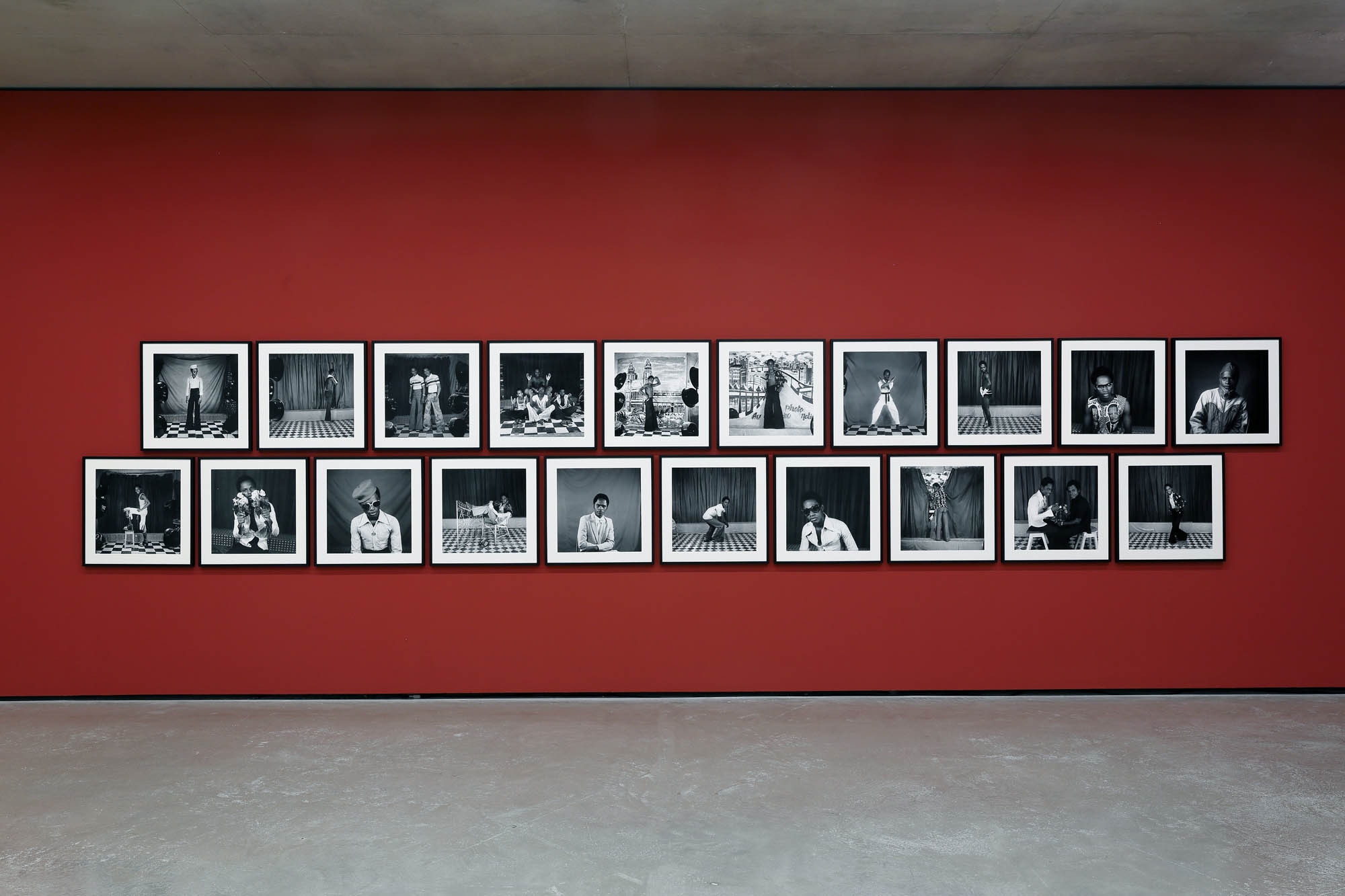
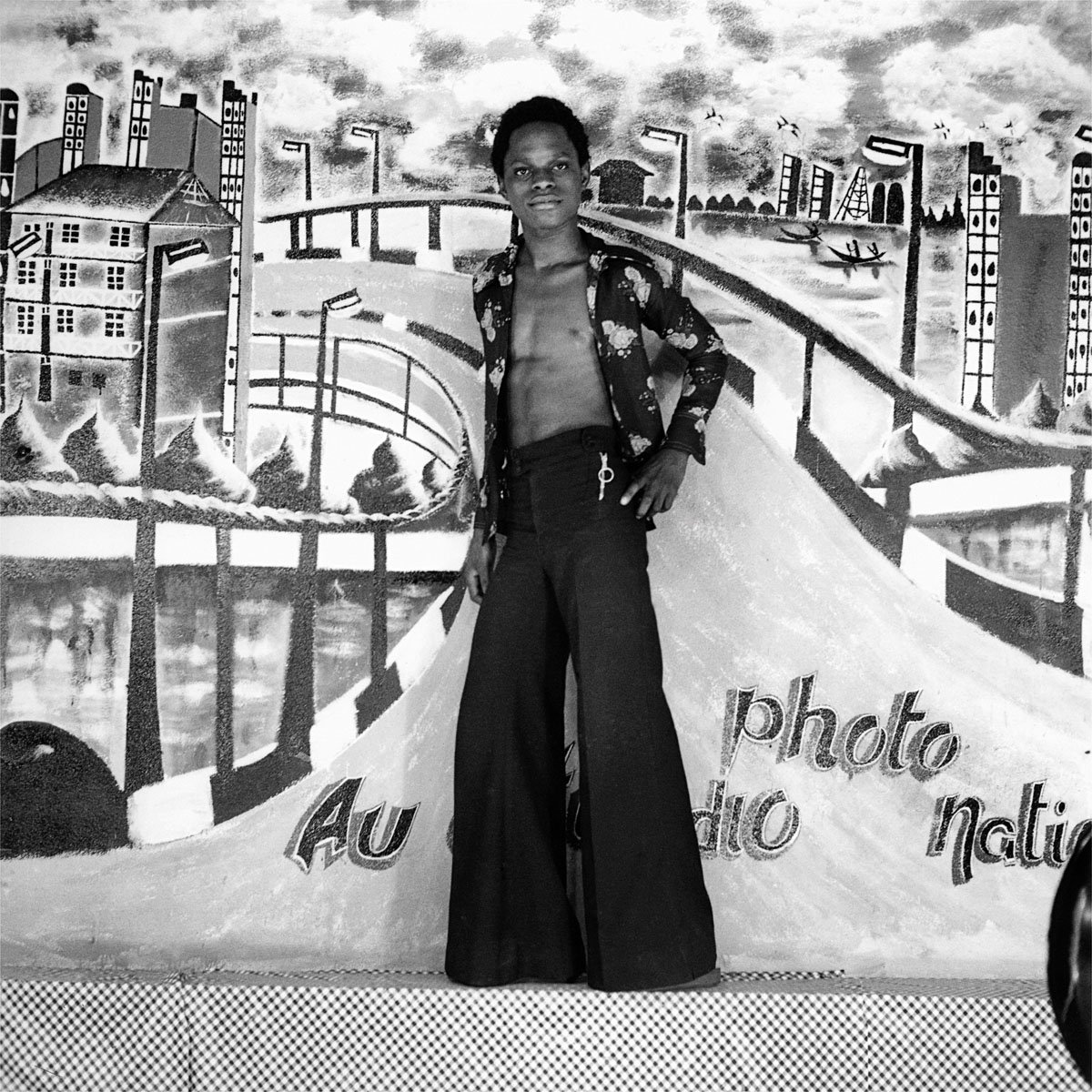
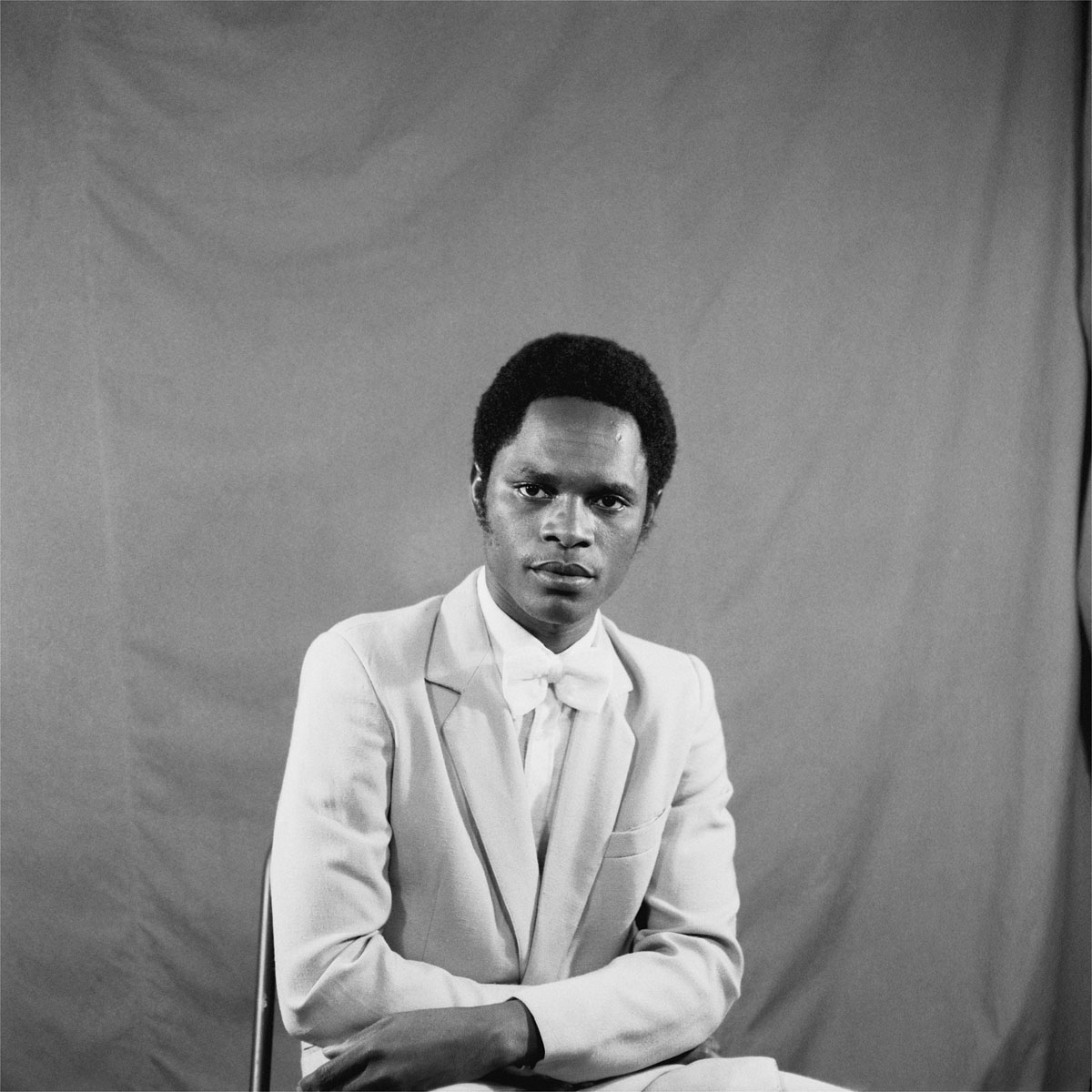
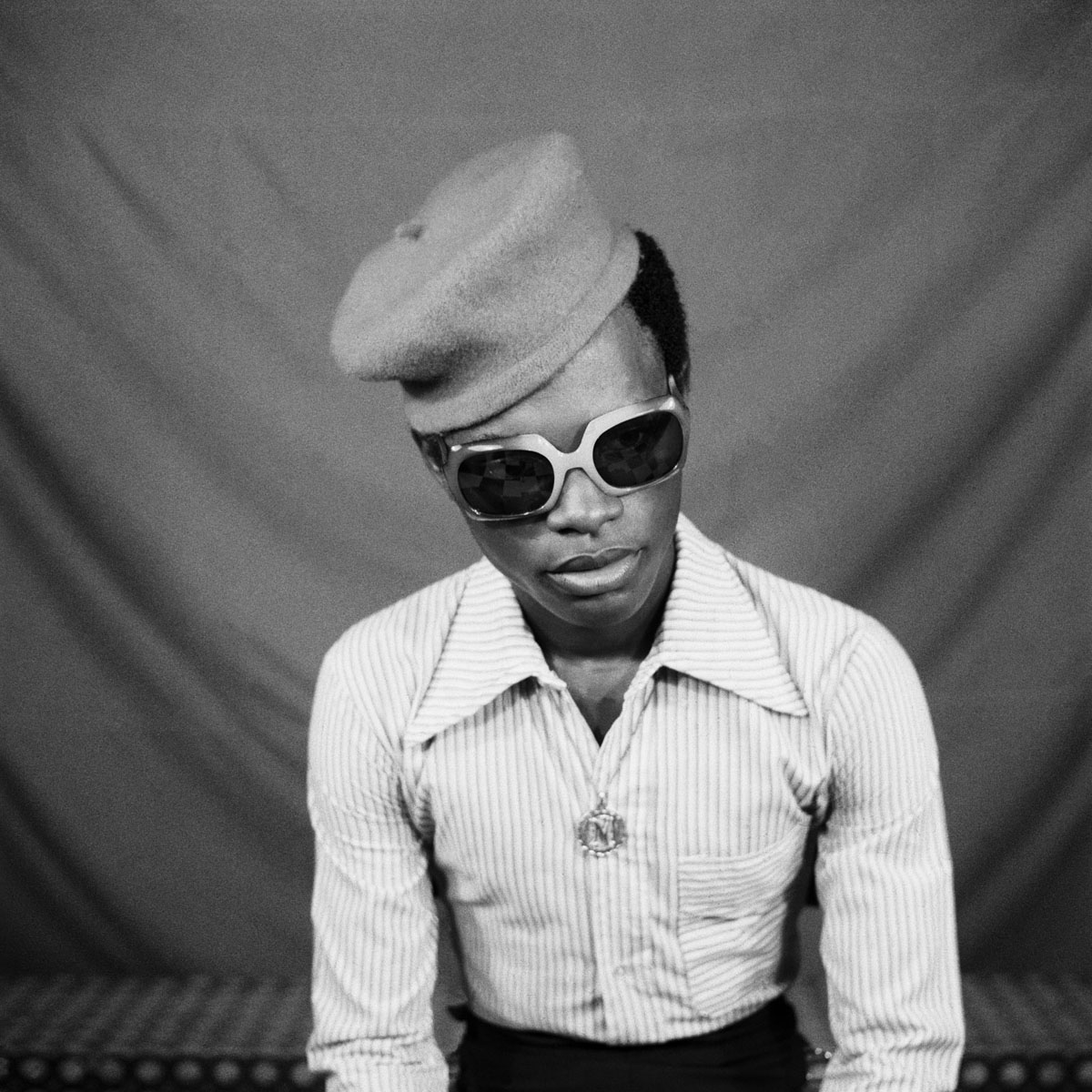
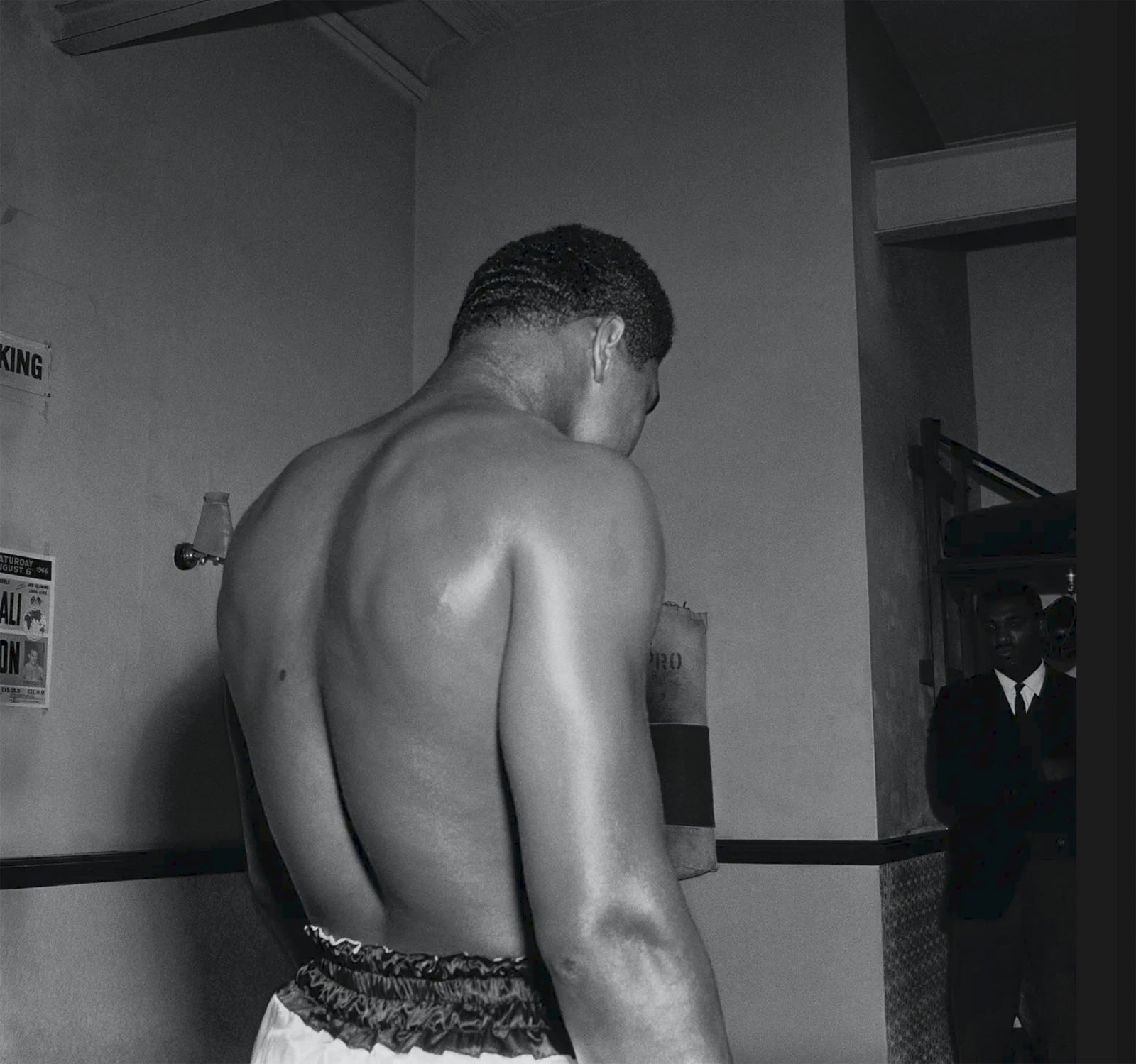
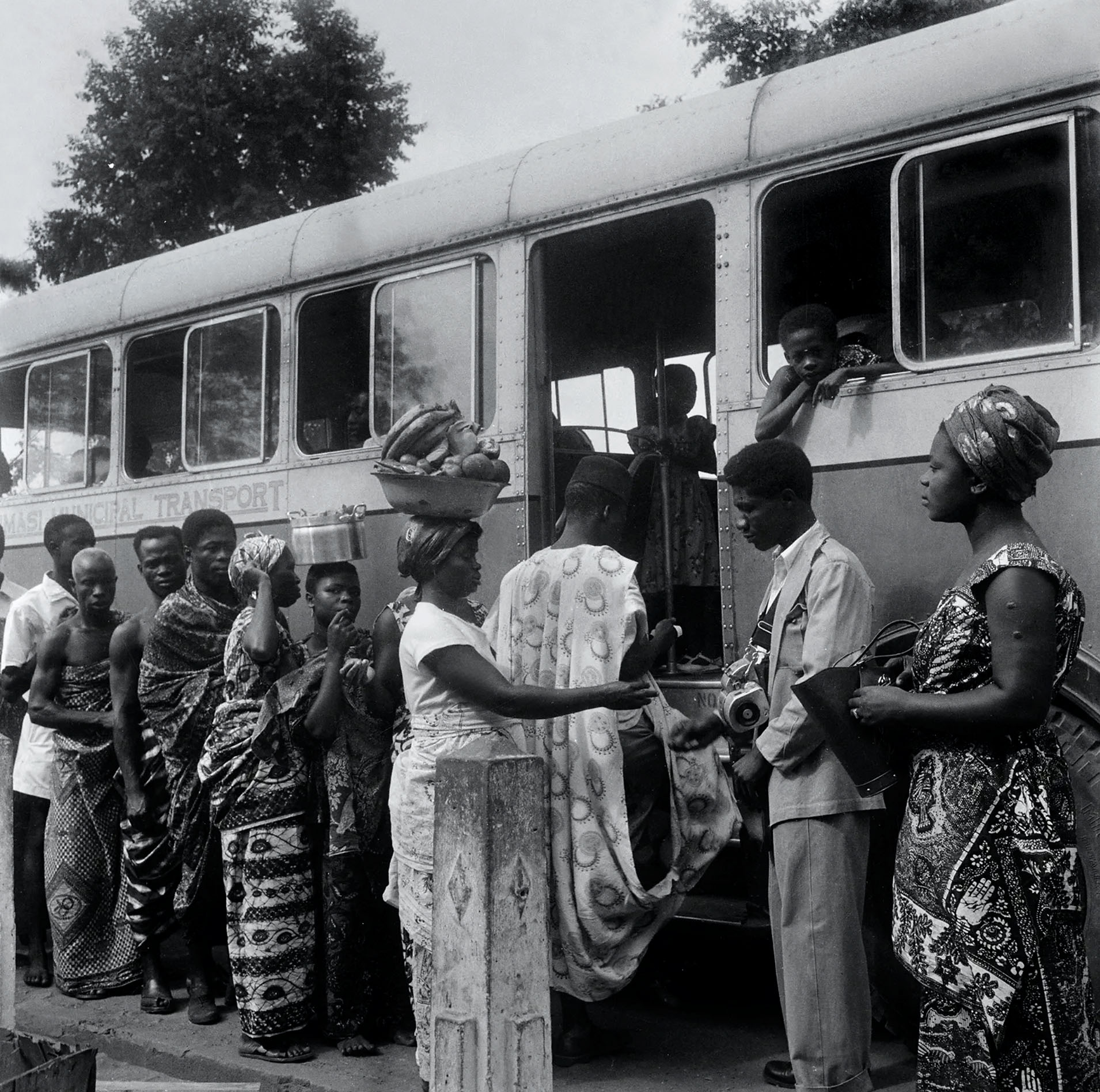
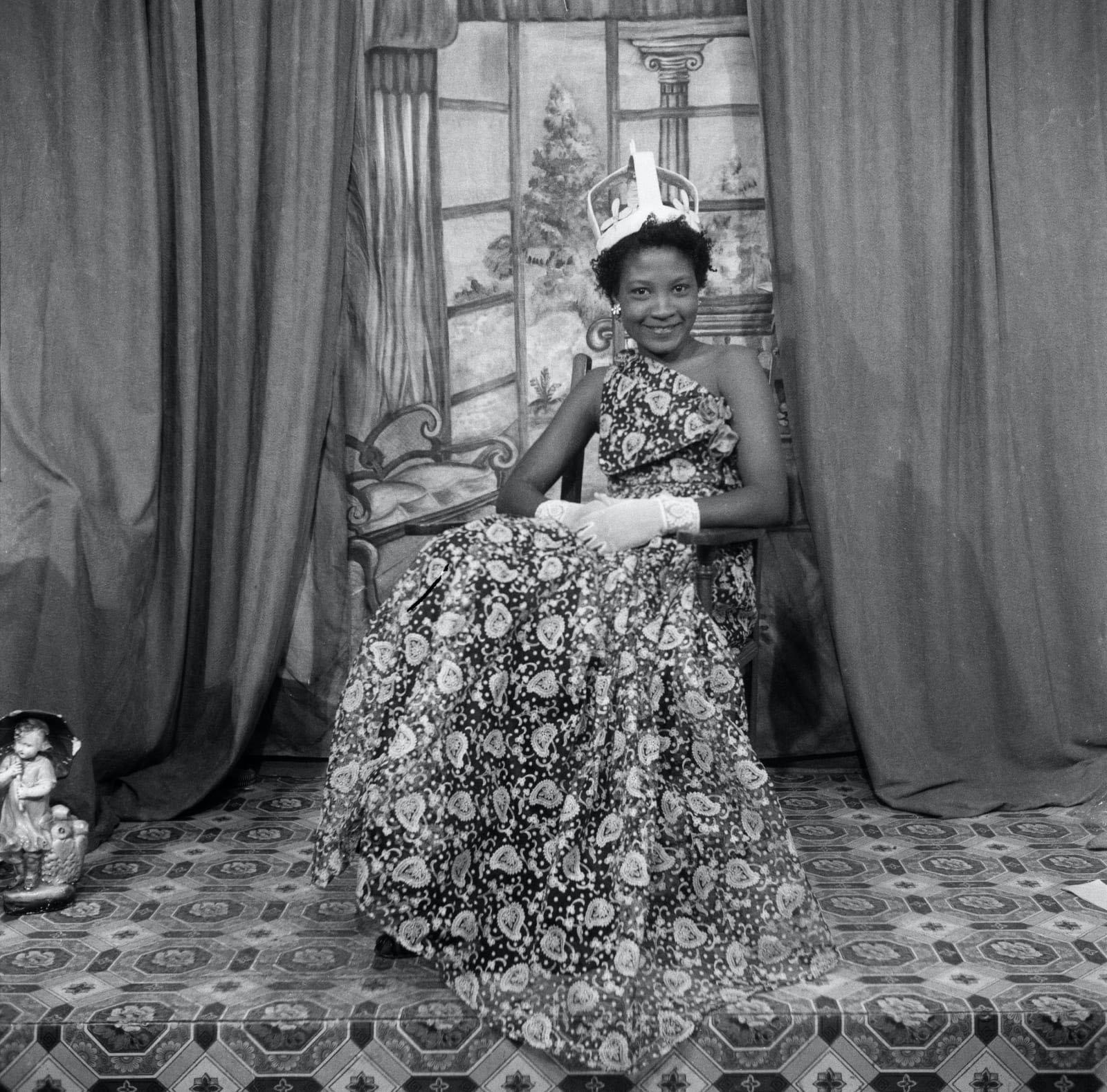
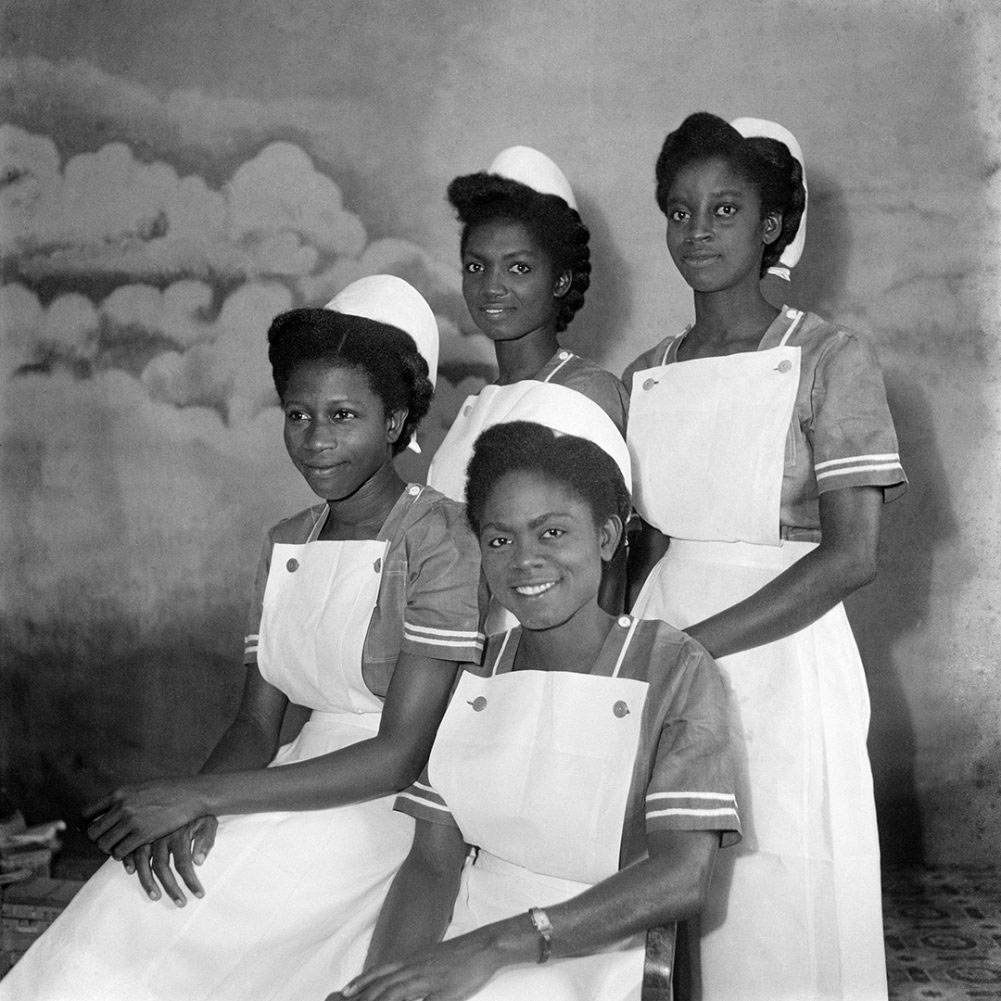
Exhibition: ‘Photography and the Black Arts Movement, 1955-1985’ at the National Gallery of Art, Washington

Exhibition dates: 21st September, 2025 – 11th January, 2026

Curators: The exhibition is co-curated by Philip Brookman, consulting curator of the department of photographs at the National Gallery of Art, and Deborah Willis, university professor and chair of the department of photography and imaging at the Tisch School of the Arts and director of the Center for Black Visual Culture at New York University.
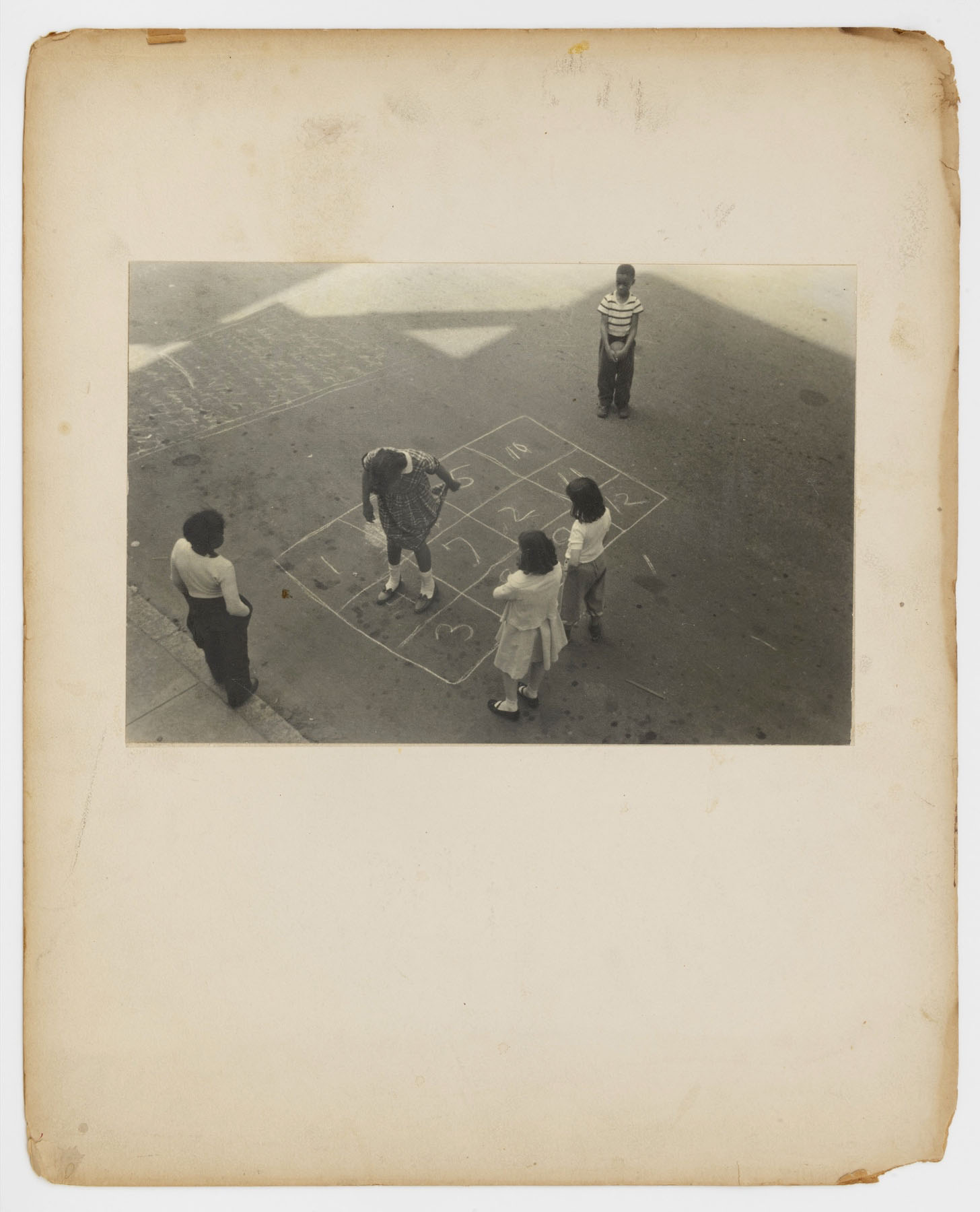
 

Thomas Ellis (American, 1963-2025) 'The Game' 1947 from the exhibition Exhibition: 'Photography and the Black Arts Movement, 1955-1985' at the National Gallery of Art, Washington, Sept 2025 - Jan 2026


Thomas Ellis (American, 1963-2025)
The Game
1947
Gelatin silver print
21 x 31.8cm (8 1/4 x 12 1/2 in.)
Courtesy of the Darrel Ellis Estate, Hannah Hoffman, Los Angeles, and Candice Madey, New York
Photo: Adam Reich


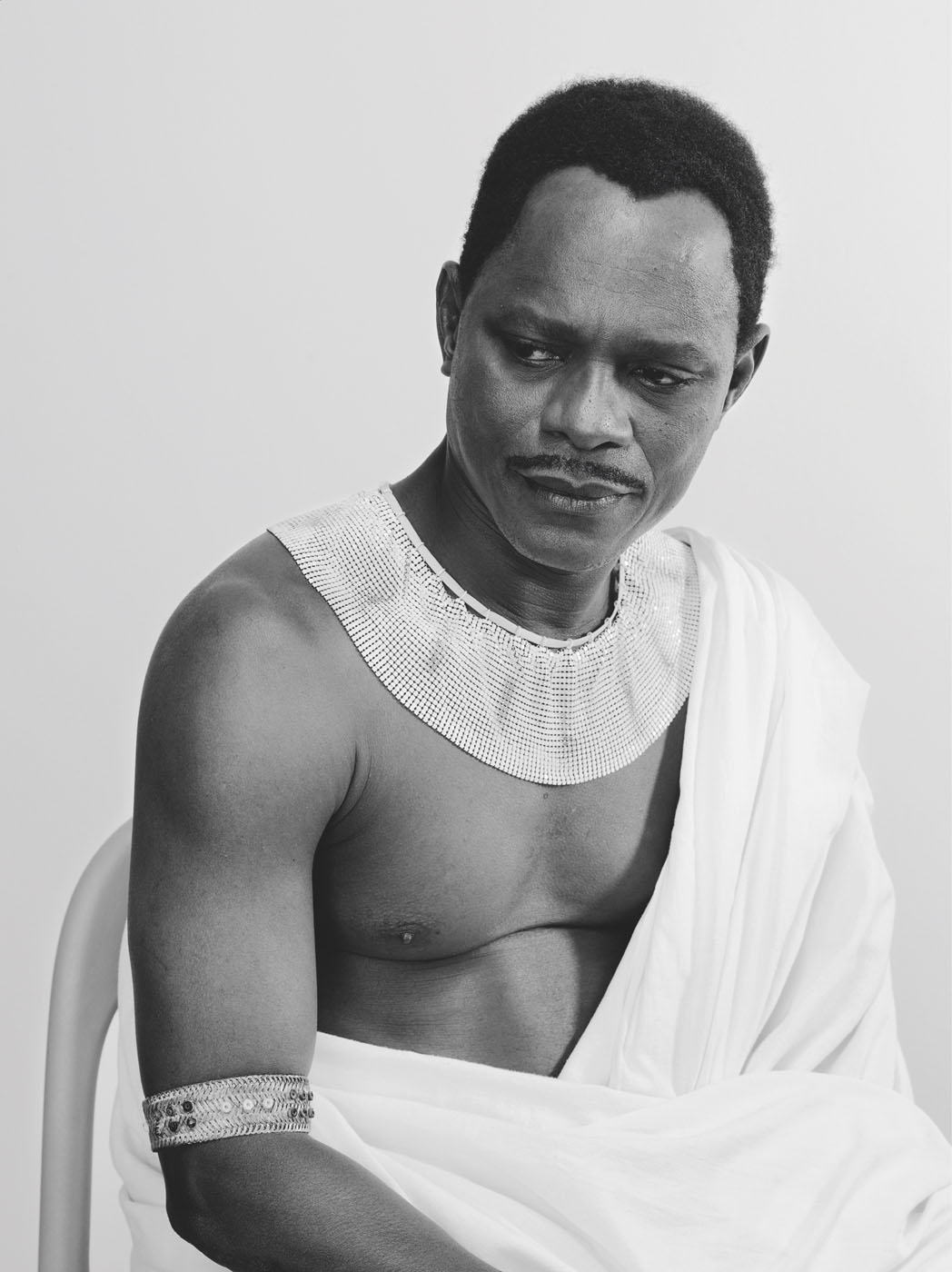
Thomas Sayers Ellis (October 5, 1963 – July 17, 2025) was an American poet, photographer, musician, bandleader and teacher.


“There’s nothing like a photograph for reminding you about difference. There it is. It stares you ineradicably in the face”

~ Professor Stuart Hall, 2008


This looks to be a “worthy” exhibition on photography and the Black Arts movement but without having seen it in person there is little specific comment I can make about the exhibition. However, some thoughts on the photographs in this posting are possible.

It is a joy for me to be able to learn more about an important area in photographic history, vis a vis “the role of African American photographers and artists working with photographs in developing and fostering a distinctly Black perspective on art and culture.” (Text from the NGA website)

There are many photographers in the posting who I have never heard of before, whose work I have never seen, and I always like learning, for in learning you may gain some small amount of wisdom and appreciation of different cultures and points of view. I have added biographical information for each artist to their images where possible.

The photographs from the period 1955-1985 mark a shift away from an aesthetic and formalist way of looking at the image where the role of the photographer and the reception of the print was in its primacy (the 1950s-1960s) “towards a more polemical, critical and cultural analysis by Tagg, Sekul, Solomon-Godeau and others in the 1980s and 90s. These shifts from the pictorial to the political … decentre the photographer and bring into focus the photographed and viewing subjects…”1

In these photographs it is not so much the primacy of the artist, the aesthetics of the image, nor the photographs status as art objects, but the people within the images that are the focus of attention. They bring to the forefront of the viewer’s consciousness (or should do) the racial politics at work within photography in the context of discussions around race and representation and the ongoing legacies of Western imperialism.

The photographs demonstrate “that if we do not recognise the historical and political conjunctures of racial politics at work within photography, and their effects on those that have been culturally erased, made invisible or less than human by such images, then we remain hemmed within established orthodoxies of colonial thought concerning the racialised body, the subaltern and the politics of human recognition.”2

They bring to light (aha!) “new ways of seeing that bring the Other into focus”, photographs that challenge us to acknowledge the structural racism that is embedded in daily life which produces adverse outcome for people of color. Through such an acknowledgement we may open up a personally and culturally transformative dialogic space, “a “space of possibilities” where participants listen, engage with, and even transcend their own viewpoints to see issues from multiple angles” – as there can never be a single view point when we “examine” social groups that are subaltern (groups that have been marginalised or oppressed).

From a distance this seems to be one of the problems of the exhibition. It’s all so worthy and righteous, full of the injustice of it all, and perhaps that’s as it should be for those were the times and the culture from which these photographs emerged. But I can’t help but get the feeling that this exhibition seems to feel and read more like a study in cultural anthropology, more a sociological statement than any celebration of Black history and culture from the period. Speaking from the standpoint of a white, middle class artist and writer, there seems to be little joy to be had here – to me one of the essential elements of Black culture, the joy of gospel, jazz, laughter, love – but I’m supposedly on the inside looking out (or is it the outside looking in!). Who am I to say.

What is undeniable is that, as Professor Stuart Hall so succinctly observes, there is nothing like a photograph to remind you of difference, to challenge your perceptions on how you view and interact with the world around you, to open up new ways of seeing. As such, the photographs in this exhibition may allow us deeper insight into the “conditions of our own becoming” (while human beings have agency, the circumstances under which they act and develop their humanity are largely shaped by existing material, social, and historical conditions that they did not choose) of the people that live around us, even as we acknowledge that there is no singular point of view, that cultural forms have no single determinate meaning, and that no one, and “no discipline, whether art- or photo-history, or ethnography or geography, speaks with a single voice.”1

Not one way of seeing, but multiple ways of seeing our fellow human beings.

Dr Marcus Bunyan


1/ Catherine De Lorenzo. “Oceanian imaginings in French photographic archives,” in History of Photography, Issue 2, Volume 28, 2004, pp. 137-184

2/ Text from the description of the book by Mark Sealy. Decolonising the Camera: Photography in Racial Time. London: Lawrence & Wishart, 2019.

The book examines how Western photographic practice has been used as a tool for creating Eurocentric and violent visual regimes, and demands that we recognise and disrupt the ingrained racist ideologies that have tainted photography since its inception in 1839.


Many thankx to the National Gallery of Art, Washington for allowing me to publish the photographs in the posting. Please click on the photographs for a larger version of the image.


“The work that was done by artists and photographers before, during, and after the Black Arts Movement establishes a strategy of community engagement. It is that engagement that allows communities to define themselves and also to engage people in new forms of looking.”


Co-curator Philip Brookman


Cultural forms set the wider terms of limitation and possibility for the (re)presentation of particularities and we have to understand how the latter are caught in the former in order to understand why such-and-such gets (re)presented in the way it does. Without understanding the way images function in terms of, say, narrative, genre or spectacle, we don’t really understand why they turn out the way they do.

Secondly, cultural forms do not have single determinate meanings – people make sense of them in different ways, according to the cultural (including sub-cultural) codes available to them. For instance, people do not necessarily read negative images of themselves as negative …


Richard Dyer. The Matter of Images: Essays on Representations. London: Routledge, 1993, pp.2-3
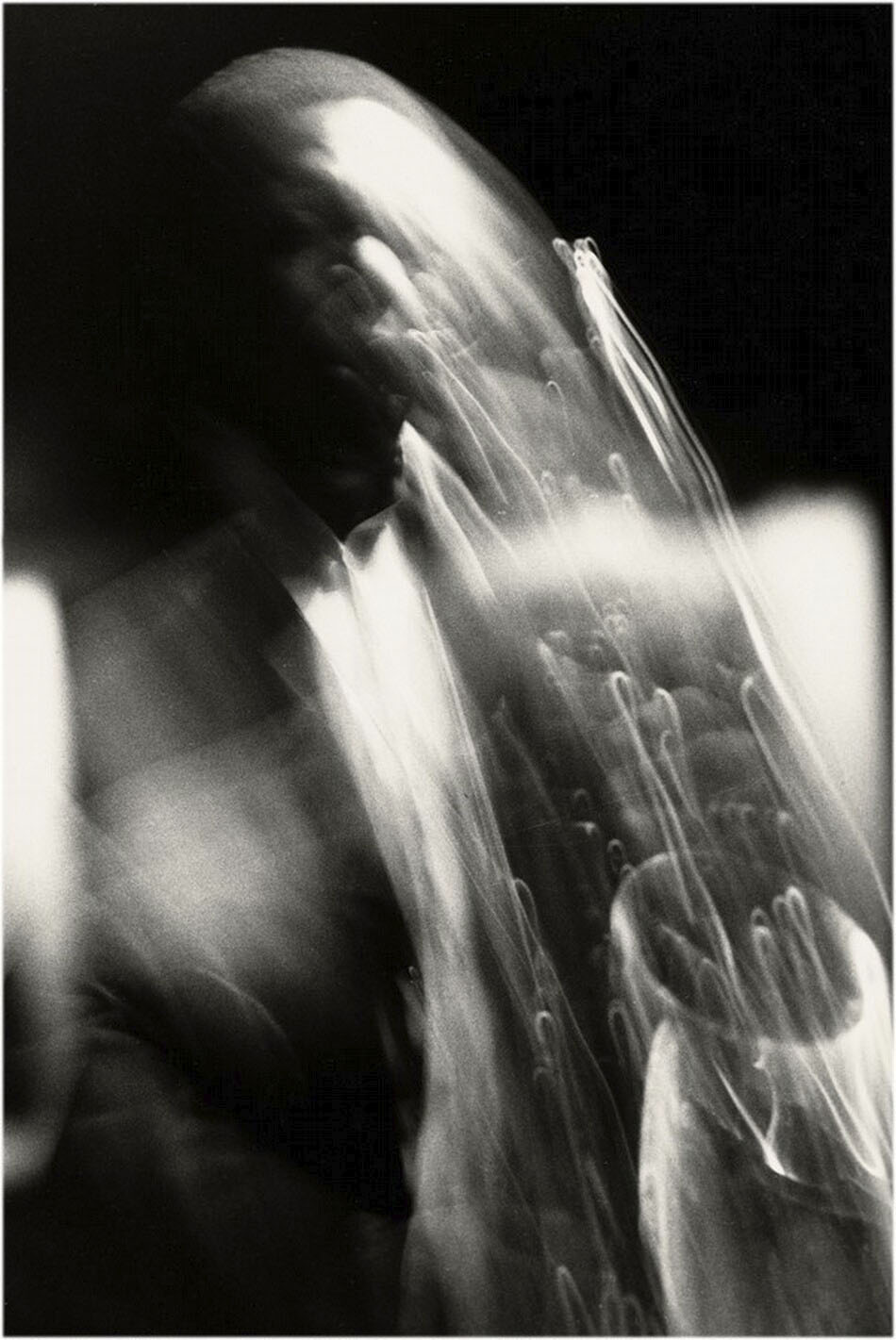


Adger Cowans (American, b. 1936) 'Coltrane at the Gate' 1961 from the exhibition Exhibition: 'Photography and the Black Arts Movement, 1955-1985' at the National Gallery of Art, Washington, Sept 2025 - Jan 2026


Adger Cowans (American, b. 1936)
Coltrane at the Gate
1961
Gelatin silver print
National Gallery of Art, Washington
Charina Endowment Fund


Adger Cowans (American, b. 1936)

Adger Cowans is a pioneering photographer and one of the founding members of the Kamoinge Workshop, a collective that played a key role in shaping Black photography in the 1960s and beyond.

In 1958 Cowans worked as an assistant to renowned photographer Gordon Parks. Throughout the 1960s Cowans became involved with influential groups associated with the Black Arts Movement, including Group 35 and Afri-COBRA, which he joined in 1968. 

His photographic work spans a wide range of approaches and subjects, from street photography in Harlem to documenting major historical events like the rallies and the funeral of Malcolm X. He also captured iconic jazz musicians, including John Coltrane and Pharoah Sanders.

Text from the National Gallery of Art website


Frank Dandridge (American, b. 1938) 'Blinded Birmingham Church Bombing survivor, Sarah Jean Collins, Birmingham, AL, 1963 "Clutching robe in hospital bed, Sarah Jean Collins was near bomb when it exploded in church. Her sister was killed. It will be weeks before she knows whether she can see again."' September 27, 1963


Frank Dandridge (American, b. 1938)
Blinded Birmingham Church Bombing survivor, Sarah Jean Collins, Birmingham, AL, 1963
“Clutching robe in hospital bed, Sarah Jean Collins was near bomb when it exploded in church. Her sister was killed. It will be weeks before she knows whether she can see again.”

September 27, 1963
Gelatin silver print
Overall: 35 x 50 cm (13 3/4 x 19 11/16 in.)
Collection of the Smithsonian National Museum of African American History and Culture
© Frank Dandridge
Photo: Frank Dandridge / The LIFE Picture Collection / Shutterstock


Frank Dandridge is a freelance photojournalist who worked mainly for Life Magazine in the 60’s. He covered numerous assignments, including, The Harlem Riots in 1964, Dr. King’s March on Washington, in 1963, and the terrible Birmingham Bombing in 1963. His photos also appeared in Look, Saturday Evening Post, Pageant, Paris Match, Good Housekeeping, Quick Magazine, the Canadian Film Board, Playboy, and many other national magazines. He won an Art Director’s Award for his photo essay, “The Two Faces of Harlem”, that appeared in Look magazine. His work included photographing many celebrities, including, Bobby Kennedy, Muhammad Ali, President Johnson, Dr. Martin Luther King, Frank Sinatra, The Supremes, Sammy Davis, Jr., and Jimmy Hoffa.

Text from the IMBd website


The photos that Frank Dandridge shot for LIFE magazine paint a vivid portrait of violence and race in 1960s America. He reported on riots in Harlem, in Watts, and in Newark,. He was in Selma, Alabama when Martin Luther King marched in the days immediately after Bloody Sunday. Dandridge’s most famous photo is of Sarah Collins, a 12-year-old girl whose eyes were in bandages after the bombing of a Sunday school class at the16th Street Baptist Church in Birmingham, Alabama. That bombing killed four girls, including Collins’ sister, while wounding many others and leaving Collins blind in one eye. The image of Collins in her hospital bed made vivid for America the cruelty of this horrific bombing by four men who were members of a splinter group of the Klu Klux Klan.

Bill Syken. “Race in the 1960s: The Photography of Frank Dandridge,” on the LIFE website Nd [Online] Cited 26/11/2025
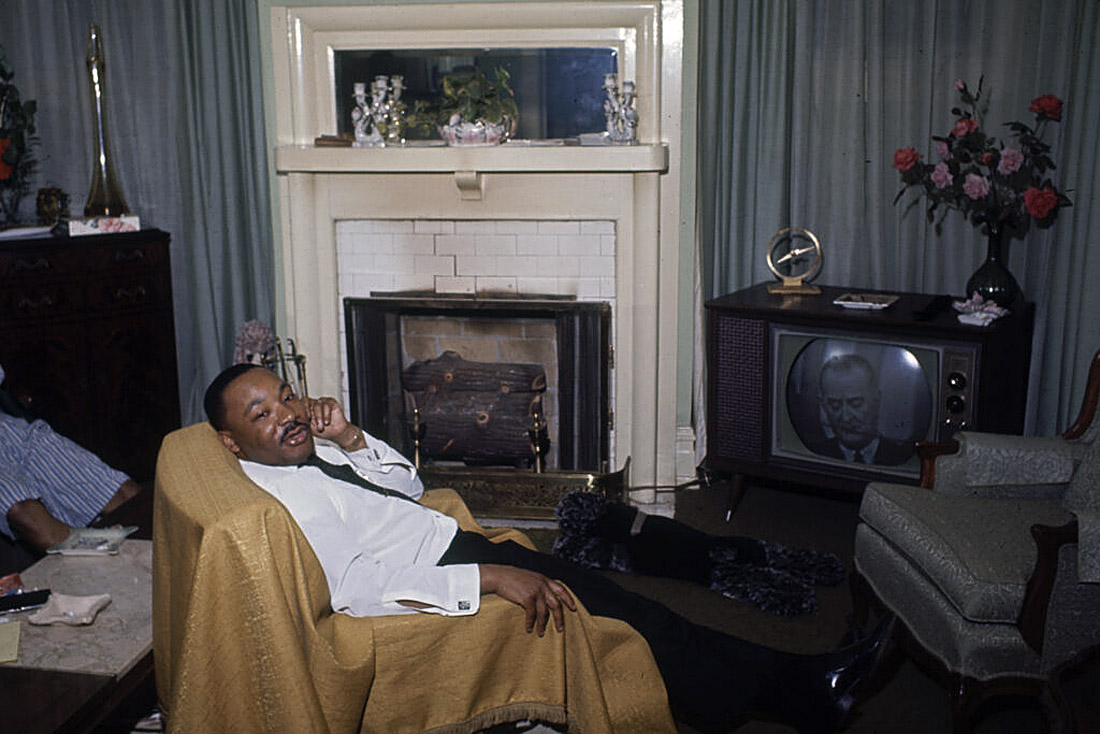
 

Frank Dandridge (American, b. 1938) 'Martin Luther King and other civil rights leaders watched President Lyndon B. Johnson speak on television' 1965


Frank Dandridge (American, b. 1938)
Martin Luther King and other civil rights leaders watched President Lyndon B. Johnson speak on television
1965
Gelatin silver print
© Frank Dandridge
Photo: Frank Dandridge / The LIFE Picture Collection / Shutterstock

Used under fair use for the purposes of education and research


Racism

Racism, when it is embedded in the structures, policies and practices of our social and political institutions can be termed “institutional”. Institutional racism, which will be described by the authors more fully below, is reflected in professional practice and working methods that result in racialized disparities. Frantz Fanon, psychiatrist and political philosopher, stands out as one of the earliest academics to explore the nature of racism from a psychosocial perspective. Fanon (1967) talked of “vulgar racism in its biological form”, which was evident for several hundreds of years, being replaced in the mid-20th century by “more subtle forms” (p. 35). In a study of Fanon’s clinical psychology and social theories, McCulloch (1983) refers to this new racism as “cultural racism” – describing this as “a more sophisticated form [of racism] in which the object is no longer the physiology of the individual but the cultural style of a people” (p. 120). Cultural racism believes that the dominant group’s culture is superior to the seemingly “lower” minority groups.

Cultural racism champions the supremacy of cultures. Commonly, some version of European culture or, more specifically, white European culture, rather than the white “race” (Amin, 1989), thereby producing a situation of racism without “races” (Balibar, 1991). It was the American civil leaders Stokely Carmichael (later Kwame Ture) and Charles V. Hamilton in their 1967 book, Black Power: The Politics of Liberation (Carmichael & Hamilton, 1967), who first described institutional racism:

It takes two, closely related forms … we call these individual racism and institutional racism. The first consists of overt acts by individuals … the second type is less overt, far more subtle, less identifiable in terms of specific individuals committing acts … and thus receives far less public condemnation than the first type. (p. 2)

Institutional racism forms an array of broader structural racism processes “that exclude … substantial numbers of members of particular groups from significant participation in major social institutions” (Henry & Tator, 2005, p. 352). According to minority mental health models like the racism-induced reactive negative emotionality cycle (Lazaridou & Heinz, 2021), structural racism and institutional racism result in experiences of rejection and emotional alienation in public spaces for Black people and People of Color (Lentin, 2015).

Structural racism in employment, earnings and credit may mutually limit equal access to quality, affordable accommodation. However, when public spaces are sites of surveillance, intimidation and frequent hostility by the police or by ordinary citizens, then the structure of social situations, such as even leaving one’s house and speaking in public, are filled with stress, anxiety, and fear (Chou et al., 2012; Sibrava et al., 2013). There is pervasive evidence that structural racism has destructive impacts on the health and wellbeing of patients from minority groups, including migrants, refugees, and asylum seekers (Alvarez et al., 2016; Bailey et al., 2017; Graham et al., 2016; Noh & Kaspar, 2003).

Felicia Lazaridou and Suman Fernando. “Deconstructing institutional racism and the social construction of whiteness: A strategy for professional competence training in culture and migration mental health,” in Transcult Psychiatry, 2022 Apr 4; 59(2), pp. 175-187.
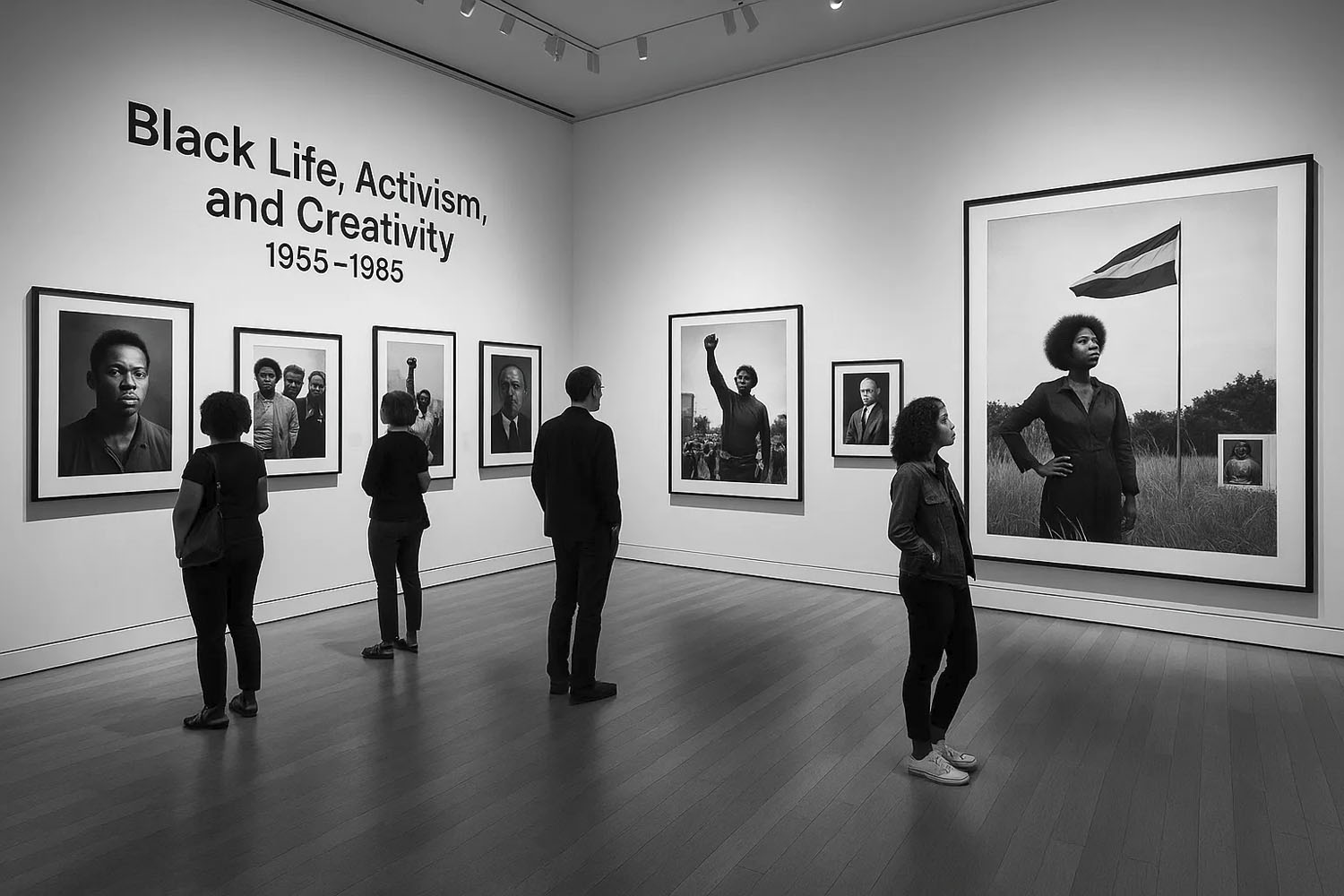
 

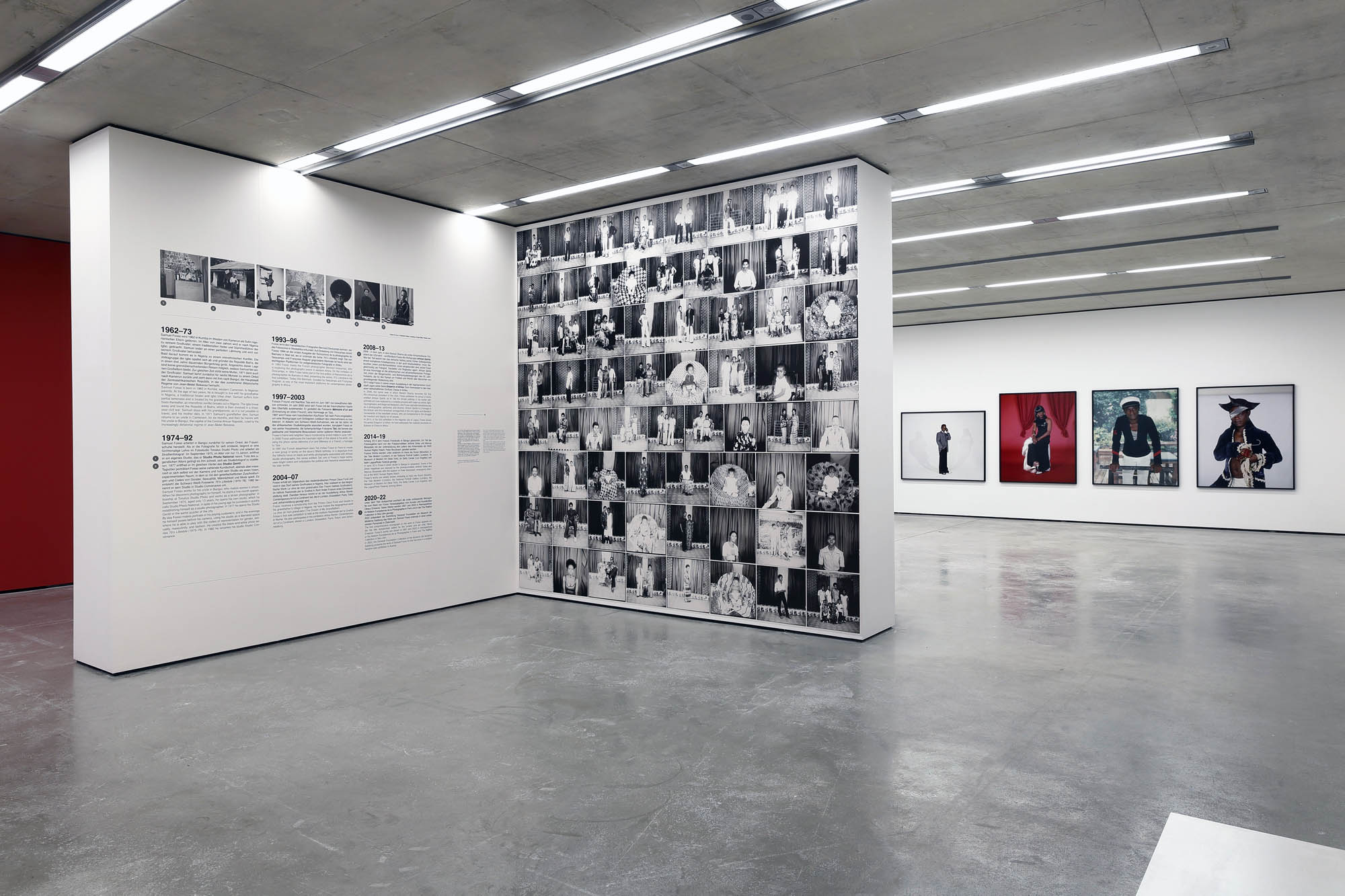
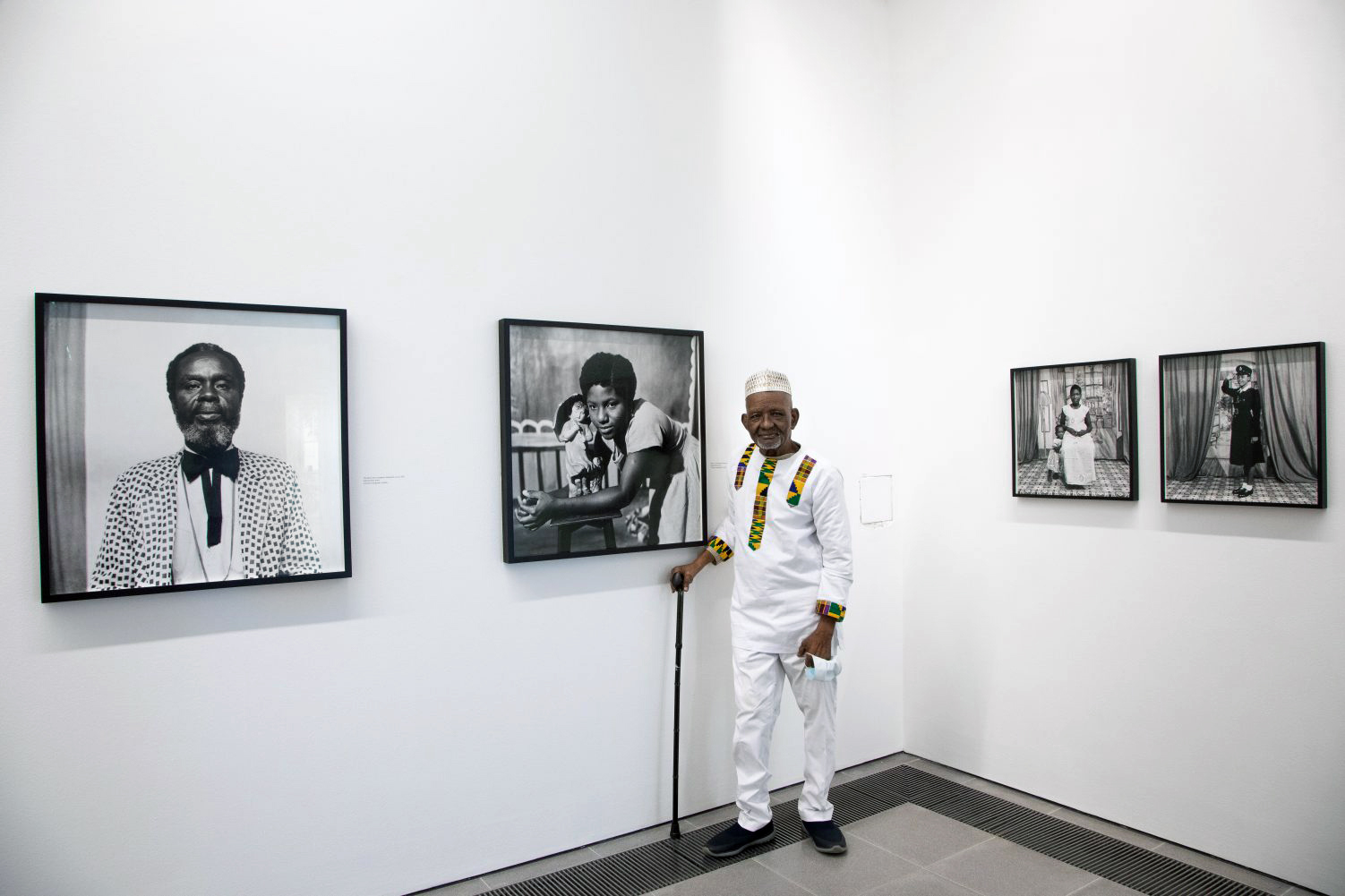
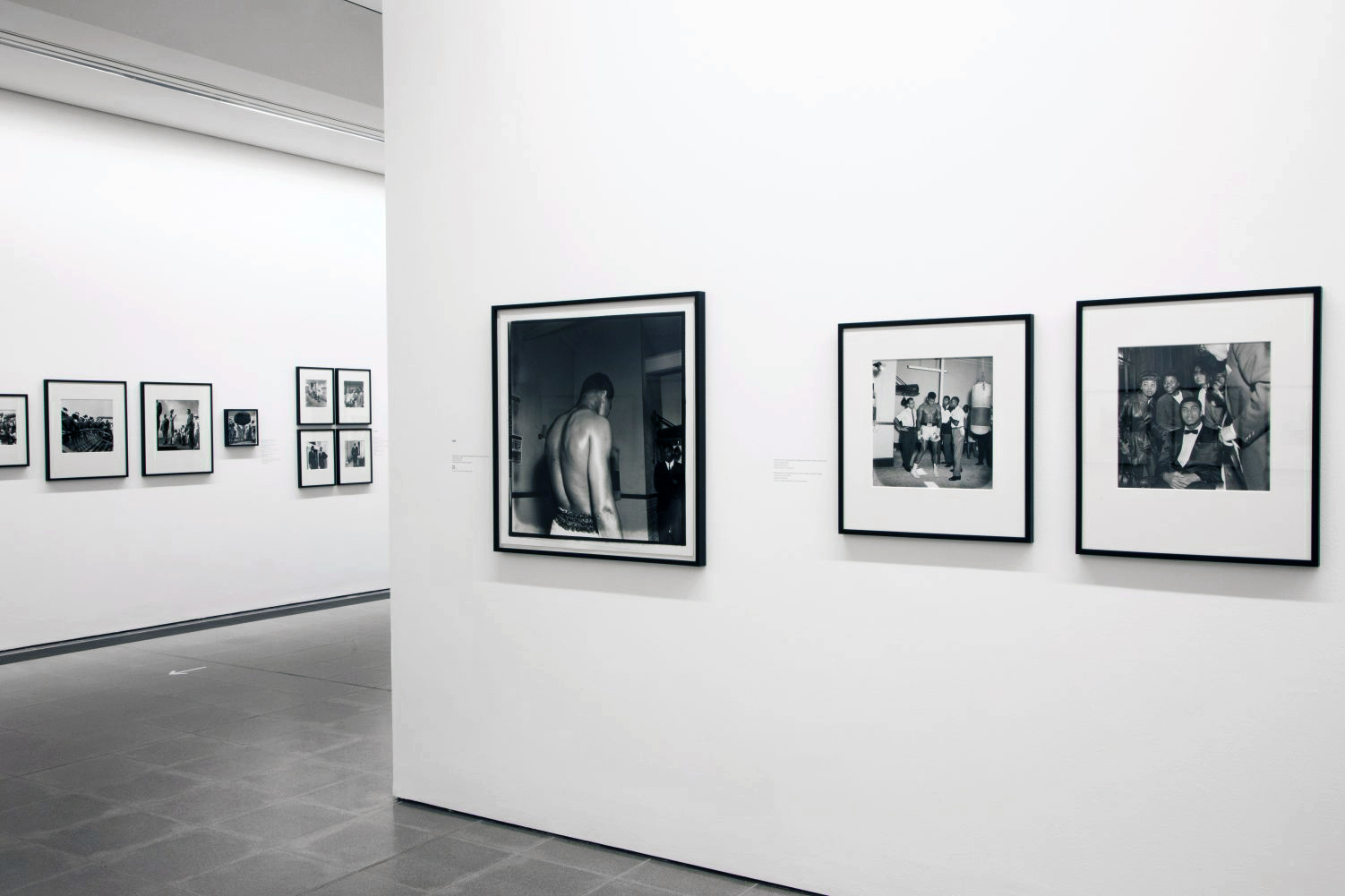
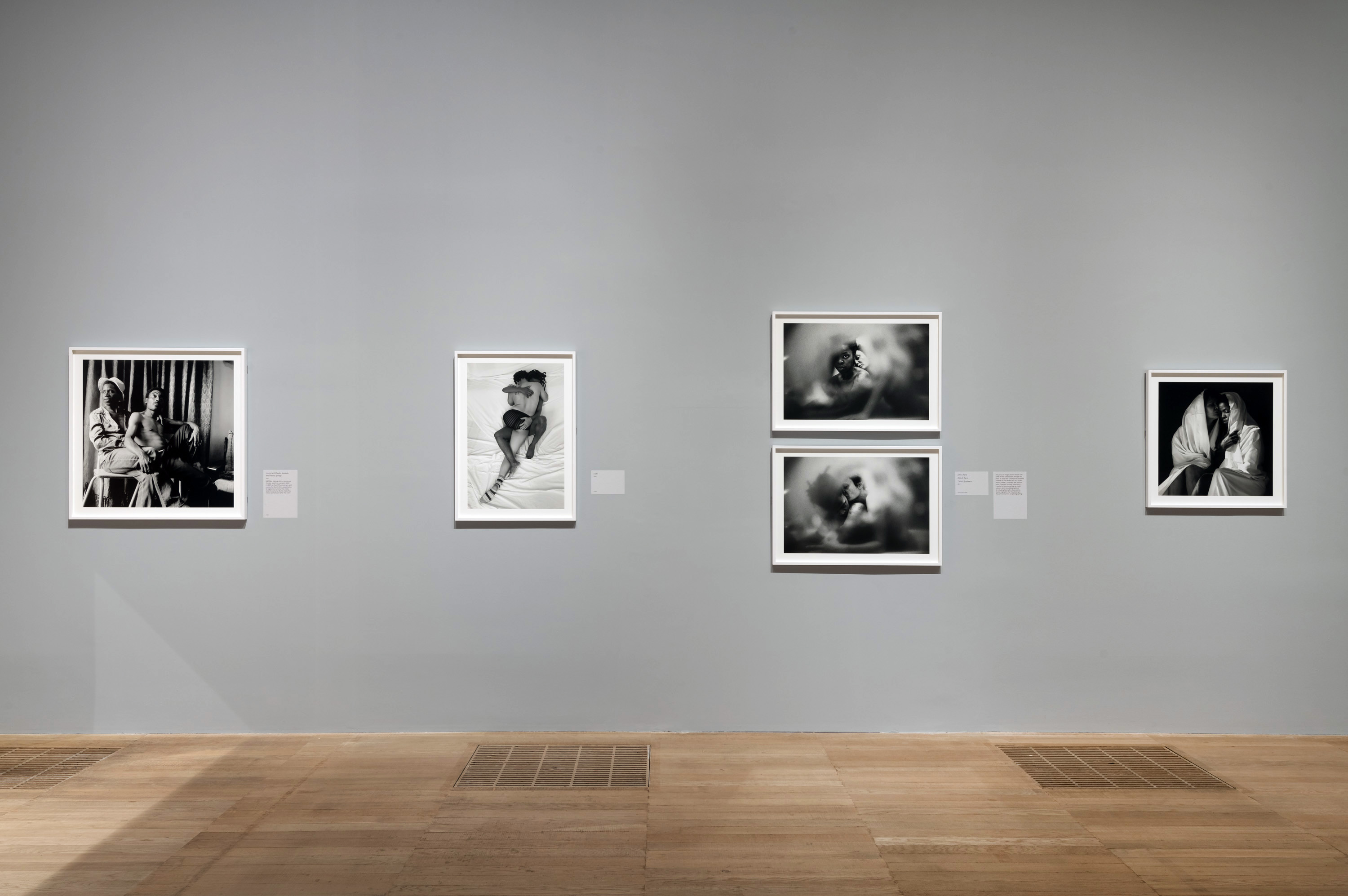
Installation view of the exhibition 'Photography and the Black Arts Movement, 1955-1985' at the National Gallery of Art, Washington, September 2025 - January 2026


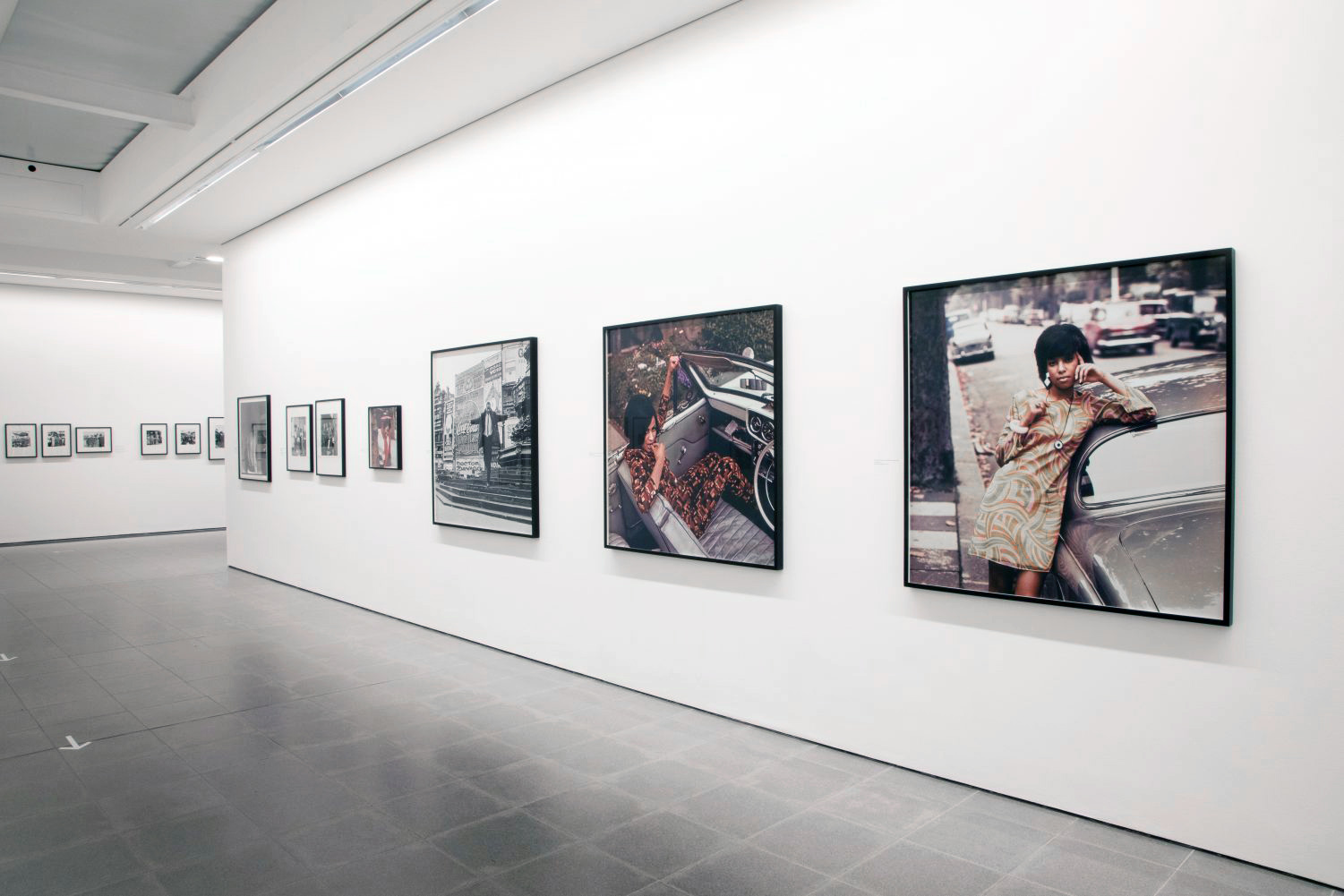
Installation view of the exhibition Photography and the Black Arts Movement, 1955-1985 at the National Gallery of Art, Washington, September 2025 – January 2026
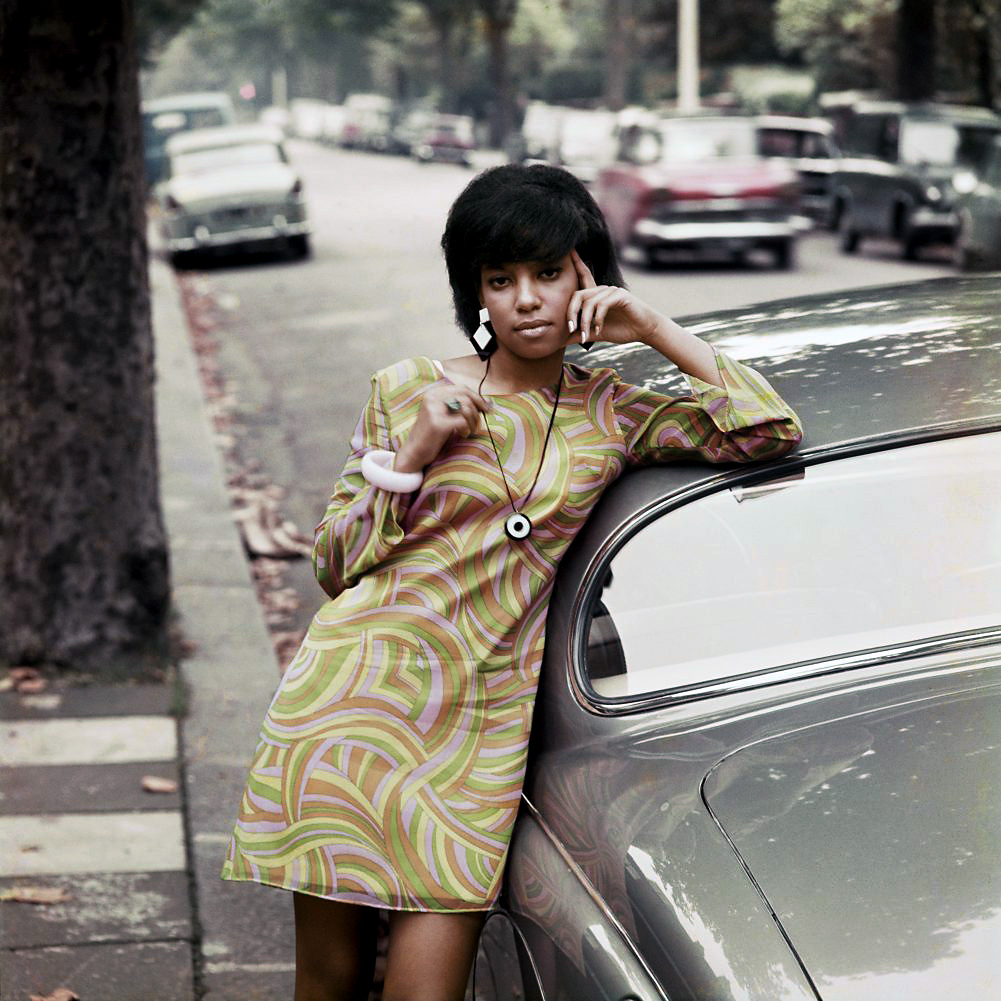
 

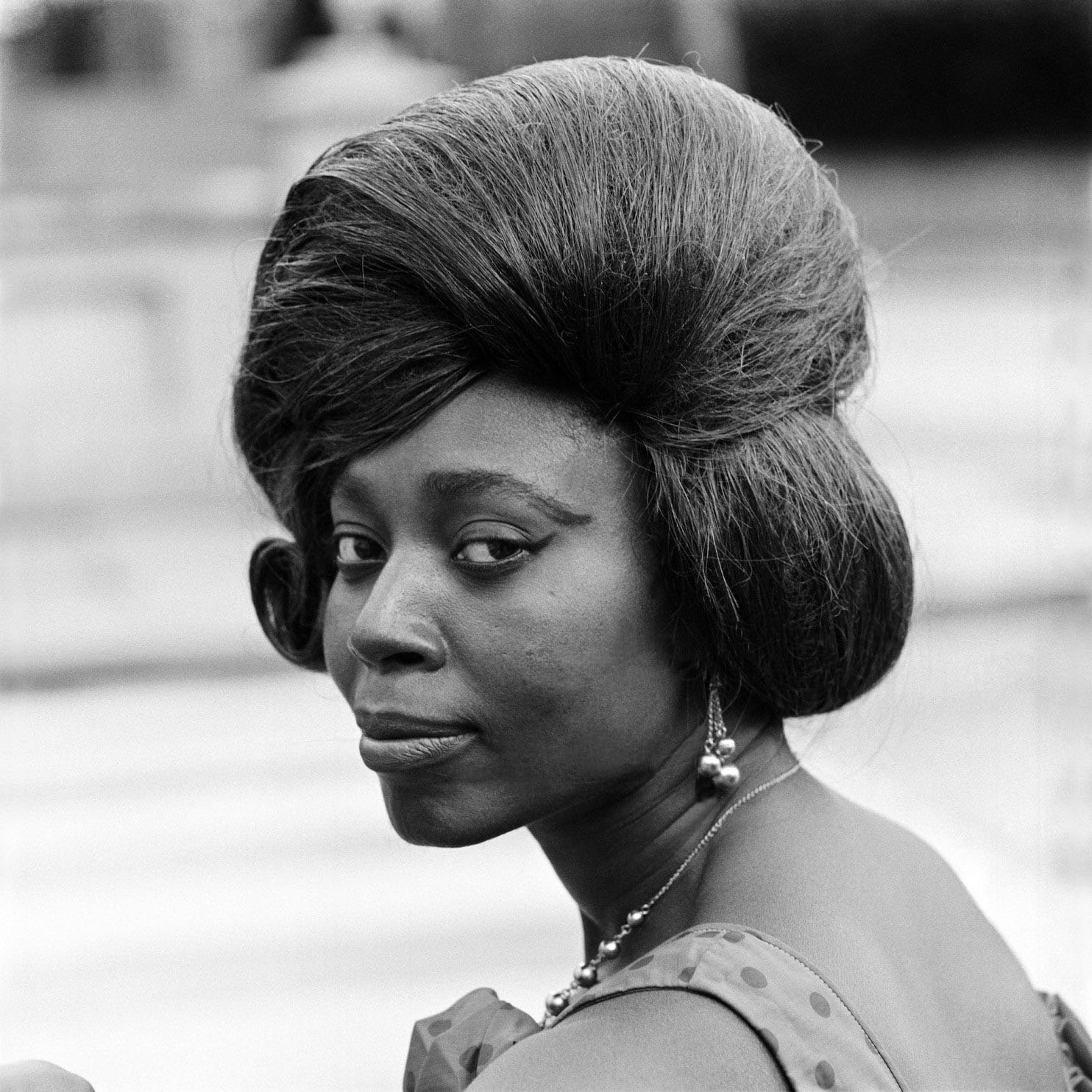
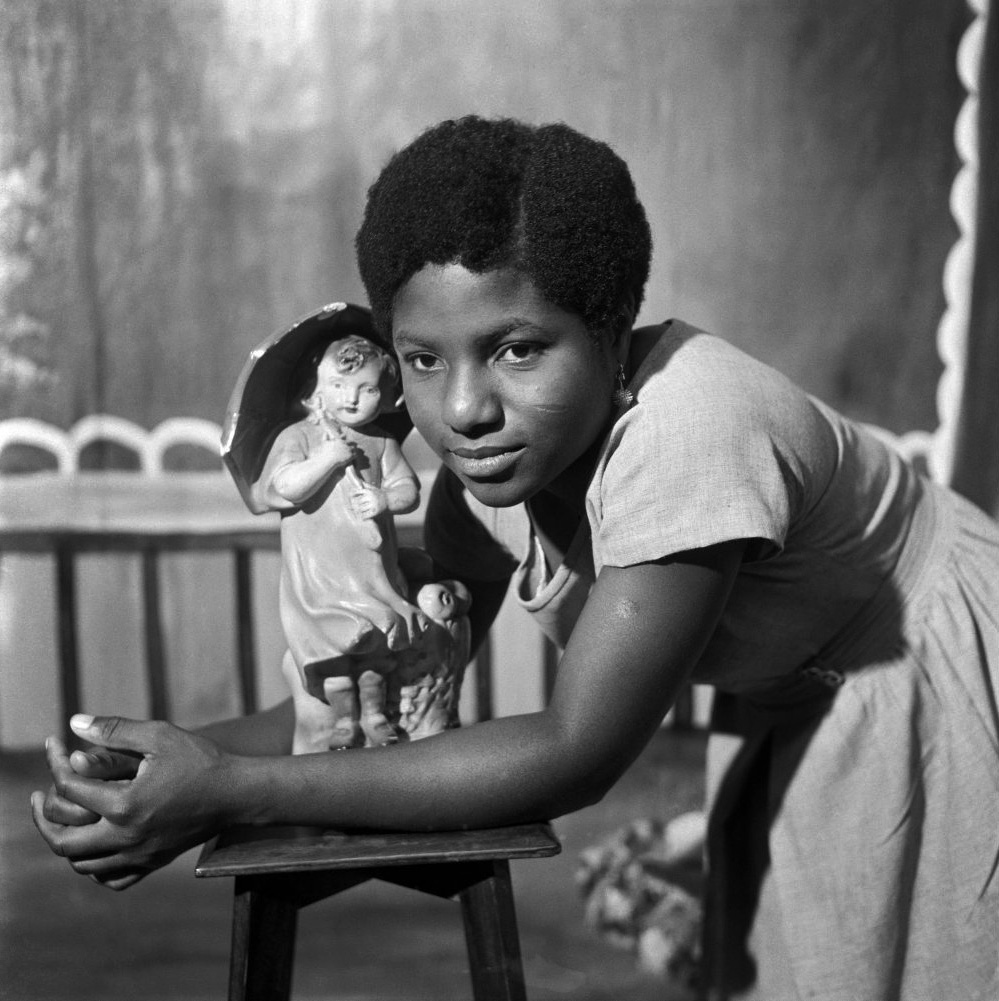
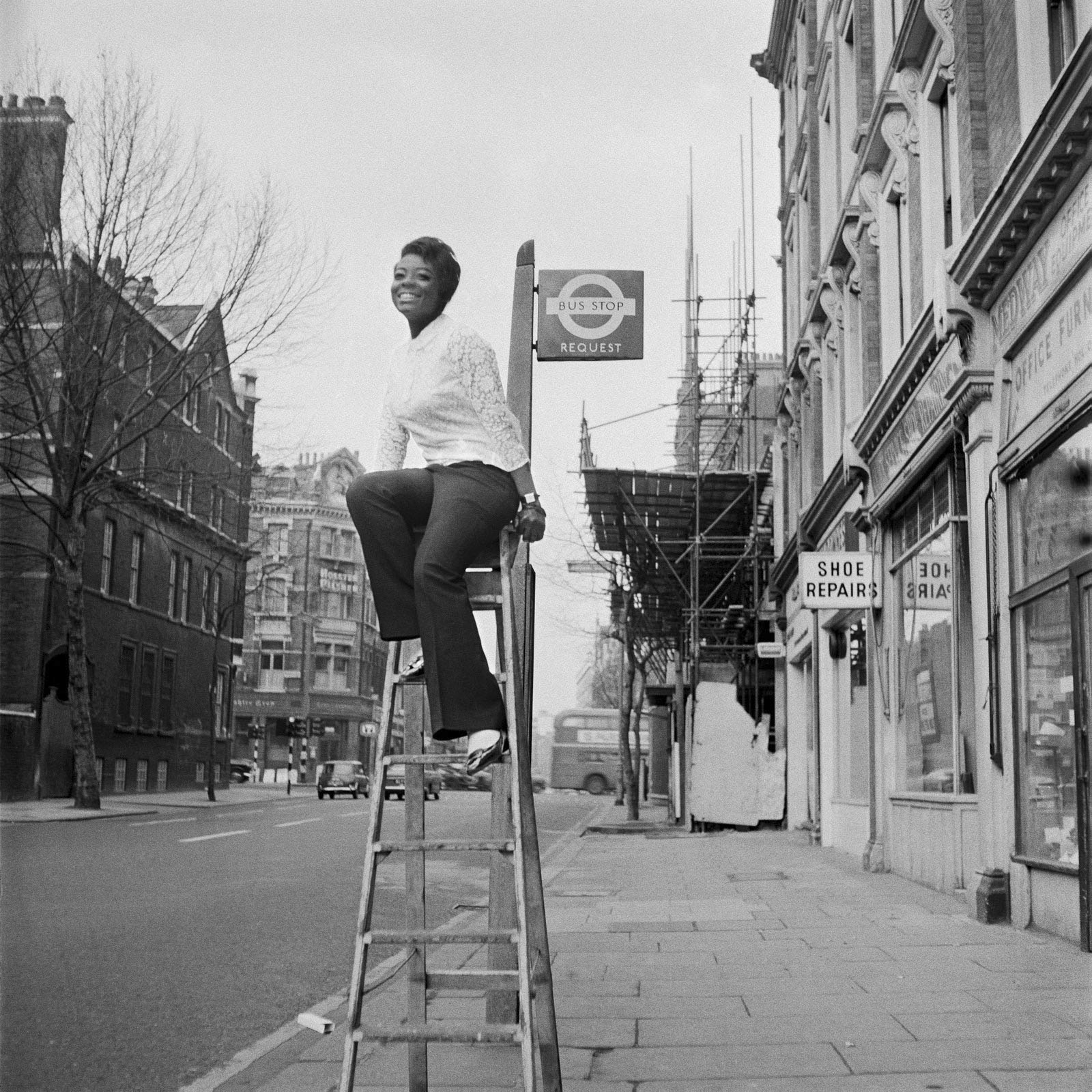
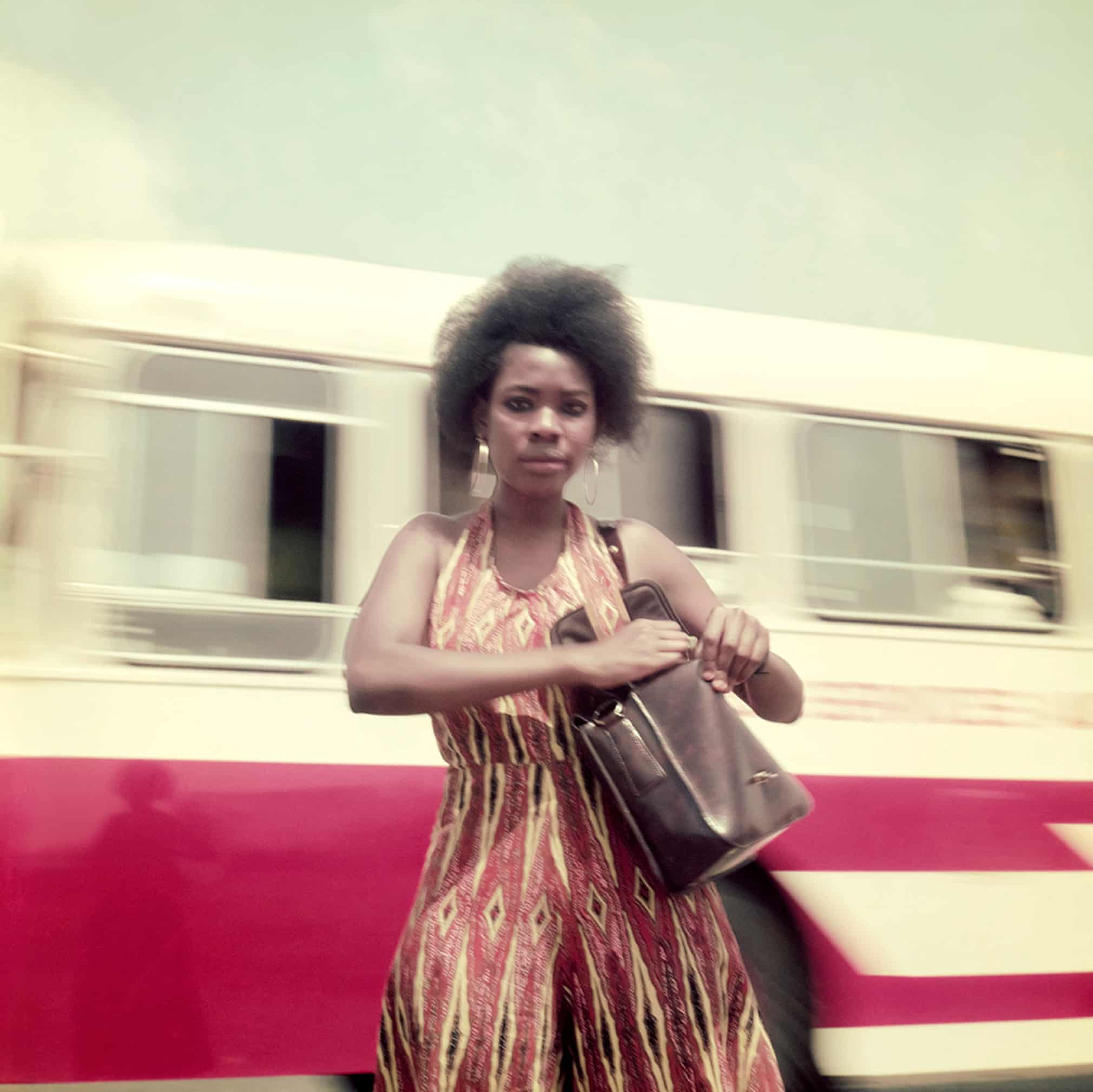
James Barnor (Ghanian, b. 1929) 'Drum Cover Girl Erlin Ibreck, London' 1966, printed 2010


James Barnor (Ghanaian, b. 1929)
Drum cover girl Erlin Ibreck, Kilburn, London
1966, printed 2023
Chromogenic print
29 × 29cm (11 7/16 × 11 7/16 in.)
National Gallery of Art, Washington
Alfred H. Moses and Fern M. Schad Fund
© James Barnor / Courtesy Galerie Clementine de la Feronnière


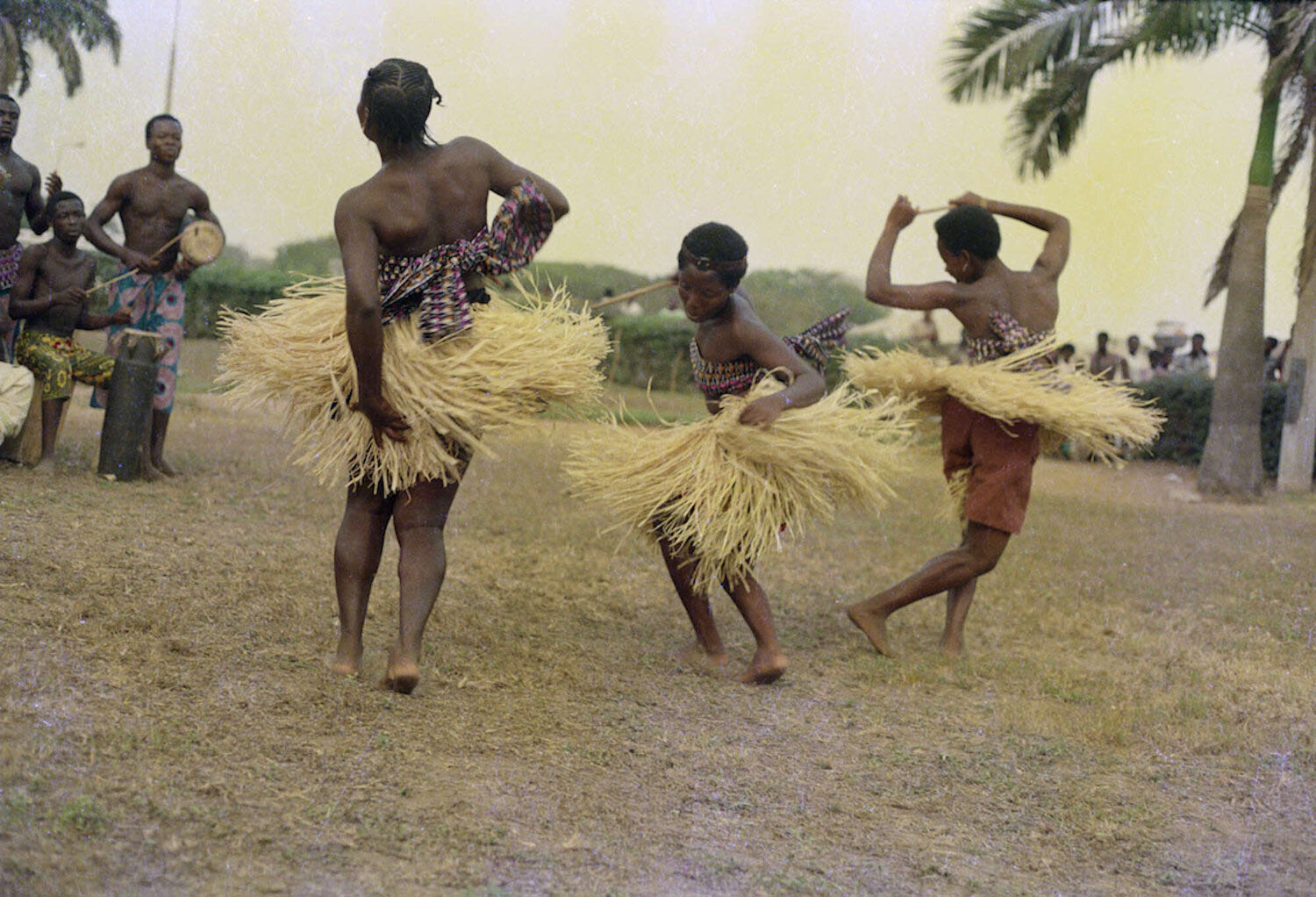
In the tradition of Black African photographers such as Malick Sidibé, Seydou Keïta and Sanlé Sory, Barnor’s photographs present people of all ages and all walks of life – whether in Accra, Ghana or in the suburbs of London, England – through direct and honest studio portraits or in more candid documents of the communities that surrounded him. …

Barnor’s photographs plant the seed of equality and happiness as a way of transmitting this knowledge to others. “He is a living archive, a link between the birth of photography in West Africa and the development of the discipline for the modern era.”2 It is his passion and feeling for the practice of photography, the stories that it tells and his engagement with the spirit of the people that he encounters – as a conversation between equals – that intuitively ground his work in the history of photography and the history of Black culture and makes them forever young.

Marcus Bunyan. “It’s late, but it’s better late than never,” on the Art Blart website October 17, 2021 [Online] Cited 26/11/2025
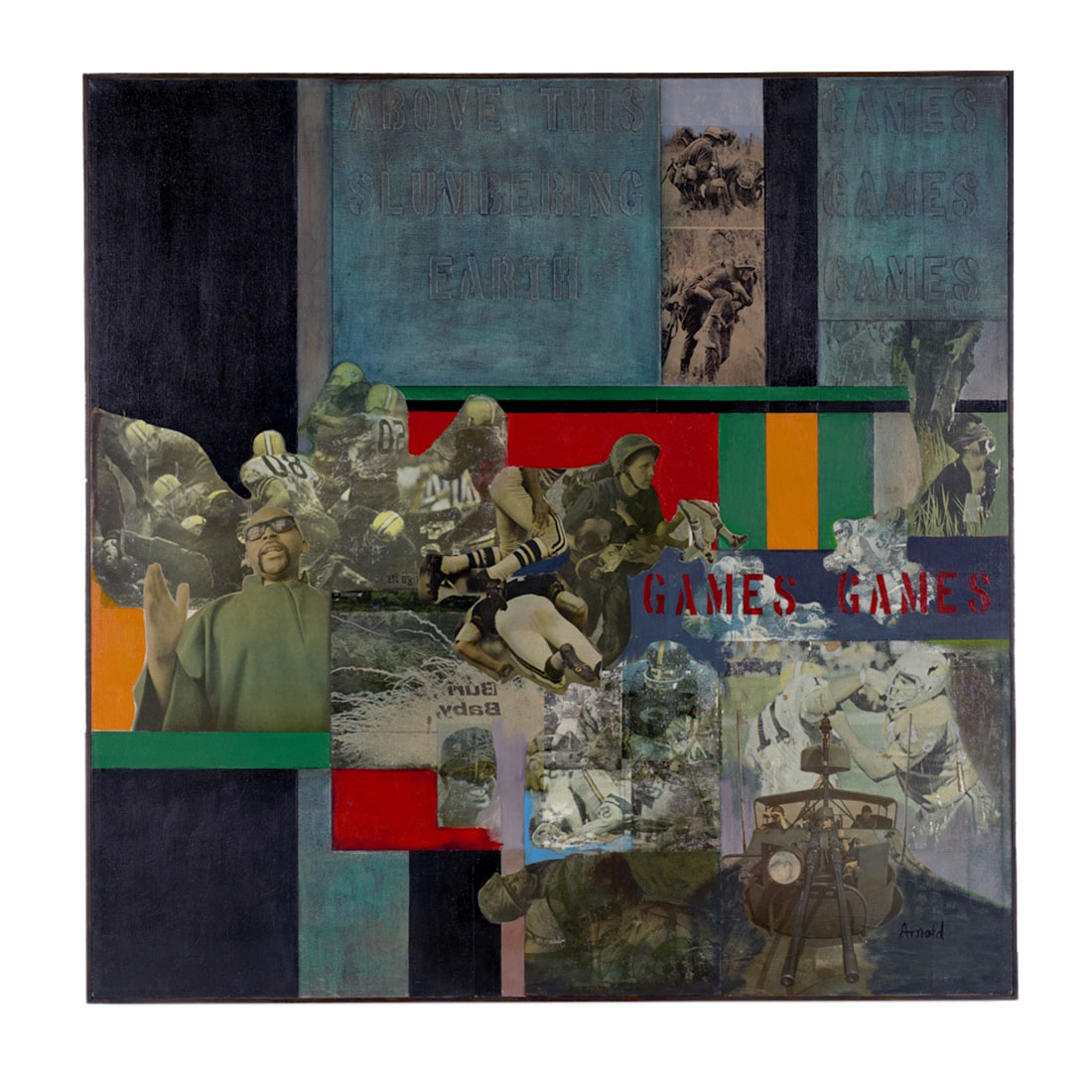
 

Ralph Arnold (American, 1928-2006) 'Above this Earth, Games, Games' 1968


Ralph Arnold (American, 1928-2006)
Above this Earth, Games, Games
1968
Collage and acrylic on canvas
Overall: 114.3 x 114.3 cm (45 x 45 in.)
Collection of Museum of Contemporary Photography at Columbia College, Chicago
Photo: P.D. Young / Spektra Imaging


During the tumultuous 1960s and 70s, the prolific artist Ralph Arnold (1928-2006) made photocollages that appropriated and commented upon mass media portrayals of gender, sexuality, race and politics. Arnold’s complex visual arrangements of photography, painting and text were built upon his own multilayered identity as a black, gay veteran and prominent member of Chicago’s art community…

Text from the Museum of Contemporary Photography in Chicago
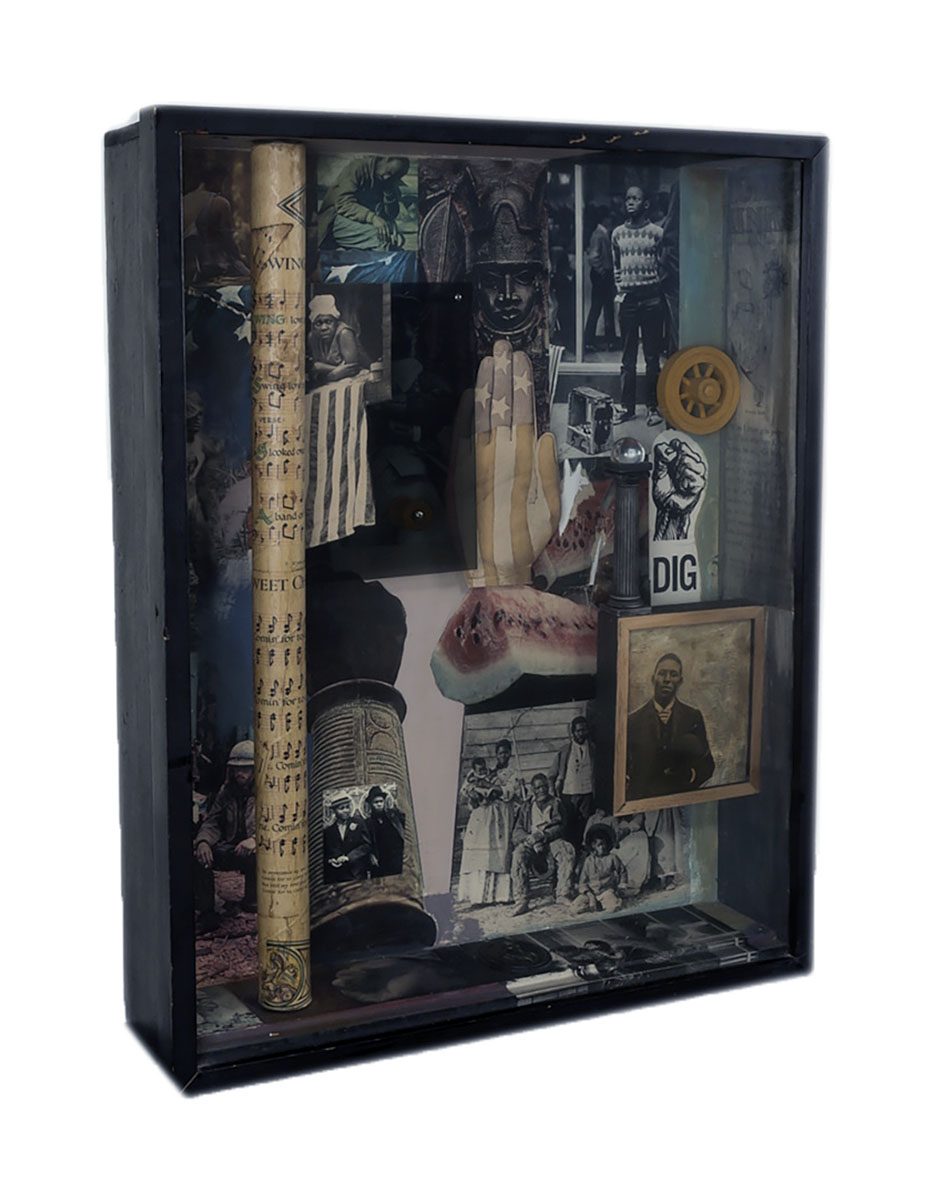
 

Ralph Arnold (American, 1928-2006) 'Soul Box' 1969


Ralph Arnold (American, 1928-2006)
Soul Box
1969
Assemblage with found objects and collage on Masonite
Framed: 71.1 x 56.8 x 14.9cm (28 x 22 3/8 x 5 7/8 in.)
Private collection of Courtney A. Moore
Photo: Courtesy of the Museum of Contemporary Photography at Columbia College Chicago


The first exhibition to consider photography’s impact on a cultural and aesthetic movement that celebrated Black history, identity, and beauty.

Uniting around civil rights and freedom movements of the 1960s and 1970s, many visual artists, poets, playwrights, musicians, photographers, and filmmakers expressed hope and dignity through their art. These creative efforts became known as the Black Arts Movement.

Photography was central to the movement, attracting all kinds of artists – from street photographers and photojournalists to painters and graphic designers. This expansive exhibition presents 150 examples tracing the Black Arts Movement from its roots to its lingering impacts, from 1955 to 1985. Explore the bold vision shaped by generations of artists including Billy Abernathy, Romare Bearden, Kwame Brathwaite, Roy DeCarava, Doris Derby, Emory Douglas, Barkley Hendricks, Barbara McCullough, Betye Saar, and Ming Smith.

Text from the NGA website


Photography and the Black Arts Movement, 1955-1985 investigates the role of African American photographers and artists working with photographs in developing and fostering a distinctly Black perspective on art and culture. The Black Arts Movement was a uniquely American creative initiative, closely linked to the civil rights movement and comparable to the Harlem Renaissance of the 1920s in its impact. Through new institutions and publications, Black writers, musicians, filmmakers, and visual artists explored ways their art could further the American civil rights movement and communicate messages of Black history and identity. Photography and the Black Arts Movement reveals how studio and street photographers, photojournalists, painters, conceptual artists, graphic designers, and community activists used photography to cut across traditional racial boundaries, express messages of empowerment, and advance social justice.

Bringing together some 150 works by more than 100 artists, Photography and the Black Arts Movement also includes objects from Africa, the Caribbean region, and Great Britain, representing artistic dialogues created through travel, migrations, and international engagement with the social, political, and cultural ideas that propelled the movement. Among the artists included are Billy Abernathy, Anthony Barboza, Romare Bearden, Dawoud Bey, Frank Bowling, Kwame Brathwaite, Ernest Cole, Adger Cowans, Roy DeCarava, Emory Douglas, Louis Draper, David C. Driskell, Samuel Fosso, Charles Gaines, Barkley Hendricks, Danny Lyon, Barbara McCullough, Jeanne Moutoussamy-Ashe, Gordon Parks, Adrian Piper, Juan Sánchez, Coreen Simpson, Betye Saar, Jamel Shabazz, Lorna Simpson, Ming Smith, Frank Stewart, and Carrie Mae Weems.

The exhibition is organised by the National Gallery of Art, Washington.

Text from the NGA website
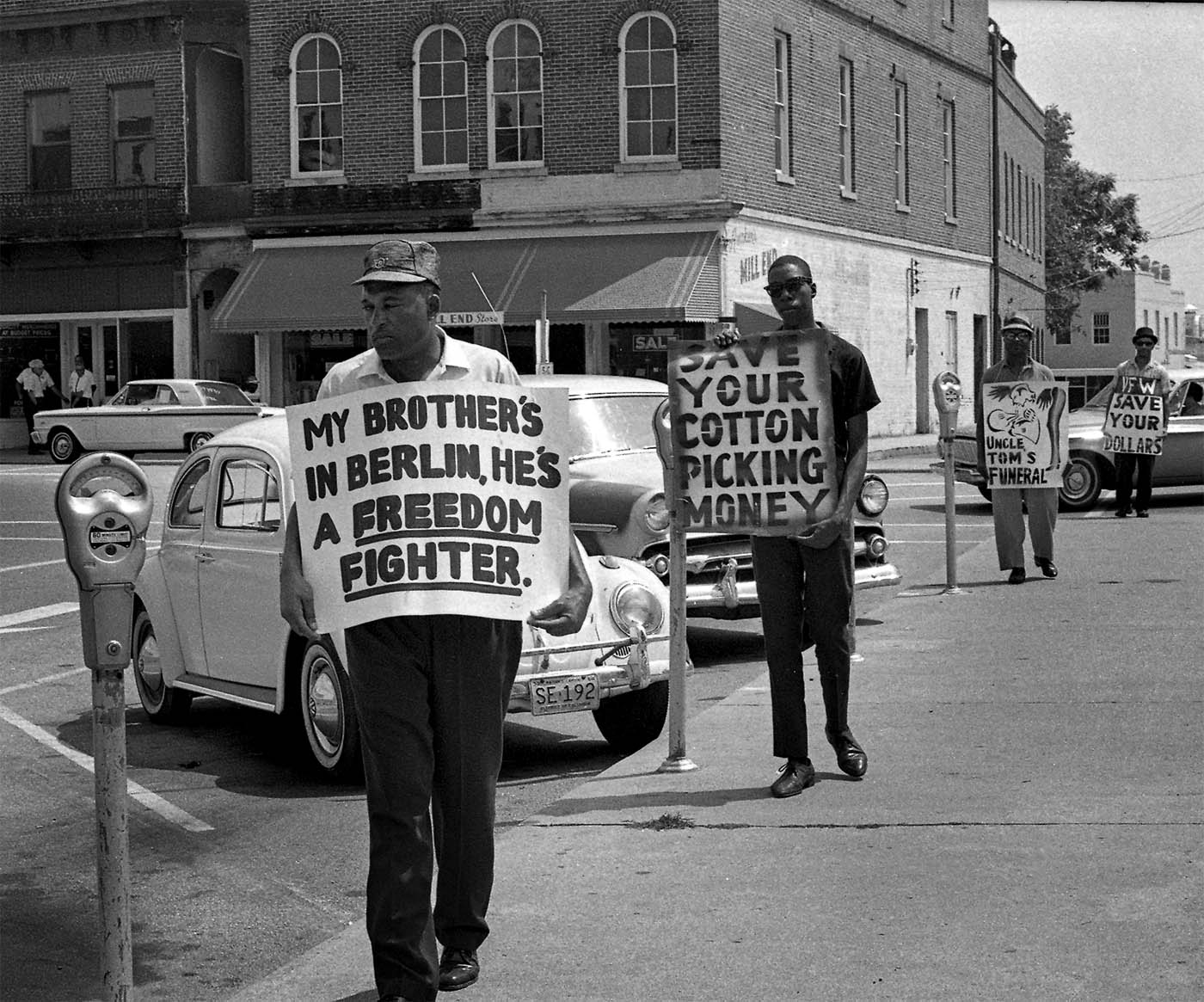
 

Cecil J. Williams (American, b. 1937) 'During the summer of 1960, the elders of Orangeburg took to the streets as part of ongoing demonstrations and boycotts in support of civil rights. They are standing outside a segregated supermarket where they were allowed to shop but not sit down for lunch' 1960, printed 2024


Cecil J. Williams (American, b. 1937)
During the summer of 1960, the elders of Orangeburg took to the streets as part of ongoing demonstrations and boycotts in support of civil rights. They are standing outside a segregated supermarket where they were allowed to shop but not sit down for lunch
1960, printed 2024
Inkjet print
37.3 x 55.9cm (14 11/16 x 22 in.)


Cecil J. Williams (American, b. 1937)

Cecil J. Williams (born November 26, 1937) is an American photographer, publisher, author and inventor who is best known for his photographs documenting the civil rights movement in South Carolina.

He began his career at an early age, photographing wedding and family parties. He studied art at Claflin University, while also being a photographer for the university. …

At the age of 14, Williams was one of 25 photographers around the world freelancing for JET magazine. JET caught wind of the movement growing in Orangeburg. They needed an onsite correspondent for constant updates, and someone to document the events. The only time Williams’ work appeared on the cover of JET was his picture of Coretta Scott King speaking at the protest during the 1969 Charleston hospital workers’ strike.

Williams has photographed significant desegregation efforts in South Carolina since the 1950s. Some of his most notable pictures are of the activity during the Briggs v. Elliott case in Summerton. It was the first of five desegregation cases pushing to integrate public schools in the United States. The five cases combined into Brown v. Board of Education, the 1954 U.S. Supreme Court case that declared that having “separate but equal” public schools for whites and blacks was unconstitutional.

Text from the Wikipedia website
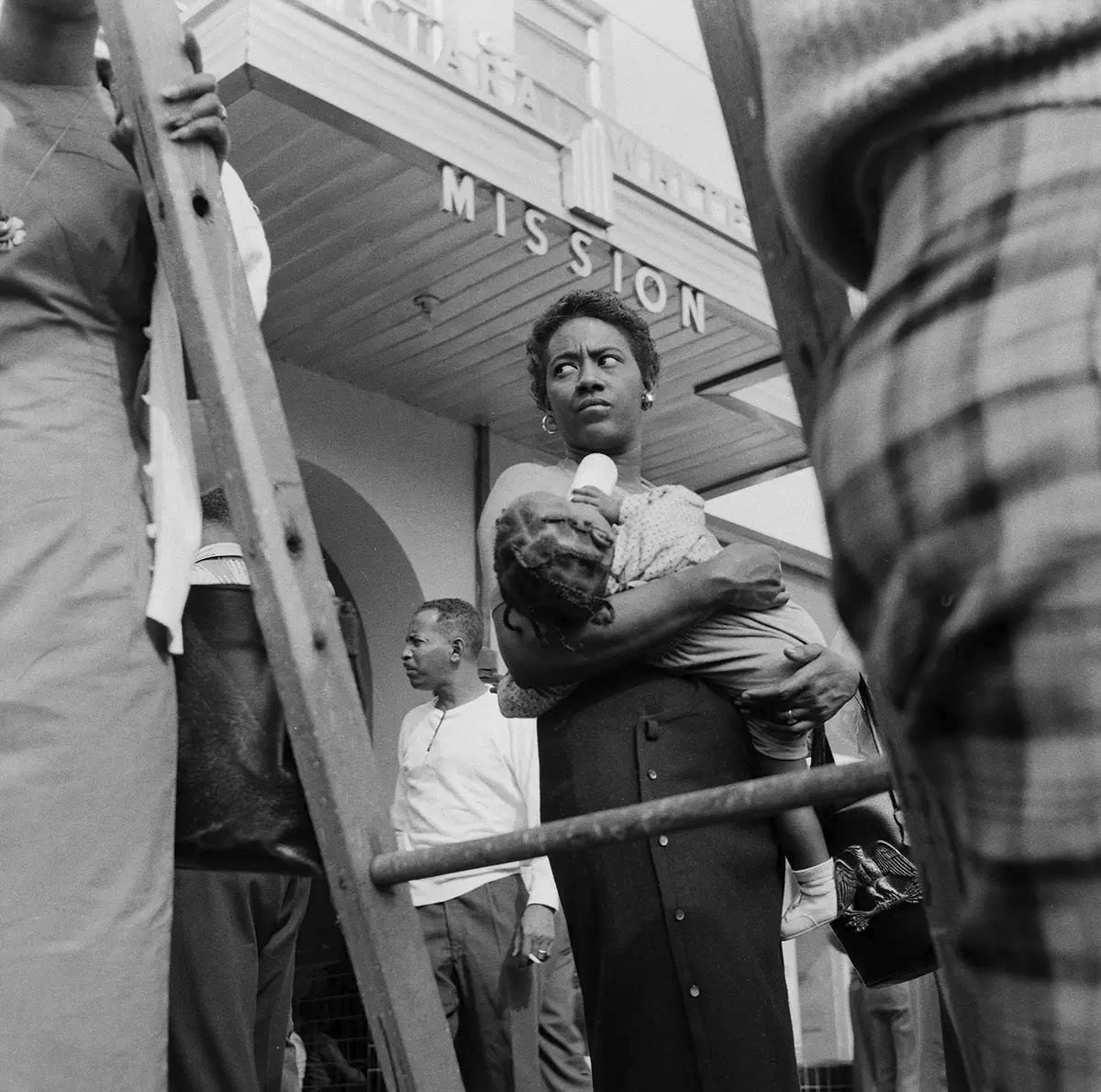
 

Cecil J. Williams (American, b. 1937) 'Clara White Mission, Jacksonville, Florida' 1960s, printed 2024


Cecil J. Williams (American, b. 1937)
Clara White Mission, Jacksonville, Florida
1960s, printed 2024
Inkjet print
45.7 x 45.7cm (18 x 18 in.)
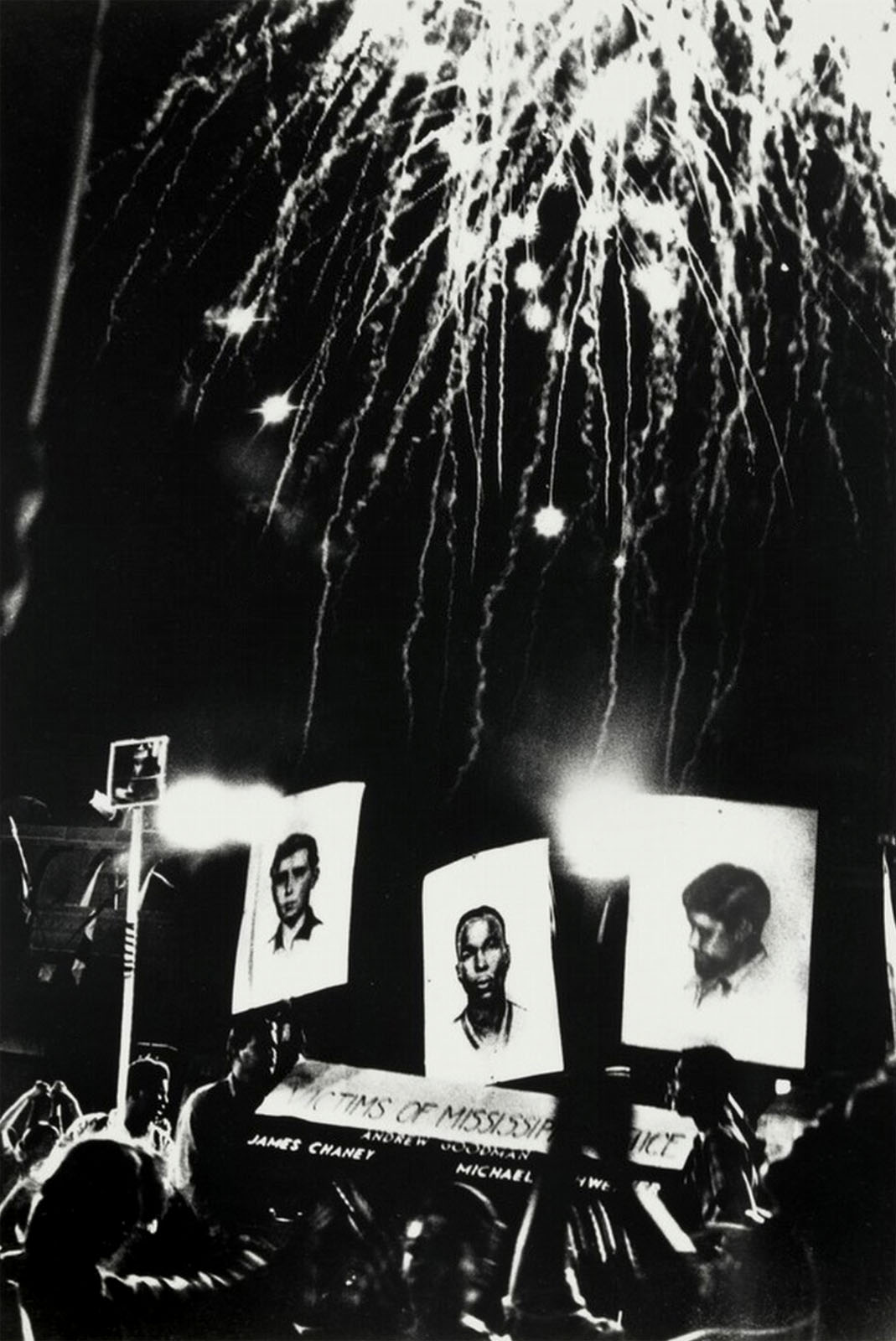
 

Bob Fletcher (American, b. 1938) 'Placards of Goodman, Chaney, and Schwerner at a Demonstration on the boardwalk during the Democratic National Convention, Atlantic City, New Jersey' 1964


Bob Fletcher (American, b. 1938)
Placards of Goodman, Chaney, and Schwerner at a Demonstration on the boardwalk during the Democratic National Convention, Atlantic City, New Jersey
1964
Gelatin silver print
33.97 × 22.86cm (13 3/8 × 9 in.)
National Gallery of Art, Washington
Anonymous gift


Bob Fletcher (American, b. 1938)

Robert E. “Bob” Fletcher is a photographer, filmmaker, writer, and educator. Born in 1938 in Detroit, Michigan, Fletcher majored in History and English at Fisk University and Wayne State University. In 1963, Fletcher became active in the civil rights movement, taking photographs for and administering the National Student Association’s Detroit Tutorial Program. After moving to New York City, he worked at the Harlem Education Project and set up a photographic workshop.

In the summer of 1964, Fletcher became a Freedom School teacher in Mississippi and joined the Student Nonviolent Coordinating Committee (SNCC) staff as a photographer; he documented the Civil Rights Movement throughout the South, between 1964 and 1968. After returning to New York in 1969, Fletcher set up a photography workshop at the Henry Street Settlement, and taught photography at Antioch College and Brooklyn College Film Studio.

Text from the New York Public Library Archives & Manuscripts website
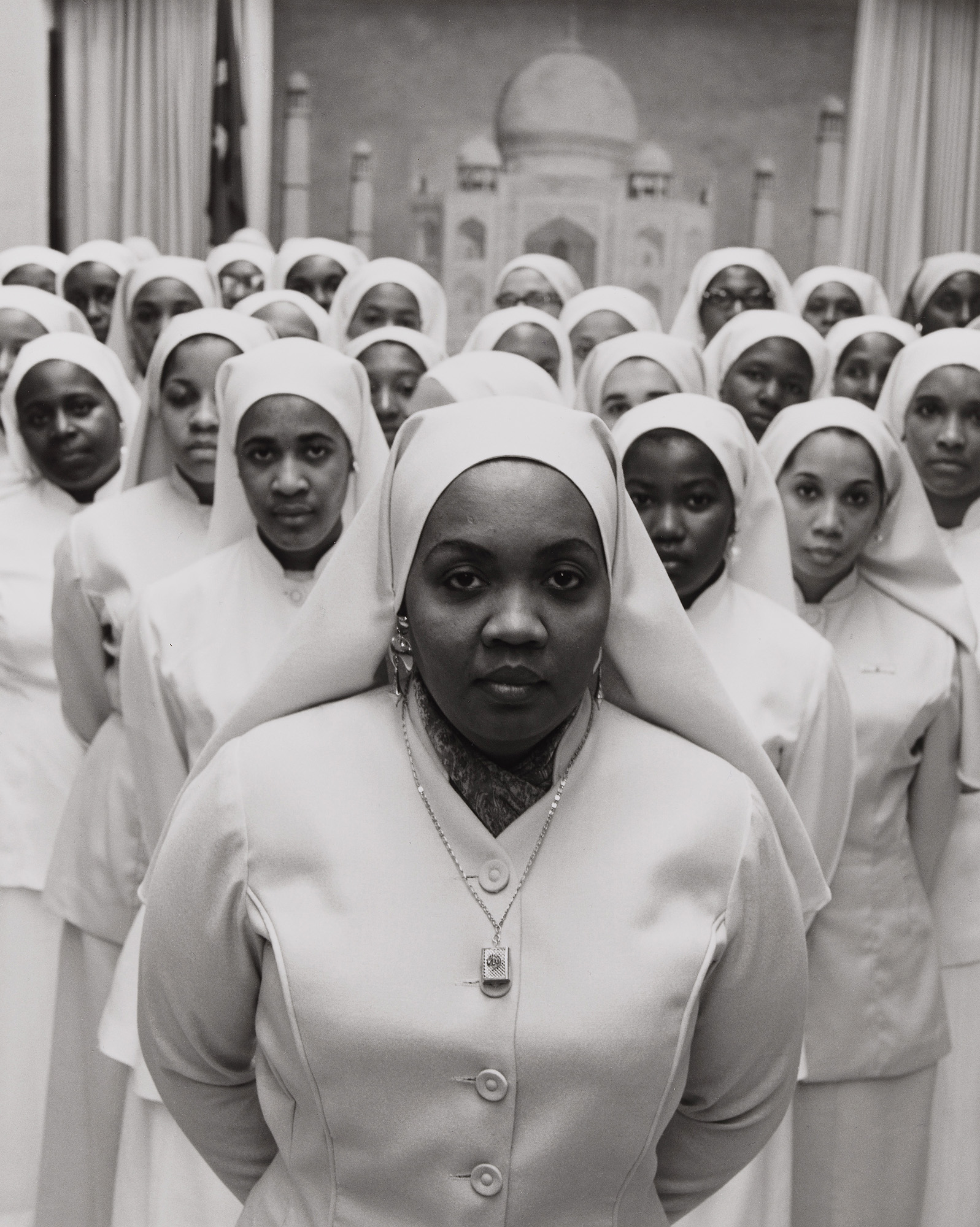
 

Gordon Parks (American, 1912-2006) 'Ethel Sharrieff in Chicago' 1963


Gordon Parks (American, 1912-2006)
Ethel Sharrieff in Chicago
1963
Gelatin silver print
14.6 × 15.9cm (5 3/4 × 6 1/4 in.)
National Gallery of Art, Washington
Corcoran Collection (The Gordon Parks Collection)
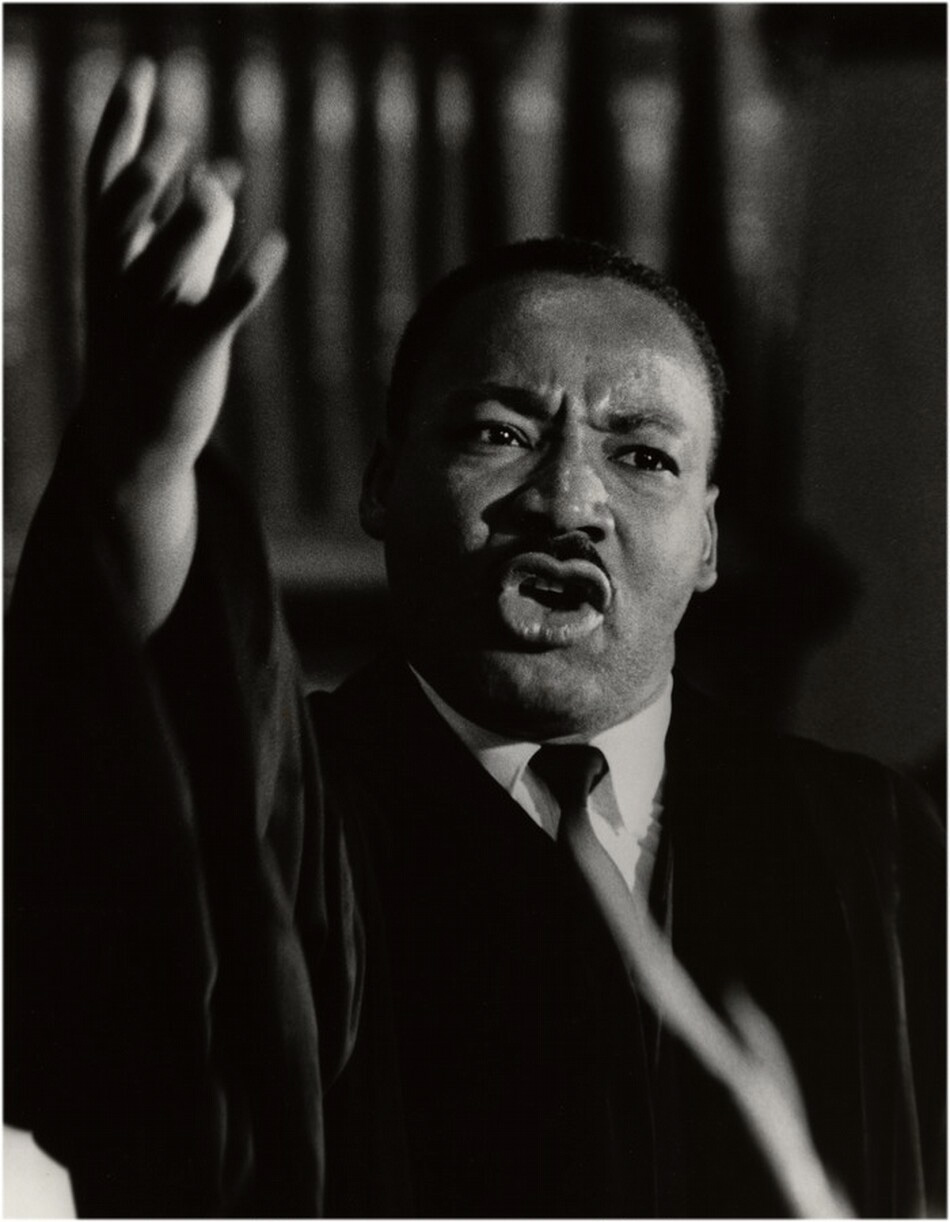
 

Robert A. Sengstacke (American, 1943-2017) 'Dr. Martin Luther King' January 1, 1965


Robert A. Sengstacke (American, 1943-2017)
Dr. Martin Luther King
January 1, 1965
Gelatin silver print
35.1 × 27.3cm (13 13/16 × 10 3/4 in.)
National Gallery of Art, Washington
Alfred H. Moses and Fern M. Schad Fund


Robert A. Sengstacke (American, 1943-2017)

Robert A. “Bobby” Sengstacke spent more than a half century photographing Chicago’s cultural and political landscape, most notably for the weekly newspaper the Chicago Defender, for which he also worked as an editor. The Defender was founded by Robert’s great-uncle Robert Sengstacke Abbott in 1905, and Robert’s father, John Sengstacke, ran the paper for nearly 60 years. In the mid-1950s, after attending Florida’s Bethune Cookman College, Bobby Sengstacke returned to Chicago and honed his skills with fellow photographers Billy (Fundi) Abernathy, Le Mont Mac Lemore, and Bob Black. In the years that followed, he became a member of a tight-knit network of South Side photojournalists who created intimate documents of Chicago’s Black community, from Civil Rights rallies led by Martin Luther King Jr. to the city’s lively entertainment scene.

Sengstacke was also a founding member of the Organization of Black American Culture (OBAC), which brought together Black artists, writers, intellectuals, and activists on Chicago’s South Side.

Text from The Art Institute of Chicago website
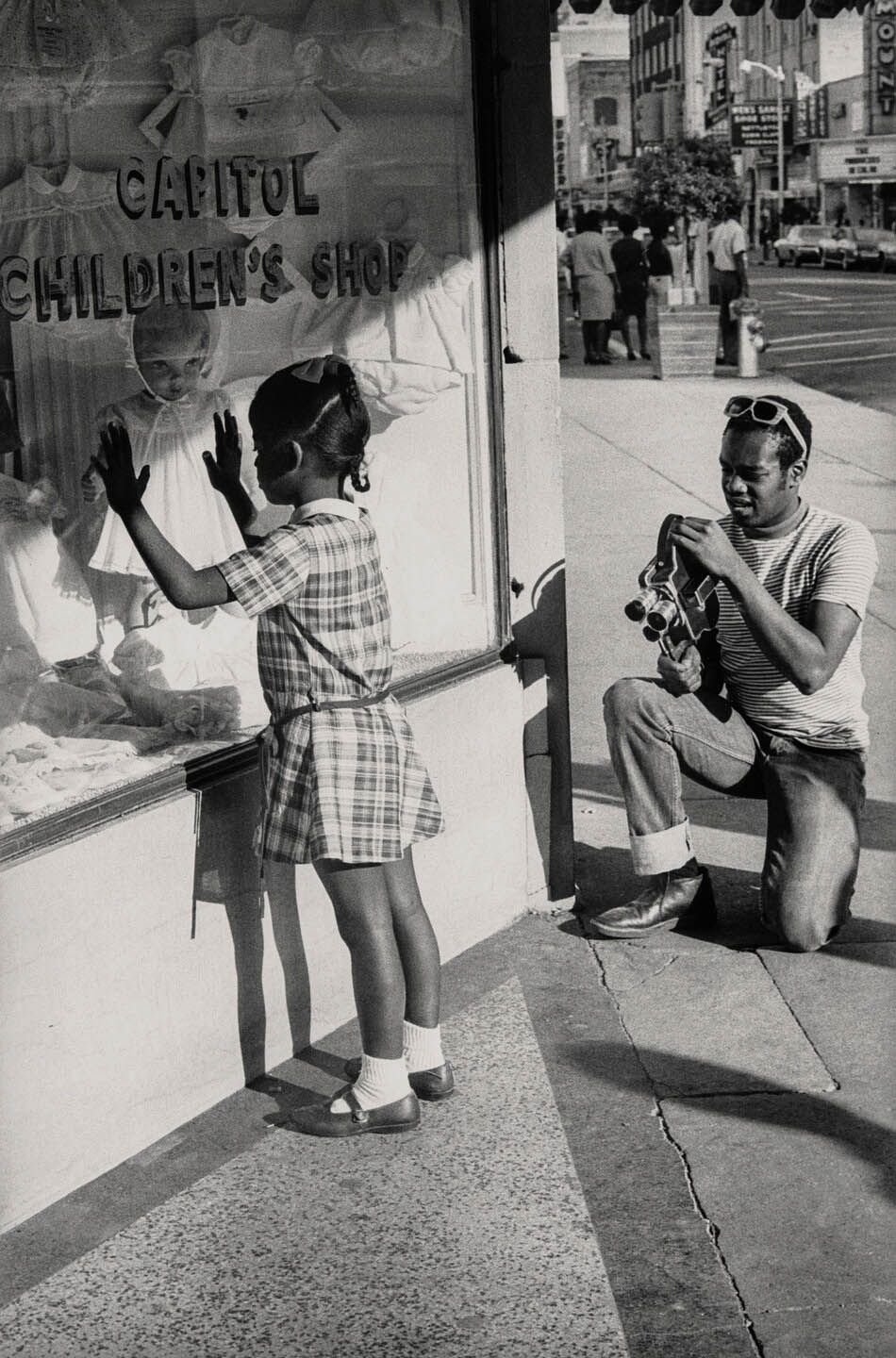
 

Doris A. Derby (American, 1939-2022) 'Member of Southern Media Photographing a Young Girl, Farish Street, Jackson, Mississippi' 1968


Doris A. Derby (American, 1939-2022)
Member of Southern Media Photographing a Young Girl, Farish Street, Jackson, Mississippi
1968
Gelatin silver print
National Gallery of Art, Washington
Gift of David Knaus


Doris A. Derby (American, 1939-2022)

The photography of the US civil rights activist and academic Doris Derby … began through documenting the struggles of black people in the segregated south. However, rather than recording the dramatic events and protests of the nine years from her arrival in Mississippi from New York in 1963, Doris chose to capture the everyday human effort required to live through them.

She went into rural communities to witness the work of children in the fields and women living in wooden shacks trying to care for families. “They were looking to find some help, some way to get out of their horrible poverty and despair,” she said. …

Influenced both by the German expressionist artist Käthe Kollwitz, who was concerned with the effects of poverty, hunger and war on the working class, and the photographer Roy DeCarava, who captured the creativity of the Harlem Renaissance, she also took pictures of children in urban settings, of old and young people attending election events, and those working for the movement, among them the author Alice Walker.

Hannah Collins. “Doris Derby obituary,” on The Guardian website Wed 13 Apr 2022 [Online] Cited 26/11/2025


Darryl Cowherd (American, b. 1940) 'Stokely Carmichael, Unknown Chicago Church' c. 1968


Darryl Cowherd (American, b. 1940)
Stokely Carmichael, Unknown Chicago Church
c. 1968
Gelatin silver print
24.8 × 15.5cm (9 3/4 × 6 1/8 in.)
National Gallery of Art, Washington
Alfred H. Moses and Fern M. Schad Fund


A key figure in Chicago’s Black Arts Movement, Darryl Cowherd has enjoyed an extensive career ranging from photojournalism to broadcast television. At the age of 20, frustrated with work and school, Cowherd followed the advice of his mentor, Chicago-based photographer Robert Earl Wilson, who encouraged him to travel and photograph abroad. Cowherd had initially studied to become a doctor and then worked for the postal service, but neither role proved a lasting fit. After nearly four years in Europe, during which Cowherd honed his photography skills, he returned to Chicago in 1964 and began taking freelance photography assignments while working at a film processing lab. His return to Chicago coincided with the emergence of the Chicago Freedom Movement (1965-67) and the Black Arts Movement (most active in the years 1965-76). An active participant in both movements, Cowherd frequently photographed the activities surrounding them as they grew and gained momentum.

Cowherd was a founding member of the Organization of Black American Culture (OBAC), a collective that brought together Black artists, writers, intellectuals, and activists on Chicago’s South Side.

Text from The Art Institute of Chicago website
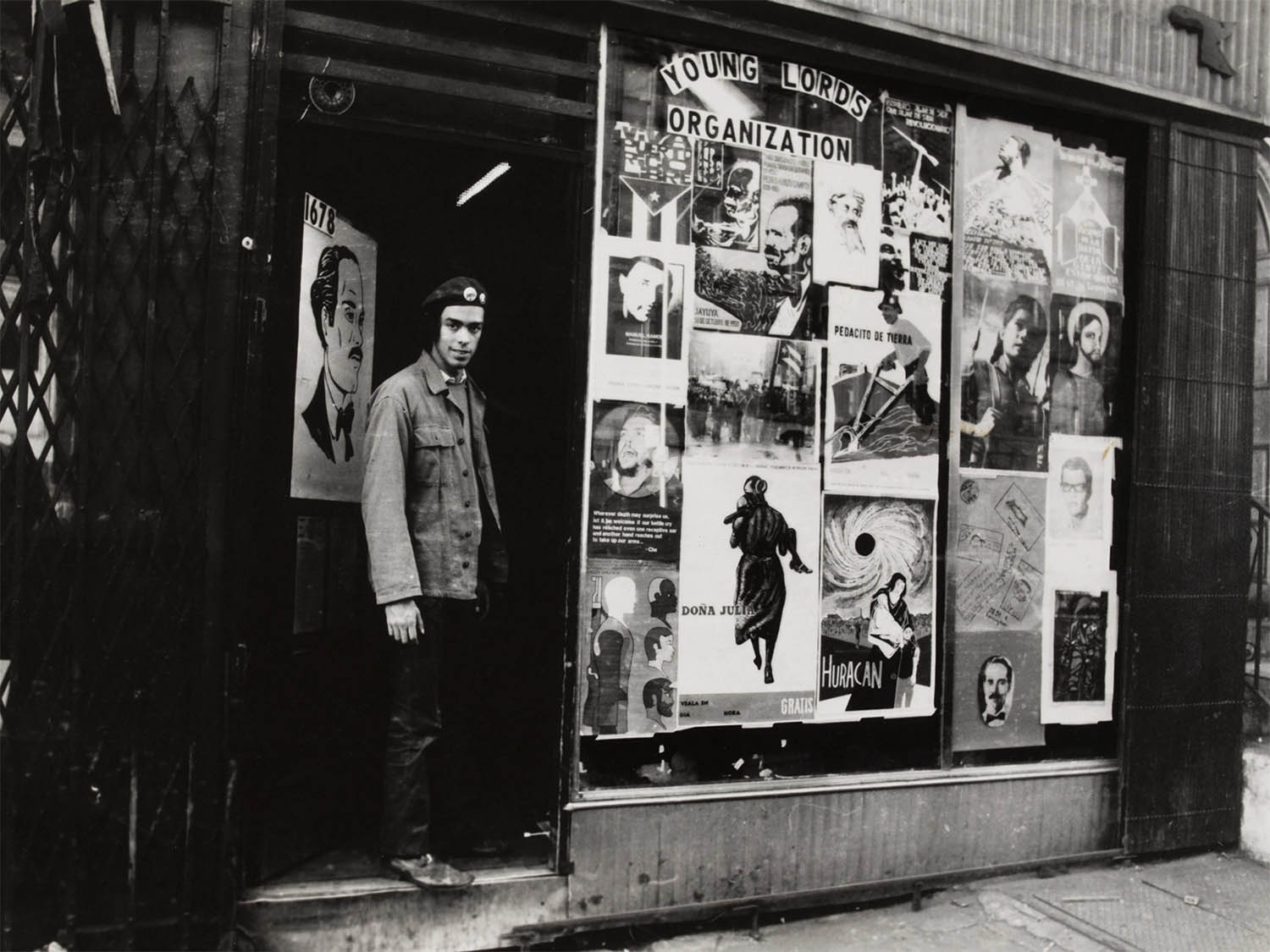
 

Hiram Maristany (American, 1945-2022) 'Juan González, Minister of Information, in the doorway of the first office of the Young Lords' 1969, printed 2021


Hiram Maristany (American, 1945-2022)
Juan González, Minister of Information, in the doorway of the first office of the Young Lords
1969, printed 2021
Gelatin silver print
33 x 46cm (13 x 18 1/8 in.)
National Gallery of Art, Washington
Alfred H. Moses and Fern M. Schad Fund
© Hiram Maristany


Hiram Sebastian Maristany was a Nuyorican American photographer, and director of El Museo del Barrio (a museum in NYC which specialises in Latin American and Caribbean art, with an emphasis on works from Puerto Rico and the Puerto Rican community in New York City) from 1975 to 1977. He was known for his association with, and documentation of, the Young Lords chapter in Harlem, which he co-founded in 1969.

Juan González was a co-founder of the Young Lords, a radical Puerto Rican rights organisation in New York City, where he helped lead the group in protests for social justice. The Young Lords fought for better healthcare, education, and city services, and against police abuse and Puerto Rico’s colonial status. Following his work with the Young Lords, González became a celebrated journalist, co-hosting Democracy Now! and writing for the New York Daily News.

Texts from the Wikipedia website


What Is the Black Arts Movement? Seven Things to Know

Poet Larry Neal, who coined the term Black Arts Movement, described it as “a cultural revolution in art and ideas.” This movement included poets, playwrights, musicians, filmmakers, photographers, and painters. They came together to make art that advanced civil rights and celebrated Black history, identity, and beauty.

This cultural revolution shook up the art world in the 1950s and ’60s. It embodied the struggle for self-determination championed by global freedom movements. New collectives, workshops, and collaborations emerged. Creatives made art that promoted Black dignity, hope, and freedom. They asked, how could art inspire social and political change? And what would it look like?

Photography was a driving force from the beginning, playing a critical role as both a communications tool and art form. Learn more about the movement and photography’s part in it – major themes in our exhibition Photography and the Black Arts Movement, 1955-1985.

1/ Its origins are in the civil rights movement

Our exhibition begins in 1955, more than a decade before Larry Neal named the Black Arts Movement. That year, several events – and photographs of those events – helped catalyse the civil rights movement.

In September, Jet magazine was one of several publications that printed open-casket photographs of Emmett Till, a 14-year-old boy from Chicago who was lynched in Mississippi. Those disturbing images were seen across the country, including by a woman in Montgomery, Alabama: Rosa Parks. That December, Parks sat in the front, “white only” section of a segregated bus. The driver demanded that she give up her seat to a white passenger. She refused. As she later recounted, Emmett Till was on her mind in that moment.

Parks, in turn, was photographed sitting at the front of the segregated bus. Those images, and others like them, brought widespread awareness to the struggles for equal rights. Organisations like the Student Nonviolent Coordinating Committee (SNCC) encouraged photography of their marches, demonstrations, and acts of nonviolent civil disobedience. SNCC even taught some members to use a camera. Lifelong activist Maria Varela became a SNCC photographer after recognising the need for more images of Black life to support the movement.

2/ Poets, writers, and playwrights led the movement

The beginning of the Black Arts Movement is often pinned to poet, playwright, and writer Amiri Baraka founding the Black Arts Repertory Theatre/School in New York City’s Harlem neighbourhood in 1965. Nikki Giovanni, Gwendolyn Brooks, and Audre Lorde were among the many writers and poets active in the movement. Some collaborated with visual artists, even forming collectives such as the Organization of Black American Culture (OBAC) in Chicago.

OBAC writers, scholars, painters, and photographers collaborated to create the Wall of Respect community mural in 1967. It commemorated key figures in African American history, including W. E. B. Du Bois, Muhammad Ali, and Nina Simone. The mural was like a two-story collage that covered the facade of a building in the city’s South Side neighbourhood. It incorporated paintings by several artists alongside mounted photographs by Roy Lewis and Darryl Cowherd. At the centre was Amiri Baraka’s poem “SOS,” which opens, “Calling all black people.” The mural was demolished in 1972, but photographs by Roy Lewis and Robert Sengstacke continue to spread its message.

3/ It was inspired by jazz

Music was an equally important part of the Black Arts Movement. Musicians John Coltrane and Sun Ra both performed at a fundraiser for Amiri Baraka’s Black Arts Repertory Theatre/School. Their experimental and expressive jazz inspired Black Arts Movement writers and artists.

In Coltrane at the Gate, photographer Adger Cowans depicted the saxophonist’s energy. Ming Smith captured the magic of a Sun Ra performance. For his homage to saxophonist Charlie Parker (who was commonly known as “Bird”), painter Raymond Saunders embraced the spontaneous spirit of jazz. Saunders collaged a newsprint photograph below the word “bird” written in a chalk-like white script.

4/ It celebrated Black beauty

The Black Arts Movement celebrated the “beauty and goodness of being Black,” as Larry Neal put it. Photographer Kwame Brathwaite helped popularise the phrase “Black is beautiful.” Brathwaite was a pioneer of uplifting Black identity. He helped found groups that challenged conventional standards of beauty and celebrated African heritage. They organised fashion shows, created “Black is beautiful” products, and operated a photography studio.

In Untitled (Portrait, Reels as Necklace), Brathwaite adorned the model with a necklace made from film developing reels to “expose” her beauty. More than a decade later, Carla Williams created a self-portrait that echoed Brathwaite’s work. Showing herself in curlers, Williams challenged popular notions of beauty.

5/ It brought artists together

Small collectives of visual artists and photographers came together around the principles of the Black Arts Movement. In New York, the Kamoinge Workshop photography collective met regularly to critique each other’s work, debate photography’s purpose and aesthetics, and share tips. They created a space for their art by developing their own portfolios and exhibitions. The workshop also produced the groundbreaking Black Photographers Annual between 1973 and 1980.

A group of Chicago artists formed AfriCOBRA. The collective’s founders defined their own aesthetic principles, aimed at creating “images that jar the senses and cause movement” and “images designed for mass production.”

6/ It spread across the Atlantic

The Black Arts Movement made an impact beyond the United States. In Great Britain, Raphael Albert organised and photographed Black beauty pageants in London. James Barnor focused on style, migration, and Black city life in London and in Accra, Ghana. Horace Ové photographed the British Black Power Movement. He also captured scenes of the West African and West Indian communities in London, like his Walking Proud, Notting Hill Carnival.

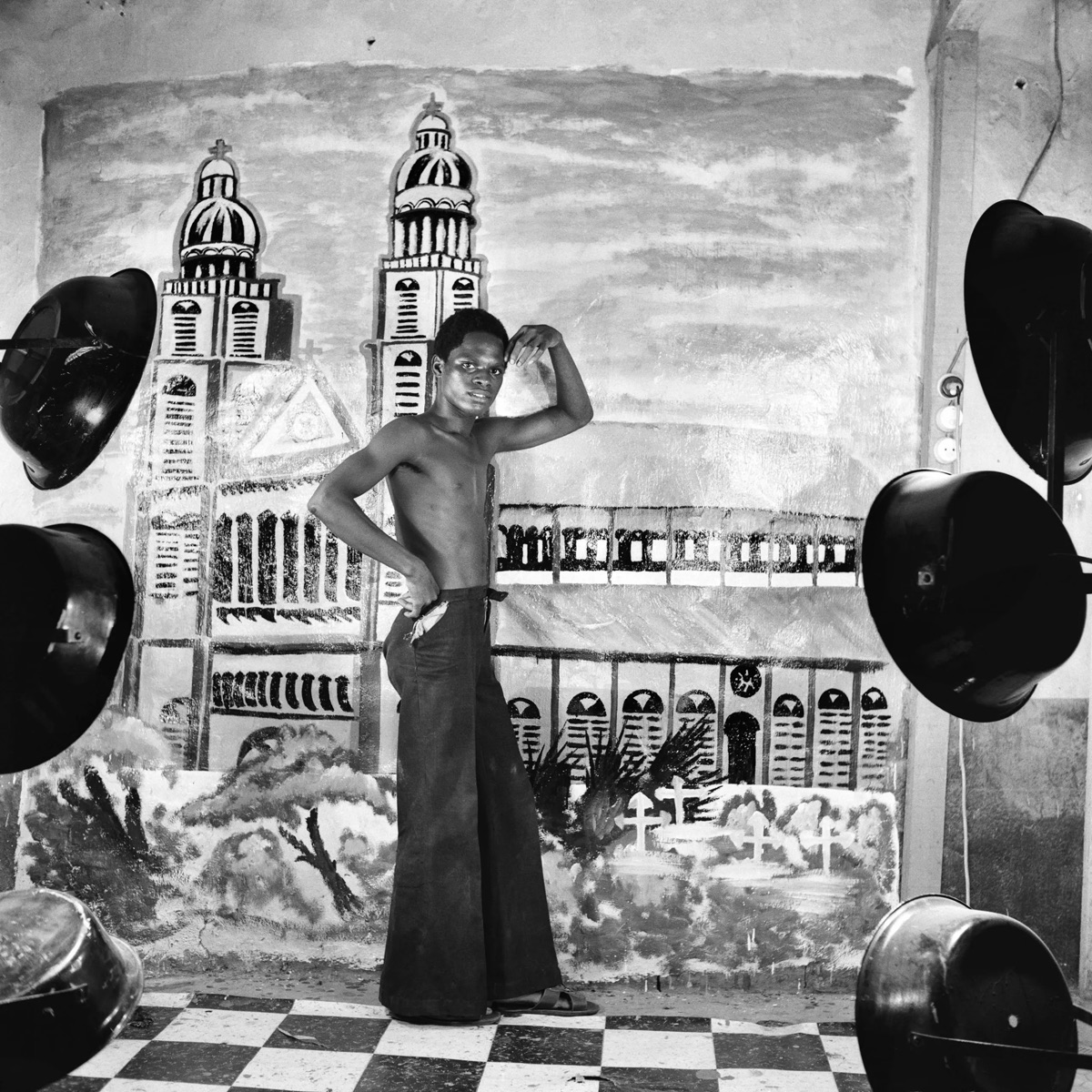
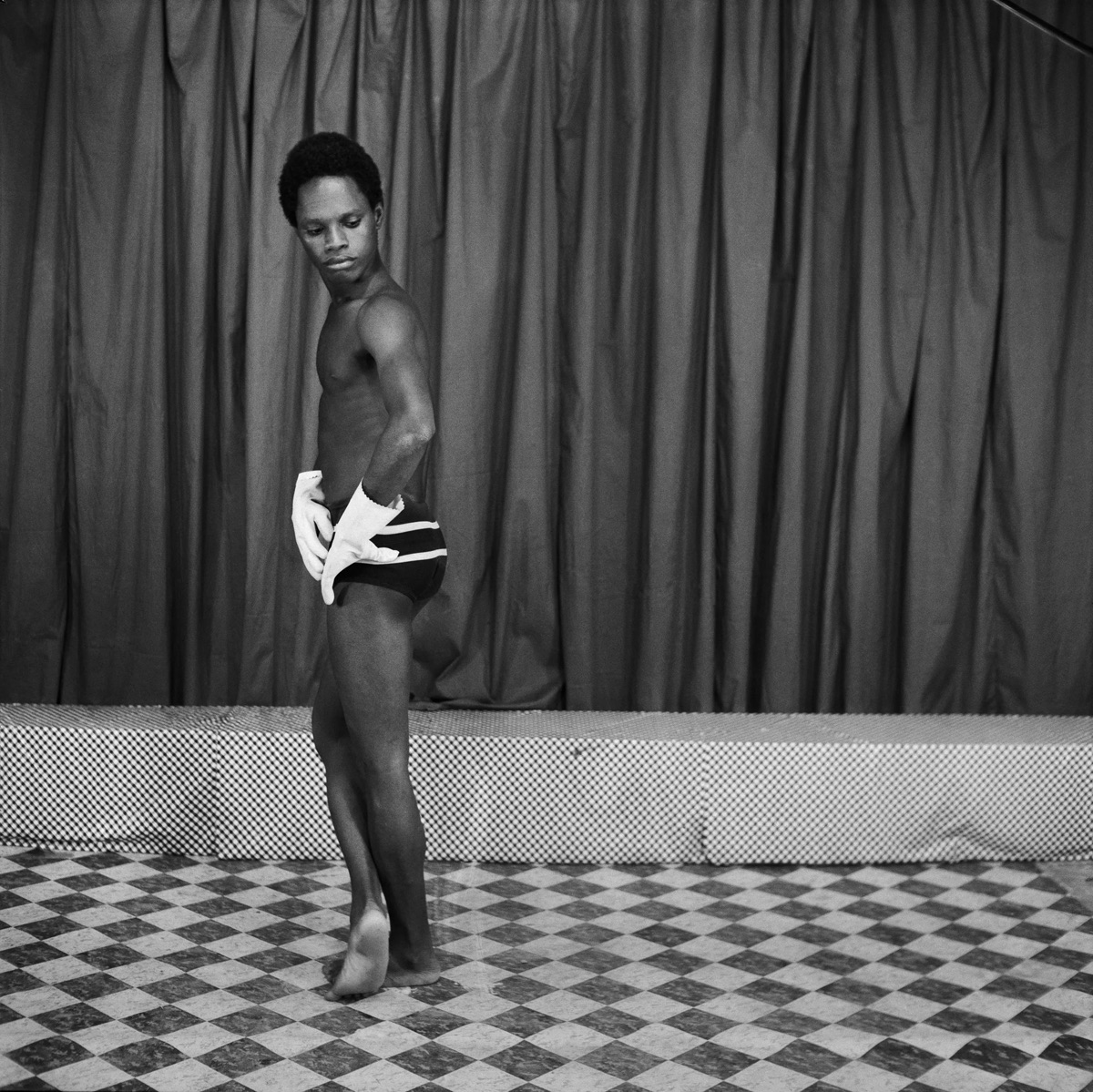
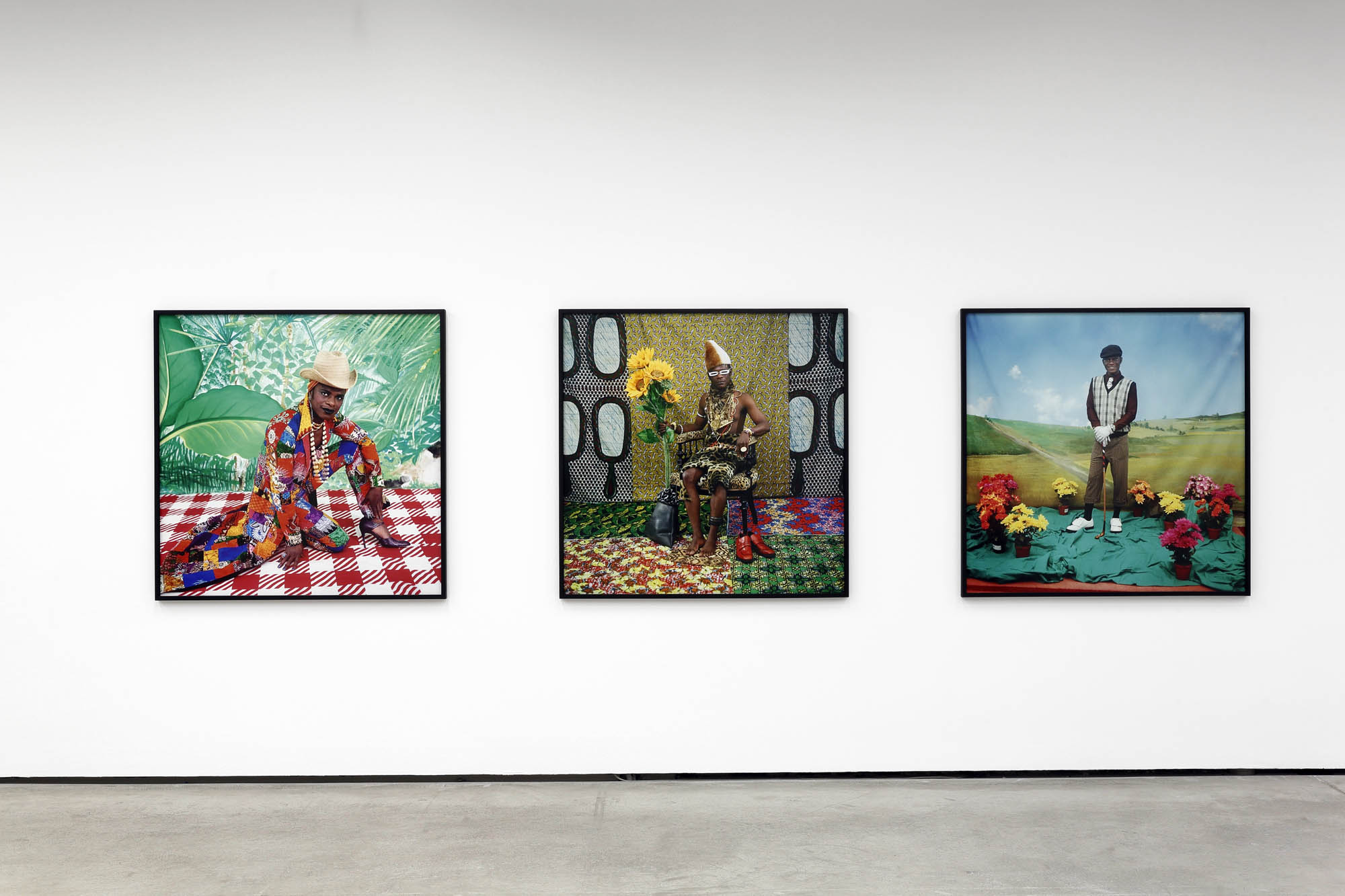
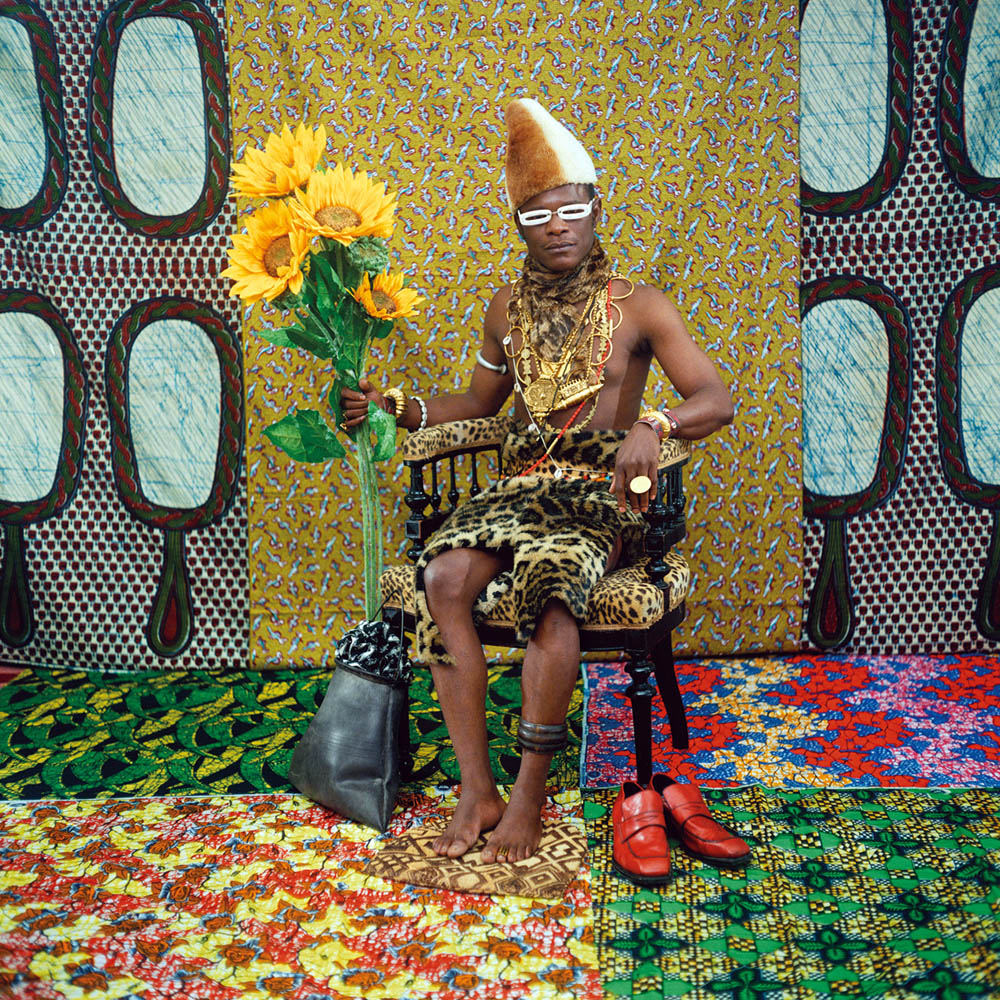
Samuel Fosso opened his first photography studio in Bangui, Central African Republic, at age 13. After finishing with clients, Fosso would use his studio to experiment with self-portraits. He wore an array of costumes and adopted personas, often taking inspiration from the pictures of Black Americans he saw in magazines shared by American Peace Corps volunteers.

7/ It influenced generations of artists

By the end of the 1970s, the literary arm of the Black Arts Movement had waned, but a new generation of artists and photographers carried on its spirit. Coming out of art school, photographers such as Carrie Mae Weems and Lorna Simpson explored more personal, metaphorical, and conceptual ideas.

In her Family Pictures and Stories series, Weems made her own family the subjects. The intimate photographs presented a counterargument to claims that many Black Americans faced poverty and struggle as a result of weak family structures. Weems paired the photographs with brief stories about each family member.

Text from the National Gallery of Art website


Herbert Randall (American, born 1936) 'Untitled (Bed-Stuy, New York)' 1960s


Herbert Randall (American, b. 1936)
Untitled (Bed-Stuy, New York)
c. 1960s
Gelatin silver print
22.8 x 15.6cm (9 x 6 1/8 in.)
National Gallery of Art, Washington
Alfred H. Moses and Fern M. Schad Fund, 2022.89.1
© Herbert Randall


Herbert Randall (American, b. 1936)

Herbert Eugene Randall, Jr. is an American photographer who had documented the effects of the Civil Rights Movement. Randall is of Shinnecock, African-American and West Indian ancestry.

Randall studied photography under Harold Feinstein in 1957. From 1958 to 1966, he worked as a freelance photographer for various media organizations. His photographs were used by the Associated Press, United Press International, Black Star, various television stations, and other American and foreign publications. Randall was also a founding member of the Kamoinge Workshop, a collective of African-American photographers, in New York City in 1963.

In 1964, Sanford R. Leigh, the Director of Mississippi Freedom Summer’s Hattiesburg project, persuaded Randall to photograph the effects of the Civil Rights Movement in Hattiesburg, Mississippi. Randall had a Whitney Fellowship for that year, and had been looking for a project. He spent the entire summer photographing solely in Hattiesburg, among the African-American community and among the volunteers in area projects such as the Freedom Schools, Voter Registration, and the Mississippi Freedom Democratic Party campaign.

Only five of Randall’s photographs were published in the summer of 1964. One seen worldwide was the bloodied, concussed Rabbi Arthur Lelyveld, head of a prominent Cleveland congregation and former conscientious objector to World War II. However, most of his photographs sat in a file at the Shinnecock Reservation, on Long Island, New York.

Text from the Wikipedia website
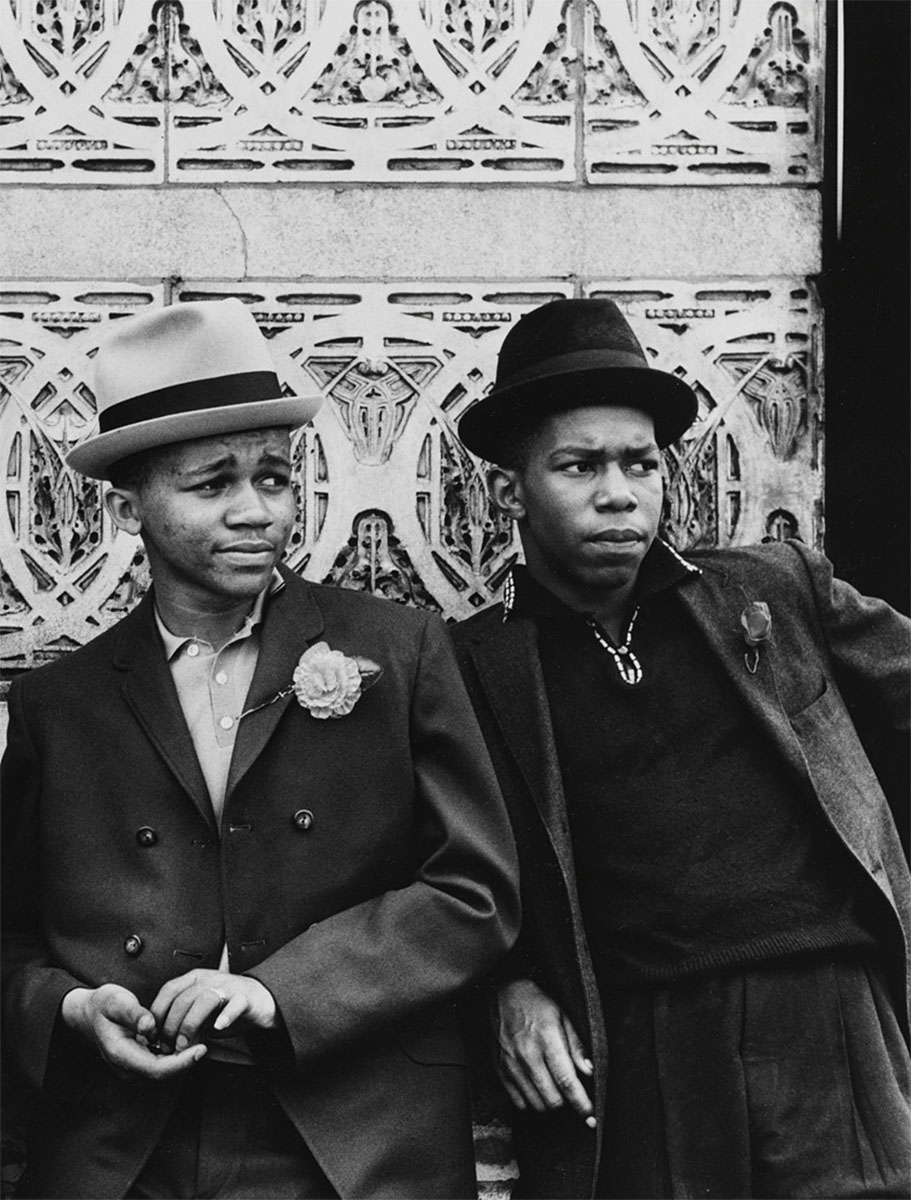
 

Billy Abernathy (Fundi) (American, 1939-2016) 'Mother's Day' from the series "Born Hip" 1962


Billy Abernathy (Fundi) (American, 1939-2016)
Mother’s Day from the series “Born Hip”
1962
gelatin silver print
17.5 x 13.3cm (6 7/8 x 5 1/4 in.)
The Art Institute of Chicago, Gift of the Illinois Arts Council
Photo: The Art Institute of Chicago / Art Resource, NY


Billy Abernathy (Fundi) (American, 1939-2016)

Photographer Billy (Fundi) Abernathy was known for creating images that defined Black confidence, elegance, and style. This work extended to his collaborations with his wife, Sylvia (Laini) Abernathy, with whom he designed album covers for Delmark Records in the 1960s. Around that time, the poet and author Amiri Baraka (LeRoi Jones) encountered Abernathy’s photographs of Chicago and proposed a book project that would combine his poetry with Abernathy’s images. The resulting collaboration, In Our Terribleness (Some Elements and Meaning in Black Style), was designed by Laini and published in 1970. In 1971 the New York Times hailed the book as “an example of the new direction that black art is taking.”

Text from The Art Institute of Chicago website
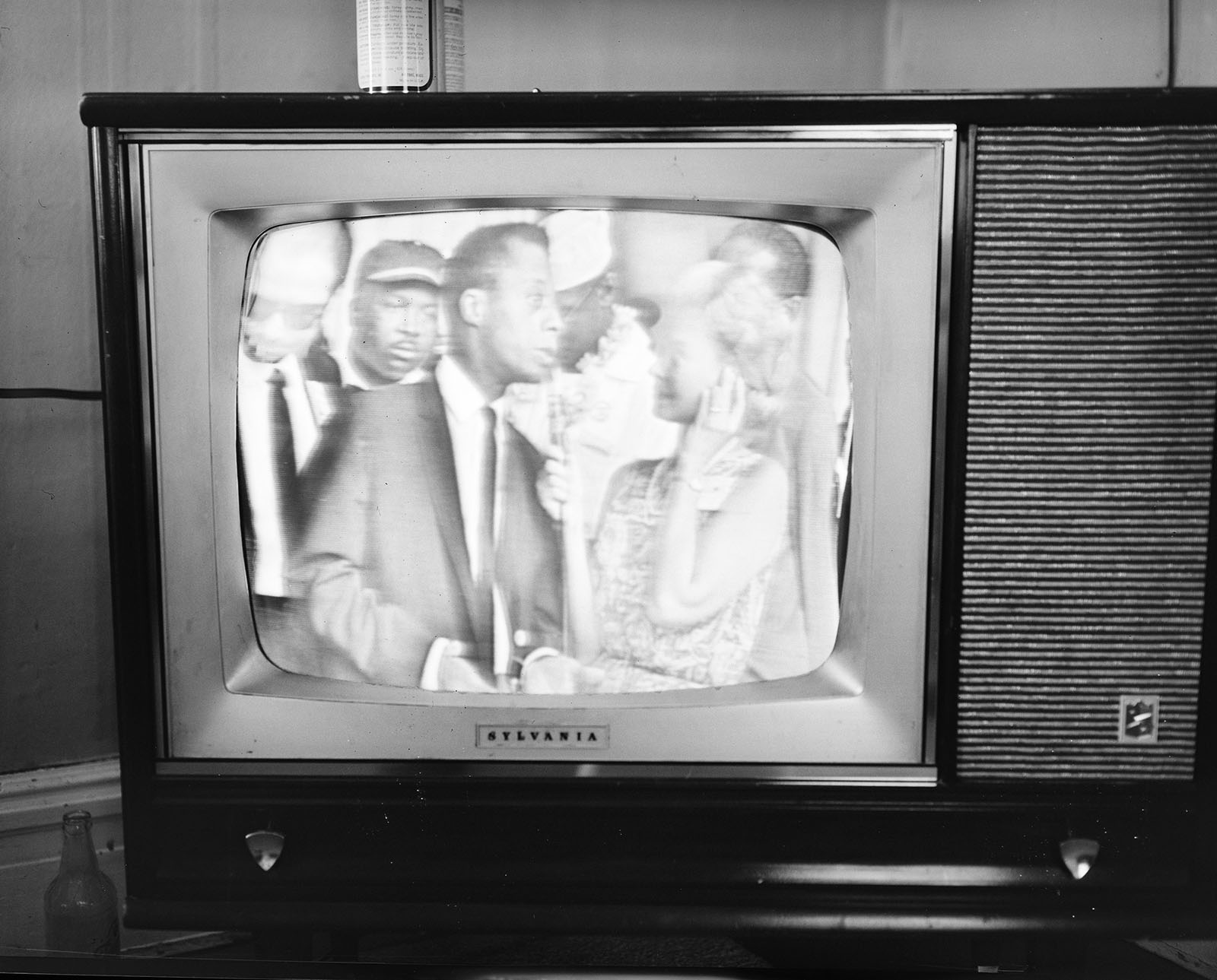
 

Charles "Teenie" Harris (American, 1908-1998) 'A television playing coverage of James Baldwin at the March for Freedom and Jobs in Washington, DC' 1963/2025


Charles “Teenie” Harris (American, 1908-1998)
A television playing coverage of James Baldwin at the March for Freedom and Jobs in Washington, DC
1963/2025
Gelatin silver print
National Gallery of Art, Washington


African American artist Charles “Teenie” Harris, captured “the essence of daily African-American life in the 20th century. For more than 40 years, Harris – as lead photographer of the influential Pittsburgh Courier newspaper – took almost 80,000 pictures of people from all walks: presidents, housewives, sports stars, babies, civil rights leaders and even cross-dressing drag queens.”

See the Art Blart posting on the exhibition Teenie Harris, Photographer: An American Story at Carnegie Museum of Art, Pittsburgh, Pennsylvania, October 2011 – April 2012
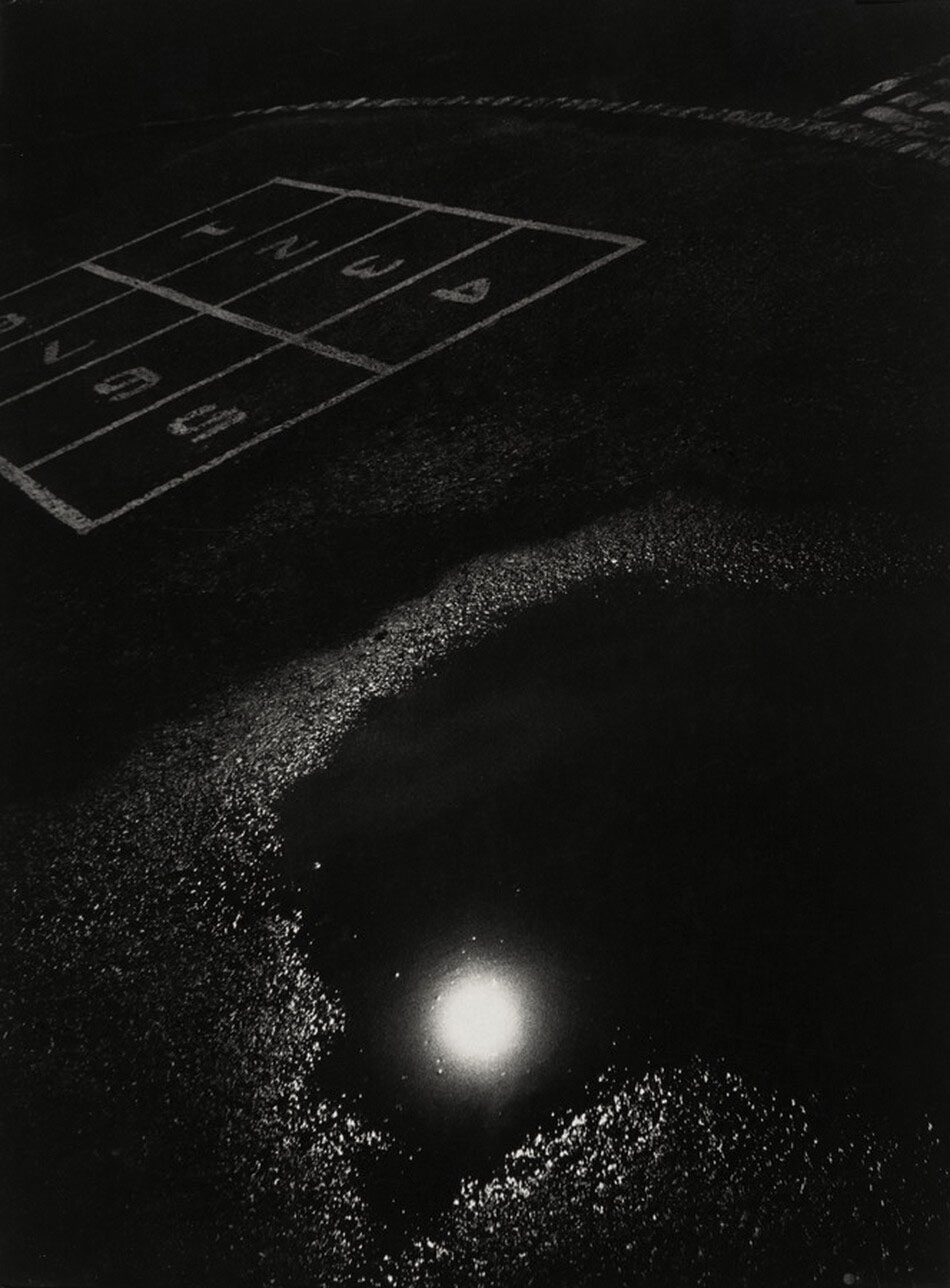
 

Louis Draper (American, 1935-2002) 'Untitled (Playground)' from the "Playground Series" c. 1965


Louis Draper (American, 1935-2002)
Untitled (Playground) from the “Playground Series”
c. 1965
Gelatin silver print
25.7 x 19.1cm (10 1/8 x 7 1/2 in.)
National Gallery of Art, Washington
Alfred H. Moses and Fern M. Schad Fund
© Draper Preservation Trust, Nell D. Winston, Trustee


Louis Draper (American, 1935-2002)

In 1953, he enrolled at the historically Black college in Petersburg, which was not far from his hometown of Richmond. He began working as a reporter for the school paper, and during that time Draper’s father, who was an amateur photographer himself, sent Louis his first camera. By 1956, Draper’s title at the paper had changed to cameraman. After his revelatory first experience with The Family of Man, a catalogue that accompanied the 1955 photography exhibition at The Museum of Modern Art, he decided to leave school during his final semester and move to New York City to become a photographer. Once there, Draper enrolled in a photography workshop led by Harold Feinstein, and was mentored by W. Eugene Smith, one of the most prominent American photojournalists.

In 1963, the same year as the March on Washington, Draper became a founding member of the Kamoinge Workshop, a New York-based collective of Black photographers. Workshop members met regularly to discuss one another’s work, produced group portfolios, exhibitions, and publications, and mentored young people all over the city. Draper emerged as one of the group’s teachers, which began his long career as an educator (he worked in numerous teaching roles, including at Pratt Institute and Mercer County Community College). The collective aimed to “create the kind of images of our communities that spoke of the truth we’d witnessed and that countered the untruths we’d all seen in mainline publications.” Kamoinge members wanted to avoid the racial stereotypes prevalent in the media and the violence that was typical of journalistic coverage of the Civil Rights Movement, working instead to represent their communities in a positive light.

Jane Pierce, Carl Jacobs Foundation Research Assistant, Department of Photography, “Louis Draper,” on the MoMA website 2021 [Online] Cited 27/11/2025
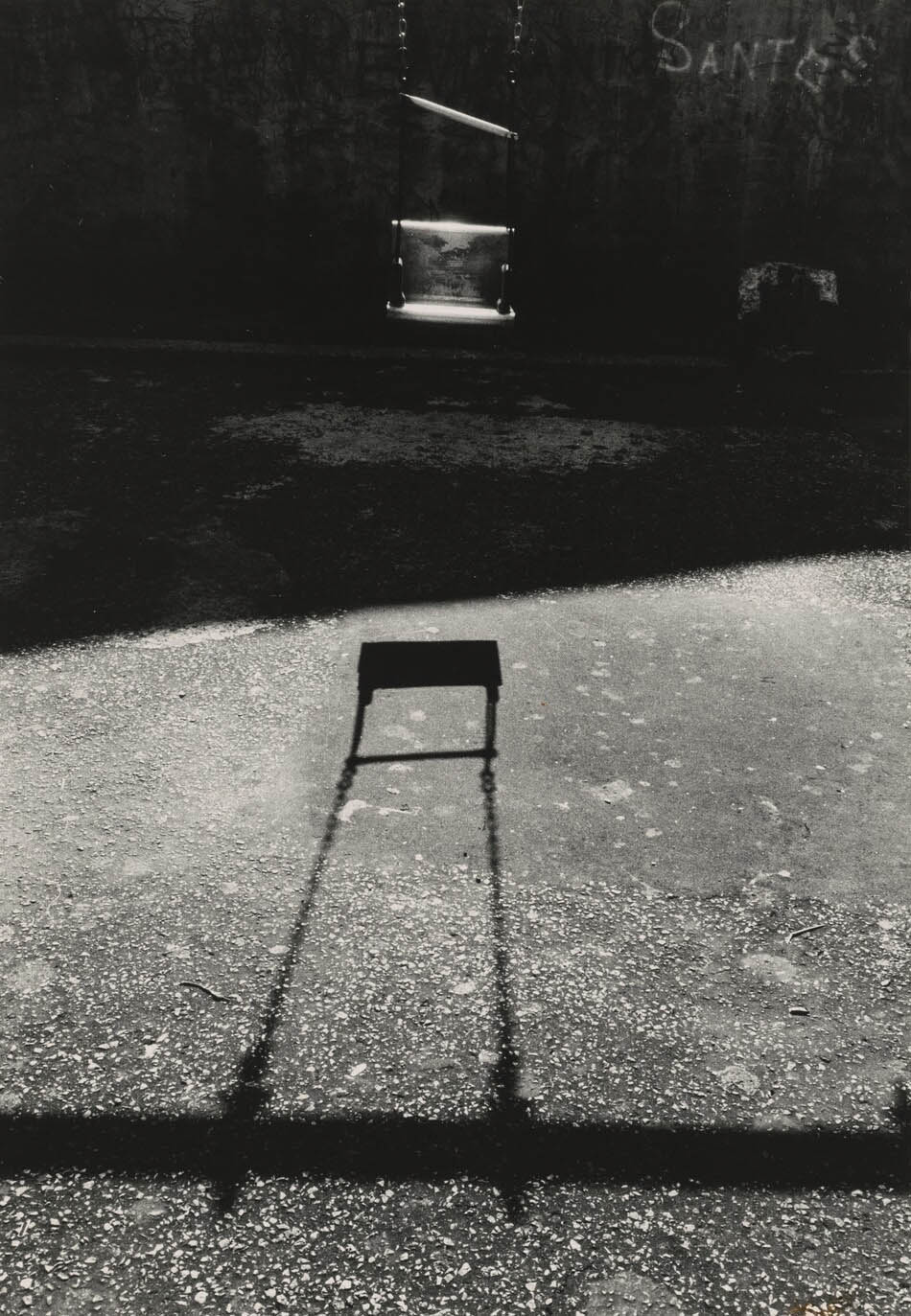
 

Louis Draper (American, 1935-2002) 'Untitled (Santos)' from the "Playground Series" 1967


Louis Draper (American, 1935-2002)
Untitled (Santos) from the “Playground Series”
1967
Gelatin silver print
32.9 x 22.8cm (12 15/16 x 9 in.)
National Gallery of Art, Washington
Pepita Milmore Memorial Fund
© Draper Preservation Trust, Nell D. Winston, Trustee
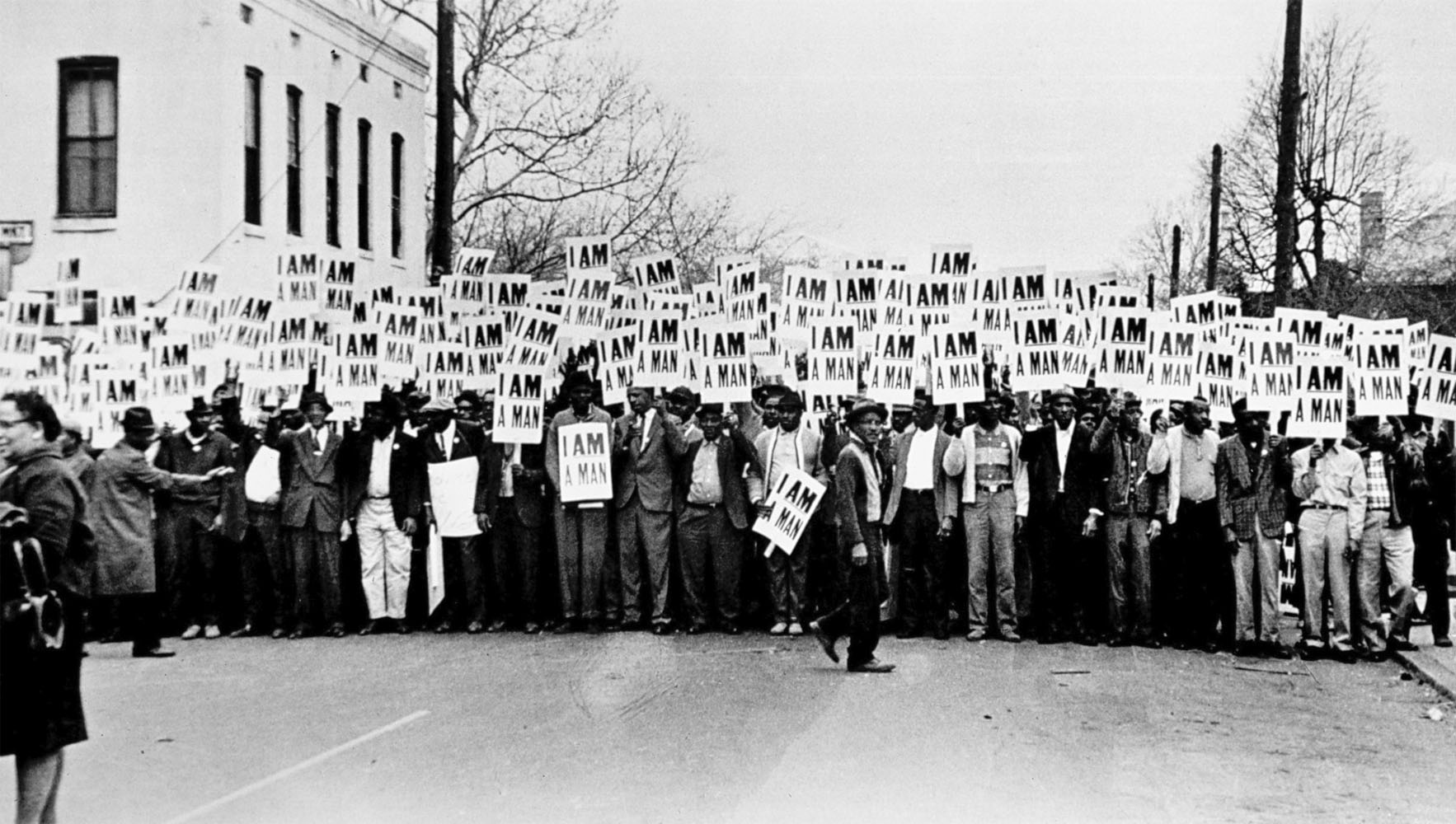
 

Ernest C. Withers (American, 1922-2007) 'I Am A Man, Sanitation Workers Strike, Memphis, Tennessee' March 28, 1968


Ernest C. Withers (American, 1922-2007)
I Am A Man, Sanitation Workers Strike, Memphis, Tennessee
March 28, 1968
Gelatin silver print
19 × 32.6cm (7 1/2 × 12 13/16 in.)
National Gallery of Art, Washington
Alfred H. Moses and Fern M. Schad Fund


Ernest C. Withers (American, 1922-2007)

Photojournalist Ernest C. Withers was born on August 7, 1922, in Memphis, Tennessee. Withers got his start as a military photographer while serving in the South Pacific during World War II. Upon returning to a segregated Memphis after the war, Withers chose photography as his profession.

In the 1950s, Withers helped spur the movement for equal rights with a self-published photo pamphlet on the Emmitt Till murder. Over the next two decades, Withers formed close personal relationships with Dr. Martin Luther King, Jr., Medgar Evers, and James Meredith. Withers’s pictures of key civil rights events from the Montgomery Bus Boycott to the strike of Memphis sanitation workers are historic. Indeed, Withers was often the only photographer to record these scenes, many of which were not yet of interest to the mainstream press.

Withers photographed more than the southern Civil Rights Movement. Whether Jackie Robinson, Willie Mays, and other Negro League baseball players, or those jazz and blues musicians who frequented Memphis’ Beale Street, Withers photographed the famous and not-so famous. Withers’s collection includes pictures of early performances of Elvis Presley, B.B. King, Ike and Tina Turner, Ray Charles, and Aretha Franklin.

Text from The History Makers website
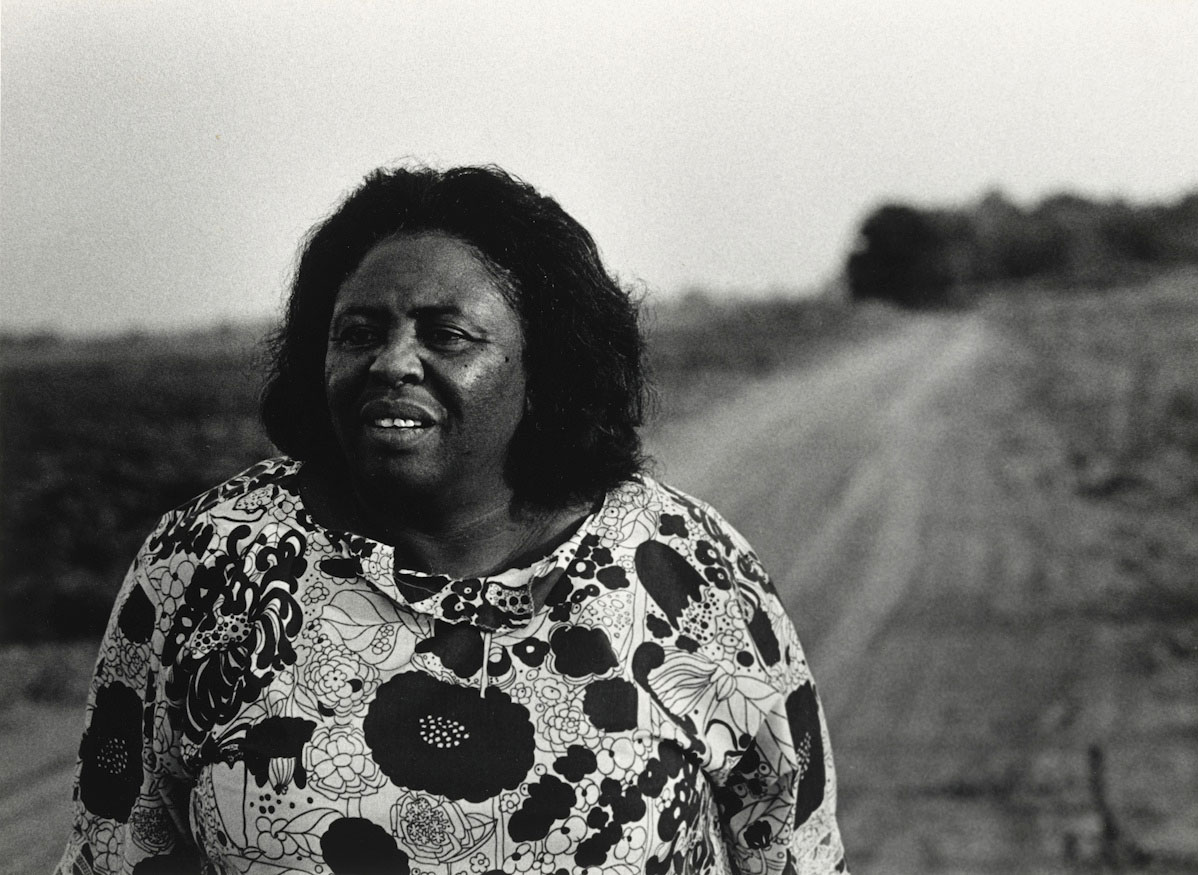
 

Louis Draper (American, 1935-2002) 'Fannie Lou Hamer, Mississippi' July 1971


Louis Draper (American, 1935-2002)
Fannie Lou Hamer, Mississippi
July 1971
Gelatin silver print
21.5 x 29.2cm (8 7/16 x 11 1/2 in.)
National Gallery of Art, Washington
Alfred H. Moses and Fern M. Schad Fund
© Draper Preservation Trust, Nell D. Winston, Trustee


First-of-Its-Kind Exhibition Opening at the National Gallery of Art Explores Photography’s Role in the Black Arts Movement

Never-before-seen photographs alongside images of cultural icons reveal the medium’s central role during a pivotal era of creative expression

The National Gallery of Art presents Photography and the Black Arts Movement, 1955-1985, an exhibition exploring the work of American and Afro-Atlantic diaspora photographers in developing and fostering a distinctly Black visual culture and identity. The first presentation to investigate photography’s role in the Black Arts Movement, a creative initiative comparable to the Harlem Renaissance in its scope and impact, which evolved concurrently to the civil rights and international freedom movements, the exhibition reveals how artists developed strategies to engage communities and encourage self-representation in media, laying a foundation for socially engaged art practices that continue today. Photography and the Black Arts Movement will be on view in the West Building from September 21, 2025, to January 11, 2026, before traveling to California and Mississippi.

Photography and the Black Arts Movement brings together approximately 150 works spanning photography, video, collage, painting, installation, and other photo-based media, some of which have rarely or never been on view. Among the over 100 artists included in the exhibition are Billy Abernathy (Fundi), Romare Bearden, Dawoud Bey, Frank Bowling, Kwame Brathwaite, Roy DeCarava, Louis Draper, David C. Driskell, Charles Gaines, James E. Hinton, Danny Lyon, Gordon Parks, Adrian Piper, Nellie Mae Rowe, Betye Saar, Raymond Saunders, Jamel Shabazz, Lorna Simpson, and Carrie Mae Weems.

This expansive selection of work showcases the broad cultural exchange between writers, musicians, photographers, filmmakers, and other visual artists of many backgrounds, who came together during the turbulent decades of the mid-20th century to grapple with social and political changes, the pursuit of civil rights, and the emergence of the Pan-African movement through art. The exhibition also includes art from Africa, the Caribbean, and Great Britain to contextualize the global engagement with the social, political, and cultural ideas that propelled the Black Arts Movement.

“Working on many fronts – literature, poetry, jazz and new music, painting, sculpture, performance, film, and photography – African American artists associated with the Black Arts Movement expressed and exchanged their ideas through publications, organisations, museums, galleries, community centres, theatres, murals, street art, and emerging academic programs. While focusing on African American photography in the United States, the exhibition also includes works by artists from many communities to consider the extensive interchange between North American artists and the African diaspora. The exhibition looks at the important connections between America’s focus on civil rights and the emerging cultural movements that enriched the dialog,” said Philip Brookman, cocurator of the exhibition and consulting curator of the department of photographs at the National Gallery of Art.

“Photography and photographic images were crucial in defining and giving expression to the Black Arts Movement and the civil rights movement. By merging the social concerns and aesthetics of the period, Black artists and photographers were defining a Black aesthetic while expanding conversations around community building and public history,” said Deborah Willis, guest cocurator, university professor and chair of the department of photography and imaging at the Tisch School of the Arts and founding director of the Center for Black Visual Culture at New York University. “The artists and their subjects helped to preserve compelling visual responses to this turbulent time and their images reflect their pride and determination.”

About the Exhibition

The exhibition draws significantly from the National Gallery’s collection – including more than 50 newly acquired works by Dawoud Bey, Kwame Brathwaite, Louis Draper, Ray Francis, Jeanne Moutoussamy-Ashe, Horace Ové, Jamel Shabazz, Malik Sidibé, Ming Smith, and Carrie Mae Weems, among others – and from lenders in the US, Great Britain, and Canada. Photography and the Black Arts Movement, 1955–1985 presents the cultural and political titans of the era, including civil rights leaders, artists, and musicians, as well as everyday people, scenes of daily life, and fashion and commercial photography. Structured around nine thematic sections – including explorations of the self, community, fashion and beauty, the media, and ritual – the exhibition weaves a holistic vision of the period and its cultural impact.

Among the works in the first section of the exhibition is a collage by Romare Bearden, 110th Street Harlem Blues (1972). A dynamic mixture of painted paper and photographs, the work illustrates the ongoing vitality of Harlem’s community, echoing the vibrancy and social content of the Harlem Renaissance, which Bearden was exposed to in his early life. Moving into the section titled Picturing the Self / Picturing the Movement, self-portraits by Coreen Simpson, Alex Harsley, and Barkley L. Hendricks underscore a central theme of the exhibition: artists asserting their presence within the broader narrative of the movement and the era, along with the importance of self-representation in their art. A highlight of Representing the Community – a section filled with everyday scenes of people at work and at rest – is Ralph Arnold’s Soul Box (1969), a mixed-media assemblage of found objects and collage, serving as a time capsule that captures stories of the Black Arts Movement.

Photographs were a crucial tool used to communicate the events of the civil rights movement to a national audience. Artists and news media understood the power of photographs to address inequality and advocate for civil and human rights, and some works in the exhibition are by photojournalists who captured the speeches, marches, and sit-ins that defined the era. A rarely seen 1965 photograph by Frank Dandridge captures Dr. Martin Luther King Jr. watching President Lyndon B. Johnson’s televised address following the Selma, Alabama, marches – events that would ultimately lead to the passage of the Voting Rights Act. Depicting Dr. King in a private, domestic moment, the image underscores not just the personal gravity of the moment but the television’s growing role in shaping public understanding of the era’s historic events. One of several works featured in the In the News section, it reflects how photographers responded to the shifting landscape of news media – from still photography to the rise of television.

The Black Arts Movement was instrumental in reshaping fashion, advertising, and media as tools of self-representation and cultural empowerment. A Kraft Foods advertisement (1977), photographed by Barbara DuMetz and featuring a young Black girl holding her doll, illustrates how the movement prompted advertisers to engage Black audiences more thoughtfully by hiring Black photographers and models in their campaigns. It is among the highlights of the Fashioning the Self section, along with an editorial photograph by Kwame Brathwaite, the photographer who helped coin the “Black is Beautiful” movement, and many depictions of women in beauty shops, showing the importance of these spaces to forming identity and community.

The exhibition’s concluding section, Transformations in Art and Culture, reflects a shift in the Black Arts Movement’s purpose – from its earlier focus on civil rights to a younger generation’s engagement with more historical and conceptual ideas, while still drawing on the movement’s visual language. Highlights include multimedia and time-based works by Ulysses Jenkins, Charles Gaines, and Lorna Simpson, which explore new and experimental ways to explore Black identity.

Exhibition Publication

Published in association with Yale University Press, the fully illustrated catalog accompanying the exhibition examines the vital role photography played in the evolution of the Black Arts Movement, which brought together writers, filmmakers, and artists as they explored ways of using art to advance civil rights and Black self-determination. Edited by Philip Brookman and Deborah Willis, with a preface by Angela Y. Davis and contributions by Makeda Best, Margo Natalie Crawford, Romi Crawford, Cheryl Finley, Sarah Lewis, and Audrey Sands, this book reveals how photographs operated across art, community building, journalism, and political messaging to contribute to the development of a distinctly Black art and culture. Essays by these distinguished scholars focus on topics such as women and the movement, community, activism, and Black photojournalism, and consider the complex connections between American artists and the African diaspora, and the dynamic interchange of Pan-African ideas that propelled the movement.

Press release from the National Gallery of Art
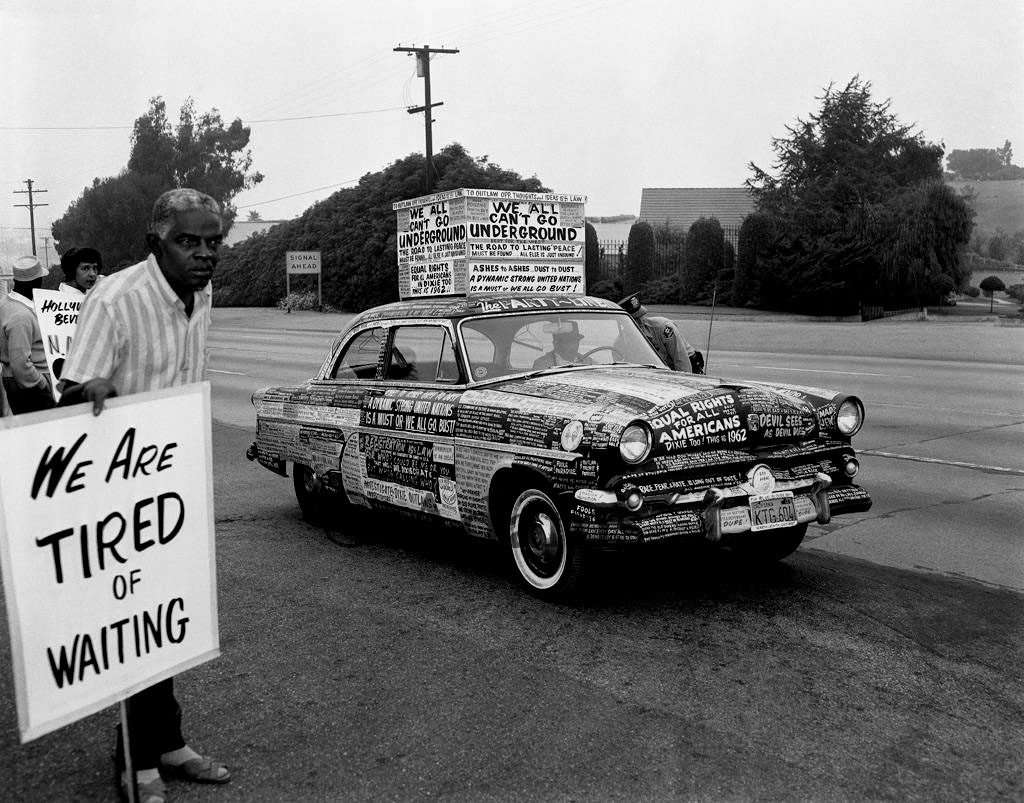
 

Harry Adams (American, 1918-1985) 'Protest Car, Los Angeles' 1962, printed 2024


Harry Adams (American, 1918-1985)
Protest Car, Los Angeles
1962, printed 2024
Inkjet print
27.5 x 35.4 cm (11 x 13 15/16 in.)
Tom & Ethel Bradley Center, California State University, Northridge, Harry Adams Archive
© Harry Adams. All rights reserved and protected.
Courtesy of the Tom & Ethel Bradley Center at California State University, Northridge

Harry Adams (American, 1918-1985)

Harry Adams, also known as “One Shot Harry,” was one of the best-known members of the Los Angeles African American community. Having access to the city’s inner circle, he became known for his images of politicians, entertainers, and society figures. Adams worked as a freelancer for the California Eagle and Los Angeles Sentinel for 35 years and had a number of churches and lawyers as clients. His collection is particularly rich in its documentation of African American social life including images of social organisations, churches, schools, civil rights organisations, protests and cultural events. …

The collection of images for the period 1950-1985 is rich in its depiction of the unique lives of African Americans in and around the Los Angeles area. There are many images of important black political leaders, such as Dr. Martin Luther King, Jr., Rev. Ralph Abernathy, Malcolm X, and many others.

Text from the California State University Northridge website
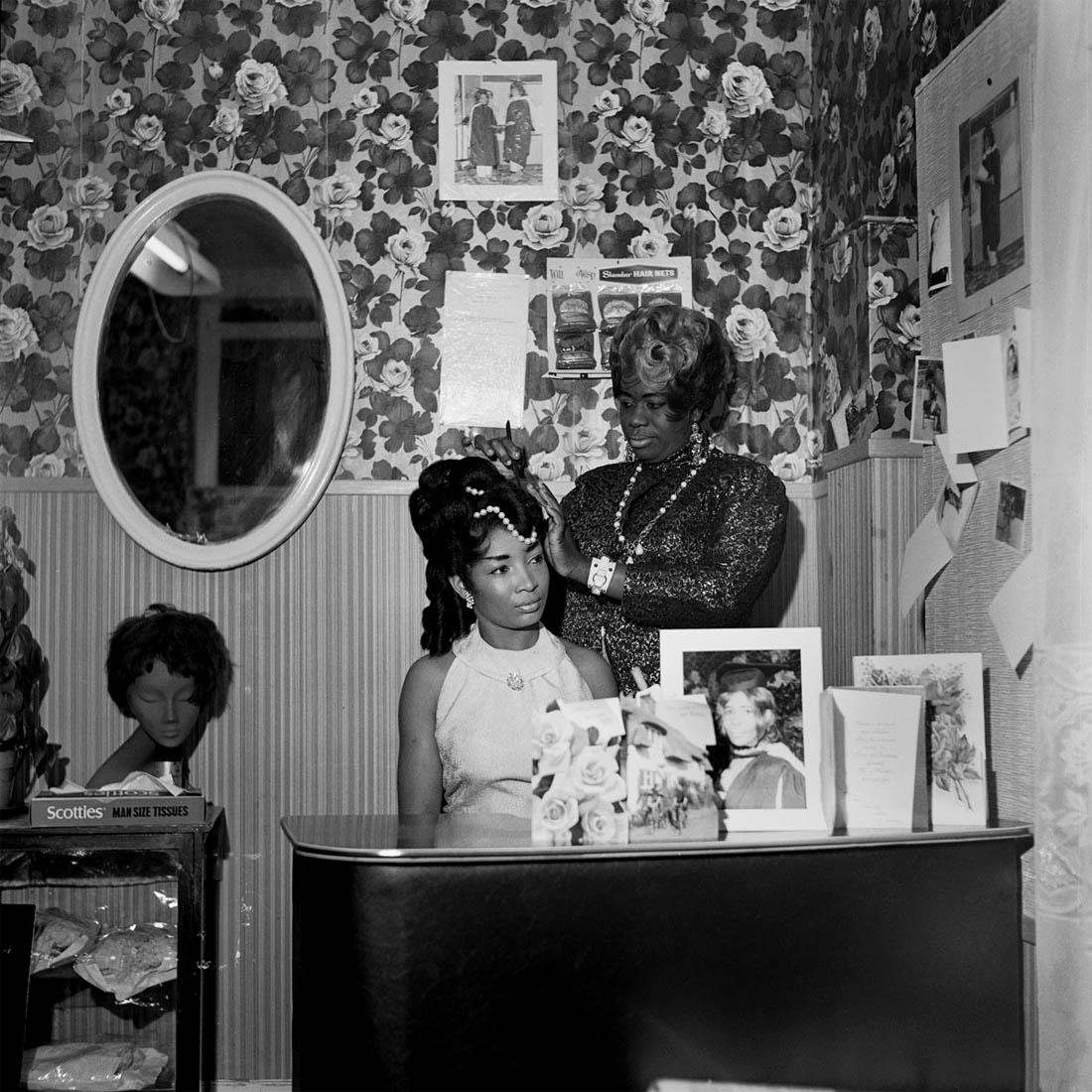
 

Raphael Albert (British born Grenada, 1939-2009) 'Beauty Salon, London' c. 1960s


Raphael Albert (British born Grenada, 1939-2009)
Beauty Salon, London
c. 1960s
Gelatin silver print
27.3 x 27.3cm (10 3/4 x 10 3/4 in.)
Collection of Autograph, London
© Raphael Albert


Between the late 1960s and the early 1990s, the cultural promoter, entrepreneur and photographer Raphael Albert organised and documented numerous black beauty pageants and other cultural events in London. His long and successful career as a promoter and chronicler of pageants included the establishment of Miss Black and Beautiful, Miss West Indies in Great Britain, and Miss Grenada.

These competitions celebrated the global ‘Black is Beautiful’ aesthetic in a local west London context: paired with the obligatory bathing costumes and high heels, Albert’s contestants often sported large Afro hairstyles, inventing and reinventing themselves on stage while articulating a particular and multifaceted black femininity as part of a widely contested and ambiguous cultural performance.

Text from the Autograph website
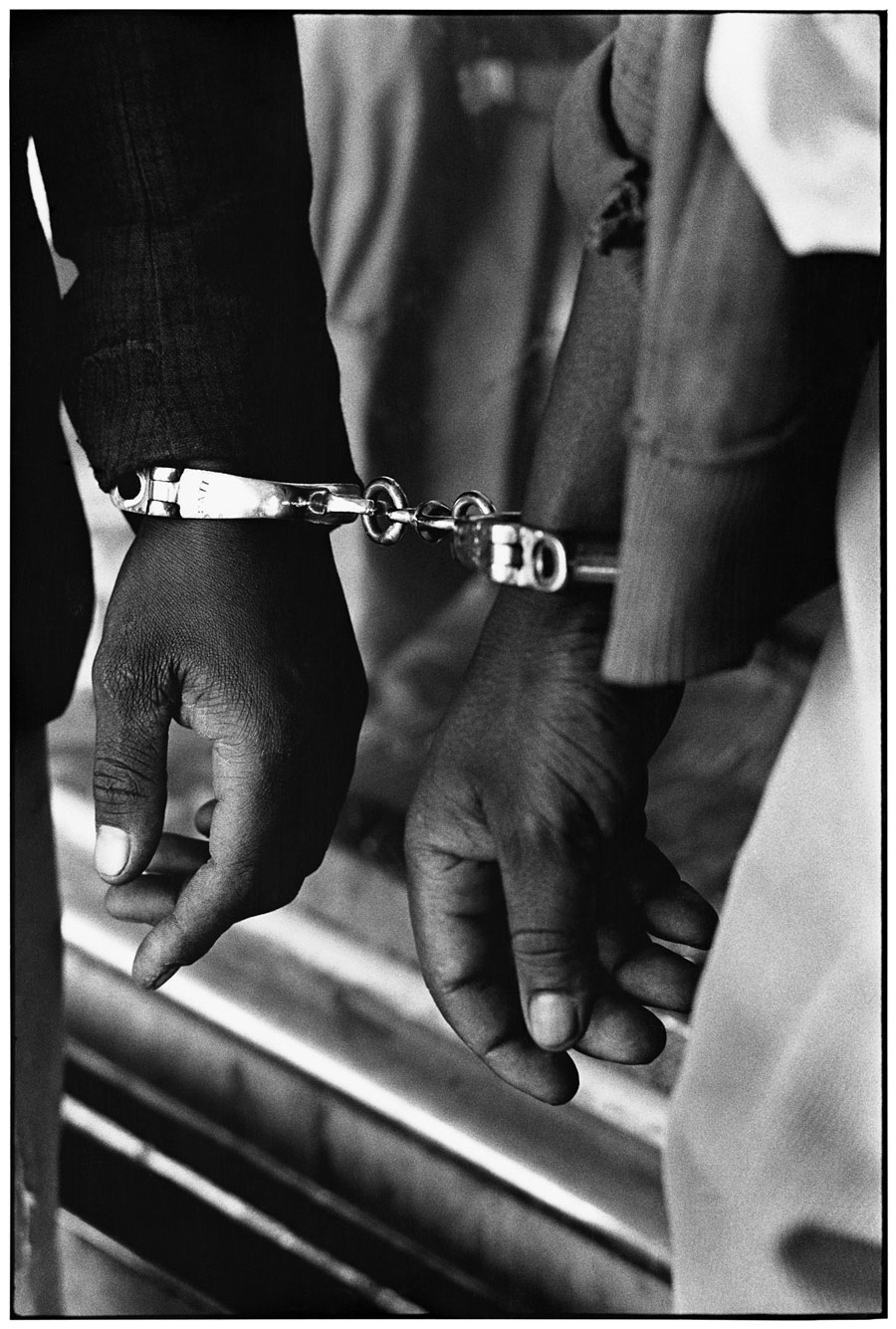
 

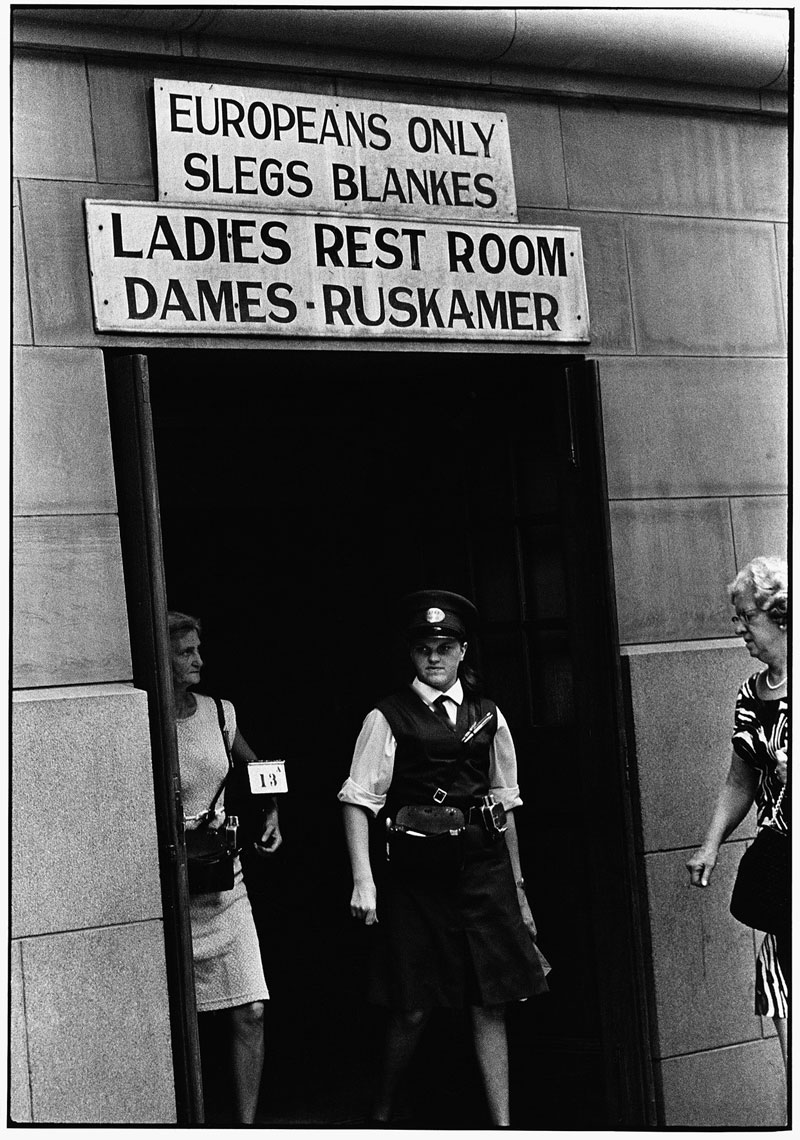
Ernest Cole (South African, 1940-1990) 'Handcuffed blacks were arrested for being in white area illegally' 1960-1966


Ernest Cole (South African, 1940-1990)
Handcuffed blacks were arrested for being in white area illegally
1960-1966
Gelatin silver print
Image/sheet: 24.5 x 16.5 cm (9 5/8 x 6 1/2 in.)
National Gallery of Art, Washington
Alfred H. Moses and Fern M. Schad Fund, 2022.102.2
© Ernest Cole / Magnum Photos

~ Exhibition: ‘Ernest Cole: House of Bondage’ at Foam, Amsterdam, January – June 2023
~ Text/Exhibition: “Ernest Cole: Journeys through Photojournalism, Social Documentary Photography and Art,” on the exhibition ‘Ernest Cole Photographer’ at The Fowler Museum at UCLA, Los Angeles, April – July 2013
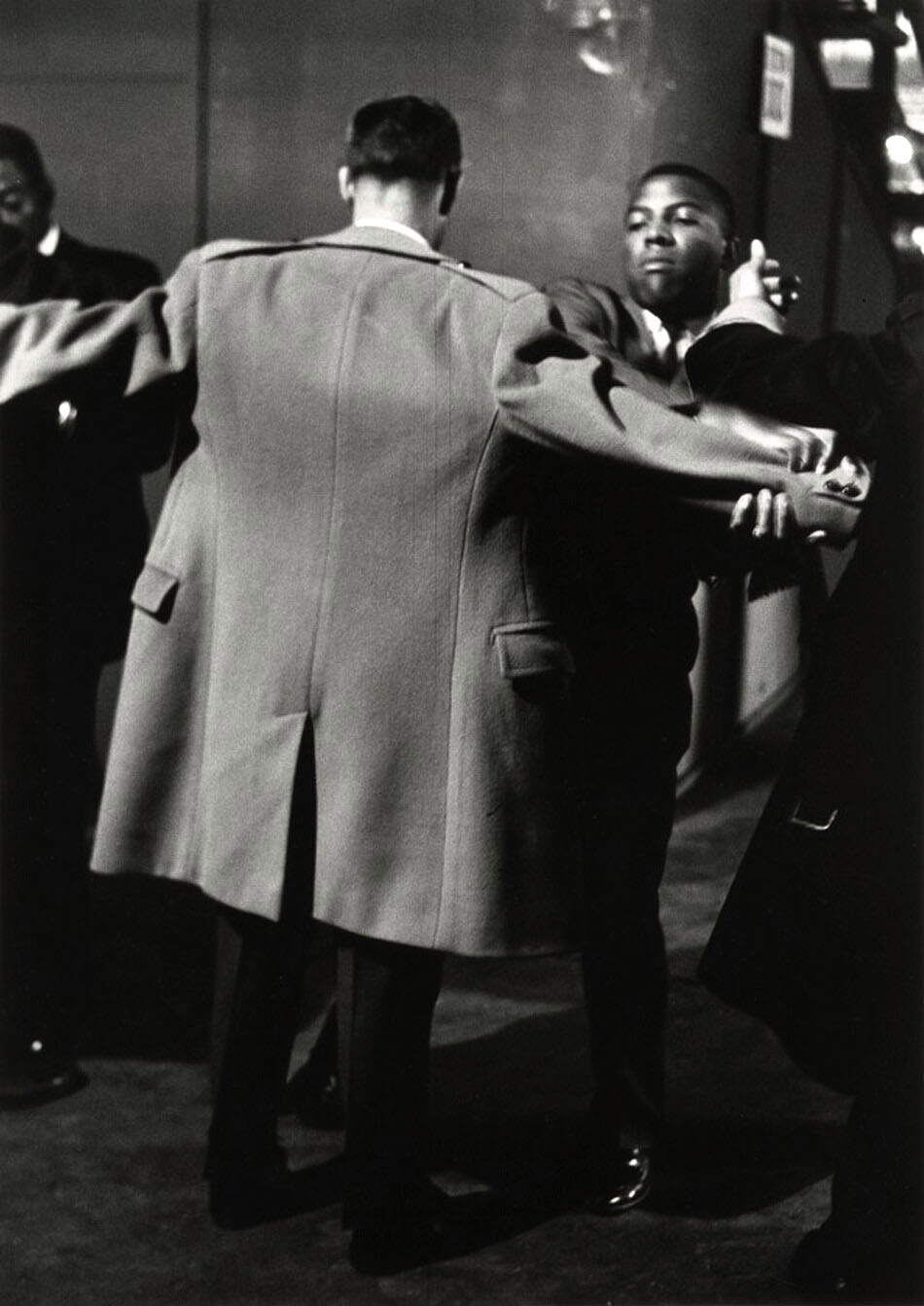
 

Gordon Parks (American, 1912-2006) 'Newsman Being Frisked at Muslim Rally in Chicago' 1963, printed 1997


Gordon Parks (American, 1912-2006)
Newsman Being Frisked at Muslim Rally in Chicago
1963, printed 1997
Gelatin silver print
47.3 x 33.7cm (18 5/8 x 13 1/4 in.)
National Gallery of Art, Washington
Corcoran Collection (The Gordon Parks Collection)


~ Text/Exhibition: “Visible Man / Invisible photographer” on the exhibition Gordon Parks: Stokely Carmichael and Black Power at the Museum of Fine Arts, Houston, October 2022 – January 2023
~ Exhibition: ‘Gordon Parks and “The Atmosphere of Crime”‘ at the Museum of Modern Art (MoMA), New York, February 2021 ongoing
~ Photographs: Gordon Parks “The Atmosphere of Crime”, 1957 February 2020
~ Exhibition: ‘Gordon Parks: The Flávio Story’ at the J. Paul Getty Museum, Getty Center, Los Angeles, July – November 2019
~ Exhibition: ‘Gordon Parks: Back to Fort Scott’ at the Museum of Fine Arts, Boston, January – September 2015
~ Exhibition: ‘Gordon Parks: Segregation Story’ at the High Museum of Art, Atlanta, November 2014 – June 2015
~ Exhibition: ‘Gordon Parks: The Making of an Argument’ at The New Orleans Museum of Art, September 2013 – January 2014
~ Exhibition: ‘Gordon Parks: 100 Moments’ at New York State Museum, January – May 2013
~ Exhibition: ‘Gordon Parks: Centennial’ at Jenkins Johnson Gallery, San Francisco, February – April 2013
~ Exhibition: ‘Bare Witness: Photographs by Gordon Parks’ at the Phoenix Art Museum, August – November 2011
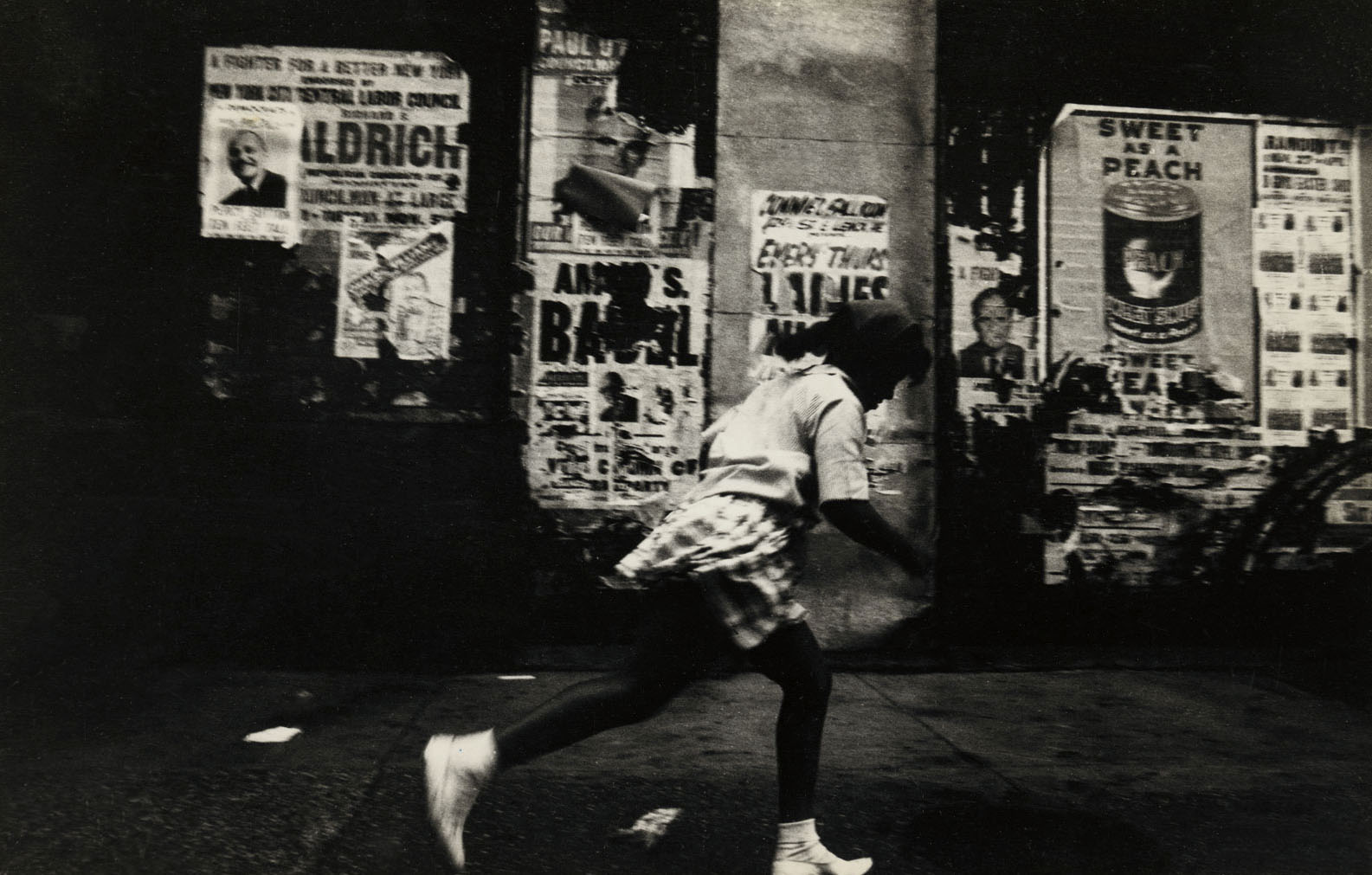
 

Herman Howard (American, 1942-1980) 'Sweet as a Peach, Harlem, New York City' 1963


Herman Howard (American, 1942-1980)
Sweet as a Peach, Harlem, New York City
1963
Gelatin silver print
16 x 23.1cm (6 5/16 x 9 1/8 in.)
National Gallery of Art, Washington
Alfred H. Moses and Fern M. Schad Fund
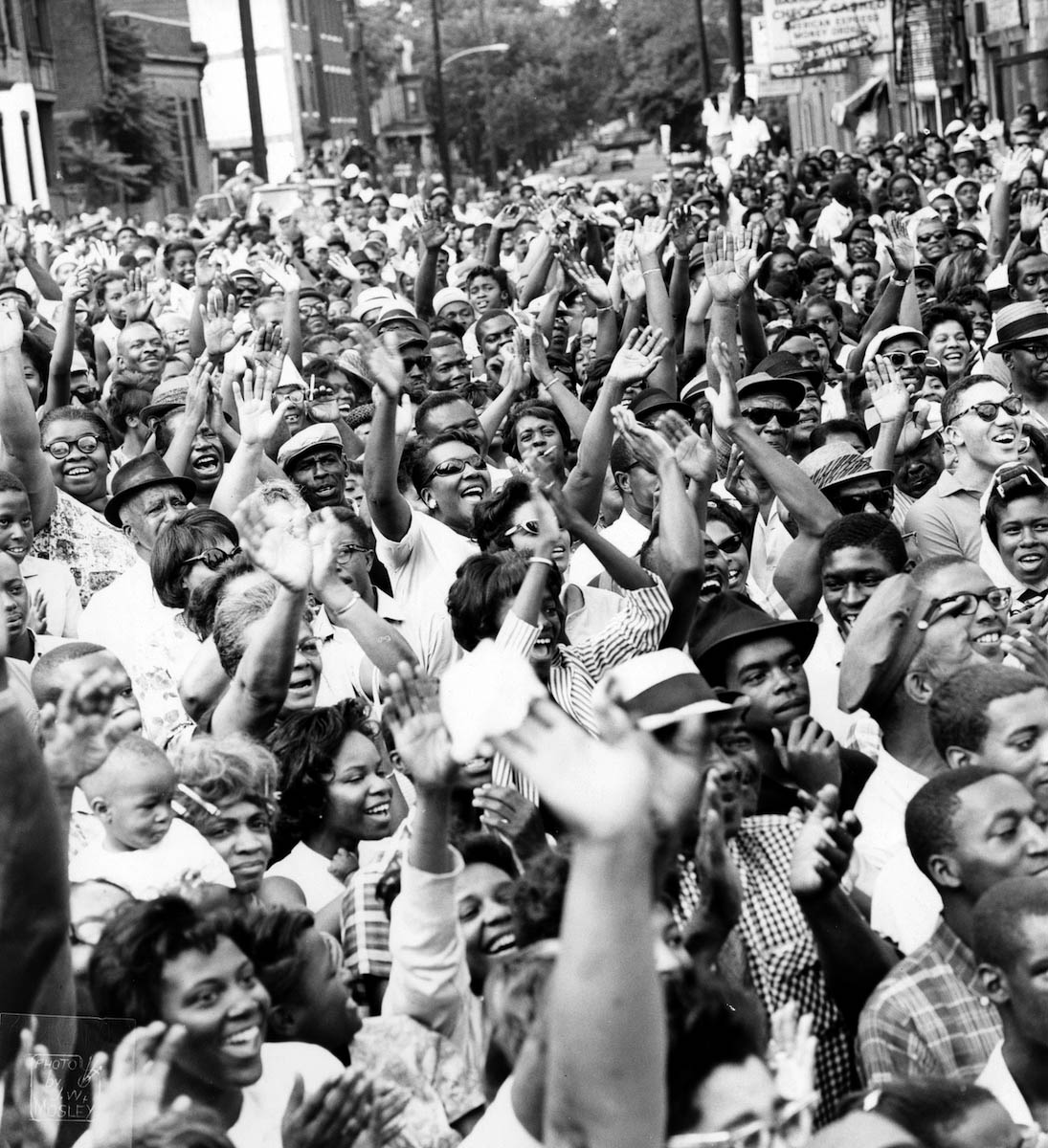
 

John W. Mosley (American, 1907-1969) 'View of the crowd as Dr. Martin Luther King Jr. addresses civil rights demonstrators at 40th Street and Lancaster Avenue, Philadelphia' August 3, 1965


John W. Mosley (American, 1907-1969)
View of the crowd as Dr. Martin Luther King Jr. addresses civil rights demonstrators at 40th Street and Lancaster Avenue, Philadelphia
August 3, 1965
Gelatin silver print
24.8 x 19.7cm (9 3/4 x 7 3/4 in.)
John W. Mosley Photograph Collection, Charles L. Blockson Afro-American Collection, Temple University Libraries


John W. Mosley (American, 1907-1969)

John W. Mosley (May 19, 1907 – October 1, 1969) was a self-taught photojournalist who extensively documented the everyday activities of the African-American community in Philadelphia, Pennsylvania, for more than 30 years, a period including both World War II and the civil rights movement. His work was published widely in newspapers and magazines including The Philadelphia Tribune, The Pittsburgh Courier and Jet magazine.

Mosley has been called a “cultural warrior” for preserving a record of African-American life in Philadelphia and Pennsylvania, one which combats “negative stereotypes and false interpretations of African-American history and culture”. …

Mosley flourished in his career as a photographer from the 1930s to the 1960s. He was known to photograph as many as four events a day, seven days a week. He traveled around Philadelphia on public transit, carrying his cameras and other equipment.

Mosley shot in black and white film. He used a large-format Graflex Speed Graphic camera. and a medium-format Rollieflex.

Proud of his heritage, Mosley chose to portray the black community positively at family, social, and cultural events that were part of daily life. He photographed individuals and families at weddings, picnics, churches, segregated beaches, sporting events, concerts, galas, and civil rights protests. During a time of racism and segregation, he emphasised the achievements of black celebrities, athletes, and political leaders.

Text from the Wikipedia website
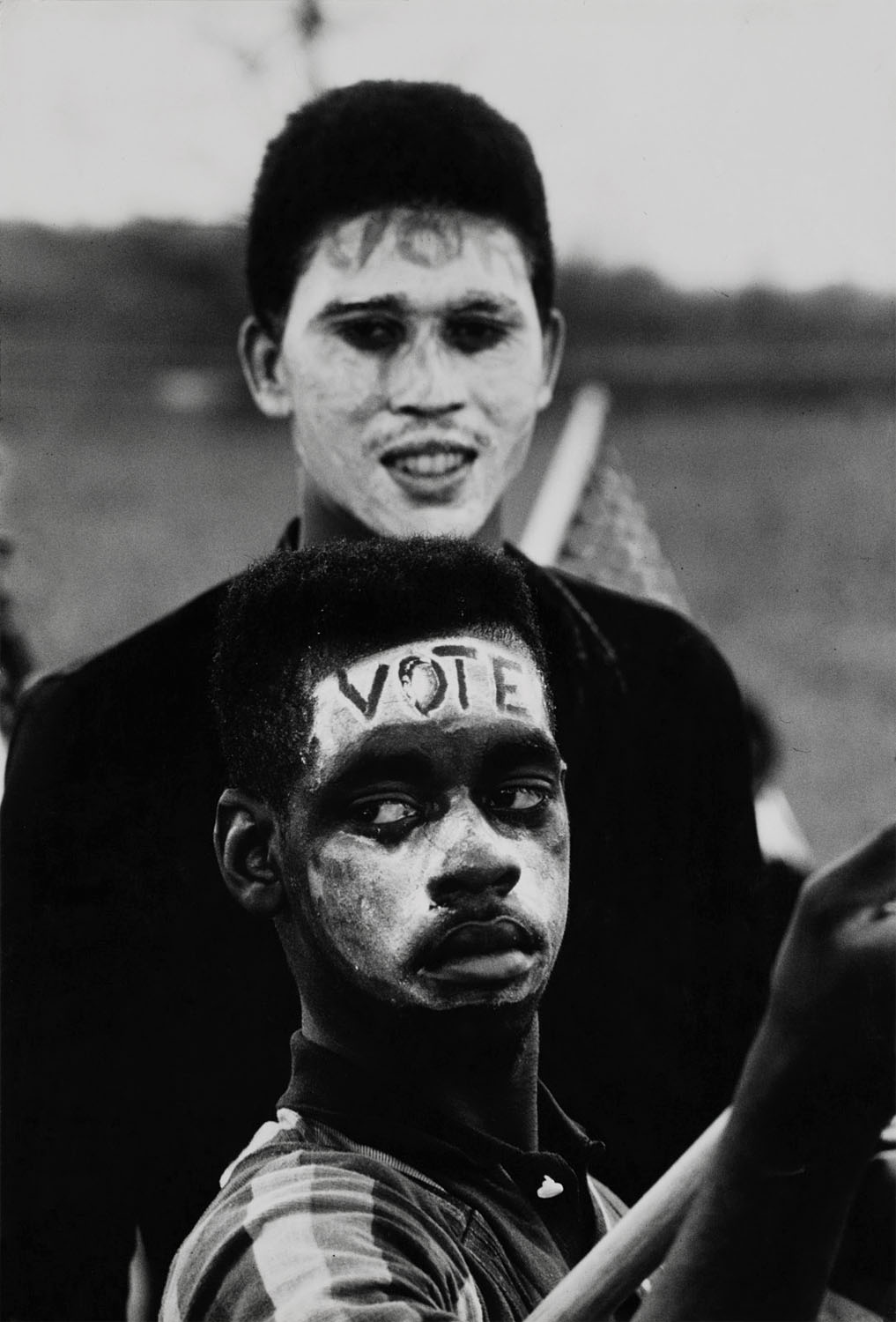
  

Moneta Sleet Jr. (American, 1926-1996) 'Two Teenaged Supporters of the Selma March' 1965, printed c. 1970


Moneta Sleet Jr. (American, 1926-1996)
Two Teenaged Supporters of the Selma March
1965, printed c. 1970
Gelatin silver print
43.3 x 29.5cm (17 1/16 x 11 5/8 in.)
Saint Louis Art Museum, Gift of the Johnson Publishing Company
© Johnson Publishing Company Archive. Courtesy J. Paul Getty Trust and Smithsonian National Museum of African American History and Culture. Made possible by the Ford Foundation, J. Paul Getty Trust, John D. and Catherine T. MacArthur Foundation, The Andrew W. Mellon Foundation, and Smithsonian Institution


“During the Civil Rights Movement, I was a participant just like everybody else. I just happened to be there with my camera, and I felt and firmly believed that my mission was to photograph and show the side of it that was the right side.”

~ Moneta Sleet Jr.


During Sleet’s 41 years at Ebony, he worked by Martin Luther King Jr.’s side for 13 years, capturing historical moments of the civil rights movement.

Sleet began working for Ebony magazine in 1955. Over the next 41 years, he captured photos of young Muhammad Ali, Dizzy Gillespie, Stevie Wonder, Emperor Haile Selassie I, Jomo Kenyatta, former ambassador Andrew Young in a blue leather jacket and jeans in his office at the United Nations, Ghana’s Kwame Nkrumah, Liberia’s William Tubman and Billie Holiday. He gained the affection and esteem of many civil rights leaders, many of whom called on him by name. When Coretta Scott King found out that no African American photographers had been assigned to cover her husband’s funeral service, she demanded that Sleet be a part of the press pool. If he was not, she threatened to bar all photographers from the service. Besides his photo of Coretta Scott King, he also captured grieving widow Betty Shabazz at the funeral of her husband Malcolm X.

Text from the Wikipedia website


Kwame Brathwaite (American, 1938-2023) 'Untitled (Charles Peaker Street Speaker, head of ANPM, after Carlos Cooks passed away, on 125th Street)' c. 1968, printed 2016


Kwame Brathwaite (American, 1938-2023)
Untitled (Charles Peaker Street Speaker, head of ANPM, after Carlos Cooks passed away, on 125th Street)
c. 1968, printed 2016
Inkjet print
37.2 x 37.2 cm (14 5/8 x 14 5/8 in.)
National Gallery of Art, Washington
Alfred H. Moses and Fern M. Schad Fund and Pepita Milmore Memorial Fund


Kwame Brathwaite (American, 1938-2023)

Black Is Beautiful.

From Marcus Garvey to the Black Panther Party, these three words powered the political dreams and material possibilities of generations of Black people living in the United States. Over the course of seven decades, the recently departed photographer Kwame Brathwaite constructed a glorious visual lexicon to articulate a Pan-Africanist argument. Whether through his rhythmic documentation of the jazz scene in Harlem and the Bronx, or his cofounding of the African Jazz-Art Society & Studios (AJASS), Brathwaite positioned photography at the nexus of Black artistic, political, and musical expression. Moving between concert halls and boxing rings, portrait studios and protest movement scenes – his Hasselblad in hand – Brathwaite chronicled self-determination and creativity that celebrated Blackness in all of its forms. Each of his photographs brims with bombastic flare and undeniable elegance. Their narrative potential is still transfixing.

“Black Is Beautiful was my directive,” Brathwaite said. “It was a time when people were protesting injustices related to race, class, and human rights around the globe. I focused on perfecting my craft so that I could use my gift to inspire thought, relay ideas, and tell stories of our struggle, our work, our liberation…. Oppression still exists today, and we must keep fighting, keep on pushing until we are free. A luta continua, a vitória é certa – the struggle continues, victory is certain.”

Oluremi C. Onabanjo, Esther Adler, Roxana Marcoci, Marilyn Nance, David Hartt, Michael Famighetti. “Remembering Kwame Brathwaite (1938-2023),” on the MoMA website, Dec 26, 2023 [Online] Cited 30/11/2025
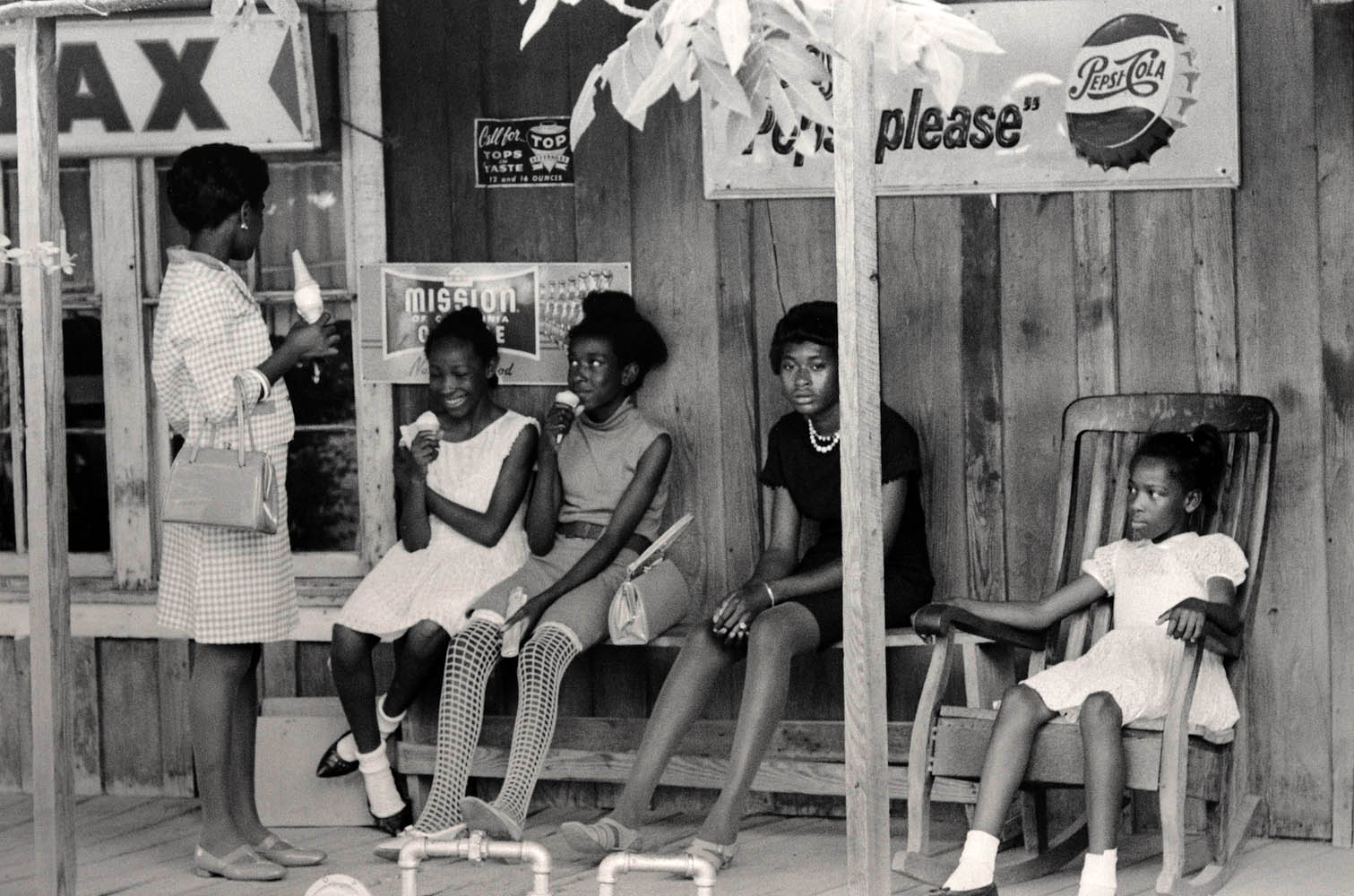
 

Doris A. Derby (American, 1939-2022) 'Black-owned Grocery Store, Sunday, Mileston, Mississippi' 1968


Doris A. Derby (American, 1939-2022)
Black-owned Grocery Store, Sunday, Mileston, Mississippi
1968
Gelatin silver print
21.9 x 32.7cm (8 5/8 x 12 7/8 in.)
National Gallery of Art, Washington
Gift of David Knaus
© Doris A. Derby


While the Black Arts Movement is generally pegged to the 1960s and ’70s, the point of departure for Willis and Brookman was the work of photographer Roy DeCarava, who in 1955, on the cusp of the civil rights movement, released a book titled The Sweet Flypaper of Life. The book featured portraits of Black life in Harlem activated by a fictitious character named Mary Bradley, a narrative invention of Harlem Renaissance writer Langston Hughes.

In the book, Sister Mary’s musings unfold within DeCarava’s photographic landscape. The exhibition includes an image from the book featuring bassist Edna Smith, whose face is partially illuminated by a single light in the distance. Her downward gaze conveys a sense of somberness that’s echoed by the shadows that surround her, while the single glint of light coming off her wristwatch draws attention to the bass like the beacon from a lighthouse.

Published decades following the Harlem Renaissance, one year after Brown v. Board of Education and months after the murder of Emmitt Till, DeCarava’s book came at a critical moment in art history, a time when photography became more broadly recognised as fine art through groundbreaking exhibitions like “The Family of Man” at the Museum of Modern Art, also in 1955. With that recognition, Black artists seized an opportunity to compose compelling visual narratives. “The collaboration between Langston Hughes and Roy De Carava was influential for so many photographers and artists, in part because De Carava and Hughes were looking at their respective communities, and they put together a story that was looking inward,” says Brookman.

Colony Little. “A Show at the National Gallery Highlights the Role of Photography in the Black Arts Movement,” on the ARTnews website November 20, 2025 [Online] Cited 24/11/2025
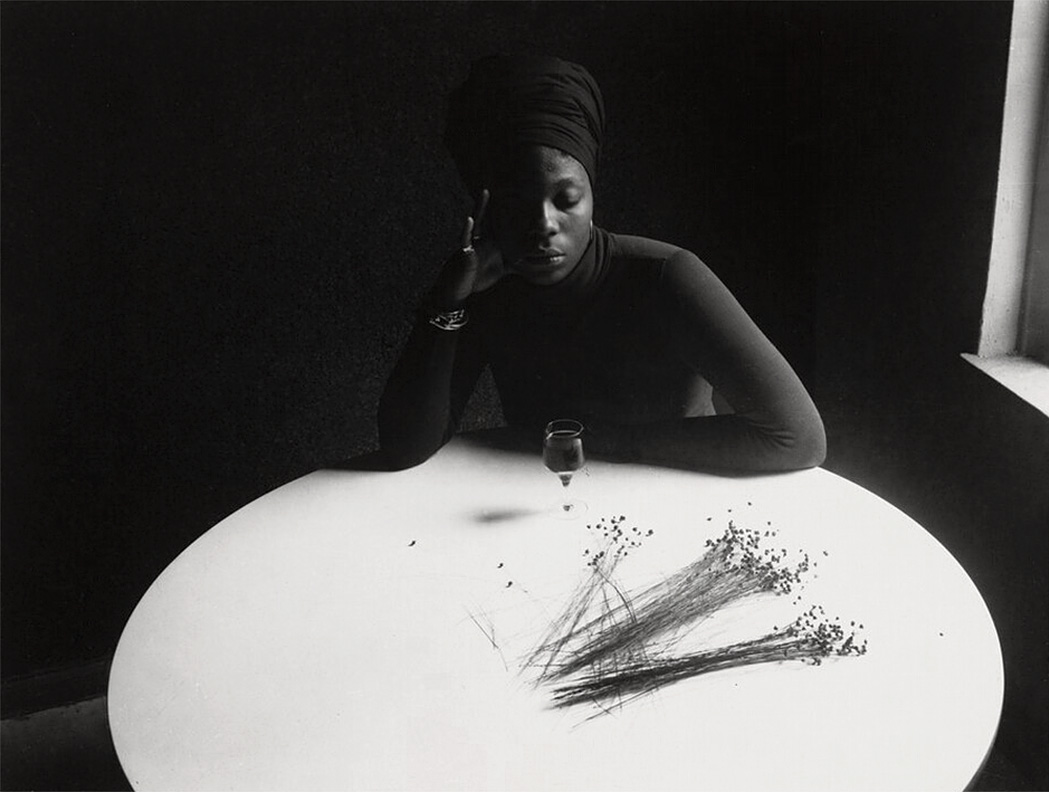
 

Ray Francis (American, 1937-2006) 'Genie' 1971


Ray Francis (American, 1937-2006)
Genie
1971
Gelatin silver print
13.97 × 17.78cm (5 1/2 × 7 in.)
National Gallery of Art, Washington
Alfred H. Moses and Fern M. Schad Fund


Ray Francis (American, 1937-2006)

Ray Francis was a founding member of the Kamoinge Workshop. He received his first camera in 1952, at the age of 15. In 1961 he met Louis Draper, with whom he formed Group 35. In 1963 Group 35 merged with other photographers to create Kamoinge, where Francis contributed significantly by creating a darkroom for the group and working as a photo editor for the Black Photographers Annual.

His photographic work spanned still life, portraiture, and landscape, often using dramatic light and shadow, influenced by Johannes Vermeer’s use of composition. Francis also made contributions as an educator, teaching at the Bedford-Stuyvesant Neighborhood Youth Corps (1966–1969) and later serving as director of the New York City Board of Education’s photography program for Intermediate School 201 from 1970 to 1974.

Text from the National Gallery of Art website
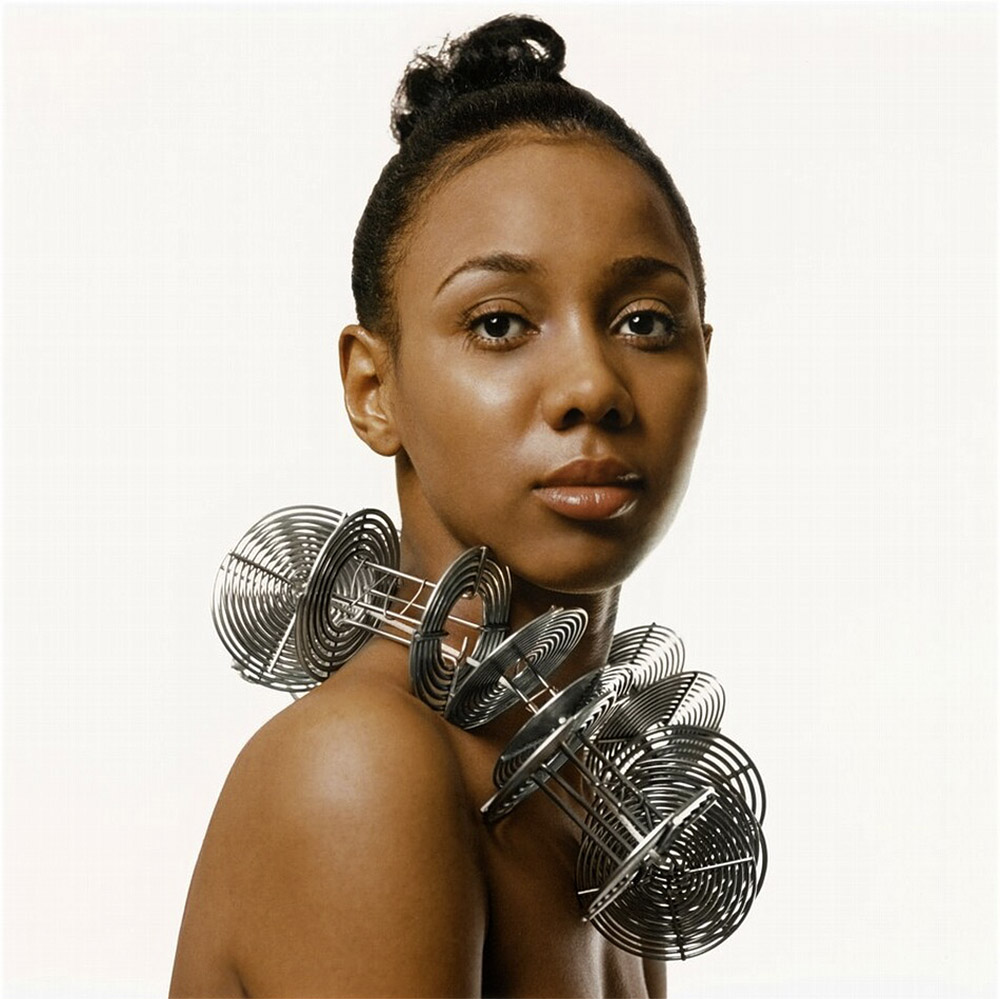
 

Kwame Brathwaite (American, 1938-2023) 'Untitled (Portrait, Reels as Necklace)' c. 1972, printed later


Kwame Brathwaite (American, 1938-2023)
Untitled (Portrait, Reels as Necklace)
c. 1972, printed later
Inkjet print
74.93 × 74.93cm (29 1/2 × 29 1/2 in.)
National Gallery of Art, Washington
Gift of Funds from Renée Harbers Liddell and Alfred H. Moses and Fern M. Schad Fund
© Kwame Brathwaite


Kwame Brathwaite, [was] a photographer, musician and African American activist who was a unique politico-aesthete. With his brother Elombe Brath, he virtually invented the phrase “Black Is Beautiful” in the 1960s by photographing the Grandassa Models in Harlem: young African American women who became the sensational template for beauty, doing away with the usual cosmetic products and the usual white standard of femininity.

Black Is Beautiful became a radical rallying cry, an inspired three-word prose poem and manifesto for change. Simply to assert that black people were beautiful was a liberating force in art, politics and culture, and Brathwaite became a part of Black power’s pan-Africanist movement by photographing Muhammad Ali before his Rumble in the Jungle fight in Zaire in 1974. He was the exclusive photographer for the Jackson 5’s African tour, and became the house photographer for the Apollo theatre, building an amazing archive of black musicians, and with Elombe was the driving force behind bringing Nelson Mandela to speak in Harlem.

Peter Bradshaw. “Black Is Beautiful: The Kwame Brathwaite Story – exhilarating record of game-changing photographer,” on The Guardian website Fri 10 Oct 2025 [Online] Cited 30/11/2025
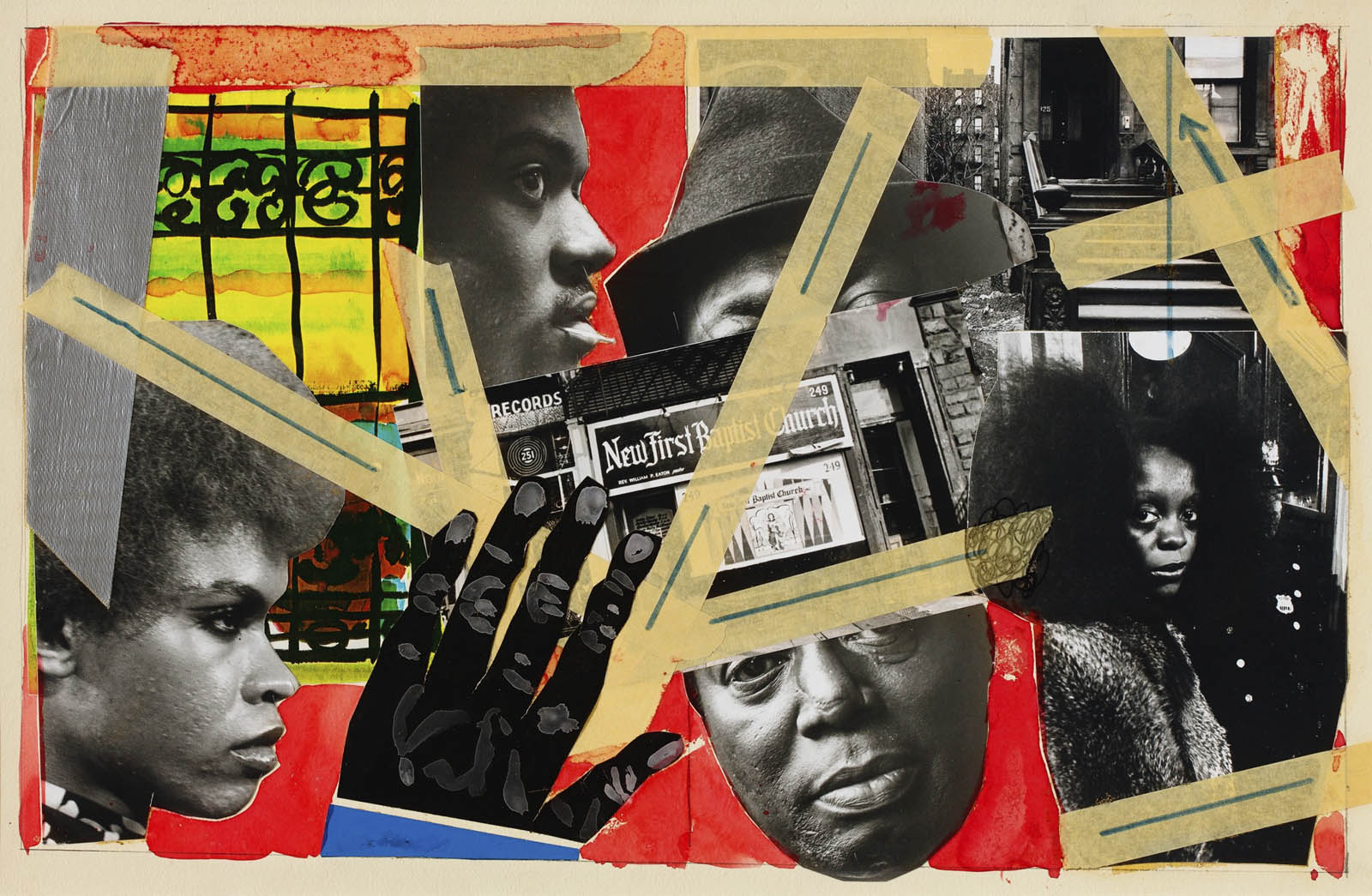
 

Romare Bearden (American, 1911-1988) '110th Street Harlem Blues' 1972


Romare Bearden (American, 1911-1988)
110th Street Harlem Blues
1972
Collage
© Romare Bearden Foundation


African-American artist, activist, and writer Romare Bearden was close friends with film producer and photographer Sam Shaw, and he often drew inspiration from Shaw’s creative projects. The portraits incorporated into this collage feature outtakes of extras from a movie Shaw may have documented as set photographer. ⁠ ⁠

Bearden’s work reflects his improvisational approach to his practice. He considered his process akin to that of jazz and blues composers. Starting with an open mind, he would let an idea evolve spontaneously. “You have to begin somewhere,” he once said, “so you put something down. Then you put something else with it, and then you see how that works, and maybe you try something else and so on, and the picture grows in that way.”

Text from the Fraenkel Gallery Facebook page via DC Gallery, New York


Other works of art in the show are a testament to the medium’s lasting influence on established visual artists. Among these was Romare Bearden, who in the mid-1960s began exploring photographic collage; it would become an art form he used to create his most influential works. “Romare Bearden has always been integral to understanding the Black Arts Movement,” says Brookman. “By using photographs in his collages, he makes a direct connection between photography in all of its forms and the Black Arts Movement. That was something I had not seen or thought a lot about before, how much photography is incorporated into his visual art, including painting, during that time.”

Colony Little. “A Show at the National Gallery Highlights the Role of Photography in the Black Arts Movement,” on the ARTnews website November 20, 2025 [Online] Cited 24/11/2025


Chester Higgins (American, b. 1946) 'Father prays over son on Osu Beach, Accra, Ghana' 1973


Chester Higgins (American, b. 1946)
Father prays over son on Osu Beach, Accra, Ghana
1973
Gelatin silver print
22.8 x 34cm (9 x 13 3/8 in.)
National Gallery of Art, Washington
Alfred H. Moses and Fern M. Schad Fund
© Chester Higgins. All Rights Reserved. Courtesy Bruce Silverstein Gallery
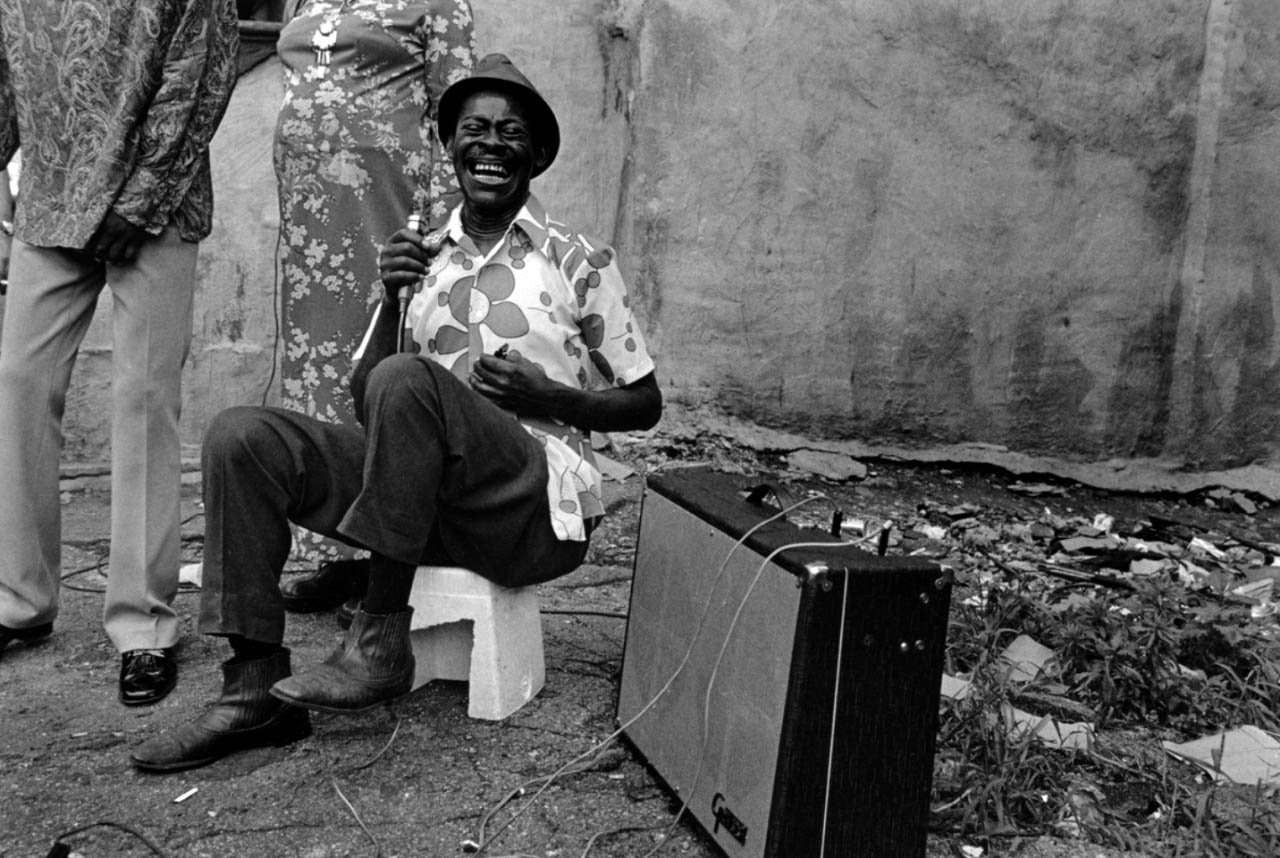
 

Dawoud Bey (American, b. 1953) 'The Blues Singer, Harlem, NY' 1976


Dawoud Bey (American, b. 1953)
The Blues Singer, Harlem, NY
1976
Gelatin silver print
22.1 x 32.7 cm (8 11/16 x 12 7/8 in.)
National Gallery of Art, Gift of the Charina Endowment Fund in memory of Robert B. Menschel


~ Text/Exhibition: “Street cred,” on the exhibition Dawoud Bey: Street Portraits at Denver Art Museum, November 2024 – May 2025
~ Exhibition: ‘Dawoud Bey & Carrie Mae Weems: In Dialogue’ at the J. Paul Getty Museum, Los Angeles, April – July 2023
~ Exhibition: ‘Dawoud Bey: An American Project’ at the Whitney Museum of American Art, New York, April – October 2021
~ Exhibition: ‘Dawoud Bey: An American Project’ at the High Museum of Art, Atlanta, November 2020 – March 2021

 

Barbara DuMetz (American, b. 1947) 'Kraft Foods advertisement' 1977


Barbara DuMetz (American, b. 1947)
Kraft Foods advertisement
1977


Barbara DuMetz (American, b. 1947)

Barbara DuMetz (born 1947) is an American photographer and pioneer in the field of commercial photography. She began working in Los Angeles as a commercial photographer in the 1970s, when very few women had established and maintained successful careers in the field, especially African-American women. Over the course of her career, “she made a major contribution to diversifying the landscape of images that defined pop culture in the United States.”

DuMetz is known for her work with African-American celebrities, corporations and images of everyday life in African-American communities. …

DuMetz has been a professional photographer for more than four decades. Over the course of her career, she has produced award-winning images for advertising agencies including Burrell Advertising, J. P. Martin Associates and InterNorth Corporation. Her photographs have appeared in African-American publications including Black Enterprise, Ebony, Essence, Jet and The Crisis. She has taken commercial photographs for corporations including The Coca-Cola Company, Delta Air Lines and McDonald’s Corporation.

DuMetz ran and maintained three different photography studios located in the Los Angeles area where she was contracted by department stores, record companies, graphic design studios, advertising agencies, public relations firms, film production companies, actors and business professionals. DuMetz’s has shot photo layouts of celebrities and artists and personalities including Maya Angelou, Ernie Barnes, Bernie Casey, Pam Grier, Kareem Abdul-Jabbar, Quincy Jones, Samella Lewis, Ed McMahan, Thelonious Monk, Lou Rawls, Della Reese, Richard Roundtree, Betye Saar, Charles Wilbert White, and Nancy Wilson. Her show The Creators: Photographic Images of Literary, Music and Visual Artists, at the Southwest Arts Center in Atlanta, Georgia, in 2015, included images of over two dozen African-American artists whom she has photographed.

Text from the Wikipedia website


Ming Smith (American, b. 1950) 'Sun Ra Space II' 1978


Ming Smith (American, b. 1947)
Sun Ra Space II, New York, New York
1978
Gelatin silver print
15.24 × 22.4cm (6 × 8 13/16 in.)
National Gallery of Art, Washington
Charina Endowment Fund


“You don’t make art for money, especially as a Black artist. You do it because there is that need to create – and that has been part of my survival; that has helped me survive.”

“My work as a photographer was to record, culturally, the period of time in which I lived – and I recorded it as an artist.”

“Oh no, it’s all discovery, it’s all improvisation. It’s like when jazz musicians solo. They improvise, and photography is definitely that, for me.”

“Whether I’m photographing a person on the street, someone I know, or on an assignment, I’m doing it because I admire them. I like the sense of exchange – they’re giving and I’m taking, but I’m also giving them something back. There were certain people who would understand what I was looking for and would try to give me a photograph by posing. Whatever I’m shooting, whether it’s a portrait or a place, my intention is to capture the feeling I have about that exchange and that energy.”


Ming Smith
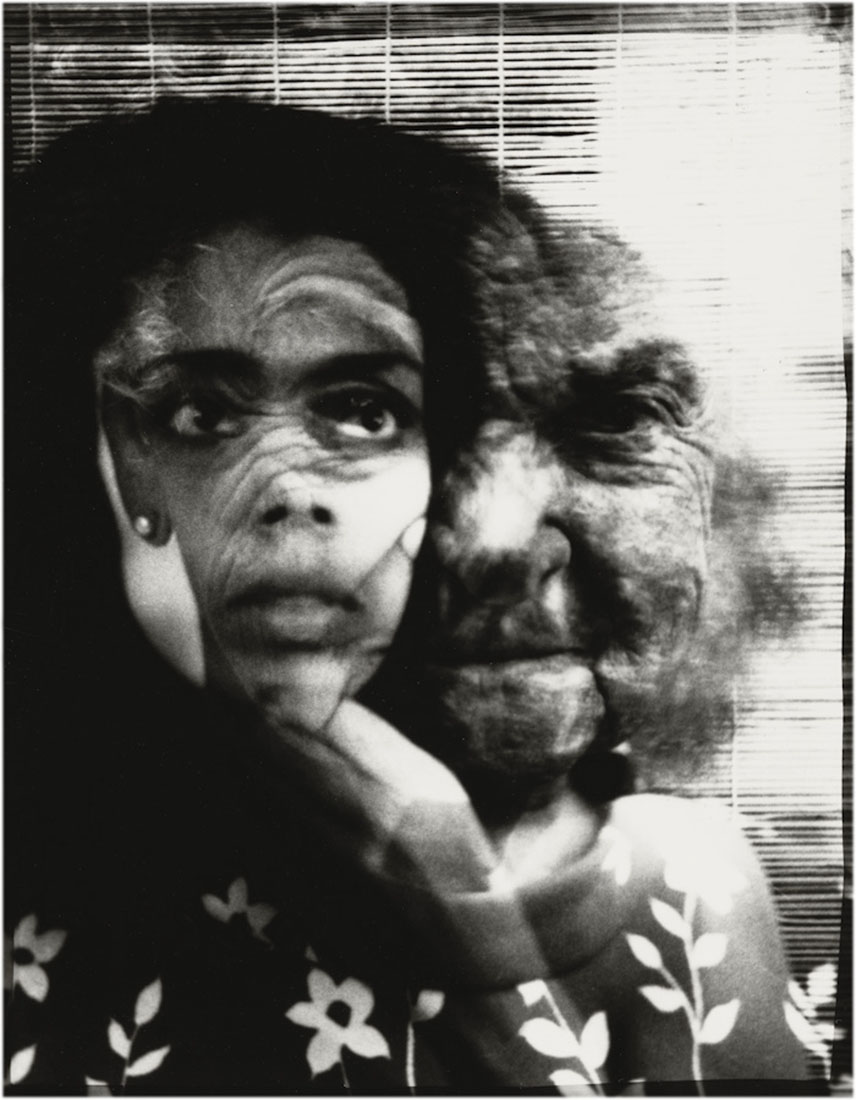


Coreen Simpson (American, b. 1942) 'Self-Portrait' 1978


Coreen Simpson (American, b. 1942)
Self-Portrait
1978
Gelatin silver print
21.6 x 16.8cm (8 1/2 x 6 5/8 in.)
National Gallery of Art, Washington
Alfred H. Moses and Fern M. Schad Fund
© Coreen Simpson


Simpson’s career launched when she became editor for Unique New York magazine in 1980, and she began photographing to illustrate her articles. She then became a freelance fashion photographer for the Village Voice and the Amsterdam News in the early 1980s, and covered many African-American cultural and political events in the mid-1980s. She is also noted for her studies of Harlem nightlife. She constructed a portable studio and brought it to clubs in downtown Manhattan, barbershops in Harlem, and braiding salons in Queens. Her work’s ability to present a wide variety of subjects with “depth of character and dignity” has been compared to that of Diane Arbus and Weegee.

Text from the Wikipedia website


Simpson became a photographer after noticing that she could make better images than the ones used to illustrate her stories as a freelance lifestyle writer. She took the chance to start creating the images she wanted to see. In 1976, she contacted her friend Walter Johnson, a street photographer who worked at a photo lab in Manhattan, with whom she had been acquainted from her modeling days, and asked if he could teach her how to use a camera. He showed her how to use it, and as soon as she got a hold of it, she became unstoppable.

She argues that great images are the key to having a successful published story. “You have to feel good about yourself, and good about the article that you’re presenting to the public,” she says. “So what makes it good? It’s the visuals. The visuals make it good.”

Briana Ellis-Gibbs. “Photographer Coreen Simpson’s illustrious career capturing Toni Morrison and Muhammad Ali: ‘I’ve never gotten bored’,” on The Guardian website Tue 21 Oct 2025 [Online] Cited 30/11/2025
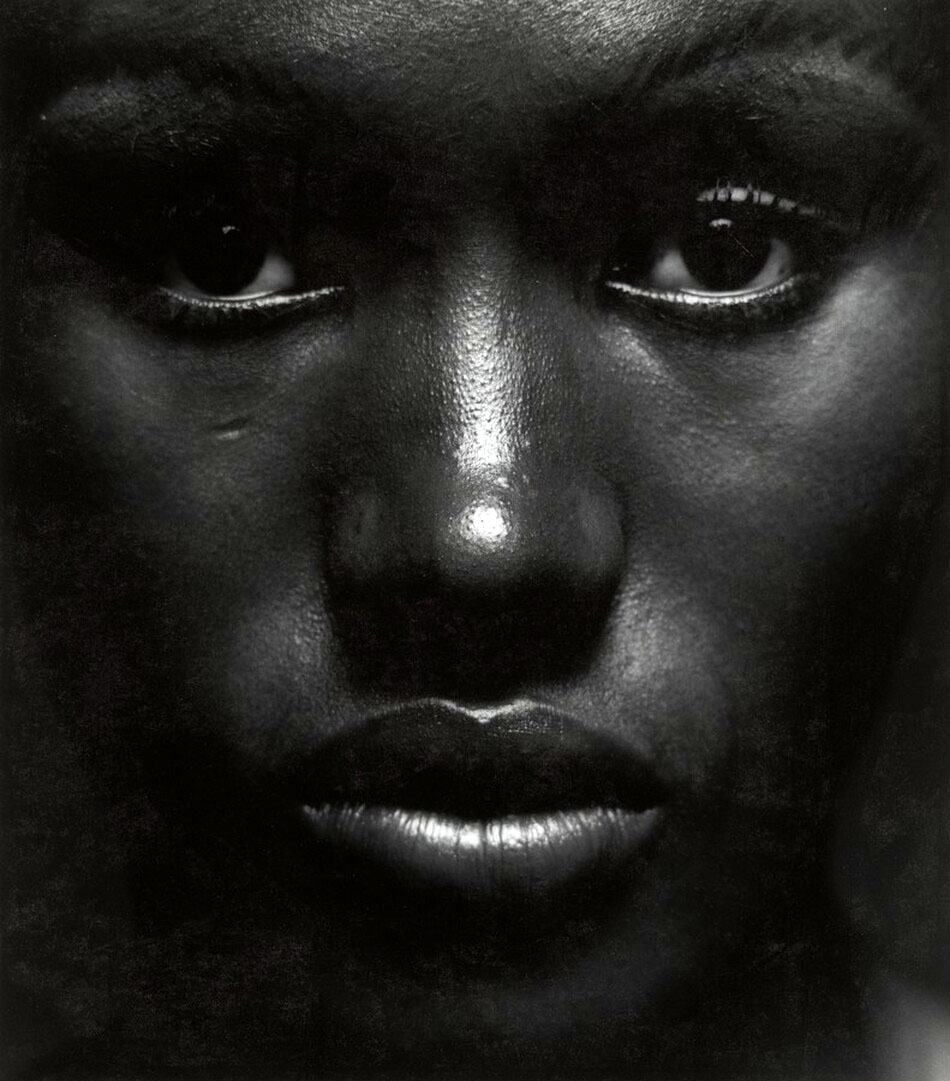
 

Anthony Barboza (American, b. 1944) 'Grace Jones, New York City' 1970s


Anthony Barboza (American, b. 1944)
Grace Jones, New York City
1970s
Gelatin silver print
27 × 23.7cm (10 5/8 × 9 5/16 in.)
National Gallery of Art, Washington
Alfred H. Moses and Fern M. Schad Fund


Anthony Barboza (American, b. 1944)

Anthony Barboza (born 1944 in New Bedford, Massachusetts) is a photographer, historian, artist and writer. With roots originating from Cape Verde, and work that began in commercial art more than forty years ago, Barboza’s artistic talents and successful career helped him to cross over and pursue his passions in the fine arts where he continues to contribute to the American art scene.

Barboza has a prolific and wide range of both traditional and innovative works inspired by African-American thought, which have been exhibited in public and private galleries, and prestigious museums and educational institutions worldwide. He is well known for his photographic work of jazz musicians from the 1970s – ’80s. Many of these works are in his book Black Borders, published in 1980 with a grant from the National Endowment for the Arts. In an article printed in 1984 in The City Sun, he said, “When I do a portrait, I’m doing a photograph of how that person feels to me; how I feel about the person, not how they look. I find that in order for the portraits to work, they have to make a mental connection as well as an emotional one. When they do that, I know I have it.” Many of his photographs achieve his signature effect through the careful use of lighting and shadows, manipulation of the backdrop, measured adjustments to shutter speeds, composition, and many other techniques and mediums at his command.

Text from the Wikipedia website
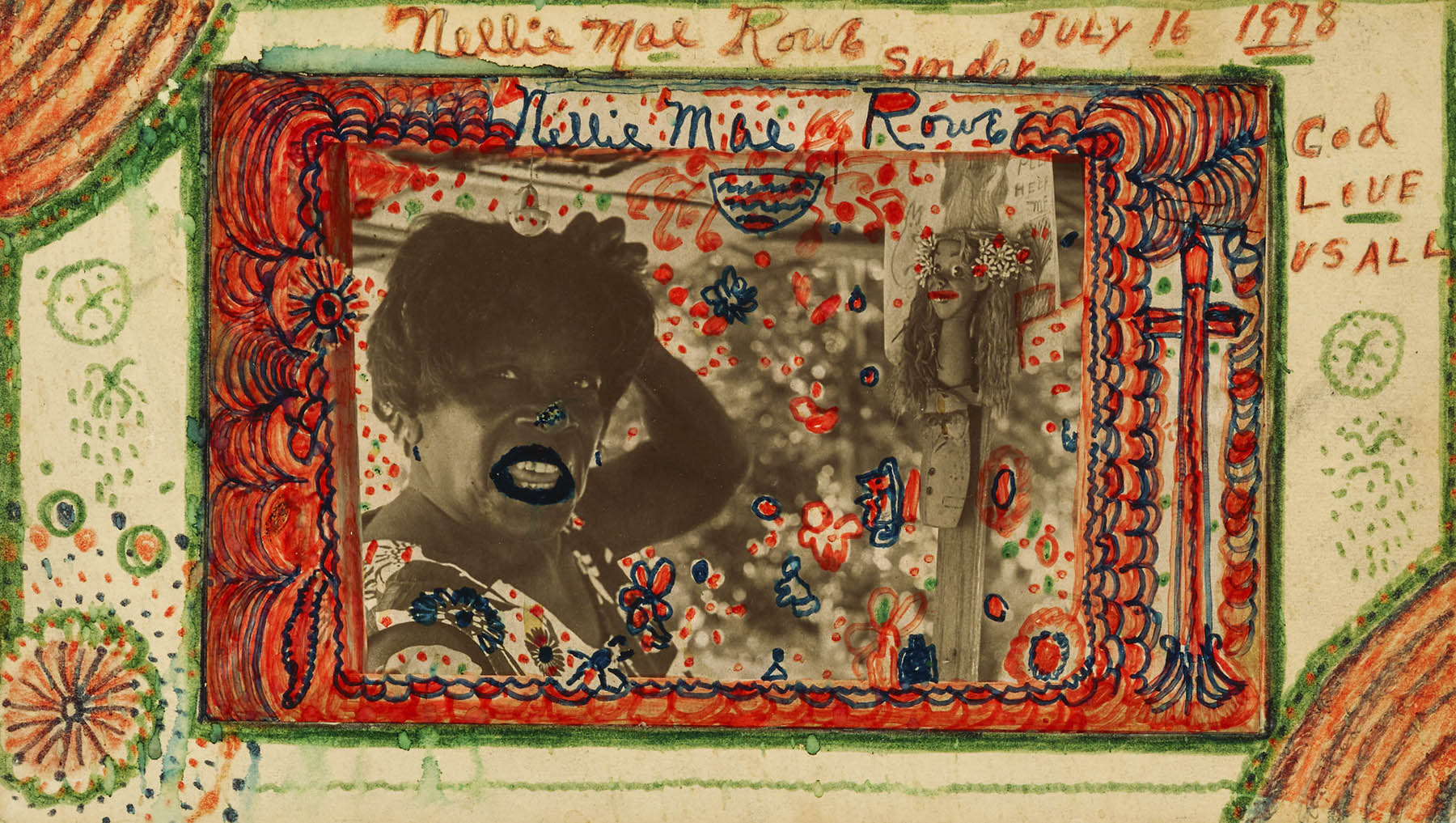
 

Nellie Mae Rowe (American, 1900-1982) 'God Loves us All' 1978


Nellie Mae Rowe (American, 1900-1982)
God Loves Us All
1978
Marker on silver gelatin print
15.9 x 29.2cm (6 1/4 x 11 1/2 in.)
Smithsonian American Art Museum, Museum purchase through the Luisita L. and Franz H. Denghausen Endowment and the American Women’s History Initiative Acquisitions Pool, administered by theSmithsonian American Women’s History Initiative
© 2025 Estate of Nellie Mae Rowe / Artists Rights Society (ARS), New York


Nellie Mae Rowe was born in Georgia, in the last year of the nineteenth century – to a once-enslaved father and mother born the year of Emancipation. Rowe laboured as a child, married young, was widowed twice, and worked much of her adult life as a uniformed “domestic” in white households. Although her early life was shaped by segregation and oppression, Rowe’s desire to define herself sparked a joyful and colourful body of art that suffused her home and yard. This undeniable and contagious positivity made Rowe one of the first Black self-taught women to be celebrated for her art. 

Rowe saw art-making as a God-given way to convey gratitude and recover a girlhood lost to labor and poverty. She transformed her property into an enriched realm she called her “Playhouse,” embellished with artworks and found objects that brought a heightened animation to her surroundings. Amid a society that rarely featured Black women in works of art and cast them as demeaning stereotypes in popular culture, Rowe took control of the narrative. She depicted friends, neighbours, and herself in drawings and hand-coloured photographs, confident images of Black beauty and free-spirited joy. In a radical act of reclamation, she crafted a world where cultural pride, personal style, and a bit of the unexpected embody the richness of life.

(We Are Made of Stories: Self-Taught Artists in the Robson Family Collection, 2022)

Text from the Smithsonian American Art Museum website
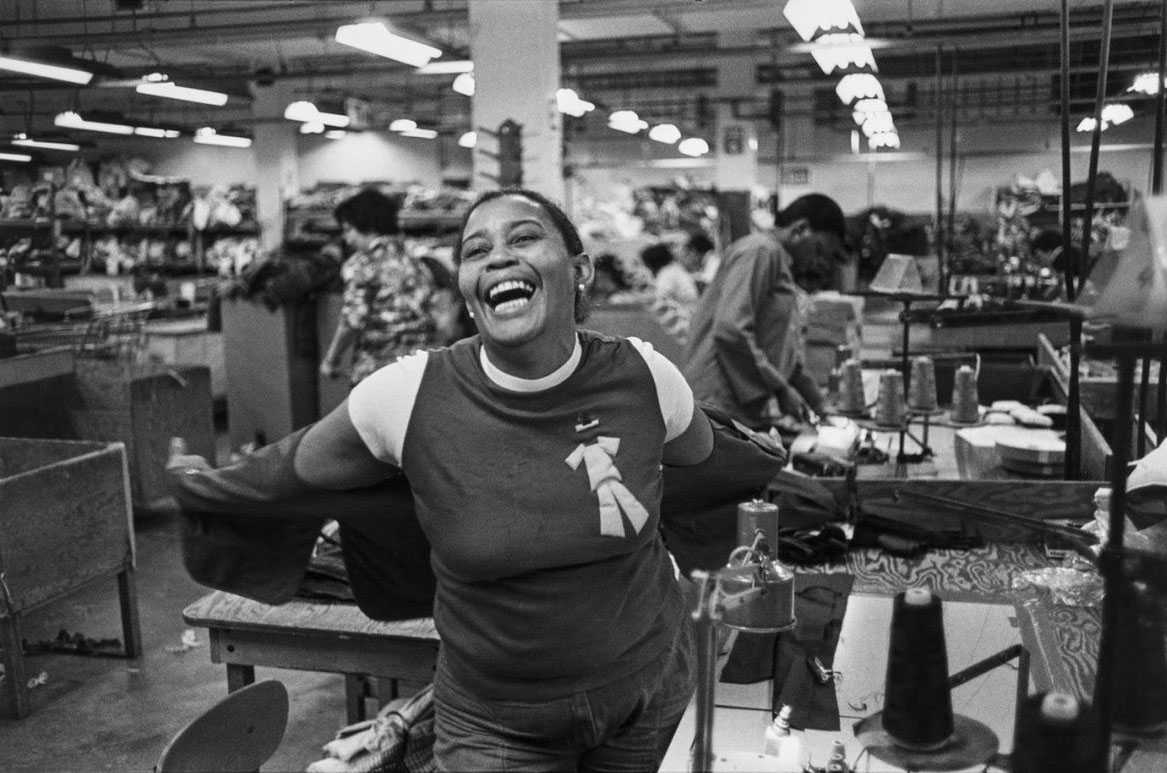
 

Carrie Mae Weems (American, b. 1953) 'Mom at Work' 1978-1984


Carrie Mae Weems (American, b. 1953)
Mom at Work
1978-1984
Gelatin silver print
60.96 × 92.71cm (24 × 36 1/2 in.)
National Gallery of Art, Washington
Alfred H. Moses and Fern M. Schad Fund


~ Exhibition: ‘Carrie Mae Weems. The Heart of the Matter’ at Gallerie d’Italia, Turin, April – September, 2025
~ Exhibition: ‘Dawoud Bey & Carrie Mae Weems: In Dialogue’ at the J. Paul Getty Museum, Los Angeles, April – July 2023
~ Exhibition: ‘Carrie Mae Weems: Three Decades of Photography and Video’ at The Solomon R. Guggenheim Museum, New York, January – May 2014
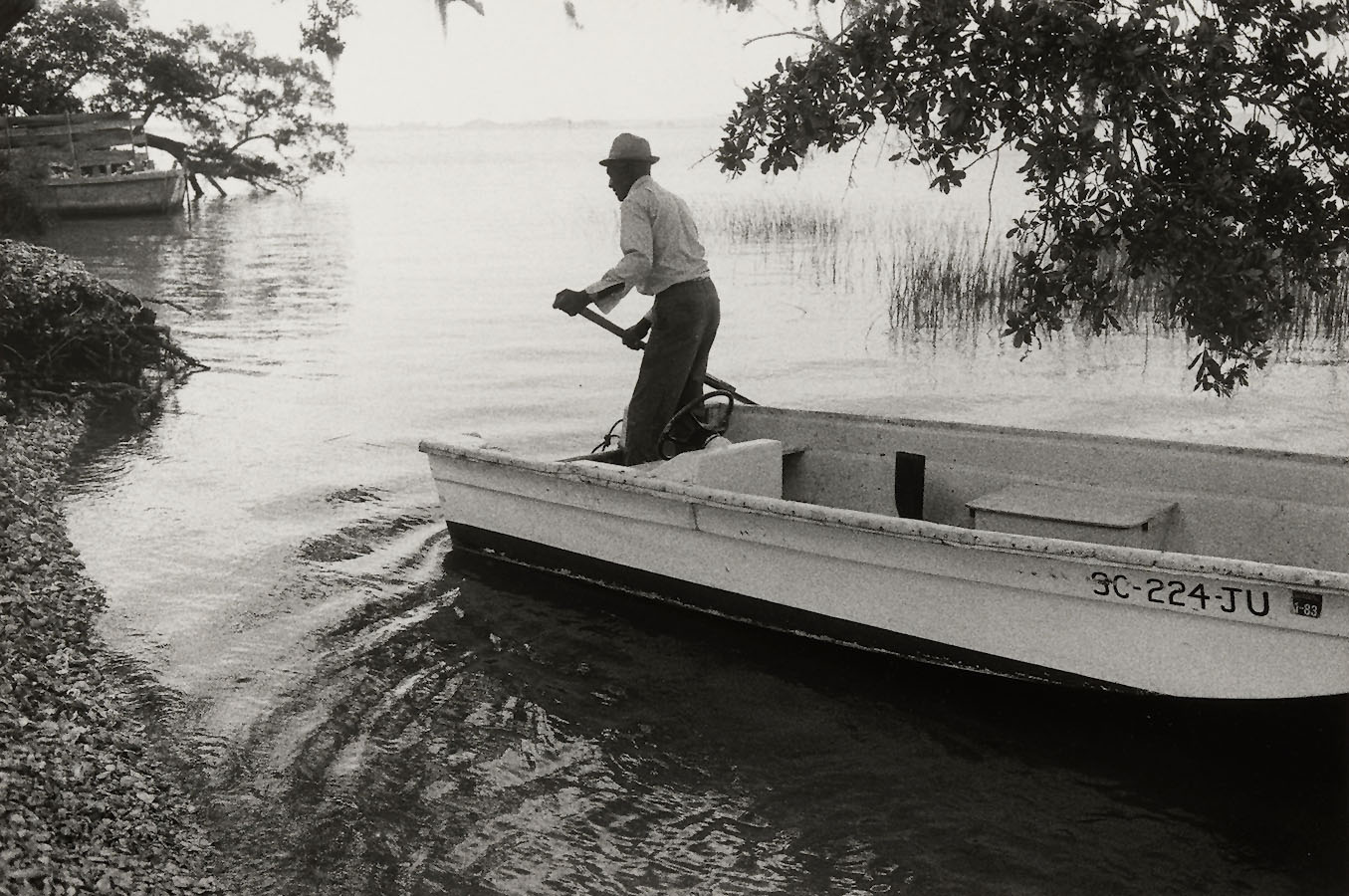
 

Jeanne Moutoussamy-Ashe (American, b. 1951) 'Jake with His Boat Arriving on Daufuskie's Shore, Daufuskie Island, South Carolina' 1978, printed 2007


Jeanne Moutoussamy-Ashe (American, b. 1951)
Jake with His Boat Arriving on Daufuskie’s Shore, Daufuskie Island, South Carolina
1978, printed 2007
Gelatin silver print
31.1 x 46.6cm (12 1/4 x 18 3/8 in.)
National Gallery of Art, Washington
Gift of Funds from Diana and Mallory Walker


Jeanne Moutoussamy-Ashe (American, b. 1951)

Jeanne Moutoussamy-Ashe (b. 1951, USA) is an American photographer, photojournalist and AIDS activist. Beginning photography at the age of 18, she trained with American street photographer Garry Winogrand before graduating from the Cooper Union School of Art with a BFA in 1975, completing a year of independent photographic study in West Africa. Her 1977 photograph ‘Black Man, White Woman, Johannesburg, South Africa’ emblematised the visual narrative of apartheid at that time, recalling the institutionalised racism Jeanne had herself experienced as an African-American photographer.

Jeanne’s experience in South Africa informed her later work, encouraging her to focus on the contemporary experience of Blackness through humanist street photography. More recently, her photobook Daddy and Me: A Photo Story of Arthur Ashe and His Daughter, Camera (1993), which captures the last year of her husband Arthur Ashe’s life, has been praised as a sensitive record of family and mortality which demystifies AIDS. Following the tragedy of Ashe’s death, Jeanne has become a spokesperson for further AIDS research.

Text from the Hundred Heroines website
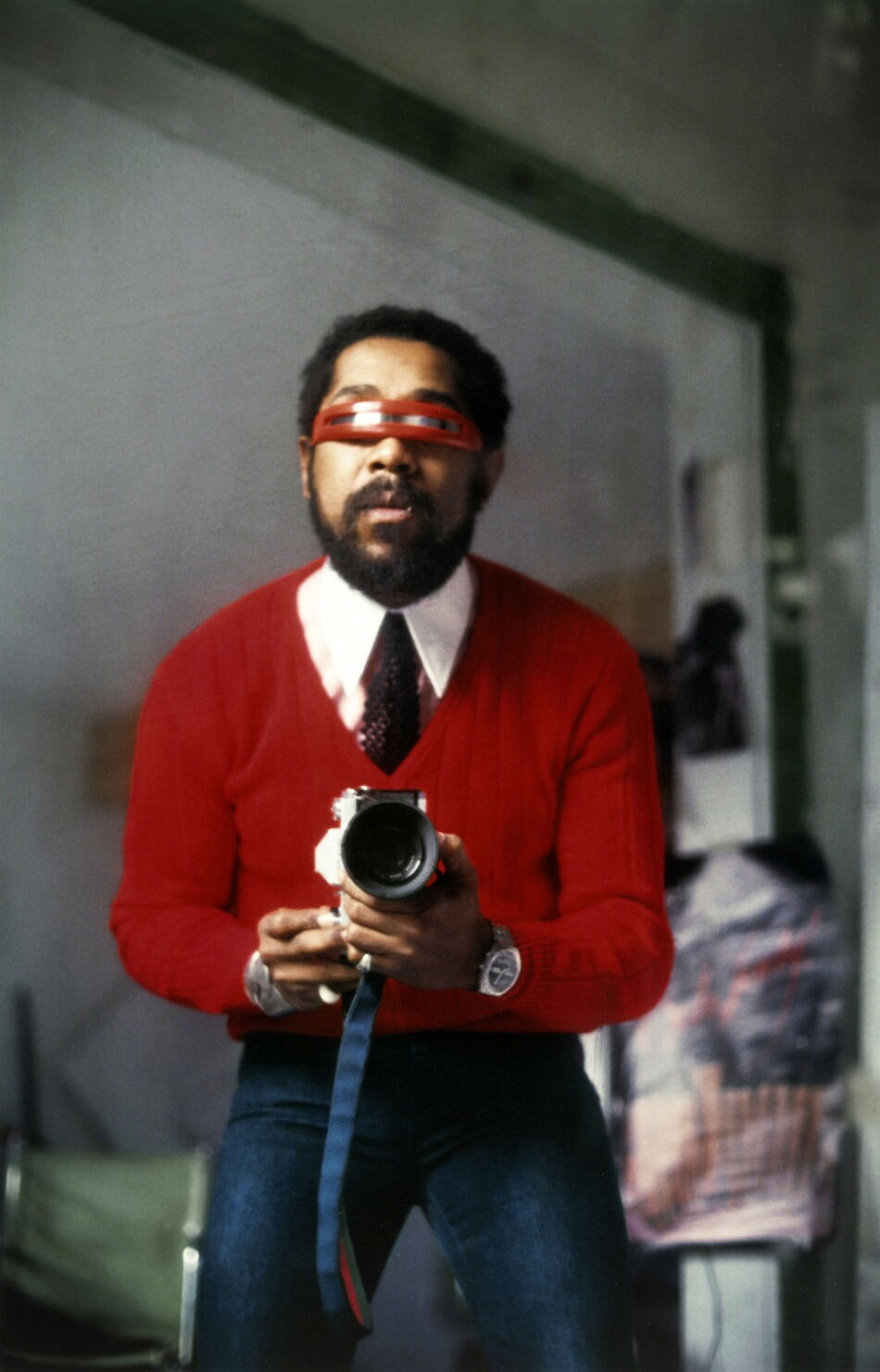
 

Barkley L. Hendricks (American, b. 1940) 'Self-Portrait with Red Sweater' 1980, printed 2023


Barkley L. Hendricks (American, 1940-2017)
Self-Portrait with Red Sweater
1980, printed 2023
Chromogenic print
24.8 × 15.5cm (9 3/4 × 6 1/8 in.)
National Gallery of Art, Washington
Alfred H. Moses and Fern M. Schad Fund


Barkley L. Hendricks (American, 1940-2017)

Barkley L. Hendricks (American, 1940-2017) was an American painter and photographer who revolutionised portraiture through his realist and post-modern oil paintings of Black Americans living in urban areas, beginning in the 1960s and 1970s. 

Hendricks’ depictions of the Black figure exude attitude and style. The artist culled subjects for his hagiographic portraits from sartorially minded friends and acquaintances he encountered around the world, including travels to Jamaica, his hometown of Philadelphia, and Connecticut where he last lived and worked. He applied intense focus to his subjects while painting, allowing him to capture their unique personalities. Steeped in pop culture and balanced with exquisite detail, the cast of characters in Hendricks’ work inhabits an unconventional realism united by painterly mastery.

While the directness of his subjects’ gaze could be piercing, Hendricks invoked humour through the titling of his pieces, mitigating the gravity of the message and allowing for an opening into the work. His paintings are distinctly of their time, grounded in the style of their contemporary present, and simultaneously emphatically timeless. They are a direct engagement with art history, the tradition of portraiture, and a confrontation of institutional portrayal of the black subject. 

Hendricks was first a photographer before taking up painting. Beyond his portraiture, he also made distinct works on paper and painted landscapes and still lifes, including an early series of Basketball paintings that explored abstraction and colour theory. Throughout his career, Hendricks refused to be boxed into a medium, and his practice is commanding, bold, and without limitations to media or form.

Text from the Jack Shainman website
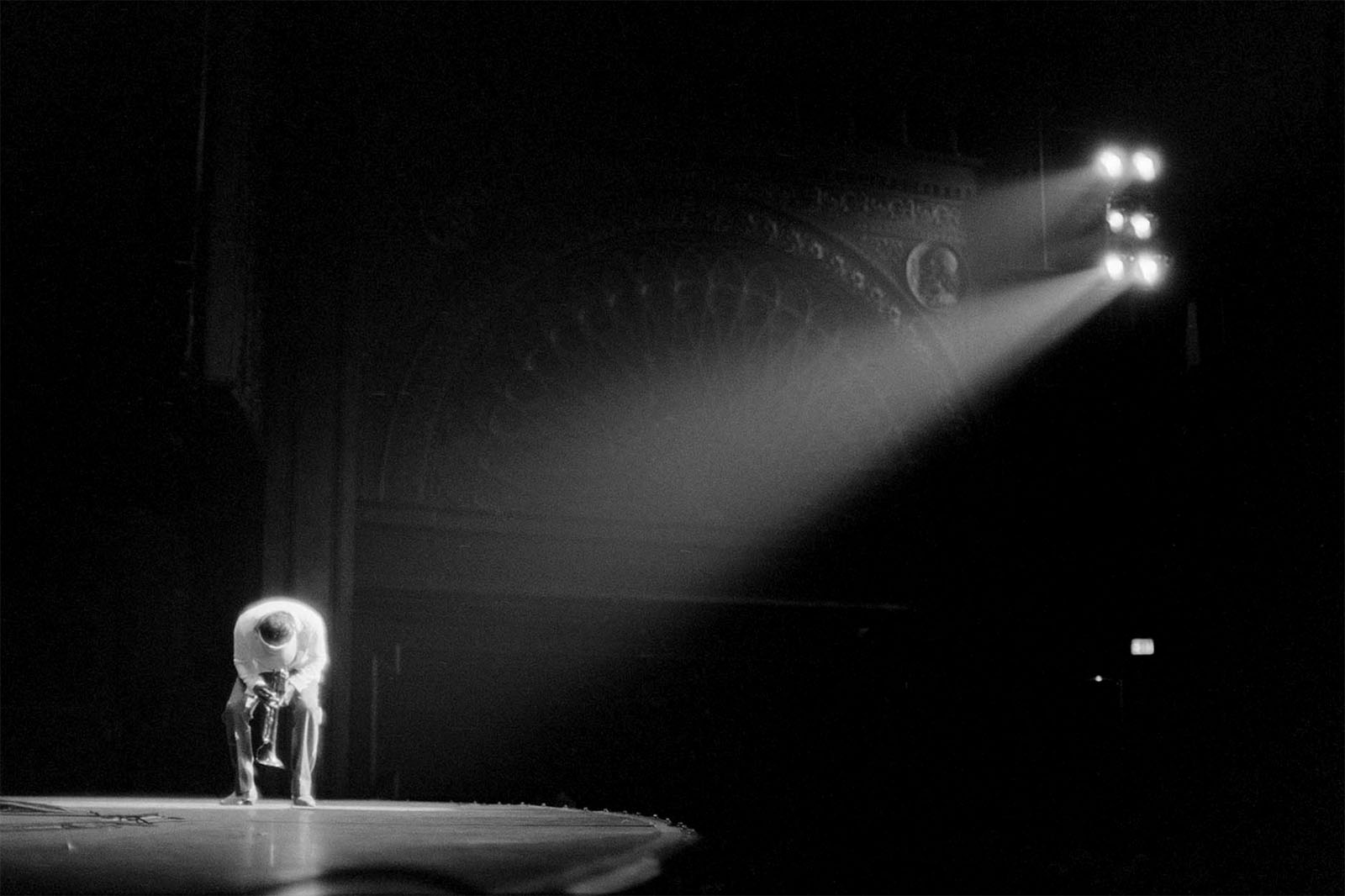
 

Gordon Parks (American, 1912-2006) 'Miles Davis' 1981


Gordon Parks (American, 1912-2006)
Miles Davis
1981
Gelatin silver print
22.9 x 34.1cm (9 x 13 7/16 in.)
National Gallery of Art, Washington
Corcoran Collection (The Gordon Parks Collection)


Carla Williams (American, b. 1965) 'Untitled (curlers) #1.2' 1984-1985


Carla Williams (American, b. 1965)
Untitled (curlers) #1.2
1984-1985
Gelatin silver print
27.31 × 34.93cm (10 3/4 × 13 3/4 in.)
National Gallery of Art, Washington
Pepita Milmore Memorial Fund


Carla Williams (American, b. 1965)

Los Angeles native Carla Williams is a photographer and curator known for her exploration of identity, race, gender, and representation.

She first encountered photography in 1983 during her sophomore year at Princeton University, studying under Emmet Gowin. Her early work in self-portraiture began at Princeton, where she used the large-format camera to explore her own image. The focus of renewed scholarship, these works reflected on the lack of visibility of African American women in photographic history. Williams earned an MFA in photography from the University of New Mexico in 1991, where her thesis project focused on the themes of self-representation and identity. After graduating, she worked as a curator of photography at institutions in Los Angeles and New York.

Text from the National Gallery of Art website
 

Juan Sánchez (American, b. 1954) 'Mixed Statement' 1984


Juan Sánchez (American, b. 1954)
Mixed Statement
1984
Oil and metallic paint, pencil, colored pencil, oil pastel, marker, paper money, fabric, thread, leaves, painted, printed, torn, and cut-and-pasted coloured paper, and gelatin silver prints on canvas, 3 panels
137.16 x 243.84cm (54 x 96 in.)
The Museum of Modern Art, New York. Gift of Harry Torczyner (by exchange), 2024
Digital Image © The Museum of Modern Art / Licensed by SCALA / Art Resource, NY


Juan Sánchez, the influential Nuyorican visual artist, teacher, writer, and curator once declared “Political art is a medium used as a weapon to hopefully recapture or regain the positive energy of celebration – to regain the goodness of humanity.” Sánchez, the child of Puerto Rican immigrants, was born and raised in Brooklyn. Encompassing a variety of mediums and techniques, including collage, painting, printmaking, photography, and video, his work is informed by his activism and engagement with issues of colonialism and its legacy, race, class, cultural identity, equality, social justice, and self-determination. At the same time, he has maintained a consistent focus on communities, families, and both personal and political histories in his work.

 Text from The Metropolitan Museum of Art website


National Gallery of Art
National Mall between 3rd and 7th Streets
Constitution Avenue NW, Washington

Opening hours:
Daily 10.00am – 5.00pm

National Gallery of Art website

LIKE ART BLART ON FACEBOOK

Back to top

Festival and exhibitions: ‘What Makes Us Human? Image in the Age of A.I.’ at the PhotoVogue Festival, BASE Milano, Milan

Exhibition dates: 16th – 19th November, 2023


Kriss Munsya (Belgium born Democratic Republic of Congo) 'Dark Paradise' 2022


Kriss Munsya (Belgium born Democratic Republic of Congo)
Dark Paradise
2022
From the series Genetic Bomb
©
Kriss Munsya


It’s all in a label…

Some quotations on beauty which you may find illuminating:


“Beauty changes quickly, much as the landscape constantly changes with the position of the sun.”


Auguste Rodin


“It is certainly not true that there is in the mind of many any universal standard of beauty with respect to the human body.”


Charles Darwin, “The Origin of Species by Means of Natural Selection. The Descent of Man and Selection in Relation to Sex,” in Great Books of the Western World: 49, Darwin, Encyclopedia Britannica, Chicago, 1952 quoted in Elaine Hatfield and Susan Sprecher, Mirror, Mirror: The Importance of Looks in Everyday Life, State University of New York Press, Albany, 1986, p. 4.


“Beauty is not instantly and instinctively recognisable: we must be trained from childhood to make those discriminations. Nor can we assume an objective and quantifiable standard of beauty against which everyone could be judged with equal fairness …”

“Beauty becomes, like money, externalised, a possession, one that, like money, can be lost. But it is different from money, for it must be lost, sooner of later.”


Robin Lakoff and Raquel Scherr, Face Value: The Politics of Beauty, Routledge and Kegan Paul, Boston, 1984, p. 30, p. 34.


“‘Photogeneity’ is the camera’s contribution to the language of beauty. Suddenly, beauty begins to be judged in new terms… Photographic reproduction helped to make beauty big business… The success of photographically reproduced beauty depended primarily on its popular consumption. Beauty became a collective experience. And consumerism and the camera became bedfellows.

Magazines and movies felt the immediate benefits of photographic reproduction. Audiences were captivated by what they saw… Suddenly, places, objects, people, situations that had once seemed inaccessible became familiar. But at the core remained a paradox which would with time become troublesome. Photographic reproduction seemed to make things familiar, yet they remained remote. It promised intimacy, yet kept the images themselves untouchable, impersonal. In short, it offered the impossible under the guise of the possible. And so it was with beauty which, now turned professional found these media as its new arena, the place where it could best advertise itself.”


Robin Lakoff and Raquel Scherr, Face Value: The Politics of Beauty, Routledge and Kegan Paul, Boston, 1984, pp. 74-75.


“It is not so much that we have to develop a ‘new style’ of beauty … We have to transcend, in the first place, dependence on ‘style’: for as long as we worry about the current fashion in beauty, not only must we worry about ourselves as individuals and how well we fare, individual to individual; but we also become dependent upon the whims of tastemakers beyond our acquaintance, forces we cannot see or touch, and that help to create our confusion…”


Robin Lakoff and Raquel Scherr, Face Value: The Politics of Beauty, Routledge and Kegan Paul, Boston, 1984, p. 283.


“Ideal beauty is ideal because it does not exist; the action lies in the gap between desire and gratification… The beauty myth moves for men as a mirage; its power lies in its ever-receding nature. When the gap is closed, the lover embraces his own disillusion. The myth actually undermines sexual attraction. Attraction is a dialogue… that depends on the unique qualities, memories, patterns of desire, of the two people involved; “beauty” is generic. Attraction is about a sexual fit: two people imagining how they will work together.

“Beauty” is only a visual, more real on film or in stone than in three living dimensions. The visual is the sense monopolised by the advertisers, who can manipulate it much better than mere human beings. But with other senses, advertising is at a disadvantage: Humans can smell, taste, touch, and sound far better than in an advertisement. So humans, in order to become dependable, sexually insecure consumers, had to be trained away from these other, more sensual senses. One needs distance, even in the bedroom, to get a really good look … “Beauty” leaves out smell, physical response, sounds, rhythm, chemistry, texture, fit, in favour of a portrait on the pillow.

The shape and weight and texture and feel of bodies is crucial to pleasure but the appealing body will not be identical… The world of attraction grows blander and colder as everyone, first women and soon men, begin to look alike. People loose one another as more masks are assumed.”


Wolf, Naomi. The Beauty Myth. London: Vintage, 1991, pp. 176-177.


Dr Marcus Bunyan


Many thankx to PhotoVogue Festival for allowing me to publish the photographs in the posting. Please click on the photographs for a larger version of the image.


Enrique Leyva (Mexican, b. 1996) 'Madre e hijo' (Mother and son) Nd


Enrique Leyva (Mexican, b. 1996)
Madre e hijo (Mother and son)
Nd
© Enrique Leyva


The PhotoVogue Festival, the first conscious fashion photography festival that focuses on the common ground between ethics and aesthetics, returns for its eighth edition. From November 16 to 19, 2023, BASE Milano will host a series of exhibitions and a three-day symposium examining the profound impact of artificial intelligence (A.I.) on human existence and the creation of images, complemented by satellite events at the city’s finest galleries. Embracing the digital era, the festival also offers online portfolio reviews and panel discussions on the PhotoVogue platform and it will give the opportunity to students from CondéFuture – a program led by Condé Nast community talent that targets high school students from underrepresented communities – to showcase some of their photography and video pieces. Last year’s edition was a great success: about 10 thousand people visited the exhibitions and attended the talks.

At the core of the new edition will be a three-day symposium, featuring a distinguished lineup of experts and thought leaders at the forefront of the A.I. revolution. This symposium aims to comprehensively address all aspects of AI around the creation of images, delving into the legal implications, copyright issues, biases, and the potential threat to the documentary value of photography. Moreover, discussions will extend to exploring how governments should act, gaining insights from big tech’s perspectives, and examining practices in place to mitigate potential threats.

Beyond the technicalities, the symposium will also embark on profound philosophical inquiries about what makes us human. It will explore the marvels of creativity that arise when art is liberated from the constraints of the real. This intellectually enriching journey promises to unveil the complexities and possibilities that AI presents to the world of visual representation, prompting us to reflect on the future of human creativity and expression.

PhotoVogue Festival is a project directed by Alessia Glaviano (Head of Global PhotoVogue) and co-curated by Francesca Marani (Senior Photo Editor, Vogue Italia) Chiara Bardelli Nonino (Editor, Writer and Curator), Daniel Rodríguez Gordillo (Content Operations & Strategy Manager, Condé Nast) and Caterina De Biasio (Visual Editor, PhotoVogue)

Since its inception, the PhotoVogue Festival has been dedicated to exploring ethically and aesthetically crucial themes, ranging from the female gaze to inclusivity and masculinity. Building on last year’s exploration of how the ubiquity of images influences our understanding of experiences and reactions to events, the upcoming PhotoVogue Festival in Milan will take a deep dive into the profound impact of artificial intelligence (A.I.) on human existence and the creation of images.

“Our intention is to address the ethical, aesthetic, and political implications raised by this revolutionary technology. Together, we will explore A.I.’s potential for reshaping our understanding of creativity, human existence, and the very essence of how we communicate and convey our visions to the world” ~ Alessia Glaviano, Head of Global PhotoVogue and Director of PhotoVogue Festival


Exhibitions

What Is Beauty

Throughout its past Open Calls, PhotoVogue festival has celebrated the female gaze, searched for the next great fashion image makers, highlighted diversity behind and in front of the camera, explored masculinity, reframed history, and consistently challenged stereotypes, clichés, and homogeneous representations. Continuing its journey dedicated to shaping a more just and inclusive society through visual literacy, PhotoVogue invited artists from around the world to submit work that challenges the traditional notions of beauty.

As cultural shifts unfold across the globe, so must the very idea of beauty evolve. We break free from the constraints of gender, perfection, and homogeneity, recognising that beauty cannot be confined to pass-fail tests based on antiquated norms. Instead, it becomes a boundless and ever-evolving concept, liberated from the tired stereotypes that once dominated our cultural landscape. Never before has artistic expression been more diversified, and representation more far-reaching.

The exhibition on display at BASE features work by 40 artists from 24 countries, selected by a jury comprising Condé Nast staff from across the globe and experts from the international visual community.

Artists featured: Amy Woodward | Ana María Arévalo Gosen | Andras Ladocsi | Avijit Halder | Avion Pearce | Bettina Pittaluga | Chiron Duong | Clara Belleville | Claudia Revidat | Enrique Leyva | Francesca Bergamini | Gabo Caruso | Hayley Lohn | Imraan Christian | Irina Werning | Jaimy Gail | Jara García Azor and Lucía Lomas | Jean-Claude Moschetti | Jess T. Dugan | Jude Lartey | Julia Cybularz | Kate Biel | Katerina Tsakiri | Kriss Munsya | Kristina Rozhkova | Leslie Fratkin | Luisa Dörr | Lumi Tuomi | Marina Adam | Mauricio Holc | Omar Khaleel | Ruiqi Zhang | Sarfo Emmanuel Annor | Silvana Trevale | Tara Laure Claire | Togo Yeye | Yao Yuan | Yongbin Park | Zahui Yvann | Ziyu Wang


Togo Yeye. 'Simélan (Fish from the water)' 2023


Togo Yeye
Simélan (Fish from the water)
2023
© Togo Yeye


Togo Yeye is a conceptual publication by two friends – London-based photographer and Nataal art director Delali Ayivi and Lomé-based fashion activist Malaika Nabillah. Created for Ayivi’s graduate project at London College of Fashion, she and Nabillah set out to champion Togo’s young fashion creatives, contribute to debates around defining an authentic contemporary identity for the country and dream of its fantastic future.


Amy Woodward (Australian) 'Eb, 25 weeks pregnant, post mastectomy' Nd


Amy Woodward (Australian)
Eb, 25 weeks pregnant, post mastectomy
Nd
© Amy Woodward


Eb proudly shows her post-mastectomy flat closure. She chooses not to wear a prosthesis in everyday life because she feels no less of a woman without breasts. She is proud to model this for her 16-year-old daughter. Eb was told that she and her husband would not be able to conceive without IVF, but much to their surprise, she became pregnant in 2021 with her son, Arlo.


Chiron Duong (Vietnamese, b. 1996) 'If I were a mangrove tree, I will rebirth on the sweet land' Nd


Chiron Duong (Vietnamese, b. 1996)
If I were a mangrove tree, I will rebirth on the sweet land
Nd
© Chiron Duong


Mauricio Holc (Argentinian) "Alex" from the project 'Ser Libre' (Be Free) Nd


Mauricio Holc (Argentinian)
“Alex” from the project Ser Libre (Be Free)
Nd
© Mauricio Holc


Kate Biel (American) 'Jessica and a Dollhouse' 2021


Kate Biel (American)
Jessica and a Dollhouse
2021
© Kate Biel


Luisa Dörr (Brazilian, b. 1988) 'Brenda and Lucia' Nd


Luisa Dörr (Brazilian, b. 1988)
Brenda and Lucia
Nd
© Luisa Dörr


Joselin Brenda Mamani tinta (27) and Lucia Rosmeri tinta Quispe (46) from the series Imilla.

Brenda and her mother are considered Pollera women from a different ethny called Aymara from La Paz. Brenda started skateboarding 6 years ago and felt that this activity could give her direction, something to learn that would stimulate her to drop her fears and get out of her comfort zone. She says – “It makes me feel capable because I can break my own limits and I can dare to do things that I have never thought about, and like this I can get over my daily fear.

For her skateboarding in Pollera outfits means a challenge by itself because it is very hard to skateboard wearing a voluminous skirt but she knows that perseverance and practice will help and she has been improving her skills. For her this activity represents her roots, the place she comes from and who she is.


Silvana Trevale (Venezuelan) 'Las Reinas' (The Queens) Nd


Silvana Trevale (Venezuelan)
Las Reinas (The Queens)
Nd
© Silvana Trevale


Josly, Abril and Elie portray today’s Miss Venezuela beauty pageants on a road in the city of Caracas.


Sarfo Emmanuel Annor (Ghana) 'Serenity' Nd


Sarfo Emmanuel Annor (Ghana)
Serenity
Nd
© Sarfo Emmanuel Annor


The Ghanaian artist explores beauty, fashion and daily life in the African country. He focuses on the dynamic youth and their role in shaping the continent’s future. Through his energetic portraits, Annor challenges conventional beauty standards and emphasises the connections that unite the nation beyond ethnicity and religion. His art captures the essence of Africa’s cultural awakening and showcases the beauty that arises from Ghana’s unique cultural heritage.


Yongbin Park (Korean) 'When was your first kiss?' Nd


Yongbin Park (Korean)
When was your first kiss?
Nd
From the series Girls
© Yongbin Park


Avion Pearce (American, b. 1990) 'Capri and Astro' Nd


Avion Pearce (American, b. 1990)
Capri and Astro
Nd
From the series In the Hours between Dawn
© Avion Pearce


Leslie Fratkin (American, b. 1960) 'Woman Wearing Big White Wig, New York' Nd


Leslie Fratkin (American, b. 1960)
Woman Wearing Big White Wig, New York
Nd
© Leslie Fratkin


‘I encountered this woman, who had the most mesmerising eyes I’d ever seen and a massive, tousled white wig. I asked if I could take her photograph. She hesitated, but eventually, in a barely audible voice, granted permission. I snapped a few shots, noticing a man parked nearby in a car, exuding irritation. After a couple of minutes, he walked up to the camera and declared: “Enough.” Instantly, she averted her gaze. She entered the man’s car and they swiftly departed. I doubt she comprehends the extent of her own beauty’

Leslie Fratkin


Jess T Dugan (American, b. 1986) 'Self-portrait (reaching)' Nd


Jess T Dugan (American, b. 1986)
Self-portrait (reaching)
Nd
© Jess T Dugan


What Is Beauty / A.I.

Featuring 13 artists whose A.I.-generated image submissions earned widespread acclaim from the jury, this exhibition delves into the festival’s overarching theme, “What Makes Us Human? Image in the Age of A.I.” While distinct from traditional photography, these artworks highlight the profound intersection of technology and human creativity, inviting profound contemplation of the boundless possibilities of A.I. in reshaping the artistic landscape and its impact on human expression in the digital era.

Artists featured: Alina Gross | Andrea Baioni | Angelo Formato | Dmytro Levdanski | Guido Castagnoli | Java Jones | Lala Serrano | Lars Nagler | Noah De Costa | Rozemarlin Borkent | Salome Gomis Trezise | Sander Coers | Xinxu Chen


Alina Gross (Ukrainian, b. 1980) 'Femme Orchid' (Orchid Woman) Nd


Alina Gross (Ukrainian, b. 1980)
Femme Orchid (Orchid Woman)
Nd
(Image generated by AI)
© Alina Gross


Rozemarlin Borkent (Dutch, b. 1987) "Ada and Amara" from the project 'I am that I am' Nd


Rozemarlin Borkent (Dutch, b. 1987)
“Ada and Amara” from the project ‘I am that I am’
 Nd
(Image generated by AI)
© Rozemarlin Borkent


Xinxu Chen (Chinese, b. 1992) "Heterochromia" from the project 'What is beauty?' Nd


Xinxu Chen (Chinese, b. 1992)
“Heterochromia” from the project ‘What is beauty?’
Nd
(Image generated by AI)
© Xinxu Chen


Uncanny Atlas: Image In The Age Of A.I.

Curated by Chiara Bardelli Nonino

Photography has long been the lingua franca of our transitional epoch: an era where daily life is exponentially shifting into a virtual dimension, where relationships are consumed online, being beautiful means being photogenic, the proliferation of fake news render any collective discourse precarious and what we once called nature is reduced, at best, to content. The radical ambiguity of the photographic medium, which on the one hand promises adherence to the subject and on the other allows artifice and manipulation, seemed the perfect language to narrate a fluid world in which we moved like tightrope walkers, balancing between the digital and the real.

This exhibition aims to be a principle of cartography of this new world. And it does so through an investigation of how A.I. is changing, along with image production, our idea of photography, and inevitably also that of reality. Above all, the exhibition is an invitation to confrontation, at the intersection of many possible readings of a still largely empty map, where around the small known world there are still large, obscure areas, yet to be explored.

The artists: Alex Huanfa Cheng | Alexey Chernikov | Ali Cha’aban | Alkan Avcıoğlu | Carlijn Jacobs | Chanhee Hong | Charlie Engman | Exhibit A-i | Filippo Venturi | Jonas Bendiksen | Laurie Simmons | Maria Mavropoulou | Michael Christopher Brown | Minne Atairu | Philipp Klak | Prateek Arora | Roope Rainisto | Synchrodogs | Vogue Covers


Ali Cha'aban (Kuwait-based born Lebanon) 'Beirut Dystopia' Nd


Ali Cha’aban (Kuwait-based born Lebanon)
Beirut Dystopia
Nd
(Image generated by AI)
© Ali Cha’aban


Charlie Engman (American, b. 1987) 'Dolphin Lady' Nd


Charlie Engman (American, b. 1987)
Dolphin Lady
Nd
(Image generated by AI)
© Charlie Engman


Prateek Arora (Indian, b. 1990) 'Every family has its demons' Nd


Prateek Arora (Indian, b. 1990)
Every family has its demons
Nd
(Image generated by AI)
© Prateek Arora


Michael Christopher Brown (American, b. 1978) "#266 Stranded" from the project '90 Miles' Nd


Michael Christopher Brown (American, b. 1978)
“#266 Stranded” from the project ’90 Miles’
Nd
(Image generated by AI)
© Michael Christopher Brown


Laurie Simmons (American, b. 1949) 'Red Room/Telephone' 2023


Laurie Simmons (American, b. 1949)
Red Room/Telephone
2023
(Image generated by AI)
© Laurie Simmons


Roope Rainisto (Finnish) 'Cow Master' Nd


Roope Rainisto (Finnish)
Cow Master
Nd
(Image generated by AI)
© Roope Rainisto


BASE Milano
Via Bergognone, 34, 20144
Milano MI, Italy

Opening hours:
November 16: 3 – 9pm
November 17-19: 11am – 9pm

PhotoVogue Festival website

LIKE ART BLART ON FACEBOOK

Back to top

Exhibition: ‘Photographs. An Early Album of the World (1842-1911)’ at the musée du quai Branly – Jacques Chirac, Paris

Exhibition dates: 4th April – 2nd July 2023

Curators: Christine Barthe: Head of the Photography Heritage Department at the Musée du quai Branly – Jacques Chirac; Annabelle Lacour: Head of the Photography Collection at the Musée du quai Branly – Jacques Chirac

Warning: Aboriginal and Torres Strait Islander readers should be aware that this posting contains images and names of people who may have since passed away.


Unknown photographer. 'Portrait of a Persian Dignitary' Tehran, 1848 from the exhibition 'Photographs. An Early Album of the World (1842-1911)' at the musée du quai Branly – Jacques Chirac, Paris, April - July, 2023


Unknown photographer
Portrait of a Persian Dignitary
Tehran, 1848
Daguerreotype
Photo: RMN – Grand Palais (Musée d’Orsay)  Hervé Lewandowski


I wish we had tele-transportation so that I could go and see this incredible exhibition about the beginnings of photography practiced outside Europe.

It took me many hours to construct this posting. Placing the information into a logical order was an important consideration, matching the installation photographs with the exhibition texts and individual images so that the story makes sense. Finding country of origin and dates for the photographers was another issue. Further bibliographic information has been added from sources around the internet to fill out life stories and sometimes this information was difficult to find.

Congratulations to the curators for assembling a photographic tour de force in which “the production of these images is diverse and responds to different wishes, desires, and fits into various different contexts.” In other words what was the force majeure, the greater force, that directed the what, where, when, how, who and for whom of their production. Here, force is the operative word… for many of the foremost contexts are both anthropological and geographic (to record what people and places looked like) under the guise of European colonial conquest: to “capture” the spirit of the people and conquered lands under force of occupation.

More interesting are the photographs taken by photographers of their own people, for example different Indian “casts” taken by a Indian born photographer. How did they picture themselves using a European machine? In this context we must remember that the images were usually taken to fulfil a commercial brief, either taken for a rich patron or to be sold through the photographers studio to local and foreign clients.

Predominantly using a Western pictorial language, sometimes these local photographers step outside the mould of making a portrait or casting a ‘type’ or recording a monument within the landscape by embodying within their art the aesthetics of their own cultural history. For example, “Lai Afong’s photographic compositions show the technical and aesthetic influence of traditional Chinese painting, known as guóhuà.” (Wikipedia) “In many regions, from Colombia to West Africa to Madagascar, and from Iran to Japan to India, photography was adopted and sometimes adapted to social uses and local cultures and in many places seems to satisfy the desire for self-representation and the construction of modern identities.” (Exhibition text)

Undoubtedly this was the exception rather than the rule – for the rule of the lawful image was usually Western in power and aesthetic. As the exhibition text notes, “The 19th century in Europe was characterised by a need to accumulate objects, knowledge and also territory. Through photography, landscapes became lands to be mapped and conquered, and their inhabitants subjects to be studied. In the scientific field, the natural history model influenced the use of photography. It contributed to the myth of virgin territories and was a tool in the growing geographical discipline, making claims of exhaustivity: see everything, photograph everything.” And one might add, own everything, both physically and visually (through the photographers and viewers gaze).

Thus the European photographer of the 19th century taxonomically ordered the world around him through a classification of the visual culture of the exotic. Anthropologically, “within the framework of a science then racial, and in a project typology inherited from natural history classification methods, photography is a tool that establishes visual categories that shape racial stereotypes.” This racial science was to have a lasting impact well into the 20th century through the now debunked theory of eugenics (which has no association with anthropology) – “the study of all agencies under human control which can improve or impair the racial quality of future generations” (Galton) – influencing cultures around the world with devastating impact especially through the genocide of untermensch, or what were seen as racial subhumans, by the Nazi party in Germany in the 1930s-1940s.

What is undeniable is the inalienable presence of the sitter in these powerful portraits. This is William Lane in the here and now, with his strong face and sorrowful eyes. This is Botcudo “brought to France by a certain Mr. Porte and are going to stay in Paris for a few months.” This is his representation but also his spirit from the past, this impression all that is left of his life force today. But it is enough. We pay reverence to his life. This is a half-length portrait of a 77-year-old Japanese man… what did he do in his life, what journey led him to be present in front of the camera in February 1890, the learnt lines on his open face evidence of a hard life well lived. And these are Majeerteen Woman trapped in silver like ghosts in a machine, a movement of mutable energy through time and space that still has me engaging with their life even today. Bless them all.

Dr Marcus Bunyan


Many thankx to the musée du quai Branly – Jacques Chirac for allowing me to publish the photographs in the posting. Please click on the photographs for a larger version of the image.


“Among the 101 photographers on show, 52 are Westerners and 49 are indigenous. This near-parity was made possible by the rise, over the last decade, of acquisitions of works by artists from the four continents.”


Quotation by curator Christine Barthe, head of the heritage unit at the Quai Branly’s photographic collection and co-curator of the exhibition with Anabelle Lacour, head of the photographic collection


Installation view of the exhibition 'Photographs. An Early Album of the World (1842-1911)' at the musée du quai Branly – Jacques Chirac, Paris

Installation view of the exhibition 'Photographs. An Early Album of the World (1842-1911)' at the musée du quai Branly – Jacques Chirac, Paris showing the section 'Daguerreotypes for anthropology'

Installation view of the exhibition 'Photographs. An Early Album of the World (1842-1911)' at the musée du quai Branly – Jacques Chirac, Paris showing the section 'Daguerreotypes for anthropology' and the daguerreotypes of Henri Jacquart (French, 1809 - died after 1873) from September 1851


Installation views of the exhibition Photographs. An Early Album of the World (1842-1911) at the musée du quai Branly – Jacques Chirac, Paris showing in the two bottom images the section ‘Daguerreotypes for anthropology’ and in the bottom image the daguerreotypes of Henri Jacquart (French, 1809 – died after 1873) from September 1851 (below)


Many places in the world became accessible through photography as soon as it was invented in 1839. From the 1840s, darkrooms were taken on official expedition ships and crossed the borders of Europe. From Mexico to Gabon, the camera served the taste of the time for archaeological and geographical description and curiosity about the models encountered. In the second half of the 19th century, photography was used to examine all areas of the globe. This thirst for images was notably fuelled by the European colonial conquest.

Starting from the Musée du quai Branly – Jacques Chirac’s photograph collection, completed by exceptional loans from public and private collections, the exhibition considers the routes and the dissemination of photography outside Europe in the 19th century. Through a selection of photographs produced between 1842 and 1911 in Asia, Africa, Oceania and the Americas, it aims to understand better the development and the different appropriations of the medium locally by bringing to light less well-known photographs, patrons, phenomena and forms of photography in different parts of the world. An attempt to rebalance the history of photography, too often centred on Europe and the United States.

This exhibition is an adaptation of the exhibition Photographs. 1842-1896: An Early Album of the World designed by the Musée du quai Branly – Jacques Chirac and presented at the Louvre Abu Dhabi from 25 April to 13 July 2019.

Text from the musée du quai Branly – Jacques Chirac website


There was a time without photography, and there were places without cameras. Even if it is hard to imagine nowadays, it was not so long ago. Since its invention in 1839, photography has extended its reach at varying paces into all the visible spaces and every corner of the globe: starting in familiar places, spreading to nearby regions and neighbouring countries, and finally making it way into more far-flung lands as well. From the most extraordinary scenes to the most trivial, from breathtaking scenery to the food on our plates, nothing is too intimate or too grandiose to escape our desire to take a picture of it.

But how did it all start? How did photography spread, contributing to our view of the world? Who are the players who make this “photo album of the world”?

Since the 1840s, photography has accompanied countless scientific and military expeditions and trips. It was part of the usual conquest of the world, in the context of colonial expansion by the European powers, which intensified in the second half of the 19th century. As a tool to describe landscape and map territories, it contributed to the knowledge and control of Indigenous populations. Europe did not have a monopoly over this modern technology, however. Photography travelled and was transformed. In many regions, from Mexico and Colombia to Sierra Leone and Madagascar, Iran, Japan and India, it was adopted and sometimes adapted to social practices and local cultures, to create, control and conserve an image of the self and one’s environment.

The exhibition revisits some of this early histories of photography outside of Europe.

Text from the exhibition


Henri Jacquart (French, 1809 died after 1873) 'Mohamed ben Said' Paris, France, 1851 (installation view)


Henri Jacquart (French, 1809 – died after 1873)
Mohamed ben Said (installation view)
Paris, France, 1851
Daguerreotype
© musée du quai Branly – Jacques Chirac


Henri Jacquart (French, 1809 died after 1873) 'Ibrahim Nascer, mozabite' Paris, France, September 1851 (installation view)


Henri Jacquart (French, 1809 – died after 1873)
Ibrahim Nascer, mozabite (installation view)
Paris, France, September 1851
Daguerreotype
© musée du quai Branly – Jacques Chirac


Exhibition introduction

There was a time without photography and places without a camera. Even if it is difficult to imagine it today, this period is not so far away.

Since the announcement of its invention in 1839, photography has more or less quickly invaded all visible spaces, penetrated all places on the scale of the globe: familiar places, nearby regions, then neighbouring countries, also the most distant. From the most extraordinary to the most trivial, from the sublime landscape to the content of our plates, nothing was too intimate or too grandiose to escape the desire to create its image.

How did it all start? How did photography come about? propagated, participating in the global geographical imagination? Who are the actors who make up this “world album”?

Since the 1840s, photography has accompanied the countless voyages and scientific and military expeditions. It participates in the visual conquest planetary, in the context of the colonial expansion of the European powers which accelerated in the second half of the 19th century. Description tool landscapes, territorial mapping, it supported the knowledge and population control. But Europe did not have a monopoly on this modern technology. Photography travels, transforms, takes root. In many regions, Mexico, Colombia, West Africa in Madagascar, from Iran to Japan via India, it has been adopted and sometimes adapted to social uses and local cultures to build, control and maintain an image of oneself and one’s environment.

This exhibition proposes to return to some of these stories from the beginnings of photography practiced outside Europe.

First appearances

The first technique that was widely used in the early days photography, between the 1840s and 1850s, takes its name “daguerreotype” of its inventor Louis Jacques Mandé Daguerre. It’s about of a copper plate coated with silver and made sensitive to light. Relatively expensive to manufacture and requiring learning, this technique was widely used to produce portraits. The long exposure time made it difficult to apply it to the landscape. These images are unique because formed directly on the silver plate, they cannot therefore give rise to several tests. The difficulty of their realisation as well as their cost explain their rarity today. European and American practice in its very beginnings, the daguerreotype quickly exported around the world. new technique modifying the relationship to its own image, the daguerreotype is also used as a tool of scientific description. Practiced by travellers and traveling photographers, it was also adopted very early in many photographic studios of major world cities, such as Mexico City, Bogotá and Lima. In Tehran, the daguerreotype is practiced at the court of the Shah of Persia from 1845.

Daguerreotypes for anthropology

If photography is quickly adopted by travellers and offers a new vision of the real world, it also serves a new discipline: anthropology. In France, the first scientific applications of photography to this burgeoning field are experienced in the years 1840-1850. Within the framework of a science then racial, and in a project typology inherited from natural history classification methods, photography is a tool that establishes visual categories, that shape racial stereotypes. Daguerreotypes made on demand from the anthropology laboratory of the National Museum of Natural History show the importance attached by scientists to skulls, casts and human skeletons, central in a discipline marked by the medicine and comparatism. Produced by professionals like Louis-Auguste Bisson, or by employees of the Museum like Henri Jacquart, these examples testify of an objectification of bodies that photography reinforces. These daguerreotypes are produced or collected by the institution in the same way as the portraits of living people.

Text from the exhibition


Henri Jacquart (French, 1809 died after 1873) 'Ali ben Mohamed, 29 ans, Arab from the plain' September 1851 from the exhibition 'Photographs. An Early Album of the World (1842-1911)' at the musée du quai Branly – Jacques Chirac, Paris, April - July, 2023


Henri Jacquart (French, 1809 – died after 1873)
Ali ben Mohamed, 29 ans, Arab from the plain
September 1851
Daguerreotype
© musée du quai Branly – Jacques Chirac


Henri Jacquart (French, 1809 died after 1873) 'Ali ben Mohamed, 29 ans, Arab from the plain' September 1851 (detail)


Henri Jacquart (French, 1809 – died after 1873)
Ali ben Mohamed, 29 ans, Arab from the plain (detail)
September 1851
Daguerreotype
© musée du quai Branly – Jacques Chirac


Twenty years after the conquest of Algeria, the Arab horsemen have stopped fighting, and are but the shadows of those who for years thwarted the French army. They came to Paris for a show set up by the Museum, Children of the Desert, a fantasia on the Champ de Mars in June, 1851. They too are photographed, and casts of their bodies taken for science – but as popular artists, these horsemen leave their names under their portraits and are paid to pose.

Catherine Darley. “Ghosts (1) – Shadows,” on the Poemas del río Wang blog 10/08/2012 [Online] Cited 07/05/2023


Installation view of the exhibition 'Photographs. An Early Album of the World (1842-1911)' at the musée du quai Branly – Jacques Chirac, Paris

Installation view of the exhibition 'Photographs. An Early Album of the World (1842-1911)' at the musée du quai Branly – Jacques Chirac, Paris

Installation view of the exhibition 'Photographs. An Early Album of the World (1842-1911)' at the musée du quai Branly – Jacques Chirac, Paris

Installation view of the exhibition 'Photographs. An Early Album of the World (1842-1911)' at the musée du quai Branly – Jacques Chirac, Paris

Installation views of the exhibition 'Photographs. An Early Album of the World (1842-1911)' at the musée du quai Branly – Jacques Chirac, Paris showing in the bottom image the section 'Recreated worlds: photo studios'


Installation views of the exhibition Photographs. An Early Album of the World (1842-1911) at the musée du quai Branly – Jacques Chirac, Paris showing in the bottom image the section ‘Recreated worlds: photo studios’ (below)


Recreated worlds: photo studios

In the second half of the 19th century, travel by land and sea developed considerably. European colonial expansion was one of the drivers behind the rise in global photographic coverage, not only did cameras and photographers travel, but so did their models. Members of the Indigenous elites made regular diplomatic trips or came to Europe to study. At the major colonial world’s fairs between 1870 and the early 20th century, groups were brought to European cities to be exhibited.

From the 1860s onwards, a great number of photo studios were set up in major cities. Those involved in this new commercial practice adapted to demand from a tourist clientele in search of exoticism, and sets and accessories were used to recreate artificial worlds. These widely distributed images with simplistic, sometimes demeaning captions, transmitted and perpetuated stereotypes. Photos with the frame centred on the face were often taken to respond to the need for description expressed in the field of physical anthropology. But studio decors also attracted a local clientele keen to create souvenirs with their loved ones.

Looking at these portraits, many questions remain today: Who are these individuals? What can we find out about their interactions with the photographer and their participation when being photographed?

Portraits of Aboriginal Australians

The aboriginal populations were privileged subjects of the first commercial photographers in Australia. Produced in the studio, these portraits obey 19th century racialist scientific interests; they are designed to document what was then considered to be an endangered population. German photographer John William Lindt, based in Grafton, New Wales of the South, produces a series of portraits of the aboriginal populations of Clarence Valley, marketed in the form of portfolios from the 1870s.

Combining exoticism and pictorial tradition, his pictures met with great success. Despite this problematic production context and the sometimes artificial nature stagings, this visual heritage is now a resource important for the descendants of the communities. In Australia, research have been undertaken since the 1990s to obtain information on the models, their identity and their territory of origin. The photography model known as “Mary Ann of Ulmarra” was identified in 2013 as Mary Ann Williams, née Cowan, through research conducted by one of his descendants.

Text from the exhibition


John William Lindt (Australian born Germany, 1845-1926) 'Mary Ann of Ulmarra' (Mary Ann Williams, née Cowan) 1873 from the exhibition 'Photographs. An Early Album of the World (1842-1911)' at the musée du quai Branly – Jacques Chirac, Paris, April - July, 2023


John William Lindt (Australian born Germany, 1845-1926)
Mary Ann of Ulmarra (Mary Ann Williams, née Cowan)
1873
Albumen print


Lindt took at least sixty photographs in this series of studio portraits of Clarence River Aborigines, although extant albums usually contain fewer than a dozen each. When first published, these studio tableaux were regarded as accurate. Reference: An Eye for Photography: the camera in Australia / Alan Davies. Carlton, Vic: Melbourne University Press, 2004, p. 60.


Antoine Julien Nicolas Fauchery (French, 1823-1861) and Richard Daintree (Australian born United Kingdom, 1832-1878) 'Untitled (Two Aborginal Australian men and three women posing in front of a studio backdrop)' Victoria possibly Mt Franklin, 1858


Antoine Julien Nicolas Fauchery (French, 1823-1861) and Richard Daintree (Australian born United Kingdom, 1832-1878)
Untitled (Two Aborginal Australian men and three women posing in front of a studio backdrop)
Victoria possibly Mt Franklin, 1858
9.20 x 21.20cm


John Watt Beattie (Australian born Scotland, 1859-1930) 'The Pinnacle & Dream Pipes, Mt Wellington, Hobart, Tasmania' Australia, 1880-1890


John Watt Beattie (Australian born Scotland, 1859-1930)
The Pinnacle & Dream Pipes, Mt Wellington, Hobart, Tasmania
Australia, 1880-1890
Albumen paper print
© Quai Branly Museum – Jacques Chirac


John Beattie

John Beattie (1859-1930) came to Tasmania from Scotland at the age of nineteen, in 1878. Within a year, he was using the brand-new dry-plate photographic technique to take a series of views of Lake St Clair. He joined the Anson Brothers studio, and worked with the three siblings until he bought them out in 1891. In the 1890s he established a museum of curiosities he had collected. The first of the island’s wilderness photographers – with a keen interest in preservation of the environment – Beattie became the ‘official’ photographer for the Tasmanian Government. In addition to his well-known series of photographs of convicts, he made a number of portraits of Aboriginal people, of whom he said ‘for about thirty years this ancient people held their ground bravely against the invaders of their beautiful domain.’

Text from the National Portrait Gallery


Of Scottish origin, John Watt Beattie landed in Australia in 1878. The following year, he moved to Tasmania to a farm in New Norfolk, northwest of Hobart. Feeling more interest in going out in the bush than for the work of the farm, he then devotes himself to the photography of countryside. He was appointed official government photographer of Tasmania in 1896. Able to promote his work, he also enthusiastically supported the development of the tourism industry. In 1906, he traveled to Melanesia, Polynesia and the Norfolk Islands and derives hundreds of widely distributed photographs.

Text from the exhibition


Charles Woolley (Australian, 1834-1922) 'William Lanne' 1866


Charles Woolley (Australian, 1834-1922)
William Lanne
1866
Albumen silver photograph


William Lanne (1834-1869), also known as King Billy or William Laney, is said to have been Truganini’s third partner. Lanne was captured along with his family in 1842 and taken to the Aboriginal camp at Wybelenna on Flinders Island. He moved for a time to Oyster Cove in 1847, before spending the years until 1851 in a Hobart orphanage. Four years later he joined a whaling ship. Regarded as the last surviving male of the Oyster Cove clan, Lanne died in March 1869 from a combination of cholera and dysentery. Following his death an argument broke out between England’s Royal College of Surgeons and Tasmania’s Royal Society over who should have his remains for scientific purposes. A member of the College of Surgeons, William Crowther, managed to break into the morgue where Lanne’s body was kept, decapitating the corpse, removing the skin and inserting a skull from a white body into the remnants. The Royal Society, discovering Crowther’s work, moved to thwart any further violations by amputating the hands and feet and discarding them separately. In this state, Lanne’s body was buried.

Text from the National Portrait Gallery website


Charles Alfred Woolley (17 December 1834-1922) was born in Hobart Town, Tasmania, Australia. He was an Australian photographer but also created drawings, portraits and visual art. He is best known for his photographic portraits of the five surviving Oyster Cove Aboriginal people taken in August 1866 and exhibited at the Intercolonial Exhibition of Australasia colonial exhibition in Melbourne the same year. …

In August 1866, Woolley took photographic portraits in his studio of the five surviving Oyster Cove Aboriginal people which became his best known work. These were exhibited at the Intercolonial Exhibition of Australasia colonial exhibition in Melbourne later that year. Two of the portraits were of Truganini, a female, and William Lanne, also known as King Billy.

These works are now exhibited in the National Library, and the State Libraries of New South Wales, Tasmania and Victoria. James Bonwick’s publication The Last of the Tasmanians (1870) included several of the photographs and shortly after engravings started to appear. Woolley exhibited the prints again in 1875 at the Victorian Intercolonial Exhibition. A few of the original sets survive, mainly in English collections, as well as copies that J. W. Beattie made.

After Lanne’s death in 1869, his grave was desecrated and his body mutilated and a full sized bust was produced by an artist named Francisco Santé. The Evening Mail advertised that it could be seen for a “small fee”. Though Woolley was not known as a sculptor, the Hobart Town Examiner reported that “numerous” busts he had produced were at Walch and Sons and Birchall’s bookshops.

Text from the Wikipedia website


Installation view of the exhibition 'Photographs. An Early Album of the World (1842-1911)' at the musée du quai Branly – Jacques Chirac, Paris showing the section 'Conquering souls and spreading the word' with, at left, three photographs by Augustine Dyer (Australian, 1858-1931) of Papua New Guinea (1884)


Installation view of the exhibition Photographs. An Early Album of the World (1842-1911) at the musée du quai Branly – Jacques Chirac, Paris showing the section ‘Conquering souls and spreading the word’ with, at left, three photographs by Augustine Dyer (Australian, 1858-1931) of Papua New Guinea (1884, see below)


Conquering souls and spreading the word

The movement of colonial conquest also proceeded through missionary work where competition between congregations and between nations played out, much like at the political level. The Pacific was a place of rivalry between the United Kingdom and France. Protestant societies established from 1875 onwards in south-eastern New Guinea found themselves in competition with the Catholic missionaries. National alliances were formed between explorers and missionaries, promoting each other’s work. At the turn of the 19th and 20th centuries, the development of illustrated travel press allowed these heroic stories to be shared with a wide audience. Conferences with photo projections organised by the Geographical and Anthropological Societies were part of this process, combining different sources of images and narratives and establishing a lasting visual culture of the exotic.

Text from the exhibition


Augustine Dyer (Australian, 1858-1931) 'View from Dinner Island, China Strait, H.M. Ships "Nelson" and "Espiègle" at anchor, Papua New Guinea' 1884


Augustine Dyer (Australian, 1858-1931)
View from Dinner Island, China Strait, H.M. Ships “Nelson” and “Espiègle” at anchor, Papua New Guinea
1884
© Musée du Quai Branly – Jacques Chirac


Dyer was the Australian Government Printing Office photographer who went to British New Guinea with John Paine (a studio photographer), for the purpose of recording the British annexation of the territory. He travelled more extensively with Paine in 1884 through PNG visiting Port Moresby, Motu-Motu, Kerepunu, etc.


Augustine Dyer (Australian, 1858-1931) 'View from Dinner Island, China Strait, H.M. Ships "Nelson" and "Espiègle" at anchor, Papua New Guinea' 1884 (detail)


Augustine Dyer (Australian, 1858-1931)
View from Dinner Island, China Strait, H.M. Ships “Nelson” and “Espiègle” at anchor, Papua New Guinea (detail)
1884
© Musée du Quai Branly – Jacques Chirac


Taking as its starting point the photography collection of the musée du quai Branly – Jacques Chirac, a reference collection for the representation of the extra-European world in the early years of photography, the exhibition focuses on the trajectories and geographies of the medium outside Europe in the 19th century, from its invention. Through a selection of nearly 300 photographs taken between 1842 and 1911 in Asia, Africa, Oceania, and the Americas, it seeks to better understand the phenomenon of the global dissemination of photography and the regional histories of non-European photography.


A visual collection of the world

Many places in the world became accessible through photography after the official announcement of its invention. The technical details of the daguerreotype were revealed in Paris in August 1839 and, in September, the darkrooms were loaded onto ships and crossed the borders of Europe. A tool associated with Western technological modernity, taken on countless voyages and scientific and military expeditions around the world, the medium of photography was used in the second half of the 19th century to investigate everywhere on the globe. From Mexico to Gabon, photography was in turn an instrument of description and the visual appropriation of landscapes and monuments, a tool for knowledge and the control of populations, and an object of diplomacy with the local elite. European colonial expansion was one of the driving forces that greatly accelerated global photography.

Dissemination and local appropriation

The new medium spread throughout the world from the 19th century, with very varied adoption rates in different regions. Europeans were no longer the only ones experimenting with, commissioning and marketing photography. Its local roots can be linked to the relations of countries with the West and to the relationship of societies to images. The exhibition, which presents the work of European and local photographers on four continents, seeks to better understand the development and appropriation of the medium around the world on a local scale by bringing to light lesser-known photographers, sponsors, phenomena and photographic forms, in an attempt to rebalance a history of photography that too often focuses on Europe and the United States. In many regions, from Colombia to West Africa to Madagascar, and from Iran to Japan to India, photography was adopted and sometimes adapted to social uses and local cultures and in many places seems to satisfy the desire for self-representation and the construction of modern identities. If cameras and photographers travelled, their models also travelled. The indigenous elites made regular diplomatic visits or came to Europe for training. From the 1860s, many photography studios were set up in large cities to meet the demands of tourists looking for exoticism. But the studios’ decor also attracted a local clientele wanting to preserve the memory of their loved ones.

How far should photography be taken?

The 19th century in Europe was characterised by a need to accumulate objects, knowledge and also territory. Through photography, landscapes became lands to be mapped and conquered, and their inhabitants subjects to be studied. In the scientific field, the natural history model influenced the use of photography. It contributed to the myth of virgin territories and was a tool in the growing geographical discipline, making claims of exhaustivity: see everything, photograph everything. But this thirst for images, which began in 1840 in Europe and then spread rapidly throughout the world, met with contrasting situations. From the beginning, the question of limits arose: how far to go, under what conditions and for what purposes should a photograph be taken? This was sometimes a technical challenge, but above all an ethical question when it involved showing the horrors of wars or producing the image of scenes or objects that were supposed to remain hidden. Some photographers may have tricked, coerced or negotiated to get an image.

The selection of works, mostly taken from the quai Branly photography collection, highlights the diversity of photographic practices outside Europe at their origins and reveals early testimonies of indigenous photographers. By revealing the scientific, military and commercial uses, as well as the memorial and social functions of photography, and by presenting a wide range of objects and techniques, the exhibition invites us to re-examine today the meaning of the photographic gesture in these different non-European contexts.

Publication

Mondes photographiques, histoires des débuts

The book that accompanies the exhibition broadens its scope of study to offer the first decentralised history of early world photography. Taking as its base the photography collection of the musée du quai Branly – Jacques Chirac, a reference collection for the representation of the extra-European world in the early years of photography, it deepens this study to focus on the trajectories and geographies of the medium outside Europe from the 19th century. Co-publication musée du quai Branly – Jacques Chirac / Actes Sud 400 pages. €69

Text from the musée du quai Branly – Jacques Chirac


Eugene Thiesson (French, 1822-1877) 'Botocudo' 1844


Eugene Thiesson (French, 1822-1877)
Botocudo
1844
Daguerreotype
10.5 x 8cm
© Quai Branly Museum – Jacques Chirac


Eugene Thiesson

In 1844, two Brazilian Indians were brought to France by a certain Mr. Porte and are going to stay in Paris for a few months. This man baptised Manuel (and the young woman baptised Marie) in the press, will arouse interest certain among the anthropologists of the Natural History Museum. Werner, painter from the Museum, paints their portrait in watercolour, while Thiesson photographs them using the daguerreotype. They also lend themselves at a moulding session in the anthropology laboratory. The five daguerreotypes that remain today from the photography session show us two people with the top of the body undressed, and the bottom dressed of what appears to be European clothing.

Text from the exhibition


This man from the Canaries counts among the very first non-Europeans to have been photographed, probably in Paris. His portrait illustrates the first scientific publication offering daguerreotypes to visually appreciate the anatomic characteristics of human skulls. The Botocudo Indian from Brazil was photographed in Lisbonne, in 1844, but he visited Paris; his name was Manuel, and his wife was Maris. They lodged with some man called Porte, who brought them to the Museum. There, people wanted to make casts of their faces, their torsos, their arms and legs. Manuel and Marie walked across Marville’s Paris – across that city that was to disappear; they walked on the Boulevard du Temple and might have even visited the theaters. Actors, spectators? Dressed, costumed, naked? Under applause, mockery, examination, or measurement?

Catherine Darley. “Ghosts (1) – Shadows,” on the Poemas del río Wang blog 10/08/2012 [Online] Cited 07/05/2023


Luis Garcia Hevia (Colombian, 1816-1887) 'Untitled (portrait of a man)' c. 1843-1850


Luis Garcia Hevia (Colombian, 1816-1887)
Untitled (portrait of a man)
c. 1843-1850
Colourized daguerreotype, mounted under passe-partout and under glass, encased in a gutta-percha box
Dimensions of the plate: 7.5 x 10cm
Dimensions of the assembly: 10 x 12.4cm
Dimensions with box open: 20.2 x 12.4cm
© Quai Branly Museum – Jacques Chirac


Luis Garcia Hevia

Luis Garcia Hevia is the first Colombian photographer and daguerreotypist. He exhibited his first “two essays of daguerreotypes” at the exhibition of industry in Bogota in November 1841. He was also a painter and miniaturist.

Recreated Worlds: The Studios

In the second half of the 19th century, land and sea travel grow considerably. European colonial expansion is one of the driving forces behind the acceleration of global photographic coverage. If cameras and photographers travel, their models also travel. The indigenous elites make regular diplomatic visits or come to
train in Europe. During major universal and colonial exhibitions, population groups are moved and exhibited in European metropolises, between the 1870s and the beginning of the 20th century.

From the 1860s, many photographic studios set up in the big cities. The actors of this new commercial practice adapt to the demand of a tourist clientele in search of exoticism. Staging and props recreate artificial worlds. When the framing refocuses on the face, it is often to respond to the descriptive need of physical anthropology. But the decor of the studio attracts also a local clientele anxious to preserve the memory of their loved ones.

Faced with these portraits, many questions persist today: who were these individuals? What can we know of their interaction with the photographer and their participation at the time of the shot?


Jacques-Philippe Potteau (French, 1807-1876) 'Charles Ozbee' Nd


Jacques-Philippe Potteau (French, 1807-1876)
Charles Ozbee
Nd
© Quai Branly Museum – Jacques Chirac


Jacques-Philippe Potteau (1807-1876)

In photography, the portrait genre has from the outset brought together goals and very different situations. Like today, it may have been used at recreational or law enforcement purposes, as a personal memento or as a means of recording. The very ambiguity of the medium lies in this possible permeability of domains: a family album image can leave the private sphere, a photograph made for an anthropological description can sometimes also be a true portrait, shedding light on the personality of its subject.

The images of Jacques-Philippe Potteau, produced for scientific purposes between 1860 and 1869 at the National Museum of Natural History in Paris, confer a undeniable dignity to their models, sometimes photographed as part of diplomatic functions (embassies of India, Siam, Japan). Jean Lagrêne, Philippe Colarossi are closely associated with the artistic world, as models. If Jacques-Philippe Potteau, a technician employed by the Museum, took care to note the names of the people he photographs, the reason for their presence in the photographic workshop, or in the Parisian capital is not always known to us. This is currently under research.

Text from the exhibition


Jacques Philippe Potteau (French, 1807-1876) 'Mostapha Ahmed (21), Nubian born in Mudrici d'Ungle' Paris, France, 1862


Jacques Philippe Potteau (French, 1807-1876)
Mostapha Ahmed (21), Nubian born in Mudrici d’Ungle
Paris, France, 1862
Print on albumen paper
18 x 12.7cm
© Quai Branly Museum – Jacques Chirac


Jacques-Philippe Potteau was a member of the anthropology department of the Muséum d’histoire naturelle, Paris. Between 1860 and 1869 he made a series of ethnographic portraits for the museum under the collective title Collection anthropologique du Muséum de Paris. In 1862 Potteau succeeded Louis Rousseau as the departmental photographer. Potteau showed his work at the London Photography Exhibit in 1862 and 1863, and the 1863 Paris International Photography Exhibit.


Jacques Philippe Potteau (French, 1807-1876) 'Mostapha Ahmed (21), Nubian born in Mudrici d'Ungle' Paris, France, 1862 (detail)


Jacques Philippe Potteau (French, 1807-1876)
Mostapha Ahmed (21), Nubian born in Mudrici d’Ungle (detail)
Paris, France, 1862
Print on albumen paper
18 x 12.7cm
© Quai Branly Museum – Jacques Chirac


Jacques Philippe Potteau (French, 1807-1876) 'Emir Abd el-Kader (57), born in Maskara (Province of Oran, Algeria)' Paris, 1865


Jacques Philippe Potteau (French, 1807-1876)
Emir Abd el-Kader (57), born in Maskara (Province of Oran, Algeria)
Paris, 1865
Albumen paper print
Paris, musée du quai Branly – Jacques Chirac
Crédit photo: © musée du quai Branly – Jacques Chirac, Dist. RMN – Grand Palais / image musée du quai Branly – Jacques Chirac


Capture the distance

As early as the 1840s, cameras were on board on expedition ships departing from Europe. sailors, explorers, archaeologists, missionaries, artists are among the first experimenters of this new technology in remote regions, which are gradually passing under the yoke of the colonial powers. From Mexico to Gabon, photography is in turn an instrument of description and visual appropriation landscapes and monuments, a knowledge and control tool populations, or even an object of diplomacy vis-à-vis the local elite.

If the camera records with the same acuity the architectural detail, the landscape grandiose and the faces crossed, the authors gathered here turn out to be excellent technicians with a personal eye. Their travelogues relate the difficulties overcome: technical challenges, climatic constraints or even reluctance of local populations to pose. But these spectacular images, carried out in more or less accessible places, are also the result of a collaboration with many less visible local intermediaries: guides, interpreters, informants or porters – necessary to transport photographic equipment – ​​played a decisive role.

Text from the exhibition


Philip Henry Egerton (Welsh, 1824-1893) '"Kee Monastery", Pl. 22, Journal of a tour through Spiti, to the frontier of Chinese Tibet' Tibet, 1863


Philip Henry Egerton (Welsh, 1824-1893)
“Kee Monastery”, Pl. 22, Journal of a tour through Spiti, to the frontier of Chinese Tibet
Tibet, 1863
Album comprising 37 albumen prints
Dimensions of the album: 29 x 38.4cm
Dimensions of the prints: 21.6 x 26.7cm
© Quai Branly Museum – Jacques Chirac


Philip Henry Egerton (Welsh, 1824-1893) '"Kee Monastery", Pl. 22, Journal of a tour through Spiti, to the frontier of Chinese Tibet' Tibet, 1863 (detail)


Philip Henry Egerton (Welsh, 1824-1893)
“Kee Monastery”, Pl. 22, Journal of a tour through Spiti, to the frontier of Chinese Tibet (detail)
Tibet, 1863
Album comprising 37 albumen prints
Dimensions of the album: 29 x 38.4cm
Dimensions of the prints: 21.6 x 26.7cm
© Quai Branly Museum – Jacques Chirac


Philip Henry Egerton

The Briton Philip Henry Egerton worked for most of his life as senior civil servant for the colonial regime in northern India. He realises these photographs during a semi-official mission in the Himalayas, trying identify alternative routes for the wool trade across the border

India and Chinese Tibet. The Kangra and Kullu valleys, as well as the sites of Spiti and the Bara Shigri glacier are thus photographed for the first time. The images are published, accompanied by the story of their author, in 1864, with the support of the government of Punja.

Text from the exhibition


Philip Henry Egerton (Welsh, 1824-1893) 'Shigri Glacier – From the River (Main View)' Negative June - August 1863; print 1863-1864


Philip Henry Egerton (Welsh, 1824-1893)
Shigri Glacier – From the River (Main View)
Negative June – August 1863; print 1863-1864
From Journal of a Tour Through Spiti, To The Frontier of Chinese Thibet, With Photographic Illustrations
Albumen silver print
21.6 × 26.5cm (8 1/2 × 10 7/16 in.)
Credit Line: The J. Paul Getty Museum, Los Angeles
Public domain


Philip Henry Egerton (Welsh, 1824-1893) 'Shigri Glacier – Lower View' Negative June - August 1863; print 1863-1864


Philip Henry Egerton (Welsh, 1824-1893)
Shigri Glacier – Lower View
Negative June – August 1863; print 1863-1864
From Journal of a Tour Through Spiti, To The Frontier of Chinese Thibet, With Photographic Illustrations
Albumen silver print
21.6 × 26.5cm (8 1/2 × 10 7/16 in.)
Credit Line: The J. Paul Getty Museum, Los Angeles
Public domain


Désiré Charnay (French, 1828-1915) 'Palace of governor in Uxmal Yucatán' Mexico, June 1860


Désiré Charnay (French, 1828-1915)
Palace of governor in Uxmal Yucatán
Mexico, June 1860
Assembly of two prints on paper albumen
32.8 x 84.8cm
© Quai Branly Museum – Jacques Chirac


Desire Charnay

Improvised archaeologist and photographer with a taste for travel, Désiré Charnay is known to be the first to have brought back from several archaeological sites Mexicans a harvest of spectacular images. He uses the process of the negative on wet collodion glass, which requires him to carry heavy equipment. His fame was ensured by the publication, in 1861-1862, of the album photographic American cities and ruins.

Local stories and self-images

Europeans are not the only ones to experiment, order and market photography from the 19th century. The new medium is spreading to scale across the globe and has very variable rates of adoption depending on the region. Its local roots can be linked to the countries’ relations with the West or the relationship of societies to images. In Qajar Iran, in Siam (Thailand present day), in the princely courts of India and Java, royalty has been a patron enthusiast of photography and accelerated its growth by designating official photographers and importing equipment. The leaders take awareness of the potential of photography for the representation of power and the assertion of their authority. In India, Japan, China, West Africa and in Madagascar, indigenous photographers are getting professional training to practice, open their commercial studio in the major port cities, and very often work for a wider clientele, among the local and colonial elite. Photography is appropriate and adapted to social uses, it sometimes mixes to local visual traditions – such as painting or calligraphy – and seems in many places respond to the desire for self-representation and construction modern identities.

Royal appropriations of photography in Iran and Thailand

The monarchs Naser al-Din Shah (r. 1848-1896), in Iran, and Mongkut in Siam (Rama IV, r. 1851-1868), seduced by the technology and the possibilities of dissemination of the royal image, were important patrons. Naser al-Din Shah, defender of the arts and open to Europe, initiated himself into the practice, becoming an amateur keen. It promotes the development of photography through the diversity of actions which he led: in 1858, he established the Royal Photography Workshop within the of the Golestan Palace in Tehran, promotes the teaching of technique at school polytechnic of Dar ol-Fonoun, imports equipment, translates manuals, and appoints official court photographers who are given the title of Akkasbashi. Siam’s science-savvy King Mongkut also ramps up production photography at court. The Thai Francis Chit, who receives the title of “photographer of His Majesty the King of Siam”, produced several portraits of the royal family and views of official court events.

Text from the exhibition


Anonymous photographer. 'Half-length portrait of a 77-year-old man' Kyoto area, Japan, February 1890

Anonymous photographer. 'Half-length portrait of a 77-year-old man' Kyoto area, Japan, February 1890


Anonymous photographer
Half-length portrait of a 77-year-old man
Kyoto area, Japan, February 1890
Ambrotype
11 x 8.5cm
© Quai Branly Museum – Jacques Chirac


In Japan, a considerable boom during the Meiji era (1868-1912)

In Japan, photography developed as soon as the country opened up to trade international in 1859, and experienced considerable growth during the Meiji era (1868-1912), period of great modernisation. Uchida Kuichi and Ueno Hikoma, trained in Nagasaki, are among the most famous Japanese photographers of their time. They have developed a unique style with a pronounced taste for theatricality and sometimes humour. The production of ambrotypes, known as garasu shashin – “photography on glass” – is experiencing a particular boom in the field portraiture from the 1860s. Unique objects, they are mounted in boxes in raw paulownia wood, with traditional geometric shapes simple, used to preserve calligraphy or personal property.

The ambrotypes were intended for the private sphere of Japanese families, wishing to pass on the portraits of their loved ones as an inheritance. The tekagami-style accordion albums, richly decorated with gilding and sophisticated paintings, originally planned to accommodate calligraphy, have been diverted from their traditional use to receive prints large format photographs of Ichida Sota and Suzuki Shin’ichi II.


Anonymous photographer. 'Half-length portrait of a 77-year-old man' Kyoto area, Japan, February 1890 (detail)


Anonymous photographer
Half-length portrait of a 77-year-old man (detail)
Kyoto area, Japan, February 1890
Ambrotype
11 x 8.5cm
© Quai Branly Museum – Jacques Chirac


Tamoto Kenzō (Japanese, 1832-1912) 'Ainu with boat' Hokaido, Japan, c. 1874


Tamoto Kenzō (Japanese, 1832-1912)
Ainu with boat
Hokaido, Japan, c. 1874
© Kenzo Tamoto © Quai Branly Museum – Jacques Chirac


Tamoto Kenzō (田本 研造, 1832-1912) was a Japanese photographer. He was born in Kumano, in the Mie Prefecture of Honshu. When he was twenty-three, he moved to Nagasaki to study western culture. In 1859, he relocated to Hakodate, where he lost a foot due to frostbite. The surgeon who amputated his foot had an interest in photography, specifically ambrotypes, and Tamoto became his apprentice. It was not until 1866 that he began working as a photographer. In 1867, he photographed the construction of the last castle to be built in Japan, Fukuyama Castle. Tamoto took photographs of military leaders Enomoto Takeaki and Hijikata Toshizō during the Battle of Hakodate between 1868-1869. Tamoto opened his own portrait studio in Hakodate in 1869. Starting in 1871, he documented the improvements to infrastructure in the Hokkaido region, eventually presenting 158 photographs of the process to the Settlement Office.

Text from the Wikipedia website


Tamoto Kenzō (Japanese, 1832-1912) 'Ainu with boat' Hokaido, Japan, c. 1874 (detail)


Tamoto Kenzō (Japanese, 1832-1912)
Ainu with boat (detail)
Hokaido, Japan, c. 1874
© Kenzo Tamoto © Quai Branly Museum – Jacques Chirac


In India, a technology adopted by the elites

Introduced in India in 1840, photography was used by the authorities British and quickly adopted by the Indian elite. Studios set up in major port cities like Bombay, Madras and Calcutta. Active members of the Photographic Society of Bombay, Narayan Dajee and Hurrychund Chintamon are among the first native photographers to practice from the 1850s with the local elite, Brahmans, members of the government, and at the same time participate in colonial projects ethnographic documentation. The technology aroused enthusiasm very early on many maharajas. Famous Indian photographer Lala Deen Dayal received the title of official photographer of the ruler of Hyderabad in 1884. In some princely states like Indore, Udaipur and Mewar, photography of painted court is a great success and is part of the tradition of royal portraiture of pageantry. Enlarged prints are coated with a vivid layer of paint and opaque, which emphasises the abundance of jewels and the sumptuous character clothes.

Text from the exhibition


Hurrychund Chintamon. 'Untitled (Portrait of a man)' 1860s-1880s


Hurrychund Chintamon (Indian)
Untitled (Portrait of a man)
1860s-1880s
Albumen print
© Quai Branly Museum – Jacques Chirac


One of India’s earliest commercial photographers who specialised in portraiture, Hurrychund Chintamon was based in Bombay (now Mumbai). He received his training at Elphinstone College in 1855 under WHS Crawford, a secretary of the Photographic Society of Bombay, where Chintamon also exhibited his work the following year. He subsequently set up his photography studio in the city, initially photographing members of local mercantile families and later expanding his clientele to aristocracy and important political, administrative and literary figures, including Jamsetjee Jejeebhoy and Manickjee Antarya.

When Elphinstone introduced a course in photography in 1855, under instruction from the British East India Company, Chintamon was among the first batch of forty students to enroll. He graduated in 1856 with distinction, having twice earned the best photographs prize. The same year, he exhibited his photographs at the Bombay Photographic Society, along with others such as Narayan Daji, gaining the visibility he needed to operate as an independent professional. He also went on to produce a number of ethnographic images, some of which were displayed at the Exposition Universelle, or the Paris International Exposition, of 1867 for industrial, art and craft manufactures. His studio, Hurrychund & Co., which he set up at Rampart Row in 1858 flourished until 1881, when it ceased operations. …

Accompanying the proliferation of independent photography studios in the mid-nineteenth century, was the development of a hybrid aesthetic, seen also in Chintamon’s work. He evolved a visual style that combined the Victorian iconographies of class and refinement with the Indian symbols of ethnicity, caste and status. In staging his sitters, he used the popular European conventions of painted backdrops as well as props such as printed carpets and flower vases. The sitters were often posed or arranged to suggest an air of casualness or informality, in conspicuous contrast to their own self-conscious formality – likely a result of having to hold still during extended individual exposure times. This unintended tension between setting and sitter is another notable characteristic of Chintamon’s portraits.

Anonymous. “Hurrychund Chintamon,” on the Mapacademy website April 21, 2022 [Online] Cited 27/05/2023


Anonymous photographer. 'Portrait of a Maharaja of the Royal Family. Holkar, princely state of Indore' 1910-1920


Anonymous photographer
Portrait of a Maharaja of the Royal Family. Holkar, princely state of Indore
1910-1920
Silver print enhanced with gouache
© Quai Branly Museum – Jacques Chirac


Johnston & Hoffmann (active 1880-1950) 'The Maharani of Nepal and her Ladies in Waiting' Nepal, 1885-1894


Johnston & Hoffmann (active 1880-1950).
The Maharani of Nepal and her Ladies in Waiting
Nepal, 1885-1894
Albumen print
musée du quai Branly – Jacques Chirac
© Musée du Quai Branly – Jacques Chirac, Dist. RMN-Grand Palais
Image: Musée du Quai Branly – Jacques Chirac


Johnston & Hoffmann (active 1880-1950) 'The Maharani of Nepal and her Ladies in Waiting' Nepal, 1885-1894 (detail)


Johnston & Hoffmann (active 1880-1950).
The Maharani of Nepal and her Ladies in Waiting (detail)
Nepal, 1885-1894
Albumen print
musée du quai Branly – Jacques Chirac
© Musée du Quai Branly – Jacques Chirac, Dist. RMN-Grand Palais
Image: Musée du Quai Branly – Jacques Chirac


P.A. Johnston and Theodore Julius Hoffmann

Of British origin, P. A. Johnston and Theodore Julius Hoffmann founded the Johnston & Hoffmann studio, at its time the second largest European studio important in India. Established in Calcutta in 1882, they opened eight years later a annex to Darjeeling. Their studio is best known for its portraits of locals and royalty from Nepal, Sikkim and Tibet.

Text from the exhibition


Lala Deen Dayal (Indian, 1844-1905) 'Portrait of Sir Pratab Singh, Maharajah of Orchla, with his entourage India' 1882


Lala Deen Dayal (Indian, 1844-1905)
Portrait of Sir Pratab Singh, Maharajah of Orchla, with his entourage
India, 1882
Albumen print
musée national des arts asiatiques – Guimet
© Bibliothèque nationale de France, Paris


Lala Deen Dayal

Raja Lala Deen Dayal (Hindi: लाला दीन दयाल; 1844-1905; also written as ‘Din Dyal’ and ‘Diyal’ in his early years), famously known as Raja Deen Dayal) was an Indian photographer. His career began in the mid-1870s as a commissioned photographer; eventually he set up studios in Indore, Mumbai and Hyderabad. He became the court photographer to the sixth Nizam of Hyderabad, Mahbub Ali Khan, Asif Jah VI, who awarded him the title Raja Bahadur Musavvir Jung Bahadur, and he was appointed as the photographer to the Viceroy of India in 1885. He received the Royal Warrant from Queen Victoria in 1897.


Lala Deen Dayal (Indian, 1844-1905) 'Portrait of Sir Pratab Singh, Maharajah of Orchla, with his entourage India' 1882 (detail)


Lala Deen Dayal (Indian, 1844-1905)
Portrait of Sir Pratab Singh, Maharajah of Orchla, with his entourage (detail)
India, 1882
Albumen print
musée national des arts asiatiques – Guimet
© Bibliothèque nationale de France, Paris


Lala Deen Dayal (Indian, 1844-1905) 'Portrait of Sir Pratab Singh, Maharajah of Orchla, with his entourage India' 1882 (detail)


Lala Deen Dayal (Indian, 1844-1905)
Portrait of Sir Pratab Singh, Maharajah of Orchla, with his entourage (detail)
India, 1882
Albumen print
musée national des arts asiatiques – Guimet
© Bibliothèque nationale de France, Paris


Installation view of the exhibition 'Photographs. An Early Album of the World (1842-1911)' at the musée du quai Branly – Jacques Chirac, Paris showing the section 'Composite photographs in Mexico'


Installation view of the exhibition Photographs. An Early Album of the World (1842-1911) at the musée du quai Branly – Jacques Chirac, Paris showing the section ‘Composite photographs in Mexico’


Composite photographs in Mexico

In the history of painted photography practices, colourisation often aims to embellish the print considered monochromatic and dull. A set of photographs painted by landscape artist Conrad Wise Chapman show a association of these two techniques around picturesque and popular subjects. Other forms of formal hybridisation are attested in Mexico. Three shots set with a medallion were partially covered with feathers in the colours shimmering, to highlight clothes and certain elements of the decor. These composite objects are rare testimonies that combine the art of featherwork, widespread in Mexico during the pre-Hispanic and colonial periods, with the new technique of photography. The figure of the peddler is attributed to the photographer Augustin Péraire [below] and the image of the three women is a reproduction of a print of the popular figure showing the “China poblana”.

Wall text from the exhibition


Augustin Péraire (active c. 1860) 'Portrait of a Man' c. 1867


Augustin Péraire (active c. 1860)
Portrait of a Man
c. 1867
Print on albumen paper enhanced with gouache and partially feather coloured, laminated on card size cardboard. Oval frame format, frame and gilt window, black and tan passe-partout swirl effect
13 x 9.2cm
© Quai Branly Museum – Jacques Chirac


Installation view of the exhibition 'Photographs. An Early Album of the World (1842-1911)' at the musée du quai Branly – Jacques Chirac, Paris showing at second left, W.J. Sawyer's 'Mr Sawyer, photo man' (Nigeria, 1880-1890)


Installation view of the exhibition Photographs. An Early Album of the World (1842-1911) at the musée du quai Branly – Jacques Chirac, Paris showing at second left, W.J. Sawyer’s Mr Sawyer, photo man (Nigeria, 1880-1890, below)


W.J. Sawyer (Nigerian) 'Mr Sawyer, photo man' Nigeria, 1880-1890


W.J. Sawyer (Nigerian)
Mr Sawyer, photo man
Nigeria, 1880-1890
Albumen paper print
Print on aristotype paper
© Quai Branly Museum – Jacques Chirac


Photo of W. J. Sawyer and his sons taken in Calabar (possibly at his studio). W. J. Sawyer was a photographer based in Calabar, mostly active during the late 19th century and early 20th century, having photographed the Oba of Benin during the period of his craft.


W.J. Sawyer

The biography of W. J. Sawyer is still quite incomplete. He takes, on demand of the Spanish Commander Francisco Romero, several photographs in Bioko (current Equatorial Guinea), in 1883. The images are shown the same year at the International Colonial and Export Exhibition in Amsterdam. The picture showing a man accompanied by two boys could be a self-portrait of the photographer, as the title on the back suggests.

Rapid growth in West Africa

Photography was quickly adopted in many regions in the world from the 1840s to the 1860s. West Africa combines several factors which have fostered its rapid growth. Many ports connect the cities with each other and with the European continent, facilitating transatlantic and regional trade. In Freetown (current Sierra Leone), Lagos (current Nigeria), Libreville (current Gabon) established communities made up of elders freed and returning slaves from North and South America and the Caribbean. A cosmopolitan culture reigns in these cities where trade can develop.

As early as 1853, the African-American Augustus Washington left the United States and set up a daguerreotype studio in Monrovia. In the 1860s, Francis W. Joaque or J.P. Decker practice photography on an itinerant basis on the coast. These photographers respond to a local demand for photography loved ones or events to remember. They also include a clientele European, Joaque realising for example many portraits of the explorer Italian Pierre Savorgnan de Brazza. The Lutterodt dynasty establishes several studios photographers who operate in Accra (current Ghana) and Freetown between the years 1870 and 1940.

Text from the exhibition


Jonathan Adagogo Green (Nigerian, 1873-1905) 'Last photo of Chief Henry Long John. Behind him stands his successor' Nigeria, 1895


Jonathan Adagogo Green (Nigerian, 1873-1905)
Last photo of Chief Henry Long John. Behind him stands his successor
Nigeria, 1895
Albumen print
© Quai Branly Museum – Jacques Chirac


J.A. Green

J. A. Green is one of West Africa’s most prolific photographers. Born in Nigeria, he is the son of a palm oil merchant. He practices photography from 1891 and provides images to a clientele African and European. He also trains other photographers. In this image, Green photographs a stage at the leader’s funeral slaver Amonibienye Ofori Long John. The tanda burial custom involves, for the elites, the public presentation of the body of the deceased dressed in his clothes of pageantry. Son Henry Obulu supports his father’s jaw to affirm his position as legitimate heir.

Text from the exhibition

Jonathan Adagogo Green

Jonathan Adagogo Green (J. A. Green), born in the village of Ayama (Peterside), Bonny (Rivers State, Nigeria) in 1873. The son of Chief Sunju Okoronkwoye Dublin Green and Madame Idameinye Green, he was looked after by his uncle Uruasi Dublin Green after his father’s death in 1875. He attended school in Lagos and possibly Sierra Leone. It is unknown where he trained as a photographer but by 1891 he had set up his photographic practice in Bonny. His work covered a range of themes including portraiture of British colonial officers, European merchants, prominent chiefs and their families, scenes of daily and ritual life, commerce and building – a body of work that appealed to both local elites and expatriate clients. Green died in 1905 at the age of 32, after practicing in the Niger Delta for 14 years. His work is in held in a number of collections in the UK, USA and Nigeria.

Text from the exhibition


Jonathan Adagogo Green (1873-1905) was according to some sources the first professional photographer in what is now Nigeria to have ethnic origins in that area. He is significant in being a pioneering photographer in what is now Nigeria, noted for his documentation of the colonial power and local culture, particularly his Ibani Ijo community.

Green was born in Bonny, present day Rivers State. “He studied photography in Sierra Leone and then established a studio in Bonny.” The area where he lived became part of the British Oil Rivers protectorate in 1884, which was renamed to the Niger Coast Protectorate in 1893. It was part of the Southern Nigeria Protectorate for the last few years of Green’s life, starting in 1900.

Green was active as a photographer for only a short lifetime, dying at the age of 32. “But during this period he was both energetically productive and remarkably adroit in serving both indigenous and colonial clienteles.” “When he set up shop his work was appreciated and rewarded by two very different communities.” His “strategic use of initials on his business cards and stamps… disguised his African origins”, part of his working with the colonial era officials.

Text from the Wikipedia website


Jonathan Adagogo Green (Nigerian, 1873-1905) 'Last photo of Chief Henry Long John. Behind him stands his successor' Nigeria, 1895 (detail)


Jonathan Adagogo Green (Nigerian, 1873-1905)
Last photo of Chief Henry Long John. Behind him stands his successor (detail)
Nigeria, 1895
Albumen print
© Quai Branly Museum – Jacques Chirac


William Ellis (British, 1794-1872) 'Untitled (portrait of a woman)' 1853-1865


William Ellis (British, 1794-1872)
Untitled (portrait of a woman)
1853-1865
Salted paper print
20.5 x 24cm
© musée du quai Branly – Jacques Chirac


William Ellis (British, 1794-1872) 'Untitled (portrait of a woman)' 1853-1865 (detail)


William Ellis (British, 1794-1872)
Untitled (portrait of a woman) (detail)
1853-1865
Salted paper print
20.5 x 24cm
© musée du quai Branly – Jacques Chirac


William Ellis (29 August 1794 – 9 June 1872) was a British missionary and author. He travelled through the Society Islands, Hawaiian Islands, and Madagascar, and wrote several books describing his experiences.


Joseph Razafy (Madagascar, 1881-1949) 'Untitled (portrait of two men and a woman)' Nd


Joseph Razafy (Madagascar, 1881-1949)
Untitled (portrait of two men and a woman)
Nd
© musée du quai Branly – Jacques Chirac


In Madagascar, photography as a tool of social distinction

Photography is introduced to Madagascar by the British missionary William Ellis [above]. First rejected by Queen Ranavalona I (r. 1828-1861), the technology was enthusiastically adopted during the reign of Radama II (r. 1861-1863) by the king himself, the court and the Malagasy elite, responding to the desire for individualisation and social distinction from high society. Several European photographers mentioned the ease and familiarity of the models with the device. From the 1890s, the first Malagasy studios won great success with a population wishing to design and maintain a self-image. The photos presented here are the work of this first generation Malagasy photographers, including Joseph Razaka based in Antananarivo and Joseph Razafy in Toamasina.

Text from the exhibition


Joseph Razafy (Madagascar, 1881-1949) 'Untitled (portrait of two men and a woman)' Nd (detail)


Joseph Razafy (Madagascar, 1881-1949)
Untitled (portrait of two men and a woman) (detail)
Nd
© musée du quai Branly – Jacques Chirac


Joseph Razafy (Madagascar, 1881-1949) 'Untitled (portrait of a woman)' Nd


Joseph Razafy (Madagascar, 1881-1949)
Untitled (portrait of a woman)
Nd
© musée du quai Branly – Jacques Chirac


Ulke Brothers Studio (Julius Ulke and Henry Ulke) 'Apsáalooke (Crow) delegation' 1872


Ulke Brothers Studio (Julius Ulke and Henry Ulke)
Apsáalooke (Crow) delegation
1872
Albumen silver print from glass negative
8 x 10 in.
National Anthropological Archives, Smithsonian Institution

Back row (standing) from left to right: Long Horse; Thin Belly; Bernard Prero (interpreter); unknown name, wife of Awé Kúalawaachish (Sits In The Middle Of The Land); Major F.D. Pease (agent); unknown name, wife of Uuwatchiilapish (Iron Bull); Frank Shane (interpreter); and Bear In The Water. Front row (seated in chairs) from left to right: Bear Wolf; White Calf; Awé Kúalawaachish (Sits In The Middle Of The Land); Uuwatchiilapish (Iron Bull); One Who Leads The Old Dog; and Peelatchixaaliash (Old Crow [Raven]). Front row (seated on the floor) from left to right: Stays With The Horses, wife of Bear Wolf; and Pretty Medicine Pipe, wife of Peelatchixaaliash (Old Crow [Raven])


Timothy H. O'Sullivan (American born Ireland, 1840-1882) 'Photographs from Geographical explorations and surveys west of the 100th meridian Wheeler' 1873


Timothy H. O’Sullivan (American born Ireland, 1840-1882)
Photographs from Geographical explorations and surveys west of the 100th meridian Wheeler 1871-2-3
1871-1873
© musée du quai Branly – Jacques Chirac


Timothy H. O’Sullivan

This series by Timothy H. O’Sullivan comes from the album Photographs from Geographical explorations and surveys west of the 100th meridian Wheeler 1871-2-3, consisting of fifty photographs of explorations in the Western United States (New Mexico, Nevada, Arizona, Utah, etc.). The set shows mainly landscapes and natural sites, some portraits of Zunis, Apaches and Navajos, and views of architecture and monuments.

The limits of visibility

The thirst for images which manifested itself as early as 1840 in Europe and then rapidly in the whole world has encountered contrasting situations. From the beginning arose the question of limits: how far to go? Under what conditions do a photography ? For what purposes? Technical challenge sometimes but above all question ethics when it comes to bearing witness to the horrors of war, or when it comes to to produce the image of scenes or objects that are supposed to remain hidden. Some photographers could trick, coerce or negotiate. The images produced are remained secret or, conversely, circulated widely. The life of photographs after the shot is a fundamental element of this medium, they are led to undergo multiple changes of meaning depending on the way we perceives them, from which they are presented. In this section are photographs that evoke certain situations limits: images of conflicts shown or hidden, sacred places of which a part remains invisible, images obtained by trickery. These photographs are not shown as trophies but as traces of practices that we can re-examine today.

Uncover the Sacred

For many photographers, the attraction of the forbidden or the opportunity to attend a singular event played into the desire to create an image. We consider
today with a certain reserve these images of masks or places Holy. While they may still constitute factual documents, our attention now turns to the conditions of their realisation. In what contexts could they have been made, and what do they show us, apart from the very fact that they were produced in an exceptional way?

James album

The history of photography in Pueblo territory, in the United States, offers a rare example of strong reaction to the invasion of photography. The first reactions of mistrust from the Indian communities, from the 1890s, are linked to the dissemination of images and the tourist promotion of rituals supposed remain secret. The Hopi Snake Dance ceremony had become a major attraction. Often disrupted by ever-increasing numbers of visitors, it will be definitively prohibited to photographers in 1913, following the mobilisations of Hopi communities. The exhibition does not present here the photographs of this ritual that George Wharton James manages to capture, in order respect the Hopi restrictions. The exposed double page combines two times of shooting, the first image showing the perplexed waiting of the Indians in front the church of Acoma, and the second their reaction of just surprise and mistrust after shooting.

Text from the exhibition


F. Bonfils et Cie (French, 1831-1885) 'Egyptian mummy, Medinet-Abou, Egypt' Cairo, 1870


F. Bonfils et Cie (French, 1831-1885)
Egyptian mummy, Medinet-Abou, Egypt
Cairo, 1870
© Quai Branly Museum – Jacques Chirac


Félix Adrien Bonfils was a French photographer and writer who was active in the Middle East. He was one of the first commercial photographers to produce images of the Middle East on a large scale and amongst the first to employ a new method of colour photography, developed in 1880. …

Maison Bonfils produced thousands of photographs of the Middle East. Bonfils worked with both his wife and his son. Their studio became “F. Bonfils et Cie” in 1878. They photographed landscapes, portraits, posed scenes with subjects dressed up in Middle Eastern regalia, and also stories from the Bible. Bonfils took photographs in Lebanon, Egypt, Palestine, Syria, Greece and Constantinople (now Istanbul). While Bonfils produced the vast majority of his work, his wife, Lydie, and son Adrien were also involved in photography produced by the studio. As few are signed, it is difficult to identify who is responsible for individual photographs. Lydie is thought to have taken some of the studio portraits, especially those of Middle Eastern women, who were more inclined to pose for a female photographer. Adrien became more involved in the landscape photography at age 17, when Félix returned to Alès to have compiled collections of their photographs published and then to open a collotype printing factory. Félix died in Alès on the 9th of April 1855.

Text from the Wikipedia website


Charles Guillain (French, 1808-1875) 'Majeerteen Woman' East Coast of Africa, 1847-1848


Charles Guillain (French, 1808-1875)
Majeerteen Woman
East Coast of Africa, 1847-1848
Daguerreotype
Musée du Quai Branly – Jacques Chirac
© Musée du Quai Branly – Jacques Chirac, Dist. RMN-Grand Palais
Image: Musée du Quai Branly – Jacques Chirac


As Christine Barthe observes, “In the first ten years of photography, from 1841 to 1851, many travelers would try their hands at daguerreotypes outside Europe. Guillain’s photographs, taken in very difficult conditions, are not always perfect from a technical point of view, but they nevertheless represent the pioneering works in the history of photography.” They offer extraordinary insight into the people, the policies, and the places along the east coast of Africa during the mid nineteenth-century.

Erin Rushing. “Swahili Coast: Exploration by French Captain Charles Guillain, 1846-1848. Part 3, Encounters and Partnerships,” on the Smithsonian Unbound blog May 13, 2015 [Online] Cited 22/05/2023


Ernest Benecke (German born England, 1817-1894) 'Dead crocodile on a boat on the Nile' Egypt, 1852


Ernest Benecke (German born England, 1817-1894)
Dead crocodile on a boat on the Nile
Egypt, 1852
Salt paper print
Bibliothèque nationale de France, Manuscripts Department
Émile Prisse d’Avennes Egyptian Collection
© Bibliothèque nationale de France, Paris


Ernest Philipp Benecke may have been part of a well-known German banking family of the same name from the Hamburg and Hanover area. Benecke made his only known photographs in Egypt and Nubia in 1852, which consisted of portraits and studies of the daily life of the cultures he visited. His works are among the earliest surviving photographs of non-Western civilizations.


Muhammad Sadiq Bey (Egyptian, 1822-1902) 'View of the Holy Shrine and the City of Mecca' Saudi Arabia, 1881


Muhammad Sadiq Bey (Egyptian, 1822-1902)
View of the Holy Shrine and the City of Mecca
Saudi Arabia, 1881
Photographic print
Bibliothèque nationale de France, Rare Books Reserve
© Bibliothèque nationale de France, Paris


Muhammad Sadiq Bey

Muhammad Sadiq Bey (1832-1902) was an Ottoman Egyptian army engineer and surveyor who served as treasurer of the Hajj pilgrim caravan. As a photographer and author, he documented the holy sites of Islam at Mecca and Medina, taking the first ever photographs in what is now Saudi Arabia. …

Born in Cairo, Sadiq was educated in Cairo’s military college and at the Paris École Polytechnique. He qualified as an colonel in the Egyptian army and returned to the military college to teach cartographic drawing.

In 1861, he was assigned to visit the region of Arabia from Medina to the port of Al Wajh and conduct a detailed survey. He took a small team and some surveying equipment as well as his own camera; photography was not part of the official mission. His records of the expedition are the earliest known detailed accounts of the region’s climate and settlements. His photographs of Medina were the first ever taken there. In 1880 he was assigned to accompany the Hajj pilgrim caravan from Egypt to Mecca as its treasurer. He was responsible for the safe passage of the mahmal, a ceremonial passenger-less litter, to Mecca. Again he brought a camera, becoming the first person to photograph Mecca, the Great Mosque, the Kaaba, and pilgrim camps at Mina and Arafat. …

Sadiq used a wet-plate collodion camera, which had been invented in the 1850s. This produced negatives on wet glass plates, requiring a portable darkroom. From these negatives he made albumen prints which he signed or, later, stamped.

The sanctuaries of Mecca and Medina are the holiest sites of Islam. As part of the Hajj which is one of the five pillars of Islam, pilgrims perform rituals at Mecca and other nearby sites. On his expeditions from 1861 to 1881, Sadiq photographed the interiors and exteriors of sites on the Hajj pilgrimage route as well as at Medina. Photographing the Al-Masjid an-Nabawi (Prophet’s Mosque) and its surroundings in Medina on 11 February 1861, he noted in his diary that no-one had taken such photographs before.

He used walls and mosque roofs as vantage points to capture panoramas of the cities. He also photographed people connected to the holy sites. As well as the Hajj pilgrims walking around the Kaaba, he photographed Shaykh ‘Umar al-Shaibi, the keeper of the key of the Kaaba, and Sharif Shawkat Pasha, guardian of the Prophet’s Mosque.

Text from the Wikipedia website


Jules Borelli (French, 1853-1941) 'Portrait of a young woman' Ethiopia 1885-1888


Jules Borelli (French, 1853-1941)
Portrait of a young woman, Ethiopia
1885-1888
Photo: © Dist. RMN – Grand Palais/musée du quai Branly – Jacques Chirac


Jules Borelli

Jules Borelli (b. 1853, d. 1941) was a French traveller and explorer who travelled to Ethiopia from Egypt on 16 September 1885 to explore the Omo river. In this effort he was supported by his brother, a financier in Cairo and the owner of a fine collection of Egyptian antiquities. He was delayed from moving into western and southwestern Ethiopia by ase Ménilék II, who, out of political concerns, detained him at the capital of Éntotto for part of the period from July 1886 to November 1887. Finally, in November 1887. Borelli started out for the headwaters of the Omo river, and reached a point some 300 miles north of Lake Rudolf (Turkana) on 17 June 1888, three months after Count Samuel Teleki von Szek and Lieutenant Ludwig Ritter von Hohnel had arrived on the lake’s southern shore. Had Ménilék not detained him and had he not fallen ill with malaria, Borelli could have reached the lake well before Teleki and von Hohnel. During his travels, Borelli was given a good description of the lake by people in Ethiopia, who called it Lake Šambara.

Borelli arrived in Cairo on 15 November 1888, where he later met Teleki and von Hohnel who were returning to Europe from their trip. The latter assisted B. in drawing his maps of the country surrounding the Omo river. Borelli doubted von Hohnel’s unsubstantiated claim that two rivers flowed into Lake Rudolf, and, as was later proven, correctly deduced that only the Omo flowed into the lake. In 1889, Borelli invited von Hohnel to Paris to attend an international geographical congress, where both men lectured. Borelli described his Ethiopian travels in his beautifully illustrated and well documented book published in 1890.

Text from Encyclopaedia Aethiopica


Jules Borelli (French, 1853-1941) 'Portrait of a young woman' Ethiopia 1885-1888 (detail)


Jules Borelli (French, 1853-1941)
Portrait of a young woman, Ethiopia (detail)
1885-1888
Photo: © Dist. RMN – Grand Palais/musée du quai Branly – Jacques Chirac


Unknown photographer. 'Malay Interior' Nd


Unknown photographer
Malay Interior
Nd
Photo: musée du quai Branly – Jacques Chirac, Dist. RMN – Grand Palais image musée du quai Branly – Jacques Chirac


Isidore Van Kinsbergen (Dutch-Belgian, 1821-1905) 'Baris, Warrior dancers Bali' Indonesia, 1865-1866


Isidore Van Kinsbergen (Dutch-Belgian, 1821-1905)
Baris, Warrior dancers Bali
Indonesia, 1865-1866
Albumen print
Musée du Quai Branly – Jacques Chirac
© Musée du Quai Branly – Jacques Chirac, Dist. RMN-Grand Palais
Image: Musée du Quai Branly – Jacques Chirac


Isidore van Kinsbergen (Bruges 1821-Batavia 1905) was a Dutch-Belgian engraver, who after an educational period in Bruges and Gent discovered the artistic wealth of the theatre. In Batavia (Jakarta) he proved to be a real all-rounder, combining decoration painting with singing, acting and management. In 1855, Van Kinsbergen also took up photography. He was invited to photograph ‘all peculiarities’ on the Dutch mission to Bangkok in 1862 and took part in two inspection tours covering Java, Madura and Bali (1862 and 1865). Between 1863 and 1867 and again in 1873 he was contracted by the Government of the Netherlands-Indies to photograph Java’s antiquities. Two series, together holding over 375 photos, constitute his art and archaeology legacy.

There is a less or even ‘unknown’ Van Kinsbergen as well, who commercially operated from a professional studio in Batavia. Thanks to research, more than 200 anonymous or wrongly attributed photos can now be assigned to him. How to recognize Van Kinsbergen in portraits, landscapes, views and ‘types’? After all, making a portrait or casting a ‘type’ is quite different from photographing monuments. Are characteristics found within his art and archaeology series evident in his so-called commercial work? Yes, but not in one stereotypical way. Besides a general artistic rendering of items and the careful use of light, his style is direct, full of contrast, academic and theatrical at the same time.

Gerda Theuns de Boer. “Isidore van Kinsbergen: photographs of Java and Bali, 1855-1880,” on the International Institute for Asian Studies website Newsletter #35 June 2005 [Online] Cited 21/05/2023


Isidore van Kingsbergen (1821-1905) is sometimes described as the “sleeping beauty” of nineteenth-century photography, because his remarkable body of work has never been presented in its entirety. Yet he was a flamboyant artist who appeals to the imagination. For the first time, this publication gives a broad overview of the exceptional qualities of this photo pioneer. Van Kinsbergen became famous for the almost four hundred photographs he took of Java’s antiquities at the behest of the Dutch colonial government and the Batavian Society. Detailed research has also brought to light a hitherto unknown part of his oeuvre, including the portraits he made at the courts of Yogyakarta, Surakarta, Bandung, Madura and Buleleng (Bali). In his studio, he used his experience as a theatre director to photograph people from various social backgrounds in an expressive manner. Due to his tireless efforts for new cultural projects, he has also been called as the “soul of colonial artistic life in Batavia.”

Text from the Brill website


Unknown photographer. 'Album of photographs of the Philippines' Nd


Unknown photographer
Album of photographs of the Philippines
Nd
Photo: musée du quai Branly – Jacques Chirac, Dist. RMN – Grand Palais image musée du quai Branly – Jacques Chirac


Eugene Maunoury (French, 1830-1896) 'Hitoro, King of the island Ua Pou in the Marquesas Archipelago' Peru, 1863


Eugene Maunoury (French, 1830-1896)
Hitoro, King of the island Ua Pou in the Marquesas Archipelago
Peru, 1863
Albumen paper print
© Quai Branly Museum – Jacques Chirac


The text on the photo stating that this man is from Papua New Guinea is incorrect. He is from the Marquesas archipelago. Please see another photograph of Hitoro, King of the island Ua Pou by Eugene Maunoury on the Ua Pou Wikipedia entry.


Eugene Maunoury

Eugène Maunoury settled in Chile between 1858 and 1865, in Santiago and Valparaiso. Then, from 1861, he was at the head of a luxurious studio in Lima (Peru) which saw parade the elite of society. From 1862 he was a correspondent for the Nadar studio. However, these portraits of Marquesans taken in Peru are neither intended images exotic, or photographs intended for scientific use. They were made by Maunoury to protest against the kidnapping of these people intended for be employed in forced labor in the exploitation of guano, in Peru. Maunoury publishes in L’Illustration of August 29, 1863 an article denouncing the situation of the raid, using some of his portraits. We recognise the king of the island Ua Pou, in the Marquesas Archipelago.


Émile Colpaërt (French born 1830 died after 1874, active 1858-1870) 'Native of Urcos' Scientific Expedition Peru, 1864


Émile Colpaërt (French born 1830 – died after 1874, active 1858-1870)
Native of Urcos
Scientific Expedition, Peru, 1864
© Musée du Quai Branly – Jacques Chirac, Dist. RMN-Grand Palais
Image: Musée du Quai Branly – Jacques Chirac


Attributed to Robert H. Vance (American, 1825-1876) 'A Tambo in the Mountains at a Height of 16,000 Feet, Andes Mountains' 1849


Attributed to Robert H. Vance (American, 1825-1876)
A Tambo in the Mountains at a Height of 16,000 Feet, Andes Mountains
1849
Daguerreotype
RMN – Grand Palais image musée du quai Branly – Jacques Chirac
Photo: © musée du quai Branly – Jacques Chirac, Dist


Attributed to Robert H. Vance (American, 1825-1876) 'A Tambo in the Mountains at a Height of 16,000 Feet, Andes Mountains' 1849 (detail)


Attributed to Robert H. Vance (American, 1825-1876)
A Tambo in the Mountains at a Height of 16,000 Feet, Andes Mountains (detail)
1849
Daguerreotype
RMN – Grand Palais image musée du quai Branly – Jacques Chirac
Photo: © musée du quai Branly – Jacques Chirac, Dist


Paul-Émile Miot (French, 1827-1900) 'Portrait of three Mi'kmaq Women, Newfoundland' 1857


Paul-Émile Miot (French, 1827-1900)
Portrait of three Mi’kmaq Women, Newfoundland
1857
Image: Bibliothèque nationale de France, Paris


Paul-Émile Miot (French, 1827-1900) 'Matelots virant au Cabestan, Gaillard d'avant de l'Ardent, Terre Neuve' (Sailors tacking to Capstan, forecastle of the Ardent, Newfoundland) 1857


Paul-Émile Miot (French, 1827-1900)
Matelots virant au Cabestan, Gaillard d’avant de l’Ardent, Terre Neuve (Sailors tacking to Capstan, forecastle of the Ardent, Newfoundland)
1857
Albumen print
6 1/2 x 10 in.
© musée du quai Branly – Jacques Chirac, Dist


Many places in the world have become accessible through photography since it was invented. In August 1839, the technical details of the daguerreotype were revealed in Paris, and from September onwards, cameras were taken on board the ships of countless scientific and military expeditions and voyages all around the world. Associated with technological modernity, photography was used in the second half of the 19th century to record the whole planet. From Mexico to Gabon, photography was in turn an instrument of description and the visual appropriation of landscapes and monuments, a tool for knowledge and the control of populations, and an object of diplomacy with the local elite.

European colonial expansion was one of the driving forces that greatly accelerated global photography. Taking as its starting point the collection of photographs at the musée du quai Branly – Jacques Chirac, enriched by several exceptional loans from public and private collections, the exhibition focuses on the trajectories and geographies of photography outside Europe in the 19th century.


4 key questions for Christine Barthe and Annabelle Lacour, the curators of the exhibition

1- What is the origin of this exhibition project?

Christine Barthe: The origins of this exhibition can be found in a project set up for the Louvre Abu Dhabi, where a first version of the exhibition was shown in 2019. Originally, it was based on the museum’s own collection, focusing on early photographs taken in regions far removed from Europe. The museum’s collection mainly reflects the European and American point of view, and we wanted, right from the beginning, and even more so for this adaptation for the musée du quai Branly – Jacques Chirac, to show a little more interest in local productions, which are not so well known and visible as those of Westerners. So this project quickly expanded in terms of research to try and decentralise the history of photography.

2- More precisely, what discoveries did you make during this new research?

C.B.: The project was built up over a period of several years, and so we benefited from the layering of experiences, in-depth research, new acquisitions, contacts… It’s a long-term project. Right from the beginning, we have been researching images from the museum’s collection. This work has allowed us to re-identify major artists in the history of photography, whose images were previously anonymous in the museum’s collections. Lesser-known photographers have been found in French collections such as the National Library and the Asian arts museum Guimet. We were thus able to include a lot of local photographers in the exhibition, especially from West Africa, in present-day Ghana, Sierra Leone, Iran, India, Japan…

3- How did photography spread outside Europe?

Annabelle Lacour: What is striking about the beginning is how fast things happened. As soon as the French government announced the invention of the process in 1839, there were articles in newspapers all over the world. In the weeks that followed, boats left for foreign countries carrying cameras to make daguerreotypes. Lots of people all over the world were curious to see how it worked. As early as 1842, the Shah of Iran asked Russia and the United Kingdom to send him some cameras. Photographers trained people at the Persian court. There were different examples in India, in Thailand, where we see this infatuation of sovereigns for photography. However, the speed it was taken up with also varied greatly depending on the region. In Japan, for example, photography developed a little later, in the late 1850s, when the country opened up to trade. In Europe, photography was related to the idea of a visual conquest that accompanied the colonial conquest. And of course, we should never forget the significant use of photography to design and build up one’s own image.

4- Today, the way we perceive these photographs has evolved. How does this translate into the way they are displayed?

A.L.: The idea of this exhibition, through these fascinating images, is to give visitors the opportunity to see how, right from the beginning, the production of these images is diverse and responds to different wishes, desires, and fits into various different contexts. Obviously, the intention with which they were made for was not fixed in time. Some images may have seen their meaning change completely in the course of history. So we have this whole issue of a new reading of the images, which is important. The questions they posed when they were taken, and pose again today, are very much contemporary. The end of the exhibition raises certain ethical questions: what does it mean to want to photograph everything? What do we do with the images of scenes or people that we were not allowed to see or photograph? I don’t think the choice lies in the alternative of showing or concealing everything. The interest in showing these images today is the possibility to reflect, to ask the question of meaning, to show certain contexts and historical narratives, to realise just how contemporary these issues are.

Text from the musée du quai Branly – Jacques Chirac


Lai Afong (Chinese, c. 1838 or 1839 - 1890) 'China. A Street, Canton' c. 1860


Lai Afong (Chinese, c. 1838 or 1839 – 1890)
China. A Street, Canton
c. 1860
Albumen print
© musée du quai Branly – Jacques Chirac, Dist


Lai Afong

Lai Afong (Chinese: 黎芳; c. 1838 or 1839 – 1890) was a Chinese photographer who established Afong Studio, considered to be the most successful photographic studio in the late Qing Dynasty. He is widely acknowledged as the most significant Chinese photographer of the nineteenth century. …

Lai Afong was the most successful of his generation of Chinese photographers in appealing to both a Chinese and foreign cosmopolitan clientele. Lai Afong advertised in English-language newspapers – offering a “Larger, and more complete collection of Views than any other Establishment in the Empire of China” – and the artist captioned much of his work in both Chinese and English. Afong Studio photographs were sold to both Chinese patrons – both those local to Hong Kong and those visiting from other parts of China – and foreign visitors to China.

The Afong Studio became a destination and training ground for foreign photographers in the region, and photographers such as Emil Rusfeldt and D.K. Griffith began their careers under the tutelage of Lai Afong. In 1875, Griffith claimed that his mentor had “entered the arena of European art, associating his name with photography in its best form, and justly stands first of his countrymen in Hong Kong.” John Thomson, a Scottish photographer working in China at the time, praised Lai Afong’s images as “extremely well-executed, [and] remarkable for their artistic choice of position,” in his book The Straits of Malacca, Indo-China, and China.

Lai Afong seems to have been the only Chinese photographer of his generation to be embraced by his foreign contemporaries. However, his work is distinct among them, as many of Lai Afong’s photographic compositions show the technical and aesthetic influence of traditional Chinese painting, known as guóhuà. Additionally, Lai Afong favoured the panorama more than any other photographer working in China in the 19th century, earning his work a place among the giants of 19th century landscape photography such as Carleton Watkins in America and Gustave Le Gray in France. No other nineteenth-century Chinese photographer offered as extensive and diverse a view of late Qing Dynasty China.

Text from the Wikipedia website


Lai Afong (Chinese, c. 1838 or 1839 - 1890) 'China. A Street, Canton' c. 1860 (detail)


Lai Afong (Chinese, c. 1838 or 1839 – 1890)
China. A Street, Canton (detail)
c. 1860
Albumen print
© musée du quai Branly – Jacques Chirac, Dist


Poster for the exhibition 'Photographs. An Early Album of the World (1842-1911)' at the musée du quai Branly – Jacques Chirac, Paris


Poster for the exhibition Photographs. An Early Album of the World (1842-1911) at the musée du quai Branly – Jacques Chirac, Paris


Musée du Quai Branly – Jacques Chirac
37 Quai Jacques Chirac
75007 Paris, France

Opening hours:
Closed on Monday
Monday, Tuesday, Wednesday, Friday, Saturday, Sunday: 10.30am – 7.00pm
Thursday: 10.30 am – 10.00pm
Musée du Quai Branly – Jacques Chirac website

LIKE ART BLART ON FACEBOOK

Back to top

Exhibition: ‘Ernest Cole: House of Bondage’ at Foam, Amsterdam

Exhibition dates: 27th January – 14th June, 2023

Trigger warning: this exhibition contains historic images and text that can be experienced as disturbing or offensive


Ernest Cole (South African, 1940-1990) 'Pensive tribesmen, newly recruited to mine labour, awaiting processing and assignment' 1960-1966 from the exhibition 'Ernest Cole: House of Bondage' at Foam, Amsterdam, Jan - June, 2023


Ernest Cole (South African, 1940-1990)
Pensive tribesmen, newly recruited to mine labour, awaiting processing and assignment
1960-1966
From House of Bondage Period
Courtesy of the Hasselblad Foundation, Gothenburg, Sweden
© The Ernest Cole Family Trust


“Cole – Photographer”

Upon his tomb is inscribed this epitaph: “Cole – Photographer”

‘Photographer’ could have had the prefix: ethical, conscientious, brave, magnificent. But there is no need… Ernest Cole was a photographer.

Cole fled South Africa in 1966 in order to publish his seminal book about living under apartheid, House of Bondage (1967), and then lived a nomadic existence around the world until his death, never returning to the country of his birth.

I feel so sad that this legend of photography died penniless and living rough on the streets of New York in 1990.

But then I rejoice in the photographs that he left us. For (unlike so many photographs) they are memorable. They make us remember that we must respect each other – through an ability to see a person as he is, to be aware of his unique individuality.

“Respect is not fear and awe, it denotes, in accordance with the root of the word (respicere = to look at), the ability to see a person as he is, to be aware of his unique individuality. Respect means the concern that the other person should grow and unfold as he is. Respect, thus, implies the absence of exploitation … It is clear respect is possible only if I have achieved independence; if I can stand and walk without needing crutches, without having to dominate and exploit anyone else. Respect exists only on the basis of freedom … To respect a person is not possible without knowing him; care and responsibility would be blind if they were not guided by knowledge. Knowledge would be empty if it were not motivated by concern. There are many layers of knowledge; the knowledge which is an aspect of love is one which does not stay at the periphery, but penetrates to the core. It is possible only when I can transcend the concern for myself and see the other person in his own terms.”1


Respect exists only on the basis of freedom … and love.

Dr Marcus Bunyan


1/ Erich Fromm. The Art of Loving. London: Allen and Unwin, 1957, pp. 28-29.

For more information please read my 2013 paper ‘Ernest Cole: Journeys through photojournalism, social documentary photography and art’ which investigates the trajectory of the work of Ernest Cole in order to understand how it developed under the influence of the South African Apartheid system. (2,316 words)

For more photographs from House of Bondage please see the Moderna Museet website.


Many thankx to FOAM for allowing me to publish the photographs in the posting. Many thankx to my friend and fellow artist Drager Meurtant for visiting the exhbition for me and allowing me to publish his photographs of the exhibition in the posting. Please click on the photographs for a larger version of the image.


“I knew what I must do. I would show the world what the white South African had done to the black.”


Ernest Cole


“Cole was born Ernest Levi Tsoloane Kole in 1940, to a working-class Black family in a Black township outside the city of Pretoria. Growing into that society he came to know, with a depth of understanding that only belonging could bring, both its richness and the hardship and humiliation imposed by apartheid. As a boy he photographed people in the township for a shilling a time. By the age of eighteen he had begun to work as a photojournalist, and within a few years he was deeply committed to his essay on what it meant to be Black under apartheid. At age twenty-six, to escape the Security Police and to publish his seminal book, House of Bondage, he went into bitter and destructive exile. Cancer killed him in 1990. Apartheid destroyed him.”


David Goldblatt


Foam x Aperture: Celebrating the Legacy of Ernest Cole

For the current exhibition House of Bondage by Ernest Cole, Foam has joined forces with Aperture to host a special online event celebrating the enduring legacy of Ernest Cole (1940-1990). During the evening, a distinguished panel of experts will share their insights and reflections on Cole’s powerful photographic work, which captured the brutal realities of apartheid-era South Africa, exposing the dehumanising effects of racial oppression in the daily life of black South Africans.


The Mines


Installation view of the exhibition 'Ernest Cole: House of Bondage' at Foam, Amsterdam showing at left, Cole's 'Pensive tribesmen, newly recruited to mine labour, awaiting processing and assignment' (1960-1966)


Installation view of the exhibition Ernest Cole: House of Bondage at Foam, Amsterdam showing at left, Cole’s Pensive tribesmen, newly recruited to mine labour, awaiting processing and assignment (1960-1966, above)


Ernest Cole. 'After processing they wait at railroad station for transportation to mine. Identity tag on wrist shows shipment of labor to which man is assigned' 1960-1966 from the exhibition 'Ernest Cole: House of Bondage' at Foam, Amsterdam, Jan - June, 2023


Ernest Cole (South African, 1940-1990)
After processing they wait at railroad station for transportation to mine. Identity tag on wrist shows shipment of labor to which man is assigned
1960-1966
Gelatin silver print
8 11/16 x 12 5/8 in. (22 x 32cm)
Courtesy of the Hasselblad Foundation, Gothenburg, Sweden
© The Ernest Cole Family Trust


Ernest Cole (South African, 1940-1990) 'Miner sleeps on concrete slab, must supply own bedding' 1960-1966 (installation view)


Ernest Cole (South African, 1940-1990)
Miner sleeps on concrete slab, must supply own bedding (installation view)
1960-1966
Gelatin silver print
On loan from Magnum Photos
© The Ernest Cole Family Trust
Photo: Drager Meurtant


Caption from House of Bondage


Installation view of the exhibition 'Ernest Cole: House of Bondage' at Foam, Amsterdam showing at right an Untitled image from Cole's 'House of Bondage' (1960-1966)


Installation view of the exhibition Ernest Cole: House of Bondage at Foam, Amsterdam showing at right an Untitled image from Cole’s House of Bondage (1960-1966, below)


Ernest Cole (South African, 1940-1990) 'Untitled' 1960-1966 From the series 'House of Bondage' from the exhibition 'Ernest Cole: House of Bondage' at Foam, Amsterdam, Jan - June, 2023


Ernest Cole (South African, 1940-1990)
Untitled (South Africa 1960s)
1960-1966
From House of Bondage Period
Courtesy of the Hasselblad Foundation, Gothenburg, Sweden
© The Ernest Cole Family Trust


Installation view of the exhibition 'Ernest Cole: House of Bondage' at Foam, Amsterdam


Installation view of the exhibition Ernest Cole: House of Bondage at Foam, Amsterdam


Foam proudly presents the first overview of the work of South African photographer Ernest Cole. The exhibition includes parts of his archive, which had long been considered lost. The overview was assembled in collaboration with the Ernest Cole Family Trust, which in 2017 secured control of Cole’s archive. Restless and tenacious, yet dedicated and empathetic. It is difficult to define the enigmatic South African photographer Ernest Cole (1940-1990). He is celebrated for his tireless documentation of Black lives in South Africa under apartheid: a regime of institutionalised racial segregation that was in effect from 1948 to the early 1990s.

As one of the first Black freelance photographers, Cole offered with his work an unprecedented view from the inside. Born in a township, Cole experienced the strains of apartheid first-hand. By having himself reclassified from ‘black’ to ‘coloured’, he managed to access places where most South Africans were banned. He risked his life exposing the grim reality of racial segregation, by documenting miners inside the mines, police controls and the demolition of townships, among others.

Cole lived a nomadic life, exiled from his native South Africa for his photographic publication House of Bondage (1967). The chapters from this book form the narrative for this exhibition. The book openly denounced the apartheid regime and was promptly banned in South Africa. In risk of arrest, Cole had gone into exile in 1966. He would never return to South Africa again.

Living between Sweden and the United States, Cole continued to document Black lives in the wake of the Civil Rights Movement. However, being Black and stateless proved debilitating there too, and a publication of his American work would never materialise. Towards the end of his life, Cole became increasingly disillusioned and reportedly started living on the streets of New York. He died at age 49 from pancreatic cancer. Much of Cole’s work had been considered lost, until the rediscovery of 60,000 negatives and contact sheets in the safety deposit boxes of a Swedish bank in 2017.

Besides (colour) images from his time in America, the archive contains unpublished photographs and contact sheets from House of Bondage. The exhibition in Foam is the first large scale overview of Cole’s work to include parts of his retrieved archive.

About the exhibition

As one of the first Black freelance photographers, Cole offered with his work an unprecedented view from the inside. Born in a township, Cole experienced the strains of apartheid first-hand. By having himself reclassified from ‘black’ to ‘coloured’, he managed to access places where most South Africans were banned. He risked his life exposing the grim reality of racial segregation, by documenting miners inside the mines, police controls and the demolition of townships, among others.

This exhibition shows the rediscovery of 60,000 negatives and contact sheets in the safety deposit boxes of a Swedish bank in 2017. Besides (colour) images from his time in America, the archive contains unpublished photographs and contact sheets from House of Bondage. The exhibition in Foam is the first large scale overview of Cole’s work to include parts of his retrieved archive.

The photographs in this exhibition were taken between 1958-1966, unless stated otherwise. All contact sheets are modern prints from scans. Original titles and text from House of Bondage are in quotation marks or italics. The exhibition pens in tandem with the launch of two volumes published by Aperture: the first a republication of House of Bondage, the second presenting US work for the first time in history.

This exhibition was made in collaboration with the Ernest Cole Family Trust and Magnum Photos.

Press release from Foam


Installation view of the exhibition 'Ernest Cole: House of Bondage' at Foam, Amsterdam showing in the background at left the section of the exhibition entitled 'Banishment'


Installation view of the exhibition Ernest Cole: House of Bondage at Foam, Amsterdam showing in the background at left the section of the exhibition entitled ‘Banishment’


Banishment

Cole secretly visited Frenchdale, a remote government detention camp. Its inhabitants were banished without trial, on account of their political views. Cole recorded the basis conditions under which they lived in exile, sometimes for decades. Cole’s presence in the camp was unauthorised, and he recalls having to hide from the police during his stay. When he left, he was relieved. “For them and infinity of unremarkable days stretched ahead. For me the frightful nothingness of Frenchdale was about to end (…) ironically, as I re-entered the restricted black life of Johannesburg, I felt free.”

Wall text from the exhibition


Ernest Cole (South African, 1940-1990) 'Piet falls asleep with Bible on his face, Africans say: "When the Europeans came, they had the Bible. Now we have the Bible, and they have our land".' 1960-1966 from the exhibition 'Ernest Cole: House of Bondage' at Foam, Amsterdam, Jan - June, 2023


Ernest Cole (South African, 1940-1990)
Piet falls asleep with Bible on his face, Africans say: “When the Europeans came, they had the Bible. Now we have the Bible, and they have our land.”
1960-1966
From House of Bondage Period
Courtesy of the Hasselblad Foundation, Gothenburg, Sweden
© The Ernest Cole Family Trust


Caption from House of Bondage


Ernest Cole (South African, 1940-1990) 'Frenchdale banishment camp: twelve huts with nothing around them but miles of barren veldt' 1960-1966 (installation view)


Ernest Cole (South African, 1940-1990)
Frenchdale banishment camp: twelve huts with nothing around them but miles of barren veldt
1960-1966
Vintage print
From House of Bondage Period
On loan from the Arpad A Busson Foundation
© The Ernest Cole Family Trust
Photo: Drager Meurtant


Caption from House of Bondage


Education for Servitude

Cole’s anger about apartheid education is inescapable in his chapter ‘Education for Servitude’, for which he visited various Bantu schools. His images and handwritten notes from a visit to a school in Vlakfontein in 1965 testify to overly crowded and understaffed classrooms in which children are studying to be “educated for servitude”.⁠

Wall text from the exhibition


Installation view of the exhibition 'Ernest Cole: House of Bondage' at Foam, Amsterdam

Installation view of the exhibition 'Ernest Cole: House of Bondage' at Foam, Amsterdam showing photographs from the section 'Education for Servitude': in the image at left, Cole's 'Earnest boy' (1960-1966); and at right, 'Teacher toward end of her day in school, South Africa' (1960-1966)


Installation views of the exhibition Ernest Cole: House of Bondage at Foam, Amsterdam showing photographs from the section ‘Education for Servitude’: in the bottom image at left, Cole’s Earnest boy (1960-1966, below); and at right, Teacher toward end of her day in school, South Africa (1960-1966, below)


Ernest Cole (South African, 1940-1990) 'Earnest boy squats on haunches and strains to follow lesson in heat of packed classroom, South Africa' 1960-1966 from the exhibition 'Ernest Cole: House of Bondage' at Foam, Amsterdam, Jan - June, 2023


Ernest Cole (South African, 1940-1990)
Earnest boy squats on haunches and strains to follow lesson in heat of packed classroom, South Africa
1960-1966
From House of Bondage Period
Courtesy of the Hasselblad Foundation, Gothenburg, Sweden
© The Ernest Cole Family Trust


Ernest Cole (South African, 1940-1990) 'Teacher toward end of her day in school, South Africa' 1960-1966


Ernest Cole (South African, 1940-1990)
Teacher toward end of her day in school, South Africa
1960-1966
From House of Bondage Period
Courtesy of the Hasselblad Foundation, Gothenburg, Sweden
© The Ernest Cole Family Trust


Ernest Cole (South African, 1940-1990) 'SOUTH AFRICA. 1960s. Students kneel on floor to write. Government is casual about furnishing schools for blacks' 1960-1966


Ernest Cole (South African, 1940-1990)
SOUTH AFRICA. 1960s. Students kneel on floor to write. Government is casual about furnishing schools for blacks
1960-1966
From House of Bondage Period
Courtesy of the Hasselblad Foundation, Gothenburg, Sweden
© The Ernest Cole Family Trust


Ernest Cole (South African, 1940-1990) 'Untitled (Education for Servitude)' 1960-1966 (installation view)


Ernest Cole (South African, 1940-1990)
Teacher is stifling with one her two daily sessions of one hundred students each (installation view)
1960-1966
From House of Bondage Period
© The Ernest Cole Family Trust
Photo: Drager Meurtant


Caption from House of Bondage


Black Spots


Installation view of the exhibition 'Ernest Cole: House of Bondage' at Foam, Amsterdam showing photographs and contact sheets from Cole's series 'Black Spots' from Cole's 'House of Bondage'

Installation view of the exhibition 'Ernest Cole: House of Bondage' at Foam, Amsterdam showing photographs and contact sheets from Cole's series 'Black Spots' from Cole's 'House of Bondage'


Installation views of the exhibition Ernest Cole: House of Bondage at Foam, Amsterdam showing photographs and contact sheets from Cole’s series Black Spots from Cole’s House of Bondage (see photographs below)


Installation view of the exhibition 'Ernest Cole: House of Bondage' at Foam, Amsterdam showing photographs and contact sheets from Cole's series 'Black Spots' from Cole's 'House of Bondage'


Installation view of the exhibition Ernest Cole: House of Bondage at Foam, Amsterdam showing photographs and contact sheets from Cole’s series Black Spots from Cole’s House of Bondage
Photo: Drager Meurtant


Ernest Cole (South African, 1940-1990) 'Untitled (Black Spots)' 1960-1966 (installation view)


Ernest Cole (South African, 1940-1990)
Untitled (Black Spots) (installation view)
1960-1966
Vintage print
From House of Bondage Period
On loan from the Arpad A Busson Foundation
© The Ernest Cole Family Trust
Photo: Drager Meurtant


Ernest Cole (South African, 1940-1990) 'African township is bulldozed out of existence to make way for white expansion (Black Spots)' 1960-1966


Ernest Cole (South African, 1940-1990)
African township is bulldozed out of existence to make way for white expansion (Black Spots) (installation view)
1960-1966
Vintage print
From House of Bondage Period
© The Ernest Cole Family Trust
Photo: Drager Meurtant


“African township is bulldozed out of existence to make way for white expansion. Government trucks will move residents and their few possessions to matchbox houses in new locations, usually in remote areas, perhaps not even named on the map. Even to live there, families must qualify. People at right did not, and thus have not only had their homes razed, but have nowhere to go.”

Caption from House of Bondage


Ernest Cole (South African, 1940-1990) 'With older children in school and mothers at work, baby bay-minders are common sight on African township streets' 1960-1966 (installation view)


Ernest Cole (South African, 1940-1990)
With older children in school and mothers at work, baby bay-minders are common sight on African township streets (installation view)
1966 or before
Vintage print
From House of Bondage Period
On loan from the Arpad A Busson Foundation
© The Ernest Cole Family Trust
Photo: Drager Meurtant


Caption from House of Bondage


Ernest Cole (South African, 1940-1990) 'SOUTH AFRICA. 1960s. Black Spots' 1960-1966


Ernest Cole (South African, 1940-1990)
SOUTH AFRICA. 1960s. Black Spots
1960-1966
From House of Bondage Period
Courtesy of the Hasselblad Foundation, Gothenburg, Sweden
© The Ernest Cole Family Trust


Ernest Cole (South African, 1940-1990) 'SOUTH AFRICA. 1960s. Black Spots' 1960-1966


Ernest Cole (South African, 1940-1990)
SOUTH AFRICA. 1960s. Black Spots
1960-1966
From House of Bondage Period
Courtesy of the Hasselblad Foundation, Gothenburg, Sweden
© The Ernest Cole Family Trust


Ernest Cole (South African, 1940-1990) 'SOUTH AFRICA. Mamelodi. 1960s. Typical location has acres of identical four-room houses on nameless streets. Many are hours by train from city jobs' 1960-1966


Ernest Cole (South African, 1940-1990)
SOUTH AFRICA. Mamelodi. 1960s. Typical location has acres of identical four-room houses on nameless streets. Many are hours by train from city jobs
1960-1966
From House of Bondage Period
Courtesy of the Hasselblad Foundation, Gothenburg, Sweden
© The Ernest Cole Family Trust


Ernest Cole (South African, 1940-1990) 'SOUTH AFRICA. 1960s. After a few drinks, young mother begins to sag' 1960-1966


Ernest Cole (South African, 1940-1990)
SOUTH AFRICA. 1960s. After a few drinks, young mother begins to sag
1960-1966
From House of Bondage Period
Courtesy of the Hasselblad Foundation, Gothenburg, Sweden
© The Ernest Cole Family Trust


Ernest Cole (South African, 1940-1990) 'Until the Government went into the business of selling liquor to Africans, it was illegal for them to drink' 1960-1966 (installation view)


Ernest Cole (South African, 1940-1990)
Until the Government went into the business of selling liquor to Africans, it was illegal for them to drink. They did drink, however, in placed called shebeens, where many still prefer to gather. In a shebeen, oil can containing potent liquor is passed from man to man; jokingly they call it “crude oil.” (installation view)
1960-1966
Vintage print
From House of Bondage Period
On loan from the Arpad A Busson Foundation
© The Ernest Cole Family Trust
Photo: Drager Meurtant


Caption from the House of Bondage


Ernest Cole (South African, 1940-1990) 'Atmosphere of the shebeens is free, in contrast to that of regimented Government beer halls' 1960-1966 (installation view)


Ernest Cole (South African, 1940-1990)
Atmosphere of the shebeens is free, in contrast to that of regimented Government beer halls (installation view)
1960-1966
Vintage print
From House of Bondage Period
On loan from the Arpad A Busson Foundation
© The Ernest Cole Family Trust
Photo: Drager Meurtant


Caption from the House of Bondage


Installation view of the exhibition 'Ernest Cole: House of Bondage' at Foam, Amsterdam

Installation view of the exhibition 'Ernest Cole: House of Bondage' at Foam, Amsterdam


Installation views of the exhibition Ernest Cole: House of Bondage at Foam, Amsterdam
Photos: Drager Meurtant


Ernest Cole (South African, 1940-1990) 'SOUTH AFRICA. 1960s' 1960-1966


Ernest Cole (South African, 1940-1990)
SOUTH AFRICA. 1960s. Servants are not forbidden to love. Woman holding child said, “I love this child, though she’ll grow up to treat me just like her mother does. Now she is innocent.”
1960-1966
From House of Bondage Period
Courtesy of the Hasselblad Foundation, Gothenburg, Sweden
© The Ernest Cole Family Trust


Nightmare Rides


Installation view of the exhibition 'Ernest Cole: House of Bondage' at Foam, Amsterdam showing 'Nightmare Rides' (1960-1966) from the 'House of Bondage' Period


Installation view of the exhibition Ernest Cole: House of Bondage at Foam, Amsterdam showing Nightmare Rides (1960-1966, all below) from the House of Bondage Period
Photo: Drager Meurtant


Encouraged by his boss Jürgen Schadeberg, and inspired by other photographers at Drum – such as Peter Magubane, Bob Gosani and Alf Kumalo – Cole became one of South Africa’s first Black freelance photojournalists. Working in Johannesburg but not being allowed to live there, he commuted to the office by train. The platforms and carriages were segregated and overcrowded leading to bizarre situations that inspired the series ‘Nightmare Rides’. The item was commissioned by the Rand Daily Mail and first published in the Netherlands in 1962 as Mensen als vee [People as Cattle] in Katholieke Illustratie.

Wall text from the exhibition


Ernest Cole (South African, 1940-1990) 'Untitled (Nightmare Rides)' 1960-1966 (installation view)


Ernest Cole (South African, 1940-1990)
Untitled (Nightmare Rides) (installation view)
1960-1966
From House of Bondage Period
© The Ernest Cole Family Trust
Photo: Drager Meurtant


Ernest Cole (South African, 1940-1990) 'Untitled (Nightmare Rides)' 1960-1966 (installation view)


Ernest Cole (South African, 1940-1990)
Untitled (Nightmare Rides) (installation view)
1960-1966
From House of Bondage Period
© The Ernest Cole Family Trust
Photo: Drager Meurtant


Ernest Cole (South African, 1940-1990) 'Untitled (Nightmare Rides)' 1960-1966 (installation view)


Ernest Cole (South African, 1940-1990)
Untitled (Nightmare Rides) (installation view)
1960-1966
From House of Bondage Period
© The Ernest Cole Family Trust
Photo: Drager Meurtant


“Twice each day, at the morning and evening rush hours, the segregated station platforms are a bizarre sight. At one end, a few white trailers stand about, surrounded by space. At the other, a dense mass of Africans is congregated, crowded and compressed.”

~ Ernest Cole


Ernest Cole (South African, 1940-1990) 'SOUTH AFRICA. 1960s. Africans throng Johannesburg station platform during late afternoon rush hour. The train accelerates with its load of clinging passengers. They ride like this through rain and cold, some for the entire journey' 1960-1966


Ernest Cole (South African, 1940-1990)
SOUTH AFRICA. 1960s. Africans throng Johannesburg station platform during late afternoon rush hour. The train accelerates with its load of clinging passengers. They ride like this through rain and cold, some for the entire journey
1960-1966
From House of Bondage Period
Courtesy of the Hasselblad Foundation, Gothenburg, Sweden
© The Ernest Cole Family Trust


Ernest Cole (South African, 1940-1990) 'All stand packed together on the floor and seats' 1960-1966 (installation view)


Ernest Cole (South African, 1940-1990)
All stand packed together on the floor and seats (installation view)
1960-1966
From House of Bondage Period
Vintage print
On loan from the Arpad A Busson Foundation
© The Ernest Cole Family Trust
Photo: Drager Meurtant


Installation view of the exhibition 'Ernest Cole: House of Bondage' at Foam, Amsterdam

Installation view of the exhibition 'Ernest Cole: House of Bondage' at Foam, Amsterdam

Installation view of the exhibition 'Ernest Cole: House of Bondage' at Foam, Amsterdam showing in the bottom image at right, 'Untitled (Police and Passes)' (1960-1966) from the 'House of Bondage' Period


Installation views of the exhibition Ernest Cole: House of Bondage at Foam, Amsterdam showing in the bottom image at right, Untitled (Police and Passes) (1960-1966, below) from the House of Bondage Period
Photos: Drager Meurtant


Police and Passes


Ernest Cole (South African, 1940-1990) 'SOUTH AFRICA. 1960s. These boys were caught trespassing in a white area' 1960-1966


Ernest Cole (South African, 1940-1990)
SOUTH AFRICA. 1960s. These boys were caught trespassing in a white area
1960-1966
From House of Bondage Period
Courtesy of the Hasselblad Foundation, Gothenburg, Sweden
© The Ernest Cole Family Trust


Ernest Cole (South African, 1940-1990) 'SOUTH AFRICA. 1960s. A pass raid outside Johannesburg station. Every African had to show his pass before being allowed to go about his business. Sometimes these police checks broadened into body and belongings searches' 1960-1966


Ernest Cole (South African, 1940-1990)
SOUTH AFRICA. 1960s. A pass raid outside Johannesburg station. Every African had to show his pass before being allowed to go about his business. Sometimes these police checks broadened into body and belongings searches
1960-1966
From House of Bondage Period
Courtesy of the Hasselblad Foundation, Gothenburg, Sweden
© The Ernest Cole Family Trust


Ernest Cole (South African, 1940-1990) 'Untitled (Police and Passes)' 1960-1966


Ernest Cole (South African, 1940-1990)
Untitled (Police and Passes)
1960-1966
From House of Bondage Period
© The Ernest Cole Family Trust


“The standard by which the police operate is cruelly simple. To them every black man is a criminal suspect. In a technical sense, the police are not far off the mark to be so suspicious. The laws of apartheid are a far-reaching tangle of restrictions, reaching so deeply into everyday life that it is a rare African who does not violate some law.”

~ Ernest Cole


Ernest Cole (South African, 1940-1990) Caption unknown 1960-1966 (installation view)


Ernest Cole (South African, 1940-1990)
Caption unknown (For Whites Only) (installation view)
1960-1966
Vintage print
On loan from the Arpad A Busson Foundation
© The Ernest Cole Family Trust
Photo: Drager Meurtant


(According to Cole’s colleague Struan Robertson, Johannesburg city benches were for white people only and were so inscribed)


Ernest Cole (South African, 1940-1990) 'New York City' 1971


Ernest Cole (South African, 1940-1990)
New York City
1971
Courtesy of the Hasselblad Foundation, Gothenburg, Sweden
© The Ernest Cole Family Trust


Ernest Cole (South African, 1940-1990) 'Harlem, New York City' 1971


Ernest Cole (South African, 1940-1990)
Harlem, New York City
1971
Courtesy of the Hasselblad Foundation, Gothenburg, Sweden
© The Ernest Cole Family Trust


More photographs from Ernest Cole’s House of Bondage


Ernest Cole (South African, 1940-1990) '"Penny, baas, please baas, I hungry…" This plaint is part of nightly scene in Golden City, as black boys beg from whites. They may be thrown a coin or, as here, they may get slapped in the face' 1960-1966


Ernest Cole (South African, 1940-1990)
“Penny, baas, please baas, I hungry…” This plaint is part of nightly scene in Golden City, as black boys beg from whites. They may be thrown a coin or, as here, they may get slapped in the face
1960-1966
[Caption from House of Bondage]
From House of Bondage Period
© The Ernest Cole Family Trust Courtesy of the Hasselblad Foundation, Gothenburg, Sweden


Ernest Cole (South African, 1940-1990) 'Handcuffed blacks were arrested for being in white area illegally' 1960-1966


Ernest Cole (South African, 1940-1990)
Handcuffed blacks were arrested for being in white area illegally
1960-1966
[Caption from House of Bondage]
From House of Bondage Period
© The Ernest Cole Family Trust Courtesy of the Hasselblad Foundation, Gothenburg, Sweden


Ernest Cole (South African, 1940-1990) 'A student who said he was going to fetch his textbook is pulled in. To prove he was still in school he showed his fountain pen and ink-stained fingers. But that was not enough; in long pants he looked older than sixteen' 1960-1966


Ernest Cole (South African, 1940-1990)
A student who said he was going to fetch his textbook is pulled in. To prove he was still in school he showed his fountain pen and ink-stained fingers. But that was not enough; in long pants he looked older than sixteen
1960-1966
Gelatin silver print
8 11/16 x 12 5/8 in. (22 cm x 32cm)
Courtesy of the Hasselblad Foundation, Gothenburg, Sweden
© The Ernest Cole Family Trust


Ernest Cole. 'Africans throng Johannesburg station platform during late afternoon rush' 1960-1966


Ernest Cole (South African, 1940-1990)
Africans throng Johannesburg station platform during late afternoon rush
1960-1966
Gelatin silver print
8 11/16 x 12 5/8 in. (22 x 32cm)
Courtesy of the Hasselblad Foundation, Gothenburg, Sweden
© The Ernest Cole Family Trust


Ernest Cole (South African, 1940-1990) 'Untitled (White Washroom)' 1960-1966


Ernest Cole (South African, 1940-1990)
Untitled (White Washroom)
1960-1966
Gelatin silver print
12 5/8 x 8 11/16 in. (32 x 22cm)
Courtesy of the Hasselblad Foundation, Gothenburg, Sweden
© The Ernest Cole Family Trust


Ernest Cole (South African, 1940-1990) 'Newspapers are her carpet, fruit crates her chairs and table' 1960-1966


Ernest Cole (South African, 1940-1990)
Newspapers are her carpet, fruit crates her chairs and table
1960-1966
Gelatin silver print
12 5/8 x 8 11/16 in. (32 x 22cm)
Courtesy of the Hasselblad Foundation, Gothenburg, Sweden
© The Ernest Cole Family Trust


Foam
Keizersgracht 609
1017 DS Amsterdam
The Netherlands
Phone: + 31 20 5516500

Opening hours:
Monday – Wednesday 10am – 6pm
Thursday – Friday 10am – 9pm
Sat – Sun 10am – 6pm

Foam website

LIKE ART BLART ON FACEBOOK

Back to top

Exhibition: ‘Femme Fatale: Gaze – Power – Gender’ at the Hamburger Kunsthalle, Hamburg

Exhibition dates: 9th Dec 2022 – 10th April 2023

Curator: Dr. Markus Bertsch


Dante Gabriel Rossetti (1828-1882) 'Helen of Troy' 1863


Dante Gabriel Rossetti (1828-1882)
Helen of Troy
1863
Oil on mahogany
32.8 x 27.7cm
© Hamburger Kunsthalle / bpk
Foto: Elke Walford


What a fascinating and inspired concept for an exhibition!

In order to understand the myth and construction of the femme fatale stereotype the exhibition investigates, through art and representation, concepts such as sexuality and its demonisation, the male and female gaze, white ideals of beauty, racism, Orientalism, anti-Semitism, power relations, hate, non-binary gaze, gender roles, myth and religion and black feminism. Such areas of breath are needed to examine the myth of the femme fatale.

I just wish the media images had included some photographs from the interwar avant-garde period by photographers such as Claude Cahun, Dora Maar, Eva Besnyö, Ilse Bing, Lotte Jacobi, Yva, Grete Stern, Ellen Auerbach, Aenne Biermann and Florence Henri for example – all of whom photographed the “New Woman” of the 1920s, an image which embodied an ideal of female empowerment based on real women making revolutionary changes in life and art. I hope the exhibition contains images by some of these photographers.

“The femme fatale is a myth, a projection, a construction. She symbolises a visually coded female stereotype: the sensual, erotic and seductive woman whose allegedly demonic nature reveals itself in her ability to lure and enchant men – often leading to fatal results. It is this likewise dazzling and clichéd image, long dominated by a male and binary gaze, that is in the focus of the exhibition Femme Fatale. Gaze – Power – Gender at the Hamburger Kunsthalle. Beyond exploring a range of artistic approaches to the theme from the early 19th century to the present, the show aims to critically examine the myth of the femme fatale in its genesis and historical transformation.” (Text from the Hamburger Kunsthalle website)

Dr Marcus Bunyan

PS. I have added further images and bibliographic information about the artists to the posting.


Many thankx to the Hamburger Kunsthalle for allowing me to publish the photographs in the posting. Please click on the photographs for a larger version of the image.


The male gaze places women in the context of male desire, essentially portraying the female body as eye candy for the heterosexual man. By valuing the desires of the male audience, the male gaze supports the self-objectification of women.

According to the Theory of Gender and Power (Robert Connell), the sexual division of power reproduces inequities in power between men and women which are maintained by social mechanisms such as the abuse of authority and control in relationships.


Femme Fatale


Pages from 'Doing Feminism – With Art!' booklet to the exhibition 'Femme Fatale. Gaze – Power – Gender' showing in the bottom posting, the room layout with sections to the exhibition


Pages from Doing Feminism – With Art! booklet to the exhibition Femme Fatale. Gaze – Power – Gender showing in the bottom posting, the room layout with sections to the exhibition


The femme fatale is a myth, a projection, a construction. She symbolises a visually coded female stereotype: the sensual, erotic and seductive woman whose allegedly demonic nature reveals itself in her ability to lure and enchant men – often leading to fatal results. It is this likewise dazzling and clichéd image, long dominated by a male and binary gaze, that is in the focus of the exhibition Femme Fatale. Gaze – Power – Gender at the Hamburger Kunsthalle. Beyond exploring a range of artistic approaches to the theme from the early 19th century to the present, the show aims to critically examine the myth of the femme fatale in its genesis and historical transformation.

The “classical” image of the femme fatale feeds above all on biblical and mythological female figures such as Judith, Salome, Medusa or the Sirens, who were widely portrayed as calamitous women in art and literature between 1860 and 1920. Characteristic of the femme fatale figure is the demonisation of female sexuality associated with these narratives. Around 1900, the femme fatale image was frequently projected onto real people, mainly actors, dancers or artists such as Sarah Bernhardt, Alma Mahler or Anita Berber. What is striking here is the simultaneity of important achievements of women’s emancipation and the increased appearance of this male-dominated image of women. In the sense of a counter-image that playfully picks up on aspects of the femme fatale figure, the New Woman, an ideal emerging well into the 1920s, also becomes important for the exhibition. A decisive caesura was set in the 1960s by feminist artists concerned with deconstructing the myth of the femme fatale – along with the corresponding viewing habits and pictorial traditions. Current artistic positions, in turn, deal with traces and appropriations of the archetypic image or establish explicit counter-narratives – often with reference to the #MeToo movement, questions of gender identities, female corporeality and sexuality, and by addressing the topic of the male gaze.

To investigate the constellations of gaze, power and gender that are constitutive for the image of the femme fatale and its transformations over time, the exhibition has assembled around 200 exhibits spanning a broad range of media and periods. On display will be paintings by Pre-Raphaelite artists (including Evelyn de Morgan, Dante Gabriel Rossetti, John William Waterhouse) alongside Symbolist works (such as Fernand Khnopff, Gustave Moreau, Edvard Munch and Franz von Stuck), works of Impressionism (including Lovis Corinth, Max Liebermann, Édouard Manet, Max Slevogt), of Expressionism and New Objectivity (Dodo, Jeanne Mammen, Gerda Wegener, among others). The featured positions of the early feminist avant-garde (including VALIE EXPORT, Birgit Jürgenssen, Ketty La Rocca, Maria Lassnig, Betty Tompkins) along with current works based on queer and intersectional feminist perspectives (Nan Goldin, Mickalene Thomas, Zandile Tshabalala, among others), build a bridge all the way to the present.

Text from the Hamburger Kunsthalle website


Chapters of the exhibition


Carl Joseph Begas (1794-1854) 'Die Lureley' 1835


Carl Joseph Begas (German, 1794-1854)
Die Lureley
1835
Oil on canvas
124.3 × 135.3cm
© Begas Haus – Museum für Kunst und Regionalgeschichte Heinsberg


Dangerous waters – Lorelei and her ‘fatal’ sisters

During the Romantic era, the element of water was often associated with the idea of dangerous femininity. The figure of Lorelei, in particular, was widely and diversely interpreted in numerous works of art, music and literature. Clemens Brentano laid the foundation for the legend of Lorelei with his ballad Zu Bacharach am Rheine…, written in 1801. Here, for the first time, a female figure was linked to the Lorelei – a large slate rock on the bank of the river Rhine that was known for producing an unusual echo. The broad popular appeal of this legend began with the publication of Heinrich Heine’s poem Die Lore-Ley in 1824 and continued to grow throughout the century. Although neither Brentano nor Heine stylised Lorelei as a femme fatale, many 19th-century artistic representations of this myth reduced the female figure to her siren-like, demonic qualities. The legend of Lorelei also has a remarkable resonance in contemporary art: in her video work “das Schöne muss sterben!”, for example, Gloria Zein transfers the narrative into the urban present, giving it an ironic twist and reflecting critically on the power of beauty; Aloys Rump traces the myth that surrounds this famous rock in the Rhine back to its material origins, exposing the Lorelei legend as pure invention and projection.

Aestheticized, demonized, sexualized: the femme fatale in the Victorian age

The 19th-century image of the femme fatale was largely shaped by the Pre-Raphaelite Brotherhood. This group of English artists around Dante Gabriel Rossetti and Edward Burne-Jones was founded in 1848. Drawing on ancient myths and works of English literature, the Pre-Raphaelites (as they were later known) established a very specific ideal of beauty. Their depictions above all featured female figures to whom destructive or even fatal qualities had traditionally been attributed, such as Lilith, Medea, Circe and Helen of Troy. The Pre-Raphaelites deliberately emphasised the contrast between the subjects’ mythological demonisation and their visualisation as sensual beings of ethereal beauty. Later artists who were influenced by the Pre-Raphaelites created increasingly eroticised depictions of women, portraying them as both an ideal and a vision of fear. John William Waterhouse’s painting of Circe, for example, explicitly links her power to her both enchantingly and threateningly seductive nature. John Collier’s highly sexualised interpretation of Lilith, meanwhile, presents the mythic figure primarily as an object of male desire. This white, Victorian ideal of femininity and beauty, along with its (re-)presentation in a museum context, is reflected by Sonia Boyce in her video installation Six Acts. This work emerged from a critical intervention she performed at Manchester Art Gallery in 2018.

Sexuality & Demonisation

The term femme fatale originally describes a sensual, erotically seductive woman who puts men in danger and plunges them into their misfortune – not seldom with deadly consequences. In his painting Lilith, John Collier also illustrated such a prototype of a femme fatale. Here, the woman’s body is excessively sexualised and her sexuality demonised. This narrative also suggests: a woman’s lust is something dangerous. Even today, women are often morally condemned when they live out their sexuality openly. How can that be? Female lust is declared taboo, while male lust is celebrated? That is indeed problematic. However: the figure of the femme fatale is by now often appropriated by women as an instrument for self-empowerment.

Doing Feminism – With Art! booklet to the exhibition


John William Waterhouse (1849-1917) 'Circe offering the cup to Ulysses' 1891


John William Waterhouse (1849-1917)
Circe offering the cup to Ulysses
1891
Oil on canvas
148 cm × 92cm
© Gallery Oldham


John William Waterhouse RA (6 April 1849 – 10 February 1917) was an English painter known for working first in the Academic style and for then embracing the Pre-Raphaelite Brotherhood’s style and subject matter. His artworks were known for their depictions of women from both ancient Greek mythology and Arthurian legend.

Born in Rome to English parents who were both painters, Waterhouse later moved to London, where he enrolled in the Royal Academy of Art. He soon began exhibiting at their annual summer exhibitions, focusing on the creation of large canvas works depicting scenes from the daily life and mythology of ancient Greece. Many of his paintings are based on authors such as Homer, Ovid, Shakespeare, Tennyson, or Keats. Waterhouse’s work is displayed in many major art museums and galleries, and the Royal Academy of Art organised a major retrospective of his work in 2009.

Text from the Wikipedia website


Binarity: male & female gaze

What is the male gaze actually all about?

The male gaze refers to the concept of a predominant masculine perspective; it represents the systematic use of male control in our society and its impact on us. The term was coined by feminist film theorist Laura Mulvey who in the 1970s drew attention to how women in films were mostly portrayed as objects catering to the fantasies of heterosexual males. It was soon applied to other genres such as fashion, literature, music and art – and widely adopted in the everyday world. Whether in film, advertising, in novels, on the street, at school, during training or at university: the male gaze is omnipresent. It condemns, objectifies, defines standards and ideals, oppresses and classifies: male= active, female=passive. We all grew up with the phenomenon and are confronted with it on an everyday basis. As a result, all of us, including women and non-binary people, have more or less internalised it. Whether consciously or unconsciously, especially these groups tend to see themselves through a kind of mirror, anticipating the male gaze. But: understanding the male gaze also means being able to unlearn it.

Doing Feminism – With Art! booklet to the exhibition


John Collier (English, 1850-1934) 'Lilith' 1887


John Collier (English, 1850-1934)
Lilith
1887
Oil on canvas
194 × 104cm (76 × 41 in)
Atkinson Art Gallery and Library, Southport, Merseyside, England
© The Atkinson
Public domain


Lilith is an 1889 painting by English artist John Collier, who worked in the style of the Pre-Raphaelite Brotherhood. The painting of the Jewish mythic figure Lilith is held in the Atkinson Art Gallery in Southport, England. It was transferred from Bootle Art Gallery in the 1970s.

Collier portrayed Lilith as a golden-haired, porcelain-skinned beautiful nude woman who fondles on her shoulder the head of a serpent, coiled around her body in a passionate embrace. Against the background of a dark, brown-green jungle, stands a naked female figure, whose pale skin and long blond hair falling down her back form a stark contrast with the forest. The head position and gaze of Lilith are turned away from the viewer, concentrating on the snake’s head resting on her shoulder. The snake encircles her body in several coils, starting around its closely spaced ankles, past the knee, to her lower abdomen, where it thereby conceals. Lilith supports the snake’s body with her hands in the area of ​​her upper body, so that the snake’s head can lie over her right shoulder up to her throat. Lilith’s head is bent towards the snake, her cheek nestles against the animal. The brown tones of the snake’s body stand out in contrast with the pale woman’s body, but take up the colour scheme of the surrounding jungle. Collier presented his painting inspired by fellow painter and poet Dante Gabriel Rossetti’s 1868 poem Lilith, or Body’s Beauty, which describes Lilith as the witch who loved Adam before Eve. Her magnificent tresses gave the world “its first gold,” but her beauty was a weapon and her charms deadly.

The magazine The British Architect described the work in 1887: “Here is a nude woman, whose voluptuous, round form is most gracefully represented, surrounded by a great serpent, the thickest part of which crosses it horizontally and cuts it in half; her head slides down her chest and she seems to be pulling it in tighter coils. The background is a coarse kind of green, repulsive and abominable.”

Text from the Wikipedia website


Dante Gabriel Rossetti (British, London 1828 - 1882 Birchington-on-Sea) Henry Treffry Dunn (British, Truro 1838 - 1899 London) 'Lady Lilith' 1867


Dante Gabriel Rossetti (British, London 1828 – 1882 Birchington-on-Sea)
Henry Treffry Dunn (British, Truro 1838 – 1899 London)
Lady Lilith
1867
Watercolour and gouache
20 3/16 X 17 5/16 in. (51.3 x 44cm)
The Metropolitan Museum of Art, New York, Rogers Fund, 1908
© The Metropolitan Museum of Art, New York


Fascinated by women’s physical allure, Rossetti here imagines a legendary femme fatale as a self-absorbed nineteenth-century beauty who combs her hair and seductively exposes her shoulders. Nearby flowers symbolise different kinds of love. In Jewish literature, the enchantress Lilith is described as Adam’s first wife, and her character is underscored by lines from Goethe’s Faust attached by Rossetti to the original frame, “Beware … for she excels all women in the magic of her locks, and when she twines them round a young man’s neck, she will not ever set him free again.” The artist’s mistress, Fanny Cornforth, is the sitter in this watercolour, which Rossetti and his assistant Dunn based on an oil of 1866 (Delaware Art Museum).

Text from the Metropolitan Museum of Art website


Lady Lilith is an oil painting by Dante Gabriel Rossetti first painted in 1866-1868 using his mistress Fanny Cornforth as the model, then altered in 1872-1873 to show the face of Alexa Wilding. The subject is Lilith, who was, according to ancient Judaic myth, “the first wife of Adam” and is associated with the seduction of men and the murder of children. She is shown as a “powerful and evil temptress” and as “an iconic, Amazon-like female with long, flowing hair.” …

A large 1867 replica of Lady Lilith, painted by Rossetti in watercolour, which shows the face of Cornforth, is now owned by New York’s Metropolitan Museum of Art. It has a verse from Goethe’s Faust as translated by Shelley on a label attached by Rossetti to its frame:

“Beware of her fair hair, for she excels
All women in the magic of her locks,
And when she twines them round a young man’s neck
she will not ever set him free again.”

Text from the Wikipedia website


White Ideals (of Beauty)

Apparently, the ideal is the white woman. She is thought to be pure, innocent and therefore endearing. This racist idea reaches from colonial times all the way to the present day. In 2022 alone, it can be found in several social media trends. One of them is the clean girl look on TikTok.

But what is behind all this and who is the trend actually for? The clean girl aesthetic gone viral is rather minimalistic: simple clothes, subtle make-up with delicate lip gloss and small gold creole earrings. With this look, young women want to represent themselves as so-called “girl bosses”, meaning women who have everything under control. This, however, is no more than a male fantasy. It has nothing to do with real people. The clean girl image also reinforces perceptions of which kind of women are more socially accepted. Namely, those who, like the clean girl, have “smooth and porcelain-like skin”. This Eurocentric ideal of beauty can already be detected in the nineteenth-century work Lady Lilith by Dante Gabriel Rossetti. Lady Lilith‘s skin is ivory white; she is combing her hair smooth, which is still wavy at the hairline. In the clean girl look hair is also straight, usually tied into a tight braid or chignon. Curly hair is excluded – and along with it especially Black people with Afro hair. Their natural appearance is thus portrayed as dirty in contrast to the allegedly pure clean girl look – a racist narrative that continues to try to position Black women in particular as inferior in society. Whereas, some of those characteristics appearing in the clean girl look originally were appropriated from Black Culture and then minimised: big gold creoles and gel-combed hairdos are just two of many examples. The clean girls with the most TikTok views represent this kind of standard beauty: thin, white and wearing expensive clothes. On the social media schoolyard, they are the ones who are considered as cool. But what they are doing while they are at it is bowing to racist, classist ideals that need to be made visible and discussed.

Doing Feminism – With Art! booklet to the exhibition


Evelyn de Morgan (English, 1855-1919) 'Medea' Nd


Evelyn de Morgan (English, 1855-1919)
Medea
Nd
Oil on canvas
148 × 88cm
© Williamson Art Gallery and Museum, Birkenhead; Wirral Museums Service
Purchased 1927


Evelyn De Morgan (30 August 1855 – 2 May 1919), née Pickering, was an English painter associated early in her career with the later phase of the Pre-Raphaelite Movement, and working in a range of styles including Aestheticism and Symbolism. Her paintings are figural, foregrounding the female body through the use of spiritual, mythological, and allegorical themes. They rely on a range of metaphors (such as light and darkness, transformation, and bondage) to express what several scholars have identified as spiritualist and feminist content.

De Morgan boycotted the Royal Academy and signed the Declaration in Favour of Women’s Suffrage in 1889. Her later works also deal with the themes of war from a pacifist perspective, engaging with conflicts like the Second Boer War and World War I.

Text from the Wikipedia website


Gustave Moreau (1826-1898) 'Oedipus and the Sphinx' 1864


Gustave Moreau (1826-1898)
Oedipus and the Sphinx
1864
Oil on canvas
206 x 104.8cm
© The Metropolitan Museum of Art, New York
Bequest of William H. Herriman, 1920


Racism

Racism means that people are subjected to depreciation exclusion or even to experiencing violence due to their origin, skin colour or religion. Racism comes in many forms. There is, for example, anti-Muslim, anti-Black or anti-Asian racism which is particularly directed against these groups. While such group based hostility was formerly justified above all by the “wrong” religious affiliation, from the 16th century on, allegedly scientific explanations became established. People were divided into different “races” from the time white people started enslaving Black people to then exploit them for economic profit in the new colonies. Today, most people are aware that there is no such thing as different “human races”. Instead, it is the different “social background” or “culture” that now is often used as an argument to racially stigmatise people. The ‘others’ may be described as ‘primitive’ and ‘uncultivated’, sometimes exoticised or sexualised. Men are portrayed as libidinous, women as erotic and, quite often, as their victims. The Indian postcolonialism theorist Gayatri Chakravorty Spivak critically pinpointed this colonial perspective with the sentence: “White men are saving brown women from brown men.” This ironic statement emphasises the sense of civilisational superiority of white colonisers who saw themselves as “saviours”, but often came to the country as rapists and, on top of that, oppressed the female population in their countries of origin.

Doing Feminism – With Art! booklet to the exhibition


Jean Delville (Belgian, 1867-1953) 'The Idol of Perversity' (L'idole de la perversite) 1891


Jean Delville (Belgian, 1867-1953)
The Idol of Perversity (L’idole de la perversite)
1891


Jean Delville, The Idol of Perversity (L’idole de la perversite), 1891. Delville was a Belgian symbolist painter, author, poet and Theosophist, studying mystical and occultist philosophies. Such philosophies concentrate mainly on seeking the true origins of the universe, specifically of the divine and natural kind, believing that knowledge of ancient pasts offers a path to true enlightenment and salvation. Delville was the leading patron of Belgian Idealist movement, specifically in art circa the 1890s, having a belief system that upheld art to higher standards of substance, believing that it should express higher spiritual truth, based on principles of Ideal, or spiritual Beauty. …

The goal of the living body is to spiritualise itself and to refine our material selves, meaning to elevate ourselves to the level of not requiring or wanting things that are just of material value. Without a spiritual path or goal, men and women that walk the earth become slaves to their material possessions, forever destined to succumb to the desires, passions, greed, and egotistic need to always seek power over one another. Under this belief, the physical world we live in becomes the land of Satan, and those without a spiritual goal become merely his slaves. According to Delville, the first step to true enlightenment is to gain power over earthly temptations, such as promiscuity and erotic temptation. Truly enlightened soul is one that can use the power of his mind to rise above the temptations of, what was believed “unquenched bestial desires of a woman”. In late nineteenth century femme fatale embodied the kind of misogynistic idea that women were lower on the evolutionary scale, and female sex was that of animalistic, monstrous and aggressive, hence, the femme fatale characterisation, meaning that women’s grotesque sexual desires led men away from their spiritual goals, and thus driving them to live a life in sin, forever slaves to the Devil. In this painting Delville portrays the femme fatale as an almost demonic entity, with the bellow angel as to show her looming over the viewer, with an almost phallic snake, reminiscent of Franz von Stuck’s Sin, slithering between her pointed breasts. This image is a direct representation of Delville’s esoteric ideologies of material versus spiritual.

Art Universal. “Jean Delville, The Idol of Perversity (L’idole de la perversite), 1891,” on the Art Universal website August 8, 2017 [Online] Cited 03/03/2023


Fernand Khnopff (1858-1921) 'Who Shall Deliver Me? (Christina Georgina Rossetti)' 1891


Fernand Khnopff (1858-1921)
Who Shall Deliver Me? (Christina Georgina Rossetti)
1891
Conté pen and coloured pencil on paper
21.9 x 13cm
© The Hearn Family Trust


Enigmatic images – the femme fatale in Symbolist art

Fantastical scenarios, imaginary dream worlds and psychological depths are the defining characteristics of Symbolism, a cultural movement that flourished throughout Europe from the 1880s onwards. The image of the femme fatale is also omnipresent in Symbolist art, but in these depictions, the female subjects often have an enigmatic, other-worldly appearance and their meaning is ambiguous. As the epitome of the cliché of ‘female mystery’, the sphinx is a prominent motif in Symbolist art. The image of this malevolent creature – a hybrid of woman, lion and bird – was strongly influenced by Gustave Moreau’s Oedipus and the Sphinx, an important early work by the painter. Moreau’s orientalised and eroticised interpretation of Salome as an ornamental figure also shaped the perception of her as a femme fatale. A similar composition featuring a vision of John the Baptist’s floating head is found in Odilon Redon’s Apparition. His figures, however, are even further removed from objective representation and concrete corporeality. These kinds of mystifying depictions were also interpreted and elaborated by other Symbolist artists, above all in Belgium and the Netherlands. In Fernand Khnopff’s subtle drawings, the femme fatale appears as a mysterious, ambiguous projection, addressing the themes of stereotypical femininity and androgyny.

Focussing on the body – interpretations of the femme fatale in Munich

In contrast to the enigmatic dream worlds of French and Belgian Symbolism, the depictions of femmes fatales by artists of the Munich School focus more explicitly on women’s bodies. Carl Strathmann’s large-format interpretations of Gustave Flaubert’s historical novel Salammbô, which was frequently adapted in France, place the titular female figure in an ornamental Art Nouveau setting that is typical of the period. Franz von Stuck and Franz von Lenbach, on the other hand, focus on concrete physical realities; while their paintings are set in mythological and biblical contexts, they are mainly aimed at representing nudity. In Stuck’s interpretation of the Sphinx, for example, the subject is no longer depicted as a hybrid creature, but is a purely human, naked woman. Only the posture of the nude, who is reduced to her physicality and sensuality, recalls a sphinx. This kind of sexualization in images of femmes fatales often involves constructing a supposed ‘otherness’ of the depicted subject. Through the incorporation of orientalising elements and antisemitic attributions such as the stereotype of the ‘beautiful Jewess’, female subjects – above all Judith and Salome – are presented as alluring and desirable, but are at the same denigrated as ‘other’.

Orientalism

Turbans, veils, sabres, teacups, palm trees, colourful carpets and nude women in harems – this cliché-ridden image of the ‘Orient’ was spread in the West and was a major theme especially in nineteenth-century painting. In 1978, the Palestinian-American literature professor Edward Said published a book entitled Orientalism in which he characterised this image as a Western invention. By describing the ‘Orient’, meaning roughly those regions now called North Africa and the Near and Middle East, as ‘alien’ and ‘backward’, the West was able to present itself as culturally superior. This, at the same time, made it easier to justify imperialist ambitions to subjugate and exploit these regions. Orientalism has been typified by rejection and attraction alike: the people and customs of the region are portrayed as irrational, lazy and dishonest just as much as sensual, pleasure-oriented and seductive. A widespread symbol of this in painting was the figure of the “Odalisque”, a white slave girl, preferably drawn naked in the bath. She strikingly exemplifies the kind of fantasies that (mainly) white European men would live out in their depictions of the Orient: at once a ‘chaste’ victim of ‘Oriental’ tyrants and a ‘sinful’ seductress of Western conquerors. Many of these Orientalist clichés have survived to this day and can also be found, in anti-Muslim racisms, for example.

Doing Feminism – With Art! booklet to the exhibition


Bruno Piglhein (German, 1848-1894) 'Egyptian Sword Dancer' 1891


Bruno Piglhein (1848-1894)
Egyptian Sword Dancer
1891
Oil on canvas
138 × 89cm
Private collection
© Courtesy Kunkel Fine Art, München


Franz Von Stuck (German, 1863-1928) 'Judith and Holofernes' 1926


Franz Von Stuck (German, 1863-1928)
Judith and Holofernes
1926
Oil on canvas
157 × 83cm
Staatliche Schlösser, Gärten und Kunstsammlungen Mecklenburg-Vorpommern, Schwerin
© Staatliche Schlösser, Gärten und Kunstsammlungen Mecklenburg-Vorpommern, Staatliches Museum Schwerin
Foto: Elke Walford


Anti-Semitism

The term anti-Semitism describes a hostile attitude towards Jews. It manifests itself in various forms, from prejudice, to insults, to violence. Anti-Semitism, which has existed for thousands of years, is the oldest known form of group-specific hatred of people, regardless of gender. Its worst manifestation was during German National Socialism under Adolf Hitler when over six million Jewish people were murdered between 1933 and 1945 in Europe. What distinguishes anti-Semitism from other forms of discrimination is the idea of a cultural and economic superiority of the group being attacked, unlike, for example, racism or Islamophobia, where the counterpart is usually devalued. Instead of labelling Jews as backward, in stereotypes they often appear as representatives of a modern and sophisticated worldview, which is, however, portrayed as ‘decadent’ and ‘threatening’. Conspiracy theories also often contain anti-Semitic elements, as it is imagined that all Jewish people are wealthy, influential and well-connected and thus able to act as secret ‘string-pullers’ in international affairs. Anti-Semitic prejudices often refer to categories such as wealth and power, sexuality or external characteristics.

Visually, anti-Semitic body stereotypes are sometimes expressed through the depiction of large, crooked noses (‘hooknose’), bulging lips, narrow eyes, hunched posture, bowlegs and flat feet. Somewhat more subtle, but no less problematic, is the stereotype of the “beautiful Jewess”. This cliché image from art and literature around 1900 often showed Jewish women as smart, beautiful and seductive, but at the same time marked them as ‘foreign’ and ‘different’, for example, based on orientalising elements such as jewellery, etc.

Doing Feminism – With Art! booklet to the exhibition


Antonin Idrac (French, 1849-1884) 'Salammbô' 1882


Antonin Idrac (French, 1849-1884)
Salammbô
1882
Plaster
Height: 182cm (71.6 in); width: 53 cm (20.8 in); depth: 71cm (27.9 in)
Musée des Augustins
Public domain


Carl Strathmann (German, 1866-1939) 'Salammbô' 1894


Carl Strathmann (German, 1866-1939)
Salammbô
1894
Mixed media on canvas
187.5 x 287cm


Strathmann’s curious work occupies an intermediate position between the art of painting and the crafts. His paintings are strange concoctions studded with colored glass and artificial gems, foreshadowing similar extravagances by the Viennese Jugendstil painter Gustav Klimt. In Strathmann’s painting Salammbô, inspired by Flaubert’s novel, the Carthaginian temptress reclines on a carpet spread out on a flower-strewn meadow. Swathed in veils whose design is as complex as that of the harp beside her head, she submits to the kiss of the mighty snake that encircles her. Lovis Corinth described how Strathmann, while working on the large picture, gradually covered the originally nude model with “carpets and fantastic garments of his own invention so that in the end only a mystical profile and the fingers of one hand protruded from a jumble of embellished textiles. … coloured stones are sparkling everywhere; the harp especially is aglitter with fake jewels.” According to Corinth, Strathmann knew “how to glue and sew” these on the canvas “with admirable skill.”

Anonymous. “Carl Strathmann, Salammbô,” on the Dark Classics website 12/05/2011 [Online] Cited 01/03/2023


Arnold Böcklin (Swiss, 1827-1901) 'Sirens' 1875


Arnold Böcklin (Swiss, 1827-1901)
Sirens
1875
Tempera on canvas
Height: 46cm (18.1 in); width: 31cm (12.2 in)
Alte Nationalgalerie
Public domain


Arnold Böcklin (16 October 1827 – 16 January 1901) was a Swiss symbolist painter. …

Influenced by Romanticism, Böcklin’s symbolist use of imagery derived from mythology and legend often overlapped with the aesthetic of the Pre-Raphaelites. Many of his paintings are imaginative interpretations of the classical world, or portray mythological subjects in settings involving classical architecture, often allegorically exploring death and mortality in the context of a strange, fantasy world.

Böcklin is best known for his five versions (painted 1880 to 1886) of the Isle of the Dead, which partly evokes the English Cemetery, Florence, which was close to his studio and where his baby daughter Maria had been buried. An early version of the painting was commissioned by a Madame Berna, a widow who wanted a painting with a dreamlike atmosphere.

Clement Greenberg wrote in 1947 that Böcklin’s work “is one of the most consummate expressions of all that is now disliked about the latter half of the nineteenth century.”

Text from the Wikipedia website


Franz Von Stuck (1863-1928) 'Sphinx' 1904


Franz Von Stuck (German, 1863-1928)
Sphinx
1904
Oil on canvas
83 × 156.5cm
© Loan from the Federal Republic of Germany as a permanent loan to the Hessian State Museum in Darmstadt
Foto: Wolfgang Fuhrmannek, HLMD


Franz Ritter von Stuck (February 23, 1863 – August 30, 1928), born Franz Stuck, was a German painter, sculptor, printmaker, and architect. Stuck was best known for his paintings of ancient mythology, receiving substantial critical acclaim with The Sin in 1892. In 1906, Stuck was awarded the Order of Merit of the Bavarian Crown and was henceforth known as Ritter von Stuck. …

Stuck’s subject matter was primarily from mythology, inspired by the work of Arnold Böcklin. Large forms dominate most of his paintings and indicate his proclivities for sculpture. His seductive female nudes are a prime example of popular Symbolist content. Stuck paid much attention to the frames for his paintings and generally designed them himself with such careful use of panels, gilt carving and inscriptions that the frames must be considered as an integral part of the overall piece.

Text from the Wikipedia website


Gustav Adolf Mossa (1883–1971) 'The Satiated Siren' (Die gesättigte Sirene) 1905


Gustav Adolf Mossa (French, 1883-1971)
The Satiated Siren (Die gesättigte Sirene)
1905
Oil on canvas
81 × 54cm
Musée des Beaux-Arts, Nizza
© VG Bild-Kunst, Bonn 2022
Foto: Michel Graniou


Gustav-Adolf Mossa (28 January 1883 – 25 May 1971) was a French illustrator, playwright, essayist, curator and late Symbolist painter. …


Symbolist paintings

Mossa’s decade long Symbolist period (1900-1911) was his most prolific and began as a reaction to the recent boom of socialite leisure activity on the French Rivera, his works comically satirising or condemning what was viewed as an increasingly materialistic society and the perceived danger of the emerging New Woman at the turn of the century, whom Mossa appears to consider perverse by nature.

His most common subjects were femme fatale figures, some from Biblical sources, such as modernised versions of Judith, Delilah and Salome, mythological creatures such as Harpies or more contemporary and urban figures, such as his towering and dominant bourgeoise woman in Woman of Fashion and Jockey. (1906). His 1905 work Elle, the logo for the 2017 Geschlechterkampf exhibition on representations of gender in art, is an explicit example of Mossa’s interpretation of malevolent female sexuality, with a nude giantess sitting atop a pile of bloodied corpses, a fanged cat sitting over her crotch, and wearing an elaborate headress inscribed with the Latin hoc volo, sic jubeo, sit pro ratione voluntas (What I want, I order, my will is reason enough).

Many aspects of Mossa’s paintings of this period were also indictive of the decadent movement, with his references to Diabolism, depictions of lesbianism (such as his two paintings of Sappho), or an emphasis on violent, sadistic or morbid scenes.

Though these paintings are the subject of most present day exhibitions, scholarly articles and books on the artist, they were not released to the public until after Mossa’s death in 1971.

Text from the Wikipedia website


Inverted images – the femme fatale turns grotesque

In the late 19th century, artists began using exaggeration and caricature to highlight the grotesque, bizarre and absurd qualities of the femme fatale motif, suggesting that the traditional image of the wickedly seductive enchantress had become redundant. While these inverted images of the femme fatale illustrate the constructed nature of this concept, they in turn employ clichés of demonic femininity. Arnold Böcklin gives an ironic, grotesque twist to a popular artistic motif in his painting Sirens, where the typically emphasised seductiveness of the hybrid creatures appears to have the opposite effect. In Gustav-Adolf Mossa’s The Satiated Siren, meanwhile, the siren’s outstanding feature is her bloodthirsty instinct. In Carl Strathmann’s almost humorously exaggerated depiction of the Head of Medusa, on the other hand, Medusa’s petrifying gaze is no longer intended to shock the viewer. Although ancient myths still provided the subject matter for these interpretations, they were increasingly losing their exemplary function and could often only be transposed to the present in a grotesque guise. Aubrey Beardsley’s illustrations after Oscar Wilde’s play Salome (1893) were highly influential; while these also contained some vividly macabre motifs, the unmistakable ornamental aesthetic of defined lines and flat spatial planes made them appear less frightening.


Carl Strathmann (German, 1866-1939) 'Head of Medusa' c. 1897


Carl Strathmann (German, 1866-1939)
Head of Medusa
c. 1897
Watercolour and ink
69.8 cm x 69.5cm
Münchner Stadtmuseum, Sammlung
CC BY-SA 4.0


Carl Strathmann (11 September 1866, Düsseldorf – 29 July 1939, Munich) was a German painter in the Art Nouveau and Symbolist styles.

His father, also named Carl Strathmann, was a merchant and manufacturer, who later served as consul in Chile. His mother, Alice, was originally from Huddersfield, England, and was an art enthusiast. From 1882 to 1886, he studied at the Kunstakademie Düsseldorf, with Hugo Crola, Heinrich Lauenstein and Adolf Schill. After being dismissed for a “lack of talent”, he enrolled at the Grand-Ducal Saxon Art School, Weimar where, from 1888 to 1889, he studied in the master class taught by Leopold von Kalckreuth.

When Kalckreuth left, he did as well; moving to Munich, where he lived a Bohemian lifestyle as a free-lance artist, and met the painter Lovis Corinth, who became a lifelong friend and associate. In 1894, he painted one of his best known works: “Salammbô”, inspired by a novel of the same name by Gustave Flaubert. In this monumental painting (6 x 9 feet) Salammbô, a high priestess of the Carthaginians, is shown caressing a snake, as part of a ritual sacrifice. Many were horrified, calling it a “sadistic fantasy”. The scandal made him immediately famous.

Text from the Wikipedia website


Aubrey Beardsley (British, 1872-1898) 'The Toilette of Salome' (second version) 1893


Aubrey Beardsley (British, 1872-1898)
The Toilette of Salome (second version)
1893

Please note: This drawing may not be in the exhibition but Beardsley’s drawings of Salome are mentioned in the exhibition text (below)


Aubrey Beardsley (British, 1872-1898) 'J’ai baisé ta bouche Iokanaan' 1892-1893


Aubrey Beardsley (British, 1872-1898)
J’ai baisé ta bouche Iokanaan
1892-1893

Please note: This drawing may not be in the exhibition but Beardsley’s drawings of Salome are mentioned in the exhibition text (below)


Aubrey Beardsley (British, 1872-1898) 'John and Salome' 1893


Aubrey Beardsley (British, 1872-1898)
John and Salome
1893

Please note: This drawing may not be in the exhibition but Beardsley’s drawings of Salome are mentioned in the exhibition text (below)


Edvard Munch (Norwegian, 1863-1944) 'Madonna' 1895


Edvard Munch (Norwegian, 1863-1944)
Madonna
1895
Oil on canvas
90 × 71cm
Hamburger Kunsthalle, permanent loan of the Stiftung Hamburger Kunstsammlungen, acquired 1957
© SHK / Hamburger Kunsthalle / bpk
Public domain


Edvard Munch (1863-1944) 'Vampire in the forest' 1916-1918


Edvard Munch (Norwegian, 1863-1944)
Vampire in the forest
1916-1918
Oil on canvas
150 × 137cm
Munch Museet, Oslo
© Munchmuseet


Femme fatale, saint and vampire – the elevation and denigration of women in the art of Edvard Munch

Among the many images of the femme fatale that were created around 1900, Edvard Munch’s ambiguous, both positively and negatively connoted female figures occupy a place of their own. Existential questions and universal themes such as life, death, love, loss and grief are central to Munch’s art. Women are omnipresent in his compositions, appearing in a variety of roles and stereotypical depictions; at the same time, they are inseparably linked to the artist’s personal experience of life and love. The transfiguration of this experience often leads to the opposite extreme. Munch’s painting Madonna illustrates the contradictory aspects of his image of women: the depicted subject can be interpreted as a lustful femme fatale or as a saintly figure. The relationship and tension between the sexes is another leitmotif in Munch’s art. This is illustrated by his painting Vampire in the Forest, which leaves the viewer in doubt as to whether the depicted female figure is a loving woman or a bloodthirsty creature. Demonisations of femininity and female sexuality that threaten male existence appear throughout Munch’s oeuvre. They are as much an expression of his fears as of his self-stylisation as a victim – and once again reveal Munch’s image of the femme fatale to be a misogynistic projection.

Impressionist digressions – staged presentations from the theatrical to the nude

The theme of the femme fatale is even addressed in Impressionist art, which aimed to create immediate and realistic depictions rather than idealised representations. Here, however, the image was presented in very different ways. Lovis Corinth’s stage-like scenario shows a dramatically made-up, bare-breasted Salome bending over the head of John the Baptist. The abysmal aspect of her power is visualised above all through the sexualization of her body. The female figures in Max Liebermann’s interpretations of the biblical theme of Samson and Delilah, on the other hand, are far less eroticised. The choice of this subject – an unusual one for the artist – reveals his awareness of the popularity of the femme fatale motif. The lack of historicising details and focus on the strength of the austere-looking female figures, however, situate Liebermann’s stark images more decisively in the present than those of Corinth. The French sculptor Auguste Rodin also portrayed a femme fatale figure – but was evidently using this theme as a justification for an explicit nude. In his drawing, which takes its title from Gustave Flaubert’s novel Salammbô, the female subject is reduced to her sex: the reference to the fictional character is, therefore, merely a pretext.


Power Relations

Smash the Patriarchy! Free the Nipple!

Women and many non-binary people are confronted with various dress codes and rules of conduct in their everyday lives. The skirt should not be too short. Breastfeeding in public is taboo. A woman has to wear a bra in the office, otherwise there may be professional consequences. Above all, bodies perceived as female are being eroticised. The Free the Nipple movement is fighting against this. It’s a matter of choice: whether it’s a long or short skirt, bra or not – everyone decides for themselves. The breast perceived as female is also censored in social media.

The Free the Nipple movement has been criticised for not paying enough attention to the nuances concerning Black people and People of colour, for not pursuing an intersectional approach, but rather for primarily reflecting a white feminism.

Fighting for Female Freedom

In Spain, it was decided in May 2022 that catcalling should be banned. Catcalling? Many women experience obtrusive looks, being whistled at or hearing disrespectful comments about their appearance on the streets every day. Verbal sexual harassment is harmful and leaves its mark. Yet it still is often presented as an alleged compliment, also in films. In the 1968 performance Tapp- und Tastkino (Tap and Touch Cinema), VALIE EXPORT strapped a ‘scaled-down cinema’ in front of her bare chest. Passers-by had ‘public access’ for thirty seconds at a time during which they were allowed to touch her breasts. Interestingly, it was not VALIE EXPORT and her (upper) body that were thus exposed, but rather the passers-by who accepted this offer in public. Who is being embarrassed here and who is a voyeur? How are power and gaze relationships reversed here?

The Bechdel Test was introduced in 1985 by writer and cartoonist Alison Bechdel, namely with her comic dykes to watch out for. The test focuses on the stereotyping of women in film has only three rules:

1/ The movie has to have at least two women in it,
2/ Who talk to each other,
3/ About something other than a man.

Pretty simple criteria that don’t say much about whether a film is sexist!? Yet many films do not fulfil the criteria of the Bechdel Test.

Doing Feminism – With Art! booklet to the exhibition


Valie Export (Austrian, b. 1940) 'Tapp und Tastkino' / 'Tap and Touch Cinema' (detail) 1968


VALIE EXPORT (Austrian, b. 1940)
Tapp- und Tastkino (Tap and Touch Cinema)
1968
Video: Digibeta PAL, B/W, Sound, 1:08 min
© VALIE EXPORT / Courtesy Electric Arts Intermix (EAI), New York / VG Bild-Kunst, Bonn 2022 / SAMMLUNG VERBUND, Wien


Otto Greiner (German, 1869-1916) 'The Devil Showing Woman to the People' 1898


Otto Greiner (German, 1869-1916)
The Devil Showing Woman to the People
1898
From the five-part series Of Woman
Pen lithograph
70 × 55 cm
Museum der bildenden Künste, Leipzig
© bpk / Museum der bildenden Künste, Leipzig
Public domain


Otto Greiner (16 December 1869 – 24 September 1916) was a German painter and graphic artist. He was born in Leipzig and began his career there as a lithographer and engraver. He relocated to Munich around 1888 and studied there under Alexander Liezen-Mayer. Greiner’s mature style – characterised by unexpected spatial juxtapositions and a sharply focused, photographic naturalism – was strongly influenced by the work of Max Klinger, whom he met in 1891 while visiting Rome.


Where Does All the Hate Come From?

Hatecore

Misogyny is an attitude that refers to hatred of women (Ancient Greek: misos = hate, gyne = woman). It has existed for thousands of years all over the world. It can be seen in many historical works of art, in the extermination fantasies of Otto Greiner, for example, but also in our modern times. Since the emergence of the internet, misogyny has also increasingly manifested itself in the digital space, where people perceived as female are many times more likely than people perceived as male to be targeted, sexualised and threatened.

Doing Feminism – With Art! booklet to the exhibition


Otto Greiner (German, 1869-1916) 'The Mortar' 1900


Otto Greiner (German, 1869-1916)
The Mortar
1900
From the five-part series Of Woman
Pen lithograph, crimson print
62 × 46cm
Museum der bildenden Künste, Leipzig
© bpk / Museum der bildenden Künste, Leipzig


Lovis Corinth (German, 1858-1925) 'Salome II' 1899/1900


Lovis Corinth (German, 1858-1925)
Salome II
1899/1900
Oil on canvas
127 × 147cm
Museum der bildenden Künste Leipzig
© bpk / Museum der bildenden Künste, Leipzig / Ursula Gerstenberger


Lovis Corinth (21 July 1858 – 17 July 1925) was a German artist and writer whose mature work as a painter and printmaker realised a synthesis of impressionism and expressionism.

Corinth studied in Paris and Munich, joined the Berlin Secession group, later succeeding Max Liebermann as the group’s president. His early work was naturalistic in approach. Corinth was initially antagonistic towards the expressionist movement, but after a stroke in 1911 his style loosened and took on many expressionistic qualities. His use of colour became more vibrant, and he created portraits and landscapes of extraordinary vitality and power. Corinth’s subject matter also included nudes and biblical scenes.

Text from the Wikipedia website


Max Liebermann (German, 1847-1935) 'Samson and Delila' 1902


Max Liebermann (German, 1847-1935)
Samson and Delila
1902
Oil on canvas
151.2 x 212cm
© Städel Museum, Frankfurt am Main


Max Liebermann (20 July 1847 – 8 February 1935) was a German painter and printmaker, and one of the leading proponents of Impressionism in Germany and continental Europe. In addition to his activity as an artist, he also assembled an important collection of French Impressionist works.

The son of a Jewish banker, Liebermann studied art in Weimar, Paris, and the Netherlands. After living and working for some time in Munich, he returned to Berlin in 1884, where he remained for the rest of his life. He later chose scenes of the bourgeoisie, as well as aspects of his garden near Lake Wannsee, as motifs for his paintings. Noted for his portraits, he did more than 200 commissioned ones over the years, including of Albert Einstein and Paul von Hindenburg.

Text from the Wikipedia website


Becoming femme fatale: between projection and self-presentation

In the period around 1900, the image of the femme fatale was increasingly projected onto real people. A cult of female actors, dancers and artists emerged, above all in cities such as Paris, Vienna and Berlin. Femmes fatales were now also situated in the realm of theatre, cinema and variety entertainment. Male projection and active self-presentation both played their part in this development, and particular modern media served to disseminate corresponding depictions of women: Alfons Mucha’s posters of Sarah Bernhardt contributed significantly to the fact that in public perception, the image of Bernhardt as a person gradually merged with her theatrical roles – although the actress herself also cultivated her reputation as an eccentric figure. In the same way, many people in the public eye used the medium of photography to increase their popularity. Portrait photographs taken by Madame d’Ora, for example, were used to publicise Anita Berber and Sebastian Droste’s scandal-ridden show Dances of Vice, Horror and Ecstasy. The composer Alma Mahler was also among those who had their portraits taken at Atelier d’Ora. Her reputation as a femme fatale was, however, mainly shaped by Oskar Kokoschka. The painter developed an obsessive desire for Mahler during their affair and at the same time stylised her as a disastrous, destructive force – a demonisation that reached its climax in the destruction of a life-size fetish doll he had commissioned in his ex-lover’s likeness.


Madame d'Ora (Atelier d'Ora) 'Anita Berber and Sebastian Droste' 1922


Madame d’Ora (Atelier d’Ora)
Anita Berber and Sebastian Droste
1922
From “The Dances of Vice, Horror and Ecstasy”

Dora Kallmus (Madame d’Ora) (Austrian, 1881-1963), Arthur Benda (German, 1885-1969)
Anita Berber and Sebastian Droste in their dance Märtyrer [Martyrs]
1922
Gelatin silver print
Albertina, Vienna


Dora Philippine Kallmus (20 March 1881 – 28 October 1963), also known as Madame D’Ora or Madame d’Ora, was an Austrian fashion and portrait photographer.

In 1907, she established her own studio with Arthur Benda in Vienna called the Atelier d’Ora or Madame D’Ora-Benda. The name was based on the pseudonym “Madame d’Ora”, which she used professionally. D’ora and Benda operated a summer studio from 1921 to 1926 in Karlsbad, Germany, and opened another gallery in Paris in 1925. She was represented by Schostal Photo Agency (Agentur Schostal) and it was her intervention that saved the agency’s owner after his arrest by the Nazis, enabling him to flee to Paris from Vienna.

Her subjects included Josephine Baker, Coco Chanel, Tamara de Lempicka, Alban Berg, Maurice Chevalier, Colette, and other dancers, actors, painters, and writers.

Text from the Wikipedia website


Arthur Benda (23 March 1885, in Berlin – 7 September 1969, in Vienna) was a German photographer. From 1907 to 1938 he worked in the photo studio d’Ora in Vienna, from 1921 as a partner of Dora Kallmus and from 1927 under the name d’Ora-Benda as the sole owner. …

In 1906, Arthur Benda met photographer Dora Kallmus, who also trained with Perscheid. When she opened the Atelier d’Ora on Wipplingerstrasse in Vienna in 1907, Benda became her assistant. The Atelier d’Ora specialised in portrait and fashion photography. Kallmus and Benda quickly made a name for themselves and soon supplied the most important magazines. The peak of renown was reached when Madame d’Ora photographed the present nobility in 1916 on the occasion of the coronation of Emperor Charles I as King of Hungary.

In 1921, Arthur Benda became a partner in Atelier d’Ora, which also ran a branch in Karlovy Vary during the season. In 1927 Arthur Benda took over the studio of Dora Kallmus, who had run a second studio in Paris since 1925, and continued it under the name d’Ora-Benda together with his wife Hanny Mittler. In addition to portraits, he mainly photographed nudes that made the new company name known in men’s magazines worldwide. A major order from the King of Albania Zogu I, who had himself and his family photographed in 1937 for three weeks by Arthur Benda in Tirana secured Arthur Benda financially. In 1938 he opened a new studio at the Kärntnerring in Vienna, which he continued to operate under his own name after the Second World War.

Text from the Wikipedia website


Anita Berber (10 June 1899 – 10 November 1928) was a German dancer, actress, and writer who was the subject of an Otto Dix painting. She lived during the time of the Weimar Republic. …

Her hair was cut fashionably into a short bob and was frequently bright red, as in 1925 when the German painter Otto Dix painted a portrait of her, titled “The Dancer Anita Berber”. Her dancer friend and sometime lover Sebastian Droste, who performed in the film Algol (1920), was skinny and had black hair with gelled up curls much like sideburns. Neither of them wore much more than low slung loincloths and Anita occasionally a corsage worn well below her small breasts.

Her performances broke boundaries with their androgyny and total nudity, but it was her public appearances that really challenged taboos. Berber’s overt drug addiction and bisexuality were matters of public chatter. In addition to her addiction to cocaine, opium and morphine, one of Berber’s favourites was chloroform and ether mixed in a bowl. This would be stirred with a white rose, the petals of which she would then eat.

Aside from her addiction to narcotic drugs, she was also a heavy alcoholic. In 1928, at the age of 29, she suddenly gave up alcohol completely, but died later the same year. She was said to be surrounded by empty morphine syringes.

Text from the Wikipedia website


Anita Berber (1899-1928), and to a lesser extent her husband / dance partner Sebastian Droste (1892-1927), have come to epitomise the decadence within Weimar era Berlin, their colourful personal lives overshadowing to a large extent their careers in dance, film and literature. Yet the couple’s daring and provocative performances are being re-assessed within the history of the development of expressive dance, and their extraordinary book ‘Tänze des Lasters, des Grauens und der Ekstase’ (‘Dances of Vice, Horror and Ecstasy’-1922), is a ‘gesamkunstwerk’ (total work of art) of Expressionist ideology largely unrecognised outside a devoted cult following.


The book

Berber and Droste chose to express themselves almost exclusively through the Expressionist / Modernist ethos, which was in itself filtered through the angst of Germany during the Weimar period.

Expressionism had been in existence before Weimar and, like many art movements, it had no formal beginnings, as opposed to a ‘school’ of artists who might band together under a common technique. It was fundamentally a reaction against the Impressionists who were seen by the Modernists as merely portrayers of ‘reality’ but who had failed to add anything of the artists own interior processes such as intuition, imagination and dream. This new wave of artists found inspiration in painters such as Van Gogh and Matisse but also drew from writers such as Rimbaud, Baudelaire, and the Symbolists, together with the philosophy of Nietzsche and Freudian psychology.

Expressionists believed the artist should utilise “what he perceives with his innermost senses, it is the expression of his being; all that is transitory for him is only a symbolic image; his own life is his most important consideration. What the outside world imprints on him, he expresses within himself. He conveys his visions, his inner landscape and is conveyed by them”. Herwert Walden: Erster Deutscher Herbstsalaon (1913).

The image is the poem as portrayed in the book by D’Ora. Interestingly, it is doubted whether the dance was performed (at least in Vienna) topless. Once again, this would indicate that the book is to be considered as its own specific entity. The poems cite their inspirations: artists Wassily Kandinsky, Marc Chagall, Pablo Picasso and Matthias Grünewald and authors lsuch as Villiers De L’Isle Adam, Edgar Allan Poe, Paul Verlaine, E.T.A. Hoffman and Hanns Heinz Ewers.

Lapetitemelancolie. “Madame d’ora – photography for Dances of Vice, Horror, & Ecstasy written and danced, by Anita Berber & Sebastian Droste, 1923,” on the La Petite Melancolie website 14/09/2015 [Online] Cited 01/03/2023


Jeanne Mammen (German, 1890-1976) 'Man and Medusa' 1910-1914


Jeanne Mammen (German, 1890-1976)
Man and Medusa
1910-1914
Watercolour, pencil and ink drawing
24.7 x 21cm
Stiftung Stadtmuseum Berlin
© VG Bild-Kunst, Bonn 2022
Reproduction: Dorin Alexandru Ionita, Berlin


The New Woman – a counter-image to the femme fatale?

Strongly influenced by their experiences during the First World War, the artists associated with the New Objectivity (Neue Sachlichkeit) movement focused on present-day themes and realities. Their works reflected a changing society and a new relationship between the sexes: women were no longer only active in the domestic roles of wife and mother, but were now also participating in political and social life outside the home, wearing clothes that would traditionally be read as masculine, and pursuing careers – as artists and office workers, but also as revue dancers, waitresses or sex workers. With their bobbed hair, painted red lips, trouser suits, hats and cigarettes, they represented a new ideal: the New Woman. The image of the New Woman was omnipresent in illustrated women’s magazines and satirical journals of the time. The artist Jeanne Mammen, whose early work was greatly inspired by Symbolism, articulated women’s growing self-awareness and a new understanding of sexuality and gender in her paintings, while Gerda Wegener’s portraits of Lili Elbe drew attention to the existence of gender identities beyond the binarism of male and female. The motif of the femme fatale was now countered by a contemporary, emancipated ideal of womanhood that replaced traditional gender roles and stereotypes.


Jeanne Mammen (German, 1890-1976) 'She represents!' 1928


Jeanne Mammen (German, 1890-1976)
She represents!
1928
(In: Simplicissimus, 32, Nr. 47)
Three-colour print on paper
38.5 × 28cm
Stiftung Stadtmuseum Berlin, Jeanne Mammen Stiftung
© VG Bild-Kunst, Bonn 2022
Reproduction: Mathias Schormann


Fatale styles

Garçonne style

Black top hat slanting one way, cigarette slanting the other, red lips, short hair, men’s suit, challenging pose: this is how Berlin artist Jeanne Mammen saw the “New Woman” in the wild 1920s, the “garçonne” (feminine form of the French “garçon”, boy). She got rid of the corset, and with it the expectations of how women should dress or behave.

Snakes

Snakes are the perfect accessory to signal danger and seduction at the same time. Pure sex appeal! Remember: in the Bible, it is the nasty snake that persuades Eve to nibble from the tree of knowledge, and afterwards Adam and Eve are suddenly ashamed of being naked but also find it somehow exciting … Women are called snakes when they are considered manipulative and use their sex appeal to seduce men who supposedly don’t really want that. The combination of the naked female figure and snakes is particularly popular in the 19th century, when women had hardly any social power or status, but started rebelling against that. Strange coincidence, isn’t it?

Long flowing hair

Long Flowing Hair is considered a symbol of absolute femininity and seduction par excellence in nineteenth-century paintings. If it is shaggy or even made of snakes (beware: Medusa head!), this is supposed to indicate that its wearer is morally depraved. Conversely, in the twentieth century, short hair usually stands for emancipation from outdated gender images and for a free, sometimes queer sexuality.

Mirrors

“Women see themselves being looked at,” wrote the English art critic John Berger. Women looking at themselves (narcissistically) in the mirror in paintings are meant to prove the vanity of the female sex. Yet these paintings rather prove the dominance of the male gaze that turns women into objects through its constant scrutiny or even surveillance. Some say that the mirror in the paintings has now been replaced by computer or smartphone screens, in which especially women are reflected for the male gaze on social media. Do you see it that way too?

Doing Feminism – With Art! booklet to the exhibition


Franz von Lenbach (German, 1836-1904) 'Serpent Queen' 1894


Franz von Lenbach (German, 1836-1904)
Serpent Queen
1894
Oil on canvas
123 × 106cm
Kunstsammlung Züll, Sankt Augustin
© Kunstsammlung Züll, Sankt Augustin


Gerda Wegener (Danish, 1886-1940) 'Lili Elbe' c. 1928


Gerda Wegener (Danish, 1886-1940)
Lili Elbe
c. 1928
Watercolour

Please note: This watercolour may not be in the exhibition but Wegener’s paintings are mentioned in the exhibition text (above)


Gerda Wegener (Danish, 1886-1940) 'Lili with a Feather Fan' 1920


Gerda Wegener (Danish, 1886-1940)
Lili with a Feather Fan
1920

Please note: This art work may not be in the exhibition but Wegener’s paintings are mentioned in the exhibition text (above)


Gerda Wegener (Danish, 1886-1940) 'Queen of Hearts (Lili)' 1928


Gerda Wegener (Danish, 1885-1940)
Queen of Hearts (Lili)
1928

Please note: This art work may not be in the exhibition but Wegener’s paintings are mentioned in the exhibition text (above)


Sylvia Sleigh (American born Wales, 1916-2010) 'Lilith' 1967


Sylvia Sleigh (American born Wales, 1916-2010)
Lilith
1967
Acrylic on canvas
274.6 × 152.4cm
Rowan University Art Gallery, Glassboro, New Jersey
© Estate of Sylvia Sleigh
Foto: Karen Mauch Photography/Rowan University Art Gallery


Is There such a Thing as a non-binary Gaze?

The non-binary gaze does not exist! As long as we are living in a society dominated by men, there can be no non-binary gaze. Because it is not our own gender identity that decides how we look at others, but the system in which we live. And that, all over the world, is still patriarchy. So as long as we are living in social structures in which humanity is divided binarily into male and female, we cannot escape this gaze. For this, it does not matter where on the gender scale we locate ourselves, whether we characterise ourselves as male, female, non-binary or whatever. To have a female gaze, we would have to live in matriarchy. Therefore, under the global domination of male capitalist structures, there can be no queer, no trans (siehe LGBTQIA), no Black Gaze, because all these identities continue to be marginalised and discriminated against. Gazes, especially in art, are always connected with power, with external determinations, with conditioning. There can be no non-binary gaze for the sole reason that it would not classify living beings into different sexes, would not categorise them. In the required non-binary form of society – which would be interested in the equality of the different – this form of exercising power would not even exist.

But there would still be gazing wouldn’t there? Or does it mean that for that reason alone there can be no non-binary gaze?

The non-binary gaze is the future!

The male gaze divides people into men and women, into those who look and those who are looked at, into the active and the passive, into subjects and objects. The non-binary gaze abolishes “gender” as a distinguishing feature altogether because it has no interest in this type of category. Neither living beings nor anything else like colours, styles or smells are assigned to a single gender, but exist only for and from themselves. Individual features such as lipstick, stubble or breasts are not read as indicators of gender, but are perceived impartially and without this filter in their specific properties, such as shape, colour, structure etc. Therefore, this gaze does not exert any power, because it does not classify and evaluate what is being looked at into any existing categories. It does not look from top to bottom, not from bottom to top, not at individual parts or the overall view, but it does all this simultaneously with everyone, the gazers as well as those gazed at. The non-binary gaze has the power to destabilise our entire world order, because qualities and characteristics can now be perceived in a completely new way, without prejudices and evaluations. For this concerns not only human bodies but all forms of being that we can imagine.

Actually, it is interesting that we not only classify people, but also, for example, shapes – angular vs round – or smells – tart vs sweet – according to gender.

Doing Feminism – With Art! booklet to the exhibition


Maria Lassnig (Austrian, 1919-2014) 'Woman Power' 1979


Maria Lassnig (Austrian, 1919-2014)
Woman Power
1979
Oil on canvas
182 x 126cm
Albertina Wien – The ESSL Collection
© VG Bild-Kunst, Bonn 2022
Foto: Peter Kainz


Deconstructing, appropriating and retelling: abolishing the image of the femme fatale

The fight against the traditional image of the femme fatale began at the latest with the emergence of feminist art in the 1960s: feminist avant-garde artists challenged such outdated notions of women and began creating their own new narratives of femininity, sexuality and physicality. Self-portraiture and self-presentation, especially in the medium of photography, takes on a particular significance in the creation of self-empowering images of one’s own body. Female artists find many different ways to deal with the clichéd image of the femme fatale. Deconstructive approaches by artists such as Ketty La Rocca have contributed a great deal to dismantling this image, as have ironic and subversive appropriations by the likes of Birgit Jürgenssen. Other female artists reimagine the mythological figures who were long depicted as femmes fatales, presenting them, as Francesca Woodman did, in subtly restaged scenarios; depicting them as powerful goddesses – as seen, for example, in the works of Mary Beth Edelson; or, like Sylvia Sleigh, situating them outside the boundary of binary gender. Arresting representations of female corporeality, meanwhile, such as those created by Maria Lassnig and Dorothy Iannone, provide positive images that leave the narrative of demonic, deadly female sexuality far behind them.


Gender & Role Clichés

What does gender mean?

Gender describes the social, lived, perceived sex of a person. Gender is an English term, but is also used in German, precisely when it comes to social characteristics and gender identity. Gender is not limited to what is assigned to us at birth on the basis of physical characteristics (sex) but rather refers to socially constructed attributes, opportunities and relationships.

The teacher who says to you: “Well, your handwriting doesn’t look like that of a girl.” The colour pink is for girls and women, just like dresses and skirts; the colour blue and trousers are for boys and men. The latter should not cry, that would be weak. So, better for them to suppress their feelings? But then there is the saying “Boys will be boys”, meaning that’s just the way they all are. Boys are seen as wild and rebellious, girls as calm and understanding. But these are not biological traits; it’s the way we were brought up in a system of patriarchy. So, boys are allowed to get away with more, while girls are expected to put up with a lot of things. Role stereotypes hurt and reduce us all and press us into categories. Because they say: all people in a group should behave in the same way – which is pretty absurd.

Doing Feminism – With Art! booklet to the exhibition


Francesca Woodman (American, 1958-1981) 'Untitled, 1975-1980' 1975-1980


Francesca Woodman (American, 1958-1981)
Untitled, 1975-1980
1975-1980
Gelatin silver print

Please note: This image may not be in the exhibition but Woodman’s photographs are mentioned in the exhibition text (above)


Francesca Woodman (American, 1958-1981) 'House #4', Providence, Rhode Island, 1976


Francesca Woodman (American, 1958-1981)
House #4
Providence, Rhode Island, 1976
Gelatin silver print

Please note: This image may not be in the exhibition but Woodman’s photographs are mentioned in the exhibition text (above)


Nan Goldin (American, b. 1953) 'C performing as Madonna, Bangkok' 1992


Nan Goldin (American, b. 1953)
C performing as Madonna, Bangkok
1992
Archival pigment print, ed. #2/25
76.2 × 114.3cm
Courtesy of the artist and Marian Goodman Gallery, New York
© Nan Goldin


The varied afterlife of the femme fatale: contemporary (counter-)images

Nowadays there is no single, unambiguous vision of the femme fatale, and the counter-images are equally multifaceted. Artists examine traces of the clichéd concept, explore representations and adaptations of the femme fatale trope, reflect on the male gaze in art history, and consider gender identity, female physicality and sexuality from intersectional and queer feminist perspectives. In Jenevieve Aken’s work, for example, the ‘super femme fatale’ is a positively connoted, liberated (identificatory) figure who defies the constraints of a patriarchal society. Nan Goldin’s photographs show drag queens appropriating iconic figures who have long been stylised as femmes fatales, such as Marilyn Monroe or Madonna. In a similar way, Goldin’s video works place the mythological figures of Salome and the Sirens in new contexts. Betty Tompkins’ series of images highlight the fact that female sexuality is still being demonised today; her complex combinations of words and images reveal the continuities in a violently patriarchal art field, up to and including the #MeToo movement. Important counterpoints are also provided by artists such as Mickalene Thomas and Zandile Tshabalala, who deal with female beauty, physicality and sexuality through critical engagement with a white art canon.

Text from the Hamburger Kunsthalle website


Insectionality / Black Feminisms

Black women who are simply portrayed leading their everyday lives, without being reduced to their suffering or racial trauma experiences – unfortunately, this is a rarely shown image. The woman in the painting Lounging 1: G fabulous [below] is unmistakably depicted as Black. Next to her is a soft bathrobe. She is relaxing in a room with pompous wallpaper, on a fluffy carpet in front of a glamorous couch. Her material possessions, together with the fact that she is resting, are markers of luxury. For in the system of white supremacy, Black women are expected to live in a “hustle and grind culture”, where they continually have to prove themselves and try twice as hard as their white counterparts. Resting as a form of resistance is thus understood as a counter-movement and a radical political practice against social injustice. The slogan “rest is resistance” became famous on social media through the organisation The Nap Ministry. Though the woman in Lounging 1: G fabulous is nude, she is not depicted in a voyeuristic or sexist way – as Black women are in many works of European and American art history. The power of the gaze no longer lies with a voyeur, but in this case emanates from the sitter. Despite her nakedness, the image is in no way about conforming to a male gaze. The woman in the work simply shows herself as she is.

Likewise, Jenevieve Aken’s series The Masked Woman [below] is about self-fulfilment. Her self-portrayals show everyday scenes from the life of a woman in Nigeria who has decided against the role of the subordinate housewife. Instead, she leads a contented solo life as a “super femme fatale” – as she writes herself. A decision for a lifestyle that is not nearly as socially prestigious as living in a bourgeois nuclear family. Both works create new self-designations and show how extensive and multi-layered Black female identities are.

Doing Feminism – With Art! booklet to the exhibition


Zandile Tshabalala (South African, b. 1999) 'Lounging 1: G fabulous' 2021


Zandile Tshabalala (South African, b. 1999)
Lounging 1: G fabulous
2021
Acrylic and mixed media on canvas
120 × 200cm
Courtesy Privatsammlung Saskia Draxler und Christian Nagel
© Zandile Tshabalala / Privatsammlung Köln / Galerie Nagel Draxler Berlin / Köln / München


Jenevieve Aken (Nigeria, b. 1989) 'The Masked Woman' 2014


Jenevieve Aken (Nigeria, b. 1989)
The Masked Woman
2014
Photographs seven-part series
Courtesy of the artist
© Jenevieve Aken


The Masked Woman is a self-portrait series that explores representation of gender in Nigeria society through a performative lens. It attempts to avert the overarching male gaze by facing it head on with the artist’s own actions and choices. The images portray the solitary lifestyle of the “super femme fatale” character, choosing to achieve pleasure and contentment through self-fulfilment that not dictated by the subservient role as a house wife or defined through a man’s affection. While depicting a confident and sexually free woman, the subject’s mask and body language also suggest a nuanced tone of isolation which speaks to her stigmatization in a society that has limiting and strictly defined roles of what the proper woman should be. By diverting the status-quo and exercising freedom of choice, such women are perceived as extreme, eccentric, and outside of polite society in Nigeria. The series personifies a growing number of independent, professional women in Nigeria who at once assert their autonomy while also being ostracized by cultural norms. Rather than waiting for the narrative to be told from the outside, I choose to give birth to my own freedom, in hope that it will inspires other women in Nigeria to express their independence and free-will.

Jenevieve Aken. “The Masked Woman,” on the Jenevieve Aken website Nd [Online] Cited 04/03/2023


Jenevieve Aken (born 1989) is a Nigerian documentary, self-portrait and urban portrait photographer, focusing on cultural and social issues. Her work often revolves around her personal experiences and social issues surrounding gender roles. …


The Masked Woman

This is a black and white, self-portrait series meant to depict women and their social roles in Nigerian culture. The images depict the peace and self-fulfilment of a woman without the stigmatised overarching views of women in a Nigerian culture. The images also explore how women can feel constrained by the stereotypes of what a “proper women” should act like in society. These photos are meant to exemplify women who have broken these stigmas but feel isolated by the norms of the society. In this series Aken hopes to inspire Nigerian women to practice their freedom regardless of external stereotypes.

Text from the Wikipedia website


Myth & Religion

Lilith

Lilith was the first in various respects. Apparently, not only the Adam’s first wife who lived equally with him in the Garden of Eden, but also the first feminist, because she simply flew away when he demanded submission from her. Conveniently, as recorded in older Babylonian accounts, she was a hybrid being and had wings. Others imagined her as a hybrid between a woman and a serpent. Unfortunately, as a woman who was sexually independent, she evidently did not have a good image among the patriarchy, for she was said to bring sickness and death, to seduce and kill men, be infertile and kill newborn babies with the poisonous milk from her breast. In Jewish feminist theology, however, she stands for wisdom and strength because she was the first being to convince God to tell her his name – granting her unlimited power.

Judith

Judith is described in the Old Testament as a beautiful, wealthy and, besides this, pious widow who defended her Jewish homeland against the seizure by the Assyrian general Holofernes. She saved her mountain village of Bethulia by trusting in God completely and impressing Holofernes with her charm and wise speeches, so that she was able to sneak into his confidence. On the 40th day of the occupation, there was a celebration in Judith’s honour at which Holofernes got so drunk that Judith was able to cut off his head with her sword. The Assyrians left in horror and Judith retired to her quiet widowhood. Thanks to her deed, the overall trust in God was so great that no one could shake the Israeli community for a long time. In the Western world, the figure of Judith was often used as a motif in art, from the nineteenth century onwards with an increasingly eroticising, orientalising and anti-Semitic undertone. Judy Chicago, on the other hand, showed her as a feminist icon in her famous installation Dinner Party in the 1970s.

Medusa

Today, Medusa is mainly known for her extravagant hairstyle consisting exclusively of live snakes. How did this come about? There exist several variants of her story in Greek mythology, but the best known says that Pallas Athena happened to witness her husband Poseidon raping the beautiful Medusa. Instead of helping her and imprisoning him, she disfigured the rape victim forever by conjuring up: snakes on her head, pigs’ teeth, scaly skin, arms made of bronze and a tongue hanging out. Anyone who caught sight of her would henceforth turn to stone in horror. The artistic representation of the terrifying snake’s head has fascinated artists since ancient times, and even today it plays a role in films, games or even the logo of the Versace fashion label. It appears to be the perfect antithesis to the Western ideal of women – evil, tough and ugly – and, according to some research, could represent the transition from matriarchy to patriarchy, which went hand in hand with the demonisation of female strength.

Salome

Salome, who features prominently in the New Testament, albeit without being named, became famous for a dance: she danced so impressively and seductively at a feast that her powerful stepfather Herod assured her that he would grant her any wish in return. Her mother Herodias whispered in her ear what she wanted: the head of her adversary John the Baptist, who had publicly criticised the illegitimate marriage between her and Herod and thus humiliated her. The cut-off head was presented on a platter. In the nineteenth century, art was obsessed with this female figure, generally depicted as a lightly to barely clothed vamp who, because of her enthralling sex appeal, could only cost men their lives.

Madonna

When it comes to the idealisation of femininity, nearly everything conceivable in Christian societies comes together in the image of the Madonna figure. Since the first appearance of Madonna portraits from the second century onwards, the Mother of God has been painted as an absolute symbol of a pure, innocent and self-sacrificing femininity, typically one including and suggesting motherliness. Mostly, she is shown in these pictures with the little Child Jesus in her arms or lap. The figure Mater dolorosa, meaning Mother of Sorrows, refers to the pain of childbirth and the lifelong care of a child (particularly a divine one). But there are also other, sometimes surprising expressions and variations of these representations: for example, the Madonna lactans, a nursing Madonna with visible breast, the Black Madonnas or Madonnas with a body-encompassing, almond-shaped corona shaped like a vulva.

However, a Madonna is not always staged in a supernatural, maternal manner. She can also be depicted somewhere between the extremes of ‘saint’ or ‘whore’.

Doing Feminism – With Art! booklet to the exhibition


Franz von Stuck (German, 1863-1928) 'Head of Medusa' c. 1892


Franz von Stuck (German, 1863-1928)
Head of Medusa
c. 1892
Pastel on paper
26.5 × 32.5cm
Private collection
Courtesy Kunkel Fine Art, München
© Privatsammlung


Gustave Moreau (French, 1826-1898) 'The Apparition' After 1875


Gustave Moreau (French, 1826-1898)
The Apparition
After 1875
Oil on canvas
142 × 103cm
Paris, Musée Gustave Moreau
© bpk I RMN – Grand Palais I René-Gabriel Ojéda


Edvard Munch (Norwegian, 1863-1944) 'Madonna' 1895


Edvard Munch (Norwegian, 1863-1944)
Madonna
1895
Oil on canvas
90 × 71cm
Hamburger Kunsthalle, permanent loan of the Stiftung Hamburger Kunstsammlungen, acquired 1957
© SHK / Hamburger Kunsthalle / bpk
Public domain


Birgit Jürgenssen (Austrian, 1949-2003) 'Untitled (Olga)' 1979


Birgit Jürgenssen (Austrian, 1949-2003)
Birgit Jürgenssen Untitled (Olga)
1979
SX 70 Polaroid
10.5 x 8.7cm
© Birgit Jürgenssen, Estate Birgit Jürgenssen / VG Bild-Kunst, Bonn 2022; Courtesy Galerie Hubert Winter
Foto: pixelstorm


Birgit Jürgenssen (1949-2003) was an Austrian photographer, painter, graphic artist, curator and teacher who specialised in feminine body art with self-portraits and photo series, which have revealed a sequence of events related to the daily social life of a woman in its various forms including an atmosphere of shocking fear and common prejudices. She was acclaimed as one of the “outstanding international representatives of the feminist avant-garde”. She lived in Vienna. Apart from holding solo exhibitions of her photographic and other art works, she also taught at the University of Applied Arts Vienna and the Academy of Fine Arts Vienna.

Text from the Wikipedia website


With the epoch-spanning exhibition Femme Fatale: Gaze – Power – Gender, the Hamburger Kunsthalle is dedicating itself for the first time to diverse artistic treat-ments of the dazzling and clichéd image of the femme fatale. The stereotype of the erotic and seductive woman who holds men in her thrall, ultimately leading them to their downfall, has long been shaped by the male gaze and by a binary understanding of gender. The show will focus on various artistic manifestations of this theme dating from the early nineteenth century to the present while critically examining its origins and transformations: What historical changes and subsequent appropriation processes has the image of the femme fatale undergone? What role does it still play today? How do contemporary artists negotiate the gaze, power and gender constellations this image evokes in an effort to shift our perspective? The exhibition explores these questions based on some 200 exhibits across diverse media. On display are paintings by Pre-Raphaelite artists (Evelyn de Morgan, Dante Gabriel Rossetti, John William Waterhouse) as well as works of Symbolism (Fernand Khnopff, Gustave Moreau, Franz von Stuck), Impressionism (Lovis Corinth, Max Liebermann), Expressionism and New Objectivity (Dodo, Oskar Kokoschka, Jeanne Mammen, Edvard Munch, Gerda Wegener). Early feminist avant-garde artists (VALIE EXPORT, Birgit Jürgenssen, Maria Lassnig, Betty Tompkins), alongside recent works taking intersectional and (queer) feminist approaches (Jenevieve Aken – Philipp Otto Runge Foundation Fellow, Nan Goldin, Mickalene Thomas, Zandile Tshabalala) build a bridge to the present day. Among the paintings, drawings, prints, photographs, sculptures, installations and video works on view are a wealth of high-ranking international loans as well as major works from the collection of the Hamburger Kunsthalle. Highlights include Gustave Moreau’s major Symbolist work Oedipus and the Sphinx (1864), Edvard Munch’s painting Vampire in the Forest (1916-1918), Sonia Boyce’s much-discussed video installation Six Acts (2018), and Nan Goldin’s recent video works Sirens (2019-2021) and Salome (2019).

The “classical” image of the femme fatale was inspired mainly by biblical, mythological and literary figures (such as Judith, Salome, Medusa, Salambo and the Sirens) that were associated in art between 1860 and 1920 with the notion of mortal danger. Combining the feminine ideal with ominous portents, these pictures, often featuring stylised protagonists, convey a demonisation of female sexuality. Around 1900, this female image was increasingly projected onto real people, in particular actors, dancers and artists (such as Sarah Bernhardt, Alma Mahler and Anita Berber). Striking in this context is the simultaneous advancement of women’s emancipation and an upsurge in images of the femme fatale. The exhibition therefore also takes a look at the ideal of the New Woman that emerged in the 1920s as a counter-image that subtly takes up aspects of the femme fatale. Equally telling is the caesura that feminist artists brought about starting in the 1960s by radically deconstructing the myth and, with it, entrenched points of view and pictorial traditions. Contemporary artistic positions in turn address questions of gender identity, female corporeality and sexuality as well as the #MeToo movement and the male gaze. They track the traces and transformations of the image of the femme fatale or in other cases establish explicit counter-narratives.

The exhibition is accompanied by a particularly extensive art education programme: In addition to a diverse range of guided tours including livestreams of curator talks, a chatbot module will debut that lets visitors enter into a dialogue with six femme fatale figures from the art-works on view. A text-based dialogue system using artificial intelligence playfully tells background stories about the works and their artists. Developed jointly with the Stadtteilschule am Hafen, this module specifically addresses a younger target group. The Hamburger Kunsthalle is also offering audio descriptions for the first time. For selected exhibits, supplementary tactile copies are provided, which give people with visual impairments a way of accessing the exhibition independently by feeling contours. More audio tours are available in the Hamburger Kunsthalle app: for adults in German and English, for children from 8 years and older, and in simple language (both German). On the 4th Thursday of each month, a Salon fatal will dedicate itself to socially relevant topics that tie into the exhibition such as sexuality and the construction of beauty ideals. The salon will take the form of a reading, performance, panel discussion, concert or workshop, featuring changing guests. In cooperation with the Hamburger Kunsthalle, the Metropolis Kino is showing a film series on the theme of the femme fatale – from silent films to recent productions.

A free companion booklet, produced in collaboration with Missy Magazine, opens up intersectional and (queer) feminist perspectives on the show. The exhibition theme will also be explored in interdisciplinary depth in the accompanying catalogue (Kerber Verlag), scheduled for publication in early 2023. The catalogue will be available for 39 euros in the museum shop or for the bookstore price of 50 euros at http://www.freunde-der-kunsthalle.de.

Press release from Hamburger Kunsthalle


Birgit Jürgenssen (1949-2003) 'Untitled (Self with pelts)' 1974/1977


Birgit Jürgenssen (Austrian, 1949-2003)
Untitled (Self with pelts)
1974/1977


Blickmacht

The exhibition Femme Fatale: Gaze – Power – Gender is dedicated to the myth of seductive, ominous femininity – and its deconstruction. This is an extract from Ina Hildburg-Schneider in conversation with the exhibition organisers Markus Bertsch and Ruth Stamm translated from the German by Google Translate:


Do the artists of the time deal with their fears of the early emancipatory movements in the 19th century by depicting the femme fatale?

Stamm: I believe that the picture has something to do with a growing women’s movement in the 19th century, which became more and more institutionalised from 1865 – right up to women’s suffrage. This is exactly the time when the classic femme fatale images are created. But that’s not all. There are also a number of other aspects, further emancipation movements, but also associated fears and projections. Orientalism and anti-Semitism in particular play a role in the femme fatale image.

Bertsch: And the self-perception of the man has also been very different over time. This is often overlooked. There is the age of decadence in France, in which the male artist sees himself as frail and in this way stylises himself as the victim of the apparently overpowering women. Whether this is a firm conviction or a staging remains to be seen. The structure was immensely complex and allowed very different, sometimes contradictory readings of the femme fatale.

At the beginning of the 20th century, the role models for depicting the femme fatale changed. Now the works of art show “real” women. Who do you think of first?

Bertsch: I’m thinking of Sarah Bernhardt, Alma Mahler, Anita Berber. Suddenly living people were referred to as “femmes fatales”. They sometimes even adopted the characteristics of a femme fatale themselves – or, as in the case of Alma Mahler, they were the product of an obsession. Yes, Oskar Kokoschka went particularly far with his admiration for Alma Mahler. This is documented by a photo series in the exhibition.

Stamm: Kokoschka had a fetish doll made by the doll maker Hermine Moos after Alma Mahler, according to his very specific, sometimes explicitly physical ideas. However, his wish for a doll that was as lifelike as possible was not fulfilled – the result disappointed him greatly. The photos in our exhibition show the doll, which served as his model many times, draped in various poses. After Kokoschka had created a number of paintings and drawings based on the doll, some of which brought life to life, the story ended with its violent destruction. Ultimately, in this way, Kokoschka got rid of the figure of Mahler, which he stylised, obsessively sought out and at the same time demonised.

Is the First World War a turning point in the history of the motif?

Bertsch: I think so. Everything that was previously present as a mythical reference dissolves, and art faces the current political and social realities more strongly. Certain images of femininity are being phased out. The classic type of femme fatale is eroding and disappearing.

The “New Woman” developed in the interwar period – is she the female interpretation of the femme fatale?

Stamm: The New Woman was not a concrete antithesis to the femme fatale, but a new, quite stylised, emancipated image of women that developed with the growing women’s movement. In fact, this ideal was only lived by very few women from rather elitist circles who could afford it. The “type of woman” with bob haircuts and cigarettes that accompanies this has been reflected all the more in art and of course offers a completely different narrative than the femme fatale.

Jeanne Mammen is one of the early 20th century artists on display. She was educated in Paris and Brussels. Some of the sheets shown were created there. Can she create a “Homme fatale” with the heart stabber (Herzensstecher)?

Bertsch: She definitely does. The Herzensstecher is a figure that already fascinated me in the 2016 exhibition in Frankfurt, and that can be read as a counterpart to the overpowering femme fatale motif. Mammen is a very independent artist who brought together many spheres of influence in her work and had important teachers in Brussels in Jean Delville and Fernand Khnopff, both of whom are represented in our exhibition. Both of them addressed the relationship between the sexes in their art and in some cases already created androgynous figures. Mammen dealt productively with this symbolist heritage, but created independent, deviating images of masculinity and, above all, of femininity.

Markus Bertsch heads the 19th Century Collection at the Hamburger Kunsthalle and is curator.

Ruth Stamm is project assistant for the exhibition Femme Fatale: Gaze – Power – Gender.

Ina Hildburg-Schneider is an art historian and has been an editor at the Friends of the Kunsthalle since 2022.

Ina Hildburg-Schneider. “Blickmacht,” on the Freunde Der Kunsthalle website Nd [Online] Cited 03/03/2023


Dorothy Iannone (American, 1933-2022) 'The Statue Of Liberty' 1977


Dorothy Iannone (American, 1933-2022)
The Statue Of Liberty
1977
ColoUr silkscreen on paper
32 9/10 × 23 3/5 in (83.5 × 60cm)


Dorothy Iannone (August 9, 1933 – December 26, 2022) was an American visual artist. Her autobiographical texts, films, and paintings explicitly depict female sexuality and “ecstatic unity.” She lived and worked in Berlin, Germany. …

The majority of Iannone’s paintings, texts, and visual narratives depict themes of erotic love. Her explicit renderings of the human body draw heavily from the artist’s travels and from Japanese woodcuts, Greek vases, and visual motifs from Eastern religions, including Tibetan Buddhism, Indian Tantrism, and Christian ecstatic traditions like those of the seventeenth-century Baroque. Her small wooden statues of celebrities with visible genitals, including Charlie Chaplin and Jacqueline Kennedy, especially display with the artist’s interest in African tribal statues.

Text from the Wikipedia website


Mickalene Thomas (b. 1971) 'Racquel: Come to me' 2016


Mickalene Thomas (b. 1971)
Racquel: Come to me
2016
Rhinestones, acrylic, enamel and oil on wooden panel
274.6 × 213.7 × 5.1cm
Whitney Museum of American Art, New York;
Proposed gift from Rachel and Jimmy Levin © 2022
Digital image Whitney Museum of American Art / Licensed by Scala / VG Bild-Kunst, Bonn 2022


Glossary

Ableism

The term is derived from the English word “able” and denotes discrimination based on physical abilities. People whose bodies are deemed less “able” due to a disability or impairment, are socially and spatially excluded and devalued. An ableist society adopts a ‘healthy’ body as the norm and sees all others as (negative) aberrations. Ableism is, for example, when a person in a wheelchair is dependent on the help of others because buildings aren’t constructed barrier-free. Or when blind students at universities or educational institutions don’t have full access to all teaching materials.

Antisemitism

Hostile attitude toward Jews. It presents in various forms – from prejudice and verbal abuse to violence and murder. The gravest manifestation of antisemitism was German Nazism under Adolf Hitler, when between 1933 and 1945 more than six million Jewish people were murdered.

BIPoC

BIPoC is a political self-designation and short form for Black, Indigenous and People of Color. The short form BIPoC combines the communities referred to but also underlines their different experiences. Because of this, the term is sometimes used as an alternative for the term People of Color, to make Black people and indigenous identities explicitly visible and to emphasise that not all People of Color have the same experiences.

Black

Black is capitalised and is the politically correct and self-chosen term for Black people. The capital B emphasises social-political positioning within a society principally dominated by white people. The term Black is therefore not about biological characteristics but about socio-political affiliations. Black people are diverse and have completely diverse skin tones. As such, the term is more about highlighting the collective experiences that Black people have in this system and to emphasise their ongoing resistance.

Black Culture

The term Black Culture describes Black popular culture which deals mainly with entertainment, pleasure as well as knowledge and which is expressed via aesthetic codes and genres. It represents the identity and politics of Black cultures according to their beliefs, experiences and values. Although Black Culture encompasses all Black people worldwide, US-American Black pop culture is given the most attention.

Cis- and Transgenderism

Cis and trans are Latin words. Trans means “across” or “beyond” and, in relation to gender, refers to a person who does not identify with the sex assigned to them at birth and who experience themselves “beyond” it. Cis is, in a sense, the opposite. It can be translated as “on this side of” and indicates that someone lives within the boundaries of their assigned sex.

Classism

When recipients of state benefits are depicted as unwilling to work and unintelligent, this is an example of classism. Or when a working-class child is laughed at in university for not knowing certain trends or foreign words. Because people are not only discriminated against due to their gender and skin colour, but also because of the social and economic class they were brought up in. The term classism is even older than sexism and racism, the terms often associated with it: it was already in use in the 19th Century. Those who are poor and / or have less education due to a lack of resources are devalued in a classist society and have more difficulty accessing institutions seen as elitist.

Colonialism

Colonialism refers to a process of subjugation: one group of people goes to another group of people and imposes on it its rules, laws, language, customs, or religions in order to exploit it economically and culturally. When we speak of colonialism today, we mostly mean the process which began with the colonisation of the American continent by Europe’s ruling classes from the 15th century onwards and its negative consequences (such as racism, slavery, and exploitation) which can be still felt today.

Discrimination

Discrimination means the use of supposedly unambiguous distinctions to justify and rationalise unequal treatment. As a result of this unequal treatment, the persons discriminated against experience social disadvantages. Discrimination is an extensive system of social relationships, in which the discriminatory distinctions operate. Discrimination can therefore not be understood as a consequence of individual qualities. A by now very well known example for discrimination on a structural level is the Gender Pay Gap. This is the gap between the salaries of men and women as well as non-binary people for equal work. In 2022, women in Germany are still paid 18 percent less in terms of (gross) hourly wage than men.

Drag

The best-known examples are drag queens. A drag queen portrays, in a performative and artistic way, the appearance and behaviour of women, or rather femininity, a drag king the demeanour and outward appearance of men. This play with (exaggerated) femininity or masculinity is hence a show which is independent from the gender of the performer. The most famous drag practice is the embodiment of drag queens. These are often performed by queer men.

Empowerment

Mostly used as self-empowerment, it means to turn a disempowered situation into a more empowered one through certain actions. Often, this is a group process, for example, racially and sexually discriminated people who unite and fight for their cause and thus gain more confidence and, at best, more rights. This process may also take place symbolically, for example when young girls feel “empowered” by the encouraging writings of a feminist.

Eurocentrism

Eurocentrism means a view of the world that renders European history and so-called European principles as the primary measure of value. The term eurocentrism consequently makes evident global power relations and colonial historical thinking.

Feminism

Feminism is a social movement, which has already undergone several waves with different priorities, for example the achievement of women’s suffrage in the first wave or the legal equality of men and women in the second wave. While in the past many feminists assumed essentialist gender conceptions, meaning a clear distinction between only two genders – female and male – contemporary feminism is more inclusive. Often it no longer speaks of women but uses the term FLINTA*, which encompasses Female, Lesbian, Intersex, Trans and Agender and, with the asterisk, all others who identify as feminine. Earlier feminists had often focused on the concerns of middle-class, white, western women. But as part of an intersectional consideration of feminism, queer, PoC, trans and many more feminist voices have gained influence in recent decades. Initially, feminism was understood as the liberation of women from the patriarchy, but today it ideally refers to engagement for a world in which all forms of oppression, discrimination and exploitation will be abolished.

Gender and sex

Gender describes the social, lived, perceived sex of a person. Gender is an English term, but is also used in German, precisely when it comes to social characteristics and gender identity. Gender is not limited to what is assigned to us at birth on the basis of physical characteristics but rather refers to socially constructed attributes, opportunities and relationships.

Heteronormativity

When at day care little girls and boys, who are friends, are asked if they want one day to marry each other, this is an example of heteronormativity: a worldview in which heterosexuality is seen as the norm, as ‘normal’ and so what is desirable for everyone. A heteronormative society divides people into the binary categories of men and women, values men as more important and tends to be hostile towards queerness.

Hustle-Culture/Grind-Culture

Hustle-Culture/Grind-Culture describes a lifestyle, in which an aspiration to success and high-performance take priority. Long working hours and little rest are seen as the benchmarks of success.

Imperialism

Derived from the Latin word “imperium”, it means to pursue extended political and economic power outside one’s own (national) borders. By means of military or economic strategies, but also with the aid of culture and education, it is attempted to gain control over other countries or regions.

Intersectionality

The term intersectionality was coined in 1989 by lawyer, scholar and civil rights activist Kimberlé Williams Crenshaw. It is about the intersection and interaction of social identities and connected systems of oppression. Intersectionality focuses on the fact that people are often disadvantaged or benefit from several characteristics at once. Social, ethnic background, social and economic status as well as gender can be examples of such interconnected categories. A person may be Black and a woman, hence experiences racism and sexism. A white woman, on the other hand, experiences sexism too but benefits from her white privileges. Intersectional feminism therefore aims to recognise and make visible the multi-layered perspectives of people who experience overlapping forms of oppression.

LGBTQIA*

LGBTQIA* is an English-language collective term for ways of living and loving outside the heterosexual norm, which is now being used around the world. It is short form for Lesbian, Gay, Bi, Trans, Queer, Inter and Asexual. The asterisk stands for further identities that are perhaps not or not completely included therein, to leave no one out.

The male gaze

The male gaze is the concept of the male stare and stands for how systematically male control is applied and functions in our society. The term was coined by the feminist film theorist Laura Mulvey, who in the 1970s, brought attention to the fact that women in films were mostly represented as objects of male heterosexual fantasy.

Misogyny

Misogyny literally means “hatred of women” (from the ancient Greek: “misos” = “hate”, “gyne” = “woman”) and has been prevalent around the globe for thousands of years as a derogatory to murderous attitude towards about 50% of the world’s population.

(Non-) Binarity

If something is binary, it functions like a two-part system: there is always only the one and the other, like the two sides of a coin. Both mutually define each other. A binary gender system assumes that there are only men and women, and that everyone must belong to one of these two categories. Non-Binarity (NB) breaks up this rigid structure. Non-binary people, sometimes also called enbies (from NB), identify neither as man nor woman.

Objectification

Objectification describes the dehumanising treatment of certain people as things, hence as objects. The most common example is sexist objectification by men, who reduce women to sex-objects.

Orientalism

The term Orientalism exposes how the world has been divided into two parts: on the one side there is the supposedly modern, enlightened West, the ‘Occident’, which sees itself as the centre and protagonist of world events. The ‘Orient’ finds itself on the other side, depicted by the West as ‘backward’ and ‘unmodern’, yet at the same time as ‘exotic’ and ‘sensual’. According to the Palestinian-American literary scholar Edward Said, who published his influential book titled Orientalism in 1978, the ‘Orient’ was invented by Europeans in order to better dominate and exploit these regions.

Othering

With othering, a usually more powerful group, or individual, dissociates itself from another group characterising it as ‘alien’ and ‘different’, thus devaluing it and connoting it negatively. The group higher up in the power structure thus discriminates against the people described as ‘different’ who cannot defend themselves against these attributions.

Patriarchy

Patriarchy is a social system predominantly controlled and shaped by hetero-cis men. This means men determine the gender roles within society. Everything in the patriarchy is geared towards cis-men and they profit highly from such a system. Patriarchal structures are firmly established everywhere in our society. For example, for many in a heterosexual relationship it is still a given that the woman takes parental leave after a pregnancy to take care of the child while the father continues to work. Another example of patriarchal structures: the man is supposed to propose marriage. And after the wedding, the woman takes his name. A man’s power is thus always paramount, though emotions are denied to men. To cry, to be shy or insecure, or to take parental leave after the birth of a child – according to the patriarchy this is not how ‘real’ men behave. In this way men too are restricted by the patriarchy’s toxic masculinity.

People of Color

The term People of Color, PoC for short, is a self-designation and does not describe, like the terms Black and white, any particular skin tones. It is a matter of a position in society and an umbrella term for communities that experience marginalisation due to racism. The experienced racist discriminations vary and are far-reaching. To be asked every day “where are you from?” or be told “but your English is very good” are examples of this, as well as not being invited for a job interview because of one’s name or being threatened or attacked on the train.

Queer

If something is “queer” in English, it is actually peculiar or odd. Since the end of the 19th Century the word has been used derogatively for people who felt sexually attracted to their own gender. From the 1980s, this negative meaning was consciously and provocatively reversed by activists and the term was used positively. Today, many people who do not love heterosexually and / or live cisgendered, describe themselves as queer.

Racism

If people have to endure marginalisation or even violence because of their origin or their appearance, for example because of their skin colour or their religion, that is racism. Racism can take on many forms – for example anti- Muslim, anti-Black, or anti-Asian racism, that particularly targets these groups.

Sexism

Sexism is the discrimination against people because of their sex. “Blonde jokes”, unequal pay for equal work or unwanted wolf-whistles on the street – these are all examples of sexism. Since we still live in patriarchal societies in which men dominate, sexism affects people perceived as female. But men too can be restricted by patriarchal gender stereotypes such as “boys don’t cry” or “men don’t know about babies.”

Stereotyping

Stereotyping is the generalisation of a group of people. In the process, individuals and the differences between them are not considered. Instead, all people in this group are reduced to the same, often negative, characteristics.

Stigmatisation

Stigmatisation is a distinctly negative demarcation from other individuals or groups within a society. This may happen in interpersonal relationships, such as bullying in school, or on a structural level, when for example People of Color repeatedly experience rejection when searching for apartments, or when people with specific therapy experience are denied civil servant status. In this last case, derogatory characteristics are attributed to a mentally ill person by large sections of society, denying them full social acceptance.

White

White is the socio-politically correct description for white people. It is not a biological term, rather a position in society. The terms Black, PoC and BIPoC are capitalised because they are self-chosen terms. The term white, on the other hand, is written in lower case and often in italics. The call for concrete labelling of white, hence white people and white privileges, became louder through antiracist movements. Because being white, from a white perspective, is generally the norm. In this way, being white is often made invisible, while all non-white people are made visible and portrayed as supposedly ‘different’.

White Supremacy

White Supremacy is the ideology that white people, and all their ideas, actions and opinions are superior to those of BIPoC. White Supremacy is a self-sustaining system in that it marginalises People of Color though colonialism, exploitation and repression and so guarantees white people a continuous position of power.


This accompanying glossary is a cooperation between Missy Magazine and Hamburger Kunsthalle. It is published on the occasion of the exhibition.

Glossary

Concept and Realisation: Sonja Eismann, Melanie Fahden, Selvi Göktepe, Josephine Papke, Ruth Stamm, Andrea Weniger
Authors: Sonja Eismann, Josephine Papke
Editors: Nanda Bröckling, Melanie Fahden, Selvi Göktepe, Ruth Stamm, Andrea Weniger
English translation: Matthew Burbridge


Hamburger Kunsthalle
Glockengießerwall 20095 Hamburg
Phone: +49 (0)40-428 131 204

Opening hours:
Tuesdays to Sundays 10am – 6pm
Thursdays 10am – 9pm
Closed Mondays

Hamburger Kunsthalle website

LIKE ART BLART ON FACEBOOK

Back to top

Exhibition: ‘Samuel Fosso’ at the Museum der Moderne Salzburg

Exhibition dates: 22nd October, 2022 – 10th April, 2023

Curator: Jürgen Tabor


Samuel Fosso (Nigerian born Cameroon, b. 1962) 'Archives from Studio Photo National, Samuel Fosso's studio in Bangui' Nd from the exhibition 'Samuel Fosso' at the Museum der Moderne Salzburg, Oct 2022 - April 2023


Samuel Fosso (Nigerian born Cameroon, b. 1962)
Archives from Studio Photo National, Samuel Fosso’s studio in Bangui
Nd
© Samuel Fosso 
courtesy Jean-Marc Patras / Paris


Another exhibition on this wonderful artist with additional photographs… one of four large exhibitions that have take place recently in Europe and America. The other three being:

Samuel Fosso: The Man with a Thousand Faces at the Walther Collection, Germany, May – November 2022
Samuel Fosso: Affirmative Acts at the Princeton University Art Museum, November 2022 – January 2023
Samuel Fosso: African Spirits at the Menil Collection, Houston, August 2022 – January 2023

A well deserved flavour of the year!

Dr Marcus Bunyan


Many thankx to the Museum der Moderne Salzburg for allowing me to publish the photographs in the posting. Please click on the photographs for a larger version of the image.


Installation view of the exhibition 'Samuel Fosso' at the Museum der Moderne Salzburg showing at left, photographs from the Archives from Studio Photo National


Installation view of the exhibition Samuel Fosso at the Museum der Moderne Salzburg showing at left, photographs from the Archives from Studio Photo National
Photo: Rainer Iglar


Samuel Fosso (Nigerian born Cameroon, b. 1962) 'Archives from Studio Photo National, Samuel Fosso's studio in Bangui' Nd from the exhibition 'Samuel Fosso' at the Museum der Moderne Salzburg, Oct 2022 - April 2023


Samuel Fosso (Nigerian born Cameroon, b. 1962)
Archives from Studio Photo National, Samuel Fosso’s studio in Bangui
Nd
© Samuel Fosso 
courtesy Jean-Marc Patras / Paris


Samuel Fosso (Nigerian born Cameroon, b. 1962) 'Archives from Studio Photo National, Samuel Fosso's studio in Bangui' Nd from the exhibition 'Samuel Fosso' at the Museum der Moderne Salzburg, Oct 2022 - April 2023


Samuel Fosso (Nigerian born Cameroon, b. 1962)
Archives from Studio Photo National, Samuel Fosso’s studio in Bangui
Nd
© Samuel Fosso 
courtesy Jean-Marc Patras / Paris


Samuel Fosso (Nigerian born Cameroon, b. 1962) 'Archives from Studio Photo National, Samuel Fosso's studio in Bangui' Nd


Samuel Fosso (Nigerian born Cameroon, b. 1962)
Archives from Studio Photo National, Samuel Fosso’s studio in Bangui
Nd
© Samuel Fosso 
courtesy Jean-Marc Patras / Paris


Installation view of the exhibition 'Samuel Fosso' at the Museum der Moderne Salzburg showing photographs from the series '70's Lifestyle'


Installation view of the exhibition Samuel Fosso at the Museum der Moderne Salzburg showing photographs from the series 70’s Lifestyle
Photo: Rainer Iglar


Samuel Fosso (Nigerian born Cameroon, b. 1962) '70's Lifestyle' 1974-1978


Samuel Fosso (Nigerian born Cameroon, b. 1962)
70’s Lifestyle
1974-1978
Gelatin silver print
© Samuel Fosso, courtesy of Jean Marc Patras, Paris


Samuel Fosso (Nigerian born Cameroon, b. 1962) '70's Lifestyle' 1974-1978


Samuel Fosso (Nigerian born Cameroon, b. 1962)
70’s Lifestyle
1974-1978
Gelatin silver print
© Samuel Fosso, courtesy of Jean Marc Patras, Paris


Samuel Fosso (Nigerian born Cameroon, b. 1962) '70's Lifestyle' 1974-1978 


Samuel Fosso (Nigerian born Cameroon, b. 1962)
70’s Lifestyle
1974-1978
Gelatin silver print
© Samuel Fosso, courtesy of Jean Marc Patras, Paris


Samuel Fosso (Cameroonian, b. 1962) 'Self-portrait' 1975-1977


Samuel Fosso (Nigerian born Cameroon, b. 1962)
70’s Lifestyle
1974-1978
Gelatin silver print
© Samuel Fosso, courtesy of Jean Marc Patras, Paris


Samuel Fosso (Nigerian born Cameroon, b. 1962) 70's Lifestyle 1974-1978


Samuel Fosso (Nigerian born Cameroon, b. 1962)
70’s Lifestyle
1974-1978
Gelatin silver print
© Samuel Fosso, courtesy of Jean Marc Patras, Paris


Samuel Fosso (Nigerian born Cameroon, b. 1962) 70's Lifestyle 1974-1978


Samuel Fosso (Nigerian born Cameroon, b. 1962)
70’s Lifestyle
1974-1978
Gelatin silver print
© Samuel Fosso, courtesy of Jean Marc Patras, Paris


Introduction

Samuel Fosso (Kumba, CM, 1962 – Bangui, CF; Paris, FR) is one of the most renowned African photographers working today. He has been a key innovator in the great tradition of African studio photography since the mid-1970s, developing and successively refining a distinctive form of explicitly theatrical self-portraiture. Fosso’s self-portraits blend photography with performance and intertwine autobiographical themes and conceptions of the self with political and historical perspectives. The works articulate the complexity and diversity of contemporary identities and explore the relations between Africa and the East and West in the era of post-colonialism and globalisation.

Organised by the Generali Foundation at the Museum der Moderne Salzburg, the retrospective presents a selection from Samuel Fosso’s most important bodies of work. It is the first major exhibition of Fosso’s art in Austria and one of his first solo shows in the German-speaking countries.

Featuring elaborate makeup and lavish costumes, props, and sets, Fosso’s autofictional self-portraits are not so much self-dramatisations as self-transformations. He slips into roles and borrows identities – from pivotal figures in history as well as social archetypes, many of them with deep roots in the globally networked visual memory. Embodying these icons and representations, he interrogates their impact on media, society, and politics, casting himself as a surrogate and catalyst. Fosso’s self-portraits are highly artificial scenic productions on the stage of the photography studio, where he is photographer, performer, and director in one. With analytical acumen and acting skills, he deftly exposes and undercuts social codes around bodies, attire, poses, facial expressions, and gazes and collective assignments of identity based on gender, sexual orientation, and ethnic and social background.

After a brief apprenticeship, Fosso opened his own studio for portrait photography in 1975, when he was thirteen. His business success rested on his flair for fashion and aesthetics and his talent for encouraging his clients to show off their personal style. Having spent his workday taking portraits of paying customers, he switched to the other side of the camera in the evening: taking inspiration from West African and African-American music, youth culture, and political rebellion, he donned tight shirts, extravagant bell-bottoms, platform shoes, and offbeat props to stage himself in unconventional and unconstrained poses. The result was Fosso’s early series of experimental black-and-white self-portraits now known under the title 70’s Lifestyle (1975-1978).

For many years, he shared his self-portraits only with private audiences. At the initiative of the French photographer Bernard Descamps, they made their public debut in 1994 at the inaugural Bamako Encounters – African Biennial of Photography. The self-portraits added an important aspect to the tradition of West African studio photography, which garnered considerable attention in the 1990s. In 70’s Lifestyle, Fosso limns an alternative vision of masculinity by playfully subverting conventions concerning the depiction of bodies, gender, and sexuality. Sustained by a newfound self-confidence, Fosso’s self-portraits reflect a search for fresh conceptions of identity after the early period of postcolonial transformation in the 1960s; they are also a gesture of emancipation from the suffering he experienced as a refugee in Nigeria and under the repressive Bokassa regime in the Central African Republic. Artistic aspects such as theatricality and the appropriation of media imagery that Fosso develops in 70’s Lifestyle become constants in his work.

In 1997, Tati, a French department-store chain, commissioned Fosso to conceive a new body of works. Fosso developed a series of self-portraits in bold colours, some of which became iconic. Hewing to his characteristic style of elaborate and meticulously thought-through masquerade, disguises, and sceneries, now laced with an unmistakable penchant for satire, the Tati series shows him alternating between a number of controversial identities. For instance, he impersonates archetypes of African as well as Western societies like the tribal chieftain, the golfer, and the “liberated” African-American woman. The series’ centrepiece, Le Chef (qui a vendu l’Afrique aux colons) (The Chief [Who Sold Africa to the Colonists]), is both a tribute to African tribal leaders and a critique of the temptations of power in the age of European colonialism.

In later series such as African Spirits (2008) and Emperor of Africa (2003), Fosso’s work takes on a more pronounced political edge. In African Spirits, he embodies historic protagonists of the pan-African independence and civil rights movement including Angela Davis, Patrice Lumumba, Haile Selassie, Martin Luther King Jr., and Muhammad Ali. The large-format self-portraits reenact historic pictures from magazines and newspapers. The satirical-critical element of Tati gives way to a thoroughly serious process of identification: bringing his protagonists to life, Fosso not merely draws a connection between their legacy and his own experience, he seems to positively fuse with them in the strikingly convincing impersonations. The portraits in African Spirits pay homage to the campaigners for civil rights and colonial independence while also suggesting their extraordinary gift for self-dramatisation and media savvy, which helped them frame and disseminate their political ideals.

In the series Emperor of Africa, Fosso grapples with the complexities of the power differential between China and Africa by casting himself in the role of the controversial Chinese revolutionary and Communist Party leader Mao Zedong. In his reenactments, Fosso portrays Mao not only as a liberator, but also as a symbol of a modern imperialism. African leaders initially welcomed China’s growing economic and cultural presence, but the exercise of the power that came with this presence has increasingly prompted concerns. “As a performer, Fosso is both subject and questioner, the man behind the mask, interrogating the imperial and the postcolonial in equal measure.” (Olu Oguibe)

Born in Cameroon, Samuel Fosso spent the first part of his childhood in Nigeria. After the Biafran War, he moved to Bangui, the capital of the Central African Republic. Having completed a brief apprenticeship, the teenaged Fosso opened his own studio for portrait photography in Bangui in 1975, a business he ran until 2014. That year, his home was ransacked during an armed conflict in the Central African Republic, and the photographic archive of his commercial studio was destroyed; some of the material was later reconstructed. The artist lives and works in Bangui, Central African Republic, and Paris, France.

Text from the Museum der Moderne Salzburg


Installation view of the exhibition 'Samuel Fosso' at the Museum der Moderne Salzburg showing photographs from the series 'Tati'


Installation view of the exhibition Samuel Fosso at the Museum der Moderne Salzburg showing photographs from the series Tati
Photo: Rainer Iglar


Samuel Fosso (Nigerian born Cameroon, b. 1962) 'La femme américaine libérée des années 70' (The Liberated American Woman of the 1970s) 1997


Samuel Fosso (Nigerian born Cameroon, b. 1962)
La femme américaine libérée des années 70 (The Liberated American Woman of the 1970s)
1997
From the series Tati
Chromogenic print
© Samuel Fosso, courtesy of Jean Marc Patras, Paris


Samuel Fosso (Nigerian born Cameroon, b. 1962) 'The Chief (who sold Africa to the Colonists)' 1997


Samuel Fosso (Nigerian born Cameroon, b. 1962)
The Chief (who sold Africa to the Colonists)
1997
From the series Tati
Chromogenic print
© Samuel Fosso, Generali Foundation Collection – Permanent Loan to the Museum der Moderne Salzburg


Samuel Fosso (Nigerian born Cameroon, b. 1962) 'The Golfer' 1997


Samuel Fosso (Nigerian born Cameroon, b. 1962)
The Golfer
1997
From the series Tati
Chromogenic print
© Samuel Fosso, courtesy of Jean Marc Patras, Paris


Installation view of the exhibition 'Samuel Fosso' at the Museum der Moderne Salzburg showing photographs from the series 'Tati'


Installation view of the exhibition Samuel Fosso at the Museum der Moderne Salzburg showing photographs from the series Tati
Photo: Rainer Iglar


Samuel Fosso (Nigerian born Cameroon, b. 1962) 'Le Rocker' (The Rocker) 1997


Samuel Fosso (Nigerian born Cameroon, b. 1962)
Le Rocker (The Rocker)
1997
From the series Tati
Chromogenic print
© Samuel Fosso, courtesy of Jean Marc Patras, Paris


Samuel Fosso (Nigerian born Cameroon, b. 1962) 'Le Pirat' (The Pirate) 1997


Samuel Fosso (Nigerian born Cameroon, b. 1962)
Le Pirat (The Pirate)
1997
From the series Tati
Chromogenic print
© Samuel Fosso, courtesy of Jean Marc Patras, Paris


Samuel Fosso (Nigerian born Cameroon, b. 1962) 'Le sauveteur' (The Lifeguard) 1997


Samuel Fosso (Nigerian born Cameroon, b. 1962)
Le sauveteur (The Lifeguard)
1997
From the series Tati
Chromogenic print
© Samuel Fosso, courtesy of Jean Marc Patras, Paris


Installation view of the exhibition 'Samuel Fosso' at the Museum der Moderne Salzburg showing at left, photographs from the series 'Fosso Fashion', 1999; in the centre, photographs from the 'Archives from Studio Photo National'; and at right, photographs from the series 'Tati' 1997


Installation view of the exhibition Samuel Fosso at the Museum der Moderne Salzburg showing at left, photographs from the series Fosso Fashion, 1999; in the centre, photographs from the Archives from Studio Photo National; and at right, photographs from the series Tati 1997


Samuel Fosso (Nigerian born Cameroon, b. 1962) 'Self-portrait' 1999


Samuel Fosso (Nigerian born Cameroon, b. 1962)
Self-portrait
1999
From the series Fosso Fashion, 1999
© Samuel Fosso courtesy Jean-Marc Patras / Paris


Samuel Fosso (Nigerian born Cameroon, b. 1962) 'Self-portrait' 1999


Samuel Fosso (Nigerian born Cameroon, b. 1962)
Self-portrait
1999
From the series Fosso Fashion, 1999
© Samuel Fosso courtesy Jean-Marc Patras / Paris


Samuel Fosso (Nigerian born Cameroon, b. 1962) 'Mémoire d'un ami' 2000


Samuel Fosso (Nigerian born Cameroon, b. 1962)
Mémoire d’un ami (Memory of a friend)
2000
Gelatin silver print
© Samuel Fosso, courtesy of Jean Marc Patras, Paris


Samuel Fosso (Nigerian born Cameroon, b. 1962) 'Mémoire d'un ami' 2000


Samuel Fosso (Nigerian born Cameroon, b. 1962)
Mémoire d’un ami
2000
Gelatin silver print
© Samuel Fosso, courtesy of Jean Marc Patras, Paris


Samuel Fosso (Nigerian born Cameroon, b. 1962) 'Le rêve de mon grand-père' 2003


Samuel Fosso (Nigerian born Cameroon, b. 1962)
Le rêve de mon grand-père (My grandfather’s dream)
2003
Chromogenic print
© Samuel Fosso, courtesy of Jean Marc Patras, Paris


Samuel Fosso (Nigerian born Cameroon, b. 1962) 'Le rêve de mon grand-père' 2003


Samuel Fosso (Nigerian born Cameroon, b. 1962)
Le rêve de mon grand-père (My grandfather’s dream)
2003
Chromogenic print
© Samuel Fosso, courtesy of Jean Marc Patras, Paris


Installation view of the exhibition 'Samuel Fosso' at the Museum der Moderne Salzburg showing photographs from the series 'African Spirits'

Installation view of the exhibition 'Samuel Fosso' at the Museum der Moderne Salzburg showing photographs from the series 'African Spirits'


Installation views of the exhibition Samuel Fosso at the Museum der Moderne Salzburg showing photographs from the series African Spirits
Photo: Rainer Iglar


Samuel Fosso (Nigerian born Cameroon, b. 1962) 'African Spirits (Nelson Mandela)' 2008


Samuel Fosso (Nigerian born Cameroon, b. 1962)
African Spirits (Nelson Mandela)
2008
Gelatin silver print
© Samuel Fosso, courtesy of Jean Marc Patras, Paris


Samuel Fosso (Nigerian born Cameroon, b. 1962) 'African Spirits (Angela Davis)' 2008


Samuel Fosso (Nigerian born Cameroon, b. 1962)
African Spirits (Angela Davis)
2008
Gelatin silver print
© Samuel Fosso, courtesy of Jean Marc Patras, Paris


Samuel Fosso (Nigerian born Cameroon, b. 1962) 'Self-Portrait (Malcolm X)' 2008


Samuel Fosso (Nigerian born Cameroon, b. 1962)
African Spirits (Malcolm X)
2008
Gelatin silver print
© Samuel Fosso, courtesy of Jean Marc Patras, Paris


Samuel Fosso (Nigerian born Cameroon, b. 1962) 'Self-Portrait (Muhammad Ali)' 2008


Samuel Fosso (Nigerian born Cameroon, b. 1962)
African Spirits (Muhammad Ali)
2008
Gelatin silver print
© Samuel Fosso, courtesy of Jean Marc Patras, Paris


Installation view of the exhibition 'Samuel Fosso' at the Museum der Moderne Salzburg showing photographs from the series 'Emperor of Africa'


Installation view of the exhibition Samuel Fosso at the Museum der Moderne Salzburg showing photographs from the series Emperor of Africa
Photo: Rainer Iglar


Samuel Fosso (Nigerian born Cameroon, b. 1962) 'Emperor of Africa' 2013


Samuel Fosso (Nigerian born Cameroon, b. 1962)
Emperor of Africa
2013
From the series Emperor of Africa
Chromogenic print
© Samuel Fosso, courtesy of Jean Marc Patras, Paris


Samuel Fosso (Nigerian born Cameroon, b. 1962) 'Emperor of Africa' 2013


Samuel Fosso (Nigerian born Cameroon, b. 1962)
Emperor of Africa
2013
From the series Emperor of Africa
Chromogenic print
© Samuel Fosso, courtesy of Jean Marc Patras, Paris


Installation view of the exhibition 'Samuel Fosso' at the Museum der Moderne Salzburg showing photographs from the series 'Black Pope'


Installation view of the exhibition Samuel Fosso at the Museum der Moderne Salzburg showing photographs from the series Black Pope
Photo: Rainer Iglar


Samuel Fosso (Nigerian born Cameroon, b. 1962) 'Black Pope' 2017


Samuel Fosso (Nigerian born Cameroon, b. 1962)
Black Pope
2017
Chromogenic print
© Samuel Fosso, courtesy of Jean Marc Patras, Paris


Samuel Fosso (Nigerian born Cameroon, b. 1962) 'Black Pope' 2017


Samuel Fosso (Nigerian born Cameroon, b. 1962)
Black Pope
2017
Chromogenic print
© Samuel Fosso, courtesy of Jean Marc Patras, Paris


Museum der Moderne Salzburg
Mönchsberg 32
5020 Salzburg, Austria
Phone: +43 662 842220

Opening hours:
Tuesday – Sunday: 10am – 6pm
Wednesday: 10am – 8pm
Monday: closed

Museum der Moderne Salzburg website

LIKE ART BLART ON FACEBOOK

Back to top

Exhibition: ‘Samuel Fosso: The Man with a Thousand Faces’ at The Walther Collection, Neu-Ulm, Burlafingen, Germany

Exhibition dates: 29th May – 20th November, 2022

Curators: Clothilde Morette, Iheanyi Onwuegbucha, and Clara Stratmann


Samuel Fosso (Nigerian born Cameroon, b. 1962) '70's Lifestyle' 1974-1978 from the exhibition 'Samuel Fosso: The Man with a Thousand Faces' at The Walther Collection, Neu-Ulm, Burlafingen, Germany, May - Nov, 2022


Samuel Fosso (Nigerian born Cameroon, b. 1962)
70’s Lifestyle
1974-1978


“Samuel Fosso was only 13 years old when he started his own photography studio in Bangui, the capital of the Central African Republic, in September 1975. The previous year, he had carried out a five-month-long apprenticeship with a local photographer, thanks to the support of his uncle’s wife… [his uncle] bought him a large camera in Cameroon and agreed to open a photography studio for him. Fosso named it Studio Photo National, to reflect how the Central African Republic had gained independence from France in 1960.” (Press release)

In the evening, his commercial work complete, he would finish off a Kodak roll by taking staged self-portraits. Can you imagine being a precocious 13 year-old, running your own commercial studio, and then at the end of the day creating sets and costumes and taking on roles to reflect his interest in African and Black American style. As a young man he is finding his own identity through pose and play. “Using the camera as a mirror, he takes on and explores various roles. It’s a game of trying on identities that is familiar to teenagers in particular the world over, a game we play in an attempt to find ourselves, or rather to construct an individual identity.”1 It’s not just playing dress ups or charades: the photographs are an exciting investigation into the desire to find oneself, as an artist and as a human being. Whom am I, who can I be in this life?

Fast forward 20 years or so, and “Tati, the French, low-budget department store, commissioned Fosso, as well as the eminent Malian photographers Seydou Keïta and Malick Sidibé, to make a group of self-portraits recreating the African photo-studio environment. Upon learning that Keïta and Sidibé had already made their pictures in black-and-white, Fosso asked if he could make his in colour. His goal was to take a new direction in his work and capture a different mood from the images associated with African photography.” (press release) Fosso’s goal was to register a different mood of the African imagination, and not the images that were already associated with African photography.

This is where it takes the courage of your own convictions, an inherent sense of your creativity as an artist, and respect for yourself as a human being … to strike out and do something different from everyone else, to recognise the chance of taking a different path, to use your imagination to create something fresh and new. Fosso understood this was a crossroads in his life. He could carry on down the same path as Keïta and Sidibé or he could take a chance and strike out on his own, to create “a unique and long-term photographic project that critically and playfully examines identity, sexuality, gender, and African self-representation” through “self-portraiture and performative photography, transforming his body and envisioning compelling variations of postcolonial African identities.”

Fosso was on his way. More insightful series followed which reflect the artist’s personal and artistic trajectory and global politics, which oscillate between personal introspection and collective narratives: reenacting historical photos of pan-African liberation and civil rights movement leaders and celebrities, performing an imaginary Black Pope, embodying Mao Zedong in the series Emperor of Africa which highlights the neo-colonial relationship between China and debt-ridden African countries, and posing as members of the French colonial military sporting uniforms from the First and Second World War.

“By centering himself in performative photographic processes, Fosso’s ideas transcend mere self-representation or self-reflection to encompass explorations of what Okwui Enwezor called “self-constituted theatre of postcolonial identity.” In this “theatre,” there is a manifestation of the paradox of guise and masking, where Fosso does not attempt to recreate an individual but the idea of that person as “characters in a larger human drama.”” (Press release)

By placing himself at the centre of the theatre of postcolonial identity, and at the centre of (sometimes tragic) human dramas, the artist acts (it being theatre), and performs as a prosopopoeia (Greek) which is a rhetorical device (one which conveys a meaning with the goal of persuading the viewer towards considering a topic from a perspective), in which the artist communicates to the audience by speaking as another person. The term literally derives from the Greek roots prósopon “face, person”, and poiéin “to make, to do;”. Prosopopoeiae are used mostly to give another perspective on the action being described.2

Fosso is both himself and the Black Pope; Fosso is himself and he is also the Chairman. Indeed, Fosso offers a complex conceptual framework in order / in disorder, to understand alternative histories of postcolonial identity. What if there was a Black Pope? What if the Chinese bankroll the finances of African governments and then make them subservient to the will of the Chinese government? How are the privileges of colonial occupation and disenfranchisement being played out on Black bodies and Black cultures even to this day?

Through his different personas the artist allows himself to perform what would otherwise be hidden from view, crossing the threshold between reality and fiction. Crossing such a threshold through performative photography and ritual, “makes possible the emergence of a space of play which asserts that the world does not express a determinate and final order but is infinitely open to the emergence of new… forms of self-organization”3

New forms of identity that critique colonial and world histories. In this sense, Fosso is saying that African creativity and representation matters.

“So, when you ask me why I privilege my self-portraits, I believe the answer is rooted in the condition of my life and the meaning of self-representation.”

Dr Marcus Bunyan


1/ Anonymous. Press release from the exhibition Ladies and Gentlemen: The Camera as a Mirror at the Moderna Museet, Malmö, Sweden, February – April 2012. Press release

2/ See Anonymous. “Prosopopoeia,” on the Wikipedia website Nd [Online] Cited 12/11/2022

3/ Massie, Pascal. “Masks and the Space of Play,” in Research in Phenomenology Vol. 48, No. 1 (Feb 2018), p. 119. Abstract. Brill publishers.


Many thankx to The Walther Collection for allowing me to publish the photographs in the posting. Please click on the photographs for a larger version of the image. All images Courtesy of The Walther Collection.


Samuel Fosso (Nigerian born Cameroon, b. 1962) '70's Lifestyle' 1974-1978 from the exhibition 'Samuel Fosso: The Man with a Thousand Faces' at The Walther Collection, Neu-Ulm, Burlafingen, Germany, May - Nov, 2022


Samuel Fosso (Nigerian born Cameroon, b. 1962)
70’s Lifestyle
1974-1978


“My initial encounter with photographic images outside of the Central African Republic was purely through pictures in magazines, brought by young American Peace Corps volunteers who came to the Central African Republic to visit Pygmies. I was especially excited by the images of the African Americans and their sense of style. I was also very much taken with the style of the popular singer and musician Prince Nico Mbarga, who was very hot around West Africa in 1976 and 1977 with his record Sweet Mother. I wanted to replicate these two stylistic approaches in the studio with me, posing as a model.”

Text from the Samuel Fosso website / more images from the series can be found on the website


Samuel Fosso (Nigerian born Cameroon, b. 1962) '70's Lifestyle' 1974-1978 


Samuel Fosso (Nigerian born Cameroon, b. 1962)
70’s Lifestyle
1974-1978


Samuel Fosso (Nigerian born Cameroon, b. 1962) '70's Lifestyle' 1974-1978 


Samuel Fosso (Nigerian born Cameroon, b. 1962)
70’s Lifestyle
1974-1978


Samuel Fosso (Nigerian born Cameroon, b. 1962) '70's Lifestyle' 1974-1978 


Samuel Fosso (Nigerian born Cameroon, b. 1962)
70’s Lifestyle
1974-1978


Samuel Fosso was only 13 years old when he started his own photography studio in Bangui, the capital of the Central African Republic, in September 1975. The previous year, he had carried out a five-month-long apprenticeship with a local photographer, thanks to the support of his uncle’s wife. Acknowledging his nephew’s precocious talent, Fosso’s uncle, a cobbler with whom he was living, bought him a large camera in Cameroon and agreed to open a photography studio for him. Fosso named it Studio Photo National, to reflect how the Central African Republic had gained independence from France in 1960.

Besides photographing families and friends and taking people’s passport photos, he captured popular occasions, weddings, baptisms and ceremonies. In the evening, his commercial work complete, he would finish off a Kodak roll by taking staged self-portraits. “If I hadn’t finished the film, I used the last two or three for my own account, and I benefited from that to make my own works,” says Fosso when we meet at the home of his long-standing agent, Jean-Marc Patras, in Paris.

There were two other reasons why Fosso became impassioned about photography. One was that he desperately wanted to send photographs of himself to his grandmother in Nigeria. “Whenever I would make my self-portraits, I would send one picture to my grandmother to reassure her that everything was going well for me and keep one for myself,” Fosso says. The other reason is linked to his early infancy. Born in 1962 in Kumba, south-western Cameroon, to Nigerian parents of Igbo ethnicity, Fosso was born partly paralysed. His mother took him to Nigeria – where his grandfather was a ‘native doctor’, or ‘priest healer’ – to be cured, so he could walk normally. He remained there with his grandparents during the Biafran War, during which time his mother died. After the war ended, his uncle collected him and the pair returned to Cameroon for one year before moving to Bangui.

Fosso had missed out on the tradition of being photographed as a three-month-old baby due to his health condition. In an interview with the late Okwui Enwezor (the influential Nigerian-born curator, for a forthcoming Steidl monographic book, Samuel Fosso: Autoportrait), Fosso recounts: “Even though my mother believed I was a normal child, despite the fact that I was paralysed, there was still no photograph commissioned, even after one year, because my father did not see the need to waste money on a paralysed child. So, when you ask me why I privilege my self-portraits, I believe the answer is rooted in the condition of my life and the meaning of self-representation.”

As if to compensate for what had been denied to him, Fosso began asserting his identity and marking his presence, existence and vitality for life by experimenting with self-portraiture, nurturing the freedom this offered. It is a selection of these seminal photographs, titled Autoportrait/Self-portrait from 70s Lifestyle (1975-1978), made between the ages of 13-16… They show the young, slim-framed Fosso striking poses in front of theatrical backdrops and wearing elegant outfits made by a local tailor with fabrics he had purchased. In one image, Fosso – dressed in a white shirt, dark flared trousers and patterned jacket – is bowing slightly, a smile across his face, as if imagining that he is about to meet someone. In others, he has gloved hands on his hips, sporting just a pair of underpants, or he dons tasselled trousers and high-heeled boots.

For inspiration for his looks, Fosso would peruse catalogues, magazines and album covers. “I used American magazines, especially photos of black musicians like James Brown, and showed the magazine pictures to the tailor,” he recalls. “During the colonial years, [African] ministers were obliged to wear a suit and tie, so I chose to make seven photos of me wearing suits like the French. I would also design the décor.” Providing an insight into Fosso’s studio, the photographs show a large picture of Bangui on the wall and several curtains being used for backgrounds. They also offer a social commentary about modern life in Bangui during the post-independence years. Coincidentally, Fosso was making these works at the same time as Cindy Sherman was developing her Murder Mystery series (1976) and Bus Riders (1976) in New Jersey before her iconic Untitled Film Stills (1977-1980). In a similar vein, Fosso was becoming his own director and character, developing his form of self-expression.

Anna Sansom. “Me, Myself & I,” on the 1854 photography website 3 May 2020 [Online] Cited 23/10/2022


Samuel Fosso (Nigerian born Cameroon, b. 1962) '70's Lifestyle' 1974-1978


Samuel Fosso (Nigerian born Cameroon, b. 1962)
70’s Lifestyle
1974-1978


Samuel Fosso (Nigerian born Cameroon, b. 1962) '70's Lifestyle' 1974-1978 


Samuel Fosso (Nigerian born Cameroon, b. 1962)
70’s Lifestyle
1974-1978


Samuel Fosso (Nigerian born Cameroon, b. 1962) 'La femme américaine libérée des années 70' (The Liberated American Woman of the 1970s) 1997


Samuel Fosso (Nigerian born Cameroon, b. 1962)
La femme américaine libérée des années 70 (The Liberated American Woman of the 1970s)
1997
From the series Tati


“That’s how my Tati series (1997) began, because I did not want to go back to the black-and-white style as Keïta and Sidibé had done for their Tati commissions. Since there were three African photographers, I wanted my project to register a different mood of the African imagination, and not the images that were already associated with African photography. My goal was to take a new direction in my work.”

Text from the Samuel Fosso website / more images from the series can be found on the website


Samuel Fosso (Nigerian born Cameroon, b. 1962) 'Le Rocker' (The Rocker) 1997


Samuel Fosso (Nigerian born Cameroon, b. 1962)
Le Rocker (The Rocker)
1997
From the series Tati


Three years later, Tati, the French, low-budget department store, commissioned Fosso, as well as the eminent Malian photographers Seydou Keïta and Malick Sidibé, to make a group of self-portraits recreating the African photo-studio environment. Upon learning that Keïta and Sidibé had already made their pictures in black-and-white, Fosso asked if he could make his in colour. His goal was to take a new direction in his work and capture a different mood from the images associated with African photography.

In each photograph in the Tati (1997) series, Fosso changes like a chameleon, masquerading as various figures, exploring issues around gender and stereotypes. His image titled The Chief (the one who sold Africa to the colonists), above, which was printed on the cover of the catalogue of the travelling exhibition, Africa Remix: Contemporary Art of a Continent (2004-2007), questions the role of African chiefs in the slave trade. Fosso also transforms himself into a liberated woman, wearing brightly coloured trousers, high heels and a Panama hat, a bourgeois woman in a sequinned top holding a white fur, and to a sailor.

How did people react to these pictures? “People asked if I was homosexual and why I wanted to disguise myself as a woman; wearing women’s clothes was taboo,” he replies. “Now the mentality is changing a bit. Now people are asking why I wanted to do it. I thought of doing something about how black Americans were liberated in the 1960s and 70s, and the liberated woman.”

Anna Sansom. “Me, Myself & I,” on the 1854 photography website 3 May 2020 [Online] Cited 23/10/2022


Samuel Fosso (Nigerian born Cameroon, b. 1962) 'The Chief (who sold Africa to the Colonists)' 1997


Samuel Fosso (Nigerian born Cameroon, b. 1962)
The Chief (who sold Africa to the Colonists)
1997
From the series Tati


Samuel Fosso (Nigerian born Cameroon, b. 1962) 'The Golfer' 1997


Samuel Fosso (Nigerian born Cameroon, b. 1962)
The Golfer
1997
From the series Tati


Conceptual Framework

The Walther Collection presents a retrospective exhibition of photographic works by Samuel Fosso (b. 1962), one of the most renowned contemporary African artists working today. Spanning his five-decade career, Samuel Fosso: The Man with a Thousand Faces revisits bodies of work that explore issues central to the contemporary art scene. The exhibition retraces a career that oscillates between personal introspection and collective narratives through major series and lesser-known works from his youth.

Since the mid-1970s, Samuel Fosso has dedicated his artistic practice to self-portraiture and performative photography, transforming his body and envisioning compelling variations of postcolonial African identities. His early studio experiments and later series created innovative imagery that questioned ethnographic views of Africa as well as the economic imperatives of studio portraiture. Samuel Fosso: The Man with a Thousand Faces is presented across two galleries of The Walther Collection’s White Cube, bringing together a selection of works from all the artist’s series: early studio photography from the 1970s to 1990s is exhibited in the upper gallery and later works reflecting the artist’s personal and artistic trajectory and global politics are shown in the main gallery space.

Fosso’s work reflects the shifts that occurred in the history of photography in Africa when Africans began to turn the camera onto themselves and began to visualise and embody postcolonial perspectives. In 1975, at the age of thirteen, Fosso opened his Studio Photo Nationale in Bangui, the capital of the Central African Republic. By day he photographed paying clientele, highlighting their fashion and individual styles, depicting them in sometimes exuberant poses. At night, he focused the camera on himself. Fosso’s expressive black-and-white self-portraits from the 1970s reference West African popular culture, formulating a unique and long-term photographic project that critically and playfully examines identity, sexuality, gender, and African self-representation.

Another significant theme that runs through Fosso’s oeuvre is fashion as a powerful tool for expression, transformation, and image-making. In his words, ‘clothes help me tell the character’s story and share their own emotions… but most of all the clothes help me understand them.’ Several of his series examine how self-styling and (manipulation of) the mass media have shaped the representation of social and political ideals and selves.

While the series Tati (1997) investigates the transformative power of fashion through satirical representation, other photo essays such as Mémoire d’un ami (2000) explore themes of memory and ritual. Reconstructing a night in 1997, when the artist’s friend and neighbour was murdered by armed militia in Bangui, Fosso reflects on global socio-political issues through his photographic performance with astonishing vulnerability.

For the series African Spirits (2008), Fosso reenacted historical photos of pan-African liberation and civil rights movement leaders and celebrities, examining the power of iconography. The African and African-American figures represented in the series, like Angela Davis, Malcom X or Haile Selassie, are instantly recognisable through their iconic fashion and adopted poses, their masterful utilisation of self-styling imbuing them with undeniable power to create social and political impact.

Five years later, Fosso embodies Mao Zedong in the series Emperor of Africa (2013), manifesting the relationship between style and image again in a powerful project of political portraits, while at the same time highlighting the neo-colonial relationship between China and debt-ridden African countries.

The selection of two diptychs from the series ALLONZENFANS (2013) depicts Fosso’s intervention into the fraught history of France’s relationship with its former colonies. Fosso poses as members of the military sporting uniforms from the First and Second World War, alternating between a stern-looking soldier at attention and a smiling soldier at ease, drafted for the French regiments. Like African Spirits and Emperor of Africa, ALLONZENFANS illustrates the artist’s ongoing engagement with specific episodes of Africa’s and Europe’s history.

With the Black Pope (2017), Fosso confronts politics of religion between Europe and Africa, addressing the fact that, despite high populations of Roman Catholics on the continent, there has never been a pope of African heritage. While African Catholics hoped that this would be corrected during the 2013 conclave without success, Fosso’s evocative body of work created four years later, teases our imagination, and invites us to consider the improbable event of an African on the papal seat.

By presenting a wide spectrum of Fosso’s work, this comprehensive retrospective offers generous insight into how the artist’s practice deviates sharply from West African studio photography traditions established by Seydou Keïta and Malick Sidibé during the 1950s and 1960s – from his early work examining postcolonial African society’s burgeoning desires to his later conceptual work which explores the way photographs travel the world and change meaning over time. By centering himself in performative photographic processes, Fosso’s ideas transcend mere self-representation or self-reflection to encompass explorations of what Okwui Enwezor called “self-constituted theatre of postcolonial identity.” In this “theatre,” there is a manifestation of the paradox of guise and masking, where Fosso does not attempt to recreate an individual but the idea of that person as “characters in a larger human drama.”

Samuel Fosso was born in Kumba, Cameroon, in 1962 and raised in Nigeria. He fled the Biafran War as an adolescent, and in 1972 was taken in by his uncle in Bangui in the Central African Republic. After learning about photography from a neighbour, he set up his own photo studio at the age of 13.

Fosso was awarded the Afrique en Création prize in 1995 and was the recipient of the prestigious Prince Claus Award in 2001. His self-portraits are represented in the collections of international museums such as Tate Gallery in London, Centre Pompidou and musée du quai Branly – Jacques Chirac in Paris. In 2017, a solo exhibition of his work was held at the National Portrait Gallery in London. In 2020, the monograph Autoportrait, the first comprehensive survey of Fosso’s photographs was published by Steidl and The Walther Collection. Samuel Fosso lives and works between Nigeria and France.

Publications

On the occasion of the retrospective Samuel Fosso at MEP in 2021, Steidl has published a French edition of Autoportrait, the first comprehensive survey of Samuel Fosso’s oeuvre – originally co-published by The Walther Collection in 2020 – with essays and research by leading scholars and writers. Edited by Okwui Enwezor, it includes contributions by Quentin Bajac, Simon Baker, Yves Chatap, Elvira Dyangani Ose, Chika Okeke-Agulu, Oluremi C. Onabanjo, Jean Marc Patras, Terry Smith, Claire Staebler, James Thomas, and Artur Walther, as well as an in-depth conversation between Samuel Fosso and Okwui Enwezor.

SIXSIXSIX consists of 666 large-format Polaroid self-portraits, produced in an intensive process by Samuel Fosso with a small team in his Paris studio in 2015 and 2016. Shot against the same rich, coloured backdrop, these striking photographs depart from Fosso’s earlier self-portraits through their understated and stripped-back approach. Fosso’s challenge was to create 666 self-portraits each with a different bodily expression, reminding us of the link between his performances and photography. The publication opens with a conversation between Fosso and curator and critic Hans Ulrich Obrist.

About the Exhibition

Samuel Fosso: The Man with a Thousand Faces is a touring exhibition organised by the Maison Européenne de la Photographie (Paris) in collaboration with The Walther Collection (Neu-Ulm) and Huis Marseille (Amsterdam), with the support of Art Mentor Foundation Lucerne.

Text from The Walther Collection website


Samuel Fosso (Nigerian born Cameroon, b. 1962) 'Mémoire d'un ami' 2000


Samuel Fosso (Nigerian born Cameroon, b. 1962)
Mémoire d’un ami
2000


“When I work, it’s always a performance that I choose to undertake. It’s not a subject or an object; it’s one more human being. I link my body to this figure, because I want to translate its history.”

Text from the Samuel Fosso website / more images from the series can be found on the website


Samuel Fosso (Nigerian born Cameroon, b. 1962) 'Mémoire d'un ami' 2000


Samuel Fosso (Nigerian born Cameroon, b. 1962)
Mémoire d’un ami
2000


Samuel Fosso (Nigerian born Cameroon, b. 1962) 'Mémoire d'un ami' 2000


Samuel Fosso (Nigerian born Cameroon, b. 1962)
Mémoire d’un ami
2000


Samuel Fosso (Nigerian born Cameroon, b. 1962) 'Mémoire d'un ami' 2000


Samuel Fosso (Nigerian born Cameroon, b. 1962)
Mémoire d’un ami
2000


Samuel Fosso (Nigerian born Cameroon, b. 1962) 'Mémoire d'un ami' 2000


Samuel Fosso (Nigerian born Cameroon, b. 1962)
Mémoire d’un ami
2000


Samuel Fosso (Nigerian born Cameroon, b. 1962) 'Self-Portrait (Martin Luther King, Jr.)' 2008


Samuel Fosso (Nigerian born Cameroon, b. 1962)
Self-Portrait (Martin Luther King, Jr.)
2008
From the series African Spirits


“I see slavery as connected to all these questions of freedom, liberation, colonialism, and power. To me, slavery was the source, and I wanted to deal with it in a really deep way. My goal was to restage key images and figures in this history from King during the American civil rights movement to Kwame Nkrumah, Léopold Sédar Senghor, and Aimé Césaire during the independence and liberation of Africa. To my mind, all these struggles had one thing in common, and that is the history of slavery. And these figures were committed to the idea of freedom for black people in order to reclaim their culture and human dignity. This was the underlying concept of African Spirits.

Text from the Samuel Fosso website / more images from the series can be found on the website


Samuel Fosso (Nigerian born Cameroon, b. 1962) 'Self-Portrait (Angela Davis)' 2008


Samuel Fosso (Nigerian born Cameroon, b. 1962)
Self-Portrait (Angela Davis)
2008
From the series African Spirits


Fosso’s quest to pay homage to historical, political figures that had fought for black civil rights became more precise in his black-and-white series, African Spirits (2008), produced in Patras’ former gallery in Paris. Marking a decisive shift in direction, each photograph is based on a specific image of one of Fosso’s heroes that he faithfully reinterpreted, casting himself as a different character each time. This involved creating elaborate backdrops, hiring costumes and imitating facial expressions. In one, Fosso interprets Martin Luther King Jr’s mugshot following King’s arrest in Alabama in 1956 for his leadership role in the Montgomery bus boycott. Others see him assuming the identities of African-Americans such as Muhammad Ali and the political activist Angela Davis (above), African leaders such as Nelson Mandela, Léopold Senghor and Aimé Césaire, who co-founded the Négritude movement to restore the cultural identity of black Africans, and Keïta.

Anna Sansom. “Me, Myself & I,” on the 1854 photography website 3 May 2020 [Online] Cited 23/10/2022


Samuel Fosso (Nigerian born Cameroon, b. 1962) 'Self-Portrait (Muhammad Ali)' 2008


Samuel Fosso (Nigerian born Cameroon, b. 1962)
Self-Portrait (Muhammad Ali)
2008
From the series African Spirits


Samuel Fosso (Nigerian born Cameroon, b. 1962) 'Self-Portrait (Malcolm X)' 2008


Samuel Fosso (Nigerian born Cameroon, b. 1962)
Self-Portrait (Malcolm X)
2008
From the series African Spirits


Samuel Fosso (Nigerian born Cameroon, b. 1962) 'Emperor of Africa' 2013


Samuel Fosso (Nigerian born Cameroon, b. 1962)
Emperor of Africa
2013
From the series Emperor of Africa


“We cannot accept, because of Chinese money, the destruction of our environment. We must also preserve it for our children and for generations to come. This is what I wanted to say in Lagos, in 2013, on the occasion of my first exhibition in Nigeria, where my series Emperor of Africa was also presented for the first time. In this series, Mao is the emperor of this Africa that the Chinese have come to invade. It is the question of economic independence which arises after that of political independence.”

Text from the Samuel Fosso website / more images from the series can be found on the website


Samuel Fosso (Nigerian born Cameroon, b. 1962) 'Emperor of Africa' 2013


Samuel Fosso (Nigerian born Cameroon, b. 1962)
Emperor of Africa
2013
From the series Emperor of Africa


Samuel Fosso (Nigerian born Cameroon, b. 1962) 'Emperor of Africa' 2013


Samuel Fosso (Nigerian born Cameroon, b. 1962)
Emperor of Africa
2013
From the series Emperor of Africa


Samuel Fosso (Nigerian born Cameroon, b. 1962) 'ALLONZENFANS' 2013


Samuel Fosso (Nigerian born Cameroon, b. 1962)
ALLONZENFANS
2013


“I want to show the black man’s relationship to the power that oppresses him.”

Text from the Samuel Fosso website / more images from the series can be found on the website


Samuel Fosso (Nigerian born Cameroon, b. 1962) 'ALLONZENFANS' 2013


Samuel Fosso (Nigerian born Cameroon, b. 1962)
ALLONZENFANS
2013


Samuel Fosso (Nigerian born Cameroon, b. 1962) 'Black Pope' 2017


Samuel Fosso (Nigerian born Cameroon, b. 1962)
Black Pope
2017


“Samuel Fosso’s Black Pope explores the way religion and its symbols and objects that are used to create the narrative of a papal figure are so removed from the African context and culture that it almost promotes this idea of whiteness and white supremacy. In the history of the papacy, there has never been a black pope, while today the greatest number of Roman Catholics is actually in Africa.”

Azu Nwagbogu, 2017

Text from the Samuel Fosso website / more images from the series can be found on the website


Samuel Fosso (Nigerian born Cameroon, b. 1962) 'Black Pope' 2017


Samuel Fosso (Nigerian born Cameroon, b. 1962)
Black Pope
2017


Next came the series Allonzenfans (2013), in which Fosso reflects upon how France conscripted men from its West African colonies to fight in the First and Second World Wars, followed by Black Pope (2017), above. For the latter, Fosso was awarded the Infinity Art Award 2018 from the International Centre of Photography in New York. At the Rencontres de Bamako in 2017, one enlarged image from the series was presented alongside contact sheets comprising dozens of shots of Fosso enacting the Pope. In total, 70 unique portraits are being produced, according to Patras. In some, Fosso is reading the Bible, praying or holding the papal ferula while standing on a meteorite – an evident pun on Maurizio Cattelan’s sculpture, La Nona Ora (1999), an effigy of Pope John Paul II being crushed by a meteorite. The series alludes to Fosso’s hope that one day the Catholic Church will have a black pope. “I asked myself why there has never been a black pope, but now there’s been a Polish pope [John Paul II], a German pope [Benedict XVI] and now a pope from South America [Francis], so perhaps one day there’ll be a black pope,” Fosso says.

Anna Sansom. “Me, Myself & I,” on the 1854 photography website 3 May 2020 [Online] Cited 23/10/2022


Samuel Fosso (Nigerian born Cameroon, b. 1962) 'Black Pope' 2017


Samuel Fosso (Nigerian born Cameroon, b. 1962)
Black Pope
2017


Samuel Fosso (Nigerian born Cameroon, b. 1962) 'SIXSIXSIX' 2020


Samuel Fosso (Nigerian born Cameroon, b. 1962)
SIXSIXSIX
2020
Polaroid


“It’s neither the body that smiles, nor the body that cries, but a representation of life and all the misfortunes that strike us deep within. In the end, it’s about buried emotions that we ourselves create, and about exorcising my own resentment in the face of this situation.”

Text from the Samuel Fosso website / more images from the series can be found on the website


Samuel Fosso (Nigerian born Cameroon, b. 1962) 'SIXSIXSIX' 2020


Samuel Fosso (Nigerian born Cameroon, b. 1962)
SIXSIXSIX
2020
Polaroid


Samuel Fosso (Nigerian born Cameroon, b. 1962) 'SIXSIXSIX' 2020


Samuel Fosso (Nigerian born Cameroon, b. 1962)
SIXSIXSIX
2020
Polaroid


Fosso’s series, SixSixSix (2015) – presented at the National Portrait Gallery in 2017 – is the subject of a second new Steidl book due later this year. Over three weeks in a Parisian studio, Fosso posed shirtless, sitting on a chair, two or three times a day in front of a crimson backdrop, staring at the camera. This culminated in 666 unique Polaroid images that capture Fosso’s varying emotional states, from glum, sad, angry to happy. The classical framing of each self-portrait depicting Fosso’s face and shoulders, his body almost merging into the background, is identical. What differs is the emanating mood and facial expression, no two images being exactly the same.

The title of the series referring to the evil connotation of the figure 666 in the Bible, the work was made partly in response to the Central African Republic’s civil war from 2012-2014. “My house, studio and photography accessories were completely destroyed,” laments Fosso, who eventually managed to escape the violence and catch a flight to France as he had a French passport. Although his archive has been preserved by Patras and the negatives of his series are with Griffin Editions in New York, Fosso lost some of his early colour photographs when his studio was set alight. “Unhappiness has often struck my path – illness and war in my childhood, then wars and wars,” Fosso says.

Anna Sansom. “Me, Myself & I,” on the 1854 photography website 3 May 2020 [Online] Cited 23/10/2022


Samuel Fosso (Nigerian born Cameroon, b. 1962) 'SIXSIXSIX' 2020


Samuel Fosso (Nigerian born Cameroon, b. 1962)
SIXSIXSIX
2020
Polaroid


The Walther Collection
Reichenauer Strasse 21
89233 Neu-Ulm, Germany

Opening hours:
Thurs – Sunday 2 – 5pm
Public tours Saturday and Sunday at 3pm by appointment only

The Walther Collection website

LIKE ART BLART ON FACEBOOK

Back to top

Exhibition: ‘James Barnor: Accra/London – A Retrospective’ at the Serpentine North Gallery, London

Exhibition dates: 19th May – 24th October, 2021


James Barnor (Ghanian, b. 1929) 'Portrait of James Barnor in front of some of his photographs, Accra' 1957 from the exhibition 'James Barnor: Accra/London – A Retrospective' at the Serpentine North Gallery, London, May - Oct, 2021


James Barnor (Ghanian, b. 1929)
Portrait of James Barnor in front of some of his photographs, Accra
1957
Courtesy Autograph


It’s late, but it’s better late than never

After a life of giving – putting his photographs out into the world, generous of his energy and spirit – this ‘Ever Young’ artist is, finally, getting the recognition that he so richly deserves.

In the tradition of Black African photographers such as Malick Sidibé, Seydou Keïta and Sanlé Sory, Barnor’s photographs present people of all ages and all walks of life – whether in Accra, Ghana or in the suburbs of London, England – through direct and honest studio portraits or in more candid documents of the communities that surrounded him. Barnor’s work “is the intimate documentation of African and Afro-diasporic lives across time and space. Whether taking family snapshots, commissioned portraits or commercial assignments, Barnor approaches the photographic process as a collaborative venture, a conversation with the sitter, and these images are a testament to a lifetime of encounters.”

In all of Barnor’s work their is a sensitivity to subject matter. Noticeably, in the work from the 1960s onwards there is a freeing up of the picture plane, a playfulness and freshness in these images, which capture the spirit which is naturally embedded within African culture. I look at his photographs and they make me smile. For example, the glorious presence of the women in Family members at the occasion of the engagement of James’ cousin (late 1970s, below) or the radiant women with the Christmas tree on top of the television in At Ataa Quarcoopome, family members at the occasion of the engagement of James cousin (c. 1970-1971, below). People at ease in front of the camera, with no overt acting up, no pretension. His Afro-modernist colour photographs of people in Accra in the 1970s are magnificent for their refined use of limited colour palettes and the relaxed ease of the subjects. As the press release states, “These images are drawn from a long lifetime of capturing people and places with the camera, a lifetime in which Barnor acts as witness, maker, interpreter and storyteller.” As he says, the story is the picture.

But what pushes Barnor’s photographs further than other Black African photographers is that he ventured to another, foreign land to photograph Afro-diasporic lives across time and space. Imagine arriving in London in 1959 where you couldn’t get work as a Black photographer, and all the racism that this statement entails, to then continue to photograph for Drum magazine the vibrant and growing Afro diasporic community. In the ‘Swinging Sixties’ where ‘Black was Beautiful’, Barnor’s photographs were “affirming the place of black bodies in public and encouraging the active mixing of multinational cultural markers… Bridging between the world of Africa and Europe gave Barnor a unique perspective, and the best of his photographs simmer with cross-cultural style and verve.”1 This can be seen particularly in his personal images from parties, weddings, and family outings and in his cover work for Drum, where his models are in public – happy, proud and free. It is wonderful for me to see pictures such as A group of friends photographed during Mr. And Mrs Sackey’s wedding, London (c. 1966, below) for its depiction of a world where skin colour does not matter, should never matter. For too long has this world been ruled by hatred and division.

Barnor’s photographs plant the seed of equality and happiness as a way of transmitting this knowledge to others. “He is a living archive, a link between the birth of photography in West Africa and the development of the discipline for the modern era.”2 It is his passion and feeling for the practice of photography, the stories that it tells and his engagement with the spirit of the people that he encounters – as a conversation between equals – that intuitively ground his work in the history of photography and the history of Black culture and makes them forever young. As the article on the L’Officiel website by Kleaver Cruz observes, “… it is his calling to connect with his subjects, to create space for them to be free, and to capture their essence for the record, for the sake of our existence as Black and African peoples, and for what has become an important archive of the lives he has interacted with over the course of his own long and rich life.”

Lives across time and space, across this life and the next.

Dr Marcus Bunyan


Footnotes

1/ Loring Knoblauch. “James Barnor, The Roadmaker,” on the Collector Daily website, June 18, 2021 [Online] Cited 17/10/2021

2/ Kleaver Cruz. “Legends Deserve Flowers: The Legacy of James Barnor,” on the L’Officiel website 19th May 2021 [Online] Cited 10th July 2021.

3/ Ibid.,


Many thankx to the Serpentine Gallery for allowing me to publish the photographs in the posting. Please click on the photographs for a larger version of the image.


“I came across a magazine with an inscription that said: “A civilisation flourishes when men plant trees under which they themselves will never sit.” But to me it’s not only plants – putting something in somebody’s life, a young person’s life, is the same as planting a tree that you will not cut and sell during your lifetime. That has helped me a lot in my work. Sometimes the more you give, the more you get.”


James Barnor


“I wish the recognition that I’m getting now had come to me when I was about 65. And I wish when I was 60, 65, 70, my work was regarded as ‘iconic,’ or whatever people call it now. Then I would have had the chance to approach people for assignments and I would not have been taken for granted. And I’d have been able to buy the type of equipment I needed or wanted, and sold pictures at places that understood my work. It’s late, but it’s better late than never.”


James Barnor


“It took me a long time to understand the art of photography. There is a big difference between doing art and doing photography. I have come to realise that, when you get an education, as soon as you see a picture, you already know this should be here, that should be there. You form the story before you take the pictures: you take two or three, and you are on the way.”


James Barnor, Frieze Magazine, May 2021


“You can google all the technical stuff. It’s the ideas that you have that’re important. The community development, the self-involvement. Go and learn and be knowledgeable and take the camera. The story is the picture.”


James Barnor


James Barnor (born 1929) 'Mr. Blavo and friends at a Youth Development Club party, Scout Headquarters, Accra' 1953 from the exhibition 'James Barnor: Accra/London – A Retrospective' at the Serpentine North Gallery, London, May - Oct, 2021


James Barnor (Ghanian, b. 1929)
Mr. Blavo and friends at a Youth Development Club party, Scout Headquarters, Accra
1953
© James Barnor/Autograph ABP, London


As a young person, Barnor was active in Youth Development Clubs and other social activities organised for young people in Accra. In this image, he captured some new and old friends during a camping-style party hosted at the Boy Scout Headquarters in the capital city. At the centre of the group is someone Barnor was less familiar with, but remembered as a classmate and one of the first trained health workers in the country; on her left is E. Quarshie Blavo, a prominent Scout and youth leader who was “always coming up with ideas to get the youth united and to learn and do things and give service;” to her right is another friend of Barnor’s, Mr. Kitson-Mills who worked as a Tax Controller. Barnor was also part of developing the youth hostel system in Ghana, which offered affordable options for young Ghanaians who wanted to travel and get better acquainted with all their home country had to offer.

Extract from Kleaver Cruz. “Legends Deserve Flowers: The Legacy of James Barnor,” on the L’Officiel website 19th May 2021 [Online] Cited 10th July 2021.


James Barnor (born 1929) 'Eva, London' 1960s, printed 2010


James Barnor (Ghanian, b. 1929)
Eva, London
1960s, printed 2010
© James Barnor/Autograph ABP, London


A celebration of the great Ghanaian photographer, who established his Ever Young studio in Accra in the early 1950s, and documented London during the swinging 60s as a photojournalist for Drum magazine. Capturing the mood of Ghana as it transitioned to independence in the 1950s, Barnor’s work remains an important reference for painters, photographers and film-makers.

The Serpentine presents a major survey of British-Ghanaian photographer James Barnor, whose career spans six decades, two continents and numerous photographic genres through his work with studio portraiture, photojournalism, editorial commissions and wider social commentary.

Born in 1929 in Ghana, James Barnor established his famous Ever Young studio in Accra in the early 1950s, capturing a nation on the cusp of independence in an ambiance animated by conversation and highlife music. In 1959 he arrived in London, furthering his studies and continuing assignments for influential South African magazine Drum which reflected the spirit of the era and the experiences of London’s burgeoning African diaspora. He returned to Ghana in the early 1970s to establish the country’s first colour processing lab while continuing his work as a portrait photographer and embedding himself in the music scene. He returned to London in 1994.

Central to Barnor’s work is the intimate documentation of African and Afro-diasporic lives across time and space. Whether taking family snapshots, commissioned portraits or commercial assignments, Barnor approaches the photographic process as a collaborative venture, a conversation with the sitter, and these images are a testament to a lifetime of encounters. Barnor’s desire to bring communities with him along his journey extends to his lifelong passion for education, not just as a means of furthering his own skills but also as a way of transmitting his knowledge to others. The recent digitisation of his archive of 32,000 images has enabled him to adopt the daily practice of revisiting his pictures with fresh eyes and memories to share his extraordinary life and work with a new generation.

Organised in broadly chronological order, James Barnor: Accra/London – A Retrospective moves between the two countries, and includes portraits taken at his first studio, Ever Young; images taken in and around the independence movement in Ghana; Barnor’s era-defining work for South African anti-apartheid / Black lifestyle publication Drum and extensive photography of life in 1960s London; plus work from his time managing the first colour-processing laboratory in 1970s Ghana.

Text from the Serpentine North Gallery website


James Barnor at Serpentine 2021


'James Barnor: Accra/London – A Retrospective' (Installation view, 19 May - 24 October 2021, Serpentine) showing at centre, 'Beatrice with trademark figurine, Ever Young Studio, Accra' (c. 1953), and at left 'The Pastor (Oscar Lamptey), Mamprobi, Accra' (1955)


James Barnor: Accra/London – A Retrospective (Installation view, 19 May – 24 October 2021, Serpentine) showing at centre, Beatrice with trademark figurine, Ever Young Studio, Accra (c. 1953, below), and at left The Pastor (Oscar Lamptey), Mamprobi, Accra (1955, below)
Photo: Zoe Maxwell


James Barnor (Ghanian, b. 1929) 'Beatrice with trademark figurine, Ever Young Studio, Accra' c. 1953


James Barnor (Ghanian, b. 1929)
Beatrice with trademark figurine, Ever Young Studio, Accra
c. 1953
Courtesy of Autograph


James Barnor (Ghanian, b. 1929) 'The Pastor (Oscar Lamptey), Mamprobi, Accra' 1955


James Barnor (Ghanian, b. 1929)
The Pastor (Oscar Lamptey), Mamprobi, Accra
1955
Courtesy of Autograph


James Barnor (Ghanian, b. 1929) 'Roy Ankrah and an unknown boxer in a remote area of Ghana' 1952


James Barnor (Ghanian, b. 1929)
Roy Ankrah and an unknown boxer in a remote area of Ghana
1952
James Barnor/Courtesy Autograph ABP


John Theophilus Oti Ankrah (25 December 1925 – 28 May 1995), better known as Roy Ankrah, was a Ghanaian featherweight contender during the 1950s. He was given the nicknames “The Black Flash” and “Mr. Perpetual Motion” because of his fast hands and crafty footwork. Ankrah held the Commonwealth featherweight title from 1951 to 1952 and had his biggest fight against then-reigning NBA, NYSAC, and The Ring bantamweight world champion in a non-title fight as both fighters weighed above the 118lbs limit of bantamweight.


'James Barnor: Accra/London – A Retrospective' (Installation view, 19 May - 24 October 2021, Serpentine) showing at right 'Drum Cover Girl Erlin Ibreck, London' (1966)


James Barnor: Accra/London – A Retrospective (Installation view, 19 May – 24 October 2021, Serpentine) showing at right Drum Cover Girl Erlin Ibreck, London (1966, below)
Photo: Zoe Maxwell


James Barnor (Ghanian, b. 1929) 'Drum Cover Girl Erlin Ibreck, London' 1966, printed 2010


James Barnor (Ghanian, b. 1929)
Drum Cover Girl Erlin Ibreck, London
1966, printed 2010
© James Barnor courtesy of Galerie Clémentine de la Féronnière


James Barnor (Ghanian, b. 1929) ''Drum' magazine cover with Constance Mulondo, East Africa edition' August 1967


James Barnor (Ghanian, b. 1929)
‘Drum’ magazine cover with Constance Mulondo, East Africa edition
August 1967


James Barnor (Ghanian, b. 1929) 'Marie Hallowi, 'Drum' covergirl, Kent' 1966


James Barnor (Ghanian, b. 1929)
Marie Hallowi, ‘Drum’ covergirl, Kent
1966


'James Barnor: Accra/London – A Retrospective' (Installation view, 19 May - 24 October 2021, Serpentine) showing Barnor cover photographs for the Drum magazine


James Barnor: Accra/London – A Retrospective (Installation views, 19 May – 24 October 2021, Serpentine) showing Barnor cover photographs for the magazine Drum
Photo: Zoe Maxwell


“There weren’t magazines or newspapers showing Black models – Drum started it,” he said. “Any time I saw a Drum cover in London, side by side with international magazines, I felt really satisfied. I knew I was recording something. I knew I had to take care of my negatives.” ~ James Barnor


'James Barnor: Accra/London – A Retrospective' (Installation view, 19 May - 24 October 2021, Serpentine)

'James Barnor: Accra/London – A Retrospective' (Installation view, 19 May - 24 October 2021, Serpentine) showing at third right 'Mohammed Ali preparing for his fight against Brian London, London' (1966)


James Barnor: Accra/London – A Retrospective (Installation view, 19 May – 24 October 2021, Serpentine) showing in the bottom image at third right Mohammed Ali preparing for his fight against Brian London, London (1966, below)
Photo: Zoe Maxwell


James Barnor (Ghanian, b. 1929) 'Mohammed Ali preparing for his fight against Brian London, London' 1966


James Barnor (Ghanian, b. 1929)
Mohammed Ali preparing for his fight against Brian London, London
1966


At 24 years old, Muhammad Ali, then the heavyweight champion of the world, was scheduled to defend his title against Brian London in the UK’s capital in 1966. Barnor was commissioned by Drum to capture Ali during his preparation for the big fight. “I didn’t talk to him at all. I should have asked him to do this or that for me. I’m sure that he would have done anything I asked him to do – ‘turn this way’ or ‘you do that,’ he would have done it. But he was so fascinating,” Barnor says of photographing the young star. Consistent with his intuitive spirit, Barnor chose to focus on the icon’s back rather than his face. “Nobody would have thought of photographing somebody’s back,” he recalls. Barnor shot this image with a Mamiya he had acquired from trading the camera he came to London with following the completion of his studies at Medway College of Art in Kent.

Extract from Kleaver Cruz. “Legends Deserve Flowers: The Legacy of James Barnor,” on the L’Officiel website 19th May 2021 [Online] Cited 10th July 2021.


James Barnor (Ghanian, b. 1929) 'Self Portrait with Nkrumah, Roy Ankrah and his Wife, Rebecca, Accra' Nd


James Barnor (Ghanian, b. 1929)
Self Portrait with Nkrumah, Roy Ankrah and his Wife, Rebecca, Accra
Nd
Courtesy Autograph, London


James Barnor’s career as a studio portraitist, photojournalist and Black lifestyle photographer spans six decades, recording major social and political changes in Accra and London. His pioneering, resolutely modern work has influenced generations of photographers in Africa and around the world. James Barnor: Accra/London – A Retrospective, focuses on the period 1950-1980, selected from more than 32,000 available images.

Central to Barnor’s work is the intimate documentation of African and Afro-diasporic lives across time and space. Whether making family snapshots, commissioned portraits or commercial assignments, Barnor approaches the photographic process as a collaborative venture, a conversation with the sitter, and his images are a testament to a lifetime of encounters.

Organised in broadly chronological order, James Barnor: Accra/London – A Retrospective moves between the two countries, and includes portraits taken at his first studio, Ever Young; images taken in and around the independence movement in Ghana; Barnor’s era-defining work for South African anti-apartheid / Black lifestyle publication Drum and extensive photography of life in 1960s London; plus work from his time managing the first colour-processing laboratory in 1970s Ghana. His life-long passion for music is visible through portraits of musicians and performers.

“James Barnor’s work reminds us how thrillingly expansive life is; his photographs offer the possibility of connection and exchange across continents and through time. These images are drawn from a long lifetime of capturing people and places with the camera, a lifetime in which Barnor acts as witness, maker, interpreter and storyteller. We are immensely proud to be able to present this show atSerpentine this summer. We are so grateful to James Barnor for his vision, his unfailing energy and for sharing his memories so generously.”

Hans Ulrich Obrist, Artistic Director, and Bettina Korek, Chief Executive, Serpentine

This exhibition is part of Serpentine’s commitment to programming pioneering artists achieving wider recognition later in their careers, including exhibitions in recent years by Rose Wylie (2017), Luchita Hurtado and Faith Ringgold (both 2019).

About James Barnor

Born in 1929 in Accra, Ghana, Barnor came from a family of photographers. He initially trained under a photographic apprenticeship with his cousin J. P. D. Dodoo, before establishing Ever Young, his first studio, in the early 1950s. Barnor likened Ever Young to a community centre, and it was there that he captured a nation on the cusp of independence in an environment of lively conversation and music. During this time, he also undertook assignments for the Daily Graphic newspaper, documenting key events and figures in the lead-up to Ghana’s independence in 1957, which established him as the first photojournalist in the country. Enticed by a friend’s promise that ‘London was the place for him’, Barnor left Accra in 1959 and spent the next decade furthering his studies, continuing assignments for Drum, and photographing his ever-growing circle of family and friends. He returned to Accra a decade later to establish the first colour-processing laboratory in Ghana. Barnor settled permanently in the UK in 1994 and lives in West London.

On the occasion of the exhibition Serpentine is publishing a catalogue, Accra/London – A Retrospective, with Koenig Books, which is co-produced with MASI Lugano and Detroit Institute of Arts. Richly illustrated and designed by Mark El-khatib, it includes contributions by head of the photographic collection at the Musée du quai Branly – Jacques Chirac in Paris, Christine Barthe; architect Sir David Adjaye OBE; artist David Hartt; curator Alicia Knock, and a personal recollection from former Drum magazine model, Erlin Ibreck, who worked with Barnor on numerous shoots during the 1960s in London. The catalogue also includes a conversation between Barnor and Serpentine Artistic Director Hans Ulrich Obrist.

Press release from the Serpentine North Gallery website


James Barnor (born 1929) 'Revolution in the public transport ticketing system, Accra' c. 1950s


James Barnor (Ghanian, b. 1929)
Revolution in the public transport ticketing system, Accra
c. 1950s
Courtesy Autograph, London


On March 6, 1957, the nation known today as Ghana gained its independence from British colonial rule, marking a growing tide of independence movements across the continent. In the capital city of Accra, where Barnor grew up, many waves of change occurred, including an upgraded bus system. Recalling today, Barnor describes the busyness of the capital city and how the municipal bus system transported people throughout the metropolitan area and its suburbs, as well as the enhancement of its technology, evidence of which we see in the suited conductor issuing paper tickets detailing the price and distance which each passenger was travelling. Barnor also notes elements of interaction between different classes, which is apparent in the dress and accessories of the woman on the far right in contrast to the other passengers. In regard to the people looking directly into the lens, Barnor recalls the excitement and curiosity when he showed up with a camera; after all, Barnor was the nation’s first newspaper photographer and, when people saw him, many understood that their image could potentially appear in the next day’s publication. “Oh yes… somebody with a camera coming, you know, people would ask, ‘What are you shooting for?’ By all means, everybody looks at you,” he says.

Extract from Kleaver Cruz. “Legends Deserve Flowers: The Legacy of James Barnor,” on the L’Officiel website 19th May 2021 [Online] Cited 10th July 2021.


James Barnor (born 1929) 'Naa Jacobson as Ballroom Queen, Ever Queen Studio, Accra' 1955


James Barnor (Ghanian, b. 1929)
Naa Jacobson as Ballroom Queen, Ever Queen Studio, Accra
1955


There are so many stories here;
I have a special relationship with many of my models.
This is my comfort zone because I am inspired:
distracted and also attracted by so many details!
These are some of the people I enjoyed photographing most,
But there are so many more stories to tell.

~ James Barnor


James Barnor (born 1929) 'Four Nurses (graduates of Korle Bu Teaching Hospital), Ever Young Studio, Accra' c. 1957


James Barnor (Ghanian, b. 1929)
Four Nurses (graduates of Korle Bu Teaching Hospital), Ever Young Studio, Accra
c. 1957
Courtesy Autograph


James Barnor (Ghanian, b. 1929) 'Nigerian Superman. Old Polo Ground, Mantse Agbona Park, Accra' 1958


James Barnor (Ghanian, b. 1929)
Nigerian Superman. Old Polo Ground, Mantse Agbona Park, Accra
1958
© James Barnor courtesy of Galerie Clémentine de la Féronnière


James Barnor (Ghanian, b. 1929) 'A car accident outside Accra Brewery' Nd


James Barnor (Ghanian, b. 1929)
A car accident outside Accra Brewery
Nd
© James Barnor courtesy of Galerie Clémentine de la Féronnière


James Barnor (Ghanian, b. 1929). 'Untitled, Studio X23, Accra' 1975


James Barnor (Ghanian, b. 1929)
Untitled, Studio X23, Accra
1975
© James Barnor courtesy of Galerie Clémentine de la Féronnière


James Barnor (Ghanian, b. 1929) 'Family members at the occasion of the engagement of James' cousin. Amanomo, Accra' Late 1970s


James Barnor (Ghanian, b. 1929)
Family members at the occasion of the engagement of James’ cousin, Amanomo, Accra
Late 1970s
© James Barnor courtesy of Galerie Clémentine de la Féronnière


James Barnor (Ghanian, b. 1929) 'Ghanaian traditional hairstyle at Studio X23, Accra' c. 1970s


James Barnor (Ghanian, b. 1929)
Ghanaian traditional hairstyle at Studio X23, Accra
c. 1970s, modern print
Inkjet print
© James Barnor, courtesy galerie Clémentine de la Féronnière


In 1973 Barnor converted a small storeroom given to him by his cousin Albert M. Quarcoopome into a darkroom before expanding into a building. This became his second studio Studio X23 (1973-1994) where alongside a multifaceted commission practice he continued working as a portrait photographer for twenty years.


Ever Young Studio, Jamestown, Accra


Ever Young Studio, Jamestown, Accra
Credit: James Barnor


Barnor’s studio was like a “community center,” he remembers, and he made “people feel at home,” by talking to and getting to know them. “Young men would come by to have a chat and have their photograph taken,” he said. “Most people had confidence in me already. Everybody knew me in Ghana as a successful photographer – they knew they would be satisfied.”

Barnor says he believes the photographs he took during this time showed a different, stylish view of his home country – one that belied assumptions. “When I had my studio in Ghana people thought we (Ghanaians) didn’t dress up,” he said. “But all my sitters, my friends, were fashion conscious – women would often request full-length photos with shoes, a handbag and their accessories.”

Emma Firth. “From Accra to London, how photographer James Barnor captured decades of style,” on the CNN style website 20th June 2020 [Online] Cited 10/07/2021


James Barnor (Ghanian, b. 1929) 'AGIP with Graphic Designer' 1974


James Barnor (Ghanian, b. 1929)
AGIP with Graphic Designer
1974


James Barnor (Ghanian, b. 1929) 'Print in progress, Studio X23. Accra' 1972


James Barnor (Ghanian, b. 1929)
Print in progress, Studio X23, Accra
1972
© James Barnor courtesy of Galerie Clémentine de la Féronnière


James Barnor (Ghanian, b. 1929) 'Kids dressed in identical suits. Accra' 1970s


James Barnor (Ghanian, b. 1929)
Kids dressed in identical suits, Accra
1970s
© James Barnor courtesy of Galerie Clémentine de la Féronnière


James Barnor (Ghanian, b. 1929) 'Ever Young studio. Accra' 1954


James Barnor (Ghanian, b. 1929)
Ever Young studio, Accra
1954
© James Barnor courtesy of Galerie Clémentine de la Féronnière


James Barnor (Ghanian, b. 1929) 'J Peter Dodoo Jnr., Yoga student of "Mr Strong", Ever Young Studio, Accra' c. 1955


James Barnor (Ghanian, b. 1929)
J Peter Dodoo Jnr., Yoga student of “Mr Strong”, Ever Young Studio, Accra
c. 1955, modern print
Inkjet print
© James Barnor, courtesy galerie Clémentine de la Féronnière


Accra in the 1950s was a decade marked by the significant transformation of nation building and the rise of cosmopolitanism. Photography served as an important medium for sitters to articulate their own self-actualisation. Barnor described his first studio Ever Young (1953-1959), in the Jamestown district of the city, as a community centre filled with music and conversation, a drop-in space that embodied precisely this spirit of reinvention through the frame.


James Barnor (Ghanian, b. 1929) 'Evelyn Abbew, Ever Young Studio, Accra' 1954


James Barnor (Ghanian, b. 1929)
Evelyn Abbew, Ever Young Studio, Accra
1954
© James Barnor/Autograph ABP, London


James Barnor (Ghanian, b. 1929) 'Emma Christiana Bruce Annan, Drum Party, Chorkor Beach, Accra' 1954-1956


James Barnor (Ghanian, b. 1929)
Emma Christiana Bruce Annan, Drum Party, Chorkor Beach, Accra
1954-1956
Courtesy Galerie Clémentine de la Féronnière


Introduction

Throughout his career, British-Ghanaian photographer James Barnor has captured images of societies in transition and transformation. Moving between Accra and London to cultivate a practice that encompasses the genres of studio portraiture, photojournalism and social documentary photography, Barnor witnessed and recorded major social and political changes during a career that spans over six decades and two continents. This exhibition, the largest survey of his work to date, is drawn from his extensive archive and focuses on the decades 1950-1980.

Born in 1929 in Accra, Ghana, Barnor came from a family of photographers. He initially trained under a photographic apprenticeship with his cousin J. P. D. Dodoo, before establishing Ever Young, his first studio, in the early 1950s. Barnor likened Ever Young to a community centre, and it was there that he captured a nation on the cusp of independence in an environment of lively conversation and music. During this time, he also undertook assignments for the Daily Graphic newspaper, owned by the Mirror Group, documenting key events and figures in the lead-up to Ghana’s independence in 1957, which established him as the first photojournalist in the country. Enticed by a friend’s promise that ‘London was the place for him’, Barnor arrived in London in December 1959 and spent the next decade furthering his studies, continuing assignments for the influential South African magazine Drum, and photographing his ever-growing circle of family and friends. He returned to Accra a decade later to establish the first colour-processing laboratory in Ghana. Barnor settled permanently in the UK in 1994 and now lives in West London.

Central to Barnor’s work is the intimate documentation of African and Afro-diasporic lives across time and space. Whether taking family snapshots, commissioned portraits or commercial assignments, Barnor approaches the photographic process as a collaborative venture, a conversation with the sitter, and these images are a testament to a lifetime of encounters. Barnor’s desire to bring communities with him along his journey extends to his lifelong passion for education, not just as a means of furthering his own skills but also as a way of transmitting his knowledge to others. The recent digitisation of his archive of 32,000 images has enabled him to adopt the daily practice of revisiting his pictures with fresh eyes and memories to share his extraordinary life and work with a new generation.

Ever Young Studio

Barnor first developed his photographic skills while serving an apprenticeship under his cousin J. P. D. Dodoo before going out on his own to establish Ever Young Studio in the early 1950s. Initially a modest, outdoor set-up with a darkroom in his aunt’s vacant room, the studio later moved to the Jamestown district of Accra in 953. Ever Young was a hive of activity, a drop-in space for people of all ages and all walks of life: ‘My studio was at a spot where everything happened in Accra, where young and old people met from various backgrounds, free to talk about everything and anything.’

Barnor took the name Ever Young from the story of Iduna’s Grove that he learned in school as a child. In the myth ‘Iduna, the beautiful young goddess of the Norsemen, lived in a pretty grove called Ever Young. She had a golden casket full of the most beautiful apples. A hero might come, tired and weary to Iduna’s Grove, feeling that he was growing old. Then Iduna would give him an apple and as soon as he had eaten it he would feel fresh and young again. It is not surprising that Iduna’s Grove was never lonely. As soon as the last rosy fruit had been given away, the casket was filled again by an invisible hand.’

The ethos of the name Ever Young can be felt in Barnor’s youthful energy and commitment to inspiring younger generations. The name also refers to his photographic training and process: ‘The essence of my studio profession is retouching, that’s the training I had, even though I wasn’t perfect. I thought that if someone came in, I’d make them look younger. So, if I open a studio, what should I call it? Ever Young.’

Accra Life

Barnor’s early work depicting life in and around Accra in the 1950s resisted the formal quality and rigid structure associated with large-format studio portraiture, becoming progressively more candid as he documented the communities around him using a small camera.

‘For me it was like living in two worlds: there was the careful handling of a sitter in my “studio” with a big camera on a heavy tripod, and then running around town chasing news and sports! … If I needed a picture, or a new story, I would rush to the Makola market, where people behave most like themselves. I enjoyed this more than studio photography. I would use a small camera. It was good for finding stories.’

Barnor became great friends with Drum magazine’s energetic proprietor, Jim Bailey. Drum was an influential South African politics and lifestyle magazine that also served as an anti-apartheid platform. When visiting Ghana, Bailey would host impromptu, often legendary, parties for the Drum community. One gathering was organised by Barnor at his studio, with another taking place on the beach, where he recounts that ‘people were swimming under the moon’.

Independence

In 1957, Ghana became the first West African country to gain independence from British colonial rule when Dr Kwame Nkrumah was elected its Prime Minister. Nkrumah’s political trajectory compounded by ‘philosophical consciencism’, an ideology for decolonisation to enable social revolution, saw him organising extensively with scholars and activists such as George Padmore and W.E.B Du Bois, who all resided in the country. Barnor was there to capture it all.

After gaining attention after one of his photographs was published in the Telegraph, Barnor was commissioned by UK-based Black Star Picture Agency and Drum magazine to photograph this time of significant historic transformation for a new nation, and the subsequent celebrations that drew people from all over the world.

‘I was the first newspaper photographer in Ghana, and I’m proud of that. Newspaper photography changed people’s lives and it changed journalism in Ghana. I was part of this moment.’

London

‘My friend and mentor, A. Q. A. Archampong, who had been my class teacher, had decided to go to England to study. We always kept in touch. Before he left, I said to him: “If the place is alright, write to me.” So, in his first letter to me, he wrote: “London is the place for you”.’

In 1959, two years after Ghana’s independence, Barnor arrived in London. After initially lodging in Peckham, he was introduced to Dennis Kemp by the Ghanaian Embassy, a lecturer in visual education working for the Kodak Lecture Service, who was researching Africa in preparation for a trip to document the forthcoming Nigerian independence celebrations. Kemp shared Barnor’s passion for photography and the two toured schools around the country where Kemp gave lectures using his archive of images on subjects that interested him, such as his travels, climbing and pot-holing, in order to demonstrate Kodak products as visual teaching aids. Barnor also joined Kemp on his trip to Nigeria in October 1960, and lodged at his flat in Holborn, eventually receiving a grant from the Ghana Cocoa Marketing Board to support his training. Barnor and Kemp would often host coffee evenings with friends discussing approaches to photography and shared interests in African cultures and philosophies.

Drum

‘When I saw Drum with my photos on the cover, alongside other magazines at the newsstands, I felt like I was in heaven.’

In London, Barnor continued assignments for Drum. He captured the experiences of a vibrant and growing Afro diasporic community for the magazine, playing a key role in placing models of African descent, such as Erlin Ibreck and Marie Hallowi, on the cover. Through his work for Drum, Barnor combined studio portraiture and street photography, capturing a singular vision of a diasporic ‘Swinging Sixties’ in London. Whether picturing Hallowi gazing seductively from a convertible car, or Mike Eghan joyously floating down the steps at Piccadilly Circus, these pictorial narratives articulate the Afro-diasporic reclaiming of space and agency in self-expression.

‘You couldn’t get work in the 1960s as a Black photographer. It wouldn’t happen that a Black photographer would instruct white sitters […] If you worked for a studio in London, you worked behind the scenes in the darkroom doing odd jobs. Drum though, where I did freelance work, was different. They let me photograph the cover girls, Muhammad Ali, Mike Eghan (the BBC presenter). Drum was my home in London, my office, I got everything done there.’

UK 1960s

In 1960, Barnor moved to Kent, where he learned about colour photography at the Colour Processing Laboratories (CPL) in Edenbridge, the UK’s leading lab at the time. With Kemp’s encouragement he enrolled in a three-year course at Medway College of Art in Rochester. At Medway, he learned the technical aspects of colour photography, while continuing to work during the holidays at CPL. After graduating he was employed as a technician at the college before he was hired as a photographer in the design section of Centre for Educational Television Overseas (CETO).

During this period Barnor became close to Kemp’s family, who lived in Southwick, West Sussex, spending his free time rock climbing with Kemp and going on weekly outings with the Tunbridge Wells Overseas Club, a community group that fostered friendships between people who had recently settled in West Kent. Barnor was offered full-time employment as a colour printer by CPL in 1968.

Colour in Ghana

Driven by a desire to share the experience and kills he acquired while working with colour photography in the UK, Barnor returned to Ghana in 1970 as a trained manager for Sick-Hagemayer, a subdivision of the photographic equipment and materials manufacturer Agfa-Gevaert, to establish the first colour-processing laboratory in the country, where he worked until 1973 before establishing his own studio. Prior to the introduction of colour film-processing labs in West Africa in the 1970s, photographers had to improvise or send films for processing abroad. With a local colour processing lab in Accra, under Barnor’s leadership, came a greater demand and wider access to colour photography. People wanted their photographs to depict the range of vibrant life and Ghanaian fashion around them. Barnor excelled in this regard, using his knowledge of colour and singular aesthetic to capture popular dress and create a new style of portraiture.

‘Colour really changed people’s ideas about photography. Kente is Ghanaian woven fabric with many different colours, and people wanted their photographs taken after church or in town wearing this cloth, so the news spread quickly.’

Accra Life and Studio X23

[Barnor] established his second studio, Studio X23 in 1973. Barnor initially converted a small storeroom given to him by his cousin Albert M. Quarcoopome into a darkroom before expanding into other parts of the building. Although he returned to Ghana with little intention of continuing a studio practice, it nevertheless found him again and for the next twenty years Barnor continued his practice as a portrait photographer.

Commissions

Alongside his studio practice Barnor regularly took on commercial commissions, many of which were passed on to him by his friend the graphic designer Emmanuel Odartey Lamptey. Barnor shot images for clients including a promotional calendar for the Italian oil company AGIP, and publicity shots and record sleeve images for musicians like E. K. Nyame. ‘I was close to the music fraternity too. I knew E.T. Mensah, who played the trumpet and the sax and spearheaded high-life music before all the others. I knew all the musicians. I was taking their pictures.’

Music

While continuing to run Studio X23 and working at the United States Information Service throughout the 1970s and 80s Barnor’s attention became increasingly focussed on pursuing his passion for music through the management of children’s troupe Ebaahi Gbiko (All Will Be Well One Day), later renamed Fee Hi (All is Well). The group rehearsed in the yard of the studio every day with the understanding that they had to attend school. He felt that practising together after school kept the group out of trouble and focused on their education: ‘I don’t play drums, write music or sing, but I took them in like my own children.’ The troupe became an important part of Barnor’s life, and he accompanied them on a tour of Italy in 1983 as part of an anti-apartheid campaign focusing on the living conditions of South African children for which they had been officially nominated.

As a result of the early 1980s global economic recession, by the middle of the decade Ghana’s economy collapsed, leading to a debt crisis that spread across the African continent. This made conditions difficult for Barnor to continue his photographic practice, the troupe disbanded and in 1994 he returned to the UK. Barnor enrolled in business-management classes in the evening and secured a rehearsal space with the hope of reforming the troupe and bringing them to London but was unable to arrange work permits and relinquished the idea. Today, former members of Fee Hi are, as Barnor notes: ‘All over the diaspora. They have since joined other groups, and I feel very pleased. The memory of them will never leave me.’

Text from the Serpentine North Gallery


James Barnor (Ghanian, b. 1929) 'Drum cover girl Erlin Ibreck at Trafalgar Square, London' 1966


James Barnor (Ghanian, b. 1929)
Drum cover girl Erlin Ibreck at Trafalgar Square, London
1966, modern print
C-Type Print
© James Barnor, courtesy galerie Clémentine de la Féronnière


Throughout the 1960s James Barnor shot six covers for Drum, a leading lifestyle, culture and politics magazine on the African continent that also served as anti-apartheid platform. By combining studio portraiture and street photography, Barnor’s lens captured the experiences of a vibrant and growing Afro diasporic community in London, playing a key role in placing models of African descent such as Erlin Ibreck on the cover of Drum. Here he captured the experiences of another growing and vibrant ‘Swinging Sixties’ as articulated by the Afro diasporic community in their self-expression thus reclaiming of space and agency.


James Barnor (Ghanian, b. 1929) 'Model playing drums: Constance Mulondo, 'Drum' cover, at London University Weekend with the band The Millionaires, London' 1967


James Barnor (Ghanian, b. 1929)
Model playing drums: Constance Mulondo, Drum cover, at London University Weekend with the band The Millionaires, London
1967
© James Barnor, courtesy galerie Clémentine de la Féronnière


James Barnor (Ghanian, b. 1929) 'Mike Eghan at Piccadilly Circus, London' 1967


James Barnor (Ghanian, b. 1929)
Mike Eghan at Piccadilly Circus, London
1967
© James Barnor/Autograph ABP, London


As part of his work with Drum, Barnor captured the BBC’s first Black broadcaster, Mike Eghan, on the steps of the famous Eros statue in Piccadilly Circus, central London. Another photo shows street-scouted cover girl, 19-year-old Erlin Ibreck – whom he met waiting for a bus – feeding pigeons in Trafalgar Square.


James Barnor (Ghanian, b. 1929) 'Coffee night at Theobald's Road, London' 1960


James Barnor (Ghanian, b. 1929)
Coffee night at Theobald’s Road, London
1960
James Barnor/Courtesy Autograph ABP


James Barnor (Ghanian, b. 1929) 'Pearly King, Petticoat Lane Market, London' 1960s


James Barnor (Ghanian, b. 1929)
Pearly King, Petticoat Lane Market, London
1960s
Courtesy Galerie Clémentine de la Féronnière


James Barnor (Ghanian, b. 1929) 'Early morning in Covent Garden market in 1960s London' 1960s


James Barnor (Ghanian, b. 1929)
Early morning in Covent Garden market in 1960s London
1960s
Courtesy Galerie Clémentine de la Féronnière


James Barnor (Ghanian, b. 1929) 'Drum cover girl Rosemarie Thompson, London' 1967


James Barnor (Ghanian, b. 1929)
Drum cover girl Rosemarie Thompson, London
1967
Courtesy of Autograph


James Barnor (Ghanian, b. 1929) 'Wedding guests, London' 1960s


James Barnor (Ghanian, b. 1929)
Wedding guests, London
1960s
Courtesy of Autograph


James Barnor (Ghanian, b. 1929) 'A group of friends photographed during Mr. And Mrs Sackey's wedding, London' c. 1966


James Barnor (Ghanian, b. 1929)
A group of friends photographed during Mr. And Mrs Sackey’s wedding, London
c. 1966
Courtesy of Galerie Clémentine de la Féronnière


James Barnor (Ghanian, b. 1929) 'At Ataa Quarcoopome, family members at the occasion of the engagement of James cousin, Amanomo, Accra' c. 1970-1971


James Barnor (Ghanian, b. 1929)
At Ataa Quarcoopome, family members at the occasion of the engagement of James cousin, Amanomo, Accra
c. 1970-1971
Courtesy of Galerie Clémentine de la Féronnière


James Barnor (Ghanian, b. 1929) Wedding Portrait, Nii Ayi, Holy Trinity Cathedral, Accra 1970-1980


James Barnor (Ghanian, b. 1929)
Wedding Portrait, Nii Ayi, Holy Trinity Cathedral, Accra
1970-1980
Courtesy of Galerie Clémentine de la Féronnière


James Barnor (Ghanian, b. 1929) 'E. K. Nyame, the legendary Ghanaian musician, photographed for a record cover, Accra' c. 1975


James Barnor (Ghanian, b. 1929)
E. K. Nyame, the legendary Ghanaian musician, photographed for a record cover, Accra
c. 1975
Courtesy of Galerie Clémentine de la Féronnière


James Barnor (Ghanian, b. 1929) 'Sister holding Brother, Accra' 1979


James Barnor (Ghanian, b. 1929)
Sister holding Brother, Accra
1979
Courtesy Galerie Clémentine de la Féronnière


James Barnor (Ghanian, b. 1929) ''Drum' cover model Marie Hallowi at Charing Cross Station, London' 1966


James Barnor (Ghanian, b. 1929)
Drum cover model Marie Hallowi at Charing Cross Station, London

1966
Courtesy of Galerie Clémentine de la Féronnière


James Barnor (Ghanian, b. 1929) 'Members of the Tunbridge Wells Overseas Club, Relaxing after a Hot Summer Sunday Walk, Kent' c. 1968


James Barnor (Ghanian, b. 1929)
Members of the Tunbridge Wells Overseas Club, Relaxing after a Hot Summer Sunday Walk, Kent
c. 1968
Courtesy of Galerie Clémentine de la Féronnière


James Barnor (Ghanian, b. 1929) 'Two friends dressed for a church celebration with James' car, Accra' 1970


James Barnor (Ghanian, b. 1929)
Two friends dressed for a church celebration with James’ car, Accra
1970


James Barnor (Ghanian, b. 1929) 'James Barnor at the studio Agfa-Gevaert in Mortsel, Belgium' 1969


James Barnor (Ghanian, b. 1929)
James Barnor at the studio Agfa-Gevaert in Mortsel, Belgium
1969
© James Barnor Courtesy of Galerie Clémentine de la Féronnière


James Barnor (Ghanian, b. 1929) 'Mavis and Mary Barnor with an Agfa advertising ball' 1970


James Barnor (Ghanian, b. 1929)
Mavis and Mary Barnor with an Agfa advertising ball
1970
© James Barnor/Autograph ABP, London


James Barnor (Ghanian, b. 1929) 'Miss Sophia Salomon, Kokomlemle, Accra' c. 1972


James Barnor (Ghanian, b. 1929)
Miss Sophia Salomon, Kokomlemle, Accra
c. 1972
Courtesy of Autograph


James Barnor (Ghanian, b. 1929) 'Salah Day, Kokomlemle, Accra' 1973


James Barnor (Ghanian, b. 1929)
Salah Day, Kokomlemle, Accra
1973
© James Barnor/Autograph ABP, London


James Barnor (Ghanian, b. 1929) 'A shop assistant at the Sick-Hagemeyer store. Accra' 1971


James Barnor (Ghanian, b. 1929)
A shop assistant at the Sick-Hagemeyer store. Accra
1971
© James Barnor courtesy of Galerie Clémentine de la Féronnière


James Barnor (Ghanian, b. 1929) 'A store assistant on Station Road, Accra' 1971


James Barnor (Ghanian, b. 1929)
A store assistant on Station Road, Accra
1971
© James Barnor courtesy of Galerie Clémentine de la Féronnière


James Barnor (Ghanian, b. 1929) 'AGIP calendar model' 1974


James Barnor (Ghanian, b. 1929)
AGIP calendar model
1974
October Gallery, London


James Barnor (Ghanian, b. 1929) 'Model posing for Agip 1 Calendar, Accra' c. 1974-1975


James Barnor (Ghanian, b. 1929)
Model posing for Agip 1 Calendar, Accra
c. 1974-1975
© James Barnor Courtesy of Galerie Clémentine de la Féronnière


James Barnor (Ghanian, b. 1929) 'Fee Hii Cultural troupe' c. 1983-1984


James Barnor (Ghanian, b. 1929)
Fee Hii Cultural troupe
c. 1983-1984


'James Barnor: Accra/London – A Retrospective' book cover


James Barnor: Accra/London – A Retrospective book cover


Serpentine Gallery
Kensington Gardens
London W2 3XA
Phone: 020 7402 6075

Opening hours:
Tuesday – Sunday 10am – 6pm

Serpentine Gallery website

LIKE ART BLART ON FACEBOOK

Back to top

Exhibition: ‘Zanele Muholi’ at Tate Modern, London

Exhibition dates: 11th November 2020 – 31st May 2021

Curators: Yasufumi Nakamori, Senior Curator and Sarah Allen, Assistant Curator with Kerryn Greenberg, Head of International Collection Exhibitions, Tate and formerly Curator, Tate Modern.


Installation Photograph of 'Zanele Muholi' Exhibition, Tate Modern, November 2020


Installation photograph of Zanele Muholi Exhibition, Tate Modern, November 2020
Photo © Andrew Dunkley


Unclassified fabulousness

There are so many words that you can say about an artist and their work. So many unnecessary words. All you have to do is look at the work. Does it speak to you? does it make you feel, does it empower you?

For me, artists either have it or they don’t… and in this case, visual activist Zanele Muholi possesses it by the bucketful. Panache, flair, downright unclassified fabulousness, call it what you want. They just have it.

They are powerful, they are strong, they are courageous, they tell great stories, they make you question history, they make you analyse what you think you know, they challenge your memories, they make you feel something about their participants, they make you want to fight for LGBTQIA+ social rights. They make you want to stand up and fight for equality and freedom for everyone. No person is an island, alone by themselves; we should all be equal under this cosmic sky.

The older I get the less tolerant I get of the stupidity of the human race and its non-evolution, in terms of spirit of self. When is the human race going to just grow up! Ditch the patriarchy, misogyny, colonialism, racial and socio-economic oppression. Appreciate difference, value the quality of every human being, debunk the dogma of religion, curtail the power of corporations and live in harmony with the earth. Not f…ing much to ask is it, after all these thousands of years.

I won’t live to see it, but with artists like Muholi, there is hope for humanity yet. Unclassifiable. Beautiful. Hail the Dark Lioness – all power to them.

Dr Marcus Bunyan


Many thankx to the Tate Britain for allowing me to publish the photographs in the posting. Please click on the photographs for a larger version of the image.


Tate Modern presents the first major mid-career survey of visual activist Zanele Muholi in the UK. Born in South Africa, Muholi came to prominence in the early 2000s with photographs that sought to envision black lesbian, gay, bisexual, trans, queer and intersex lives beyond deviance or victimhood.


“My mission is to re-write a Black queer and trans visual history of South Africa for the world to know of our resistance and existence at the height of hate crimes in South Africa and beyond.”

“In my world, every human is beautiful.”


Zanele Muholi


“Muholi prefers to be called an activist rather than an artist. Art, for them, is a means to an end, a tool to convey messages about social empowerment and visibility. “Zanele Muholi’s visual activism is not an occupation. It’s a lifestyle,” Kerryn Greenberg explains. “It’s something that occupies them day and night – whether they receive a call from someone in the community needing money to pay for a hospital appointment, or consoling those who’ve lost someone close to them in an act of violence, or giving some kind of public address at a wedding or a funeral. It’s about being a very active member of the community, and a public voice within that community.”


Maisie Skidmore. “Yes, but why? Zane Muholi,” on the We Present website [Online] Cited 11 April 2021


“The connection that Muholi has with their participants (which they are eager to distinguish from the word “subject,” which implies a distanced gaze) translates to the viewer, who, in looking at these images, is immediately welcomed into a space of understanding and empathy. Muholi also often highlights the voices of the participants in their shows, books and events. …

The political agenda of the 260 photographs on display – which critique centuries of anti-Black sentiment, oppression and erasure – echoes the rallying cry of the Black Lives Matter movement and the racial justice reckoning it has inspired worldwide. “Muholi’s work takes on an enormous importance within the context of Black Lives Matter because of its potential to educate audiences and promote mutual understanding,” said Sarah Allen. Each piece makes a clear visual statement: not only that Black queer lives matter but also that Black queer lives are nuanced, cherished and deserve to be celebrated.”


Cassidy George. “Zanele Muholi’s Photographs Celebrate Radical, Queer, Black Beauty,” on the W Magazine website 11/03/2020 [Online] Cited 11/05/2021


Zanele Muholi – ‘In My World, Every Human is Beautiful’ / Tate

Visual activist, Zanele Muholi, uses photography and film to document and explore issues of race and representation and to celebrate the LGBTQIA+ community in South Africa and beyond. Here they talk about how the power of images can show LGBTQIA+ people of South Africa, and QTIPOC people worldwide, that they are not alone. Watch as they introduce us to four key bodies of work and the ideas behind them.


Zanele Muholi: In Conversation with Lady Phyll / Artist’s Talk / Tate Exchange

Watch an in conversation between Muholi and Lady Phyll of UK Black Pride. Together, they discuss what difficult love looks like for QTIPOC communities in South Africa and Britain and the importance of chosen families.

This talk forms a part of From a Place of Love, a collaboration between Tate Exchange’s Love programme and UK Black Pride, whose theme for 2020 is home.


Born in 1972 and raised in Umlazi, a township on South Africa’s eastern coast, Muholi had a childhood shaped by the racial brutality of Apartheid – a white supremacist regime that systematically oppressed and displaced South Africa’s non white population for half a century. Muholi was an adolescent when Apartheid absolved and South Africa’s constitution was rewritten in 1996, with the intention of ushering a new era of equality. Even though South Africa’s constitution was the first in the world to outlaw discrimination based on sexual orientation, as a young queer person, Muholi was constantly reminded that the violent realities of gay life in South Africa did not align with this utopic vision of the future. Homophobia, queerphobia and transphobia remained rampant, and in South Africa, Black lesbians and transgender men are among the most at risk, and are often victims of heinous hate crimes, like “corrective” rape, abduction and murder. Drawing inspiration from the work of the American photographer Nan Goldin, whose early photographs documented queer culture and the HIV epidemic through intimate portraits of her family and friends, Muholi embarked on a mission to commemorate the battles and triumphs of her community with pictures.

Cassidy George. “Zanele Muholi’s Photographs Celebrate Radical, Queer, Black Beauty,” on the W Magazine website 11/03/2020 [Online] Cited 11/05/2021


Zanele Muholi is a South African visual activist whose pronouns are they/them/theirs. Their work tells the stories of Black LGBTQIA+ (Lesbian, Gay, Bisexual, Transgender, Queer, Intersex, Agender, Asexual) lives in South Africa and beyond. Their photography raises awareness of injustices and aims to educate, while creating positive visual histories for under and mis-represented communities. Muholi also turns the camera on themself, making self-portraits that address race, history and representation. This exhibition charts Muholi’s emergence as an activist in the early 2000s to the present day.

During the 1990s, South Africa underwent major social and political change. Apartheid was officially abolished in 1994. This was a political and social system of racial segregation underpinned by white minority rule. Anyone who was not classified as white was actively oppressed by the regime. Apartheid continued the segregation that had begun under the Dutch and British colonial regimes in the late 19th century. The apartheid regime also upheld injustice and discrimination based on gender and sexuality. While the 1996 Constitution of the Republic of South Africa was the first in the world to outlaw discrimination based on sexual orientation, the LGBTQIA+ community remains a target for prejudice, hate crimes and violence.


Installation photograph of Room 1 of the 'Zanele Muholi' exhibition, Tate Modern, November 2020 showing photographs from the series 'Only Half the Picture' (2002-2006)

Installation photograph of Room 1 of the 'Zanele Muholi' exhibition, Tate Modern, November 2020 showing photographs from the series 'Only Half the Picture' (2002-2006)


Installation photographs of Room 1 of the Zanele Muholi exhibition, Tate Modern, November 2020 showing photographs from the series Only Half the Picture (2002-2006)
Photos © Andrew Dunkley


Room 1: Only Half The Picture

This room incudes work from Muholi’s first series Only Half the Picture (2002-2006). It documents survivors of hate crimes living across South Africa and its townships. Under apartheid, townships were established as residential areas for those who had been evicted from places designated as ‘white only’. The people Muholi photographs – their participants – are presented with compassion, dignity and courage in the face of ongoing discrimination. The series also includes images of intimacy, expanding the narrative beyond victimhood. Muholi reveals the pain, love and defiance that exist within the Black LGBTQIA+ community in South Africa.

Exhibition room guide text


Zanele Muholi. 'Aftermath' 2004


Zanele Muholi (South African, b. 1972)
Aftermath
2004
From the series Only Half the Picture
Photograph, gelatin silver print on paper
600 x 395mm
Courtesy of the Artist and Stevenson, Cape Town/Johannesburg and Yancey Richardson, New York
© Zanele Muholi


Zanele Muholi. 'ID Crisis' 2003


Zanele Muholi (South African, b. 1972)
ID Crisis
2003
From the series Only Half the Picture
Photograph, gelatin silver print on paper
325 x 485mm
Courtesy of the Artist and Stevenson, Cape Town/Johannesburg and Yancey Richardson, New York
© Zanele Muholi


The exhibition opens with a group of deceptively gentle images. In the first, Aftermath (2004), a torso is cropped from waist to knees, hands modestly clasped in front of Jockey shorts, a huge scar running down the person’s right leg almost like a piece of body art. In another, Ordeal (2003), hands wring out a cloth in an enamel basin of water placed on a floor. A third image shows a cropped, seated figure, again waist to thighs, hands folded in their lap, plastic hospital ties around their wrists. These pictures have a softness and beauty which completely belies the fact that their subjects are all survivors of sexual violence and “corrective rape”.

As the caption to the last picture, Hate crime survivor I, Case number (2004) explains, “Corrective rape is a term used to describe a hate crime in which a person is raped because of their perceived sexual orientation or gender identity. The intended consequence of such acts is to enforce heterosexuality and gender conformity.” This horrific practice is by no means unique to South Africa, but the term seems to have originated there – feminist activist Bernedette Muthien used it during an interview with Human Rights Watch in 2001 – and its effects on the community resonate throughout this exhibition.

Anonymous. “Zanele Muholi, Tate Modern,” on the Something I’m Working On website Wednesday 30th December 2020 [Online] Cited 11/05/2021


Installation photograph of Room 2 of the 'Zanele Muholi' exhibition, Tate Modern, November 2020


Installation photograph of Room 2 of the Zanele Muholi exhibition, Tate Modern, November 2020
Photo © Andrew Dunkley


Room 2: Being

This room features work from Muholi’s series Being (2006 – ongoing). The portraits capture moments of intimacy between couples, as well as their daily life and routines. Muholi addresses the misconception that queer life is ‘unAfrican’, a falsehood emerging in part out of the belief that same-sex orientation was a colonial import to Africa. Each couple is shown in the private spaces they share. Muholi explains how ‘lovers and friends consented to participate in the project, willing to bare and express their love for each other.’

Commenting on this series they say, ‘my photography is never about lesbian nudity. It is about portraits of lesbians who happen to be in the nude.’ This series dismantles the white patriarchal gaze and rejects negative or heteronormative images, common in political and social systems that uphold heterosexuality as the norm or default sexual orientation.

Since slavery and colonialism, images of us African women have been used to reproduce heterosexuality and white patriarchy, and these systems of power have so organised our everyday lives that it is difficult to visualise ourselves as we actually are in our respective communities. Moreover, the images we see rely on binaries that were long prescribed for us (heterosexual / homosexual, male/female, African / unAfrican). From birth on, we are taught to internalise their existences, sometimes forgetting that if bodies are connected, connecting, the sensuousness goes beyond simplistic understandings of gender and sexuality.


Exhibition room guide text


Zanele Muholi. 'Katlego Mashiloane and Nosipho Lavuta, Ext. 2, Lakeside, Johannesburg' 2007


Zanele Muholi (South African, b. 1972)
Katlego Mashiloane and Nosipho Lavuta, Ext. 2, Lakeside, Johannesburg
2007
From the series Being (2006 – ongoing)
Courtesy of the Artist and Stevenson, Cape Town/Johannesburg and Yancey Richardson, New York
© Zanele Muholi


Zanele Muholi (South African, b. 1972) 'Katlego Mashiloane and Nosipho Lavuta, Ext. 2, Lakeside, Johannesburg' 2007


Zanele Muholi (South African, b. 1972)
Katlego Mashiloane and Nosipho Lavuta, Ext. 2, Lakeside, Johannesburg
2007
From the series Being (2006 – ongoing)
Courtesy of the Artist and Stevenson, Cape Town/Johannesburg and Yancey Richardson, New York
© Zanele Muholi


Zanele Muholi (South African, b. 1972) 'Beloved V' 2005


Zanele Muholi (South African, b. 1972)
Beloved V
2005
From the series Being (2006 – ongoing)
Courtesy of the Artist and Stevenson, Cape Town/Johannesburg and Yancey Richardson, New York
© Zanele Muholi


Zanele Muholi. 'Busi Mdaki and Malesedi Nthute, Johannesburg' 2007


Zanele Muholi (South African, b. 1972)
Busi Mdaki and Malesedi Nthute, Johannesburg
2007
From the series Being (2006 – ongoing)
Courtesy of the Artist and Stevenson, Cape Town/Johannesburg and Yancey Richardson, New York
© Zanele Muholi


Zanele Muholi (South African, b. 1972) 'TommyBoys' 2004


Zanele Muholi (South African, b. 1972)
TommyBoys
2004
From the series Being (2006 – ongoing)
Courtesy of the Artist and Stevenson, Cape Town/Johannesburg and Yancey Richardson, New York
© Zanele Muholi


In “TommyBoys,” a colour photograph, two muscular figures in tracksuit pants sit on a tarmac. One, in a red T-shirt, sits with her hands folded against her chest, while next to her, the second uses her white vest to wipe something from her eyes. (“Tommy Boy” is a word used in South Africa, like “butch,” to refer to a masculine-presenting lesbian.)

Text from the New York Times website


Zanele Muholi. 'Busi Sigasa, Braamfontein, Johannesburg' 2006


Zanele Muholi (South African, b. 1972)
Busi Sigasa, Braamfontein, Johannesburg
2006
Courtesy of the Artist and Stevenson, Cape Town/Johannesburg and Yancey Richardson, New York
© Zanele Muholi


Installation photograph of Room 3 of the 'Zanele Muholi' exhibition, Tate Modern, November 2020 showing the section 'Queering Public Space'

Installation photograph of Room 3 of the 'Zanele Muholi' exhibition, Tate Modern, November 2020 showing the section 'Queering Public Space'

Installation photograph of Room 3 of the 'Zanele Muholi' exhibition, Tate Modern, November 2020 showing the series 'Miss Lesbian I-VII, Amsterdam' (2009)


Installation photographs of Room 3 of the Zanele Muholi exhibition, Tate Modern, November 2020 showing in the bottom photograph the series Miss Lesbian I-VII, Amsterdam (2009)
Photos © Andrew Dunkley


Room 3: Queering Public Space

Photographing Black LGBTQIA+ participants in public spaces is an important part of Muholi’s visual activism. This room contains portraits of transgender women, gay men and gender non-conforming people photographed in public places.

Several of the locations are important in the history of South Africa. Some images are taken at Constitutional Hill, the seat of the Constitutional Court of South Africa. It is a key place in relation to the country’s progression towards democracy. Other participants are photographed on beaches. These were segregated during apartheid. They are therefore potent symbols of how racial segregation affected every aspect of life. Participants are often shown on Durban Beach, close to Muholi’s birthplace of Umlazi.

Muholi states that ‘we’re ‘queering’ the space in order for us to access the space. We transition within the space in order to make sure that the Black trans bodies are part of this as well. We owe it to ourselves.’ Muholi often chooses to photograph participants in colour, bringing the work closer to reality and rooting them in the present day.

Exhibition room guide text


Zanele Muholi. 'Miss D'vine II' 2007


Zanele Muholi (South African, b. 1972)
Miss D’vine II
2007
Lambda print
765 x 765 mm
Courtesy of the Artist and Stevenson, Cape Town/Johannesburg and Yancey Richardson, New York
© Zanele Muholi


Zanele Muholi (South African, b. 1972) 'Miss Lesbian VII, Amsterdam' 2009


Zanele Muholi (South African, b. 1972)
Miss Lesbian VII, Amsterdam
2009
C-print
86.5 x 60.5cm
Courtesy of the Artist and Stevenson, Cape Town/Johannesburg and Yancey Richardson, New York
© Zanele Muholi


Tate Modern presents the first major UK survey of visual activist Zanele Muholi.

Zanele Muholi is one of the most acclaimed photographers working today, and their work has been exhibited all over the world. With over 260 photographs, this exhibition presents the full breadth of their career to date.

Muholi describes themself as a visual activist. From the early 2000s, they have documented and celebrated the lives of South Africa’s Black lesbian, gay, trans, queer and intersex communities.

In the early series Only Half the Picture, Muholi captures moments of love and intimacy as well as intense images alluding to traumatic events – despite the equality promised by South Africa’s 1996 constitution, its LGBTQIA+ community remains a target for violence and prejudice.

In Faces and Phases each participant looks directly at the camera, challenging the viewer to hold their gaze. These images and the accompanying testimonies form a growing archive of a community of people who are risking their lives by living authentically in the face of oppression and discrimination.

Other key series of works, include Brave Beauties, which celebrates empowered non-binary people and trans women, many of whom have won Miss Gay Beauty pageants, and Being, a series of tender images of couples which challenge stereotypes and taboos.

Muholi turns the camera on themself in the ongoing series Somnyama Ngonyama – translated as ‘Hail the Dark Lioness’. These powerful and reflective images explore themes including labour, racism, Eurocentrism and sexual politics.​

Exhibition organised by Tate Modern in collaboration with the Maison Européenne de la Photographie, Paris, Gropius Bau, Berlin and Bildmuseet at Umeå University.

Text from the Tate Modern website


Tate Modern presents the first major UK survey of South African visual activist Zanele Muholi. Muholi (b. 1972) came to prominence in the early 2000s with photographs that told the stories of black lesbian, gay, bisexual, trans, queer and intersex lives in South Africa. Over 300 photographs are brought together to present the full breadth of Muholi’s career to date, from their very first body of work Only Half the Picture, to their on-going series Somnyama Ngonyama. These works challenge dominant ideologies and representations, presenting the participants in their photographs as fellow human beings bravely existing in the face of prejudice, intolerance and often violence.

During the 1990s, South Africa underwent major social and political changes. While the country’s 1996 post-apartheid constitution was the first in the world to outlaw discrimination based on sexual orientation, the LGBTQIA+ community remains a target for violence and prejudice to this day. In the early series Only Half the Picture Muholi aimed to depict the complexities of gender and sexuality for the individuals of the queer community. The collection includes moments of love and intimacy as well intense images alluding to traumatic events in the lives of the participants. Muholi also began an ongoing visual archive of portraits, Faces and Phases, which commemorates and celebrates black lesbians, transgender people and gender non-conforming individuals. Each participant looks directly at the camera, challenging the viewer to hold their gaze, while individual testimonies capture their stories. The images and testimonies form a living and growing archive of this community in South Africa and beyond.

The exhibition includes several other key series of works, including Brave Beauties, which celebrates empowered non-binary people and trans women, many of whom have won Miss Gay Beauty pageants, and Being, a series of tender images of couples which challenge stereotypes and taboos. Images like Melissa Mbambo, Durban also attempt to reclaim public spaces for black and queer communities, such as a beach in Durban which was racially segregated during apartheid. Within these series, Muholi tells collective as well as individual stories. They challenge preconceived notions of deviance and victimhood, encourage viewers to address their own misconceptions, and create a shared sense of understanding and solidarity.

More recently, Muholi has begun an acclaimed series of dramatic self-portraits entitled Somnyama Ngonyama (‘Hail the Dark Lioness’ in Zulu). Turning the camera on themself, the artist adopts different poses, characters and archetypes to address issues of race and representation. From scouring pads and latex gloves to rubber tires and cable ties, everyday materials are transformed into politically loaded props and costumes. The resulting images explore themes of labour, racism, Eurocentrism and sexual politics, often commenting on events in South Africa’s history and Muholi’s experiences as a South African black queer person traveling abroad. By enhancing the contrast in the photographs, Muholi also emphasises the darkness of their skin tone, reclaiming their blackness with pride and re-asserting its beauty. Muholi has created some new self-portraits for this series which are being shown at Tate Modern for the first time.

Zanele Muholi is co-curated by Yasufumi Nakamori, Senior Curator and Sarah Allen, Assistant Curator with Kerryn Greenberg, Head of International Collection Exhibitions, Tate and formerly Curator, Tate Modern. The exhibition is organised by Tate Modern in collaboration with the Maison Européenne de la Photographie in Paris, Gropius Bau in Berlin and Bildmuseet at Umeå University. Supported by the Zanele Muholi Exhibition Supporters Circle, Tate Americas Foundation, Tate International Council, Tate Patrons and Tate Members . Research supported by Hyundai Tate Research Centre: Transnational in partnership with Hyundai Motor.

About Zanele Muholi

Zanele Muholi was born in Umlazi, Durban and lives in Johannesburg. They studied at the Market Photo Workshop in Johannesburg, and Ryerson University, Toronto. Co-founder of the Forum for the Empowerment of Women, and founder of Inkanyiso, a forum for queer and visual media, Muholi is also an honorary professor at the University of the Arts Bremen, Germany. Solo exhibitions of Muholi’s work have been hosted around the world, including at the Goethe-Institut, Johannesburg (2012); Brooklyn Museum, New York (2015); Stedelijk Museum Amsterdam (2017); Autograph ABP, London (2017-) and Museo de Arte moderno de Buenos Aires (2018). Muholi has won numerous awards, including the Lucie Humanitarian Award (2019), the 2019 ‘Best Photography Book Award’ by the Kraszna-Krausz Foundation for their book Somnyama Ngonyama: Hail, The Dark Lioness (Aperture), the Rees Visionary Award by Amref Health Africa (2019); a fellowship from the Royal Photographic Society, UK (2018); France’s Chevalier de l’Ordre des Arts et des Lettres (2017); the Mbokodo Award in the category of Visual Arts (2017);the ICP Infinity Award for Documentary and Photojournalism (2016); the Fine Prize for an emerging artist at the Carnegie International (2013); a Prince Claus Award (2013); and both the Casa África award for best female photographer and a Fondation Blachère award at Les Rencontres de Bamako biennial of African photography (2009). Somnyama Ngonyama was shown at the 58th Venice Biennale (2019); Faces and Phases was shown at dOCUMENTA 13 (2012) and the 55th Venice Biennale (2013).

Muholi’s pronouns are they, them, their.

Press release from the Tate website


Installation photograph of Room 4 of the 'Zanele Muholi' exhibition, Tate Modern, November 2020 showing photographs from the series 'Brave Beauties' (2014 - ongoing)

Installation photograph of Room 4 of the 'Zanele Muholi' exhibition, Tate Modern, November 2020 showing photographs from the series 'Brave Beauties' (2014 - ongoing)


Installation photographs of Room 4 of the Zanele Muholi exhibition, Tate Modern, November 2020 showing photographs from the series Brave Beauties (2014 – ongoing)
Photos © Andrew Dunkley


Room 4: Brave Beauties

Brave Beauties (2014 – ongoing) is a series of portraits of trans women, gender non-conforming and non-binary people. Many of them are also beauty pageant contestants. Queer beauty pageants offer a space of resistance within the Black LGBTQIA+ community in South Africa. They are a place where individuals can realise and express their beauty outside heteronormative and white supremacist cultures. Muholi has commented that these participants ‘enter beauty pageants to change mind-sets in the communities they live in, the same communities where they are most likely to be harassed, or worse.’

This series is also inspired by fashion magazine covers. Muholi has questioned whether ‘South Africa as a democratic country would have an image of a trans woman on the cover of a magazine.’ These images aim to challenge queerphobic and transphobic stereotypes and stigmas.

As with all of Muholi’s images, the portraits are created through a collaborative process. Muholi and the participant determine the location, clothing and pose together, focusing on producing images that are empowering for both the participant and the audience.

Exhibition room guide text


Zanele Muholi (South African, b. 1972) 'Sazi Jali, Durban' 2020


Zanele Muholi (South African, b. 1972)
Sazi Jali, Durban
2020
Courtesy of the Artist and Stevenson, Cape Town/Johannesburg and Yancey Richardson, New York
© Zanele Muholi


Zanele Muholi (South African, b. 1972) 'Somizy Sincwala, Parktown' 2014


Zanele Muholi (South African, b. 1972)
Somizy Sincwala, Parktown
2014
Courtesy of the Artist and Stevenson, Cape Town/Johannesburg and Yancey Richardson, New York
© Zanele Muholi


The series Brave Beauties, started in 2014, is “a series of portraits of trans women, gender non-conforming and non-binary people. Many of them are also beauty pageant contestants.” The queer beauty pageant is many things: a celebration – and redefinition – of beauty, a declaration of independence by contestants, a challenge to “heteronormative and white supremacist cultures,” and an attempt, as Muholi puts it, “to change mind-sets in the communities [the contestants] live in, the same communities where they are most likely to be harassed or worse.”

Anonymous. “Zanele Muholi, Tate Modern,” on the Something I’m Working On website Wednesday 30th December 2020 [Online] Cited 11/05/2021


Zanele Muholi (South African, b. 1972) 'Dimpho Tsotetsi, Parktown' 2014


Zanele Muholi (South African, b. 1972)
Dimpho Tsotetsi, Parktown
2014
Courtesy of the Artist and Stevenson, Cape Town/Johannesburg and Yancey Richardson, New York
© Zanele Muholi


What I really want to talk about is beauty. Because I think for Muholi, that’s kind of where it all stems from, is recognising beauty in things that you might not expect. Muholi has said “All I want to see is beauty. And that doesn’t mean you have to smile, or try harder. Just be.”

I think that’s very much linked to the history of Apartheid, of course […] As a Black person being told constantly ‘your hair isn’t straight enough’, ‘you should look like this’, ‘you should look like that’ and that being legislated under Apartheid. But it’s also what is in the magazines, this idea of the perfect beauty. Muholi’s counteracting them, saying actually, none of that is relevant. It’s about being the beauty that you want to be.

There’s a really great series called Brave Beauties, which […] pictures trans women and gender non-binary individuals, many of whom have been in beauty pageants, occupying space. Demanding attention. And being absolutely stunningly beautiful. And you kind think, ‘yeah, what are our notions of beauty, what are these kind of constructions that are absolutely false?’

Kerryn Greenberg


Zanele Muholi. 'Eva Mofokeng II, Parktown, Johannesburg' 2014


Zanele Muholi (South African, b. 1972)
Eva Mofokeng II, Parktown, Johannesburg
2014
Courtesy of the Artist and Stevenson, Cape Town/Johannesburg and Yancey Richardson, New York
© Zanele Muholi


Installation photograph of Room 5 of the 'Zanele Muholi' exhibition, Tate Modern, November 2020


Installation photograph of Room 5 of the Zanele Muholi exhibition, Tate Modern, November 2020
Photo © Andrew Dunkley


Room 5: Collectivity

Collectivity lies at the heart of Muholi’s work. Many of Muholi’s large network of collaborators are members of their collective, Inkanyiso. This means ‘light’ in isiZulu, Muholi’s first language and one of 11 official languages in South Africa. Inkanyiso’s mission is to ‘Produce, educate and disseminate information to many audiences, especially those who are often marginalised or sensationalised by the mainstream media.’ Queer Activism = Queer Media, is the collective’s motto.

Self-organisation, mentorship and skill sharing are central to Muholi’s collaborative activity. This room features images that are collaboratively made. Whether documenting public events such as Pride marches and protests, or private events such as marriages and funerals, these images form an ever-expanding visual archive. By recording the existence of the Black LGBTQIA+ community, they resist erasure.

Exhibition room guide text


Zanele Muholi (South African, b. 1972) 'Lerato Dumse, Muntu Masombuka’s Funeral, Johannesburg' 2014


Zanele Muholi (South African, b. 1972)
Lerato Dumse, Muntu Masombuka’s Funeral, Johannesburg
2014
Courtesy of the Artist and Stevenson, Cape Town/Johannesburg and Yancey Richardson, New York
© Zanele Muholi


Room 6: Faces and Phases

Muholi began their ongoing series Faces and Phases in 2006. The project currently totals 500+ works. As a collective portrait, it celebrates, commemorates and archives the lives of Black lesbians, transgender and gender non-conforming individuals.

It is important to mark, map and preserve our mo(ve)ments through visual histories for reference and posterity so that future generations will note that we were here.


Many of these portraits are the result of a long and sustained relationship and collaboration. Muholi often returns to photograph the same person over time. Faces refers to the person being photographed. Phases signifies a transition from one stage of sexuality or gender expression and identity to another. It also marks the changes in the participants’ daily lives, including ageing, education, work experience and marriage. The gaps in the grid indicate individuals that are no longer present in the project, or a portrait yet to be taken. One wall in the exhibition is dedicated to the participants who have passed away.

Faces and Phases forms a living archive that visualises Muholi’s belief that ‘we express our gendered, radicalised, and classed selves in rich and diverse ways.’

Exhibition room guide text


Installation photograph of Room 6 of the 'Zanele Muholi' exhibition, Tate Modern, November 2020 showing Muholi's series 'Faces and Phases' (2006 - ongoing)

Installation photograph of Room 6 of the 'Zanele Muholi' exhibition, Tate Modern, November 2020 showing Muholi's series 'Faces and Phases' (2006 - ongoing)

Installation photograph of Room 6 of the 'Zanele Muholi' exhibition, Tate Modern, November 2020 showing Muholi's series 'Faces and Phases' (2006 - ongoing)


Installation photographs of Room 6 of the Zanele Muholi exhibition, Tate Modern, November 2020 showing Muholi’s series Faces and Phases (2006 – ongoing)
Photos © Andrew Dunkley


Faces and Phases is an ongoing series whereby the artist was seeking to document and photograph Black lesbians, trans men and gender non-conforming individuals. There’s now a mass of these incredibly beautiful portraits, which generally are presented in a grid, to show that, actually […] giving visibility to these people is a life’s work. There are many portraits of the same individuals over the course of a number of years. So you can see how people age, how they transition, sometimes, and how the way they present themselves, alters.

It is about acknowledging pain and trauma, and trying to heal people, and heal oneself through those images. Images that Muholi wants their community, to be proud of, and feel well represented by.

Kerryn Greenberg


Death is a constant presence in Muholi’s community and work. The largest space in this exhibition is given to Faces and Phases (2006 – ongoing), a collection of portraits – 500, and counting. The images “celebrate, commemorate and archive the lives of Black lesbians, transgender and gender non-conforming individuals.” People appear more than once. Some spots on the walls are empty, marking a portrait yet to be taken or a participant no longer there. One wall is dedicated to those who have passed away.

Anonymous. “Zanele Muholi, Tate Modern,” on the Something I’m Working On website Wednesday 30th December 2020 [Online] Cited 11/05/2021


Zanele Muholi. 'Tumi Mokgosi, Yeoville, Johannesburg' 2007


Zanele Muholi (South African, b. 1972)
Tumi Mokgosi, Yeoville, Johannesburg
2007
Courtesy of the Artist and Stevenson, Cape Town/Johannesburg and Yancey Richardson, New York
© Zanele Muholi


Zanele Muholi. 'Nosipho Solundwana, Parktown, Johannesburg' 2007


Zanele Muholi (South African, b. 1972)
Nosipho Solundwana, Parktown, Johannesburg
2007
Courtesy of the Artist and Stevenson, Cape Town/Johannesburg and Yancey Richardson, New York
© Zanele Muholi


Zanele Muholi. 'Manucha, Muizenberg, Cape Town' 2010


Zanele Muholi (South African, b. 1972)
Manucha, Muizenberg, Cape-Town
2010
Courtesy of the Artist and Stevenson, Cape Town/Johannesburg and Yancey Richardson, New York
© Zanele Muholi


Zanele Muholi. 'Nokuthula Dhladhla, Berea, Johannesburg' 2007


Zanele Muholi (South African, b. 1972)
Nokuthula Dhladhla, Berea, Johannesburg
2007
Courtesy of the Artist and Stevenson, Cape Town/Johannesburg and Yancey Richardson, New York
© Zanele Muholi


Zanele Muholi. '"TK" Tekanyo, Gaborone, Botswana' 2010


Zanele Muholi (South African, b. 1972)
TK Tekanyo, Gaborone, Botswana
2010
Courtesy of the Artist and Stevenson, Cape Town/Johannesburg and Yancey Richardson, New York
© Zanele Muholi


Zanele Muholi. 'Zukiswa Gaca Makhaza, Khayelitsha, Cape Town' 2010


Zanele Muholi (South African, b. 1972)
Zukiswa Gaca Makhaza, Khayelitsha, Cape-Town
2010
Courtesy of the Artist and Stevenson, Cape Town/Johannesburg and Yancey Richardson, New York
© Zanele Muholi


Zanele Muholi (South African, b. 1972) 'Marcel Kutumela, Alexandra, Johannesburg' 2008


Zanele Muholi (South African, b. 1972)
Marcel Kutumela, Alexandra, Johannesburg
2008
Courtesy of the Artist and Stevenson, Cape Town/Johannesburg and Yancey Richardson, New York
© Zanele Muholi


Zanele Muholi. 'Lungile Cleo Dladla, KwaThema, Community Hall, Springs, Johannesburg' 2011


Zanele Muholi (South African, b. 1972)
Lungile Cleo Dladla, KwaThema, Community Hall, Springs, Johannesburg
2011
Courtesy of the Artist and Stevenson, Cape Town/Johannesburg and Yancey Richardson, New York
© Zanele Muholi


Installation photograph of Room 7 of the 'Zanele Muholi' exhibition, Tate Modern, November 2020


Installation photograph of Room 7 of the Zanele Muholi exhibition, Tate Modern, November 2020
Photo © Andrew Dunkley


Room 7: Sharing Stories

From their earliest days as an activist, Muholi sought to record first-hand testimonies and experiences of Black LGBTQIA+ people. Giving participants a platform to tell their own story, in their own words, has been an enduring goal. They have said:

Each and every person in the photos has a story to tell but many of us come from spaces in which most Black people never had that opportunity. If they had it at all, their voices were told by other people. Nobody can tell our story better than ourselves.


In this room, eight participants share stories of their lives and experiences as members of the LGBTQIA+ community in South Africa. Some of them feature in the Faces and Phases project in the previous room. The interviews have been conducted and produced by Muholi’s collaborators, some of whom are members of Inkanyiso. Some testimonies do not use Muholi’s preferred gender pronouns they, them, theirs.

Exhibition room guide text


Installation photograph of Room 8 of the 'Zanele Muholi' exhibition, Tate Modern, November 2020 showing Muholi's series 'Somnyama Ngonyama: Hail the Dark Lioness'

Installation photograph of Room 8 of the 'Zanele Muholi' exhibition, Tate Modern, November 2020 showing Muholi's series 'Somnyama Ngonyama: Hail the Dark Lioness'

Installation photograph of Room 8 of the 'Zanele Muholi' exhibition, Tate Modern, November 2020 showing Muholi's series 'Somnyama Ngonyama: Hail the Dark Lioness'


Installation photographs of Room 8 of the Zanele Muholi exhibition, Tate Modern, November 2020 showing Muholi’s series Somnyama NgonyamaHail the Dark Lioness
Photos © Andrew Dunkley


Room 8: Somnyama NgonyamaHail the Dark Lioness

Somnyama Ngonyama (2012 – ongoing) is a series in which Muholi turns the camera on themself to explore the politics of race and representation. The portraits are photographed in different locations around the world. They are made using materials and objects that Muholi sources from their surroundings.The images refer to personal reflections, colonial and apartheid histories of exclusion and displacement, as well as ongoing racism. They question acts of violence and harmful representations of Black people. Muholi’s aim is to draw out these histories in order to educate people about them and to facilitate the processing of these traumas both personally and collectively.

Muholi considers how the gaze is constructed in their photographs. In some images they look away. In others they stare the camera down, asking what it means for ‘a Black person to look back’. When exhibited together the viewer is surrounded by a network of gazes. Muholi increases the contrast of the images in this series, which has the effect of darkening their skin tone.

I’m reclaiming my Blackness, which I feel is continuously performed by the privileged other.


The titles of the works in the series remain in isiZulu, Muholi’s first language. This is part of their activism, taking ownership of and pride in their language and identity. It encourages a Western audience to understand and pronounce the names. This critiques what happened during colonialism and apartheid. Then, Black people were often given English names by their employers or teachers who refused to remember or pronounce their real names.

Exhibition room guide text


Zanele Muholi. 'Julile I, Parktown, Johannesburg' 2016


Zanele Muholi (South African, b. 1972)
Julile I, Parktown, Johannesburg
2016
Courtesy of the Artist and Stevenson, Cape Town/Johannesburg and Yancey Richardson, New York
© Zanele Muholi


Zanele Muholi. 'Fisani, Parktown' 2016


Zanele Muholi (South African, b. 1972)
Fisani, Parktown
2016
Courtesy of the Artist and Stevenson, Cape Town/Johannesburg and Yancey Richardson, New York
© Zanele Muholi


Zanele Muholi. 'Thulani II, Parktown' 2015


Zanele Muholi (South African, b. 1972)
Thulani II, Parktown
2015
Courtesy of the Artist and Stevenson, Cape Town/Johannesburg and Yancey Richardson, New York
© Zanele Muholi


Zanele Muholi. 'Ziphelele, Parktown' 2016


Zanele Muholi (South African, b. 1972)
Ziphelele, Parktown
2016
Courtesy of the Artist and Stevenson, Cape Town/Johannesburg and Yancey Richardson, New York
© Zanele Muholi


Zanele Muholi. 'MaID IV, New York' 2018


Zanele Muholi (South African, b. 1972)
MaID-IV, New York
2018
Courtesy of the Artist and Stevenson, Cape Town/Johannesburg and Yancey Richardson, New York
© Zanele Muholi


Zanele Muholi. 'Yaya Mavundla, Parktown, Johannesburg' 2014


Zanele Muholi (South African, b. 1972)
Yaya Mavundla, Parktown, Johannesburg
2014
Courtesy of the Artist and Stevenson, Cape Town/Johannesburg and Yancey Richardson, New York
© Zanele Muholi


Zanele Muholi. 'Roxy Msizi Dlamini, Parktown, Johannesburg' 2017


Zanele Muholi (South African, b. 1972)
Roxy Msizi Dlamini, Parktown, Johannesburg
2017
Courtesy of the Artist and Stevenson, Cape Town/Johannesburg and Yancey Richardson, New York
© Zanele Muholi


Zanele Muholi. 'Ntozakhe II, Parktown' 2016


Zanele Muholi (South African, b. 1972)
Ntozakhe II, Parktown
2016
Courtesy of the Artist and Stevenson, Cape Town/Johannesburg and Yancey Richardson, New York
© Zanele Muholi


Zanele Muholi (South African, b. 1972) 'Sebenzile, Parktown' 2016


Zanele Muholi (South African, b. 1972)
Sebenzile, Parktown
2016
Courtesy of the Artist and Stevenson, Cape Town/Johannesburg and Yancey Richardson, New York
© Zanele Muholi


As Muholi’s career started to take off internationally, they were traveling a huge amount in hotel rooms. They were exposed to the usual hassles of border immigration and airports, where racial profiling is still a reality, and entering spaces that are historically white. [They were] very conscious of the feeling that perhaps they were not quite wanted there, despite having been invited.

In 2012, they began to make a series of self-portraits, which actually I think are more accurately presented as self-projections, rather than self-portraits. In them, there is this sense of unapologetic selfhood. The sense that actually, you can be Black, you can encompass many histories, and projecting that in a really powerful way.

These photographs are often taken in situations, as I said, away from home, where Muholi might not have access to the same camera each time. And the light conditions are very variable. So, you’ll see that when they’re printed, they’re at very different scales, and that is representative of the fact that they’ve been made on the hop.

The itineracy of the lifestyle is very much evident in the pictures themselves, but also in the titles. They’re often titled in isiZulu, the artist’s home language. But then there will be the place in which they’ve been made, and that could be New York, that could be Norway, you know, a whole range of different locations.

Kerryn Greenberg


Zanele Muholi. 'Zazi II, Boston' 2019


Zanele Muholi (South African, b. 1972)
Zazi II, Boston
2019
Courtesy of the Artist and Stevenson, Cape Town/Johannesburg and Yancey Richardson, New York
© Zanele Muholi


Zanele Muholi. 'Xiniwe at Cassilhaus' 2016


Zanele Muholi (South African, b. 1972)
Xiniwe at Cassilhaus
2016
Courtesy of the Artist and Stevenson, Cape Town/Johannesburg and Yancey Richardson, New York
© Zanele Muholi


The unforgettable works in Somnyama NgonyamaHail the Dark Lioness are a divine ode to Black women past and present, in Africa and beyond. In this series of black and white self portraits, Muholi becomes the participant, encouraging viewers to question what they were taught to find beautiful, and why. Often adorning themselves with different domestic materials as a tribute to their mother, who was a domestic worker for a white family (and resultantly absent from Muholi’s childhood), Muholi alludes to the broader history of colonisation and enslavement. Muholi also uses symbolically loaded poses and props which both summon and challenge visual stereotypes of African women and oppressive white beauty standards. By drawing on familiar aesthetic tropes, like fashion magazine covers and advertisements, Muholi dismantles the Western narrative by replacing the typically white bodies and faces that fill these frames with depictions of radical, queer, Black beauty.

Cassidy George. “Zanele Muholi’s Photographs Celebrate Radical, Queer, Black Beauty,” on the W Magazine website 11/03/2020 [Online] Cited 11/05/2021


Zanele Muholi. 'Vile, Gothenburg, Sweden' 2015


Zanele Muholi (South African, b. 1972)
Vile, Gothenburg, Sweden
2015
Courtesy of the Artist and Stevenson, Cape Town/Johannesburg and Yancey Richardson, New York
© Zanele Muholi


Zanele Muholi. 'Somnyama Ngonyama II, Oslo' 2015


Zanele Muholi (South African, b. 1972)
Somnyama Ngonyama II, Oslo
2015
Courtesy of the Artist and Stevenson, Cape Town/Johannesburg and Yancey Richardson, New York
© Zanele Muholi


Zanele Muholi. 'Bona, Charlottesville' 2015


Zanele Muholi (South African, b. 1972)
Bona, Charlottesville
2015
Courtesy of the Artist and Stevenson, Cape Town/Johannesburg and Yancey Richardson, New York
© Zanele Muholi


Zanele Muholi. 'Bester VIII, Philadelphia' 2018


Zanele Muholi (South African, b. 1972)
Bester VIII, Philadelphia
2018
Courtesy of the Artist and Stevenson, Cape Town/Johannesburg and Yancey Richardson, New York
© Zanele Muholi


Bester I

“This self-portrait is a special tribute to my late mother who passed on in 2009. She worked as a domestic worker for 42 years and was forced to retire due to ill health. After retirement she never lived long enough to enjoy her life at home with her family and grandchildren.

This photo is also a dedication to all the domestic workers around the globe who are able to fend for their families despite meagre salaries and make ends meet.

With this image I looked at how different people can use the materials of daily life for multiple purposes. The pegs lend an unexpected aesthetic to this photo and allow it to be read differently in the fashion world; the same goes for the striped mat. The pegs themselves can be seen as functional art in this regard. The striped doormat can also be used as shawl, but in this case it was meant for something else.

What people call a prop, I call material. The viewer is forced to rethink how they think about the materials – and their history.

I looked directly at the camera in order to create a sense of questioning or confrontation which could be read by viewers in different ways.”

~ Zanele Muholi, March 2017


Zanele Muholi. 'Bester I, Mayotte' 2015


Zanele Muholi (South African, b. 1972)
Bester I, Mayotte
2015
Courtesy of the Artist and Stevenson, Cape Town/Johannesburg and Yancey Richardson, New York
© Zanele Muholi


Zanele Muholi. 'Muholi Buhlalu I, The Decks, Cape Town' 2019


Zanele Muholi (South African, b. 1972)
Buhlalu I, The Decks, Cape Town
2019
Courtesy of the Artist and Stevenson, Cape Town/Johannesburg and Yancey Richardson, New York
© Zanele Muholi


Zanele Muholi. 'Qiniso, The Sails, Durban' 2019


Zanele Muholi (South African, b. 1972)
Qiniso, The Sails, Durban
2019
Courtesy of the Artist and Stevenson, Cape Town/Johannesburg and Yancey Richardson, New York
© Zanele Muholi


Somnyama Ngonyama, Hail the Dark Lioness

In this work, Muholi has darkened their skin and whitened their eyes, and composed the picture in the manner of a classical, perfectly-lit studio portrait, posing with found objects as “costume” – a footstool as a helmet, say. There is so much to unpick in these images – references to colonialism, Apartheid, to the politics of race and representation, to femininity and “women’s work”. Muholi presents us with a kaleidoscope of views of injustice, equal parts beautiful and brutal.

The intellectual focus of every picture is slightly different. Zamile, KwaThema (2016) shows Muholi draped in a striped blanket, as used in South African prisons during Apartheid. In Quinso, The Sails, Durban (2019) Muholi’s hair is adorned with silvery Afro combs, a symbol of African and African diaspora cultural pride. In Nolwazi II, Nuoro, Italy (2015) their hair is stuffed with pens – a reference to the “pencil test” whereby, under Apartheid, if a pencil pushed into a person’s hair fell out they were “classified as white”.

Anonymous. “Zanele Muholi, Tate Modern,” on the Something I’m Working On website Wednesday 30th December 2020 [Online] Cited 11/05/2021


Zanele Muholi (South African, b. 1972) 'Nolwazi II, Nuoro, Italy' 2015


Zanele Muholi (South African, b. 1972)
Nolwazi II, Nuoro, Italy
2015
Courtesy of the Artist and Stevenson, Cape Town/Johannesburg and Yancey Richardson, New York
© Zanele Muholi


Zanele Muholi. 'Lulamile, Room 107 Day Inn Hotel, Burlington' 2017


Zanele Muholi (South African, b. 1972)
Lulamile, Room 107 Day Inn Hotel, Burlington
2017
Courtesy of the Artist and Stevenson, Cape Town/Johannesburg and Yancey Richardson, New York
© Zanele Muholi


Zanele Muholi. 'Untitled' Nd


Zanele Muholi (South African, b. 1972)
Untitled
Nd
Courtesy of the Artist and Stevenson, Cape Town/Johannesburg and Yancey Richardson, New York
© Zanele Muholi


FEW Stop the War on Women's Bodies poster c. 2005


FEW Stop the War on Women’s Bodies poster
c. 2005


Room 9: Tracing Contexts

Muholi defines themself as a visual activist. They were born in 1972 during the height of apartheid in South Africa. Today their work celebrates LGBTQIA+ identity in the new era of democracy after apartheid was brought to an end in 1994, while also addressing the ongoing risks that the community face. Muholi has spoken about this being the very means through which they ‘claim their full citizenship’. The artist’s place within South African histories of activism, both as they relate to apartheid and the emergence of queer activism, are explored in this timeline. The timeline helps to highlight particular contexts from which Muholi’s work emerges and remains deeply rooted.

Zanele Muholi: Glossary

The terms included in this glossary are culturally complex and nuanced. Whilst the co-authors and editors of this text have attempted to reflect this, it is worth noting that the interpretations offered here are not definitive, as the meanings of many of the terms herein are deeply subjective and are consistently contested, debated and re-evaluated.

Ally

An individual who actively supports the social movements and rights of LGBTQIA+ and other marginalised identities, but who does not identify as LGBTQIA+ or as a member of said marginalised groups.

Apartheid

A former policy / oppressive system that was officially implemented in South Africa from 1948 until 1994, to enforce racial segregation and political, economic and social discrimination against people of colour or anyone who was not classified as white. The word ‘apartheid’ is an Afrikaans word meaning ‘apartness’. The term has also been used to refer to global forms of institutionalised / systemic racial and socio-economic oppression that is still prevalent in societies across the world.

Asexual

An umbrella term used to describe those with a variation of romantic and/or sexual attraction, including a lack of attraction. The term can also describe people who are emotionally, psychologically and intellectually attracted to people, or where their attraction is not limited to physical sexual expression.

Assignment

Within the dominant culture informed by Western scientific models that classify gender and sex as binary, gender and sex are commonly assigned at birth based on external biological sex characteristics (genitalia) and reproductive functions. A vulva-bearing child is typically assigned female at birth (commonly shortened to ‘AFAB’), while a penis bearing child is typically assigned male at birth (commonly shortened to ‘AMAB’). AFAB and AMAB are terms commonly used by transgender, gender-non-conforming and non-binary people to demonstrate that the sex and / or gender one was assigned at birth may not necessarily match one’s true gender identity.

Bisexual

An umbrella term used to describe a romantic and / or sexual orientation towards more than one gender. Bisexual people may describe themselves using one or more of a variety of terms, including (but not limited to) pansexual and queer.

Black

Capitalise when used to describe someone’s race, ethnicity or culture, unless the individual or group self-identifies otherwise.

Black Lesbian Feminism

A political identity, movement and school of thought that incorporates perspectives, experiences and politics around race, gender, class and sexual orientation, and surfaces the inextricable links between them.

Butch

A term used in queer culture to describe someone who often (but not always) expresses themselves in a typically masculine way. This term should not be used to describe someone unless they expressly identify as such.

Cis / Cisgender

A term used to describe someone whose gender identity matches the sex and gender they were assigned at birth.

Civil Union

Also known as a civil partnership, a civil union is a legally recognised arrangement which grants most or all of the rights, responsibilities and legal consequences of a marriage except the title itself. Civil unions were created primarily to provide recognition in law for same-sex couples and partnerships.

‘Corrective Rape’

A term used to describe a hate crime in which a person is raped because of their perceived sexual orientation or gender identity. The intended consequence of such acts is to enforce heterosexuality and gender conformity.

Family

A term widely used by queer and trans people to identify other queer and trans people. Also known as ‘chosen family’.

Femme

A term used in LGBTQIA+ culture to describe someone who often (but not always) expresses themselves in a typically feminine way. This term should not be used to describe someone unless they expressly identify as such.

Gay

A term used to refer to a man, trans person or non-binary person who tends to have a romantic and / or sexual orientation towards men. The term can also be used more broadly and colloquially to describe a same-sex or queer orientation.

Gender

Often expressed in terms of masculinity and femininity, gender is culturally determined and is assumed from the sex assigned at birth. One’s gender is made up of one’s gender identity (a person’s innate sense of their own gender) and gender expression (how a person outwardly expresses their gender).

Gender Binary

The system of dividing gender into two distinct categories – man and woman – thus excluding non-binary and gender-nonconforming individuals.

Gender Dysphoria

Used to describe a person’s discomfort or distress because there is a mismatch between their sex assigned at birth and their gender identity.

Gender Non-conforming / Non-conformity

A person who does not conform to the binary gender categories that society prescribes (man and woman) through their gender identity/expression.

Hate Crime

Any incident that may or may not constitute a criminal offence, perceived as being motivated by prejudice or hate. The perpetrators seek to demean and dehumanise their victims, whom they consider different from them based on actual or perceived race, ethnicity, gender, age, sexual orientation, disability, health status, nationality, social origin, religious convictions, culture, language or other characteristics.

Heteronormativity

A socio-political system that, predicated on the gender binary, upholds heterosexuality as the norm or default sexual orientation.

Heteronormativity encompasses a belief that people fall into distinct and ‘complementary’ genders (men and women) with natural roles in life. It assumes that sexual, romantic and marital relations are most fitting between a cisgender man and a cisgender woman, positioning all other sexual orientations as ‘deviations’.

Homonationalism

A form of LGBTQIA+ advocacy that frames LGBTQIA+ rights in nationalistic terms that privilege North American and European expressions over those of the Middle East and the Global South, particularly Africa.

Homonationalism sees the conceptual realignment of LGBTQIA+ activism to fit the goals and ideologies of both neoliberalism and the far right in order to justify racist, classist, Islamophobic and xenophobic perspectives. This framing is based on prejudices that migrant people are supposedly homophobic, and that western society is egalitarian.

Homophobia

The fear or dislike of someone based on prejudice or negative attitudes, beliefs or views about LGBTQIA+ people.

Homosexual

A person who has a romantic and / or sexual orientation towards someone of the same gender. ‘Homosexual’ is often considered a more medical term. The terms ‘lesbian’ and ‘gay’ are now more generally used.

Intersectionality

Emerging from the traditions of critical race theory, womanism and Black feminist thought, intersectionality encompasses the study of overlapping or intersecting social identities and related systems of oppression, domination or discrimination. The term was formalised by legal scholar Kimberlé Crenshaw in 1989 in a discussion around Black women’s employment in the US. Intersectionality rejects the notion of universal experiences of womanhood in favour of a more holistic assessment of how one’s race, class, ethnicity, age, ability, sexuality, nationality and religion can impact one’s experience of womanhood or gender, but also how these social inequalities intertwine with and shape one another.

Intersex

A term used to describe a person who may have biological attributes that do not fit with societal assumptions about what constitutes ‘male’ or ‘female’. These biological variations may manifest in different ways and at different stages throughout an individual’s life. Being intersex relates to biological sex characteristics and is distinct from a person’s sexual orientation or gender identity.

isiNgqumo

A type of language used amongst the LGBTQIA+ community in South Africa, mostly among the Nguni people.

isiStabane / Stabane

A slur or derogatory isiZulu term used in vernacular language to refer to a person who is from the LGBTQIA+ community in the Southern African context. Translated into English, the term means a person who is born with both male and female ‘parts’.

Lesbian

A term used to refer to a woman, trans person or non-binary person who tends to have a romantic and / or sexual orientation towards women or non-binary femmes.

LGBTQIA+

An acronym standing for lesbian, gay, bisexual, transgender, queer, intersex and asexual. This is not an exhaustive list, as denoted by the inclusion of the plus symbol, which nods to the varying sexual orientations and gender identities that exist around the world.

Lobola

Also known as lobolo, lobola is a customary practice of marriage whereby the bridegroom’s family and kin transfer certain goods to the bride’s family in order to validate a customary marriage. Historically this was in the form of cattle, but today monetary payment is preferred, depending on the bride’s family.

MSM

An acronym standing for men who have sex with men. MSM may or may not identify as gay, queer or bisexual.

Necklacing

A practice of extrajudicial torture and execution whereby a burning rubber tyre is forced around a person’s neck. Under apartheid, necklacing was sometimes used within the Black community to punish those who were perceived to have collaborated with the apartheid government.

Non-binary

An umbrella term for people whose gender identity does not sit comfortably with ‘man’ or ‘woman’ (also often referred to as genderqueer). Non-binary identities are varied and can include people who identify with some aspects of binary identities, while others reject them entirely.

Outed

When an LGBTQIA+ person’s sexual orientation or gender identity is disclosed without their consent.

Pansexual

A term that refers to a person whose romantic and/or sexual attraction towards others is not limited by sex or gender.

Passbook (dompas) / Reference book

An identification book or document that every person of colour or anyone who was not classified as white had to carry under the pass laws of apartheid. The book was made up of two parts. One part had a laminated identity card that featured the name of the bearer, their ethnic affiliation, the date the card was issued, the signature of an official and a black and white portrait photograph. The other part included five sections which listed information on permissions to enter urban areas, record of required medical examinations, names and addresses of employers, work status and receipts for tax payments. Colloquially, among the Black South African population, these passes were often referred to derogatorily as the dompas, an Afrikaans term literally meaning ‘dumb’ / ‘stupid pass’.

Patriarchy

A social hierarchy that privileges and prioritises men over women and other gender identities.

Pencil Test

A racist, dehumanising test that was devised to assist authorities in racial classification under apartheid. When officials were unsure if a person should be classified as white or of colour, a pencil would be pushed into their hair. If the pencil fell out, signalling that their hair was straight rather than curly, kinky or coily, the person ‘passed’ and was ‘classified’ as white.

People / Person of Colour (POC)

A term used to denote someone who is not considered white. The term is used to emphasise the common experiences of systemic racism amongst people of colour.

Pinkwashing

A term with multiple meanings, but that commonly refers to the appropriation of the LGBTQIA+ movement in order to promote some corporate or political agenda. The term is used to describe the practices of entities who market themselves as ‘gay-friendly’ to gain favour with progressives, while simultaneously masking aspects of their practices that are violent and undemocratic.

Pronouns

Words we use to refer to people’s gender in conversation – for example, ‘he’ or ‘she’, or gender-neutral pronouns such as ‘they’.

QTIPOC

An acronym standing for queer, trans and intersex people of colour.

Queer

An umbrella term used by those who reject heteronormativity. Although some people view the word as a slur, it was reclaimed by the queer community, who have embraced it as an empowering and subversive identity.

Safe space

An environment that enables all persons, including sexual and gender minorities, to be free to express themselves without fear of discrimination or violation of their rights and dignity. Individual actions and reactions are key in upholding or violating a safe space.

Sangoma

A traditional African healer who specialises in treating people’s spiritual and physical diseases by looking into their past and future and connecting them with the ancestors. Healers believe that they are called by their ancestors to take on this important and respected position in society.

Sex

Sex is distinct from gender. Sex is assigned to a person at birth on the basis of biological sex characteristics (genitalia) and reproductive
functions.

Transgender

An umbrella term used to describe people whose gender is not the same as, or does not sit comfortably with, the sex they were assigned at birth. Some transgender people are binary-identified and others are not.

Transition

The steps a trans person may take to live in the gender with which they identify. Each person’s transition involves different processes. For some this involves medical intervention or gender affirming healthcare such as hormone therapy and surgeries (medical transition), but not all trans people want or are able to have this. Transitioning might also involve things such as telling friends and family, dressing differently, changing one’s pronouns (social transition) and changing official documents (legal transition).

Transmisogynoir

A term that characterises the marginalisation of Black trans women and transfeminine people and captures the intersection of transphobia, racism and misogyny. It is used to denote the fact that Black trans women experience a different, racialised form of misogyny that is compounded with transphobia.

Transmisogyny

A term capturing the interlocking discrimination of transphobia and misogyny. Transmisogyny includes negative attitudes, hate and discrimination toward transgender individuals who fall on the feminine side of the gender spectrum, particularly trans women and transfeminine people.

Transphobia

The fear or dislike of someone based on the fact that they are transgender, including the denial / refusal to accept their gender identity.

White Supremacy

A racist ideology in which people defined and perceived as white are positioned as superior to and should dominate people of other races, and the practices based on this ideology.

WSW

An acronym standing for women who have sex with women. WSW may or may not identify as lesbian, queer or bisexual.

Zulu

A Bantu ethnic group and language of Southern Africa situated within the Nguni people. They are a branch of the southern Bantu and have close ethnic, linguistic and cultural ties with the Swazi and Xhosa. The Zulu are South Africa’s largest ethnic group, with an estimated population of 10 million, residing mainly in the province of KwaZulu-Natal.


Tate Modern
Bankside
London SE1 9TG
United Kingdom

Opening hours:
Sunday – Thursday 10.00 – 18.00
Friday – Saturday 10.00 – 22.00

Tate Modern website

LIKE ART BLART ON FACEBOOK

Back to top

Exhibition: ‘Photography’s Last Century: The Ann Tenenbaum and Thomas H. Lee Collection’ at the Metropolitan Museum of Art, New York

Exhibition dates: 10th March – 30th November, 2020

Curator: Jeff L. Rosenheim, Joyce Frank Menschel Curator in Charge of the Department of Photographs


André Kertész (Hungarian, 1894-1985) 'Underwater Swimmer, Esztergom, Hungary' 1917 from the exhibition 'Photography's Last Century: The Ann Tenenbaum and Thomas H. Lee Collection' at the Metropolitan Museum of Art, New York, March - Nov, 2020


André Kertész (Hungarian, 1894-1985)
Underwater Swimmer, Esztergom, Hungary
1917
Gelatin silver print
1 1/2 in. × 2 in. (3.8 × 5.1cm)
Promised Gift of Ann Tenenbaum and Thomas H. Lee, in celebration of the Museum’s 150th Anniversary
The Metropolitan Museum of Art
© 2020 Estate of André Kertész/Higher Pictures


This tiny but iconic masterpiece of twentieth-century photography is the second earliest work in the exhibition, and a gem in the Tenenbaum and Lee collection. Made while André Kertész was convalescing from a gunshot wound received while serving in the Austro-Hungarian army during World War I, it prefigures by some fifteen years his renowned mirror distortions produced in Paris. Displaying both Cubist and Surrealist influences, the photograph reveals the artist’s commitment to the spontaneous yet analytic observation of fleeting commonplace occurrences – one of the essential and most idiosyncratic qualities of the medium.


It’s a mystery

There are some eclectic photographs in this posting, many of which have remained un/seen to me before.

I have never seen the above version of Kertész’s Underwater Swimmer, Esztergom, Hungary (1917), with wall, decoration and water flowing into the pool at left. The usual image crops these features out, focusing on the distortion of the body in the water, and the lengthening of the figure diagonally across the picture frame. That both images are from the same negative can be affirmed if one looks at the patterning of the water. Even as the exhibition of Kertész’s work at Jeu de Paume at the Château de Tours that I saw last year stated that their version was a contact original… this is not possible unless the image has been cropped.

Other images by Alfred Stieglitz, Paul Outerbridge Jr., Eugène Atget, Walker Evans, Pierre Dubreuil, Ilse Bing, Bill Brandt, Dora Maar, Joseph Cornell, Nan Goldin, Laurie Simmons, Robert Gober, Rachel Whiteread, Zanele Muholi have eluded my consciousness until now.

What I can say after viewing them is this.

I am forever amazed at how deep the spirit, and the medium, of photography is… if you give the photograph a chance. A friend asked me the other day whether photographs had any meaning anymore, as people glance for a nano-second at images on Instagram, and pass on. We live in a world of instant gratification was my answer to him. But the choice is yours if you take / time with a photograph, if it possesses the POSSIBILITY of a meditation from its being. If it intrigues or excites, or stimulates, makes you reflect, cry – that is when the photographs pre/essence, its embedded spirit, can make us attest to the experience of its will, its language, its desire. In our presence.

The more I learn about photography, the less I find I know. The lake (archive) is deep – full of serendipity, full of memories, stagings, concepts and realities. Full of nuances and light, crevices and dark passages. To understand photography is a life-long study. To an inquiring mind, even then, you may only – scratch the surface to reveal – a sort of epiphany, a revelation, unknown to others. Every viewing is unique, every interpretation different, every context unknowable (possible).

Dr Marcus Bunyan

PS. When Minor White was asked, what about photography when he dies? When he is no longer there to influence it? And he simply says – photography will do what it wants to do. This is a magnificent statement, and it shows an egoless freedom on Minor White’s part. It is profound knowledge about photography, about its freedom to change.


Many thankx to the Metropolitan Museum of Art for allowing me to publish the photographs in the posting. Please click on the photographs for a larger version of the image.


This exhibition will celebrate the remarkable ascendancy of photography in the last century, and Ann Tenenbaum and Thomas H. Lee’s magnificent promised gift of over sixty extraordinary photographs in honour of The Met’s 150th anniversary in 2020. The exhibition will include masterpieces by the medium’s greatest practitioners, including works by Paul Strand, Dora Maar, Man Ray, and László Moholy-Nagy; Edward Weston, Walker Evans, and Joseph Cornell; Diane Arbus, Andy Warhol, Sigmar Polke, and Cindy Sherman.

The collection is particularly notable for its breadth and depth of works by women artists, its sustained interest in the nude, and its focus on artists’ beginnings. Strand’s 1916 view from the viaduct confirms his break with the Pictorialist past and establishes the artist’s way forward as a cutting-edge modernist; Walker Evans’s shadow self-portraits from 1927 mark the first inkling of a young writer’s commitment to visual culture; and Cindy Sherman’s intimate nine-part portrait series from 1976 predates her renowned series of “film stills” and confirms her striking ambition and stunning mastery of the medium at the age of twenty-two.

Text from the Metropolitan Museum of Art website


Alfred Stieglitz (American, 1864-1946) 'Georgia O'Keeffe' 1918 from the exhibition 'Photography's Last Century: The Ann Tenenbaum and Thomas H. Lee Collection' at the Metropolitan Museum of Art, New York, March - Nov, 2020


Alfred Stieglitz (American, 1864-1946)
Georgia O’Keeffe
1918
Platinum print
9 1/2 × 7 1/2 in. (24.1 × 19.1cm)
Ann Tenenbaum and Thomas H. Lee Collection
The Metropolitan Museum of Art


This photograph marks the beginning of the romantic relationship between Alfred Stieglitz and Georgia O’Keeffe, which transformed each of their lives and the story of American art. The two met when Stieglitz included O’Keeffe, a then-unknown painter, in her first group show at his gallery 291 in May 1916. A year later, O’Keeffe had her first solo show at the gallery and exhibited her abstract charcoal No. 15 Special, seen in the background here. In the coming months and years, O’Keeffe collaborated with Stieglitz on some three hundred portrait studies. In its physical scope, primal sensuality, and psychological power, Stieglitz’s serial portrait of O’Keeffe has no equal in American art.


Paul Outerbridge Jr. (American, 1896-1958) 'Telephone' 1922 from the exhibition 'Photography's Last Century: The Ann Tenenbaum and Thomas H. Lee Collection' at the Metropolitan Museum of Art, New York, March - Nov, 2020


Paul Outerbridge Jr. (American, 1896-1958)
Telephone
1922
Platinum print
4 1/2 × 3 3/8 in. (11.4 × 8.5cm)
Promised Gift of Ann Tenenbaum and Thomas H. Lee, in celebration of the Museum’s 150th Anniversary
The Metropolitan Museum of Art


A well-paid advertising photographer working in New York in the 1930s, Paul Outerbridge Jr. was trained as a painter and set designer. Highly influenced by Cubism, he was a devoted advocate of the platinum-print process, which he used to create nearly abstract still lifes of commonplace subjects such as cracker boxes, wine glasses, and men’s collars. With their extended mid-tones and velvety blacks, platinum papers were relatively expensive and primarily used by fine-art photographers like Paul Strand, Edward Steichen, and Alfred Stieglitz. This modernist study of a Western Electric “candlestick” telephone attests to Outerbridge’s talent for transforming banal, utilitarian objects into small, but powerful sculptures with formal rigour and startling beauty.


Edward Weston. 'Anita ("Pear-Shaped Nude")' 1925


Edward Weston (American, 1886-1958)
Nude
1925, printed 1930s
Gelatin silver print
8 1/2 × 7 1/2 in. (21.6 × 19cm)
Promised Gift of Ann Tenenbaum and Thomas H. Lee, in celebration of the Museum’s 150th Anniversary
The Metropolitan Museum of Art
© Center for Creative Photography, Arizona Board of Regents


Edward Weston moved from Los Angeles to Mexico City in 1923 with Tina Modotti, an Italian actress and nascent photographer. They were each influenced by, and in turn helped shape, the larger community of artists among whom they lived and worked, which included Diego Rivera, Jean Charlot, and many other members of the Mexican Renaissance. In fall 1925 Weston made a remarkable series of nudes of the art critic, journalist, and historian Anita Brenner. Depicting her body as a pear-like shape floating in a dark void, the photographs evoke the hermetic simplicity of a sculpture by Constantin Brancusi. Brenner’s form becomes elemental, female and male, embryonic, tightly furled but ready to blossom.


Eugène Atget (French, 1857-1927) 'Boulevard de Strasbourg' 1926


Eugène Atget (French, 1857-1927)
Boulevard de Strasbourg
1926
Gelatin silver print
8 7/8 in. × 7 in. (22.5 × 17.8cm)
Ann Tenenbaum and Thomas H. Lee Collection
The Metropolitan Museum of Art


Eugène Atget became the darling of the French Surrealists in the mid-1920s courtesy of Man Ray, his neighbour in Paris, who admired the older artist’s seemingly straight forward documentation of the city. Another American photographer, Walker Evans, also credited Atget with inspiring his earliest experiments with the camera. A talented writer, Evans penned a famous critique of his progenitor in 1930: “[Atget’s] general note is a lyrical understanding of the street, trained observation of it, special feeling for patina, eye for revealing detail, over all of which is thrown a poetry which is not ‘the poetry of the street’ or ‘the poetry of Paris,’ but the projection of Atget’s person.”


Walker Evans (American, 1903-1975) 'Self-portrait, Juan-les-Pins, France, January 1927' 1927


Walker Evans (American, 1903-1975)
Self-portrait, Juan-les-Pins, France, January 1927
1927
Promised Gift of Ann Tenenbaum and Thomas H. Lee, in celebration of the Museum’s 150th Anniversary
The Metropolitan Museum of Art


Walker Evans (American, 1903-1975) 'Shadow, Self-Portrait (Right Profile, Wearing Hat), Juan-les-Pins, France, January 1927' 1927


Walker Evans (American, 1903-1975)
Shadow, Self-Portrait (Right Profile, Wearing Hat), Juan-les-Pins, France, January 1927
1927
Film negative
Promised Gift of Ann Tenenbaum and Thomas H. Lee, in celebration of the Museum’s 150th Anniversary
The Metropolitan Museum of Art, New York


Pierre Dubreuil (French, 1872-1944) 'The Woman Driver' 1928


Pierre Dubreuil (French, 1872-1944)
The Woman Driver
1928
Bromoil print
9 7/16 × 7 5/8 in. (24 × 19.3cm)
Promised Gift of Ann Tenenbaum and Thomas H. Lee, in celebration of the Museum’s 150th Anniversary
The Metropolitan Museum of Art
© 2019 Artists Rights Society (ARS), New York / ADAGP, Paris


Like many other European and American photographers, Pierre Dubreuil was indifferent to the industrialisation of photography that followed the invention and immediate global success of the Kodak camera in the late 1880s. A wealthy member of an international community of photographers loosely known as Pictorialists, he spurned most aspects of modernism. Instead, he advocated painterly effects such as those offered by the bromoil printing process seen here. What makes this photograph exceptional, however, is the modern subject and the work’s title, The Woman Driver. Dubreuil’s wife, Josephine Vanassche, grasps the steering wheel of their open-air car and stares straight ahead, ignoring the attention of her conservative husband and his intrusive camera.


Florence Henri (French, born America 1893-1982) 'Windows' 1929


Florence Henri (French, born America 1893-1982)
Windows
1929
Gelatin silver print
14 1/2 × 10 1/4 in. (36.8 × 26cm)
Promised Gift of Ann Tenenbaum and Thomas H. Lee, in celebration of the Museum’s 150th Anniversary
The Metropolitan Museum of Art


A peripatetic French American painter and photographer, Florence Henri studied with László Moholy-Nagy at the Bauhaus in Germany in summer 1927. Impressed by her natural talent, he wrote a glowing commentary on the artist for a small Amsterdam journal: “With Florence Henri’s photos, photographic practice enters a new phase, the scope of which would have been unimaginable before today… Reflections and spatial relationships, superposition and intersections are just some of the areas explored from a totally new perspective and viewpoint.” Despite the high regard for her paintings and photographs in the 1920s, Henri remains largely under appreciated.


Ilse Bing (German, 1899-1998) '[Rue de Valois, Paris]' 1932


Ilse Bing (German, 1899-1998)
[Rue de Valois, Paris]
1932
Gelatin silver print
11 1/8 × 8 3/4 in. (28.3 × 22.2cm)
Ann Tenenbaum and Thomas H. Lee Collection
The Metropolitan Museum of Art
© Estate of Ilse Bing


Ilse Bing trained as an art historian in Germany and learned photography in 1928 to make illustrations for her dissertation on neoclassical architecture. In 1930 she moved to Paris, supporting herself as a freelance photographer for French and German newspapers and fashion magazines. Known in the early 1930s as the “Queen of the Leica” due to her mastery of the handheld 35 mm camera, Bing found the old cobblestone streets of Paris a rich subject to explore, often from eccentric perspectives as seen here. She moved to New York in 1941 after the German occupation of Paris and remained here until her death at age ninety-eight.


Bill Brandt (British, 1904-1983) 'Soho Bedroom' 1932


Bill Brandt (British, 1904-1983)
Soho Bedroom
1932
Gelatin silver print
8 7/16 × 7 5/16 in. (21.4 × 18.5cm)
Ann Tenenbaum and Thomas H. Lee Collection
The Metropolitan Museum of Art


Bill Brandt challenged the standard tenets of documentary practice by frequently staging scenes for the camera and recruiting family and friends as models. In this intimate study of a couple embracing, the male figure is believed to be either a friend or the artist’s younger brother; the female figure is an acquaintance, “Bird,” known for her beautiful hands. The photograph appears with a different title, Top Floor, along with sixty-three others in Brandt’s second book, A Night in London (1938). After the book’s publication, Brandt changed the work’s title to Soho Bedroom to reference London’s notorious Red Light district and add a hint of salaciousness to the kiss.


Dora Maar (French, 1907-1997) '[Woman and Child in Window, Barcelona]' 1932-1934


Dora Maar (French, 1907-1997)
[Woman and Child in Window, Barcelona]
1932-1934
Gelatin silver print
11 1/8 × 8 3/8 in. (28.2 × 21.2cm)
Promised Gift of Ann Tenenbaum and Thomas H. Lee, in celebration of the Museum’s 150th Anniversary
The Metropolitan Museum of Art
© 2020 Artists Rights Society (ARS), New York / ADAGP, Paris


When Dora Maar first traveled to Barcelona in 1932 to record the effects of the global economic crisis, she was twenty-five and still finding her footing as a photographer. To sustain her practice, she opened a joint studio with the film designer Pierre Kéfer. Working out of his parents’ villa in a Parisian suburb, he and Maar produced mostly commercial photographs for fashion and advertising – projects that funded Maar’s travel to Spain. With an empathetic eye, she documents a mother and her child peering out of a makeshift shelter. Adapting an avant-garde strategy, she chose a lateral angle to monumentalise her subjects.


Edward Weston (American, 1886-1958) 'Nude' 1934


Edward Weston (American, 1886-1958)
Nude
1934
Gelatin silver print
3 5/8 in. (9.2cm)
Promised Gift of Ann Tenenbaum and Thomas H. Lee, in celebration of the Museum’s 150th Anniversary
The Metropolitan Museum of Art
© Center for Creative Photography, Arizona Board of Regents


The nude as a subject for the camera would occupy Edward Weston’s attention for four decades, and it is a defining characteristic of his achievement and legacy. This physically small but forceful, closely cropped photograph is a study of the writer Charis Wilson. Although presented headless and legless, Wilson tightly crosses her arms in a bold power pose. Weston was so stunned by Wilson when they first met that he ceased writing in his diary the day after he made this photograph: “April 22 [1934], a day to always remember. I knew now what was coming; eyes don’t lie and she wore no mask… I was lost and have been ever since.” Wilson and Weston immediately moved in together and married five years later.


The exhibition Photography’s Last Century: The Ann Tenenbaum and Thomas H. Lee Collection celebrates the remarkable ascendancy of photography in the last hundred years through the magnificent promised gift to The Met of more than 60 extraordinary photographs from Museum Trustee Ann Tenenbaum and her husband, Thomas H. Lee, in honour of the Museum’s 150th anniversary in 2020. The exhibition will feature masterpieces by a wide range of the medium’s greatest practitioners, including Diane Arbus, Richard Avedon, Ilse Bing, Joseph Cornell, Walker Evans, Robert Frank, Andreas Gursky, Helen Levitt, Dora Maar, László Moholy-Nagy, Jack Pierson, Sigmar Polke, Man Ray, Laurie Simmons, Alfred Stieglitz, Paul Strand, Cindy Sherman, Andy Warhol, Edward Weston, and Rachel Whiteread.

The exhibition is made possible by Joyce Frank Menschel and the Alfred Stieglitz Society.

Max Hollein, Director of The Met, said, “Ann Tenenbaum brilliantly assembled an outstanding and very personal collection of 20th-century photographs, and this extraordinary gift will bring a hugely important group of works to The Met’s holdings and to the public’s eye. From works by celebrated masters to lesser-known artists, this collection encourages a deeper understanding of the formative years of photography, and significantly enhances our holdings of key works by women, broadening the stories we can tell in our galleries and allowing us to celebrate a whole range of crucial artists at The Met. We are extremely grateful to Ann and Tom for their generosity in making this promised gift to The Met, especially as we celebrate the Museum’s 150th anniversary. It will be an honour to share these remarkable works with our visitors.”

“Early on, Ann recognised the camera as one of the most creative and democratic instruments of contemporary human expression,” said Jeff Rosenheim, Joyce Frank Menschel Curator in Charge of the Department of Photographs. “Her collecting journey through the last century of picture-making has been guided by her versatility and open-mindedness, and the result is a collection that is both personal and dynamic.”

The Tenenbaum Collection is particularly notable for its focus on artists’ beginnings, for a sustained interest in the nude, and for the breadth and depth of works by women artists. Paul Strand’s 1916 view from the viaduct confirms his break with the Pictorialist past and establishes the artist’s way forward as a cutting-edge modernist; Walker Evans’s shadow self-portraits from 1927 mark the first inkling of a young writer’s commitment to visual culture; and Cindy Sherman’s intimate nine-part portrait series from 1976 predates her renowned series of “film stills” and confirms her striking ambition and stunning mastery of the medium at the age of 22.

Ms. Tenenbaum commented, “Photographs are mirrors and windows not only onto the world but also into deeply personal experience. Tom and I are proud to support the Museum’s Department of Photographs and thrilled to be able to share our collection with the public.”

The exhibition will feature a diverse range of styles and photographic practices, combining small-scale and large-format works in both black and white and colour. The presentation will integrate early modernist photographs, including superb examples by avant-garde American and European artists, together with work from the postwar period, the 1960s, and the medium’s boom in the late 1970s and early 1980s, and extend up to the present moment.

Photography’s Last Century: The Ann Tenenbaum and Thomas H. Lee Collection is curated by The Met’s Jeff L. Rosenheim, Joyce Frank Menschel Curator in Charge of the Department of Photographs.

Press release from the Metropolitan Museum of Art


Joseph Cornell (American, 1903-1972) 'Tamara Toumanova (Daguerreotype-Object)' October 1941


Joseph Cornell (American, 1903-1972)
Tamara Toumanova (Daguerreotype-Object)
October 1941
Construction with photomechanical reproduction, mirror, rhinestones or sequins, and tinted glass in artist’s frame
Dimensions: 5 1/8 × 4 3/16 in. (13 × 10.6cm)
Frame: 9 3/4 × 8 3/4 × 1 7/8 in. (24.8 × 22.2 × 4.8cm)
Promised Gift of Ann Tenenbaum and Thomas H. Lee, in celebration of the Museum’s 150th Anniversary
The Metropolitan Museum of Art
© 2020 The Joseph and Robert Cornell Memorial Foundation / Licensed by VAGA at Artists Rights Society (ARS), NY


Joseph Cornell is celebrated for his meticulously constructed, magical shadow boxes that teem with celestial charts, ballet stars, parrots, mirrors, and marbles. Into these tiny theatres he decanted his dreams, obsessions, and unfulfilled desires. Here, his subject is the Russian prima ballerina Tamara Toumanova. Known for her virtuosity and beauty, the dancer captivated Cornell, who met her backstage at the Metropolitan Opera and thereafter saw her as his personal Snow Queen and muse.


Tamara Toumanova (Georgian 2 March 1919 – 29 May 1996) was a Georgian-American prima ballerina and actress. A child of exiles in Paris after the Russian Revolution of 1917, she made her debut at the age of 10 at the children’s ballet of the Paris Opera.

She became known internationally as one of the Baby Ballerinas of the Ballet Russe de Monte Carlo after being discovered by her fellow émigré, balletmaster and choreographer George Balanchine. She was featured in numerous ballets in Europe. Balanchine featured her in his productions at Ballet Theatre, New York, making her the star of his performances in the United States. While most of Toumanova’s career was dedicated to ballet, she appeared as a ballet dancer in several films, beginning in 1944. She became a naturalised United States citizen in 1943 in Los Angeles, California.

Text from the Wikipedia website


Richard Avedon (American, 1923-2004) 'Noto, Sicily, September 5, 1947' September 5, 1947


Richard Avedon (American, 1923-2004)
Noto, Sicily, September 5, 1947
September 5, 1947
Gelatin silver print
6 × 6 in. (15.2 × 15.2cm)
Promised Gift of Ann Tenenbaum and Thomas H. Lee, in celebration of the Museum’s 150th Anniversary
The Metropolitan Museum of Art


Richard Avedon believed this early street portrait of a young boy in Sicily was the genesis of his long fashion and portrait career. On the occasion of The Met’s groundbreaking 2002 exhibition on the artist, curators Maria Morris Hambourg and Mia Fineman described the work as “a kind of projected self-portrait” in which “a boy stands there, pushing forward to the front of the picture. … He is smiling wildly, ready to race into the future. And there, hovering behind him like a mushroom cloud, is the past in the form of a single, strange tree – a reminder of the horror that split the century into a before and after, a symbol of destruction but also of regeneration.”


Lee Friedlander (American, b. 1934) 'Philadelphia' 1961


Lee Friedlander (American, b. 1934)
Philadelphia
1961
Gelatin silver print
12 1/16 × 17 15/16 in. (30.7 × 45.5cm)
Promised Gift of Ann Tenenbaum and Thomas H. Lee, in celebration of the Museum’s 150th Anniversary
The Metropolitan Museum of Art


Philadelphia is the earliest dated photograph from a celebrated series of television sets beaming images into seemingly empty rooms that Lee Friedlander made between 1961 and 1970. The pictures provided a prophetic commentary on the new medium to which Americans had quickly become addicted. Walker Evans published a suite of Friedlander’s TV photographs in Harper’s Bazaar in 1963 and noted: “The pictures on these pages are in effect deft, witty, spanking little poems of hate… Taken out of context as they are here, that baby might be selling skin rash, the careful, good-looking woman might be categorically unselling marriage and the home and total daintiness. Here, then, from an expert-hand, is a pictorial account of what TV-screen light does to rooms and to the things in them.”


Edward Ruscha (American, b. 1937) 'Self-Service – Milan, New Mexico' 1962


Edward Ruscha (American, b. 1937)
Self-Service – Milan, New Mexico
1962
Gelatin silver print
4 11/16 × 4 11/16 in. (11.9 × 11.9cm)
Promised Gift of Ann Tenenbaum and Thomas H. Lee, in celebration of the Museum’s 150th Anniversary
The Metropolitan Museum of Art
© Ed Ruscha


This intentionally mundane work by the Los Angeles–based painter and printmaker, Ed Ruscha, appears in Twentysix Gasoline Stations (1963), the first of sixteen landmark photographic books he published between 1963 and 1978. The volume established the artist’s reputation as a conceptual minimalist with a mastery of typography, an appreciation for seriality and documentary practice, and a deadpan sense of humour. Early on, he was influenced by the photographs of Walker Evans. “What I was after,” said Ruscha, “was no-style or a non-statement with a no-style.”


Nan Goldin (American, b. 1953) 'Ivy in the Boston Garden: Back' 1973


Nan Goldin (American, b. 1953)
Ivy in the Boston Garden: Back
1973
Gelatin silver print
Sheet: 20 × 16 in. (50.8 × 40.6cm)
Ann Tenenbaum and Thomas H. Lee Collection
The Metropolitan Museum of Art
Courtesy of the artist and Marian Goodman Gallery
© Nan Goldin


While still in college, Nan Goldin spent two years recording performers at the Other Side, a Boston drag bar that hosted beauty pageants on Monday nights. This black-and-white study of Ivy, Goldin’s friend from the bar, walking alone through the Boston Common is one of the artist’s earliest photographs. The portrait evokes the glamorous world of fashion photography and hints at its loneliness. In all of her photographs, Goldin explores the natural twinning of fantasy and reality; it is the source of their pathos and rhythmic emotional beat. A decade after this elegiac photograph, she conceived the first iteration of her 1985 breakthrough colour series, The Ballad of Sexual Dependency, which was presented as an ever-changing visual diary using a slide projector and synchronised music.


Laurie Simmons (American, b. 1949) 'Woman/Interior I' 1976


Laurie Simmons (American, b. 1949)
Woman/Interior I
1976
Gelatin silver print
5 3/4 × 7 1/2 in. (14.6 × 19.1cm)
Promised Gift of Ann Tenenbaum and Thomas H. Lee, in celebration of the Museum’s 150th Anniversary
The Metropolitan Museum of Art
© 2020 Laurie Simmons
Courtesy of the artist and Salon 94, New York


Laurie Simmons began her career in 1976 with a series of enchantingly melancholic photographs of toy dolls set up in her apartment. The accessible mix of desire and anxiety in these early photographs resonates with, and provides a useful counterpoint to, Cindy Sherman’s contemporaneous “film stills” such as Untitled Film Still #48 seen nearby. Simmons and Sherman were foundational members of one of the most vibrant and productive communities of artists to emerge in the late twentieth century. Although they did not all see themselves as feminists or even as a unified group of “women artists,” each used the camera to examine the prescribed roles of women, especially in the workplace, and in advertising, politics, literature, and film.


Cindy Sherman (American, b. 1954) 'Untitled Film Still #48' 1979


Cindy Sherman (American, b. 1954)
Untitled Film Still #48
1979
Gelatin silver print
6 15/16 × 9 3/8 in. (17.6 × 23.8cm)
Promised Gift of Ann Tenenbaum and Thomas H. Lee, in celebration of the Museum’s 150th Anniversary
The Metropolitan Museum of Art


A lone woman on an empty highway peers around the corner of a rocky outcrop. She waits and waits below the dramatic sky. Is it fear or self-reliance that challenges the unnamed traveler? Does she dread the future, the past, or just the present? So thorough and sophisticated is Cindy Sherman’s capacity for filmic detail and nuance that many viewers (encouraged by the titles) mistakenly believe that the photographs in the series are reenactments of films. Rather, they are an unsettling yet deeply satisfying synthesis of film and narrative painting, a shrewdly composed remaking not of the “real” world but of the mediated landscape.


Robert Mapplethorpe (American, 1946 - 1989) 'Coral Sea' 1983


Robert Mapplethorpe (American, 1946-1989)
Coral Sea
1983
Platinum print
23 1/8 × 19 1/2 in. (58.8 × 49.5cm)
Promised Gift of Ann Tenenbaum and Thomas H. Lee, in celebration of the Museum’s 150th Anniversary
The Metropolitan Museum of Art


This study of a Midway-class aircraft carrier shows a massive warship not actually floating on the ocean’s surface but seemingly sunken beneath it. The rather minimal photograph is among the rarest and least representative works by Robert Mapplethorpe, who is known mostly for his uncompromising sexual portraits and saturated flower studies, as well as for his mastery of the photographic print tradition. Here, he chose platinum materials to explore the subtle beauty of the medium’s extended mid-grey tones. By rendering prints using the more tactile platinum process, Mapplethorpe hoped to transcend the medium; as he said it is “no longer a photograph first, [but] firstly a statement that happens to be a photograph.”


Robert Gober (American, b. 1954) 'Untitled' 1988 (detail)


Robert Gober (American, b. 1954)
Untitled (detail)
1988
Gelatin silver print
6 1/2 × 9 7/16 in. (16.5 × 24cm)
Promised Gift of Ann Tenenbaum and Thomas H. Lee, in celebration of the Museum’s 150th Anniversary
The Metropolitan Museum of Art
© Robert Gober, Courtesy Matthew Marks Gallery


Although Robert Gober is not often thought of as a photographer, his conceptual practice has long depended on a camera. From the time of his first solo show in 1984 Gober has documented temporal projects in hundreds of photographs, and today many of his site-specific installations survive as images. His photography resists classification, seeming to split the difference between archival record and independent artwork. Here, across three frames, flimsy white dresses advance and recede into a deserted wood. Gober sewed the garments from fabric printed by the painter Christopher Wool in the course of a related collaboration. Seen together, Gober’s staged photographs record an ephemeral intervention in an unwelcoming, almost fairy-tale landscape.


Hiroshi Sugimoto (Japanese, b. 1948) 'Imperial Montreal' 1995


Hiroshi Sugimoto (Japanese, b. 1948)
Imperial Montreal
1995
Gelatin silver print
20 × 24 in. (50.8 × 61cm)
Ann Tenenbaum and Thomas H. Lee Collection
The Metropolitan Museum of Art


A self-taught expert on the history of photography and Zen Buddhism, Hiroshi Sugimoto posed a question to himself in 1976: what would be the effect on a single sheet of film if it was exposed to all 172,800 photographic frames in a feature-length movie? To visualise the answer, he hid a large-format camera in the last row of seats at St. Marks Cinema in Manhattan’s East Village and opened the shutter when the film started; an hour and a half later, when the movie ended, he closed it. The series (now forty years in the making) of ethereal photographs of darkened rooms filled with gleaming white screens presents a perfect example of yin and yang, the classic concept of opposites in ancient Chinese philosophy.


Andreas Gursky (German, b. 1955) 'Prada II' 1996


Andreas Gursky (German, b. 1955)
Prada II
1996
Chromogenic print
65 in. × 10 ft. 4 13/16 in. (165.1 × 317cm)
Promised Gift of Ann Tenenbaum and Thomas H. Lee, in celebration of the Museum’s 150th Anniversary
The Metropolitan Museum of Art
© Andreas Gursky / Courtesy Sprüth Magers / Artists Rights Society (ARS), New York


To produce this quasi-architectural study of a barren luxury store display, Andreas Gursky used newly available software both to artificially stretch the underlying chemical image and to digitally generate the billboard-size print. At ten feet wide, the work is a Frankensteinian glimpse of what would transform the medium of photography over the next two decades. Gursky seems to have fully understood the Pandora’s box he had opened by using digital tools to manipulate his pictures, which put into question their essential realism: “I have a weakness for paradox. For me… the photogenic allows a picture to develop a life of its own, on a two-dimensional surface, which doesn’t exactly reflect the real object.”


Rachel Whiteread (English, b. 1963) 'Watertower Project' 1998


Rachel Whiteread (English, b. 1963)
Watertower Project
1998
Screenprint with applied acrylic resin and graphite
20 in. × 15 15/16 in. (50.8 × 40.5cm)
Promised Gift of Ann Tenenbaum and Thomas H. Lee, in celebration of the Museum’s 150th Anniversary
The Metropolitan Museum of Art
© Rachel Whiteread


How might one solidify water other than by freezing it? In New York in June 1998, a translucent 12 x 9-foot, 4 1/2-ton sculpture created by Rachel Whiteread landed like a UFO atop a roof at the corner of West Broadway and Grand Street. The artist described the work – a resin cast of the interior of one of the city’s landmark wooden water tanks – as a “jewel in the Manhattan skyline.” This print is a poetic trace of the massive sculpture, which was commissioned by the Public Art Fund. The original work of art holds and refracts light just like the acrylic resin applied to the surface of this print.


Gregory Crewdson (American, b. 1962) 'Untitled' 2005


Gregory Crewdson (American, b. 1962)
Untitled
2005
Chromogenic print
57 × 88 in. (144.8 × 223.5cm)
Promised Gift of Ann Tenenbaum and Thomas H. Lee, in celebration of the Museum’s 150th Anniversary
The Metropolitan Museum of Art


Gregory Crewdson describes his highly scripted photographs as single-frame movies; to produce them, he engages teams of riggers, grips, lighting specialists, and actors. The story lines in most of his photographs centre on suburban anxiety, disorientation, fear, loss, and longing, but the final meaning almost always remains elusive, the narrative unfinished. In this photograph something terrible has happened, is happening, and will likely happen again. A woman in a nightgown sits in crisis on the edge of her bed with the remains of a rosebush on the sheets beside her. The journey from the garden was not an easy one, as evidenced by the trail of petals, thorns, and dirt. Even so, the protagonist cradles the plant’s roots with tender regard.


Catherine Opie (American, b. 1961) 'Football Landscape #8 (Crenshaw vs. Jefferson, Los Angeles, CA)' 2007


Catherine Opie (American, b. 1961)
Football Landscape #8 (Crenshaw vs. Jefferson, Los Angeles, CA)
2007
Chromogenic print
48 × 64 in. (121.9 × 162.6cm)
Ann Tenenbaum and Thomas H. Lee Collection
The Metropolitan Museum of Art


High school football is not a conventional subject for contemporary artists in any medium. Neither are freeways nor surfers, each of which are series by the artist Catherine Opie. A professor of photography at the University of California, Los Angeles, Opie spent several years traveling across the United States making close-up portraits of adolescent gladiators as well as seductive, large-scale landscape views of the game itself. Poignant studies of group behaviour and American masculinity on the cusp of adulthood, the photographs can be seen as an extension of the artist’s diverse body of work related to gender performance in the queer communities in Los Angeles and San Francisco.


Zanele Muholi (South African, b. 1972) 'Vukani II (Paris)' 2014


Zanele Muholi (South African, b. 1972)
Vukani II (Paris)
2014
Gelatin silver print
23 1/2 in. × 13 in. (59.7 × 33cm)
Promised Gift of Ann Tenenbaum and Thomas H. Lee, in celebration of the Museum’s 150th Anniversary
The Metropolitan Museum of Art


The South African photographer Zanele Muholi is a self-described visual activist and cultural archivist. In the artist’s hands, the camera is a potent tool of self-representation and self-definition for communities at risk of violence. Muholi has chosen the nearly archaic black-and-white process for most of their portraits “to create a sense of timelessness – a sense that we’ve been here before, but we’re looking at human beings who have never before had an opportunity to be seen.” Challenging the immateriality of our digital age, Muholi has restated the importance of the physical print and connected their work to that of their progenitors. In this recent self-portrait, Muholi sits on a bed, sharing a quiet moment of reflection and self-observation. The title, in the artist’s native Zulu, translates loosely as “wake up.”


The Metropolitan Museum of Art
1000 Fifth Avenue at 82nd Street
New York, New York 10028-0198
Phone: 212-535-7710

Opening hours:
Thursday – Tuesday 10am – 5pm
Closed Wednesday

The Metropolitan Museum of Art website

LIKE ART BLART ON FACEBOOK

Back to top