Exhibition: ‘George Bellows’ at the National Gallery of Art, Washington

Exhibition dates: 10th June – 8th October 2012


George Bellows (American, 1882-1925 'Stag at Sharkey's' 1909


George Bellows (American, 1882-1925)
Stag at Sharkey’s
1909
Oil on canvas
92 x 122.6cm (36 1/4 x 48 1/4 in.)
The Cleveland Museum of Art, Hinman B. Hurlbut Collection


What a joy it is to be able to post this work!

Bellows is one of my favourite artists. The energy and vigour of his work is outstanding, whether it be crashing waves on a rocky shore, the straining musculature of the male body in the boxing paintings and drawings or the more subtle renditions of colour and atmosphere in his portraits and cityscapes. There are hints of the darkness of Goya (especially in the painting The Barricade, 1918 / Francisco Goya, The Third of May 1808, 1814), the frontality of the portraits of Bronzino (with an added air of vulnerability) and, towards the end of his life, portends of what might have been had he lived – the simplification of line, form and colour in works such as Dempsey and Firpo (1924, below), reminiscent of, but distinct from, the work of his friend Edward Hopper.

Bellows use of colour, light and form is extra ordinary. His use of chiaroscuro is infused with colour and movement, the volume of his modelling of the subjects depicted transcending their impressionistic base. The “shading” of his work is as much psychological as physical: the looming darkness of the buildings in Pennsylvania Station Excavation (1909, below), the churning foam of the desolate sea shore or the pensive look of Emma in the Purple Dress (1919, below). His understanding of the construction of the picture plane is exemplary. Note the use of diagonals and horizontals used in the construction of most of his paintings and drawings, especially the upraised hands, extended feet in his boxing portraits.

One can only wonder what this incredible artist would have achieved had he lived into the 1960s like his friend Edward Hopper. For me he remains an absolute hero of mine. From the first time I ever saw his work (and I have only ever seen it in reproduction, imagine seeing it in the flesh!) I fell in love with his sensibility, his love of the world and the people in it. I cannot explain it more fundamentally than that. A love affair where his work touched my heart and that, really, is the greatest compliment that you can give an artist. That their art moves you.

Dr Marcus Bunyan


Many thankx to the National Gallery of Art, Washington for allowing me to publish the reproductions of the paintings in this posting. Please click on the photographs for a larger version of the image.
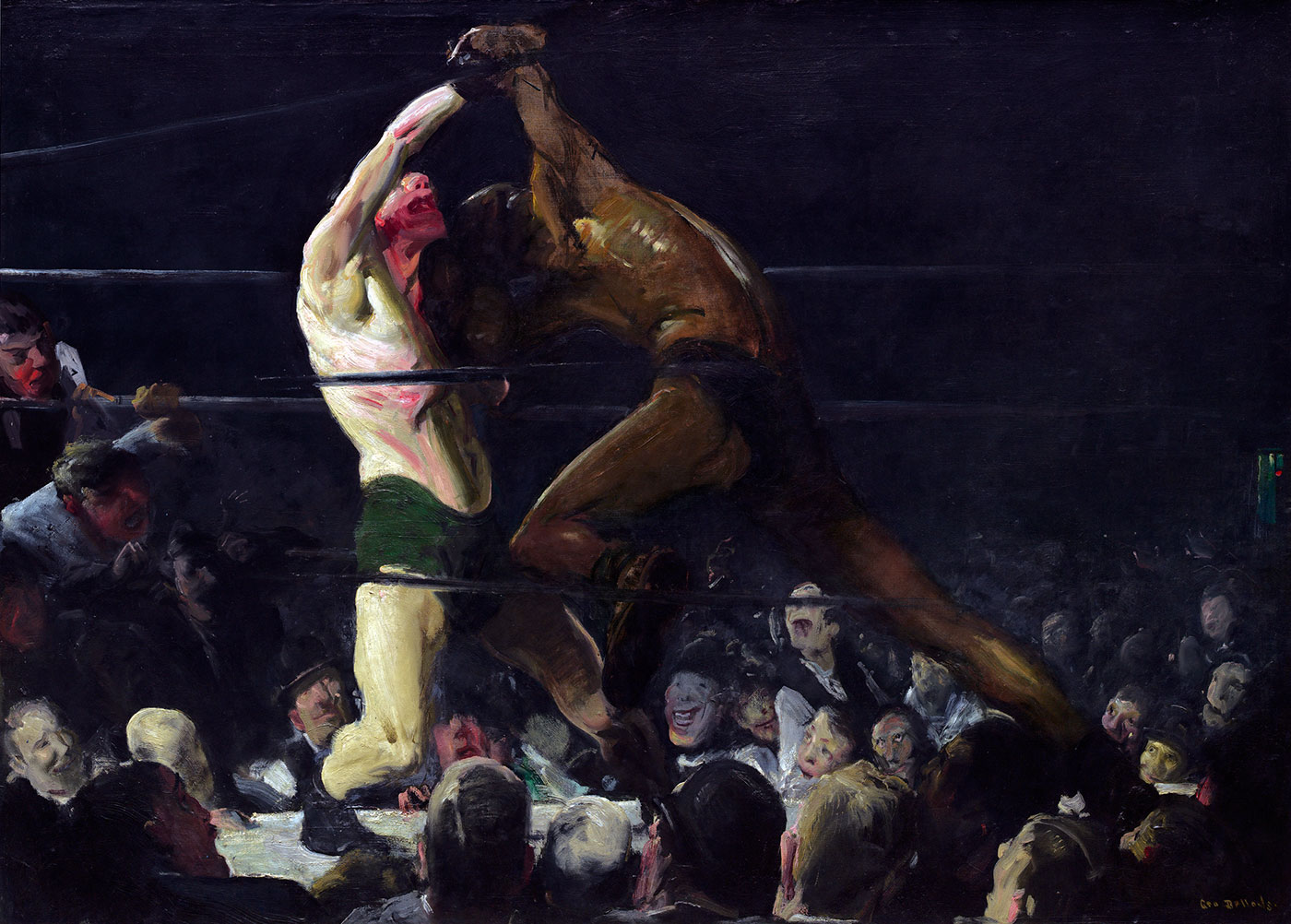


George Bellows (American, 1882-1925) 'Both Members of This Club' 1909


George Bellows (American, 1882-1925)
Both Members of This Club
1909
Oil on canvas
133 x 177.8cm (52 3/8 x 70 in.)
National Gallery of Art, Washington, Chester Dale Collection
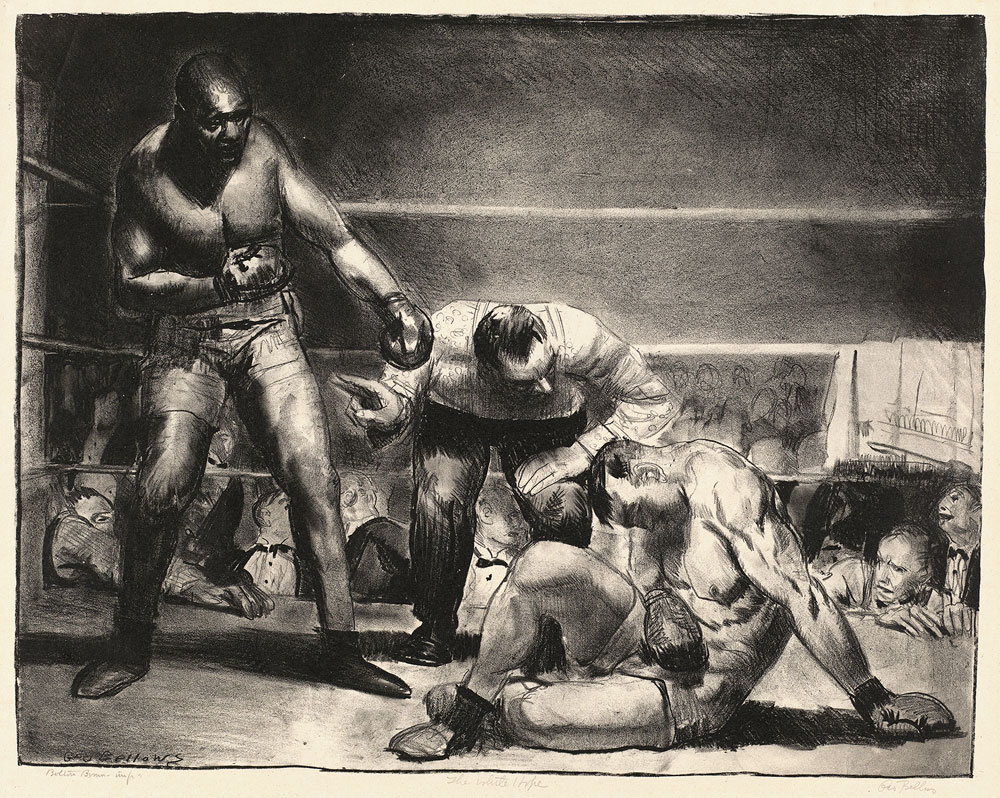
 

George Bellows (American, 1882-1925) 'The White Hope' 1921


George Bellows (American, 1882-1925)
The White Hope
1921
Lithograph
37.4 x 47.6cm (14 3/4 x 18 3/4 in.)
National Gallery of Art, Washington, Andrew W. Mellon Fund
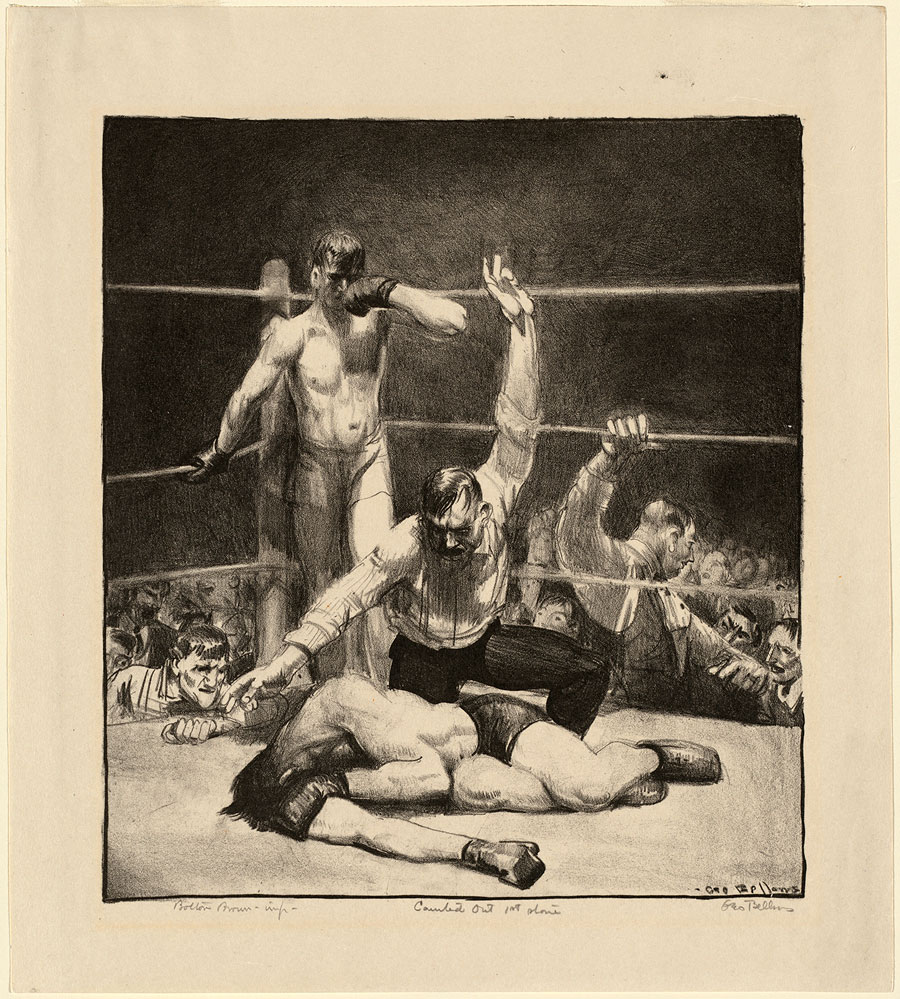
 

George Bellows (American, 1882-1925) 'Counted Out, No.1' 1921


George Bellows (American, 1882-1925)
Counted Out, No.1
1921
Lithograph
31.8 x 28.5cm (12 1/2 x 11 1/4 in.)
National Gallery of Art, Washington, Andrew W. Mellon Fund


George Bellows (American, 1882-1925) 'Dempsey through the Ropes' 1923


George Bellows (American, 1882-1925)
Dempsey through the Ropes
1923
Black crayon
54.61 x 49.85cm (21 1/2 x 19 5/8 in.)
Lent by The Metropolitan Museum of Art, Rogers Fund, 1925
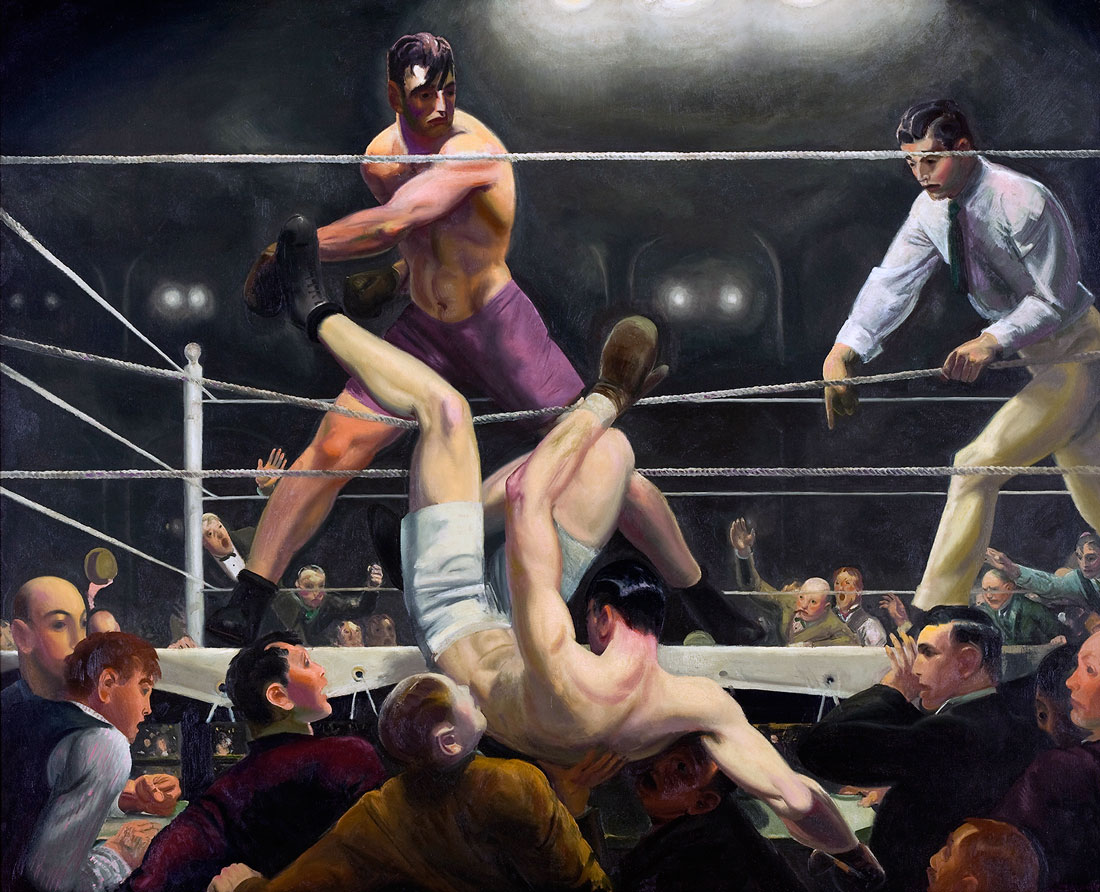
 

George Bellows (American, 1882-1925) 'Dempsey and Firpo' 1924


George Bellows (American, 1882-1925)
Dempsey and Firpo
1924
Oil on canvas
129.5 x 160.7cm (51 x 63 1/4 in.)
Whitney Museum of American Art, New York, Purchase, with funds from Gertrude Vanderbilt Whitney
© Photograph by Sheldan C. Collins


When George Bellows died at the age of forty-two in 1925, he was hailed as one of the greatest artists America had yet produced. In 2012, the National Gallery of Art will present the first comprehensive exhibition of Bellows’ career in more than three decades. Including some 130 paintings, drawings, and lithographs, George Bellows will be on view in Washington from June 10 through October 8, 2012, then travel to The Metropolitan Museum of Art, New York, November 15, 2012, through February 18, 2013, and close at the Royal Academy of Arts, London, March 16 through June 9, 2013. The accompanying catalogue will document and define Bellows’ unique place in the history of American art and in the annals of modernism.

“George Bellows is arguably the most important figure in the generation of artists who negotiated the transition from the Victorian to the modern era in American culture,” said Earl A. Powell III, director, National Gallery of Art. “This exhibition will provide the most complete account of his achievements to date and will introduce Bellows to new generations.”

Works in the exhibition

Mentored by Robert Henri, leader of the Ashcan School in New York in the early part of the 20th century, George Bellows (1882-1925) painted the world around him. He was also an accomplished graphic artist whose illustrations and lithographs addressed a wide array of social, religious, and political subjects. The full range of his remarkable artistic achievement is presented thematically and chronologically throughout nine rooms in the West Building.

The exhibition begins with Bellows’ renowned paintings and drawings of tenement children and New York street scenes. These iconic images of the modern city were made during an extraordinary period of creativity for the artist that began shortly after he left his hometown of Columbus, Ohio, for New York in 1904. Encouraged by Henri, his teacher at the New York School of Art, Bellows sought out contemporary subjects that would challenge prevailing standards of taste, depicting the city’s impoverished immigrant population in River Rats (1906, private collection) and Forty-Two Kids (1907, Corcoran Gallery of Art).

In addition to street scenes, Bellows painted more formal studio portraits of New York’s working poor. These startling, frank subjects – such as Paddy Flannigan (1908, Erving and Joyce Wolf) – reflect the artist’s profound understanding of the realist tradition of portraiture practiced by such masters as Diego Velázquez, Frans Hals, Edouard Manet, and James McNeill Whistler.

Bellows’ early boxing paintings chronicle brutal fights; to circumvent a state ban on public boxing, they were organised by private clubs in New York at that time. In his three acclaimed boxing masterpieces – Club Night (1907, National Gallery of Art), Stag at Sharkey’s (1909, Cleveland Museum of Art), and Both Members of This Club (1909, National Gallery of Art) – Bellows’ energetic, slashing brushwork matched the intensity and action of the fighters. These works will be on view together for the first time since 1982.

The series of four paintings Bellows devoted to the Manhattan excavation site for the Pennsylvania Railroad Station – a massive construction project that entailed razing two city blocks – focuses mainly on the subterranean pit in which workmen toiled. Never before exhibited together, these works range from a scene of the early construction site covered in snow in Pennsylvania Station Excavation (1909, Brooklyn Museum) to a view of the monumental station designed by McKim, Mead, and White coming to life in Blue Morning (1909, National Gallery of Art).

Bellows was fascinated with the full spectrum of life of the working and leisure classes in New York. From dock workers to Easter fashions paraded in the park, he chronicled a variety of subjects and used an array of palettes and painting techniques, from the cool grays and thin strokes of Docks in Winter (1911, private collection) to the jewel-like, encrusted surfaces of Snow-Capped River (1911, Telfair Museum of Art). While Bellows portrayed the bustling downtown commercial district of Manhattan in his encyclopaedic overview New York (1911, National Gallery of Art), he more often depicted the edges of the city near the shorelines of the Hudson and East Rivers in works such as The Lone Tenement (1909, National Gallery of Art) and Blue Snow, The Battery (1910, Columbus Museum of Art).

The artist visited Monhegan Island off the coast of Maine for the first time in 1911 and returned to Maine every summer from 1913 to 1916. In 1913 alone he created more than 100 outdoor studies. His seascapes account for half his entire output as a painter, with the majority done after the 1913 Armory Show. Shore House (1911, private collection) and The Big Dory (1913, New Britain Museum of American Art) are among Bellows’ most important seascapes and pay homage to his great American predecessor, Winslow Homer (1836-1910).

In 1912 Bellows started working more consistently as an illustrator for popular periodicals such as Collier’s and Harper’s Weekly, and in 1913 for the socialist magazine The Masses. These illustration assignments led him to record new aspects of American life ranging from sporting events to religious revival meetings, as seen in The Football Game (1912, Hirshhorn Museum and Sculpture Garden) and Preaching (Billy Sunday) (1915, Boston Public Library). Along with Bellows’ more affordable and widely available lithographs (he installed a printing press in his studio in 1916), the published illustrations broadened the audience for his work.

Bellows supported the United States’ entry into World War I, resulting in an outpouring of paintings, lithographs, and drawings in 1918. For this extensive series, he relied on the published accounts of German atrocities in Belgium found in the 1915 Bryce Committee Report commissioned by the British government. The paintings evoke the tradition of grand public history paintings, as seen in Massacre at Dinant (1918, Greenville County Museum of Art), while the drawings and lithographs recall Francisco de Goya’s 18th-century print series The Disasters of War.

Bellows’ late works on paper survey modern American life, from the prisons of Georgia to the tennis courts of Newport, and highlight complex relationships between his various media. Taken from direct experience as well as fictional accounts, they range in tone from lightly satirical and humorous (Business-Men’s Bath, 1923, Boston Public Library) to profoundly disturbing and tragic (The Law Is Too Slow, 1922-1923, Boston Public Library).

In Emma at the Piano (1914, Chrysler Museum of Art), Bellows depicts his wife and lifelong artistic muse. His portraits of women constitute a larger body of work than his more famous boxing paintings. They cover all stages of life and include both the naive, youthful Madeline Davis (1914, Lowell and Sandra Mintz) and the more refined, matronly Mrs. T in Wine Silk (1919, Cedarhurst Center for the Arts).

The show will end with paintings in a variety of styles made in 1924, the year before the artist’s sudden death from appendicitis. Painted in Bellows’ studio in rural Woodstock, New York, these last works, including Dempsey and Firpo (1924, Whitney Museum of American Art), Mr. and Mrs. Philip Wase (1924, Smithsonian American Art Museum), and The White Horse (1922, Worcester Art Museum), will prompt visitors to contemplate the artist Bellows might have become had he lived into the 1960s, as did his friend and contemporary Edward Hopper (1882-1967).

Press release from the National Gallery of Art website
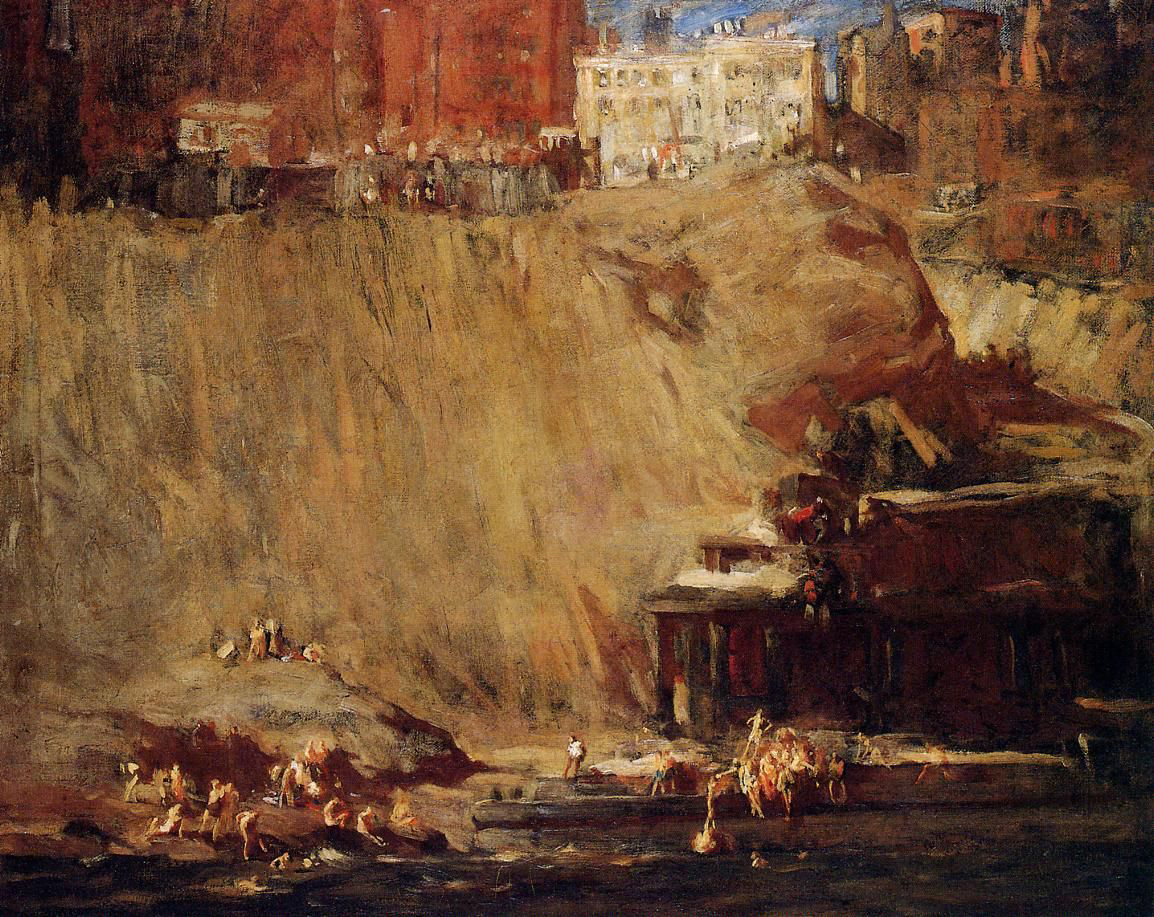
 

George Bellows (American, 1882-1925) 'River Rats' 1906


George Bellows (American, 1882-1925)
River Rats
1906
Oil on canvas
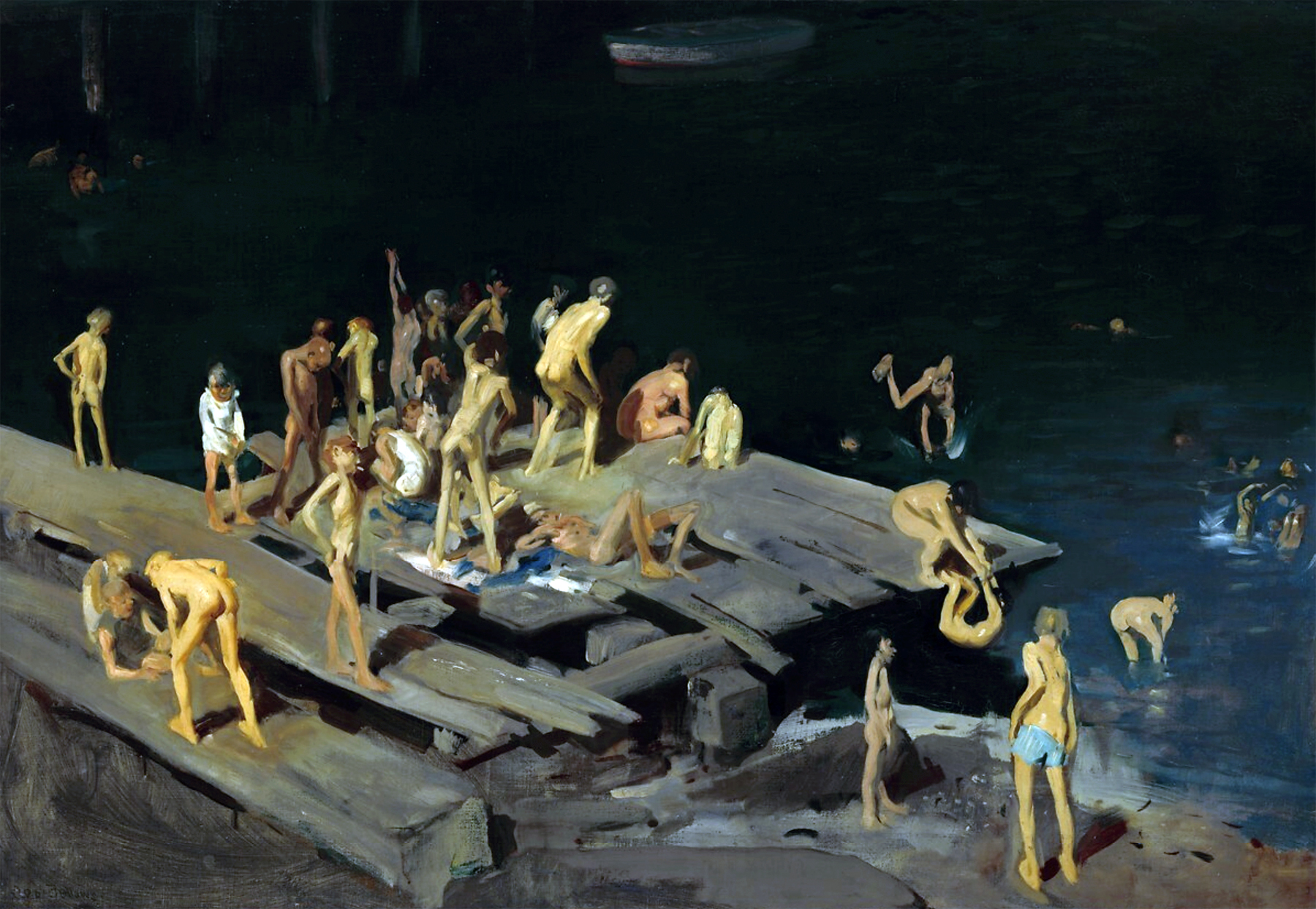
 

George Bellows (American, 1882-1925) 'Forty-two Kids' 1907


George Bellows (American, 1882-1925)
Forty-two Kids
1907
Oil on canvas
106.7 × 153cm (42 × 60 1/4 in.)
Corcoran Collection (Museum Purchase, William A. Clark Fund)
National Gallery of Arts, Washington
Open access
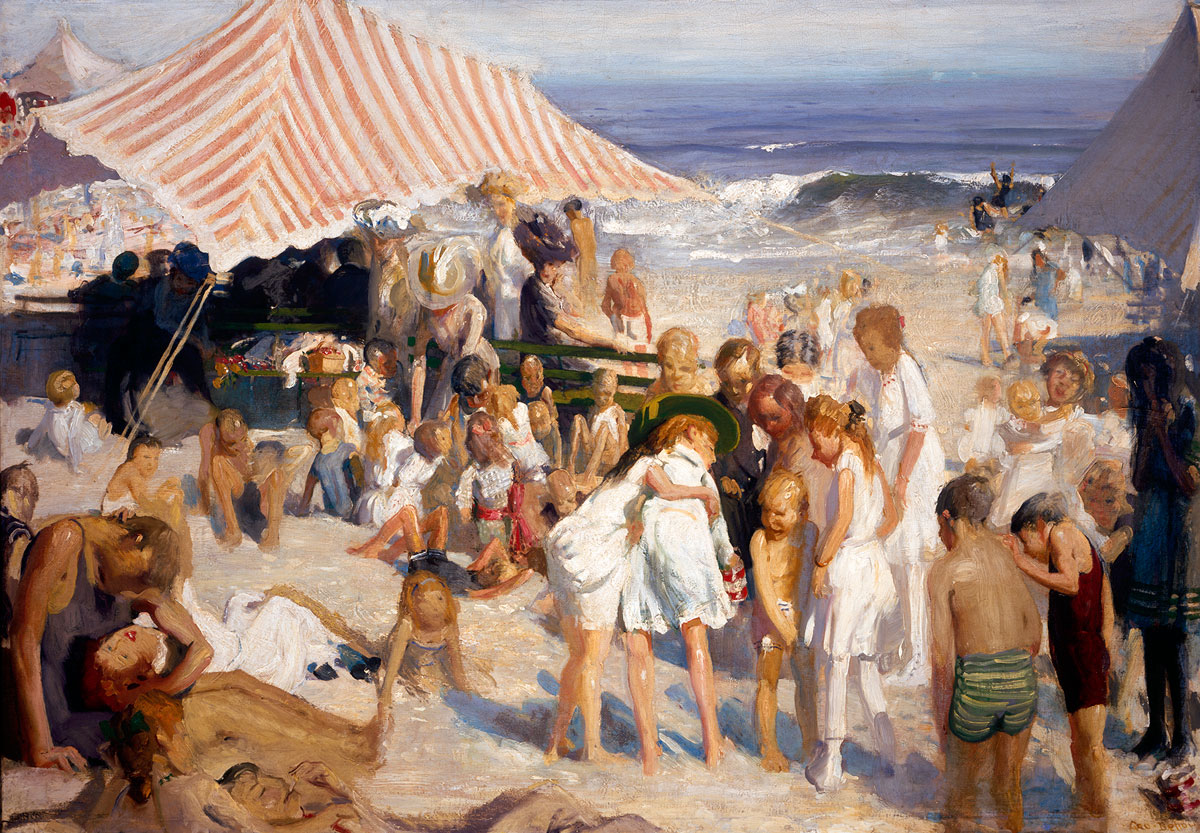
 

George Bellows (American, 1882-1925) 'Beach at Coney Island' 1908


George Bellows (American, 1882-1925)
Beach at Coney Island
1908
Oil on canvas
106.7 x 152.4cm (42 x 60 in.)
Private collection
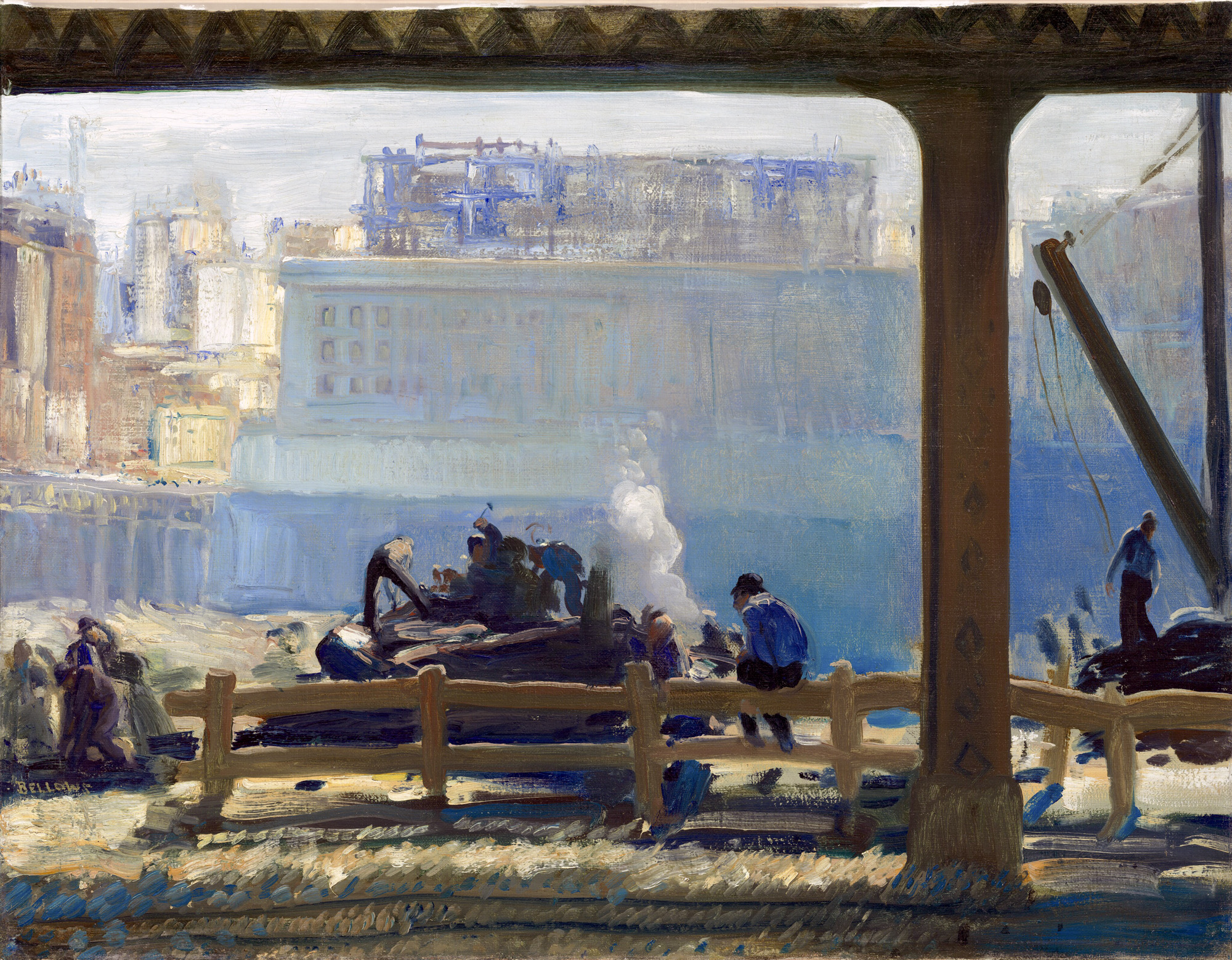
 

George Bellows (American, 1882-1925) 'Blue Morning' 1909


George Bellows (American, 1882-1925)
Blue Morning
1909
Oil on canvas
86.3cm (33.9 in) x 111.7cm (43.9 in)
National Gallery of Art
Chester Dale Collection
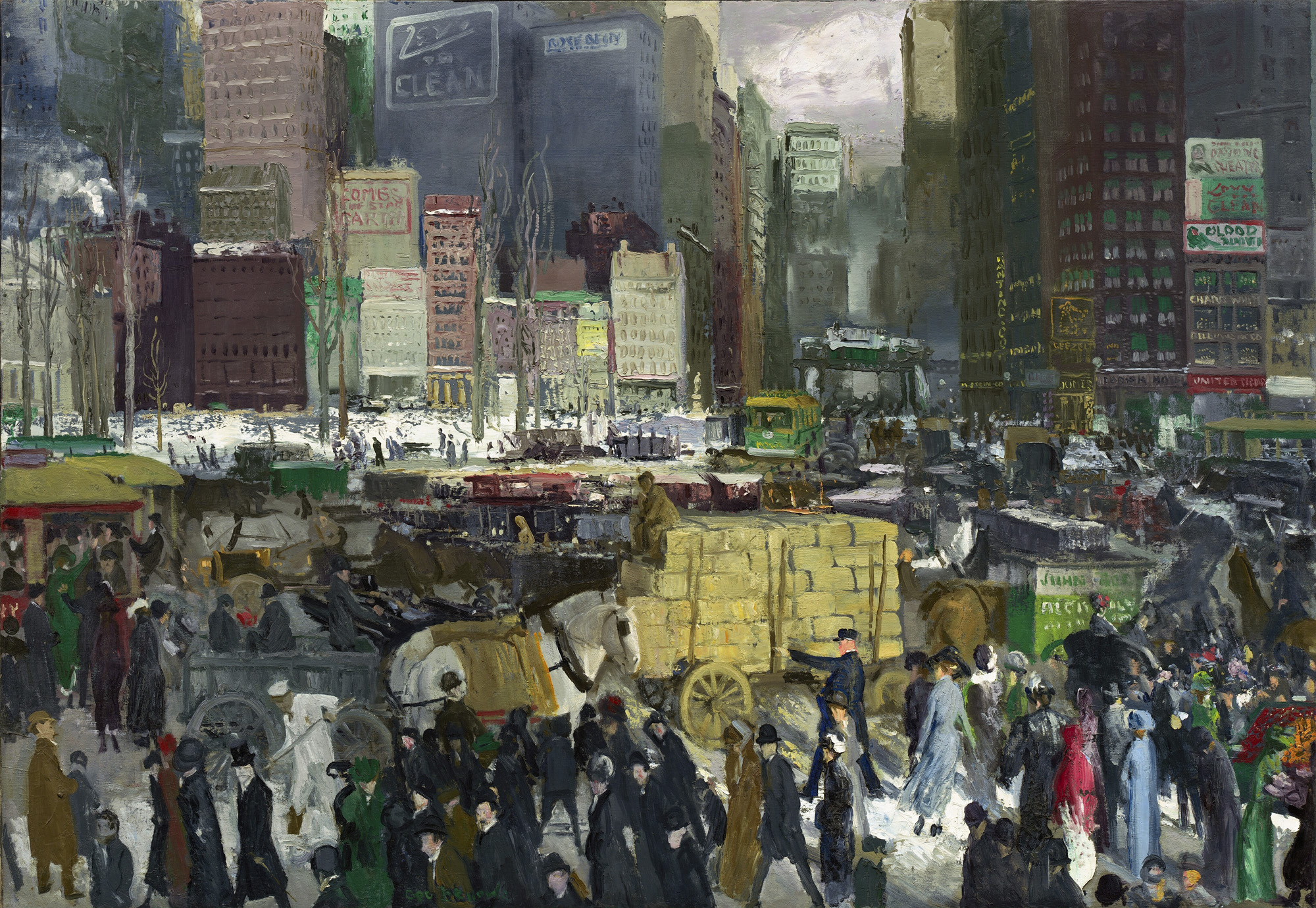
 

George Bellows (American, 1882-1925) 'New York' 1911


George Bellows (American, 1882-1925)
New York
1911
Oil on canvas
106.7 x 152.4cm (42 x 60 in.)
National Gallery of Art
Collection of Mr. and Mrs. Paul Mellon
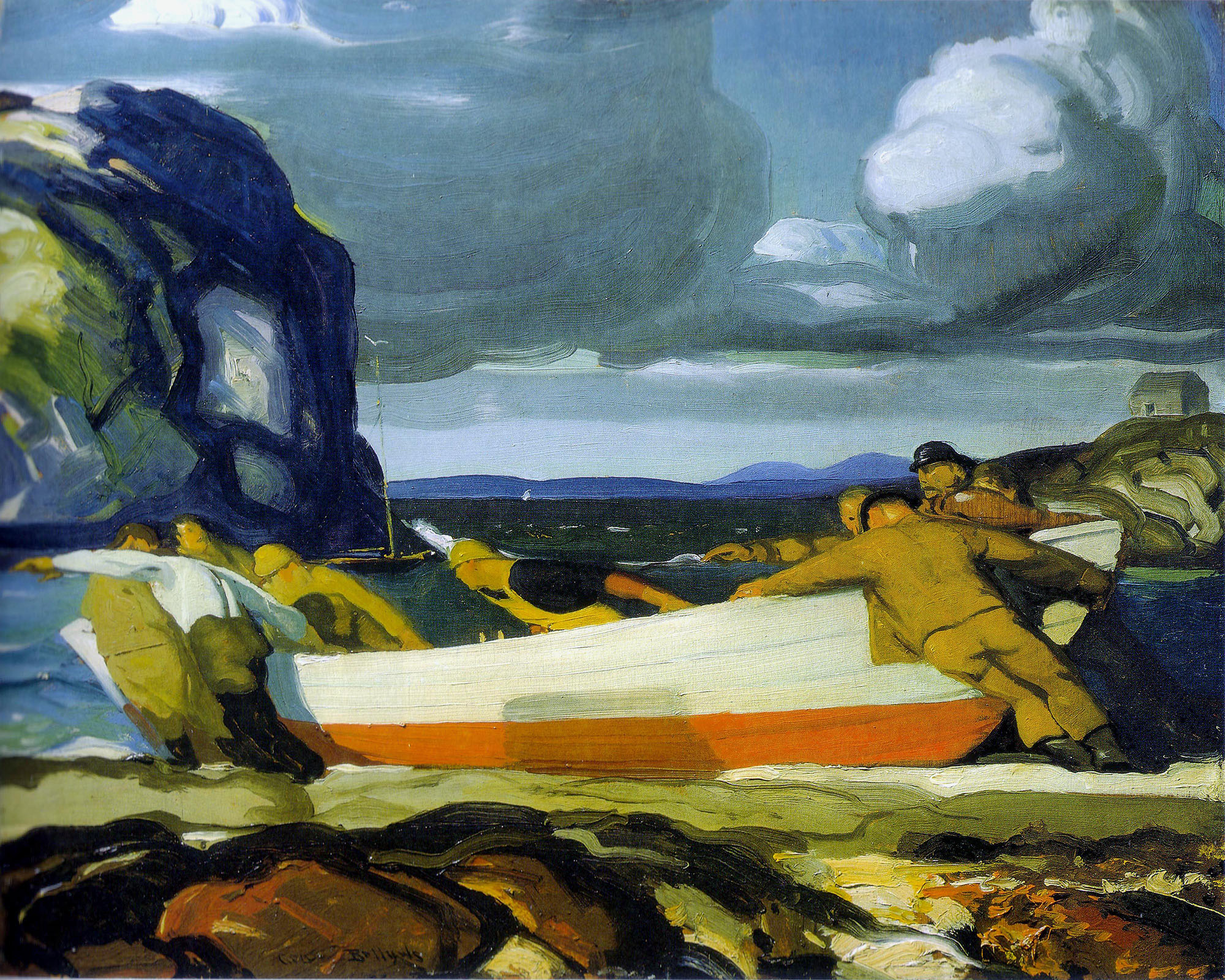
 

George Bellows (American, 1882-1925) 'The Big Dory' 1913


George Bellows (American, 1882-1925)
The Big Dory
1913
Oil on panel
18 in (45.7cm) x 22 in (55.8cm)
New Britain Museum of American Art
Harriet Russell Stanley Fund


George Bellows (American, 1882-1925) 'Riverfront, No. 1' 1914


George Bellows (American, 1882-1925)
Riverfront, No. 1
1914
Oil on canvas
115.3 x 160.3cm (45 3/8 x 63 1/8 in.)
Columbus Museum of Art, Museum Purchase, Howald Fund
Public domain
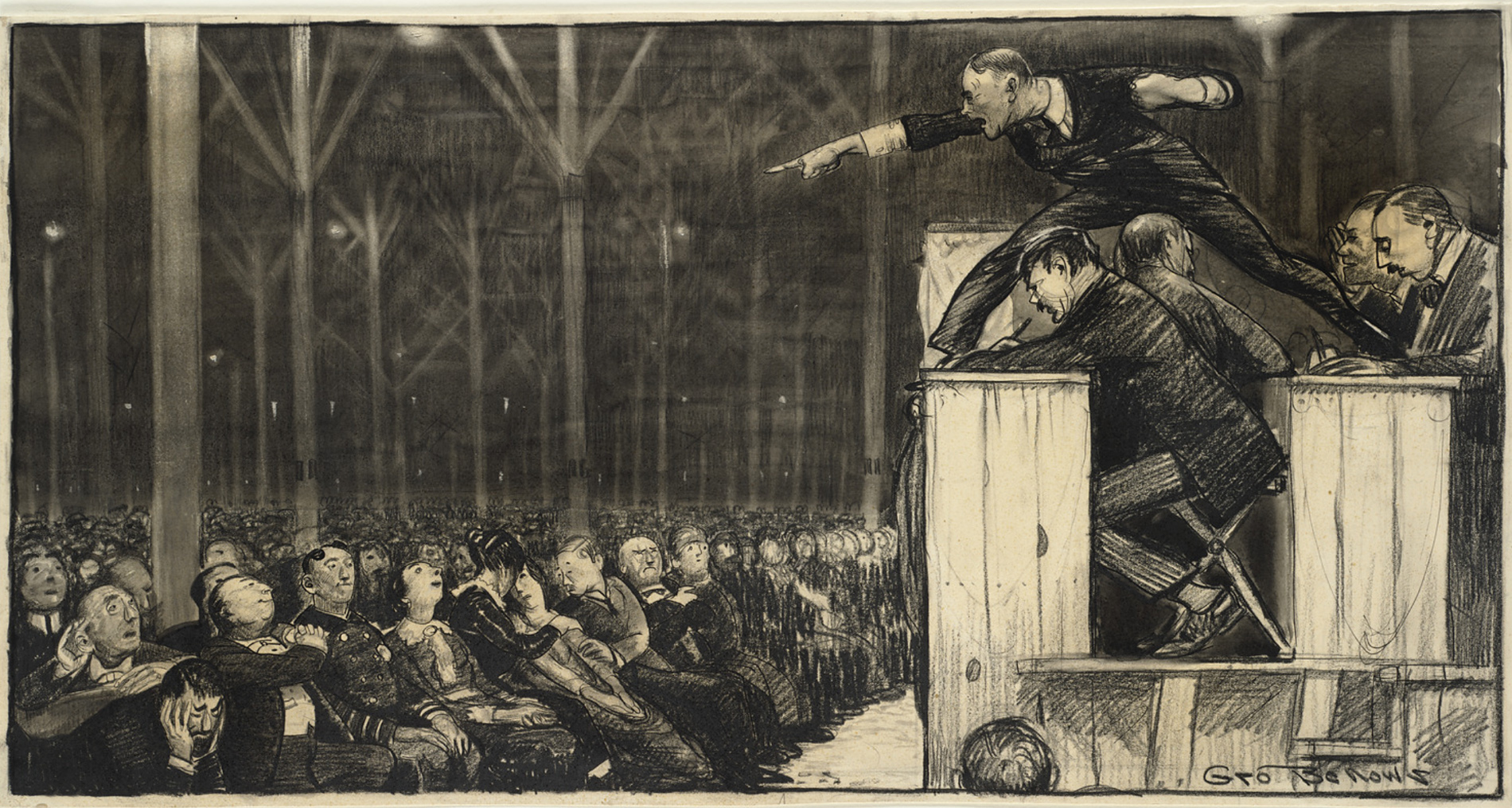
 

George Bellows (American, 1882-1925) 'Preaching (Billy Sunday)' c. 1915-1923


George Bellows (American, 1882-1925)
Preaching (Billy Sunday)
c. 1915-1923
Crayon, ink, and wash on paper
Boston Public Library
Public domain


“I like to paint Billy Sunday, not because I like him, but because I want to show the world what I do think of him. Do you know, I believe Billy Sunday is the worst thing that ever happened to America? He is Prussianism personified. His whole purpose is to force authority against beauty. He is against freedom, he wants a religious autocracy, he is such a reactionary that he makes me an anarchist.” – GB, in “Touchstone,” p. 270. The artist’s intent to satirise Billy Sunday was evident to almost everyone but the evangelist himself. An earlier depiction of Billy Sunday in action is seen in “The Sawdust Trail” (M. 48) done in 1916 (below). (Mason)

Text from the Digital Commonwealth website


George Bellows (American, 1882-1925) 'The Saw Dust Trail' 1916


George Bellows (American, 1882-1925)
The Saw Dust Trail
1916
Oil on canvas
Milwaukee Art Museum, Layton Art Collection


The catalog quotes Bellows: “I paint Billy Sunday… to show the world what I do think of him. Do you know, I think Billy Sunday is the worst thing that ever happened to America? He is death to imagination, to spirituality, to art.”
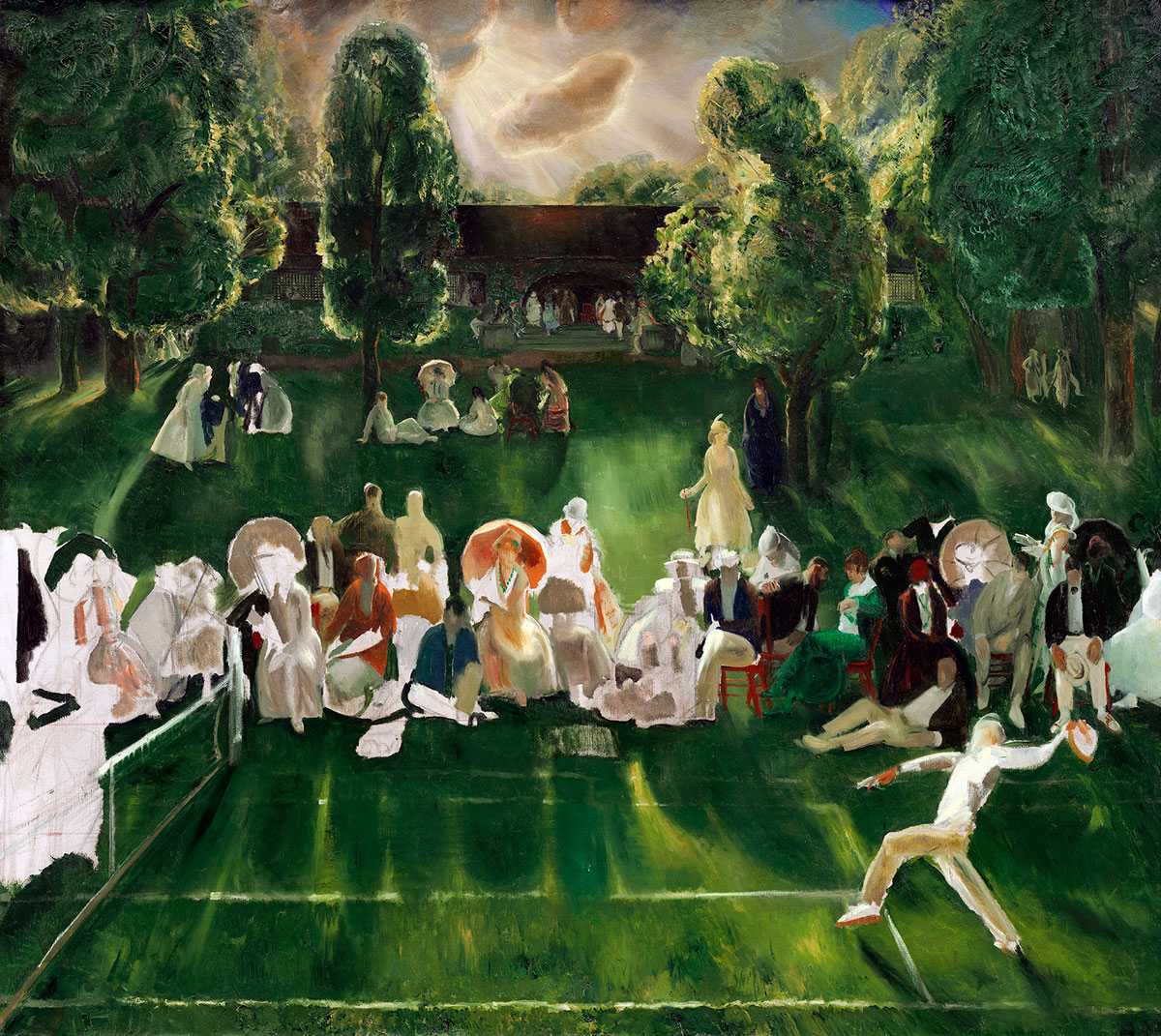
 

George Bellows (American, 1882-1925) 'Tennis at Newport' 1920


George Bellows (American, 1882-1925)
Tennis at Newport
1920
Oil on canvas
109.2 x 137.2cm (43 x 54 in.)
James W. and Frances G. McGlothlin
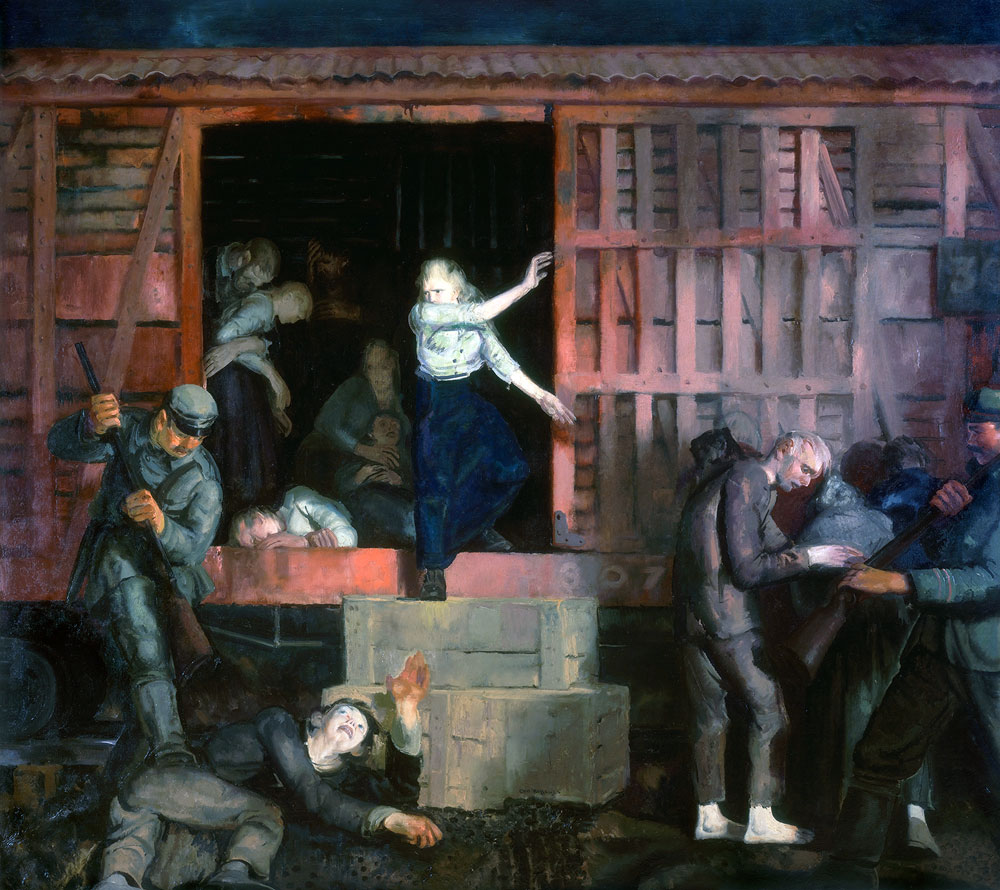
 

George Bellows (American, 1882-1925) 'Return of the Useless' 1918


George Bellows (American, 1882-1925)
Return of the Useless
1918
Oil on canvas
149.9 x 167.6cm (59 x 66 in.)
Courtesy Crystal Bridges Museum of American Art, Bentonville


George Bellows (American, 1882-1925) 'The Barricade' 1918


George Bellows (American, 1882-1925)
The Barricade
1918
oil on canvas
124.8 x 211.5cm (49 1/8 x 83 1/4 in.)
Birmingham Museum of Art, Museum purchase with funds provided by the Harold and Regina Simon Fund, the Friends of American Art, Margaret Gresham Livingston, and Crawford L. Taylor, Jr.


George Bellows

American, 1882-1925

Throughout his childhood in Columbus, Ohio, George Bellows divided much of his time between sports and art. While attending Ohio State University, he created illustrations for the school yearbook and played varsity baseball and basketball. After college Bellows rejected an offer for a professional athletic career with the Cincinnati Reds baseball team, instead pursuing a career as an artist.

In opposition to his father’s wishes, Bellows enrolled in the New York School of Art in 1904. There Bellows elected to study not with the popular and flamboyant William Merritt Chase, but rather with the unorthodox realist Robert Henri. Henri led a radical group of artists, including John Sloan and William Glackens, who exhibited under the name “The Eight.” Although Bellows was elected to the National Academy of Design, he rejected the superficial portrayal of everyday life promoted by the academies. Instead he and his colleagues emphasised the existing social conditions of the early twentieth century, especially in New York. Because their subjects were considered crude and at times even vulgar, critics dubbed them the Ashcan school. Bellows never became an official member of The Eight, but his choice of subjects – docks, street scenes, and prizefights – were typical of the group. Unlike the members of The Eight, Bellows’ enjoyed popular success during his lifetime, particularly with the boxing images that demonstrate his passionate interest in sports and a bold understanding of the human figure.


George Bellows (American, 1882-1925) 'Pennsylvania Station Excavation' 1909


George Bellows (American, 1882-1925)
Pennsylvania Station Excavation
1909
Oil on canvas
79.38 x 97.16cm (31 1/4 x 38 1/4 in.)
Brooklyn Museum, A. Augustus Healy Fund
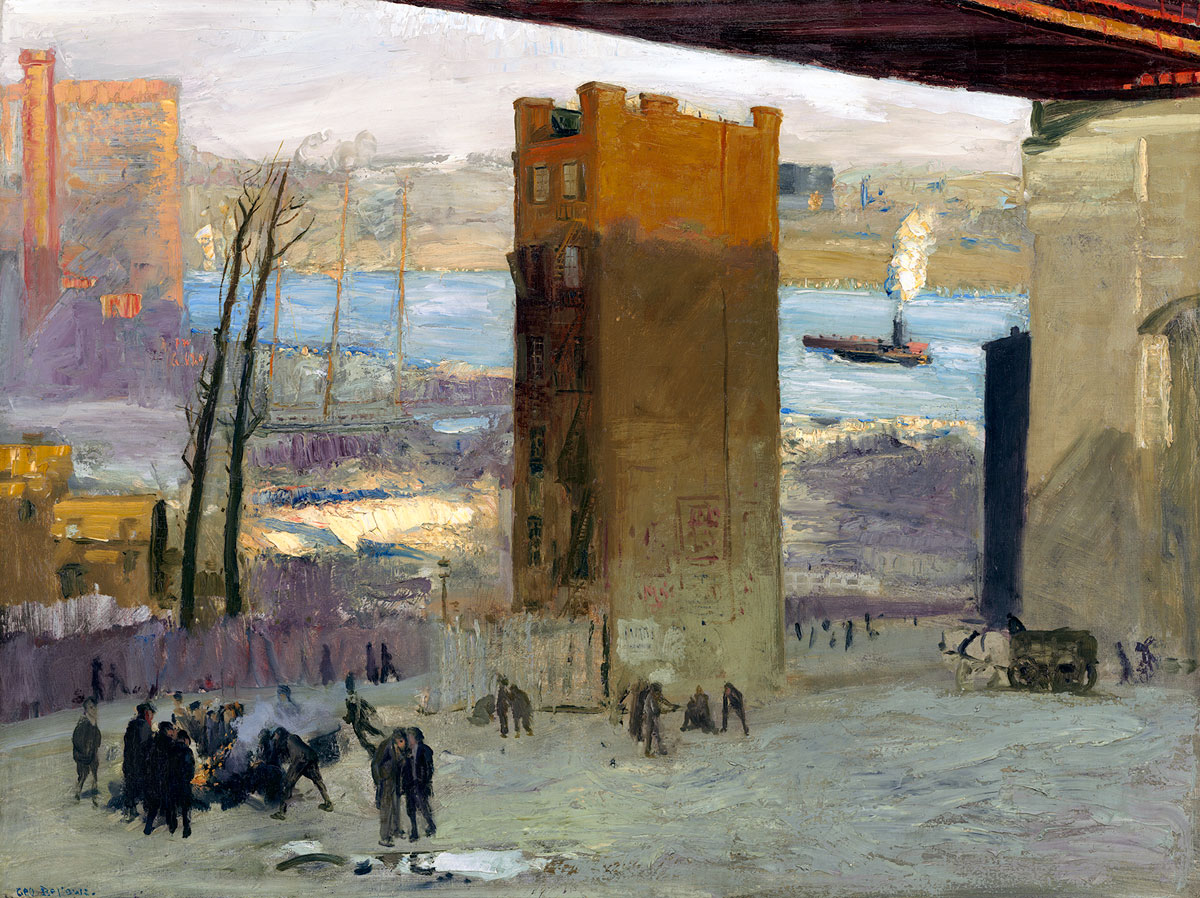
 

George Bellows (American, 1882-1925) 'The Lone Tenement' 1909


George Bellows (American, 1882-1925)
The Lone Tenement
1909
Oil on canvas
123.2 x 153.4 x 12.7cm (48 1/2 x 60 3/8 x 5 in.)
National Gallery of Art, Washington, Chester Dale Collection
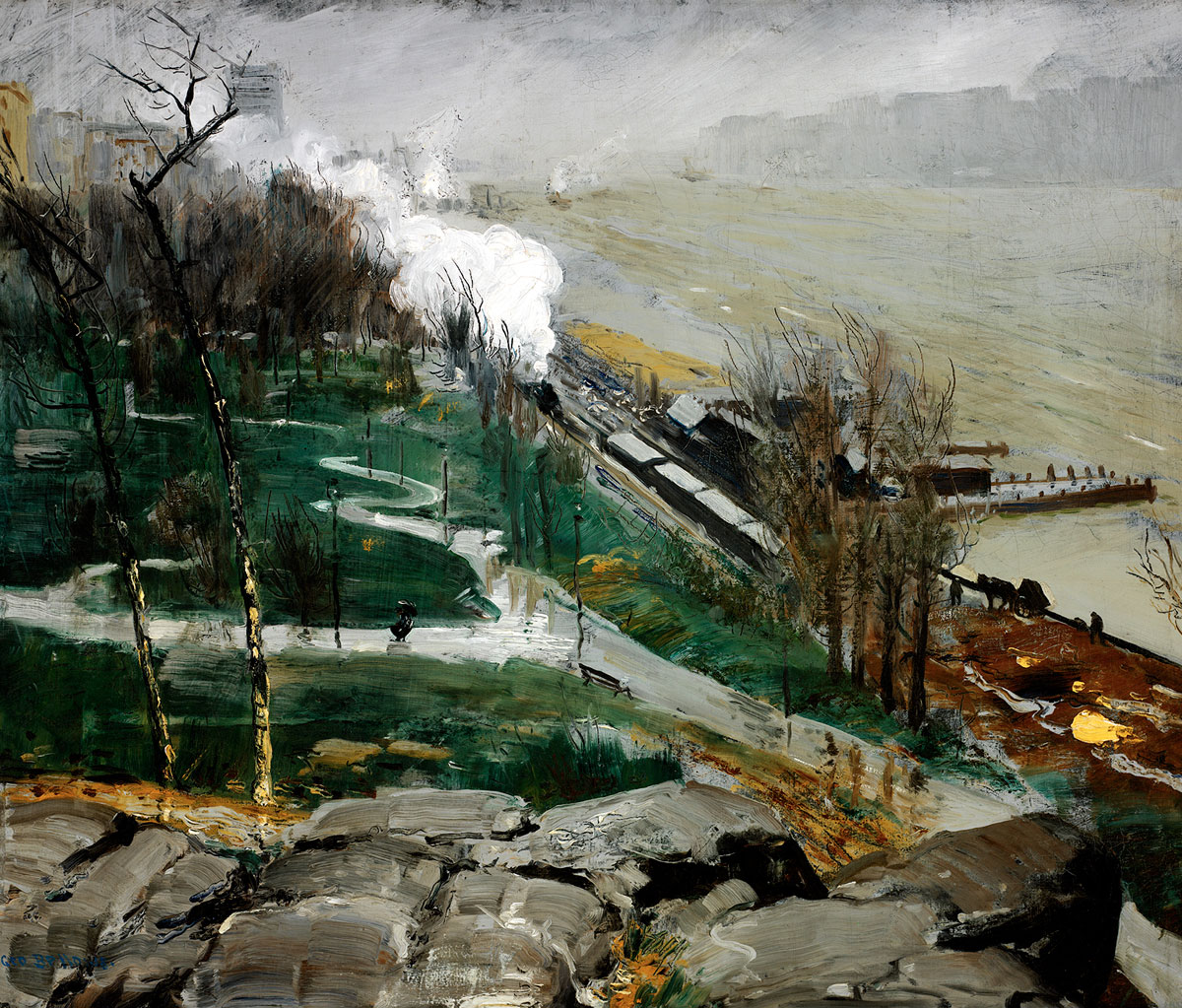
 

George Bellows (American, 1882-1925) 'Rain on the River' 1908


George Bellows (American, 1882-1925)
Rain on the River
1908
Oil on canvas
81.3 x 96.5cm (32 x 38 in.)
Museum of Art, Rhode Island School of Design, Providence, Jesse Metcalf Fund
© Photography by Erik Gould, courtesy of the Museum of Art, Rhode Island School of Design, Providence
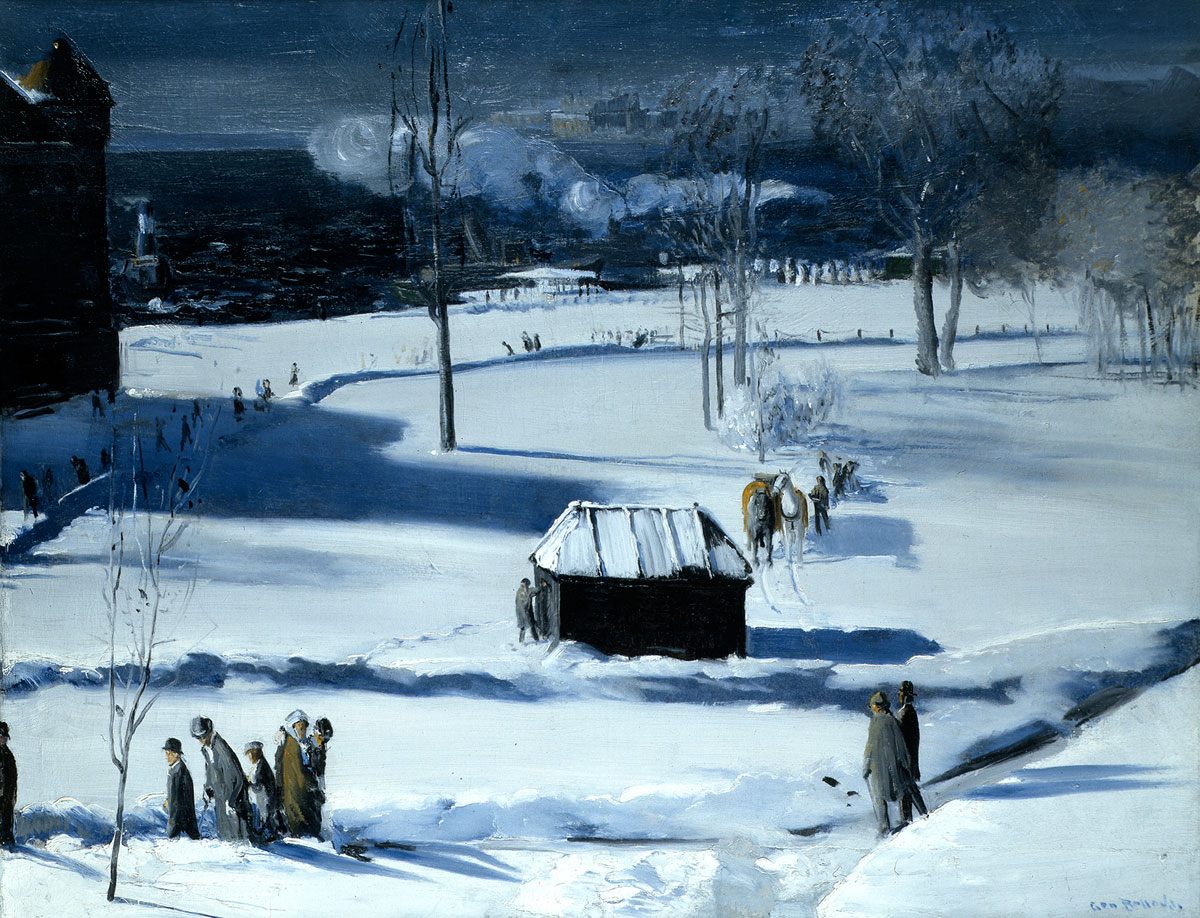
 

George Bellows (American, 1882-1925) 'Blue Snow, The Battery' 1910


George Bellows (American, 1882-1925)
Blue Snow, The Battery
1910
Oil on canvas
86.4 x 111.8cm (34 x 44 in.)
Columbus Museum of Art, Museum Purchase, Howald Fund


George Bellows (American, 1882-1925) 'Shore House' 1911


George Bellows (American, 1882-1925)
Shore House
1911
Oil on canvas
101.6 x 106.7cm (40 x 42 in.)
Private collection
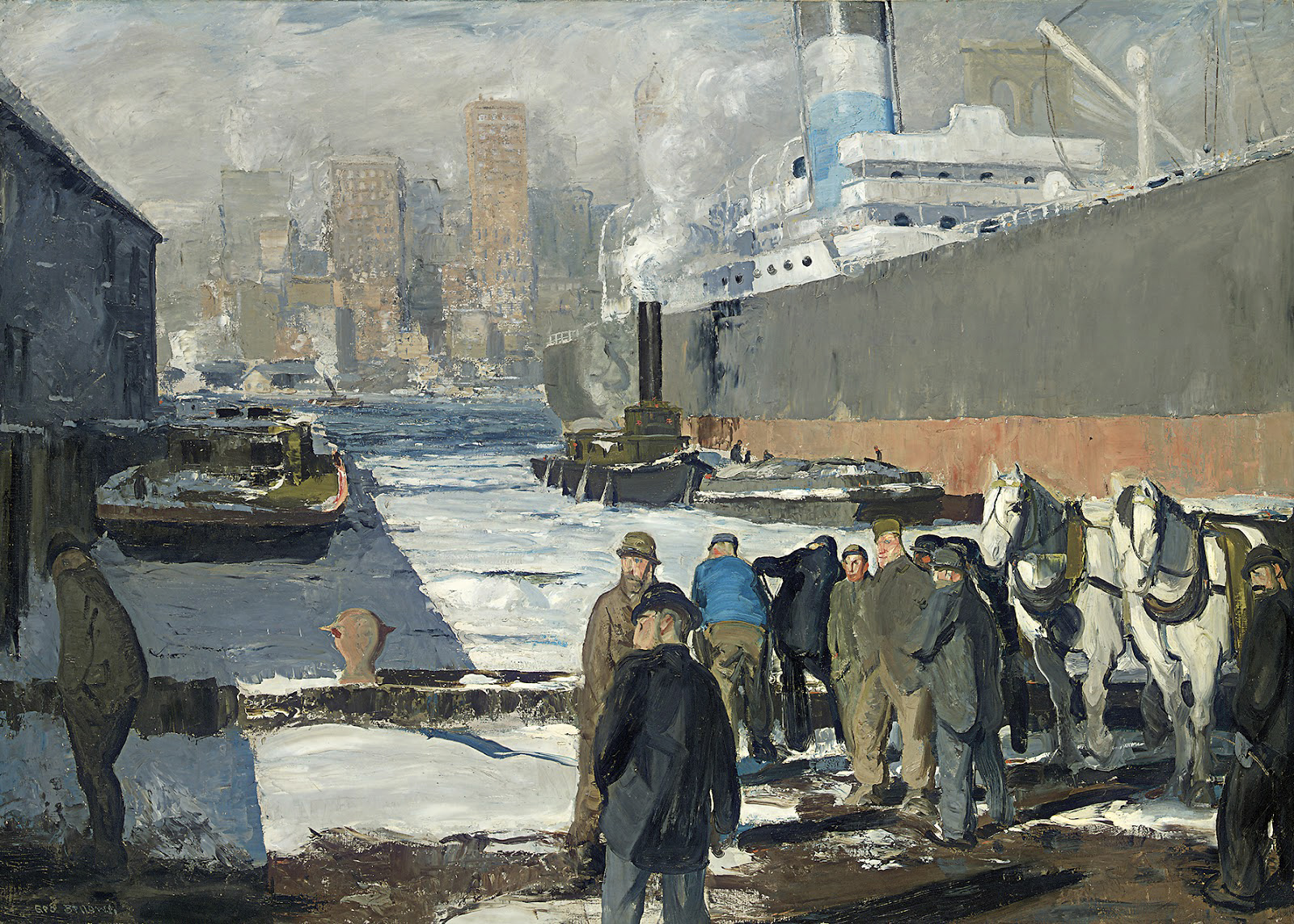
 

George Bellows (American, 1882-1925) 'Men of the Docks' 1912


George Bellows (American, 1882-1925)
Men of the Docks
1912
Oil on canvas
Randolph College, founded as Randolph-Macon Women’s College, 1891, Lynchburg
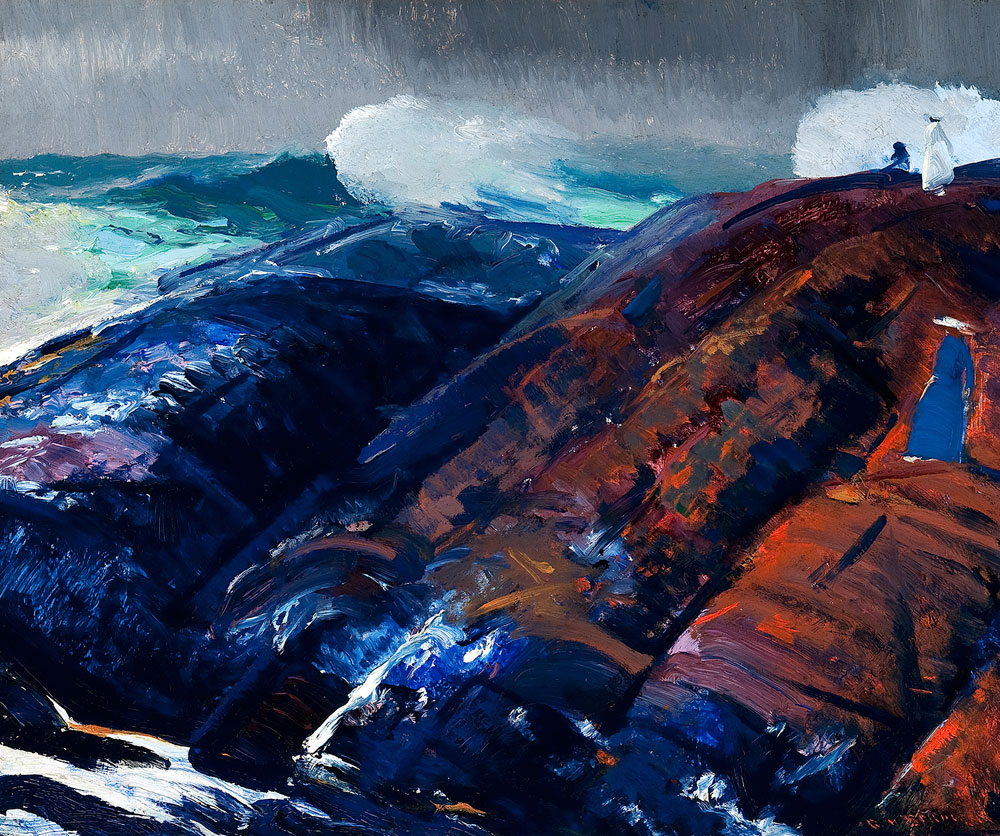
 

George Bellows (American, 1882-1925) 'Summer Surf' 1914


George Bellows (American, 1882-1925)
Summer Surf
1914
Oil on board
62.6 x 72.7 x 4.8cm (24 5/8 x 28 5/8 x 1 7/8 in.)
Delaware Art Museum, Wilmington
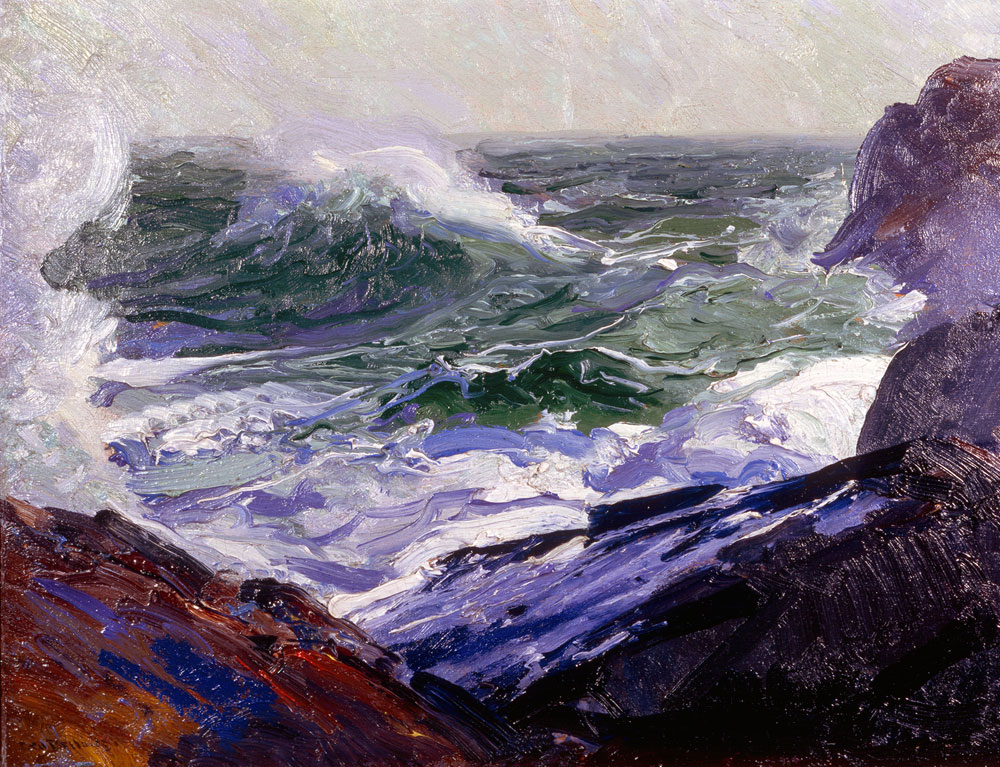
 

George Bellows (American, 1882-1925) 'Forth and Back' 1913


George Bellows (American, 1882-1925)
Forth and Back
1913
Oil on panel
38.1 x 49.5cm (15 x 19 1/2 in.)
Private collection
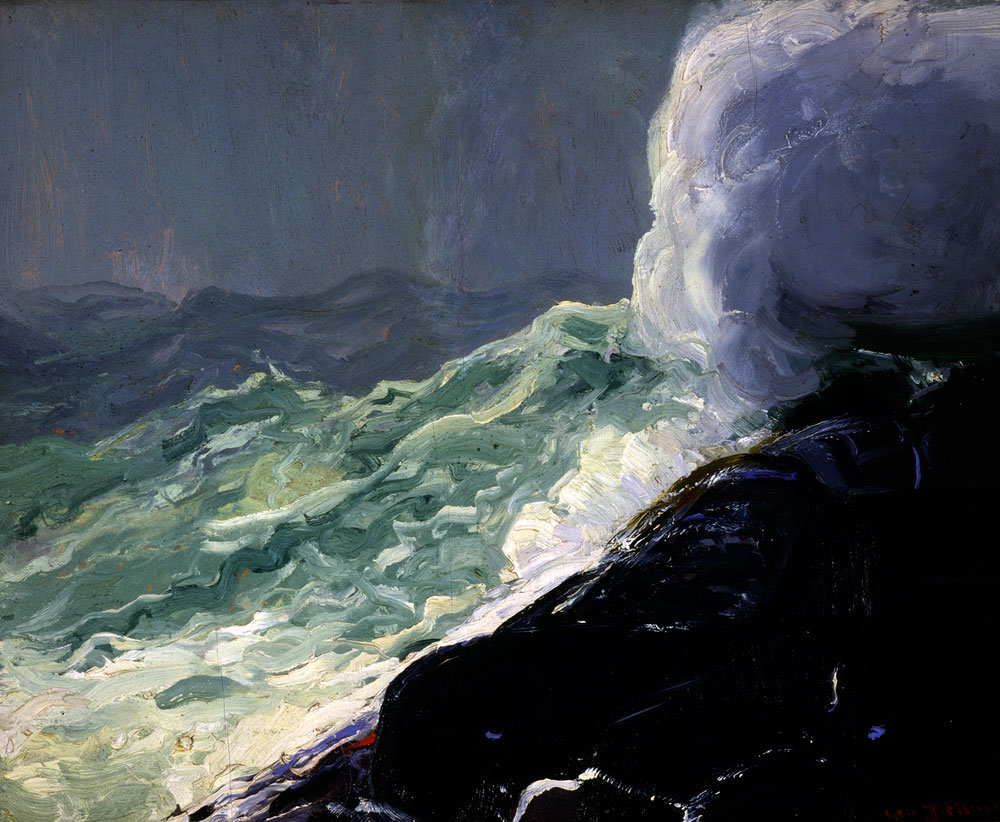
 

George Bellows (American, 1882-1925) 'Churn and Break' 1913


George Bellows (American, 1882-1925)
Churn and Break
1913
Oil on panel
45.7 x 55.9cm (18 x 22 in.)
Columbus Museum of Art, Gift of Mrs. Edward Powell
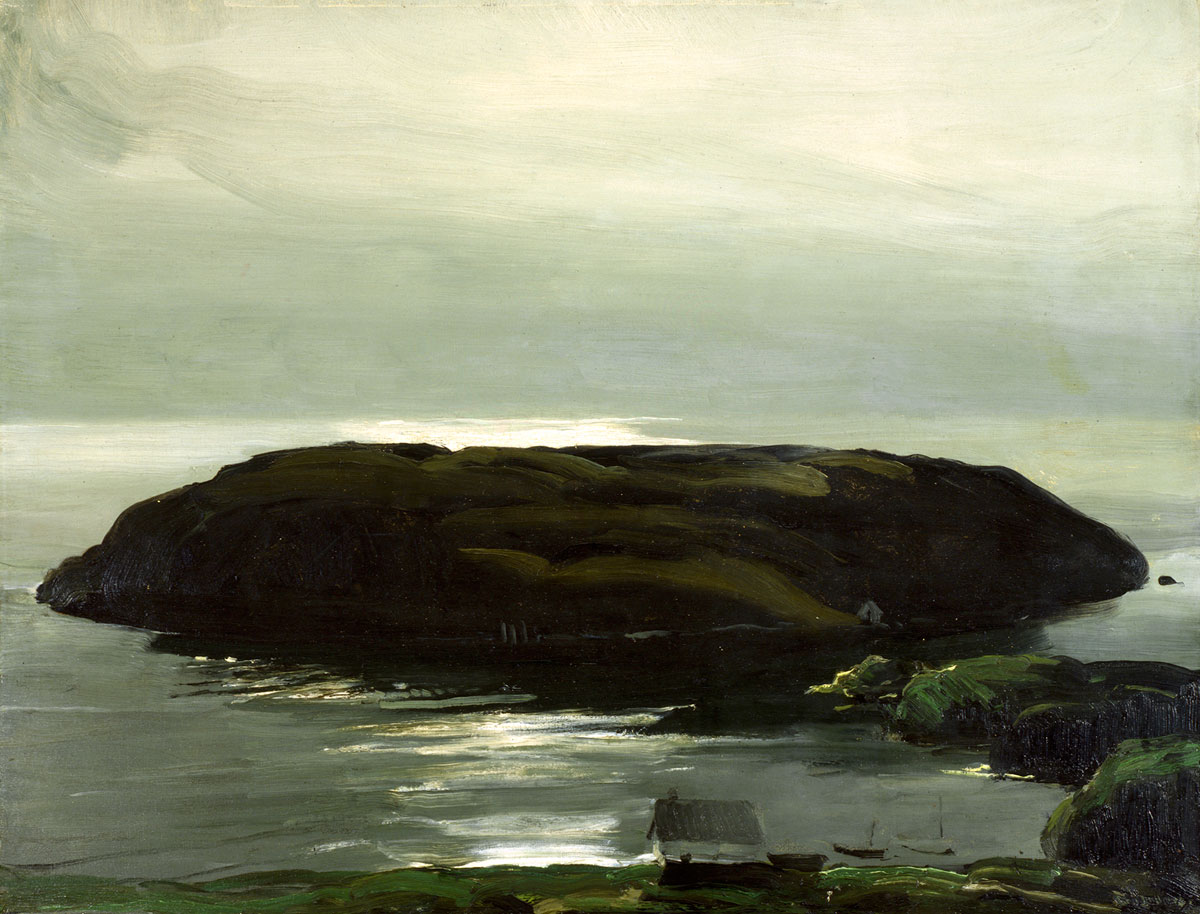
 

George Bellows (American, 1882-1925) 'An Island in the Sea' 1911


George Bellows (American, 1882-1925)
An Island in the Sea
1911
Oil on canvas
87 x 112.7cm (34 1/4 x 44 3/8 in.)
Columbus Museum of Art, Museum Purchase, Howald Fund


George Bellows (American, 1882-1925) 'Emma in the Purple Dress' 1919


George Bellows (American, 1882-1925)
Emma in the Purple Dress
1919
Oil on panel
128.27 x 107.95 x 8.89cm (50 1/2 x 42 1/2 x 3 1/2 in.)
Los Angeles County Museum of Art, Gift of Raymond J. and Margaret Horowitz
© Digital Image (C) 2009 Museum Associates / LACMA / Art Resource, NY


George Bellows (American, 1882-1925) 'Emma in the Black Print' 1919


George Bellows (American, 1882-1925)
Emma in the Black Print
1919
Oil on canvas
101.9 x 81.9cm (40 1/8 x 32 1/4 in.)
Museum of Fine Arts, Boston, Bequest of John T. Spaulding
© Photograph 2012 Museum of Fine Arts, Boston
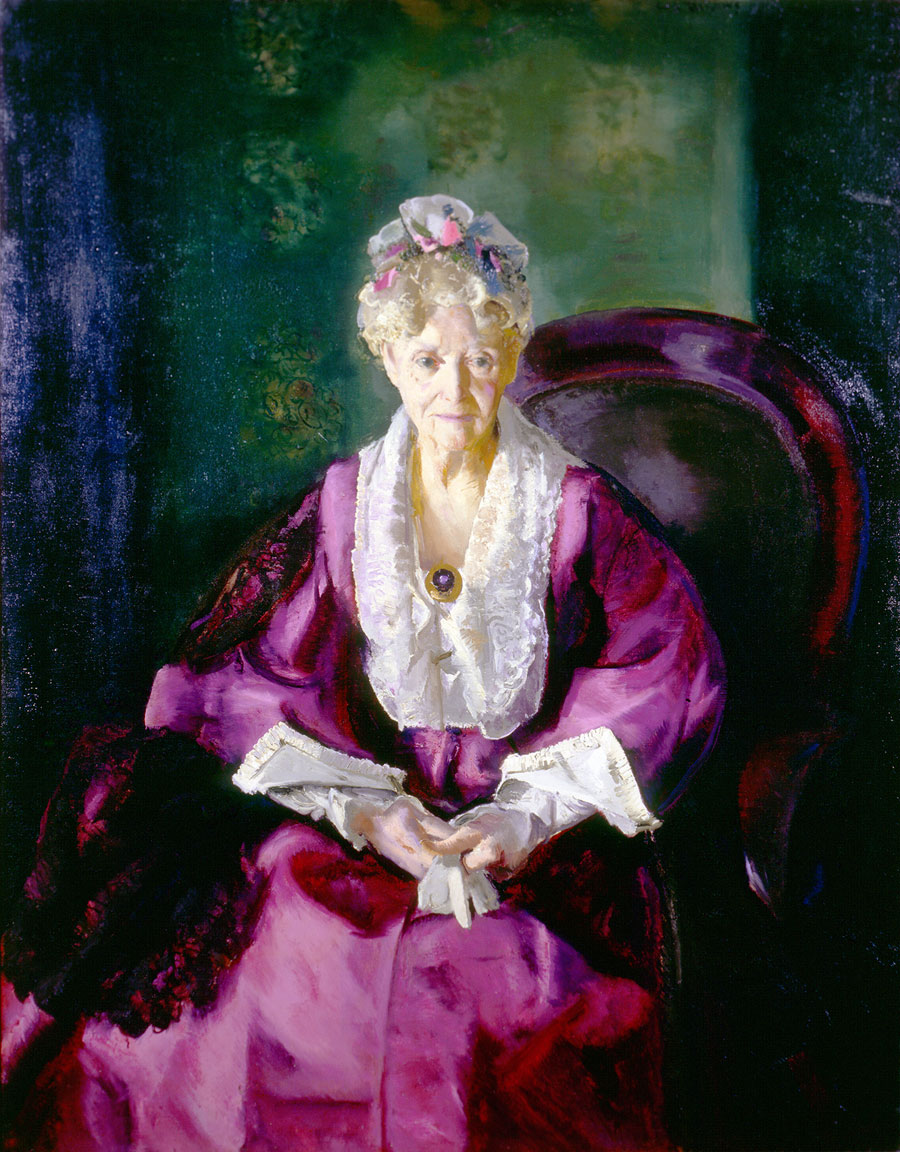
 

George Bellows (American, 1882-1925) 'Mrs. T in Wine Silk' 1919


George Bellows (American, 1882-1925)
Mrs. T in Wine Silk
1919
Oil on canvas
121.9 x 96.5cm (48 x 38 in.)
Cedarhurst Center for the Arts, Mt. Vernon, Gift of John R. and Eleanor R. Mitchell, 1973


George Bellows (American, 1882-1925) 'Margarite' 1919


George Bellows (American, 1882-1925)
Margarite
1919
Oil on panel
81.28 x 66.04cm (32 x 26 in.)
Private collection
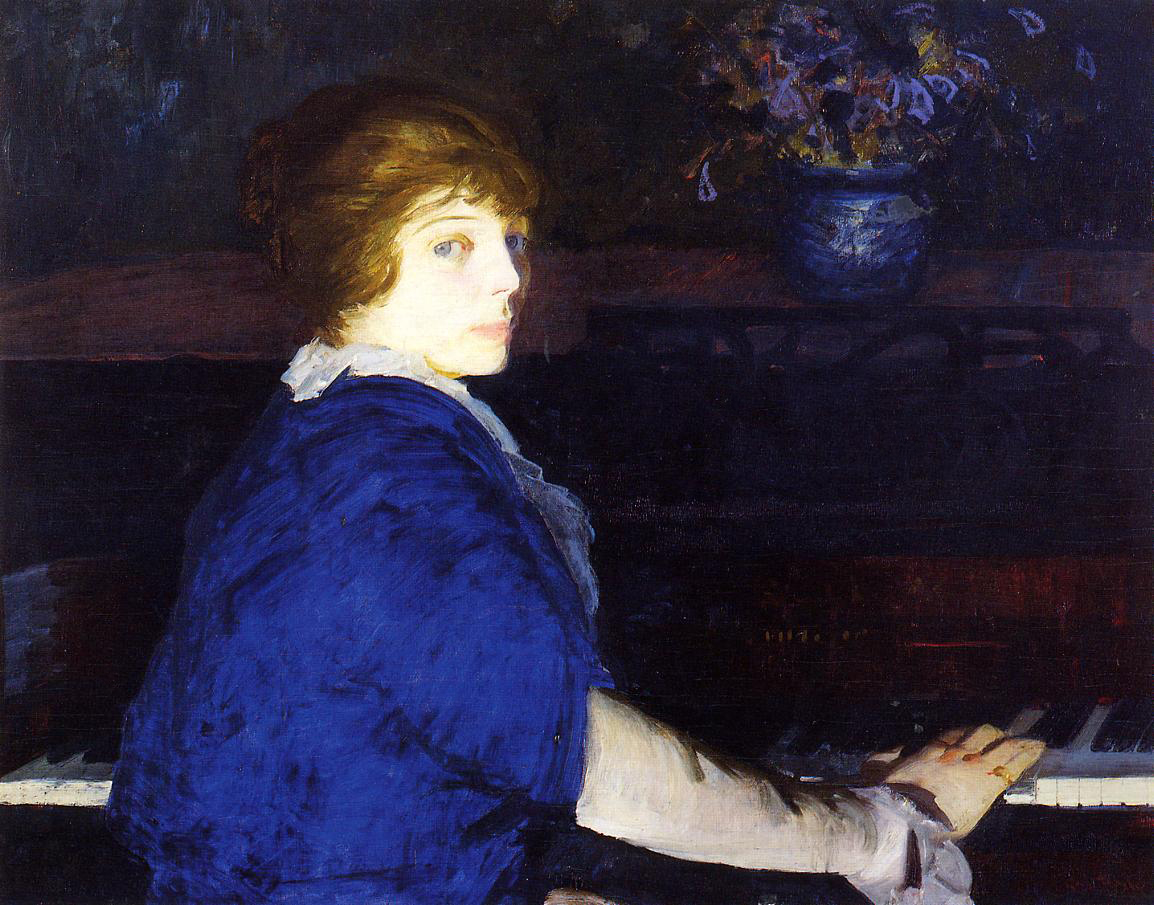
 

George Bellows (American, 1882-1925) 'Emma at the Piano' 1914


George Bellows (American, 1882-1925)
Emma at the Piano
1914
Oil on panel
73cm (28.7 in) x 94cm (37 in)
Chrysler Museum of Art Blue
Gift of Walter P. Chrysler, Jr.


George Bellows (American, 1882-1925) 'Paddy Flannigan' 1908


George Bellows (American, 1882-1925)
Paddy Flannigan
1908
Oil on canvas
76.8 x 63.5cm (30 1/4 x 25 in.)
Erving and Joyce Wolf


George Bellows (American, 1882-1925) 'Frankie, The Organ Boy' 1907


George Bellows (American, 1882-1925)
Frankie, The Organ Boy
1907
The Nelson-Atkins Museum of Art, Kansas City
Purchase, acquired through the bequest of Ben and Clara Shlyen


George Bellows (American, 1882-1925) 'Little Girl in White (Queenie Burnett)' 1907


George Bellows (American, 1882-1925)
Little Girl in White (Queenie Burnett)
1907
158 x 87cm (62 3/16 x 34 1/4 in.)
National Gallery of Arts, Washington
Collection of Mr. and Mrs. Paul Mellon
Open access


Advised by his friend and teacher Robert Henri to select subjects that reflected the realism of modern urban life, George Bellows portrayed the recreational activities of New York City’s lower-class children in such paintings as River Rats (1906, private collection), and Forty-two Kids (1907). In 1907 he painted two full-length portraits of individual children: Little Girl in White and Frankie the Organ Boy (both now at the Nelson-Atkins Museum of Art, Kansas City, MO). Unlike his late 19th-century predecessors, who popularised the street urchin genre by representing well-scrubbed, idealised children playing with pets or engaged in entrepreneurial activities, Bellows portrayed his subjects in a bluntly realistic manner. The subject of this painting, Queenie Burnett, was the artist’s laundry delivery girl. Her underprivileged background is evident in her gaunt face, exaggeratedly large eyes, unkempt hair, and ungainly figure.

This was Bellows’s first figural work to be exhibited around the country – it was included in 15 public exhibitions during his lifetime – and he was awarded the first Hallgarten Prize when the painting was shown at the National Academy of Design in 1913.

Text from the National Gallery of Art website
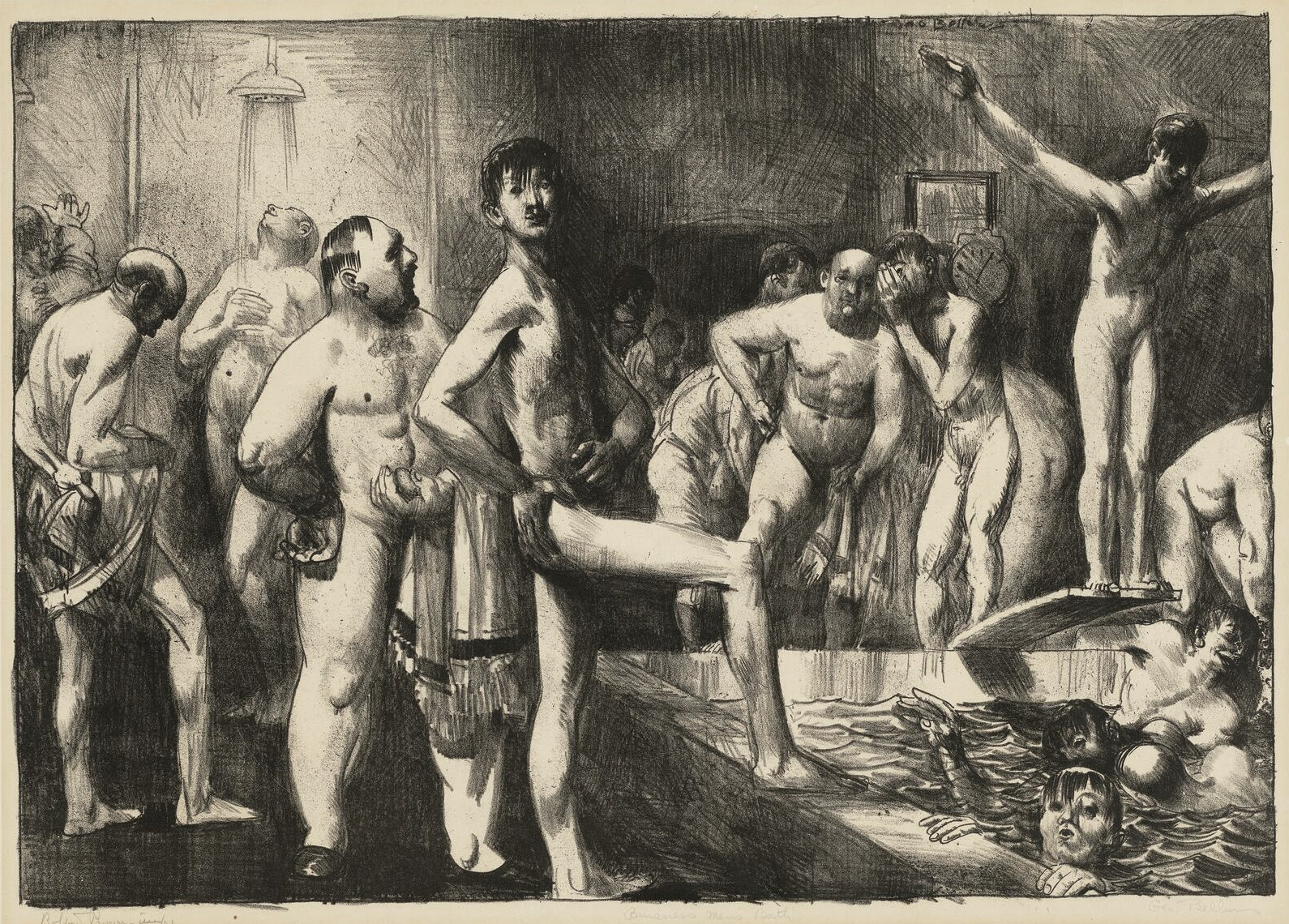
 

George Bellows (American, 1882-1925) 'Business-Men's Bath' 1923


George Bellows (American, 1882-1925)
Business-Men’s Bath
1923
Lithograph
16 1/2 × 11 3/4in. (41.9 × 29.8cm)
Boston Public Library


George Bellows (American, 1882-1925) 'The Law Is Too Slow' 1922-1923


George Bellows (American, 1882-1925)
The Law Is Too Slow
1922-1923
Boston Public Library
Print Department, Albert H. Wiggin Collection


Based upon a 1903 newspaper story, dateline Wilmington, Delaware, about a black man who burns at the stake while a mob of perpetrators stand and watch.


George Bellows (American, 1882-1925) 'The White Horse' 1922


George Bellows (American, 1882-1925)
The White Horse
1922
Oil on canvas
86.6cm (34.1 in) x 111.7cm (44 in)
Worcester Art Museum
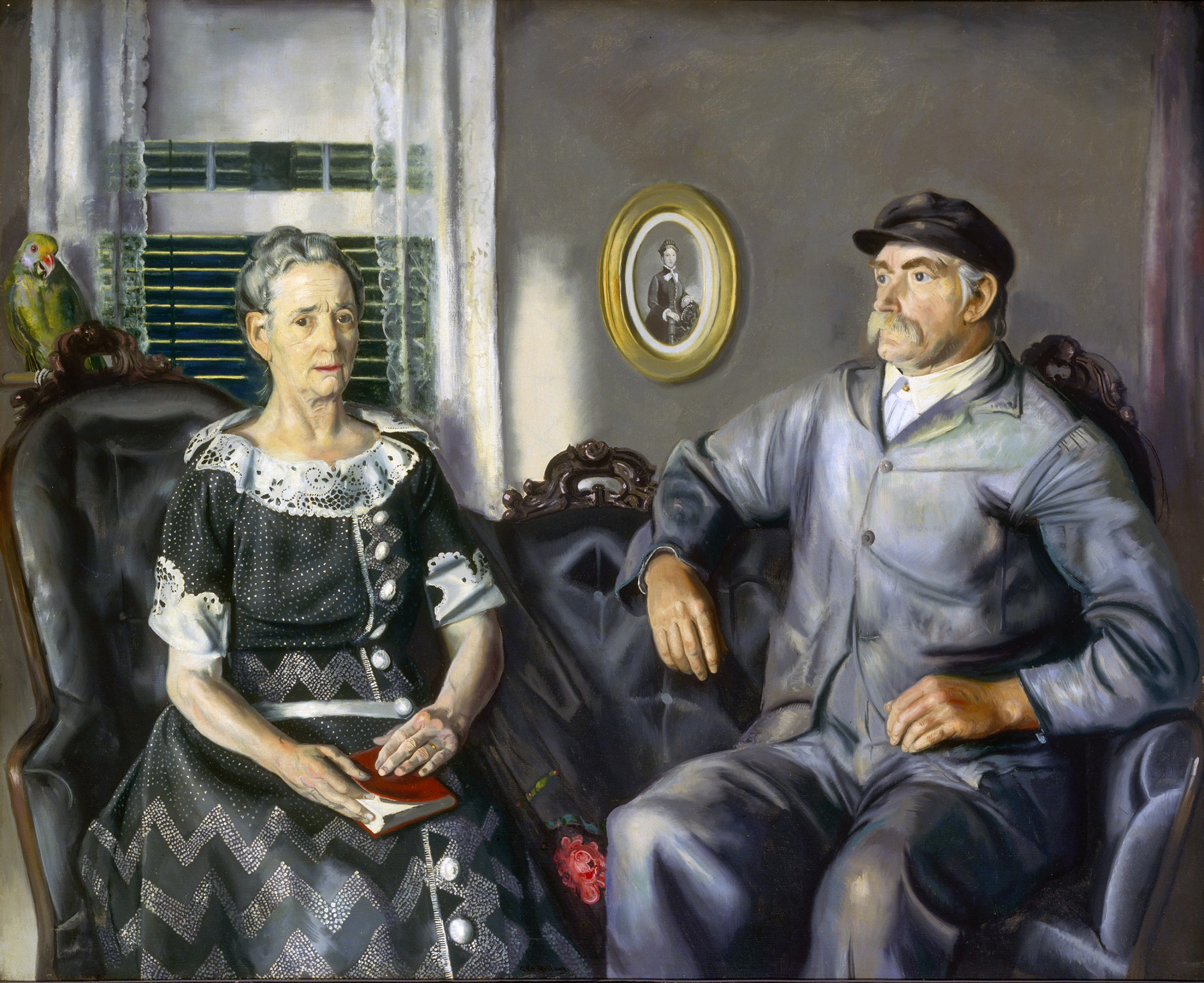
 

George Bellows (American, 1882-1925) 'Mr. and Mrs. Phillip Wase' 1924


George Bellows (American, 1882-1925)
Mr. and Mrs. Phillip Wase
1924
Oil on canvas
Smithsonian American Art Museum
Gift of Paul Mellon


George Bellows spent summers in Woodstock, New York, where Mrs. Wase worked as a cleaning woman and her husband was a gardener. Bellows chose to show the couple stiffly posed and strangely detached from one another. Mrs. Wase’s face shows the worries of a lifetime, and Mr. Wase stares off into the distance, as if thinking of another time or place. Between them, a portrait, perhaps of Mrs. Wase as a bride, hangs on the wall. Their clothes match the shadowy gray of the parlour. Bellows painted suggestions of a brilliantly green summer day beyond the closed shutters, as if to emphasise the distance between youthful optimism and the resignation of old age. The artist experimented with new ways to paint portraits throughout his career, and from 1915 to 1920 he exhibited with the National Association of Portrait Painters, whose mission was to separate from ​”the tiresomely conventional and perfunctory portrait.” (Myers, “‘The Most Searching Place in the World’: Bellows and Portraiture,” in Quick et al., The Paintings of George Bellows, 1992)

Text from the Smithsonian American Art Museum website


National Gallery of Art
National Mall between 3rd and 7th Streets
Constitution Avenue NW, Washington

Opening hours:
Daily 10.00am – 5.00pm

National Gallery of Art website

LIKE ART BLART ON FACEBOOK

Back to top

Exhibition: ‘Ansel Adams: At the Water’s Edge’ at the Peabody Essex Museum, Salem MA

Exhibition dates: 9th June – 8th October 2012


Many thankx to the Peabody Essex Museum for allowing me to publish the photographs in the posting. Please click on the photographs for a larger version of the image.


Ansel Adams (American, 1902-1984) 'The Tetons and the Snake River, Grand Teton National Park, Wyoming' 1942


Ansel Adams (American, 1902-1984)
The Tetons and the Snake River, Grand Teton National Park, Wyoming
1942
Gelatin silver print
Collection Center for Creative Photography, The University of Arizona
© 2011 The Ansel Adams Publishing Rights Trust


Ansel Adams (American, 1902-1984) 'Reflections at Mono Lake, California' 1948


Ansel Adams (American, 1902-1984)
Reflections at Mono Lake, California
1948
Gelatin silver print
David H. Arrington Collection
© 2011 The Ansel Adams Publishing Rights Trust


Ansel Adams (American, 1902-1984) 'Leaf, Glacier Bay National Monument, Alaska' c. 1948


Ansel Adams (American, 1902-1984)
Leaf, Glacier Bay National Monument, Alaska
c. 1948
From What Majestic Word, In Memory of Russell Varian, Portfolio IV (1963)
Gelatin silver print
© 2010 The Ansel Adams Publishing Rights Trust


Ansel Adams (American, 1902-1984) 'Santa Elena Canyon, Big Bend National Park, Texas' 1947


Ansel Adams (American, 1902-1984)
Santa Elena Canyon, Big Bend National Park, Texas
1947
Gelatin silver print
© 2010 The Ansel Adams Publishing Rights Trust Amon Carter Museum, Fort Worth, Texas


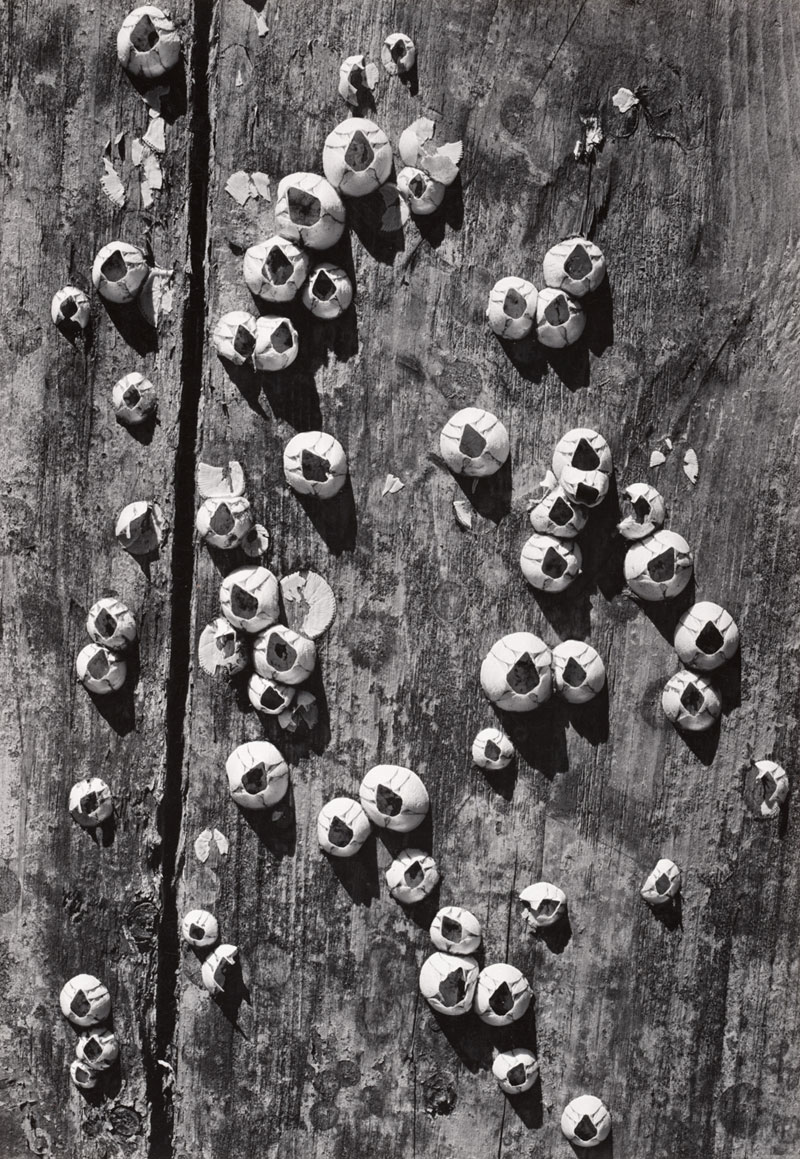
Ansel Adams (American, 1902-1984) 'Barnacles, Cape Cod' 1938


Ansel Adams (American, 1902-1984)
Barnacles, Cape Cod
1938
Gelatin silver print
Collection Center for Creative Photography, The University of Arizona
© 2011 The Ansel Adams Publishing Rights Trust


Ansel Adams (American, 1902-1984) 'The Golden Gate Before the Bridge, San Francisco' 1932


Ansel Adams (American, 1902-1984)
The Golden Gate Before the Bridge, San Francisco
1932
Gelatin silver print
Collection Center for Creative Photography, The University of Arizona
© 2011 The Ansel Adams Publishing Rights Trust


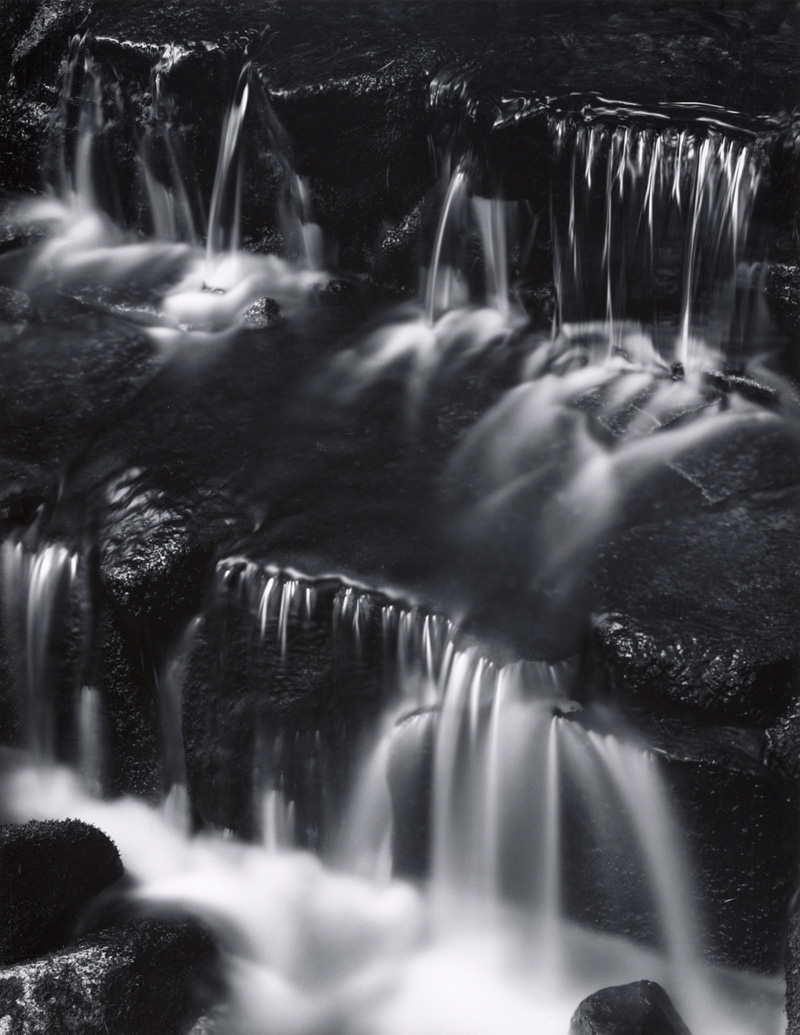
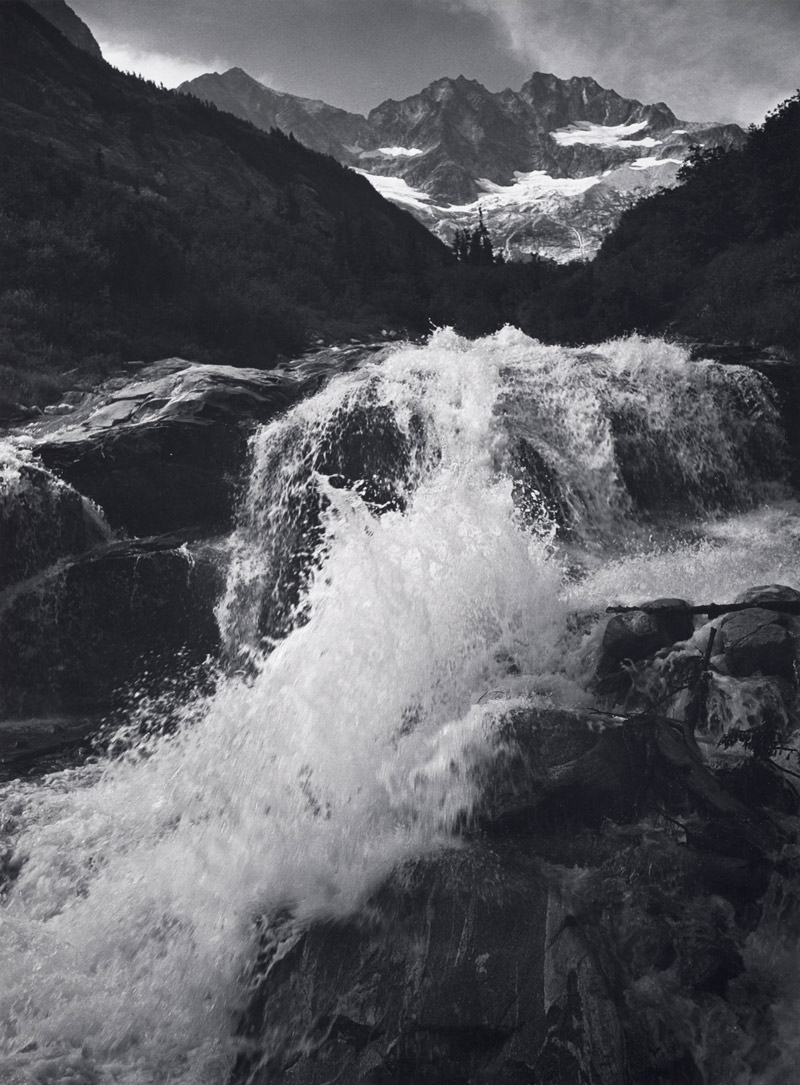
This summer, the Peabody Essex Museum (PEM) will unveil an exhibition shedding new light on one of history’s most iconic and beloved photographers. Ansel Adams: At the Water’s Edge features more than 100 photographs combining famous images with extraordinary lesser-known works that focus on the artist’s treatment and exploration of water in all its forms. Full of energy and dynamism, Adams’ photographs of seascapes, beaches, bays, tide pools, clouds and waterfalls provide a fresh perspective on the artist’s celebrated career. Ansel Adams: At the Water’s Edge was organised by the Peabody Essex Museum where it will be on view for its exclusive U.S. engagement from June 9 through October 8, 2012, and will then travel to the National Maritime Museum in Greenwich, UK.

“Throughout his life, Adams was drawn to the water for its visual potential, exploring where elemental forces meet,” says Phillip Prodger, exhibition curator and PEM’s curator of photography. “As an innovative Modernist, he explored seriality, motion and time, using a range of techniques to capture a definitively fluid and elusive substance.”

In this exhibition, drawn from the Ansel Adams Archive at the Center for Creative Photography at the University of Arizona and other prominent private and institutional collections, viewers will have the opportunity to see the pictures that Adams made for himself. Both grand and intimate at turns, these personal, and sometimes experimental images express his thoughts about the natural world, and often push the boundaries between realism and abstraction. Ranging in size from 3 x 5-inch prints to 10 x 12-foot murals, many will be appearing publicly for the first time at the Peabody Essex Museum. Adams was one of the first photographers to work in the large-scale mural format which has now become standard among contemporary artists.

At the Water’s Edge provides a fresh look at Ansel Adams, as well-known and beloved pictures of rugged mountains, desert landscapes, and rocky cliffs blend with sparkling, spraying, whirling waters in all of their flowing power and reflective nuance. The undeniable attraction of water as a photographic subject captured Adams at an early age. The very first photograph Adams ever made, shown at PEM for the first time, features a watery pool at the Panama Pacific Exhibition of the 1915 World’s Fair, made when Adams was just 14 years old. Over time, his lens claimed the territory between Yosemite National Park and the Pacific, as well as Hawaii and Alaska, where he shot images shown in this exhibition.

Notably, he made a powerful group of photographs of New England, the only coastal location outside of California that Adams photographed steadily. Over a course of decades, he explored the coast from Connecticut to Maine, especially in Massachusetts, making repeated trips to Cape Cod and Boston’s North Shore.

Highlights

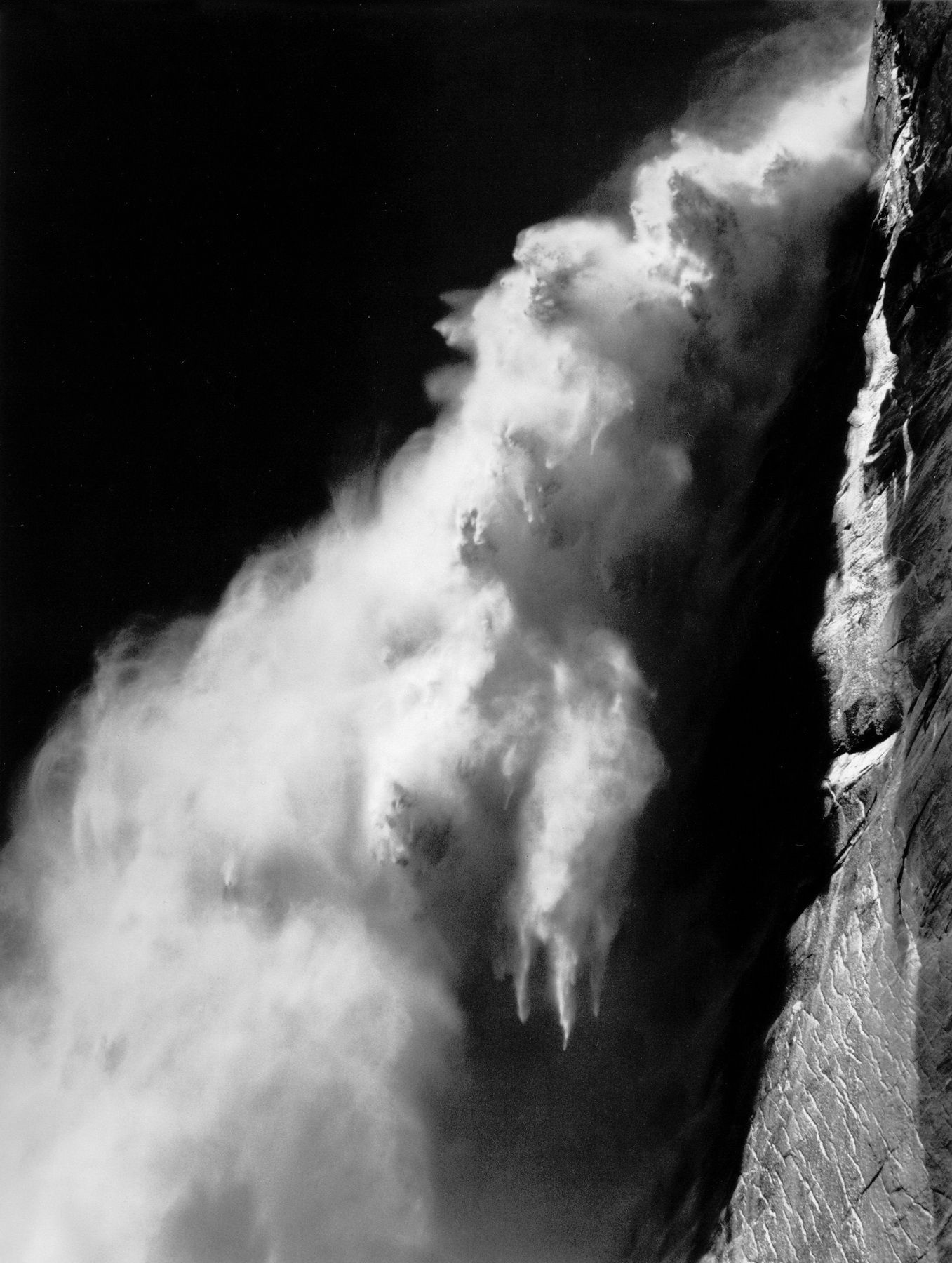
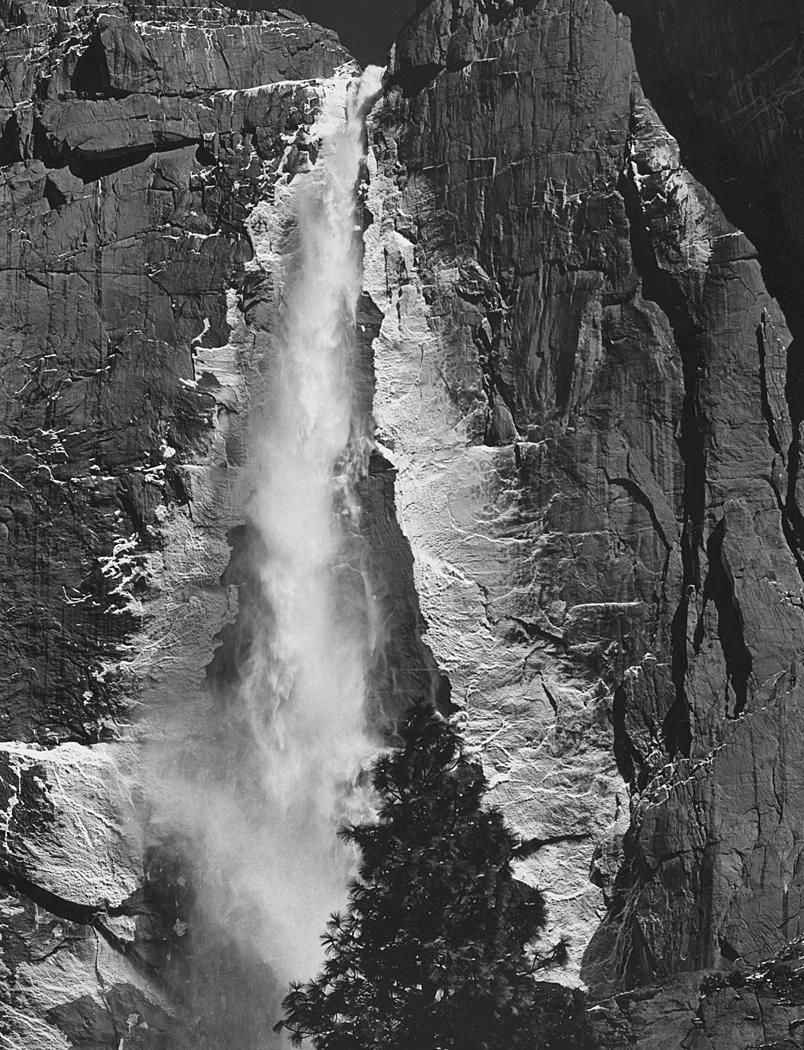
Visitors will have the opportunity to see rarely-viewed objects, including the print of Golden Gate before the Bridge that used to hang over Ansel Adams’ desk, and which he considered among his very best photographs. At the same time, stunning, oversized exhibition prints of iconic photographs including Clearing Winter Storm, Yosemite, Tetons and the Snake River, Grand Teton National Park and Stream, Sea, Clouds, Rodeo Lagoo, Marin County, California will be on display, among others.

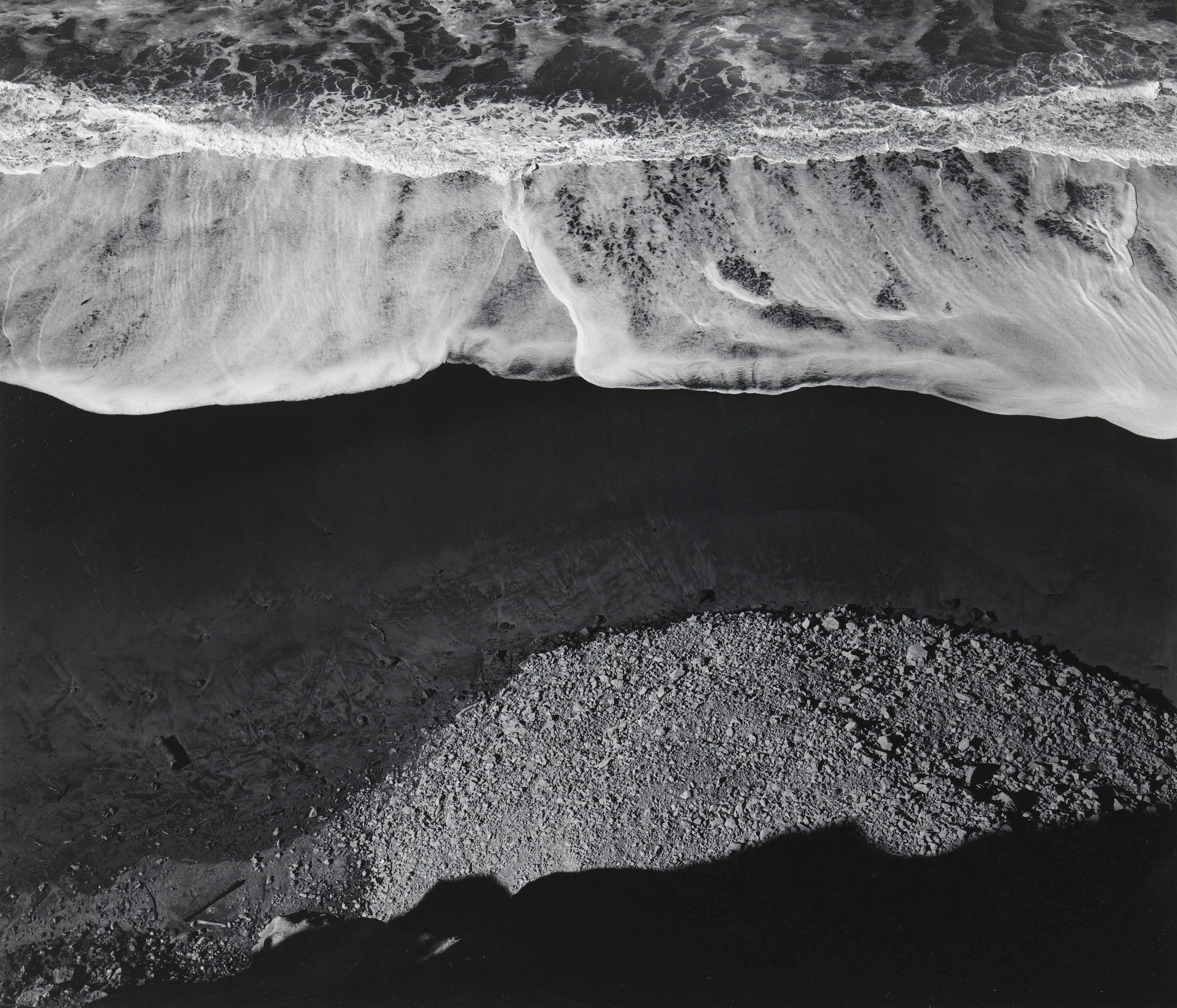
One of the surprises revealed in At the Water’s Edge is Adams’ interest in using sequential imagery to freeze motion in time. An especially powerful example is the majestic surf sequence, San Mateo County Coast, California, 1940. Adams was possibly the first well-known photographer since Eadweard Muybridge to attempt to use photography in this way, employing seriality and sequence to create a cohesive narrative. Another series of photographs of Old Faithful Geyser, Yellowstone National Park, shows a different approach to sequentiality. A poignant exploration of form, movement and time, they can be viewed as Adams’ version of Monet’s haystacks. As with Monet, Adams visited Old Faithful at different times of day, photographing in varying light and changing atmospheric conditions.

Another unexpected addition is the exceedingly rare Japanese-style screen, Grass and Pool, 1948, dating from a period of tremendous creativity in Adams’ work. Standing on round metal feet, it was designed to be shown directly on the floor in a domestic environment. In subject and treatment, it was inspired by Asian painted screens in which picture planes are flattened and perspectives tilted. The three articulated panels can be angled to catch the light differently, the rhythm of the fold cleverly mirroring the angular pattern of the exposed grass.

For Adams, part of the appeal of creating such a work was thwarting conventional expectations about what a photograph might look like and where and how it could be shown. Like many modernists, Adams considered photographs not just as images but as objects – the craft and sheer physical presence of the work reinforced its significance as a work of art and the focus of contemplation.”

Press release from the Peabody Essex Museum website


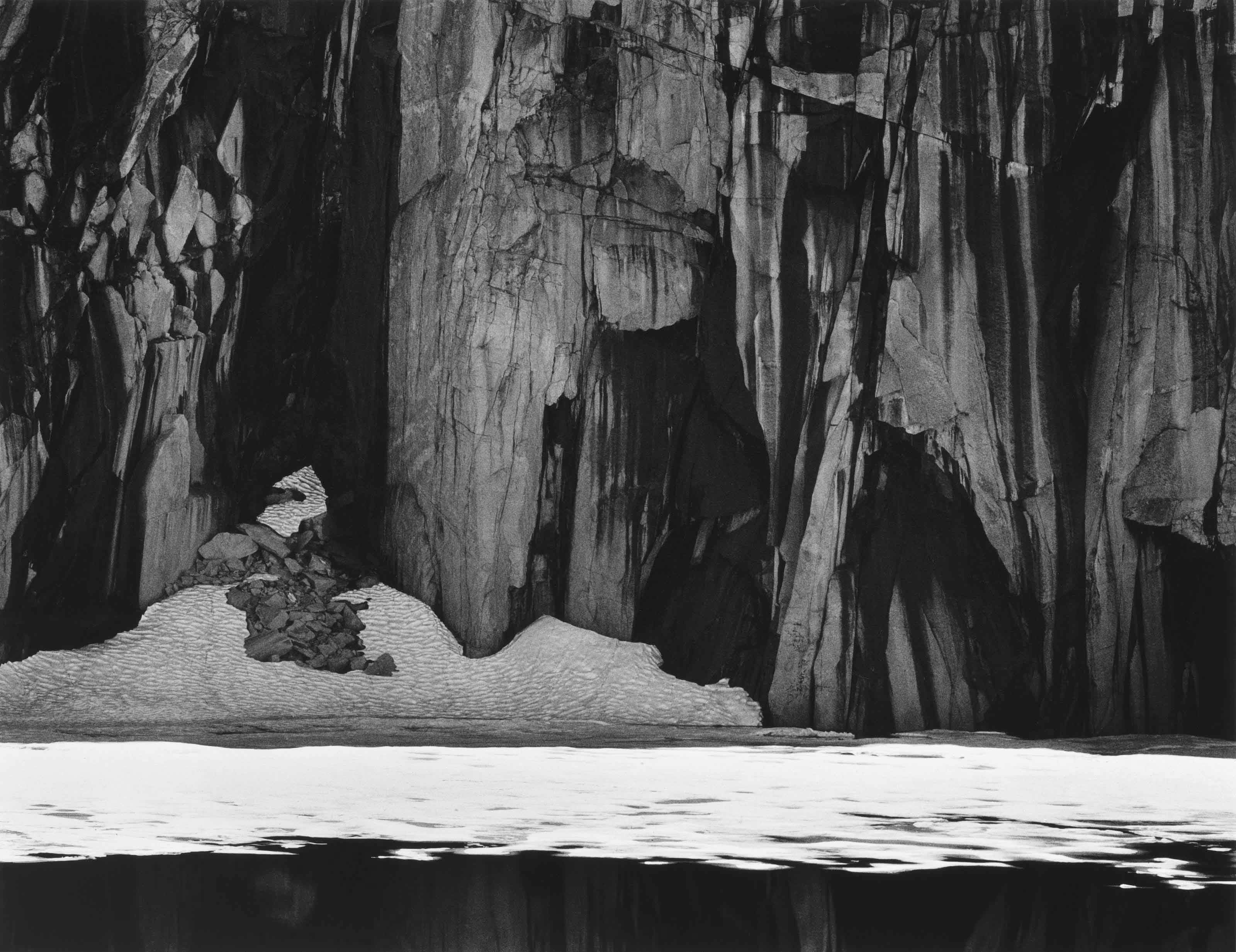
Ansel Adams (American, 1902-1984) 'Frozen Lake and Cliffs, Kaweah Gap, Sierra Nevada, California' 1932


Ansel Adams (American, 1902-1984)
Frozen Lake and Cliffs, Kaweah Gap, Sierra Nevada, California
1932
Gelatin silver print
Collection Center for Creative Photography, The University of Arizona
© 2011 The Ansel Adams Publishing Rights Trust


Ansel Adams (American, 1902-1984) 'Clearing Winter Storm, Yosemite National Park' c. 1937


Ansel Adams (American, 1902-1984)
Clearing Winter Storm, Yosemite, Tetons
c. 1937
Gelatin silver print
Collection Center for Creative Photography, The University of Arizona
© 2011 The Ansel Adams Publishing Rights Trust


Ansel Adams (American, 1902-1984) 'The Tetons and Snake River, Grand Teton National Park, Wyoming' 1942


Ansel Adams (American, 1902-1984)
The Tetons and Snake River, Grand Teton National Park, Wyoming
1942
Gelatin silver print
Collection Center for Creative Photography, The University of Arizona
© 2011 The Ansel Adams Publishing Rights Trust


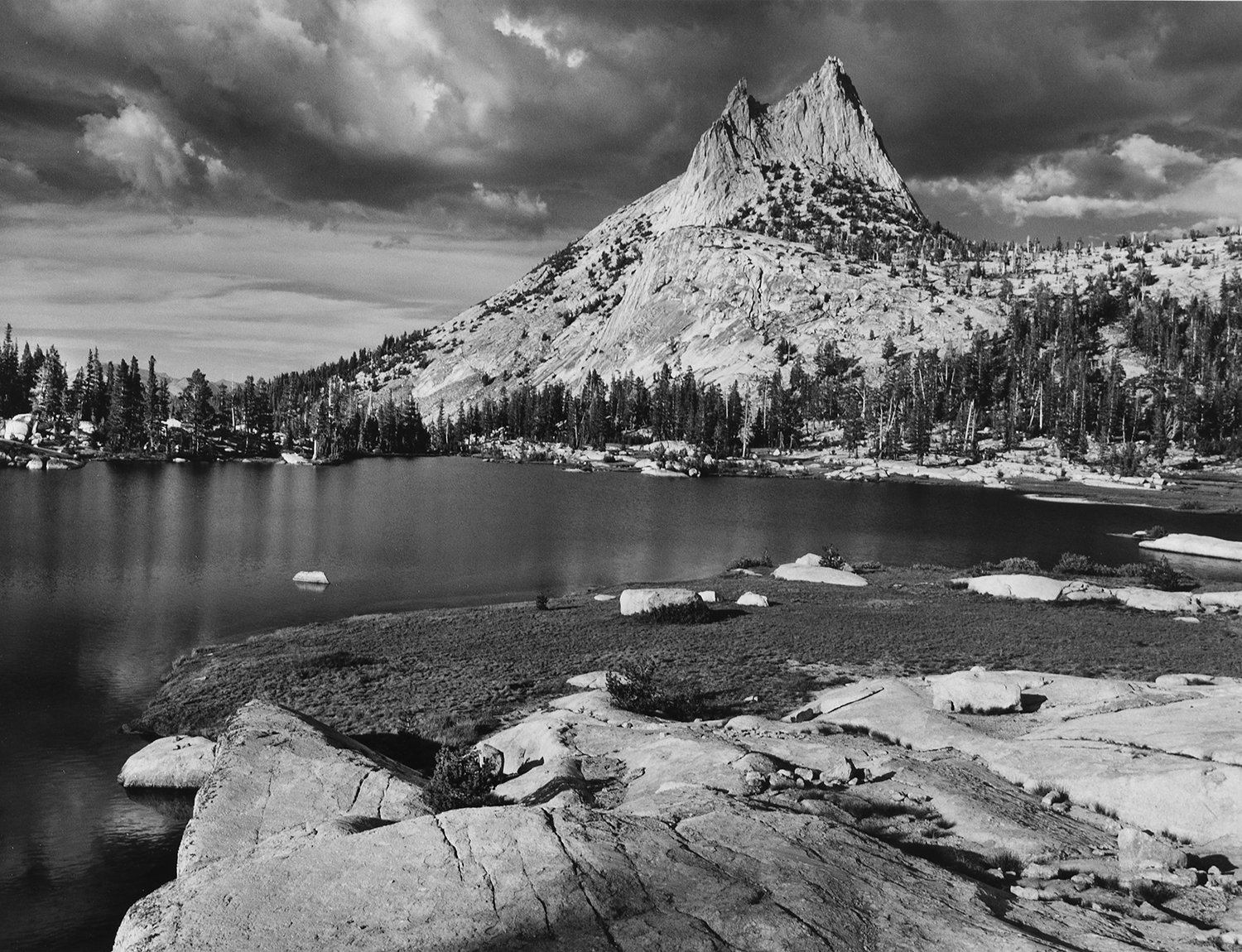
Ansel Adams (American, 1902-1984) 'Cathedral Peak, Tuolumne River' 1944


Ansel Adams (American, 1902-1984)
Cathedral Peak, Tuolumne River
1944
Gelatin silver print
Collection Center for Creative Photography, The University of Arizona
© 2011 The Ansel Adams Publishing Rights Trust


Ansel Adams (American, 1902-1984) 'Surf Sequence #1, San Mateo County Coast, California' 1940


Ansel Adams (American, 1902-1984)
Surf Sequence #1, San Mateo County Coast, California
1940
Gelatin silver print
Collection Center for Creative Photography, The University of Arizona
© 2011 The Ansel Adams Publishing Rights Trust


Ansel Adams (American, 1902-1984) 'Surf Sequence #3, San Mateo County Coast, California' 1940


Ansel Adams (American, 1902-1984)
Surf Sequence #3, San Mateo County Coast, California
1940
Gelatin silver print
Collection Center for Creative Photography, The University of Arizona
© 2011 The Ansel Adams Publishing Rights Trust


Ansel Adams (American, 1902-1984) 'Surf Sequence #4' 1940


Ansel Adams (American, 1902-1984)
Surf Sequence #4, San Mateo County Coast, California
1940
Gelatin silver print
Collection Center for Creative Photography, The University of Arizona
© 2011 The Ansel Adams Publishing Rights Trust


Ansel Adams (American, 1902-1984) 'Photograph of Old Faithful Geyser Erupting in Yellowstone National Park' 1941


Ansel Adams (American, 1902-1984)
Photograph of Old Faithful Geyser Erupting in Yellowstone National Park
1941
Gelatin silver print
Collection Center for Creative Photography, The University of Arizona
© 2011 The Ansel Adams Publishing Rights Trust


Ansel Adams (American, 1902-1984) 'Upper Yosemite Fall' 1946


Ansel Adams (American, 1902-1984)
Upper Yosemite Fall
1946
Gelatin silver print
Collection Center for Creative Photography, The University of Arizona
© 2011 The Ansel Adams Publishing Rights Trust


Ansel Adams (American, 1902-1984) 'Nevada Fall Profile' 1946


Ansel Adams (American, 1902-1984)
Nevada Fall Profile
1946
Gelatin silver print
Collection Center for Creative Photography, The University of Arizona
© 2011 The Ansel Adams Publishing Rights Trust


Ansel Adams (American, 1902-1984) 'Upper Yosemite Fall' 1960


Ansel Adams (American, 1902-1984)
Upper Yosemite Fall
1960
Gelatin silver print
Collection Center for Creative Photography, The University of Arizona
© 2011 The Ansel Adams Publishing Rights Trust


Ansel Adams (American, 1902-1984) 'Fern Spring, Dusk, Yosemite Valley' c. 1961


Ansel Adams (American, 1902-1984)
Fern Spring, Dusk, Yosemite Valley
c. 1961
Gelatin silver print
Collection Center for Creative Photography, The University of Arizona
© 2011 The Ansel Adams Publishing Rights Trust


Ansel Adams (American, 1902-1984) 'Stream, Sea, Clouds, Rodeo Lagoon, Marin County, California' 1962


Ansel Adams (American, 1902-1984)
Stream, Sea, Clouds, Rodeo Lagoon, Marin County, California
1962
Gelatin silver print
Collection Center for Creative Photography, The University of Arizona
© 2011 The Ansel Adams Publishing Rights Trust


Ansel Adams (American, 1902-1984) 'Waterfall, Northern Cascades, Washington' 1960


Ansel Adams (American, 1902-1984)
Waterfall, Northern Cascades, Washington
1960
Gelatin silver print
Collection Center for Creative Photography, The University of Arizona
© 2011 The Ansel Adams Publishing Rights Trust


Peabody Essex Museum
East India Square
161 Essex Street
Salem, MA 01970-3783 USA
Phone: 978-745-9500, 866-745-1876

Opening hours:
Open Tuesday – Sunday 10am – 5pm
Closed Mondays

Peabody Essex Museum website

LIKE ART BLART ON FACEBOOK

Back to top

Exhibition: ‘In Focus: Picturing the Landscape’ at the J. Paul Getty Museum, Los Angeles

Exhibition dates: 22nd May – 7th October 2012

Curator: Brett Abbott


Francis Frith (English, 1822-1898) 'The Pyramids of Dahshoor, From the East' 1857


Francis Frith (English, 1822-1898)
The Pyramids of Dahshoor, From the East
1857
Albumen silver print
11.6 x 16.2cm
The J. Paul Getty Museum, Los Angeles


“Hence the photographer’s most important and likewise most difficult task is not learning to manage his camera, or to develop, or to print. It is learning to see photographically.”


Edward Weston. The Complete Photographer. January 20, 1943


Many thankx to the J. Paul Getty Museum, Los Angeles for allowing me to publish the photographs in the posting. Please click on the photographs for a larger version of the image.


Sir John Frederick William Herschel (British, 1792-1871) 'Valley of the Saltina near Brieg at Entrance of the Simplon' 1821


Sir John Frederick William Herschel (British, 1792-1871)
Valley of the Saltina near Brieg at Entrance of the Simplon
1821
Graphite drawing made with the aid of a camera lucida
19.7 × 29.7cm (7 3/4 × 11 11/16 in.)
Gift of the Graham and Susan Nash Collection
The J. Paul Getty Museum, Los Angeles


Dr Samuel A. Bemis (American, 1793-1881) 'View within Crawford Notch, New Hampshire' c. 1840


Dr Samuel A. Bemis (American, 1793-1881)
View within Crawford Notch, New Hampshire
c. 1840
Daguerreotype
The J. Paul Getty Museum, Los Angeles


Boston dentist Samuel Bemis, one of the first Americans to use a daguerreotype outfit successfully, practiced photography during his summer months in the White Mountains of New Hampshire. His landscape views of the area are the earliest surviving American photographs to depict untamed nature. Here he depicts a scene of rugged beauty.

An innovative amateur, Bemis was not a masterful technician of the complicated daguerreotype process. The dark tone of the sky and the light areas along the slope of the mountain indicate inadequate processing of the daguerreotype plate.


John Beasly Greene
 (American, 1832-1856) 'Thebes, Village of Ghezireh' 1853-1854


John Beasly Greene
 (American, 1832-1856)
Thebes, Village of Ghezireh
1853-1854
Salted paper print from a waxed paper negative
9 1/8 x 12 inches
The J. Paul Getty Museum, Los Angeles


John Greene was an archaeologist, the well-to-do son of a banker from Boston who lived in Paris, and a photographer. By 1853 the twenty-one-year-old Greene had learned to use Le Gray’s waxed-paper process, the technique of choice for traveling Frenchmen. That same year he made the first of two expeditions to Egypt and Nubia, bringing back more than two hundred negatives of monuments and landscapes, some ninety-four of which, printed by Blanquart-Evrard in 1854, comprise the album “Le Nil, monuments, paysages, explorations photographiques par J. B. Greene.” So rare are these albums that we assume that Greene published them at his own expense. On his second trip, in 1854-1855, he not only photographed but also excavated, especially at Medinet-Habou. During an archaeological and photographic expedition to Algeria the following winter, this exceptionally talented young man died of an undisclosed illness.

Greene’s Egyptian landscapes are startlingly barren. Coalescing from large, softly nuanced tonal planes, the views seem to shimmer above the page almost to the point of evaporating, like distant desert mirages. Generally, Greene placed the geological or archeological structure of these pictures at a distance, surrounded by sand and sky. This, the most minimal of his visions, sums up the Egyptian landscape. Stretching between the great river and the endless expanse of sky, and between the great river and the desert, is a thin band of fertile earth – the ligament of life that gave rise to a great civilisation. That the picture functions like a diagram may owe to Greene’s knowledge of hieroglyphics; the Egyptian pictograph for “country” is a flat, floating disk, hardly more than a horizontal line.

Text from the Metropolitan Museum of Art website


Charles Marville (French, 1813-1879) 'Fontainebleau' 1854


Charles Marville (French, 1813-1879)
Fontainebleau
1854
Salted paper print
15.9 × 21.3cm (6 1/4 × 8 3/8 in.)
The J. Paul Getty Museum, Los Angeles


Francis Frith (English, 1822-1898) 'The Pyramids of Dashour' 1856-1857


Francis Frith (English, 1822-1898)
The Pyramids of Dashour
1856-1857
Albumen silver print
6.8 × 6.5cm (2 11/16 × 2 9/16 in.)
The J. Paul Getty Museum, Los Angeles
Gift of Weston J. and Mary M. Naef


Ansel Adams (American, 1902 - 1984) 'Sugar Pine Cones' Negative 1925-1930; print 1931-1932


Ansel Adams (American, 1902-1984)
Sugar Pine Cones
Negative 1925-1930; print 1931-1932
Gelatin silver print
11.6 x 16.2cm
The J. Paul Getty Museum, Los Angeles
© The Ansel Adams Publishing Rights Trust


Edward Weston (American, 1886-1958) 'Kelp on Tide Pool, Point Lobos' 1939


Edward Weston (American, 1886-1958)
Kelp on Tide Pool, Point Lobos
1939
The J. Paul Getty Museum, Los Angeles


Rather than depicting a traditionally picturesque vista or capturing accurate perspective, photographers of the 20th century began to explore the various but particularly photographic ways that the natural world could be seen through the camera lens. Often this led to spatial experimentation. Taken at Point Lobos in California, this image by Edward Weston plays with the perception, and misperception, of space. The photographer cropped his photograph of a tide pool to show kelp puncturing the water’s surface in the foreground, while in the upper register an underwater landscape appears simultaneously near and far.


Harry Callahan (American, 1912-1999) '[Detroit]' 1941


Harry Callahan (American, 1912-1999)
[Detroit]
1941
Gelatin silver print
8.1 × 11.4cm (3 3/16 × 4 1/2 in.)
The J. Paul Getty Museum, Los Angeles
© Estate of Harry Callahan


Callahan referred to this photograph, made shortly after an inspiring encounter with Ansel Adams, as “my first good picture.” Unlike Adams’s dramatic landscapes, Callahan’s composition focuses on an overlooked pedestrian setting in his native Detroit. Raising the horizon line, the artist achieved a delicate, calligraphic interplay among the reeds and telephone poles and their reflections across the surface of a bog.


Wynn Bullock (American, 1902–1975) 'Point Lobos Tide Pool' 1957


Wyn Bullock (American, 1902-1975)
Point Lobos Tide Pool
1957
Gelatin silver print
19.1 × 24.1cm (7 1/2 × 9 1/2 in.)
The J. Paul Getty Museum, Los Angeles
© Bullock Family Photography LLC. All rights reserved


In Focus: Picturing Landscape, at the J. Paul Getty Museum, the Getty Center, May 22 – October 7, 2012, offers a rich trove of landscape photography from some of the most innovative photographers in the genre. Drawn exclusively from the Getty Museum’s permanent collection, the exhibition brings together the work of twenty photographers, spanning the medium from the mid-1800s to the current decade, including Ansel Adams, Robert Adams, Manuel Alvarez Bravo, Imogen Cunningham, William Garnett, John Beasly Greene, Eliot Porter, Clifford Ross, Toshio Shibata and Edward Weston.

“The range of photographs chosen for this exhibition were selected from hundreds of extraordinary landscape works in the Getty Museum’s photography collection with an eye towards the various ways that photographers have responded to the daunting challenge of depicting the natural landscape photographically,” says Karen Hellman, assistant curator, Department of Photographs, the J. Paul Getty Museum, and curator of the exhibition.

Since the invention of the medium, photographers have turned to the landscape as a source of inspiration. Changing artistic movements and continual technical advancements have provided opportunities for camera artists to approach the subject in diverse and imaginative ways. The Getty originally presented In Focus: The Landscape in June 2008, curated by Brett Abbott. Expanding on the first presentation of photographs, this second exhibition on landscape in the Getty Museum’s In Focus series examines how photographers have sought to capture the breadth and perspective of the landscape through a camera lens. The exhibition is organised around three main themes: nineteenth-century technical developments by photographers such as Francis Frith who captured intriguing views of the Egyptian Pyramids in the 1850s; works that show purely photographic approaches such as those by Edward Weston and Harry Callahan; and more recent ways in which photographers have framed the landscape to make environmental and conceptual statements.

One of the earliest works in the exhibition is actually not a photograph but a drawing made by Sir John Frederick Herschel in 1821 with the aid of a camera lucida, an optical device sometimes used as a drawing aid by artists of the period. The exhibition also includes a very early full-plate daguerreotype of a landscape made by Boston dentist Samuel Bemis in 1840. During the first decades of the 20th century, artistic experimentation flourished and tested the boundaries of the genre. Photographers such as Edward Weston and Harry Callahan sought to explore the landscape as abstraction and pure form. In the second half of the 20th century, photographers began to explore the landscape in more socially conscious ways. Eliot Porter devoted himself to publishing work in concert with conservation efforts. Virginia Beahan has delved into the landscape as a site of human history, rather than simply a subject of aesthetic contemplation.

Contemporary artists continue to be inspired by the rich tradition of landscape photography. Also included in the exhibition is a large-scale photograph by Clifford Ross from his 2006 Mountain series, produced from extremely high-resolution digital files in order to make prints that came as close as possible to replicating reality. Several works will be on view for the first time, including a photograph taken in the forest of Fontainebleau, outside of Paris, by Charles Marville in the 1850s, and a photograph from Point Lobos, California, by Wynn Bullock, as well as a work by the Japanese photographer Toshio Shibata acquired with funds from the Getty Museum Photographs Council.

In Focus: Picturing Landscape is the eleventh installation of the ongoing In Focus series of thematic presentations of photographs from the Getty’s permanent collection, and includes twenty-two works by twenty photographers.

Press release from the J. Paul Getty Museum website


William A. Garnett (American, 1916-2006) 'Sandbars, Cape Cod, Massachusetts' 1966


William A. Garnett (American, 1916-2006)
Sandbars, Cape Cod, Massachusetts
1966
Cibachrome print
34.4 x 51cm
The J. Paul Getty Museum, Los Angeles
© Estate of William A. Garnett


Nature and photography have been linked since the inception of the medium. Whether driven by the challenge of capturing the expanse and perspective of a vista or by the myriad possibilities of creating a unique artistic experience, the act of depicting the natural landscape has inspired photographers from the 1800s to the present.

To create this image, photographer William Garnett piloted his plane over sand bars in Cape Cod. In addition to the natural beauty of the ocean, the photographer invites us to explore space and perception in a unique way. The undulating forms of the sandbars play with the boundaries between foreground and background. Changing tones of blue challenge us to know if we look at water, sky, or even a view from outer space.


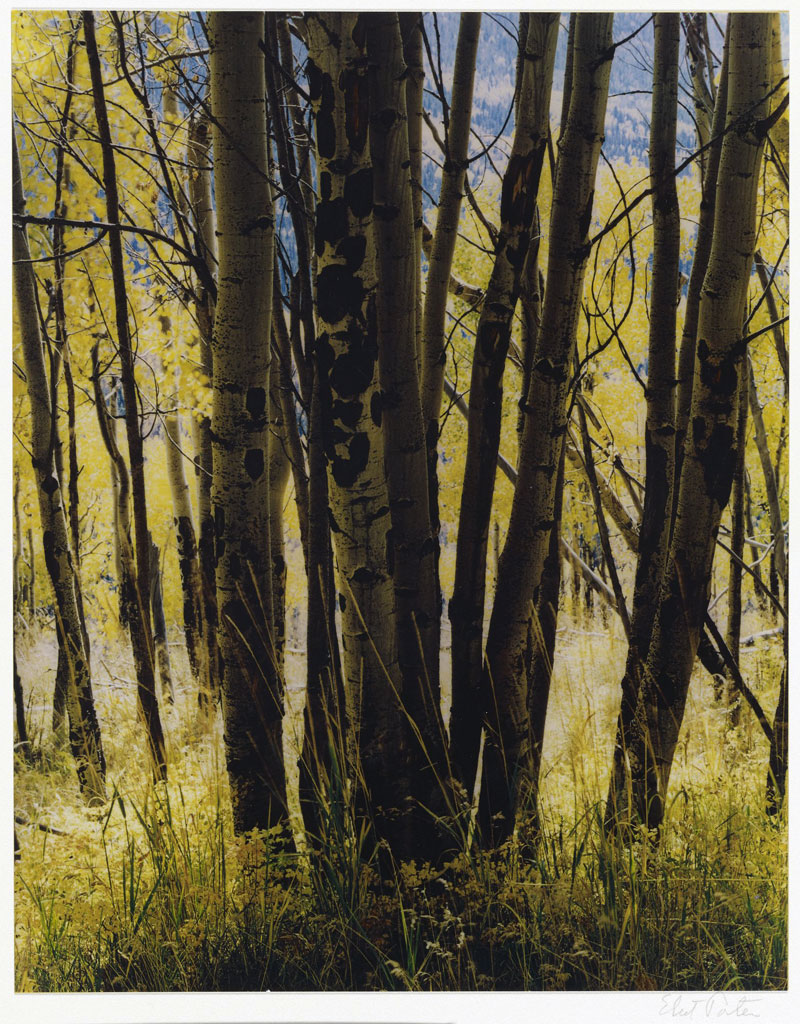
Eliot Porter (American, 1901-1990) 'Aspens and Grass, Elk Mountain Road, New Mexico, October 3, 1972' 1972


Eliot Porter (American, 1901-1990)
Aspens and Grass, Elk Mountain Road, New Mexico, October 3, 1972
1972
Dye transfer print
26.2 x 20.6cm
The J. Paul Getty Museum, Los Angeles
Gift of Daniel Greenberg and Susan Steinhauser
Bequest of the artist
© 1990 Amon Carter Museum of American Art, Fort Worth, Texas


Toshio Shibata (Japanese, b. 1949) 'Tsuru City, Yamanashi Prefecture' 1989


Toshio Shibata (Japanese, b. 1949)
Tsuru City, Yamanashi Prefecture
1989
Gelatin silver print
44.5 × 55.5cm (17 1/2 × 21 7/8 in.)
The J. Paul Getty Museum, Los Angeles
Purchased with funds provided by the Photographs Council
© Toshio Shibata


Virginia Beahan (American, b. 1946) and Laura McPhee (American, b. 1958) 'Apple Orchard, Manzanar Japanese-American Relocation Camp, Owens Valley, California' 1995


Virginia Beahan (American, b. 1946) and Laura McPhee (American, b. 1958)
Apple Orchard, Manzanar Japanese-American Relocation Camp, Owens Valley, California
1995
Chromogenic print
75.3 × 95.3cm (29 5/8 × 37 1/2 in.)
The J. Paul Getty Museum, Los Angeles
Gift of Nancy and Bruce Berman
© Virginia Beahan and Laura McPhee


Here Beahan and McPhee delve into the landscape as a site of human history and conflict. With the High Sierra as a backdrop, rusty remnants of the Manzanar relocation camp, used to detain Japanese Americans during World War II, occupy the foreground. In the middle ground stand the desiccated trunks of an orchard, part of an 1860s settlement that was abandoned after the land’s water was diverted in the 1920s to irrigate Los Angeles. The orchard, in turn, had uprooted a community of Paiute Indians, who had lived there for generations.


Virginia Beahan (American, born 1946) and Laura McPhee (American, born 1958) 'Mount Rainier, Washington' 2000


Virginia Beahan (American, b. 1946) and Laura McPhee (American, b. 1958)
Mount Rainier, Washington
2000
Chromogenic dye coupler print
75.5 x 96.5cm
The J. Paul Getty Museum, Los Angeles
Gift of Nancy Goliger and Bruce Berman
© Virginia Beahan and Laura McPhee


Clifford Ross (American, b. 1952) 'Mountain IV' 2004


Clifford Ross (American, b. 1952)
Mountain IV
2004
Chromogenic colour print
63 x 118 in
The J. Paul Getty Museum, Los Angeles
© Clifford Ross Studio


A persistent aspect of picturing a landscape has been the concept of the ideal. Recent photographers have framed nature not only to emphasise its beauty but also to highlight its unattainability in a modern context.

Photographer Clifford Ross was inspired to create this image of Mount Sopris while on a family holiday. In order to, as the photographer put it, “grab as much of the mountain as [he] possibly could in one shot,” Ross invented a camera, the R1, which exposes 9 x 18 inch aerial film. When processed by hand and scanned, the negatives produce files with a hundred times higher resolution than those made with the average professional digital camera. Yet even though he pursues a near replica of reality, Ross also manipulates the digital file to re-create the landscape as he remembers experiencing it. Viewers have the ability to examine the scene in greater detail than they might even in person.


The J. Paul Getty Museum
1200 Getty Center Drive
Los Angeles, California 90049

Opening hours:
Daily 10am – 5pm

The J. Paul Getty Museum website

LIKE ART BLART ON FACEBOOK

Back to top

Exhibition: ‘True Stories: American Photography from the Sammlung Moderne Kunst’ at Pinakothek der Moderne, Munich

Exhibition dates: 2nd March – 20th September 2012


Lewis Baltz (American, 1945-2014) 'Greenbrae' 1968


Lewis Baltz (American, 1945-2014)
Greenbrae
1968
from the series The Prototype Works
Vintage gelatin silver print
13.1 x 21.4cm
Sammlung Moderne Kunst in the Pinakothek der Moderne Munich, Acquired in 2011 by PIN. Freunde der Pinakothek der Moderne e.V.
© Lewis Baltz


You can’t get much better than this to start a posting: Baltz, Friedlander, Winogrand, Nixon, Baldessari, Eggleston and Shore. I recall seeing my first vintage Stephen Shore at the American Dreams exhibition at the Bendigo Art Gallery last year. What a revelation. At the time I said,

“Two Stephen Shore chromogenic colour prints from 1976 where the colours are still true and have not faded. This was incredible – seeing vintage prints from one of the early masters of colour photography; noticing that they are not full of contrast like a lot of today’s colour photographs – more like a subtle Panavision or Technicolor film from the early 1960s. Rich, subtle, beautiful hues.”

You can get an idea of those colours in the image posted here. Like an early Panavision or Technicolor feature film.

Perhaps there is something to this analogue photography that digital will never be able to capture, let alone reproduce…

Dr Marcus Bunyan


Many thankx to Pinakothek der Moderne for allowing me to publish the photographs in the posting. Please click on the photographs for a larger version of the image.


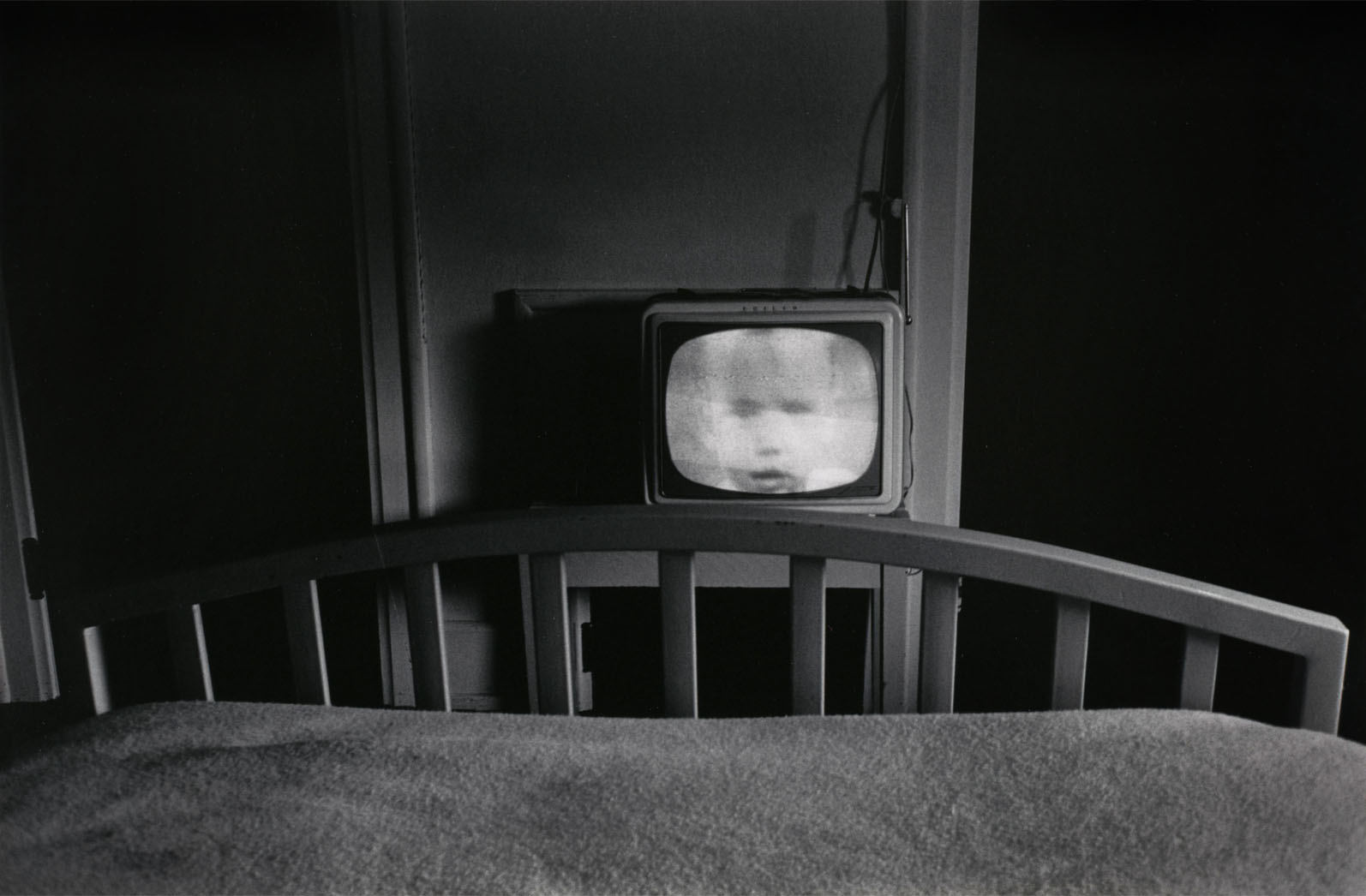
Lee Friedlander (American, b. 1934) 'T.V. in hotel room – Galax, Virginia' 1962


Lee Friedlander (American, b. 1934)
T.V. in hotel room – Galax, Virginia
1962
From the portfolio 15 Photographs
Gelatin silver print
© Lee Friedlander


Lee Friedlander (American, b. 1934) 'Untitled (Self-Portrait Reflected in Window, New Orleans)' c. 1965


Lee Friedlander (American, b. 1934)
Untitled (Self-Portrait Reflected in Window, New Orleans)
c. 1965
Gelatin silver print
© Lee Friedlander


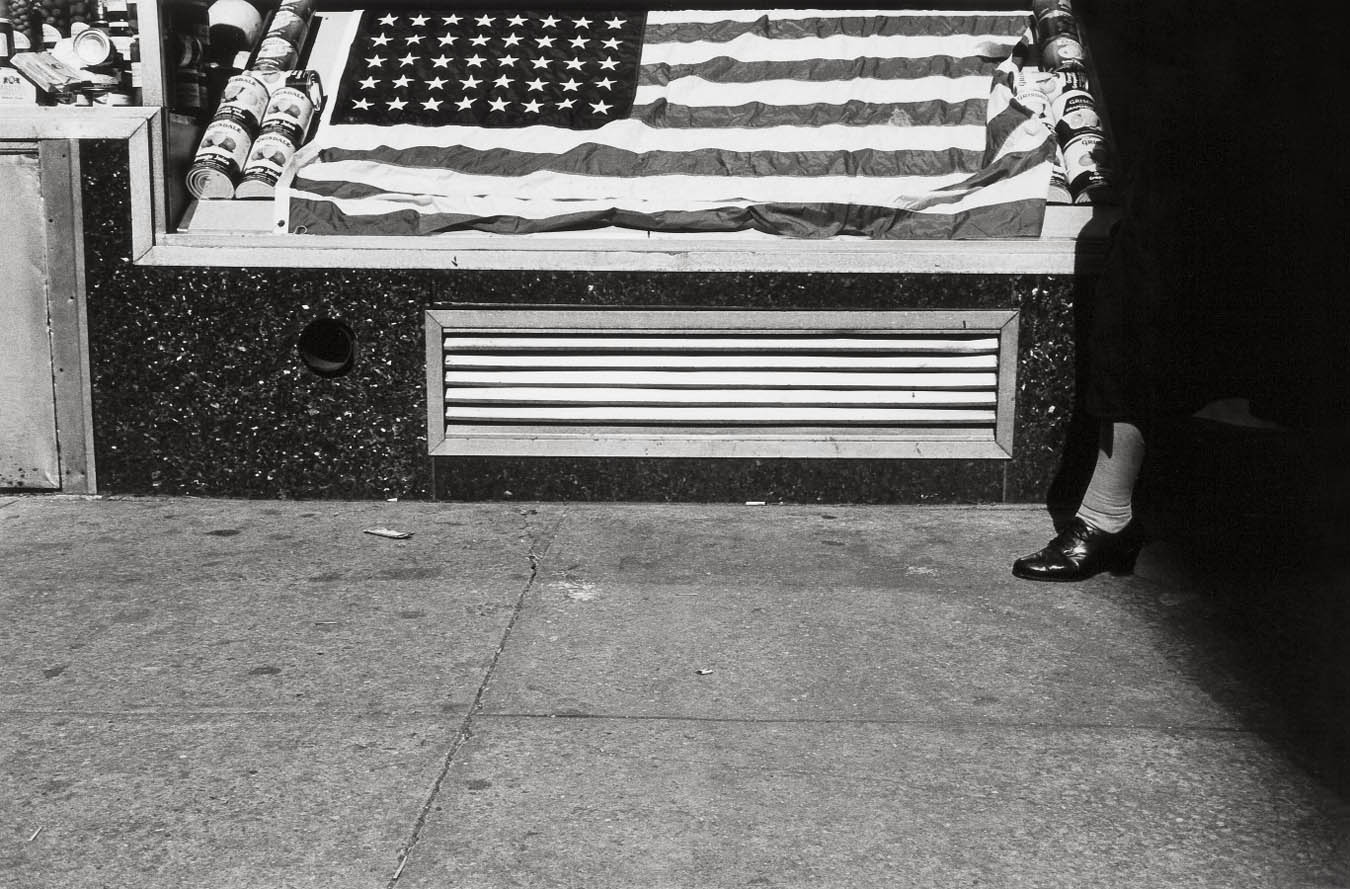
Lee Friedlander (American, b. 1934) 'Flag, New York City' 1965


Lee Friedlander (American, b. 1934)
Flag, New York City
1965
Gelatin silver print
© Lee Friedlander


Lee Friedlander (American, b. 1934) 'New York City' 1966


Lee Friedlander (American, b. 1934)
New York City
1966
Gelatin silver print
Baryt paper (card)
21.9 x 32.8cm
On permanent loan from Siemens AG, Munich, to the Sammlung Moderne Kunst since 2003
© Lee Friedlander


Lee Friedlander (American, b. 1934) 'Provincetown, Massachusetts' 1968


Lee Friedlander (American, b. 1934)
Provincetown, Massachusetts
1968
Gelatin silver print
© Lee Friedlander


Lee Friedlander (American, b. 1934) 'Route 9W, New York' 1969


Lee Friedlander (American, b. 1934)
Route 9W, New York
1969
Gelatin silver print, Baryt paper (card)
20.4 x 30.5cm
On permanent loan from Siemens AG, Munich, to the Sammlung Moderne Kunst since 2003
© Lee Friedlander


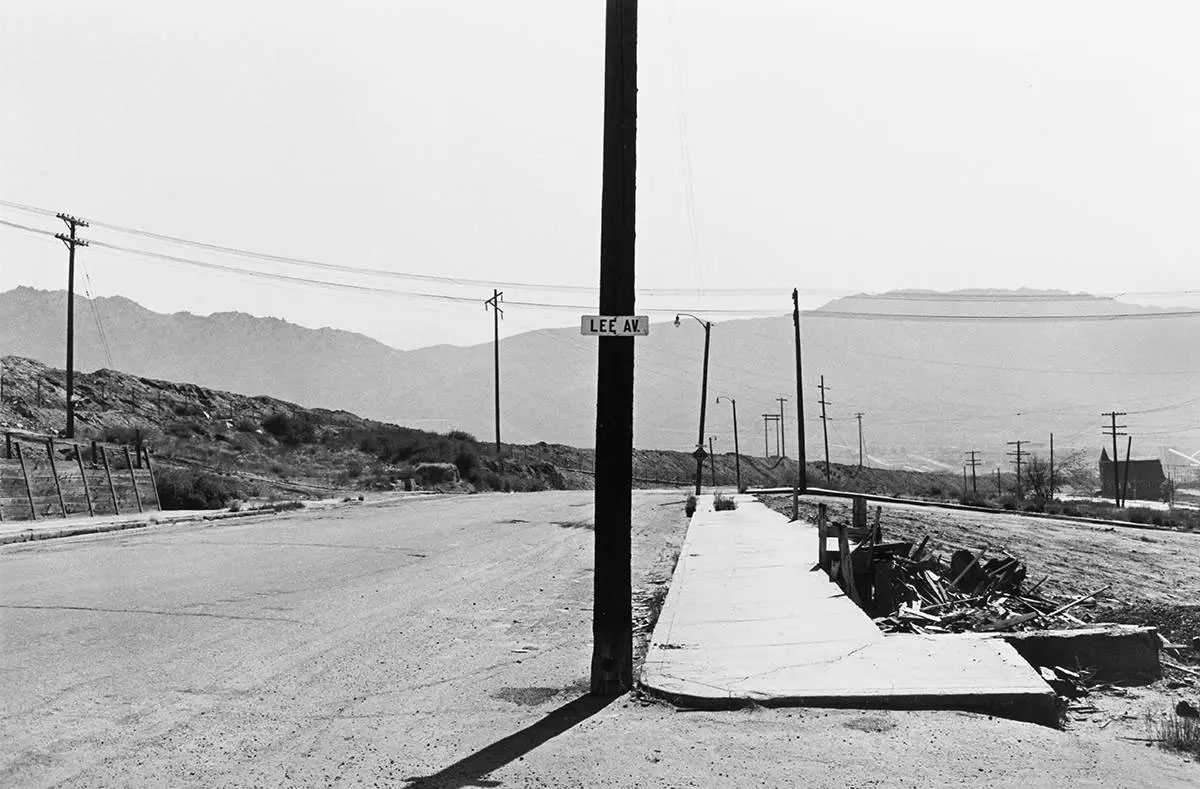
Lee Friedlander (American, b. 1934) 'Lee Ave., Butte, Montana' 1970


Lee Friedlander (American, b. 1934)
Lee Ave., Butte, Montana
1970
Gelatin silver print on baryta paper
© Lee Friedlander


Garry Winogrand (American, 1928-1984) 'New York World's Fair' 1964


Garry Winogrand (American, 1928-1984)
New York World’s Fair
1964
Gelatin silver print
© Estate of Garry Winogrand


Garry Winogrand (American, 1928-1984) 'Los Angeles, California' 1969


Garry Winogrand (American, 1928-1984)
Los Angeles, California
1969
Gelatin silver print (pre 1984)
21.8 x 32.8cm
On permanent loan from Siemens AG, Munich, to the Sammlung Moderne Kunst since 2003
© Estate of Garry Winogrand


Garry Winogrand (American, 1928-1984) 'New York City' 1969


Garry Winogrand (American, 1928-1984)
New York City
1969
Gelatin silver print
© Estate of Garry Winogrand


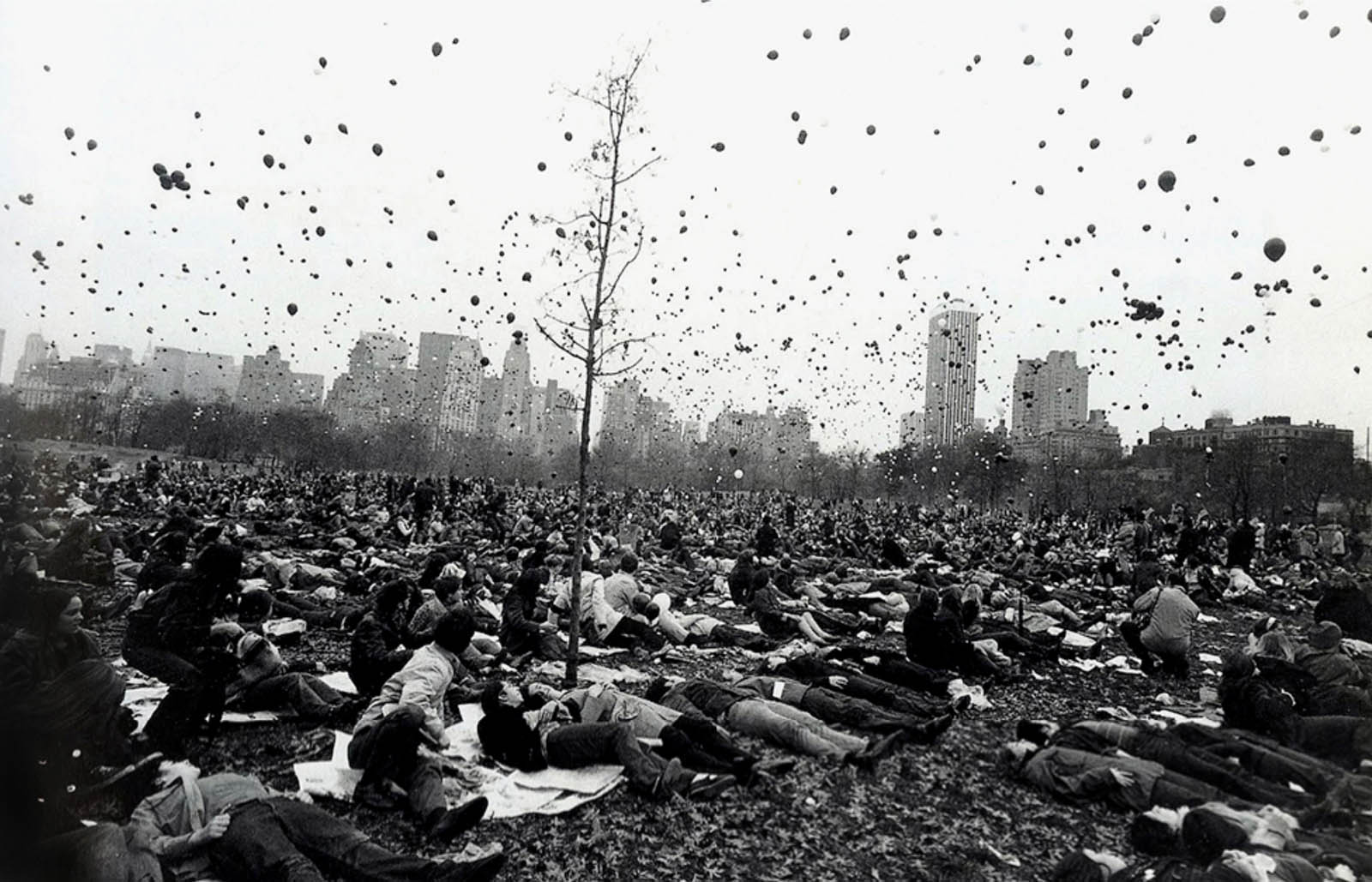
Garry Winogrand (American, 1928-1984) 'Peace Demonstration, Central Park, New York' 1970


Garry Winogrand (American, 1928-1984)
Peace Demonstration, Central Park, New York
1970
Gelatin silver print
© Estate of Garry Winogrand


Nicholas Nixon (American, b. 1947) 'Buildings on Tremont Street, Boston' 1975


Nicholas Nixon (American, b. 1947)
Buildings on Tremont Street, Boston
1975
From the series Boston Views 1974-1976
Gelatin silver print, Baryt paper (card)
© Nicholas Nixon


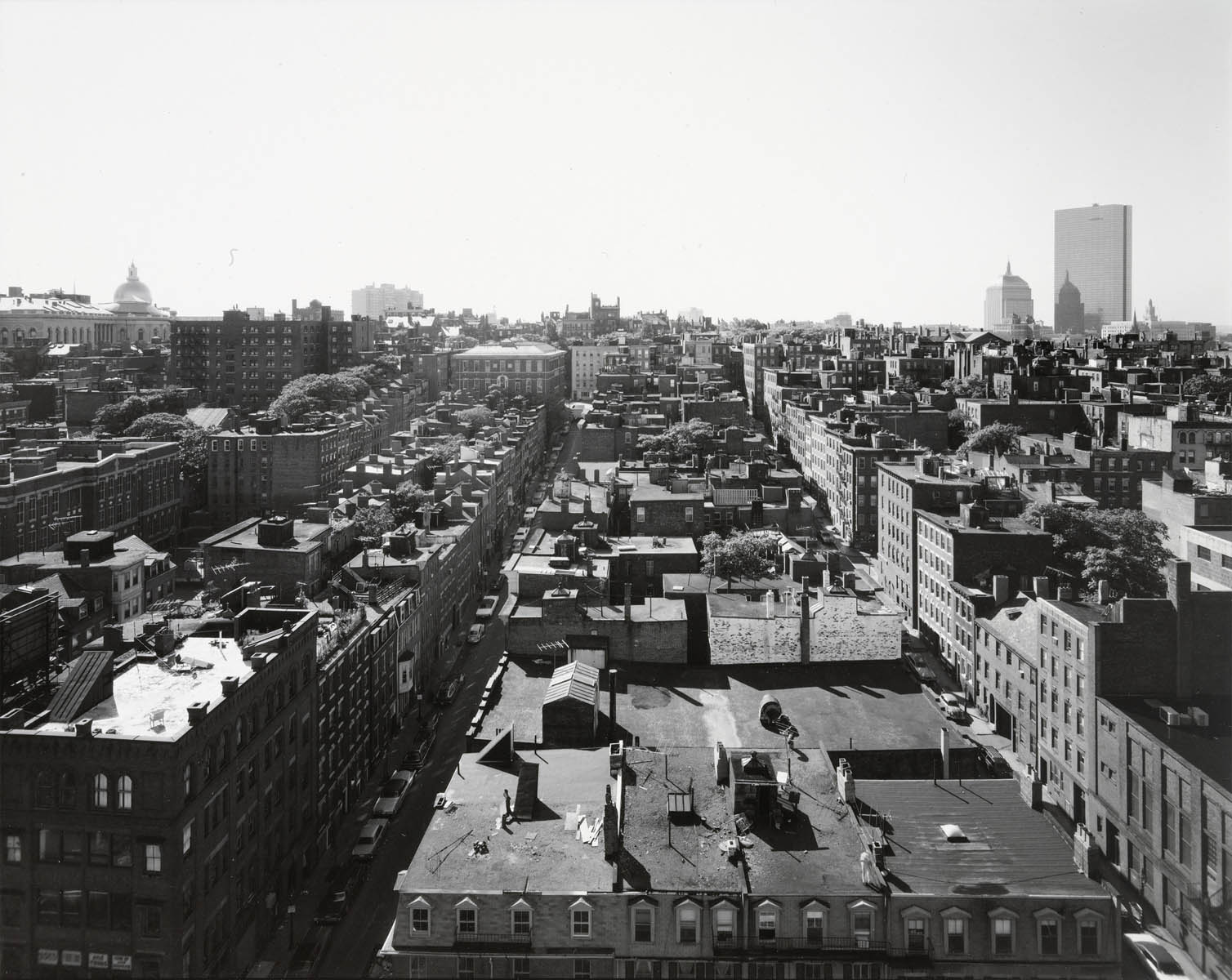
Nicholas Nixon (American, b. 1947) 'View of Beacon Hill, Boston' 1975


Nicholas Nixon (American, b. 1947)
View of Beacon Hill, Boston
1975
From the series Boston Views 1974-1976
Gelatin silver print, Baryt paper (card)
© Nicholas Nixon


Nicholas Nixon (American, b. 1947) 'View of State Street, Boston' 1976


Nicholas Nixon (American, b. 1947)
View of State Street, Boston
1976
From the series Boston Views 1974-1976
Gelatin silver print, Baryt paper (card)
20.3 x 25.2cm
On permanent loan from Siemens AG, Munich, to the Sammlung Moderne Kunst since 2003
© Nicholas Nixon


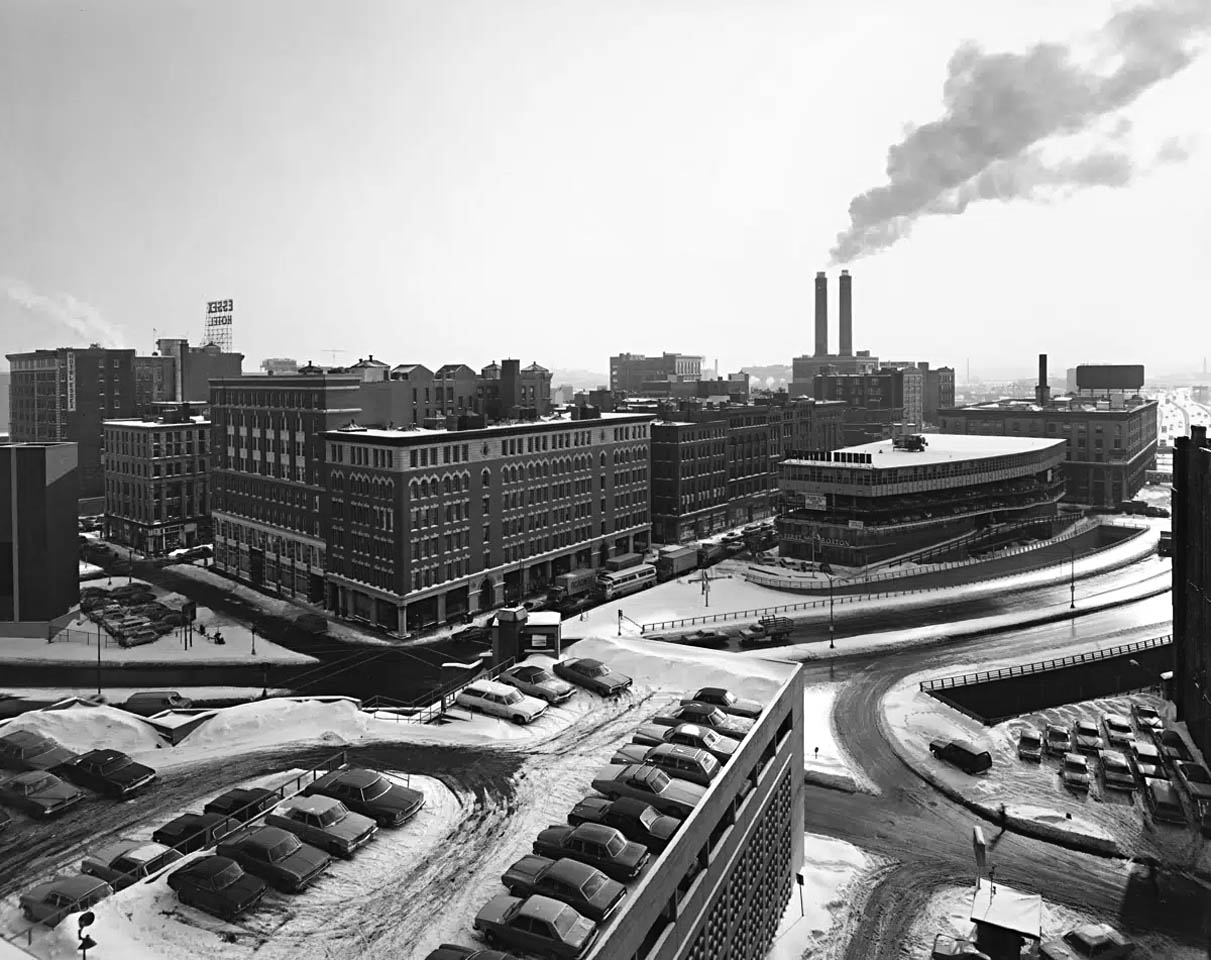
Nicholas Nixon (American, b. 1947) 'View of Essex Street and Downtown Entrance to the Massachusetts Turnpike, Boston' 1976


Nicholas Nixon (American, b. 1947)
View of Essex Street and Downtown Entrance to the Massachusetts Turnpike, Boston
1976
From the series Boston Views 1974-1976
Gelatin silver print, Baryt paper (card)
© Nicholas Nixon


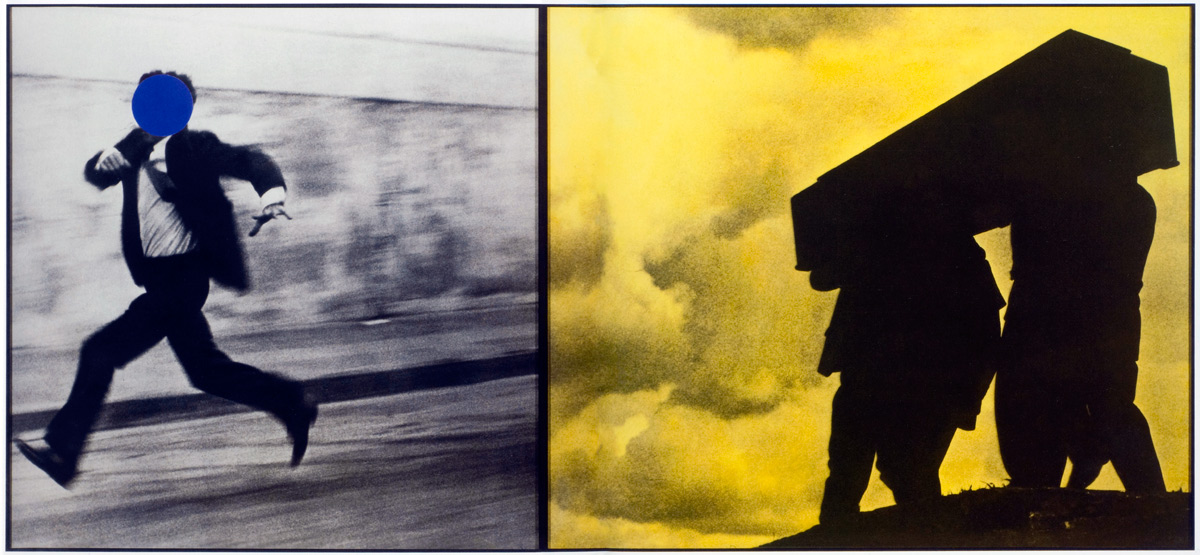
John Baldessari (American, 1931-2020) 'Man Running/Men Carrying Box' 1988-1990


John Baldessari (American, 1931-2020)
Man Running/Men Carrying Box
1988-1990
Gelatin silver prints, vinyl paint and shading in oil
Part 1: 121.3 x 118.6cm; Part 2: 121.3 x 146.6cm
On permanent loan from Siemens AG, Munich, to the Sammlung Moderne Kunst since 2003
© John Baldessari


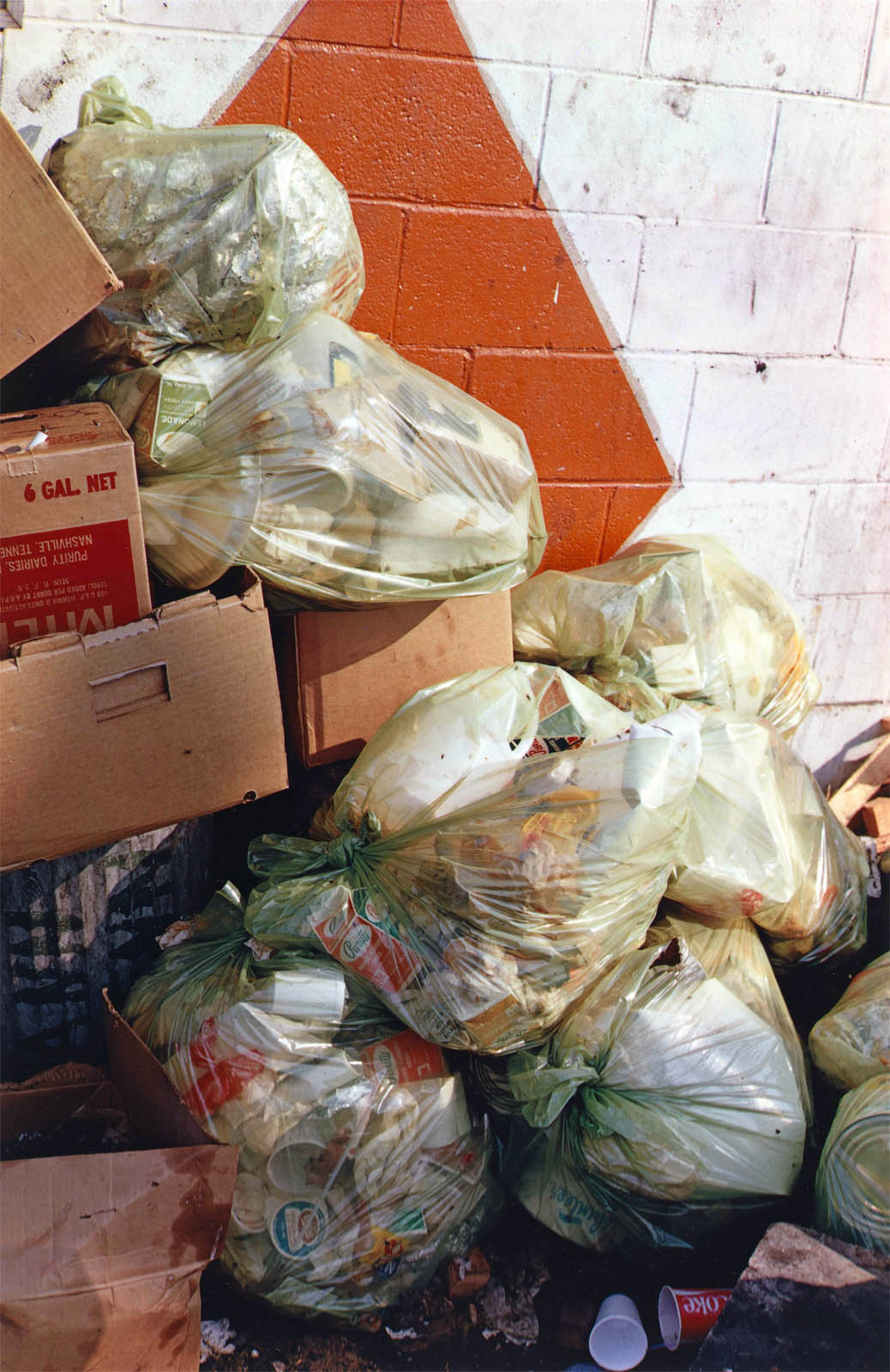
William Eggleston (American, b. 1939) 'Untitled' 1970-1973 From the portfolio 'Troubled Waters'


William Eggleston (American, b. 1939)
Untitled
1970-1973
From the portfolio Troubled Waters 1980
© Eggleston Artistic Trust


William Eggleston (American, b. 1939) 'Untitled' 1980 From the portfolio 'Troubled Waters' 1980


William Eggleston (American, b. 1939)
Untitled
1980
From the portfolio Troubled Waters 1980
© Eggleston Artistic Trust


William Eggleston (American, b. 1939) 'Untitled' 1970-1973 From the portfolio 'Troubled Waters' 1980


William Eggleston (American, b. 1939)
Untitled
1970-1973
From the portfolio Troubled Waters 1980
© Eggleston Artistic Trust


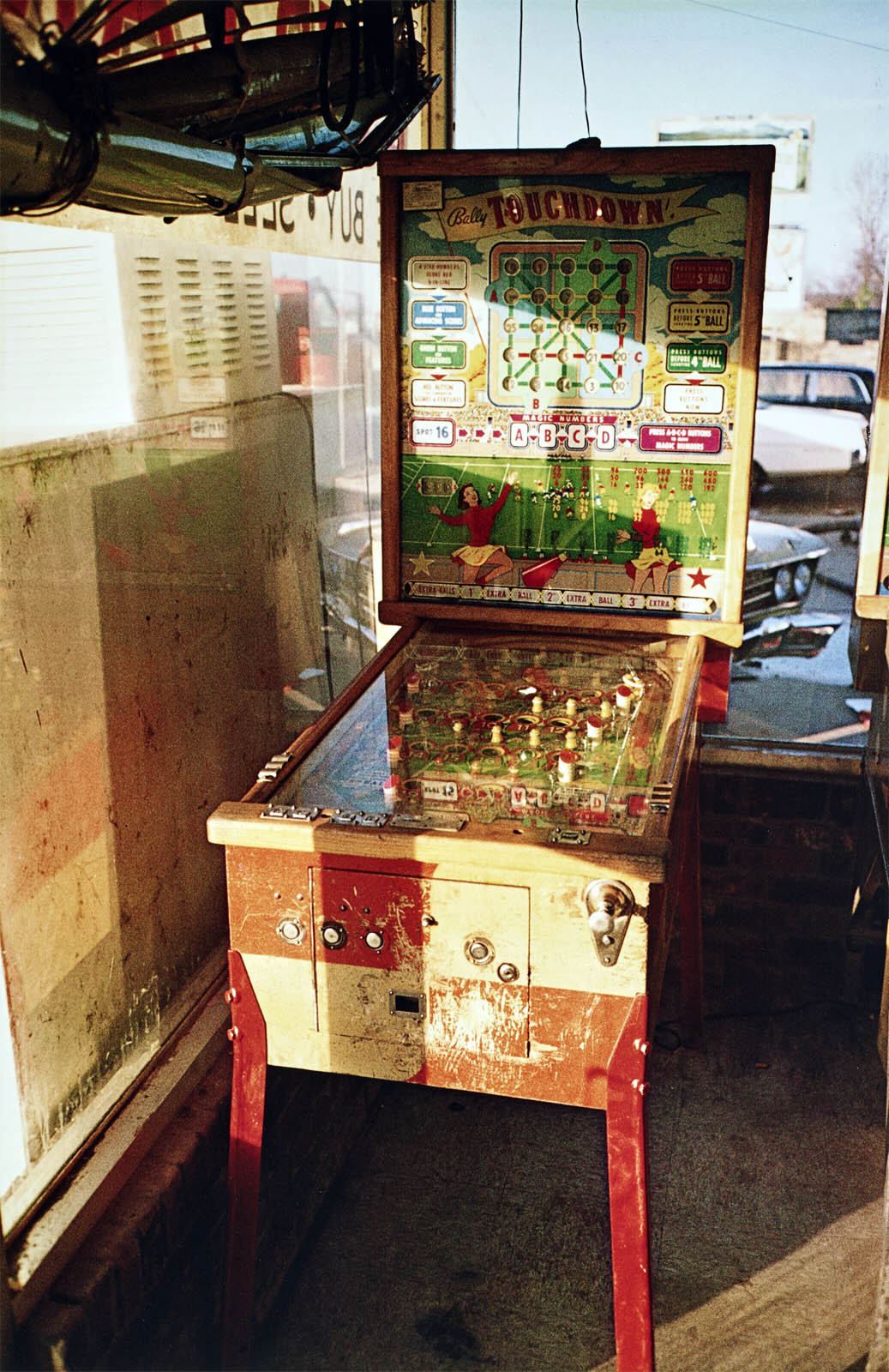
William Eggleston (American, b. 1939) 'Untitled' 1980


William Eggleston (American, b. 1939)
Untitled
1980
The first of 15 works from the portfolio Troubled Waters
Dye transfer print
29 x 44cm
On permanent loan from Siemens AG, Munich, to the Sammlung Moderne Kunst since 2003
© Eggleston Artistic Trust


William Eggleston (American, b. 1939) 'Tennessee (Gulf Sign)' 1971


William Eggleston (American, b. 1939)
Tennessee (Gulf Sign)
1971
Dye transfer print
© Eggleston Artistic Trust


William Eggleston (American, b. 1939) from 'Southern Suite' (10-part series) 1981


William Eggleston (American, b. 1939)
from Southern Suite (10-part series)
1981
Dye transfer print
25.0 x 38.2cm
Sammlung Moderne Kunst in the Pinakothek der Moderne Munich. Acquired in 2006 through PIN. Freunde der Pinakothek der Moderne e.V.
© Eggleston Artistic Trust


American photography forms an extensive and simultaneously top-quality focal point in the collection, of which a selected overview is now being exhibited for the first time. The main interest of young photographers, who have been examining changes in political, social and ecological aspects of everyday American life since the late 1960s, has been the American social landscape. They have developed new pictorial styles that define stylistic devices perceived as genuinely American while at the same time being internationally recognised. Whereas Lee Friedlander, Garry Winogrand, Robert Adams, Lewis Baltz and Larry Clark, who are now considered classical modern photographers, have remained true to black-and-white photography, William Eggleston and Stephen Shore in particular have established colour photography as an artistically independent form of expression. The exhibition brings together around 100 works that, thanks to the Siemens Photography Collection and through acquisitions, bequests and donations, are now part of the museum’s holdings. True stories covers a spectrum from the street photography of the late 1960s to New Topographics and pictures by the New York photographer Zoe Leonard, taken just a few years ago.

“A new generation of photographers has directed the documentary approach toward more personal ends. Their work betrays a sympathy for the imperfection and frailties of society. Their aim has been not to reform life but to know it.” With the exhibition New Documents in spring 1967, John Szarkowski, the influential curator of photography at the Museum of Modern Art in New York, rang in a new era in American photography. Those photographers represented, including Lee Friedlander and Garry Winogrand in addition to Diane Arbus, stood for a change in attitude within documentary photography that was conditioned exclusively by the subjective viewpoint of an individual’s reality. The object of photographic interest lay in the American social landscape and its conditions. It was less concerned with the natural landscape and its increasingly cultural reshaping than with the urban or urbanised space and how people move within it. In so doing, the New Documentarians rejected any obviously explanatory impetus, turning instead to the everyday and commonplace.

The exhibition New Topographics: Photographs of a Man-Altered Landscape that was staged in the mid 1970s at the International Museum of Photography in Rochester, represented a countermovement to this subjective form of expression. Their protagonists, including Robert Adams, Lewis Baltz, Nicholas Nixon and Stephen Shore, also pleaded for a documentary approach and were influenced by figures such as Walker Evans und Robert Frank, but considered themselves rooted in the tradition of 19th-century topographical photography in particular. The prime initiator of this working method, that was expressly not governed by style, is the Los Angeles-based artist Ed Ruscha. Their central aim is a distanced and seemingly analytical depicition, free of judgement; their topic, the landscape altered by mankind. It is the image of the American West in particular, so much conditioned by myths and dreams but long since brought back to reality as a result of commercial and ecological exploitation, that is visible in their works.

The decisive quantum leap to establishing the position of colour photography was made by the Southerner William Eggleston in his exhibition in 1976, also held at the Museum of Modern Art in New York, and the publication of the William Eggleston’s Guide. The harsh public criticism of his pictures was not to do with his use of colour but the fact that Eggleston photographed things and everyday situations – on the spur of the moment and in a seemingly careless manner – that, until then, had not been considered worthy of being photographed turning them into exquisite prints using the expensive and complicated dye-transfer process. In Eggleston’s cosmos of images that is strongly influenced by motifs and the light of the Mississippi Delta, colour constitutes the picture. The “rush of colour” championed by this exhibition led to the comprehensive implementation of colour photography in the field of artistic photography in the years that followed, starting in the USA and then in Europe – and especially in Germany.

An artistic attitude became established at the end of the 1970s that, with recourse to existing picture material from art, film, advertising and the mass media, formulated new pictorial concepts and, in the same breath, opened up traditional artistic and art-historical categories such as authorship, originality, uniqueness, intellectual property and authenticity to discussion. Appropriation Art owes its decisive influences to the artist John Baldessari, who lives and teaches in California. One of its most famous representatives is Richard Prince, who became famous in particular as a result of his artistic adaptation of advertising images. Concept art in the 1960s and ’70s similarly makes use of photography, both as part of an artistic practice using the most varied of materials and as a unique medium for documenting campaigns, happenings and performances. As works by Dan Graham and Zoe Leonard clearly show, the previously precisely delineated boundaries between photography that alludes to its own intrinsically, media-related history and the use of photography as an artistic strategy, have become more fluid.

Press release from the Pinakothek der Moderne website


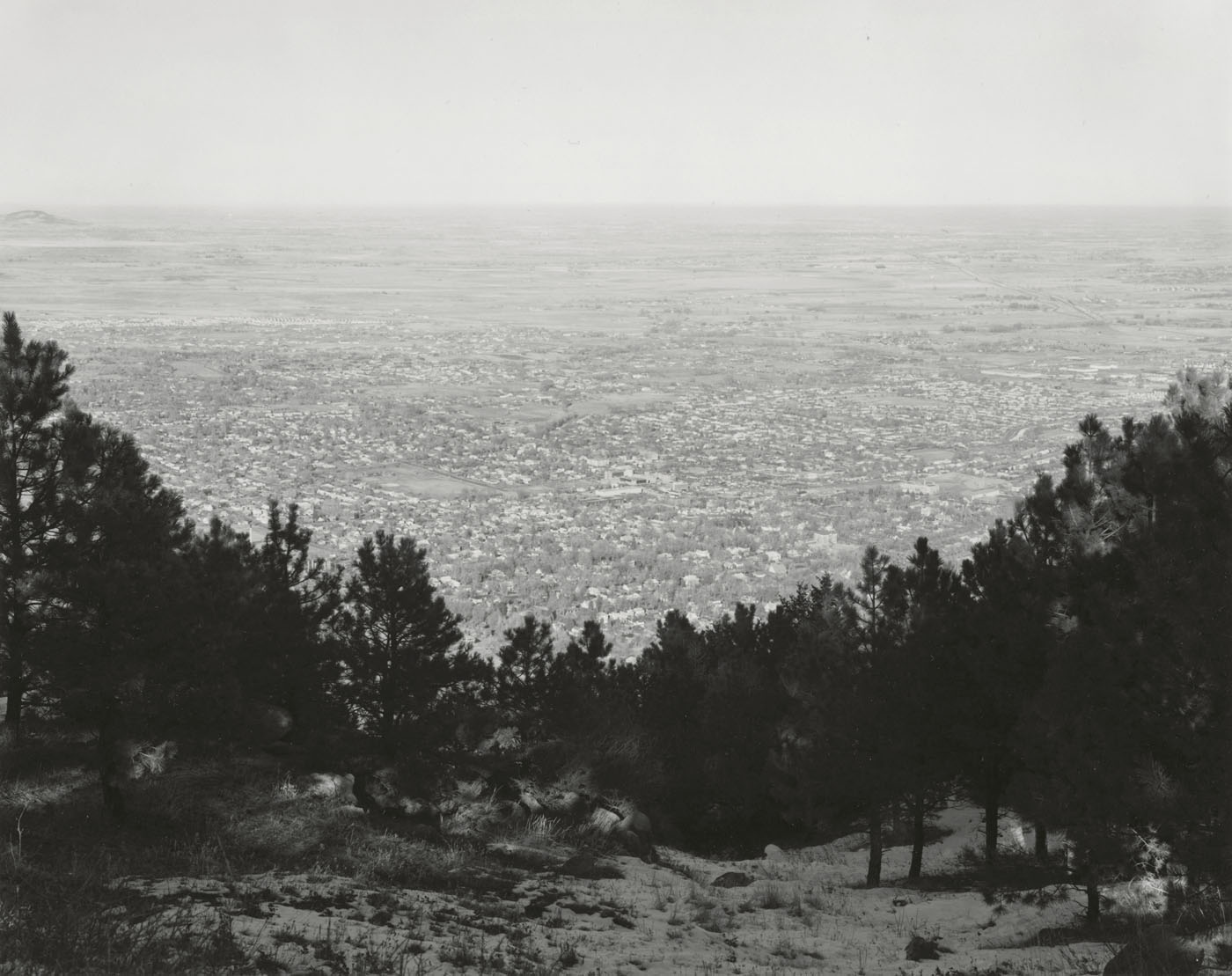
Robert Adams (American, b. 1937) 'East from Flagstaff Mountain, Boulder County, Colorado' 1975


Robert Adams (American, b. 1937)
East from Flagstaff Mountain, Boulder County, Colorado
1975
Gelatin silver print
Courtesy Fraenkel Gallery, San Francisco
© Robert Adams


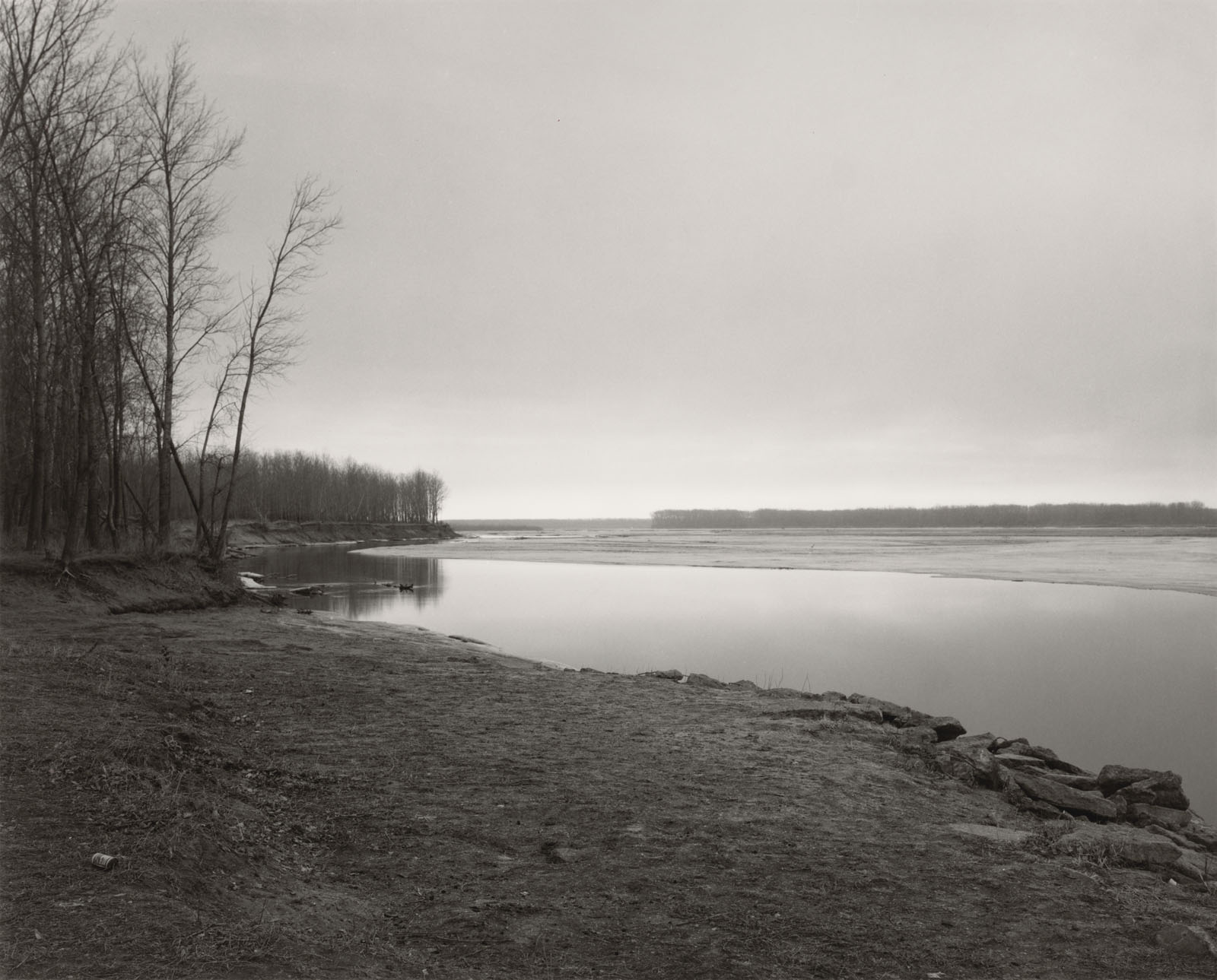
Robert Adams (American, b. 1937) 'Missouri River, Clay County, South Dakota' 1977


Robert Adams (American, b. 1937)
Missouri River, Clay County, South Dakota
1977
Gelatin silver print
Courtesy Fraenkel Gallery, San Francisco
© Robert Adams


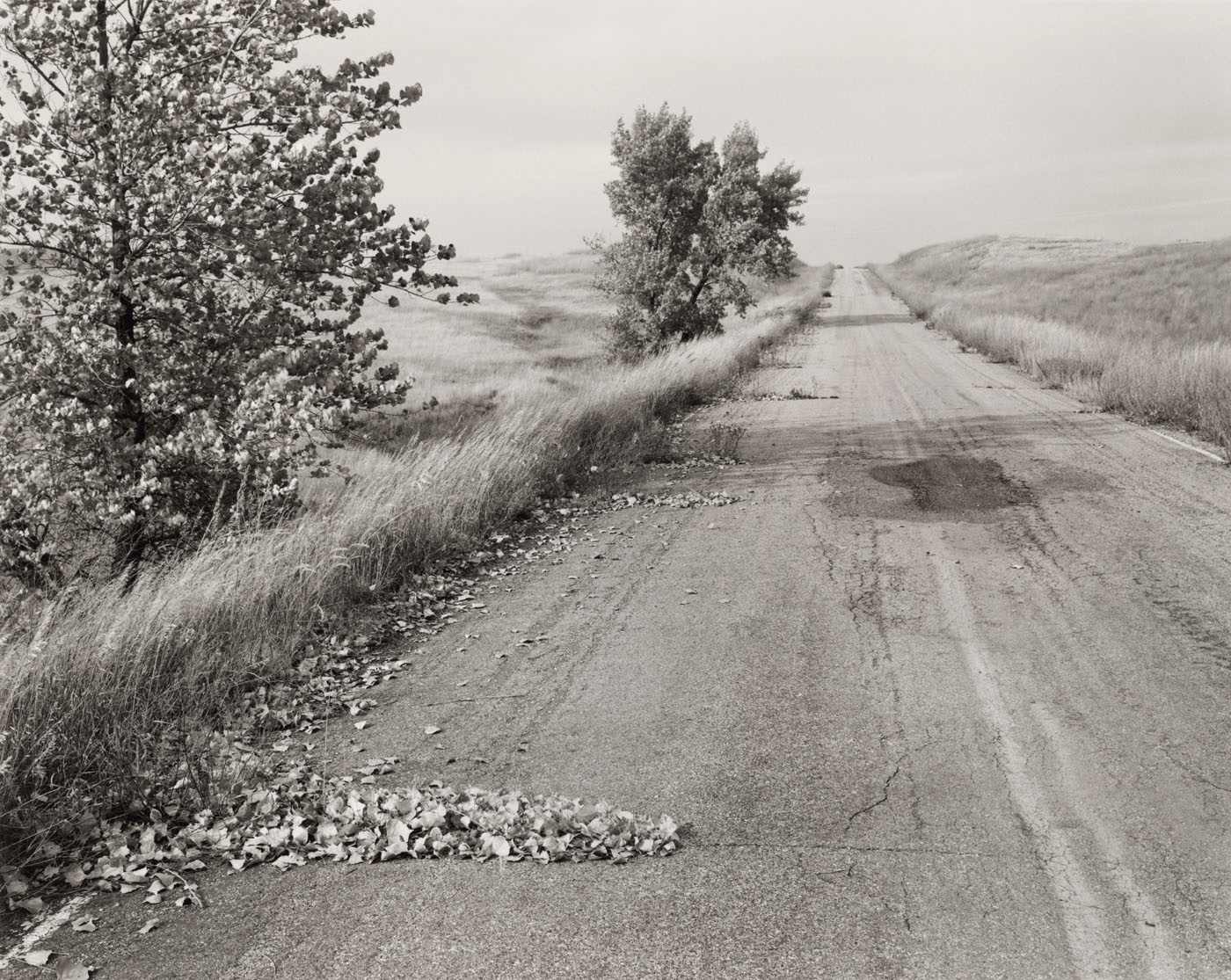
Robert Adams (American, b. 1937) 'Nebraska State Highway 2, Box Butte County, Nebraska' 1978, printed 1991


Robert Adams (American, b. 1937)
Nebraska State Highway 2, Box Butte County, Nebraska
1978, printed 1991
Gelatin silver print
Courtesy Fraenkel Gallery, San Francisco
© Robert Adams


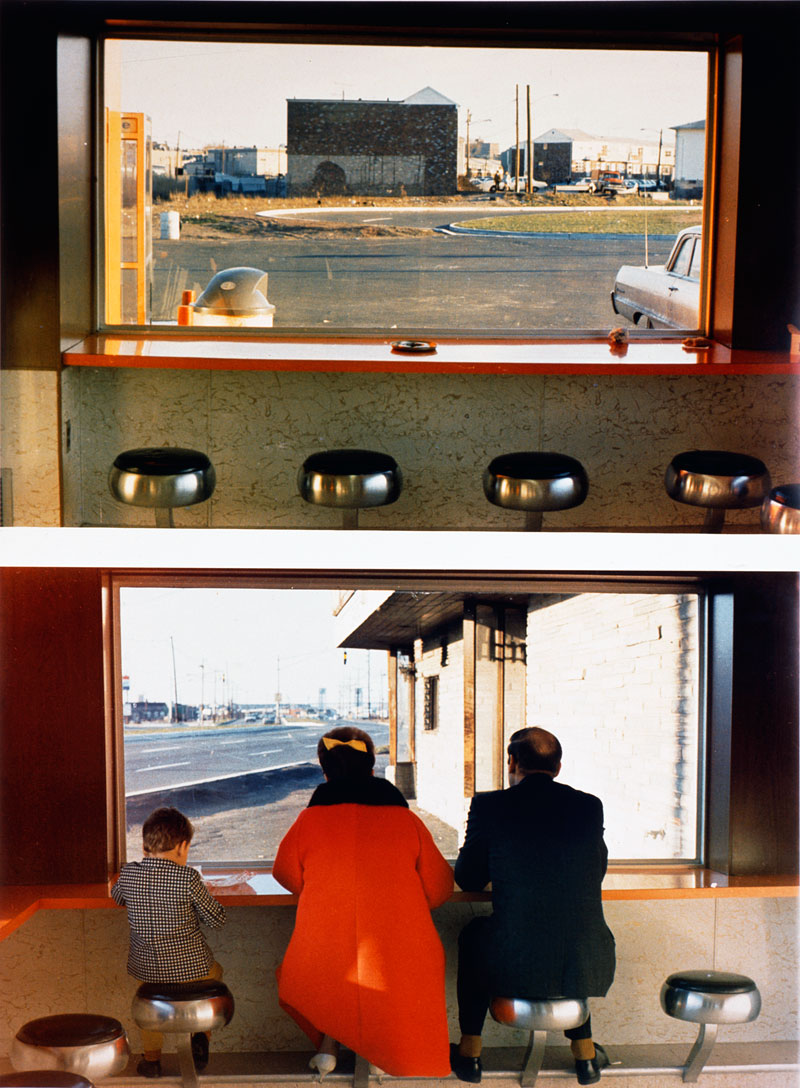
Dan Graham (American, b. 1942) 'View Interior, New Highway Restaurant, Jersey City, N.J.,' 1967 (detail)


Dan Graham (American, b. 1942)
View Interior, New Highway Restaurant, Jersey City, N.J., (detail)
1967 (printed 1996)
C-prints
Each 50.6 x 76.2cm
On permanent loan from Siemens AG, Munich, to the Sammlung Moderne Kunst since 2003
© Dan Graham


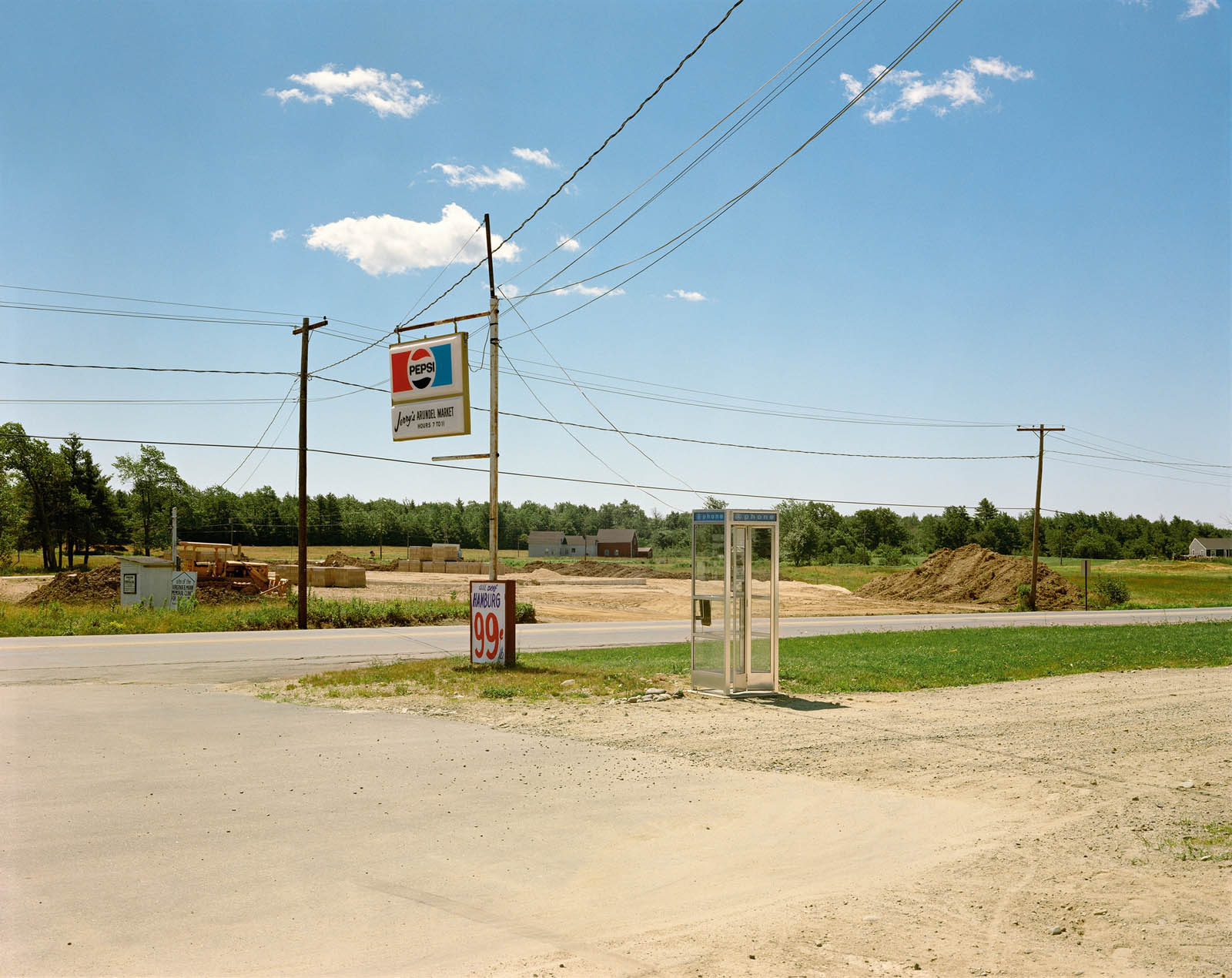
Stephen Shore (American, b. 1947) 'U.S. 1, Arundel, ME.' 1974


Stephen Shore (American, b. 1947)
U.S. 1, Arundel, ME.
1974
Chromogenic print
© Stephen Shore


Stephen Shore (American, b. 1947) 'Wilde Street and Colonization Avenue, Dryden, Ontario' 1974


Stephen Shore (American, b. 1947)
Wilde Street and Colonization Avenue, Dryden, Ontario
1974
Chromogenic print
© Stephen Shore


Stephen Shore (American, b. 1947) 'West 9th Avenue, Amarillo, Texas' 1974


Stephen Shore (American, b. 1947)
West 9th Avenue, Amarillo, Texas
1974
Dye coupler print
© Stephen Shore


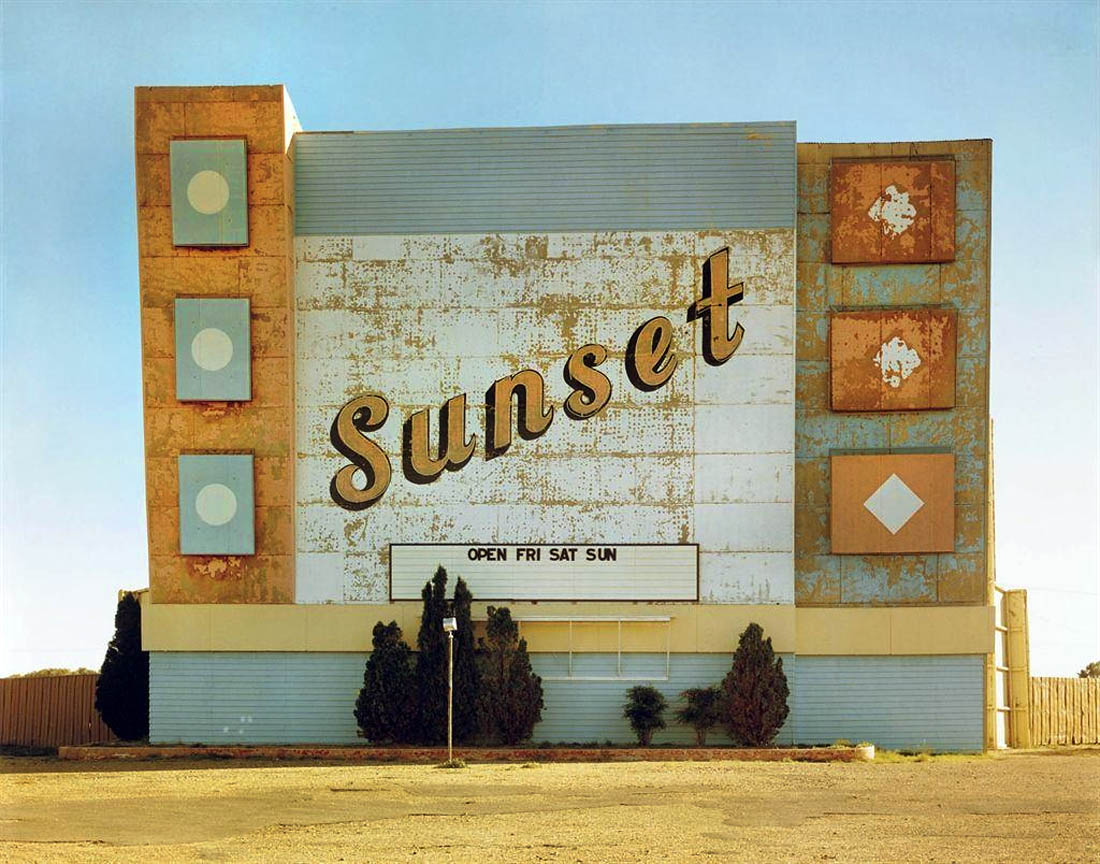
Shore was a consummate New York City boy who dropped out of high school when he was 17 and instead spent his time watching and making films and photographing Andy Warhol and his compatriots at his studio, the Factory. But a 1969 trip to Amarillo, Texas, to visit the family of his friend Michael Marsh set him on a new path, spurring a decade of road trips exploring the United States. His itineraries usually included Amarillo, and its people and buildings appear throughout his photographs from the time. “I loved Amarillo, not just what it looked like but the way people hung out – the pace of the life, the car culture, the barbecue joints,” he said. This stark, frontal portrait of the Sunset drive-in conveys the withering Texas heat that has peeled the facade’s paint, as well as a sense of forlornness and neglect that proved prescient when the drive-in closed two years later.

Text taken from the Carter Handbook (2023) on the American Carter Museum of American Art website


Stephen Shore (American, b. 1947) 'La Brea Avenue & Beverly Boulevard, Los Angeles, California' 1975


Stephen Shore (American, b. 1947)
La Brea Avenue & Beverly Boulevard, Los Angeles, California
1975
Chromogenic print, Kodak professional paper (1998)
20.4 x 25.5cm
On permanent loan from Siemens AG, Munich, to the Sammlung Moderne Kunst since 2003
© Stephen Shore


Larry Clark (American, b. 1943) 'Billy Mann Dead 1970' 1968


Larry Clark (American, b. 1943)
Billy Mann Dead 1970
1968
From the series Tulsa
Gelatin silver print
© Larry Clark


Larry Clark (American, b. 1943) 'Tulsa' 1972


Larry Clark (American, b. 1943)
Tulsa
1972
Gelatin silver print
20.3 x 25.4cm (sheet)
Sammlung Moderne Kunst in the Pinakothek der Moderne Munich. Acquired in 2003 by PIN. Freunde der Pinakothek der Moderne
© Larry Clark


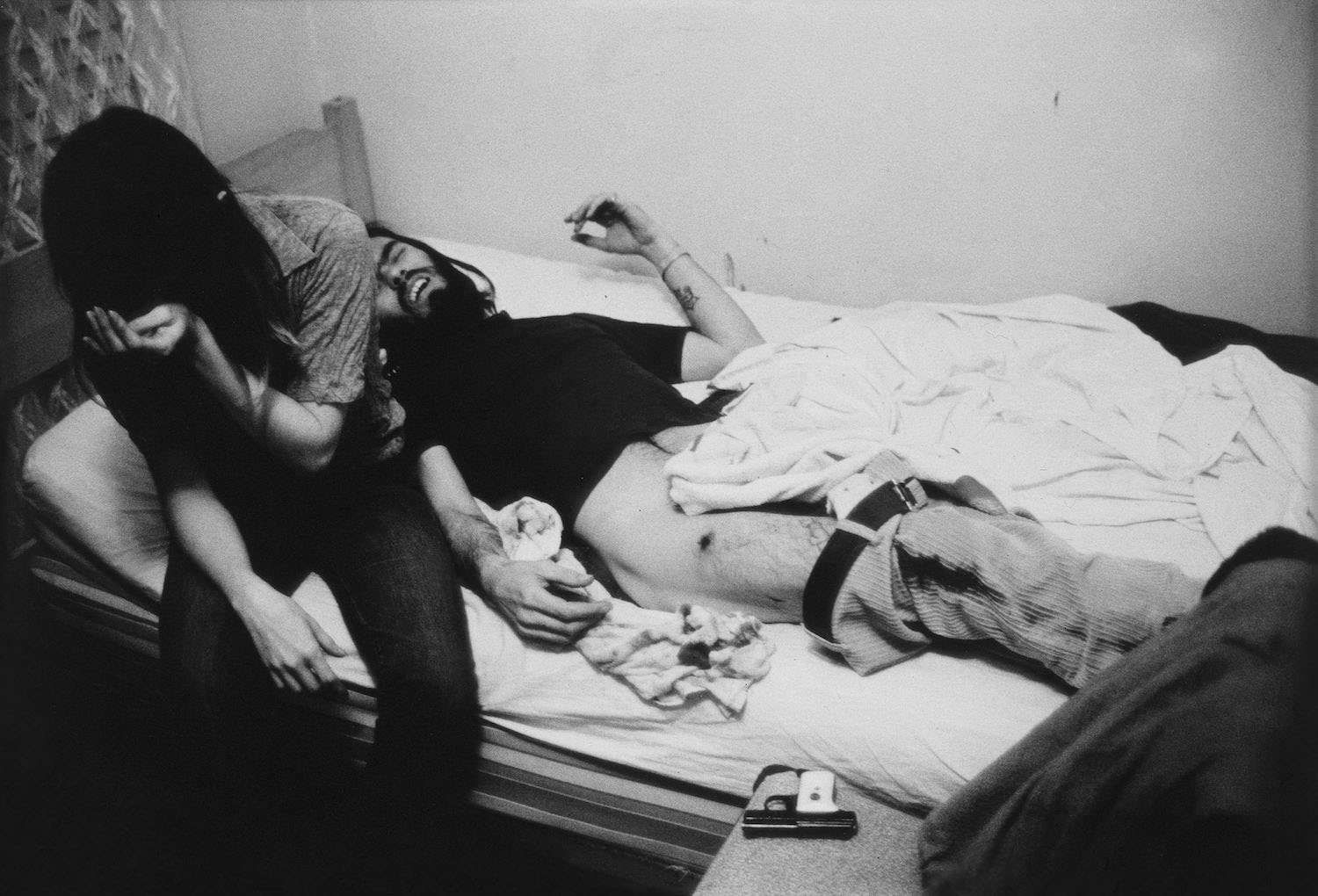
Larry Clark (American, b. 1943) 'Accidental Gunshot Wound' 1971


Larry Clark (American, b. 1943)
Accidental Gunshot Wound
1971
Gelatin silver print
© Larry Clark


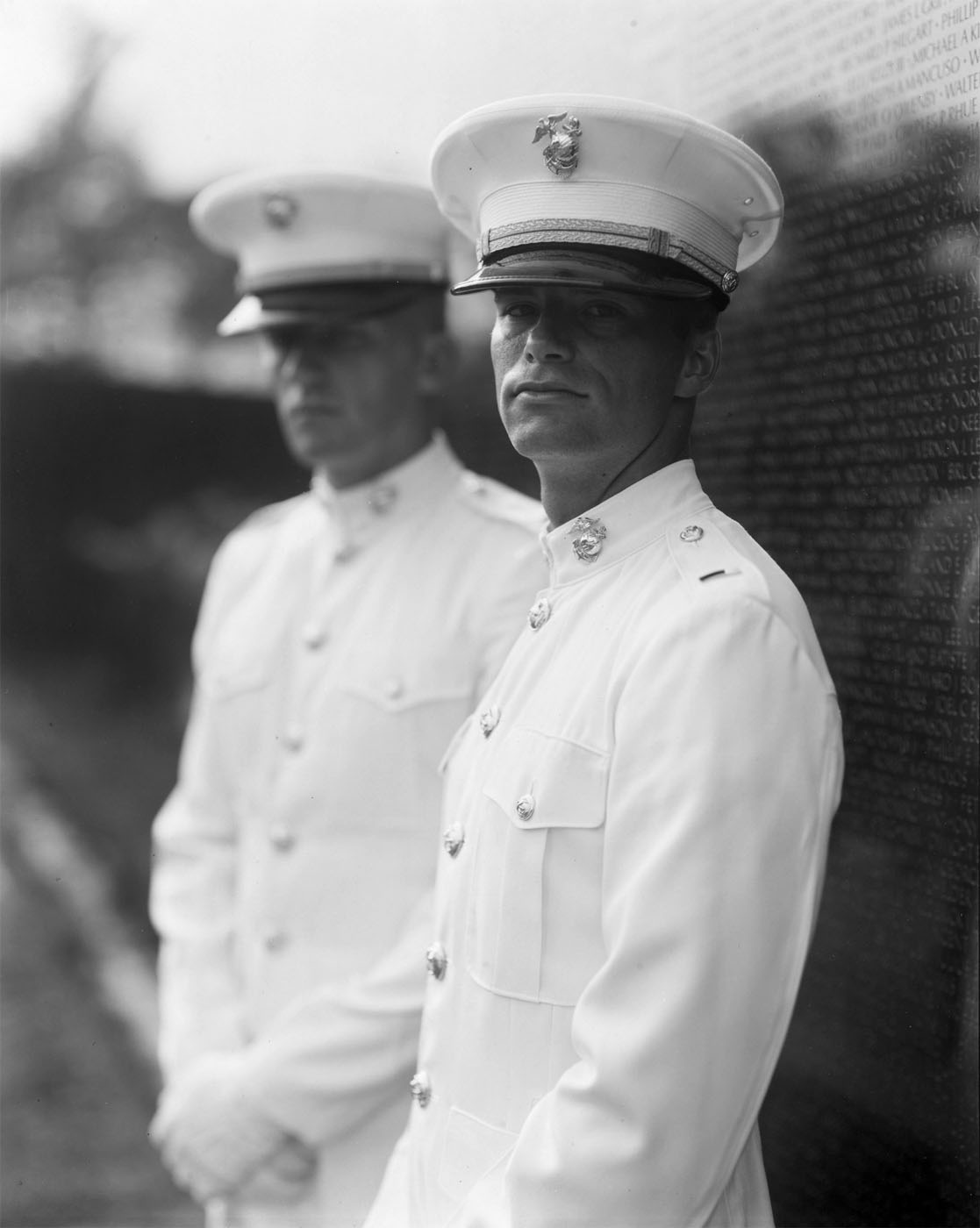
Judith Joy Ross (American, b. 1946) 'Untitled' 1984 from the series 'Portraits at the Vietnam Veterans Memorial, Washington, D.C.'


Judith Joy Ross (American, b. 1946)
Untitled
1984, printed 1996
From the series Portraits at the Vietnam Veterans Memorial, Washington, D.C. 1983-1984
Gelatin silver print on daylight printing-out paper, shading in gold
25.2 x 20.2cm
On permanent loan from Siemens AG, Munich, to the Sammlung Moderne Kunst since 2003
© Judith Joy Ross


Judith Joy Ross (American, b. 1946) 'Untitled' 1984, printed 1996 From the series 'Portraits at the Vietnam Veterans Memorial, Washington, D.C.'


Judith Joy Ross (American, b. 1946)
Untitled
1984, printed 1996
From the series Portraits at the Vietnam Veterans Memorial, Washington, D.C. 1983-1984
Gelatin silver print on daylight printing-out paper
© Judith Joy Ross


Judith Joy Ross (American, b. 1946) 'Untitled' 1984, printed 1996 From the series 'Portraits at the Vietnam Veterans Memorial, Washington, D.C.'


Judith Joy Ross (American, b. 1946)
Untitled
1984, printed 1996
From the series Portraits at the Vietnam Veterans Memorial, Washington, D.C. 1983-1984
Gelatin silver print on daylight printing-out paper
© Judith Joy Ross


John Gossage (American, b. 1946) 'EL NEGRITO' 1997


John Gossage (American, b. 1946)
EL NEGRITO
1997
From the series There and Gone
Gelatin silver print, Baryt paper, screen print on photo mount card
55.4 x 45.0 cm
On permanent loan from Siemens AG, Munich, to the Sammlung Moderne Kunst since 2003
© John Gossage


Pinakothek Der Moderne
Barer Strasse 40
Munich

Opening hours:
Daily except Monday 10am – 6pm
Thursday 10am – 8pm

Pinakothek der Moderne website

LIKE ART BLART ON FACEBOOK

Back to top

Exhibition: ‘Harry Callahan at 100’ at the National Gallery of Art, Washington

Exhibition dates:  2nd October 2011 – 4th March 2012


Harry Callahan (American, 1912-1999) 'Detroit' 1943


Harry Callahan (American, 1912-1999)
Detroit
1943
Gelatin silver print
Overall (sheet, trimmed to image): 8.3 x 11cm (3 1/4 x 4 5/16 in)
National Gallery of Art, Washington
Gift of the Callahan Family
© Estate of Harry Callahan, courtesy Pace/MacGill Gallery, New York


For me, the early photographs of his wife Eleanor and Eleanor with their child Barbara and the most poignant, intimate and beautiful of Callahan’s work while the later modernist Cape Cod photographs presage the spirit and aesthetics of the New Topographics: Photographs of a Man-Altered Landscape of 1975. Mario Cutajar observes

“These pictures of strangely vacant, light haunted intersections of sky, land, and ocean are confrontations with the limits of both the ego and photography itself as the ego’s instrument. They are oriented toward death rather than life, intimating in a cold, unsentimental way passage to another world or, perhaps, the engulfing oblivion at the horizon.”

Dr Marcus Bunyan


Many thankx to the National Gallery of Art for allowing me to publish the photographs in the posting. Please click on the photographs for a larger version of the image.


Harry Callahan (American, 1912-1999) 'Chicago' 1950


Harry Callahan (American, 1912-1999)
Chicago
1950
Gelatin silver print
Sheet (trimmed to image): 19 x 24.2 cm (7 1/2 x 9 1/2 in.)
National Gallery of Art, Washington
© Estate of Harry Callahan, Collection of Pace/MacGill Gallery, New York


Harry Callahan (American, 1912-1999) 'Eleanor, Chicago' 1952


Harry Callahan (American, 1912-1999)
Eleanor, Chicago
1952
Gelatin silver print
National Gallery of Art, Washington
© Estate of Harry Callahan, Collection of Pace/MacGill Gallery, New York


Harry Callahan (American, 1912-1999) 'Ivy Tentacles on Glass, Chicago' c. 1952


Harry Callahan (American, 1912-1999)
Ivy Tentacles on Glass, Chicago
c. 1952
Gelatin silver print
Image (can’t tell sheet size due to matting): 19.21 x 24.13cm (7 9/16 x 9 1/2 in.)
National Gallery of Art, Washington
Gift of Susan and Peter MacGill
© Estate of Harry Callahan, Collection of Pace/MacGill Gallery, New York


Harry Callahan (American, 1912-1999) 'Eleanor and Barbara, Chicago' 1953


Harry Callahan (American, 1912-1999)
Eleanor and Barbara, Chicago
1953
Gelatin silver print
Overall (image): 19.5 x 24.45cm (7 11/16 x 9 5/8 in)
National Gallery of Art, Washington
Promised Gift of Susan and Peter MacGill
© Estate of Harry Callahan, courtesy Pace/MacGill Gallery, New York


Harry Callahan (American, 1912-1999) 'Cape Cod' 1972


Harry Callahan (American, 1912-1999)
Cape Cod
1972
Gelatin silver print
Overall (image): 23.7 x 23.9cm (9 5/16 x 9 7/16 in)
National Gallery of Art, Washington
Gift of Joyce and Robert Menschel
© Estate of Harry Callahan, courtesy Pace/MacGill Gallery, New York


Harry Callahan (American, 1912-1999) 'Cape Cod' 1974


Harry Callahan (American, 1912-1999)
Cape Cod
1974
Gelatin silver print
Overall (image): 21.8 x 22.6cm (8 9/16 x 8 7/8 in.)
National Gallery of Art, Washington
Gift of Joyce and Robert Menschel
© Estate of Harry Callahan, courtesy Pace/MacGill Gallery, New York


Harry Callahan (American, 1912-1999) 'Ansley Park, Atlanta' 1992


Harry Callahan (American, 1912-1999)
Ansley Park, Atlanta
1992
Gelatin silver print
Overall (image): 15.72 x 15.72cm (6 3/16 x 6 3/16 in)
National Gallery of Art, Washington
Gift of Susan and Peter MacGill
© Estate of Harry Callahan, courtesy Pace/MacGill Gallery, New York


The year 2012 marks the centenary of the birth of Harry Callahan (1912-1999), whose highly experimental, visually daring, and elegant photographs made him one of the most innovative artists of the 20th century.

On view in the West Building of the National Gallery of Art from October 2, 2011, through March 4, 2012, Harry Callahan at 100 explores all facets of his work in some 100 photographs, from its genesis in the early 1940s Detroit to its flowering in Chicago in the late 1940s and 1950s, and finally to its maturation in Providence and Atlanta from the 1960s through the 1990s. In 1996, the Gallery organised the exhibition Harry Callahan, which traveled to Philadelphia, Atlanta, Detroit, and Chicago, and included numerous works on loan from the artist.

“Using the rich holdings of the Gallery’s own collection of Callahan’s work, as well as a large collection of photographs on long-term loan from the artist’s widow, the exhibition will reveal the remarkable consistency of his vision and will demonstrate how his strong, inventive formal language repeatedly enriched his art,” said Earl A. Powell III, director, National Gallery of Art.

The Exhibition

Organised thematically and chronologically, Harry Callahan at 100 examines Callahan’s work in relation to the places where he lived and to his family, unveiling his unparalleled devotion to both his subjects and the medium of photography.

In his earliest photographs made in and around Detroit, Callahan explored the limits of the camera, constructing photographs of multiple exposures in both black-and-white and colour. In works such as Twig in Snow (c. 1942) and Store Front and Reflections (c. 1943), he sought to capture simultaneously the simplicity and complexity of nature and the theatre of urban life.

Callahan continued his aesthetic and technical experiments through photographs of his wife, Eleanor. His nudes play with dramatic contrasts of light and dark: his layered multiple exposures reveal Eleanor’s body against landscapes and frosted glass windows (Eleanor, Chicago, 1948). His photographs of his wife and their daughter, Barbara, in the lake, the city, and the woods (Eleanor and Barbara, Lake Michigan, c. 1953) exploit the spontaneity and intimacy of snapshots – yet, paradoxically, were made with a large, cumbersome 8- x 10-inch view camera.

Callahan’s twin interests in the city and the land expanded during his years in Chicago and Providence, where he created both spare and evocative photographs of the natural landscape and complex compositions of urban architecture and pedestrians. He began to document anonymous women on the streets of Chicago, first in close shots of squinting eyes, open mouths, and downcast faces seen in Chicago (1950), then in full-figure shots from a low angle that feature the women against backgrounds of skyscrapers and flagpoles, as in Chicago (1961).

In the 1970s Callahan returned to colour photography, continuing to push the boundaries of the medium, seen in the well-known Providence (1977). Taken in Atlanta and during travels abroad, his late photographs emphasised vibrant colours, long shadows, and the complex humanity of urban life, seen in Morocco (1981) and Atlanta (1985).

Harry Callahan (1912-1999)

Born in Detroit in 1912, Callahan began to photograph in 1938. Although he received no formal training in the medium, his exceptional talent was immediately recognised. In 1946 László Moholy-Nagy hired him to teach at the Institute of Design in Chicago. There and at the Rhode Island School of Design (he moved to Providence in 1961) he taught generations of younger photographers, inspiring them both with the creativity of his vision and his steadfast commitment to the medium. In a career that spanned nearly six decades, he repeatedly explored a few select themes – his wife Eleanor and daughter Barbara, nature, and the urban environment. Yet each time he returned to a familiar subject, he reinvented it, endowing each photograph with both a personal and symbolic significance.

Press release from the National Gallery of Art website


Harry Callahan (American, 1912-1999) 'Eleanor, New York' 1945


Harry Callahan (American, 1912-1999)
Eleanor, New York
1945
Gelatin silver print
Overall (image): 21.2 x 16.83cm (8 3/8 x 6 5/8 in)
National Gallery of Art, Washington
Gift of the Callahan Family
© Estate of Harry Callahan, courtesy Pace/MacGill Gallery, New York


Harry Callahan (American, 1912-1999) 'Eleanor' about 1947


Harry Callahan (American, 1912-1999)
Eleanor
Chicago, 1947
Gelatin silver print
National Gallery of Art, Washington
The Herbert and Nannette Rothschild Memorial Fund in memory of Judith Rothschild
© Estate of Harry Callahan, courtesy Pace/MacGill Gallery, New York


Harry Callahan (American, 1912-1999) 'Eleanor, Chicago' 1948


Harry Callahan (American, 1912-1999)
Eleanor, Chicago
1948
Gelatin silver print
Overall (image): 11.59 x 8.5cm (4 9/16 x 3 3/8 in)
National Gallery of Art, Washington
The Joyce and Robert Menschel Fund
© Estate of Harry Callahan, courtesy Pace/MacGill Gallery, New York


During the 1940s and ’50s, Callahan’s work was deeply affected by the resolutely humanizing presence of his wife, Eleanor, and daughter, Barbara. Frequent subjects, though consistently inscrutable, Eleanor and Barbara are the shadow puppets of his career, a direct testament to his family life, but always seen as if behind some kind of veil or scrim. They are markers of an intimacy that Callahan never violates by direct exposure.

Eleanor, in particular, is photographed down to the very last details of anatomy. She remembers that during these years, she might be cooking or cleaning, and suddenly Harry would announce: “‘Take off your clothes.’ And that would be that.”

The results are sometimes staggering. A 1947 image of what appears to be the lines created by Eleanor’s legs and buttocks looks like a Cycladic statue, relentlessly rectilinear but soft around the edges, freakishly modern and ancient at the same time. An 1953 image of Eleanor and Barbara bathing in Lake Michigan dissolves the horizon, fusing lake and sky into a field of shimmering gray. The two figures seem suspended in space, dematerialized, like characters in a dream.

It’s a small miracle that no matter how much Callahan’s camera dissects the world, the photographs never seem clinical. He divorces things from context, pulls out small vignettes from the larger city, but without violence, and without the gamesmanship of a photographer inclined to the cheap surreal.

Philip Kennicott. “Review: Harry Callahan photography exhibit at the National Gallery of Art,” on The Washington Post website October 4, 2011 [Online] Cited 22/02/2012


Harry Callahan (American, 1912-1999) 'Eleanor, Chicago' c. 1947


Harry Callahan (American, 1912-1999)
Eleanor, Chicago
c. 1947
Gelatin silver print
Overall (sheet, trimmed to image): 11.91 x 8.6cm (4 11/16 x 3 3/8 in)
National Gallery of Art, Washington
Promised Gift of Susan and Peter MacGill
© Estate of Harry Callahan, courtesy Pace/MacGill Gallery, New York


Harry Callahan (American, 1912-1999) 'Chicago' 1961


Harry Callahan (American, 1912-1999)
Chicago
1961
Gelatin silver print
Overall (image):
40.6 x 27.1cm (16 x 10 11/16 in)
National Gallery of Art, Washington
Gift of the Callahan Family
© Estate of Harry Callahan, courtesy Pace/MacGill Gallery, New York


Harry Callahan (American, 1912-1999) 'Store Window with Mannequin with Lingerie, Providence' 1962


Harry Callahan (American, 1912-1999)
Store Window with Mannequin with Lingerie, Providence
1962
Dye imbibition print
22.4 x 34.1cm (8 13/16 x 13 7/16 in.)
National Gallery of Art, Washington
Gift of Mary and Dan Solomon and Patrons’ Permanent Fund
© Estate of Harry Callahan, courtesy Pace/MacGill Gallery, New York


Harry Callahan (American, 1912-1999) 'Kansas City' 1981


Harry Callahan (American, 1912-1999)
Kansas City
1981
Dye imbibition print
Overall (image): 24.3 x 36.7cm (9 9/16 x 14 7/16 in.)
National Gallery of Art, Washington
Gift of The Very Reverend and Mrs. Charles U. Harris
© Estate of Harry Callahan, courtesy Pace/MacGill Gallery, New York


Harry Callahan (American, 1912-1999) 'Morocco' 1981


Harry Callahan (American, 1912-1999)
Morocco
1981
Dye imbibition print
Overall (image): 24.2 x 36.7cm (9 1/2 x 14 7/16 in.)
National Gallery of Art, Washington
Gift of the Collectors Committee
© Estate of Harry Callahan, courtesy Pace/MacGill Gallery, New York


Harry Callahan (American, 1912-1999) 'Atlanta' 1985


Harry Callahan (American, 1912-1999)
Atlanta
1985
Dye imbibition print
Overall (image): 24.4 x 36.7cm (9 5/8 x 14 7/16 in.)
National Gallery of Art, Washington
Gift of the Callahan Family
© Estate of Harry Callahan, courtesy Pace/MacGill Gallery, New York


National Gallery of Art
National Mall between 3rd and 7th Streets
Constitution Avenue NW, Washington

Opening hours:
Daily 10.00am – 5.00pm

National Gallery of Art website

LIKE ART BLART ON FACEBOOK

Back to top

Exhibition: ‘Beat Memories: The Photographs of Allen Ginsberg’ at the National Gallery of Art, Washington, D.C.

Exhibition dates: 2nd May – 6th September 2010


Many thankx to Anabeth Guthrie and the National Gallery of Art, Washington for allowing me to publish the photographs in the posting. Please click on the photographs for a larger version of the image.


Allen Ginsberg (American, 1926-1997) 'Jack Kerouac the last time he visited my apartment 704 East 5th Street, N.Y.C.… Fall 1964' 1964  from the exhibition 'Beat Memories: The Photographs of Allen Ginsberg' at the National Gallery of Art, Washington, D.C., May - Sept, 2010


Allen Ginsberg (American, 1926-1997)
Jack Kerouac the last time he visited my apartment 704 East 5th Street, N.Y.C…. Fall 1964
1964
Gelatin silver print
Image: 29.5 x 20.8cm (11 5/8 x 8 3/16 in)
Sheet: 35.5 x 27.5cm (14 x 10 13/16 in)
National Gallery of Art, Gift of Gary S. Davis
© 2010 The Allen Ginsberg LLC. All rights reserved


Allen Ginsberg (American, 1926-1997) 'Francesco Clemente looking over hand-script album with new poem I’d written out for his Blake-inspired watercolor illuminations…Manhattan, October 1984' 1984 from the exhibition 'Beat Memories: The Photographs of Allen Ginsberg' at the National Gallery of Art, Washington, D.C., May - Sept, 2010


Allen Ginsberg (American, 1926-1997)
Francesco Clemente looking over hand-script album with new poem I’d written out for his Blake-inspired watercolor illuminations… Manhattan, October 1984…
1984
Gelatin silver print
Image: 40.4 x 27cm (15 7/8 x 10 5/8 in)
Sheet: 50.5 x 40.5cm (19 7/8 x 15 15/16 in)
National Gallery of Art, Gift of Gary S. Davis
© 2010 The Allen Ginsberg LLC. All rights reserved


Allen Ginsberg (American, 1926-1997) 'Jack Kerouac, railroad brakeman's rule-book in pocket…206 East 7th Street near Tompkins Park, Manhattan, probably September 1953' 1953 from the exhibition 'Beat Memories: The Photographs of Allen Ginsberg' at the National Gallery of Art, Washington, D.C., May - Sept, 2010


Allen Ginsberg (American, 1926-1997)
Jack Kerouac, railroad brakeman’s rule-book in pocket… 206 East 7th Street near Tompkins Park, Manhattan, probably September 1953
1953
Gelatin silver print; printed 1984-1997
Image: 34.8 x 23.5cm (13 11/16 x 9 1/4 in)
Sheet: 51.7 x 40.5cm (20 3/8 x 15 15/16 in)
National Gallery of Art, Gift of Gary S. Davis
© 2010 The Allen Ginsberg LLC. All rights reserved


Some of the most compelling photographs taken by renowned 20th-century American poet Allen Ginsberg (1926-1997) of himself and his fellow Beat poets and writers – including William S. Burroughs, Neal Cassady, Gregory Corso, and Jack Kerouac – are the subject of the first scholarly exhibition and catalogue of these works. Beat Memories: The Photographs of Allen Ginsberg explores all facets of his photographs through 79 black-and-white portraits, on view at the National Gallery of Art, Washington, from May 2 through September 6, 2010.

The works are selected largely from a recent gift to the Gallery by Gary S. Davis as well as from private lenders. Davis acquired a master set of Ginsberg’s photographs from the poet’s estate, including one print of every photograph in Ginsberg’s possession at the time of his death. If more than one print existed, Ginsberg’s estate selected the one with the most compelling inscription. In 2008 and 2009 Davis donated more than 75 of these photographs to the National Gallery.

“We owe an enormous debt of gratitude to Gary Davis for his dedication to Ginsberg’s work and for his donations to the National Gallery,” said Earl A. Powell III, director, National Gallery of Art. “Joining other large and important holdings of photographs by such 20th-century artists as Harry Callahan, Walker Evans, Robert Frank, Lee Friedlander, André Kertész, Irving Penn, Alfred Stieglitz, and Paul Strand, this Ginsberg collection will allow future generations to study the evolution of the visual art of this important poet in all its rich complexity and to assess his contributions to 20th-century American photography.”

The same ideas that informed Ginsberg’s poetry – an intense observation of the world, a deep appreciation for the beauty of the vernacular, a faith in intuitive expression – also permeate his photographs.

When Ginsberg first began to take photographs in the 1950s, he – like countless other amateurs – had his film developed and printed at a local drugstore. The exhibition begins with a small selection of these “drugstore” prints.

The exhibition showcases examples of his now celebrated portraits of Beat writers such as Burroughs, Kerouac, and Ginsberg himself, starting just before they achieved fame with their publication, respectively, of Naked Lunch (1959), On the Road (1957), and Howl (1956), and continuing through the 1960s. In the photograph Bob Donlon (Rob Donnelly, Kerouac’s ‘Desolation Angels’), Neal Cassady, myself in black corduroy jacket… (1956), Ginsberg captures the tender, playful quality of his close-knit group of friends.

Photographs such as The first shopping cart street prophet I’d directly noticed… (1953) and Ginsberg’s apartment at 1010 Montgomery Street, San Francisco (1953), reveal his self-taught talents and careful attention to the world around him.

The second section of the exhibition presents Ginsberg’s later photographs, taken from the early 1980s until his death. These images were immediately embraced by the art world in the 1980s, and works such as Publisher-hero Barney Rosset whose Grove Press legal battles liberated U.S. literature & film… (1991) and Lita Hornick in her dining room… (1995) were exhibited in galleries and museums around the world. Prestigious institutions acquired Ginsberg’s photographs for their permanent collections, and two books were published on his photographic accomplishments. Ginsberg was not simply a happy bystander, witnessing these events from afar; he was one of the most active promoters of his photography. With their handwritten captions by Ginsberg himself, often reflecting on the passage of time, his photographs are both records and recollections of an era.

Allen Ginsberg (1926-1997)

Allen Ginsberg began to take photographs in 1953 when he purchased a small, secondhand Kodak camera. From then until the early 1960s, he photographed himself and his friends in New York and San Francisco, or on his travels around the world. At the same time, he was formulating his poetic voice. Ginsberg first commanded public attention in 1955 when he read his provocative and now famous poem Howl to a wildly cheering audience at the Six Gallery in San Francisco. It was published the following year by City Lights Books with an introduction by William Carlos Williams.

Together with On the Road (1957), written by Kerouac, Howl was immediately hailed as a captivating, if challenging expression of both a new voice and a new vision for American literature. Celebrating personal freedom, sexual openness, and spontaneity, Ginsberg and Kerouac came to be seen as the embodiment of a younger generation – the Beats – who were unconcerned with middle-class American values and aspirations and decried its materialism and conformity. Ginsberg abandoned photography in 1963.

In 1983, with this rich, full life largely behind him, Ginsberg became increasingly interested in ensuring and perpetuating his legacy. Inspired by the discovery of his old negatives and encouraged by photographers Berenice Abbott and Robert Frank, he reprinted much of his early photographs and made new portraits of longtime friends and other acquaintances, such as the painter Francesco Clemente and musician Bob Dylan. With his poetic voice refined, Ginsberg, also added extensive inscriptions beneath each image, describing both his relationship with the subject and his memories of their times together.

Unlike many other members of the Beat Generation whose careers were cut short, Ginsberg wrote and published deeply moving and influential poetry for the rest of his life, including Kaddish (1961), his soulful lament for his mother, and The Fall of America: Poems of These States, 1965-1971 (1972), which was awarded a National Book Award in 1974. Using his fame to advance social causes, he also continued to capture public attention as an outspoken opponent to the Vietnam War and American militarism and as a champion of free speech, gay rights, and oppressed people around the world. In the midst of this popular acclaim, Ginsberg’s photographs have not received much critical attention, especially in the years since his death in 1997.

Although Ginsberg’s photographs form one of the most revealing records of the Beat and counterculture generation from the 1950s to the 1990s, tracing their journey from youthful characters to ageing, often spent figures, his pictures are far more than historical documents. Drawing on the most common form of photography – the snapshot – he created spontaneous, uninhibited pictures of ordinary events to celebrate and preserve what he called “the sacredness of the moment.

Press release from the National Gallery of Art website [Online] Cited 01/09/2010 no longer available online


Allen Ginsberg (American, 1926-1997) 'William Burroughs, 11 pm late March 1985, being driven home to 222 Bowery…' 1985


Allen Ginsberg (American, 1926-1997)
William Burroughs, 11 pm late March 1985, being driven home to 222 Bowery…
1985
Gelatin silver print
Image: 19.7 x 18.9cm (7 3/4 x 7 7/16 in)
Sheet: 25.4 x 20.3cm (10 x 8 in)
National Gallery of Art, Gift of Gary S. Davis
© 2010 The Allen Ginsberg LLC. All rights reserved


Allen Ginsberg (American, 1926-1997) 'Myself seen by William Burroughs…our apartment roof Lower East Side between Avenues B & C…Fall 1953' 1953; printed 1984-1997


Allen Ginsberg (American, 1926-1997)
Myself seen by William Burroughs… our apartment roof Lower East Side between Avenues B & C… Fall 1953
1953; printed 1984-1997
Gelatin silver print
Image: 28.58 x 43.82cm (11 1/4 x 17 1/4 in)
Sheet: 40.5 x 50.5cm (15 15/16 x 19 7/8 in)
National Gallery of Art, Gift of Gary S. Davis
© 2010 The Allen Ginsberg LLC. All rights reserved


Allen Ginsberg (American, 1926-1997) '“Now Jack as I warned you"… William Burroughs… lecturing…Jack Kerouac…Manhattan, 206 East 7th St. Apt. 16, Fall 1953' 1953; printed 1984-1997


Allen Ginsberg (American, 1926-1997)
Now Jack as I warned you” … William Burroughs… lecturing… Jack Kerouac… Manhattan, 206 East 7th St. Apt. 16, Fall 1953
1953; printed 1984-1997
Gelatin silver print
Image: 28.3 x 44.2cm (11 1/8 x 17 3/8 in)
Sheet: 40.4 x 50.2cm (15 7/8 x 19 3/4 in)
National Gallery of Art, Gift of Gary S. Davis
© 2010 The Allen Ginsberg LLC. All rights reserved


Allen Ginsberg (American, 1926-1997) 'William S. Burroughs looking serious, sad lover's eyes, afternoon light in window…New York, Fall 1953' 1953; printed 1984-1997


Allen Ginsberg (American, 1926-1997)
William S. Burroughs looking serious, sad lover’s eyes, afternoon light in window… New York, Fall 1953
1953; printed 1984-1997
Gelatin silver print
Image: 19.2 x 29cm (7 9/16 x 11 7/16 in)
Sheet: 27.9 x 35.2cm (11 x 13 7/8 in)
National Gallery of Art, Gift of Gary S. Davis
© 2010 The Allen Ginsberg LLC. All rights reserved


Allen Ginsberg (American, 1926-1997) 'Neal Cassady and his love of that year the star-crossed Natalie Jackson…San Francisco, maybe March 1955' 1955; printed 1984-1997


Allen Ginsberg (American, 1926-1997)
Neal Cassady and his love of that year the star-crossed Natalie Jackson… San Francisco, maybe March 1955
1955; printed 1984-1997
Gelatin silver print
Image: 24.9 x 38cm (9 13/16 x 14 15/16 in)
Sheet: 40.5 x 50.5cm (15 15/16 x 19 7/8 in)
National Gallery of Art, Gift of Gary S. Davis
© 2010 The Allen Ginsberg LLC. All rights reserved


Allen Ginsberg (American, 1926-1997) 'William Burroughs' 1953


Allen Ginsberg (American, 1926-1997)
William Burroughs
1953
gelatin silver print
Image: 10.2 x 15.2cm (4 x 6 in)
Sheet: 11.3 x 16.1cm (4 7/16 x 6 5/16 in)
Howard Greenberg Gallery, New York
© 2010 The Allen Ginsberg LLC. All rights reserved


Allen Ginsberg (American, 1926-1997) 'Jack Kerouac wandering along East 7th street…' 1953


Allen Ginsberg (American, 1926-1997)
Jack Kerouac wandering along East 7th street…
1953
Gelatin silver print, printed 1984-1997
Image: 11 1/2 x 17 3/4 in.
National Gallery of Art
Gift of Gary S. Davis
© 2010 The Allen Ginsberg LLC. All rights reserved


Allen Ginsberg (American, 1926-1997) 'Allen Ginsberg' 1955


Allen Ginsberg (American, 1926-1997)
Allen Ginsberg
1955
Gelatin silver print
Image: 2 11/16 x 3 15/16 in.
Howard Greenberg Gallery, New York
© 2010 The Allen Ginsberg LLC. All rights reserved


Allen Ginsberg (American, 1926-1997) 'Peter Orlovsky at James Joyce’s grave' 1980; printed 1984-1997


Allen Ginsberg (American, 1926-1997)
Peter Orlovsky at James Joyce’s grave
1980; printed 1984-1997
gelatin silver print
Image: 19 x 28.5cm (7 1/2 x 11 1/4 in)
Sheet: 27.8 x 35.5cm (10 15/16 x 14 in)
Collection of Gary S. Davis
© 2010 The Allen Ginsberg LLC. All rights reserved


Allen Ginsberg (American, 1926-1997) 'William Burroughs at rest in the side-yard of his house... Lawrence, Kansas May 28, 1991…' 1991


Allen Ginsberg (American, 1926-1997)
William Burroughs at rest in the side-yard of his house… Lawrence, Kansas May 28, 1991…
1991
gelatin silver print
Image: 22.23 x 33.02cm (8 3/4 x 13 in)
Sheet: 27.9 x 35.4cm (11 x 13 15/16 in)
National Gallery of Art, Gift of Gary S. Davis
© 2010 The Allen Ginsberg LLC. All rights reserved


National Gallery of Art, Washington DC
The National Gallery of Art, located on the National Mall between 3rd and 7th Streets at Constitution Avenue NW

Opening hours:
Daily 10.00am – 5.00pm

National Gallery of Art website

LIKE ART BLART ON FACEBOOK

Back to top

Exhibition: ‘Sawdust Mountain’ photographs by Eirik Johnson at Rena Bransten Gallery, San Francisco

Exhibition dates: 21st May – 27th June, 2009


Eirik Johnson (American, b. 1974) 'Freshly Felled Trees, Nemah, Washington' 2007 from the exhibition 'Sawdust Mountain' photographs by Eirik Johnson at Rena Bransten Gallery, San Francisco, May - June, 2009


Eirik Johnson (American, b. 1974)
Freshly Felled Trees, Nemah, Washington from the series Sawdust Mountain
2007


Not much joy in this melancholy tone poem, but there doesn’t need to be. Masses of history, memory, anxiety, isolation and death, all reinforced by Johnson’s photographic perspective, which seems to flatten out the pictorial plane. Some stunning photographs and others that don’t hit the mark, but overall a very strong body of work. View the complex, environmental, social documentary photographs of the Sawdust Mountain series on Eirik Johnson’s website.

Dr Marcus Bunyan


Many thankx to Rena Bransten Gallery for allowing me to publish the photographs in the posting. Please click on the photographs for a larger version of the image.


“When I was a young, my family would hunt for mushrooms in the forests of the Cascade and Olympic Mountains. Some days we would spend afternoons along the shallows of a river watching salmon fight their way to spawning grounds upstream. These were the icons of the region: forest and salmon, pillars of Northwest identity. These photographs address the complicated relationship between the region’s landscape, the industries that rely upon natural recourses, and the communities they support.

‘Sawdust Mountain’ is a melancholy love letter of sorts, a personal reflection on the region’s past, its hardscrabble identity and the turbulent future it must navigate.”


Eirik Johnson


Eirik Johnson (American, b. 1974) 'Junked Blue Trucks, Forks, Washington' 2007 from the exhibition 'Sawdust Mountain' photographs by Eirik Johnson at Rena Bransten Gallery, San Francisco, May - June, 2009


Eirik Johnson (American, b. 1974)
Junked Blue Trucks, Forks, Washington from the series Sawdust Mountain
2007


Eirik Johnson (American, b. 1974) 'Elwha River Dam, Washington' 2008


Eirik Johnson (American, b. 1974)
Elwha River Dam, Washington from the series Sawdust Mountain
2008


Eirik Johnson (American, b. 1974) 'Stacked logs in Weyerhaeuser sort yard, Cosmopolis, Washington' 2007


Eirik Johnson (American, b. 1974)
Stacked logs in Weyerhaeuser sort yard, Cosmopolis, Washington from the series Sawdust Mountain
2007


Eirik Johnson’s colour photographs chronicle his study of Sawdust Mountain, a once idyllic patch of the Pacific Northwest now in decline after a century of human encroachment. The story is a familiar one – early settlers attracted by the sublime beauty and abundant natural resources – of Washington state in the case – began local nature-based industries that eventually depleted the natural resources. The romance of lumberjacks and fishermen taming the wilderness and living off the land has been replaced by the hardscrabble reality of those now trying to eke out a living as well as conservationists and ecologists trying to save and restore the landscape. Johnson presents a well-rounded portrait of a town and country struggling to find solutions to these conflicting demands. His photographs capture the history and legacy of the industries, the landscape at the centre of the vortex, and the changes undertaken to staunch the economic and ecological declines so all can survive.

Johnson was born in Seattle, WA and graduated with a Bachelor of Fine Arts from the University of Washington, Seattle and with a Master of Fine Arts from the San Francisco Art Institute. Sawdust Mountain photographs will also be exhibited at the Henry Art Gallery at the University of Washington who co-published the accompanying book with Aperture. Other Johnson book and exhibitions include Borderlands from 2006 and Animal Holes from 2007. Johnson is currently living and teaching in Boston at the Massachusetts College of Art and Design.

Text from the Rena Bransten Gallery website [Online] Cited 11/06/2009. No longer available online


Eirik Johnson (American, b. 1974) 'Weyerhaeuser sorting yard along the Chehalis River, Cosmopolis, Washington' 2006


Eirik Johnson (American, b. 1974)
Weyerhaeuser sorting yard along the Chehalis River, Cosmopolis, Washington from the series Sawdust Mountain
2006


Eirik Johnson (American, b. 1974) 'Stacked alder boards, Seaport Lumber Planer, South Bend, Washington' 2007


Eirik Johnson (American, b. 1974)
Stacked alder boards, Seaport Lumber Planer, South Bend, Washington from the series Sawdust Mountain
2007


Eirik Johnson (American, b. 1974) 'Adult books, firewood and truck for sale, Port Angeles, Washington' 2008


Eirik Johnson (American, b. 1974)
Adult books, firewood and truck for sale, Port Angeles, Washington from the series Sawdust Mountain
2008


A culmination of four years of photographing throughout Oregon, Washington, and Northern California, Sawdust Mountain focuses on the tenuous relationship between industries reliant upon natural resources and the communities they support.

Timber and salmon are the bedrock of a regional Northwest identity, but the environmental impact of these declining industries has been increasingly at odds with the contemporary ideal of sustainability. In this, his second book, Johnson reveals a landscape imbued with an uncertain future – no longer the region of boomtowns built upon the riches of massive old-growth forests.

Johnson, a Seattle native, describes his photographs as “a melancholy love letter of sorts, my own personal ramblings.” Through this poetic approach, Sawdust Mountain records a region affected by historic economic complexities, and by extension, one aspect of our fraught relationship with the environment in the twenty-first century.

Text from the Aperture Foundation website. No longer available online

The book Sawdust Mountain by Eirik Johnson is available on his website.


Eirik Johnson (American, b. 1974)
'Scrapped train, Arlington, Washington' 2006


Eirik Johnson (American, b. 1974)
Scrapped train, Arlington, Washington from the series Sawdust Mountain
2006


Eirik Johnson (American, b. 1974)
'Totem poles, Winston, Oregon' 2006


Eirik Johnson (American, b. 1974)
Totem poles, Winston, Oregon from the series Sawdust Mountain
2006


Eirik Johnson (American, b. 1974)
'Mill, Aberdeen, Washington' 2007


Eirik Johnson (American, b. 1974)
Mill, Aberdeen, Washington from the series Sawdust Mountain
2007


Rena Bransten Gallery
1275 Minnesota St.,
San Francisco, CA 94107

Opening hours:
Thursday – Saturday, 12.00 – 4.00pm

Rena Bransten Gallery website

Eirik Johnson website

LIKE ART BLART ON FACEBOOK

Back to top

Exhibition: ‘Looking In: Robert Frank’s The Americans’ at The National Gallery of Art, Washington

Exhibition dates: National Gallery of Art, January 18 – April 26, 2009; San Francisco Museum of Modern Art, May 16 – August 23, 2009; Metropolitan Museum of Art, September 22 – December 27, 2009


Robert Frank (Swiss-American, 1924-2019) 'The Americans' New York: Grove Press 1959 front cover from the exhibition Exhibition: 'Looking In: Robert Frank's The Americans' at The National Gallery of Art, Washington, Jan - April, 2009

Robert Frank (Swiss-American, 1924-2019) 'The Americans' New York: Grove Press 1959 back cover from the exhibition Exhibition: 'Looking In: Robert Frank's The Americans' at The National Gallery of Art, Washington, Jan - April, 2009


Robert Frank (Swiss-American, 1924-2019)
The Americans
New York: Grove Press
1959


One of the seminal photography books of the twentieth century, Robert Frank’s The Americans changed photography forever, changed how America saw itself and became a cult classic. Like Eugene Atget’s positioning of the camera in an earlier generation Frank’s use of camera position is unique; his grainy and contrasty images add to his outsider vision of a bleak America; his sequencing of the images, like the cadences of the greatest music, masterful. One of the easiest things for an artist to do is to create one memorable image, perhaps even a group of 4 or 5 images that ‘hang’ together – but to create a narrative of 83 images that radically alter the landscape of both photography and country is, undoubtedly, a magnificent achievement.

The photographs in the posting appear by number order that they appear in the book.

Dr Marcus Bunyan


Many thankx to the National Gallery of Art for allowing me to publish the photographs in the posting. Please click on the photographs for a larger version of the image.


Robert Frank (Swiss-American, 1924-2019) The Americans 1 'Parade - Hoboken, New Jersey' 1955


Robert Frank (Swiss-American, 1924-2019)
The Americans 1
Parade – Hoboken, New Jersey
1955
Gelatin silver print
Image: 21.3 x 32.4cm (8 3/8 x 12 3/4 in.)
Private collection, San Francisco
Photograph © Robert Frank, from The Americans


Released at the height of the Cold War, The Americans was initially reviled, even decried as anti-American. Yet during the 1960s, many of the issues that Frank had addressed – racism, dissatisfaction with political leaders, skepticism about a rising consumer culture – erupted into the collective consciousness. The book came to be regarded as both prescient and revolutionary and soon was embraced with a cult-like following.

First published in France in 1958 and in the United States in 1959, Robert Frank’s The Americans is widely celebrated as the most important photography book since World War II. Including 83 photographs made largely in 1955 and 1956 while Frank (1924-2019) travelled around the United States, the book looked beneath the surface of American life to reveal a profound sense of alienation, angst, and loneliness. With these prophetic photographs, Frank redefined the icons of America, noting that cars, jukeboxes, gas stations, diners, and even the road itself were telling symbols of contemporary life. Frank’s style – seemingly loose, casual compositions, with often rough, blurred, out-of-focus foregrounds and tilted horizons – was just as controversial and influential as his subject matter. The exhibition celebrates the 50th anniversary of the book’s publication by presenting all 83 photographs from The Americans in the order established by the book, and by providing a detailed examination of the book’s roots in Frank’s earlier work, its construction, and its impact on his later art.

Anonymous text from The National Gallery of Art website [Online] Cited 06/03/2009. No longer available online


Robert Frank (Swiss-American, 1924-2019) The Americans 2 'City fathers – Hoboken, New Jersey' 1955


Robert Frank (Swiss-American, 1924-2019)
The Americans 2
City fathers – Hoboken, New Jersey
1955
Gelatin silver print
Image: 41.9 x 57.8cm (16 1/2 x 22 3/4 in.)
Susan and Peter MacGill
Photograph © Robert Frank, from The Americans


Robert Frank (Swiss-American, 1924-2019) The Americans 3. 'Political Rally - Chicago' 1956


Robert Frank (Swiss-American, 1924-2019)
The Americans 3
Political Rally – Chicago
1956
Gelatin silver print
Image and sheet: 57.8 x 39.4cm (22 3/4 x 15 1/2 in.)
Susan and Peter MacGill
Photograph © Robert Frank, from The Americans


Robert Frank (Swiss-American, 1924-2019) The Americans 4 'Funeral, St. Helena, South Carolina' 1955-1956


Robert Frank (Swiss-American, 1924-2019)
The Americans 4
Funeral – St. Helena, South Carolina
1955
Gelatin silver print
Image and sheet: 39.7 x 58.1cm (15 5/8 x 22 7/8 in.)
Susan and Peter MacGill
Photograph © Robert Frank, from The Americans


“The photos revealed a bleaker, more dislocated view of America than Americans were used to (at least in photography). Frank’s “in-between moments” demonstrated that disequilibrium can seem more revealing, seeming to catch reality off-guard. In doing so the collection also announced to the world that photos with a completely objective reference / referent could be subjective, lyrical, reveal a state-of-mind. Looser framing, more forced or odd juxtapositions, “drive-by” photos and other elements offer a sense of the process that has produced the photos”

Lloyd Spencer on Discussing The Americans in Hardcore Street Photography

I couldn’t have put it better myself!


Robert Frank (Swiss-American, 1924-2019) The Americans 13 'Charleston, South Carolina' 1955


Robert Frank (Swiss-American, 1924-2019)
The Americans 13
Charleston, South Carolina
1955
Gelatin silver print
Image: 41.3 x 59.1cm (16 1/4 x 23 1/4 in.)
Susan and Peter MacGill
Photograph © Robert Frank, from The Americans


Robert Frank (Swiss-American, 1924-2019) The Americans 14 'Ranch Market, Hollywood' 1955-1956


Robert Frank (Swiss-American, 1924-2019)
The Americans 14
Ranch Market – Hollywood
1956
Gelatin silver print
Image: 31.4 x 48.3cm (12 3/8 x 19 in.)
Danielle and David Ganek
Photograph © Robert Frank, from The Americans


Robert Frank (Swiss-American, 1924-2019) The Americans 15 'Butte, Montana' 1956


Robert Frank (Swiss-American, 1924-2019)
The Americans 15
Butte, Montana
1956
Gelatin silver print
Overall: 20 x 30.2cm (7 7/8 x 11 7/8 in.)
The Museum of Modern Art, New York, Acquired through the generosity of the Young family in honour of Robert B. Menschel, 2003
Photograph © Robert Frank, from The Americans


Robert Frank (Swiss-American, 1924-2019) The Americans 18 'Trolley - New Orleans' 1955


Robert Frank (Swiss-American, 1924-2019)
The Americans 18
Trolley – New Orleans
1955
Gelatin silver print
Image: 40.6 x 57.8cm (16 x 22 3/4 in.)
Susan and Peter MacGill
Photograph © Robert Frank, from The Americans


Robert Frank (Swiss-American, 1924-2019) Contact sheets for 'The Americans'


Robert Frank (Swiss-American, 1924-2019)
Contact sheets for The Americans
Photograph © Robert Frank, from The Americans


“Frank’s contact sheets take us back to the moment he made the photographs for The Americans. They show us what he saw as he traveled around The United States and how he responded to it. These sheets are not carefully crafted objects; in his eagerness to see what he had captured, Frank did not bother to order his film strips numerically or even to orientate them all in the same direction.”


Robert Frank (Swiss-American, 1924-2019) Sequencing of 'The Americans' numbers 32-36


Robert Frank (Swiss-American, 1924-2019)
Sequencing of
The Americans numbers 32-36
Photograph © Robert Frank, from The Americans


“Almost halfway through the book Frank created a sequence united by the visual repetition of the car and the suggestion of its movement.”


Robert Frank (Swiss-American, 1924-2019) The Americans 32 'U.S. 91, Leaving Blackfoot, Idaho' 1956


Robert Frank (Swiss-American, 1924-2019)
The Americans 32
U.S. 91, Leaving Blackfoot, Idaho
1956
Gelatin silver print
Image: 28.9 x 42.2cm (11 3/8 x 16 5/8 in.)
Collection of Barbara and Eugene Schwartz
Photograph © Robert Frank, from The Americans


Robert Frank (Swiss-American, 1924-2019) The Americans 33 'St. Petersburg, Florida' 1955


Robert Frank (Swiss-American, 1924-2019)
The Americans 33
St. Petersburg, Florida
1955
Gelatin silver print
Sheet: 22.2 x 33.7cm (8 3/4 x 13 1/4 in.)
Collection of Barbara and Eugene Schwartz
Photograph © Robert Frank, from The Americans


Robert Frank (Swiss-American, 1924-2019) The Americans 34 'Covered Car - Long Beach, California' 1956


Robert Frank (Swiss-American, 1924-2019)
The Americans 34
Covered Car – Long Beach, California
1956
Gelatin silver print
Image: 21.4 x 32.7cm (8 7/16 x 12 7/8 in.)
Lent by The Metropolitan Museum of Art, Gilman Collection, Purchase, Ann Tenenbaum and Thomas H. Lee Gift, 2005
Photograph © Robert Frank, from The Americans


Robert Frank (Swiss-American, 1924-2019) The Americans 35 'Car accident, US 66 between Winslow and Flagstaff, Arizona' 1955-1956


Robert Frank (Swiss-American, 1924-2019)
The Americans 35
Car accident, US 66 between Winslow and Flagstaff, Arizona
1955-1956
Gelatin silver print
Image: 31 x 47.5cm (12 3/16 x 18 11/16 in.)
Philadelphia Museum of Art, Promised gift of Susan and Peter MacGill in honour of Anne d’Harnoncourt
Photograph © Robert Frank, from The Americans


Robert Frank (Swiss-American, 1924-2019) The Americans 36 'U.S. 285, New Mexico' 1955


Robert Frank (Swiss-American, 1924-2019)
The Americans 36
U.S. 285, New Mexico
1955
Gelatin silver print
Image: 33.7 x 21.9cm (13 1/4 x 8 5/8 in.)
Mark Kelman, New York
Photograph © Robert Frank, from The Americans


Robert Frank (Swiss-American, 1924-2019) The Americans 37 'Bar, Detroit' 1955-1956


Robert Frank (Swiss-American, 1924-2019)
The Americans 37
Bar – Detroit
1955
Gelatin silver print
Overall: 39.4 x 57.8cm (15 1/2 x 22 3/4 in.)
Sherry and Alan Koppel
Photograph © Robert Frank, from The Americans


The 50th anniversary of a groundbreaking publication will be celebrated in the nation’s capital with the exhibition Looking In: Robert Frank’s The Americans, premiering January 18 through April 26, 2009, in the National Gallery of Art’s West Building ground floor galleries. In 1955 and 1956, the Swiss-born American photographer Robert Frank (b. 1924) traveled across the United States to photograph, as he wrote, “the kind of civilisation born here and spreading elsewhere.” The result of his journey was The Americans, a book that looked beneath the surface of American life to reveal a culture on the brink of massive social upheaval and one that changed the course of 20th-century photography.

First published in France in 1958 and in the United States in 1959, The Americans remains the single most important book of photographs published since World War II. The exhibition will examine both Frank’s process in creating the photographs and the book by presenting 150 photographs, including all of the images from The Americans, as well as 17 books, 15 manuscripts, and 28 contact sheets. In honour of the exhibition, Frank has created a film and participated in selecting and assembling three large collages. The exhibition will travel to the San Francisco Museum of Modern Art from May 17 through August 23, 2009, and The Metropolitan Museum of Art from September 22 through December 27, 2009.

The Americans is as powerful and provocative today as it was 50 years ago,” said Earl A. Powell III, director, National Gallery of Art. “We are immensely grateful to Robert Frank and his wife, June Leaf, for their enthusiastic participation and assistance in all aspects of this exhibition and its equally ambitious catalogue. We also wish to thank Robert Frank for his donation of archival material related to The Americans, in addition to gifts of his photographs and other exhibition prints to the National Gallery of Art in 1990, 1994, and 1996, all of which formed the foundation of the project.”

Press release from the National Gallery of Art


Robert Frank (Swiss-Americans, 1924-2019) The Americans 44 'Elevator - Miami Beach' 1955


Robert Frank (Swiss-Americans, 1924-2019)
The Americans 44
Elevator – Miami Beach
1955
Gelatin silver print
Image: 31.4 x 47.8cm (12 3/8 x 18 13/16 in.)
Philadelphia Museum of Art, Purchased with funds contributed by Dorothy Norman, 1969
Photograph © Robert Frank, from The Americans


Robert Frank (Swiss-American, 1924-2019) The Americans 50 'Assembly line, Detroit' 1955-1956


Robert Frank (Swiss-American, 1924-2019)
The Americans 50
Assembly line – Detroit
1955
Gelatin silver print
21.4 x 32.1cm (8 7/16 x 12 5/8 in.)
The Museum of Modern Art, New York, Purchase, 1959
Photograph © Robert Frank, from The Americans


Robert Frank (Swiss-American, 1924-2019) The Americans 51 'Convention hall, Chicago' 1956


Robert Frank (Swiss-American, 1924-2019)
The Americans 51
Convention hall – Chicago
1956
Gelatin silver print
Image: 22.5 x 34.1cm (8 7/8 x 13 7/16 in.)
Addison Gallery of American Art, Phillips Academy, Andover, Museum Purchase
Photograph © Robert Frank, from The Americans


Robert Frank (Swiss-American, 1924-2019) The Americans 55 'Beaufort, South Carolina' 1955-1956


Robert Frank (Swiss-American, 1924-2019)
The Americans 55
Beaufort, South Carolina
1955
Gelatin silver print
Image and sheet: 31.1 x 47.6cm (12 1/4 x 18 3/4 in.)
Private collection
Photograph © Robert Frank, from The Americans


Robert Frank (Swiss-American, 1924-2019) The Americans 58 'Political rally – Chicago' 1956


Robert Frank (Swiss-American, 1924-2019)
The Americans 58
Political rally – Chicago
1956
Gelatin silver print
Image: 59.1 x 36.5cm (23 1/4 x 14 3/8 in.)
Betsy Karel
Photograph © Robert Frank, from The Americans


Robert Frank (Swiss-American, 1924-2019) The Americans 70 'Coffee shop, railway station – Indianapolis' 1956


Robert Frank (Swiss-American, 1924-2019)
The Americans 70
Coffee shop, railway station – Indianapolis
1956
Gelatin silver print
Overall (image): 22.9 x 34.6cm (9 x 13 5/8 in.)
The Museum of Modern Art, New York, Acquired through the generosity of Carol and David Appel, 2003
Photograph © Robert Frank, from The Americans


Robert Frank (Swiss, 1924-2019) The Americans 71 'Chattanooga, Tennessee' 1955


Robert Frank (Swiss, 1924-2019)
The Americans 71
Chattanooga, Tennessee
1955
Gelatin silver print
Image: 20.8 x 29.5cm (8 3/16 x 11 5/8 in.)
Private collection
Photograph © Robert Frank, from The Americans


“It’s hard to stress how different The Americans was. Over the course of those 83 pictures – shot from Detroit to San Francisco to Chattanooga, Tennessee – Frank captured the country in images that were intentionally unglamorous. On a technical level, he brazenly tossed out an adherence to traditional ideas of composition, framing, focus, and exposure.”

Sarah Greenough, Senior Curator of Photography at the National Gallery of Art in Washington


Robert Frank (Swiss-American, 1924-2019) The Americans 73 'Detroit - Belle Isle' 1955


Robert Frank (Swiss-American, 1924-2019)
The Americans 73
Belle Isle – Detroit
1955
Gelatin silver print
Sheet: 29.2 x 42.5cm (11 1/2 x 16 3/4 in.)
Collection of Barbara and Eugene Schwartz
Photograph © Robert Frank, from The Americans


Robert Frank (Swiss-American, 1924-2019) The Americans 81 'City Hall – Reno, Nevada' 1956


Robert Frank (Swiss-American, 1924-2019)
The Americans 81
City Hall – Reno, Nevada
1956
Gelatin silver print
Image: 20.3 x 32.4cm (8 x 12 3/4 in.)
Private collection
Photograph © Robert Frank, from The Americans


Robert Frank (Swiss-American, 1924-2019) The Americans 83 'US 90 on route to Del Rio, Texas' 1955-1956


Robert Frank (Swiss-American, 1924-2019)
The Americans 83
U.S. 90, en route to Del Rio, Texas
1955
Gelatin silver print
Image (and board): 47.6 x 31.1cm (18 3/4 x 12 1/4 in.)
Private collection, courtesy Hamiltons Gallery, London
Photograph © Robert Frank, from The Americans


National Gallery of Art
National Mall between 3rd and 7th Streets
Constitution Avenue NW, Washington

Opening hours:
Daily 10.00am – 5.00pm

National Gallery of Art website

LIKE ART BLART ON FACEBOOK

Back to top

Exhibition: ‘Reading the modern photography book: changing perceptions’ at the National Gallery of Art, Washington

Exhibition dates: 18th January – 26th April, 2009


Looks a great exhibition for fans of photography books!

Many thankx to the National Gallery of Art, Washington for allowing me to publish the photographs in the posting. Please click on the photographs for a larger version of the image.


foto-auge (photo-eye), edited and with an introduction by Franz Roh, cover design by Jan Tschichold (Stuttgart: Akademischer Verlag, Dr. Fritz Wedekind & Co., 1929) from the exhibition 'Reading the modern photography book: changing perceptions' at the National Gallery of Art, Washington, Jan - April, 2009


foto-auge (photo-eye)
Edited and with an introduction by Franz Roh, cover design by Jan Tschichold
(Stuttgart: Akademischer Verlag, Dr. Fritz Wedekind & Co., 1929)


“Also produced in conjunction with Film und Foto, this book showcases a wide variety of photographic practices as a way of examining the social importance of the medium’s ability to construct visual knowledge.”


Held in conjunction with Looking In: Robert Frank’s “The Americans,” this exhibition examines a variety of artistic and thematic approaches to the modern photography book, displaying examples that span the period from the late 1920s to the early 1970s. The photography book, more than simply a book containing photographs, is a publication composed by the careful sequencing and editing of photographic material. Often produced by a photographer, they present visual narratives through creative page design that frequently integrates photographs with text and graphic elements.

This focus exhibition organises 21 books from the Gallery’s library into four themes: “New Visions,” “Documented Realities,” “Postwar Scenes,” and “Conceptual Practices.” It highlights diverse projects from individual photographers such as László Moholy-Nagy, Henri Cartier-Bresson, and Yasuhiro Ishimoto as well as collaborative projects from the Hungarian Work Circle (Munka Kör) and Andy Warhol’s Factory, revealing that the photography book is both a significant conveyer of contemporary experience and a witness to historical events.

The modern photography book, more than simply a book containing photographs, is a publication composed by the careful sequencing and editing of photographic material. Often produced by a photographer, these books present visual narratives through creative page design that frequently integrates photographs with text and graphic elements. Popular across the political spectrum, photography books have been published both as art objects and as documentary records. Through their organisation they foster a critical examination of the visual world, and as works of historical witness they have helped to construct cultural memories. Photography books have been a primary format for the arrangement and display of photographs, making them a vital but commonly overlooked component of the history of photography. Today they continue to provide an important forum for photographers to convey their work to a wide public audience.

Photographs have appeared in book format since their inception. For example, William Henry Fox Talbot’s commercially published The Pencil of Nature (1844) was one of the earliest explorations of photography’s narrative capabilities. Like all early photography books, Talbot’s photographs were printed separately from the letterpress text. It was not until the 1880s, with the development of the halftone plate and printing process, that mass-produced newspapers, magazines, and books regularly featured photographs. This invention, which allowed type and photographic images to be mechanically reproduced on the same press, dramatically changed the means by which the general public viewed and had access to photographs. By the 1920s the number of photographically illustrated publications had increased exponentially, and photographs regularly recounted events without explanatory text. As people began to see more and more photographs on a daily basis, they became far more visually literate. Set within this context, the modern mass-produced photography book challenged not only traditional narrative structures but also popular habits of reading and seeing.

Text from the National Gallery of Art website [Online] Cited 06/03/2009. No longer available online


Yasuhiro Ishimoto (Japanese-American, 1921-2012) 'Aruhi Arutokoro (Someday, Somewhere)' preface by Tsutomu Watanabe, design by Ryuuichi Yamashiro (Tokyo: Geibi Shuppan, 1958) from the exhibition 'Reading the modern photography book: changing perceptions' at the National Gallery of Art, Washington, Jan - April, 2009


Yasuhiro Ishimoto (Japanese-American, 1921-2012)
Aruhi Arutokoro (Someday, Somewhere)
Preface by Tsutomu Watanabe, design by Ryuuichi Yamashiro (Tokyo: Geibi Shuppan, 1958)


“This engaging publication juxtaposes photographs taken by Ishimoto in Chicago and Tokyo. Born in the United States, Ishimoto spent his childhood in Japan and later returned to the U.S. to attend school at the Institute of Design in Chicago. Finally settling in Tokyo, he influenced a new generation of postwar Japanese photographers interested in producing books.”


Henri Cartier-Bresson (French, 1908-2004) 'The Decisive Moment' (New York: Simon & Schuster, in collaboration with Éditions Verve, Paris, 1952)


Henri Cartier-Bresson (French, 1908-2004)
The Decisive Moment
(New York: Simon & Schuster, in collaboration with Éditions Verve, Paris, 1952)


“An important presentation of Cartier-Bresson’s photographs from the 1930s and 1940s, this large-format book helped to popularise his work, in which a distinctive documentary approach transforms ordinary moments into remarkable photographic visions.”


National Gallery of Art
National Mall between 3rd and 7th Streets
Constitution Avenue NW, Washington

Opening hours:
Daily 10.00am – 5.00pm
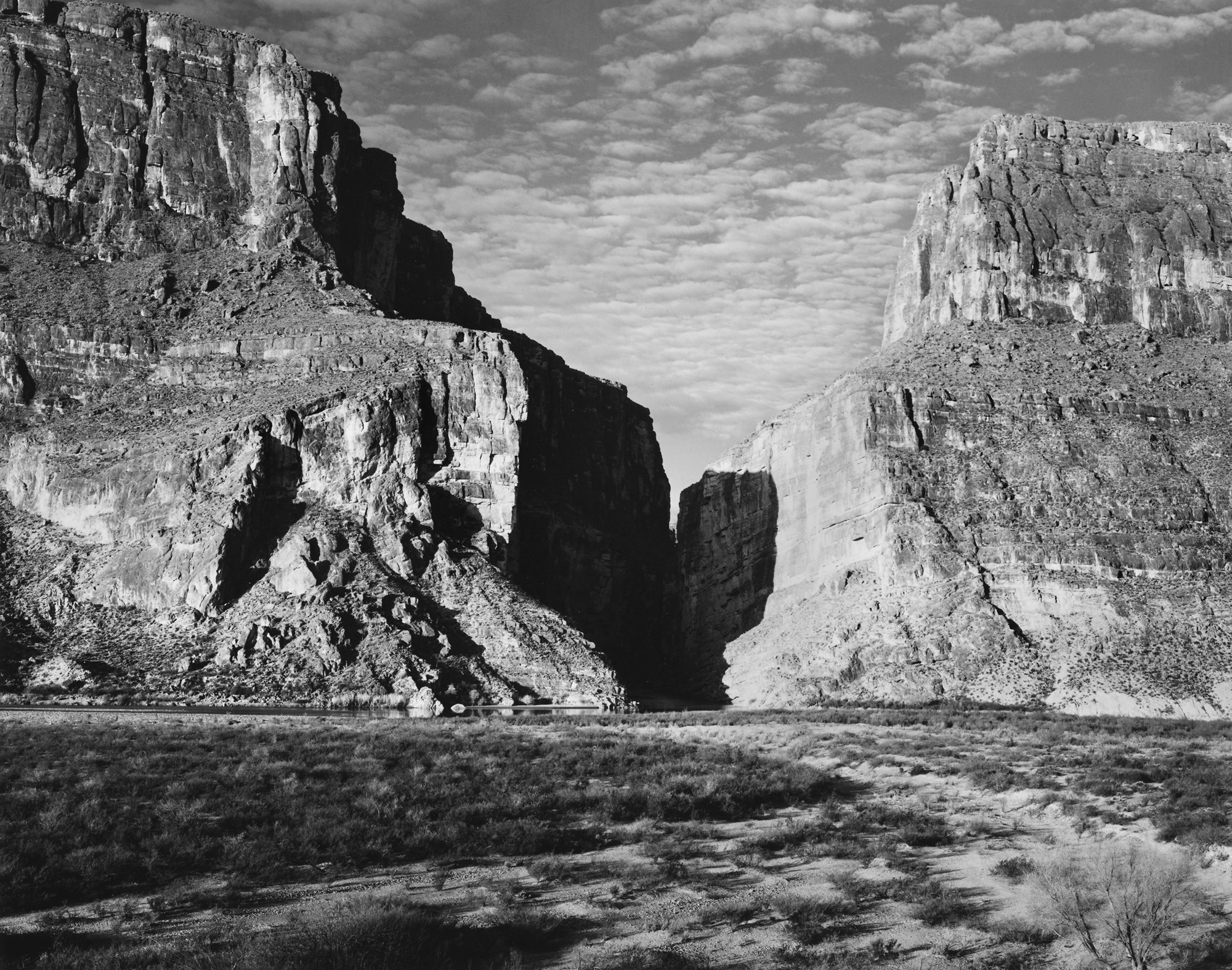
National Gallery of Art website

LIKE ART BLART ON FACEBOOK

Back to top

Exhibition: ‘Potraiture Now: Feature Photography’ at the National Portrait Gallery, Washington

Exhibition dates: 26th November, 2008 – 27th September, 2009


Jocelyn Lee (American, b. 1962) "Untitled (Kara on Easter)" 1999 from the exhibition 'Potraiture Now: Feature Photography' at the National Portrait Gallery, Washington, Nov 2008 - Sept 2009
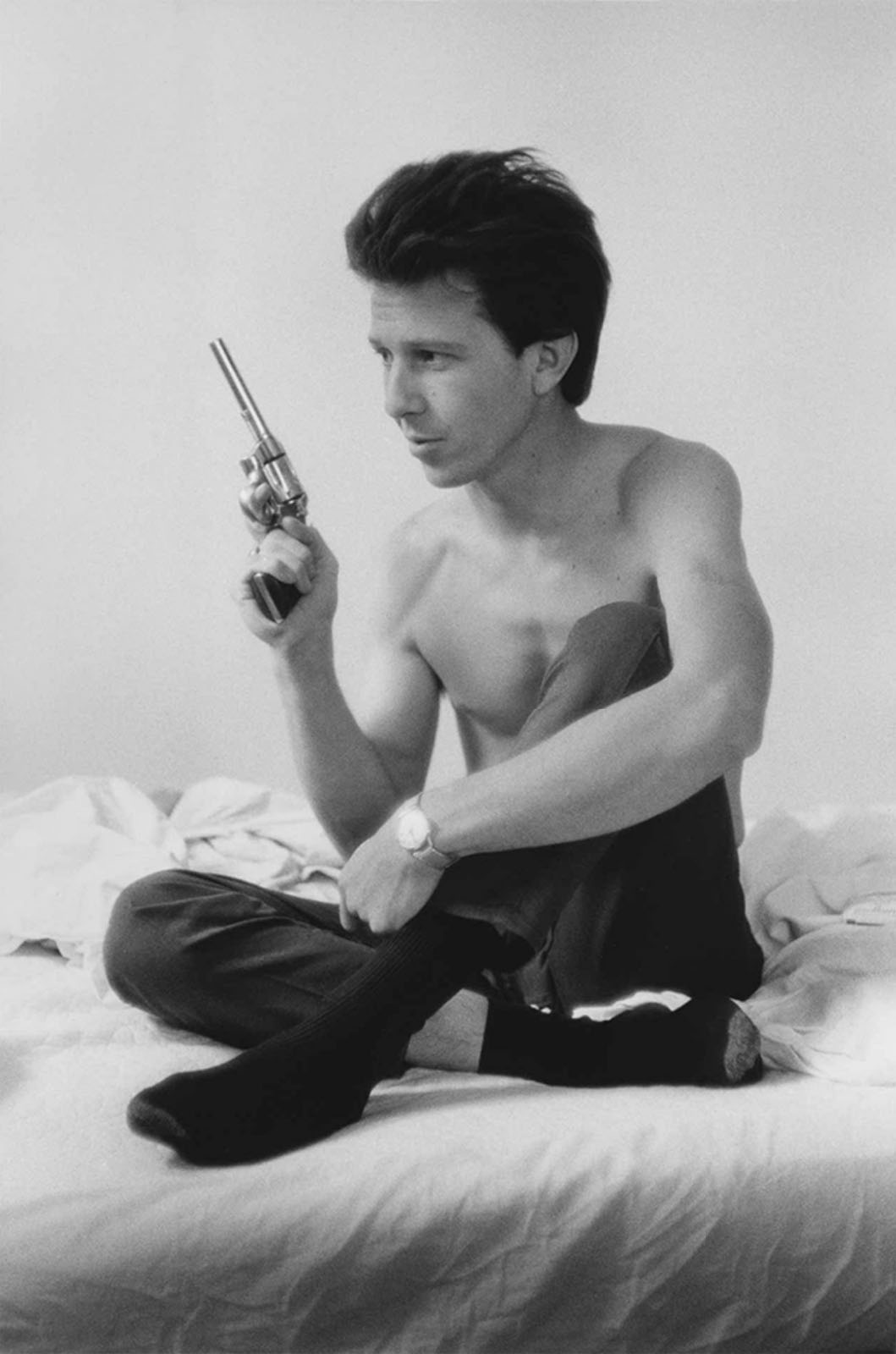
 

Jocelyn Lee (American, b. 1962)
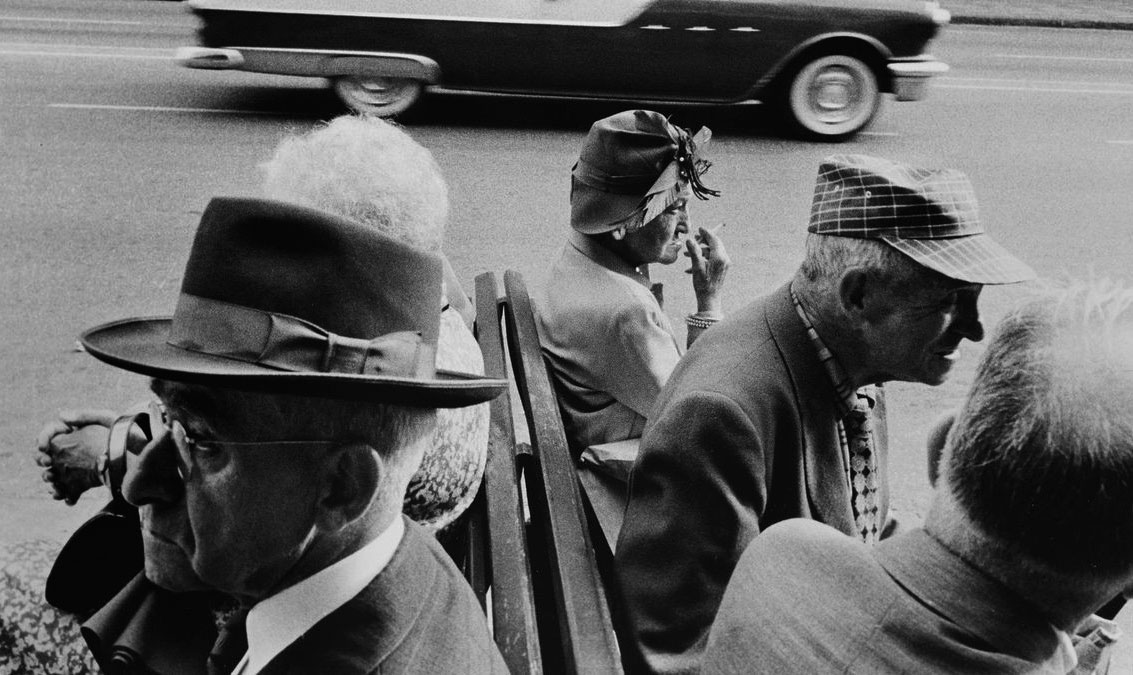
Untitled (Kara on Easter)
1999
Chromogenic print
©
 Jocelyn Lee


I photograph because I am interested in people, what it means to be alive, and how we make sense of the world. Whether I am photographing on assignment, or for personal work, the same ideas direct my attention. On the psychological and narrative level, I am interested in looking at states of being: birth, childhood, ageing, physical fragility, death, sensuality, the animal world and people in nature.

Formally, I tend to emphasise the tactile qualities of the living world: skin, hair, light, surface, colour, and material. I recognise that these are very broad themes, but they are also the basis for essential philosophical questions. My photographs don’t provide answers to these questions, but hopefully act as moments of contemplation.


Jocelyn Lee artist statement


Jocelyn Lee approaches her photographic subjects looking to reveal not simply the individuality of those who pose before her camera. She also wants to convey something deeper about how her subjects confront the place where they live and the situation in which they find themselves. This interest in the psychological dimensions of character is emblematic of her portraiture – whether she is working on an editorial assignment or on an independent project.

Jocelyn Lee’s photographs for this exhibition are drawn from work that she has completed in Maine, a place where she has spent much time. The images derive from several projects, including an advertising campaign for a local rug designer and a commission to portray adolescent girls. Seen together, they suggest the role that environment and narrative play in the art of portraiture. Although Lee is interested in photographing specific people at different stages of life, each portrait also provides a broader opportunity to reflect on our shared humanity. A recipient of a Guggenheim Fellowship, Lee has served as a professor of photography at Princeton University since 2003.

Text from the National Portrait Gallery website [Online] Cited 08/06/2022


Jocelyn Lee (American, b. 1962) 'Untitled (Inuit woman in hospital, Rankin Island)' 2002 from the exhibition 'Potraiture Now: Feature Photography' at the National Portrait Gallery, Washington, Nov 2008 - Sept 2009


Jocelyn Lee (American, b. 1962)
Untitled (Inuit woman in hospital, Rankin Island)
2002
Chromogenic print
Published in the New York Times Magazine, May 5, 2002
Collection of the artist
© Jocelyn Lee


America is a snapshot culture. Armed with a portable camera and a spirit of inquiry, we revel in the images that we create. Although we often treat still photographs – including portraits – as ephemeral fragments to be discarded or replaced by the next image, there are portrait photographers today who create pictures that defy an easy death. Often working on a specific commission or editorial assignment, these photographers compose portraits that cause us to pause and reflect.”

Portraiture Now: Feature Photography focuses on six photographers who, by working on assignment for publications such as the New Yorker, Esquire, and the New York Times Magazine, each bring their distinctive “take” on contemporary portraiture to a broad audience. Critically acclaimed for their independent fine-art work, these photographers – Katy Grannan, Jocelyn Lee, Ryan McGinley, Steve Pyke, Martin Schoeller, and Alec Soth – have also pursued a variety of editorial projects, taking advantage of the opportunities and grappling with the parameters that these assignments introduce. Their work builds upon a longstanding tradition of photographic portraiture for the popular press and highlights creative possibilities for twenty-first-century portrayal. The exhibition has additional portraits not included in this website; it opened on November 26, 2008, and closed on September 27, 2009.

Text from the National Portrait Gallery website

~ KATY GRANNAN
~ JOCELYN LEE
~ RYAN MCGINLEY
~ STEVE PYKE
~ MARTIN SCHOELLER
~ ALEC SOTH


Alec Soth (American, b. 1969) 'Misty' 2005


Alec Soth (American, b. 1969)
Misty
2005
Part of the Niagara project
Pigmented ink print
Collection of the artist
Courtesy Gagosian Gallery, New York City
© Alec Soth


“A critic once pointed out to me the different ways in which I photograph men and women. With men I seem to be poking fun, he said, whereas my depiction of women is more reverent. He makes a good point. Many of my best pictures of men are playful (a man in a flight suit holding model airplanes, a shirtless man with carrots in his ears). But the women I photograph look more like saints than clowns. As a man, I suppose, I identify more with my male subjects. In them, I see my own awkwardness and frailty. Women are always “the other.”

In assembling this group of portraits of women, I’m aware that I’m treading on dangerous ground. When I was in college, I learned to be distrustful of men’s depictions of women. I remember seeing Garry Winogrand’s book ‘Women Are Beautiful’ in the school library and being shocked that it hadn’t been defaced for its blatant objectification of women. But looking back, maybe I was too harsh. Whether one photographs men or women, it is always a form of objectification. Whatever you say about Winogrand, his depiction was honest.

In putting together a collection of my best portraits of women, I’m trying to come to terms with how I honestly see and depict women. Are my pictures romanticised? Sexualised? Why do I see women in this way? For me, photography is as much about the way I respond to the subject as it is about the subject itself.”


Alec Soth artist statement


Adroitly navigating the disciplines of editorial photography and fine art work, Alec Soth has emerged as a leading American artist. He is an associate photographer with the famed Magnum Photos group, and has shown his work in galleries and museums in the United States and in Europe.

Born and based in Minneapolis and educated in New York, Soth first attracted critical notice with his series Sleeping by the Mississippi (2004). Since then, he has published NIAGARA (2006), Fashion Magazine (2007), and Dog Days, Bogotá (2007). Unlike many contemporary photographers, Soth works with a large-format 8 x 10-inch camera, which, given the time involved in setting up for a photograph, creates an intense relationship between the artist and subject. Soth sees this as the crux of his work.

For this exhibition, we have chosen a selection of his portraits of women, drawn from past editorial work and fine arts projects, including three portraits from Fashion Magazine, which explored the world of Paris couture and countered those images with subjects from Soth’s Minnesota home. As he notes, “I’m trying to come to terms with how I honestly see and depict women. Are my pictures romanticised? Sexualised? Why do I see women in this way? For me, photography is as much about the way I respond to the subject as it is about the subject itself.”

Text from the National Portrait Gallery website [Online] Cited 08/06/2022


Alec Soth (American, b. 1969) 'Kristin, St. Paul, Minnesota' 2007


Alec Soth (American, b. 1969)
Kristin, St. Paul, Minnesota
2007
Chromogenic print
Published in Fashion Magazine (2007)
Collection of the artist, courtesy Gagosian Gallery, New York City
© Alec Soth


This full-length portrait was created during the winter of 2007, after Soth’s return from Paris, where he made the first photographs for his commission from Magnum Photos that resulted in Fashion Magazine. Fashion Magazine is the third in a series of projects by the same name, in which Magnum asks one photographer to document the whirl of fashion week in Paris from his or her own point of view.


Katy Grannan (American, b. 1969) 'Audrey Wilbur' 2000


Katy Grannan (American, b. 1969)
Audrey Wilbur
2000
Chromogenic print
Cover for New York Times Magazine, March 19, 2000
Collection of the artist, courtesy Greenberg Van Doren Gallery, New York City; Fraenkel Gallery, San Francisco; Salon 94, New York City
© Katy Grannan


“Photography is a kind of permission; it’s a way in. It’s a catalyst for extraordinary experiences that would otherwise not be possible. (This is the common thread between my personal projects and commissioned work.) I have had so many life-changing moments – some are dramatic, most are utterly mundane and exquisite.

I consider each of these experiences a privilege, and every subject worthy of attention.”


Katy Grannan artist statement


In images for the New York Times Magazine, Katy Grannan focuses on such poignant details as the teenager’s imperfect complexion, the sick man’s drooping muscles, a tidy kitchen counter, or a neighbourhood swing to make us understand heartrending realities of juvenile imprisonment, end-of-life decisions, or post-traumatic stress syndrome. For several of her art gallery projects, Grannan advertised for subjects in small-town newspapers. As she gained the sitters’ trust and helped visualise their fantasies, many posed nude or partially undressed. In Grannan’s work for the Times, we recognise similar qualities of risk, vulnerability, and, ultimately, empathy between the photographer and her subjects.

This portrait of four-year-old Audrey Wilbur is a study in contrasts between the cheerful fabrics of the clothing and decor and the impoverished bareness of the room’s mattress, walls, and floor. Grannan’s depiction of Audrey, made at the height of the dot-com bubble, was the cover for the New York Times Magazine’s March 19, 2000, issue, which included James Fallows’s “The Invisible Poor” and a photo essay titled “In the Shadow of Wealth.”

Text from the National Portrait Gallery website [Online] Cited 08/06/2022


Katy Grannan (American, b. 1969) 'Forest Whitaker' 2007


Katy Grannan (American, b. 1969)
Forest Whitaker
2007
Chromogenic print
Variant image published in New York Times Magazine, February 11, 2007
Collection of the artist, courtesy Greenberg Van Doren Gallery, New York City; Fraenkel Gallery, San Francisco; Salon 94, New York City
© Katy Grannan


Martin Schoeller (American, b. 1968) 'Barack Obama' 2004


Martin Schoeller (American, b. 1968)
Barack Obama
2004
Digital C-print
Variant published in Gentleman’s Quarterly, December 2004
Collection of the artist, courtesy Hasted Hunt, New York City
© Martin Schoeller


Schoeller photographed Barack Obama for a December 2004 feature on “Men of the Year,” in Gentleman’s Quarterly, where a variant of this photograph appeared. Reflecting upon the success of his address at the 2004 Democratic convention, Obama, who would go on to win the presidential election in 2008, observed: “The reason you do this stuff is not to … get your face in a magazine … You do this stuff because you care about the epic struggle to make America what it can be.”


A photographic close-up is perhaps the purest form of portraiture, creating a confrontation between the viewer and the subject that daily interaction makes impossible, or at least impolite. In a close-up, the impact stems solely from the static subject’s expression or apparent lack thereof, so the viewer is challenged to read a face without the benefit of the environmental cues we naturally use to form our interpersonal reactions.

After seeing Bernd and Hilla Becher’s water tower series in 1991, I was inspired by the idea of photographing a large group of subjects in the exact same style. The pictures in my Close Up series have all been taken from similar angles and with the same equipment, but here I have tried to bring out personality and capture individuality in a search for a flash of vulnerability and integrity. The greatest challenge in taking these images lies in the attempt to arrest the subtle moment that flickers between expressions, movements of which the subject is unaware. Like most portrait photographers, I aim to record the instant the subject is not thinking about being photographed, striving to get beyond the practiced facial performance, reaching for something unplanned. While trying to be as objective as possible, I acknowledge that every gesture is still an act of artifice. Familiar faces are treated with the same levels of scrutiny as the un-famous. The unknown and the too- well- known meet on a level platform that enables comparison, where a viewer’s existing notions of celebrity, value, and honesty are challenged.


Martin Schoeller artist statement


Martin Schoeller has exhibited his portraits internationally and has received numerous awards. His photographs have appeared in many prominent magazines, including the New Yorker, Gentleman’s Quarterly (GQ), Vanity Fair, and Rolling Stone.

A native of Germany, Schoeller, who now lives and works in New York, honed his skills by working with Annie Leibovitz. “Watching her deal with all of the elements that have to come together – subjects, lighting, production, weather, styling, location – gave me an insight into what it takes to be a portrait photographer,” he explains.

Equally important for Schoeller was the photography of German minimalists Bernd and Hilla Becher, who “inspired me to take a series of pictures, to build a platform that allows you to compare.” Schoeller’s portraiture brings viewers eye-to-eye with the well-known and the anonymous. His close-up style emphasises, in equal measure, the facial features, both studied and unstudied, of his subjects – presidential candidates and Pirahã tribespeople, movie stars and artists – levelling them in an inherently democratic fashion. Schoeller’s photographs challenge us to identify the qualities that may, under varying circumstances, either distinguish individuals or link them together, raising a critical question: What is the very nature of the categories we use to compare and contrast.

Text from the National Portrait Gallery website [Online] Cited 08/06/2022


Martin Schoeller (American, b. 1968) 'Cindy Sherman' 2000


Martin Schoeller (American, b. 1968)
Cindy Sherman
2000
Digital C-print
Published in the New Yorker, May 15, 2000
Collection of the artist, courtesy Hasted Hunt, New York City
© Martin Schoeller


Well known for creating photographs of herself adopting a broad range of personas, Cindy Sherman’s own face is surprisingly unfamiliar. Originally published with a New Yorker profile of Sherman by Calvin Tomkins addressing “Her Secret Identities,” Schoeller’s portrait unmasks the influential artist.


National Portrait Gallery, Smithsonian Institution
Eighth and F Streets, NW
Washington D.C.

Opening hours:
Daily 11.30am – 7.00pm

National Portrait Gallery website

LIKE ART BLART ON FACEBOOK

Back to top