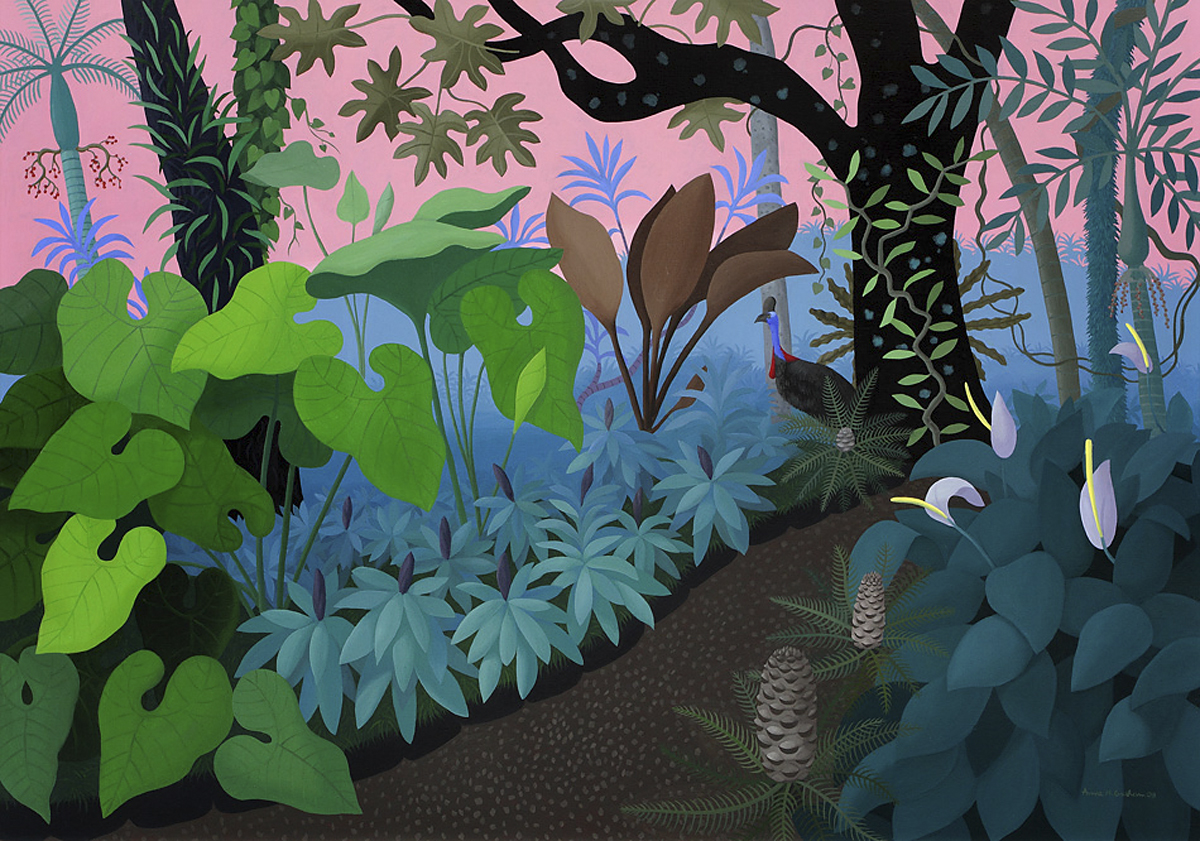
Anne Marie Graham (Australian born Austria, b. 1925) Jungle with Cassowary 2008 Oil on Linen 106 x 150cm National Museum for Women in Arts, Washington
I was walking around Anne Marie Graham’s new exhibition of painting at Gallery 101, Melbourne having read a review of her work on the gallery wall where the reviewer compared the structure of the work to the essentialness of the paintings of Giotto. A lady approached me and said, “You don’t want to believe everything that you read.”
And I said, “I don’t. I make up my own mind.”
This was the artist Anne Marie Graham.
We had a wonderful conversation about her work talking about space, colour and form. This is what Graham’s work is about. No conceptual arguments are needed. The work addresses the landscape in a magical way, drawing the viewer into the compositions like a piece of music. The viewer finds entrances and passageways, spaces through the images which open up a dialogue with the landscape.
Using repeated patterns and layered construction, from bottom to top, from front to back, the images subtly push and pull the viewer: space quietly recedes and comes towards the viewer. Complimentary bands of colours are muted except for stunning highlight colours – the red of flowers, the blue of leaves or the unexpected pink or yellow of a background. The forms and textures delight. Dr Sheridan Palmer is correct, these paintings have an almost hypnotic effect, meditative and peaceful. They make you feel good!
Their presence is undeniable. For such complex paintings, which on the surface seem very simple (a difficult task to accomplish); for such essential representations that address the heart of the matter… their affect is powerful.
Graham’s refined aesthetic allows the viewer to engage with the poetic spaces she creates, allowing them to appreciate the colour fields, plants and landscapes she orchestrates and to be subsumed into their fold. Here we come to understand the diverse empathy of an artist who lays it all ‘on the line’ and knows how to do so in a brilliant way.
A talented artist and a nice lady as well – what more can you ask for!
Dr Marcus Bunyan
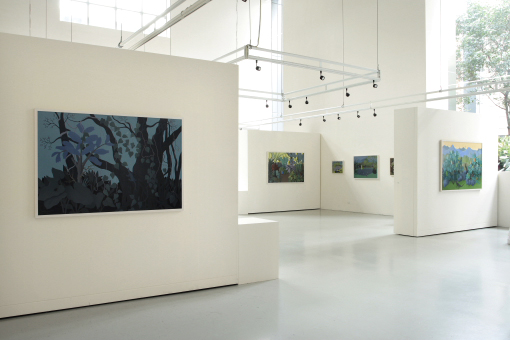
Exotic Queensland: Recent Painting installation views at Gallery 101, Melbourne
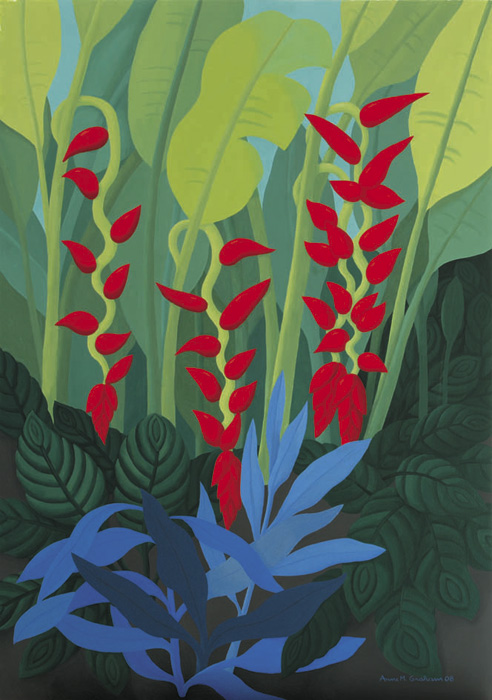
These landscapes are inspired by the areas around Noosa, the Glasshouse Mountains and the Botanic Gardens in Cairns. Look at the bromeliads, those cousins of the pineapple that store pools of water in their depths. And the helliconias – they’re also called lobster-claw plants and you can see why! Look at the massive scarlet tassels set against tropical green – and not just the one green but the subtlest of shades and tones in combination.
‘If there’s a God, it must be there’, says Anne of the Cairns Botanical Gardens. ‘The inventiveness and colours, the lushness and tropical exuberance and shapes. I still can’t overcome this enthusiasm’. There is an analogy with Eugene von Guérard here. Like Ann, he was born in Vienna and was also a precisely scientific observer of nature, ever mindful that the world is a thing far greater than us: that the hand of God (for want of a better word) can be found in very leaf and every grain of sand.
How much further in both place and mood could Anne possibly have travelled from the order and long humanist traditions of her childhood home in Austria? In these Queensland paintings you’ll discover cockatoos, a water dragon, a fat goanna, ibises in the lotus pond, and the shy endangered cassowary almost hidden in the jungle. And look at the sky in that painting – the rosiest pink of a twilight had tells us tomorrow will be a perfect day.
Jane Clark Senior Research Curator, Museum of Old and New Art, Hobart
Extract from speech given at the opening of the exhibition Exotic Queensland, Gallery 101 Melbourne May 2009
Anne Marie Graham (Australian born Austria, b. 1925) Water Dragon with Banksias 2008
Anne Marie Graham (Australian born Austria, b. 1925) Heliconia No. 1 2008 Oil on Linen 106 x 150cm
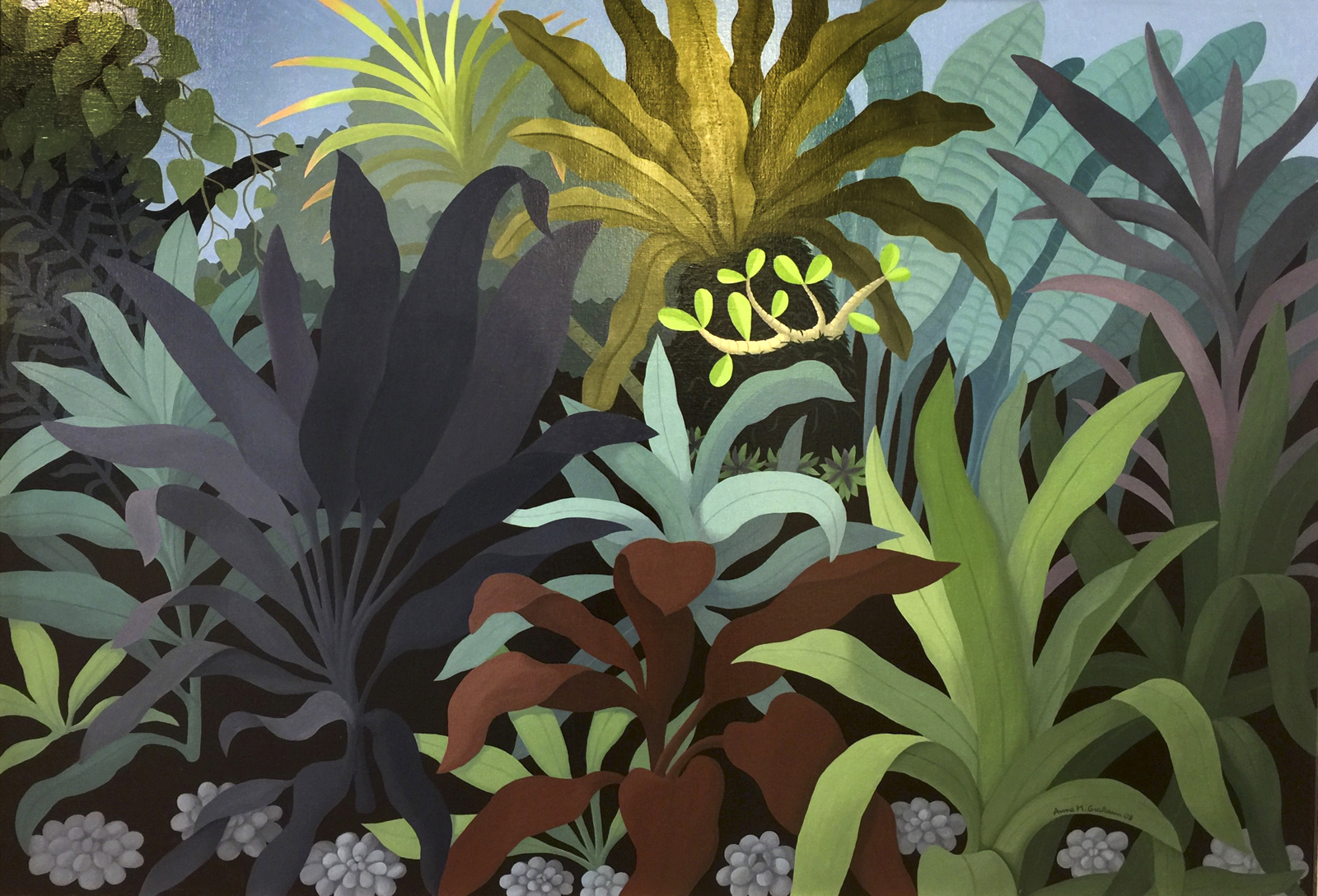
Anne Marie Graham (Australian born Austria, b. 1925) Variations in Green and Mauve 2008 Oil on linen 106 x 150cm
“Anne Marie Graham’s painting career now spans more than six decades. Observed with a penetrating and affectionate gaze, her images are beautiful records of Australia’s vast landscape. Each work is an engagingly optimistic view, evoking the mystery and fragility of Australia’s rich environment. This survey of recent paintings concentrates on the tropical Queensland landscapes around Noosa and the Cairns Botanic Gardens.
As she casts he vision over mountains, rain forests and panoramic vistas or as she leads us into an intimate world of gardens, winding pathways and potted plants, we find ourselves amongst large succulents, variegated foliage, ferns and brilliant flowers, visually engaging at a Lilliputian level in her richly orchestrated fields and forests. In these locations she constructs marvellous labyrinthine worlds that reveal layers of muted colours, folding forms and textures that induce a most extraordinary hypnotic spell.”
Dr Sheridan Palmer, Art Curator, from the catalogue essay
Anne Marie Graham (Australian born Austria, b. 1925) Heliconia No. 2 2008
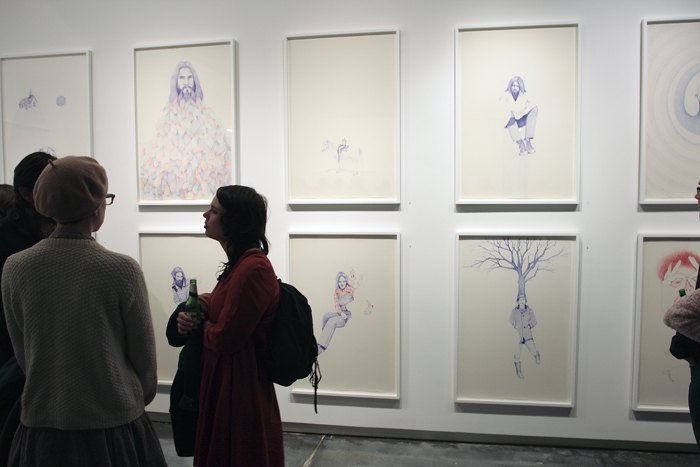
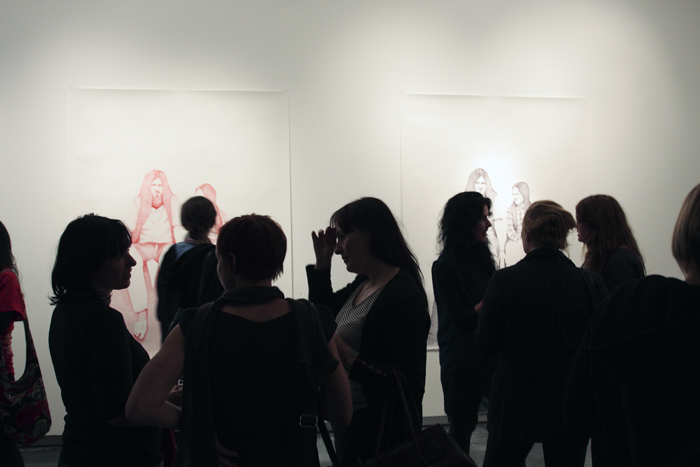
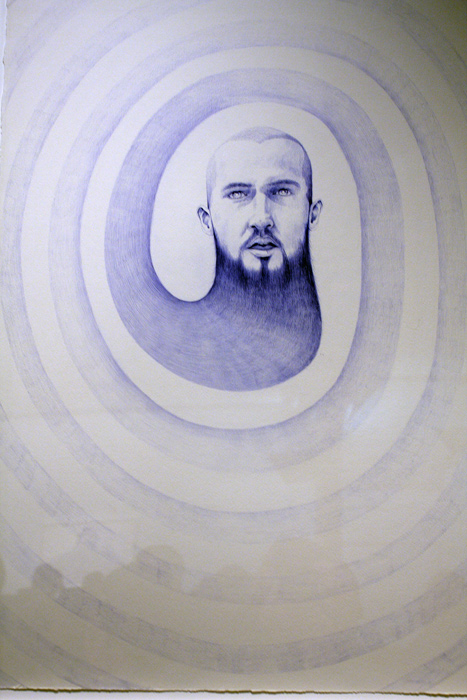
Opening night crowd at So It Goes by Laith McGregor at Helen Gory Galerie, Melbourne with the works My kinda of Blue (red) and My kind of blue (black) behind
The opening of the night – simply spectacular!
Great crowd, great atmosphere, great work.
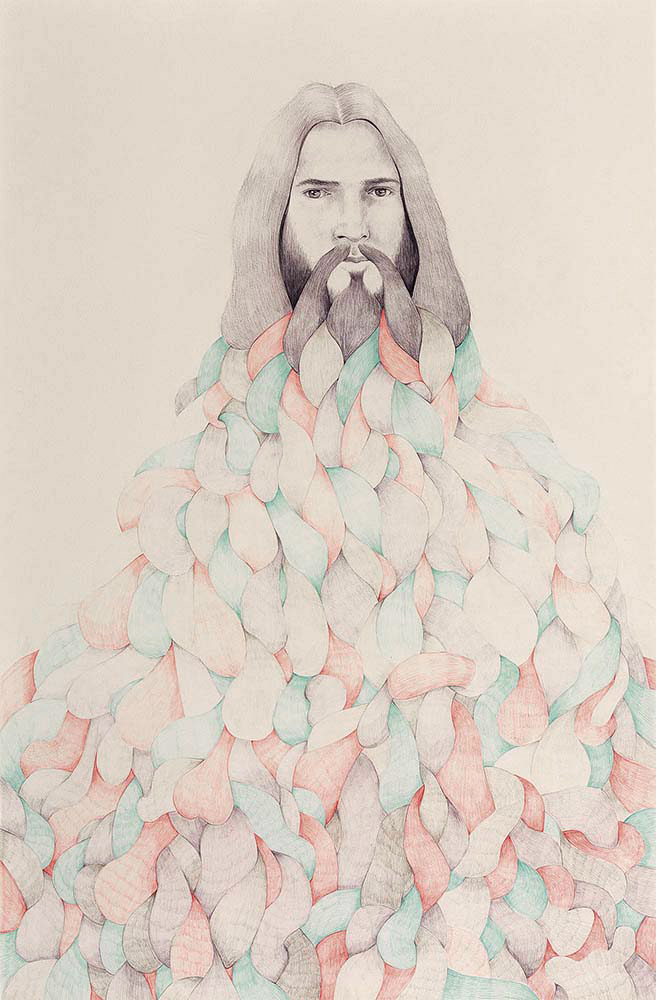
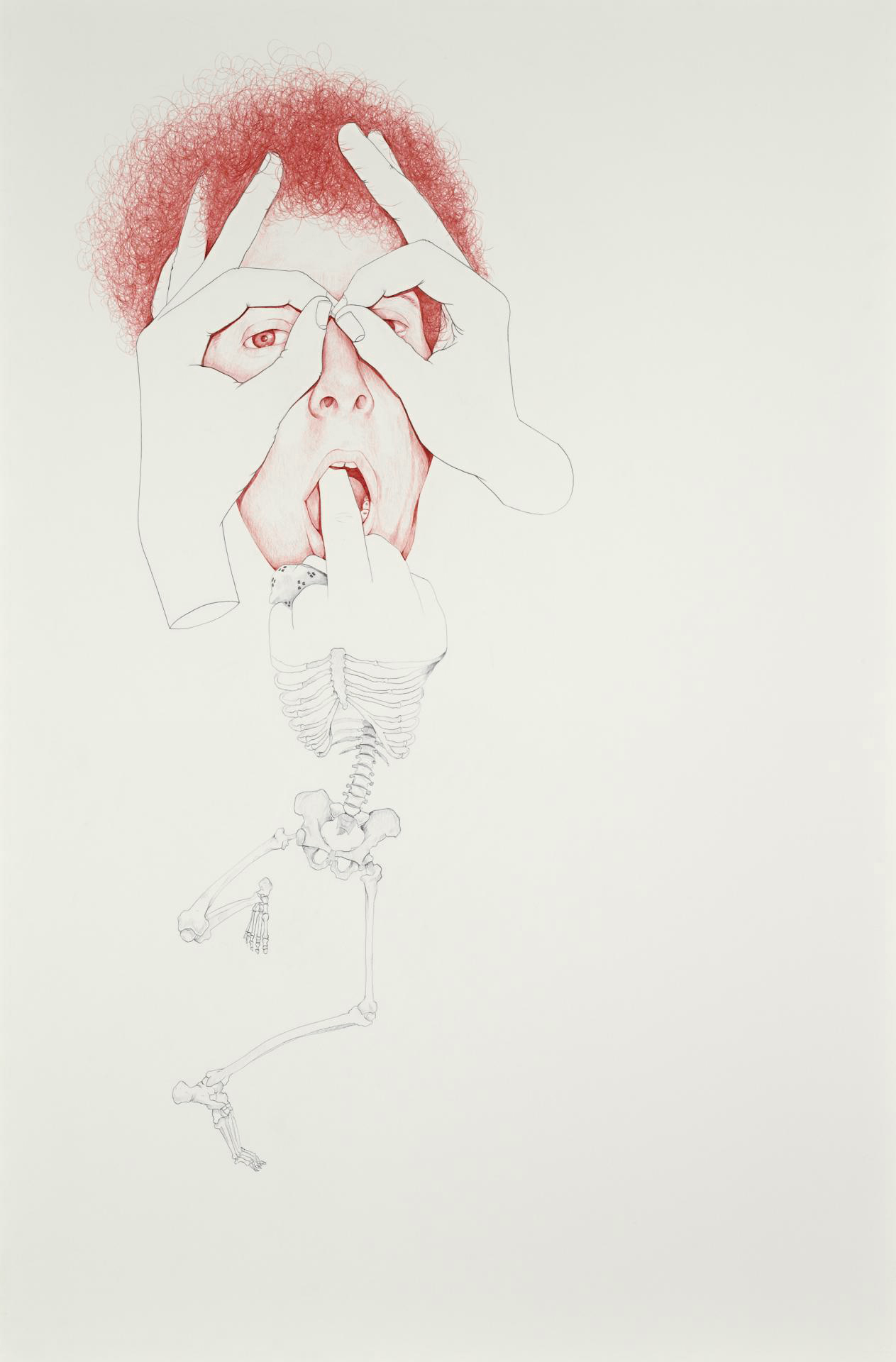
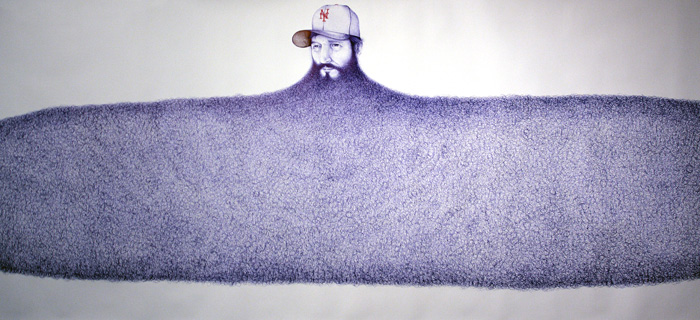
Winner of the Robert Jacks Drawing Prize in 2008, the artist’s work in biro and oil is outstanding. I have never seen such art made using a biro before: truly inspiring. Inventive, funny, poignant and outrageous this is a must see show. Don’t miss it!
Dr Marcus Bunyan
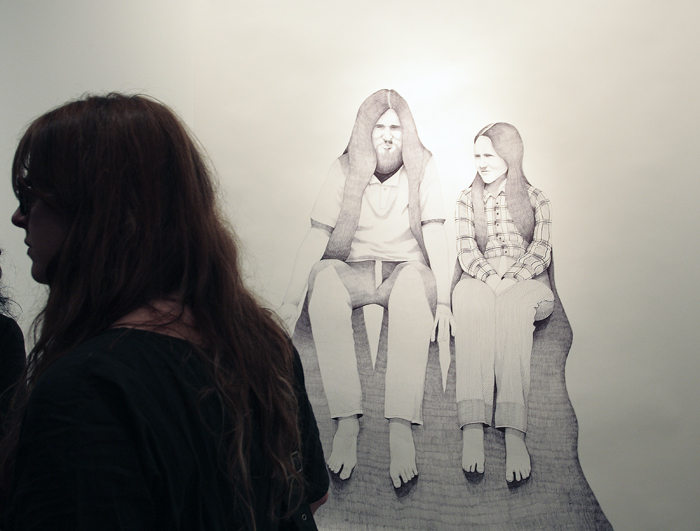
Laith McGregor (Australian, b. 1977) My kind of blue (black) 2009 Ballpoint pen on paper
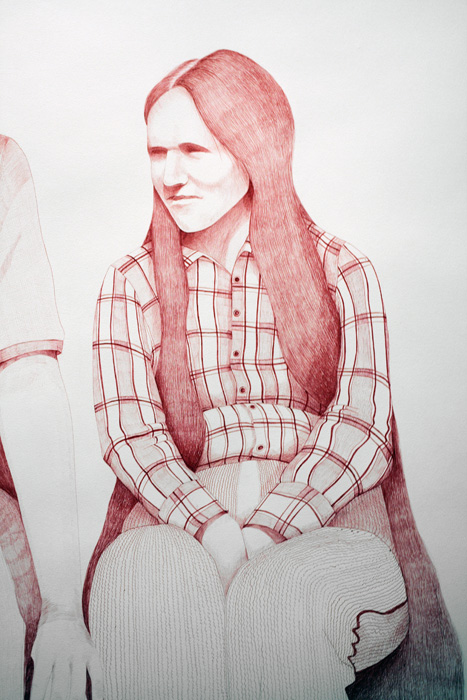
Laith McGregor (Australian, b. 1977) My kinda of Blue (red) (detail) 2009 Red and blue ballpoint on paper
Laith McGregor (Australian, b. 1977) Wiking 2009 Biro on paper 100.5 x 66.5 cm
“McGregor’s work blurs the boundaries between portraiture, memory and imagination. Into each picture, drawn from and nourished by his past, notions of the unconscious mind are introduced and investigated and the certainty of memory and markers are challenged and slowly unravelled. Figurative forms metamorphose into uncanny, exaggerated, and often incongruous images and arrangements. Beards are grossly elongated, hair extends seamlessly to form a tree or a cocoon that envelopes a face and a neck transforms into a weighted mound in ‘portraits’ that are at once warm, playful and pensive. “It’s important for me to see the imagery appear otherworldly, whimsical and strange. I want it to be amusing and serious simultaneously, for the work to push and pull between its contrasting qualities.”
In So It Goes it is his mother and father, who according to Laith ‘kinda looks like Jesus’, that are the subject of his gaze.”
Text from the Helen Gory Galerie website [Online] Cited 07/05/2009. No longer available online
Laith McGregor (Australian, b. 1977) Vertigo 2009 Blue and black ballpoint on paper
Laith McGregor (Australian, b. 1977) The Last Bastion (detail) 2009 Ballpoint on paper
Laith McGregor (Australian, b. 1977) The Last Bastion (detail) 2009 Ballpoint on paper
Nickolas Muray (American, 1892-1965) Frida with Olmeca Figurine, Coyoacan 1939 Colour print, assembly (Carbro) process
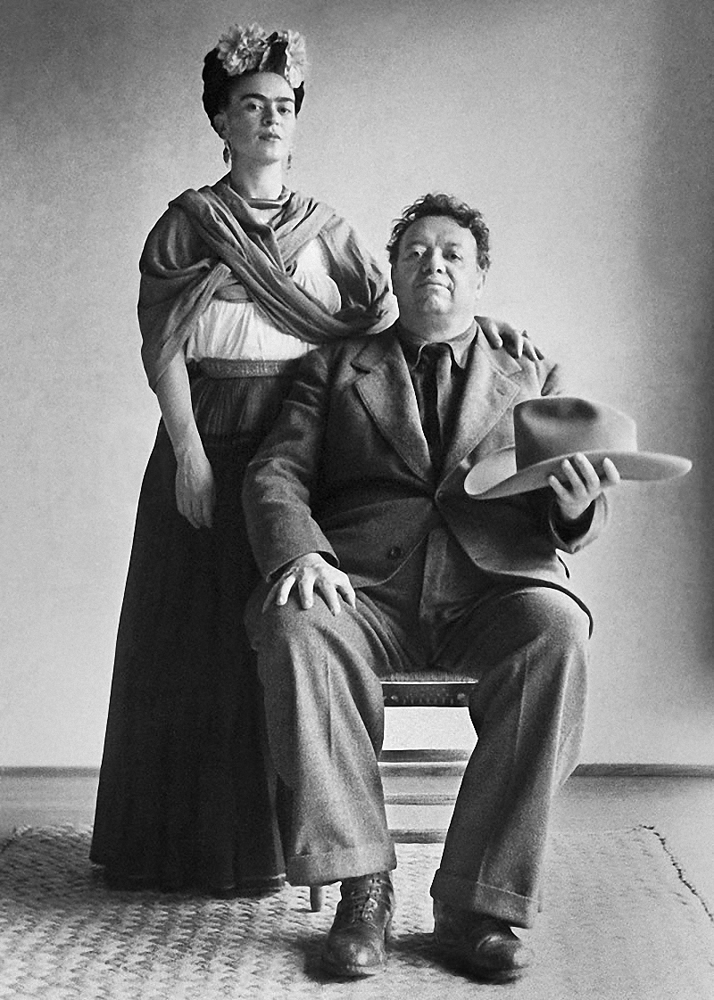
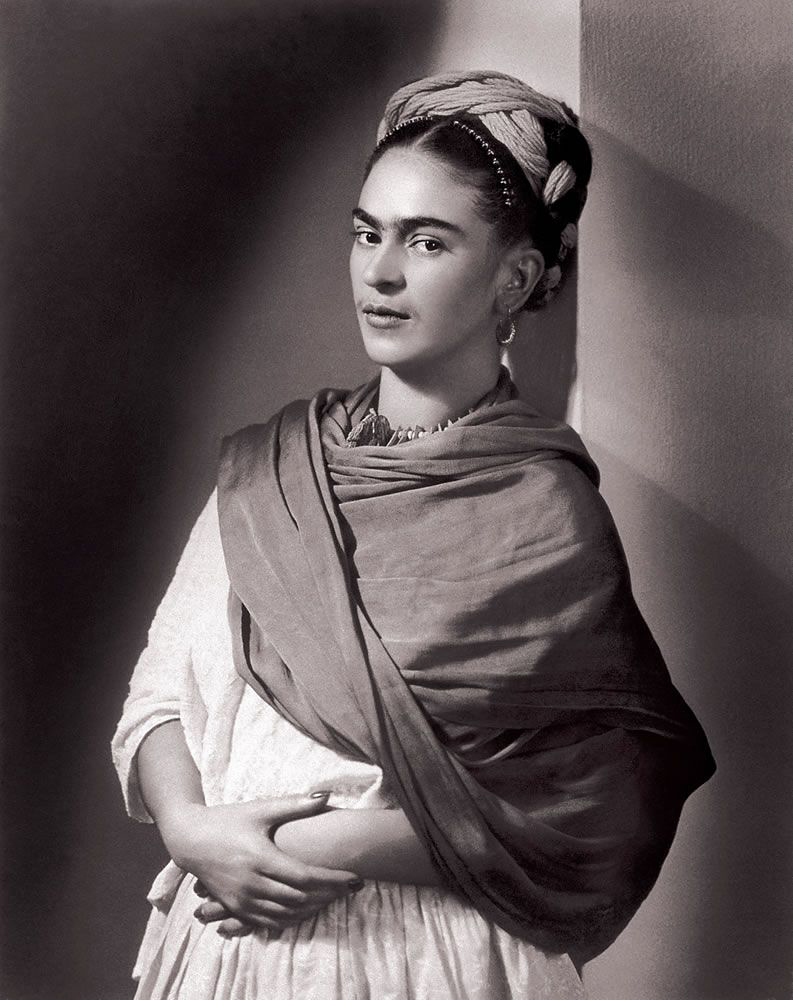
Forty-seven exquisite colour and black-and-white photographs of the Mexican artist Frida Kahlo by the American photographer Nickolas Muray are featured in this exhibition organised and circulated by Smith Kramer Fine Art Services. Muray and Kahlo first met in Mexico in 1931 and soon began a love affair that lasted ten years and continued as an enduring friendship throughout their lives. The photographs, selected from the Nickolas Muray Archives, capture the exotic mystery and proud beauty of Frida Kahlo through the eyes of this accomplished portrait photographer, who loved her deeply. Organised at the Albright-Knox by Associate Curator Holly E. Hughes, the exhibition will also include reproductions of Kahlo’s letters to Muray, explanatory wall texts, and an educational brochure.
Text from the Albright-Knox Art Gallery website [Online] Cited 01/05/2009. No longer available online
Many thankx to the Albright-Knox Art Gallery for allowing me to publish the photographs in the posting. Please click on the photographs for a larger version of the image.
Nickolas Muray (American, 1892-1965) Frida, Mexico, 1940 c. 1940 Colour print, assembly (Carbro) process
Nickolas Muray (American, 1892-1965) Frida with her sister Cristina, Nickolas Muray, and Rosa Covarrubias, Coyoacán 1939 Colour print, assembly (Carbro) process
Nickolas Muray (American, 1892-1965) Frida Painting the Two Fridas, Coyoacan 1939 Silver gelatin print
Nickolas Muray (American, 1892-1965) Frida with Nick in her Studio, Coyoacán 1941 Silver gelatin print
Nickolas Muray (American, 1892-1965) Frida with Magenta Rebozo, New York 1939 Colour print, assembly (Carbro) process
Nickolas Muray (American, 1892-1965) Frida with Magenta Rebozo, New York 1939 Colour print, assembly (Carbro) process
Nickolas Muray
In 1913, with the threat of war in Europe, Muray sailed to New York City, and was able to find work as a colour printer in Brooklyn.
By 1920, Muray had opened a portrait studio at his home in Greenwich Village, while still working at his union job as an engraver. In 1921 he received a commission from Harper’s Bazaar to do a portrait of the Broadway actress Florence Reed; soon after he was having photographs published each month in Harper’s Bazaar, and was able to give up his engraving job. In 1922 he also made a portrait of the dancer Desha Delteil.
Muray quickly became recognised as an important portrait photographer, and his subjects included most of the celebrities of New York City. In 1926, Vanity Fair sent Muray to London, Paris, and Berlin to photograph celebrities, and in 1929 hired him to photograph movie stars in Hollywood. He also did fashion and advertising work. Muray’s images were published in many other publications, including Vogue, Ladies’ Home Journal, and The New York Times.
Between 1920 and 1940, Muray made over 10,000 portraits. His 1938 portrait of Frida Kahlo, made while Kahlo sojourned in New York, attending her exhibit at the Julien Levy Gallery, became the best known and loved portrait made by Muray. Muray and Kahlo were at the height of a ten-year love affair in 1939 when the portrait was made. Their affair had started in 1931, after Muray was divorced from his second wife and shortly after Kahlo’s marriage to Mexican muralist painter Diego Rivera. It outlived Muray’s third marriage and Kahlo’s divorce and remarriage to Rivera by one year, ending in 1941. Muray wanted to marry, but when it became apparent that Kahlo wanted Muray as a lover, not a husband, Muray took his leave for good and married his fourth wife, Peggy Muray. He and Kahlo remained good friends until her death, in 1954.
After the market crash, Muray turned away from celebrity and theatrical portraiture, and become a pioneering commercial photographer, famous for his creation of many of the conventions of colour advertising. He was considered the master of the three-color carbro process. His last important public portraits were of Dwight David Eisenhower in the 1950s.
Nickolas Muray (American, 1892-1965) Frida With Hand at Her Throat, Mexico City 1940 Colour print, assembly (Carbro) process
Nickolas Muray (American, 1892-1965) Frida leaning on a sculpture by Mardonio Magaña, Coyoacán, Mexico 1940 Colour print, assembly (Carbro) process
Nickolas Muray (American, 1892-1965) Frida in Pink and Green Blouse, Coyoacán 1938 Colour print, assembly (Carbro) process
Nickolas Muray (American, 1892-1965) Frida on White Bench, New York 1939 Colour print, assembly (Carbro) process
An exhibition of photographs of the acclaimed Mexican artist Frida Kahlo taken by her friend and lover, the internationally renowned portrait photographer Nickolas Muray (1892-1965), will be on view at the Albright-Knox Art Gallery from May 8 through July 5, 2009. Frida Kahlo: Through the Lens of Nickolas Muray, From the Collection of the Nickolas Muray Archives celebrates Kahlo’s life and work and comprises approximately fifty colour and black-and-white photographs, along with archival material, including excerpts from letters between Kahlo and Muray. The installation in Buffalo will feature Frida Kahlo’s Self- Portrait with Monkey, 1938, from the Albright-Knox Art Gallery’s Permanent Collection.
Born in Hungary in 1892, Nickolas Muray came to the United States in 1913, marking the beginning of his forty-five-year career living and working in New York City. Originally hired by Condé Nast Publications to prepare illustrations for magazines, in 1920 Muray set up a photography studio at his home in Greenwich Village. Following an assignment in 1921 for Harper’s Bazaar magazine to photograph the Broadway star Florence Reed, Muray’s career as a portrait and celebrity photographer took off. Soon he was photographing “everybody who was anybody” and his work was regularly featured in such publications as Vanity Fair, Vogue, and Ladies’ Home Journal.
Nickolas Muray and Frida Kahlo first met in Mexico in 1931 and soon began a love affair that lasted ten years and continued as a friendship that endured all their lives. The images included in this exhibition, dating from 1937 to 1940, were taken during the height of the couple’s on-again, off-again, ten-year love affair. The photographs included were selected from the Nickolas Muray Archives and capture the exotic mystery and proud beauty of Frida Kahlo through the eyes of this accomplished portrait photographer who loved her deeply.
Text from the Artdaily.org website
Frida Kahlo (Mexican, 1907-1954) Self-Portrait with Monkey 1938 Oil on masonite 40.6 cm × 30.5cm (16.0 in × 12.0 in) Albright-Knox Art Gallery, Buffalo, New York
Of her 143 self-portraits, 55 include Kahlo’s pets. It is as though she saw them as an extension of her own self and being. Spider monkeys are known to have long, spindly legs and arms that look almost disproportionate to their body. Their strange appearance may have reflected Kahlo’s own discomfort with her physical body. Having contracted polio at an early age, she had one leg that was thinner than the other. She used colourful, large skirts to cover the disfigurement.
Kahlo doted on her pet monkeys. In her self-portraits, they are often shown sitting close to her, physically enfolding or grasping her in some way. They appear to be protective, friendly and gentle.
In many cultures, monkeys are used to symbolise lascivious, or primal behaviour. They are a mirror image of man, reminding him of his animal nature and close proximity to the natural world. Through monkeys, man sees his own connection to the animal kingdom with its uncontrollable, primal urges. In renaissance art, fettered monkeys were often used to symbolise men who are entrapped or bound by their desires.
In Kahlo’s paintings, monkeys do not appear in this way. They are more gentle, child-like and tender. Partially due to their wild natures, monkeys are often associated with fertility or lust in Mexican mythology. Kahlo’s trust and connection with her pets may have been in part due to her own feelings of inadequacy and frustration around her inability to carry to children. One of the reasons feminists celebrate Kahlo’s work is her unabashed claim to her own sexuality. She was not afraid to acknowledge her own sexual feelings or desires.
In Kahlo’s painting, the monkeys appear loyal. It feels as though Kahlo is connected with the creatures in some way. There is a bond there. Never the less, the monkeys also often appear by Kahlo’s shoulder or back, reflecting the image of a ‘monkey on your back’, a phrase commonly used to describe a problem or burden of some kind. With their association with animal nature, disfigured or primal humanity and lascivious primal urges, Kahlo may have felt at once supported by and burdened by her connection to her animal ancestors.
Extract from Kitty Jackson. “Symbolism in Art: Frida Kahlo – Self Portrait with Monkey,” on the ArtDependence Magazine website, September 4, 2017 [Online] Cited 20/01/2019
Nickolas Muray (American, 1892-1965) Frida in Front of the Cactus Organ Fence, San Angel 1938 Colour print, assembly (Carbro) process
Nickolas Muray (American, 1892-1965) Frida with Blue Satin Blouse, New York 1939 Colour print, assembly (Carbro) process
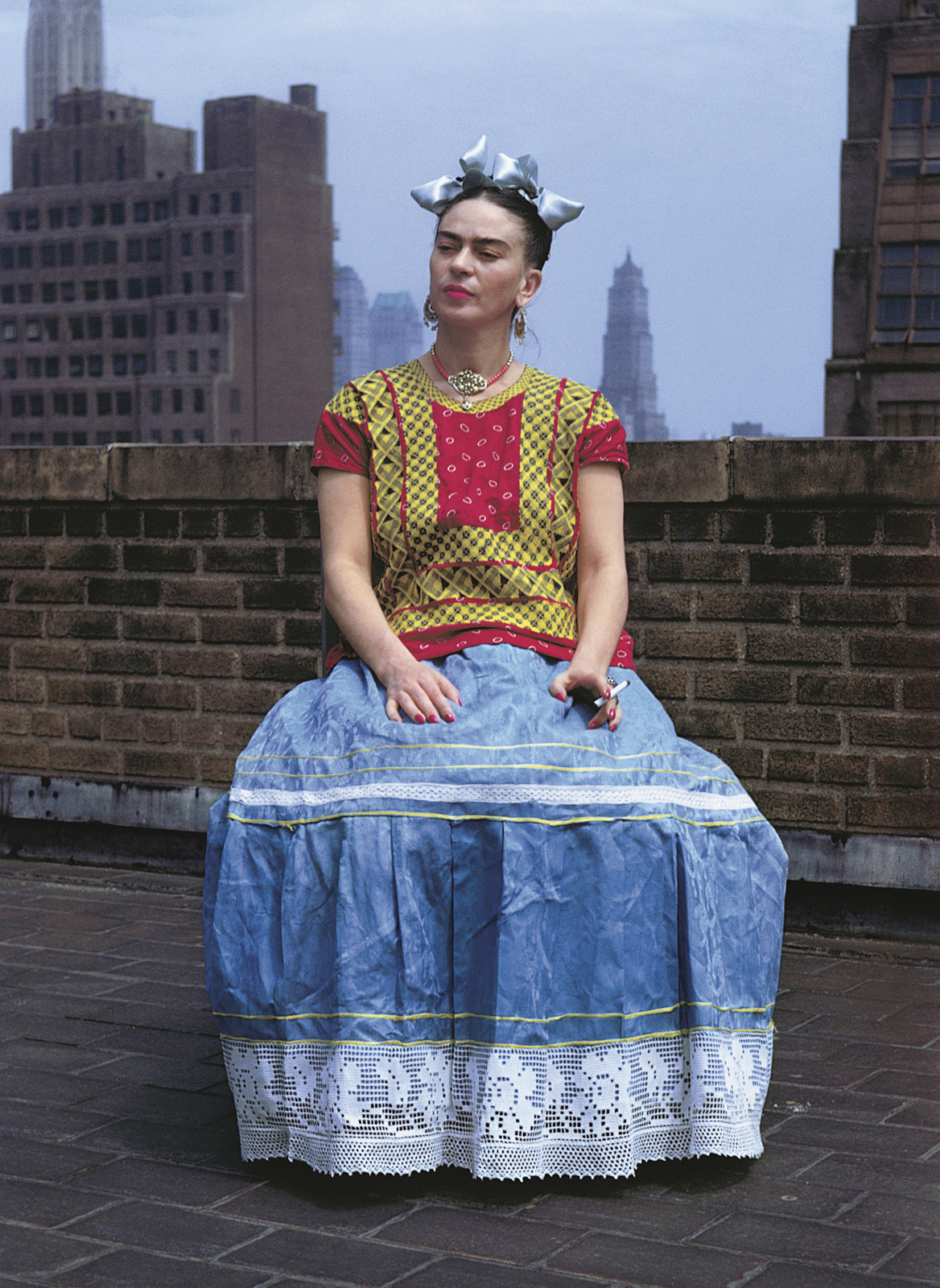
Nickolas Muray (American, 1892-1965) Frida on Rooftop, New York 1946 Colour print, assembly (Carbro) process
Nickolas Muray (American, 1892-1965) Cristina and Frida, New York 1946 Colour print, assembly (Carbro) process
Albright-Knox Art Gallery 1285 Elmwood Avenue Buffalo, New York 14222-1096
Opening hours: Tuesday – Sunday 10am – 5pm Closed Mondays, Tuesdays, and Independence, Thanksgiving, Christmas, and New Year’s Days
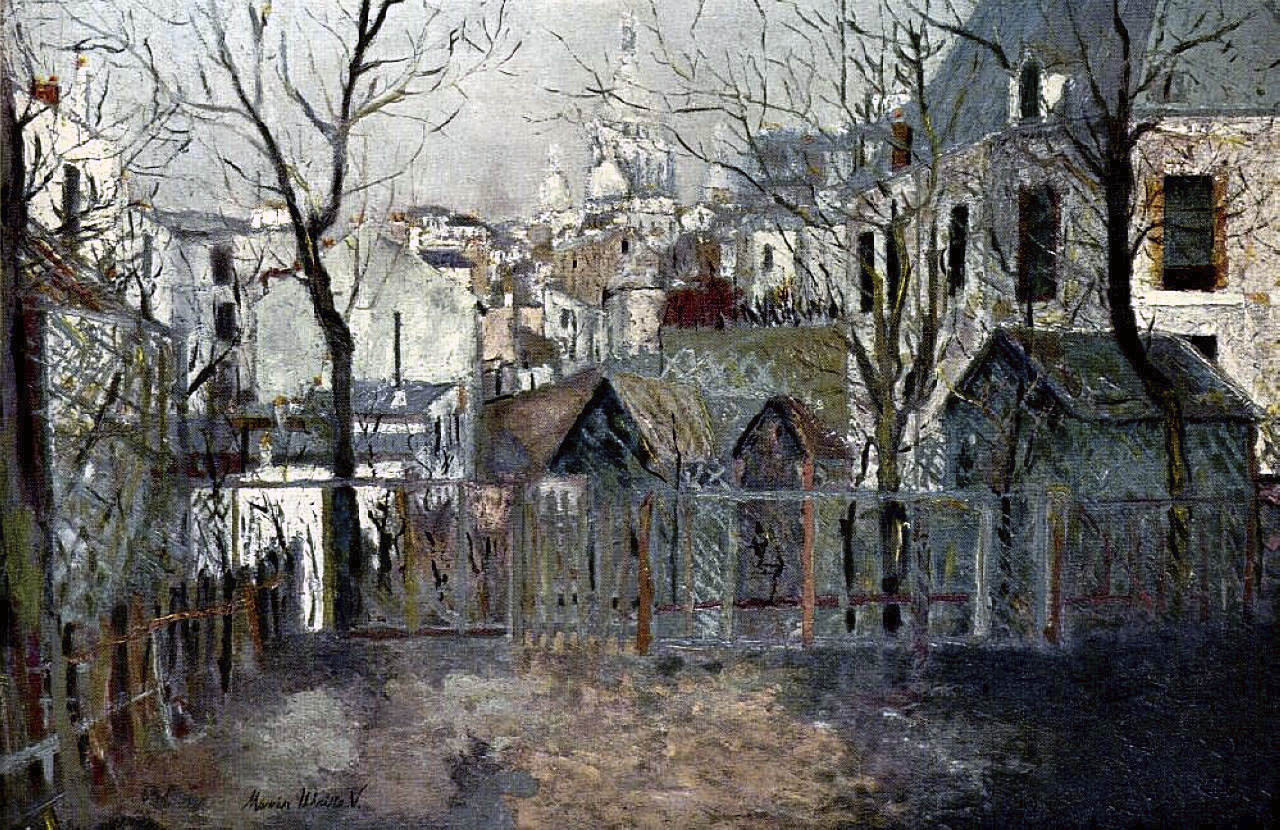
Domenico de Clario (Australian born Italy, b. 1947) u (renoir’s garden) 2008/09 Oil on canvas
Based on the music of melancholy that inhabits the shadows of the paintings of Montmarte by the French artist Maurice Utrillo, Domenico de Clario’s exhibition of paintings at John Buckley Gallery in Melbourne is a major achievement. This is a superlative exhibition of focused, resonant work beautifully and serenely installed in the gallery space.
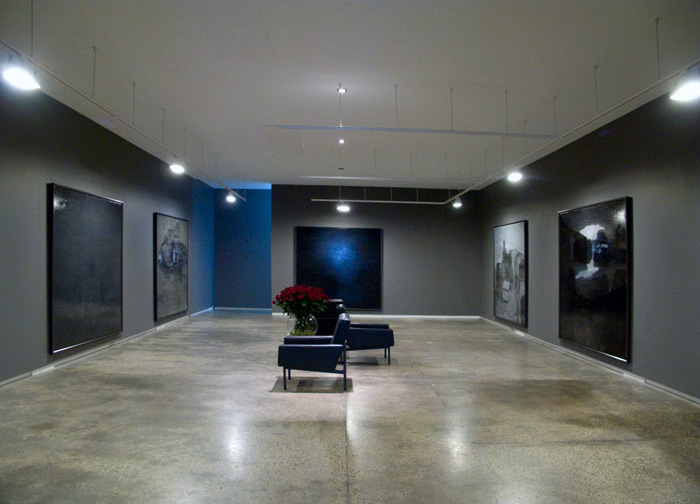
The exhibition features seven small and seven large oil and acrylic on canvas paintings that envelop the viewer in a velvety quietness, an intense stillness accompanied by ambient music composed by de Clario himself. All fourteen paintings are reinterpretations of works by Utrillo picked at random by de Clario that strip away surface matter to reveal the shadow substance that lays at the anxious heart of Utrillo’s meta/physical body of work (Utrillo was an alcoholic at fourteen and spent numerous periods in sanatoriums). When de Clario was fifteen he was fascinated by a small book on Utrillo and found that his paintings reminded him of his childhood, growing up in the town of Trieste. Recently he noticed that the word ‘triestement’ was used to mean, essentially, an investigation of sadness, of melancholy and started an investigation into the life and work of Utrillo. From this dialogue the paintings for the exhibition have emerged as de Clario found the ‘more is’ of Utrillo, the anima of his presence within the work.
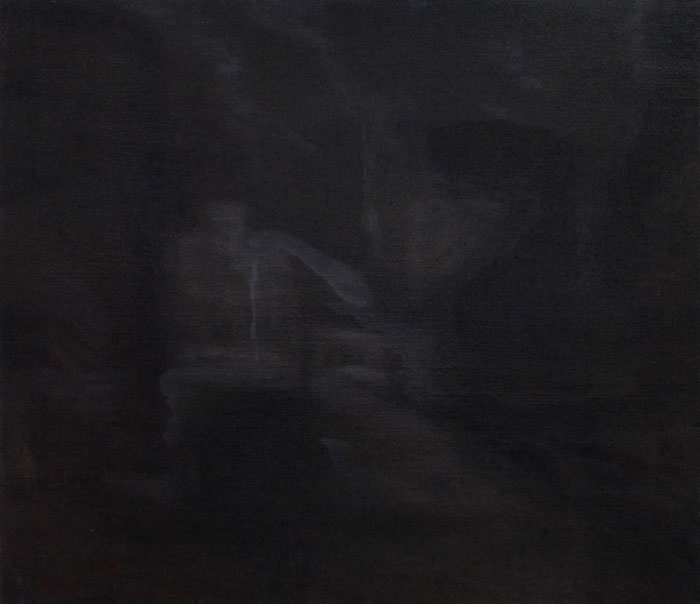
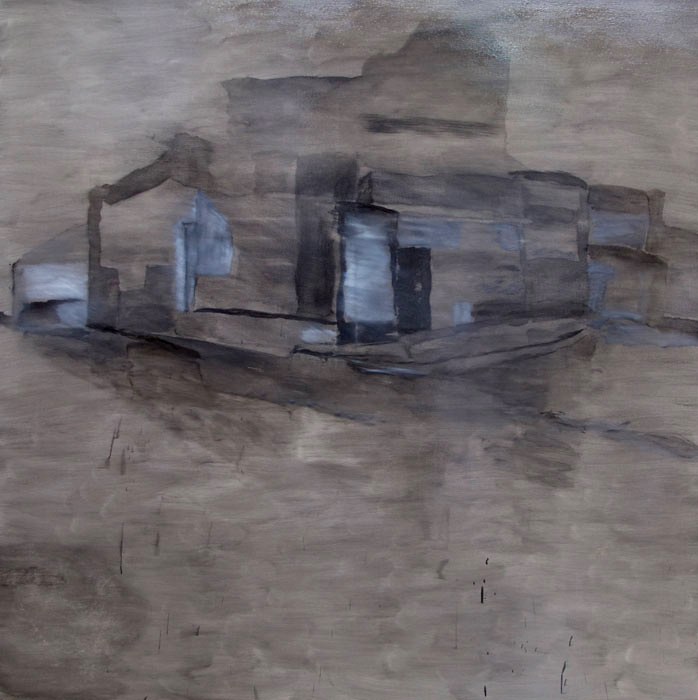
The small abstract paintings (such as renoir’s garden, above) are dark and miasmic, vaporous emanations of atmosphere that contain traces of Utrillo’s lifelong battle with the black dog but it is the seven large paintings facing each other in the main gallery space that are at the heart of de Clario’s project. They are magnificent.
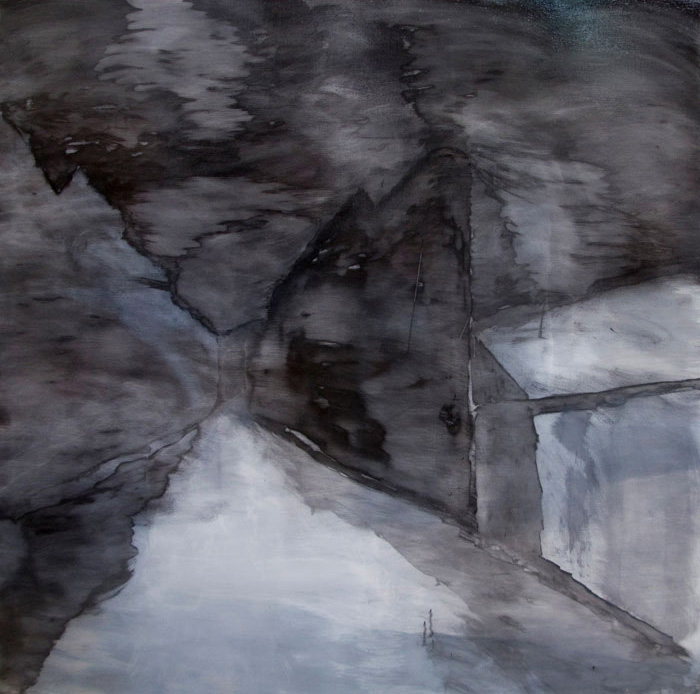
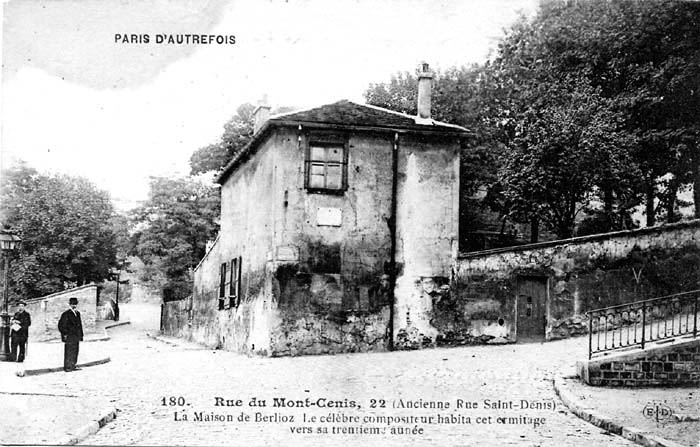
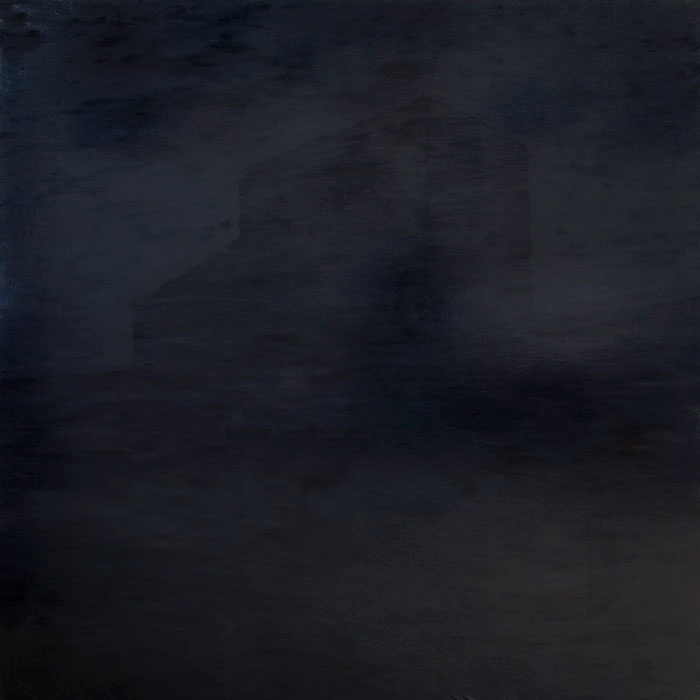
Painted in a limited colour palette of ochres, greys and blacks the works vibrate with energy. Cezanne-like spatial representations are abstracted and the paint bleeds across the canvas forming a maze of buildings. Walls and hedges loom darkly over roadways, emanations of heads and figures float in the picture plane and the highlight white of snow hovers like a spectral figure above buildings. These are elemental paintings where the shadow has become light and the light is shadow, meanderings of the soul in space. In the painting i (the house of hector berlioz – night) below, the single dark line of the house rises from the plain; the shadowy haze of recognition sits in the subconscious like the trace of our own mortality. My mind made an association with the modernist photograph by Paul Strand of the church at Taos (see photo at bottom of posting) with the looming bulk of the ramparts: it’s funny how things just click into place.
“The watergaw, the faint rainbow glimmering in chittering light, provides a sort of epiphany, and MacDiarmid connects the shimmer and weakness and possible revelation in the light behind the drizzle with the indecipherable look he received from his father on his deathbed … Each expression, each cadence, each rhyme is as surely and reliably in place as a stone on a hillside.” ~ Seamus Heaney1
To paint these works de Clario was open and receptive to the idea of the letting go. In the wonderfully erudite catalogue essay he says he felt like he was standing under a waterfall experiencing the joyful bliss of substance, material, surface, shadow, blandness, light, plenitude and triestement while acknowledging that he could never capture them and that their value could only be fully understood once he abandoned any thought of possessing them. Like Seamus Heaney in the quotation above, de Clario experienced the glimmering in chittering light, the possible revelation in the light behind the drizzle (of the shadow) and he then paints the trace of Utrillo’s subconscious anima, the indecipherable look of his triestement. de Clario feels the fluid relationship between substance and appearance; he understands that Utrillo is embedded in the position of each building and stone, in the cadences and rhymes of the paintings of Montmarte. de Clario interprets this knowledge in a Zen like rendition of shadow substance in his paintings. Everything has it’s place without possession of here and there, dark and light.
For my part it was my soul responding to the canvases. I was absorbed into their fabric. As in the dark night of the soul my outer shell gave way to an inner spirituality stripped of the distance between viewer and painting. I felt communion with this man, Utrillo, with this art, de Clario, that brought a sense of revelation in the immersion, like a baptism in the waters of dark light. For art this is a fantastic achievement. Highly recommended.
Dr Marcus Bunyan
1/ Heaney, Seamus. The Redress of Poetry. London: Faber and Faber, 1995, pp. 107-108.
Please click on the artwork for a larger version of the image.
Domenico de Clario (Australian born Italy, b. 1947) l (le lapin agile – snow coming) 2008/09 Oil on canvas
Maurice Utrillo (French, 1883-1955) Renoir’s Garden 1909-1910 Oil on canvas
Installation views of triestement (more-is u thrill-o) by Domenico De Clario at John Buckley Gallery
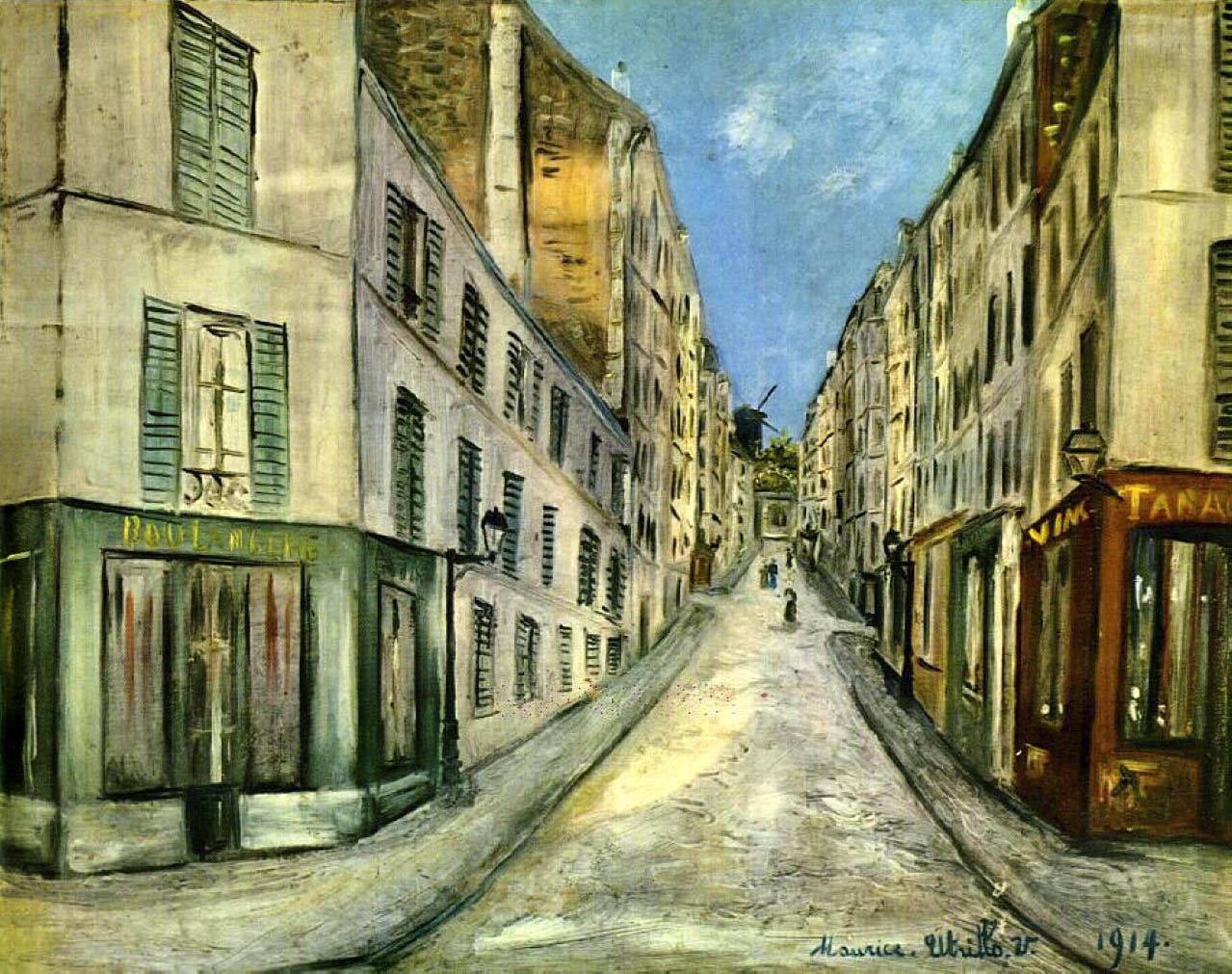
Maurice Utrillo (French, 1883-1955) Paris Street 1914 Oil on canvas
Domenico de Clario (Australian born Italy, b. 1947) r (rue ravignan – le bateau lavoir) 2008/09 Oil on canvas
Domenico de Clario (Australian born Italy, b. 1947) l (le lapin agile and rue du mont cenis – snow receding) 2008/09 Oil on canvas
Domenico de Clario (Australian born Italy, b. 1947) o (la grande maison blanche – snow clouds massing) 2008/09 Oil on canvas
Is there any limit, I thought, to the kinds of shadows that might be transmuted into light? And is this because the key component of the nature of shadow is its deep longing for a transmutation to light?
As a consequence of these thoughts I arrived at the question that animates the core of this current project; what, I asked myself, might the original shadow-substance Utrillo experienced and subsequently transmutes into the paintings we known, have looked like? What shadow images did Utrillo first see, or even imagine, before he transmuted them into colour? …
Utrillo must have believed that the outer world of coloured light belonged exclusively to others, for he never succeeded in releasing himself from the dark inner shadows that engulfed him. Though he struggled much to reach the light he accepted shadow as constituting his world and worked ceaselessly to offer us images that reflected this side’s plenitude.
Perhaps the luminous surfaces of his paintings functioned as the thin membrane that separates the outer world of cacophonously coloured light from the velvety grey inner world of the monotic anxiety he inhabited. Upon that thought the momentousness of his gift became apparent to me …
For the purposes of this present project I believe that the shadow substance laying beneath the architecture of Utrillo’s streetscapes existed within the artist long before his paintings came into being. This non-substance generated the appearance of matter on the paintings’ surfaces and more significantly it gradually came to contain the spirit of his Montmarte-body.
The process of removing matter results in an obvious absence of substance but paradoxically this leads me to feel that here, under all this discarded visible matter, an invisible substance that has always contained more than matter awaits to be revealed. This leads to the provisional conclusion that the primal trace of normally unseen shadow is far richer than any material constituting appearance, containing as it does infinitely more substance than appearance.
Astonishing paradox; infinite substance can only be discovered once all matter is removed.
Text from the catalogue essay by Domenico de Clario [Online] Cited 26/04/2009. No longer available online
Maurice Utrillo (French, 1883-1955) Berlioz House 1910 Oil on canvas
Anonymous Postcard of Hector Berlioz House Nd
Domenico de Clario (Australian born Italy, b. 1947) i (the house of hector berlioz – night) 2008/09 Oil on canvas
Paul Strand (American, 1890-1976) Inverted colour burn of his photograph Church, Ranchos de Taos New Mexico 1932
In a mad dash around town I managed to see the Derek O’Connor and Peter Cole exhibitions before they finished and also the Siri Hayes En Plein Air exhibition of photographs at Gallerysmith (see next post).
Marcus
Please click on the art work for a larger version of the image.
Derek O’Connor paintings at Karen Woodbury Gallery
An intense show of small oil paintings that really draw you into their composition. They are paintings of tremendous energy and layering, the surface being in a constant state of flux. The paintings become metaphors for the bodies existence in space, corporeal landscapes full of sensation ‘neither rational nor cerebral’. They become a mediation and a meditation upon life itself – complex, convulsive, concentrated energy that focuses the viewers attention so that they cannot look away.
Derek O’Connor (Australian born England, b. 1959) Horizontal 2008
Derek O’Connor (Australian born England, b. 1959) Horizontal 2008
“Working with his tools of palette knives and brushes, he sets into motion a train of repetitions, of speeds and slowness1 applying and scrapping paint away in an attempt to move from a position of not knowing towards knowing. He brings … an intense physical and mental awareness to the rhythms of his own movements, his own body. At such moments time seems to expand – to become infinite.
In erasing from his project the world of appearances, Derek O’Connor embraces something else – the realm of ‘sensation’. Sensation is an open painterly expression which resists definition. The Modernist painter Paul Cezanne described sensation as a “logic of the senses” which is neither rational nor cerebral2 … For Derek, the subject of his painting appears to be the act of making itself. Here subject and object collapse (folding into itself) so that sensation is experienced through the materiality of paint, via the movements of the artists’ body to affect the bodies of others.”
Paul Uhlmann from the catalogue essay
1/ Deleuze, G. and Guattari, F. A Thousand Plateaus. London: Continuum, 1987, pp. 292-300 2/ Deleuze, G. The Logic of Sensation. London: Continuum, 2003, p. 42
Derek O’Connor (Australian born England, b. 1959) Irregular 2008
Karen Woodbury Gallery
This gallery has closed.
Peter Cole ‘Elements + Memories’ at John Buckley Gallery 18th March – 9th April 2009
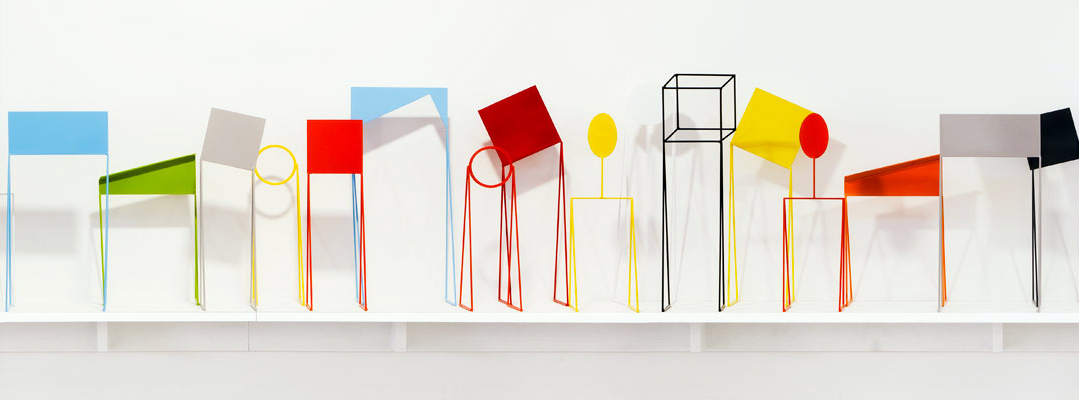
A decidedly underwhelming show by Peter Cole at John Buckley Gallery only redeemed by the amazing Elemental Landscape series of 64 small sculptural pieces displayed as a frieze (see below). The large free standing sculptural works fail to impress with their minimalist Ikea-esque cut out style – especially when viewed from the rear of the work. One would have thought that a sculptor, making several free standing pieces that are going to be walked around in a gallery space, would have designed the work to be viewed ‘in the round’. As it is all the perfection of the clinical front of the works is undone by brackets and screws holding the whole thing together when viewed from the flattened rump. This is pretty, surface work that lacks substance and insight, pretty shapes and cut outs and targets that allude to memory but are just stylised glossy magazine representations of it.
On the other hand the Elemental Landscape series of sculptures is just magical – playful, ever inventive, wonderfully contemporary, beautifully resolved in concept and manufacture, in their use and bending of geometric shapes, the sculptures really are fantastic when seen ‘in situ’ as a whole. Visit the exhibition just to see this work – buy some pieces and make your own elemental landscape!
Dr Marcus Bunyan
Peter Cole (Australian, b. 1947) Elements + Memories installation views at John Buckley Gallery, Melbourne (first and second image) Bar 4 – Shibuya 2009 (third image) Garden – Yoyogi 2009 (fourth image)
In Peter D Cole’s stunning and ambitious exhibition Elements + Memories he creates a playful interactive work titled Elemental Landscape. Utilising his highly stylised modernist and reductionist technique – influenced at an early age by studies of Miro and Calder – Cole presents 64 small sculptural pieces of varying colour and shape of which the audience is encouraged to create their own compositions. Cole also presents three large-scale sculptures drawing on memories of his times in Japan.
Cole’s distinct skill of distilling the landscape and architecture into separate elements and symbols is in itself evocative of traditional minimal Japanese aesthetic and he has created a series of works which draw upon Japanese interiors and streetscapes and the gardens of the Sakura Matsuri (Cherry Blossom festival).
Text from John Buckley Gallery website [Online] Cited 01/04/2009. No longer available online
Peter Cole (Australian, b. 1947) Elemental Landscape 2009
Opening night crowd at Colour, Time by David Thomas with from right to left Farbenfreude Series: Movement of Colour, Heart (Large) 2008; Farbenfreude Series: Amid Dark and Light (Dark Painting) 2008; and Farbenfreude Series: A Gentle Pasing (Large) 2008 on back wall Photo: Marcus Bunyan
“A photographed real space and an expanding undefinable painting space (the non-figurative form) confront each other. The result is a coexistence of various models of space, a coexistence and entanglement of inconsistent things.”
Christoph Dahlhausen. David Thomas EIKON nr 53, Vienna, Austria, 2006
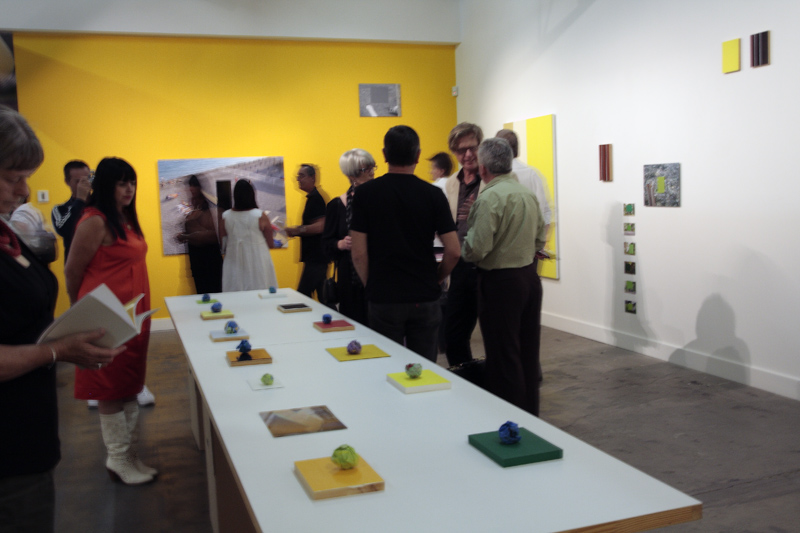
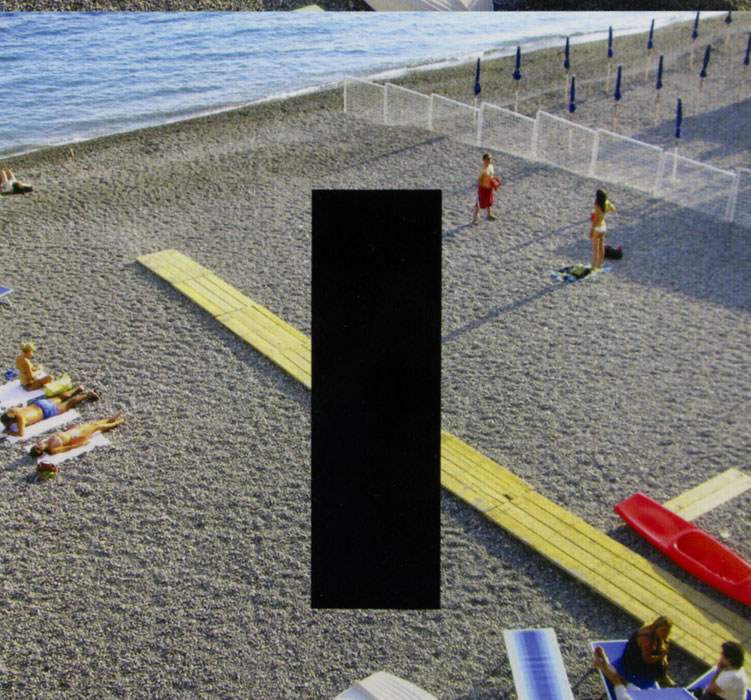
A slow burn painting, photography and composites show at Nellie Castan Gallery. Minimalist grid paintings combine with squares of colour taken out of photographs (again! as at the recent Richard Grigg show at Block Projects). This supposedly imparts profundity to insubstantial and mundane photographs that aim to comment on the existential nature of our being through the presence / absence of the missing spatio-temporal slice. This exhibition just didn’t hit the spot for me. Nice to catch up with Jason Smith Director of Heide Museum of Modern Art who was in attendance.
Dr Marcus Bunyan
Many thankx to Nellie Castan Gallery for allowing me to publish the photographs in the posting. Please click on the photographs for a larger version of the image.
Opening night crowd at Colour, Time by David Thomas with the series Length of Time 2009 on table Photo: Marcus Bunyan
David Thomas (Australian born Northern Ireland, b. 1951) Length of Time Series: Blue tape on red monochrome 2009 Photo: Marcus Bunyan
David Thomas (Australian born Northern Ireland, b. 1951) End of Summer: Homage a Tati (small splash) Enamel on photograph 2009
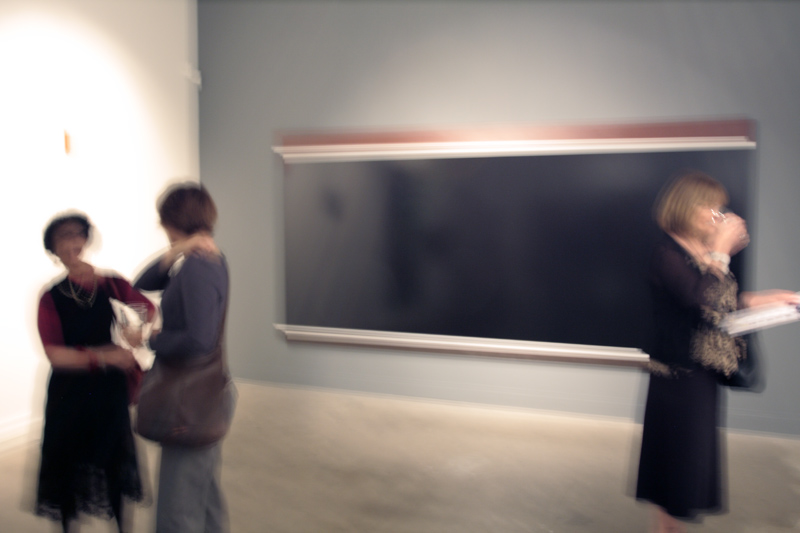
Opening night crowd in front of David Thomas’ Black Reflection Painting: For William Barak 2009 Photo: Marcus Bunyan
Many thankx to the Deutsche Guggenheim for allowing me to publish the art work in the posting. Please click on the art work for a larger version of the image.
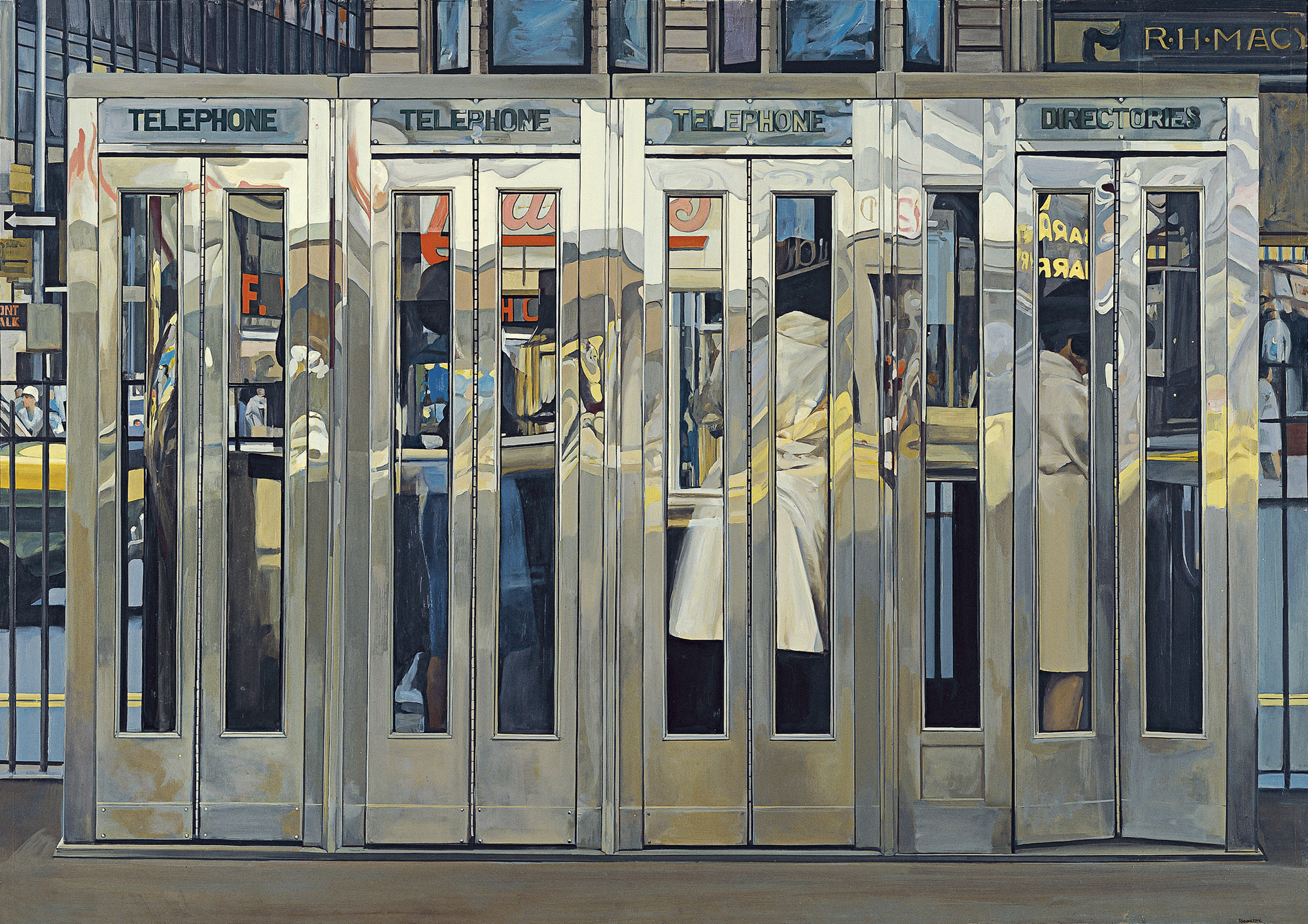
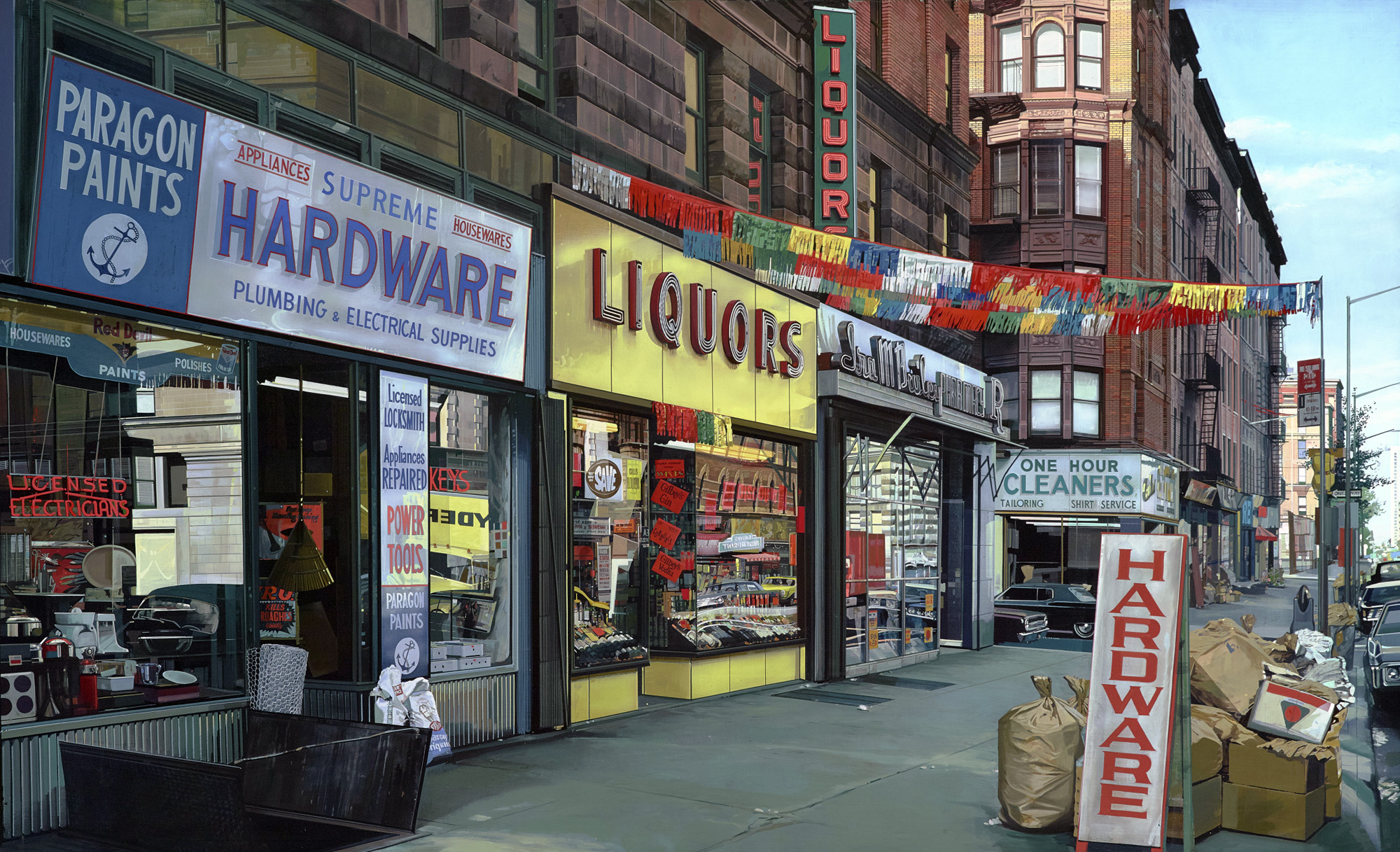
“My paintings are about light, about the way things look in their environment and especially about how things look painted. Form, colour and space are at the whim of reality, their discovery and organisation is the assignment of the realist painter.”
Richard Estes (American, b. 1932) Telephone Booths 1967
Richard Estes (American, b. 1932) Supreme Hardware 1974
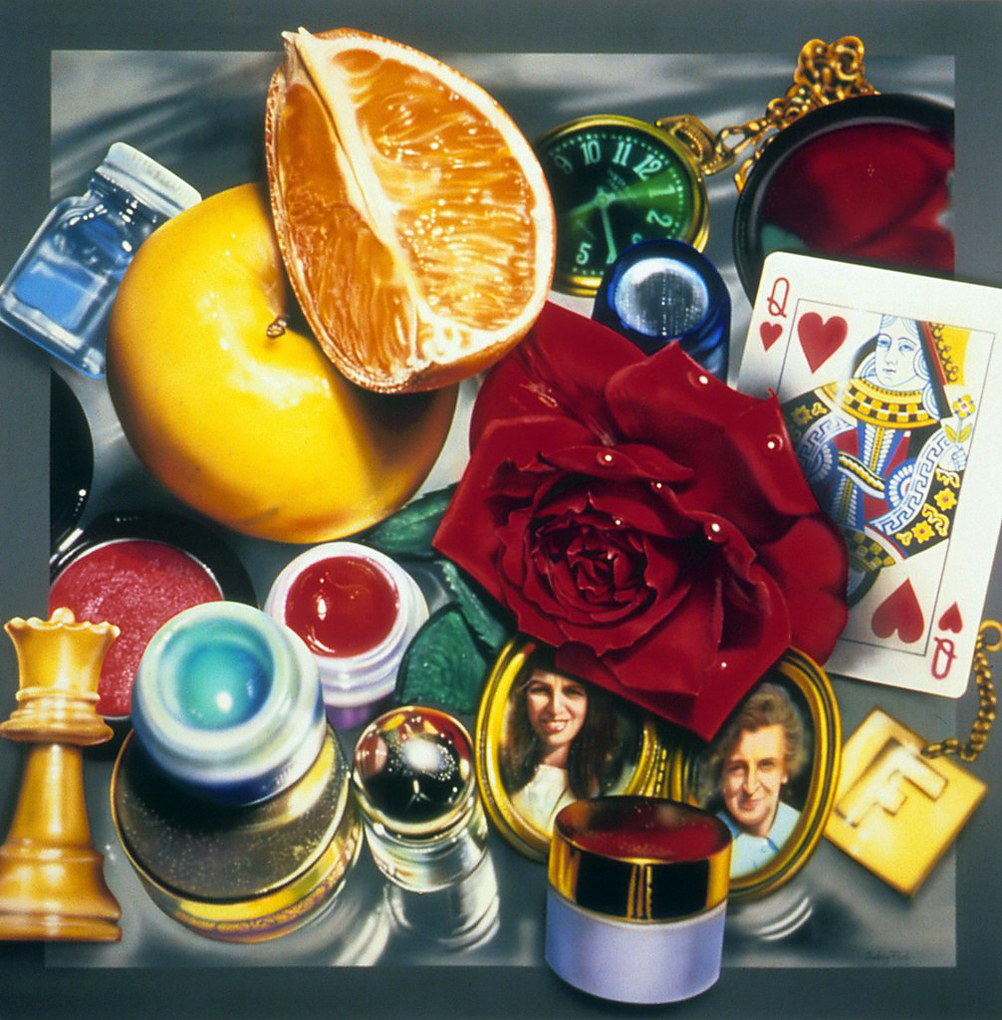
Audrey Flack (American, 1931-2024) Queen 1976
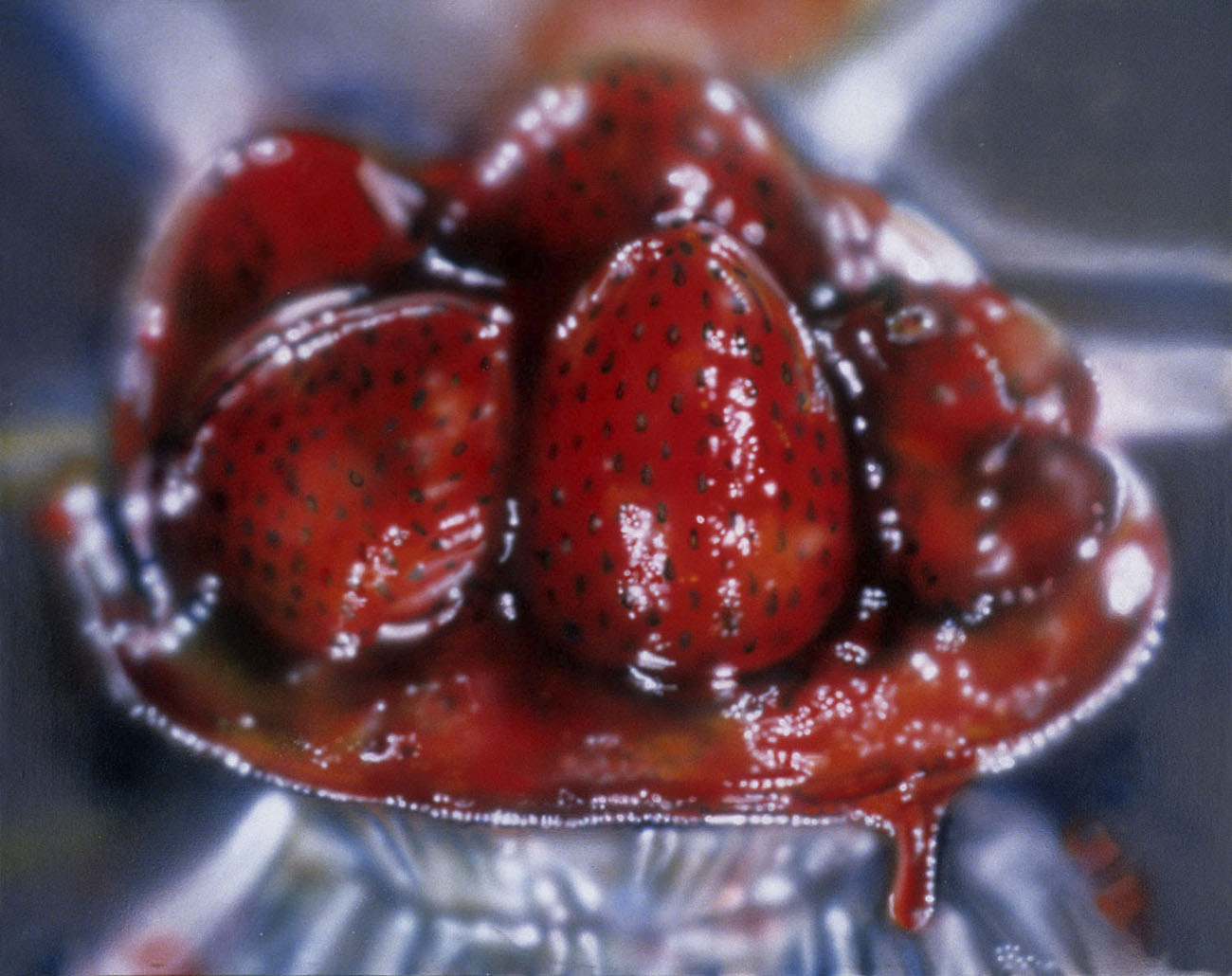
Audrey Flack (American, 1931-2024) Strawberry Tart 1974 Oil on canvas 24 x 30 inches
Don Eddy (American, b. 1944) Untitled 1971
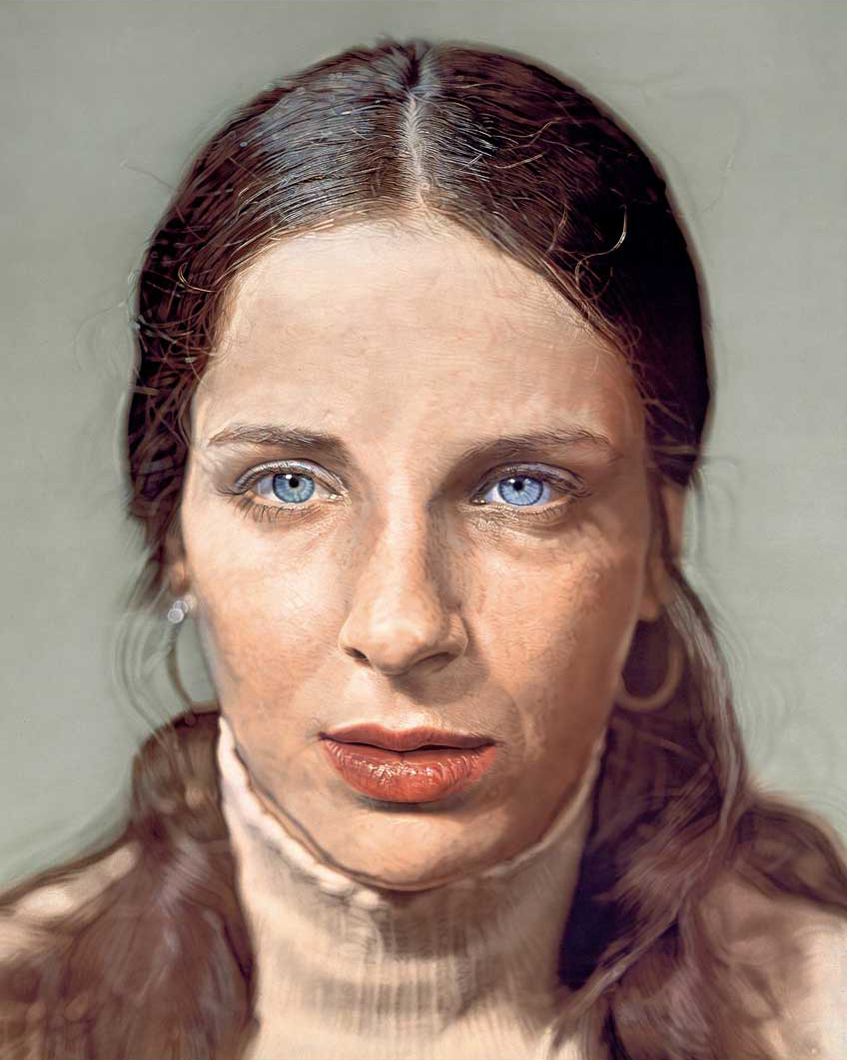
Chuck Close (American, 1940-2021) Leslie 1973
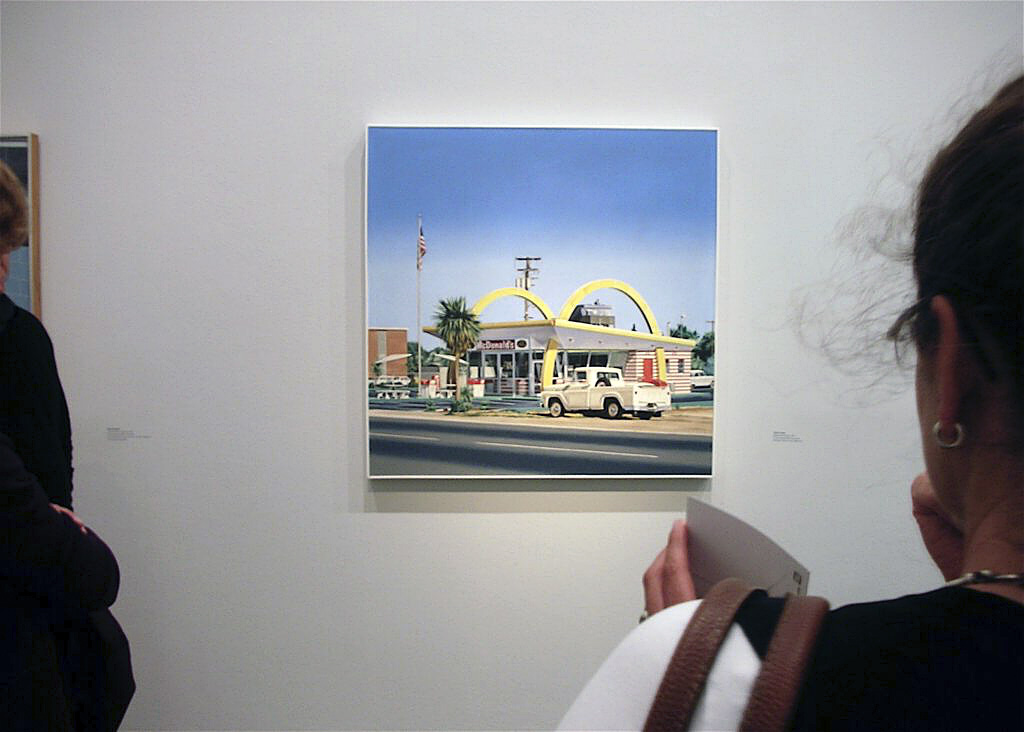
Ralph Goings (American, 1928-2016) McDonalds Pick Up (installation view) 1970 41 x 41 inches Oil on canvas Collection of Marilyn and Ivan Karp
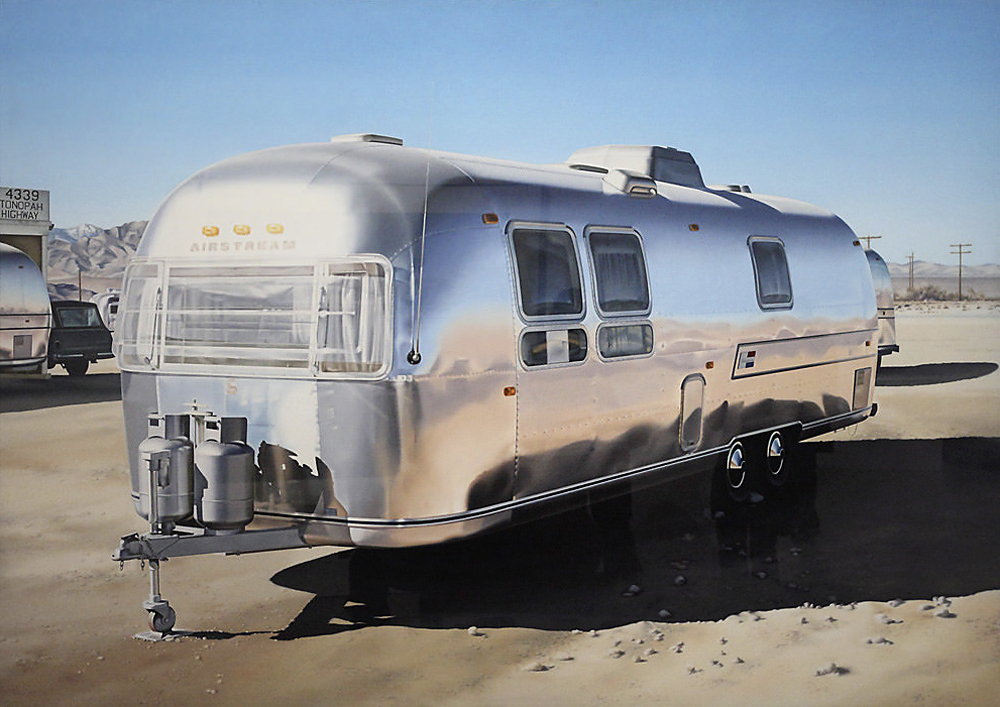
Ralph Goings (American, 1928-2016) Airstream 1970
Ralph Goings (American, 1928-2016) Dicks Union General 1971 Oil on canvas
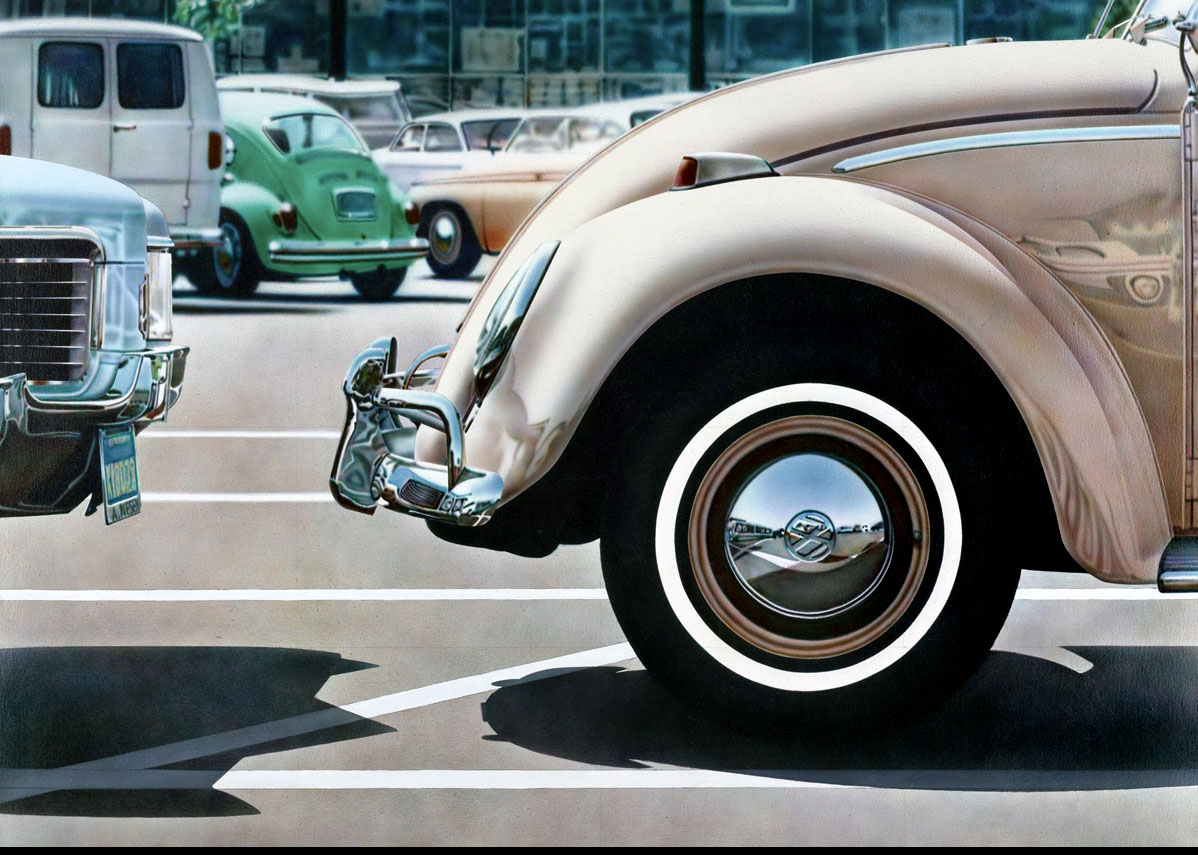
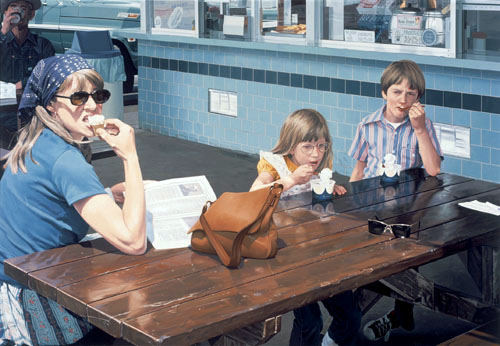
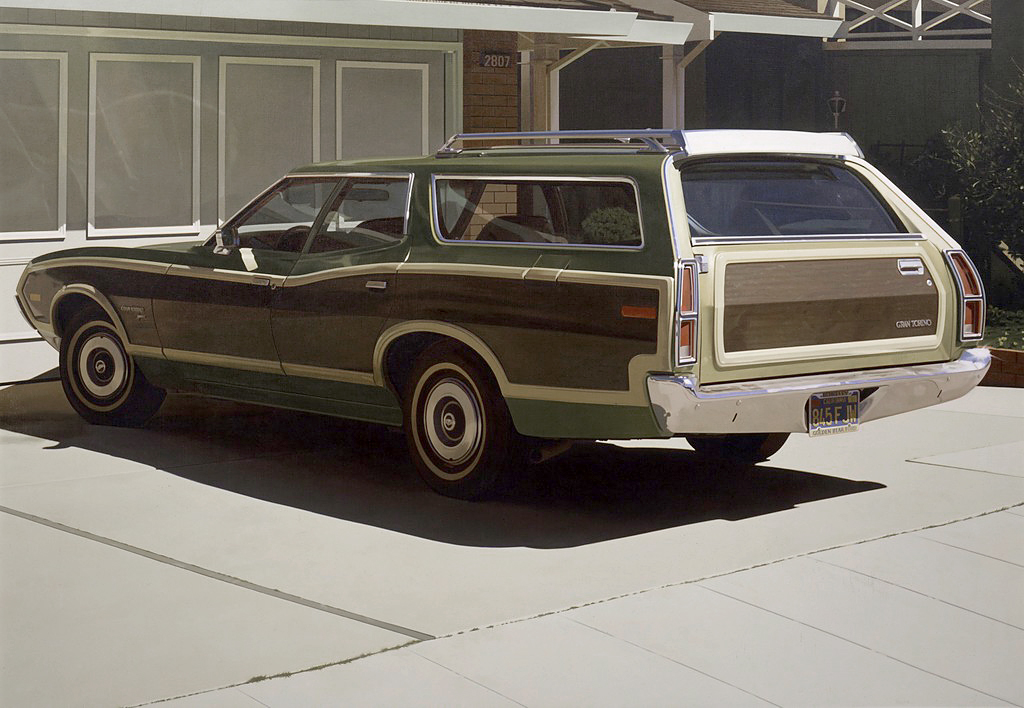
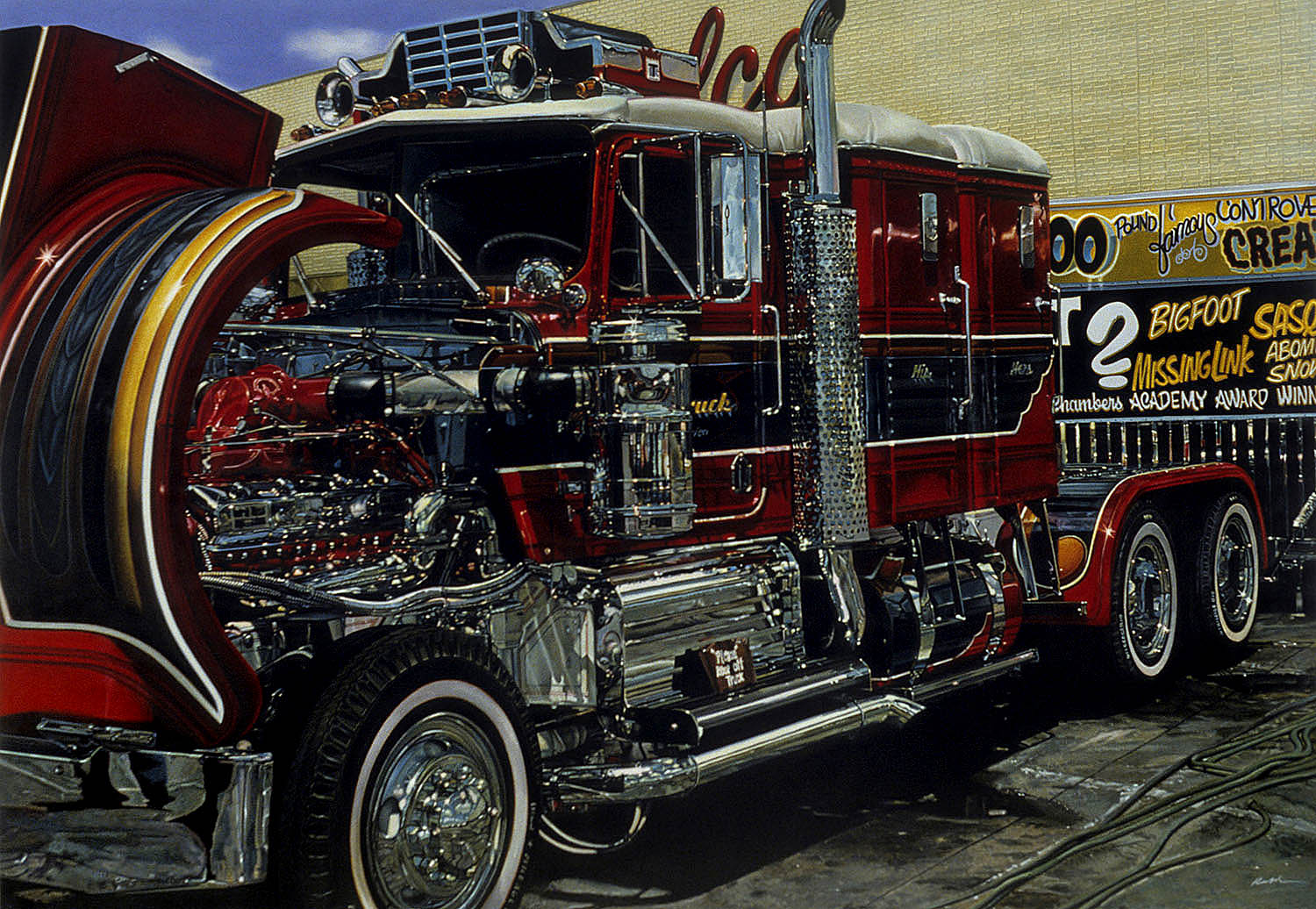
By the end of the 1960s, a number of young artists working in the United States had begun making large-scale realist paintings directly from photographs. With often meticulous detail, they portrayed the objects, places, and people that defined urban and suburban everyday life in America. In contrast to the Pop artists, they did not present their ubiquitous, often mundane, subject matter in a glamorised or ironic manner. They sought instead to achieve a great degree of objectivity and precision in the execution of their work in an effort to stay more or less faithful to the mechanically generated images that served as their source material. They developed various means of systematically translating photographic information onto canvas. In prioritising the way the camera sees over the way the eye sees, they underscored the complexity of the relationship between the reproduction and the reproduced as well as the impact of photography on the perception of both daily life and reality in general.
A number of terms were proposed in quick succession to describe this novel approach to painting, chief among them Super-Realism, Hyperrealism, and Photorealism. The artists identified as Photorealists neither formed a coherent group nor considered themselves to be part of a movement, and a number of them actively challenged their association with the label. Nevertheless, in the late 1960s and 1970s, the seventeen artists in Picturing America: Photorealism in the 1970s – Robert Bechtle, Charles Bell, Tom Blackwell, Chuck Close, Robert Cottingham, Don Eddy, Richard Estes, Audrey Flack, Franz Gertsch, Ralph Goings, Ron Kleemann, Richard McLean, Malcolm Morley, Stephen Posen, John Salt, Ben Schonzeit, and Paul Staiger – were exploring a related set of issues, methods, and subjects that led critics, curators, and art historians to both exhibit and write about their work as a coherent trend in contemporary art. Picturing America focuses on this formative, defining period in the history of Photorealism.
The exhibition includes thirty-one paintings, a number of them the most iconic and masterful works of 1967-1982, for example Richard Estes’s Telephone Booths (1967, above) and Chuck Close’s Leslie (1973, above). Picturing America is divided into four sections, three exploring key themes of Photorealist painting during the 1970s – Reflections on the City, Culture of Consumption, and American Life – and a fourth dedicated to a portfolio of ten lithographs made on the occasion of Documenta 5 in 1972, which featured the first major group showing of Photorealism.
Text from the Deutsche Guggenheim website
Picturing Americas – American Photorealism in the 70s
Vernissage video of “Picturing Americas”, an art exhibition about American Photorealism in the 1970s, presented in Berlin by Deutsche Guggenheim, a joint venture between Deutsche Bank and the Solomon R. Guggenheim Foundation in New York. The exhibition (March – May 2009) was the first major showing of American Photorealism in Germany since “documenta 5” in 1972.
The video includes interviews of Valerie Hillings, Assistant Curator, Solomon R. Guggenheim Museum, and interviews with the following artists: Ron Kleemann, Robert Bechtle, Tom Blackwell. You can also enjoy stills of selected pictures shown at the exhibition. Video courtesy of VernissageTV (VTV).
Text from the YouTube website
Robert Bechtle (American, 1932-2020) Foster’s Freeze, Escalon 1975
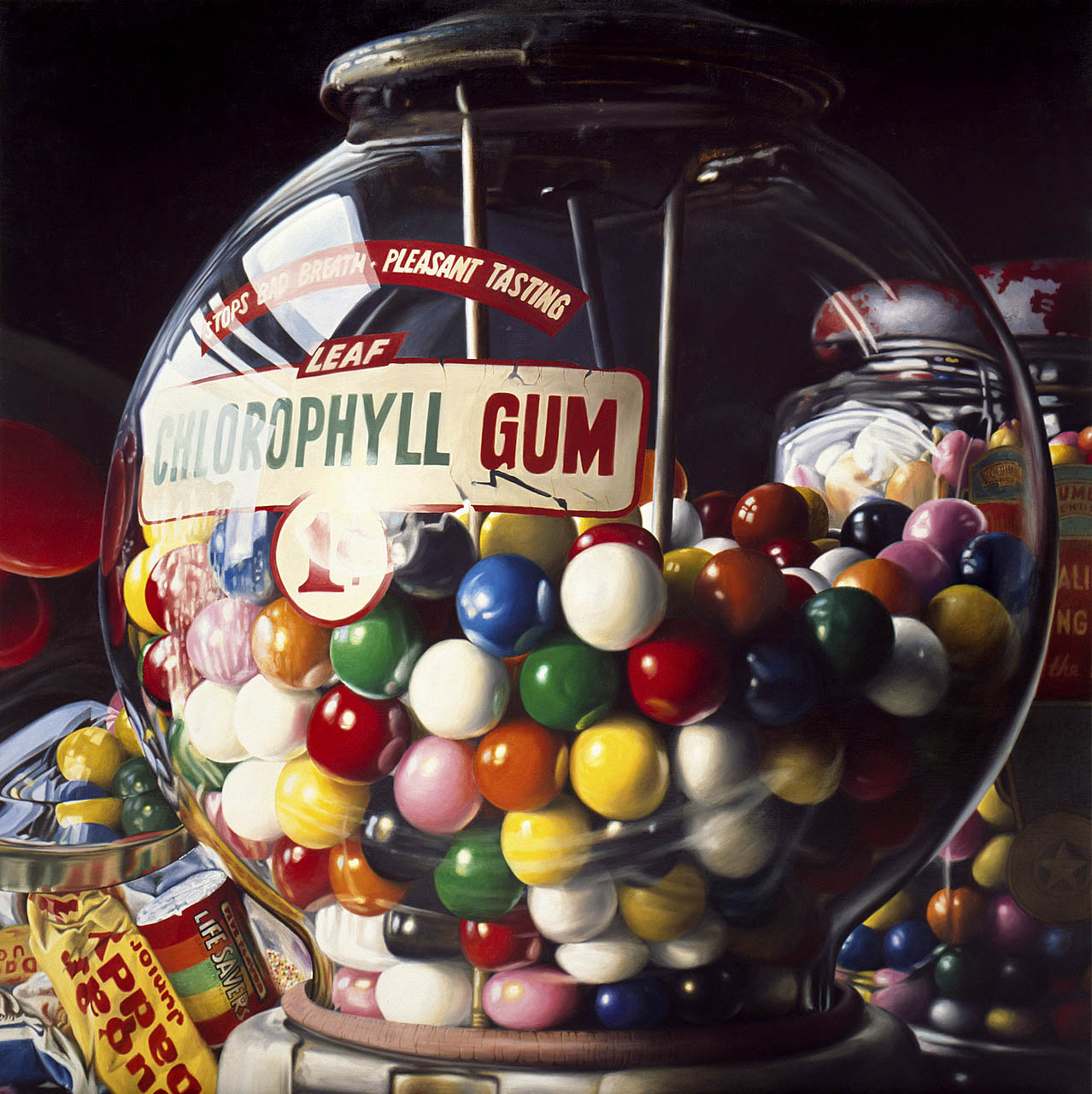
Charles Bell (American, 1935-1995) Gum Ball No. 10: “Sugar Daddy” 1975 Oil on canvas 66 x 66 inches
Charles Bell was born in 1935 in Tulsa, Oklahoma. Although Bell became interested in art at a young age, he never received formal training. In 1957, he completed a BBA at the University of Oklahoma, Norman, and did not decide to pursue an artistic career until the early 1960s after touring in the U.S. Navy. At this point in time, he was working in the San Francisco Bay Area, where he was drawn to the vibrantly colored paintings of Richard Diebenkorn and Wayne Thiebaud. Other artistic influences Bell has cited range from Pop art to the realisms of Jan Vermeer and Salvador Dalí. It was through the painter Donald Timothy Flores, however, that Bell learned technique, most notably trompe l’oeil, while working in the former’s San Francisco studio. Under Flores, Bell painted mostly small-scale landscapes and still lifes, which earned him the Society of Western Artists Award in 1968.
In 1967 Bell relocated to New York, where he set up his first studio. Two years later he began showing at New York’s Meisel Gallery run by Louis K. Meisel, who popularized the term “Photorealism” and helped establish the style as a movement. Bell embraced a photo-based technique in his work not only for the way it renders imperceptible details visible, but also for how he saw the close-up photographic view as emblematic of contemporary visual experience steeped in a daily bombardment of media imagery. Bell carried out his Photorealist works by photographing his subjects in still-life compositions and painting from his image.
Although Photorealism emerged as a national phenomenon, certain general qualities distinguish the coastal approaches to the movement. While the majority of the West Coast Photorealists preferred landscapes, particularly images of cars, trucks, and homes within an overall landscape, Bell, like many of the New York–based Photorealists, focused on still life. Bell transformed everyday subject matter by enlarging ordinary objects like Raggedy Ann dolls and gumball machines to an unusually grand scale. His subjects are typically familiar objects associated with childhood, consumer culture, and play, and thus capable of resonating with a broad audience. By focusing on larger-than-life subjects, Bell’s paintings also deny narrative readings of his work. He has described his approach to selecting subject matter as more of an emotional than intellectual process. The hyperrealistic precision of his technique, combined with an exaggerated scale, produces a sensation that oscillates between familiarity and unfamiliarity, thus engaging the viewer sensually and emotionally. The exploration of light remains a persistent theme throughout Bell’s oeuvre, from his earliest treatments of light on mostly opaque surfaces to his interest in reflected and refracted light on transparent materials, as seen in the gumball machine series (1971-77). These investigations gave way to his subsequent interest in objects illuminated from within, such as pinball machines, which he began in 1977.
Curator: Manuela Mena, co-curator of the exhibition at the Prado
Francis Bacon (British, 1909-1992) Triptych inspired by T.S. Eliot’s ‘Sweeney Agonistes’ 1967 Oil on canvas 198 x 147.5cm (each) Washington, D.C. Hirshhorn Museum and Sculpture Garden, Smithsonian Institution. Gift of the Joseph H. Hirshhorn Foundation, 1972
Looks like an amazing exhibition of Francis Bacon’s work, one of my favourite artists – I wish I could see it!
Many thankx to the Museo Nacional del Prado for allowing me to publish the art work in the posting. Please click on the photographs for a larger version of the image.
The exhibition is constructed in different sections:
~ Animal ~ Zone ~ Apprehension ~ Crucifixion ~ Crisis ~ Archive ~ Portrait ~ Memorial ~ Epic ~ Late
Bacon’s work demonstrates marked similarities to that of many of the Spanish artists he admired. (Manuela Mena, co-curator of the exhibition at the Prado, has written an excellent essay on this topic that can be found in the exhibition’s catalog.) The retrospective at the Prado provides a rare opportunity to compare Bacon to some of the Spanish masters that influenced him.
Start by meandering through the vast Bacon exhibition. Spread between two floors of the new wing of the Prado, the exhibition has brought together Bacon’s most important works from nearly his entire artistic production. It begins with the work that put Bacon on the map, “Three Studies for Figures at the Foot of a Crucifixion” (1944), and follows his work through the interpretations of Velázquez, crucifixion triptychs, his unique portraits and the late works through the years shortly before his death.
Text from the Prado website
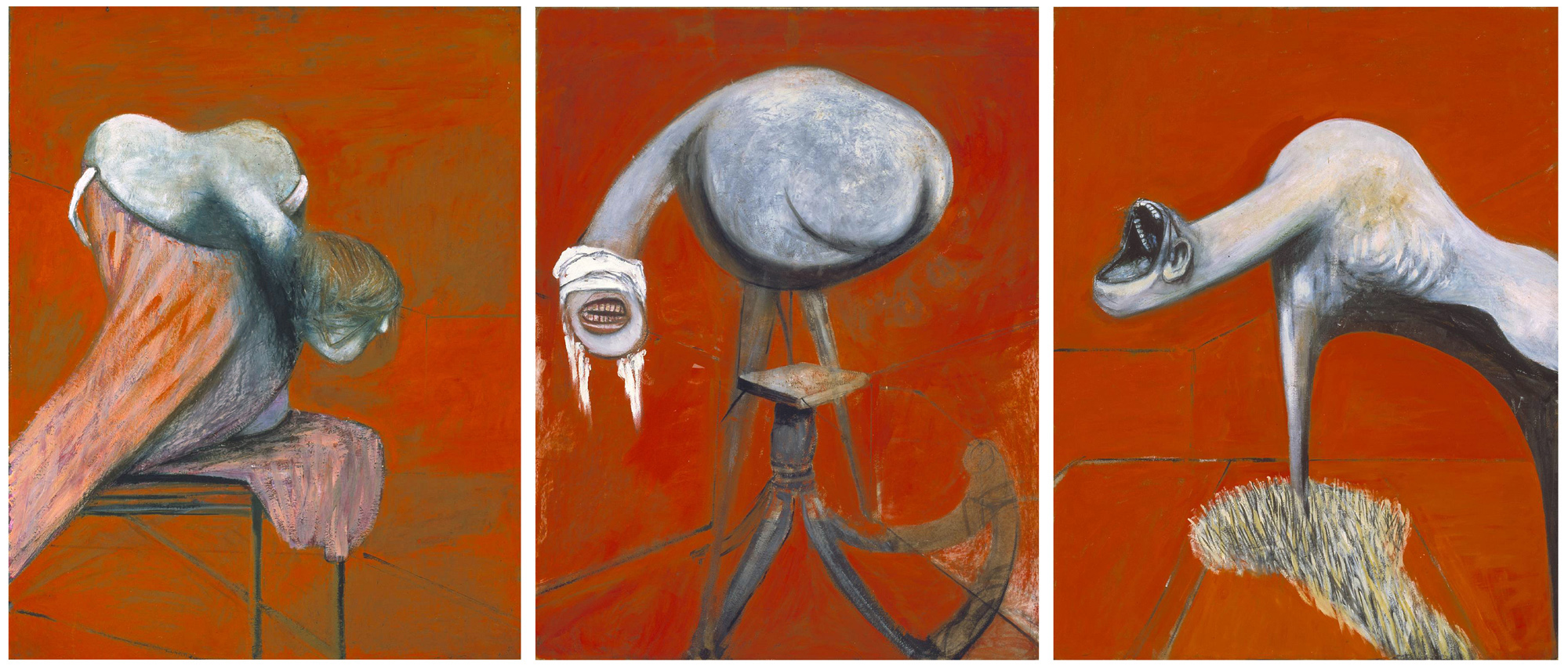
Francis Bacon (British, 1909-1992) Three Studies for Figures at the Base of a Crucifixion c. 1944 Oil on board 94 x 73.7cm London, Tate, presented by Eric Hall 1953
Animal
A philosophical attitude to human nature first emerges in Francis Bacon’s works of the 1940s. They reflect his belief that, without God, humans are subject to the same natural urges of violence, lust and fear as any other animal. He showed Figure in a Landscape and Three Studies for Figures at the Base of a Crucifixion in April 1945, and exhibited consistently thereafter. The bestial depiction of the human figure was combined with specific references to recent history and especially the devastating events of the Second World War. Bacon often drew his inspiration from reproductions, acquiring a large collection of books, catalogues and magazines. He repeatedly studied key images in order to probe beneath the surface appearance captured in photographs. Early concerns that would persist throughout his work include the male nude, which reveals the frailty of the human figure, and the scream or cry that expresses repressed and violent anxieties. These works are among the first in which he sought to balance psychological insights with the physical identity of flesh and paint.
Francis Bacon (British, 1909-1992) Study after Velázquez’s Portrait of Pope Innocent X 1953 Oil on canvas 153 x 118cm Des Moines, Nathan Emory Coffin Collection of the Des Moines Arts Center, purchased with funds from the Coffin Fine Arts Trust
Zone
In his paintings from the early 1950s, Bacon engaged in complex experiments with pictorial space. He started to depict specific details in the backgrounds of these works and created a nuanced interaction between subject and setting. Figures are boxed into cage-like structures, delineated ‘space-frames’ and hexagonal ground planes, confining them within a tense psychological zone. In 1952 he described this as “opening up areas of feeling rather than merely an illustration of an object”. Through his technique of ‘shuttering’ with vertical lines of paint that merge the foreground and background, Bacon held the figure and the setting together within the picture surface, with neither taking precedence in what he called “an attempt to lift the image outside of its natural environment”.
A theme that emerged in the 1950s was the extended series of variants of Velázquez’s Portrait of Pope Innocent X, 1650 (Rome, Galleria Doria Pamphilj), a work Bacon knew only from illustrations. He used this source to expose the insecurities of the powerful – represented most often in the scream of the caged figure. Through the open mouth Bacon exposed the tension between the interior space of the body and the spaces of its location, which is explored more explicitly in the vulnerability of the ape-like nudes.
Francis Bacon (British, 1909-1992) Chimpanzee 1955 Oil on canvas 152.5 x 117cm Stuttgart, Staatsgalerie
Apprehension
Implicit throughout Bacon’s work of the mid 1950s is a sense of dread pervading the brutality of everyday life. Not only a result of Cold War anxiety, this seems to have reflected a sense of menace at a personal level emanating from Bacon’s chaotic affair with Peter Lacy (who was prone to drunken violence) and the wider pressures associated with the continuing illegality of homosexuality. The Man in Blue series captures this atmosphere, concentrating on a single anonymous male figure in a dark suit sitting at a table or bar counter on a deep blue-black ground. Within their simple painted frames, these awkwardly posed figures appear pathetically isolated.
Bacon’s interest in situations that combine banality with acute apprehension was also evident in other contemporary works. From figures of anxious authority, his popes took on malevolent attributes and physical distortions that were directly echoed in the paintings of animals, whose actions are also both sinister and undignified. Some of these images derived from Bacon’s close scrutiny of the sequential photographs of animals and humans taken by Eadweard Muybridge (1830-1904), which he called “a dictionary” of the body in motion.
Francis Bacon (British, 1909-1992) Three Studies for a Crucifixion 1962 Oil on canvas 198.2 x 144.8cm New York, Solomon R. Guggenheim Museum
Crucifixion
Bacon made paintings related to the Crucifixion at pivotal moments in his career, which is why these key works are gathered here. The paradox of an atheist choosing a subject laden with Christian significance was not lost on Bacon, but he claimed, “as a non-believer, it was just an act of man’s behaviour”. Here the instincts of brutality and fear combine with a deep fascination with the ritual of sacrifice. Bacon had already made a very individual crucifixion image in 1933 before returning to the subject with his break-through triptych Three Studies for Figures at the Base of a Crucifixion in 1944. This is a key precursor to later themes and compositions, containing the bestial distortion of human figures within the triptych format. These monstrous creatures displace the traditional saints and Bacon later related them to the Eumenides – the vengeful furies in Greek mythology. In resuming the theme in the 1960s, especially in 1962 as the culmination of his first Tate exhibition, Bacon used references to Cimabue’s 1272-1274 Crucifixion to introduce a more explicitly violent vision. Speaking after completing the third triptych in 1965 he simply stated: “Well, of course, we are meat, we are potential carcasses”.
Francis Bacon (British, 1909-1992) Paralytic Child Walking on All Fours (from Muybridge) 1961 Oil on canvas 198 x 142cm The Hague, Collection Gemeentemuseum Den Haag
Crisis
Between 1956 and 1961, Bacon travelled widely. He spent time in places marginal to the art world, in Monaco, the South of France and Africa, and particularly with Peter Lacy in the ex-patriot community in Tangier. In this rather unsettled context, he explored new methods of production, shifting to thicker paint, violently applied and so strong in colour as to indicate an engagement with the light of North Africa. This was most extreme in his series based on a self-portrait of Van Gogh, The Painter on the Road to Tarascon (1888, destroyed), which became an emblem of the modern predicament. Despite initial acclaim, Bacon’s Van Gogh works were soon criticised for their “reckless energy” and came to be viewed as an aberration. They can now be recognised as pivotal to Bacon’s further development, however, and allow glimpses into his search for new ways of working. His innovations were perhaps in response to American Abstract Expressionism, of which he was publicly critical. Although he eventually returned to a more controlled approach to painting, the introduction of chance and the new vibrancy of colour at this moment would remain through out his career.
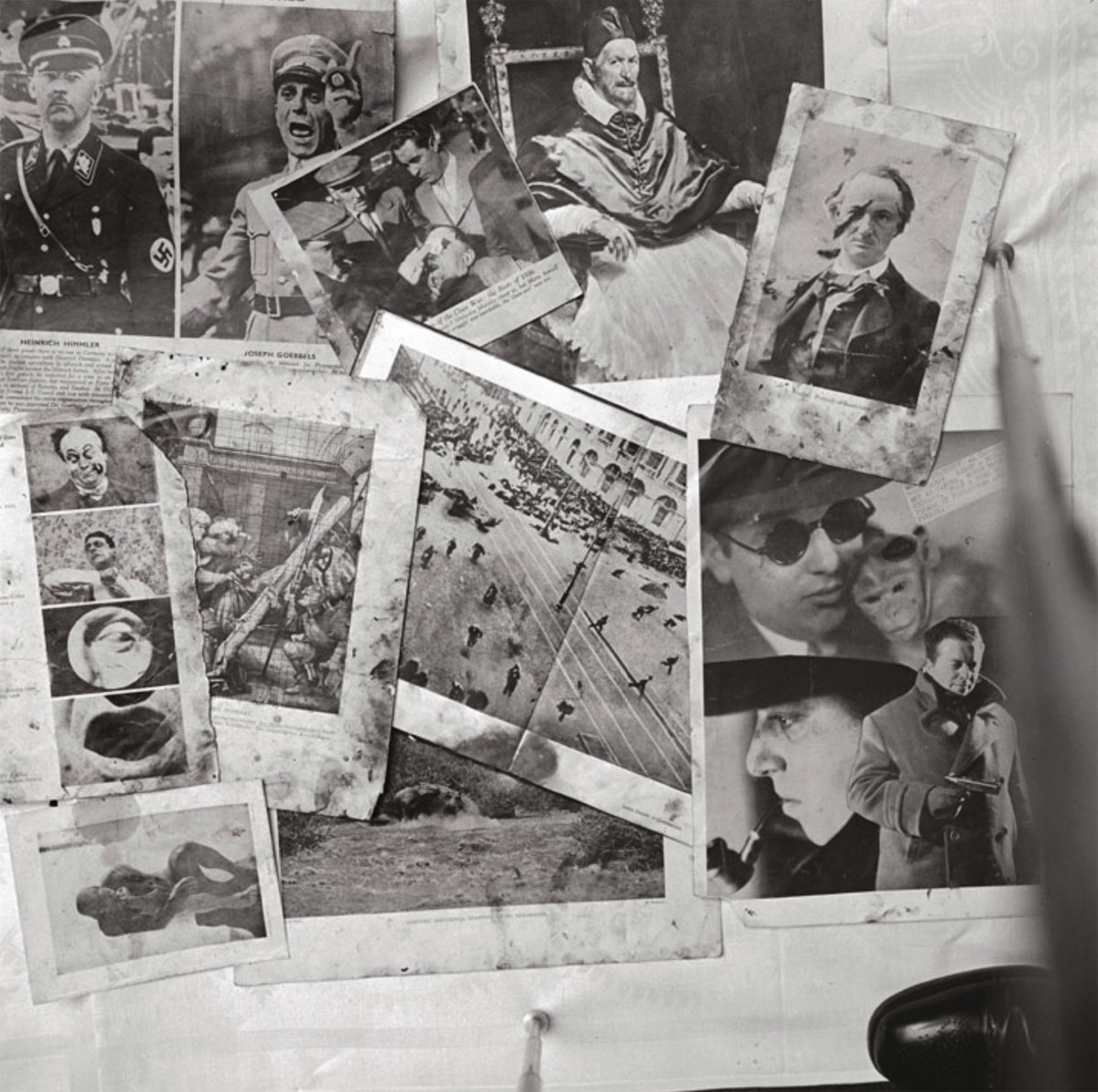
The posthumous investigation of Bacon’s studio confirmed the extent to which he used and manipulated photographic imagery. This practice was already known from montages recorded in 1950 by the critic Sam Hunter. Often united by a theme of violence, the material ranges between images of conflict, big game, athletes, film stills and works of art.
An important revelation that followed the artist’s death was the discovery of lists of potential subjects and preparatory drawings, which Bacon had denied making. Throughout his life, he asserted the spontaneous nature of his work, but these materials reveal that chance was underpinned by planning.
Photography offered Bacon a dictionary of poses. Though he most frequently referred to Eadweard Muybridge’s (1830-1904) survey of human and animal locomotion, images of which he combined with the figures of Michelangelo, he remained alert to photographs of the body in a variety of positions.
A further extension of Bacon’s preparatory practices can be seen in his commissioning of photographs of his circle of friends from the photographer John Deakin (1912-1972). The results – together with self-portraits, photo booth strips, and his own photographs – became important prompts in his shift from generic representations of the human body to portrayals of specific individuals.
A matrix of images
Bacon’s use of photographic sources has been known since 1950 when the critic Sam Hunter took three photographs of material he had selected from a table in Bacon’s studio in Cromwell Place, South Kensington. Hunter observed that the diverse imagery was linked by violence, and this fascination continued throughout Bacon’s life. Images of Nazis and the North African wars of the 1950s were prominent in his large collection of sources. Films stills and reproductions of works of art, including Bacon’s own, were also common. The dismantling of Bacon’s later studio, nearby at Reece Mews, after his death confirmed that the amassing of photographic material had remained an obsession. While some images were used to generate paintings, he also seems to have collected such an archive for its own sake.
The mediated image
From the 1960s, Bacon’s accumulation of chance images began to include a more deliberate strategy of using photographs of his close circle. They became key images for the development of the portraits that dominated his paintings at this time. Snap shots and photo booth strips were augmented by the unflinching photographs taken by his friend John Deakin. Bacon specifically commissioned some of these from Deakin as records of those close to him – notably his partner from 1962, George Dyer – and they served as sources for likenesses and for poses for the rest of his career.
The Physical Body
Bacon drew more from Eadweard Muybridge’s sequential photographs of human and animal locomotion than from any other source. These isolated the naked figure in a way he clearly found stimulating. He also, however, spoke of projecting on to them Michelangelo’s figures which for him had more “ampleness” and “grandeur of form”.
His fascination in photography’s freezing of the body in motion led him to collect sports photographs, particularly boxing, cricket and bullfighting. It was not just movement but the physicality of the body that Bacon scrutinised, using found images to provoke new ways of picturing its strength and vulnerability.
Francis Bacon (British, 1909-1992) Portrait of Isabel Rawsthorne Standing in a Street in Soho 1967 Oil on canvas 198 x 147.5cm Berlin, Staatliche Museen zu Berlin, Nationalgalerie
Portrait
During the 1960s, the larger part of Bacon’s work shifted focus to portraits and paintings of his close friends. These works centre on two broad concerns: the portrayal of the human condition and the struggle to reinvent portraiture. Bacon drew upon the lessons of Van Gogh and Velázquez, but attempted to rework their projects for a post-photographic world. His approach was to distort appearance in order to reach a deeper truth about his subjects. To this end, Bacon’s models can be seen performing different roles. In the Lying Figures series, Henrietta Moraes is naked and exposed. This unprecedented raw sexuality reinforces Bacon’s understanding of the human body simply as meat. By contrast Isabel Rawsthorne, a fellow painter, always appears in control of how she is presented. With a mixture of contempt and affection, Bacon depicted George Dyer, his lover and most frequent model, as fragile and pathetic. This is especially evident in Dyer’s first appearance in Bacon’s work, in Three Figures in a Room, in which he represents the absurdities, indignities and pathos of human existence. Everyday objects occasionally feature in these works, hollow props for lonely individuals which reinforce the sense of isolation that Bacon associated with the human condition.
Francis Bacon (British 1909-1992) Triptych in Memory of George Dyer 1971 Oil on canvas
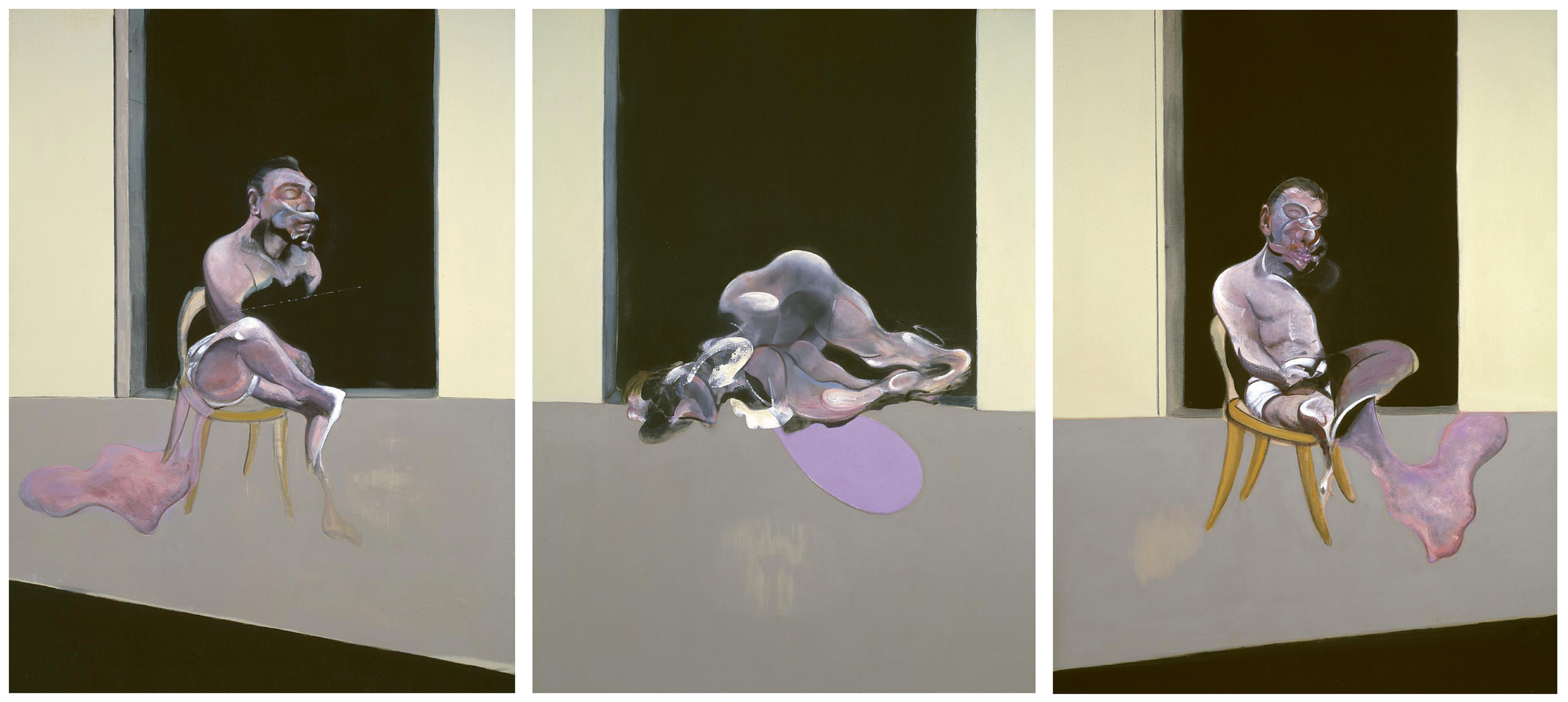
Francis Bacon (British, 1909-1992) Triptych – August 1972 1972 Oil on canvas 198 x 147.5cm London, Tate
Memorial
This room is dedicated to George Dyer who was Bacon’s most important and constant companion and model from the autumn of 1963. He committed suicide on 24 October 1971, two days before the opening of Bacon’s major exhibition at the Grand Palais in Paris. Influenced by loss and guilt, the painter made a number of pictures in memorial to Dyer. From this period onwards the large-scale triptych was his established means for major statements, having the advantage of simultaneously isolating and juxtaposing the participating figures, as well as guarding against narrative qualities that Bacon strove to avoid. But while evading narrative, Bacon drew more than ever from literary imagery; the first of the sequence, Triptych In Memory of George Dyer 1971, refers to a specific section of T.S. Eliot’s The Waste Land (1922). In addition to his own memory, for Triptych – August 1972 Bacon relied on photographs, taken by John Deakin, of Dyer in various poses on a chair. He confined his dense and energetic application of paint to the figures in these works. The dark openings consciously evoke the abyss of mortality that would become a recurring concern in Bacon’s later works.
Francis Bacon (British, 1909-1992) Triptych 1987 Oil on canvas 198 x 147.5cm London, The Estate of Francis Bacon, courtesy Faggionato Fine Art
Epic
References to poetry and drama became a central element in Bacon’s work from the second half of the 1960s. Alongside images of friends and single figures (often self-portraits), he produced a series of grand works that identified with great literature. Imbued with the inevitability and constant presence of death, the poetry of T.S. Eliot was a particular source of inspiration. The sentiments of the poet’s character Sweeney could be said to echo the painter’s perspective on life:
Birth, and copulation, and death.
That’s all the facts when you come to
brass tacks:
Birth, and copulation, and death.
The works in this room refer to and derive from literature. Some make direct references in their titles, others depict, sometimes abstractly, a certain scene or atmosphere within the narratives themselves. Bacon repeatedly stated that none of his paintings were intended as narratives, so rather than illustrations, these works should perhaps be understood as evoking the experience of reading of Eliot’s poetry or Aeschylus’s tragedies: their violence, threat or erotic charge. Thus, of the triptych created after reading Aeschylus, Bacon explained “I tried to create images of the sensations that some of the episodes created inside me”.
Francis Bacon (British, 1909-1992) Portrait of John Edwards 1988 Oil on canvas 198 x 147.5cm The Estate of Francis Bacon, courtesy of Faggionato Fine Arts, London, and Tony Shafrazi Gallery, New York
Late
When Bacon turned seventy in 1979, more than a decade of work lay ahead of him. Neither his legendarily hedonistic lifestyle nor his work pattern seemed to age him, but he was continually facing up to mortality through the deaths of those around him. This unswerving confrontation, however mitigated by youthful companions such as John Edwards, became the great theme of his late style. Constantly stimulated by new source material – for example the photographs and the poetry of Federico García Lorca which triggered his bullfight paintings – he was able to adapt them to his abiding concerns with the vulnerability of flesh. Exploring new techniques he also extended his fascination with how appropriate oil paint is for rendering the human body’s sensuality and sensitivity. A certain despairing energy may also be felt in the forceful throwing of paint that dominates some of these final works: the controlled chance as a defiant gesture. Ultimately, and appropriately, Bacon’s last triptych of 1991 returns to the key image of sexual struggle that had frequently recurred in his work. He faced death with a defiant concentration on the exquisiteness of the lived moment.
Francis Bacon (British, 1909-1992) Three Studies for Self-Portrait 1979-1980 Oil on canvas 37.5 x 31.8cm Nueva York, The Metropolitan Museum of Art, Jacques and Natasha Gelman collection, 1998
Francis Bacon
Francis Bacon is internationally acknowledged as among the most powerful painters of the twentieth century. His vision of the world was unflinching and entirely individual, encompassing images of sensuality and brutality, both immediate and timeless. When he first emerged to public recognition, in the aftermath of the Second World War, his paintings were greeted with horror. Shock has since been joined by a wide appreciation of Bacon’s ability to expose humanity’s frailties and drives.
This major retrospective gathers many of his most remarkable paintings and is arranged broadly chronologically. Bacon’s vision of the world has had a profound impact. It is born of a direct engagement that his paintings demand of each of us, so that, as he famously claimed, the “paint comes across directly onto the nervous system”.
As an atheist, Bacon sought to express what it was to live in a world without God or afterlife. By setting sensual abandon and physical compulsion against hopelessness and irrationality, he showed the human as simply another animal. As a response to the challenge that photography posed for painting, he developed a unique realism which could convey more about the state of existence than photography’s representation of the perceived world. In an era dominated by abstract art, he amassed and drew upon a vast array of visual imagery, including past art, photography and film. These artistic and philosophical concerns run like a spine through the present exhibition.
Museo Nacional Del Prado Paseo del Prado, s/n, 28014 Madrid, Spain
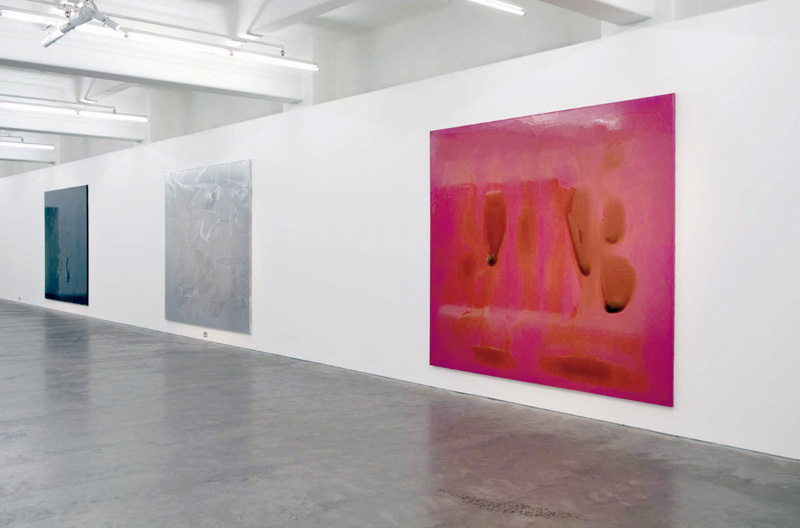
Dale Frank (Australian, b. 1959) The Big Black Bubble (installation view) Left to right: Timothy Oliphant (2008), Ryan Gosling (2008/2009) and Matthew Macfadyen (2008) 2009
This is a brilliant exhibition by Dale Frank, one of my favourites so far this year in Melbourne.
Six large varnish on linen landscape paintings are presented in the beautiful Anna Schwartz gallery space in Melbourne. Photographs really do not do the paintings justice – they can only give an impression of the size and scale of the work but not of their intimacy or smell. The smell of varnish permeates the air. The serendipity of the natural convulsions of the varnish and the facilitations of the hand of the artist, his performance, have been caught like bugs in amber in the final molecular structure of the painting. Here are pendulous, globular goops of varnish, immersive heroic tone poems that form images in the mind of the viewer. Moving close to the paintings you are surrounded by flows and eddies, the macro and the micro; details become more apparent as you study the work.
While disagreeing that these paintings are the viewers to create (the viewer as author) what I can say is that the artist offers the viewer the ability to generate their own resonances with the painting, to use the imagination of ‘equivalence’ to suggest what these paintings stand for – and also what else they stand for. States of being, of transformation, wonder and joy emerge in the playfulness of these works. Perhaps this is where the titles of the paintings come from, referencing film actors in the pop tradition, but this is the only thing that did not ring true with the work, their titles. The use of this trope seems to me a bit facile given the nature of the work.
The hot pink painting Rupert Grint (2008/2009, above) is hotter and lighter than in the photograph below, the varnish more translucent, the effect altogether mesmeric. You are drawn into the work, the intensity of the colour, the thickness of the hanging varnish. Two cosmological galaxies (Timothy Oliphant (2008) and Matthew Macfadyen (2008)) surround the most complex painting in the exhibition, the darkness and light that is Ryan Gosling (2008/2009, below).
This painting is a tour de force. With the poetic structure of an oil spill, the varnish forms intricate slick upon slick contours that are almost topographical in their mapping. The black oozes light, becomes ‘plastic’ black before your eyes, like the black of Rembrandt’s backgrounds, illusive, illuminative and hard to pin down – perpetually hanging there in two dripping rows, fixed but fluid at one and the same time (you can just see the suspensions in the photograph above).
The painting reminds me of the black paintings of Mark Rothko that he undertook for The Rothko Chapel in Houston, Texas (see below). As with the Rothko paintings, this painting is not just black (physically there are swirls of purple as in the Rothko paintings), not about darkness at all. What both artists do is create a contemplative, transformative space – in Frank’s case for a world on the edge of oblivion. This is a post post-modern landscape: process and nature, performance and chance coalescing in the colour : black!
This painting is one of the most overwhelming syntheses of art and nature, of universal forces that I have seen in recent contemporary art. This exhibition is an electric pulsating universe of life, landscape and transformation. Magnificent!
Dr Marcus Bunyan
Many thankx to Anna Schwartz Gallery for allowing me to publish the photographs in the posting. Please click on the photographs for a larger version of the image.
Dale Frank (Australian, b. 1959) The Big Black Bubble (installation view) Left to right: Daniel Radcliffe (2008/2009), Khan Chittenden (2009) and Rupert Grint (2008/2009) 2009
The immersive scale of these new paintings at Anna Schwartz Gallery Melbourne allows us to experience their inner qualities of landscape and of transformation. This is painting at fundamental authenticity. The paint is its own agent; it is allowed to act, to behave. The artist is the facilitator of these phenomena of nature and natural forces, whose residue is a metaphor for nature itself.
Black contains all colours, contours and depths. A pink monochrome is transformed by pure varnish into an expressionistic moment of process and performance. All colour is absent from elemental silver aluminium and form and gesture alone survive. New dynamics are possible through an innovative colouration: the emergence of colour through black, and its equivalent power.
Dale Frank’s painting is one of poetry, performance and nature. It represents both the macro and micro. Huge universal forces pulsate with molecular, atomic activities. Imagination is gifted by the artist to the viewer. These are our paintings to create.
Anonymous text from the exhibition flyer.
Dale Frank (Australian, b. 1959) Ryan Gosling 2008/2009
The Rothko Chapel Houston, Texas
Anna Schwartz Gallery 185 Flinders Lane Melbourne 3000 Australia Phone: +61 3 9654 6131
Exhibition dates: 20th February – 12th April, 2009
Gerhard Richter (German, b. 1932) 9.4.89 10.1 x 14.8cm Oil on colour photograph
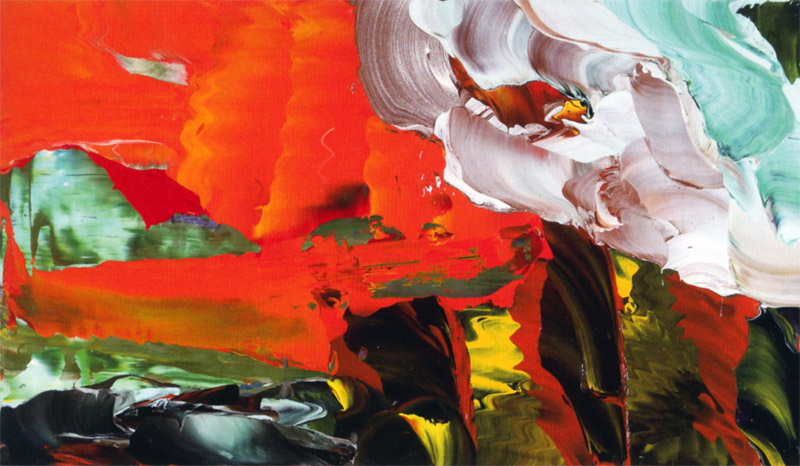
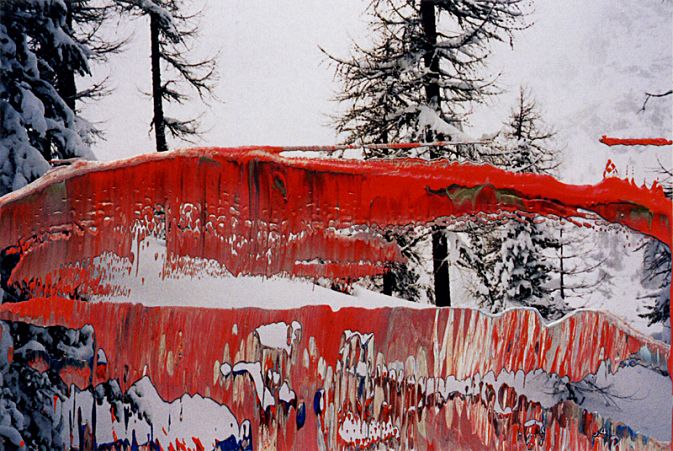
There is something unsettling in Richter’s serendipitious interventions. Using his own prosaic 10 x 15cm colour photographs that have been commercially printed as the basis of the works, Richter overlays the surface of the photograph with skeins of paint that disturb the reflexivity of each medium. Dragging the photograph through the paint or using a palette knife to apply layers of colour, the surfaces of paint and photograph no longer exist as separate entities. The process produces punctum like clefts rent in the fabric of time and space. If the intervention is judged unsuccessful the result if immediately destroyed.
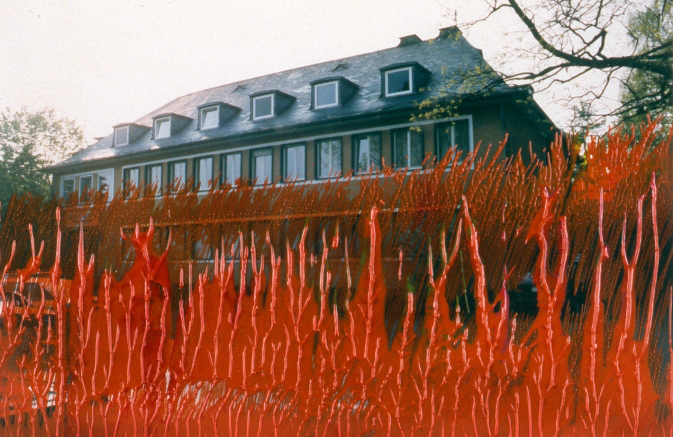
In 5.Juli.1994 (below) blood red fingers of paint strain upwards as they invade the solidity of a dour suburban home, echoing the invading trees branches at top right of picture. In 11.2.98 (below) green paint slashes across the mouth and forehead of a woman in a floral dress, her eyes seemingly bloodshot and pleading stare into the distance to the left of our view, the silent scream strangled in her throat by the vibrations of paint. These are the instantaneous responses of the artist to the photograph, a single mood expounded in irreversible gestures, the actions of the painter’s hand disturbing the indexical link of the photograph and it’s ability to be ‘read’ as a referent of the object it depicts. Richter’s interventions challenge the concept of momentary awareness and offer the possibility of a space between, where the image stands for something else – access to Other, even a contemplation of the sublime.
“The colour of paint applied corresponds or contrasts the tonalities of the underlying photograph but link the two through formal relationships of the layers … Often a tense relationship, the results run the gamut of the surreal to the beautiful to the disturbed. It is all the more surprising that each in its perceived completeness was in essence accomplished by chance and trial and error.”1
“Richter’s painterly gestures bounce off the [photographs] content in peculiar ways, sometimes interacting with it, sometimes overlaying it and sometimes threatening to eclipse it altogether. The final effect is to cause both photography and painting to seem like incredibly bizarre activities, disparate in texture but often complicit in aspiration.”2
I love the violence, the sometimes subversive, sometimes transcendental ‘equivalence’ of these images: where a Steiglitz cloud can stand for music, where a Minor White infrared photograph posits a new reality, Richter offers us an immediacy that destroys the self-reflexive nature of everyday life. His spontaneous musings, his amorphous worlds, his bleeds and blends crack open the skin of our existential life on earth. Here, certainly, are ‘the clefts in words, the words as flesh’.
Gerhard Richter (German, b. 1932) 11.4.89 10 x 15cm Oil on colour photograph
Gerhard Richter (German, b. 1932) 11.3.89 10 x 14.9cm Oil on colour photograph
Gerhard Richter (German, b. 1932) 5.Juli.1994 10.2 x 15.2cm Oil on colour photograph
Gerhard Richter (German, b. 1932) 11.2.98 10 x 14.7cm Oil on colour photograph
Gerhard Richter (German, b. 1932) 22.2.96 9.6 x 14.7cm Oil on colour photograph
Gerhard Richter (German, b. 1932) 11.Febr.05 10.1 x 14.9cm Oil on colour photograph
The exhibition presents 330 of Richter’s largely unknown overpainted photographs, a technique he has been using since 1982.
The exhibition UERBERNALTE FOTOGRAFIEN / PHOTOGRAPHIES PEINTES (OVERPAINTED PHOTOGRAPHS) at the Centre de la photographie Geneva (CPG) presented a side of the work of Gerhard Richter largely unknown up till now. Only a few collectors and gallerists close to the artist were aware of the practise that Gerhard Richter, one of the most important artists of our times, had developed systematically since 1982. It is only because of this exhibition that more than 1000 of his over-painted photographs will enter into his catalogue raisone. The CPG presents approximately 330 of them in this show.
“By placing paint on photographs, with all their random and involuntary expressiveness, Gerhard Richter reinforces the unique aspect of each of these mediums and opens a field of tension rich in paradoxes, as old as the couple – painting / photography – which has largely defined modern art.”
Gerhard Richter is justly famed for the photorealism of his early canvases, but it is less well known that he has also painted directly onto photographic prints. These (mostly small-format) pieces were reproduced in books as early as the first Atlas, but practically all of the works themselves are housed in private collections and rarely exhibited in public. Overpainted Photographs gathers this body of work, which unites the labor of the hand with the work of mechanical reproduction to produce a kind of art as conceptually rich as Richter’s better-known paintings, neutralizing the expressive powers of each medium to reach an indifference to their potency. In an overture to Duchamp’s “degree zero” found objects, the original photographs are frequently bland in content – an empty office, a ball, a beach scene or tourist snapshot – and Richter’s painterly gestures bounce off that content in peculiar ways, sometimes interacting with it, sometimes overlaying it and sometimes threatening to eclipse it altogether. The final effect is to cause both photography and painting to seem like incredibly bizarre activities, disparate in texture but often complicit in aspiration. This monograph offers a unique opportunity to savour what had previously been a neglected but copious aspect of Richter’s work.
“The public scenes, whether on the beach or the ski slope or children’s theatre, are beset with sudden surges of colour that tend to resemble interventions of the sky or elemental forces, more than the moods of a decorative or ornamental painter annotation. Sometimes they seem like catastrophic visions. Blood-red snowflakes dance above the white fern. The photo shows skyscrapers in the urban morning sun – and the oil paint adds to the sulpherous fire that pours over the city from the sky”


































 Art Blart _ art and cultural memory archive
You must be logged in to post a comment.