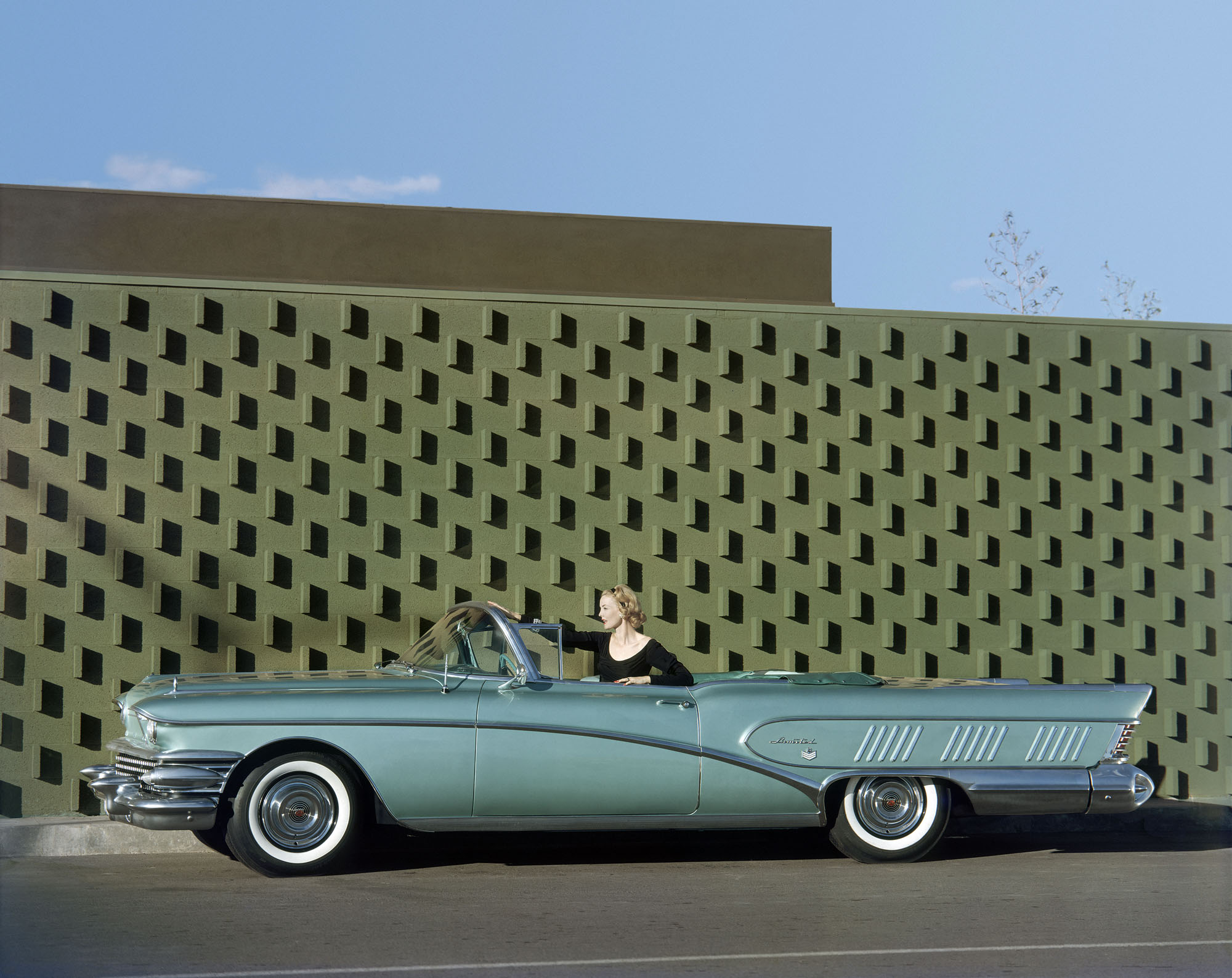
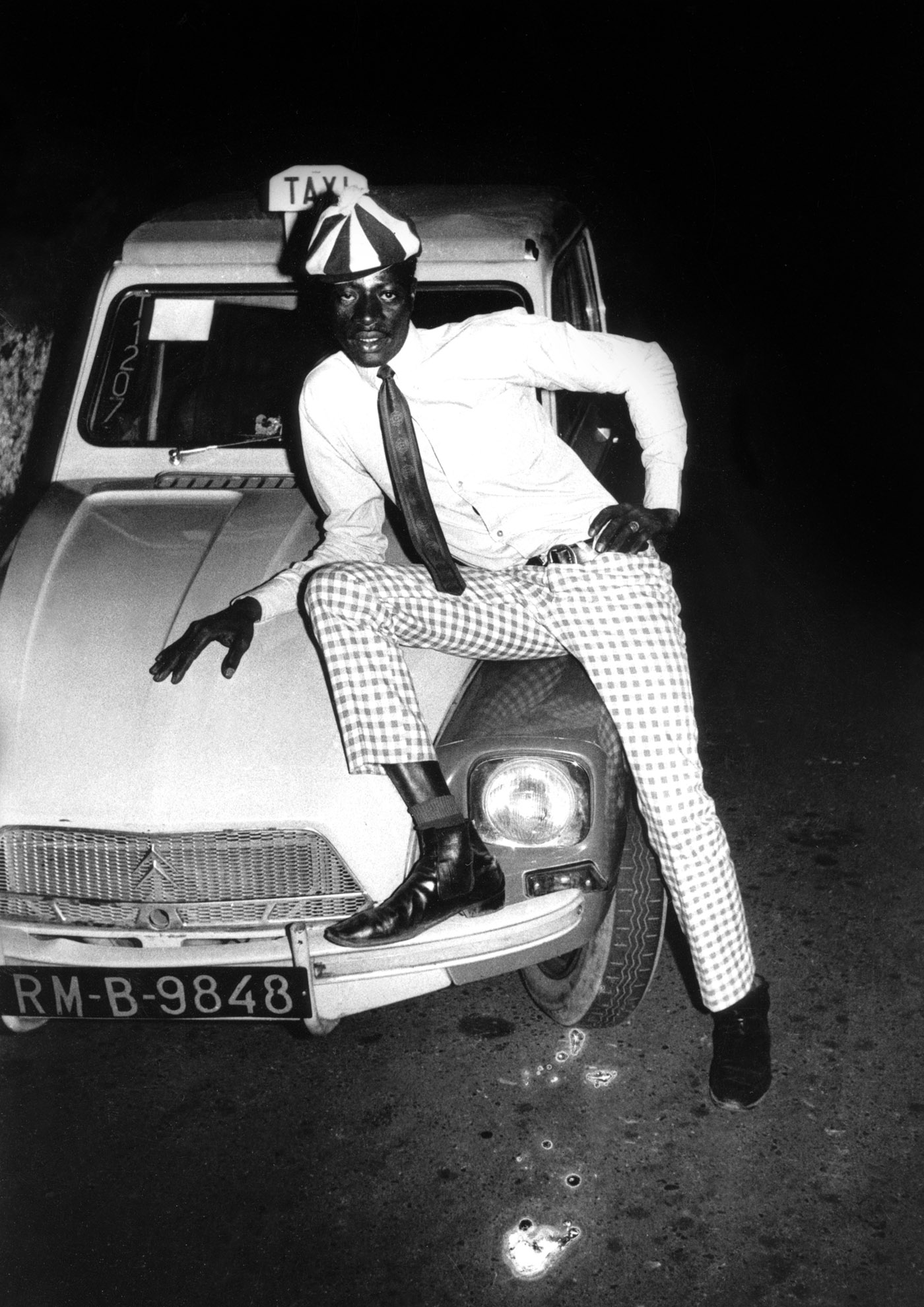
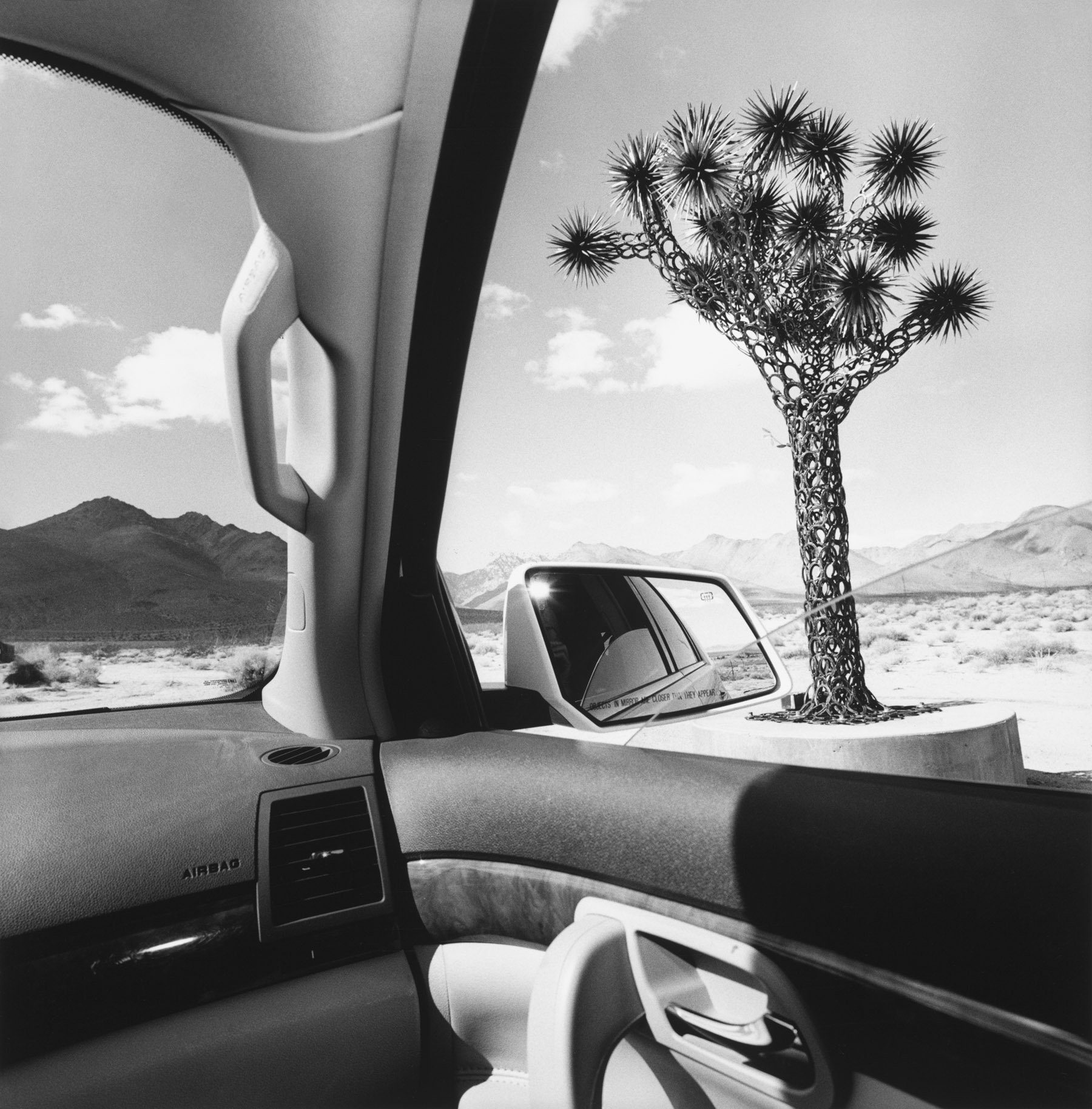
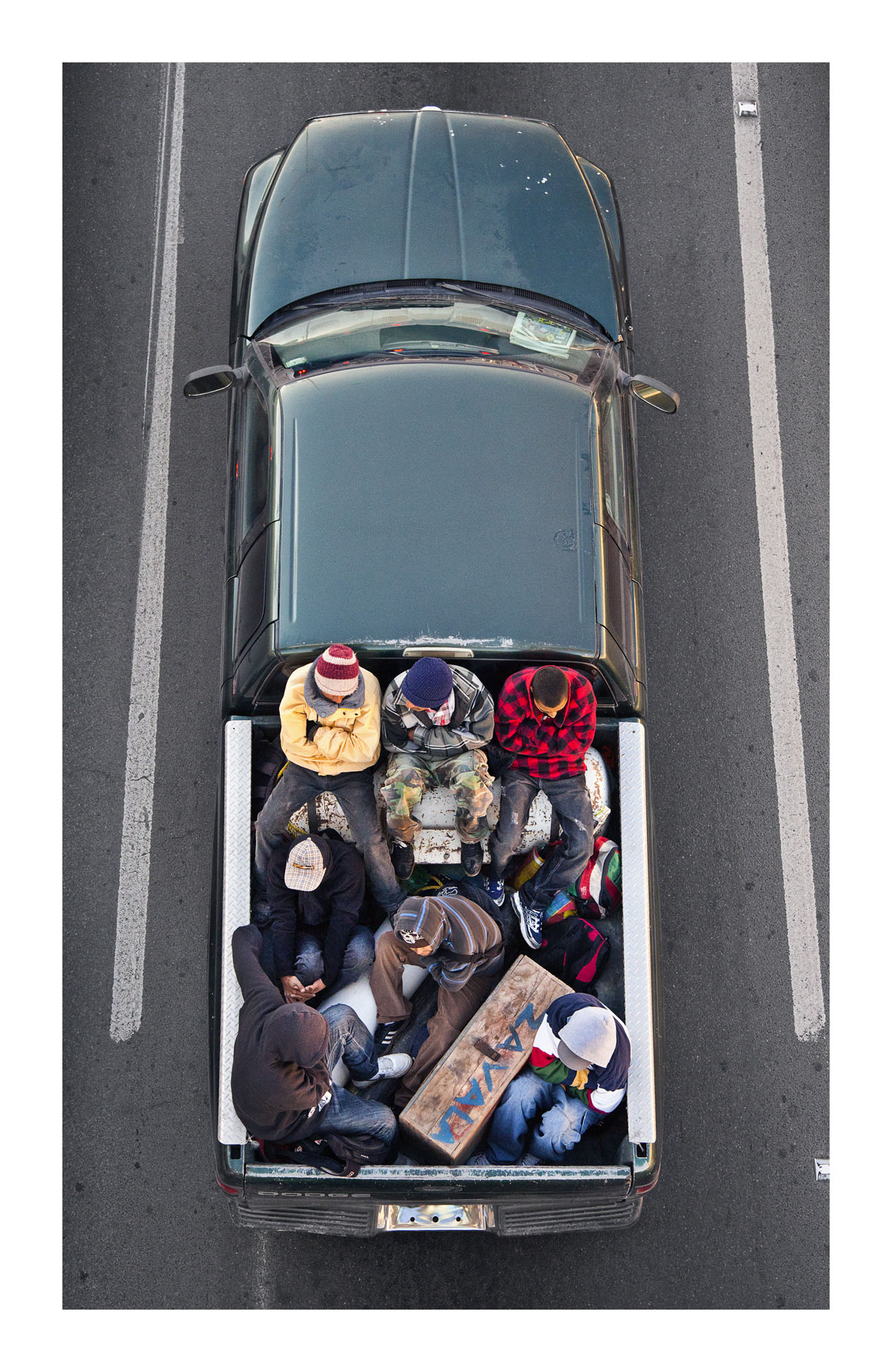
Exhibition: ‘Suburbia. Building the American Dream’ at the Centre de Cultura Contemporània de Barcelona | CCCB

Exhibition dates: 20th March – 8th September 2024

Curators: Philipp Engel and Francesc Muñoz


'Suburbia. Building the American Dream' exhibition poster


Suburbia. Building the American Dream exhibition poster


An offer you can’t refuse

“The “American dream” can be summed up in a mental image that seems frozen in time: a home of one’s own, surrounded by lawns, with a pool in the back garden and a couple of cars slumbering in the garage… Suburbia. Building the American Dream draws us into the imaginary of the idyllic family home and shows how this lifestyle has been sold and promoted by fiction and the entertainment industry.” (Text from the CCCB website)


To me, there has always be something slightly askew, slightly out of kilter about the “American dream”. It promotes a generalised simulation of a imaginary reality, sold as a lifestyle, more fiction than fact. It is the ghost of desire that haunts the everyday reality of life, entirely on the side of demand: I want therefore I must have.

This desire must be satiated in the nuclear family, the white picket fence, the idyllic family home, the loveable children – as much a surface that reflects the approbation of others as for the sustenance of the self. As Anthony Giddens observes we are inescapably involved in a

“‘reflexive project of the self’: this project is reflexive because it involves unremitting self-monitoring, self-scrutiny, planning and ordering of all elements of our lives appearances and performances in order to marshal them into a coherent narrative called ‘the self’. We have to interpret the past and plan the future in relation to an identity we are attempting to constitute in a particularly immediate and transient social present. Consumerism is central to this self-obsession. This is partly because we not only have to choose a self, but (as Foucault’s line of argument also indicates) have to constitute ourselves as a self who choses, a consumer.”1


The American Dream endeavours to direct the identity we are attempting to constitute (through consumerism), so that it fits into a particularly conformist idea of a wholesome life: patriarchal, hegemonic, puritan (most important in America), god fearing, white – a particularly hyperreal simulation of a world that never existed in the first place. An imaginary construction.2

Photographs reinforce this “imaginary” state of being, this desire for the American Dream. As the wonderful Victor Burgin observes,

“The structure of presentation – point-of-view and frame – is intimately implicated in the reproduction of ideology (the ‘frame of mind’ of our ‘points-of-view’). More than any other textual system, the photograph presents itself as ‘an offer you can’t refuse’. The characteristics of the photographic apparatus position the subject in such a way that the object photographed serves to conceal the textuality of the photograph itself – substituting passive receptivity for active (critical) reading. … With most photographs we see, […] decoding and investiture takes place instantaneously, unselfconsciously, ‘naturally’; but it does take place – the wholeness, coherence, identity, which we attribute to the depicted scene is a projection, a refusal of an impoverished reality in favour of an imaginary plenitude. The imaginary object here, however, is not ‘imaginary’ [as in fictive] in the usual sense of the word, it is seen, it has a projected image.”3 (My bold and italics)


The photographs of the American Dream, then, deny an impoverished reality in favour of a desired imaginary plenitude. You too can live the dream, because you have seen the evidence of the projected image, and this imaginary identification can have very real effects.

In the desire for the dream we witness (elsewhere in the world) the egocentric obsession of some of the builders in the British series “Grand Designs” where people mortgage themselves up to the hilt, become sick, have marriage breakdowns and can’t finish the project, because of a dream… to build huge houses with 7 bedrooms and 4 bathrooms that no one in their right mind needs to build for 2 people. Or the case of the Australian Melissa Caddick who, in a Ponzi scheme stole A$30 million from investors, including her friends and family, in order to appear a successful business woman. “Caddick used the proceeds of her crimes to acquire “all the trappings of wealth” and that her “success was all a façade and the financial services business was an elaborate front for Ms. Caddick’s Ponzi scheme”.”4

Ego is reinforced by the image reflected back to us by the photograph.

Christopher Lasch comments that, “The proliferation of recorded images undermines our sense of reality. As Susan Sontag observes in her study of photography, “Reality has come to seem more and more like what we are shown by cameras.” We distrust our perceptions until the camera verifies them. Photographic images provide us with the proof of our existence, without which we would find it difficult even to reconstruct a personal history…”5

Photographs posit a reality that promotes the dream, that verifies the dream, as ‘an offer you can’t refuse’.

Thankfully, some of the contemporary artists in this posting (I particularly like the work of Weronika Gęsicka) undermine the utopian ideal through wit, humour and critical inquiry.

Dr Marcus Bunyan


1/ Anthony Giddens. Modernity and Self-Identity: Self and Society in the Late Modern Age. Polity Press, Cambridge, 1991

2/ “In sociology, the imaginary as a Lacanian term refers to an illusion and fascination with an image of the body as coherent unity, deriving from the dual relationship between the ego and the specular or mirror image… “The term ‘imaginary’ is obviously cognate with ‘fictive’ but in its Lacanian sense it is not simply synonymous with fictional or unreal; on the contrary, imaginary identifications can have very real effects.””

David Macey, “Introduction”, Jacques Lacan, The Four Fundamental Concepts of Psycho-Analysis. London, 1994, p. xxi  quoted in “Imaginary (sociology)” on the Wikipedia website [Online] Cited 01/09/2024

3/ Victor Burgin (ed.,). Thinking Photography. Macmillan, Basingstoke, 1982, pp. 146-148.

4/ Farid Assaf SC quoted in Kate McClymont. “Melissa Caddick’s ‘trappings of wealth’ a front for her Ponzi scheme”. The Sydney Morning Herald 29 June 2021 in “Melissa Caddick,” on the Wikipedia website [Online] Cited 01/09/2024

5/ Christopher Lasch. The Culture of Narcissism. W.W.Norton and Company, New York, 1978, p. 48.


Many thankx to the Centre de Cultura Contemporània de Barcelona for allowing me to publish the photographs in the posting. Please click on the photographs for a larger version of the image.


Inside the exhibition: Suburbia. Building the American Dream 

Philipp Engel, curator of the exhibition “Suburbia”, examines the origin and vast expansion of residential neighbourhoods in the United States, an urban model centred on constructing large swathes of single-family homes on the outskirts of cities. Engel reflects on the allure that suburban landscapes have stirred in Western culture while highlighting the main issues and contradictions of the model, including segregation, safety paranoia and unsustainable consumption of water and energy.


Introduction
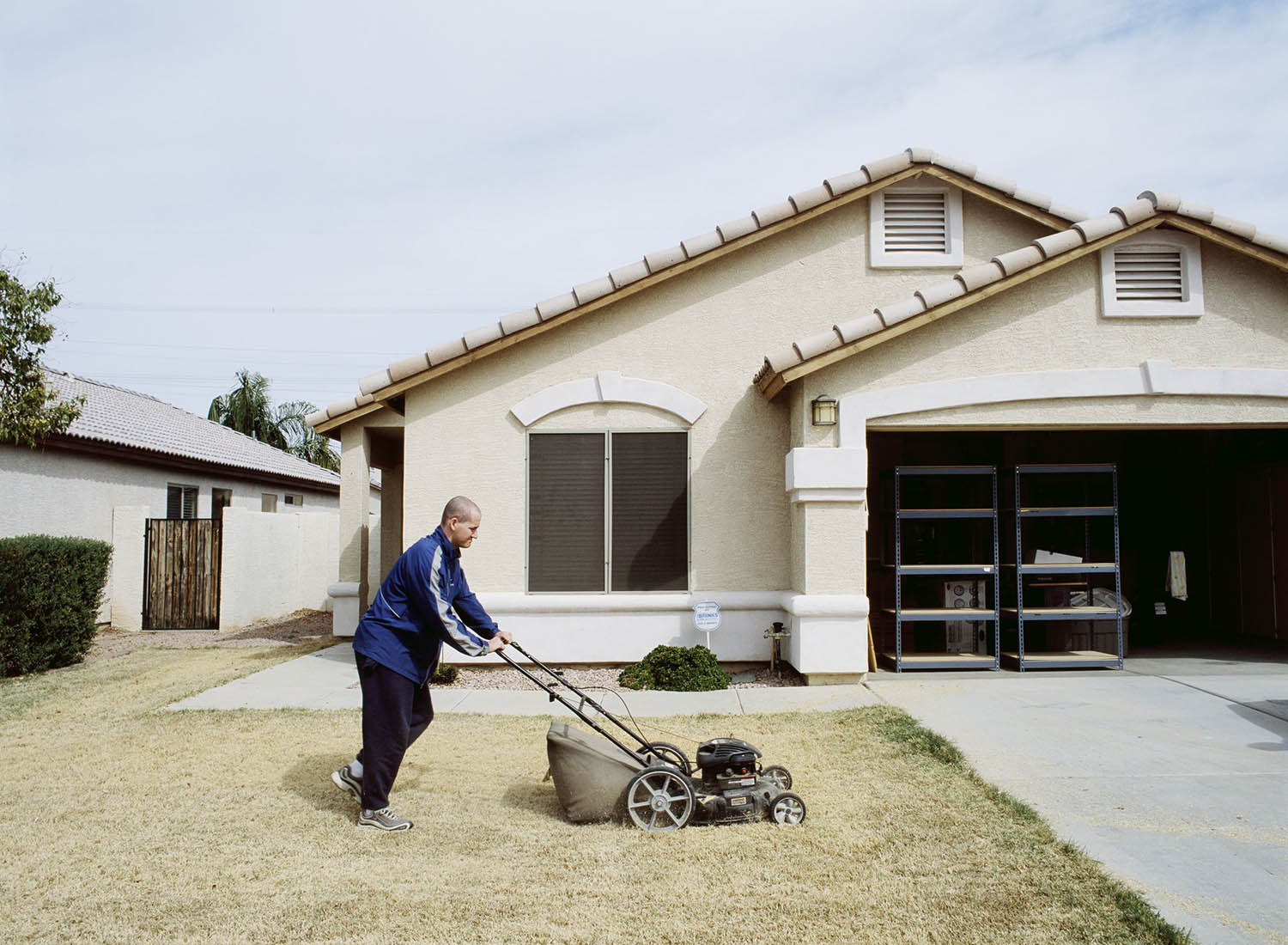
Greg Stimac (American, b. 1976) 'Chandler, Arizona' 2006 From 'Mowing the Lawn' portfolio


Greg Stimac (American, b. 1976)
Chandler, Arizona
2006
From Mowing the Lawn portfolio
Impressió digital Museum of Contemporary Photography, Columbia College Chicago


Who hasn’t longed for the American dream? A big house with a garden, a swimming pool and a couple of cars in the garage. A quiet, safe place to live as a family, close to nature in a people-friendly neighbourhood. This exhibition traces the cultural history of a lifestyle ideal that has been endlessly reproduced on television, in advertising and in cinema, and analyses the validity and the most controversial aspects of its urban planning model.

Suburbia. Building the American Dream draws us into the imaginary of the idyllic family home and shows how this lifestyle has been sold and promoted by fiction and the entertainment industry. The exhibition goes back to the origins of residential neighbourhoods in the early nineteenth century, explains how they developed massively in the 1950s, and reviews the economic, political and social context of their relentless expansion across the United States.

Now, when more and more families are pursuing their own version of the dream on the outskirts of cities, it is a good moment to analyse the contradictions of an urban planning model based on social, ethnic and gender segregation.

The dream of living in a house with a swimming pool is still very much alive today and has been exported all over the world. The exhibition shows the impact of this highly unsustainable model, based on constant car use, with examples of developments around Barcelona and Madrid.

With abundant historical material, period documentaries, photographs, paintings, films and series, novels and magazines, works of art and everyday objects, the exhibition places us in the mental paradise of the suburb and invites us to rethink the value of the city and public space today.

Suburbia. Building the American Dream presents the work of foremost creators who, from different points of view, help us to take a critical look at the famed American way of life: Jessica Chou, Gregory Crewdson, Thomas Doyle, Gerard Freixes, Rodrigo Fresán, Gabriele Galimberti, Weronika Gesicka, Benjamin Grant, Todd Hido, Joel Meyerowitz, Matthias Müller, Blanca Munt, Alberto Ortega, Bill Owens, Sheila Pree Bright, León Siminiani, Todd Solondz, Amy Stein, Greg Stimac, Angela Strassheim, Deborah Stratman, Ed & Deanna Templeton, Kate Wagner and Christopher Willan.

Text from the CCCB website
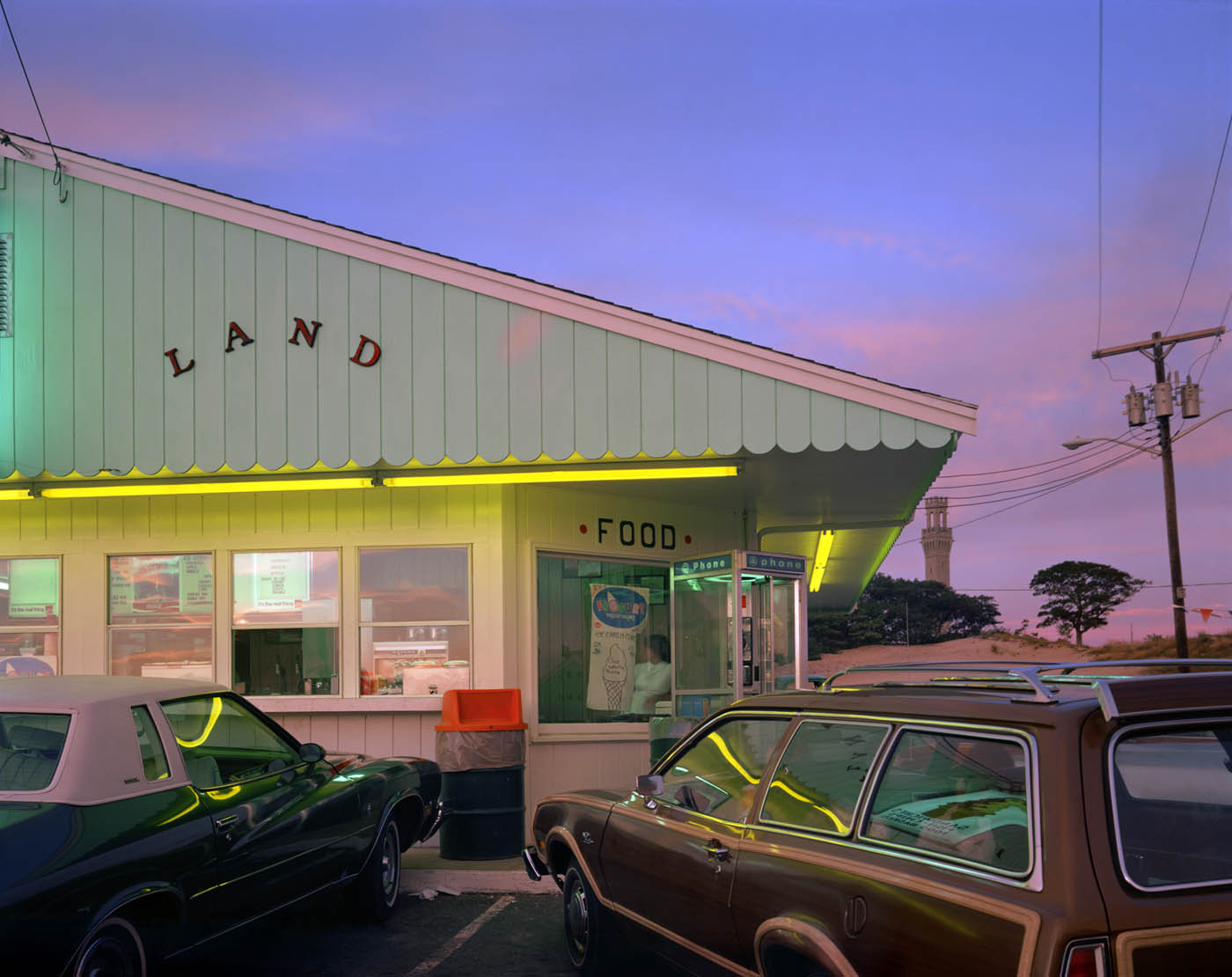
 

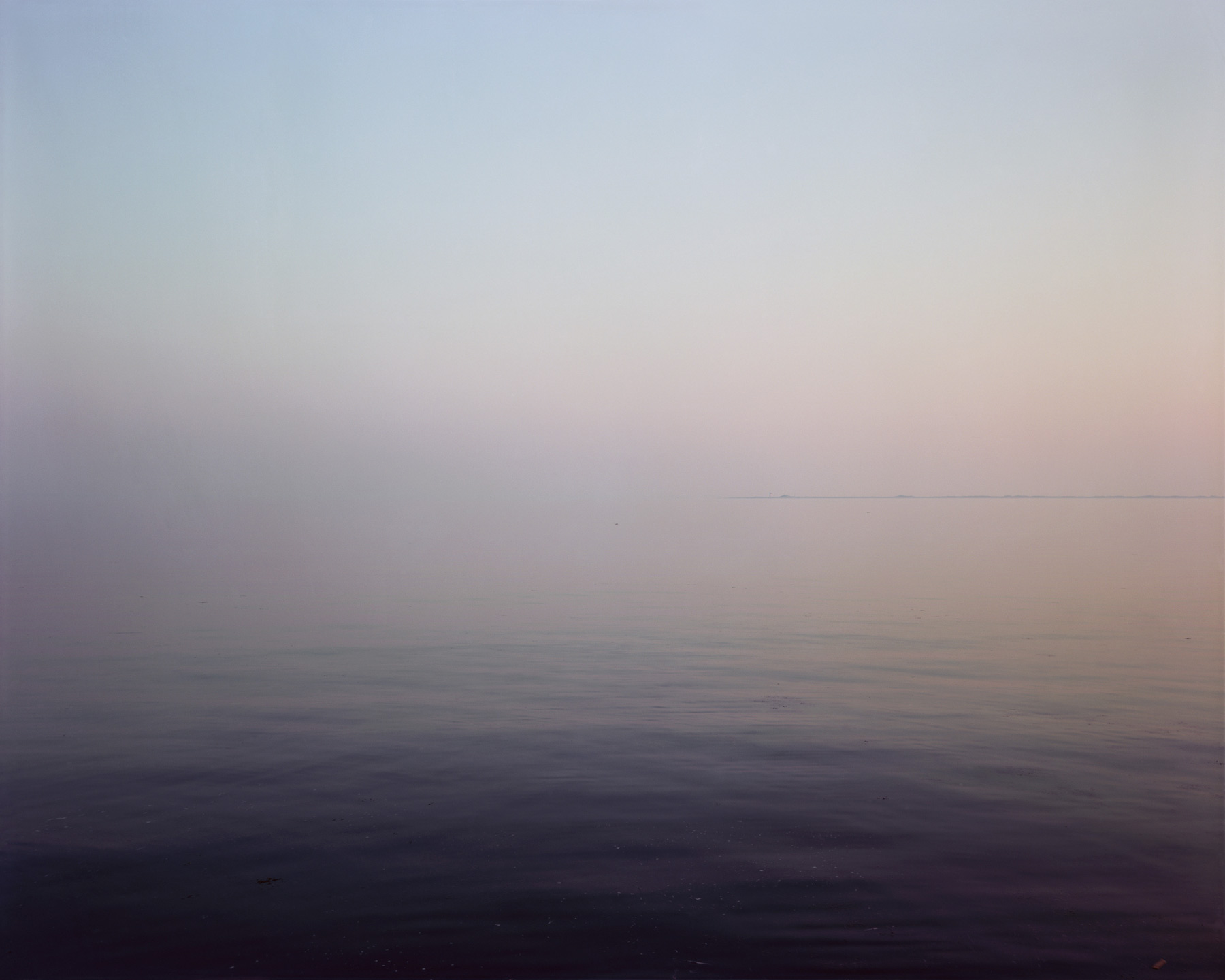
Joel Meyerowitz (American, b. 1938) 'Land. Provincetown' 1976


Joel Meyerowitz (American, b. 1938)
Land. Provincetown
1976
Archival pigment print
Collecció Pancho Saula i Michelle Ferrara / Galeria Alta, Andorra


Joel Meyerowitz (American, b. 1938) 'Dusk, New Jersey' 1978


Joel Meyerowitz (American, b. 1938)
Dusk. New Jersey
1978
Archival pigment print
Collecció Pancho Saula i Michelle Ferrara / Galeria Alta, Andorra


The “American dream” can be summed up in a mental image that seems frozen in time: a home of one’s own, surrounded by lawns, with a pool in the back garden and a couple of cars slumbering in the garage. Suburbia. Building the American Dream traces the cultural history of a lifestyle ideal shared far and wide by literature, television, advertising and cinema, and analyses the most controversial aspects of an urban planning model that has spread beyond US territory and reached our shores. Journalist Philipp Engel curates this exhibition with geographer Francesc Muñoz collaborating as adviser on the model in the local context.

Suburbia. Building the American Dream draws us into the imaginary of the idyllic family home and shows how this lifestyle has been sold and promoted by fiction and the entertainment industry. The exhibition goes back to the origins of residential neighbourhoods in the early nineteenth century, explains how they developed massively in the 1950s, and reviews the economic, political and social context of their relentless expansion across the United States.

Since the 1990s most of the American population has lived in this sprawling urban mass that has continued to spread, even beyond US borders. At a time when more and more families are pursuing their own version of the dream on city outskirts, the exhibition analyses the contradictions of an urban planning model based on social, ethnic and gender segregation. It also shows the impact of this highly unsustainable model, based on constant car use, with examples of developments around Barcelona and Madrid. With abundant historical material, photographs, paintings, audiovisuals, literature, works of art and everyday objects, the exhibition situates us in the mental paradise of the model of residential development inspired by American suburbia, and invites us to rethink the value of the city and public space today.

Suburbia. Building the American Dream decodes an almost abstract landscape that is still valid in pop culture. It does so through the work of foremost creators who help us take a critical look at the famed American way of life. It includes works by Jessica Chou, Gregory Crewdson, Thomas Doyle, Gerard Freixes, Gabriele Galimberti, Weronicka Gęsicka, Benjamin Grant, Todd Hido, Joel Meyerowitz, Matthias Müller, Blanca Munt, Alberto Ortega, Bill Owens, Sheila Pree Bright, León Siminiani, Amy Stein, Greg Stimac, Angela Strassheim, Deborah Stratman, Ed & Deanna Templeton, Kate Wagner and Christopher Willan, among others.
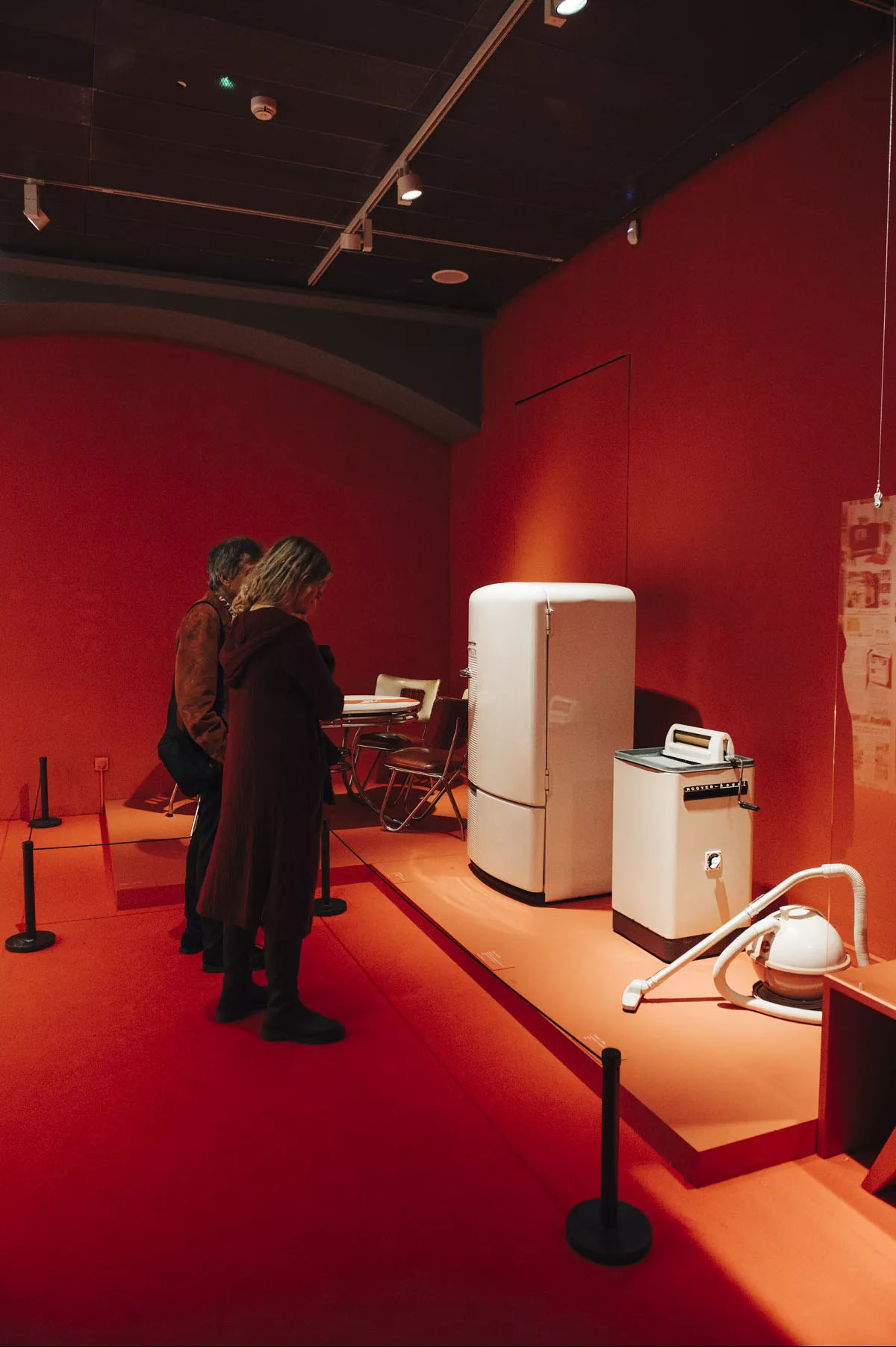
 

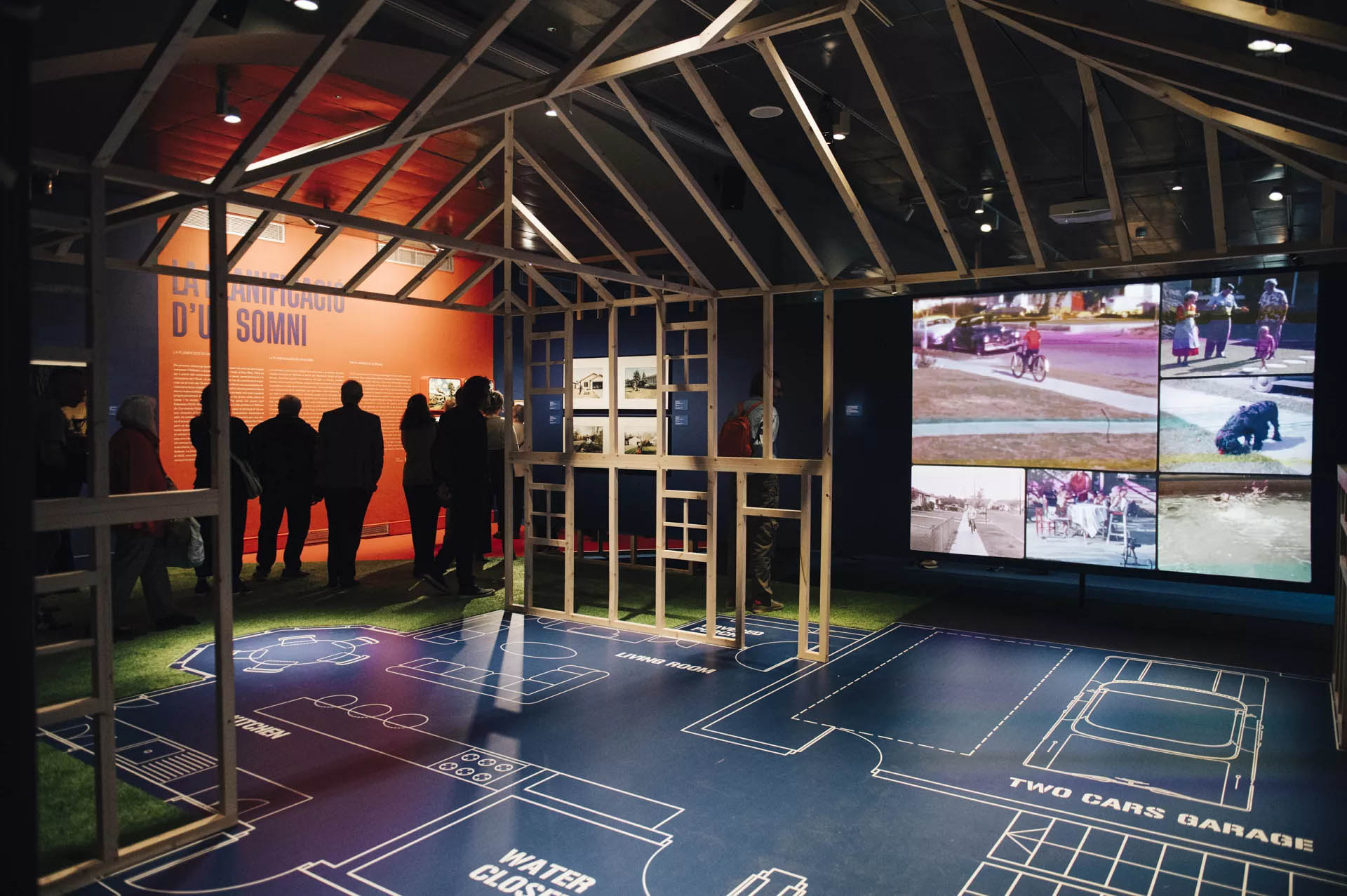
Installation view of the exhibition 'Suburbia. Building the American Dream' at the Centre de Cultura Contemporània de Barcelona | CCCB

Installation view of the exhibition 'Suburbia. Building the American Dream' at the Centre de Cultura Contemporània de Barcelona | CCCB

Installation view of the exhibition 'Suburbia. Building the American Dream' at the Centre de Cultura Contemporània de Barcelona | CCCB

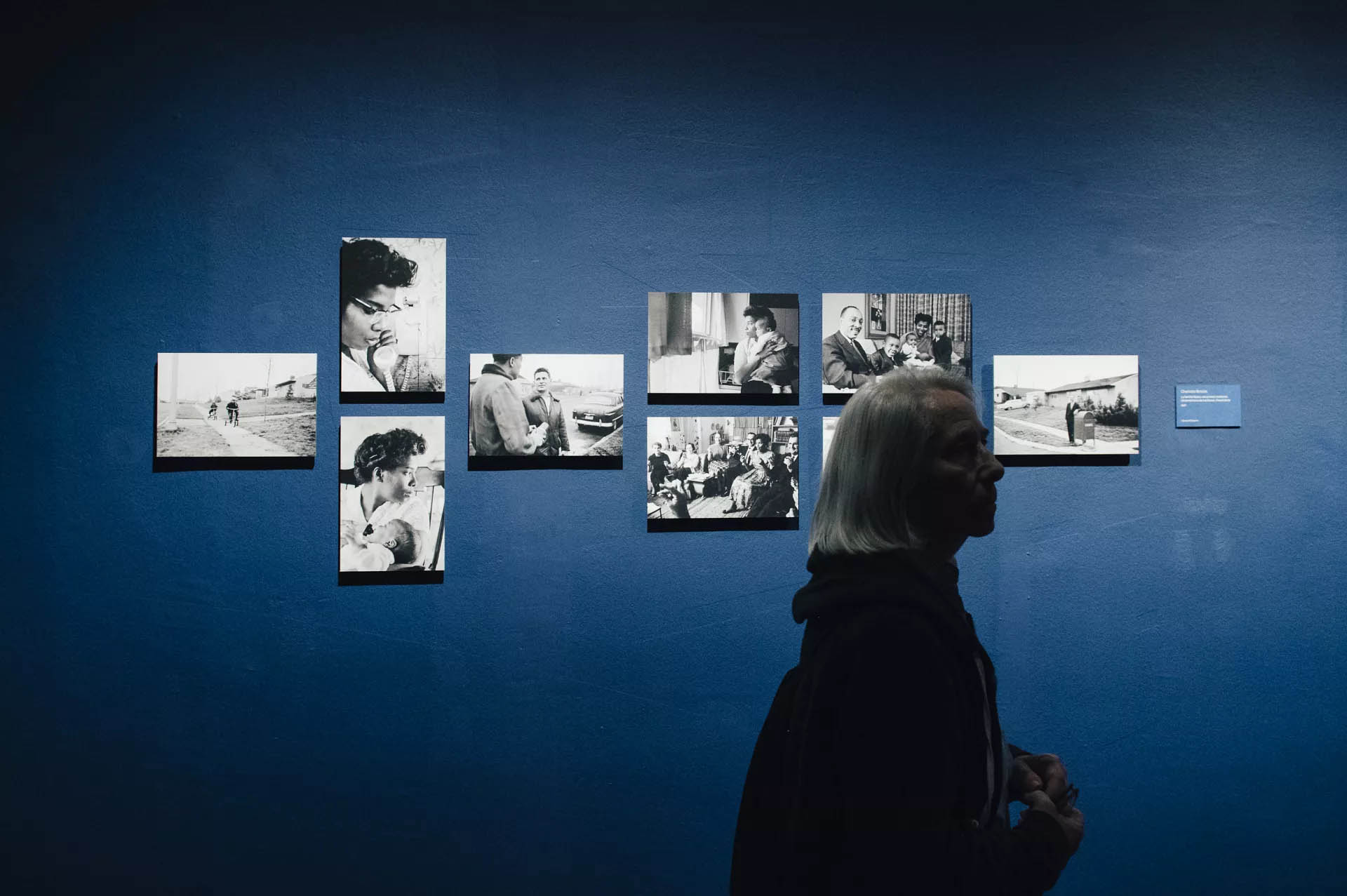
Installation view of the exhibition 'Suburbia. Building the American Dream' at the Centre de Cultura Contemporània de Barcelona | CCCB showing photographs by Charlotte Brooks

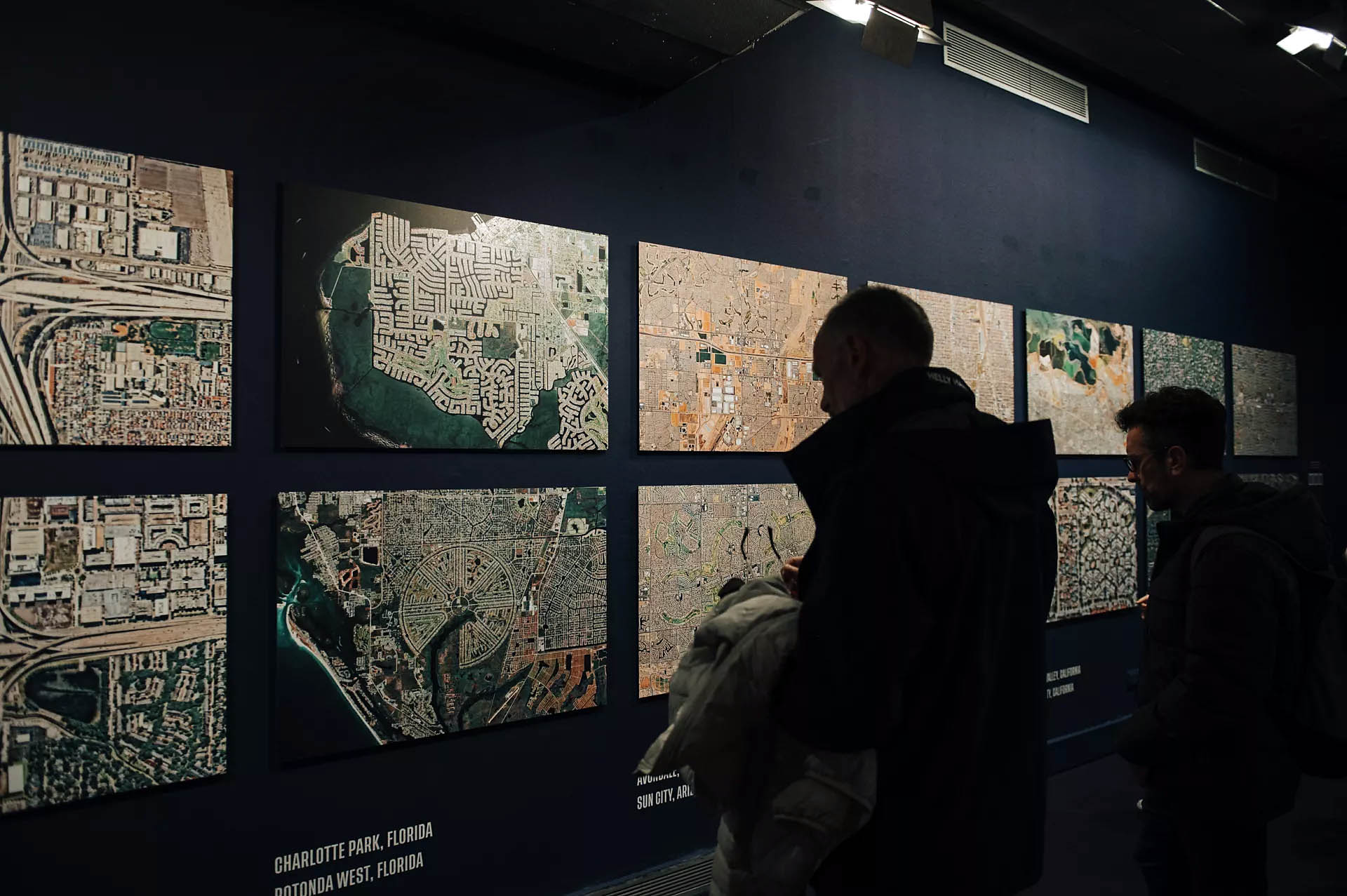
Installation view of the exhibition 'Suburbia. Building the American Dream' at the Centre de Cultura Contemporània de Barcelona | CCCB showing visitors looking at satellite images of US cities and suburbs that show their grid layout


Installation views of the exhibition Suburbia. Building the American Dream at the Centre de Cultura Contemporània de Barcelona | CCCB showing in the second image photographs by Charlotte Brooks (below); and in the bottom image, visitors looking at satellite images of US cities and suburbs that show their grid layout
© Alice Brazzit, CCCB, 2024


Charlotte Brooks (American, 1918-2014) '[Image from LOOK - Job 57-7621 titled Myers family]' 20th December 1957


Charlotte Brooks (American, 1918-2014)
[Image from LOOK – Job 57-7621 titled Myers family]
20th December 1957
Film negative
Look magazine photograph collection (Library of Congress)
Library of Congress Prints and Photographs Division Washington, D.C.


Installation view of the exhibition 'Suburbia. Building the American Dream' at the Centre de Cultura Contemporània de Barcelona | CCCB showing photographs by Gregory Crewdson


Installation view of the exhibition Suburbia. Building the American Dream at the Centre de Cultura Contemporània de Barcelona | CCCB showing photographs by Gregory Crewdson (below)


Gregory Crewdson (American, b. 1962) 'Untitled (Dream House)' 2002


Gregory Crewdson (American, b. 1962)
Untitled (Dream House)
2002
Digital C-print
29 x 44 inches


American photographer Gregory Crewdson is best known for his uncanny images of deceptively serene suburban life.  Using Hollywood film techniques and elaborate sets, Crewdson creates what he calls “frozen moments”: meticulously staged scenes whose narrative meaning remains a mystery.  Throughout this series, special attention is paid to light.  The twilight setting favoured by the photographer functions as a metaphor, an eerie evocation of the darkness on the edge of town.

Crewdson created this twelve-part portfolio, Dream House, as a commission for The New York Times Magazine in 2002.  The cinematic character of these frozen vignettes is underscored by the use of Hollywood actors (Gwyneth Paltrow, Tilda Swinton, and Philip Seymour Hoffman among others) whose celebrity contrasts with the “Anytown” anonymity of their environments.

Text from the Mutual Art website
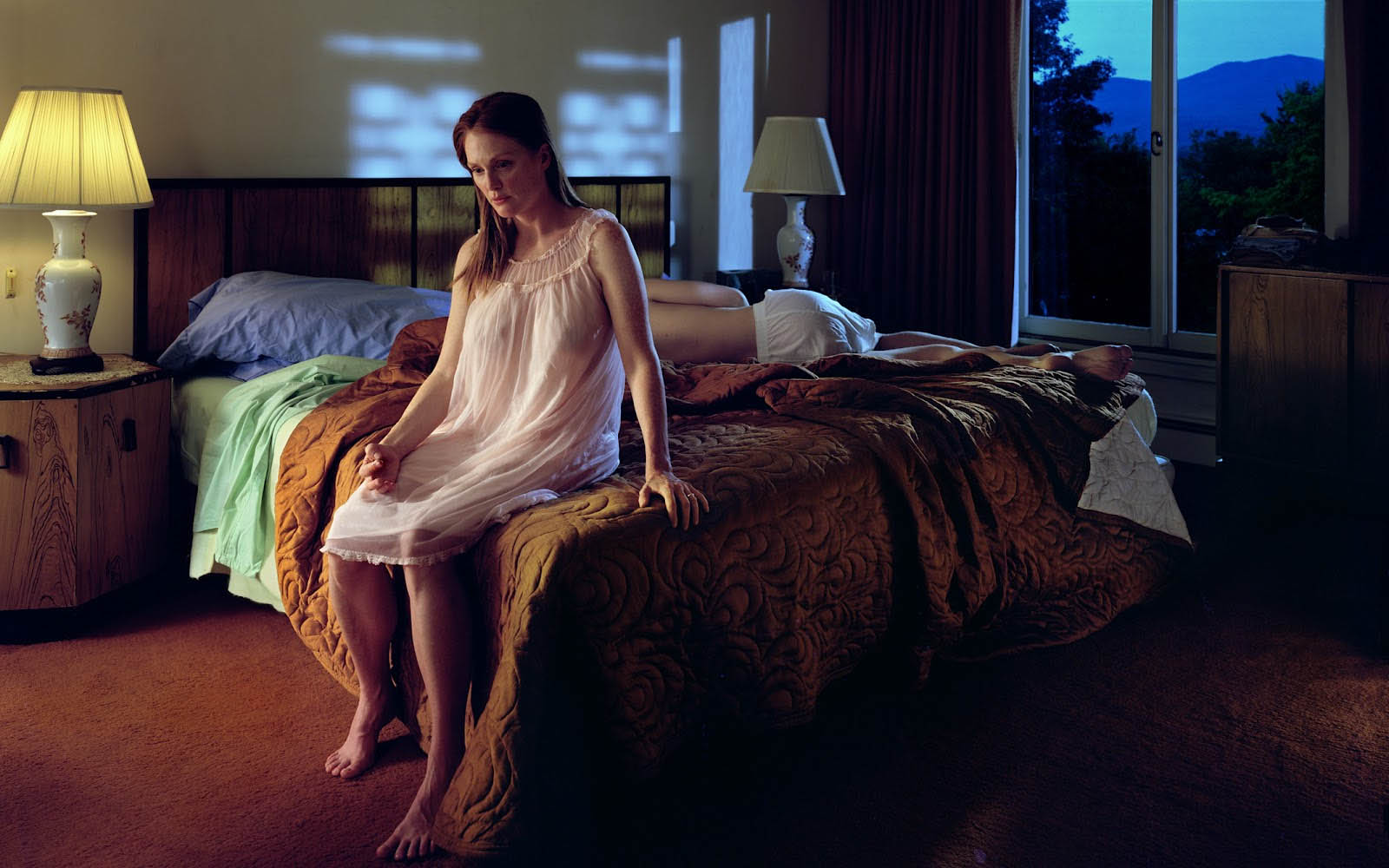
 

Gregory Crewdson (American, b. 1962) 'Julianne Moore (Dream House)' 2002


Gregory Crewdson (American, b. 1962)
Julianne Moore (Dream House)
2002
Digital C-print
29 x 44 inches


Sections of the exhibition

Planning A Dream

When the Industrial Revolution reached the USA in the first half of the 19th century, big cities became engines of progress, but they were also seen as dangerous places, in contrast with the opulent nature of the New World. With the emergence of the railway, the tram and the automobile, the mobility revolution prompted the gradual colonisation of city outskirts, transforming the countryside into residential neighbourhoods.

From Llewellyn Park (New Jersey) to Tuxedo Park (New York), throughout the 19th century the first gated communities began to pop up across the United States. At the end of the century, after the West was won, the appearance of the tram gave the middle classes access to the periphery, giving rise to a new type of housing that led to an orderly arrangement of city grids. But it wasn’t until the popularisation of the famous Ford Model T that the US landscape was radically transformed, crisscrossed by roads that became freeways. The automobile became a symbol of freedom, marking the birth of the suburbs that were to spring up everywhere.

This first section includes historical material like the original lithograph View of New York by John William Hill (1836); The American Woman’s Home by Catharine Beecher, the bible of “domestic feminism”; a Ford T Touring (1923) produced by General Motors, and films like The Suburbanite (1908), among other Harold Lloyd and Buster Keaton classics.


Alexander Jackson Davis (American, 1803–1892) 'Villa for David Codwise, near New Rochelle, NY (project; elevation and four plans)' 1835


Alexander Jackson Davis (American, 1803–1892)
Villa for David Codwise, near New Rochelle, NY (project; elevation and four plans)
1835
Pen and ink, watercolour, graphite
Sheet: 14 5/16 x 9 in. (36.4 x 22.9 cm)
Metropolitan Museum of Art, New York
Harris Brisbane Dick Fund, 1924
Public domain
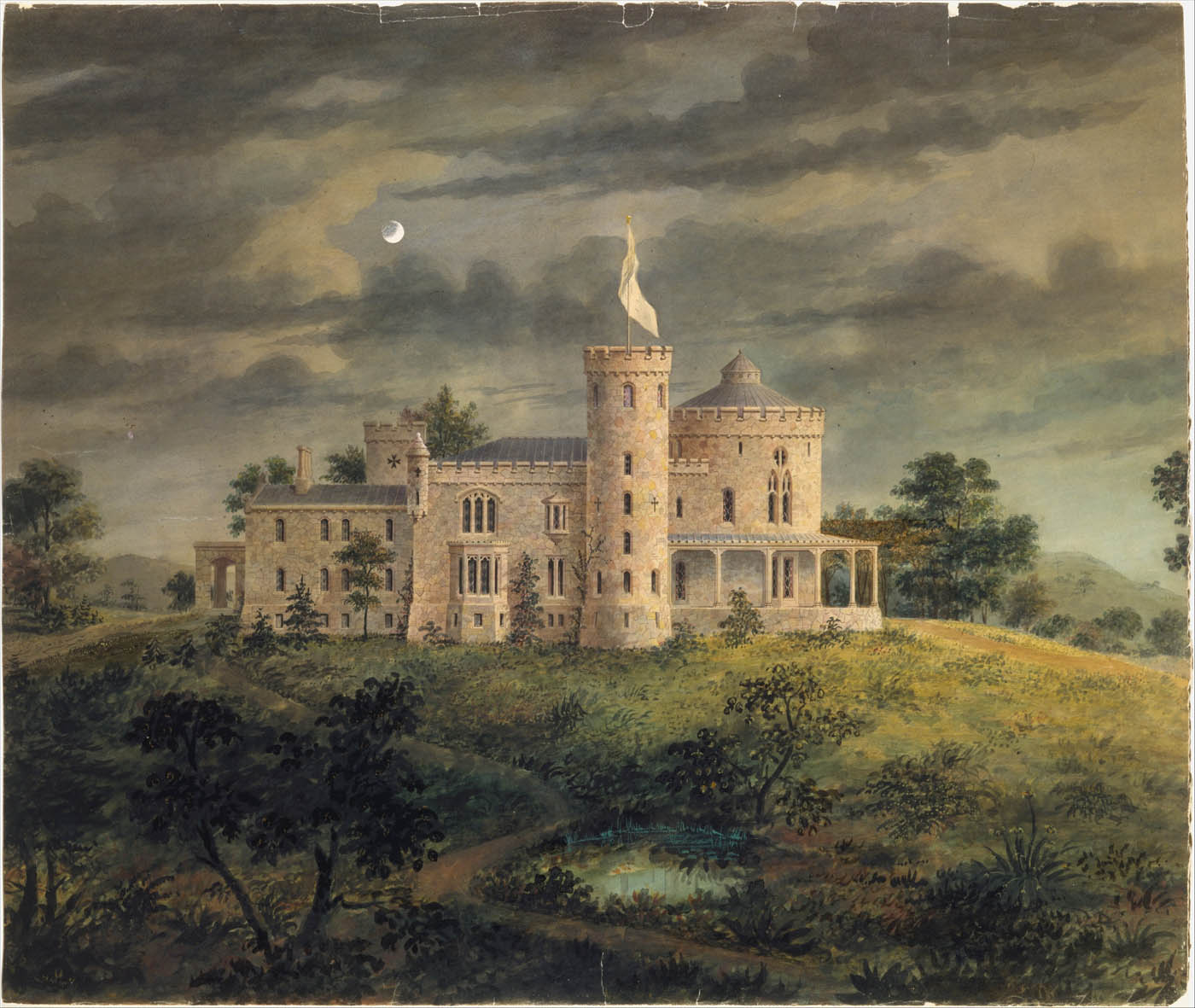
 

Alexander Jackson Davis (American, 1803-1892) 'Ericstan, for John J. Herrick, Tarrytown, New York (perspective)' 1855


Alexander Jackson Davis (American, 1803–1892)
Ericstan, for John J. Herrick, Tarrytown, New York (perspective)
1855
Watercolour, ink, and graphite on paper
25 5/16 x 30in. (64.3 x 76.2cm)
Metropolitan Museum of Art, New York
Harris Brisbane Dick Fund, 1924
Public domain


Davis’ most successful castellated villa was built for dry-goods merchant John J. Herrick. The design was dominated by an enormous three-story circular tower facing west over the Hudson River. The tower housed an extraordinary circular parlor that had an intricately vaulted ceiling springing from a massive central cluster of delicate Gothic columns. Ericstan was demolished in 1944.


After Alexander Jackson Davis (American, 1803-1892) Friend & Aub (Publisher Philadelphia, Pennsylvania) 'Map of Llewellyn Park and Villa Sites, on Eagle Ridge in Orange & West Bloomfield' 1857


After Alexander Jackson Davis (American, 1803-1892)
Friend & Aub (Publisher Philadelphia, Pennsylvania)
Map of Llewellyn Park and Villa Sites, on Eagle Ridge in Orange & West Bloomfield
1857
Lithograph
14 7/16 x 23 7/16 in. (36.7 x 59.6cm)
Metropolitan Museum of Art, New York
Harris Brisbane Dick Fund, 1924
Public domain


Morse & Fronti (Charles W. Morse and J. Fronti) 'Residence of Mr. E. Hooker, Fremont Ave., Orange, N.J.' 1860


Morse & Fronti (Charles W. Morse and J. Fronti)
Residence of Mr. E. Hooker, Fremont Ave., Orange, N.J.
1860
The Miriam and Ira D. Wallach Division of Art, Prints and Photographs: Photography Collection
The New York Public Library
Public domain
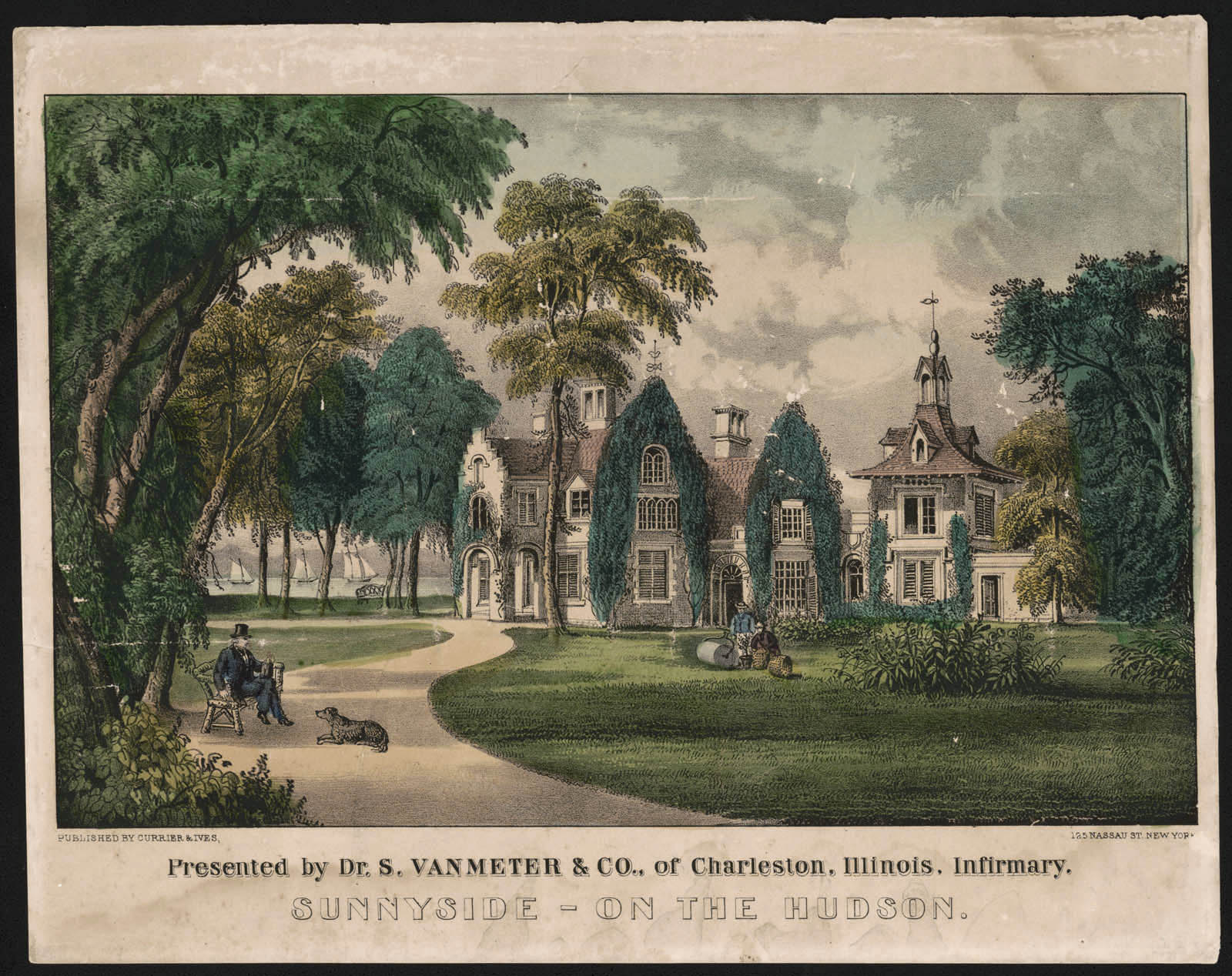
 

Currier & Ives (Publisher, New York active between 1856-1907) 'Sunnyside on the Hudson' 1856-1871


Currier & Ives (Publisher, New York active between 1856-1907)
Sunnyside on the Hudson
1856-1871
Hand coloured lithograph
Library of Congress Prints and Photographs Division Washington, D.C.
Public domain
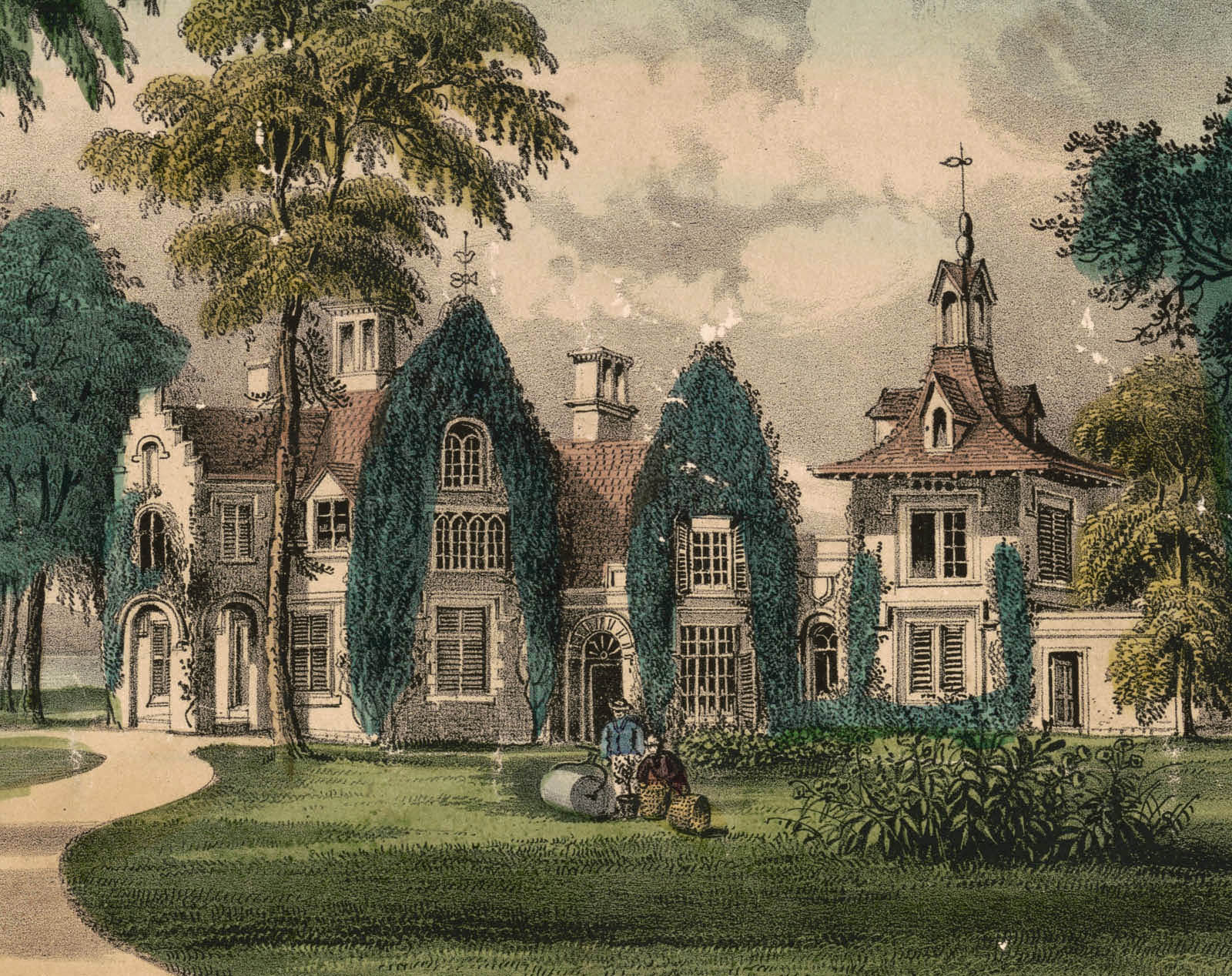
 

Currier & Ives (Publisher, New York active between 1856-1907) 'Sunnyside on the Hudson' 1856-1871 (detail)


Currier & Ives (Publisher, New York active between 1856-1907)
Sunnyside on the Hudson (detail)
1856-1871
Hand coloured lithograph
Library of Congress Prints and Photographs Division Washington, D.C.
Public domain


Currier & Ives (Publisher, New York active between 1856-1907) 'American railroad scene: lightning express trains leaving the junction' 1874


Currier & Ives (Publisher, New York active between 1856-1907)
American railroad scene: lightning express trains leaving the junction
1874
Hand coloured lithograph
Library of Congress Prints and Photographs Division Washington, D.C.
Public domain


Advertising by Samuel. E. Gross 'August Gast & Co. New York' c. 1900


Advertising by Samuel. E. Gross.
August Gast & Co. New York
c. 1900
Lithography
Library of Congress


Advertising by Samuel. E. Gross 'August Gast & Co. New York' c. 1900 (detail)


Advertising by Samuel. E. Gross.
August Gast & Co. New York (detail)
c. 1900
Lithography
Library of Congress
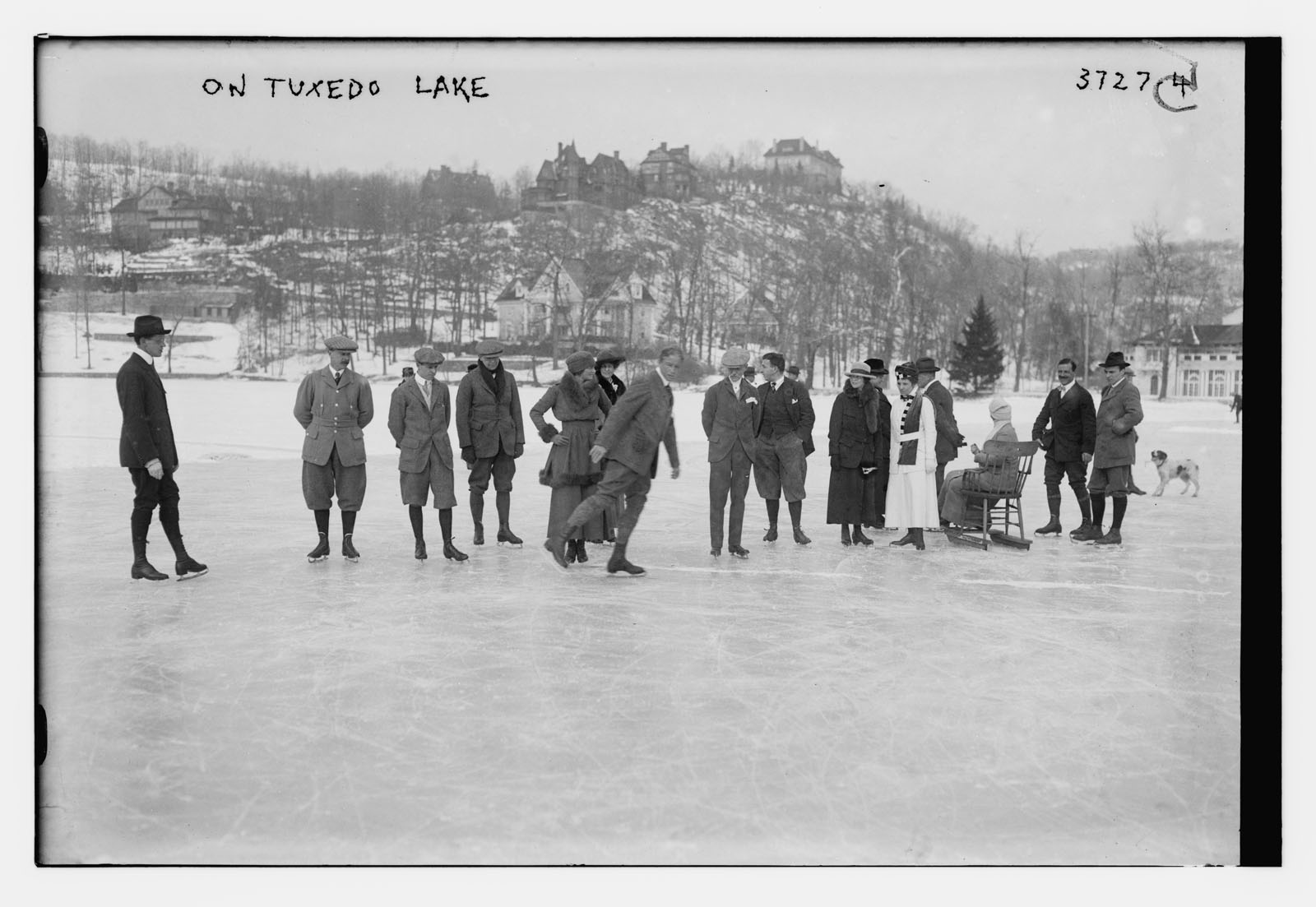
 

Anonymous photographer / Bain News Service (publisher) 'Skaters on the lake at Tuxedo Park' 1910


Anonymous photographer
Bain News Service
(publisher)
Skaters on the lake at Tuxedo Park
1910
Glass negative
Library of Congress Prints and Photographs Division Washington, D.C.
Public domain
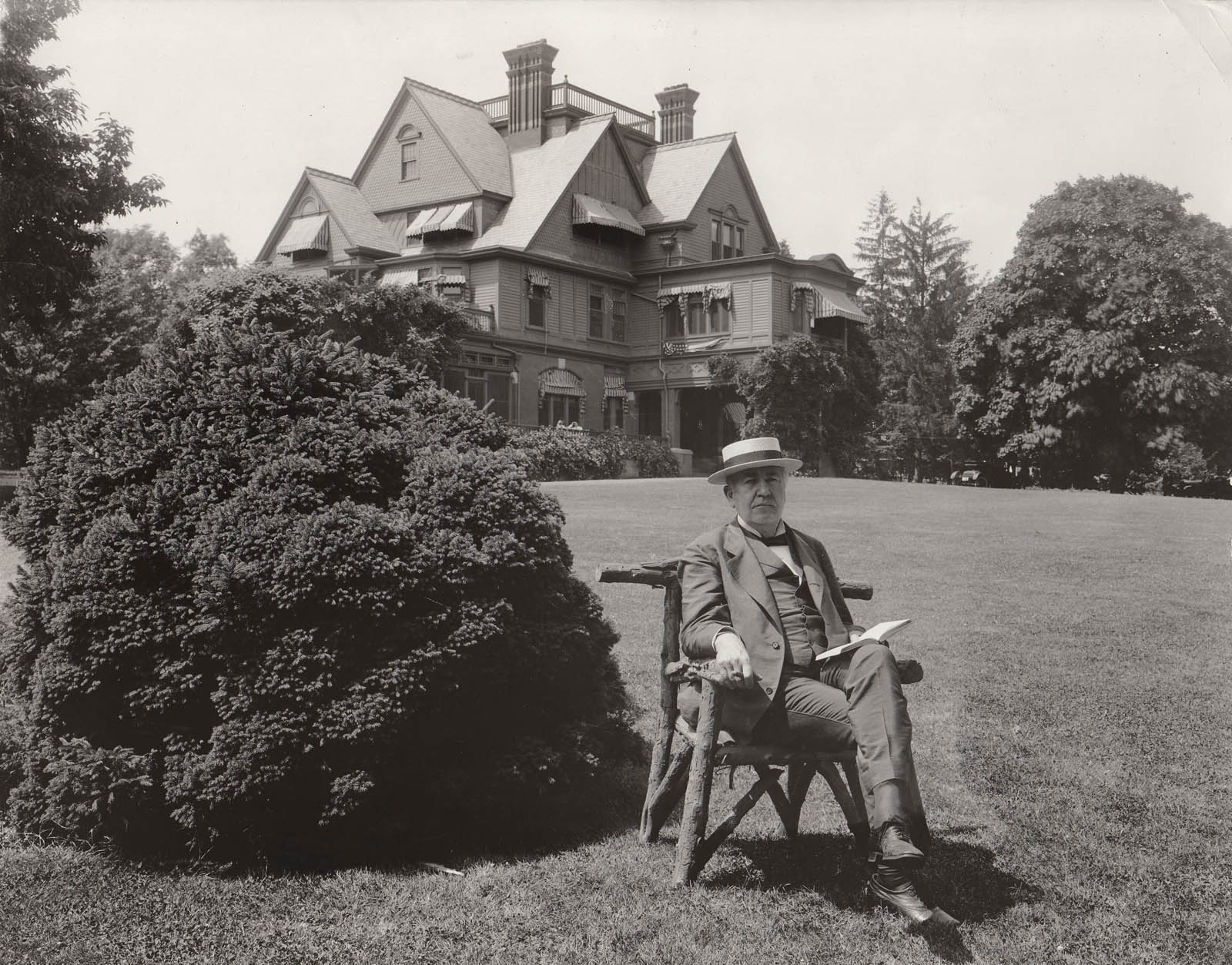
 

Anonymous photographer. 'Thomas Edison in the garden of his residence in Glenmont' 1917


Anonymous photographer
Thomas Edison in the garden of his residence in Glenmont
1917
Thomas Edison National Historical Park, West Orange, New Jersey


Anonymous photographer. 'General Motors Pavilion: Futurama, Norman Bel Geddes. New York World's Fair. General Motors – Crowds leading into Futurama' 1939


Anonymous photographer
General Motors Pavilion: Futurama, Norman Bel Geddes. New York World’s Fair. General Motors – Crowds leading into Futurama
1939
New York World’s Fair 1939-1940 records
Manuscripts and Archives Division, The New York Public Library
Public domain
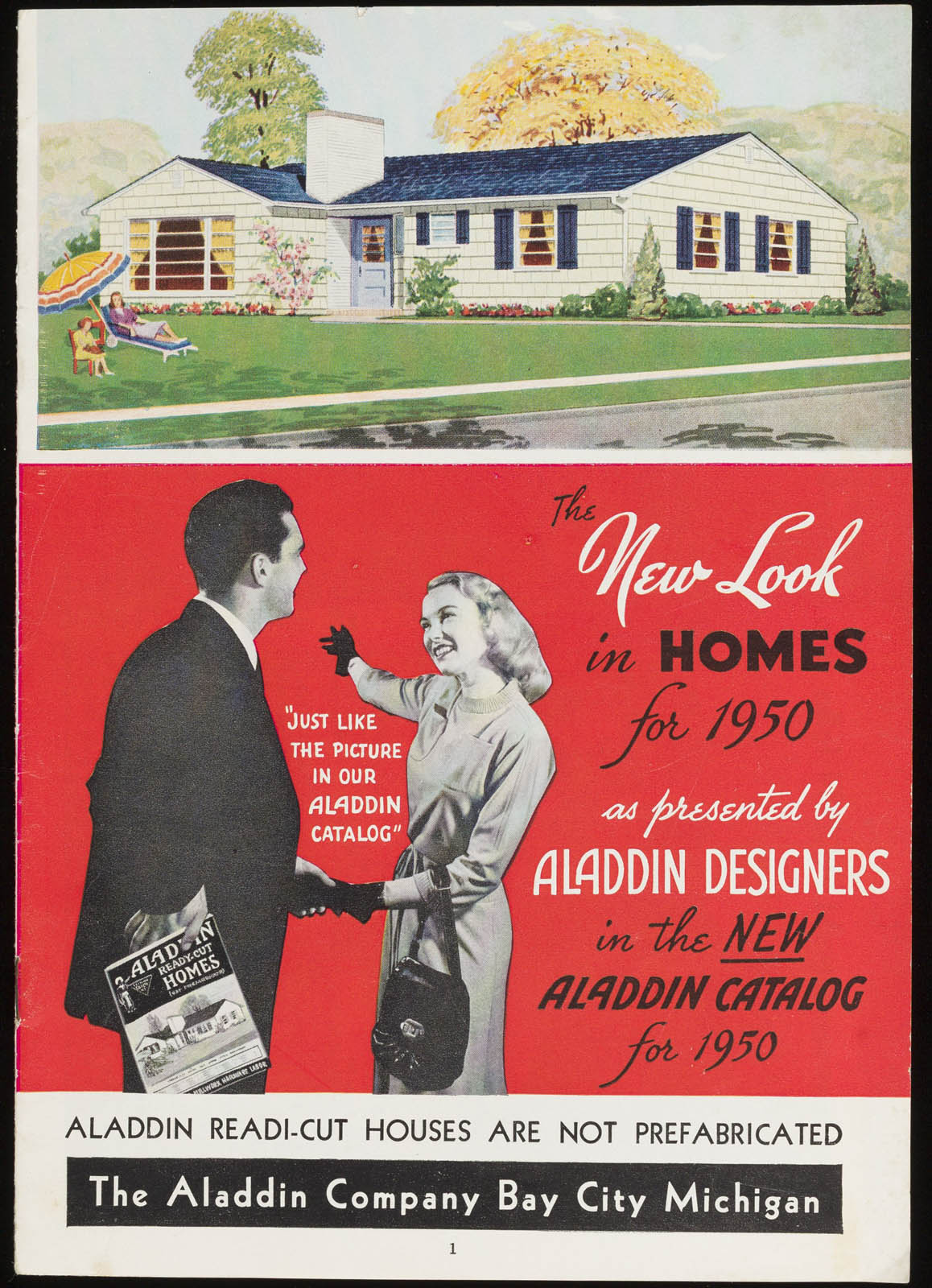
 

'Catalog of the Aladdin company selling houses by mail' 1950


Catalog of the Aladdin company selling houses by mail
1950
Courtesy Historic New England
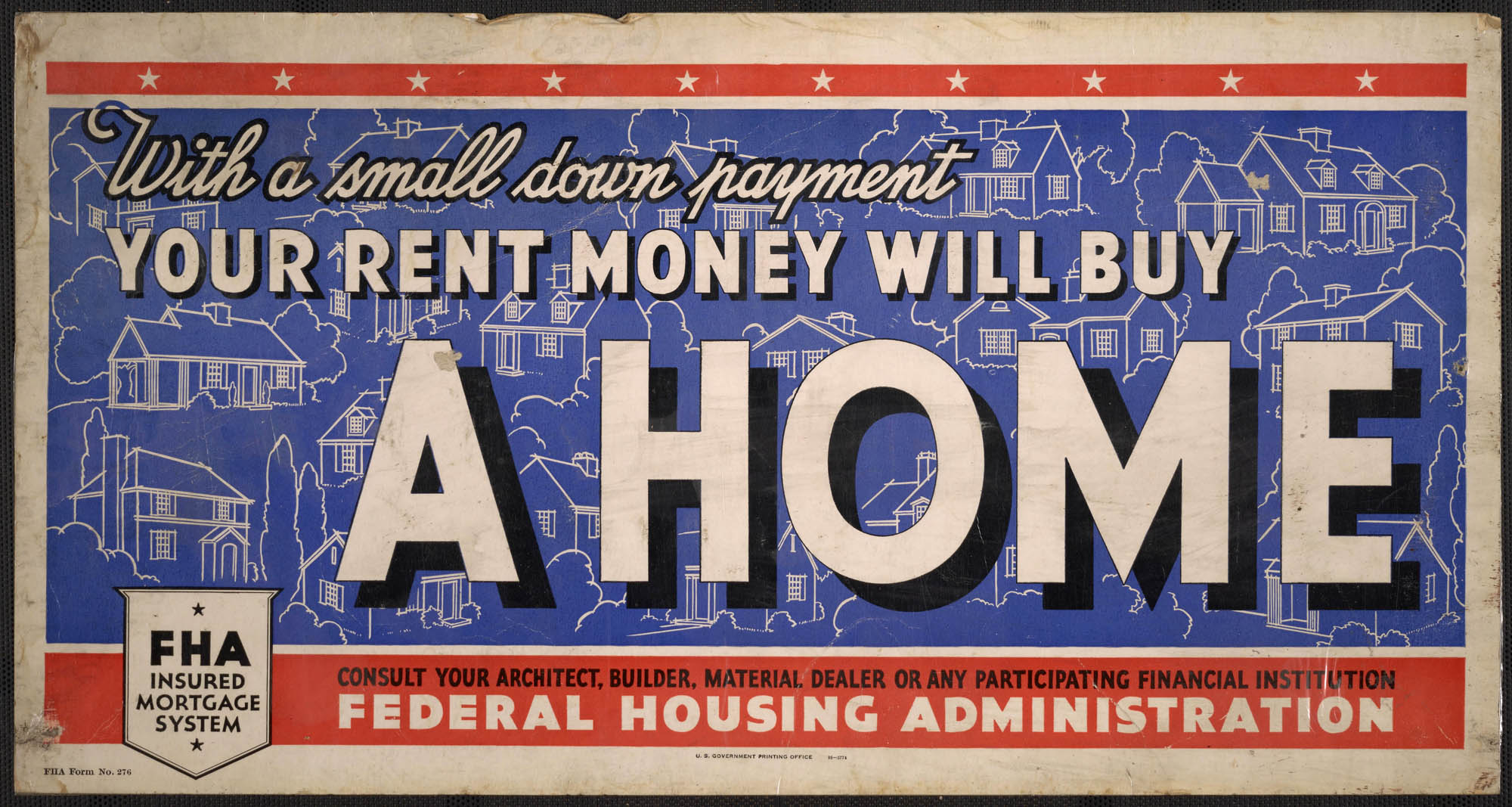
 

'Federal Housing Administration, Minneapolis and St. Paul, Minnesota' c. 1950


Federal Housing Administration, Minneapolis and St. Paul, Minnesota
c. 1950
Courtesy Minnesota Streetcar Museum, Minneapolis


The advertisement reads, “With a small down payment your rent money will buy a home. Consult your architect, builder, material dealer or any participating financial institution. Federal Housing Administration.”


The Suburban Room

The suburban explosion was first and foremost demographic, occurring as World War II soldiers returned, eager to set up home. There was no room for them in the crowded cities. With the support of the state, which offered generous loans, suburbs were built using the Fordist assembly-line production logic. It was the “American way of life”, the start of a collective dream that fascinated the whole world.

And so the baby boom took place in 11 million single-family homes fitted with all kinds of electrical domestic appliances, presided over by a brand new television set on which the new suburbanites watched idealised versions of themselves with identical skin colour and the same war experiences, age, mortgage and feeling of uprootedness. The media echoed this phenomenon, and cinema and literature reflected this standardised landscape in which a wife waited at home for her husband with a drink for him in her hand, children went everywhere by bicycle, and everyone had barbecues on Sundays.

Sponsored by the state, Suburbia became a paradise that excluded racial minorities. But little by little, by the sixties, the gates of paradise were opened to African Americans and other minorities, giving rise to a white exodus, the white flight.

As well as a variety of historical material, this section reviews sitcoms portraying the suburbs, from the 1940s to the present day. It also includes the famous illustration New Kids in the Neighborhood by Norman Rockwell and a broad selection of the photographs that make up Bill Owens’ Suburbia (1972), the first book of photographs about this American urban planning model.
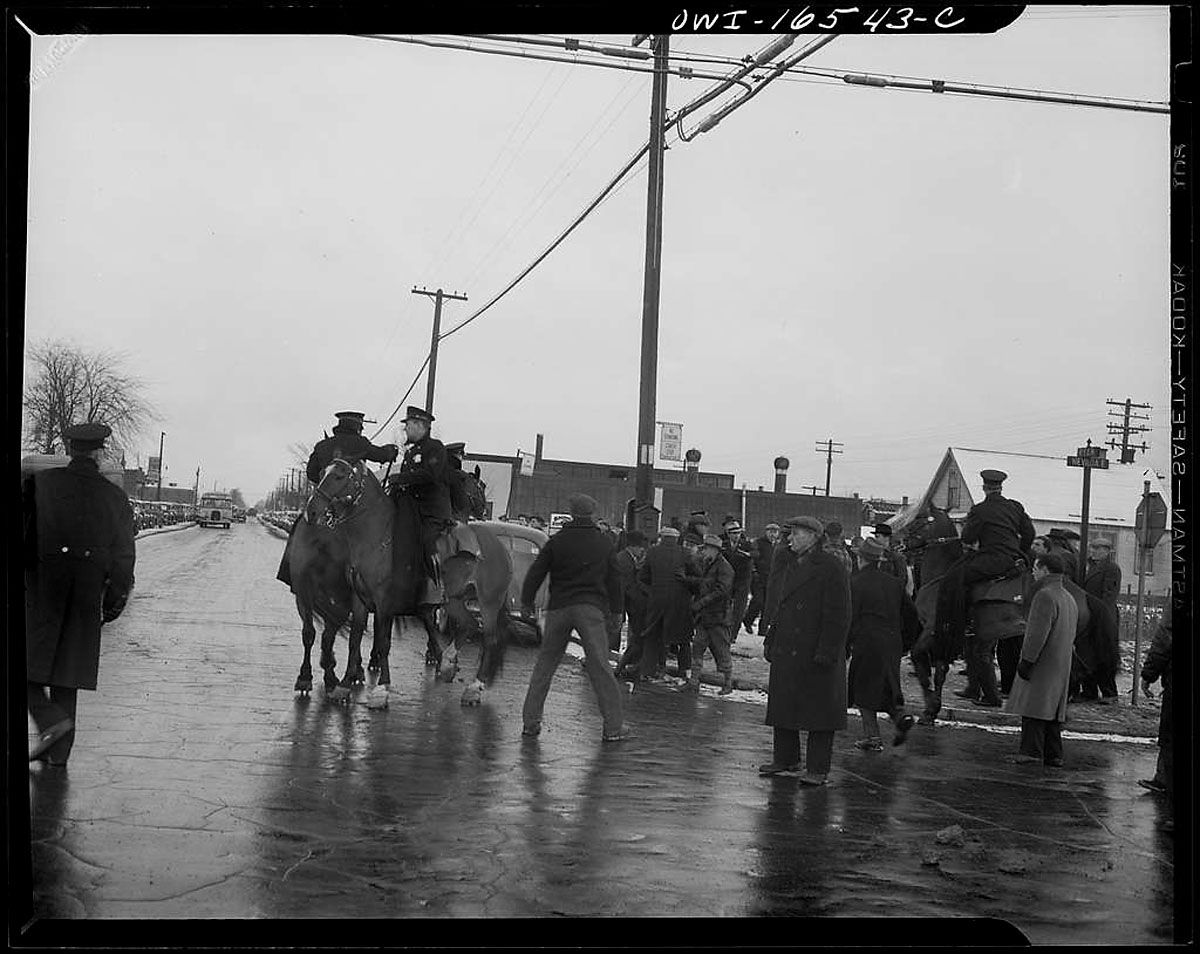
 

Arthur S. Siegel (American, 1913-1978) 'Detroit, Michigan. Riot at the Sojourner Truth homes, a new U.S. federal housing project, caused by white neighbours' attempt to prevent Negro tenants from moving in. Mounted police and whites' Detroit 1942


Arthur S. Siegel (American, 1913-1978)
Detroit, Michigan. Riot at the Sojourner Truth homes, a new U.S. federal housing project, caused by white neighbours’ attempt to prevent Negro tenants from moving in. Mounted police and whites
Detroit 1942
Library of Congress
Public domain


General Electric advertisement 'It's a promise' 1945


General Electric advertisement
It’s a promise
1945
Private collection, Barcelona
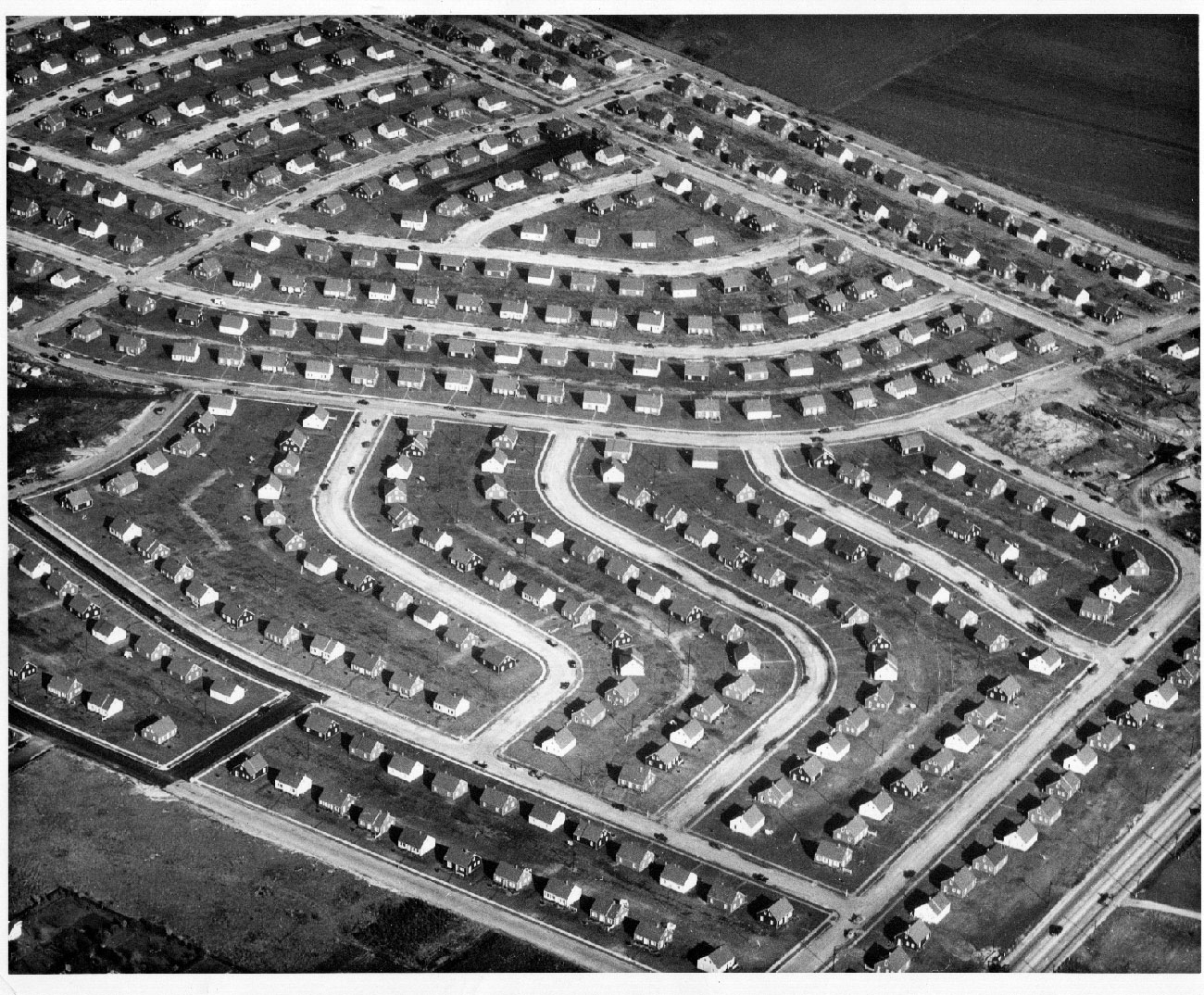
 

Anonymous photographer. 'Aerial view of Levittown' 1949


Anonymous photographer
Aerial view of Levittown
1949
Courtesy Levittown Public Library
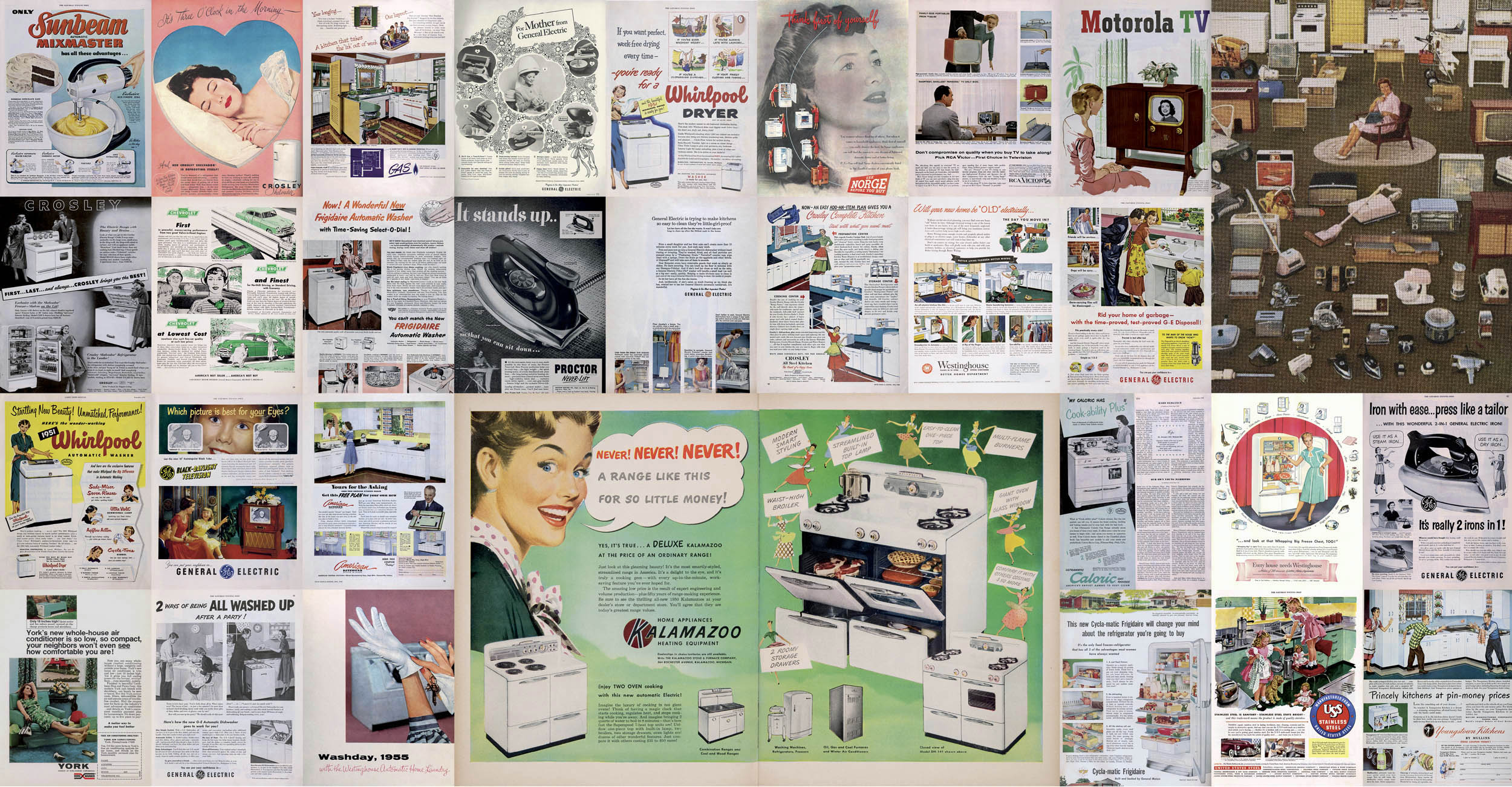
 

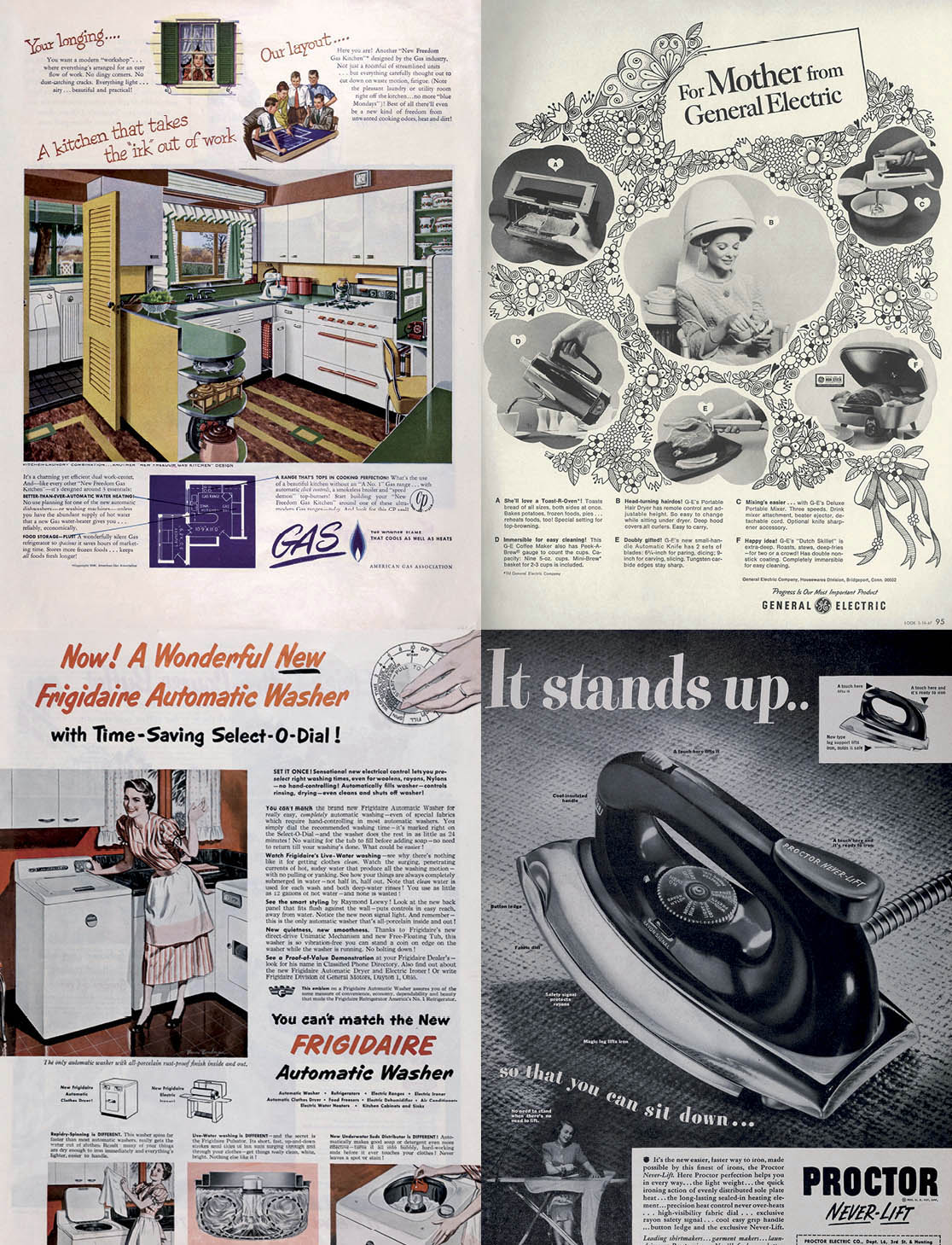
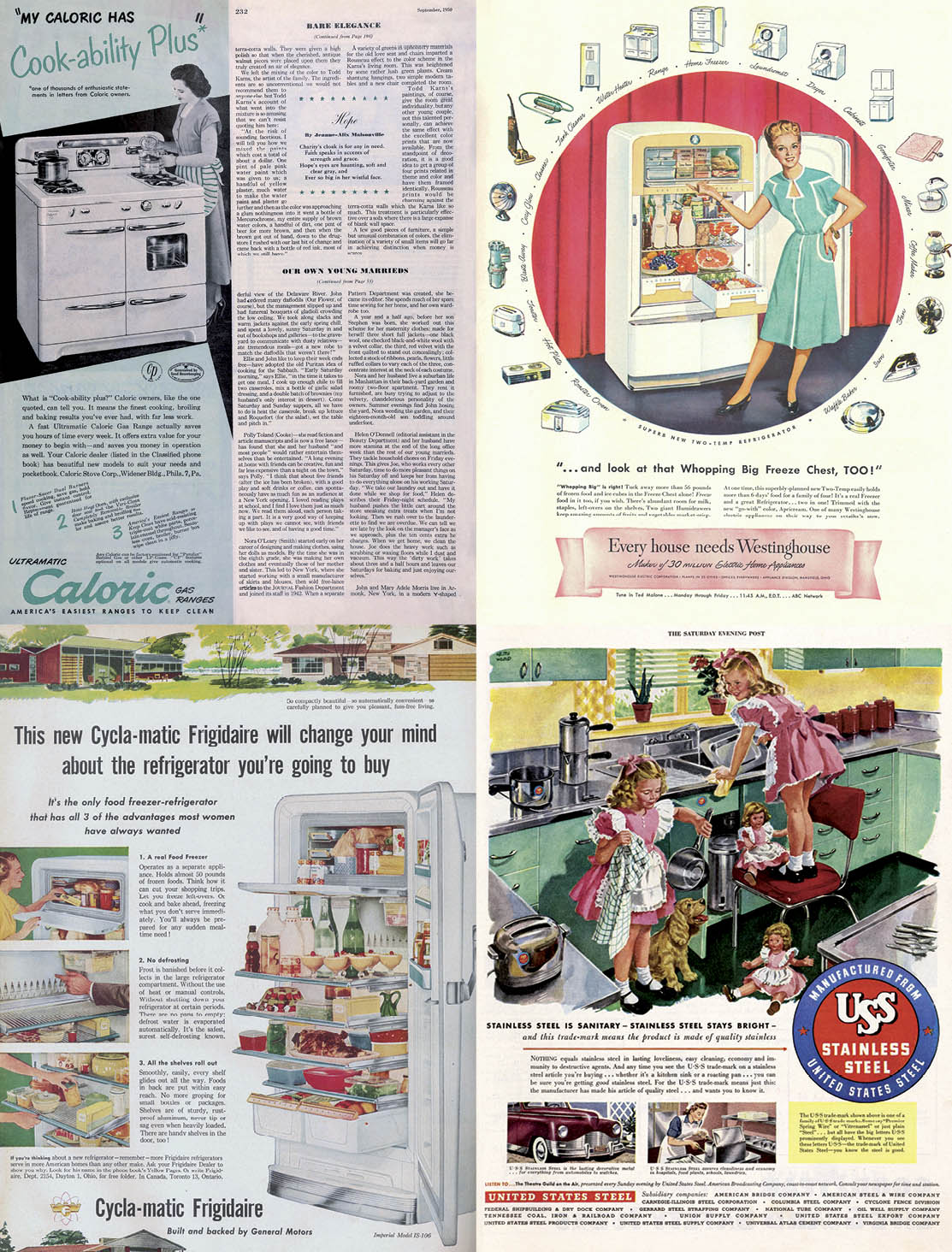
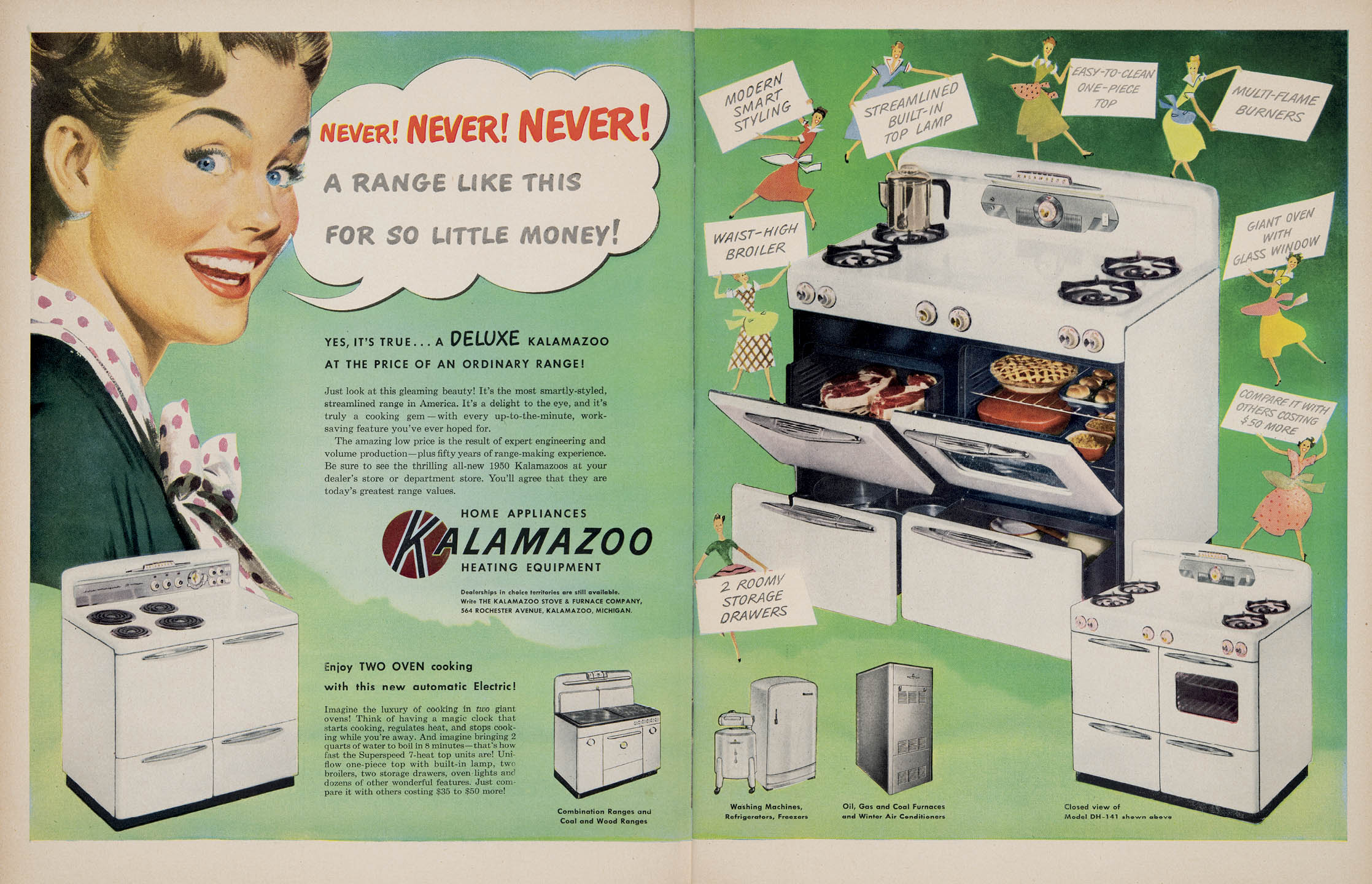
'Mural of household appliance advertisements published in different American magazines' 1947-1962


Mural of household appliance advertisements published in different American magazines
1947-1962
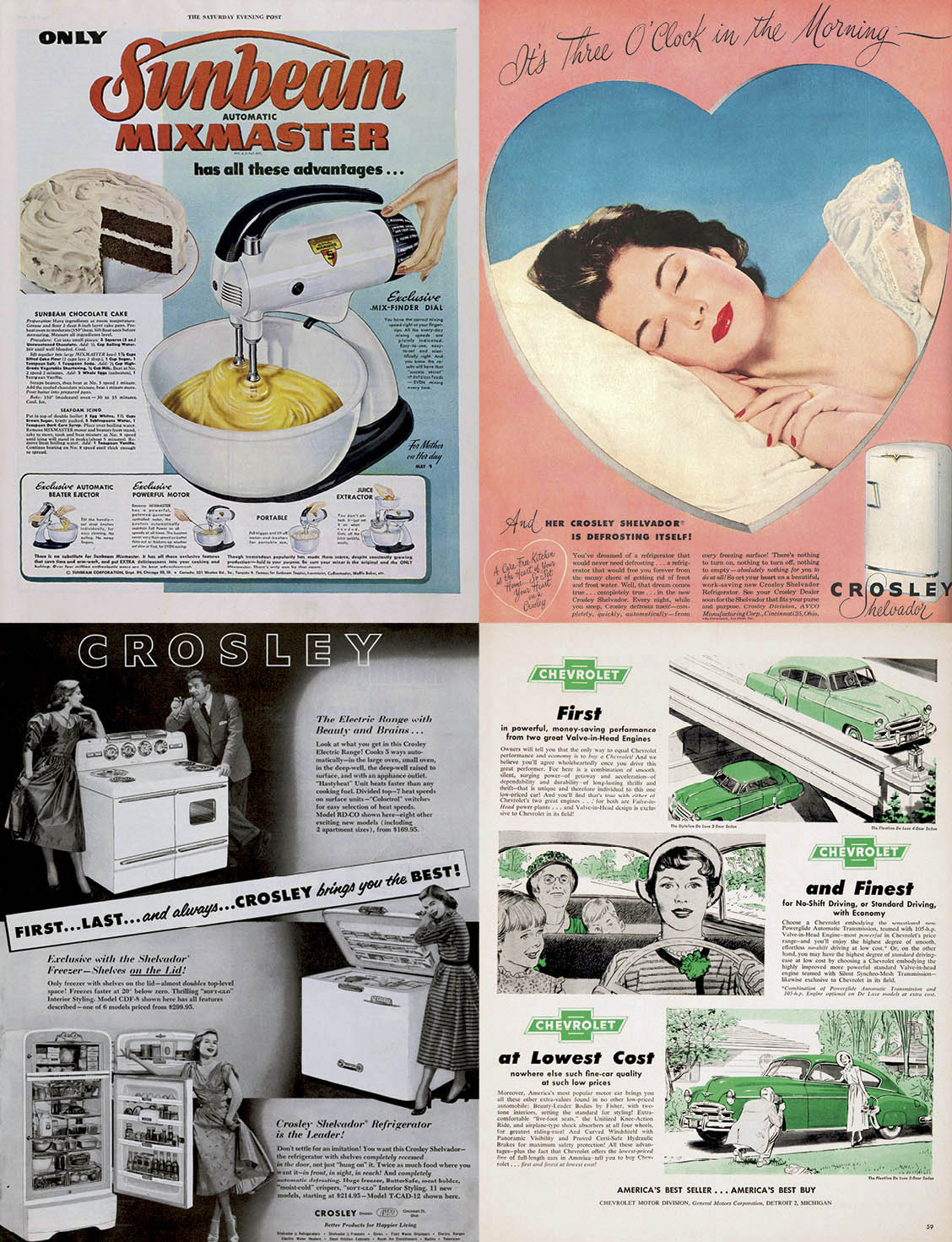
 

'Mural of household appliance advertisements published in different American magazines' 1947-1962 (detail)

'Mural of household appliance advertisements published in different American magazines' 1947-1962 (detail)

'Mural of household appliance advertisements published in different American magazines' 1947-1962 (detail)

'Mural of household appliance advertisements published in different American magazines' 1947-1962 (detail)


Mural of household appliance advertisements published in different American magazines (details)
1947-1962
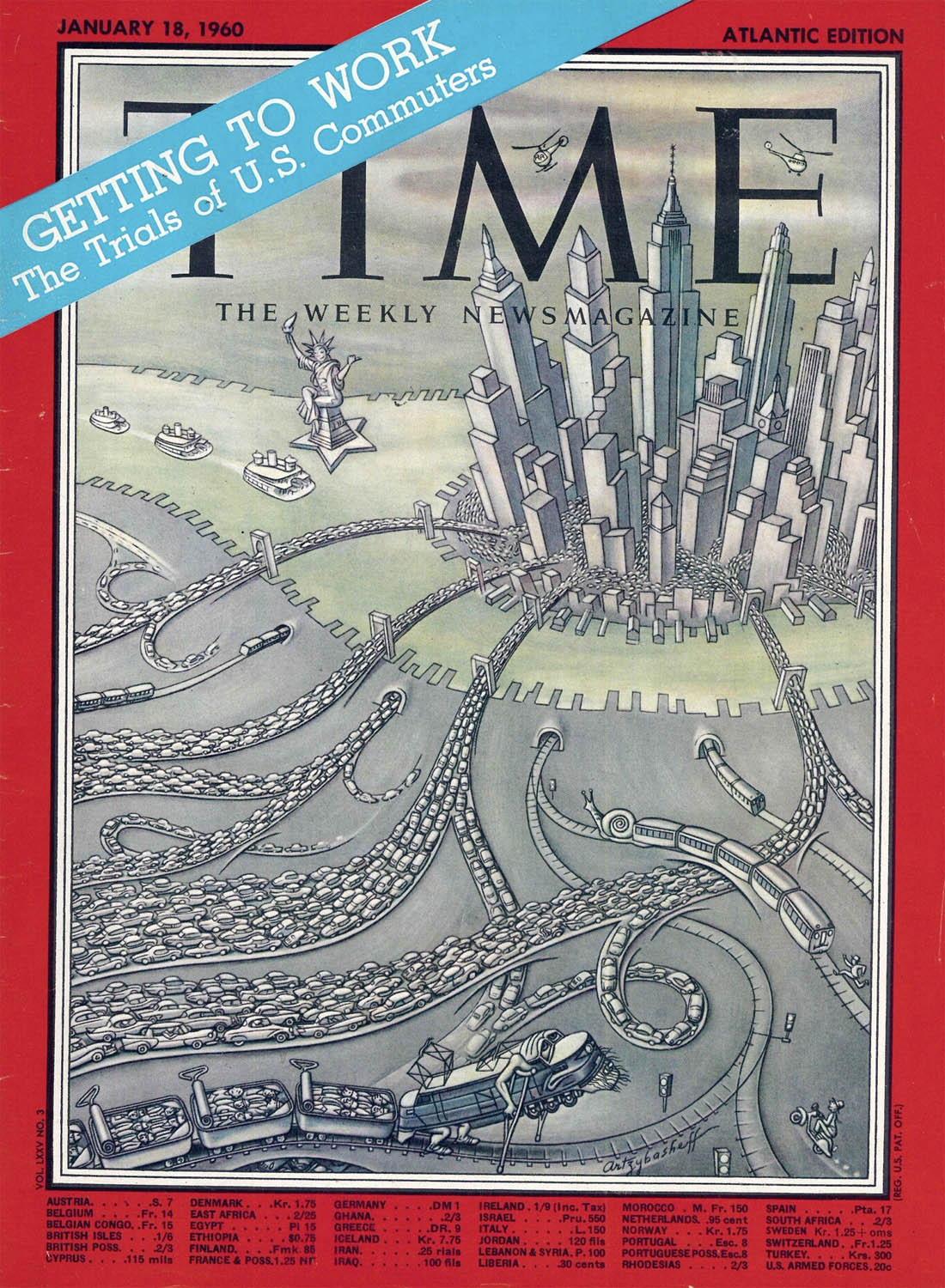
 

Getting to Work. The Trials to U.S. commuters 'Time', January 18, 1960


Getting to Work. The Trials to U.S. commuters
Time, January 18, 1960
Library of Catalonia, Barcelona
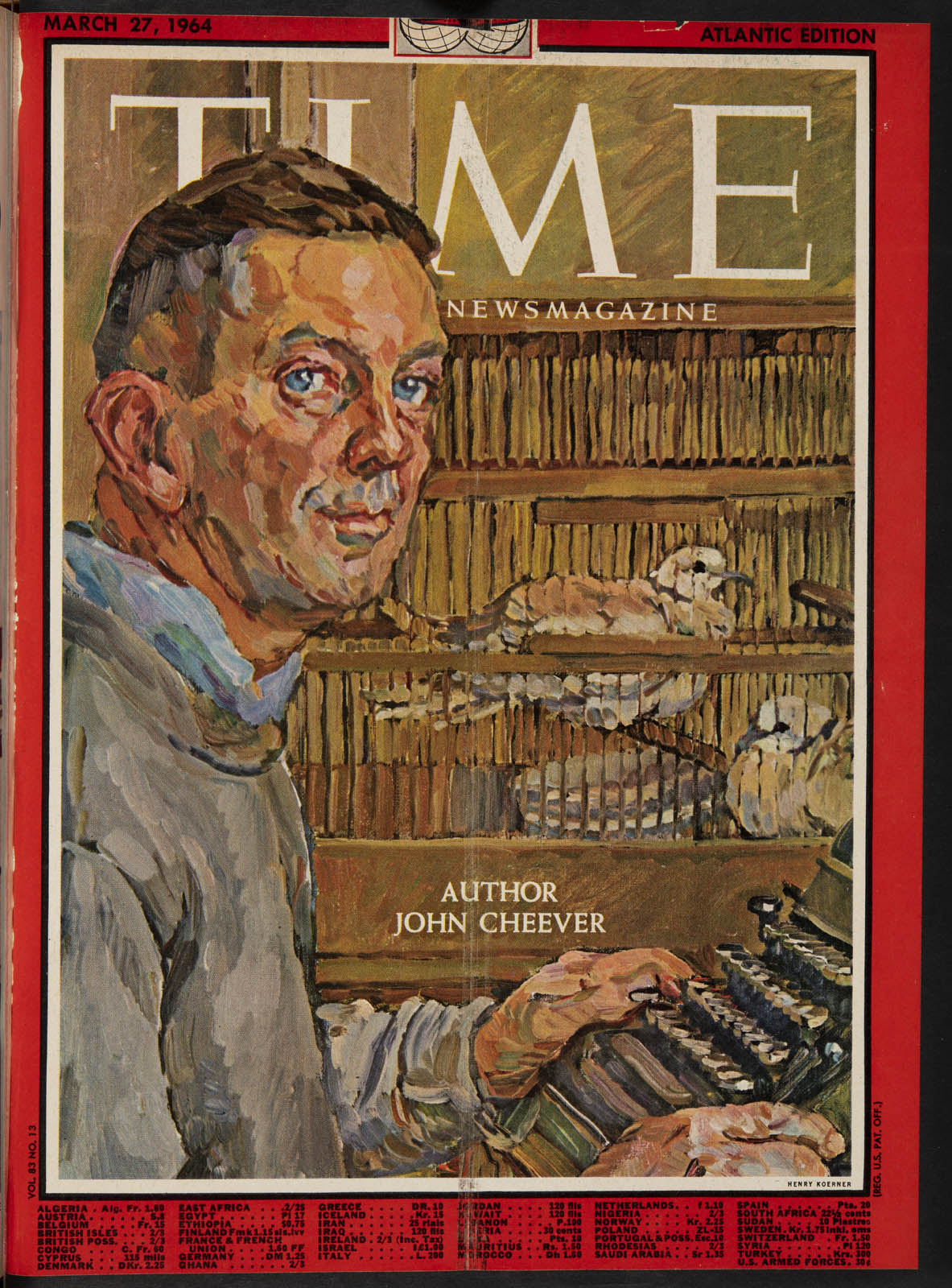
 

John Cheever 'Time', March 27, 1964


John Cheever
Time, March 27, 1964
Library of Catalonia, Barcelona
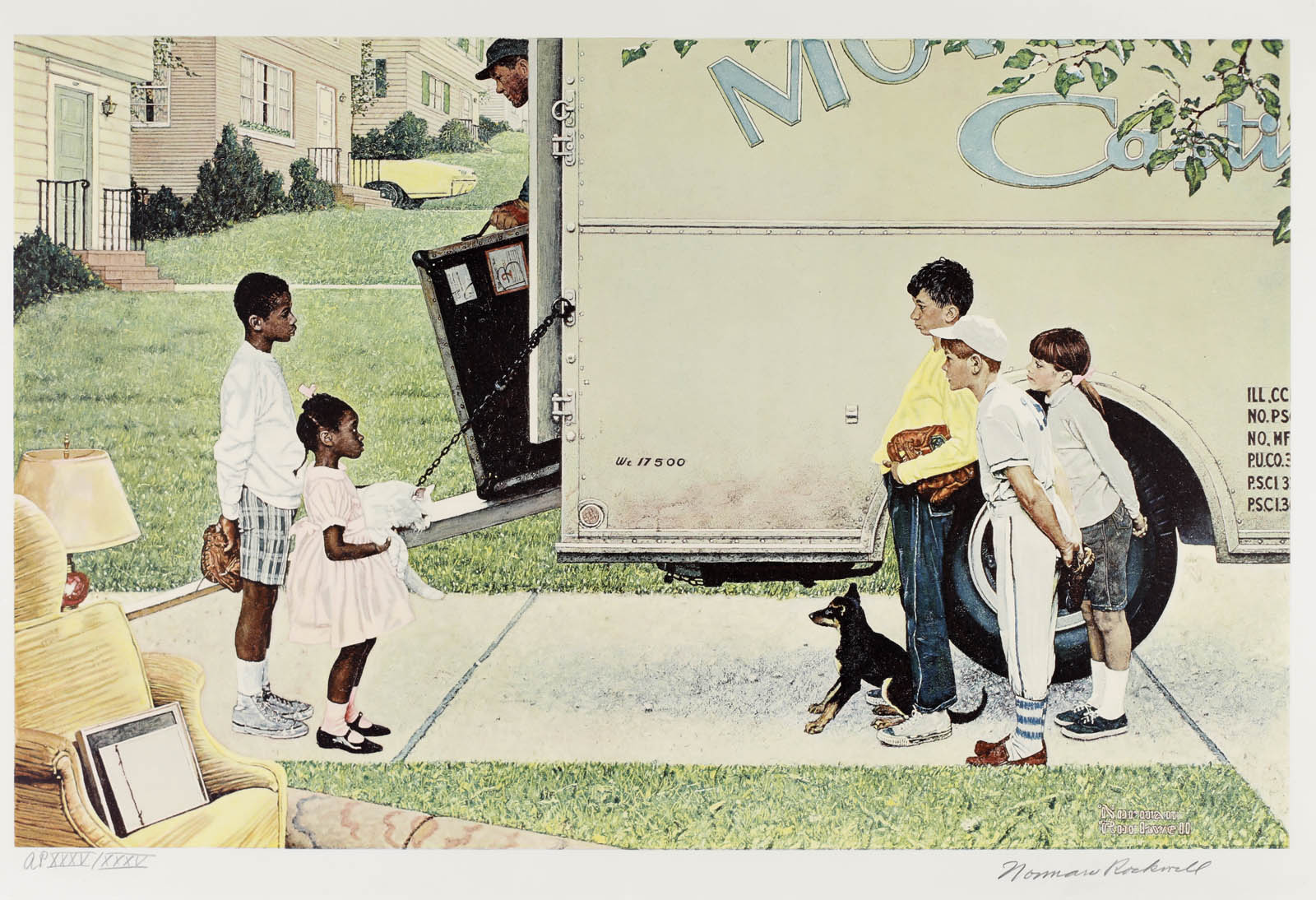
 

Norman Rockwell (American, 1894-1978) 'New Kids in the Neighbourhood' 1967


Norman Rockwell (American, 1894-1978)
New Kids in the Neighbourhood
1967
Lithograph
Norman Rockwell Museum Collection
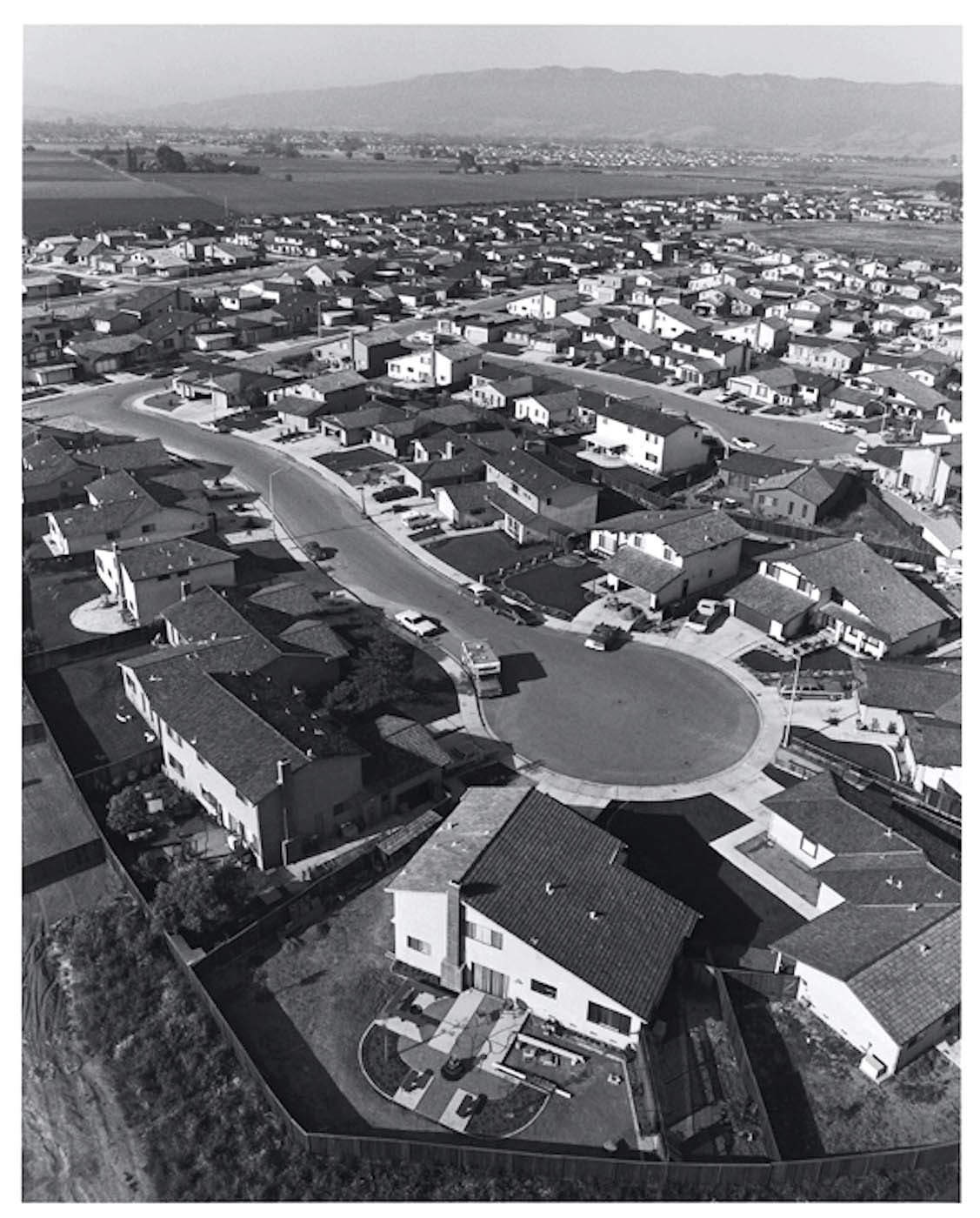
 

Bill Owens (American, b. 1938) 'Suburbia, Cul de sac, Pleseanton, California' 1972


Bill Owens (American, b. 1938)
Suburbia, Cul de sac, Pleseanton, California
1972
Gelatin silver
Bill Owens Archive, Milan


Bill Owens (American, b. 1938) 'I don't feel that Richie playing with guns will have a negative effect on his personality. (He already wants to be a policeman.)' 1972


Bill Owens (American, b. 1938)
I don’t feel that Richie playing with guns will have a negative effect on his personality. (He already wants to be a policeman.)
1972
Gelatin silver
Bill Owens Archive, Milan


The Residential Nightmare

And night fell on Suburbia. What had been a dream became a nightmare. The idea of a safe, healthy, happy place was gradually contaminated with fears, terrors and paranoias. Doors were bolted and alarms installed. After all, in the American Gothic tradition, the house, often haunted, had always been a source of horror – evil lurked there. With the appearance of mass-produced housing, a new sub genre called Suburban Gothic was consolidated, and began to manifest itself both in literature and in cinema. Unlike the traditional Gothic, in this new landscape the family residence was no longer tied to a specific territory, as it had been in New England; now, with its white picket fence and green lawn, it could be anywhere in the country. And evil came from outside, it threatened to invade the home and even undermine it. Under the guise of shiny normality, American suburbs always conceal cracks through which terror creeps.

To illustrate this residential nightmare, we take in historical materials of the atomic age, photographs of the dark side of suburbia by Amy Stein, Todd Hido, Gregory Crewdson, Angela Strassheim and Gabriele Galimberti, and Kate Wagner’s installation, McMansionHell. Alberto Ortega, an artist from Seville resident in the US who has devoted himself to painting the suburbs at night, presents two works for the first time at the CCCB.
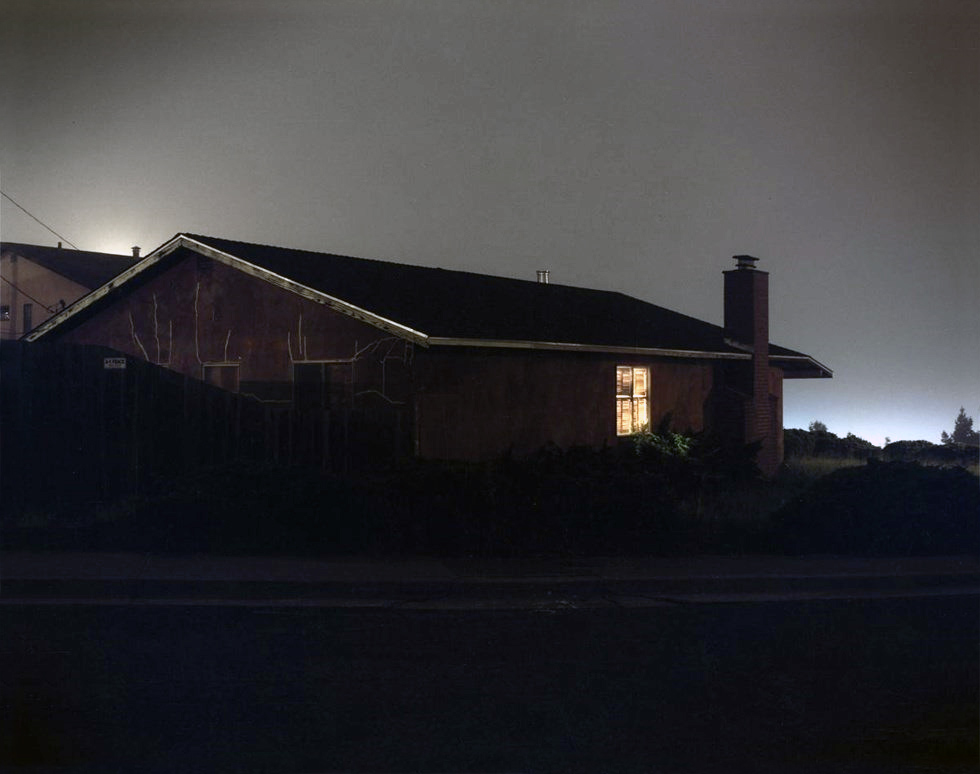
 

Todd Hido (American, b. 1968) 'Untitled #2214' 1998


Todd Hido (American, b. 1968)
Untitled #2214
1998
From the series House Hunting
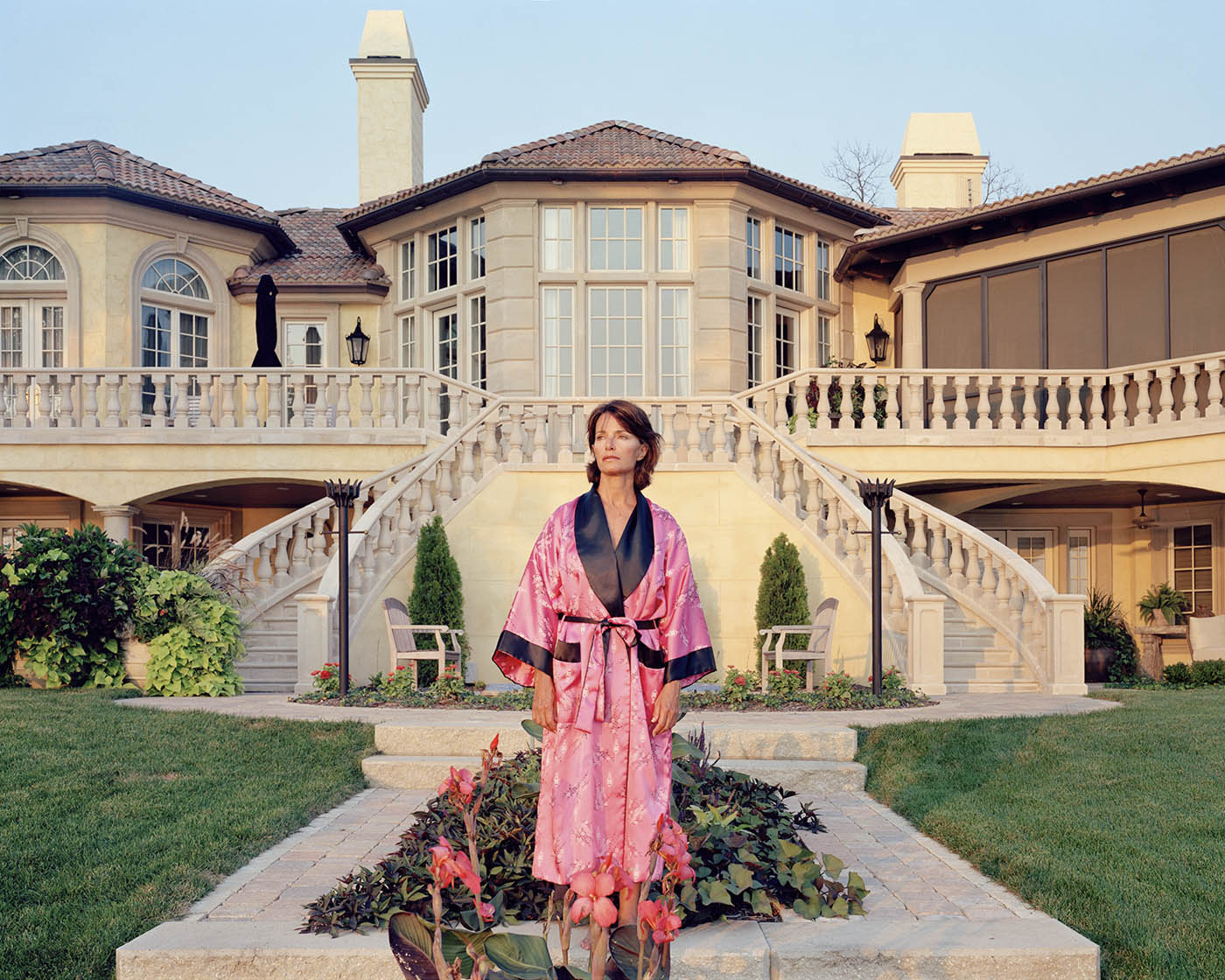
 

Angela Strassheim (American, b. 1969) 'Untitled (Elsa)' 2005


Angela Strassheim (American, b. 1969)
Untitled (Elsa)
2005
Left Behind series
Courtesy of the artist


Installation view of the exhibition 'Suburbia. Building the American Dream' at the Centre de Cultura Contemporània de Barcelona | CCCB showing the work of Gabriele Galimberti from the series 'The Ameriguns' with at top right, 'Joel, Lynne, Paige and Joshua (44, 43, 5 and 11 years old) – central Texas' 2021; and at bottom right, 'Eric Arnsberger (30) and Morgan Gagnier (22) – Lake Forest, California' 2021


Installation view of the exhibition Suburbia. Building the American Dream at the Centre de Cultura Contemporània de Barcelona | CCCB showing the work of Gabriele Galimberti from the series The Ameriguns with at top right, Joel, Lynne, Paige and Joshua (44, 43, 5 and 11 years old) – central Texas 2021; and at bottom right, Eric Arnsberger (30) and Morgan Gagnier (22) – Lake Forest, California 2021
© Alice Brazzit, CCCB, 2024
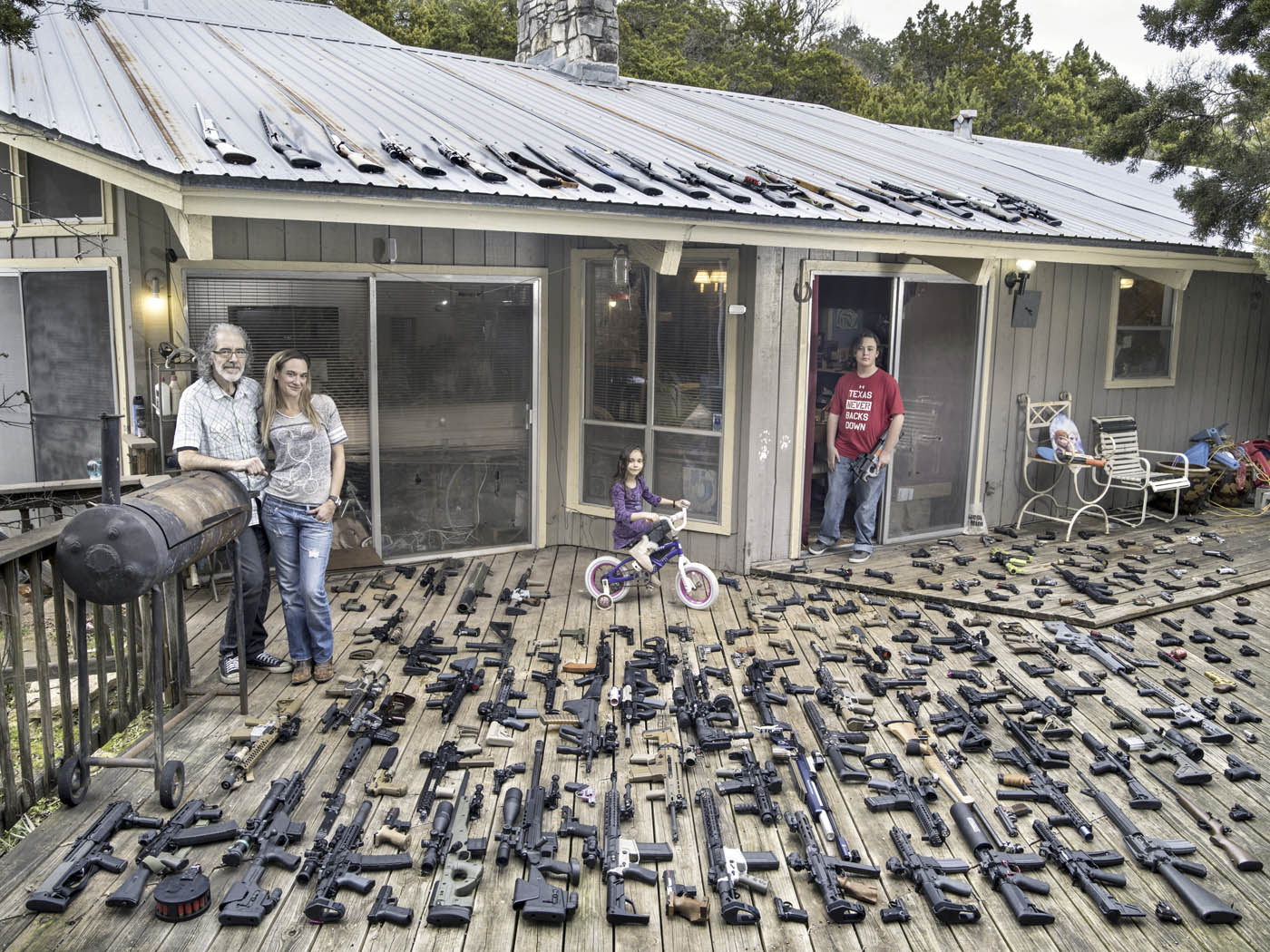
 

Gabriele Galimberti (Italian, b. 1977) 'Joel, Lynne, Paige and Joshua (44, 43, 5 and 11 years old) – central Texas' 2021


Gabriele Galimberti (Italian, b. 1977)
Joel, Lynne, Paige and Joshua (44, 43, 5 and 11 years old) – central Texas
2021
Digital printing
Courtesy of the artist
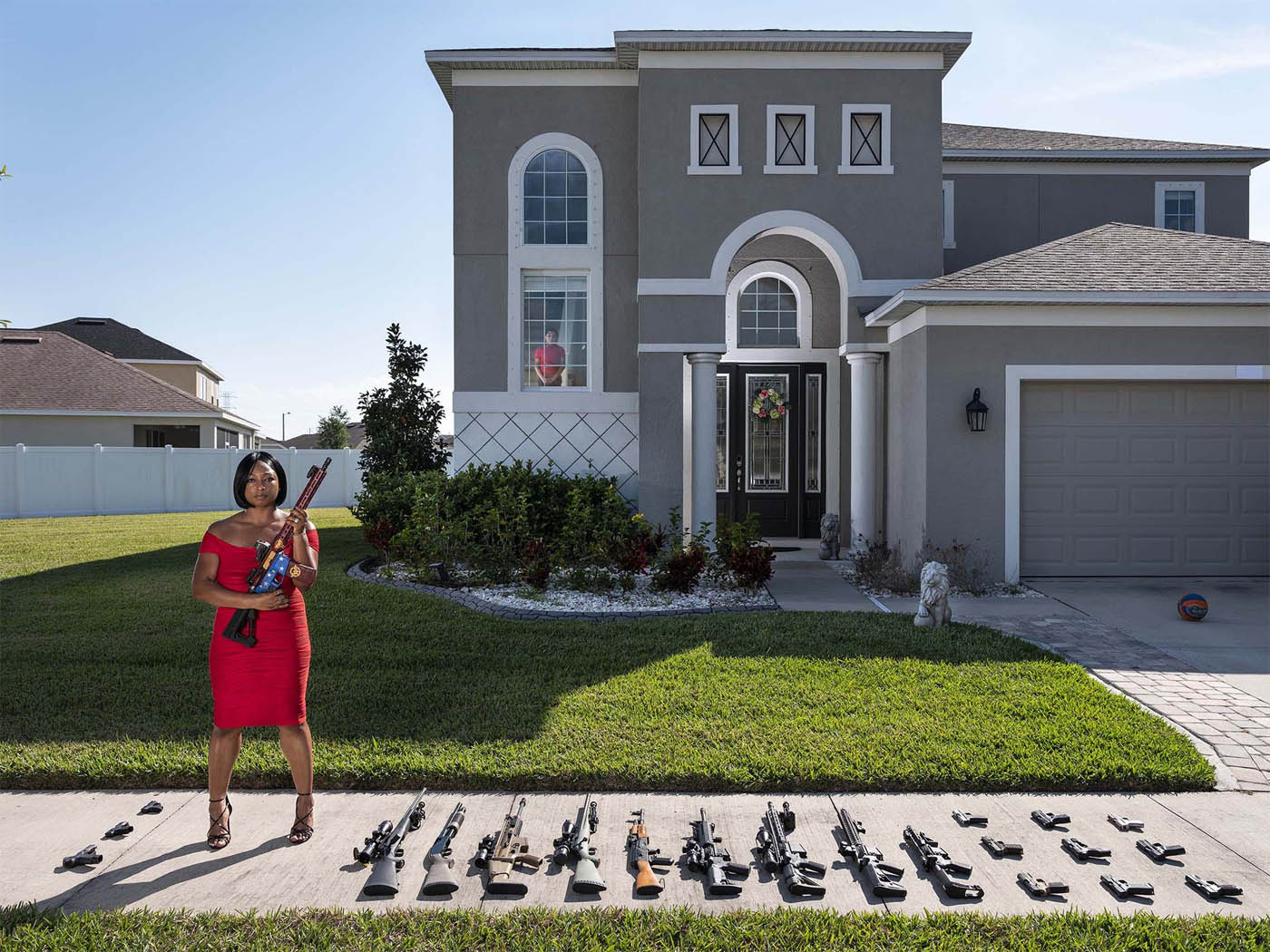
 

Gabriele Galimberti (Italian, b. 1977) 'Avery Skipalis (33) – Tampa, Florida' 2021


Gabriele Galimberti (Italian, b. 1977)
Avery Skipalis (33) – Tampa, Florida
2021
Digital printing
Courtesy of the artist


Avery Skipalis (33) stands with her firearms in front of her house in Tampa, Florida, USA. Her son looks on from a window. Avery joined the US Air Force when she was 17, and after serving in the UAE, Japan and Germany, left to start a company that offers firearms safety classes to adults and children.


Alberto Ortega (American born Spain, b. 1976) 'Annunciation' 2023


Alberto Ortega (American born Spain, b. 1976)
Annunciation
2023
Oil on aluminium panel
Courtesy of the artist


Alberto Ortega (Sevilla, Spain 1976) creates oil paintings made after miniature sets that he builds as references. The small-scale sets enable him to recreate suburban scenes using details that recall the 1950s. Since he’s able to control the angle and point of view, the lighting, the location of every element, much like a film director would do, his works have a strong cinematic feel.

As an immigrant to the United States, Alberto is intrigued by American suburban life as depicted in film, literature, and visual art. Through these images of American homes, buildings, and neighbourhoods, he portrays society and some of its contradictions. These scenes represent hopes and dreams, the threat of their failure, and alienation.

Text from the Alberto Ortega website
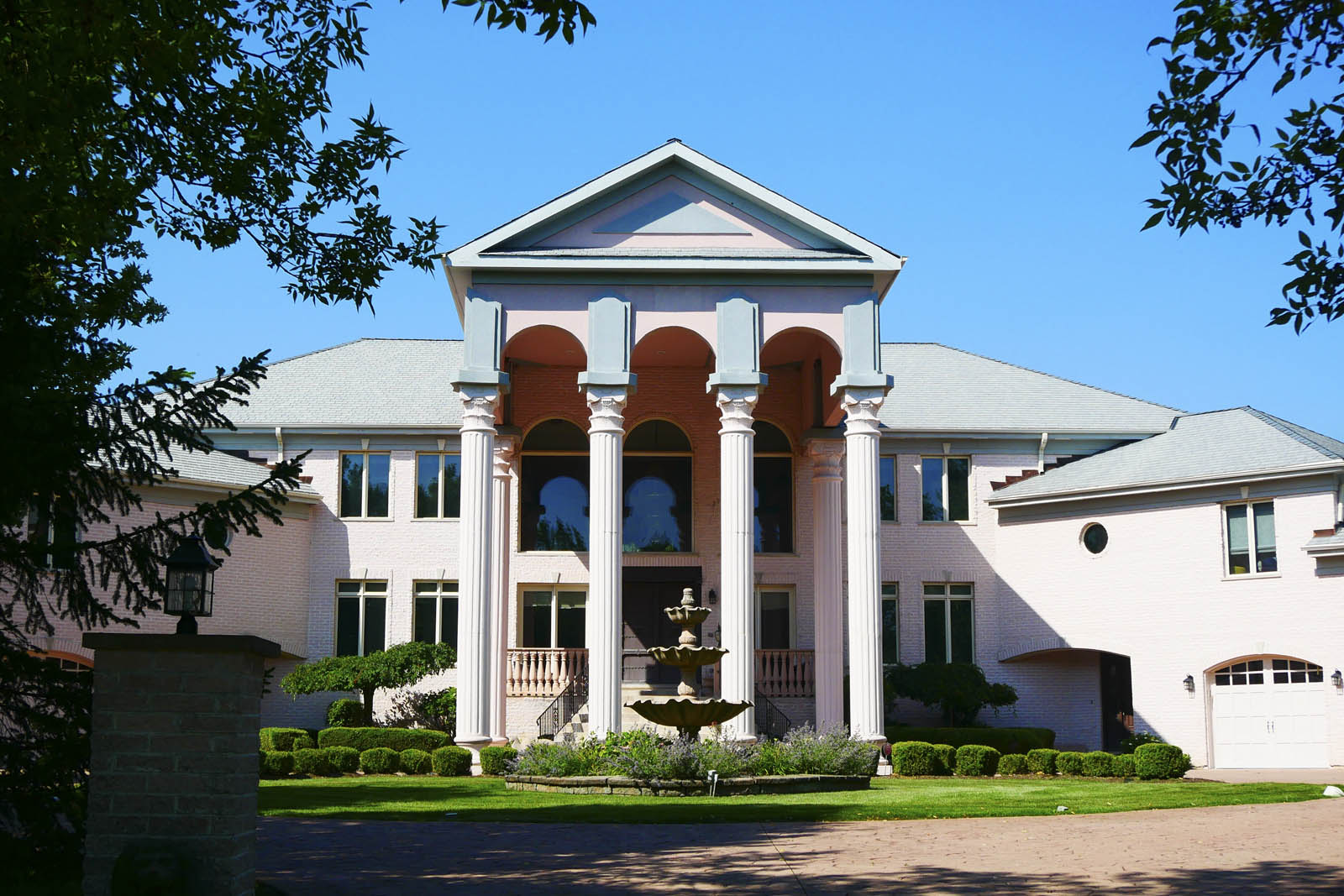
 

Kate Wagner (American, b. 1993) 'Observations from McMansion Hell' 2023


Kate Wagner (American, b. 1993)
Observations from McMansion Hell
2023
Digital print on palboard
Courtesy of the artist


McMansion Hell is a blog that humorously critiques McMansions, large suburban homes typically built from the 1980s to 2008 and known for their stylistic attempt to create the appearance of affluence using mass-produced architecture. The website is run by Kate Wagner, an architectural writer. …

The blog uses Wagner’s commentary atop images of the interiors and exteriors of McMansions, using arrows to note features she finds questionable or in poor taste. Besides critiquing the homes themselves, the website also criticises the perceived material culture of wastefulness McMansions can represent, gives anecdotes of situations when McMansions have been a poor financial investment, and provides other essays on urban planning and architectural history. The blog offers subscriptions with bonus content, generating sufficient funding for Wagner to work on the blog full-time.

Text from the Wikipedia website


Post-Suburbia?

The appearance of New Urbanism in the 1990s began to herald the inevitable death of Suburbia due to the announced depletion of oil that has not yet occurred. Meanwhile, Suburbia continues to spread, transform and diversify. Today, 8 out of 10 Americans live in sprawl and single-family homes, representing 75% of the residential areas where new generations continue to dream of living. This is a new suburbia that is more open but also more unequal.

This suburb is made up of very diverse communities, as captured by the cameras of the photographers Sheila Pree Bright (who portrays African American life around Atlanta) and Jessica Chou (who immortalises the Asian community in Monterrey Park, California). New lifestyles also proliferate there, like at Huntington Beach, a “contemporary suburb” and surfing capital featured in the works of artist and skateboarder Ed Templeton.

This section also focuses on the environmental impact of this highly polluting city model, through the apocalyptic bonsai of artist Thomas Doyle and the satellite photographs of Benjamin Grant, a lethal panorama of the effects of the sprawling city.
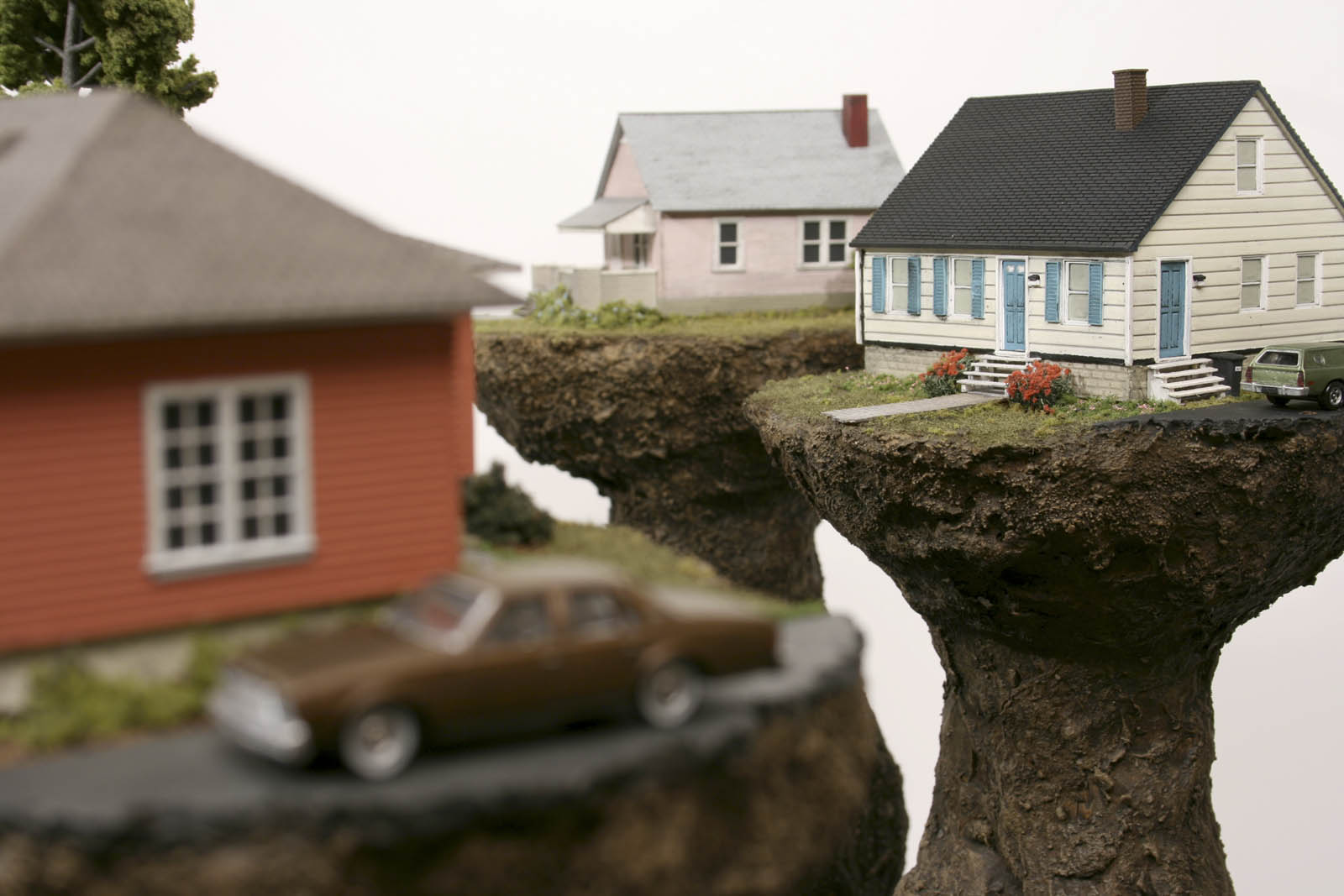
 

Thomas Doyle (American, b. 1976) 'Proxy (Haven Ln.)' 2012


Thomas Doyle (American, b. 1976)
Proxy (Haven Ln.)
2012
Mixed media
Courtesy of the artist


Thomas Doyle work mines the debris of memory through the creation of intricate worlds sculpted in 1:43 scale and smaller. Often sealed under glass, the works depict the remnants of things past – whether major, transformational experiences, or the quieter moments that resonate loudly throughout a life. In much the way the mind recalls events through the fog of time, the works distort reality through a warped and dreamlike lens.

Text from the Ronchini Gallery website


Weronika Gęsicka (Polish, b. 1984) 'Untitled #16' 2015-2017 From the series 'Traces'


Weronika Gęsicka (Polish, b. 1984)
Untitled #16
2015-2017
From the series Traces
Digital printing
Courtesy of the artist and Jednostka Gallery, Warsaw


For her series “Traces”, Polish artist Weronika Gęsicka searched through various online image databases for photographs from the 1940s to the 1960s that in her eyes reflect the American way of life at that time. Many of these scenes are full of clichés, showing happy-looking people in an apparently perfect world. The exact origin of the pictures is not verifiable. As a result, they are a mixture of advertisements and private photos. Gęsicka manipulates the idyllic scenes in a playful way by digitally distorting the images. In doing so, she does not follow a strict pattern, but instead decides intuitively what detail she finds fascinating and will edit. In this way, the rather stereotypical scenes of suburban American life are transformed into a humorous, but also uncomfortable reality. Covered faces, deformed bodies and peculiar superimpositions create a distorted version of the American dream. Gęsicka’s photos are characterised by a discomforting, almost oppressive mood that sometimes only reveals itself at second glance: young men at a tea dance, whose heads are submerged in the cleavages of their oversized female partners, family members hidden behind a curtain at the dinner table, or a father coming home from work, separated by a trench from his children, who are running towards him.

In “Traces”, Weronika Gęsicka questions how we perceive images. In doing so, she makes us aware that even the medium of photography, which allegedly reflects reality, is not objective. Each photograph merely satisfies a perception of what is happening and, in the photographer’s eye, remains a subjective likeness. By modifying the images, she is playing with the observer, who is initially confident that he can quickly classify and identify the scene – until he notices that nothing in these pictures is as it seems at first glance.

Anonymous. “Weronika Gęsicka: A Disconcerting Idyll,” on the Deutsche Börse Photography Foundation website Nd [Online] Cited 13/08/2024
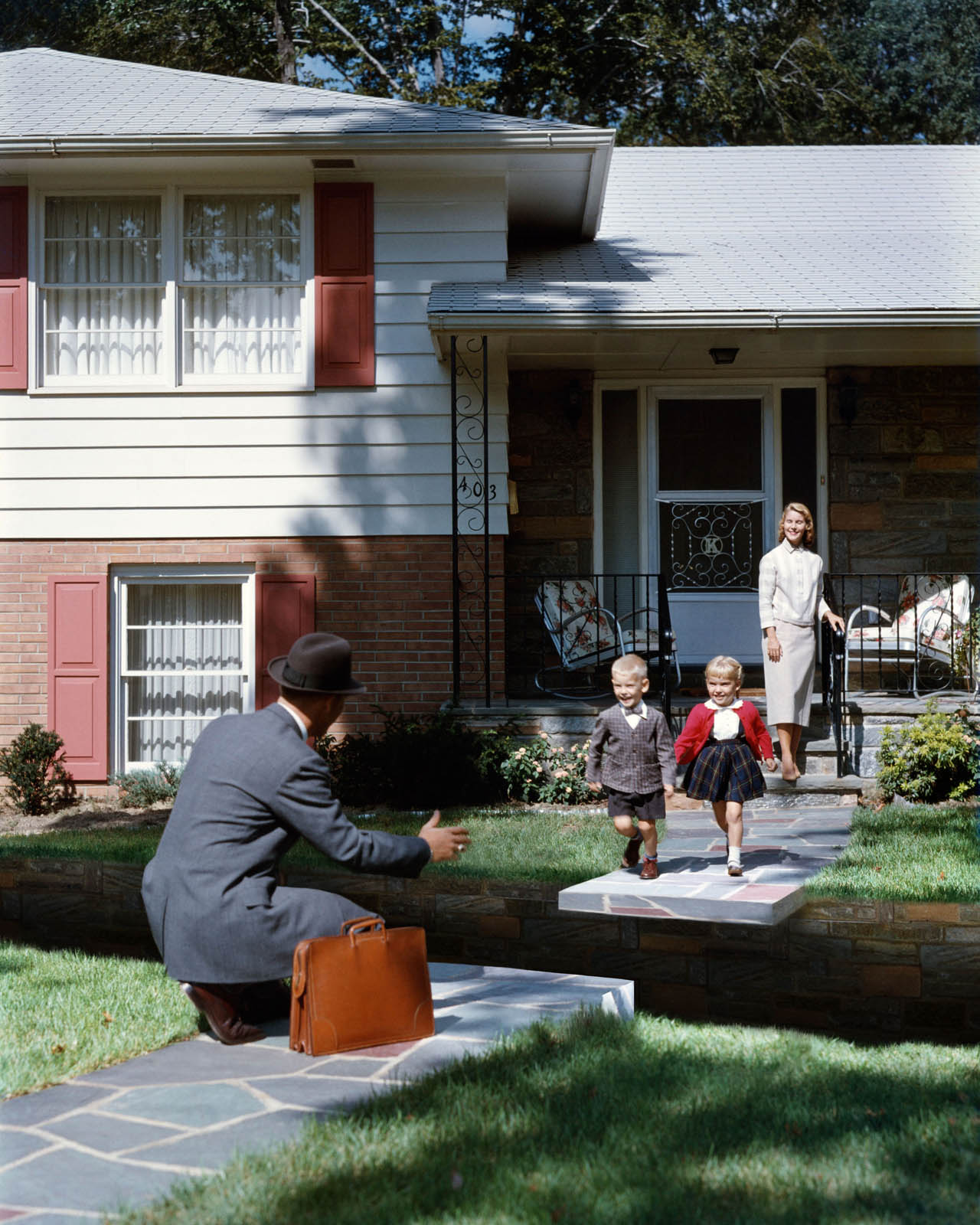
 

Weronika Gęsicka (Polish, b. 1984) 'Untitled #52' 2015-2017 From the series 'Traces'


Weronika Gęsicka (Polish, b. 1984)
Untitled #52
2015-2017
From the series Traces
Digital printing
Courtesy of the artist and Jednostka Gallery, Warsaw
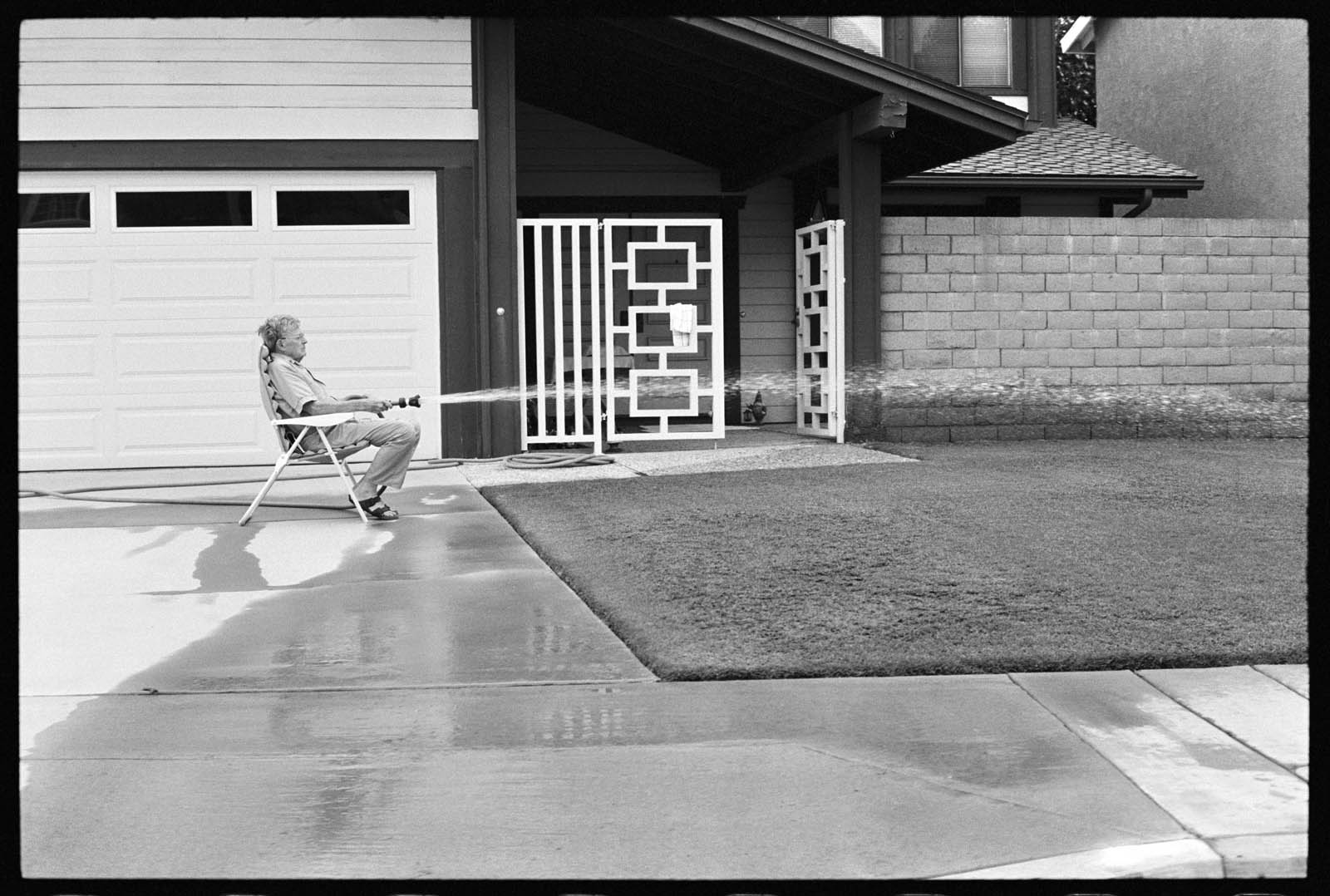
 

Ed Templeton (American, b. 1972) 'Contemporary Suburbium' 2017


Ed Templeton (American, b. 1972)
Contemporary Suburbium
2017
Digital printing on baryta paper
Courtesy of Roberts Projects, Los Angeles

 

Jessica Chou (American born Taiwan, b. 1985) 'The Mark Keppel High School Dance Team at the 2019 Miss Dance Drill Team USA National Dance Competition' 2019


Jessica Chou (American born Taiwan, b. 1985)
The Mark Keppel High School Dance Team at the 2019 Miss Dance Drill Team USA National Dance Competition
2019
Digital printing
Courtesy of the artist
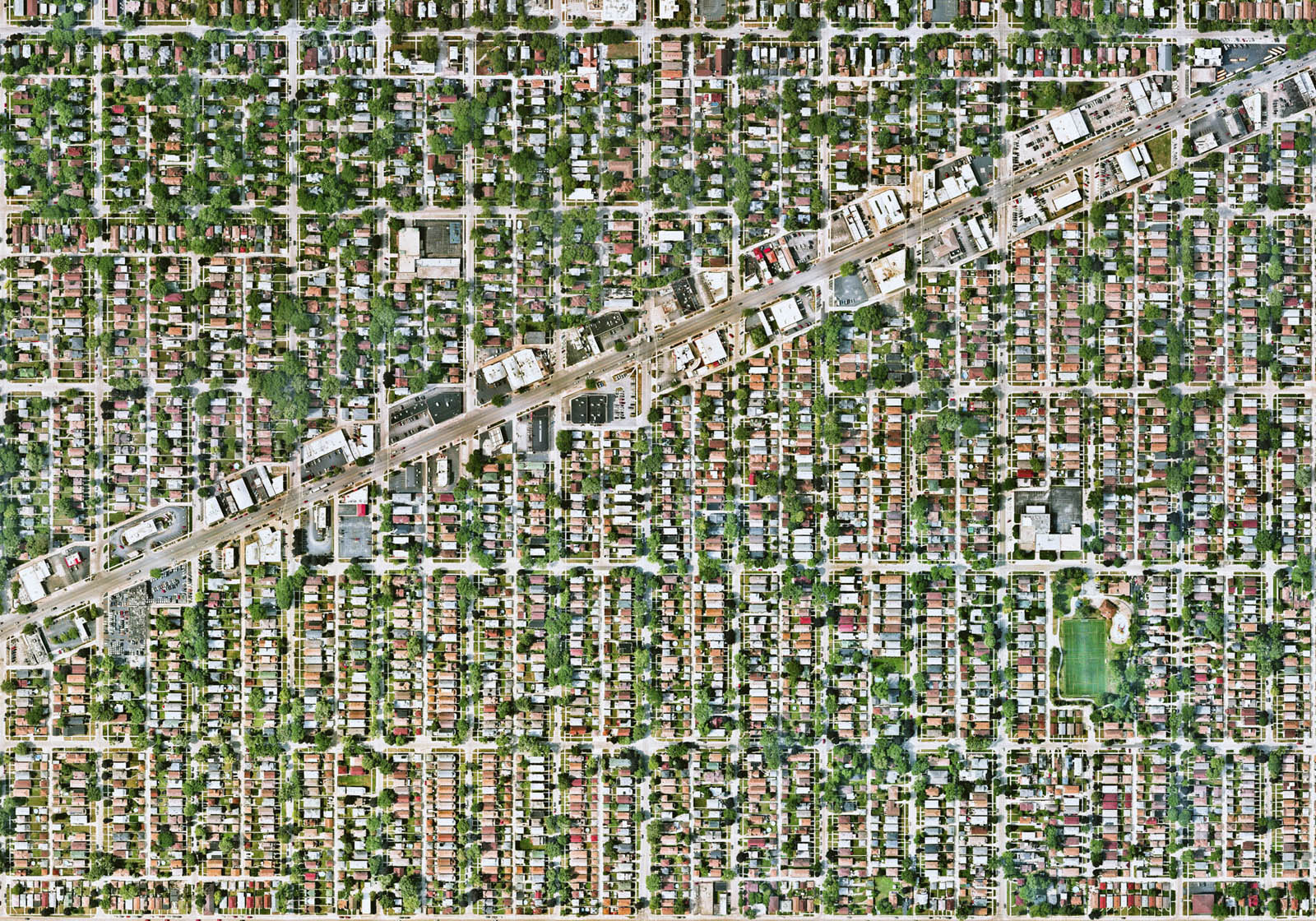
 

Benjamin Grant (American, b. 1984) 'Berwyn, Illinois' 2023


Benjamin Grant (American, b. 1984)
Berwyn, Illinois
2023
Digital printing
Images created by Overview, source images
© Nearmap


Overview takes its inspiration from Daily Overview – an Instagram account established by author Benjamin Grant. Since he began the project in December 2013, his daily posts have both delighted and challenged his audience from all corners of the globe. For Overview, Grant has curated and created more than 200 original images by stitching together numerous high-resolution satellite photographs. With each Overview, Grant aims to not only inspire a fresh perspective of our planet but also encourage a new understanding of what human impact looks like. He lives and rides his bike in New York City.

Text from the Penguin Books website
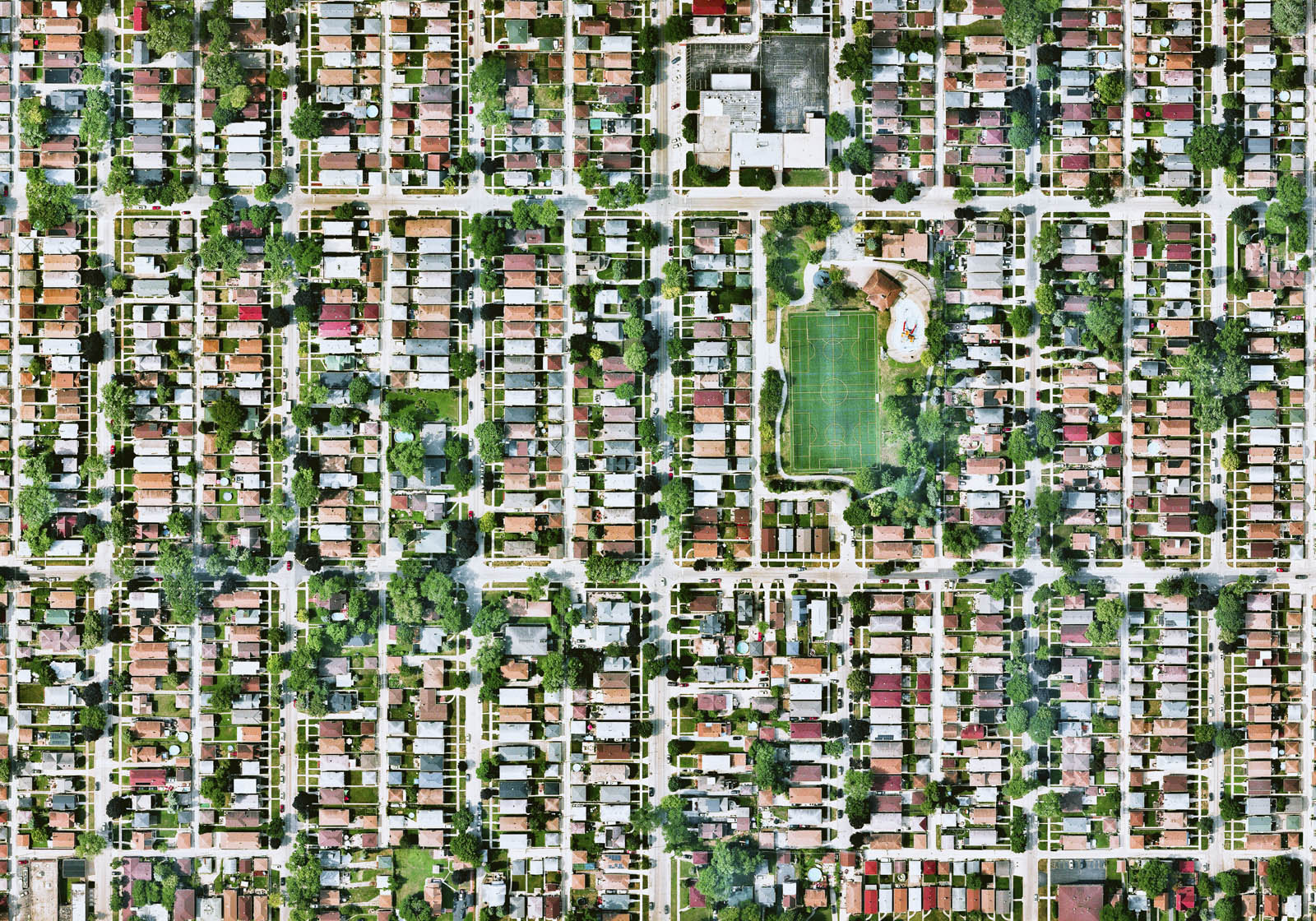
 

Benjamin Grant (American, b. 1984) 'Berwyn, Illinois' 2023 (detail)


Benjamin Grant (American, b. 1984)
Berwyn, Illinois (detail)
2023
Digital printing
Images created by Overview, source images
© Nearmap


Sprawl Reaches Our Shores

The formation of Suburbia as a cultural phenomenon in Catalonia is a reality historically ignored by narratives about the Catalan process of urbanisation, too focused on city growth and the ideological differentiation between an urban, Barcelona-based Catalonia and an “inner” Catalonia, the birthplace of what still today we call the “countryside”.

Suburban Catalonia shows how, in many territories, urban growth no longer corresponds to the well-known metaphor of city growth as an “oil stain”. In fact, an endless mass of oil stains has spread across the territory, giving rise to the same cloned reality everywhere: regional urban sprawl. The sprawl that is so commonplace today developed with the motorisation of society starting in the latter half of the 20th century as part and parcel of a very heterogeneous cultural discourse: the ideological propaganda of the American way of life mixed with local traditions derived from criticism of the built-up, crowded industrial city popularly disseminated in expressions such as “la caseta i l’hortet” (a little house and a garden) that idealised rural life. The path leading from those initial suburban choices to today’s regional urban sprawl is not a straight one, making the Catalan suburb a world yet to be discovered.

Christopher Willan has made a photographic reportage about the Catalan suburban world specially for the exhibition, which also includes Blanca Munt’s installation Mira-Sol Alert about the neighbourhood’s paranoid state of alert and an audiovisual piece by filmmaker León Siminiani that closes the exhibition.


Pere Torné Esquius (Spanish, 1879-1936) 'The rocking chair' 1913


Pere Torné Esquius (Spanish, 1879-1936)
The rocking chair (El balancí)
1913
Oil on canvas
National Art Museum of Catalonia, Barcelona


For different reasons, the singular work of the painter, illustrator and cartoonist Pere Torné Esquius (Barcelona 1879 – Flavancourt, France, 1936) doesn’t fit in with either the modernist proposals or the noucentista style (turn of the century), even though the latter considered him to be one of theirs.

Settled in Paris from 1905 onwards, although he would often return to Barcelona to regularly exhibit there, his work, of apparent simplicity, responded to a certain primitivism which was somewhat naive and with a strong French influence. His painting, highly singular, maintained pictorial and atmospheric values which provided the whole production with a sense of unity.

The favourite topics of Torné Esquius were interior or secluded spaces, such as gardens or living rooms, humble or of artisan extraction. It is worth highlighting, very often, the absence of the human figure and the main presence of inanimate elements that on occasions would cause a disturbing or even alarming effect. He also produced other genres such as landscapes or portraits.

Despite the fact that he was a painter, his professional work was based on illustration, focused on three main lines: children’s literature, the illustration of literary texts and the collaboration in magazines and periodical publications, often satirical, such as Papitu, Picarol or Le Rire, amongst others.

Anonymous. “Torné Esquius. Poetics of the Everyday,” on the Museu Nacional D’Art De Catalunya website 2017 [Online] Cited 13/08/2024


'XXIII Barcelona International Exhibition Fair, 1955. USA Pavilion. OITF: Office of International Trade Fair. Single-family house model: "house beautiful prefabricated"' 1955


XXIII Barcelona International Exhibition Fair, 1955. USA Pavilion. OITF: Office of International Trade Fair. Single-family house model: “house beautiful prefabricated”
1955
Historical Archive of the College of Architects of Catalonia
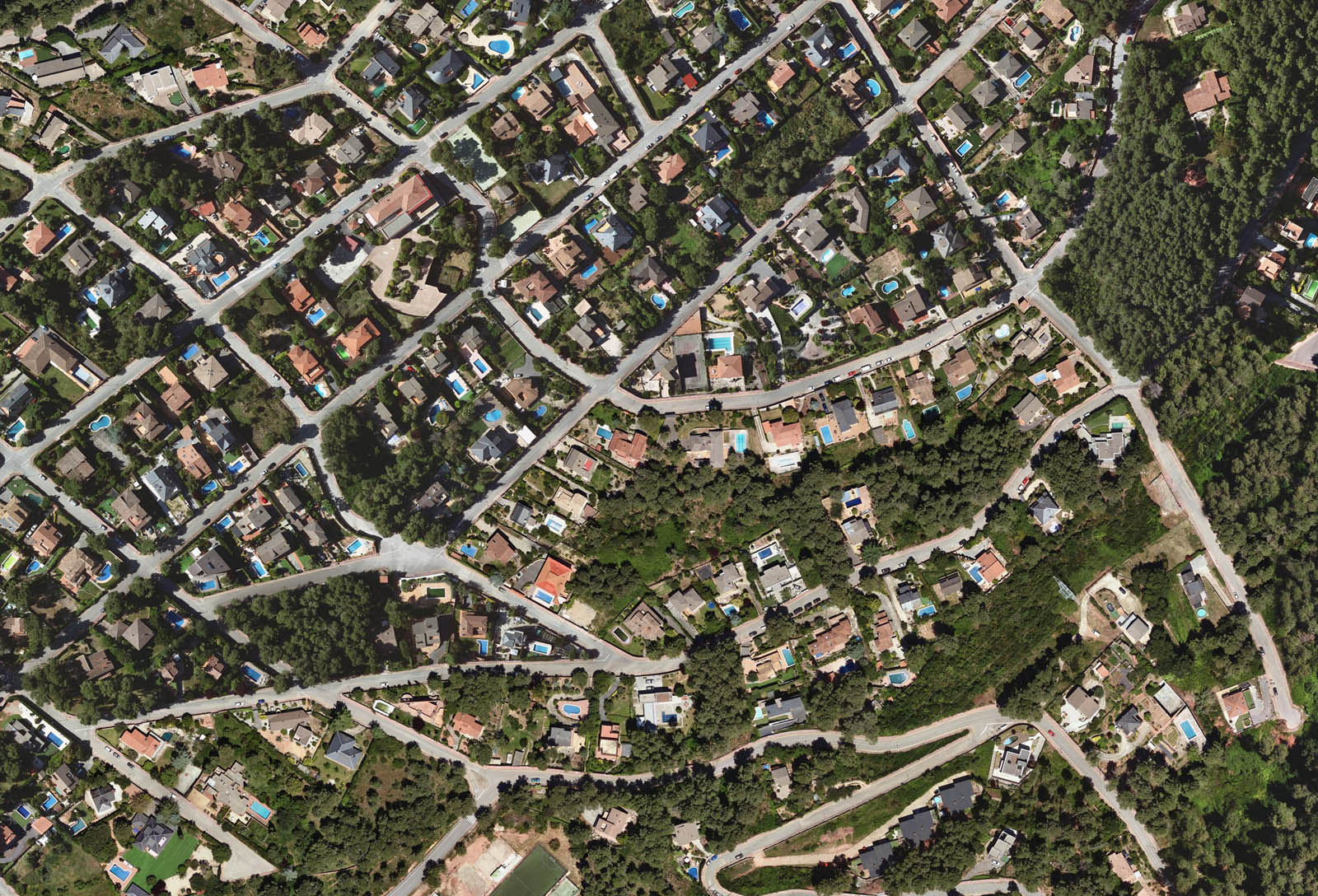
 

Barcelona Metropolitan Area. 'Orthophoto. Dispersed urbanisation in the municipality of Corbera de Llobregat' 2015


Barcelona Metropolitan Area
Orthophoto. Dispersed urbanisation in the municipality of Corbera de Llobregat
2015


Blanca Munt (Spanish, b. 1997) 'Mira-sol alert' 2023


Blanca Munt (Spanish, b. 1997)
Mira-sol alert
2023
Digital printing
Courtesy of the artist


In 2019, photographer Blanca Munt engaged in a neighbourhood chat group created to surveil her own neighbourhood and alert to any potential home burglaries or other suspicious activity. What is initially presented as an effective tool for the neighbours soon becomes a source of speculation, suspicion and paranoia. The seemingly quiet community life in a neighbourhood of well-lit streets and conventional homes founders due to the actual burglaries, but also due to the disintegration of the idea of community when personal security is at stake: mistrust, typically based on suspicious appearance or behaviour, now extends to any neighbours who fail to rigorously conform to the group’s purpose.

With a clean and sober design reminiscent of a real estate or security company brochure, the dispassionate pictures portrayed in Mira-sol Alert intertwine with the mental images stemming from an inflamed rhetoric, which gradually take shape as we learn the self-interested views of the different actors in this landscape – neighbours, suspects, police officers, local authorities – and which appeal strongly to our fears and contradictions. In her own words, Blanca Munt calls for a “reflection on the tension between the privilege of living in a peaceful place and the constant sense of lurking threat encouraged by our current culture of fear.”

Text from the Dalpine website
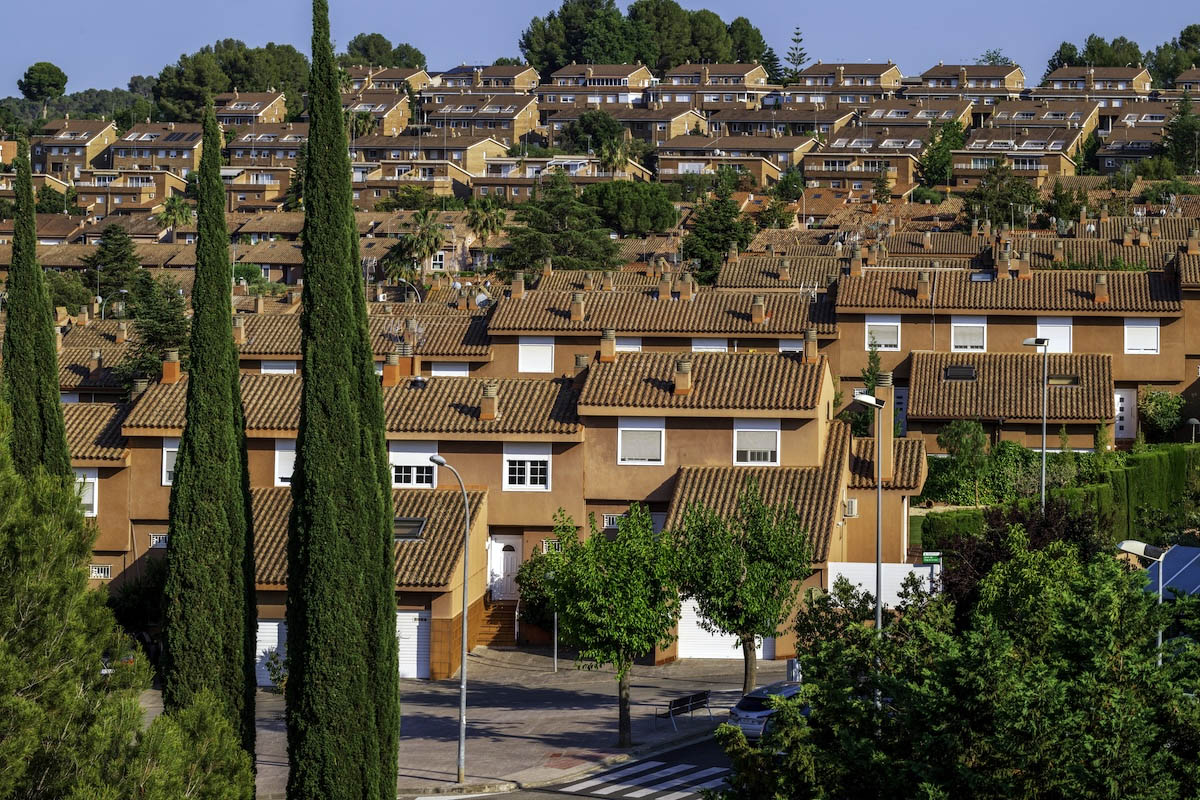
 

Christopher Willan (British lives Spain) 'Sant Quirze del Vallès' 2023


Christopher Willan (British lives Spain)
Sant Quirze del Vallès
2023
Digital printing
Courtesy of the artist
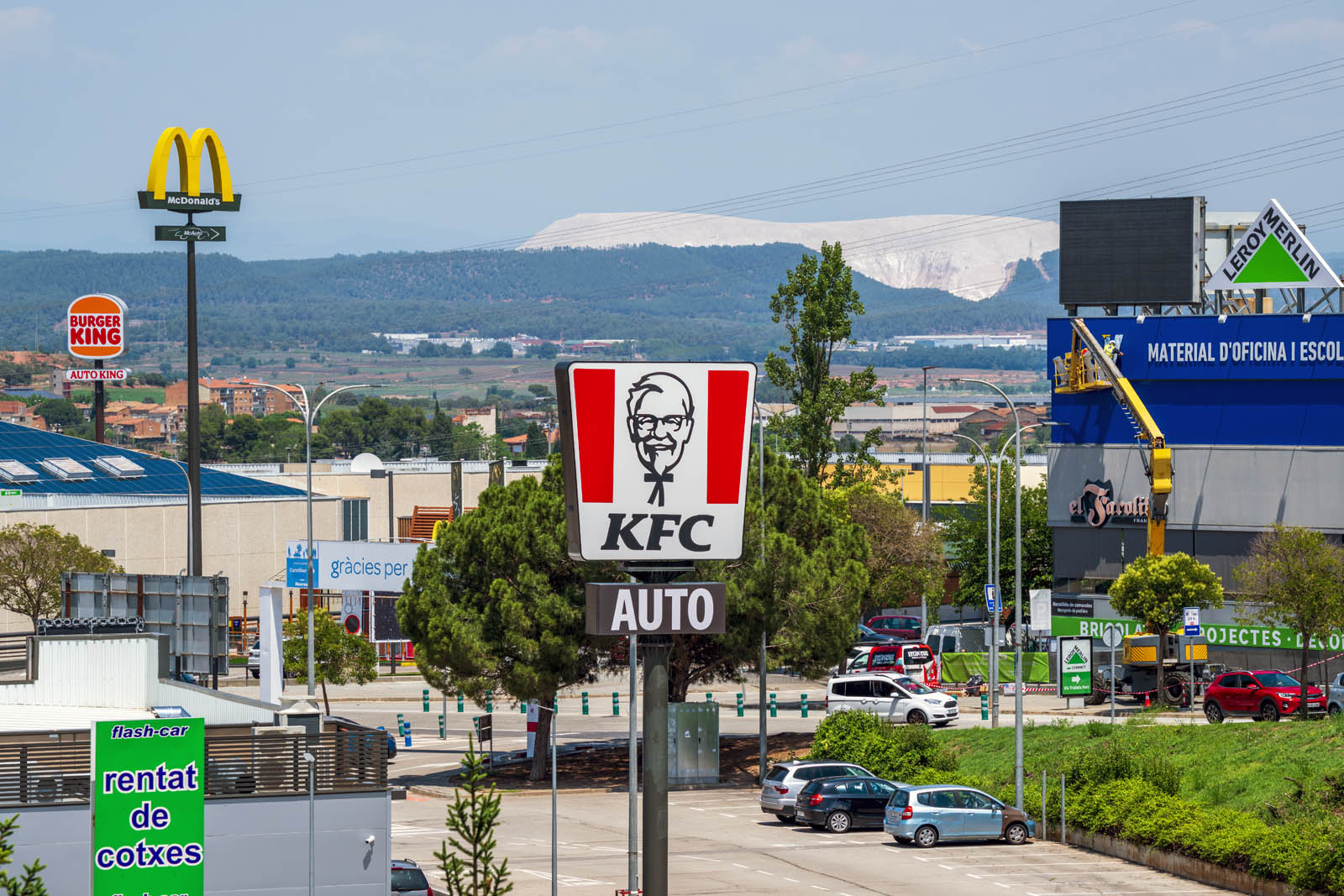
 

Christopher Willan (British lives Spain) 'Els Trullols Park-1' 2023


Christopher Willan (British lives Spain)
Els Trullols Park-1
2023
Digital printing
Courtesy of the artist


The Curators

Philipp Engel: Graduate in Modern Literature from the University of Toulouse, with a thesis on Bret Easton Ellis. After ten years in the music sales and distribution business, he started to work as a cultural journalist, specializing in cinema and literature. He is currently a contributor to various periodicals, such as Cultura(s), El Mundo, Cinemanía, Sofilm and Coolt.

Francesc Muñoz: Lecturer in Urban Geography, director of the Observatory of Urban Planning at the Universitat Autònoma de Barcelona, and professor at the Università IUAV di Venezia. He has received prizes such as the Prize for the Best Doctoral Thesis Attending to Human Values in Engineering (UPC, 2004) and the Bonaplata Award for the exhibition The Light Factory, about the power station in Sant Adrià de Besòs (2014). He has curated shows such as the commemorative exhibition of 30 years of democratic town councils, Local, Local! The City to Come (CCCB, 2010), and the exhibition Architectures on the Waterfront (Fundació Mies van der Rohe, 2019), and was a member of the Cerdà Year Advisory Board (2010).

Press release from the CCCB


Centre de Cultura Contemporània de Barcelona | CCCB
Montalegre, 5 – 08001 Barcelona
Phone: (+34) 933 064 100

Opening hours:
From Tuesday to Sunday and bank holidays 11.00 – 20.00
Closed Monday
Centre de Cultura Contemporània de Barcelona | CCCB website

LIKE ART BLART ON FACEBOOK

Back to top

Exhibition: ‘Autophoto’ at Fondation Cartier pour l’art contemporain, Paris

Exhibition dates: 20th April – 24th September, 2017

Artists: Robert Adams • Eve Arnold • Bernard Asset • Éric Aupol • Theo Baart Et Cary Markerink • Sue Barr • Valérie Belin • Martin Bogren • Nicolas Bouvier • David Bradford • Brassaï • Alain Bublex • Edward Burtynsky • Andrew Bush • Ronni Campana • Gilles Caron • Alejandro Cartagena • Kurt Caviezel • Philippe Chancel • Larry Clark • Langdon Clay • Stéphane Couturier • Bruce Davidson • Jean Depara • Raymond Depardon • John Divola • Robert Doisneau • William Eggleston • Elliott Erwitt • Walker Evans • Barry Feinstein • Pierre De Fenoÿl • Alain Fleischer • Robert Frank • Lee Friedlander • Bernhard Fuchs • Paolo Gasparini • Óscar Fernando Gómez • Jeff Guess • Andreas Gursky • Fernando Gutiérrez • Jacqueline Hassink • Anthony Hernandez • Yasuhiro Ishimoto • Peter Keetman • Seydou Keïta • Germaine Krull • Seiji Kurata • Justine Kurland • Jacques Henri Lartigue • O. Winston Link • Peter Lippmann • Marcos López • Alex Maclean • Ella Maillart • Man Ray • Mary Ellen Mark • Arwed Messmer • Ray K. Metzker • Sylvie Meunier Et Patrick Tourneboeuf • Joel Meyerowitz • Kay Michalak et Sven Völker • Óscar Monzón • Basile Mookherjee • Daido Moriyama • Patrick Nagatani • Arnold Odermatt • Catherine Opie • Trent Parke • Martin Parr • Mateo Pérez • Jean Pigozzi • Bernard Plossu • Matthew Porter • Edward Quinn • Bill Rauhauser • Rosângela Rennó • Luciano Rigolini • Miguel Rio Branco • Ed Ruscha • Sory Sanlé • Hans-christian Schink • Antoine Schnek • Stephen Shore • Malick Sidibé • Guido Sigriste • Raghubir Singh • Melle Smets Et Joost Van Onna • Jules Spinatsch • Dennis Stock • Hiroshi Sugimoto • Juergen Teller • Tendance Floue • Thierry Vernet • Weegee • Henry Wessel • Alain Willaume


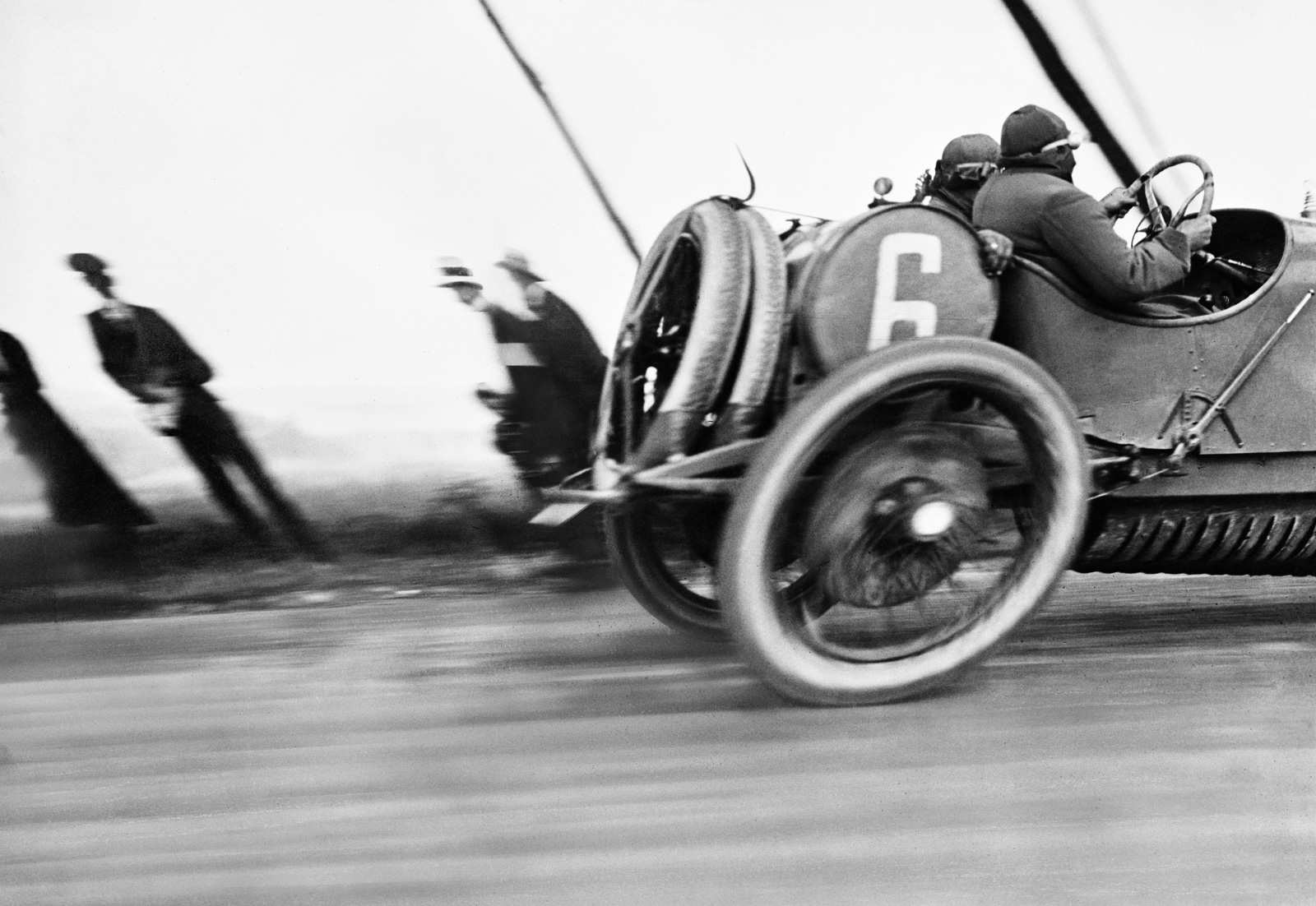
Jacques Henri Lartigue (French, 1894-1986) 'Une Delage au Grand Prix de l’Automobile Club de France, circuit de Dieppe' June 26, 1912 from the exhibition 'Autophoto' at Fondation Cartier pour l'art contemporain, Paris, April - Sept, 2017


Jacques Henri Lartigue (French, 1894-1986)
Une Delage au Grand Prix de l’Automobile Club de France, circuit de Dieppe
June 26, 1912
Gelatin silver print
30 x 40cm
Donation Jacques Henri Lartigue, Charenton-le-Pont Photographie Jacques Henri Lartigue
© Ministère de la Culture – France/AAJHL
Exhibition Autophoto from April 20 to September 24, 2017
Fondation Cartier pour l’art contemporain, Paris


I missed this exhibition when I was in Paris recently. A great pity, I would have liked to have seen it. Some rare photographs that I have never laid eyes on before. I especially love Ray K. Metzker’s Washington, DC. The photography in both Paris and London was disappointing during my month overseas. Other than a large exhibition of Gregory Crewdson’s photographs at the Photographers’ Gallery London, there was not much of interest on offer.

Dr Marcus Bunyan

PS. So many more horizontal photographs than vertical, the automobile obviously lending itself to this orientation. I love this observation: “Photography, a tool of immobility, benefited from the automobile, a mobility tool.” And this from Jean Baudrillard: “Riding is a form spectacular amnesia. Everything to discover, everything to be erased.”


Many thankx to Fondation Cartier pour l’art contemporain for allowing me to publish the photographs in the posting. Please click on the photographs for a larger version of the image.


“Photographing is a profession. Craftsmanship. A job that one learns, that one makes more or less well, like all trades. The photographer is a witness. The witness of his time. The true photographer is the witness of every day, they are the reporter. “


Germaine Krull


“I think that cars today are almost the exact equivalent of the great Gothic cathedrals; I mean the supreme creation of an era, conceived with passion by unknown artists, and consumed in image if not in usage by a whole population which appropriates them as a purely magical object.”


Roland Barthes, Mythologies, Le Seuil, Paris, 1970, p. 150


Thirty years after the exhibition Hommage à Ferrari, the Fondation Cartier pour l’art contemporain will once again focus its attention on the world of cars with the exhibition Autophoto, dedicated to photography’s relationship to the automobile. Since its invention, the automobile has reshaped our landscape, extended our geographic horizons, and radically altered our conception of space and time. The car has also influenced the approach and practice of photographers, providing them not only with a new subject but also a new way of exploring the world and a new means of expression. Based on an idea by Xavier Barral and Philippe Séclier, Autophoto will present over 500 works from the beginning of the 20th century to the present. It will invite us to discover the many facets of automotive culture – aesthetic, social, environmental, and industrial – through the eyes of photographers from around the world. The exhibition will bring together over 90 photographers including both famous and lesser-known figures such as Jacques Henri Lartigue, William Eggleston, Justine Kurland and Jacqueline Hassink, who have shown a fascination for the automobile as a subject or have used it as a tool to take their pictures.


Visite de l’exposition – Autophoto – 2017

Thirty years after the Hommage à Ferrari exhibition which put the spotlight on these legendary cars, the Fondation Cartier pour l’art contemporain presents, on a proposal by Xavier Barral and Philippe Séclier, the Autophoto exhibition devoted to the relationship between photography and the automobile. Since its creation, the automobile has shaped the landscape, allowed the discovery of new horizons and upset our conception of time and space.


Juergen Teller (German, b. 1964) 'OJ Simpson no. 5' Miami 2000 from the exhibition 'Autophoto' at Fondation Cartier pour l'art contemporain, Paris, April - Sept, 2017


Juergen Teller (German, b. 1964)
OJ Simpson no. 5
Miami 2000
Giclee print
51 x 61cm
Collection of the artist
© Juergen Teller, 2017


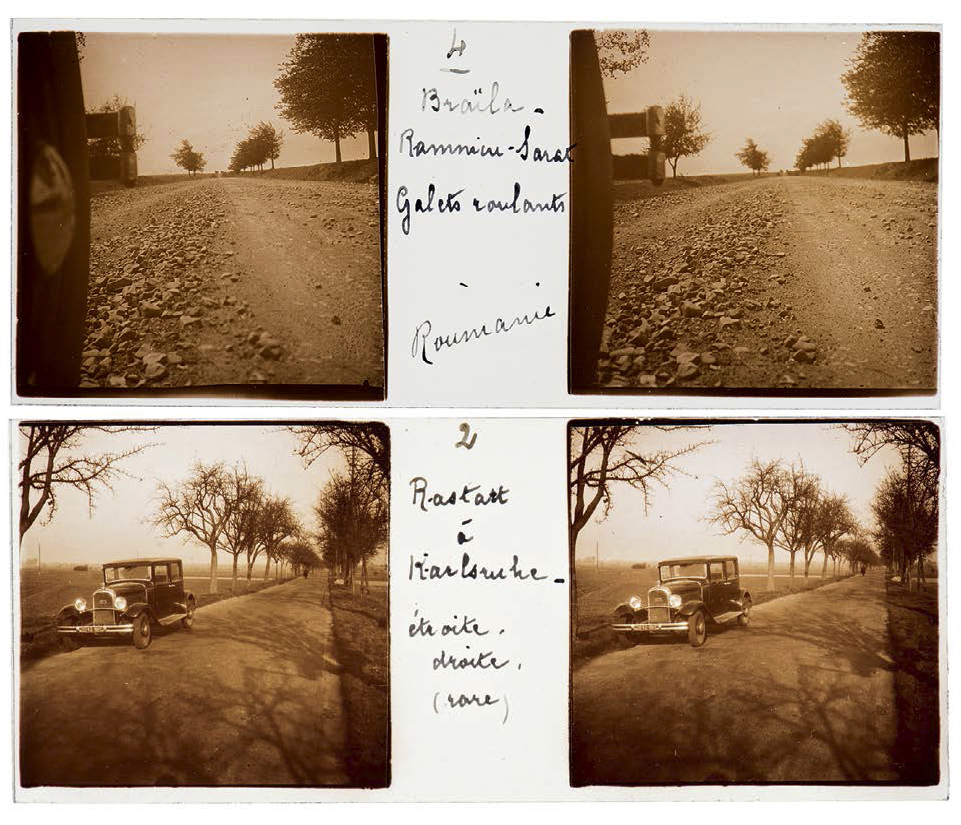
'Relevé photographique des voies de circulation mondiales réalisé par Michelin' c. 1930


Relevé photographique des voies de circulation mondiales réalisé par Michelin
c. 1930
Collection Michelin, Clermont-Ferrand
© Michelin


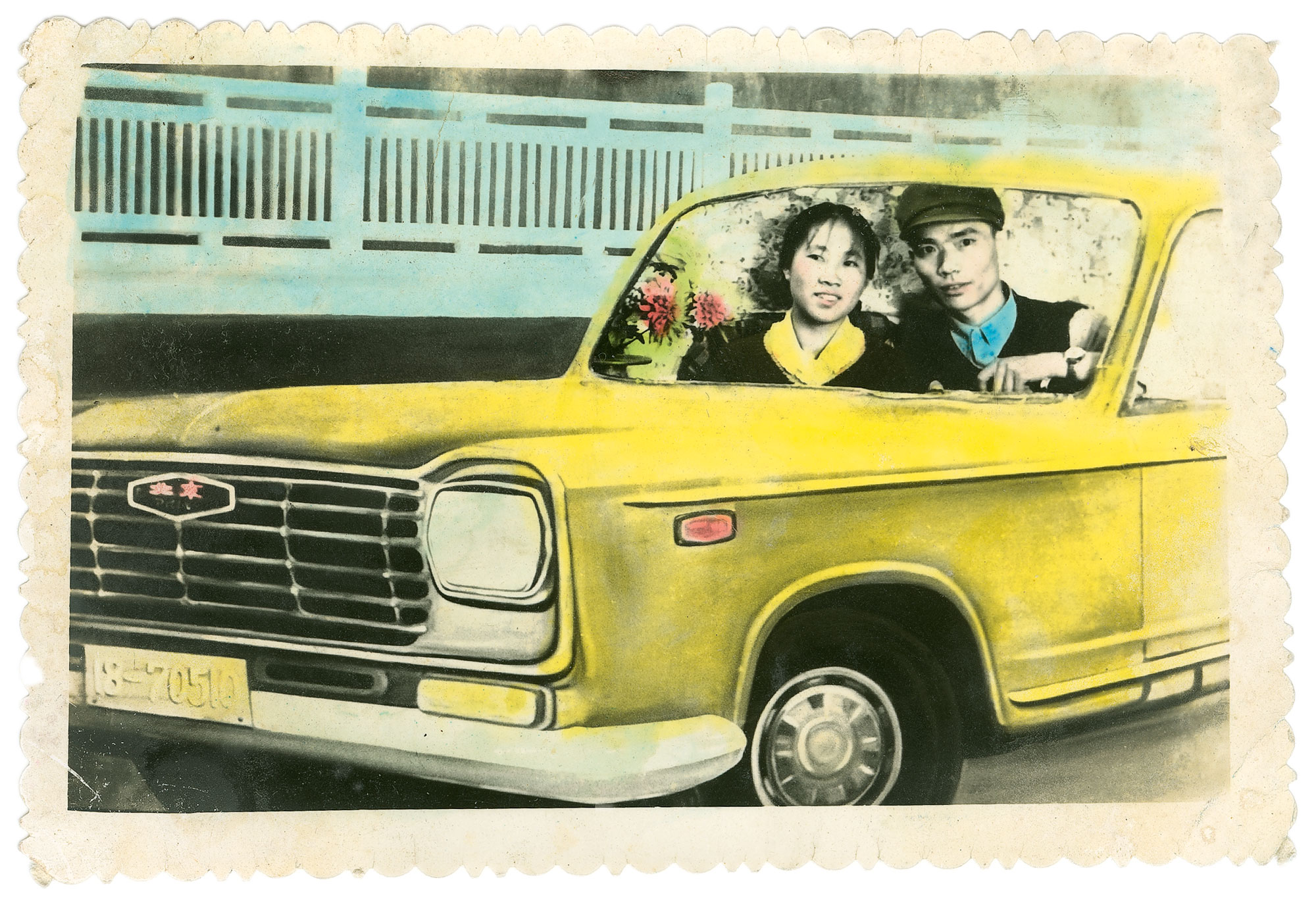
Studio portraits, 'China' c. 1950, collected by Thomas Sauvin


Studio portraits
China
c. 1950
Collected by Thomas Sauvin
Colourised gelatin silver print
7.5 x 11.5cm
Collection Beijing Silvermine/Thomas Sauvin, Paris Photo all rights reserved


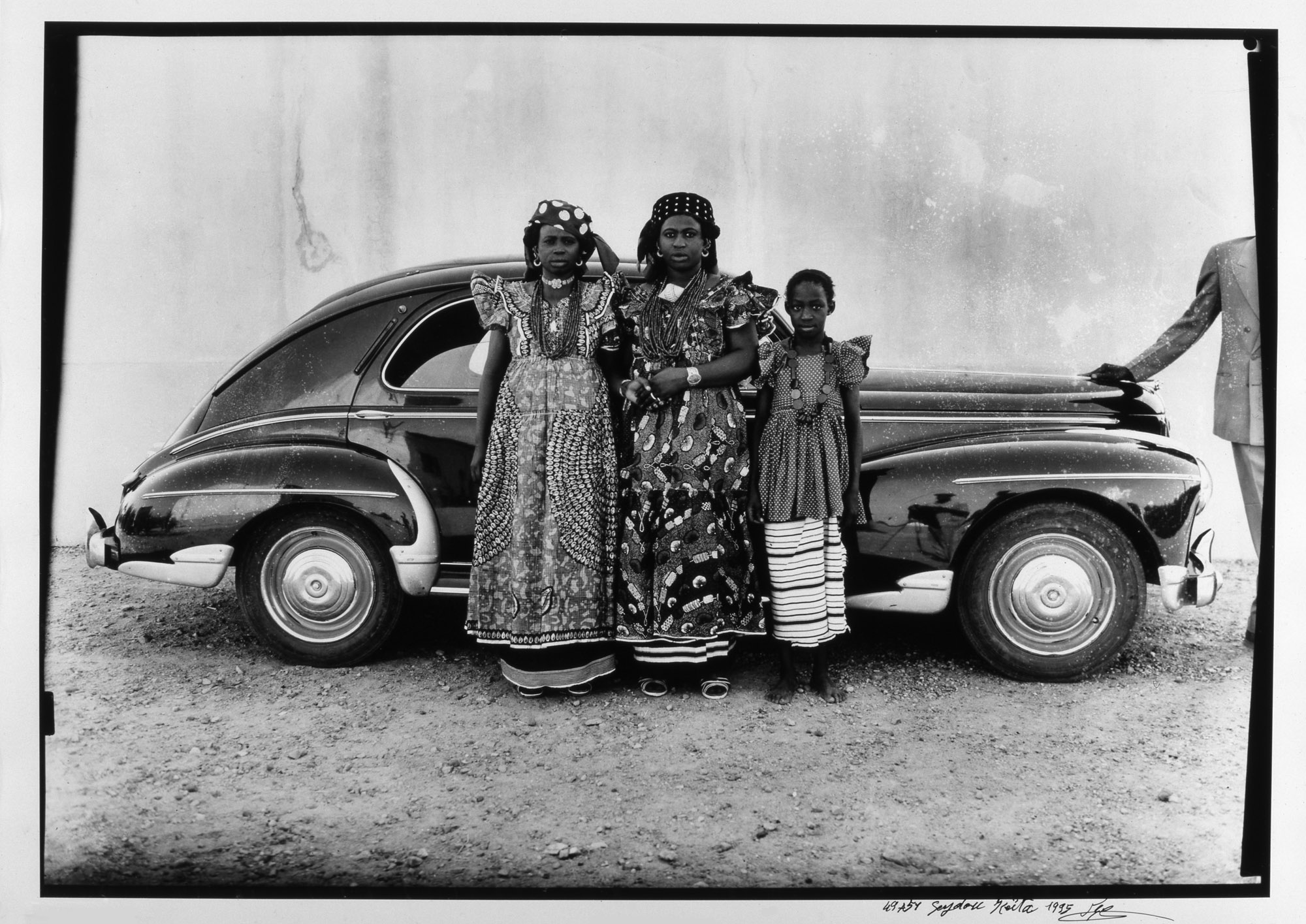
Seydou Keïta (Malian, 1921-2001) 'Untitled' 1952–1955 from the exhibition 'Autophoto' at Fondation Cartier pour l'art contemporain, Paris, April - Sept, 2017


Seydou Keïta (Malian, 1921-2001)
Untitled
1952-1955
Gelatin silver print
50 × 60cm
CAAC – The Pigozzi Collection, Geneva
© SKPEAC (The Seydou Keïta Photography Estate Advisor Corporation)


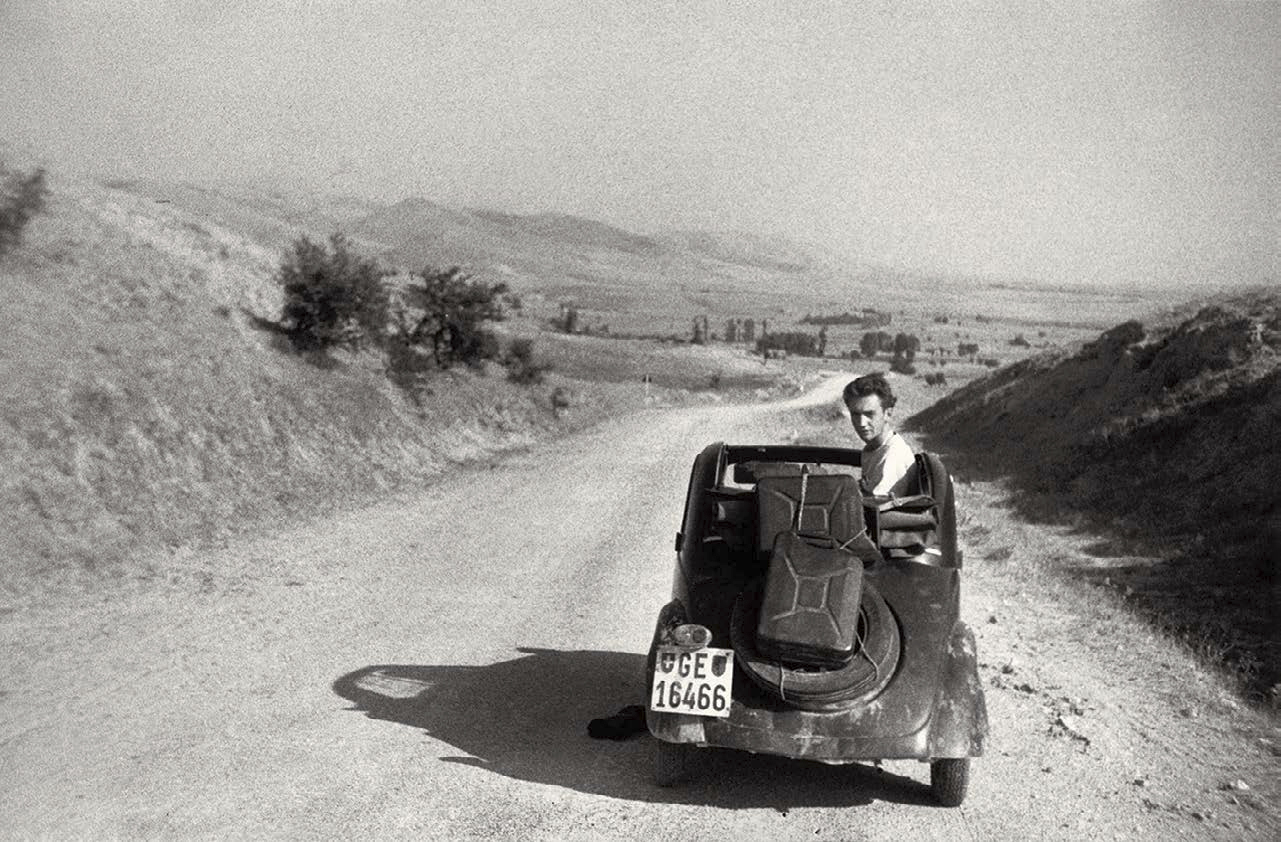
Nicolas Bouvier (Swiss, 1929-1998) 'Entre Prilep et Istanbul, Turquie' 1953


Nicolas Bouvier (Swiss, 1929-1998)
Entre Prilep et Istanbul, Turquie
1953
Musée de l’Élysée, Lausanne
© Fonds Nicolas Bouvier / Musée de l’Élysée, Lausanne


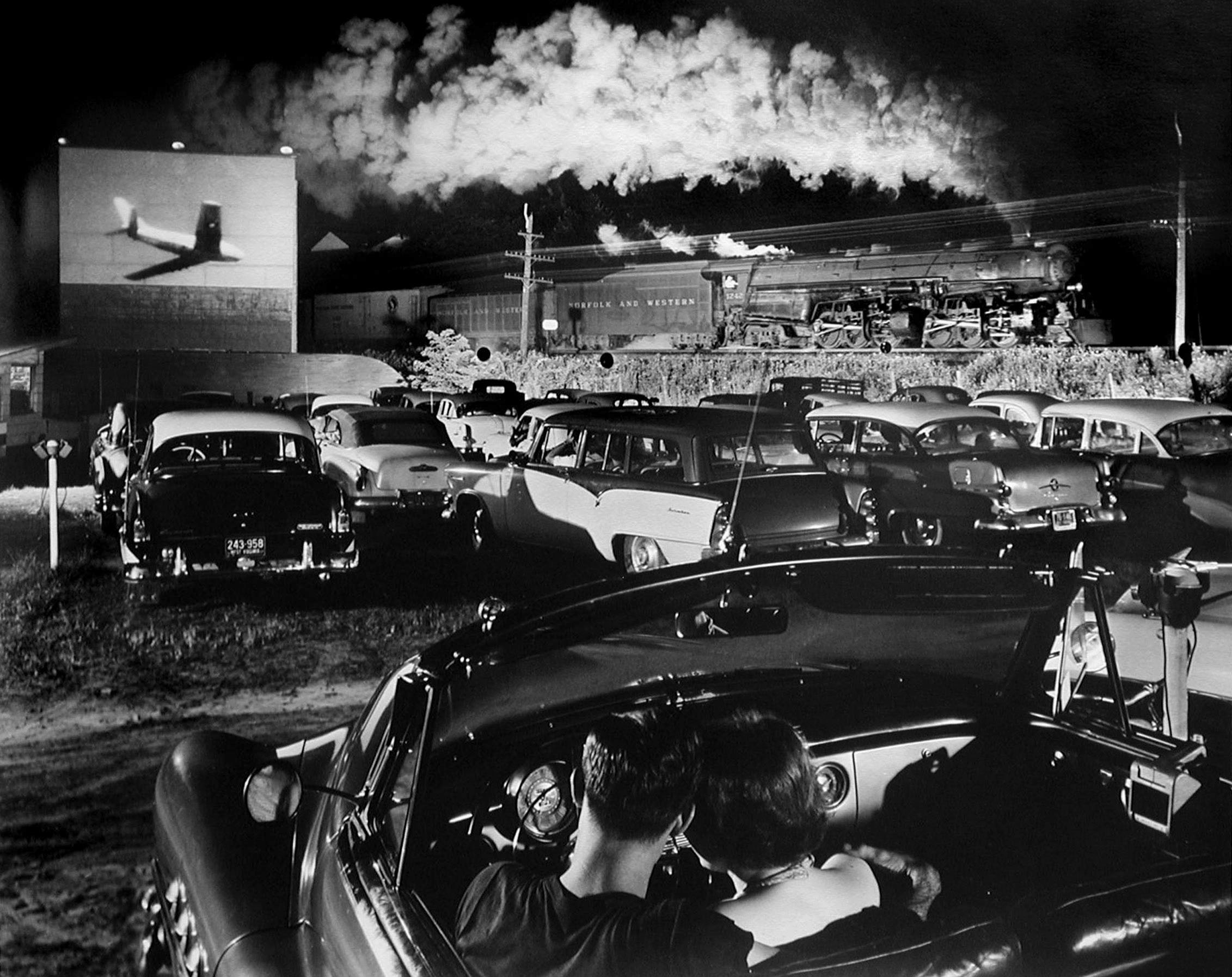
O. Winston Link (American, 1914-2001) 'Hot Shot Eastbound' 1956


O. Winston Link (American, 1914-2001)
Hot Shot Eastbound
1956
Collection Mathé Perrin, Bruxelles
© O. Winston Link


Ray K. Metzker (American, 1931-2014) 'Washington, DC' 1964


Ray K. Metzker (American, 1931-2014)
Washington, DC
1964
Gelatin silver print
20 × 25.5cm
Courtesy Les Douches la Galerie, Paris/Laurence Miller Gallery, New York
© Estate Ray K. Metzker, courtesy Les Douches la Galerie, Paris/Laurence Miller Gallery, New York


Bernard Plossu (French, b. 1945) 'Sur la route d'Acapulco, Mexique' 1966


Bernard Plossu (French, b. 1945)
Sur la route d’Acapulco, Mexique
1966
From Le Voyage mexicain series
Gelatin silver print
18 × 27cm
Courtesy of the artist/Galerie Camera Obscura, Paris
© Bernard Plossu


Bernard Plossu (French, b. 1945) 'Chiapas, Mexique' 1966


Bernard Plossu (French, b. 1945)
Chiapas, Mexique
1966
From Le Voyage mexicain series
Gelatin silver print
18 × 27cm
Courtesy of the artist/Galerie Camera Obscura, Paris
© Bernard Plossu


“A panorama framed by the rectangle of the windshield. A long ribbon of asphalt, a line of flight that stretches towards the horizon. For more than a century, we can capture this image and travel the world by car, this photographic “box”. Automotive and photography, two tools to model the landscape, two mechanics of the traction and attraction, have emerged at the end of the nineteenth century, through new rhythms and new rites, the society of modern times. If the photograph allows multiple views and list them, to memorise the movement and leave a trace, the automobile makes it possible to move in space. Photography, a tool of immobility, benefited from the automobile, a mobility tool. And if the automobile like photography is constantly evolving, these two inventions have parallel paths in order to better, to master space-time. “Riding is a form spectacular amnesia. Everything to discover, everything to be erased,”1 writes Jean Baudrillard.”

From the foreword by commissioners of the exhibition Xavier Barral and Philippe Séclier

1/ Jean Baudrillard, Amérique, Grasset, Paris, 1986, p. 15


Henry Wessel (American, 1942-2018) 'Pennsylvania' 1968


Henry Wessel (American, 1942-2018)
Pennsylvania
1968
Courtesy Galerie Thomas Zander, Cologne
© Henry Wessel, courtesy Galerie Thomas Zander, Cologne.


William Eggleston (American, b. 1939) 'Los Alamos' series 1965-1968


William Eggleston (American, b. 1939)
Los Alamos series
1965-1968
Dye-transfer print
40.5 × 50.5cm
Eggleston Artistic Trust, courtesy David Zwirner, New York/London
© Eggleston Artistic Trust. Courtesy David Zwirner, New York/London


Henry Wessel (American, 1942-2018) 'Los Alamos' series c. 1974


Henry Wessel (American, 1942-2018)
Los Alamos series
c. 1974
Inkjet print
56 × 73.5cm
Eggleston Artistic Trust, Memphis
© Eggleston Artistic Trust, Memphis


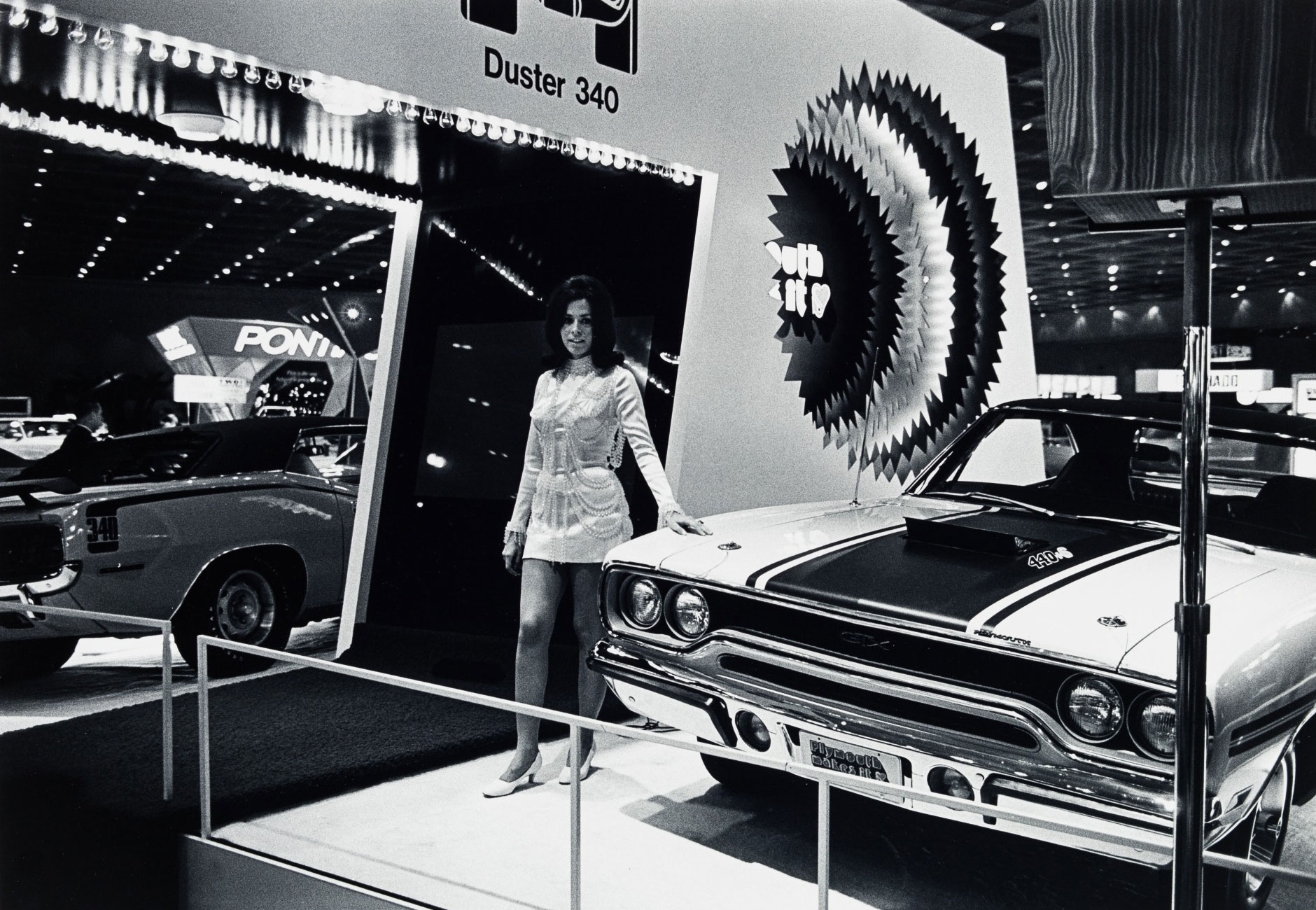
Bill Rauhauser (American, 1918-2017) 'Detroit Auto Show' series c. 1975


Bill Rauhauser (American, 1918-2017)
Detroit Auto Show series
c. 1975
Detroit Institute of Arts, don de l’artiste en mémoire de Doris Rauhauser
© 2007 Rauhauser Photographic Trust. All Rights Reserved


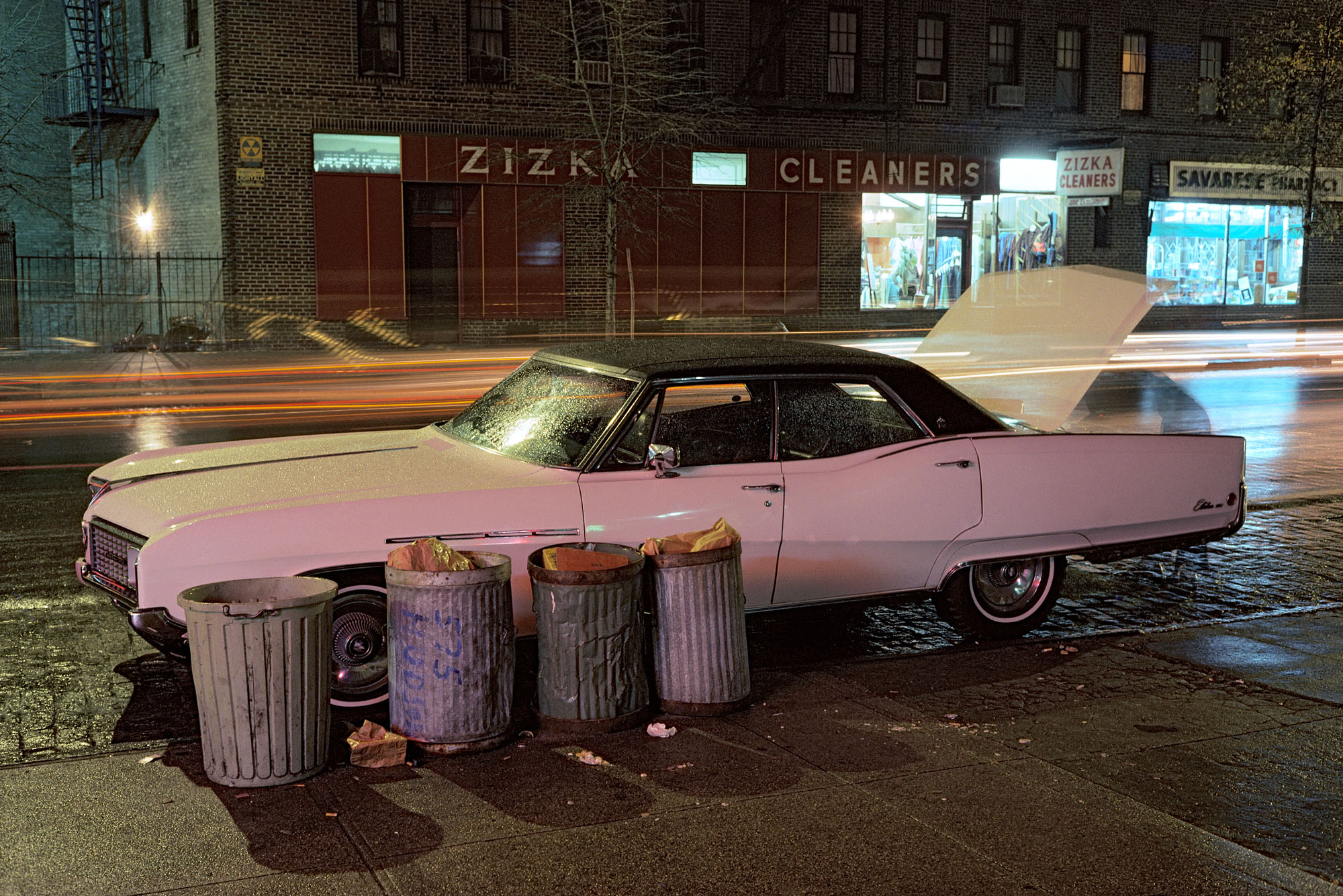
Langdon Clay (American, b. 1949) 'Zizka Cleaners car, Buick Electra' 1976


Langdon Clay (American, b. 1949)
Zizka Cleaners car, Buick Electra
Series Cars, New York City, 1976
Slide-show
Courtesy of the artist
© Langdon Clay


Joel Meyerowitz (American, b. 1938) 'Upstate New York' 1977


Joel Meyerowitz (American, b. 1938)
Upstate New York
1977
Collection Joel Meyerowitz Photography, New York
© Joel Meyerowitz, courtesy Polka Galerie, Paris


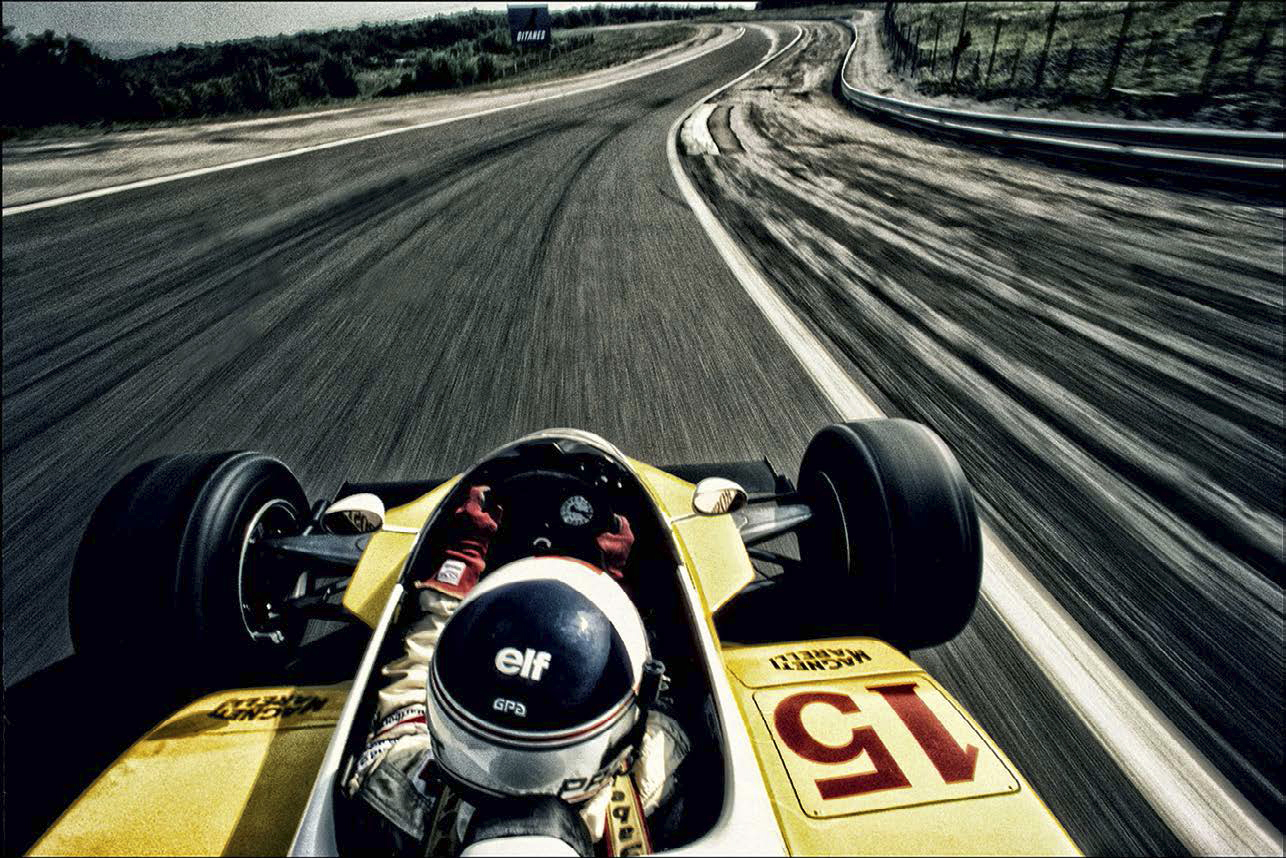
Bernard Asset (French, b. 1955) 'Passager d'Alain Prost (Alain Prost au volant d’une Renault RE30B, tests F1 sur le circuit Dijon-Prenois)' 1982


Bernard Asset (French, b. 1955)
Passager d’Alain Prost (Alain Prost au volant d’une Renault RE30B, tests F1 sur le circuit Dijon-Prenois)
1982
Collection de l’artiste
© Bernard Asset


David Bradford (American, b. 1951) 'Coaster Ride Stealth' 1994


David Bradford (American, b. 1951)
Coaster Ride Stealth
1994
From Drive-By Shootings series
C-print
28 × 35.5cm
Courtesy of the artist
© David Bradford


Andrew Bush (American, b. 1956) 'Woman Waiting to Proceed South at Sunset and Highland Boulevards, Los Angeles, at Approximately 11:59 a.m. One Day in February 1997' 1997


Andrew Bush (American, b. 1956)
Woman Waiting to Proceed South at Sunset and Highland Boulevards, Los Angeles, at Approximately 11:59 a.m. One Day in February 1997
1997
From Vector Portraits series
C-print
122 × 151cm
Courtesy M+B Gallery, Los Angeles
© Andrew Bush


Rosângela Rennó (Brazilian, b. 1962) 'Cerimônia do Adeus' series,1997-2003


Rosângela Rennó (Brazilian, b. 1962)
Cerimônia do Adeus series
1997-2003
C-print face-mounted on Plexiglas
50 × 68 cm
Courtesy of the artist/Cristina Guerra Contemporary Art, Lisbon
© Rosângela Rennó


Valérie Belin (French, b. 1964) 'Untitled' 2002


Valérie Belin (French, b. 1964)
Untitled
2002
Gelatin silver print
61 x 71.5cm (framed)
Courtesy of the artist/Galerie Nathalie Obadia, Paris/Brussels
© Valérie Belin/ADAGP, Paris 2017


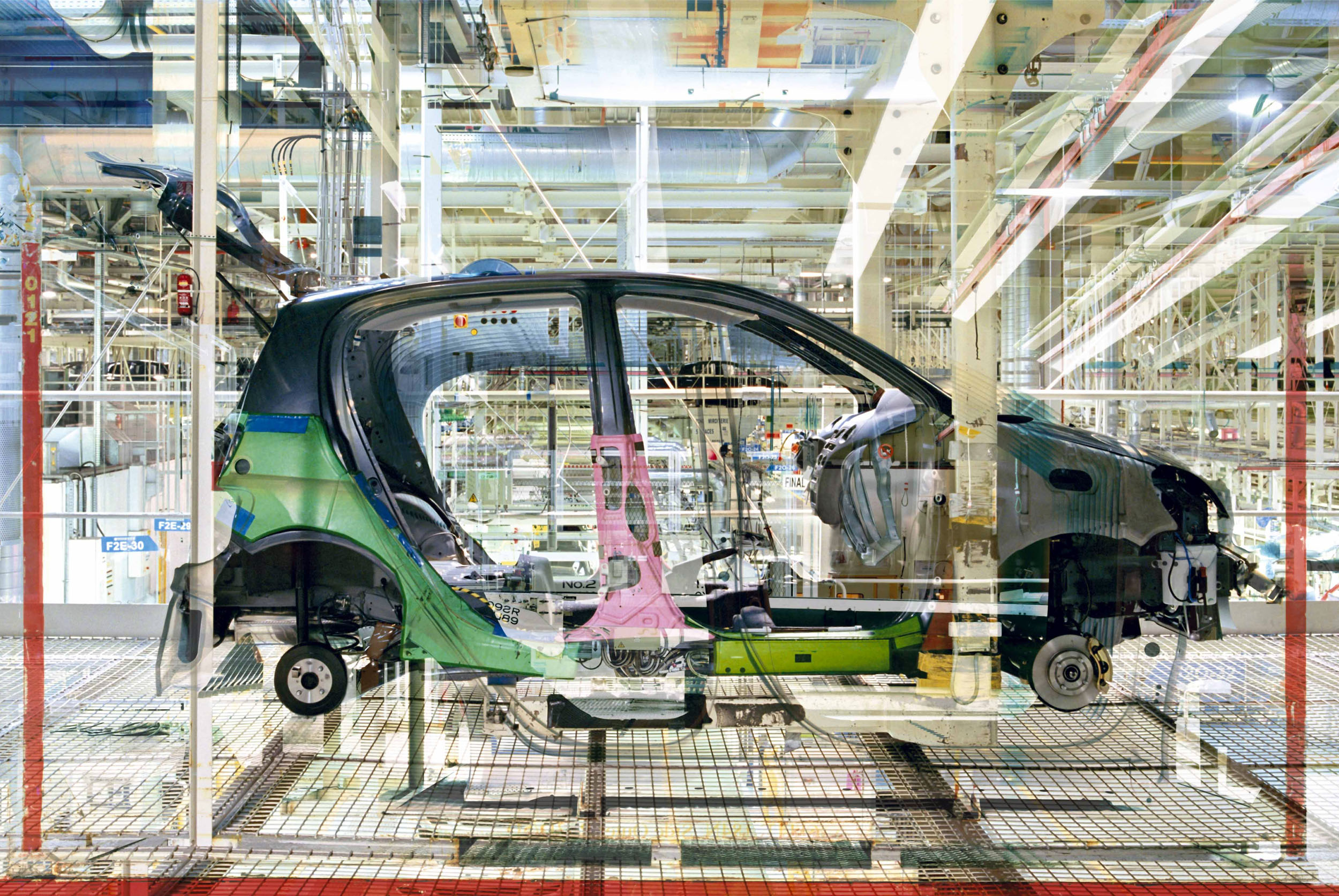
Stéphane Couturier (French, b. 1957) 'MELT, Toyota No 8' 2005


Stéphane Couturier (French, b. 1957)
MELT, Toyota No. 8
2005
From Melting Point, Usine Toyota, Valenciennes series
C-print
92 × 137cm
Collection of the artist
Courtesy La Galerie Particulière, Paris/Brussels
© Stéphane Couturier


Óscar Fernando Gómez (Mexican, b. 1970) 'Windows' series, 2009

Óscar Fernando Gómez (Mexican, b. 1970) 'Windows' series, 2009

Óscar Fernando Gómez (Mexican, b. 1970) 'Windows' series, 2009

Óscar Fernando Gómez (Mexican, b. 1970) 'Windows' series, 2009

Óscar Fernando Gómez (Mexican, b. 1970) 'Windows' series, 2009


Óscar Fernando Gómez (Mexican, b. 1970)
Windows series
2009
Slide show
Courtesy Martin Parr Studio, Bristol
© Óscar Fernando Gómez


Alain Willaume (French, b. 1956) '#5069' 2012


Alain Willaume (French, b. 1956)
#5069
2012
From the Échos de la poussière et de la fracturation series
Collection de l’artiste
© Alain Willaume (Tendance Floue)


Peter Lippmann (American works Paris, b. 1956) 'Citroën Traction 7' 2012


Peter Lippmann (American works Paris, b. 1956)
Citroën Traction 7
2012
From the Paradise Parking series
C-print
75 × 100cm
Collection of the artist
© Peter Lippmann


Justine Kurland (American, b. 1969) '280 Coup' 2012


Justine Kurland (American, b. 1969)
280 Coup
2012
Inkjet Print
47 x 61cm
Courtesy of the artist/Mitchell-Innes & Nash, New York
© Justine Kurland


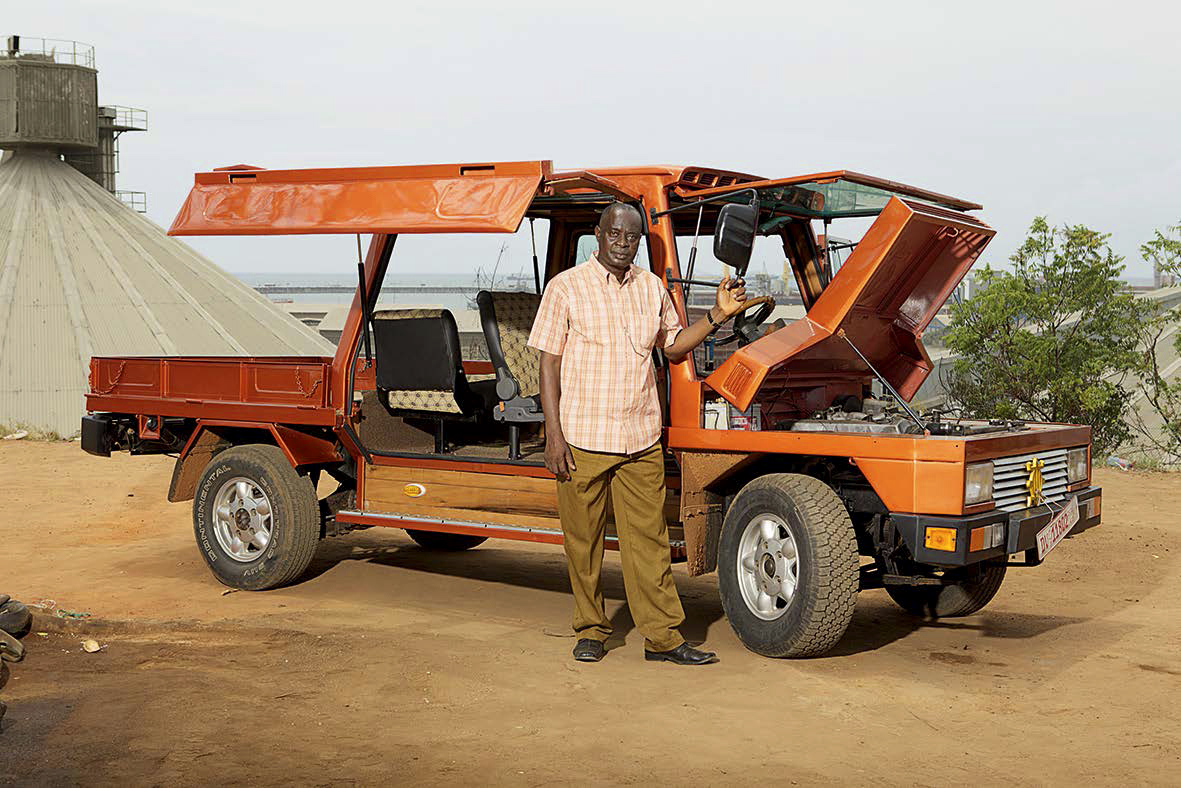
Melle Smets and Joost Van Onna. 'Turtle 1. Building a Car in Africa' 2016


Melle Smets and Joost Van Onna
Turtle 1. Building a Car in Africa
2016
Courtesy des artistes / Paradox, Edam
© Melle Smets et Joost Van Onna


Luciano Rigolini (Swiss, b. 1950) 'Tribute to Giorgio de Chirico' 2017


Luciano Rigolini (Swiss, b. 1950)
Tribute to Giorgio de Chirico
2017
Duratrans in lightbox
124 x 154cm
Collection of the artist
© Luciano Rigolini (appropriation – unknown photographer, 1958)


First Visions: A New Subject for Photography

In the early 20th century, the automobile and its impact on the landscape had already become a subject of predilection for many photographers, influencing both the form and content of their work. The exhibition will begin by focusing on early photographers like Jacques Henri Lartigue, Germaine Krull, and Brassaï, who used the automobile to varying degrees in their work. They registered the thrill of speed, the chaos of Parisian traffic or the city’s dramatic car-illuminated nocturnal landscape to represent a society in transition at the birth of the modern age. Other photographers of the time were attracted by the promise of freedom and mobility offered by the automobile. Anticipating the modern road trip, Swiss writers and photographers Ella Maillart and Nicolas Bouvier, travelled throughout Asia in the 1930s and 1950s respectively, using their cars and cameras to record their adventures along the way.

Auto Portraits

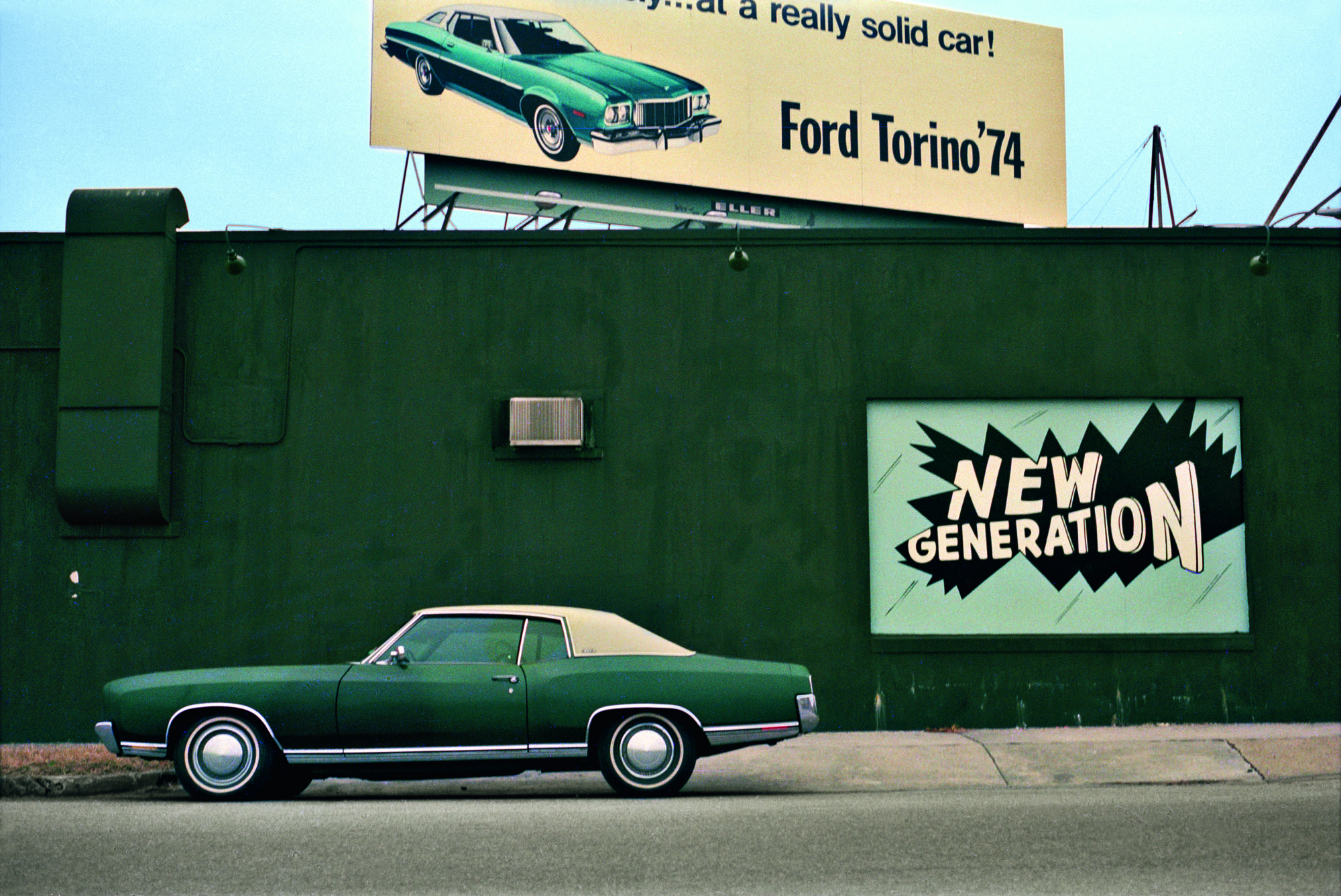
The exhibition will also present a series of “auto portraits”* made by a variety of photographers from the mi-twentieth century to the present. Yashuhiro Ishimoto and Langdon Clay’s photographs, for example, are portraits in profile of cars parked on sparsely inhabited city streets, that immerse the viewer in a different eras and atmospheres. Ishimoto’s black and white photographs, taken in Chicago in the 1950s, emphasise their polished, curved silhouettes in a distanced and serial manner, while Langdon Clay’s colour pictures taken in New York in the 1970s, show their decaying and dented chassis in an eerie nocturnal light. Other works in this section, such as the found photographs of Sylvie Meunier and Patrick Tourneboeuf’s American Dream series, or the flamboyant portraits of African photographers Seydou Keïta and Sory Sanlé, focus on the role of the automobile as a emblem of social mobility showing proud owners posing with their cars.

*A play on words in French: auto portrait meaning self-portrait.

The Car as a Medium: New Perspectives on the Landscape

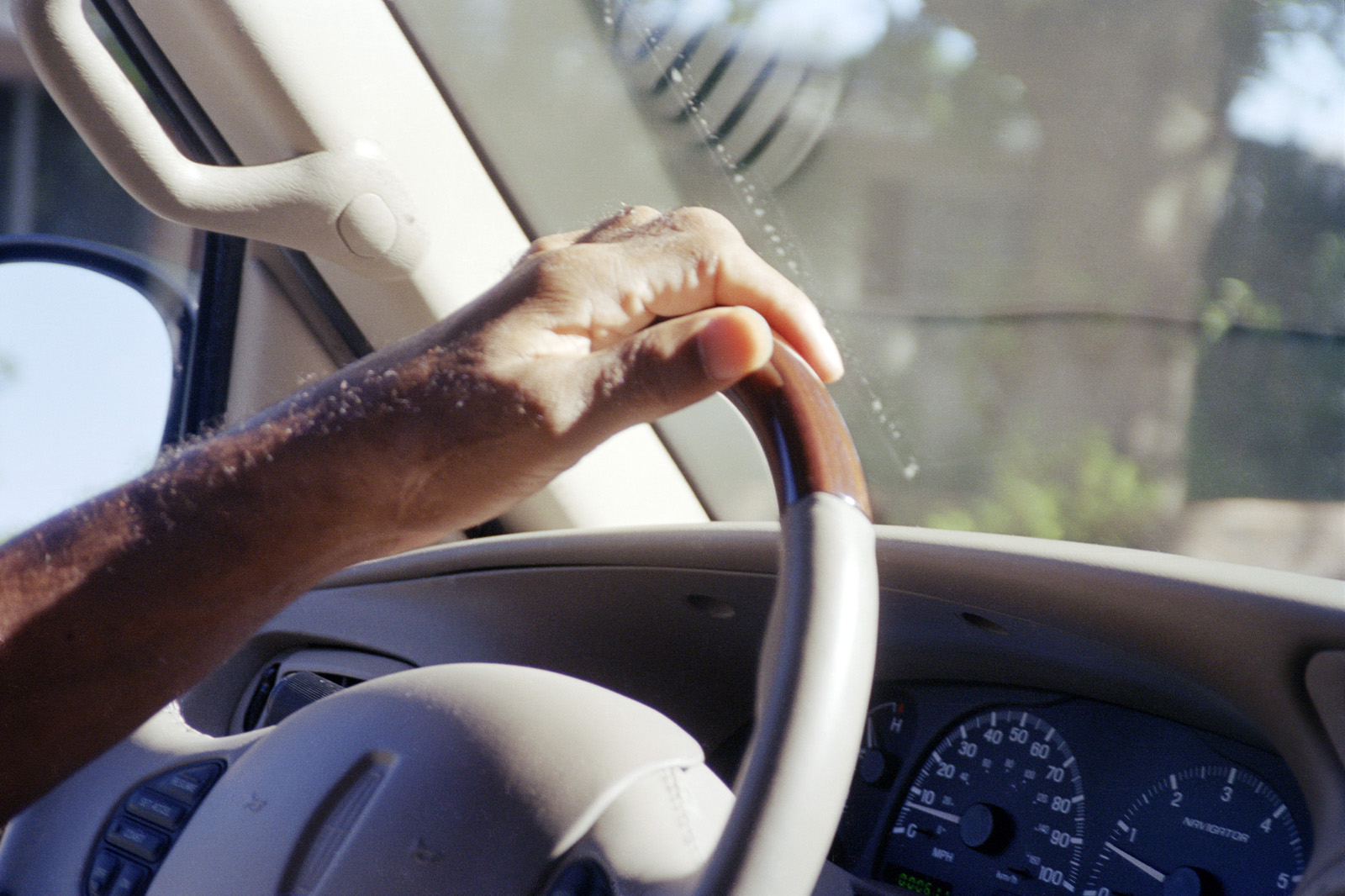
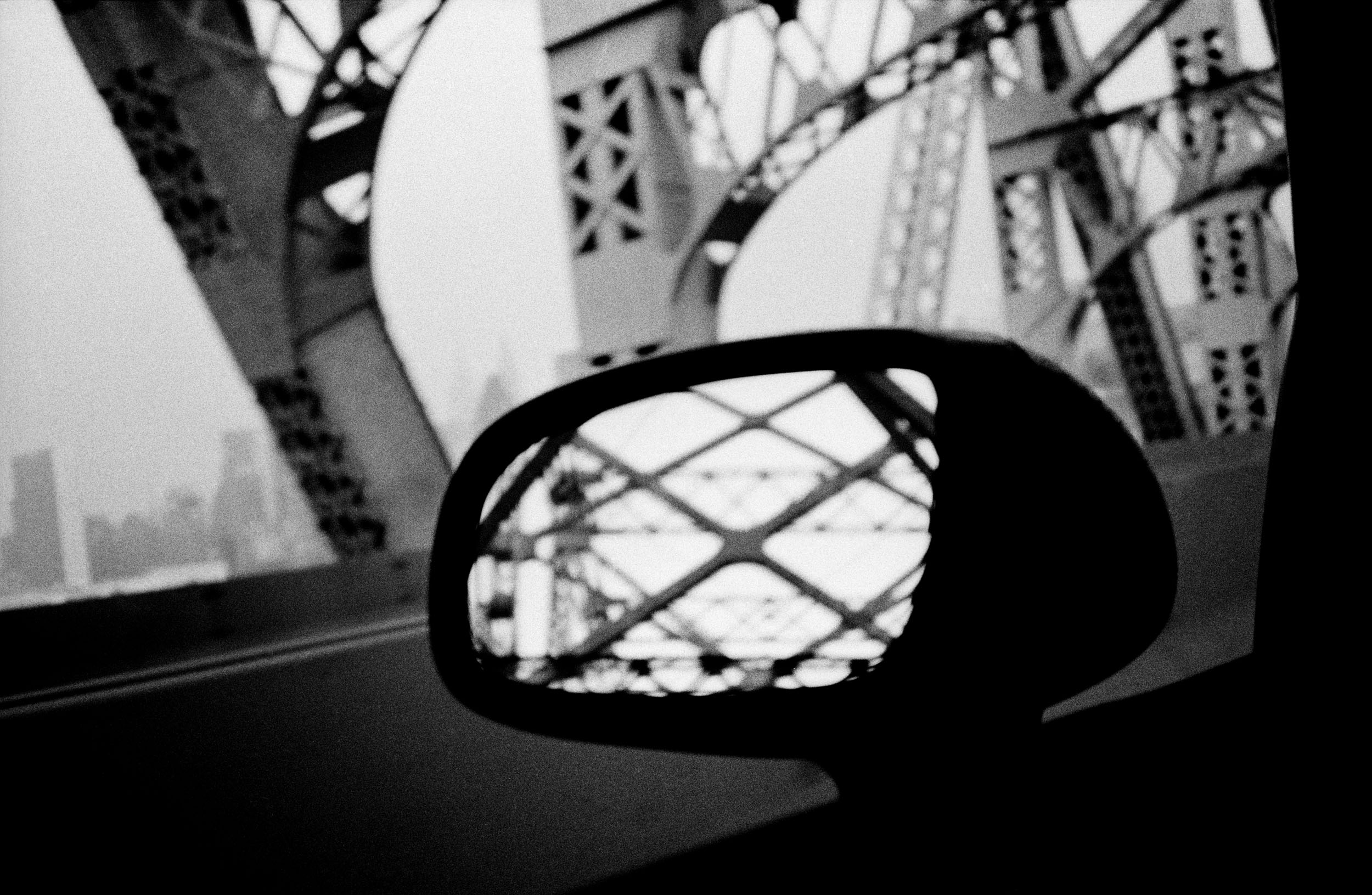
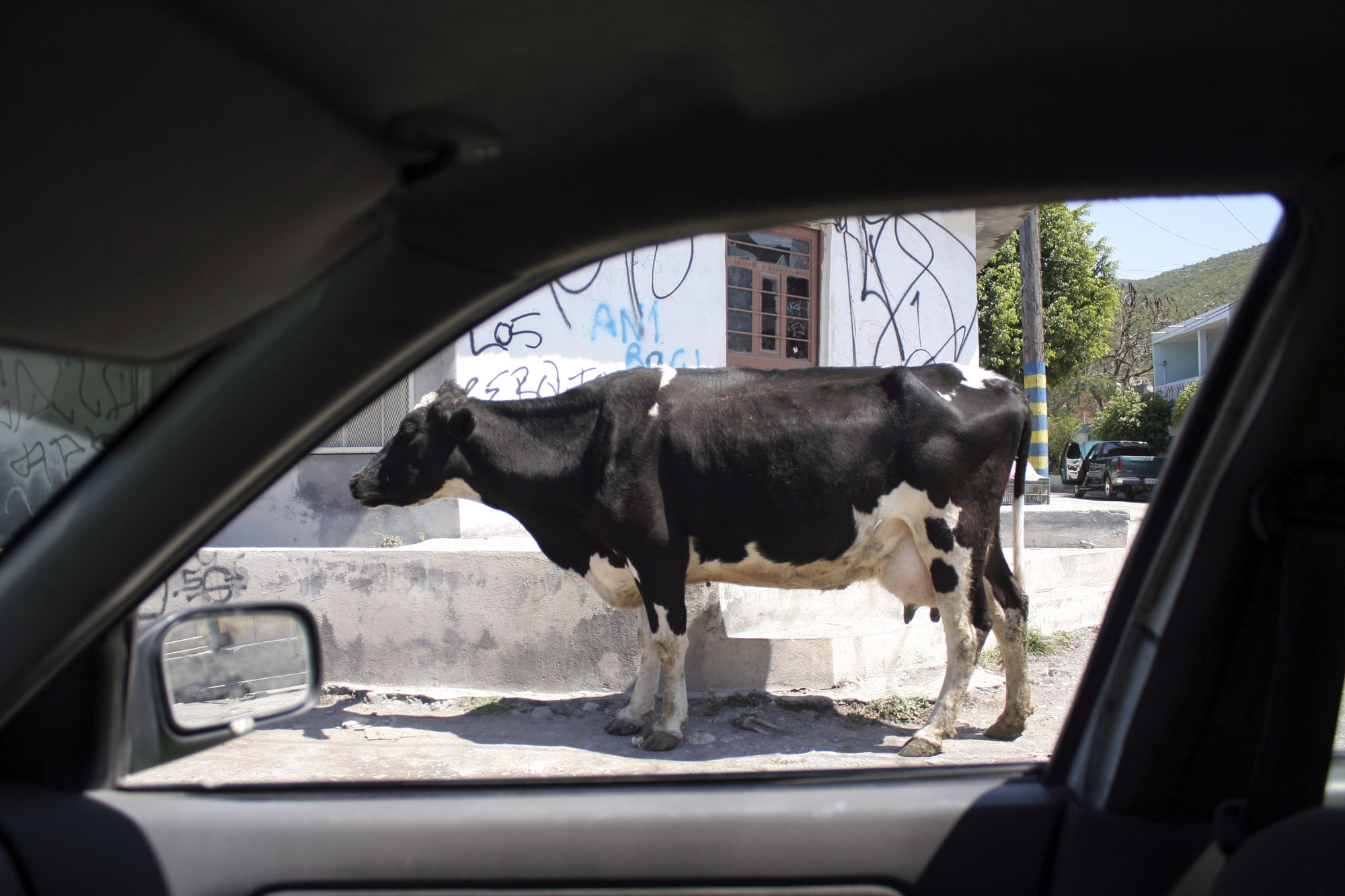
Many photographers have exploited the technical and aesthetic possibilities offered by the automobile, using it like a camera to capture the surrounding landscape through car windows or the reflections in rear-view mirrors.

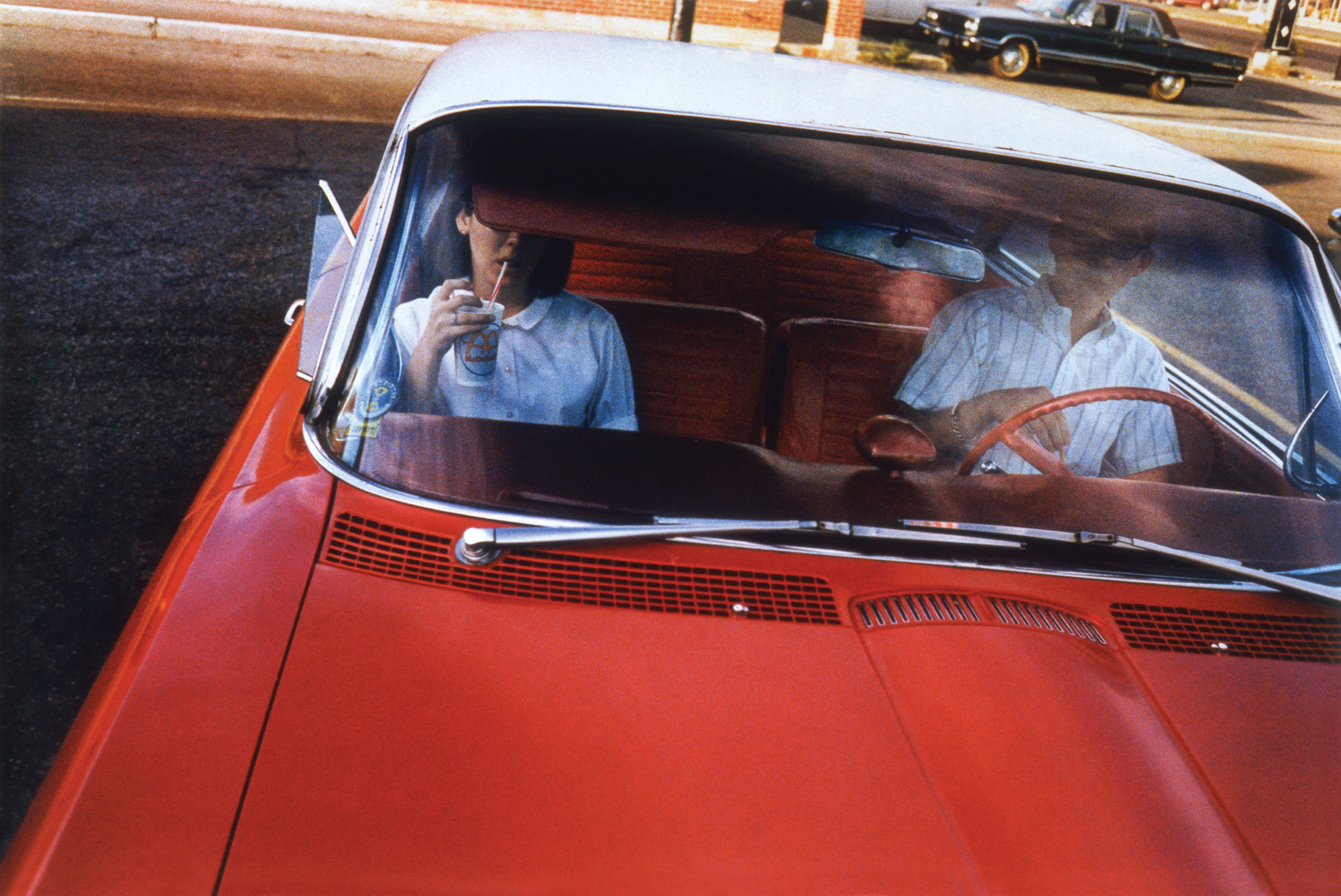
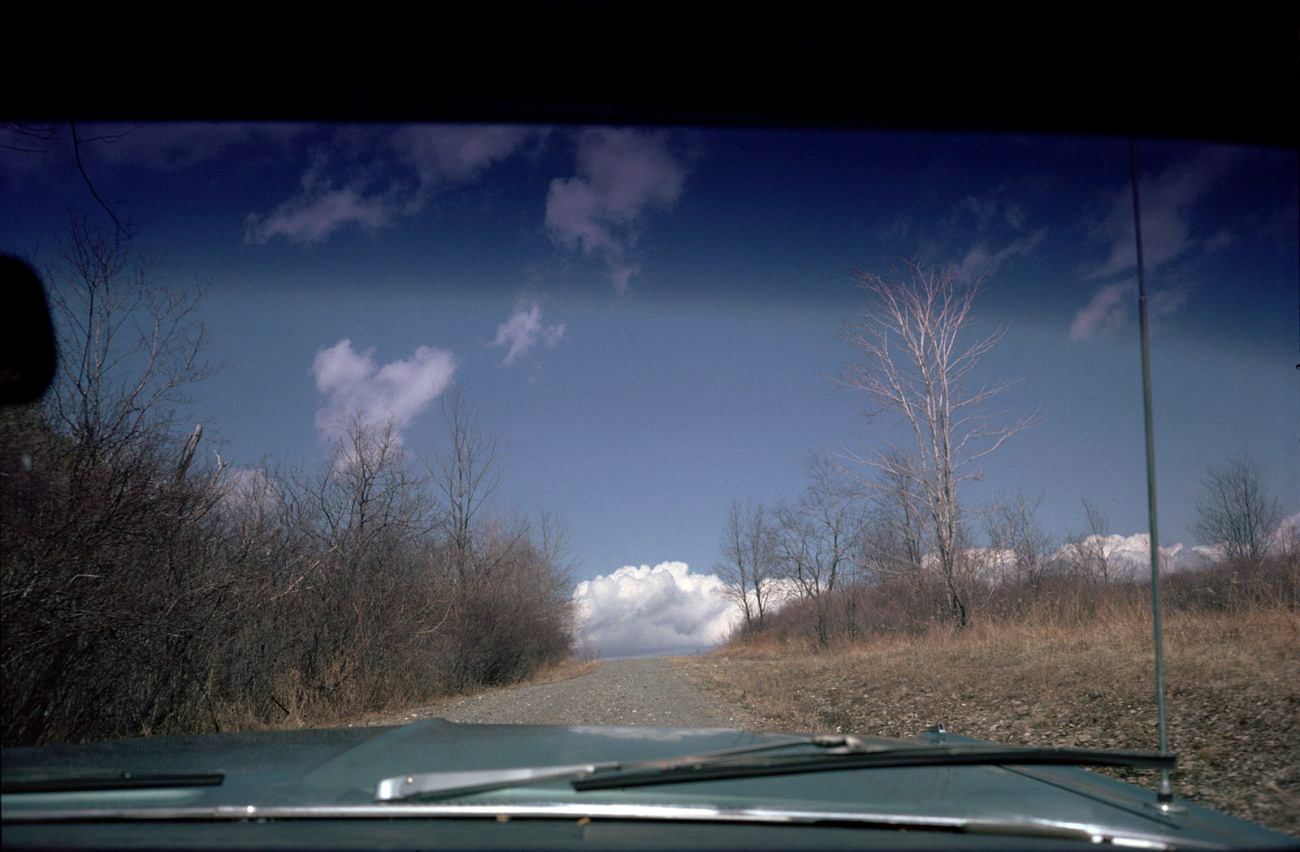
Cars have determined the framing and composition as well as the serial nature of the photographs of Joel Meyerowitz, Daido Moriyama, John Divola and David Bradford who have all worked from moving cars. From behind their windshields, these photographers capture an amusing store sign, a white car behind a wire fence, a dog running along a dusty road, a highway stretching out into the horizon. Other photographers, including Sue Barr, Robert Adams, Ed Ruscha, and Alex MacLean scrutinise our car-altered environment. Their landscape is no longer one of magnificent mountains, wondrous waterfalls or awe-inspiring canyons, but of a world transformed by the automobile with its suburban housing complexes, parking lots, and highway infrastructure.

Our Car Culture: Industry, History and New Ways of Life

Many photographers have explored other aspects of our car culture, from the car industry and its impact on the environment to its role in history and society. Both Robert Doisneau and Robert Frank registered life in the factory, from the machines and productions lines to the activities of the workers lives, the first at the Renault plant in the 1930s and the second at Ford River Rouge in the 1950s. Their photographs, unique in their attention to individual assembly line workers, contrast with the work of contemporary photographer Stéphane Couturier whose deliberately distanced, impersonal pictures taken at a Toyota factory reflect the increasingly dehumanised nature of contemporary industry. Working in Ghana, far from the automated factory photographed by Stéphane Couturier, Dutch artist Melle Smets, and sociologist Joost Van Onna, put industrial waste from the car industry to good use. Collaborating with local craftsman in a region called Suame Magazine, where cars are disassembled and their parts traded, they created a car specifically for the African market called Turtle 1, using parts from different brands that happened to be available. Their installation, which includes photographs, drawings, and videos, documents the entire fabrication process of this car.

Photographers such as Philippe Chancel, Éric Aupol and Edward Burtynsky are concerned with the car industry’s damage to the environment. Philippe Chancel’s work focuses on the city of Flint and its dismantled General Motors factory, while Éric Aupol’s and Ed Burtynsky’s photographs reveal the sculptural yet apocalyptic beauty of industrial waste sites.

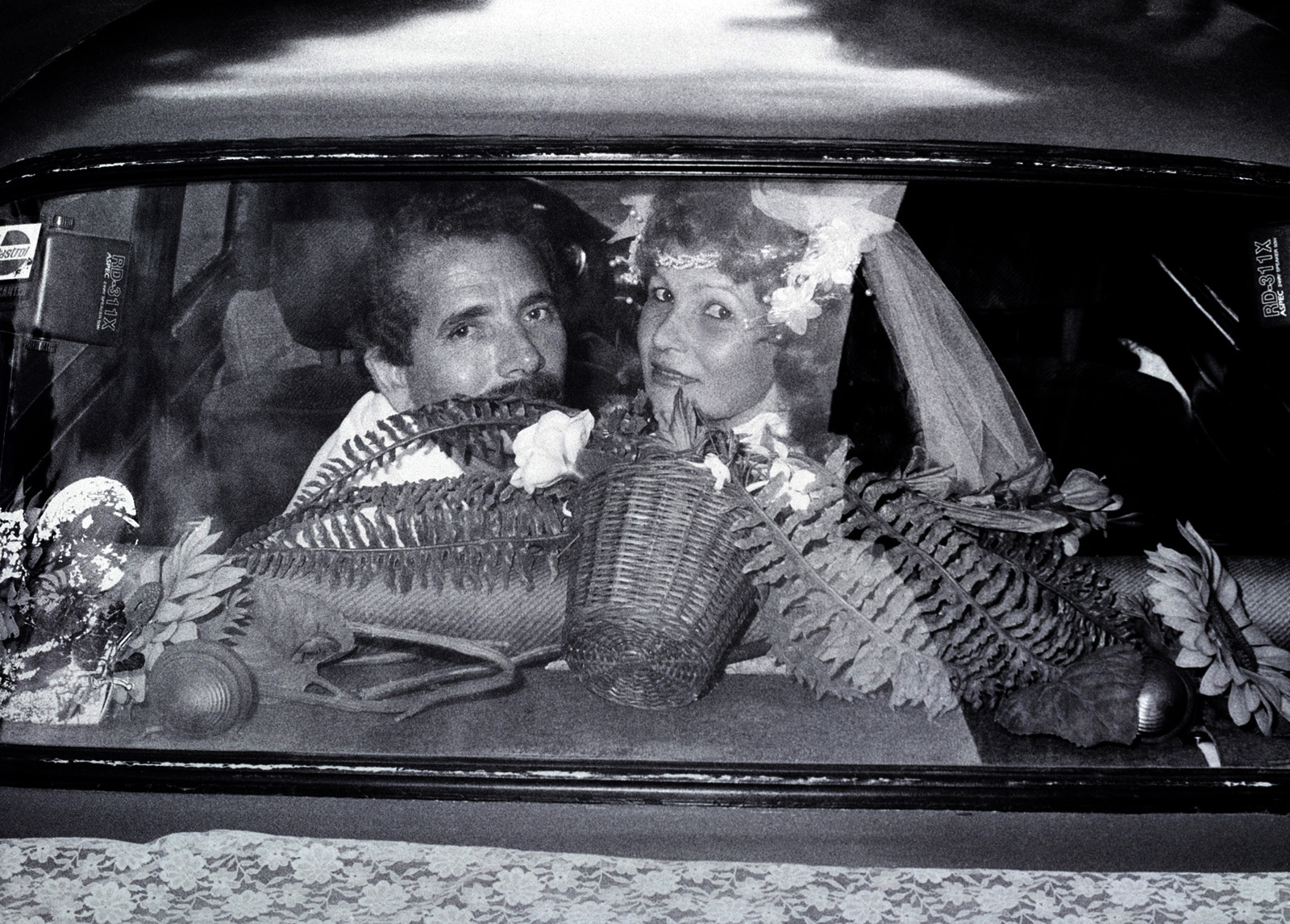
Other photographers reveal how the car plays an important role in historical events, in society and in daily life. Arwed Messmer’s Reenactement series brings together photographs from the archives of the Stasi showing how people used cars in unusual ways to escape from East Germany, and Fernando Gutiérrez work, Secuelas, explores the role of the Ford Falcon, a symbol of Argentina’s military dictatorship, in the collective imaginary of the Argentinean people. Jacqueline Hassink’s immersive projection Car Girls investigates the role and status of women who work in car shows around the world. Martin Parr’s series From A to B chronicles the thoughts dreams and anxieties of British motorists. Still other series by photographers such as Rosângela Rennó, Óscar Monzón, Kurt Caviezel and Bruce Davidson show how the car has become an extension of the home, used for weddings and picnics, living and sleeping, arguments and making love.

The Fondation Cartier has also invited artist Alain Bublex to create for the exhibition a series of 10 model cars that cast a fresh eye on the history of automobile design. His installation combines photographs, drawings and models to explore how the car design has evolved over time incorporating new techniques, forms, and practices.

Despite energy crises, ecology movements, and industrial mismanagement, the car remains essential to our daily lives. At a time when we are questioning the role and the future of the automobile in our society, the Autophoto exhibition reexamines, with nostalgia, humour, and a critical eye, this 20th century symbol of freedom and independence.

The Catalogue

Bringing together over 600 images, the catalogue of the Autophoto exhibition reveals how photography, a tool privileging immobility, benefited from the automobile, a tool privileging mobility. The catalogue features iconic images by both historic and contemporary photographers who have captured the automobile, and transformed this popular accessible object through their passionate and creative vision. Quotes by the artists, and a chronology of automobile design, as well as interviews and texts by specialists provide a deeper understanding of this vast topic through a variety of aesthetic, sociological, and historical perspectives.

Press release from The Fondation Cartier


Peter Keetman (German, 1916-2005) 'Hintere Kotflügel' 1953


Peter Keetman (German, 1916-2005)
Hintere Kotflügel (Rear fenders)
1953
From Eine Woche im Volkswagenwerk (A week at the Volkswagenwerk) series
Gelatin silver print
27 × 24.5cm
Nachlass Peter Keetman/Stiftung F.C. Gundlach, Hamburg
© Nachlass Peter Keetman/Stiftung F.C. Gundlach, Hamburg


Ed Ruscha (American, b. 1937) '7133 Kester, Van Nuys' 1967


Ed Ruscha (American, b. 1937)
7133 Kester, Van Nuys
1967
Thirtyfour Parking Lots series
Chipmunk Collection
© Ed Ruscha, courtesy Gagosian Gallery


Malick Sidibé (Malian, 1935-2016) 'Taximan avec voiture' 1970


Malick Sidibé (Malian, 1935-2016)
Taximan avec voiture
1970
Gelatin silver print
40 x 30cm
Courtesy Galerie Magnin-A, Paris
© Malick Sidibé


Lee Friedlander (American, b. 1934) 'Montana' 2008


Lee Friedlander (American, b. 1934)
Montana
2008
From the America by Car series
Gelatin silver print
37.5 × 37.5cm
Courtesy Fraenkel Gallery, San Francisco
© Lee Friedlander, courtesy Fraenkel Gallery, San Francisco


Lee Friedlander (American, b. 1934) 'California' 2008


Lee Friedlander (American, b. 1934)
California
2008
From the America by Car series
Gelatin silver print
37.5 × 37.5cm
Courtesy Fraenkel Gallery, San Francisco
© Lee Friedlander, courtesy Fraenkel Gallery, San Francisco


Alejandro Cartagena (Mexican, b. 1977) 'The Carpoolers' series 2011–2012


Alejandro Cartagena (Mexican, b. 1977)
The Carpoolers series
2011-12
Installation of 15 inkjet prints
55.5 × 35.5cm (each)
Courtesy Patricia Conde Galería, Mexico City
© Alejandro Cartagena


Ronni Campana (Italian, b. 1987) 'Badly Repaired Cars' series 2016


Ronni Campana (Italian, b. 1987)
Badly Repaired Cars series
2016
Inkjet print
60 × 40cm
Collection of the artist
© Ronni Campana


Fondation Cartier pour l’art contemporain
261 Boulevard Raspail, Paris

Opening hours: Every day except Mondays, 11am – 8pm
Opening Tuesday evenings until 10pm

Fondation Cartier website

LIKE ART BLART ON FACEBOOK

Back to top

Exhibition: ‘Joel Meyerowitz Retrospective’ at NRW-Forum Düsseldorf

Exhibition dates: 27th September 2014 – 11th January 2015


Joel Meyerowitz (American, b. 1938) 'New York City' 1963


Joel Meyerowitz (American, b. 1938)
New York City
1963


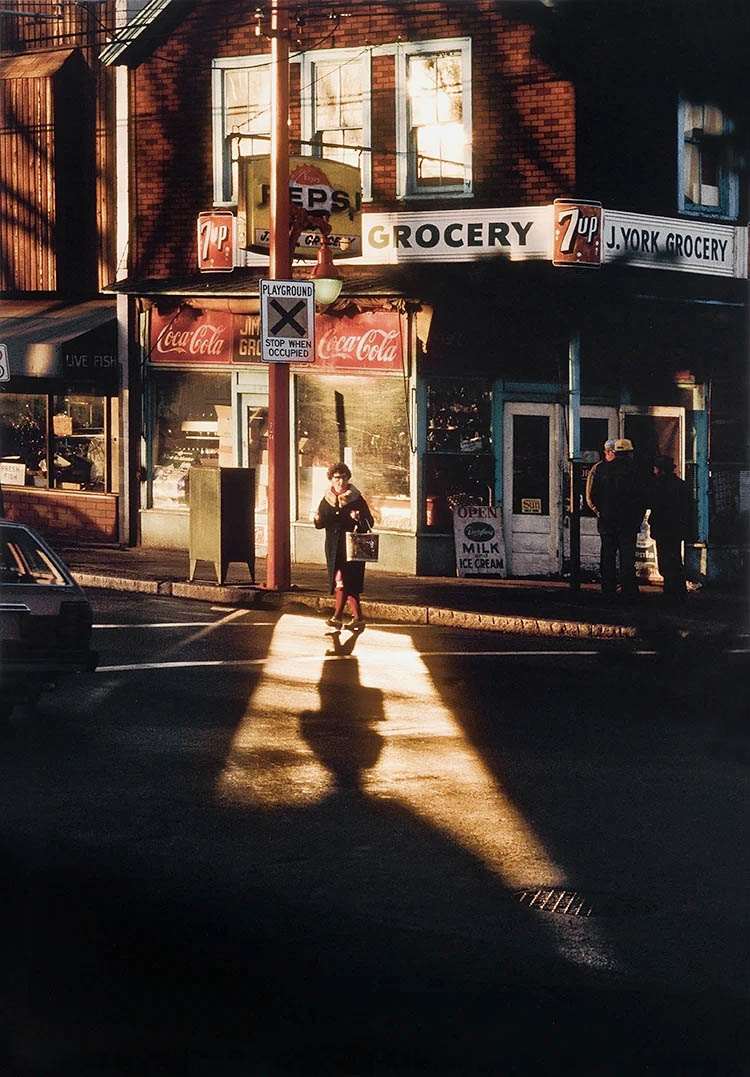
Meyerowitz really comes into his own in the ’70s. Luscious colours and lascivious compositions in which the attention of the photographer is directed towards the relationship between object, light and time. The image becomes an object of fetishistic desire.

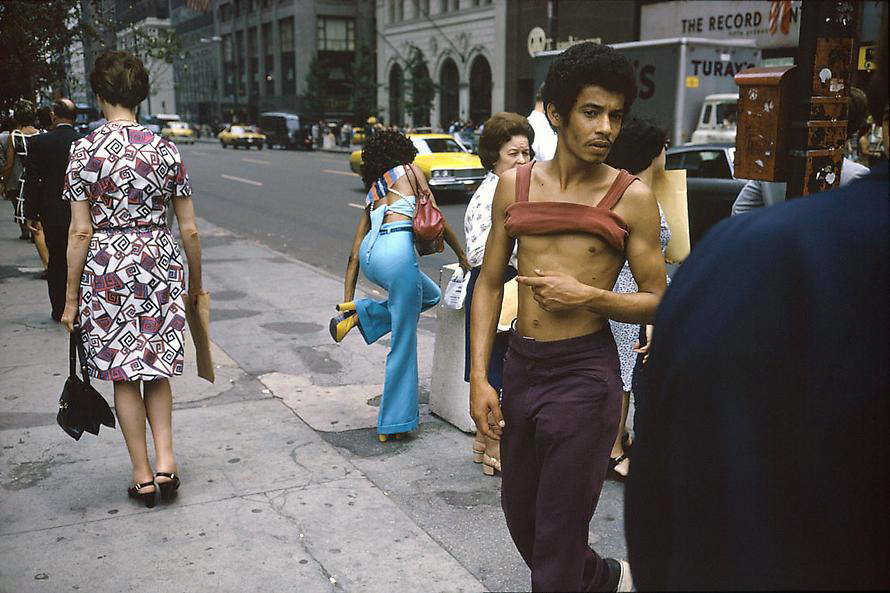
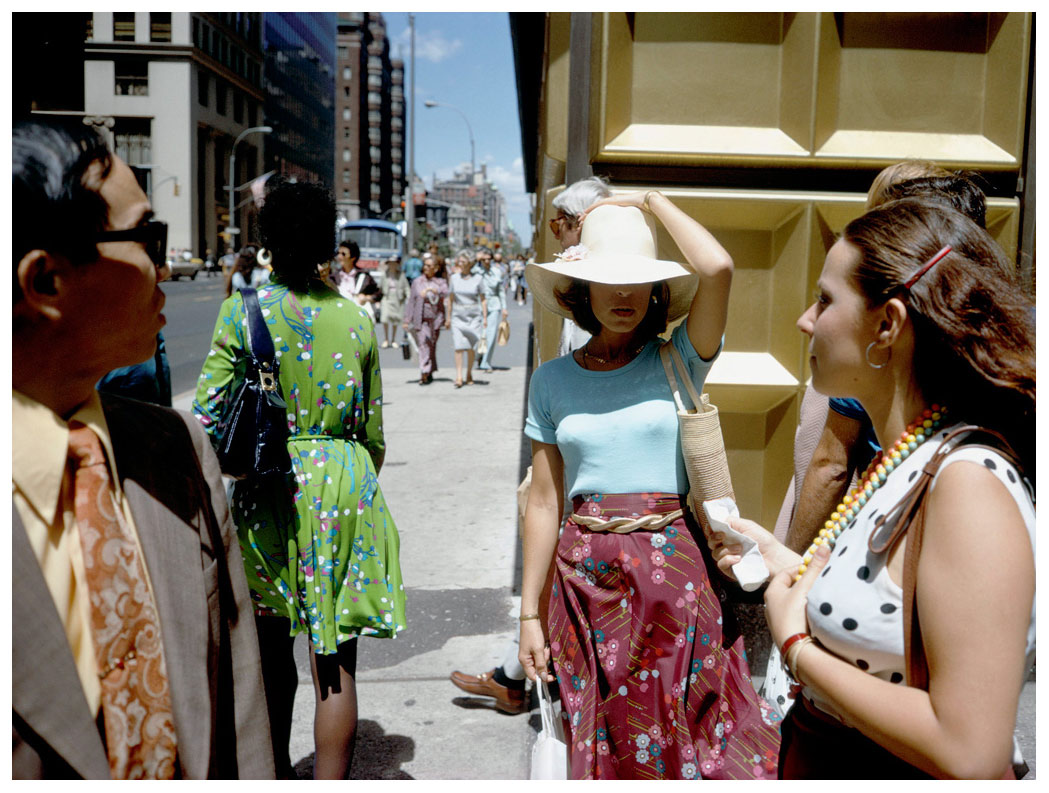
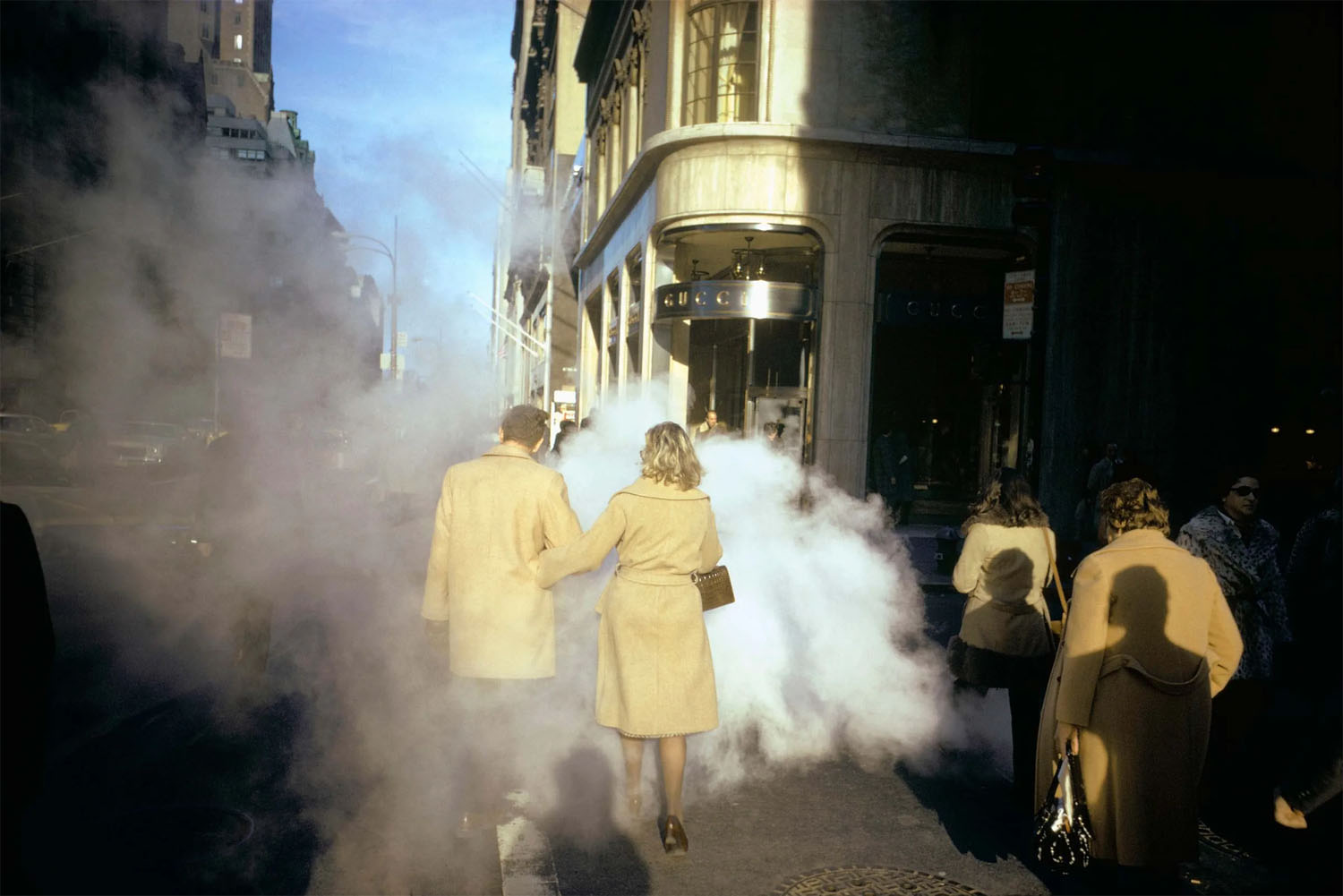
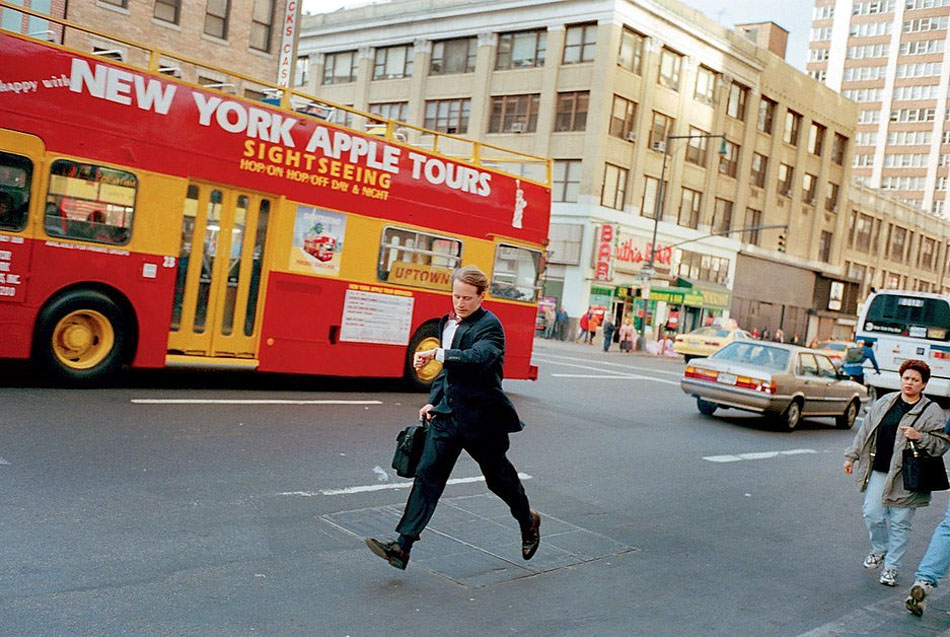
The hyperreal colours and placement of figures are crucial to this ocular obsession. Look at the image Gold corner, New York City (1974) and observe the precise, choreographed placement of the figures and how the colours flow, from orange/brown to green/blue and onto turquoise/red and polka dot, the central figure’s eyes shielded under a wide-brimmed hat, hand to head, model style. This is colour porn for the eyes. And Meyerowitz does it so well… the stretch of thigh and shadow in Los Angeles Airport, California (1976), the classic red of Truro (1976) or the bare midriff and raised yellow heel in New York City, 42nd and Fifth Ave (1974).

The best of these photos give you a zing of excitement and a surge of recognition – like a superlative Stephen Shore or an outstanding William Eggelston. At his best Meyerowitz is mesmerising.

Dr Marcus Bunyan


Many thankx to the NRW-Forum Düsseldorf for allowing me to publish the photographs in the posting. Please click on the photographs for a larger version of the image.


Joel Meyerowitz (American, b. 1938) 'Untitled' 1976


Joel Meyerowitz (American, b. 1938)
Ballston Beach, Truro, Cape Cod
1976


Joel Meyerowitz (American, b. 1938) 'Los Angeles Airport, California' 1976


Joel Meyerowitz (American, b. 1938)
Los Angeles Airport, California
1976


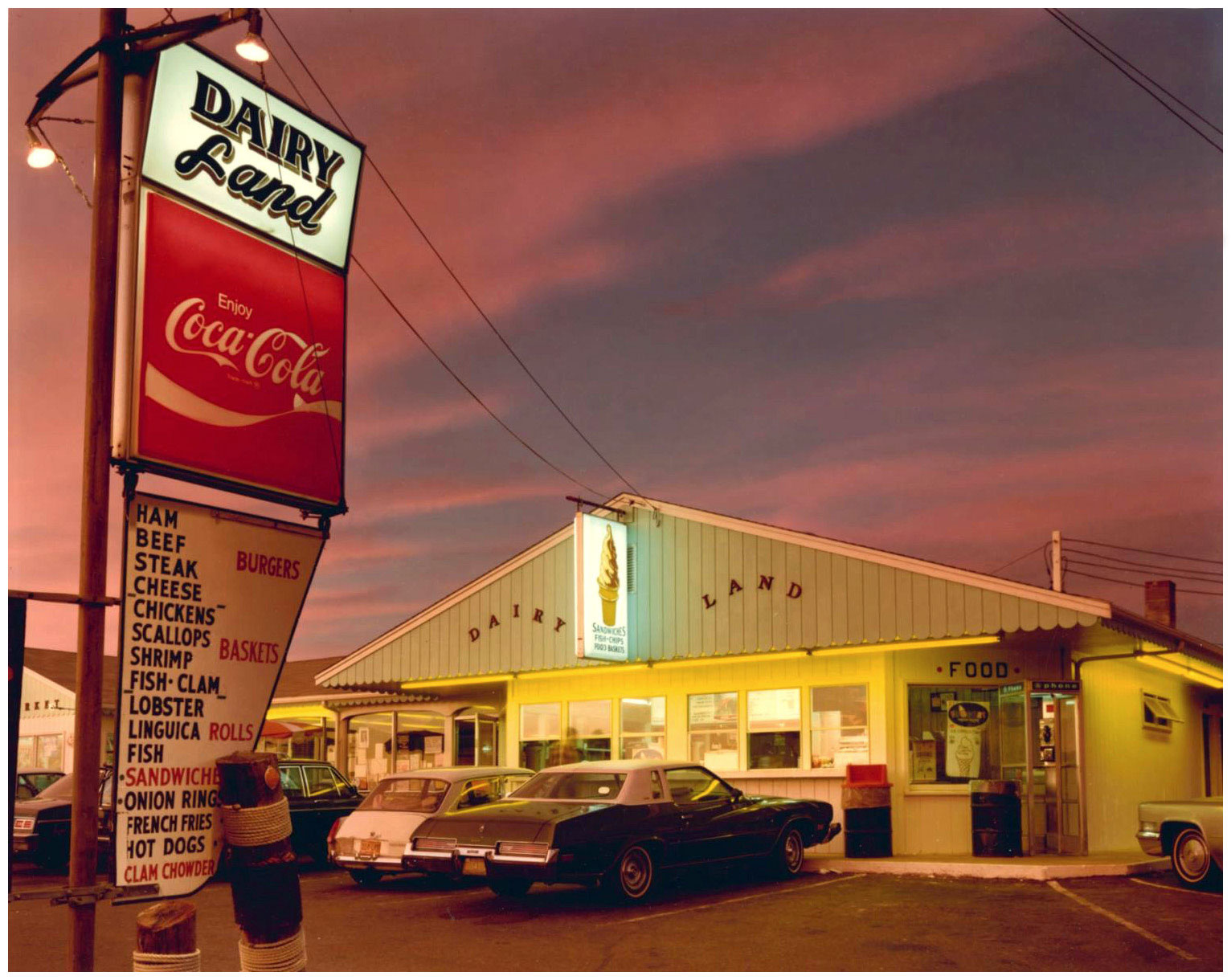
Joel Meyerowitz (American, b. 1938) 'Dairyland, Provincetown' 1976


Joel Meyerowitz (American, b. 1938)
Dairyland, Provincetown
1976


Joel Meyerowitz (American, b. 1938) 'Truro' 1976


Joel Meyerowitz (American, b. 1938)
Truro
1976


Joel Meyerowitz (American, b. 1938) 'Red Interior, Provincetown, Massachusetts' 1977


Joel Meyerowitz (American, b. 1938)
Red Interior, Provincetown, Massachusetts
1977


Joel Meyerowitz is a “street photographer” in the tradition of Henri Cartier-Bresson and Robert Frank, who influenced him greatly at the beginning of his career. Since the mid-seventies he has photographed exclusively in colour.

The artist was born in 1938 in the Bronx. He initially studied art, history of art and medical illustration at the Ohio State University. Back in New York City he began his career in 1959 as an Art Director and Designer. Particularly impressed by an encounter with the photographer Robert Frank, he started taking photographs in 1962 and in the same year he left the agency, devoting himself from this point on, exclusively to photography. He travelled through New York City and capturing the mood of the streets. He soon developed his distinctive sensitivity and his candid, people-focussed style, a very unique visual language. In 1966, he embarked on an 18 month trip through Europe, which both profoundly affected and also influenced him and can be described as an artistic turning point. Meyerowitz photographed many of his works from a moving car. These works were displayed in 1968 in his first exhibition at the Museum of Modern Art in New York: Photographs from a moving car, curated by the photography legend John Szarkowski. From the late seventies onward, Joel Meyerowitz concentrated exclusively on colour photography. In the first half of the seventies, he created numerous unique works of “street photography”. In order to further improve the image quality, the artist took another crucial step: in the mid 1970s he changed from the 35mm format to the 8 x 10″ plate camera.

In 1979, his first book Cape Light was published by Phaidon Verlag. The picture book sold over 100,000 copies and is to this day regarded as a milestone in colour photography. 17 further publications followed, most recently in 2012 with a comprehensive two-volume edition Taking my Time, a retrospective of 50 years of his photography, also published by Phaidon Verlag.

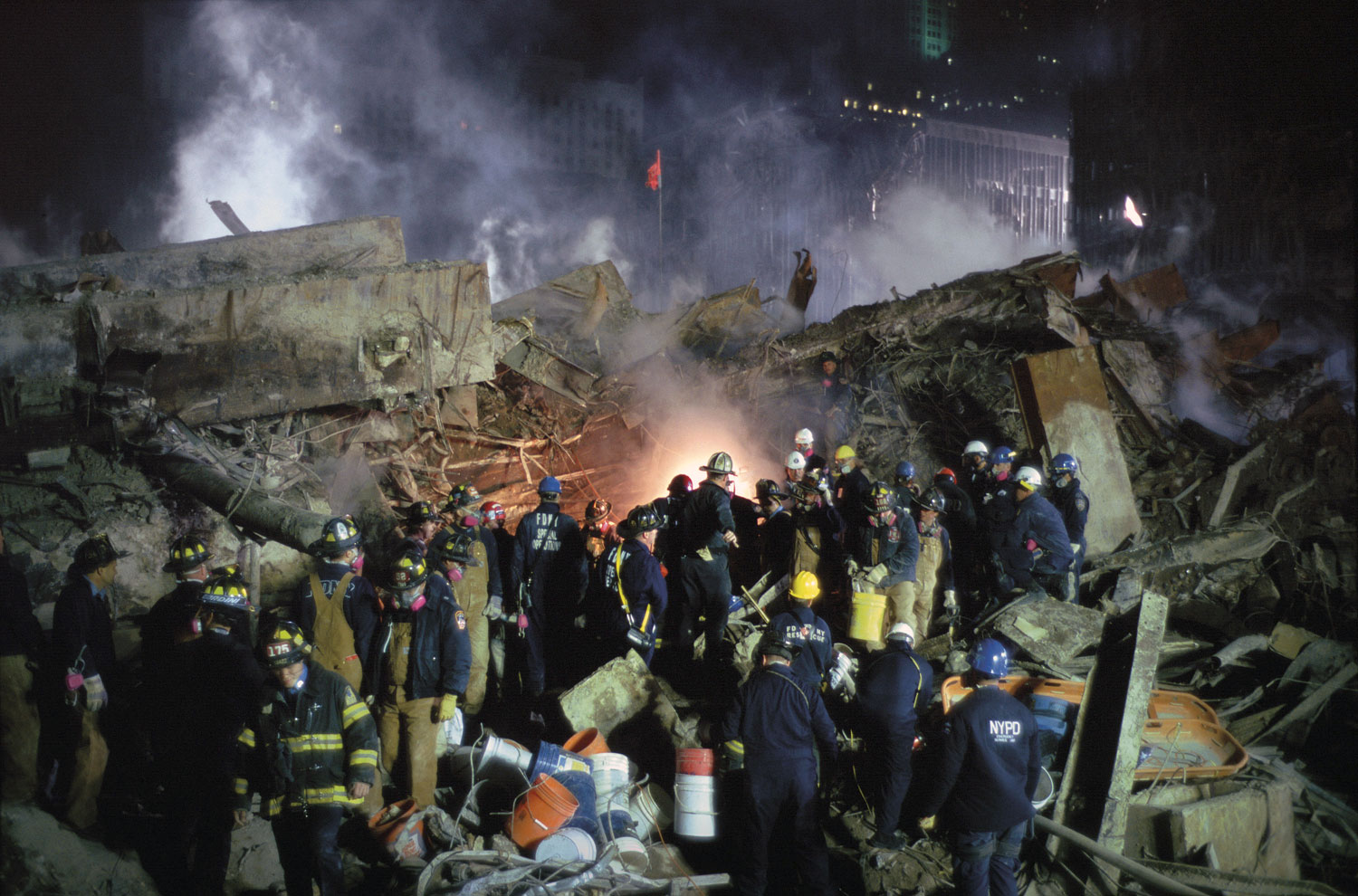
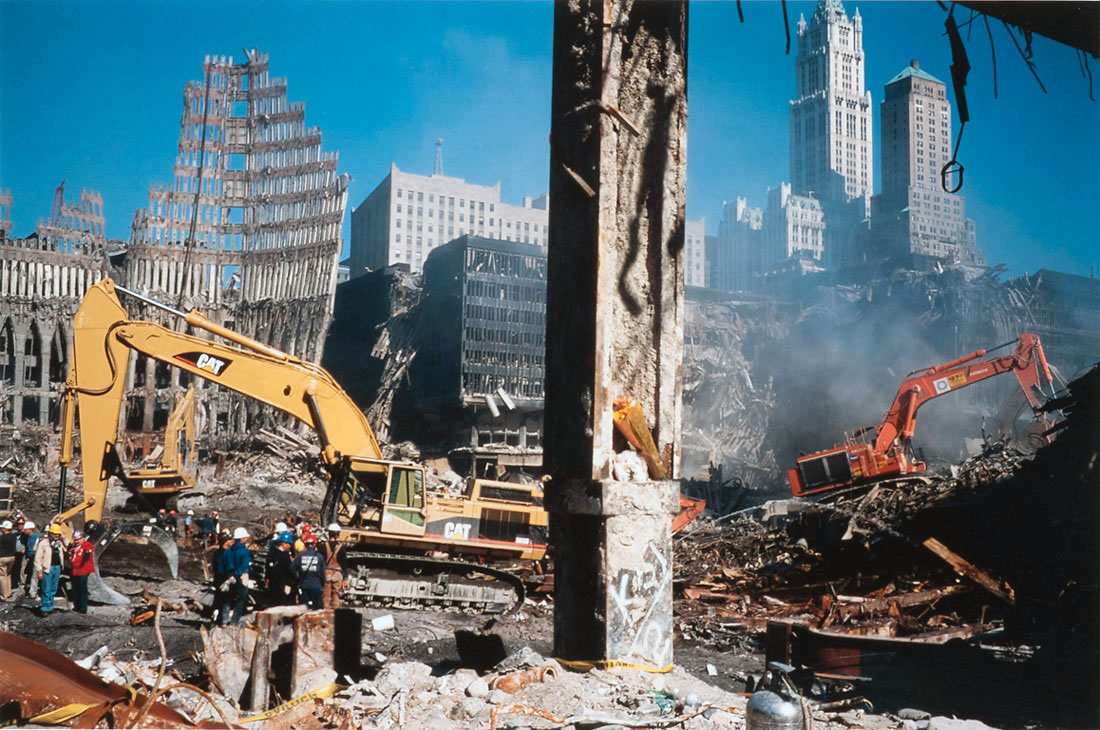
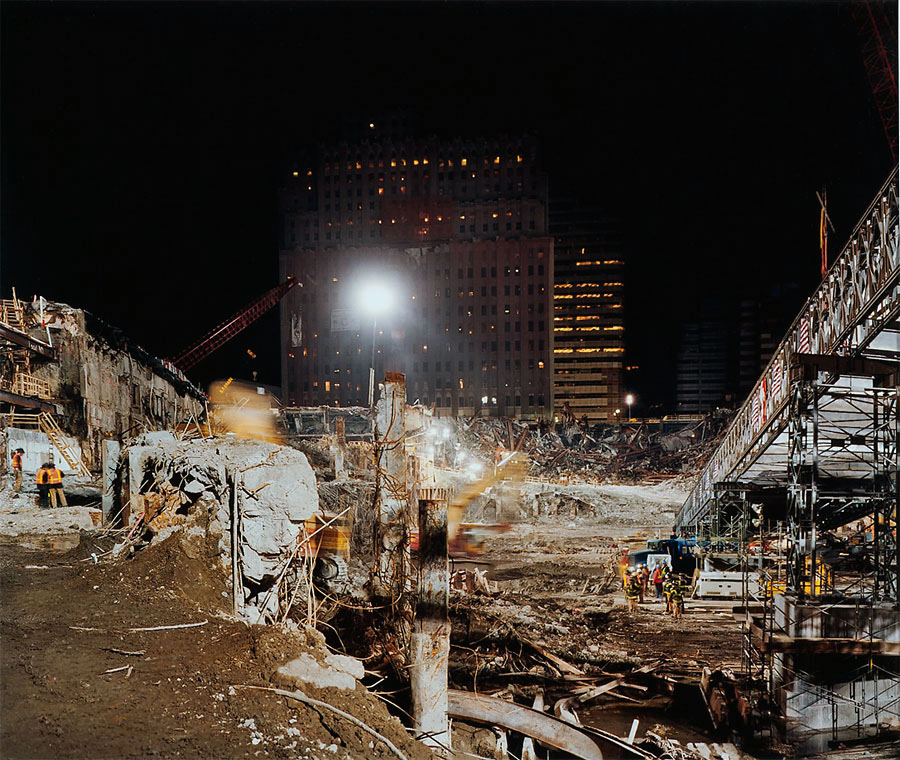
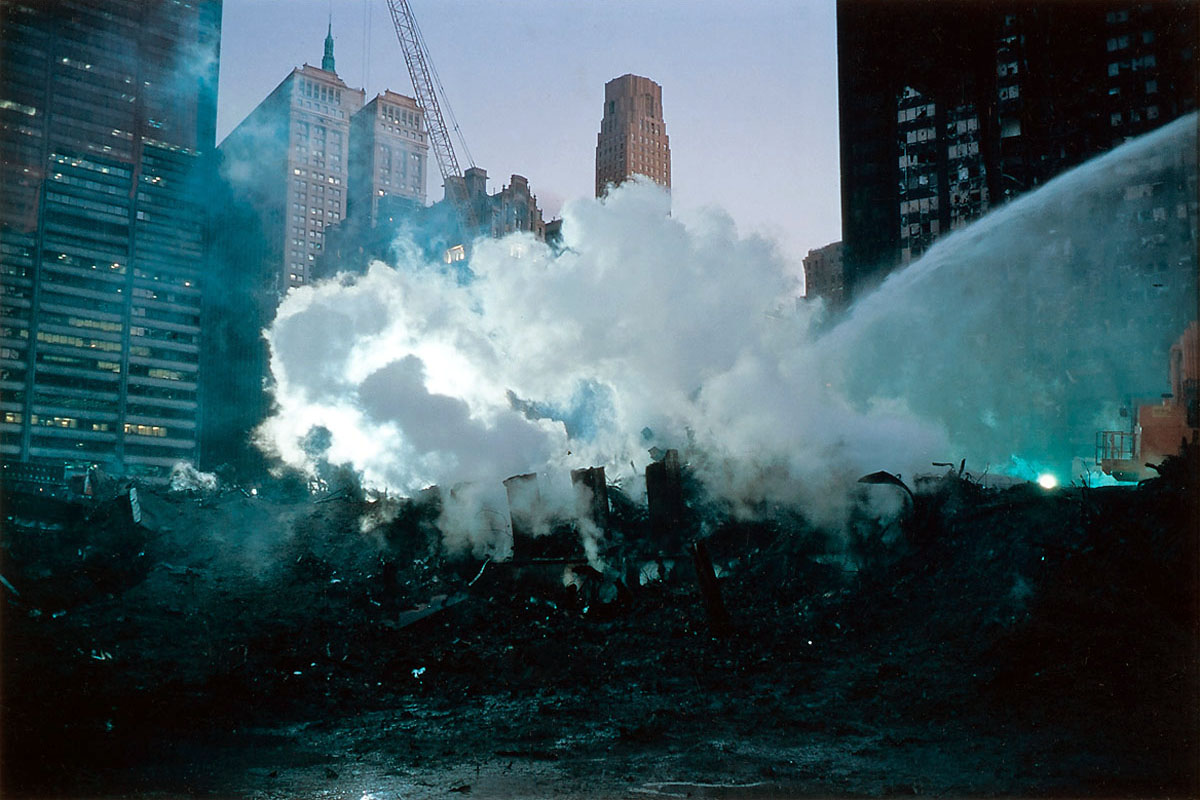
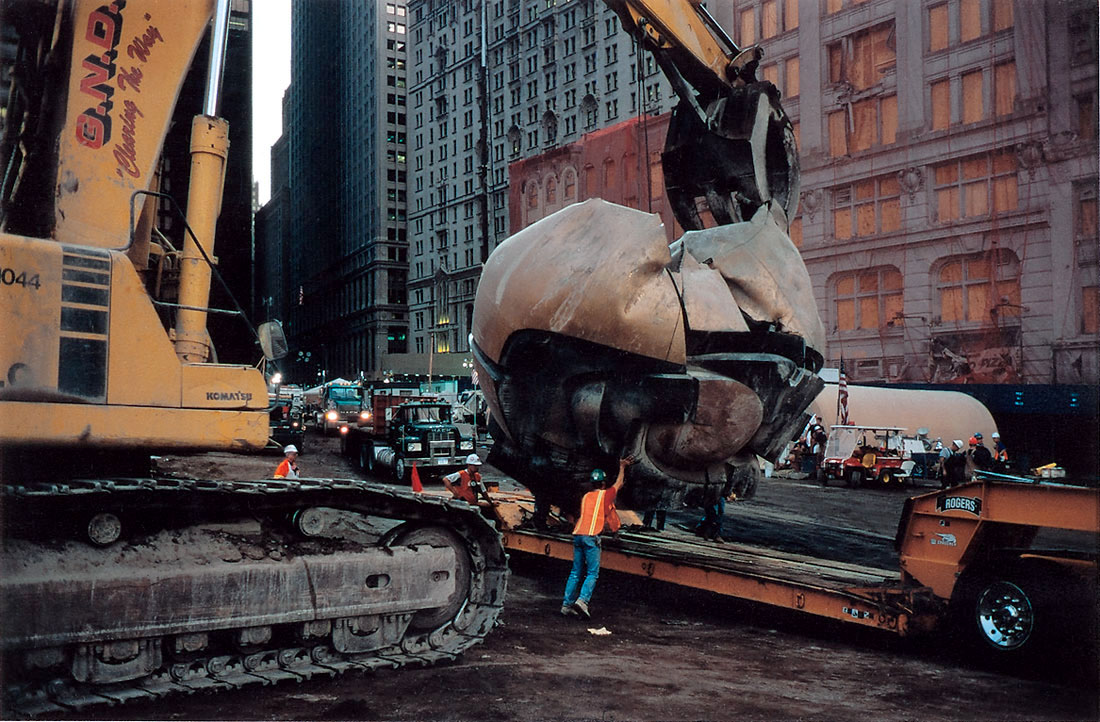
A few days after the attack on the World Trade Center, Meyerowitz began to document its destruction and reconstruction. As the only photographer, he received unrestricted access to the site of the incident. It resulted in over 8000 photographs for the The World Trade Center exhibition, which was displayed in the 9/11 Memorial Museum in New York City.

Joel Meyerowitz’ works have been and will be shown in numerous solo and group exhibitions around the world; several times in the Museum of Modern Art in New York City. On 27 September, the NRW Forum in Düsseldorf opens the most comprehensive retrospective of the artist. In addition, the works are represented in many international collections, including in the Museum of Modern Art and the Boston Museum of Fine Art.

Text from the NRW-Forum Düsseldorf website


Joel Meyerowitz (American, b. 1938) 'New York City' 1965


Joel Meyerowitz (American, b. 1938)
New York City
1965


Joel Meyerowitz (American, b. 1938) 'London, England' 1966


Joel Meyerowitz (American, b. 1938)
London, England
1966


Joel Meyerowitz (American, b. 1938) 'JFK Airport, New York City' 1968


Joel Meyerowitz (American, b. 1938)
JFK Airport, New York City
1968


Joel Meyerowitz (American, b. 1938) 'Paris, France' 1967


Joel Meyerowitz (American, b. 1938)
Paris, France
1967


Joel Meyerowitz (American, b. 1938) 'New York City, 42nd and Fifth Ave' 1974


Joel Meyerowitz (American, b. 1938)
New York City, 42nd and Fifth Ave
1974


Joel Meyerowitz (American, b. 1938) 'Dusk, New Jersey' 1978


Joel Meyerowitz (American, b. 1938)
Dusk, New Jersey
1978
Archival pigment print


Joel Meyerowitz (born 1938 in New York) is, along with William Eggleston and Stephen Shore, one of the most important representatives of American New Colour Photography of the 1960s / 70s. After a first encounter with Robert Frank 1962, Meyerowitz decided to give up his job as art director in New York and to devote himself to photography. In particular, his photographs of street scenes of American cities, which he takes with his 35mm camera as fleeting moments, make him a precursor of street photography and his works icons of contemporary photography.

“Watching Life is all about Timing”

A first turning point in his photography was his annual trip to Europe in 1966/67, a trip which allowed him to critically question his colour photography. As early as 1968, he had his first solo exhibition at the Museum of Modern Art (MoMA) of works created in Europe under the title From a moving car. His first book, Cape Light (1978), in which he examines achromatic variations of light at Cape Cod, is now regarded as a milestone in photography. In addition to his film camera, which he always carries with him, Meyerowitz has been working since the late 1970s with the 8 x 10 plate camera, which allows him to capture the relationship between object, light and time in a new and more accurate way for him.

“Time is what Photography is About”

The exhibition at the NRW-Forum presents the entire photographic spectrum of 50 years of his photography for the first time in Germany. In addition to the early black / white and colour photographs of the 1960s / there will be years works from all business groups such as Cape Light, Portraits, Between the Dog and the Wolf and Ground Zero series, presented to allow the visitor a photographic and cultural image-comparison between Europe and the USA. In addition, the first documentary about the life and work of the photographer, created over a period of three years in France, Italy and the United States, will have its world premiere.”

Text from the NRW-Forum Düsseldorf website


Joel Meyerowitz (American, b. 1938) 'Gold corner, New York City' 1974


Joel Meyerowitz (American, b. 1938)
Gold corner, New York City
1974


Joel Meyerowitz (American, b. 1938) 'Madison Avenue, New York City' 1975


Joel Meyerowitz (American, b. 1938)
Madison Avenue, New York City
1975


Joel Meyerowitz (American, b. 1938) 'New York City' 1975


Joel Meyerowitz (American, b. 1938)
New York City
1975


Joel Meyerowitz (American, b. 1938) 'Provincetown' 1977


Joel Meyerowitz (American, b. 1938)
Provincetown
1977


Joel Meyerowitz (American, b. 1938) 'Roseville Cottages, Truro, Massachusetts' 1976


Joel Meyerowitz (American, b. 1938)
Roseville Cottages, Truro, Massachusetts
1976


Joel Meyerowitz (American, b. 1938) 'New York City' 1963


Joel Meyerowitz (American, b. 1938)
New York City
1963


Joel Meyerowitz (American, b. 1938) 'Cape Cod' 1976


Joel Meyerowitz (American, b. 1938)
Cape Cod
1963


Joel Meyerowitz (American, b. 1938) 'Pool, Dusk, Sun in Window, Florida' 1978


Joel Meyerowitz (American, b. 1938)
Pool, Dusk, Sun in Window, Florida
1978


Joel Meyerowitz (American, b. 1938) 'Bay Sky, Provincetown, Massachusetts' 1985


Joel Meyerowitz (American, b. 1938)
Bay Sky, Provincetown, Massachusetts
1985


Joel Meyerowitz (American, b. 1938) 'Five more found, New York City' 2001


Joel Meyerowitz (American, b. 1938)
Five more found, New York City
2001


NRW-Forum Kultur und Wirtschaft
Ehrenhof 2, 40479 Düsseldorf
Phone: +49 (0)211 – 89 266 90

Opening hours:
Tuesday to Sunday 11.00 – 18.00
Thursday until 21.00

NRW-Forum Kultur und Wirtschaft website

LIKE ART BLART ON FACEBOOK

Back to top

Exhibition: ‘Another Country: Vintage Photographs of British Life by Tony Ray-Jones’ at James Hyman, London

Exhibition dates: 11th September – 11th October 2013


Tony Ray-Jones (British, 1941-1972) 'Lady's Day' c. 1967


Tony Ray-Jones (British, 1941-1972)
Lady’s Day
c. 1967
Vintage Gelatin Silver Print
12 x 20cm (5 x 8 inches)


What a loss to the world when this photographer died aged just thirty. His eye was magnificent. He seems to have instinctively known how to capture the quintessential British at work, rest and play in all that societies class-ridden glory – the fag hanging out of the mouth in Lady’s Day (c. 1967) combining beautifully with the aura of the patterned dresses; the isolation of the figures and their stop-frame movement in Day at the Races (c. 1967), a wonderfully balanced composition caught in the moment; and the orchestral ensemble that is the cast of Bacup, Lancashire, 1968 (1968), each figure playing its part in the overall tension of the picture plane: the brothers at right in matching duffle coats, the boy walking forward down the incline with head thrown sideways balanced at rear by another boy with hands in pockets tossing his head into the wind. Magical.

Just to see this image, to visualise it and have the camera ready to capture its “nature”, its undeniable presence for that one split second, then to develop and find this image on a proof sheet, what joy this would have been for the artist. Equally illustrious is the feeling of Bournemouth, 1969 (1969) with the nuanced use of shadow and light, the occlusion of the figure behind the screen with the turn of the head, and the placement of the two white tea cups at right. Ray-Jones wasn’t afraid to place figures in the foreground of his compositions either as can be seen in Brighton Beach, 1967 (1967) to great effect, framing the mise en scène behind.

These photographs take me way back to my childhood in the 1960s in England, going to Butlin’s Clacton-on-Sea and Bournemouth for our family holidays. Even the name says it all: Clacton “on sea” as though they have to remind people visiting that they are actually at the sea. The photographs perfectly capture the mood of the country in this utilitarian era where holidays at a seaside resort were often dour affairs, punctuated by stony beaches, bad weather and regulated activities. The freedom of the 1970s had yet to arrive and us kids went whether we liked it or not: Mablethorpe, 1967 (1967) perfectly epitomises such an environment, with the long days of pleasure / torture stretching off into the distance much as the sea wall in Ray-Jones’ photo.

Dr Marcus Bunyan


Many thankx to James Hyman for allowing me to publish these magnificent photographs. Please click on the photographs for a larger version of the image.


Tony Ray-Jones (British, 1941-1972) 'Day at the Races' c. 1967


Tony Ray-Jones (British, 1941-1972)
Day at the Races
c. 1967
Vintage Gelatin Silver Print
13 x 20cm (5 x 8 inches)


Tony Ray-Jones (British, 1941-1972) 'A Day at Richmond Park' c. 1967


Tony Ray-Jones (British, 1941-1972)
A Day at Richmond Park
c. 1967
Vintage Gelatin Silver Print
17.5 x 25.6cm (7 x 10 inches)


Tony Ray-Jones (British, 1941-1972) 'Chatham May Queen, 1968' 1968


Tony Ray-Jones (British, 1941-1972)
Chatham May Queen, 1968
1968
Vintage Gelatin Silver Print
17.5 x 26.2cm (7 x 10 inches)


Tony Ray-Jones (British, 1941-1972) 'Bacup, Lancashire, 1968' 1968


Tony Ray-Jones (British, 1941-1972)
Bacup, Lancashire, 1968
1968
Vintage Gelatin Silver Print
17.5 x 26.5cm (7 x 10 inches)


James Hyman is delighted to stage an exhibition of rare, vintage photographs by Tony Ray-Jones to coincide with the opening exhibition of the Science Museum Media Space, Only in England, Photographs by Tony Ray-Jones and Martin Parr, in September 2013.

Tony Ray-Jones had a short life. He died in 1972 aged just thirty. But the pictures that he left behind are some of the most powerful British photographs of the twentieth century. His work of the late 1960s and early 1970s documents English culture and identity and brilliantly captures this period in English public life. Inspired by what he learnt in America in the mid-1960s, from photographers such as Lee Friedlander and Joel Meyerowitz, Ray-Jones was keen to make ‘new’ photographs of English life, which did not read simply as documentary, but also as art objects. As he explained in Creative Camera in 1968: “the spirit and the mentality of the English, their habits, and the way they do things, partly through tradition and the nature of their environment and mentality.”

The acclaim that Ray-Jones received after his death, especially from other photographers, testifies to the respect of his elders and his contemporaries. Bill Brandt praised the “very pronounced style all of his own” and lamented that “his death, at such a young age, is a terrible loss to British photography.” Jacques Henri-Lartigue praised Tony Ray-Jones as a “fantaisiste”: “young, free and whimsical with, in addition, a very sound technique and a vision of fire that was full of humour, truth and a sense of poetry” and Paul Strand praised his “remarkable formal organisation” and declared: “I found the photographs of Tony Ray-Jones very outstanding. In them I find that rather rare concurrence when an artist clearly attaining mastery of his medium, also develops a remarkable way of looking at the life around him, with warmth and understanding.”

These tributes are to be found in the most important book of Tony Ray-Jones work, A Day Off. An English Journal, published in 1974. They are included in a beautiful essay in which Ainslie Ellis, one of the photographer’s earliest champions, addresses not only the photographs but also Ray-Jones’s photographic process. Ellis stresses that what mattered to Ray-Jones was not just taking the picture, but also the creative process of deciding which pictures on a contact strip to print, and then making a master-print, from which all subsequent prints would be matched. We are, therefore, delighted that this exhibition should include many of the pictures reproduced in this celebrated book and that it present exclusively vintage prints, which, in a number of identifiable cases, are the actual photographs that Tony Ray-Jones exhibited in his lifetime.

Often playful and sometimes despondent, what Ray-Jones produced was unlike anything which came before, and was the catalyst for a generation of New British Photographers.

Press release from the James Hyman website


Tony Ray-Jones (British, 1941-1972) 'Bournemouth, 1969' 1969


Tony Ray-Jones (British, 1941-1972)
Bournemouth, 1969
1969
Vintage Gelatin Silver Print
16 x 25cm (6 x 10 inches)


Tony Ray-Jones (British, 1941-1972) 'Brighton Beach, 1967' 1967


Tony Ray-Jones (British, 1941-1972)
Brighton Beach, 1967
1967
Vintage Gelatin Silver Print
17.5 x 26.5cm (7 x 10 inches)


Tony Ray-Jones (British, 1941-1972) 'Mablethorpe, 1967' 1967


Tony Ray-Jones (British, 1941-1972)
Mablethorpe, 1967
1967
Vintage Gelatin Silver Print
14 x 21cm (6 x 8 inches)


Tony Ray-Jones (British, 1941-1972) 'Waxworks, Eastbourne, 1968' 1968


Tony Ray-Jones (British, 1941-1972)
Waxworks, Eastbourne, 1968
1968
Vintage Gelatin Silver Print
14 x 21cm (6 x 8 inches)


Tony Ray-Jones (British, 1941-1972) 'Durham Miners' Gala' 1969


Tony Ray-Jones (British, 1941-1972)
Durham Miners’ Gala
1969
Vintage Gelatin Silver Print
14 x 22.5cm (6 x 9 inches)


Tony Ray-Jones (British, 1941-1972) 'Sunday Best' c. 1967


Tony Ray-Jones (British, 1941-1972)
Sunday Best
c. 1967
Vintage Gelatin Silver Print
30.5 x 20cm (12 x 8 inches)


Tony Ray-Jones (British, 1941-1972) 'Blackpool, 1968' 1968


Tony Ray-Jones (British, 1941-1972)
Blackpool, 1968
1968
Vintage Gelatin Silver Print
21 x 14.5cm (8.25 x 5.70 ins)


James Hyman Gallery
16 Savile Row
London W1S 3PL
Phone: 020 7494 3857

Opening hours:
By appointment

James Hyman Gallery website

LIKE ART BLART ON FACEBOOK

Back to top

Exhibition: ‘Cartier-Bresson: A Question of Colour’ at Somerset House, London

Exhibition dates: 8th November 2012 – 27th January 2013

Curator: William E. Ewing


Henri Cartier-Bresson (French, 1908-2004) 'Harlem, New York' 1947


Henri Cartier-Bresson (French, 1908-2004)
Harlem, New York, 1947
1947
Gelatin silver print / printed 1970s
Image: 29.1 x 19.6cm
Paper: 30.4 x 25.4cm
© Henri Cartier-Bresson/Magnum Photos, Courtesy Fondation Henri Cartier-Bresson


They may be channelling the master, but none does it like Cartier-Bresson. There is a spareness and spatial intensity to Cartier-Bresson’s work that is absolutely his own. Look at the photograph directly above (Harlem, New York, 1947). A railing leads the eye in bottom right, echoed by the bottom jamb of the window. The opening is set for the old man to perform complete with curtains, talking stage right. The jamb zig zags above a trilby-wearing, cigarette-smoking man’s head leading to a wire mesh fence that takes the eye out of the frame on the left. The two men, lower than the old man in the framed window, look in a completely different direction to him.

Counterpoise. The image pulls in two directions. Above their head a series of cantilevered staircases ascends to the heavens, thought ascending. A masterpiece.

So many of the other photographers in this posting crowd the plane with people looking in all directions, closed off foregrounds or tensionless images. Images that are too complex or too simple. There is an opposition to Cartier-Bresson’s images that is difficult for the viewer to resolve neatly, yet they appear as if in perfect balance. Look at Brooklyn, New York, 1947 towards the bottom of the posting. Nothing in this still life is out of place (from the light to the multiple, overlapping shadows and the out of focus elements of the composition) yet there is humbling agony about the whole thing. It is almost is if he is saying, “cop a load of this, this is what I can see.” And what a fabulous eye it is.

Dr Marcus Bunyan


Many thankx to Somerset House for allowing me to publish the photographs in the posting. Please click on the photographs for a larger version of the image.


Ernst Haas (Austrian-American, 1921-1986) 'New Orleans, USA' 1960


Ernst Haas (Austrian-American, 1921-1986)
New Orleans, USA,
1960
Chromogenic archival print
50 x 35cm
© Ernst Haas Estate, New York


Saul Leiter (American, 1923-2013) 'Snow' 1960


Saul Leiter (American, 1923-2013)
Snow
1960
© Saul Leiter
Courtesy: Saul Leiter, Howard Greenberg Gallery, New York


Helen Levitt (American, 1913-2009) 'Cat next to red car, New York' 1973


Helen Levitt (American, 1913-2009)
Cat next to red car, New York,
1973
Type C prints
18 x 12 inches
© Estate of Helen Levitt


Alex Webb (American, b. 1952) 'Tehuantepec, Mexico' 1985


Alex Webb (American, b. 1952)
Tehuantepec, Mexico
1985
71 x 47cm
Digital Type C print
© Alex Webb


“I only know how to approach a place by walking. For what does a street photographer do but walk and watch and wait and talk, and then watch and wait some more, trying to remain confident that the unexpected, the unknown, or the secret heart of the known awaits just around the corner.”

~ Alex Webb


Jeff Mermelstein (American, b. 1957) 'Untitled (Package Pile Up, New York City)' 1995


Jeff Mermelstein (American, b. 1957)
Untitled (Package Pile Up, New York City)
1995
Chromogenic print
© Jeff Mermelstein
Courtesy Rick Wester Fine Art, New York


Carolyn Drake (American, b. 1971) 'Birthday party at Olympia, a gated community, Wellington, Florida' 2005


Carolyn Drake (American, b. 1971)
Birthday party at Olympia, a gated community, Wellington, Florida
2005
Digital Pigment Print
© Carolyn Drake / Magnum Photos


Carolyn Drake (American, b. 1971) 'Hotel room. Zhetisay, Kazakhstan. Carolyn Drake' 2009


Carolyn Drake (American, b. 1971)
Hotel room. Zhetisay, Kazakhstan. Carolyn Drake
2009
Digital Pigment Print
© Carolyn Drake/Magnum Photos


Andy Freeberg (American, b. 1958) 'Sean Kelly, Art Basel Miami' 2010


Andy Freeberg (American, b. 1958)
Sean Kelly, Art Basel Miami
2010
From the series Art Fare
Artist: Kehinde Wiley
63 x 43cm
Pigment ink print
© Andy Freeberg
Courtesy Kopeikin Gallery


Carolyn Drake (American, b. 1971) 'New Kashgar. Kashgar, China'  2011


Carolyn Drake (American, b. 1971)
New Kashgar. Kashgar, China  
2011
30.48 x 20.32cm
Digital Light Jet print
© Carolyn Drake 2012


Positive View Foundation announces its inaugural exhibition Cartier-Bresson: A Question of Colour, to be held at Somerset House, 8 November 2012 – 27 January 2013. Curated by William A. Ewing, the exhibition will feature 10 Henri Cartier-Bresson photographs never before exhibited in the UK alongside over 75 works by 15 international contemporary photographers, including: Karl Baden (US), Carolyn Drake (US), Melanie Einzig (US), Andy Freeberg (US), Harry Gruyaert (Belgium), Ernst Haas (Austrian), Fred Herzog (Canadian), Saul Leiter (US), Helen Levitt (US), Jeff Mermelstein (US), Joel Meyerowitz (US), Trent Parke (Australian), Boris Savelev (Ukranian), Robert Walker (Canadian), and Alex Webb (US).

The extensive showcase will illustrate how photographers working in Europe and North America adopted and adapted the master’s ethos famously known as  ‘the decisive moment’ to their work in colour. Though they often departed from the concept in significant ways, something of that challenge remained: how to seize something that happens and capture it in the very moment that it takes place.

It is well-known that Cartier-Bresson was disparaging towards colour photography, which in the 1950s was in its early years of development, and his reasoning was based both on the technical and aesthetic limitations of the medium at the time. Curator William E. Ewing has conceived the exhibition in terms of, as he puts it, ‘challenge and response’. “This exhibition will show how Henri Cartier-Bresson, in spite of his skeptical attitude regarding the artistic value of colour photography, nevertheless exerted a powerful influence over photographers who took up the new medium and who were determined to put a personal stamp on it. In effect, his criticisms of colour spurred on a new generation, determined to overcome the obstacles and prove him wrong. A Question of Colour simultaneously pays homage to a master who felt that black and white photography was the ideal medium, and could not be bettered, and to a group of photographers of the 20th and 21st centuries who chose the path of colour and made, and continue to make, great strides.”

Cartier-Bresson: A Question of Colour will feature a selection of photographers whose commitment to expression in colour was – or is – wholehearted and highly sophisticated, and which measured up to Cartier-Bresson’s essential requirement that content and form were in perfect balance. Some of these artists were Cartier-Bresson’s contemporaries, like Helen Levitt, or even, as with Ernst Haas, his friends; others, such as Fred Herzog in Vancouver, knew the artist’s seminal work across vast distances; others were junior colleagues, such as Harry Gruyaert, who found himself debating colour ferociously with the master; and others still, like Andy Freeberg or Carolyn Drake, never knew the man first-hand, but were deeply influenced by his example.

Press release from Somerset House website


Fred Herzog (Canadian born Germany, 1930-2019)
'Man with Bandage, Vancouver, Canada'
1968


Fred Herzog (Canadian born Germany, 1930-2019)
Man with Bandage, Vancouver, Canada
1968


Joel Meyerowitz (American, b. 1938) 'Madison Avenue, New York City 1975


Joel Meyerowitz (American, b. 1938)
Madison Avenue, New York City
1975
Archival Pigment Print
© Joel Meyerowitz 2012
Courtesy Howard Greenberg Gallery, NYC


Joel Meyerowitz (American, b. 1938) Camel Coats, Fifth Avenue, New York 1975


Joel Meyerowitz (American, b. 1938)
Camel Coats, Fifth Avenue, New York
1975
Archival Pigment Print
© Joel Meyerowitz 2012
Courtesy Howard Greenberg Gallery, NYC


Ernst Haas (American, 1921-1986) 'New York City, US' 1981


Ernst Haas (American, 1921-1986)
New York City, US
1981


Fred Herzog (Canadian born Germany, 1930-2019) 'Crossing Powell 2' 1984


Fred Herzog (Canadian born Germany, 1930-2019)
Crossing Powell 2
1984
Ink jet print


Harry Gruyaert (Belgian, b. 1941) 'Morocco, town of Duarzazte' 1986


Harry Gruyaert (Belgian, b. 1941)
Morocco, town of Duarzazte
1986
© 2015 Harry Gruyaert / Magnum Photos


Harry Gruyaert (Belgian, b. 1941) 'Province of Brabant, Flanders region, Belgium' 1988


Harry Gruyaert (Belgian, b. 1941)
Province of Brabant, Flanders region, Belgium
1988
© 2015 Harry Gruyaert / Magnum Photos


Harry Gruyaert is known for his extraordinary photographic work with color. Born in Antwerp in 1941, he originally dreamed of becoming a film director. In the late 1970s, Pop art and a trip to Morocco inspired him to become one of the first photographers in Europe to devote his work entirely to color photography. Gruyaert’s cinematographic background instilled in him an aesthetic conception of photography. Rather than telling stories or documenting the world through his lens, he searches for beauty in everyday elements. His images are simply snapshots of magical moments in which different visual aspects, primarily color, form, light and movement, spontaneously come together in front of his lens.

Text from the Magnum website


Jeff Mermelstein (American, b. 1957) 'Unitled ($10 bill in mouth) New York City' 1992


Jeff Mermelstein (American, b. 1957)
Unitled ($10 bill in mouth) New York City, 1992
1992
Chromogenic print
20 x 16 in.
© Jeff Mermelstein
Courtesy Rick Wester Fine Art, New York


“My process is linked to everyday life. Only on rare occasions do I go out specifically to ‘shoot’. My best photographs were taken going to or from work, or some other destination. Sometimes a picture appears that helps me sum up a strange mood or thought that I’ve struggled with for weeks. Other times my work is more documentary in nature.

Photographing in public keeps me awake and aware, always looking around, in awe at what we humans are up to. In a time when staged narratives and rendered images are popular, I am excited by the fact that life itself offers situations far more strange and beautiful than anything I could set up.”

~ Jeff Mermelstein


Jeff Mermelstein (American, b. 1957) 'Run #9, New York' 1999-2000


Jeff Mermelstein (American, b. 1957)
Run #9, New York
1999-2000
© Jeff Mermelstein


Trent Parke (Australian, b. 1971) 'Man Vomiting, Gerald #1' 2006


Trent Parke (Australian, b. 1971)
Man Vomiting, Gerald #1
2006
Type C print
© Trent Parke
Courtesy Magnum Photos


Karl Baden (American, b. 1952) 'Chestnut Hill, Massachusetts' 2009


Karl Baden (American, b. 1952)
Chestnut Hill, Massachusetts
2009
Archival Inkjet
40.64 x 54.19cm
© Karl Baden


Boris Savelev (Russian, b. 1947) 'Cafe Ion, Moscow' 2009


Boris Savelev (Russian, b. 1947)
Cafe Ion, Moscow
2009
© Boris Savelev


Andy Freeberg (American, b. 1958) 'Nina Menocal, Armory Show' 2011


Andy Freeberg (American, b. 1958)
Nina Menocal, Armory Show
2011
From the series Art Fare
Pigment ink print
© Andy Freeberg
Courtesy Kopeikin Gallery


Henri Cartier-Bresson (French, 1908-2004) 'Brooklyn, New York' 1947


Henri Cartier-Bresson (French, 1908-2004)
Brooklyn, New York, 1947
1947
Gelatin silver print / printed in 2007
Image: 19.8 x 29.8cm
Paper: 22.9 x 30.4cm
© Henri Cartier-Bresson/Magnum Photos, Courtesy Fondation Henri Cartier-Bresson


Melanie Einzig (American, b. 1967) 'September 11th, New York' 2001


Melanie Einzig (American, b. 1967)
September 11th, New York 2001
2001
21 x 33cm
Inkjet print
© Melanie Einzig 2012


Terrace Rooms & Courtyard Rooms, Somerset House
Strand, London, WC2R 1LA

Opening hours:
10am – 6pm daily

Somerset House website

LIKE ART BLART ON FACEBOOK

Back to top

Exhibition: ‘Before Color: William Eggleston’ at Nederlands Fotomuseum, Rotterdam

Exhibition dates: 16th June – 26th August 2012


William Eggleston (American, b. 1939) 'Untitled' 1960


William Eggleston (American, b. 1939)
Untitled
1960
Courtesy Cheim & Read, New York and Peder Lund, Oslo
Eggleston Artistic Trust
Photo Courtesy Vegard Kleven, Oslo


“As these rediscovered prints reveal, the man who made colour photography into an artform worked brilliantly in monochrome – and his eye for unsettling detail is every bit as sharp”


Sean O’Hagan


These are magnificent, intelligent photographs. They are works from the master that show that Eggleston found his own style early on. His understanding of the “quietness” of space and form within the picture plane is already fully developed and his aesthetic decision to use grainy, black and white high speed film just adds to the stillness and eeriness of the photographs. His signature style, his unique messianic voice, really shines through in these recently discovered images which could be seen to be BC – before the beginning of colour (photography) as eulogised by the museum establishment.

Highlights in these photographs include:

~ The pose of the women caught mid-stride, about to put the telephone back in its cradle

~ The man and the woman frozen mid-conversation in a minimal hotel lobby(?) with the shroud of a dark man on the plaque behind

~ The barren hotel room with old air conditioner, vinyl chair, floral bedspread and newspapers strewn over the floor (remeniscent of the spaces of so many of his later colour photographs)

~ And my favourite, Untitled (1960, below), the bulk of the heavy car looming out of the murk at the bottom of the picture frame, the intransigent windscreen wipers, the rain and the blurred traffic moving behind. You can almost touch and taste the atmosphere of this moment, in this day, of that year…

.
The wondrous thing is that Eggleston’s voice transfers beautifully through into the saturation of his later colour dye-transfer prints. His pared down vision of “Southern” life and world become unmistakably his own in the colour photographs. Unlike the Japanese photographer Daido Moriyama, whose panache in his black and white photographs is matched only by the shallowness of his colour work, here Eggleston lays the ground work for the rest of his monumental career.

Great to see these early photographs. I’m so glad they found them!

Dr Marcus Bunyan


Many thankx to the Nederlands Fotomuseum for allowing me to publish the photographs in the posting. Please click on the photographs to view a larger version of the image.


William Eggleston (American, b. 1939) 'Untitled' 1960


William Eggleston (American, b. 1939)
Untitled
1960
Courtesy Cheim & Read, New York and Peder Lund, Oslo
Eggleston Artistic Trust
Photo Courtesy Cheim & Read, New York


William Eggleston (American, b. 1939) 'Untitled' 1966


William Eggleston (American, b. 1939)
Untitled
1966
Private collection, Oslo. Courtesy Peder Lund
Eggleston Artistic Trust
Photo Courtesy Cheim & Read, New York


The American photographer William Eggleston (1939) is known as one of the first major pioneers of artistic colour photography. His book William Eggleston’s Guide was one of the most influential photography books of the 20th century and still inspires many today. Eggleston’s black-and-white photographs are less well-known. In Before Color, the Nederlands Fotomuseum highlights this famous photographer’s earliest work, which was only recently discovered. The photographs show that Eggleston found his own style early on. Inspired by Henri Cartier-Bresson, Eggleston used a 35mm camera and fast black-and-white film to photograph the American way of life in the early 1960s. We see his own surroundings: suburban Memphis, with its diners, car parks and supermarkets, as well as the houses and domestic interiors of the people who lived there. Before Color by William Eggleston will be on display from 16 June until 26 August.

Black-and-white snapshots

When Eggleston started taking photographs in the early 1960s, he was particularly inspired by the French photographer Henri Cartier-Bresson and his book The Decisive Moment from 1952. Contrary to the big names in American photography at the time – who were preoccupied with the stunning landscape, like Ansel Adams – Cartier-Bresson took snapshots of everyday life. Eggleston found this approach very appealing. Using a 35mm camera and fast black-and-white film he began photographing his own surroundings. These were predominantly shaped by suburban Memphis, with its diners, car parks and supermarkets, but he also focused on the houses and domestic interiors of the people who lived there.

Breaking a tradition

At the same time Eggleston experimented with colour photography. Together with Joel Meyerowitz, Joel Sternfeld and others, he broke the long tradition of black-and-white photography by working in colour and focusing on subjects from daily life. In 1972 he completed an extensive series of 2,200 photographs entitled Los Alamos, which provided a unique picture of life in America in the ’60s and early ’70s. He discovered the deep and saturated colours of the so-called dye-transfer printing technique, originally a commercial application that he perfected and that would become his international trademark. His first solo exhibition in 1976 was also the first exhibition in the Museum of Modern Art devoted to colour photography. The exhibition was accompanied by what would become the acclaimed and influential book William Eggleston’s Guide.

Before color

Eggleston would later abandon black-and-white film altogether and his earliest work was forgotten. So it was a surprise when a box of his black-and-white photographs was recently found in the archives of the William Eggleston Artistic Trust in Memphis. The photographs were exhibited for the first time in 2010 at the Cheim & Read Gallery in New York and published in the book Before Color (Steidl, 2010).

Before Color exhibition

This is the first time that Before Color has been exhibited in the Netherlands and includes nearly 40 photographs from William Eggleston’s early career. The images show that Eggleston found his personal style and photographic motifs early on and provide a wonderful picture of the American way.

Press release from the Nederlands Fotomuseum website


William Eggleston (American, b. 1939) 'Untitled' 1960


William Eggleston (American, b. 1939)
Untitled
1960
Courtesy Cheim & Read, New York and Peder Lund, Oslo
Eggleston Artistic Trust
Photo Courtesy Cheim & Read, New York


William Eggleston (American, b. 1939) 'Untitled' Nd


William Eggleston (American, b. 1939)
Untitled
Nd
Courtesy Cheim & Read, New York and Peder Lund, Oslo
Eggleston Artistic Trust
Photo Courtesy Cheim & Read, New York


William Eggleston (American, b. 1939) 'Untitled' 1960


William Eggleston (American, b. 1939)
Untitled
Nd
Courtesy Cheim & Read, New York and Peder Lund, Oslo
Eggleston Artistic Trust
Photo Courtesy Cheim & Read, New York


William Eggleston (American, b. 1939) 'Untitled' Nd


William Eggleston (American, b. 1939)
Untitled
Nd
Courtesy Cheim & Read, New York and Peder Lund, Oslo
Eggleston Artistic Trust
Photo Courtesy Cheim & Read, New York


William Eggleston (American, b. 1939) 'Untitled' Nd


William Eggleston (American, b. 1939)
Untitled
Nd
Courtesy Cheim & Read, New York and Peder Lund, Oslo
Eggleston Artistic Trust
Photo Courtesy Cheim & Read, New York


William Eggleston (American, b. 1939) 'Untitled' Nd


William Eggleston (American, b. 1939)
Untitled
Nd
Courtesy Cheim & Read, New York and Peder Lund, Oslo
Eggleston Artistic Trust
Photo Courtesy Cheim & Read, New York


William Eggleston (American, b. 1939) 'Untitled' Nd


William Eggleston (American, b. 1939)
Untitled
Nd
Courtesy Cheim & Read, New York and Peder Lund, Oslo
Eggleston Artistic Trust
Photo Courtesy Cheim & Read, New York


William Eggleston (American, b. 1939) 'Untitled' Nd


William Eggleston (American, b. 1939)
Untitled
Nd
Courtesy Cheim & Read, New York and Peder Lund, Oslo
Eggleston Artistic Trust
Photo Courtesy Cheim & Read, New York


The history of the “South” and what it is to be “Southern” cannot easily be separated from its horrific legacy of abject cruelty and malevolence against African Americans… of slavery, lynching, segregation, Jim Crow laws and lasting prejudice…

William Eggleston: Before Color is then surely a tour into this menace and heinous history and into the “Southern” legacy. In fact with the absence of color in this work, it is a significantly stronger embodiment of this history and of this malice. Although 90% of the book is absent of African American subjects, one can’t help but “feel” them in almost all of the pictures. The photographs, mainly consisting of white Memphis residents in the 1950-60’s, and their homes, cars and places, are also then filled by a default and implication with blacks. There is also a palpable undertone and a foreshadowing of the socio-economic decay that will fall on to this city and much of the South. As you look at the pictures, you “see” what “they” have done and the legacy that has been created, what has and what will occur. The atmosphere is dreary and ugly, there is no “Southern charm”. In photographs of newly constructed houses for example, through Eggleston’s gaze, the places are already giving hints to coming decay. It is as if the legacy has become an omen and what has been reaped, for generations now, everyone will sow.

Doug Rickard. “William Eggleston – “Before Color” (2010),” on the ASX website January 12, 2013 [Online] Cited 22/01/2013


William Eggleston (American, b. 1939) 'Untitled' 1960


William Eggleston (American, b. 1939)
Untitled
1960
Private collection, Oslo. Courtesy Peder Lund
Eggleston Artistic Trust
Photo Courtesy Cheim & Read, New York


William Eggleston (American, b. 1939) 'Untitled' 1960


William Eggleston (American, b. 1939)
Untitled
1960
Private collection, Oslo. Courtesy Peder Lund
Eggleston Artistic Trust
Photo Courtesy Cheim & Read, New York


William Eggleston (American, b. 1939) 'Untitled' c. 1968


William Eggleston (American, b. 1939)
Untitled
c. 1968
William Eggleston/2010 Eggleston Artistic Trust
Courtesy Cheim & Read, New York


William Eggleston (American, b. 1939) 'Untitled' c. 1970


William Eggleston (American, b. 1939)
Untitled
c. 1970
William Eggleston/2010 Eggleston Artistic Trust. Courtesy Cheim & Read, New York


William Eggleston (American, b. 1939) 'Untitled' c. 1970


William Eggleston (American, b. 1939)
Untitled
c. 1970
William Eggleston/2010 Eggleston Artistic Trust. Courtesy Cheim & Read, New York


Nederlands Fotomuseum
Wilhelminakade 332
3072 AR Rotterdam
The Netherlands

Opening hours
Tuesday – Sunday 11am – 5pm

Nederlands Fotomuseum website

LIKE ART BLART ON FACEBOOK

Back to top

Exhibition: ‘In Focus: The Sky’ at the J. Paul Getty Museum, Getty Center, Los Angeles

Exhibition dates: 26th July – 4th December 2011


Col. Henry Stuart Wortley (British, 1832-1890) 'The Day is Done, and the Darkness Falls from the Wings of Night.' about 1862


Col. Henry Stuart Wortley (British, 1832-1890)
The Day is Done, and the Darkness Falls from the Wings of Night.,
about 1862
Albumen silver print
29.5 x 35.2cm (11 5/8 x 13 7/8 in.)
The J. Paul Getty Museum, Los Angeles


Many thankx to Melissa Abraham for her help and to the J. Paul Getty Museum for allowing me to publish the photographs in the posting. Please click on the photographs for a larger version of the image.


With its immensity, immateriality, and variability, the sky has been an enduring subject in art history, fascinating and challenging generations of artists. As soon as the medium of photography was introduced in 1839, photographers attempted to represent the sky and its natural phenomena.

Atmospheric light and its constant mutability have always been hard to capture, but by the 1850s the greater light sensitivity of collodion negatives (compared to the daguerreotype and calotype processes) allowed the spectacles of the sky to be more easily transposed to photography.

With further technical improvements such as the development of instantaneous processes in the 1880s and the advent of Kodachrome colour film around 1935, photographers have continued to explore this theme in diverse and imaginative ways.

Text from the J. Paul Getty Museum website


Gustave Le Gray (French, 1820-1884) 'Cloudy Sky – Mediterranean Sea' 1857


Gustave Le Gray (French, 1820-1884)
Cloudy Sky – Mediterranean Sea
1857
Albumen silver print
12 1/4 x 16 7/16 in.
The J. Paul Getty Museum, Los Angeles


Clouds

The collodion process (in which a syrupy, light-sensitive mixture was applied to glass-plate negatives) was advantageous for its short exposure time and sharpness, but its sensitivity to blue light could also pose a challenge. By the time the camera captured detail in the foreground, the sky was often overexposed and thus printed as blank space.

To create his sweeping seascape, Cloudy Sky – Mediterranean Sea, Gustave Le Gray combined two slightly overlapping negatives: one for the sky and one for the sea.

Text from the J. Paul Getty Museum website


Carleton Watkins (American, 1829-1916) '[Solar Eclipse]' January 1, 1889


Carleton Watkins (American, 1829-1916)
[Solar Eclipse]
January 1, 1889
Albumen silver print
16.5 × 21.6cm (6 1/2 × 8 1/2 in.)
The J. Paul Getty Museum, Los Angeles


Standing atop Mount Santa Lucia in northern California at approximately 3.50 p.m. on January 1, 1889, Carleton Watkins was able to make only one exposure during the instant of complete eclipse. Accompanied by professors from the newly created University of California and the United States Naval Observatory, Watkins waited slightly more than an hour for the moon to begin its movement and assume its temporary position directly in front of the sun. The radiating sun, its brilliance hidden by the black moon, lies suspended over a sea of clouds whose rippling waves dominate the sky. Only the inclusion of the treetops in the foreground serves to ground the image in a familiar reality.

Text from the J. Paul Getty Museum website


The J. Paul Getty Museum presents In Focus: The Sky, a thematically-installed exhibition of permanent collection photographs, on view at the Getty Center from July 26 – December 4, 2011.

“The sky has fascinated and challenged photographers since the invention of the medium,” said Anne Lyden, associate curator, Department of Photographs, the J. Paul Getty Museum, and curator of the exhibition. “This exhibition showcases a wide range of approaches to capturing the many moods and effects of the sky – things we usually take for granted.”

The selection of 22 artworks provides visitors with an opportunity to explore the Getty Museum’s world-renowned photographs collection through the pictorial subject of the sky, with the works loosely organised under four different themes: urban skies, clouds, dark skies, and colourful skies.

The exhibition features photographs by artists such as: Ansel Adams, John Divola, André Kertész, Joel Meyerowitz, Alfred Stieglitz, and Carleton Watkins, among others. The Getty’s collection includes exemplary objects that demonstrate both technological and aesthetic innovations in photography. Among the different processes highlighted are daguerreotypes, albumen silver prints, palladium prints, platinum prints, and more contemporary inkjet prints.

One of the most well-known works in the exhibition is Ansel Adams’ Moonrise, Hernandez, New Mexico, (negative made November 1, 1941; printed December 16, 1948). Traveling by car through New Mexico, Adams was inspired by light from the setting sun illuminating crosses in the graveyard at the side of the road. By carefully considering the composition, visualising the printed image before creating the photograph, understanding the required exposure needed in response to the available light, and exerting a certain degree of control in the printing process so that detail and shadows were retained, Adams succeeded in capturing the fleeting moment when the sun was setting and the bright moon appeared in the darkening sky.

The summer sky of Cape Cod features in Meyerowitz’s photograph Fence, Truro, negative 1976; printed 1992. Having recently acquired a large view camera, Meyerowitz spent two summers recording the structures and light of the coastal area that ultimately resulted in the 1978 book, Cape Light. Noting the shifting shadows as they played across the picket fence, his use of colour aptly describes the very subject of light itself.

Included in the exhibition is a selection from John Divola’s Zuma Beach series. In the fall of 1977, after discovering an abandoned lifeguard headquarters at Zuma Beach, California, Divola began visiting the site mornings and evenings to photograph. Bringing paints, using flash, and depending on the Pacific Ocean and the ever-changing sky for a dramatic backdrop, he created spontaneous scenes in this seaside theatre.

Also on view is a small group of three photographs by Alfred Stieglitz. From 1922 to 1934, Stieglitz photographed clouds and created a series of abstract configurations which reflected the fluctuation of his subjective state. By simply titling each piece Equivalent, he invited an open reading of the images and their content.

In Focus: The Sky is the ninth installation of the ongoing In Focus series of exhibitions, thematic presentations of photographs from the Getty’s permanent collection.

Press release from the J. Paul Getty Museum website


Alfred Stieglitz (American, 1864-1946) 'Songs of the Sky' 1924


Alfred Stieglitz (American, 1864-1946)
Songs of the Sky
1924
Gelatin silver print
11.7 x 9.2cm (4 5/8 x 3 5/8 in.)
The J. Paul Getty Museum, Los Angeles
© J. Paul Getty Trust


Edward Weston (American, 1886-1958) 'Cloud, Mexico' 1926


Edward Weston (American, 1886-1958)
Cloud, Mexico
1926
Palladium print
14.9 × 24cm (5 7/8 × 9 7/16 in.)
© 1981 Arizona Board of Regents, Center for Creative Photography


The first image with artistic intention that Edward Weston made in Mexico was of a cloud. Stopped in the port of Mazatlan on his way to Mexico City in 1923, Weston, for the first time in his career, was moved to photograph the sky, a theme that would occupy him intermittently throughout his entire sojourn in Mexico. Working with his Graflex, which allowed for greater flexibility than his tripod-mounted eight-by-ten-inch camera, he shot clouds spontaneously and maintained a personal collection of prints that he referred to as his “cloud series.” He noted in his daybook, “Next to the recording of a fugitive expression, or revealing the pathology of some human being, is there anything more elusive to capture than cloud forms! And the Mexican clouds are so swift and ephemeral, one can hardly allow the thought, ‘Is this worth doing?’ or, ‘ls this placed well?’ – for an instant of delay and what was, is not!”

The economy of form achieved in this 1926 image through the isolation of a single strip of stratus clouds oriented diagonally within the frame was not new to Weston’s aesthetic; his 1924 picture of Tina Modotti (1896-1942) nude on the roof of their home (see 86.XM.710.8) employs a remarkably similar composition. If Mexico provided Weston the inspiration to explore and expand the range of his oeuvre, adding clouds, still lifes, and landscapes to his repertoire of portraits and nudes, it simultaneously served as the place where his visual approach to the world was honed. His time in Mexico came to an end the same year he made this picture, but many of the principles he developed there would last him throughout his career.

Brett Abbott. Edward Weston, In Focus: Photographs from the J. Paul Getty Museum (Los Angeles: J. Paul Getty Museum, 2005), 48. ©2005, J. Paul Getty Trust


Alfred Stieglitz (American, 1864-1946) 'Equivalent' 1926


Alfred Stieglitz (American, 1864-1946)
Equivalent
1926
Gelatin silver print
11.6 × 9.1cm (4 9/16 × 3 9/16 in.)
The J. Paul Getty Museum, Los Angeles
© Georgia O’Keeffe Museum


Alfred Stieglitz (American, 1864-1946) 'Equivalent' 1926


Alfred Stieglitz (American, 1864-1946)
Equivalent
1926
Gelatin silver print
11.7 × 9.2cm (4 5/8 × 3 5/8 in.)
The J. Paul Getty Museum, Los Angeles


Paul Strand (American, 1890-1976) 'Sangre de Cristo, New Mexico' 1930


Paul Strand (American, 1890-1976)
Sangre de Cristo, New Mexico
1930
Platinum print
9.2 × 11.9cm (3 5/8 × 4 11/16 in.)
© Aperture Foundation


Berenice Abbott (American, 1898-1991) 'Night View, New York City' 1932


Berenice Abbott (American, 1898-1991)
[The West Side, Looking North from the Upper 30s / Nightview]
1932
Gelatin silver print
33.8 × 26.8cm (13 5/16 × 10 9/16 in.)
© Estate of Berenice Abbott


“If [photography] is to be utterly honest and direct, it should be related to the pulse of the times – the pulse of today.” ~ Berenice Abbott

Nowhere is Berenice Abbott’s statement better demonstrated than in this photograph of the pulsating vibrancy of New York City, alive at night with thousands of glittering lights. The flashes of illumination perforate the frame, reflecting the dynamism of the world’s fastest-changing city. Abbott set about documenting New York when she returned there in 1929 after nine years spent in Europe. Abbott made this photograph from a high vantage point in the Empire State Building on Fifth Avenue looking north.

Text from the J. Paul Getty Museum website


André Kertész (American born Hungary, 1894-1985) 'The Lost Cloud, New York' negative 1937; print 1970s


André Kertész (American born Hungary, 1894-1985)
The Lost Cloud, New York
Negative 1937; print 1970s
Gelatin silver print
24.8 x 16.5cm
The J. Paul Getty Museum, Los Angeles
© Estate of André Kertész


Urban Skies

Soon after arriving in New York in October 1936, André Kertész spent time searching the city streets for fresh material, just as he had done in Paris for a decade. One afternoon he observed a solitary white cloud in a vast blue sky, dwarfed by the monolithic presence of the Rockefeller Center. Kertész later recounted that he was “very touched when he saw the cloud, as it “didn’t know which way to go” (Bela Ugrin, Dialogues with Kertész, ” 1978-1985, the Getty Research Institute) – a sentiment he strongly identified with as a new immigrant.

From the lyrical to the abstract, photography has often been an apt medium with which to capture the fleeting nature of skies.

Text from the J. Paul Getty Museum website


The impenetrable façade of Rockefeller Center in New York dominates the frame of this photograph, filling the lower and right sides of the image with its cold, hard, modern lines. The other third of the composition belongs to the sky, in which a lone puff of white cloud hangs isolated like a cotton ball, holding sway against the force of the skyscraper. The brilliant white form is “lost” in this scene that is otherwise devoid of natural, spirited shapes. The cloud possesses an innate impermanence; it will be gone with the next gust of wind, blown along on its path to some other expanse of sky. Andre Kertész’s juxtaposition of the whimsical cloud and unforgiving architecture seems to emphasise his own sense of isolation; the photograph was made soon after he had emigrated from Europe.

Text from the J. Paul Getty Museum website


Ansel Adams (American, 1902-1984) 'Moonrise, Hernandez, New Mexico' 1941


Ansel Adams (American, 1902-1984)
Moonrise, Hernandez, New Mexico
Negative November 1, 1941; print December 16, 1948
Gelatin silver print
34.9 × 44cm (13 3/4 × 17 5/16 in.)
© The Ansel Adams Publishing Rights Trust


Arguably Ansel Adams’s most famous image, this photograph is titled Moonrise rather than Sunset, even though the moon technically does not rise in the sky. As a scholar noted: The factuality and, moreover, the meaning of the setting sun were rejected by him in favour of the expressive symbolism of the rising moon; of the shining luminescence ablaze with greatness in its primal mystery, dramatically isolated in the infinity of darkness.

Instead of making an unmanipulated print from the negative, Adams selectively printed the sky black and the foreground dark in order to achieve a particular illumination and spiritual transcendence. The photographer’s skill and vision transformed the tiny town of Hernandez, dotted with glowing white cemetery and church crosses, into a spectral landscape.

Text from the J. Paul Getty Museum website


William A. Garnett (American, 1916-2006) 'Smog, Los Angeles' 1949


William A. Garnett (American, 1916-2006)
Smog, Los Angeles
1949
Gelatin silver print
25.2 × 34cm (9 15/16 × 13 3/8 in.)
© Estate of William A. Garnett


An ardent conservationist, Garnett became concerned about land use and air pollution in the early 1940s. He made this photograph in an attempt to raise public awareness. Over the years Garnett came to believe that he was more likely to inspire positive change by pointing out nature’s enduring beauty than by showing the ugliness caused by poor choices.

Text from the J. Paul Getty Museum website


Dorothea Lange (American, 1895-1965) 'Full Moon, Southwestern Utah' 1953


Dorothea Lange (American, 1895-1965)
Full Moon, Southwestern Utah
1953
Gelatin silver print
15.6 x 15.3cm (6 1/8 x 6 in.)
The J. Paul Getty Museum, Los Angeles, Gift of the John Dixon Collection
© Oakland Museum of California, the City of Oakland


Dorothea Lange suffered health problems in the late 1940s, but she wanted to travel again and be part of the current documentary effort. Since the federal government was no longer funding such projects, this meant working for the thriving picture magazines. Lange proposed to Life that she and Ansel Adams do a project in Utah. They would travel with her son Daniel, who would write text for the article, and her husband, who had a continuing interest in the survival of utopian communities. Their purpose was to record the landscape, built environment and inhabitants of three towns in southwestern Utah settled in the mid-nineteenth century by Mormons. The grandchildren of some of these pioneers were Lange’s subjects during her visit to Gunlock, Toquerville, and St. George in 1953.

Adapted from Judith Keller, Dorothea Lange, In Focus: Photographs from the J. Paul Getty Museum (Los Angeles: J. Paul Getty Museum, 2002), p. 64. © 2002 J. Paul Getty Trust


Joel Meyerowitz (American, b. 1938) 'Fence, Truro' negative 1976; print 1992


Joel Meyerowitz (American, b. 1938)
Fence, Truro
negative 1976; print 1992
Chromogenic print
59.7 x 47.3cm (23 1/2 x 18 5/8 in.)
The J. Paul Getty Museum, Los Angeles, Gift of Nancy and Bruce Berman
© Joel Meyerowitz, courtesy Edwynn Houk Gallery, NY


John Divola (American, b. 1949) 'Untitled' 1977 From the 'Zuma Beach' series


John Divola (American, b. 1949)
Untitled
From the Zuma Beach series
1977
Chromogenic print
24.8 x 30.4cm (9 3/4 x 11 15/16 in.)
The J. Paul Getty Museum, Los Angeles, Gift of Michael and Jane Wilson
© John Divola


Skies in Color

In the fall of 1977, after discovering an abandoned lifeguard headquarters at Zuma Beach, California, John Divola began visiting the site to photograph. Painting the walls, incorporating props, using flash, and depending on the Pacific Ocean and the sky for a dramatic backdrop, he created a series of makeshift scenes.

Discussing his work in 1980, Divola said, “These photographs are the product of my involvement with an evolving situation. The house evolving in a primarily linear way toward its ultimate disintegration, the ocean and light evolving and changing in a cyclical and regenerative manner.”

Text from the J. Paul Getty Museum website


John Divola (American, b. 1949) 'Untitled' 1977 From the 'Zuma Beach' series


John Divola (American, b. 1949)
Untitled
1977
From the Zuma Series
Chromogenic print
24.6 × 30.5cm (9 11/16 × 12 in.)
The J. Paul Getty Museum, Los Angeles, Gift of Michael and Jane Wilson
© John Divola


Robert Weingarten (American, b. 1941) '6:30 A.M. 10/06/03, #98, Malibu, CA' 2003


Robert Weingarten (American, b. 1941)
6:30 A.M. 10/06/03, #98, Malibu, CA
2003
Inkjet print
76.4 × 76.4cm (30 1/16 × 30 1/16 in.)
© Robert Weingarten
Gift of Alvin and Heidi Toffler


The horizon at dawn, looking southeast over Santa Monica Bay, from the artist’s home in Malibu.


The J. Paul Getty Museum
1200 Getty Center Drive
Los Angeles, California 90049

Opening hours:
Tuesday – Friday, Sunday 10am – 5.30pm
Saturday 10am – 8pm
Monday Closed
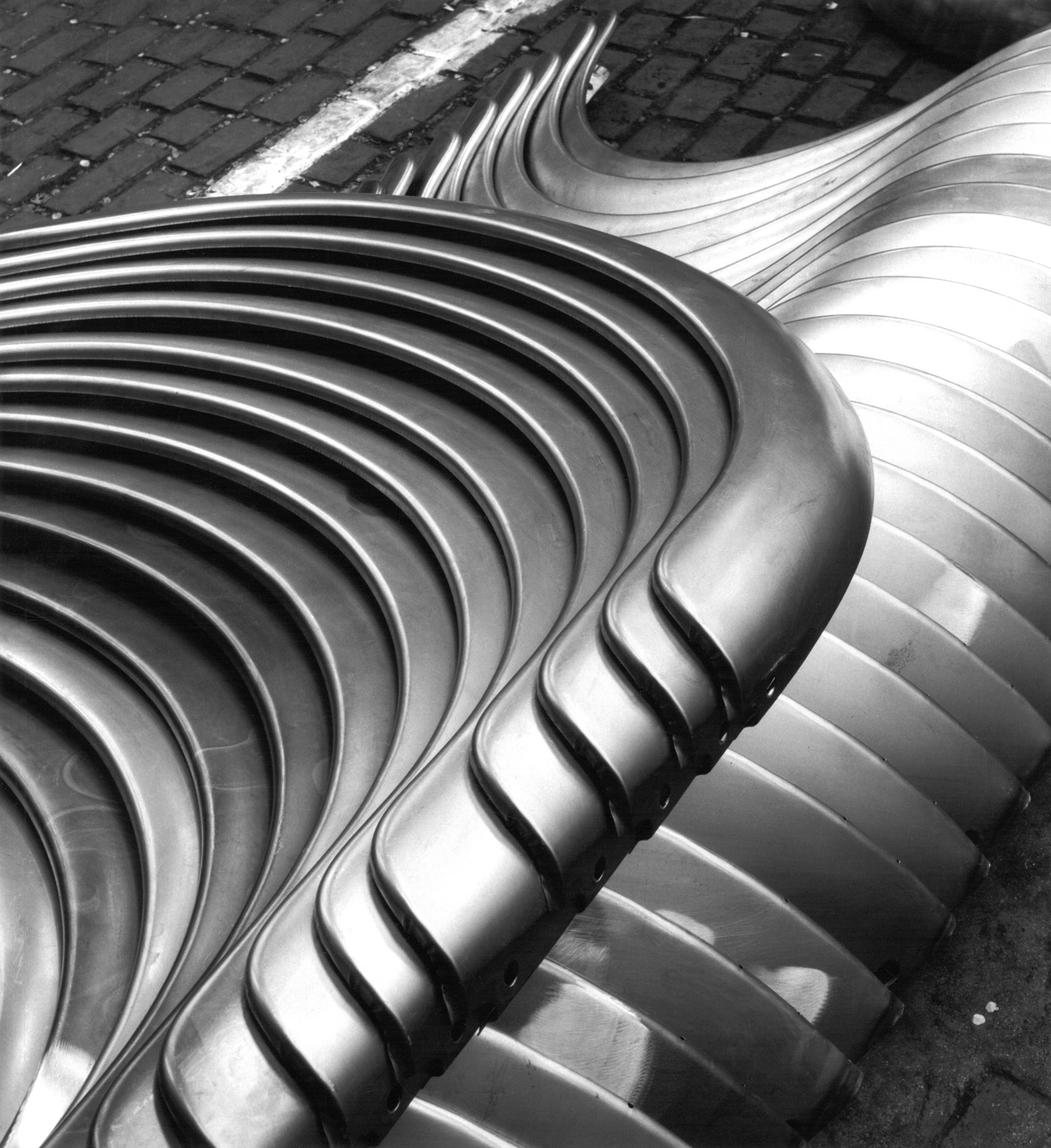
The J. Paul Getty Museum website

LIKE ART BLART ON FACEBOOK

Back to top

Exhibition: ‘Joel Meyerowitz – Aftermath’ at the Miami Art Museum

Exhibition dates: 19th August – 6th November 2011


Joel Meyerowitz (American, b. 1938) 'Searchers in Rubble' 2001


Joel Meyerowitz (American, b. 1938)
Searchers in Rubble
2001
Vintage contact print
Collection Miami Art Museum, gift of Steven E. and Phyllis Gross


And do you know what “the world” is to me? Shall I show it to you in my mirror? This world: a monster of energy, without beginning, without end; a firm, iron magnitude of force that does not grow bigger or smaller, that does not expend itself but only transforms itself; as a whole, of unalterable size, a household without expenses or losses, but likewise without increase or income; enclosed by “nothingness” as by a boundary; not something blurry or wasted, not something endlessly extended, but set in a definite space as a definite force, and not a space that might be “empty” here or there, but rather a force throughout, as a play of forces and waves of forces, at the same time one and many, increasing here and at the same time decreasing there …


Frederick Nietzsche, The Will to Power


Sadness. And light. Hope. Amidst the inferno. Study the masterpiece Finding More Fireman (below) in the enlarged version and you cannot fail to be moved. It is all there: monumental, intimate, hellish, redemptive – a modern, “disastrous” form of the Rembrandt’s The Night Watch.

Dr Marcus Bunyan


Many thanxk to the Miami Art Museum for allowing me to publish the photographs in the posting. Please click on the photographs for a larger version of the image.


Joel Meyerowitz (American, b. 1938) 'Flower Offering' 2001


Joel Meyerowitz (American, b. 1938)
Flower Offering
2001
Vintage contact print
Collection Miami Art Museum, gift of Steven E. and Phyllis Gross


Joel Meyerowitz (American, b. 1938) 'Pit Looking North' 2002


Joel Meyerowitz (American, b. 1938)
Pit Looking North
2002
Vintage contact print
Collection Miami Art Museum, gift of Steven E. and Phyllis Gross


Joel Meyerowitz (American, b. 1938) 'Smoke and Spray' 2001


Joel Meyerowitz (American, b. 1938)
Smoke and Spray
2001
Vintage contact print
Collection Miami Art Museum, gift of Jeffrey Hugh Newman


Joel Meyerowitz (American, b. 1938) 'Moving the Monument' 2001


Joel Meyerowitz (American, b. 1938)
Moving the Monument
2001
Vintage contact print
Collection Miami Art Museum, gift of Jeffrey Hugh Newman


Joel Meyerowitz (American, b. 1938) 'Finding More Fireman' 2001


Joel Meyerowitz (American, b. 1938)
Finding More Fireman
2001
Vintage contact print
Collection Miami Art Museum, gift of Charles S. and Elynne B. Zucker


Joel Meyerowitz (American, b. 1938) 'Searchers' 2002


Joel Meyerowitz (American, b. 1938)
Searchers
2002
Vintage contact print
Collection Miami Art Museum, gift of Charles S. and Elynne B. Zucker


Joel Meyerowitz (American, b. 1938) 'Welders in South Tower' 2001


Joel Meyerowitz (American, b. 1938)
Welders in South Tower
2001
Vintage contact print
Collection Miami Art Museum, gift of Charles S. and Elynne B. Zucker


In commemoration of the 10th anniversary of 9/11, Miami Art Museum presents Focus Gallery: Joel Meyerowitz – Aftermath, an exhibition of photographs taken by the only photographer granted right of entry into Ground Zero after the September 11, 2001 attacks on the World Trade Center in New York City. For nine months during the day and night, Meyerowitz photographed “the pile,” as the World Trade Center came to be known, and the over 800 people a day that were working in it. The exhibition consists of 24, recently-donated photographs, presented in the Focus Gallery section of the Museum’s Permanent Collection installation. Admission to Miami Art Museum will be free to all emergency personnel, including police and firefighters, and their guests throughout the exhibition’s run, August 19 – November 6, 2011. A special preview for emergency personnel will be held on Thursday, August 18, 2011, 4-7pm. Author and photography critic Vicki Goldberg will give a lecture entitled “What Remains” on Thursday, September 8, 2011, beginning at 6:30pm.

After September 11, 2001, the Ground Zero site in New York City was classified as a crime scene and only those directly involved in the recovery efforts were allowed inside. The press was prohibited from the site. Influenced by Walker Evans’s and Dorothea Lange’s work for the Farm Security Administration during the Great Depression, Meyerowitz, long recognised as one of the pioneers of colour photography, was convinced that if a photographic record of the unprecedented recovery efforts was not made, “there would be no history.” With the help of sympathetic officials, he managed to become the only photographer granted right of entry into Ground Zero.

“I was making photographs for everyone who didn’t have access to the site,” says Meyerowitz, “I wanted to communicate what it felt like to be in there as well as what it looked like: to show the pile’s incredible intricacy and visceral power. I could provide a window for everyone else who wanted to be there, too, to help, or to grieve, or simply to try to understand what had happened to our city.”

Armed with a large-format wooden camera, Meyerowitz spent nine months photographing the site. In the first few weeks, he was chased off the site repeatedly, but over time, with the help of officials on and off site, the use of forged workers’ passes, and by assuming the “uniform” of hard hat, goggles, respirator, gloves, boots and duct taped pants, Meyerowitz became “woven into the fabric of the site.”

About the experience, Meyerowitz has written, “The nine months I worked at Ground Zero were among the most rewarding of my life. I came in as an outsider, a witness bent on keeping the record, but over time I began to feel a part of the very project I’d been intent on recording… the intense camaraderie I experienced at Ground Zero inspired me, changing both my sense of myself and my sense of responsibility to the world around me. September 11th was a tragedy of almost unfathomable proportions. But living for nine months in the midst of those individuals who faced that tragedy head-on, day after day, and did what they could to set things right, was an immense privilege.”

The photographs in MAM’s collection are from a unique set of contact prints (photographs printed on a 1:1 scale from the negatives) issued by the artist in 2006. As a group, they span the entire nine month period that Meyerowitz was on site, presenting a poignant, condensed view of the clean up effort, including portraits of the workers involved. The set is introduced by a single image of the World Trade Center towers taken by the artist in the 1980s from his apartment window.

The entire set of more than 8,000 photographs taken by Meyerowitz form an archive at the Museum of the City of New York. The Aftermath series was the focus of a 2006 book, Aftermath: World Trade Center Archives published by Phaidon (reissued this year in a special 10th anniversary edition) and an exhibition organised by the US Department of State that traveled worldwide from 2002 to 2005.

Press release from the Miami Art Museum website


Joel Meyerowitz (American, b. 1938) 'Explosion Squad Detective' 2001


Joel Meyerowitz (American, b. 1938)
Explosion Squad Detective
2001
Vintage contact print
Collection Miami Art Museum, gift of Steven E. and Phyllis Gross


Joel Meyerowitz (American, b. 1938) 'Steps Down to Plaza' 2001


Joel Meyerowitz (American, b. 1938)
Steps Down to Plaza
2001
Vintage contact print
Collection Miami Art Museum, gift of Jeffrey Hugh Newman


Joel Meyerowitz (American, b. 1938) 'Fireman at Last Column' 2002


Joel Meyerowitz (American, b. 1938)
Fireman at Last Column
2002
Vintage contact print
Collection Miami Art Museum, gift of Charles S. and Elynne B. Zucker


Joel Meyerowitz (American, b. 1938) 'Building #5 and Woolworth' 2001


Joel Meyerowitz (American, b. 1938)
Building #5 and Woolworth
2001
Vintage contact print
Collection Miami Art Museum, gift of Simon and Bonnie Levin


Joel Meyerowitz (American, b. 1938) 'Welder and Rubble' 2001


Joel Meyerowitz (American, b. 1938)
Welder and Rubble
2001
Vintage contact print
Collection Miami Art Museum, gift of Steven E. and Phyllis Gross


Miami Art Museum
101 W Flagler St., Miami, FL 33130

Opening hours:
Monday 11am – 6pm
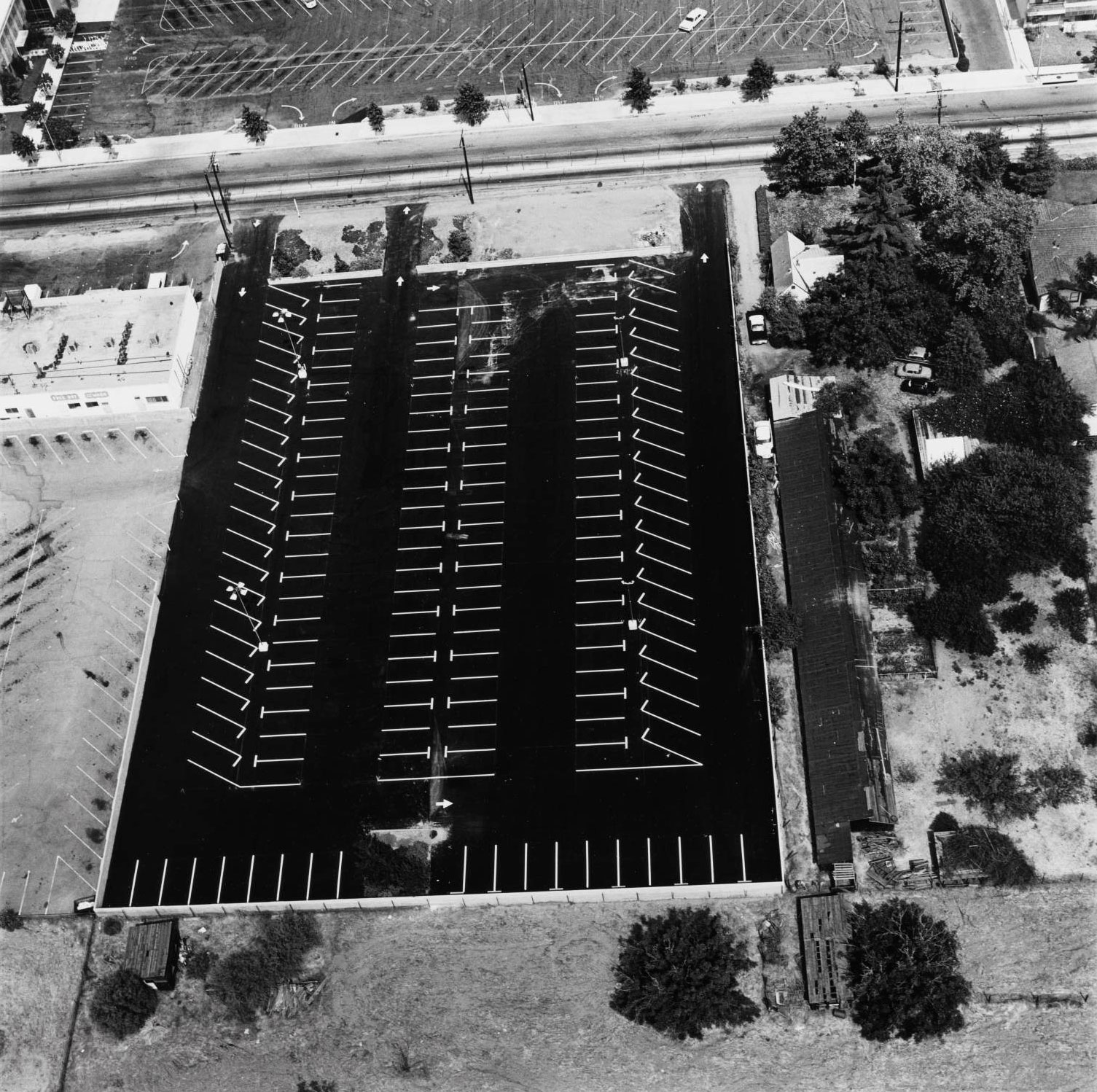
Tuesday – Wednesday Closed
Thursday 11am – 9pm
Friday – Sunday 11am – 6pm
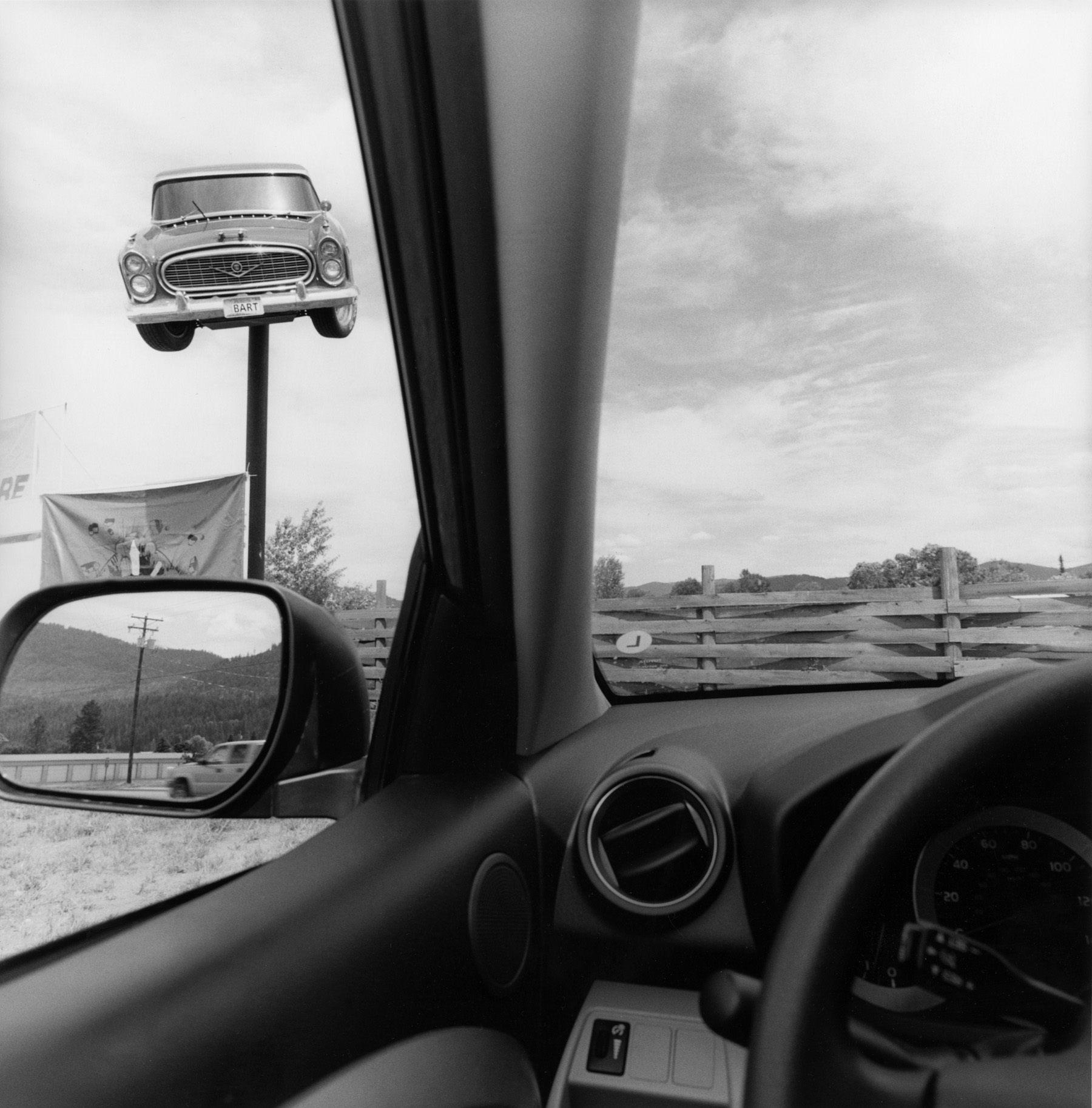
Miami Art Museum website

LIKE ART BLART ON FACEBOOK

Back to top