Exhibition: ‘In Focus: Architecture’ at the J. Paul Getty Museum, Getty Center, Los Angeles

Exhibition dates: 15th October 2013 – 2nd March 2014


William Henry Fox Talbot (English, 1800-1877) 'Boulevard des Italiens, Paris' 1843


William Henry Fox Talbot (English, 1800-1877)
Boulevard des Italiens, Paris
1843
Salted paper print from a Calotype negative
16.8 x 17.3cm
The J. Paul Getty Museum, Los Angeles


Another gem of a photography exhibition from the Getty. These In Focus exhibitions are just a treasure: from Making a Scene, Still Life and The Sky to Los Angeles, Picturing the Landscape and now Architecture. All fabulous. To have a photography collection such as the Getty possesses, and to use it. To put on these fantastic exhibitions…

I like observing the transition between epochs (or, in more architectural terms, ‘spans’ of time), photographers and their styles. From the directness and frontality of Fox Talbot’s Boulevard des Italiens, Paris (1843, below) to the atmospheric ethereality of Atget’s angular The Panthéon (1924, below) taken just three years before he died; from the lambent light imbued in Frederick Evans’ architectural study of the attic at Kelmscott Manor (1896, below) to the blocked, colour, geometric facade of William Christenberry’s Red Building in Forest, Hale County, Alabama (1964, below).

I love architecture, I love photography. Put the two together and I am in heaven.

Dr Marcus Bunyan


Many thankx to the J. Paul Getty Museum for allowing me to publish the photographs in the posting. Please click on the photographs for a larger version of the image.


Eugéne Atget (French, 1857-1927) 'The Panthéon' 1924


Eugéne Atget (French, 1857-1927)
The Panthéon
1924
Gelatin silver chloride print on printing-out paper
Image: 17.8 x 22.6cm
The J. Paul Getty Museum, Los Angeles


Eugène Atget made this atmospheric study across the place Sainte-Geneviève toward the back of the Panthéon, a church boldly designed to combine the splendour of Greece with the lightness of Gothic churches. The church’s powerful colonnaded dome, Atget’s primary point of interest, hovers in the background, truncated by the building in the left foreground.

In order to make the fog-veiled Panthéon visible when printing this negative, Atget had to expose the paper for a long period of time. As a consequence of the long printing, the two buildings in the foreground are overexposed, appearing largely as black silhouettes. Together they frame the Panthéon, rendered entirely in muted greys. This photograph exceeds documentation to become more a study of mood and atmospheric conditions than of architecture.
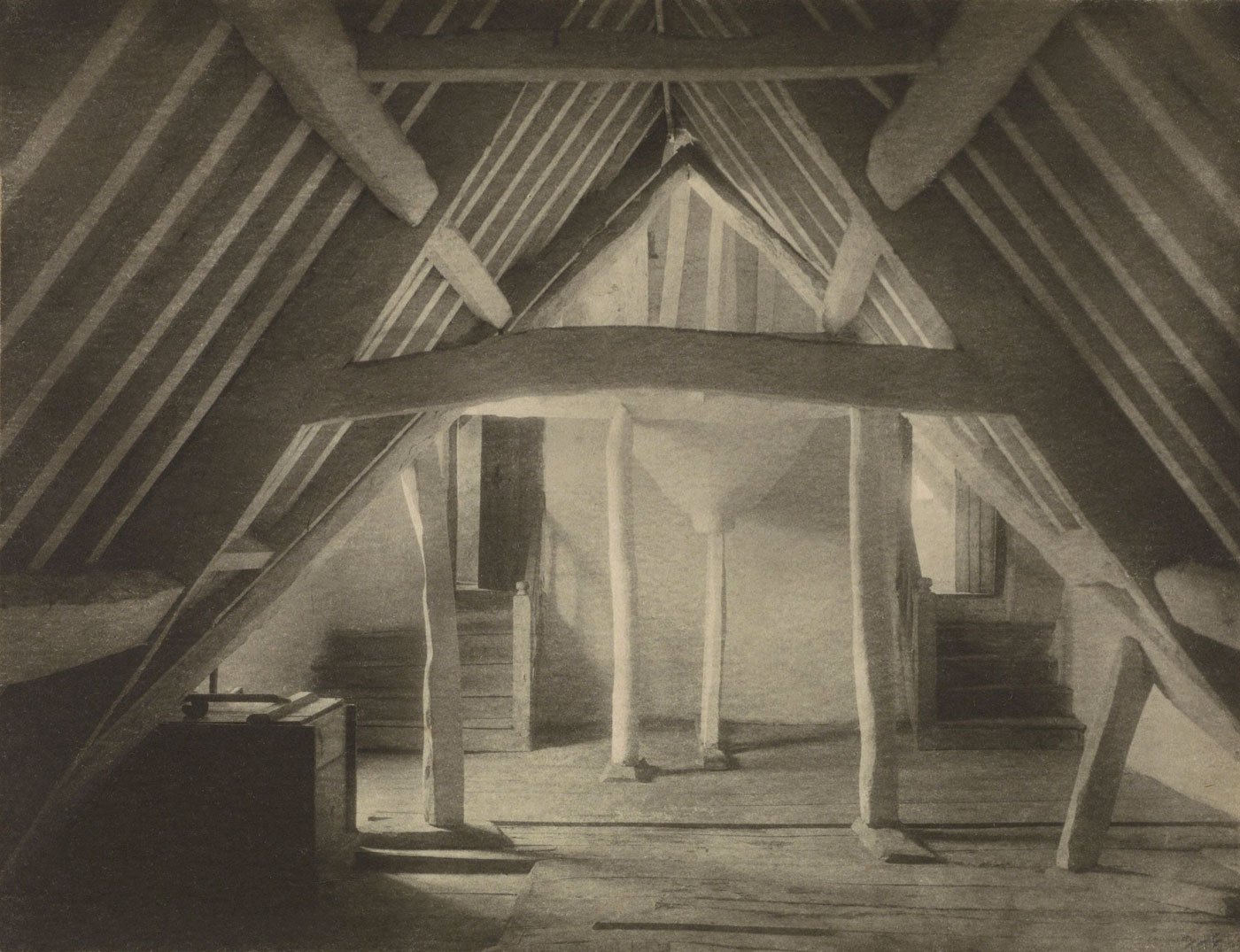
 

Frederick H. Evans (British, 1863-1943) 'Kelmscott Manor: In the Attics (No. 1)' 1896


Frederick H. Evans (British, 1863-1943)
Kelmscott Manor: In the Attics (No. 1)
1896
Platinum print
15.6 x 20.2cm
© Mrs Janet M. Stenner, sole granddaughter of Frederick H, Evans
The J. Paul Getty Museum, Los Angeles


Frederick Evans’s architectural study of the attic at Kelmscott Manor, a medieval house, part of which dates from 1280, is a visual geometry lesson. The composition is all angles and intersections, formed not only by the actual structure but also by the graphic definition of light within the space. Soft illumination bathes the area near the stairs, while the photograph’s foreground plunges into murky darkness. The sharp angles of intersecting planes are mediated by the rough-hewn craftsmanship of the beams and posts, almost sensuous in their sinewy imperfection and plainly wrought by hand. The platinum print medium favoured by Evans provides softened tonalities that further unify the triangles, squares, and diagonal lines of the dynamic composition.


William Christenberry (American, b. 1936) 'Red Building in Forest, Hale County, Alabama' 1964


William Christenberry (American, b. 1936)
Red Building in Forest, Hale County, Alabama
1964
44.5 x 55.9cm
© William Christenberry
The J. Paul Getty Museum, Los Angeles


William Christenberry began photographing this makeshift wooden structure in his native Alabama in 1974. Since that time, he has made nearly annual trips to document the facade of this isolated dwelling, located deep in the Talladega National Forest. Such vernacular structures were uncommon photographic subjects until Walker Evans, Ed Ruscha, William Eggleston, and other twentieth-century photographers elevated their stature. Like the edifices photographed by Eugène Atget, Bernd and HIlla Becher, and others, the buildings Christenberry recorded in the southern United States were often in disrepair and in danger of disappearing altogether.


Soon after its invention in 1839, photography surpassed drawing as the preferred artistic medium for recording and presenting architecture. Novel photographic techniques have kept pace with innovations in architecture, as both media continue to push artistic boundaries. In Focus: Architecture, on view October 15, 2013 – March 2, 2014 at the J. Paul Getty Museum, Getty Center, traces the long, interdependent relationship between architecture and photography through a selection of more than twenty works from the Museum’s permanent collection, including recently acquired photographs by Andreas Feininger, Ryuji Miyamoto, and Peter Wegner.

“Architectural photography was an integral part of the early days of the medium, with the construction of many of the world’s most important and magnificent structures documented from start to finish with the camera,” explains Timothy Potts, director of the J. Paul Getty Museum. “This exhibition demonstrates how architectural photography has grown from straightforward documentary style photographs in its early days to genre-bending works like those of Peter Wegner from 2009.”

Beginnings of Architectural Photography

Recognised for their accuracy and precision, photographs could render architectural details as never before and show the built environment during construction, after completion, or in ruin. Nineteenth-century photographers were eager to utilize the new medium to document historic sites and structures, as well as buildings that rose alongside them, or in their place. In 1859, Gustave Le Gray photographed the Mollien Pavilion, a structure that constituted part of the “New Louvre,” a museum expansion completed during the reign of Napoleon III. Le Gray’s picturesque composition highlighted the Pavilion’s ornamented façade and other intricate details that could inform the work of future architects. Louis-Auguste Bisson, a trained architect, worked with his brother Auguste-Rosalie to photograph grand architectural spaces such as Interior of Saint-Ouen Church in Rouen (1857). The Bisson brothers produced a monumental print, derived from a glass negative of the same size, to feature the nave of the structure in an interior view rarely depicted in 19th century photographs.

A burgeoning commercial market for tourist photographs emerged toward the end of the nineteenth century. Views of architectural landmarks and foreign ruins became popular souvenirs and tokens of the ancient world. Artists such as J.B. Greene, who ventured to exotic destinations, provided visions of historic sites in Egypt, while Louis-Émile Durandelle took a series of photographs that documented the construction of the Eiffel Tower in the years before it became a symbol of the modern era at the World’s Exposition of 1889. Durandelle’s frontal view of the structure underscored its perfect geometric form, and his photographs were the earliest of what became a popular motif for amateur and professional photographers. Other noted photographers of this period included Eugène Atget, who obsessively documented the streets and buildings of Paris before its modernisation, and Frederick H. Evans, who created poetic photographs of Romanesque and Gothic cathedrals.

The Rise of Modern Architectural Photography

As the commercial market for photographs expanded and technologies advanced, representations of architectural forms began to evolve as well. In the twentieth century, images of buildings developed in conjunction with the rise of avant-garde, experimental, documentary, and conceptual modes of photographic expression.

Andreas Feininger, who studied architecture in Weimar, followed what Bauhaus instructor László Moholy-Nagy called a “new vision” of photography as an autonomous artistic practice with its own laws of composition and lighting. In Portal in Greifswald (1928), Feininger created a negative print, or a photograph with reversed tonalities, resulting in a high contrast image that enhanced the mystery of the architectural subject and removed it from its ecclesiastical context.

“The experimental spirit that permeated photography in the first half of the twentieth century inspired new ways to look at architectural forms,” says Amanda Maddox, assistant curator of photographs at the J. Paul Getty Museum and curator of the exhibition. “As photographs could present buildings in abstracted, close-up, or fragmented views, they encouraged viewers to see the built environment around them as never before.”

At the same time the Bauhaus was influencing photographers throughout Europe, Walker Evans was at the forefront of vernacular photography in the United States, which elevated ordinary objects and events to photographic subjects. In keeping with this trend, architectural photography shifted its focus to ordinary domestic and functional buildings. Derelict and isolated dwellings feature prominently in the work of William Christenberry, whose photograph and “building construction” of Red Building in Forest, Hale County, Alabama (1994) will be on display in the exhibition.

Architecture as a photographic subject became more malleable at the end of the twentieth century, as artists continued to explore the symbolism and vitality of the modern cityscape. This transition is exemplified in Peter Wegner’s 32-part Building Made of Sky III (2009), in which the spaces between skyscrapers in New York, San Francisco and Chicago create buildings of their own. Wegner described the series as “the architecture of air, the space defined by the edges of everything else.” When presented as a grid, the works form a new, imaginary city.

Press release from the J. Paul Getty website


Gustave Le Gray (French, 1820 - 1884) 'Mollien Pavilion, the Louvre' 1859


Gustave Le Gray (French, 1820-1884)
Mollien Pavilion, the Louvre
1859
Albumen silver print
Image: 36.7 x 47.9cm
The J. Paul Getty Museum, Los Angeles


Standing opposite a newly built pavilion of the Louvre, Gustave Le Gray made this photograph when the sun’s position allowed him to best capture the details of the heavily ornamented facade, from the fluted columns on the ground level to the figurative group on the nearest gable. Paving stones lead the viewer’s eye directly to the corner of the pavilion, where the sunlit facade is further highlighted beside an area blanketed in shadow.

Though the extensive art collections of the Louvre had first been opened to the public in 1793, after the French Revolution, it was not until 1848 that the museum became the property of the state. Le Gray’s image shows the exuberance of the architecture undertaken shortly thereafter, during the reign of Napoléon III, when large sections of the building housed government offices.


Ryuji Miyamoto (Japanese, b. 1947) 'Kowloon Walled City' 1987


Ryuji Miyamoto (Japanese, b. 1947)
Kowloon Walled City
1987
Gelatin silver print
34.4 x 51.1cm
© Ryuji Miyamoto
The J. Paul Getty Museum, Los Angeles


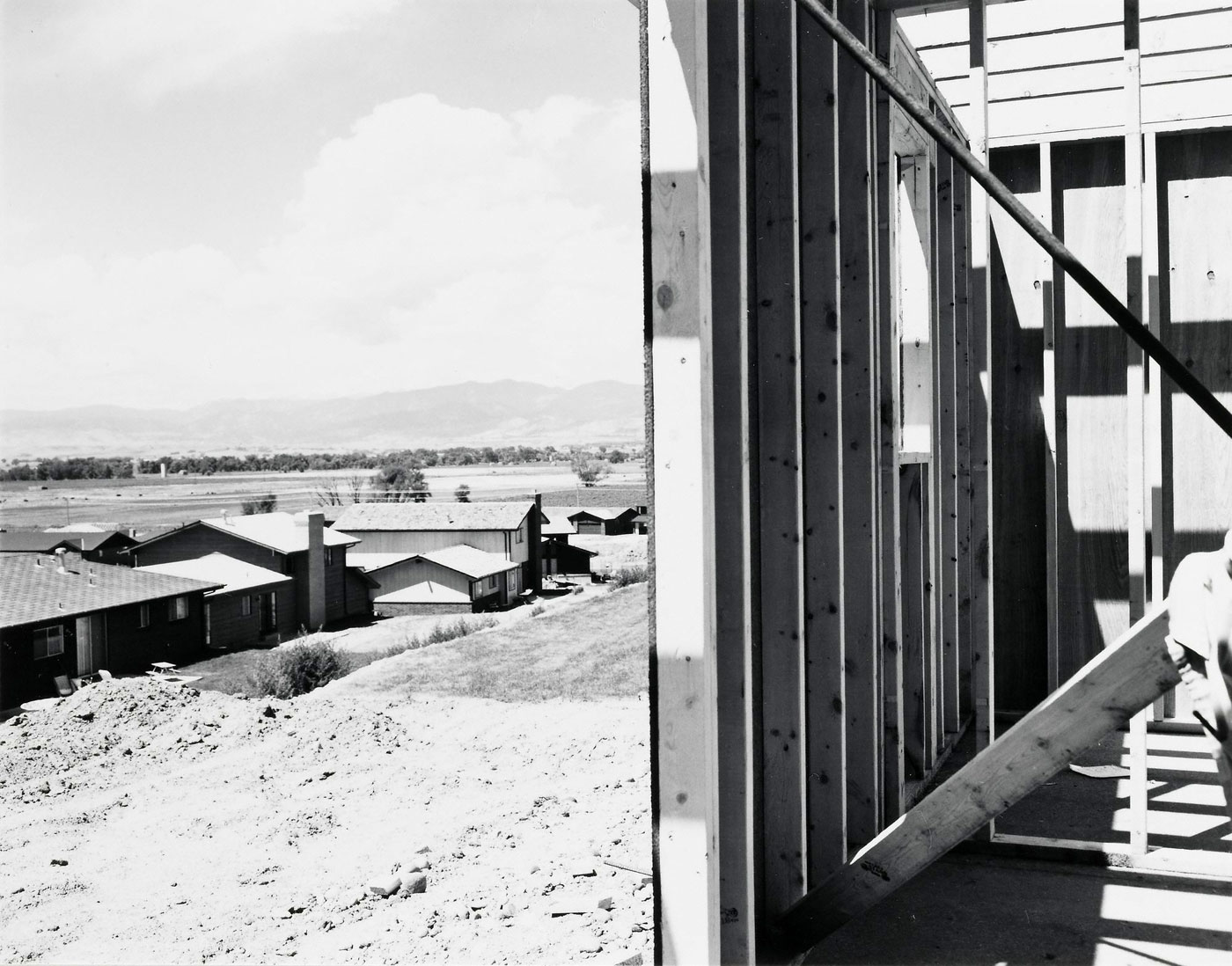
Robert Adams (American, b. 1937) 'Longmont, Colorado' 1973


Robert Adams (American, b. 1937)
Longmont, Colorado
1973
Gelatin silver print
15.2 x 19.4cm
© Robert Adams
The J. Paul Getty Museum, Los Angeles


The long, interdependent relationship between photography and architecture is the subject of this survey drawn from the Getty Museum’s collection. Spanning the history of the medium, the exhibition features twenty-four works by such diverse practitioners as William Henry Fox Talbot, Eugène Atget, Walker Evans, Bernd and Hilla Becher, and Ryuji Miyamoto. Seen together, the varied photographic representations of secular and sacred structures on display reveal how the medium has impacted our understanding and perception of architecture.

In the nineteenth century, photography surpassed drawing as the preferred artistic medium for recording and presenting architecture. Recognised for their accuracy and precision, photographs could render architectural elements as never before. The intricate ornamented facade, the sprawling sunlit Napoléon Courtyard, and the classical design of the Louvre appear in magnificent detail in Gustave Le Gray’s picturesque image of the Mollien Pavilion, a structure completed in the 1850s during the reign of Napoléon III.

Photographers working in the nineteenth century documented historic structures on the verge of disappearance as well as contemporary buildings erected before their eyes. They also captured the built environment during construction, after completion, and in ruin. This photograph by Louis-Émile Durandelle shows the Eiffel Tower, the centrepiece of the 1889 World Exposition, in November 1888 when only its four columns, piers, and first two platforms were in place.

With the advancement of photographic technologies and the modernisation of the built environment around the turn of the twentieth century came innovative representations of architecture. Compositions and photographic processes began to reflect the avant-garde and modernist sensibilities of the time, and photographs of buildings, churches, homes, and other structures often showcased these developments. Andreas Feininger, who trained as an architect, utilised an experimental printing technique to depict gothic St. Nikolai cathedral in Greifswald in a nontraditional way.

Images of architecture by contemporary photographers Robert Adams, William Christenberry, and others working in the documentary tradition often underscore the temporality of buildings. Vernacular structures found in his native Alabama are among the subjects Christenberry has systematically recorded for the past six decades. By returning year-after-year to photograph the same places, such as the red building shown above, Christenberry chronicles the decay (and sometimes the ultimate disappearance) of stores, tenant houses, churches, juke joints, and other rural buildings.

Experimental and conceptual approaches toward the representation of architecture have been embraced by photographers. Peter Wegner used skyscrapers in New York, San Francisco, and Chicago as his framing devices to feature the spaces between high rises that form buildings of their own. By upending images of these canyons, he created buildings made of sky. When presented as a grid, they form a new, imaginary city.

Text from the J. Paul Getty website


Henri Le Secq (French, 1818 - 1882) 'Tour de Rois à Rheims' ('Tower of the Kings at Rheims Cathedral') 1851


Henri Le Secq (French, 1818-1882)
Tour de Rois à Rheims (Tower of the Kings at Rheims Cathedral)
1851
Salted paper print
35.1 x 25.9cm
The J. Paul Getty Museum, Los Angeles


Louis-Émille Durandelle (French, 1839 - 1917) 'The Eiffel Rower: State of Construction' 1888


Louis-Émille Durandelle (French, 1839-1917)
The Eiffel Rower: State of Construction
1888
Albumen silver print
43.2 x 34.6cm
The J. Paul Getty Museum, Los Angeles


The Centennial Exposition of 1889 was organised by the French government to commemorate the French Revolution. Bridge engineer Gustave Eiffel’s 984-foot (300-meter) tower of open-lattice wrought iron was selected in a competition to erect a memorial at the exposition. Twice as high as the dome of St. Peter’s in Rome or the Great Pyramid of Giza, nothing like it had ever been built before. This view was made about four months short of the tower’s completion. Louis-Émile Durandelle photographed the tower from a low vantage point to emphasise its monumentality. The massive building barely visible in the far distance is dwarfed under the tower’s arches. Incidentally, the tower’s innovative glass-cage elevators, engineered to ascend on a curve, were designed by the Otis Elevator Company of New York, the same company that designed the Getty Center’s diagonally ascending tram.


Andreas Feininger (American born France, 1906-1999) 'Portal in Greifswald' 1928


Andreas Feininger (American, born France, 1906-1999)
Portal in Greifswald
1928
Gelatin silver print
23.4 x 17.5cm
© Estate of Gertrud E. Feininger
The J. Paul Getty Museum, Los Angeles


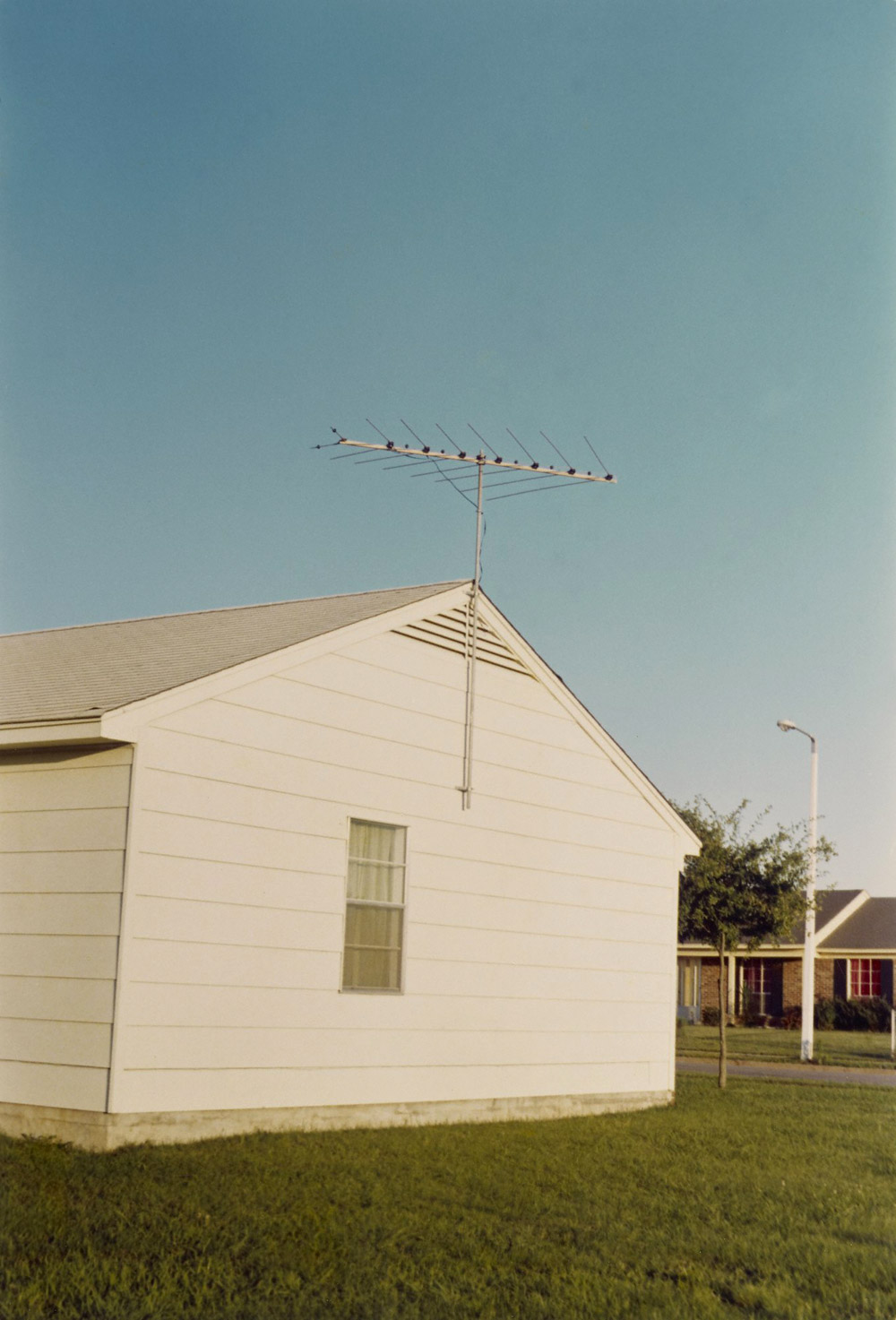
William Eggleston (American, b. 1939) '(Untitled)' Negative about 1967-1974; print 1974


William Eggleston (American, b. 1939)
(Untitled)
Negative about 1967-1974; print 1974
Chromogenic print
Image: 22.2 x 15.2cm
© Eggleston Artistic Trust
The J. Paul Getty Museum, Los Angeles


The J. Paul Getty Museum
1200 Getty Center Drive
Los Angeles, California 90049

Opening hours:
Tues – Friday 10am – 5.30pm
Saturday 10am – 8pm
Sunday 10am – 5.30pm
Monday closed
The J. Paul Getty Museum website

LIKE ART BLART ON FACEBOOK

Back to top

Exhibition: ‘The Platinum Process: Photographs from the Nineteenth to the Twenty-First Century’ at Philadelphia Museum of Art

Exhibition dates: 27th February – 23rd May, 2010


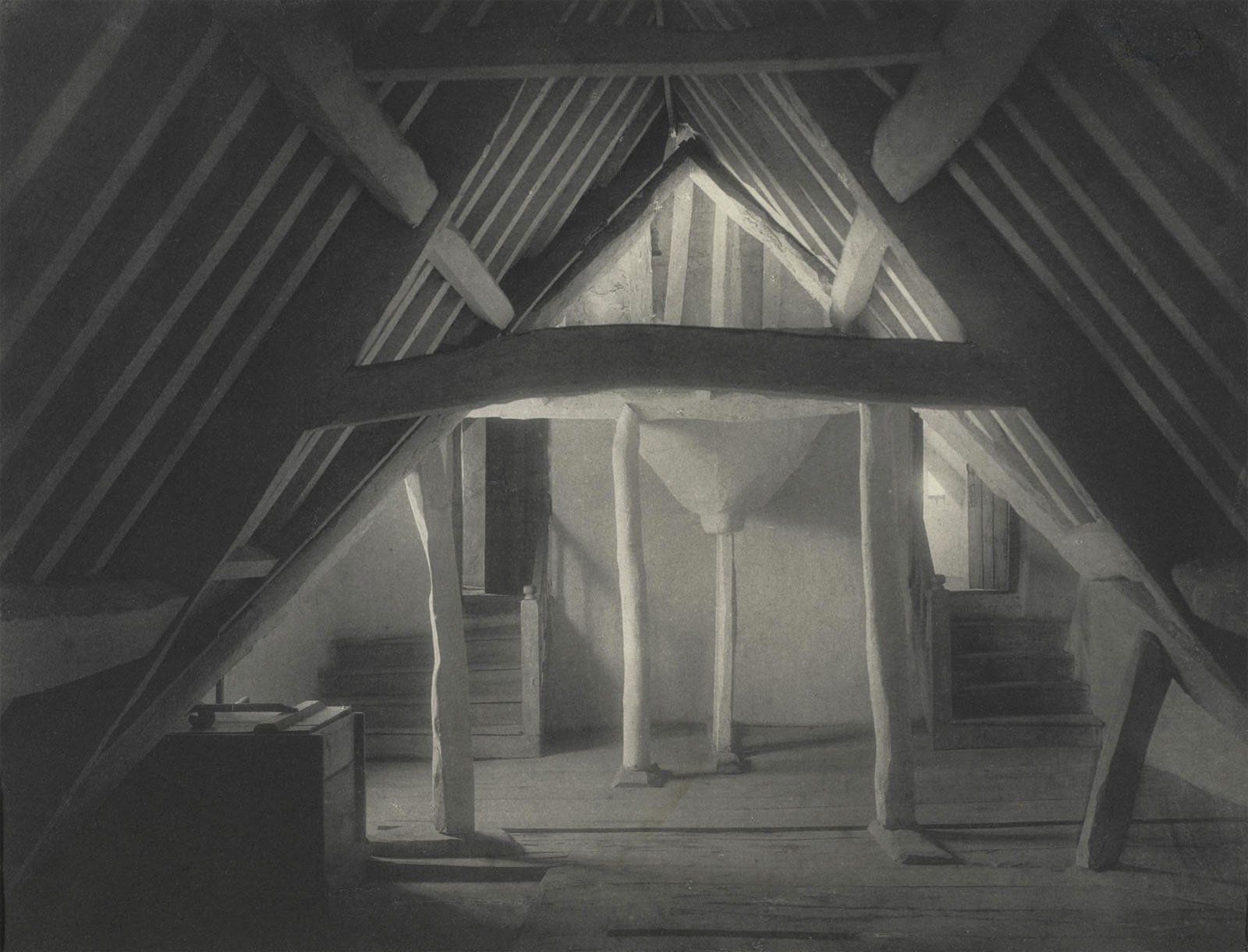
Frederick H. Evans (British, 1853-1943) 'Kelmscott Manor: Attics' 1896 from the exhibition 'The Platinum Process: Photographs from the Nineteenth to the Twenty-First Century' at Philadelphia Museum of Art, February - May, 2010


Frederick H. Evans (British, 1853-1943)
Kelmscott Manor: Attics
1896
Platinum print
Image and sheet: 6 1/16 × 7 7/8 inches (15.4 × 20cm)
Philadelphia Museum of Art
Gift of the artist, 1932


Attics often serve as metaphors for the space where memories reside. Here Frederick Evans captures the warm glow, the simple, rough-hewn timbers, and the striking geometry of the attic at Kelmscott Manor, the beloved summer retreat of designer William Morris (British, 1834-1896).

Morris, the leader of the Arts and Crafts movement – which valued Britain’s craft tradition and rejected its industrial revolution – drew inspiration from the architecture and workmanship of Kelmscott, designed and constructed in the 1500s. In 1896 Morris invited Evans to photograph the home, which he felt embodied the memory of Britain’s aesthetic past.

Text from the Philadelphia Museum of Art website


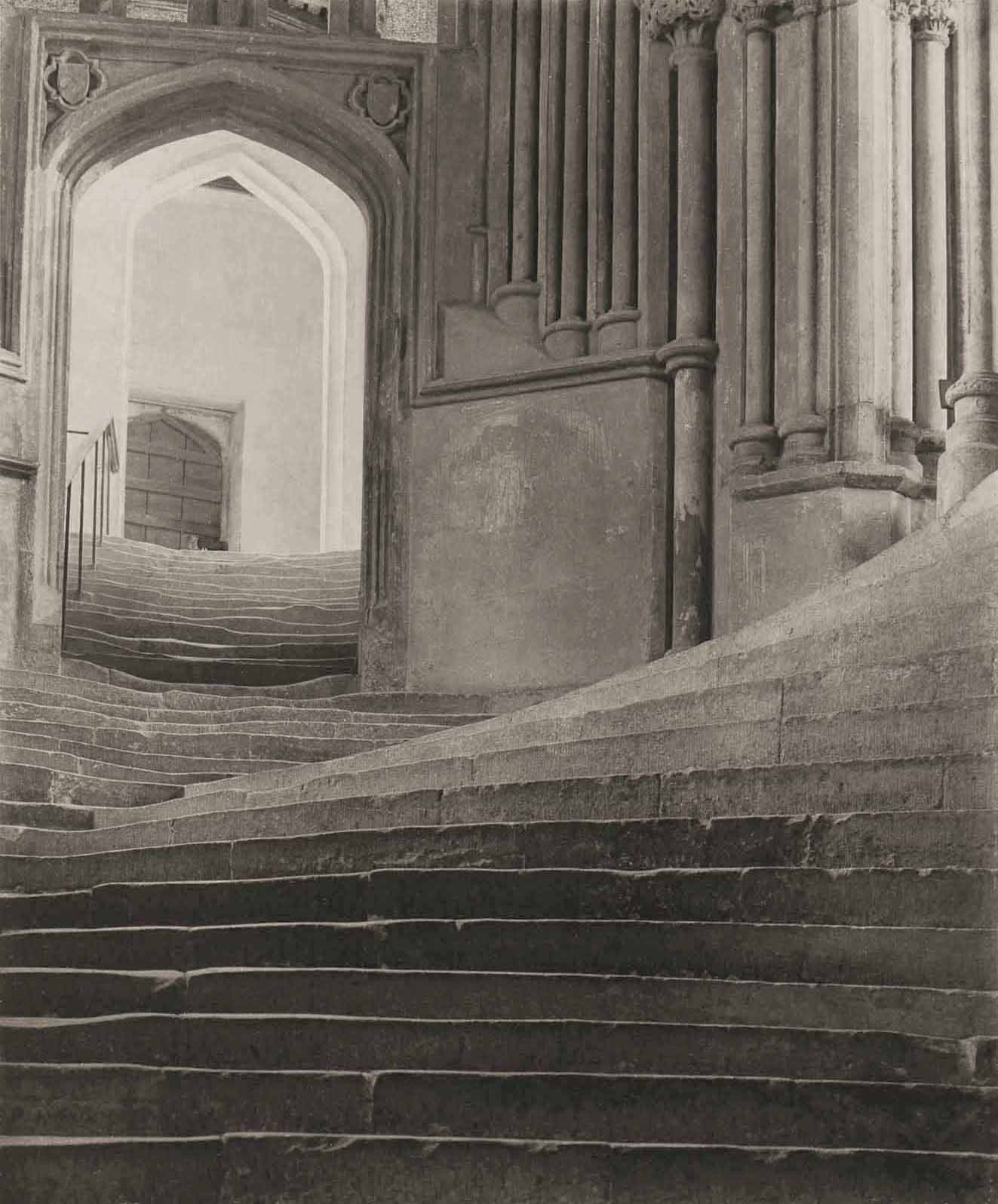
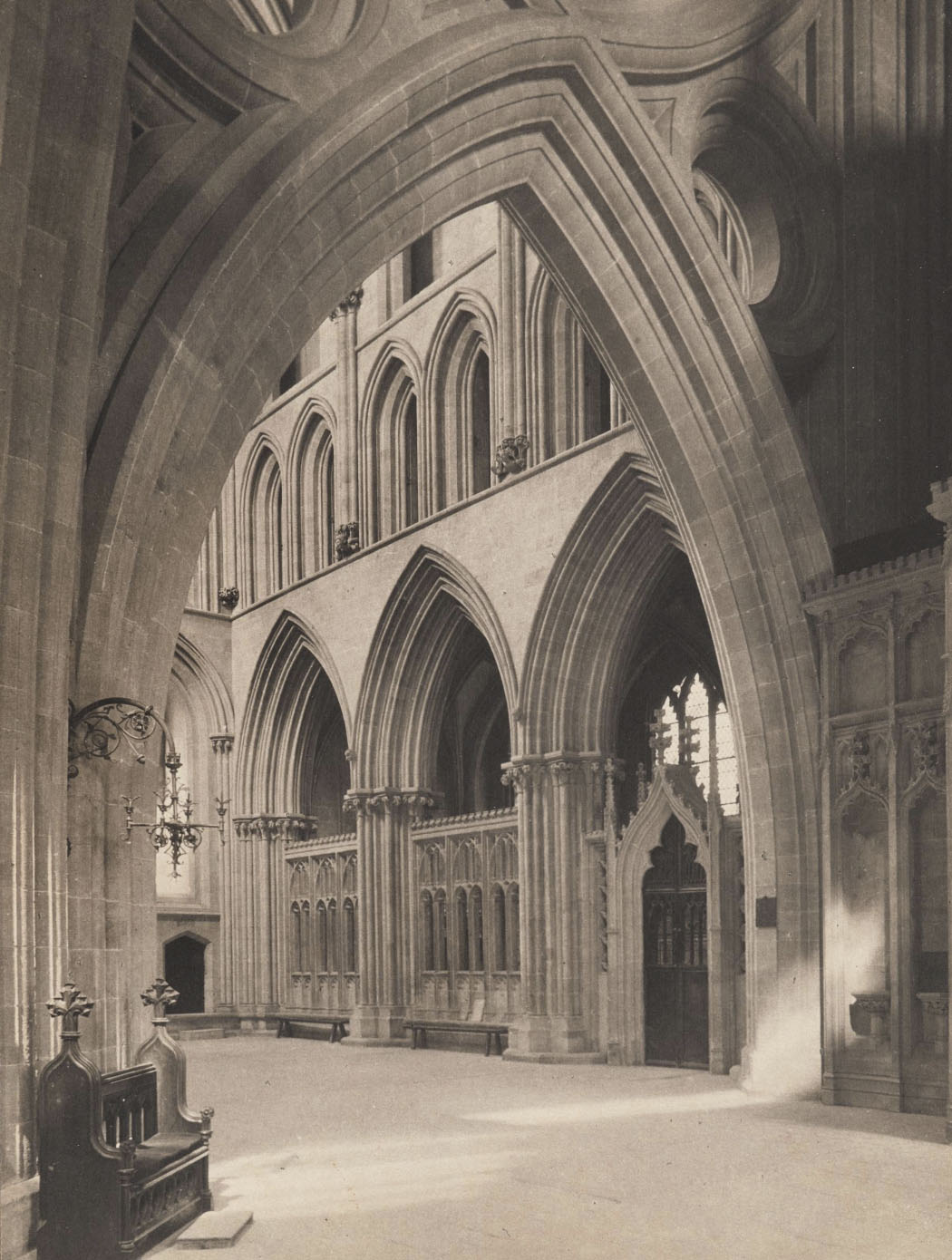
Platinum prints always have such luminosity. A Sea of Steps by Fredrick H. Evans (1903, below) is a knockout. I remember some beautiful platinum prints many years ago (1989) up in Sydney at the Museum of Contemporary Art in the touring exhibition Robert Mapplethorpe: The Perfect Moment that were an absolute knockout as well. Pity he didn’t print them himself but they were still superlative!

Dr Marcus Bunyan


Many thankx to Shen Shellenberger and the Philadelphia Museum of Art for allowing me to publish the last five images in the posting. Please click on the photographs for a larger version of the image.


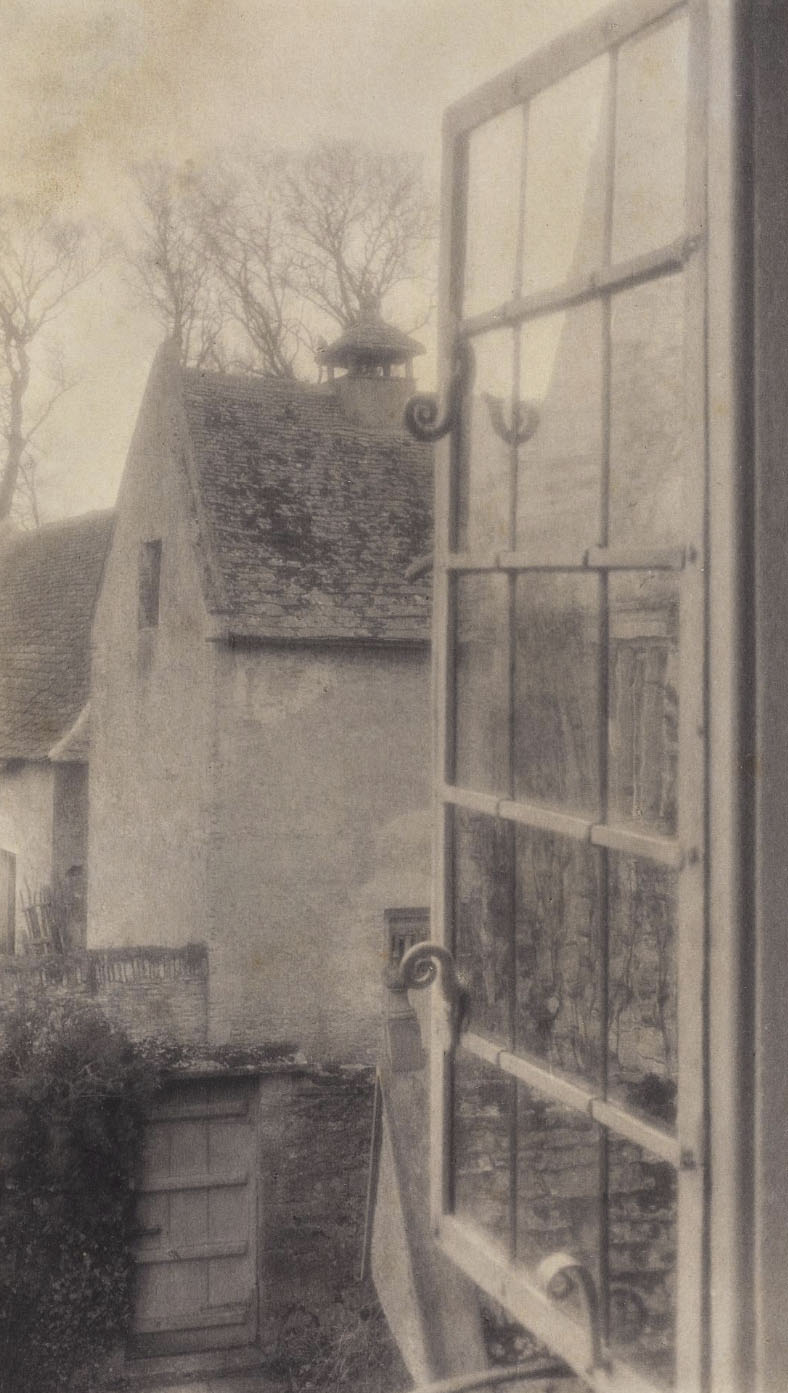
Frederick H. Evans (British, 1853-1943) 'Kelmscott Manor' 1896 from the exhibition 'The Platinum Process: Photographs from the Nineteenth to the Twenty-First Century' at Philadelphia Museum of Art, February - May, 2010


Frederick H. Evans (British, 1853-1943)
Kelmscott Manor
1896
Platinum print
Image and sheet: 7 3/8 × 4 1/4 inches (18.7 × 10.8cm)
Philadelphia Museum of Art
Purchased with funds contributed by Dorothy Norman and with the Director’s Discretionary Fund, 1968


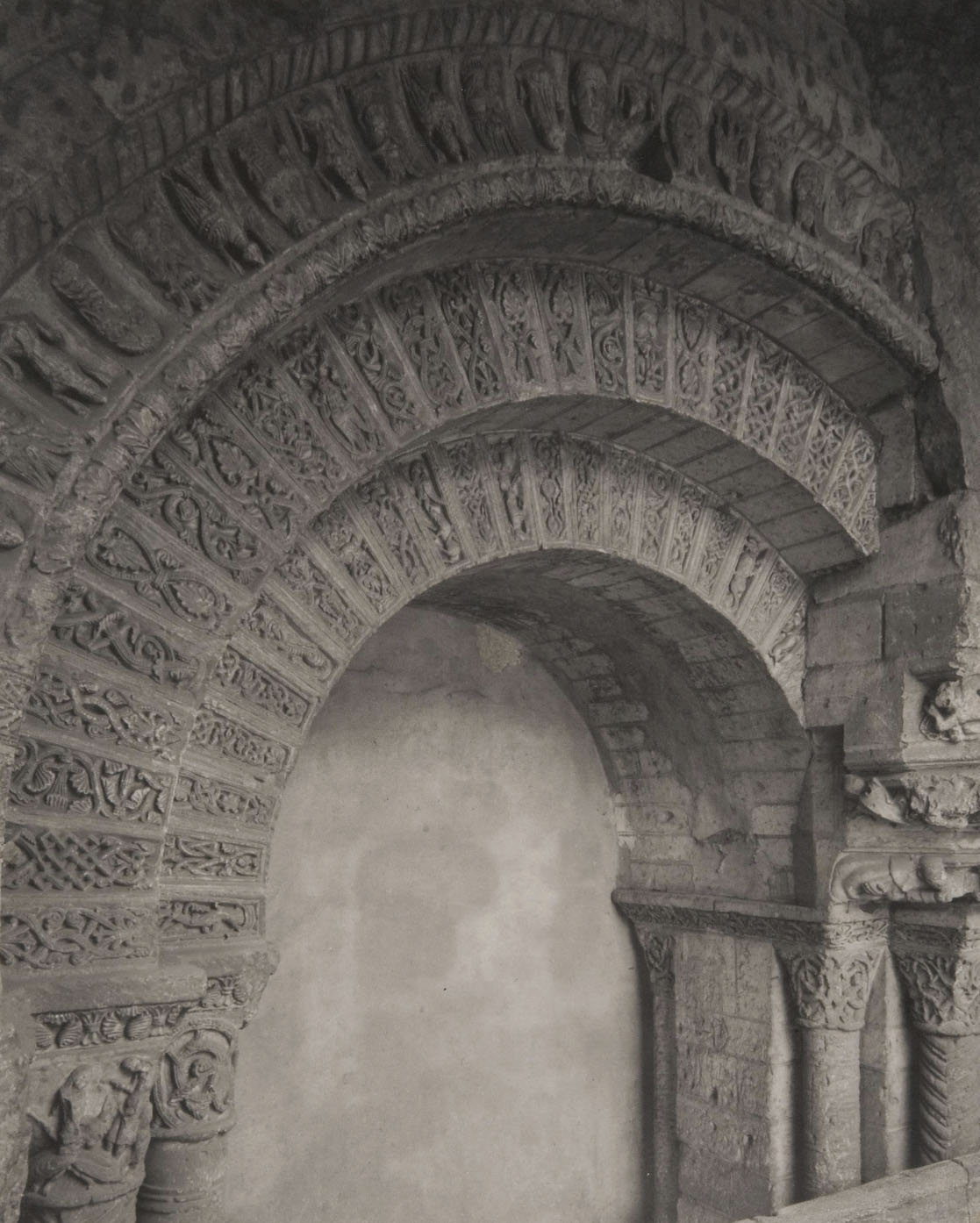
Frederick H. Evans (British, 1853-1943) 'Angers: Prefecture, Sculptured Arches of 11th-12th Century' c. 1906-1907 from the exhibition 'The Platinum Process: Photographs from the Nineteenth to the Twenty-First Century' at Philadelphia Museum of Art, February - May, 2010


Frederick H. Evans (British, 1853-1943)
Angers: Prefecture, Sculptured Arches of 11th-12th Century
c. 1906-1907
Platinum print
Image and sheet: 9 11/16 × 7 7/8 inches (24.6 × 20 cm)
Philadelphia Museum of Art
Purchased with funds contributed by Dorothy Norman and with the Director’s Discretionary Fund, 1968


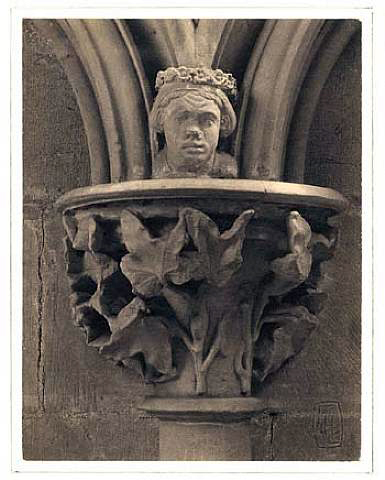
Frederick H. Evans (British, 1853-1943) 'Southwell Cathedral, Chapter House Capital' 1898


Frederick H. Evans (British, 1853-1943)
Southwell Cathedral, Chapter House Capital
1898
Platinum print
Philadelphia Museum of Art


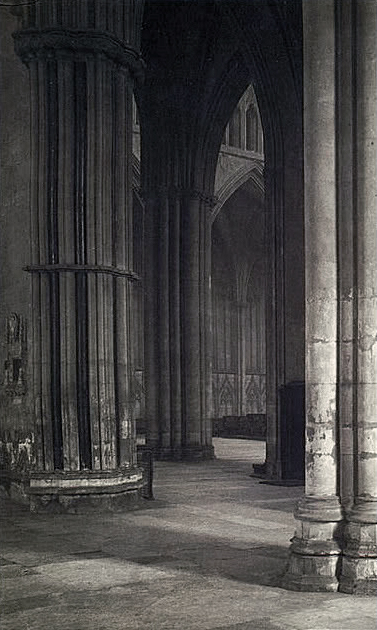
Frederick H. Evans (British, 1853-1943) 'View across the nave to the transept at York Minster' 1901


Frederick H. Evans (British, 1853-1943)
View across the nave to the transept at York Minster
1901
Platinum print
Philadelphia Museum of Art


Frederick H. Evans (British, 1853-1943) 'Durham Cathedral: West End Nave' 1912


Frederick H. Evans (British, 1853-1943)
Durham Cathedral: West End Nave
1912
Platinum print
Image and sheet: 9 1/2 × 4 13/16 inches (24.1 × 12.3cm)
Philadelphia Museum of Art
Purchased with funds contributed by Dorothy Norman, 1973


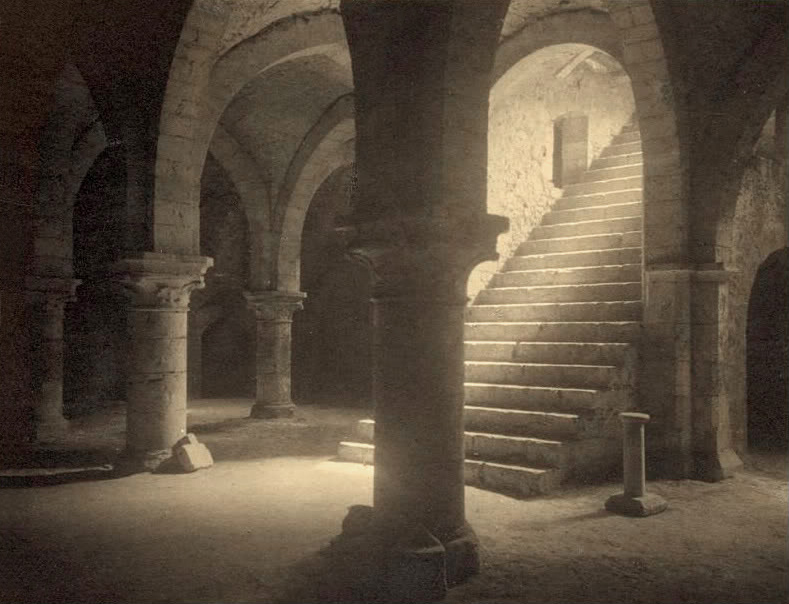
Frederick H. Evans (British, 1853-1943) 'Ancient crypt cellars in Provins' 1910


Frederick H. Evans (British, 1853-1943)
Ancient crypt cellars in Provins
1910
Platinum print
Philadelphia Museum of Art


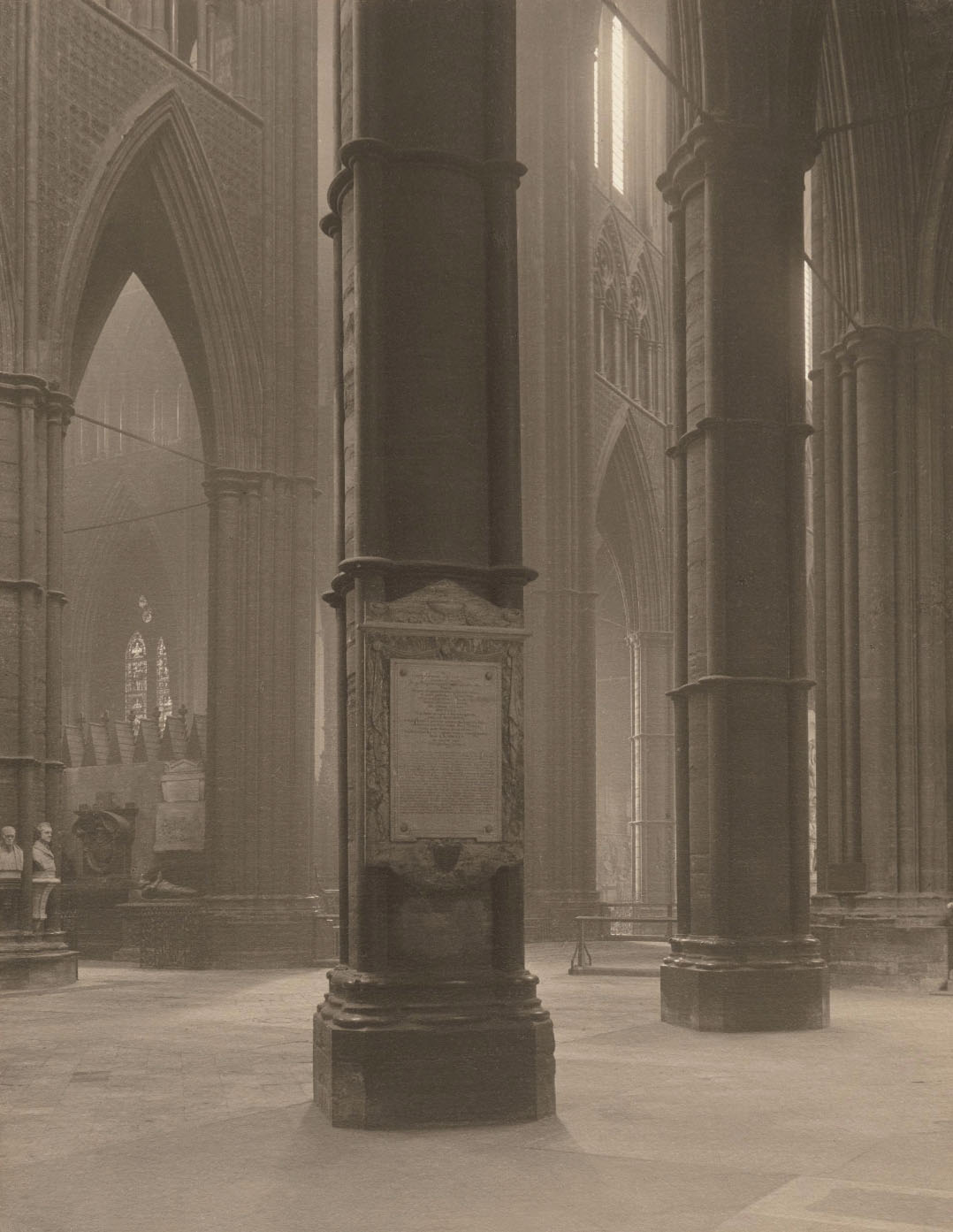
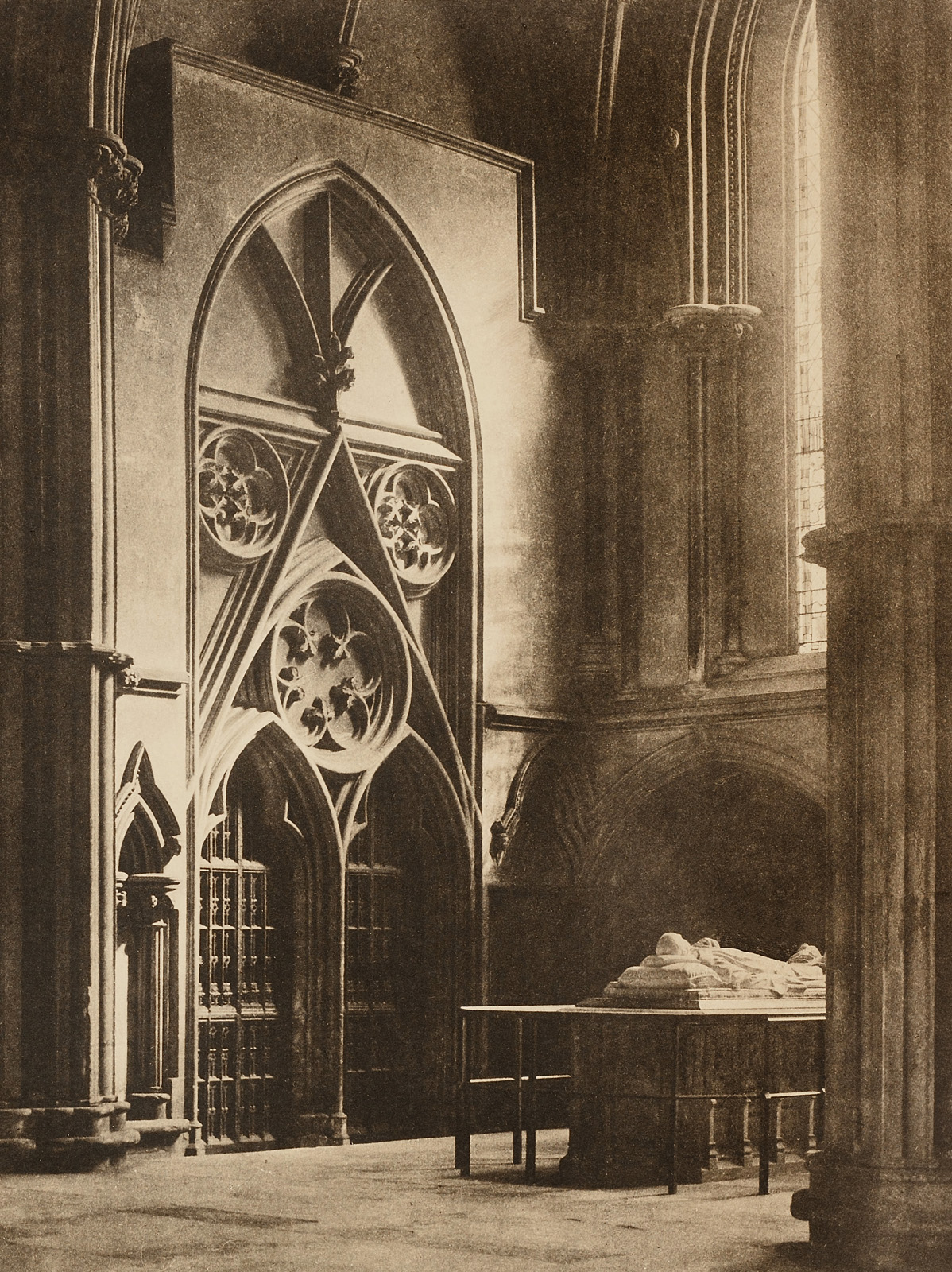
Frederick H. Evans (British, 1853-1943) 'Westminster Abbey: North Transept: East Side' 1911


Frederick H. Evans (British, 1853-1943)
Westminster Abbey: North Transept: East Side
1911
Platinum print
Image and sheet: 9 7/16 × 6 inches (23.9 × 15.3cm)
Philadelphia Museum of Art
Purchased with the Lola Downin Peck Fund, 1969


Frederick H. Evans (British, 1853-1943) 'Westminster Abbey: Staircase in Confessor's Chapel' 1911


Frederick H. Evans (British, 1853-1943)
Westminster Abbey: Staircase in Confessor’s Chapel
1911
Platinum print
Image and sheet: 9 1/2 × 6 1/8 inches (24.2 × 15.6cm)
Philadelphia Museum of Art
Purchased with the Lola Downin Peck Fund, 1969


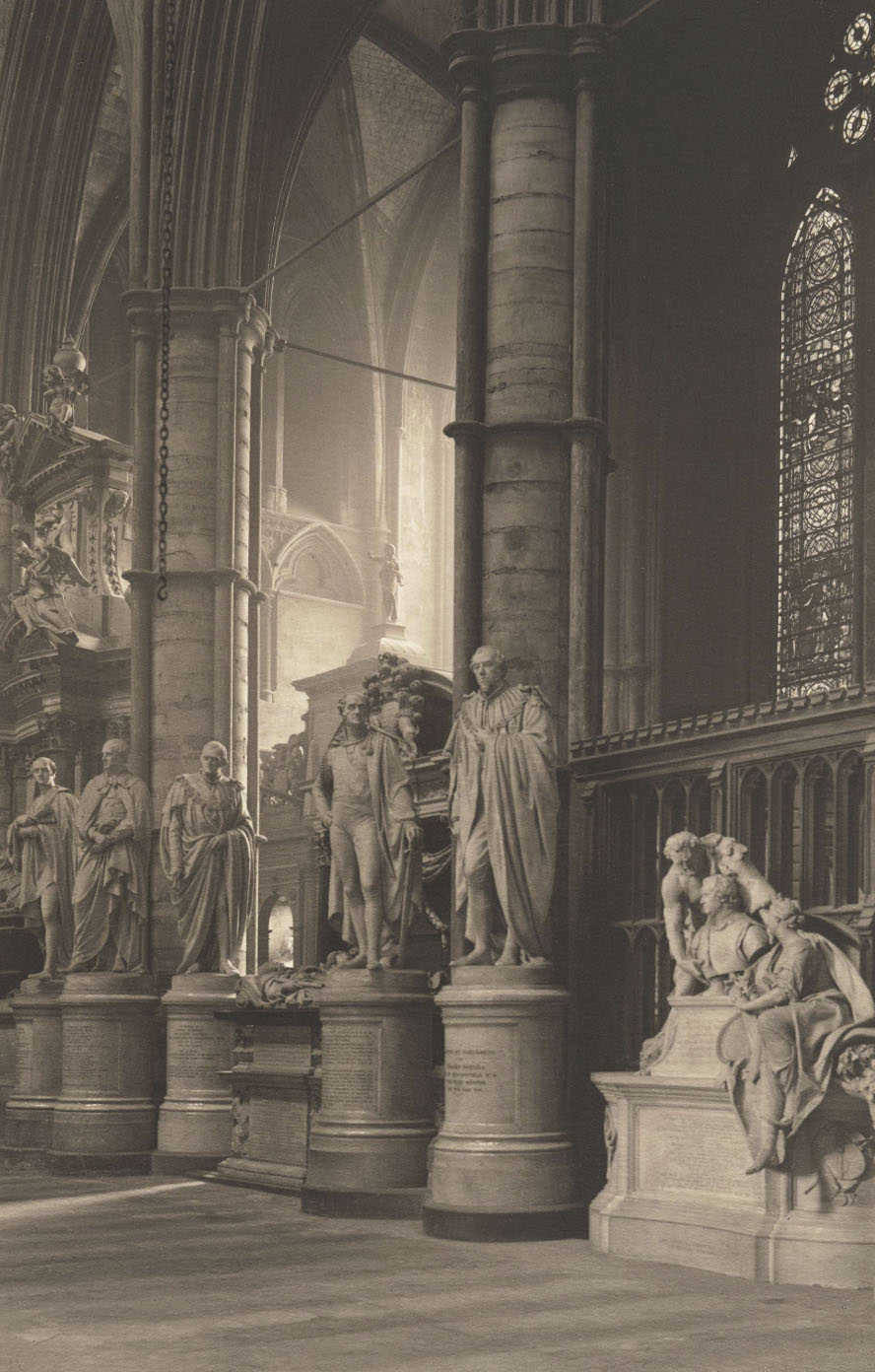
Frederick H. Evans (British, 1853-1943) 'Westminster Abbey: From the South Transept' 1911


Frederick H. Evans (British, 1853-1943)
Westminster Abbey: From the South Transept
1911
Platinum print
Image and sheet: 9 1/2 × 7 7/16 inches (24.2 × 18.9cm)
Philadelphia Museum of Art
Purchased with the Lola Downin Peck Fund, 1969


Frederick H. Evans (British, 1853-1943) 'Westminster Abbey: East Ambulatory' 1911


Frederick H. Evans (British, 1853-1943)
Westminster Abbey: East Ambulatory
1911
Platinum print
Image and sheet: 9 5/16 × 6 11/16 inches (23.7 × 17cm)
Purchased with the Lola Downin Peck Fund, 1969


Frederick H. Evans (British, 1853-1943) 'Westminster Abbey: 12th-Century Mosaic Floor at the Sanctuary' 1911


Frederick H. Evans (British, 1853-1943)
Westminster Abbey: 12th-Century Mosaic Floor at the Sanctuary
1911
Platinum print
Image and sheet: 7 5/16 × 8 7/8 inches (18.6 × 22.6 cm)
Philadelphia Museum of Art
Purchased with the Lola Downin Peck Fund, 1969


Although Evans indicated that this mosaic floor was created in the twelfth century, the surface surrounding the High Altar of Westminster Abbey was in fact laid in 1268. King Henry III (1207-1272) commissioned the mosaic from Roman craftsmen who specialised in the opus sectile, or “cut work” technique, commonly called “Cosmati” after a well-known Italian family of mosaic artists. Materials used here include blue, red, and turquoise glass as well as yellow limestone, purple porphyry, green serpentine, and onyx. Evans’s unusual composition privileges the floor, drawing attention to the intricate and abstract design of squares, rectangles, and roundels.

Text from the Philadelphia Museum of Art website


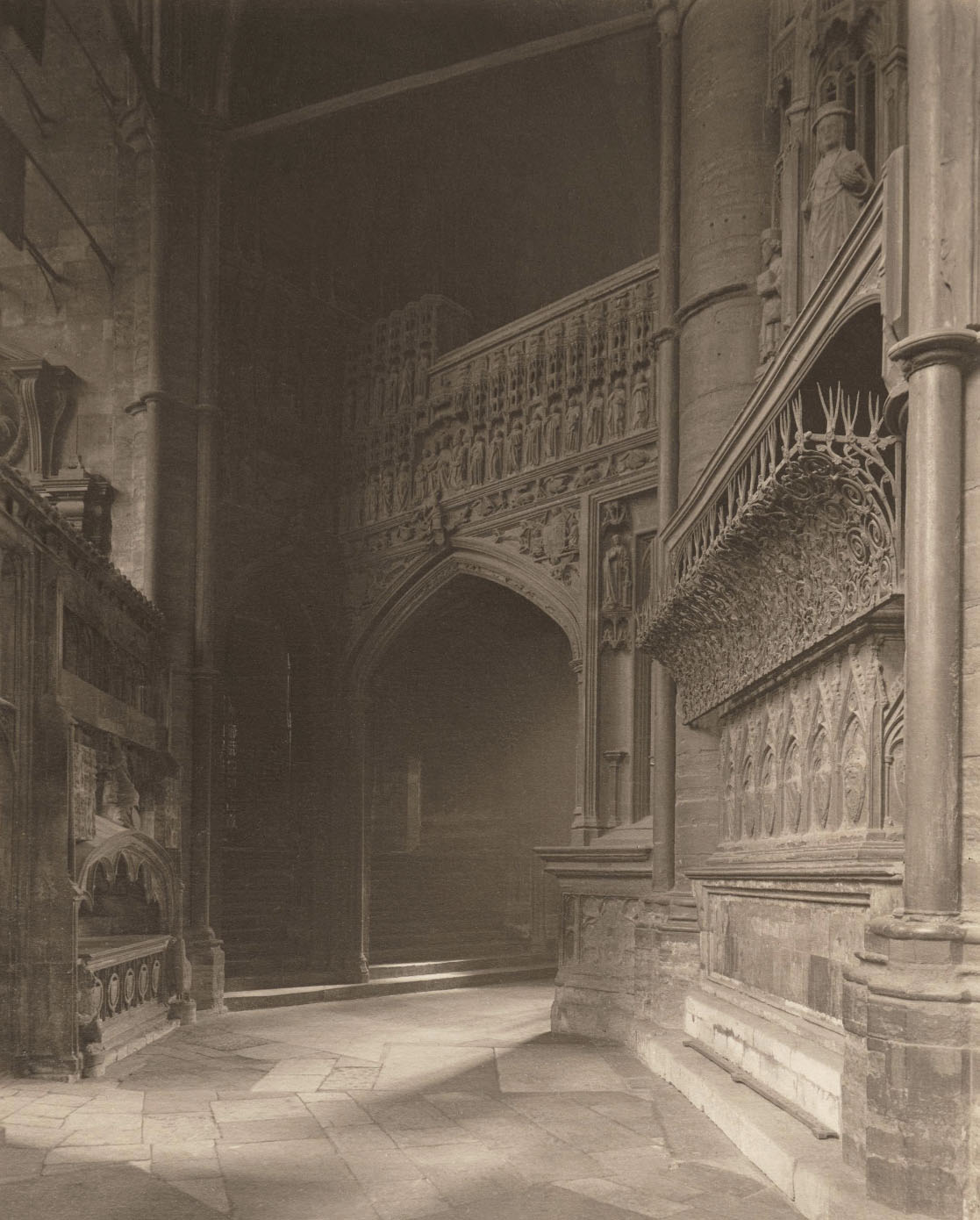
Frederick H. Evans (British, 1853-1943) 'Westminster Abbey: East End, North Ambulatory' 1911


Frederick H. Evans (British, 1853-1943)
Westminster Abbey: East End, North Ambulatory
1911
Platinum print
Image and sheet: 9 3/8 × 7 1/2 inches (23.8 × 19.1cm)
Philadelphia Museum of Art
Purchased with the Lola Downin Peck Fund, 1969


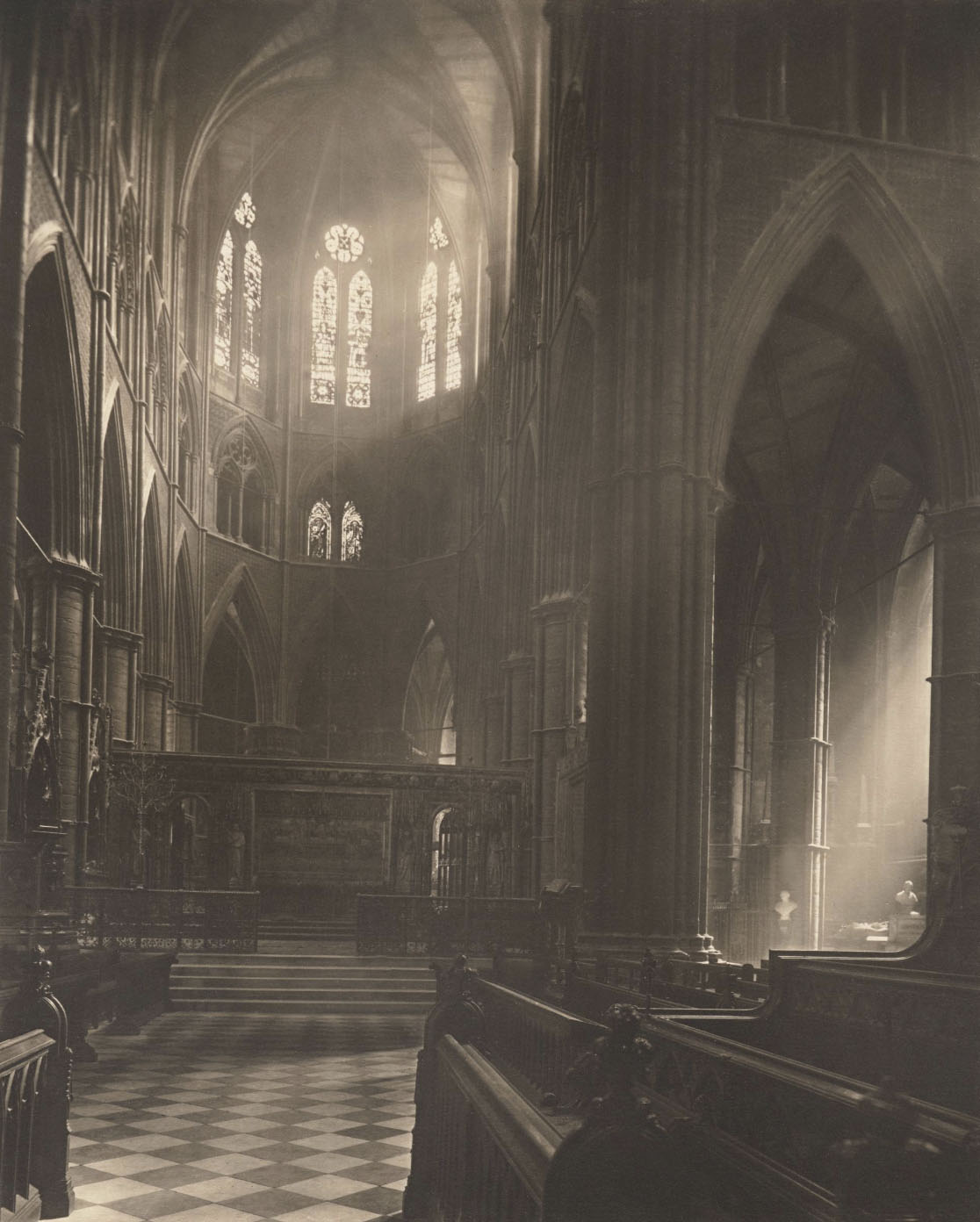
Frederick H. Evans (British, 1853-1943) 'Westminster Abbey: Apse from Choir' 1911


Frederick H. Evans (British, 1853-1943)
Westminster Abbey: Apse from Choir
1911
Platinum print
Image and sheet: 9 7/16 × 7 1/2 inches (23.9 × 19.1cm)
Philadelphia Museum of Art
Purchased with the Lola Downin Peck Fund, 1969


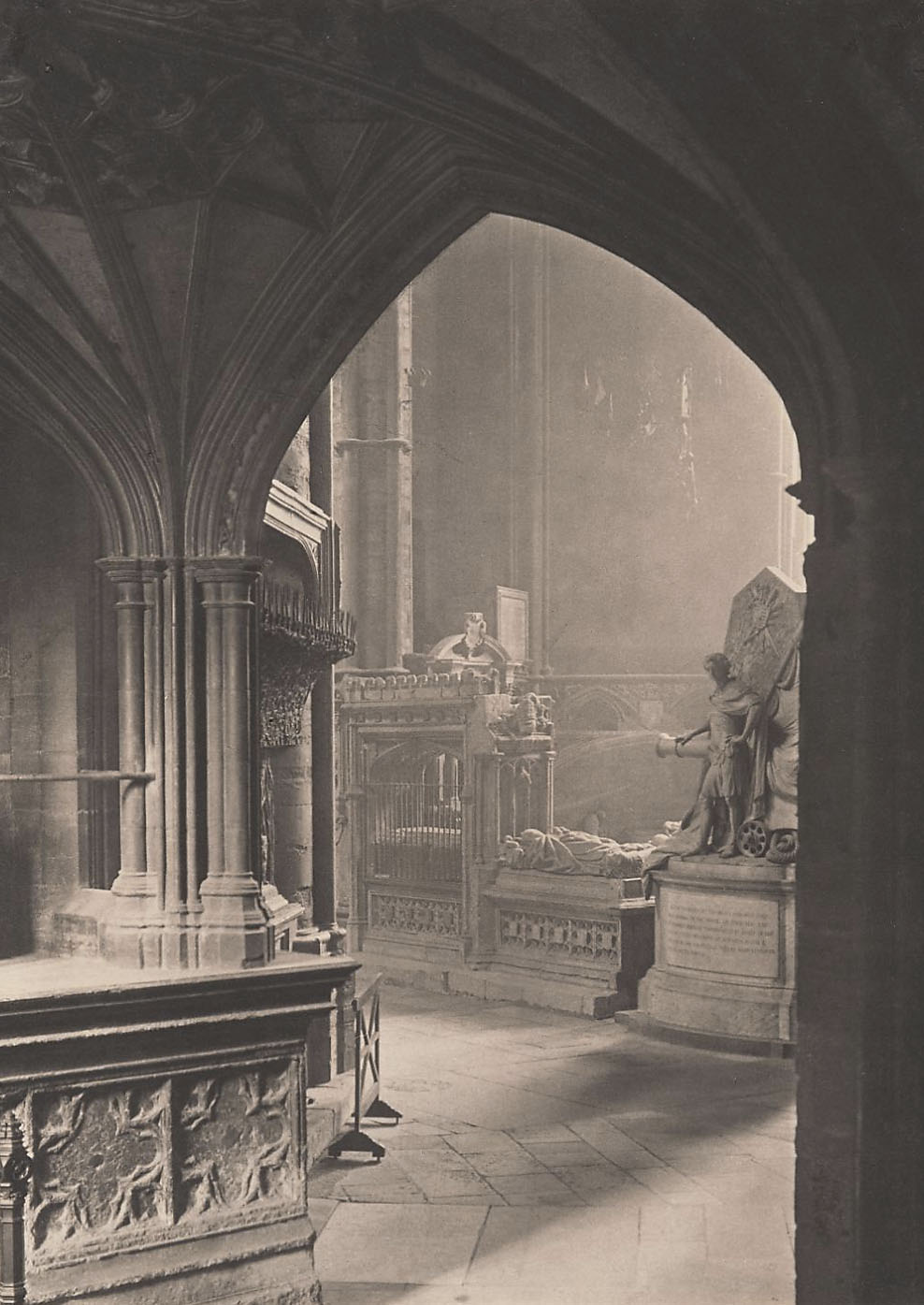
Country Life magazine commissioned Evans to photograph the interior of London’s Westminster Abbey in 1911, while the church was closed to worshipers in preparation for the coronation of King George V (1865-1936) and Queen Mary (1867-1953). Although the construction and removal of temporary facilities relating to the coronation regularly disrupted Evans’s work, the more than fifty photographs in the resulting portfolio reveal only the timeless beauty and grandeur of the Gothic structure that has hosted thirty-eight royal coronations since the year 1066.

Text from the Philadelphia Museum of Art website


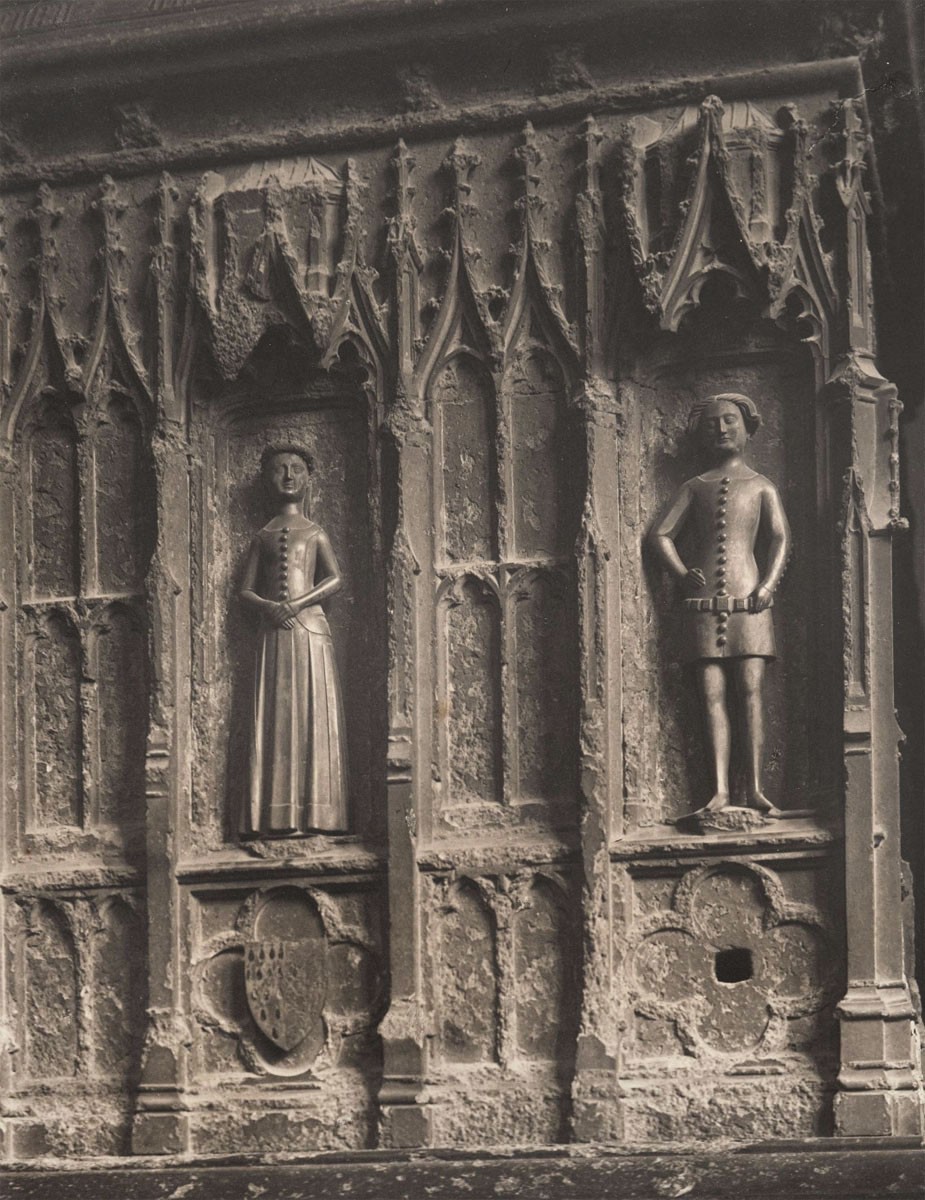
Frederick H. Evans (British, 1853-1943) 'Westminster Abbey: Henry VII Chapel, Detail of Henry VII Tomb' 1911


Frederick H. Evans (British, 1853-1943)
Westminster Abbey: Henry VII Chapel, Detail of Henry VII Tomb
1911
Platinum print
Image and sheet: 8 1/16 × 7 3/16 inches (20.4 × 18.2cm)
Philadelphia Museum of Art
Purchased with the Lola Downin Peck Fund, 1969


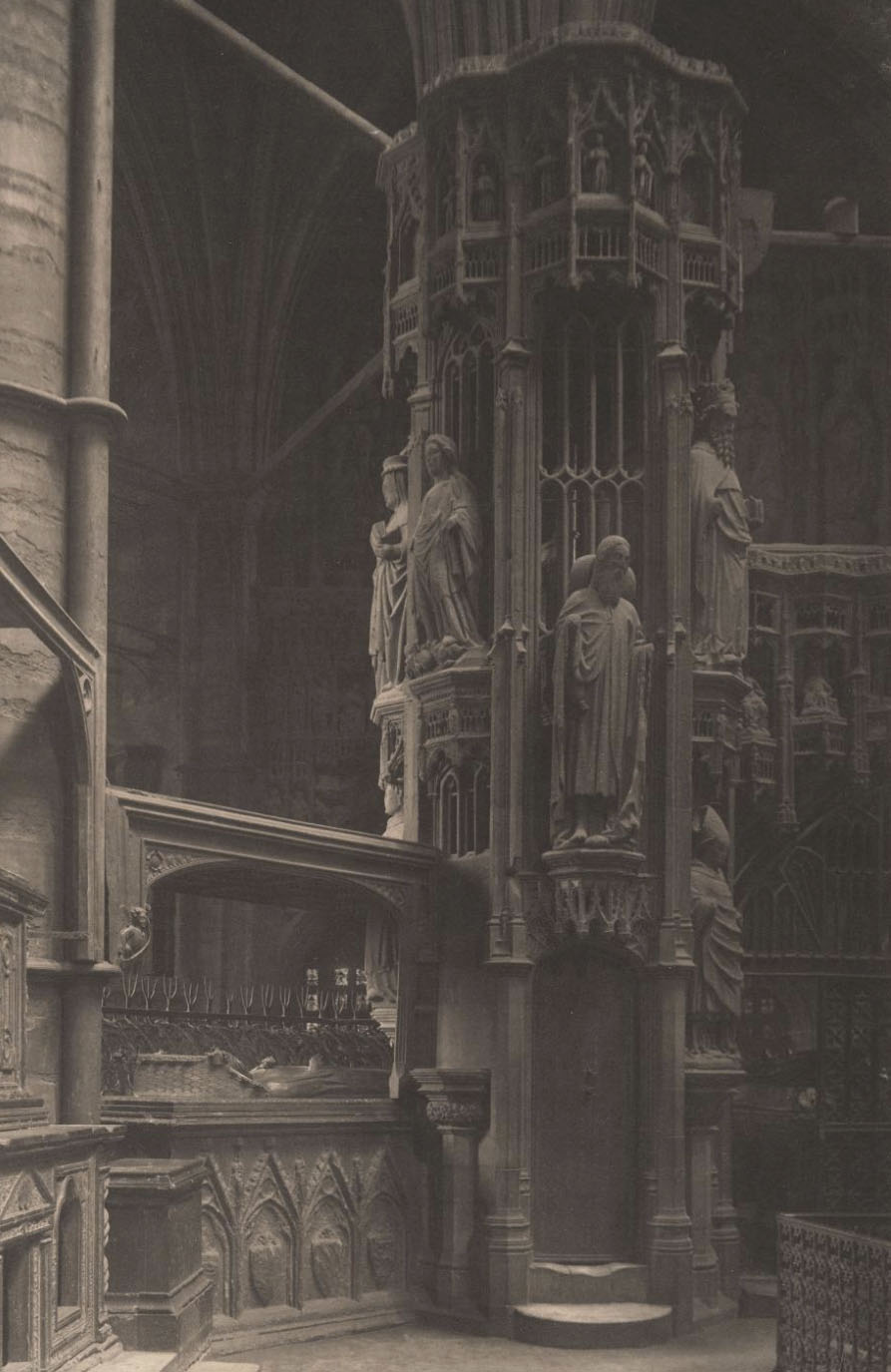
Frederick H. Evans (British, 1853-1943) 'Westminster Abbey: Tomb of Edward III, Mary and William' 1911


Frederick H. Evans (British, 1853-1943)
Westminster Abbey: Tomb of Edward III, Mary and William
1911
Platinum print
Image and sheet: 8 11/16 × 6 5/8 inches (22.1 × 16.9cm)
Philadelphia Museum of Art
Purchased with the Lola Downin Peck Fund, 1969


Frederick H. Evans (British, 1853-1943) 'York Minster - In Sure and Certain Hope' 1903


Frederick H. Evans (British, 1853-1943)
York Minster – In Sure and Certain Hope
1903
Platinum print
Philadelphia Museum of Art


Frederick H. Evans (British, 1853-1943) 'A Sea of Steps - Stairs to Chapter House - Wells Cathedral' 1903


Frederick H. Evans (British, 1853-1943)
A Sea of Steps – Stairs to Chapter House – Wells Cathedral
1903
Platinum print
Philadelphia Museum of Art


Frederick H. Evans (British, 1853-1943) 'Wells Cathedral: North Transept' c. 1903


Frederick H. Evans (British, 1853-1943)
Wells Cathedral: North Transept
c. 1903
Platinum print
Image and sheet: 7 1/4 × 5 7/16 inches (18.4 × 13.8cm)
Purchased with funds contributed by Dorothy Norman, 1973


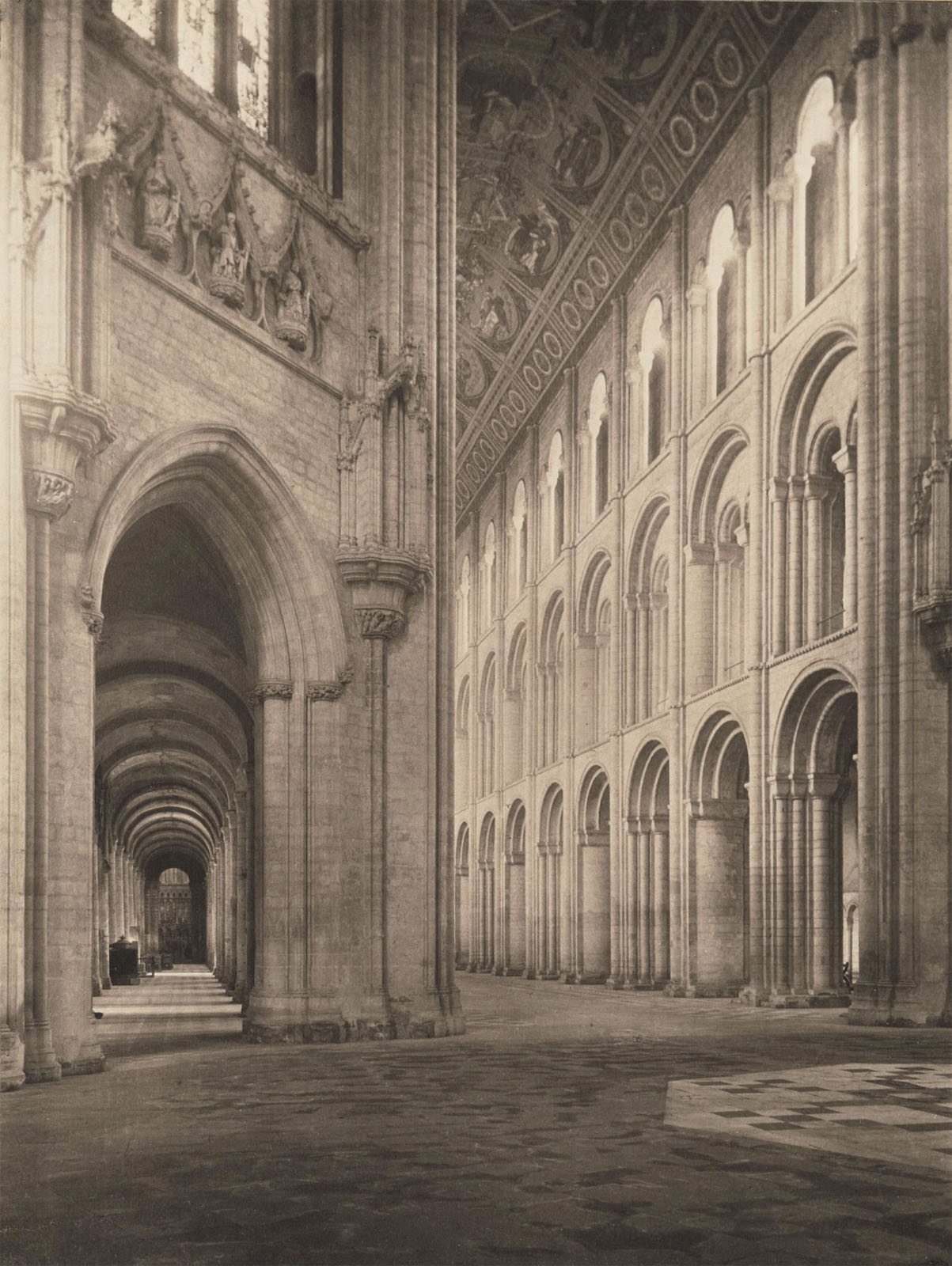
Frederick H. Evans (British, 1853-1943) 'Ely Cathedral: Octagon into Nave Aisle' c. 1899


Frederick H. Evans (British, 1853-1943)
Ely Cathedral: Octagon into Nave Aisle
c. 1899
Platinum print
Image and sheet: 7 15/16 × 6 1/8 inches (20.2 × 15.6cm)
Philadelphia Museum of Art
Purchased with funds contributed by Dorothy Norman, 1973


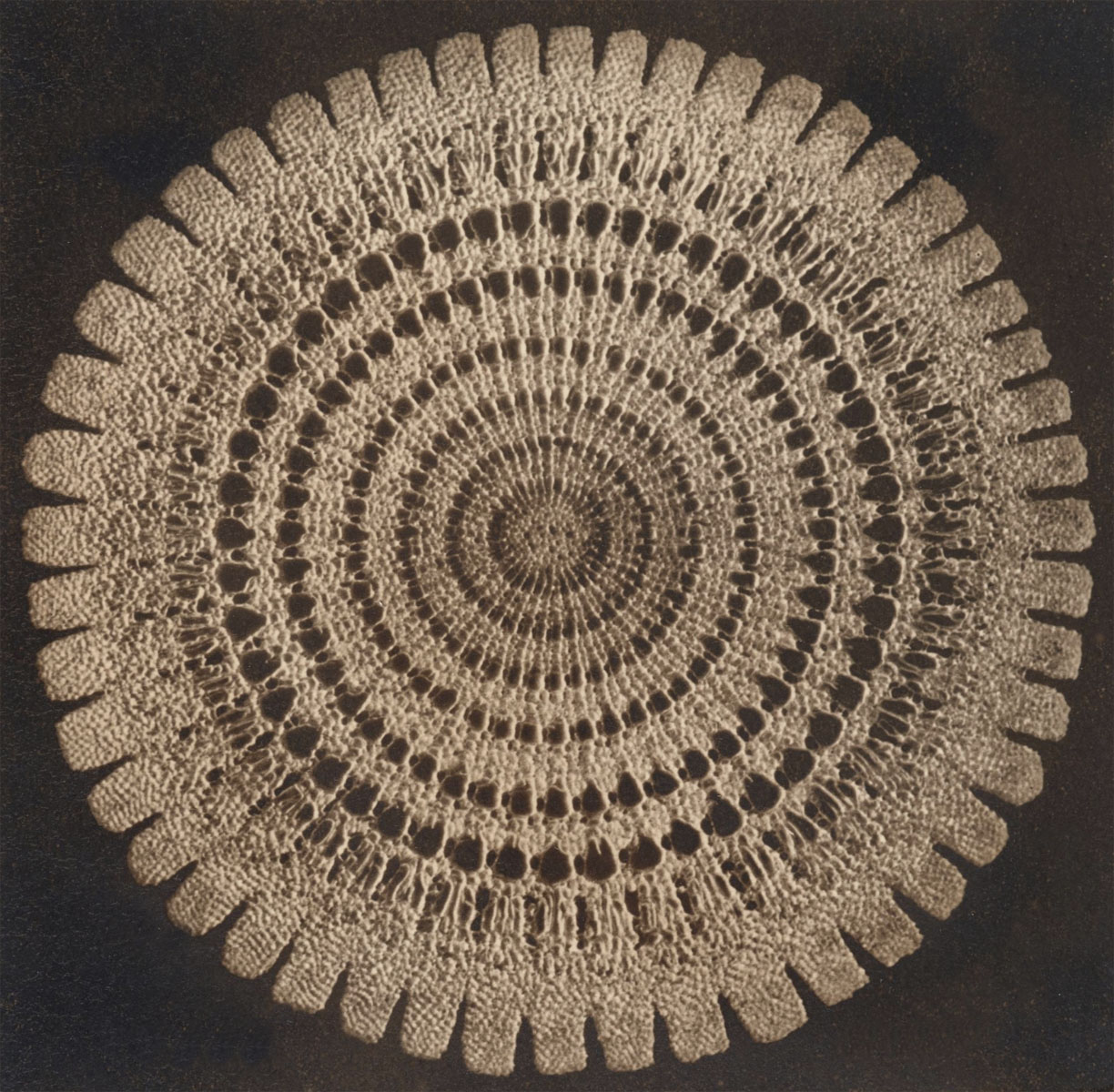
Frederick H. Evans (British, 1853-1943) 'Fr: Sec: Spine of Echinus x. 40' c. 1887


Frederick H. Evans (British, 1853-1943)
Fr: Sec: Spine of Echinus x. 40
c. 1887
Platinum print
Image and sheet: 4 3/4 × 4 5/8 inches (12 × 11.8cm)
Philadelphia Museum of Art
Purchased with funds contributed by Dorothy Norman, 1973


Unlike many beginning photographers of the nineteenth century who experimented with straightforward portrait or landscape compositions, Evans’s earliest trials with photography involved minute organic matter and required the use of a microscope. His complicated “photo-microgram” process allowed him to capture the intricate structures of objects including a water beetle’s eye, tiny sea shells, and this section of a sea urchin’s spine. Although classified as scientific rather than artistic imagery by the Photographic Society of Great Britain, this photo-microgram demonstrates Evans’s ability to delineate the magnificence of organic patterns and presage his photographs that depict the structural beauty of cathedrals.

Text from the Philadelphia Museum of Art website


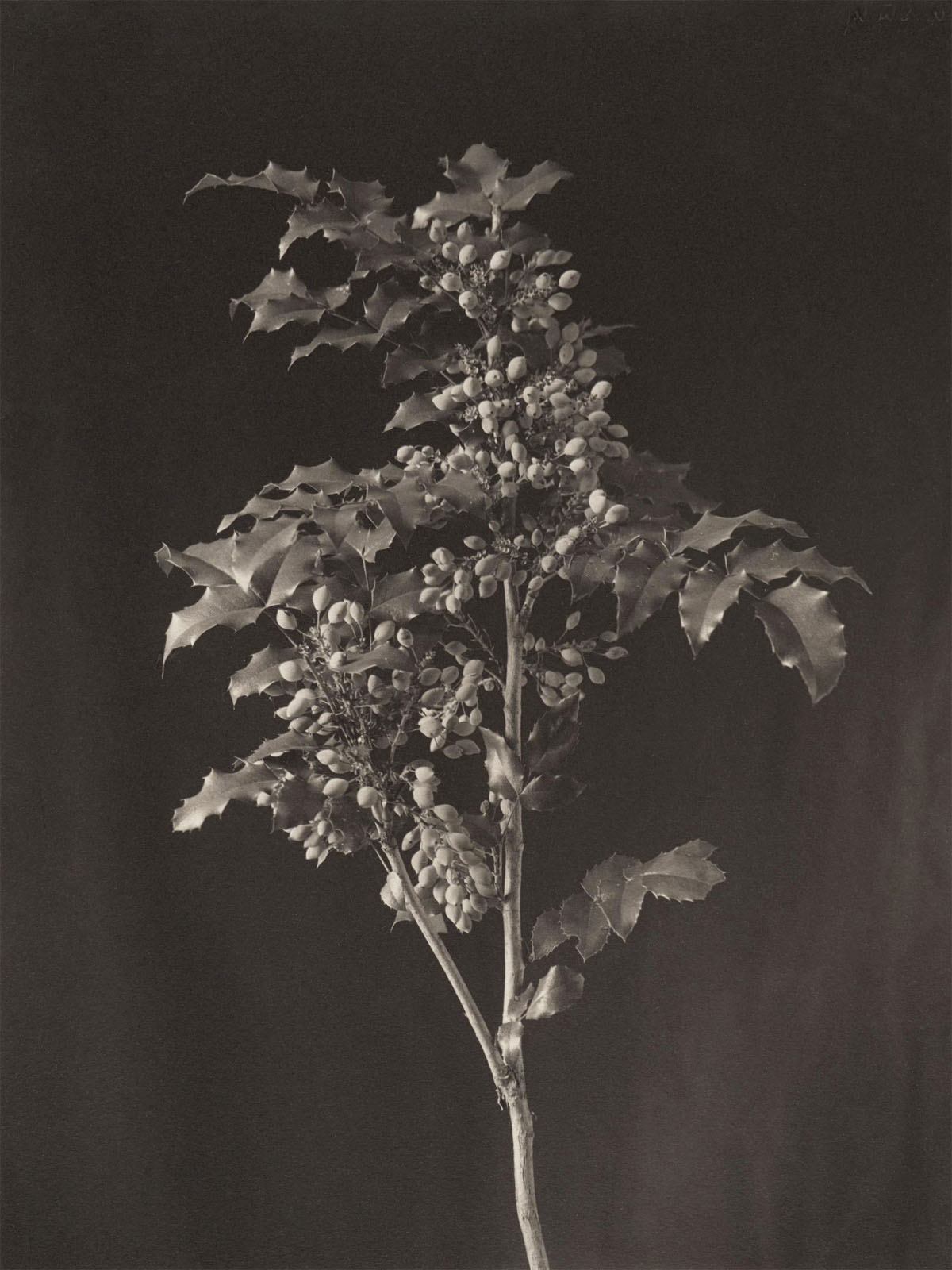
Frederick H. Evans (British, 1853-1943) 'Berberis: Plant Study' c. 1908


Frederick H. Evans (British, 1853-1943)
Berberis: Plant Study
c. 1908
Platinum print
Image and sheet: 9 3/8 × 7 1/16 inches (23.8 × 17.9cm)
Philadelphia Museum of Art
Purchased with funds contributed by Dorothy Norman and with the Director’s Discretionary Fund, 1968


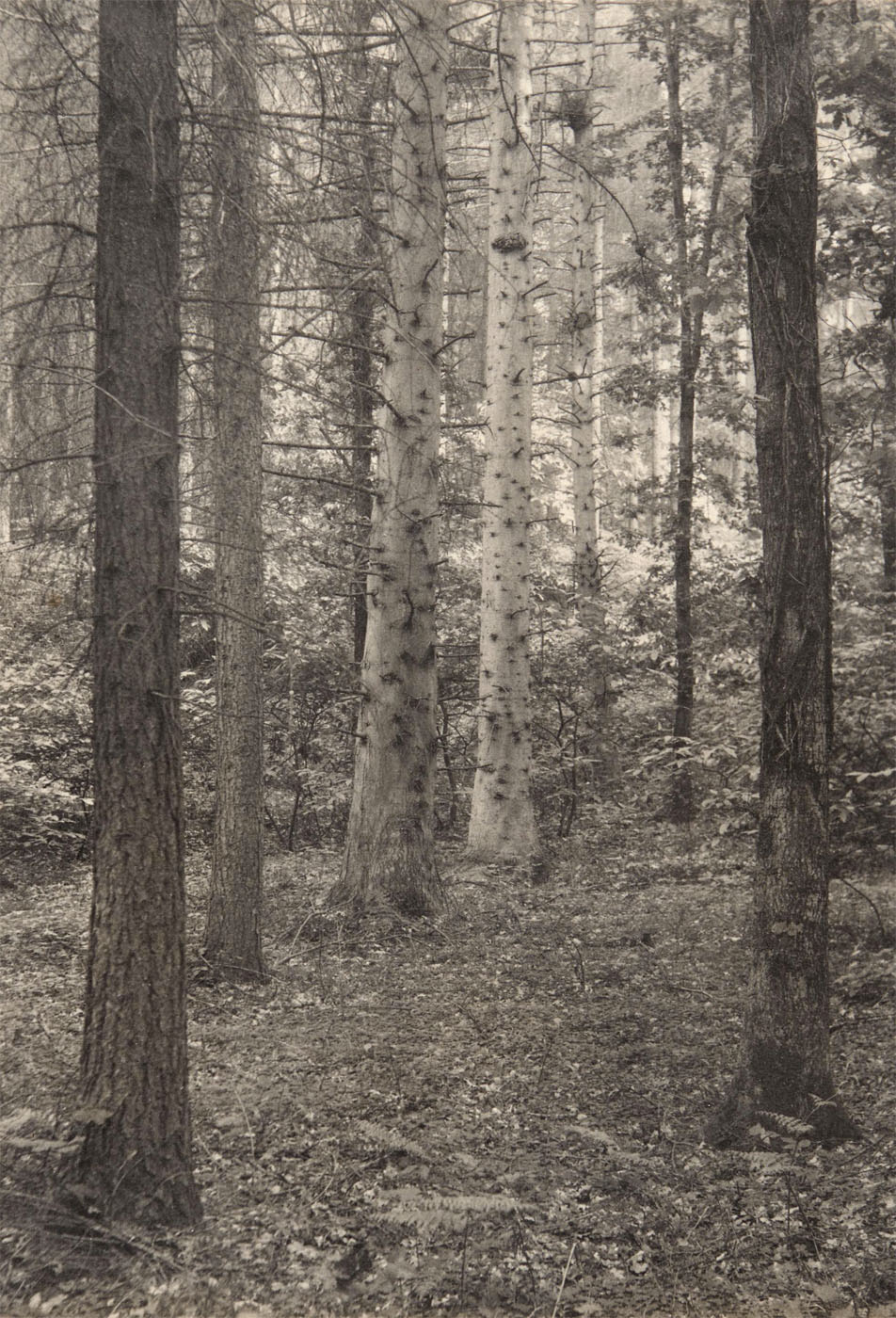
Frederick H. Evans (British, 1853-1943) 'Redlands Woods' c. 1908


Frederick H. Evans (British, 1853-1943)
Redlands Woods
c. 1908
Platinum print
Image and sheet: 6 × 4 3/16 inches (15.3 × 10.6cm)
Philadelphia Museum of Art
Purchased with funds contributed by Dorothy Norman and with the Director’s Discretionary Fund, 1968


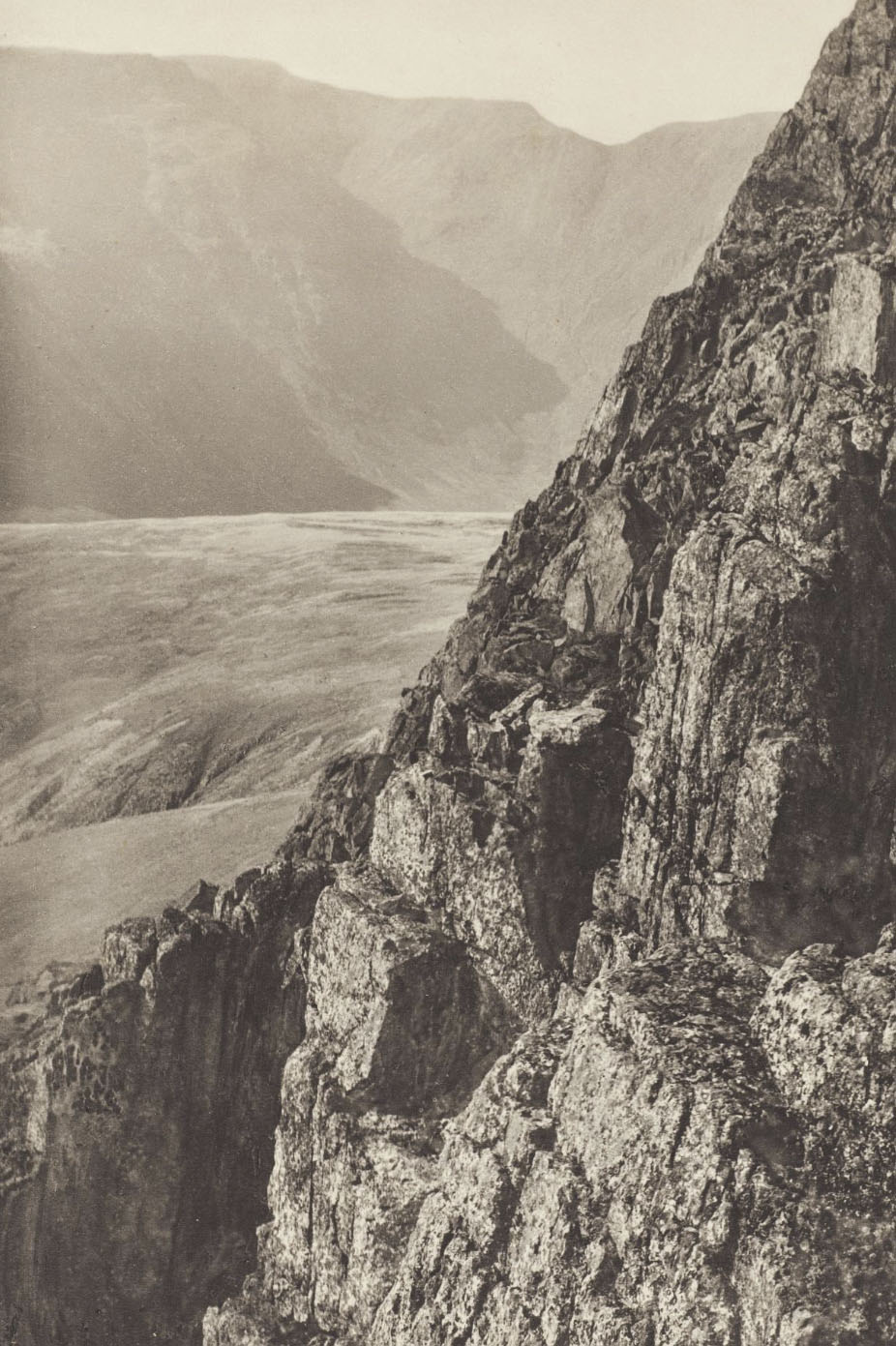
Frederick H. Evans (British, 1853-1943) 'An English Glacier: Near Summit of Scafell' c. 1905


Frederick H. Evans (British, 1853-1943)
An English Glacier: Near Summit of Scafell
c. 1905
Platinum print
Image and sheet: 9 3/4 × 6 1/2 inches (24.8 × 16.5 cm)
Philadelphia Museum of Art
Purchased with funds contributed by Dorothy Norman and with the Director’s Discretionary Fund, 1968


Exhibition Highlights the Exceptional Beauty of the Platinum Process in Photography

A cornerstone of photographic practice during the late nineteenth and early twentieth centuries, the platinum print is revered by photographers and viewers alike as one of the most beautiful forms of photography, with subtle and lustrous shades that range from the deepest blacks to the most delicate whites. The Philadelphia Museum of Art will present an exhibition of more than 50 works from the late 19th century to the present, showcasing outstanding prints largely drawn from the Museum’s collection of photographs. The Platinum Process: Photographs from the Nineteenth to the Twenty-First Century, on view February 27 – May 23 in the Julien Levy Gallery at the Museum’s Perelman Building, will include images by early masters of the process including Frederick H. Evans (British, 1853-1943) and Alfred Stieglitz (American, 1864-1946), as well as works by skilled contemporary practitioners such as Lois Conner (American, born 1951) and Andrea Modica (American, born 1960), who continue to engage in this historic and painstaking process in an era noted for electronic imaging.

“The exhibition offers an opportunity to share this exceptionally beautiful form of photography with our visitors, some of whom may be seeing it for the first time,” Curator of Photographs Peter Barberie said, adding “the Museum is fortunate to have a particularly strong and varied collection of work by some of the truly great practitioners of this process.”

Unlike standard silver printing, in which particles are suspended in gelatin, platinum is brushed directly onto the paper, allowing artists to create a matte image with an exceptionally wide tonal range. Introduced in 1873, the process was enthusiastically embraced by the group of photographers known as the Pictorialists, who believed that fine art photography should emulate the aesthetic values of painting. The group included Evans, whose beautifully rendered images of Britain’s Westminster Abbey, York Minster Abbey and Ely Cathedral are included in the exhibition, and Stieglitz (American, 1876-1946), who is represented in the show by a portrait of his wife, the artist Georgia O’Keeffe (American, 1887-1986), as well as a landscape that foreshadows his Equivalents series.

While encompassing works spanning many dates and styles, The Platinum Process highlights one of the Museum’s treasures, the 1915 masterpiece “Wall Street” by Paul Strand (1890-1976, see above), whose work was at the forefront of the modernist aesthetic developing in New York during the early 20th century. Strand used the subtlety of the platinum print in this work to emphasise abstract patterns in the long shadows cast by figures that walk before a succession of monumental windows.

Reserves of platinum were appropriated for military use during World War I, and its high cost led manufacturers to cease production of commercial platinum paper by the 1930s. As photographers became more engaged in social concerns, documentation and realism, the process fell into disuse. It was not until the early 1960s when Irving Penn, then a successful photographer for Vogue magazine, began to experiment with the long-forgotten technique and took the first steps toward its revival. A meticulous craftsman, Penn was delighted by the luminous prints and lavish tonal range he could achieve using platinum and began to make new photographs with this process in the 1970s. Penn and many of the other contemporary artists on view including Thomas Shillea and Jennette Williams followed Strand’s example, using platinum not for idealised pictures, but to capture nuances of modern experience.

Press release from The Philadelphia Museum of Art website [Online] Cited 25/07/2019. No longer available online


Robert S. Redfield (American, 1849-1923) 'Heloise Redfield at Mount Washington' 1889


Robert S. Redfield (American, 1849-1923)
Heloise Redfield at Mount Washington
1889
Platinum print
Image and sheet: 6 5/16 × 8 1/4 inches (16 × 21cm)
Philadelphia Museum of Art
Gift of Alfred G. Redfield, 1985


F. Holland Day (American, 1864-1933) 'Untitled' 1905


F. Holland Day (American, 1864-1933)
Untitled
1905
Platinum prints mounted to paper
Image and sheet (overall): 10 1/16 × 7 1/2 inches (25.6 × 19.1cm)
Philadelphia Museum of Art
From the Collection of Dorothy Norman, 1970


Katharine Steward Stanbery (American, 1870-1928) 'Untitled (Two Girls Playing Jacks)' 1907


Katharine Steward Stanbery (American, 1870-1928)
Untitled (Two Girls Playing Jacks)
1907
Platinum print
Image and sheet: 8 15/16 x 4 11/16 inches (22.7 x 11.9cm)
Philadelphia Museum of Art
125th Anniversary Acquisition. Purchased with the Lola Downin Peck Fund, the Alice Newton Osborn Fund, and with funds contributed by The Judith Rothschild Foundation, 2002


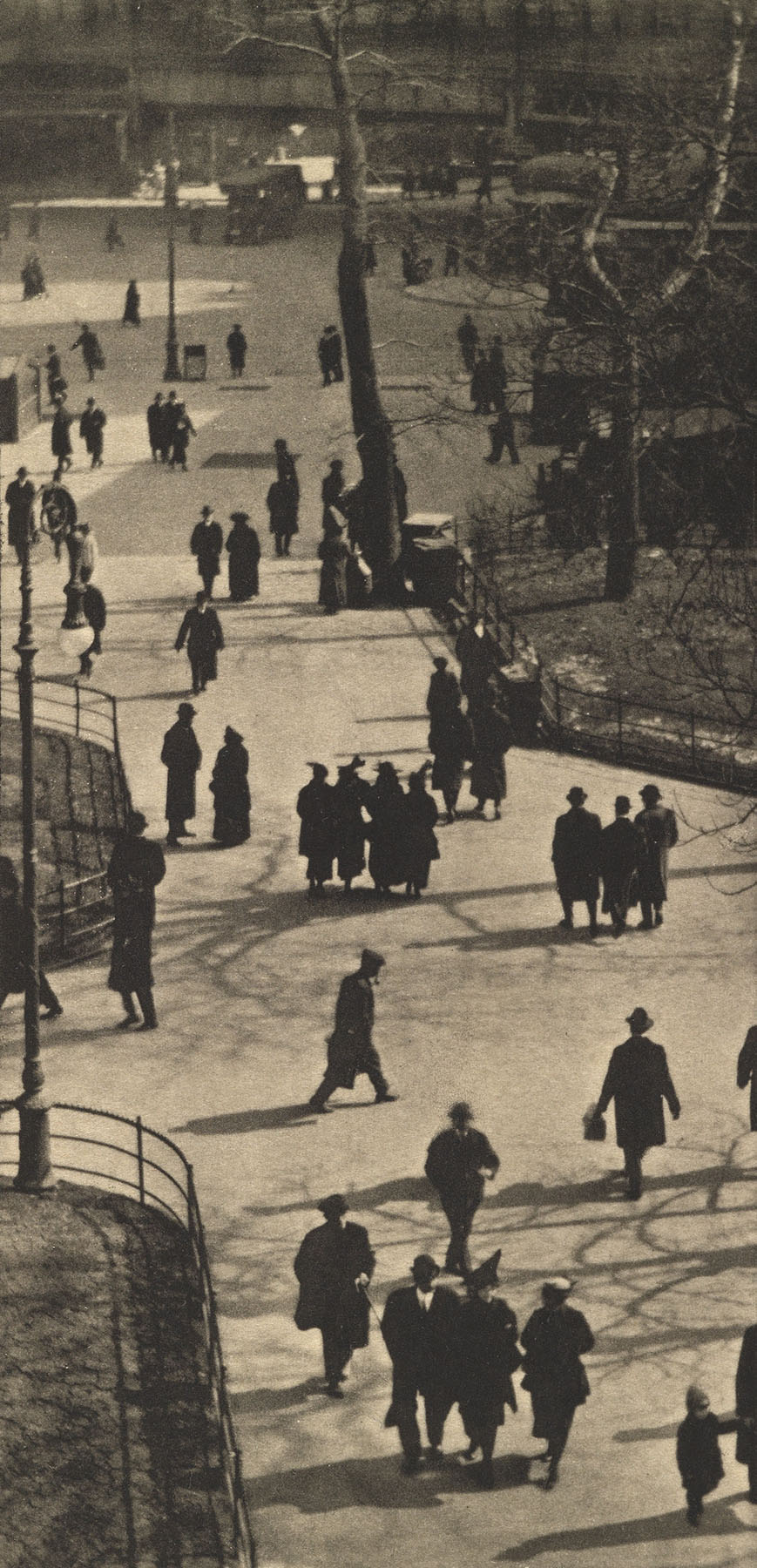
Paul Strand (American, 1890-1976) 'City Hall Park, New York' 1915


Paul Strand (American, 1890-1976)
City Hall Park, New York

1915
Platinum print
Sheet: 13 7/8 x 7 3/4 inches (35.2 x 19.7cm)
Philadelphia Museum of Art
Gift of the artist, 1972


Paul Strand (American, 1890-1976) 'Washington Heights, New York' 1915


Paul Strand (American, 1890-1976)
Washington Heights, New York
1915 (negative); 1915 (print)
Platinum print
Image and sheet: 9 3/8 x 11 7/8 inches (23.8 x 30.2cm)
Philadelphia Museum of Art
The Paul Strand Retrospective Collection, 1915-1975, gift of the estate of Paul Strand, 1980


Paul Strand (American, 1890-1976) 'Wall Street, New York' 1915


Paul Strand (American, 1890-1976)
Wall Street
1915 (negative); 1915 (print)
Platinum print
Image: 9 3/4 × 12 11/16 inches (24.8 × 32.2cm)
Philadelphia Museum of Art
The Paul Strand Retrospective Collection, 1915-1975, gift of the estate of Paul Strand, 1980


Paul Strand (American, 1890-1976) 'Man in a Derby, New York' 1916


Paul Strand (American, 1890-1976)
Man in a Derby, New York
1916
Platinum print
Image: 12 13/16 x 9 15/16 inches (32.5 x 25.2cm)
Mat: 22 11/16 x 19 7/16 inches (57.6 x 49.4cm)
Philadelphia Museum of Art
The Paul Strand Retrospective Collection, 1915-1975, gift of the estate of Paul Strand, 1980


Paul Strand (American, 1890-1976) 'The Italian, New York' 1916


Paul Strand (American, 1890-1976)
The Italian, New York
1916 (negative); 1916 (print)
Platinum print
Image and sheet: 13 × 9 5/16 inches (33 × 23.7cm)
Philadelphia Museum of Art
The Paul Strand Retrospective Collection, 1915-1975, gift of the estate of Paul Strand, 1980


Paul Strand (American, 1890-1976) 'Rebecca, New York' 1922 (negative); 1922 (print)


Paul Strand (American, 1890-1976)
Rebecca, New York
1922 (negative); 1922 (print)
Palladium print
Image: 9 3/4 x 7 13/16 inches (24.8 x 19.8cm)
Philadelphia Museum of Art
The Paul Strand Collection, purchased with funds contributed by Mr. and Mrs. Robert A. Hauslohner (by exchange), 1985


Alvin Langdon Coburn (British, born United States, 1882-1966) 'George Seeley' c. 1902-1903


Alvin Langdon Coburn (British, born United States, 1882-1966)
George Seeley
c. 1902-1903
Platinum print
Image and sheet: 11 x 8 9/16 inches (27.9 x 21.7cm)
Philadelphia Museum of Art
Purchased with the Lola Downin Peck Fund, the Alice Newton Osborn Fund, and with funds contributed by The Judith Rothschild Foundation in honour of the 125th Anniversary of the Museum, 2002


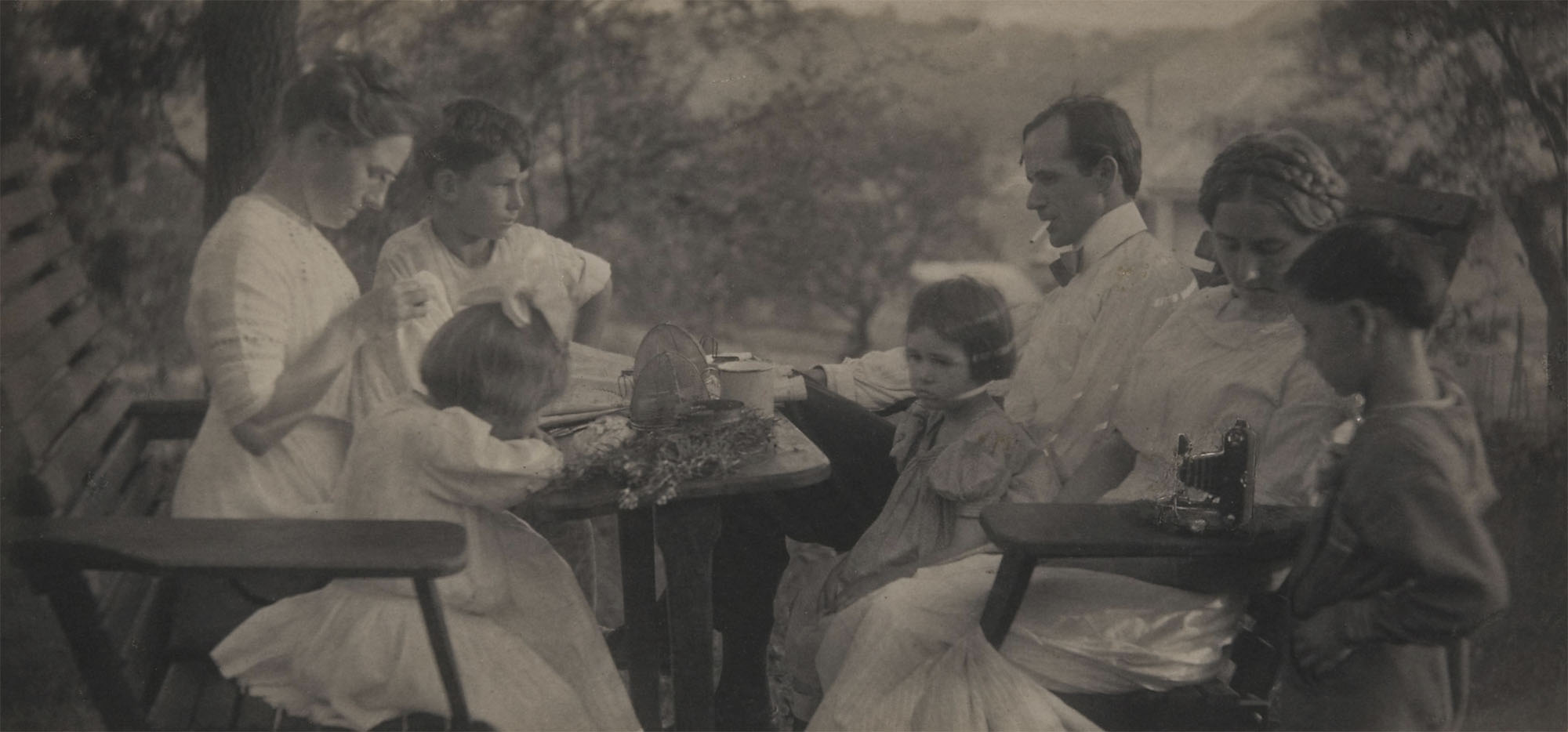
Gertrude Käsebier (American, 1852-1934) 'The Two Families' c. 1910


Gertrude Käsebier (American, 1852-1934)
The Two Families
c. 1910
Platinum print
Image and sheet: 5 3/8 × 11 5/16 inches (13.6 × 28.8cm)
Philadelphia Museum of Art
Gift of William Innes Homer, 1986


Käsebier’s family members and close friends served as her earliest photographic subjects, and familial themes remained paramount in the images she produced throughout her career. This photograph of Käsebier’s two daughters and their families, taken in Woburn, Massachusetts, is a dynamic portrait of a multigenerational gathering. Curiously, Käsebier manipulated this print to emphasise the act of photography. In the original scene, the young boy and seated woman at right look downward at a wire-mesh food cover resting on a plate. These objects have been removed from this print, replaced by the considerably more fascinating camera.

Text from the Philadelphia Museum of Art website


Gertrude Käsebier (American, 1852-1934) 'Mrs. F. H. Evans' c. 1900


Gertrude Käsebier (American, 1852-1934)
Mrs. F. H. Evans
c. 1900
Platinum print
Image and sheet: 7 1/2 × 5 1/4 inches (19.1 × 13.4 cm)
Philadelphia Museum of Art
Purchased with funds contributed by Dorothy Norman, 1973


In 1889, at the age of thirty-seven, Käsebier enrolled at Brooklyn’s Pratt Institute to study portrait painting. Although the art school did not teach photography, Käsebier began using a camera at home to document her growing children, eventually favoring photography over other mediums. She established a commercial portrait studio in New York City in 1897, working to “bring out in each photograph the essential personality that is variously called temperament, soul, humanity.” This portrait features Ada Emily Longhurst, wife of photographer Frederick H. Evans, whom Käsebier befriended while on a trip to England in 1901.

Text from the Philadelphia Museum of Art website


Philadelphia Museum of Art
26th Street and the Benjamin Franklin Parkway
Philadelphia, PA 19130

Opening hours:
Thursday – Monday 10am – 5pm
Closed Tuesdays and Wednesdays
The Philadelphia Museum of Art website

LIKE ART BLART ON FACEBOOK

Back to top