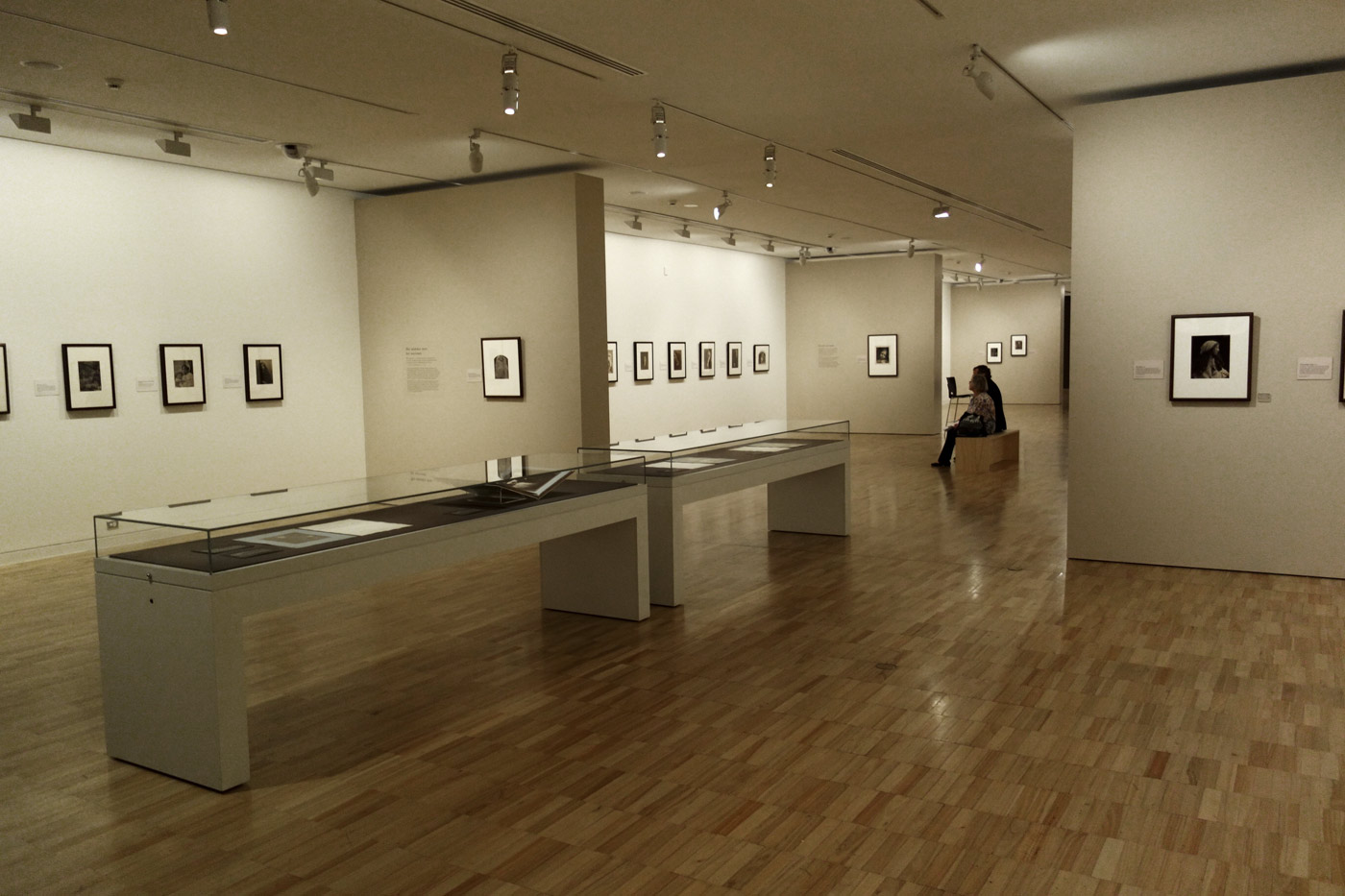
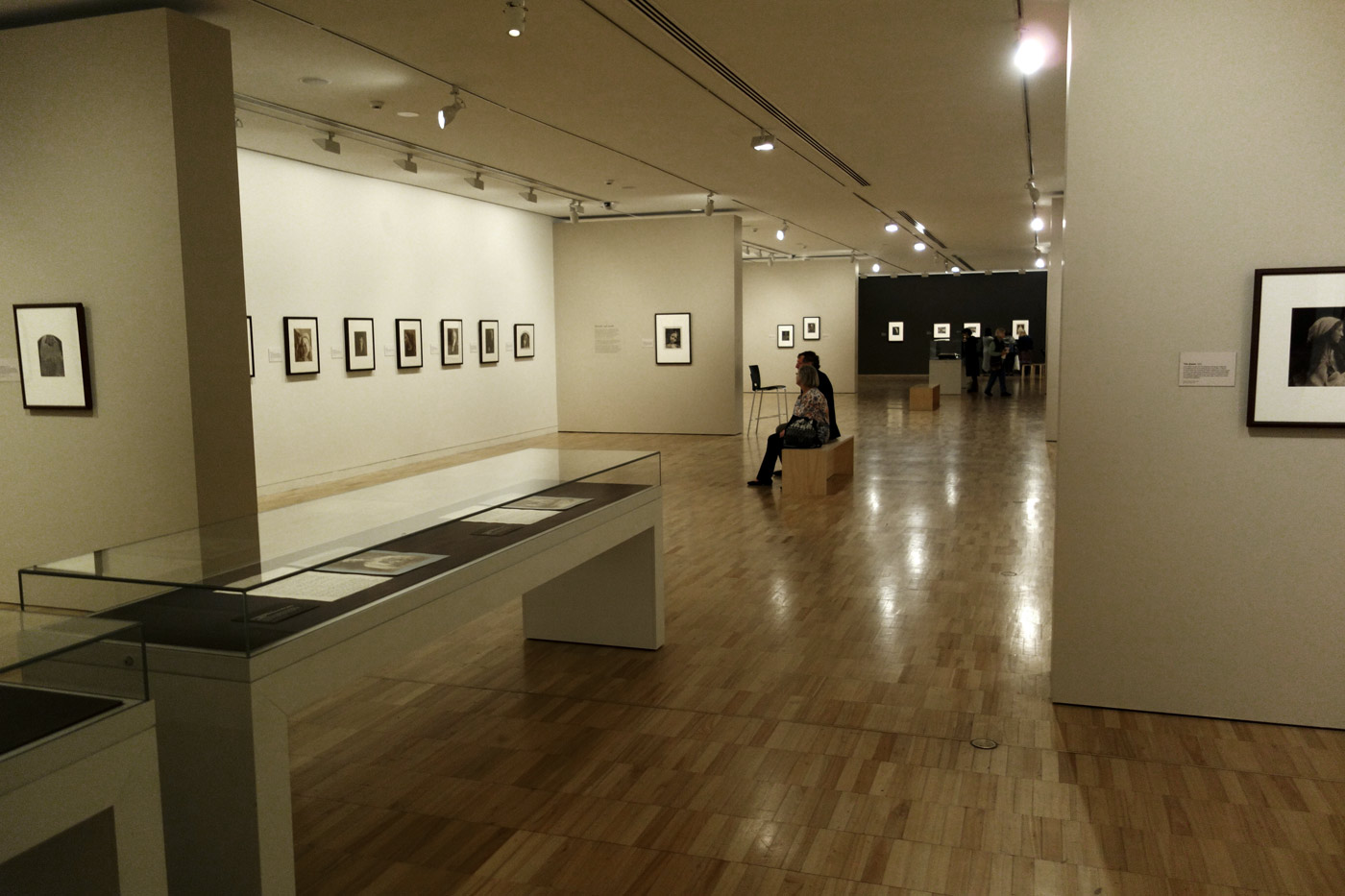
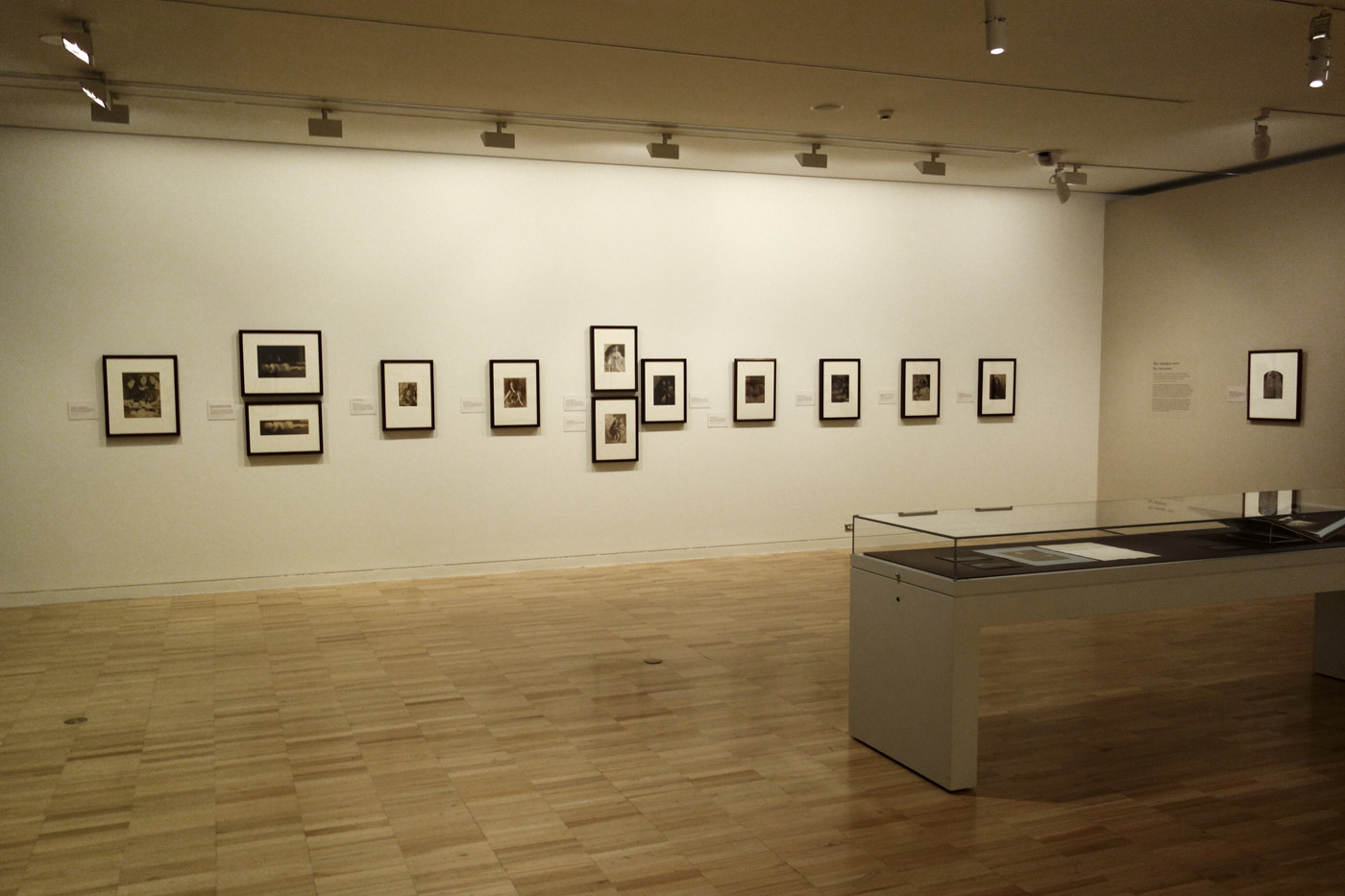
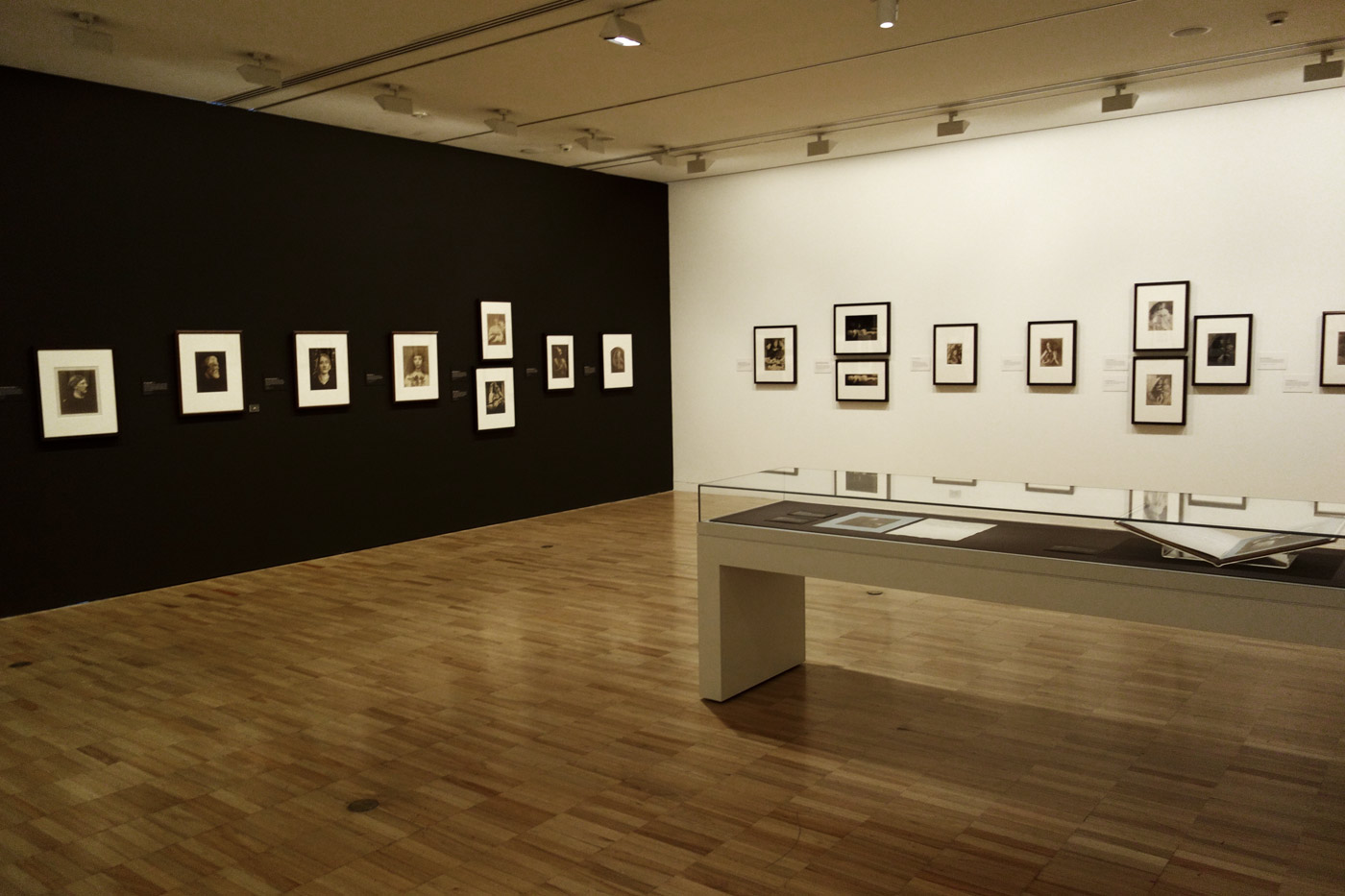
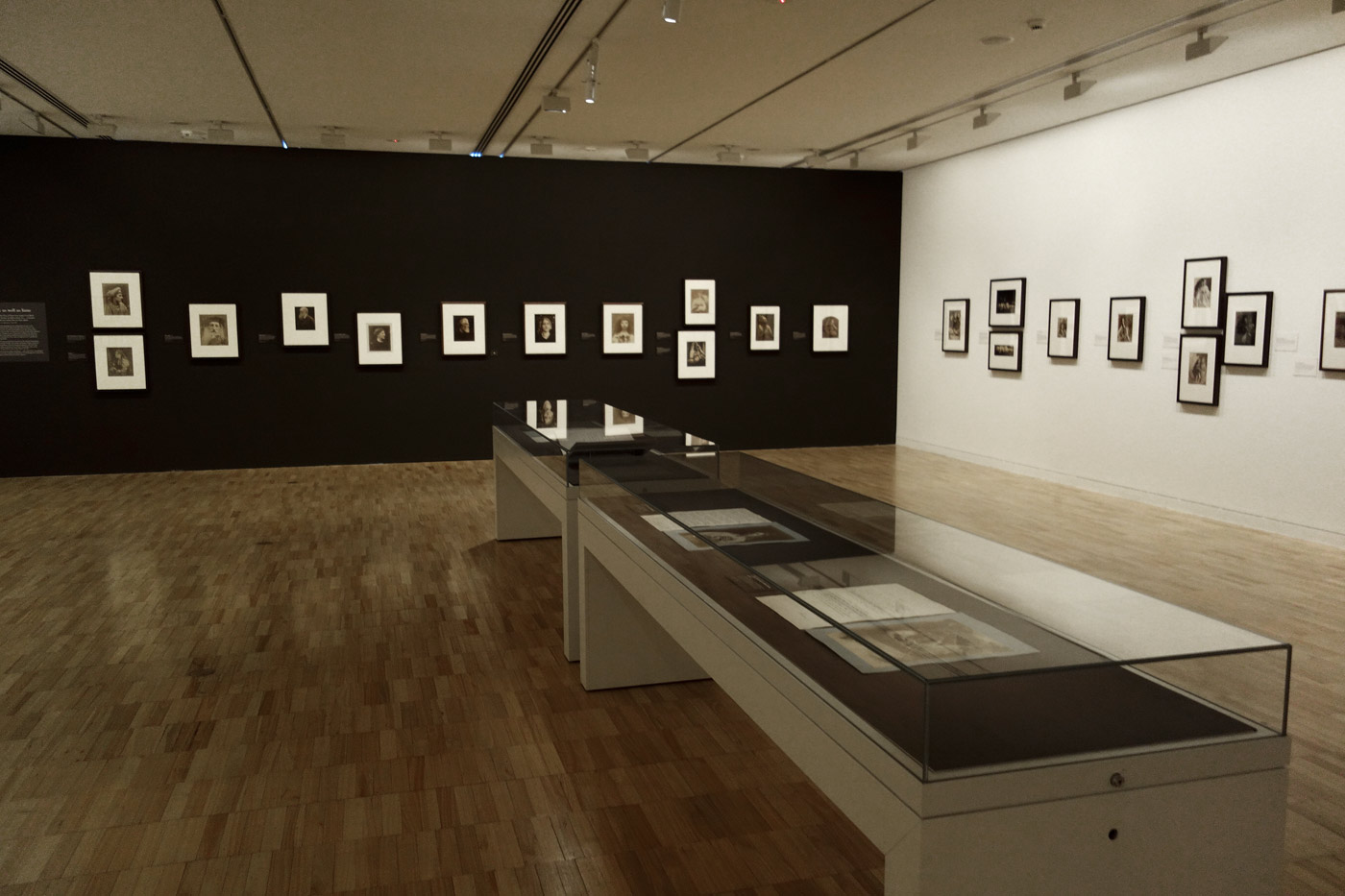
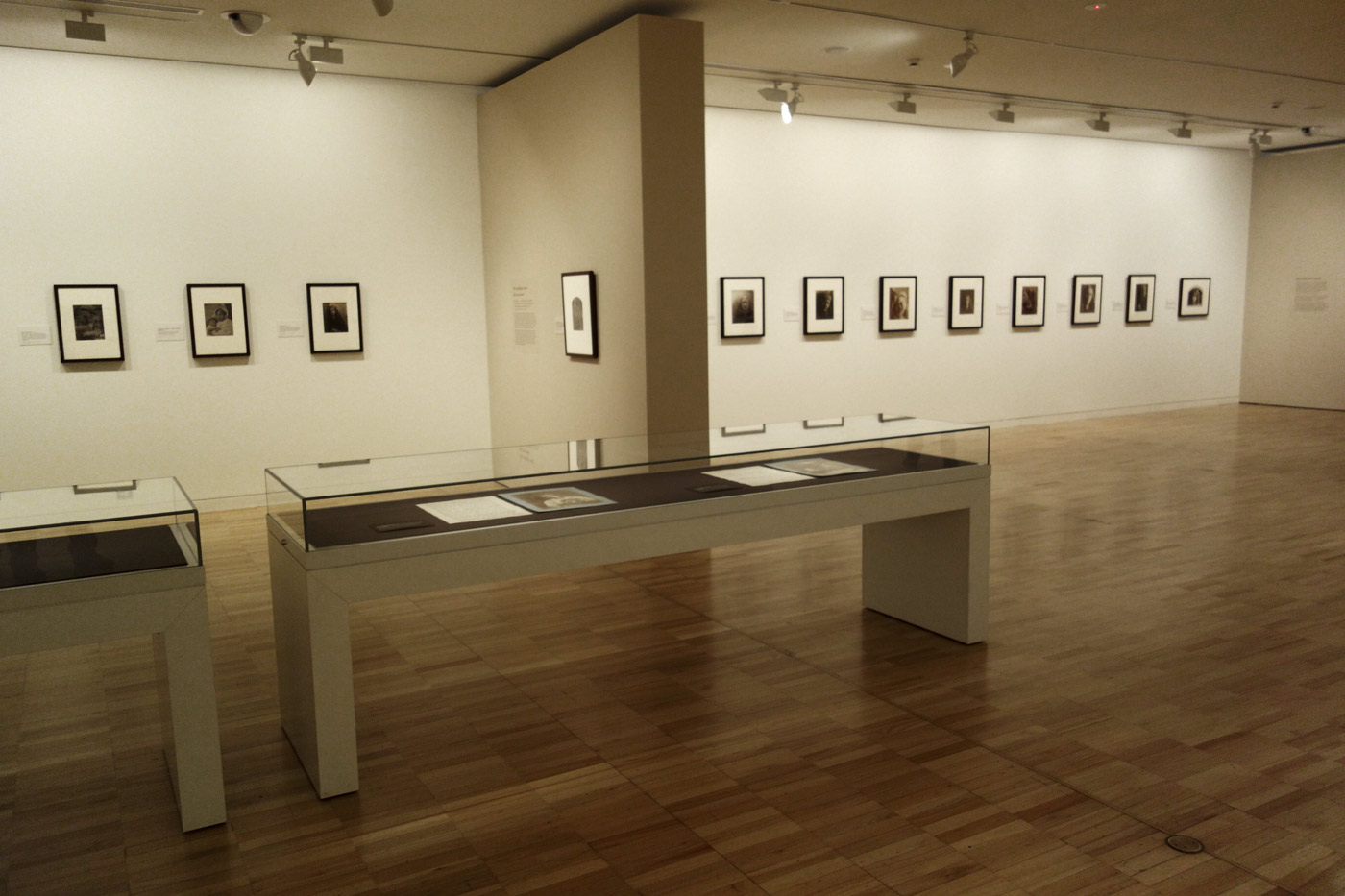
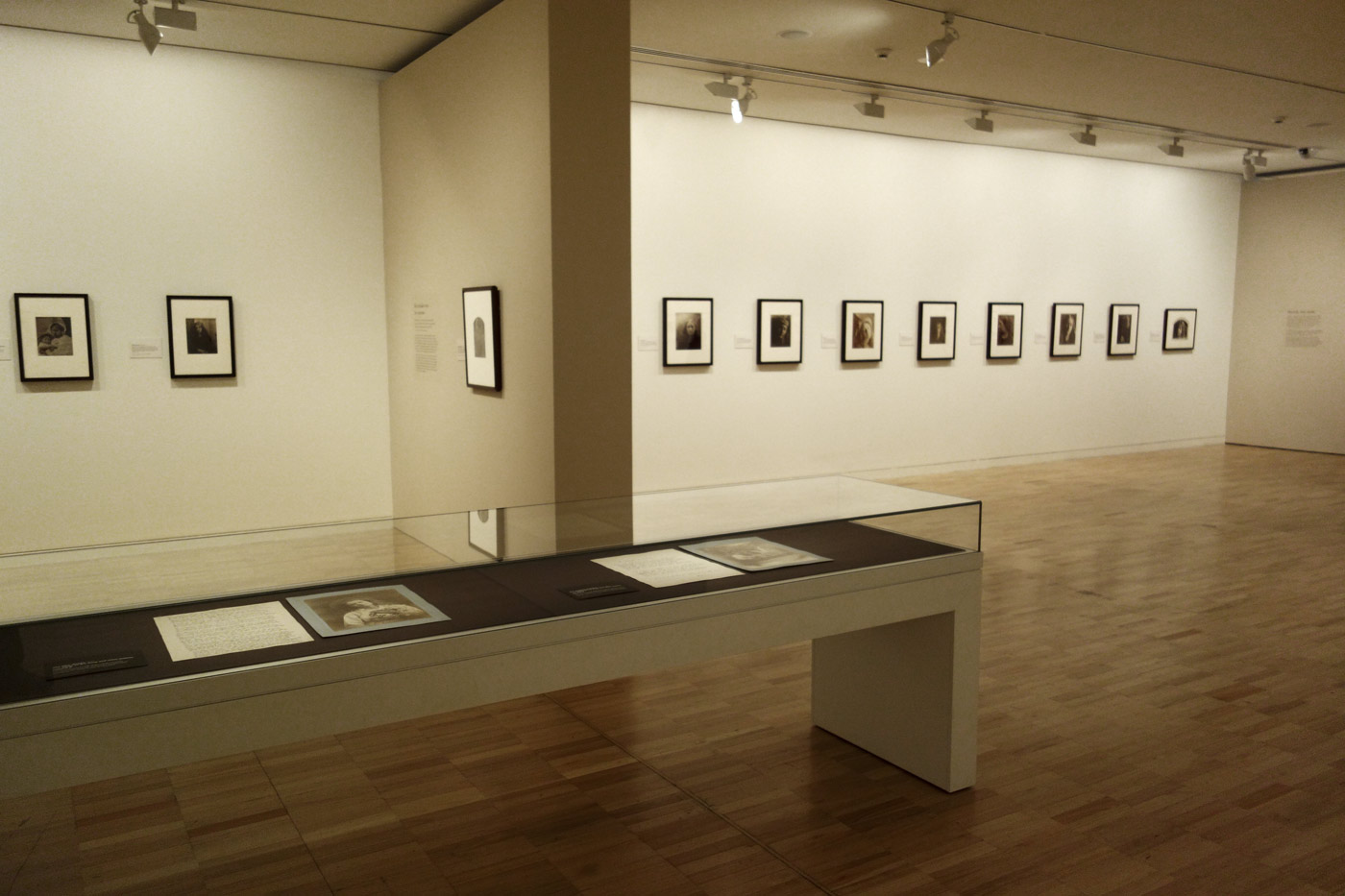
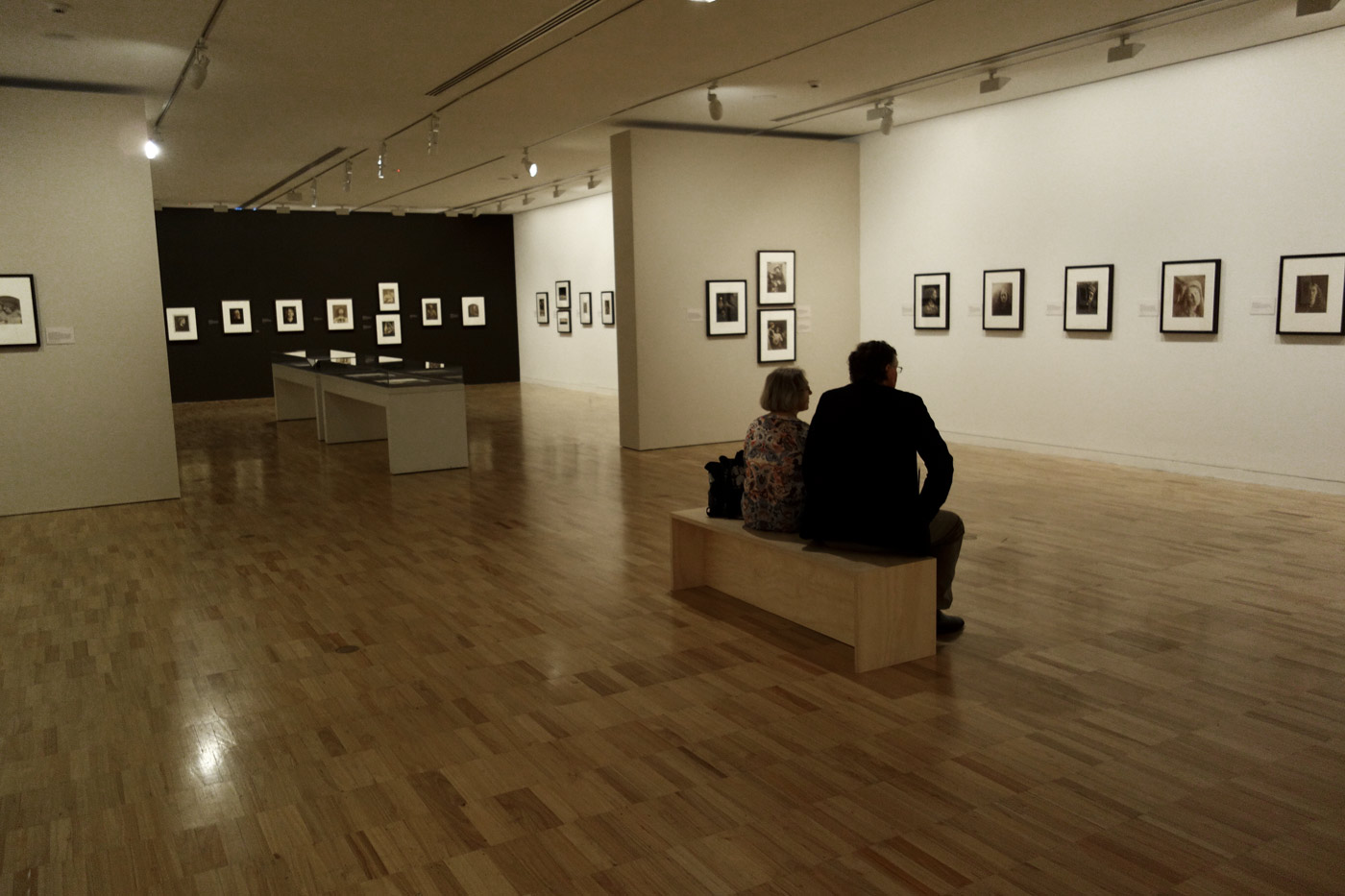
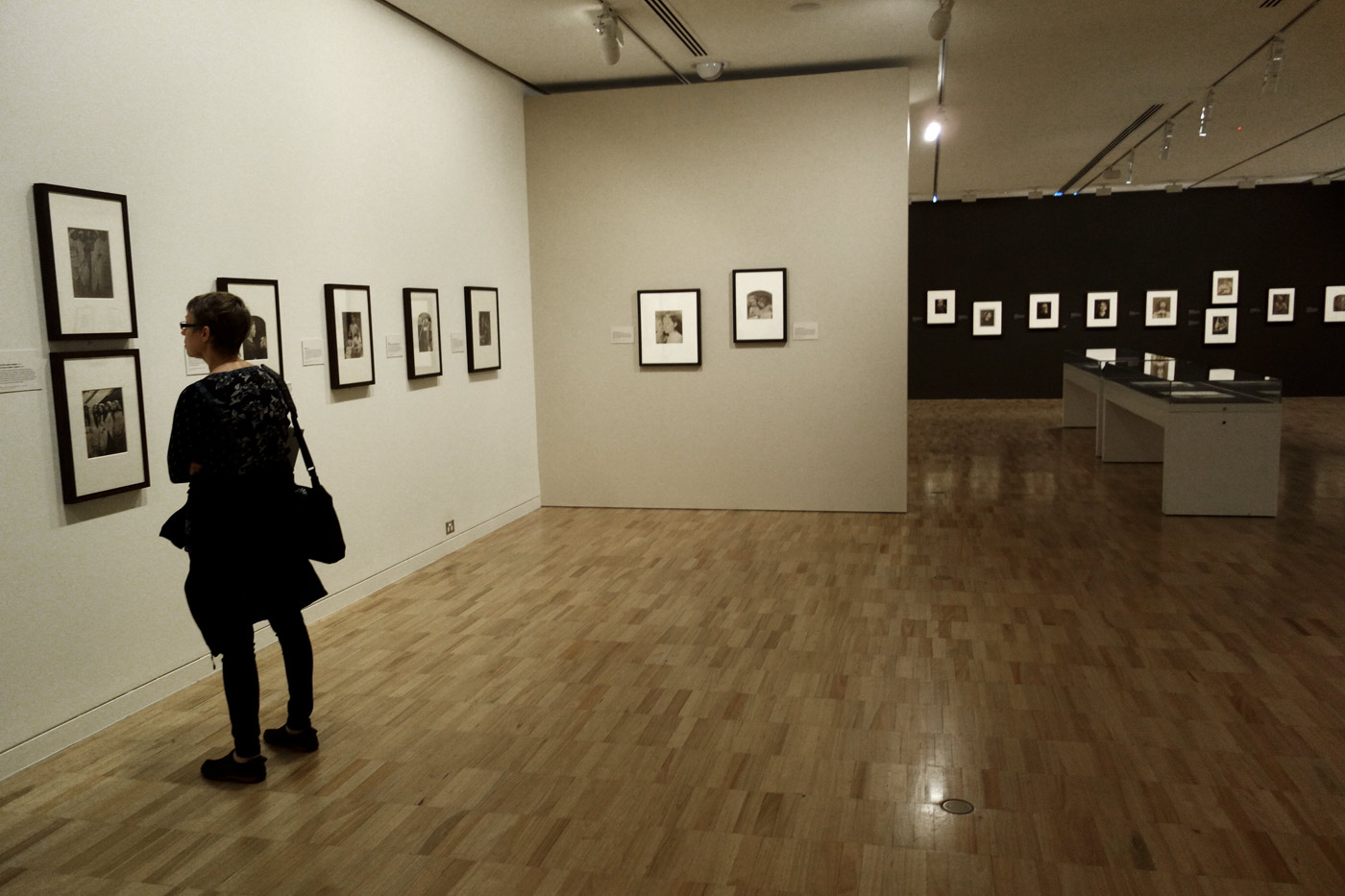
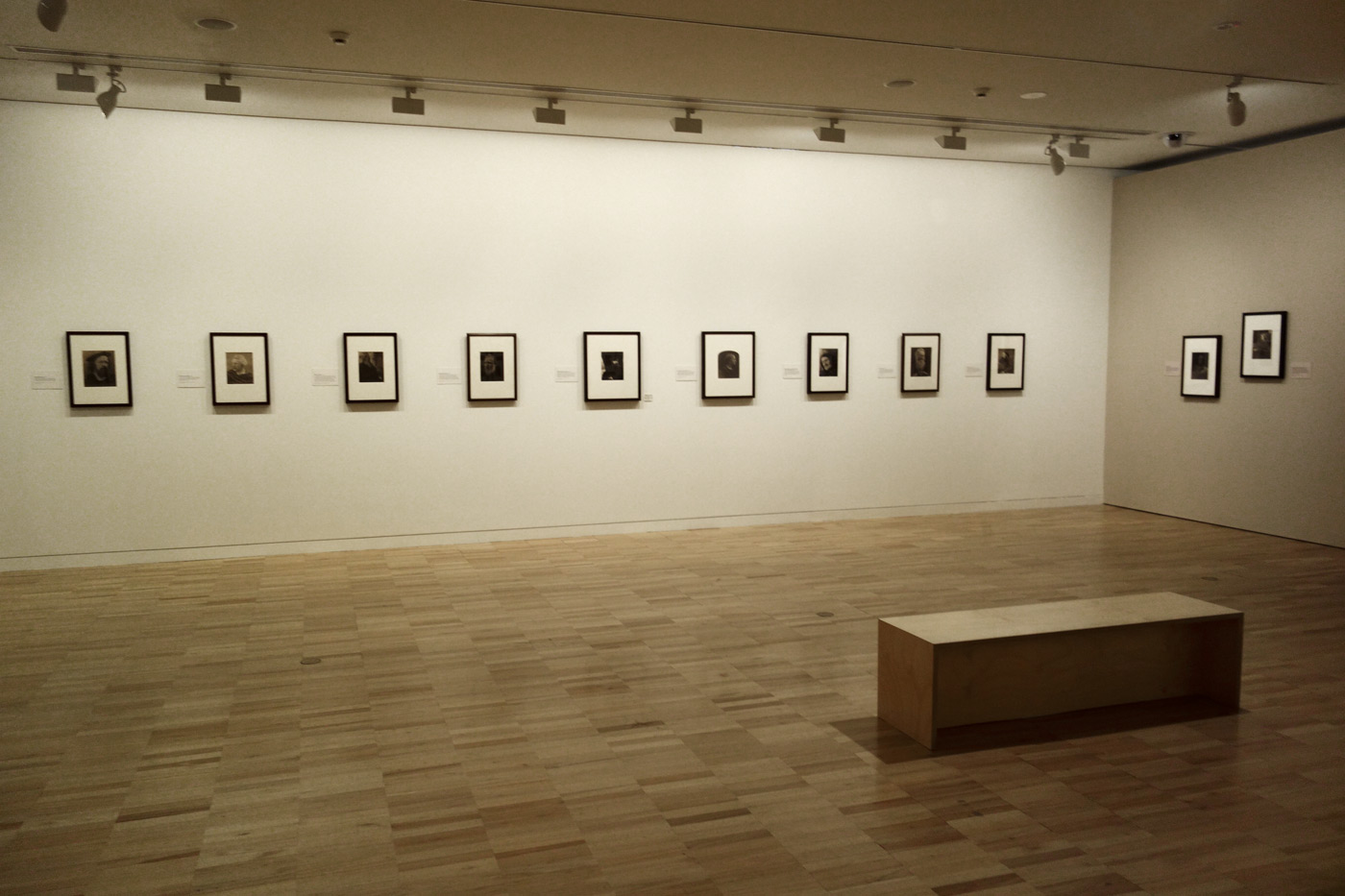
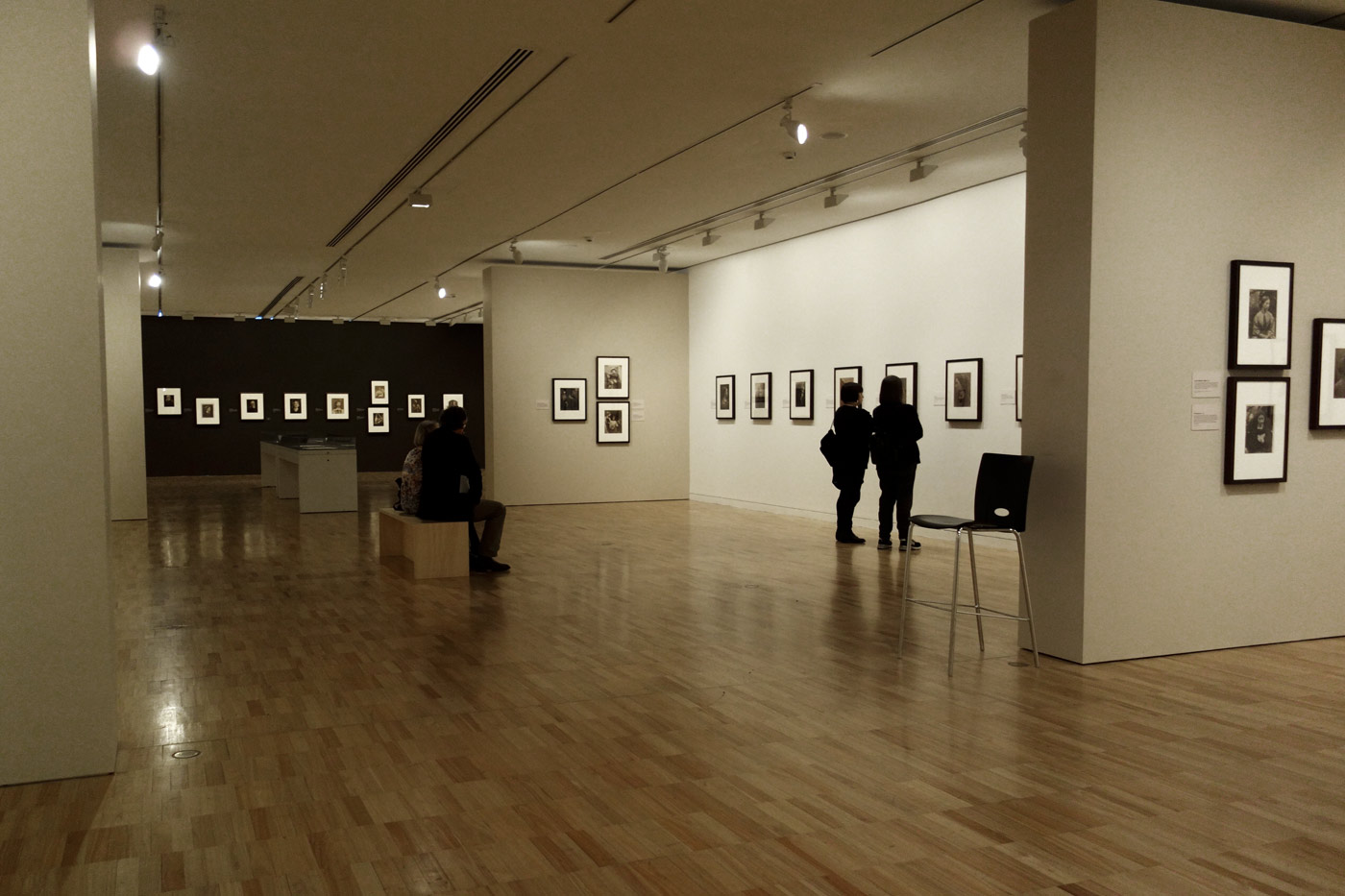
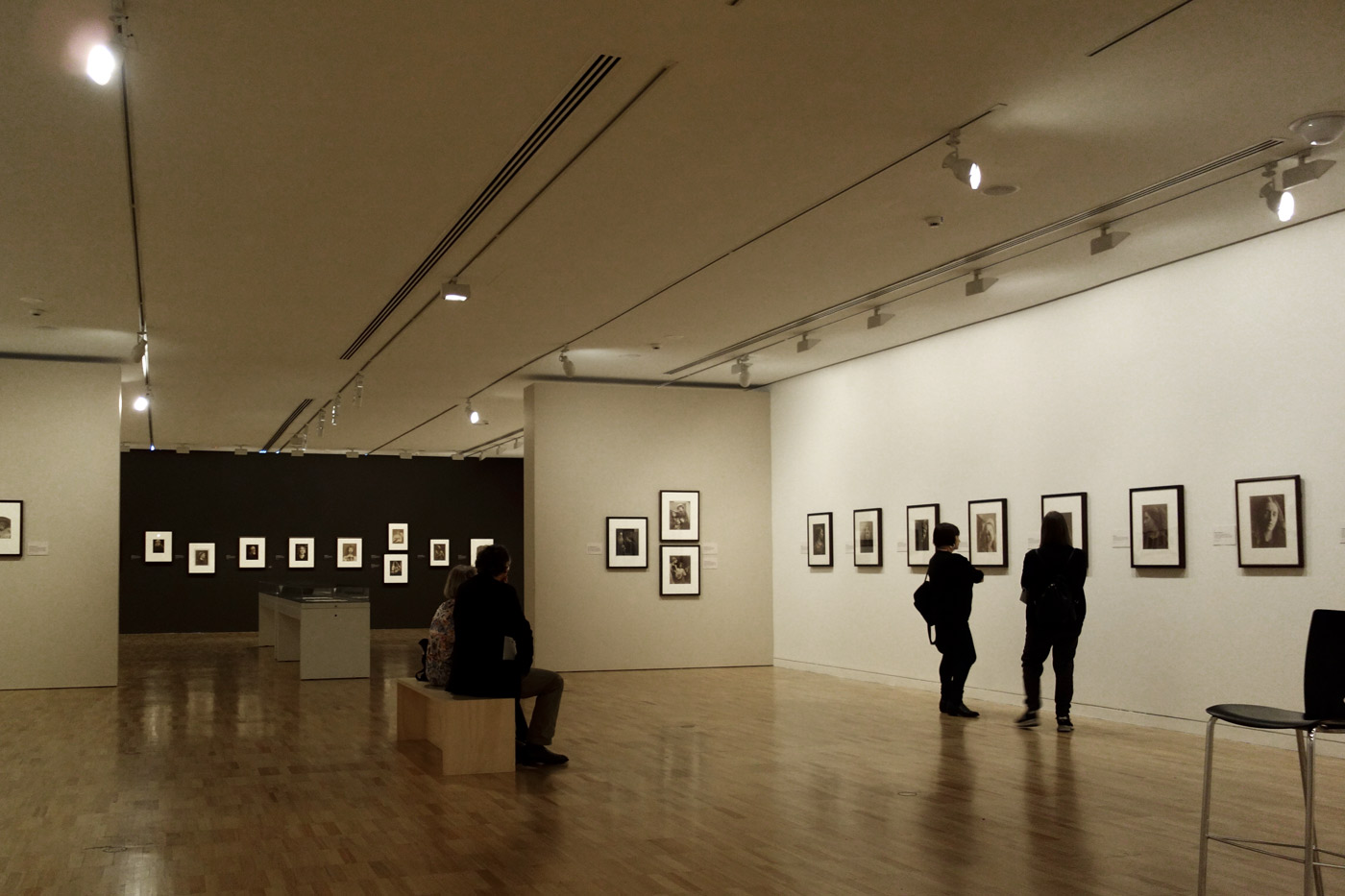
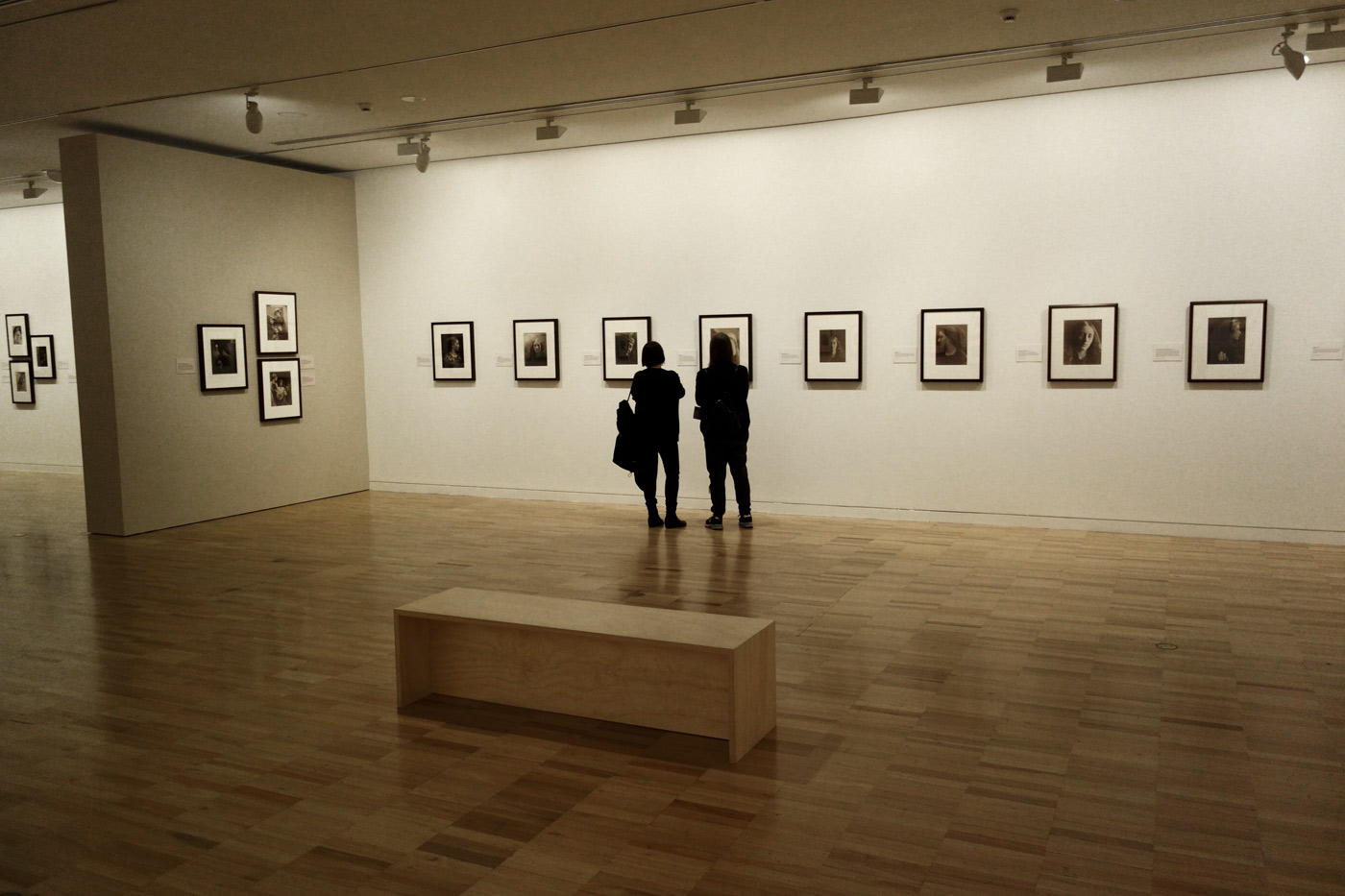
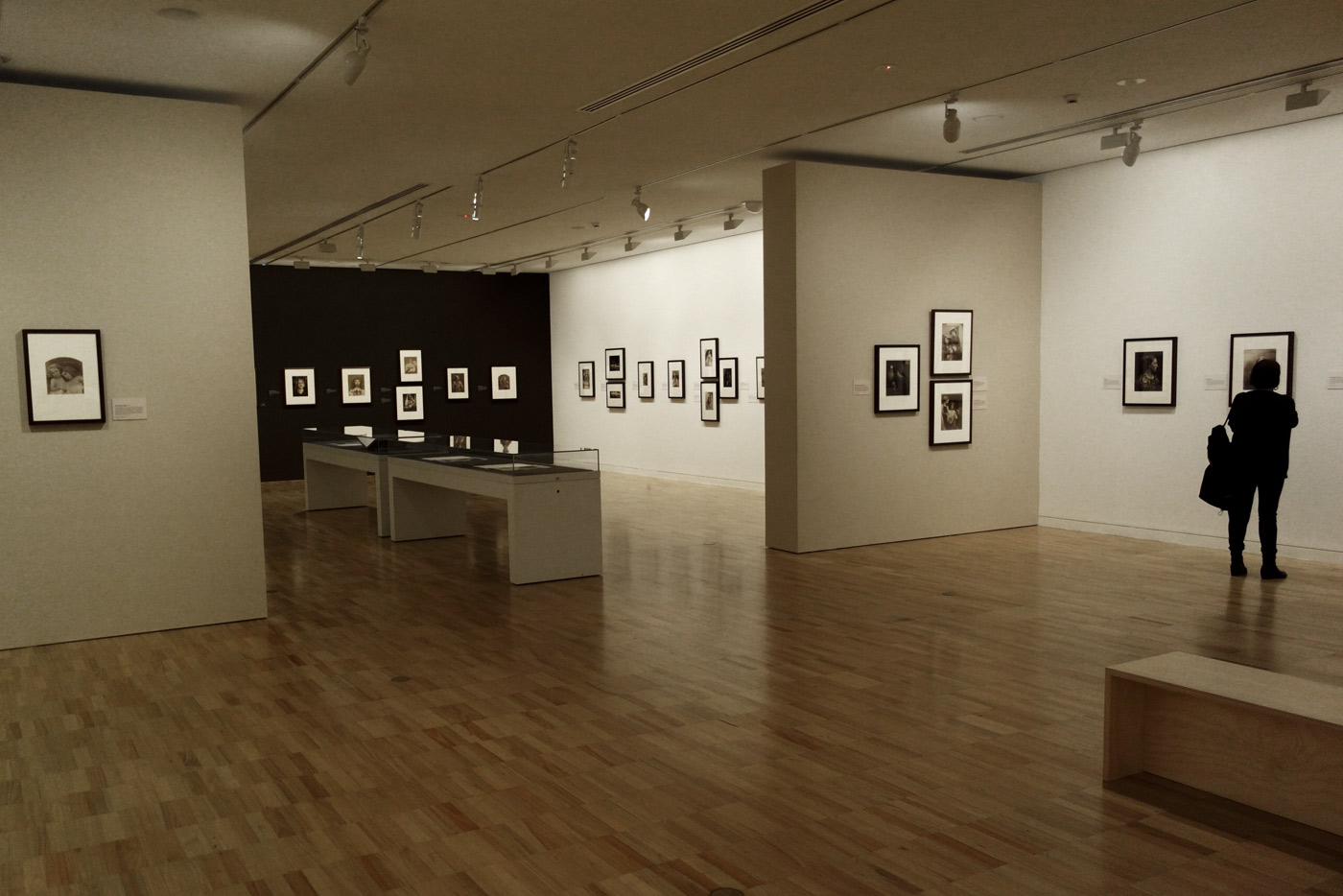
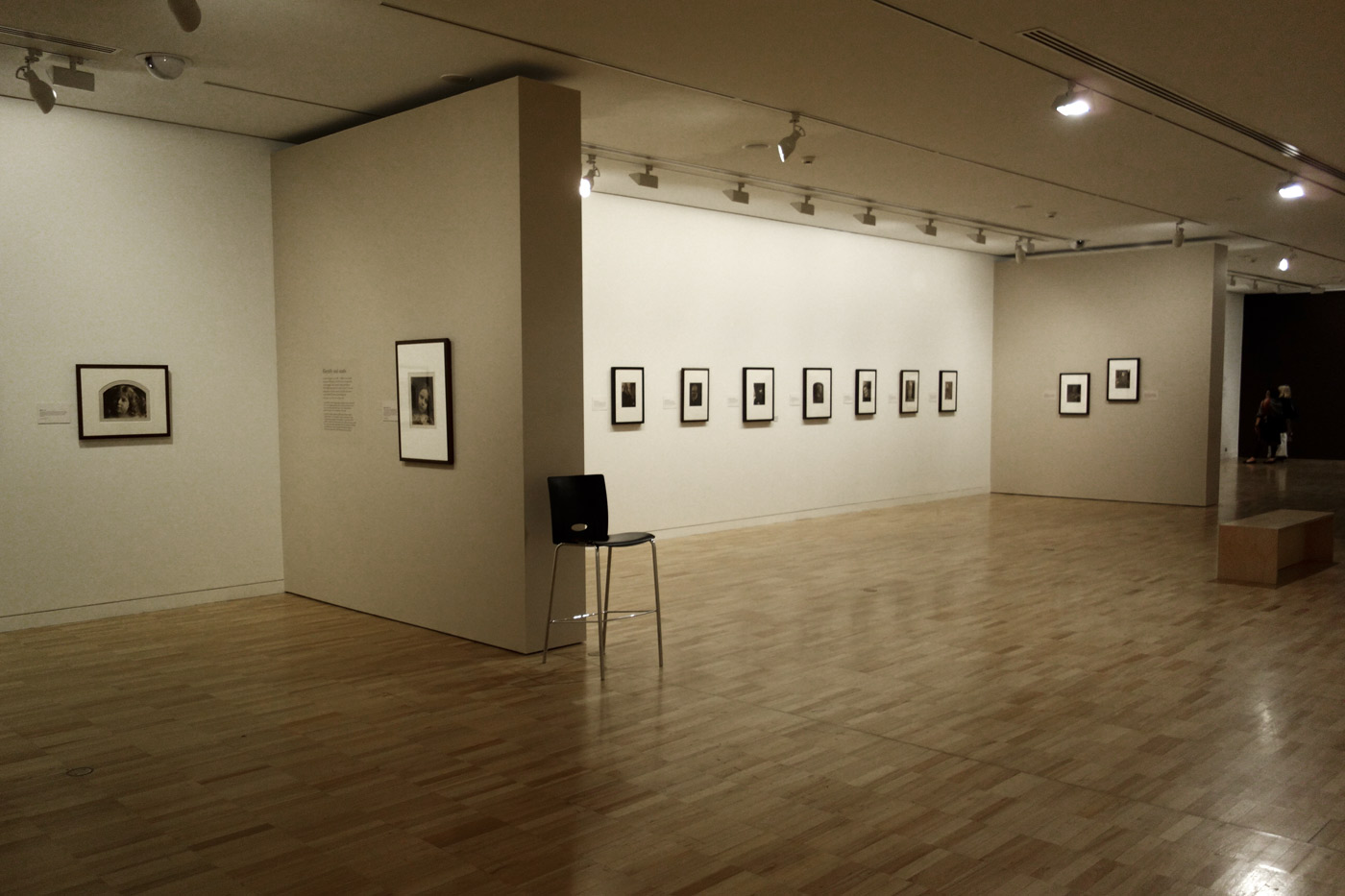
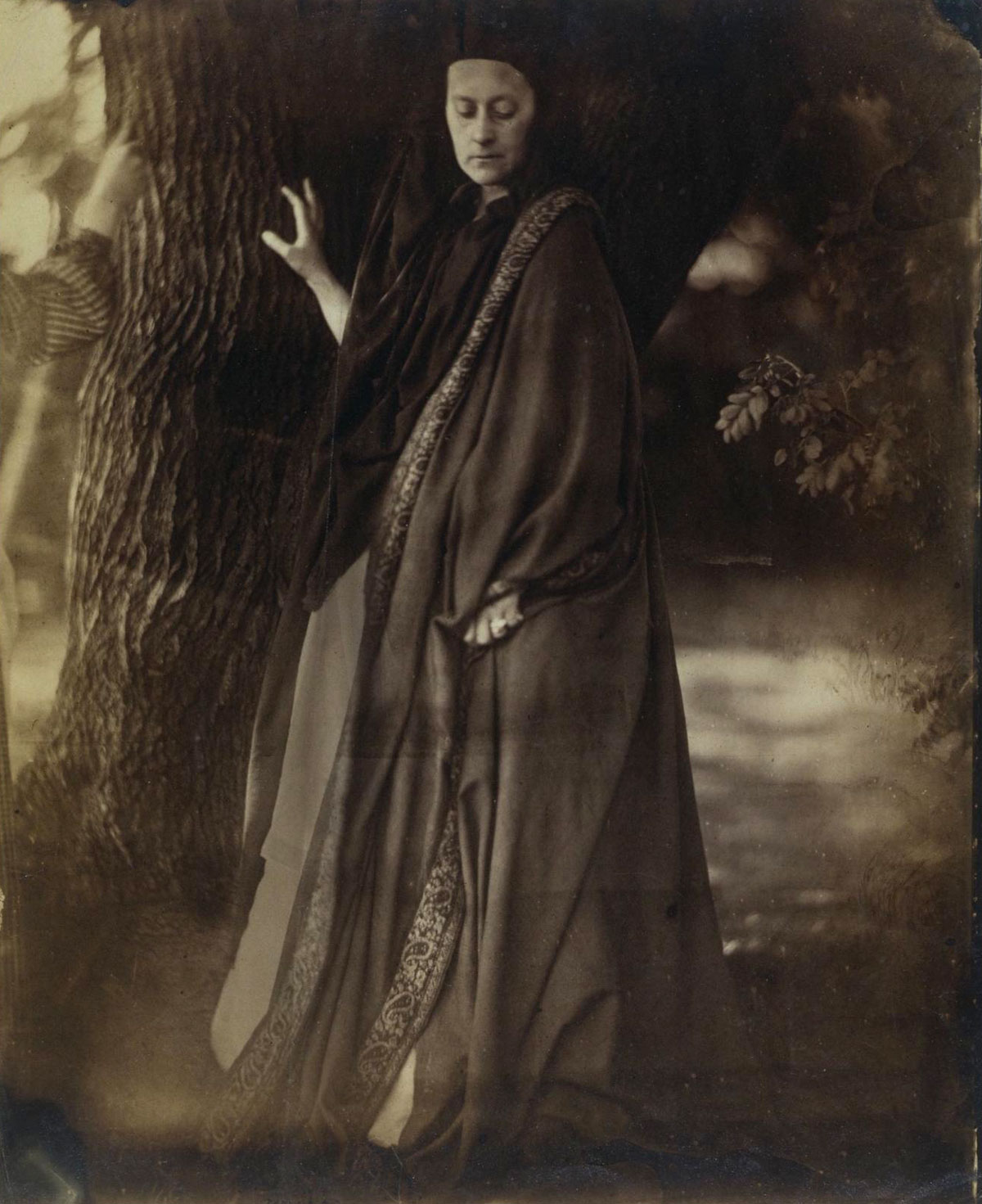
Exhibition: ‘Painting with Light: Art and Photography from the Pre-Raphaelites to the Modern Age’ at Tate Britain, London

Exhibition dates: 11th May – 25th September, 2016

Curators: Dr Carol Jacobi, Curator of British Art 1850-1915 at Tate Britain, and Dr Hope Kingsley, Curator, Education and Collections, Wilson Centre for Photography, with Tim Batchelor, Assistant Curator at Tate Britain
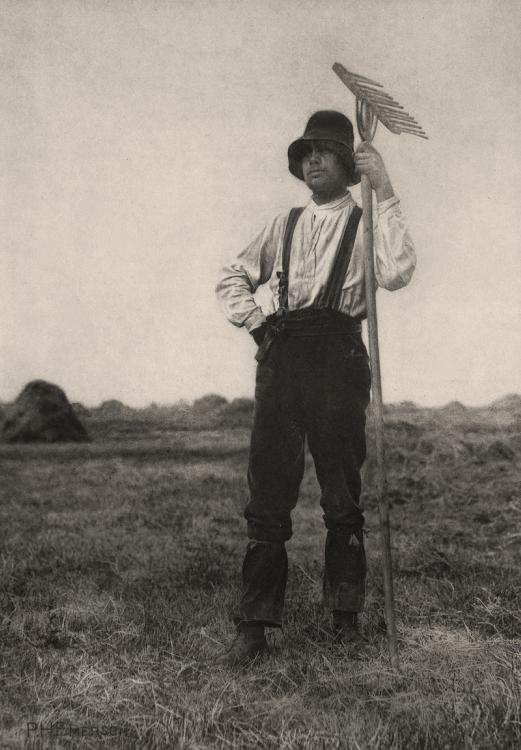
 

Peter Henry Emerson (British, 1856-1936) 'Haymaker with Rake' c. 1888, published 1890 from the exhibition 'Painting with Light: Art and Photography from the Pre-Raphaelites to the Modern Age' at Tate Britain, London, May - Sept, 2016


Peter Henry Emerson (British, 1856-1936)
Haymaker with Rake
c. 1888, published 1890
From Pictures of East Anglian Life portfolio
Photogravure on paperImage: 277 x 196mm
Victoria and Albert Museum
Gift from the photographer


An interesting concept for an exhibition. I would have liked to have seen the exhibition to make a more informed comment. Parallels can be drawn, but how much import you put on the connection is up to you vis-à-vis the aesthetic feeling and formal construction of each medium. It is fascinating to note how many of the original art works are photographs with the painting following at a later date, or vice versa. Photographically, Julia Margaret Cameron and John Cimon Warburg are the stars.

Photographs have always been used by artists as aide-mémoire since the birth of photograph. Eugené Atget called his photographs of Paris “Documents pour artistes”, declaring his modest ambition to create images for other artists to use as source material … but I take that statement with a pinch of salt. Perhaps a salt print from a calotype paper negative!

Dr Marcus Bunyan


Many thankx to the Tate for allowing me to publish the art work and photographs in the posting. Please click on the photographs for a larger version of the image.


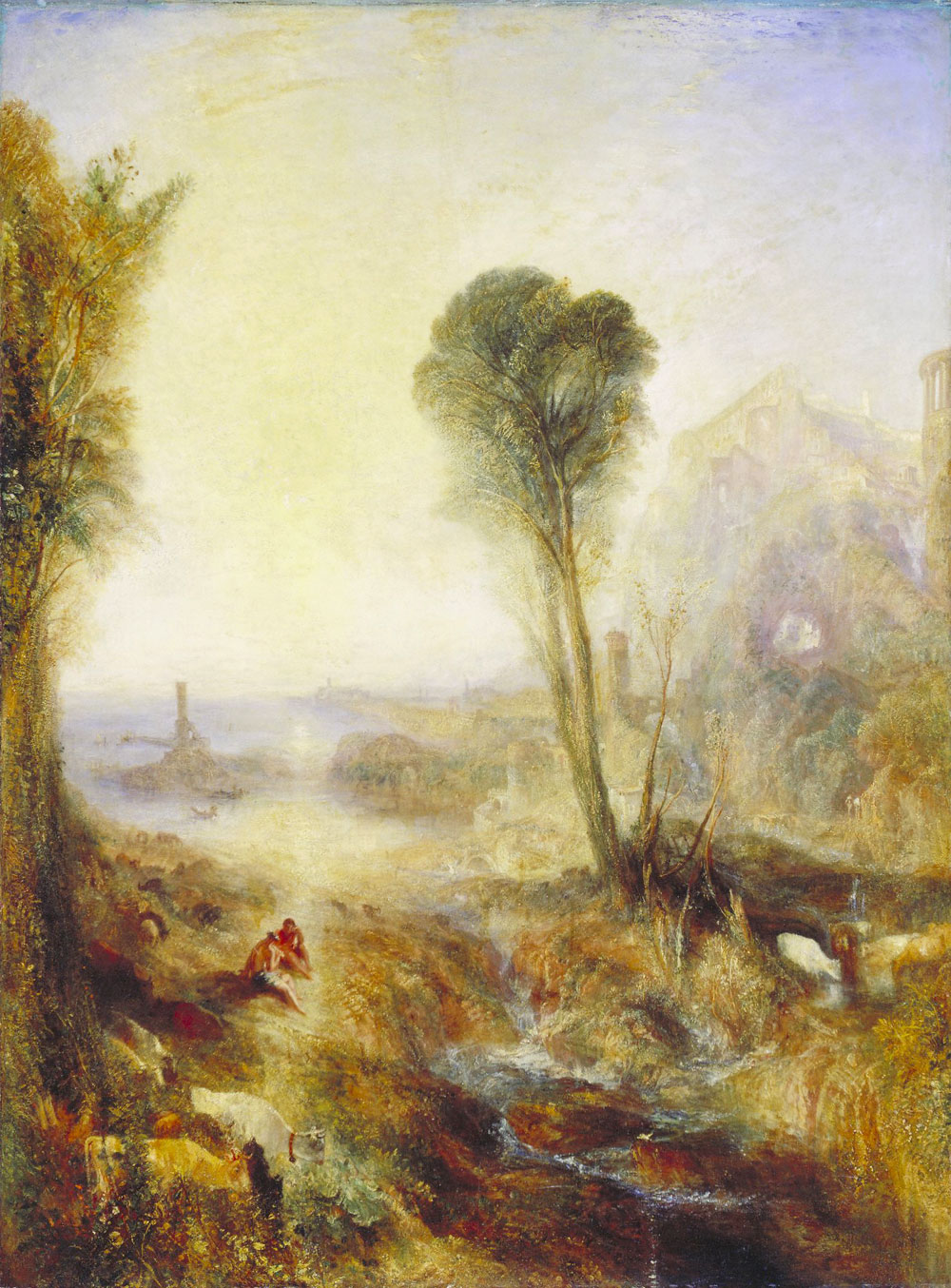
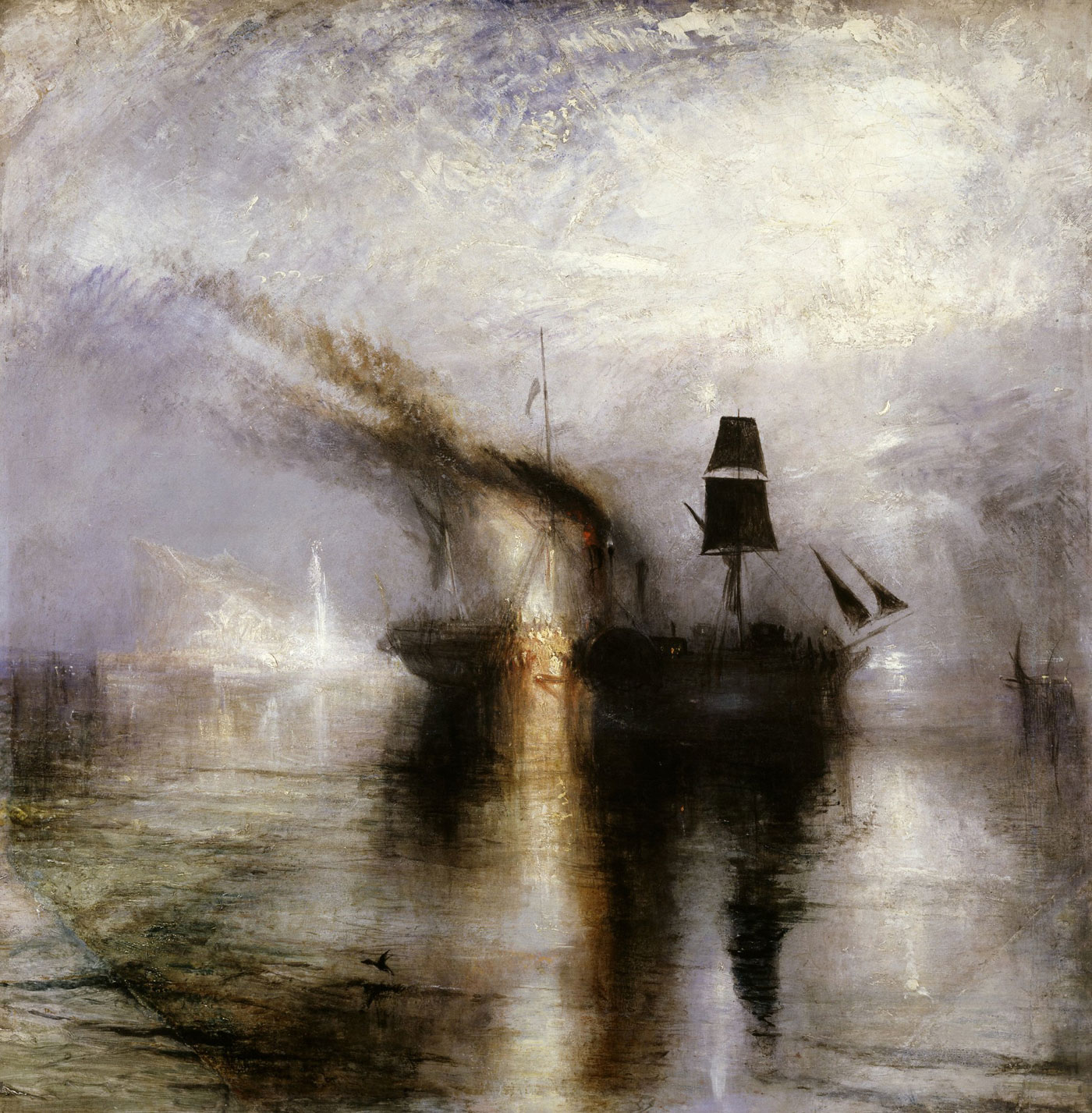
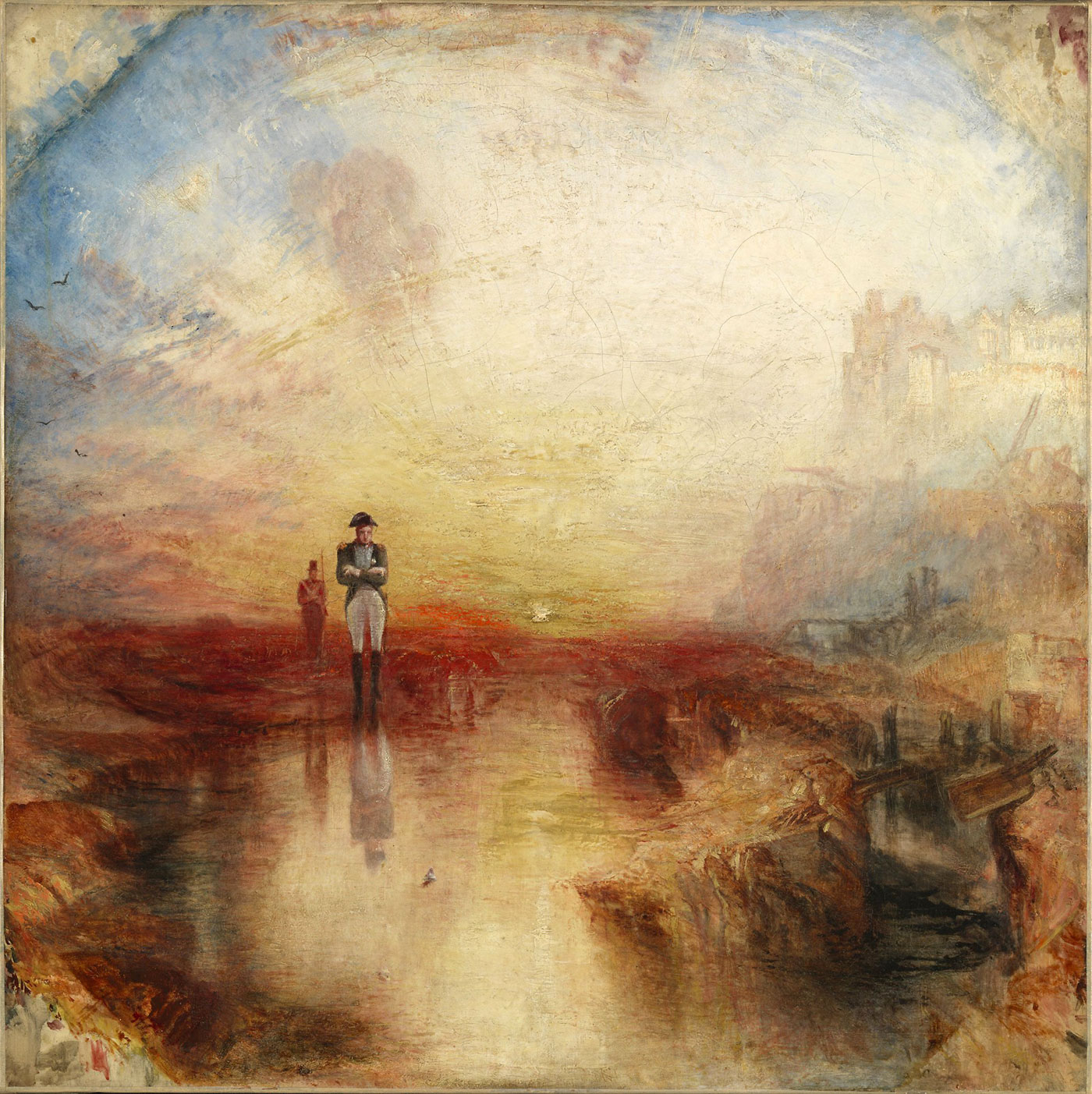
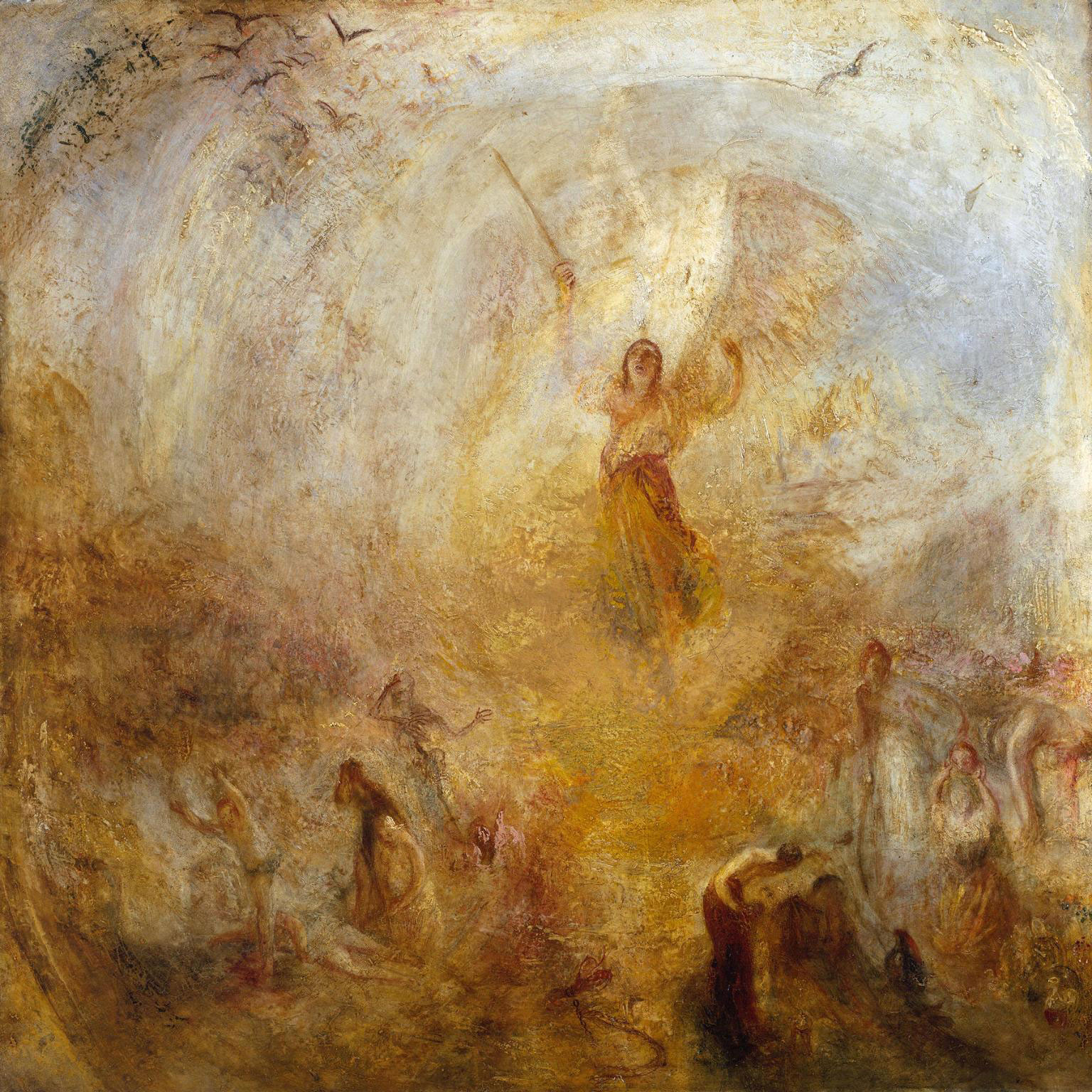
Tate Britain presents the first major exhibition to celebrate the spirited conversation between early photography and British art. It brings together photographs and paintings including Pre-Raphaelite, Aesthetic and British impressionist works. Spanning 75 years across the Victorian and Edwardian ages, the exhibition opens with the experimental beginnings of photography in dialogue with painters such as J.M.W. Turner and concludes with its flowering as an independent international art form.

Stunning works by John Everett Millais, Dante Gabriel Rossetti, JAM Whistler, John Singer Sargent and others will for the first time be shown alongside ravishing photographs by pivotal early photographers such as Julia Margaret Cameron, which they inspired and which inspired them.
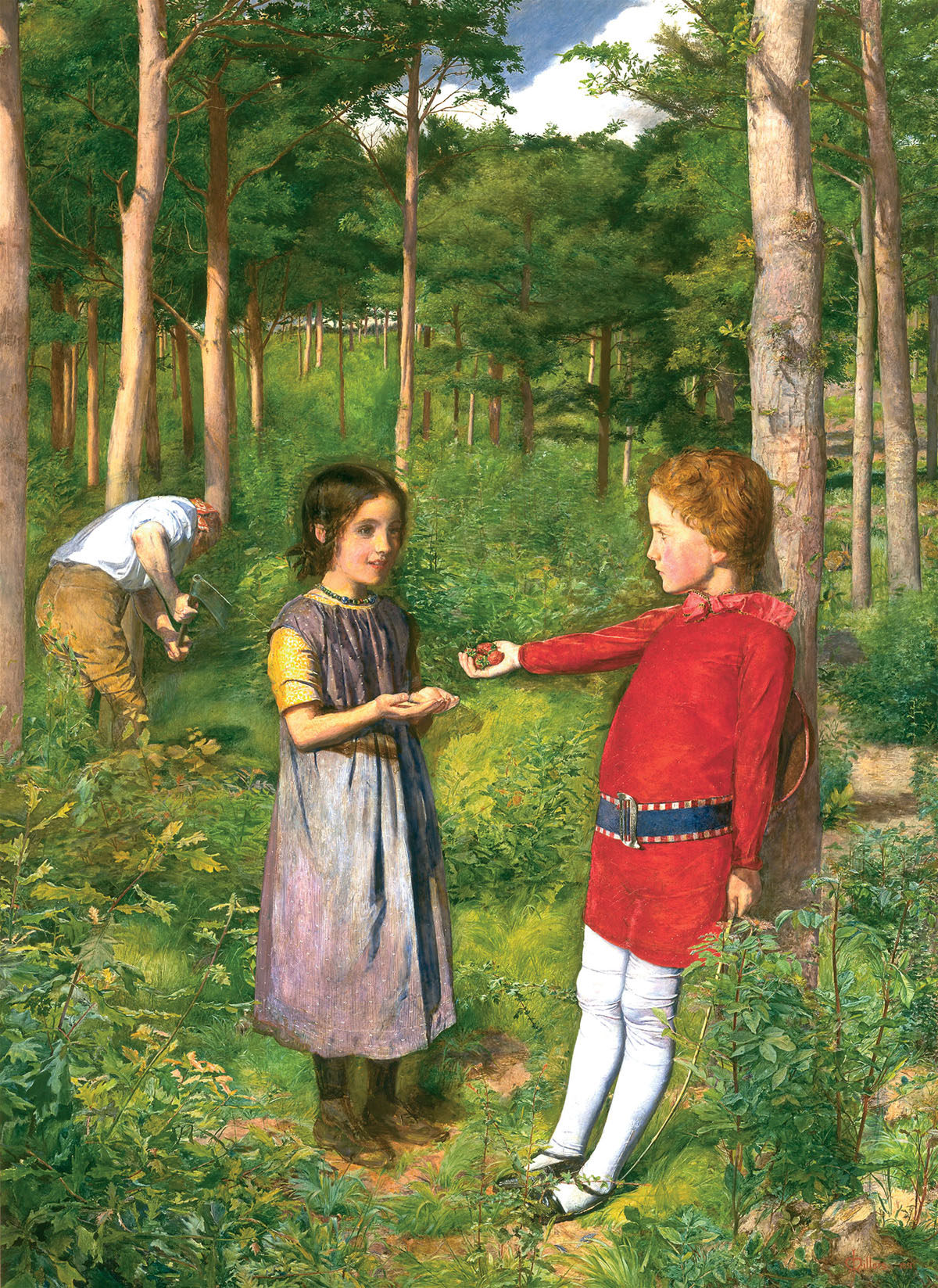
 

John Everett Millais (English, 1829-1896) 'The Woodman's Daughter' 1850-1851 from the exhibition 'Painting with Light: Art and Photography from the Pre-Raphaelites to the Modern Age' at Tate Britain, London, May - Sept, 2016


John Everett Millais (English, 1829-1896)
The Woodman’s Daughter
1850-51
Oil paint on canvas
889 x 648mm
Guildhall Art Gallery, City of London
 

Minna Keene (Canadian born Germany, 1861-1943) 'Decorative Study' c. 1906


Minna Keene (Canadian born Germany, 1861-1943)
Decorative Study
c. 1906
© Royal Photographic Society / National Media Museum/ Science & Society Picture Library
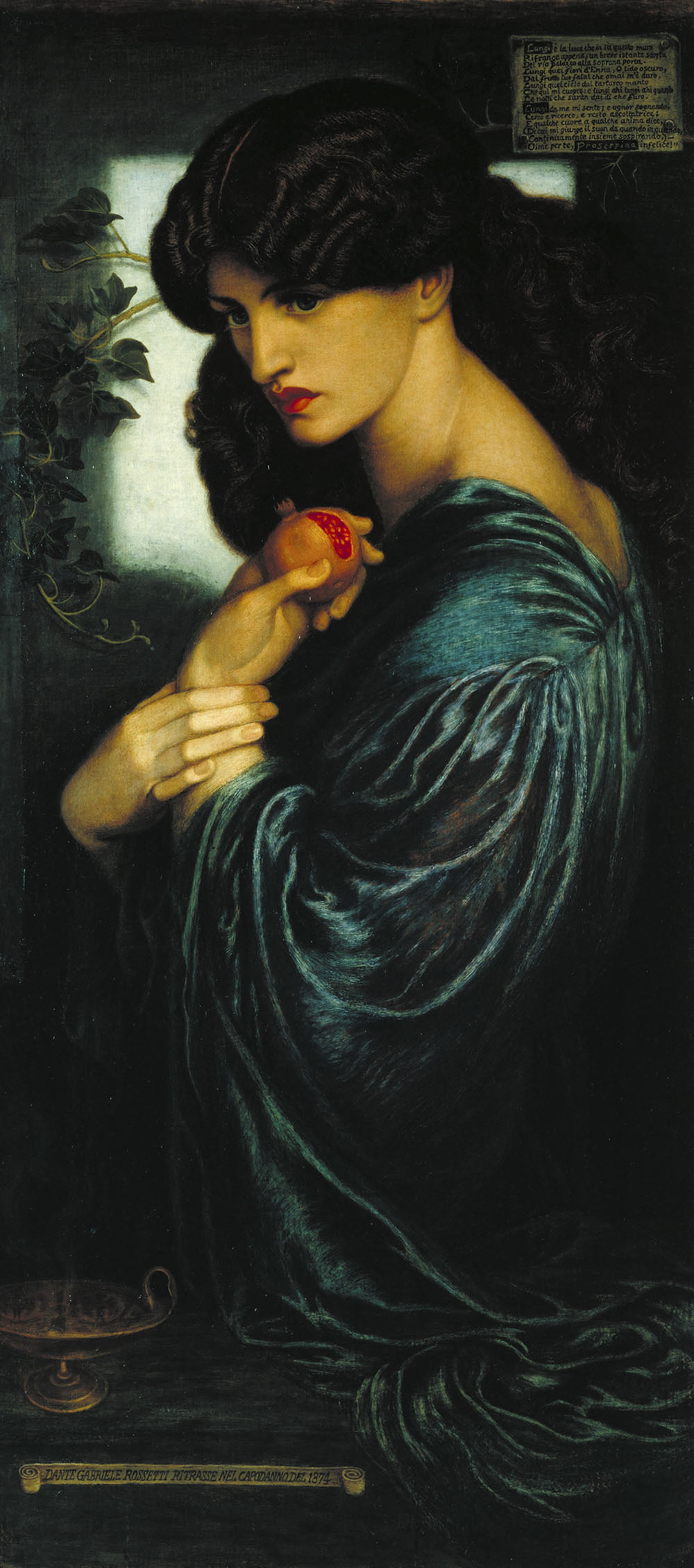
 

Dante Gabriel Rossetti (English, 1828-1882) 'Proserpine' 1874


Dante Gabriel Rossetti (English, 1828-1882)
Proserpine
1874
Oil on canvas
Support: 1251 x 610mm
Frame: 1605 x 930 x 85mm
Presented by W. Graham Robertson 1940
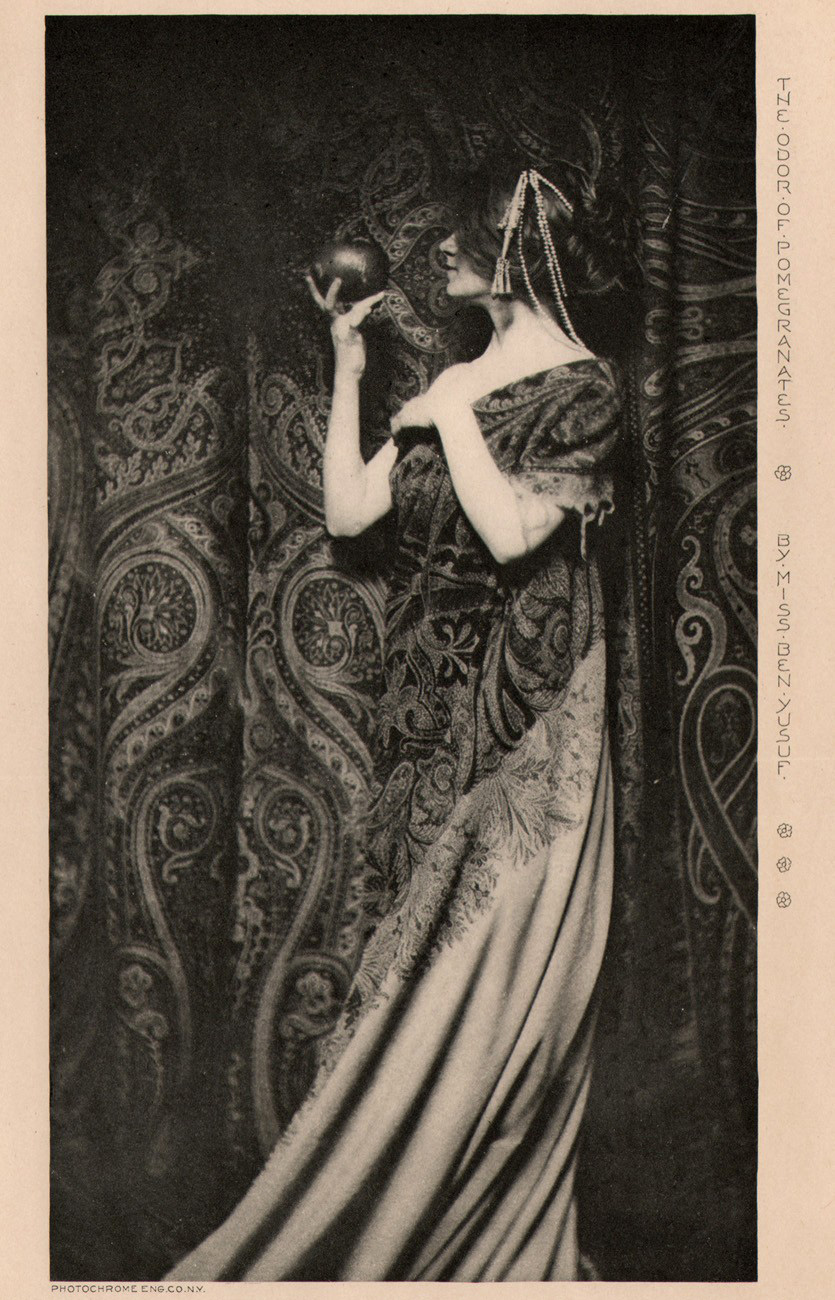
 

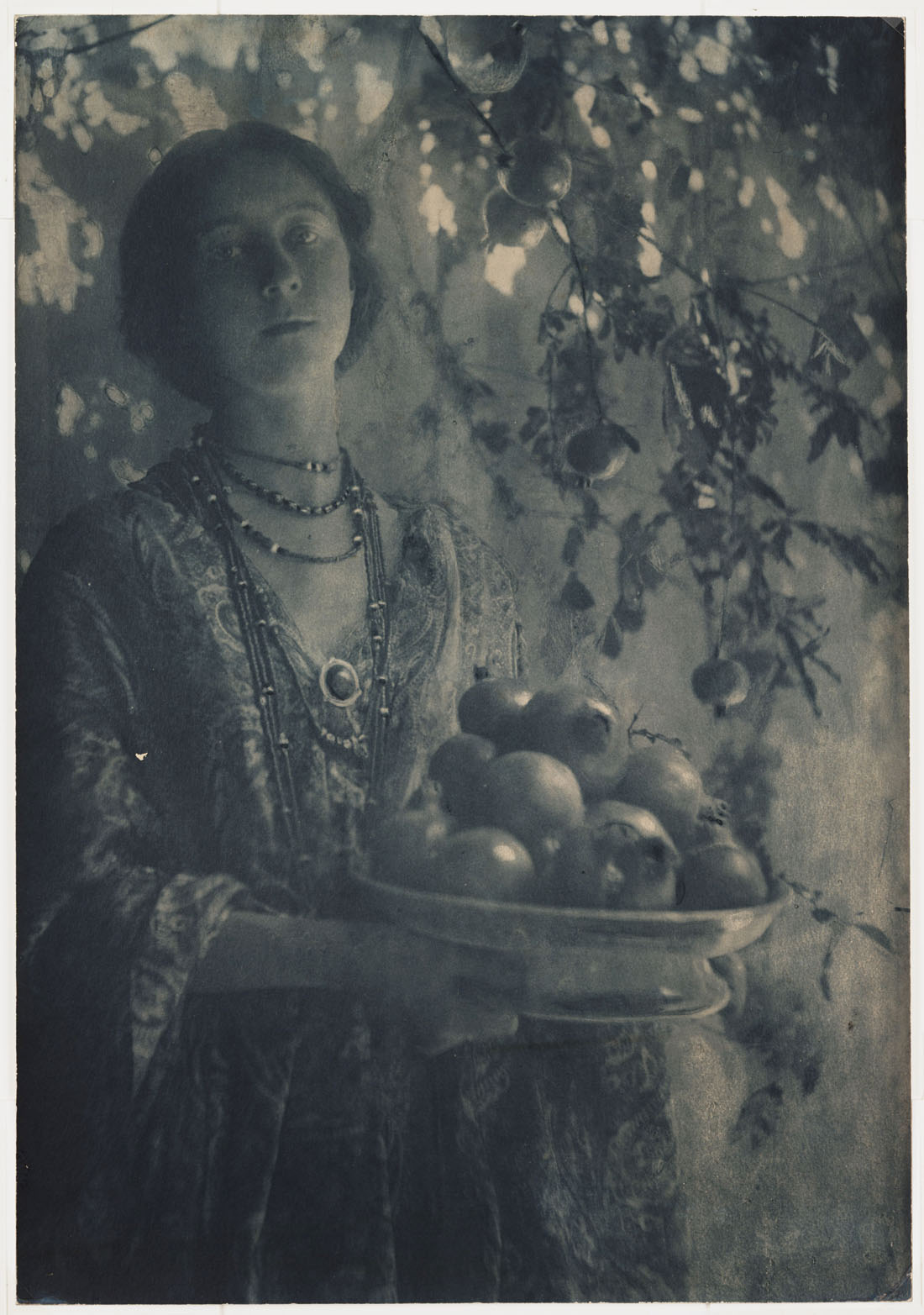
Zaida Ben-Yusuf (American born England, 1869-1933) 'The Odor of Pomegranates' 1899


Zaida Ben-Yusuf (American born England, 1869-1933)
The Odor of Pomegranates
1899, published 1901
Photogravure on paper
Tate


Zaida Ben-Yusuf (American born England, 1869-1933)

Zaida Ben-Yusuf (21 November 1869 – 27 September 1933) was a New York-based portrait photographer noted for her artistic portraits of wealthy, fashionable, and famous Americans of the turn of the 19th-20th century. She was born in London to a German mother and an Algerian father, but became a naturalised American citizen later in life. In 1901 the Ladies Home Journal featured her in a group of six photographers that it dubbed, “The Foremost Women Photographers in America.” In 2008, the Smithsonian National Portrait Gallery mounted an exhibition dedicated solely to Ben-Yusuf’s work, re-establishing her as a key figure in the early development of fine art photography…

In 1896, Ben-Yusuf began to be known as a photographer. In April 1896, two of her pictures were reproduced in The Cosmopolitan Magazine, and another study was exhibited in London as part of an exhibition put on by The Linked Ring. She travelled to Europe later that year, where she met with George Davison, one of the co-founders of The Linked Ring, who encouraged her to continue her photography. She exhibited at their annual exhibitions until 1902.

In the spring of 1897, Ben-Yusuf opened her portrait photography studio at 124 Fifth Avenue, New York. On 7 November 1897, the New York Daily Tribune ran an article on Ben-Yusuf’s studio and her work creating advertising posters, which was followed by another profile in Frank Leslie’s Weekly on 30 December. Through 1898, she became increasingly visible as a photographer, with ten of her works in the National Academy of Design-hosted 67th Annual Fair of the American Institute, where her portrait of actress Virginia Earle won her third place in the Portraits and Groups class. During November 1898, Ben-Yusuf and Frances Benjamin Johnston held a two-woman show of their work at the Camera Club of New York.

In 1899, Ben-Yusuf met with F. Holland Day in Boston, and was photographed by him. She relocated her studio to 578 Fifth Avenue, and exhibited in a number of exhibitions, including the second Philadelphia Photographic Salon. She was also profiled in a number of publications, including an article on female photographers in The American Amateur Photographer, and a long piece in The Photographic Times in which Sadakichi Hartmann described her as an “interesting exponent of portrait photography”.

1900 saw Ben-Yusuf and Johnston assemble an exhibition on American women photographers for the Universal Exposition in Paris. Ben-Yusuf had five portraits in the exhibition, which travelled to Saint Petersburg, Moscow, and Washington, D.C. She was also exhibited in Holland Day’s exhibition, The New School of American Photography, for the Royal Photographic Society in London, and had four photographs selected by Alfred Stieglitz for the Glasgow International Exhibition of 1901, Scotland.

In 1901, Ben-Yusuf wrote an article, “Celebrities Under the Camera”, for the Sunday Evening Post, where she described her experiences with her sitters. By this stage she had photographed Grover Cleveland, Franklin Roosevelt, and Leonard Wood, amongst others. For the September issue of Metropolitan Magazine she wrote another article, “The New Photography – What It Has Done and Is Doing for Modern Portraiture”, where she described her work as being more artistic than most commercial photographers, but less radical than some of the better-known art photographers. The Ladies Home Journal that November declared her to be one of the “foremost women photographers in America”, as she began the first of a series of six illustrated articles on “Advanced Photography for Amateurs” in the Saturday Evening Post.

Ben-Yusuf was listed as a member of the first American Photographic Salon when it opened in December 1904, although her participation in exhibitions was beginning to drop off. In 1906, she showed one portrait in the third annual exhibition of photographs at Worcester Art Museum, Massachusetts, the last known exhibition of her work in her lifetime.

Text from the Wikipedia website


In the Studio

Many photographers trained as painters. They set up studios and employed artists’ models, skilled at holding poses for the time it took to take a picture. Later in the century, improved photographic negatives required shorter exposure times and it became easier to stage and capture difficult positions and spontaneous gestures.

Painters and illustrators used photographs as preparatory studies and as substitutes for props, costumes and models, and art schools created photographic archives for their students. Photographs commissioned and sold by institutions such as the British Museum made classical sculpture and old master paintings more accessible, inspiring both painters and photographers.
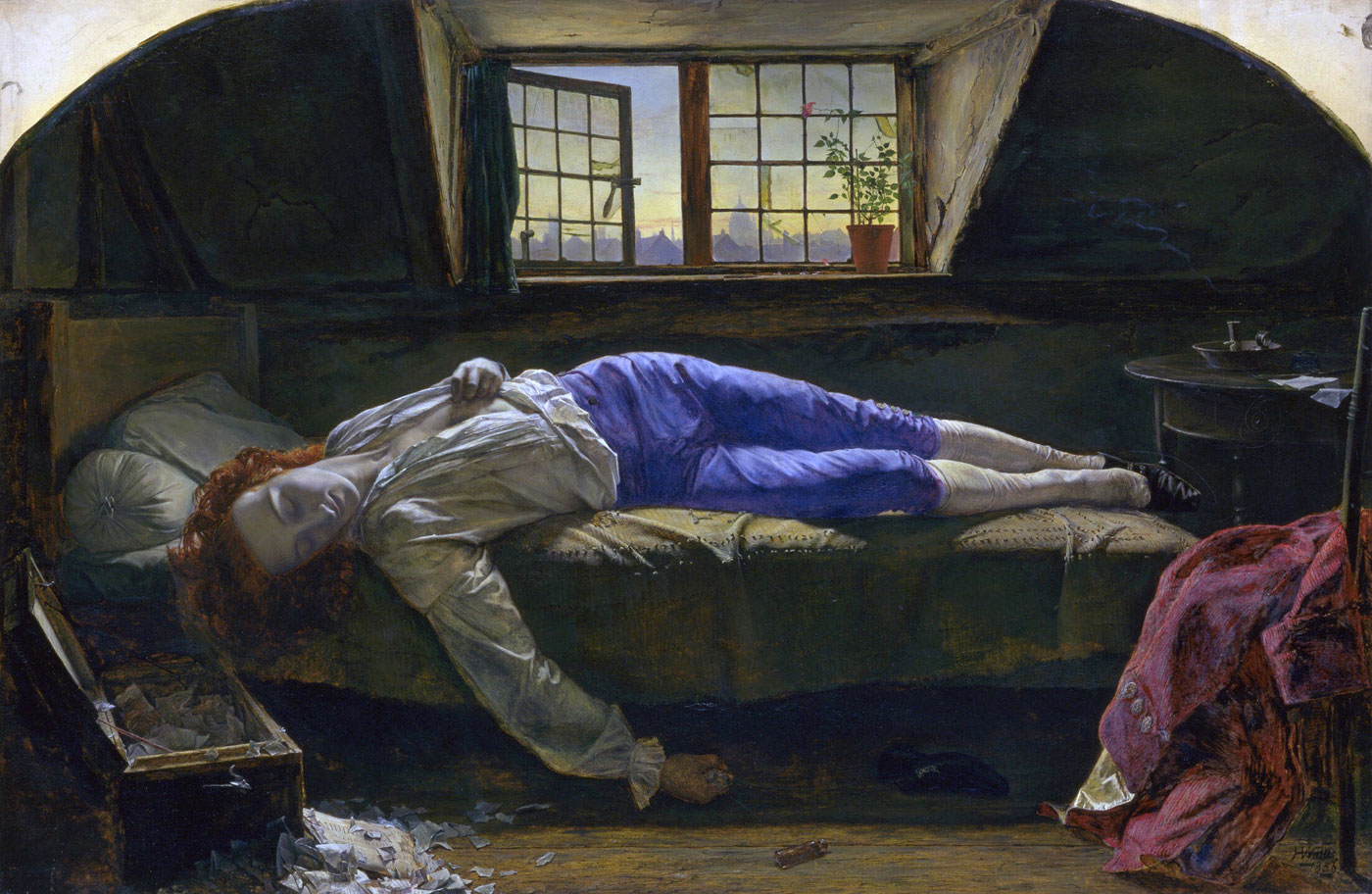
 

Henry Wallis (British, 1830-1916) 'Chatterton' 1856


Henry Wallis (British, 1830-1916)
Chatterton
1856
Oil paint on canvas
Support: 622 x 933mm
Frame: 905 x 1205 x 132mm
Tate
Bequeathed by Charles Gent Clement 1899


Chatterton is Wallis’s earliest and most famous work. The picture created a sensation when it was first exhibited at the Royal Academy in 1856, accompanied by the following quotation from Marlowe:

Cut is the branch that might have grown full straight
And burned is Apollo’s laurel bough.


Ruskin described the work in his Academy Notes as ‘faultless and wonderful’.

Thomas Chatterton (1752-1770) was an 18th Century poet, a Romantic figure whose melancholy temperament and early suicide captured the imagination of numerous artists and writers. He is best known for a collection of poems, written in the name of Thomas Rowley, a 15th Century monk, which he copied onto parchment and passed off as mediaeval manuscripts. Having abandoned his first job working in a scrivener’s office he struggled to earn a living as a poet. In June 1770 he moved to an attic room at 39 Brooke Street, where he lived on the verge of starvation until, in August of that year, at the age of only seventeen, he poisoned himself with arsenic. Condemned in his lifetime as a forger by influential figures such as the writer Horace Walpole (1717-1797), he was later elevated to the status of tragic hero by the French poet Alfred de Vigny (1797-1863).

Wallis may have intended the picture as a criticism of society’s treatment of artists, since his next picture of note, The Stonebreaker (1858, Birmingham City Museum and Art Gallery), is one of the most forceful examples of social realism in Pre-Raphaelite art. The painting alludes to the idea of the artist as a martyr of society through the Christ-like pose and the torn sheets of poetry on the floor. The pale light of dawn shines through the casement window, illuminating the poet’s serene features and livid flesh. The harsh lighting, vibrant colours and lifeless hand and arm increase the emotional impact of the scene. A phial of poison on the floor indicates the method of suicide. Following the Pre-Raphaelite credo of truth to nature, Wallis has attempted to recreate the same attic room in Gray’s Inn where Chatterton had killed himself. The model for the figure was the novelist George Meredith (1828-1909), then aged about 28. Two years later Wallis eloped with Meredith’s wife, a daughter of the novelist Thomas Love Peacock (1785-1866).

Frances Fowle. “Chatterton,” on the Tate website December 2000 [Online] Cited 16/02/2023
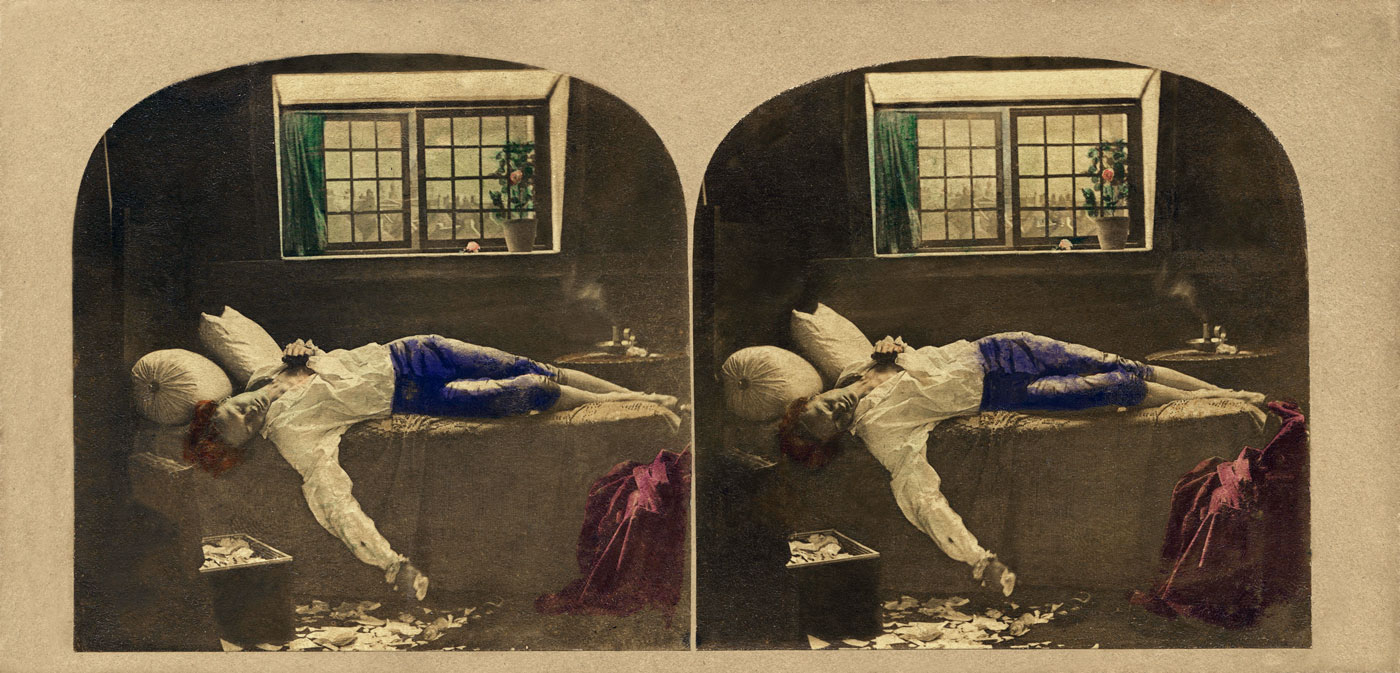
 

James Robinson. 'The Death of Chatterton' 1859


James Robinson
The Death of Chatterton
1859
Two photographs, hand-tinted albumen prints on paper mounted on card
Collection Dr Brian May

THIS STEREOCARD IS NOT IN THE EXHIBITION


James Robinson. 'The Death of Chatterton' 1859 (detail)


James Robinson
The Death of Chatterton (detail)
1859
Two photographs, hand-tinted albumen prints on paper mounted on card
Collection Dr Brian May

THIS STEREOCARD IS NOT IN THE EXHIBITION


One of the most famous paintings of Victorian times was Chatterton, 1856 (Tate) by the young Pre-Raphaelite-style artist, Henry Wallis (1830-1916). Again, the tale of the suicide of the poor poet, Thomas Chatterton, exposed as a fraud for faking medieval histories and poems to get by, had broad appeal. Chatterton was also an 18th-century figure, but Wallis set his picture in a bare attic overlooking the City of London which evoked the urban poverty of his own age. The picture toured the British Isles and hundreds of thousands flocked to pay a shilling to view it. One of these was James Robinson, who saw the painting when it was in Dublin. He immediately conceived a stereographic series of Chatterton’s life. Unfortunately Robinson started with Wallis’s scene (The Death of Chatterton, 1859). Within days of its publication, legal procedures began, claiming his picture threatened the income of the printmaker who had the lucrative copyright to publish engravings of the painting. The ensuing court battles were the first notorious copyright cases. Robinson lost, but strangely, in 1861, Birmingham photographer Michael Burr published variations of Death of Chatterton with no problems. No other photographer was ever prosecuted for staging a stereoscopic picture after a painting and the market continued to thrive…

Robinson’s The Death of Chatterton illustrates the way this uncanny quality [the ability to record reality in detail] distinguishes the stereograph from even the immaculate Pre-Raphaelite style of Wallis’s painting of the same subject. The stereograph represented a young man in 18th-century costume on a bed. The backdrop was painted, but the chest, discarded coat and candle were real. Again, the light and colour appear crude in comparison with the painting but the stereoscope records ‘every stick, straw, scratch’ in a manner that the painting cannot. The torn paper pieces, animated by their three-dimensionality, trace the poet’s recent agitation, while the candle smoke, representing his extinguished life, is different in each photograph due to their being taken at separate moments. The haphazard creases of the bed sheet are more suggestive of restless movement, now stilled, than Wallis’s elegant drapery. Even the individuality of the boy adds potency to his death.

Extract from the essay by Carol Jacobi. “Tate Painting and the Art of Stereoscopic Photography,” on the Tate website 17th October, 2014 [Online] Cited 14/02/2015
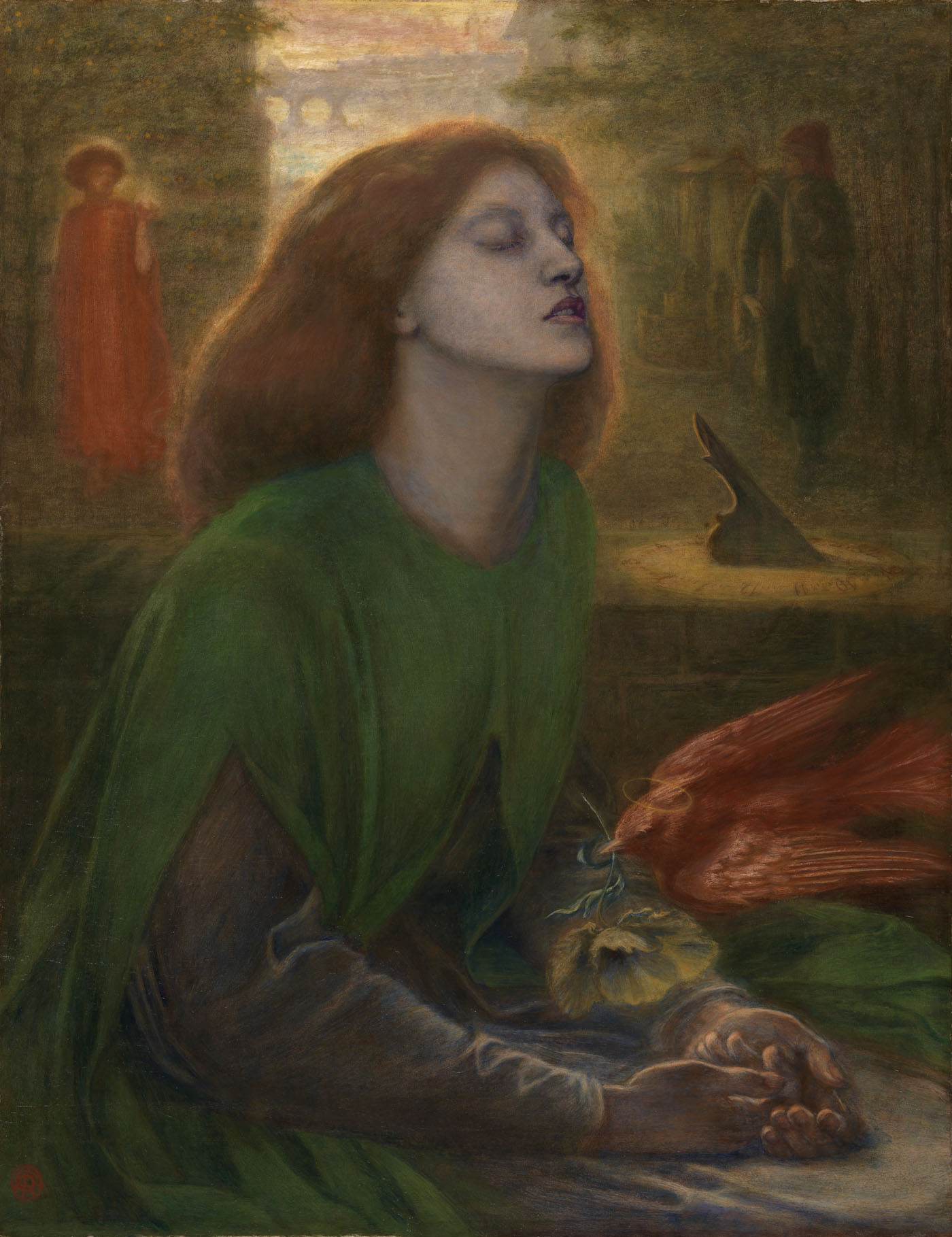
 

Dante Gabriel Rossetti (English, 1828-1882) 'Beata Beatrix' c. 1864-1870


Dante Gabriel Rossetti (English, 1828-1882)
Beata Beatrix
c. 1864-1870
Oil on canvas
Support: 864 x 660mm
Frame: 1212 x 1015 x 104mm
Presented by Georgiana, Baroness Mount-Temple in memory of her husband, Francis, Baron Mount-Temple 1889


Rossetti draws a parallel in this picture between the Italian poet Dante’s despair at the death of his beloved Beatrice and his own grief at the death of his wife Elizabeth Siddal, who died on 11 February 1862. Dante Alighieri (1265-1321) recounted the story of his unrequited love and subsequent mourning for Beatrice Portinari in the Vita Nuova. This was Rossetti’s first English translation and appeared in 1864 as part of his own publication, The Early Italian Poets.

The picture is a portrait of Elizabeth Siddall in the character of Beatrice. It has a hazy, transcendental quality, giving the sensation of a dream or vision, and is filled with symbolic references. Rossetti intended to represent her, not at the moment of death, but transformed by a ‘sudden spiritual transfiguration’ (Rossetti, in a letter of 1873, quoted in Wilson, p.86). She is posed in an attitude of ecstasy, with her hands before her and her lips parted, as if she is about to receive Communion. According to Rossetti’s friend F.G. Stephens, the grey and green of her dress signify ‘the colours of hope and sorrow as well as of love and life’ (‘Beata Beatrix by Dante Gabriel Rossetti’, Portfolio, vol. 22, 1891, p. 46).

In the background of the picture the shadowy figure of Dante looks across at Love, portrayed as an angel and holding in her palm the flickering flame of Beatrice’s life. In the distance the Ponte Vecchio signifies the city of Florence, the setting for Dante’s story. Beatrice’s impending death is evoked by the dove – symbol of the holy spirit – which descends towards her, an opium poppy in its beak. This is also a reference to the death of Elizabeth Siddall, known affectionately by Rossetti as ‘The Dove’, and who took her own life with an overdose of laudanum. Both the dove and the figure of Love are red, the colour of passion, yet Rossetti envisaged the bird as a messenger, not of love, but of death. Beatrice’s death, which occurred at nine o’clock on 9th June 1290, is foreseen in the sundial which casts its shadow over the number nine. The picture frame, which was designed by Rossetti, has further references to death and mourning, including the date of Beatrice’s death and a phrase from Lamentations 1:1, quoted by Dante in the Vita Nuova: ‘Quomodo sedet sola civitas’ (‘how doth the city sit solitary’), referring to the mourning of Beatrice’s death throughout the city of Florence.

Frances Fowle. “Beata Beatrix,” on the Tate website December 2000 [Online] Cited 16/02/2023
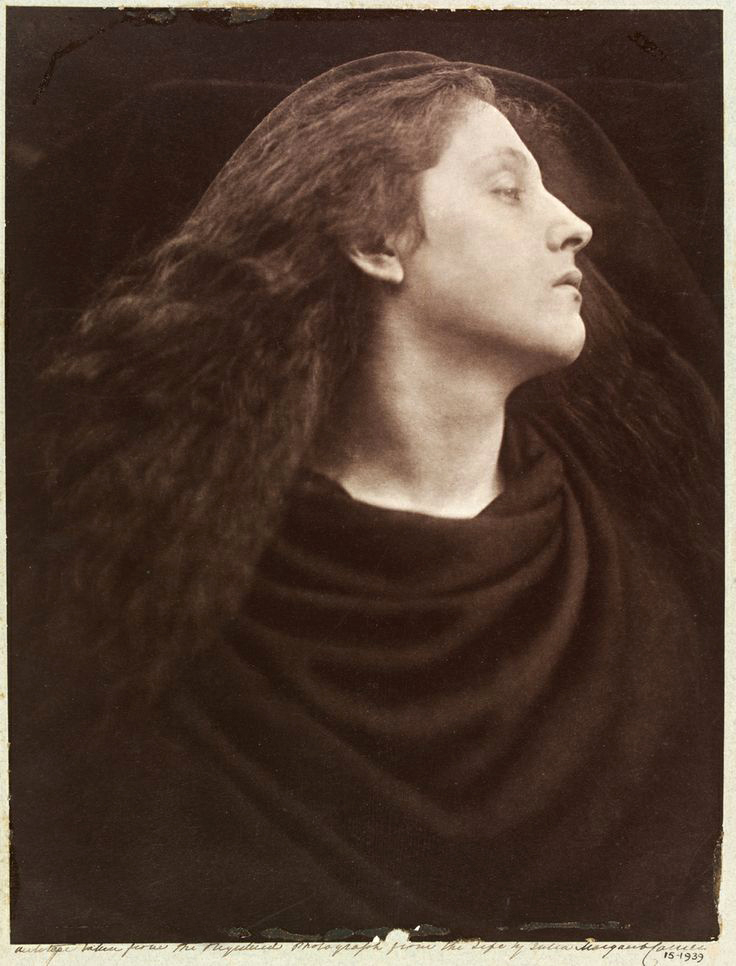
 

Julia Margaret Cameron (British born India, 1815-1879) 'Call, I Follow, I Follow, Let Me Die!' 1867

Julia Margaret Cameron (British born India, 1815-1879) 'Call, I Follow, I Follow, Let Me Die!' 1867


Julia Margaret Cameron (British born India, 1815-1879)
Call, I Follow, I Follow, Let Me Die!
1867
© Royal Photographic Society / National Media Museum / Science & Society Picture Library


In late 1865, Julia Margaret Cameron began using a larger camera. It held a 15 x 12 inch glass negative, rather than the 12 x 10 inch negative of her first camera. Early the next year she wrote to Henry Cole with great enthusiasm – but little modesty – about the new turn she had taken in her work. Cameron initiated a series of large-scale, closeup heads that fulfilled her photographic vision. She saw them as a rejection of ‘mere conventional topographic photography – map-making and skeleton rendering of feature and form’ in favour of a less precise but more emotionally penetrating form of portraiture. Cameron also continued to make narrative and allegorical tableaux, which were larger and bolder than her previous efforts.

In this image, Cameron concentrates upon the head of her maid Mary Hillier by using a darkened background and draping her in simple dark cloth. The lack of surrounding detail or context obscures references to narrative, identity or historical context. The flowing hair, lightly parted lips and exposed neck suggest sensuality. The title, taken from a line in the poem ‘Lancelot and Elaine’ from Alfred Tennyson’s ‘Idylls of the King’, transforms the subject into a tragic heroine.

Anonymous. “Call, I Follow, I Follow, Let Me Die!,” on the V&A website [Online] Cited 16/02/2023


New truths

Mid-nineteenth century innovations in science and the arts became part of intense debates about ‘truth’ – variously defined as objective observation and as individual artistic vision. Inspired by artist and critic John Ruskin, the Pre-Raphaelite circle took a new approach to nature, discovering meaning in details previously overlooked, ‘rejecting nothing, selecting nothing’.

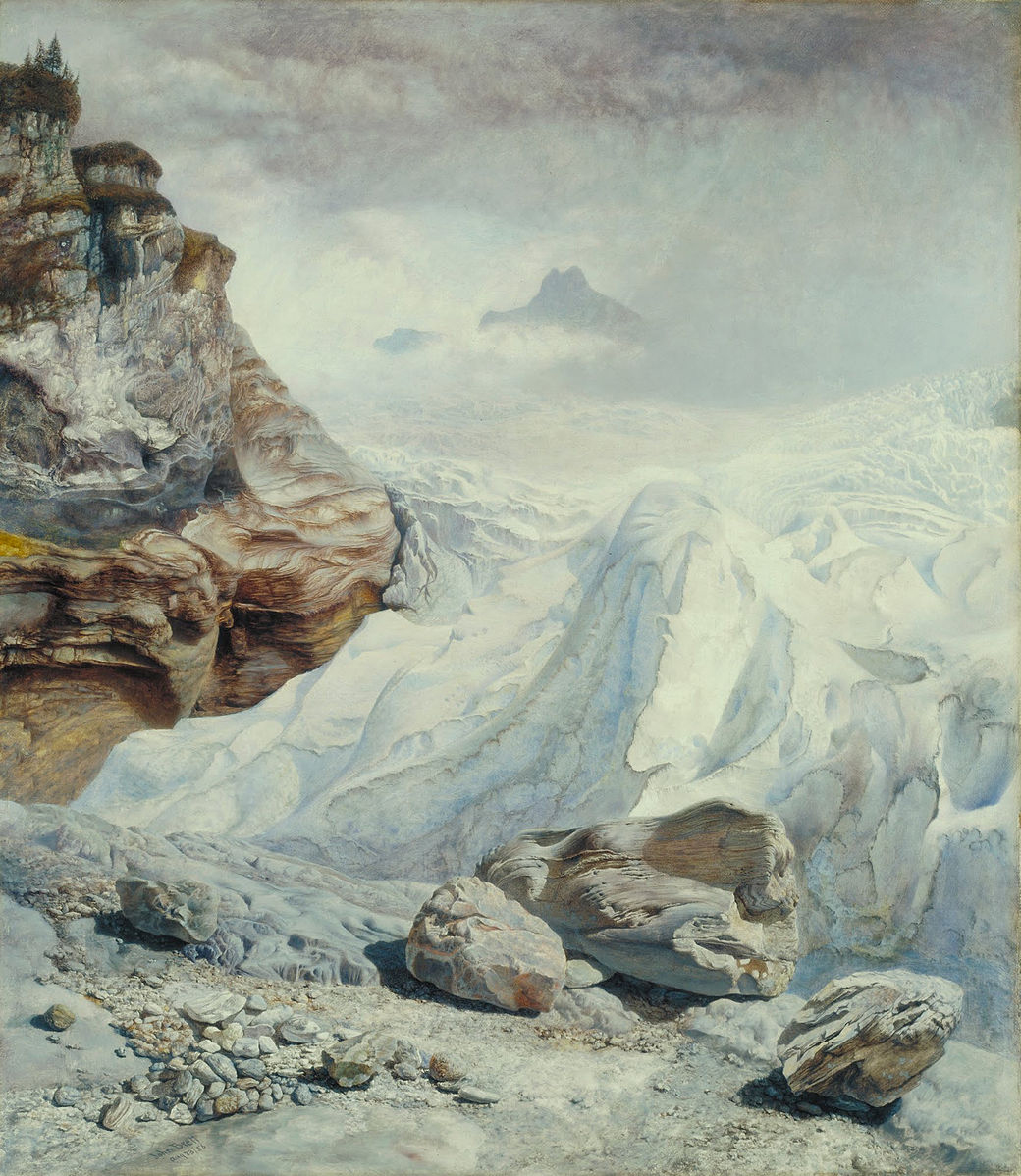
As the quality of paints and lenses improved, painters and photographers tested the bounds of perception and representation. They moved out of the studio, to explore light and other atmospheric effects as well as geological subjects, landscape and architecture. New photographic materials like glass plate negatives and coated printed papers offered greater accuracy and photography became a valuable aid for painters.


John Brett (British, 1831-1902) 'Glacier of Rosenlaui' 1856


John Brett (British, 1831-1902)
Glacier of Rosenlaui
1856
Oil on canvas
Height: 445 mm (17.52 in)
Width: 419 mm (16.5 in)
Tate Britain
Purchased 1946
Photo: Tate, London, 2011


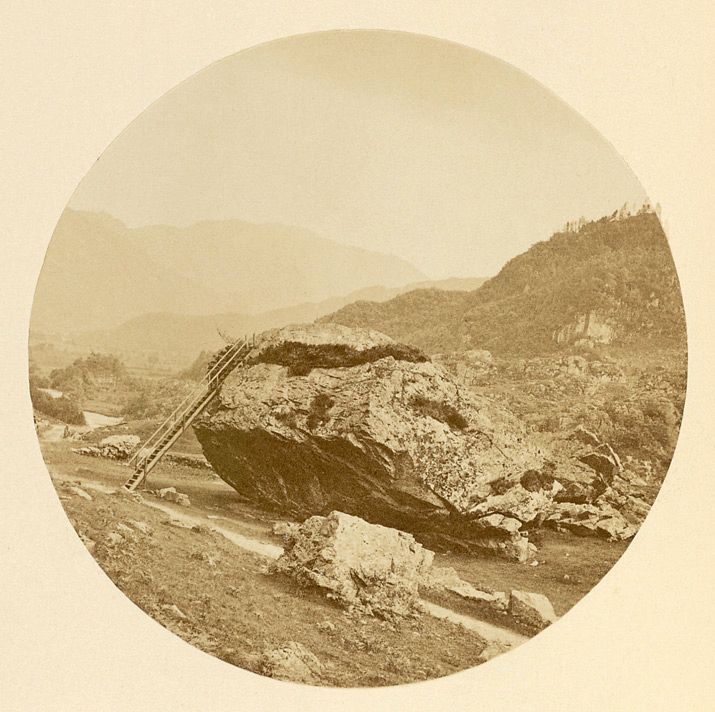
Thomas Ogle (British, 1813 - about 1882) 'The Bowder Stone in Our English Lakes, Mountains and Waterfalls as seen by William Wordsworth by A.W. Bennett' Published 1864


Thomas Ogle (British, 1813 – about 1882)
The Bowder Stone in Our English Lakes, Mountains and Waterfalls as seen by William Wordsworth by A.W. Bennett
Published 1864
Tate


View taken by Thomas Ogle of the Bowder Stone in Borrowdale, Cumbria, illustrating Our English Lakes, Mountains, And Waterfalls, as seen by William Wordsworth (1864). The book juxtaposes photographs of the Lake District with poems by the English Romantic poet. The Bowder Stone, an enormous boulder, was probably deposited by glaciation during the last Ice Age. It rests in Borrowdale, a valley of woods and crags in the Lake District whose scenic beauty inspired artists, writers and poets of the Romantic Movement in the late 18th and early 19th centuries. Wordsworth (1770-1850) was among them, and the photograph of the Bowder Stone accompanies his poem, Yew-Trees (1803), from which the following passage is taken:

“…But worthier still of note
Are those fraternal four of Borrowdale,
Joined in one solemn and capacious grove;
Huge trunks! – and each particular trunk a growth
Of intertwined fibres serpentine
Up-coiling, and inveterately convolved, –
Nor uninformed with phantasy, and looks
That threaten the profane; – a pillared shade,
Upon whose grassless floor of red-brown hue,
By sheddings from the pining umbrage tinged
Perenially – beneath whole sable roof
Of boughs, as if for festal purpose, decked
With unrejoicing berries, ghostly shapes
May meet at noontide – Fear and trembling Hope,
Silence and Foresight – Death the skeleton
And Time the shadow…”

Text from the British Library website [Online] Cited 18/09/2016


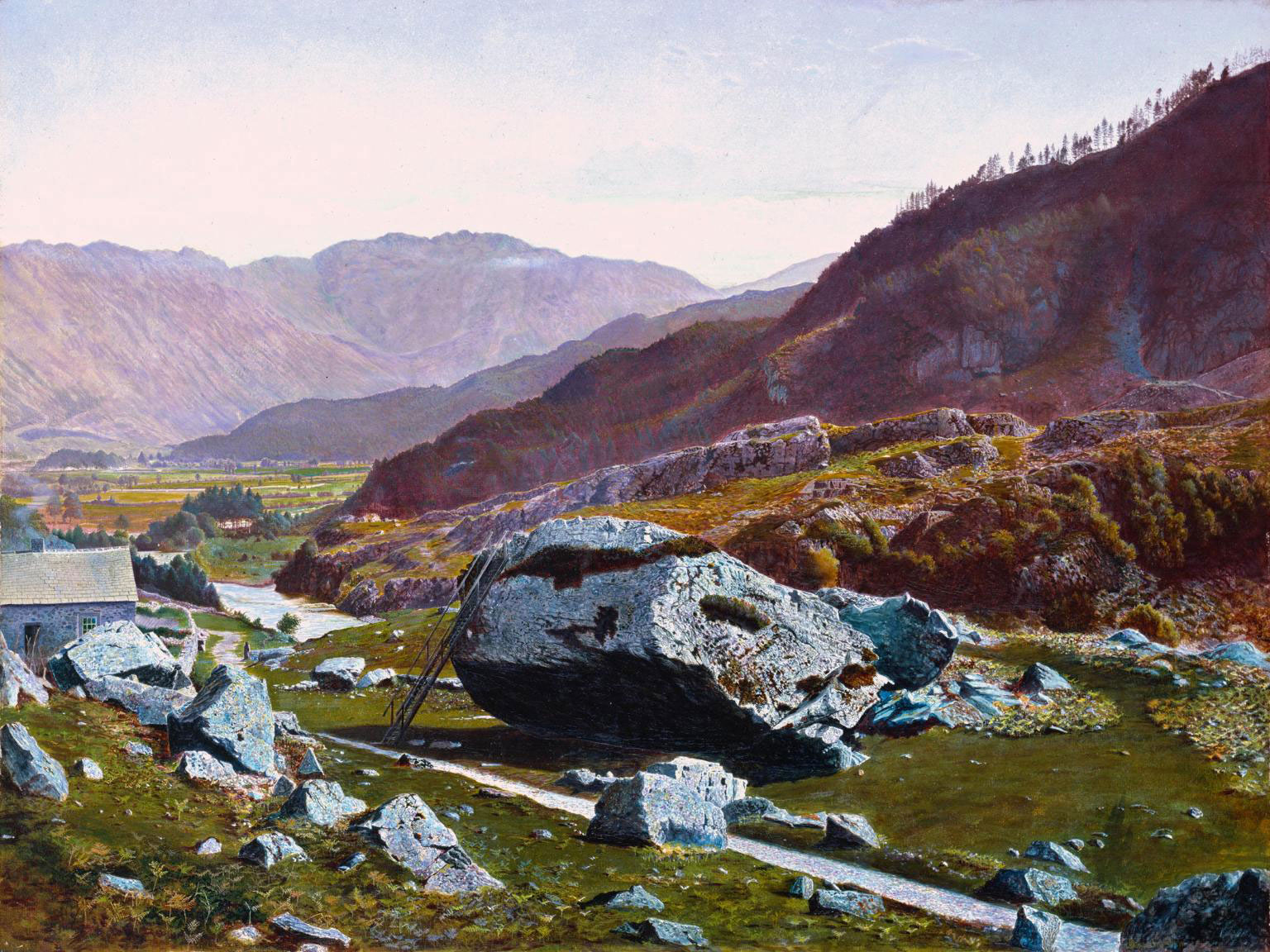
Atkinson Grimshaw (English, 1836-1893) 'Bowder Stone, Borrowdale' c. 1863-1868


Atkinson Grimshaw (English, 1836-1893)
Bowder Stone, Borrowdale
c. 1863-1868
Oil on canvas
Support: 400 x 536mm
Frame: 662 x 709 x 100mm
Purchased with assistance from the Friends of the Tate Gallery 1983


Tate Britain uncovers the dynamic dialogue between British painters and photographers; from the birth of the modern medium to the blossoming of art photography. Spanning over 70 years, the exhibition brings together nearly 200 works – many for the first time – to reveal their mutual influences. From the first explorations of movement and illumination by David Octavius Hill (1802-1870) and Robert Adamson (1821-1848) to artful compositions at the turn-of-the-century, the show discovers how painters and photographers redefined notions of beauty and art itself.

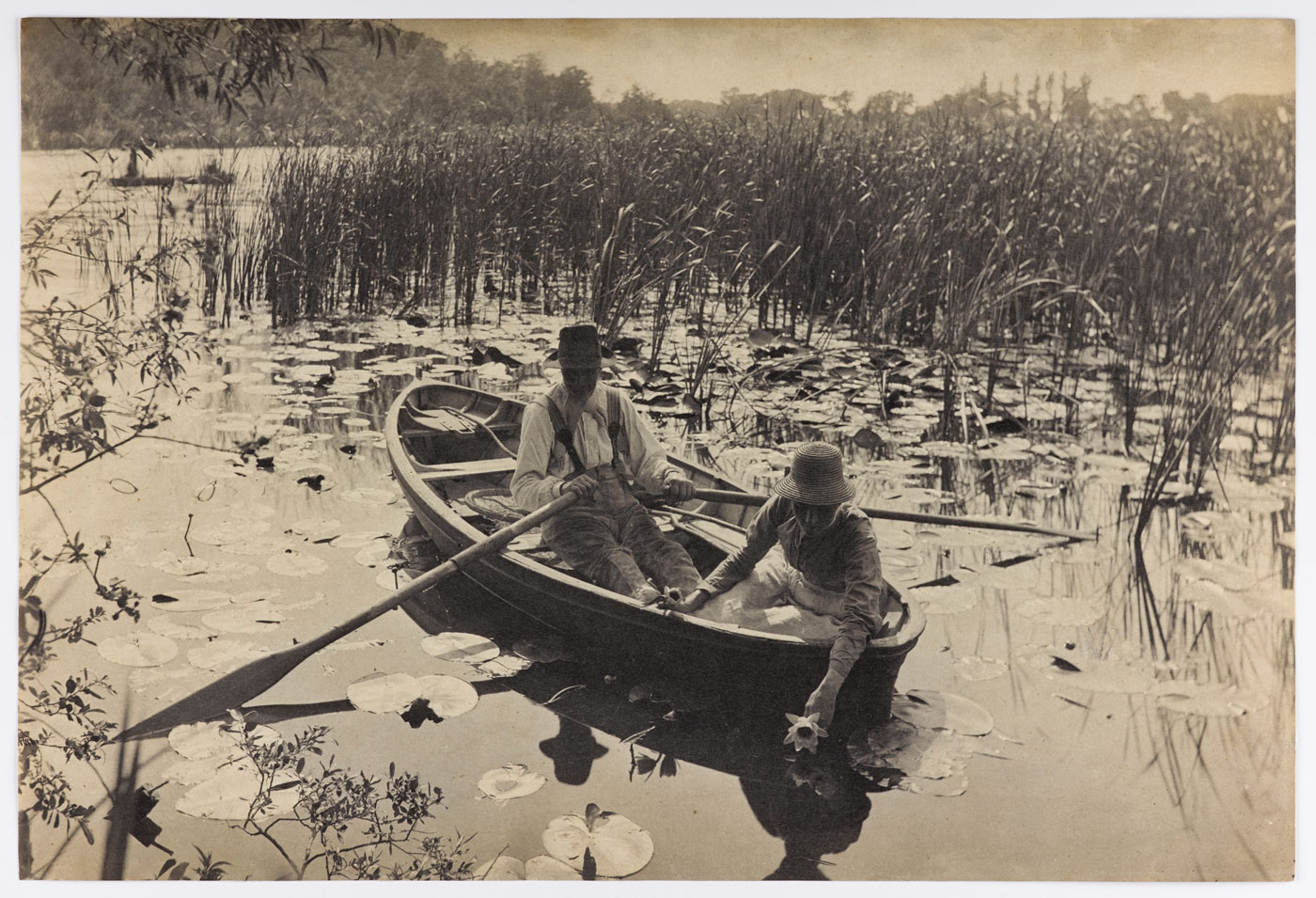
The dawn of photography coincided with a tide of revolutionary ideas in the arts, which questioned how pictures should be created and seen. Photography adapted the Old Master traditions within which many photographers had been trained, and engaged with the radical naturalism of JMW Turner (1775-1851), the Pre-Raphaelites, and their Realist and Impressionist successors. Turner inspired the first photographic panoramic views, and, in the years that followed his death, photographers and painters followed in his footsteps and composed novel landscapes evoking meaning and emotion. The exhibition includes examples such as John Everett Millais’s (1829-1896) nostalgic The Woodman’s Daughter and John Brett’s (1831-1902) awe inspiring Glacier Rosenlaui. Later in the century, PH Emerson (1856-1936) and TF Goodall’s (c. 1856-1944) images of rural river life allied photography to Impressionist painting, while JAM Whistler (1834-1903) and Alvin Langdon Coburn (1882-1966) created smoky Thames nocturnes in both media.

The exhibition celebrates the role of women photographers, such as Zaida Ben-Yusuf (1869-1933) and the renowned Julia Margaret Cameron (1815-1879). Cameron’s artistic friendships with George Frederic Watts (1817-1904) and Dante Gabriel Rossetti (1830-94) are recognised in a room devoted to their beautiful, enigmatic portraits of each other and shared models, where works including Cameron’s Call, I Follow, I Follow, Let Me Die and Rossetti’s Beata Beatrix are on display.

Highlights of the show include examples of three-dimensional photography, which incorporated the use of models and props to stage dramatic tableaux from popular works of the time, re-envisioning well-known pictures such as Henry Wallis’s (1830-1916) Chatterton. Such stereographs were widely disseminated and made art more accessible to the public, often being used as a form of after-dinner entertainment for middle class Victorian families. A previously unseen private album in which the Royal family painstakingly re-enacted famous paintings is also exhibited, as well as rare examples of early colour photography.

Carol Jacobi, Curator British Art 1850-1915, Tate Britain says: “Painting with Light offers new insights into Britain’s most popular artists and reveals just how vital painting and photography were to one another. Their conversations were at the heart of the artistic achievements of the Victorian and Edwardian era.”

Painting with Light: Art and Photography from the Pre-Raphaelites to the Modern Age is curated by Dr Carol Jacobi, Curator of British Art 1850-1915 at Tate Britain, and Dr Hope Kingsley, Curator, Education and Collections, Wilson Centre for Photography, with Tim Batchelor, Assistant Curator at Tate Britain. The exhibition is accompanied by a fully illustrated catalogue from Tate Publishing and a programme of talks and events in the gallery.”

Press release from Tate Britain


‘Whisper of the Muse’

As the nineteenth century progressed, some artists moved away from the clarity and detail that had been the aim of earlier Pre-Raphaelite art, turning instead to a search for pure beauty. The aesthetic movement, as this tendency came to be known, emphasised the sensual qualities of art and design and explored imaginative themes and effects.

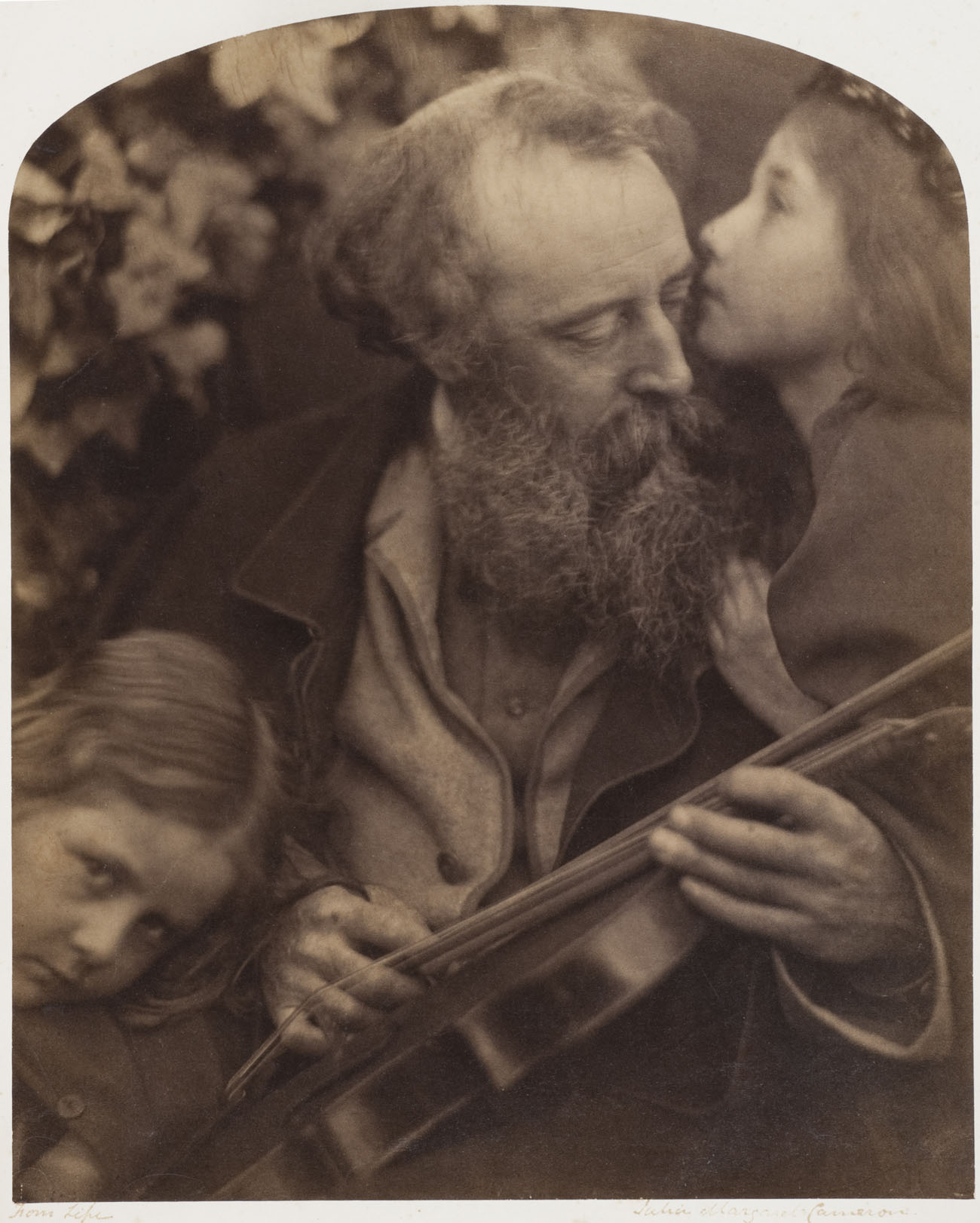
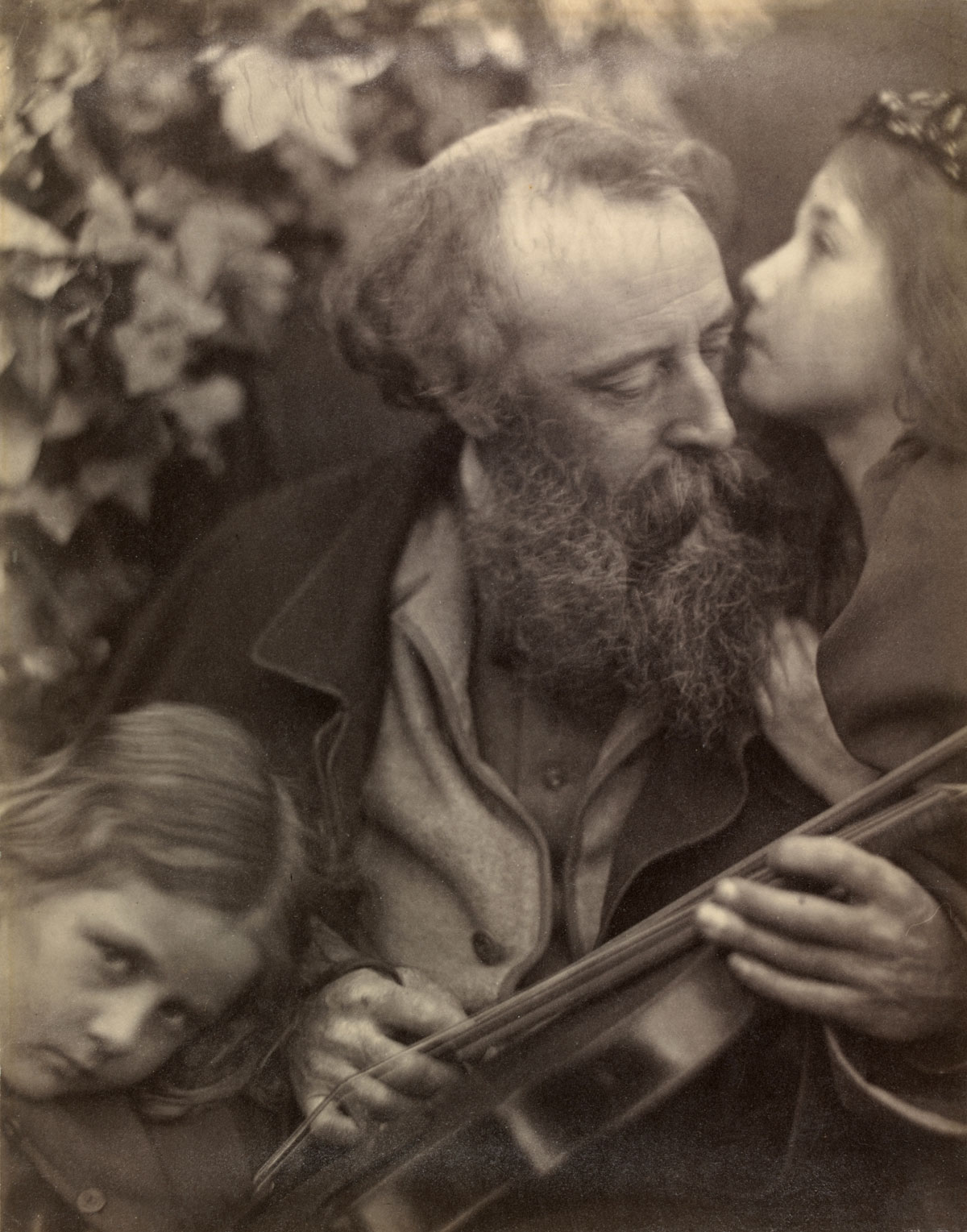
In London and on the Isle of Wight, a community of artists forged closer links between the visual arts, music and literature. This circle included the photographer Julia Margaret Cameron, painters George Frederic Watts and Dante Gabriel Rossetti, and the poet Alfred Tennyson. Rossetti and Cameron worked with similar subjects, many inspired by Tennyson’s poetry. Together with Watts they developed a newly-intimate form of portraiture, exploring emotional and psychological states. They also shared models, whose striking looks introduced new types of modern beauty.


Julia Margaret Cameron (British born India, 1815-1879) 'Whisper of the Muse' 1865


Julia Margaret Cameron (British, 1815-1879)
Whisper of the Muse
1865
Photograph, albumen print on paper
325 x 238mm
Wilson Centre for Photography


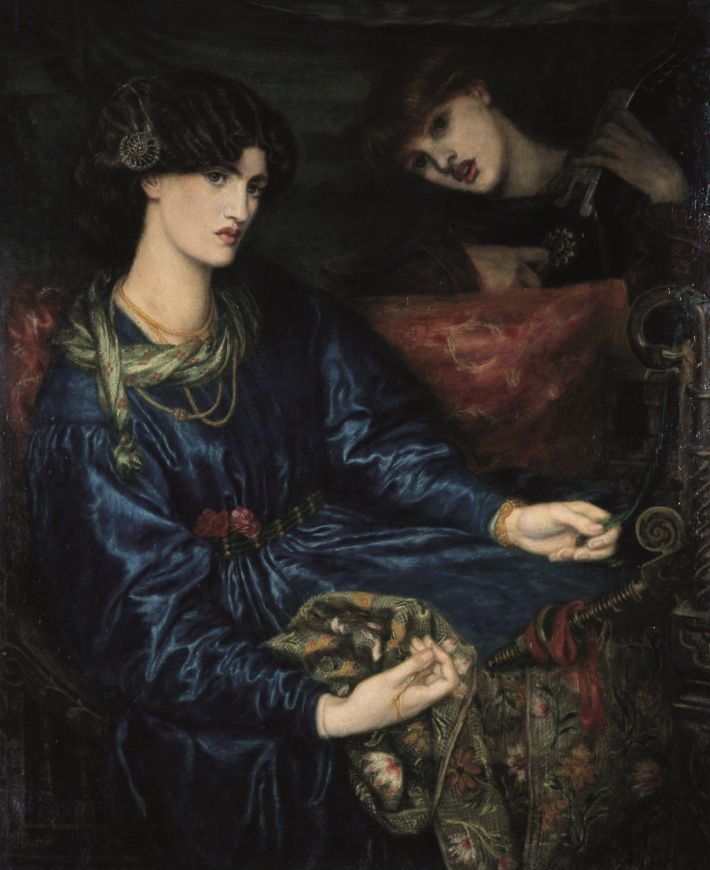
Dante Gabriel Rossetti (English, 1828-1882) 'Mariana' 1870


Dante Gabriel Rossetti (English, 1828-1882)
Mariana
1870
Oil on canvas
Aberdeen Art Gallery & Museum Collection


Into Light and Colour

In the second half of the nineteenth century Japanese culture became an important influence in Britain. Japanese goods were sold in London in new department stores such as Liberty, while the Japanese Village, established in Knightsbridge in 1885, attracted more than a million visitors.

Japanese props and motifs appeared in art and design and the vogue for Japanese prints inspired painters and photographers. Painters experimented with new colour palettes, flattened picture planes and condensed, cropped formats, innovations also important to later British impressionist works. Such experiments in light and colour were paralleled in photography with the 1907 introduction of the autochrome, the first practical colour photographic process.


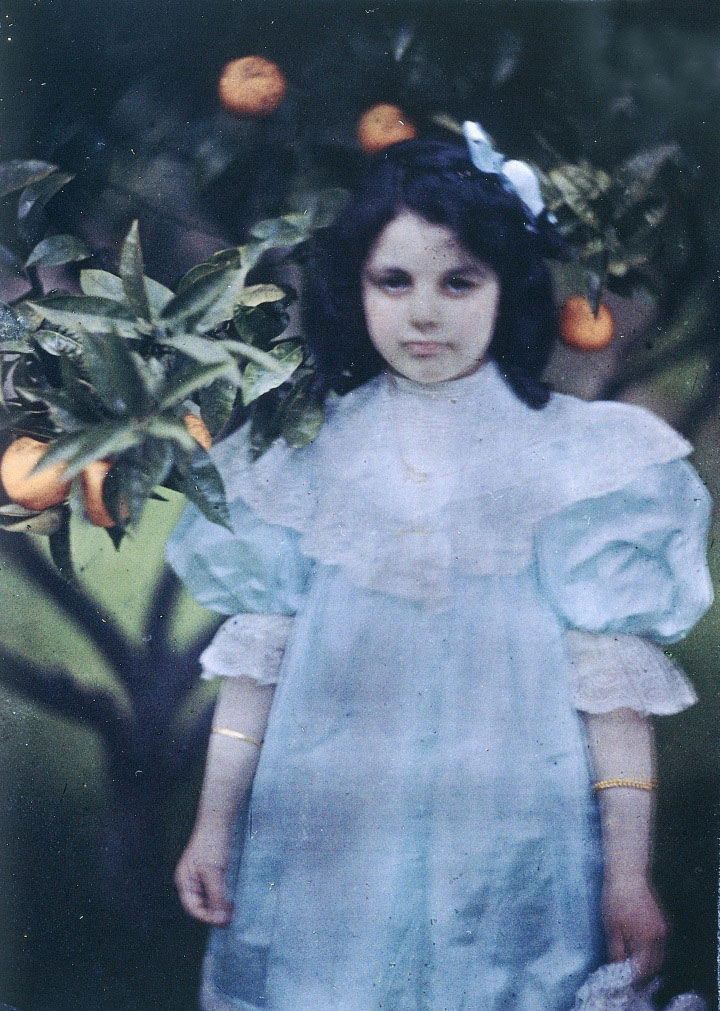
John Cimon Warburg (British, 1867-1931) 'Peggy in the Garden' 1909, printed 2016


John Cimon Warburg (British, 1867-1931)
Peggy in the Garden
1909, printed 2016
Photograph, transparency on lightbox from autochrome
Royal Photographic Society / National Media Museum / Science and Society Picture Library


John Cimon Warburg (1867-1931) British photographer born to a wealthy family dedicated his whole life to photography. In 1897, he joined the Royal Photographic Society. During his photographic career, John Cimon Warburg used a wide range of photographic processes, but excelled especially in autochromes. Best known for his atmospheric landscapes and its fascinating studies of his children, Warburg lectured and written about the process and explained his autochromes the annual exhibition of the Royal Photographic Society.

Text from the Autochrome website [Online] Cited 18/09/2016. No longer available online


Patented by the Lumière brothers in 1903, Autochrome produced a colour transparency using a layer of potato starch grains dyed red, green and blue, along with a complex development process. Autochromes required longer exposure times than traditional black-and-white photos, resulting in images with a hazy, blurred atmosphere filled with pointillist dots of colour.


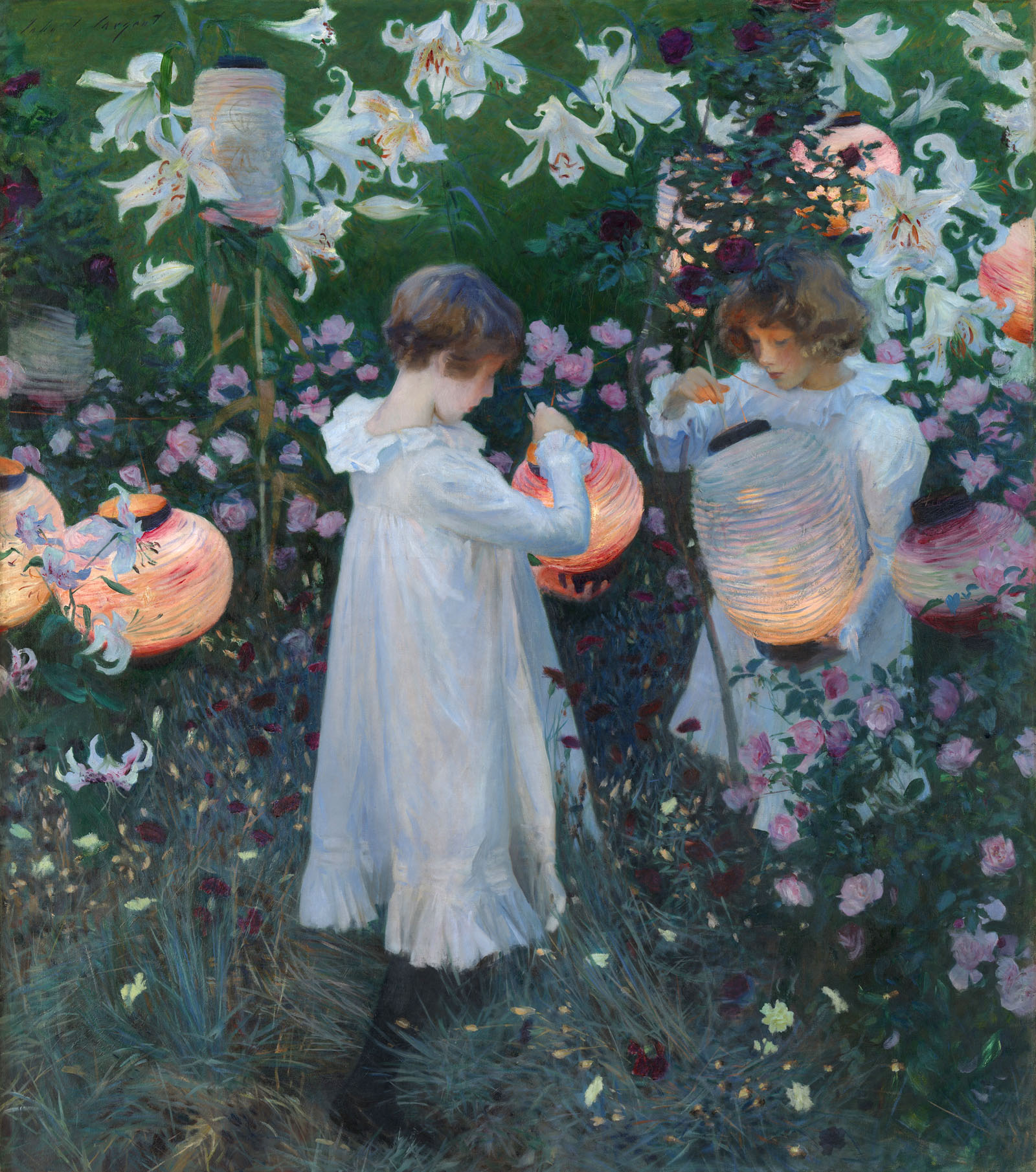
John Singer Sargent (American, 1856-1925) 'Carnation, Lily, Lily, Rose' 1885-1886


John Singer Sargent (American, 1856-1925)
Carnation, Lily, Lily, Rose
1885-1886
Oil paint on canvas
1740 x 1537 mm
Tate. Presented by the Trustees of the Chantrey
Bequest 1887


The inspiration for Carnation, Lily, Lily, Rose came during a boating expedition Sargent took on the Thames at Pangbourne in September 1885, with the American artist Edwin Austin Abbey, during which he saw Chinese lanterns hanging among trees and lilies. He began the picture while staying at the home of the painter F.D. Millet at Broadway, Worcestershire, shortly after his move to Britain from Paris. At first he used the Millets’s five-year-old daughter Katharine as his model, but she was soon replaced by Polly and Dorothy (Dolly) Barnard, the daughters of the illustrator Frederick Barnard, because they had the exact hair-colour Sargent was seeking.

He worked on the picture, one of the few figure compositions he ever made out of doors in the impressionist manner, from September to early November 1885, and again at the Millets’s new home, Russell House, Broadway, during the summer of 1886, completing it some time in October. Sargent was able to work for only a few minutes each evening when the light was exactly right. He would place his easel and paints beforehand, and pose his models in anticipation of the few moments when he could paint the mauvish light of dusk.

As autumn came and the flowers died, he was forced to replace the blossoms with artificial flowers. The picture was both acclaimed and decried at the 1887 Royal Academy exhibition. The title comes from the song The Wreath, by the eighteenth-century composer of operas Joseph Mazzinghi, which was popular in the 1880s. Sargent and his circle frequently sang around the piano at Broadway. The refrain of the song asks the question ‘Have you seen my Flora pass this way?’ to which the answer is ‘Carnation, Lily, Lily, Rose’.

Terry Riggs. “Carnation, Lily, Lily, Rose,” on the Tate website February 1998 [Online] Cited 16/02/2023


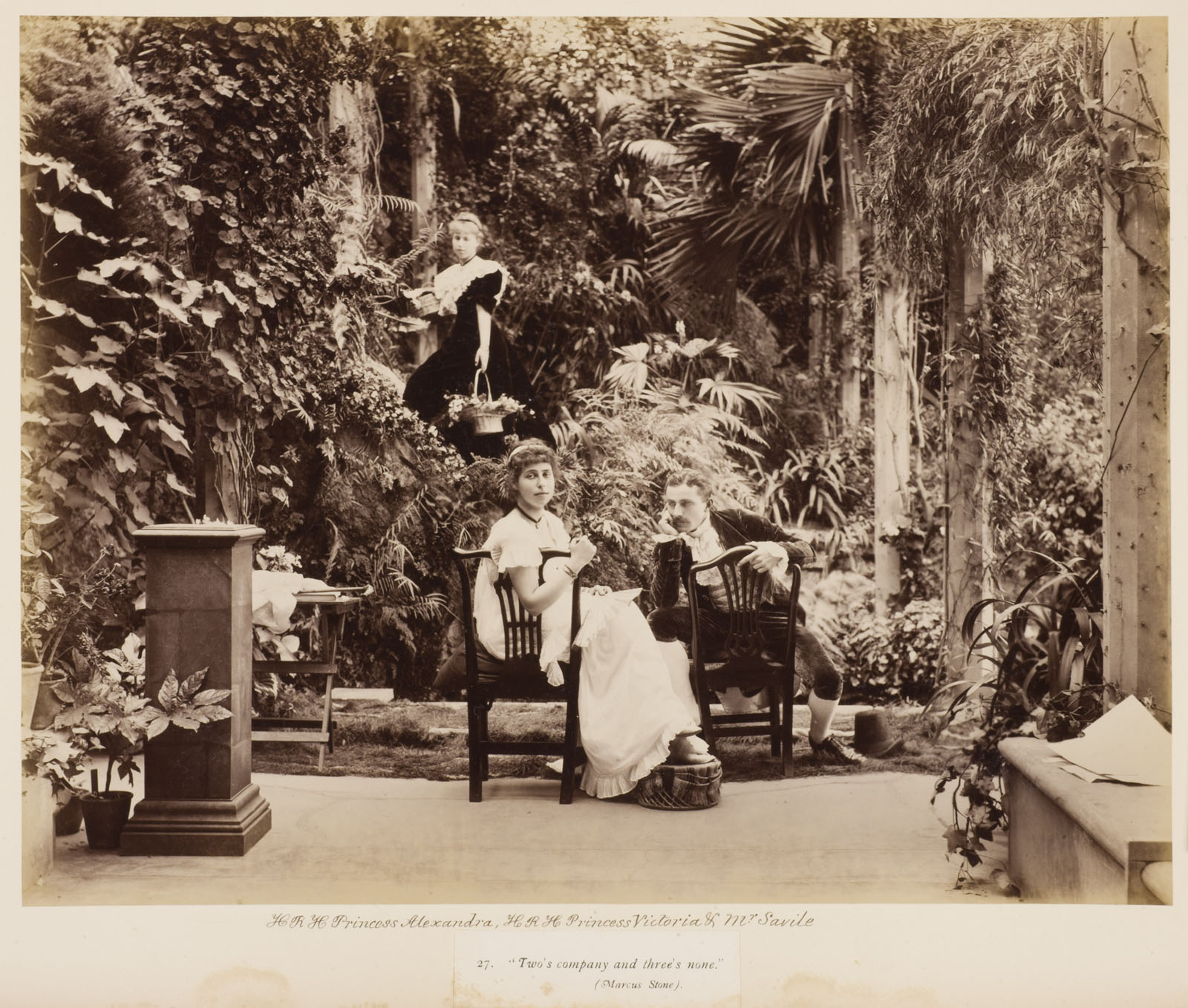
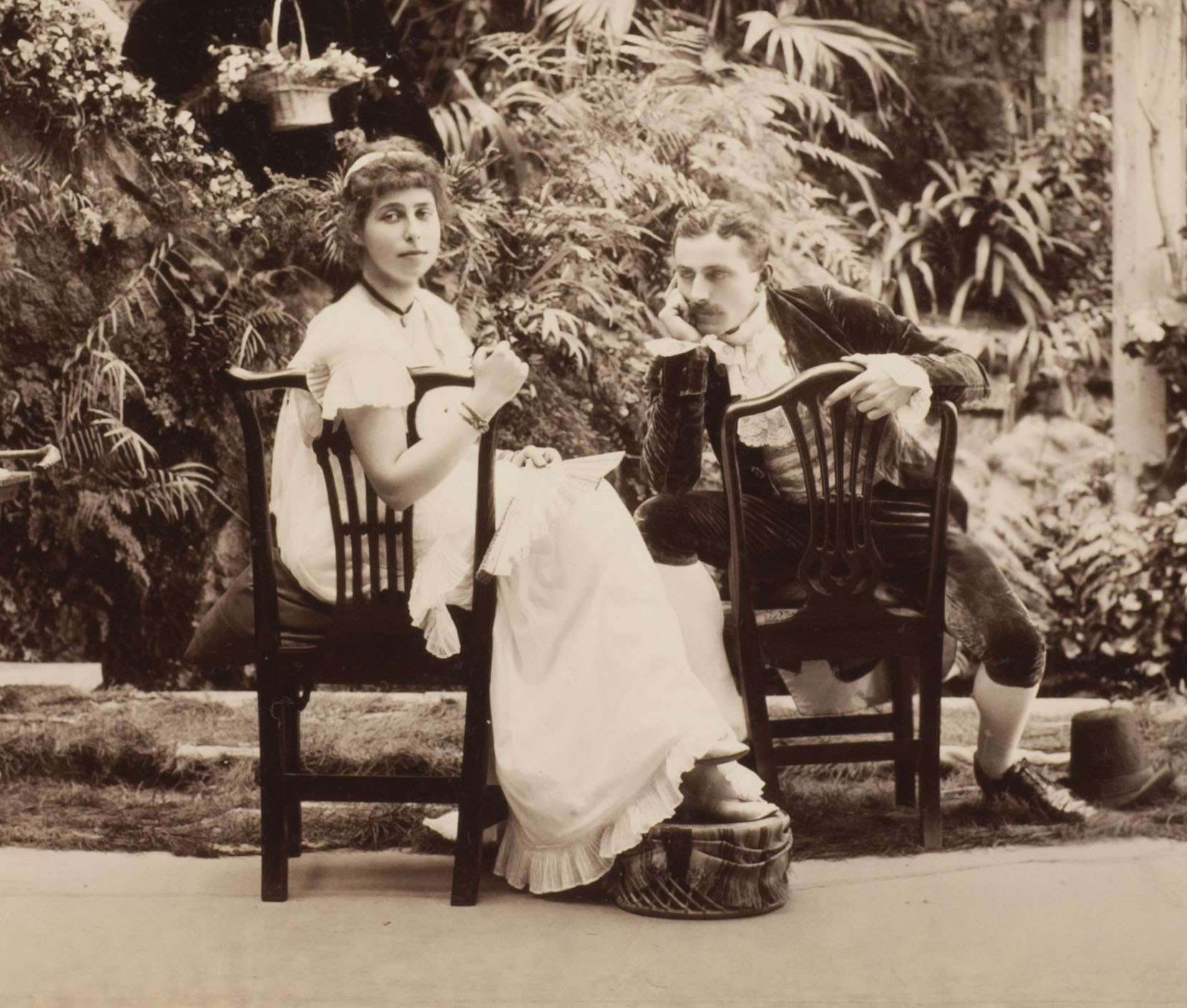
Unknown photographer. 'H.R.H. Princess Alexandra, H.R.H. Princess Victoria & Mr. Savile, “Two’s company and three’s none” in Tableaux Vivants Devonport' c. 1892-1893


Unknown photographer
H.R.H. Princess Alexandra, H.R.H. Princess Victoria & Mr. Savile, “Two’s company and three’s none” in Tableaux Vivants Devonport
c. 1892-1893
Bound volume. Displayed open at Marcus C. Stone’s ‘Two’s Company, Three’s None”
Photograph, albumen print on paper
360 x 480 x 58mm – book closed
Wilson Centre for Photography


Unknown photographer. 'H.R.H. Princess Alexandra, H.R.H. Princess Victoria & Mr. Savile, “Two’s company and three’s none” in Tableaux Vivants Devonport' c. 1892-1893 (detail)


Unknown photographer
H.R.H. Princess Alexandra, H.R.H. Princess Victoria & Mr. Savile, “Two’s company and three’s none” in Tableaux Vivants Devonport (detail)
c. 1892-1893
Bound volume. Displayed open at Marcus C. Stone’s ‘Two’s Company, Three’s None”
Photograph, albumen print on paper
360 x 480 x 58mm – book closed
Wilson Centre for Photography


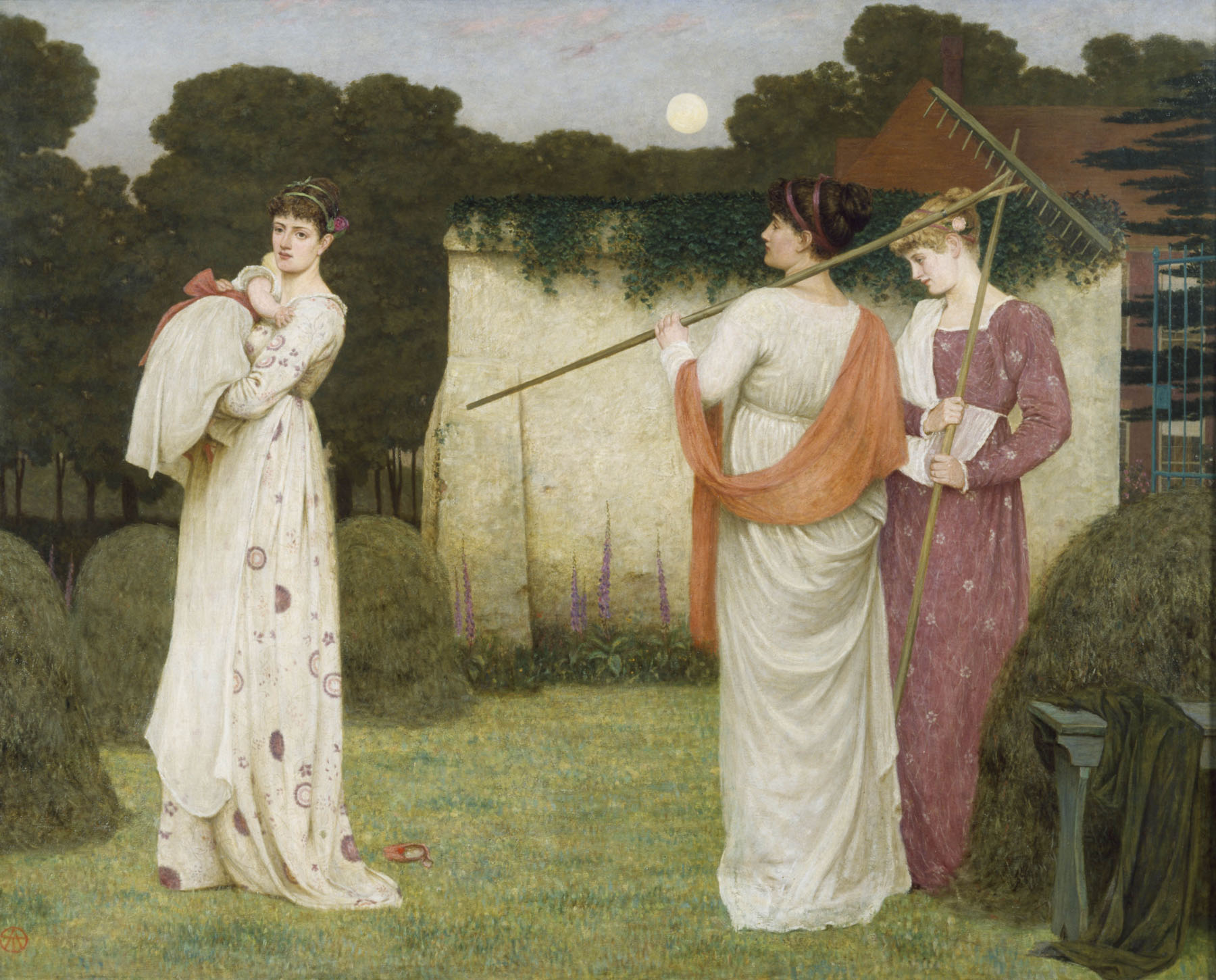
Thomas Armstrong (English, 1832-1911) 'The Hay Field' 1869


Thomas Armstrong (English, 1832-1911)
The Hay Field
1869
© Victoria and Albert Museum, London


Atmosphere and Effect

The relationship between landscape painting and photography continued to develop into the twentieth century. The etchings and nocturnes of James Abbott McNeill Whistler inspired photographers, who adopted his atmospheric subjects and aesthetics. While photography had achieved a technical sophistication that allowed photographers to produce highly resolved, realistic images, many chose to pursue soft-focus effects rather than detail and precision. Such photographs paralleled the unpeopled landscapes of painters like John Everett Millais and the gas-lit cityscapes of John Atkinson Grimshaw.


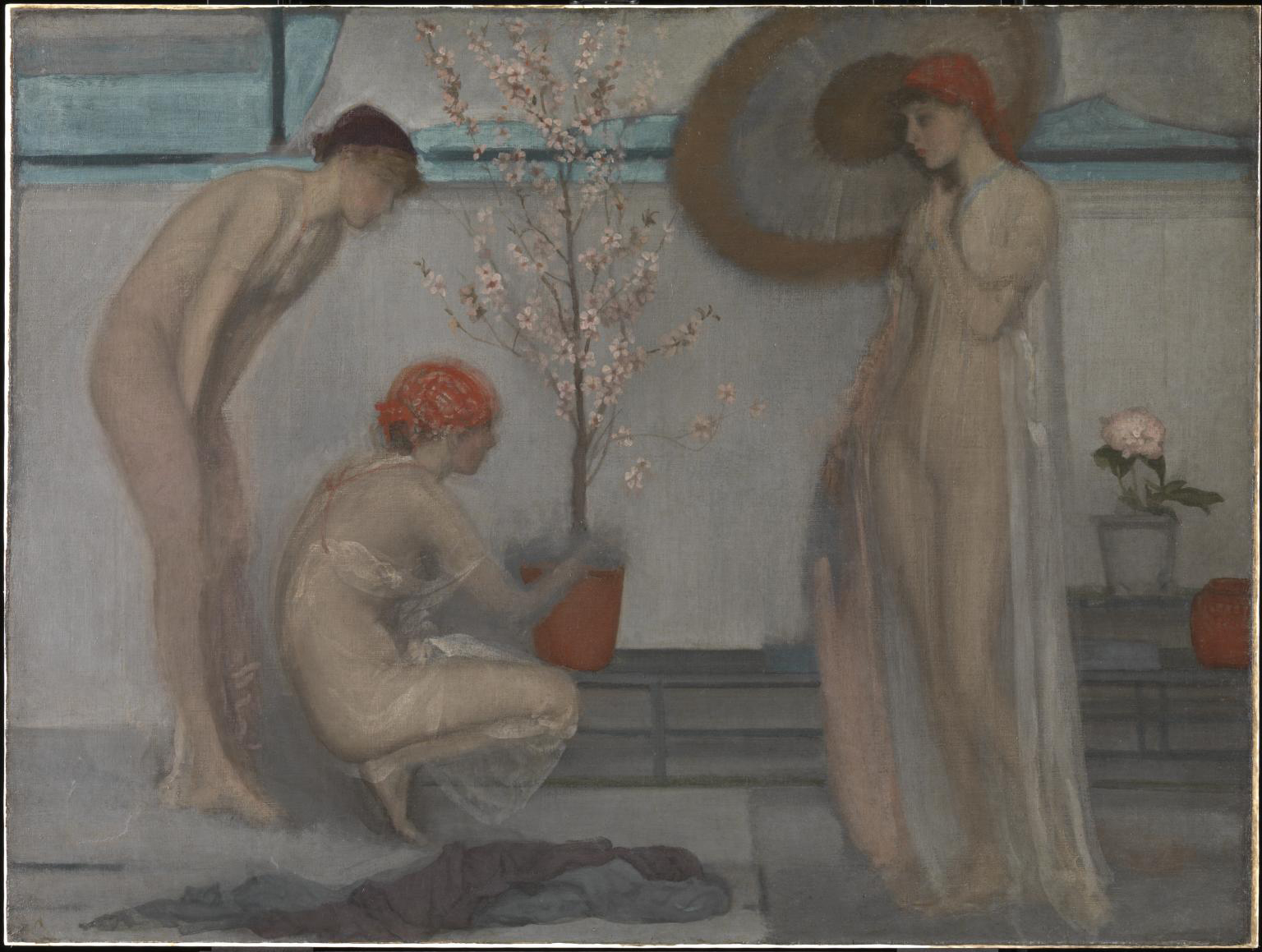
James Abbott McNeill Whistler (American, 1834-1903) 'Three Figures Pink and Grey' 1868-1878


James Abbott McNeill Whistler (American, 1834-1903)
Three Figures Pink and Grey
1868-1878
Oil paint on canvas
Support: 1391 x 1854mm
Frame: 1701 x 2158 x 75mm
Tate
Purchased with the aid of contributions from the International Society of Sculptors, Painters and Gravers as a Memorial to Whistler, and from Francis Howard 1950


This picture derives from one of six oil sketches that Whistler produced in 1868 as part of a plan for a frieze, commissioned by the businessman F.R. Leyland (1831-1892), founder of the Leyland shipping line. Known as the ‘Six Projects’, the sketches (now in the Freer Art Gallery, Washington) were all scenes with women and flowers, and all six were strongly influenced by his admiration for Japanese art. Another precedent for these works was The Story of St George, a frieze that Edward Burne-Jones (1833-1898) executed for the artist and illustrator Myles Birket Foster (1825-1899) in 1865-1867. The series of large pictures was destined for Leyland’s house at Prince’s Gate, but never produced, and only one – The White Symphony: Three Girls (1867) was finished, but was later lost. Whistler embarked on a new version, Three Figures: Pink and Grey, but was never satisfied with this later painting, and described it as, ‘a picture in no way representative, and in its actual condition absolutely worthless’ (quoted in Wilton and Upstone, p. 117). He followed the original sketch closely, but made a number of pentimenti which suggest that the picture is not simply a copy of the lost work. In spite of Whistler’s dissatisfaction, it has some brilliant touches and a startlingly original composition.

Although the three figures are clearly engaged in tending a flowering cherry tree, Whistler’s aim in this picture is to create a mood or atmosphere, rather than to suggest any kind of theme. Parallels have been drawn with the work of Albert Moore, whose work of this period is equally devoid of narrative meaning. The design is economical and the picture space is partitioned like a Japanese interior. The shallow, frieze-like arrangement, the blossoming plant and the right-hand figure’s parasol are also signs of deliberate Japonisme. Whistler has suppressed some of the details in the oil sketch, effectively disrobing the young girls by depicting them in diaphanous robes. The painting is characterised by pastel shades, a ‘harmony’ of pink and grey, punctuated by the brighter reds of the flower pot and the girls’ bandannas, and the turquoise wall behind. It has been suggested that Whistler derived his colour schemes, and even the figures themselves, in their rhythmically flowing drapery, from polychrome Tanagra figures in the British Museum, which was opposite his studio in Great Russell Street.

Frances Fowle. “Three Figures: Pink and Grey,” on the Tate website December 2000 [Online] Cited 16/02/2023
 

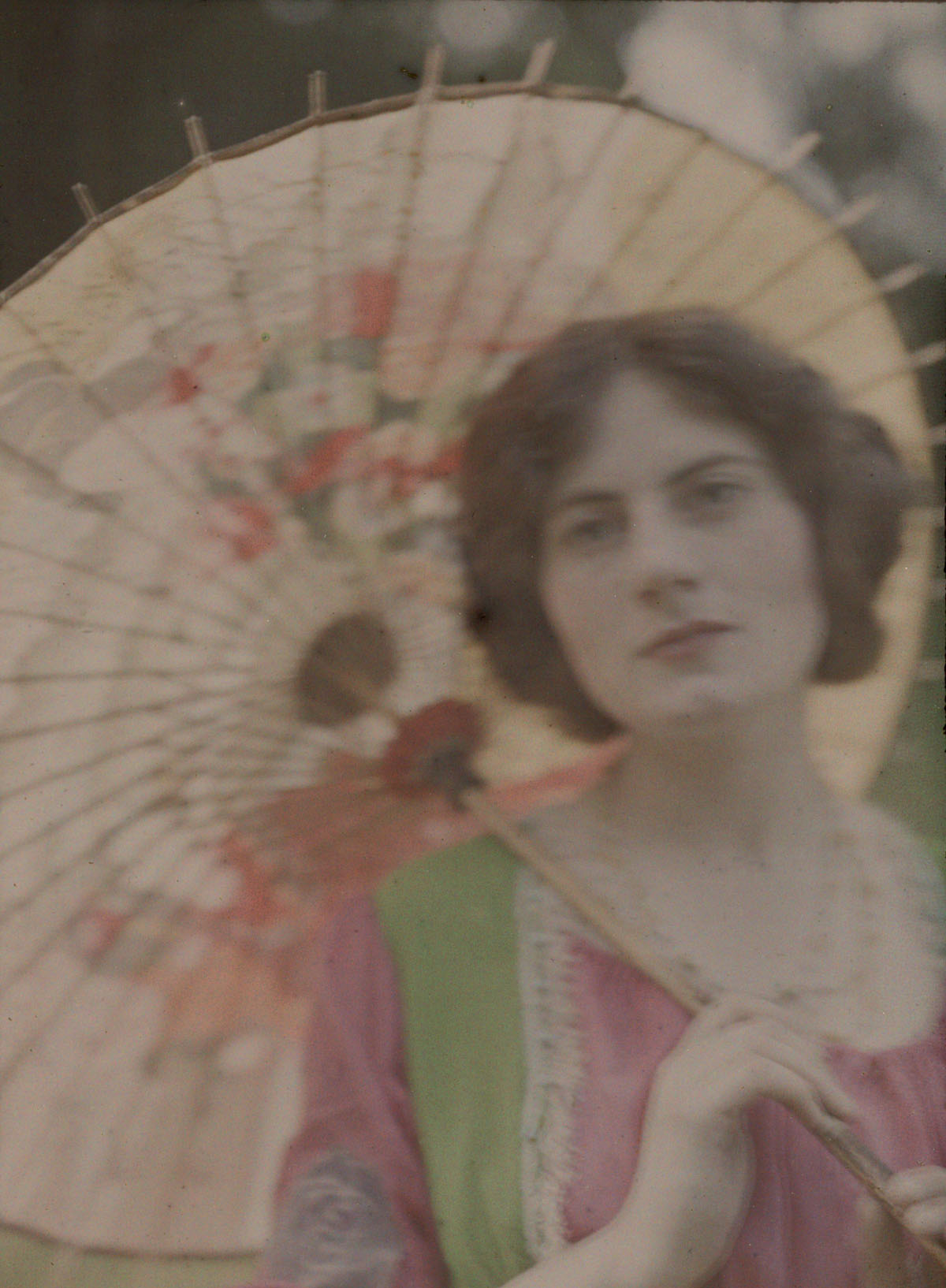
John Cimon Warburg (British, 1867-1931) 'The Japanese Parasol' c. 1906


John Cimon Warburg (British, 1867-1931)
The Japanese Parasol
c. 1906
Autochrome
711 x 559mm
© Royal Photographic Society / National Media
Museum/ Science & Society Picture Library


Life and Landscape

The 1880s brought a renewed interest in landscape. Rural scenes provided common ground for British painters and photographers. Their distinctive style derived from French realism and impressionism, which had been introduced by independent galleries, and by artists such as George Clausen and Henry La Thangue who studied in Paris. This new approach was shared by their friend and fellow painter Thomas Goodall, and influenced his collaboration with the photographer Peter Henry Emerson. Emerson and Goodall’s first project, a photographic series on the Norfolk Broads, focused on the life of working people, as described in their album Life and Landscape on the Norfolk Broads, published in 1887.
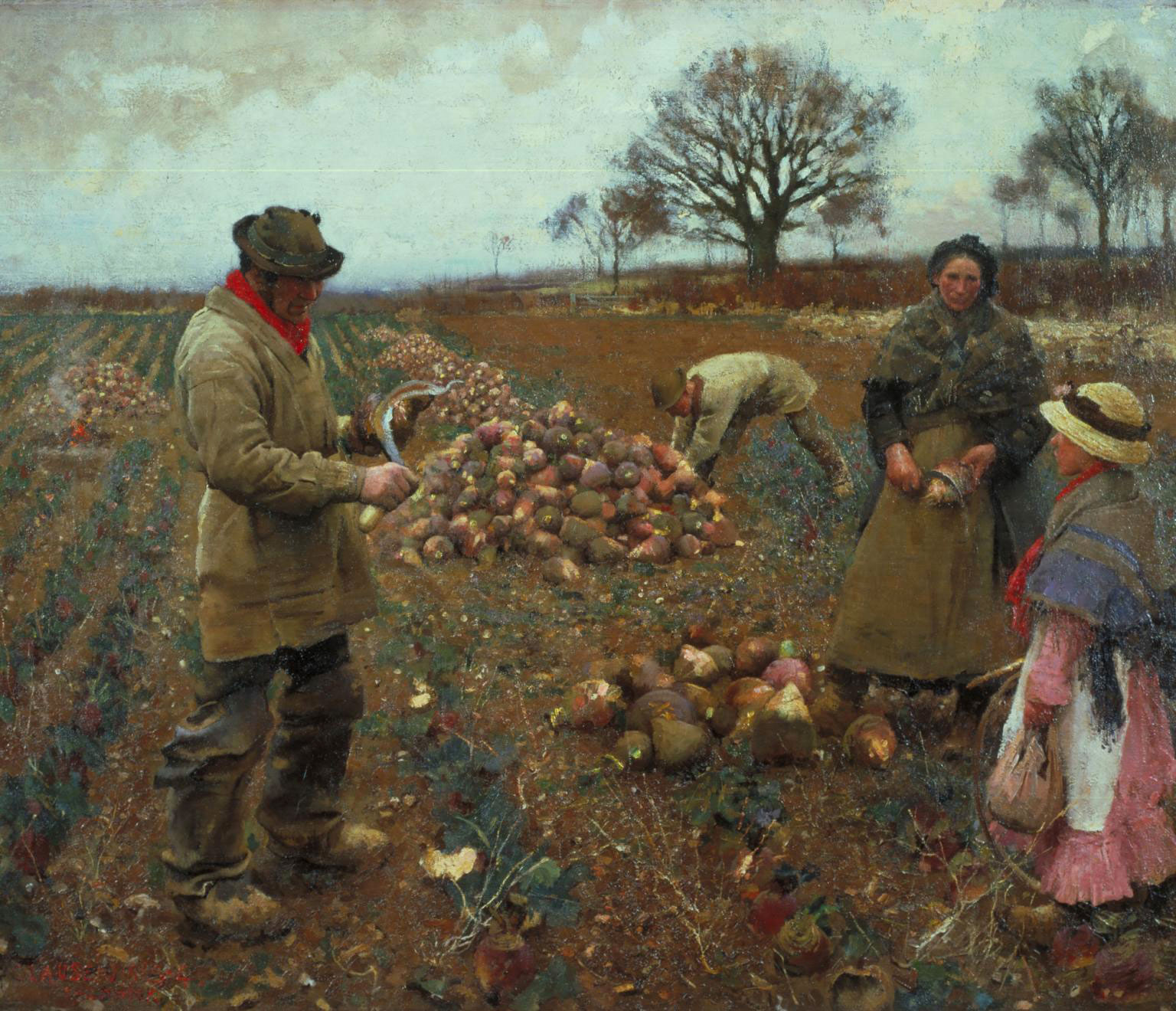
 

Sir George Clausen (British, 1852-1944) 'Winter Work' 1883-1884


Sir George Clausen (British, 1852-1944)
Winter Work
1883-1884
Oil on canvas
Frame: 1075 x 1212 x 115mm
Support: 775 x 921mm
Purchased with assistance from the Friends of the Tate Gallery 1983
© The estate of Sir George Clausen


In the 1880s Clausen devoted himself to painting realistic scenes of rural work after seeing such pictures by the French artist Jules Bastien-Lepage (1848-1884). In this picture he shows a family of field workers topping and tailing swedes for sheep fodder. It was painted at Chilwick Green near St Albans, where the artist had moved in 1881. He uses subdued colouring to capture the dull light and cold of winter, and manages to convey the hard reality of country work. Such unromanticised scenes of country life were often rejected by the selectors of the Royal Academy annual exhibitions.
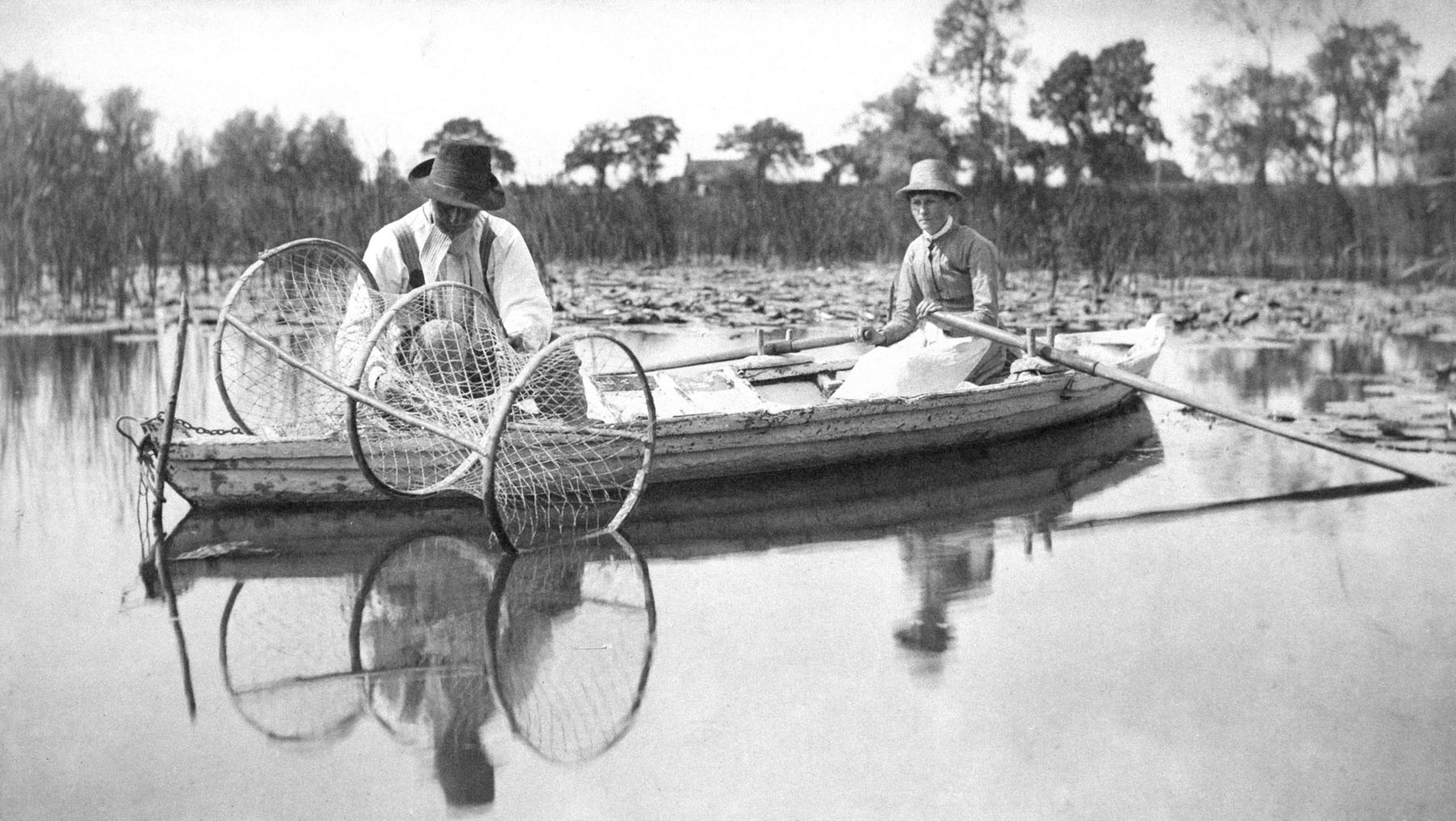
 

Thomas Frederick Goodall (British, 1856-1944) and Peter Henry Emerson (British, 1856-1936) 'Setting the Bow-Net, in Life and Landscape on the Norfolk Broads' 1885, published 1887


Thomas Frederick Goodall (British, 1856-1944) and Peter Henry Emerson (British, 1856-1936)
Setting the Bow-Net, in Life and Landscape on the Norfolk Broads
1885, published 1887
Book – open at The Bow Net
Photograph, platinum print on paper
300 x 420mm (book closed)
Private collection
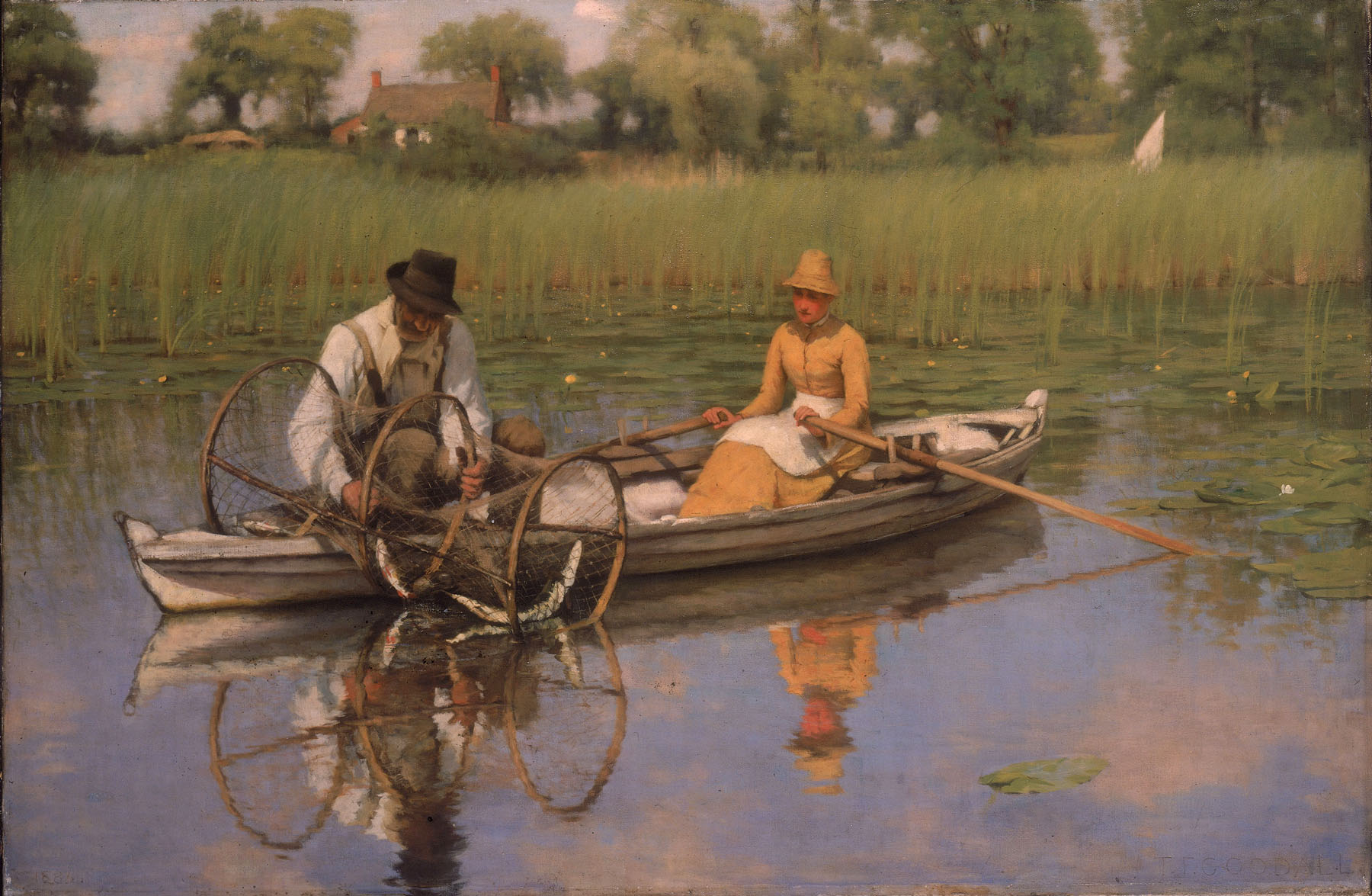
 

Thomas Frederick Goodall (British, 1856-1944) 'The Bow Net' 1886


Thomas Frederick Goodall (British, 1856-1944)
The Bow Net
1886
Oil paint on canvas
838 x 1270mm
National Museums Liverpool, Walker Art Gallery
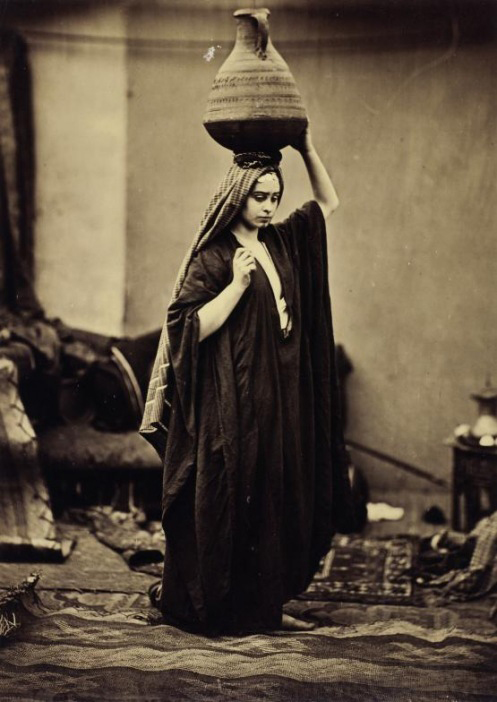
 

Roger Fenton (British, 1819-1869) 'The Water Carrier' 1858


Roger Fenton (British, 1819-1869)
The Water Carrier
1858
Albumen Print, Wilson Center for Photography
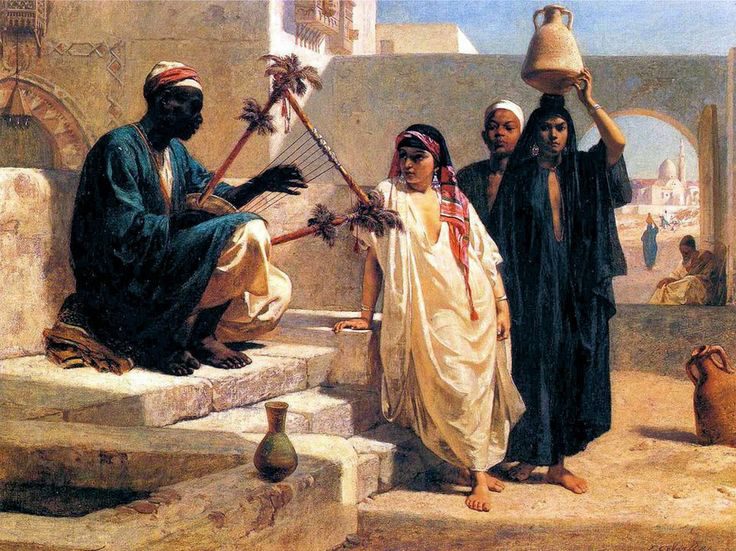
 

Frederick Goodall (English, 1822-1904), R.A. 'The Song of the Nubian Slave' 1863


Frederick Goodall (English, 1822-1904), R.A.
The Song of the Nubian Slave
1863
Diploma Work, accepted 1863
71.2 x 92 x 2.3cm
Oil on canvas
Photo credit: © Royal Academy of Arts, London; Photographer: John Hammond


Out of the Shadows

In the late nineteenth century, painters and photographers pursued the representation of an idealised beauty, inspired by Italian Renaissance artists such as Michelangelo and Leonardo da Vinci. Themes of allegory and myth were widely explored in the arts at this time, particularly in Britain in the writings of Walter Pater and Oscar Wilde.

At the turn of the century painting and photography were part of a wider artistic search for harmony between subject matter and expression. Artists found inspiration in each other’s practice and continued to share ideas through illustrated books and journals. This spirit of collaboration and interchange led photographer Fred Holland Day to claim that ‘the photographer no longer speaks the language of chemistry, but that of poetry’.
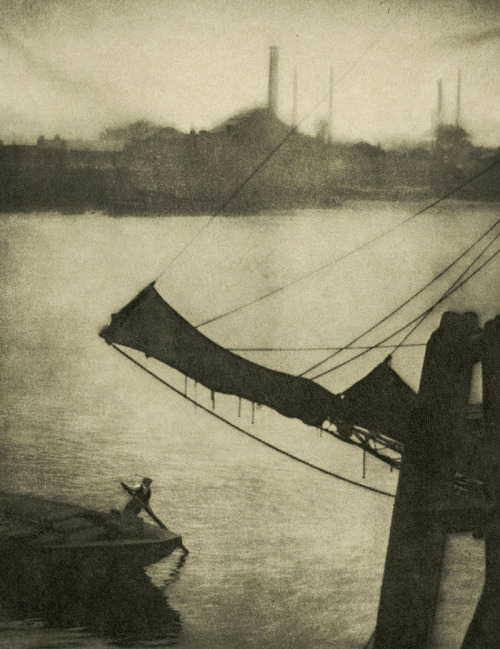
 

Alvin Langdon Coburn (American, 1882-1966) 'Regent's Canal' c. 1904-1905, published 1909


Alvin Langdon Coburn (American, 1882-1966)
Regent’s Canal
c. 1904-1905, published 1909
Photogravure on paper
Image: 206 x 161 mm
Frame: 508 x 406 mm
Wilson Centre for Photography


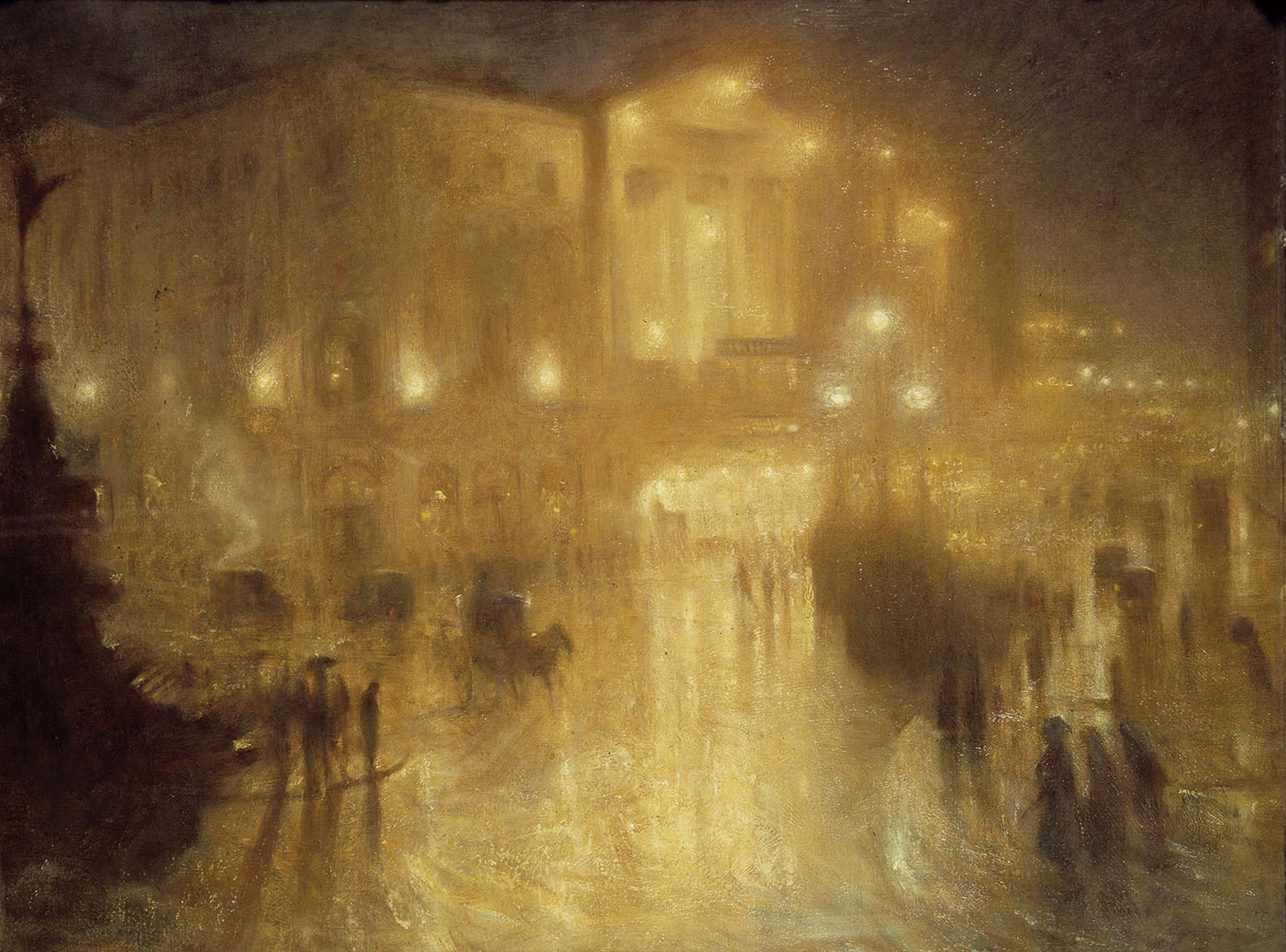
Arthur Hacker (English, 1858-1919) 'A Wet Night at Piccadilly Circus' 1910


Arthur Hacker (English, 1858-1919)
A Wet Night at Piccadilly Circus
1910
Oil on canvas
710 x 915mm
Royal Academy of Arts, London
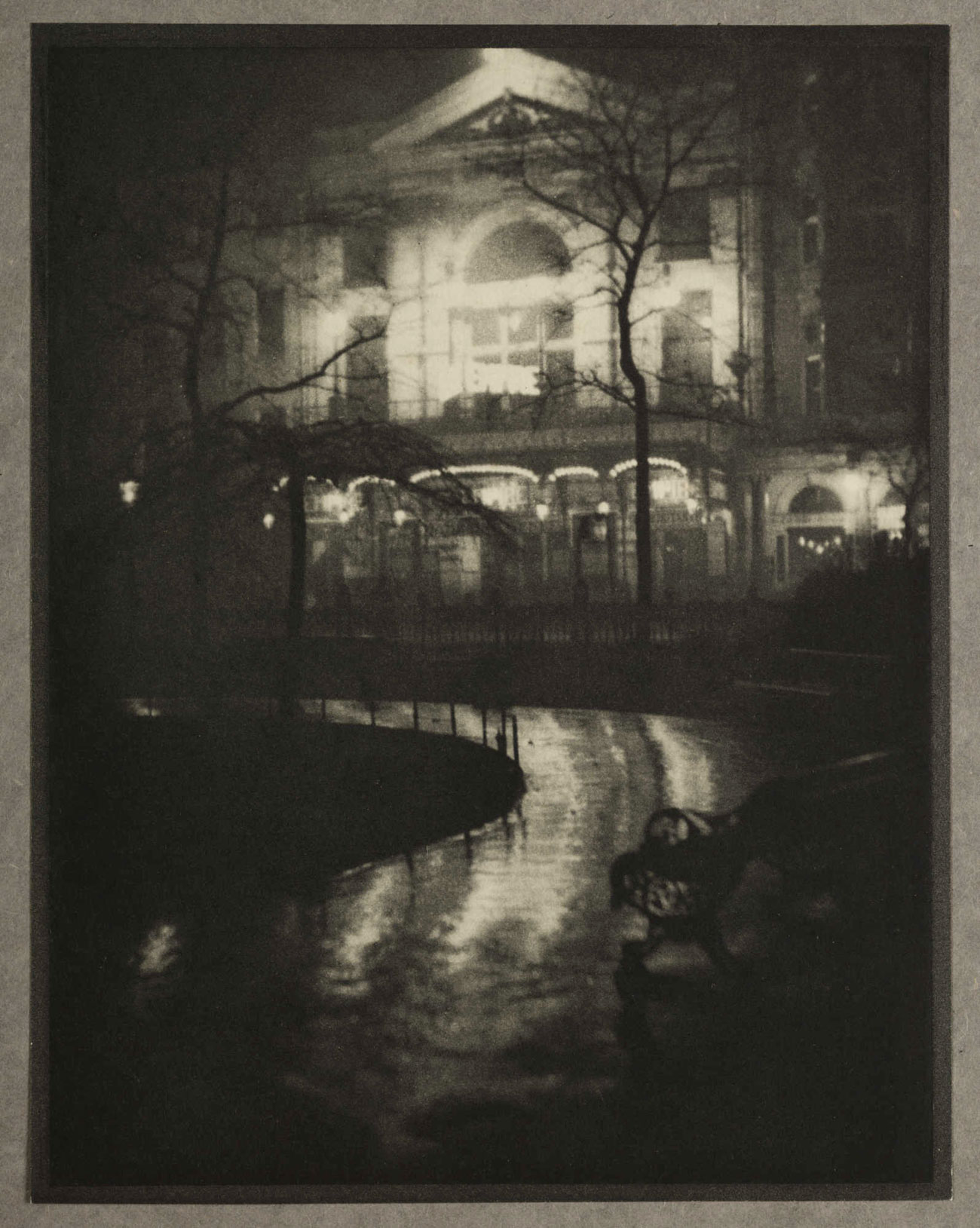
 

Alvin Langdon Coburn (American, 1882-1966) 'Leicester Square (The Old Empire Theatre)' 1908, published 1909


Alvin Langdon Coburn (American, 1882-1966)
Leicester Square (The Old Empire Theatre)
1908, published 1909
Photogravure on paper
Image: 206 x 172mm
Frame: 508 x 406mm
Wilson Centre for Photography
 

Edward Linley Sambourne (English, 1844-1910) 'Ethel Warwick, Camera Club, 2 August 1900'


Edward Linley Sambourne (English, 1844-1910)
Ethel Warwick, Camera Club, 2 August 1900
Photograph, cyanotype on paper
Dimensions
Image: 165 x 120mm
Frame: 507 x 855mm
18 Stafford Terrace, The Royal Borough of Kensington and Chelsea


Tate Britain
Millbank, London SW1P 4RG
United Kingdom
Phone: +44 20 7887 8888

Opening hours:
Daily 10.00am – 18.00pm

Tate Britain website

LIKE ART BLART ON FACEBOOK

Back to top

Exhibition: ‘Gilbert & George: The Art Exhibition’ at the Museum of Old and New Art (MONA), Hobart

Exhibition dates: 28th November, 2015 – 28th March, 2016

Curators: Gilbert & George with organising curators, Mona’s Co-Directors of Exhibitions and Collections, Olivier Varenne and Nicole Durling


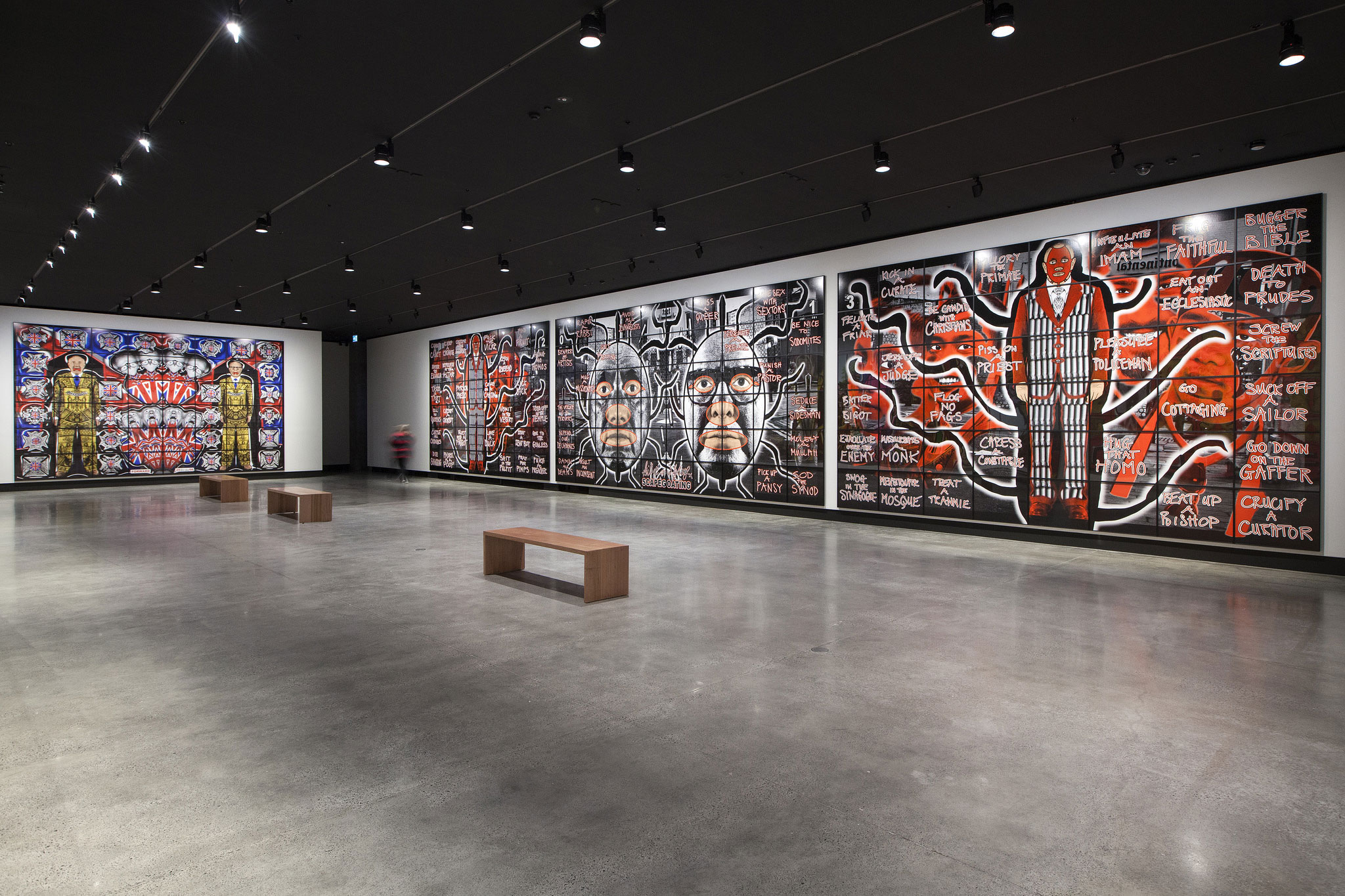
Gilbert & George (Gilbert Prousch, British born Italy, 1943; George Passmore, British, b. 1942) 'FORWARD' 2008 from the exhibition 'Gilbert & George: The Art Exhibition' at the Museum of Old and New Art (MONA), Hobart, Nov 2015 - March 2016


Gilbert & George (Gilbert Prousch, British born Italy, 1943; George Passmore, British, b. 1942)
FORWARD
2008
Mixed media
381 x 604cm
Courtesy of the artists and White Cube


Gentlemen of the gutter

While I admire the mythology of Gilbert and George, that ever so British pair of deviant artists, they have never been among my favourites.

They had a tough road. Imagine meeting in 1967, pre-Stonewall and the beginning of gay liberation, and then moving into the roughest part of London, the East End, to live together and make art, dressed as a pair of besuited businessmen. The prejudice and the abuse would have been intense, but they stuck together, they stuck to their path as artists, and they stuck to each other as human beings. It is fascinating to see the trajectory of their development, to follow the development of the grid, the introduction of one colour and then multiple colours.

I understand what they do, empathise with their endeavour (anti-nationalism, religion, bigotry, racism, homophobia etc etc…) but wonder whether they have not painted themselves and their art into a corner. They are so well known for their long running performance – their vaudeville act reminding me of a contemporary Hieronymus Bosch with text ripped from the headlines / images riffed from hell (portraits of cut up reflections assembled to make surreal creatures with gaping mouths), the gridded works, the colours, the content AS graphic gothic cathedral with stained glass windows – that they seem incapable or willing to push themselves and their art further. To shock us in an altogether different way? Now that would be a greater surprise, than just semen, spit and shit.

What I am saying is that they have got their schtick down pat. They worked hard for their anti-establishment schlock horror. The work has presence and they do know how to reach people with a picture but with each repetition, with each ritual performance the cracks grow ever larger. As John McDonald observes, “They are iconoclastic non-entities making art that attracts and repels.”

What actually lies underneath all of this rhetoric. Two caring human beings, two compassionate souls? I think not, therefore I am.**

As can be seen in many of their works, the emperors literally have no clothes…

Dr Marcus Bunyan

** Perhaps it should have been “I care not, therefore I am” … because they don’t really give a dam what people think. This is part of the problem: their rather mean spirited view of the world.


Many thankx to MONA for allowing me to publish the photographs in the posting. Please click on the photographs for a larger version of the image.


“We are unhealthy, middle-aged, dirty-minded, depressed, cynical, empty, tired-brained, seedy, rotten, dreaming, badly-behaved, ill-mannered, arrogant, intellectual, self-pitying, honest, successful, hard-working, thoughtful, artistic, religious, fascistic, blood-thirsty, teasing, destructive, ambitious, colourful, damned, stubborn, perverted and good. We are artists.”


“Art has just become decoration for the very, very rich. We manage to keep our feet on the ground. We have never been part of an elitist art group. Our art is so confrontational that a lot of collectors would never touch it because they don’t want a naked shit picture in their living room… More and more it is difficult to speak as an artist. Nobody hears you because there are too many and there are too many different ways of making art today that there didn’t use to be when we started out in 1969.”


“We never go to the cinema, the theatre, or the ballet or opera. We stopped 40 years ago. We just didn’t want to become contaminated. We know what we’re interested in, we know how we can reach people with a picture. We have a feeling, what we put in that picture that will mean something to somebody.”


Gilbert & George


Gilbert & George: The Art Exhibition


Gilbert & George In Conversation With Olivier Varenne


Two people, but one artist: the legendary Gilbert & George’s first ever exhibition in Australasia, Gilbert & George: The Art Exhibition, is now open at the Museum of Old and New Art in Tasmania, Australia, until March 28, 2016.

Gilbert & George: The Art Exhibition is a major retrospective, including pictures spanning five decades; dating from 1970 to most recent pictures of 2014. Curated by Gilbert & George with organising curators, Mona’s Co-Directors of Exhibitions and Collections, Olivier Varenne and Nicole Durling, the pictures are installed across the entirety of Mona’s touring galleries, 14 metres underground.

“Our pictures deal with the great universals: death, hope, life, fear, sex, money, race and religion. Seeing is believing. See for yourself: Gilbert & George: The Art Exhibition. This is your very first – and last – chance to see one hundred of our pictures, at the wonderful Museum of Old and New Art in Hobart, Tasmania.” ~ Gilbert & George


Since first meeting at St Martin’s school of Art, London, in 1967, Gilbert & George have lived and worked together as one single and fiercely independent artist, dedicated solely to the creation of their art. They have no allegiance to any other trend, school, movement, doctrine, theory or style of art.

Gilbert & George already knew that they were seeking for a form of art that was to them entirely rooted in the real world – in the streets and clamour and traffic and buildings and hearts of strangers: an “Art for All.”

Today, their art continues to be multi-allusive, contemporary and contentious, as their subject is literally at their feet – along countless streets, the thoroughfares of the passage of millions of lives, and dense with the sedimentary tracings of social existence.

Text from MONA


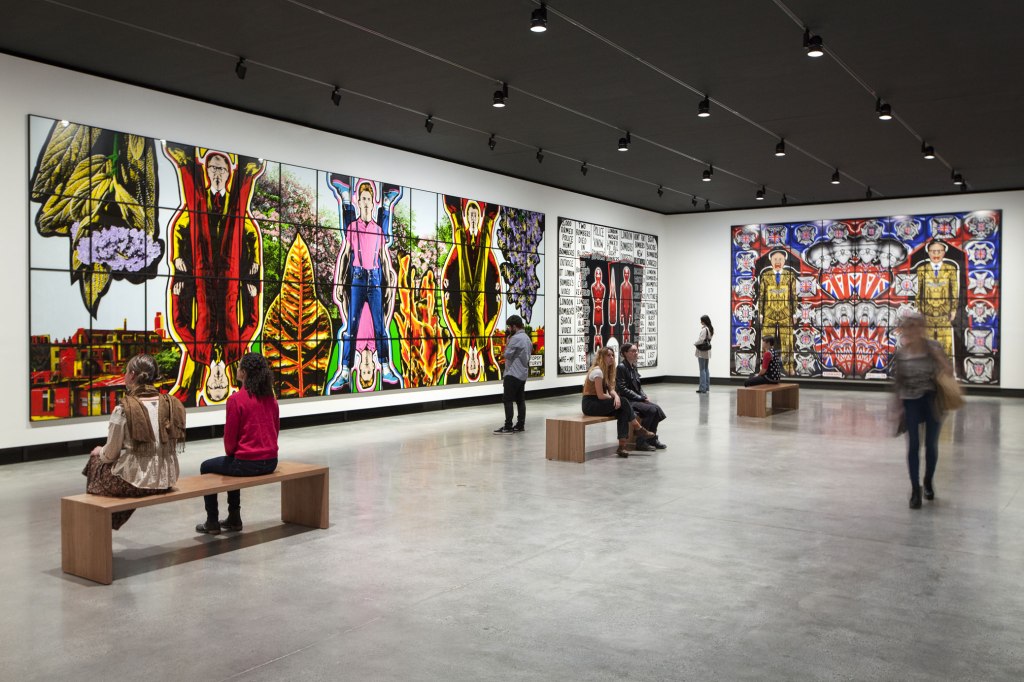
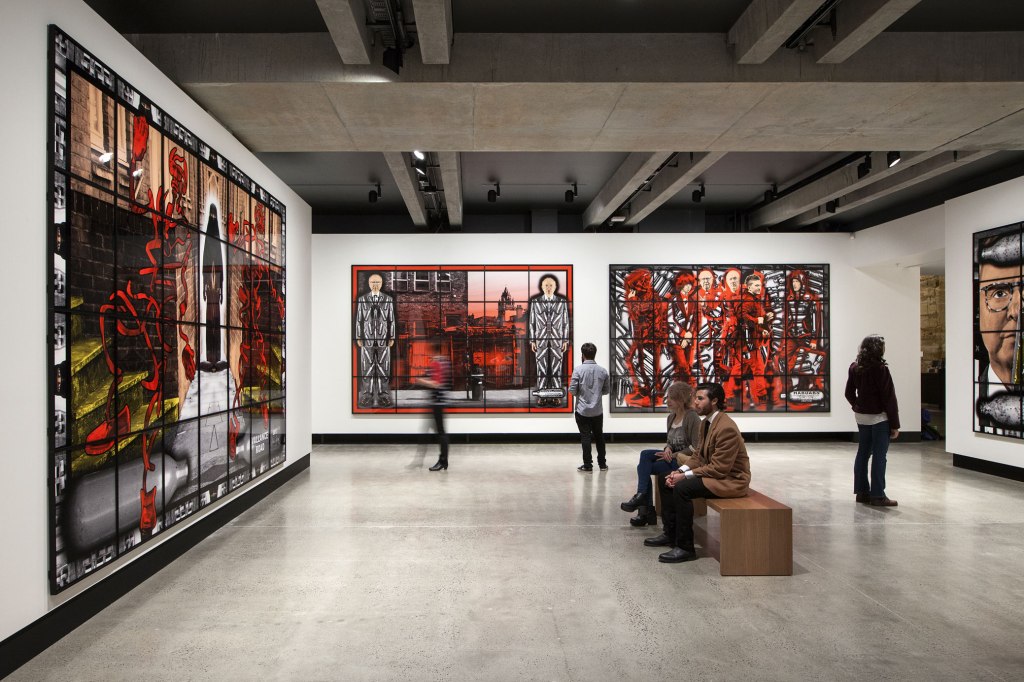
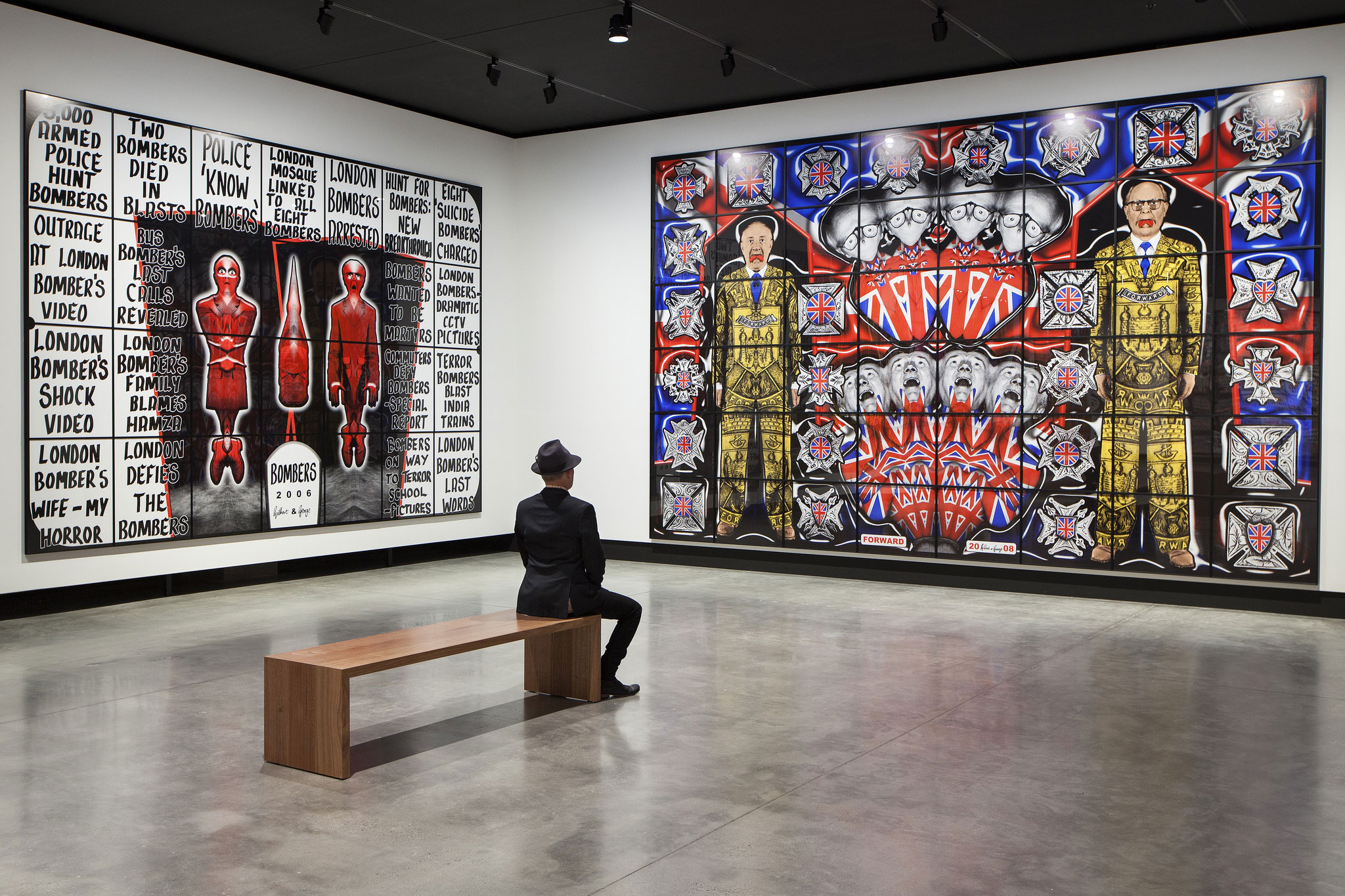
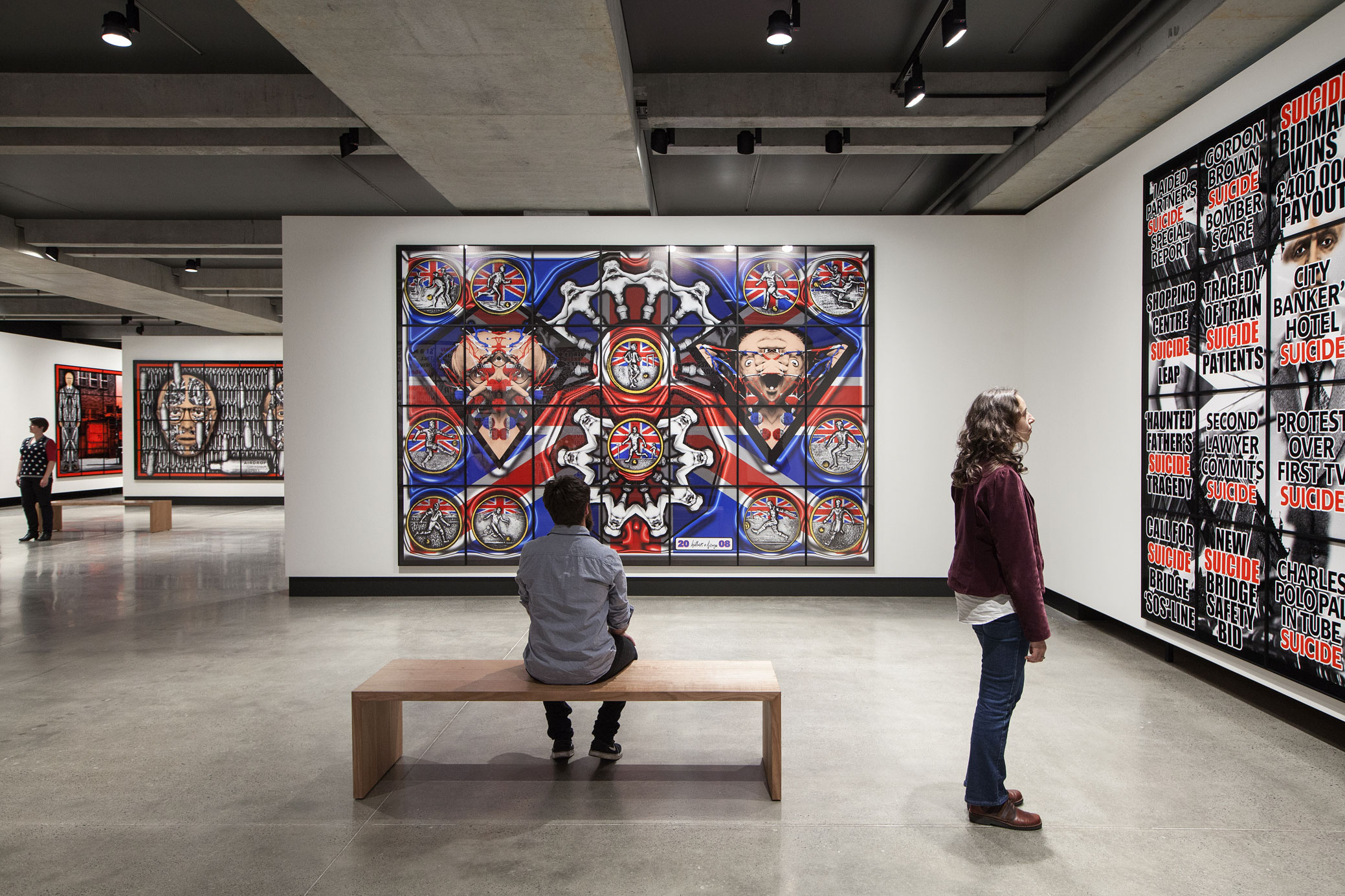
Installation view of the exhibition ‘Gilbert & George: The Art Exhibition’ at the Museum of Old and New Art, Hobart showing at left, 'BOMBERS' (2006), and at right, 'FORWARD' (2008)


Installation view of the exhibition Gilbert & George: The Art Exhibition at the Museum of Old and New Art, Hobart showing at left, BOMBERS (2006), and at right, FORWARD (2008)


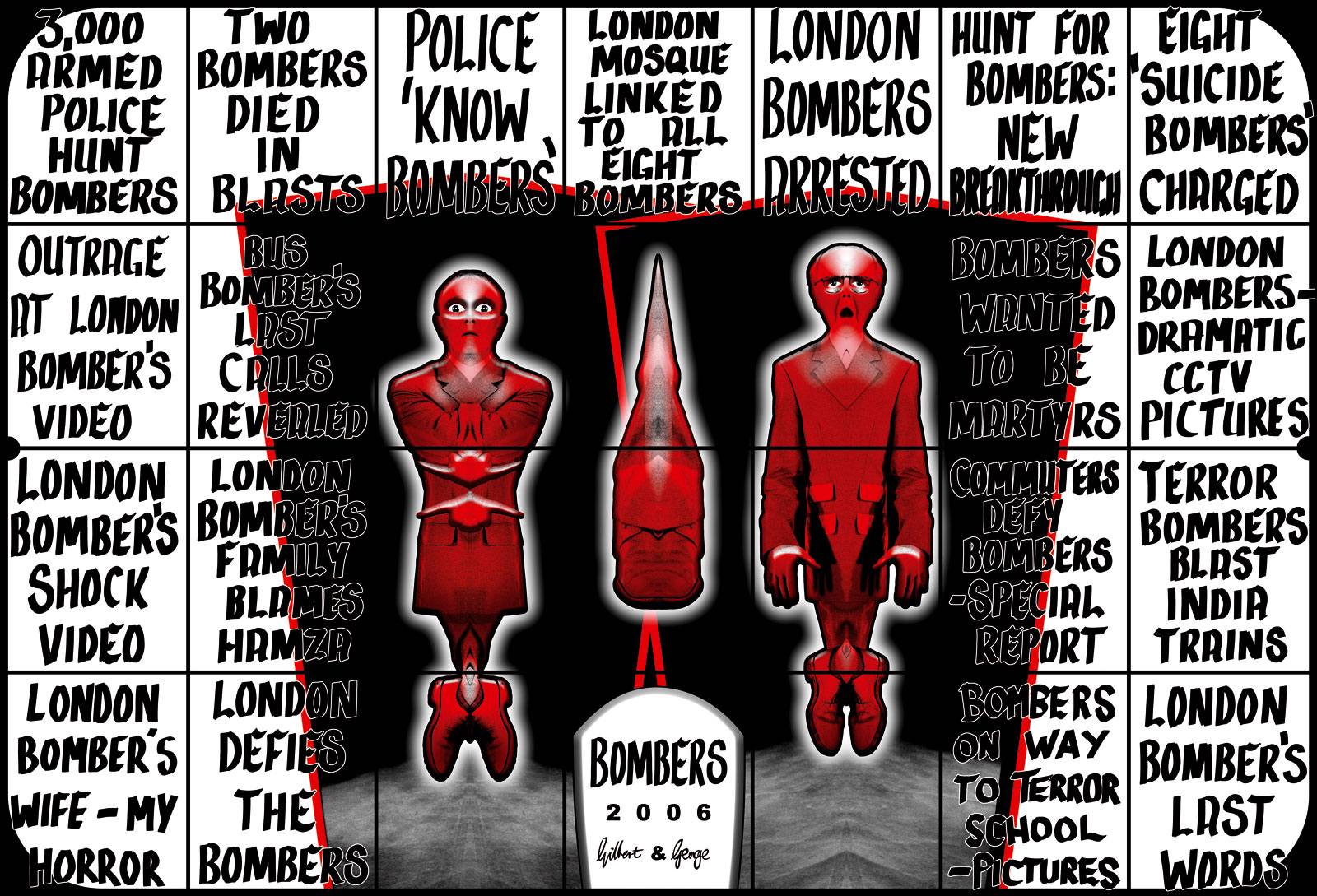
Gilbert & George (Gilbert Prousch, British born Italy, 1943; George Passmore, British, b. 1942) 'BOMBERS' 2006 from the exhibition 'Gilbert & George: The Art Exhibition' at the Museum of Old and New Art (MONA), Hobart, Nov 2015 - March 2016


Gilbert & George (Gilbert Prousch, British born Italy, 1943; George Passmore, British, b. 1942)
BOMBERS
2006
From Bomb Pictures
Mixed media
336 x 493cm
Courtesy of the artists and White Cube


Gilbert & George created an important group of six pictures for their major retrospective at Tate Modern. The six Bomb Pictures, the only pictures created by the artists in 2006, comprise a 14 metre triptych entitled Bomb and five other pictures: Bombs; Bomber; Bombers; Bombing; and Terror. The artists have described this group of pictures as their most chilling to date. The artists intend the pictures to be seen as modern townscapes reflecting the daily exposure in urban life to terror alerts.

Barry Grayshon. “Gilbert and George – The Bomb Pictures (2006),” on the Pinterest website [Online] Cited 16/03/2016


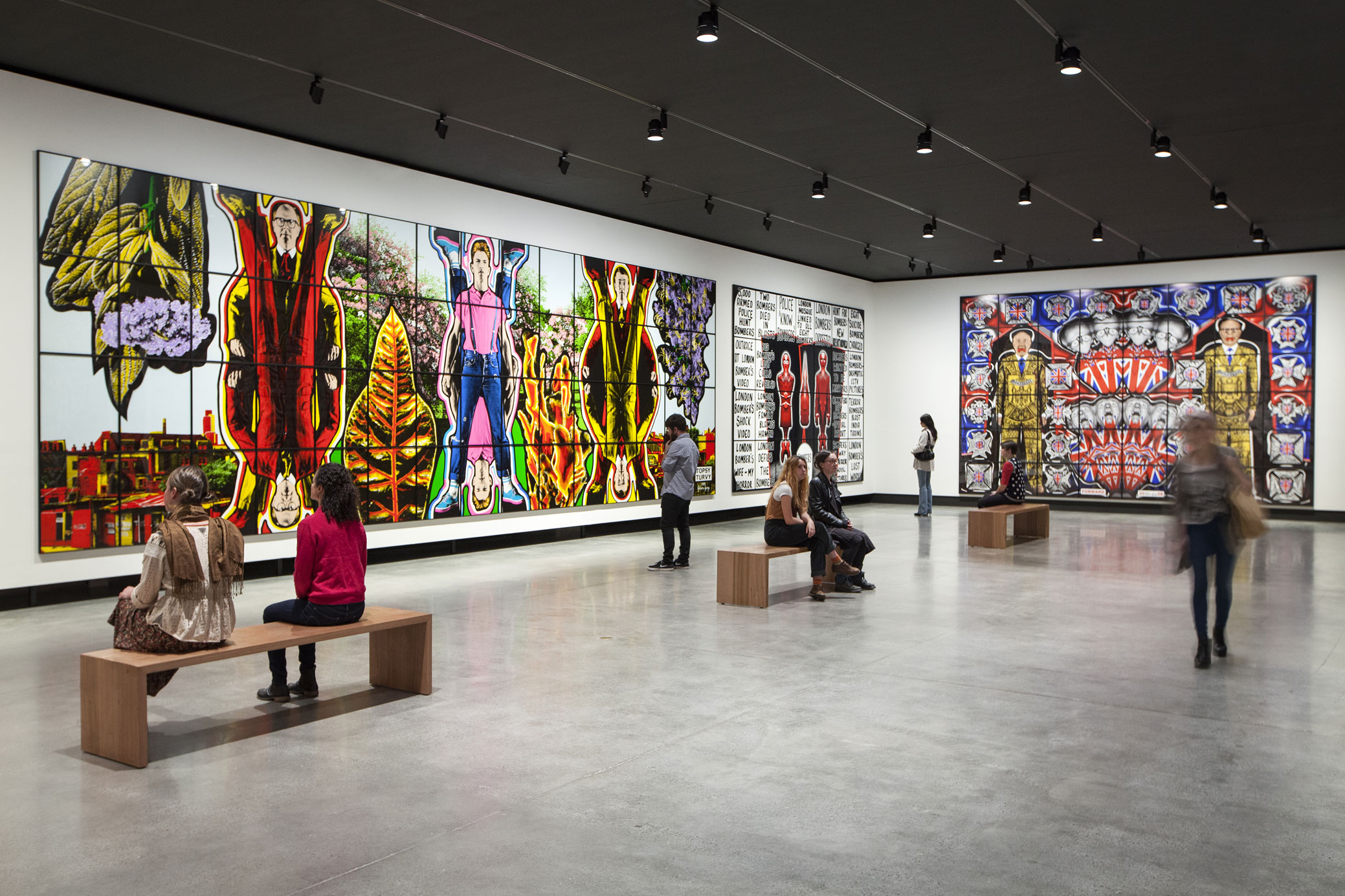
Installation view of the exhibition ‘Gilbert & George: The Art Exhibition’ at the Museum of Old and New Art, Hobart showing at left, 'TOPSY TURVY' (1989) from 'The Cosmological Pictures'


Installation view of the exhibition Gilbert & George: The Art Exhibition at the Museum of Old and New Art, Hobart showing at left, TOPSY TURVY (1989) from The Cosmological Pictures


Gilbert & George (Gilbert Prousch, British born Italy, 1943; George Passmore, British, b. 1942) 'DEAD HEAD' 1989


Gilbert & George (Gilbert Prousch, British born Italy, 1943; George Passmore, British, b. 1942)
DEAD HEAD
1989
From The Cosmological Pictures
Picture courtesy of the artists and Mona, Museum of Old and New Art, Tasmania, Australia


With this body of work Gilbert & George stress the power of human thought to remake life and so create the future through a process of communication, discussion and questioning, stimulated by the pictures. The word ‘cosmology’ derives from the Greek words for ‘world’ and ‘discourse’. Since September 1991, The Cosmological Pictures have been touring many European cities. Gilbert and George’s aim – to speak to many people in all of these cities – is at the heart of their cosmology.

Barry Grayshon. “Gilbert and George – The Cosmological Pictures (1989),” on the Pinterest website [Online] Cited 16/03/2016


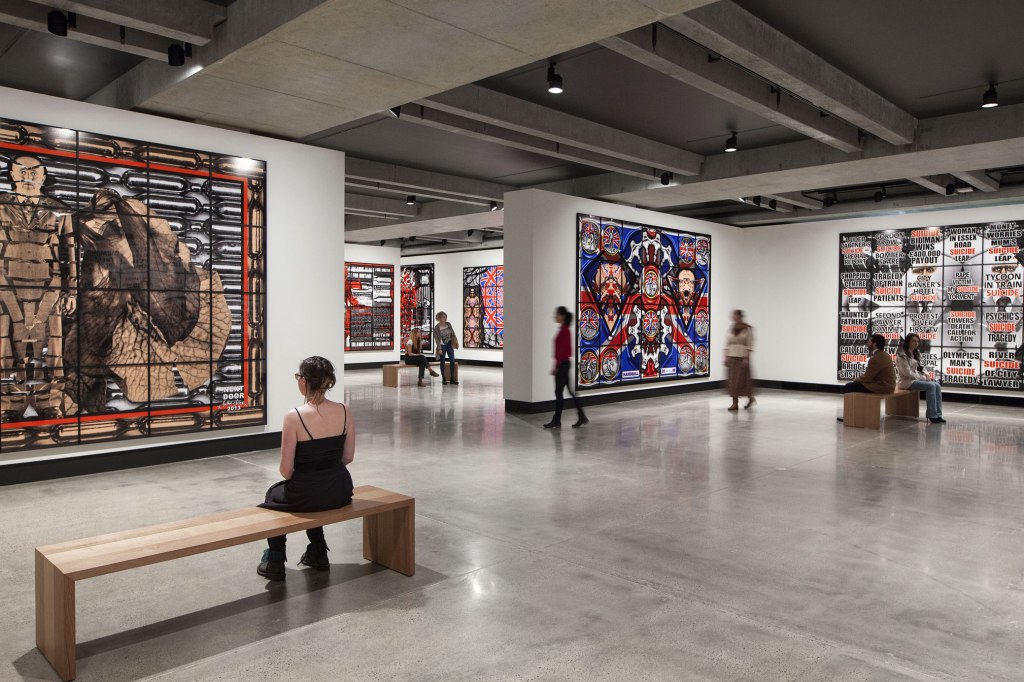
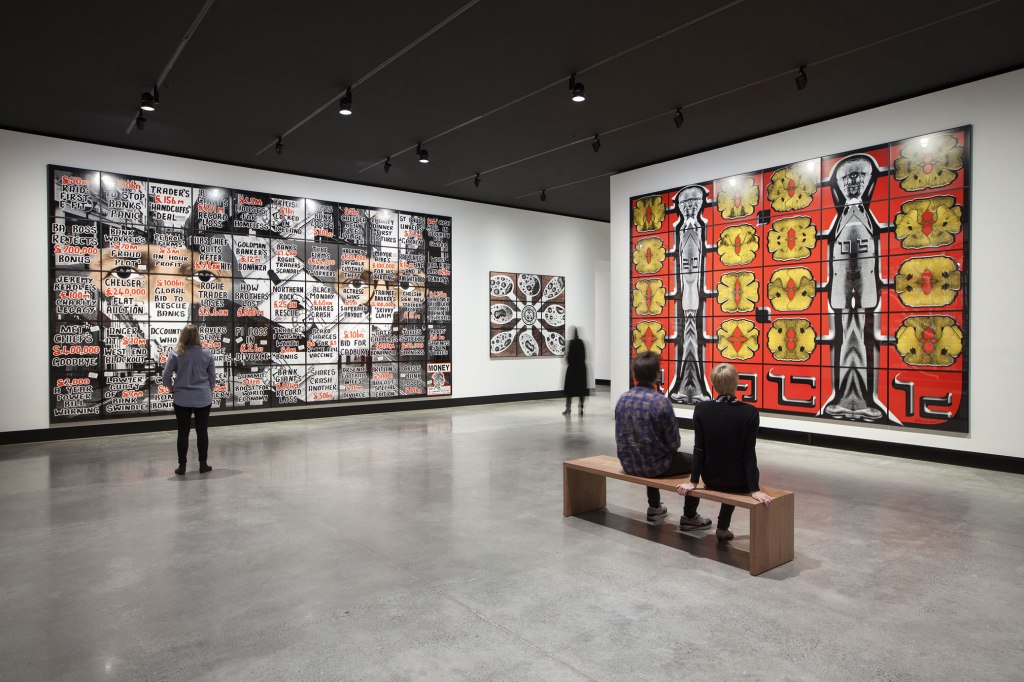
Installation view of the exhibition ‘Gilbert & George: The Art Exhibition’ at the Museum of Old and New Art, Hobart showing at left, 'NEXT DOOR' (2013), in the middle 'HANDBALL' (2008), and at right, 'SUICIDE STRAIGHT' (2011) from 'The London Pictures'


Installation view of the exhibition Gilbert & George: The Art Exhibition at the Museum of Old and New Art, Hobart showing at left, NEXT DOOR (2013), in the middle HANDBALL (2008), and at right, SUICIDE STRAIGHT (2011) from The London Pictures


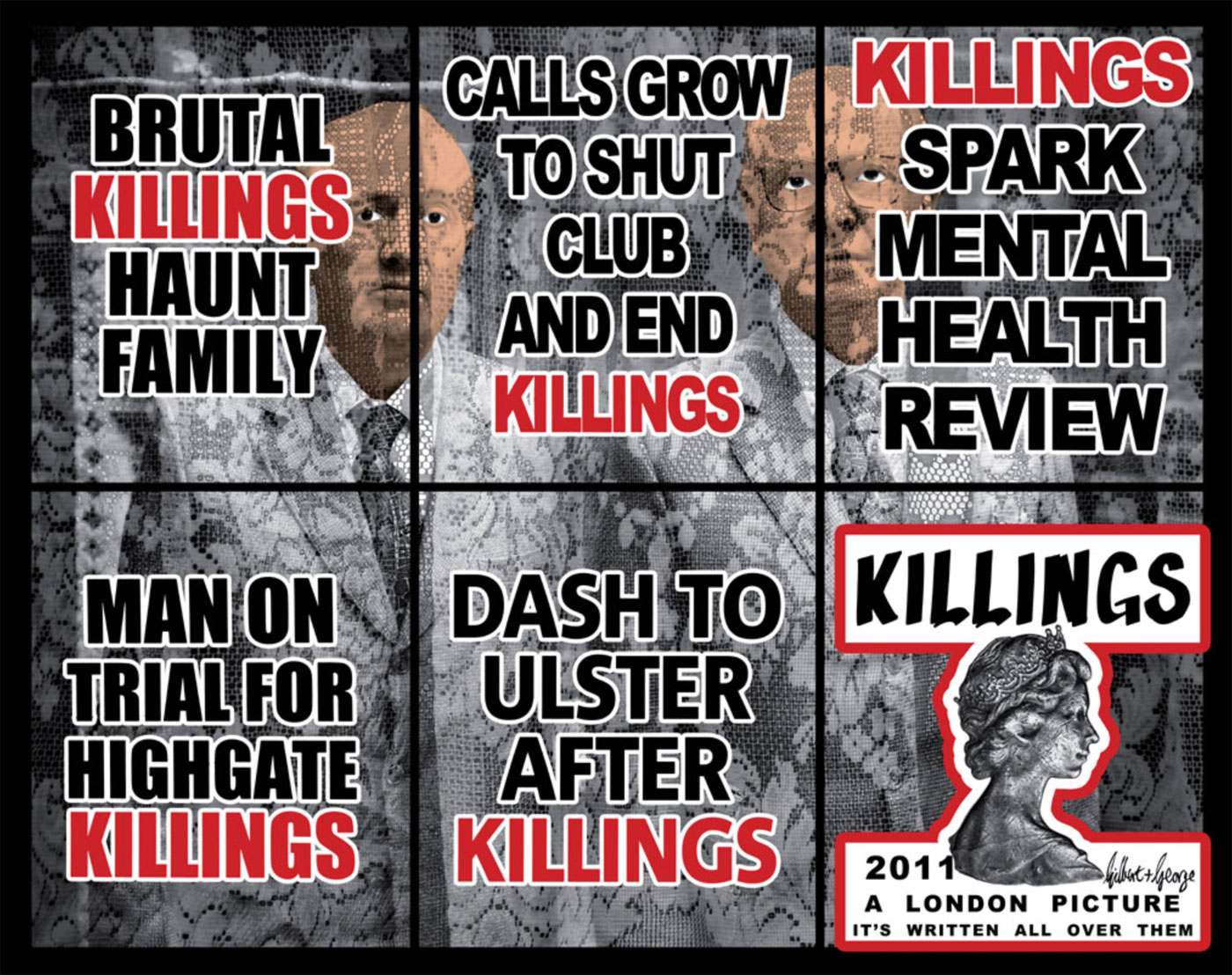
Gilbert & George (Gilbert Prousch, British born Italy, 1943; George Passmore, British, b. 1942) 'KILLERS STRAIGHT' 2011


Gilbert & George (Gilbert Prousch, British born Italy, 1943; George Passmore, British, b. 1942)
KILLERS STRAIGHT
2011
From The London Pictures


The London Pictures are made up of 292 of the 3,712 newspaper ‘bills’ the pair have doggedly pilfered from outside London newsagents over many years. The pictures present an epic survey of modern urban life in all its volatility, tragedy, absurdity and routine violence. They are Dickensian in scope and ultra-modern in sensibility.

Barry Grayshon. “Gilbert and George – London Photos (2011),” on the Pinterest website [Online] Cited 16/03/2016


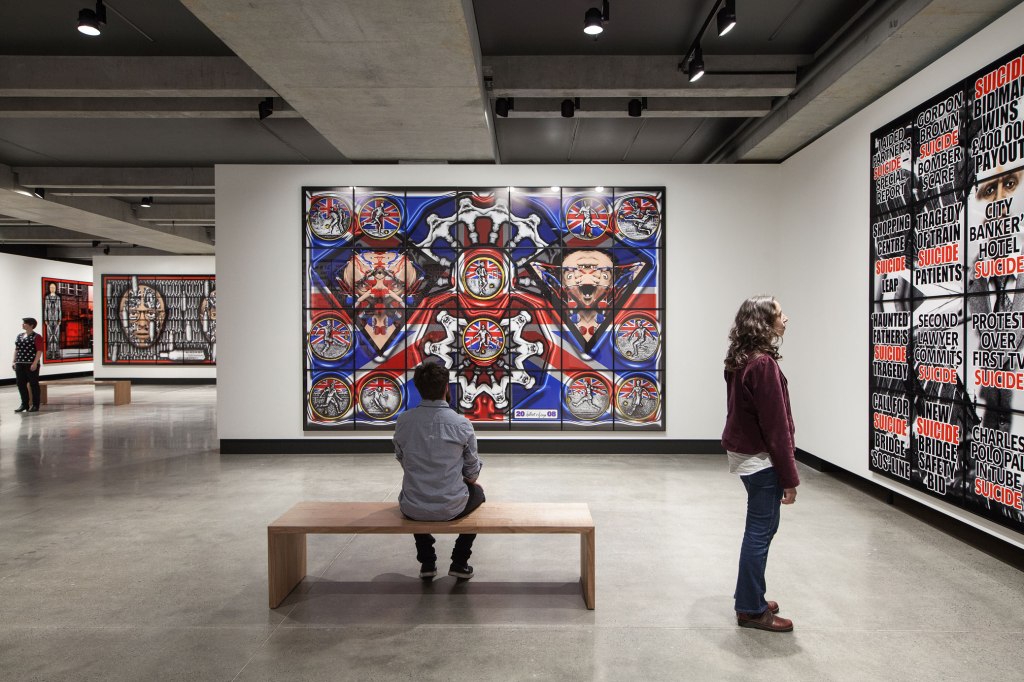
Installation view of the exhibition ‘Gilbert & George: The Art Exhibition’ at the Museum of Old and New Art, Hobart showing in the middle 'HANDBALL' (2008), and at right, 'SUICIDE STRAIGHT' (2011) from 'The London Pictures'


Installation view of the exhibition Gilbert & George: The Art Exhibition at the Museum of Old and New Art, Hobart showing in the middle HANDBALL (2008), and at right, SUICIDE STRAIGHT (2011) from The London Pictures


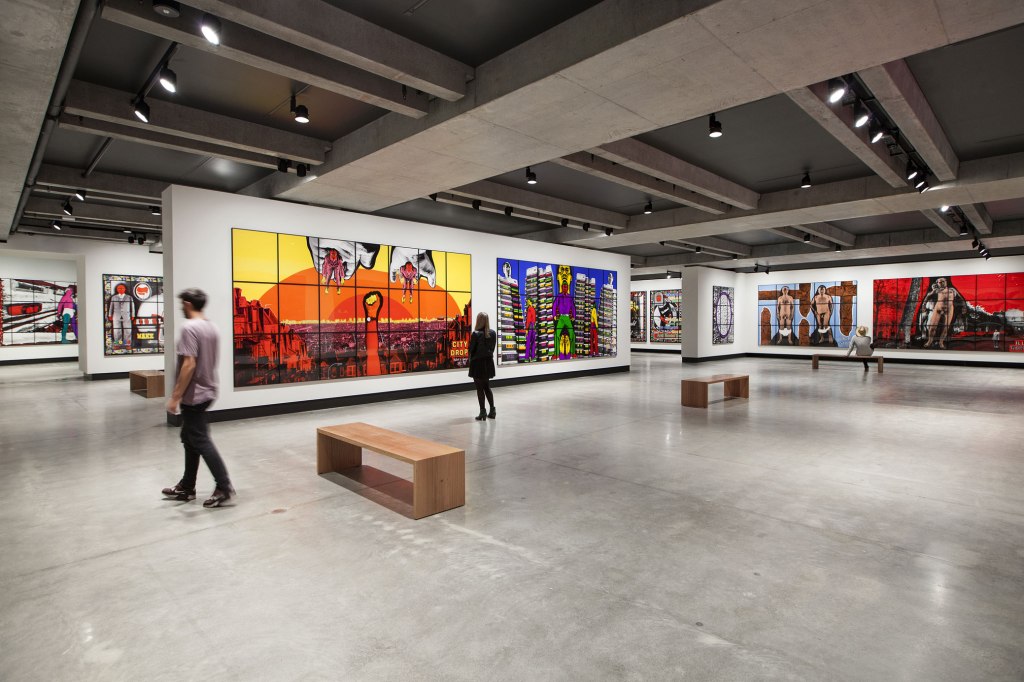
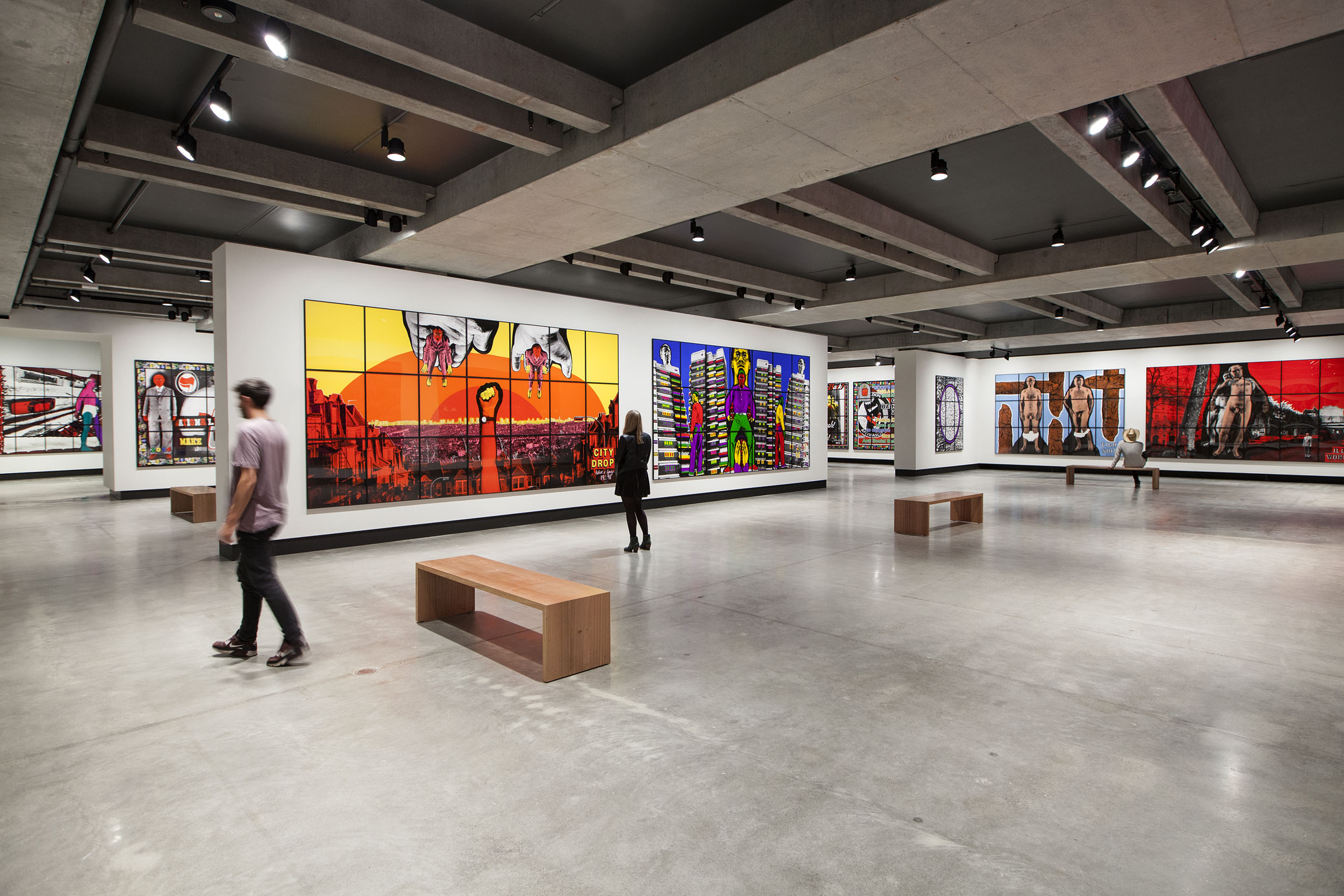
Installation view of the exhibition ‘Gilbert & George: The Art Exhibition’ at the Museum of Old and New Art, Hobart showing from left (large pictures), 'CITY DROP' (1991), 'FLAT MAN' (1991), 'EIGHT SHITS' (1994) and 'ILL WORLD' (1994), both from 'The Naked Shit Pictures'


Installation view of the exhibition Gilbert & George: The Art Exhibition at the Museum of Old and New Art, Hobart showing from left (large pictures), CITY DROP (1991), FLAT MAN (1991), EIGHT SHITS (1994) and ILL WORLD (1994), both from The Naked Shit Pictures


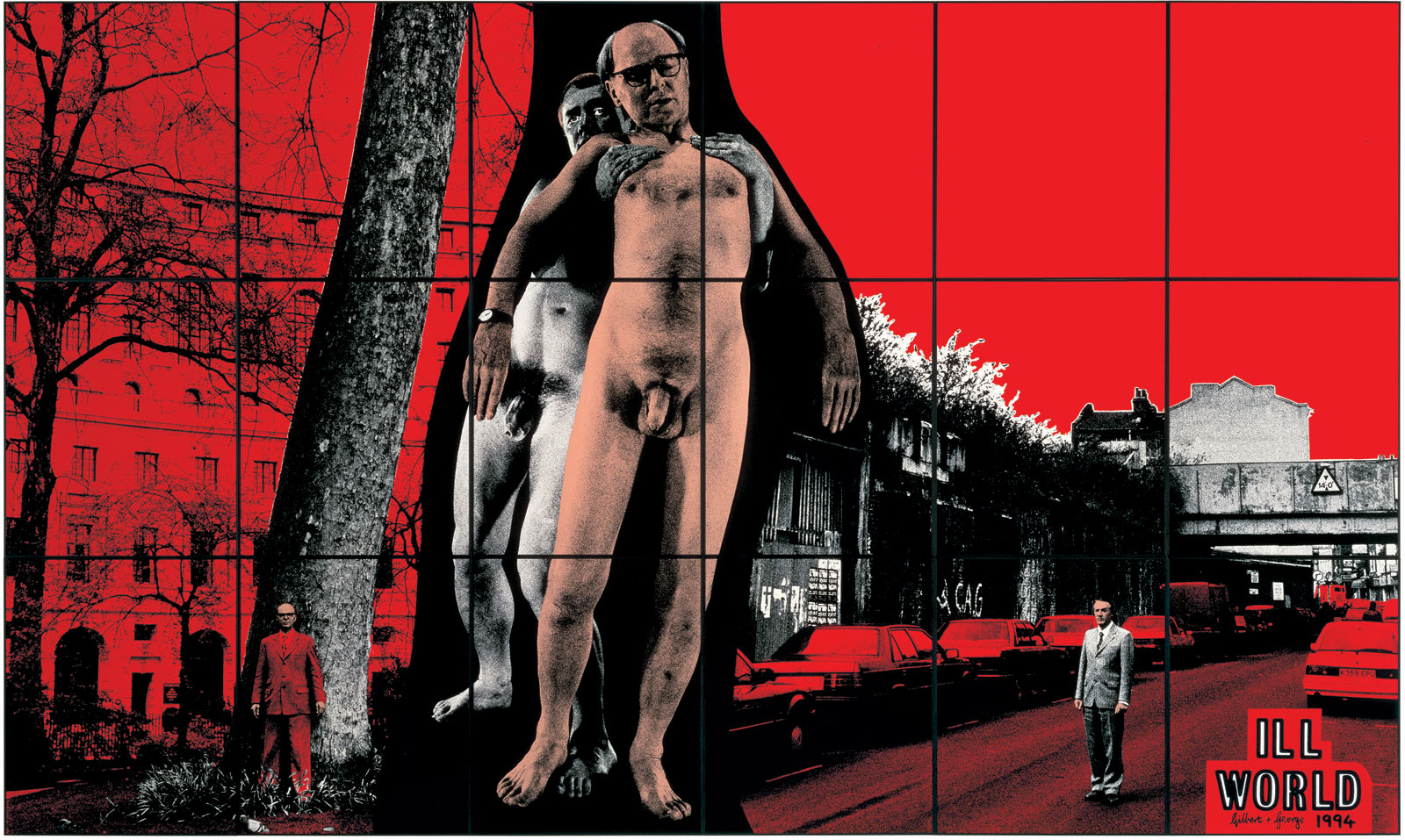
Gilbert & George (Gilbert Prousch, British born Italy, 1943; George Passmore, British, b. 1942) 'ILL WORLD' 1994


Gilbert & George (Gilbert Prousch, British born Italy, 1943; George Passmore, British, b. 1942)
ILL WORLD
1994
Mixed media
253 x 426cm
Courtesy of the artists


The frieze-like composition of The Naked Shit Pictures, with its striking contrasts of scale, was displayed high on the gallery walls. As the title indicates, works in the group depict the artists naked, or semi-dressed, often in conjunction with scaled-up images of faeces. These primary motifs are juxtaposed with urban/parkland scenes, giant anonymous suited bodies and the artists, or set against colour grounds. Marked contrasts in scale are a dominant feature in the series.

Barry Grayshon. “Gilbert and George – The Naked Shit Pictures (1994),” on the Pinterest website [Online] Cited 16/03/2016


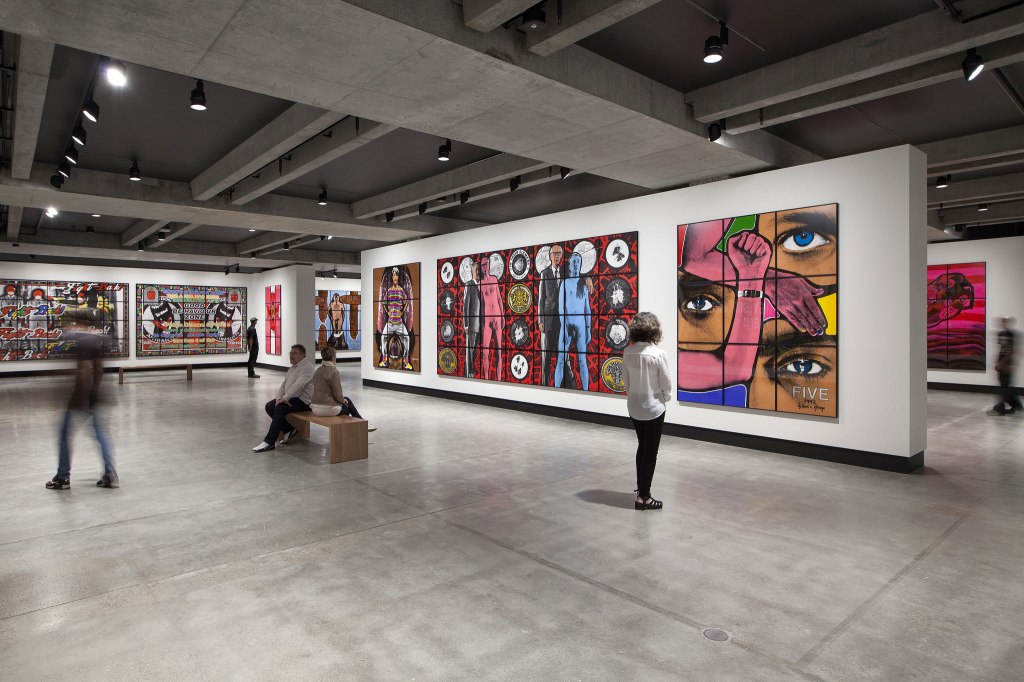
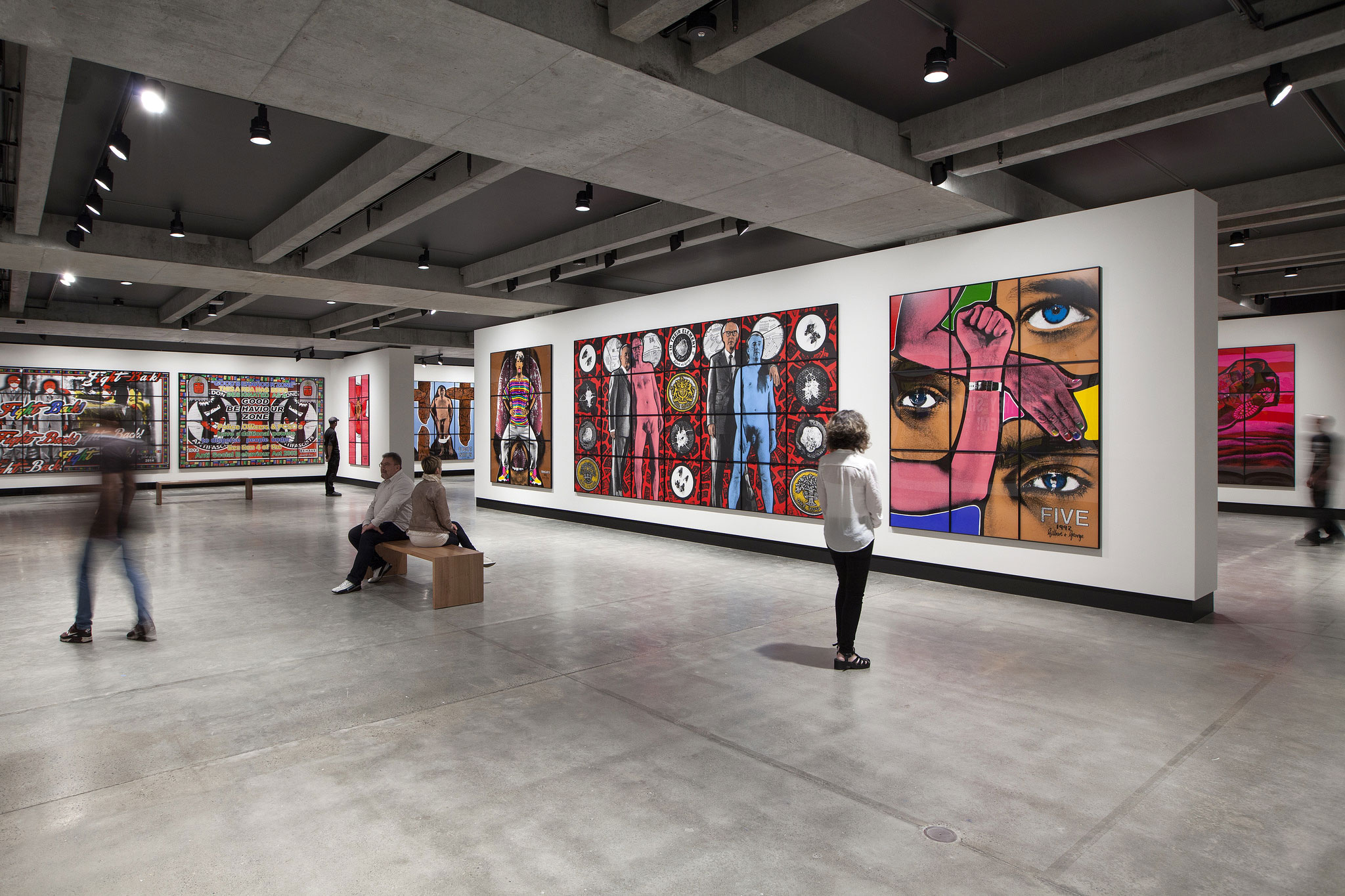
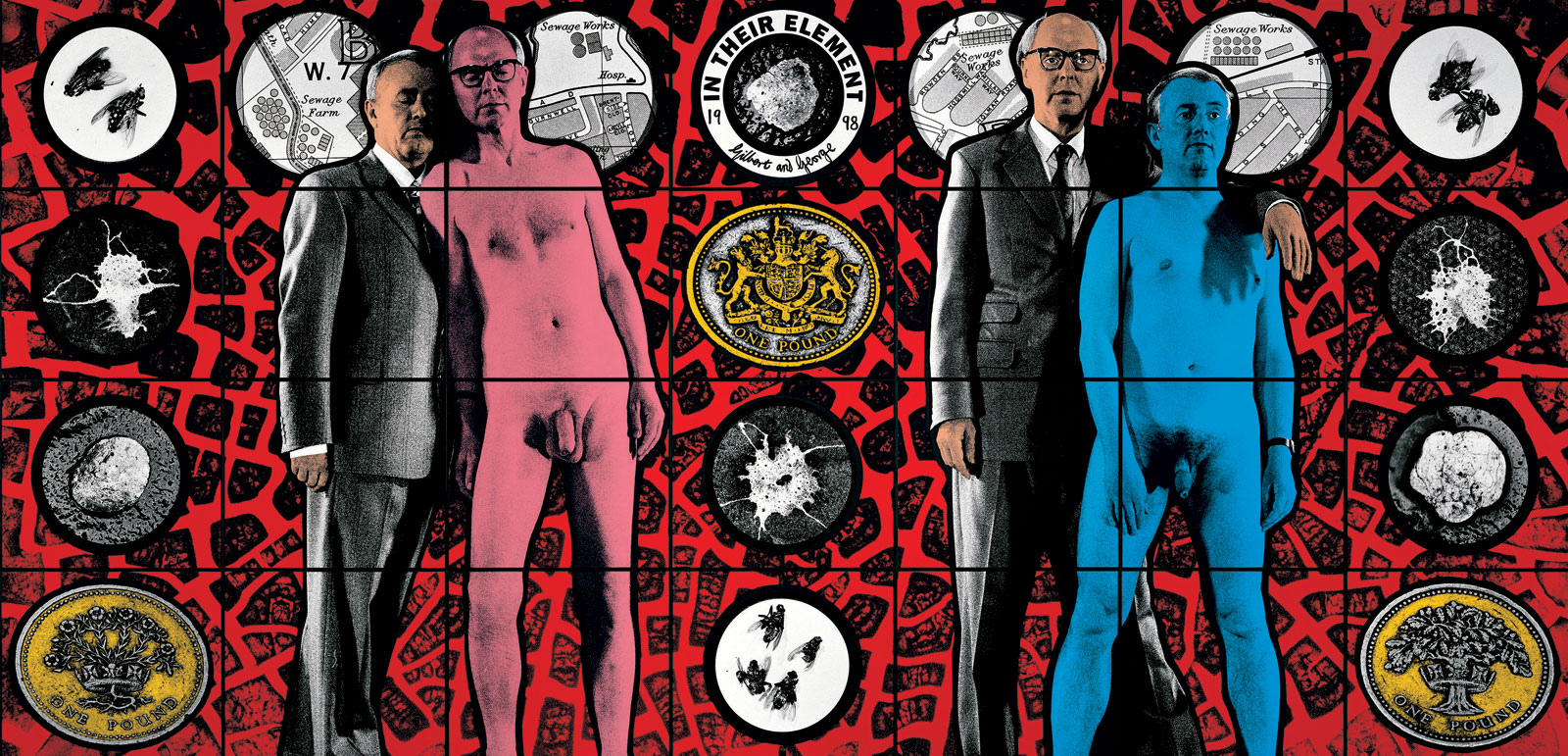
Installation view of the exhibition ‘Gilbert & George: The Art Exhibition’ at the Museum of Old and New Art, Hobart showing at middle, 'IN THEIR ELEMENT' (1998) from the series 'The Rudimentary Pictures' (1998) followed by 'FIVE' (1992)


Installation view of the exhibition Gilbert & George: The Art Exhibition at the Museum of Old and New Art, Hobart showing at middle, IN THEIR ELEMENT (1998) from the series The Rudimentary Pictures (1998) followed by FIVE (1992)


Gilbert & George (Gilbert Prousch, British born Italy, 1943; George Passmore, British, b. 1942) 'IN THEIR ELEMENT' 1988


Gilbert & George (Gilbert Prousch, British born Italy, 1943; George Passmore, British, b. 1942)
IN THEIR ELEMENT
1988
From the series The Rudimentary Pictures
Mixed media
254 x 528 cm
Courtesy of the artists


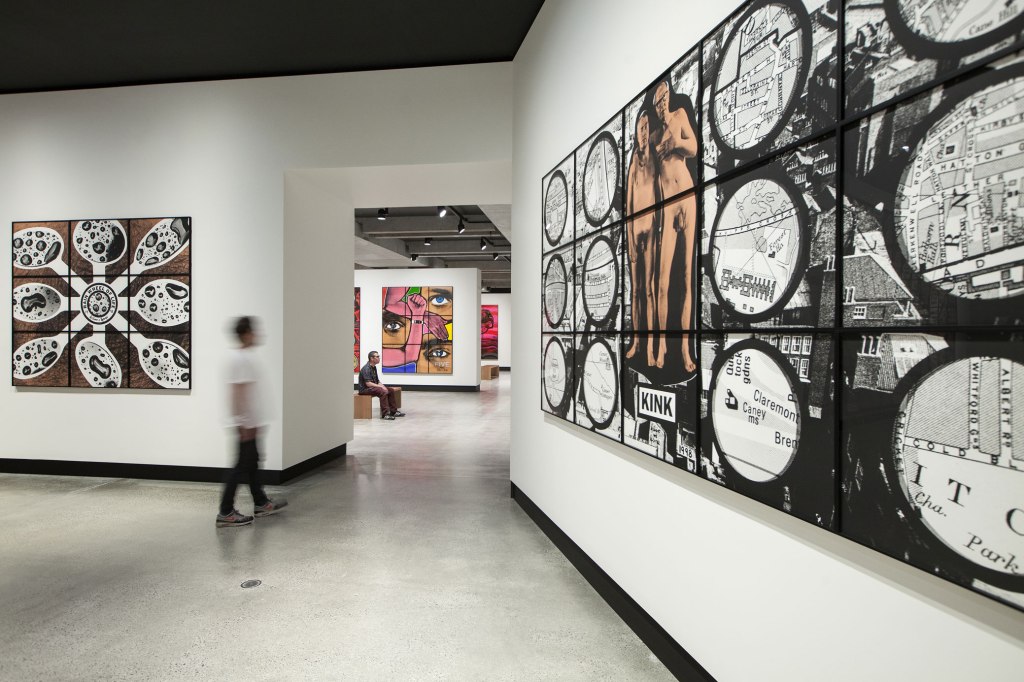
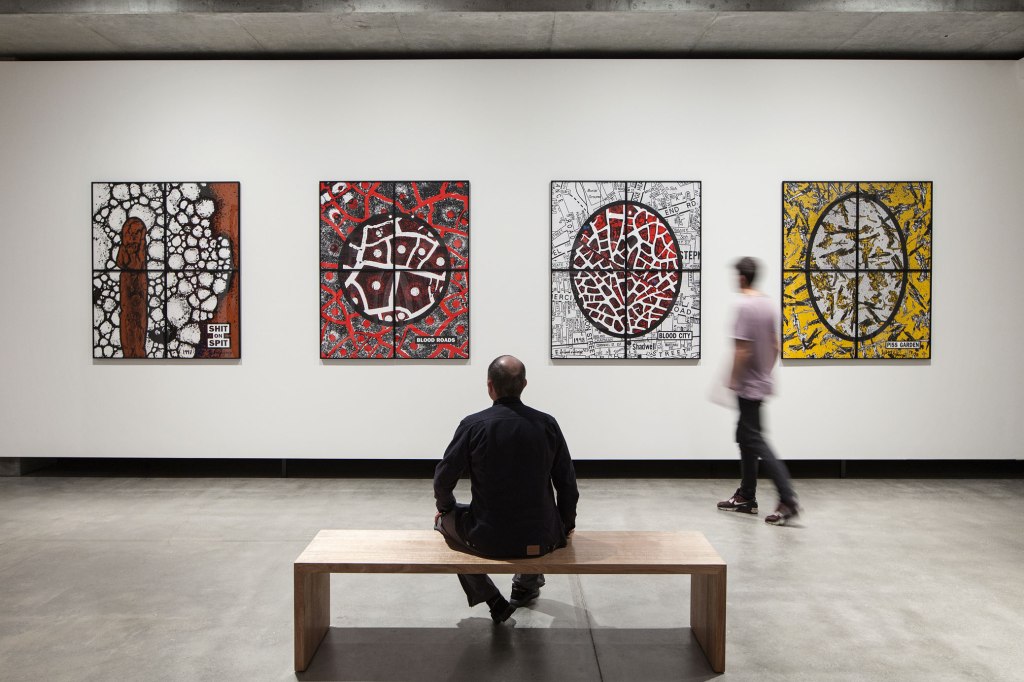
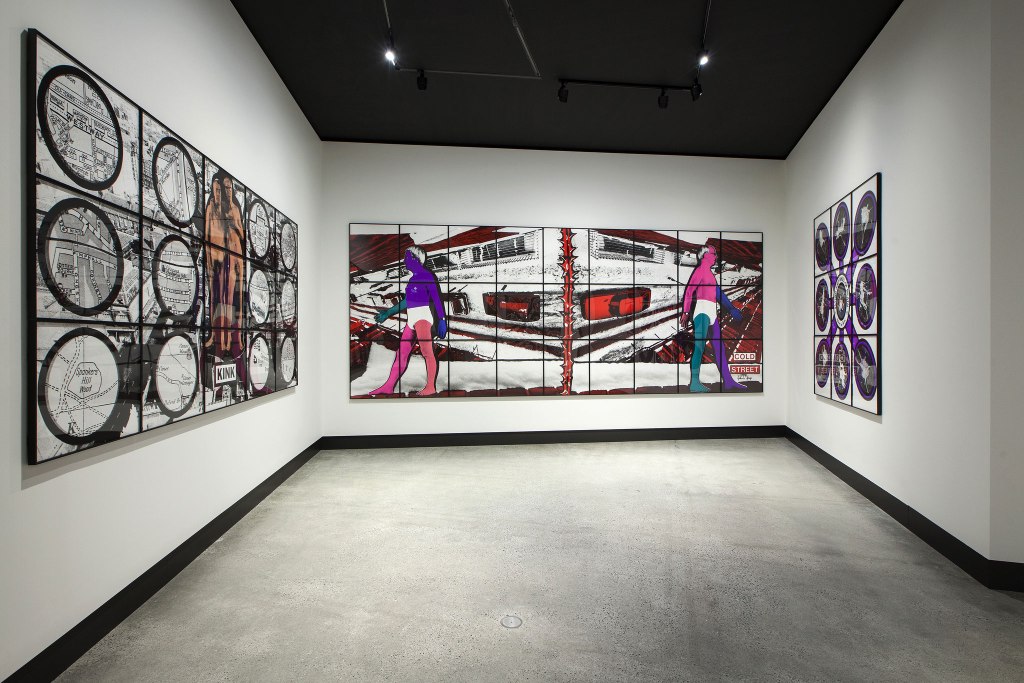
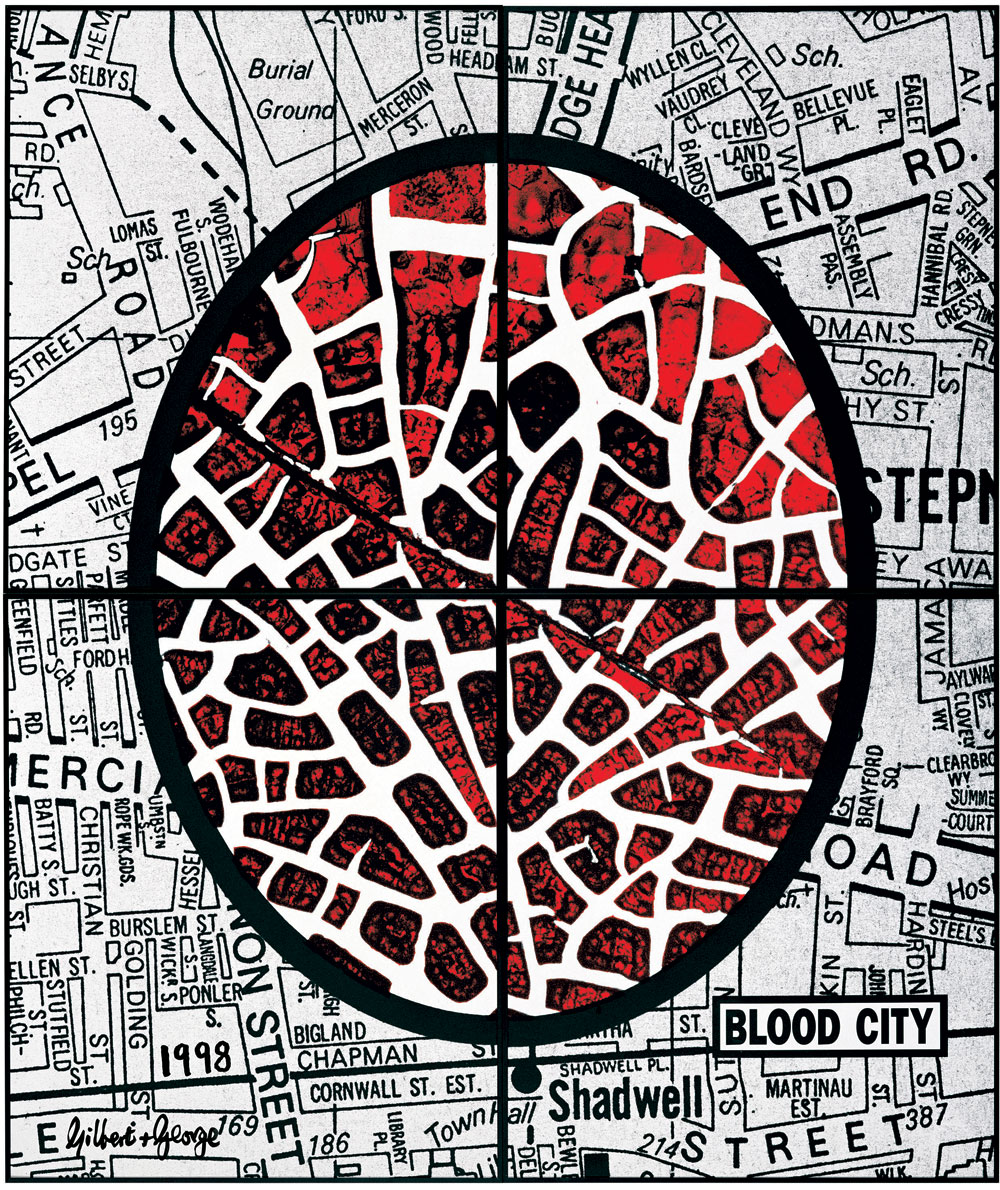
The Rudimentary Pictures, presents thirty-three new works, in which they explore such themes as alienation, sex, race, and human existence. Many of these striking pictures extend the distinctive range of images they have created exploring city life. In Gum City, City Sweat, Money City, Blood City, Piss City, Sex City and Crying City, backgrounds of London street plans are combined with map-like microscopic details of blood, sweat, tears, urine and semen, together with themselves.

Barry Grayshon. “Gilbert and George – The Rudimentary Pictures (1998),” on the Pinterest website [Online] Cited 16/03/2016


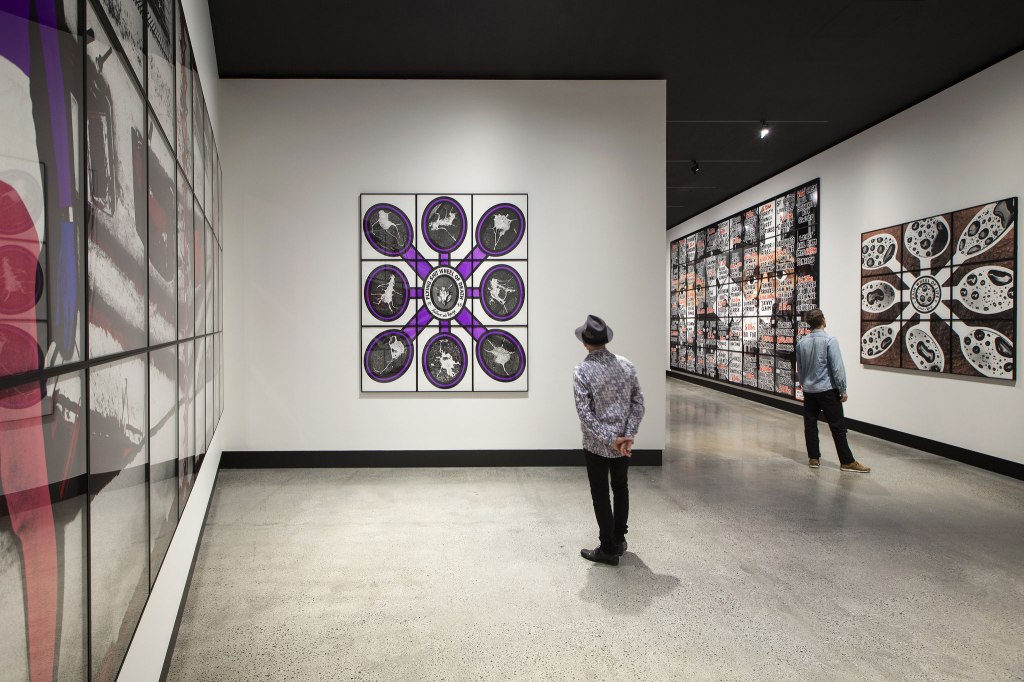
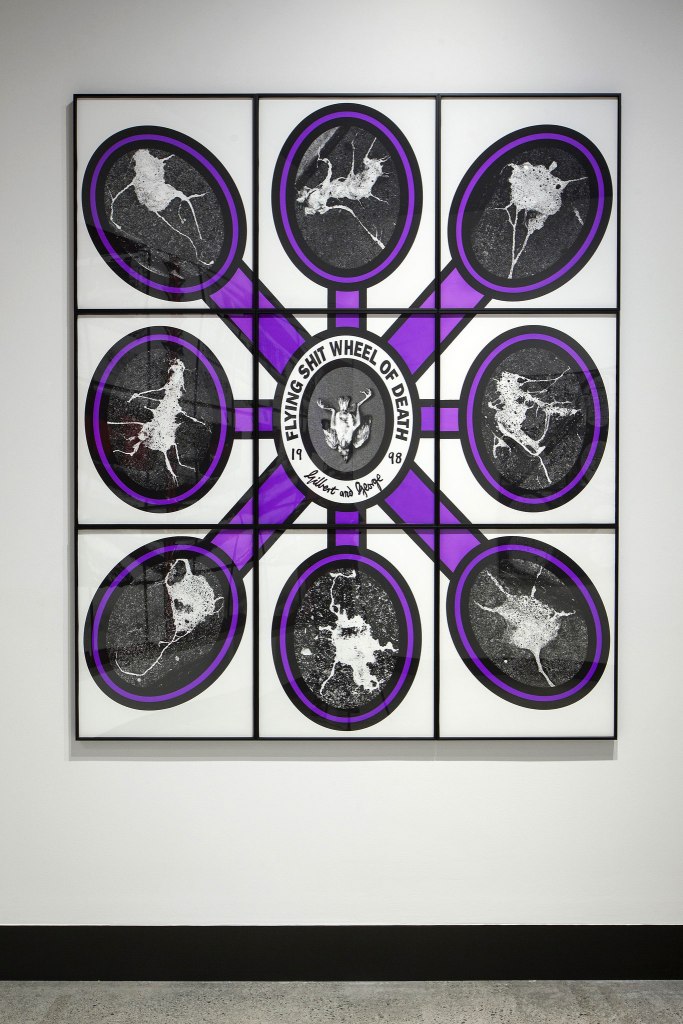
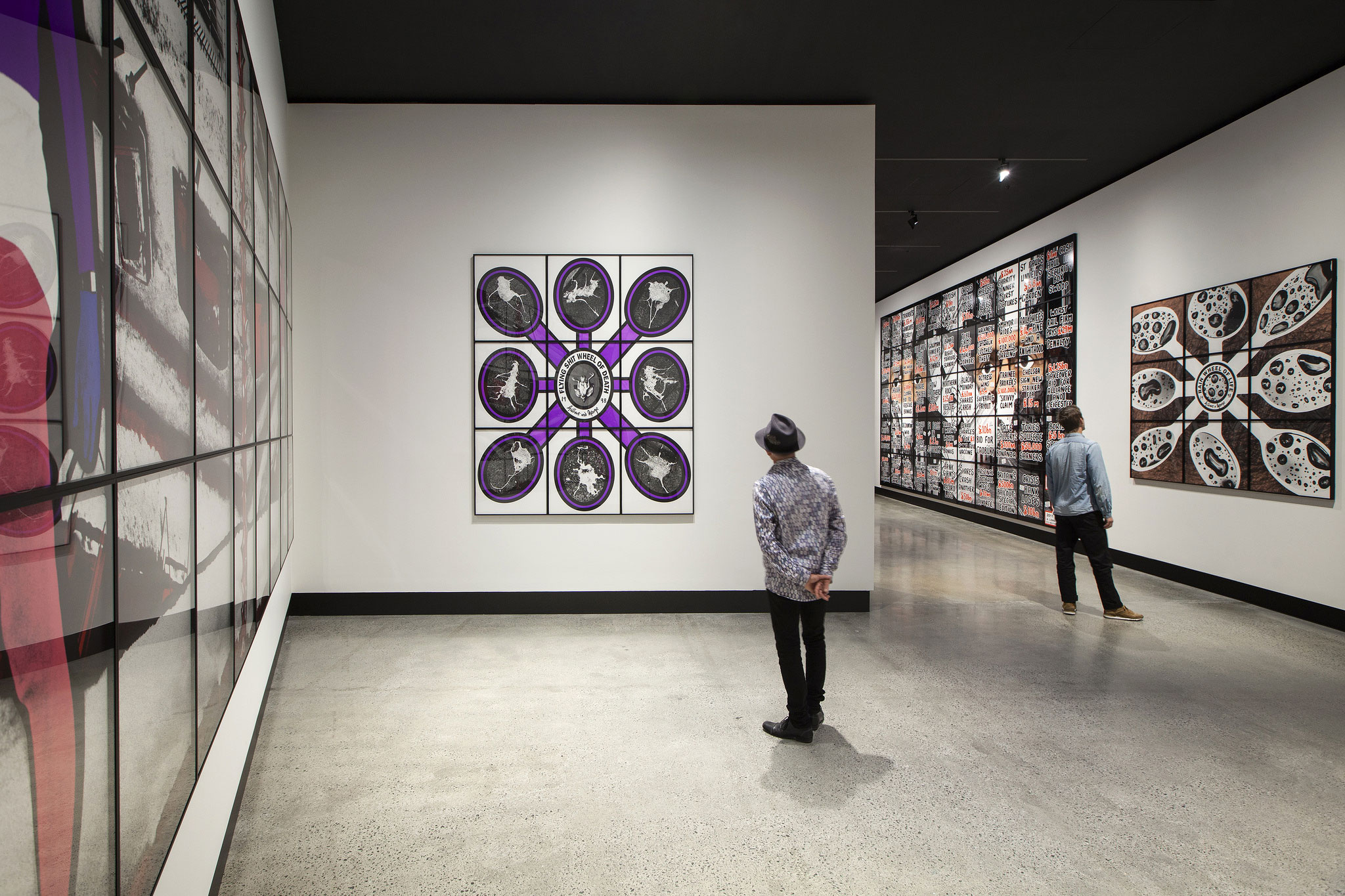
Installation view of the exhibition ‘Gilbert & George: The Art Exhibition’ at the Museum of Old and New Art, Hobart showing at middle, 'FLYING SHIT WHEEL OF DEATH' (1998); and at right, 'RAIN WHEEL OF LIFE' (1998), both from 'The Rudimentary Pictures'


Installation view of the exhibition Gilbert & George: The Art Exhibition at the Museum of Old and New Art, Hobart showing at middle, FLYING SHIT WHEEL OF DEATH (1998) and, at right, RAIN WHEEL OF LIFE (1998), both from The Rudimentary Pictures


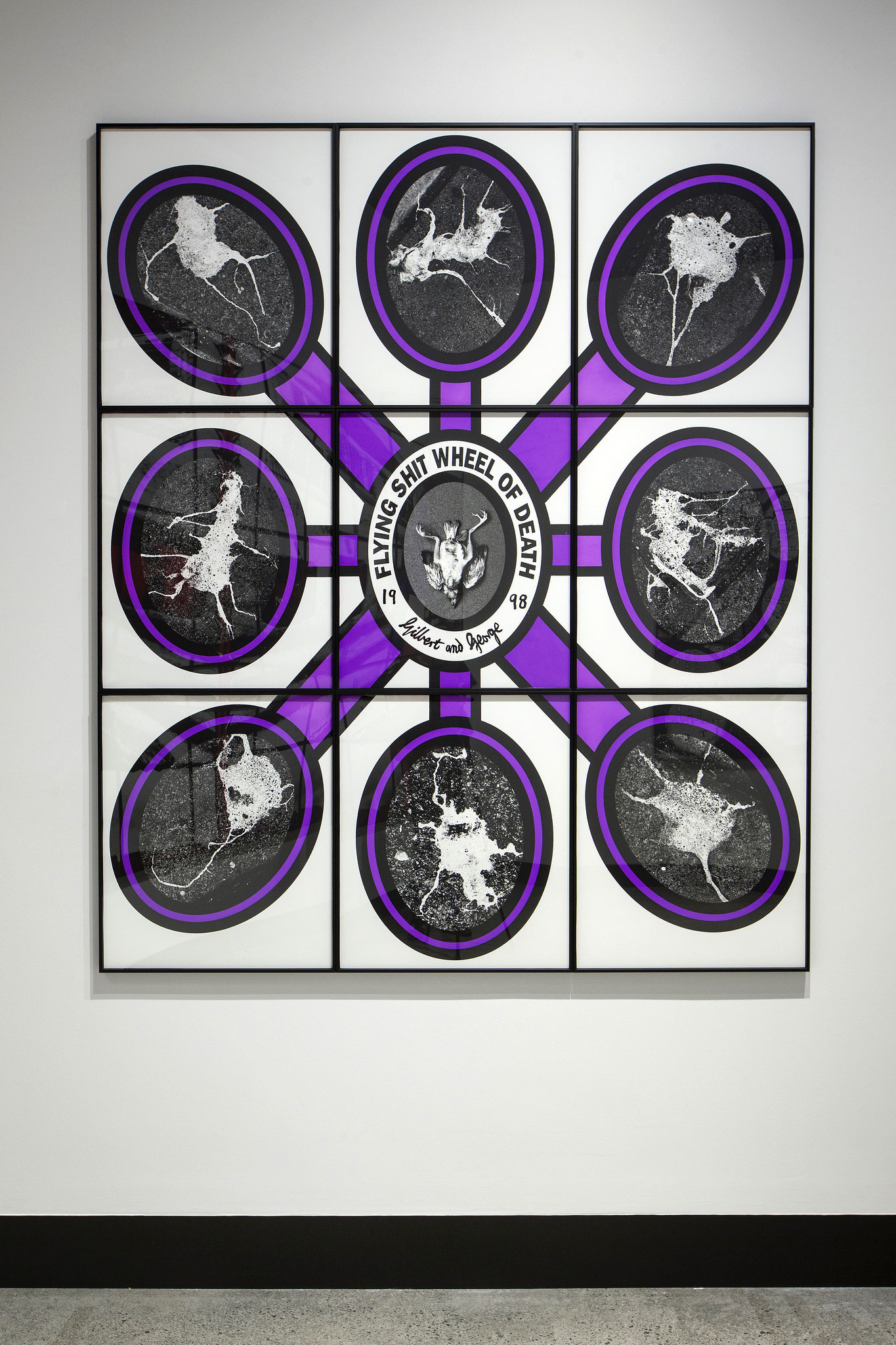
Gilbert & George (Gilbert Prousch, British born Italy, 1943; George Passmore, British, b. 1942) 'FLYING SHIT WHEEL OF DEATH' 1998 (installation view)


Gilbert & George (Gilbert Prousch, British born Italy, 1943; George Passmore, British, b. 1942)
FLYING SHIT WHEEL OF DEATH (installation view)
1998
from the series The Rudimentary Pictures


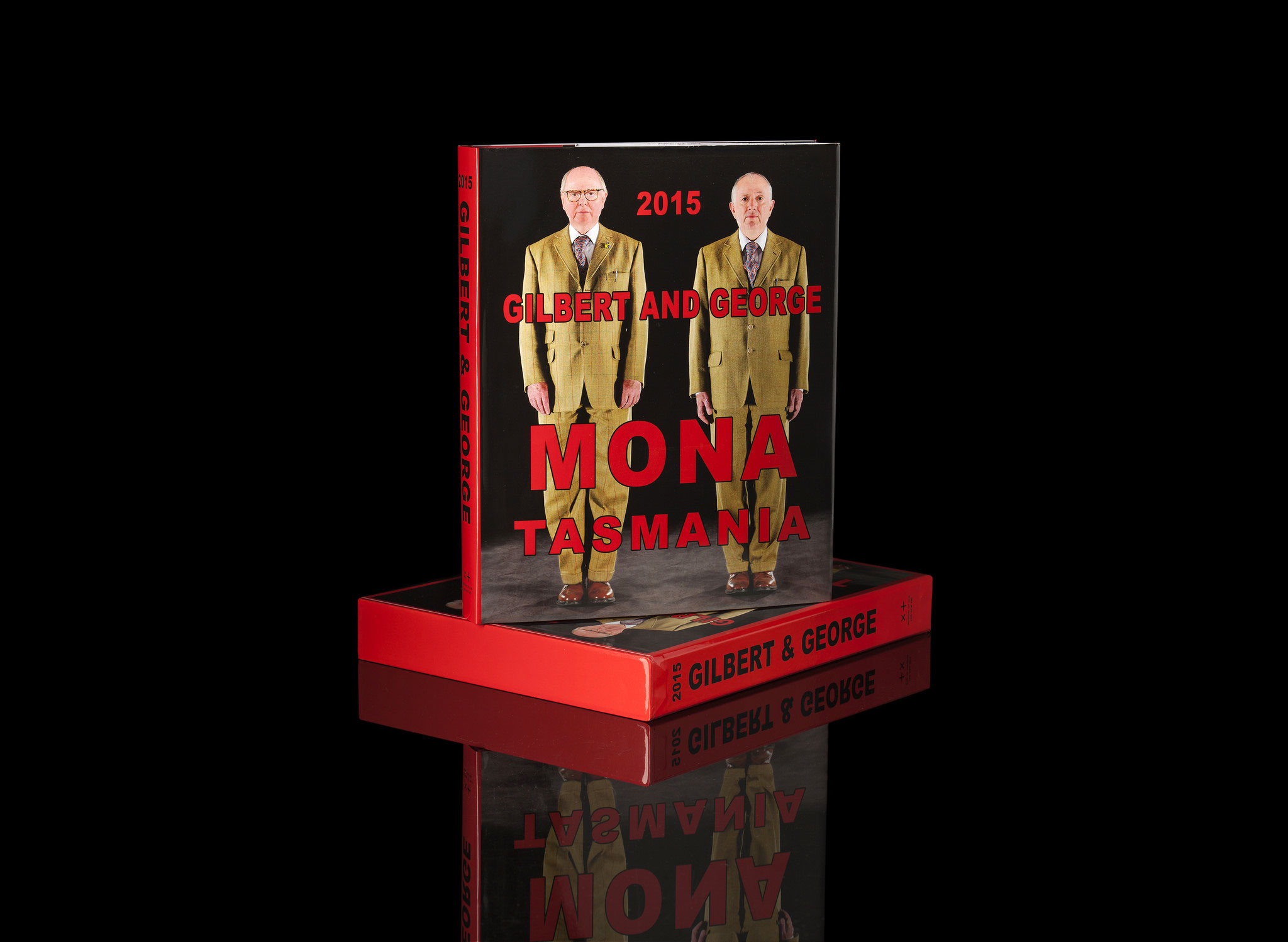
Gilbert & George hardcover catalogue from MONA


Gilbert & George hardcover catalogue
Photo Credit: Mona/Rémi Chauvin
Image Courtesy Mona, Museum of Old and New Art, Hobart, Tasmania, Australia


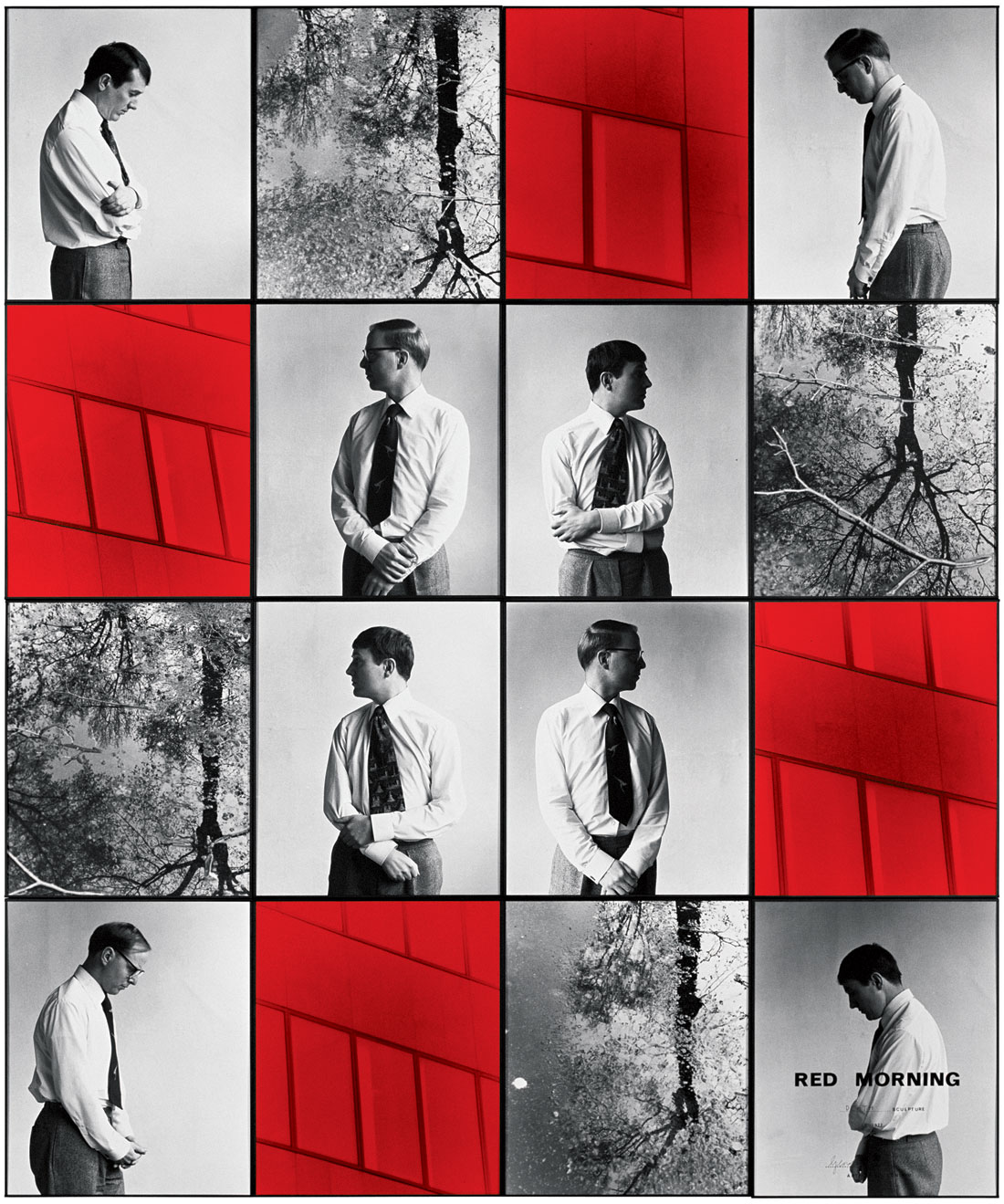
Gilbert & George (Gilbert Prousch, British born Italy, 1943; George Passmore, British, b. 1942) 'RED MORNING DEATH' 1977


Gilbert & George (Gilbert Prousch, British born Italy, 1943; George Passmore, British, b. 1942)
RED MORNING DEATH
1977
Mixed media
241 x 201cm
Private collection


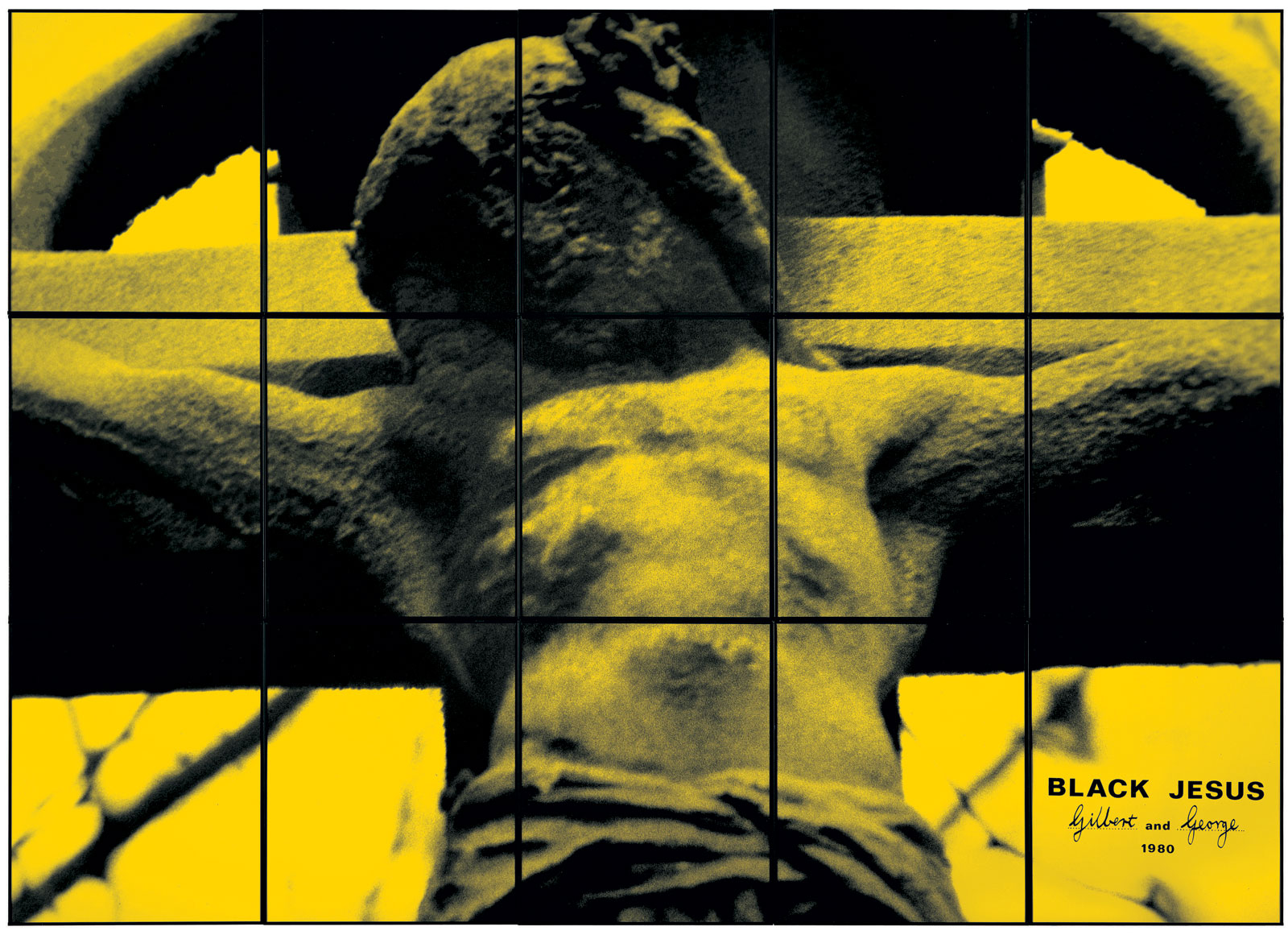
Gilbert & George (Gilbert Prousch, British born Italy, 1943; George Passmore, British, b. 1942) 'BLACK JESUS' 1980


Gilbert & George (Gilbert Prousch, British born Italy, 1943; George Passmore, British, b. 1942)
BLACK JESUS
1980
Mixed media
181 x 251cm
Private collection


In the early 1980s, Gilbert & George began to add a range of bright colours to their photographic images. They dramatically expanded their palette although black & white still remained. The series of photo-pieces that emerge during this vibrant period display a heightened reality, moving away from the earlier naturalism. They also began photographing each other as gargoyles, producing large close-ups of their faces, lit from below, grimacing horribly.

Barry Grayshon. “Gilbert and George – Mixed Media (1980),” on the Pinterest website [Online] Cited 16/03/2016


“… In a show as vast as the MONA survey, one sees the shit pictures as only a small chapter in their catalogue of would-be outrages. There are microscopic close-ups of their own sweat, blood, piss and sperm, presented as a form of decorative art. There are galleries of handsome young men, lined up like homoerotic altarpieces. There are works that excoriate religion – all forms of religion – and nationalism.

It would be an understatement to say these works sail close to the edge – they have plunged joyously over the precipice, beyond any conventions of good or bad taste. The “moral dimension” Gilbert & George seek is a systematic attempt to explode everything they see as false morality and hypocrisy. Homophobia is a constant target, as is racism and religious dogmatism. They are not the first to see organised religion as the root of all evil, but few artists or thinkers have been so consistently, so violently anti-religious.

The joke, of course, is that they look and act like conservative businessmen. Even their most confronting works are as bold and colourful as advertising billboards, or perhaps stained glass windows. They are iconoclastic non-entities making art that attracts and repels.

From behind a façade of consummate Englishness they set out to expose the grossness and depravity of the world around them. The Jack Freak Pictures (2008) use images of the Union Jack combined with grotesque morphings of their own figures that make them look like demons or mutants. The London Pictures (2011) use hundreds of daily newspaper banners, purloined from newsagents, to produce a chorus of sordidness and sensationalism.

We see two deadpan comedians enjoying the adolescent humour of exposing themselves to an audience, making wall-sized images of all those things not spoken of in ‘polite’ society. I could almost accept the idea of Gilbert & George as two overgrown children, intent on making mischief, but every so often they hit the mark with surprising force.”

John McDonald. “Gilbert & George,” on the John McDonald website December 4, 2015 [Online] Cited 11/03/2016.


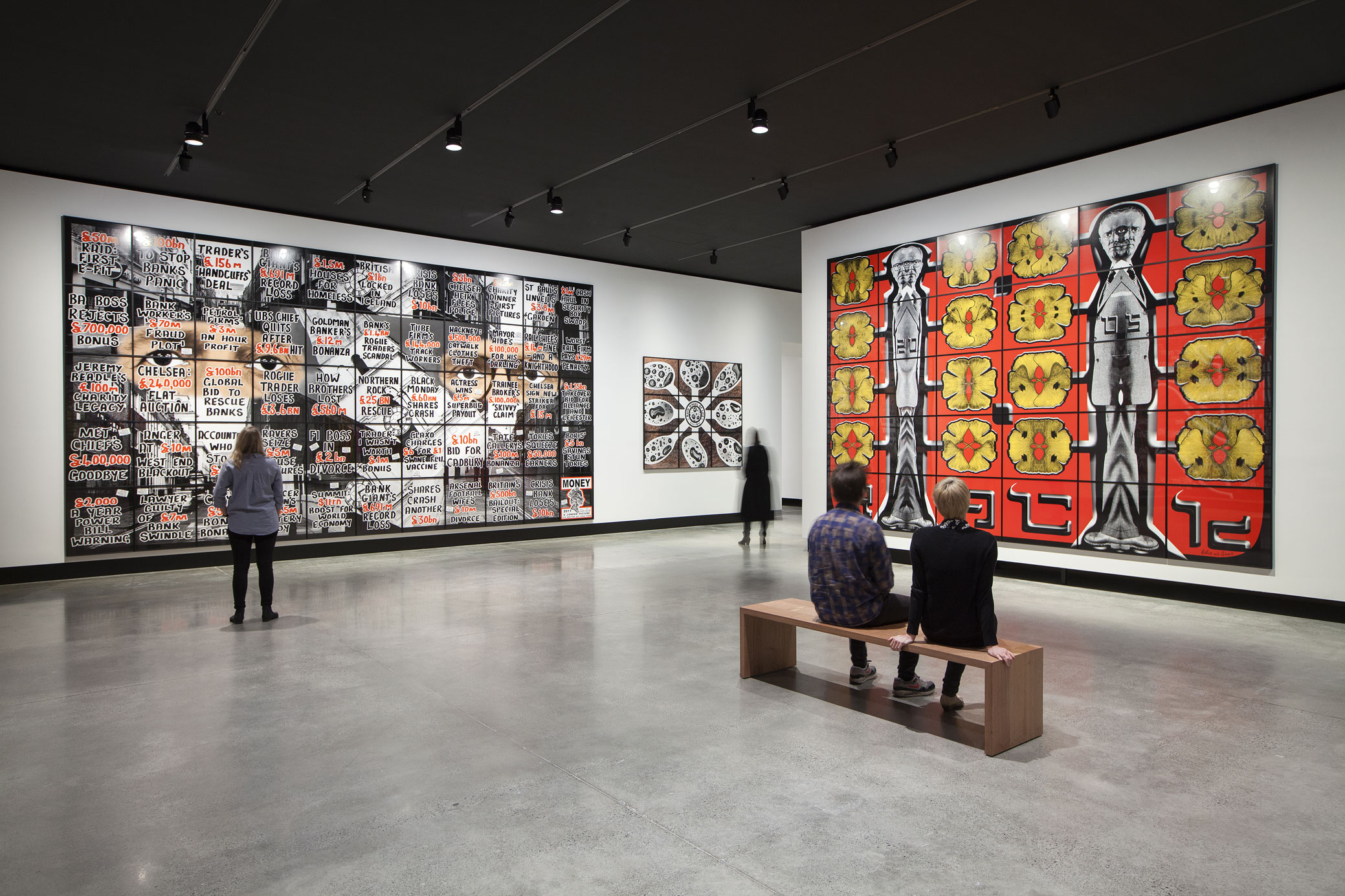
Installation view of the exhibition ‘Gilbert & George: The Art Exhibition’ at the Museum of Old and New Art, Hobart showing at left, 'MONEY' (2011) from 'The London Pictures' and, at right, 'Raack' (2005) from 'Ginkgo Pictures'


Installation view of the exhibition Gilbert & George: The Art Exhibition at the Museum of Old and New Art, Hobart showing at left, MONEY (2011) from The London Pictures and, at right, Raack (2005) from Ginkgo Pictures


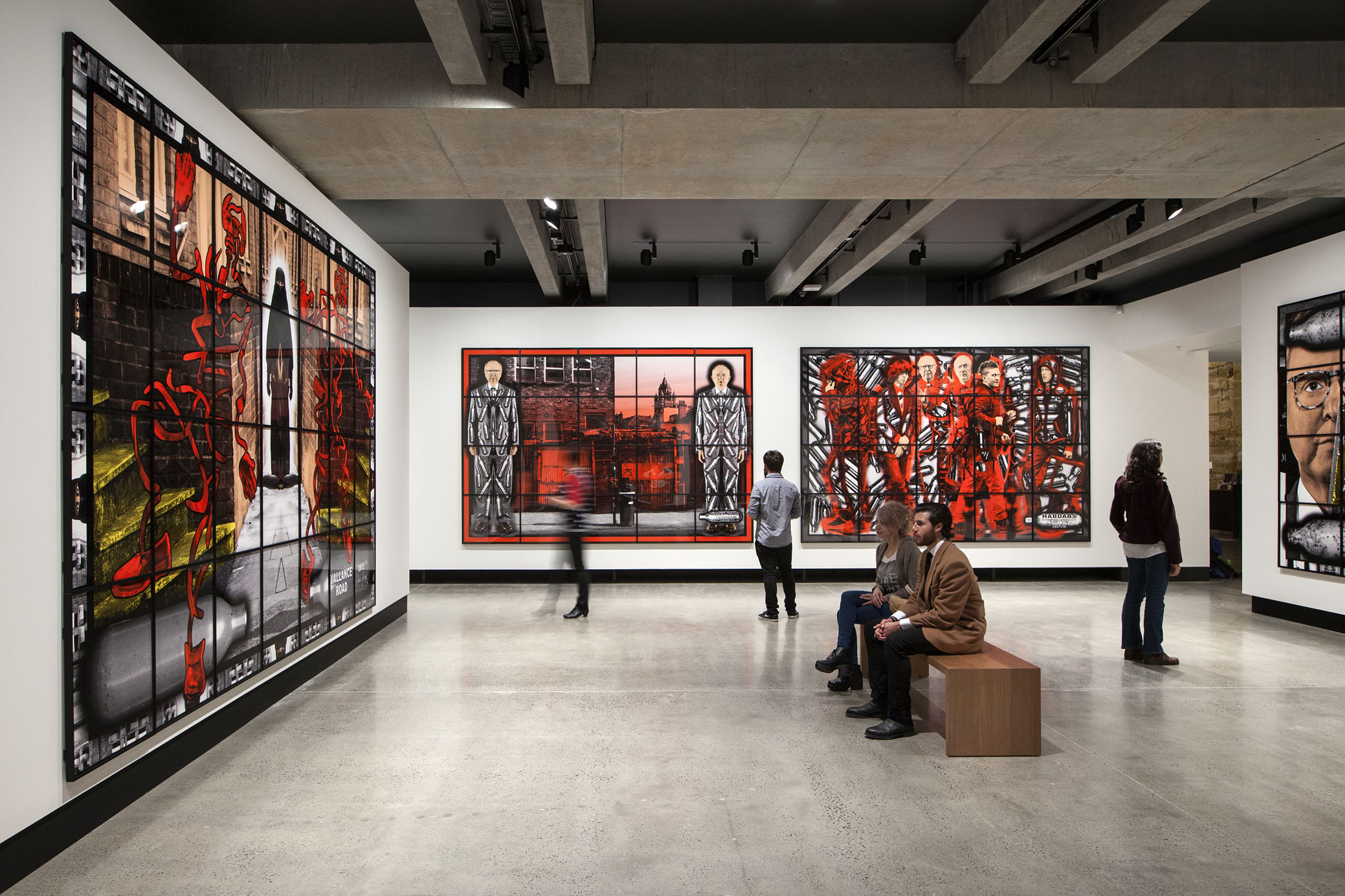
Installation view of the exhibition ‘Gilbert & George: The Art Exhibition’ at the Museum of Old and New Art, Hobart showing at left, 'VALLANCE ROAD' (2013); at centre left 'RIDLEY ROAD' (2013) and at centre right 'HABDABS' (2013) all from the series 'Scapegoating Pictures'


Installation view of the exhibition Gilbert & George: The Art Exhibition at the Museum of Old and New Art, Hobart showing at left, VALLANCE ROAD (2013); at centre left RIDLEY ROAD (2013) and at centre right HABDABS (2013) all from the series Scapegoating Pictures


There are 292 pieces in this series featuring whippets and hippy crack (laughing gas). The SCAPEGOATING PICTURES unflinchingly describe the volatile, tense, accelerated and mysterious reality of our increasingly technological, multi-faith and multi-cultural world. It is a world in which paranoia, fundamentalism, surveillance, religion, accusation and victimhood become moral shades of the city’s temper.

Barry Grayshon. “Gilbert and George – Scapegoating Pictures for London (2013),” on the Pinterest website [Online] Cited 16/03/2016


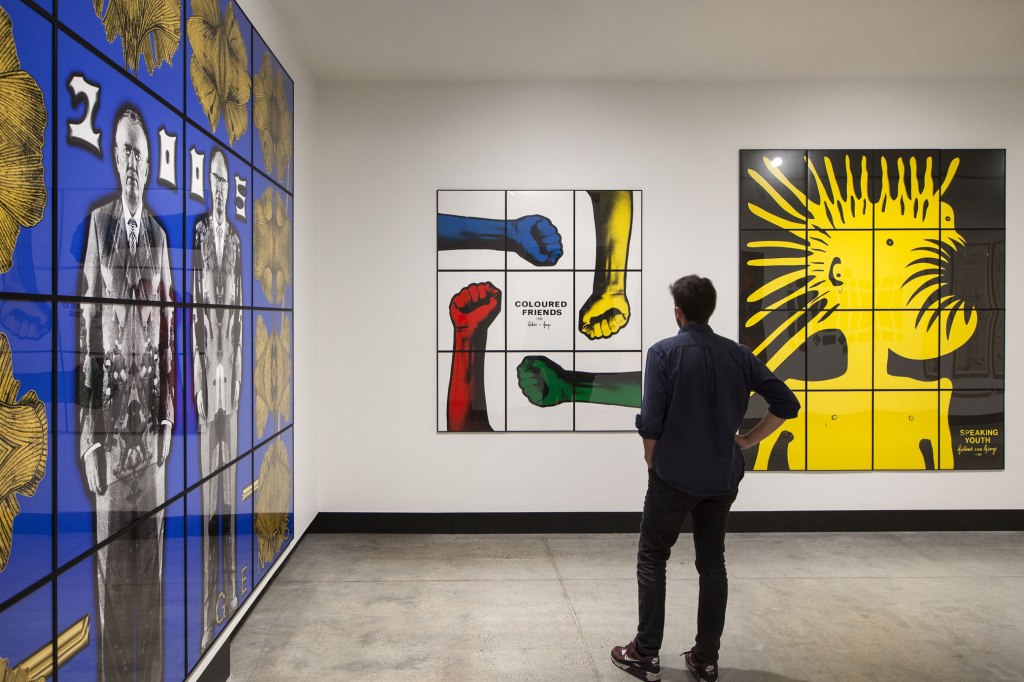
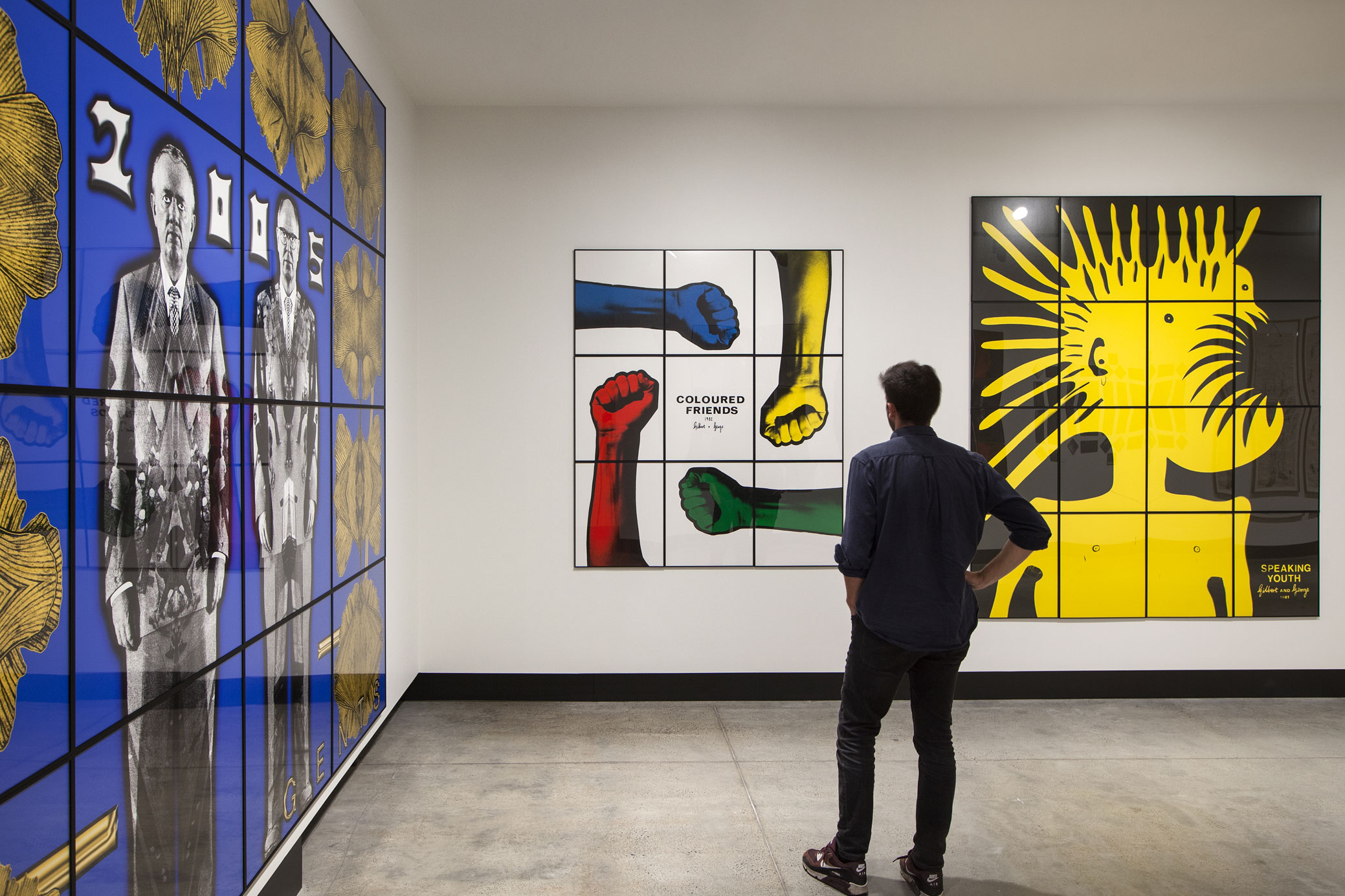
Installation view of the exhibition ‘Gilbert & George: The Art Exhibition’ at the Museum of Old and New Art, Hobart showing at left, 'Citied Gents' (2005) from 'Ginkgo Pictures'; at left rear, 'COLOURED FRIENDS' (1982); and at right rear 'SPEAKING YOUTH' (1981)


Installation view of the exhibition Gilbert & George: The Art Exhibition at the Museum of Old and New Art, Hobart showing at left, Citied Gents (2005) from Ginkgo Pictures; at left rear, COLOURED FRIENDS (1982); and at right rear SPEAKING YOUTH (1981)


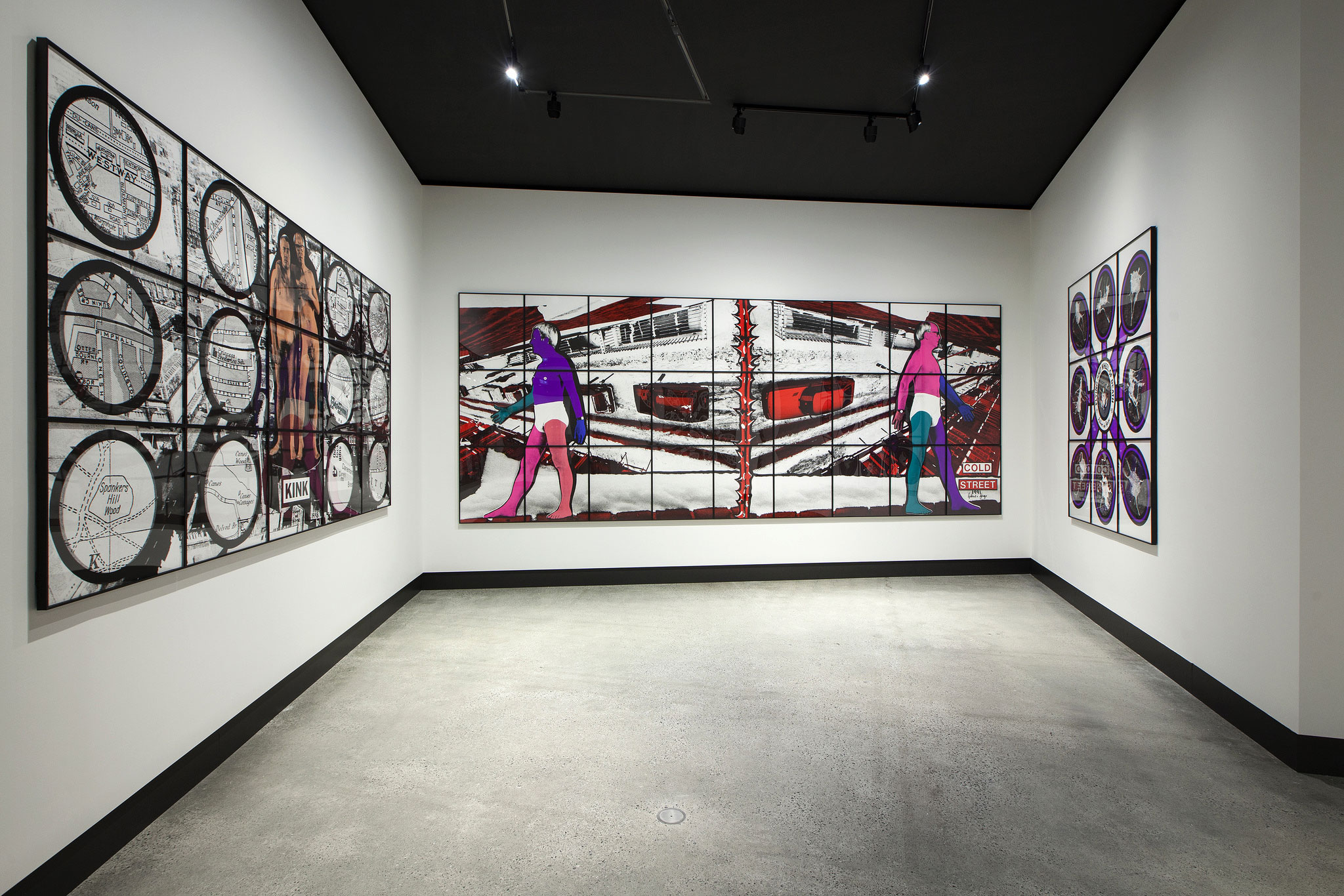
Installation view of the exhibition ‘Gilbert & George: The Art Exhibition’ at the Museum of Old and New Art, Hobart showing at left, 'RAIN WHEEL OF LIFE' (1998), and at right 'KINK' (1998), both from 'The Rudimentary Pictures'


Installation view of the exhibition Gilbert & George: The Art Exhibition at the Museum of Old and New Art, Hobart showing at left, RAIN WHEEL OF LIFE (1998), and at right KINK (1998), both from The Rudimentary Pictures


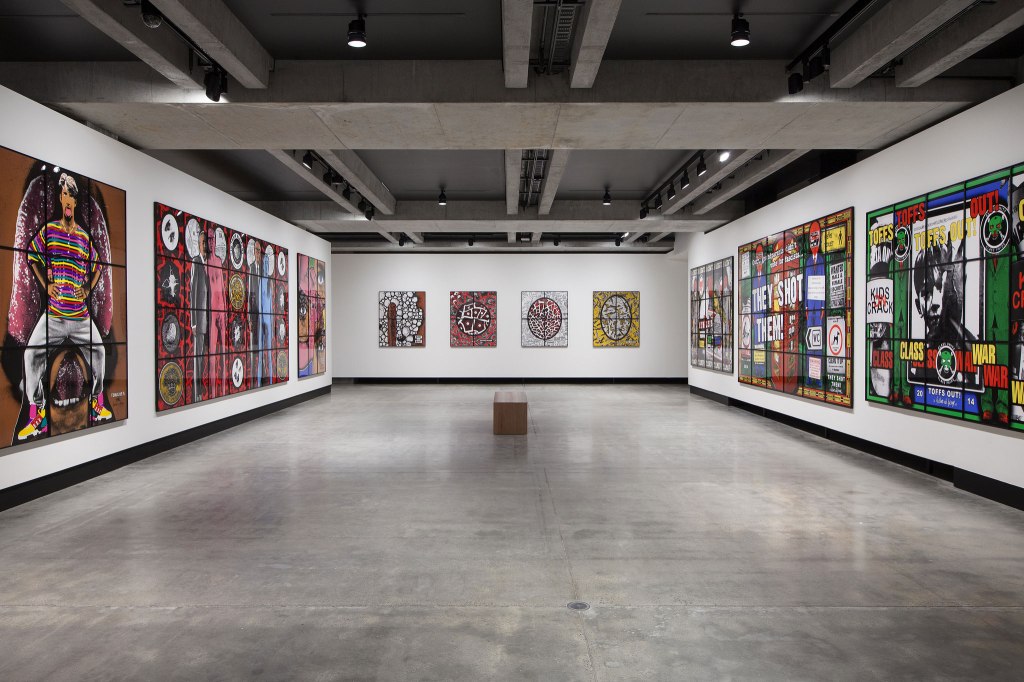
Installation view of the exhibition ‘Gilbert & George: The Art Exhibition’ at the Museum of Old and New Art, Hobart showing at left, 'TONGUES' (1992) followed by 'IN THEIR ELEMENT' (1998) from the series 'The Rudimentary Pictures' followed by 'FIVE' (1992); to the right 'TOFF'S OUT!' (2014) followed by 'THEY SHOT THEM!' (2014), both from the series 'Utopian Pictures'


Installation view of the exhibition Gilbert & George: The Art Exhibition at the Museum of Old and New Art, Hobart showing at left, TONGUES (1992) followed by IN THEIR ELEMENT (1998) from the series The Rudimentary Pictures followed by FIVE (1992); to the right TOFF’S OUT! (2014) followed by THEY SHOT THEM! (2014), both from the series Utopian Pictures


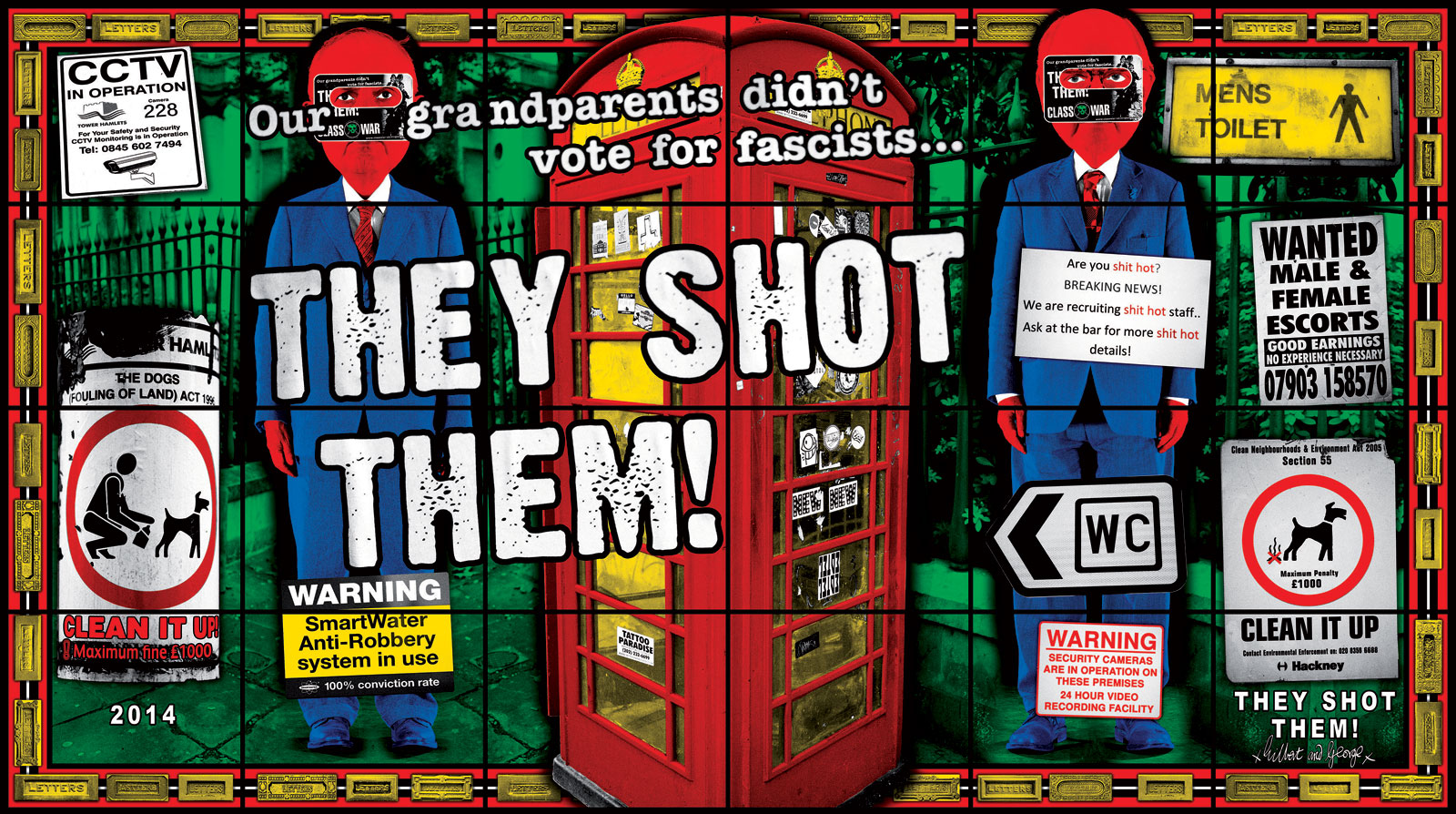
Gilbert & George (Gilbert Prousch, British born Italy, 1943; George Passmore, British, b. 1942) 'THEY SHOT THEM!' 2014


Gilbert & George (Gilbert Prousch, British born Italy, 1943; George Passmore, British, b. 1942)
THEY SHOT THEM!
2014
Mixed media
254 x 453 cm
Courtesy of ARNDT and Gilbert & George


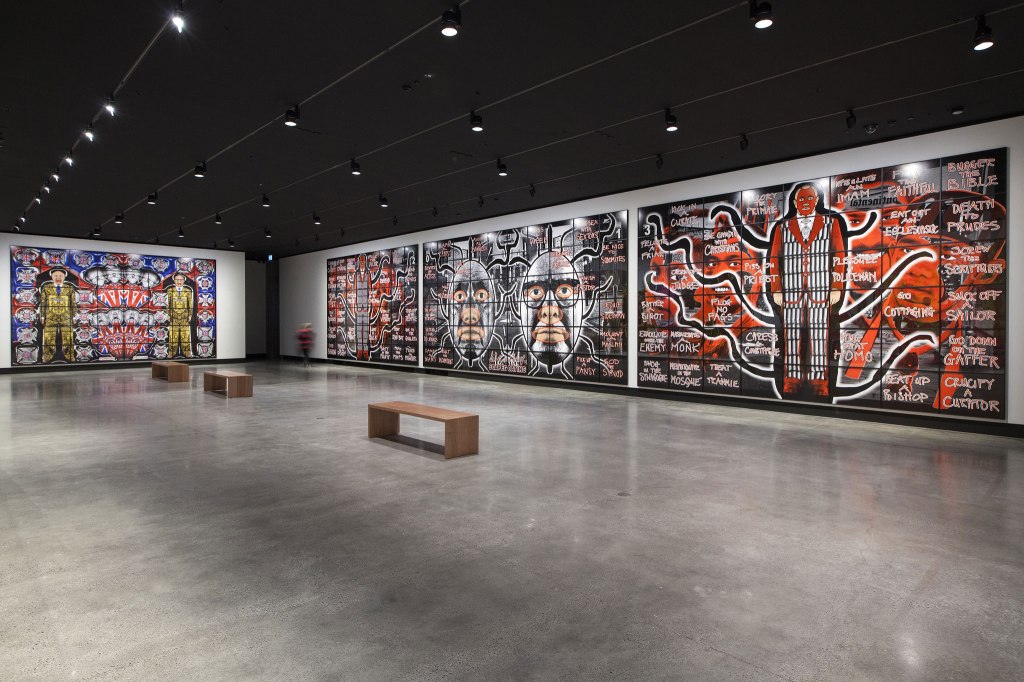
The 26 UTOPIAN PICTURES convey, like an energy storm, the frenetic forces of an endlessly embattled state: between the voices of authority and civic order. These pictures depict a modern world in which authority and the resentment of authority, rules and rebellion, advertising and public information, dogma and warning, boasts and threats co-exist in seemingly endless proclamations.

Barry Grayshon. “Gilbert and George – Utopian Pictures (2014),” on the Pinterest website [Online] Cited 16/03/2016


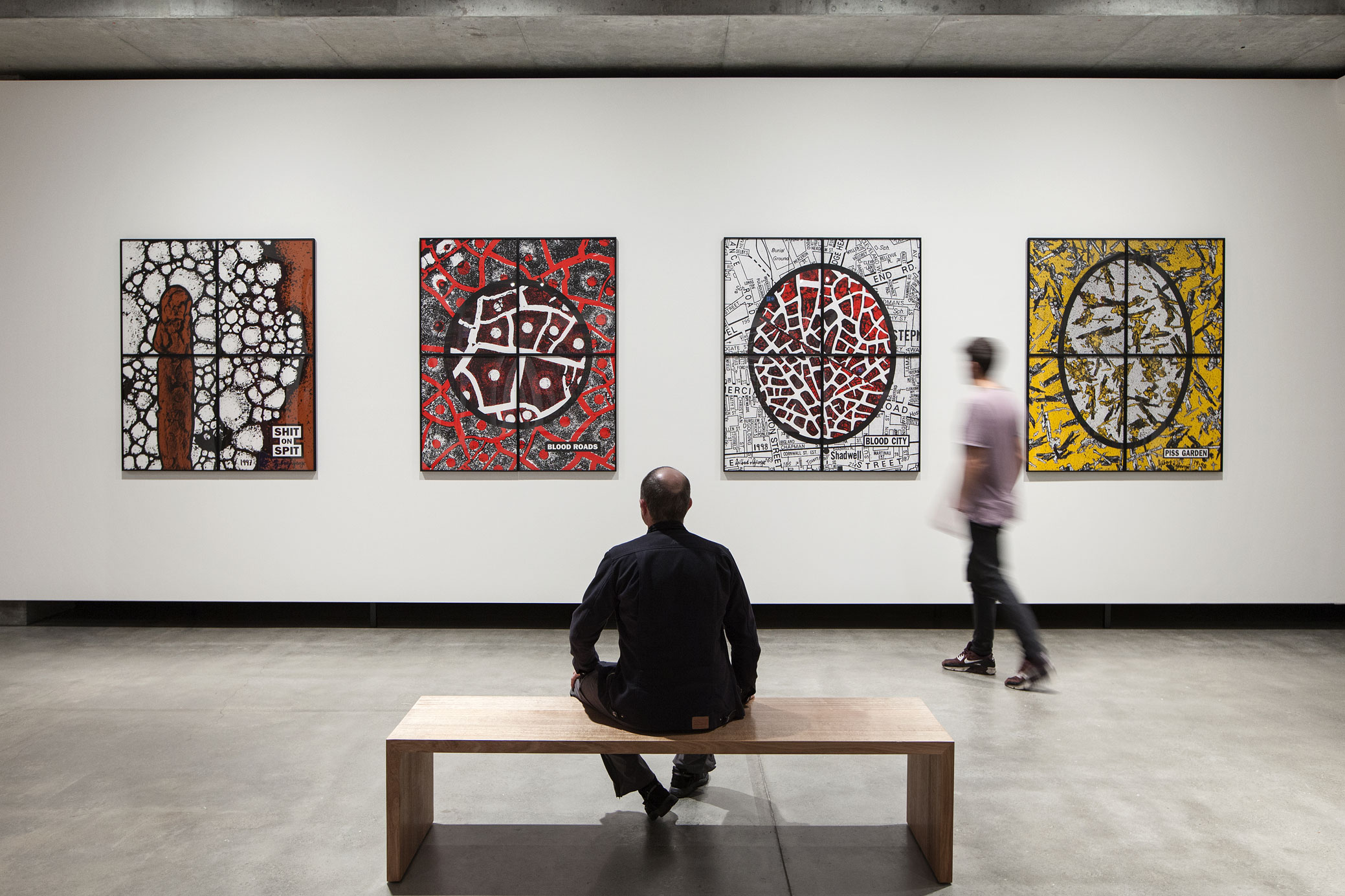
Installation view of the exhibition ‘Gilbert & George: The Art Exhibition’ at the Museum of Old and New Art, Hobart showing from left to right, 'SHIT ON SPIT' (1997) from 'The New Testamental Pictures', 'BLOOD ROADS' (1998), 'BLOOD CITY' (1998) and 'PISS GARDEN' (1998) from 'The Rudimentary Pictures'


Installation view of the exhibition Gilbert & George: The Art Exhibition at the Museum of Old and New Art, Hobart showing from left to right, SHIT ON SPIT (1997) from The New Testamental Pictures, BLOOD ROADS (1998), BLOOD CITY (1998) and PISS GARDEN (1998) from The Rudimentary Pictures


Gilbert & George (Gilbert Prousch, British born Italy, 1943; George Passmore, British, b. 1942) 'BLOOD CITY' 1988


Gilbert & George (Gilbert Prousch, British born Italy, 1943; George Passmore, British, b. 1942)
BLOOD CITY
1988
Mixed media
151 x 127 cm
Courtesy of the artists


Installation view of the exhibition ‘Gilbert & George: The Art Exhibition’ at the Museum of Old and New Art, Hobart showing at left, 'KINK' (1998), and at rear, 'COLD STREET' (1991)


Installation view of the exhibition Gilbert & George: The Art Exhibition at the Museum of Old and New Art, Hobart showing at left, KINK (1998), and at rear, COLD STREET (1991)


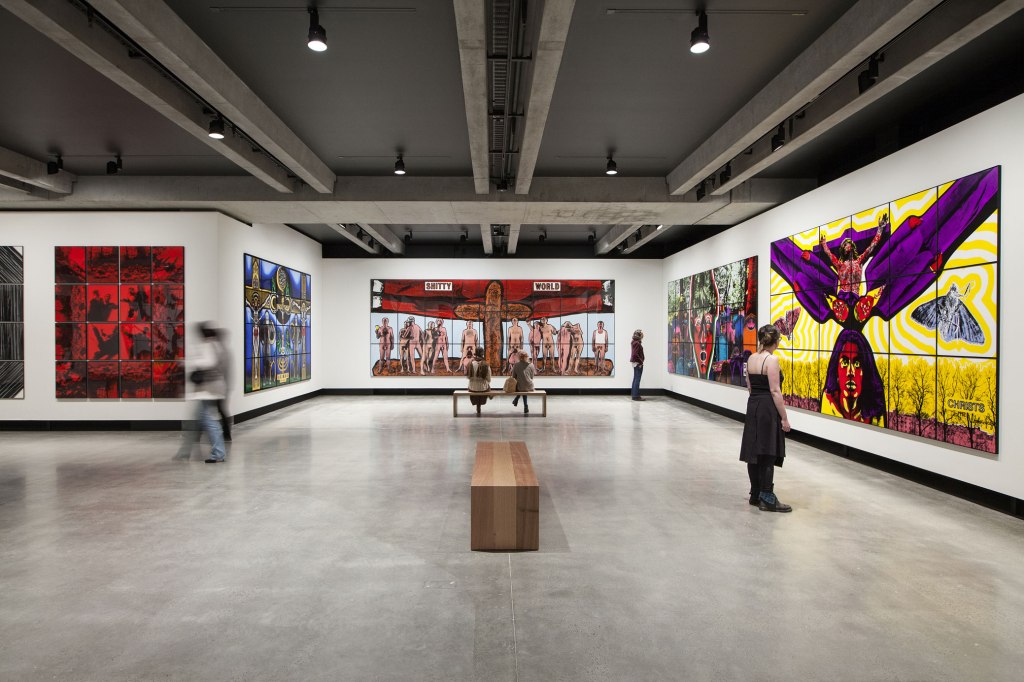
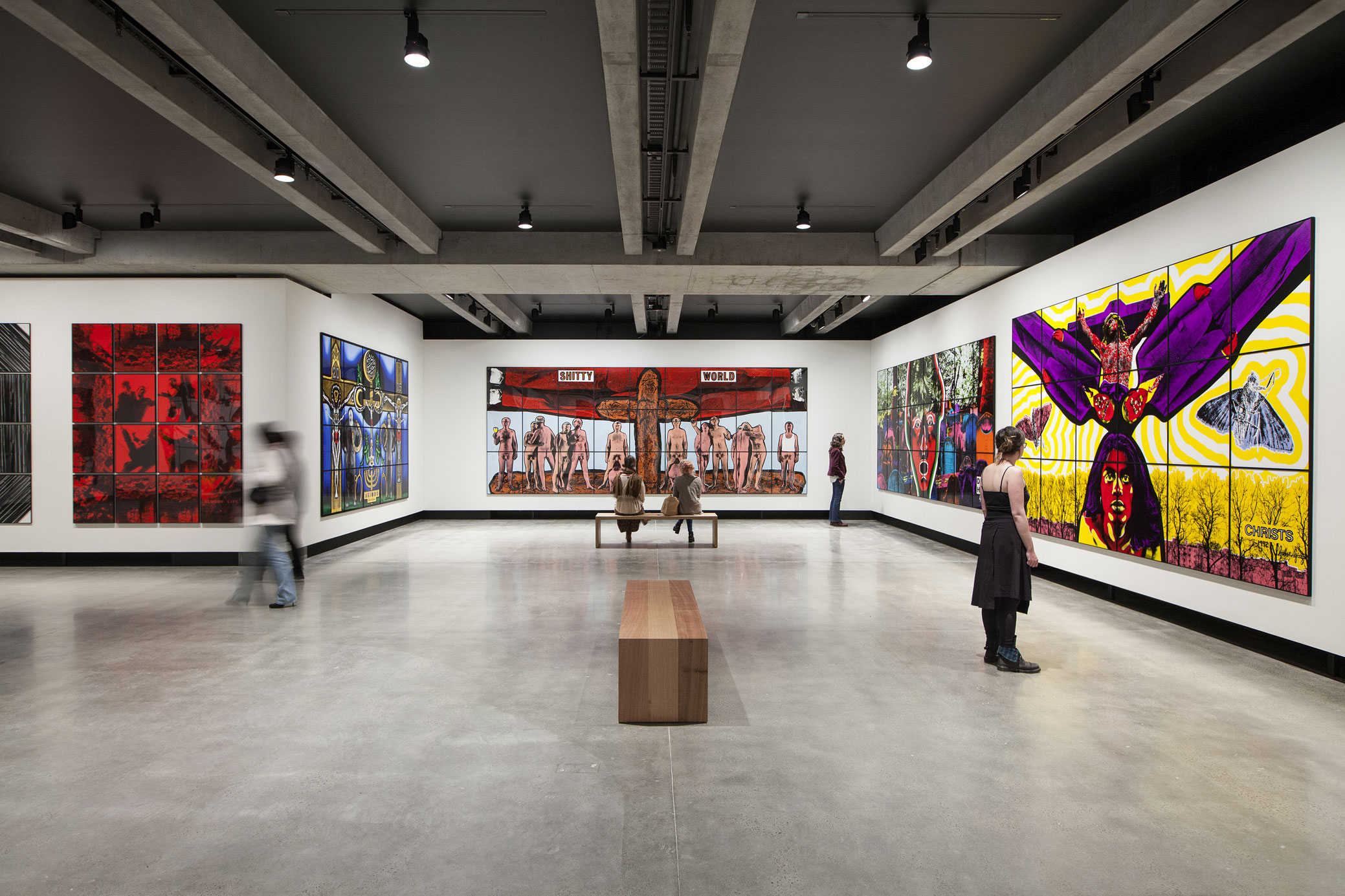
Installation view of the exhibition ‘Gilbert & George: The Art Exhibition’ at the Museum of Old and New Art, Hobart showing from left to right, 'BLOODY LIFE No. 4' (1975), 'AKIMBO' (2005) from 'Sonofagod Pictures', 'SHITTY WORLD' (1994), 'DEAD HEAD' (1989), and 'CHRISTS' (1992) from 'The China Pictures'


Installation view of the exhibition Gilbert & George: The Art Exhibition at the Museum of Old and New Art, Hobart showing from left to right, BLOODY LIFE No. 4 (1975), AKIMBO (2005) from Sonofagod Pictures, SHITTY WORLD (1994), DEAD HEAD (1989), and CHRISTS (1992) from The China Pictures


In the BLOODY LIFE pictures, from 1975, Gilbert & George strike poses with clenched fists and legs kicking. Even the introspective image of the artists in BLOODY LIFE NO.3 is embedded within a frame of alcohol and the boxing ring. The brutality of these pictures reflects their experience at the time. ‘We went through this big destructive period of the drunken scenery, exploring ourselves, exploring our dark side, going out, getting drunk, all those destructive elements’.

Barry Grayshon. “Gilbert and George – Bloody Life (1975),” on the Pinterest website [Online] Cited 16/03/2016


The SONOFAGOD PICTURES consist of 20 paintings that possess a darkly graven strangeness, at once archaic and ultra-modern, in which their temper no less than their signage appears deeply contemporary, ritualistic and disturbed and have all of the dramatic visual impact which one might expect to find in neo-Gothic medievalism.

Christs shows a local youth imagining a butterfly Christ with Gilbert and George wings.


Installation view of the exhibition ‘Gilbert & George: The Art Exhibition’ at the Museum of Old and New Art, Hobart showing at left, 'FORWARD' (2008) and in the middle right, 'SCAPEGOATING' (2013)


Installation view of the exhibition Gilbert & George: The Art Exhibition at the Museum of Old and New Art, Hobart showing at left, FORWARD (2008) and in the middle right, SCAPEGOATING (2013)


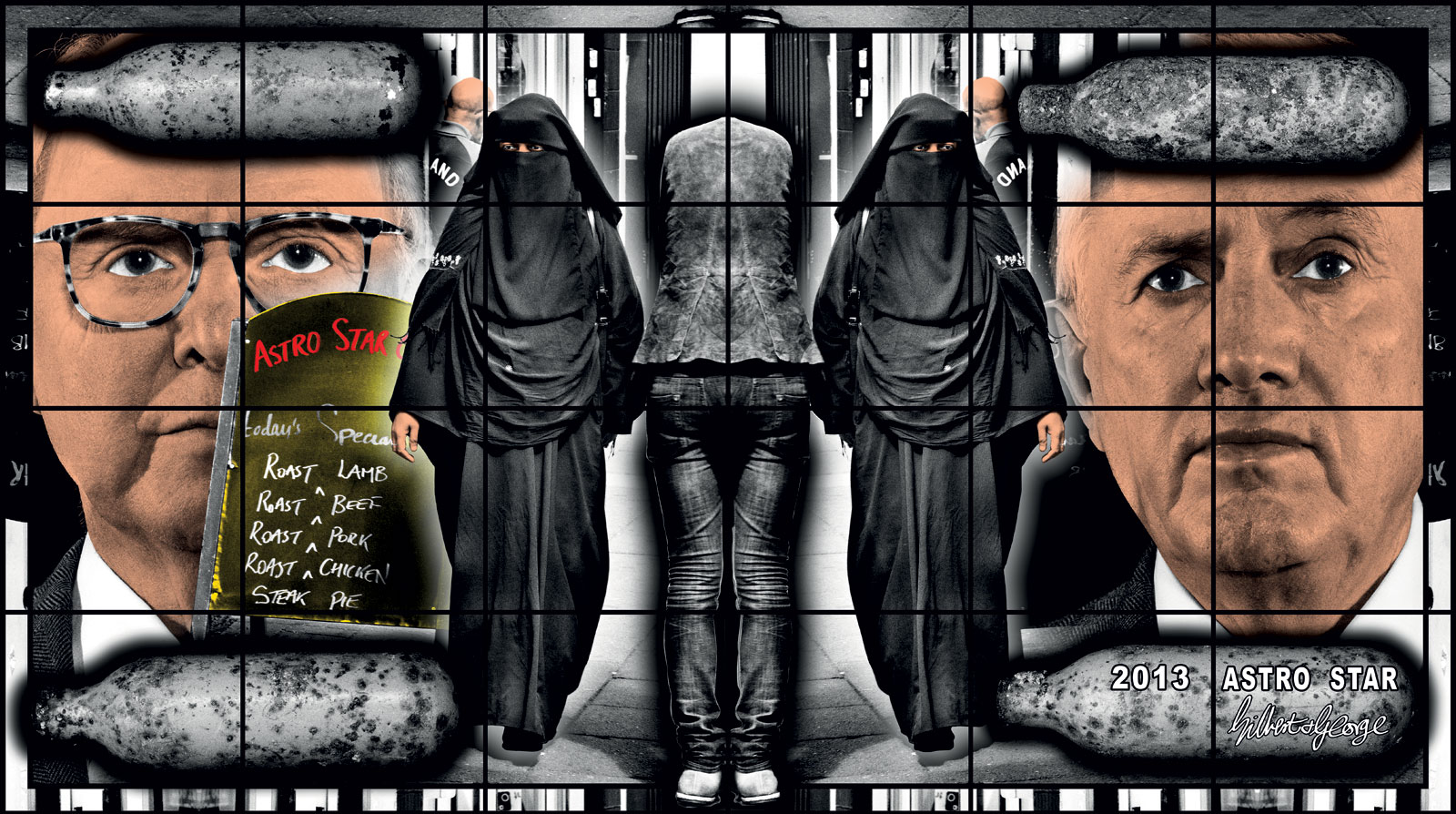
Gilbert & George (Gilbert Prousch, British born Italy, 1943; George Passmore, British, b. 1942) 'ASTRO STAR' 2013


Gilbert & George (Gilbert Prousch, British born Italy, 1943; George Passmore, British, b. 1942)
ASTRO STAR
2013
From Scapegoating Pictures
Picture courtesy of the artists and Mona, Museum of Old and New Art, Tasmania, Australia


There are 292 pieces in this series featuring whippets and hippy crack (laughing gas). The SCAPEGOATING PICTURES unflinchingly describe the volatile, tense, accelerated and mysterious reality of our increasingly technological, multi-faith and multi-cultural world. It is a world in which paranoia, fundamentalism, surveillance, religion, accusation and victimhood become moral shades of the city’s temper.

Barry Grayshon. “Gilbert and George – Scapegoating Pictures for London (2013),” on the Pinterest website [Online] Cited 16/03/2016


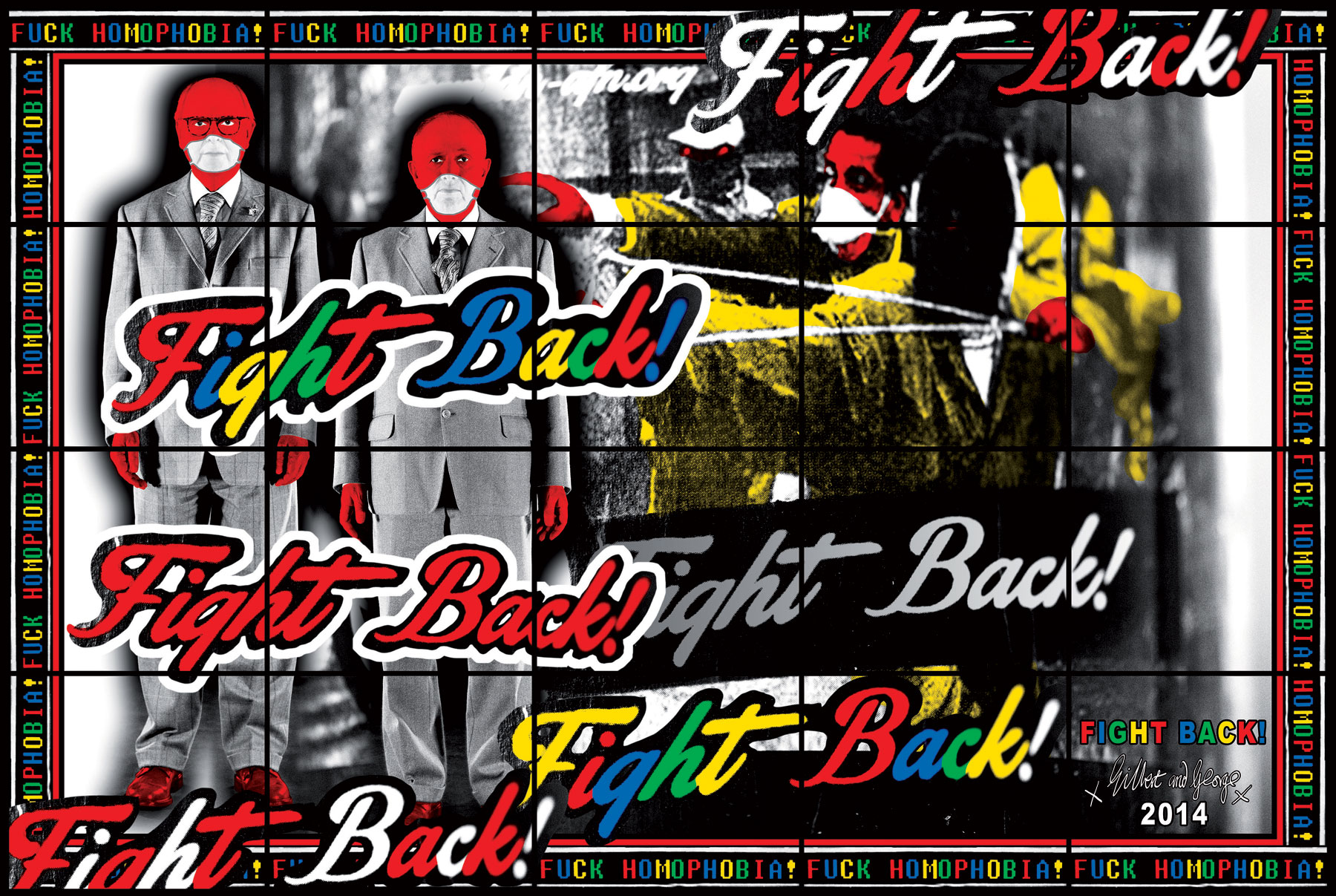
Gilbert & George (Gilbert Prousch, British born Italy, 1943; George Passmore, British, b. 1942) 'FIGHT BACK' 2014


Gilbert & George (Gilbert Prousch, British born Italy, 1943; George Passmore, British, b. 1942)
FIGHT BACK
2014
From the series Utopian Pictures
Mixed media
254 x 377cm
Courtesy of ARNDT and Gilbert & George


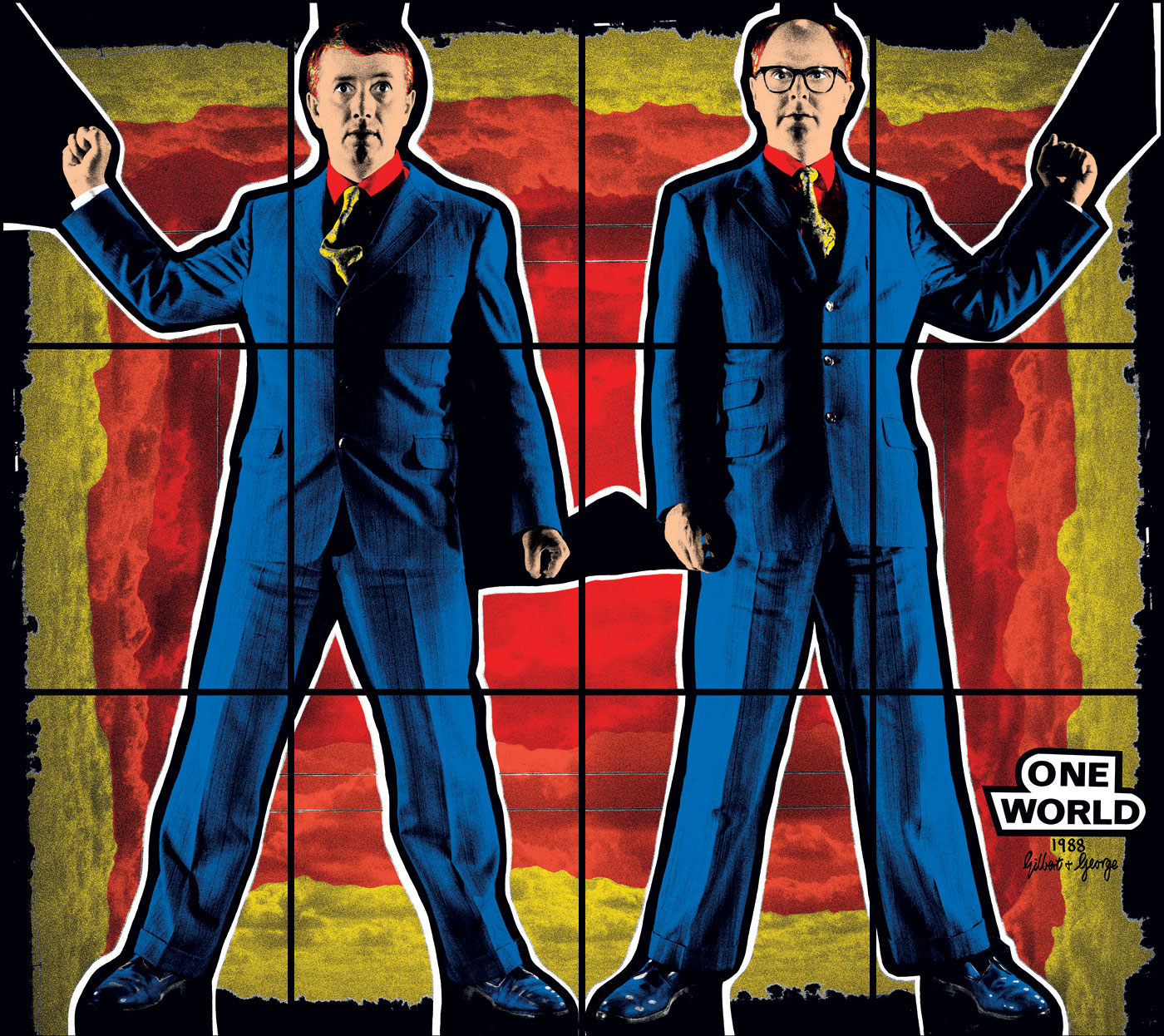
Gilbert & George (Gilbert Prousch, British born Italy, 1943; George Passmore, British, b. 1942) 'ONE WORLD' 1988


Gilbert & George (Gilbert Prousch, British born Italy, 1943; George Passmore, British, b. 1942)
ONE WORLD
1988
Mixed media
226 x 254cm
Courtesy of the artists


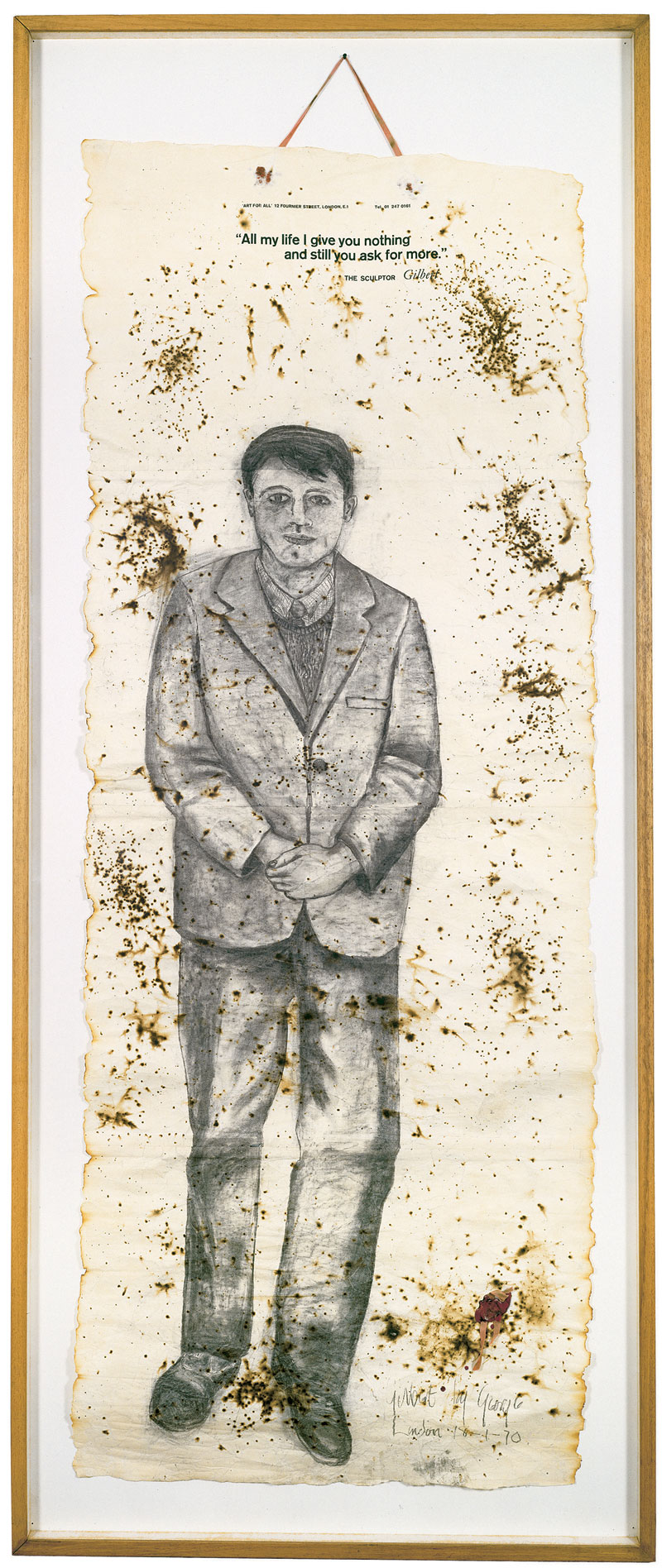
Gilbert & George (Gilbert Prousch, British born Italy, 1943; George Passmore, British, b. 1942) 'ALL MY LIFE I GIVE YOU NOTHING AND STILL YOU ASK FOR MORE' 1970 (Gilbert)


Gilbert & George (Gilbert Prousch, British born Italy, 1943; George Passmore, British, b. 1942)
ALL MY LIFE I GIVE YOU NOTHING AND STILL YOU ASK FOR MORE (Gilbert)
1970
Mixed media
Each 193 x 75cm
Private collection


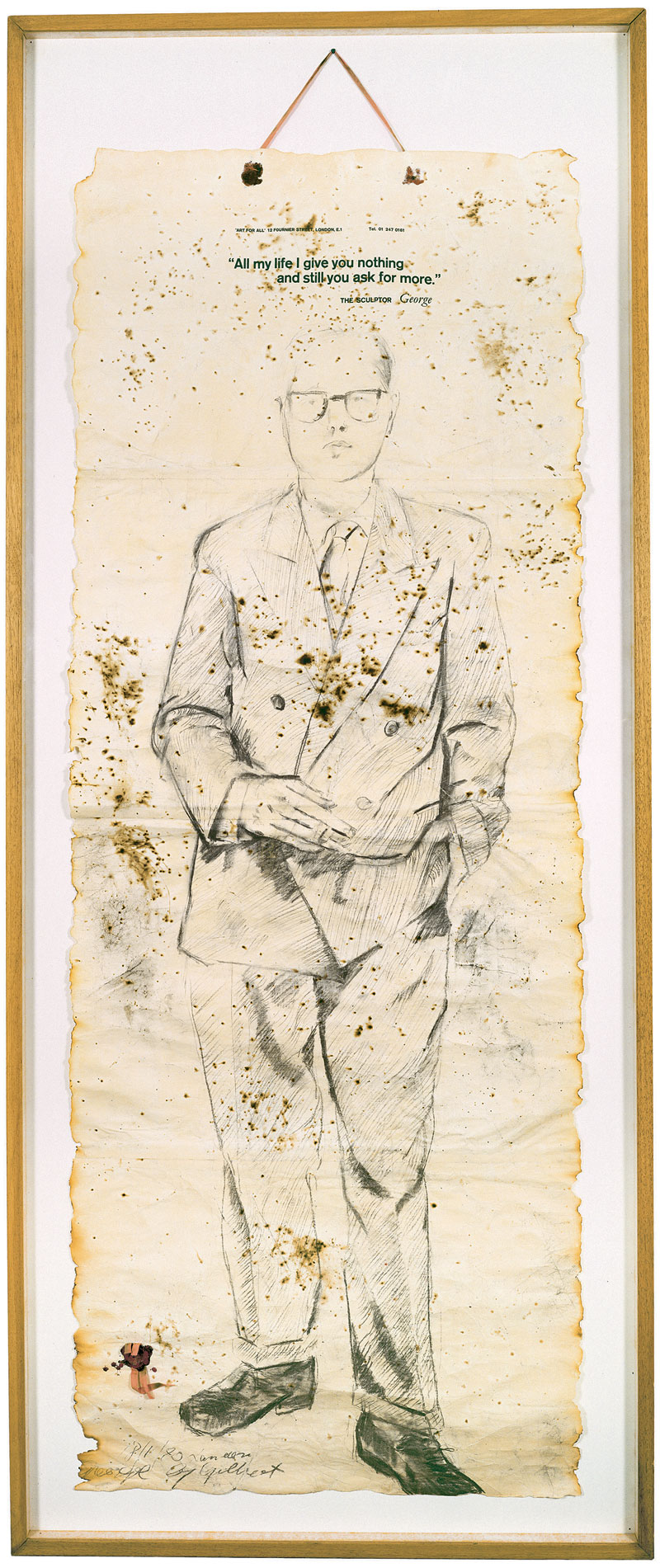
Gilbert & George (Gilbert Prousch, British born Italy, 1943; George Passmore, British, b. 1942) 'ALL MY LIFE I GIVE YOU NOTHING AND STILL YOU ASK FOR MORE' 1970 (George)


Gilbert & George (Gilbert Prousch, British born Italy, 1943; George Passmore, British, b. 1942)
ALL MY LIFE I GIVE YOU NOTHING AND STILL YOU ASK FOR MORE (George)
1970
Mixed media
Each 193 x 75cm
Private collection


Museum of Old and New Art
655 Main Road Berriedale
Hobart Tasmania 7011, Australia

Opening hours:
Daily 10am – 6pm

MONA website

LIKE ART BLART ON FACEBOOK

Back to top

Exhibition: ‘Julia Margaret Cameron’ at the Victoria and Albert Museum, London

Exhibition dates: 28th November, 2015 – 21st February, 2016

Curator: Marta Weiss, Curator of Photographs at the V&A


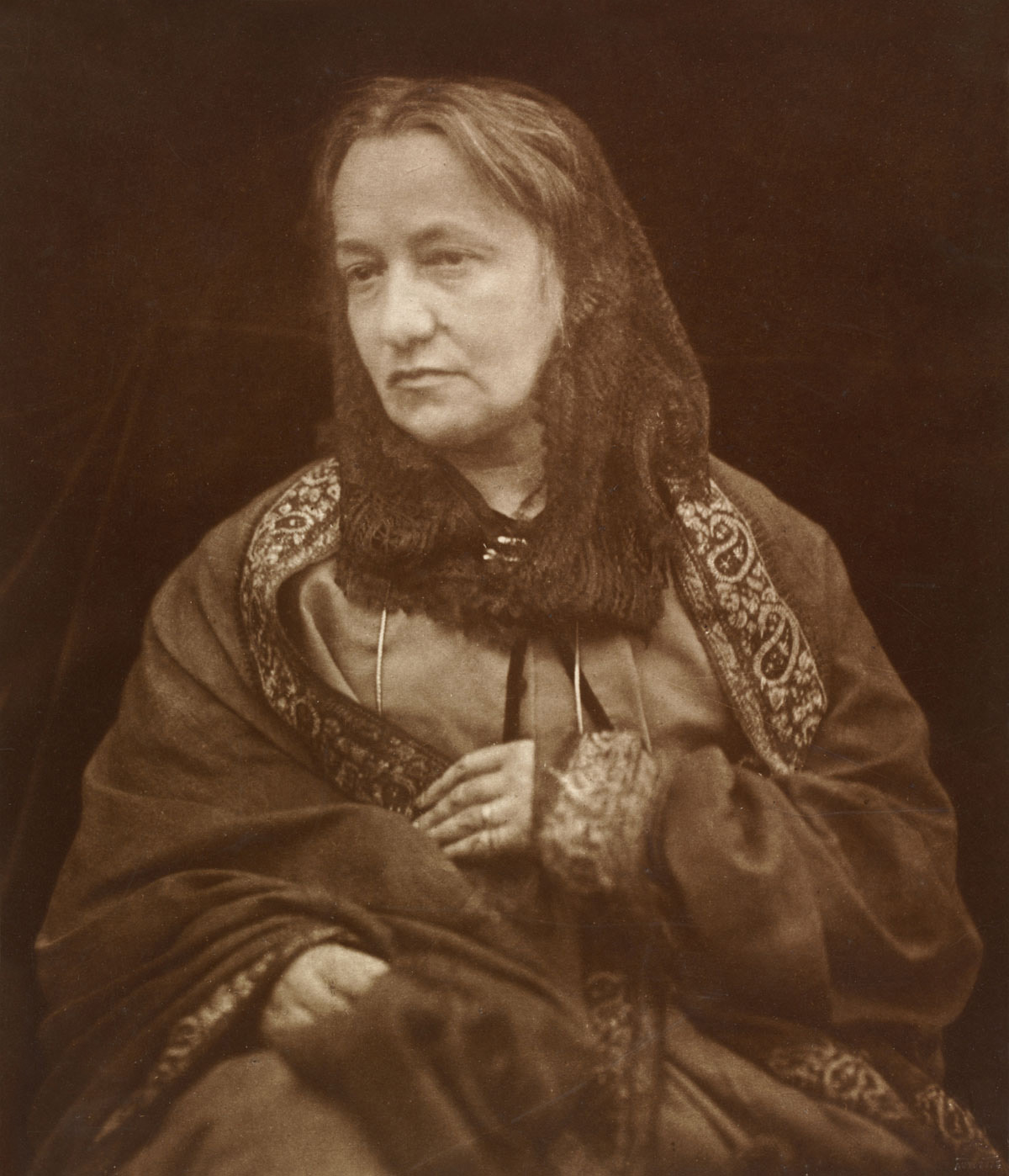
Henry Herschel Hay Cameron (English, 1852-1911) 'Julia Margaret Cameron' c. 1870 from the exhibition 'Julia Margaret Cameron' at the Victoria and Albert Museum, London, Nov 2015 - Feb 2016


Henry Herschel Hay Cameron (English, 1852-1911)
Julia Margaret Cameron
c. 1870
Albumen print
© Victoria and Albert Museum, London


Another exhibition to mark the bicentenary of the birth of Julia Margaret Cameron (1815-1879) from the same source (the Victoria and Albert Museum) as the exhibition I travelled up to Sydney to review last year.

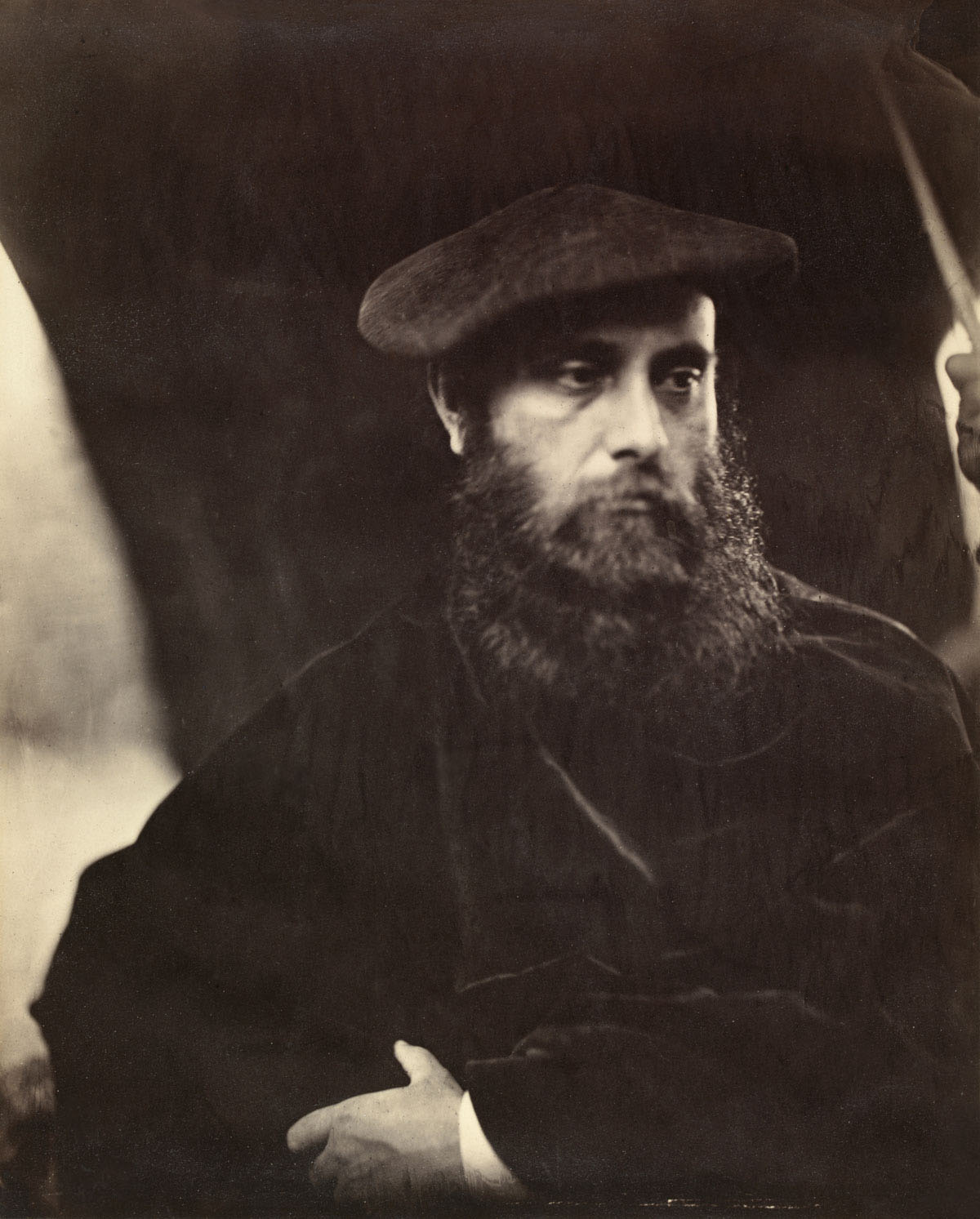
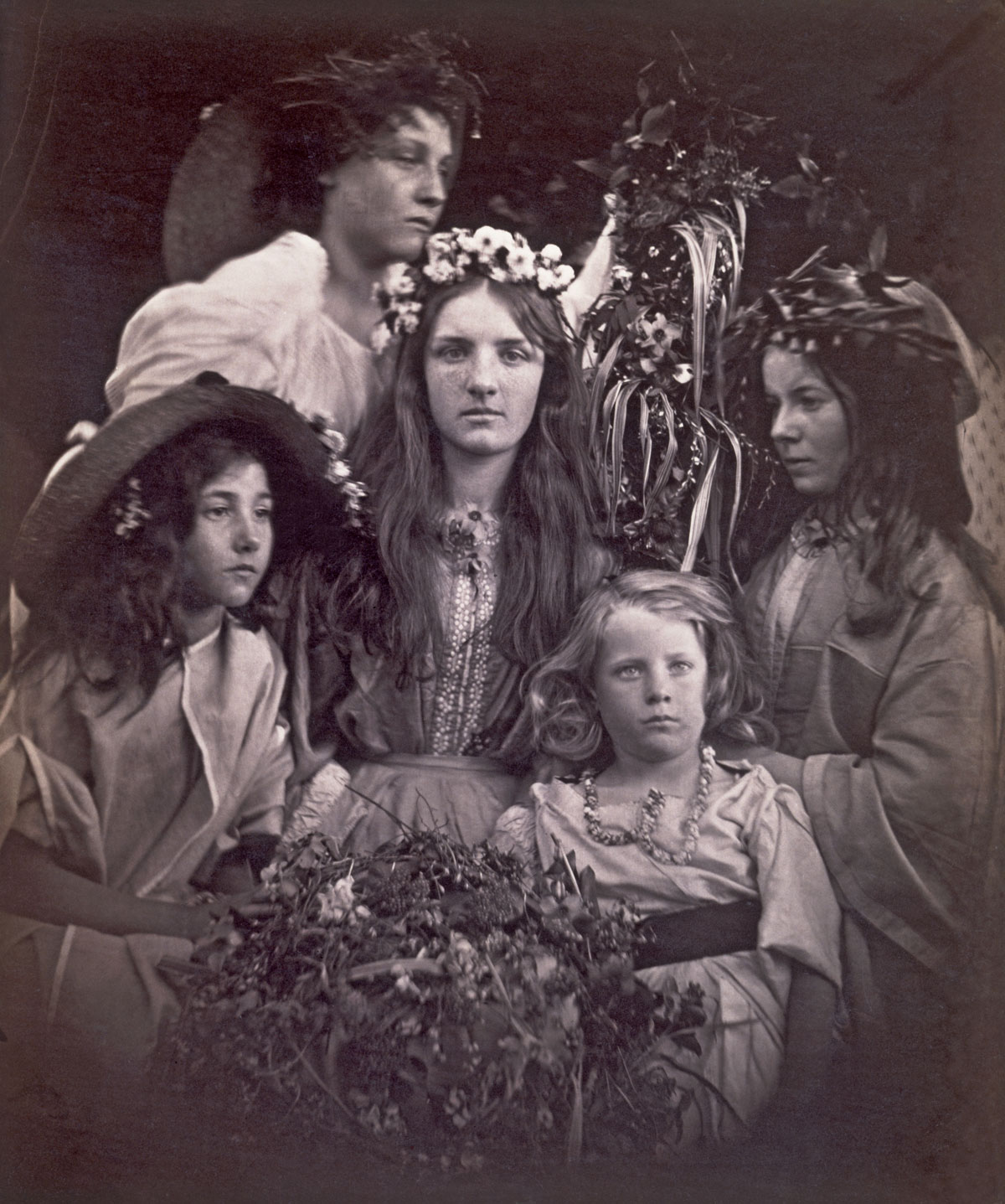
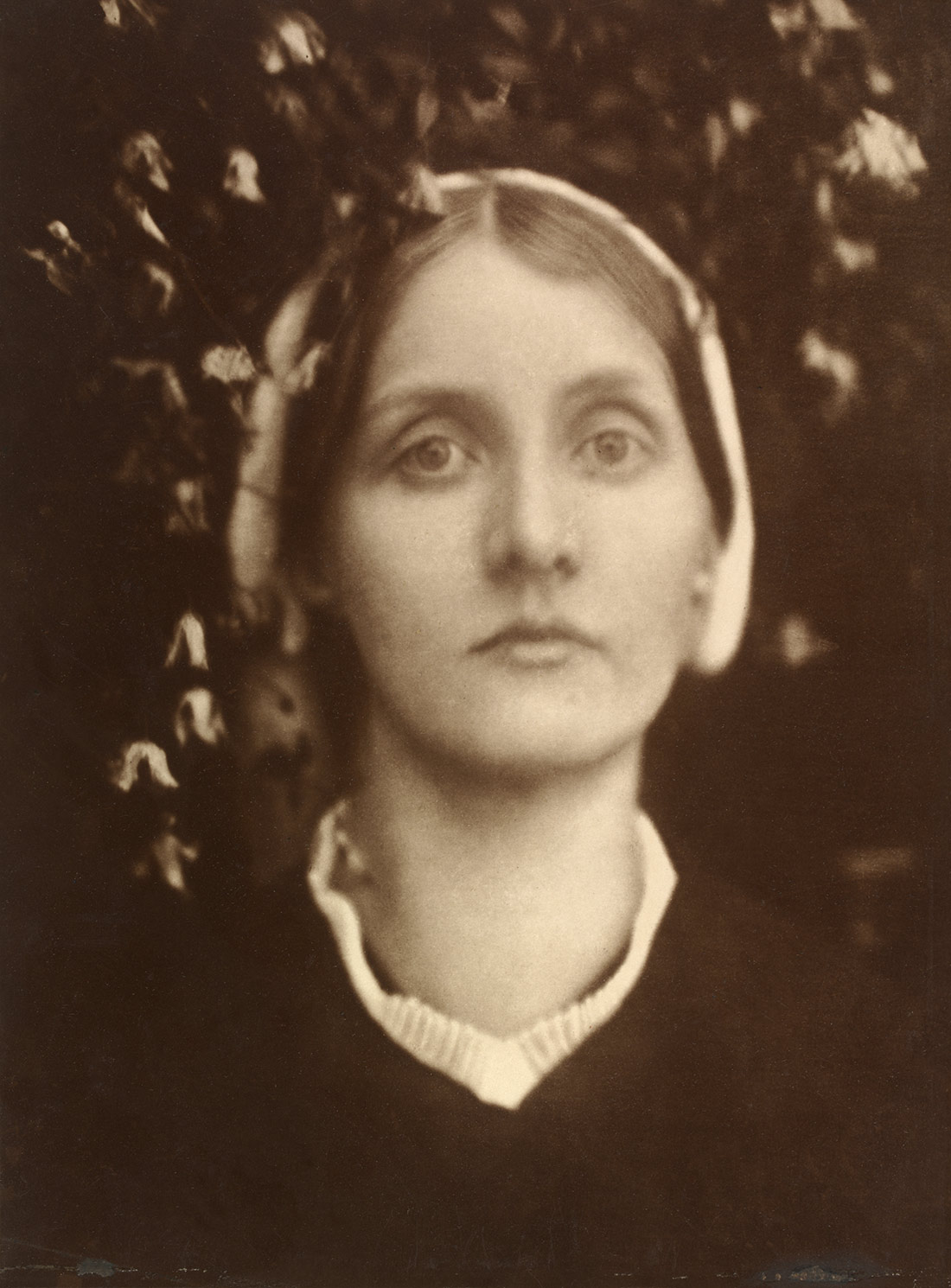
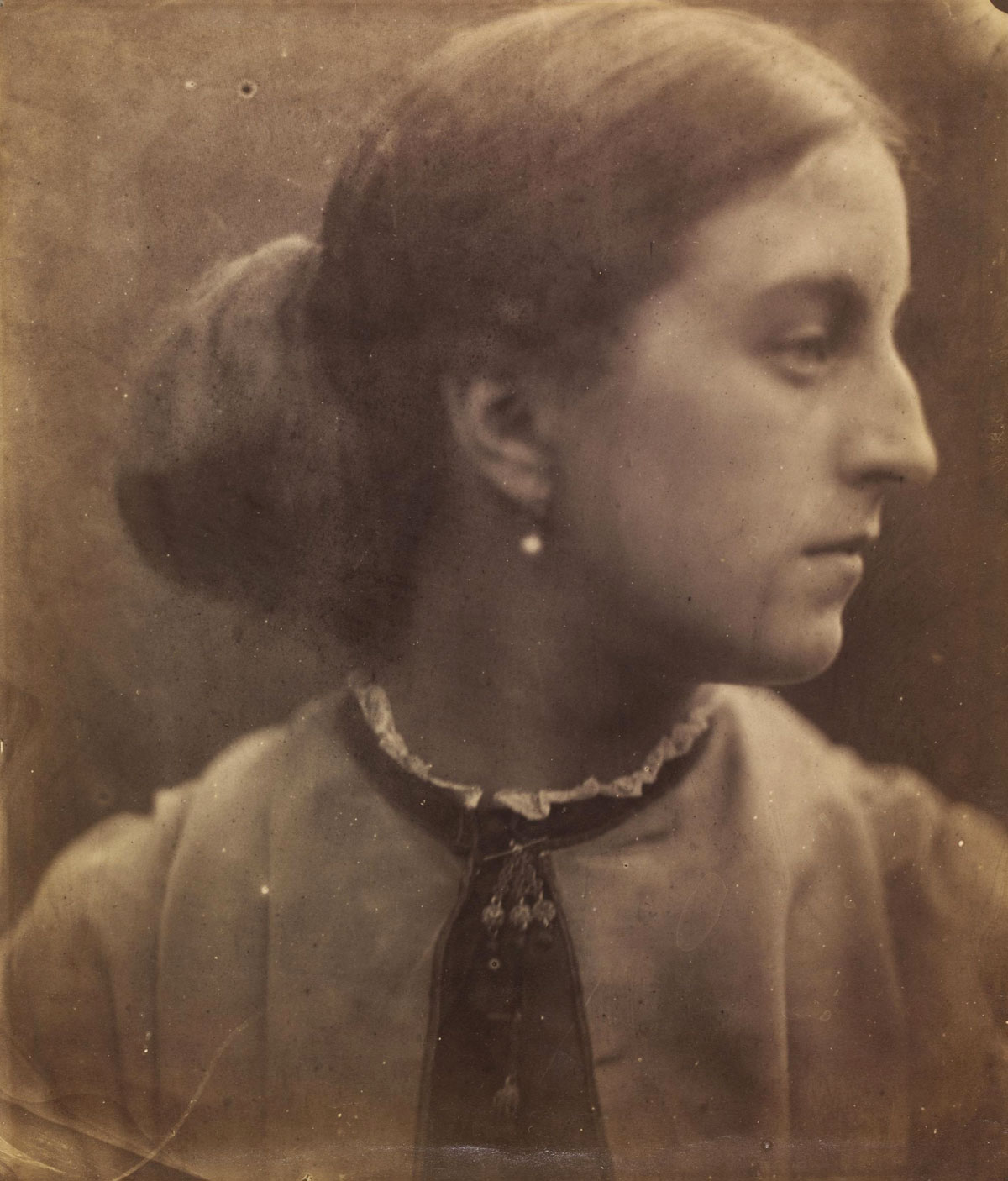
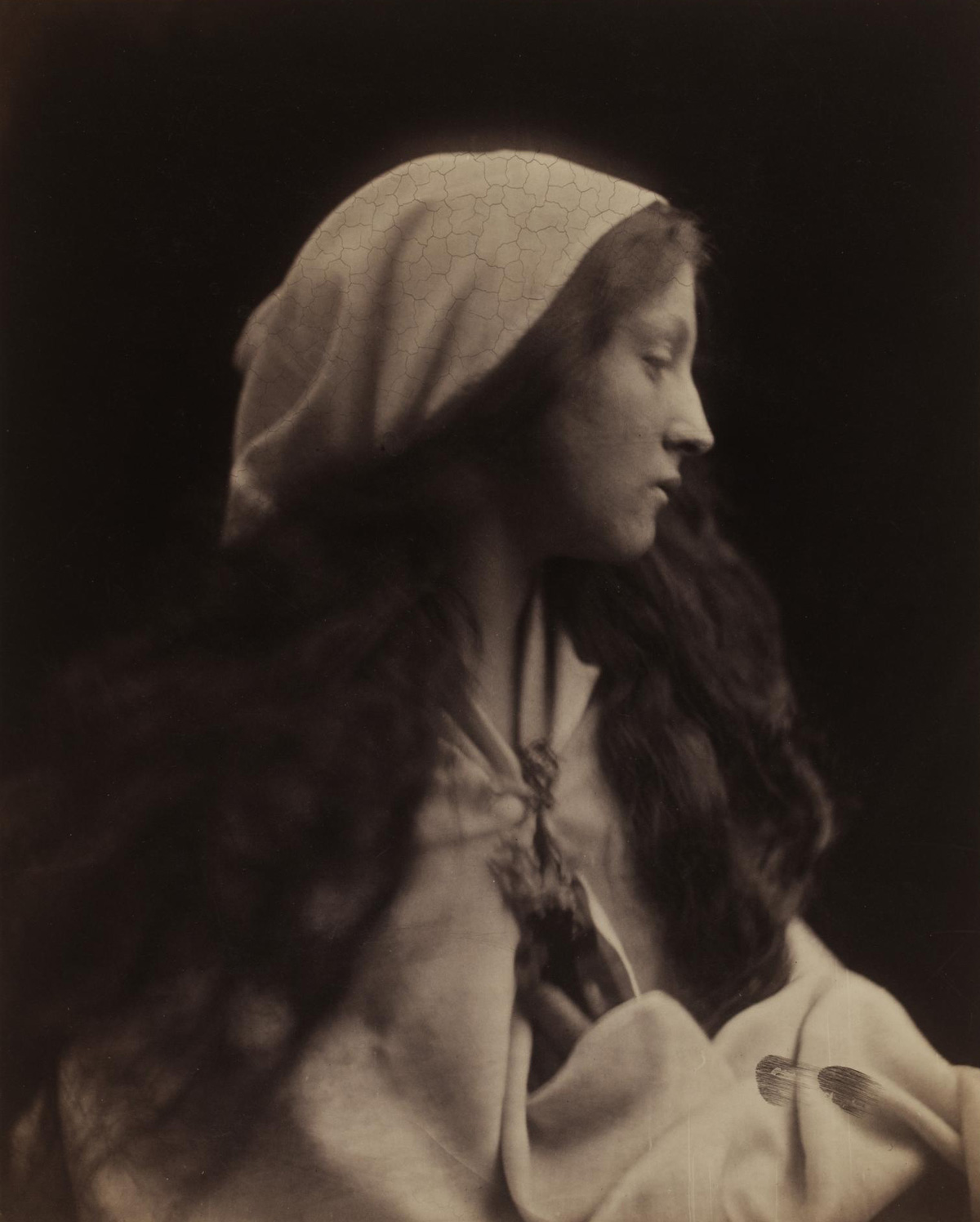
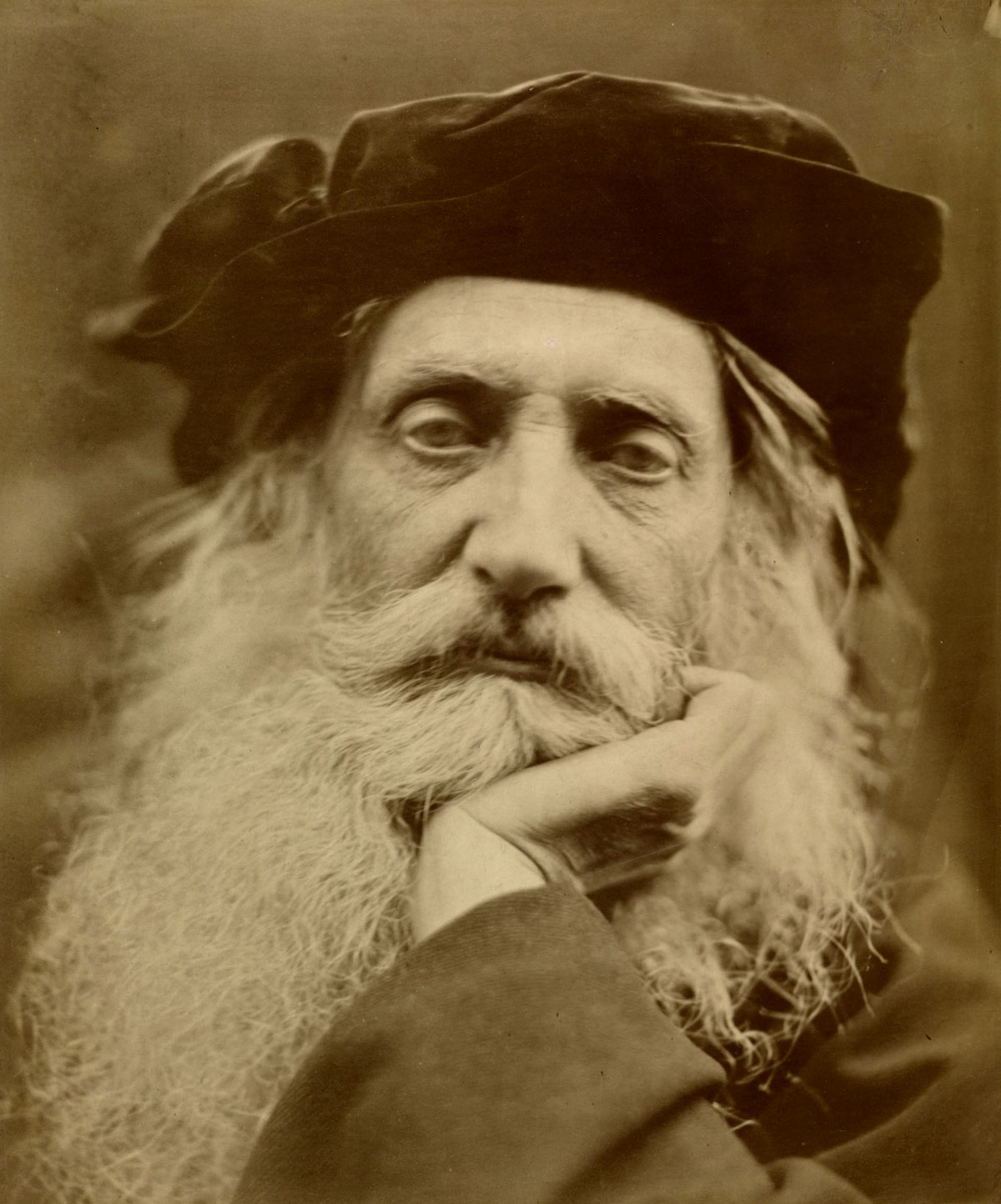
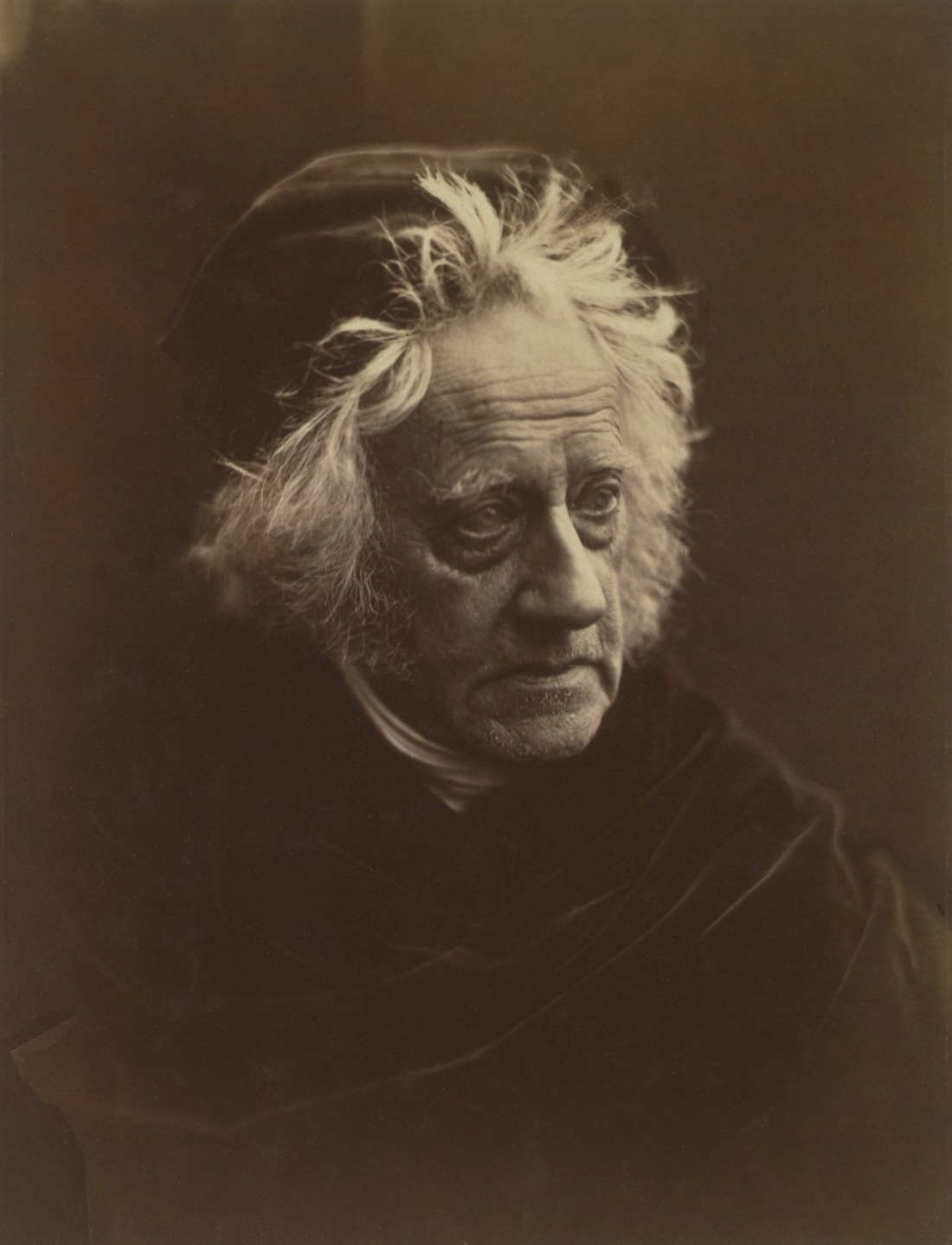
I am always ecstatic when I see her work, no more so than when I view images that I have not seen before, such as that dark, brooding slightly out of focus portrait of William Michael Rossetti (1865, below) or the profusion of delicate countenances and gazes that is May Day (1866, below).

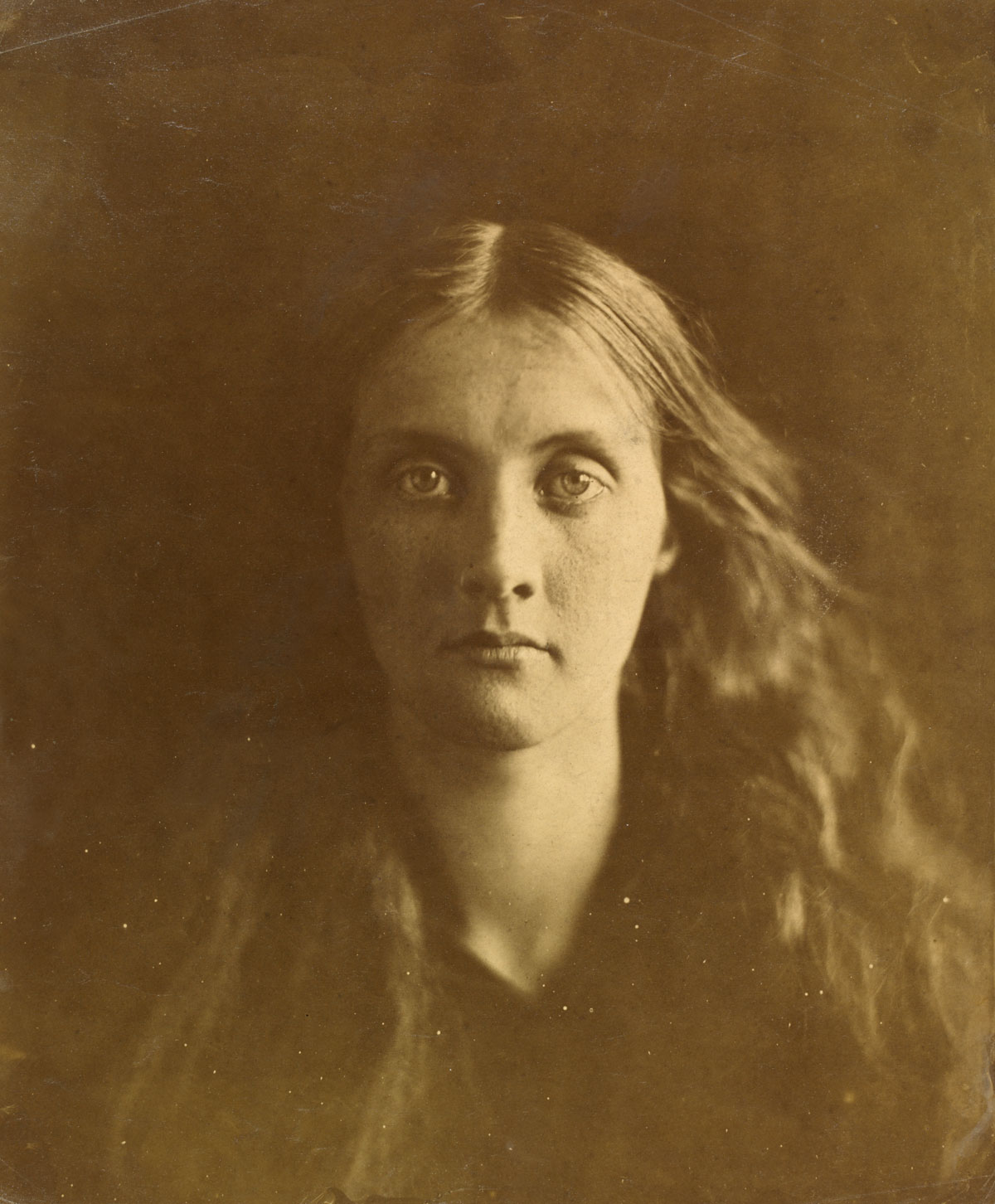
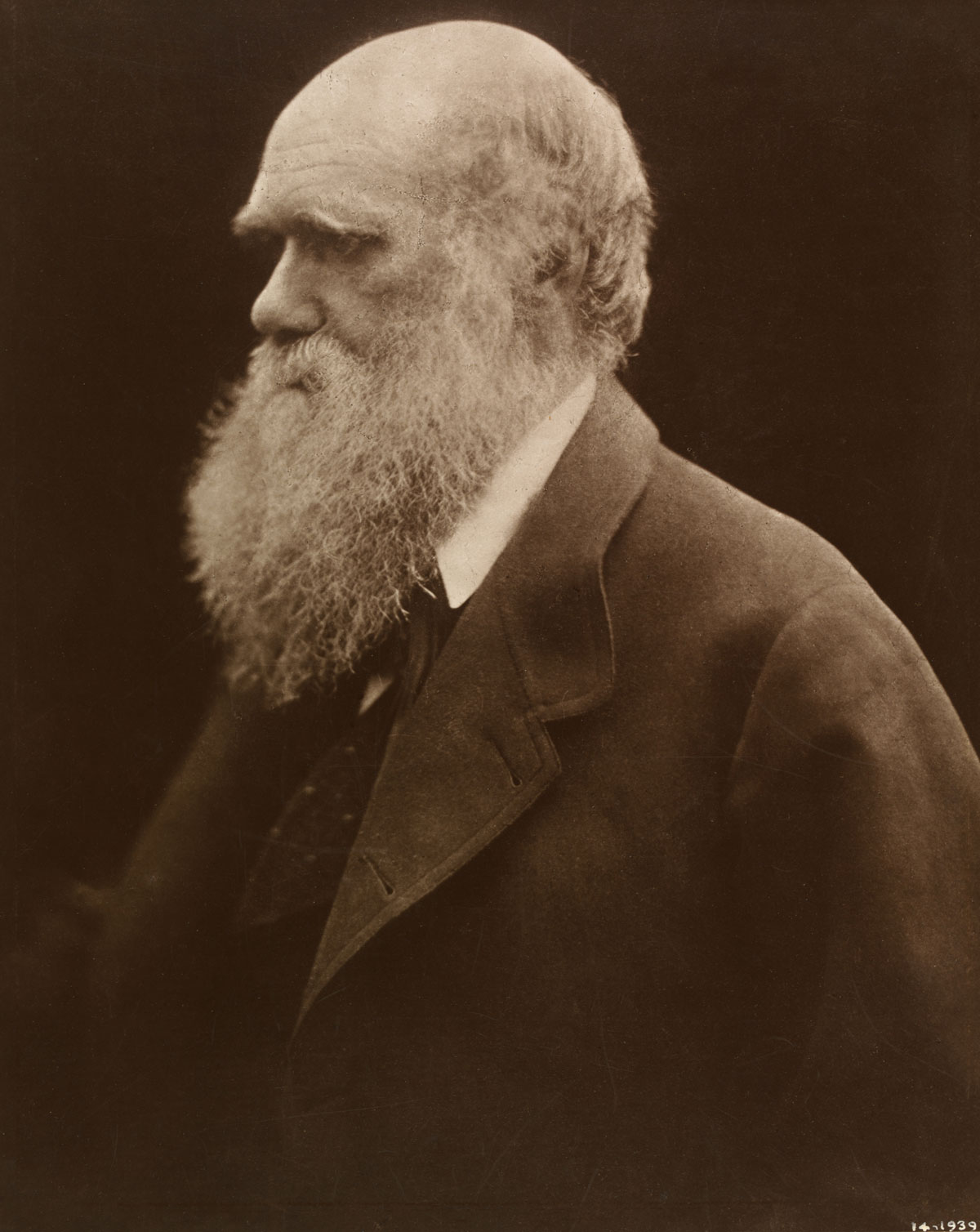
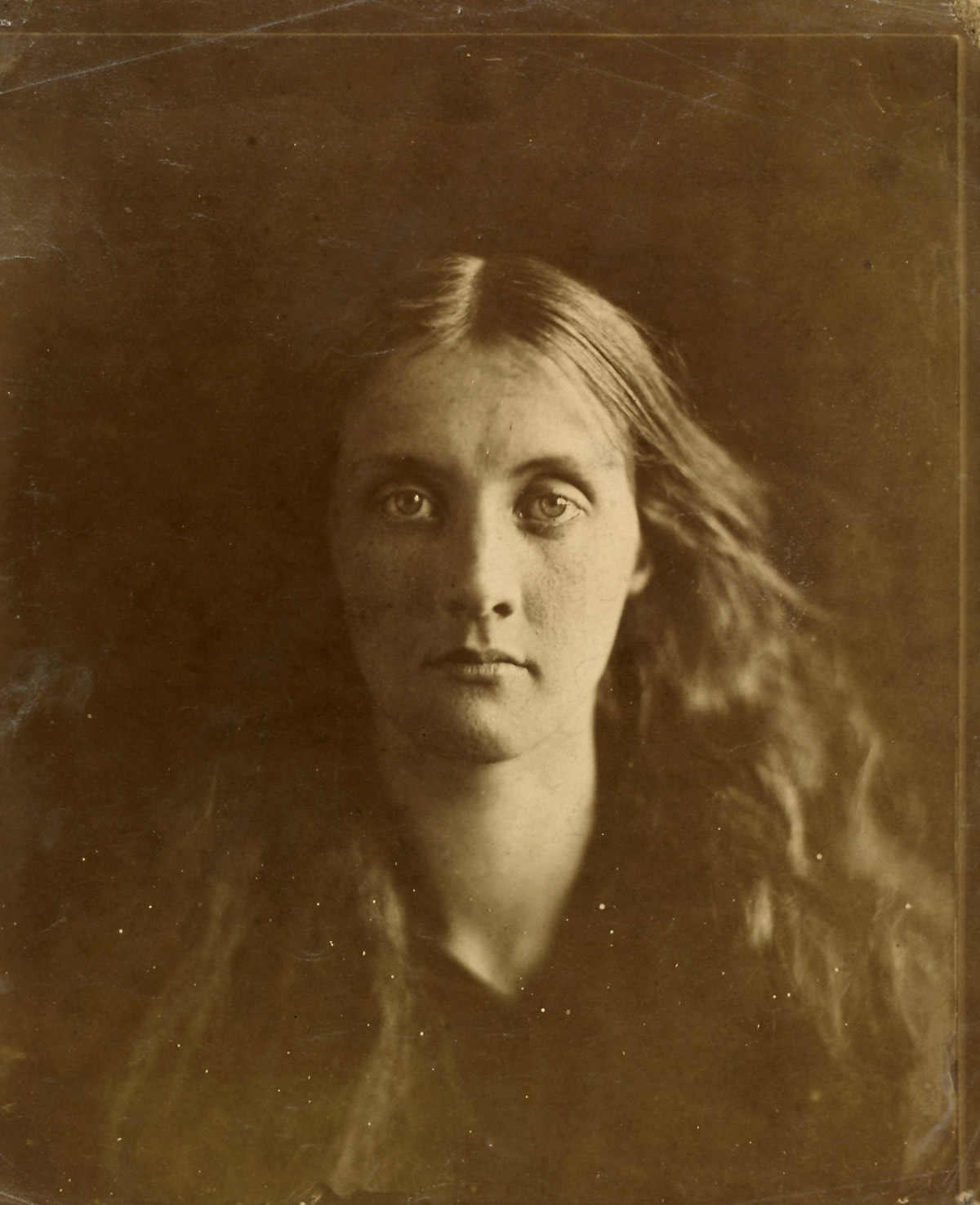
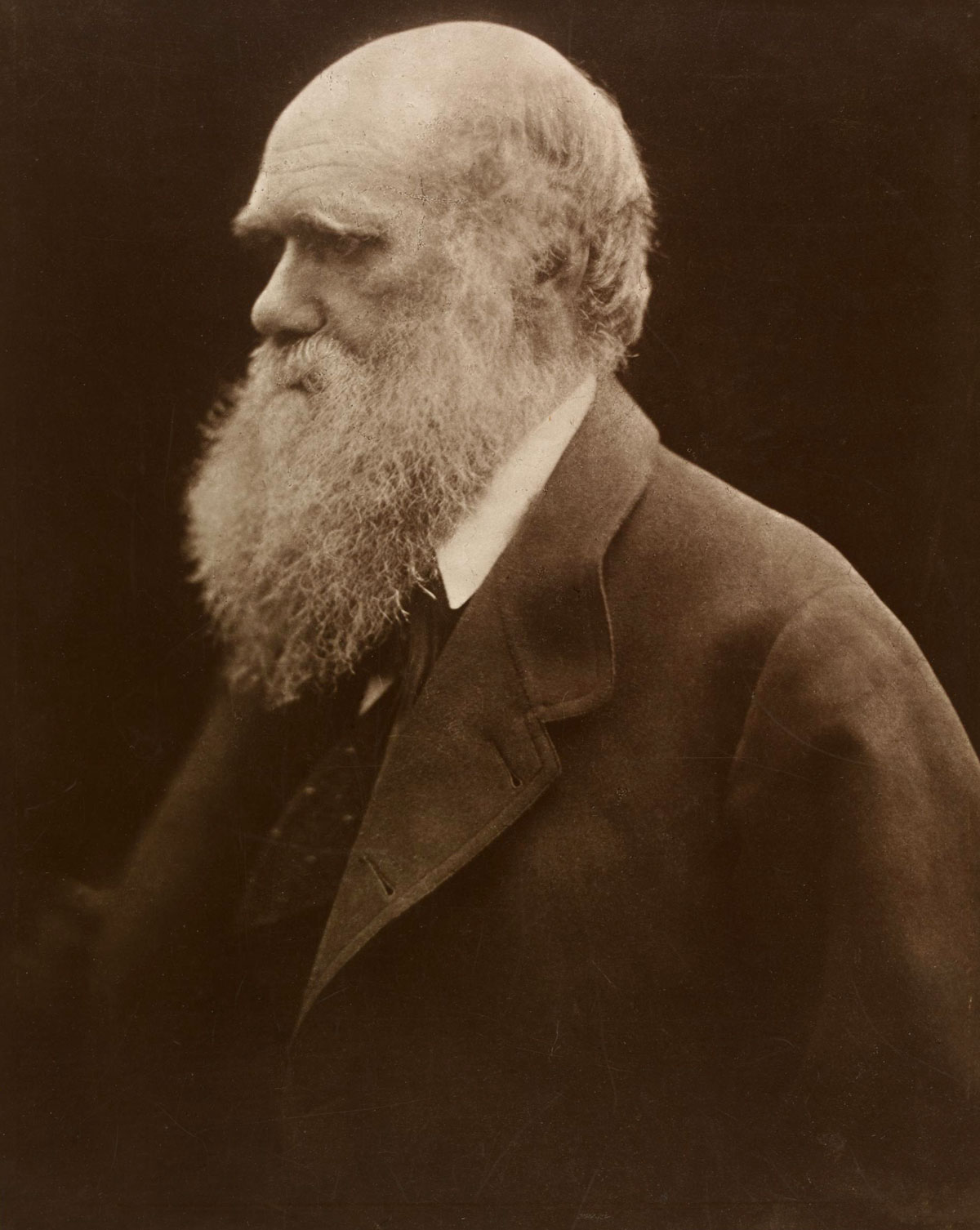
The piercing gaze of Julia Jackson (1867, below) always astounds, as though she is speaking to you, directly, from life. The r/evolutionary English naturalist and geologist Charles Darwin (1868, below) is pictured – no, that’s the wrong word – is materialised before our eyes at the age of 59 (looking much older), through low depth of field, delicate tonality and the defining of an incredible profile that imbues his portrait with the implicit intelligence of the man. I would have loved to have known what he was thinking.

Dr Marcus Bunyan


Many thankx to the Victoria and Albert Museum for allowing me to publish the photographs in the posting. Please click on the photographs for a larger version of the image.


“I write to ask you if you will… exhibit at the South Kensington Museum a set of Prints of my late series of Photographs that I intend should electrify you with delight and startle the world”


Julia Margaret Cameron to Henry Cole, 21 February 1866


“My aspirations are to ennoble Photography and to secure for it the character and uses of High Art by combining the real & Ideal & sacrificing nothing of Truth by all possible devotion to poetry and beauty.”


Julia Margaret Cameron to Sir John Herschel, 31 December 1864


An Introduction to Julia Margaret Cameron


Julia Margaret Cameron’s Working Methods

Julia Margaret Cameron’s letters to Henry Cole


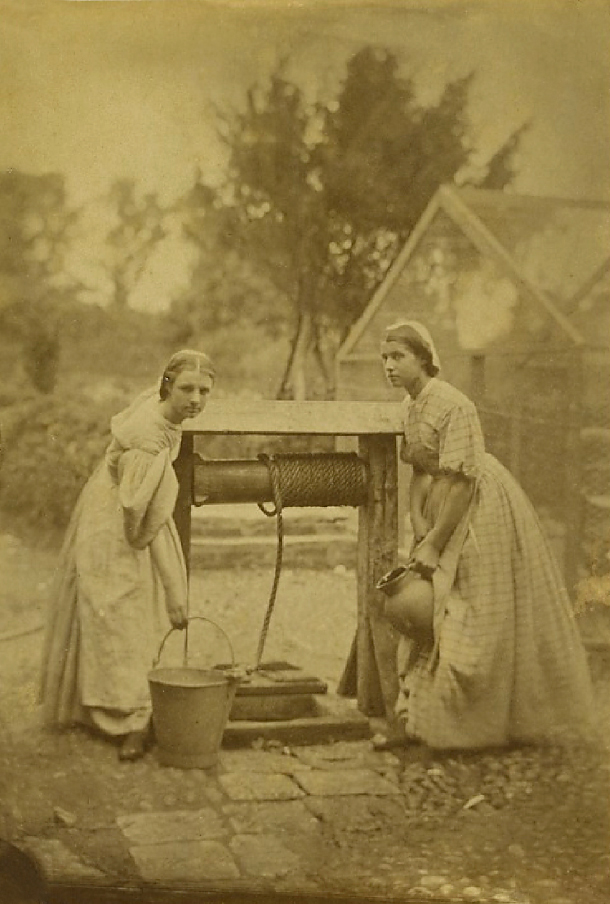
Oscar Gustaf Rejlander (possibly in collaboration with Julia Margaret Cameron) 'The Idylls of the Village' or 'The Idols of the Village' c. 1863 from the exhibition 'Julia Margaret Cameron' at the Victoria and Albert Museum, London, Nov 2015 - Feb 2016


Oscar Gustaf Rejlander (Swedish, 1813-1875) (possibly in collaboration with Julia Margaret Cameron)
The Idylls of the Village or The Idols of the Village
c. 1863
Albumen print
© Victoria and Albert Museum, London


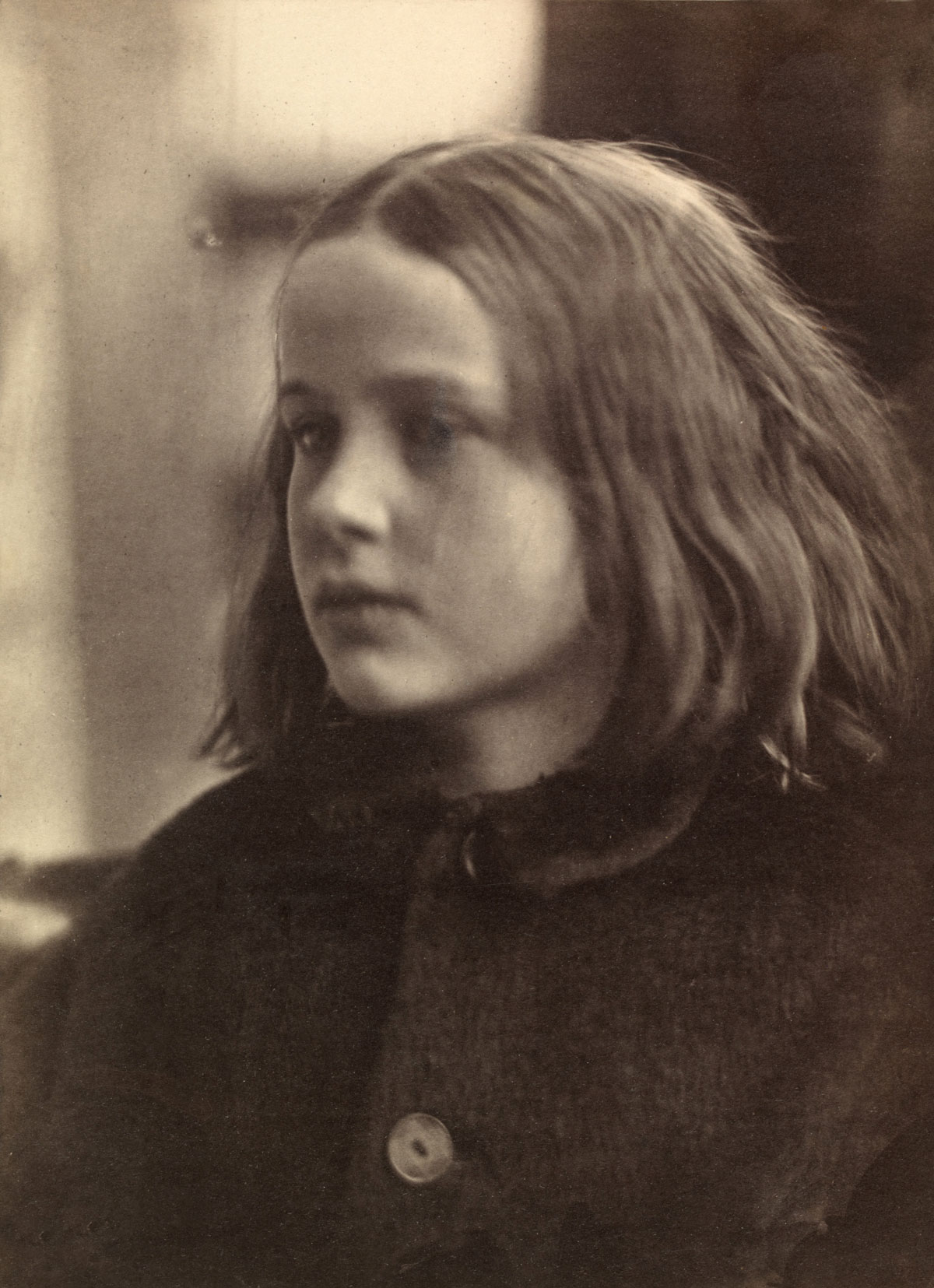
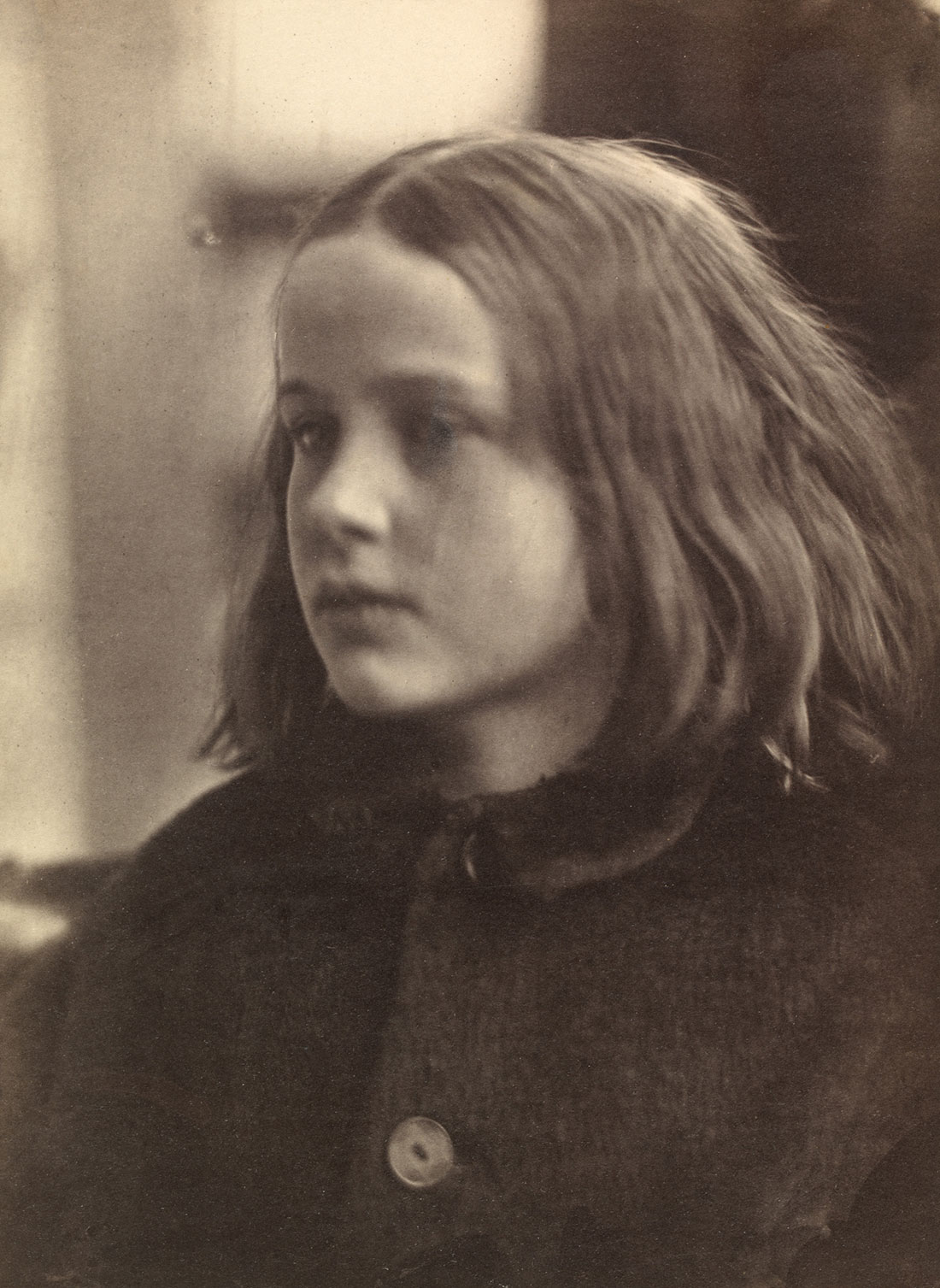
Julia Margaret Cameron (British, 1815-1879) 'Annie' January 1864


Julia Margaret Cameron (British, 1815-1879)
Annie
January 1864
Albumen print
© Victoria and Albert Museum, London


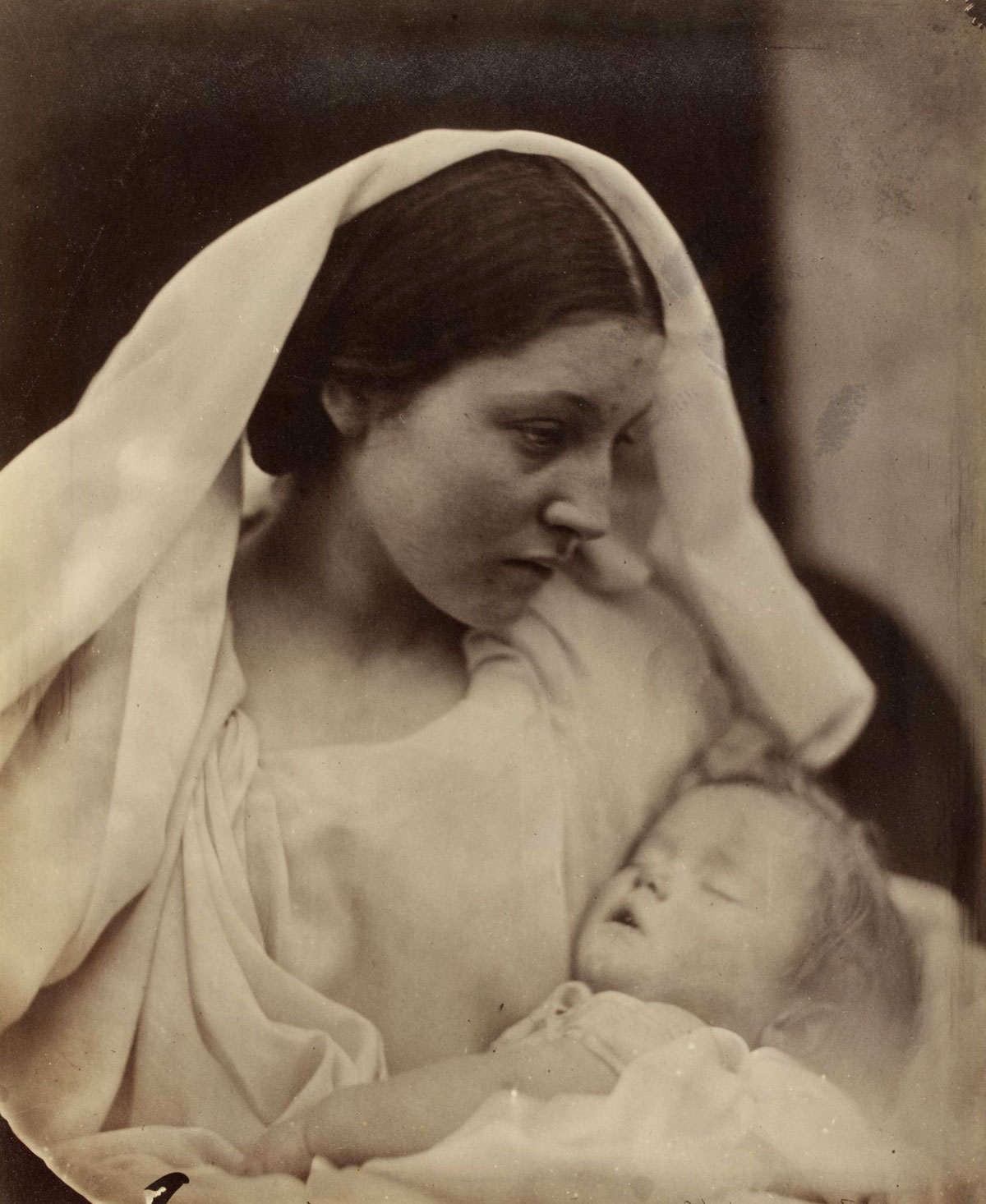
Cameron devoted herself to the medium with energy and ambition. Within a month of receiving the camera she made the photograph she called her ‘first success’, a portrait of Annie Philpot, the daughter of a family staying in the Isle of Wight. Cameron later wrote of her excitement:

“I was in a transport of delight. I ran all over the house to search for gifts for the child. I felt as if she entirely had made the picture.”


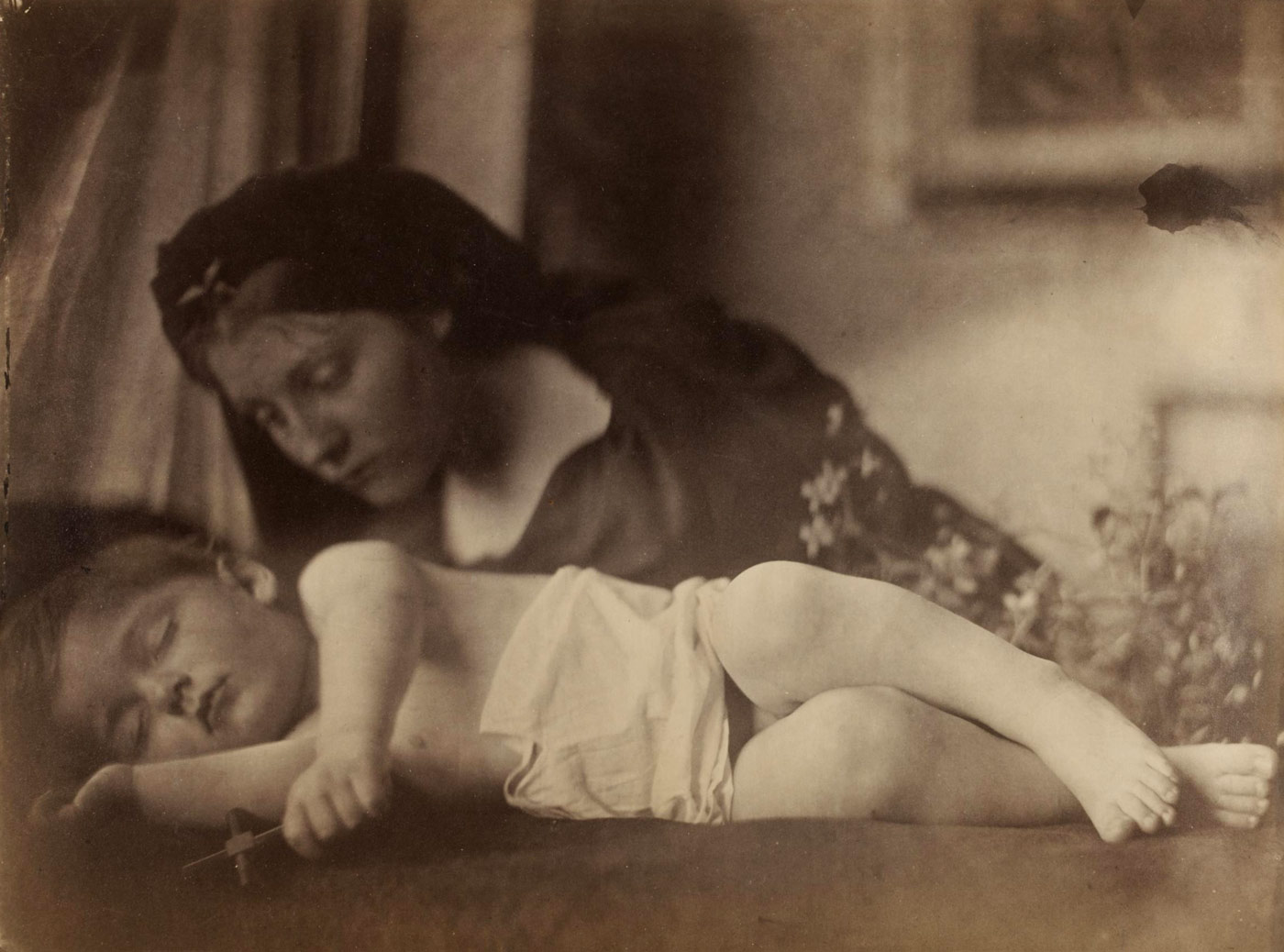
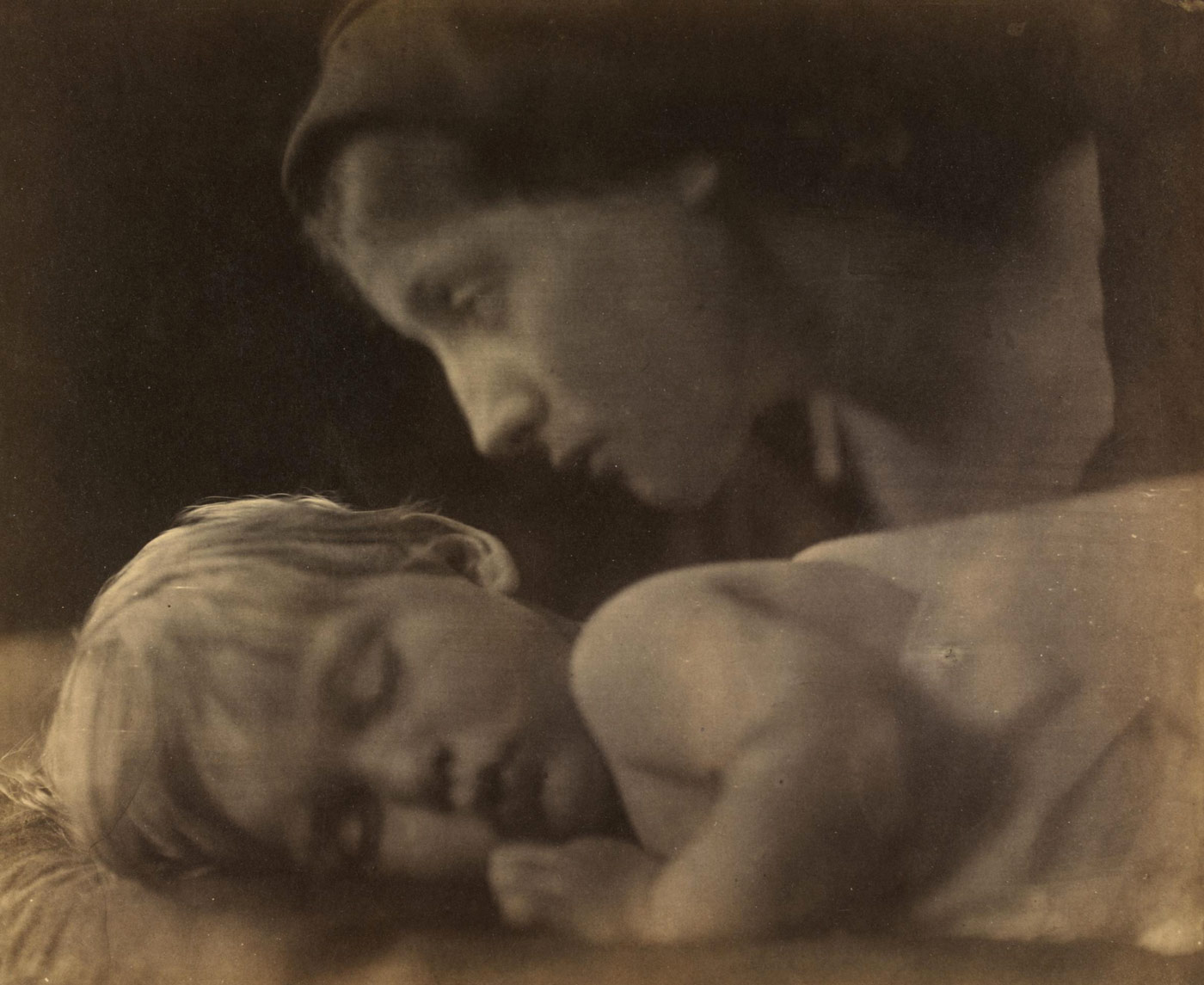
From her ‘first success’ she moved on quickly to photographing family and friends. These early portraits reveal how she experimented with soft focus, dramatic lighting and close-up compositions, features that would become her signature style.


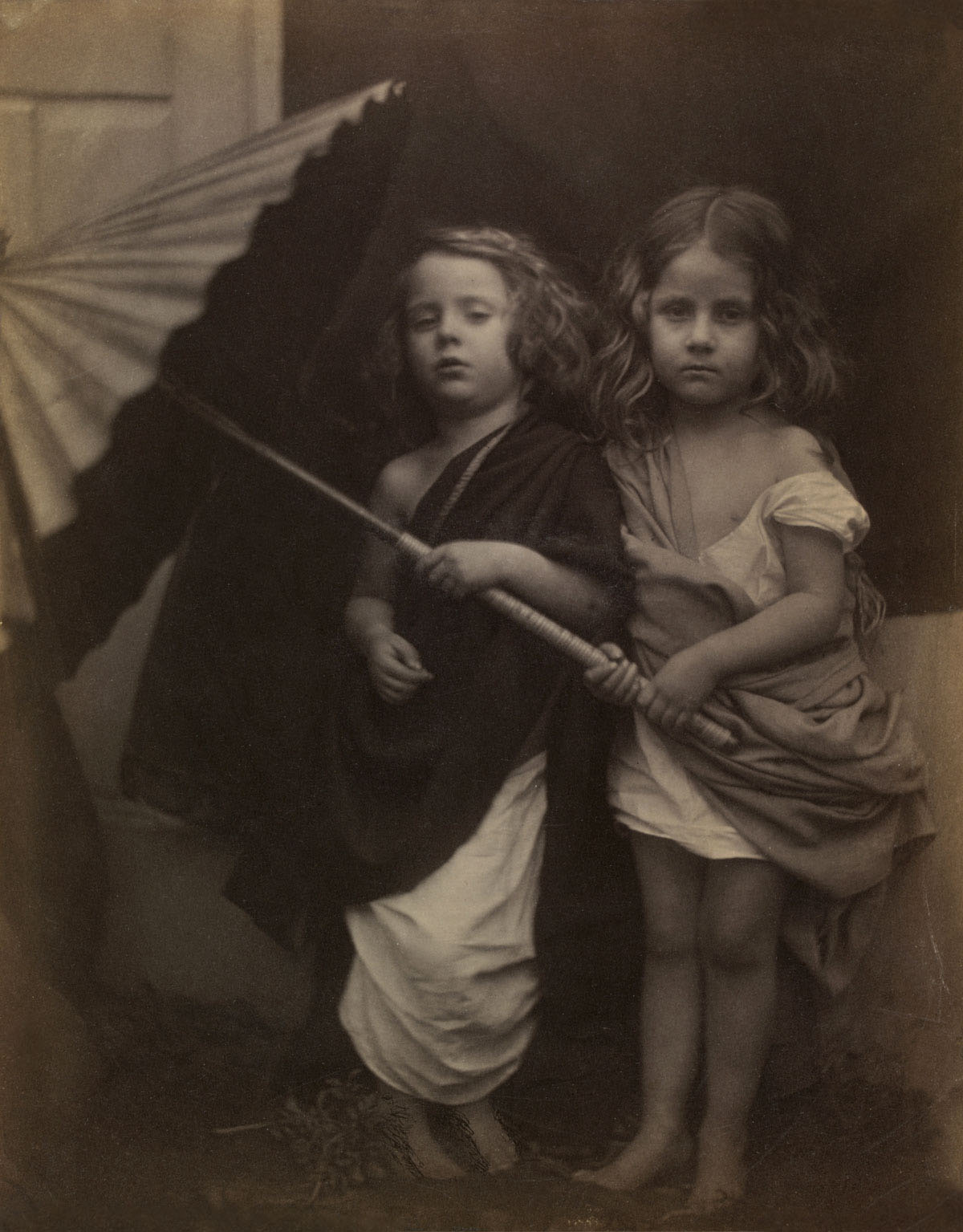
Julia Margaret Cameron (British, 1815-1879) 'Paul and Virginia' 1864


Julia Margaret Cameron (British, 1815-1879)
Paul and Virginia
1864
Albumen print
© Victoria and Albert Museum, London


Julia Margaret Cameron (British, 1815-1879) 'Peace' 1864


Julia Margaret Cameron (British, 1815-1879)
Peace
1864
Albumen print
© Victoria and Albert Museum, London


Julia Margaret Cameron (British, 1815-1879) 'Circe' 1865


Julia Margaret Cameron (British, 1815-1879)
Circe
1865
Albumen print
© Victoria and Albert Museum, London


Julia Margaret Cameron (British, 1815-1879) 'Hosanna' 1865


Julia Margaret Cameron (British, 1815-1879)
Hosanna
1865
Albumen print
© Victoria and Albert Museum, London


Julia Margaret Cameron (British, 1815-1879) 'Hosanna' 1865


Julia Margaret Cameron (British, 1815-1879)
Hosanna
1865
Albumen print
© Victoria and Albert Museum, London


To mark the bicentenary of the birth of Julia Margaret Cameron (1815-1879), one of the most important and innovative photographers of the 19th century, the V&A will showcase more than 100 of her photographs from the Museum’s collection. The exhibition will offer a retrospective of Cameron’s work and examine her relationship with the V&A’s founding director, Sir Henry Cole, who in 1865 presented her first museum exhibition and the only one during her lifetime.

Cameron is one of the most celebrated women in the history of photography. She began her photographic career when she received her first camera as a gift from her daughter at the age of 48, and quickly and energetically devoted herself to the art of photography. Within two years she had sold and given her photographs to the South Kensington Museum (now the V&A) and in 1868, the Museum granted her the use of two rooms as a portrait studio, likely making her the Museum’s first ‘artist-in-residence’.

150 years after first exhibiting her work, the V&A will present highlights of Cameron’s output, including original prints acquired directly from the artist and a selection of her letters to Henry Cole. Cole’s 1865 diary, in which he records going to Mrs Cameron’s… to have my portrait photographed in her style’ will be on view, along with the only surviving Cameron portrait of Cole. The exhibition will also include the first photograph to be identified of Cameron’s studio. Entitled Idylls of the Village, or Idols of the Village, it was made in about 1863 by Oscar Gustaf Rejlander, possibly in collaboration with Cameron, and depicts two women drawing water from a well in front of the ‘glazed fowl-house’ Cameron turned into her studio. The print has been newly identified and has never before been exhibited.

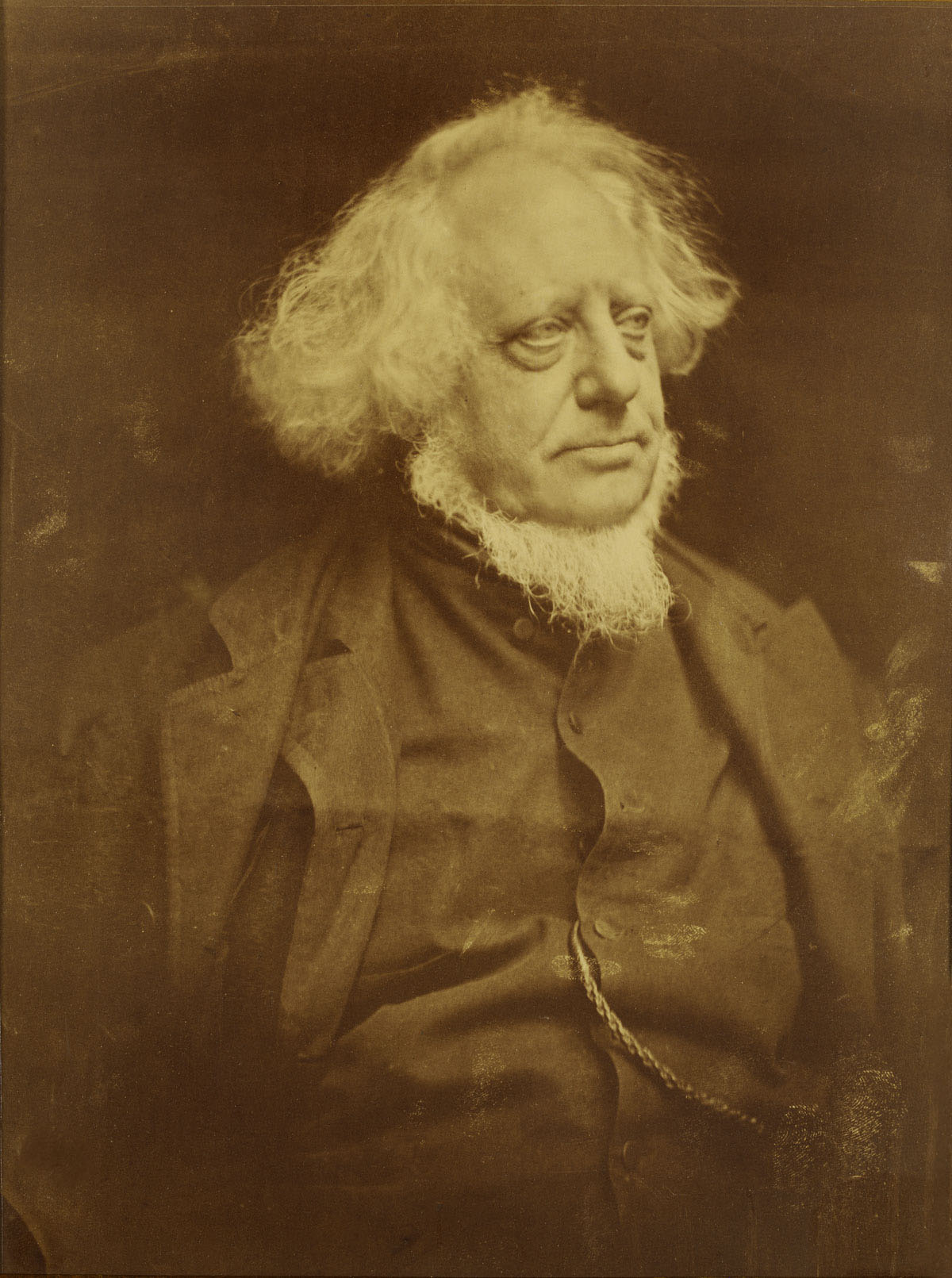
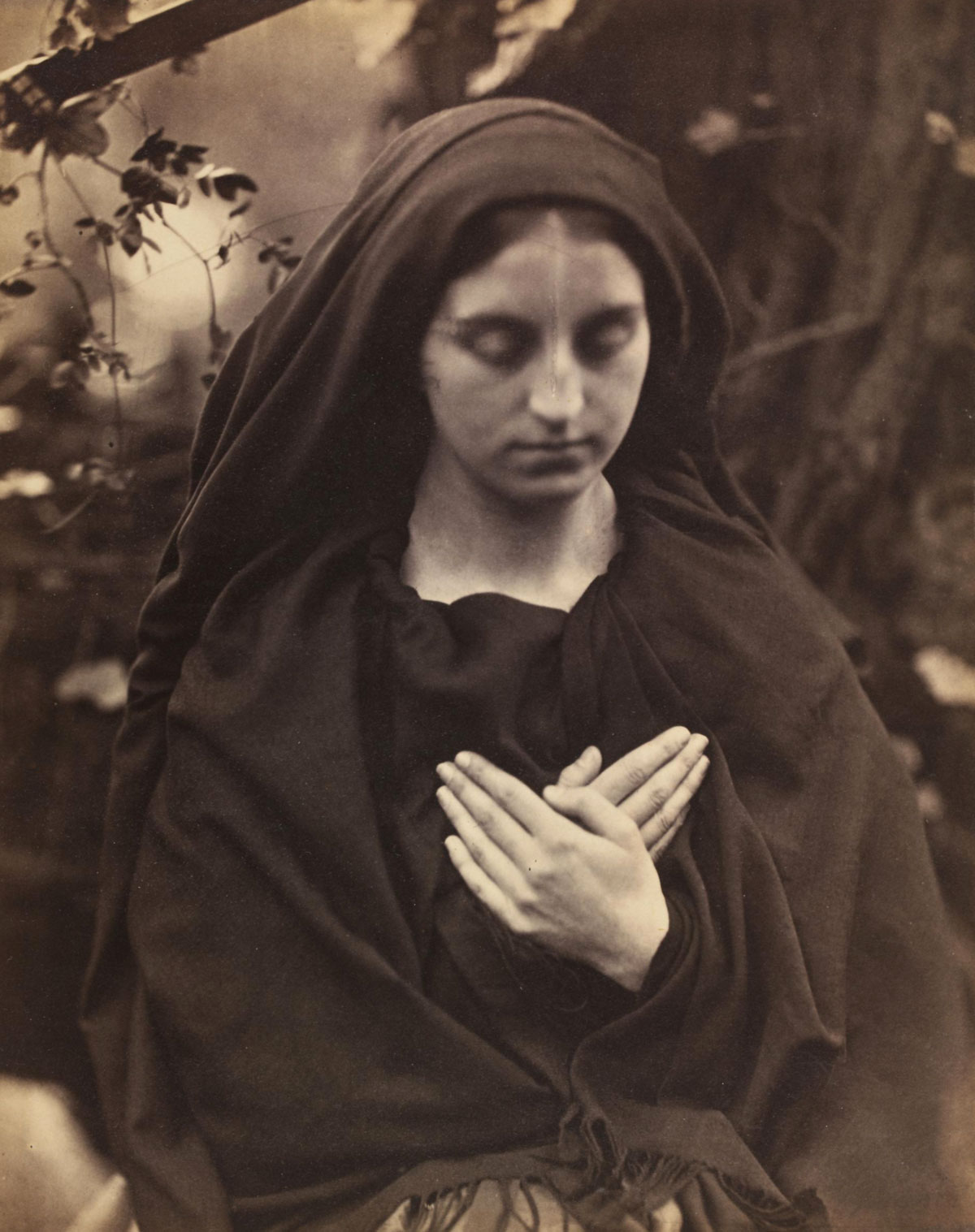
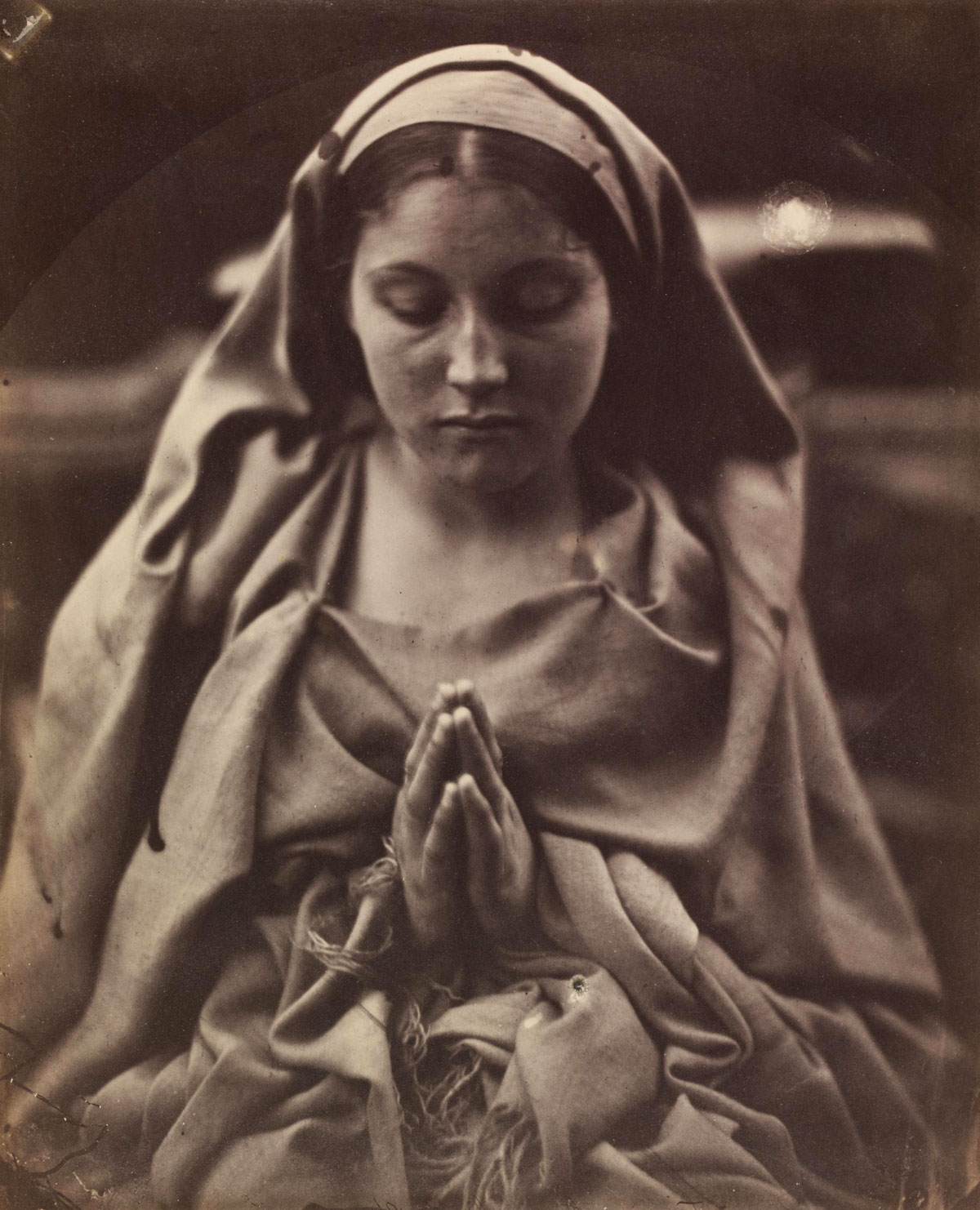
Best known for her powerful portraits, Cameron also posed her sitters – friends, family and servants – as characters from biblical, historical or allegorical stories. The exhibition will feature a variety of photographic subjects, which Cameron described as ‘Portraits’, ‘Madonna groups’, and ‘Fancy Subjects for Pictorial Effect’. These range from Annie, a close-up of a child’s face that Cameron called her ‘first success’, to striking portraits of members of Cameron’s intellectual and artistic circle such as poet laureate Alfred Lord Tennyson, scientist Charles Darwin and Julia Jackson, Cameron’s niece and mother of Virginia Woolf. Also on display will be Renaissance-inspired religious arrangements and illustrations to Tennyson’s epic Arthurian poem, Idylls of the King.

Julia Margaret Cameron will be structured around four letters from Cameron to Cole, each demonstrating a different aspect of her development as an artist: her early ambition; her growing artistic confidence and innovation; her concerns as a portraitist and desire to earn money from photography; and her struggles with technical aspects of photography. This final section will offer insight into Cameron’s working methods – an arduous process which involved handling potentially hazardous chemicals. It will include a group of her most experimental photographs, recently discovered to have once belonged to her friend and artistic advisor, the painter and sculptor G.F. Watts. Cameron’s photographs were highly innovative: intentionally out-of-focus, and often including scratches, smudges and other traces of her process. In her lifetime, Cameron was criticised for her unconventional techniques, but also appreciated for the beauty of her compositions and her conviction that photography was an art form.

The exhibition is part of a nationwide celebration of Julia Margaret Cameron’s work during her bicentenary year, including the exhibition Julia Margaret Cameron: Influence and Intimacy at the Science Museum’s Media Space, which displays prints given by Cameron to the astronomer Sir John Herschel, and a series of exhibitions and events at Cameron’s former home, Dimbola Museum and Galleries, on the Isle of Wight.

Press release from the V&A website


Julia Margaret Cameron (British, 1815-1879) 'Whisper of the Muse' 1865


Julia Margaret Cameron (British, 1815-1879)
Whisper of the Muse
1865
Albumen print
© Victoria and Albert Museum, London


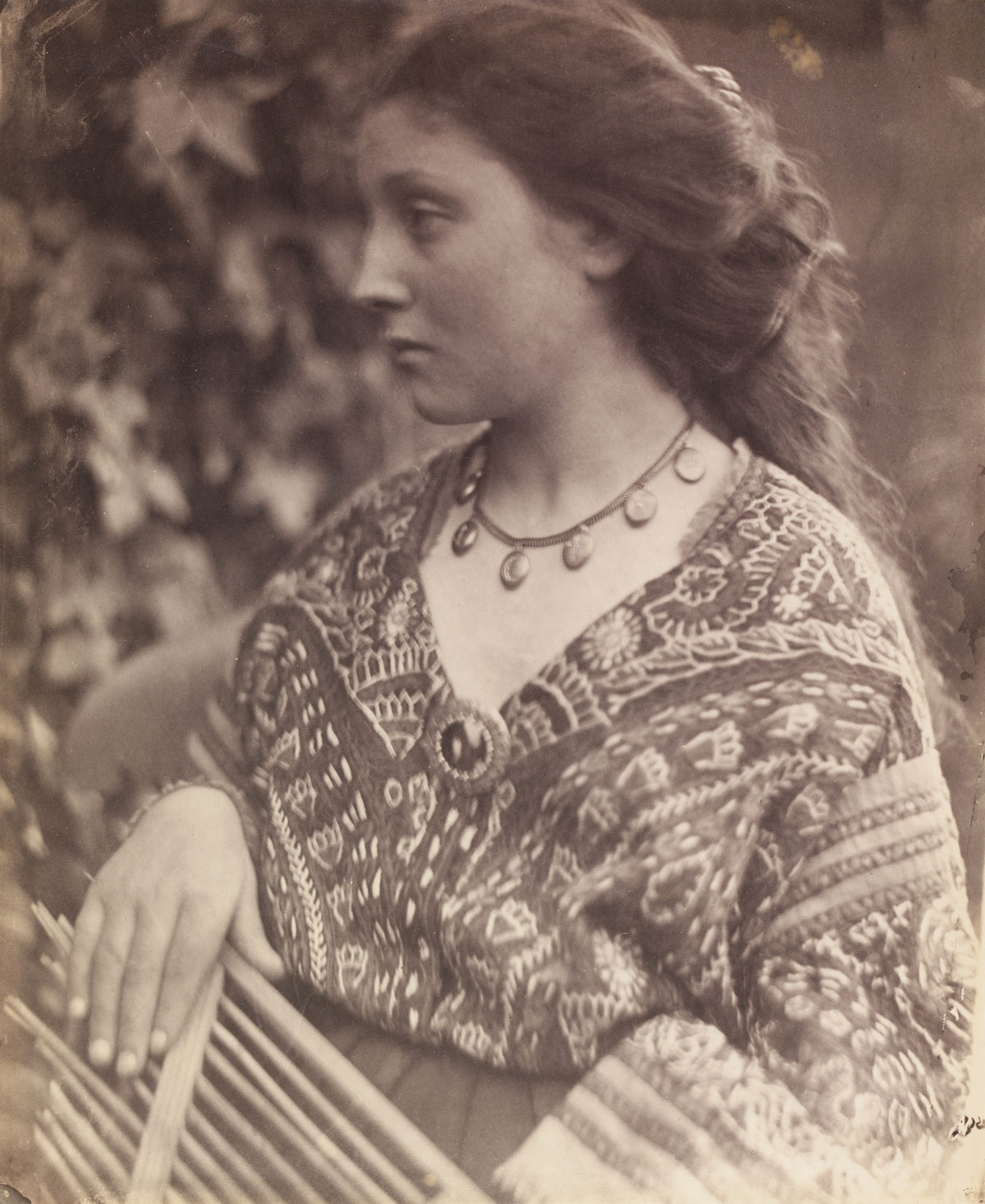
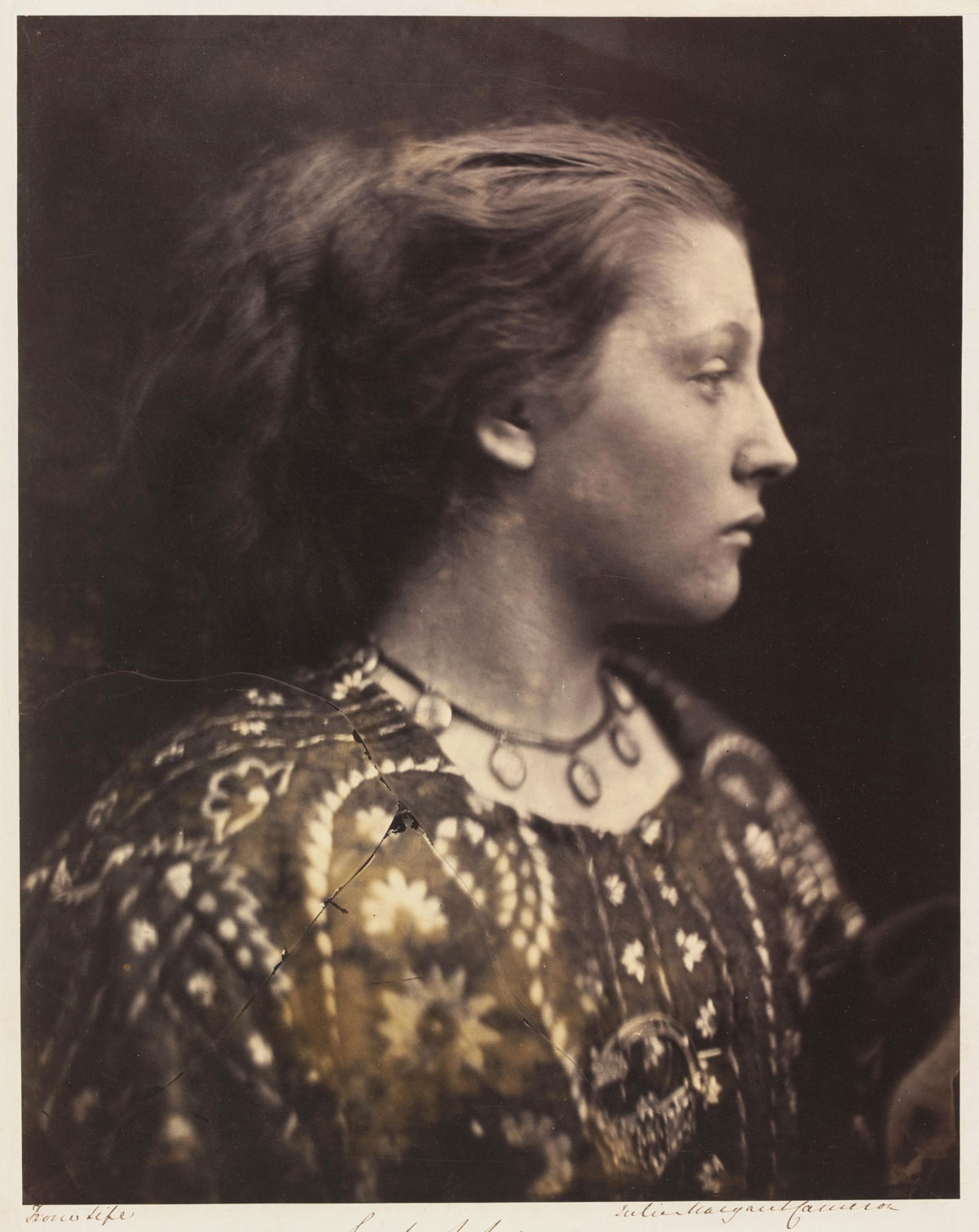
Julia Margaret Cameron (British, 1815-1879) 'Sappho' 1865


Julia Margaret Cameron (British, 1815-1879)
Sappho
1865
Albumen print
© Victoria and Albert Museum, London


Julia Margaret Cameron (British, 1815-1879) 'William Michael Rossetti' 1865


Julia Margaret Cameron (British, 1815-1879)
William Michael Rossetti
1865
Albumen print
© Victoria and Albert Museum, London


Julia Margaret Cameron (British, 1815-1879) 'May Day' 1866


Julia Margaret Cameron (British, 1815-1879)
May Day
1866
Albumen print
© Victoria and Albert Museum, London


Julia Margaret Cameron (British, 1815-1879) 'Julia Jackson' 1867


Julia Margaret Cameron (British, 1815-1879)
Julia Jackson
1867
Albumen print
© Victoria and Albert Museum, London


Julia Margaret Cameron (British, 1815-1879) 'Henry Cole' c. 1868


Julia Margaret Cameron (British, 1815-1879)
Henry Cole
c. 1868
Albumen print
© Victoria and Albert Museum, London


Julia Margaret Cameron (British, 1815-1879) 'Charles Darwin' 1868, printed 1875


Julia Margaret Cameron (British, 1815-1879)
Charles Darwin
1868, printed 1875
Albumen print
© Victoria and Albert Museum, London


Julia Margaret Cameron (British, 1815-1879) 'The Passing of King Arthur' 1874


Julia Margaret Cameron (British, 1815-1879)
The Passing of King Arthur
1874
Albumen print
© Victoria and Albert Museum, London


Victoria and Albert Museum
Cromwell Road
London
SW7 2RL
Phone: +44 (0)20 7942 2000

Opening hours:
Daily 10.00 – 17.45
Friday 10.00 – 22.00

V&A website

LIKE ART BLART ON FACEBOOK

Back to top

Exhibition: ‘Photography – A Victorian Sensation’ at the National Museum of Scotland, Edinburgh

Exhibition dates: 19th June – 22nd November, 2015

Curator: Dr. Alison Morrison-Low, Principal Curator of Science (and Photography) at National Museums Scotland


William Henry Fox Talbot (English, 1800-1877) 'The Open Door' 1844-1846 from the exhibition 'Photography – A Victorian Sensation' at the National Museum of Scotland, Edinburgh, June - Nov, 2015


William Henry Fox Talbot (English, 1800-1877)
The Open Door
1844-1846
Salt print from a calotype negative
Plate VI from the Pencil of Nature, the first book to be illustrated with photographs
© National Museums Scotland


In our contemporary image-saturated, comprehensively mediated way of life it is difficult for us to understand how “sensational” photography would have been in the Victorian era. Imagine never having seen a photograph of a landscape, city or person before. To then be suddenly presented with a image written in light, fixed before the eye of the beholder, would have been a profoundly magical experience for the viewer. Here was a new, progressive reality imaged for all to see. The society of the spectacle as photograph had arrived.

Here was the expansion of scopophilic society, our desire to derive pleasure from looking. That fetishistic desire can never be completely fulfilled, so we have to keep looking again and again, constantly reinforcing the ocular gratification of images. Photographs became shrines to memory. They also became shrines to the memory of desire itself.

Dr Marcus Bunyan


Many thankx to the National Museum of Scotland for allowing me to publish the photographs in the posting. Please click on the photographs for a larger version of the image.


Hill and Adamson


Dr Sara Stevenson, photo historian, talks about the origins of Hill and Adamson’s partnership and their photography skills.


Scottish daguerreotypes


Dr Alison Morrison Low, Principal Curator of Science, National Museums Scotland, talks about daguerreotype portraits in Scotland and the work of Thomas Davidson.


Amateur photographers: Julia Margaret Cameron


Anne Lyden, International Photography Curator, National Galleries of Scotland, talks about photographer Julia Margaret Cameron.


George Washington Wilson


Emeritus Professor Roger Taylor talks about George Washington Wilson’s life and work.


TR Williams


Dr Brian May, CBE, musician and collector of stereo-photography talks about the photography of TR Williams.


William Henry Fox Talbot (English, 1800-1877) 'The Ladder' 1844-1846 from the exhibition 'Photography – A Victorian Sensation' at the National Museum of Scotland, Edinburgh, June - Nov, 2015


William Henry Fox Talbot (English, 1800-1877)
The Ladder
1844-1846
Salt print from a calotype negative
Plate XIV from the Pencil of Nature, the first book to be illustrated with photographs
© National Museums Scotland


Calotype images are not as pin-sharp as daguerreotypes, but they had one great advantage: more than one image could be produced from a single negative. Yet both processes were cumbersome and very expensive. What was needed was a faster, cheaper method to really fuel the fire of Victorian photomania.


Daguerreotype camera, made by A Giroux et Cie, 1839


Giroux et Cie
Daguerreotype camera
1839
© National Museums Scotland


This camera was bought by WHF Talbot in October 1839.


William Henry Fox Talbot (English, 1800-1877) 'Talbot's home-made camera' 1840s


William Henry Fox Talbot (English, 1800-1877)
Talbot’s home-made camera
1840s
© National Museums Scotland


Some of his early equipment appears to have been constructed to his design by the estate carpenter.


William Henry Fox Talbot (English, 1800-1877) 'Talbot's calotype photography equipment' c. 1840


William Henry Fox Talbot (English, 1800-1877)
Talbot’s calotype photography equipment
c. 1840
© National Museums Scotland


Camera, printing frame, small domestic iron and chemical balance.


Platt D Babbitt (American, 1822-1879) 'Niagara Falls from the American side' whole plate daguerreotype c.1855


Platt D Babbitt (American, 1822-1879)
Niagara Falls from the American side
c. 1855
Whole plate daguerreotype
Platt D Babbitt ensconced himself at a leading tourist spot beside Niagara Falls, from 1853
© Howarth-Loomes Collection at National Museums Scotland


Platt D Babbitt (American, 1822-1879) 'Niagara Falls from the American side' c. 1855 (detail)


Platt D Babbitt (American, 1822-1879)
Niagara Falls from the American side (detail)
c. 1855
Whole plate daguerreotype
© Howarth-Loomes Collection at National Museums Scotland


Platt D Babbitt ensconced himself at a leading tourist spot beside Niagara Falls, from 1853.


Ross and Thomson of Edinburgh. 'Unknown little girl sitting on a striped cushion holding a framed portrait of a man, possibly her dead father' 1847-1860


Ross and Thomson of Edinburgh
Unknown little girl sitting on a striped cushion holding a framed portrait of a man, possibly her dead father
1847-1860
Ninth-plate daguerreotype
© Howarth-Loomes Collection at National Museums Scotland


D.O. Hill (Scottish, 1802-1870) and Robert Adamson (Scottish, 1821-1848) 'Mrs Elizabeth (Johnstone) Hall, a Newhaven fishwife, famous for her beauty and self-confidence' 1843-1848


D.O. Hill (Scottish, 1802-1870) and Robert Adamson (Scottish, 1821-1848)
Mrs Elizabeth (Johnstone) Hall, a Newhaven fishwife, famous for her beauty and self-confidence
1843-1848
From an album presented by Hill to the Society of Antiquaries of Scotland in 1850
Salt print from a calotype negative,
© National Museums Scotland


Robert Howlett (British, 1831-1858) 'Isambard Kingdom Brunel Standing Before the Launching Chains of the Great Eastern' November 1857


Robert Howlett (British, 1831-1858)
Isambard Kingdom Brunel Standing Before the Launching Chains of the Great Eastern]
November 1857
Carte-de-visite
Sold by the London Stereoscopic Company
© Howarth-Loomes Collection at National Museums Scotland


Calotype photographs from an album compiled by Dr John Adamson, among the earliest in Scotland


Calotype photographs from an album compiled by Dr John Adamson, among the earliest in Scotland


Photograph burnt in on glass, a group of workmen, Paris 1858


Photograph burnt in on glass, a group of workmen, Paris 1858


A major exhibition at the National Museum of Scotland explores the Victorian craze for photography and examine how it has influenced the way we capture and share images today, when more photographs are taken in two minutes than were taken in the whole of the 19th century. Photography: A Victorian Sensation takes visitors back to the very beginnings of photography in 1839, tracing its evolution from a scientific art practised by a few wealthy individuals to a widely available global phenomenon, practised on an industrial scale.

The exhibition showcases National Museums Scotland’s extensive early photographic collections, including Hill and Adamson’s iconic images of Victorian Edinburgh, and the Howarth-Loomes collection, much of which has never been publicly displayed. Highlights include an early daguerreotype camera once owned by William Henry Fox Talbot; an 1869 photograph of Alfred, Lord Tennyson by Julia Margaret Cameron; a carte-de-visite depicting Queen Victoria and Prince Albert as a middle-class couple and an early daguerreotype of the Niagara Falls. The exhibition covers the period from 1839 to 1900, by which point photography had permeated the whole of society, becoming a global sensation. Images and apparatus illustrate the changing techniques used by photographers and studios during the 19th century, and the ways in which photography became an increasingly accessible part of everyday life.

From the pin-sharp daguerreotype and the more textured calotype process of the early years, to the wet collodion method pioneered in 1851, photography developed as both a science and an art form. Visitors can follow the cross-channel competition between photographic trailblazers Louis Daguerre and William Henry Fox Talbot, enter the world of the 1851 Great Exhibition and snap their own pictures inside the photographer’s studio. They can also discover the fascinating stories of some of the people behind hundreds of Victorian photographs. These range from poignant mementos of loved ones to comical shots and early attempts at image manipulation. Photographs of family members were important mementos for Victorians and on display is jewellery incorporating both images of deceased loved ones and elaborately woven locks of their hair.

Sharing images of loved ones drove the craze for collecting cartes-de-visite. The average middle class Victorian home would have had an album full of images of friends and family members as well as never-before-seen famous faces ranging from royalty to well-known authors and infamous criminals. Such images sold in their hundreds of thousands. Also hugely popular were stereoscopes, relatively affordable devices which allowed people to view 3D photographs of scenes from around the world from the comfort of their own homes. On display are a range of ornate stereoscopes as well as early photographs showing views from countries ranging from Egypt to Australia. The increasing affordability of photographs fuelled the demand for the services of photographic studios, and visitors have the opportunity to get a taste of a Victorian studio by posing for their own pictures. They also have the chance to see typical objects from the photographer’s studio, including a cast iron head rest, used to keep subjects still for a sufficient period of time to capture their image.

Alison Morrison Low, Principal Curator of Science at National Museums Scotland commented: “Just as today we love to document the world around us photographically, so too were the Victorians obsessed with taking and sharing photographs. Photography: A Victorian Sensation will transport visitors back to the 19th century, linking the Victorian craze for photography with the role it plays in everyday life today. The period we’re examining may be beyond living memory, but the people featured in these early images are not so different from us.”

A book, Scottish Photography: The First 30 Years by Sara Stevenson and Alison Morrison-Low has been published by NMSEnterprises Publishing to accompany Photography: A Victorian Sensation.

Text from the National Museum of Scotland website


Taken by a photographer of the London School of Photography, based at Newgate Street and Regent Circus, London. 'Portrait of a horse held by a groom' 1858-1860


Taken by a photographer of the London School of Photography, based at Newgate Street and Regent Circus, London
Portrait of a horse held by a groom
1858-1860
Quarter- plate ambrotype
© Howarth-Loomes Collection at National Museums Scotland


George Washington Wilson (Scottish, 1823-1893) 'Balmoral Castle from the N.W.' 1863


George Washington Wilson (Scottish, 1823-1893)
Balmoral Castle from the N.W.
1863
Stereo albumen prints from a wet collodion negative
© Howarth-Loomes Collection at National Museums Scotland


Staff photographer of the London Stereoscopic and Photographic Company (probably William England). 'The Armstrong Trophy and Naval Court' 1862


Staff photographer of the London Stereoscopic and Photographic Company (probably William England)
The Armstrong Trophy and Naval Court
1862
Stereo albumen prints from a wet collodion negative
From the series of International Exhibition of 1862, No. 133
© Howarth-Loomes Collection at National Museums Scotland


It shows material lent to the exhibition by the Northern Lighthouse Board, Edinburgh, now in the collections of National Museums Scotland.


Mayall, London & Brighton. 'The Queen, gazing at a bust of Prince Albert, together with the Prince and Princess of Wales, married 10 March 1863' 1863


Mayall, London & Brighton
The Queen, gazing at a bust of Prince Albert, together with the Prince and  Princess of Wales, married 10 March 1863
1863
Carte-de-visite
© Howarth-Loomes Collection at National Museums Scotland


Cramb Brothers, of Glasgow. 'Dr E W Pritchard, His Wife, Mother-in-Law and Family' 1865


Cramb Brothers, of Glasgow
Dr E W Pritchard, His Wife, Mother-in-Law and Family
1865
Carte-de-visite
© Howarth-Loomes Collection at National Museums Scotland


Edward William Pritchard (1825-1865) was notorious for poisoning with antimony his wife and mother-in-law, both seen in this family portrait in happier days. He was the last person to be publicly executed in Glasgow.


Cramb Brothers, of Glasgow. 'Dr E W Pritchard' 1865


Cramb Brothers, of Glasgow
Dr E W Pritchard
1865
Carte-de-visite
© Howarth-Loomes Collection at National Museums Scotland


Cramb Brothers advertised this image, Price 1 shilling each. They stated: These Portraits are all Copyright, and bear the Publishers’ Names. Legal Proceedings will be taken against any one offering Pirated Copies for Sale.


Marcus Guttenberg (British born Poland, 1828-1891) 'Portrait group of four unidentified children' 1860s-1870s


Marcus Guttenberg (British born Poland, 1828-1891)
Portrait group of four unidentified children
1860s-1870s
Carte-de-visite
© Howarth-Loomes Collection at National Museums Scotland


Elliot & Fry, 55 Baker Street, Portman Square, London. 'Alfred, Lord Tennyson' 1865-1886


Elliot & Fry, 55 Baker Street, Portman Square, London
Alfred, Lord Tennyson
1865-1886
Carte-de-visite
© Howarth-Loomes Collection at National Museums Scotland


Tennyson (1809-1892) became Poet Laureate in 1850, after the death of William Wordsworth; his poems In Memoriam (1850) and Idylls of the King (1859) were hugely popular during Victorian times, but less so today.


Julia Margaret Cameron (British born India, 1815-1879) 'Alfred Tennyson' 3 June 1870


Julia Margaret Cameron (British born India, 1815-1879)
Alfred Tennyson
3 June 1870
Albumen print from a wet collodion negative
© Howarth-Loomes Collection at National Museums Scotland


Henry Frederick Van Der Weyde, 182 Regent Street, London (English born Holland, 1838-1924) 'Richard Mansfield as Dr Jekyll and Mr Hyde' c. 1888


Henry Frederick Van Der Weyde, 182 Regent Street, London (English born Holland, 1838-1924)
Richard Mansfield as Dr Jekyll and Mr Hyde
c. 1888
© Howarth-Loomes Collection at National Museums Scotland


Mansfield made his name in the title role of R.L. Stevenson’s novella, made into a play and shown in London in 1888.


Henry Frederick Van Der Weyde, 182 Regent Street, London (English born Holland, 1838-1924) 'Richard Mansfield as Dr Jekyll and Mr Hyde' c. 1888 (detail)


Henry Frederick Van Der Weyde, 182 Regent Street, London (English born Holland, 1838-1924)
Richard Mansfield as Dr Jekyll and Mr Hyde (detail)
c. 1888
© Howarth-Loomes Collection at National Museums Scotland


Francis Bedford (English, 1815-1894) 'Lydstep – the Natural Arch' 1860s


Francis Bedford (English, 1815-1894)
Lydstep – the Natural Arch
1860s
Half of a stereoscopic albumen print
From his series South Wales Illustrated
© Howarth-Loomes Collection at National Museums Scotland


Peter Henry Emerson (British, 1856-1936) 'Gathering Water Lilies' 1886


Peter Henry Emerson (British, 1856-1936)
Gathering Water Lilies
1886
Platinum print
© Howarth-Loomes Collection at National Museums Scotland


Peter Henry Emerson (British, 1856-1936) 'Gathering Water Lilies' 1886 (detail)


Peter Henry Emerson (British, 1856-1936)
Gathering Water Lilies (detail)
1886
Platinum print
© Howarth-Loomes Collection at National Museums Scotland


National Museum of Scotland
Chambers Street,
Edinburgh,
EH1 1JF
Phone: 0300 123 6789

Opening hours:
Daily: 10.00 – 17.00
Christmas Day: Closed
Boxing Day: 12.00 – 17.00
New Year’s Day: 12.00 – 17.00

National Museum of Scotland website

LIKE ART BLART ON FACEBOOK

Back to top

Text/Exhibition: ‘Julia Margaret Cameron: from the Victoria and Albert Museum, London’ at the Art Gallery of New South Wales (AGNSW), Sydney Part 2

Exhibition dates: 14th August – 25th October, 2015

Curator: Dr Marta Weiss


Julia Margaret Cameron (British born India, 1815-1879) 'Portrait of Julia Margaret Cameron by her son' about 1870 from the exhibition 'Julia Margaret Cameron: from the Victoria and Albert Museum, London' at the Art Gallery of New South Wales (AGNSW), Sydney, Aug - Oct, 2015


Julia Margaret Cameron (British born India, 1815-1879)
Portrait of Julia Margaret Cameron by her son
about 1870
© Victoria and Albert Museum, London


The road less travelled

It was a flying visit to Sydney to see the Julia Margaret Cameron exhibition at the Art Gallery of New South Wales. The trip was so very worthwhile, for I had never seen JMC’s large contact photographs “in the flesh” before, let alone over 100 vintage prints from the Victoria and Albert Museum collection. They did not disappoint. This exhibition is one of the photographic highlights of the year.

When you think about it, here is one the world’s top ten photographers of all time – a woman, taking photographs within the first twenty five years of the birth of commercial photography, using rudimentary technology and chemicals – whose photographs are still up there with the greatest ever taken. Still recognisable as her own and no one else’s after all these years. That is a staggering achievement – and tells you something about the talent, tenacity and perspicacity of the women… that she possessed and illuminated such a penetrating discernment – a clarity of vision and intellect which provides a deep understanding and insight into the human condition.

Annie; ‘My first success’ (1864, below) points the way to the later development of her mature style. Although not entirely successful, the signature low depth of field and wonderful use of light are already present in this image. Compare this to Lady Adelaide Talbot (1865, below), only a year later, and you can see that her development as an artist is phenomenal. JMC pushes and pulls the face of the sitter within the image plane. In a sequence from the exhibition (enlarge the installation image, below) we have (from left to right), female in profile facing right with light from right Sappho (1865); female lower 2/3rds right with light from front above Christabel (1866); female looking at camera, soft, dark moody lighting hitting only one the side of the face and embroidered cap Zoe / Maid of Athens (1866); now a different tilt of the jaw, lighter print Beatrice (1866, below); a frontal portrait with dark background, pin sharp face and hair to the front and back of the face out of focus Julia Jackson (1867, below), then female portraits facing left, the head filling the upper left corner; looking down in three-quarter profile with light from the right, filling the frame; and then upper right, small face, with the rest falling off into darkness.


Installation view of the exhibition 'Julia Margaret Cameron: from the Victoria and Albert Museum, London' at the Art Gallery of New South Wales, Sydney


There is something so magical about how JMC can frame a face, emerging from darkness, side profile, filling the frame, top lit. Soft out of focus hair with one point of focus in the image. Beautiful light. Just the most sensitive capturing of a human being, I don’t know what it is… a glimpse into another world, a ghostly world of the spirit, the soul of the living seen now before they are dead.

While it is very interesting to see her failures, or what she perceived as her failures – not so much a failure of vision but mainly a failure of technique: cracking of the plates, under development, defective unmounted impressions – presented in the exhibition, plus all her techniques for developing and amending the photograph – double printing, reverse printing, scratching onto the negative and painting on the print (all techniques later used by the Pictorialists) – it is the low depth of field, wonderful tones and the quality of the light that so impresses with her work. Her portraits have a real but very fluid and ethereal presence. Material, maternal, touch, sublime, religious, allegorical, mythological, and beautiful. She would focus her lens until she thought the subject was beautiful “instead of screwing on the lens to the more definite focus which all other photographers insist upon.”

She has, of course, been seen as a precursor to Pictorialism, but personally I do not get that feeling from her photographs, even though the artists are using many of the same techniques. Her work is based on the reality of seeing beauty, whereas the Pictorialists were trying to make photography into art by emulating the techniques of etching and painting. While the form of her images owes a lot to the history of classical sculpture and painting, to Romanticism and the Pre-Raphaelites, she thought her’s was already art of the highest order. She did not have to mask its content in order to imitate another medium. Others, such as the curator of the exhibition Marta Weiss, see her as a proto-modernist, precursor to the photographs of Stieglitz and Sander and I would agree. There is certainly a fundamental presence to JMC’s photographs, so that when you are looking at them, they tend to touch your soul, the eyes of some of the portraits burning right through you; while others, others have this ambiguity of meaning, of feeling, as if removed from the everyday life.

Unfortunately, her legacy and her baton has not been taken up in contemporary photography, other than through her love child Sally Mann. One of the main problems with contemporary portrait photography, perhaps any type of contemporary photography, is that anything goes. And what goes is usually linked to the photographer’s desire. It is not about the reality of the subject, but just a refraction of the desires of the photographer reflected in the subject. Many photographers today are not real photographers at all… they are just a pimp to their own ideas. There is a 100% co-relation between their vision and their work which leaves no room for ambiguity. There is no longer the interesting and lovely space between what is attempted and how the photographer would like it to be, as in JMC. Where the shortcomings are welcomed (she embraced flaws, cracks, thumb prints) and it all seems a marvellous activity. She was dedicated to the task of extracting the beauty of this ambiguity, through taking hours preparing plates, through sitting, developing and washing. She took her shortcomings and folded them back into her work so that there seems to be a type of perfection to it. Of course, there isn’t. “These fulfilled her photographic vision, a rejection of ‘mere conventional topographic photography – map-making and skeleton rendering of feature and form’ in favour of a less precise but more emotionally penetrating form of portraiture.”1 By contrast, the surface in contemporary “topographic” photography is just a paper thin reflection of the photographer themselves, nothing more.

The road to spirituality is the road less travelled. It is full of uncertainty and confusion, but only through exploring this enigma can we begin to approach some type of inner reality. Julia Margaret Cameron, in her experiments, in her dogged perseverance, was on a spiritual journey of self discovery. In Philip Roth’s Exit Ghost, he suggests Richard Strauss’ Four Last Songs as the ideal music for a scene his character has written:

Four Last Songs. For the profundity that is achieved not by complexity but by clarity and simplicity. For the purity of the sentiment about death and parting and loss. For the long melodic line spinning out and the female voice soaring and soaring. For the repose and composure and gracefulness and the intense beauty of the soaring. For the ways one is drawn into the tremendous arc of heartbreak. The composer drops all masks and, at the age of eighty-two, stands before you naked. And you dissolve.”

These words are an appropriate epithet for the effect of the photographs of Julia Margaret Cameron in this year 2015, the 200th anniversary of her birth.

Dr Marcus Bunyan


PS. It would have been great to see more of the later work as this exhibition mainly focuses on the period 1864-1869 (probably the bulk of what is in the Victoria and Albert Museum collection). Also, in the expansive, open galleries, some colour on the walls would have been good. When JMC exhibited her work it would have been on coloured walls, probably with multiple mounts of different colours as well. It would also have been nice to see some of the signatures on the work, as some of them reveal intimate facts about the sitter/theme.

Word count: 1,336


1/ Anonymous. “A Study of the Cenci,” on the V&A website Nd [Online] Cited 20/10/2015


Many thankx to the AGNSW and the Victoria and Albert Museum for allowing me to publish the photographs in the posting. Please click on the photographs for a larger version of the image.


When Cameron photographed her intellectual heroes such as Alfred Tennyson, Sir John Herschel and Henry Taylor, her aim was to record ‘the greatness of the inner as well as the features of the outer man.’

‘When I have such men before my camera my whole soul has endeavoured to do its duty towards them in recording faithfully the greatness of the inner as well as the features of the outer man. The photograph thus taken has been almost the embodiment of a prayer’.


Julia Margaret Cameron 1867


‘When … coming to something which, to my eye, was very beautiful, I stopped there instead of screwing on the lens to the more definite focus which all other photographers insist upon’.


Julia Margaret Cameron


Julia Margaret Cameron (British born India, 1815-1879) 'Mrs. Herbert Duckworth' 1872 from the exhibition 'Julia Margaret Cameron: from the Victoria and Albert Museum, London' at the Art Gallery of New South Wales (AGNSW), Sydney, Aug - Oct, 2015


Julia Margaret Cameron (British born India, 1815-1879)
Mrs. Herbert Duckworth
1872
© Victoria and Albert Museum, London


Julia Margaret Cameron’s powerful portraits of her niece and goddaughter Julia Jackson depict her as herself, rather than a religious or literary character. Cameron generally reserved this approach for her male sitters. This is one of a series of portraits in which the dramatically illuminated Jackson fearlessly returns the camera’s gaze. Cameron’s niece, here given her married name, once again regards the camera directly, but with an air of sadness rather than confidence. Her husband had died after just three years of marriage. Cameron inscribed one version of this photograph ‘My own cherished Niece and God Child / Julia Duckworth / a widow at 24’.


Julia Margaret Cameron (British born India, 1815-1879) 'Annie; 'My first success'' 1864


Julia Margaret Cameron (British born India, 1815-1879)
Annie; ‘My first success’
1864
© Victoria and Albert Museum, London


Julia Margaret Cameron was 48 when she received a camera as a gift from her daughter and son-in-law. It was accompanied by the words, ‘It may amuse you, Mother, to try to photograph during your solitude at Freshwater.’ Cameron had compiled albums and even printed photographs before, but her work as a photographer now began in earnest. Cameron made this portrait of Annie Philpot, the daughter of a local family, within a month of receiving her first camera. She inscribed some prints of it ‘My first success’ and later wrote of her excitement, ‘I was in a transport of delight. I ran all over the house to search for gifts for the child. I felt as if she entirely had made the picture.’

Cameron’s mentor and friend, the artist G.F. Watts wrote to Cameron, ‘Please do not send me valuable mounted copies … send me any … defective unmounted impressions, I shall be able to judge just as well & shall be just as much charmed with success & shall not feel that I am taking money from you.’ This is one of approximately 67 in the V&A’s collection that was recently discovered to have belonged to him. Many are unique, which suggests that Cameron was not fully satisfied with them. Some may seem ‘defective’ but others are enhanced by their flaws. All of them contribute to our understanding of Cameron’s working process and the photographs that did meet her standards.


Julia Margaret Cameron (British born India, 1815-1879) 'Lady Adelaide Talbot' May 1865


Julia Margaret Cameron (British born India, 1815-1879)
Lady Adelaide Talbot
May 1865
Albumen print from wet collodion glass negative
Given by Julia Margaret Cameron, 28 & 31 July 1865
© Victoria and Albert Museum, London


In this close-up profile, Lady Talbot gazes out of the frame with determination. Instead of a tangle of branches and leaves, the background is neutral. The focus is soft and the light coming from the right traces the sitter’s profile. This photograph looks more distinctively like the work of Julia Margaret Cameron and shows the development of her signature style.


Julia Margaret Cameron (British born India, 1815-1879) 'Lady Adelaide Talbot' May 1865 'Il Penseroso; Come pensive nun devout and pure, Sober, stedfast and demure; Portrait or rather Study of Lady Adelaide Talbot' May 1865


Julia Margaret Cameron (British born India, 1815-1879)
Il Penseroso; Come pensive nun devout and pure, Sober, stedfast and demure; Portrait or rather Study of Lady Adelaide Talbot
May 1865
Albumen print from wet collodion glass negative
Given by Julia Margaret Cameron, 27 September 1865
© Victoria and Albert Museum, London


Here Lady Adelaide Talbot appears not as herself, but as Melancholy, the personification of pensive sadness, that John Milton evoked in his poem Il Penseroso (about 1631). Draped in a shawl that hides her everyday clothing, her hands form a V on her chest, in a theatrical gesture. Cameron inscribed this print with two lines from the poem, ‘Come pensive Nun, devout and pure, / Sober, stedfast, and demure’.


Julia Margaret Cameron (British born India, 1815-1879) 'Christiana Fraser-Tytler' c. 1864-1865


Julia Margaret Cameron (British born India, 1815-1879)
Christiana Fraser-Tytler
c. 1864-1865
Albumen print from wet collodion glass negative
Given by Mrs Margaret Southam, 1941
© Victoria and Albert Museum, London


Christiana Fraser-Tytler modelled for other Julia Margaret Cameron photographs together with her sisters. One of them, Mary, an artist and designer, later married the artist G.F. Watts. This print originally belonged to either Watts or his wife. It came from the Watts estate, which was sold after Mary’s death in 1938.


Julia Margaret Cameron (British born India, 1815-1879) 'Sappho' 1865


Julia Margaret Cameron (British born India, 1815-1879)
Sappho
1865
Albumen print from wet collodion glass negative
Given by Alan S. Cole, 19 April 1913
© Victoria and Albert Museum, London


In late 1865 Julia Margaret Cameron began using a larger camera, which held a 15 x 12-inch glass negative. Early the next year she wrote to Henry Cole with great enthusiasm – but little modesty – about the new turn she had taken in her work. Cameron initiated a series of large-scale, close-up heads. These fulfilled her photographic vision, a rejection of ‘mere conventional topographic photography – map-making and skeleton rendering of feature and form’ in favour of a less precise but more emotionally penetrating form of portraiture.

This striking version of Sappho is in keeping with Cameron’s growing confidence as an artist. Mary Hillier’s classical features stand out clearly in profile while her dark hair merges with the background. The decorative blouse balances the simplicity of the upper half of the picture. Cameron was clearly pleased with the image since she printed multiple copies, despite having cracked the negative.


Julia Margaret Cameron (British born India, 1815-1879) 'Christabel' 1866


Julia Margaret Cameron (British born India, 1815-1879)
Christabel
1866
Albumen print from wet collodion glass negative
Given by Alan S. Cole, 19 April 1913
© Victoria and Albert Museum, London


The title refers to a poem by Samuel Taylor Coleridge about a virtuous maiden who is put under a spell by an evil sorceress. Cameron wrote of photographs such as this, ‘when … coming to something which, to my eye, was very beautiful, I stopped there instead of screwing on the lens to the more definite focus which all other photographers insist upon’.


Julia Margaret Cameron (British born India, 1815-1879) 'Beatrice' 1866


Julia Margaret Cameron (British born India, 1815-1879)
Beatrice
1866
Albumen print from wet collodion glass negative
Given by Alan S. Cole, 19 April 1913
© Victoria and Albert Museum, London


Cameron based the pose, drapery, and sad expression of her model on a painting attributed to Guido Reni. The subject is the 16th-century Italian noblewoman Beatrice Cenci who was executed for arranging the murder of her abusive father. One review admired Cameron’s soft rendering of ‘the pensive sweetness of the expression of the original picture’ while another mocked her for claiming to have photographed a historical figure ‘from the life’.


Julia Margaret Cameron (British born India, 1815-1879) 'Julia Jackson' 1866


Julia Margaret Cameron (British born India, 1815-1879)
Julia Jackson
1867
Albumen print from wet collodion glass negative
Given by Mrs Margaret Southam, 1941
© Victoria and Albert Museum, London


Cameron’s powerful portraits of her niece and goddaughter Julia Jackson depict her as herself, rather than a religious or literary character. Cameron generally reserved this approach for her male sitters. This is one of a series of portraits in which the dramatically illuminated Jackson fearlessly returns the camera’s gaze.

Cameron’s good friend Anne Thackeray Ritchie recalled in 1893, ‘Sitting to her was a serious affair, and not to be lightly entered upon. We came at her summons, we trembled (or we should have trembled had we dared to do so) when the round black eye of the camera was turned upon us, we felt the consequences, what a disastrous waste of time and money and effort, might ensue from any passing quiver of emotion.’


Julia Margaret Cameron (British born India, 1815-1879) 'Hosanna' 1865


Julia Margaret Cameron (British born India, 1815-1879)
Hosanna
1865
© Victoria and Albert Museum, London


Julia Margaret Cameron (British born India, 1815-1879) 'Vivien and Merlin from Illustrations to Tennyson's Idylls of the King' 1874


Julia Margaret Cameron (British born India, 1815-1879)
Vivien and Merlin from Illustrations to Tennyson’s Idylls of the King
1874
© Victoria and Albert Museum, London


Julia Margaret Cameron (British born India, 1815-1879) 'Vivien and Merlin from Illustrations to Tennyson's Idylls of the King' 1874 (detail)


Julia Margaret Cameron (British born India, 1815-1879)
Vivien and Merlin from Illustrations to Tennyson’s Idylls of the King (detail)
1874
© Victoria and Albert Museum, London


Installation view of the exhibition 'Julia Margaret Cameron: from the Victoria and Albert Museum, London' at the Art Gallery of New South Wales, Sydney

Installation view of the exhibition 'Julia Margaret Cameron: from the Victoria and Albert Museum, London' at the Art Gallery of New South Wales, Sydney

Installation view of the exhibition 'Julia Margaret Cameron: from the Victoria and Albert Museum, London' at the Art Gallery of New South Wales, Sydney

Installation view of the exhibition 'Julia Margaret Cameron: from the Victoria and Albert Museum, London' at the Art Gallery of New South Wales, Sydney

Installation view of the exhibition 'Julia Margaret Cameron: from the Victoria and Albert Museum, London' at the Art Gallery of New South Wales, Sydney

Installation view of the exhibition 'Julia Margaret Cameron: from the Victoria and Albert Museum, London' at the Art Gallery of New South Wales, Sydney

Installation view of the exhibition 'Julia Margaret Cameron: from the Victoria and Albert Museum, London' at the Art Gallery of New South Wales, Sydney

Installation view of the exhibition 'Julia Margaret Cameron: from the Victoria and Albert Museum, London' at the Art Gallery of New South Wales, Sydney

Installation view of the exhibition 'Julia Margaret Cameron: from the Victoria and Albert Museum, London' at the Art Gallery of New South Wales, Sydney

Installation view of the exhibition 'Julia Margaret Cameron: from the Victoria and Albert Museum, London' at the Art Gallery of New South Wales, Sydney

Installation view of the exhibition 'Julia Margaret Cameron: from the Victoria and Albert Museum, London' at the Art Gallery of New South Wales, Sydney

Installation view of the exhibition 'Julia Margaret Cameron: from the Victoria and Albert Museum, London' at the Art Gallery of New South Wales, Sydney

Installation view of the exhibition 'Julia Margaret Cameron: from the Victoria and Albert Museum, London' at the Art Gallery of New South Wales, Sydney

Installation view of the exhibition 'Julia Margaret Cameron: from the Victoria and Albert Museum, London' at the Art Gallery of New South Wales, Sydney

Installation view of the exhibition 'Julia Margaret Cameron: from the Victoria and Albert Museum, London' at the Art Gallery of New South Wales, Sydney


Installation views of the exhibition Julia Margaret Cameron: from the Victoria and Albert Museum, London at the Art Gallery of New South Wales, Sydney
Photos: Marcus Bunyan


Julia Margaret Cameron’s career as a photographer began in 1863 when her daughter gave her a camera. Cameron began photographing everyone in sight. Because of the newness of photography as a practice, she was free to make her own rules and not be bound to convention. The kinds of images being made at the time did not interest Cameron. She was interested in capturing another kind of photographic truth. Not one dependent on accuracy of sharp detail, but one that depicted the emotional state of her sitter.

Cameron liked the soft focus portraits and the streak marks on her negatives, choosing to work with these irregularities, making them part of her pictures. Although at the time Cameron was seen as an unconventional and experimental photographer, her images have a solid place in the history of photography.

Most of Cameron’s photographs are portraits. She used members of her family as sitters and made photographs than concentrated on their faces. She was interested in conveying their natural beauty, often asking female sitters to let down their hair so as to show them in a way that they were not accustomed to presenting themselves. In addition to making stunning and evocative portraits both of male and female subjects, Cameron also staged tableaux and posed her sitters in situations that simulated allegorical paintings.

Text from the Victoria and Albert Museum website


Julia Margaret Cameron (British born India, 1815-1879)  'Lady Elcho / A Dantesque Vision' 1865


Julia Margaret Cameron (British born India, 1815-1879)
Lady Elcho / A Dantesque Vision
1865
Albumen print from wet collodion glass negative
Given by Mrs Margaret Southam, 1941
© Victoria and Albert Museum, London


Julia Margaret Cameron’s earliest photographic subjects were family and friends, many of whom were eminent literary figures. These early portraits reveal how she experimented with dramatic lighting and close-up compositions, features that would become her signature style. In May 1865 Cameron used her sister’s London home, Little Holland House, as her photographic headquarters. Her sister Sara Prinsep, together with her husband Thoby, had established a cultural salon there centred around the artist George Frederic Watts, who lived with them. Cameron photographed numerous members of their circle on the lawn. These included artists, writers and collectors and Henry Cole, the director of the South Kensington Museum.

Cameron clothed Lady Elcho in flowing draperies to suggest a character out of Dante, author of the 14th-century poem the Divine Comedy. Cameron wears the same large, paisley-edged shawl in the portrait by her son. The fragmented female figure at the far left of the frame may have been assisting Cameron.


Julia Margaret Cameron (British born India, 1815-1879) 'Resting in Hope; La Madonna Riposata' 1864


Julia Margaret Cameron (British born India, 1815-1879)
Resting in Hope; La Madonna Riposata
1864
Albumen print from wet collodion glass negative
Purchased from Julia Margaret Cameron, 17 June 1865
© Victoria and Albert Museum, London


Many of the photographs purchased by the South Kensington Museum (now the Victoria and Albert Museum) from Julia Margaret Cameron were ‘Madonna Groups’ depicting the Virgin Mary and the infant Christ. Her housemaid Mary Hillier posed as the Virgin Mary so often she became known locally as ‘Mary Madonna’.  Like many of her contemporaries, Cameron was a devout Christian. As a mother of six, the motif of the Madonna and child held particular significance for her. In aspiring to make ‘High Art’, Cameron aimed to make photographs that could be uplifting and morally instructive.

As in many of Cameron’s depictions of the subject, the Madonna is holding a sleeping child. This had practical advantages as the infant was less likely to move during the long exposure. It was also suggestive of death, a grim reality for many Victorian families and a reference to the Pietà, a subject in Christian art in which the Virgin Mary cradles the dead Christ.


Julia Margaret Cameron (British born India, 1815-1879) 'The Shadow of the Cross' August 1865


Julia Margaret Cameron (British born India, 1815-1879)
The Shadow of the Cross
August 1865
Albumen print from wet collodion glass negative
Given by Julia Margaret Cameron, 27 September 1865
© Victoria and Albert Museum, London


With the addition of a small wooden cross and female model in drapery, Cameron transformed a portrait of her sleeping grandson into an image of the Virgin Mary and the infant Christ. The mother leaning over the child prefigures Mary mourning over the body of her son, who had died on the cross. The framed pictures and curtain in the background reveal the setting as a domestic interior.


Julia Margaret Cameron (British born India, 1815-1879) 'Devotion' 1865


Julia Margaret Cameron (British born India, 1815-1879)
Devotion
1865
Albumen print from wet collodion glass negative
Given by Julia Margaret Cameron, 27 September 1865
© Victoria and Albert Museum, London


In this unusual horizontal composition, the close-up figures of the sleeping Christ child and the Madonna nearly fill the frame. The title suggests both Christian concepts and the theme of motherhood. Next to the title Cameron wrote: ‘From Life My Grand child age 2 years & 3 months’, making the image simultaneously a religious study and a family portrait.


Julia Margaret Cameron (British born India, 1815-1879) 'St. Agnes' 1864


Julia Margaret Cameron (British born India, 1815-1879)
St. Agnes
1864
Albumen print from wet collodion glass negative
Purchased from Julia Margaret Cameron, 17 June 1865
© Victoria and Albert Museum, London


This image may have been inspired by poems by Alfred Tennyson and John Keats based on the legend that virgins dream of their future husbands on St Agnes Eve (20 January). To suggest the night, Julia Margaret Cameron printed the photograph dark and added a moon by hand. The sitter is Mary Hillier, Cameron’s housemaid and one of her ‘most beautiful and constant’ models.


Julia Margaret Cameron (British born India, 1815-1879) 'The Dream' 1869


Julia Margaret Cameron (British born India, 1815-1879)
The Dream
1869
Albumen print from wet collodion glass negative
Given by Alan S. Cole, 19 April 1913
© Victoria and Albert Museum, London


In 1869, Julia Margaret Cameron wrote to Sir Henry Cole, the founding director of the South Kensington Museum (now the Victoria and Albert Museum) of the ‘cruel calamity … which has over taken 45 of my Gems – a honey comb crack extending over the picture appearing at any moment and beyond any power to arrest.’ Cameron blamed her ‘fatally perishable’ photographic chemicals, while members of the Photographic Society suspected the damp climate of the Isle of Wight. Today’s theory is that failure to sufficiently wash the negatives after fixing them caused the problem.

John Milton’s poem On his deceased Wife (about 1658) tells of a fleeting vision of his beloved returning to life in a dream. On this mount she included G. F. Watts’ assessment: ‘quite divine’. Cameron was particularly distraught by the crackling that befell this negative. She seemed not to be bothered, however, by the two smudged fingerprints in the lower right, which form a kind of inadvertent signature.


Julia Margaret Cameron (British born India, 1815-1879) 'Henry Taylor' October 10, 1867


Julia Margaret Cameron (British born India, 1815-1879)
Henry Taylor
October 10, 1867
Albumen print from wet collodion glass negative
Given by Window & Grove, 1963
© Victoria and Albert Museum, London


When Julia Margaret Cameron photographed her intellectual heroes such as Alfred Tennyson, Sir John Herschel and Henry Taylor, her aim was to record ‘the greatness of the inner as well as the features of the outer man.’ Another motive was to earn money from prints of the photographs, since her family’s finances were precarious. Within her first year as a photographer she began exhibiting and selling through the London gallery Colnaghi’s. She used autographs to increase the value of some portraits.

For this portrait of her close friend, the playwright and poet Taylor, Cameron broke from her practice of photographing male heads emerging from darkness. As with some of her female heads, the sitter’s face fills the frame, while his sleeve and beard flow beyond its confines.


Julia Margaret Cameron (British born India, 1815-1879) 'Charles Darwin' 1868; printed 1875


Julia Margaret Cameron (British born India, 1815-1879)
Charles Darwin
1868; printed 1875
Carbon print from copy negative
Given by Mrs Ida S. Perrin, 1939
© Victoria and Albert Museum, London


The naturalist Charles Darwin and his family rented a cottage in Freshwater from the Camerons in the summer of 1868. By 27 July, Colnaghi’s was advertising, ‘we are glad to observe her gallery of great men enriched by a very fine portrait of Charles Darwin’. Due to the sitter’s celebrity, Cameron later had this portrait reprinted as a more stable carbon print. When Cameron photographed her intellectual heroes such as Alfred Tennyson, Sir John Herschel and Henry Taylor, her aim was to record ‘the greatness of the inner as well as the features of the outer man.’


Julia Margaret Cameron (British born India, 1815-1879) 'Portrait of Herschel' 1867


Julia Margaret Cameron (British born India, 1815-1879)
Portrait of Herschel
April 1867
Albumen print from wet collodion glass negative
Given by Window & Grove, 1963
© Victoria and Albert Museum, London


Herschel was an eminent scientist who made important contributions to astronomy and photography. Cameron wrote of this sitting, ‘When I have such men before my camera my whole soul has endeavoured to do its duty towards them in recording faithfully the greatness of the inner as well as the features of the outer man. The photograph thus taken has been almost the embodiment of a prayer.’


Art Gallery of New South Wales
Art Gallery Road, The Domain
Sydney NSW 2000, Australia

Opening hours:
Open every day 10am – 5pm
except Christmas Day and Good Friday

Art Gallery of New South Wales website

LIKE ART BLART ON FACEBOOK

Back to top

Exhibition: ‘Barbara Hepworth: Sculpture for a Modern World’ at Tate Britain, London

Exhibition dates: 24th June – 25th October, 2015

Curators: Penelope Curtis, Director, Tate Britain and Chris Stephens, Lead Curator, Modern British Art and Head of Displays with Assistant Curator Inga Fraser and Sophie Bowness, the artist’s granddaughter


Sculptor Barbara Hepworth from the exhibition 'Barbara Hepworth: Sculpture for a Modern World' at Tate Britain, London, June - Oct, 2025


Sculptor Barbara Hepworth


A national treasure. An old soul.

My favourite period of Hepworth’s is the 1940s-1950s, when she found her true voice as an artist. Working with wood, inspired by the landscape, she carved into the space of form / the form of space. She was a master of inner space. The sculptures with string are like harps, they resonate with the energy of life, sea, rock, wind and become … oracles, evidencing some deep inner knowledge. My god, what an artist. Underrated by some but to those that know, a magical voice of becoming.

Dr Marcus Bunyan


Many thankx to the Tate for allowing me to publish the art works in the posting. Please click on the photographs for a larger version of the image.


'Barbara Hepworth: Sculpture for a Modern World' banner


Barbara Hepworth: Sculpture for a Modern World exhibition banner


Barbara Hepworth (British, 1903-1975) 'Discs in Echelon' 1935 from the exhibition 'Barbara Hepworth: Sculpture for a Modern World' at Tate Britain, London, June - Oct, 2025


Barbara Hepworth (British, 1903-1975)
Discs in Echelon
1935
Padouk wood
311 x 491 x 225mm
Museum of Modern Art, New York
© Bowness, Hepworth Estate


Barbara Hepworth (British, 1903-1975) 'Doves (Group)' 1927


Barbara Hepworth (British, 1903-1975)
Doves (Group)
1927
Parian marble
Manchester Art Gallery
© Bowness, Hepworth Estate


Barbara Hepworth (British, 1903-1975) 'Large and Small Form' 1934


Barbara Hepworth (British, 1903-1975)
Large and Small Form
1934
White alabaster
250 x 450 x 240mm
The Pier Arts Centre Collection, Orkney
© Bowness, Hepworth Estate


Barbara Hepworth (British, 1903-1975) 'Mother and Child' 1934


Barbara Hepworth (British, 1903-1975)
Mother and Child
1934
Cumberland alabaster
230 x 455 x 189mm, 11.1 kg
Purchased with assistance from the Friends of the Tate Gallery 1993© Bowness, Hepworth Estate


Barbara Hepworth (British, 1903-1975) 'Pelagos' 1946


Barbara Hepworth (British, 1903-1975)
Pelagos
1946
Elm and strings on oak
430 x 460 x 385mm
Tate
© Bowness, Hepworth Estate


Pelagos (‘sea’ in Greek) was inspired by a view of the bay at St Ives in Cornwall, where two arms of land enfold the sea on either side. The hollowed-out wood has a spiral formation resembling a shell, a wave or the roll of a hill. Hepworth wanted the taut strings to express ‘the tension I felt between myself and the sea, the wind or the hills’. She moved to Cornwall with her husband Ben Nicholson in 1939, and produced some of her finest sculpture in its wild landscape.


Barbara Hepworth (British, 1903-1975) 'Oval Sculpture (No. 2)' 1943, cast 1958


Barbara Hepworth (British, 1903-1975)
Oval Sculpture (No. 2)
1943, cast 1958
Plaster on wooden base
293 x 400 x 255mm
Tate
Presented by the artist 1967


In the 1930s Barbara Hepworth and her husband Ben Nicholson were members of the London-based avant-garde. Shortly before the outbreak of war they moved to Cornwall with their children. Running a nursery school and living in cramped conditions reduced Hepworth’s output of sculpture to a minimum. In 1943, the family moved to larger accommodation with studio space. Hepworth’s abstract forms, which seem akin to caves and shells, were affected by the Cornish landscape. Her response to nature was not romantic or mystical but more firmly based on actual observation. Circles and spheres had dominated her work. These were replaced by ovals which gave her sculptures two centres rather than one, complicating their interior form.


Barbara Hepworth (British, 1903-1975) 'Sculpture with Colour (Deep Blue and Red) (6)' 1943


Barbara Hepworth (British, 1903-1975)
Sculpture with Colour (Deep Blue and Red) (6)
1943
© The Hepworth Estate


Barbara Hepworth (British, 1903-1975) 'Red in Tension' 1941


Barbara Hepworth (British, 1903-1975)
Red in Tension
1941
Pencil and gouache on paper
254 x 355mm
Private collection
© Bowness, Hepworth Estate


Barbara Hepworth (British, 1903-1975) 'Group I (Concourse) February 4 1951' 1951


Barbara Hepworth (British, 1903-1975)
Group I (Concourse) February 4 1951
1951
Serravezza marble
248 x 505 x 295mm
19 kg
Bequeathed by Miss E.M. Hodgkins 1977
© Bowness, Hepworth Estate


Tate Britain will open the first London museum retrospective for five decades of the work of Barbara Hepworth, one of Britain’s greatest artists. Barbara Hepworth (1903-1975) was a leading figure of the international modern art movement in the 1930s, and one of the most successful sculptors in the world during the 1950s and 1960s. This major retrospective opens on 24 June 2015 and will emphasise Hepworth’s often overlooked prominence in the international art world. It will highlight the different contexts and spaces in which Hepworth presented her work, from the studio to the landscape.

The exhibition will feature over 70 works by Hepworth from major carvings and bronzes to less-familiar works and those by other artists. It opens with Hepworth’s earliest surviving carvings from the 1920s alongside works by predecessors and peers artists from Jacob Epstein to Henry Moore. The selection reveals how her work related to a wider culture of wood and stone carving between the wars when Hepworth studied at Leeds Art School and at the Royal College of Art.

Hepworth and her second husband Ben Nicholson made works in dialogue and photographed their studio in Hampstead, London in order to reinforce the idea of a common practice integrated into a way of life. Major carvings like Kneeling Figure, 1932 (rosewood) and Large and Small Form, 1934 (alabaster) will be shown with paintings, prints and drawings by Nicholson, and rarely seen works by Hepworth including textiles, drawings, collages and photograms. Archival photographs will show the two artists and their works in the studio demonstrating their integrated life of art and craft.

In the later 1930s, Hepworth made more purely abstract work as part of an international movement disseminated through magazines and exhibitions. A display of the majority of Hepworth’s surviving carvings of this period will include Discs in Echelon 1935 (padouk wood) and Single Form 1937 (lignum vitae) which will be seen in conjunction with the journals in which they featured alongside the work of artists such as Alberto Giacometti and Piet Mondrian.

In the mid-1940s, Hepworth, in St Ives, Cornwall, began making sculptures in wood that expressed her response to her new surroundings. These will be set alongside her two-dimensional work: the abstract works on paper of the early 1940s and her figurative ‘hospital drawings’ of 1947-48, both expressing utopian ideals. A selection of photographs and film  will consider the different ways in which Hepworth’s sculpture was presented or imagined – in landscape, in a gallery, in the garden and on stage – and the impact such variant stagings have on the work’s interpretation.

One room will reunite four large carvings in the sumptuous African hardwood guarea, made in 1954-5, which are probably the highpoint of Hepworth’s carving career. In the post-war period, Hepworth’s sculpture became a prominent part of the international art scene. This will be evoked through a focus on her retrospective at the Kröller-Müller Museum in 1965 and the display of bronzes that inaugurated the Museum’s reconstructed Rietveld Pavilion.

Barbara Hepworth: Sculpture for a Modern World is curated by Penelope Curtis, Director, Tate Britain and Chris Stephens, Lead Curator, Modern British Art and Head of Displays with Assistant Curator Inga Fraser and Sophie Bowness, the artist’s granddaughter. The exhibition is accompanied by a fully illustrated catalogue. It will tour to the Kröller-Müller Museum, Otterlo in the Netherlands from November 2015 to April 2016 and to the Arp Museum, Rolandseck in Germany from May to August 2016.

Press release from the Tate Britain website


Barbara Hepworth at Tate Britain

Barbara Hepworth helped to reshape sculpture in post-war Britain, experimenting with abstract forms and piercing holes through her works to play with light and shade. Alastair Sooke takes a look at Tate Britain’s remarkable retrospective which displays magnificent bronzes and intimate, personal carvings.


Barbara Hepworth – Figures in a Landscape (1953) – extract

Narrated by future Poet Laureate Cecil Day Lewis, Figures in a Landscape offers a poetic portrait of sculptor Barbara Hepworth and the otherworldly Cornwall landscapes that inspired her work. Priaulx Rainier’s haunting score beautifully complements the extraordinary works of art, placed in the Cornish spaces that influenced them. Hepworth had been commissioned to design sculptures for the Festival of Britain two years before this film, and remains one of Britain’s most celebrated sculptors – she was made a Dame in 1965. She died during a fire at her St. Ives studio in 1975.

~ Alex Davidson


Barbara Hepworth’s Sculpture Garden | TateShots

Barbara Hepworth first came to live in Cornwall with her husband Ben Nicholson and their young family at the outbreak of war in 1939. She lived and worked in Trewyn studios, now the Hepworth Museum, from 1949 until her death in 1975.

TateShots travelled to St Ives to explore the studio and its gardens, where Hepworth’s sculptures are seen in the environment for which they were created. ‘Finding Trewyn Studio was a sort of magic’, wrote Hepworth; ‘here was a studio, a yard and garden where I could work in open air and space’. The film includes archival footage from an interview with the artist from 1973.


Who is Barbara Hepworth?

3 June 2015

Who is she?

Barbara Hepworth was a British sculptor, who was born in Wakefield, Yorkshire in 1903. She was a leading figure in the international art scene throughout a career spanning five decades.

Who were her peers?

Hepworth studied at Leeds school of Art from 1920-1921 alongside fellow Yorkshire-born artist Henry Moore. Both students continued their studies in sculpture at the Royal College of Art in London. Both became leading practitioners of the avant-garde method of Direct Carving (working directly in to the chosen material) avoiding the more traditional process of making preparatory models and maquettes from which a craftsman would produce the finished work.

From 1924 Hepworth spent two years in Italy, and in 1925 married her first husband, the artist John Skeaping, in Florence; their marriage was to last until 1931.

From 1932, she lived with the painter Ben Nicholson and, for a number of years, the two artists made work in close proximity to each other, developing a way of working that was almost like a collaboration. They spent periods of time travelling throughout Europe, and it was here that Hepworth met Georges Braque and Piet Mondrian, and visited the studios of Picasso, Constantin Brancusi, and Jean Arp and Sophie Taueber-Arp. The experience was a hugely exciting one for Hepworth, for she not only found herself in the studios of some of Europe’s most influential artists, which helped her to approach her own career with renewed vigour and clarity, but also found there mutual respect. The School of Paris had a lasting effect on both Hepworth and Nicholson as they became key figures in an international network of abstract artists.

By now married and with triplets as well as a son from her first marriage, when war broke out in 1939, Hepworth and Nicholson moved to St Ives. Though she didn’t know it, the seaside town would remain her home for their rest of her life, and after the war she and Nicholson became a hub for a generation of younger emerging British artists such as Peter Lanyon, Roger Hilton and Terry Frost – who was Hepworth’s studio assistant for a time. As she had found, the wild beauty of the surrounding terrain offered a counter to the disruption and destruction of the war. And, like her, those artists made paintings and sculptures inspired by the place and the forces and their experience of nature.

Though concerned with form and abstraction, Hepworth’s art was primarily about relationships: not merely between two forms presented side-by-side, but between the human figure and the landscape, colour and texture, and most importantly between people at an individual and social level.

What’s her legacy?

Barbara Hepworth’s name is still intertwined with the history and culture of St Ives and her studio and sculpture Garden remain one of the town’s most popular destinations. In the town where Hepworth was born, as well as housing a rich archive of the artist’s work and serving as a platform for contemporary artists working today, The Hepworth Wakefield also pays lasting homage to an artist who spoke frequently of the effect her surroundings had on her formative years.

The whole of this Yorkshire background means more to me as the years have passed. I draw on these early experiences not only visually in texture and contour, but humanly. The importance of man in landscape was stressed by the seeming contradiction of the industrial town springing out of the inner beauty of the country.

In her lifetime, however, she was also a major international figure, showing her work in exhibitions around the globe. As a woman in a largely male-dominated art-world, Hepworth took an active role in the way her work was presented. She was particular about documentation of her works, and collaborated closely with others. She established innovative ways to push the boundaries of her technique and thematic investigations and sustained a career that saw her mount a retrospective at Kröller-Müller Museum in 1965, represent Britain at the Venice Biennale in 1950 and won first prize at the São Paulo Bienal in 1959. She has influenced countless artists, designers, architects and performers such as Linder Sterling, Peter Jensen and Rebecca Warren citing her as an influential figure in their own creative practice.

Hepworth is known first and foremost as a sculptor, but she also worked in other mediums – and was very interested in documenting her own work through photography. The landscape around St Ives became part of the way her works were presented in the media; St Ives Bay, Godrevy Lighthouse and The Island all become compositional tools for those documenting her works, creating an additional dialogue between the forms and their surroundings.

From 1947-1949, during an illness her daughter suffered, Hepworth produced a series of drawings and paintings based on her time observing doctors and surgeons at St Mary’s hospital in Exeter. Read about their creation in Tate Etc. magazine

What do the critics say?

No militant feminist herself, she asked simply to be treated as a sculptor (never a sculptress), irrespective of sex.
~ Alan Bowness

Hepworth was an artist of extraordinary stature whose importance is still to some extent occluded. Over 50 years, from 1925 to her death in 1975, she made more than 600 works of sculpture remarkable in range and emotional force.
~ Fiona McCarthy

In these works this brave and indefatigable woman transcends the difficulties and ugliness of modern life and evokes a vision of radiant calm perfection.
~ Herbert Read

Hepworth in Quotes…

“The sculptor carves because he must. He needs the concrete form of stone and wood for the expression of his idea and experience, and when the idea forms the material is found at once.”

“From the Sculptors point of view one can either be the spectator of the object or the object itself. For a few years I became the object.”

“I think every sculpture must be touched, it’s part of the way you make it and it’s really our first sensibility, it is the sense of feeling, it is first one we have when we’re born. I think every person looking at a sculpture should use his own body. You can’t look at a sculpture if you are going to stand stiff as a ram rod and stare at it, with as sculpture you must walk around it, bend toward it, touch it and walk away from it.”

“I think every person looking at a sculpture should use [their] own body. You can’t look at a sculpture if you’re going to stand stiff as a ramrod and stare at it. With a sculpture you must walk around it [or] bend towards it…”

Text from the Tate Britain website. No longer available online


Barbara Hepworth (British, 1903-1975) 'Photo-collage with Helicoids in Sphere in the entrance hall of flats designed by Alfred and Emil Roth and Marcel Breuer at Doldertal, Zurich' 1939


Barbara Hepworth (British, 1903-1975)
Photo-collage with Helicoids in Sphere in the entrance hall of flats designed by Alfred and Emil Roth and Marcel Breuer at Doldertal, Zurich
1939
Photograph, gelatin silver prints on paper
Private collection
© The Hepworth Photograph Collection


Raymond Coxon. 'Henry Moore, Edna Ginesi and Barbara Hepworth in Paris' 1920


Raymond Coxon (British, 1896-1997)
Henry Moore, Edna Ginesi and Barbara Hepworth in Paris
1920
© Bowness, Hepworth Estate


Barbara Hepworth (British, 1903-1975) 'Infant' 1929


Barbara Hepworth (British, 1903-1975)
Infant
1929
Wood
438 x 273 x 254mm
Tate
© Bowness, Hepworth Estate


Barbara Hepworth (British, 1903-1975) 'Single Form (Eikon)' 1937-1938, cast 1963


Barbara Hepworth (British, 1903-1975)
Single Form (Eikon)
1937-1938, cast 1963
Bronze
1480 x 280 x 320mm
77 kg
Presented by the artist 1964
© Bowness, Hepworth Estate


The original of this bronze was a carved plaster column set on a wooden base. The plaster was sent to Paris in 1938 for an exhibition and remained there until 1961. In 1963 Hepworth had it cast in an edition of seven. By the mid 1930s Hepworth had turned from carving semi-naturalistic figures and animals to an exploration of pure sculptural forms. She has written that her interest then centred on the relationship between a form and its surrounding space as well as its integral size, texture and weight. But these sculptures almost always retained an organic character.


Constellation of artworks in the Hepworth display


Constellation of artworks in the Hepworth display

This constellation forges connections between modern and contemporary works concerned with a sculptural relationship to the artist’s body and to the natural world, revealing a pathway that links geometric abstraction with the surrealist ability to recognise human shapes in natural forms. The phased development of Single Form (Eikon), as it moved through versions in plaster and wood to its final metal incarnation nearly 30 years later, raises questions about the role of sculpture and the importance of materials – concerns that are echoed in the works of Naum Gabo, Marisa Merz and Max Ernst. Louise Bourgeois’ printmaking suite presents a dark vision of biomorphic assimilation and amputation, while the strength and stability of Hepworth’s direct carving method is echoed on an intimate scale by Merz’s knitted nylon works, whose delicate appearance belies their tough industrial materials.

The geometric abstraction of Hepworth’s monolithic bronze highlights her association with the constructive art championed by Gabo in 1936, which focused on the universal nature of pure forms. She also had connections to the surrealist movement. With its phallic quality and contrasting purified aesthetic, the cast bronze sculpture can relate to both of these important movements; like other works in the constellation powerfully oscillating between abstraction and figuration.

In a strong statement on her own artistic philosophy, Hepworth proclaimed: ‘I think every person looking at a sculpture should use his own body. You can’t look at a sculpture if you are going to stand stiff as a ram rod and stare at it, with a sculpture you must walk around it, bend toward it, touch it and walk away from it.’ This invitation to engage in a bodily experience of sculpture shares its premise with Bruce Nauman’s cast plaster and fibreglass work, Isa Genzken’s totemic concrete monuments, and Daria Martin’s film In the Palace, which dramatically enlarges to architectural scale an iconic Giacometti sculpture, enabling performers to inhabit its time and space, in an uncanny fusing of materials and people.

Text from the Tate Britain website. No longer available online


Barbara Hepworth (British, 1903-1975) 'Double Exposure of Two Forms' 1937


Barbara Hepworth (British, 1903-1975)
Double Exposure of Two Forms
1937
Photograph, gelatin silver print on paper
Private collection
© The Hepworth Photograph Collection


Barbara Hepworth (British, 1903-1975) 'Self-Photogram' 1933


Barbara Hepworth (British, 1903-1975)
Self-Photogram
1933
Photograph, gelatin silver print on paper
Tate
© Bowness, Hepworth Estate


Paul Laib (British born Germany, 1869-1958) 'Hepworth in the Mall Studio, London' 1933


Paul Laib (British born Germany, 1869-1958)
Hepworth in the Mall Studio, London
1933
The Barbara Hepworth Photograph Collection
© The de Laszlo Collection of Paul Laib Negatives, Witt Library, The Courtauld Institute of Art, London


Paul Laib (British born Germany, 1869-1958) 'Hepworth in the Mall Studio, London' 1933 (detail)


Paul Laib (British born Germany, 1869-1958)
Hepworth in the Mall Studio, London (detail)
1933
The Barbara Hepworth Photograph Collection
© The de Laszlo Collection of Paul Laib Negatives, Witt Library, The Courtauld Institute of Art, London


Barbara Hepworth (British, 1903-1975) 'Fenestration of the Ear (The Hammer)' 1948


Barbara Hepworth (British, 1903-1975)
Fenestration of the Ear (The Hammer)
1948
Oil and pencil on board
384 x 270mm
Purchased 1976
© Bowness, Hepworth Estate


Barbara Hepworth (British, 1903-1975) 'Self-Photogram' 1933


Barbara Hepworth (British, 1903-1975)
Curved Form (Delphi)
1955
© The Estate of Dame Barbara Hepworth


Barbara Hepworth (British, 1903-1975) 'Curved Form (Trevalgan)' 1956


Barbara Hepworth (British, 1903-1975)
Curved Form (Trevalgan)
1956
Bronze on wooden base
902 x 597 x 673mm
Tate
Purchased 1960


Val Wilmer (British, b. 1941) 'Barbara Hepworth in the Palais de la Danse studio, St Ives, at work on the wood carving Hollow Form with White Interior' 1963


Val Wilmer (British, b. 1941)
Barbara Hepworth in the Palais de la Danse studio, St Ives, at work on the wood carving Hollow Form with White Interior
1963
© Bowness, Hepworth Estate


Valerie Sybil Wilmer (born 7 December 1941) is a British photographer and writer specialising in jazz, gospel, blues, and British African-Caribbean music and culture. Her notable books include Jazz People (1970) and As Serious As Your Life (1977), both first published by Allison and Busby. Wilmer’s autobiography, Mama Said There’d Be Days Like This: My Life in the Jazz World, was published in 1989.

Text from the Wikipedia website


Val Wilmer (British, b. 1941) 'Barbara Hepworth in the Palais de la Danse studio, St Ives, at work on the wood carving Hollow Form with White Interior' 1963 (detail)


Val Wilmer (British, b. 1941)
Barbara Hepworth in the Palais de la Danse studio, St Ives, at work on the wood carving Hollow Form with White Interior (detail)
1963
© Bowness, Hepworth Estate


Morgan-Wells. 'Barbara Hepworth with the plaster of Single Form 1961-1964 at the Morris Singer foundry, London, May 1963' 1963


Morgan-Wells
Barbara Hepworth with the plaster of Single Form 1961-1964 at the Morris Singer foundry, London, May 1963
1963
Photograph, gelatin silver print on paper
© Bowness, Hepworth Estate


Barbara Hepworth (British, 1903-1975) 'Sea Form (Porthmeor)' 1958


Barbara Hepworth (British, 1903-1975)
Sea Form (Porthmeor)
1958
Bronze on wooden base
830 x 1135 x 355mm
Tate
Presented by the artist 1967


Porthmeor is a beach close to Hepworth’s studio in St Ives, Cornwall. A critic thought this sculpture ‘seems to belong to the living world of the sea.’ However, the curling lip of the bronze is quite a literal representation of a breaking wave. At Porthmeor, Hepworth loved to watch the changing tide, the movement of sand and wind and the footprints of men and birds. For her, the rhythm of the tides was part of a natural order to which humankind also belongs.


Barbara Hepworth (British, 1903-1975) 'Oval Form (Trezion)' 1961-1963


Barbara Hepworth (British, 1903-1975)
Oval Form (Trezion)
1961-1963
Bronze
940 x 1440 x 870mm
Aberdeen Art Gallery and Museums Collections
Photograph courtesy The Kröller-Müller Otterlo, The Netherlands. Photograph by Mary Ann Sullivan, Blufton University
© Bowness, Hepworth Estate


Barbara Hepworth (British, 1903-1975) 'Squares with Two Circles' 1963


Barbara Hepworth (British, 1903-1975)
Squares with Two Circles
1963
Bronze
Tate
© Bowness, Hepworth Estate


Tate Britain
Millbank, London SW1P 4RG
United Kingdom
Phone: +44 20 7887 8888

Opening hours:
10.00am – 18.00pm daily
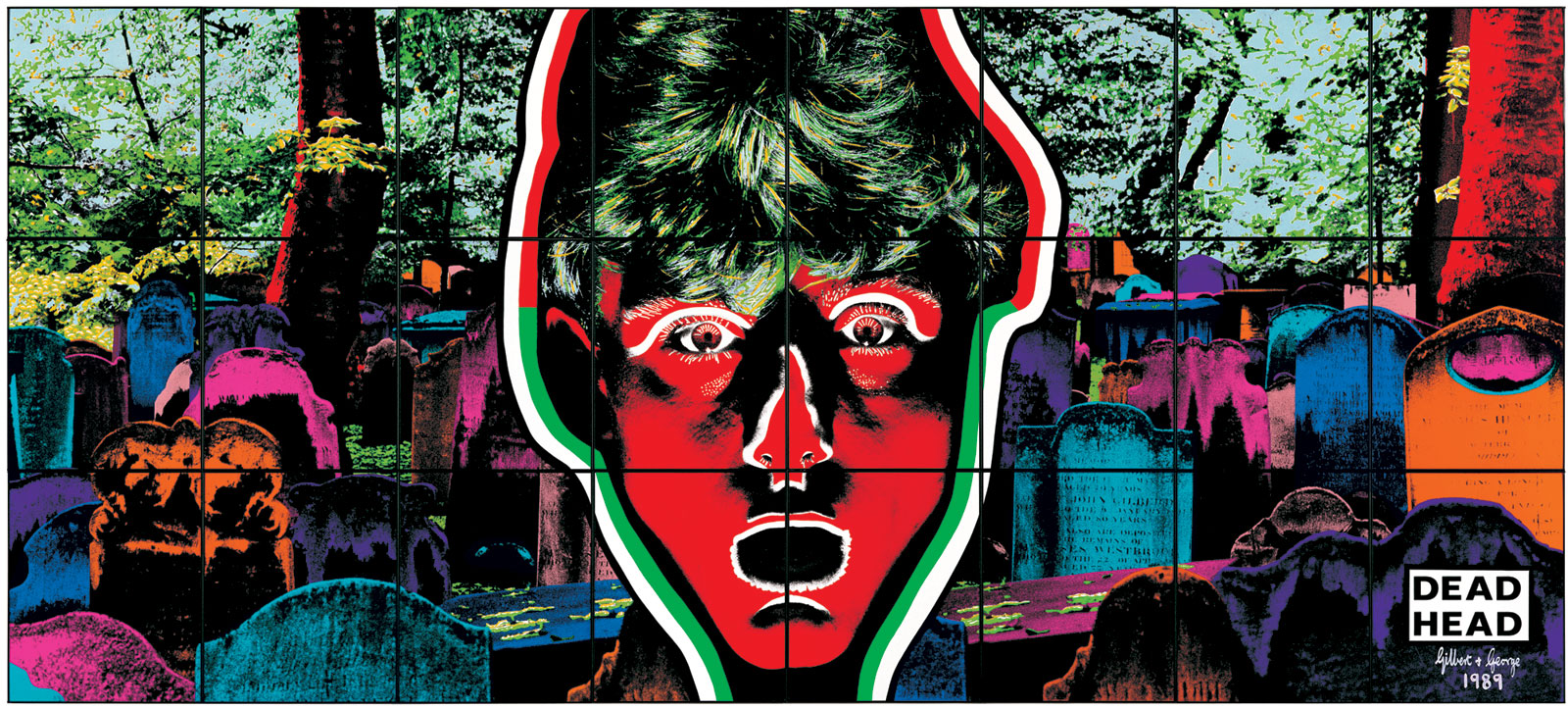
Tate Britain website

LIKE ART BLART ON FACEBOOK

Back to top

Exhibition: ‘Victorian London in Photographs 1839 to 1901’ at the London Metropolitan Archives

Exhibition dates: 5th May – 29th October, 2015


Henry Flather (British, 1839-1901) 'Building the Metropolitan Railway' 1862 from the exhibition 'Victorian London in Photographs 1839 to 1901' at the London Metropolitan Archives, May - Oct, 2015


Henry Flather (British, 1839-1901)
Building the Metropolitan Railway
1862
© City of London: London Metropolitan Archives


This photograph by Henry Flather shows workers at Baker Street as they construct London’s first Tube line.


This is a fascinating exhibition about the history of London portrayed through Victorian era photographs.

The best photographs in the posting are by John Thomson. The composition of these images is exemplary with their eloquent use of light and low depth of field. The seemingly nonchalant but obviously staged positioning of the figures is coupled with superb rendition of light in photographs such as Old Furniture, London Nomades and Recruiting Sergeants At Westminster (all 1877, below).

The details are intriguing, such as shooting contre-jour or into the light in Recruiting Sergeants At Westminster with one of the soldiers and the two street lads in the distance staring directly at the camera. This seems to be a technique of Thomson’s, for there is always one person in his intimate group photographs staring straight at the camera, which in this era is unusual in itself. For example, the woman on the steps of the Romany caravan in the photograph London Nomades (1877, below) stares straight at the camera, one of the two children framed in the doorway behind being slightly blurred, telling us the length of the exposure.

Then we have the actual characters themselves. The poverty stricken, bottom of the barrel, destitute woman and baby in The “Crawlers” – Portrait of a destitute woman with an infant (1877, below). Or the man with the tall hat and what seems to be scars around his mouth, centre stage in the photograph The Cheap Fish Of St. Giles’s (1877, below), who reminds me of that nasty character Bill Sikes out of Charles Dicken’s immortal Oliver Twist (1837-39).

“The abject misery into which they are plunged is not always self sought and merited; but is, as often, the result of unfortunate circumstances and accident.”

It must have been so tough in that era to survive every day in London.

For more information on London at this time please see the engaging book by Matthew Beaumont. Nightwalking: A Nocturnal History of London, Chaucer to Dickens. London and New York: Verso, 2015.

Dr Marcus Bunyan


Many thankx to the London Metropolitan Archives for allowing me to publish the photographs in the posting. Please click on the photographs for a larger version of the image.


Philip Henry Delamotte (British, 1821-1889) 'Setting up the Colossi of Rameses the Great' 1854 from the exhibition 'Victorian London in Photographs 1839 to 1901' at the London Metropolitan Archives, May - Oct, 2015


Philip Henry Delamotte (British, 1821-1889)
Setting up the Colossi of Rameses the Great, The Crystal Palace
1854
© City of London: London Metropolitan Archives


Philip Henry Delamotte was commissioned to record the disassembly of the Crystal Palace in Hyde Park in 1852, and its reconstruction and expansion at Sydenham, a project finished in 1854. This image, entitled Setting up the Colossi of Rameses the Great, is part of an incredible set of photographs which record a large scale project in fascinating detail.


Anonymous photographer. 'Opening ceremony of the Blackwall Tunnel' 1897


Anonymous photographer
Opening ceremony of the Blackwall Tunnel
1897
© City of London: London Metropolitan Archives


This image shows the opening ceremony of the Blackwall Tunnel. The tunnel was finally opened by the then Prince of Wales (Edward VII) in 1897, having been originally proposed in the 1880’s. It was constructed using a ‘tunnel shield’ to create the tunnel and remove debris. A major engineering project of the period, the tunnel was created to improve commerce and trade in the East End by providing a Thames crossing for a mixture of foot, cycle, horse-drawn and vehicular traffic.


Anonymous photographer. 'St Paul's Cathedral' c. 1855


Anonymous photographer
St Paul’s Cathedral
c. 1855
© City of London: London Metropolitan Archives


This photograph was taken from Southwark Bridge by an anonymous photographer. The foreground shows London’s lost wharf buildings, including Iron Wharf and Bull Wharf.


George Washington Wilson (Scottish, 1823-1893) and Charles Wilson (photographers) Marion & Co (publishers) 'Piccadilly, London' 1890


George Washington Wilson (Scottish, 1823-1893) and Charles Wilson (photographers)
Marion & Co
(publishers)
Piccadilly, London
1890
© City of London: London Metropolitan Archives


The name derives from ‘picadil’, a fashionable stiff collar of the early seventeenth century. The Aberdeen photographers George Washington Wilson and his son Charles specialised in high quality topographical views. This image is believed to be the work of the Wilsons, many of which were published by the firm of Marion & Co. The distinctive viewpoint is several feet above the carriageway. The photographers and their large format camera were driven round London in a covered wagon hired from Pickfords removals firm. This method allowed them to take candid photographs of streets and people.


Life in Victorian London Exposed

The arrival of photography in London in 1839 would change the way people saw their city, and each other, forever. Quite suddenly it was possible to see life captured ‘in the flesh’, rather than as an artist’s sketch or painting. The new medium was embraced as a means of recording the progress of grand engineering projects and revealing the shocking poverty that haunted the capital’s poorer districts.

The collections at London Metropolitan Archives contain an extraordinary range of photographs from Queen Victoria’s reign, recording the city and its people in stunning detail. Whether in carefully posed studio portraits or images of people gathered in the street, it seems that almost everyone wanted to be recorded on camera. This exhibition delves into these collections to present some of most striking images of the era; from the first known photograph of London to the opening of Blackwall Tunnel at the end of the century, taking in the Crystal Palace, the first Tube line and the harsh realities of life on the city’s streets. This free exhibition runs from Tuesday 5th May to Thursday 8th October at London Metropolitan Archives.

Images on display will include photographs from these astonishing Victorian collections:

Street Life in London

The industrial and social developments of the nineteenth century and their effect on the city and by extension the poor in Britain were subjects of interest and detailed study in the Victorian period. Street Life in London by Adolphe Smith and John Thomson was an early use of photography as a medium to expose the lives of London’s poor and dispossessed in the late 1870’s. (More images from the book can be found on the LSE Digital Library website)

Preserving the Disappearing City

In March 1875 a letter appeared in The Times calling attention to the immanent demolitions affecting The Oxford Arms, a lovely but ramshackle seventeenth century coaching inn near to the Old Bailey. A response came a few days later, in the same column, announcing that a photographic record would be made. The group of historians and photographers responsible for this initiative called themselves Society for Photographing Relics of Old London. Between 1875 and 1886 they published 120 beautifully composed photographs of buildings. These images of a City swept away by the new Victorian world provide a surprising and beautiful record of a long forgotten London.

The Crystal Palace

Constructed for The Great Exhibition of 1851 in Hyde Park, the Crystal Palace remains an enduring and enticing ‘lost’ icon of Victorian London. The building was re-erected in Sydenham in 1852 and photographer Philip Henry Delamotte was engaged to record the full process, creating 160 images which begin with the first girder going into the ground and end with Victoria and Albert’s appearance at the opening ceremony. The many fabulous highlights include Roman and Egyptian courts, a cast of the Sphinx, the dinosaurs of Crystal Palace Park and an incredible recreation of the Colossi of Aboo Simbel.


H. L. Lawrence (British) 'Portrait of a woman' Nd


H. L. Lawrence (British)
Portrait of a woman
Nd
Cabinet card
© City of London: London Metropolitan Archives


Replacing the smaller carte de visite in the 1870’s, cabinet cards were a popular way to share and collect images of friends and acquaintances.


Anonymous photographer. 'Portrait of a boy, The Ragged School' c. 1860


Anonymous photographer
Portrait of a boy, The Ragged School
c. 1860
© City of London: London Metropolitan Archives


This photograph is taken from a case book of the Ragged School Union which provides biographical information and images of a group of boys who were prepared for emigration to Canada.


John Thomson (Scottish, 1837-1921) (publisher). 'Portrait of a destitute woman with an infant' 1877


John Thomson (Scottish, 1837-1921)
The “Crawlers” – Portrait of a destitute woman with an infant
1877
© City of London: London Metropolitan Archives


This image was published in 1877 by John Thomson in Street Life in London, alongside stories written by Adolphe Smith.

“Some of these crawlers are not, however, so devoid of energy as we might at first be led to infer. A few days’ good lodging and good food might operate a marvellous transformation. The abject misery into which they are plunged is not always self sought and merited; but is, as often, the result of unfortunate circumstances and accident. The crawler, for instance, whose portrait is now before the reader, is the widow of a tailor who died some ten years ago. She had been living with her son-in-law, a marble stone-polisher by trade, who is now in difficulties through ill-health. It appears, however, that, at best, “he never cared much for his work,” and innumerable quarrels ensued between him, his wife, his mother-in-law, and his brother-in-law, a youth of fifteen. At last, after many years of wrangling, the mother, finding that her presence aggravated her daughter’s troubles, left this uncomfortable home, and with her young son descended penniless into the street. From that day she fell lower and lower, and now takes her seat among the crawlers of the district.”


The industrial and social developments of the 19th century and their effect on the city and by extension the poor in Britain were subjects of interest and detailed study in the Victorian period. Street Life in London by Adolphe Smith and John Thomson is a good example of this and in particular, its use of early photographic processes.

Adolphe Smith was an experienced journalist connected to social reform movements. While John Thomson was a photographer who had spent considerable time in the Far East, especially China, and central to his work was the photography of streets and individuals at work. Produced in 12 monthly issues, starting in February 1877, each issue had three stories accompanied by a photograph. Most of the text was written by Smith, although two are attributed to Thomson – London Nomades and Street Floods in Lambeth. The images were staged as tableau rather than being spontaneous street scenes and the relatively new process – Woodburytype – was used to reproduce the images consistently in large numbers for the publication.

Text from the London Metropolitan Archives Facebook page


Anonymous photographer. 'Portrait of actor William Terriss' late 19th century


Anonymous photographer
Theatre magazine (producer)
Portrait of actor William Terriss
late 19th century
© City of London: London Metropolitan Archives


This is a typical example of the portraits of performers produced by the Theatre magazine between 1878 and 1897. Known for heroic roles such as Robin Hood, Terriss was murdered outside the Adelphi Theatre in 1897.


William Terriss (English, 1847-1897)

William Terriss (20 February 1847 – 16 December 1897), born as William Charles James Lewin, was an English actor, known for his swashbuckling hero roles, such as Robin Hood, as well as parts in classic dramas and comedies. He was also a notable Shakespearean performer. He was the father of the Edwardian musical comedy star Ellaline Terriss and the film director Tom Terriss.

Athletic as a child, Terriss briefly joined the merchant navy and tried several professions abroad and at home. Adopting the stage name William Terriss, he made his first stage appearance in 1868 and was first in the West End in Tom Robertson’s Society in 1871. In the same year he had major successes in Robin Hood and Rebecca and quickly established himself as one of Britain’s most popular actors. In 1880, he joined Henry Irving’s company at the Lyceum Theatre, appearing in Shakespeare plays.

In 1885, he met 24-year-old Jessie Millward, with whom he starred in The Harbour Lights by G. R. Sims and Henry Pettitt. They toured Britain and America together. Terriss played the hero parts in Adelphi melodramas from the late 1880s, among other roles. In 1897, he was stabbed to death by a deranged actor, Richard Archer Prince, at the stage door of the Adelphi Theatre, where he was appearing. Terriss’s ghost is supposed to haunt Covent Garden tube station and the Adelphi Theatre.

Text from the Wikipedia website


Henry Dixon (British, 1820-1893) 'The Oxford Arms Coaching Inn' 1875


Henry Dixon (British, 1820-1893)
The Oxford Arms Coaching Inn
1875
© City of London: London Metropolitan Archives


Shot by Henry Dixon as part of the ‘Society for Photographing Relics of Old London’ project to record heritage on the verge of destruction as Victorian London re-invented itself. Amongst the subjects recorded were the galleried coaching inns which had existed in some form since the time of Chaucer and which were swept away by the coming of the railways. Most ended their days as slum dwellings before being demolished. Only one, the George, now survives.


John Thomson (Scottish, 1837-1921) (publisher) 'Old Furniture' 1877


John Thomson (Scottish, 1837-1921) (publisher)
Old Furniture
1877
© City of London: London Metropolitan Archives


This image was published in 1877 by John Thomson in Street Life in London, alongside stories written by Adolphe Smith.

“At the corner of Church Lane, Holborn, there was a second-hand furniture dealer, whose business was a cross between that of a shop and a street stall. The dealer was never satisfied unless the weather allowed him to disgorge nearly the whole of his stock into the middle of the street, a method which alone secured the approval and custom of his neighbours. As a matter of fact, the inhabitants of Church Lane were nearly all what I may term “street folks” – living, buying, selling, transacting all their business in the open street. It was a celebrated resort for tramps and costers of every description, men and women who hawk during the day and evening the flowers, fruits and vegetables they buy in the morning at Covent Garden. When, however, the question of improving this district was first broached, Church Lane stood condemned as an unwholesome over-crowded, thoroughfare, and the houses on either side are now almost entirely destroyed, and the inhabitants have been compelled to migrate to other more distant and less convenient parts of the metropolis.”


John Thomson (Scottish, 1837-1921) (publisher) 'Recruiting Sergeants At Westminster' 1877


John Thomson (Scottish, 1837-1921) (publisher)
Recruiting Sergeants At Westminster
1877
© City of London: London Metropolitan Archives


This image was published in 1877 by John Thomson in Street Life in London, alongside stories written by Adolphe Smith.

“Recruiting in London is almost exclusively circumscribed to the district stretching between the St. George’s Barracks, Trafalgar Square, and Westminster Abbey. Throughout London it is known that all information concerning service in the army can be obtained in this quarter, and intending recruits troop down to this neighbourhood in shoals, converging, as the culminating point of their peregrinations, towards the celebrated public-house at the corner of King Street and Bridge Street. It is under the inappropriate and pacific sign-board of the ‘Mitre and Dove’ that veteran men of war meet and cajole young aspirants to military honours. Here may be seen every day representatives of our picked regiments. […]

“The most prominent figure in the accompanying photograph, standing with his back to the Abbey, and nearest to the kerb stone, is that of Sergeant Ison, who is always looked upon with more than ordinary curiosity as the representative of the 6th Dragoon Guards, or Carbineers – a regiment which of late has been chiefly distinguished for having included in its ranks no less a person than Sir Roger Tichborne himself! To the Carbineer’s right we have the representatives of two heavy regiments, Sergeant Titswell, of the 5th Dragoon Guards, and Sergeant Badcock, of the 2nd Dragoons, or Scots Greys; the latter is leaning against the corner of the public-house. Close to him may be recognized the features of Sergeant Bilton, of the Royal Engineers, while Sergeant Minett, of the 14th Hussars, turns his head towards Sergeant McGilney, of the 6th Dragoons, or Enniskillen, whose stalwart frame occupies the foreground. This group would not, however, have been complete without giving a glimpse at Mr. Cox, the policeman, to whose discretion and pacific interference may be attributed the order which is generally preserved even under the most trying circumstances at the ‘Mitre and Dove.'”


John Thomson (Scottish, 1837-1921) (publisher) 'The Cheap Fish Of St. Giles's' 1877


John Thomson (Scottish, 1837-1921) (publisher)
The Cheap Fish Of St. Giles’s
1877
© City of London: London Metropolitan Archives


A street market in the notorious St Giles in the Fields area, noted as one of the worst slums in Britain during the Victorian period, 1877.

This image was published in 1877 by John Thomson in Street Life in London, alongside stories written by Adolphe Smith.

“Awaiting the moment when the costermonger is able to procure a barrow of his own he must pay eighteen pence per week for the cost of hiring. Then he must beware of the police, who have a knack of confiscating these barrows, on the pretext that they obstruct the thoroughfare and of placing them in what is termed the Green Yard, where no less than a shilling per day is charged for the room the barrow is supposed to occupy. At the same time, its owner will probably be fined from half a crown to ten shillings so that altogether it is much safer to secure a good place in a crowded street market. In this respect, Joseph Carney, the costermonger, whose portrait is before the reader, has been most fortunate. He stands regularly in the street market that stretches between Seven Dials and what is called Five Dials, making his pitch by a well-known newsagent’s, whose shop serves as a landmark. Like the majority of his class, he does not always sell fish, but only when the wind is propitious and it can be bought cheaply. On the day when the photograph was taken, he had succeeded in buying a barrel of five hundred fresh herrings for twenty five shillings. Out of these he selected about two hundred of the largest fish, which he sold at a penny each, while he disposed of the smaller herrings at a halfpenny.

“Trade was brisk at that moment, though the fish is sometimes much cheaper. Indeed, I have seen fresh herrings sold at five a penny; and this is all the more fortunate, as notwithstanding the small cost, they are, with the exception of good salmon, about the most nutritious fish in the market.”


John Thomson (Scottish, 1837-1921) (publisher) 'London Nomades' 1877


John Thomson (Scottish, 1837-1921) (publisher)
London Nomades
1877
© City of London: London Metropolitan Archives


This image was published in 1877 by John Thomson in Street Life in London, alongside stories written by Adolphe Smith.

“The class of Nomades with which I propose to deal makes some show of industry. These people attend fairs, markets, and hawk cheap ornaments or useful wares from door to door. At certain seasons this class ‘works’ regular wards, or sections of the city and suburbs. At other seasons its members migrate to the provinces, to engage in harvesting, hop-picking, or to attend fairs, where they figure as owners of ‘Puff and Darts’, ‘Spin ’em rounds’, and other games. […]

“The accompanying photograph, taken on a piece of vacant land at Battersea, represents a friendly group gathered around the caravan of William Hampton, a man who enjoys the reputation among his fellows, of being ‘a fair-spoken, honest gentleman’. Nor has subsequent intercourse with the gentleman in question led me to suppose that his character has been unduly overrated. […]

“He honestly owned his restless love of a roving life, and his inability to settle in any fixed spot. He also held that the progress of education was one of the most dangerous symptoms of the times, and spoke in a tone of deep regret of the manner in which decent children were forced now-a-days to go to school. ‘Edication, sir! Why what do I want with edication? Edication to them what has it makes them wusser. They knows tricks what don’t b’long to the nat’ral gent. That’s my ‘pinion. They knows a sight too much, they do! No offence, sir. There’s good gents and kind ‘arted scholards, no doubt. But when a man is bad, and God knows most of us aint wery good, it makes him wuss. Any chaps of my acquaintance what knows how to write and count proper aint much to be trusted at a bargain.’ […]

“The dealer in hawkers’ wares in Kent Street, tells me that when in the country the wanderers ‘live wonderful hard, almost starve, unless food comes cheap. Their women carrying about baskets of cheap and tempting things, get along of the servants at gentry’s houses, and come in for wonderful scraps. But most of them, when they get flush of money, have a regular go, and drink for weeks; then after that they are all for saving… They have suffered severely lately from colds, small pox, and other diseases, but in spite of bad times, they still continue buying cheap, selling dear, and gambling fiercely.’ […]

“Declining an invitation to ‘come and see them at dominoes in a public over the way’, I hastened to note down as fast as possible the information received word for word in the original language in which it was delivered, believing that this unvarnished story would at least be more characteristic and true to life.”


Unknown photographer. 'Trafalgar Square' c. 1867


Unknown photographer
Trafalgar Square
c. 1867
© City of London : London Metropolitan Archives


The first proposal for a square on the site of the former King’s Mews was drawn up by John Nash. It was part of King George IV’s extravagant vision for the west end curtailed by his death in 1830. Trafalgar Square was completed between 1840 and 1845 by Sir Charles Barry. There had been proposals to erect a monument to Horatio Nelson since his death at Trafalgar in 1805 but it was 1838 before a committee was formed to raise funds and consider proposals. William Railton’s design was chosen from dozens of entrants and his impressive Devonshire granite column with its statue of Nelson by E. H. Baily was erected in 1839-1843. It was already attracting photographers before the scaffolding was dismantled. The four lions at the base of the column were originally to be in stone rather than bronze but it was 1857 before a commission was given to the artist Sir Edwin Landseer (1802-1873). This photograph shows two of the lions when newly positioned some ten years later.


Unknown photographer. 'Construction of Tower Bridge' 1892


Unknown photographer
Construction of Tower Bridge
1892
© City of London : London Metropolitan Archives


London Bridge was the only crossing over the river Thames in London until the eighteenth century, after which a number of bridges and tunnels were constructed. Perhaps the most famous of these is Tower Bridge. There were a number of designs for different types of bridges but the City of London Corporation decided on a bascule (French for see-saw) design. This remarkable anonymous photograph was taken two years before the bridge opened.


London Metropolitan Archives
40 Northampton Road,
London EC1R 0HB
Phone: 0207 332 3820

Opening hours:
Monday – Thursday 10am – 4pm
Friday closed

*Please note: on Tuesdays, Wednesdays and Thursdays all computers, microfilm readers, photocopiers and printers will be turned off by 7.25pm and original documents must be returned to staff by 7.25pm so that the building can close at 7.30pm.

London Metropolitan Archives website

LIKE ART BLART ON FACEBOOK

Back to top

Exhibition: ‘J.M.W. Turner: Painting Set Free’ at the J. Paul Getty Museum, Getty Center, Los Angeles

Exhibition dates: 24th February – 24th May, 2015

Curators: Julian Brooks, curator of drawings, and Peter Björn Kerber, assistant curator of paintings


Water, Wind, and Whales


Joseph Mallord William Turner (British, 1775-1851) 'Snow Storm: Steam-Boat off a Harbour's Mouth' Exhibited 1842 from the exhibition 'J.M.W. Turner: Painting Set Free' at the J. Paul Getty Museum, Getty Center, Los Angeles, Feb - May, 2015


Joseph Mallord William Turner (British, 1775-1851)
Snow Storm: Steam-Boat off a Harbour’s Mouth
Exhibited 1842
Oil on canvas
Unframed: 91.4 x 121.9cm (36 x 48 in.)
Tate: Accepted by the nation as part of the Turner Bequest 1856
Photo: © Tate, London 2014


No words are necessary.

Marcus


Many thankx to the J. Paul Getty Museum for allowing me to publish the photographs in the posting. Please click on the photographs for a larger version of the image.


Joseph Mallord William Turner (British, 1775-1851) 'Norham Castle, Sunrise' About 1845 from the exhibition 'J.M.W. Turner: Painting Set Free' at the J. Paul Getty Museum, Getty Center, Los Angeles, Feb - May, 2015


Joseph Mallord William Turner (British, 1775-1851)
Norham Castle, Sunrise
About 1845
Oil on canvas
Unframed: 90.8 x 121.9cm (35 3/4 x 48 in.)
Tate: Accepted by the nation as part of the Turner Bequest 1856
Photo: © Tate, London 2014


Turner first saw Norham, bordering Scotland on the river Tweed in Northumberland, in 1797. He was at the limits of his trip to northern England, when he also visited Buttermere, seen in the painting of nearly fifty years earlier shown nearby. After that first visit he made watercolours showing the ruin at sunrise, and visits in 1801 and 1831 resulted in further views. Here, finally, is one of a series of unfinished, unexhibited paintings reworking his monochrome Liber Studiorum landscape prints. Pure colours rather than contrasting tones express the blazing light as the historic building and landscape merge.


It is a hundred years since Turner’s painting, Norham Castle, Sunrise, went on display for the first time. The painting was among a group of twenty-one previously unknown, and essentially ‘unfinished’, canvases that were the focal point of a new Turner room inaugurated at the Tate Gallery (now Tate Britain) in February 1906.

These pictures had entered to the national collection in 1856, but remained uncatalogued. This was chiefly due to a lack of adequate hanging space for the many oil paintings in the collection. But a bigger issue was the concern that the images would not be properly understood by the public. Gallery officials themselves had serious reservations, considering them only ‘rude beginnings’ or even ‘mere botches’.

Consequently, it was not until 1906, when a new generation began to look at Turner afresh, that space was made for the first batch of pictures disinterred from the National Gallery’s basement. These revelatory ‘new’ works were quite unlike the detailed pictures that the artist had exhibited. Their unresolved brushwork and luminous palette seemed to confirm the patriotic belief that Turner (and John Constable) had paved the way for the French Impressionists.

During the last hundred years, Norham Castle has gradually become the embodiment of many ideas about Turner’s later style, above all, its reduction of content to a minimum giving emphasis to the play of colour and light. This display explores the origins of Turner’s interest in Norham Castle as a subject and charts the impact the picture has had during its recent history.

Norham Castle, Sunrise: from incomprehension to icon,” on the Tate website


Joseph Mallord William Turner (British, 1775-1851) 'Whalers', exhibited 1845


Joseph Mallord William Turner (British, 1775-1851)
Whalers
Exhibited 1845
Oil on canvas
Unframed: 91.1 x 121.9cm (35 7/8 x 48 in.)
Tate: Accepted by the nation as part of the Turner Bequest 1856
Photo: © Tate, London 2014


Continental Travels


Joseph Mallord William Turner (British, 1775-1851) 'The Dogano, San Giorgio, Citella from the Steps of the Europa' Exhibited 1842


Joseph Mallord William Turner (British, 1775-1851)
The Dogano, San Giorgio, Citella from the Steps of the Europa
Exhibited 1842
Oil on canvas
Unframed: 61.6 x 92.7cm (24 1/4 x 36 1/2 in.)
Tate: Presented by Robert Vernon 1847
Photo: © Tate, London 2014


Joseph Mallord William Turner (British, 1775-1851) 'Approach to Venice' Exhibited 1844


Joseph Mallord William Turner (British, 1775-1851)
Approach to Venice
Exhibited 1844
Oil on canvas
Unframed: 62 x 94cm (24 7/16 x 37 in.)
National Gallery of Art, Washington, Andrew W. Mellon Collection
Image courtesy National Gallery of Art, Washington


Joseph Mallord William Turner (British, 1775-1851) 'Venice: Santa Maria della Salute, Night Scene with Rockets' about 1840


Joseph Mallord William Turner (British, 1775-1851)
Venice: Santa Maria della Salute, Night Scene with Rockets
About 1840
Watercolour and bodycolor
Unframed: 24 x 31.5cm (9 7/16 x 12 3/8 in.)
Tate: Accepted by the nation as part of the Turner Bequest 1856
Photo: © Tate, London 2014


Joseph Mallord William Turner (British, 1775-1851) 'The Sun of Venice Going to Sea' Exhibited 1843


Joseph Mallord William Turner (British, 1775-1851)
The Sun of Venice Going to Sea
Exhibited 1843
Oil on canvas
Unframed: 61.6 x 92.1 cm (24 1/4 x 36 1/4 in.)
Tate: Accepted by the nation as part of the Turner Bequest 1856
Photo: © Tate, London 2014


Joseph Mallord William Turner (British, 1775-1851) 'Venice at Sunrise from the Hotel Europa, with Campanile of San Marco' About 1840


Joseph Mallord William Turner (British, 1775-1851)
Venice at Sunrise from the Hotel Europa, with Campanile of San Marco
About 1840
Watercolor
Unframed: 19.8 x 28cm (7 13/16 x 11 in.)
Tate: Accepted by the nation as part of the Turner Bequest 1856
Photo: © Tate, London 2014


The large group of watercolours which resulted from Turner’s last visit to Venice in 1840 is characterised by a delicious liquidity which unifies air and water in layered, coloured mists. He stayed near the mouth of the Grand Canal at the Hotel Europe, from where he made sketches over the rooftops after dark. Alternatively, from a gongola off the great Piazzetta, he was able to see the sun set down the wide canal of the Giudecca.


Joseph Mallord William Turner (British, 1775-1851) 'Ehrenbreitstein' 1841


Joseph Mallord William Turner (British, 1775-1851)
Ehrenbreitstein
1841
Watercolour and pen and ink
Unframed: 23.7 x 30cm (9 5/16 x 11 13/16 in.)
Tate: Accepted by the nation as part of the Turner Bequest 1856
Photo: © Tate, London 2014


Joseph Mallord William Turner (British, 1775-1851) 'Rain Clouds' About 1845


Joseph Mallord William Turner (British, 1775-1851)
Rain Clouds
About 1845
Watercolour
Unframed: 29.1 x 44cm (11 7/16 x 17 5/16 in.)
Tate: Accepted by the nation as part of the Turner Bequest 1856
Photo: © Tate, London 2014


Joseph Mallord William Turner (British, 1775-1851) 'The Blue Rigi, Sunrise' 1842


Joseph Mallord William Turner (British, 1775-1851)
The Blue Rigi, Sunrise
1842
Watercolour
Unframed: 29.7 x 45cm (11 11/16 x 17 11/16 in.)
Tate: Purchased with assistance from the National Heritage Memorial Fund, the Art Fund (with a contribution from the Wolfson Foundation and including generous support from David and Susan Gradel, and from other members of the public through the Save the Blue Rigi appeal) Tate Members and other donors 2007
Photo: © Tate, London 2014


First major West Coast international loan exhibition focuses on Turner’s late work; Famed 19th-century master created many of his most renowned pieces after age 60.

One of the most influential painters of nature who ever lived, Joseph Mallord William Turner (English, 1775-1851) was especially creative and inventive in the latter years of his life, producing many of his most famous and important paintings after the age of 60. On view at the J. Paul Getty Museum February 24, 2015, through May 24, 2015, J.M.W. Turner: Painting Set Free brings together more than 60 key oil paintings and watercolours from this culminating period of his career, and is the West Coast’s first major exhibition of Turner’s work.

“J.M.W. Turner is the towering figure of British 19th century art, a ground-breaking innovator in his own day whose relevance and status as a seeming harbinger of 20th century ‘modernism; has made him an inspiration to generations of later artists up to the present day. A successful and well-known public figure in his own day, Turner produced some of his most innovative and challenging work during the last 16 years of his life,” explains Timothy Potts, director of the J. Paul Getty Museum. “He was frequently mocked and misunderstood for his choice of unusual subject matters, his experimentation with different canvas formats, and his pioneering free and spontaneous techniques in both oil and watercolour. While Turner could not knowingly have anticipated future artistic trends, he is seen today by many as a prophet of modernism because of his rough, gestural brushwork and quasi-abstract subject matter. His work captured the natural landscape’s atmosphere and colour like no other artist before him, and conveyed the awe-inspiring power of the elements as never before. This exhibition celebrates Turner as the most innovative and experimental artist of his time, and I have no doubt that it will be inspiring to a new generation of artists working in California today.”

“The exhibition shows an artist at the top of his game, totally at ease with his media, and still keen to push boundaries and challenge assumptions. We see how Turner was modern in his own time, but the results are astonishing even for us today,” said Julian Brooks, one of the exhibition curators.

The Sea

In his later years, Turner’s continuing fascination with the sea reached a zenith. Although he respected existing conventions of marine painting, particularly its 17th-century Dutch roots, he consistently moved beyond them, turning the water into a theatre for drama and effect. At the Royal Academy exhibitions, he confounded viewers with his bold portrayals of modern maritime action – whales and their hunters battling for survival – while striving to capture the mysterious depths and forces of the elements. Never having witnessed a whale hunt himself, he included a reference to “Beale’s Voyage” in the catalogues, acknowledging that his source of inspiration was Thomas Beale’s Natural History of the Sperm Whale (1839). (Herman Melville consulted the same book when writing Moby-Dick, published in 1851.)

The London press at the time greeted Turner’s whaling pictures, such as Hurrah! for the Whaler Erebus! Another Fish!, 1846, with scathing attacks, lambasting their yellow palette and lack of finish. The Almanack of the Month printed a cartoon of a Turner painting with a large mop and a bucket labeled “yellow,” and opined that his pictures resembled a lobster salad.

Travel

In addition to the sea, Turner’s insatiable appetite for history, different cultures, and sublime natural scenery drew him time and again to Continental Europe, where he observed not only spectacular sites such as ancient ruins, medieval castles, jagged mountain peaks, and meandering rivers, but also local customs and dress. On such travels he made numerous watercolour sketches, which effectively captured fleeting effects of nature on paper. These works display a complex layering of colour animated through the pulsing energy of turbulent handling. They demonstrate both Turner’s commitment to observed natural effects and his unwavering obsession with the vagaries and delights of watercolour, a medium he had indisputably made his own. Some of the finished watercolours he made for sale after his trips, such as The Blue Rigi, Sunrise, 1842, represent pinnacles in the use of watercolour technique.

Turner was especially captivated by the particular combination of light and colour he found in Venice, and revisited the city several times. He traveled lightly, usually alone, making few concessions to his age or failing strength, and drew constantly in his sketchbooks. Turner’s many images of Venice were among his most potent late works, influencing later artists such as James Abbott McNeill Whistler (American, 1834-1903) and Claude Monet (French, 1840-1926).

For Turner, watercolour was the perfect medium to capture Venice’s aqueous and luminous effects. While based on on-the-spot sketches done there in 1840, Turner’s later paintings of Venice drew out the city’s essence and spirit rather than its exact topography. His Venice was often touched with a melancholy that echoed the romantic fatalism popularised by writers such as Lord Byron, offering a warning from history to Britain’s rise as a commercial empire.

Poetry

Turner was deeply interested in poetry and often paired his paintings with lines of text in order to elucidate their themes. In some cases he authored the poems himself but often he quoted celebrated 18th- and 19th-century British poets such as Thomas Gray and, most especially, Lord Bryon. Throughout the Getty exhibition, many of the lines of poetry or prose that he chose or wrote are reunited with his pictures on the gallery walls. For example, the lines “The moon is up, and yet it is not night/ The sun as yet disputes the day with her” from Byron’s Childe Harold’s Pilgrimage (1812-1818) were chosen, and slightly altered by Turner to accompany two paintings: Modern Rome – Campo Vaccino, exhibited 1839, and Approach to Venice, exhibited 1844, which both feature the setting sun and a rising moon but also evoke the rise and fall of empires.

Contemporary Events

Much of Tuner’s later work reflects on contemporary events including the modern state of Italy, the legacy of the Napoleonic Wars, and the spectacular fires that ravaged the Palace of Westminster and the Tower of London in 1834 and 1841, respectively. In addition, Turner was the first major European artist to engage with innovations such as steam power, as seen in Snow Storm: Steam-Boat off a Harbour’s Mouth, 1842, which shows this much-vaunted new technology at the mercy of the awesome power of the elements.

Technique

Perhaps nothing demonstrates Turner’s virtuosity as a painter better than the stories of his performances on “Varnishing Days.” The Royal Academy and the British Institution would set aside a short period of time for artists to put final touches on their work before an exhibition opened to the public. Turner revelled in the competitive jostling and repartee that occurred on these occasions. In his later years, he would frequently submit canvases with only the roughest indications of colour and form, speedily bringing them to completion on-site. Eyewitnesses record that Turner painted most of The Hero of a Hundred Fights, 1800-10, reworked and exhibited 1847, and Burning of the Houses of Lords and Commons, 16th October 1834, 1834-1835, on their respective varnishing days.

Pairs and Shapes

In his later years, Turner was as creative in his approach to media, materials, and techniques as he was in his choice of subject matter. He created works that offer some of his most dazzling displays of colour, audacious handling, and complex iconographies. From 1840 to 1846, the artist employed a smaller canvas size for a series of paintings, which were often conceived as pairs expressing opposites, such as two that were exhibited in 1842: Peace – Burial at Sea and War. The Exile and the Rock Limpet. These were principally square but could also be round or octagonal. Exploring states of consciousness, optics, and the emotive power of colour, they shocked and mystified his audience, who thought them the products of senility or madness. Painted near the end of his life, these inventive works are a coda to Turner’s career, representing a synthesis of his innovations in technique, composition and theme.

Turner died in 1851 at age 76, leaving the majority of his work to the English nation along with an intended bequest to support impoverished artists. In the years since, while popular and scholarly ideas about his work have changed, he inarguably emerges as one of the most beloved figures and popular painters in the history of the United Kingdom.

This exhibition was organised by Tate Britain in association with the J. Paul Getty Museum and the Fine Arts Museums of San Francisco. It is supported by an indemnity from the Federal Council on the Arts and the Humanities. The Getty Museum curators of the exhibition are Julian Brooks, curator of drawings, and Peter Björn Kerber, assistant curator of paintings.

The exhibition is accompanied by the publication J.M.W. Turner: Painting Set Free. Edited by David Blayney Brown, Amy Concannon, and Sam Smiles, this 250-page volume is richly illustrated.

~ Water, Wind, and Whales
~ Continental Travels
~ Contemporary Subjects
~ History, Myth, and Meaning
~ Pairs and Shapes


Press release from the J. Paul Getty Museum website


Contemporary Subjects


Joseph Mallord William Turner (British, 1775-1851) 'The Burning of the Houses of Lords and Commons, October 16, 1834' 1834-1835


Joseph Mallord William Turner (British, 1775-1851)
The Burning of the Houses of Lords and Commons, October 16, 1834
1834-1835
Oil on canvas
Unframed: 92.1 x 123.2cm (36 1/4 x 48 1/2 in.)
Philadelphia Museum of Art: The John Howard McFadden Collection, 1928


Joseph Mallord William Turner (British, 1775-1851) 'Fire at the Grand Storehouse of the Tower of London' 1841


Joseph Mallord William Turner (British, 1775-1851)
Fire at the Grand Storehouse of the Tower of London
1841
Watercolour
Unframed: 23.5 x 32.5cm (9 1/4 x 12 13/16 in.)
Tate: Accepted by the nation as part of the Turner Bequest 1856
Photo: © Tate, London 2014


This watercolour study was originally one of nine consecutive leaves (D27846 – D27854; Turner Bequest CCLXXXIII 1-9) in a sketchbook. They have previously been documented with varying degrees of certainty as showing the 1834 fire at the Houses of Parliament beside the River Thames in central London, but are here identified as representing the similarly large and dramatic fire which broke out at the moated Tower of London on 30 October 1841, destroying the late seventeenth-century Grand Storehouse (see the Introduction to the sketchbook for detailed discussion).

Conflagration of the Tower of London, on the Night of the 30th of October 1841, a colour lithograph published on 3 November of a view ‘drawn upon the spot by William Oliver’ (1804-1853) shows the Tower complex from the north, with flames and smoke pouring from the windows and rafters of the Grand Storehouse, largely obscuring the White Tower. This can be compared with the present work, the most precisely detailed of Turner’s studies in terms of architectural features. (See the Introduction for other comparisons between Turner’s studies and contemporary prints.) The pale blue form towards the left is presumably intended as the White Tower; otherwise lacking in detail, the inner faces of its corner turrets are shown receding in steep perspective, although in fact the north-west turret is cylindrical. Turner has included details of rafters, a pediment and what seems to be the clock tower of the Grand Storehouse (which fell in at quite an early stage of the fire), but it is not clear whether he intended to show the scene directly from the north, aligned directly on the façade of the storehouse, or obliquely from the north-east, which would explain the relative positions of the clock tower and the White Tower.

In addition to the newspaper stories extensively quoted in the sketchbook’s Introduction, the following details from the Times relate to the raising of the alarm late on the evening of Saturday 30 October:

[Sergeant] Edwards [‘of the 1st Battalion of Fusilier Guards’] states, that while he was in the Nag’s Head public-house, in Postern-row [opposite the north side of the Tower], he perceived, to his great surprise, a light through one of the windows, just above the bomb proof part of the Bowyer Tower. He went out and crossed to the railings at the top of the moat by which the Tower is surrounded, and watched the light for a minute or two. At first it appeared but little larger than the glimmer of a candle, but it suddenly increased to such an extent, that no doubt was left upon his mind that the place was on fire.1


The present Tower study is notable in being the only one of the nine to incorporate gouache: a touch of white is combined with scratching out to render a bright light through a window of the towers silhouetted towards the left. This may be an effect Turner observed or imagined, or perhaps the report caught his attention.

Addressing the sequence of studies in the context of the traditional former 1834 identification, Katherine Solender felt that only this and D27850, D27853 and D27854 included ‘shapes that can be remotely identified with the Parliamentary complex’, in this case possibly indicating the roof and lantern of Westminster Hall on the right, with the Towers of Westminster Abbey beyond to the left.2 In his extended catalogue entry for Turner’s painting The Burning of the House of Lords and Commons, 16th October, 1834, exhibited at the British Institution in 1835 (Philadelphia Museum of Art),3 Richard Dorment presented a sustained interpretation of the this and the other eight watercolour studies in terms of a sequence reflecting the topography and chronology of the 1834 Westminster fire.4

Matthew Imms, April 2014 from catalogue entry to David Blayney Brown (ed.), J.M.W. Turner: Sketchbooks, Drawings and Watercolours, September 2014

1/ ‘The Tower of London. Destructive Conflagration. (Additional Particulars.)’, The Times, Tuesday 2 November 1841, p. 5.
2/ Solender 1984, pp. 50-1; see also Lyles 1992, p. 72.
3/ Martin Butlin and Evelyn Joll, The Paintings of J.M.W. Turner, revised ed., New Haven and London 1984, pp. 207-10 no. 359, pl. 364 (colour).
4/ Dorment 1986, pp. 400-1; see also Lyles 1992, p. 72.


Joseph Mallord William Turner (British, 1775-1851) 'The Hero of a Hundred Fights' About 1800 - 1810, reworked and exhibited 1847


Joseph Mallord William Turner (British, 1775-1851)
The Hero of a Hundred Fights
About 1800-1810, reworked and exhibited 1847
Oil on canvas
Unframed: 90.8 x 121.3cm (35 3/4 x 47 3/4 in.)
Framed: 127.5 x 158.5 x 18cm (50 3/16 x 62 3/8 x 7 1/16 in.)
Tate: Accepted by the nation as part of the Turner Bequest 1856
Photo: © Tate, London 2014


This canvas was originally an exploration of industrial machinery, but it was reworked to show the moment when a bronze statue of the Duke of Wellington was removed from its mould. Using the intense light of the foundry to obscure the figure, Turner transforms Wellington into an ethereal presence. The image is in stark contrast to Turner’s carefully researched battle scenes. Here, tone and colour are employed to endow a national hero with elemental force.


Joseph Mallord William Turner (British, 1775-1851) 'The Disembarkation of Louis-Philippe at the Royal Clarence Yard, Gosport, 8 October 1844' About 1844-1845


Joseph Mallord William Turner (British, 1775-1851)
The Disembarkation of Louis-Philippe at the Royal Clarence Yard, Gosport, 8 October 1844
About 1844-1845
Oil on canvas
Unframed: 90.8 x 121.3cm (35 3/4 x 47 3/4 in.)
Framed: 128.4 x 159 x 8.3cm (50 9/16 x 62 5/8 x 3 1/4 in.)
Tate: Accepted by the nation as part of the Turner Bequest 1856
Photo: © Tate, London 2014


Turner visited Portsmouth to record the arrival of the French king, who was on a State Visit. He made numerous sketches of the event and also painted two unfinished oils: one showing the king’s arrival, the other his disembarkation. Both are principally concerned with the atmosphere of the occasion, concentrating on the crowd of onlookers. Turner had met Louis-Philippe when the king was living in exile at Twickenham in the 1810s. Contact between them was renewed in the mid-1830s and he was invited to dine with him at his château at Eu in 1845.


History, Myth, and Meaning


Joseph Mallord William Turner (British, 1775-1851) 'Regulus' 1828, reworked 1837


Joseph Mallord William Turner (British, 1775-1851)
Regulus
1828, reworked 1837
Oil on canvas
Unframed: 89.5 x 123.8cm (35 1/4 x 48 3/4 in.)
Framed: 113.5 x 146 x 9.3cm (44 11/16 x 57 1/2 x 3 11/16 in.)
Tate: Accepted by the nation as part of the Turner Bequest 1856
Photo: © Tate, London 2014


Joseph Mallord William Turner (British, 1775-1851) 'Mercury Sent to Admonish Aeneas' Exhibited 1850


Joseph Mallord William Turner (British, 1775-1851)
Mercury Sent to Admonish Aeneas
Exhibited 1850
Oil on canvas
Unframed: 90.2 x 120.6cm (35 1/2 x 47 1/2 in.)
Framed: 129.6 x 160.7 x 18.5cm (51 x 63 1/4 x 7 5/16 in.)
Tate: Accepted by the nation as part of the Turner Bequest 1856


Joseph Mallord William Turner (British, 1775-1851) 'Mercury and Argus' Before 1836


Joseph Mallord William Turner (British, 1775-1851)
Mercury and Argus
Before 1836
Oil on canvas
Unframed: 151.8 x 111.8cm (59 3/4 x 44 in.)
National Gallery of Canada, Ottawa, Purchased 1951
Photo: © National Gallery of Canada


Pairs and Shapes


Joseph Mallord William Turner (British, 1775-1851) 'Peace – Burial at Sea' Exhibited 1842


Joseph Mallord William Turner (British, 1775-1851)
Peace – Burial at Sea
Exhibited 1842
Oil on canvas
Unframed: 87 x 86.7cm (34 1/4 x 34 1/8 in.)
Tate: Accepted by the nation as part of the Turner Bequest 1856
Photo: © Tate, London 2014


Joseph Mallord William Turner (British, 1775-1851) 'War. The Exile and the Rock Limpet' Exhibited 1842


Joseph Mallord William Turner (British, 1775-1851)
War. The Exile and the Rock Limpet
Exhibited 1842
Oil on canvas
Unframed: 79.4 x 79.4cm (31 1/4 x 31 1/4 in.)
Tate: Accepted by the nation as part of the Turner Bequest 1856
Photo: © Tate, London 2014


Joseph Mallord William Turner (British, 1775-1851) 'Light and Color (Goethe's Theory) – The Morning After the Deluge – Moses Writing the Book of Genesis' Exhibited 1843


Joseph Mallord William Turner (British, 1775-1851)
Light and Color (Goethe’s Theory) – The Morning After the Deluge – Moses Writing the Book of Genesis
Exhibited 1843
Oil on canvas
Unframed: 78.7 x 78.7cm (31 x 31 in.)
Framed: 103.5 x 103.5 x 12cm (40 3/4 x 40 3/4 x 4 3/4 in.)
Tate: Accepted by the nation as part of the Turner Bequest 1856
Photo: © Tate, London 2014


The nine finished paintings are being shown in a dedicated room of the exhibition which brings new perspectives on Turner’s work during the final period of his life. At the time of their creation Turner’s square canvases were his most controversial and they were famously subjected to a hail of abuse in the press. Even Ruskin, a devoted fan, described Turner’s work by 1846 as ‘indicative of mental disease’. The show will reposition Turner in his old age as a challenging and daring artist who continued his lifelong engagement with the changing world around him right up until his death in 1851.

When Turner began painting on square canvases in the later years of his life between 1840 and 1846 they were a new format for the artist to be working in. In works known as Shade and Darkness and Light and Colour, both exhibited 1843, it can be seen how Turner developed his dramatic use of the vortex, a technique characteristic in his later work.

The display of the square canvases, along with one unfinished square composition, has been made possible by the important loans of Glaucus and Scylla 1841 (Kimbell Art Museum, Fort Worth, USA), and Dawn of Christianity 1841 (Ulster Museum, Belfast, UK). The group of works includes some of Turner’s most iconic pairings such as Peace andWar, both exhibited 1842 (Tate). The exhibition as a whole will also include a number of pairings from throughout this period of his life, showing Turner’s fondness for working in sets or sequences in his old age.

“Turner’s controversial square canvases to be brought together for the first time,” from the Tate website 13 March 2014


Joseph Mallord William Turner (British, 1775-1851) 'The Angel Standing in the Sun' Exhibited 1846


Joseph Mallord William Turner (British, 1775-1851)
The Angel Standing in the Sun
Exhibited 1846
Oil on canvas
Unframed: 78.7 x 78.7cm (31 x 31 in.)
Framed: 103.5 x 103.5 x 12cm (40 3/4 x 40 3/4 x 4 3/4 in.)
Tate: Accepted by the nation as part of the Turner Bequest 1856
Photo: © Tate, London 2014


Joseph Mallord William Turner (British, 1775-1851) 'Ancient Rome: Agrippina Landing with the Ashes of Germanicus' Exhibited 1839


Joseph Mallord William Turner (British, 1775-1851)
Ancient Rome: Agrippina Landing with the Ashes of Germanicus
Exhibited 1839
Oil on canvas
Unframed: 91.4 x 121.9cm (36 x 48 in.)
Tate: Accepted by the nation as part of the Turner Bequest 1856
Photo: © Tate, London 2014


Joseph Mallord William Turner (British, 1775-1851) 'Modern Rome – Campo Vaccino' 1839


Joseph Mallord William Turner (British, 1775-1851)
Modern Rome – Campo Vaccino
1839
Oil on canvas
Unframed: 91.8 x 122.6cm (36 1/8 x 48 1/4 in.)
The J. Paul Getty Museum, Los Angeles


The J. Paul Getty Museum
1200 Getty Center Drive
Los Angeles, California 90049

Opening hours:
Daily 10am – 5pm

The J. Paul Getty Museum website

LIKE ART BLART ON FACEBOOK

Back to top

Exhibition: ”Poor man’s picture gallery’: Victorian Art and Stereoscopic Photography’ at Tate Britain, London

Exhibition dates: 7th October, 2014 – 12th April, 2015

Curator: Carol Jacobi with Dr Brian May and Denis Pellerin


James Robinson (Ireland, 1850s-1870s) 'The Death of Chatterton' 1859 from the exhibition ''Poor man's picture gallery': Victorian Art and Stereoscopic Photography' at Tate Britain, London, October 2014 - April 2015


James Robinson (Ireland, 1850s-1870s)
The Death of Chatterton
1859
Two photographs, hand-tinted albumen prints on paper mounted on card
Collection Dr Brian May


I have always been fascinated by early three-dimensional photography, inexpensive stereograph pictures. To me, they are an early form of VR. You bring a machine to your eyes, focus and wham, your in another world – just like wearing an enveloping VR headset. Here are the Pyramids, or the Venice canals, right in front of you. The pictures separate fore, mid and background so there is real depth to the tableaux, like sitting in an iMax cinema and watching old New York come to life. The photographs seem to reach out to you, not just the scene being brought to life, but the transcendence of time as well. This is how these things looked all those years ago in Technicolor 3D. Even now, there is nothing quite like looking through a stereoscope viewer.

In this exhibition we see that, not only did photographers copy famous paintings, but new innovation and mis en scene techniques in photography also inspired painters. “Stereographic techniques of arranging real figures in compositions that were at once carefully composed and naturally spontaneous were particularly pertinent to Pre-Raphaelite painters, who observed and used friends and acquaintances as models in inventive and expressive new poses.”

Both mediums had their advantages: the artistic possibilities of the precocious technology of photography allowed the mind of the viewer “to feel its way into the very depths of the picture” and produce “a surprise such as no painting ever produced.” The photographs added a charm and depth never dreamt of by the original artists, the painters. While “the light and colour [of the photographs] appear crude in comparison with the painting … the stereoscope records ‘every stick, straw, scratch’ in a manner that the painting cannot.” The painters colour harmonies are infinitely more nuanced than the hand-tinted photograph and the brushwork asserts the painter’s individual touch.

But, as curator Carol Jacobi’s erudite essay “Tate Painting and the Art of Stereoscopic Photography,” (which is well worth the time to read) observes, one medium did not defer to the other but played off each other, working in different form in the service of realism. As Jacobi observes, “The problems and possibilities of realism… underpinned the dialogue between painters and stereographers.” For example, “Robinson’s The Death of Chatterton illustrates the way this uncanny quality [the ability to record reality in detail] distinguishes the stereograph from even the immaculate Pre-Raphaelite style of Wallis’s painting of the same subject.” Jacobi also notes that, “Unlike painting, stereographs exclude things outside the frame. When the eyes come close to the stereoscope lenses and manage to bring the image into focus they experience the sudden sensation of being in the picture… Stereography was a new art. Gaudin’s stereograph can be seen exploring its distinctive characteristics, the actuality of figures and its immersive three-dimensionality, to bring the Pre-Raphaelite painter’s composition to life in new ways.” You only have to look at Alfred Silvester’s The Road, the Rail, the Turf, the Settling Day (The Turf) (detail, below) to understand what Jacobi is proposing.

The actuality and presence of figures and contexts. This is why this form of photography retains its undoubted fascination.

Dr Marcus Bunyan


Many thankx to Tate Britain for allowing me to publish the photographs in the posting. Please click on the photographs for a larger version of the image. My apologies for some of the small images in the posting, that was all I could get!


Henry Wallis (British, 1830-1916) 'The Death of Chatterton' 1856 from the exhibition ''Poor man's picture gallery': Victorian Art and Stereoscopic Photography' at Tate Britain, London, October 2014 - April 2015


Henry Wallis (British, 1830-1916)
The Death of Chatterton
1856
Oil paint on canvas
622 x 933mm
Tate
Bequeathed by Charles Gent Clement 1899


‘Poor man’s picture gallery’: Victorian Art and Stereoscopic Photography is the first display in a major British art gallery devoted to early three-dimensional photography. These ingenious but inexpensive stereograph pictures were a nineteenth century craze, circulating world-wide in tens of thousands and more. Pioneers of the art form were quick to challenge fine art itself. Celebrated canvases of the age, such as Henry Wallis’s Chatterton and William Powell Frith’s Derby Day, were recreated in real depth.

This display brings twelve of Tate’s Victorian and Pre-Raphaelite works face to face with a rare collection of their three-dimensional doubles assembled by Brian May. Viewers can finally appreciate the interpretations that the photographers explored and the ways they brought the paintings to life. This display has been curated by Carol Jacobi with Dr Brian May and Denis Pellerin. The Poor Man’s Picture Gallery: Stereoscopy versus Paintings in the Victorian Era by Dr Brian May and Denis Pellerin is published 20 October 2014 by the London Stereoscopic Company.

Text from the Tate Britain website


“Holmes’s 1859 article confirms that, in its earliest moment, stereography was thought of in relation to realist painting. “The first effect of looking at a good photograph through the stereoscope is a surprise such as no painting ever produced,” he declared, “the mind feels its way into the very depths of the picture.” He provides a sophisticated understanding of the artistic possibilities of the precocious technology, at the date at which the stereographs on display at Tate Britain were made, but it is the stereographs themselves which bear this out.”

“Many artists, such as Leonardo da Vinci, understood that the world appears to us in three dimensions because our two eyes see from two slightly different angles (look at your hand with one eye covered, then the other eye covered, and you will see it move and alter slightly). Our mind combines these two views to perceive depth. Leonardo concluded that even the most realistic painting, being just one view, can only be experienced in two dimensions.

Nearly 350 years later, in London, the Victorian scientist Charles Wheatstone (1802-1875) took up the challenge. In 1838, he showed that a pair of two-dimensional pictures represented from slightly different viewpoints, brought together in his ‘stereoscope’, could appear three-dimensional. William Fox Talbot announced his technique of print photography a few months later and soon photographs were being taken in pairs for this purpose. Within a decade special cameras and viewers were invented; stereoscopes and stereographs were soon available worldwide. In 1859, Oliver Wendell Holmes’s essay The Stereoscope and the Stereograph celebrated the invention:

The two eyes see different pictures of the same thing, for the obvious reason that they look from points two or three inches apart. By means of these two different views of an object, the mind, as it were, feels round it and gets an idea of its solidity. We clasp an object with our eyes, as with our arms, or with our hands.

Stereographs sold for a few shillings and people of all classes collected them for education and for pleasure. Small hand-held stereoscopes allowed them to gaze on faraway countries, mechanical inventions, comic incidents, beauty spots, zoological or botanical specimens or celebrity weddings, in the comfort of their homes. Three-dimensional images of famous sculptures were especially successful and Dr Brian May’s and Denis Pellerin’s new book, The Poor Man’s Picture Gallery: Stereoscopy versus Paintings in the Victorian Era (2014) has drawn attention to stereo photographers’ engagement with famous paintings of the age. Tate Britain’s display of some of the stereographs in Brian May’s collection creates a dialogue between these and celebrated Tate works, six of which are discussed here. It also introduces the photographers who, with rapidity and invention, took up this new medium.

The phrase ‘poor man’s picture gallery’, borrowed from print-making, appeared in The Times newspaper in 1858 in an article speculating on making stereographs of ‘our most remarkable pictures’. The writer did not think of these as mere imitations: “So solid and apparently real”, they would have “added a charm never dreamt of by their producers”, the original artists. Interestingly, the writer was discussing attempts to make stereographs from the paintings themselves because, he or she regretted, that such elaborate compositions could never be recreated in real life; “No exertion could gather together the characters with the requisite expression and all the adjuncts of suitable scenery… and retain them still until they were fixed by the camera’. This assertion was incorrect.”

Extract from the essay by Carol Jacobi. “Tate Painting and the Art of Stereoscopic Photography,” on the Tate website 17th October, 2014 [Online] Cited 14/02/2015


James Robinson (Ireland, 1850s-1870s) 'The Death of Chatterton' 1859 (detail)


James Robinson (Ireland, 1850s-1870s)
The Death of Chatterton (detail)
1859
Two photographs, hand-tinted albumen prints on paper mounted on card
Collection Dr Brian May


One of the most famous paintings of Victorian times was Chatterton, 1856 (Tate) by the young Pre-Raphaelite-style artist, Henry Wallis (1830-1916). Again, the tale of the suicide of the poor poet, Thomas Chatterton, exposed as a fraud for faking medieval histories and poems to get by, had broad appeal. Chatterton was also an 18th-century figure, but Wallis set his picture in a bare attic overlooking the City of London which evoked the urban poverty of his own age. The picture toured the British Isles and hundreds of thousands flocked to pay a shilling to view it. One of these was James Robinson, who saw the painting when it was in Dublin. He immediately conceived a stereographic series of Chatterton’s life. Unfortunately Robinson started with Wallis’s scene (The Death of Chatterton, 1859). Within days of its publication, legal procedures began, claiming his picture threatened the income of the printmaker who had the lucrative copyright to publish engravings of the painting. The ensuing court battles were the first notorious copyright cases. Robinson lost, but strangely, in 1861, Birmingham photographer Michael Burr published variations of Death of Chatterton with no problems. No other photographer was ever prosecuted for staging a stereoscopic picture after a painting and the market continued to thrive…

Robinson’s The Death of Chatterton illustrates the way this uncanny quality [the ability to record reality in detail] distinguishes the stereograph from even the immaculate Pre-Raphaelite style of Wallis’s painting of the same subject. The stereograph represented a young man in 18th-century costume on a bed. The backdrop was painted, but the chest, discarded coat and candle were real. Again, the light and colour appear crude in comparison with the painting but the stereoscope records ‘every stick, straw, scratch’ in a manner that the painting cannot. The torn paper pieces, animated by their three-dimensionality, trace the poet’s recent agitation, while the candle smoke, representing his extinguished life, is different in each photograph due to their being taken at separate moments. The haphazard creases of the bed sheet are more suggestive of restless movement, now stilled, than Wallis’s elegant drapery. Even the individuality of the boy adds potency to his death.

Extract from the essay by Carol Jacobi. “Tate Painting and the Art of Stereoscopic Photography,” on the Tate website 17th October, 2014 [Online] Cited 14/02/2015. Used under fair use conditions for the purposes of education and research


Michael Burr (British, 1826-1912) 'Hearts are Trumps' 1866


Michael Burr (British, 1826-1912)
Hearts are Trumps
1866
Hand coloured albumen prints on stereo card
Collection Dr Brian May


Michael Burr (British, 1826-1912) 'Hearts are Trumps' 1866 (detail)

Michael Burr (British, 1826-1912) 'Hearts are Trumps' 1866 (detail)


Michael Burr (British, 1826-1912)
Hearts are Trumps (details)
1866
Hand coloured albumen prints on stereo card
Collection Dr Brian May


Stereographic techniques of arranging real figures in compositions that were at once carefully composed and naturally spontaneous were particularly pertinent to Pre-Raphaelite painters, who observed and used friends and acquaintances as models in inventive and expressive new poses. Michael Burr was skilled at intimate scenes; The Death of Chatterton was typical of his use of an unusually shallow, portrait-like space. In 1866, Burr’s Hearts are Trumps (above) photographed three women in modern dress. They interact casually around a card table, and one regards us directly, but they are at the same time artfully positioned equally close the picture plane. This created a natural effect while keeping them the same length from the camera to avoid the distortions that a lens gives to near objects at different distances. Six years on, Sir John Everett Millais adapted the stereograph’s composition in his own Hearts are Trumps (1872, Tate, below). He might have incorporated its informal effect to challenge accusations that had recently appeared in the press that he could not represent modern beauties in contemporary fashion. The life-like size of Millais’s image fills the field of vision with the same impact that the encompassing scene presents in the stereoscope…

Millais’s Hearts are Trumps may have nodded to the alternative stereographic art form, but it did not defer to it. His colour harmonies are infinitely more nuanced than Burr’s hand-tinted photograph. The brushwork whips up extra vivacity and asserts the painter’s individual touch. Nonetheless, Oliver Wendell Holmes argued that stereography had its own artistic possibilities:

The very things which an artist would leave out, or render imperfectly, the photograph takes infinite care with; there will be incidental truths which interest us more than the central object of the picture… every stick, straw, scratch… look at the lady’s hands. You will very probably find the young countess is a maid-of-all-work.

Extract from the essay by Carol Jacobi. “Tate Painting and the Art of Stereoscopic Photography,” on the Tate website 17th October, 2014 [Online] Cited 14/02/2015. Used under fair use conditions for the purposes of education and research


Sir John Everett Millais, Bt (English, 1829-1896) '
Hearts are Trumps' 1872


Sir John Everett Millais, Bt (English, 1829-1896)
Hearts are Trumps
1872
Oil on canvas
1657 x 2197mm
Tate
Presented by the Trustees of the Chantrey Bequest 1945


In its style, which recalls the works of the eighteenth-century painter Sir Joshua Reynolds, and in its flattering depiction of the fashionable sitters, this picture expresses a gentle and nostalgic vision of family life. Elizabeth, Diana and Mary, daughters of Walter Armstrong of Scotland and London, were in their twenties when Millais painted them. Mary holds most of the trumps and looks towards the viewer. Delicately, the card game hints at sisterly competition in husband-finding.


William Powell Frith (English, 1819-1909) 'Dolly Varden' c. 1842-1849


William Powell Frith (English, 1819-1909)
Dolly Varden
c. 1842-1849
Oil on wood
273 x 216 mm
Tate. Bequeathed by Mrs E.J. Thwaites 1955


The delightfully fluttery Dolly Varden is a character in Charles Dickens’ novel Barnaby Rudge, published in 1841. Its action is set in the London of the 1780s. Dickens describes Dolly, daughter of a worthy locksmith, as “the very pink and pattern of good looks, in a smart little cherry coloured mantle.” This work, apart from drawing on a well-known novel of the day, also owes much to a strong nineteenth-century tradition of ‘fancy portraits’ – where likenesses of pretty and anonymous young women would be graced by the names of characters from literature.


Frederic Jones (British, active 1861-1868) 'Dolly Varden' 1858


Frederic Jones (British, active 1861-1868)
Dolly Varden
1858
Albumen prints on paper mounted on card
Collection Dr Brian May


The problems and possibilities of realism were fundamental to 19th-century science and literature as well as the arts. It underpinned the dialogue between painters and stereographers. Even painted subjects from history and literature represented by stereographers appear to have been chosen for their familiar, everyday aspects. This shared realism reflected and therefore appealed to 19th-century audiences and was essential to the medium’s success. In 1854 The London Stereoscopic Company was set up on Oxford Street to sell stereographs and stereoscopes. Its first catalogue (1856) advertised scenes as ‘Miscellaneous Subjects of the “Wilkie” character’, referring to the most famous genre painter of the day, Sir David Wilkie. Wilkie’s younger rival, William Powell Frith (1819-1909), and Welsh photographer Frederic Jones (1827 – date not known), a manager of the London Stereographic Company, recreated one of his most popular paintings, Dolly Varden. Frith’s composition was taken in turn from Charles Dickens’s (1812-1870) classic realist novel Barnaby Rudge (1841). It drew on the popularity of the author and book, and was intended to reach a similarly broad audience in the form of engraved prints. Although Dickens’s story was set in the 18th-century, the episode Frith chose, in which Dolly came across a man when she was alone in the woods and laughed bravely, appealed to modern preoccupations with women’s vulnerability and independence. Both Frith’s and Jones’s pictures placed the viewer in the position of the approaching man, but only Jones’s three-dimensional Dolly offered the spectator the opportunity to “clasp an object with our eyes, as with our arms, or with our hands,” as Holmes put it, as her predator does in the book. Fortunately, Dolly eventually eluded his attentions.

Extract from the essay by Carol Jacobi. “Tate Painting and the Art of Stereoscopic Photography,” on the Tate website 17th October, 2014 [Online] Cited 14/02/2015. Used under fair use conditions for the purposes of education and research


William Collins (English, 1788-1847) 'Happy as a King' c. 1836 (replica)


William Collins (English, 1788-1847)
Happy as a King (replica)
c. 1836
Oil paint on canvas
711 x 914mm
Tate
Presented by Robert Vernon 1847


Michael Burr (British, 1826-1912) 'Happy as a King' 1865


Michael Burr (British, 1826-1912)
Happy as a King
1865
Hand coloured albumen prints on stereo card
Collection Dr Brian May


Michael Burr (British, 1826-1912) 'Happy as a King' 1865 (detail)


Michael Burr (British, 1826-1912)
Happy as a King (detail)
1865
Hand coloured albumen prints on stereo card
Collection Dr Brian May


Astronomer and Queen‘s guitarist, Dr Brian May has lent a rare collection of Victorian stereographic photographs to Tate Britain. They are featured in ‘Poor man’s picture gallery’: Victorian Art and Stereoscopic Photography until 12 April 2015. This is the first display in a major British art gallery devoted to the nineteenth-century craze of three-dimensional photography, known as stereographs, and open up this neglected area of British art.

In the 1850s and 1860s pioneer photographers staged real men, women and children in tableaux based on famous paintings of the day, in order to bring them to life as three-dimensional scenes. Henry Wallis’ Chatterton 1856, William Powell Frith’s Derby Day 1857 and John Everett Millais’ The Order of Release 1746 are among twelve of Tate’s famous Victorian and Pre-Raphaelite paintings to be shown with their 3D hand-coloured photographic equivalents.

Stereographs comprise two photographs of the same scene taken from fractionally different viewpoints. When these are mounted side by side and viewed through a stereoscope, the viewer sees just one three-dimensional image. Stereographs were inexpensive, and in the 1850s and 1860s they circulated world-wide in their tens of thousands. Many Victorians became familiar with well-known paintings through their stereoscopic counterparts which became known as a ‘Poor Man’s Picture Gallery’. The photographs were regarded by many as fairly disposable, making them hard to track down today.

The display introduces important figures in stereoscopic photography such as Alexis Gaudin and Michael Burr, and shows how some of their innovations also inspired painters. Burr’s stereograph Hearts are Trumps 1866 anticipated John Everett Millais’ voluptuous painting with the same title six years later, and James Elliott’s Derby Day, One Week after the Derby 1858, pre-empted Robert Martineau’s renowned oil painting of family ruin, The Last Day in the Old Home 1862.

Dr Brian May, said: “We’re thrilled that for the very first time Stereographs are now on view at Tate. In this unique display they can be viewed in their full 3-D splendour alongside the beautiful Victorian narrative paintings to which they relate. We’re grateful to Tate Britain, and hope to inspire a new love of stereoscopy in the 21st Century.”

Carol Jacobi, Curator, British Art, 1850-1915, Tate Britain said: “This display allows us to consider the works in Tate’s collection in a new light. We are delighted to be collaborating with Dr Brian May, who has built this collection over 40 years, and with Denis Pellerin, who has researched the connections.”

The photographs exhibited in this display at Tate Britain are kindly lent by Dr Brian May. This display has been curated by Carol Jacobi with Dr Brian May and Denis Pellerin. The book The Poor Man’s Picture Gallery: Stereoscopy versus Paintings in the Victorian Era by Dr Brian May and Denis Pellerin is published by the London Stereoscopic Company on 20 October 2014.

Press release from Tate Britain


Charles Robert Leslie (English, 1794-1859) 'A Scene from Tristram Shandy ('Uncle Toby and the Widow Wadman')' 1829-1830


Charles Robert Leslie (English, 1794-1859)
A Scene from Tristram Shandy (‘Uncle Toby and the Widow Wadman’)
1829-1830, exhibited 1831
Oil paint on canvas
813 x 559mm
Tate
Presented by Robert Vernon 1847


Anonymous photographer. 'Uncle Toby' Nd


Anonymous photographer
Uncle Toby
Nd
Albumen prints on paper mounted on card
Collection Dr Brian May


Sir John Everett Millais, Bt (English, 1829-1896) 'The Order of Release 1746' 1852-1853


Sir John Everett Millais, Bt (English, 1829-1896)
The Order of Release 1746
1852-1853
Oil on canvas
1029 x 737mm
Tate
Presented by Sir Henry Tate 1898


In 1855, the French photographer Alexis Gaudin (1816-1894) saw the Scottish scene from the Jacobite Rebellion, The Order of Release, 1746 by John Everett Millais(1829-1896), at the first Exposition Universelle in Paris. A woman carrying a sleeping child comforts her wounded husband, a defeated rebel, while handing an order for his release to a gaoler. Shortly afterwards, Gaudin made a stereograph, the rare surviving examples of which bear no title, which posed a young woman, child and two men in the same attitudes (Untitled, after Millais, The Order of Release, c. 1855).

Millais’s subject may have appealed to the Frenchman because of its theme of revolution (the Jacobites had been supported by France) and he may have hoped to capitalise on the painting’s popular success. It is notable too, however, that the picture is an example of Pre-Raphaelite realism, not just in appearance, but in the emotions expressed in pose and expression. Millais’s figures were, moreover, renowned as portraits of real people. Pre-Raphaelite painting was a challenge to photography, which Gaudin took up.

Gaudin’s stereograph was not a copy of Millais’s composition; it was a response to it. His image combined a backdrop painted in the conventional way behind the figures with real furniture and a door jutting out in front. Such round and rectangular geometric objects became common in stereographs because they created clear three-dimensional shapes. Like Millais, Gaudin used real models. They express the sternness, despair and stoicism of the gaoler, soldier and wife. The child’s bare legs and feet and head dropping on the mother’s shoulder indicate that s/he is sleeping, innocent of the tense exchange. The dog is probably an example of taxidermy as a real one is unlikely to have stayed still while the photograph, which would have been exposed over several seconds, was taken. Since they were taken and developed, the pictures have been hand-coloured.

Differences between the painting and the stereograph adapted Millais’s image to the new medium and new ideas. The gaoler could be resting the hand holding the order against the rebel’s shoulder to avoid moving and blurring the image, or Gaudin may have liked the juxtaposition of the document of release with the window indicating the outside world. The little dog is less romanticised than Millais’s loyal, silky specimen. It would have been recognisable at the time as a typical British terrier breed, a working dog similar to Bullseye, familiar from Phiz’s illustrations to Dickens’s Oliver Twist (1837). This proletarian touch is compounded by the dog’s apparent interest in the empty food bowl.

Gaudin’s image could conjure reality in ways not available to Millais. Unlike painting, stereographs exclude things outside the frame. When the eyes come close to the stereoscope lenses and manage to bring the image into focus they experience the sudden sensation of being in the picture. Even the tiny scale of the scenes imitates the scale at which distant objects are experienced in life (to get a sense of this, look at a person on the other side of the room and holding your hand near your eye line up your forefinger with their head and your thumb with their feet). This characteristic provided Gaudin with a different way to explore Millais’s theme of imprisonment. The painter created an enclosed feeling for the viewer with a claustrophobic shadowy shallow space. The stereographer used a deeper room so that when seen through the viewer the figure, and the viewer, are enclosed within its walls.

Stereography was a new art. Gaudin’s stereograph can be seen exploring its distinctive characteristics, the actuality of figures and its immersive three-dimensionality, to bring the Pre-Raphaelite painter’s composition to life in new ways. This complexity was admired at the time: “It is a mistake to suppose one knows a stereoscopic picture when he has studied it a hundred times,” Holmes advised. Tate Britain’s display provides the opportunity to view originals with and without the stereoscopic viewer, and examine and appreciate their distinctive approach.

Extract from the essay by Carol Jacobi. “Tate Painting and the Art of Stereoscopic Photography,” on the Tate website 17th October, 2014 [Online] Cited 14/02/2015. Used under fair use conditions for the purposes of education and research


Alexis Gaudin (French, 1816-1894) 'Untitled, after Millais, The Order of Release' c. 1855


Alexis Gaudin (French, 1816-1894)
Untitled, after Millais, The Order of Release
c. 1855
Two photographs, hand-tinted albumen prints on paper mounted on card
Collection Dr Brian May


Alexis Gaudin (French, 1816-1894) 'Untitled, after Millais, The Order of Release' c. 1855 (detail)


Alexis Gaudin (French, 1816-1894)
Untitled, after Millais, The Order of Release (detail)
c. 1855
Two photographs, hand-tinted albumen prints on paper mounted on card
Collection Dr Brian May


Philip Hermogenes Calderon (English born France, 1833-1898) 'Broken Vows' 1856


Philip Hermogenes Calderon (English born France, 1833-1898)
Broken Vows
1856
Oil paint on canvas
914 x 679mm
Tate
Purchased 1947


James Elliott (British, active 1860s) 'Broken Vows' Nd


James Elliott (British, active 1860s)
Broken Vows
Nd
Two photographs, hand-tinted albumen prints on paper mounted on card
Collection Dr Brian May


James Elliott (British, active 1860s) 'Broken Vows' Nd (detail)


James Elliott (British, active 1860s)
Broken Vows (detail)
Nd
Two photographs, hand-tinted albumen prints on paper mounted on card
Collection Dr Brian May


William Powell Frith (English, 1819-1909) 'The Derby Day' 1856-1858


William Powell Frith (English, 1819-1909)
The Derby Day
1856-1858
Oil paint on canvas
1016 x 2235mm
Tate
Bequeathed by Jacob Bell 1859


When The Derby Day was first exhibited at the Royal Academy in 1858, it proved so popular that a rail had to be put up to keep back the crowds. It presents a panorama of modern Victorian life, a previously unknown genre which Frith largely created in his earlier work, Life at the Seaside, Ramsgate Sands of 1854 (Royal Collection). Frith was a firm believer in the spurious sciences of phrenology and social type, which considered people’s characters and social origins were visible in their physical features. Each character in Frith’s picture is depicted to conform to these stereotypes, notably in the range of criminal and low-life types present (see Cowling 1989, Ch.2).

On the basis of an initial sketch, which he made after a visit to Epsom in 1856, Frith was commissioned by Jacob Bell, a chemist and amateur artist, to paint a large 5-6 foot canvas for £1,500. He worked on the project for fifteen months, producing two large sketches in addition to the finished work. He brought the composition together with the aid of drawings and sketches, hiring models to pose for all the main figures. He also commissioned the photographer Robert Howlett to “photograph for him from the roof of a cab as many queer groups of figures as he could” (Journal of the Photographic Society, 15 January 1863). He asked a real jockey called Bundy to pose on a hobbyhorse in his studio for the riders on the right of the picture, and also hired an acrobat and his son, whom he saw performing in a pantomime in Drury Lane. For the remaining figures he called on family and friends, as well as a string of young women sent by Jacob Bell.

Despite a remarkable feat of organisation, the picture remains fairly static, and the figures are more interesting when examined individually. There are three main incidents taking place in the picture. On the far left, next to the Reform Club’s private tent, a group of men in top hats focus on the thimble-rigger with his table, inviting the audience to participate in the game. The man taking a note from his pocket is the trickster’s accomplice. He is tempting the rustic-looking man in a smock, whose wife is trying to restrain him. On the right of this group, another man, with his hands in his pockets, has had his gold watch stolen by the man behind. In the centre of the picture we see the acrobat and his son, who looks longingly over at a sumptuous picnic being laid out by a footman. Behind them are carriages filled with race-goers, including a courtesan on the far right, who is the kept mistress of the foppish-looking character leaning against the carriage. The courtesan is balanced on the far left of the picture by the woman in a dark riding habit, one of a number of high-class prostitutes who daily paraded on horseback in Hyde Park.

Text from the Tate website


Alfred Silvester (British, active 1850s-1860s) 'The Road, the Rail, the Turf, the Settling Day (The Rail Second Class)' 1859


Alfred Silvester (British, active 1850s-1860s)
The Road, the Rail, the Turf, the Settling Day (The Rail Second Class)
1859
Two photographs, hand-tinted albumen prints on paper mounted on card
Collection Dr Brian May


Alfred Silvester (British, active 1850s-1860s) 'The Road, the Rail, the Turf, the Settling Day (The Rail Second Class)' 1859 (detail)


Alfred Silvester (British, active 1850s-1860s)
The Road, the Rail, the Turf, the Settling Day (The Rail Second Class) (detail)
1859
Two photographs, hand-tinted albumen prints on paper mounted on card
Collection Dr Brian May


Alfred Silvester (British, active 1850s-1860s) 'The Road, the Rail, the Turf, the Settling Day (The Turf)' 1859


Alfred Silvester (British, active 1850s-1860s)
The Road, the Rail, the Turf, the Settling Day (The Turf)
1859
Two photographs, hand-tinted albumen prints on paper mounted on card
Collection Dr Brian May


Alfred Silvester (British, active 1850s-1860s) 'The Road, the Rail, the Turf, the Settling Day (The Turf)' 1859 (detail)


Alfred Silvester (British, active 1850s-1860s)
The Road, the Rail, the Turf, the Settling Day (The Turf) (detail)
1859
Two photographs, hand-tinted albumen prints on paper mounted on card
Collection Dr Brian May


The relationship between photography and painting went two ways. In the mid 1850s, Frith began to use photographs to help him paint elaborate and up-to-date scenes on a very large scale. Lively descriptions of racegoers at Epsom often appeared in popular magazines such as Punch (1949) and Dickens’s Household Words (Epsom, 1852) and between 1856 and 1858 he created a panorama of the crowds, Derby Day (Tate). It caused a sensation. Its quality of reflecting its modern audience is clear from a contemporary comment from the Birmingham Daily Post:

“Frith’s picture will conjure around it as great a crowd of gazers as any to be found even on the most crowded part of the racecourse.”

Stereography had the potential to take the viewer inside the crowd’s jostling and excitement. “The elbow of a figure stands forth so as to make us almost uncomfortable,” as Holmes observed. To this end, the London photographer Alfred Silvester (1831-1886) published two series based on the Epsom Races, National Sports, The Race-course of which there are several variations echoing the different scenes within Frith’s painting, and The Road, the Rail, the Turf, the Settling Day (1859) a series of five. They were the portrait shape required by the stereoscope rather than panoramas like Frith’s painting, but Silvester squeezed in dozens of people. The Turf (below) contained an astonishing 60 gesticulating figures in front of a painted backdrop of more distant crowds. Carriage wheels and cylindrical top hats occupy the foregrounds to enhance the three-dimensional effect.

Silvester expanded Frith’s narrative in time as well as content (moving pictures were still 40 years away). The Road, the Rail, the Turf, the Settling Day began with the exodus from London to Epsom Downs and ended with the settlement of bets. This narrative momentum was complemented by motion within the pictures. In The Road, aristocrats ride in their fine carriages while in The Rail (Second Class) (above) and The Rail (Third Class) the less well-to-do travel on the new railway from London Bridge to Sutton, opened in 1847. The Turf shows three horses (sculpted from papier mâché and rather reminiscent of those in the Elgin Marbles in the British Museum) plunging headlong through the crowd. Further movement is contributed by the people. In each, Silvester orchestrated incessant activity in poses which betray no hint that they were held for several seconds. The Turf is the most spectacular, where all 60 people cheer and gesticulate. In The Rail (Second Class) a man kneels solicitously offering refreshment to a woman who appears to have fainted. Her child and others look on while an older gentleman (whose covered nose suggests he may be suffering from syphilis) shows his disapproval. The action continues into depth; in the background two men fight with bottles and a white top-hatted figure looms troublingly over a young girl.

Such photographs informed and challenged the naturalism of Frith’s painting and influenced others of the period. William Maw Egley’s (1826-1916) Omnibus Life in London (1859, below) depicted the discomforts, intrusions and intrigues of mass transport from a viewpoint within – or just outside – the carriage (an omnibus in this case, introduced 1826) which envelops the observer in a similar manner to Silvester’s The Rail (Second Class).

Extract from the essay by Carol Jacobi. “Tate Painting and the Art of Stereoscopic Photography,” on the Tate website 17th October, 2014 [Online] Cited 14/02/2015. Used under fair use conditions for the purposes of education and research


William Maw Egley (English, 1826-1916) 'Omnibus Life in London' 1859


William Maw Egley (English, 1826-1916)
Omnibus Life in London
1859
Oil on canvas
448 x 419mm
Tate
Bequeathed by Miss J. L. R. Blaker 1947


The painting of modern-life subjects was popularised during the 1850s by such artists as William Frith (1819-1909). Artists deliberately chose subjects such as racetracks, seaside resorts and busy streets where all classes of society could be represented in the one picture. Following this trend, Egley exhibited Omnibus Life in London at the British Institution in 1859. He may have been inspired by the French artist Honoré Daumier’s pictures of the cramped interior of railway carriages, but comparisons can also be drawn with such works as Charles Rossiter’s To Brighton and Back for 3s 6d (Birmingham City Museum and Art Gallery), painted in the same year as Egley’s picture.

The omnibus – a horse-drawn carriage that picked up and deposited people along an established route – was introduced into London on 4 July 1829 and quickly became a popular mode of transport. One observer commented that, “Among the middle classes of London the omnibus stands immediately after air, tea, and flannel, in the list of the necessaries of life… the Londoner cannot get on without it.” (M.E. Purgini in Victorian Days and Ways, London 1936). To achieve as authentic an effect as possible, Egley painted the interior of the omnibus in a coach builder’s yard in Paddington. The view out of the back of the bus is of Westbourne Grove, painted from the chemist’s shop at the corner of Hereford Road where Egley lived. He posed the sitters in a makeshift ‘carriage’ constructed from boxes and planks in his back garden.

Egley painted the scene as if glimpsed through a window and attempted to convey the claustrophobic and cramped conditions that the passengers were forced to endure. The subject permitted him to portray every class of society, from an old country woman, perhaps a family servant, with her piles of baggage, to the city clerk with his cane. The old woman stares sympathetically towards the young mother and her children, who avert their gazes, in a gesture of gentility. The mother was modelled on Egley’s wife and the ringletted daughter was posed for by a twelve-year old girl, Susannah (Blanche) Rix.

Egley worked on the picture for 44 days and sold it to a man called William Jennings for £52 10s. It was described by the Illustrated London News as follows: “a droll interior, the stern and trying incidents of which will be recognised by thousands of weary wayfarers through the streets of London.”

Text from the Tate website


James Elliott. 'The Last Look' 1858


James Elliott
The Last Look
1858
Two photographs, hand-tinted albumen prints on paper mounted on card
Collection Dr Brian May


Similarly, a series by James Elliott (1833-?) charting the aftermath of the Derby appears to have pre-empted The Last Day in the Old Home 1862 (Tate, below) by Robert Braithwaite Martineau (1826-1869). Elliott’s One Week after the Derby extended Frith’s Derby Day into the future to show an auctioneer assessing the belongings of a family ruined by the races. The Last Look (above) shows them leaving their house. Lot numbers have been attached to the furniture and in the background a servant, who has also lost her home, weeps. A horse print on the floor hints at the husband’s extravagant habits and only the grandmother, wife and daughter look back with regret. The last picture, Sold Up, shows the auction. The doll’s house which the little girl must to leave behind, a miniature replica of her home and her aspirations for the future is placed poignantly in the foreground. These narratives and motifs had been widely used in literature and cartoons since the time of William Hogarth, but Martineau’s image of a middle-class family forced to sell their home is close to Elliott’s The Last Look. Martineau adopted a photographic composition, figures enclosed within a room cluttered with clues to both narrative and depth. A stereograph-style view into another space shows men assessing possessions. Lot numbers are attached to the furniture. Another horse image suggests gambling. Once more, the women show regret while the husband appears unconcerned, cheerily leading his son down the same path.

Extract from the essay by Carol Jacobi. “Tate Painting and the Art of Stereoscopic Photography,” on the Tate website 17th October, 2014 [Online] Cited 14/02/2015. Used under fair use conditions for the purposes of education and research


Robert Braithwaite Martineau. 'The Last Day in the Old Home' 1862


Robert Braithwaite Martineau
The Last Day in the Old Home
1862
Oil on canvas
1073 x 1448mm
Tate
Presented by E.H. Martineau 1896


Tate Britain
Millbank, London SW1P 4RG
United Kingdom
Phone: +44 20 7887 8888

Opening hours:
10.00am – 18.00pm daily
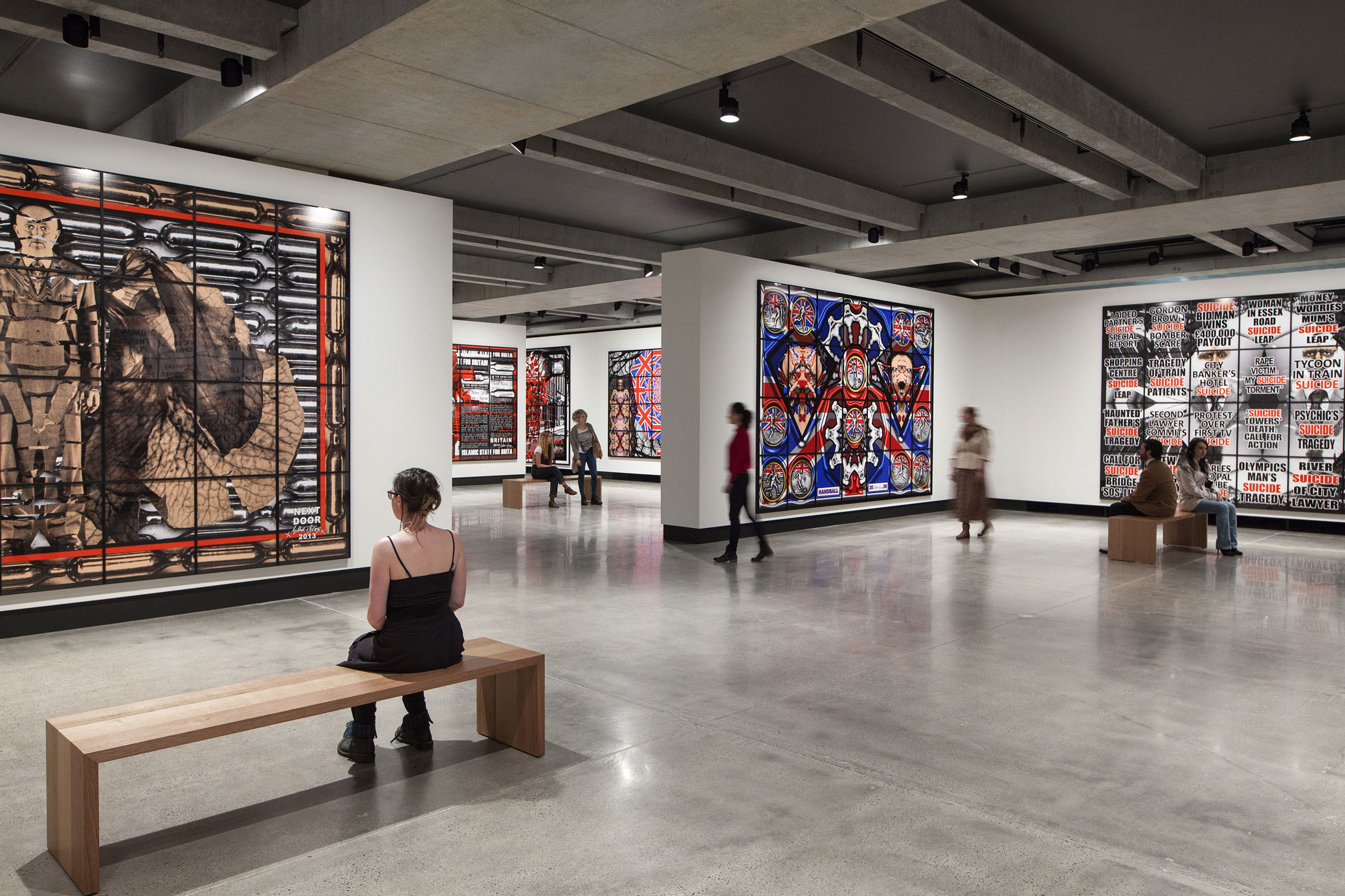
Tate Britain website

LIKE ART BLART ON FACEBOOK

Back to top

Exhibition: ‘Cecil Beaton at Wilton’ at Wilton House, Wiltshire and ‘Cecil Beaton at Home: Ashcombe & Reddish’, at The Salisbury Museum

Exhibition dates: Cecil Beaton at Wilton: 3rd May – 14th September 2014
Cecil Beaton at Home: Ashcombe & Reddish: 23rd May – 19th September 2014

Bright Young Things, Costume Balls And Country House Parties
From The Roaring ’20s To The Swinging ’60s
An Exhibition Of Cecil Beaton Photographs
Designed And Curated By Jasper Conran


'Cecil Beaton at Wilton House' installation view


Cecil Beaton at Wilton installation view
© The Cecil Beaton Studio Archive


What a gay old time!

Frippery and finery taken by that dandy doyen of chic Cecil Beaton, partying in a highly structured class society that is seemingly oblivious to the approaching horrors of the Second World War (which only adds to the photographs air of insouciance). It must have been so much fun.

The thing is, Beaton was a talented artist who captured it all with total aplomb. To go from the haughty, stylish Georgia Sitwell, Renishaw (1930, below) to the Arcadian beauty of Rex Whistler (1927, below); from the formal organisation of The 15th Earl and Countess of Pembroke dressed for the coronation of George VI (1937, below) to the classic beauty of Princess Natasha Paley (1930s, below); or the structure and stillness of Alice von Hofmannsthal (1937, below) to the vivaciousness and movement of Lady Plunket (Dorothé) and Mr Maurice (1937, below) – takes a consistency of vision and an understanding of craft that few photographers possess.

The photograph of Lady Plunket is particularly astonishing… to see this composition in the twinkling of an eye: the movement, the joy, the flower in the hair, the women with the crossed legs in the background, and just the sheer grace of the couple, he suspended on one foot, she flying through the air. Unforgettable.

Dr Marcus Bunyan


Many thankx to Sotheby’s, Wilton House and The Salisbury Museum for allowing me to publish the photographs in the posting. Please click on the photographs for a larger version of the image.


East Front of Wilton House


East Front of Wilton House
© Wilton House Trust


Cecil Beaton (British, 1904-1980) 'Edith Olivier, Mayor of Wilton, as Queen Elizabeth I for a pageant at Wilton' 1932


Cecil Beaton (British, 1904-1980)
Edith Olivier, Mayor of Wilton, as Queen Elizabeth I for a pageant at Wilton
1932
© Cecil Beaton Archive, Sotheby’s


Edith Maud Olivier

Edith Maud Olivier MBE (31 December 1872 – 10 May 1948) was an English writer, also noted for acting as hostess to a circle of well-known writers, artists, and composers in her native Wiltshire… Olivier had lived with her father and younger sister Mildred, and it was after Mildred died in 1927 that she started to engage a broader social circle. She formed a profound friendship with Rex Whistler and acted as a frequent hostess to an elite, artistic, and largely homosexual, social set which included Cecil Beaton, Siegfried Sassoon, William Walton, and Osbert Sitwell.

Her first novel, The Love Child was published in 1927, and was followed by further novels, biographies, including one of Alexander Cruden, and the autobiographical Without Knowing Mr Walkley.

Text from Wikipedia website


Cecil Beaton (British, 1904-1980) 'Georgia Sitwell, Renishaw' 1930


Cecil Beaton (British, 1904-1980)
Georgia Sitwell, Renishaw
1930
© Cecil Beaton Archive, Sotheby’s


Georgia Doble

Georgia Doble, the Canadian-born wife of Sacheverell Sitwell, was born in 1906 to a banker of Cornish descent. She met Sitwell at a party in 1924 while participating in the social gaiety of the London season. Georgia was familiar with Sitwell’s Southern Baroque Art and enjoyed his company, but she waited almost a year before accepting his marriage proposals. They were married in Paris on October 12, 1925. Their first son, Reresby, was born in 1927 and his younger brother, Francis, in 1935.

Georgia found it difficult to blend in with the Sitwell family, which had more than the usual share of dynamics. She did her best to play the self-assigned role of muse, but Sitwell was not a social man and Georgia missed the busy whirl of London. She attended many social events without him, which led to a great deal of friction between them. They both had affairs over the years, but remained deeply attached to one another throughout their lives. Georgia died in 1980.


Cecil Beaton (British, 1904-1980) 'Lady Plunket (Dorothé) and Mr Maurice' 1937


Cecil Beaton (British, 1904-1980)
Lady Plunket (Dorothé) and Mr Maurice
1937
© Cecil Beaton Archive, Sotheby’s


Cecil Beaton (British, 1904-1980) 'Stephen Tennant (1906-1987), William Walton (1902-1983), Georgia Sitwell (1905-1980), Zita Jungman (1903-2006), Rex Whistler (1905-1944) and Cecil Beaton (1904-1980), Wilsford, 1927' 1927


Cecil Beaton (British, 1904-1980)
Stephen Tennant (1906-1987), William Walton (1902-1983), Georgia Sitwell (1905-1980), Zita Jungman (1903-2006), Rex Whistler (1905-1944) and Cecil Beaton (1904-1980), Wilsford, 1927
1927
© Cecil Beaton Archive, Sotheby’s


Stephen James Napier Tennant (21 April 1906 – 28 February 1987) was a British aristocrat known for his decadent lifestyle. During the 20s and 30s, Tennant was an important member – the “Brightest”, it is said – of the “Bright Young People.” His friends included Rex Whistler, Cecil Beaton, the Sitwells, Lady Diana Manners and the Mitford girls. He is widely considered to be the model for Cedric Hampton in Nancy Mitford’s novel Love in a Cold Climate; one of the inspirations for Lord Sebastian Flyte in Evelyn Waugh’s Brideshead Revisited, and a model for Hon. Miles Malpractice in some of his other novels.

Sir William Turner Walton OM (29 March 1902 – 8 March 1983) was an English composer. During a sixty-year career, he wrote music in several classical genres and styles, from film scores to opera. His best-known works include Façade, the cantata Belshazzar’s Feast, the Viola Concerto, and the First Symphony.

Zita Jungman‘s accounts of her fellow bright young things of the 1920s stress their high vocal pitch and decibel level – “shrieking”, “screaming”, “howling with laughter”. So it is significant that when, in 1926, Cecil Beaton met Zita, who has died aged 102, in the Gargoyle Club, Soho, he responded to her quietness and understanding. She was, he wrote, a “thoroughly unflashy” original… The antics of the bright young things were relatively innocent: bottle parties, fancy dress balls and pageants, with cocktails and fast cars. The Jungman girls, along with clever Alannah Harper, Eleanor Smith and Loelia Ponsonby, staged treasure hunts, using their connections to arrange a fake edition of the Evening Standard or Hovis loaves baked to order with clues inside. 

Enter aspirant photographer Beaton. He had spotted the sisters at a performance of Edith Sitwell’s Facade, and met Zita again in Venice rehearsing for a ball. Alannah Harper modelled for him; Zita followed. He was financially thrilled. “They certainly would get into the papers … so very saleable.” She spent hours before the lens in the Beaton house: “She loved doing her hair in various exotic ways and looked quite beautiful and quite extraordinarily funny. She is a perfect young lady.”

Beaton described the sisters as “a pair of decadent 18th-century angels made of wax” and wrote of Zita: “With her smooth fringes, and rather flat head, like a silky coconut, like a medieval page, and with her swinging gait, she looks very gallant, very princely. But she can, if she wishes, easily become a snake-like beauty, with a mysterious smile and a cold glint in her upward slanting eyes.” Her reaction to the pictures was to “lay back in a chair looking at them for ages, never speaking, just occasionally grunting a grunt of satisfaction”.

Veronica Horwell. “Zita Jungman,” on the Guardian website Friday 3 March 2006 [Online] Cited 07/11/2022


Cecil Beaton (British, 1904-1980) 'Rex Whistler' 1927


Cecil Beaton (British, 1904-1980)
Rex Whistler
1927
© Cecil Beaton Archive, Sotheby’s


Reginald John “Rex” Whistler

Reginald John “Rex” Whistler (24 June 1905 – 18 July 1944) was a British artist, designer and illustrator.

Reginald John Whistler was born in Britain on 24 June 1905, at Eltham, Kent, the son of Harry and Helen Frances Mary Whistler. In May 1919 he was sent to boarding school at Haileybury, where he showed a precocious talent for art, providing set designs for play productions and giving away sketches to prefects in lieu of “dates” (a punishment at Haileybury, similar to “lines” whereby offenders are required to write out set lists of historical dates).

After Haileybury the young Whistler was accepted at the Royal Academy, but disliked the regime there and was “sacked for incompetence”. He then proceeded to study at the Slade School of Art, where he met Stephen Tennant, soon to become one of his best friends and a model for some of the figures in his works. Through Tennant, he later met the poet Siegfried Sassoon and his wife Hester, to both of whom Whistler became close.

Upon leaving the Slade he burst into a dazzling career as a professional artist. His work encompassed all areas of art and design – from the West End theatre to book illustration (including works by Evelyn Waugh and Walter de la Mare, and perhaps most notably, for Gulliver’s Travels) and mural and trompe-l’oeil painting. Paintings at Port Lympne Mansion (within Port Lympne Wild Animal Park), Plas Newydd, Mottisfont Abbey and Dorneywood among others, show his outstanding talent in this genre. During his time at Plas Newydd he may well have become the lover of the daughter of the 6th Marquess of Anglesey, the owner of the house, who had commissioned him to undertake the decorative scheme. Whistler and Lady Caroline Paget are known to have become very close friends and he painted numerous portraits of her, including a startling nude. Whether this painting was actually posed for or whether it was how Whistler imagined her naked is a matter of debate.

His most noted work during the early part of his career was for the café at the Tate Gallery, completed in 1927 when he was only 22. He was commissioned to produce posters and illustrations for Shell Petroleum and the Radio Times. He also created designs for Wedgwood china based on drawings he made of the Devon village of Clovelly. Whistler’s elegance and wit ensured his success as a portrait artist among the fashionable; he painted many members of London society, including Edith Sitwell,Cecil Beaton and other members of the set to which he belonged that became known as the “Bright Young Things”. His murals for Edwina Mountbatten’s 30-room luxury flat in Brook House, Park Lane, London were later installed by the Mountbattens’ son-in-law, decorator David Hicks, in his own houses.

Whistler’s activities also extended to ballet design. He designed the scenery and costumes for Ninette de Valois and Gavin Gordon’s Hogarth-inspired 1935 ballet The Rake’s Progress.

When war broke out, although he was 35, Whistler was eager to join the army. He was commissioned into the Welsh Guards as Lieutenant 131651. His artistic talent, far from being a stumbling block to his military career, was greatly appreciated and he was able to find time to continue some of his work, including a notable self-portrait in uniform now in the National Army Museum. In 1944 he was sent to France following the D-Day landings.

In July he was with the Guards Armoured Division in Normandy as the invasion force was poised to break out of the salient east of Caen. On the hot and stuffy 18 July his tank, after crossing a railway line, drove over some felled telegraph wires beside the railway, which became entangled in its tracks. He and the crew got out to free the tank from the wire when a German machine gunner opened fire on them, preventing them from getting back into their tank. Whistler dashed across an open space of 60 yards to another tank to instruct its commander, a Sergeant Lewis Sherlock, to return the fire. As he climbed down from Sherlock’s tank a mortar bomb exploded beside him and killed him instantly, throwing him into the air. He was the first fatality suffered by the battalion in the Normandy campaign.

Text from the Wikipedia website


Palladian Bridge at Wilton House


Palladian Bridge at Wilton House
© Wilton House Trust


Sotheby’s and Wilton House will pay tribute to the life and work of the photographer, writer and Oscar-winning designer Cecil Beaton (1904-1980) with a new exhibition of photographs from Sotheby’s Cecil Beaton Studio Archive, designed and curated by Jasper Conran. Capturing the spirit of country house parties and costume balls, the exhibition will showcase previously unseen images from one of Britain’s most celebrated photographers, giving a fascinating glimpse into his life and a vivid portrait of a charmed age.

Staged at Wilton House in Wiltshire where Beaton was entertained by his friends the Pembroke family at grand parties and pageants for over 50 years, the exhibition will run between 18th- 21st April and 3rd May – 14th September 2014.

Described as “a worldly Peter Pan” who never aged1, Cecil Beaton – the acclaimed photographer for Vogue and Vanity Fair – was at the forefront of the fashion for costume and pageantry which swept through British society in the 1920s. Immortalised in the Noël Coward song ‘I’ve been to a marvellous party’, “Dear Cecil arrived wearing armour / Some shells and a black feather boa…,” Beaton was renowned for his flair for fancy dress and costumery, later winning Oscars, Academy and Tony awards for his designs. He invited friends from all over the world to legendary parties at his Wiltshire home Ashcombe, where guests arrived “in the knowledge that they were to exchange reality for a complete escape into the realms of fantasy.”2

As fancy dress became a popular feature of country house parties, and costume balls a highlight of the social calendar, Beaton seamlessly integrated his high-society personal life with his professional artistic quest to experiment with photography and fashion. Using the settings of Britain’s grandest country houses as the perfect backdrop, Beaton persuaded his friends to sit for him in their exotic costumes, often designed by him, for these most unconventional of photographs.

This fascinating collection of photographs will be displayed in a new exhibition space, especially renovated for the event at Wilton House. Situated just a few miles from Beaton’s country houses Ashcombe and Reddish, Wilton was the location for costume balls and theatrical events enjoyed and photographed by Beaton for over 50 years. Despite being pushed into a river at the first Ball he attended there in 1927, Beaton later became great friends with the Earls of Pembroke. Over time he photographed and chronicled the lives of three generations of the family in the surroundings of the house which he described as “perhaps the most wonderful piece in all Wiltshire’s heritage of domestic architecture… at every time of year, in all weathers, unfailing in its beauty.”3 On 14th January 1980, just three days before his death, Beaton celebrated his 76th birthday with a lunch party hosted by the family.

The Cecil Beaton Studio Archive

Sotheby’s is the privileged guardian of the Cecil Beaton Studio Archive, a matchless repository of over 100,000 negatives, 9,000 vintage prints and 42 scrapbooks from the celebrated photographer’s personal collection. Cecil Beaton negotiated the transfer of his private archive to Sotheby’s in 1977 in order to preserve its role for future generations. Today, the collection – some of which is still stored in Beaton’s original filing cabinets – is available for use as a picture library, lending images to be reproduced on the printed page and for exhibition worldwide.

Further photographs from the Cecil Beaton Studio Archive will be displayed at Salisbury Museum’s exhibition Cecil Beaton at Home: Ashcombe & Reddish between 23rd May – 19th September 2014. This exhibition will bring together original photographs, artworks and possessions from Cecil Beaton’s two Wiltshire homes, Ashcombe and Reddish which served as retreats, inspirations, and stages for impressive entertaining, to present a fascinating picture of Beaton’s extraordinary life.”

1/ Hugo Vickers, Cecil Beaton: The Authorised Biography, Introduction, p. xxiii
2/ Cecil Beaton, Ashcombe: The Story of a Fifteen-year Lease, p. 33
3/ Cecil Beaton, Ashcombe: The Story of a Fifteen-year Lease, p. 35

Press release from Sotheby’s


Cecil Beaton (British, 1904-1980) 'Cecil Beaton on the Palladian bridge at Wilton House, September 1968' 1968 (detail)


Cecil Beaton (British, 1904-1980)
Cecil Beaton on the Palladian bridge at Wilton House, September 1968 (detail)
1968
© Cecil Beaton Archive, Sotheby’s


Cecil Beaton (British, 1904-1980) 'Alice von Hofmannsthal, Ashcombe, 1937, in her Costume for "The Gardener’s Daughter" for "The Anti Dud Ball" at the Dorchester Hotel, 13 July 1937' 1937


Cecil Beaton (British, 1904-1980)
Alice von Hofmannsthal, Ashcombe, 1937, in her Costume for “The Gardener’s Daughter” for “The Anti Dud Ball” at the Dorchester Hotel, 13 July 1937
1937
© Cecil Beaton Archive, Sotheby’s


Cecil Beaton (British, 1904-1980) 'Princess Natasha Paley' 1930s


Cecil Beaton (British, 1904-1980)
Princess Natasha Paley
1930s
© Cecil Beaton Archive, Sotheby’s


Princess Natalia Pavlovna Paley

Princess Natalia Pavlovna Paley (Наталья Павловна Палей), Countess de Hohenfelsen (December 5, 1905 – December 27, 1981) was a member of the Romanov family. A daughter of Grand Duke Paul Alexandrovich of Russia, she was a first cousin of the last Russian emperor, Nicholas II. After the Russian revolution she emigrated first to France and later to the United States. She became a fashion model, socialite, vendeuse, and briefly pursued a career as a film actress…

Ethereal and glamorous, Princess Natalia would not follow any fashion trend, but would dictate her own. Hats and gloves were her signature. With deep-set gray eyes and pale blond hair, she became a sought after model establishing an image for herself in the Parisian elite becoming a well known socialite. As a model, she appeared in many magazines including Vogue. She was a favourite model for the great photographers of her time: Edward Steichen, Cecil Beaton, Horst P. Horst, Andre Durst and George Hoyningen-Huene.

Text from Wikipedia website


Cecil Beaton (British, 1904-1980) 'The Countess of Pembroke acting in Beaton's musical "Heil Cinderella"' 1939


Cecil Beaton (British, 1904-1980)
The Countess of Pembroke acting in Beaton’s musical “Heil Cinderella”
1939
© Cecil Beaton Archive, Sotheby’s


Cecil Beaton (British, 1904-1980) 'The 15th Earl and Countess of Pembroke dressed for the coronation of George VI' 1937


Cecil Beaton (British, 1904-1980)
The 15th Earl and Countess of Pembroke dressed for the coronation of George VI
1937
© Cecil Beaton Archive, Sotheby’s


Cecil Beaton (British, 1904-1980) 'The Countess of Pembroke in her Robes for the Coronation of George VI' 1937


Cecil Beaton (British, 1904-1980)
The Countess of Pembroke in her Robes for the Coronation of George VI
1937
© Cecil Beaton Archive, Sotheby’s


Cecil Beaton (British, 1904-1980) 'Cecil Beaton in "All the Vogue", Cambridge' 1925


Cecil Beaton (British, 1904-1980)
Cecil Beaton in “All the Vogue”, Cambridge
1925
© Cecil Beaton Archive, Sotheby’s


Beauty, decadence and a damned good party: Cecil Beaton at Salisbury Museum

The not so private world of Cecil Beaton – photographer to the Royals, painter, designer of interiors, stage and costume and secret diarist – seems to have been as opulent as his professional career was varied. If we are to believe his candid diaries, it was a world of decadent parties and languid weekend soirees full of bright young things who caroused at his Wiltshire homes against a backdrop of sumptuous interiors and fabulous gardens.

The first of these private pleasure houses was Ashcombe, which he rented for £50 a year between 1930-1945. It was followed by Reddish, which Beaton purchased in 1945 and lived in until his death in 1980. By all accounts both were splendid residences, and the stream of celebrities and society people who came and went were photographed by Beaton or captured in his notoriously frank scrapbooks and diaries.

And it is these extravagant worlds that can be glimpsed at Salisbury Museum who, with the help of the vast Cecil Beaton Archive at Sotheby’s, are teasing them back to life. A tantalising glimpse into the photographer’s more hidden moments and the celebrity in-crowd of friends and acquaintances he lavishly entertained, the exhibition brings together 183 unique photographs (including 35 vintage prints) exhibited with some of his artworks and personal possessions within recreations of the interiors.

But it’s the cast of players that grabs the attention; bohemian aristocrats, socialites and some of the biggest stars of the stage, screen, fashion and art world form a procession of decadence that stretched across five decades from 1930-1980. Famous faces include Truman Capote, Leslie Caron, David Hockney, Bianca Jagger and Ivor Novello interspersed here with private snaps of his great loves – the Hollywood icon Greta Garbo, with whom he had an affair, and millionaire art collector Peter Watson, with whom (we are told) he didn’t.

But as well as the society faces the exhibition includes images of the photographer’s inspired garden designs at Reddish and his theatrically-styled home interiors at Ashcombe, which he created so he could ‘live in scenery’, inspired by his visit to Hollywood in 1929. Work in progress shots show the making of Beaton’s fantastical ‘Circus Bedroom’ in 1932 with freshly painted murals of a circus clown, a girl on a merry-go-round horse and a jolly fat lady.

The bedroom was apparently created “on a rainy weekend in 1932” by a typically decadent gang of dazzling society types that included artists Rex Whistler, ‘Jack’ von Bismarck, Oliver Messel, Lord Berners, Edith Olivier, Jorg von Reppert Bismarck and of course Beaton himself. Whistler also designed Beaton’s theatrical four-poster ‘carousel’ bed with gilded unicorns, stripey circus-top canopy and barley twist bedposts. Beaton is pictured with Watson amidst this baroque creation. And visitors can experience it for themselves courtesy of a full-scale recreation reconstructed for the very first time since it was broken up in 1945. A fascinating glance into a decadent disappeared world.

Richard Moss. “Beauty, decadence and a damned good party: Cecil Beaton at Salisbury Museum,” on the Culture 24 website 28 May 2014 [Online] Cited 16/06/2021. No longer available online


Rex Whistler (British, 1905-1944) 'Ashcombe House' 1930s


Rex Whistler (British, 1905-1944)
Ashcombe House
1930s
© Private Collection


Cecil Beaton (British, 1904-1980) 'Frontispiece montage for Cecil Beaton’s Scrapbook, 1937, Ashcombe' 1937


Cecil Beaton (British, 1904-1980)
Frontispiece montage for Cecil Beaton’s Scrapbook, 1937, Ashcombe
1937
© Private Collection


Cecil Beaton (British, 1904-1980) 'Cecil Beaton on the front steps of Reddish House, Broad Chalke, June 1947, Reddish' 1947


Cecil Beaton (British, 1904-1980)
Cecil Beaton on the front steps of Reddish House, Broad Chalke, June 1947, Reddish
1947
© Cecil Beaton Archive, Sotheby’s


Cecil Beaton (British, 1904-1980) 'Cecil Beaton in his first costume of the night for the Fete Champetre, in his Circus bedroom, 10 July 1937, Ashcombe' 1937


Cecil Beaton (British, 1904-1980)
Cecil Beaton in his first costume of the night (the famous ‘Rabbit’ outfit) for the Fete Champetre, in his Circus bedroom, 10 July 1937, Ashcombe
1937
© Getty Images/ Time Life


Cecil Beaton (British, 1904-1980) 'Dorian Leigh photographed for 'Modess… because' campaign, Reddish House, Broad Chalke, 1950s, Reddish' 1950s


Cecil Beaton (British, 1904-1980)
Dorian Leigh photographed for ‘Modess… because’ campaign, Reddish House, Broad Chalke, 1950s, Reddish
1950s
© Johnson & Johnson


Dorian Leigh (April 23, 1917 – July 7, 2008), born Dorian Elizabeth Leigh Parker, was an American model and one of the earliest modelling icons of the fashion industry. She is considered one of the first supermodels and was well known in the United States and Europe.


Henry Lamb (British, born Australia 1883-1960) 'Portrait of Cecil Beaton' 1935


Henry Lamb (British, born Australia 1883-1960)
Portrait of Cecil Beaton
1935
© Private Collection


Henry Taylor Lamb

Henry Taylor Lamb MC RA (Adelaide 21 June 1883 – 8 October 1960 Salisbury) was an Australian-born British painter. A follower of Augustus John, Lamb was a founder member of the Camden Town Groupin 1911 and of the London Group in 1913.

Lamb is noted for his unusual portraits, as exemplified by his well-known picture of an elongated Lytton Strachey. He was elected an Associate of the Royal Academy in 1940 and was made a full Member in 1949. He was a Trustee of the National Portrait Gallery from 1942 and of the Tate Gallery from 1944 to 1951. His auction record was set at Christie’s in London in June 2006 when his 1910 Breton Boy oil on panel fetched £60,000. As well as the Imperial War Museum, works by Lamb are held in regional museums throughout Britain, in the British Government Art Collection and in the National Gallery of Canada, which received the majority of Lambs portraits of Canadian troops at the end of World War Two.


Wilton House
Wilton, Salisbury
SP2 0BJ, United Kingdom
+44 1722 746714

Opening hours:
Currently closed

The Salisbury Museum
The King’s House,
65 The Close, Salisbury
SP1 2EN
Phone: 01722 332151

Opening hours:
Daily 10am – 5pm
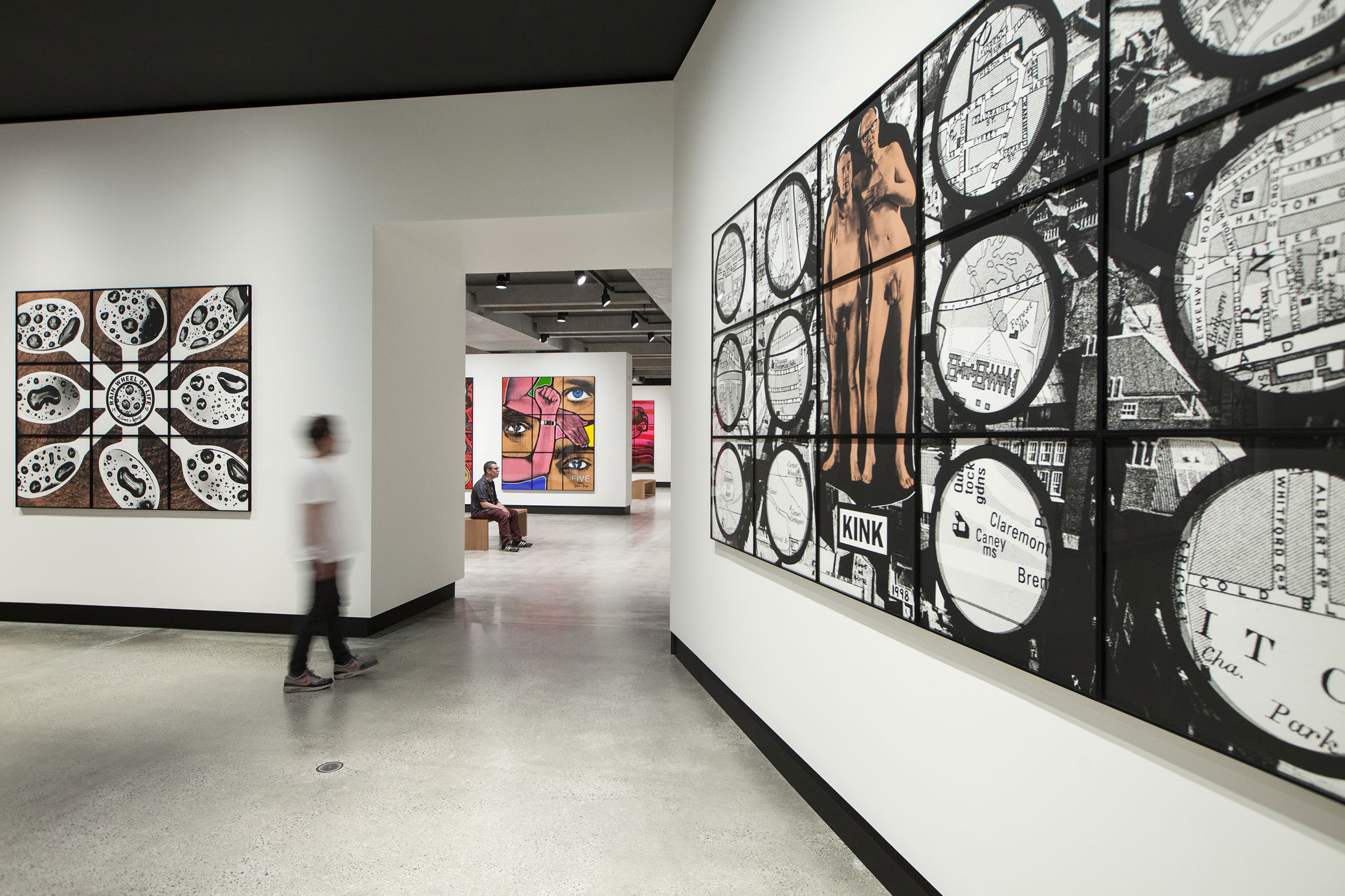
Wilton House website

The Salisbury Museum website
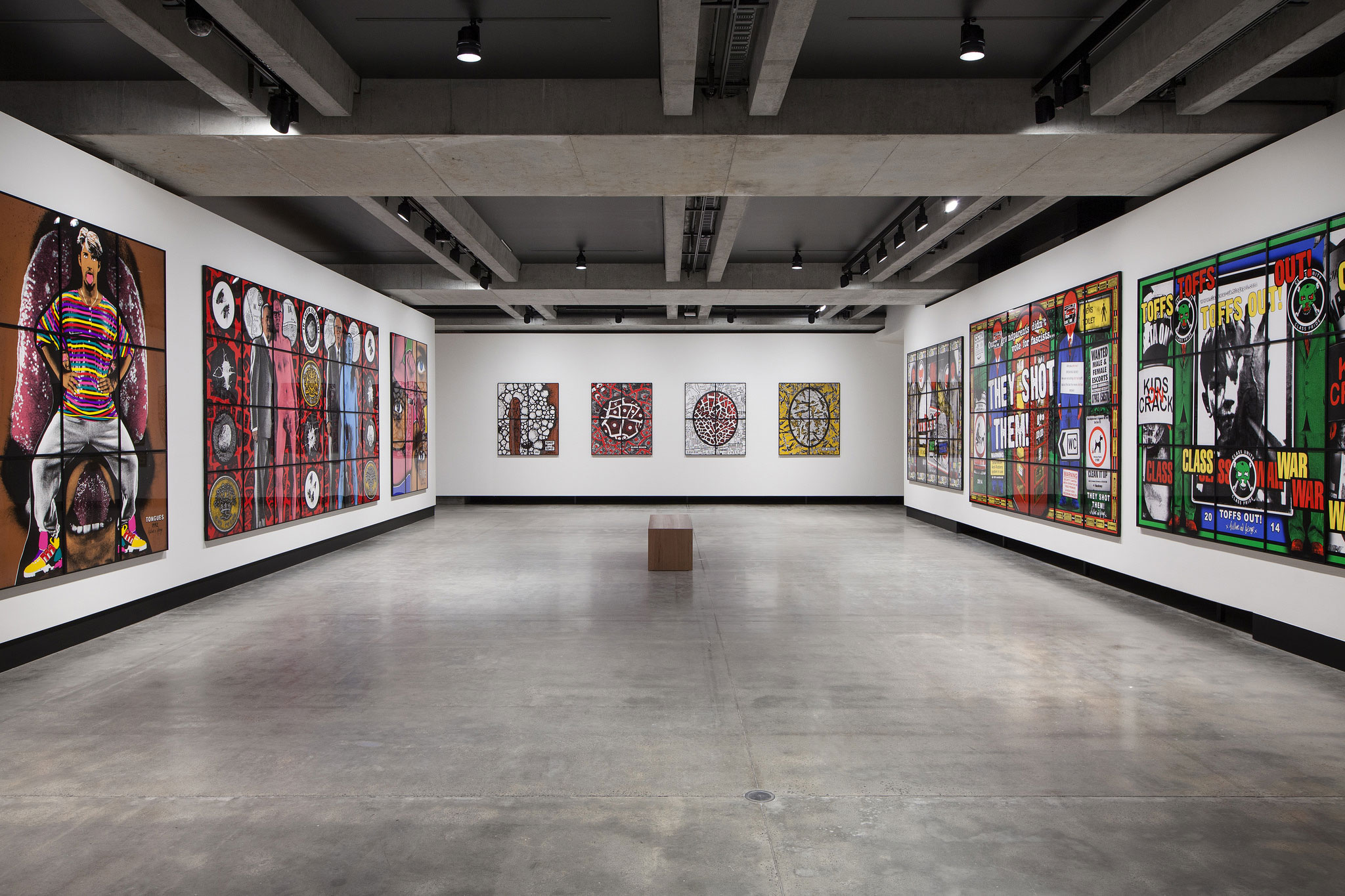
LIKE ART BLART ON FACEBOOK

Back to top