Review: ‘Ben Quilty: After Afghanistan’ at the Castlemaine Art Gallery and Historical Museum

Exhibition dates: 15th January – 15th April 2016


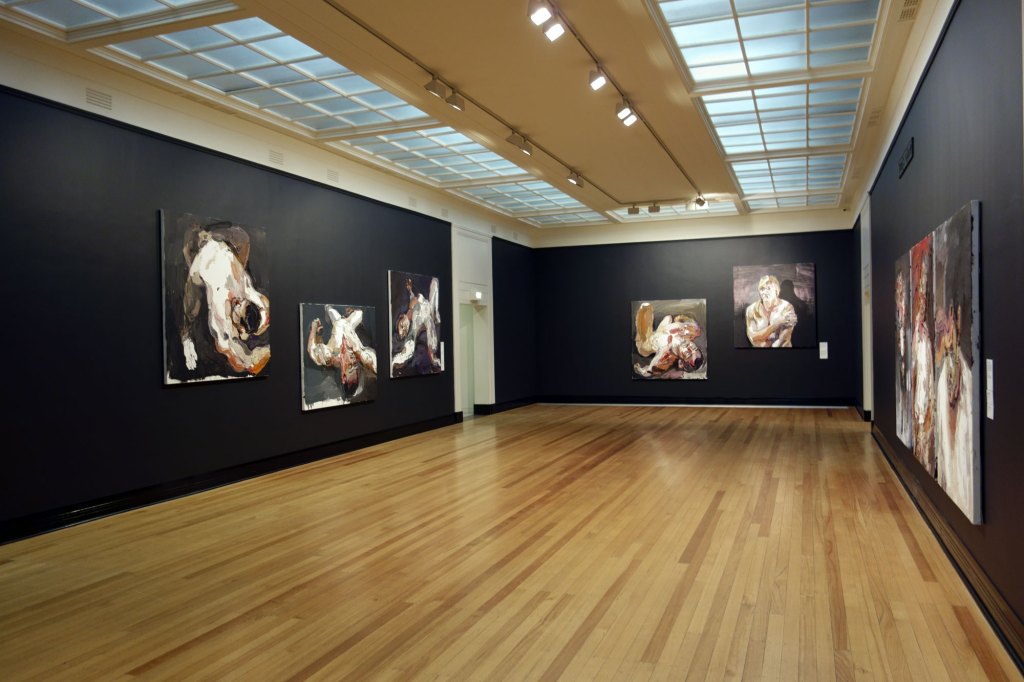
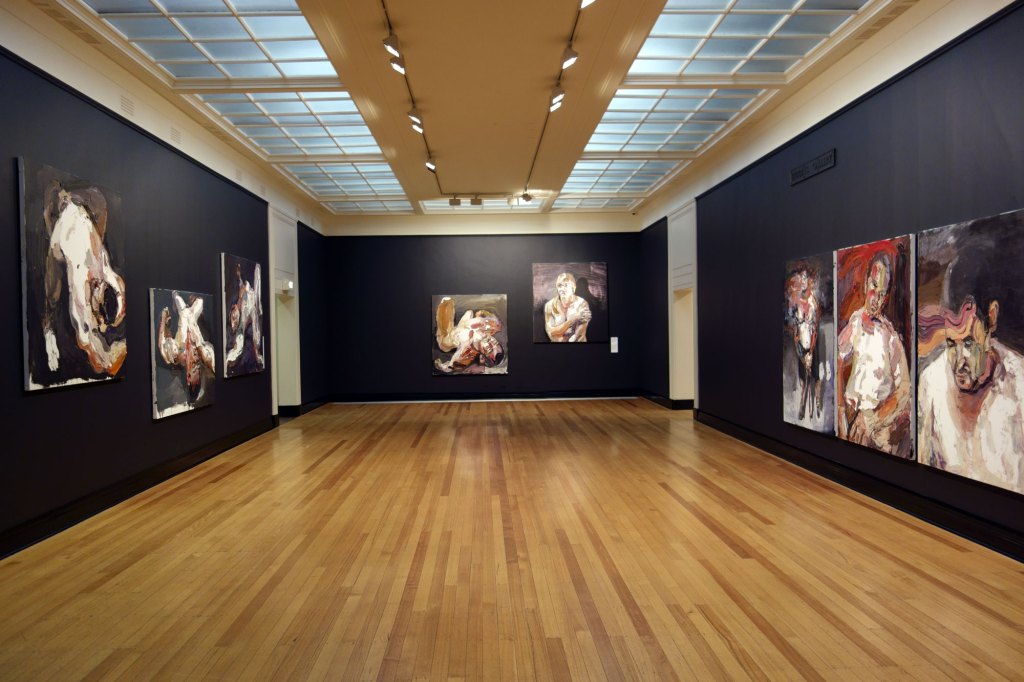
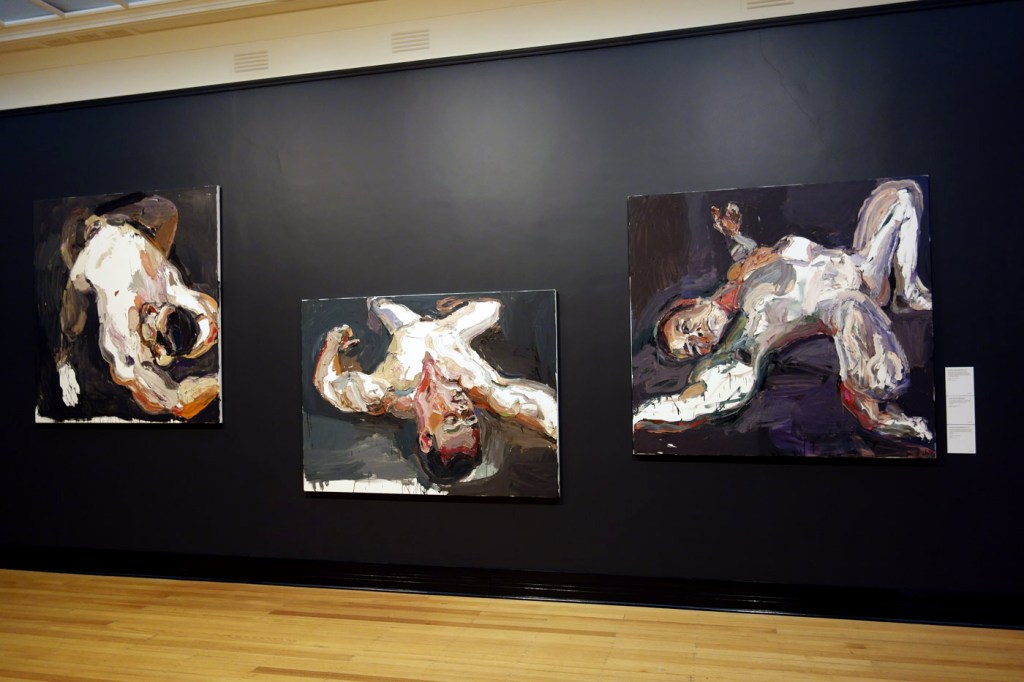
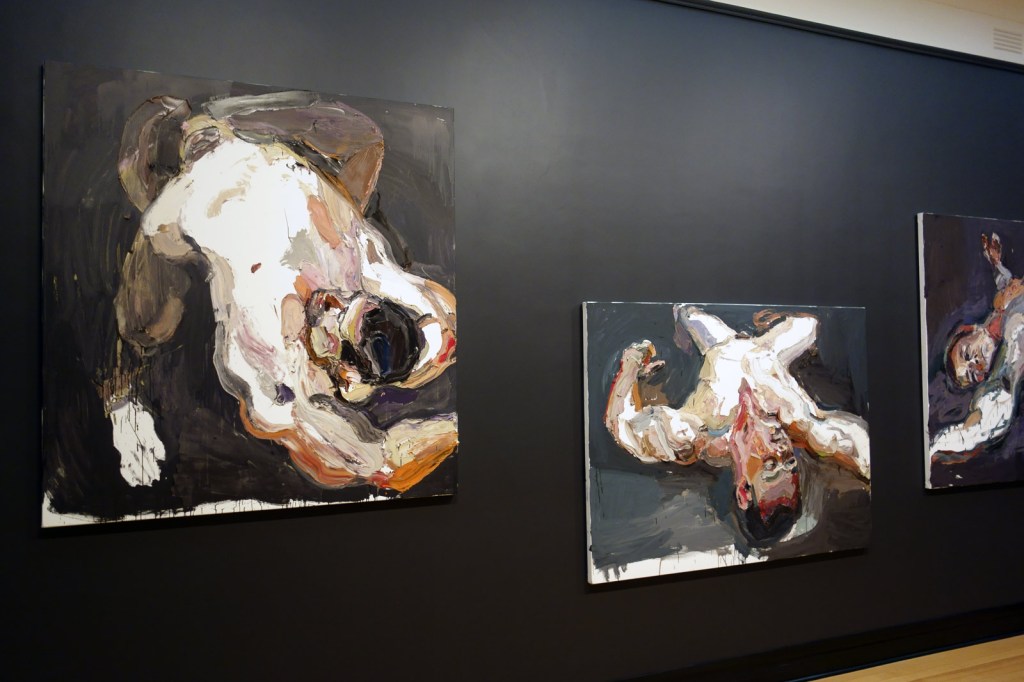
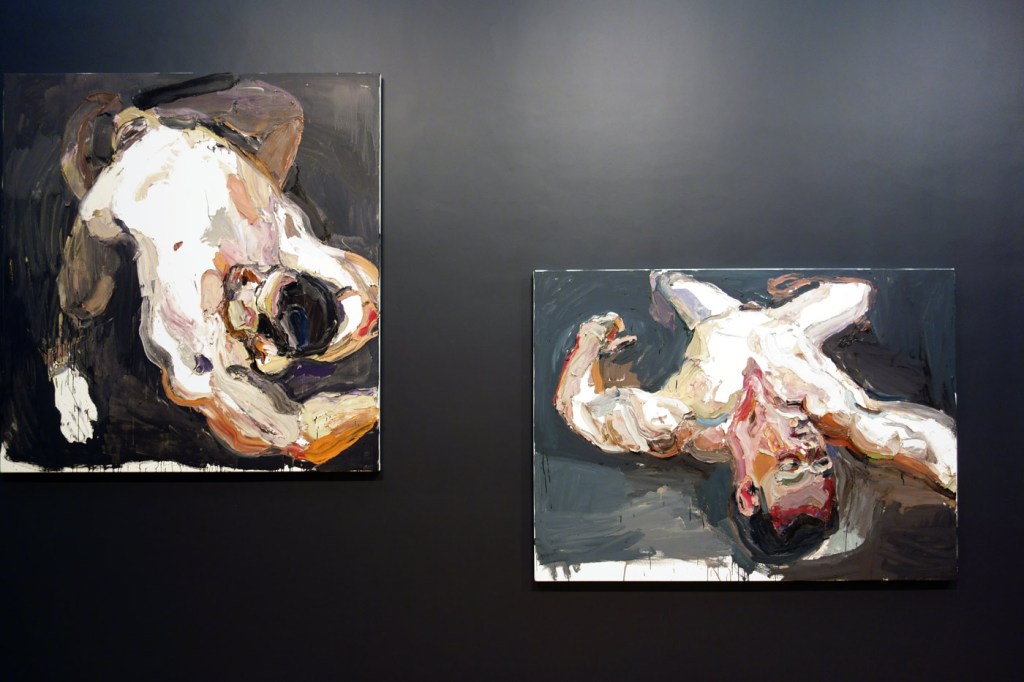
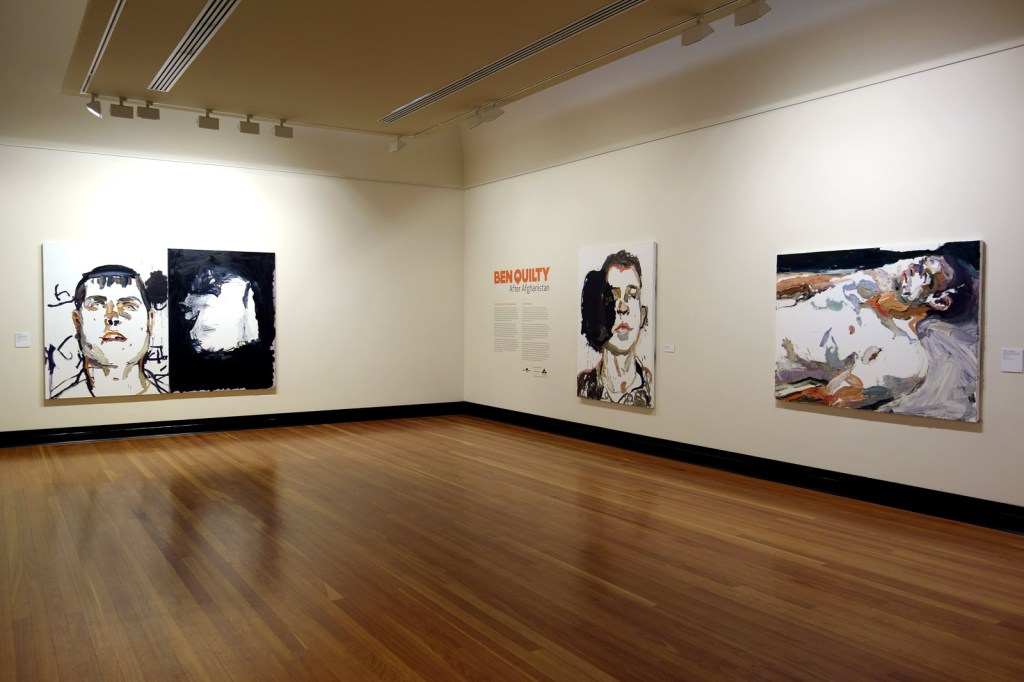
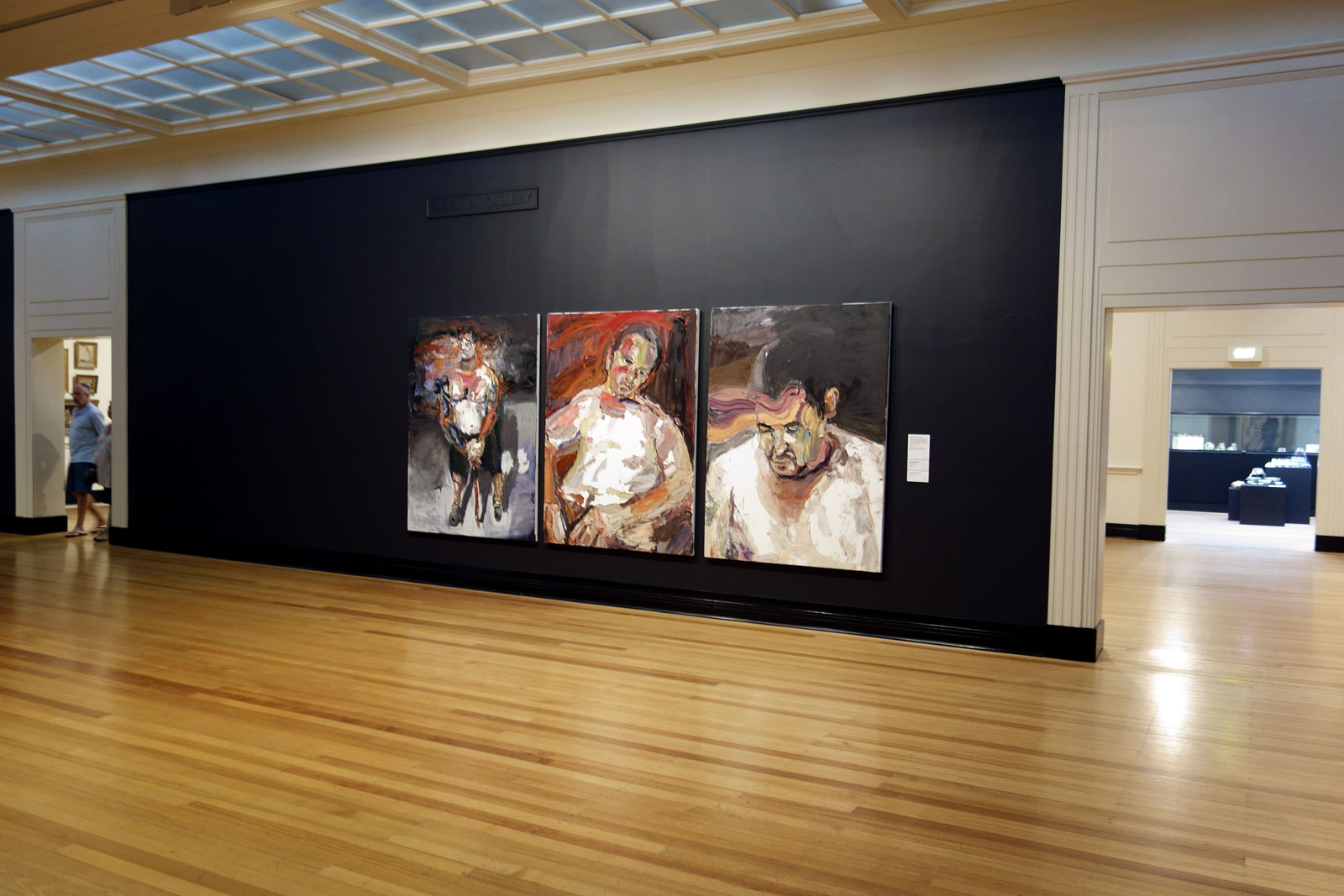
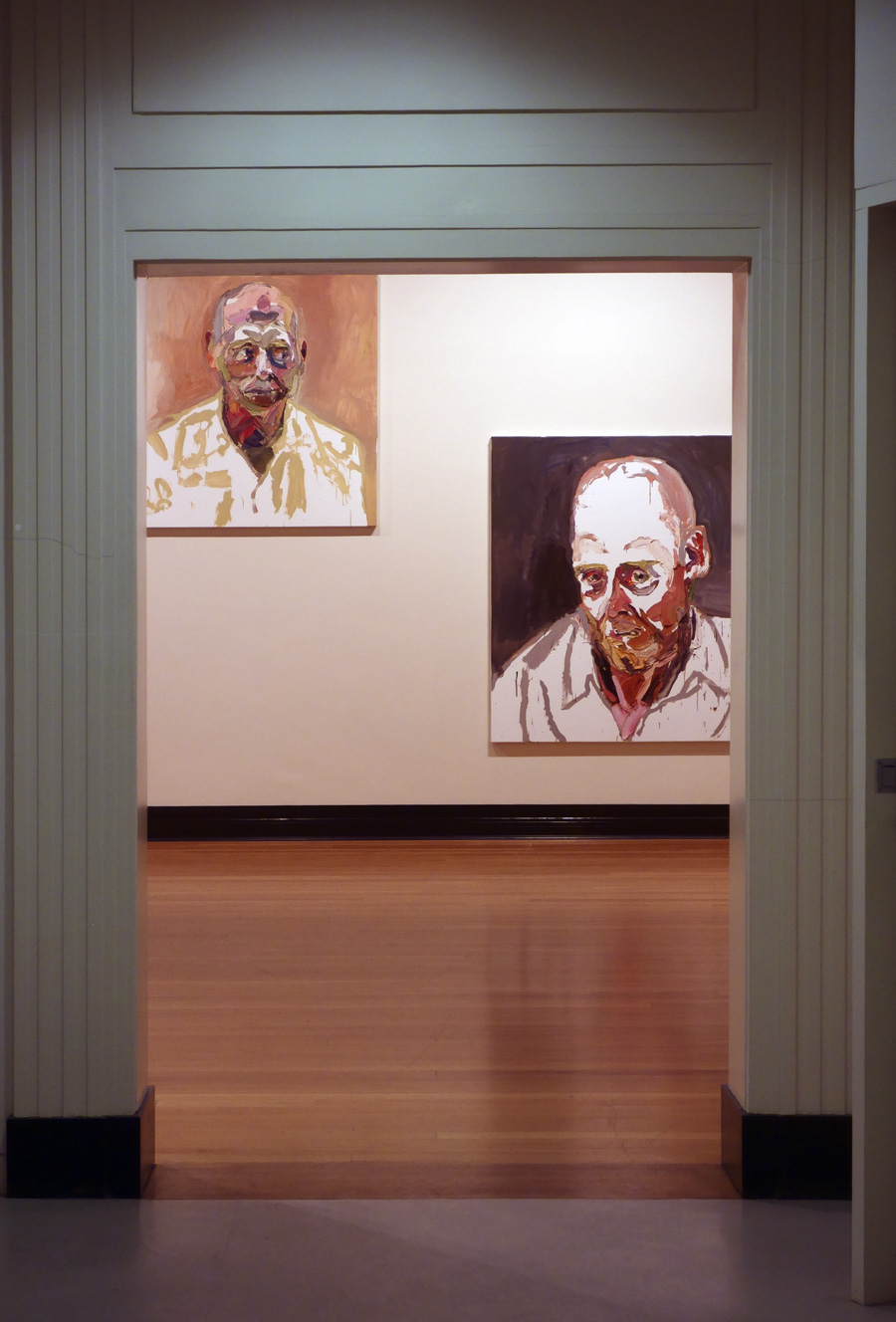
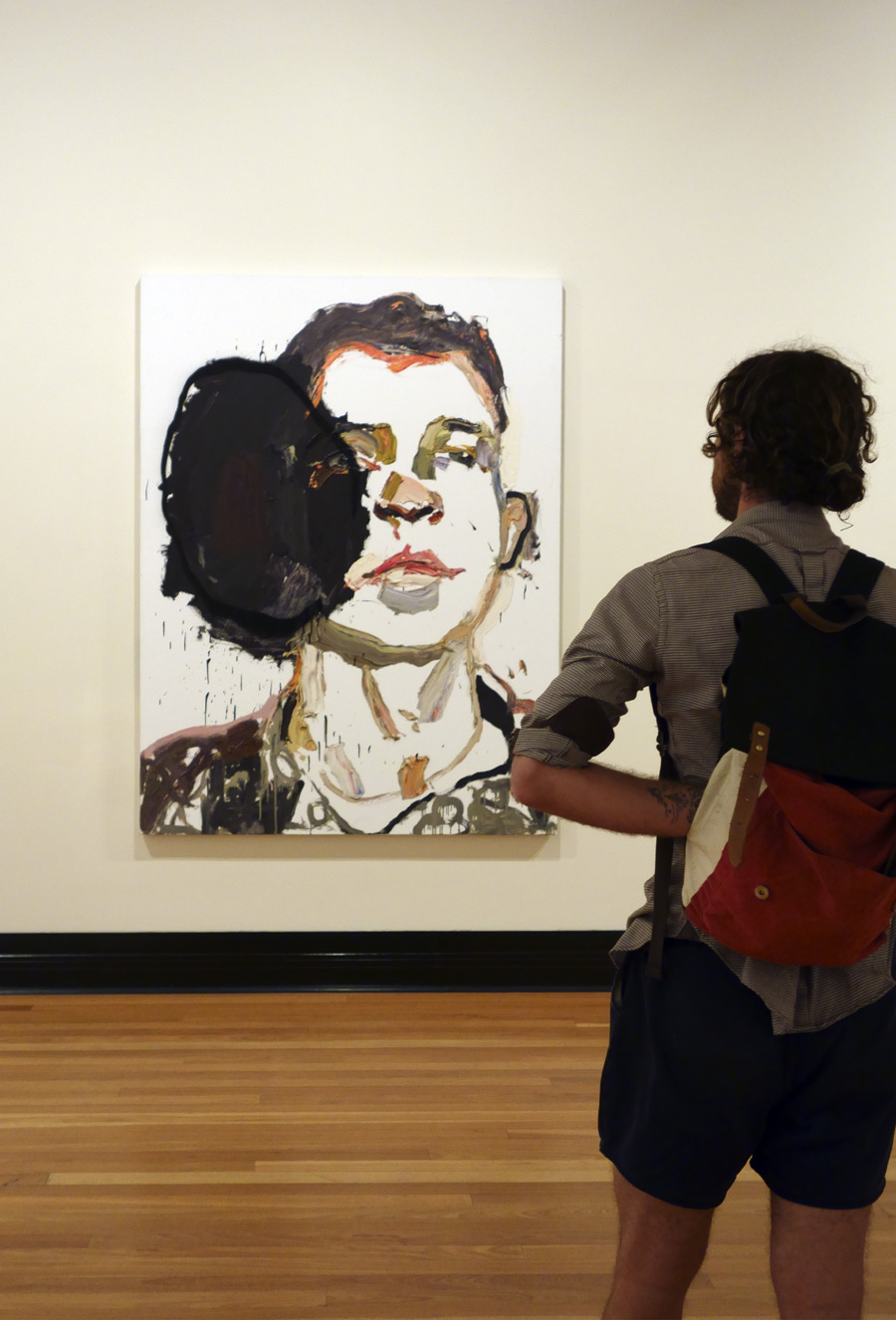
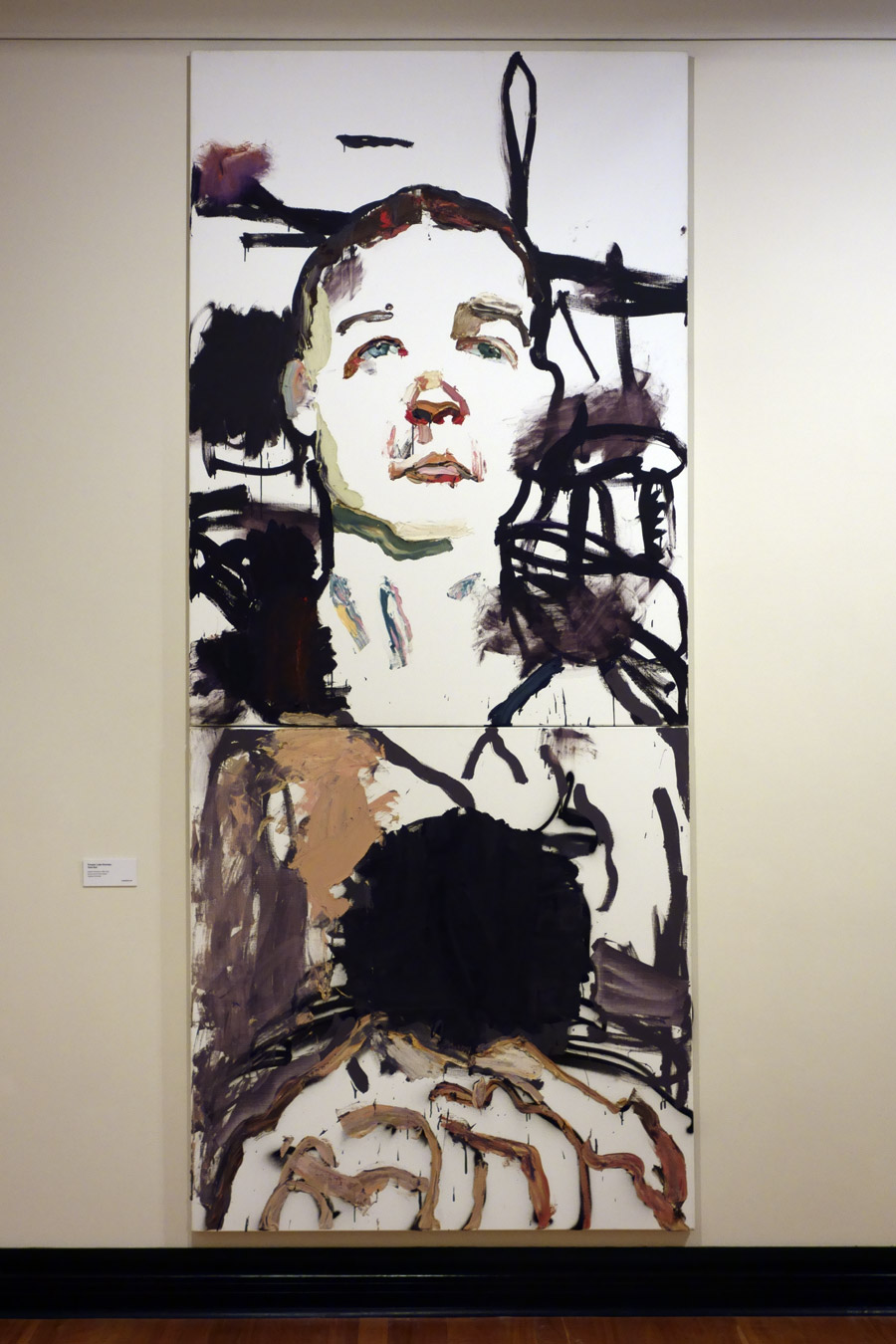
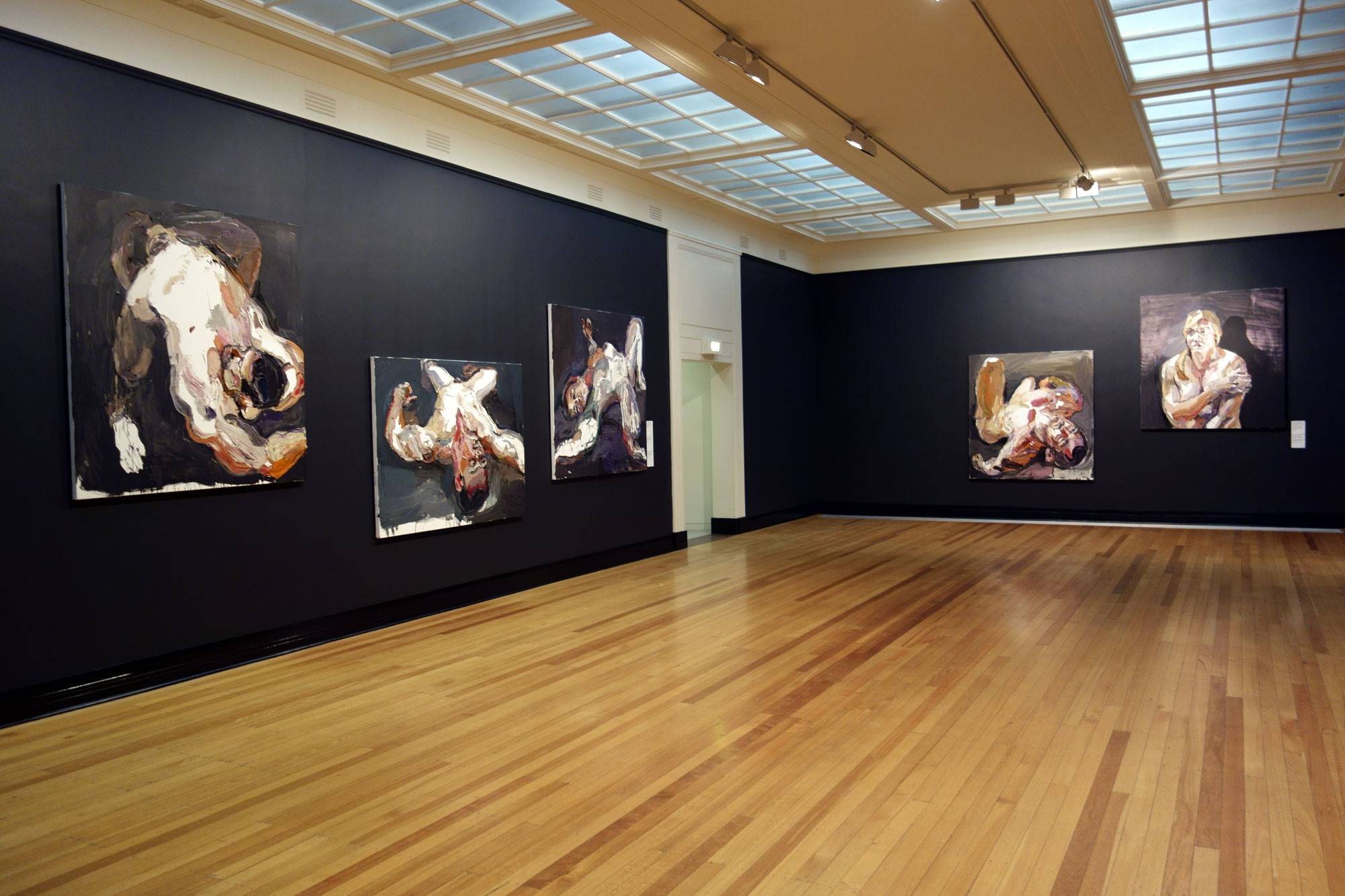
Installation view of the exhibition 'Ben Quilty: After Afghanistan' at the Castlemaine Art Gallery showing from left to right, 'Trooper M, after Afghanistan' (2012); and 'Trooper M, after Afghanistan, no. 2' (2012)


Installation view of the exhibition Ben Quilty: After Afghanistan at the Castlemaine Art Gallery showing from left to right, Trooper M, after Afghanistan (2012); and Trooper M, after Afghanistan, no. 2 (2012)
Photo: Marcus Bunyan


This is the most profound exhibition that I have seen so far this year. Simply put, the exhibition is magnificent … a must see for any human being with an ounce of understanding and compassion in their body.

While I am vehemently anti-war, and believe that we should have never have been in Afghanistan in the first place, these sensual and skeletal paintings represent the danger that these soldiers exposed themselves to in the line of duty. The sensuousness and vulnerability of their solitary, contorted poses – poses which they themselves chose to for Quilty to paint – reflect an actual event, such as taking cover to engage insurgents. That these naked poses then turn out to have a quiet eroticism embedded in them confirms the link between eroticism, death and sensuality as proposed by Georges Bataille. The three forms of eroticism (physical, emotional, religious) try to substitute continuity (life) for discontinuity (death). In these paintings the soldiers lay bare their inner self. They bring forth experiences that have been buried – their dissociation from the reality of what occurred, the experiences they have repressed, the post-traumatic stress – brought to the surface and examined in these paintings through the re-presentation of suppressed emotions, through a form of emotional eroticism, a primordial rising of eroticism, death and sensuality. An affirming act of life over death.

As an artist, Quilty intimately understands this process. I think a strong element of this exhbition is the feeling that there is something missing, that the range of concerns is lacking something. I suspect this is deliberate. Something is being withheld. And what is being withheld in the paintings is, I believe, narrative.

While there is an overarching text narrative – soldiers painted “after Afghanistan” – and individual paintings have titles such as Sergeant P, Troy Park, Trooper M and Trooper Daniel Westcott, these paintings could almost be of any human being who has been a soldier. Other than the specific triptych of Air Commodore John Oddie (and even then the portraits remind me of the ambiguity of Francis Bacon’s Study after Velázquez’s Portrait of Pope Innocent X, 1953), these paintings could be of any soldier. As Gerhard Ricther observes, “You can only express in words what words are capable of expressing, what language can communicate. Painting has nothing to do with that.” After Richter, you might say that “there is no plan”, there is only feeling in the work of Ben Quilty, embodied through his brush. Here, I see links to the work of that great British painter, Francis Bacon.

“Bacon was deeply suspicious of narrative. For him, narrative seems to be the natural enemy of vision; it blinds… Bacon seems to propose an opposition between narrative as a product that can be endlessly reproduced, as re-presentation – the ‘boredom’ is inspired by the deja vu of repetition – and narrative as process, as sensation. Conveying a story implies that a pre-existing story, fictional or not, is transferred to an addressee. Narrative is then reduced to a kind of transferable message. Opposed to this ‘conveying of story’, ‘telling a story’ focuses on the activity or process of narrative. This process is not repeatable; it cannot be iterative because it takes place, it happens, whenever ‘story’ happens… Bacon’s hostility toward narrative is directed against narrative as product, as re-presentation, not against narrative as process.
(Bacon) does not paint characters, but figures. Figures, unlike characters, do not imply a relationship between an object outside the painting and the figure in the painting that supposedly illustrates that object. The figure is, and refers only to itself.”1

The figure is, and refers only to itself, and it is up to the viewer to actively interpret this telling of the story each time they view one of Quilty’s paintings. There is no transferable message.

Further, much like Bacon’s triptychs, Quilty’s paintings depict isolated figures or figural events on the panels. The figures are isolated in their space and their is never any clear interaction between the figures. “Bacon explains the use of the triptych as follows: ‘It helps to avoid storytelling if the figures are painted on three different canvases’ … The figures never fully become characters, while the figural events are never explained by being embedded in a sequence of events. The figures interact neither with each other nor with their environment. Although Bacon’s paintings display many signs which traditionally signify narrativity, by the same token any attempt to postulate narratives based on the paintings is countered.”2

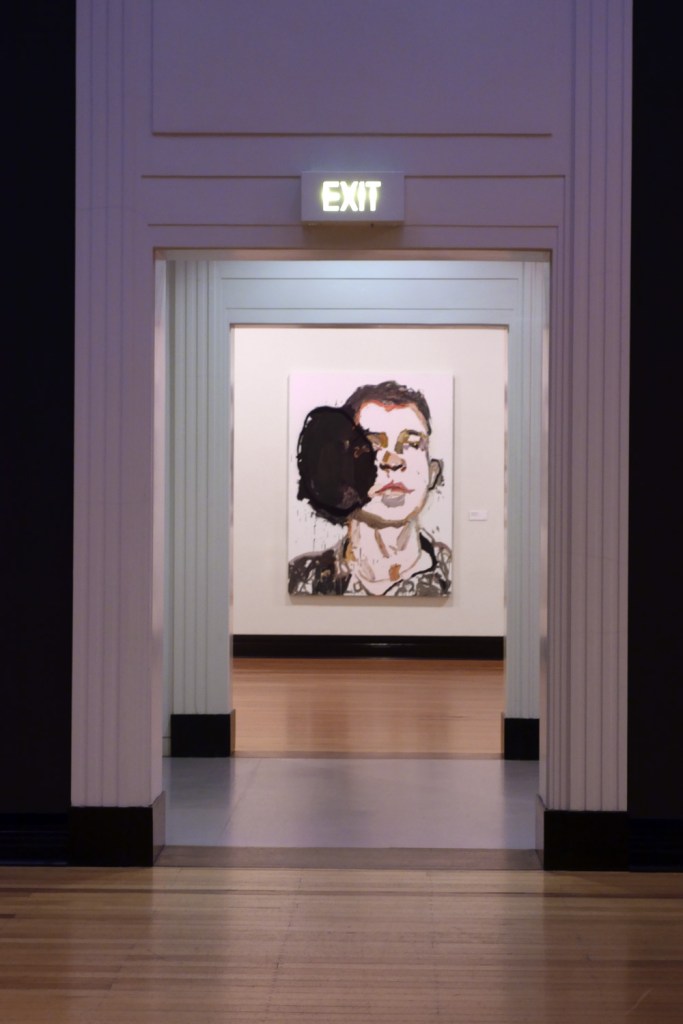
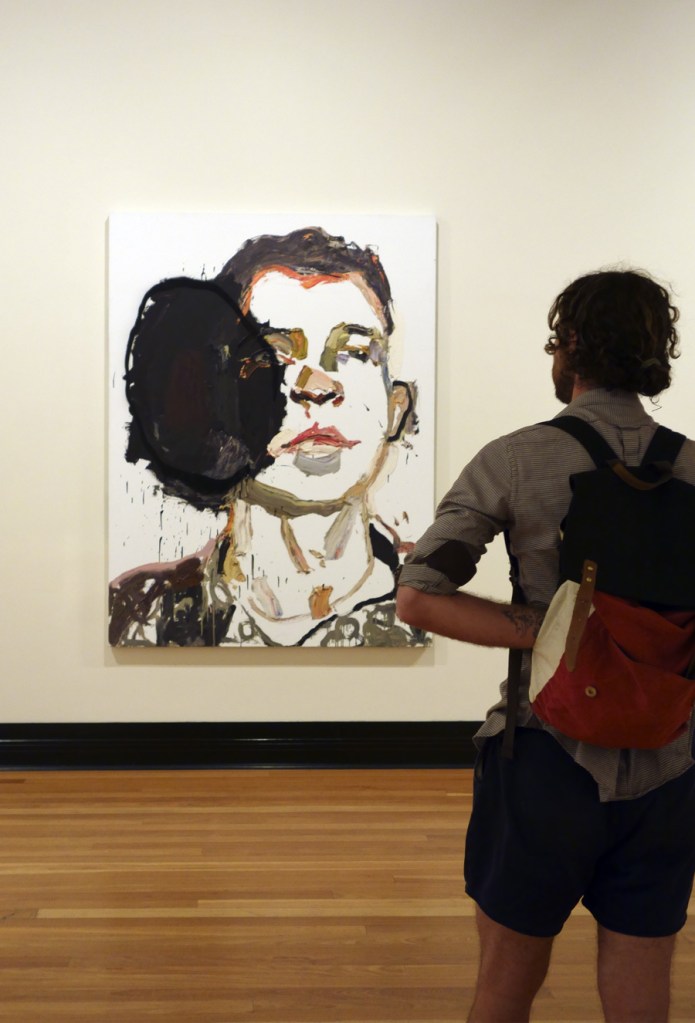
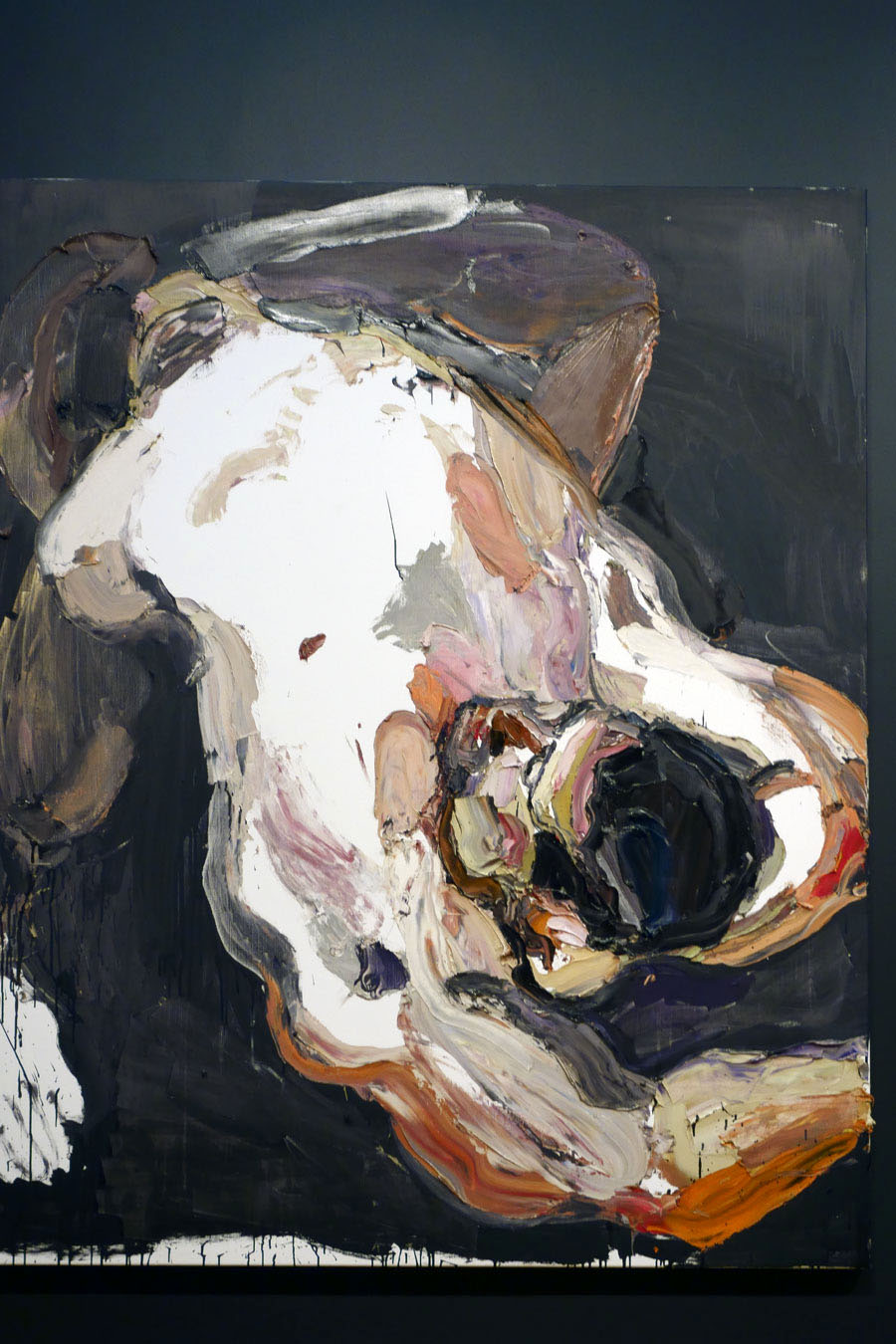
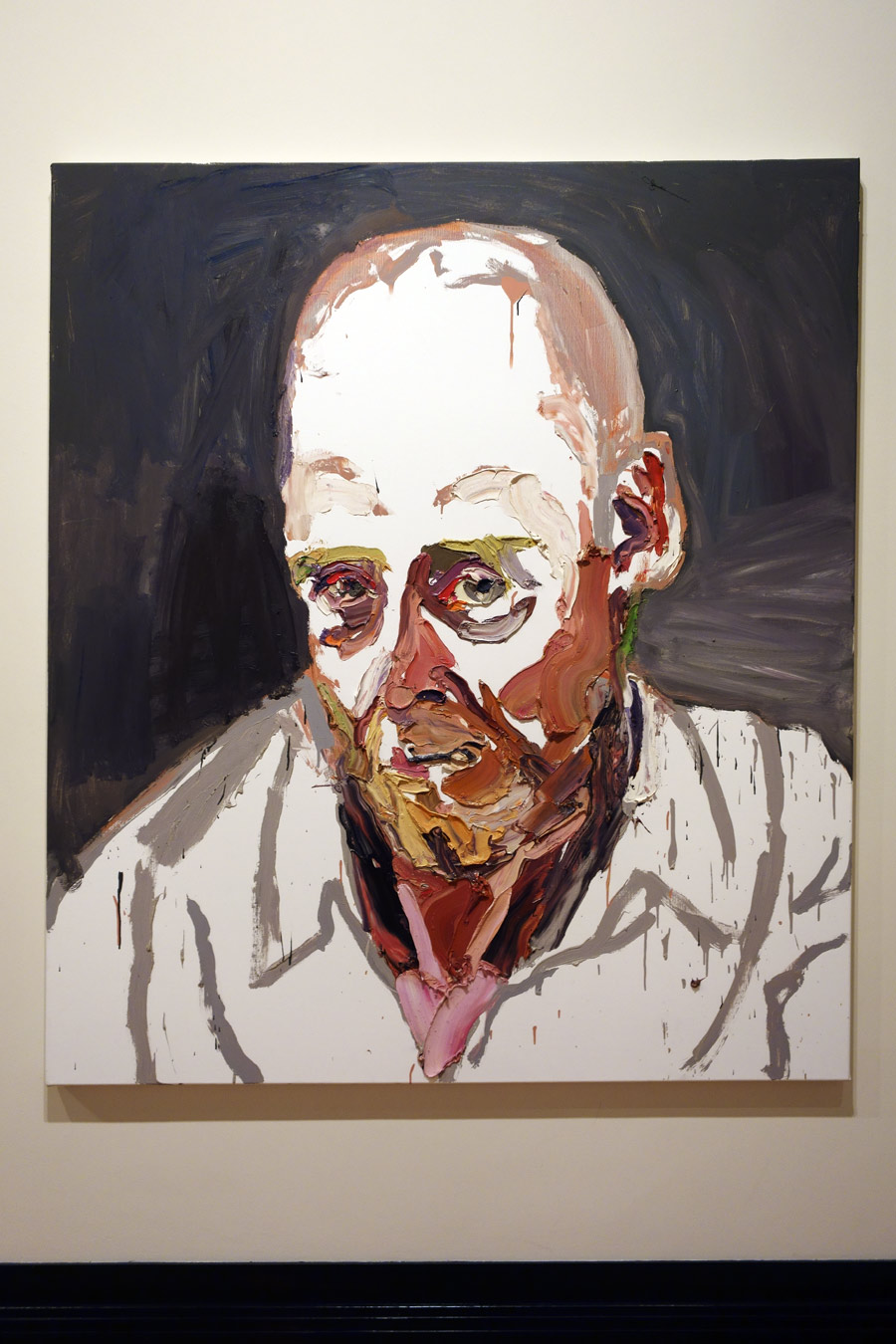
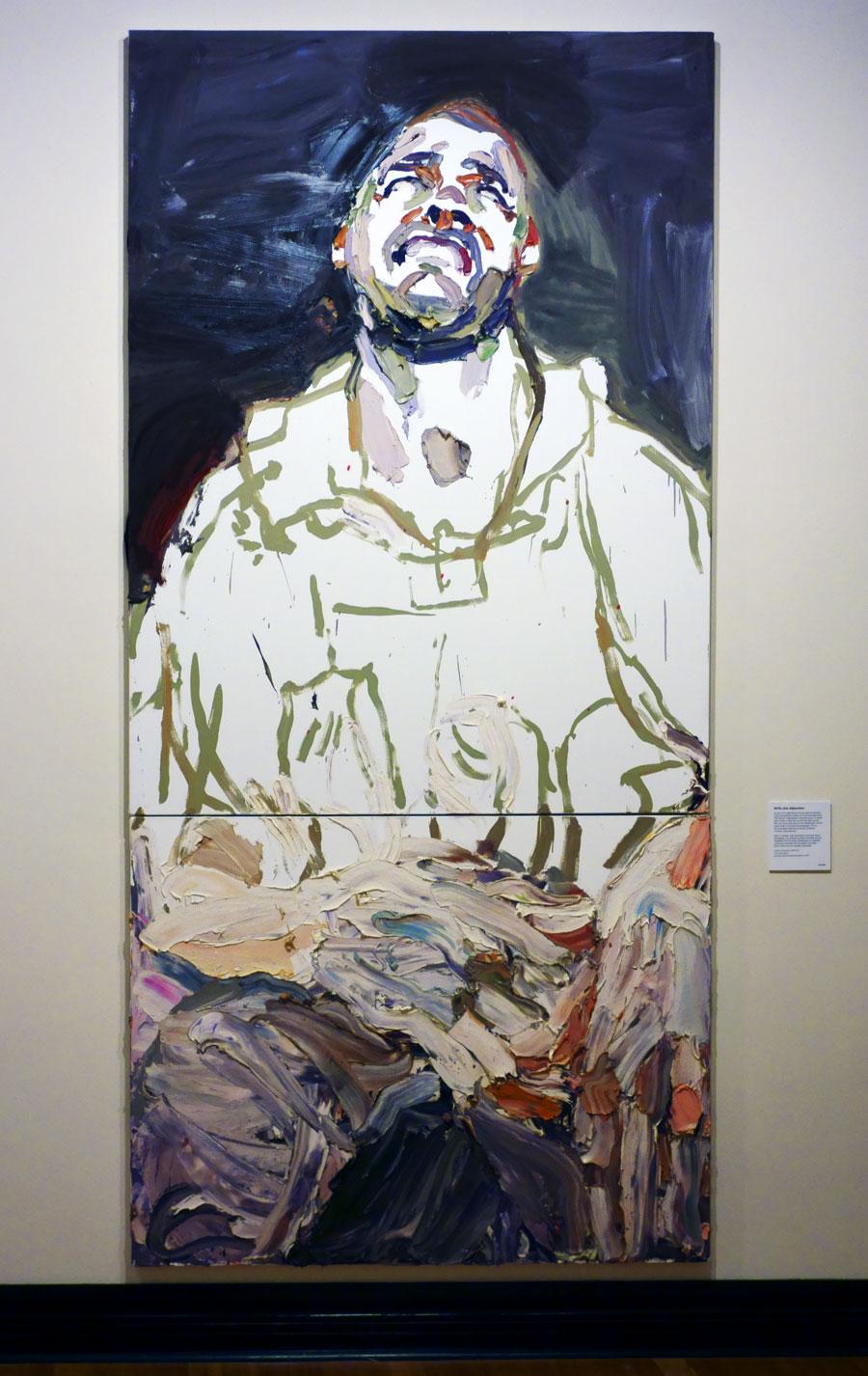
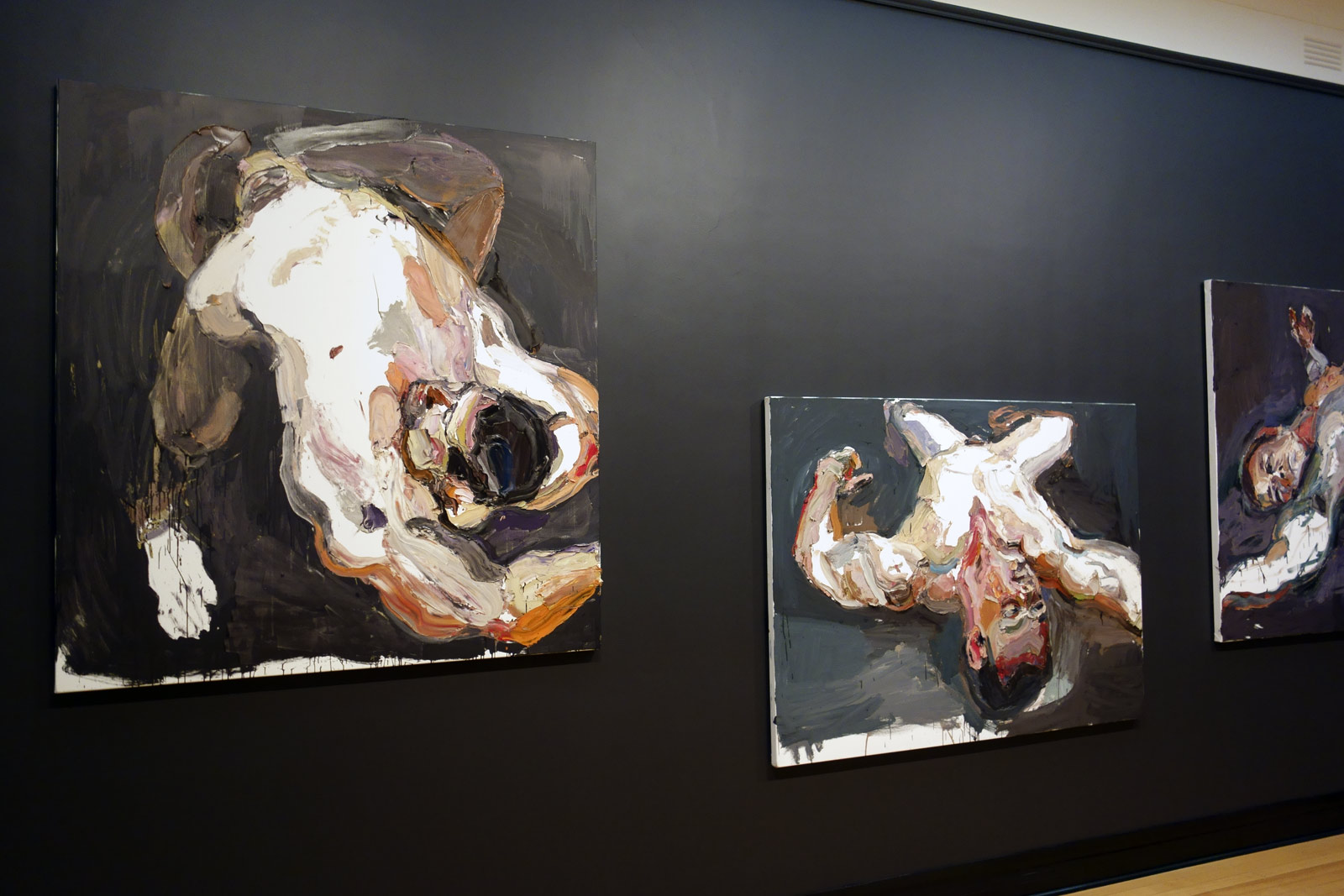
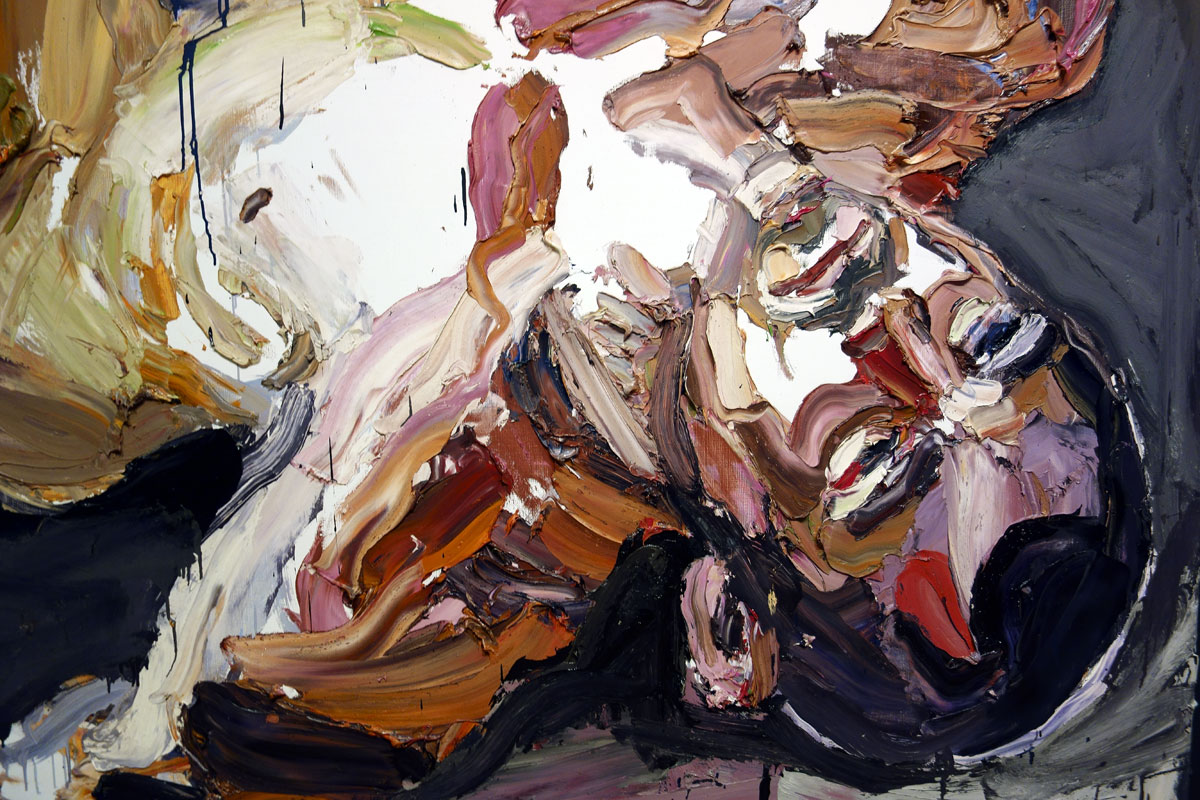
In these paintings, Quilty does not turn away from the evidence of the soldiers before him who express through their bodies that life is violent. He does not attempt to save the viewer from such unpleasantries. As Bacon comments, “The feelings of desperation and unhappiness are more useful to an artist than the feeling of contentment, because desperation and unhappiness stretch your whole sensibility.” Quilty stretches his sensibility as an artist and as a human being by getting down and dirty with his subject matter, both physically and emotionally. In fact, I would say Quilty becomes his subject, so close does the artist get to the object of his attention (after all, this is also Quilty’s experience of Afghanistan, as much as it is the soldiers who he is painting. The artist is always present in the work). The closer you get to one of his paintings, the more the detail vanishes and the more the paint becomes like blood and guts. The artist presses up against his subject which dissolves into abstraction. A bravura tour de force of painting that it so confident in its intent… [that there are] huge stretches of bare white canvas as flesh, with these striking gestures for throat and nipple executed without fear in one stroke of the brush. The black hole appearing out of the side of the soldiers head reminds me of Carl Jung’s ambivalent feelings toward his unconscious shadow; and at one end of the gallery you have a black hole (Trooper Luke Korman, Tarin Kot, 2012, below) and at the other a white hole (Trooper Luke Korman, 2012, below), such are the energies of yin yang that flow through the lighter of the gallery spaces.

Using what the photographer Imogen Cunningham termed the ‘paradox of expansion via reduction’ – closing in on subject (either physically and/or mentally), the intensity and focus attendant to a clear way of seeing – allows Quilty’s work to be flooded with sensuality and reductive power. The horror of the body, of how fragile we are (Damien Hirst) is expressed through the visceral paint. The viewer’s mind tells the story, creates the horror, the closer you get to the work. As I said earlier, there is no transferable message, no actual interpretation but universal triggers that impinge on the viewer’s mind. Quilty plays with the flow of time and space, memory and war by disassociating himself from traditional narrative. As the quotation below from Peter Handke’s novel Across eloquently expresses it, it is a sense of “being-empty” (Zen), an empty form that is also full at the same time. Every object in Quilty’s opus moves into place and we pass over, quietly, into a place we have never been before, through paintings that picture the unknowable. Something we have never seen or felt before. In painting, I don’t think there are many artists that could have achieved what Quilty has with this body of work.

Dr Marcus Bunyan

Word count: 1,125


Many thankx to Castlemaine Art Gallery and Historical Museum for allowing me to publish the photographs in the posting. Please click on the photographs for a larger version of the image. All installation photographs © Marcus Bunyan, the artist and Castlemaine Art Gallery and Historical Museum


1/ Ernst Van Alphen. Francis Bacon and the Loss of Self, 1992 quoted in “Francis Bacon and ‘Narrative’, the Natural Enemy of Vision,” on the ASX website, June 27 2013 [Online] Cited 29/03/2016.

2/ Ibid.,


“With the light of that moment, silence fell. The warming emptiness that I need so badly spread. My forehead no longer needed a supporting hand. It wasn’t exactly a warmth, but a radiance; it welled up rather than spread; not an emptiness, but a being-empty; not so much my being-empty as an empty form. And the empty form meant: story. But it also meant that nothing happened. When the story began, my trail was lost. Blurred. This emptiness was no mystery; but what made it effective remained a mystery. It was as tyrannical as it was appeasing; and its peace meant: I must not speak. Under its implosion, everything (every object) moved into place. “Emptiness!” The word was equivalent to the invocation of the Muse at the beginning of an epic. It provoked not a shudder but lightness and joy, and presented itself as a law: As it is now, so shall it be. In terms of image, it was a shallow river crossing.”


Peter Handke. Across. Ralph Manheim (translator). Farrar, Straus and Giroux, 2000, p. 5.


“I do not want to avoid telling a story, but I want very, very much to do the thing that Valery said – to give the sensation without the boredom of its conveyance. And the moment the story enters, the boredom comes upon you.”


Francis Bacon


This slideshow requires JavaScript.


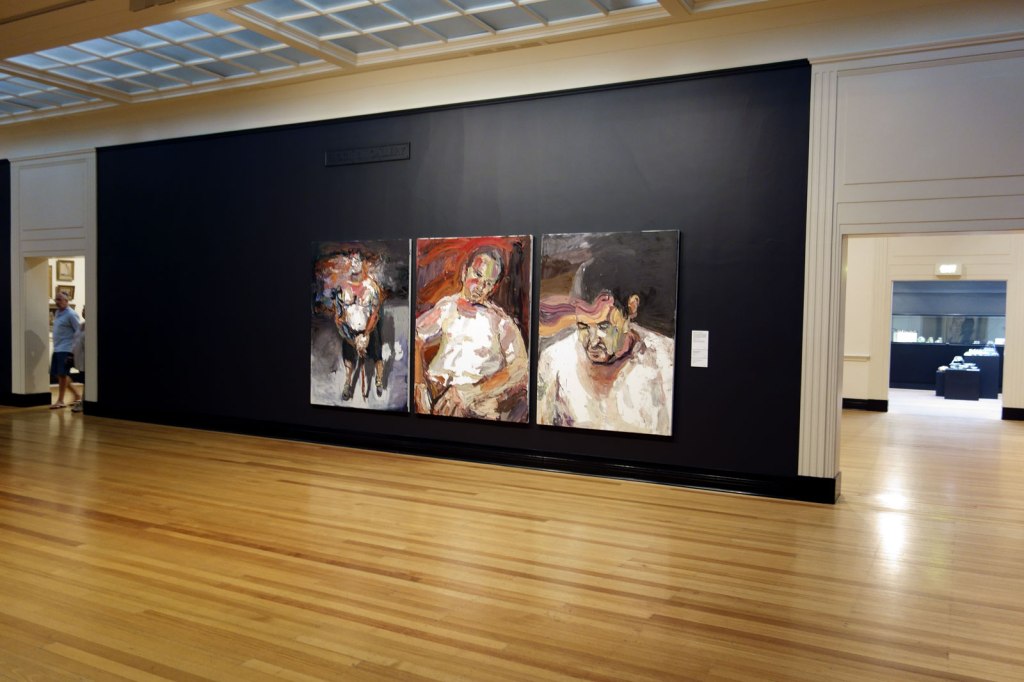
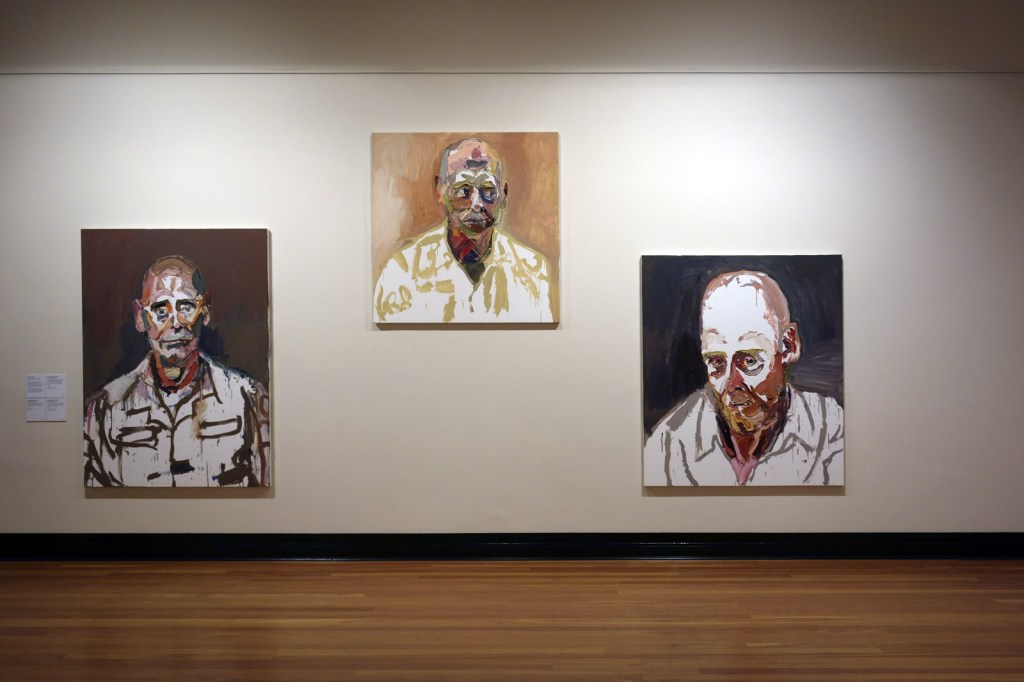
Installation view of the exhibition 'Ben Quilty: After Afghanistan' at the Castlemaine Art Gallery showing from left to right, 'Sergeant P, after Afghanistan' (2012); 'Trooper Daniel Westcott, after Afghanistan' (2012); and 'Troy Park, after Afghanistan' (2012)


Installation view of the exhibition Ben Quilty: After Afghanistan at the Castlemaine Art Gallery showing from left to right, Sergeant P, after Afghanistan (2012); Trooper Daniel Westcott, after Afghanistan (2012); and Troy Park, after Afghanistan (2012)
Photo: Marcus Bunyan


Sergeant P, a Special Operations Task Group soldier, is a survivor of a Black Hawk helicopter crash that claimed the lives of three Australians. Some of the soldiers depicted in the other portraits witnessed the crash and were first on the scene to provide assistance. The memory of this experience, and the friends who did not make it, will stay with these men for a long time.
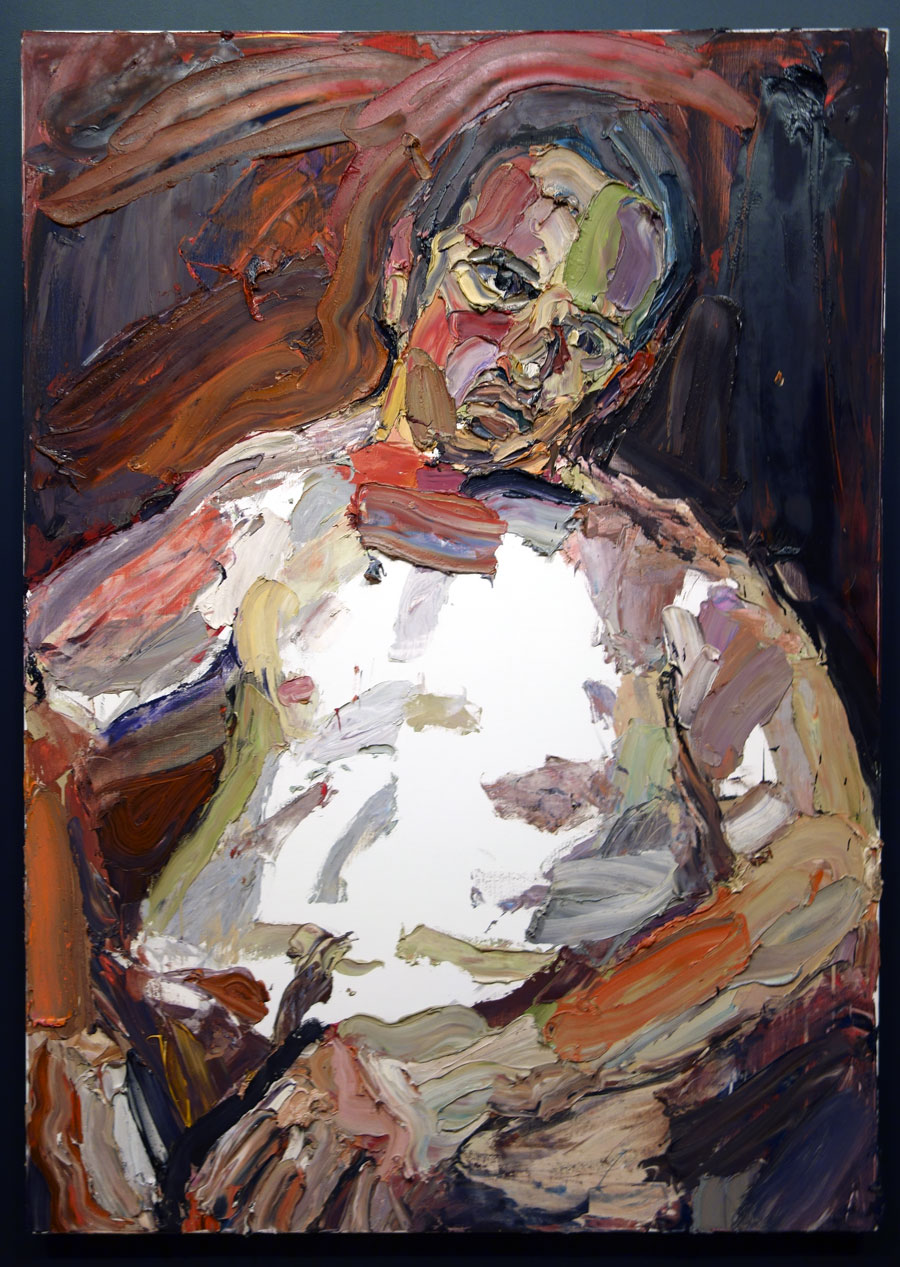
 

Ben Quilty (Australian, b. 1951) 'Trooper Daniel Westcott, after Afghanistan' 2012 (installation view)


Ben Quilty (Australian, b. 1951)
Trooper Daniel Westcott, after Afghanistan (installation view)
2012
Oil on linen
Collection of the artist
Photo: Marcus Bunyan
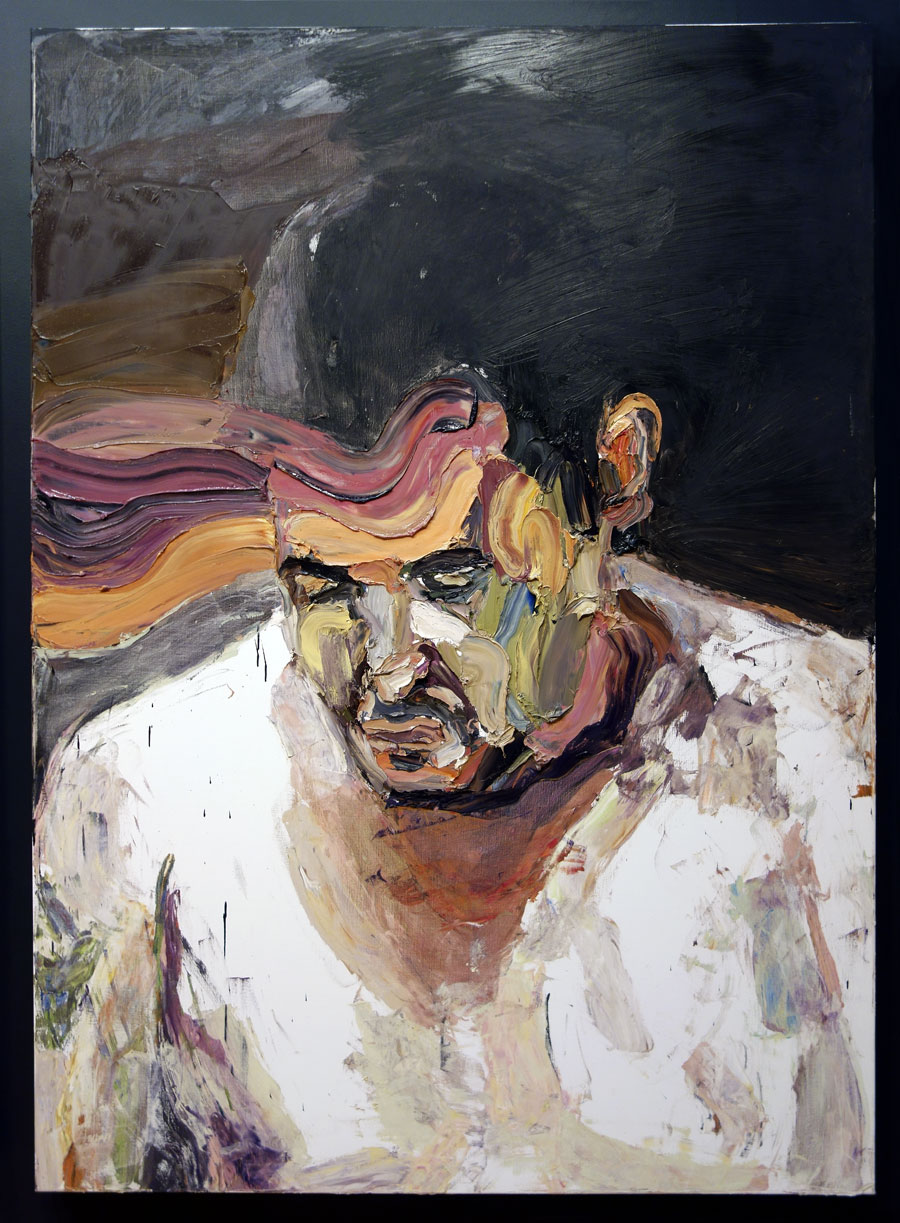
 

Ben Quilty (Australian, b. 1951) 'Troy Park, after Afghanistan' 2012 (installation view)


Ben Quilty (Australian, b. 1951)
Troy Park, after Afghanistan (installation view)
2012
Oil on linen
Collection of the artist
Photo: Marcus Bunyan


Installation view of the exhibition 'Ben Quilty: After Afghanistan' at the Castlemaine Art Gallery

Installation view of the exhibition 'Ben Quilty: After Afghanistan' at the Castlemaine Art Gallery

Installation view of the exhibition 'Ben Quilty: After Afghanistan' at the Castlemaine Art Gallery

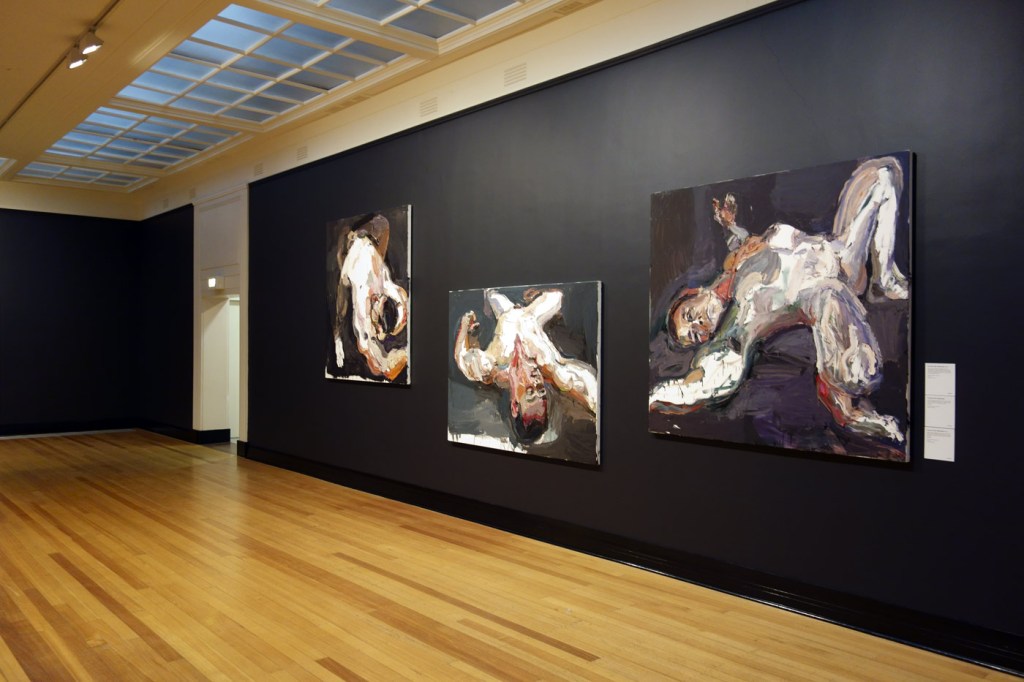
Installation view of the exhibition 'Ben Quilty: After Afghanistan' at the Castlemaine Art Gallery showing from left to right, 'Troy Park, after Afghanistan, no. 2' (2012); 'Trooper M, after Afghanistan' (2012); and 'Trooper M, after Afghanistan, no. 2' (2012)

Installation view of the exhibition 'Ben Quilty: After Afghanistan' at the Castlemaine Art Gallery showing from left to right, 'Troy Park, after Afghanistan, no. 2' (2012); 'Trooper M, after Afghanistan' (2012); and 'Trooper M, after Afghanistan, no. 2' (2012)

Installation view of the exhibition 'Ben Quilty: After Afghanistan' at the Castlemaine Art Gallery showing from left to right, 'Troy Park, after Afghanistan, no. 2' (2012); 'Trooper M, after Afghanistan' (2012); and 'Trooper M, after Afghanistan, no. 2' (2012)


Installation views of the exhibition Ben Quilty: After Afghanistan at the Castlemaine Art Gallery showing from left to right in the bottom three images, Troy Park, after Afghanistan, no. 2 (2012); Trooper M, after Afghanistan (2012); and Trooper M, after Afghanistan, no. 2 (2012)
Photos: Marcus Bunyan


Ben Quilty (Australian, b. 1951) 'Troy Park, after Afghanistan, no. 2' 2012 (installation view)


Ben Quilty (Australian, b. 1951)
Troy Park, after Afghanistan, no. 2 (installation view)
2012
Oil on linen
Collection of the artist
Photo: Marcus Bunyan


Quilty asked the soldiers to suggest a post that encapsulated some of the emotions that surrounded their experience in Afghanistan. Often the pose is quite contorted, as it reflects an actual event, such as taking cover to engage insurgents.


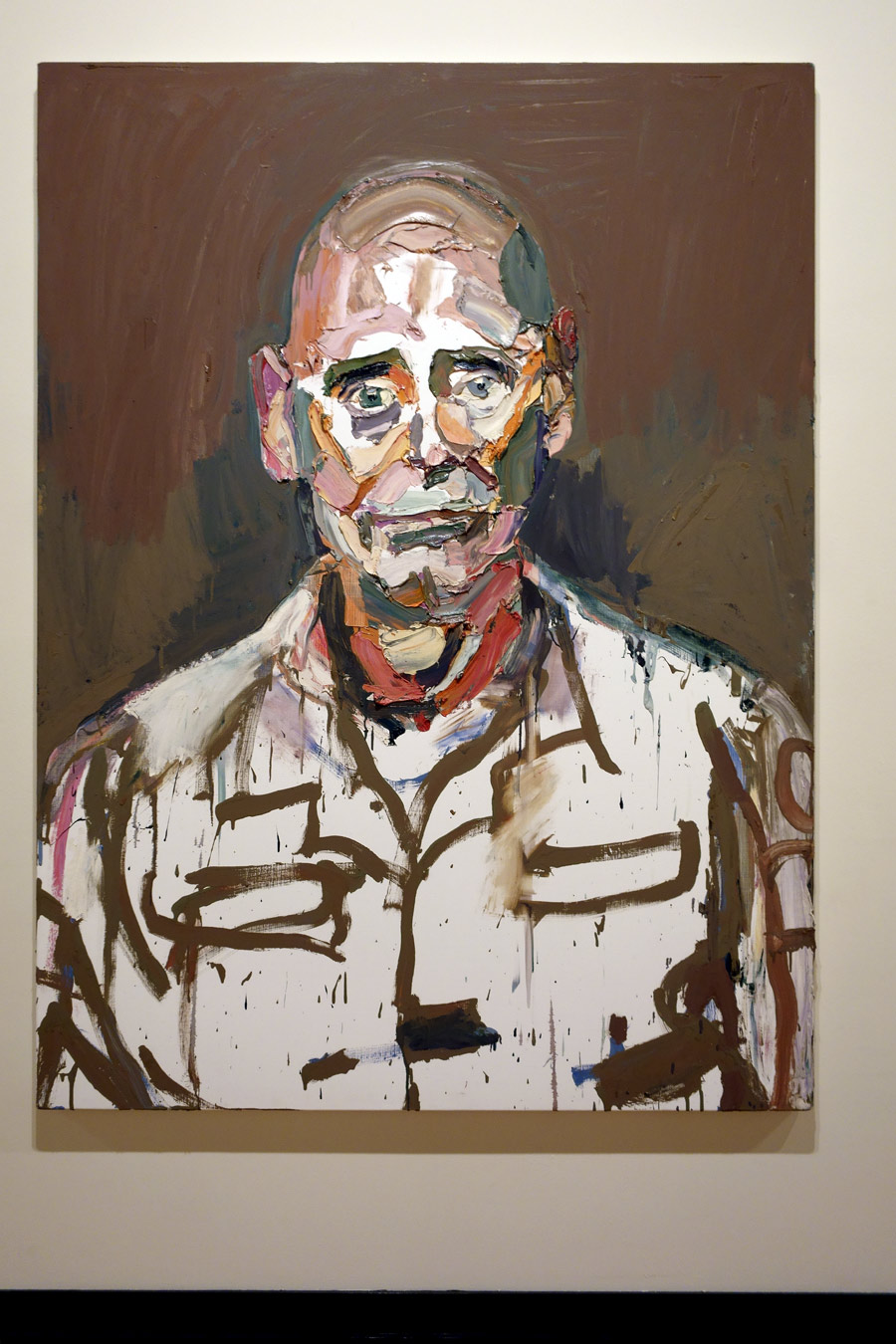
Ben Quilty (Australian, b. 1951) 'Trooper M, after Afghanistan' 2012 (installation view)


Ben Quilty (Australian, b. 1951)
Trooper M, after Afghanistan (installation view)
2012
Oil on linen
Collection of the artist
Photo: Marcus Bunyan
 

“You can’t really stop out there. You have to keep doing your job and keep moving forward … There is no time, until you get home, to stop and think about it.”

Trooper M


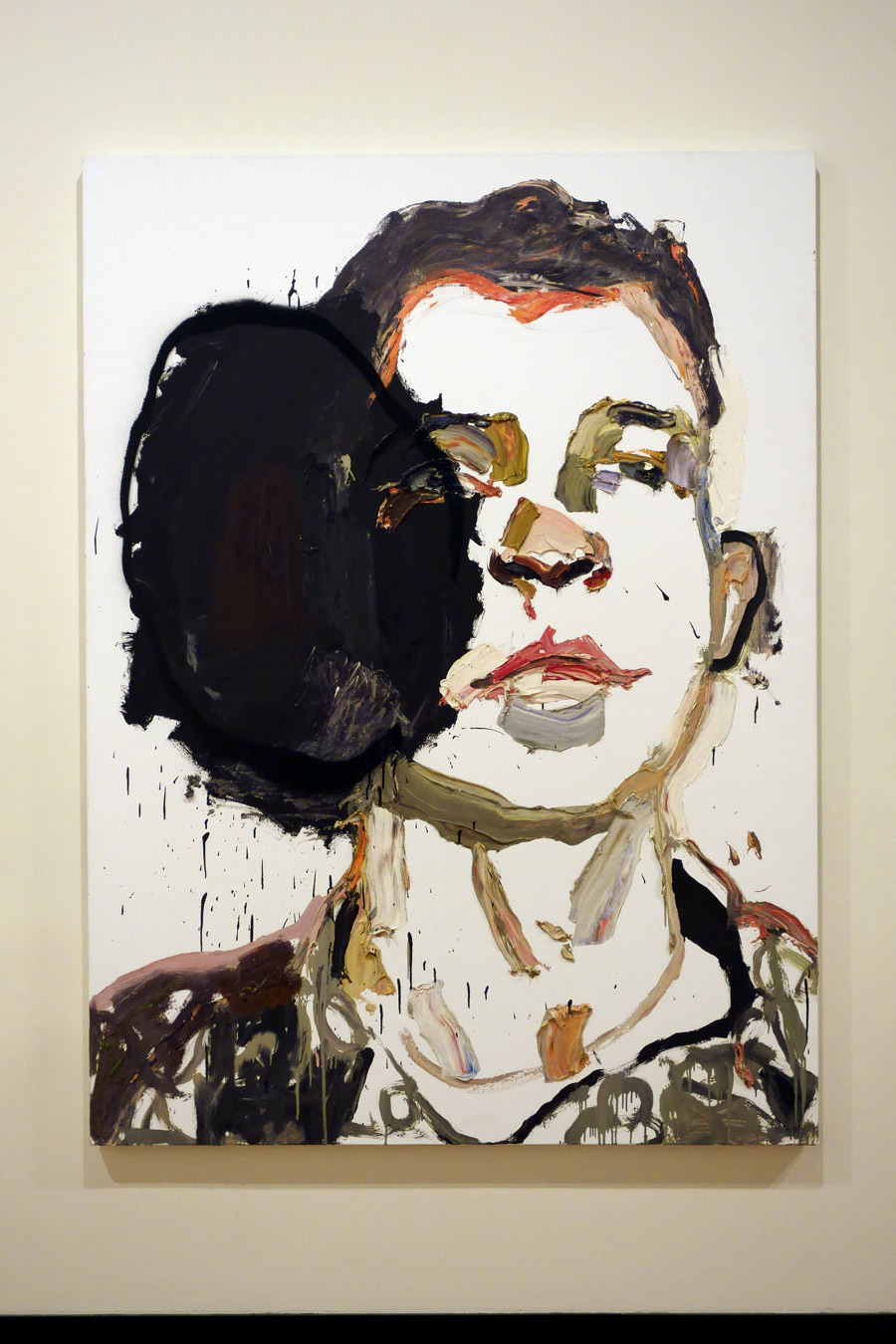
Ben Quilty (Australian, b. 1951) 'Trooper M, after Afghanistan, no. 2' 2012 (installation view detail)


Ben Quilty (Australian, b. 1951)
Trooper M, after Afghanistan, no. 2 (installation view detail)
2012
Oil on linen
Collection of the artist
Photo: Marcus Bunyan


“Sitting for Ben is therapeutic; it does get a lot of stuff off your chest. And actually seeing your portrait on canvas, I think for me it’s definitely a chapter that I can close and leave there.”

Trooper M


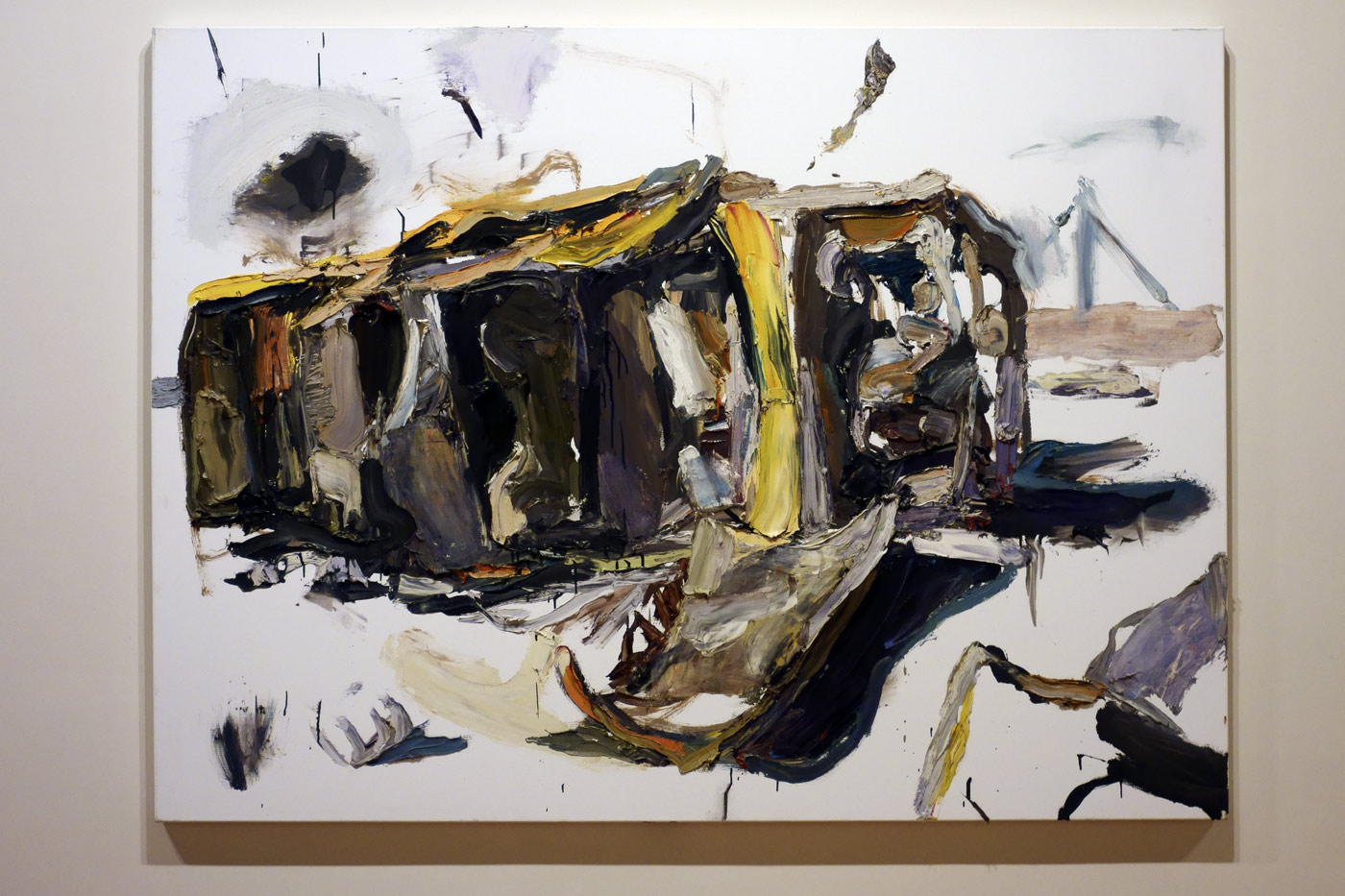
Ben Quilty (Australian, b. 1951) 'Bushmaster' 2012 (installation view)


Ben Quilty (Australian, b. 1951)
Bushmaster (installation view)
2012
Aerosol and oil on linen
Donated by Ben Quilty through the Australian Government’s Cultural Gifts Program in 2013
Photo: Marcus Bunyan


Portraiture for Quilty can also take a vehicle as its subject. This destroyed Bushmaster reflects the soldiers’ identity and is a vestige of their physical experience. They risk their lives while carrying out their duties in these versatile military vehicles.

“I met a young man who’d been in the back of a Bushmaster that had blown up. The Bushmaster is the big armoured four-wheel-drive vehicle that’s saving a lot of Australian lives, but even so the explosion caused every single you man inside that vehicle to suffer from concussion and one of them was blown out of the gun turret and landed in front of the vehicle among possibly more hidden explosive devices.”

Ben Quilty


Ben Quilty (Australian, b. 1951) 'Captain S, after Afghanistan' 2012 (installation view)


Ben Quilty (Australian, b. 1951)
Captain S, after Afghanistan (installation view)
2012
Oil on linen
Acquired under the official art scheme 2012
Photo: Marcus Bunyan


“I think when Ben paints, he’s not looking for what’s on the outside … He’s more after what they’re feeling o what they’ve been through … He’s looking at the inner instead of just the outer.”

Captain S


Ben Quilty (Australian, b. 1951) 'Lance Corporal M, after Afghanistan' 2012 (installation view)


Ben Quilty (Australian, b. 1951)
Lance Corporal M, after Afghanistan (installation view)
2012
Oil on linen
Collection of the artist
Photo: Marcus Bunyan


Ben Quilty (Australian, b. 1951) 'Lance Corporal M, after Afghanistan' 2012 (installation view detail)


Ben Quilty (Australian, b. 1951)
Lance Corporal M, after Afghanistan (installation view detail)
2012
Oil on linen
Collection of the artist
Photo: Marcus Bunyan


The naked portraits have a sensuousness and vulnerability in their solitary, contorted poses. The rough surface signifies the uniform and body armour that have been stripped away in front of us, and them. We and they recognise what they have endured and achieved.

“I wanted [this soldier] to be naked, showing not only his physical strength but also the frailty of human skin and the darkness of the emotional weight of the war.”

Ben Quilty


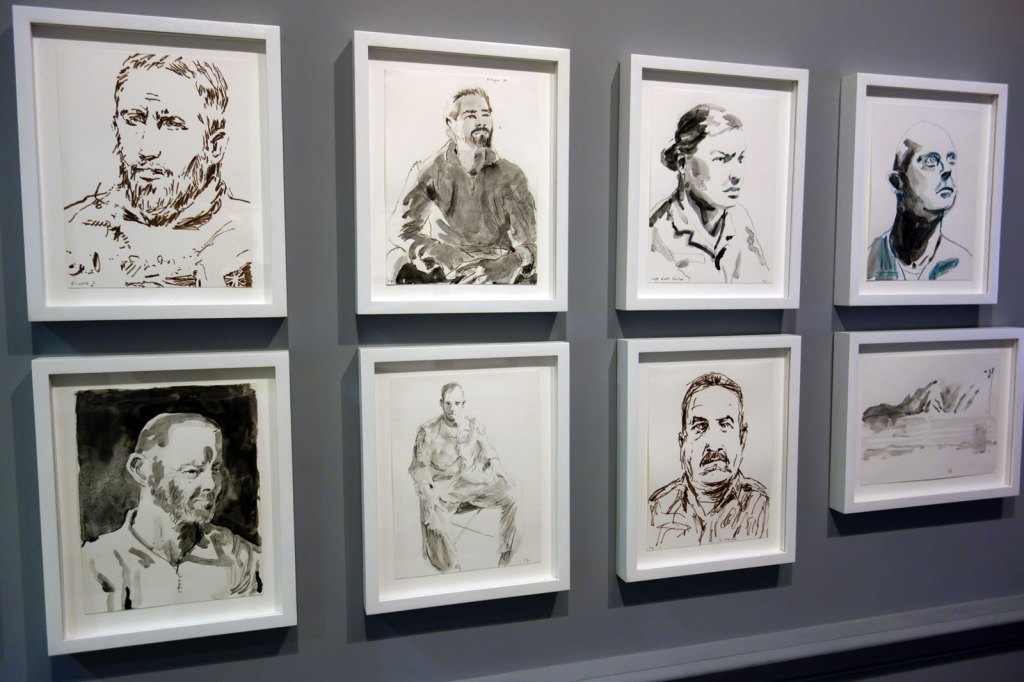
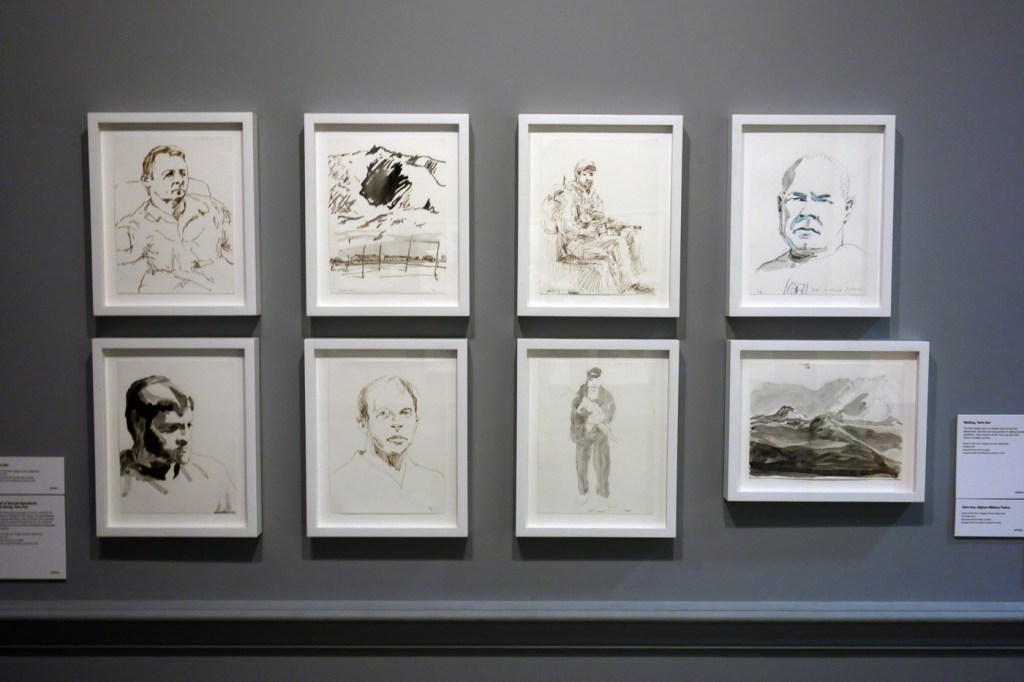
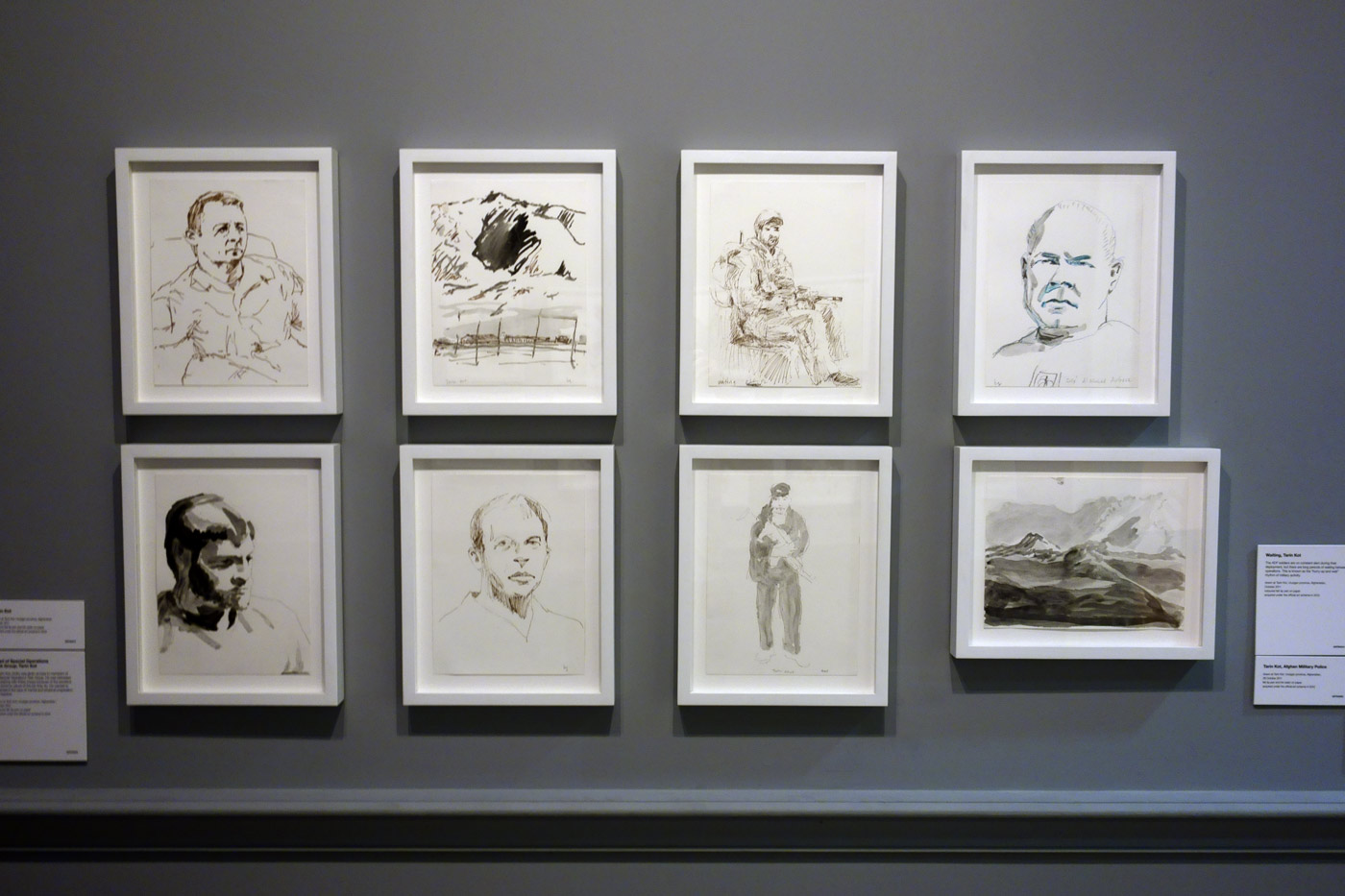
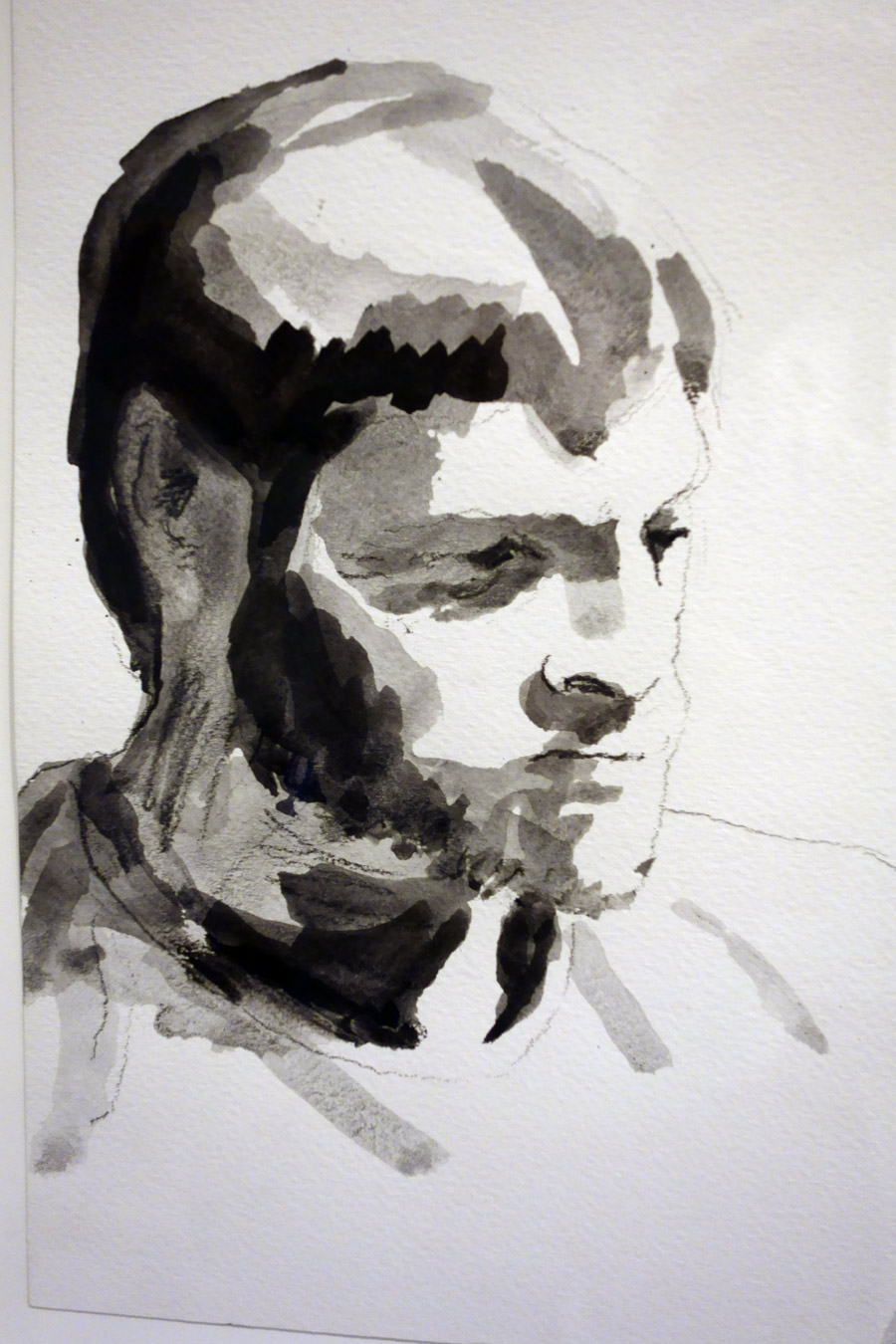
Installation view of drawings from the exhibition 'Ben Quilty: After Afghanistan' at the Castlemaine Art Gallery including, at bottom left, 'Captain M II, Tarin Kot' (October 2011) and third from left top, 'Waiting, Tarin Kot' (October 2011)


Installation view of drawings from the exhibition Ben Quilty: After Afghanistan at the Castlemaine Art Gallery including, at bottom left, Captain M II, Tarin Kot (October 2011, below) and third from left top, Waiting, Tarin Kot (October 2011, below)
Photo: Marcus Bunyan


“This very wild place”

Sitting and talking with the Australian soldiers in Afghanistan, Quilty became intrigued by their experiences. He came to feel responsible for telling the stories of these young men and women.

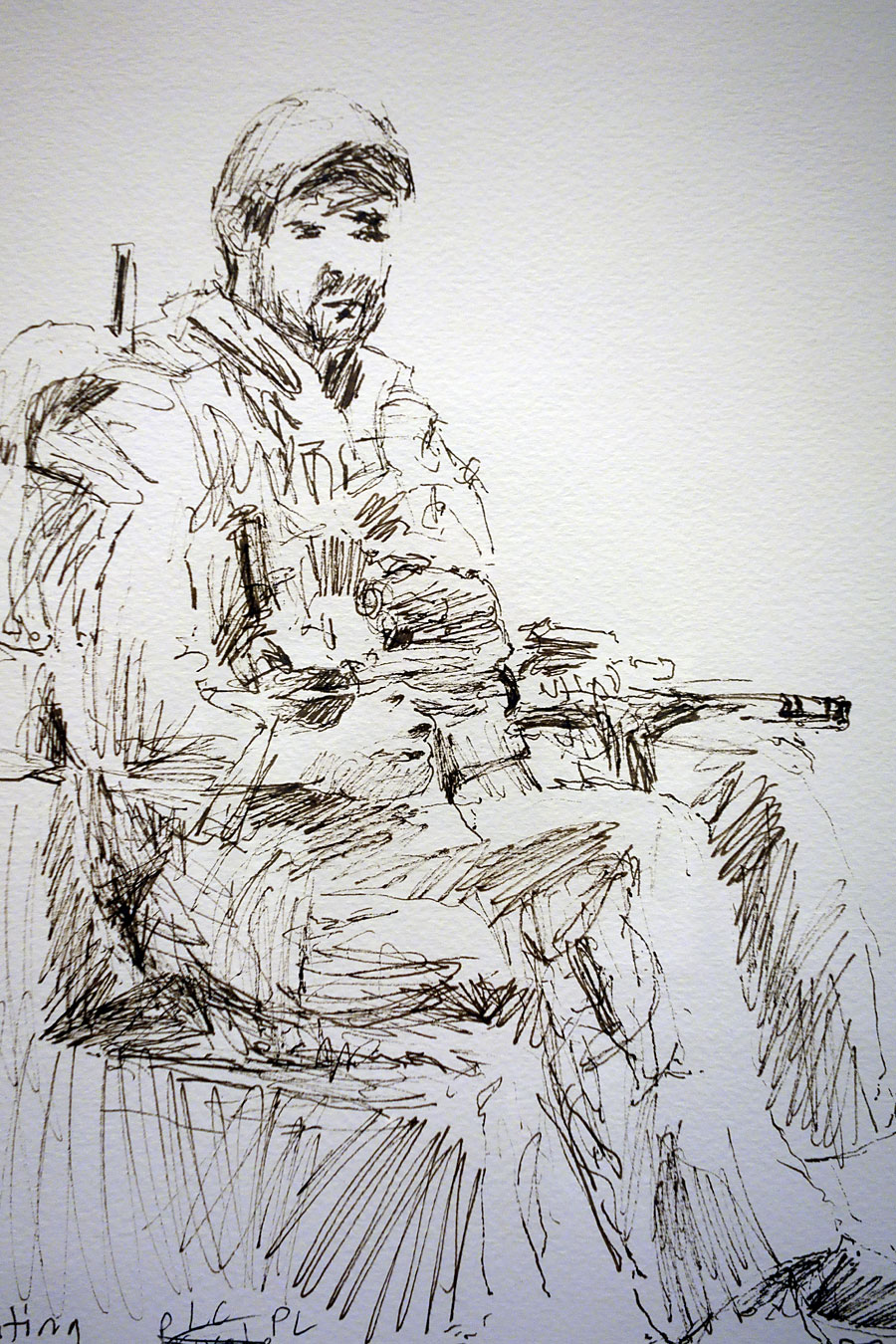
“I started doing drawings of the soldiers, and hearing their stories about their experiences of being in this very wild place. I realised that I needed to just sit with them … making portraits of these guys in Tarin Kot or wherever I was … getting them to sit still and talk to me about their experience. Those little drawings are a reminder to me of the time that I spent with those people. I hoped that there’d be some remnant of that experience that I could then draw out … to put into the paintings when I returned to Australia.”

Ben Quilty

The trust that Quilty developed with these soldiers in Afghanistan was strong enough to continue at home in Quilty’s studio, where he invited some to sit for larger portraits.


Installation view of drawings from the exhibition 'Ben Quilty: After Afghanistan' at the Castlemaine Art Gallery


(top row, first three from left)

Ben Quilty (Australian, b. 1951)
Private C, Tarin Kot
October 2011
Drawn at Tarin Kot, Uruzgan province, Afghanistan
Coloured felt tip pen on paper
Acquired under the official art scheme 2012

Ben Quilty (Australian, b. 1951)
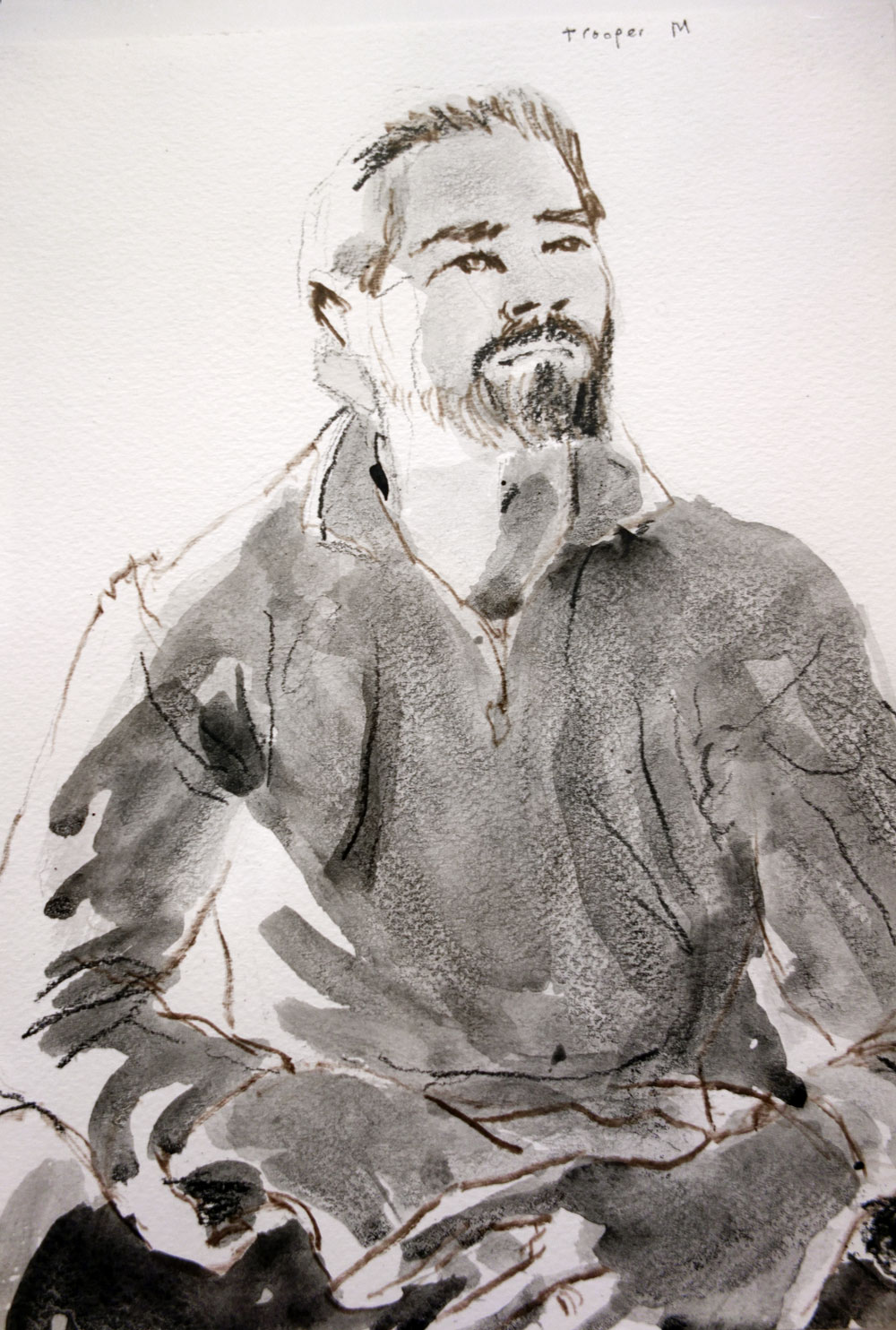
Trooper M, Special Forces, Tarin Kot
October 2011
Drawn at Tarin Kot, Uruzgan province, Afghanistan
Coloured felt tip pen, pencil and ink wash on paper
Collection of the artist

Ben Quilty (Australian, b. 1951)
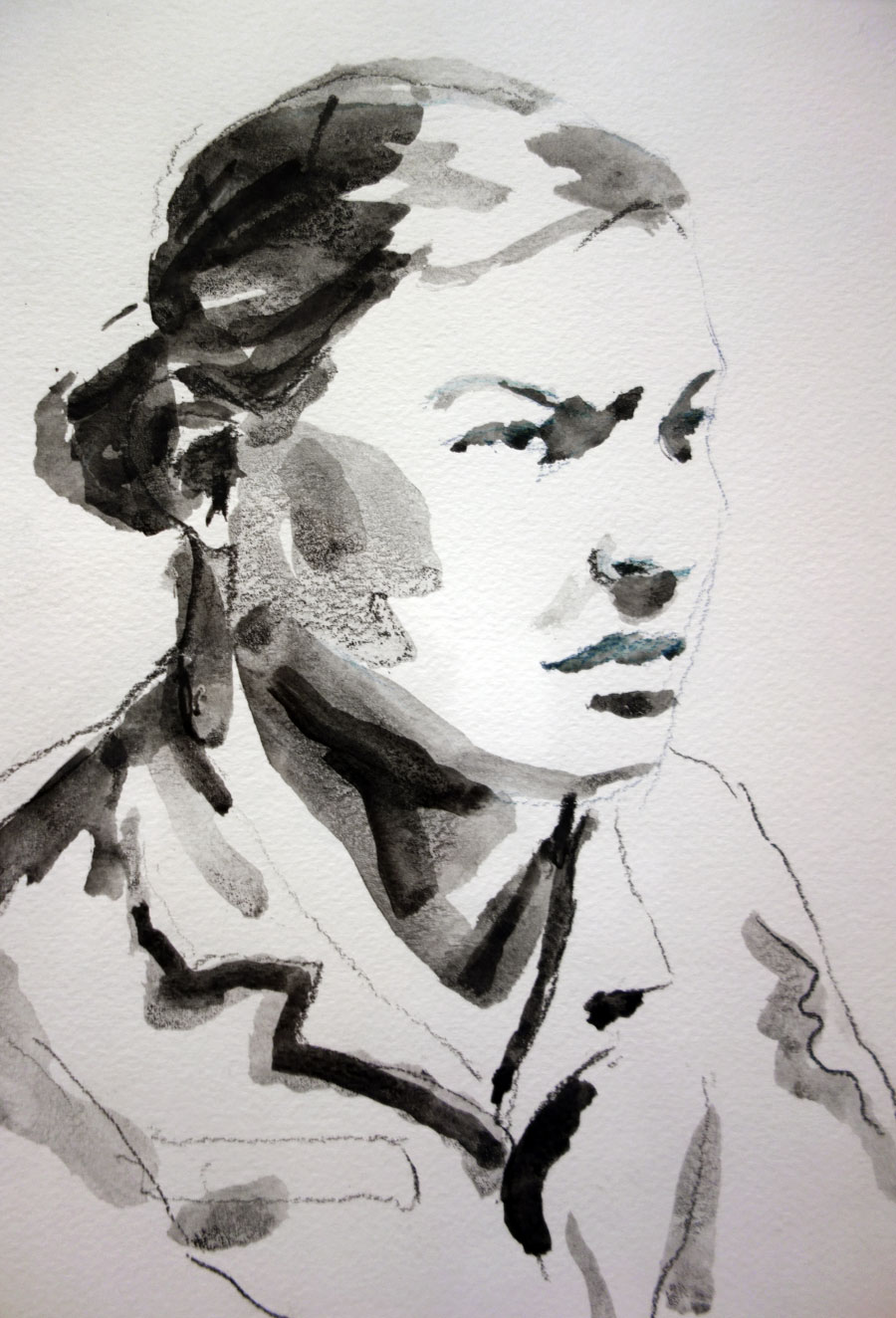
Captain Kate Porter
27 October 2011
Drawn at Tarin Kot, Uruzgan province, Afghanistan
Coloured pencil and ink wash on paper
Acquired under the official art scheme 2012

(bottom row, first three from left)

Ben Quilty (Australian, b. 1951)
Sergeant M II, Tarin Kot
October 2011
Drawn at Tarin Kot, Uruzgan province, Afghanistan
Pencil and ink wash on paper
Collection of the artist

Ben Quilty (Australian, b. 1951)
Chinook pilot, Kandahar Airfield
October 2011
Drawn at Kandahar Airfield, Kandahar province, Afghanistan
Pencil and ink wash on paper
Collection of the artist

Ben Quilty (Australian, b. 1951)
Brigadier General Noorullah, Afghan National Army, Tarin Kot
22 October 2011
Drawn at Tarin Kot, Uruzgan province, Afghanistan
Coloured felt tip pen on paper
Acquired under the official art scheme 2012

Photo: Marcus Bunyan


While in Tarin Kot, Quilty attended a marching out parade of 400 Afghan National Army (ANA) soldiers who had completed training under the Australian Mentoring Task Fore. There he met a senior ANA commander, Brigadier General Noorullah. Just days later, three Australian soldiers were killed at a similar training parade being held at Forward Operating Base Sorkh Bed (aka Pacemaker). Quilty learnt of the incident the day after he left Afghanistan, giving him an even greater sense of the dangers that the soldiers he met face daily.


Ben Quilty (Australian, b. 1951) 'Captain Kate Porter' 27 October 2011 (installation view)


Ben Quilty (Australian, b. 1951)
Captain Kate Porter (installation view)
27 October 2011
Drawn at Tarin Kot, Uruzgan province, Afghanistan
Coloured pencil and ink wash on paper
Acquired under the official art scheme 2012
Photo: Marcus Bunyan


Quilty wanted to meet a cross-section of people serving in Afghanistan – soldiers driving Bushmasters, Chinook pilots, Special Forces soldiers, and both men and women of all ranks – to try to understand who makes up the Australian Defence Force. He met Captain Kate Porter at Tarin Kot. There he spoke to her about her experiences as female in the very masculine community of the Special Operations Task Group, as well as her general experience as a soldier in Afghanistan.


Ben Quilty (Australian, b. 1951) 'Trooper M, Special Forces, Tarin Kot' October 2011 (installation view)


Ben Quilty (Australian, b. 1951)
Trooper M, Special Forces, Tarin Kot (installation view)
October 2011
Drawn at Tarin Kot, Uruzgan province, Afghanistan
Coloured felt tip pen, pencil and ink wash on paper
Collection of the artist
Photo: Marcus Bunyan
 

Ben Quilty (Australian, b. 1951) 'Waiting, Tarin Kot' October 2011 (installation view)


Ben Quilty (Australian, b. 1951)
Waiting, Tarin Kot (installation view)
October 2011
Drawn at Tarin Kot, Uruzgan province, Afghanistan
Coloured felt tip pen on paper
Acquired under the official art scheme 2012
Photo: Marcus Bunyan


Ben Quilty (Australian, b. 1951) 'Captain M II, Tarin Kot' October 2011 (installation view)


Ben Quilty (Australian, b. 1951)
Captain M II, Tarin Kot (installation view)
October 2011
Drawn at Tarin Kot, Uruzgan province, Afghanistan
Pencil and ink wash on paper
Collection of the artist
Photo: Marcus Bunyan


“Ben Quilty: After Afghanistan is an extraordinary Australian War Memorial Touring Exhibition by one of the nation’s most incisive artists, and is of great relevance to all Australians. The exhibition officially opens at Castlemaine Art Gallery on Friday 15 January 2016.

The exhibition itself was the result of the Archibald Prize-winning artist’s three-week tour across Afghanistan in October 2011. Engaged as an Official War Artist, his purpose was to record and interpret the experiences of Australians deployed as part of Operation Slipper in Kabul, Kandahar, and Tarin Kot in Afghanistan and at Al Minhad Airbase in the United Arab Emirates. In fulfilling his brief, Quilty spoke with many Australian servicemen and women, gaining an insight into their experiences whilst serving in the region, and ultimately leaving with an overwhelming need to tell their stories.

Quilty recently spoke on ANZAC Day 2015 and paid tribute not only to those who did not return from Afghanistan and their grieving families, but also to “the young men and women who live amongst us who have paid so dearly and will quietly wear the thick cloak of trauma for many years to come, after Afghanistan.”

The exhibition is a must see as Quilty is arguably one of Australia’s greatest living painters, and this exhibition, with its intense and emotional subject matter is particularly important to Castlemaine, a town with a history of young men and women serving their country far from home. The exhibition has been very well received across the country with over 70,000 visitors attending the works when on display most recently in Darwin. Dr Brendan Nelson, Director of the Australian War Memorial believes Quilty should be considered one of Australia’s great official war artists.

“Ben Quilty’s works follows a truly great tradition at the Australian War Memorial of appointing artists to record and interpret the Australian experience of war.”

“Ben brought to this task all his brilliance, sensitivity and compassion. The works he produced will leave Australians a legacy which informs them not only about the impact of war on our country, but even more importantly, about the effects on the men and women he has depicted,” said Dr Nelson.

Dr Jan Savage, President of the Castlemaine Art Gallery and Historical Museum Committee of Management said the exhibition, “was significant in understanding the impact of war on serving members of the Australian armed forces and I encourage visitors to attend this most important exhibition.”

Ben Quilty: After Afghanistan is on display at Castlemaine Art Gallery from 15 January until 15 April 2016.

An Australian War Memorial Touring Exhibition, proudly sponsored by Thales.”

Text from the Castlemaine Art Gallery and Historical Museum website


Ben Quilty (Australian, b. 1951) 'Tarin Kot, Hilux' 2012 (installation view)


Ben Quilty (Australian, b. 1951)
Tarin Kot, Hilux (installation view)
2012
Oil on linen
Collection of the artist
Photo: Marcus Bunyan
 

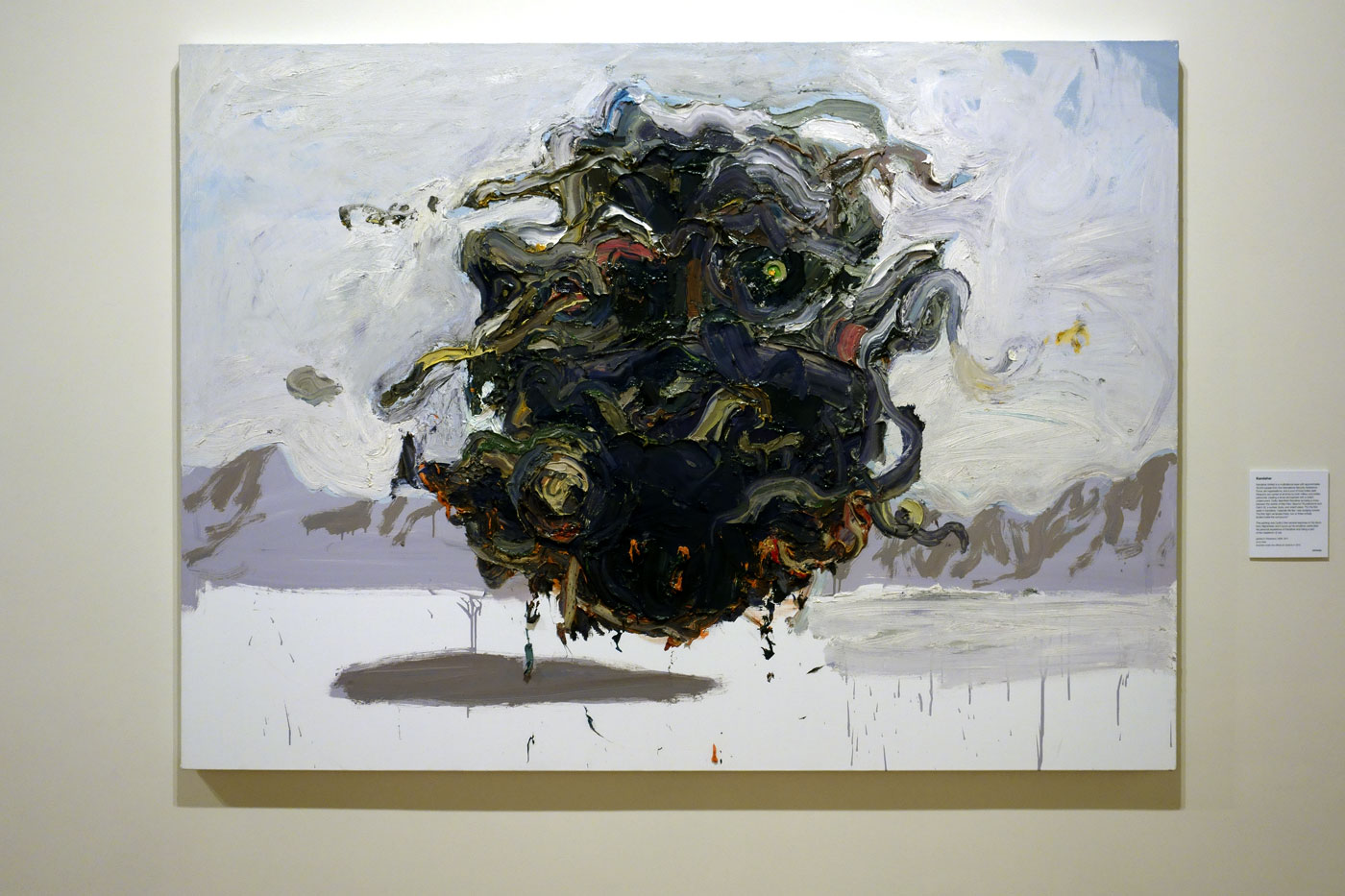
Ben Quilty (Australian, b. 1951) 'Kandahar' 2012 (installation view)


Ben Quilty (Australian, b. 1951)
Kandahar (installation view)
2012
Oil on linen
Acquired under the official art scheme 2012
Photo: Marcus Bunyan
 

Ben Quilty (Australian, b. 1951) 'Kandahar' 2012 (installation view detail)


Ben Quilty (Australian, b. 1951)
Kandahar (installation view detail)
2012
Oil on linen
Acquired under the official art scheme 2012
Photo: Marcus Bunyan


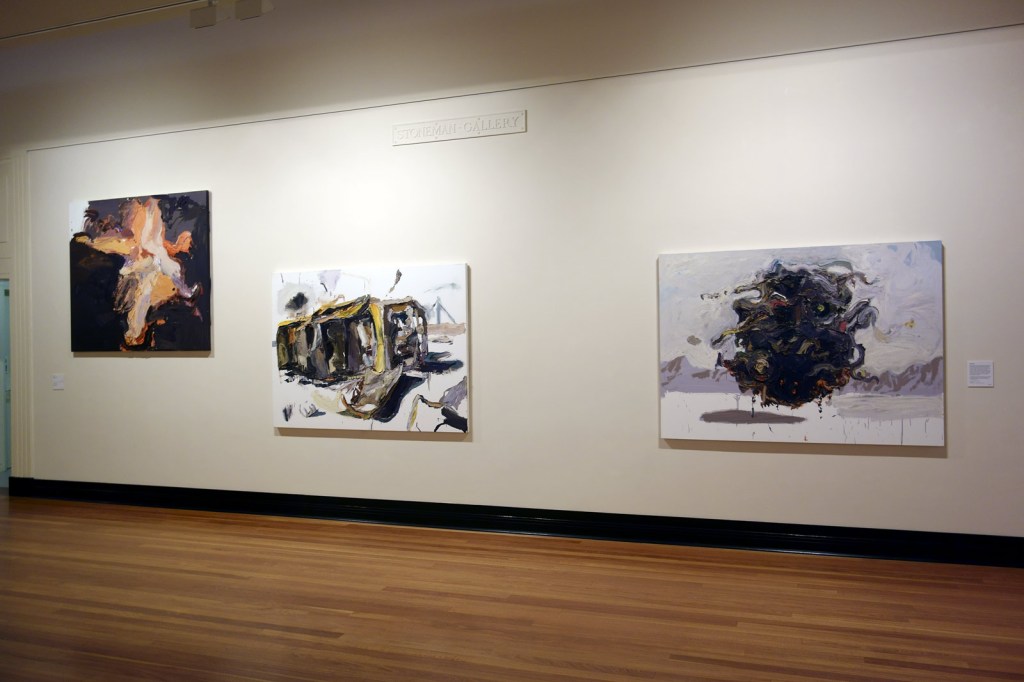
Kandahar Airfield is a multinational vase with approximately 35,000 people from the International Security Assistance Fore, aid organisations, and a pool of local civilian staff. Weapons are carried at all times by both military and civilian personnel, creating a tense atmosphere with a violent undercurrent. Quilty described Kandahar as being a cross between the worlds of Mad Max: Beyond Thunderdome and Catch 22, a surreal, dusty, and violent place. “For the first week in Kandahar, I basically felt like I was dodging rockets. The first night we landed there, two or three rockets landed inside the compound.”

This painting was Quilty’s first visceral response on his return from Afghanistan and i sums up his emotions, particularly his personal experience of Kandahar and being a part of the maelstrom of war.


Installation view of the exhibition 'Ben Quilty: After Afghanistan' at the Castlemaine Art Gallery showing at centre, 'Tarin Kot, Hilux' (2012); and at right, 'Kandahar' (2012)


Installation view of the exhibition Ben Quilty: After Afghanistan at the Castlemaine Art Gallery showing at centre, Tarin Kot, Hilux (2012); and at right, Kandahar (2012)
Photo: Marcus Bunyan


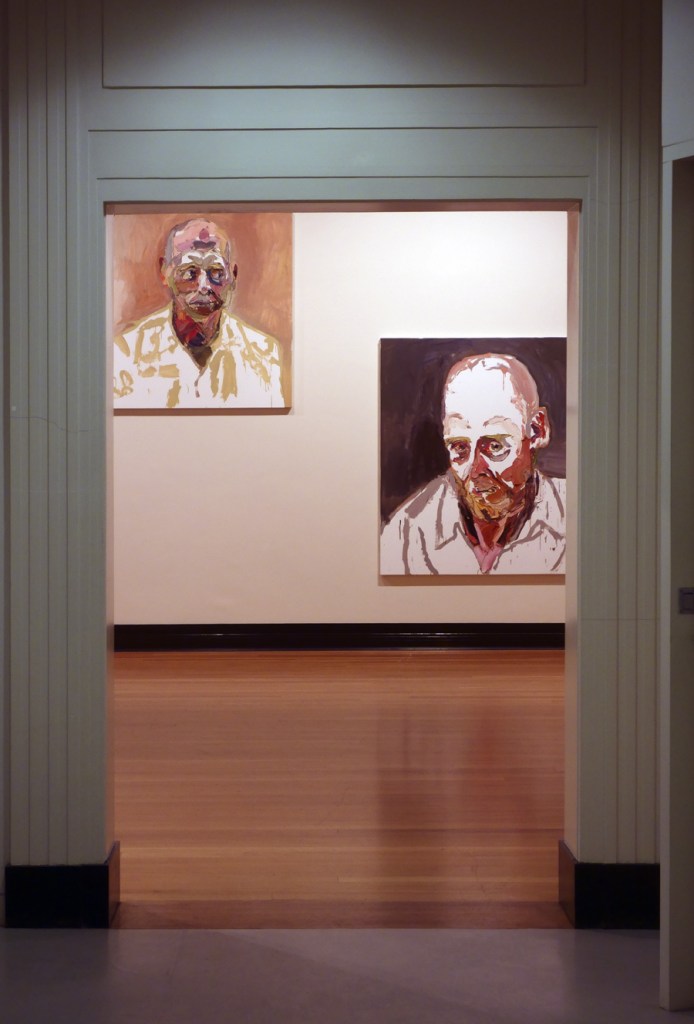
Installation view of the exhibition 'Ben Quilty: After Afghanistan' at the Castlemaine Art Gallery


Installation view of the exhibition 'Ben Quilty: After Afghanistan' at the Castlemaine Art Gallery showing at left, 'Air Commodore John Oddie, after Afghanistan, no. 3' (2012)

Installation view of the exhibition 'Ben Quilty: After Afghanistan' at the Castlemaine Art Gallery showing at left, 'Air Commodore John Oddie, after Afghanistan, no. 3' (2012)

Installation view of the exhibition 'Ben Quilty: After Afghanistan' at the Castlemaine Art Gallery showing at left, 'Air Commodore John Oddie, after Afghanistan, no. 3' (2012)


Installation views of the exhibition Ben Quilty: After Afghanistan at the Castlemaine Art Gallery showing at left in the bottom image, Air Commodore John Oddie, after Afghanistan, no. 3 (2012, below)
Photos: Marcus Bunyan


Returning from war

“You can’t take the experiences out of your head.
You can’t take the damages out of your head.”

John Oddie


On his return to Australia, Ben Quilty contacted Air Commodore John Oddie (Ret’d), whom he had met during his Afghanistan deployment, to invite him to sit for a portrait in his studio. From February to October 2011, Oddie had been the Deputy Commander of Australian forces in the Middle east, a position of immense responsibility.

Quilty eventually produced three portraits over five months. These works reveal a man returning from war and its burden of responsibility, exhausted emotionally and mentally, and his progress towards a more positive view of life and of himself as a survivor.


Ben Quilty (Australian, b. 1951) 'Air Commodore John Oddie, after Afghanistan, no. 3' 2012 (installation view)


Ben Quilty (Australian, b. 1951)
Air Commodore John Oddie, after Afghanistan, no. 3 (installation view)
2012
Oil on linen
Collection of the artist
Photo: Marcus Bunyan


Ben Quilty (Australian, b. 1951) 'Air Commodore John Oddie, after Afghanistan, no. 3' 2012 (installation view detail)


Ben Quilty (Australian, b. 1951)
Air Commodore John Oddie, after Afghanistan, no. 3 (installation view detail)
2012
Oil on linen
Collection of the artist
Photo: Marcus Bunyan


“I don’t necessarily see beauty, I see insight in what Ben does. That’s reflected in the way he paints … I think his later portraits, done after he’s got to know us better, are different from the raw emotion of the first ones.”

John Oddie


Ben Quilty (Australian, b. 1951) 'Air Commodore John Oddie, after Afghanistan, no. 1' 2012 (installation view)


Ben Quilty (Australian, b. 1951)
Air Commodore John Oddie, after Afghanistan, no. 1 (installation view)
2012
Oil on linen
Collection of the artist
Photo: Marcus Bunyan


“With through a lack of insight or through an unwillingness … I wasn’t always admitting the truth to myself about my life. Ben really took that out and put it on a table in front of me like a three-course dinner and said, well, how about that? And you know, I sort of thought well, I’m not going to come to this restaurant again in a hurry!”

John Oddie


Ben Quilty (Australian, b. 1951) 'Air Commodore John Oddie, after Afghanistan, no. 2' 2012 (installation view)


Ben Quilty (Australian, b. 1951)
Air Commodore John Oddie, after Afghanistan, no. 2 (installation view)
2012
Oil on linen
Collection of the artist
Photo: Marcus Bunyan


“He’s got this one little gash of paint and it brings out this wry smile that I didn’t even know I had … When I stood back and had a look, I was just stunned at the honesty of the painting – until then I hadn’t really been fully honest with myself about what I was feeling.”

John Oddie


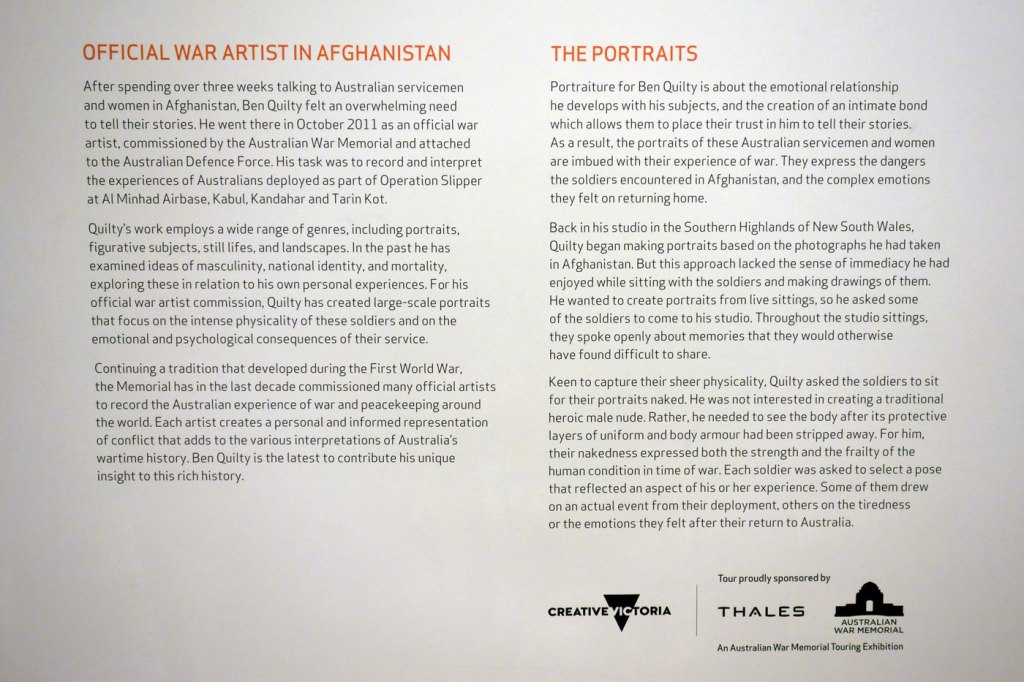
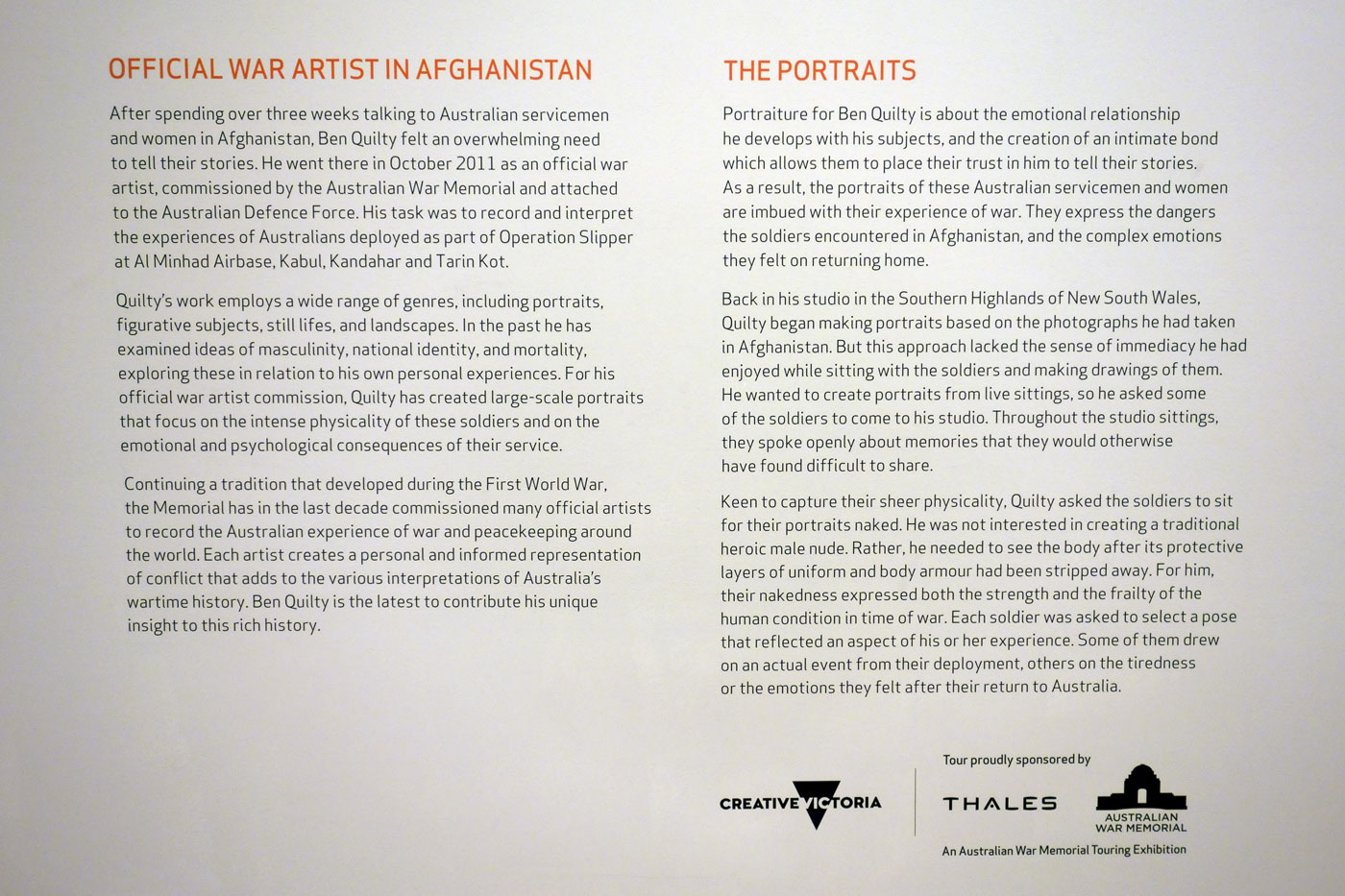
Introductory titles and text for the exhibition 'Ben Quilty: After Afghanistan' at the Castlemaine Art Gallery

Introductory titles and text for the exhibition 'Ben Quilty: After Afghanistan' at the Castlemaine Art Gallery


Introductory titles and text for the exhibition Ben Quilty: After Afghanistan at the Castlemaine Art Gallery
Photos: Marcus Bunyan


Installation view of the exhibition 'Ben Quilty: After Afghanistan' at the Castlemaine Art Gallery showing the work 'Trooper Daniel Spain, Tarin Kot' (2012)


Installation view of the exhibition Ben Quilty: After Afghanistan at the Castlemaine Art Gallery showing the work Trooper Daniel Spain, Tarin Kot (2012, below)
Photo: Marcus Bunyan


Ben Quilty (Australian, b. 1951) 'Trooper Daniel Spain, Tarin Kot' 2012 (installation view)


Ben Quilty (Australian, b. 1951)
Trooper Daniel Spain, Tarin Kot (installation view)
2012
Oil on linen diptych
Collection of the artist
Photo: Marcus Bunyan


In some of the works, Quilty has used dramatic symbols to represent the emotional weight and the sense of emptiness he felt some soldiers brought home with them after Afghanistan. The black hole motif also reflects his own feelings of anxiety and uncertainty during his time there.

“I had such extreme feelings about the smell, sound, emotions of being in Afghanistan … I wanted to convey this.”


Ben Quilty (Australian, b. 1951) 'Trooper Luke Korman' 2012 (installation view)


Ben Quilty (Australian, b. 1951)
Trooper Luke Korman (installation view)
2012
Aerosol and oil on linen
Acquired under the official art scheme 2012
Photo: Marcus Bunyan


Installation view of the exhibition 'Ben Quilty: After Afghanistan' at the Castlemaine Art Gallery showing on the far wall, 'Trooper Luke Korman, Tarin Kot' (2012, left) and 'SOTG, after Afghanistan' (2011, right)


Installation view of the exhibition Ben Quilty: After Afghanistan at the Castlemaine Art Gallery showing on the far wall, Trooper Luke Korman, Tarin Kot (2012, left) and SOTG, after Afghanistan (2011, right)
Photo: Marcus Bunyan


Ben Quilty (Australian, b. 1951) 'Trooper Luke Korman, Tarin Kot' 2012 (installation view)


Ben Quilty (Australian, b. 1951)
Trooper Luke Korman, Tarin Kot (installation view)
2012
Aerosol and oil on linen diptych
Collection of the artist
Photo: Marcus Bunyan


Ben Quilty (Australian, b. 1951) 'SOTG, after Afghanistan' 2011 (installation view)


Ben Quilty (Australian, b. 1951)
SOTG, after Afghanistan (installation view)
2011
Oil on linen diptych
Acquired under the official art scheme 2012
Photo: Marcus Bunyan


As part of his initial idea for the war artist commission, Quilty photographed soldiers of the Special Operations Task Group in Afghanistan in the same pose. He asked each of them to face the sun with their eyes closed, then open them and stare into the blinding light. At that instant Quilty would take the photograph. “To me, this symbolises what they’re facing, something immense, overwhelming.”

Back in Australia, Quilty attempted to work from these photographs, and created a handful of portraits. He was dissatisfied with the results. Determined to re-establish a personal connection with his subjects, he invited some of them to sit for portraits in his studio.


Castlemaine Art Gallery and Historical Museum
14 Lyttleton Street (PO Box 248)
Castlemaine, Vic 3450 Australia
Phone: (03) 5472 2292
Email: info@castlemainegallery.com

Opening hours:
Thursday – Saturday 11am – 4pm
Sunday 12pm – 4pm

Castlemaine Art Gallery and Historical Museum website
LIKE ART BLART ON FACEBOOK

Back to top

Review: ‘On the beach’ at the Mornington Peninsula Regional Art Gallery, Mornington

Exhibition dates: 11th December 2015 – 28th February 2016

Curator: Wendy Garden


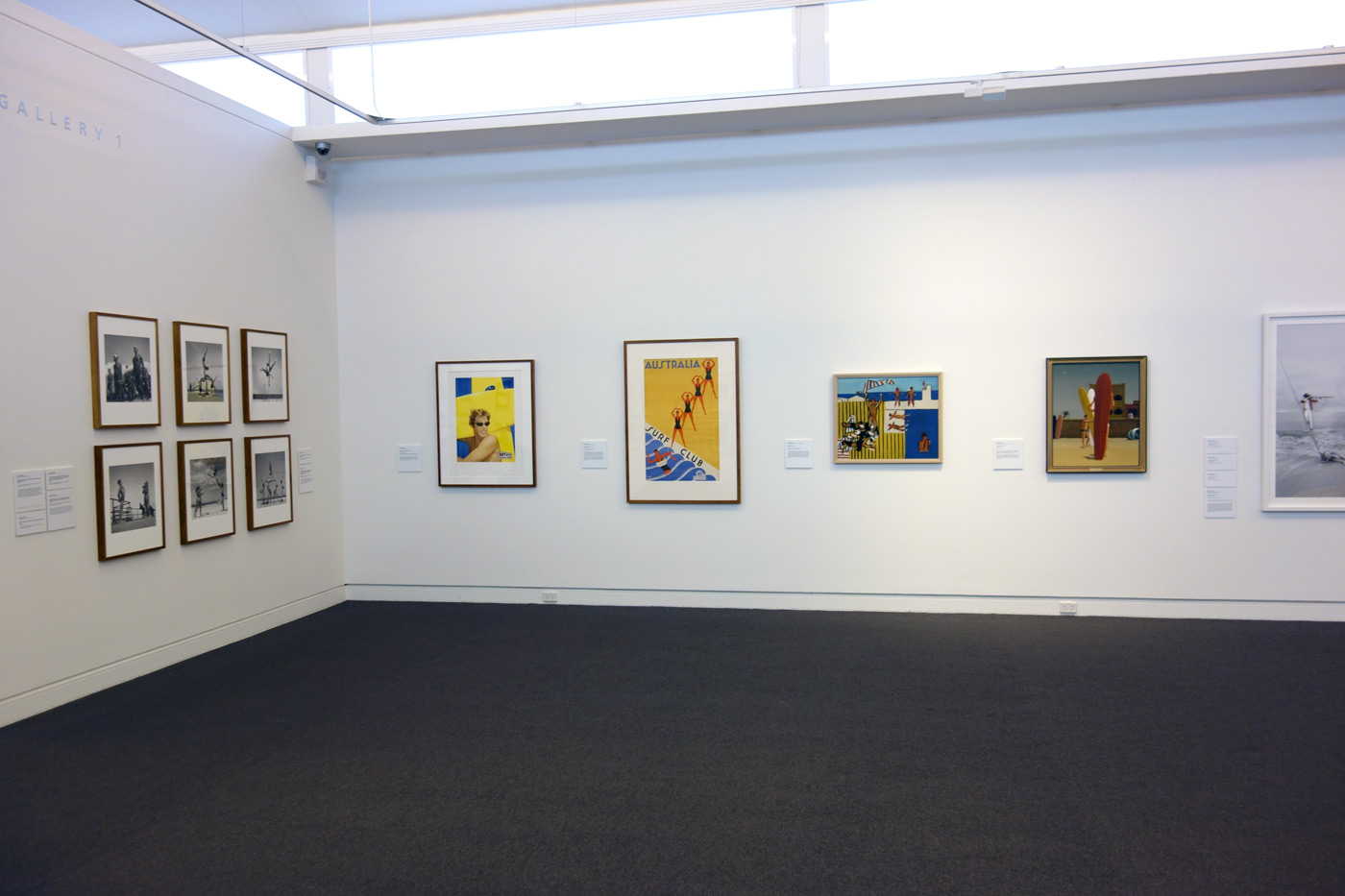
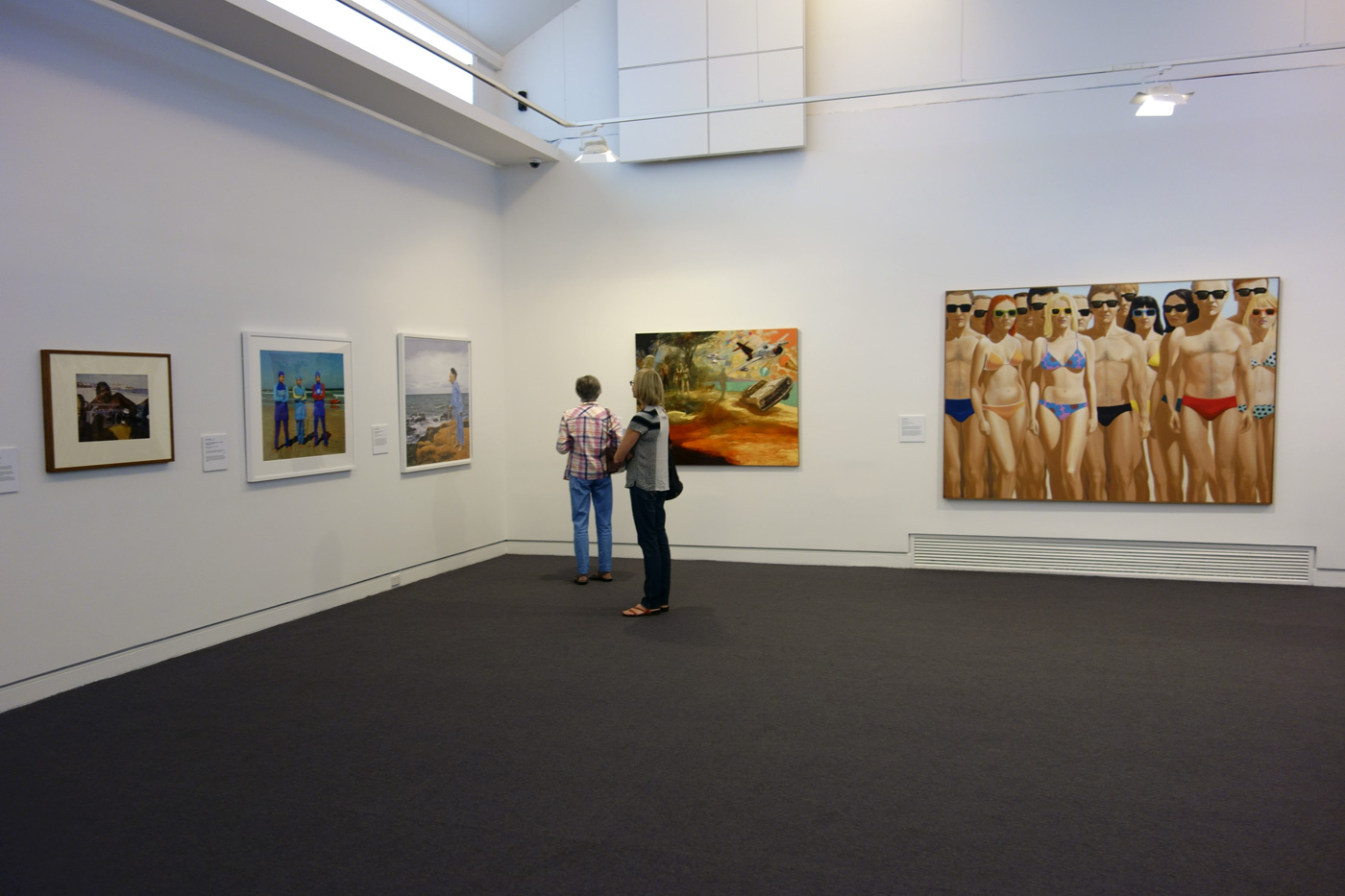
Installation view of the exhibition 'On the beach' at the Mornington Peninsula Regional Art Gallery


Installation view of the exhibition On the beach at the Mornington Peninsula Regional Art Gallery
Photo: © Marcus Bunyan and the Mornington Peninsula Regional Art Gallery


This is another solid thematic group exhibition at the Mornington Peninsula Regional Art Gallery (curator Wendy Garden), following on from their recent success, Storm in a teacup.

The exhibition is not as successful as Storm in a teacup, mainly because most of the works are based on the monolithic, monosyllabic representation of beach culture, and its figuration, during the early decades of the twentieth century (White Australia policy, Australian stereotypes of the interwar period) and the re-staging of these ideas in the contemporary art presented through a diachronic (through/time), performative discourse.

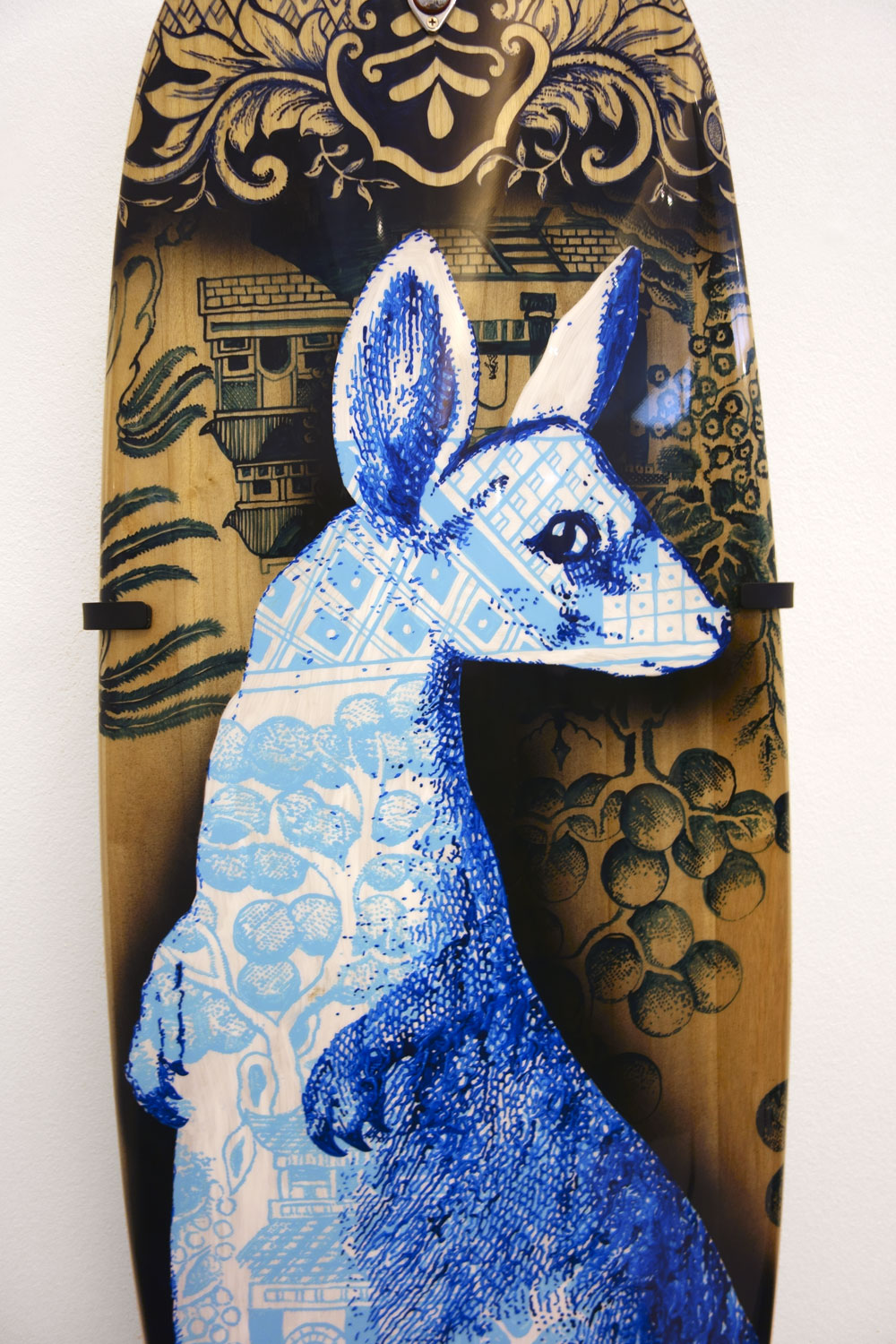
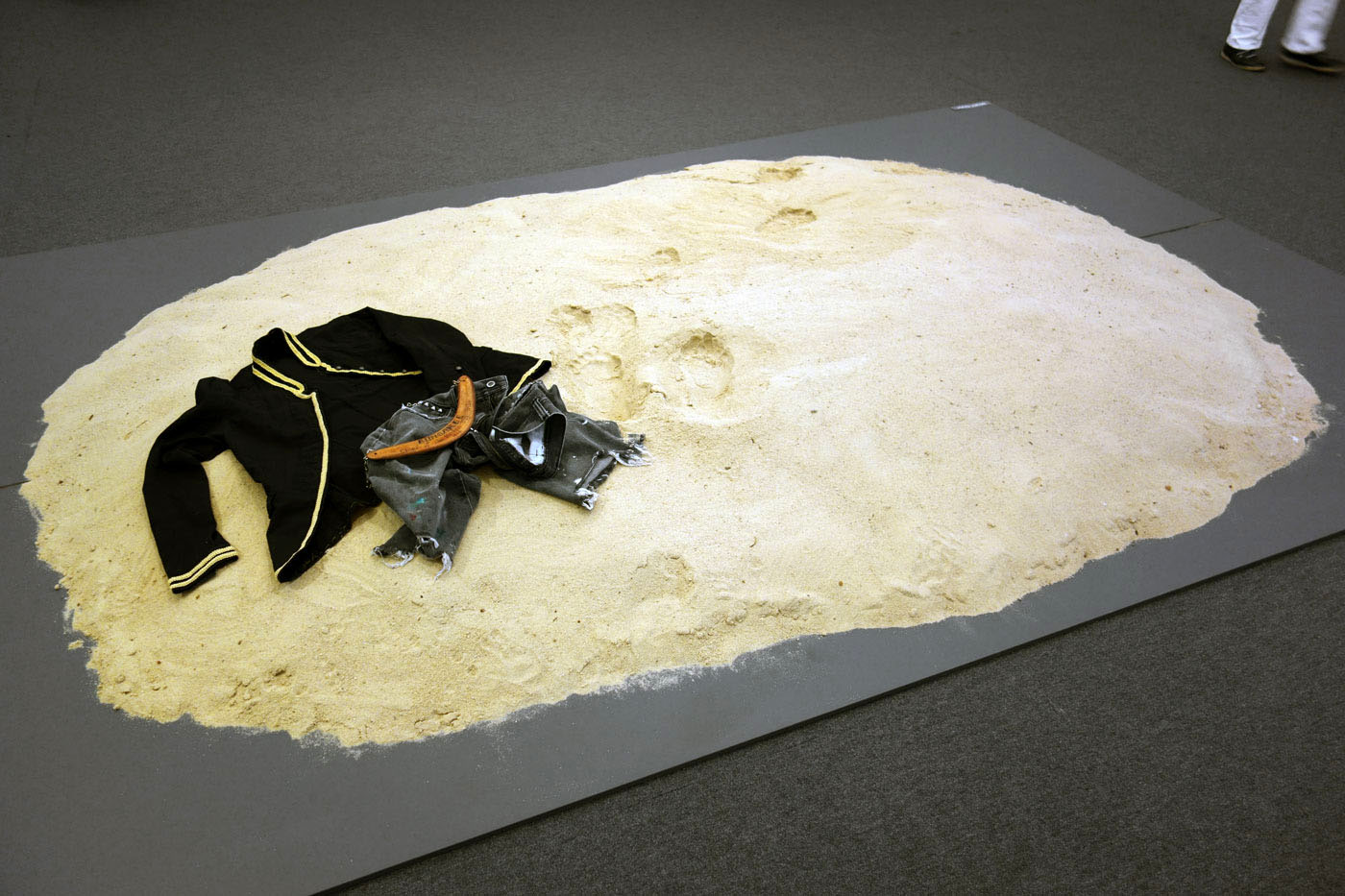
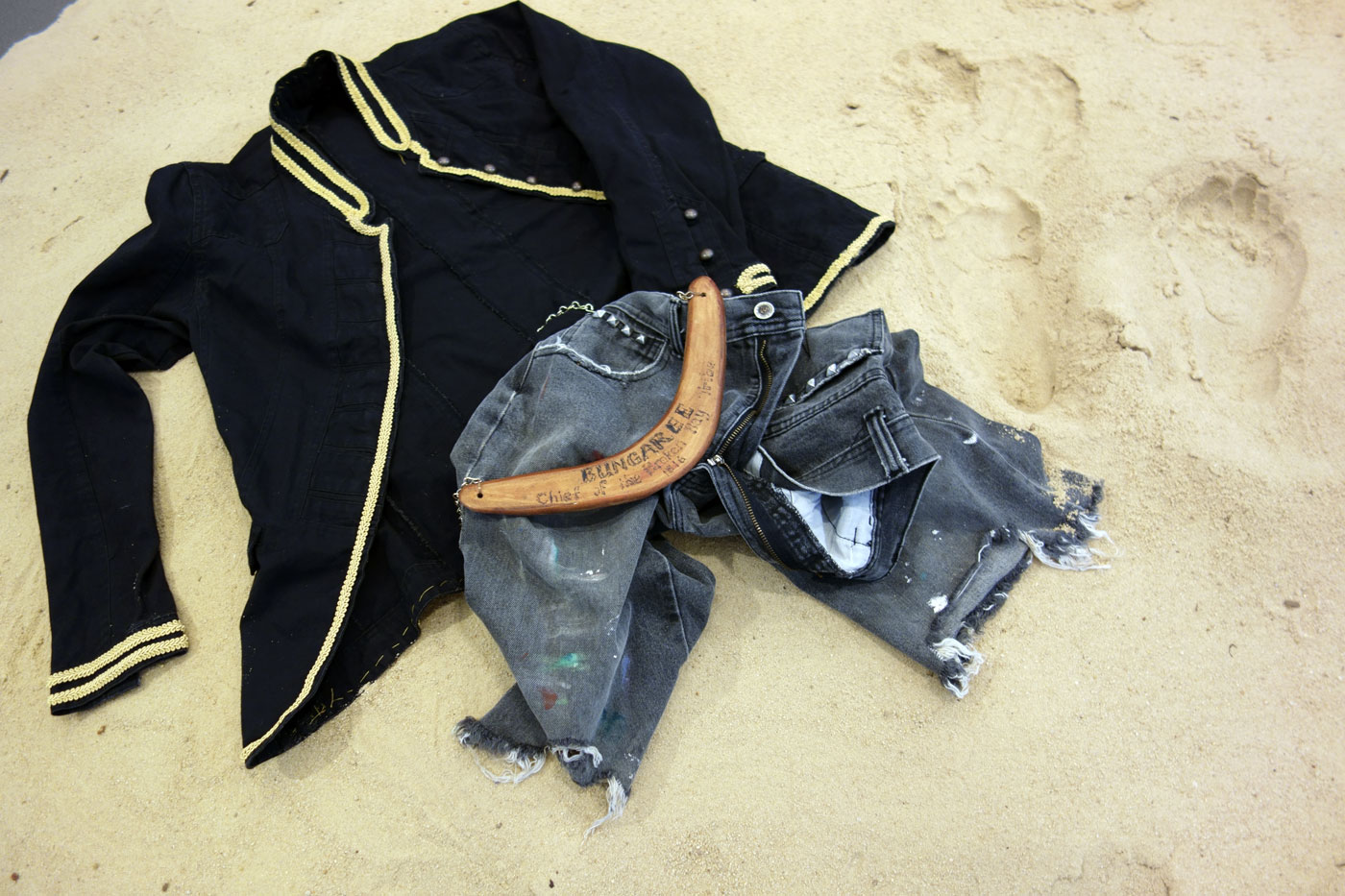
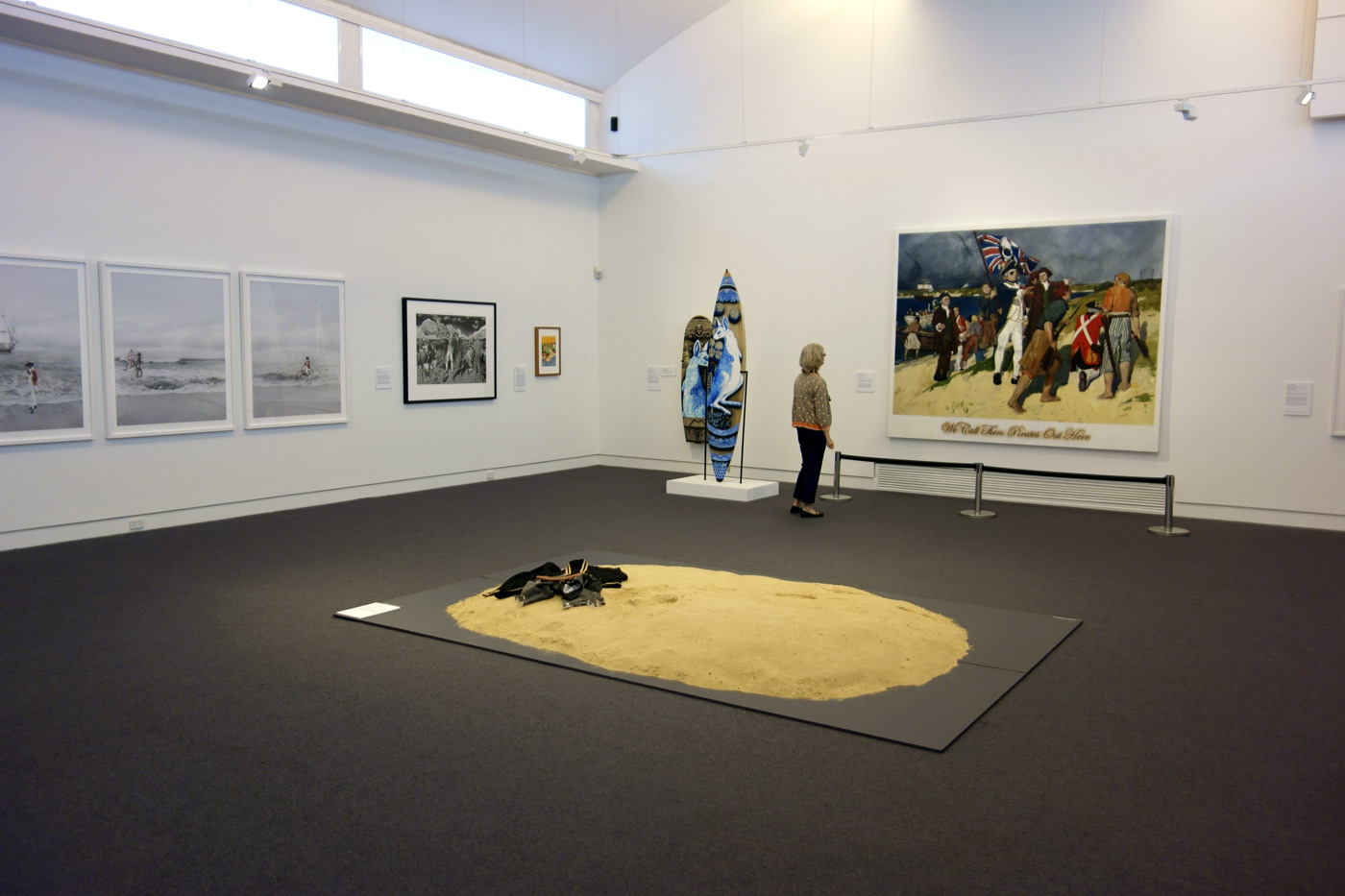
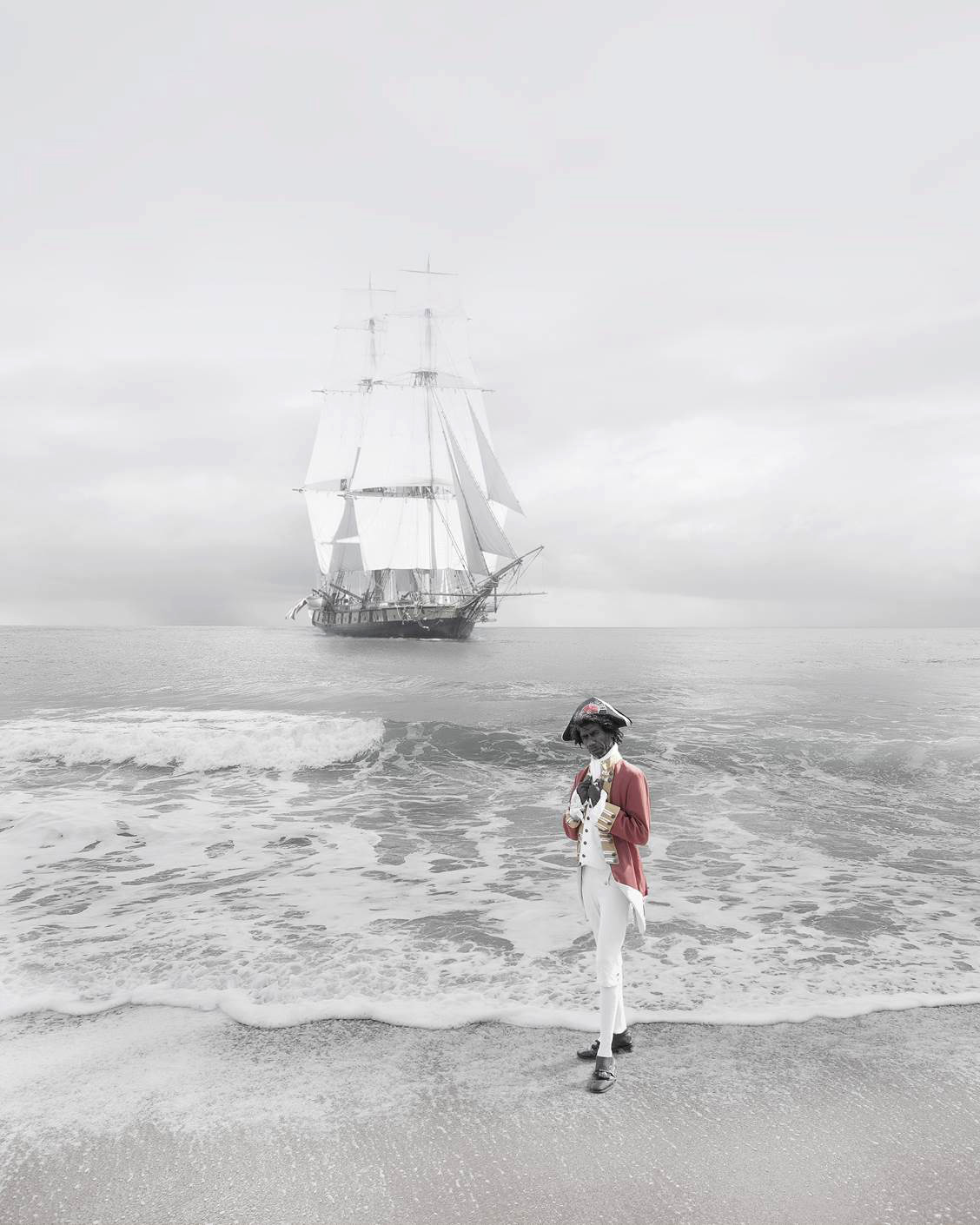
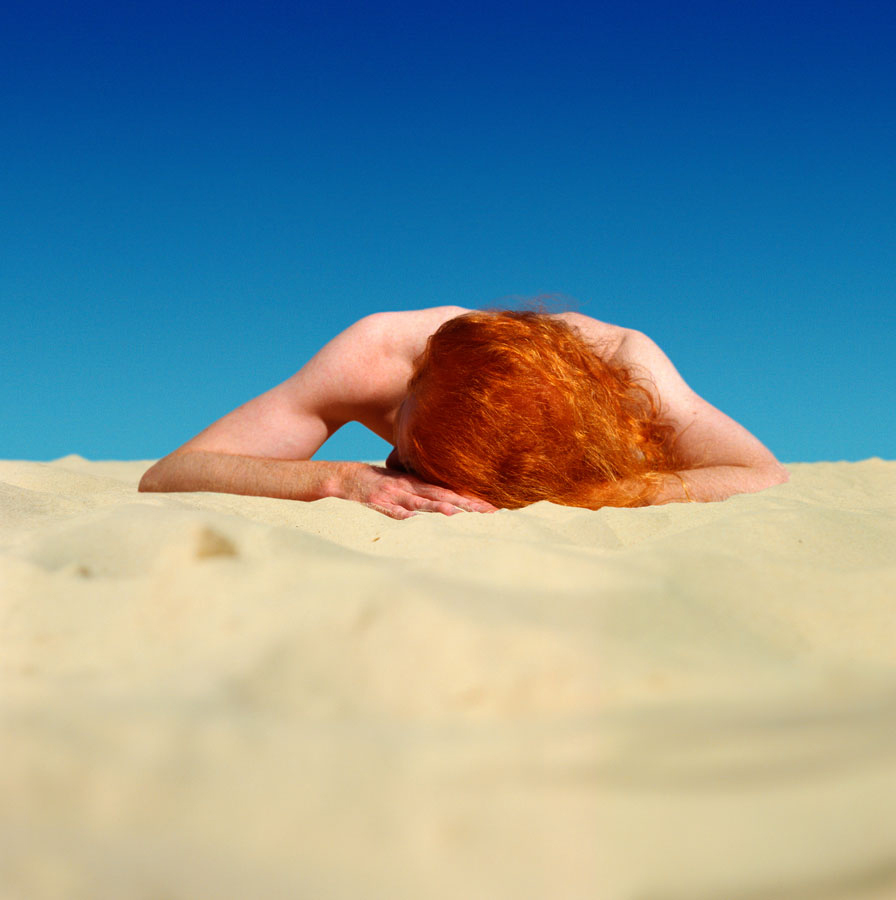
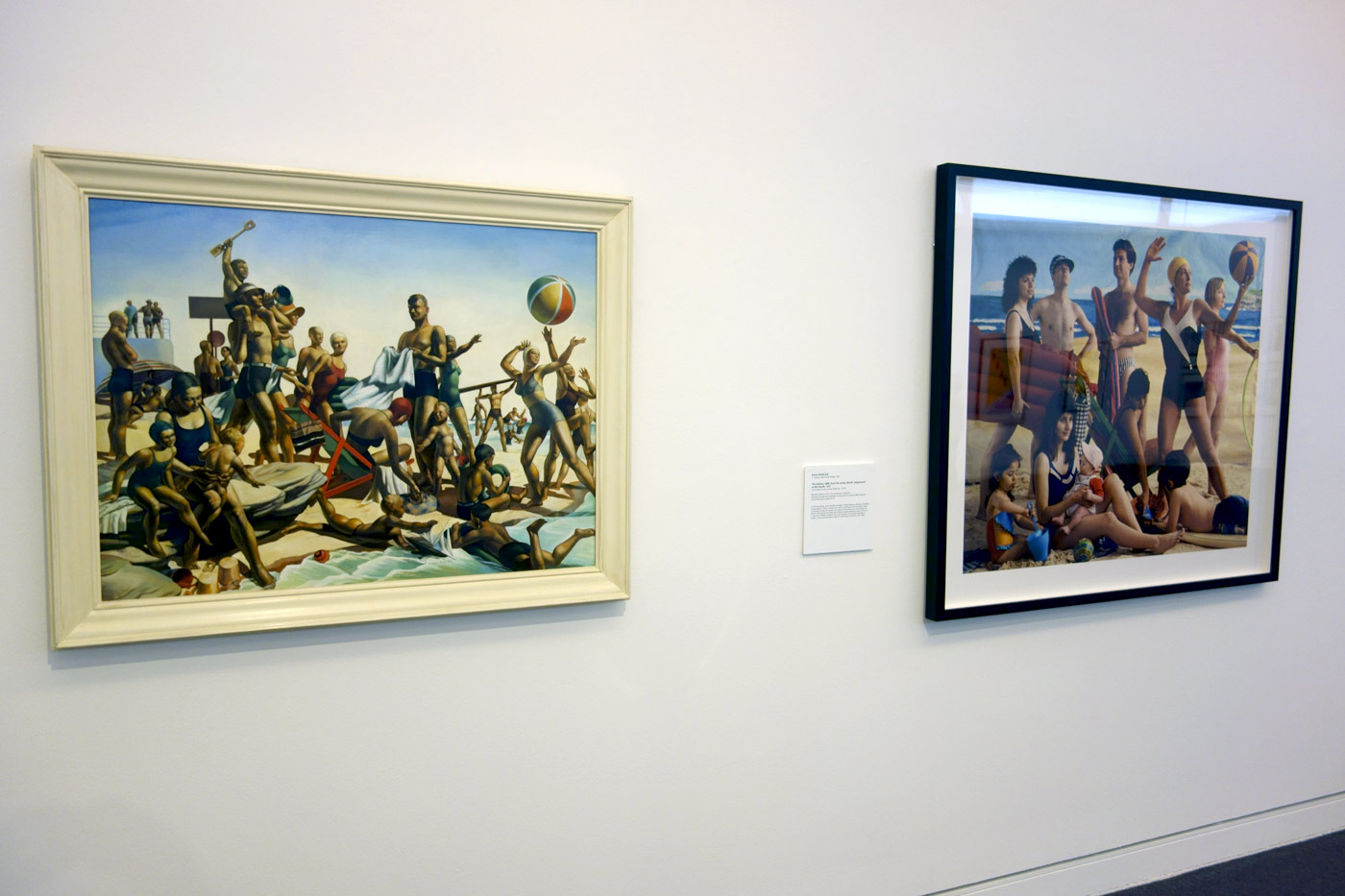
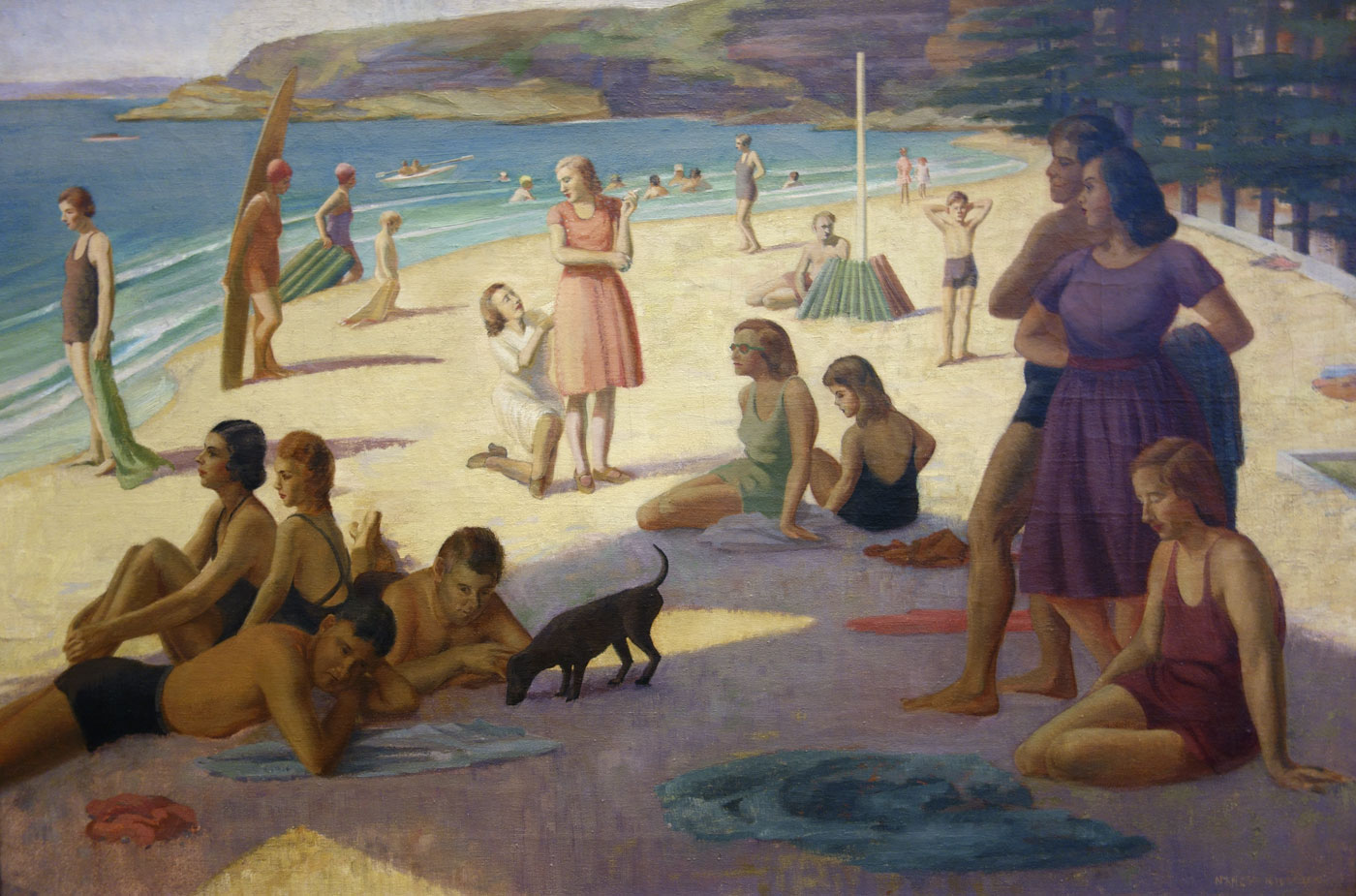
There is so much re-staging in this exhibition I was left to wonder whether there was any original art work being produced that does not quote sources of history, memory, identity, representation and art from past generations. Daniel Boyd re-stages Captain Cook’s landing at Botany Bay with said hero as a pirate. Stephen Bowers replicates the Minton willow pattern motif and early paintings of kangaroos. Leanne Tobin re-stages Bungaree’s disrobing on the beach during his journey with Matthew Flinders. Diane Jones re-stages Max Dupain’s Sunbaker replacing the anonymous prostrate man with her head looking into the camera, or Dupain’s Form at Bondi with her head turned towards the camera. Worst offender is Anne Zahalka who re-states Dupain’s Sunbaker (again!) as a red-headed white women on the beach; or re-presents Charles Meere’s Australian beach pattern (1940, below) not once but twice – the first time in The bathers (1989) broadening the racial background of people to depict multicultural Australia in the 1980s, the second time in The new bathers (2013) broadening the mix even further. Most successful of these re-stagings is Michael Cook’s series of photographs Undiscovered in which the artist subverts deeply ingrained understandings of settlement, that of terra nullius, by depicting Captain Cook as black and positioning him in high-key, grey photographs of impressive beauty and power, surveying the land he has ‘discovered’ while perched upon an invisibly balanced ladder.

But with all of the works that quote from the past there is a sense that, even as the artists are critiquing the culture, they are also buying into the system of patriarchy, racism and control that they seek to comment on. They do not subvert the situation, merely (and locally) extrapolate from it. The idealised, iconic representation of early 20th century Australia culture in the paintings from the 1920-30s and the photographs from the 1940s-70s – specimens of perfect physical beauty – are simply shifted to a new demographic – that of iconic, individual figures in the same poses as the 1940s but of a different ethnicity. The colour of the figure and the clothing might have changed, but the underlying structure remains the same. And if you disturb one of the foundation elements, such as the base figure in one of George Caddy’s balancing beachobatics photographs, the whole rotten edifice of a racism free, multicultural Australia will come tumbling down, just as it did during the Cronulla Riot.

What I would have liked to have seen in this exhibition was a greater breadth of subject matter. Where are the homeless people living near the beach, the sex (for example, as portrayed in Tracey Moffat’s voyeuristic home video Heaven which shows footage of male surfers changing out of their wetsuits in car parks – “shot by Moffatt and a number of other women as if they were making a birdwatching documentary” – which challenges the masculinity of Australian surf culture and the ability of women to stare at men, instead of the other way around), death (drownings on beaches, the heartbreak of loss), and debauchery (the fluxus of Schoolies, that Neo-Dada performance of noise and movement), the abstract nature of Pictorialist photographs of the beach, not to mention erosion and environmental loss due to global warming. The works presented seem to have a too narrowly defined conceptual base, and a present narrative constructed on a coterie of earlier works representing what it is to be Australian at the beach. The contemporary narrative does not address the fluidity of the landscape in present time (in works such as Narelle Autio’s series Watercolours or The place in between).

The dark underside of the beach, its abstract fluidity, its constant movement is least well represented in this exhibition. Although I felt engaged as a viewer the constant re-quoting and rehashing of familiar forms left me a little bored. I wanted more inventiveness, more insight into the conditions and phenomena of beach culture in contemporary Australia. An interesting exhibition but an opportunity missed.

Dr Marcus Bunyan


Many thankx to the Mornington Peninsula Regional Art Gallery for allowing me to publish most of the photographs in the posting. Other photographs come from Art Blart’s archive and those freely available online. Thankx also go to Manuela Furci, Director of the Rennie Ellis Photographic Archive for allowing me to publish his photographs in the posting. Please click on the photographs for a larger version of the image. All text comes from the wall labels to the exhibition. Images noted © Marcus Bunyan and the Mornington Peninsula Regional Art Gallery.


Installation view of the exhibition 'On the beach' at the Mornington Peninsula Regional Art Gallery with Daniel Boyd's 'We call them pirates out here' (2006)


Installation view of the exhibition On the beach at the Mornington Peninsula Regional Art Gallery with Daniel Boyd’s We call them pirates out here (2006, below)
Photo: © Marcus Bunyan and the Mornington Peninsula Regional Art Gallery


Daniel Boyd (Australian, b. 1982) 'We call them pirates out here' 2006 (installation view)


Daniel Boyd (Australian, b. 1982)
We call them pirates out here (installation view)
2006
Museum of Contemporary Art
Purchased with funds provided by the Coe and Mordant families, 2006
Photo: © Marcus Bunyan and the Mornington Peninsula Regional Art Gallery


“The landing of Captain Cook in Botany Bay, 1770 by E. Phillips Fox is such an iconic and important image relating to the birth of Australia. Shifting the proposed view of Fox’s painting to something that was an indigenous person’s perspective allowed for me to challenge the subjective history that has been created.”

Daniel Boyd, 2008


In this painting Daniel Boyd parodies E. Phillips Fox’s celebrated painting which was commissioned in 1902 by the Trustees of the National Gallery of Victoria to commemorate federation. No longer an image valorising colonial achievement, Boyd recasts the scene as one of theft and invasion. Captain Cook is depicted as a pirate to contest his heroic status in Australia’s foundation narratives. Smoke in the distance is evidence of human occupation and is a direct retort to the declaration that Australia was ‘terra nullius’ – land belonging to no-one, which was used to justify British possession.


Stephen Bowers (Australian, b. 1952) Peter Walker (board maker) (Australian, b. 1961) 'Antipodean willow surfboard' 2012 'Antipodean willow surfboard (Mini Simmons)' 2012 (installation view)


Stephen Bowers (Australian, b. 1952)
Peter Walker (board maker) (Australian, b. 1961)
Antipodean willow surfboard (installation view)
2012
Antipodean willow surfboard (Mini Simmons) (installation view)
2012
Hollow core surfboard, Paulownia wood, fibreglass, synthetic polymer paint
Courtesy of the artist and Lauraine Diggins Fine Art, Caulfield
Photo: © Marcus Bunyan and the Mornington Peninsula Regional Art Gallery


Stephen Bowers (Australian, b. 1952) Peter Walker (board maker) (Australian, b. 1961) 'Antipodean willow surfboard (Mini Simmons)' 2012 (installation view detail)


Stephen Bowers (Australian, b. 1952)
Peter Walker (board maker) (Australian, b. 1961)
Antipodean willow surfboard (Mini Simmons) (installation detail)
2012
Hollow core surfboard, Paulownia wood, fibreglass, synthetic polymer paint
Courtesy of the artist and Lauraine Diggins Fine Art, Caulfield
Photo: © Marcus Bunyan and the Mornington Peninsula Regional Art Gallery


In these works Bowers combines the willow pattern motif, a ready-made metaphor of hybridity, with an image of a kangaroo as envisioned by George Stubbs in 1772. The willow pattern as an English invention, created by Thomas Minton in 1790. It is an imaginative geography and, like the first known European painting of a kangaroo, considers other lands as strange, exotic places. In this work the imagery of colonial occupation is visualised as a fusion of cultures underpinned by half-truths, fantasy and desire.


Leanne Tobin (Australian, b. 1961) 'Clothes don't always maketh the man' 2012 (installation view)

Leanne Tobin (Australian, b. 1961) 'Clothes don't always maketh the man' 2012 (installation view detail)


Installation views of Leanne Tobin’s Clothes don’t always maketh the man (2012)


Leanne Tobin (Australian, b. 1961)
Clothes don’t always maketh the man (installation details)
2012
Sand, textile, wood
Collection of the artist
Photos: © Marcus Bunyan and the Mornington Peninsula Regional Art Gallery


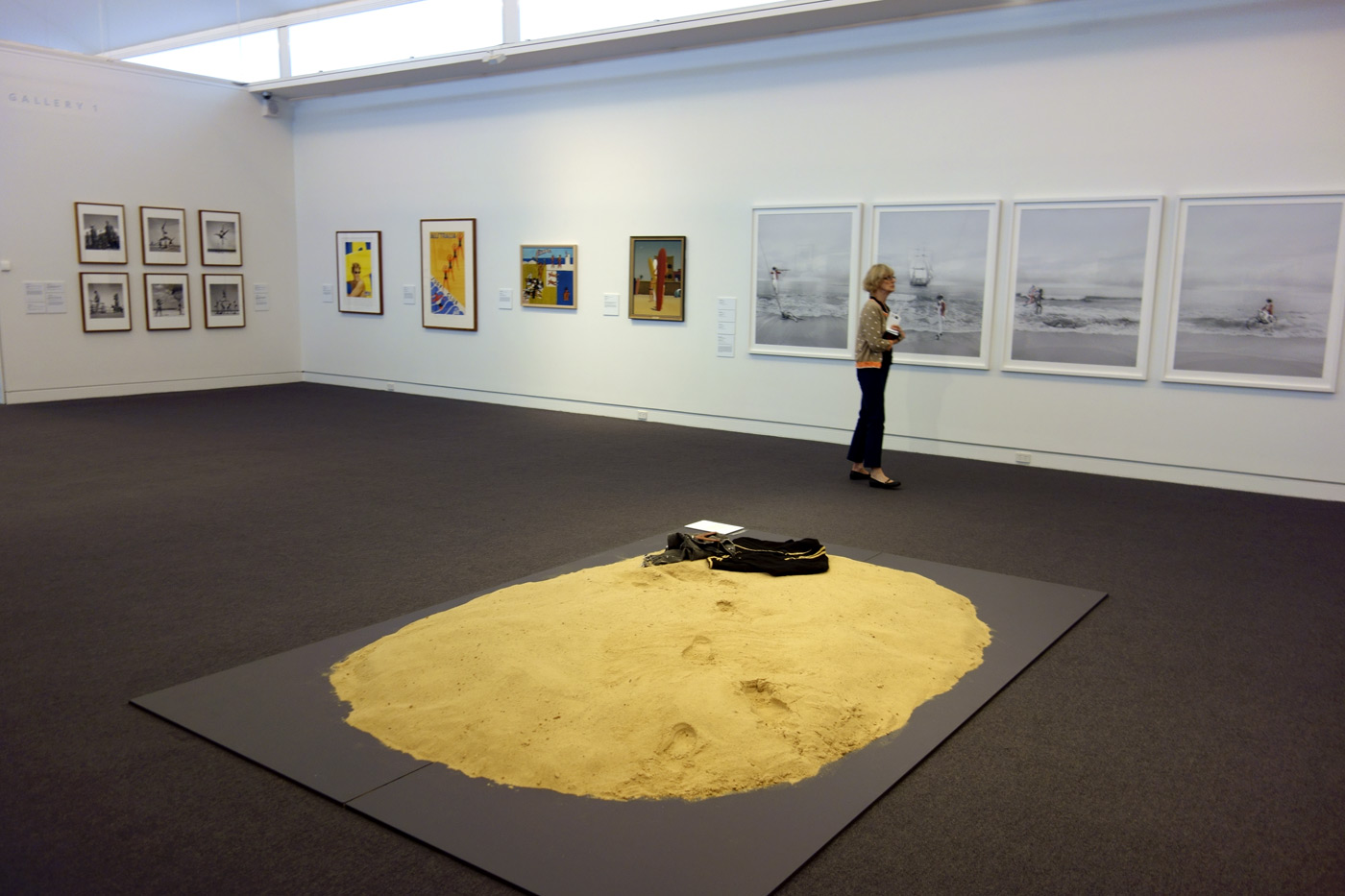
Bungaree (c. 1755-1830) was a Garigal man who circumnavigated the continent of Australia with Matthew Flinders on the H.M.S. Investigator between 1802-1803. Unlike Bennelong, who attempted to assimilate with British ways and Pemulwuy, who resisted, Bungaree made the decision to navigate a relationship with the British while still maintaining his cultural traditions. He played an important role as an envoy on Flinder’s voyages, negotiating with the different Aboriginal groups they encountered. A skilled mediator, Bungaree was adept at living between both worlds. When coming ashore he would shed his white man’s clothes so that he could conduct protocol relevant to the local elders. In this respect the beach became a zone of transformation and exchange.


Installation view of the exhibition 'On the beach' at the Mornington Peninsula Regional Art Gallery with in the foreground, Leanne Tobin's 'Clothes don't always maketh the man' (2012), and in the background left, photographs from Michael Cook's 'Undiscovered' series (2010)

Installation view of the exhibition 'On the beach' at the Mornington Peninsula Regional Art Gallery with in the foreground, Leanne Tobin's 'Clothes don't always maketh the man' (2012), and in the background right, photographs from Michael Cook's 'Undiscovered' series (2010)


Installation views of the exhibition On the beach at the Mornington Peninsula Regional Art Gallery with in the foreground, Leanne Tobin’s Clothes don’t always maketh the man (2012), and in the background photographs from Michael Cook’s Undiscovered series (2010, below)
Photos: © Marcus Bunyan and the Mornington Peninsula Regional Art Gallery


Michael Cook (Australian, b. 1968) 'Undiscovered 4' 2010


Michael Cook (Australian, b. 1968)
Undiscovered 4
2010
inkjet print on Hahnemuhle paper
124.0 x 100.0cm
Australian National Maritime Museum


A selection of works from a series of ten photographs in which Michael Cook contests the idea of ‘discovery’ that underpins narratives of the British settlement of Australia… Cook depicts the historic Cook as an Aboriginal man replete in his British naval officers attire. His ship, the famed Endeavour, is anchored in the sea behind him. By mimicking the moment of first discovery Cook subverts deeply ingrained understandings of settlement and asks us to consider what type of national Australia would be if the British had acknowledged Aboriginal people’s prior ownership.


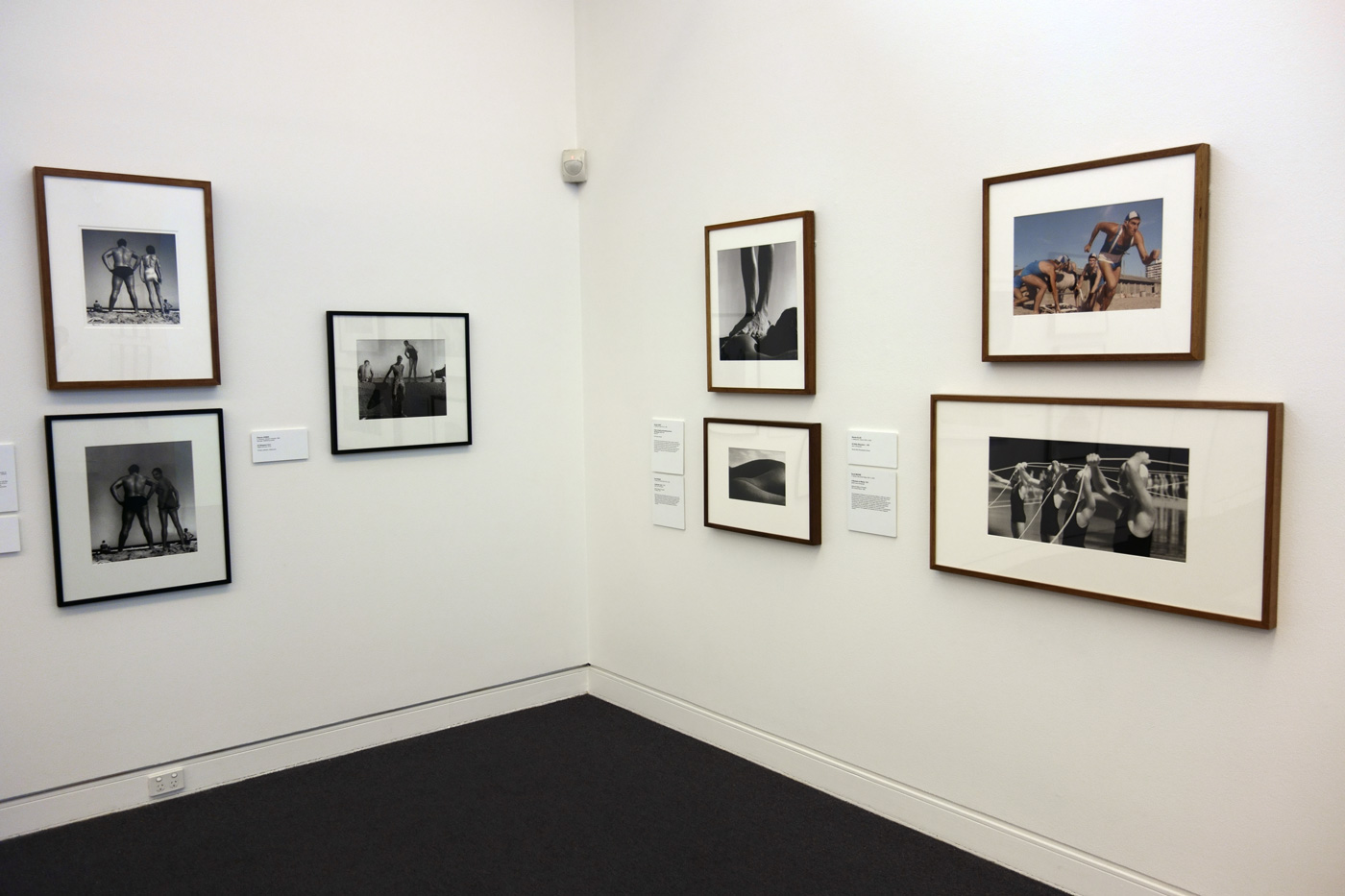
Installation view of the exhibition 'On the beach' at the Mornington Peninsula Regional Art Gallery showing, at top left, Max Dupain's 'Form at Bondi' (1939); to the right of that Dupain's 'At Newport' (1952); to the right upper is George Caddy's 'Chest strength and breathing exercise, 20 February 1937'; followed at far right by Rennie Ellis' 'St Kilda Lifesavers' (1968, top) and David Moore's 'Lifesavers at Manly' (1959, bottom)


Installation view of the exhibition On the beach at the Mornington Peninsula Regional Art Gallery showing, at top left, Max Dupain’s Form at Bondi (1939); to the right of that Dupain’s At Newport (1952, below); to the right upper is George Caddy’s Chest strength and breathing exercise, 20 February 1937 (below); followed at far right by Rennie Ellis’ St Kilda Lifesavers (1968, top) and David Moore’s Lifesavers at Manly (1959, bottom)
Photo: © Marcus Bunyan and the Mornington Peninsula Regional Art Gallery


Max Dupain (Australian, 1911-1992) 'At Newport' 1952, Sydney


Max Dupain (Australian, 1911-1992)
At Newport
1952, Sydney
Silver gelatin photograph


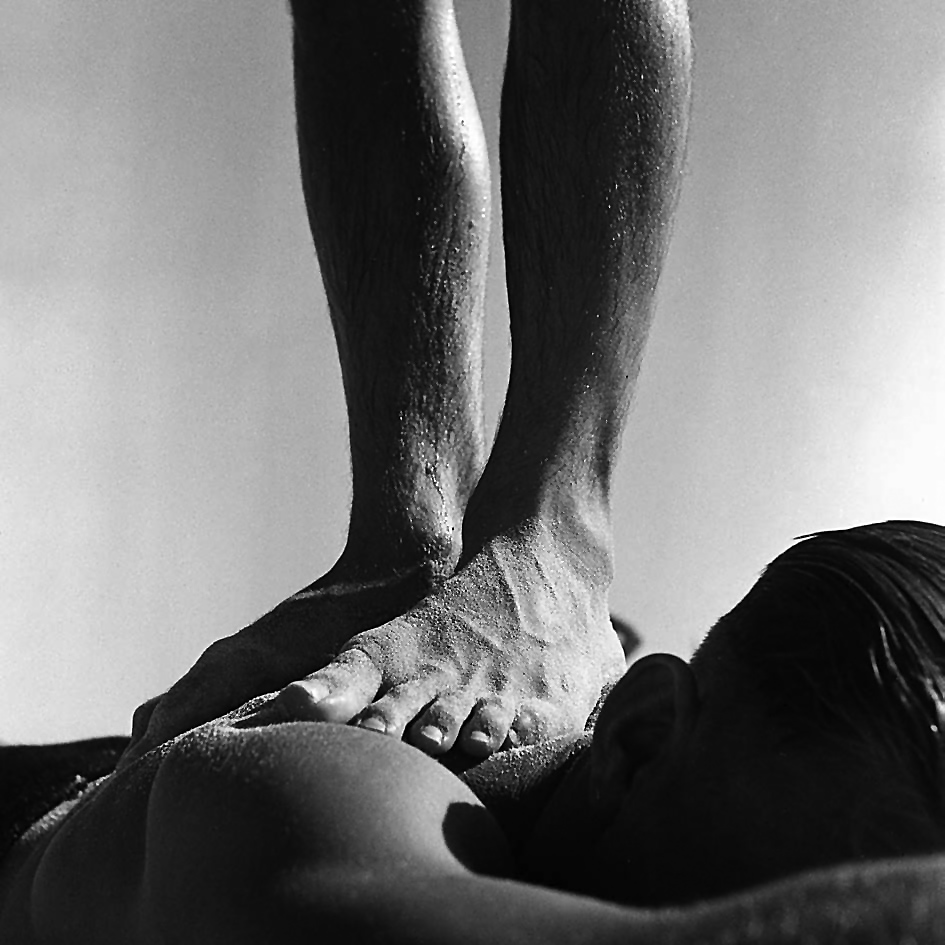
George Caddy (Australian, 1914-1983) 'Chest strength and breathing exercise, 20 February 1937' 1937


George Caddy (Australian, 1914-1983)
Chest strength and breathing exercise, 20 February 1937
1937
Digital print on paper
Paul Caddy collection
Courtesy of Paul Caddy


Like Max Dupain, who was three years his senior, Caddy was interested in the new modernist approach to photography. During 1936 he read magazines such as Popular Photography from New York and US Camera rather than Australasian Photo-Review which continued to champion soft-focus pictorialism. This photograph was taken the same year as Dupain’s famous Sunbather photograph. The framing and angle is similar reflecting their common interest in sharp focus, unusual vantage points and cold composition.


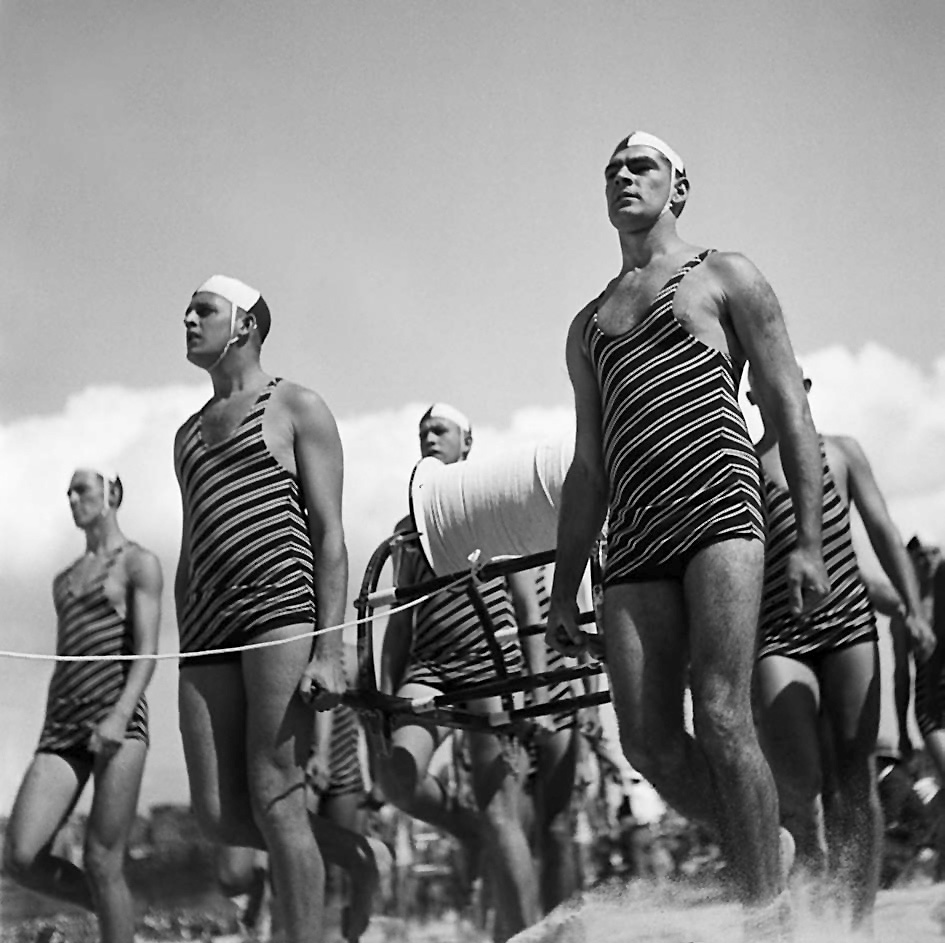
George Caddy (Australian, 1914-1983) 'Freshwater Surf Life Saving Club reel team march past, 3 April 1938' 1938


George Caddy (Australian, 1914-1983)
Freshwater Surf Life Saving Club reel team march past, 3 April 1938
1938
Digital print
Collection of the Mitchell Library, State Library of New South Wales
Purchased from Paul Caddy, 2008


This photograph was taken only months after an infamous rescue at Bondi. On 6 February 1938 a sand bar collapsed sweeping two hundred people out to sea. 80 lifesavers rescued all but 5 people in a day subsequently described as Black Sunday. By 1938 the Surf Life Saving Association, which incorporated clubs from around Australia, had rescued 39,149 lives in its 30 year history. In 1938 alone there were 3,442 rescues. Up until the events of Black Sunday no one had drowned while lifesavers were on duty at Australian beaches. In comparison 2,000 people drowned in England each year.1

1/ Alan Davies, Bondi Jitterbug: George Caddy and his amera, Sydney: State Library of New South Wales, p. 13.


Installation view of the exhibition 'On the beach' at the Mornington Peninsula Regional Art Gallery showing at far left, Anne Zahalka's 'The sunbather #2' (1989) and, at right, a selection of George Caddy's beachobatics photographs


Installation view of the exhibition On the beach at the Mornington Peninsula Regional Art Gallery showing at far left, Anne Zahalka’s The sunbather #2 (1989, below) and, at right, a selection of George Caddy’s beachobatics photographs
Photo: © Marcus Bunyan and the Mornington Peninsula Regional Art Gallery


Installation view of the exhibition 'On the beach' at the Mornington Peninsula Regional Art Gallery showing at far left, Max Dupain's 'Sunbaker' (1937, top) with Diane Jones 'Sunbaker' (2003, below); in the centre Anne Zahalka's 'The sunbather #2' (1989); then Max Dupain's 'Form at Bondi' (1939, top) with Diane Jones 'Bondi' (2003) underneath


Installation view of the exhibition On the beach at the Mornington Peninsula Regional Art Gallery showing at far left, Max Dupain’s Sunbaker (1937, top) with Diane Jones Sunbaker (2003, below); in the centre Anne Zahalka’s The sunbather #2 (1989, below); then Max Dupain’s Form at Bondi (1939, top) with Diane Jones Bondi (2003) underneath
Photo: © Marcus Bunyan and the Mornington Peninsula Regional Art Gallery


Anne Zahalka (Australian, b. 1957) 'The sunbather #2' 1989


Anne Zahalka (Australian, b. 1957)
The sunbather #2
1989
From the series Bondi: playground of the Pacific 1989
Type C photograph


Installation photograph of Charles Meere's painting 'Australian beach pattern' (1940) and Anne Zahalka's photograph 'The bathers' (1989) from the series 'Bondi: playground of the Pacific' 1989


Installation photograph of Charles Meere’s painting Australian beach pattern (1940, below) and Anne Zahalka’s photograph The bathers (1989) from the series Bondi: playground of the Pacific 1989
Photo: © Marcus Bunyan and the Mornington Peninsula Regional Art Gallery


Zahalka restates Charles Meere’s painting in order to subvert the narrow stereotype of the Australian ideal… In this work Zahalka broadens the racial background of people depicted to create a more representative image of multicultural Australia in the 1980s


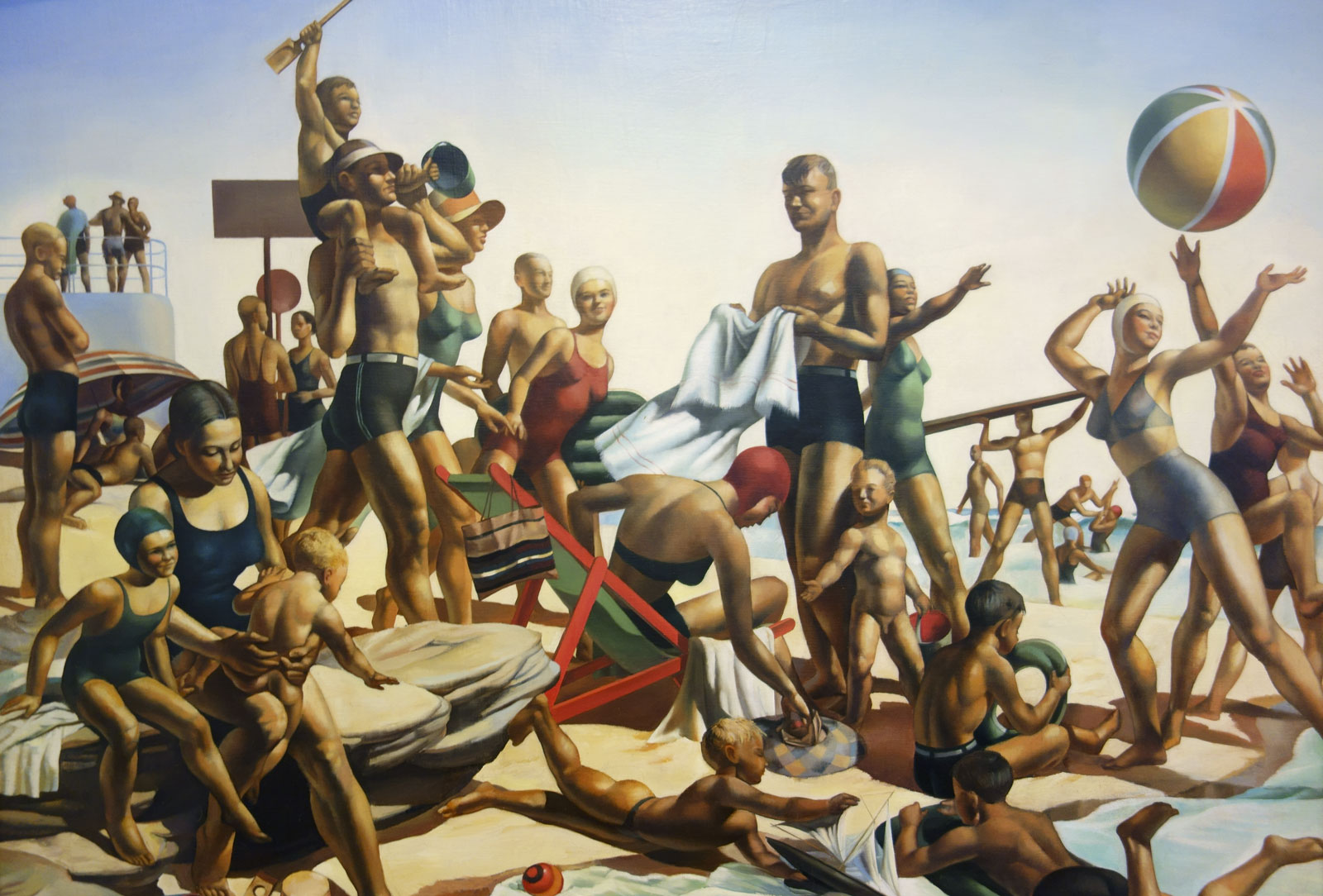
Charles Meere (Australian born England, 1890-1961) 'Australian beach pattern' 1940 (installation view detail)


Charles Meere (Australian born England, 1890-1961)
Australian beach pattern (installation view detail)
1940
Oil and wax on canvas
Collection of Joy Chambers-Grundy and Reg Grundy AC OBE
Photo: © Marcus Bunyan and the Mornington Peninsula Regional Art Gallery


A now iconic representation of early 20th century Australia culture… The scene is dominated by a mass of suntanned bodies: muscular, square-jawed white Australians – specimens of perfect physical beauty – enjoying the strenuous physical activities of the beach. A glorification of the strong, healthy, racially pure Australian ideal of the 1930s, it is eerily reminiscent of Nazi German Aryan propaganda between the wars.

Notably, the figures themselves all appear anonymous and disconnected, with indistinct facial features that show no acknowledgement of their fellow beach-goers. Their identities are overwhelmed by Meere’s obsession with arrangement. Rather than reflect real life, the figures are placed to create an idealised work of perfect balance. It is fascinating to consider that this iconic representation of Australian beach culture actually came from the imagination of an Englishman, who had only lived in Australia since the mid-1930s and who, according to his apprentice, ‘never went to the beach’ and ‘made up most of the figures’.1

1/ Freda Robertshaw quoted in Linda Slutzkin, Charles Meere 1890-1961. Sydney: S. H. Ervin Gallery, 1987, p. 6.


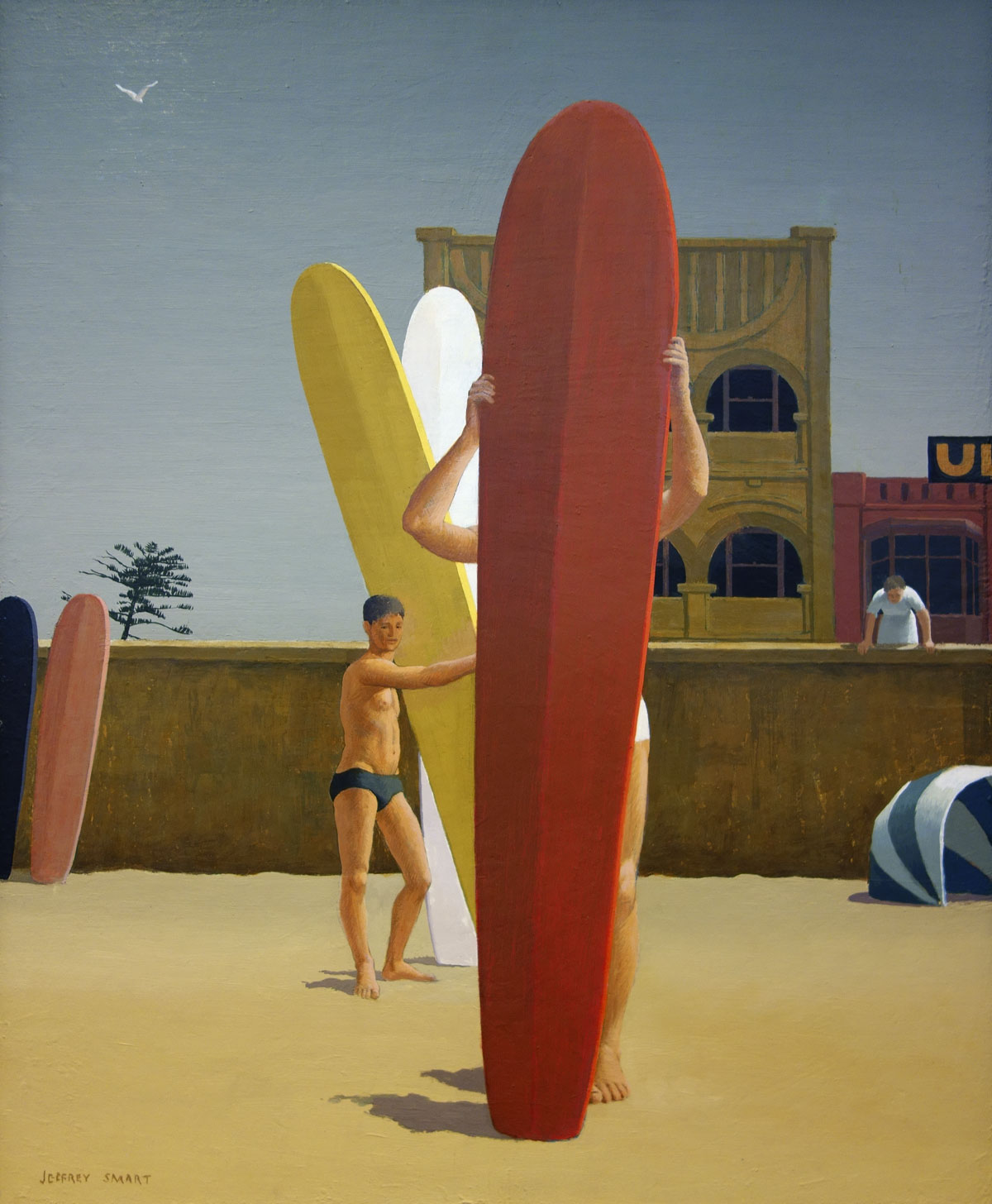
Installation view of the exhibition 'On the beach' at the Mornington Peninsula Regional Art Gallery showing at far left, George Caddy's beachobatic photographs, and on the far wall Sidney Nolan's 'Bathers' (1943) and Jeffrey Smart's 'Surfers Bondi' (1963)


Installation view of the exhibition On the beach at the Mornington Peninsula Regional Art Gallery showing at far left, George Caddy’s beachobatic photographs, and on the far wall Sidney Nolan’s Bathers (1943, below) and Jeffrey Smart’s Surfers Bondi (1963, below)
Photo: © Marcus Bunyan and the Mornington Peninsula Regional Art Gallery


Sidney Nolan (Australian, 1917-1992) 'Bathers' 1943 (installation view)


Sidney Nolan (Australian, 1917-1992)
Bathers (installation view)
1943
Ripolin enamel on canvas
Headed Museum of Modern Art, Melbourne
Bequest of John and Sunday Reed, 1982
Photo: © Marcus Bunyan and the Mornington Peninsula Regional Art Gallery


Jeffrey Smart (Australian, 1921-2013) 'Surfers Bondi' 1963 (installation view)


Jeffrey Smart (Australian, 1921-2013)
Surfers Bondi
1963
Oil on board
Private collection


When bans on daylight bathing were lifted in 1902, the beach became a prime leisure destination. The beach became not only as a public space of recreation but also as a place where the Australian identity was developing, for many epitomising the liberties of Australia’s society. On the beach brings together 76 outstanding and iconic paintings, photographs and installations to consider the defining relationship we have to the shore.

Works by artists including Vernon Ah Kee, Arthur Boyd, Gordon Bennett, Daniel Boyd, Max Dupain, Charles Meere, Tracey Moffatt, David Moore, Sidney Nolan, Polixeni Papapetrou, John Perceval, Scott Redford, Jeffrey Smart, Albert Tucker, Guan Wei and Anne Zahalka, as well as outstanding recently discovered works by George Caddy (see above). A champion jitterbug dancer, Caddy’s photographs of ‘beachobatics’ were kept undisturbed in a shoebox for 60 years until they were ‘discovered’ by his son after his death. They capture the exuberance and optimism of Australian society between the wars.

The beach first became a prime leisure destination in the early decades of the twentieth century. Up to Federation many artists had looked to the bush to galvanise a fledging nationalism, but during the interwar years this shifted and increasingly the beach became the site of Australian identity. Already by 1908 one Melbourne newspaper commented upon the ‘vast throng of holidaymakers all along the coast.’ In the years following the First World War, against a backdrop of a growing interest in physical fitness, the beach was seen as a place for creating ‘a fine healthy race of men.’ Understandings of the beach as an Australian way of life emerged during this period and increasingly the Australian type was associated with bronzed athletic bodies on the beach.

On the beach looks at artists’ responses to the stereotype of the interwar period and juxtaposes modernist works with contemporary artists’ responses to include a more culturally diverse mix of people. Other artists in the exhibition challenge understandings of the beach as a benign space and consider the history of violence that is latent.

Press release from the Mornington Peninsula Regional Art Gallery


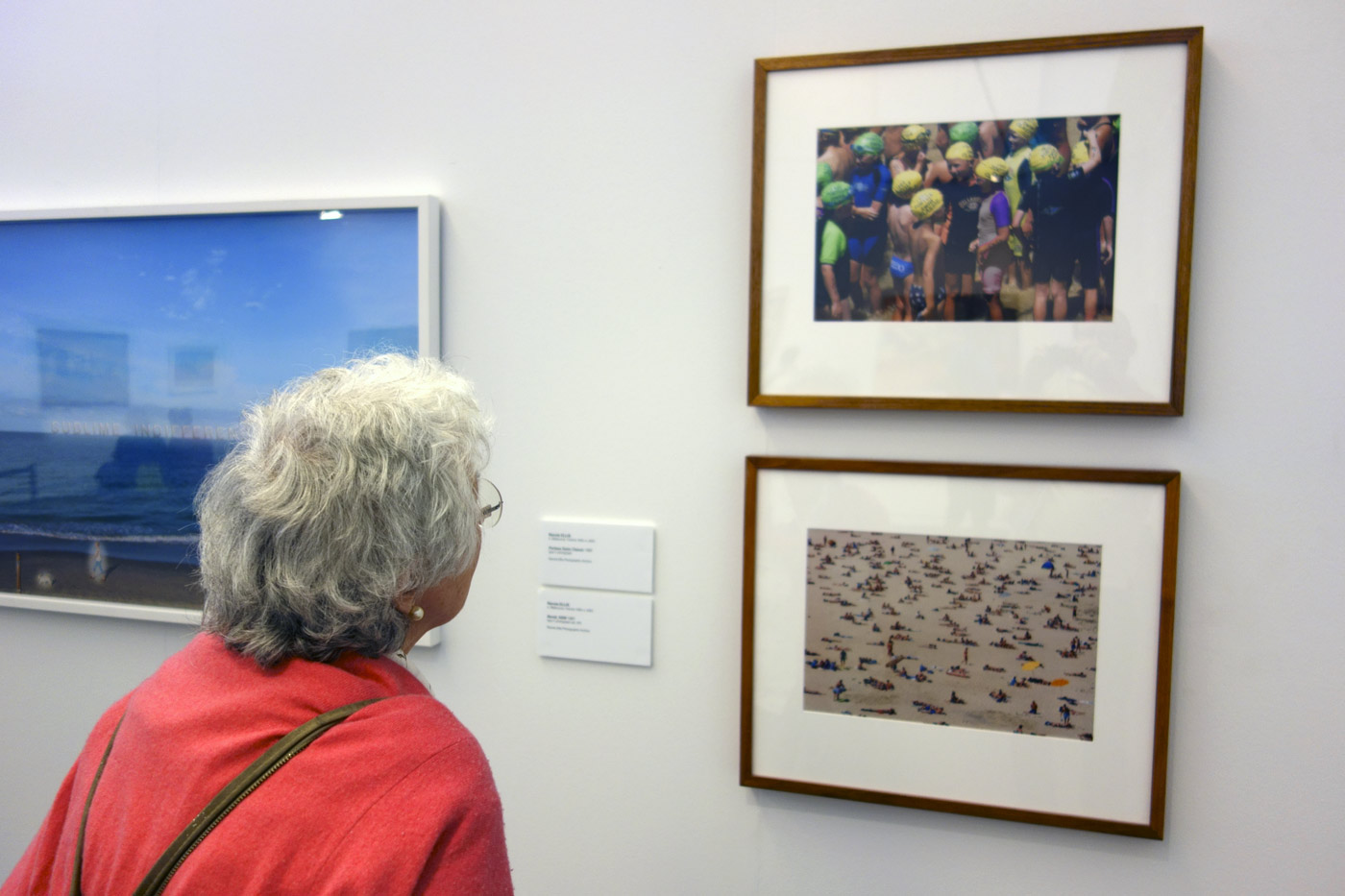
Photographer Joyce Evans looking at two colour photographs by Rennie Ellis in the exhibition 'On the beach' at the Mornington Peninsula Regional Art Gallery


Photographer Joyce Evans looking at two colour photographs by Rennie Ellis in the exhibition
Photo: © Marcus Bunyan and the Mornington Peninsula Regional Art Gallery


Installation view of the exhibition 'On the beach' at the Mornington Peninsula Regional Art Gallery showing on the wall left hand side, photographs by Rennie Ellis


Installation view of the exhibition On the beach at the Mornington Peninsula Regional Art Gallery showing on the wall left hand side, photographs by Rennie Ellis
Photo: © Marcus Bunyan and the Mornington Peninsula Regional Art Gallery


Installation view of the exhibition 'On the beach' at the Mornington Peninsula Regional Art Gallery showing on the wall right hand side, photographs by Rennie Ellis; and at right, Fiona Foley's 'Nulla 4 eva IV' (2009)


Installation view of the exhibition On the beach at the Mornington Peninsula Regional Art Gallery showing on the wall right hand side, photographs by Rennie Ellis; and at right, Fiona Foley’s Nulla 4 eva IV (2009)
Photo: © Marcus Bunyan and the Mornington Peninsula Regional Art Gallery


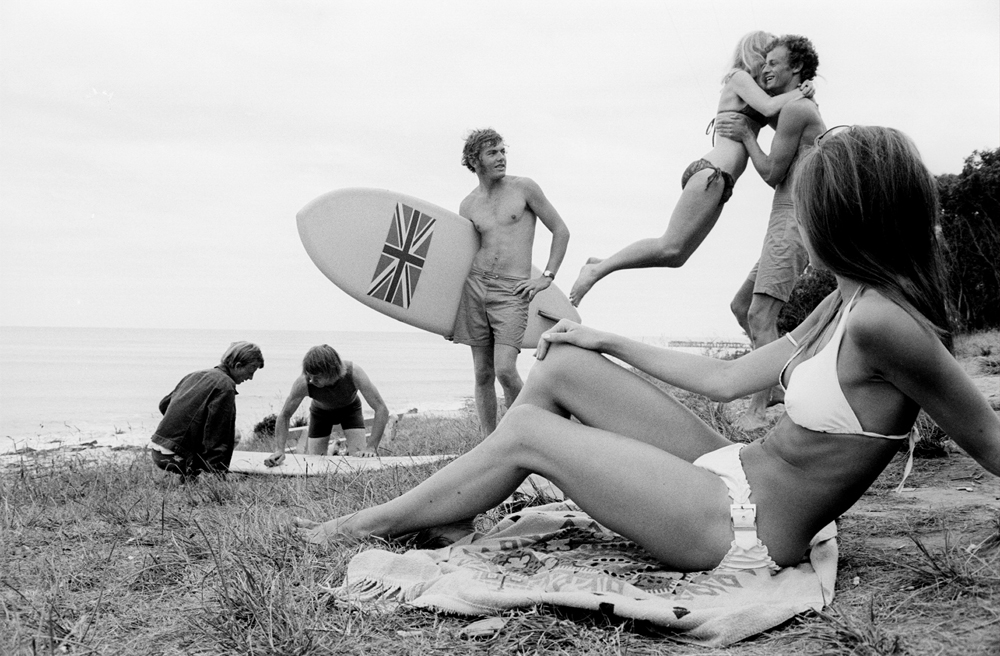
Rennie Ellis (Australian, 1940-2003) 'Union Jack, Lorne' c. 1968


Rennie Ellis (Australian, 1940-2003)
Union Jack, Lorne
c. 1968
Silver gelatin selenium toned fibre-based print
Rennie Ellis Photographic Archive


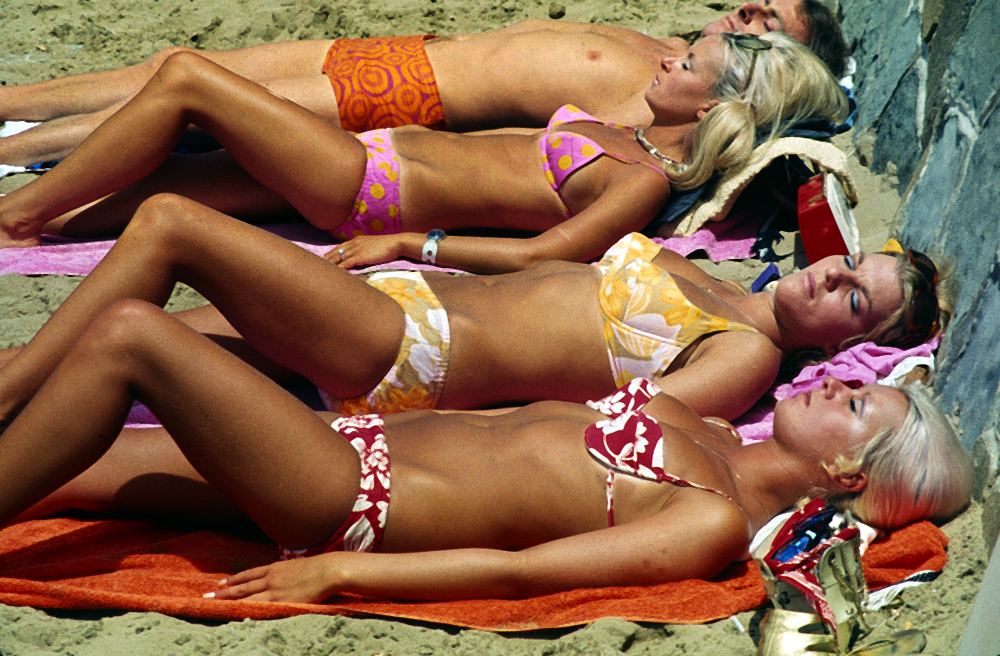
Rennie Ellis (Australian, 1940-2003) 'Four Sunbathers, Lorne' c. 1968


Rennie Ellis (Australian, 1940-2003)
Four Sunbathers, Lorne
c. 1968
Type C photograph (ed. AP)
Rennie Ellis Photographic Archive


Rennie Ellis (Australian, 1940-2003) 'Bondi, New South Wales' 1997


Rennie Ellis (Australian, 1940-2003)
Bondi, New South Wales
1997


“On the beach we chuck away our clothes, our status and our inhibitions and engage in rituals of sun worship and baptism. It’s a retreat to our primal needs.”

Rennie Ellis


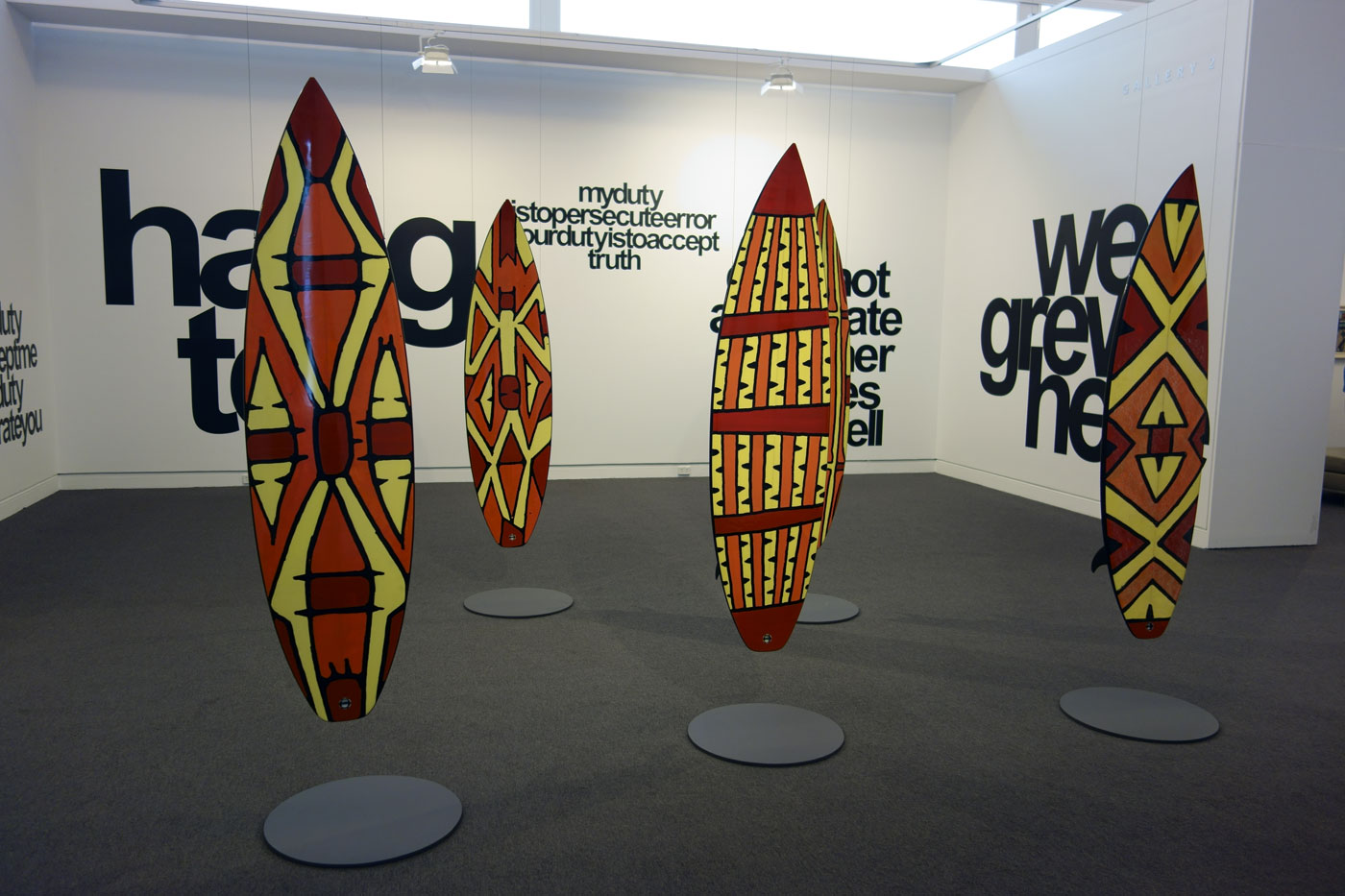
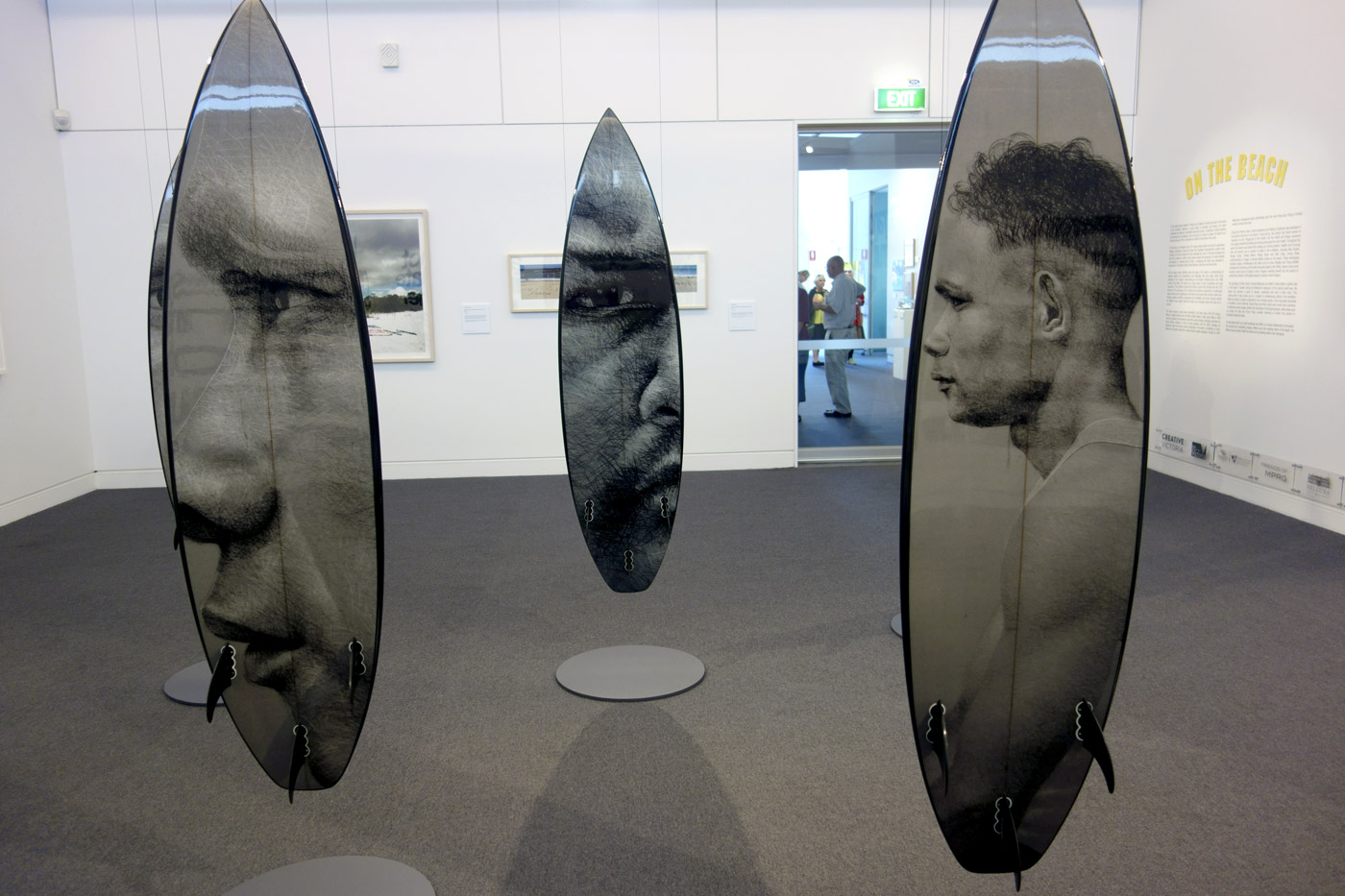
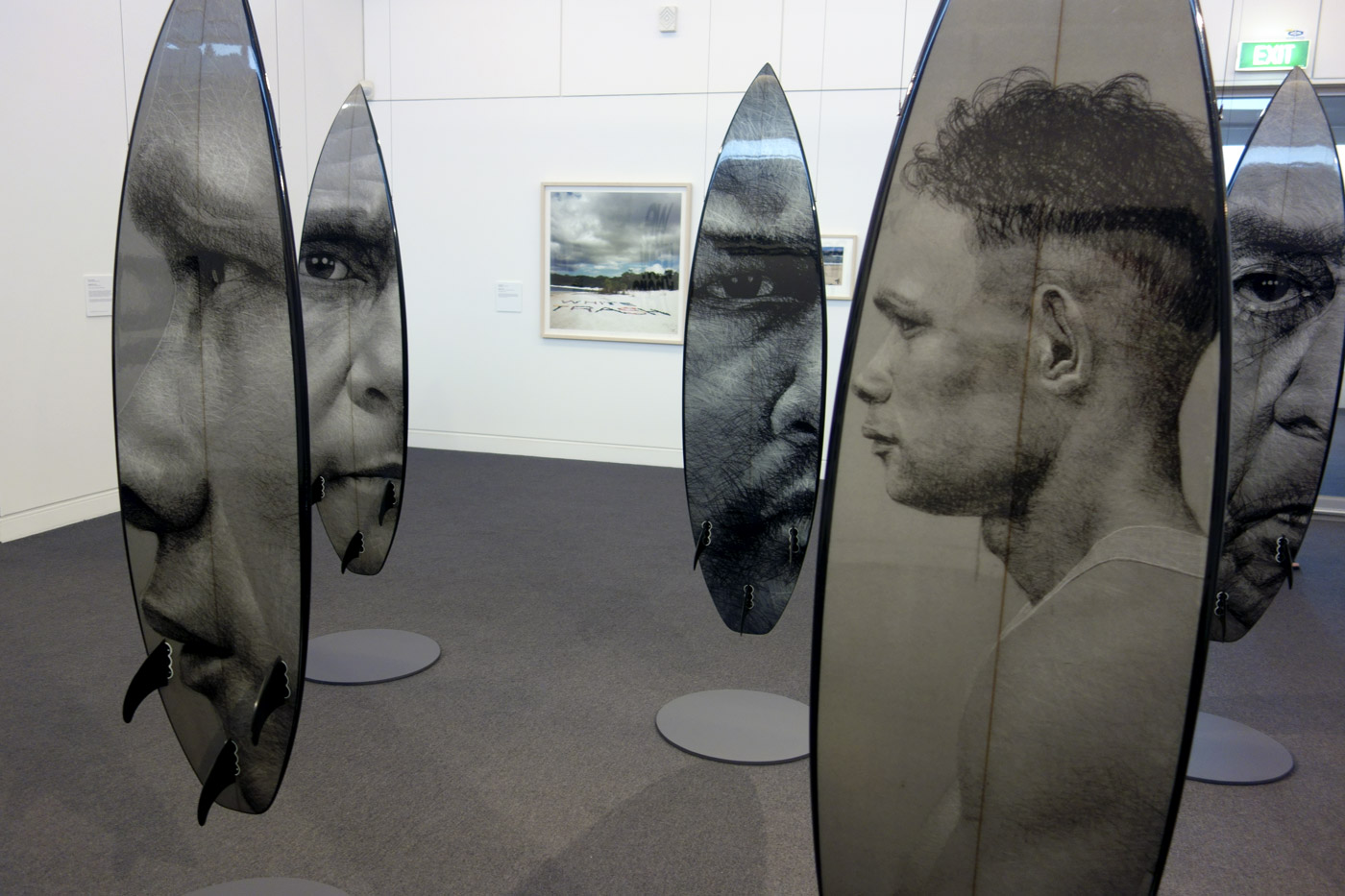
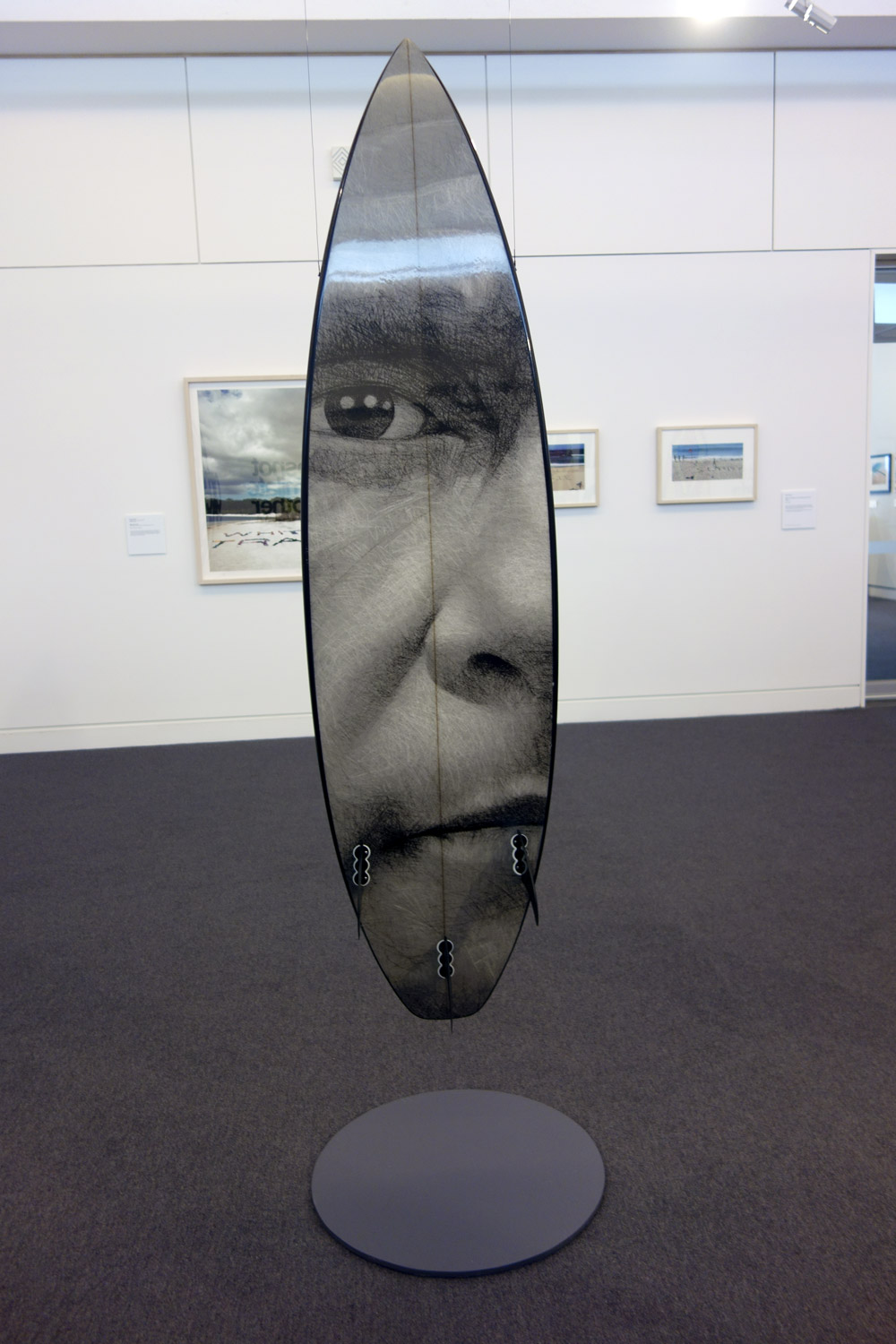
Vernon Ah Kee (Australian, b. 1967; Kuku Yalandji, Waanji, Yidinji and Gugu Yimithirr) 'cantchant' 2007-2009 (installation view)

Vernon Ah Kee (Australian, b. 1967; Kuku Yalandji, Waanji, Yidinji and Gugu Yimithirr) 'cantchant' 2007-2009 (installation view detail)

Vernon Ah Kee (Australian, b. 1967; Kuku Yalandji, Waanji, Yidinji and Gugu Yimithirr) 'cantchant' 2007-2009 (installation view detail)

Vernon Ah Kee (Australian, b. 1967; Kuku Yalandji, Waanji, Yidinji and Gugu Yimithirr) 'cantchant' 2007-2009 (installation view detail)

Vernon Ah Kee (Australian, b. 1967; Kuku Yalandji, Waanji, Yidinji and Gugu Yimithirr) 'cantchant' 2007-2009 (installation view detail)

Vernon Ah Kee (Australian, b. 1967; Kuku Yalandji, Waanji, Yidinji and Gugu Yimithirr) 'cantchant' 2007-2009 (installation view detail)

Vernon Ah Kee (Australian, b. 1967; Kuku Yalandji, Waanji, Yidinji and Gugu Yimithirr) 'cantchant' 2007-2009 (installation view detail)

Vernon Ah Kee (Australian, b. 1967; Kuku Yalandji, Waanji, Yidinji and Gugu Yimithirr) 'cantchant' 2007-2009 (installation view detail)

Vernon Ah Kee (Australian, b. 1967; Kuku Yalandji, Waanji, Yidinji and Gugu Yimithirr) 'cantchant' 2007-2009 (installation view detail)


Installation views of Vernon Ah Kee’s cantchant 2007-09


Vernon Ah Kee (Australian, b. 1967; Kuku Yalandji, Waanji, Yidinji and Gugu Yimithirr)
cantchant (installation views)
2007-2009
Synthetic polymer paint and resin over digital print on roamer, vinyl
Courtesy of the artist and Milani Gallery, Brisbane
Photos: © Marcus Bunyan and the Mornington Peninsula Regional Art Gallery


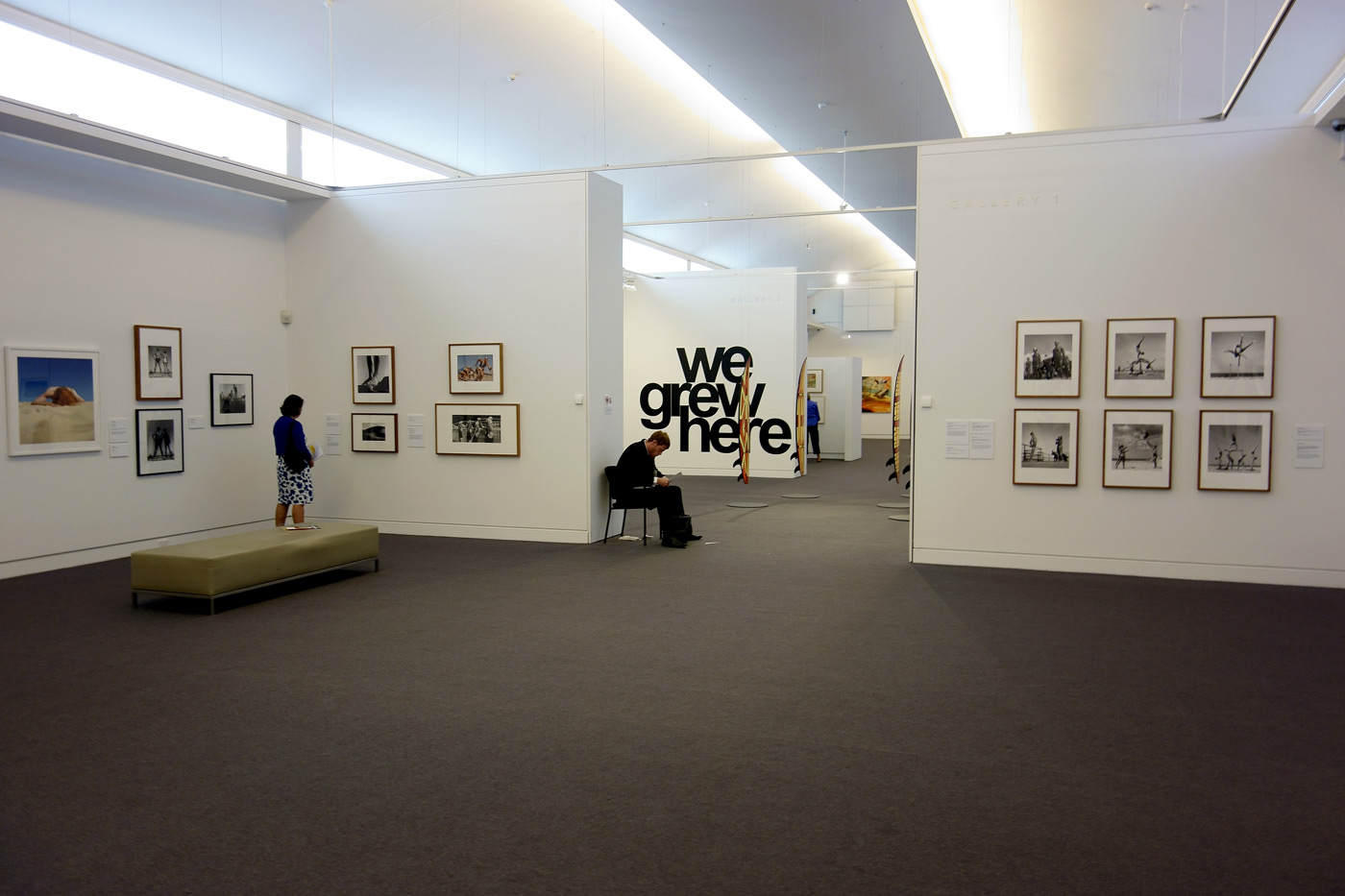
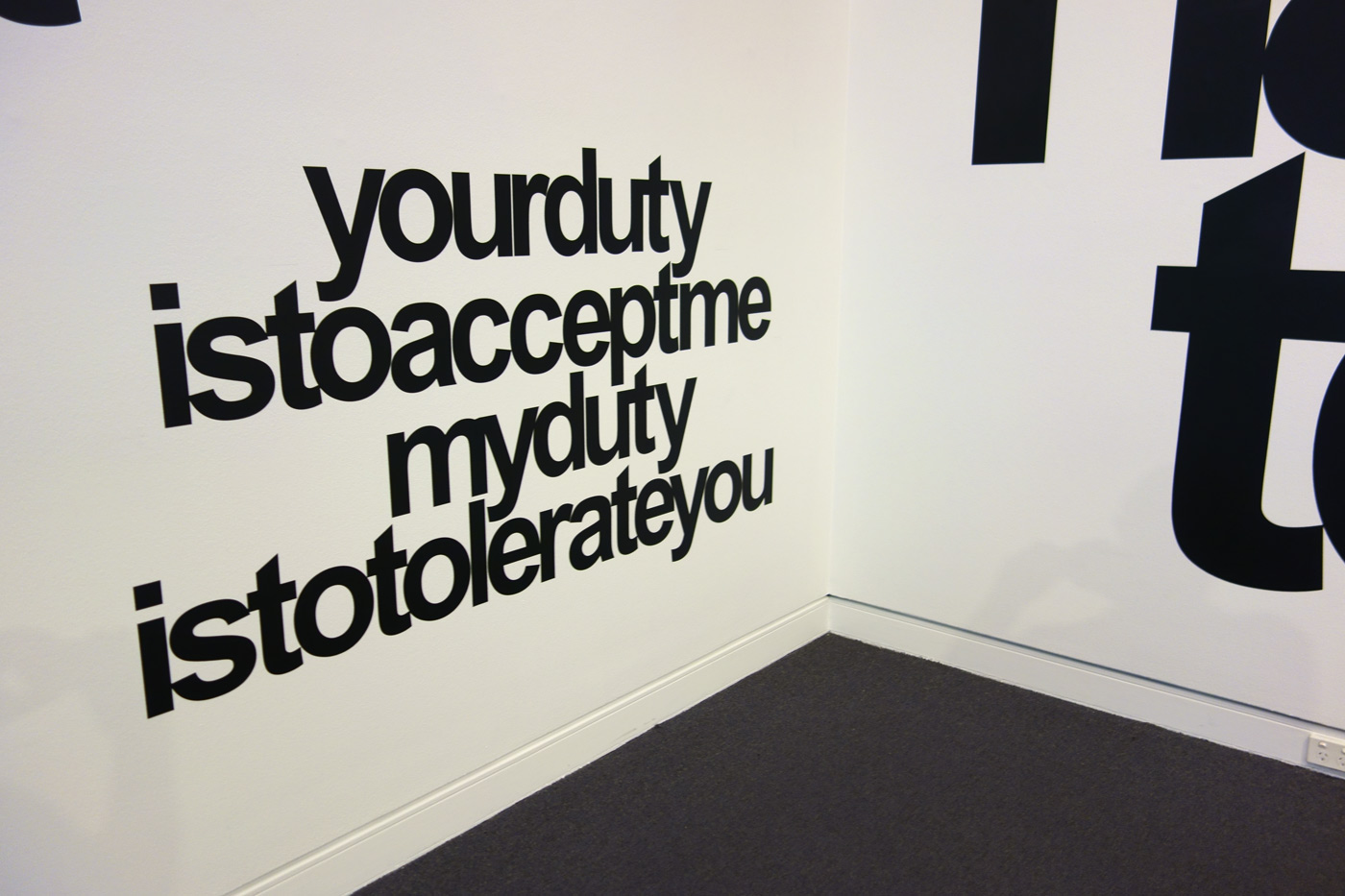
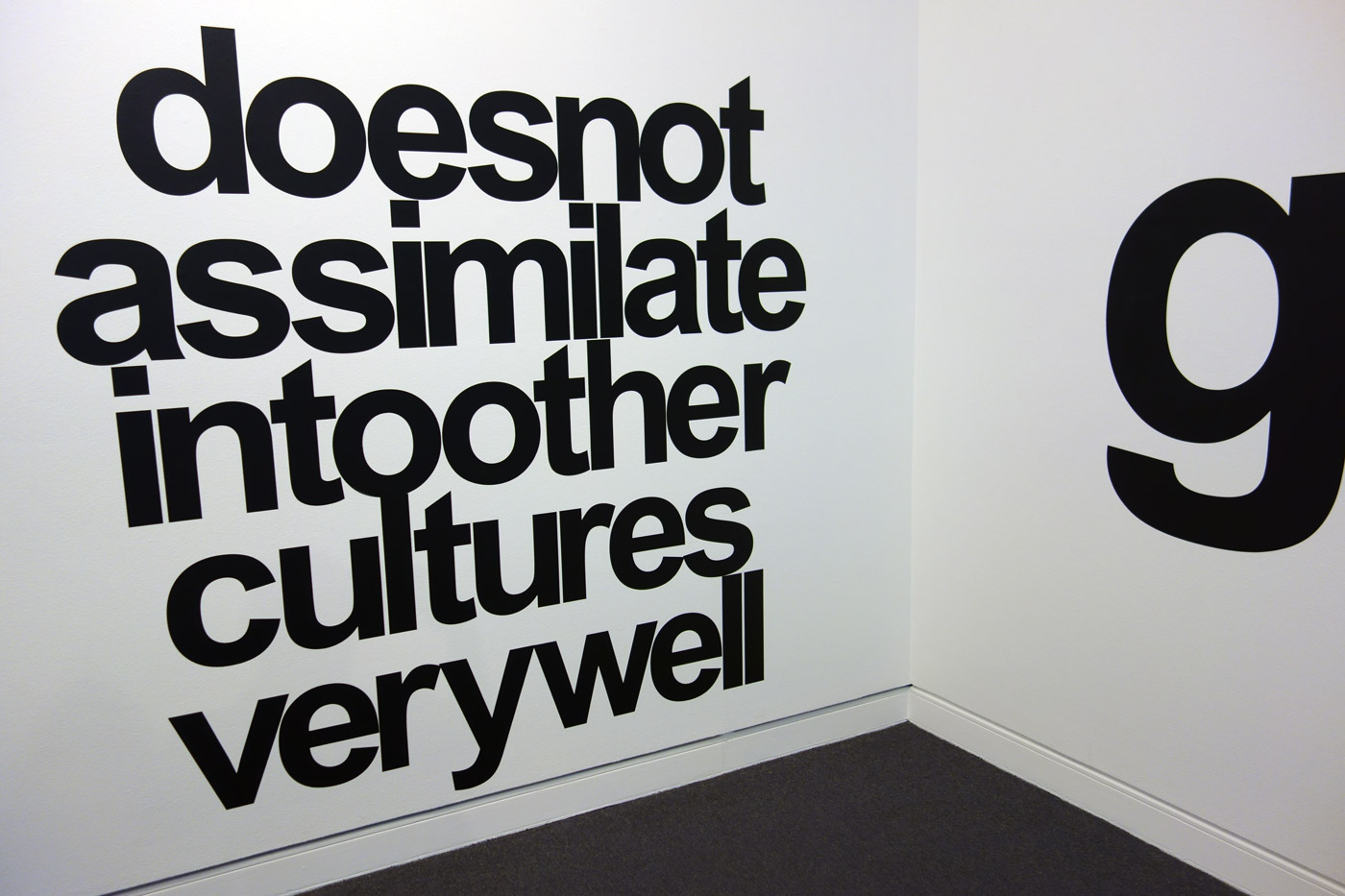
Vernon Ah Kee’s response to the events at Cronulla (the Cronulla Riot) us a powerful retort to the racists and their mantra ‘we grew here, you flew here’ chanted on the beach during the riots. Ah Kee takes issue pointing out the hypocrisy in their statement.

“We grew here, you flew here is an insincere statement and they were chanting it over and over again. It’s a way to exercise racism. I’m like ‘WE’ grew here, say what you want, but we’re the fellas that grew here.”

The surfboards are printed with Yidinji shield designs and the portraits are members of the artists family. The work was exhibited in the Australian Pavilion at the 2009 Venice Biennale.


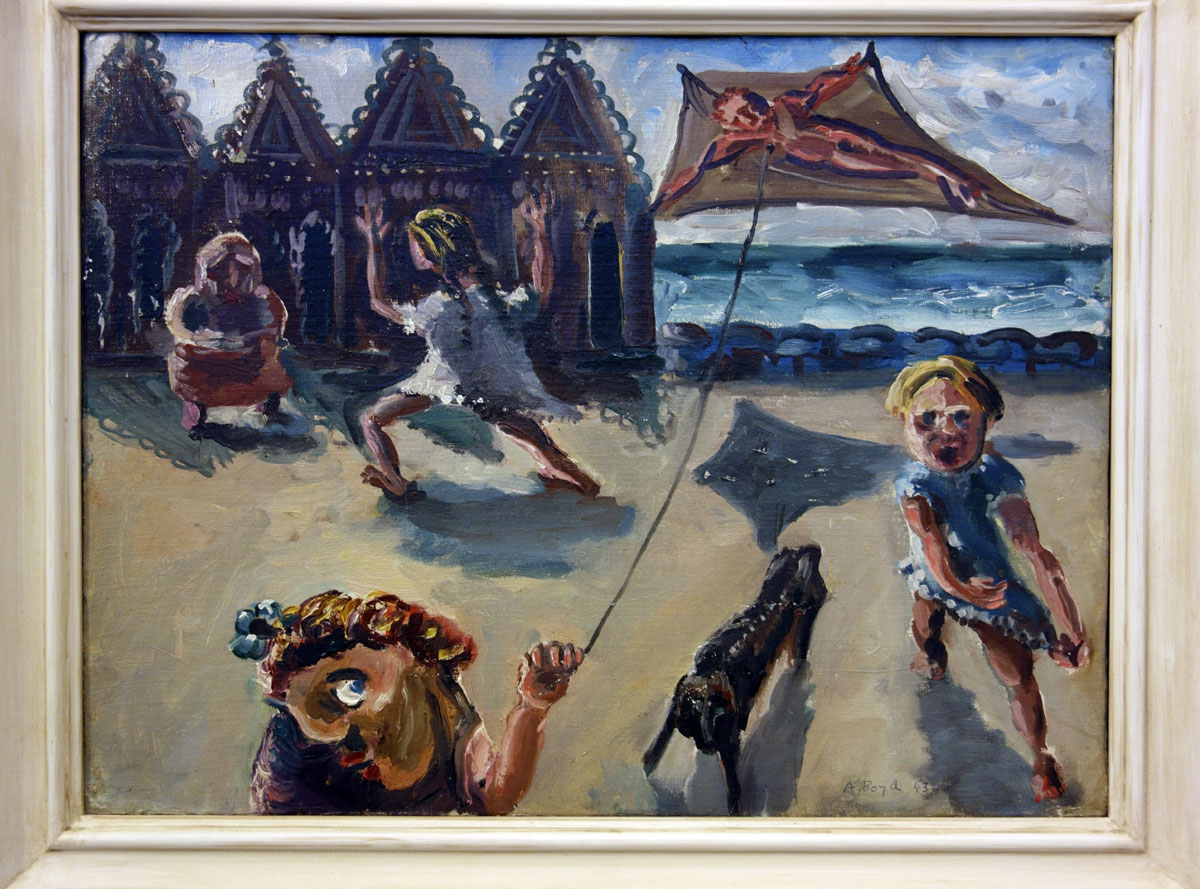
Installation view of the exhibition 'On the beach' at the Mornington Peninsula Regional Art Gallery showing on the far wall, Charles Blackman's 'Sunbather' (c. 1954) and Arthur Boyd's 'Kite flyers (South Melbourne)' (1943)


Installation view of the exhibition On the beach at the Mornington Peninsula Regional Art Gallery showing on the far wall, Charles Blackman’s Sunbather (c. 1954, below) and Arthur Boyd’s Kite flyers (South Melbourne) (1943, below)
Photo: © Marcus Bunyan and the Mornington Peninsula Regional Art Gallery


Charles Blackman (Australian, b. 1928) 'Sunbather' c. 1954 (installation view)


Charles Blackman (Australian, b. 1928)
Sunbather (installation view)
c. 1954
Oil on board
Private collection, Melbourne
Photo: © Marcus Bunyan and the Mornington Peninsula Regional Art Gallery


This is one of a number of paintings and drawings made in response to Blackman’s observations of life on Melbourne’s beaches. Blackman moved from Sydney to Melbourne in 1945 to be part of Melbourne’s burgeoning art scene, making friends with John Perceval, Joy Hester and John and Sunday Reed amongst others.

During this period Blackman regularly took the tram to St Kilda beach to swim and paint. Although he enjoyed spending time on the beach, there is a sinister overtone to this painting of a prostrate figure lying on the sand. A bleak, grey palette articulates the pallid lifeless flesh amplifying a sense of death. The hollow slits that substitute for eyes further accentuate the corpse-like appearance. It is a stark contrast to many paintings of the era that emphasise physical vitality and wellbeing. Rather the sense of isolation and heavy treatment of shadows and water creates a painting that is psychologically disturbing. This painting can be seen as a response to his wife, Barbara’s developing blindness. It has been noted that as the ‘darkness grew in her life, his pictures got darker.’1 Blackman stated many years later ‘I was trying to paint pictures which were unseeable.’2

1/ Barry Humphries quoted in Peter Wilmoth. “An artist in wonderland,” in The Age, 21 May 2006
2/ Charles Blackman interviewed by James Gleeson, 28 April 1979


Arthur Boyd (Australian, 1920-1999) 'Kite flyers (South Melbourne)' 1943 (installation view)


Arthur Boyd (Australian, 1920-1999)
Kite flyers (South Melbourne) (installation view)
1943
Oil on canvas mounted on cardboard
46.3 x 60.9cm
National Gallery of Victoria
The Arthur Boyd Gift, 1975
Photo: © Marcus Bunyan and the Mornington Peninsula Regional Art Gallery


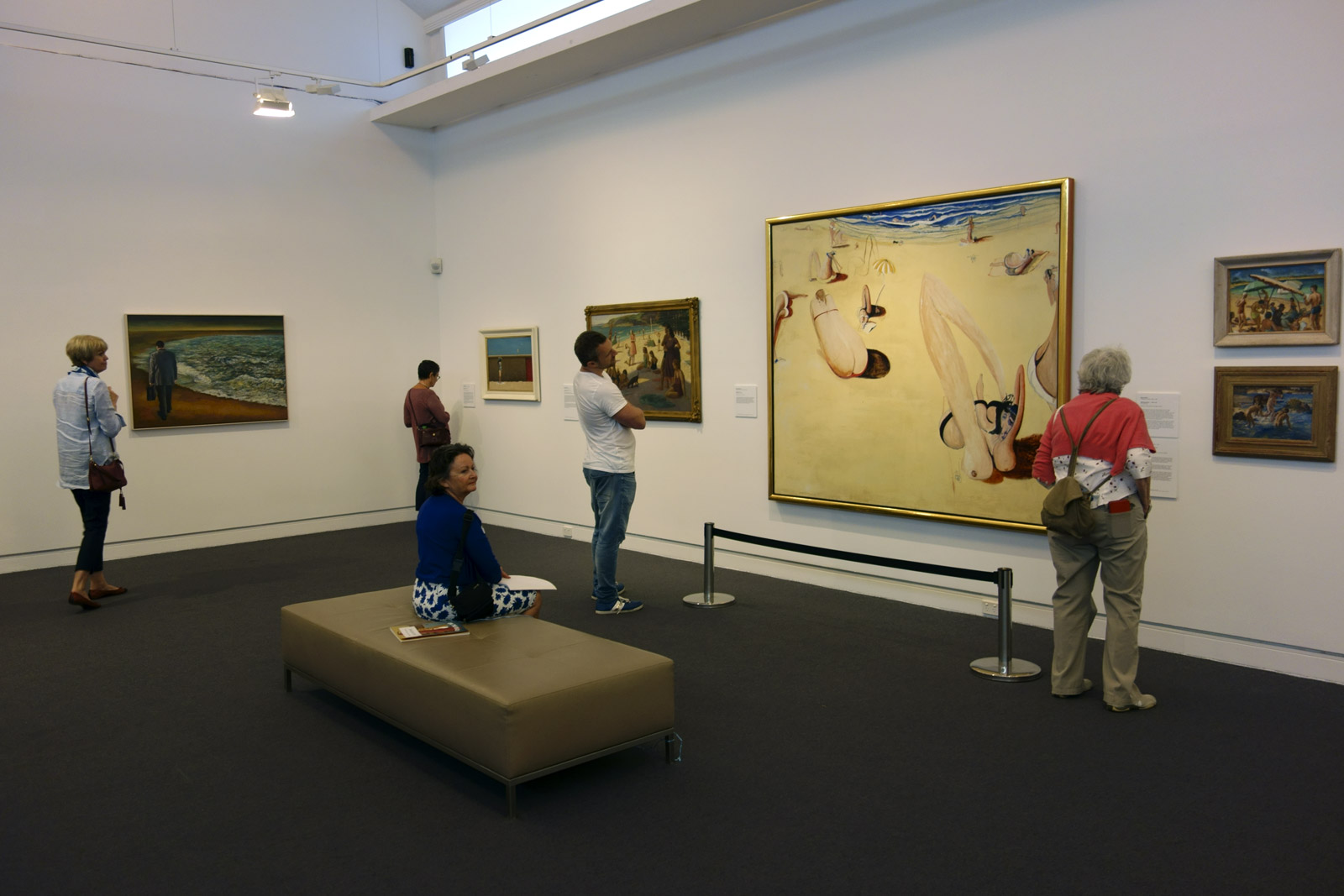
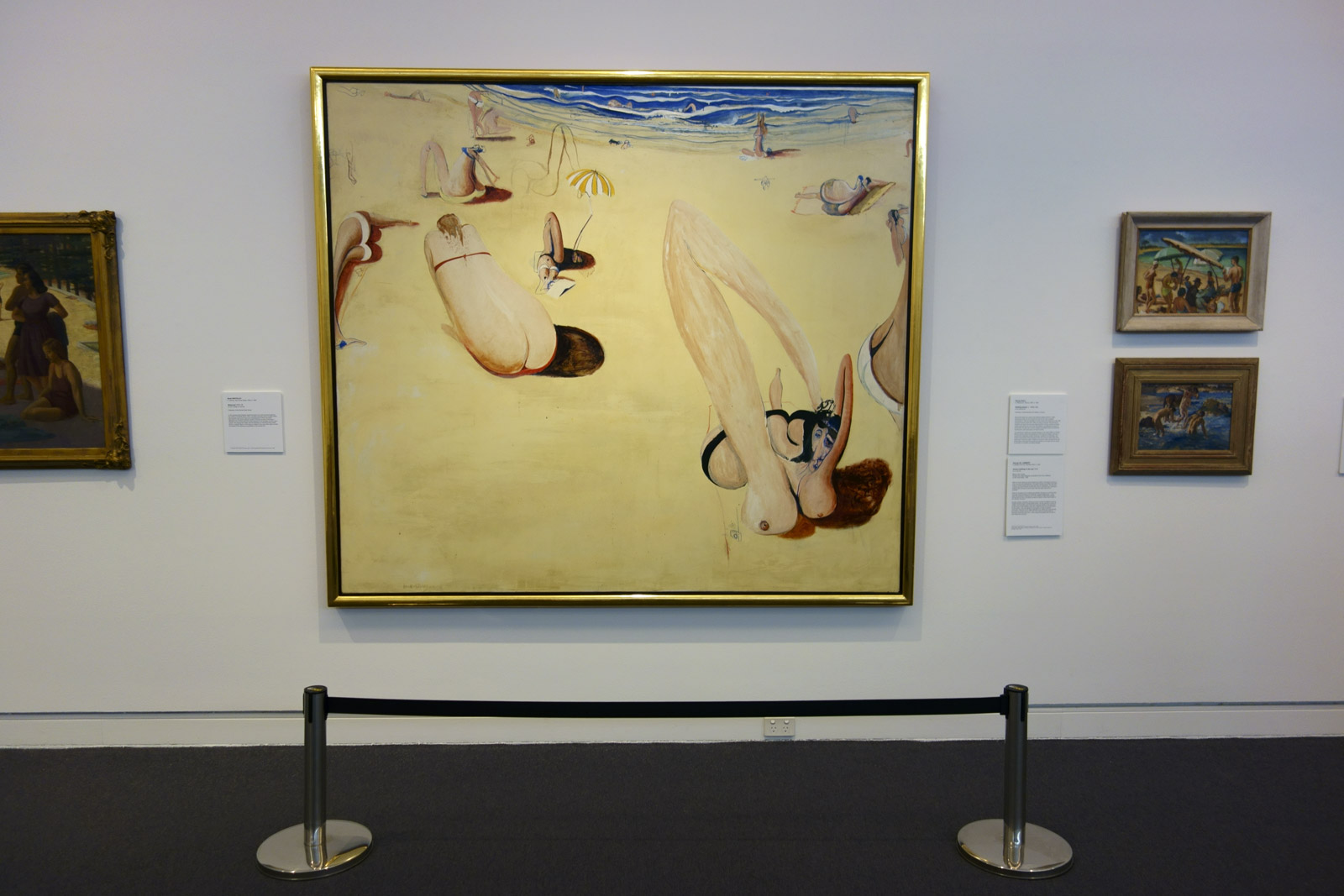
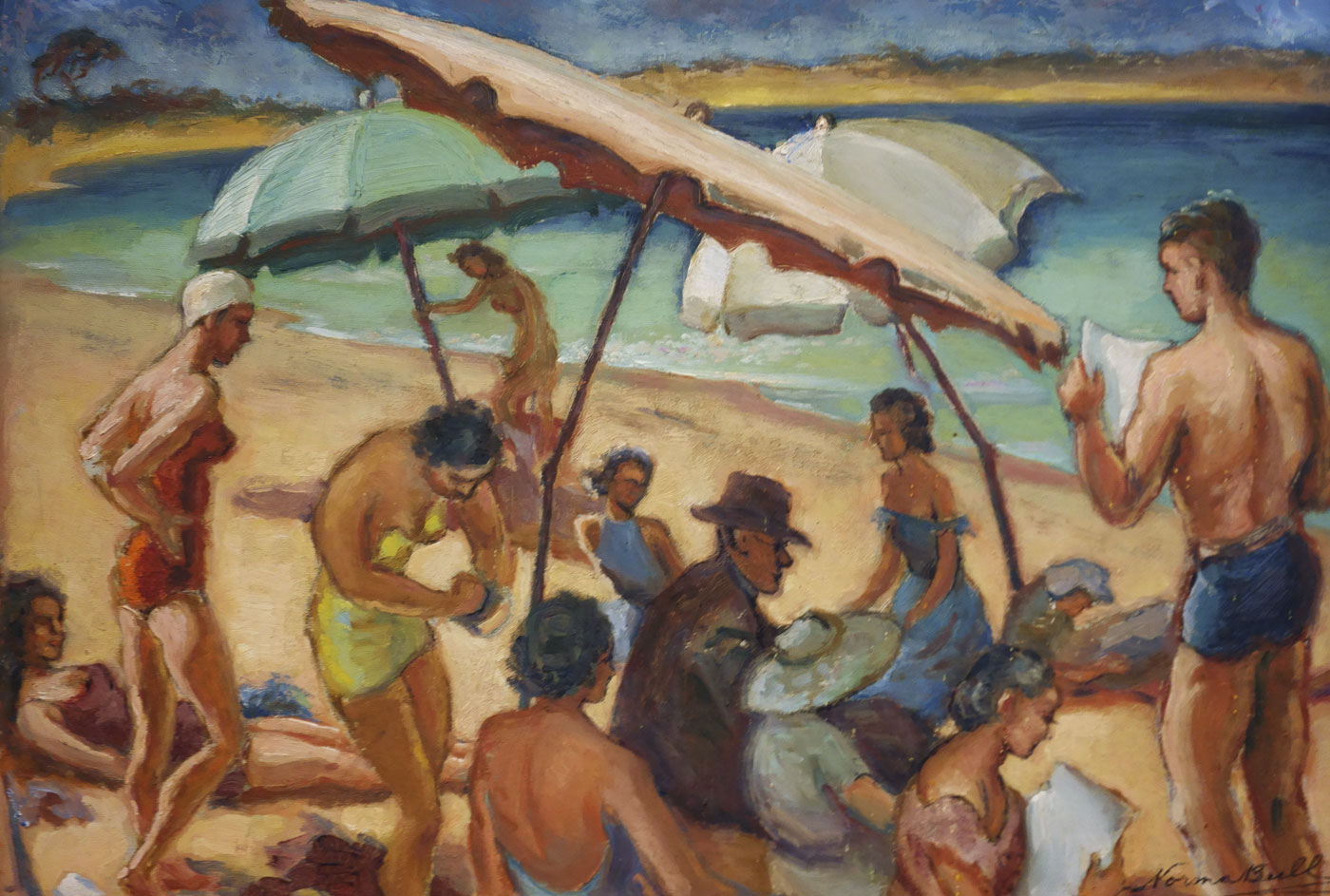
Installation view of the exhibition 'On the beach' at the Mornington Peninsula Regional Art Gallery showing in the centre, Brett Whiteley's 'Balmoral' (1975-1978). To the left of this painting is Nancy Kilgour's 'Figures on Manly Beach' (1930) and to the right Norma Bull's 'Bathing Beach' (c. 1950-1960s) with at bottom, George W. Lambert's 'Anzacs bathing in the sea' (1915)

Installation view of the exhibition 'On the beach' at the Mornington Peninsula Regional Art Gallery showing in the centre, Brett Whiteley's 'Balmoral' (1975-1978). To the left of this painting is Nancy Kilgour's 'Figures on Manly Beach' (1930) and to the right Norma Bull's 'Bathing Beach' (c. 1950-1960s) with at bottom, George W. Lambert's 'Anzacs bathing in the sea' (1915)

Installation view of the exhibition 'On the beach' at the Mornington Peninsula Regional Art Gallery showing in the centre, Brett Whiteley's 'Balmoral' (1975-1978). To the left of this painting is Nancy Kilgour's 'Figures on Manly Beach' (1930) and to the right Norma Bull's 'Bathing Beach' (c. 1950-1960s) with at bottom, George W. Lambert's 'Anzacs bathing in the sea' (1915)


Installation views of the exhibition On the beach at the Mornington Peninsula Regional Art Gallery showing in the centre, Brett Whiteley’s Balmoral (1975-1978, below). To the left of this painting is Nancy Kilgour’s Figures on Manly Beach (1930, below) and to the right Norma Bull’s Bathing Beach (c. 1950-1960s, below) with at bottom, George W. Lambert’s Anzacs bathing in the sea (1915, below)
Photos: © Marcus Bunyan and the Mornington Peninsula Regional Art Gallery


Brett Whiteley (Australian, 1939-1992) 'Balmoral' 1975-1978 (installation view detail)


Brett Whiteley (Australian, 1939-1992)
Balmoral (installation detail)
1975-1978
Oil and collage on canvas
180 x 204cm
Collection of the Hunter-Dyer family
Photo: © Marcus Bunyan and the Mornington Peninsula Regional Art Gallery


Nancy Kilgour (Australian, 1904-1954) 'Figures on Manly Beach' c. 1930


Nancy Kilgour (Australian, 1904-1954)
Figures on Manly Beach
c. 1930
Oil on canvas
76 x 117cm
Manly Art Gallery and Museum, Sydney
Purchase with the assistance of the NSW Ministry for the Arts, 1986


Nancy Kilgour’s artificial arrangement of figures is believed to have been painted in the 1930s before Charles Meere painted his highly contrived composition Australian Beach Pattern, 1940. The staged poses create a tableau of Australians enjoying the freedoms of life on the beach. What is interesting about Kilgour’s painting is that a number of people are depicted fully clothed. so the emphasis is not so much on toned physiques but rather the pleasures of relaxing on the beach. The painting is also unusual because, whereas most beach scenes are cast in brilliant sunshine, the figures in the foreground in this painting are rendered in shadow suggesting the presence of the towering Norfolk Island Pine trees which form a crescent along the Manly foreshore.


Norma Bull (Australian, 1906-1980) 'Bathing Beach' c. 1950-1960s


Norma Bull (Australian, 1906-1980)
Bathing Beach
c. 1950s-60s
Oil on aluminium
30.5 x 40cm
Collection of the Warrnambool Art Gallery, Victoria


Norma Bull began her career at the National Gallery School in 1929, Receiving acclaim for her portraits she won the Sir John Longstaff Scholarship in 1937 and travelled to London where she worked as a war artist during the Second World War. After nine years in Europe, Bull returned to Australia and spent the next year following Wirth’s Circus, painting acrobats, clowns and scenes from circus life. She settled in the Melbourne suburb of Surrey Hills and spent her summer holidays at Anglesea which provided the opportunity to paint seascapes and beach scenes.


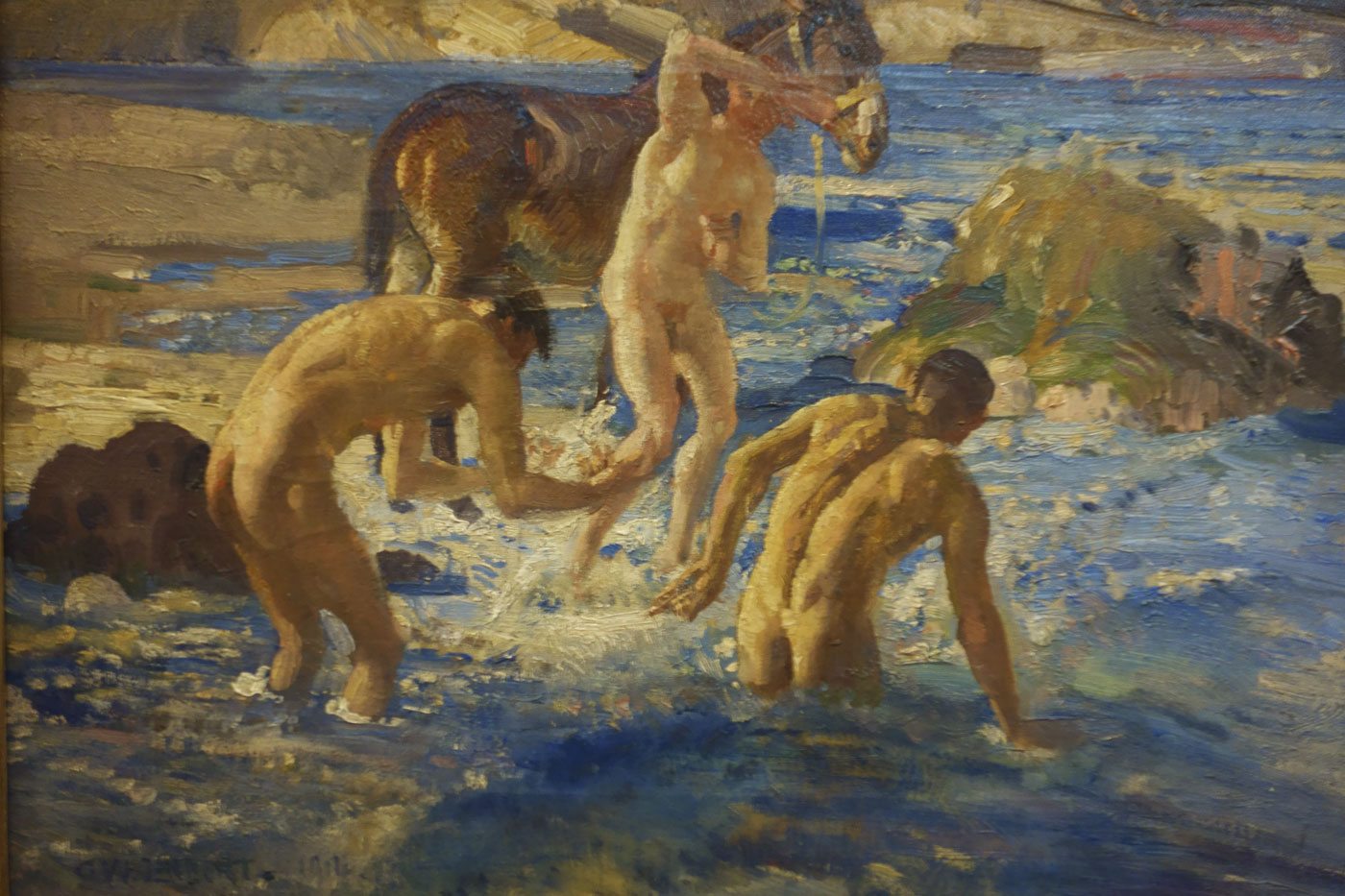
George W. Lambert (Australian, 1867-1930) 'Anzacs bathing in the sea' 1915 (installation view)

George W. Lambert (Australian, 1867-1930) 'Anzacs bathing in the sea' 1915 (installation view detail)


George W. Lambert (Australian, 1867-1930)
Anzacs bathing in the sea (installation full and detail)
1915
Oil on canvas
25 x 34cm
Mildura Arts Centre
Senator R.D. Elliott Bequest, presented to the City of Mildura by Mrs Hilda Elliott, 1956
Photos: © Marcus Bunyan and the Mornington Peninsula Regional Art Gallery


George Lambert, Australia’s official war artist, travelled to Gallipoli where he created detailed studies of large battle scenes. He also painted a number of smaller, more intimate works which were execute rapidly on the spot such as this scene of men bathing in the sea. Lambert’s focus is the musculature of their bodies. They are depicted as exemplars of heroic Australian masculinity. Historian C.E.W. Bean reflected in the 1920s that it was through the events on Anzac Cove on 25th April 1915 ‘that the consciousness of Australian nationhood was born.’1 In this respect the painting can be seen to have baptismal overtures.

1/ C.E.W. Bean, Official history of Australia in the War of 1914-1918 Volume 2, Sydney: Angus and Robertson, 1934, p. 346.


Installation view of the exhibition 'On the beach' at the Mornington Peninsula Regional Art Gallery showing at second left, Anne Zahalka's 'The girls #2, Cronulla Beach' (2007); at left on the far wall John Anderson's 'Abundance' (2015) followed by John Hopkins 'The crowd' (1970)


Installation view of the exhibition On the beach at the Mornington Peninsula Regional Art Gallery showing at second left, Anne Zahalka’s The girls #2, Cronulla Beach (2007, below); and at left on the far wall John Anderson’s Abundance (2015, below) followed by John Hopkins The crowd (1970, below)
Photo: © Marcus Bunyan and the Mornington Peninsula Regional Art Gallery


Anne Zahalka (Australian, b. 1957) 'The girls #2, Cronulla Beach' 2007 from the series 'Scenes from the Shire' 2007


Anne Zahalka (Australian, b. 1957)
The girls #2, Cronulla Beach
2007
From the series Scenes from the Shire 2007
Type C photograph
73.3 x 89.2cm
Mornington Peninsula Regional Art Gallery
Gift of the artist, 2012


John Anderson (Australian, b. 1947) 'Abundance' 2015 (installation view detail)


John Anderson (Australian, b. 1947)
Abundance (installation view detail)
2015
Oil on linen
Courtesy of the artist and Australian Galleries, Melbourne and Sydney
Photo: © Marcus Bunyan and the Mornington Peninsula Regional Art Gallery


John Hopkins (Australian, b. 1943) 'The crowd' 1970


John Hopkins (Australian, b. 1943)
The crowd
1970
Synthetic polymer paint on canvas
172.7 x 245.2cm
Mornington Peninsula Regional Art Gallery
Gift of the artist, 1974


Polixeni Papaetrou (Australian, 1960-2018) 'Ocean Man' 2013


Polixeni Papaetrou (Australian, 1960-2018)
Ocean Man
2013
From the series The Ghillies 2012-13
National Gallery of Victoria, Melbourne
Purchased NGV Foundation, 2013


The ghillie suit is a form of camouflage originally used by hunters and the military. Recently popularised in the video game, Call of duty, the ghillie suit is worn by Papapetrou’s son, Solomon, who poses on the beach at Queenscliff. Appearing neither man nor nature, his indistinct form speaks of transformation and becoming – of prison and absence. By depicting the figure as some sort of monster emerging from the depths of the ocean, Papapetrou creates an image that draws upon Jungian understanding of the sea as a symbol of the collective unconscious – both a source of life and return.


Mornington Peninsula Regional Art Gallery
Civic Reserve, Dunns Road, Mornington

Opening hours:
Tuesday – Sunday 10am – 5pm

Mornington Peninsula Regional Art Gallery website

LIKE ART BLART ON FACEBOOK

Back to top

Exhibition: ‘David Moore: Glimpses of Chewton’ and other art at the Castlemaine Art Gallery and Historical Museum

Exhibition dates: 31st October – 31st December 2015


David Moore (Australian, b. 1965) 'Winter sky' 2015


David Moore (Australian, b. 1965)
Winter sky
2015
Oil on linen
© Courtesy of the artist and James Makin Gallery, Melbourne
Photo: Marcus Bunyan


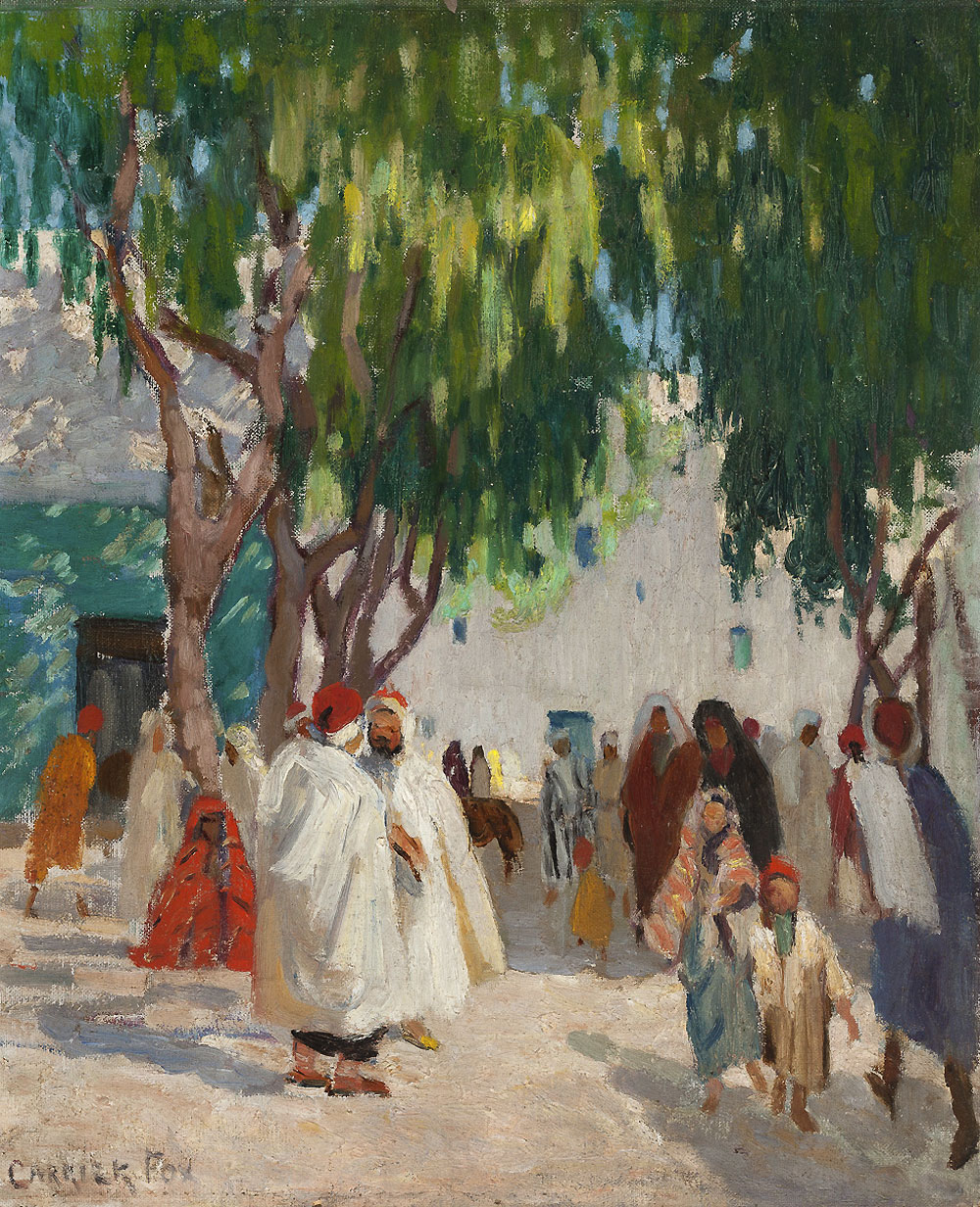
The State of Victoria has some truly wonderful regional galleries. I hadn’t been to Castlemaine Art Gallery and Historical Museum for a few years and I had forgotten what an absolutely stunning gallery it is. Stylish art deco building, diffused natural light filling the expansive spaces of the wood floored galleries, displaying interesting art works from their collection. I particularly liked the Edward J Shearsby, Ethel Carrick, John Perceval and, my favourite, a most glorious Sydney Long Pastoral scene (1909, below).

To top off an inspirational visit, there was the most beautiful exhibition of small oil on canvas and oil on cedar panel paintings by the artist David Moore: Glimpses of Chewton. These works had me entranced. Comprised of three years work, these paintings are an exploration of the region by the artist who bought a house in the area with his partner. Moore set out to discover Chewton through driving the local roads and by doing small paintings of the views… not the big vista but the small glimpse. As I said to Moore in a recent telephone conversation, small vibrations of energy.

You can really feel that the artist has captured the frequency – and by that I mean the song line – and spiritual energy of the landscape. These are strong paintings with sensuous brush work yet they are quiet and still in their presence before you – sensitive and beautiful. I love the size of them, like small jewels, and they draw you in and hold you. The gridded hang is especially effective. For an artist to feel these vibrations of energy is one thing, for it then to be transferred into the art is an entirely, and difficult, other. The correspondence between Moore’s work and the Sydney Long Pastoral scene is quite delicious to contemplate. Apparently, these were supposed to be preparatory sketches for larger studio based work, which will eventuate over time, but once Moore had started on these “glimpses” he kept going, creating this body of work. I am so thankful that he did, and I am grateful that I visited the gallery to see them. They made my day.

Do yourself a favour, take a day trip to Castlemaine. It’s well worth the visit.

Dr Marcus Bunyan


Many thankx to Castlemaine Art Gallery and Historical Museum and David Moore for allowing me to publish the art work in the posting. All photographs © Marcus Bunyan, the artist and Castlemaine Art Gallery and Historical Museum. Please click on the photographs for a larger version of the image.


Installation photograph of David Moore's exhibition 'Glimpses of Chewton' at the Castlemaine Art Gallery and Historical Museum

Installation photograph of David Moore's exhibition 'Glimpses of Chewton' at the Castlemaine Art Gallery and Historical Museum

Installation photograph of David Moore's exhibition 'Glimpses of Chewton' at the Castlemaine Art Gallery and Historical Museum

Installation photograph of David Moore's exhibition 'Glimpses of Chewton' at the Castlemaine Art Gallery and Historical Museum


Installation photograph of David Moore’s exhibition Glimpses of Chewton at the Castlemaine Art Gallery and Historical Museum
Photos: Marcus Bunyan


David Moore (Australian, b. 1965) 'Hillside shadows' 2015 (installation view)


David Moore (Australian, b. 1965)
Hillside shadows (installation view)
2015
Oil on cedar panel
© Courtesy of the artist and James Makin Gallery, Melbourne
Photo: Marcus Bunyan


David Moore (Australian, b. 1965) 'Clear sky' 2015 (installation view)


David Moore (Australian, b. 1965)
Clear sky (installation view)
2015
Oil on cedar panel
© Courtesy of the artist and James Makin Gallery, Melbourne
Photo: Marcus Bunyan


David Moore (Australian, b. 1965) 'Approaching storm' 2015 (installation view)


David Moore (Australian, b. 1965)
Approaching storm (installation view)
2015
Oil on linen
© Courtesy of the artist and James Makin Gallery, Melbourne
Photo: Marcus Bunyan


David Moore (Australian, b. 1965) 'Stormy sky' 2015 (installation view)


David Moore (Australian, b. 1965)
Stormy sky (installation view)
2015
Oil on linen
© Courtesy of the artist and James Makin Gallery, Melbourne
Photo: Marcus Bunyan


David Moore: Glimpses of Chewton

An exhibition of works painted in and around the town of Chewton, in North Central Victoria. Local artist David Moore is one of Australia’s foremost painters and was a recipient of the A.M.E Bale Residental Scholarship and the Norman Kaye award. He teaches painting in Melbourne, and is represented by Chrysalis Galleries in Melbourne.

About the Castlemaine Art Gallery and Historical Museum

Founded in 1913, the Castlemaine Art Gallery and Historical Museum has a unique collection of Australian art and fascinating historical artefacts reflecting the early history of the district. The beautiful art deco building, dating from 1931 with several extensions since then, is a work of art itself, with purpose-built galleries, lit largely by natural lighting.

The Gallery and Museum is fully accredited by Museums Australia. It is governed by private trustees and managed by a committee elected by subscribers. State and local government support is provided, and the Gallery has a strong tradition of support from benefactors, local families, artists and patrons.


Sydney Long (Australian, 1871-1955) 'Pastoral scene' 1909 (installation view)

Sydney Long (Australian, 1871-1955) 'Pastoral scene' 1909 (installation view)


Sydney Long (Australian, 1871-1955)
Pastoral scene (installation view)
1909
Oil on cardboard
Gift of Lady Mary Spencer 1949
Photos: Marcus Bunyan


Formerly known as Narrabeen landscape, this painting has been retitled due to uncertainty in its depiction of Narrabeen.

With paintings such as this, Long sought to produce works of the most imaginative kind from his surroundings. A panoramic vista, the artist focused on the patterns of light and shade over the landscape to create a sense of depth, leading the viewer’s eye to the blue hills in the background.


Sydney Long (Australian, 1871-1955) 'Pastoral scene' 1909 (installation view detail)


Sydney Long (Australian, 1871-1955)
Pastoral scene (installation view detail)
1909
Oil on cardboard
Gift of Lady Mary Spencer 1949
Photo: Marcus Bunyan


Edward J Shearsby (active c. 1900-1930 Melbourne) 'An Impression of Collins Street' c. 1910 (installation view)


Edward J Shearsby (active c. 1900-1930 Melbourne)
An Impression of Collins Street (installation view)
c. 1910
Oil on board
Estate of Barbara H Gordon 1999
Photo: Marcus Bunyan


The high viewpoint and bustling street are similar to Pissarro’s Boulevard Montmartre, morning, cloudy weather 1897 in the National Gallery of Victoria. Impressionism had an enormous influence on Australian artists from the late 19th century, mostly in the form of reproductions brought back by expatriate artists.


Edward J Shearsby (active c. 1900-1930 Melbourne) 'An Impression of Collins Street' c. 1910 (installation view detail)


Edward J Shearsby (active c. 1900-1930 Melbourne)
An Impression of Collins Street (installation view detail)
c. 1910
Oil on board
Estate of Barbara H Gordon 1999
Photo: Marcus Bunyan


Frederick McCubbin (Australian, 1855-1917) 'Golden sunlight' 1914 (installation view)


Frederick McCubbin (Australian, 1855-1917)
Golden sunlight (installation view)
1914
Oil on canvas
Gift of Dame Nellie Melba 1923
Photo: Marcus Bunyan


Frederick McCubbin (Australian, 1855-1917) 'Golden sunlight' 1914 (installation view detail)


Frederick McCubbin (Australian, 1855-1917)
Golden sunlight (installation view detail)
1914
Oil on canvas
Gift of Dame Nellie Melba 1923
Photo: Marcus Bunyan


The setting is below the artist’s family home on the Yarra River, South Yarra. Instead of the sight of the industrial stone crusher on the opposite bank, McCubbin has created an Arcadian fantasy of colour and light. Dame Nellie Melba possibly bought the work when she visited the McCubbin’s during an Australian tour. Melba’s father, David Mitchell, had an interest in a local Newstead mine and she visited the Gallery collection prior to donating.

The artist has used a ‘scumble’ technique: building up many layers of thinly applied paint giving a transparent effect. The composition was fist sketched in white and sienna, followed by pigment mixed on the palette and applied with a knife and brush handle to keep the colours pure. Later the work was rubbed with a pumice stone to give a smooth surface. Colours from different layers were allowed to show through. Highlights were applied over the top with paint straight from the tube.


E Phillips Fox (Australian, 1865-1915) 'On the Mediterranean Coast' c. 1911 (installation view)


E Phillips Fox (Australian, 1865-1915)
On the Mediterranean Coast (installation view)
c. 1911
Oil on canvas
Presented 1935
Photo: Marcus Bunyan


Ethel Carrick (Australian, 1872-1952) 'Untitled (Royal Avenue, Versailles)' c. 1909 (installation view)


Ethel Carrick (Australian, 1872-1952)
Untitled (Royal Avenue, Versailles) (installation view)
c. 1909
Oil on panel
Gift of Major B R F MacNay 1978
Photo: Marcus Bunyan


Ethel Carrick (Australian, 1872-1952) 'Untitled (Royal Avenue, Versailles)' c. 1909 (installation view detail)


Ethel Carrick (Australian, 1872-1952)
Untitled (Royal Avenue, Versailles) (installation view detail)
c. 1909
Oil on panel
Gift of Major B R F MacNay 1978
Photo: Marcus Bunyan


Lina Bryans (Australian, 1909-2000) 'Plum Tree' 1947 (installation view)


Lina Bryans (Australian, 1909-2000)
Plum Tree (installation view)
1947
Oil on composition board
Purchased with funds from the Felix Cappy Bequest in his memory, 2014
Photo: Marcus Bunyan


Probably painted at Stanhope House, Eltham by the font gate near the cedar tree overlooking the old orchard on the property.


Lina Bryans (Australian, 1909-2000) 'Plum Tree' 1947 (installation view detail)


Lina Bryans (Australian, 1909-2000)
Plum Tree (installation view detail)
1947
Oil on composition board
Purchased with funds from the Felix Cappy Bequest in his memory, 2014
Photo: Marcus Bunyan


Lina Bryans (Australian, 1909-2000)

A modernist, Bryans was associated with Frater’s circle which included Ada May Plante and Isabel Hunter Tweddle. Her first works were painted early in 1937 and Basil Burdett selected her Backyards, South Yarra in 1938 for the Herald Exhibition of Outstanding Pictures of 1937. Her work was included in Burdett’s article in Studio (1938) and in the exhibition, Art of Australia 1788-1941, shown at MoMA (New York) in 1941. Bryans went to live in Darebin Bridge House, a converted coach-house at Darebin, in the late 1930s, joining Ada May Plante. Bryans subsequently purchased it using her inheritance, painted and decorated it distinctively and named it “The Pink Hotel”. It became an artists’ colony for Bryans, Plante, Frater, Ambrose Hallen and Ian Fairweather and other artists. It was a centre for a group of writers associated with the journal Meanjin, from whom Lina’s son Edward developed his interest in journalism.

In 1948 Bryans had her first solo exhibition. It included Nude (1945, NGV) and Portrait of Nina Christesen (1947), both painted at Darebin, which she sold later that year and moved to Harkaway, near Berwick. She took a few lessons from George Bell in 1948 and from Mary Cockburn Mercer in 1951. In 1953 she went to America, then to France where she studied for a few months at La Grande Chaumière and visited Mercer in the south of France. Back at Melbourne, she once more became prominent in the city’s artistic and cultural milieu.

Landscape painting was always important to Bryans and throughout the 1960s and 1970s, it became more dramatic and abstract. In 1965 she visited Central Australia and painted extremely colourful modernist paintings of the Australian bush. She was awarded the 1966 Crouch Prize for Embedded Rock (1964, BFAG). Her major work Landscape Quartet from her second solo exhibition, held at Georges Gallery in 1966, was purchased by the National Gallery of Victoria, which awarded her a retrospective in 1982, held at Banyule Gallery in 1982, which subsequently toured regional galleries in Victoria.

Nevertheless, as Forwood notes (2001), her portraits ‘best reveal her contribution to Australian art’, moreover, ‘her seventy-three portraits of friends engaged in the world of art and letters form a pictorial biography of Bryans herself’. Her well-known portrait of Australian writer Jean May Campbell, The Babe is Wise, (named after Campbell’s novel of the year before) was painted in 1940. It is held in the National Gallery of Victoria collection.

Text from the Wikipedia website


John Perceval (Australian, 1923-2000) 'Double Sunset' 1961 (installation view)


John Perceval (Australian, 1923-2000)
Double Sunset (installation view)
1961
Oil on composition board
Purchased 1962
Photo: Marcus Bunyan


John Perceval (Australian, 1923-2000) 'Double Sunset' 1961 (installation view detail)


John Perceval (Australian, 1923-2000)
Double Sunset (installation view detail)
1961
Oil on composition board
Purchased 1962
Photo: Marcus Bunyan


Charles Blackman (Australian, 1928-2018) 'Dream Image' 1963 (installation view)


Charles Blackman (Australian, 1928-2018)
Dream Image (installation view)
1963
Oil on canvas on composition board
Purchased 1964
Photo: Marcus Bunyan


Charles Blackman (Australian, 1928-2018) 'Dream Image' 1963 (installation view detail)


Charles Blackman (Australian, 1928-2018)
Dream Image (installation view detail)
1963
Oil on canvas on composition board
Purchased 1964
Photo: Marcus Bunyan


View of Castlemaine Art Gallery and Historical Museum with works in situ

View of Castlemaine Art Gallery and Historical Museum with works in situ


Two views of Castlemaine Art Gallery and Historical Museum with works in situ
Photos: Marcus Bunyan


Clifton Pugh (Australian, 1924-1990) 'The Crab Catcher' 1958 (installation view)


Clifton Pugh (Australian, 1924-1990)
The Crab Catcher (installation view)
1958
Oil on composition board
Purchased 1958
Photo: Marcus Bunyan


Robert Jacks (Australian, 1943-2014) 'Goddess' 1959-1960 (installation view)


Robert Jacks (Australian, 1943-2014)
Goddess (installation view)
1959-1960
Bronze
Gift of the artist 2001
Photo: Marcus Bunyan


Clifford Last (Australian, 1918-1993) 'Family Group' 1958


Clifford Last (Australian, 1918-1993)
Family Group
1958
Limed Pine
Gift of the Subscribers 1958
Photo: Marcus Bunyan


Castlemaine Art Gallery and Historical Museum
14 Lyttleton Street (PO Box 248)
Castlemaine, Vic 3450 Australia
Phone: (03) 5472 2292
Email: info@castlemainegallery.com

Opening hours:
Thursday – Sunday 12 – 4pm

Castlemaine Art Gallery and Historical Museum website

David Moore Facebook page

LIKE ART BLART ON FACEBOOK

Back to top

Exhibition: ‘Storm in a Teacup’ at the Mornington Peninsula Regional Art Gallery, Mornington

Exhibition dates: 24th July – 27th September 2015


Hotham Street Ladies (est. Australia 2007) 'Dark tea' 2015


Hotham Street Ladies (est. Australia 2007)
Dark tea (installation photo)
2015
Royal icing, butter cream icing, fondant, food dye, found objects
Dimensions variable
Courtesy of the artists
Photo: Marcus Bunyan


This is the best thematic group exhibition I have seen in Melbourne and surrounds this year.

Every piece in the exhibition is visually stimulating and intelligently constructed, all works combining to make an engaging exhibition. Nothing is superfluous, every work having something interesting to say, whether it is about the ceremony of tea drinking, colonisation, global warming, Stolen Generations or social mores. Congratulations must go to the curators and artists for their efforts.

Particular favourites where the Hotham Street Ladies Dark Tea (2015, below) made of royal icing, butter cream icing, fondant, food dye, and found objects; the many sculptural objects which form the backbone of the exhibition, especially the work of Sharon West and Penny Byrne; and the wonderful vintage photographs that are displayed in the foyer of the gallery.

Accompanying this exhibition is another excellent exhibition, Ways to draw: A selection from the permanent collection by Betty Churcher, on till 27th September as well. If you want a day out from Melbourne with lunch in Mornington, some seriously good art and a drive along the coast, you could do no better than visit the gallery in the next week. Highly recommended.

Dr Marcus Bunyan


Many thankx to the Mornington Peninsula Regional Art Gallery for allowing me to publish the photographs in the posting. All installation photographs © Marcus Bunyan and the Mornington Peninsula Regional Art Gallery. Please click on the photographs for a larger version of the image.


Hotham Street Ladies (est. Australia 2007) 'Dark tea' 2015 (installation view detail)

Hotham Street Ladies (est. Australia 2007) 'Dark tea' 2015 (installation view detail)


Hotham Street Ladies (est. Australia 2007)
Dark tea (installation view details)
2015
Royal icing, butter cream icing, fondant, food dye, found objects
Dimensions variable
Courtesy of the artists
Photos: Marcus Bunyan


Charles Blackman (Australian, 1928-2018) 'Feet beneath the table' 1956


Charles Blackman (Australian, 1928-2018)
Feet beneath the table
1956
Tempera and oil on composition board
106.5 x 121.8cm
National Gallery of Victoria, Melbourne
Presented through the NGV Foundation by Barbara Blackman, Honorary Life Benefactor, 2005


Charles Blackman first encountered Lewis Caroll’s book, Alice in Wonderland, through a talking book for the blind which his wife, Barbara was listening to. Her developing blindness resulted in telescopic vision, spatial disorientation and a shrinking visual field. She was also pregnant with their first child and her distorted body image also had parallels with Alice’s experiences. By painting Alice at the Mad Hatter’s tea party Blackman could express his wife’s feeling of bewilderment and disorientation.


E. Phillips Fox (Australian, 1865-1915) 'The arbour' 1910


E. Phillips Fox (Australian, 1865-1915)
The arbour
1910
Oil on canvas
190.5 x 230.7cm
National Gallery of Victoria, Melbourne
Felton Bequest 1916


Melbourne born E. Phillips Fox, described as ‘one of the greatest of Australia’s Impressionist painters and the most gifted of her colourists’1 went to Paris in 1887 to study at the Ecole des Beaux Arts where he encountered the work of the French Impressionists. He remained in Paris for several years but made frequent trips back to Melbourne to visit his family. The Arbour was painted in Paris in Fox’s garden but is based upon observations of family life in his brother’s garden in Malvern. The depiction of an elegant family taking tea al fresco is a study of refined gentility. The Arbour was exhibited at both the Royal Academy and the Paris Salon exhibitions and was regarded by Fox as the finest thing he had done.2 At the time the painting was much admired for its ‘subtle lights ad shadow’3 and his exemplary ‘use of delicate colour and refined harmonies.’4

1/ Courier Mail, 12 May 1949
2/ Sydney Morning Herald, 13 October 1913
3/ Sydney Morning Herald, 13 October 1913
4/ Le Courrier Australien, Sydney, 15 April 1949


Clare Humphries (Australian, b. 1973) 'Some things were out in the open' 2007


Clare Humphries (Australian, b. 1973)
Some things were out in the open
2007
Pigment print on Hahnemühle photo rag paper (ed. 3/5)
63 x 62cm
Courtesy of the artist


Adam Hill (Blak Douglas) (Australian, b. 1970) 'Not everyone’s cup of tea' 2009


Adam Hill (Blak Douglas) (Australian, b. 1970)
Not everyone’s cup of tea
2009
Synthetic polymer paint on canvas
150 x 260cm
National Gallery of Australia, Canberra Purchased 2009


Kendal Murray (Australian, b. 1958) 'Exceed speed, mislead, concede' 2011


Kendal Murray (Australian, b. 1958)
Exceed speed, mislead, concede
2011
Mixed media assemblage
18 x 24 x 14cm
Courtesy of the artist and Arthouse Gallery, Sydney


Penny Byrne (Australian, b. 1965) 'Tea for two in Tuvalu' 2011


Penny Byrne (Australian, b. 1965)
Tea for two in Tuvalu
2011
Vintage porcelain figurine, vintage, Action man accessories, vintage coral, glass fish, epoxy resin, epoxy putty, retouching medium, powder pigments
15 x 19cm
Private Collection


Penny Byrne (Australian, b. 1965) 'Tea for two in Tuvalu' 2011 (installation view)


Penny Byrne (Australian, b. 1965)
Tea for two in Tuvalu (installation view)
2011
Vintage porcelain figurine, vintage, Action man accessories, vintage coral, glass fish, epoxy resin, epoxy putty, retouching medium, powder pigments
15 x 19cm
Private Collection
Photo: Marcus Bunyan


This piece was inspired by an underwater cabinet meeting held in 2009 by Maldives President Mohammed Nasheed in a campaign to raise awareness for activity on climate change. The thirty minute meeting was held six metres below sea level and was attended by eleven cabinet members calling upon all countries to cut their emissions to halt further temperature rises.

Polynesian island nation of Tuvalu, located in the Pacific Ocean midway between Hawaii and Australia, experienced a severe drought in 2011. A state of emergency was declared and rationing of fresh-water took place which restricted households on some of the islands to two buckets of fresh water per day. Tuvalu is also especially susceptible to changes in sea level and it is estimated that a sea level rise of 20 to 40 centimetres in the next 100 years could make Tuvalu uninhabitable.


Kate Bergin (Australian, b. 1968) 'The hunt for a room of one’s own' 2012


Kate Bergin (Australian, b. 1968)
The hunt for a room of one’s own
2012
Oil on canvas on board
75 x 101cm
Private Collection


Kate Bergin draws upon Dutch and Flemish seventeenth century tradition of still life painting to comment on our attitudes to animals. Bergin stages the scene on a crumpled white tablecloth upon which a large fox, based on a taxidermy fox she bought on eBay, regally sits centre stage. Meticulously rendered native birds, including a honeyeater, finch and triller, are based on photographs of specimens from the Melbourne Museum Collection. They flit about unperturbed by the introduced predator. Teaspoons, representing the impulse for collecting, entangle the fox and bird. Together with a teapot and cup, precariously placed, they contribute to the overarching sense of impending chaos.

Both afternoon tea and the fox represent English upper class social mores and were introduced into the colonies following British settlement. The fox arrived in 1855, brought in for recreational hunting, and has been a major cause of native bird extinctions. Fox numbers are increasing in some areas further threatening the precarious balance between wild life and introduced species.


Sharon West (Australian, b. 1963) 'Two Koori Tribesmen receive a gift of afternoon tea from local colonists' 2014 (installation view)


Sharon West (Australian, b. 1963)
Two Koori Tribesmen receive a gift of afternoon tea from local colonists (installation photo)
2014
Mixed media assemblage
15 x 46 x 30cm
Courtesy of the artist
Photo: Marcus Bunyan


Heather Shimmen (Australian, b. 1957) 'Tip me up' 2005 (installation view)


Heather Shimmen (Australian, b. 1957)
Tip me up (installation view)
2005
Linocut on paper and organza (ed. 7/30)
56 x 76cm
Courtesy of the artist and Australian Galleries, Melbourne and Sydney
Photo: Marcus Bunyan


Trent Jansen (Australian, b. 1981) 'Briggs family tea service' 2011 (installation view)


Trent Jansen (Australian, b. 1981)
Briggs family tea service (installation view)
2011
Slip cast porcelain, bull kelp, wallaby pelt, copper and brass
George (teapot) 22.5 x 20.5 x 13cm; Woretermoeteyenner (sugar bowl) 16 x 13.5 x 9cm; Dolly (milk jug) 12.5 x 12.5 x 8.5cm; John (teacup) 7 x 8.5 x 8cm; Eliza (teacup) 7.5 x 10.5 x 8cm; Mary (teacup) 10 x 9 x 6.5cm
Courtesy of Broached Commissions, Melbourne
Photo: Marcus Bunyan


The Briggs family tea service represents the marriage of George Briggs, a free settler, to Woretermoeteyenner of the Pairrebeenne people in Van Diemen’s Land and the four children they had together. Briggs arrived from Bedfordshire in 1791 and learned to speak the language of the local Pairrebeenne people, trading tea, flour and sugar fro kangaroo, wallaby and seal skins. It is understood that he became good friends with the leader of the Pairrebeenne people, Mannalargenna, and by 1810 he partnered his daughter Woretermoeteyenner. Their marriage meant she had to adapt to a way of life that merged her traditional cultural values with the ways of British settlers. The teapot and sugar bowl represent the parents while their first daughter, Doll Mountgarret Briggs is symbolised in the milk jug and the three cups each signify their other children John, Eliza and Mary.

The tea service is a hybrid design bringing together materials common to both cultures. To realise the set Jansen worked with Rod Bamford on the ceramic elements, Oliver Smith for the brass and copper and Vicki West, who uses the traditional methods of her Tasmanian Aboriginal ancestors, worked with the bull kelp components.


eX de Medici (Australian, b. 1959) 'Blue (Bower-Bauer)' 1998-2000 (installation view)


eX de Medici (Australian, b. 1959)
Blue (Bower-Bauer) (installation view)
1998-2000
Watercolour over black pencil on paper
114.0 x 152.8cm
National Gallery of Australia, Canberra Purchased 2004
Photo: Marcus Bunyan


eX de Medici (Australian, b. 1959) 'Blue (Bower-Bauer)' 1998-2000 (installation view detail)


eX de Medici (Australian, b. 1959)
Blue (Bower-Bauer) (installation view detail)
1998-2000
Watercolour over black pencil on paper
114.0 x 152.8cm
National Gallery of Australia, Canberra Purchased 2004
Photo: Marcus Bunyan


A turning point in eX de Medici’s career came in 1998 when she saw an exhibition of watercolours by Ferdinand Bauer comprising 2,000 rarely seen images of native flora and fauna made when Bauer was official artist on Matthew Flinder’s historic circumnavigation of Australia in 1801-1803. Previously working with tattoo imagery, Medici found the intricate works so compelling she decided to change course and ‘retrograde’ herself and explore watercolour as a medium.1

Referencing Australia’s Bower bird that adorns its nest with anything blue, Medici entangles the history of vanitas painting with commentary about the desire to seek permanence and affirmation in the accumulation of things. The broken willow pattern platter, upturned jugs and cups, amassed with so many other decorative and functional objects, are juxtaposed with skulls, fruit and flowers – symbols of mortality. A reaction to what she considered John Howard’s regressive politics at the time, the work ‘is a kind of a backhanded discussion about colonising our minds with retroactive ideas’.2

1/ Ted Gott. ‘eX deMedici an epic journey on a Lilliputian scale’ Art and Australia Vol. 40, No. 1, Spring 2002, p. 105
2/ eX deMedici in Paul Flynn. Artist Profile #5, March 2008, pp. 28-35.


Storm in a Teacup reflects upon tea drinking in Australia. Introduced by the British colonials, the afternoon tea party was an attempt to ‘civilise’ the land. Tea drinking became so popular in the colonies that by 1888 the amount of tea consumed per capita exceeded the amount consumed in England. Soon after, billy tea was to become an enduring symbol of the pioneering spirit, immortalised by Henry Lawson’s stories published under the title While the billy boils.

Beginning with elegant paintings of the afternoon tea table from E. Phillips Fox and Arthur Streeton, the exhibition goes on to explore the darker side of tea drinking and the social and environmental impacts of the humble cup of tea. Michael Cook’s Object (table), 2015, provides an alternative history to the narrative of colonialism while Sharon West and Adam Hill both use humour to subvert colonial understandings of the afternoon tea party as an occasion of refined gentility.

The humble cuppa has been around for thousands of years, but this exhibition explores how a popular beverage can impact on us culturally, socially, environmentally and politically. There is more to debate than just the proper way to make a cup of tea. Storm in a teacup explores far-reaching issues brewing from tea, including the imposition of one culture upon another – especially on the colonial frontier; the production of ceramics and the environmental impacts of porcelain and its production; gender stereotypes and socialisation through tea parties. The exhibition also reflects upon tea drinking ceremonies in Asia within a western Orientalist paradigm and tea drinking as an occasion for familial cohesiveness and disconnect.

Text from the Mornington Peninsula Regional Art Gallery


Mark James Daniel (Australian, 1867-1949) 'Verandah, "Harefield" – afternoon tea' Feb 1900


Mark James Daniel (Australian, 1867-1949)
Verandah, “Harefield” – afternoon tea
Feb 1900
Glass negative
8.5 x 11cm (quarter plate)
Collection of the State Library of Victoria


Michael J Drew (Australian, 1873-1943) 'Group taking tea in a garden' between 1890 and 1900


Michael J Drew (Australian, 1873-1943)
Group taking tea in a garden
between 1890 and 1900
Glass negative
12.2 x 16.5cm (half plate)
Collection of the State Library of Victoria


Rex Hazlewood (Australian, 1886-1968) '[Men drinking billy tea]' 1911-1927


Rex Hazlewood (Australian, 1886-1968)
[Men drinking billy tea]
1911-1927
Silver gelatin print
Collection of the State Library of New South Wales


Anonymous photographer. 'Afternoon tea at "Vivaleigh"' 1917


Anonymous photographer
Afternoon tea at “Vivaleigh”
1917
Gelatin silver print
12 x 16cm
Collection of the State Library of Victoria


James Fox Barnard (Australian, 1874-1945) 'Lawn, Arylie, Hobart' c. 1900


James Fox Barnard (Australian, 1874-1945)
Lawn, Arylie, Hobart
c. 1900
Glass negative
8.5 x 11cm (quarter plate)
Collection of the State Library of Victoria


James Fox Barnard (Australian, 1874-1945) '[Tea on the verandah]' c. 1900


James Fox Barnard (Australian, 1874-1945)
[Tea on the verandah]
c. 1900
Glass negative
8.5 x 11cm (quarter plate)
Collection of the State Library of Victoria


Installation photograph of the exhibition 'Storm in a Teacup' at the Mornington Peninsula Regional Art Gallery

Installation photograph of the exhibition 'Storm in a Teacup' at the Mornington Peninsula Regional Art Gallery

Installation photograph of the exhibition 'Storm in a Teacup' at the Mornington Peninsula Regional Art Gallery

Installation photograph of the exhibition 'Storm in a Teacup' at the Mornington Peninsula Regional Art Gallery

Installation photograph of the exhibition 'Storm in a Teacup' at the Mornington Peninsula Regional Art Gallery


Installation photograph of the exhibition Storm in a Teacup at the Mornington Peninsula Regional Art Gallery
Photos: Marcus Bunyan


Tea is the medium of many a complex and commonplace rituals. Adopted in a variety of ceremonies and customs across the globe, its unique and symbolic place in our lives is subtle and powerful. Whether a quick cuppa around the kitchen table or a lavish display of refined gentility; from billy tea to Asian tea-drinking ceremonies, tea has played an important role in international trade but more curiously in facilitating social cohesiveness.

Comprising approximately 50 works including painting, photography, sculpture and installation Storm in a Teacup features artists such as Chares Blackman, John Perceval, Emma Minnie Boyd, E. Phillips Fox and contemporary artists Stephen Bowers, Danie Mellor, Penny Byrne, Rosalie Gasgoigne, Matthew Sleeth, eX de Medici, Anne Zahalka, Polixeni Papapetrou and a mad tea party installation by Hotham Street Ladies.

Tea is said to have first been invented in China around 2700 BC, with the earliest records of tea consumption dating to 1000BC. Initially consumed as a medicinal drink, it became widely popular as a common beverage and traded across Asia and Europe during the 16th century. It was King Charles II’s wife Catherine of Portugal who is said to have brought the tea habit to Great Britain. Indeed, the afternoon tea party first became fashionable in the seventeenth century following Queen Catherine de Braganza’s fondness for serving the beverage at Whitehall in London. It wasn’t until the 18th century that it became widely consumed with tea smuggling bringing the tipple to the masses and later influenced the Boston Tea Party.

Tea drinking became a demonstration of social aspirations and grew in popularity giving rise to a subtle orchestration of manners, dress and serving paraphernalia which created new forms of commodity consumption. In the colonies of New South Wales and Victoria afternoon tea parties were a lavish display of settler understandings of refined gentility that were an attempt to signal allegiance to the values of the home country and ground the displaced community in their originating culture. In this respect the afternoon tea party expressed collective understandings of British identity and was a means of domesticating and civilising the alien terrain of the colonies.

Press release from the Mornington Peninsula Regional Art Gallery


Clare Humphries (Australian, b. 1973) 'Family confection II' 2015 (installation view)

Clare Humphries (Australian, b. 1973) 'Family confection II' 2015 (installation view)


Clare Humphries (Australian, b. 1973)
Family confection II (installation views)
2015
Sugar cubes stained with coffee and tea
Dimensions variable
Courtesy of the artist
Photos: Marcus Bunyan


Giuseppe Romeo (Australian, b. 1958) Subjective landscape, 'Of consequence rather than reason' 2015 (installation view)

Giuseppe Romeo (Australian, b. 1958) Subjective landscape, 'Of consequence rather than reason' 2015 (installation view)


Giuseppe Romeo (Australian, b. 1958)
Subjective landscape, ‘Of consequence rather than reason’ (installation views)
2015
Found discarded objects, bitumen, paint
80 x 100 x 60cm
Courtesy of the artist
Photos: Marcus Bunyan


Guiseppe Rome asks the simple question: ‘What are you going to do with it all?’

Romeo recalls the tea sets his mother and aunts possessed and the ‘good set’ kept for special occasions that were rarely used. In this work a silver platter is the support for a silver cake stand upon which a teapot, creamer, sugar bowl and various serving implements jostle with items required to clean up the mess. The bat, ball and stumps are a reference to playing cricket which ‘became an excuse for a big afternoon tea party in England’. A ribbon of wire holds it all together ‘like a dream from Alice in Wonderland when nothing is as it seems’, while a tinkling melody from a music box is a lullaby that sends us in to a contented sleep.

Romeo coats the sculpture in bitumen then paints it entirely in white. The effect is reminiscent of excavated items from an ancient ruin, as if we are peering upon the remains from a modern day Pompeii – artefacts that have been covered in lava and buried. This work alludes to the ways in which we deceive ourselves and ‘attempt to keep it all together through consumption but ultimately we can’t’.


Samantha Everton (Australian, b. 1971) 'Camellia' 2009


Samantha Everton (Australian, b. 1971)
Camellia
2009
From the series Vintage dolls 2009
Pigment print on rag paper (ed. AP2)
106 x 114cm
Courtesy of the artist and Anthea Polson Art, Queensland


Robyn Phelan (Australian, b. 1965) 'Porcelain wall – ode to an obsession' 2010-2015 (installation view)


Robyn Phelan (Australian, b. 1965)
Porcelain wall – ode to an obsession (installation view)
2010-2015
Porcelain, paper, clay, cobalt oxide, timber, pigment, Jingdezhen tissue transfer
240 x 122 x 42cm
Courtesy of the artist
Photo: Marcus Bunyan


Robyn Phelan (Australian, b. 1965) 'Porcelain wall – ode to an obsession' 2010-15 (installation view detail)


Robyn Phelan (Australian, b. 1965)
Porcelain wall – ode to an obsession (installation view detail)
2010-2015
Porcelain, paper, clay, cobalt oxide, timber, pigment, Jingdezhen tissue transfer
240 x 122 x 42cm
Courtesy of the artist


Robyn Phelan undertook a residency at the Pottery Workshop and Experimental Sculptural Factory of Jingdezhen, Jiangxi Province in China in 2008. Jingdezhen is known as the porcelain capital because it has been the centre of China’s ceramic production, beginning in the fourteenth century Yuan Dynasty, where fine porcelain was first exported all over the world.

Deposits of kaolinite, a clay found at Mt Kaolin nearby which can sustain very high firing temperatures produced a superior white porcelain of increased strength and translucency. Items made from kaolinite were fired with cobalt landscape designs and were highly sought after by European collectors. Over the centuries, because of excessive mining, the mountain’s deposits have become depleted. Phelan’s work is a lament to the desecration of the mountain and a reminder of the potential destructiveness of consumer desire.


Penny Byrne (Australian, b. 1965) '‘Let’s forget about global warming’ said Alice ‘and have a cup of tea instead!’' 2010 (installation view)


Penny Byrne (Australian, b. 1965)
‘Let’s forget about global warming’ said Alice ‘and have a cup of tea instead!’ (installation view)
2010
Vintage porcelain figurine, found toys, epoxy resin, epoxy putty, retouching medium, powder pigments
80 x 33cm
Williams Sinclair Collection
Photo: Marcus Bunyan


Penny Byrne (Australian, b. 1965) '‘Let’s forget about global warming’ said Alice ‘and have a cup of tea instead!’' 2010 (installation view detail)


Penny Byrne (Australian, b. 1965)
‘Let’s forget about global warming’ said Alice ‘and have a cup of tea instead!’ (installation view detail)
2010
Vintage porcelain figurine, found toys, epoxy resin, epoxy putty, retouching medium, powder pigments
80 x 33cm
Williams Sinclair Collection
Photo: Marcus Bunyan


Penny Byrne’s reworked porcelain conversation piece was motivated by Republican Vice-Presidential nominee Sarah Palin’s cry to ‘drill, baby, drill’ during her campaign in 2008. A call for increase off-shore drilling of petroleum, including sites such as the Arctic National Wildlife Refuge, Palin claimed ‘that’s what we hear all across the country in our rallies because people are so hungry for those domestic sources of energy to be tapped into’.1

In Byrne’s piece the patriotic figures gorge themselves, blithely overindulging without care to the wastage. The new Disney production of Alice in Wonderland directed by Tim Burton had just been released and this led Byrne to reflect upon the Mad Hatter’s tea party in which tea was drunk all day because time stood still and was stuck at tea-time.

1/ Transcript: The Vice-Presidential Debate, 2 October 2008. Reprinted in the New York Times, 23 May 2012.


Sharon West (Australian, b. 1963) 'Joseph Banks’ tea party for a Botany Bay tribesman is ruined by flies and spiders' 2014


Sharon West (Australian, b. 1963)
Joseph Banks’ tea party for a Botany Bay tribesman is ruined by flies and spiders
2014
Digital print on paper (ed. 2/5)
66 x 57cm (sheet)
Courtesy of the artist
Photo: Marcus Bunyan


Sharon West’s recreation of an afternoon tea party is set in the early days of first contact. Joseph Banks was the botanist who sailed with Captain Cook on the Endeavour on the first voyage of discovery which mapped the east coast of Australia between 1768 and 1771. While ashore he made an extensive collection of native flora and fauna which was sent back to natural history museums in England. Banks was also instrumental in the British government’s decision to colonise the New South Wales settlement.


Rosalie Gascoigne (b. New Zealand 1917; arr. Australia 1943; d. Canberra 1999) 'The tea party' 1980 (installation view)


Rosalie Gascoigne (b. New Zealand 1917; arr. Australia 1943; d. Canberra 1999)
The tea party (installation view)
1980
Painted wood, celluloid, plastic, enamelled metal, feathers
83 x 35 x 20cm
Private collection
Photo: Marcus Bunyan


Rosalie Gascoigne (b. New Zealand 1917; arr. Australia 1943; d. Canberra 1999) 'The tea party' 1980 (installation view detail)


Rosalie Gascoigne (b. New Zealand 1917; arr. Australia 1943; d. Canberra 1999)
The tea party (installation view detail)
1980
Painted wood, celluloid, plastic, enamelled metal, feathers
83 x 35 x 20cm
Private collection
Photo: Marcus Bunyan


Rosalie Gascoigne found the kewpie dolls amongst a large number of discarded things from an abandoned sideshow at the Bungendore dump in the summer of 1976. ‘I thought “Oh, those dollies, they’re having a … very joyful … picnic. They’re … in the paddock, they’ve got all these old things … they’ve sat down on the teapots and waved their wings around.”

For Gascoigne beauty existed in the most humble of objects and the wear and tear from use only added to the appeal. The enamel teapots were also found at various dumps and were a particular focus of her collecting.

‘I had a thing about enamelware because I see it as being elegant. People see the holes in it. I was collecting brown and white at the same time. To me it had a sort of elegance that a Dalmatian dog has, spotty, very elegant’.1

1/ Rosalie Gascoigne, excerpts from her correspondence, email communication with Martin Gascoigne, 13 March 2015


Julie Dowling (Australian, b. 1969) Badimaya people, Western Australia 'White with one' 2003


Julie Dowling (Australian, b. 1969)
Badimaya people, Western Australia
White with one
2003
Synthetic polymer paint and red ochre on canvas
121 x 100cm
Collection of Jane Kleimeyer and Anthony Stuart


Julie Dowling’s painting is a poignant reminder of the Stolen Generations and the plight of many young girls, forcibly removed from their families, who were brought up in government institutions and trained to be domestic servant to white families. Girls were targeted because women were considered the ‘uplifters’ or ‘civilisers’ of their communities and as future mothers their education into the values of white society was deemed essential to enable successful assimilation. Girls in service were supposed to receive a wage but often this was retained by their employer and not passed on. Dowling points out it is also a history of Stolen wages.


Michael Cook (Australian, b. 1968) Bidjara people, south-west Queensland 'Object (table)' 2015


Michael Cook (Australian, b. 1968)
Bidjara people, south-west Queensland
Object (table)
2015
Inkjet print on Hahnemühle cotton rag (ed. 2/4 + 2AP)
140 x 99cm
Courtesy of the artist and THIS IS NO FANTASY + dianne tanzer gallery, Melbourne


Michael Cook’s photographic tableau ‘turns the table’ on racism. By depicting the body of a white woman as a functional object in service to others, Cook considers the dehumanisation and objectification of one race of people by another in the history of slavery.

The double portrait on the back wall is by Johann Zoffany from 1778, and features Dido Elizabeth Belle (1761-1804) who was born into slavery in the West Indies. The daughter of an African mother, her father was an English naval officer who left her to the care of his uncle, Lord William Murray, where she was raised as an equal with Murray’s niece. Murray was instrumental in outlawing slavery in the United Kingdom in 1772. In the painting Zoffany depicts the two women standing together, the niece affectionately reaching out to Belle. Hence Cook’s afternoon tea is also a reminder that prejudice and racial inequality can be surmounted.


Yenny Huber (b. Austria 1980; arr. Australia 2000) 'Room No. 14' 2006


Yenny Huber (b. Austria 1980; arr. Australia 2000)
Room No. 14
2006
Digital print on aluminium panel (ed. 1/6)
27.2 x 27.2cm
Warrnambool Art Gallery, Victoria


Underpinned by the belief that any one person is comprised of diverse, fragmentary and often illusory selves, Yenny Huber explores the various ego states that reside within. This photograph is a self portrait taken in a hotel room, but it is also an impersonation of an identity available to women. Tea-drinking was once described as ‘an infallible sign of an old maid’1 and in this work Huber offers us an image of a good Catholic girl, knees together, elbows in, sitting demurely on the couch sipping tea. It is an image of femininity constrained by the dictates of religion and outdated socially sanctioned ideals of respectable female behaviour.

1/ The Horsham Times, Victoria, 26 April 1898


Anne Zahalka (Australian, b. 1957) 'Saturday 5.18 pm 1995' 1995 (printed 1997)


Anne Zahalka (Australian, b. 1957)
Saturday 5.18 pm 1995
1995 (printed 1997)
Type C photograph (ed AP)
125 x 162cm
Art Gallery of New South Wales, Sydney Gift of the artist, 2011
Donated through the Australian Government’s Cultural Gifts Program


Mornington Peninsula Regional Art Gallery
Civic Reserve, Dunns Road, Mornington

Opening hours:
Tuesday – Sunday 11am – 4pm
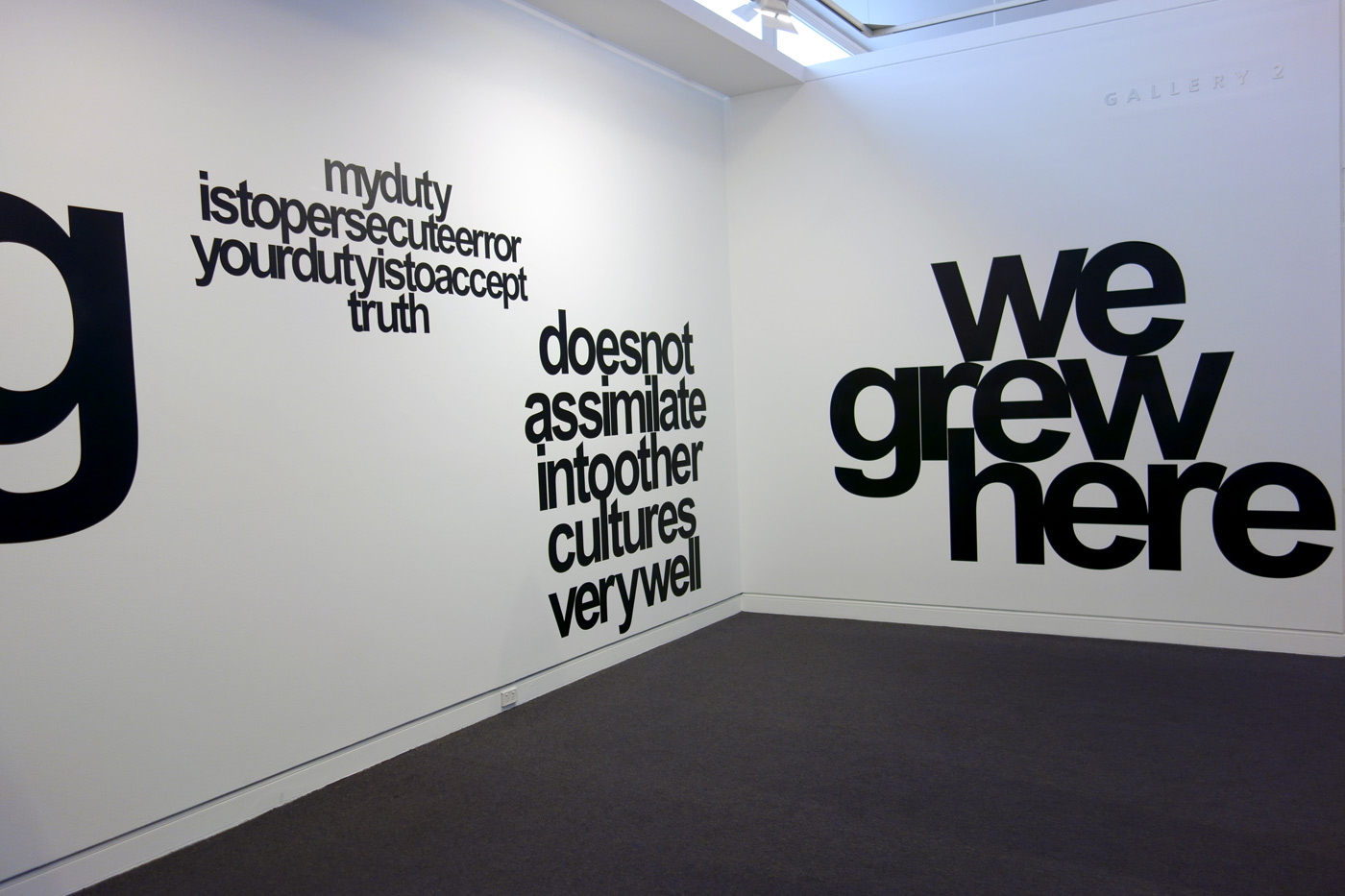
Mornington Peninsula Regional Art Gallery website

LIKE ART BLART ON FACEBOOK

Back to top

Exhibition: ‘John Wolseley – Heartlands and Headwaters’ at The Ian Potter Centre: NGV Australia, Melbourne

Exhibition dates: 11th April – 16th August 2015


John Wolseley (Australian, b. 1938) 'Regeneration after fire – the seeders and the sprouters, Mallee' (detail) 2009-2011


John Wolseley (Australian, b. 1938)
Regeneration after fire – the seeders and the sprouters, Mallee (detail)
2009-2011
Watercolour, charcoal, pencil and pigment
152.2 x 256.7cm irreg.
Collection of Sir Roderick Carnegie AC and Family
© John Wolseley


I went for a long walk through recently burnt mallee scrub in the Big Desert Wilderness Park. Some of the mallee roots had vivid amber, scarlet and mauve new growth exploding from the surviving stumps. Nearby were scatterings of tiny, bright banksia seedlings that had germinated after the fire, causing seed pods to burst open and expel their seeds. Botanists call such trees ‘seeders’, while their companions, the mallee eucalypts, are known as ‘sprouters’. Sprouters have a large root, known as a lignotuber, which stores water and nutrients – this is part of a brilliant strategy for survival in arid landscapes.


This is a wondrous exhibition by John Wolseley at NGV Australia. The whole feeling of the exhibition, its scale and intimacy, the attention to detail and the sheer the beauty of the work is quite outstanding. I was fascinated with the text descriptions the artist gives with each piece of work, included here in the posting.

While Wolseley plays with time (deep time, shallow time and now time) and space here it is more than that, for deep time (or “the zone” in the alternative parlance of athletes) is also used in artistic activity to refer to the experience of being lost in the act of creation or the consumption of a work. To the viewer, so it would seem here for we become lost in the art of creation. There is a sense of timelessness, the experience of unusual freedom within time, an unawareness of time, within Wolseley’s work, yet still grounded in the past and present, flowing into the future of this planet. This sense of place, context, space and time(lessness) are lucidly resolved in the artist’s work.

As the Introduction to the exhibition states, Wolseley conceives the exhibition as gesamtkunstwerk, a total work of art, presenting new possibilities for understanding landscape in the twenty-first century. This generally works well in revealing the unique, dynamic processes of natural ecosystems when the work is on the wall. However, the floor of the gallery (natural timber boards) lessened the experience of the “total work of art” for me. If you are designing an exhibition that would seem to me to be immersive (to some extent) then the work needed more grounding than it contains here.

This is a minor observation in an otherwise superlative exhibition. The colours, the sensitivity of the painting, the flow of the images, water, music, prose… are a narrative almost like a fable if the issues were not so real. The heightened imagery and emotional effects of the work make us truly aware that now is the time for action. The future development of the new coal power stations must be stopped. Renewable energy is the energy of the future as much as it is light emanating from the past.

Dr Marcus Bunyan


Many thankx to the National Gallery of Victoria for allowing me to publish the art work in the posting. Please click on the photographs for a larger version of the image.


Artist Interview | John Wolseley 


Over the past four years, John Wolseley has travelled and painted throughout the Australian continent. He has journeyed from the swamps of the Tasmanian high country to the coastal flood plains of the tropical north, exploring the nature and action of water and how it has shaped the land.

Wolseley has worked on site beside strange and diverse wetlands – sphagnum bogs, ephemeral waterholes, bilabongs and mangrove swamps – and combined his own distinctive mark-making processes with more traditional watercolour techniques. He has ‘collaborated’ with plants, birds and insects and used a range of drawing systems that includes frottaging (rubbing against) burnt trees, burying papers in sand and swamps and nature printing from leaves, wood and rocks.

The artist’s layered and collaged papers have been assembled as an installation in the shape of a giant branching tree, surrounded by large-scale works which enclose the viewer in an immersive environment. Wolseley has rejected European landscape conventions that often reduce a complex, living system to a static and generalised representation. Instead, he endeavours to reveal the unique, dynamic processes of natural ecosystems. Conceived as gesamtkunstwerk (total work of art), Heartlands and headwaters presents new possibilities for understanding landscape in the twenty-first century.

Introduction text to the exhibition


John Wolseley (Australian, b. 1938) 'History of the Whipstick Forest with ephemeral swamps and gold bearing reefs' 2011


John Wolseley (Australian, b. 1938)
History of the Whipstick Forest with ephemeral swamps and gold bearing reefs (detail)
2011
Watercolour, charcoal and pencil on 2 sheets (a-b)
233.5 x 286.6cm (overall)
Collection of Sir Roderick Carnegie AC and Family
© John Wolseley


One summer’s day I walked from my studio into the forest and followed a dry creek to some swamps and pools bursting with life. This arid landscape, so torn up and churned over, was still miraculously reinventing itself. Such resilience!

In this drawing I bring together the histories of three kinds of time: the ‘deep time’ of geology, ‘shallow time’ since European arrival, and ‘now time’ in October 2011. The history of the hidden workings of the earth I stole from a geologist’s map. Resting on this ancient framework in the painting’s centre is the green swamp. Above this is another map, which tells the story of William Johnson, a visitor to this forest 160 years ago, whose discovery of gold was the birth of the Bendigo goldfields.

When I was working on this painting, this bush was burnt in line with the government’s draconian legislation to burn all public bushland in Victoria every ten years. This often gives no time for vegetation to mature and seed, and biodiversity in certain fire-sensitive ecologies is being ravaged. My reverence for nature’s resilience was moved to a sense of deep chagrin that yet again we are destroying the matrix which is our home.


John Wolseley (Australian, b. 1938) 'From Siberia to Roebuck Bay – the godwits reach the mangrove swamps, WA' 2012 (detail)


John Wolseley (Australian, b. 1938)
From Siberia to Roebuck Bay – the godwits reach the mangrove swamps, WA (detail)
2012
Watercolour over pencil, charcoal and coloured chalk
151.9 x 199cm irreg.
Collection of Sir Roderick Carnegie AC and Family
© John Wolseley


Each year in June the bar-tailed godwits fly 12,000 kilometres from their breeding grounds in Siberia to the north coast of Australia. I was standing by the sea on the north Kimberley coast when out of a clear sky the godwits arrived in vast, pulsing flocks that swooped down to rest on the mudflats. The land, with its mudflats and sandbanks, had been formed by the great king tides, dragged for eons by the cycles of the moon. And now I could see these great tides of godwit, pulled by another powerful force, flow down and merge with the waters.


John Wolseley (Australian, b. 1938) 'Natural history of swamps III, heron in swamp - Loy Yang Power Station' 2009-2010 (detail)


John Wolseley (Australian, b. 1938)
Natural history of swamps III, heron in swamp – Loy Yang Power Station (detail)
2009-2010
Watercolour, pencil, ink, black chalk, scratching out and leaf
114 x 176cm
Collection of Sir Roderick Carnegie AC and Family
© John Wolseley


I was looking at a dam in the grounds of the Loy Yang Power Station, when in flew a black-backed heron. It looked for fish in the water and then peered at a billboard declaring ‘Hazelwood Power Station – WETLAND DEVELOPMENT PROJECT’. I walked down to the vast open-cut coalmine, and looked for fish fossils and Cryptogamic flora among the seams of coal. Then I returned to the heron, which now seemed to be looking at the steam and CO2 belching out of the cooling towers – those clouds of CO2 that came from the coal which was once a carboniferous swamp.


For four years, artist John Wolseley has roamed the coastal floodplains of the Northern Territory through to the glacial lakes of Tasmania, exploring and recording in exquisite detail the diverse wetlands of Australia. The works he has created will be revealed at NGV Australia.

This series of eighteen evocative works on paper, many of them monumental in scale (up to 10 metres in size), detail the geographical features and unique plants and animals of these wetlands in works characterised by minutely-observed drawing and rich watercolour washes.

Many works combine collage and unusual markings made through burying works or hoisting large sheets of paper across the charred remains of burnt tree trunks and branches. Through this ‘collaboration’ with the natural environment, Wolseley subverts traditional approaches to the depiction of landscape and seeking to give the natural world a more active presence in the work of art.

‘Heartlands and Headwaters celebrates Australia’s unique and diverse natural environment,’ said Tony Ellwood, Director, NGV. ‘Wolseley’s work is not only of great beauty, but also demonstrates how depicting the landscape has become an important form of activism’.

The mangrove swamps of Roebuck Bay in Western Australia, the flood plains of the Gulf of Carpentaria in the Northern Territory, the Finke River in the Simpson Desert and the sphagnum swamps of Skullbone Plains in central Tasmania are just some of the sites detailed in these impressive works.

Commissioned by Sir Roderick Carnegie AC, these works celebrate the beauty of the Australian wilderness and encourage an understanding of the significance and environmental fragility of these remote and little-known sites.

About John Wolseley

Born in England in 1938, John Wolseley immigrated to Australia in 1976 and has gained recognition in the past four decades as one of Australia’s leading contemporary artists whose work engages passionately with the environment.

Over the years Wolseley has travelled extensively throughout the country, into the arid interior and remote wilderness areas in all states, camping out for extended periods and immersing himself in the landscape.

This approach is reflected in the distinctly non-traditional character of the landscape works Wolseley produces. Instead of presenting a single overarching view of a particular site they are composite images that combine precisely observed details of flora and fauna. Informed by readings in geology, biology, cartography and other disciplines, these provide multiple perspectives on the location’s topography, journal notations and observations of natural cycles or patterns of the area.

Press release from the NGV website


John Wolseley (Australian, b. 1938) 'Murray-Sunset refugia with 14 ventifacts' 2008-2010


John Wolseley (Australian, b. 1938)
Murray-Sunset refugia with 14 ventifacts
2008-2010
From The Great Tree of Drawings 1959-2015, installed 2015
Pencil, watercolour and charcoal on 15 sheets (a-o)
Dimensions variable (overall)
Collection of Sir Roderick Carnegie AC and Family
© John Wolseley


John Wolseley (Australian, b. 1938) 'Murray-Sunset refugia with 14 ventifacts' 2008-2010  (detail)

John Wolseley (Australian, b. 1938) 'Murray-Sunset refugia with 14 ventifacts' 2008-2010 (detail)


John Wolseley (Australian, b. 1938)
Murray-Sunset refugia with 14 ventifacts (details)
2008-2010
From The Great Tree of Drawings 1959-2015, installed 2015
Pencil, watercolour and charcoal on 15 sheets (a-o)
Dimensions variable (overall)
Collection of Sir Roderick Carnegie AC and Family
© John Wolseley


This work was made in the Murray-Sunset National Park, where I found an island of unburnt scrub remaining after a bushfire. This refugium, or sanctuary, provided shelter for plants and small creatures from which they could later gradually recolonise the surrounding sand dunes. The small, flying sheets are papers I released to blow on the desert winds for weeks and sometimes months. Each sheet records carbon traces made by the burnt fingers of trees and shrubs. Having been made soft from dews and showers, and dried and tossed by the desert winds, they have become fixed in a variety of sculptural forms.


John Wolseley (Australian, b. 1938) 'Natural history of a sphagnum bog, Lake Ina, Tasmania' 2013


John Wolseley (Australian, b. 1938)
Natural history of a sphagnum bog, Lake Ina, Tasmania
2013
Watercolour, pencil, pen and ink, and sphagnum on 8 sheets (a-h)
155.6 x 407.6cm (overall)
Collection of Sir Roderick Carnegie AC and Family
© John Wolseley


John Wolseley (Australian, b. 1938) 'Natural history of a sphagnum bog, Lake Ina, Tasmania' 2013 (detail)

John Wolseley (Australian, b. 1938) 'Natural history of a sphagnum bog, Lake Ina, Tasmania' 2013 (detail)

John Wolseley (Australian, b. 1938) 'Natural history of a sphagnum bog, Lake Ina, Tasmania' 2013 (detail)


John Wolseley (Australian, b. 1938)
Natural history of a sphagnum bog, Lake Ina, Tasmania (details)
2013
Watercolour, pencil, pen and ink, and sphagnum on 8 sheets (a-h)
155.6 x 407.6cm (overall)
Collection of Sir Roderick Carnegie AC and Family
© John Wolseley


As a creek moves down to the shores of Lake Ina in the central highlands of Tasmania, it swells out into an ancient sphagnum moss swamp. I leant over and peered into a gap between the mats of sphagnum, and a small fish emerged in the crystal water. This brief phantom – a Clarence galaxias – was only miraculously there because its ancestors had been isolated by a glacial moraine (ridge) upstream, which six million years later had saved it from the European trout, which had supplanted most of the other galaxias in the rest of Tasmania. And then, marvellously, it had been saved again by the Tasmanian Land Conservancy, which had purchased these plains to protect them from further loss and degradation.

As the grey shadows moved down the hill and melted into the lake, I soaked and painted the spongy sphagnum mats with tinctures of watercolour – viridian and crimson and Indian yellow – and laid them on several sheets of paper. I did the same with water milfoils, spike reed, tassel sedges and bladderwort, and weighted them down overnight with slabs of bark. Their images were imprinted on the paper, emerging slowly like a photograph being developed.


John Wolseley (Australian, b. 1938) 'From the edge of the great flood plains of Garrangari and Garrangalli, NT' 2012-2014


John Wolseley (Australian, b. 1938)
From the edge of the great flood plains of Garrangari and Garrangalli, NT
2012-2014
Pencil, charcoal, black and brown chalk, watercolour, coloured pencil, coloured pastel, frottage and collages of linocut, wood relief printed in black and brown ink, watercolour, charcoal and coloured pencil over pencil and pen and ink on Japanese and wove paper
155.5 x 961.7cm irreg.
Collection of Sir Roderick Carnegie AC and Family
© John Wolseley


In June 2011 I was standing on the edge of the monsoon rainforest bordering a vast flood plain in East Arnhem Land with Djambawa Marawili, the great Yolngu leader and artist. Djambawa recounted how in the dawn of creation ancestral figures had moved up from the coast, digging for edible roots as they went, creating springs of fresh water that still bubble out along the plains. He described how when the first sun came up these ancestor women turned into brolga cranes. As he sang the song several brolgas emerged from the mists and flew slowly towards the coast.

This was the originary moment of this painting. For the next three years, guided by the Dhudi-Djapu clan leader and artist Mulkun Wirrpanda, I collected and drew specimens of plants and trees of the flood plain, and their edible roots and tubers. In the painting I have drawn many of them, along with the various trees festooned with vines.

For me the great miracle of that morning rested in that moment of time – being there, seeing the living land and sensing the ‘deep time’ so intimately linked with the life and art of the people who have lived in it for so long.


John Wolseley (Australian, b. 1938) 'A Daly River creek, NT' 2012


John Wolseley (Australian, b. 1938)
A Daly River creek, NT
2012
Watercolour, pastel, pencil, charcoal, ink, yellow pencil and collage of woodcut and linocut on Japanese paper (a-c)
152 x 602cm (overall)
Collection of Sir Roderick Carnegie AC and Family
© John Wolseley


John Wolseley (Australian, b. 1938) 'A Daly River creek, NT' 2012 (detail)


John Wolseley (Australian, b. 1938)
A Daly River creek, NT (detail)
2012
Watercolour, pastel, pencil, charcoal, ink, yellow pencil and collage of woodcut and linocut on Japanese paper (a-c)
152 x 602cm (overall)
Collection of Sir Roderick Carnegie AC and Family
© John Wolseley


Here is a flowing tropical creek near Nauiyu, about two hours’ drive south of Darwin. It shows the fecund, flowing mass of life and aquatic plants and fish, and how they are all an integral part of one particular ecosystem. The plants were all drawn on the spot or collected and drawn later in Darwin. It was May 2012 and I went on several trips with the ethnobiologist Glenn Wightman, the Ngan’gi elder Patricia Marrfurra McTaggart AM and other artists from the arts centre at Nauiyu. They showed me the plants in their living habitat so that I could draw them in action, rather than as dried museum specimens – the Nymphaea waterlily, with its long, convulsive stems, several species of bladderwort, water chestnuts and duckweed.

In this tropical aquatic painting I have tried to show how landscape for me is made up of energy fields that I draw as passages of particular plant forms, in which the individual plants move or dance with different rhythms. My intention is to show how these rafts of different species weave in and out of one another, and across the surface of my painting, rather as a passage of a symphony changes key and mood.


John Wolseley (Australian, b. 1938) 'Cycles of fire and water - Lake Tyrrell, Victoria' 2011-2012


John Wolseley (Australian, b. 1938)
Cycles of fire and water – Lake Tyrrell, Victoria
2011-2012
Watercolour, charcoal, pencil, sponging and scratching out on 2 sheets (a-b)
154 x 610cm (overall)
Collection of Sir Roderick Carnegie AC and Family
© John Wolseley


John Wolseley (Australian, b. 1938) 'Cycles of fire and water – Lake Tyrrell, Victoria' 2011-212  (detail)


John Wolseley (Australian, b. 1938)
Cycles of fire and water – Lake Tyrrell, Victoria (detail)
2011-2012
Watercolour, charcoal, pencil, sponging and scratching out on 2 sheets (a-b)
154 x 610cm (overall)
Collection of Sir Roderick Carnegie AC and Family
© John Wolseley


I was sitting on a low sandbank and drawing the pools of water that lay on this ancient salt lake. A rust-coloured cloud erupted into the air and darkened the sky over the water. The wind grew stronger, as if emanating from the core of the fire, and it carried embers and burning branches like dismembered limbs. I felt a kind of disquiet, almost dread. I knew such fires had always been part of the natural cycles of the bush, but this was one of several I had experienced that season where it felt as if fire itself was behaving in a different, more erratic way; as if the subtle equilibrium of the climate was changing.

From out of the billowing clouds of smoke some spoonbills, ibis and cormorants emerged, and flew far out over the lake. Several of them alighted on a patch of sunlit water and remained there, as if illustrating some cycle of eternal return – from action to stillness, from noise to quiet. But as I watched, the great black cloud drifted over their resting place, moving them on as if they were being chased away from the world they had known.


John Wolseley (Australian, b. 1938) 'After fire - spiny-cheeked honeyeaters at Lake Monibeong' 2009-2011 (detail)


John Wolseley (Australian, b. 1938)
After fire – spiny-cheeked honeyeaters at Lake Monibeong (detail)
2009-2011
Watercolour, charcoal, pencil, gouache and brown chalk
151.7 x 128.9cm
Collection of Sir Roderick Carnegie AC and Family
© John Wolseley


Walking through the recently burnt Cobboboonee Forest in Victoria one morning, I reached a lake where fresh water rested in sand dunes bordering the sea. I stood beside a burnt banksia tree with powdery black, corrugated bark. It had been a stormy night, but now the sea and lake were calm. Several spiny-cheeked honeyeaters swooped down, perched in the tree and sung out jubilantly. It was as if they were filled with elation at all these elements coming to rest in equilibrium – the lake resting within the sand dune, the quietening of the wind and the passing of the fire.


The Ian Potter Centre: NGV Australia
Federation Square
Corner of Russell and 
Flinders Streets, Melbourne

Opening hours:
Open daily 10am – 5pm

National Gallery of Victoria website

LIKE ART BLART ON FACEBOOK

Back to top

Review: ‘Luminous World: Contemporary Art from the Wesfarmers Collection’ at The Ian Potter Museum of Art, Melbourne 

Exhibition dates: 31st March – 5th July 2015

Curator: Helen Carroll


Gretchen Albrecht (New Zealand, b. 1943) 'Pink and orange sherbet sky' 1975  


Gretchen Albrecht (New Zealand, b. 1943)
Pink and orange sherbet sky
1975
Acrylic on canvas
166 x 177cm
© Gretchen Albrecht, reproduced courtesy of the artist and Wesfarmers Collection of Australia


Gorgeous catalogue with luscious plates, insightful text by Bill Henson (below) and evocative poetry by John Kinsella. Stars on the front cover and silver edged pages. No expense spared in production, with money literally thrown at the project, or so it would seem.

The curator, Helen Carroll, talks about ‘wonder’: “It is a capacity for wonder that makes us human”. Henson talking about ‘wonder’ and ‘love’ – about moments that change your life when looking at and breathing in great art. Then why does this exhibition feel so… well, needless? Despite some fascinating individual works of art, collectively there is little wonder on show here.

Perhaps it is because this exhibition looks to be a cut down version of the one first shown at the Art Gallery of Western Australia in 2012, with many works missing from what are listed in the catalogue. Or perhaps it is the hang which at the Ian Potter Museum of Art consists of two rooms on the ground floor of the museum, one housing lighter works, the other dark works. Too dichotomous for my tastes. Nothing is ever so cut and dried.

Perhaps it’s the fact that the concept of the exhibition – light in its many guises – seems to have been tagged onto a groups of art works which are anything but about light. Or are about light in a roundabout, merry-go-round kind of way. The wall text states, “Rather than a chronological or stylistically ordered presentation, the exhibition follows a loosely intuitive flow of ideas and imagery, moving through night to day. The artists in this exhibition explore light from the perspective of the optical experience, the connection between the starts and the cycles of life on earth; and from diverse cultural, mythic and spiritual points of departure.” Apparently the works are more about the phenomena of light than about light itself.

While the art works are interesting in their own right they don’t really work together cohesively as a group to investigate the theme of the exhibition. Trying to burden a collection of art bought for investment purposes with a concept not “natural” to the work, or just a curator’s idea of what seems implicit in the work but is just a cerebral construction, simply does not work in this case. As I looked around the exhibition, I felt the works were more about the physicality of time and space (of history and place), about links in the existential chain, than they were about light. For me, this evinced Mikhail Bakhtin’s notion of the ‘chronotype’ – meaning ‘the connectedness of temporal and spatial relationships that are artistically expressed’ (in literature). Perhaps the intuitive flow of ideas and imagery and the multiple points of departure work against the very idea the exhibition seeks to investigate. This is so broadly thematic (the effects of light on the world) that it needed to be more focused in its conceptualisation.

It’s also a real worry when text panels in the exhibition quote Richard Goyder, Managing Director, Wesfarmers Limited, as saying that this is the first time that Wesfarmers has showcased the contemporary art of the collection, “and the works selected for Luminous World illustrate some of the ways in which the collection has grown in recent years. For instance, the inclusion of art from New Zealand, where Wesfarmers has a significant business presence, and the heightened emphasis on representing the great diversity of contemporary Indigenous art.”

The inclusion of New Zealand art because Wesfarmers has a significant business presence – not the quality or wonder of the art work – but a business presence. And only now are they collecting contemporary Indigenous art, after the collection has been in existence for more than three decades, 1977 being the first acquisition date. At least he is being refreshingly honest about why the art work has been added to the collection, but it does not give you confidence in the choice of the art work being displayed here. Goyder, Carroll and Kinsella also proselytise about the benefits of employee’s living with this art in their daily working lives and that may be the case. But for the casual visitor to the gallery this collection of art left me feeling cold and clammy – like a fish out of water.

As the add for Reflex copy paper says with more humour than any of this work can muster, I didn’t find “enwhitenment”, or wonder, within the gallery walls. Oh, the luminosity of it all.

Dr Marcus Bunyan


Many thankx to The Ian Potter Museum of Art for allowing me to publish the photographs in the posting. All installation photographs © Marcus Bunyan and The Ian Potter Museum of Art. Please click on the photographs for a larger version of the image.


What is the Night?

‘What is the night?’ Macbeth enquires in the banquet scene, once the ghost of Banquo has departed and his wide has dismissed their mystified guests. Deprived of sleep, and half-psychotic, he urgently needs to know the time. But this is also, implicitly, a philosophical question that hints at the ontological meaning of the night…

Macbeth, Shakespeare’s most elaborate meditation on the night, is a sustained, if not obsessive, exploration of the nocturnal as a realm of alternative values – ones that contradict and threaten to undermine those of the diurnal regime that is ostensibly the domain of politics in the early modern period. In this violent, vengeful tragedy, the language and culture of the medieval night, incarnated above all in the witches, irrupts into the more enlightened languages and culture of a purportedly post-medieval epoch. An apocalyptic night, in Macbeth’s barbaric court, is one of the forces that shape realpolitik. In the Renaissance, a period in which daily life encroaches more and more on the night, especially in public settings, in the form of elaborately lit masques at court, Macbeth thus stages the limits of enlightenment.

At a time when more systematic, socially centralized modes of illumination are increasingly disrupting older patterns of rest, including biphasic sleep – so that, for the early modern ruling class at least, night starts to feel like an extension of the day, its observe rather than its inverse – Shakespeare dramatises the tyrannical attraction, the absolutism, of darkness. Macbeth describes a process of nocturnalisation whereby the night irresistibly colonises the day, fatally infiltrating both the state and the protagonist’s consciousness. To use a word that has some currency in the seventeenth century, but has long since fallen out of use, Shakespeare’s drama is a study of ‘benightment’.”

Matthew Beaumont. “What is the Night?” in Matthew Beaumont. Nightwalking: A Nocturnal History of London, Chaucer to Dickens. London and New York: Verso, 2015, pp. 86-87.


Luminous World brings together a selection of contemporary paintings, objects and photographs from the Wesfarmers Collection in a conversation about light. Through works of scale and conceptual invention that chart the range and depth of the collection, this exhibition presents significant contemporary paintings, photographs and objects by leading Australian and New Zealand artists acquired by Wesfarmers over three decades and shared together for the first time with the Australian public.

The Potter is the fifth venue for this touring exhibition which to date has travelled to Charles Darwin University Art Gallery, Darwin; National Library of Australia, Canberra; Samstag Museum of Art, Adelaide; and The Academy Gallery, University of Tasmania.


Brook Andrew (Australian, b. 1970) 'Replicant series: Owl' 2005 


Brook Andrew (Australian, b. 1970)
Replicant series: Owl
2005
Ilfochrome print
130 x 195cm
© Brook Andrew, reproduced courtesy of the artist and Wesfarmers Collection of Australian Art


Brook Andrew (1970- ) is a Sydney born / Melbourne based interdisciplinary artist of Wiradjuri and Scottish heritage. Andrew’s conceptual based practice incorporates, sculpture, photography, installation, video and performance. The Replicant 2006 series reflects (literally) upon the act of looking, and consequent interchanges between nature and culture, subject and object, real and represented. These dualities fit broadly within the artist’s addressing of Australian identity, polemics and the politics of difference.

For the Replicant 2006 series Andrew borrowed taxidermied specimens from the education department at the Australian Museum, Sydney. These included native species of indigenous significance such as an owl, possum, flying fox and parrot. He shot each animal – artificially propped in their natural poses – and digitally manipulated each image so as to appear duplicated, a process that evolved out of the Kalar midday 2004 series.


Bill Henson (Australian, b. 1955) 'Untitled' 2009-10 


Bill Henson (Australian, b. 1955)
Untitled
2009-10
Archival inkjet pigment print
127 x 180cm
© Bill Henson, reproduced courtesy of the artist and Wesfarmers Collection of Australian Art


” … And yet certain things – particular experiences that we have are exceptional. They stand apart from the rest of the general activity.

What causes this apprehension of significance – of something in face powerfully apprehended yet not always fully understood?

And why is it that all of us, at some time or other, with have this ‘epiphany’ – Christian or otherwise – in the presence of some work of art, in the experiencing of a performance piece or some unexpected encounter with the true magic of a particular piece of sculpture?

When it happens, I always think of it as being as if one’s life – and everything that it contains – had just been ever so slightly changed, forever. Nothing, if you will, is ever quite the same again.

What happens, I think, is simply that we fall in love – and it’s the apprehension of unexpected beauty that causes us to fall in love.

The sheer force of such beauty can affect us as if it were an act of nature – and of course it is, for despite the arrogance of some theoreticians, culture is never outside nature.

I think that it is this intense, if often quite subtle, love for the subject, and the resultant emotional and intellectual interdependence within that relationship – be it in musical form, something in the visual arts, theatre of dance – that is responsible for – and in fact makes possible at all – these great and fortunate encounters in the arts. …

Stare back into time and all kinds of very ‘personal’ things return your gaze. This has always, to me, seemed to a large extent to be what art is about. Sure, it’s personal, but it’s also millennial. …

The best art always heightens our sense of mortality. This is not morbidity that I am talking about – rather, we feel more alive in the presence of great art and this is because of a profound sense of continuity – our sense of being inside nature – is expanded.

If you like, art suggests the immortal in all of us.

When we listen to Michelangeli – or, say, Jörg Demus playing Kinderszenen – and we sense that simultaneously proximate and intimate yet utterly abstract presence (was that someone? Schumann perhaps?) and at the same time sense the unbridgeable gulf that exists between ourselves and that distant past – we know that we are in the presence of something magical.

In the end I think that it is love that fuels this activity – that animates the speculative capacity in all of us – and heightens this sense of wonder.

Excerpts from Bill Henson’s speech “Reflections,” in Luminous World catalogue. Perth: Wesfarmers Limited, 2012, pp. 23-24.


Installation view of the exhibition 'Luminous World: Contemporary Art from the Wesfarmers Collection' at The Ian Potter Museum of Art, The University of Melbourne

Installation view of the exhibition 'Luminous World: Contemporary Art from the Wesfarmers Collection' at The Ian Potter Museum of Art, The University of Melbourne

Installation view of the exhibition 'Luminous World: Contemporary Art from the Wesfarmers Collection' at The Ian Potter Museum of Art, The University of Melbourne

Installation view of the exhibition 'Luminous World: Contemporary Art from the Wesfarmers Collection' at The Ian Potter Museum of Art, The University of Melbourne


Installation views of the exhibition Luminous World: Contemporary Art from the Wesfarmers Collection at The Ian Potter Museum of Art, The University of Melbourne
Photos: Marcus Bunyan


David Stephenson (Australian, b. 1955) 'Star Drawing 1996/402' 1996


David Stephenson (Australian, b. 1955)
Star Drawing 1996/402
1996
40 x 40″
Cibachrome print
National Gallery of Victoria, Melbourne
Purchased, 1997
© Courtesy of the artist


While the subject of my photographs has shifted from the landscape of the American Southwest and Tasmania, and the minimal horizons of the Southern ocean, and the icy wastes of Antarctica, to sacred architecture and the sky at both day and night, my art has remained essentially spiritual – for more than two decades I have been exploring a contemporary expression of the sublime – a transcendental experience of awe with the vast space and time of existence.

David Stephenson, 1998


Bill Henson (Australian, b. 1955) 'Untitled 39/139' 1990-91


Bill Henson (Australian, b. 1955)
Untitled 39/139
1990-91
Paris Opera Project
Type C photograph
127 × 127cm
Series of 50
Edition of 10 + 2 A/Ps


Stieg Persson (Australian, b. 1959) 'Offret' 1998 


Stieg Persson (Australian, b. 1959)
Offret
1998
Oil on canvas
183 x 167cm
© Stieg Persson, reproduced courtesy of the artist and Wesfarmers Collection of Australian Art


Works focusing on light and darkness, and how light creates and reveals our world, from one of Australia’s pre-eminent corporate art collections compiled by Wesfarmers over the past 30 years, will be exhibited at the Ian Potter Museum of Art at The University of Melbourne.

The exhibition, Luminous World: Contemporary art from the Wesfarmers Collection, presents a diverse selection of contemporary paintings, photography and works of sculpture. The works traverse a diversity of cultural, aesthetic and philosophical perspectives, with the curatorial premise of how contemporary artists explore the phenomenon of light in their work.

Some 50 artists from Australia and New Zealand are featured in the exhibition including: Susan Norrie, Rosemary Laing, Howard Taylor, Dale Frank, Paddy Bedford, Bill Henson, Fiona Pardington (NZ), Brian Blanchflower, Brook Andrew, Timothy Cook and Nyapanyapa Yunupingu. Included alongside the art is a major new body of poetry by John Kinsella, written in response to works in the exhibition. These are published for the first time under the imprint of Fremantle Press in the book Luminous World, with new writing by artist Bill Henson and composer Richard Mills.

Ian Potter Museum of Art Director, Ms Kelly Gellatly said, “Luminous World highlights the strengths of the Wesfarmers Collection, which has generously been shared, through the tour of the exhibition, with the wider community.

“In bringing together works across a range of media by Indigenous and non-Indigenous artists, Luminous World successfully showcases both the depth and continuing resonance of contemporary Australian practice in a rich, open-ended and exploratory conversation about light.

“To know and experience light and its effects however, one must equally understand its other – darkness. Together, these concerns create an exhibition experience that is at once intellectual, emotional and experiential,” Ms Gellatly said.

The Wesfarmers Collection was started in 1977, and is housed in the Wesfarmers offices around Australia and shared with the community through a loan and exhibition program. A Wesfarmers and Art Gallery of Western Australia touring exhibition.

Press release from The Ian Potter Museum of Art website


Installation view of the exhibition 'Luminous World: Contemporary Art from the Wesfarmers Collection' at The Ian Potter Museum of Art, The University of Melbourne

Installation view of the exhibition 'Luminous World: Contemporary Art from the Wesfarmers Collection' at The Ian Potter Museum of Art, The University of Melbourne

Installation view of the exhibition 'Luminous World: Contemporary Art from the Wesfarmers Collection' at The Ian Potter Museum of Art, The University of Melbourne


Installation views of the exhibition Luminous World: Contemporary Art from the Wesfarmers Collection at The Ian Potter Museum of Art, The University of Melbourne
Photos: Marcus Bunyan


“For more than three decades Wesfarmers has been collecting Australian art. From General Manager John Bennison’s first acquisition in 1977 of a pastoral scene by the Australian impressionist Elioth Gruner, Wesfarmers’ purpose was to accentuate the value of art in the workplace and encourage and understanding of the importance to society of supporting creative thinking and artistic vision. The company has always been committed to sharing its collection with the community through exhibitions and loans and by opening our workplaces for groups to view the art in our offices.

This is the first time Wesfarmers has showcased the contemporary art in the collection, and the works selected for Luminous World illustrate some of the ways in which the collection has grown in recent years. For instance, the inclusion of art from New Zealand, where Wesfarmers now has a significant business presence, and the heightened emphasis on representing the great diversity of contemporary indigenous art.

We thank the artists whose resonant and timeless works form part of Australia’s rich cultural heritage and hope that the Australian public will enjoy these works and marvel at the ingenuity and artistic vision they represent, as Wesfarmers does, surround by inspirational art in our daily lives.”

Richard Goyder
Managing Director, Wesfarmers Limited


The visual world is defined by light; everything we see is processed by the eye as patterns of brightness and colour. Monumental formations in the landscape as well as the most subtle nuances of atmosphere are made real to us by the action of light, transmitted in wavelengths as an infinitely varied register of colour that combine within the eye to shape our sense of space and form.

It is the action of light reflecting off, refracting through and being absorbed by the substance of the world that enables the eye to perceive contours, hues, and textures and mark the passing of time from day to night and season to season.

Luminous World presents a diverse selection of contemporary paintings, photography and works of sculpture, acquired by the Wesfarmers Collection over thirty years and considered through the lens of how contemporary artists variously utilise the phenomenon of light in their work.

Rather than a chronological or stylistically ordered presentation, it follows a loosely intuitive flow of ideas and imagery moving through night to day. The artists in this exhibition explore light from the perspective of the optical experience, the connection between the stars and the cycles of life on earth; and from diverse cultural, mythic and spiritual point of departure.

Published for the first time in the Luminous World catalogue are recent poems by John Kinsella, written in response to selected works in the exhibition, together with new writing by artist Bill Henson and composer Richard Mills that extend an artistic dialogue in which all can share.


Rosalie Gascoigne (Australian, 1917-1999) 'Hung fire' 1995


Rosalie Gascoigne (Australian, 1917-1999)
Hung fire
1995
Retro-reflective road-sign on wood
209 x 176cm
© Rosalie Gascoigne, licensed by Viscopy 2012 and Wesfarmers Collection of Australian Art


Elizabeth Nyumi (Australian, born c. 1947) 'Parwalla' 2010 


Elizabeth Nyumi (Australian, born c. 1947)
Parwalla
2010
Acrylic on canvas
120 x 180cm
© Elizabeth Nyumi, licensed by Viscopy 2012 and Wesfarmers Collection of Australian Art


About Parwalla

This painting depicts the country known as Parwalla, which is Nyumi’s father’s country. This country is far to the south of Balgo in the Great Sandy Desert, west of Kiwirrkurra, and is dominated by tali (sand hills). Parwalla is a large swampy area, which fills with water after the wet season rain and consequently produces an abundance of bush foods. The majority of Nyumi’s painting shows the different bush foods, including kantjilyi (bush raisin), pura (bush tomato) and minyili (seed). The whiteish colours, which dominate the painting, represent the spinifex that grows strong and seeds after the wet season rains. These seeds are white in colour, and grow so thickly they obscure the ground and other plants below.

Biography

When Nyumi was only a very young child her mother died at Kanari soakwater close to Jupiter Well. As a young girl, Nyumi lived with her family group in their country. As a teenager she walked along the Canning Stock Route into the old mission with her father and family group. There she was given clothes and taken to Billiluna Station to be trained as a domestic worker and to work for the wives of the station managers around the region.

Nyumi commenced painting in 1987 and emerged as a leading artist in the late 1990s. She is married to the artist Palmer Gordon and has four daughters, three of whom are still living and beginning to paint with strong encouragement from Nyumi. Her elder brothers Brandy Tjungurrayi and Patrick Olodoodi are both senior lawmen and recognised artists. Nyumi is a very strong culture woman and dancer and an enthusiastic teacher of culture to children, ensuring the traditional dances and songs are kept alive.

Nyumi’s paintings are mainly concerned with the abundant bush food in the country belonging to her family. Initially, she worked with a thick brush, covering the canvas with fluent lines in tones of yellow, green and red. She has now developed a strong personal style of thick impasto dotting, to build up fields of texture heavily laden with white, in which motifs of camp sites, coolamons, digging sticks and bush tucker stand out.


Rosemary Laing (Australian, 1959-2024) 'Brumby mound #5' from the series 'One dozen unnatural disasters in the landscape' 2003


Rosemary Laing (Australian, 1959-2024)
Brumby mound #5 from the series One dozen unnatural disasters in the landscape
2003
C Type photograph
110 x 222cm
© Rosemary Laing, reproduced courtesy of the artist and Wesfarmers Collection of Australian Art


Brumby mound #5 2003 is one of a series of photographs by Rosemary Laing that explores the way European culture has often been uncomfortably imposed on an ancient land. Laing chooses a desert-scape that many identify as quintessentially Australian as the setting for her interventions. The location is the Wirrimanu community lands around Balgo in north-east Western Australia. Onto these traditional lands Laing has incongruously placed items of mass-produced furniture painted to mimic the surroundings.

The words ‘brumby mound’ in her title are a reference to the introduced horses (or brumbies) that are feral and roam uncontrolled, much like the spread of furniture. The seductive beauty of these panoramic images shows the vast spectacle of the Australian bush and makes the disjunction of the natural and the unnatural all the more apparent.

Text from the NGV website


Howard Taylor (Australian, 1918-2001) 'Bushfire sun' 1996 


Howard Taylor (Australian, 1918-2001)
Bushfire sun
1996
Oil on canvas
122 x 152cm
© Howard Taylor, courtesy of the artist’s estate and Wesfarmers Collection of Australian Art


Michael Riley (Australian, 1960-2004) 'Untitled' from the series 'Cloud [Feather]' 2000


Michael Riley (Australian, 1960-2004)
Untitled from the series Cloud [Feather]
2000
Inkjet print on banner paper
86 x 120 cm
© Michael Riley Foundation, licensed by Viscopy 2012 and Wesfarmers Collection of Australian Art


“Feathers float – so do clouds – and dreams.

Feather – a Wiradjuri word for feather and wing are the same, Gawuurra. Probably Cowra, the name of a town to the south, comes from this. In contemporary Aboriginal practices of other groups, feather-appendage is extended in meaning to string tassel, sacred string marking a journey, connecting landscapes, people, family lineages, and, importantly, the embryo cord linking child and mother.

A wing of the eagle hawk, Malyan, a skin name, a scary dream-being overhead. Is it guardian angel or assassin? In the south-east, a feather left behind is often evidence of such a spiritual visit.

At the funeral of actor and activist Bob Maza in 2000, his son held his father’s Bible and recollected his words, ‘to dare to dream your dreams’. It’s interesting that Michael Riley chose to avoid the word ‘dream’ in naming his final photographic work cloud (2000), avoiding glib connections to ‘Dreamtime’. What rolls past our eyes and through our senses is the culmination of self-examination. In a series of poetic photographic texts made increasingly poignant through events in his personal life, these are dreams of childhood memories in Dubbo, New South Wales: dreams of floating, of release…

cloud appears as more personal and free. A floating feather; a sweeping wing; a vigilant angel; the cows from ‘the mission’ farm; a single Australian Plague Locust in flight, referring to the cyclical swarms of locusts; a comforting Bible; and a graceful emblematic returning boomerang. The boomerang is really the only overtly Aboriginal image in the series and the locust is one of the few native species left that is visible and cannot be swept aside. It persists…

Through the large, simply superimposed images of cloud, Michael was trying to minimalise things, to distil his ideas about physical reality and spirit. All are dichotomously connected to Dubbo and Riley and are also universal. They are not about a place but a state, the surrealistic cow with mud and manure on its hoofs floating by. In contrast to Empire’s scenes of a decayed, overworked and desolated landscape, there is no physical land in the cloud imagery.

Aboriginal creation stories begin with a sunrise and follow the journeys of an original being across a physical, seasonal and emotional landscape – seeing, experiencing, and naming this and that plant, animal, climatic occurrence and emotional feelings. Religious song cycles follow this progression. Michael’s set of large, single-subject memories can almost be thought of as a Wiradjuri song cycle of his land and his life.”

Extract from Djon Mundine. “Wungguli – Shadow: Photographing the spirit and Michael Riley” on the “Michael Riley: sights unseen” National Gallery of Australia website Nd [Online] Cited 10/08/2021. No longer available online


Paddy Bedford (Australian, 1922-2007) 'Merrmerrji–Queensland creek' 2005 


Paddy Bedford (Australian, 1922-2007)
Merrmerrji-Queensland creek
2005
Ochre and synthetic binder on composition board
80 x 100cm
© Paddy Bedford, reproduced courtesy of the artist’s estate and Wesfarmers Collection of Australian Art


“Paddy Bedford was a senior Gija lawman born at Bedford Downs Station in the East Kimberly region. Like many indigenous artists, he lived a long life as a stockman before he looked upon the Turkey Creek elders – Rover Thomas and Paddy Jiminji – to begin painting. Bedford’s first works were made with the inception of the Jirrawun Aboriginal Art Cooperative in 1997.

The distinctive minimalist style of his work is but a mask to the multifarious layers of meaning. Bedford’s paintings are inspired by the distinctive landscape and stories of his country in the East Kimberly region of Western Australia, as he depicts from an aerial perspective the traditional dreamings of the Cockatoo, Emu and Turkey; the massacres of local Aboriginal people during the colonial period; as well as episodes from his own life as a stockman and as a senior elder of his community.

Merrmerrji-Queensland Creek, 2005 is characteristically sparse in composition with bold forms, a rhythmic application of dotted fluid lines and a powerfully imposing colour palate, which is gained from a wet-on-wet mixture of white and ochre pigments suspended in a fast drying acrylic medium. The effect is a pearly radiant luminosity, an ambience of the sacred.”

Text from the Annette Larkin Fine Art website. No longer available online.


The Ian Potter Museum of Art
The University of Melbourne,
Corner Swanston Street and Masson Road
Parkville, Victoria 3010

Opening hours: Tuesday – Saturday 11am – 5pm

The Ian Potter Museum of Art website

LIKE ART BLART ON FACEBOOK

Back to top

Exhibition: ‘Australian Women Artists Between the Wars’ at Lauraine Diggins Fine Art, Melbourne

Exhibition dates: 3rd March – 30th April 2015

Artists: Clarice Beckett, Dorrit Black, Bessie Davidson, Ethel Carrick Fox, Joy Hester, Nora Heysen, Hilda Rix Nicholas, Margaret Preston, Jane Price, Thea Proctor, Kathleen Sauerbier, Grace Cossington Smith, Clara Southern and others.


Clarice Beckett (Australian, 1887-1935) 'Winter Morning, Beaumaris' c. 1927-1931


Clarice Beckett (Australian, 1887-1935)
Winter Morning, Beaumaris
c. 1927-1931
Oil on canvas
39.3 x 55cm


A delightful exhibition on a subject I freely admit that I knew very little about. An intelligent opening speech from Associate Professor Alison Inglis from The University of Melbourne helped me to be more informed about this fascinating period in Australian art history.

The hero for me in this posting is the work of Clarice Beckett. The atmosphere of her paintings when seen in the flesh is incredible, perfectly capturing the suffused light of the bayside suburbs of Melbourne where she painted. Her impressions are so purposeful and vivid; no extraneous flourish is necessary. Look at the painting The Red Bus for example (below) … the brief almost cartoonish outline of the bus hugs the right hand side of the composition, the red picked up by one of the two people walking in the middle of a road that runs behind the tea-trees that shield the beach from view. Every Australian would understand the symbolic quality of this mythic road.

Shadows are delineated by a few patches of darkness, telegraph poles by four swiftly drawn lines balanced on the left-hand side of the painting by a faint sign post that is almost not there, reinforced spatially by a ghostly white figure further up the painting in the middle of the road. We can almost hear the cicadas song, feel the heat rising from the tarmac, a little breeze rolling in from the sea every now and then. These cultural memories, as annotated by Beckett, will last forever.

Dr Marcus Bunyan


Many thankx to Lauraine Diggins Fine Art for allowing me to publish the text and art work in the posting. Please click on the photographs for a larger version of the art.


Clarice Beckett (Australian, 1887-1935) 'Morning Ride' Nd


Clarice Beckett (Australian, 1887-1935)
Morning Ride
Nd
Oil on canvas on pulp board
29.5 x 35cm


Clarice Beckett (Australian, 1887-1935)

Clarice Majoribanks Beckett (21 March 1887-7 July 1935) was an Australian painter whose works are featured in the collections of the National Gallery of Australia, National Gallery of Victoria and the Art Gallery of South Australia.

Beckett is recognised as one of Australia’s most important modernist artists. Despite a talent for portraiture and a keen public appreciation for her still lifes, Beckett preferred the solo, outdoor process of painting landscapes. She relentlessly painted sea and beachscapes, rural and suburban scenes, often enveloped in the atmospheric effects of early mornings or evening. Her subjects were often drawn from the Beaumaris area, where she lived for the latter part of her life. She was one of the first of her group to use a painting trolley, or mobile easel to make it easier to paint outdoors in different locations..

Australian Tonalism

Australian Tonalism is characterised by a particular “misty” or atmospheric quality created by the Meldrum painting method of building “tone on tone”. Tonalism developed from Meldrum’s “Scientific theory of Impressions”; claiming that social decadence had given artists an exaggerated interest in colour and, to their detriment, were paying less attention to tone and proportion. Art, he said, should be a pure science based on optical analysis; its sole purpose being to place on the canvas the first ordered tonal impressions that the eye received. All adornments and narrative and literary references should be rejected.

Tonalism opposed Post-Impressionism and Modernism, and is now regarded as a precursor to Minimalism and Conceptualism. The whole movement had been under fierce controversy and they were without doubt the most unpopular group of artists, in the eyes of most other artists, in the history of Australian art. Influential Melbourne artist and teacher George Bell described Australian Tonalism as a “cult which muffles everything in a pall of opaque density”.

While painting the wild sea off Beaumaris during a big storm in 1935, Beckett developed pneumonia and died four days later in a hospital at Sandringham. She was buried in the Cheltenham Memorial Park (Wangara Road) not far from another noted female artist, Mary Vale. She was only 48 when she died, the year after her mother’s death.

Text from the Wikipedia website


Clarice Beckett (Australian, 1887-1935) 'The Red Bus' Nd


Clarice Beckett (Australian, 1887-1935)
The Red Bus
Nd
Oil on canvas on composition board
36.5 x 44cm


Dorrit Black (Australian, 1891-1951) 'The Parish Hall' 1937


Dorrit Black (Australian, 1891-1951)
The Parish Hall
1937
Coloured linocut
23 x 36cm


Family archive image of Dorrit Black


“It is the artist’s business to reveal to mankind a new outlook on life and the world.”

Dorrit Black, 1946


It should come as no surprise that Dorothea Foster (Dorrit) Black, like other women artists, would be scorned by the sexist, conservative Australian art establishment during her lifetime. When her life was tragically cut short by a car accident in Adelaide in 1951, artist and critic Ivor Francis’s obituary declared Black was that city’s first and, perhaps least understood “modern” artist.

“She has so consistently been artistically cold-shouldered and ignored since her return here about 20 years ago that it is amazing how she maintained the courage to fight on against so much prejudice and misunderstanding,” he wrote. “… It will be many years before her exceptional talent can be properly appreciated in its right perspective, as it most certainly will be.” …

Black was part of a generation of women, alongside Margaret Preston, Grace Cossington-Smith and Grace Cowley, who took risks by travelling overseas, painting in modernist styles and pursuing artistic careers often against the wishes of their family.

“What decided me to throw in my hand altogether the other day was your declaration that I ought to consider my time as belonging to the family first, leaving my painting for my spare time …” Black wrote in a letter to her brother in 1938. “After more than 20 years of struggling to make an artist of myself, I cannot give it all up and settle down to being nothing but a good sister and daughter.”

“She was a very modern woman which meant she belonged to an age when educated women started to break out of Victorian traditions and become independent and self-determined,” Lock-Weir says.

Black travelled to Europe on three occasions, including a two-year stint beginning in from September 1927 when she studied with printmaker Claude Flight at London’s Grosvenor School of Art, and cubists Andre Lhote and Albert Gleizes in Paris. In the summer of 1928, she travelled to the south of France with Crowley and Anne Dangar, where each painted views of the medieval hillside town of Mirmande. Black returned to Adelaide in 1935 to care for her ailing mother, building a studio-house on the city’s edge at Magill where she mainly painted landscapes of the Adelaide Hills and south coast. She also continued to advocate modern art and taught at the South Australian School of Art, influencing a generation of artists led by Jeffrey Smart and Ruth Tuck.

“Plump, dignified, black-haired and well-groomed, she was regarded as a mother-figure by younger artists,” wrote Ian North in the Australian Dictionary of Biography.

Black’s untimely death in 1951 at the age of 59 left a small legacy of around 130 oil paintings, 159 watercolours, 50 linocuts and a handful of drawings, according to art consultant John Cruthers. “Some painters paint a lot, some paint a little, and then there’s Dorrit.”

Andrew Taylor. “Rescuing the reputation of early Australian modernist Dorrit Black,” on The Sydney Morning Herald website, June 6th 2015 [Online] Cited 24/04/2015


Miriam Moxham (Australian, 1885-1971) 'Country Morning' c.1940


Miriam Moxham (Australian, 1885-1971)
Country Morning
c. 1940
Oil on composition board
94 x 182cm


Bessie Davidson (Australian, 1879-1965) 'Autumn Table at Villeneuve' 1935


Bessie Davidson (Australian, 1879-1965)
Autumn Table at Villeneuve
1935
Oil on plywood
44 x 82cm


Bessie Davidson (Australian, 1879-1965)

Bessie Davidson (1879-1965) was an Australian painter known for her impressionist, light-filled landscapes and interiors.

Davidson traveled to Australia to visit family in 1914 and was there when World War I began. She returned to France immediately, where she joined the French Red Cross and served in various military hospitals. During the war, she met the woman who would be her companion for the next two decades, Marguerite Leroy (d. 1938), whose nickname was “Dauphine”.

The postwar period between 1918 and 1920 saw Davidson producing quiet, intimate, loosely impressionistic paintings – mostly interiors, still lives, and portraits – in muted tones. Her style evolved in a more vigorous direction in the 1920s and 1930s, with rich, vibrant, often dramatic colours laid on with a palette knife. In this period her work sold well and was well-received by critics. She traveled around Europe, Russia, and Morocco making outdoor sketches that she used as the basis for paintings later produced in her studio. Her landscapes are notable for their quality of light and sense of atmosphere.

In 1930 Davidson was a founding vice-president of La Société Femmes Artistes Modernes. She was a founding member of the Société Nationale Indépendentes and a member of the Salon d’Automne. In 1931 she was appointed to the French Legion of Honor, in part for her cofounding of the Salon des Tuileries, the only Australian woman to receive that honour up to that time. She exhibited widely with such artists as Mary Cassatt, Tamara de Lempicka, Camille Claudel, and Suzanne Valadon.

Although still a citizen of the British Commonwealth, Davidson decided to stay in France during World War II. She lived with friends in Grenoble, and some sources say that she was a member of the French Resistance. Her paintings from this period are strong, bright, and lively. In 1945, she returned to her old studio in Paris, occasionally spending time at a farm she bought near Rouen. In the postwar period, she painted mostly outdoors on small wood panels. She died at Montparnasse in France in 1965. She was buried in Saint-Saëns, Seine-Maritime.

Text from the Wikipedia website


Bessie Davidson (Australian, 1879-1965) 'Still Life with Flowers and Pears' Nd


Bessie Davidson (Australian, 1879-1965)
Still Life with Flowers and Pears
Nd
Oil on cardboard
61 x 46cm


In the period between the wars, Australian women artists were leading the way by challenging traditions and exploring new ideas in art with a focus on colour, form and design, and subjects such as urban culture.

Role models like Jane Price, Jane Sutherland and Clara Southern had provided women with a basis to seriously pursue art as a profession. Circumstances and opportunity1 saw a flourishing of female artists establish a career through dedicated studies at a growing number of art schools, combined with travel overseas and, quite often, financial independence.

Painting en plein air was continued but rather than romanticised landscapes concerned with effects of light, the rise of the modern woman artist painted the landscape familiar to them with an adventurous attitude towards colour: from the buses and telegraph poles of Beckett’s Melbourne bayside suburbs; to the South Australian landscapes of Sauerbier; urban scenes such as Tempe Manning’s Princes Street and the intimate depictions of home or studio as seen in Gurdon’s Under the Window and as favoured by Cossington Smith.

Whilst there was no overall identifying modernist movement, a common experience of nearly all the women represented in this exhibition was travel and studies overseas, particularly to Paris and London,2 where the exposure to influences such as postimpressionism, modernism, futurism, cubism shaped each individual artist’s subsequent style.

Seemingly traditional and feminine subjects such as still life, flowers, intimate interior and leisure scenes and were invigorated through the work of artists such as Proctor (The Sewing Basket); Preston (Flowers) and Davidson, who maintained her career in France.3 Women artists were also exploring more modern and urban subjects, such as Craig’s HMAS Cerberus and the iconic renditions of the building of the Sydney Harbour Bridge.

Women artists tackled a wide variety of subjects, including those more accepted in the male domain, and which modern women now inhabited. Rix Nicholas ventured out to capture Australians in remote rural areas as seen in the well-known Fair Musterer (1935, QAG) and as in Boy on a Horse. Nora Heysen was the first woman awarded the Archibald Prize4 and appointed as an official war artist in 1943, as was Sybil Craig in 1945. Printmaking was also a key to the rise of modernism, most effectively by Dorrit Black as seen in The Parish Hall and also by Mabel Pye and Lisette Kohlhagen. Greater commercial and domestic design opportunities were a further important influence, including murals as undertaken by Haxton5 and the frieze-like Country Morning by Moxham.

There is an ever-growing understanding and appreciation of women artists and their influence in shaping Australian art, from ‘lost’ moderns6 to the household names such as Preston and Cossington Smith.

Text from the catalogue to the exhibition

Footnotes

1/ For example, the massive impact of the First World War allowed a shift away from the role of women simply as wife and mother and the economic affluence post-war, prior to the Depression, facilitated the ability to travel and contributed to opportunities for commercial art; the growth of art schools; the rise of domestic decoration.

2/ For example, Black studied in London with Claude Flight 1927 and with Andre Lhote and Albert Gleizes 1927-1929 in Paris; Proctor studied in London with George Lambert in 1903; Sauerbier studied at the Central School of Art in London 1925-1927; Cossington Smith attended the Winchester School of Art in 1912; Crowley studied in Paris 1926-1929; Davidson attended the Academie de la Chaumiere in Paris as did Syme and Rix Nicholas, among other studies in Paris and London; Heysen travelled to England, Paris and Italy; Carrick Fox travelled extensively throughout her life including London, Paris, Spain, Italy, Northern Africa, Australia, Tahiti; Preston travelled to Europe and her work was hung in the Old Salon in 1905.

3/ Davidson was appointed Chevalier de la Legion d’Honneur for Art and Humanity by the French Government in 1931.

4/ Portrait of Madame Elink Schuurman, 1938.

5/ Elaine Haxton was awarded the Sulman Prize (AGNSW) in 1943 for her mural designs.

6/ See Dessmann, J. and Edwards, D., ‘The lost moderns: Tempe Manning, Niel A Gren and Norah Simpson’, Sydney Moderns: Art for a New World, Art Gallery of NSW, 2013.


Sybil Craig (Australian, 1901-1989) '[HMVS Cerberus, Half Moon Bay, Melbourne]' Nd


Sybil Craig (Australian, 1901-1989)
HMVS Cerberus, Half Moon Bay, Melbourne
c. 1927-1928
Oil on paper
44.8 x 49.3cm


HMVS Cerberus (Her Majesty’s Victorian Ship) is a breastwork monitor that served in the Victoria Naval Forces, the Commonwealth Naval Forces (CNF), and the Royal Australian Navy (RAN) between 1871 and 1924. Built for the colony of Victoria under the supervision of Charles Pasley, Cerberus was completed in 1870, and arrived in Port Phillip in 1871, where she spent the rest of her career. In 1924, the monitor was sold for scrap, and was sunk as a breakwater off Half Moon Bay. The wreck became a popular site for scuba diving and picnics over the years, but there was a structural collapse in 1993. Cerberus was sold to the Melbourne Salvage Company for £409 on 23 April 1924, with the buyer to break her up for scrap. The warship was towed from Corio Bay to Williamstown Naval Dockyard on 14 May for disassembly. After the salvage company removed what they could, she was then sold on to the Sandringham council for £150. The monitor was scuttled on 26 September 1926 at Half Moon Bay to serve as a breakwater for the Black Rock Yacht Club.

Sybil Craig studied privately with John Shirlow before attending art school at the National Gallery of Victoria (1924-1931) with Bernard Hall, William McInnes and Charles Wheeler. She also took private classes with George Bell and held her first solo exhibition in 1932 and as well as painting (in oils, watercolours and pastels) she also undertook more graphic work, including prints.

Craig was a founding member of the New Melbourne Art Club and was appointed an official war artist in 1945 (the third woman to be appointed after Nora Heysen and Stella Bowen) and depicted women workers at the munitions factory at Maribyrnong. Her paintings are particularly characterised by her use of colour and strong design. She is represented in key texts covering modern women artists.


Nora Gurdon (Australian, c. 1881-1974) 'Under the Window' 1922


Nora Gurdon (Australian, c. 1881-1974)
Under the Window
1922
Oil on canvas
44.5 x 54.5cm


Nora Gurdon is well known for her late impressionist landscapes and is also associated with the Heidelberg School with Streeton a frequent guest at her country property. In 1914 Gurdon went to England and during the war nursed for two years at the Le Croisic, France. Streeton was also in Europe working as an official war artist often painting hospital scenes. In 1920 Gurdon returned to Australia and from that time added scenes from domestic life to her painting oeuvre (Peers p. 149). However she remained independent, did not marry, and made further trips to Europe in 1927 and 1937.

She was a member of the Australian Art Association and the Melbourne Society of Women Painters and Sculptors, (MESWAPS) joining as early as 1923. From her country property, Gurdon welcomed many fellow painters. For the members of the MESWAPS ‘successful outdoor painting days were held at the studio of Nora Gurdon in Mount Dandenong’.


Nora Heysen (Australian, 1911-2003) '(Self Portrait)' 1936


Nora Heysen (Australian, 1911-2003)
Self Portrait
1936
Charcoal on paper
35 x 25cm


Thea Proctor (Australian, 1879-1966) 'The Sewing Basket' c. 1926


Thea Proctor (Australian, 1879-1966)
The Sewing Basket
c. 1926
Watercolour
13.5 x 14cm


May Moore (New Zealand, Australia 1881-1931) Mina Moore (New Zealand, Australia 1882-1957) 'Thea Proctor' 1912


May Moore (New Zealand, Australia 1881-1931)
Mina Moore (New Zealand, Australia 1882-1957)
Thea Proctor
1912
Gelatin silver photograph, brown tone
18.5 x 10.0cm


“… the portrait of Thea Proctor is brown-toned, although the minimal studio background and the very direct gaze of the subject signals change. Jack Cato wrote of May and Mina that: ‘these enterprising young women were unable to afford the great studio premises filled with light from glass roofs and glass walls that were then the order of the day. By necessity they devised a method of portraiture by using the meagre light from an ordinary window in an ordinary room. It made their work so distinctive.’1 Despite the strong chiaroscuro, Proctor’s face is clear and her gaze direct. Her very upright pose, with her hand on her hip and no props to lean against, is that of a modern woman. Proctor’s dress was made by herself for the going-away party of her relative John Peter Russell in 1912. Other photographs from this shoot were published in The Lone Hand in July 1913 where it was noted that ‘she is singularly free from feminine tremors concerning her own work’.”2

1/ Cato J. (1955), The story of the camera in Australia, Georgian House, Melbourne p. 136
2/ Engledow, S. (2005), ‘The world of Thea Proctor’, The world of Thea Proctor, S. Engledow, A. Sayers and B. Humphries, National Portrait Gallery, Canberra p. 37

© Art Gallery of New South Wales Photography Collection Handbook, 2007


Mabel Pye (Australian, 1894-1982) 'Blue Vase' c. 1936


Mabel Pye (Australian, 1894-1982)
Blue Vase
c. 1936
Coloured linocut
22.7 x 18.7cm


Mabel Pye was a printmaker and painter from Melbourne who studied with Adelaide Perry and Napier Waller under Bernard Hall at the National Gallery School. Mabel introduced the use of linocuts into her work in the early 1930’s with bold colors and lines. Her work encompassed the use of the everyday including landscapes, portraits and still life. Mabel was a member of both the Victorian Art Society from 1918-1941 and also the Melbourne Society of Women Painters and Sculptures from 1920-1950.


Ethel Carrick Fox (1872-1952)


Ethel Carrick Fox (Australian, 1872-1952)


Ethel Carrick Fox (Australian, 1872-1952) (Arabs Walking Down a Street) Nd


Ethel Carrick Fox (Australian, 1872-1952)
Arabs Walking Down a Street
Nd
Oil on canvas
45.7 x 37.9cm


Ethel Carrick Fox (Australian, 1872-1952)

Ethel Carrick Fox (1872-1951) was the wife of painter Emanuel Phillips Fox and a major artist in her own right. Carrick studied at the Slade School. She married E. Phillips Fox in 1905 and moved to Paris. She exhibited at the Salon D’Automne, Royal Academy London, Australian Art Association, Melbourne Society of Women Painters and Sculptors, as well as at solo exhibitions and dual shows with her husband’s work.

She travelled extensively from 1920-1940, and lobbied Australian public gallery directors and curators to buy her husband’s works. During the 1920s she was recommended by the Atelier Grande Chaumiere as a private teacher of still life painting in Paris, and included a number of Australians and Americans in Paris amongst her students. Carrick died in Melbourne in 1951.

Text from the Wikipedia website


Lauraine Diggins Fine Art
Boonwurrung Country
5 Malakoff Street
North Caulfield
Melbourne, Victoria, Australia, 3161
Phone: (61 3) 9509 9855

Opening hours:
Tuesday – Friday 10am – 6pm

Lauraine Diggins Fine Art website

LIKE ART BLART ON FACEBOOK

Back to top

Review: ‘Valerio Ciccone: Peripheral Observer’ at Arts Project Australia, Melbourne

Exhibition dates: 8th September – 16th October 2012


Valerio Ciccone (Australian, b. 1970) 'Not titled (After Holbein)' 1991


Valerio Ciccone (Australian, b. 1970)
Not titled (After Holbein)
1991
Pastel on paper
50 x 66cm
Courtesy of MADMusee, Belgium


This is a beautiful and vibrant exhibition by Arts Project Australia artist Valerio Ciccone. As you can see from the reproductions in the posting the art work is engaging and enveloping. The work makes me happy, it makes me smile. Arts Project Australia does a wonderful job promoting their artists. It must be very difficult for the curators to append a conceptual idea onto an artist’s work without much input from the artist themselves. Such is the case here. Talking with curator of the exhibition Dr Cheryl Daye, she told me that the title of the exhibition was as much about the person Valerio Ciccone as the work itself; how Valerio circles around people before coming up to say hello, before approaching the subject directly. He is always “keeping an eye out” for what is going on around him.

In the top quotation above – the only paragraph in the two catalogue essays that addresses the conceptual idea of the exhibition – the terms peripheral gaze, peripheral viewer and by extension the title of the exhibition (peripheral observer), are conjoined. Personally, I think that there is a distinct difference between each term that caused me some conceptual unease when they are used together as such.

1/ The peripheral gaze is a temporary, short state of uncertainty, before and between the active or passive state – perhaps! In studying social interaction, Michael Watson (1970) found cultural variability in the intensity of gaze. He distinguished between three forms of gaze:

~ sharp: focusing on the other person’s eyes
~ clear: focusing about the other person’s head and face
~ peripheral: having the other person within the field of vision, but not focusing on his head or face1

2/ A peripheral viewer is active, recipient and creative; sometimes part of the thing itself. They are able to transform into 3, passive.

3/ A peripheral observer can be passive, sometimes unconsciously so, as when someone is watching TV commercials, pictures on a channel that they do not like. Given more choice over control of the channels they become more active and the retain more interest in the program they are watching. The analogy could be that of a flaneur, strolling, looking but not interacting. They are able to transform into 2, active.


According to Jules Romains, “Seeing, and its spatio-temporal organisation, precede gesture and speech and their co-ordination in knowing, recognising, making known (as images of our thoughts), our thoughts themselves and cognitive functions, which are never passive …”2 and Merleau-Ponty notes in an important formulation that, “Everything I see is in principle within my reach, at least within reach of my sight, marked on the map of the ‘I can’.”3

Marked on the map of ‘I can’: active. This is what Valerio does in his artwork, he marks his vision on the map of ‘I can’; not the centre or the periphery (for in postmodernism there is no centre, no periphery for the periphery is the centre!) but an equal balance between what passes before his eyes: background and subject given equal wait / weight within the picture plane where, “in the new democracy of images everything is equal and everything is the same.” This is not a peripheral observer but an artist who actively/passively addresses with equal importance the elements placed before his vision, a passing flow over which he has little control. Sight is decentred and becomes seeing on the field of the other, seeing under the Gaze.

“In the same way, when I see, what I see is formed by paths or networks laid down in advance of my seeing. It may be the case that I feel myself to inhabit some kind of center in my speech, but what decentres me is the network of language. It may be similarly be that I always feel myself to live at the center of my vision – somewhere (where?) behind my eyes; but, again, that vision is decentred by the networks of signifiers that come to me from the social milieu …

Lacan’s analysis of vision unfolds in the same terms: the viewing subject does not stand at the center of the perceptual horizon, and cannot command the chains and series of signifiers passing across the visual domain. Vision unfolds to the side of, in tangent to, the field of the other. And to that form of seeing Lacan gives a name: seeing on the field of the other, seeing under the Gaze.”4


For me Valerio’s work is a result of a direct looking from a tangental position, not the other way around. His subjects and backgrounds are frontal to the viewer, his figures only rarely looking off to the side. The viewing subject, the artist in this case, stands not at the centre of the perceptual horizon and he cannot command what he sees, when he sees it. But what Valerio so brilliantly and sympathetically does is capture the visions that unfold in front of him with a wonderful joy of life that is breathtaking in its tangental difference, in its recognition of Otherness.

Dr Marcus Bunyan


1/ Watson, Michael. Proxemic Behavior: A Cross-Cultural Study. The Hague: Mouton, 1970 quoted in Chandler, Daniel. “Notes on “The Gaze”,” on the Aberystwyth University website [Online] Cited 05/10/2012 No longer available online

2/ Romains, Jules. La Vision extra-rétinienne et le sens paroptique. Paris: Gallimard, 1964 quoted in Virilio, Paul. The Vision Machine (trans. Julie Rose). Bloomington: Indiana University Press, 1994, p. 7

3/ Merleau-Ponty, Maurice. “Eye and Mind” (trans. Carleton Dallery) in The Primacy of Perception: And Other Essays on Phenomenological Psychology. Northwest University Press, 1964, p. 162

4/ Foster, Hal (ed.,). Vision and Visuality. Bay Press, Seattle: Dia Art Foundation Discussions in Contemporary Culture, Number 2, 1988, p. 94


Many thankx to the artist and Arts Project Australia for allowing me to publish the reproductions of the art in the posting. Please click on the photographs for a larger version of the image.


“Whatever medium he chooses, Ciccone’s work reflects a quiet connection with his subject, as well as a delicate poignancy or gentle sense of irony. There is a certain likeness between the peripheral gaze of his subjects and the way in which Ciccone, whilst remaining focused on his work, is able to keep a watchful eye on all that is happening around him. The subjects in Ciccone’s portraits rarely look directly at the viewer. They seem absorbed by action that is taking place off to the side, beyond the picture plane. Yet there is intentness in the expression, the feeling that the peripheral viewer does not miss a trick.”


Dr Cheryl Daye, “Valerio Ciccone: Peripheral Observer,” Arts Project Australia catalogue, 2012, p. 14


“When his gaze moves out into the world. whilst paradoxically he stays in the same spot, we realise that in the new democracy of images everything is equal and everything is the same. Gary Ablett is next to John Howard who sidles up the Kuwaiti Crown Prince. Cathedrals are as important as the corner of a studio, and lions lie with mice, elephants with koala bears. That expands out to other images too, like that of old standard ‘the nude’ or ‘the model’ from life drawing class. Or fluid instinctual portraits of his studio colleagues. Again, not moving far, finding magic around the corner or across the room.”


Glenn Barkly. “This is me – some thoughts on the art of Valerio Ciccone,” Arts Project Australia catalogue, 2012, p. 8


Valerio Ciccone (Australian, b. 1970) 'Not titled' 1991


Valerio Ciccone (Australian, b. 1970)
Not titled
1991
Pastel on paper
56 x 76.5cm
Arts Project Australia Permanent Collection


Valerio Ciccone (Australian, b. 1970) 'Not titled' 1991


Valerio Ciccone (Australian, b. 1970)
Not titled
1991
Pastel on paper
76 x 57cm
Arts Project Australia Permanent Collection


Valerio Ciccone (Australian, b. 1970) 'Not titled (Gary Ablett)' 1998


Valerio Ciccone (Australian, b. 1970)
Not titled (Gary Ablett)
1998
Pastel on paper
66 x 50cm
Arts Project Australia Permanent Collection


Spanning a career of almost thirty years, Valerio Ciccone is an artist of complexity and subtly and this major survey exhibition is a testament to the varied terrain he has covered on his rich artistic journey. Valerio Ciccone: Peripheral Observer is a major survey exhibition that has been curated by Dr Cheryl Daye and will be officially opened by Glenn Barkley, Curator, Museum of Contemporary Art Australia on Saturday 8 September 2012.

Ciccone’s work reflects his fascination with the world around him. With drawing as his primary mode of expression, Ciccone also effectively employs ceramics and animation to create whimsical figures and narratives. Since commencing at Arts Project Australia in 1984, Ciccone’s work has undergone a series of changes: from his earliest watercolours through the powerful text-based monochromatic pastel portraits, to his colourful recreation of scenes from AFL and his enduring repertoire of animals, still life and pop culture icons, he continues to delight with his gentle insights.

Although warm and gregarious, Ciccone likes to place himself as a peripheral observer in relation to his subjects, quietly transforming what he sees into unique visual statements. Curator Dr Cheryl Daye first meet Ciccone in 1984 and says, “Ciccone is a man of few words…  He cannot tell you about his artwork, what it means, how he made it or why. He cannot tell you about the subjects or why he chose them, but the deliberation of each mark made speaks of that which is important to him, his interpretation of the world and desire to share his experience of it.”

Accompanying this exhibition is the Leonard Joel Series catalogue Valerio Ciccone: Peripheral Observer, which is the second publication proudly supported by Leonard Joel.

Press release from the Arts Project Australia website


Valerio Ciccone (Australian, b. 1970) 'Not titled (life model)' 1990


Valerio Ciccone (Australian, b. 1970)
Not titled (life model)
1990
Ink on paper
76 x 57cm
Arts Project Australia Permanent Collection


Valerio Ciccone (Australian, b. 1970) 'Not titled (Notre Dame)' 1990


Valerio Ciccone (Australian, b. 1970)
Not titled (Notre Dame)
1990
Acrylic on paper
66 x 50cm
Arts Project Australia Permanent Collection


Valerio Ciccone (Australian, b. 1970) 'Not titled' 1987


Valerio Ciccone (Australian, b. 1970)
Not titled
1987
Pastel and felt pen on paper
66 x 50cm


Valerio Ciccone (Australian, b. 1970) 'Not titled (still life)' 1990


Valerio Ciccone (Australian, b. 1970)
Not titled (still life)
1990
Pastel on paper
66 x 50cm


Valerio Ciccone (Australian, b. 1970) 'Not titled (seated figure)' 1997


Valerio Ciccone (Australian, b. 1970)
Not titled (seated figure)
1997
Pastel on paper
66 x 50cm


Valerio Ciccone (Australian, b. 1970) 'Not titled (life drawing)' 1996


Valerio Ciccone (Australian, b. 1970)
Not titled (life drawing)
1996
Pastel on paper
66 x 50cm


Arts Project Australia

Studio
24 High Street
Northcote Victoria 3070
Phone: + 61 3 9482 4484

Gallery
Level 1 Perry Street building
Collingwood Yards
Enter via 35 Johnson Street or 30 Perry Street, Collingwood
Phone: +61 477 211 699

Opening hours:
Wednesday – Friday 11am – 5pm
Saturday & Sunday 12 – 4pm

Arts Project Australia website

LIKE ART BLART ON FACEBOOK

Back to top

Review: ‘Jenny Reddin: The Art of Catastrophe’ at Anita Traverso Gallery, Richmond

Exhibition dates: 5th September – 29th September 2012


Jenny Reddin (Australian) 'Caught in an Effervescent Breeze' 2012


Jenny Reddin (Australian)
Caught in an Effervescent Breeze
2012
Oil on canvas
122 x 122cm


“Each epoch dreams the one to follow, creates it in dreaming”


Jules Michelet


“Each epoch dreams of itself as annihilated by catastrophes”


Theodor Adorno


A star is born

The origin of the word catastrophe is Greek (kata + strophein) and its literal meaning was “overturn”. According to its definition, it is an event that causes trauma due to its capacity to destroy most of a community. Catastrophes are extreme events that affect a large number of victims in the affected community, and are easily identified as events that cause physical suffering.1 The use of words such as disaster (origin in the Italian word disastro (dis + astro, “bad star”)) and catastrophe create the idea of a “disaster taxonomy,” one which is based on the principle that there are variable emotional responses that depend on the type of disaster, the degree of personal impact, the size of the group affected, and the geographical and temporal range of the event.2 These pure words define the event itself and the havoc they wreak without incorporating the perceptions of the victims; in other words they are an objective reflection on the subjective performativity of the act itself.

Catastrophes fascinate humans as they clearly show them the limits of their own existence. The dystopian catastrophe challenges the temporal linearity of a utopian dreaming in which the darkness of the lived moment is illuminated by the anticipatory daydreams of the “not-yet-conscious” future. What catastrophe codes is a dialectical relation to Utopianism, a rejection of the holistic vision of an anticipatory consciousness of a utopian future. As Matthew Charles observes,

“The catastrophic signifies the dialectical intrusion of the whole of history (including the present in which it is represented) into the construction epoch, and by extension the whole of the epoch into the life of the artist, and the whole life of the artist into a particular work. Benjamin’s messianic account of the experience of truth imposes the theological concepts of the infinite, fulfilled and perfected state of the world into the immanence of finite, particular, existing phenomenon. In this way, the intrusion of the historical Absolute contributes to the catastrophic ruination of the work.”3


As can be seen in the Jenny Reddin’s artist statement, the whole of the artist’s history is bound up in the creation of the work. The infinite possibilities of a subjective understanding of truth are bound together with the immanence of finite, particular, existing phenomenon, that of the art of catastrophe, the objective presentation of ruination, in the art itself. Reddin’s anticipatory daydreams become an anticipatory illumination as an image, a constellation, a configuration tied closely to the idea of the concrete / fluid utopic / dystopic landscapes of the body and the earth. Reddin’s paintings work at both a macro and micro level, a phenomenon that is cross-disciplinary like the phenomenon of catastrophe itself. The work reminds me of cellular structures at the micro level (cross-sections of diseased kidneys, the veins of the heart or scientific slides of blood cells) and of aerial views of the earth at the macro level (alluvial deltas and views of open cast mines). They balance beauty with serendipity, the manipulation of the “flow” of paint (from one point in time to many points) that captures light, the light of the cosmos and of the subconscious. These magnificent works of art have emerged from the artist’s life – much as Immanuel Velikovsky argued that the planet Venus is a former “comet” which was ejected from Jupiter – in an act of catastrophic creation. They are dreaming of the future and yet also dreaming of catastrophe.

Running with these ideas you might argue that these dream images are both an act of emergence and an emergency, a catastrophe. For some thinkers the sociology of emergences aims to identify and enlarge the signs of possible future experiences, under the guise of tendencies and latencies, that are actively ignored by hegemonic rationality and knowledge. For Ernst Bloch the concept of The Not Yet, “is the way in which the future is inscribed in the present. It is not an indeterminate or infinite future, rather a concrete possibility and a capacity that neither exists in a vacuum nor are completely predetermined. Subjectively, the Not Yet is anticipatory consciousness, a form of consciousness that is extremely important in people’s lives. Objectively, the Not Yet is, on the one hand, capacity (potency) and, on the other, possibility (potentiality).”4

Here the field of possibility has a dimension of darkness (disaster) as it originates in the lived moment whilst the sociology of emergences inquires into the alternatives that are contained in the horizon of concrete, utopian possibilities in order to identify therein the tendencies of the future (the Not Yet): the light of the future. Hence these images contain both emergency (of the catastrophe, of the lived moment) and an emergence (into the future). A (bad) star is born. I also believe that in this artist another star has been born, one that will shine strongly in future dreamings.

Dr Marcus Bunyan


1/ Braga, Luciana L., Fiks, Jose P., Mari, Jair J. and Mello, Marcelo F. “The importance of the concepts of disaster, catastrophe, violence, trauma and barbarism in defining posttraumatic stress disorder in clinical practice,” in BMC Psychiatry 2008, 8:68 [Online] Cited 22/09/2012

2/ Ibid.,

3/ Charles, Matthew. “The Future is History: Dreams of Catastrophe in Ernst Bloch and Walter Benjamin,” Proceedings of the No Future conference, Institute of Advanced Studies, Durham University, 25-27 March 2011 [Online] Cited 22/09/2012

4/ Anon. “Sociology of Emergences,” on the P2P Foundation website [Online] Cited 22/09/2012


Many thankx to Anita Traverso Gallery for allowing me to publish the photographs of the paintings in the posting. Please click on the photographs for a larger version of the image.


Jenny Reddin (Australian) 'Ms. Broadhurst’s Poppy' 2012


Jenny Reddin (Australian)
Ms. Broadhurst’s Poppy
2012
Oil on canvas
122 x 122cm


Jenny Reddin (Australian) 'A Shifting Reality' 2012


Jenny Reddin (Australian)
A Shifting Reality
2012
Mixes media on linen
137 x 122cm


At the heart of a catastrophe there is a massive burst of energy. Jenny Reddin’s works seek to capture that energy in an alchemic process that involves the dissolving of pigments in various solutions and pouring the viscous mixes onto prepared structures. Due to the varying specific gravities the pigments drop out at different rates offering alternately dry, textured or smooth, mirror-like fields. This series presents works inspired by the natural phenomenon and the interaction of the human form, capturing the juxtaposition of the beauty of the Australian country with the ongoing cycle of natural catastrophe.

Text from the gallery website


I have been painting for around 14 years. At a time when I should have been at Art School, I was studying for a bachelor of business. When I should have been exhibiting my work, I was running a consulting practice and managing people. It wasn’t until my husband and I adopted a little girl from India that I was able to take the time to explore my creative side. I have been painting ever since.

Catastrophe plays an important role in my life. I am an idea, act, plan person in everything I do. It’s how I live my life and it’s how I paint. I had to make a decision early on in my painting career that I either learned to celebrate the spontaneous nature of catastrophes or go mad trying to paint in a conventional manner. I found also that it was becoming increasingly important for me to find my own style and form of expression. I would cringe when people would compliment me by telling me that a work looked just like a Fred Williams or a John Olsen.

To a large extent, I have had to learn to paint from the subconscious. The more deliberate and planned I am at the commencement of a work, the less spontaneous and evocative the result. I go through what feels like long periods where the works are muddy and unsatisfying and I have to rip off the canvas and start again. I usually find when I take the time to analyse why, I have been trying to force an outcome and then all of a sudden, as my consciousness steps back and my subconscious takes over, they work.

Catastrophe is a piece that was painted early this year. It is a good example of the elements that I am looking for in my work, drama and light. The dramatic effect is created by dissolving pigments in viscous solvent solutions and then pouring them onto prepared canvas supports. I often pour two and three colours together so that they bump into each other creating riverlets and craters as the pigments drop out of solution at different rates. Light is captured by manipulating the flow of paint to trap sections of blank, white canvas which to my eye increase the sense of drama and luminance of the work.

It’s hard to say who inspires my work because I am unaware of anyone else painting in quite the same way. What I take from other artists would be honesty and integrity from artists such as Andy Goldsworthy; simplicity of form from the likes of Anthony Gormley and Antonio Tapies; the love of limited palette from Godwin Bradbeer; the beauty of gesture and rhythm from Yvonne Audette and Susan Rothenburg.

Jenny Reddin’s opening speech at the exhibition The Art of Catastrophe


Jenny Reddin (Australian) 'Space within space within space' 2012


Jenny Reddin
Space within space within space
2012
Oil in linen
122 x 122cm


Jenny Reddin (Australian) 'Amillaria' 2012


Jenny Reddin
Amillaria
2012
Oil on canvas
120 x 100cm


Jenny Reddin (Australian) 'Suspended Journey' 2012


Jenny Reddin
Suspended Journey
2012
Oil on linen
138 x 97cm


Anita Traverso Gallery

PO Box 7001, Hawthorn North 3122
Phone: 0408 534 034

Anita Traverso Gallery website

LIKE ART BLART ON FACEBOOK

Back to top

melbourne’s magnificent nine 2011

December 2011


Here’s my pick of the nine best exhibitions in Melbourne (with excursions to Bendigo and Hobart thrown in) that appeared on the Art Blart art and cultural archive in 2011. Enjoy!

Dr Marcus Bunyan


1/ Sidney Nolan: Drought Photographs at Australian Galleries, Melbourne, March 2011

Sidney Nolan (Australian, 1917-1992) 'Untitled (calf carcass in tree)' 1952


Sidney Nolan (Australian, 1917-1992)
Untitled (calf carcass in tree)
1952
archival inkjet print
23.0 cm x 23.0cm


This was a superb exhibition of 61 black and white photographs by Sidney Nolan. The photographs were shot using a medium format camera and are printed in square format from the original 1952 negatives.

The work itself was a joy to behold. The photographs hung together like a symphony, rising and falling, with shape emphasising aspects of form. The images flowed from one to another. The formal composition of the mummified carcasses was exemplary, the resurrected animals (a horse, for example, propped up on a fifth leg) and emaciated corpses like contemporary sculpture. The handling of the tenuous aspects of human existence in this uniquely Australian landscape was also a joy to behold. Through an intimate understanding of how to tension the space between objects within the frame Nolan’s seemingly simple but complex photographs of the landscape are previsualised by the artist in the mind’s eye before he even puts the camera to his face.


2/ Bill Henson at Tolarno Galleries, Melbourne, March – April 2011

This was an exquisite exhibition by one of Australia’s preeminent artists. Like Glenn Gould playing a Bach fugue, Bill Henson is grand master in the performance of narrative, structure, composition, light and atmosphere. The exhibition featured thirteen large colour photographs printed on lustre paper (twelve horizontal and one vertical) – nine figurative of adolescent females, two of crowd scenes in front of Rembrandt paintings in The Hermitage, St. Petersburg (including the stunning photograph that features The return of the prodigal son c. 1662 in the background, see below) and two landscapes taken off the coast of Italy. What a journey this exhibition took you on!

Henson’s photographs have been said by many to be haunting but his images are more haunted than haunting. There is an indescribable element to them (be it the pain of personal suffering, the longing for release, the yearning for lost youth or an understanding of the deprecations of age), a mesmeric quality that is not easily forgotten. The photographs form a kind of afterimage that burns into your consciousness long after the exposure to the original image has ceased. Haunted or haunting they are unforgettable.


Bill Henson (Australian, b. 1955) 'Untitled' 2009/10


Bill Henson (Australian, b. 1955)
Untitled
2009/10
CL SH767 N17B
Archival inkjet pigment print
127 x 180cm
Edition of 5


3/ Networks (cells & silos) at Monash University Museum of Art (MUMA), Caulfield, February – April 2011

This was a vibrant and eclectic exhibition at MUMA, one of the best this year in Melbourne. The curator Geraldine Barlow gathered together some impressive, engaging works that were set off to good effect in the new gallery spaces. I spent a long and happy time wandering around the exhibition and came away visually satiated and intellectually stimulated. The exhibition explored “the connections between artistic representation of networks; patterns and structures found in nature; and the rapidly evolving field of network science, communications and human relations.”


Installation photograph of one of the galleries in the exhibition 'NETWORKS (cells & silos)' at the newly opened Monash University Museum of Art (MUMA)


Installation photograph of one of the galleries in the exhibition NETWORKS (cells & silos) at the newly opened Monash University Museum of Art (MUMA) with Nick Mangan’s Colony (2005) in the foreground


4/ Monika Tichacek, To all my relations at Karen Woodbury Gallery, Richmond, May 2011

This was a stupendous exhibition by Monika Tichacek, at Karen Woodbury Gallery. One of the highlights of the year, this was a definite must see!

The work was glorious in it’s detail, a sensual and visual delight (make sure you click on the photographs to see the close up of the work!). The riotous, bacchanalian density of the work was balanced by a lyrical intimacy, the work exploring the life cycle and our relationship to the world in gouache, pencil & watercolour. Tichacek’s vibrant pink birds, small bugs, flowers and leaves have absolutely delicious colours. The layered and overlaid compositions show complete control by the artist: mottled, blotted, bark-like wings of butterflies meld into trees in a delicate metamorphosis; insects are blurred becoming one with the structure of flowers in a controlled effusion of life.


Monika Tichacek (Australian born Switzerland, b. 1975) 'To all my relations' 2011 (detail)


Monika Tichacek (Australian born Switzerland, b. 1975)
To all my relations (detail)
2011


5/ American Dreams: 20th century photography from George Eastman House at Bendigo Art Gallery, Victoria, April – July 2011

Diane Arbus (American, 1923-1971) 'Untitled (6)' 1971


Diane Arbus (American, 1923-1971)
Untitled (6)
1971
Gelatin silver print


This was a fabulous survey exhibition of the great artists of 20th century American photography, a rare chance in Australia to see such a large selection of vintage prints from some of the masters of photography. If you had a real interest in the history of photography then you hopefully saw this exhibition, showing as it is just a short hour and a half drive (or train ride) from Melbourne at Bendigo Art Gallery.


6/ Time Machine: Sue Ford at Monash Gallery of Art, Wheelers Hill, Victoria, April – June 2011

Sue Ford (Australian, 1943-2009) 'Self-portrait' 1976


Sue Ford (Australian, 1943-2009)
Self-portrait 1976
1976
From the series Self-portrait with camera (1960-2006)
Selenium toned gelatin silver print, printed 2011
24 x 18cm
courtesy Sue Ford Archive


This beautifully hung exhibition flowed like music, interweaving up and down, the photographs framed in thin, black wood frames. It featured examples of Ford’s black and white fashion and street photography; a selection of work from the famous black and white Time series (being bought for their collection by the Art Gallery of New South Wales); a selection of Photographs of Women – modern prints from the Sue Ford archive that are wonderfully composed photographs with deep blacks that portray strong, independent, vulnerable, joyous women (see last four photographs below); and the most interesting work in the exhibition, the posthumous new series Self-portrait with camera (1960-2006) that evidence, through a 47 part investigation using colour prints from Polaroids, silver gelatin prints printed by the artist, prints made from original negatives and prints from scanned images where there was no negative available, a self-portrait of the artist in the process of ageing.

Whether looking down, looking toward or looking inward these fantastic photographs show a strong, independent women with a vital mind, an élan vital, a critical self-organisation and an understanding of the morphogenesis of things that will engage us for years to come. Essential looking.


7/ The Museum of Old and New Art (MONA), Hobart, August 2011

My analogy: you are standing in the half-dark, your chest open, squeezing the beating heart with blood coursing between your fingers while the other hand is up your backside playing with your prostrate gland. I think ringmeister David Walsh would approve. My best friends analogy: a cross between a car park, night club, sex sauna and art gallery.

Weeks later I am still thinking about the wonderful immersive, sensory experience that is MONA. Peter Timms in an insightful article in Meanjin calls it a post-Google Wunderkammer, or wonder chest. It can be seen as a mirabilia – a non-historic installation designed primarily to delight, surprise and in this case shock. The body, sex, death and mortality are hot topics in the cultural arena and Walsh’s collection covers all bases. The collection and its display are variously hedonistic, voyeuristic, narcissistic, fetishistic pieces of theatre subsumed within the body of the spectacular museum architecture …

Spectatorship and their attendant erotics has MONA as a form of fetishistic cinema. It is as if what Barthes calls “the eroticism of place” were a modern equivalent of the eighteenth century genius loci, the “genius of the place.” The place is spectacular, the private collection writ large as public institution, the symbolic power of the institution masked through its edifice. The art become autonomous, cut free from its cultural associations, transnational, globalised, experienced through kinaesthetic means; the viewer meandering through the galleries, the anti-museum, as an international flaneur. Go. Experience!


Corten Stairwell & Surrounding Artworks February 2011 Museum of Old and New Art – interior


Corten Stairwell & Surrounding Artworks
February 2011
Museum of Old and New Art – interior
Photo credit: MONA/Leigh Carmichael
Image Courtesy of MONA Museum of Old and New Art


8/ John Bodin: Rite of Passage at Anita Traverso Gallery, Richmond, August – September 2011

John Bodin (Australian) 'I Was Far Away From Home' 2009


John Bodin (Australian)
I Was Far Away From Home
2009
Type C print on metallic paper
80 x 110cm


The photographs become the surface of the body, stitched together with lines, markers pointing the way – they are encounters with the things that we see before us but also the things that we carry inside of us. It is the interchange between these two things, how one modulates and informs the other. It is this engagement that holds our attention: the dappled light, ambiguity, unevenness, the winding path that floats and bobs before our eyes looking back at us, as we observe and are observed by the body of these landscapes.

One of the fundamental qualities of the photographs is that they escape our attempts to rationalise them and make them part of our understanding of the world, to quantify our existence in terms of materiality. I have an intimate feeling with regard to these sites of engagement. They are both once familiar and unfamiliar to us; they possess a sense of nowhereness. A sense of groundlessness and groundedness. A collapsing of near and far, looking down, looking along, a collapsing of the constructed world.

Like the road in these photographs there is no self just an infinite time that has no beginning and no end. The time before my birth, the time after my death. We are just in the world, just being somewhere. Life is just a temporary structure on the road from order to disorder. “The road is life,” writes Jack Kerouac in On the Road.


9/ Juan Davila: The Moral Meaning of Wilderness at the Monash University Museum of Art (MUMA), Caulfield, August – October 2011

Simply put, this was one of the best exhibitions I saw in Melbourne this year.

I had a spiritual experience with this work for the paintings promote in the human a state of grace. The non-material, the unconceptualisable, things which are outside all possibility of time and space are made visible. This happens very rarely but when it does you remember, eternally, the time and space of occurrence. I hope you had the same experience.


Juan Davila (Chilean, b. 1946, emigrated Australia 1974) 'Wilderness' 2010


Juan Davila (Chilean, b. 1946, emigrated Australia 1974)
Wilderness
2010
© Juan Davila, Courtesy Kalli Rolfe Contemporary Art


10/ In camera and in public at the Centre for Contemporary Photography, Melbourne, September – October 2011

Kohei Yoshiyuki (Japanese, b. 1946) 'Untitled' 1971


Kohei Yoshiyuki (Japanese, b. 1946)
Untitled
1971
From the series The Park
Gelatin Silver Print
© Kohei Yoshiyuki, Courtesy Yossi Milo Gallery, New York


Curated by Naomi Cass as part of the Melbourne Festival, this was a brilliant exhibition at the Centre for Contemporary Photography, Melbourne. The exhibition explored, “the fraught relationship between the camera and the subject: where the image is stolen, candid or where the unspoken contract between photographer and subject is broken in some way – sometimes to make art, sometimes to do something malevolent.” It examined the promiscuity of gazes in public / private space specifically looking at surveillance, voyeurism, desire, scopophilia, secret photography and self-reflexivity. It investigated the camera and its moral and physical relationship to the unsuspecting subject.


11/ The Mad Square: Modernity in German Art 1910 – 37 at The National Gallery of Victoria, Melbourne, November 2011 – March 2012

This is one of the best exhibitions this year in Melbourne bar none. Edgy and eclectic the work resonates with the viewer in these days of uncertainty: THIS should have been the Winter Masterpieces exhibition!

The title of the exhibition, The mad square (Der tolle Platz) is taken from Felix Nussbaum’s 1931 painting of the same name where “the ‘mad square’ is both a physical place – the city, represented in so many works in the exhibition, and a reference to the state of turbulence and tension that characterises the period.”The exhibition showcases how artists responded to modern life in Germany in the interwar years, years that were full of murder and mayhem, putsch, revolution, rampant inflation, starvation, the Great Depression and the rise of National Socialism. Portrayed is the dystopian, dark side of modernity (where people are the victims of a morally bankrupt society) as opposed to the utopian avant-garde (the prosperous, the wealthy), where new alliances emerge between art and politics, technology and the mass media. Featuring furniture, decorative arts, painting, sculpture, collage and photography in the sections World War 1 and the Revolution, Dada, Bauhaus, Constructivism and the Machine Aesthetic, Metropolis, New Objectivity and Power and Degenerate Art, it is the collages and photographs that are the strongest elements of the exhibition, particularly the photographs. What a joy they are to see.


Albert Renger-Patzsch (American born Hungary, 1895-1946) 'Harbour with crane' c. 1927


Albert Renger-Patzsch (American born Hungary, 1895-1946)
Harbour with crane
c. 1927
Gelatin silver photograph
Printed image 22.7 h x 16.8 w cm
Purchased 1983
National Gallery of Australia, Canberra


LIKE ART BLART ON FACEBOOK

Back to top