Exhibition dates: 3rd February – 21st February, 2009
Mary Newsome (Australian, b. 1936) Bowerhouse Blues installation photograph with The Bowerhouse centre 2009
This is a slight bouffant of an exhibition by Mary Newsome at Gallery 101, Collins St., Melbourne.
“The exhibition consists of separate collections to do with blue, centring on the Bowerhouse with its beckoning light. The ideas came from several different directions.” And what directions they are.
Firstly, the idea of the lonely male bowerbird at the Museum of Victoria, given blue biros as solace after killing his last mate. Secondly, Oscar Wilde trying to live with his blue china toying with Yves Klein and his uber-dimensionality, the invisible blue becoming visible. Then we have finger painting as a child upgraded to paste painting “which is finger painting under a more adult name”; and more – poetry, yes! by famous poets, sandwiched with shells and cans and bits of glass and plastic and pottery and pegs all offered up to the god of the azure.
Artefacts litter the floor around the edge of the gallery, media wash across the walls. A silkscreen here and a painting of blue and white china there, watercolours of a view out of a blue curtained Cornish cottage, a blue seascape, the “royal-ness” of a blue tampons collage, three-dimensional objects, acrylics, crayon, pencil, oils and stencils. The Bowerhouse itself, like a blue ‘red light’ house with flashing blue light inside and heart on top. And so it goes.
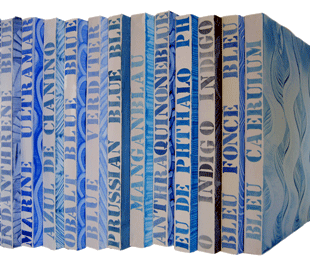
There are some interesting small single-pigment blue acrylics that have geometric and anamorphic shapes painted upon them with stencilled names of the colour along the spine of the canvases. There are also a couple of competent oils and silkscreens of tea sets in a dresser with cups hanging from hooks.
The works date from 1980 to the present day – and “without fully realising it” the artist has looked through her work over the past 30 years and come across lots and lots of blue. Any artist worth their salt knows their oevure indelibly from front to back. It seems inconceivable to me that this epiphany has occurred without the artist not fully understanding the importance of the colour blue to their art practice before now.
Recently I have been reading a book called Distraction (Damon Young. Distraction: A Philosopher’s Guide to Being Free. Melbourne: Melbourne University Publishing, 2008). The book surmises that distraction is often a matter of what one values in the world. The book demonstrates that the opposite of a life of distraction is one of grateful appreciation, based on patient, sensitive, and thoughtful attention to the world. In this exhibition we have a perfect example of distraction: the noise of the collective work has subsumed its individual charms. The work seems forced into a conceptualisation not of it’s making. Everything seems laboured to the point where all the fun has been squeezed from it and, in the end, it just left me feeling the blues.
Dr Marcus Bunyan
Photographs by Tim Gresham Images courtesy of Gallery 101
Mary Newsome (Australian, b. 1936) Blue Colours 2008
Mary Newsome (Australian, b. 1936) Bowerhouse Blues 2009 Installation photograph
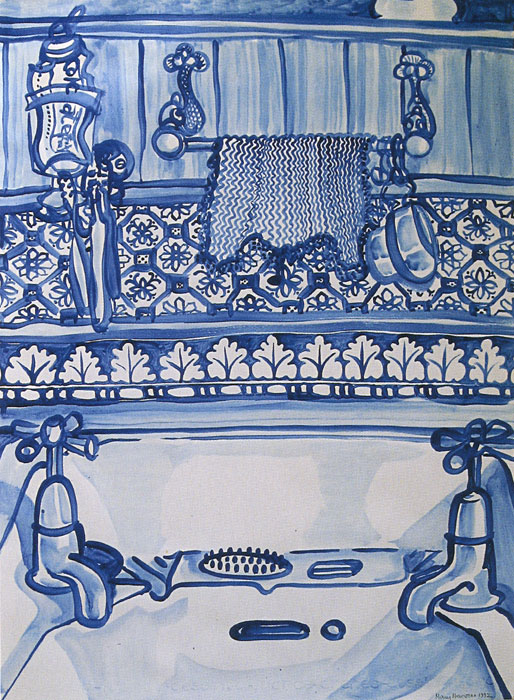
Mary Newsome (Australian, b. 1936) Bathroom Sink 1992
Mary Newsome (Australian, b. 1936) What Bliss There is in Blueness Extract from Laughter in the Dark, 1989 by Vladimir Nabokov 2009
Mary Newsome (Australian, b. 1936) Royal Tampons 2009 Collage
“Here was a golden opportunity to try something fresh in terms of war as conflict – both in photography and painting – to frame the discourse in an eloquent, innovative manner.” Dr Marcus Bunyan
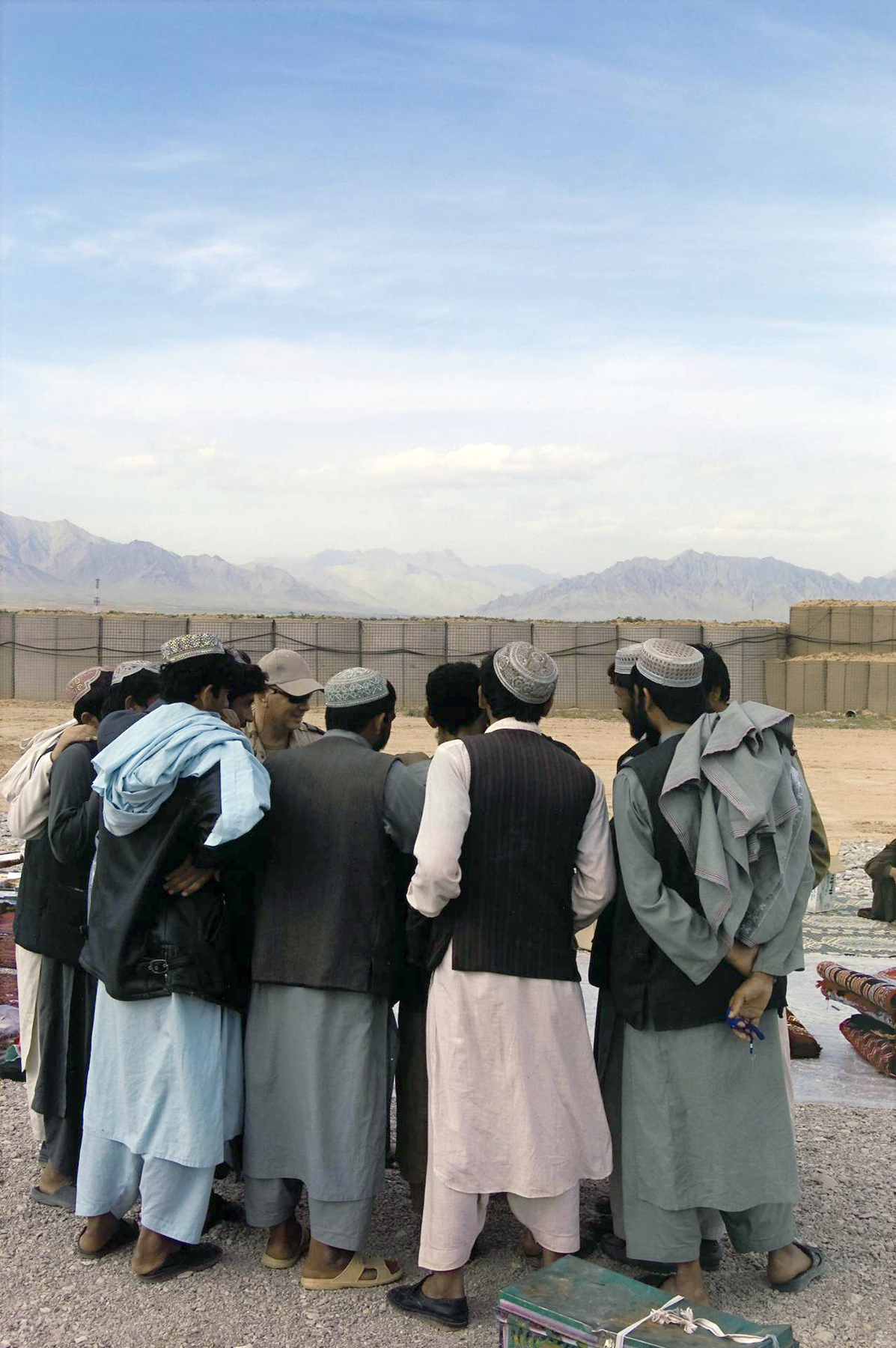
Lyndell Brown (Australian, b. 1961) and Charles Green (Australian, b. 1953) Afghan traders with soldiers, market, Tarin Kowt base, Uruzgan province, Afghanistan 2007-2008 From The approaching storm series 2007-2009 Digital colour inkjet photograph 155 x 107.5cm
Despite one brilliant photograph and some interesting small painted canvases this exhibition is a disappointment. No use beating around the figurative bush in the landscape so to speak, talking plainly will suffice.
Firstly, let’s examine the photographs. Thirteen large format colour photographs are presented in the exhibition out of an archive of “thousands of photographs Brown and Green created on tour”1 from which the paintings are derived.
Most of the photographs are inconsequential and need not have been taken. Relying on the usual trope of painters who take photographs they are shot at night, dusk or dawn when the shadows are long, the colours lush supposedly adding ‘mystique’ to the scene being portrayed. In some cases they are more like paintings than the paintings themselves. Perhaps this was the artist’s plan, the reverse marriage of photography and painting where one becomes the other, but this does little to advance photography as art.
There is nothing new or interesting here: sure, some of the photographs are beautiful in the formal representation of a vast and fractured landscape but the pre-visualisation is weak: bland responses to the machines, industry, people and places of the conflict. Go look at the Andreas Gursky photographs at the National Gallery of Victoria to see world-class photography taking reality to the limit, head on.
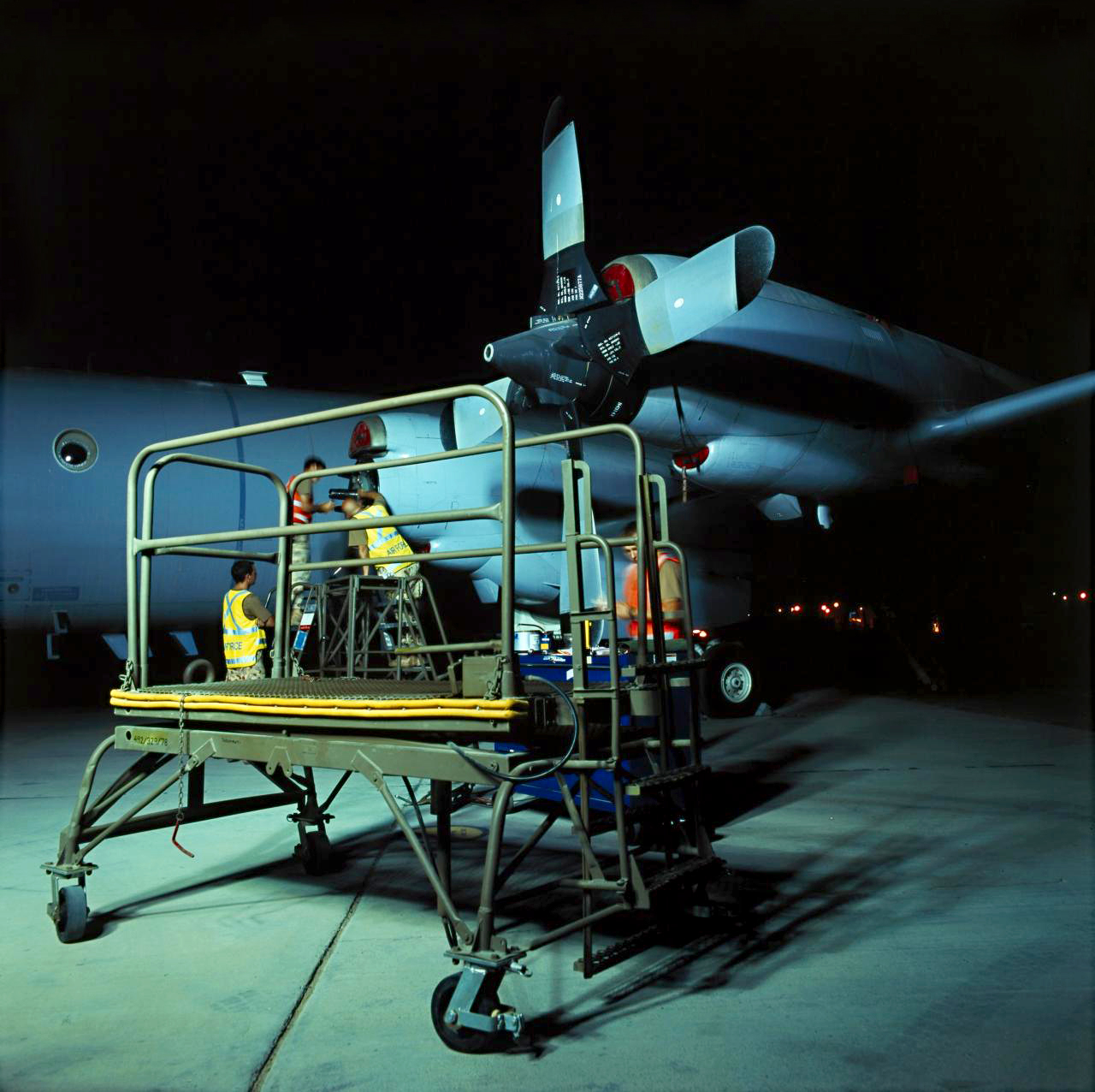
Too often in these thirteen images the same image is repeated with variants – three images of the an aircraft having it’s propeller changed show a lack of ideas or artefacts to photograph – presented out of the thousands taken seems incongruous. The fact that only one photograph is reproduced in the catalogue is also instructive.
Some images are just unsuccessful. For example the photograph Dusk, ship’s bridge with two sailors, northern Gulf is of a formulaic geometry that neither holds the viewers attention nor gives a deeper insight into their lives aboard ship and begs the question why was the photograph taken in the first place? The dark space has little physical or metaphysical illumination and seems purely to be an exercise in formalism. The photograph Dusk, ships’ bridge with sailor, northern Gulf is more successful in the use of light and shade as they play across the form of a sailor, his head resting pensively in his hand, red life vests adding a splash of colour to the bottom right of the photograph.
The brilliant photograph of the group is View from Chinook, Helmand province, Afghanistan. This really is a monstrous photograph. With the large black mass of the helicopter in the foreground of the image containing little detail, the eye is drawn upwards to the windscreen through which a mountain range rises, with spines like the back of a Stegosaurus. To the right a road, guarded by a desolate looking pillbox and yellow barrier, meanders into the distance. Dead flies on the windscreen look like small bullet holes until you realise what they are. This is the image that finally evidences a disquieting beauty present in the vast and ancient landscape.
Turning to the paintings we can say that some of the small 31cm x 31cm paintings work well. From an ‘original’ photograph the artist selects and crops a final image that they work up into a highly detailed oil painting. Distilled (as the artist’s like to put it) from the ‘original’ photographs, the paintings become a “merging of a contemporary sense of composition – borrowed from photography, film and video – with the textures and processes of traditional oil painting.”2
“These works were developed by the artists to be something akin to “Hitchcockian clues” which create the sense of looking out at a scene but being distanced from the action. To some degree the entire suite of small pictures participate in developing this intrigue, by showing an array of ambiguous scenes in which direct action is never present, or is obscured by limited perspectives … The artists noted that the war zones they witnessed were low in action but high in tension”3
To an extent this tension builds in some of the small paintings: the small size lends an intimate, intense quality and forces the viewer to engage with highly detailed renditions of textures of clothing, material, skin and hair and the distorted scale of the ships and aeroplanes portrayed. In these intense visions the painting seems less like a photograph and more like a new way of seeing. However, this occurs only occasionally within the group of small paintings.
If we think of a photograph in the traditional sense as a portrayal of reality, then a distillation of that photograph (the removal of impurities from, an increase in the concentration of) must mean that these paintings are a double truth, a concentrated essence of the ‘original’ photograph that changes that essence into something new. Unfortunately most of these small canvases show limited viewpoints of distilled landscapes that do not lead to ambiguous enigmas, but to the screen of the camera overlaid by a skein of paint, a patina of posing.
This feeling is only amplified in the three large ‘History’ paintings. The three paintings seem static, lifeless, over fussy and lacking insight into the condition of the ‘machine’ that they are attempting to portray. It’s a bit like the ‘Emperors New Clothes’, the lack of substance in the paintings overlaid with the semantics of History painting (“a traditional genre that focused on mythological, biblical, historical and military subjects”) used to confirm their existence and supposed insight into the doubled, framed reality. As Robert Nelson noted in his review of 2008 art in Melbourne in The Age newspaper it would seem that painting is sliding into terminal decline. These paintings only seem to confirm that view.
Here was a golden opportunity to try something fresh in terms of war as conflict – both in photography and painting – to frame the discourse in an eloquent, innovative manner.
Most of this work is not interesting because it does not seem to be showing, or being discursive about anything beyond a personal whim. Because an artist can talk about some things, doesn’t mean that he can make comments about other things that have any value. Although the artist was looking to portray landscapes of globalisation and entropy, there are more interesting ways of doing this, rather than the nature of the transcription used here.
“It is very good to copy what one sees: it is much better to draw what you can’t see any more but in your memory. It is a transformation in which imagination and memory work together. You only reproduce what struck you, that is to say, the necessary. That way your memory and your fantasy are freed from the tyranny of nature.”4
No thinking but the putting away of intellect and the reliance on memory and imagination, memory and fantasy to ‘distil’ the essence.
This is what needed to happen both in the photographs and paintings – leaving posturing aside (perhaps an ‘unofficial war artist’ would have had more success!) – to uncover the transformation of landscape that the theatre of this environment richly deserved.
Dr Marcus Bunyan
Footnotes
1/ Heywood, Warwick. Framing Conflict: Iraq and Afghanistan exhibition catalogue. Canberra: Australian War Memorial, 2008, p. 6 2/ Heywood, Warwick. Framing Conflict: Iraq and Afghanistan exhibition catalogue. Canberra: Australian War Memorial, 2008, p. 6 3/ Heywood, Warwick. Framing Conflict: Iraq and Afghanistan exhibition catalogue. Canberra: Australian War Memorial, 2008, p. 11 4/ Degas, Edgar quoted in Halligan, Marion. “Between the brushstrokes,” in A2 section, The Saturday Age newspaper, January 17th 2008, p. 18
Many thankx to The Ian Potter Museum of Art for allowing me to publish the photographs in the posting. Please click on the photographs for a larger version of the image.
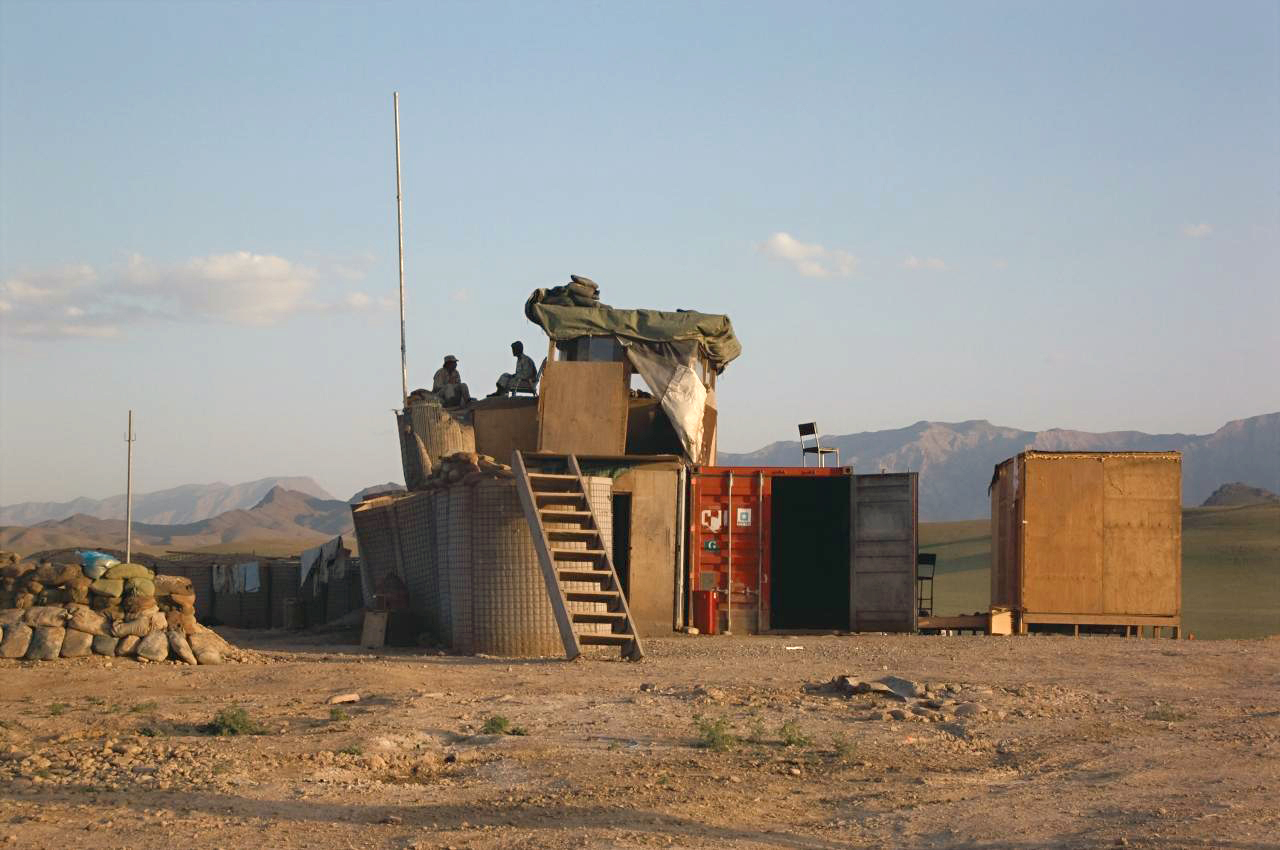
Lyndell Brown (Australian, b. 1961) and Charles Green (Australian, b. 1953) Afghan National Army perimeter post with chair, Tarin Kowt base, Uruzgan province, Afghanistan 2007-2008 From The approaching storm series 2007-2009 Digital colour inkjet photograph 111.5 x 151.5cm
Lyndell Brown (Australian, b. 1961) and Charles Green (Australian, b. 1953) Dusk, ship’s bridge with two sailors, northern Gulf 2007-2008 Digital colour inkjet photograph
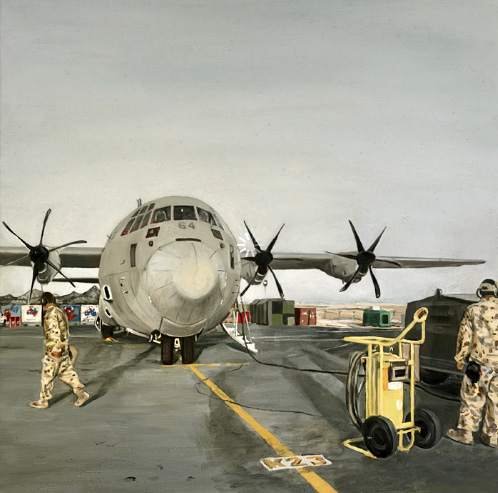
Lyndell Brown (Australian, b. 1961) and Charles Green (Australian, b. 1953) Late afternoon, flight line, military installation, Middle East 2007 Oil on linen
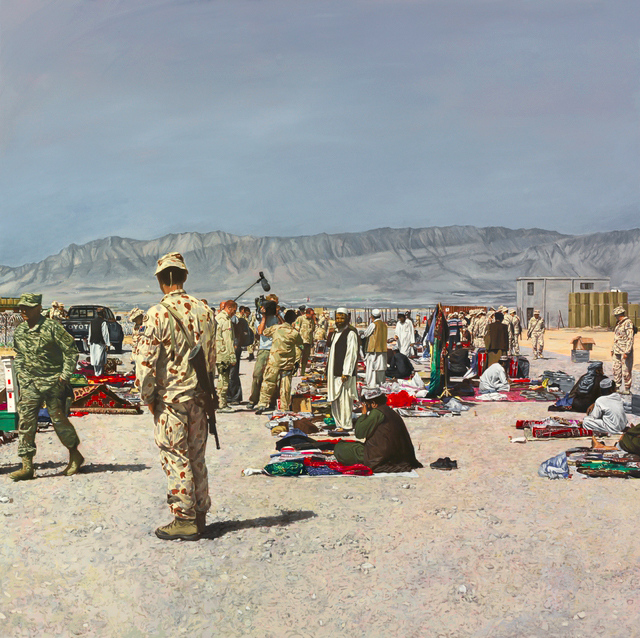
Lyndell Brown (Australian, b. 1961) and Charles Green (Australian, b. 1953) Market, Camp Holland, Tarin Kowt, Uruzgan province, Afghanistan 2007 Oil on linen
Lyndell Brown (Australian, b. 1961) and Charles Green (Australian, b. 1953) View from Chinook, Helmand province, Afghanistan 2007-2008 From The approaching storm series 2007-2009 Digital colour inkjet photograph 111.5 × 151.5cm
Lyndell Brown (Australian, b. 1961) and Charles Green (Australian, b. 1953) View from Chinook, Helmand province, Afghanistan 2007 Oil on linen
Lyndell Brown (Australian, b. 1961) and Charles Green (Australian, b. 1953) Trolley, propeller change, on flightline at night, military installation, Gulf 2007-2008 From The approaching storm series 2007-2009 Digital colour inkjet photograph 87.0 x 87.4cm
Lyndell Brown (Australian, b. 1961) and Charles Green (Australian, b. 1953) History painting: market, Tarin Kowt, Uruzgan province, Afghanistan 2007 Oil on linen
Installation view of photographs from the exhibition Framing Conflict at The Ian Potter Museum of Art, The University of Melbourne 2009
Installation view of paintings from the exhibition Framing Conflict at The Ian Potter Museum of Art, The University of Melbourne 2009
The Ian Potter Museum of Art The University of Melbourne, Corner Swanston Street and Masson Road Parkville, Victoria 3010
Exhibition dates: 11th November – 22nd November, 2008
Opening: Tuesday 11th November, 2008
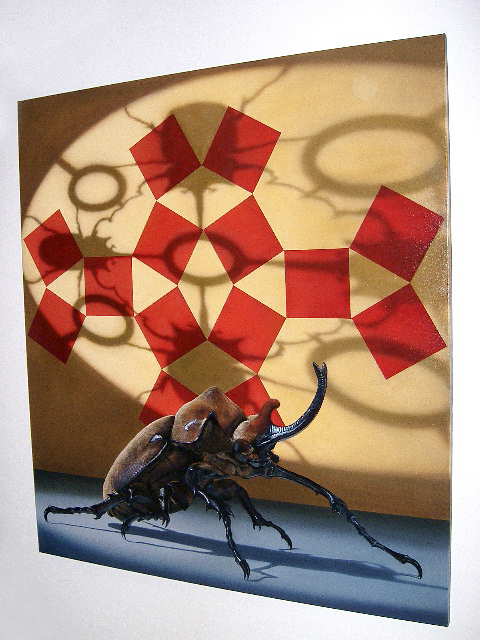
Oleh Witer (Australian) The Elephant Beetle (installation view) 2008 Oil in linen
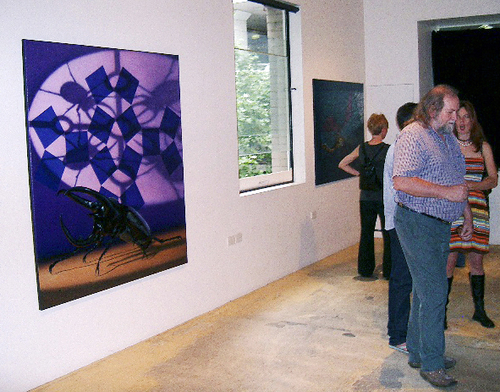
A warm and lively crowd was in attendance for the opening of the latest Oleh Witer exhibition at Space 39 in Little Collins Street, Melbourne. Nine paintings are presented in the open space of the gallery and what magical paintings they are.
Two of the main canvases feature rearing beetles in the foreground, almost photo-realistically painted, lit from above while in the background geometric red and blue squares are overlaid by enigmatic shadows – almost as though the shadows were the interior structures of a fantastical light shade.
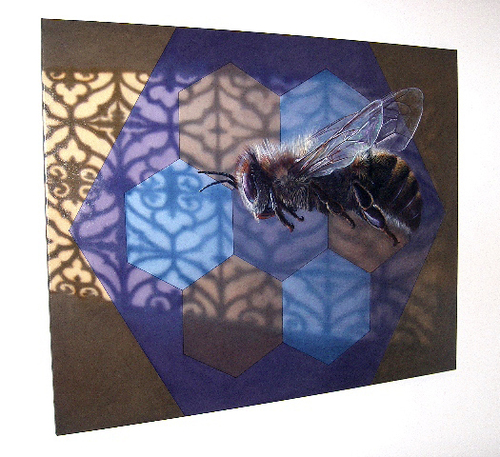
Other canvases feature a bee and a wasp facing each other with cellular geometric patterns and overlaid shadows in the background. Between these two seeming adversaries is a large canvas of a black skull with candle flickering in the it’s lobotomised top sitting on a spiral shape with geometric shapes and the shadows of an almost tarot like ‘ten of swords’ pattern overlaid to the background.
The strongest work features geometric forms with dark surrealist imagery. These are talismanic images with a passionate connection to Taoist and shamanic principles. A concern with the connection between all things is evident – archetypal pentagrams, spirals and swords are linked to the principles and proportions of the golden mean equation.
Contemplation is required to access the inner meanings of the paintings but they reward extended looking … for their magical phosphorescences are revealed over time. Recommended viewing.
Dr Marcus Bunyan
Oleh Witer (Australian) Installation view and opening crowd with The Rhinoceros Beetle 2008 Oil on linen
Oleh Witer (Australian) The Bee (installation view) 2008 Oil on linen
Exhibition dates: 7th November – 29th November, 2008
Opening: Friday 7th November, 2008
Darren Wardle (Australian, b. 1969) Frontier Psychology 2008 Oil and acrylic on linen 153cm x 274cm Private collection
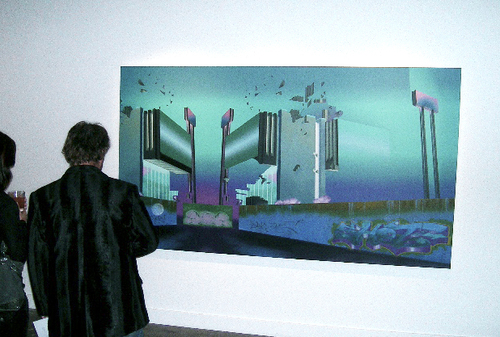
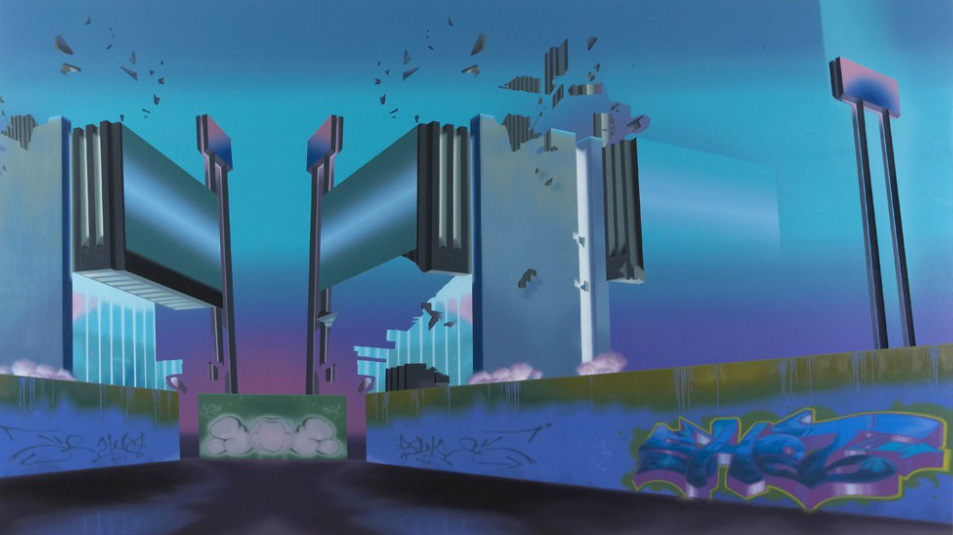
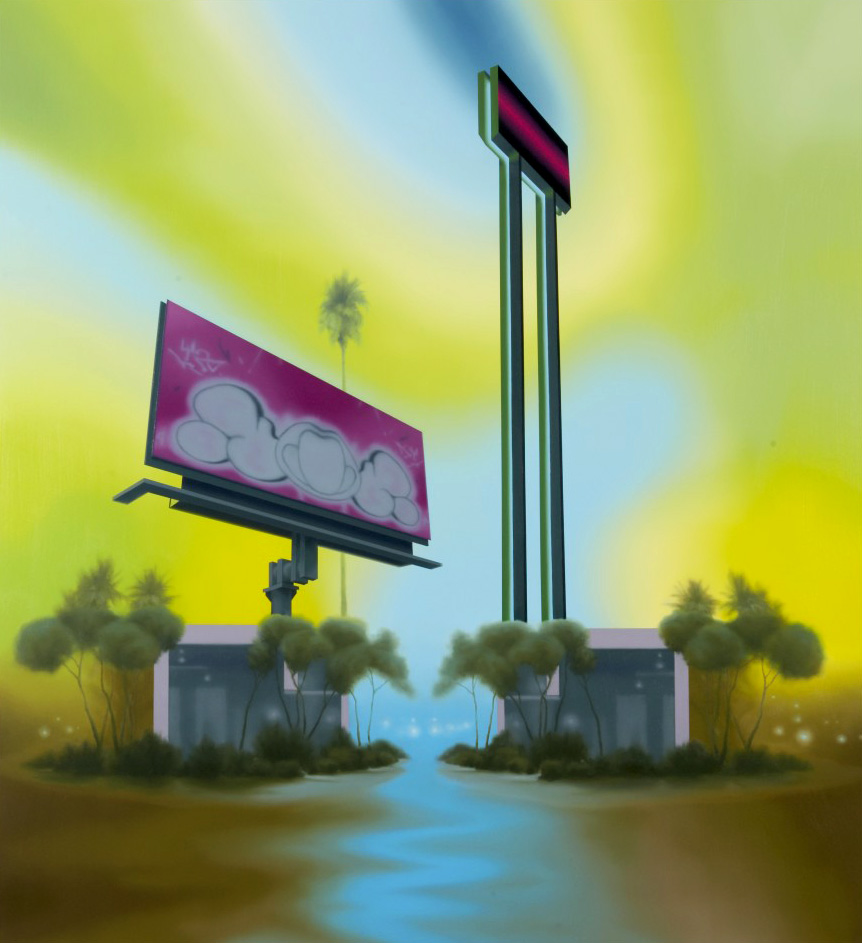
Six luminous oil and acrylic paintings by Darren Wardle greeted viewers in the front gallery at Nellie Castan in South Yarra. In his apocalyptic fractured pop-coloured landscapes objects elide, disintegrate and vanish into thin air. Buildings, empty screens and advertising hoardings become the target of lost innocence, a metaphor for the dis-ease and disintegration of consumer society, a portent of things to come.
The titles of the paintings (such as Tipping Point, Faultline and Slanted) perfectly describe the conceptual themes explored in the work. Slinks of dripping paint pour down the canvas, canvases are cut in three through the use of fractured planes like a double exposure in photography and vegetation becomes purple and white, mutated and x-rayed. Some of the paint almost has a crystalline nature to it’s surface, a ‘surface tension’ that contrasts with flat gradated areas of colour in the backgrounds, as though the world is solidifying, cracking and about to fall apart.
An excellent show that is well hung: so many exhibitions have too many objects, too much noise crowding the walls. Here the work is given space to breathe and live and looks all the better for it. Highly recommended.
Dr Marcus Bunyan
Darren Wardle (Australian, b. 1969) Faultline (installation view) 2008 Oil and acrylic on canvas
Darren Wardle (Australian, b. 1969) Faultline 2008 Oil and acrylic on canvas 153cm x 274cm Private collection
Darren Wardle (Australian, b. 1969) Inland Empire 2008 Oil and acrylic on linen 183cm x 167cm Private collection












You must be logged in to post a comment.