Exhibition: ‘Peter Booth’ at TarraWarra Museum of Art, Healesville

Exhibition dates: 26th November, 2022 – 13th March, 2023

Curator: Anthony Fitzpatrick
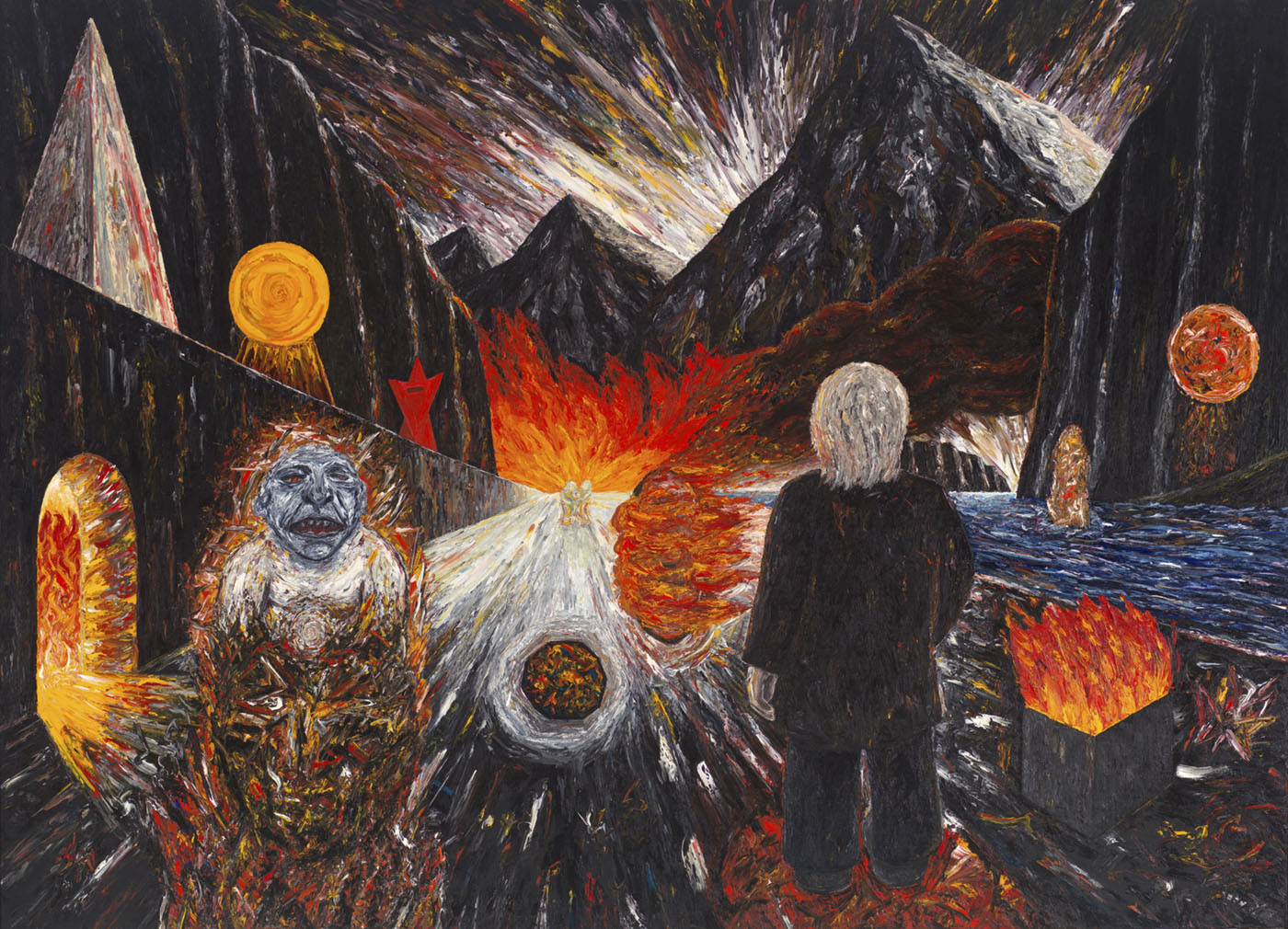
 

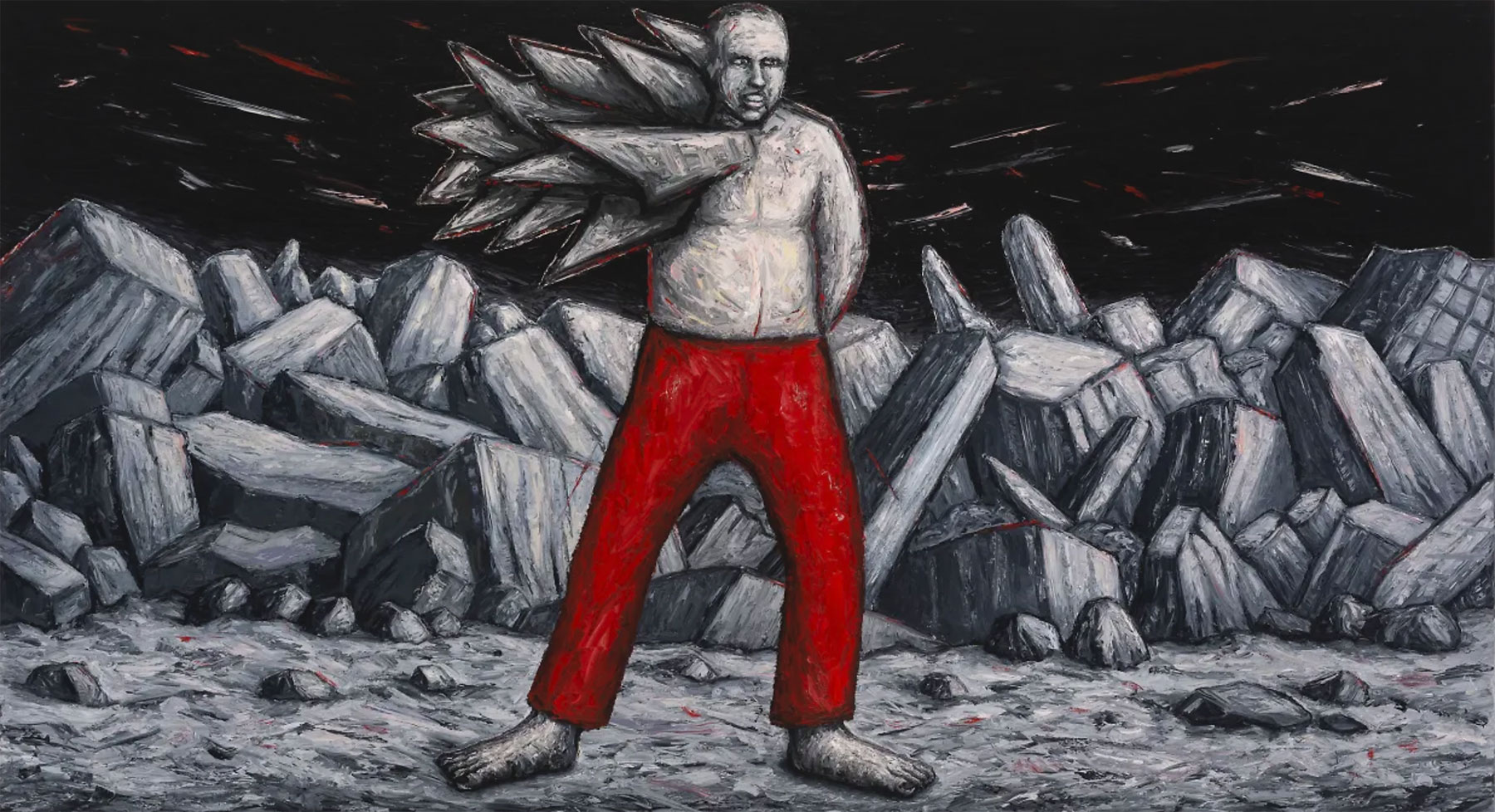
Peter Booth (Australian born England, b. 1940, Australia from 1958) 'Painting' 1978 from the exhibition 'Peter Booth' at TarraWarra Museum of Art, Healesville, Nov 2022 - March 2023


Peter Booth (Australian born England, b. 1940, Australia from 1958)
Painting
1978
Oil on canvas
© Peter Booth


Anima


tongue, long flickering tongue
drenched in blood
scours inside the cup
rapacious for more
blood thirsty luck
sucks souls of men
thorn and star
spirit of insect
bizarre–unique
cannibal


Dr Marcus Bunyan


Many thankx to the TarraWarra Museum of Art for allowing me to publish the media images in the posting. All other installation photographs as noted © Marcus Bunyan, the artist and TarraWarra Museum of Art. Please click on the photographs for a larger version of the image.


“A lot of humans forget we are organic entities, the same as every other creature on the planet, and we’ve only been here for a short time. I am very pessimistic about the plight of beings. We don’t learn much, I mean, we’ve been wreaking havoc as they did in the Middle Ages. We also have bigger weapons. One thing I am not pessimistic about is the ability of nature to heal itself.”


Peter Booth quoted in Ashley Crawford View from the Booth blog 29 November 2003


PETER BOOTH at TarraWarra Museum of Art
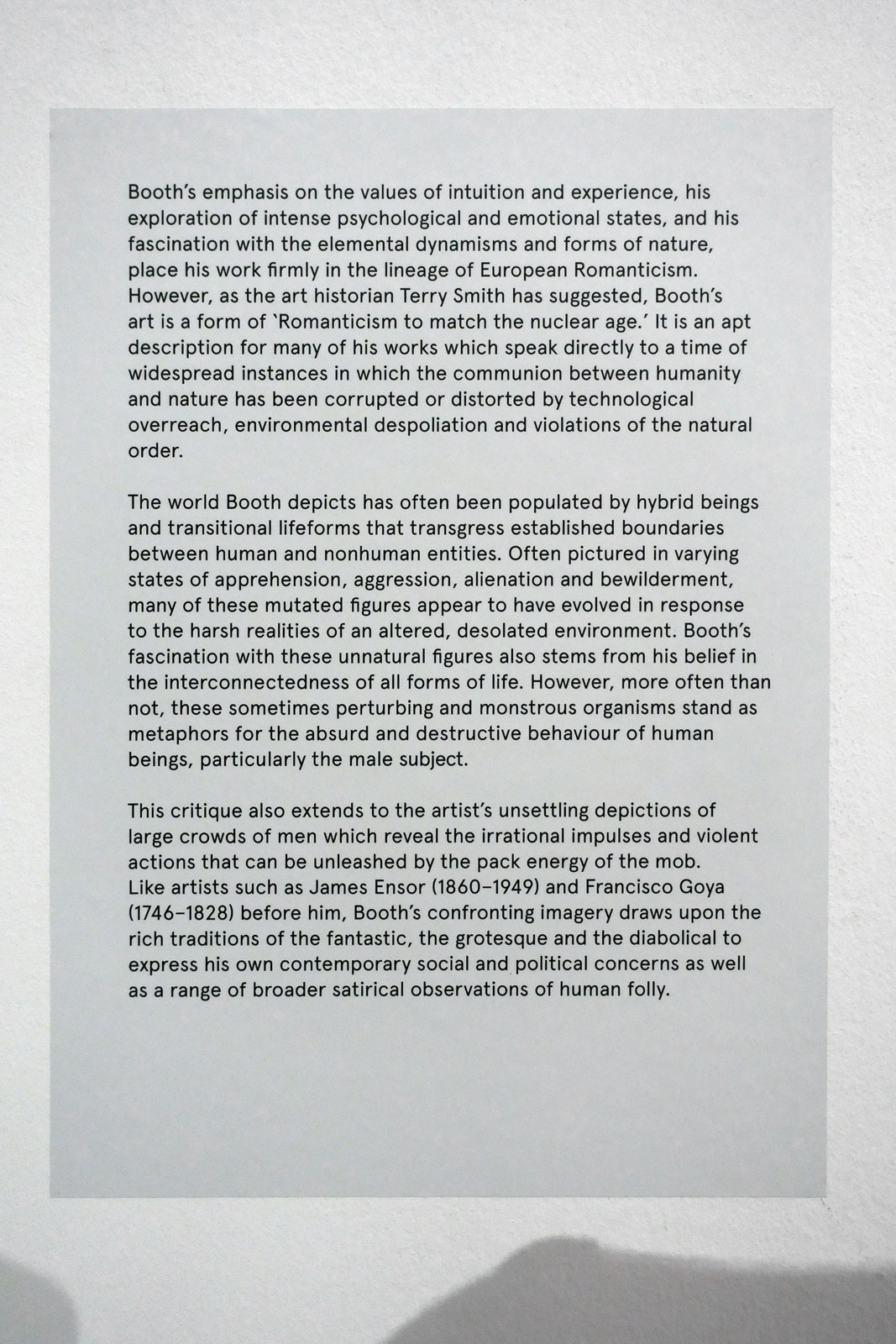
 

Introductory wall text from the exhibition 'Peter Booth' at the TarraWarra Museum of Art
 

Introductory wall text from the exhibition


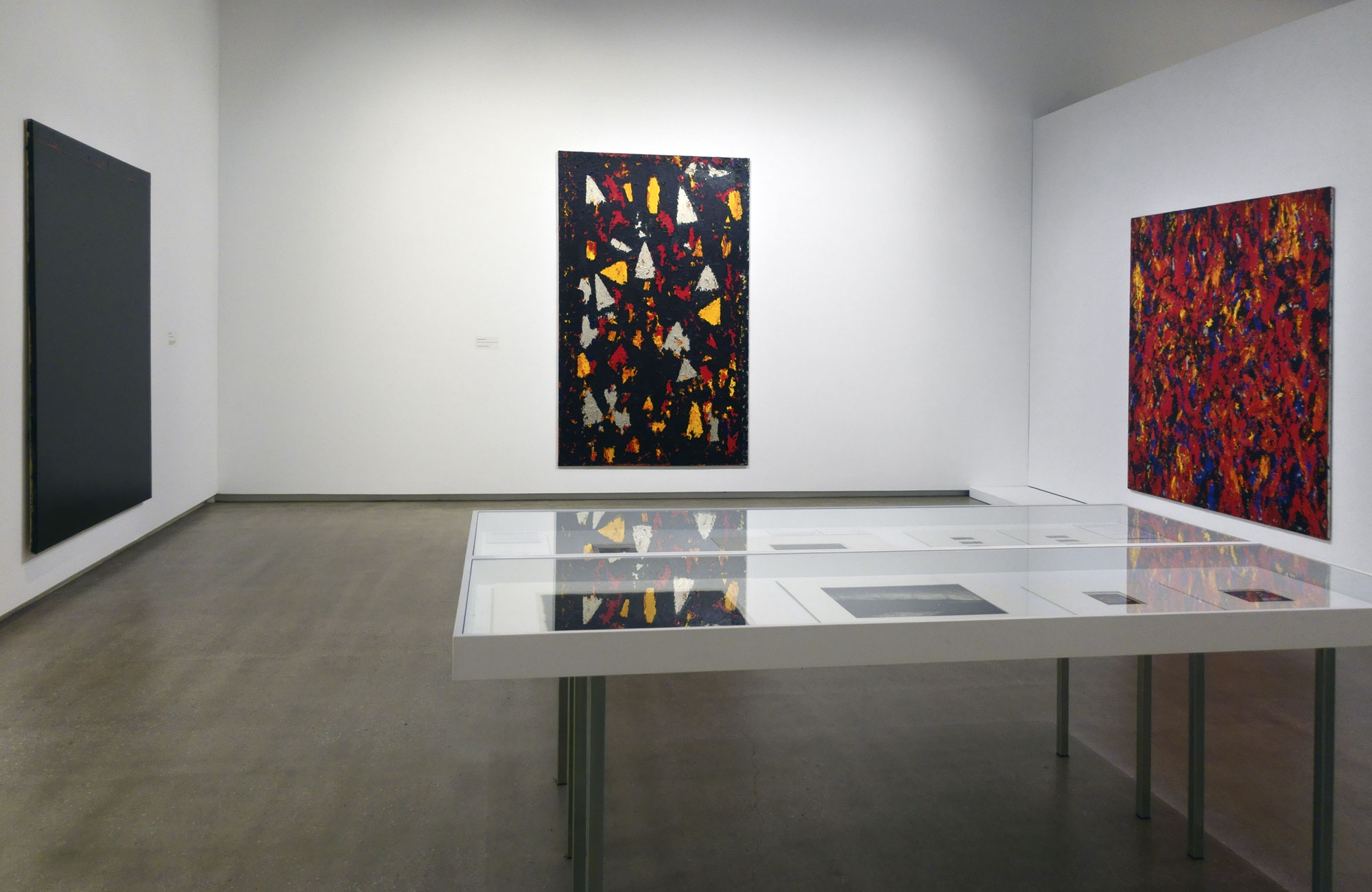
Installation view of the exhibition 'Peter Booth' at TarraWarra Museum of Art showing at left 'Painting' 1974, and at centre 'Painting 1975' 1975


Installation view of the exhibition Peter Booth at TarraWarra Museum of Art showing at left Painting 1974, and at centre Painting 1975 1975
Photo: Marcus Bunyan


While the TarraWarra survey features a collection of Booth’s works from the 1970s to the 2000s, it opens with a work in the ‘Doorway’ series: Painting, 1974. It’s a canvas covered with shades of black. As the curator says, “Just near the top, there’s this very thin horizon line of red, and it feels like there’s this massive magma just behind the surface that’s starting to seep through.” I’m told that written on the back of some ‘Doorway’ paintings is an instruction: “Never hang more than six inches from the floor.” As Fitzpatrick explains, “If you hang the work a little lower for the viewer … it becomes more immersive, and this painting is the opening work in the exhibition with the idea of the doorway as a threshold.”

This minimalism is compelling. “The ‘Doorway’ series could be about nothingness, or it could be a void,” says Fitzpatrick, “but voids are also where things are generated from – so they could be about an idea of fullness … you could almost see them as a kind of dark mirror.” In a rare interview with Australian artist, writer and curator Peter Hill, Booth humbly discusses how the ‘Doorway’ series was “influenced by what was going on in the art world at the time, in reduction, minimalism and colour field painting”.

Autumn Royal. “Once seen, Peter Booth is never forgotten,” on the Art Guide website 15 January 2023 [Online] Cited 02/02/2023
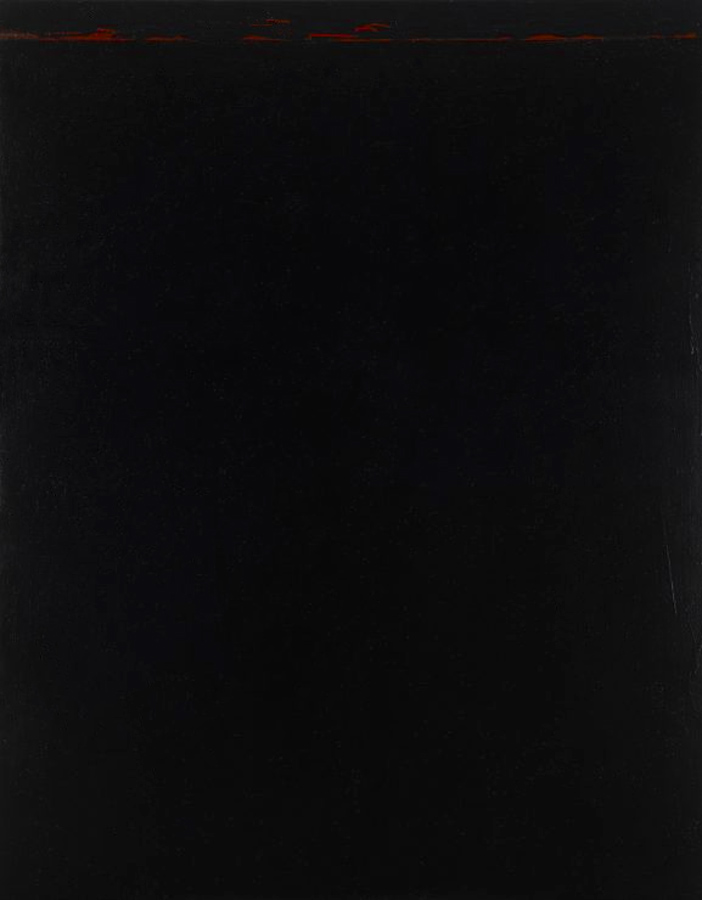
 

Peter Booth (Australian born England, b. 1940, Australia from 1958) 'Painting' 1974 from the exhibition 'Peter Booth' at TarraWarra Museum of Art, Healesville, Nov 2022 - March 2023


Peter Booth (Australian born England, b. 1940, Australia from 1958)
Painting
1974
Synthetic polymer paint on canvas
213 x 167.5cm
Queensland Art Gallery, Gallery of Modern Art, Brisbane
Purchased 2006 with funds from the Estate of Lawrence F. King in memory of the late Mr and Mrs S.W. King through the Queensland Art Gallery Foundation. Photograph: Natasha Harth, QAGOMA
© Peter Booth
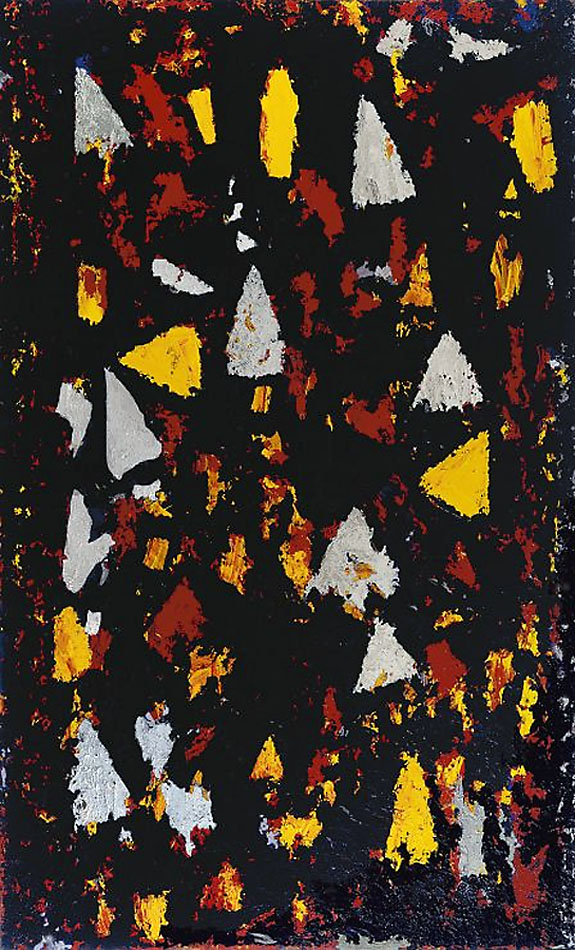
 

Peter Booth (Australian born England, b. 1940, Australia from 1958) 'Painting 1975' 1975 from the exhibition 'Peter Booth' at TarraWarra Museum of Art, Healesville, Nov 2022 - March 2023


Peter Booth (Australian born England, b. 1940, Australia from 1958)
Painting 1975
1975
Synthetic polymer paint and glass on canvas
274.2 x 167.2cm
TarraWarra Museum of Art collection
Gift of Eva Besen and Marc Besen AO, 2001
© Peter Booth
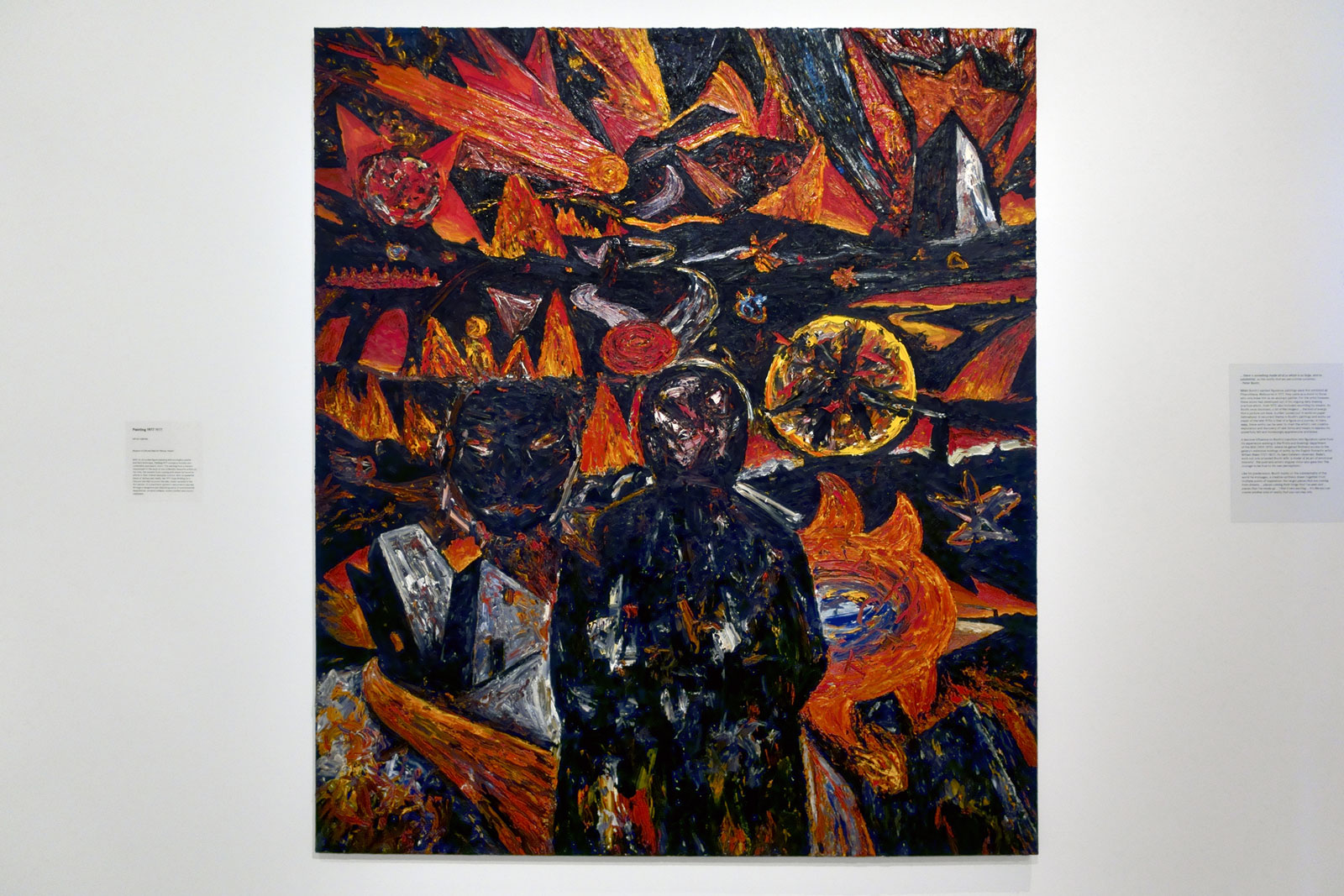
 

Peter Booth (Australian born England, b. 1940, Australia from 1958) 'Painting' 1977 (installation view)


Peter Booth (Australian born England, b. 1940, Australia from 1958)
Painting (installation view)
1977
Oil on canvas
Museum of Old and New Art (Mona), Hobart
© Peter Booth
Photo: Marcus Bunyan


With its shrouded figure standing before a highly volatile and fiery landscape, Painting 1977 conveys a forceful and undeniably apocalyptic vision. The painting finds a literary counterpart in the work of one of Booth’s favourite writers at the time, the novelist Doris Lessing with whom he found an affinity in their shared dystopian outlook. With its powerful blend of fantasy and reality, her 1971 novel Briefing for a Descent into Hell recounts the tale, vividly narrated in the first person, of a psychiatric patient’s hallucinatory journey through a dangerous and disturbing world of environmental despoliation, societal collapse, violent conflict and cosmic cataclysm.

Wall text from the exhibition
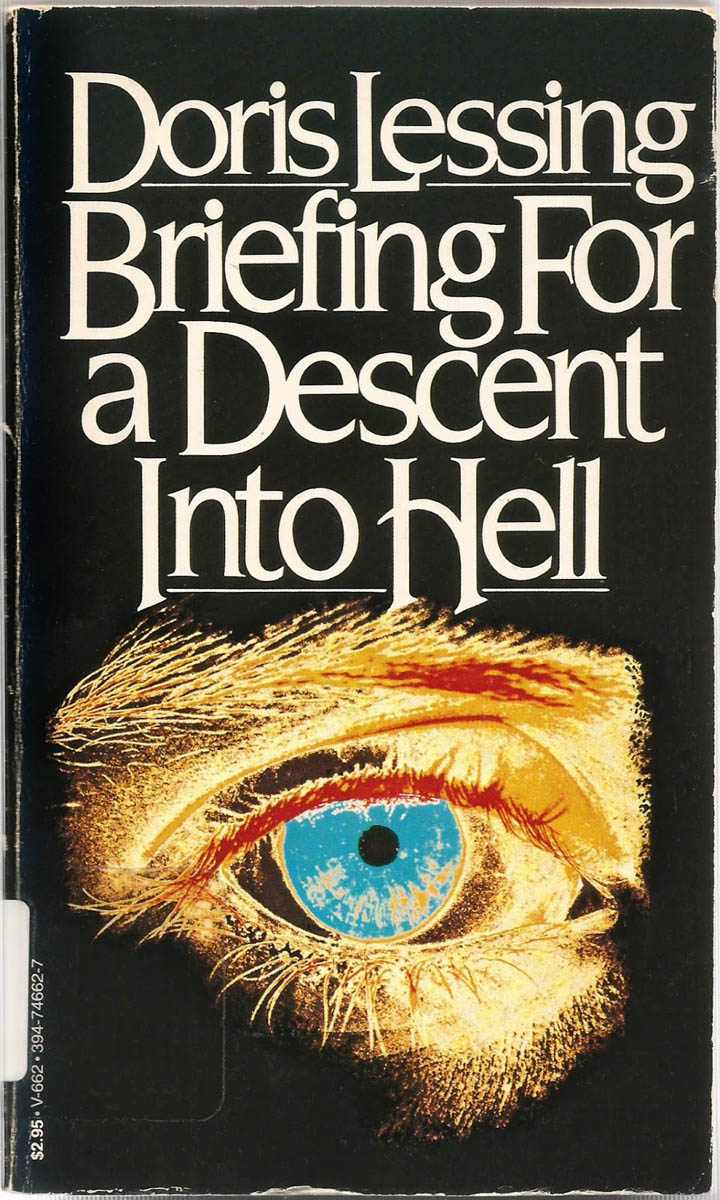
 

Doris Lessing. 'Briefing for a Descent into Hell Briefing for a descent into hell' book cover


Doris Lessing (British-Zimbabwean born Iran, 1919-2013)
Briefing for a Descent into Hell
1971
Vintage book cover published 1981
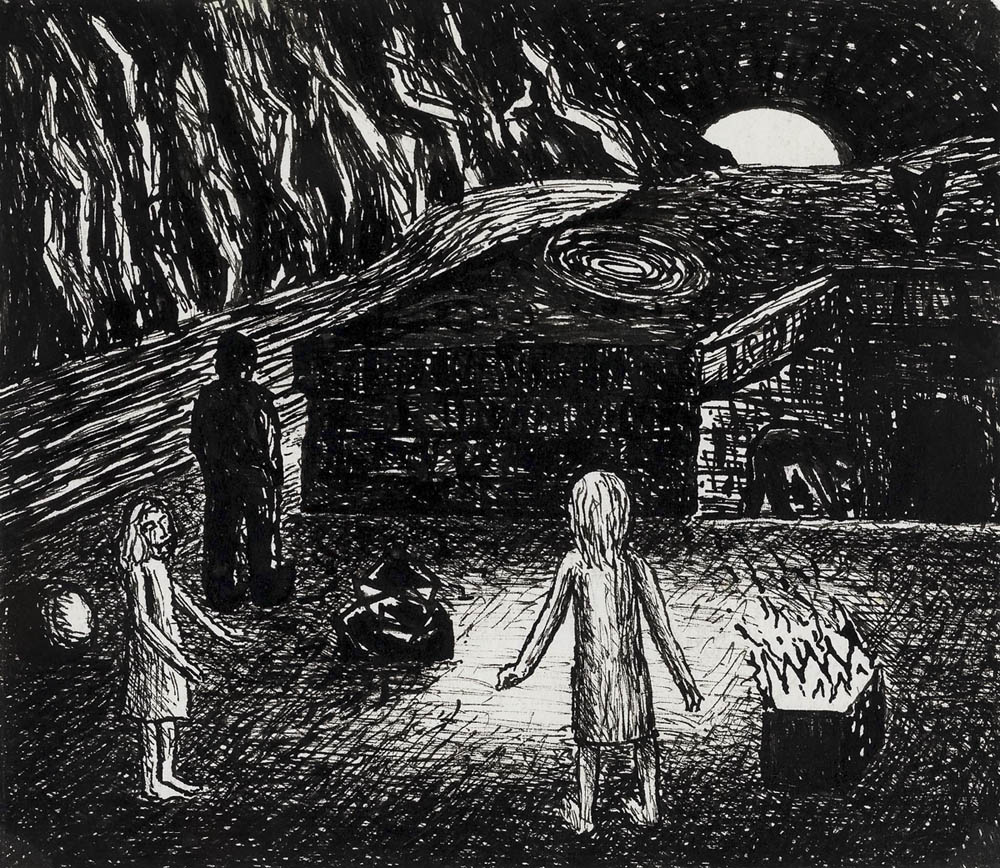
 

Peter Booth (Australian born England, b. 1940, Australia from 1958) 'Untitled (Daughters)' c. 1976 from the exhibition 'Peter Booth' at TarraWarra Museum of Art, Healesville, Nov 2022 - March 2023


Peter Booth (Australian born England, b. 1940, Australia from 1958)
Untitled (Daughters)
c. 1976
Ink on paper
11 x 12.5cm
Private collection


Untitled (Daughters), c. 1976, is a composition which originated in Booth’s visits to an inner-city park in Melbourne where he would take his young daughters to play. Here, through the intense rhythms of his lifework and cross hatching in black ink, and the introduction of symbolic forms such as a whirlpool and arrowhead, this everyday scene is imaginatively transformed into a mysterious, nocturnal realm. While his daughters play in the foreground, the artist has turned to face a rising moon on the horizon and there is a sense that he is being magnetically compelled to embark on the path which leads in its direction.

Text from the TarraWarra Museum of Art Facebook page
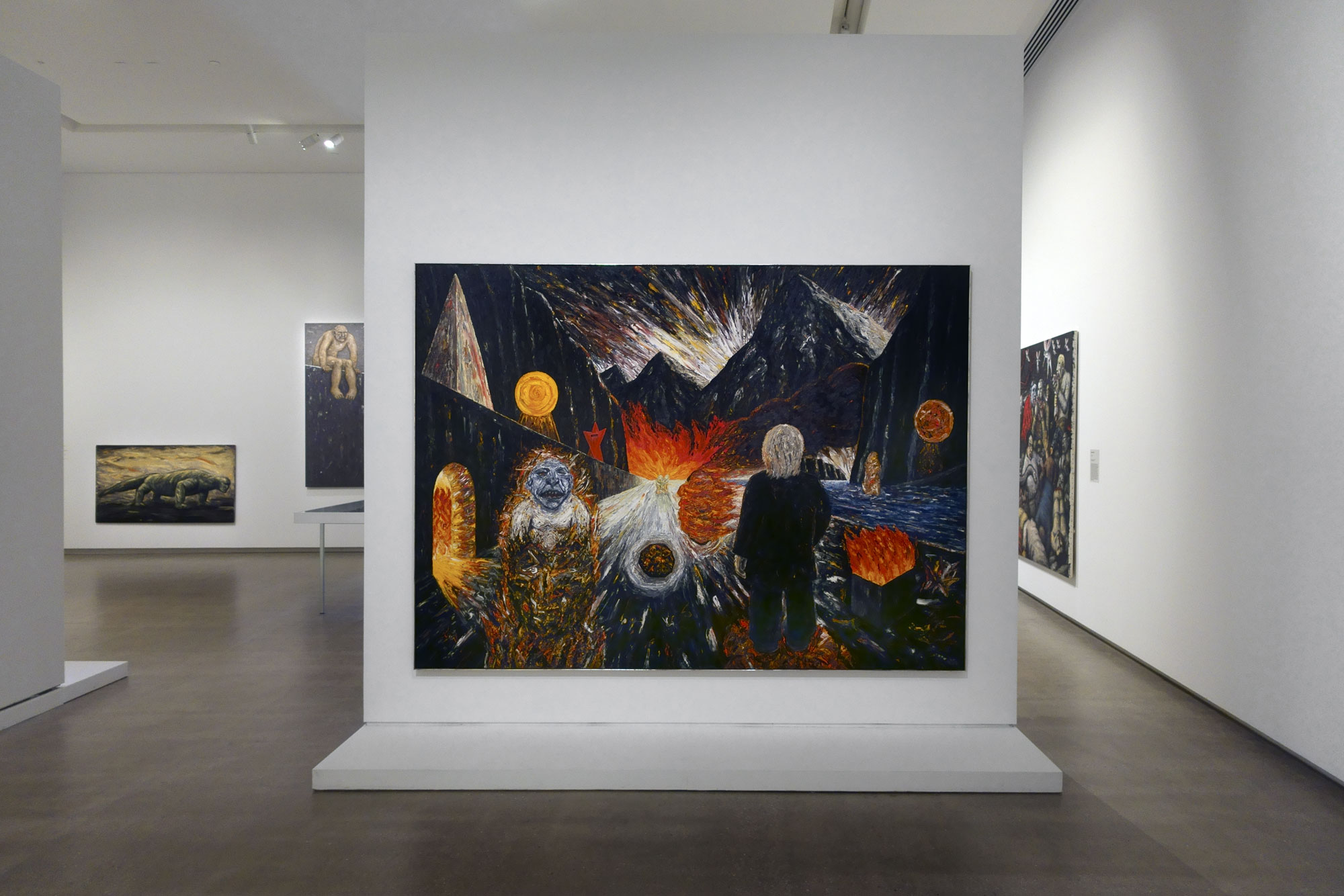
 

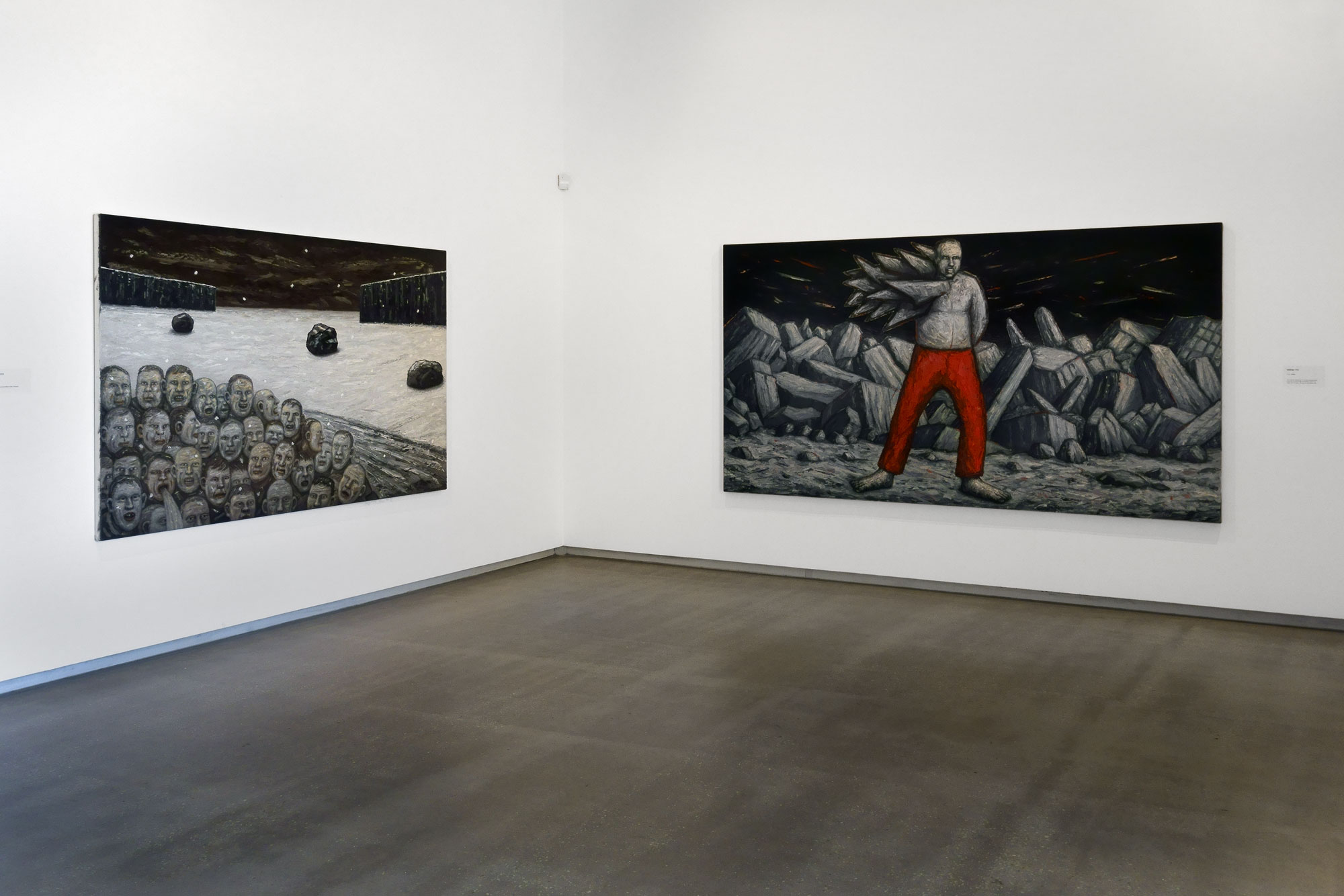
Installation view of the exhibition 'Peter Booth' at TarraWarra Museum of Art showing at centre, 'Painting' 1978


Installation view of the exhibition Peter Booth at TarraWarra Museum of Art showing at centre, Painting 1978
Photo: Marcus Bunyan
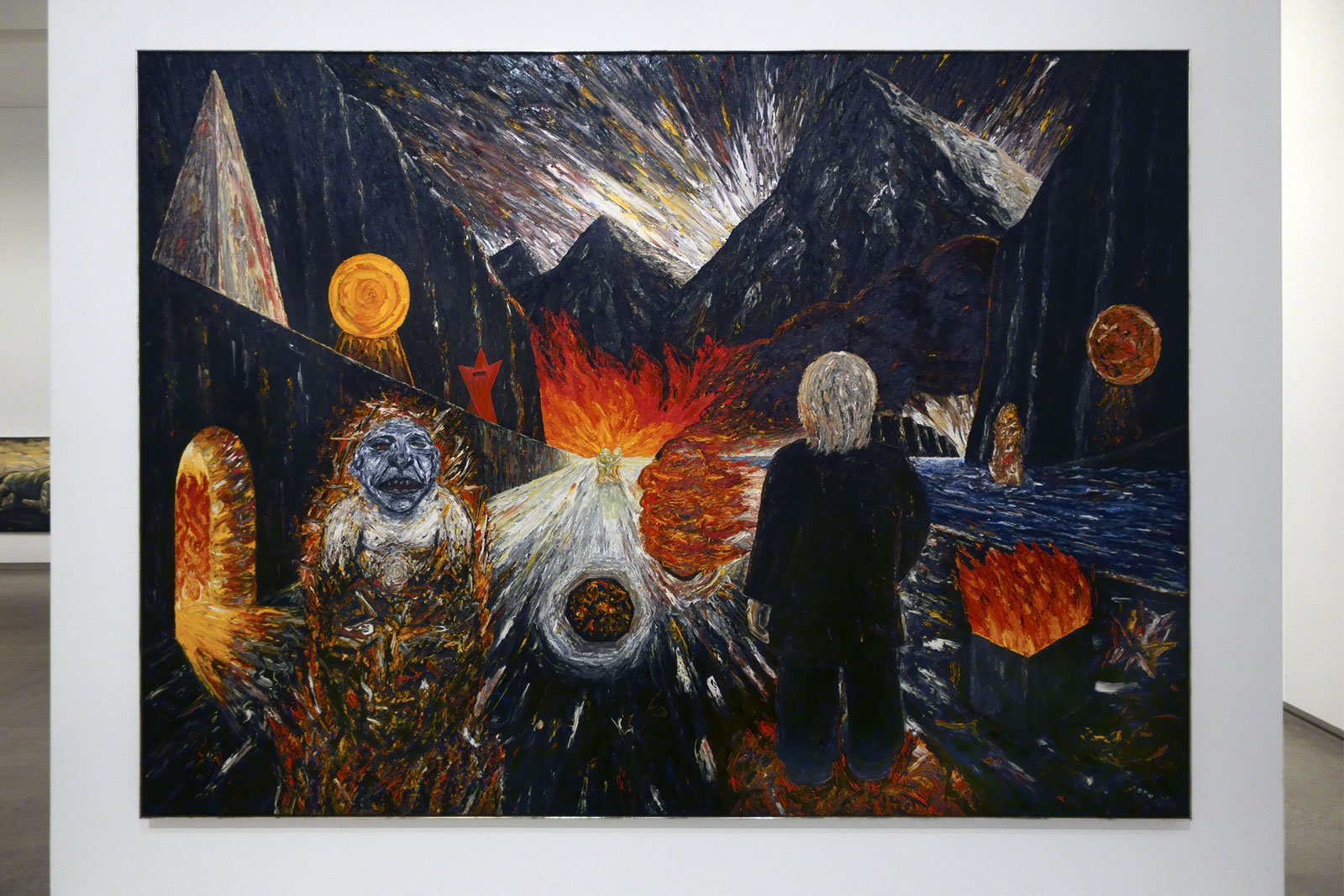
 

Peter Booth (Australian born England, b. 1940, Australia from 1958) 'Painting' 1978 (installation view)


Installation view of Peter Booth Painting 1978 from the exhibition Peter Booth at TarraWarra Museum of Art
Photo: Marcus Bunyan


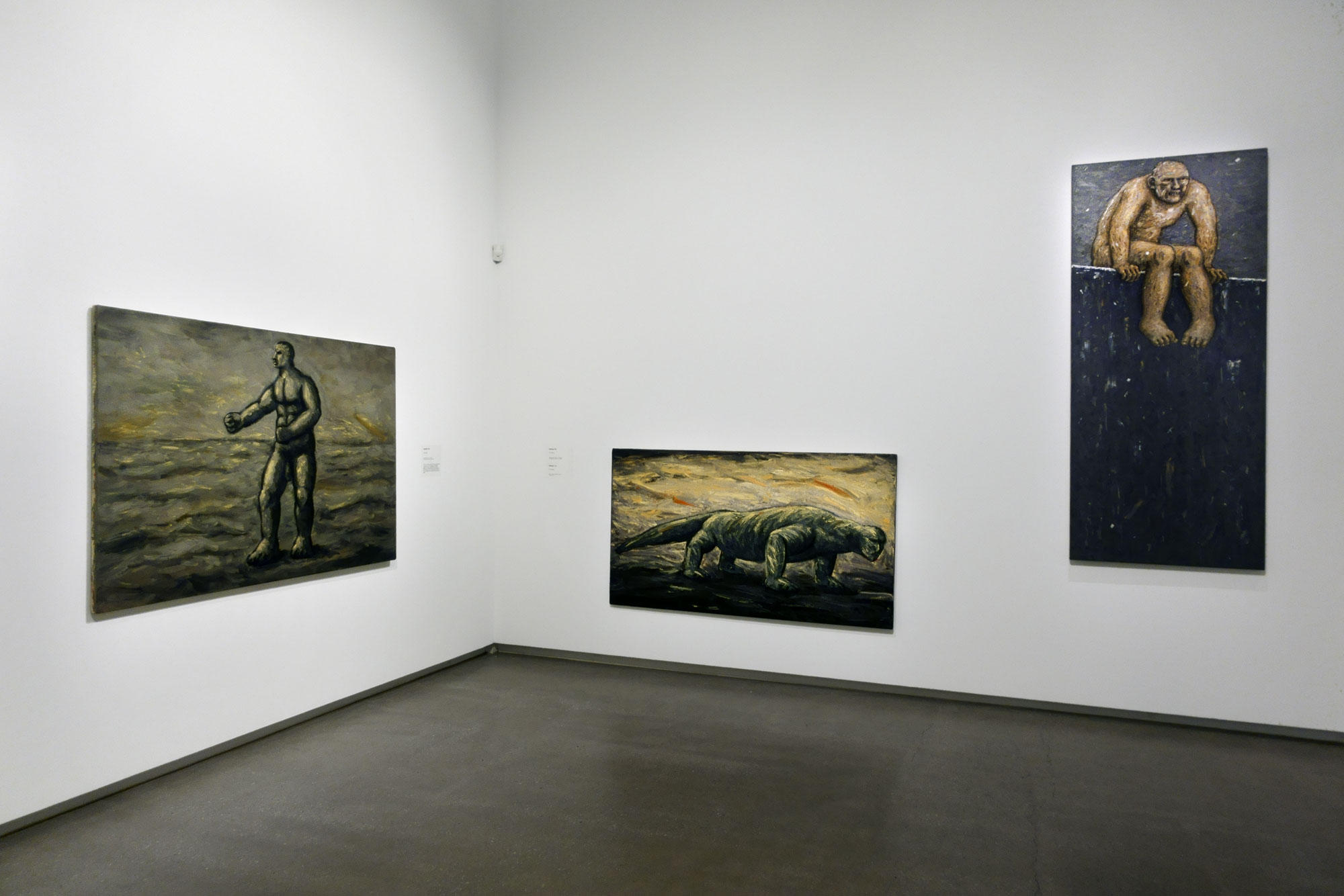
Peter Booth became known for his black, minimal ‘doorway’ paintings of 1970-74. Yet by 1977 he had given up this style and begun to record the world of his dreams and nightmares in a series of apocalyptic, visionary landscapes. Booth’s paintings suggest that we are on the edge of another dark age. His paintings are brutal representations of his bleak dreams and fantasies. In an age of nuclear threat Booth’s work has a monumentality which is evocative of the final conflagration mentioned in The Book of Revelations. Painting 1978, challenges and disturbs the viewer by the artist’s choice of colour and method of painting. The dramatic black and red, yellow and white composition suggests both an industrial and a natural wasteland. The heavy impasto paint texture describes, with vigour and intensity, flames, explosions, and unidentified nightmarish images. Contradictory forces pull us into the central inferno below the glacial mountain peaks, and showers of rock explode towards us. Is it the artist himself who stands with his back to us, mesmerised by the scene, while grotesque metamorphosing figures stare out at us?

Text © National Gallery of Australia, Canberra


Booth’s subject matter largely concerns the Australian landscape, both urban and rural, and the relationship between environment and individual, as well as the individual’s capacity to create and destroy. And also what the world will be like in the future, humans as mutants.

Booth’s landscapes are charged with emotion and symbolic meaning. Memories of his childhood in the blackened industrial landscape of Sheffield seem to infuse the work, especially his well-known apocalyptic figurative paintings, which look like images of the end of the world; illustrations for The Book of Revelation. These images contain an intense image of anxiety, evoking the aftermath of some terrible destruction, vividly pictured with menacing forms and agitated, heavily applied brushstrokes.

An example is Painting 1978 which has been described as challenging and disturbing the viewer by the artist’s choice of colour and method of painting. “The dramatic black and red, yellow and white composition suggests both an industrial and a natural wasteland”. The heavy impasto paint texture describes, with vigour and intensity, flames, explosions, and unidentified nightmarish images. Contradictory forces pull us into the central inferno below the glacial mountain peaks, and showers of rock explode towards us.

Is it the artist himself who stands with his back to us, mesmerised by the scene, while grotesque metamorphosing figures stare out at us?” Peter Booth has centred many of his paintings around his childhood in Sheffield England where he grew up during the war years and their aftermath.

Anonymous. “Peter Booth,” on the Art History Essay website Nd [Online] Cited 07/02/2023
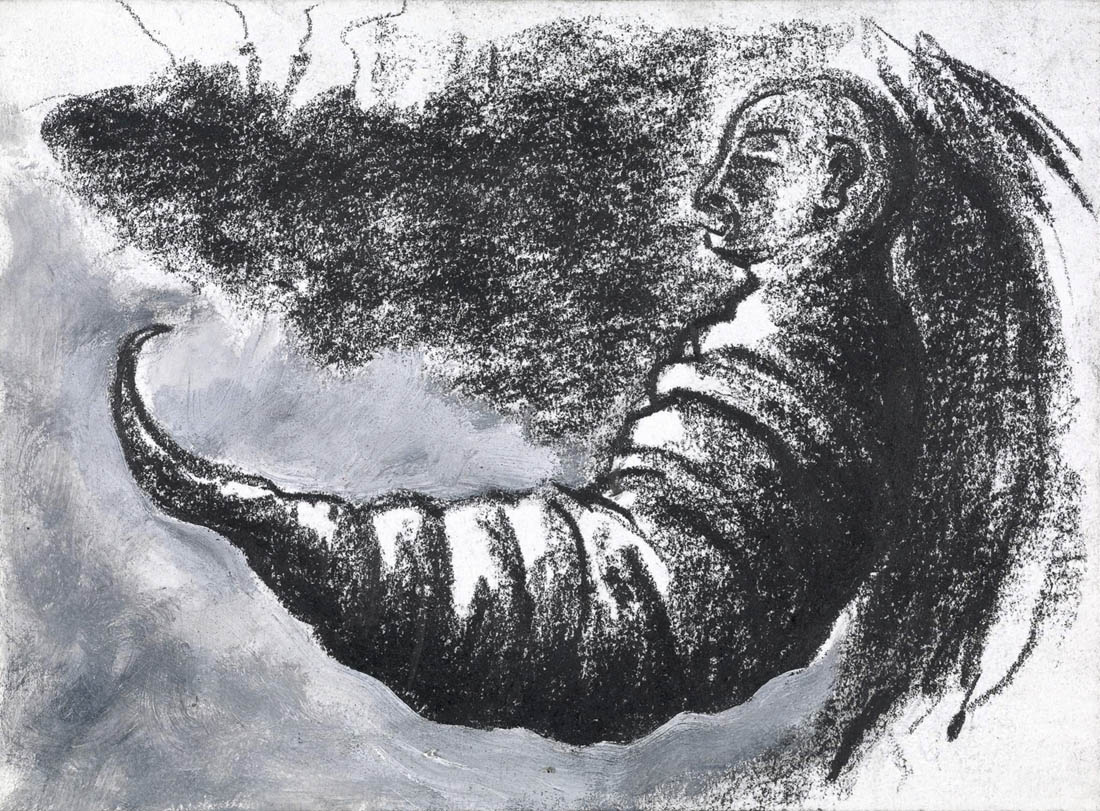
 

Peter Booth (Australian born England, b. 1940, Australia from 1958) 'Drawing (Figure with Insect Tail)' 1982


Peter Booth (Australian born England, b. 1940, Australia from 1958)
Drawing (Figure with Insect Tail)
1982
Pastel and casein on paper
17.3 x 12.5cm
National Gallery of Victoria, Melbourne
Purchase, Victorian Foundation of Living Australian Artists, 2010


More than just figures of fantasy, Booth’s curious amalgams and mutated figures often express his personal insights into the interrelatedness of all living beings. With his closed eyes and restful expression, the metamorphic figure in Drawing (Figure with Insect Tail) appears contented with his hybrid condition, affirming the artist’s belief that humans “share something with these creatures … we are part of the same thing.”

Text from the TarraWarra Museum of Art Facebook page
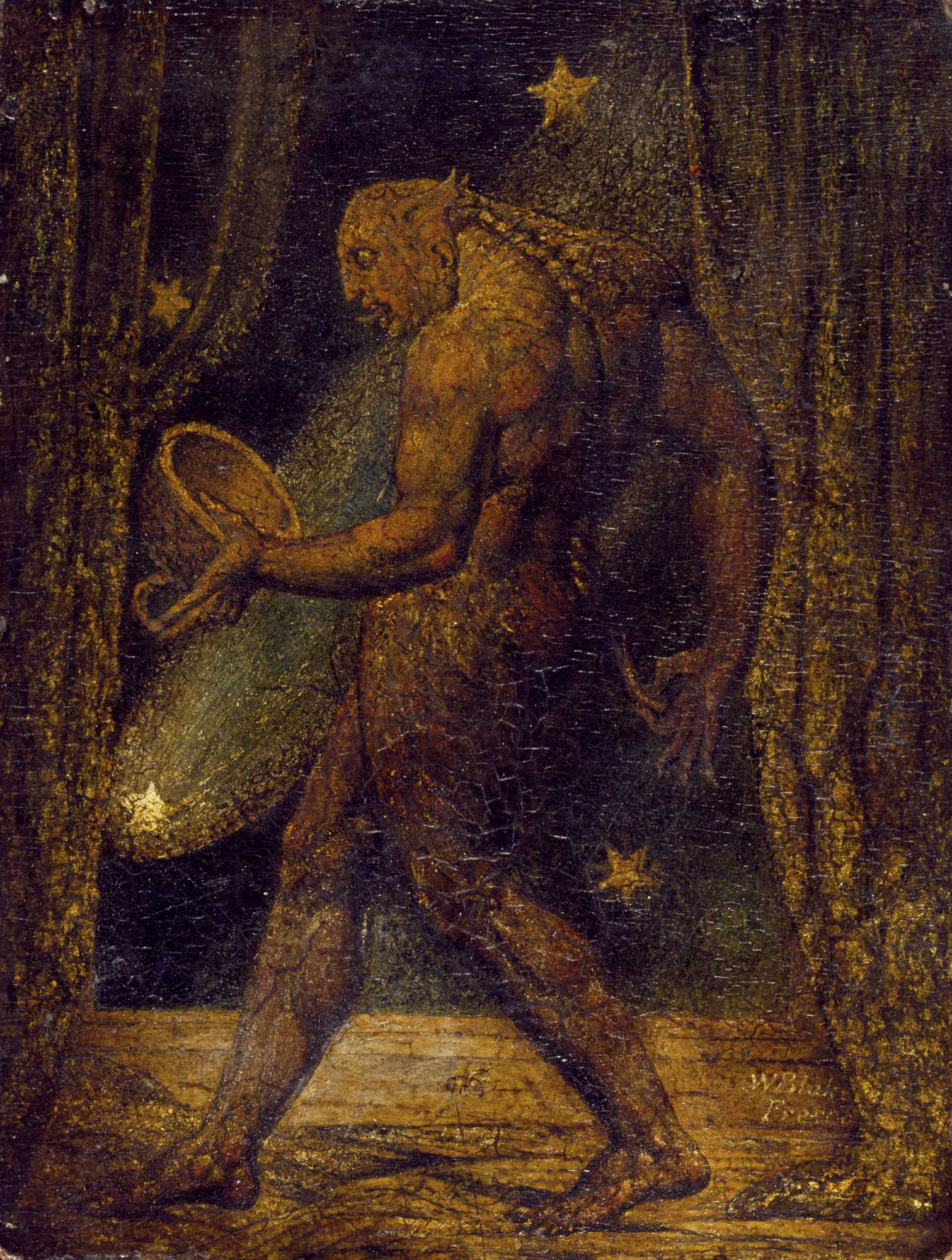
 

William Blake (British, 1757-1827) 'The Ghost of a Flea' c. 1819


William Blake (British, 1757-1827)
The Ghost of a Flea
c. 1819
Tempera heightened with gold on mahogany
214 x 162 mm
Tate
Bequeathed by W. Graham Robertson 1949


Another physiognomic “vision” – “the stuff of delirium and nightmare, [which] taps into the unconscious, internalised sublime” – was the painting The Ghost of a Flea (c. 1819) used to illustrate John Varley’s Treatise on Zodiacal Physiognomy (1828). In studying the work of Blake for this posting, I found it instructive to look at Blake’s preparatory sketches for his works which can be found online. They give you a good idea of the spontaneity of the drawing and the ideas that arise, transformed into the finished work. Here in the graphite on paper drawing of The Ghost of a Flea we can see Blake’s initial vision, a more static, pensive figure with serrated wings which morphs into a muscular, blood sucking monster set on a cosmic stage, of life framed by curtains and a shooting star. As the vision appeared to Blake he is said to have cried out: ‘There he comes! his eager tongue whisking out of his mouth, a cup in his hand to hold blood, and covered with a scaly skin of gold and green.’

Marcus Bunyan. “Visions of divine damnation” on the exhibition William Blake at Tate Britain, London Part 2, February 2020 on the Art Blart website [Online] Cited 09/02/2023


William Blake (British, 1757-1827) 'The Ghost of a Flea' c. 1819 (installation view)


William Blake (British, 1757-1827)
The Ghost of a Flea
c. 1819
Graphite on paper
Private collection
Photo: © Marcus Bunyan and Tate


Artist and astrologer John Varley encouraged Blake to sketch the figures, called ‘visionary heads’, who populated his visions. This image is the best known. While sketching the flea, Blake claimed it told him that fleas were inhabited by the souls of bloodthirsty men, confined to the bodies of insects because, if they were the size of horses, they would literally drain the population. Their bloodthirsty nature is shown by the eager tongue flicking at the ‘blood’ cup it carries. This intense disorientating image, the stuff of delirium and nightmare, taps into the unconscious, internalised sublime.

William Blake, “The Ghost of a Flea c. 1819-20,” in Nigel Llewellyn and Christine Riding (eds.), The Art of the Sublime, Tate Research Publication, January 2013
 

Wall text from the exhibition 'Peter Booth' at TarraWarra Museum of Art
 

Wall text from the exhibition


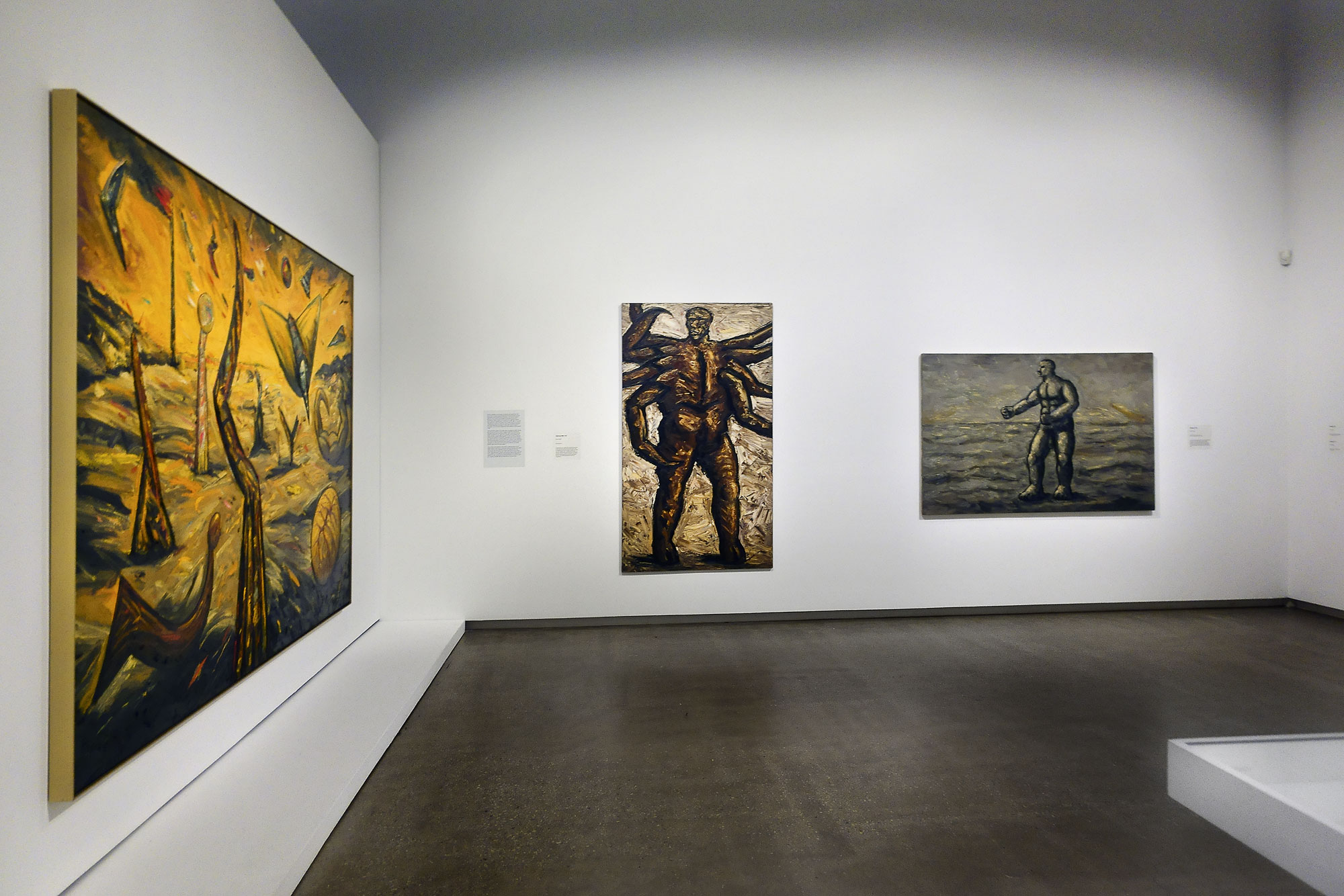
Installation view of the exhibition 'Peter Booth' at TarraWarra Museum of Art showing from left to right, 'Painting Two' 1984, 'Painting' 1984 and 'Leadman' 1986


Installation view of the exhibition Peter Booth at TarraWarra Museum of Art showing from left to right, Painting Two 1984, Painting 1984 and Leadman 1986
Photo: Marcus Bunyan
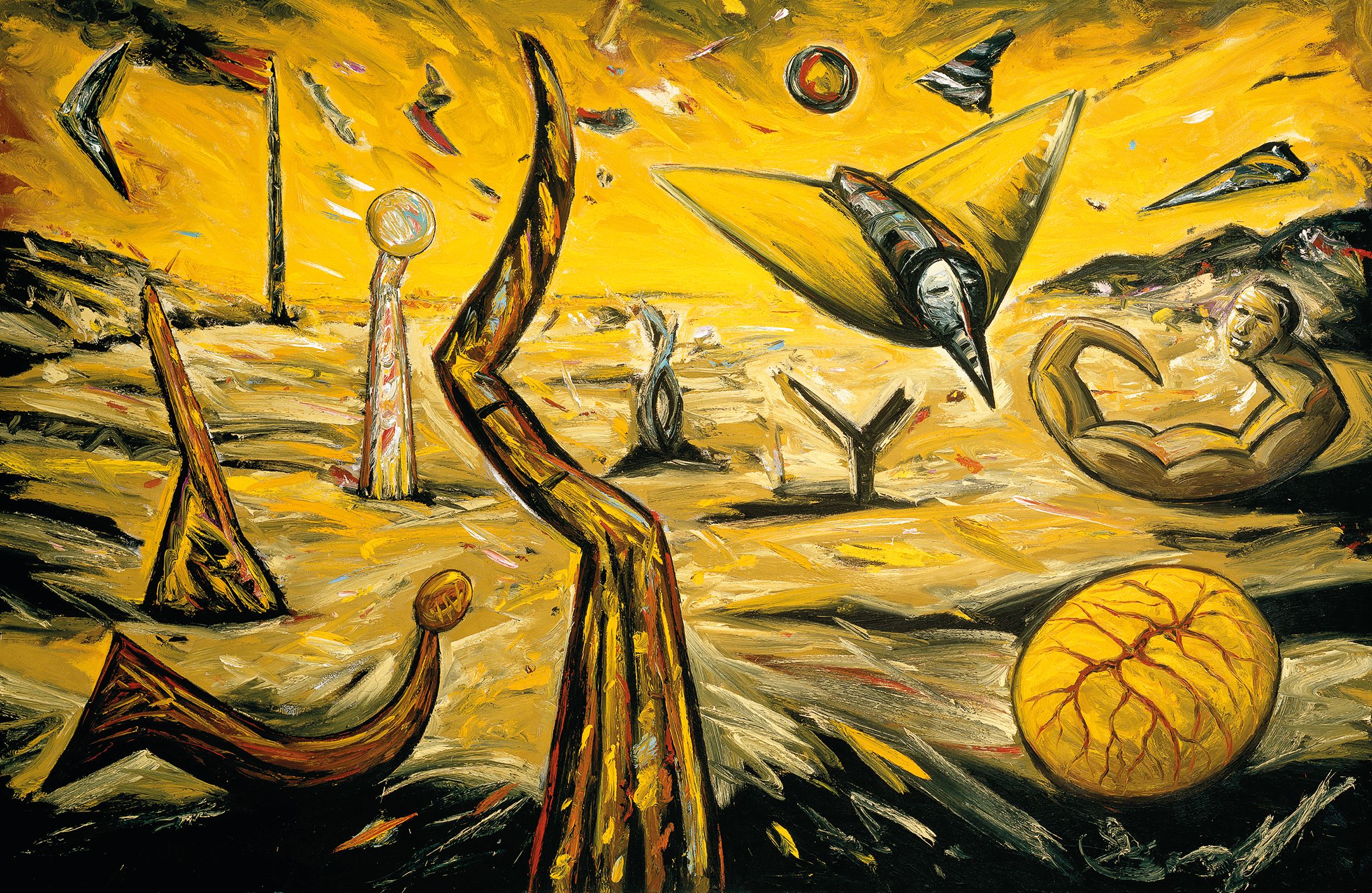
 

Peter Booth (Australian born England, b. 1940, Australia from 1958) 'Painting Two' 1984


Peter Booth (Australian born England, b. 1940, Australia from 1958)
Painting Two
1984
Oil on canvas
198 x 305cm
National Gallery of Victoria, Melbourne
Purchased 1985
© Peter Booth


In the blasted landscape of Painting Two we are presented with a vision of a volatile world in the process of unnatural mutation. As an artist who has always been keenly attuned to what’s happening environmentally and politically, this painting forcefully conveys the fallout of a colossal act of destruction, reflecting widespread concerns in the 1980s over the dramatic escalation of the nuclear arms race between the United States and the Soviet Union and the threat of atomic warfare.

Wall text from the exhibition
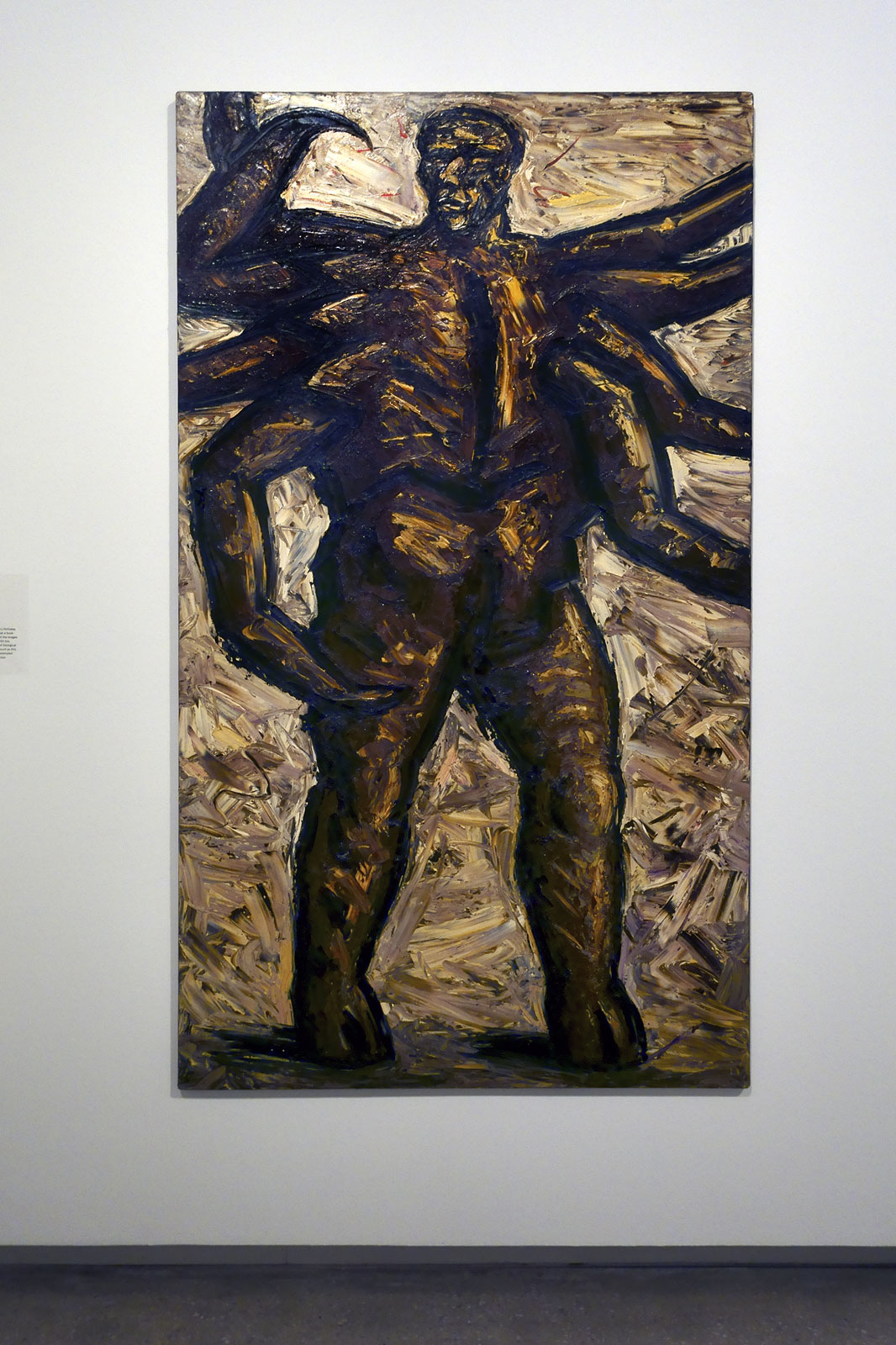
 

Peter Booth (Australian born England, b. 1940, Australia from 1958) 'Painting' 1984 (installation view)


Peter Booth (Australian born England, b. 1940, Australia from 1958)
Painting (installation view)
1984
Oil on canvas
© Peter Booth
Photo: Marcus Bunyan
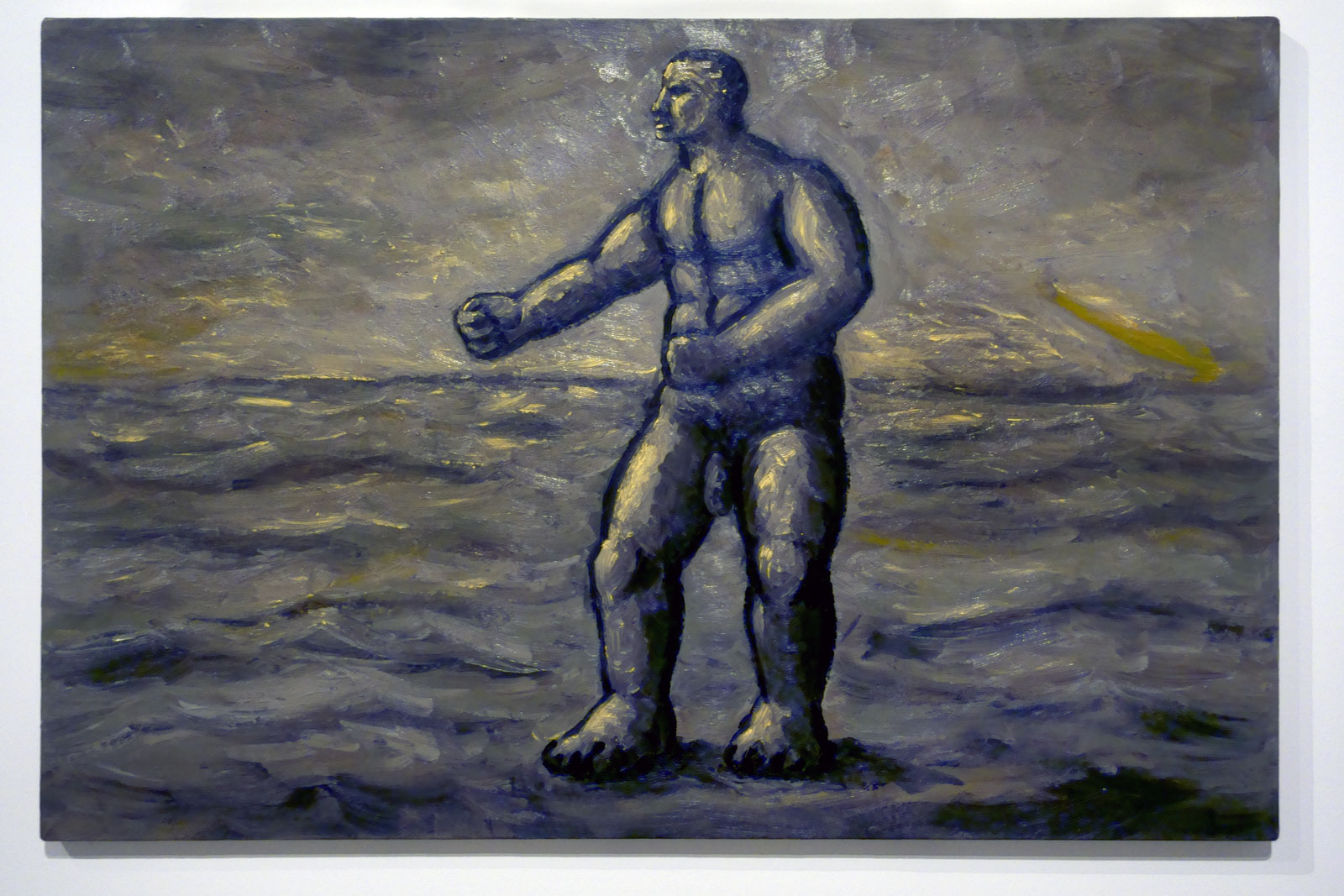
 

Peter Booth (Australian born England, b. 1940, Australia from 1958) 'Leadman' 1986 (installation view)


Peter Booth (Australian born England, b. 1940, Australia from 1958)
Leadman (installation view)
1986
Oil on canvas
TarraWarra Museum of Art collection
Gift of Eva Besen and Marc Besen AO 2001
© Peter Booth
Photo: Marcus Bunyan


In this work a hulking grey figure, with his fierce determination and body braced for battle, appears to be biologically adapted for survival in a desolated terrain. As the title suggests, this unrelentingly bleak and polluted atmosphere has eventuated from the unbridled destructive ambitions of the toxic Leadman who has transformed the world in his own image.

Wall text from the exhibition
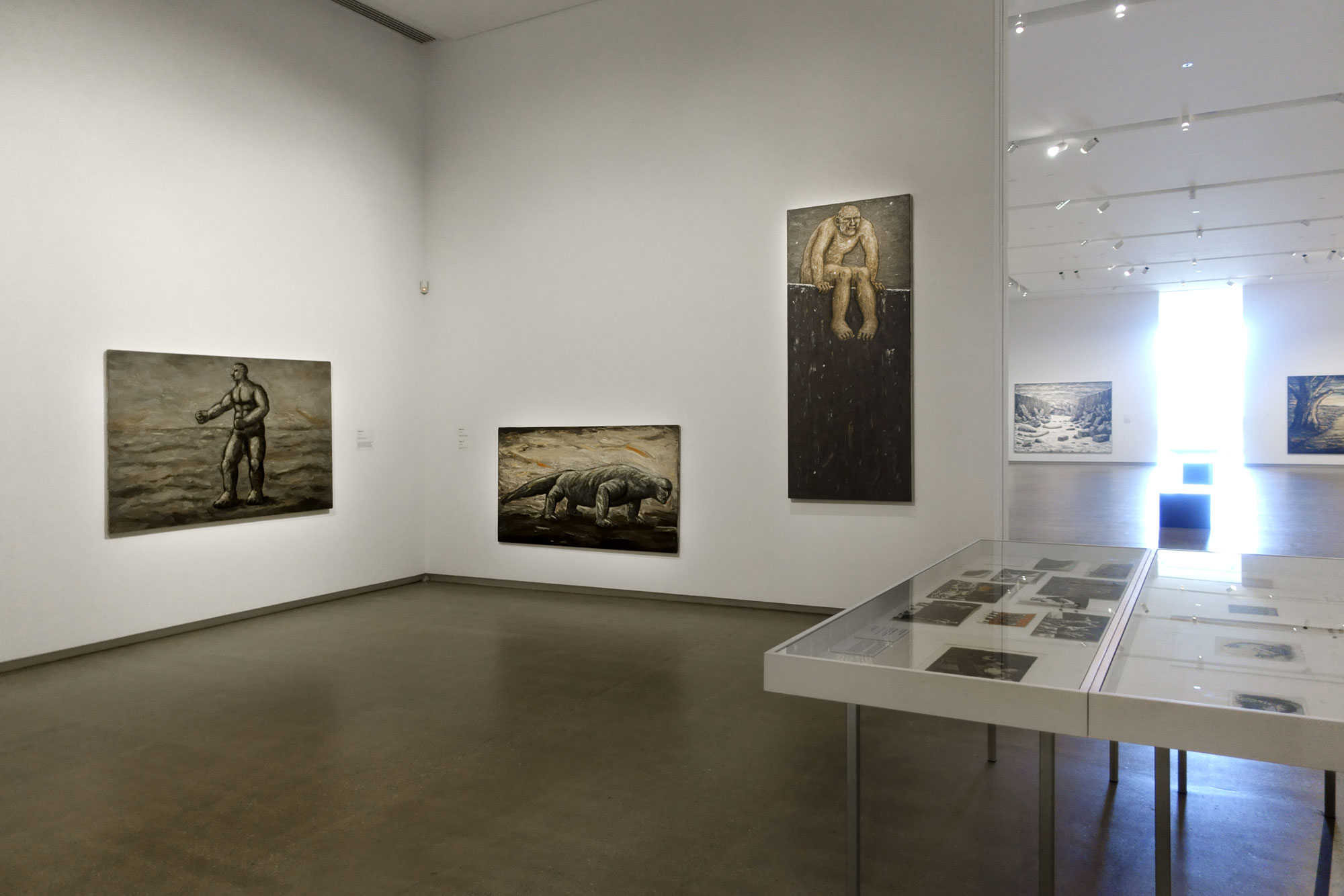
 

Installation view of the exhibition 'Peter Booth' at TarraWarra Museum of Art showing from left to right, 'Leadman' 1986, 'Painting' 1984 and 'Painting' 2012

Installation view of the exhibition 'Peter Booth' at TarraWarra Museum of Art showing from left to right, 'Leadman' 1986, 'Painting' 1984 and 'Painting' 2012


Installation view of the exhibition Peter Booth at TarraWarra Museum of Art showing from left to right, Leadman 1986, Painting 1984 and Painting 2012
Photos: Marcus Bunyan
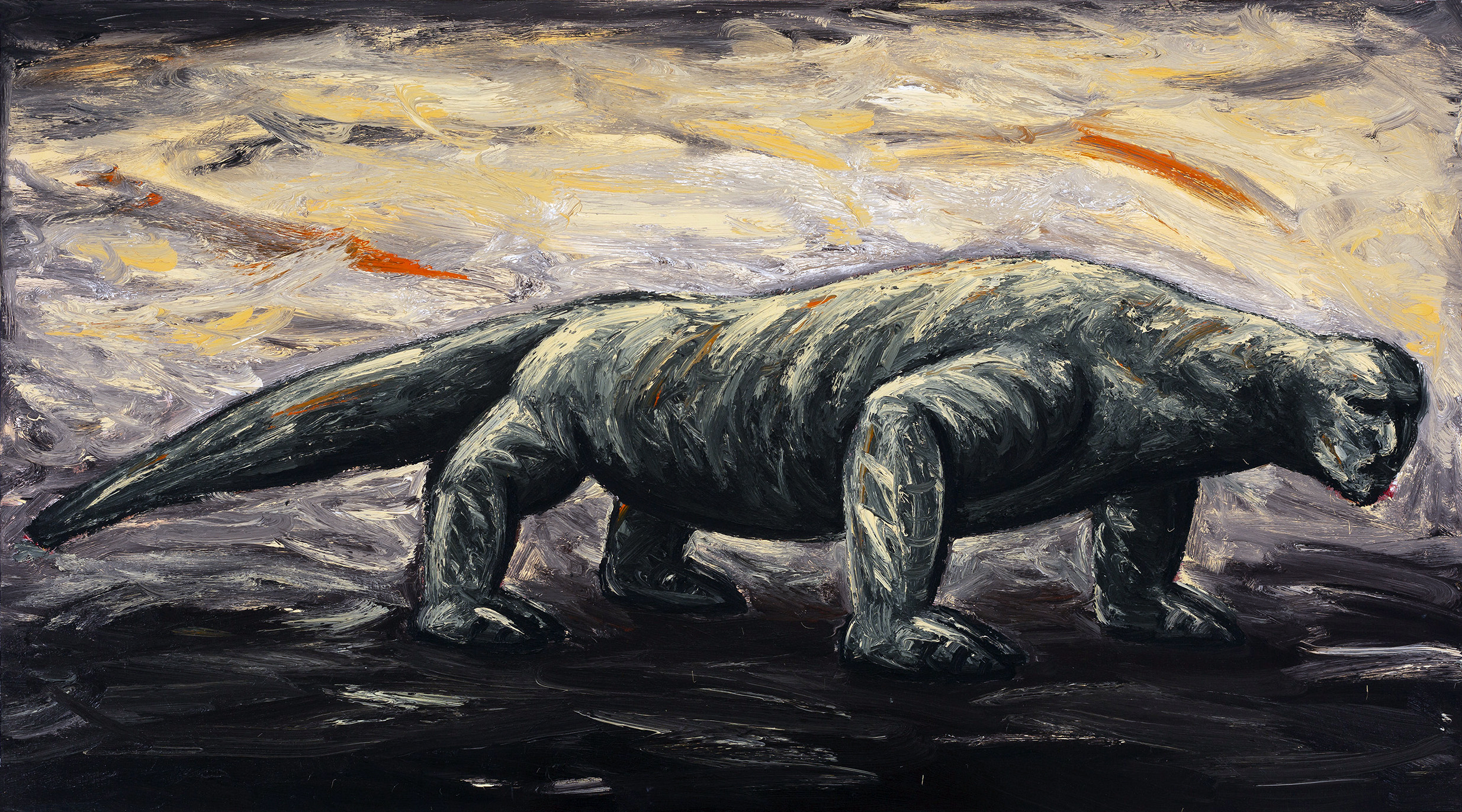
 

Peter Booth (Australian, b. 1940) 'Painting' 1984


Peter Booth (Australian, b. 1940)
Painting
1984
Oil on canvas
101 x 183cm
Heide Museum of Modern Art
The Baillieu Myer Collection of the ’80s
© Peter Booth
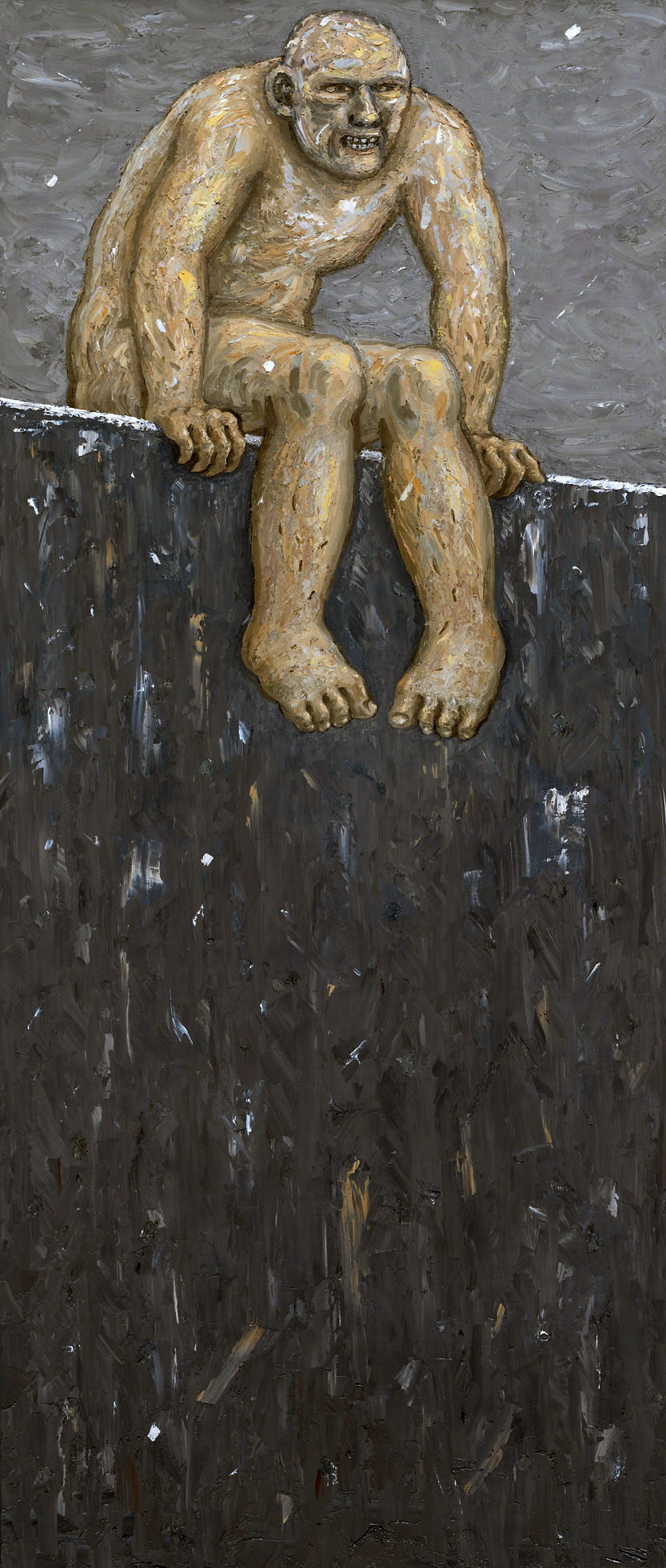
 

Peter Booth (Australian, b. 1940) 'Painting' 2012


Peter Booth (Australian, b. 1940)
Painting
2012
Oil on canvas
213.5 x 91cm
National Gallery of Australia, Canberra
© Peter Booth
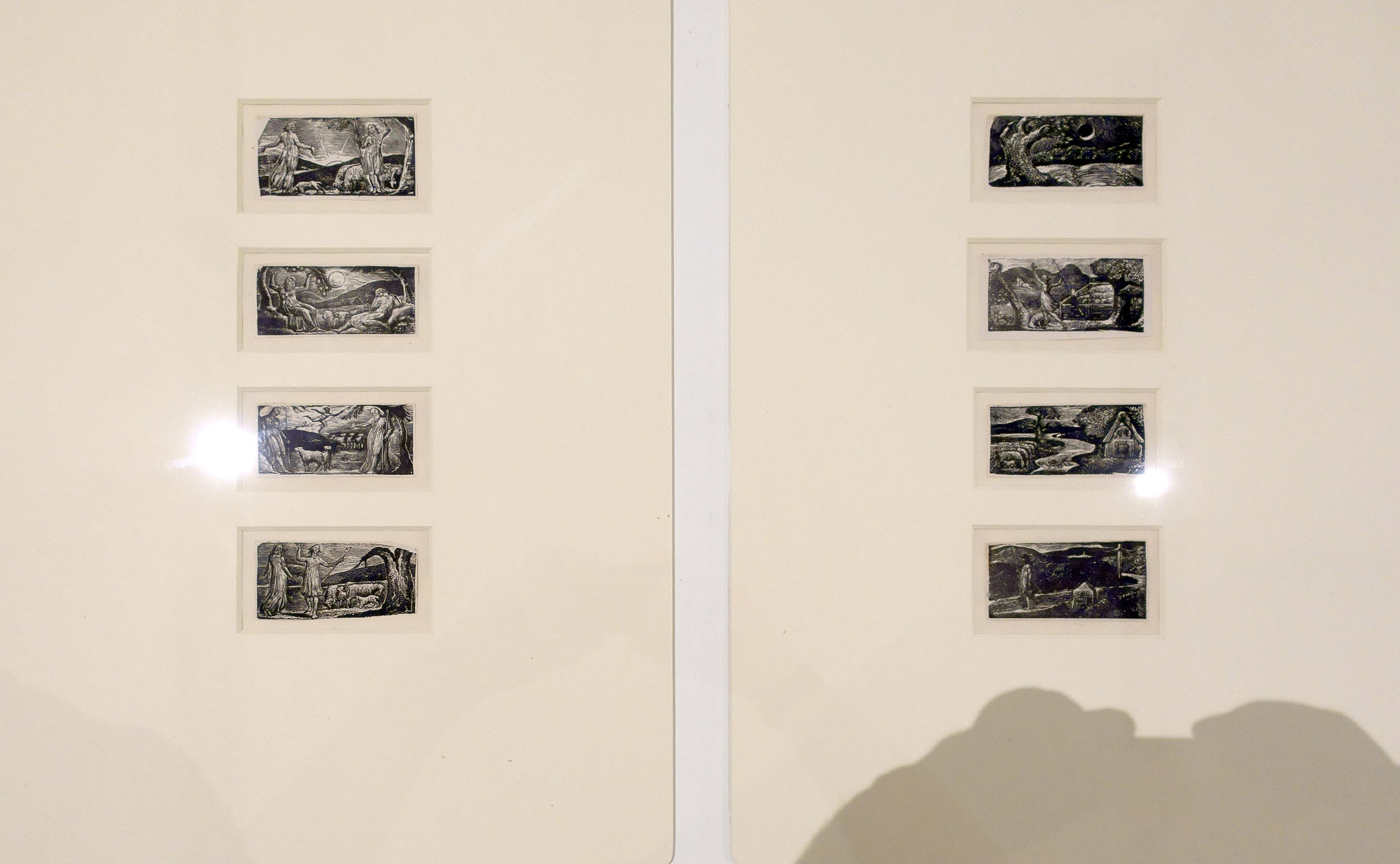
 

William Blake (English, 1757-1827) From 'The Pastorals of Virgil' 1821


William Blake (English, 1757-1827)
Thenot Remonstrates with Colinet
Thenot Under a Fruit Tree
Thenot Remonstrates with Colinet, Lightfoot in the Distance
Colinet Departs in Sorrow, a Thunder-Scarred Tree on the Right
Blasted Tree and Blighted Crops
The Good Shepherd Chases Away the Wolf
Sabrina’s Silvery Flood
Colinet’s Fond Desire Strange Lands to Know
1821
From The Pastorals of Virgil adapted by R.J. Thornton, 3rd edition. F.C. & J. Rivington et al., London 1921
Wood engravings on thin, white handmade wove paper
National Gallery of Victoria, Melbourne
Purchased 1960
Photo: Marcus Bunyan
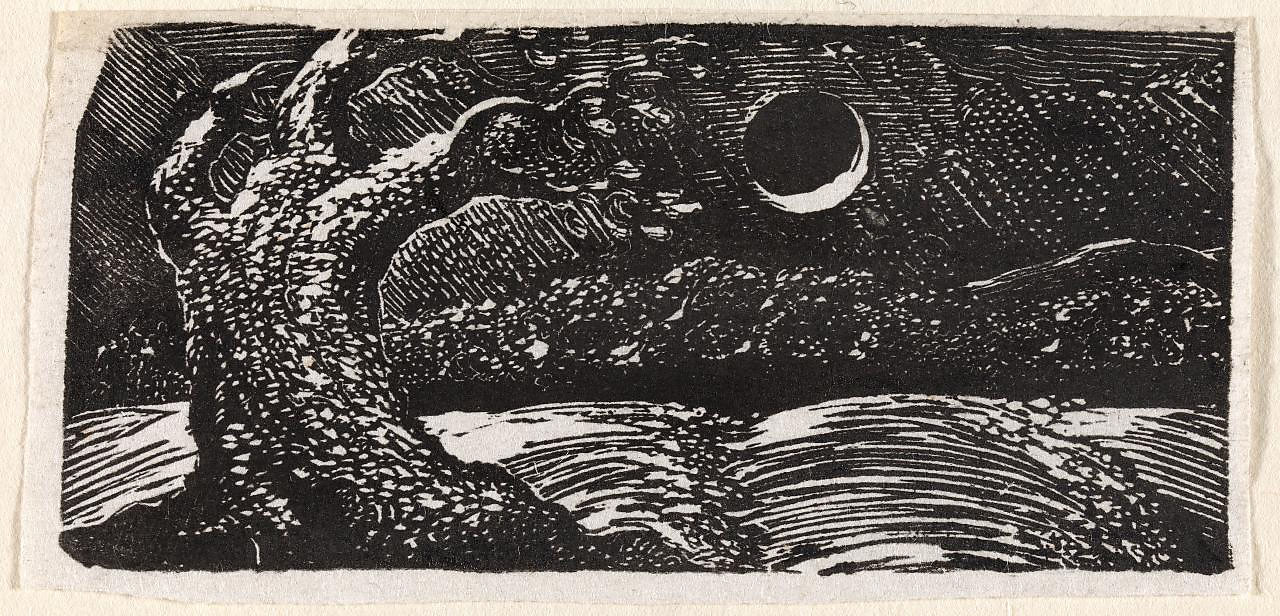
 

William Blake (English, 1757-1827) 'Blasted tree and blighted crops' 1821


William Blake (English, 1757-1827)
Blasted tree and blighted crops
1821
From The Pastorals of Virgil adapted by R.J. Thornton, 3rd edition. F.C. & J. Rivington et al., London 1921
Wood engraving on thin, white handmade wove paper
National Gallery of Victoria, Melbourne
Purchased 1960
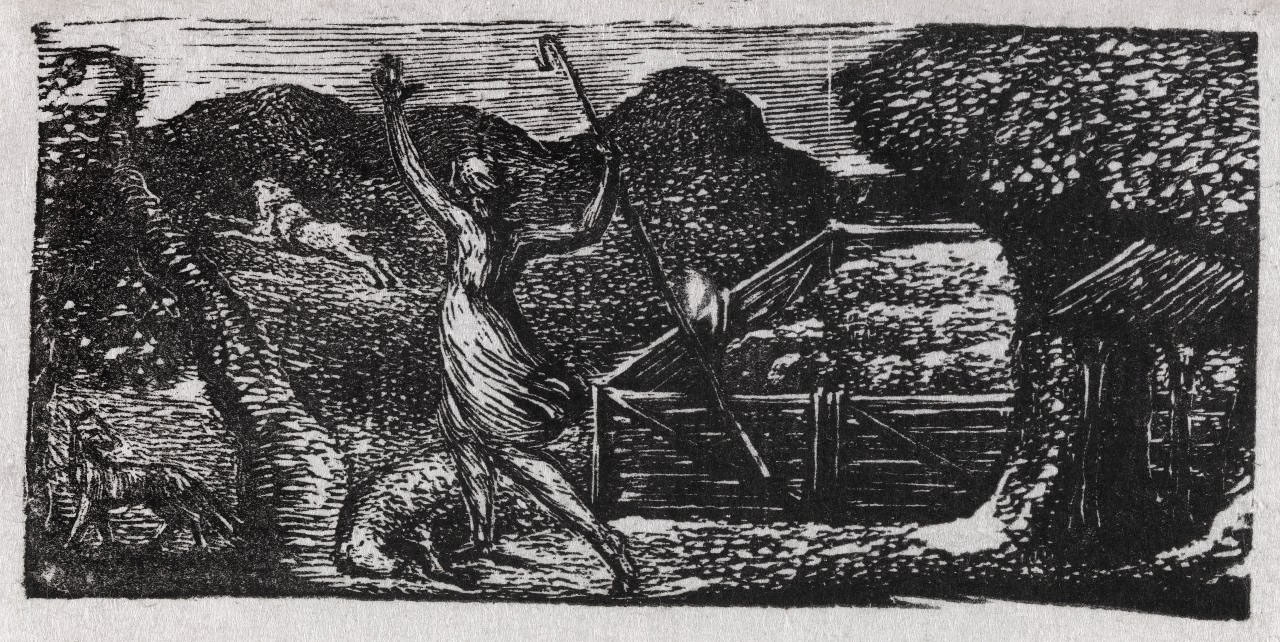
 

William Blake (English, 1757-1827) 'The Good Shepherd Chases Away the Wolf' 1821


William Blake (English, 1757-1827)
The Good Shepherd Chases Away the Wolf
1821
From The Pastorals of Virgil adapted by R.J. Thornton, 3rd edition. F.C. & J. Rivington et al., London 1921
Wood engraving on thin, white handmade wove paper
National Gallery of Victoria, Melbourne
Purchased 1960
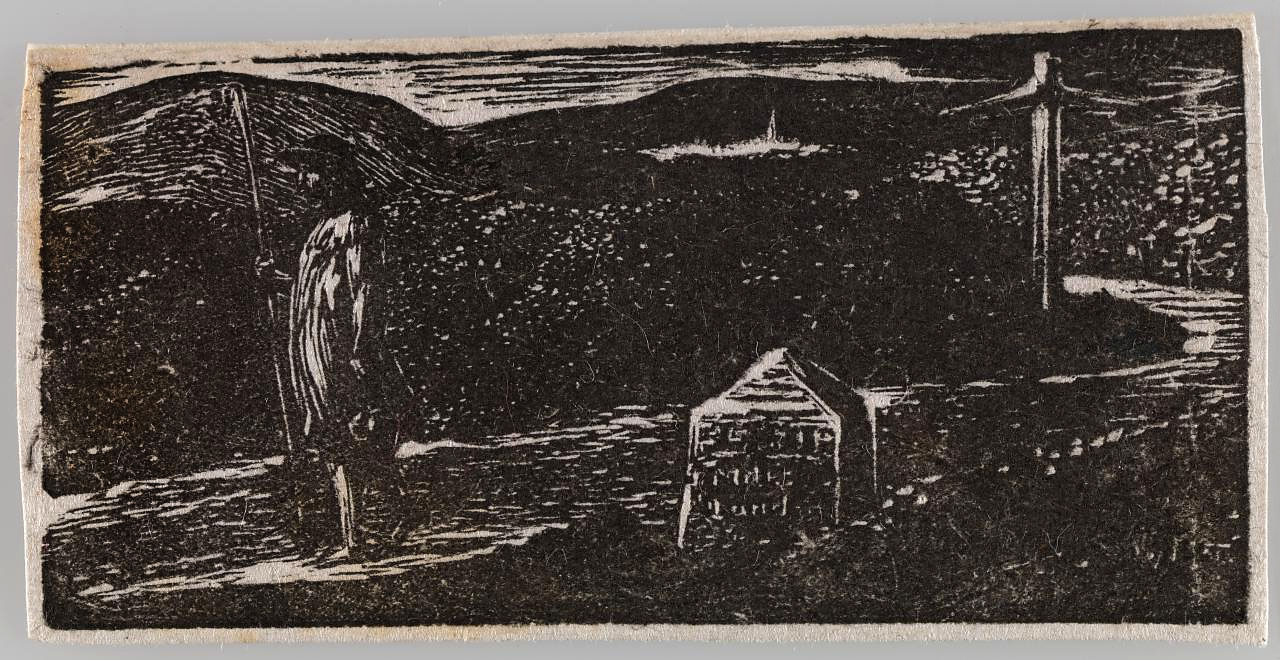
 

William Blake (English, 1757-1827) 'Colinet's Fond Desire Strange Lands to Know' 1821


William Blake (English, 1757-1827)
Colinet’s Fond Desire Strange Lands to Know
1821
From The Pastorals of Virgil adapted by R.J. Thornton, 3rd edition. F.C. & J. Rivington et al., London 1921
Wood engraving on thin, white handmade wove paper
National Gallery of Victoria, Melbourne
Purchased 1960
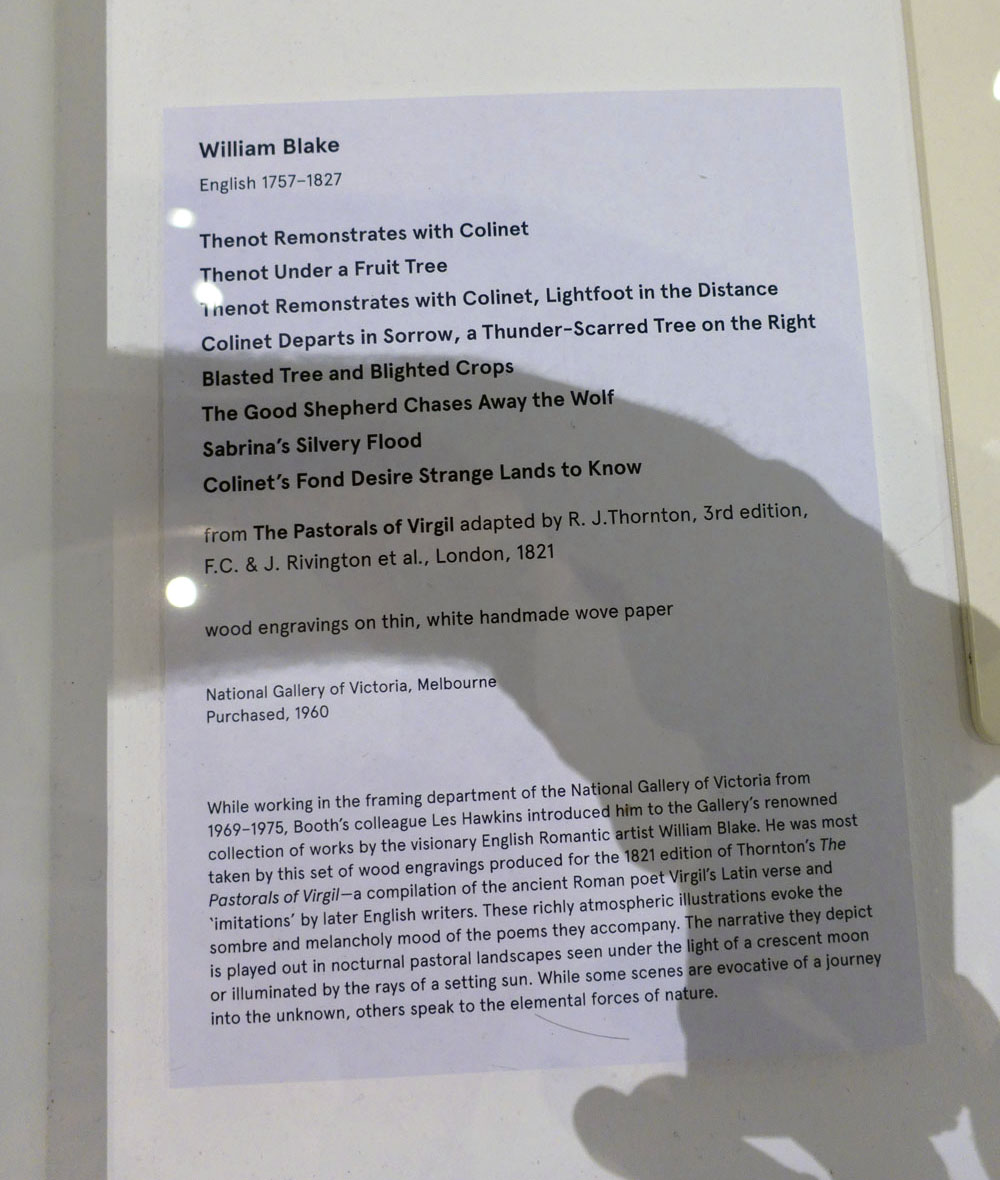
 

Cabinet text from the exhibition 'Peter Booth'


Cabinet text from the exhibition
Photo: Marcus Bunyan


A survey exhibition of the work of the renowned Australian artist Peter Booth 

With a remarkable career spanning several decades, Melbourne-based Booth is a unique voice in Australian art. This new survey of paintings and works on paper is the first major public gallery exhibition of Peter Booth’s work since the NGV retrospective in 2003 and features a number of the artist’s most significant works from the 1970s to 1990s, alongside important recent works from the past two decades.

The exhibition is presented thematically, honing in on and highlighting particular motifs, subjects and moods which have become hallmarks of Booth’s expansive oeuvre: stillness and turbulence, alterity and alienation, mutation and hybridity, the absurd and the grotesque, the road and the ruin, and the despoliation and the resilience of nature.

A small group of abstract paintings from the mid-1970s at the start of the exhibition provide a prelude to an important series of gestural paintings which mark the beginning of the artist’s journey into the highly expressive landscape and figure subjects which have characterised his practice since that time.

The exhibition progresses through Booth’s vivid imaginings of an apocalyptic world characterised by grotesque, unsettling, and at times absurd scenes of human and hybrid figures in varying states of apprehension, aggression and conflict. These works will be accompanied by a small selection of prints by William Blake, James Ensor, Francisco Goya, and Samuel Palmer, visionary artists who have been important touchstones for Booth and with whom he shares a number of affinities.

This survey also brings together important works from the past three decades to convey humanity’s often fraught and ambiguous relationship to the natural world, revealing Booth’s extraordinary capacity to transmute his intensely personal perceptions of the mysteries and forces of nature and the folly and hubris of human endeavours, into exceptional and deeply compelling paintings and drawings.

PETER BOOTH, curated by Anthony Fitzpatrick, is generously supported by The Balnaves Foundation.

Text from the TarraWarra Museum of Art website
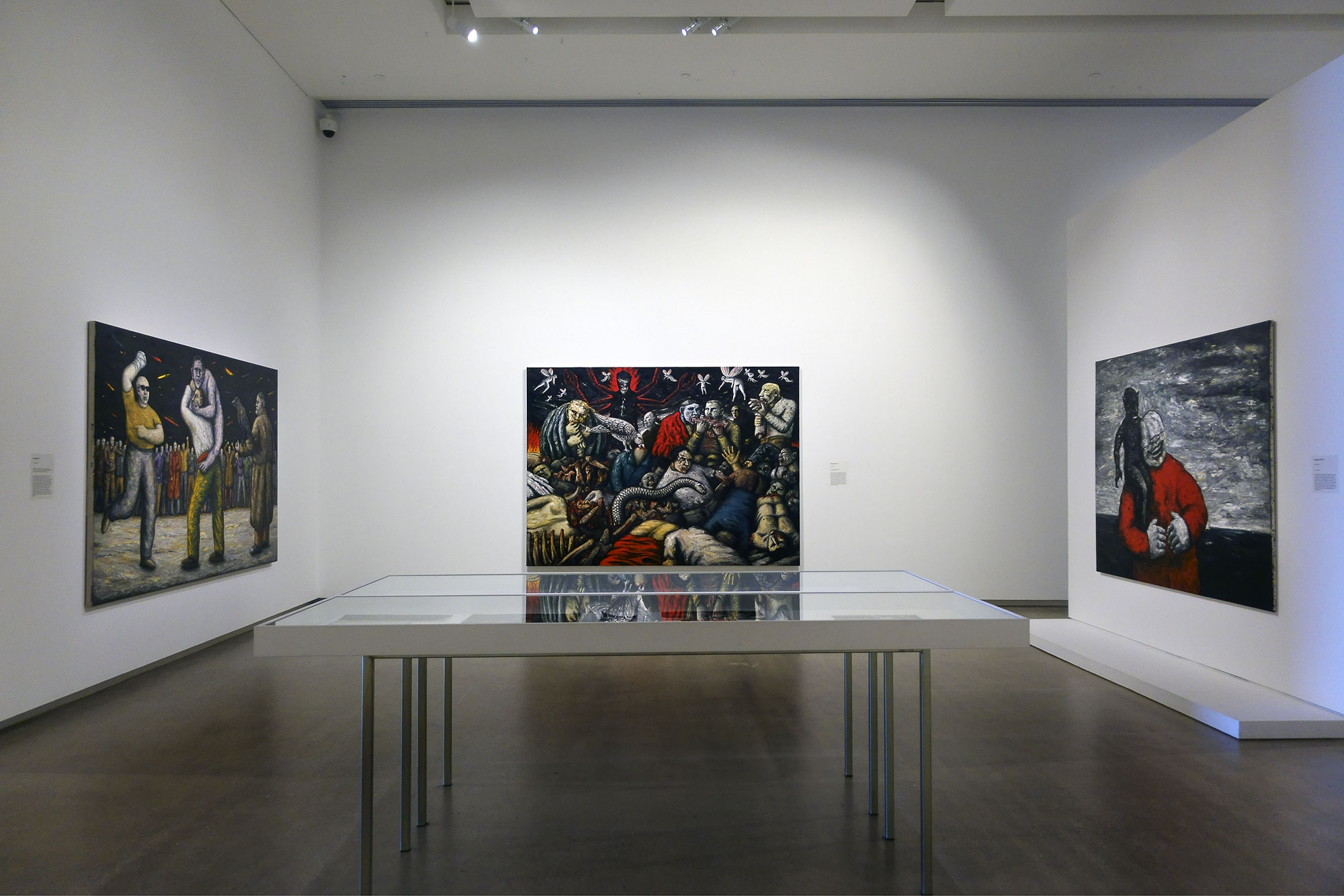
 

Installation view of the exhibition 'Peter Booth' at TarraWarra Museum of Art showing from left to right, 'Untitled' 1997, 'Painting' 1982 and 'Painting' 1981


Installation view of the exhibition Peter Booth at TarraWarra Museum of Art showing from left to right, Untitled 1997, Painting 1982 and Painting 1981
Photo: Marcus Bunyan
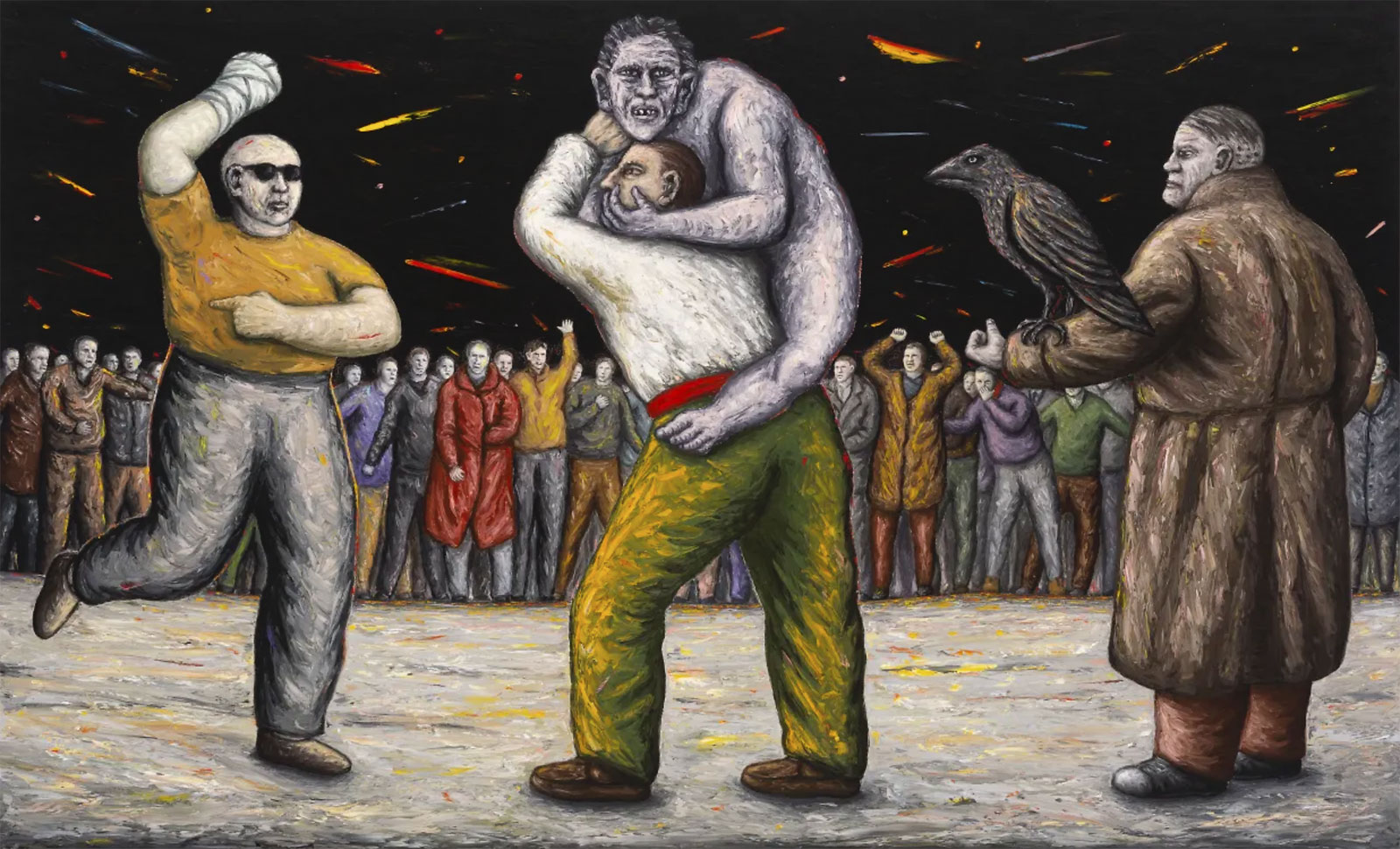
 

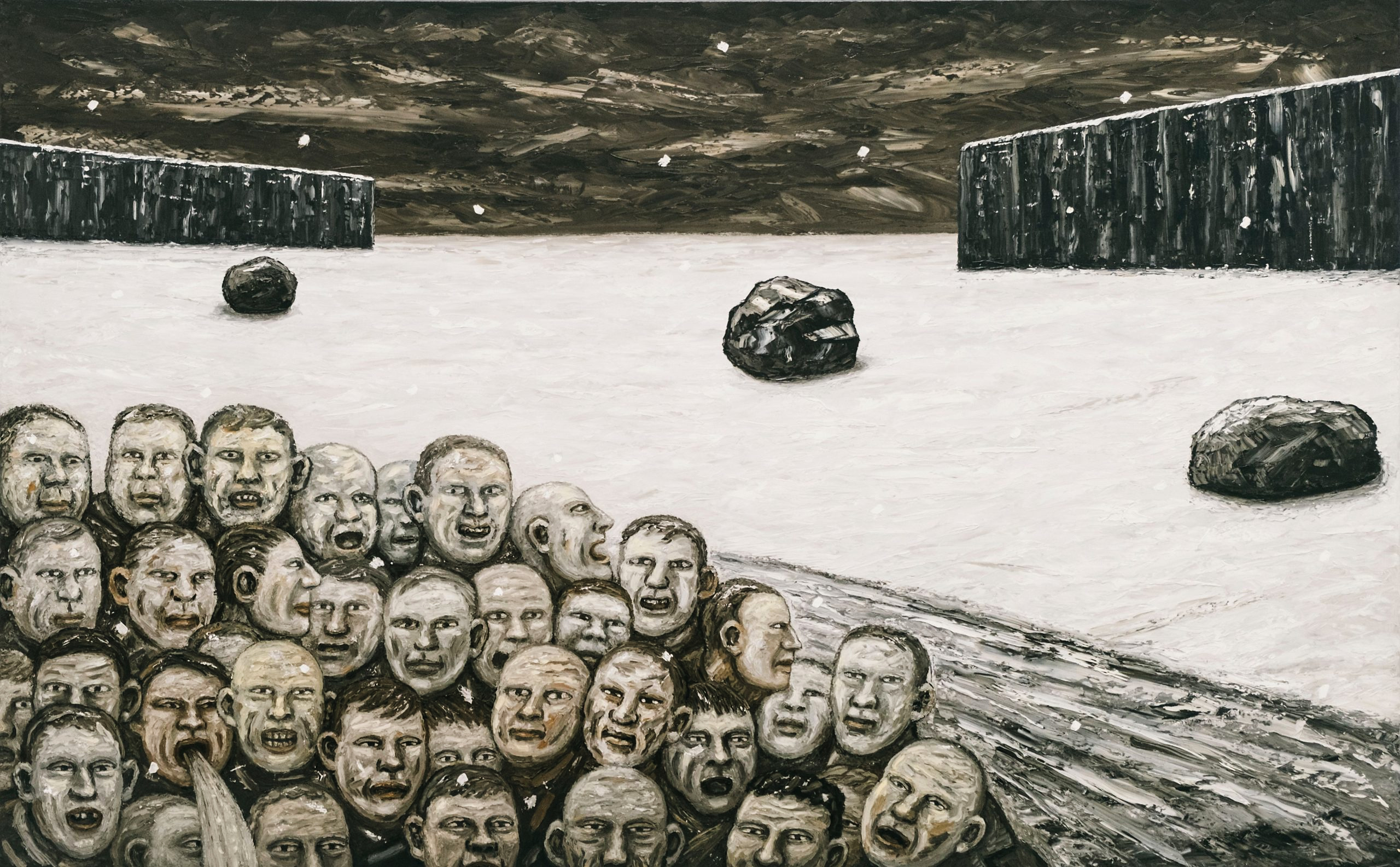
Peter Booth (Australian, b. 1940) 'Untitled' 1997


Peter Booth (Australian, b. 1940)
Untitled
1997
Oil on canvas
The University of Melbourne Art Collection, Michael Buxton Collection
Donated through the Australia Government’s Cultural Gifts Program by Michael and Janet Buxton 2018
© Peter Booth


In Doris Lessing’s 1974 novel, The Memoirs of a Survivor, in the aftermath of an unspecified disaster, civilisation gradually disintegrates into anarchy as hordes of people form ad hoc tribes in the city streets to increase their chances of survival. In this dystopian narrative, Lessing describes the irrational and aggressive behaviour that can be unleashed within the safety and obscurity of a large group. This same sense of apprehension is one that Booth shares in many of his depictions of crowds. In Untitled, 1997, a large throng of men forms a single, impenetrable wall, gathered together to cheer on the spectacle of a violent struggle. Disturbing and absurd in equal measure, this work graphically portrays the violent actions that can be incited by a mob.

Wall text from the exhibition
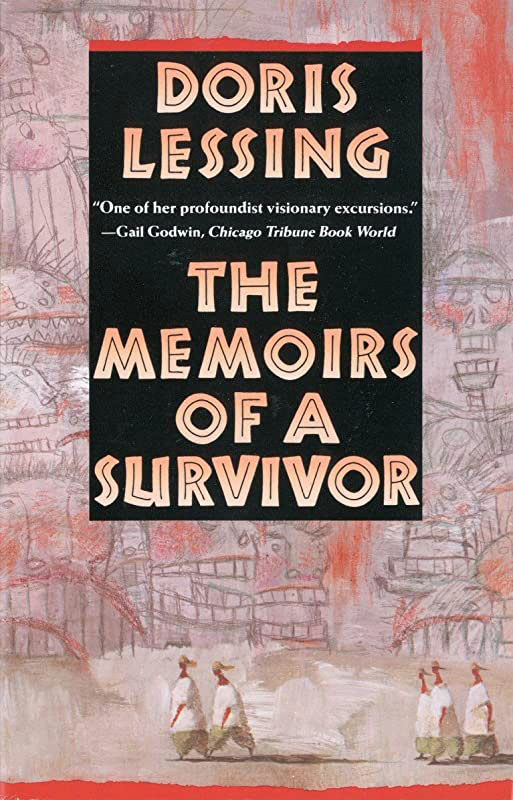
 

Doris Lessing. 'The Memoirs of a Survivor' book cover


Doris Lessing (British-Zimbabwean born Iran, 1919-2013)
The Memoirs of a Survivor
1974
Penguin Random House book cover published 1988
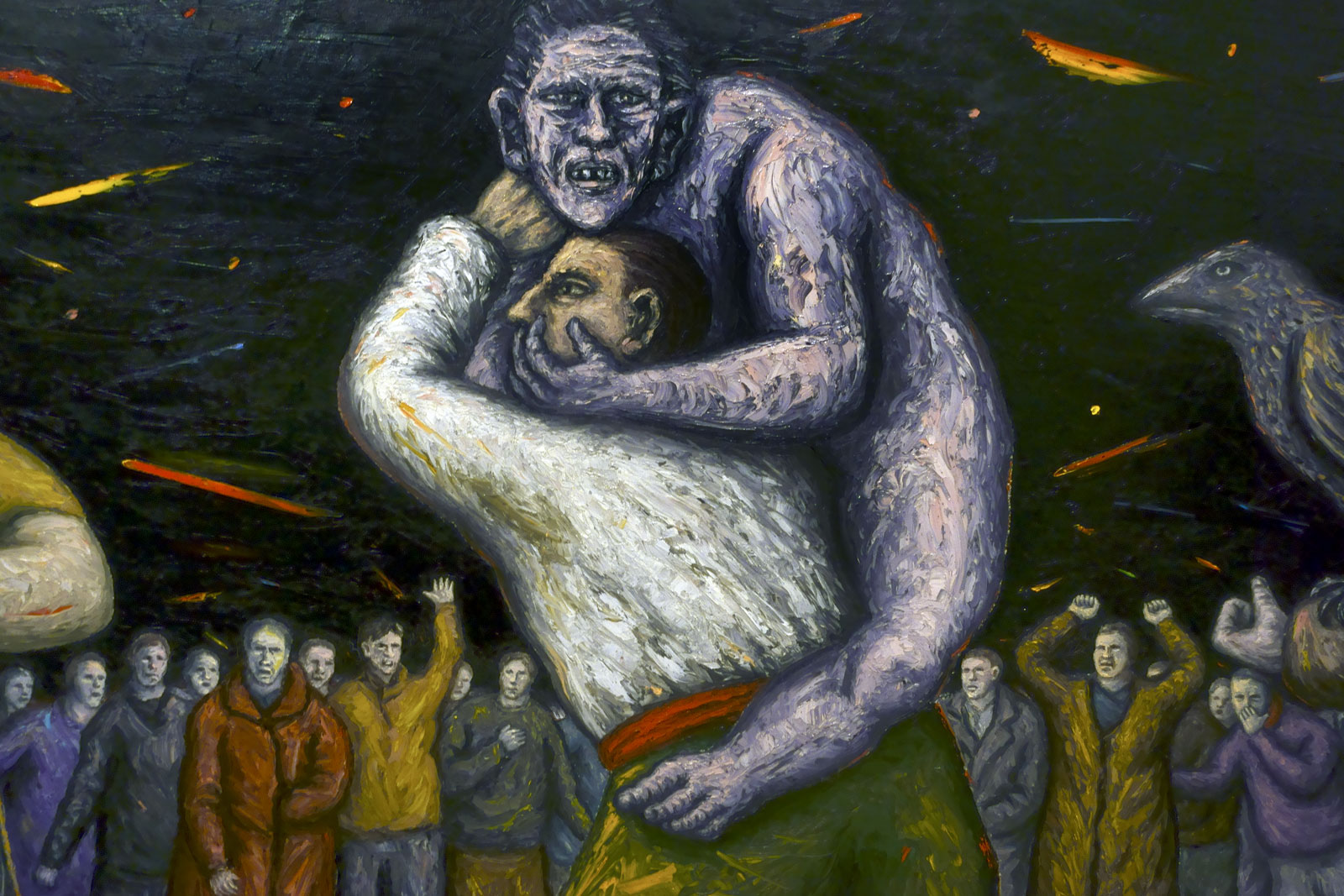
 

Peter Booth (Australian, b. 1940) 'Untitled' 1997 (installation view detail)


Peter Booth (Australian, b. 1940)
Untitled (installation view detail)
1997
Oil on canvas
The University of Melbourne Art Collection, Michael Buxton Collection
Donated through the Australia Government’s Cultural Gifts Program by Michael and Janet Buxton 2018
© Peter Booth
Photo: Marcus Bunyan
 

Peter Booth (Australian, b. 1940) 'Painting 1982' 1982 (installation view)


Peter Booth (Australian, b. 1940)
Painting 1982 (installation view)
1982
Oil on canvas
Art Gallery of South Australia, Adelaide
A.M. Ragless Bequest Fund
© Peter Booth
Photo: Marcus Bunyan


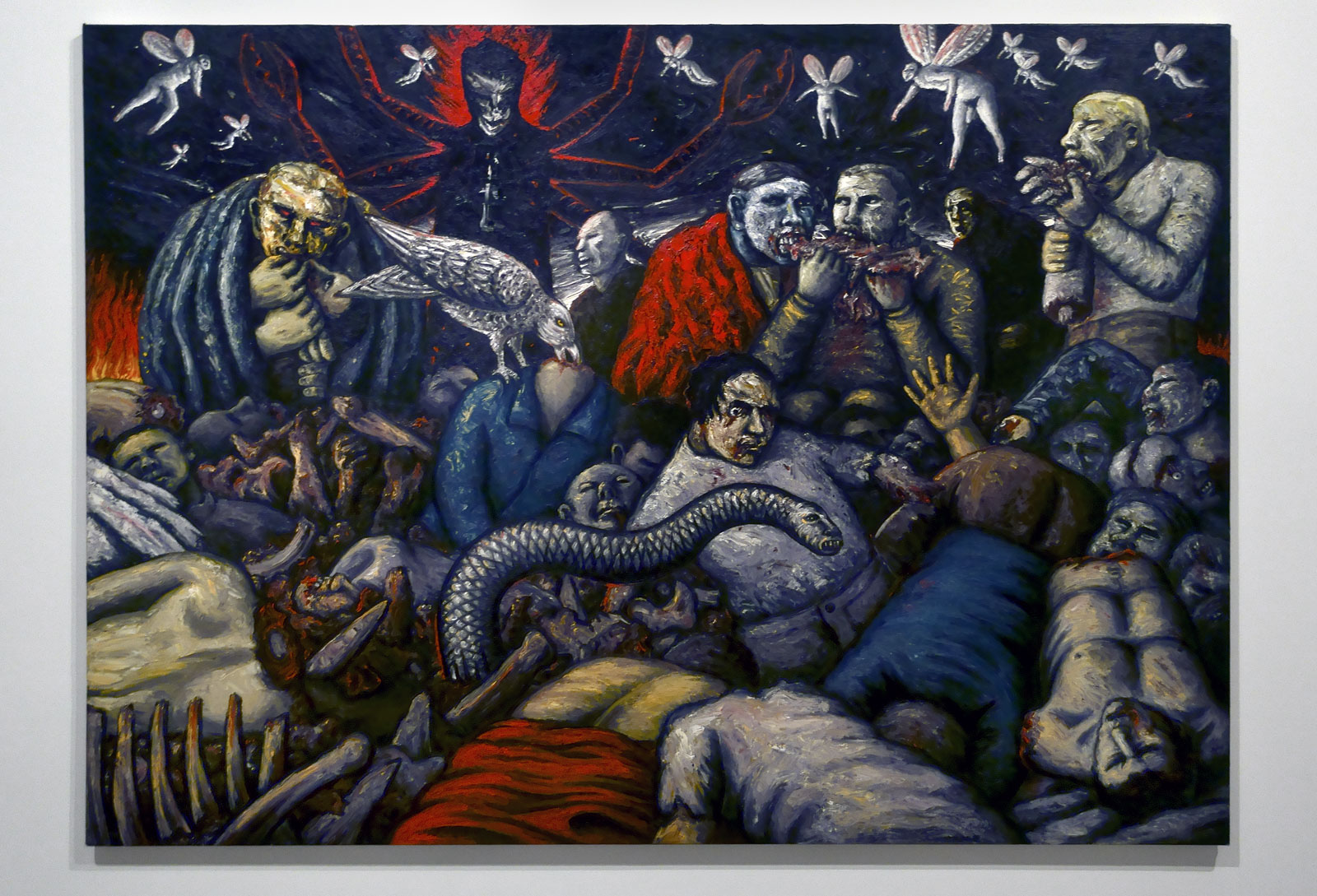
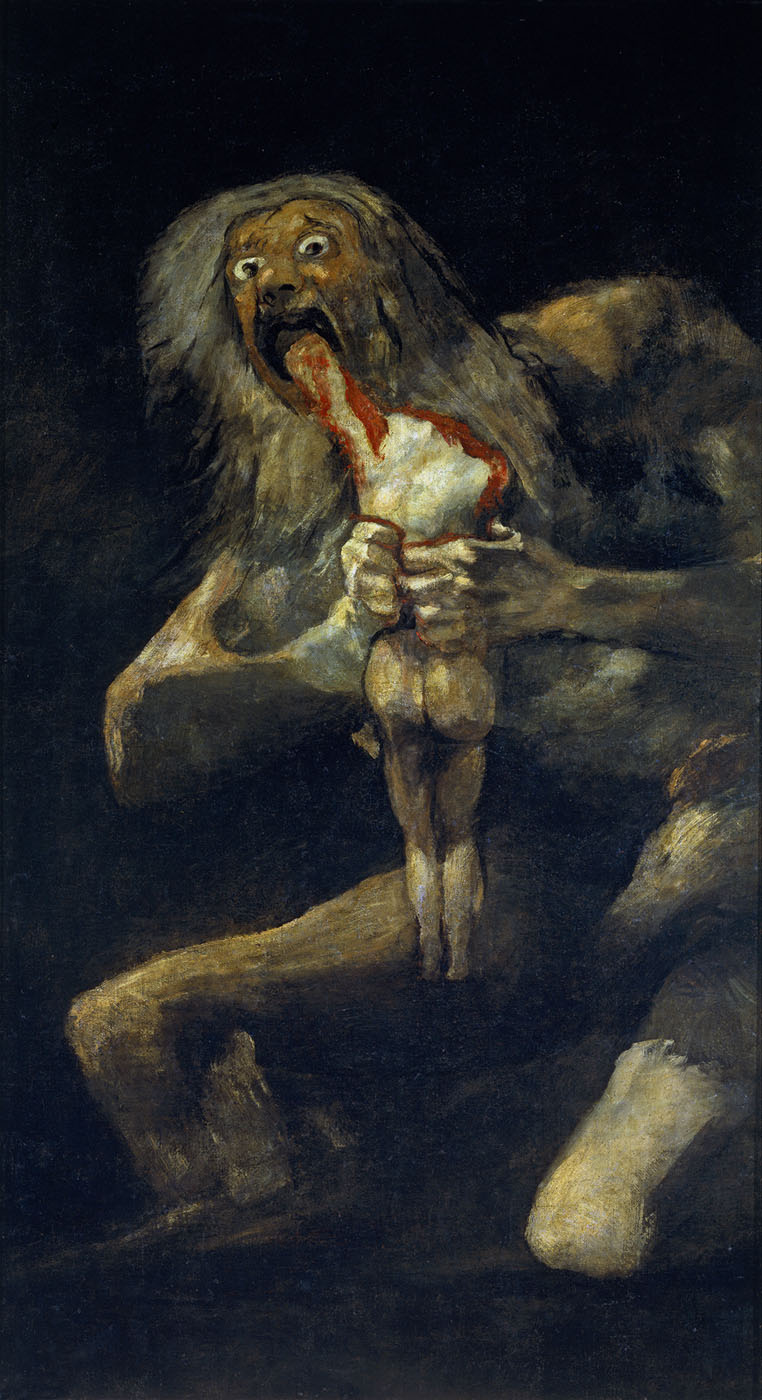
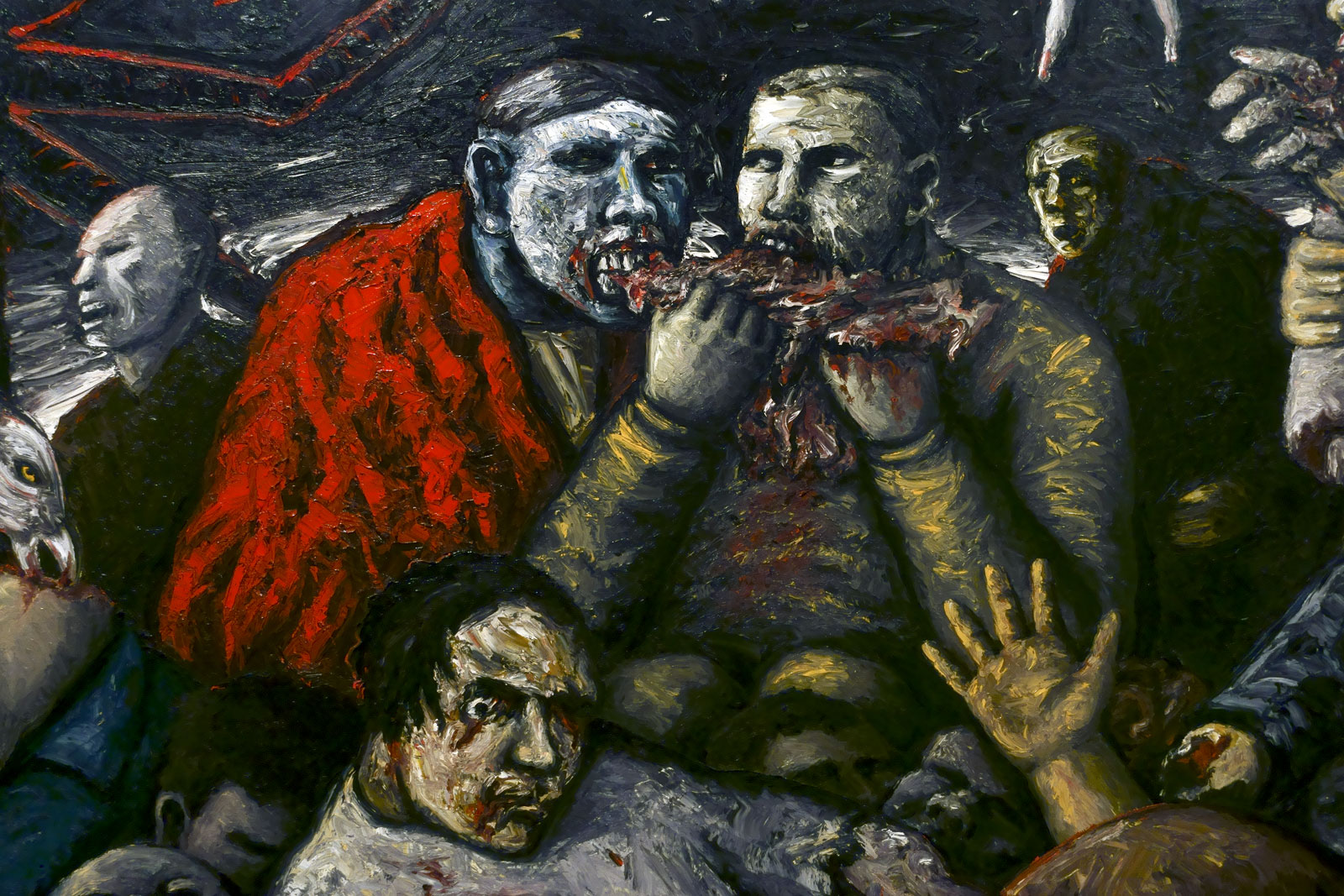
Another scene of demonic possession enacted under the spell of a fiendish presence, Painting 1982, confronts the viewer with a deeply disturbing vision of human cannibalism. With its visceral imagery of mutilation and dismemberment, parallels have been drawn to the atrocities depicted in Goya’s series of etchings The Disasters of War1810-1815, while the highly theatrical quality of the painting suggests a more recent connection to George A. Romero’s cult zombie film Night of the Living Dead, 1968. When the work was first exhibited critics responded to what the painting conveyed about the current state of western mass culture, finding in its brutal imagery a powerful metaphor for greed and material consumption. Whichever way one choses to interpret this work, one thing remains clear, whenever a large group of men get together in Booth’s painting, there is always the potential for danger.

Wall text from the exhibition
 

Francisco Goya (Spanish, 1746-1828) 'Saturn Devouring His Son' c. 1819-1823


Francisco Goya (Spanish, 1746-1828)
Saturn Devouring His Son
c. 1819-1823
Mixed media mural transferred to canvas
143.5 cm × 81.4cm (56.5 in × 32.0 in)
Museo del Prado, Madrid


Saturn Devouring His Son is a painting by Spanish artist Francisco Goya. It is traditionally interpreted as a depiction of the Greek myth of the Titan Cronus (known as Saturn in Roman mythology) eating one of his offspring. Fearing a prophecy foretold by Gaea that predicted he would be overthrown by one of his children, Saturn ate each one upon their birth. The work is one of the 14 so-called Black Paintings that Goya painted directly on the walls of his house sometime between 1819 and 1823. It was transferred to canvas after Goya’s death and is now in the Museo del Prado in Madrid. …

Various interpretations of the meaning of the picture have been offered: the conflict between youth and old age, time as the devourer of all things, the wrath of God and an allegory of the situation in Spain, where the fatherland consumed its own children in wars and revolution. There have been explanations rooted in Goya’s relationships with his own son, Xavier, the only of his six children to survive to adulthood, or with his live-in housekeeper and possible mistress, Leocadia Weiss; the sex of the body being consumed cannot be determined with certainty. If Goya made any notes on the picture, they have not survived, as he never intended the picture for public exhibition.

Text from the Wikipedia website
 

Peter Booth (Australian, b. 1940) 'Painting 1982' 1982 (installation view detail)


Peter Booth (Australian, b. 1940)
Painting 1982 (installation view detail)
1982
Oil on canvas
Art Gallery of South Australia, Adelaide
A.M. Ragless Bequest Fund
© Peter Booth
Photo: Marcus Bunyan
 

Peter Booth (Australian, b. 1940) 'Painting' 1981 (installation view)


Peter Booth (Australian, b. 1940)
Painting (installation view)
1981
Oil on canvas
Private collection
© Peter Booth
Photo: Marcus Bunyan


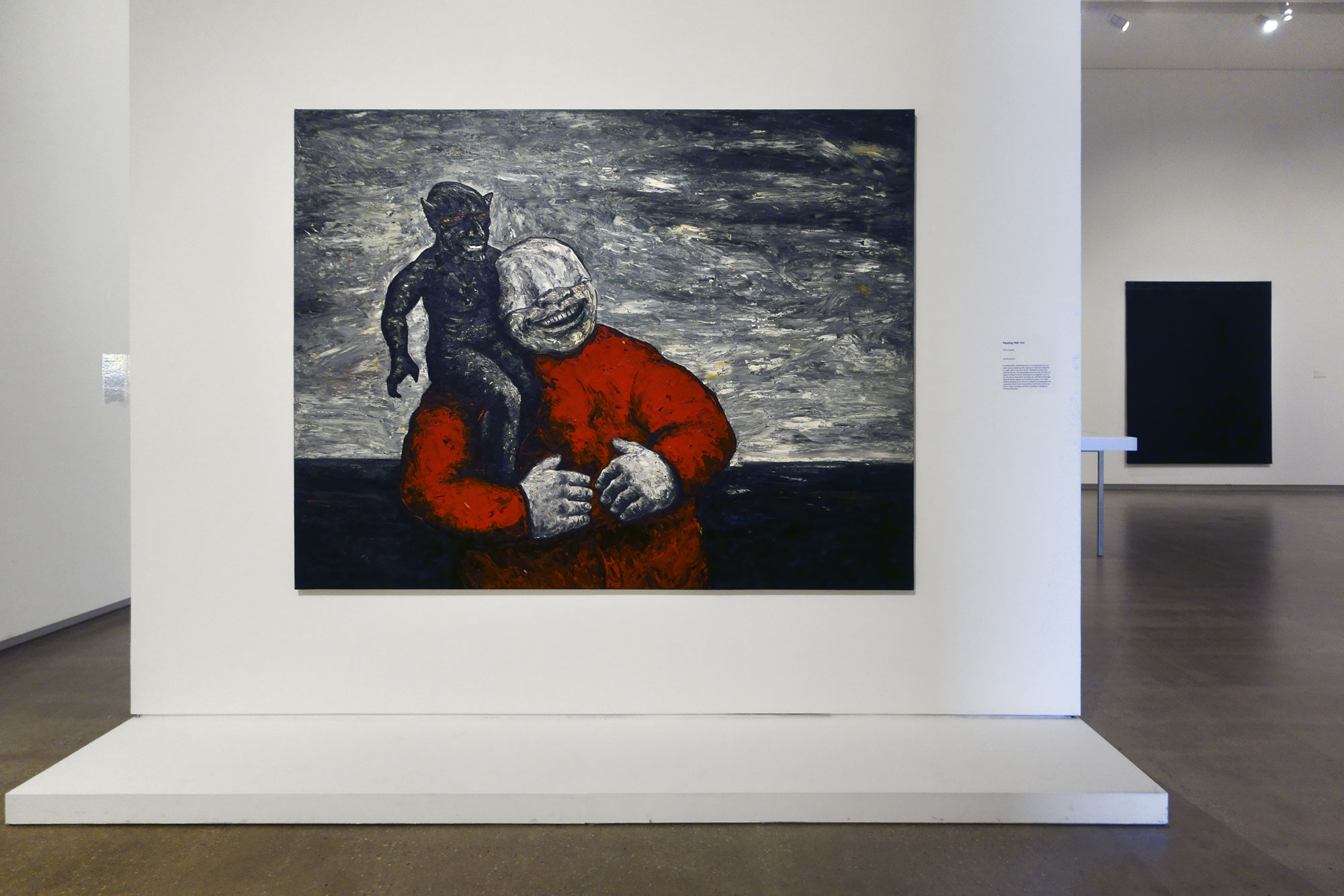
In Painting 1981 a blindfolded boor is accompanied by a red-eyed, pointy-eared imp who appears to have just whispered a cosmic joke or secret in his ear. Situated in a bleak and desolate terrain, this disquieting scenario recalls the German legend of Faust in which, following the protagonist’s pact to sell his soul to the Devil in exchange for unlimited knowledge, Mephistopheles appears as his demonic guide. In this light, Booth’s painting can be seen as a powerful reimagining of this cautionary tale of how blind ambition and human hubris can lead to inner corruption and the unleashing of dangerous, irrational impulses.

Wall text from the exhibition
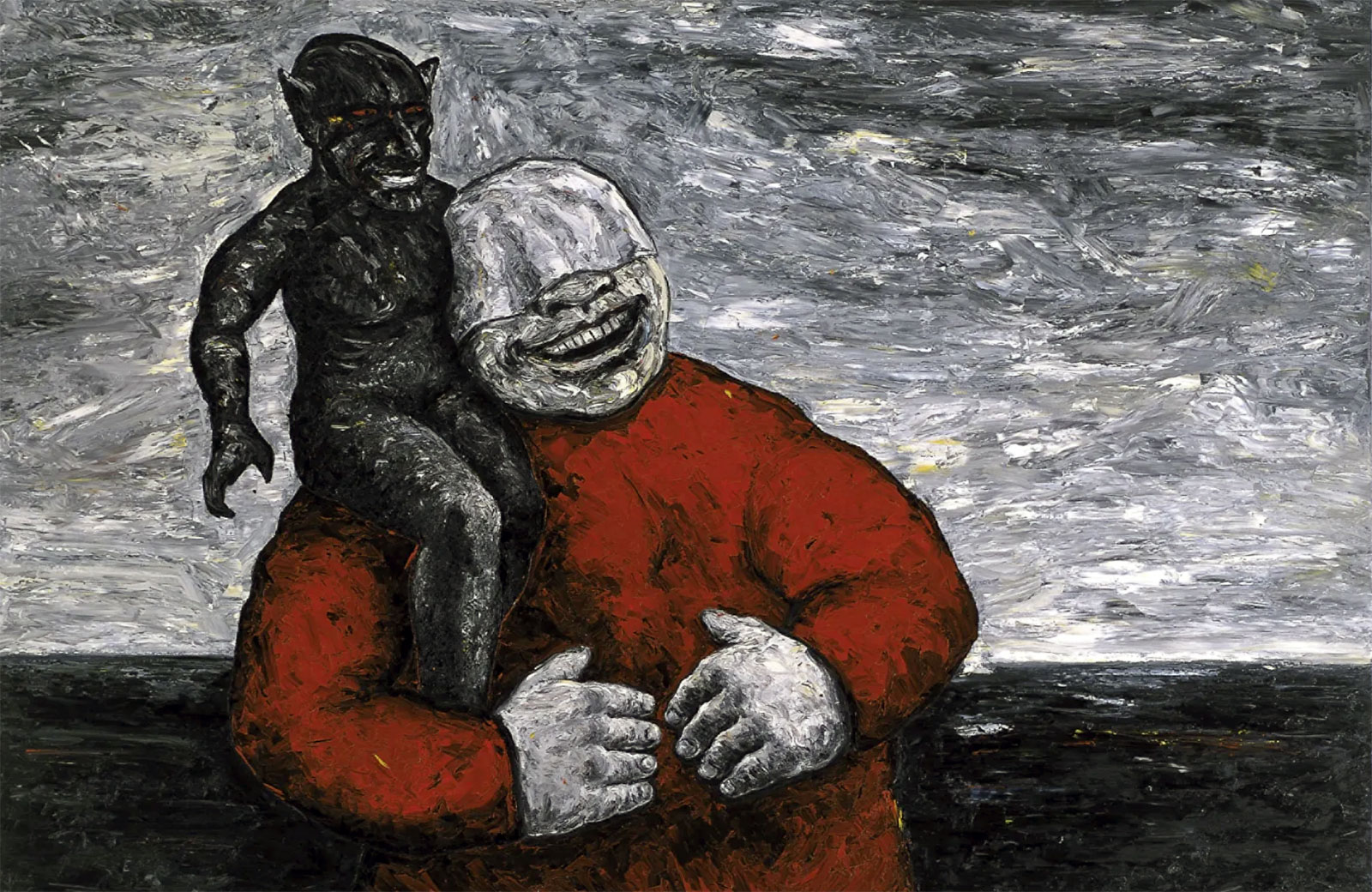
 

Peter Booth (Australian, b. 1940) 'Painting' 1981 (detail)


Peter Booth (Australian, b. 1940)
Painting (detail)
1981
Oil on canvas
Private collection
© Peter Booth


A survey exhibition of the work of major Australian artist Peter Booth will be held at TarraWarra Museum of Art, 26 November 2022 – 13 March 2023.

With a remarkable career spanning several decades, Melbourne-based Booth is a unique voice in Australian painting and is considered by many to be one of the most significant contemporary artists working in Australia today.

This new survey of paintings and works on paper will be the first major public gallery exhibition of Peter Booth’s work since the NGV retrospective in 2003 and will feature a number of the artist’s most significant works from the 1970s to 1990s, alongside important recent works from the past two decades.

Curated by TarraWarra’s Anthony Fitzpatrick, the exhibition will be presented thematically, honing in on and highlighting particular motifs, subjects and moods which have become hallmarks of Booth’s expansive oeuvre: stillness and turbulence; alterity and alienation; mutation and hybridity; the absurd and the grotesque; the road and the ruin; and the despoilation and the resilience of nature.

“This exhibition will reveal Booth’s extraordinary capacity to transmute his intensely personal perceptions of the mysteries and forces of nature, and the folly and hubris of human endeavours, into exceptional and deeply-compelling paintings and drawings,” Mr Fitzpatrick said.

A small group of abstract paintings from the mid-1970s at the start of the exhibition provide a prelude to an important series of gestural paintings which mark the beginning of the artist’s journey into a neo-expressionist figurative style.

The exhibition progresses through Booth’s vivid imaginings of an apocalyptic world characterised by grotesque, unsettling, and at times absurd scenes of human and hybrid figures in varying states of apprehension, aggression and conflict.

These works will be accompanied by a small selection of prints by William Blake, James Ensor, Francisco Goya, and Samuel Palmer, visionary artists who have been important touchstones for Booth and with whom he shares a number of affinities.

This survey will also bring together important works from the past three decades to convey humanity’s often fraught and ambiguous relationship to the natural world.

“Initially Booth’s highly visceral paintings of fiery, turbulent environments were the stage for confronting and, at times, violent human encounters. Since the 1990s, many of the scenes he has painted have become increasingly depopulated, implicating the viewer who is called to contemplate and navigate their own subjective relationship to these vivid landscapes.

“Most recently, the artist has returned to the apocalyptic imagery that characterised his first forays into figuration, with large-scale paintings of desolate and devastated scenes of a world in a cataclysmic state of collapse. This is art for a time of ecological and existential crisis in which anthropogenic impacts have driven the planet, and its intricate web of ecosystems, to the brink of utter catastrophe,” Mr Fitzpatrick said.

Press release from the TarraWarra Museum of Art
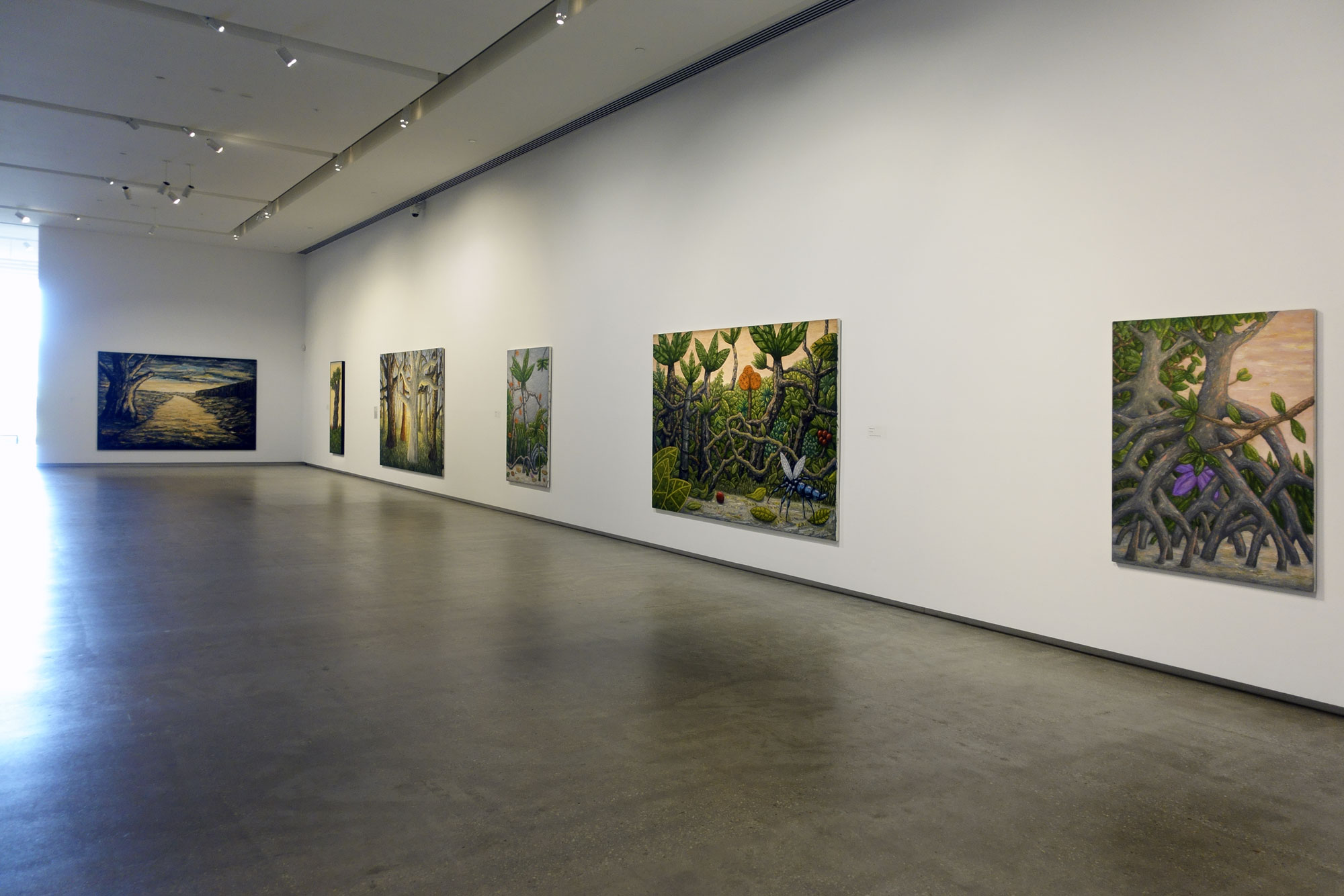
 

Installation view of the exhibition 'Peter Booth' at TarraWarra Museum of Art showing at second right, 'Painting' 2022


Installation view of the exhibition Peter Booth at TarraWarra Museum of Art showing at second right, Painting 2022 (below)
Photo: Marcus Bunyan
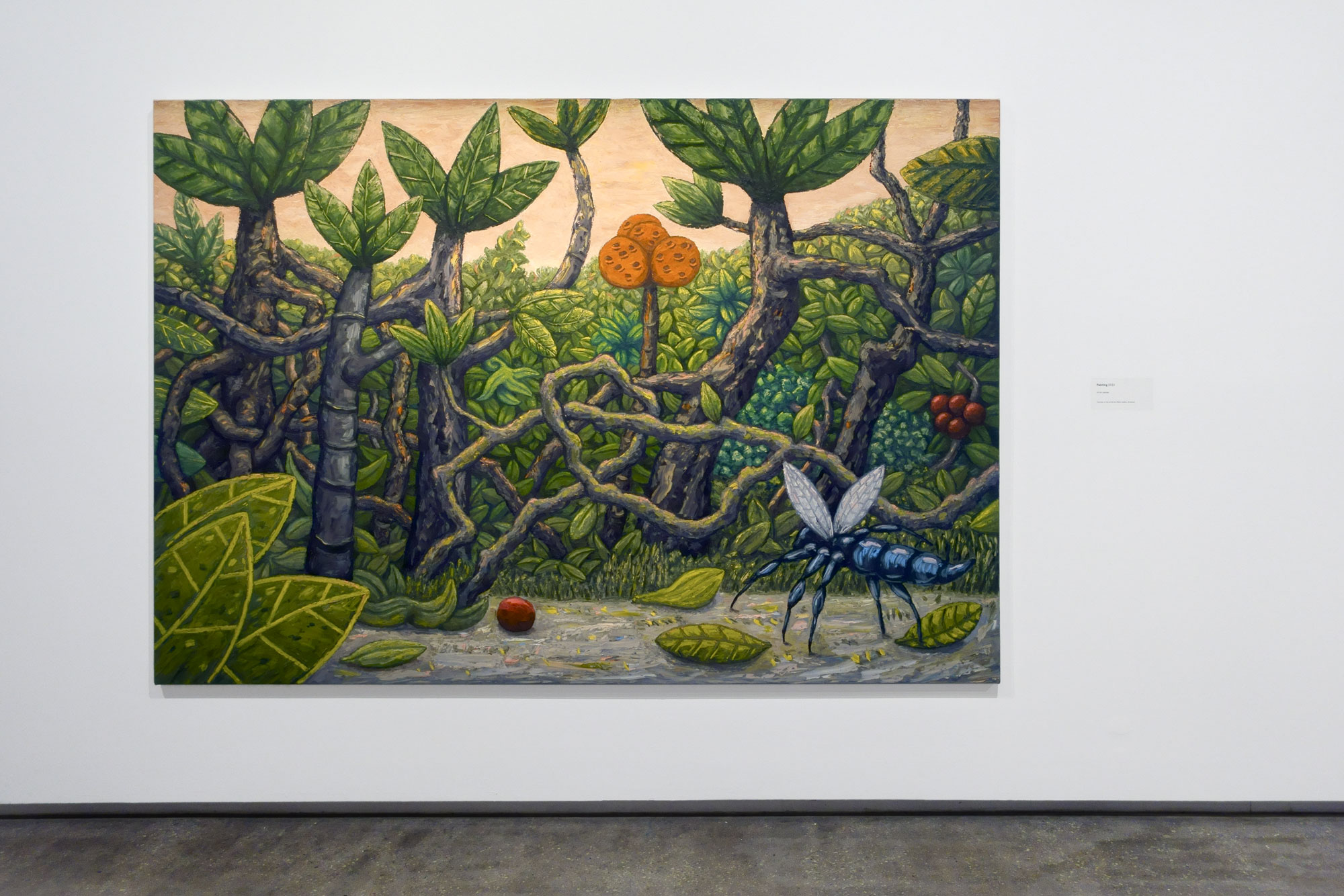
 

Peter Booth (Australian, b. 1940) 'Painting' 2022 (installation view)


Peter Booth (Australian, b. 1940)
Painting (installation view)
2022
Oil on canvas
214.0 x 137.5cm
Courtesy the artist and Milani Gallery
© Peter Booth
Photo: Marcus Bunyan
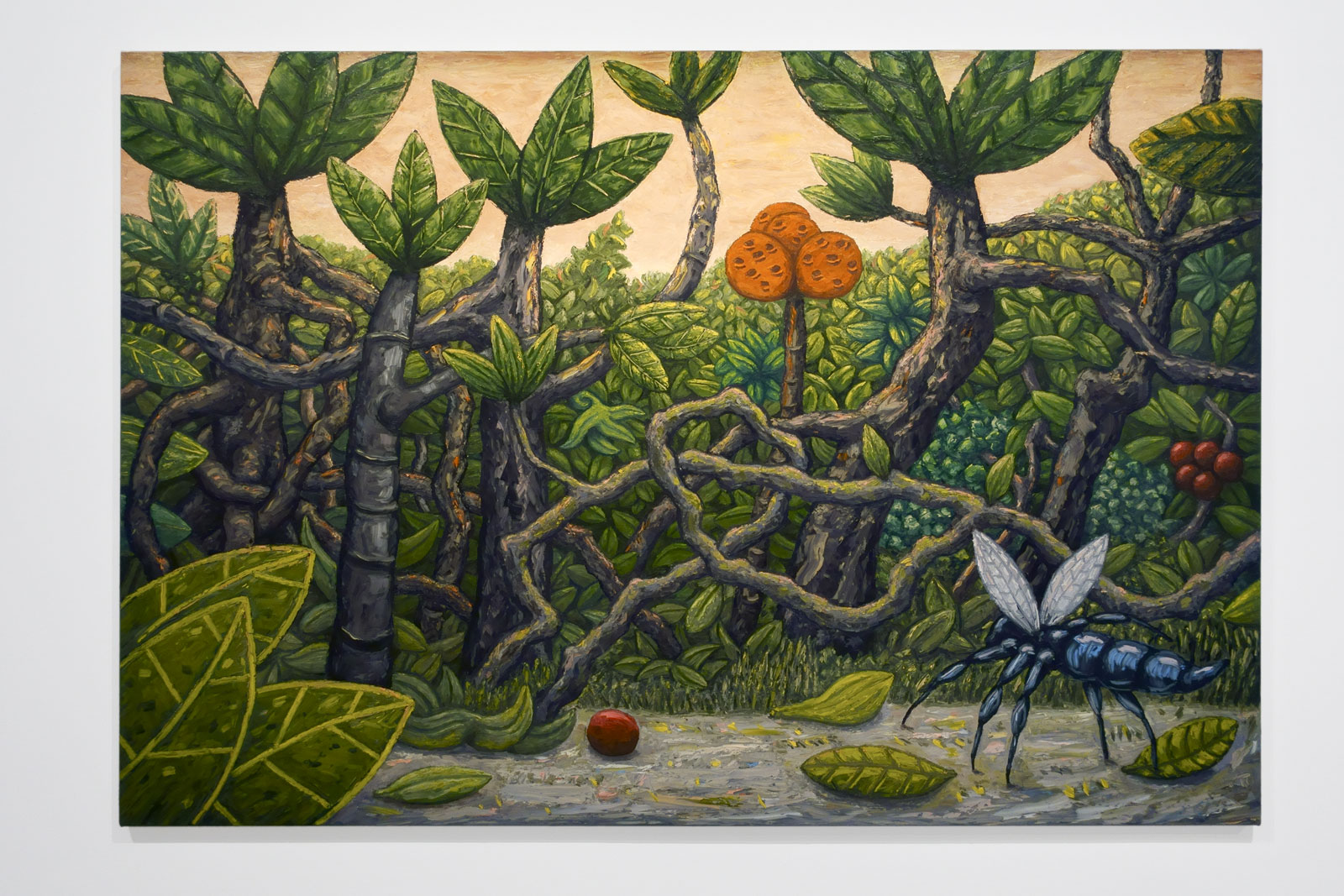
 

Peter Booth (Australian, b. 1940) 'Painting' 2022 (installation view)


Peter Booth (Australian, b. 1940)
Painting (installation view)
2022
Oil on canvas
214.0 x 137.5cm
Courtesy the artist and Milani Gallery
© Peter Booth
Photo: Marcus Bunyan
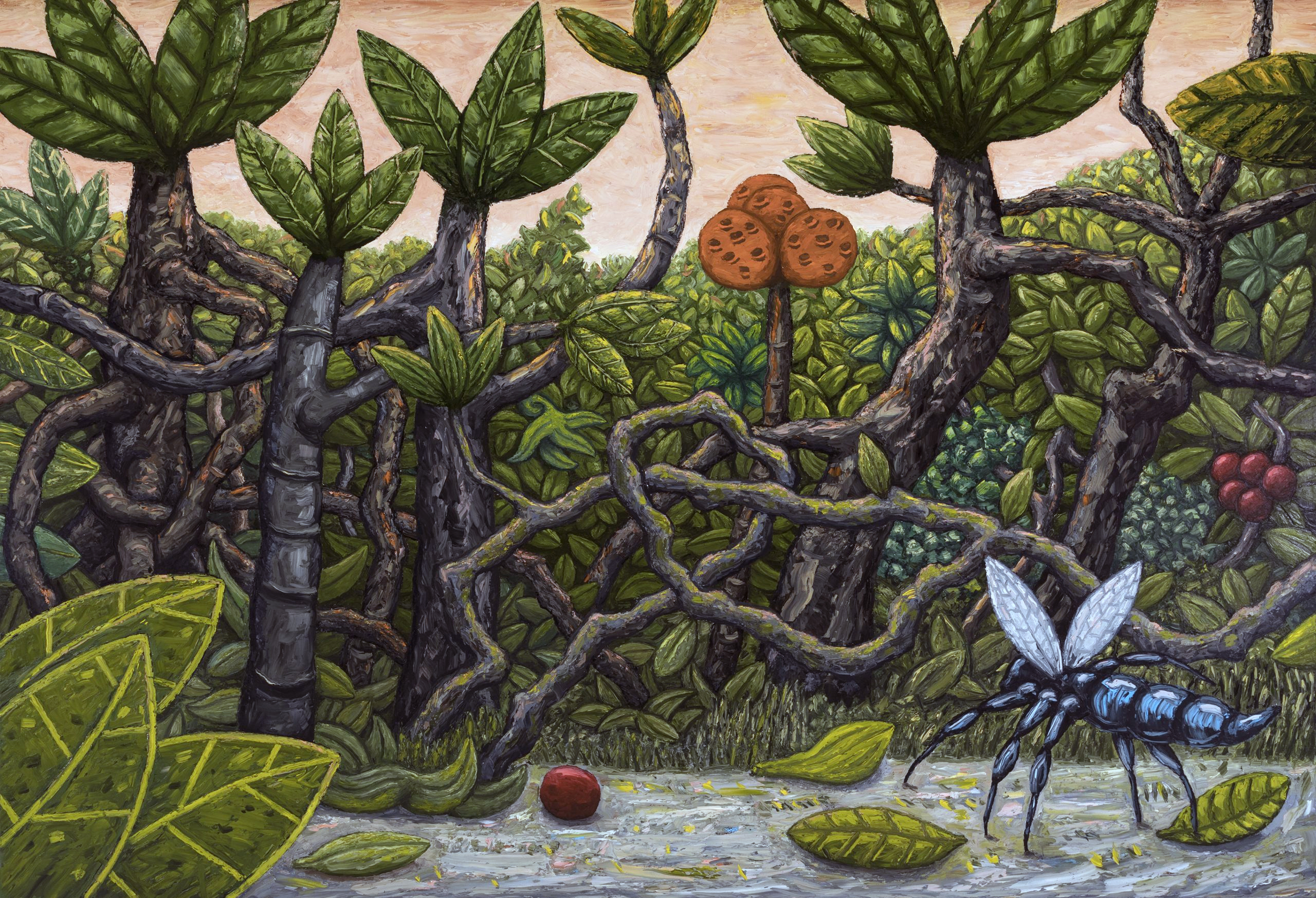
 

Peter Booth (Australian, b. 1940) 'Painting' 2022


Peter Booth (Australian, b. 1940)
Painting
2022
Oil on canvas
214.0 x 137.5cm
Courtesy the artist and Milani Gallery
© Peter Booth
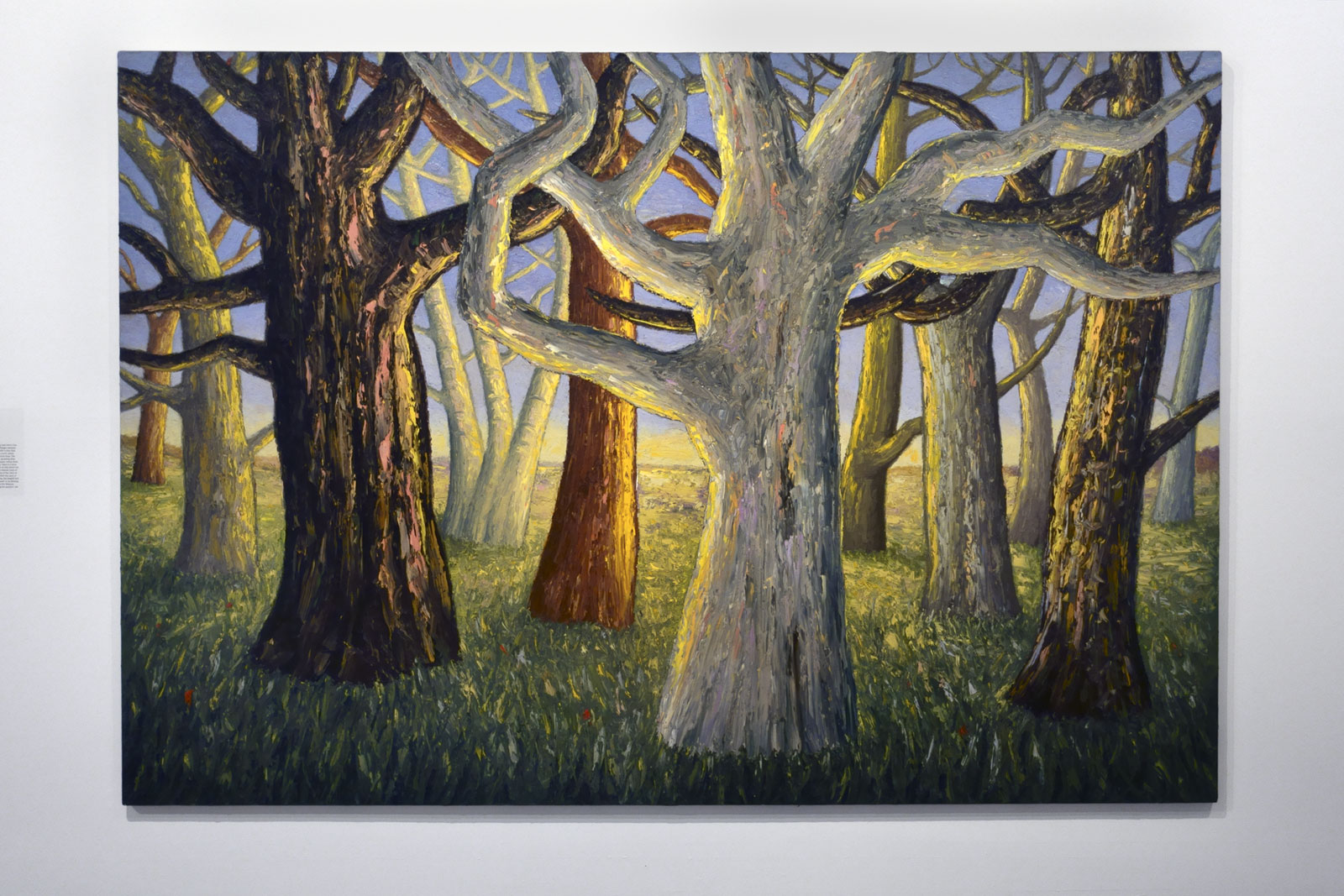
 

Peter Booth (Australian born England, b. 1940, Australia from 1958) 'Acheron Way' 1993 (installation view)


Peter Booth (Australian born England, b. 1940, Australia from 1958)
Acheron Way (installation view)
1993
Oil on canvas
208 x 304.8cm
Private collection
© Peter Booth
Photo: Marcus Bunyan
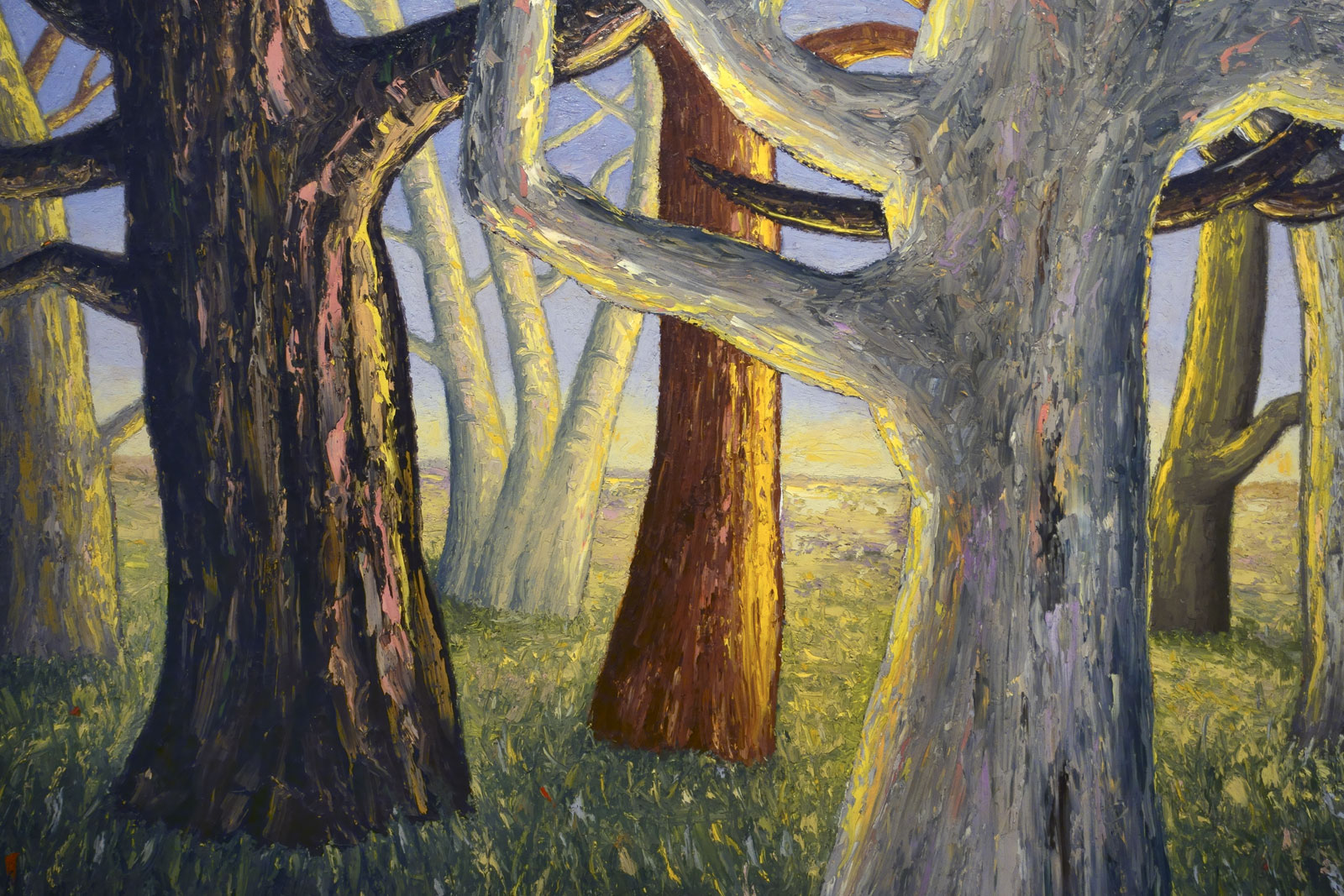
 

Peter Booth (Australian born England, b. 1940, Australia from 1958) 'Acheron Way' 1993 (installation view detail)


Peter Booth (Australian born England, b. 1940, Australia from 1958)
Acheron Way (installation view detail)
1993
Oil on canvas
208 x 304.8cm
Private collection
© Peter Booth
Photo: Marcus Bunyan


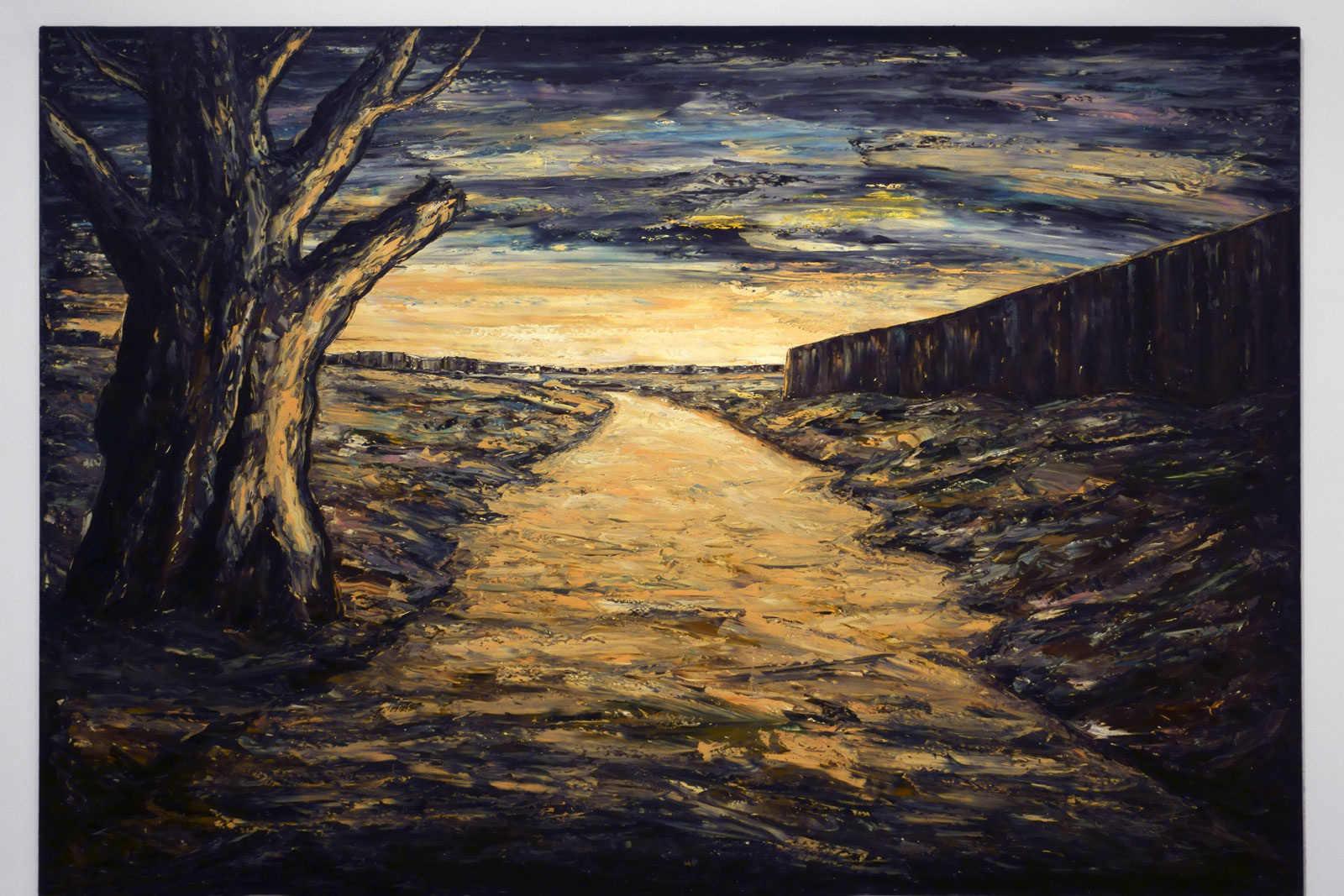
Acheron Way is named after a long snaking road which rises steeply through the rainforest of the Yarra Ranges between Narbethong and Warburton. Pictured beneath a clear blue sky, this scene of animated trees backlit by a soft, yellow light evokes a sense of energy, growth and even hope. The swaying trunks and tentacular forms of the sprawling limbs of the trees painted in thick swathes of impasto, imbue them with a powerful emotional charge. However, there is a more ambiguous aspect to this work alluded to in its title which not only refers to a real location, but also to an infernal realm of the imagination: Acheron (‘river of pain’) one of the rivers of the Underworld in Greek mythology over which the souls of the dead were ferried. From this perspective, the tangled and twisted forms of these sentinel-like trees seem to be denying us access to the light suffused landscape in the distance, forcing us to linger in their shadow, begging the question: are we in the realm of the living or the dead?

Wall text from the exhibition
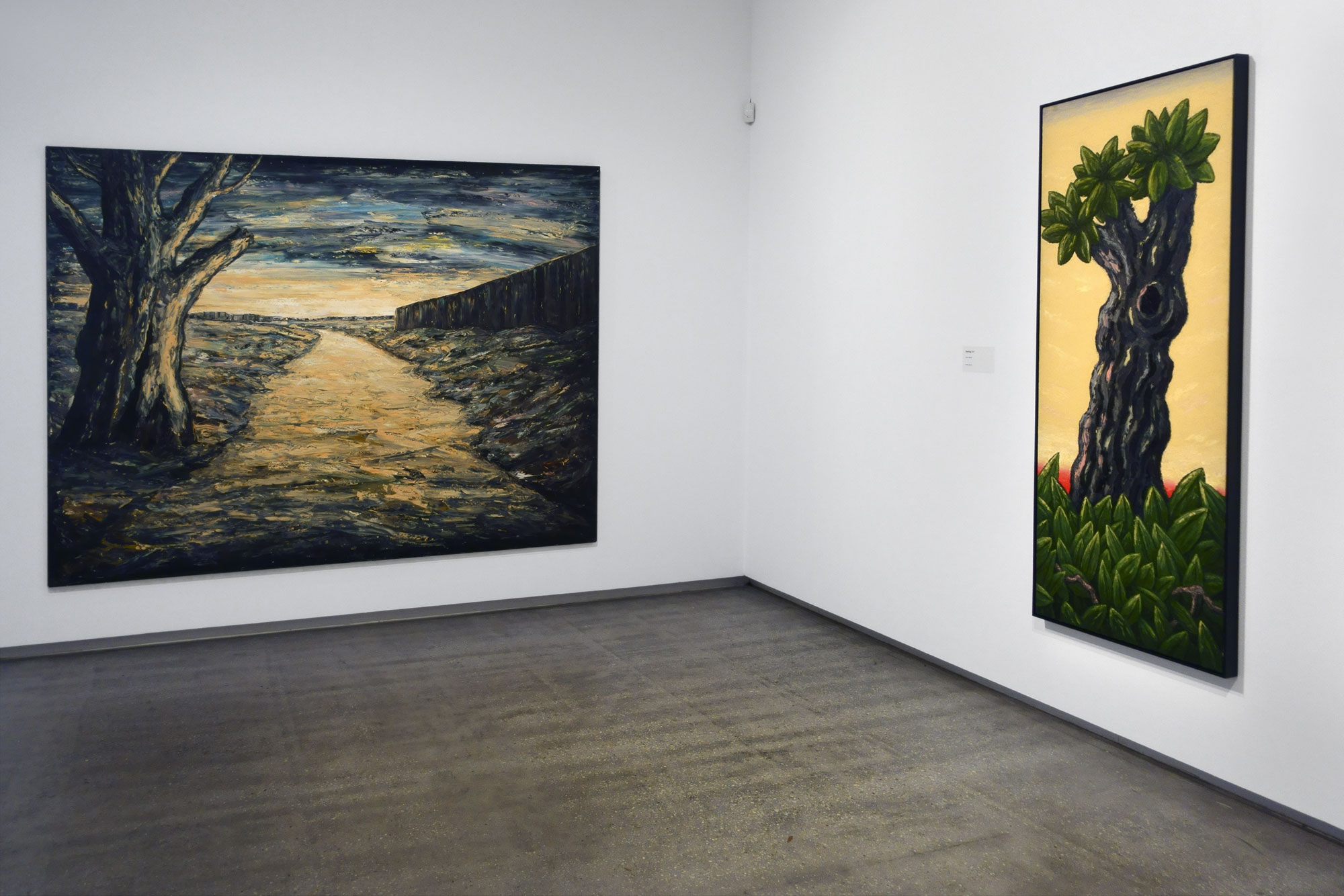
 

Installation view of the exhibition 'Peter Booth' at TarraWarra Museum of Art showing at left 'Untitled' 1998, and at right 'Painting' 2017


Installation view of the exhibition Peter Booth at TarraWarra Museum of Art showing at left Untitled 1998 (below), and at right Painting 2017 (below)
Photo: Marcus Bunyan
 

Peter Booth (Australian born England, b. 1940, Australia from 1958) 'Untitled' 1998


Peter Booth (Australian born England, b. 1940, Australia from 1958)
Untitled
1998
Oil on canvas
Private collection
© Peter Booth
Photo: Marcus Bunyan
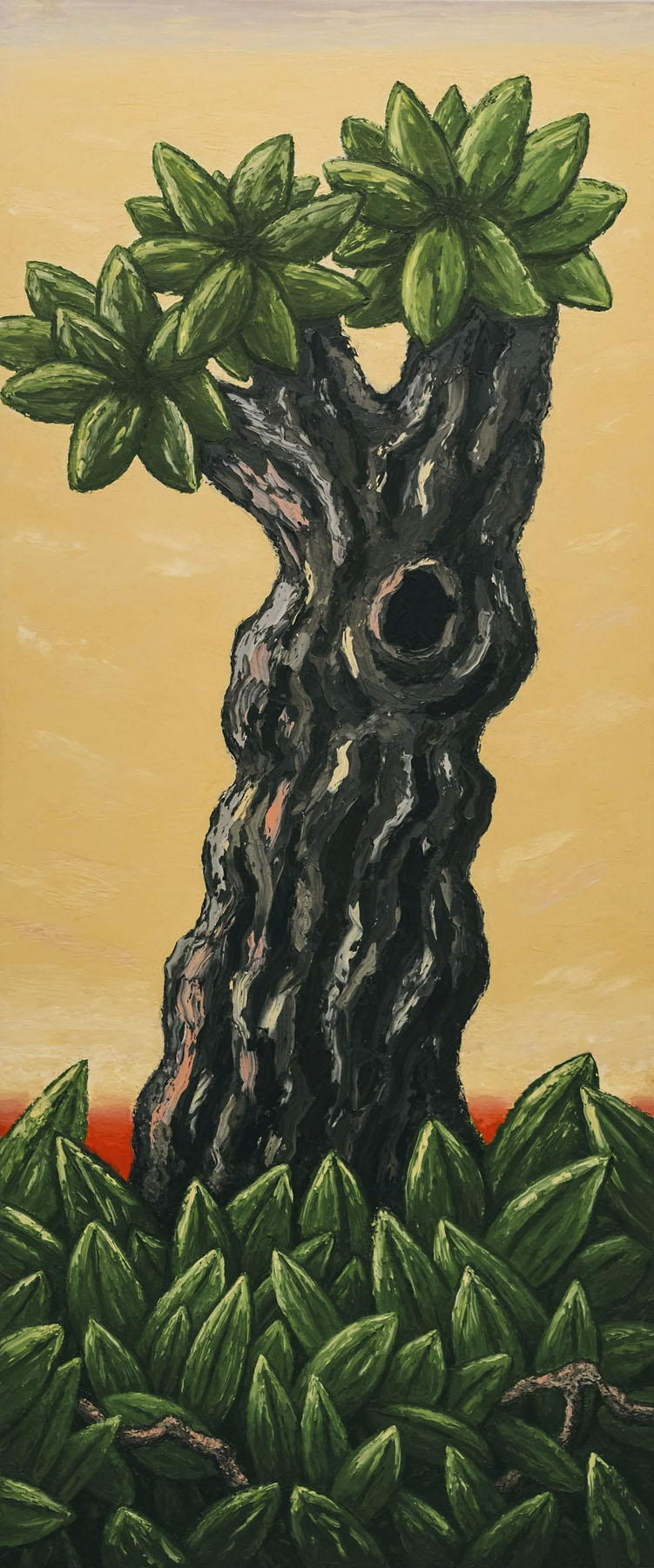
 

Peter Booth (Australian born England, b. 1940, Australia from 1958) 'Painting' 2017


Peter Booth (Australian born England, b. 1940, Australia from 1958)
Painting
2017
Oil on canvas
193.4 x 81.3cm
Courtesy of the artist and Milani Gallery, Brisbane


In Painting 2017, as the sun begins to rise over the horizon, new epicormic growth spouts from the pruned limbs of a tree; a potent symbol of resilience and renewal. Peter Booth’s ‘Garden of Eden’ paintings vividly convey his feeling for the elemental and generative qualities found in nature and his fervent empathy for other nonhuman lifeforms. ‘Everything is connected. All life comes from the same source.’

Text from the TarraWarra Museum of Art Facebook page
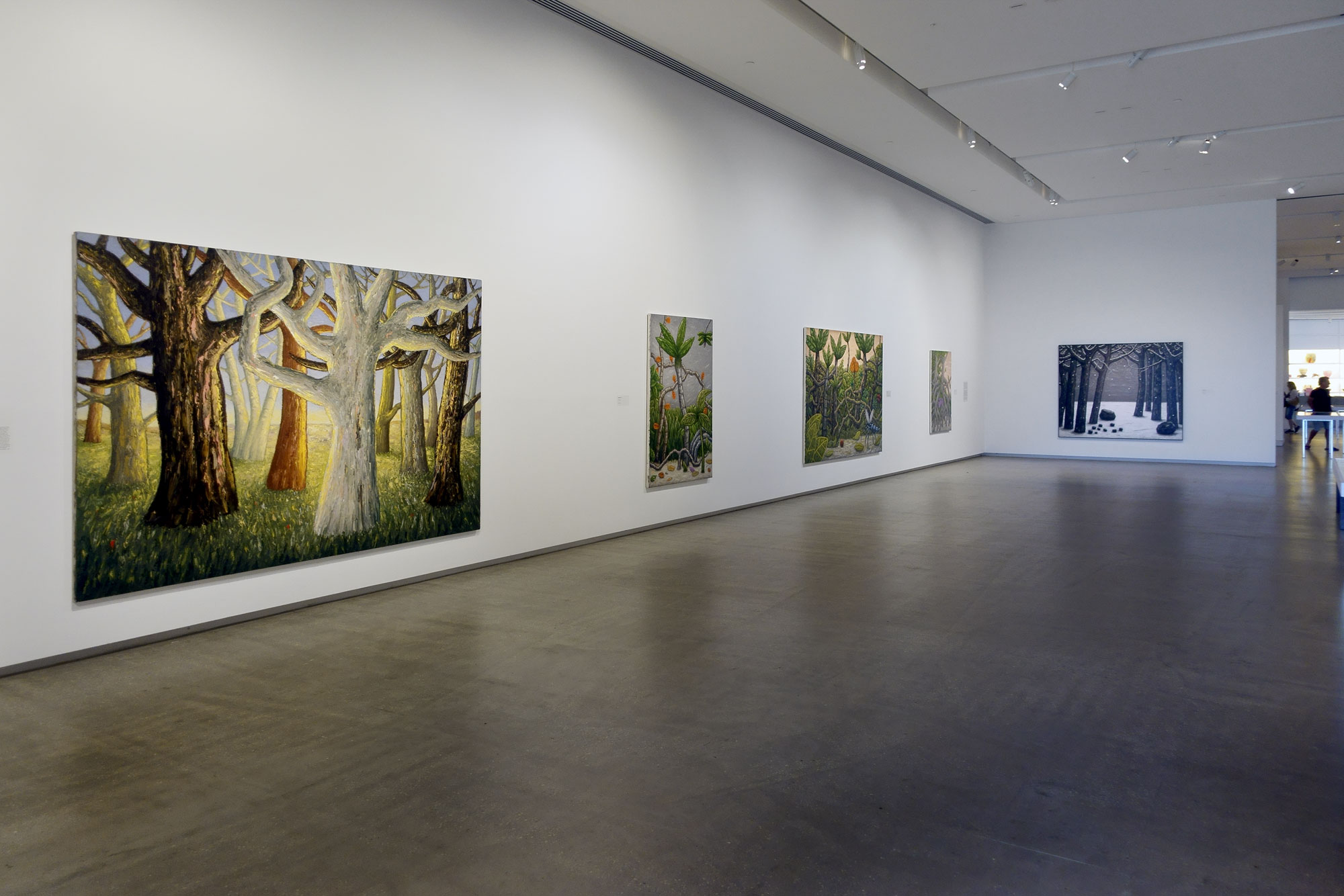
 

Installation view of the exhibition 'Peter Booth' at TarraWarra Museum of Art showing at left 'Acheron Way' 1993, at third right 'Painting' 2022, and at right 'Painting' 2014


Installation view of the exhibition Peter Booth at TarraWarra Museum of Art showing at left Acheron Way 1993, at third right Painting 2022, and at right Painting 2014 (below)
Photo: Marcus Bunyan
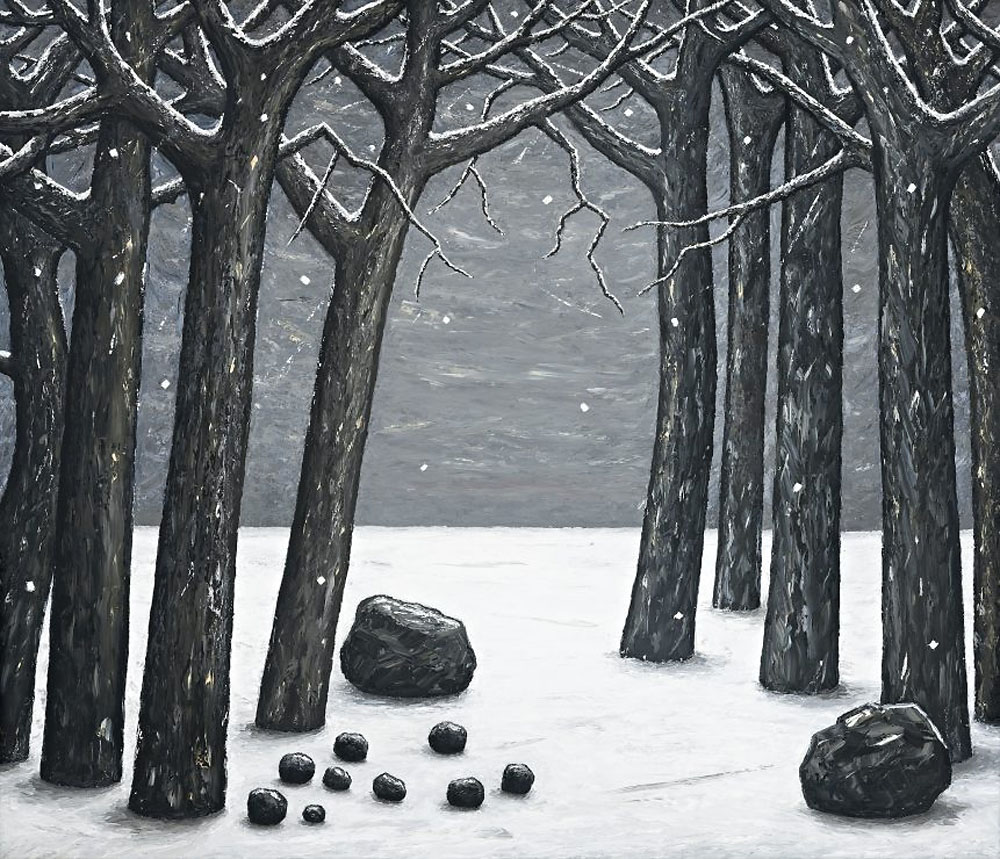
 

Peter Booth (Australian born England, b. 1940, Australia from 1958) 'Painting' 2014


Peter Booth (Australian born England, b. 1940, Australia from 1958)
Painting
2014
Oil on canvas
188 x 219cm
Private collection
© Peter Booth
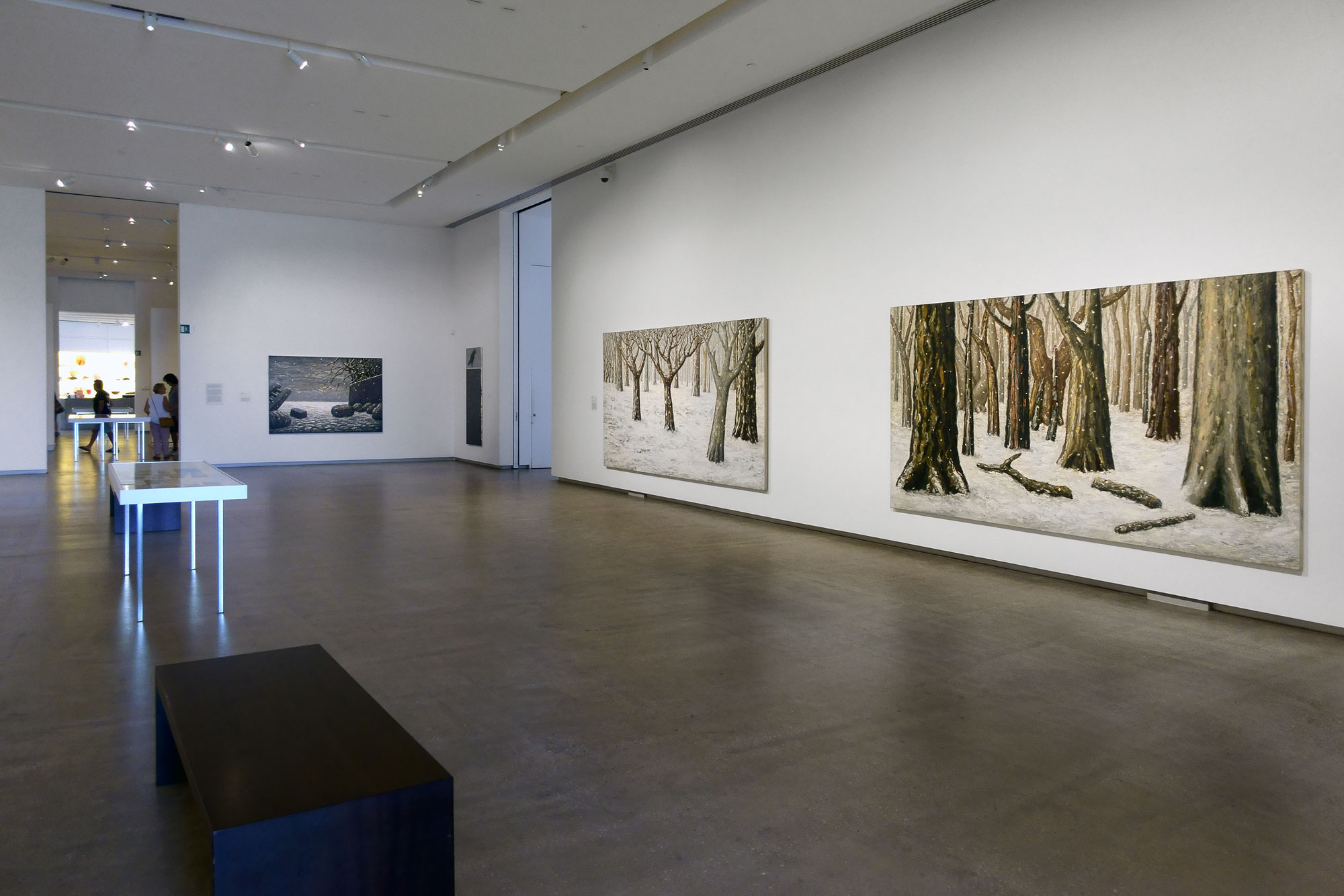
 

Installation view of the exhibition 'Peter Booth' at TarraWarra Museum of Art showing at second left 'Winter' 1993, and at right 'Mount Donna Buang' 1991


Installation view of the exhibition Peter Booth at TarraWarra Museum of Art showing at second left Winter 1993 (below), and at right Mount Donna Buang 1991 (below)
Photo: Marcus Bunyan
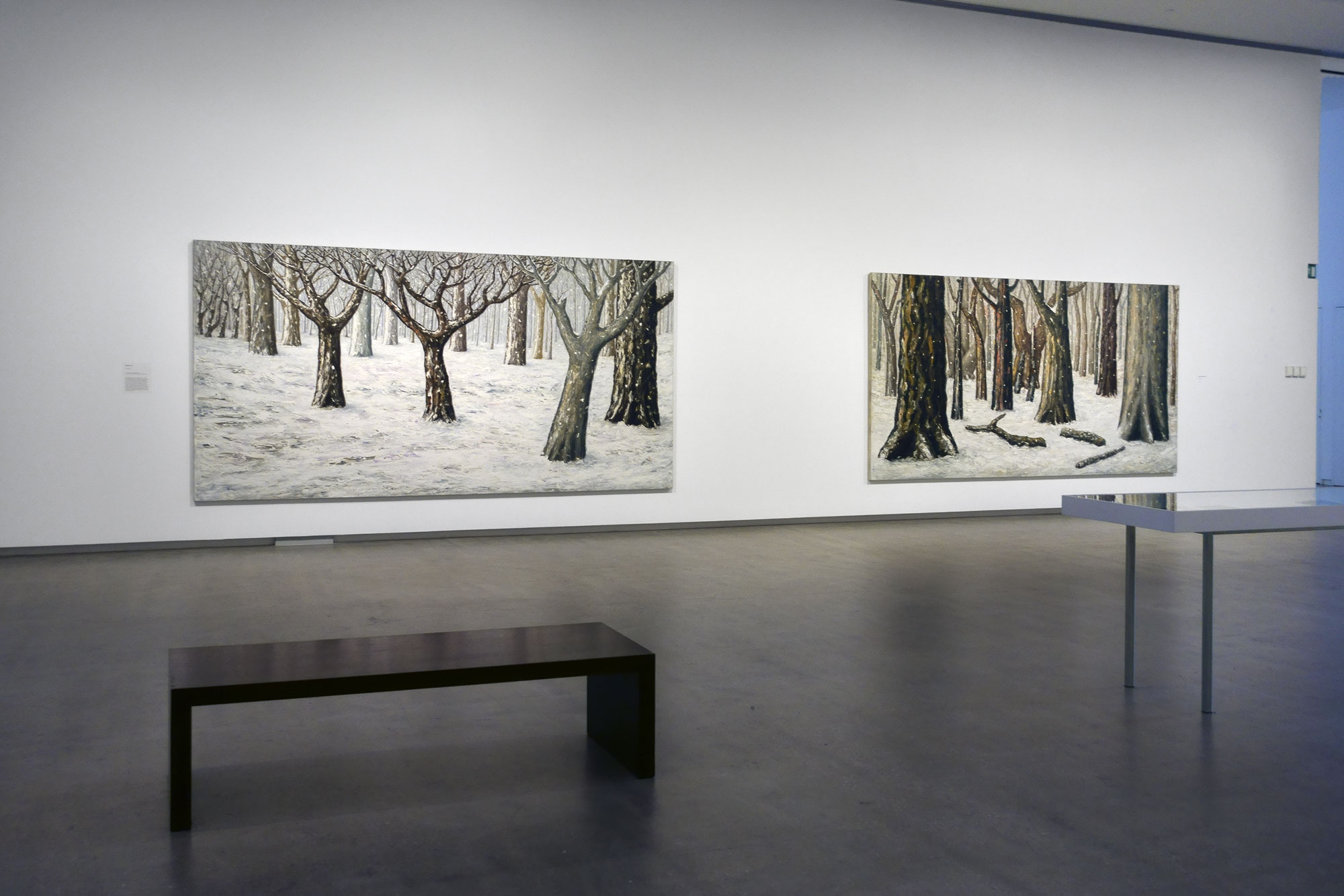
 

Installation view of the exhibition 'Peter Booth' at TarraWarra Museum of Art showing at left 'Winter' 1993, and at right 'Mount Donna Buang' 1991


Installation view of the exhibition Peter Booth at TarraWarra Museum of Art showing at left Winter 1993 (below), and at right Mount Donna Buang 1991 (below)
Photo: Marcus Bunyan
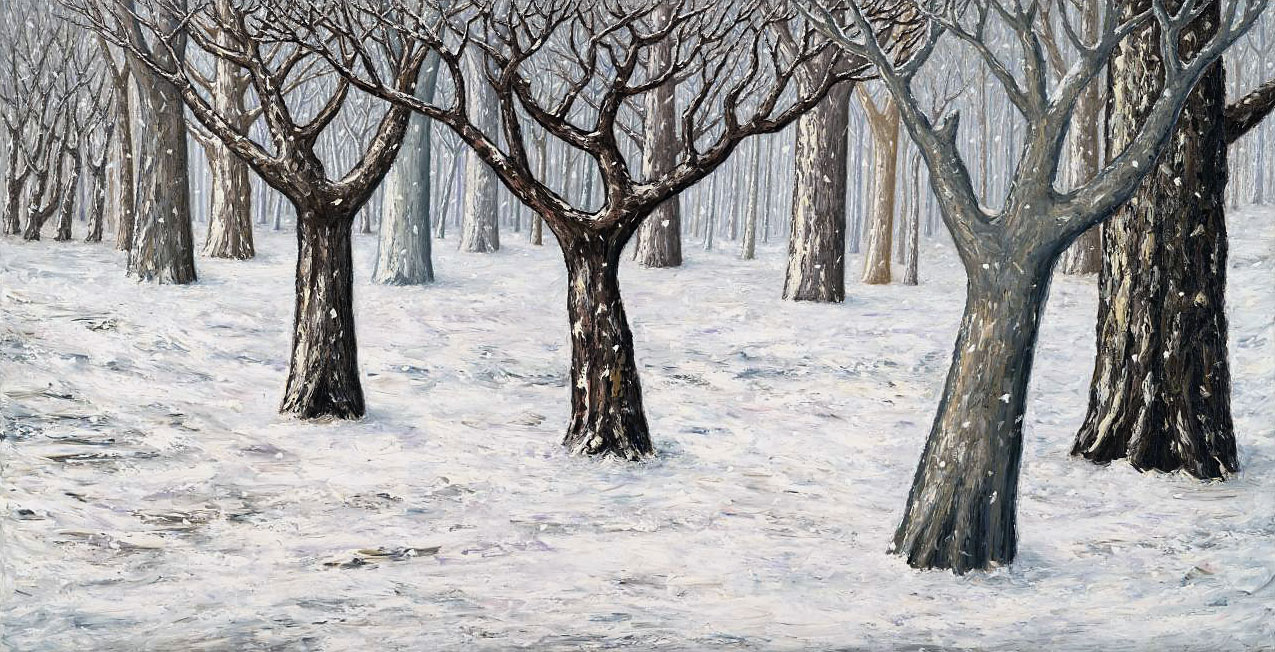
 

Peter Booth (Australian born England, b. 1940, Australia from 1958) 'Winter' 1993


Peter Booth (Australian born England, b. 1940, Australia from 1958)
Winter
1993
oil on canvas
203.4 × 396.5cm
National Gallery of Victoria, Melbourne
Presented by the National Gallery Women’s Association, 2002
© Peter Booth


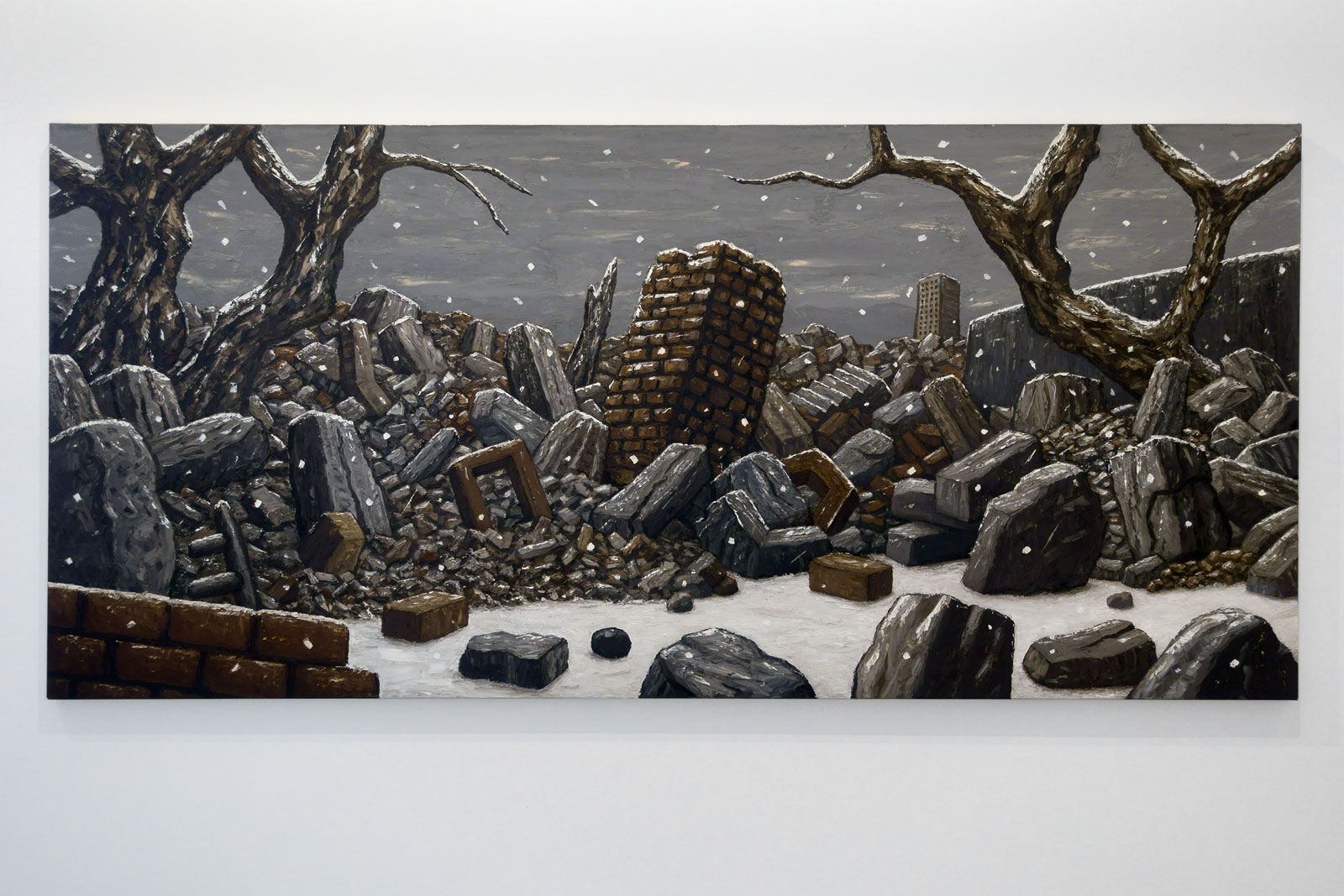
In discussing Winter when it was first exhibited in 1994, Booth revealed: it’s about my childhood, about taking walks with my brothers in the woods in Yorkshire. Triggered by a recent return to Sheffield, this memory is transformed into a richly textured landscape of open forest which has been stilled and silenced by a thick blanket of snow. As the artist later revealed, his younger twin brothers died in tragic circumstances adding particular poignancy to this painting and suggesting that the two very similar trees which occupy the centre of the work, could be seen as symbolic representations of his siblings. In this light, Winter becomes a powerful and deeply personal expression of remembrance and cathartic release.

Wall text from the exhibition
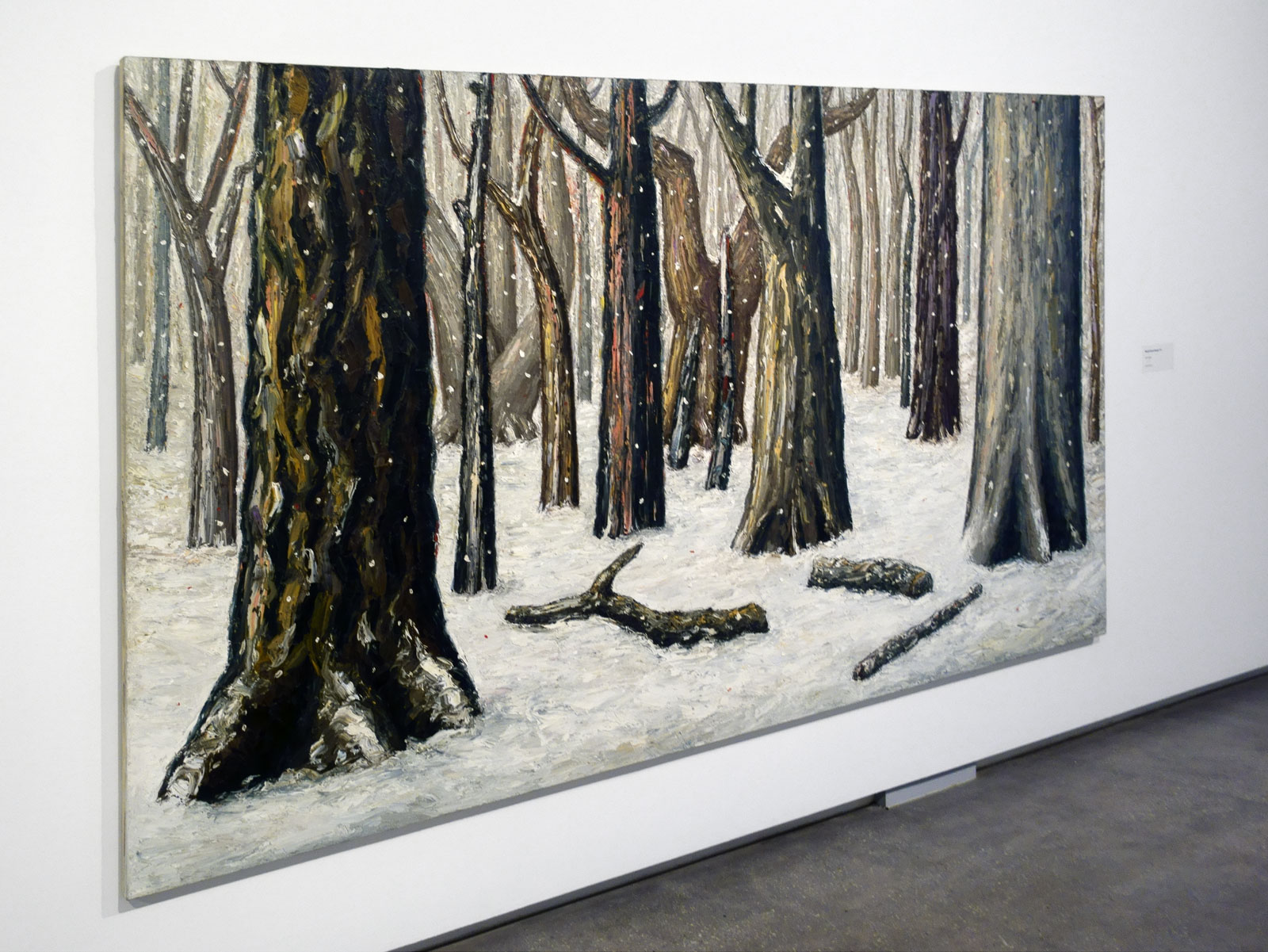
 

Peter Booth (Australian born England, b. 1940, Australia from 1958) 'Mount Donna Buang' 1991 (installation view)


Peter Booth (Australian born England, b. 1940, Australia from 1958)
Mount Donna Buang (installation view)
1991
Oil on canvas
Private collection
© Peter Booth
Photo: Marcus Bunyan
 

Installation view of the exhibition 'Peter Booth' at TarraWarra Museum of Art showing at left 'Painting' 2018, and at right 'Untitled' 1995


Installation view of the exhibition Peter Booth at TarraWarra Museum of Art showing at left Painting 2018 (below), and at right Untitled 1995 (below)
Photo: Marcus Bunyan
 

Peter Booth (Australian, b. 1940) 'Painting' 2018


Peter Booth (Australian, b. 1940)
Painting
2018
Oil on canvas
152.5 x 243.8cm
Courtesy of the artist and Milani Gallery, Brisbane
© Peter Booth
 

Peter Booth (Australian, b. 1940) 'Untitled' 1995


Peter Booth (Australian, b. 1940)
Untitled
1995
Oil on canvas
167.5 x 305cm
The University of Melbourne Art Collection, Michael Buxton Collection
© Peter Booth
 

Peter Booth (Australian, b. 1940) 'Painting' 2020 (installation view)


Peter Booth (Australian born England, b. 1940, Australia from 1958)
Painting (installation view)
2020
Oil on canvas
Courtesy of the artist and Milani Gallery, Brisbane
© Peter Booth
Photo: Marcus Bunyan
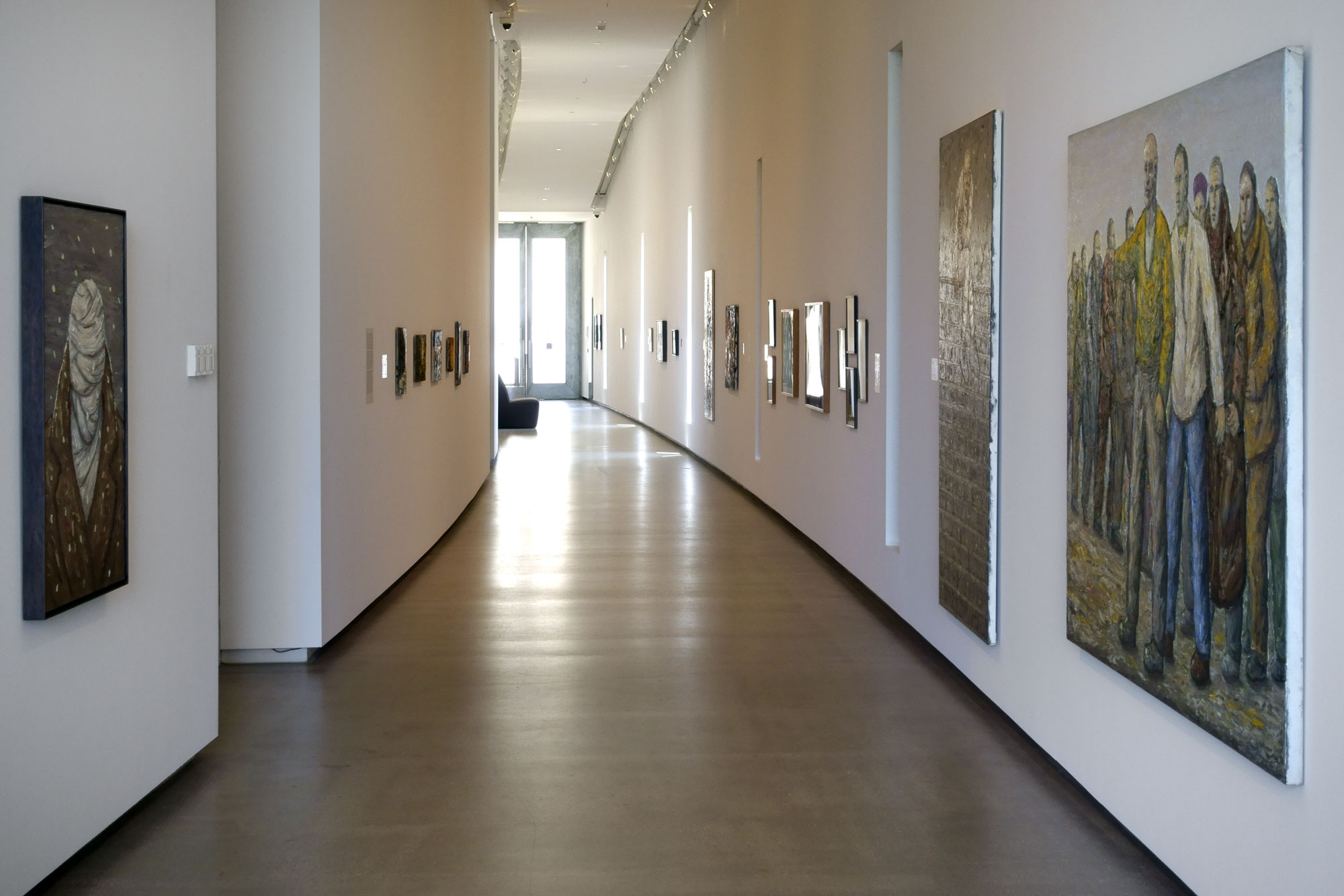
 

Installation view of the exhibition 'Peter Booth' at TarraWarra Museum of Art showing at left 'Painting (Figure with bandaged head)' 2004, and at right 'Painting' 1998


Installation view of the exhibition Peter Booth at TarraWarra Museum of Art showing at left Painting (Figure with bandaged head) 2004 (below), and at right Painting 1998 (below)
Photo: Marcus Bunyan
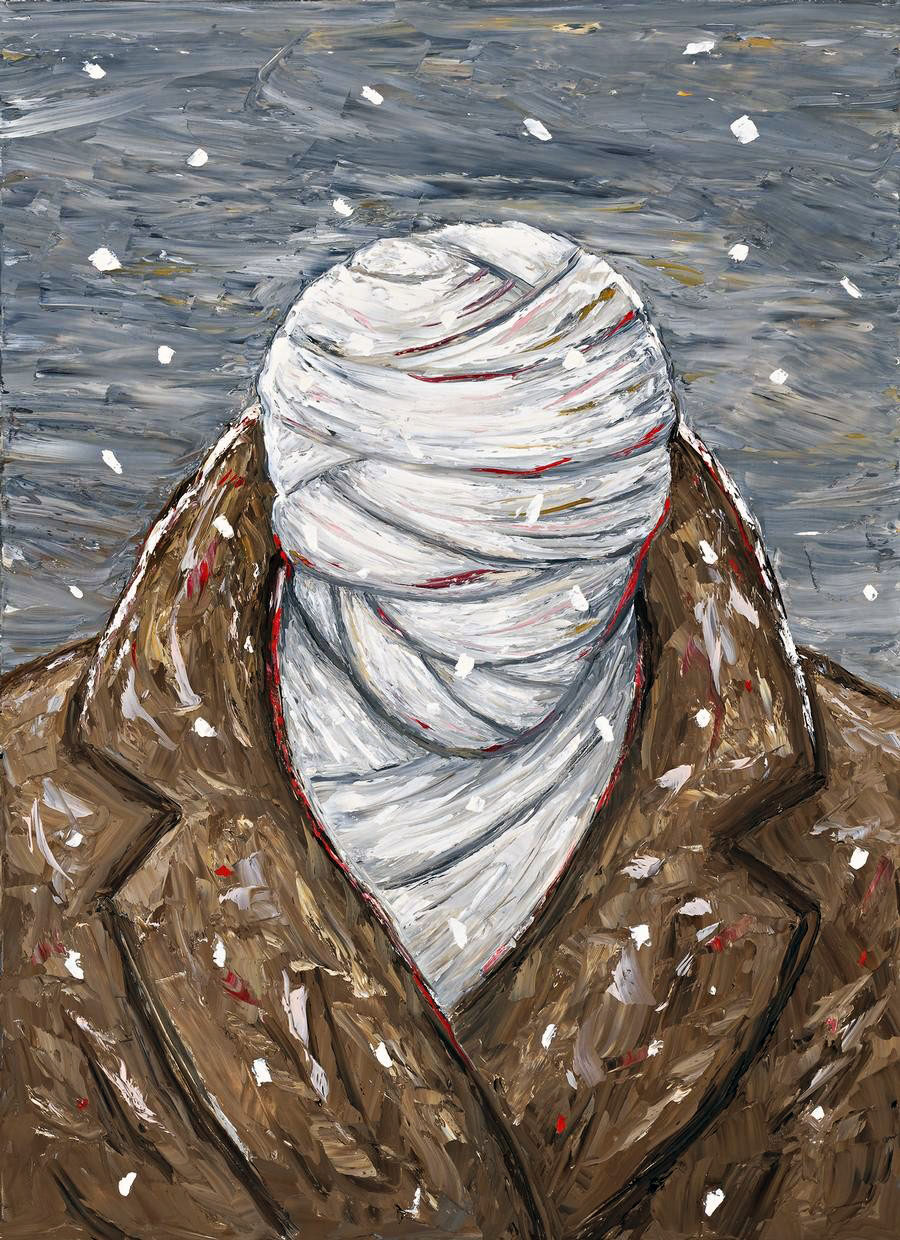
 

Peter Booth (Australian born England, b. 1940, Australia from 1958) 'Painting (Figure with bandaged head)' 2004


Peter Booth (Australian born England, b. 1940, Australia from 1958)
Painting (Figure with bandaged head)
2004
Oil on canvas
© Peter Booth


The strength and power of Painting (Man with Bandaged Head), 2004 … is palpable. But like so many of Booth’s images, formulated over years of development, the strength lies not so much in the initial ‘shock’, but with the ensuing waves of other possible readings it evokes…

The tension between our first confrontation with the bandaged figure and the subsequent sensations of pathos for, even some recognition of sensitivity within, the character makes this such a successful work. And as we look upon the painting, venturing into the space behind the bandages, the focus of the work internalises: in reading the mind of the figure we are offered a portal to see within ourselves.

This notion of the mirror to one’s soul, with themes of the nature of power and frailty, desire and control, so deftly captured within Painting (Man with Bandaged Head), 2004 adds a further dimension to the history of this particular painting.

Damian Hackett. “Important Australian + International Fine Art catalogue text,” on the Deutsche and Hackett website 25 November 2009 [Online] Cited 02/02/2023
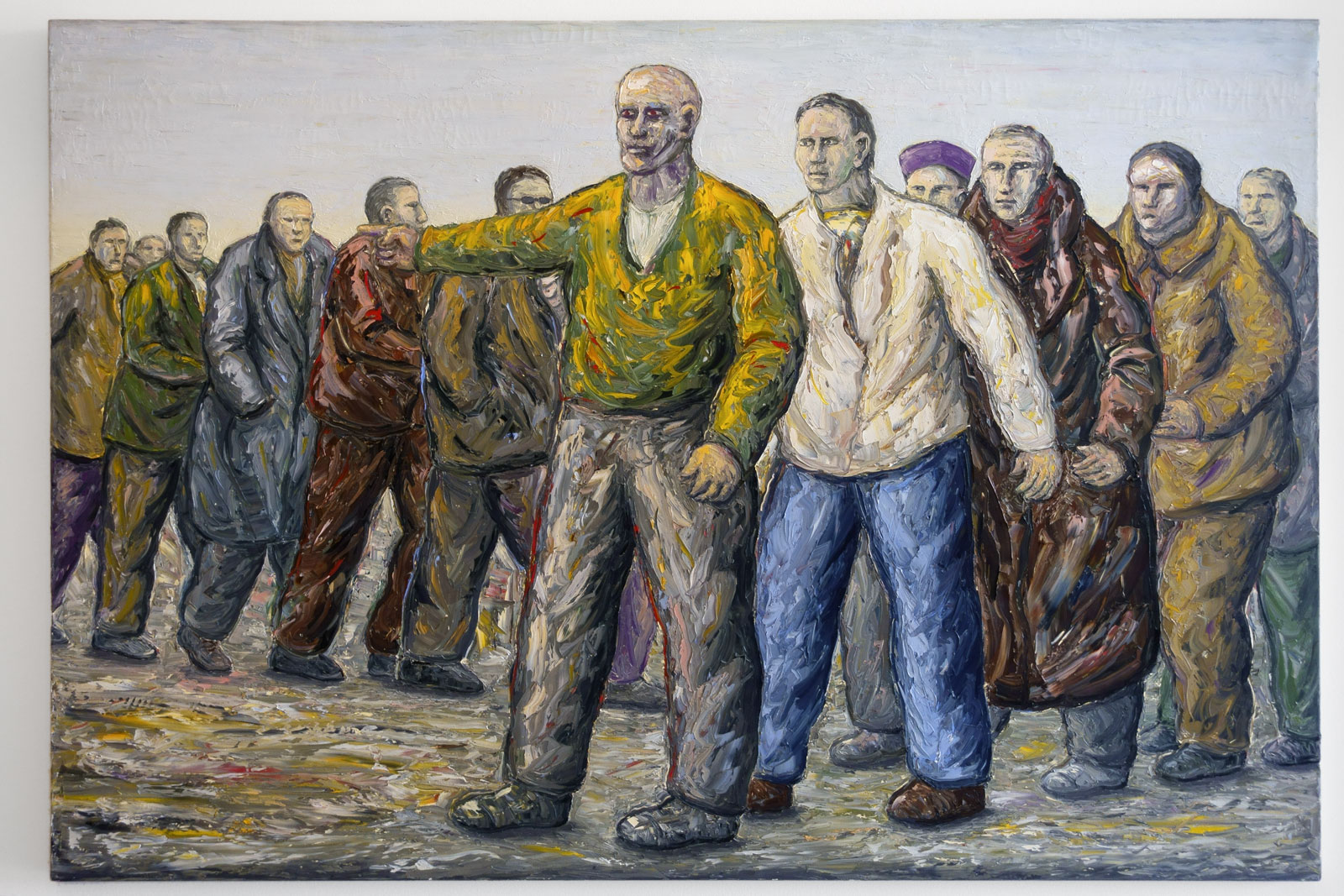
 

Peter Booth (Australian, b. 1940) 'Painting' 1998 (installation view)


Peter Booth (Australian, b. 1940)
Painting (installation view)
1998
Oil on canvas
Private collection
Courtesy of Smith & Singer Fine Art
© Peter Booth
Photo: Marcus Bunyan
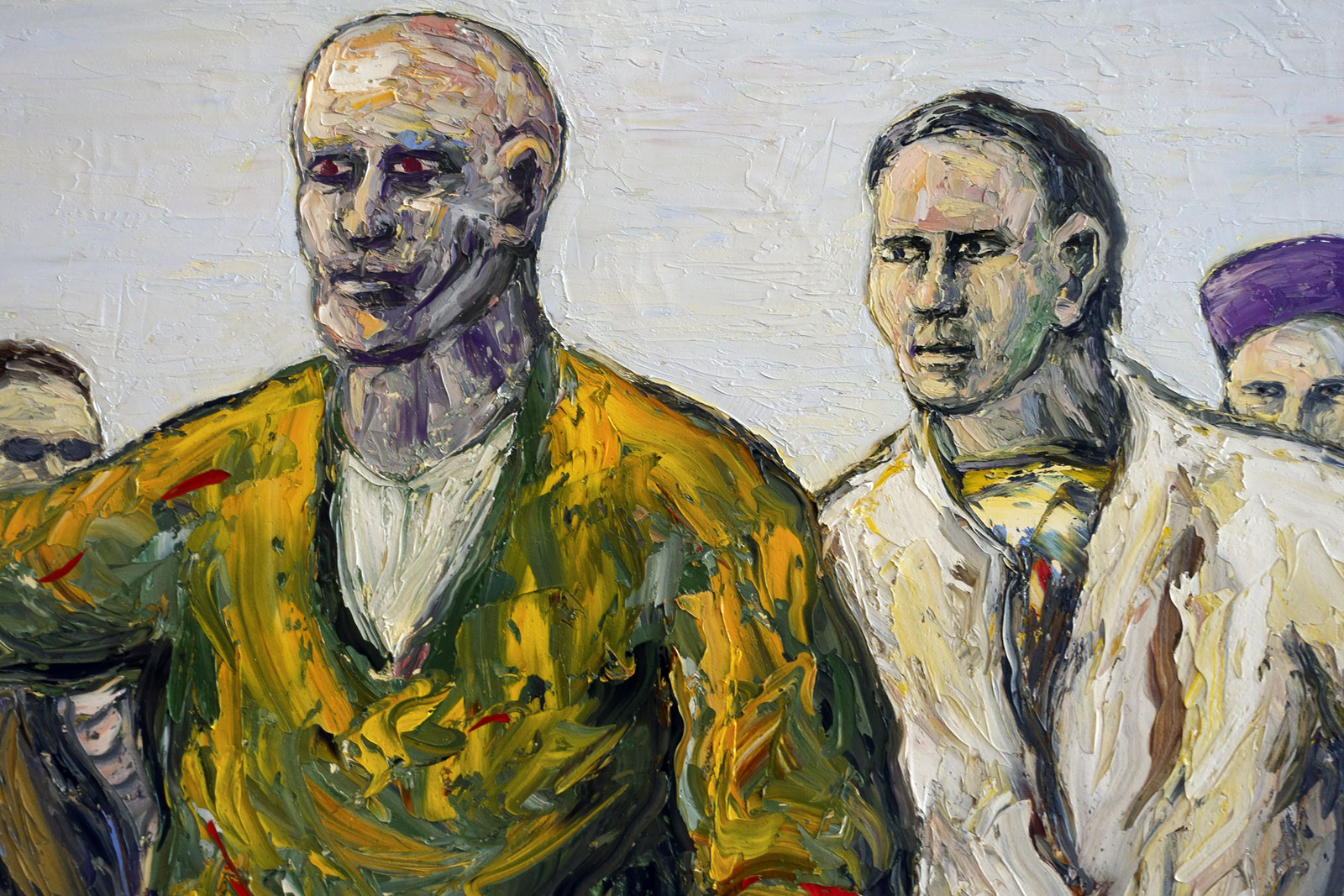
 

Peter Booth (Australian, b. 1940) 'Painting' 1998 (installation view detail)


Peter Booth (Australian, b. 1940)
Painting (installation view detail)
1998
Oil on canvas
Private collection
Courtesy of Smith & Singer Fine Art
© Peter Booth
Photo: Marcus Bunyan
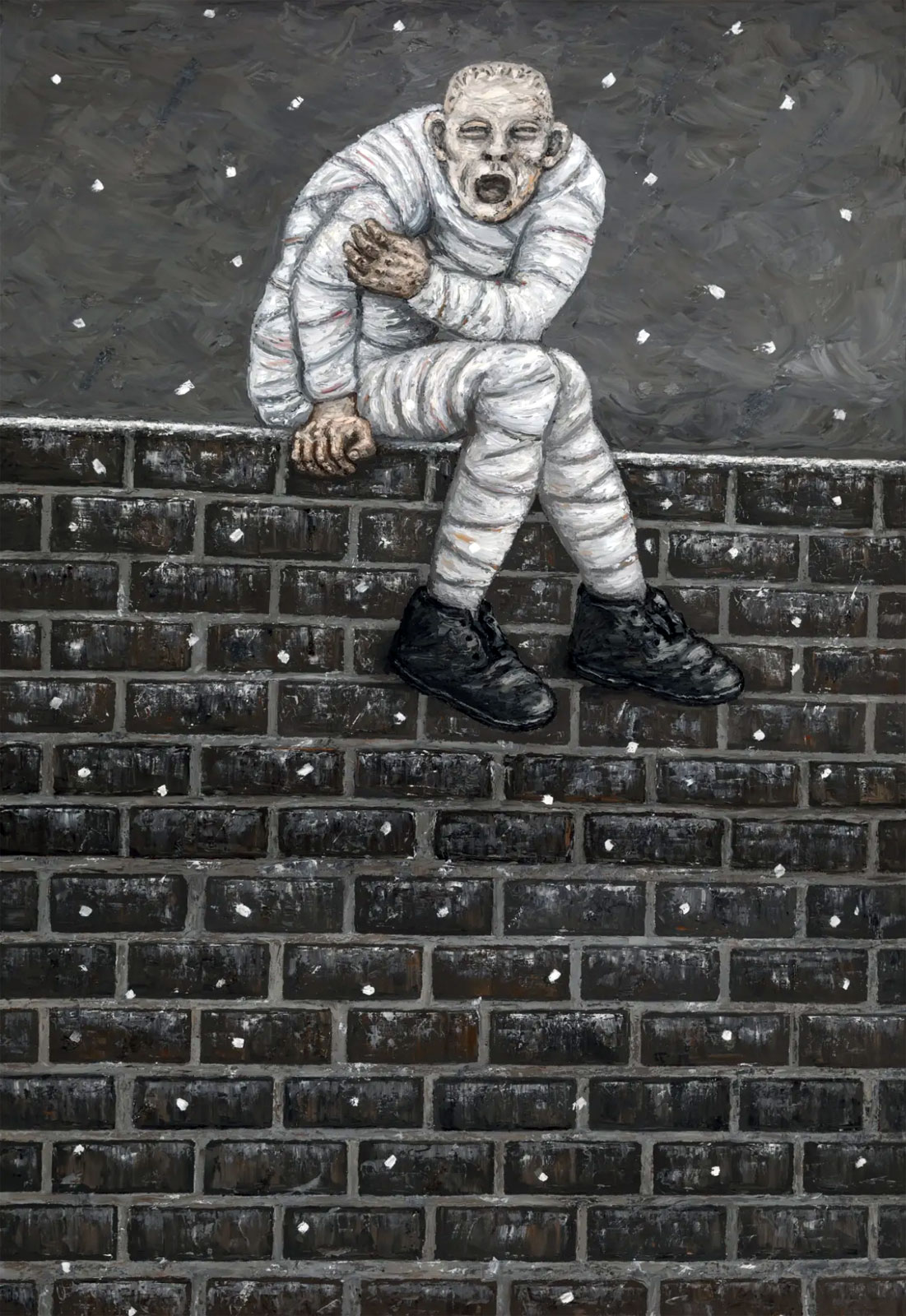
 

Peter Booth (Australian, b. 1940) 'Painting' 2022


Peter Booth (Australian, b. 1940)
Painting
2022
Oil on canvas
Courtesy of the artist and Milani Gallery, Brisbane
© Peter Booth
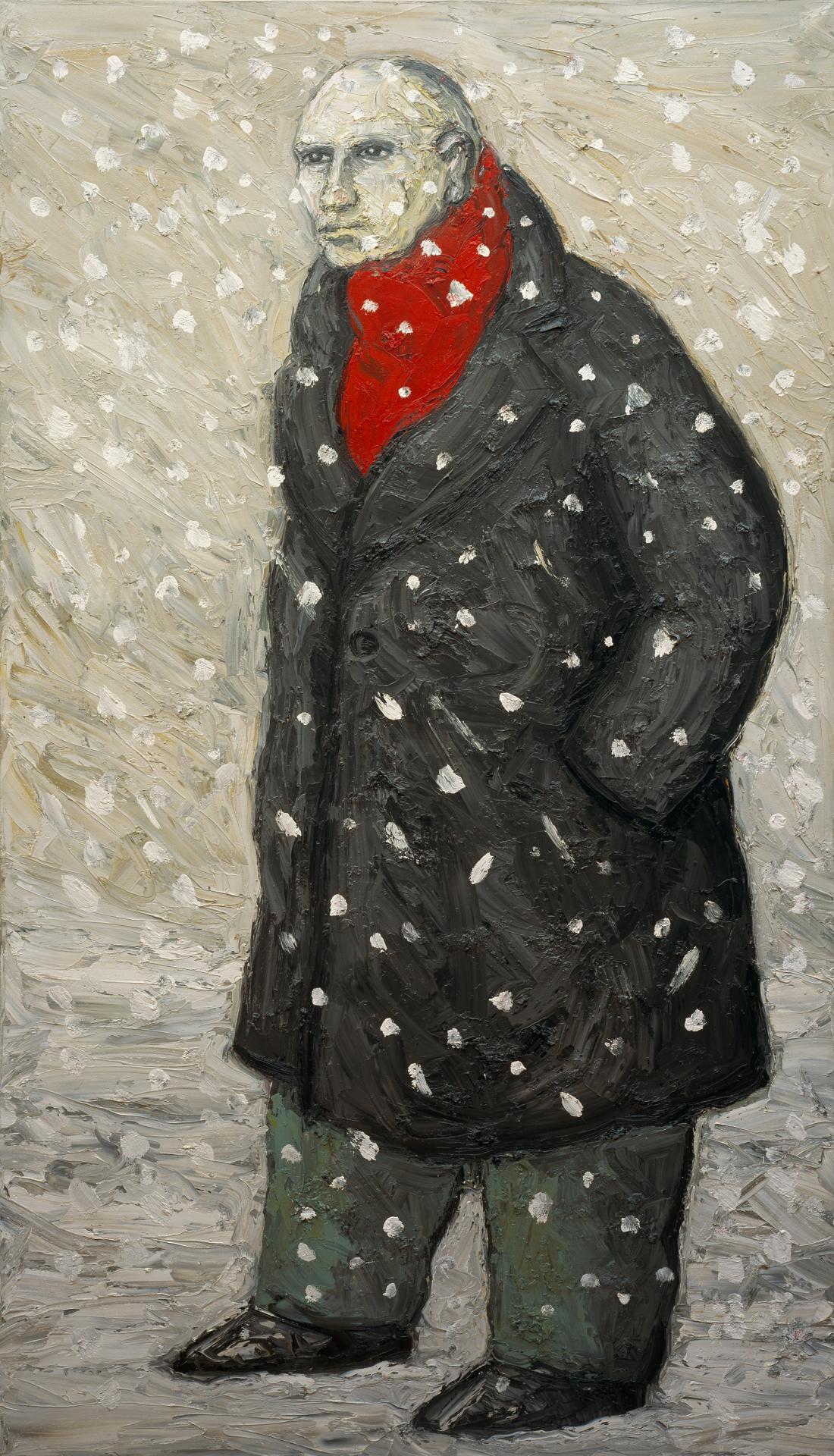
 

Peter Booth (Australian, b. 1940) 'Painting' 1989


Peter Booth (Australian, b. 1940)
Painting
1989
Oil on canvas
167.4 x 95.9cm
Collection of Jeff Hall and Sharon Grey
© Peter Booth
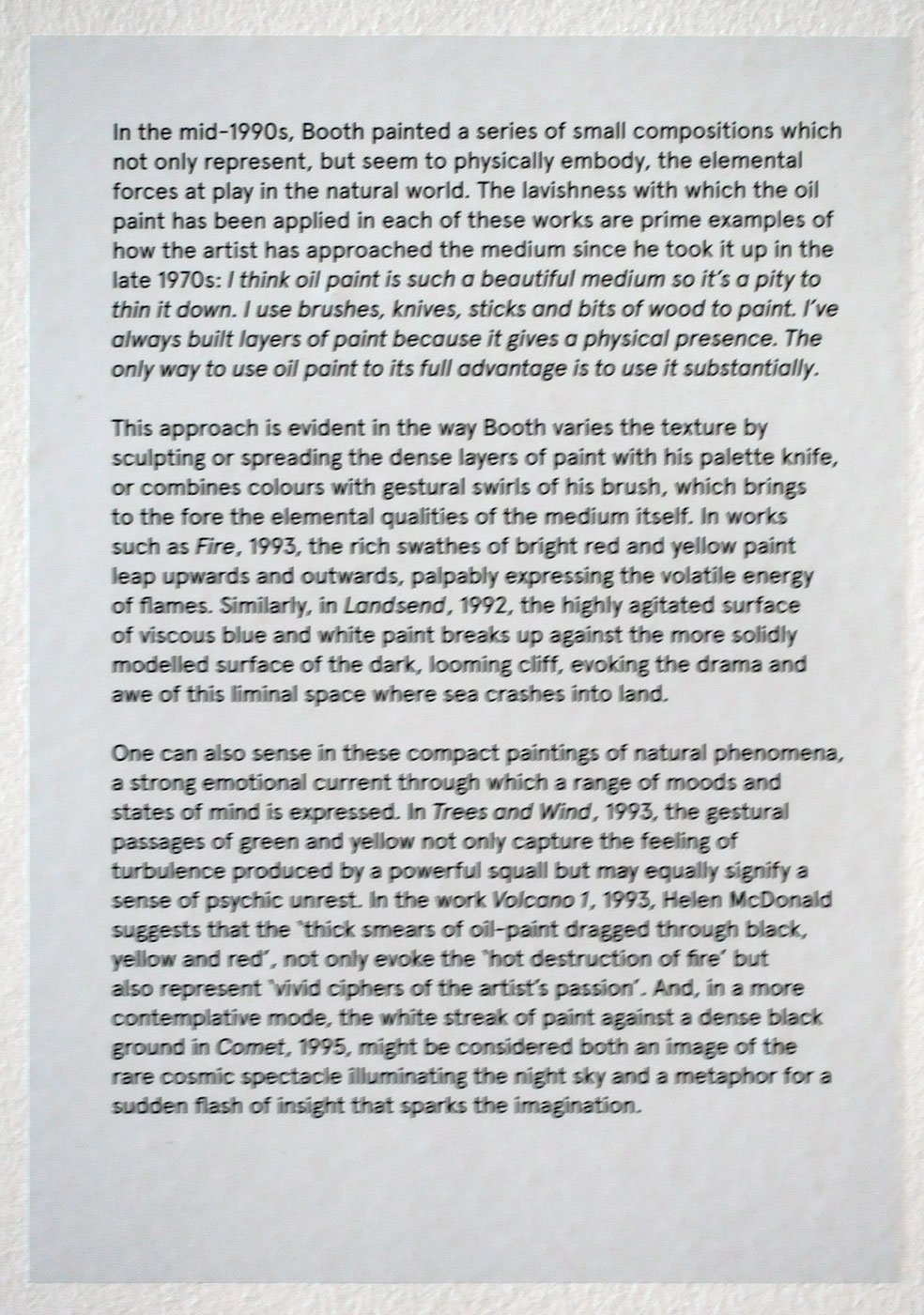
 

Wall text from the exhibition 'Peter Booth' at TarraWarra Museum of Art
 

Wall text from the exhibition


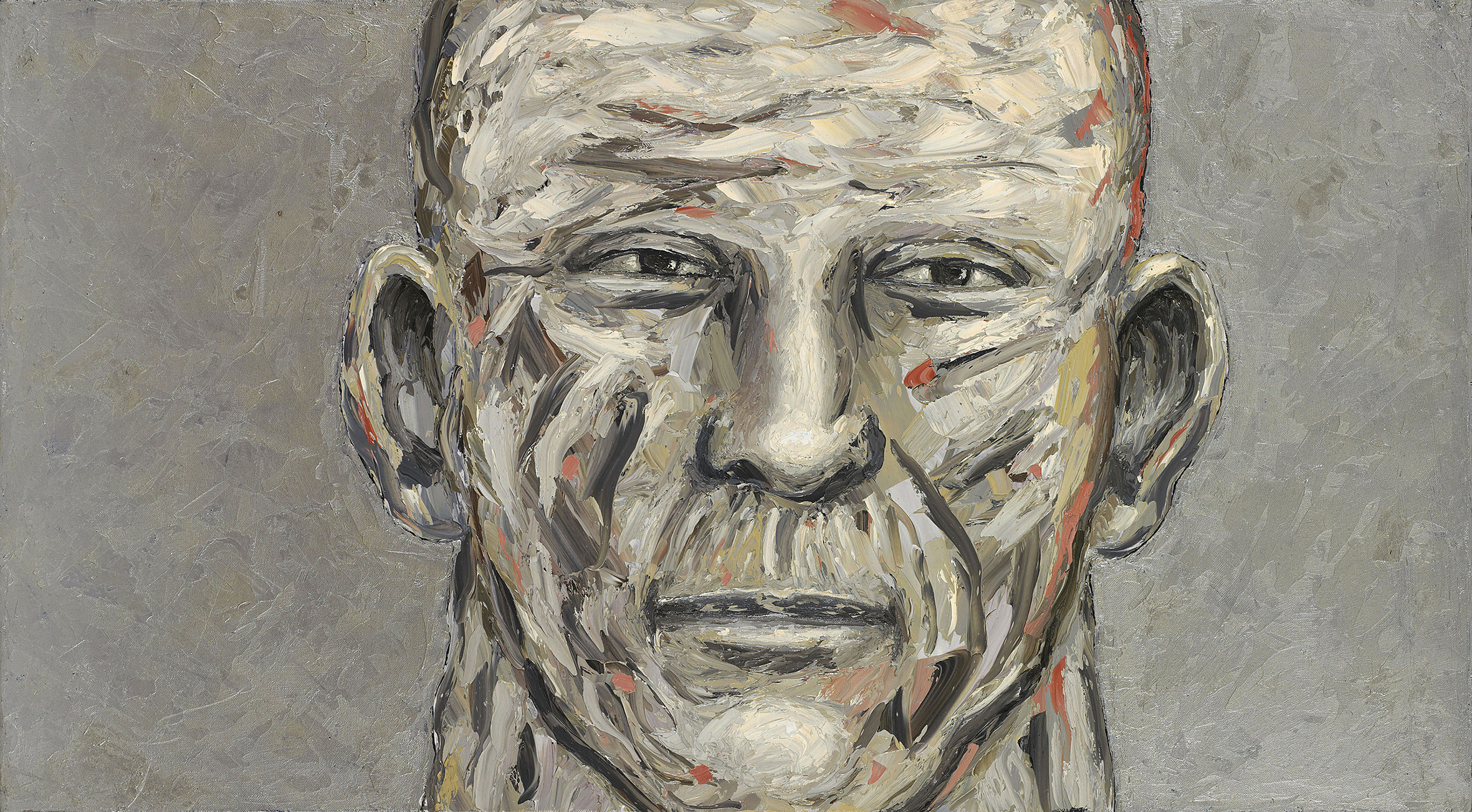
Peter Booth (Australian, b. 1940) 'Untitled' 2007


Peter Booth (Australian, b. 1940)
Untitled
2007
Oil on canvas
56.5 x 111cm
Private collection
Image courtesy of Bonhams Australia
© Peter Booth


The figure in Untitled, 2007 has averted eyes and stoically sealed lips, suggesting that he has endured great hardship. This feeling is amplified by the rich tonal contrasts and paint texture built with swathes of impasto which transform his wizened face into a blustery landscape. Having taken the troubles and turmoil of the world into himself, this austere figure is imbued with a powerful sense of inner fortitude and resilience.

Text from the TarraWarra Museum of Art Facebook page
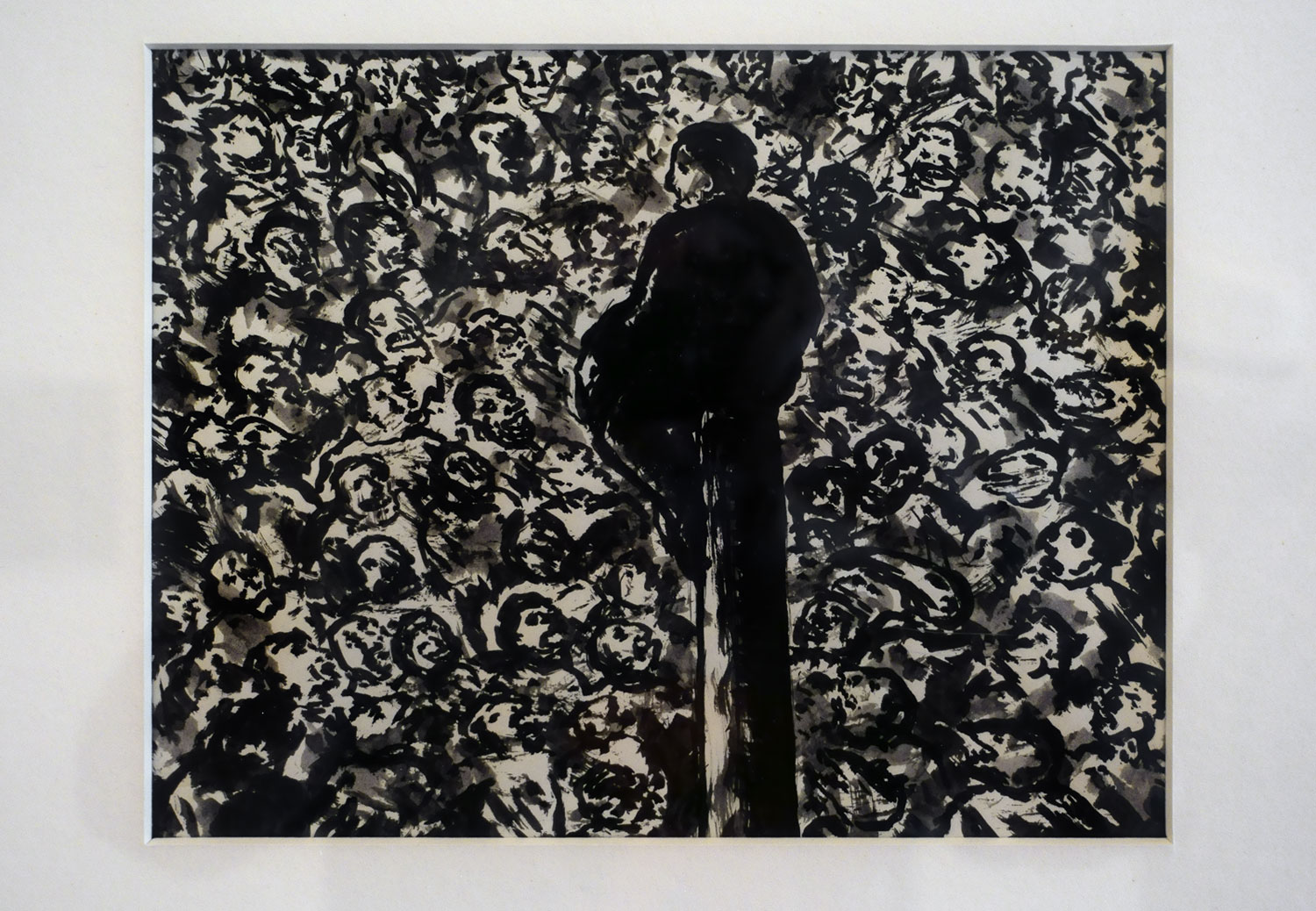
 

Peter Booth (Australian, b. 1940) 'Drawing (Pole Sitter Before a Crowd)' 1981 (installation view)


Peter Booth (Australian, b. 1940)
Drawing (Pole Sitter Before a Crowd) (installation view)
1981
Brush and ink and ink wash on paper
Private Collection
© Peter Booth
Photo: Marcus Bunyan


TarraWarra Museum of Art
Wurundjeri Country
313 Healesville-Yarra Glen Road
Healesville VIC 3777 Australia
Phone: +61 3 5957 3100

Opening hours:
Tues – Sun 11am – 5pm
Open all public holidays except Christmas Day

TarraWarra Museum of Art website

LIKE ART BLART ON FACEBOOK

Back to top

Review: ‘Found and Gathered: Rosalie Gascoigne | Lorraine Connelly-Northey’ at The Ian Potter Centre: NGV Australia, Federation Square, Melbourne

Exhibition dates: 30th October, 2021 – 20th February, 2022


Greg Weight. 'Rosalie Gascoigne' 1993 (detail) and Jules Boag. 'Portrait of Lorraine Connelly-Northey' Nd  (detail)


Image left: Greg Weight
Rosalie Gascoigne (detail)
1993
Gelatin silver photograph on paper
Image: 45.5 x 35.6cm
Sheet: 50.4 x 40.4cm
National Portrait Gallery, Australia
Gift of Patrick Corrigan AM 2004. Donated through the Australian Government’s Cultural Gifts Program.
© Gregory Weight/Copyright Agency, 2021

Image right: Jules Boag
Portrait of Lorraine Connelly-Northey (detail)
Courtesy of Jules Boag
© Jules Boag


Synergy. Now’s there’s an interesting word. It means “the interaction or cooperation of two or more organisations, substances, or other agents to produce a combined effect greater than the sum of their separate effects.” It derives from mid 19th century: from Greek sunergos ‘working together’, from sun- ‘together’ + ergon ‘work’. Thus, this glorious exhibition brings together two artists metaphorically “working together” under the Australian sun… even as they are separated by culture, location, time and space.

Their work comes together in a confluence of ideas of approximately equal width – one grounded in stories of family and Country thousands of years old, the artist investigating post-colonial settlement and the industrial world and interpreting Australian Indigenous objects of ritual and culture; the other not so much grounded but playing with Western ideas of pattern and randomness, belonging, and the metaphysical space of the landscape of the Monaro, in the southwest of New South Wales. Both points of view are equally valid and have important things to say about our various relationships to the land (both Indigenous and colonial) and the “creation” of a contemporary Australian national identity.

Both artists use found objects in their work, but as Russell-Cook points out, “I think that what unites the two artists is the shared materials they use, but not a ‘shared-use of materials.’ They are both fascinated by the artistic possibilities of found objects, but they use those materials to tell contrasting stories.” Connelly-Northey uses her experience of living on Country and her gleaning of discarded objects in Country to gather up the threads of her multiple heritages and Aboriginal custodianship of the land to picture – through the merging of organic and inorganic forms – the disenfranchisement of her people but also to celebrate their deep roots in Country. Gascoigne on the other hand is the more ethereal of the two artists, concerned as she is with light, land, spirit of place and the rightness of materials being used. Hers is a very structured and formal art practice grounded in her training in the Japanese art of ikebana and her understanding of Minimalism. Sympathetically, through their individual creativity both artists transmute (to change in form, nature, or substance) the reality of the materials they work with, the raw material of experience transmuted into stories. As Rozentals and Russell-Cook observe, “Both Connelly-Northey and Gascoigne’s work is defined by, and yet transcends, its sense of materiality.”

Two things jar slightly. Connelly-Northey is ‘a bit anxious’ that her Indigenous originality won’t be recognised and that “I’ve worked too hard for people to think I borrowed it all from Rosalie. Our use of corrugated iron is the only thing we have in common.”

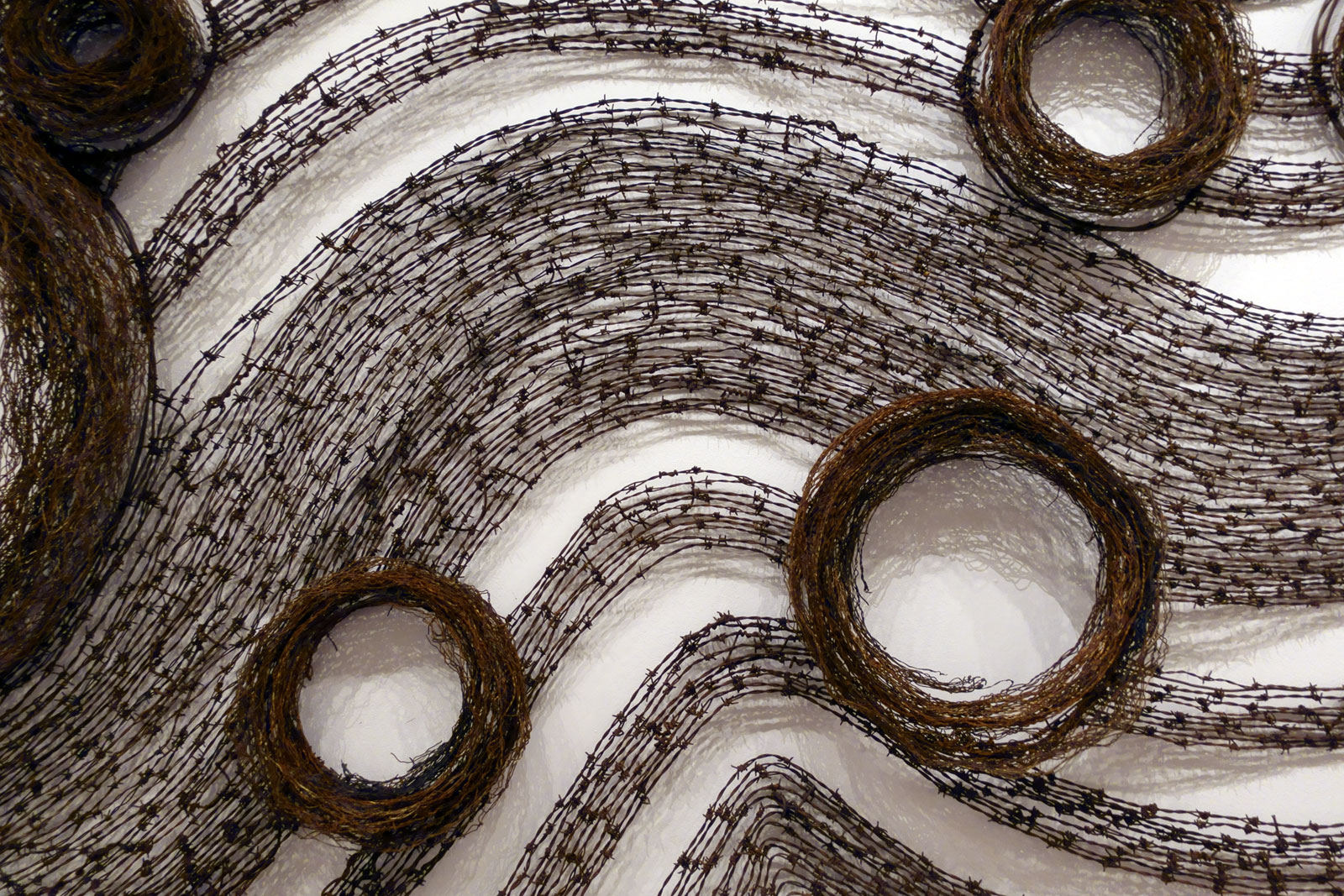
Connelly-Northey can have no fear that her Indigenous originality won’t be recognised because every pore of her strong work speaks to her cultural being. Her spiky, brittly astringent, barbed and feathered works take you to Country, posing the viewer uncomfortable questions about “soft” assertions of history and the hard reality of contemporary Indigenous life: metal as string, desecration of sacred sights, barbed wire handles, “hunters and gatherers whose remains have been upturned by settled Australian societies.” She weaves her stories well.

If the second statement has not been taken out of context, it shows a heap of unnecessary defensive aggression by Connelly-Northey towards Gascoigne’s work. It’s a silly, uninformed statement which hints at a lack of confidence in the strength of her own work. Patently, their use of corrugated iron is not the only thing they have in common.

Both speak towards a love of the Australian land whether from an ancient Aboriginal custodianship perspective or from a Western colonial perspective. Both use scavenging, gathering and gleaning in order to recycle the refuse of society in their art making, Connelly-Northey using weaving to bring together that which is disparate; Gascoigne assembling her formal compositions with an attention to order and randomness. Both artists love to move through the space and time of the land, exploring its idiosyncrasies, “disassociating objects from their original function via a system of obsessive collecting and gathering, while simultaneously reflecting their individual experiences of being immersed in the bush environment.” As Rozentals and Russell-Cook comment, “Despite their careers having been separated by time, and coming from vastly different backgrounds, in both artists we see a singular vision that is immediately recognisable, and unmistakably them. And yet there is a sympathetic connection between their practices that is undeniable.”

Conjoined by more than corrugated iron, more than land, air and clan, their common union is the journey of two creative souls on that golden path of life and the connection of those souls to the cosmos.

Dr Marcus Bunyan


All of the images unless otherwise stated are by Marcus Bunyan. © Marcus Bunyan, the artists and the National Gallery of Victoria. Please click on the photographs for a larger version of the image.


“Although they are often compared, Gascoigne and Connelly-Northey are separated conceptually and chronologically. For a start, despite being two Australian women artists working with landscape, they never met. This fact is less surprising when one remembers that Connelly-Northey’s practice only matured towards the later stages of Gascoigne’s life. Gascoigne came to prominence late and rapidly, with her first exhibition in 1974, when she was fifty-seven years old, and it was only eight years later that she represented Australia at the Venice Biennale. Connelly-Northey started exhibiting seriously in the mid-nineties, shortly before Gascoigne passed away in 1999. However, Connelly-Northey has herself commented on a nuanced relationship to the historical comparison with Gascoigne, pointing out in a recent conversation with Jeremy Eccles that “I’ve worked too hard for people to think I borrowed it all from Rosalie. Our use of corrugated iron is the only thing we have in common.” In some ways, then, the fact they never met may have been fortuitous, with both artists driven to probe their subject matter in distinct and complete ways. …

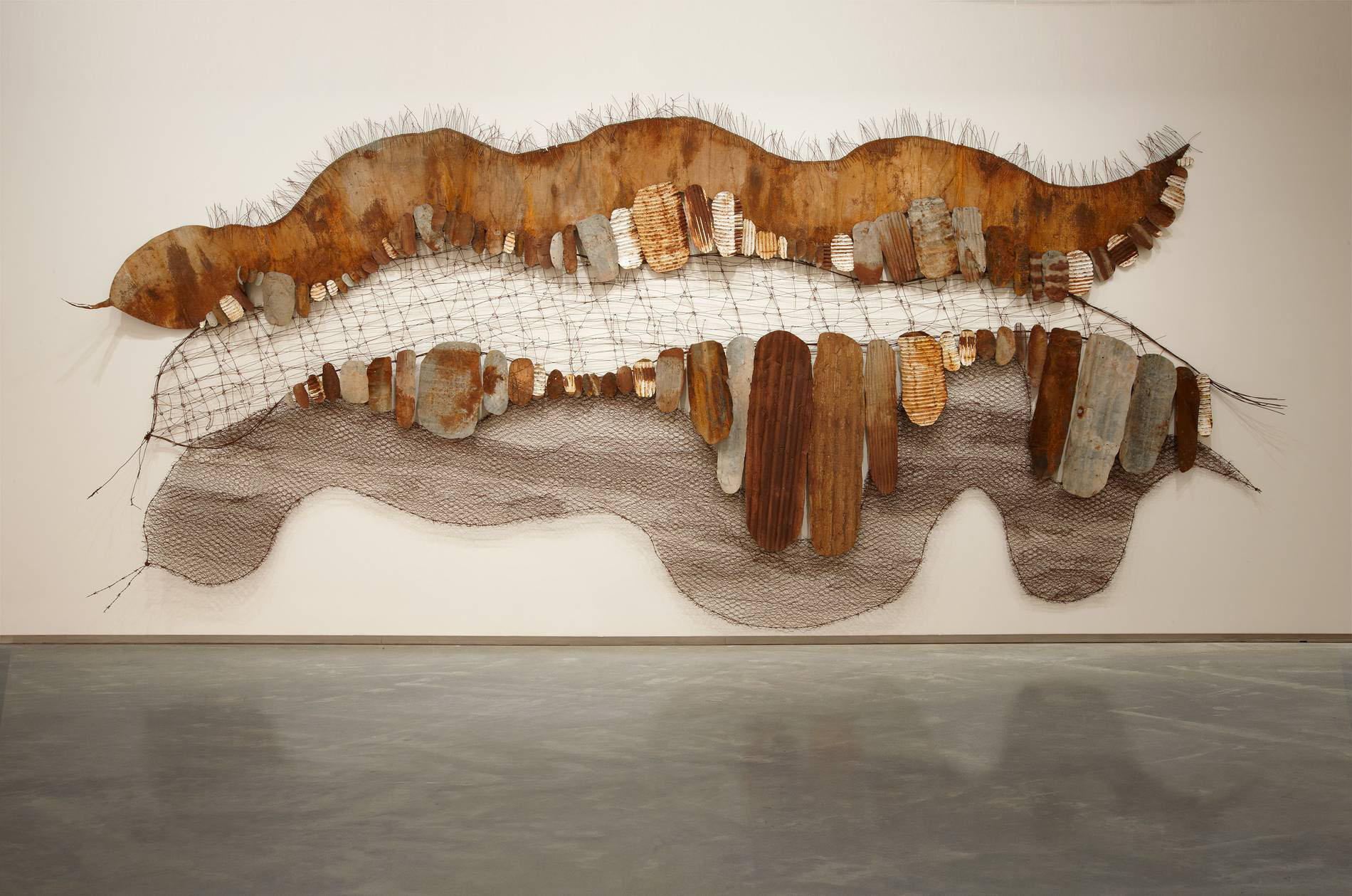
Surrounding built and natural environments are a recurring prompt for Connelly-Northey, who often merges organic and inorganic forms. She investigates the intricate dilemmas and complexities that arise when two cultures meet. Co-curator Myles Russell-Cook explains that the artist “is using her work to explore the connection between her multiple heritages, as well as her experience living on Country. Take her work On Country, 2017; in that installation, Connelly-Northey explores the relationship between the twin cities of Albury and Wodonga, depicting the river a living being, which she imagines as a snake repurposed out of chicken wire and rusted and industrial scrap metal. It’s a dioramic representation of the landscape, but it is also so embedded with references to Aboriginal custodianship of Country.” As a result, Russell-Cook argues, Connelly-Northey proposes “a really different way of being in Australian landscape.”

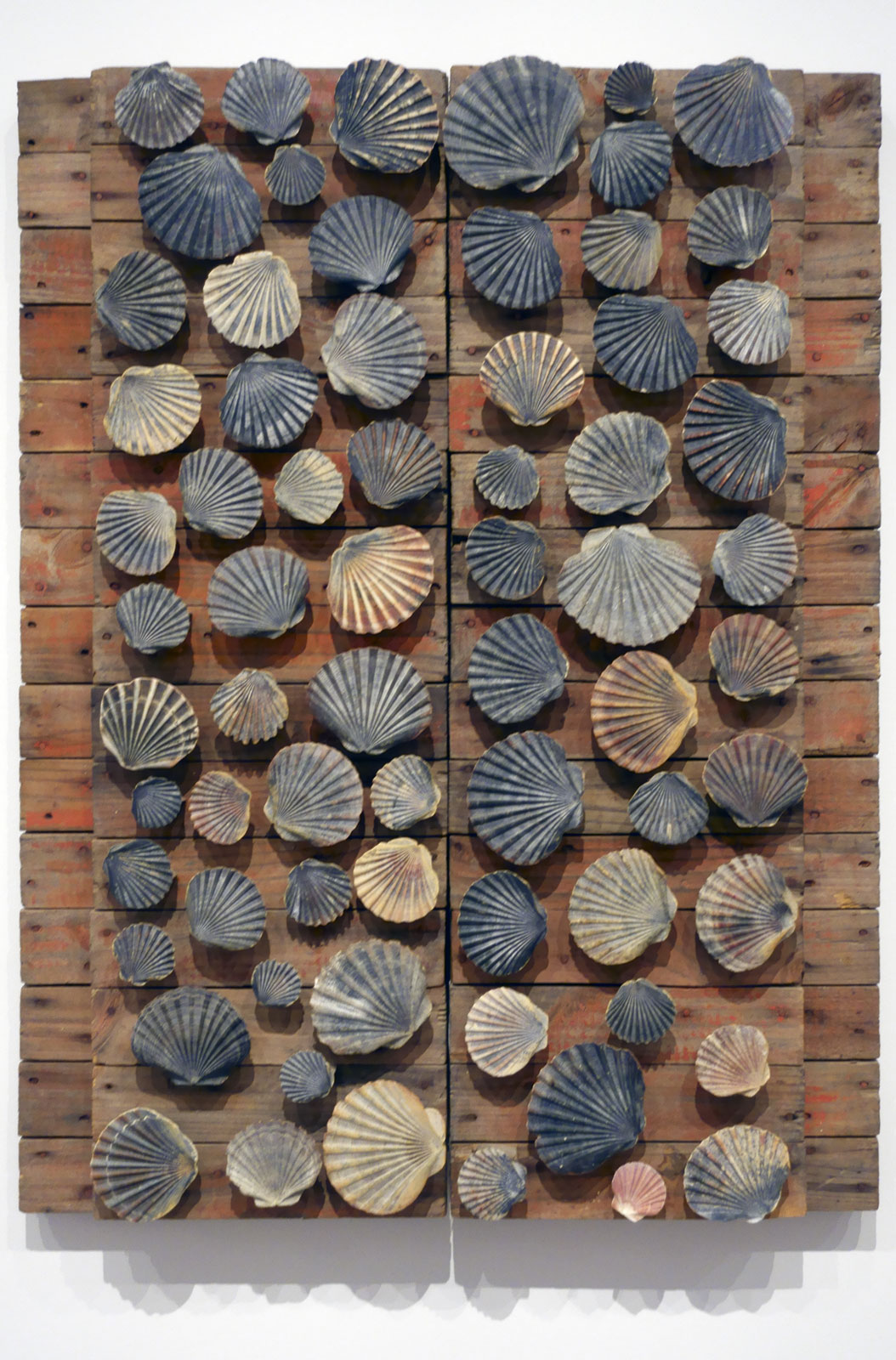
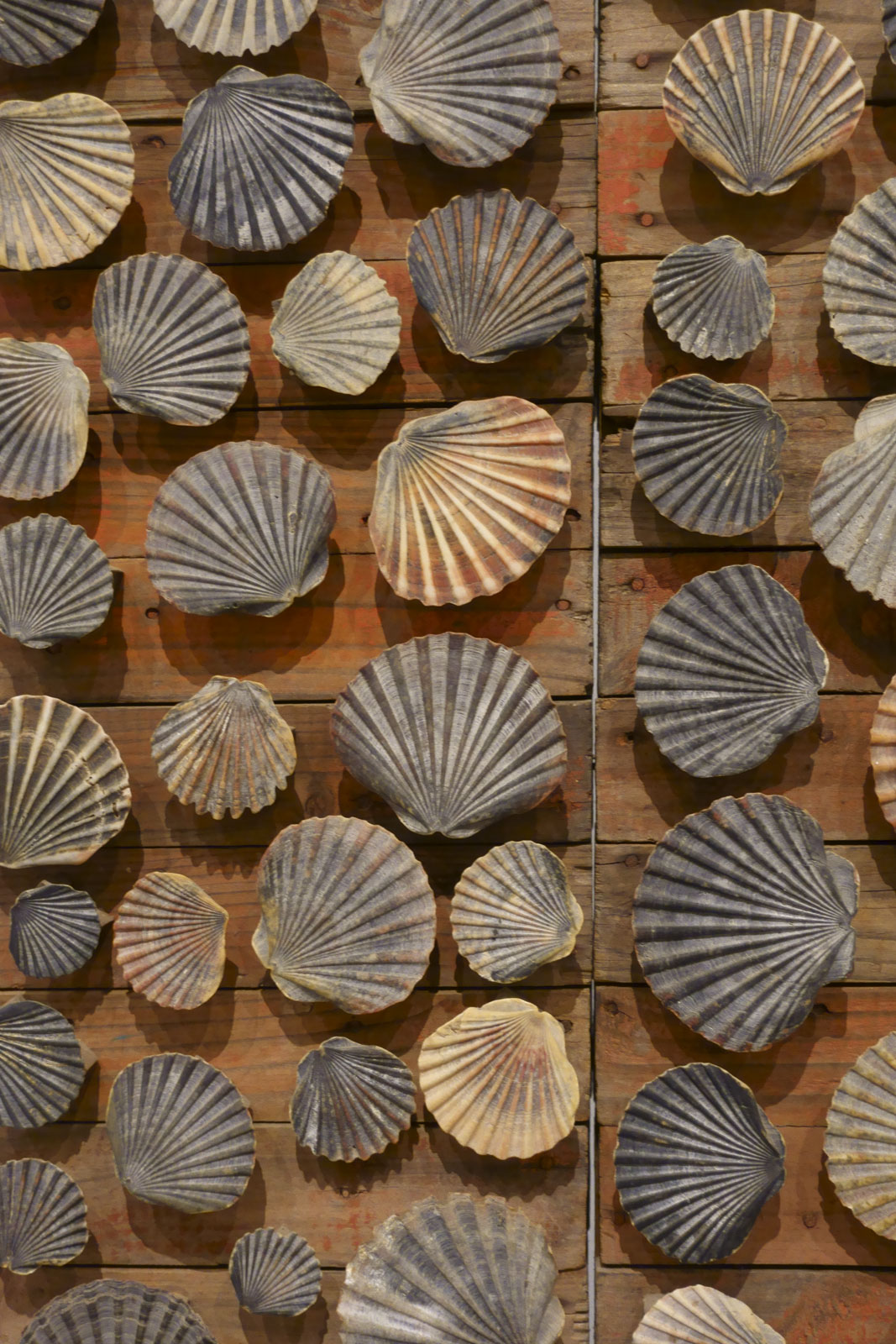
Beyond these conceptual and chronological differences, however, Russell-Cook points out that “I think that what unites the two artists is the shared materials they use, but not a ‘shared-use of materials.’ They are both fascinated by the artistic possibilities of found objects, but they use those materials to tell contrasting stories.” As Rozentals notes, for Gascoigne, “the objects had to be just right – what she collected, for instance, with shells. There could be no cracks and they had to be of a particular colour and a particular shine; she would collect the feathers of different species of birds from particular locations.” For Russell-Cook, “At the heart of what Connelly-Northey does, is the act of cleaning up Country: going out and collecting up bits of discarded and refuse machinery, and then working with that to create customary forms. She makes a lot of possum-skin cloaks, narrbong-galang, which are a type of string bag, as well as koolimans (coolamons), lap-laps, and other types of cultural objects … she repurposes them to create a juxtaposition between cultural memories.”


Extract from Rose Vickers. “Found and Gathered: Lorraine Connelly-Northey and Rosalie Gascoigne,” in Artist Profile, Issue 57, 2021 [Online] Cited 01/02/2022


Installation view of the exhibition 'Found and Gathered' at The Ian Potter Centre NGV Australia


Installation view of the exhibition Found and Gathered at The Ian Potter Centre NGV Australia
Photo: Tom Ross NGV


'Found and Gathered' title wall text


Wall text from the exhibition


Entrance to the exhibition 'Found and Gathered' at The Ian Potter Centre NGV Australia


Entrance to the exhibition Found and Gathered at The Ian Potter Centre NGV Australia
Photo: Marcus Bunyan


Lorraine Connelly-Northey (Australian / Waradgerie, b. 1962) 'Lap Lap' (various numbers) 2011 (installation view)

Lorraine Connelly-Northey (Australian / Waradgerie, b. 1962) 'Lap Lap' (various numbers) 2011 (installation view)

Lorraine Connelly-Northey (Australian / Waradgerie, b. 1962) 'Lap Lap' (various numbers) 2011 (installation view)

Lorraine Connelly-Northey (Australian / Waradgerie, b. 1962) 'Lap Lap' (various numbers) 2011 (installation view)


Lorraine Connelly-Northey (Australian / Waradgerie, b. 1962)
Lap Lap (various numbers) (installation views)
2011
Mixed media
Murray Art Museum Albury, commissioned 2011
Photos: Marcus Bunyan


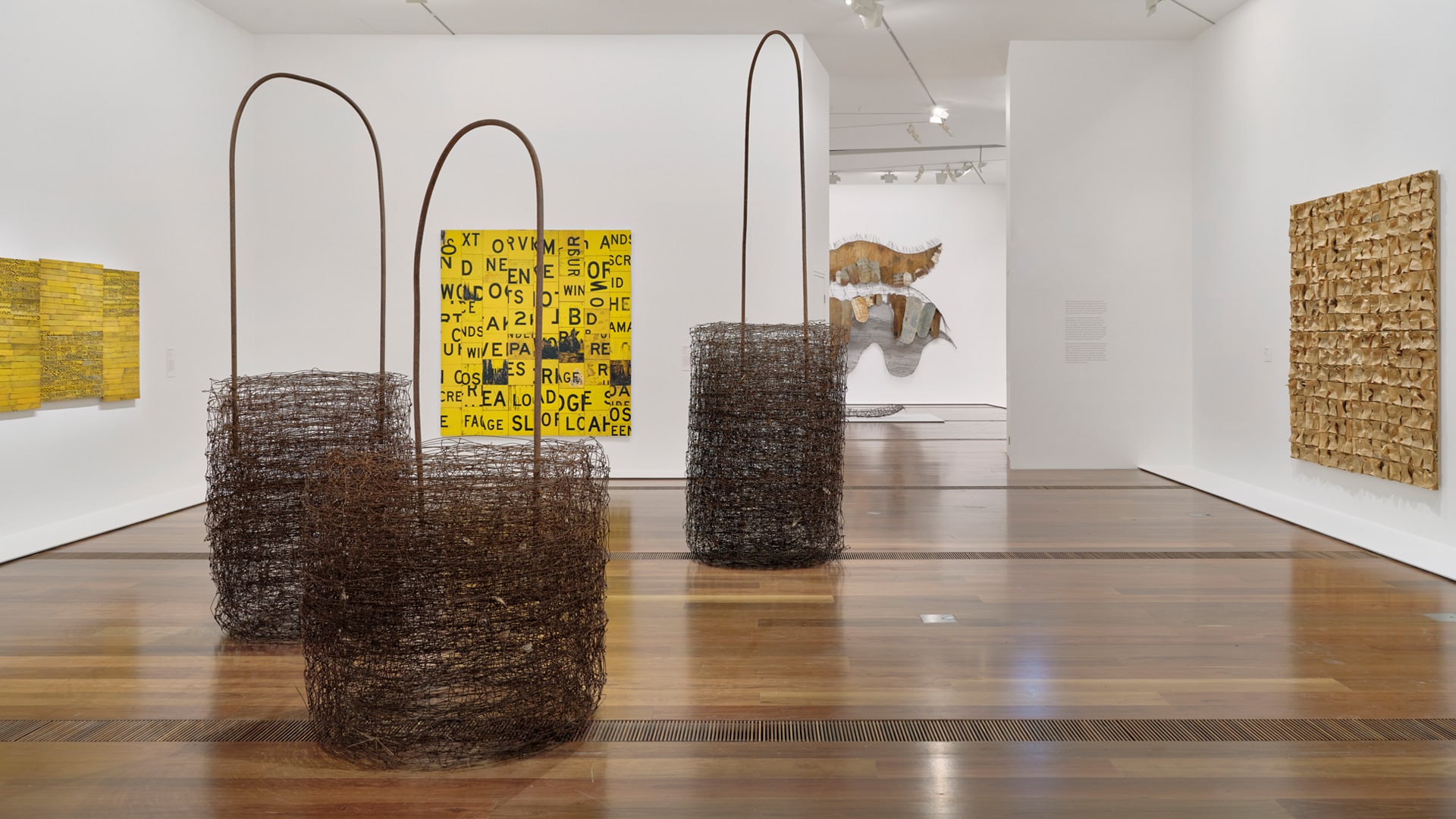
Animal skins and woven plant fibres are preferred natural resources for making cloaks, belts, skirts and lap laps. Worn by both males and females, lap laps were created for a simple covering of the groin. Also considered a body adornment, the wearing of a lap lap has different significance between Nations. Connelly-Northey constructed these lap laps from hard and harsh materials, such as rusted industrial objects including an axe head, a cut-down rabbit trap, barbed fencing wire along with copper sheeting. Metaphorically, Connelly-Northey’s lap laps both expose and draw attention to the difficult and ‘barbed’ sexual relations thats existed between Aboriginal women and settlers, post-European arrival.


'Found and Gathered' wall text


Wall text from the exhibition


Installation view of Rosalie Gascoigne's 'Step through' (1977 - c. 1979-1980) from the exhibition 'Found and Gathered' at The Ian Potter Centre NGV Australia, Oct 2021 - Feb 2022

Installation view of Rosalie Gascoigne's 'Step through' (1977 - c. 1979-1980) from the exhibition 'Found and Gathered' at The Ian Potter Centre NGV Australia, Oct 2021 - Feb 2022


Installation view of Rosalie Gascoigne’s Step through (1977 – c. 1979-1980) at the exhibition Found and Gathered at The Ian Potter Centre NGV Australia
Photos: Marcus Bunyan


Rosalie Gascoigne (Australian born New Zealand, 1917-1999) 'Step through' 1977 - c. 1979-1980 (installation view)


Rosalie Gascoigne (Australian born New Zealand, 1917-1999)
Step through (installation view)
1977 – c. 1979-1980
Linoleum on plywood on wood
National Gallery of Australia, Canberra
Photo: Marcus Bunyan


In 1977, Rosalie Gascoigne commenced making sculptures out of discarded linoleum, which she sourced primarily from rubbish dumps. Step through features torn pieces of floral linoleum glued to plywood which are mounted on wooden blocks, and she used a jigsaw to cut around the shapes. Although linoleum is associated with domestic interiors, for Gascoigne it was about outdoor spaces. This work references untidy vacant blocks in the city, which one might ‘step-through’ as a short cut. Gascoigne’s floor-based works are intended to be experienced from all angles, and the arrangement of the blocks at different heights creates a rhythm, drawing the eyes to wander up and across the installation.


Rosalie Gascoigne (Australian born New Zealand, 1917-1999) 'Smoko' 1984 (installation view)

Rosalie Gascoigne (Australian born New Zealand, 1917-1999) 'Smoko' 1984 (installation view)


Rosalie Gascoigne (Australian born New Zealand, 1917-1999)
Smoko (installation views)
1984
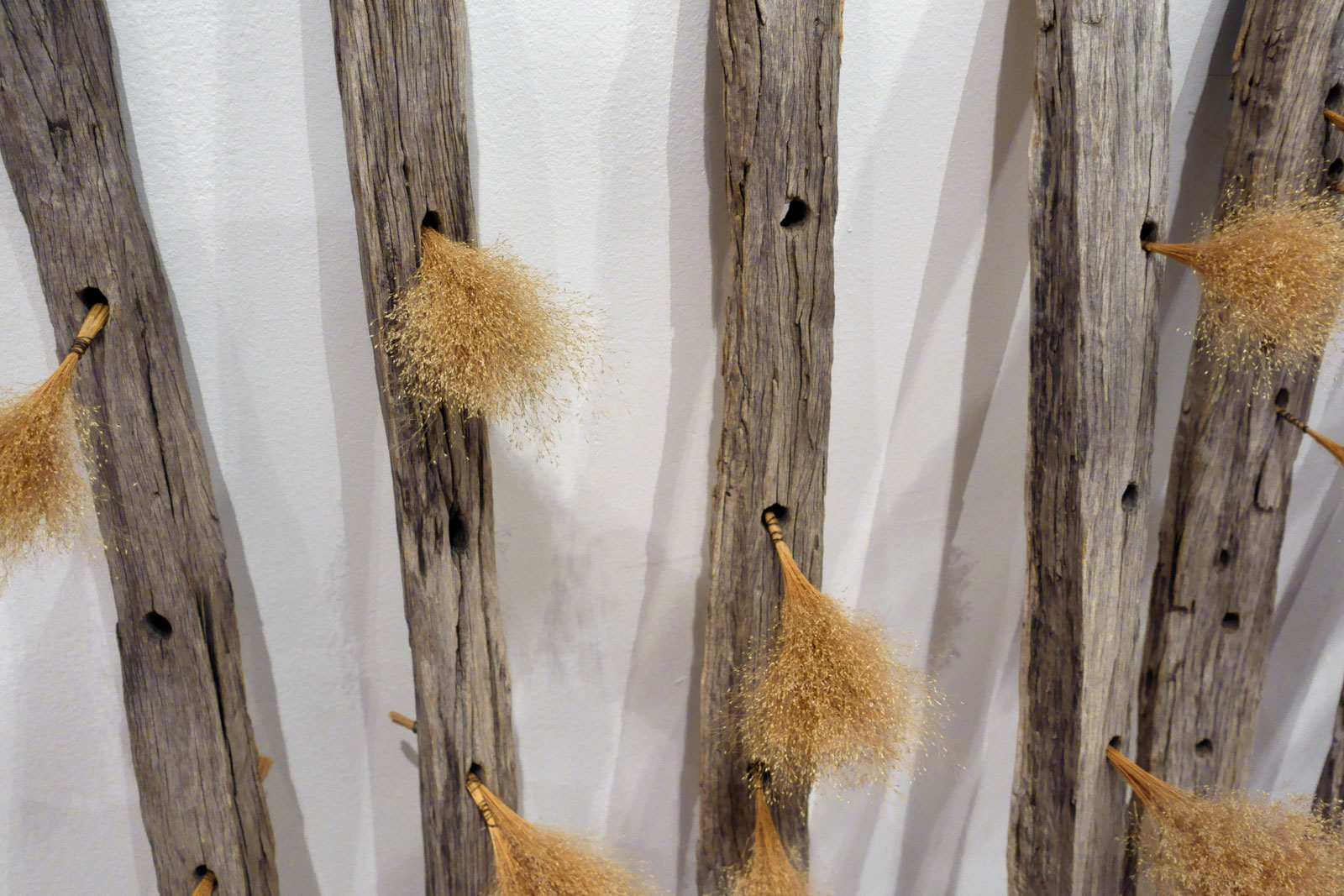
Weathered wood, dried grass (possibly African lovegrass, Eragrostis curvula)
Private collection, Tasmania
Photos: Marcus Bunyan


Installation view of Rosalie Gascoigne's 'Pieces to walk around' (1981, foreground) from the exhibition 'Found and Gathered' at The Ian Potter Centre NGV Australia, Oct 2021 - Feb 2022

Installation view of Rosalie Gascoigne's 'Pieces to walk around' (1981, foreground) from the exhibition 'Found and Gathered' at The Ian Potter Centre NGV Australia, Oct 2021 - Feb 2022


Installation views of Rosalie Gascoigne’s Pieces to walk around (1981, foreground) at the exhibition Found and Gathered at The Ian Potter Centre NGV Australia
Photos: Marcus Bunyan


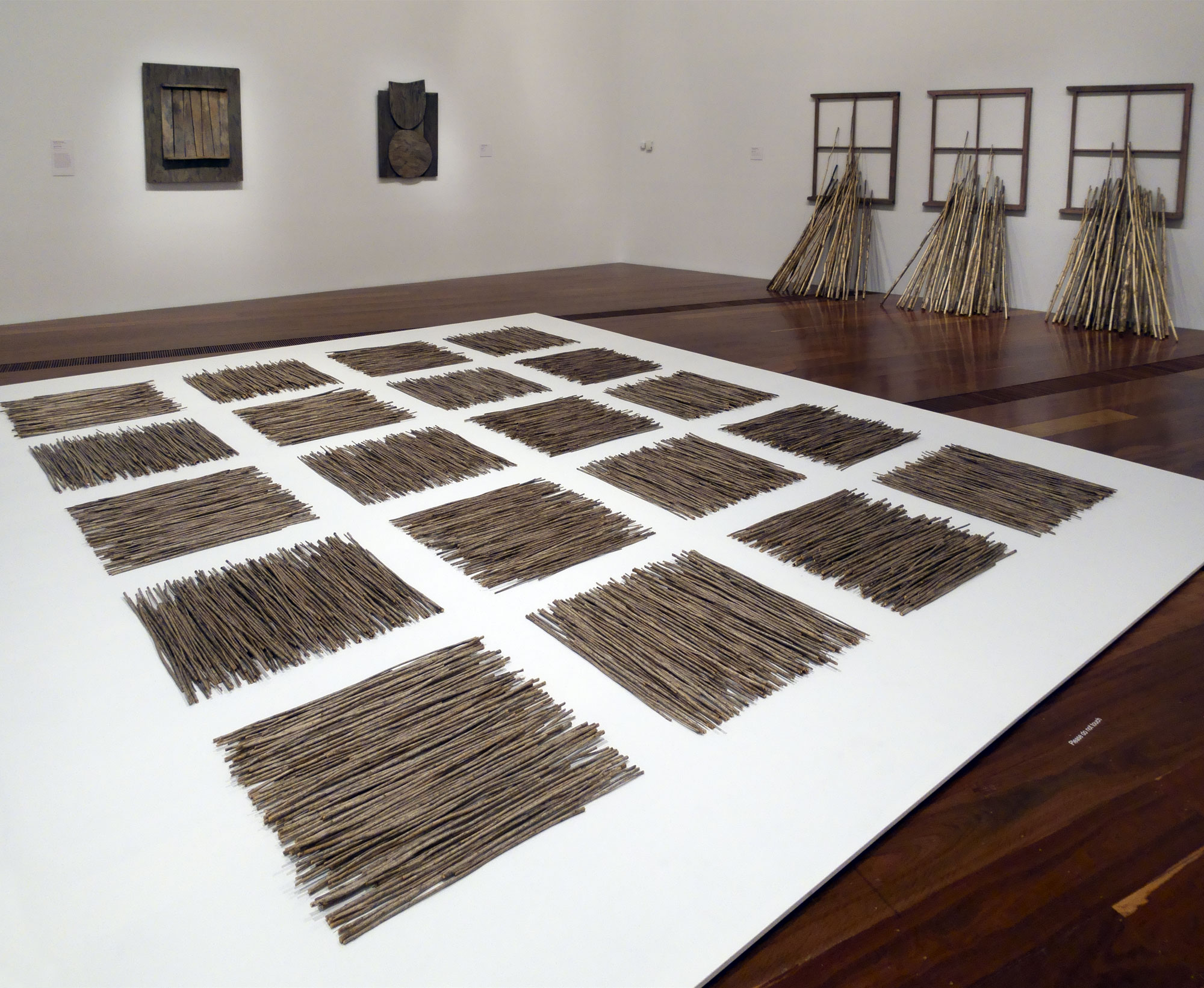
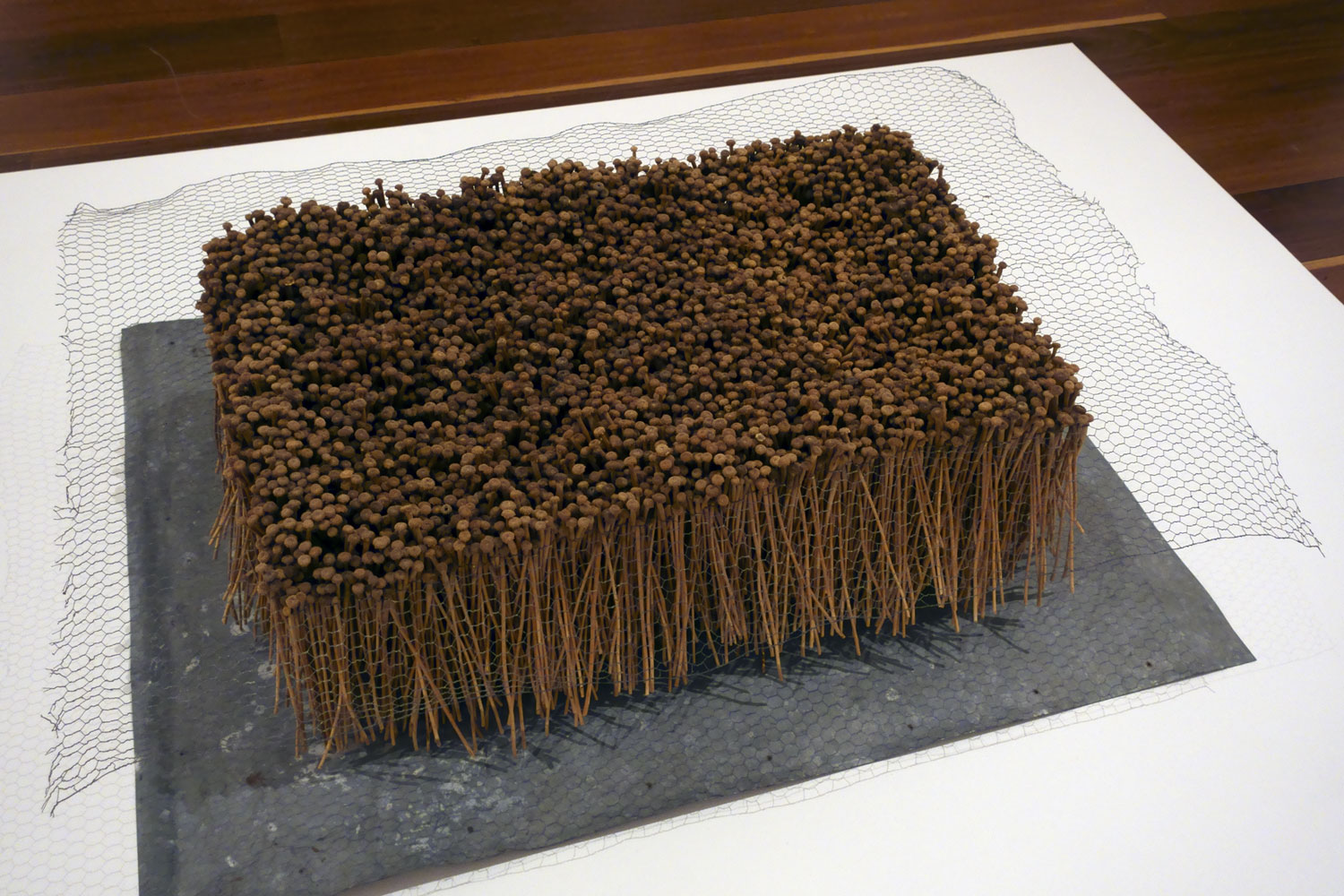
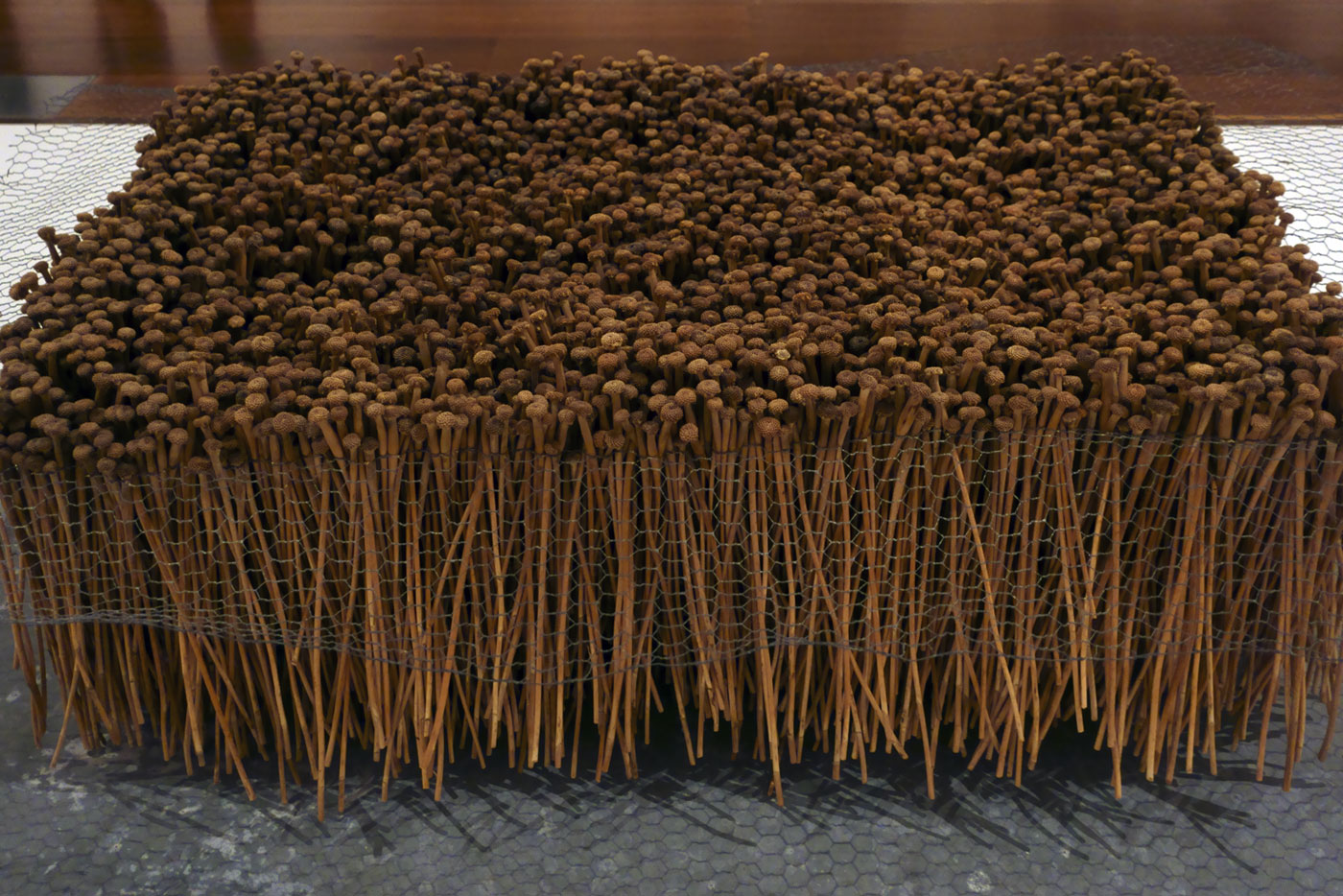
Rosalie Gascoigne (Australian born New Zealand, 1917-1999) 'Pieces to walk around' 1981 (installation view detail)


Rosalie Gascoigne (Australian born New Zealand, 1917-1999)
Pieces to walk around (installation view detail)
1981
Saffron thistle sticks (Carthamus lanatus)
Museum of Contemporary Art, Sydney
Photo: Marcus Bunyan


‘This is a piece for walking around and contemplating. It is about being in the country with its shifting light and shades of grey, its casualness and it prodigality. The viewer’s response to the landscape may differ from mine, but I hope this picture will convey some sense of the countryside that produced it: and that an extra turn or two around the work will induce in the viewer the liberating feeling of being in the open country.’ ~ Rosalie Gascoigne, 1981


Piece to Walk Around is a microcosm of the landscape of the Monaro, in the southwest of New South Wales, where Rosalie Gascoigne lived from 1943. This environment provided the experiences and the materials that shaped her work, found on her journeys through it. Piece to Walk Around refers directly to the experience of moving through the Australian landscape, titled to draw attention to the changing visual effects as one circles the work and the shifting play of light on the natural material.

Comprised of a patchwork of bundles of saffron thistle stalks arranged in 20 squares lying on the floor in alternating directions, it resembles the undulating countryside, the ordering of agriculture and industry, and the mottled effects of light and shadow upon it. The work conveys a sense of the infinite expansiveness and liberation experienced in the country, as manifested in the grid’s open-ended structure to which additional bundles of thistles could theoretically be added or subtracted.

Gascoigne’s work from the early-1980s reveal a sophisticated aesthetic – an engagement with Minimalism’s orderliness and pre-occupation with the grid, and an almost Japanese mixture of formal composition and attention to nature. It was this sense of ‘order with randomness’ which Gascoigne recognised as an essential feature of the Monaro-Canberra region, and which resonates in the ‘careful-careless’ effect of this assemblage. Created only seven years after her first solo show in 1974, this work has a remarkable maturity and balance, achieved through a lifetime of looking at the landscape.

Anonymous text from the Museum of Contemporary Art Australia website Nd [Online] Cited 01/02/2022


Rosalie Gascoigne (Australian born New Zealand, 1917-1999) 'Takeover bid' 1981 (installation view)


Rosalie Gascoigne (Australian born New Zealand, 1917-1999)
Takeover bid (installation view)
1981
Found window frames, thistle stems
Heide Museum of Modern Art, Melbourne
Photo: Marcus Bunyan


Rosalie Gascoigne (Australian born New Zealand, 1917-1999) 'Takeover bid' 1981 (installation view detail)


Rosalie Gascoigne (Australian born New Zealand, 1917-1999)
Takeover bid (installation view detail)
1981
Found window frames, thistle stems
Heide Museum of Modern Art, Melbourne
Photo: Marcus Bunyan


Rosalie Gascoigne (Australian born New Zealand, 1917-1999) 'Balance' 1984 (installation view)


Rosalie Gascoigne (Australian born New Zealand, 1917-1999)
Balance (installation view)
1984
Weathered plywood
Collection of Justin Miller, Sydney
Photo: Marcus Bunyan


Rosalie Gascoigne (Australian born New Zealand, 1917-1999) 'Balance' 1984 (installation view detail)


Rosalie Gascoigne (Australian born New Zealand, 1917-1999)
Balance (installation view detail)
1984
Weathered plywood
Collection of Justin Miller, Sydney
Photo: Marcus Bunyan


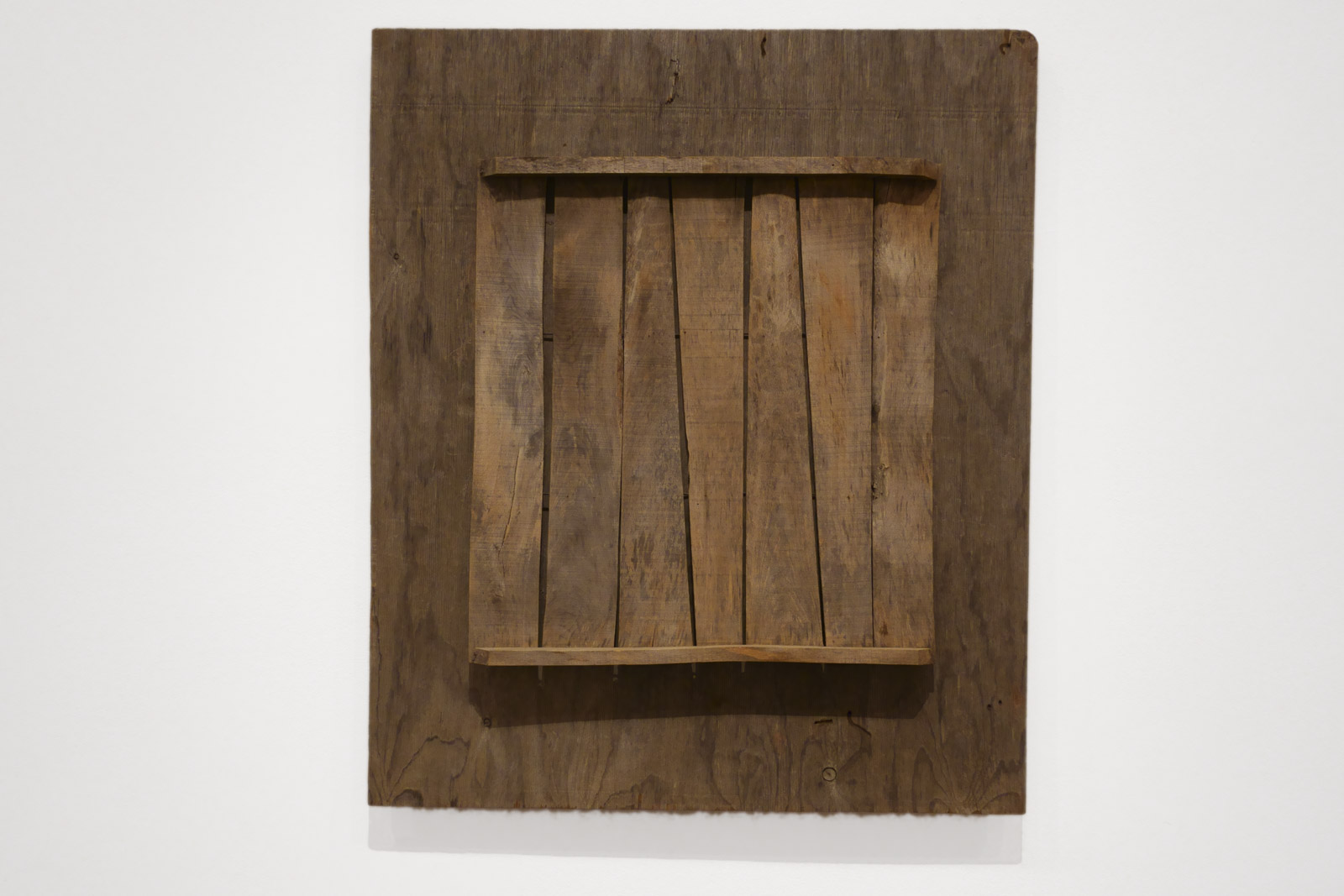
Rosalie Gascoigne (Australian born New Zealand, 1917-1999) 'Graven image' 1982 (installation view)


Rosalie Gascoigne (Australian born New Zealand, 1917-1999)
Graven image (installation view)
1982
Weathered wood and plywood
Private collection, Canberra
Photo: Marcus Bunyan


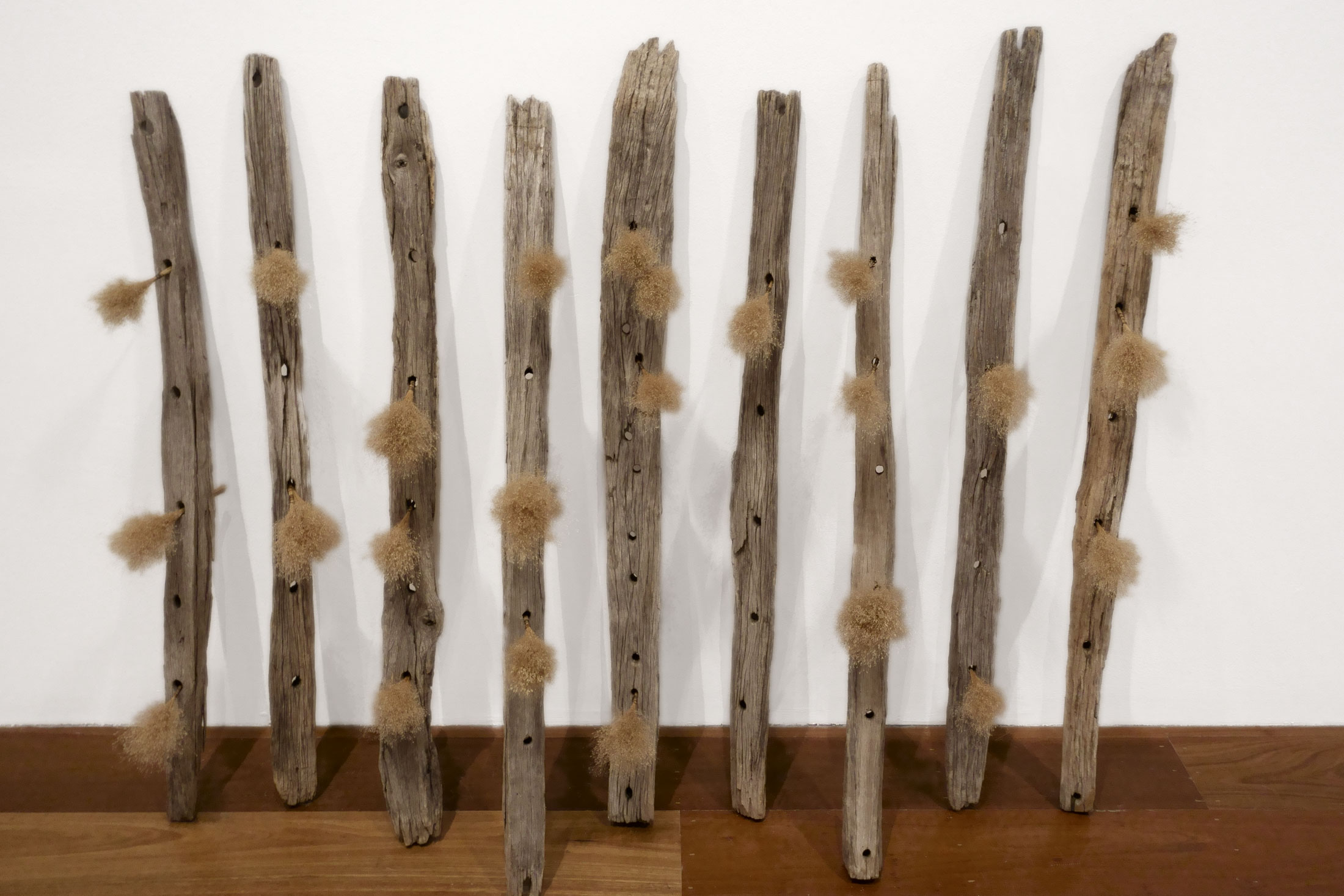
Rosalie Gascoigne perceived wood as being distinctly different to the manufactured materials she incorporated in her art, such as tin, aluminium and iron. Wood, like the shells, dried grasses and plants she also worked with across her career, came from nature. Gascoigne gathered wood that had been weathered, including window frames and fence palings, preferring pieces that had been bleached by the sun until they were almost grey in colour. Gascoigne would use wood either as the main component of a composition, or as the backing from another work.


Installation view of Rosalie Gascoigne's 'Feathered Fence' (1978-1979, foreground) with 'Winter paddock' (1984, back left) and 'Afternoon' (1996, back right) at the exhibition 'Found and Gathered' at The Ian Potter Centre NGV Australia


Installation view of Rosalie Gascoigne’s Feathered Fence (1978-1979, foreground) with Winter paddock (1984, back left) and Afternoon (1996, back right) at the exhibition ‘Found and Gathered’ at The Ian Potter Centre NGV Australia
Photo: Marcus Bunyan


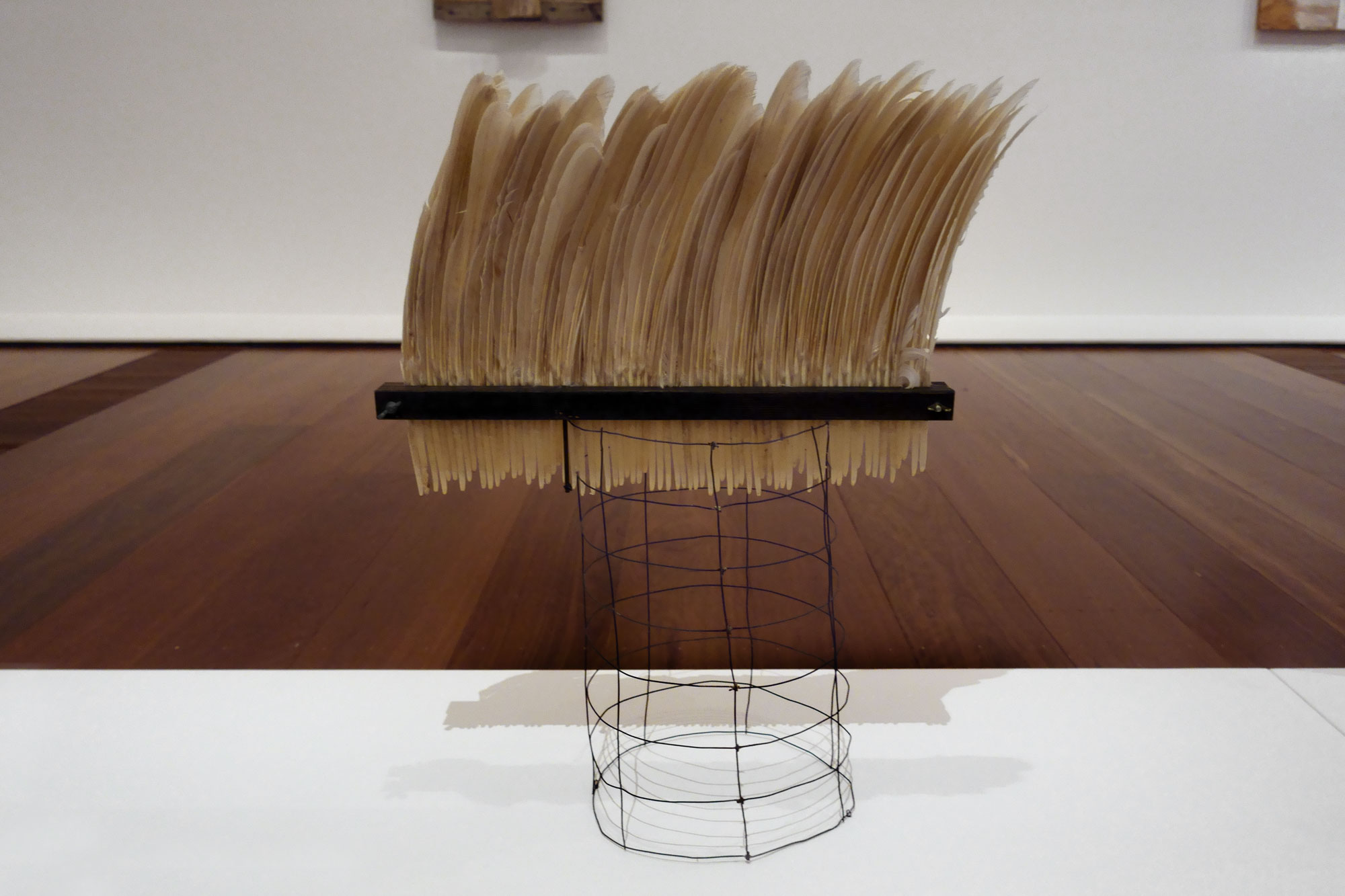
Rosalie Gascoigne (Australian born New Zealand, 1917-1999) 'Feathered fence' 1978-1979 (installation view detail)

Rosalie Gascoigne (Australian born New Zealand, 1917-1999) 'Feathered fence' 1978-1979 (installation view detail)


Rosalie Gascoigne (Australian born New Zealand, 1917-1999)
Feathered fence (installation view details)
1978-1979
Swan (Cygnus atratus) feathers, galvanised wire mesh, metal win nuts, synthetic polymer paint on wood
National Gallery of Australia, Canberra
Gift of the artist, 1994
Photos: Marcus Bunyan


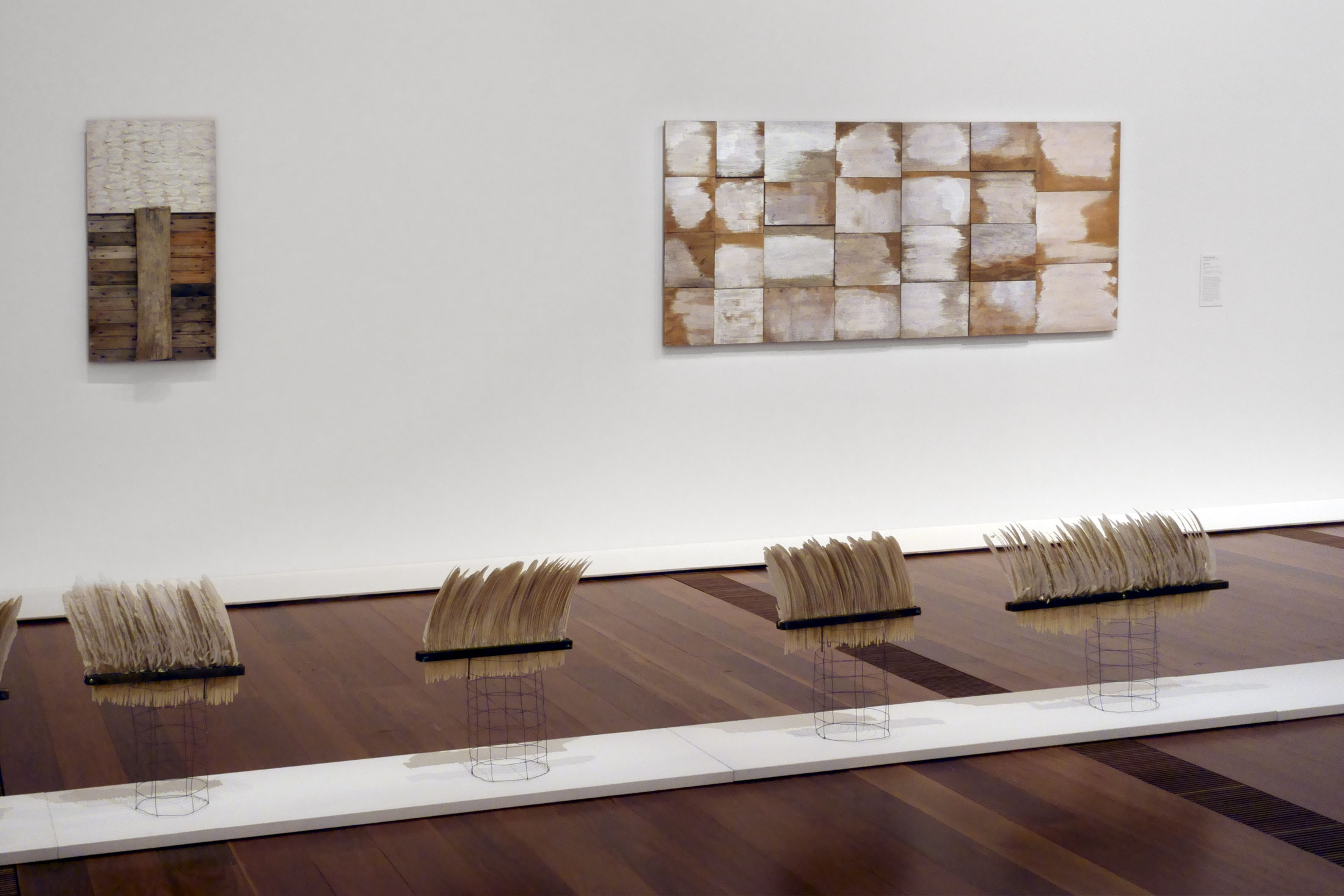
Rosalie Gascoigne (Australian born New Zealand, 1917-1999) 'Afternoon' 1996 (installation view)

Rosalie Gascoigne (Australian born New Zealand, 1917-1999) 'Afternoon' 1996 (installation view)


Rosalie Gascoigne (Australian born New Zealand, 1917-1999)
Afternoon (installation views)
1996
Painted weathered plywood on backing boards
TarraWarra Museum of Art, Healesville
Gift of Eva Besen AO and Marc Besen AC
Photos: Marcus Bunyan


One of Rosalie Gascoigne’s late works, Afternoon, created for the exhibition In Place (Out of Time), held at the Museum of Modern Art in Oxford, comprises twenty-seven panels of weathered plywood organised in a grid-like configuration. Looking out from her vantage point at the top of Mount Stromlo across the countryside, Gascoigne was in awe of the view, the vast sky, and te sense of emptiness. The sections of lights applied white paint and areas of exposed timer of Afternoon are suggestive of passing clouds, and communicates her experiences and enduring recollections of being in the landscape.


As perhaps the most archetypal form of modernist abstraction, the grid has been employed as a formal, compositional device in countless artworks over the past century.

In ‘Grids’ (1979), Rosalind Krauss’ seminal essay on the subject, she describes this structural device as: ‘[f]lattened, geometricized, ordered, it is antinatural, antimimetic, antireal. It is what art looks like when it turns its back on nature’.(1) However, for Rosalie Gascoigne, the grid was employed as a compositional method in order to generate highly personal and experiential evocations of natural phenomena in ways which transcended the more rigid, impersonal qualities associated with its geometry.

In one of her late works entitled Afternoon (1996), Gascoigne assembled 27 individual panels of found painted timber in roughly similar sizes in a grid-like formation. At a surface level the serial repetition of components arranged and balanced according to vertical and horizontal axes corresponds to a reductive Minimalist sensibility. However, it is the heavily weathered timber with its faded white paint which infuses the work with a resonant and suggestive force. As the artist traversed the open countryside she deliberately sought out materials that she felt were ‘invested with the spirit of the place’ and capable of recalling ‘the feeling of an actual moment in the landscape’.(2) In this light, the vital materiality of the reclaimed painted timber is not only inscribed with the effects of its prolonged exposure to the elements, but it also speaks directly to Gascoigne’s deep and abiding memories of her experiences in the landscape. In Afternoon, the richly allusive quality of the individual boards is suggestive of passing clouds, evoking the ephemeral and transitory phenomena of nature in continuous metamorphosis. Contemplated as a unified pictorial whole, this humble assemblage of discarded and deteriorating matter assumes a metaphysical dimension bordering on the ineffable, one which resoundingly accords with the artist’s desire to ‘capture the “nothingness” of the countryside, those wide open spaces … the great Unsaid … the silence that often only visual beauty transcends’.(3)


Further Information

1/ Rosalind Krauss, ‘Grids’, October, Vol. 9, Summer, 1979, p. 50.

2/ Quoted in Deborah Edwards, Rosalie Gascoigne: Material as Landscape, (exh. cat.), Sydney: Art Gallery of New South Wales, 1997, p. 8.

3/ Ibid, p. 16.

Anonymous text. “Rosalie Gascoigne,” on the Culture Victoria website Nd [Online] Cited 01/02/2022


Rosalie Gascoigne (Australian born New Zealand, 1917-1999) 'Afternoon' 1996


Rosalie Gascoigne (Australian born New Zealand, 1917-1999)
Afternoon
1996
Painted weathered plywood on backing boards
TarraWarra Museum of Art, Healesville
Gift of Eva Besen AO and Marc Besen AC


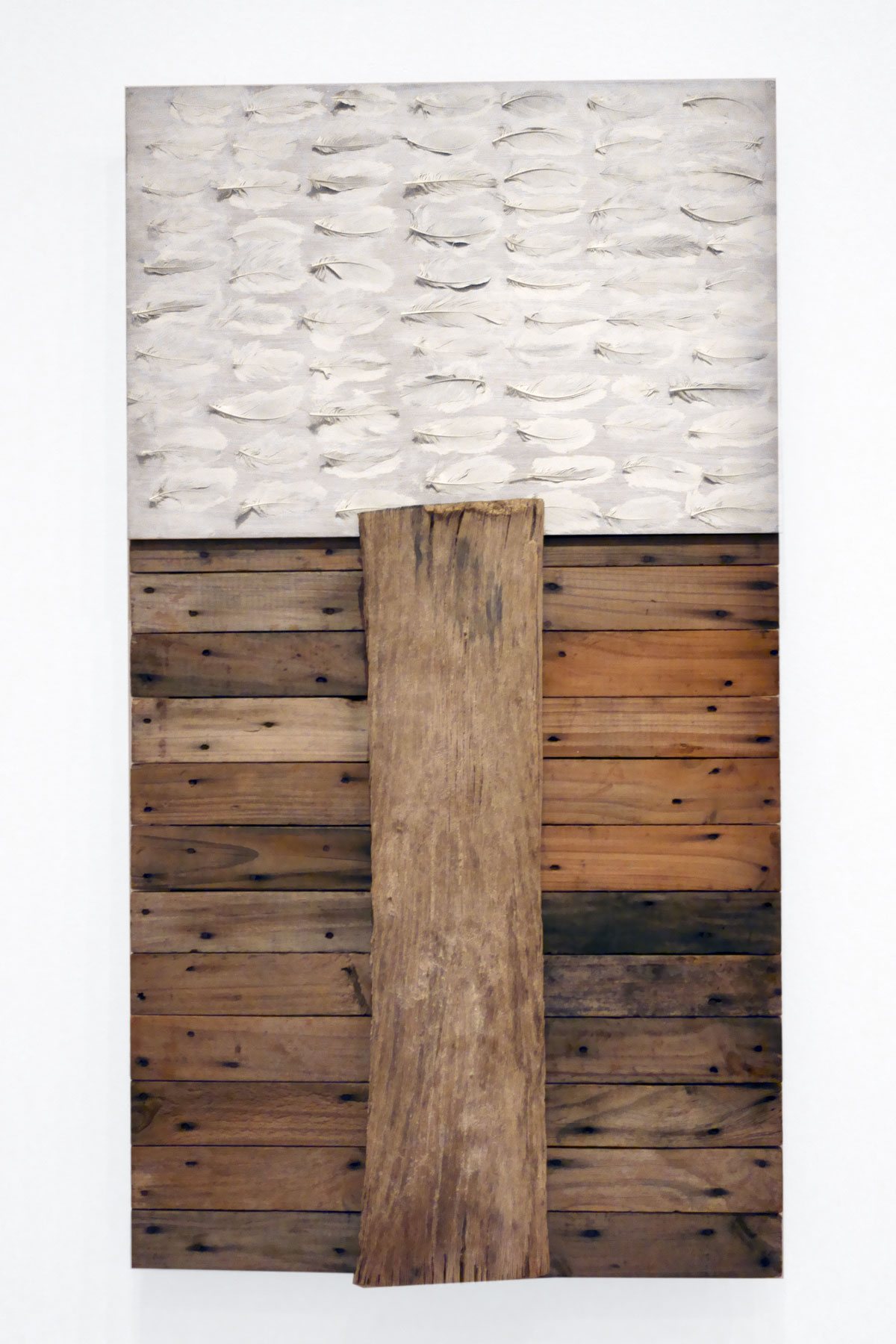
Rosalie Gascoigne (Australian born New Zealand, 1917-1999) 'Winter paddock' 1984 (installation view)


Rosalie Gascoigne (Australian born New Zealand, 1917-1999)
Winter paddock (installation view)
1984
Weathered and painted wood, painted plywood, silver gull (Chroicocephalus novaehollandiae) feathers
Parliament House Art Collection, Canberra
Acquired 1985
Photo: Marcus Bunyan


Rosalie Gascoigne (Australian born New Zealand, 1917-1999) 'Winter paddock' 1984 (installation view detail)


Rosalie Gascoigne (Australian born New Zealand, 1917-1999)
Winter paddock (installation view detail)
1984
Weathered and painted wood, painted plywood, silver gull (Chroicocephalus novaehollandiae) feathers
Parliament House Art Collection, Canberra
Acquired 1985
Photo: Marcus Bunyan


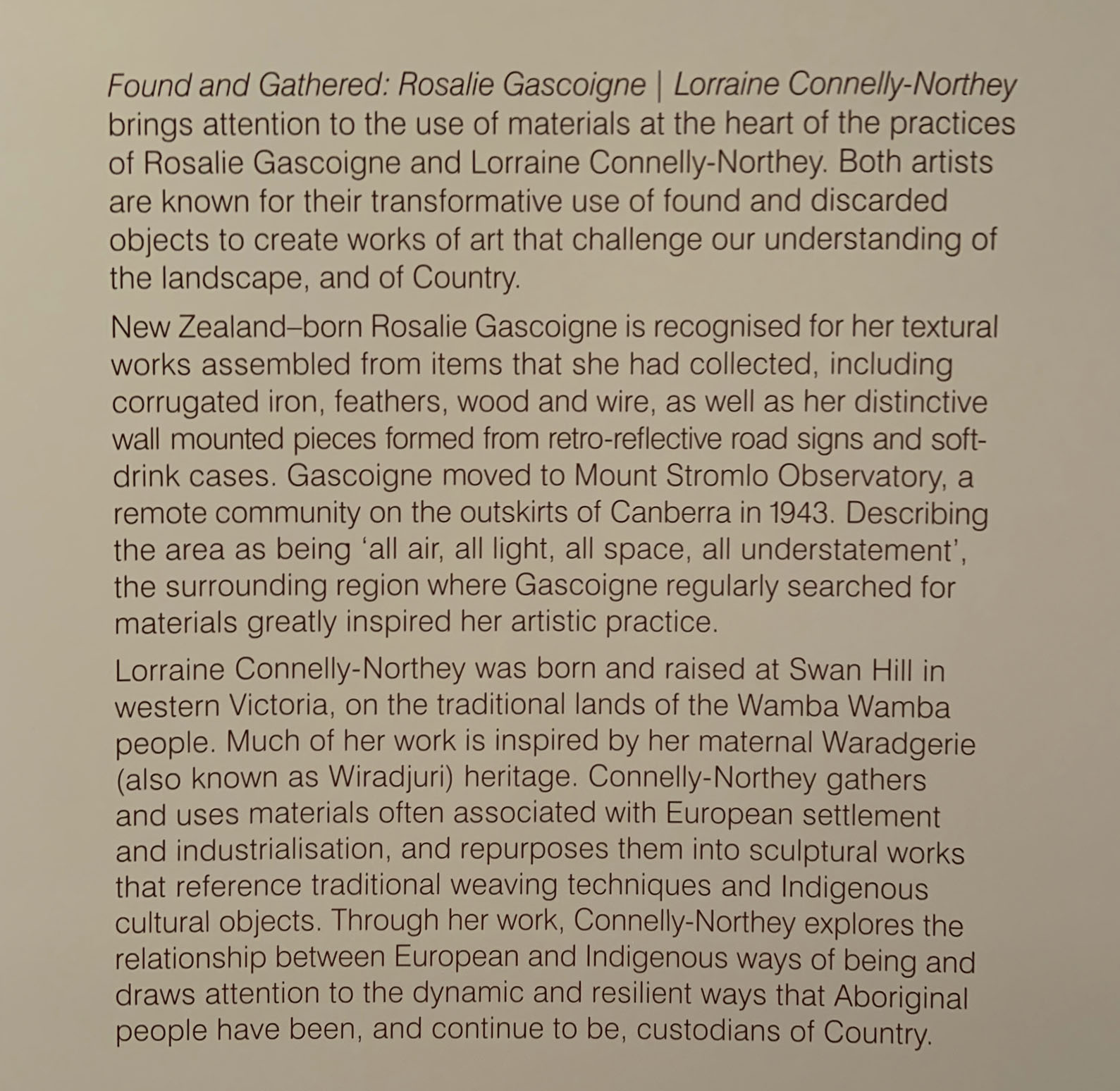
Found and Gathered: Rosalie Gascoigne | Lorraine Connelly-Northey brings attention to the shared materiality at the heart of the practices of Rosalie Gascoigne (1917-1999) and Lorraine Connelly-Northey (b. 1962). Both artists are known for their transformative use of found and discarded objects to create works of art that challenge our understanding of the landscape, and Country.

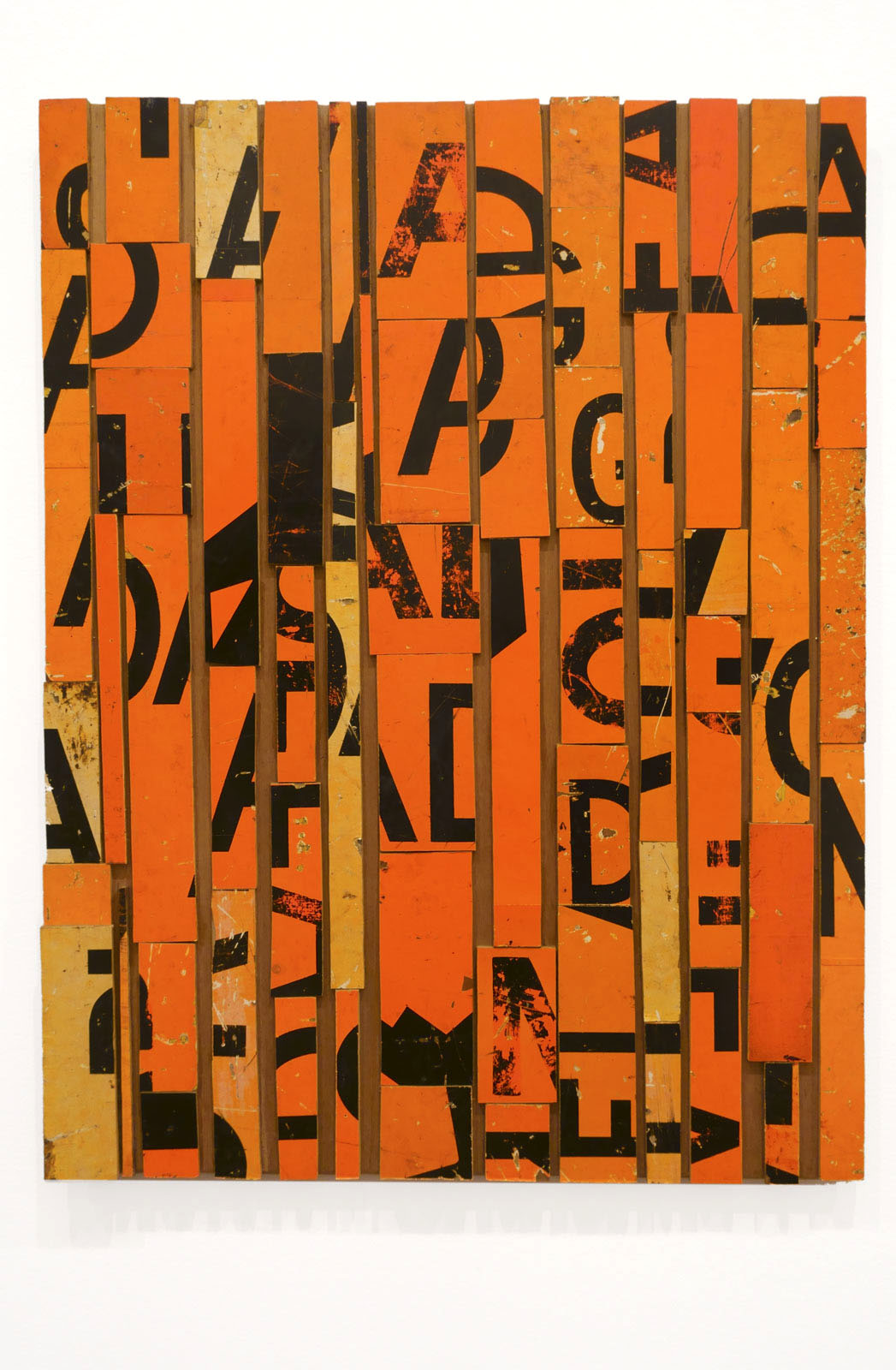
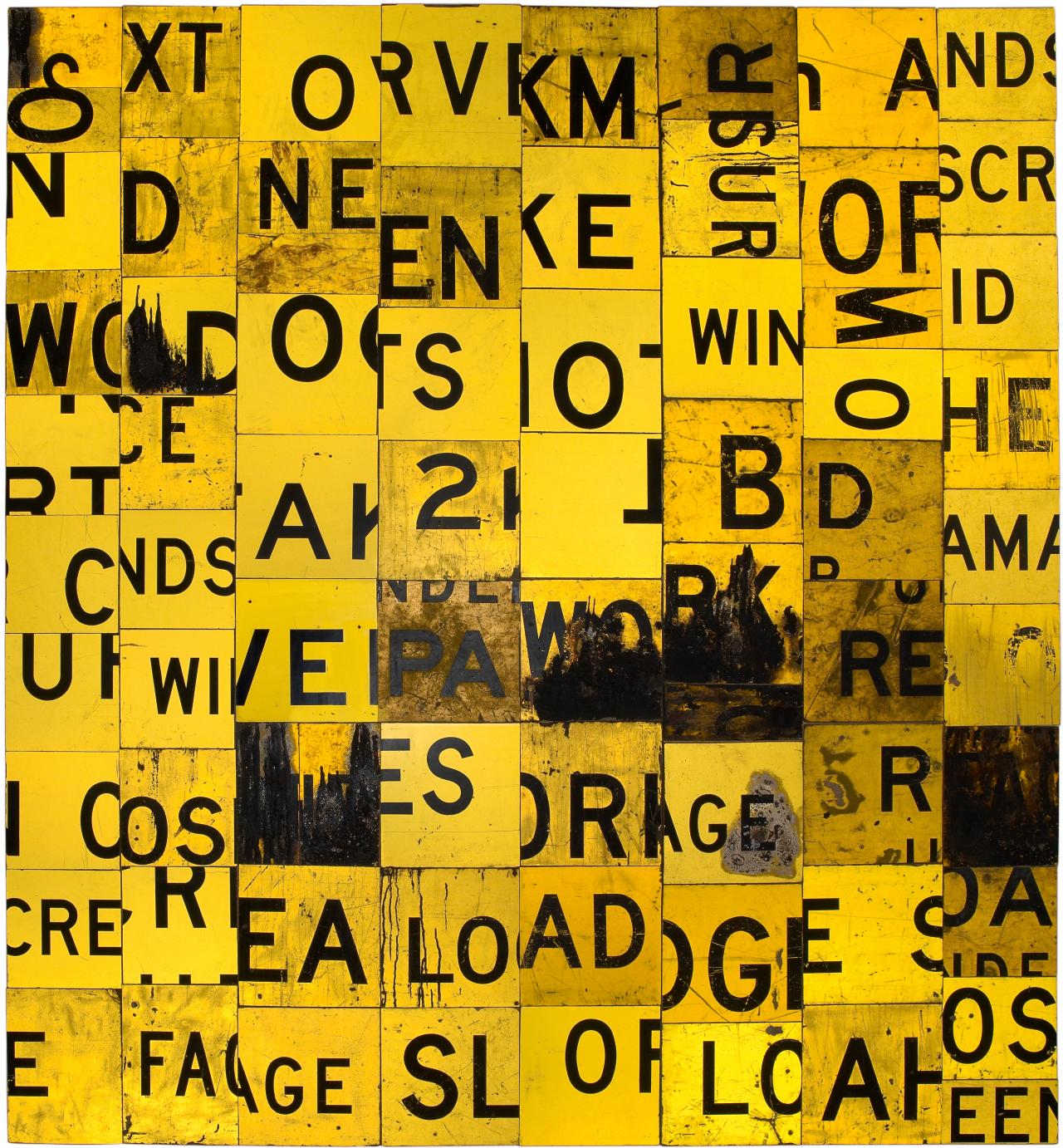
New Zealand–born Rosalie Gascoigne is recognised for her textural works assembled from items that she had collected, including corrugated iron, feathers, wood and wire, as well as her distinctive wall-mounted pieces formed from retro-reflective road signs and soft-drink cases. Gascoigne moved to Mount Stromlo Observatory, a remote community on the outskirts of Canberra in 1943. Describing the area as being ‘all air, all light, all space, all understatement’, the surrounding region where Gascoigne regularly searched for materials greatly inspired her artistic practice. Her first exhibition was held in 1974 when she was 57 years old, and in 1982, Gascoigne was selected as the inaugural female artist to represent Australia at the Venice Biennale.

Lorraine Connelly-Northey was born and raised at Swan Hill in western Victoria, on the traditional lands of the Wamba Wamba people. Much of her work is inspired by her maternal Waradgerie (also known as Wiradjuri) heritage. Connelly-Northey gathers and uses materials often associated with European settlement and industrialisation, and repurposes them into sculptural works that reference traditional weaving techniques and Indigenous cultural objects. Through her work, Connelly-Northey explores the relationship between European and Indigenous ways of being and draws attention to the dynamic and resilient ways that Aboriginal people have been, and continue to be, custodians of Country.

Through a major display of more than 75 wall-based and sculptural works, Found and Gathered highlights each artist’s unique and significant place within Australian art, while also illuminating the sympathetic relationships between their works. Continuing the popular series of paired exhibitions hosted by NGV, this is the first exhibition in this series focused on the work of two women.

Held at The Ian Potter: NGV Australia, this exhibition includes works by both artists held in the NGV Collection as well as works from major public institutions and private collections around Australia.

Text from the NGV Australia website


'Found and Gathered' wall text


Wall text from the exhibition


Lorraine Connelly-Northey (Australian / Waradgerie, b. 1962) 'Magpie bag' 2002 (installation view)


Lorraine Connelly-Northey (Australian / Waradgerie, b. 1962)
Magpie bag (installation view)
2002
From the Koolimans and String Bags series
Wire mesh, magpie feathers
27.8 × 33.5 × 10.0cm
National Gallery of Victoria, Melbourne
Purchased with funds donated by Supporters and Patrons of Indigenous Art, 2003
Photo: Marcus Bunyan


Lorraine Connelly-Northey (Australian / Waradgerie, b. 1962) 'Pelican bag' 2002 (installation view)


Lorraine Connelly-Northey (Australian / Waradgerie, b. 1962)
Pelican bag (installation view)
2002
From the Koolimans and String Bags series
Wire, pelican feathers
31.4 × 29.7 × 10.6cm
National Gallery of Victoria, Melbourne
Purchased with funds donated by Supporters and Patrons of Indigenous Art, 2003
Photo: Marcus Bunyan


Lorraine Connelly-Northey (Australian / Waradgerie, b. 1962) 'Narrbong (String bag)' 2005 (installation view)


Lorraine Connelly-Northey (Australian / Waradgerie, b. 1962)
Narrbong (String bag) (installation view)
2005
Wire, wire mesh
National Gallery of Victoria, Melbourne
Purchased with funds donated by Supporters and Patrons of Indigenous Art, 2005
Photo: Marcus Bunyan


Lorraine Connelly-Northey (Australian / Waradgerie, b. 1962) 'Narrbong (String bag)' 2005 (installation view)


Lorraine Connelly-Northey (Australian / Waradgerie, b. 1962)
Narrbong (String bag) (installation view)
2005
Wire mesh, feathers
26.5 × 10.5 × 11.5cm
National Gallery of Victoria, Melbourne
Purchased with funds donated by Supporters and Patrons of Indigenous Art, 2005
Photo: Marcus Bunyan


Lorraine Connelly-Northey (Australian / Waradgerie, b. 1962) 'Narrbong (String bag)' 2005 (installation view)


Lorraine Connelly-Northey (Australian / Waradgerie, b. 1962)
Narrbong (String bag) (installation view)
2005
Wire, wire mesh, emu feathers
17.8 × 8.7 × 8.5cm
National Gallery of Victoria, Melbourne
Purchased with funds donated by Supporters and Patrons of Indigenous Art, 2005
Photo: Marcus Bunyan


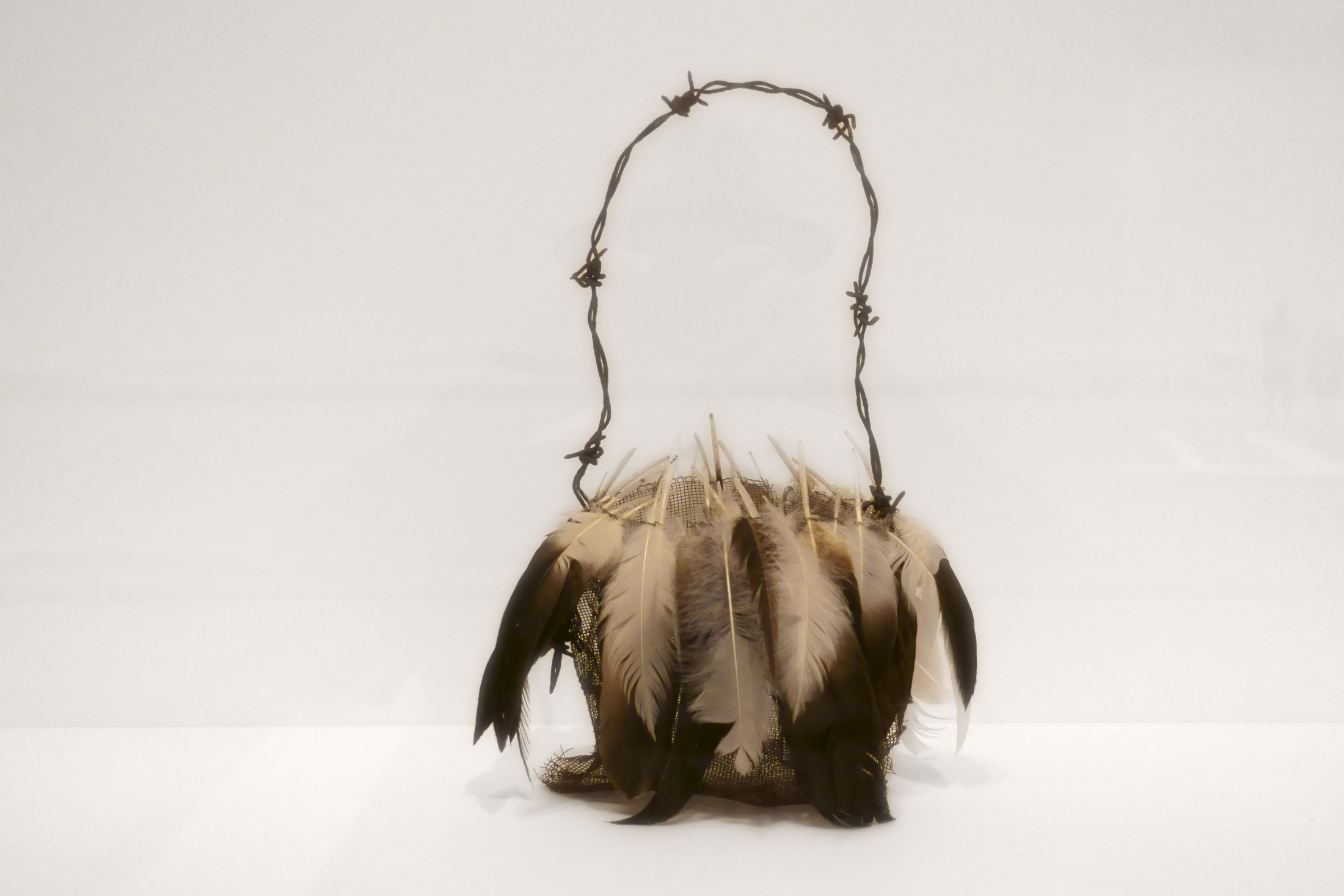
Lorraine Connelly-Northey reproduces the form of traditional cultural objects with a range of gathered materials found on the side of the road, in illegal rubbish dumps, or decaying on farms. As she explains: ‘We Aboriginal people only take what we need when we need it. I do a lot of travelling to spot something and it can take up a lot of time. The beauty is that I always work from leftovers and if I don’t use a material, I take it back. Also, in the sculpting process, I try to not alter the material too much’.


Lorraine Connelly-Northey (Australian / Waradgerie, b. 1962) 'Narrbong (String bag)' 2005 (installation view)


Lorraine Connelly-Northey (Australian / Waradgerie, b. 1962)
Narrbong (String bag) (installation view)
2005
Wire mesh, echidna quills
33.0 × 15.3 × 12.0cm
National Gallery of Victoria, Melbourne
Purchased with funds donated by Supporters and Patrons of Indigenous Art, 2005
© Lorraine Connelly-Northey
Photo: Marcus Bunyan


Lorraine Connelly-Northey (Australian / Waradgerie, b. 1962) 'Kooliman 2' 2002 (installation view)


Lorraine Connelly-Northey (Australian / Waradgerie, b. 1962)
Kooliman 2 (installation view)
2002
from the Koolimans and string bags series 2002
8.5 × 29.7 × 19.2cm
National Gallery of Victoria, Melbourne
Purchased with funds donated by Supporters and Patrons of Indigenous Art, 2003
© Lorraine Connelly-Northey
Photo: Marcus Bunyan


Lorraine Connelly-Northey (Australian / Waradgerie, b. 1962) 'String bag' 2002 (installation view)


Lorraine Connelly-Northey (Australian / Waradgerie, b. 1962)
String bag (installation view)
2002
from the Koolimans and string bags series 2002
Wire, wire mesh, feathers
23.5 × 16.4 × 8.4cm
National Gallery of Victoria, Melbourne
Purchased with funds donated by Supporters and Patrons of Indigenous Art, 2003
© Lorraine Connelly-Northey
Photo: Marcus Bunyan


Lorraine Connelly-Northey (Australian / Waradgerie, b. 1962) 'Narrbong (String bag)' 2005 (installation view)


Lorraine Connelly-Northey (Australian / Waradgerie, b. 1962)
Narrbong (String bag) (installation view)
2005
Wire, wire mesh
30.7 × 14.4 × 4.7cm
National Gallery of Victoria, Melbourne
Purchased with funds donated by Supporters and Patrons of Indigenous Art, 2005
© Lorraine Connelly-Northey
Photo: Marcus Bunyan


Lorraine Connelly-Northey (Australian / Waradgerie, b. 1962) 'Driftwood bag' 2002 (installation view)


Lorraine Connelly-Northey (Australian / Waradgerie, b. 1962)
Driftwood bag (installation view)
2002
from the Koolimans and string bags series 2002
Wire, wire mesh, driftwood
15.4 × 26.5 × 7.3cm
National Gallery of Victoria, Melbourne
Purchased with funds donated by Supporters and Patrons of Indigenous Art, 2003
© Lorraine Connelly-Northey
Photo: Marcus Bunyan


Lorraine Connelly-Northey (Australian / Waradgerie, b. 1962) 'Narrbong (String bag)' 2005 (installation view)


Lorraine Connelly-Northey (Australian / Waradgerie, b. 1962)
Narrbong (String bag) (installation view)
2005
Wire
15.9 × 22.5 × 9.4cm
National Gallery of Victoria, Melbourne
Purchased with funds donated by Supporters and Patrons of Indigenous Art, 2005
© Lorraine Connelly-Northey
Photo: Marcus Bunyan


Lorraine Connelly-Northey (Australian / Waradgerie, b. 1962) 'Kooliman 1' 2002


Lorraine Connelly-Northey (Australian / Waradgerie, b. 1962)
Kooliman 1
2002
From the Koolimans and string bags series 2002
16.5 × 18.0 × 14.7cm
Gallery of Victoria, Melbourne
Purchased with funds donated by Supporters and patrons of Indigenous Art, 2003
© Lorraine Connelly-Northey
Photo: NGV


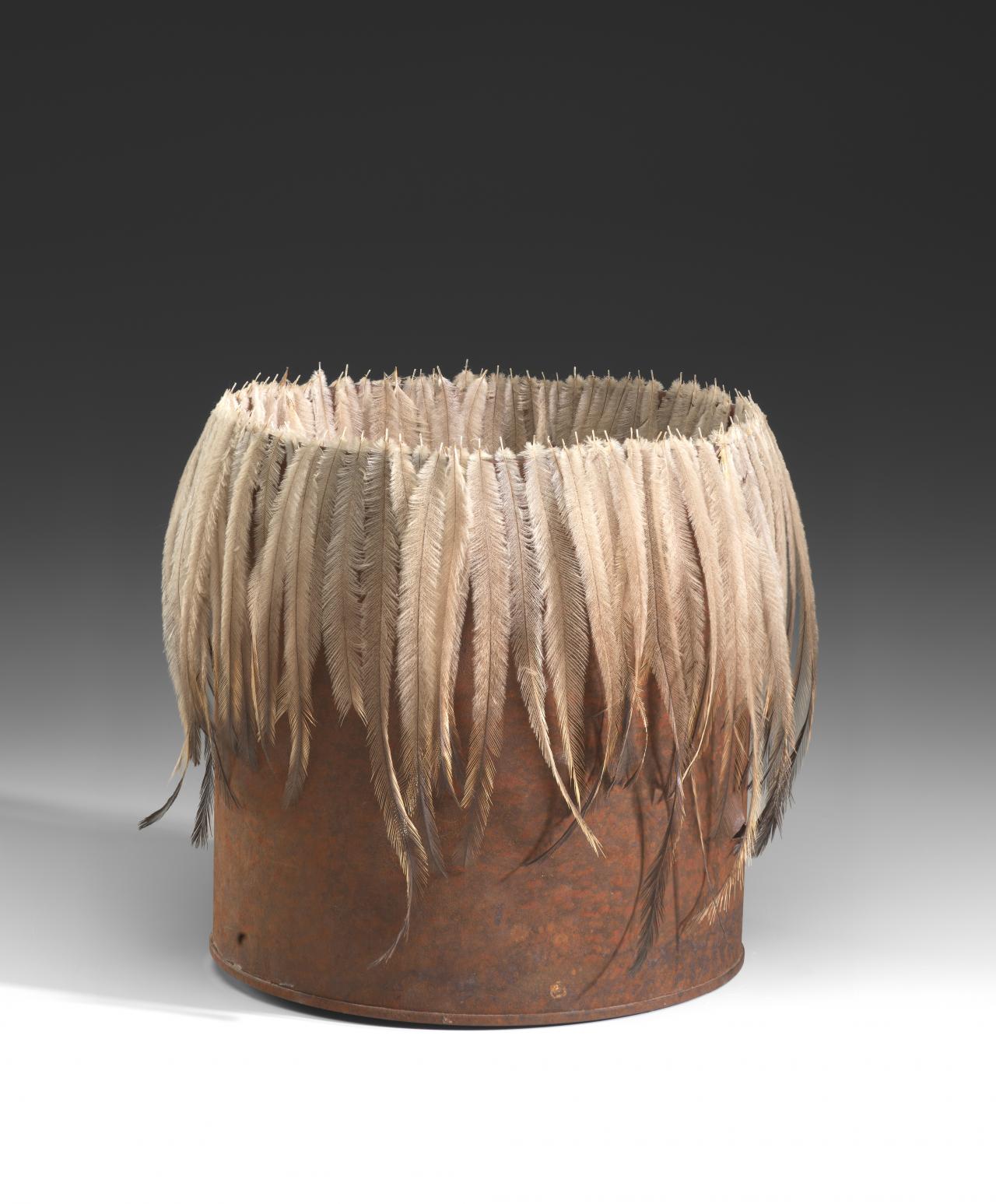
Lorraine Connelly-Northey (Australian / Waradgerie, b. 1962). 'Narrbong (Container)' 2005


Lorraine Connelly-Northey (Australian / Waradgerie, b. 1962)
Narrbong (Container)
2005
Iron, emu feathers
30.5 × 34 × 35.5cm
National Gallery of Victoria, Melbourne
Gift of Robert Cirelli, through the Australian Government’s Cultural Gifts Program, 2019
Photo: NGV


Found and Gathered

By Beckett Rozentals and Myles Russell-Cook

Found and Gathered: Rosalie Gascoigne | Lorraine Connelly-Northey brings to attention the work of two artists, both who are well known for their transformative use of found and discarded objects to create works of art. Lorraine Connelly-Northey is a contemporary artist and Waradgerie (Wiradjuri) woman living on Wamba Wamba Country. Rosalie Gascoigne was born in Aotearoa (New Zealand), and moved to Mount Stromlo Observatory, a remote community in the Australia Capital Territory on the lands of Ngunawal people, in 1943. Both are celebrated as two of Australia’s pioneering contemporary artists.

Gascoigne passed away in 1999 not long after Connelly-Northey first began exhibiting. They never met, and it was not until many years after first showing as an artist that Connelly-Northey became aware of Gascoigne and her work. Despite never meeting, some enduring parallels between their work are evidence of their shared love for the natural sophistication of found objects. Found and Gathered: Rosalie Gascoigne | Lorraine Connelly-Northey is the first major exhibition to unite these artists, providing a conversation between artists and across time. Together these inspiring sculptors challenge our understanding of found materials, of seeing the landscape, and of being on Country.

Rosalie Gascoigne is recognised for textural works assembled from collected items, including corrugated iron, wire, feathers and wood, as well as her distinctive wall-mounted pieces formed from split soft-drink cases and brightly coloured yellow and red road signs. Producing work primarily about the landscape, Gascoigne’s art practice stemmed from her appreciation of humble found objects and weathered materials. Gascoigne sourced objects from the Southern Tablelands and the Monaro district, unique natural environments that lie close to Canberra, describing the regions as ‘all air, all light, all space, all understatement’,1 as well as building sites, refuse and recycling centres.

Born in 1962 and raised at Swan Hill in western Victoria, on the traditional lands of the Wamba Wamba people, today Lorraine Connelly-Northey is known for gathering and utilising industrial remnants associated with European settlement. Her practice is founded in the union of her father’s Irish heritage with her mother’s Waradgerie2 heritage. Since 1990, Connelly-Northey’s strong desire to undertake traditional Aboriginal weaving has resulted in a rediscovery of her childhood bush environments of the Mallee and along the Murray River, to learn more about Aboriginal lifestyle prior to European settlement.

Gascoigne commenced classes in the Japanese art of ikebana in 1962, studying under Tokyo-trained Norman Sparnon, who taught the modern Sogetsu school. Ikebana was to significantly inform the basis of her sculptural works. Looking towards line and form over colour, Gascoigne commenced making assemblages in 1964, her first works created from discarded rural machinery. In a similar way, the materials that Connelly-Northey works with are both natural and inorganic, combining items such as discarded wire, metal and scraps of old housing, with wood, shells, feathers and other naturally occurring media. In bringing together disparate materials, Connelly-Northey also uses her work to push audiences to consider the relationships between First Peoples and settler societies, and critiques the ongoing dispossession that is experienced by Aboriginal people throughout Australia.

Gascoigne’s first solo exhibition was held at Macquarie Galleries, Canberra, in 1974 when she was fifty-seven years old. Gascoigne quickly rose to prominence as one of Australia’s most admired artists, and four years later, she was the focus of Survey 2: Rosalie Gascoigne held at the National Gallery of Victoria, Melbourrne. In 1982, Gascoigne was the first female artist to represent Australia at the Venice Biennale. Following her distinguished career, a retrospective of Gascoigne’s work opened at The Ian Potter Centre: NGV Australia in 2008.3

Exhibited at the Venice Biennale in 1982 was Gascoigne’s first iron work, Pink window, 1975, an assemblage comprising a window frame and painted corrugated galvanised iron. Gascoigne stated of the work that

The pink and the shape and everything was actually as I found it, and I didn’t do a thing to it. It was only after quite some months I realised it could sit on that window frame. At the time I was on about the emptiness of the Australian landscape, and I kept thinking of a woman stuck out there on the plains standing at her window. She looks out, what does she see? Nothing. It spoke of loneliness or something … and it got happier as time went on. The pink carries it … the pink is very beautiful.4


Across her career, Gascoigne gathered wood, with a preference for pieces that had been weathered, such as fence palings and apiary boxes, as well as a dozen abandoned pink primed window frames, including the one featured in Pink window.

For Connelly-Northey, gathering her materials and ‘cleaning up’ the landscape is one in the same. She describes the act of ‘gathering’, as an act of ‘taking back Country’. Caring for lands and waterways and the importance of preserving culture are two things that were instilled in her from a young age, by both her mother and father, who encouraged her to reuse discarded materials, and taught her handiwork and craft.

Many of Connelly-Northey’s sculptures take the form of classical Aboriginal cultural objects, such as narrbong-gallang (string bags), kooliman-gallang (coolamons), possum-skin cloaks and lap laps. These objects can be rendered simply, such as her rectangular sheets of metal with bent wire handles and her drawings with cable wire, or as elaborately constructed pictorial installations, which combine a variety of mixed media. Connelly-Northey uses the title A Possum Skin Cloak as a way of introducing the cultural stories that appear within her more dioramic installations. Presented for the first time in this exhibition, Connelly-Northey unites four of her most ambitious possum skin cloak installations: A Possum Skin Cloak: Three rivers country, 2010 (Museum of Contemporary Art, Sydney); A Possum Skin cloak: Blackfella road, 2011-2013 (National Gallery of Victoria, Melbourne); A Possum Skin Cloak: On Country, 2017 (Murray Art Museum Albury); and her most recent work, A Possum Skin Cloak: Hunter’s Duck Net, 2021 (courtesy of the artist).

A Possum Skin Cloak: Hunter’s Duck Net depicts a traditional duck net cut from oxidised, corrugated iron, that hangs, framed between two majestic river red gums, one a scarred ‘canoe’ tree. Traditionally, when using duck nets, Aboriginal hunters would throw a boomerang, no doubt a returning one, overhead like a predatory hawk to the startle the ducks, forcing them to fly low and into the net strung across the tributary of the river. The ducks in Connelly-Northey’s work appear animated, some still on the water’s surface, others in mid-flight before being either trapped or escaping the net. The encircling boomerang can be seen at the top of this dioramic scene giving audiences a sense of the action at the moment just before the ducks become ensnared.

Gascoigne is perhaps most well known for her unique assemblages constructed from cut up and rearranged retro-reflective road signs that flash and flicker in the light. The first signs she found were discovered face down in the mud at a roadside dump and, by chance, had already been cut up into squares. Gascoigne, taken by the way the material responded to the light, began salvaging signs no longer in use, collecting examples abandoned on the side of the road and also at road maintenance depots.

Gascoigne’s use of the boldness of the retro-reflective road signs to reveal her ongoing interest in the expressive possibilities of the grid is exemplified in Flash art, 1987. In this work, Gascoigne has explored all aspects of the featured lettering and negative space, creating whole words, as well as including sections and fragments of text. The title references the reflective quality of the material, with Gascoigne stating that: ‘It was the most blasting of the retro-reflectives I ever did, because it was eight feet by eight feet, it had road tar on it, and when it lit up, boy, it was every bushfire’.5 The gestural smears of black tar across the bright yellow surface additionally links the work back to the roads and highways where the signs were once positioned in the landscape.

The customary shapes and forms that appear and reappear throughout Connelly-Northey’s work most often reference the cultural objects of her ancestors, and the stories embedded within Country. Connelly-Northey has dedicated a great deal of her life to researching and exploring how these cultural objects, as well as knowledge associated with Aboriginal custodianship of Country can be reimagined using materials associated with colonisation.

One of Connelly-Northey’s most ambitious installations, A Possum Skin Cloak: On Country, overflows across two adjoining walls. This major diorama features a series of blue, white and brown koolimans representing the twin cities Albury and Wodonga. Albury was originally known by the Waradgerie as Bungambrawatha, meaning Homeland. Wodonga retained its original name, which refers to a type of plant called cumbungi, a bush potato that is also commonly known as bulrush. Within the installation are two canoes placed on the body of the barbed-wire snake that represents the Murray River.

The large possum skin cloak that adjoins to the central installation represents the land of the grass seed people, the Waradgerie. Connelly-Northey has rendered her cloak in rusted iron and sections of pressed tin that were salvaged from Albury’s former town hall ceiling during the renovations of the Murray Art Museum Albury. It is distorted and undulates, creating a sense of folded fabric.

Both Connelly-Northey and Gascoigne’s work is defined by, and yet transcends, its sense of materiality. Gascoigne perceived the wood, shells, feathers and dried grasses that she collected as being markedly different to the industrial objects incorporated in her art, such as tin, aluminium and iron. Instead, these materials came from nature itself. Connelly-Northey views the act of gathering as one of the central inspirations behind her practice. Rather than drawing attention to the differences between collected materials, Connelly-Northey uses traditional weaving, not assemblage, as a way of bringing together that which is disparate.

Gascoigne and Connelly-Northey each dissociate objects from their original function, while simultaneously reflecting their individual experiences of being immersed in the bush environment. Despite their careers having been separated by time, and coming from vastly different backgrounds, in both artists we see a singular vision that is immediately recognisable, and unmistakably them. And yet there is a sympathetic connection between their practices that is undeniable.

Beckett Rozentals and Myles Russell-Cook


Notes

1/ Rosalie Gascoigne, interview with Peter Ross, ABC, 1990.

2/ ‘Waradgerie’, also known as ‘Wiradjuri’, is the artist’s preferred spelling.

3/ For further reading on the artist’s career and exhibition history, see Martin Gascoigne, Rosalie Gascoigne: Catalogue Raisonné, ANU Press, Canberra, 2019.

4/ Rosalie Gascoigne, interview with Ian North, Canberra, 9 Feb. 1982. Transcript held in National Gallery of Australia Research Library, Canberra, and Rosalie Gascoigne papers, box 21, National Library of Australia, Canberra.

5/ Rosalie Gascoigne quoted in Viki MacDonald, Rosalie Gascoigne, Regaro Pty Ltd, Paddington, Sydney, 1998, p. 76.


Rosalie Gascoigne (Australian born New Zealand, 1917-1999) 'Country air' 1977 (installation view)


Rosalie Gascoigne (Australian born New Zealand, 1917-1999)
Country air (installation view)
1977
Painted and corrugated galvanised iron, weathered wood, plywood
National Gallery of Australia
Purchased 1979
Photo: Marcus Bunyan


Rosalie Gascoigne began incorporating both sheet and corrugated iron in her work between 1973 and 1974. Gascoigne viewed galvanised iron as a very ‘Australian’ material, and she continued using iron until 1998, experimenting with different weights and colours of the pieces she collected. Country air  comprises four heavy, weathered and dented corrugated sheets, which Gascoigne found at the Canberra Brickworks in 1976, and are presented in the state that she found them. Encased in the simple timber frames, the ripples and bent pieces of iron have the illusion of curtains gently blowing in a breeze.


Rosalie Gascoigne (Australian born New Zealand, 1917-1999) 'Country air' 1977 (installation view detail)


Rosalie Gascoigne (Australian born New Zealand, 1917-1999)
Country air (installation view detail)
1977
Painted and corrugated galvanised iron, weathered wood, plywood
National Gallery of Australia
Purchased 1979
Photo: Marcus Bunyan


Installation view of Rosalie Gascoigne's 'Crop 2' (1982, foreground) and Lorraine Connelly-Northey's 'A Possum Skin cloak: Blackfella road' (2011-2013, background) at the exhibition 'Found and Gathered' at The Ian Potter Centre NGV Australia


Installation view of Rosalie Gascoigne’s Crop 2 (1982, foreground) and Lorraine Connelly-Northey’s A Possum Skin cloak: Blackfella road (2011-2013, background) at the exhibition Found and Gathered at The Ian Potter Centre NGV Australia
Photo: Marcus Bunyan


Rosalie Gascoigne (Australian born New Zealand, 1917-1999) 'Crop 2' 1982 (installation view)

Rosalie Gascoigne (Australian born New Zealand, 1917-1999) 'Crop 2' 1982 (installation view)


Rosalie Gascoigne (Australian born New Zealand, 1917-1999)
Crop 2 (installation views)
1982
Salsify (Tragopogon porrifolius), galvanised wire, corrugated iron
National Gallery of Victoria
Gift of Ben Gascoigne AO
Photos: Marcus Bunyan


Crop 2 comprises a piece of chicken wire that seems to float over a sheet of galvanised iron. The two are connected by hundreds of dried salsify heads (Tragopogon porrifolius – part of the daisy family), which are stripped of their leaves and threaded through the holes in the wire. The resulting effect is a poetic evocation of cultivated land, and of order imposed on the natural environment. Evident in Crop 2 is the influence of the artist’s training in Sogetsu ikebana, as it is based on a knowing combination of intuition and discipline, and a concentrated search for an essential form.


Lorraine Connelly-Northey (Australian / Waradgerie, b. 1962) 'A Possum Skin cloak: Blackfella road' 2011-2013 (installation view)


Lorraine Connelly-Northey (Australian / Waradgerie, b. 1962)
A Possum Skin cloak: Blackfella road (installation view)
2011-2013
Rusted iron and tin, fencing and barbed wire, wire
National Gallery of Victoria, Melbourne
Purchased with funds donated by Supporters and Patrons of Indigenous Art, 2014
Photo: Marcus Bunyan


Lorraine Connelly-Northey (Australian / Waradgerie, b. 1962) 'A Possum Skin cloak: Blackfella road' 2011-2013


Lorraine Connelly-Northey (Australian / Waradgerie, b. 1962)
A Possum Skin cloak: Blackfella road (installation view)
2011-2013
Rusted iron and tin, fencing and barbed wire, wire
National Gallery of Victoria, Melbourne
Purchased with funds donated by Supporters and Patrons of Indigenous Art, 2014
Photo: NGV


'Found and Gathered' wall text


Wall text from the exhibition


Lorraine Connelly-Northey (Australian / Waradgerie, b. 1962) 'A Possum Skin cloak: Blackfella road' 2011-2013 (installation view detail)

Lorraine Connelly-Northey (Australian / Waradgerie, b. 1962) 'A Possum Skin cloak: Blackfella road' 2011-2013 (installation view detail)


Lorraine Connelly-Northey (Australian / Waradgerie, b. 1962)
A Possum Skin cloak: Blackfella road (installation view details)
2011-2013
Rusted iron and tin, fencing and barbed wire, wire
National Gallery of Victoria, Melbourne
Purchased with funds donated by Supporters and Patrons of Indigenous Art, 2014
Photo: Marcus Bunyan


Lorraine Connelly-Northey (Australian / Waradgerie, b. 1962) 'A Possum Skin cloak' 2005-2006 (installation view)


Lorraine Connelly-Northey (Australian / Waradgerie, b. 1962)
A Possum Skin cloak (installation view)
2005-2006
From the Hunter-gatherer series
Rusted corrugated iron
119.5 × 131.5 × 5.0cm
National Gallery of Victoria, Melbourne
Purchased with funds donated by Supporters and Patrons of Indigenous Art, 2006
Photo: Marcus Bunyan


Lorraine Connelly-Northey (Australian / Waradgerie, b. 1962) A Possum Skin cloak 2005-2006 (installation view)


Lorraine Connelly-Northey (Australian / Waradgerie, b. 1962)
A Possum Skin cloak (installation view)
2005-2006
From the Hunter-gatherer series
Steel, Chinese chicken feathers
148.0 × 132.0 × 10.0cm
National Gallery of Victoria, Melbourne
Purchased with funds donated by Supporters and Patrons of Indigenous Art, 2006
Photo: Marcus Bunyan


Lorraine Connelly-Northey (Australian / Waradgerie, b. 1962) A Possum Skin cloak 2005-2006 (installation view detail)


Lorraine Connelly-Northey (Australian / Waradgerie, b. 1962)
A Possum Skin cloak (installation view detail)
2005-2006
From the Hunter-gatherer series
Steel, Chinese chicken feathers
148.0 × 132.0 × 10.0cm
National Gallery of Victoria, Melbourne
Purchased with funds donated by Supporters and Patrons of Indigenous Art, 2006
Photo: Marcus Bunyan


Installation view of Rosalie Gascoigne's 'Milky way' (1982, far left) and her 'Lantern' (1990, far right) and 'Vintage' (1990, second right) at the exhibition 'Found and Gathered' at The Ian Potter Centre NGV Australia


Installation view of Rosalie Gascoigne’s Milky way (1982, far left) and her Lantern (1990, third right) and Vintage (1990, second right) at the exhibition Found and Gathered at The Ian Potter Centre NGV Australia
Photo: Marcus Bunyan


Rosalie Gascoigne (Australian born New Zealand, 1917-1999) 'Milky way' 1995 (installation view)


Rosalie Gascoigne (Australian born New Zealand, 1917-1999)
Milky way (installation view)
1995
Painted wood
TarraWarra Museum of Art, Healesville
Gift of Eva Besen AO and Marc Besen AC
Photo: Marcus Bunyan


Rosalie Gascoigne moved to Mount Stromlo Observatory in 1943 to marry astronomer Ben Gascoigne, who she had previously met while studying at university in Auckland. The first of their three children was born later that year. It was also in 1943 that Gascoigne started exploring the region on foot, bringing home objects she discovered on her journeys. Milky way is one of just two works Gascoigne produced directly related to an astrological theme. Following his wife’s passing, Ben Gascoigne stated that although Gascoigne had many chances, at no time did she look through te telescopes at the Observatory during they years they lived there.


Rosalie Gascoigne (Australian born New Zealand, 1917-1999) 'Lantern' 1990 (installation view)


Rosalie Gascoigne (Australian born New Zealand, 1917-1999)
Lantern (installation view)
1990
Sawn plywood retro-reflective road signs on plywood backing
TarraWarra Museum of Art, Healesville
Gift of Eva Besen AO and Marc Besen AC
Photo: Marcus Bunyan


Rosalie Gascoigne (Australian born New Zealand, 1917-1999) 'Vintage' 1990 (installation view)


Rosalie Gascoigne (Australian born New Zealand, 1917-1999)
Vintage (installation view)
1990
Sawn plywood reflective road signs on composition board
Private collection, Canberra
Photo: Marcus Bunyan


Installation view of the exhibition 'Found and Gathered' at The Ian Potter Centre NGV Australia showing at right, Rosalie Gascoigne's 'Yellow beach' (1984)


Installation view of the exhibition Found and Gathered at The Ian Potter Centre NGV Australia showing at right, Rosalie Gascoigne’s Yellow beach (1984)
Photo: Marcus Bunyan


Rosalie Gascoigne (Australian born New Zealand, 1917-1999) '(Yellow beach)' 1984 (installation view)


Rosalie Gascoigne (Australian born New Zealand, 1917-1999)
(Yellow beach) (installation view)
1984
Scallop shells, painted wood, plywood
Private collection, Canberra
Photo: Marcus Bunyan


Rosalie Gascoigne (Australian born New Zealand, 1917-1999) 'Red beach' 1984 (installation view)


Rosalie Gascoigne (Australian born New Zealand, 1917-1999)
Red beach (installation view)
1984
Wood, nails, shells, paint
Private collection, Canberra
Photo: Marcus Bunyan


Rosalie Gascoigne was an avid shell collector, often focusing on gathering just one type of shell at a time, and storing them in boxes, jars and bowls. Discerning in her selection, she brought home only shells she deemed to be of good colour and with no chips. The Tasmanian scallop shells used in Red beach, (Yellow beach) and (Twenty-five scallop shells) were collected by Gascoigne’s son, Toss, who was living in Hobart at the time. He gathered them from Seven Mile beach, just near Hobart Airport, which the family used to visit.


Rosalie Gascoigne (Australian born New Zealand, 1917-1999) 'Red beach' 1984 (installation view)


Rosalie Gascoigne (Australian born New Zealand, 1917-1999)
Red beach (installation view)
1984
Wood, nails, shells, paint
Private collection, Canberra
Photo: Marcus Bunyan


Rosalie Gascoigne (Australian born New Zealand, 1917-1999) 'Twenty-five scallop shells' c. 1984-1986 (installation view)


Rosalie Gascoigne (Australian born New Zealand, 1917-1999)
Twenty-five scallop shells (installation view)
c. 1984-1986
Scallop shells, wood
Private collection, Canberra
Photo: Marcus Bunyan


Rosalie Gascoigne (Australian born New Zealand, 1917-1999) 'Twenty-five scallop shells' c. 1984-1986 (installation view detail)


Rosalie Gascoigne (Australian born New Zealand, 1917-1999)
Twenty-five scallop shells (installation view detail)
c. 1984-1986
Scallop shells, wood
Private collection, Canberra
Photo: Marcus Bunyan


Rosalie Gascoigne (Australian born New Zealand, 1917-1999) 'Turn of the tide' 1983 (installation view)


Rosalie Gascoigne (Australian born New Zealand, 1917-1999)
Turn of the tide (installation view)
1983
Painted wood, galvanised iron, shells
Private collection, Sydney
Photo: Marcus Bunyan


Rosalie Gascoigne (Australian born New Zealand, 1917-1999) 'Turn of the tide' 1983 (installation view detail)


Rosalie Gascoigne (Australian born New Zealand, 1917-1999)
Turn of the tide (installation view detail)
1983
Painted wood, galvanised iron, shells
Private collection, Sydney
Photo: Marcus Bunyan


Installation view of Lorraine Connelly-Northey's 'On Country' (2017) at the exhibition 'Found and Gathered' at The Ian Potter Centre NGV Australia


Installation view of Lorraine Connelly-Northey’s On Country (2017) at the exhibition Found and Gathered at The Ian Potter Centre NGV Australia
Photo: Marcus Bunyan


The installation On Country overflows onto the adjoining wall with this possum skin cloak. This component on On Country represents the land of the grass seed people, the Waradgerie. The object has been rendered in rusted iron and sections of pressed tin, and the cloak is fringed with white and brown koolimans of varying scales, which were salvaged from Albury’s former town hall ceiling during renovations of the Murray Art Museum Albury. The rusted sheet is distorted and undulates over the entire object creating a sense of folded fabric.


Installation view of Lorraine Connelly-Northey's 'On Country' 2017, on display at MAMA, Albury


Installation view of Lorraine Connelly-Northey’s On Country 2017, on display at MAMA, Albury
© the artist


'Found and Gathered' wall text


Wall text from the exhibition


Rosalie Gascoigne (Australian born New Zealand, 1917-1999) 'Inland sea' 1986


Rosalie Gascoigne (Australian born New Zealand, 1917-1999)
Inland sea
1986
Weathered painted corrugated iron, wire
(a-ff) 39.1 x 325.0 x 355.5cm (variable) (installation)
National Gallery of Victoria, Melbourne
Purchased, 1993
© Rosalie Gascoigne Estate/Licensed by Copyright Agency, Australia


In Inland sea, 1986 (above), sixteen large sheets of corrugated tin hover above the floor in a loose grid arrangement. The grid format unifies the separate parts of the composition, and also enhances the expressive power of different visual elements through repetition. The shapes and lines repeated across the buckling sheets of tin create a powerful sense of the gentle movement of wind or water.

The strong visual rhythms and movement evident in Gascoigne’s compositions are often achieved through the repetition of different visual elements. Step through, 1980 (above), is made from fifteen separate parts, each made from a torn piece of brightly coloured, floral patterned linoleum mounted on a block of wood. The blocks sit at different angles creating different levels within the installation. The spaces between the different parts create a meandering path for the viewer to explore, highlighting the importance of movement through and across space in Gascoigne’s work.

“I was thinking about the unkempt empty blocks in built up city areas … usually covered in rank grasses and flowering weeds … rubble, old tins and bottles. One steps through them gingerly and, with possible snakes in mind, lifts one’s knees high.” ~ Vici MacDonald, Rosalie Gascoigne, Regaro Pty Ltd, Sydney, 1998, p. 48

Text from the NGV Rosalie Gascoigne Education Kit


Rosalie Gascoigne (Australian born New Zealand, 1917-1999) 'Honey flow' 1985


Rosalie Gascoigne (Australian born New Zealand, 1917-1999)
Honey flow
1985
Painted and stencilled wood, nails on plywood backing
Collection of Justin Miller, Sydney


Some of the most eye-catching and striking board pieces by Rosalie Gascoigne are her compositions created out of distinctive yellow Schweppes soft-drink boxes. In 1985m Gascoigne created her first all-yellow-soft-drink box work, Honey flow, which was the same year she made her first all-yellow retro-reflective work. With both these materials, Gascoigne explored all aspects of the featured lettering and negative space, including whole words, sections of texts and letters, and isolated shapes. She also experimented with different degrees of weathering and shading of her materials.


Rosalie Gascoigne (Australian born New Zealand, 1917-1999) 'All summer long' 1996


Rosalie Gascoigne (Australian born New Zealand, 1917-1999)
All summer long
1996
Sawn painted and stencilled wood from soft-drink boxes
Bendigo Art Gallery, Bendigo


One of Rosalie Gascoigne’s largest wall-base pieces, All summer long was included in an exhibition of her all-yellow works held at the Adelaide Festival in 1996. The title references the long hot summer days experienced in Adelaide and its surrounds – the sunburnt landscape turning yellow. The slivers of black text once read ‘Schweppes screw top 32 fl. oz’, and the areas of split and broken text rise and fall against the expanses of the muted golden tones, drawing the eye steadily across the composition.


Rosalie Gascoigne (Australian born New Zealand, 1917-1999) 'Flash art' 1987


Rosalie Gascoigne (Australian born New Zealand, 1917-1999)
Flash art
1987
Tar on reflective synthetic polymer film on wood
National Gallery of Victoria, Melbourne
Purchased with funds donated by the Loti and Victor Smorgon Fund, 2010


Created from cut-up road signs that have been rearranged and organised in a grid configuration, the scratched panels and fragments of disconnected text form a striking abstract field of flickering letters against a bright yellow background. This work exemplifies Rosalie Gascoigne’s poetic use of found objects, particularly those containing text. The open structure and repetitive patterns evoke a sense of expansiveness and space, while the weather-beaten surface with gestural smears of tar connects it to a particular idea of place.


'Found and Gathered' wall text

'Found and Gathered' wall text


Wall text from the exhibition


Rosalie Gascoigne (Australian born New Zealand, 1917-1999) 'Suddenly the lake' 1995


Rosalie Gascoigne (Australian born New Zealand, 1917-1999)
Suddenly the lake
1995
FSC-coated plywood formboard, painted galvanised iron sheet, synthetic polymer paint on composition board
National Gallery of Australia, Canberra
Given by the artist in memory of Michael Lloyd, 1996


Suddenly the lake is based on the view of Lake George at Gearys Gap, New South Wales, seen while driving along the Federal Highway out of Canberra. The parallel hills also reference the work of New Zealand artist, Colin McCahon, who Gascoigne greatly admired. Gascoigne referred to the curved piece of formboard used in the work as her ‘Ellsworth Kelly curve’ as it reminded Gascoigne of American artist Kelly’s Orange curve, 1964-1965 (below), which she had viewed at the National Gallery of Australia, Canberra.


Ellsworth Kelly (American, 1923-2015) 'Orange curve' 1964-1965


Ellsworth Kelly (American, 1923-2015)
Orange curve
1964-1965
Oil on canvas
National Gallery of Australia, Canberra


Rosalie Gascoigne (Australian born New Zealand, 1917-1999) 'Clouds III' 1992


Rosalie Gascoigne (Australian born New Zealand, 1917-1999)
Clouds III
1992
Weathered painted composition board on plywood
(a-d) 75.4 × 362.2cm (installation)
National Gallery of Victoria, Melbourne
Purchased 1993


Evocative of clouds shifting and transforming shape across the horizon, the hand-torn masonite shapes incorporated into Clouds III speak to the transience of natural phenomena. The metaphysical quality Rosalie Gascoigne imbued in everyday materials that had been discarded enabled her to, as she articulated it, ‘capture the “nothingness” of the countryside, those wide-open spaces … the great Unsaid … the silence that often only visual beauty transcends’. Clouds III was originally displayed as part of an installation of three Cloud works at Roslyn Oxley9, Sydney, in 1992.


Rosalie Gascoigne (Australian born New Zealand, 1917-1999) 'Pink window' 1975


Rosalie Gascoigne (Australian born New Zealand, 1917-1999)
Pink window
1975
Window frame, pink undercoat, corrugated iron
116.0 x 104.0 x 10.0cm
Private Collection, Canberra
© Rosalie Gascoigne / Copyright Agency, Australia


Lorraine Connelly-Northey (Australian / Waradgerie, b. 1962) 'A Possum Skin Cloak: Three rivers country' 2010


Lorraine Connelly-Northey (Australian / Waradgerie, b. 1962)
A Possum Skin Cloak: Three rivers country
2010
Burnt finely corrugated tin, rusted wire, fenced wire, rabbit proof fencing wire, corrugated iron, tin, wire
Museum of Contemporary Art, purchased with funds provided by the Coe and Mordant families, 2010
Image courtesy the artist and Museum of Contemporary Art Australia
© the artist
Photo: Jenni Carter


Three rivers country pays homage to my mother’s knowledge of water on country. The work is my interpretation of an opossum skin cloak with incisions depicting rivers and koolimans. The work represents the land of the ‘Waradgerie Winnowers’, my mother’s tribal boundary, Waradgerie Country.”


Lorraine Connelly-Northey, 2010


In Lorraine Connelly-Northey’s A Possum Skin Cloak: Three rivers country, she challenges conventioanl historical narratives, employing the objects of Western industry to map Waradgerie Country. Waradgerie Country, in central New South Wales, is often referred to as ‘Three rivers country’, because the Wambool (the Macquarie), the Kalari (the Lachlan) and the Murrumbidjeri (Murrumbidgee) rivers course through it. As the artist states: ‘Three rivers country pays homage to my mother’s tribal boundary, Waradgerie Country, along with the peoples known as the grass seed people who created koolimans to winnow their seed for seed cake making’.

Waradgerie (Wiradjuri) country in central New South Wales is vast, with hills in the east, river floodplains and grasslands in the interior and mallee to the west. It is known as Three Rivers Country, as the Murrumbidgee, Kalari (Lachlan) and Wambool (Macquarie) rivers course through it, teeming with life. But as the colonial frontier spread west from Bathurst in the early 1800s, the Three Rivers Country was surveyed and cleared, dissected and demarcated, and kilometres of fencing spread through Waradgerie land like cracks through ice.

In her epic installation Three rivers country Lorraine Connelly-Northey wrestles with this history, employing the objects of western industry to map her country. The materials she uses marry the two foundations of her practice: the heritage of her Waradgerie mother and the heritage of her Irish father. While her father encouraged her use of discarded materials, it was as a young child with her mother that she honed her fine handiwork skills through crocheting and sewing. As Connelly-Northey explains: ‘I set out to ensure that however my art developed it would represent my parents equally.’1

In this work the snaking rivers dominate, shifting from rusted rippled iron and the delicate open weave of agricultural fencing to the familiar lacework of rabbit-proof wire. Tying these forms together are coolamons: oval-shaped bowls that form both the riverbanks and the great, cultivated plains of the interior. The work, says Connelly-Northey, ‘pays homage to my mother’s knowledge of water on country … [and represents] the land of the “Waradgerie Winnowers”.’ But it also speaks to her mother’s life experience, ‘born and raised on the banks of freshwater rivers’ in shanties patch worked together with discarded materials like those Connelly-Northey uses in her works of art.


Notes

1/ Lorraine Connelly-Northey quoted in Julian Bowron, Lorraine Connelly-Northey: Waradgerie weaver, exh. cat., Swan Hill Regional Art Gallery, Victoria, unpaginated.

2/ Lorraine Connelly-Northey, artist’s statement, in Carly Lane and Franchesca Cubillo (eds.,), unDisclosed: 2nd National Indigenous Art Triennial, exh. cat., National Gallery of Australia, Canberra, 2012, p. 39.

Anonymous text. “Lorraine Connelly-Northey: Three rivers country, 2010,” on the Museum of Contemporary Art website [Online] Cited 28/12/2021. No longer available online


Aboriginal Nations / Languages in NSW and ACT


Aboriginal Nations / Languages in NSW and ACT – Mount Stromlo is in the ACT (Canberra on the map)


The Ian Potter Centre: NGV Australia

Federation Square
Corner of Russell and 
Flinders Streets, Melbourne

Opening hours:
Daily 10am – 5pm

National Gallery of Victoria website

LIKE ART BLART ON FACEBOOK

Back to top

Photographs: Marcus Bunyan. ‘Resonance’ 2021

October 2021


Marcus Bunyan (Australian, b. 1958) 'Untitled' from the series 'Resonance' 2021


Resonance noun: the power to bring images, feelings, etc. into the mind of the person reading or listening; the images, etc. produced in this way…


A body of work for 2021. Very proud of this sequence…

Taken in heavy overcast conditions with slight rain after a thunderstorm had passed through on my Mamiya RZ67 medium format film camera, at Eagle’s Nest, Bunurong Marine and Coastal Park, Victoria, Australia.

A period of intense seeing and previsualisation.

No cropping, all full frame photographs. The colours are as the camera saw them.

See the layout of the series on my website.

Dr Marcus Bunyan

48 images
© Marcus Bunyan

Please click on the photographs for a larger version of the image.

Photographs are available from this series for purchase. As a guide, a digital colour 16″ x 20″ print costs $1,000 plus tracked and insured shipping. For more information please see the Store web page.


Marcus Bunyan (Australian, b. 1958) 'Untitled' from the series 'Resonance' 2021


Marcus Bunyan (Australian, b. 1958) 'Untitled' from the series 'Resonance' 2021


Marcus Bunyan (Australian, b. 1958) 'Untitled' from the series 'Resonance' 2021


Marcus Bunyan (Australian, b. 1958) 'Untitled' from the series 'Resonance' 2021


Marcus Bunyan (Australian, b. 1958) 'Untitled' from the series 'Resonance' 2021


Marcus Bunyan (Australian, b. 1958) 'Untitled' from the series 'Resonance' 2021

Marcus Bunyan (Australian, b. 1958) 'Untitled' from the series 'Resonance' 2021


Marcus Bunyan (Australian, b. 1958) 'Untitled' from the series 'Resonance' 2021


Marcus Bunyan (Australian, b. 1958) 'Untitled' from the series 'Resonance' 2021

Marcus Bunyan (Australian, b. 1958) 'Untitled' from the series 'Resonance' 2021

Marcus Bunyan (Australian, b. 1958) 'Untitled' from the series 'Resonance' 2021

Marcus Bunyan (Australian, b. 1958) 'Untitled' from the series 'Resonance' 2021


Marcus Bunyan (Australian, b. 1958) 'Untitled' from the series 'Resonance' 2021


Marcus Bunyan (Australian, b. 1958) 'Untitled' from the series 'Resonance' 2021


Marcus Bunyan (Australian, b. 1958) 'Untitled' from the series 'Resonance' 2021

Marcus Bunyan (Australian, b. 1958) 'Untitled' from the series 'Resonance' 2021


Marcus Bunyan (Australian, b. 1958) 'Untitled' from the series 'Resonance' 2021

Marcus Bunyan (Australian, b. 1958) 'Untitled' from the series 'Resonance' 2021


Marcus Bunyan (Australian, b. 1958) 'Untitled' from the series 'Resonance' 2021


Marcus Bunyan (Australian, b. 1958) 'Untitled' from the series 'Resonance' 2021

Marcus Bunyan (Australian, b. 1958) 'Untitled' from the series 'Resonance' 2021


Marcus Bunyan (Australian, b. 1958) 'Untitled' from the series 'Resonance' 2021


Marcus Bunyan (Australian, b. 1958) 'Untitled' from the series 'Resonance' 2021


Marcus Bunyan (Australian, b. 1958) 'Untitled' from the series 'Resonance' 2021


Marcus Bunyan (Australian, b. 1958) 'Untitled' from the series 'Resonance' 2021


Marcus Bunyan (Australian, b. 1958) 'Untitled' from the series 'Resonance' 2021


Marcus Bunyan (Australian, b. 1958) 'Untitled' from the series 'Resonance' 2021


Marcus Bunyan (Australian, b. 1958) 'Untitled' from the series 'Resonance' 2021


Marcus Bunyan (Australian, b. 1958) 'Untitled' from the series 'Resonance' 2021


Marcus Bunyan (Australian, b. 1958) 'Untitled' from the series 'Resonance' 2021


Marcus Bunyan (Australian, b. 1958) 'Untitled' from the series 'Resonance' 2021

Marcus Bunyan (Australian, b. 1958) 'Untitled' from the series 'Resonance' 2021


Marcus Bunyan (Australian, b. 1958) 'Untitled' from the series 'Resonance' 2021


Marcus Bunyan (Australian, b. 1958) 'Untitled' from the series 'Resonance' 2021


Marcus Bunyan (Australian, b. 1958) 'Untitled' from the series 'Resonance' 2021

Marcus Bunyan (Australian, b. 1958) 'Untitled' from the series 'Resonance' 2021


Marcus Bunyan (Australian, b. 1958) 'Untitled' from the series 'Resonance' 2021


Marcus Bunyan (Australian, b. 1958) 'Untitled' from the series 'Resonance' 2021


Marcus Bunyan (Australian, b. 1958) 'Untitled' from the series 'Resonance' 2021


Marcus Bunyan (Australian, b. 1958) 'Untitled' from the series 'Resonance' 2021


Marcus Bunyan (Australian, b. 1958) 'Untitled' from the series 'Resonance' 2021


Marcus Bunyan (Australian, b. 1958) 'Untitled' from the series 'Resonance' 2021


Marcus Bunyan (Australian, b. 1958) 'Untitled' from the series 'Resonance' 2021


Marcus Bunyan website

LIKE ART BLART ON FACEBOOK

Back to top

Review: ‘DESTINY’ at NGV Australia, Federation Square, Melbourne

Exhibition dates: 23rd November, 2020 – 14th February, 2021


Installation view of 'DESTINY' at The Ian Potter Centre: NGV Australia, Melbourne, 2020


Installation view of DESTINY at The Ian Potter Centre: NGV Australia, Melbourne, 2020
Photo: Tom Ross


“There is no excuse for ignorance, and you should make an effort to understand what happens in our world. How else can you be contemporary?”


Destiny Deacon


Embodied Ab/origin

This is a strong, powerful if rather repetitive exhibition by Destiny Deacon at NGV Australia, Melbourne. It’s like being hit over the head with a blakly ironic blunt object many times over, just like Aboriginal people have had both physical and cultural violence enacted upon them many times over since the arrival of the white man in terra nullius, a misnomer if ever there was one.

“Drawing from her vast collection of Aboriginalia, Deacon interrogates the way in which Aboriginal people have been, and continue to be, misrepresented within popular culture.” Aboriginalia is repurposed “historicised, interpreted and recast through Aboriginal eyes”, especially through the use of white-appropriated and conceptualised Blak dolly models that allegedly “possess a liveliness and personality, making the violence enacted on to them all the more confronting.” Deacon photographs her reclaimed dollies using Polaroids from which colour prints are enlarged. Technically and aesthetically this means the photographs loose the uniqueness, size and aura of a Polaroid, perhaps not the best outcome for the use of the instant photography process in the making of memorable images.

The exhibition never strays far from its theme: that whities will never understand the symbols of racism perpetrated against Blaks embedded in white culture, unless they are pointed out to them. This concept is expressed through the silent voice of the archetypal Blak doll – dis/embodied, headless, amputated, tied up, trapped in a blizzard, over the fence, adopted – inserted placelessly into whatever scenario bigotry and racism rears its head, a snatched headline of dispossession and grief. While the Blak dolls are a paradigm that Deacon uses to represent the “collective lives” of Aborigines under the heal of a repressive regime, no idea is ever investigated fully for the viewer is only given a snippet of information. Holistically, these snippets add up to a terrible indictment of a dominant race lording it over a vanquished one.

“Marcia Langton once described Destiny Deacon’s work as a ‘barometer of postcolonial anxiety’.” Personally, I don’t feel any sense of postcolonial anxiety when I look at Deacon’s work. I just feel sad, very sad and guilty. Sad for the invasion, sad and guilty for the lives lost, dispossession, poor health, shorter life spans, racism and inequality, the ongoing discrimination and neglect. It’s like sticking the knife in over and over again. I so wish it was different. We KNOW, if we are informed sentient beings, the injustices that Aboriginal people suffered and continue to suffer. As Deacon says, there is no excuse for ignorance. But this is preaching to the converted. How many Joe Public will come and see this exhibition to be informed and to change their mind? As a friend of mine succinctly said, “Don’t come to this exhibition if you don’t want your racism challenged.” Many will not bother. For others this will be a confronting exhibition. And in all this reclaiming of Aboriginalia, all this confrontation, all this looking back, the dredging up of every little inequality – it leaves me thinking: what is the future, where is the positiveness, where is the forward looking cultural creativity of a great people?

I believe that this contemporary reconceptualisation of history from a singular standpoint – that of a unified Ab/original people represented by Blak dolly – is pure hokum. Aboriginal culture is made up of many mobs, many voices, reflecting the difference in backgrounds and experiences of different communities which come together in diversity to present “a statement about the unity of Aboriginal people, the defiant continuity of their cultural traditions and the personal search of many individual artists for their own Aboriginal identity.”1 In this exhibition, where are the homosexual Aboriginals, the lesbian Aboriginals, the transgender Sista Girls, or an investigation into interracial marriages that are loving and kind, instead of just more and more works that reinforce injustices (of history) in the here and now, through the dis/embodied plastic body of a silent doll. Where is the positivity for the future, for example an acknowledgement of the thousands of people that attended Invasion Day rallies this year?

Collectively, the exhibition powerfully questions the processes of a problematic cultural assimilation using repurposed Aboriginalia but today Aboriginal identities, like all identities, are in a state of transformation and flux. I look at the work of contemporary African artists and I see joy, hope, colour, movement, new identities, new sites of conceptualisation in the evolving struggle to engage new definitions of nationhood in relation to the autonomous, self-governing body. They acknowledge history, discrimination, the struggle for freedom, but are more forward looking, more engaged with the possibilities of the future rather than the deficits of the past expressed in the inequalities of the present. When is a positive voice of embodied (not disembodied, decapitated) Ab/origin going to emerge in contemporary art?

Dr Marcus Bunyan


1/ Jennifer Isaacs. “Introduction,” in Jennifer Isaacs (ed.,). Aboriginality: Contemporary Aboriginal Paintings and Prints. University of Queensland Press, 1996, p. 8.


Many thankx to the NGV for allowing me to publish some of the photographs in the posting. All the other images, as noted, are iPhone images of the exhibition by Marcus Bunyan. Please click on the photographs for a larger version of the image.


Destiny Deacon is one of Australia’s boldest and most acclaimed contemporary artists. In the largest retrospective of her work to date, DESTINY marks the artist’s first solo show in over 15 years. Featuring more than 100 multi-disciplinary works made over a 30-year period, the exhibition includes the premiere of newly-commissioned works. Numerous early video works created with the late Wiradjuri / Kamilaroi photographer Michael Riley and West Australian performance artist Erin Hefferon are also on display.

A descendant of the Kuku and Erub / Mer people from Far North Queensland and Torres Strait, Deacon is internationally known for a body of work depicting her darkly comic, idiosyncratic worldview. Offering a nuanced, thoughtful and, at times, intensely funny snapshot of contemporary Australian life, Deacon reminds us that ‘serious’ art can also have a sense of humour.

Melbourne-based, Deacon works across photography, video, sculpture and installation to explore dichotomies such as childhood and adulthood, comedy and tragedy, and theft and reclamation. Her chaotic worlds, where disgraced dolls play out sinister scenes for audience amusement, subvert cultural phenomena to reflect and parody the environments around us.


Installation view of Destiny Deacon and Virginia Fraser's 'Abi see da classroom' 2006


Installation view of Destiny Deacon and Virginia Fraser’s Abi see da classroom 2006 on display in DESTINY at The Ian Potter Centre: NGV Australia, Melbourne, 2020
Photo: Tom Ross


Destiny Deacon (Kuku/Erub/Mer b. Australia 1957) Virginia Fraser (Australian) 'Abi see da classroom' 2006 (still)

Destiny Deacon (Kuku/Erub/Mer b. Australia 1957) Virginia Fraser (Australian) 'Abi see da classroom' 2006 (still)

Destiny Deacon (Kuku/Erub/Mer b. Australia 1957-2024) Virginia Fraser (Australian) 'Abi see da classroom' 2006 (still)


Destiny Deacon (Kuku/Erub/Mer b. Australia 1957-2024)
Virginia Fraser (Australian, d. 2021)
Abi see da classroom (stills)
2006
10 min. sound
National Gallery of Victoria
Photos: Marcus Bunyan


Abi see da classroom

For the fiftieth anniversary of the Australian Broadcasting Commission (ABC), Destiny Deacon and her long-time collaborator Virginia Fraser were given unrestricted access to the ABC’s archive, possibly the most significant collection of film and television held in Australia. By searching for any keywords that started with ‘Aborigin’ they were able to uncover a large assortment of videos.

In this installation, two CRT television screens play alongside each other, creating a mashup of noise and black-and-white moving images. The television on the right shows archival footage of Aboriginal children attending school, reading and playing musical instruments, while the television on the left presents a series of short clips of people in varying degrees of blackface. Switching from uncomfortable to distasteful, to overtly racist, the two channels juxtapose extreme versions of how Aboriginal people have historically been depicted on television. The footage is problematic and offensive; though, some might say ‘it was a different time’. The flashback to the 1950s prompts audiences to consider Australia’s legacy of televised racism and poses the question: how far have we actually come?


Installation view of Destiny Deacon's 'Blak lik mi' 1991 on display in 'DESTINY' at The Ian Potter Centre: NGV Australia, Melbourne, 2020


Installation view of Destiny Deacon’s Blak lik mi 1991 on display in DESTINY at The Ian Potter Centre: NGV Australia, Melbourne, 2020
Photo: Tom Ross


Destiny Deacon (Kuku/Erub/Mer b. Australia 1957-2024) 'Blak lik mi' 1991 from the exhibition 'DESTINY' at NGV Australia, Federation Square, Melbourne, Nov 2020 - Feb 2021


Destiny Deacon (Kuku/Erub/Mer b. Australia 1957-2024)
Blak lik mi
1991, printed 1995
Exhibition version printed 202
Colour laser print from Polaroid original
80.0 x 100.0cm
National Gallery of Victoria, Melbourne
© Destiny Deacon


Blak lik mi

Historically photography has been used as a tool to categorise and document Aboriginal people and their lives. In this work Destiny Deacon reclaims three images taken from a 1960s reproduction of a 1957 Axel Poignant photograph, from his photo essay, originally titled Picaninny Walkabout, later renamed Bush Walkabout. Deacon turns the colonial gaze back on the coloniser, photographing the photograph, and subverting her position as both subject and photographer.

The title Blak lik mi is a reference to John Howard Griffin’s autobiographical novel, Black Like Me, in which Griffin took large doses of an anti-vitiligo drug and spent hour daily under an ultraviolet lamp in order to change the appearance of his skin so that he ‘passed’ as Black. Deacon’s work offers a window into her own interrogation about what constitutes her Aboriginal identity. On this, Deacon often jokes that she ‘took the c, out of black little c**t’. Rude words beginning with ‘c’, of which there are many, are often used as offensive slights, and Deacon recalls being taunted with these words as a child.

‘Blak’, unlike ‘Black’, was Deacon’s way of self-determining her identity, and originating a version of the self that comes entirely from within. The legacy of this work has been massive. Countless Aboriginal people now self-determine their identity as Blak, so much so that a Google search of ‘Blak’ returns a nearly all Australian Indigenous search result.


Installation view of 'DESTINY' at The Ian Potter Centre: NGV Australia, Melbourne, 2020


Installation view of DESTINY at The Ian Potter Centre: NGV Australia, Melbourne, 2020
Photo: Tom Ross


Installation view of Destiny Deacon's 'Me and Virginia's doll (Me and Carol)' 1997 at left, 'Last laughs' 1995 at centre, and 'Where's Mickey' 2002 at right, on display in 'DESTINY' at The Ian Potter Centre: NGV Australia, Melbourne, 2020


Installation view of Destiny Deacon’s Me and Virginia’s doll (Me and Carol) 1997 at left, Last laughs 1995 at centre, and Where’s Mickey 2002 at right, on display in DESTINY at The Ian Potter Centre: NGV Australia, Melbourne, 2020


Destiny Deacon (Kuku/Erub/Mer b. Australia 1957-2024) 'Me and Virginia's doll (Me and Carol)' 1997 from the exhibition 'DESTINY' at NGV Australia, Federation Square, Melbourne, Nov 2020 - Feb 2021


Destiny Deacon (Kuku/Erub/Mer b. Australia 1957-2024)
Me and Virginia’s doll (Me and Carol)
1997, printed 2020
Lightjet print from Polaroid original


Destiny Deacon began her professional career in photography in her late thirties as a way to express herself and her political beliefs. A self-taught artist, Deacon is primarily known for her photographs and videos where she subverts familiar icons with humour and wit. Often when Deacon photographs people she poses them like paintings. In this image, Deacon presents herself as Frida, staging the image as an homage to Kahlo’s 1937 painting Me and my doll.


Destiny Deacon (Kuku/Erub/Mer b. Australia 1957-2024) 'Last laughs' 1995


Destiny Deacon (Kuku/Erub/Mer b. Australia 1957-2024)
Last laughs
1995
Lightjet photograph from Polaroid photograph
80.0 x 100.0cm
Courtesy of the artist
© Destiny Deacon


In this image Deacon both reclaims and ridicules a genre of colonial photography, which historically depicted Aboriginal women as a highly sexualised or exotic ‘other’. In the nineteenth century it was commonplace for Aboriginal women to appear naked in ethnographic photographs that were mass reproduced and distributed as souvenirs around the world. In Last laughs three Blak women pose for the camera, limbs intertwined, performing their sexuality. Unlike in the colonial photography it references, the subjects in this work are the ones in control.


Destiny Deacon (Kuku/Erub/Mer b. Australia 1957-2024) 'Where's Mickey?' 2002


Destiny Deacon (Kuku/Erub/Mer b. Australia 1957-2024)
Where’s Mickey?
2002, printed 2016
Exhibition version printed 2020
Lightjet print from Polaroid original
National Gallery of Victoria, Melbourne


Where’s Mickey? plays on the Australian slang phrase ‘Mickey Mouse’, used to refer to something that is substandard, poorly executed or amateurish. Mickey Mouse is also the archetypal figure of an (often white) American consumerist culture. In this portrait of Luke Captain, Deacon pokes fun at the cartoon icon, suggesting his animated spirit has possessed the body of an Aboriginal Australian man, who is dressed as a woman.


Installation view of 'DESTINY' at The Ian Potter Centre: NGV Australia, Melbourne, 2020 showing at left, 'Where's Mickey?' 2002, and at right 'Meloncholy' 2000


Installation view of DESTINY at The Ian Potter Centre: NGV Australia, Melbourne, 2020 showing at left, Where’s Mickey? 2002, and at right Meloncholy 2000
Photo: Tom Ross


Destiny Deacon (Kuku/Erub/Mer b. Australia 1957-2024) 'Meloncholy' 2000


Destiny Deacon (Kuku/Erub/Mer b. Australia 1957-2024)
Meloncholy
2000
From the Sad & Bad series
Lightjet photograph from Polaroid photograph
80.0 x 100.0cm
Courtesy of the artist
© Destiny Deacon


In 1970 African-American film director, Melvin Van Peebles released Watermelon Man, a movie in which a fictional, white insurance salesman wakes up one morning only  to discover he has turned Black overnight. The film is inspired by John Howard Griffin’s autobiographical novel, Black Like Me. In this image Deacon gives the watermelon a double meaning. The emptied peel of the melon cradles the doll’s body, kind of like the coolamon [Coolamon is an anglicised NSW Aboriginal word used to describe an Australian Aboriginal carrying vessel], but it is also a fruit that has been severed from its skin. She challenges the relationship between identity, skin colour, and how the world perceives and responds to both Blackness and Blakness.


Destiny Deacon (Kuku/Erub/Mer b. Australia 1957-2024) 'Adoption' 2000 (installation view)


Destiny Deacon (Kuku/Erub/Mer b. Australia 1957-2024)
Adoption (installation view)
2000; printed 2020
Lightjet print from Polaroid original
Purchased, Victorian Foundation for Living Australian Artists, 2016; copy printed 2020
Photo: Marcus Bunyan


In this image Destiny Deacon has placed a collection of plastic, black toy babies into paper cupcake shells. Titled Adoption, this work directly references Australia’s shameful history of government-sanctioned Aboriginal child removal. In addition, Adoption also pokes fun at the deeply offensive misnomer of the nineteenth century that Aboriginal mothers were both infanticidal, as well as cannibals of their newborns. Deacon describes how she came to collect dolls, saying ‘in the beginning I wanted to rescue them, because otherwise they’d end up in a white home or something, somewhere no one would appreciate them’.


Destiny Deacon, one of Australia’s boldest and most acclaimed contemporary artists, will be celebrated in her largest retrospective to date opening at the National Gallery of Victoria on 23 November 2020.

DESTINY will mark Deacon’s first solo show in over 15 years, featuring more than 100 multi-disciplinary works made over a 30-year period, and including the premiere of newly-commissioned works created with the artist and her long-term collaborator Virginia Fraser. The exhibition will also feature a number of early video works created with the late Wiradjuri / Kamilaroi photographer Michael Riley and West Australian performance artist Erin Hefferon.

A descendant of the Kuku and Erub / Mer people from Far North Queensland and Torres Strait, Deacon is internationally known for a body of work depicting her darkly comic, idiosyncratic world view. Offering a nuanced, thoughtful and, at times, intensely funny snapshot of contemporary Australian life, Deacon reminds us that art can have both pathos and humour.

Melbourne-based, Deacon works across photography, video, sculpture, and installation to explore dichotomies such as childhood and adulthood, comedy and tragedy, and theft and reclamation. Her chaotic worlds, where disgraced dolls play out sinister scenes for audience amusement, subvert cultural phenomena to reflect and parody the environments around us.

Featuring early videos which mock negative stereotypes of Aboriginal Australians – Home video 1987, Welcome to my Koori world 1992, I don’t wanna be a bludger 1999 – the exhibition will also feature an installation of a lounge room housing Deacon’s own collection of ‘Koori kitsch’. Deacon and Fraser’s highly acclaimed installation Colourblinded 2005 will also be on display. A powerful combination of photographs, sculptures, and video projections, this interactive work leaves the viewer both literally and metaphorically ‘colourblinded’.

“Featuring new NGV commissions and some of the highlights of Deacon’s 30-year career, the retrospective DESTINY pays tribute to an artist who has been challenging audiences for more than 30 years,” said Tony Ellwood AM, Director, National Gallery of Victoria. “Destiny Deacon has never shied away from confronting our country’s difficult history and her work continues to make a vital contribution to Australian cultural discourse,” said Ellwood.

Press release from the National Gallery of Victoria


Installation view of 'DESTINY' at The Ian Potter Centre: NGV Australia, Melbourne, 2020 showing at second right, 'Meloncholy' 2000 and at right, 'Over the fence' 2000


Installation view of DESTINY at The Ian Potter Centre: NGV Australia, Melbourne, 2020 showing at second right, Meloncholy 2000 and at right, Over the fence 2000
Photo: Tom Ross


Destiny Deacon (Kuku/Erub/Mer b. Australia 1957-2024) 'Over the fence' 2000 (installation view)


Destiny Deacon (Kuku/Erub/Mer b. Australia 1957-2024)
Over the fence (installation view)
2000, printed 2000
Exhibition version printed 2020
From the Sad & Bad series
Lightjet print from Polaroid original
Purchased, Victorian Foundation for Living Australian Artists, 2016
Photo: Marcus Bunyan


The nostalgic qualities in Deacon’s poignant photograph Over the fence reinforce a narrative familiar to many Aboriginal people. Two segregated dollies peer at each other across a suburban, wooden fence, leaving the audience wondering who is fenced in, and who is fenced out? The image illustrates an ‘us’ and ‘them’ mentality towards race, which many Aboriginal people would recognise beneath this seemingly ‘friendly’ neighbourhood encounter.


Destiny Deacon (Kuku/Erub/Mer b. Australia 1957-2024) 'Portrait of Peter Blazey, writer' 2004 (installation view)


Destiny Deacon (Kuku/Erub/Mer b. Australia 1957-2024)
Portrait of Peter Blazey, writer (installation view)
2004, printed 2020
Lightjet print from Polaroid original
Photo: Marcus Bunyan


Peter Blazey, journalist, author and gay activist.

Blazey was born in Melbourne in 1939 and worked for The Australian, the National Times and as a regular columnist for OutRage, a gay magazine. He published a number of books, including a political biography of Henry Bolte, and was co-editor of the short fiction anthology, Love Cries. His personal memoir, Screw Loose, appeared after his death from AIDS in 1997.

“Peter was someone with a lion’s head of loose ends that could never fit into some ideologically sound and tidy space. Storyteller, mythomane, and one of the last great conversationalists in a country wary of the free flow of uncensored language, he was a comet who flashed his tail at everyone.” ~ Tim Herbert, OutRage, 1997.

Text from the University of Melbourne Scholarship website [Online] Cited 29/01/2021


Destiny Deacon (Kuku/Erub/Mer b. Australia 1957-2024) 'Portrait of Gary Foley, activist' 1995 (installation view)


Destiny Deacon (Kuku/Erub/Mer b. Australia 1957-2024)
Portrait of Gary Foley, activist (installation view)
1995, printed 2020
Lightjet print from Polaroid original
Photo: Marcus Bunyan


Often in Deacon’s portrait photography, sitters are posed like those in paintings. In these three images, Deacon presents Gary Foley, an Aboriginal Gumbainggir activist, academic, writer and actor; Peter Blazey, the late journalist, author and gay activist; and Richard Bell, and activist and artist of the Kamilaroi, Kooma, Jiman and Gurang Gurang communities. All three men are posed in a near identical way to the 1932 painting The boy at the basin by Australian landscape and portrait artist William Dobell.


Destiny Deacon (Kuku/Erub/Mer b. Australia 1957-2024) 'My boomerang did come back' 2003 (installation view)


Destiny Deacon (Kuku/Erub/Mer b. Australia 1957-2024)
My boomerang did come back (installation view)
2003, printed 2020
Lightjet photograph from Polaroid photograph
80.0 x 100.0cm
Courtesy of the artist
© Destiny Deacon
Photo: Marcus Bunyan


Destiny Deacon (Kuku/Erub/Mer b. Australia 1957-2024) 'My boomerang did come back' 2003


Destiny Deacon (Kuku/Erub/Mer b. Australia 1957-2024)
My boomerang did come back
2003, printed 2020
Lightjet photograph from Polaroid photograph
80.0 x 100.0cm
Courtesy of the artist
© Destiny Deacon


This image is a reference to Charlie Drake’s 1961 song ‘My Boomerang Won’t Come Back’. Drake sings in a halting and staccato manner, wildly grunting ‘ho’ and ‘ugh’ as he narrates the story of an effeminate young Aboriginal boy named Mac, who has been banished from his tribe because he is ‘a big disgrace to the Aborigine [sic] race’ because his ‘boomerang won’t come back’. A single hand (Lisa Bellear’s) reachers upward, grasping a bloody boomerang in front of a black background. Deacon suggests that Drake, whose song is at best a kind of vaudevillian blackface, has assassinated himself.


Destiny Deacon (Kuku/Erub/Mer b. Australia 1957-2024) 'Hear come the judge' 2006 (installation view)


Destiny Deacon (Kuku/Erub/Mer b. Australia 1957-2024)
Hear come the judge (installation view)
2006
Exhibition version printed 2020
Lightjet print from Polaroid original
Photo: Marcus Bunyan


Deacon references the 1968 comedic funk song ‘Here Comes the Judge’ by American entertained Dewey ‘Pigmeat’ Markham, which is regarded by many to be the first recorded hip-hop song. Markham’s lyrics ridicule the formalities of courtroom etiquette by painting a picture of a make-believe world where justice is in the hands of Black people. Deacon’s photograph uses humour to disarm and interrogate something that is inherently unfunny. The Blak / Black judge is only comical because it is supposedly unbelievable, a notion Deacon challenges audiences to reconsider.


Destiny Deacon (Kuku/Erub/Mer b. Australia 1957-2024) 'Border patrol' 2006 (installation view)


Destiny Deacon (Kuku/Erub/Mer b. Australia 1957-2024)
Border patrol (installation view)
2006, printed 2020
Lightjet print from Polaroid original
Photo: Marcus Bunyan


“And they figured a dispossessed people as racial types, suggesting that authentic Aboriginal identity was purely tribal and something to be trivialised as curios and knick-knacks…

But the figurines of a racialised people, of warriors, beautiful girls and adorable children, took this interest into a different realm of curiosity, namely objectification.

Elder women, who were often savagely vilified in popular newspapers as “unsightly frights”, never appear among these figurines. Lithe young women, deep-chested warrior tribesmen, dignified elder “noble savages” and sweetly smiling “piccaninnies” were particularly prized. In the early prints of artists Peg Maltby and Brownie Downing, endearing Aboriginal children are orphaned by the bush rather than being at home in the country of their birthright. They find playmates with baby native animals but are divested of family and community. They seem to be crying out for the care that only the state, it was thought, could properly provide. …

The figures found in Aboriginalia evoke a troubling presence, in which visual appeal, sometimes libidinal, stands in for the profound ambivalence at the heart of settler-colonialism, which has benefited from the violent dispossession of a people.

While townships were campaigning to exclude Aboriginal kids from schools, families from housing and adults from pubs, these nostalgic, perplexing images were being taken into white homes in the form of bric-a-brac.

Sociologist Adrian Franklin has described the “semiotic drenching” of souvenirs with Aboriginal motifs and argues “these objects became ‘repositories of recognition’ of what was often entirely absent, denied or undermined in the everyday political and policy spheres”.

These objects, he suggests, gave some expression to the sadness surrounding dispossession and removal. In more recent years, Indigenous artists such as Destiny Deacon and Tony Albert have repurposed Aboriginalia.

Thus it is finally being historicised, interpreted and recast through Aboriginal eyes.

Deacon uses dolls and kitsch ephemera from her own extensive collection to turn the tables on the uncritical consumption of racist imagery. In one of her best backhanders, she puts plastic, black babies in cupcake shells and titles the photograph Adoption.”

Extract from Dr Liz Conor. “Friday essay: the politics of Aboriginal kitsch,” on The Conversation website March 3, 2017 [Online] Cited 29/01/2021 CC


Installation view of 'DESTINY' at The Ian Potter Centre: NGV Australia, Melbourne, 2020

Installation view of 'DESTINY' at The Ian Potter Centre: NGV Australia, Melbourne, 2020

Installation view of 'DESTINY' at The Ian Potter Centre: NGV Australia, Melbourne, 2020 showing at right 'Border patrol' 2006


Installation views of DESTINY at The Ian Potter Centre: NGV Australia, Melbourne, 2020 showing at right Border patrol 2006
Photos: Tom Ross


Installation view of 'DESTINY' at The Ian Potter Centre: NGV Australia, Melbourne, 2020 showing at second left, 'Heart broken' 2006


Installation view of DESTINY at The Ian Potter Centre: NGV Australia, Melbourne, 2020 showing at second left, Heart broken 2006
Photo: Marcus Bunyan


Destiny Deacon (Kuku/Erub/Mer b. Australia 1957-2024) 'Heart broken' 2006


Destiny Deacon (Kuku/Erub/Mer b. Australia 1957-2024)
Heart broken
2006
Lightjet photograph from Polaroid photograph
80.0 x 100.0cm
Courtesy of the artist
© Destiny Deacon


Destiny Deacon (Kuku/Erub/Mer b. Australia 1957-2024) 'Ask your mother for sixpence' 1995


Destiny Deacon (Kuku/Erub/Mer b. Australia 1957-2024)
Ask your mother for sixpence
1995
Lightjet photograph from Polaroid photograph
80.0 x 100.0cm
Courtesy of the artist © Destiny Deacon


This image takes its name from a cheeky nursery rhyme Deacon recalls learning when living in Port Melbourne as a child. The playful limerick teases audiences with the threat of a rude word: ‘Ask your mum for sixpence, to see the big giraffe, pimples on his whiskers, and pimples on his – ask your mum for sixpence’. The work was originally displayed in juxtaposition with a photograph of a half-built Crown Casino in Melbourne, challenging audiences to consider the dynamic between the main character, a Blak woman working in service sweeping up coins, and the multinational gambling corporation.


Installation view of Destiny Deacon and Michael Riley's 'I don't wanna be a bludger' 1999

Installation view of Destiny Deacon and Michael Riley's 'I don't wanna be a bludger' 1999


Installation views of Destiny Deacon and Michael Riley’s I don’t wanna be a bludger 1999 on display in DESTINY at The Ian Potter Centre: NGV Australia, Melbourne, 2020
Photos: Tom Ross


Wall text of Destiny Deacon and Michael Riley's 'I don't wanna be a bludger' 1999


Wall text from the exhibition


Installation view of 'DESTINY' at The Ian Potter Centre: NGV Australia, Melbourne, 2020 with at left, 'Whitey's watching' 1994; and at right, 'Moomba princess' and 'Moomba princeling' (both 2004)


Installation view of DESTINY at The Ian Potter Centre: NGV Australia, Melbourne, 2020 with at left, Whitey’s watching 1994; and at right, Moomba princess and Moomba princeling (both 2004)
Photo: Tom Ross


Installation view of 'DESTINY' at The Ian Potter Centre: NGV Australia, Melbourne, 2020 showing at centre, 'Moomba princess' and 'Moomba princeling' (both 2004), and at right 'Thought cone (A-F)' 1997


Installation view of DESTINY at The Ian Potter Centre: NGV Australia, Melbourne, 2020 showing at centre, Moomba princess and Moomba princeling (both 2004), and at right Thought cone (A-F) 1997
Photo: Marcus Bunyan


Destiny Deacon (Kuku/Erub/Mer b. Australia 1957-2024) 'Moomba princess' 2004 (installation view)


Destiny Deacon (Kuku/Erub/Mer b. Australia 1957-2024)
Moomba princess (installation view)
2004, printed 2020
Lightjet print from Polaroid original
Photo: Marcus Bunyan


Moomba princess and Moomba princeling show Deacon’s young niece and nephew dressed in the robes and regalia of Moomba sovereigns. Moomba is an annual parade and community festival held in Melbourne, which each year crowns a ‘Moomba monarch’. The portraits reference Elizabethan Armada portraiture, a style of painting which first depicted the Tudor queen seated in royal garb and surrounded by symbols against a backdrop depicting the defeat of the Spanish Armada in 1588. At first glance, the Moomba portraits can be read as innocent children playing dress ups, but by presenting two Aboriginal models in this type of colonial ceremonial dress, Deacon challenges audiences to consider the legacy and impact of British invasion.


Destiny Deacon (Kuku/Erub/Mer b. Australia 1957-2024) 'Moomba princeling' 2004 (installation view)


Destiny Deacon (Kuku/Erub/Mer b. Australia 1957-2024)
Moomba princeling (installation view)
2004, printed 2020
Lightjet print from Polaroid original
Photo: Marcus Bunyan


Destiny Deacon (Kuku/Erub/Mer b. Australia 1957-2024) 'Thought cone (A-F)' 1997 (installation view detail)

Destiny Deacon (Kuku/Erub/Mer b. Australia 1957-2024) 'Thought cone (A-F)' 1997 (installation view detail)


Destiny Deacon (Kuku/Erub/Mer b. Australia 1957-2024)
Thought cone (A-F) (installation view details)
1997, printed 2020
Lightjet print from Polaroid original
Photos: Marcus Bunyan


Installation view of Destiny Deacon's 'Whitey's watching' 1994


Installation view of Destiny Deacon’s Whitey’s watching 1994 on display in DESTINY at The Ian Potter Centre: NGV Australia, Melbourne, 2020
Photo: Tom Ross


Installation view of Destiny Deacon's 'Whitey's watching' 1994 on display in 'DESTINY' at The Ian Potter Centre: NGV Australia, Melbourne, 2020


Installation view of Destiny Deacon’s Whitey’s watching 1994 on display in DESTINY at The Ian Potter Centre: NGV Australia, Melbourne, 2020
Photo: Marcus Bunyan


For more than thirty years Destiny Deacon has forged a path as an international artist with a distinct brand of artistic humour unlike any other. Descended from the Kuku and Erub / Mer peoples of Far North Queensland and the Torres Strait, Deacon has been living and working in Melbourne since she arrived here as a small child.

Deacon’s work sits in the uncomfortable but compelling space between comedy and tragedy, and contrasts seemingly innocuous childhood imagery with scenes from the dark side of adulthood. She actively resists interpretation and so called ‘art speak’, instead choosing to let her work speak for itself. The more we look, the greater we understand that the world Deacon conjures is a complex one. Drawing from her vast collection of Aboriginalia, Deacon interrogates the way in which Aboriginal people have been, and continue to be, misrepresented within popular culture. Decapitated, amputated, pants down, tied up, trapped in a blizzard or flying through the air, the characters in Deacon’s world both reflect and parody the one in which we live.


Installation view of 'DESTINY' at The Ian Potter Centre: NGV Australia, Melbourne, 2020 showing at right, 'Regal eagles (A-B)' 1994


Installation view of DESTINY at The Ian Potter Centre: NGV Australia, Melbourne, 2020 showing at right, Regal eagles (A-B) 1994
Photo: Tom Ross


Destiny Deacon (Kuku/Erub/Mer b. Australia 1957-2024) 'Regal eagles (A-B)' 1994 (installation view)

Destiny Deacon (Kuku/Erub/Mer b. Australia 1957-2024) 'Regal eagles (A-B)' 1994 (installation view)

Destiny Deacon (Kuku/Erub/Mer b. Australia 1957-2024) 'Regal eagles (A-B)' 1994 (installation view)


Destiny Deacon (Kuku/Erub/Mer b. Australia 1957-2024)
Regal eagles (A-B) (installation views)
1994, printed 2020
Lightjet print from Polaroid original
Photos: Marcus Bunyan


Academic, historian and Indigenous rights activist Marcia Langton once described Destiny Deacon’s work as a ‘barometer of postcolonial anxiety’. This diptych combines two congruent images: the photo on the left shows a pair of young, white boys holding plastic Union Jacks and eating in front of a disregarded, spread-eagled Black doll. The image on the right shows another Black dolly in a Koori flag T-shirt pinned onto a board surrounded by appropriated Aboriginalia. As always in Deacon’s work, the dolls possess a liveliness and personality, making the violence enacted on to them all the more confronting.


Installation view of 'DESTINY' at The Ian Potter Centre: NGV Australia, Melbourne, 2020

Installation view of 'DESTINY' at The Ian Potter Centre: NGV Australia, Melbourne, 2020

Installation view of 'DESTINY' at The Ian Potter Centre: NGV Australia, Melbourne, 2020


Installation views of DESTINY at The Ian Potter Centre: NGV Australia, Melbourne, 2020
Photos: Tom Ross


Installation view of 'DESTINY' at The Ian Potter Centre: NGV Australia, Melbourne, 2020 showing Destiny Deacon and Virginia Fraser's 'Melbourne Noir' 2013

Installation view of 'DESTINY' at The Ian Potter Centre: NGV Australia, Melbourne, 2020 showing Destiny Deacon and Virginia Fraser's 'Melbourne Noir' 2013

Installation view of 'DESTINY' at The Ian Potter Centre: NGV Australia, Melbourne, 2020 showing Destiny Deacon and Virginia Fraser's 'Melbourne Noir' 2013

Installation view of 'DESTINY' at The Ian Potter Centre: NGV Australia, Melbourne, 2020 showing Destiny Deacon and Virginia Fraser's 'Melbourne Noir' 2013


Installation views of DESTINY at The Ian Potter Centre: NGV Australia, Melbourne, 2020 showing Destiny Deacon and Virginia Fraser’s Melbourne Noir 2013
Photos: Tom Ross


Adapting the quotidian formats of snapshot photography, home videos, community TV and performance modes drawn from vaudeville and minstrel shows, Deacon’s artistic practice is marked by a wicked yet melancholy comedic and satirical disposition. In decidedly lo-fi vignettes, friends, family and members of Melbourne’s Indigenous community appear in mischievous narratives that amplify and deconstruct stereotypes of Indigenous identity and national history. For Melbourne Now, Deacon and Fraser present a trailer for a film noir that does not exist, a suite of photographs and a carnivalesque diorama. The pair’s playful political critiques underscore a prevailing sense of postcolonial unease, while connecting their work to wider global discourses concerned with racial struggle and cultural identity.

Text from Exhibition: ‘Melbourne Now’ at the National Gallery of Victoria, Melbourne, Part 1


Installation view of 'DESTINY' at The Ian Potter Centre: NGV Australia, Melbourne, 2020 showing Destiny Deacon and Virginia Fraser's 'Melbourne Noir' 2013

Installation view of 'DESTINY' at The Ian Potter Centre: NGV Australia, Melbourne, 2020 showing Destiny Deacon and Virginia Fraser's 'Melbourne Noir' 2013

Installation view of 'DESTINY' at The Ian Potter Centre: NGV Australia, Melbourne, 2020 showing Destiny Deacon and Virginia Fraser's 'Melbourne Noir' 2013

Installation view of 'DESTINY' at The Ian Potter Centre: NGV Australia, Melbourne, 2020 showing Destiny Deacon and Virginia Fraser's 'Melbourne Noir' 2013

Installation view of 'DESTINY' at The Ian Potter Centre: NGV Australia, Melbourne, 2020 showing Destiny Deacon and Virginia Fraser's 'Melbourne Noir' 2013

Installation view of 'DESTINY' at The Ian Potter Centre: NGV Australia, Melbourne, 2020 showing Destiny Deacon and Virginia Fraser's 'Melbourne Noir' 2013

Installation view of 'DESTINY' at The Ian Potter Centre: NGV Australia, Melbourne, 2020 showing Destiny Deacon and Virginia Fraser's 'Melbourne Noir' 2013


Installation views of DESTINY at The Ian Potter Centre: NGV Australia, Melbourne, 2020 showing Destiny Deacon and Virginia Fraser’s Melbourne Noir 2013
Photos: Marcus Bunyan

Digital prints, Digital prints on plywood, wood, gelatin silver photographs, high-definition video, sound
National Gallery of Victoria, Melbourne


Wall text for the work 'Melbourne noir' from the exhibition 'DESTINY' at The Ian Potter Centre: NGV Australia, Melbourne, 2020


Wall text from the exhibition


Installation view of 'DESTINY' at The Ian Potter Centre: NGV Australia, Melbourne, 2020

Installation view of 'DESTINY' at The Ian Potter Centre: NGV Australia, Melbourne, 2020

Installation view of 'DESTINY' at The Ian Potter Centre: NGV Australia, Melbourne, 2020


Installation views of DESTINY at The Ian Potter Centre: NGV Australia, Melbourne, 2020 showing in the foreground Snow storm 2005
Photos: Tom Ross

Colour Blinded

Man & doll (a)
Man & doll (b)
Man & doll (c)
Baby boomer
Back up
Pacified
2005, printed 2020
Lightfoot print from orthochromatic film negative


Wall text for the work 'Colour blinded' from the exhibition 'DESTINY' at The Ian Potter Centre: NGV Australia, Melbourne, 2020


Wall text from the exhibition


Destiny Deacon (Kuku/Erub/Mer b. Australia 1957-2024) Virginia Fraser (Australian) 'Snow storm' 2005 (installation view)

Destiny Deacon (Kuku/Erub/Mer b. Australia 1957-2024) Virginia Fraser (Australian) 'Snow storm' 2005 (installation view)

Destiny Deacon (Kuku/Erub/Mer b. Australia 1957-2024) Virginia Fraser (Australian) 'Snow storm' 2005 (installation view)


Destiny Deacon (Kuku/Erub/Mer b. Australia 1957-2024)
Virginia Fraser (Australian)
Snow storm (installation views)
2005
Golliwogs, polystyrene and perspex cube
National Gallery of Victoria, Melbourne
Photos: Marcus Bunyan


Destiny Deacon (Kuku/Erub/Mer b. Australia 1957-2024) 'Man & doll' 2005 (installation view detail)

Destiny Deacon (Kuku/Erub/Mer b. Australia 1957-2024) 'Man & doll' 2005 (installation view detail)


Destiny Deacon (Kuku/Erub/Mer b. Australia 1957-2024)
Man & doll (installation view details)
2005, printed 2020
Lightfoot print from orthochromatic film negative
Photos: Marcus Bunyan


Installation view of 'DESTINY' at The Ian Potter Centre: NGV Australia, Melbourne, 2020 showing Destiny Deacon and Virginia Fraser's 'Koori lounge room' 2021

Installation view of 'DESTINY' at The Ian Potter Centre: NGV Australia, Melbourne, 2020 showing Destiny Deacon and Virginia Fraser's 'Koori lounge room' 2021


Installation views of DESTINY at The Ian Potter Centre: NGV Australia, Melbourne, 2020 showing Destiny Deacon and Virginia Fraser’s Koori lounge room 2021
Photos: Tom Ross


Wall text for the work 'Koori lounge room' from the exhibition 'DESTINY' at The Ian Potter Centre: NGV Australia, Melbourne, 2020


Wall text from the exhibition


Installation view of 'DESTINY' at The Ian Potter Centre: NGV Australia, Melbourne, 2020 showing Destiny Deacon and Virginia Fraser's 'Koori lounge room' 2021

Installation view of 'DESTINY' at The Ian Potter Centre: NGV Australia, Melbourne, 2020 showing Destiny Deacon and Virginia Fraser's 'Koori lounge room' 2021

Installation view of 'DESTINY' at The Ian Potter Centre: NGV Australia, Melbourne, 2020 showing Destiny Deacon and Virginia Fraser's 'Koori lounge room' 2021

Installation view of 'DESTINY' at The Ian Potter Centre: NGV Australia, Melbourne, 2020 showing Destiny Deacon and Virginia Fraser's 'Koori lounge room' 2021


Installation views of DESTINY at The Ian Potter Centre: NGV Australia, Melbourne, 2020 showing Destiny Deacon and Virginia Fraser’s Koori lounge room 2021
Photos: Marcus Bunyan


Destiny Deacon (Kuku/Erub/Mer b. Australia 1957-2024) 'Ebony and Ivy face race' 2016 (installation view)

Destiny Deacon (Kuku/Erub/Mer b. Australia 1957-2024)
Ebony and Ivy face race (installation view)
2016, printed 2020
Lightjet print
Photo: Marcus Bunyan


Destiny Deacon (Kuku/Erub/Mer b. Australia 1957-2024) 'Sand minding / Sand grabs' 2017 (installation view)

Destiny Deacon (Kuku/Erub/Mer b. Australia 1957-2024) Sand minding / Sand grabs 2017 (installation view detail)


Destiny Deacon (Kuku/Erub/Mer b. Australia 1957-2024)
Sand minding / Sand grabs (installation views)
2017, printed 2020
Inkjet print from digital image on archival paper
Photos: Marcus Bunyan


More than half of all mining projects in Australia are in close proximity to Indigenous communities. This relationship has long been, and continues to be, the source of much debate. In this work Deacon condemns the violence committed by the sand mining industry on the ecosystem, the land and its people. A latex-gloved hand makes an incision in a bag of soil, destructively releasing the sand inside. The white hand grasps the contents and takes a handful. Two disturbing characters look on with a seemingly perplexed expression, perhaps inviting us to consider the consequences of mining.


Installation view of 'DESTINY' at The Ian Potter Centre: NGV Australia, Melbourne, 2020 showing at left, 'Arrears windows' 2009; at centre, 'Sand minding / Sand grabs' 2017; and in the background 'Koori lounge room' 2021


Installation views of DESTINY at The Ian Potter Centre: NGV Australia, Melbourne, 2020 showing at left, Arrears windows 2009; at centre, Sand minding / Sand grabs 2017; and in the background Koori lounge room 2021


Destiny Deacon (Kuku/Erub/Mer b. Australia 1957-2024) 'Arrears windows' 2009


Destiny Deacon (Kuku/Erub/Mer b. Australia 1957-2024)
Arrears windows
2009
From the series Gazette
Inkjet print from digital image on archival paper
60.0 x 80.0cm
Courtesy of the artist
© Destiny Deacon


Gazette

Gossip walks
Look out!
Action men
Arrears windows
Come on in my kitchen

In 2009 Deacon produced the series Gazette. These now eerily familiar scenes appear like vignettes, offering windows into the lives of those living inside Melbourne’s public housing towers. Recent scenes from the news are echoed in Arrears windows, which shows Deacon’s collection of black and brown dolls crammed into yellow plastic tubs. The series draws attention to the individual lives and struggles of residents within these buildings, while also reminding viewers of the often-overcrowded conditions these residents live in. Each image brings to light Deacon’s idiosyncratic take on current global and national events with her semi-autobiographical edge.


Destiny Deacon (Kuku/Erub/Mer b. Australia 1957-2024) 'Action men' 2009


Destiny Deacon (Kuku/Erub/Mer b. Australia 1957-2024)
Action men
2009
From the series Gazette
Inkjet print from digital image on archival paper
80.0 x 60cm
Courtesy of the artist
© Destiny Deacon


Destiny Deacon (Kuku/Erub/Mer b. Australia 1957-2024) 'Dolly eyes (A-H)' 2020 (installation view)

Destiny Deacon (Kuku/Erub/Mer b. Australia 1957-2024) 'Dolly eyes (A-H)' 2020 (installation view detail)

Destiny Deacon (Kuku/Erub/Mer b. Australia 1957-2024) 'Dolly eyes (A-H)' 2020 (installation view detail)


Destiny Deacon (Kuku/Erub/Mer b. Australia 1957-2024)
Dolly eyes (A-H)
2020
Lightjet print
Photos: Marcus Bunyan


A doll with piercing blue eyes and dark brown skin is among the unblinking, manic faces that make up Destiny Deacon’s most recent series, Dolly Eyes, 2020. While people of colour can and do have an array of different-coloured eyes, blue eyes are often seen as a signifier of whiteness. Deacon’s tightly cropped images reduce these dollies to just eyes and skin tone, highlighting the problematic nature of using physical features to signify of racial identity.


Destiny Deacon (Kuku/Erub/Mer b. Australia 1957-2024) 'Dolly lips (A-E)' 2017


Destiny Deacon (Kuku/Erub/Mer b. Australia 1957-2024)
Dolly lips (A-E)
2017, printed 2020
Lightjet print
Photo: Tom Ross


Dolly lips extracts surprising expressions from some of Deacon’s regular models. Some of these dolls have been posing for Deacon for decades, but these sensitive and suggestive images show them in a new light.


Installation view of Destiny Deacon's 'Smile' 2017


Installation view of Destiny Deacon’s Smile 2017 on display in DESTINY at The Ian Potter Centre: NGV Australia, Melbourne, 2020
Photo: Tom Ross


Destiny Deacon (Kuku/Erub/Mer b. Australia 1957-2024) 'Smile' 2017


Destiny Deacon (Kuku/Erub/Mer b. Australia 1957-2024)
Smile
2017
Exhibition version printed 2020
Lightjet photograph from Polaroid photograph
80.0 x 100.0cm
National Gallery of Victoria, Melbourne
Purchased, Victorian Foundation for Living Australian Artists, 2016
© Destiny Deacon


Deacon undercuts our trust in the innocuous smiley face emoji and prompts the viewer to look more closely at the everyday symbols that proliferate in our lives. The dolls appear decapitated, but perhaps even more ominously the disembodied heads are actually poking through a yellow sheet. Deacon uses an op-shop boomerang to complete the smile. When broken down, the individual features that make up the happy face are all racially charged. However, when viewed at a glance, all people see is the familiar smiley face emoji.


Destiny Deacon (Kuku/Erub/Mer b. Australia 1957-2024) 'Oz Games – Under the spell of the tall poppies' 1998


Destiny Deacon (Kuku/Erub/Mer b. Australia 1957-2024)
Oz Games – Under the spell of the tall poppies
1998
Lightjet photograph from Polaroid photograph
80.0 x 100.0cm
Courtesy of the artist
© Destiny Deacon


In the lead-up to the Sydney 2000 Olympics, Deacon produced Oz, a series of works parodying the 1939 film The Wizard of Oz. In the original film, Dorothy Gale is swept away from a farmhouse in Kansas to the magical land of Oz. In this series, Deacon transforms the journey undertaken by the original characters into a contemporary recognition of Aboriginality. Dorothy, now known as the ‘traveller’, appears alongside a ‘sad’ tin man, a ‘slow’ scarecrow in blackface and a ‘scared’ cowardly lion. The character’s quest for self-realisation resembles the personal journeys many Aboriginal people go through every day.


Installation view of 'DESTINY' at The Ian Potter Centre: NGV Australia, Melbourne, 2020 showing at right, 'On reflection' 2019


Installation views of DESTINY at The Ian Potter Centre: NGV Australia, Melbourne, 2020 showing at right, On reflection 2019 (below)


Destiny Deacon (Kuku/Erub/Mer b. Australia 1957-2024) 'On reflection' 2019


Destiny Deacon (Kuku/Erub/Mer b. Australia 1957-2024)
On reflection
2019
Lightjet print
100.0 x 80.0cm
Collection of the artist
© Destiny Deacon, courtesy Roslyn Oxley9 Gallery, Sydney


Destiny Deacon (Kuku/Erub/Mer b. Australia 1957-2024) 'Escape – From the whacking spoon' 2007


Destiny Deacon (Kuku/Erub/Mer b. Australia 1957-2024)
Escape – From the whacking spoon
2007
Lightjet photograph from Polaroid photograph
80.0 x 100.0cm
Courtesy of the artist
© Destiny Deacon


Whacked

Escape – from the whacking spoon
Whacked to sleep (B)
Fence sitters (A)
The goodie hoodie family
Waiting for the bust
Whacked & coming home

2007, printed 2020
Lightjet print


This series of photographs references familiar imagery from news media and contemporary culture, making a link between themes of terrorism, surveillance, suppression and Australian nationalism. Playing with stereotypes, Deacon and her friends have masked themselves in long johns with disturbing painted faces. The images use sinister humour to highlight shared similarities between fanatics around the world.


Installation view of Destiny Deacon's 'Postcards from Mummy' 1998

Installation view of Destiny Deacon's 'Postcards from Mummy' 1998


Installation view of Destiny Deacon’s Postcards from Mummy 1998 on display in DESTINY at The Ian Potter Centre: NGV Australia, Melbourne, 2020
Photo: Tom Ross


Installation view of 'DESTINY' at The Ian Potter Centre: NGV Australia, Melbourne, 2020 showing at left 'Dolly eyes (A-H)' 2020; and at right, 'Blak' 2020


Installation view of DESTINY at The Ian Potter Centre: NGV Australia, Melbourne, 2020 showing at left Dolly eyes (A-H) 2020; and at right, Blak 2020
Photo: Tom Ross


Throughout her career, this cast of characters has become central to Deacon’s practice, as has her subversive use of language. For Deacon, language, and in particular spelling, has provided an opportunity to reframe and assert her identity on her own terms. In its deceptive simplicity the recasting of ‘Black’ to ‘Blak’ resonated with Aboriginal communities everywhere. What started as Deacon asserting her personal identity as a Kuku / Erub / Mer woman, has since morphed into a Community-owned declaration of Aboriginal pride. It is fitting to conclude this exhibition with a singular photographic work: the letters b-l-a-k emblazoned across the surface with seventeen of Deacon’s regular dolly models.


Destiny Deacon (Kuku/Erub/Mer b. Australia 1957-2024) 'Blak' 2020 (installation view)


Destiny Deacon (Kuku/Erub/Mer b. Australia 1957-2024)
Blak (installation view)
2020
Light jet print
Photo: Marcus Bunyan


The Ian Potter Centre: NGV Australia

Federation Square
Corner of Russell and 
Flinders Streets, Melbourne

Opening hours:
Daily 10am – 5pm

National Gallery of Victoria website

LIKE ART BLART ON FACEBOOK

Back to top

Photographs: Marcus Bunyan. ‘The Night Journey’ 2019

July 2019


Marcus Bunyan (Australian, b. 1958) ‘Untitled’ from the series ‘The Night Journey’ 2019


Marcus Bunyan (Australian, b. 1958)
Untitled
2019
From the series The Night Journey
Digital photograph on cotton rag


The Night Journey

The only reason to make art is for yourself… but I hope you enjoy the images and the sequence as much as I enjoyed making it!

The images picture interstitial spaces, un/realities that hover at a median point, a tipping point between the real and the unreal. Which is which is open to question…

Please click on the photographs to see a larger version of the image. They are best viewed on a desktop computer to see the details of the image.

Marcus

38 images in the series in two sets
© Marcus Bunyan

SEE THE FULL SERIES ON MY WEBSITE

Photographs are available from this series for purchase. As a guide, a digital colour 16″ x 20″ costs $1000 plus tracked and insured shipping. For more information please see my Store web page.


Marcus Bunyan (Australian, b. 1958) ‘Untitled’ from the series ‘The Night Journey’ 2019


Marcus Bunyan (Australian, b. 1958)
Untitled
2019
From the series The Night Journey
Digital photograph on cotton rag


Marcus Bunyan (Australian, b. 1958) ‘Untitled’ from the series ‘The Night Journey’ 2019


Marcus Bunyan (Australian, b. 1958)
Untitled
2019
From the series The Night Journey
Digital photograph on cotton rag


Marcus Bunyan (Australian, b. 1958) ‘Untitled’ from the series ‘The Night Journey’ 2019


Marcus Bunyan (Australian, b. 1958)
Untitled
2019
From the series The Night Journey
Digital photograph on cotton rag


Marcus Bunyan (Australian, b. 1958) ‘Untitled’ from the series ‘The Night Journey’ 2019


Marcus Bunyan (Australian, b. 1958)
Untitled
2019
From the series The Night Journey
Digital photograph on cotton rag


Marcus Bunyan (Australian, b. 1958) ‘Untitled’ from the series ‘The Night Journey’ 2019


Marcus Bunyan (Australian, b. 1958)
Untitled
2019
From the series The Night Journey
Digital photograph on cotton rag


Marcus Bunyan (Australian, b. 1958) ‘Untitled’ from the series ‘The Night Journey’ 2019


Marcus Bunyan (Australian, b. 1958)
Untitled
2019
From the series The Night Journey
Digital photograph on cotton rag


Marcus Bunyan (Australian, b. 1958) ‘Untitled’ from the series ‘The Night Journey’ 2019


Marcus Bunyan (Australian, b. 1958)
Untitled
2019
From the series The Night Journey
Digital photograph on cotton rag


Marcus Bunyan (Australian, b. 1958) ‘Untitled’ from the series ‘The Night Journey’ 2019


Marcus Bunyan (Australian, b. 1958)
Untitled
2019
From the series The Night Journey
Digital photograph on cotton rag


Marcus Bunyan (Australian, b. 1958) ‘Untitled’ from the series ‘The Night Journey’ 2019


Marcus Bunyan (Australian, b. 1958)
Untitled
2019
From the series The Night Journey
Digital photograph on cotton rag


Marcus Bunyan (Australian, b. 1958) ‘Untitled’ from the series ‘The Night Journey’ 2019


Marcus Bunyan (Australian, b. 1958)
Untitled
2019
From the series The Night Journey
Digital photograph on cotton rag


Marcus Bunyan (Australian, b. 1958) ‘Untitled’ from the series ‘The Night Journey’ 2019


Marcus Bunyan (Australian, b. 1958)
Untitled
2019
From the series The Night Journey
Digital photograph on cotton rag


Marcus Bunyan (Australian, b. 1958) ‘Untitled’ from the series ‘The Night Journey’ 2019


Marcus Bunyan (Australian, b. 1958)
Untitled
2019
From the series The Night Journey
Digital photograph on cotton rag


Marcus Bunyan (Australian, b. 1958) ‘Untitled’ from the series ‘The Night Journey’ 2019


Marcus Bunyan (Australian, b. 1958)
Untitled
2019
From the series The Night Journey
Digital photograph on cotton rag


Marcus Bunyan website

LIKE ART BLART ON FACEBOOK

Back to top

Photographs: Marcus Bunyan. ‘Paris in film’ 2018 Part 2

July 2018


Marcus Bunyan (Australian, b. 1958) 'Parc de Sceaux' from the series 'Paris in film' 2018


Marcus Bunyan (Australian, b. 1958)
Parc de Sceaux
2018
From the series Paris in film
Digital photograph


Paris in film

These photographs were taken on a trip to Paris in 2017 using my Mamiya twin-lens C220 medium format camera shot on Kodak Ektra 100 colour negative film.

It was strange taking these photographs over numerous, adventurous, energised days in Paris. Different from the yet to be sorted 4,000+ digital photographs I took, the act of taking these photographs allowed me to fully concentrate, to immerse myself in the environment, to loose myself in the process – with a commensurate dropping away of ego. I just was in the moment, “in the zone” as athletes would say.

They are reasonable scans of the negatives, full frame, no cropping, and I have colour corrected as best I can, noting that all digital images look different from computer monitor to monitor – one of the perennial hazards of looking at work online. They have not been sequenced at the moment.

The photographs seem to hang well together as a body of work.

Through their clear visualisation, the photographs speak directly to the viewer.

Marcus


68 images
© Marcus Bunyan

Please click on the photographs for a larger version of the image.

Photographs are available from this series for purchase. As a guide, a digital colour 16″ x 20″ costs $1000 plus tracked and insured shipping. For more information please see my Store web page.


“The great goal that we must all pursue is to kill off the great evil that eats away at us: egotism.”


“Sometimes I think I love nature just as much, if not more, for not being capable of translation into words… No words can describe some things. The more one says the less one sees. You see… nature is like love, it’s in the heart and you must not talk about it too much. You diminish what you try to describe. As for myself, I have no idea of my own nature when I act unselfconsciously. I only see what there is between the sky and myself. I have no part in it all. If I think of you, in my odd way I am you and I cease to exist.”


George Sand


Marcus Bunyan (Australian, b. 1958) 'Parc de Sceaux' from the series 'Paris in film' 2018


Marcus Bunyan (Australian, b. 1958)
Parc de Sceaux
2018
From the series Paris in film
Digital photograph


Marcus Bunyan (Australian, b. 1958) 'Parc de Sceaux' from the series 'Paris in film' 2018


Marcus Bunyan (Australian, b. 1958)
Parc de Sceaux
2018
From the series Paris in film
Digital photograph


Marcus Bunyan (Australian, b. 1958) 'Parc de Sceaux' from the series 'Paris in film' 2018


Marcus Bunyan (Australian, b. 1958)
Parc de Sceaux
2018
From the series Paris in film
Digital photograph


Marcus Bunyan (Australian, b. 1958) 'Parc de Sceaux' from the series 'Paris in film' 2018


Marcus Bunyan (Australian, b. 1958)
Parc de Sceaux
2018
From the series Paris in film
Digital photograph


Marcus Bunyan (Australian, b. 1958) 'Parc de Sceaux' from the series 'Paris in film' 2018


Marcus Bunyan (Australian, b. 1958)
Parc de Sceaux
2018
From the series Paris in film
Digital photograph


Marcus Bunyan. 'Parc de Sceaux' from the series 'Paris in film' 2018


Marcus Bunyan (Australian, b. 1958)
Parc de Sceaux
2018
From the series Paris in film
Digital photograph


Marcus Bunyan. 'Parc de Sceaux' from the series 'Paris in film' 2018


Marcus Bunyan (Australian, b. 1958)
Parc de Sceaux
2018
From the series Paris in film
Digital photograph


Marcus Bunyan. 'Parc de Sceaux' from the series 'Paris in film' 2018


Marcus Bunyan (Australian, b. 1958)
Parc de Sceaux
2018
From the series Paris in film
Digital photograph


Marcus Bunyan. 'Parc de Sceaux' from the series 'Paris in film' 2018


Marcus Bunyan (Australian, b. 1958)
Parc de Sceaux
2018
From the series Paris in film
Digital photograph


Marcus Bunyan. 'Parc de Sceaux' from the series 'Paris in film' 2018


Marcus Bunyan (Australian, b. 1958)
Parc de Sceaux
2018
From the series Paris in film
Digital photograph


Marcus Bunyan. 'Parc de Sceaux' from the series 'Paris in film' 2018


Marcus Bunyan (Australian, b. 1958)
Parc de Sceaux
2018
From the series Paris in film
Digital photograph


Marcus Bunyan. 'Parc de Sceaux' from the series 'Paris in film' 2018


Marcus Bunyan (Australian, b. 1958)
Parc de Sceaux
2018
From the series Paris in film
Digital photograph


Marcus Bunyan. 'Parc de Sceaux' from the series 'Paris in film' 2018


Marcus Bunyan (Australian, b. 1958)
Parc de Sceaux
2018
From the series Paris in film
Digital photograph


Marcus Bunyan. 'Parc de Sceaux' from the series 'Paris in film' 2018


Marcus Bunyan (Australian, b. 1958)
Parc de Sceaux
2018
From the series Paris in film
Digital photograph


Marcus Bunyan. 'Parc de Sceaux' from the series 'Paris in film' 2018


Marcus Bunyan (Australian, b. 1958)
Parc de Sceaux
2018
From the series Paris in film
Digital photograph


Marcus Bunyan. 'Parc de Sceaux' from the series 'Paris in film' 2018


Marcus Bunyan (Australian, b. 1958)
Parc de Sceaux
2018
From the series Paris in film
Digital photograph


Marcus Bunyan. 'Parc de Sceaux' from the series 'Paris in film' 2018


Marcus Bunyan (Australian, b. 1958)
Parc de Sceaux
2018
From the series Paris in film
Digital photograph


Marcus Bunyan. 'Parc de Sceaux' from the series 'Paris in film' 2018


Marcus Bunyan (Australian, b. 1958)
Parc de Sceaux
2018
From the series Paris in film
Digital photograph


Marcus Bunyan (Australian, b. 1958) 'Fontainebleau' from the series 'Paris in film' 2018


Marcus Bunyan (Australian, b. 1958)
Fontainebleau
2018
From the series Paris in film
Digital photograph


Marcus Bunyan (Australian, b. 1958) 'Fontainebleau' from the series 'Paris in film' 2018


Marcus Bunyan (Australian, b. 1958)
Fontainebleau
2018
From the series Paris in film
Digital photograph


Marcus Bunyan (Australian, b. 1958) 'Animaux Nuisibles' from the series 'Paris in film' 2018


Marcus Bunyan (Australian, b. 1958)
Animaux Nuisibles
2018
From the series Paris in film
Digital photograph


Marcus Bunyan (Australian, b. 1958) 'Animaux Nuisibles' from the series 'Paris in film' 2018


Marcus Bunyan (Australian, b. 1958)
Animaux Nuisibles
2018
From the series Paris in film
Digital photograph


Marcus Bunyan (Australian, b. 1958) 'Animaux Nuisibles' from the series 'Paris in film' 2018


Marcus Bunyan (Australian, b. 1958)
Animaux Nuisibles
2018
From the series Paris in film
Digital photograph


Marcus Bunyan (Australian, b. 1958) 'Rats Surmulots Captures aux Halles vers 1925' from the series 'Paris in film' 2018


Marcus Bunyan (Australian, b. 1958)
Rats Surmulots Captures aux Halles vers 1925
2018
From the series Paris in film
Digital photograph


Marcus Bunyan (Australian, b. 1958) 'Saint-Eustache Church' from the series 'Paris in film' 2018


Marcus Bunyan (Australian, b. 1958)
Saint-Eustache Church
2018
From the series Paris in film
Digital photograph


Marcus Bunyan (Australian, b. 1958) 'Saint-Eustache Church' from the series 'Paris in film' 2018


Marcus Bunyan (Australian, b. 1958)
Saint-Eustache Church
2018
From the series Paris in film
Digital photograph


Marcus Bunyan (Australian, b. 1958) 'Saint-Eustache Church' from the series 'Paris in film' 2018


Marcus Bunyan (Australian, b. 1958)
Saint-Eustache Church
2018
From the series Paris in film
Digital photograph


Marcus Bunyan (Australian, b. 1958) 'Saint-Eustache Church' from the series 'Paris in film' 2018


Marcus Bunyan (Australian, b. 1958)
Saint-Eustache Church
2018
From the series Paris in film
Digital photograph


Marcus Bunyan (Australian, b. 1958) 'Saint-Eustache Church' from the series 'Paris in film' 2018


Marcus Bunyan (Australian, b. 1958)
Saint-Eustache Church
2018
From the series Paris in film
Digital photograph


Marcus Bunyan (Australian, b. 1958) 'Saint-Eustache Church' from the series 'Paris in film' 2018


Marcus Bunyan (Australian, b. 1958)
Saint-Eustache Church
2018
From the series Paris in film
Digital photograph


Marcus Bunyan (Australian, b. 1958) 'Saint-Eustache Church' from the series 'Paris in film' 2018


Marcus Bunyan (Australian, b. 1958)
Saint-Eustache Church
2018
From the series Paris in film
Digital photograph


Marcus Bunyan (Australian, b. 1958) 'Dying light, Keith Haring in Saint-Eustache Church' from the series 'Paris in film' 2018


Marcus Bunyan (Australian, b. 1958)
Dying light, Keith Haring in Saint-Eustache Church
2018
From the series Paris in film
Digital photograph


Marcus Bunyan website

LIKE ART BLART ON FACEBOOK

Back to top

Photographs: Marcus Bunyan. ‘Paris in film’ 2018 Part 1

July 2018


Marcus Bunyan (Australian, b. 1958) 'Fontainebleau' from the series 'Paris in film' 2018


Marcus Bunyan (Australian, b. 1958)
Fontainebleau
2018
From the series Paris in film
Digital photograph


Paris in film

These photographs were taken on a trip to Paris in 2017 using my Mamiya twin-lens C220 medium format camera shot on Kodak Ektra 100 colour negative film.

They are reasonable scans of the negatives, full frame, no cropping, and I have colour corrected as best I can, noting that all digital images look different from computer monitor to monitor – one of the perennial hazards of looking at work online. They have not been sequenced at the moment.

The photographs seem to hang well together as a body of work.

Through their clear visualisation, the photographs speak directly to the viewer.

Marcus


68 images
© Marcus Bunyan

Please click on the photographs for a larger version of the image.

Photographs are available from this series for purchase. As a guide, a digital colour 16″ x 20″ costs $1000 plus tracked and insured shipping. For more information please see my Store web page.


Marcus Bunyan (Australian, b. 1958) 'Fontainebleau' from the series 'Paris in film' 2018


Marcus Bunyan (Australian, b. 1958)
Fontainebleau
2018
From the series Paris in film
Digital photograph


Marcus Bunyan (Australian, b. 1958) 'Fontainebleau' from the series 'Paris in film' 2018


Marcus Bunyan (Australian, b. 1958)
Fontainebleau
2018
From the series Paris in film
Digital photograph


Marcus Bunyan (Australian, b. 1958) 'Fontainebleau' from the series 'Paris in film' 2018


Marcus Bunyan (Australian, b. 1958)
Fontainebleau
2018
From the series Paris in film
Digital photograph


Marcus Bunyan (Australian, b. 1958) 'Fontainebleau' from the series 'Paris in film' 2018


Marcus Bunyan (Australian, b. 1958)
Fontainebleau
2018
From the series Paris in film
Digital photograph


Marcus Bunyan (Australian, b. 1958) 'Fontainebleau' from the series 'Paris in film' 2018


Marcus Bunyan (Australian, b. 1958)
Fontainebleau
2018
From the series Paris in film
Digital photograph


Marcus Bunyan (Australian, b. 1958) 'Cimetière du Père Lachaise' from the series 'Paris in film' 2018


Marcus Bunyan (Australian, b. 1958)
Cimetière du Père Lachaise
2018
From the series Paris in film
Digital photograph


Marcus Bunyan (Australian, b. 1958) 'Cimetière du Père Lachaise' from the series 'Paris in film' 2018


Marcus Bunyan (Australian, b. 1958)
Cimetière du Père Lachaise
2018
From the series Paris in film
Digital photograph


Marcus Bunyan (Australian, b. 1958) 'Cimetière du Père Lachaise' from the series 'Paris in film' 2018


Marcus Bunyan (Australian, b. 1958)
Cimetière du Père Lachaise
2018
From the series Paris in film
Digital photograph


Marcus Bunyan (Australian, b. 1958) 'Cimetière du Père Lachaise' from the series 'Paris in film' 2018


Marcus Bunyan (Australian, b. 1958)
Cimetière du Père Lachaise
2018
From the series Paris in film
Digital photograph


Marcus Bunyan (Australian, b. 1958) 'Cimetière du Père Lachaise' from the series 'Paris in film' 2018


Marcus Bunyan (Australian, b. 1958)
Cimetière du Père Lachaise
2018
From the series Paris in film
Digital photograph


Marcus Bunyan (Australian, b. 1958) 'Cimetière du Père Lachaise' from the series 'Paris in film' 2018


Marcus Bunyan (Australian, b. 1958)
Cimetière du Père Lachaise
2018
From the series Paris in film
Digital photograph


Marcus Bunyan (Australian, b. 1958) 'Cimetière du Père Lachaise' from the series 'Paris in film' 2018


Marcus Bunyan (Australian, b. 1958)
Cimetière du Père Lachaise
2018
From the series Paris in film
Digital photograph


Marcus Bunyan (Australian, b. 1958) 'Parc de Sceaux' from the series 'Paris in film' 2018


Marcus Bunyan (Australian, b. 1958)
Parc de Sceaux
2018
From the series Paris in film
Digital photograph


Marcus Bunyan (Australian, b. 1958) 'Parc de Sceaux' from the series 'Paris in film' 2018


Marcus Bunyan (Australian, b. 1958)
Parc de Sceaux
2018
From the series Paris in film
Digital photograph


Marcus Bunyan (Australian, b. 1958) 'Parc de Sceaux' from the series 'Paris in film' 2018


Marcus Bunyan (Australian, b. 1958)
Parc de Sceaux
2018
From the series Paris in film
Digital photograph


Marcus Bunyan (Australian, b. 1958) 'Parc de Sceaux' from the series 'Paris in film' 2018


Marcus Bunyan (Australian, b. 1958)
Parc de Sceaux
2018
From the series Paris in film
Digital photograph


Marcus Bunyan (Australian, b. 1958) 'Parc de Sceaux' from the series 'Paris in film' 2018


Marcus Bunyan (Australian, b. 1958)
Parc de Sceaux
2018
From the series Paris in film
Digital photograph


Marcus Bunyan (Australian, b. 1958) 'Parc de Sceaux' from the series 'Paris in film' 2018


Marcus Bunyan (Australian, b. 1958)
Parc de Sceaux
2018
From the series Paris in film
Digital photograph


Marcus Bunyan (Australian, b. 1958) 'Parc de Sceaux' from the series 'Paris in film' 2018


Marcus Bunyan (Australian, b. 1958)
Parc de Sceaux
2018
From the series Paris in film
Digital photograph


Marcus Bunyan (Australian, b. 1958) 'Parc de Sceaux' from the series 'Paris in film' 2018


Marcus Bunyan (Australian, b. 1958)
Parc de Sceaux
2018
From the series Paris in film
Digital photograph


Marcus Bunyan (Australian, b. 1958) 'Parc de Sceaux' from the series 'Paris in film' 2018


Marcus Bunyan (Australian, b. 1958)
Parc de Sceaux
2018
From the series Paris in film
Digital photograph


Marcus Bunyan (Australian, b. 1958) 'Parc de Sceaux' from the series 'Paris in film' 2018


Marcus Bunyan (Australian, b. 1958)
Parc de Sceaux
2018
From the series Paris in film
Digital photograph


Marcus Bunyan (Australian, b. 1958) 'Parc de Sceaux' from the series 'Paris in film' 2018


Marcus Bunyan (Australian, b. 1958)
Parc de Sceaux
2018
From the series Paris in film
Digital photograph


Marcus Bunyan (Australian, b. 1958) 'Fontainebleau' from the series 'Paris in film' 2018


Marcus Bunyan (Australian, b. 1958)
Fontainebleau
2018
From the series Paris in film
Digital photograph


Marcus Bunyan (Australian, b. 1958) 'Fontainebleau' from the series 'Paris in film' 2018


Marcus Bunyan (Australian, b. 1958)
Fontainebleau
2018
From the series Paris in film
Digital photograph


Marcus Bunyan (Australian, b. 1958) 'Fontainebleau' from the series 'Paris in film' 2018


Marcus Bunyan (Australian, b. 1958)
Fontainebleau
2018
From the series Paris in film
Digital photograph


Marcus Bunyan (Australian, b. 1958) 'Fontainebleau' from the series 'Paris in film' 2018


Marcus Bunyan (Australian, b. 1958)
Fontainebleau
2018
From the series Paris in film
Digital photograph


Marcus Bunyan (Australian, b. 1958) 'Fontainebleau' from the series 'Paris in film' 2018


Marcus Bunyan (Australian, b. 1958)
Fontainebleau
2018
From the series Paris in film
Digital photograph


Marcus Bunyan (Australian, b. 1958) 'Fontainebleau' from the series 'Paris in film' 2018


Marcus Bunyan (Australian, b. 1958)
Fontainebleau
2018
From the series Paris in film
Digital photograph


Marcus Bunyan (Australian, b. 1958) 'Fontainebleau' from the series 'Paris in film' 2018


Marcus Bunyan (Australian, b. 1958)
Fontainebleau
2018
From the series Paris in film
Digital photograph


Marcus Bunyan (Australian, b. 1958) 'Fontainebleau' from the series 'Paris in film' 2018


Marcus Bunyan (Australian, b. 1958)
Fontainebleau
2018
From the series Paris in film
Digital photograph


Marcus Bunyan (Australian, b. 1958) 'Parc de Sceaux' from the series 'Paris in film' 2018


Marcus Bunyan (Australian, b. 1958)
Parc de Sceaux
2018
From the series Paris in film
Digital photograph


Marcus Bunyan (Australian, b. 1958) 'Parc de Sceaux' from the series 'Paris in film' 2018


Marcus Bunyan (Australian, b. 1958)
Parc de Sceaux
2018
From the series Paris in film
Digital photograph


Marcus Bunyan (Australian, b. 1958) 'Parc de Sceaux' from the series 'Paris in film' 2018


Marcus Bunyan (Australian, b. 1958)
Parc de Sceaux
2018
From the series Paris in film
Digital photograph


Marcus Bunyan website

LIKE ART BLART ON FACEBOOK

Back to top

Exhibition: ‘Bill Henson’ as part of the NGV Festival of Photography, NGV International, Melbourne

Exhibition dates: 10th March – 27th August, 2017


Bill Henson (Australian, b. 1955) 'Untitled #5' 2011/2012 from the exhibition 'Bill Henson' as part of the NGV Festival of Photography, NGV International, Melbourne, March - August, 2017


Bill Henson (Australian, b. 1955)
Installation view of Untitled #5
2011/2012
Archival inkjet pigment print
180 × 127cm
Gift of William Donald Bowness through the Australian Government’s Cultural Gifts Program 2016
Photo: © Dr Marcus Bunyan, Bill Henson and the National Gallery of Victoria


Bill Henson (Australian, b. 1955) 'Untitled #5' 2011/2012 (detail) from the exhibition 'Bill Henson' as part of the NGV Festival of Photography, NGV International, Melbourne, March - August, 2017


Bill Henson (Australian, b. 1955)
Installation view of Untitled #5 (detail)
2011/2012
Archival inkjet pigment print
180 × 127cm
Gift of William Donald Bowness through the Australian Government’s Cultural Gifts Program 2016
Photo: © Dr Marcus Bunyan, Bill Henson and the National Gallery of Victoria


Masterclass

There is nothing that I need to add about the themes, re-sources and beauty of the photographs in this exhibition, than has not been commented on in Christopher Allen’s erudite piece of writing “Bill Henson images reflect the dark past at NGV” posted on The Australian website. It is all there for the reader:

“Figurative works like these, which invite an intense engagement because of our imaginative and affective response to beauty, are punctuated with landscapes that offer intervals of another kind of contemplation, a distant rather than close focus, an impersonal rather than a personal response, a meditation on time and space. …

Henson’s pictorial world is an intensely, almost hypnotically imaginative one, whose secret lies in a unique combination of closeness and distance. He draws on the deep affective power of physical beauty, and particularly the sexually ambiguous, often almost androgynous beauty of the young body, filled with a kind of potential energy, but not yet fully actualised. Yet these bodies are distanced and abstracted by their sculptural, nearly monochrome treatment, and transformed by a kind of alchemical synthesis with the ideal, poetic bodies of art. …

The figures are bewitching but withdraw like mirages, disembodied at the sensual level, only to be merged with the images of memory, the echoes of great works of the past, and to be reborn from the imagination as if some ancient sculpture were arising from darkness into the light of a new life.”


What I can add are some further observations. Henson is not so serious as to miss sharing a joke with his audience, as when the elbow of the classical statue in Untitled 2008/09 is mimicked in the background by the elbow of a figure. Henson is also a masterful storyteller, something that is rarely mentioned in comment upon his work. When you physically see this exhibition – the flow of the images, the juxtaposition of landscape and figurative works, the lighting of the work as the photographs emerge out of the darkness – all this produces such a sensation in the viewer that you are taken upon a journey into your soul. I was intensely moved by this work, by the bruised and battered bodies so much in love, that they almost took my breath away.

Another point of interest is the relationship between the philanthropist, the artist and the gallery. Due to the extraordinary generosity of Bill Bowness, whose gift of twenty-one photographs by Henson makes the NGV’s collection of his work the most significant of any public institution, the gallery was able to stage this exhibition. This is how art philanthropy should work: a private collector passionate about an artist’s work donating to an important institution to benefit both the artist, the institution and the art viewing public.

But then all this good work is undone in the promotion of the exhibition. I was supplied with the media images: five landscape images supplemented by five installation images of the same photographs. Despite requests for images of the figurative works they were not forthcoming. So I took my own.

We all know of the sensitivity around the work of Henson after his brush with the law in 2008, but if you are going to welcome 21 photographs into your collection, and stage a major exhibition of the donated work… then please have the courage of your convictions and provide media images of the ALL the work for people to see. For fear of offending the prurient right, the obsequiousness of the gallery belittles the whole enterprise.

If this artist was living in New York, London or Paris he would be having major retrospectives of his work, for I believe that Bill Henson is one of the greatest living photographers of his generation.

Dr Marcus Bunyan


Many thankx to the National Gallery of Victoria for allowing me to publish the images in the posting and supplying the media images (the images after the press release). All other images are Â© Dr Marcus Bunyan, Bill Henson and the National Gallery of Victoria.


Installation view of the exhibition 'Bill Henson' at the National Gallery of Victoria Photo: © Dr Marcus Bunyan and the National Gallery of Victoria with at left, 'Untitled #35' 2009/2010 and at right, 'Untitled #8' 2008/2009


Installation view of the exhibition Bill Henson at the National Gallery of Victoria with at left, Untitled #35 2009/2010 and at right, Untitled #8 2008/2009
Photo: © Dr Marcus Bunyan, Bill Henson and the National Gallery of Victoria


Bill Henson (Australian, b. 1955) 'Untitled #35' 2009/2010 (installation view)


Bill Henson (Australian, b. 1955)
Untitled #35 (installation view)
2009/2010
Archival inkjet pigment print
127 × 180cm
Gift of William Donald Bowness through the Australian Government’s Cultural Gifts Program 2016
Photo: © Dr Marcus Bunyan, Bill Henson and the National Gallery of Victoria


Bill Henson (Australian, b. 1955) 'Untitled #8' 2008/2009 (installation view)


Bill Henson (Australian, b. 1955)
Untitled #8 (installation view)
2008/2009
Archival inkjet pigment print
180 × 127cm
Gift of William Donald Bowness through the Australian Government’s Cultural Gifts Program 2016
Photo: © Dr Marcus Bunyan, Bill Henson and the National Gallery of Victoria


Installation view of the exhibition 'Bill Henson' at the National Gallery of Victoria Photo: © Dr Marcus Bunyan and the National Gallery of Victoria


Installation view of the exhibition Bill Henson at the National Gallery of Victoria
Photo: © Dr Marcus Bunyan, Bill Henson and the National Gallery of Victoria


Bill Henson (Australian, b. 1955) 'Untitled #1' 2010/2011 (installation view)


Bill Henson (Australian, b. 1955)
Untitled #1 (installation view)
2010/2011
Archival inkjet pigment print
127 × 180cm
Gift of William Donald Bowness through the Australian Government’s Cultural Gifts Program 2016
Photo: © Dr Marcus Bunyan, Bill Henson and the National Gallery of Victoria


Installation view of the exhibition 'Bill Henson' at the National Gallery of Victoria Photo: © Dr Marcus Bunyan and the National Gallery of Victoria

Installation view of the exhibition 'Bill Henson' at the National Gallery of Victoria Photo: © Dr Marcus Bunyan and the National Gallery of Victoria


Installation views of the exhibition Bill Henson at the National Gallery of Victoria
Photos: © Dr Marcus Bunyan, Bill Henson and the National Gallery of Victoria


Installation view of the exhibition 'Bill Henson' at the National Gallery of Victoria © Dr Marcus Bunyan and the National Gallery of Victoria with at left, 'Untitled' 2010/2011 and at right, 'Untitled #9' 2008/2009


Installation view of the exhibition Bill Henson at the National Gallery of Victoria with at left, Untitled 2010/2011 and at right, Untitled #9 2008/2009
Photo: © Dr Marcus Bunyan, Bill Henson and the National Gallery of Victoria


Bill Henson (Australian, b. 1955) 'Untitled' 2010/2011 (installation view)


Bill Henson (Australian, b. 1955)
Untitled (installation view)
2010/2011
Archival inkjet pigment print
127 × 180cm
Gift of William Donald Bowness through the Australian Government’s Cultural Gifts Program 2016
Photo: © Dr Marcus Bunyan, Bill Henson and the National Gallery of Victoria


Bill Henson (Australian, b. 1955) 'Untitled #9' 2008/2009 (installation view)


Bill Henson (Australian, b. 1955)
Untitled #9 (installation view)
2008/2009
Archival inkjet pigment print
127 × 180cm
Gift of William Donald Bowness through the Australian Government’s Cultural Gifts Program 2016
Photo: © Dr Marcus Bunyan, Bill Henson and the National Gallery of Victoria


Bill Henson (Australian, b. 1955) 'Untitled' 2010/2011 (installation view)


Bill Henson (Australian, b. 1955)
Untitled (installation view)
2010/2011
Archival inkjet pigment print
127 × 180cm
Gift of William Donald Bowness through the Australian Government’s Cultural Gifts Program 2016
Photo: © Dr Marcus Bunyan, Bill Henson and the National Gallery of Victoria


Installation view of the exhibition 'Bill Henson' at the National Gallery of Victoria Photo: © Dr Marcus Bunyan and the National Gallery of Victoria


Installation view of the exhibition Bill Henson at the National Gallery of Victoria
Photo: © Dr Marcus Bunyan, Bill Henson and the National Gallery of Victoria


Installation view of the exhibition 'Bill Henson' at the National Gallery of Victoria © Dr Marcus Bunyan and the National Gallery of Victoria with at left, 'Untitled #2' 2010/2011 and at right, 'Untitled #10' 2011/2012


Installation view of the exhibition Bill Henson at the National Gallery of Victoria with at left, Untitled #2 2010/2011 and at right, Untitled #10 2011/2012
Photo: © Dr Marcus Bunyan, Bill Henson and the National Gallery of Victoria


Bill Henson (Australian, b. 1955) 'Untitled #2' 2010/2011 (installation view)


Bill Henson (Australian, b. 1955)
Untitled #2 (installation view)
2010/2011
Archival inkjet pigment print
127 × 180cm
Gift of William Donald Bowness through the Australian Government’s Cultural Gifts Program 2016
Photo: © Dr Marcus Bunyan, Bill Henson and the National Gallery of Victoria


Bill Henson (Australian, b. 1955) 'Untitled #10' 2011/2012 (installation view detail)


Bill Henson (Australian, b. 1955)
Untitled #10 (installation view detail)
2011/2012
Archival inkjet pigment print
127 × 180cm
Gift of William Donald Bowness through the Australian Government’s Cultural Gifts Program 2016
Photo: © Dr Marcus Bunyan, Bill Henson and the National Gallery of Victoria


Bill Henson (Australia, b. 1955) 'Untitled #3' 2008/2009 (installation view)


Bill Henson (Australian, b. 1955)
Untitled #3 (installation view)
2008/2009
Archival inkjet pigment print
127 × 180cm
Gift of William Donald Bowness through the Australian Government’s Cultural Gifts Program 2016
Photo: © Dr Marcus Bunyan, Bill Henson and the National Gallery of Victoria


Installation view of the exhibition 'Bill Henson' at the National Gallery of Victoria


Installation view of the exhibition Bill Henson at the National Gallery of Victoria
Photo: © Dr Marcus Bunyan, Bill Henson and the National Gallery of Victoria


Installation view of the exhibition 'Bill Henson' at the National Gallery of Victoria


Installation view of the exhibition Bill Henson at the National Gallery of Victoria with at left, Untitled #16 2009/10 and at right, Untitled #10 2008/2009
Photo: © Dr Marcus Bunyan, Bill Henson and the National Gallery of Victoria


Bill Henson (Australian, b. 1955) 'Untitled #10' 2008/2009 (installation view)


Bill Henson (Australian, b. 1955)
Untitled #10 (installation view)
2008/2009
Archival inkjet pigment print
127 × 180cm
Gift of William Donald Bowness through the Australian Government’s Cultural Gifts Program 2016
Photo: © Dr Marcus Bunyan, Bill Henson and the National Gallery of Victoria


Bill Henson (Australian, b. 1955) 'Untitled #5' 2011/2012 (installation view)


Bill Henson (Australian, b. 1955)
Untitled #5 (installation view)
2011/2012
Archival inkjet pigment print
180 × 127cm
Gift of William Donald Bowness through the Australian Government’s Cultural Gifts Program 2016
Photo: © Dr Marcus Bunyan, Bill Henson and the National Gallery of Victoria


Bill Henson (Australian, b.1955) 'Untitled #15' 2008/2009 (installation view)


Bill Henson (Australian, b. 1955)
Untitled #15 (installation view)
2008/2009
Archival inkjet pigment print
127 × 180cm
Gift of William Donald Bowness through the Australian Government’s Cultural Gifts Program 2016
Photo: © Dr Marcus Bunyan, Bill Henson and the National Gallery of Victoria


Bill Henson (Australian, b. 1955) 'Untitled' 2012/13 (installation view)


Bill Henson (Australian, b. 1955)
Untitled (installation view)
2012/13
Archival inkjet pigment print
Gift of William Donald Bowness through the Australian Government’s Cultural Gifts Program 2016
Photo: © Dr Marcus Bunyan, Bill Henson and the National Gallery of Victoria


Bill Henson (Australian, b. 1955) 'Untitled' 2012/13 (installation view detail)


Bill Henson (Australian, b. 1955)
Installation view of Untitled (installation view detail)
2012/13
Archival inkjet pigment print
Gift of William Donald Bowness through the Australian Government’s Cultural Gifts Program 2016
Photo: © Dr Marcus Bunyan, Bill Henson and the National Gallery of Victoria


Bill Henson (Australian, b. 1955) 'Untitled' 2012/13 (installation view detail)


Bill Henson (Australian, b. 1955)
Installation view of Untitled (installation view detail)
2012/13
Archival inkjet pigment print
Gift of William Donald Bowness through the Australian Government’s Cultural Gifts Program 2016
Photo: © Dr Marcus Bunyan, Bill Henson and the National Gallery of Victoria


Bill Henson (Australian, b. 1955) 'Untitled #2' 2009/2010 (installation view detail)


Bill Henson (Australian, b. 1955)
Untitled #2 (installation view detail)
2009/2010
Archival inkjet pigment print
127 × 180cm
Gift of William Donald Bowness through the Australian Government’s Cultural Gifts Program 2016
Photo: Â© Dr Marcus Bunyan, Bill Henson and the National Gallery of Victoria


Dr Marcus Bunyan in front of Bill Henson's 'Untitled' 2009/10 which features Rembrandt's 'The return of the prodigal son' c. 1662 which is in the Hermitage, St. Petersburg


Dr Marcus Bunyan in front of Bill Henson’s Untitled 2009/10 which features Rembrandt’s The return of the prodigal son c. 1662 which is in the Hermitage, St. Petersburg
Photo: Jeff Whitehead


The solo exhibition, Bill Henson, will showcase recent works by the Australian photographer, who is celebrated for his powerful images that sensitively explore the complexities of the human condition.

The exhibition brings together twenty-three photographs selected by the artist, traversing the key themes in the artist’s oeuvre, including sublime landscapes, portraiture, as well as classical sculpture captured in museum settings.

Inviting contemplation, Henson’s works present open-ended narratives and capture an intriguing sense of the transitory. Henson’s portraits show his subjects as introspective, focused on internal thoughts and dreams; his landscapes are photographed during the transitional moment of twilight; and the images shot on location inside museums juxtapose graceful marble statues against the transfixed visitors observing them.

Henson’s work is renowned for creating a powerful sense of mystery and ambiguity through the use of velvet-like blackness in the shadows. This is achieved through the striking use of chiaroscuro, an effect of contrasting light and shadow, which is used to selectively obscure and reveal the form of the human body, sculptures and the landscape itself.

“Henson’s photographs have a palpable sense of the cinematic and together they form a powerful and enigmatic visual statement,” said Tony Ellwood, Director, NGV. “The NGV mounted Bill Henson’s first solo exhibition in 1975 when Henson was only 19. Over forty years later, audiences to the NGV will be captivated by the beauty of Henson’s images once more,” said Ellwood.

On display at the National Gallery of Victoria as part of the inaugural NGV Festival of Photography, the exhibition has been made possible by the extraordinary generosity of Bill Bowness, whose gift of twenty-one photographs by Henson makes the NGV’s collection of his work the most significant of any public institution.

Press release from the National Gallery of Victoria


Bill Henson (Australian, b. 1955) 'Untitled 2008/09'


Bill Henson (Australian, b. 1955)
Untitled 2008/09
2008-2009
Inkjet print
127 x 180cm
© Bill Henson


Installation view of the exhibition 'Bill Henson' at the National Gallery of Victoria. Presented as part of the NGV Festival of Photography Photo by Sean Fennessy


Installation view of the exhibition Bill Henson at the National Gallery of Victoria. Presented as part of the NGV Festival of Photography
Photo: Sean Fennessy


Bill Henson (Australian, b. 1955) 'Untitled 2008/09'


Bill Henson (Australian, b. 1955)
Untitled 2008/09
2008-2009
Inkjet print
127 x 180cm
© Bill Henson


Bill Henson (Australian, b. 1955) 'Untiled 2009/10'


Bill Henson (Australian, b. 1955)
Untiled 2009/10
2009-2010
Inkjet print
102.1 x 152.0cm
National Gallery of Victoria, Melbourne
Purchased, Victorian Foundation for Living Australia Artist, 2012
© Bill Henson


Bill Henson (Australian, b. 1955) 'Untiled 2009/10'


Bill Henson (Australian, b. 1955)
Untiled 2009/10
2009-2010
Inkjet print
102.1 x 152.0cm
National Gallery of Victoria, Melbourne
Purchased, Victorian Foundation for Living Australia Artist, 2011
© Bill Henson


Bill Henson (Australian, b. 1955) 'Untiled 2009/10' 2009-2010 (installation view)


Bill Henson (Australian, b. 1955)
Untiled 2009/10 (installation view)
2009-2010
Inkjet print
102.1 x 152.0cm
National Gallery of Victoria, Melbourne
Purchased, Victorian Foundation for Living Australia Artist, 2011
© Bill Henson


Installation view of the exhibition 'Bill Henson' at the National Gallery of Victoria. Presented as part of the NGV Festival of Photography


Installation view of the exhibition Bill Henson at the National Gallery of Victoria. Presented as part of the NGV Festival of Photography
Photo: Wayne Taylor


Bill Henson (Australian, b. 1955) 'Untitled 2008/09'


Bill Henson (Australian, b. 1955)
Untitled 2008/09
2008-2009
Inkjet print
127 x 180cm
© Bill Henson


Installation view of the exhibition 'Bill Henson' at the National Gallery of Victoria. Presented as part of the NGV Festival of Photography


Installation view of the exhibition Bill Henson at the National Gallery of Victoria. Presented as part of the NGV Festival of Photography
Photo: Sean Fennessy


NGV International
180 St Kilda Road

Opening hours:
Daily 10am – 5pm

National Gallery of Victoria website

LIKE ART BLART ON FACEBOOK

Back to top

Review: ‘The sculpture of Bronwyn Oliver’ at TarraWarra Museum of Art, Healesville, Victoria

Exhibition dates: 19th November, 2016 – 5th February, 2017

Curator: Julie Ewington


Bronwyn Oliver (Australian, 1959-2006) 'Mantle' 1985 from the exhibition 'The sculpture of Bronwyn Oliver' at TarraWarra Museum of Art, Healesville, Victoria, Nov 2016 - Feb 2017


Bronwyn Oliver (Australian, 1959-2006)
Mantle
1985
Paper, fibreglass, dye
45.7 × 101.6 × 45.7cm
© Estate of Bronwyn Oliver. Courtesy Roslyn Oxley9 Gallery, Sydney
Photo: © TarraWarra Museum of Art and Dr Marcus Bunyan


Reading either side of the sign

Bronwyn Oliver and the invitation to imagine

John Berger once said, “The Renaissance artist imitated nature. The Mannerist and Classic artist reconstructed examples from nature in order to transcend nature. The Cubist realised that his awareness of nature was part of nature.”

And the postmodernist?

The postmodern artist regarded nature as a series of multiplicities that were impossibly complex to define, so were at once irrelevant but also beyond any new mythologizing. Nature was the green screen background used to mask (and transform) lives into any new series of narratives.


Thinking about the sculpture of Bronwyn Oliver in this magnificent retrospective of her work, I was struck by the classical beauty of form, attention to detail and delicacy of their construction. I noted their monochromatic palette and the self contained nature of all the works (with one word titles such as Wrap, Husk, Flare and Siren), as though they could not exist outside of themselves. And yet they do.

I thought long and hard about how Oliver’s biomorphic sculptures transcend time and space, how intractable metal becomes mutable object, metal into cosmos, nature. How they become a “form” (in energy terms) of transmitted, transmuted reality. And how you access that energy through their punctum, the shadows that they cast on the wall. And I had this feeling, of a lump in the throat, of a most visceral experience which made me have a tear in my eye for most of the time I was walking around the gallery.

For Oliver has created a new mythology through her imagination and in her nature through a series of multiplicities which is anything but irrelevant.

These objects from another time have an ancient feeling, slipping and slithering through the mud of evolution, nursing their young in enclosed spirals, or waiting for prey – open mouthed like pitcher plants – waiting for prey to drop into their interior. There is a darker side to these sculptures that is usually unacknowledged. Order and chaos, a formal, sculptural logic and poetic logic, always go hand in hand. In both dark light (ying yang), the complexity and simplicity of everything presented here vibrates and hums with energy. I imagine much like the artist herself.

When work is inspired like this, the sculptures seem to attain another temporal dimension. They take the viewer out of themselves and into another world. How does the artist make this happen?

Oliver makes this happen through reading either side of the sign. While there are obvious references to shell, heart, calligraphy, text, wrap, cloak, cell, flower, comet, spiral, sphere, ring and more in her work, she never didactically forces these signs on the viewer. She invites them to reimagine, to see the world and its land / marks in unfamiliar ways by shaping, twisting, and reinterpreting the sign. Individually and collectively, the nexus of the work (the series of connections linking two or more things) creates, “A presence, energy in my objects that a human being can respond to on the level of soul or spirit.”

This is the strength and beauty and energy of her work.

While the works look absolutely stunning in TarraWarra Museum of Art galleries, not everything is sunshine and light. Some of the shadows cast on the wall were unfocussed and lacked definition, inhibiting access to the appearance and disappearance of form and the multiplying physicality of the works. Stronger and more focused lighting was needed in these instances. Perhaps another curatorial opportunity was lost in not bringing together the numerous forms of sculpture such as Eddy 1993 and Swathe 1997 in one grouping within the gallery. On their own the forms became slightly repetitious; together, as Oliver notes of her circular works being in a series, “They each have the same format, but very different energies. Different lives.” I would have liked to have had the opportunity to compare and feel those different energies in a group, side by side. These are minor quibbles, however, as this is one of the most memorable exhibitions I have seen in years.

I cannot recommend this exhibition highly enough: not to be missed!

Dr Marcus Bunyan


Many thankx to the TarraWarra Museum of Art for allowing me to publish the photographs in the posting. Please click on the photograph for a larger version of the image. All images unless stated underneath Â© Dr Marcus Bunyan and TarraWarra Museum of Art.


“I am trying to create life. Not in the sense of beings, or animals, or plants, or machines, but ‘life’ in the sense of a kind of force. A presence, energy in my objects that a human being can respond to on the level of soul or spirit.”


Bronwyn Oliver, 1991


Bronwyn Oliver (Australian, 1959-2006) 'Siren' 1986 from the exhibition 'The sculpture of Bronwyn Oliver' at TarraWarra Museum of Art, Healesville, Victoria, Nov 2016 - Feb 2017


Bronwyn Oliver (Australian, 1959-2006)
Siren
1986
Paper, fibreglass, dye
71 × 91.5 × 76.2cm
© Estate of Bronwyn Oliver. Courtesy Roslyn Oxley9 Gallery, Sydney
Photo: © TarraWarra Museum of Art and Dr Marcus Bunyan


Bronwyn Oliver (Australian, 1959-2006) 'Home of a Curling Bird' 1988


Bronwyn Oliver (Australian, 1959-2006)
Home of a Curling Bird
1988
© Estate of Bronwyn Oliver. Courtesy Roslyn Oxley9 Gallery, Sydney
Photo: Andrew Curtis


Bronwyn Oliver (Australian, 1959-2006) 'Apostrophe' 1987


Bronwyn Oliver (Australian, 1959-2006)
Apostrophe
1987
Copper and lead
100 × 100 × 60cm
© Estate of Bronwyn Oliver. Courtesy Roslyn Oxley9 Gallery, Sydney
Photo: Andrew Curtis


Bronwyn Oliver (Australian, 1959-2006) 'Curlicue' 1991 (detail)


Bronwyn Oliver (Australian, 1959-2006)
Curlicue (detail)
1991
Copper wire
250 × 45 × 15cm
© Estate of Bronwyn Oliver. Courtesy Roslyn Oxley9 Gallery, Sydney
Photo: © TarraWarra Museum of Art and Dr Marcus Bunyan


Curlicue definition: A decorative curl or twist in calligraphy or in the design of an object.


Sonia Payes (Australian, b. 1956) 'Bronwyn Oliver' 2006


Sonia Payes (Australian, b. 1956)
Bronwyn Oliver
2006
C-type photograph, edition of 10
127 x 127cm
Courtesy of the artist


Bronwyn Oliver (Australian, 1959-2006) 'Ring II' 1994


Bronwyn Oliver (Australian, 1959-2006)
Ring II
1994
Copper
Private collection
© Estate of Bronwyn Oliver. Courtesy Roslyn Oxley9 Gallery, Sydney
Photo: © TarraWarra Museum of Art and Dr Marcus Bunyan


“I am quite please about the circular works being in a series. I have not worked through an idea like this before. I think they will look quite strong together. They each have the same format, but very different energies. Different lives.”

~ Bronwyn Oliver, 1994


Bronwyn Oliver (Australian, 1959-2006) 'Wrap' 1997


Bronwyn Oliver (Australian, 1959-2006)
Wrap
1997
Copper
45 × 35 × 12cm
© Estate of Bronwyn Oliver. Courtesy Roslyn Oxley9 Gallery, Sydney
Photo: © TarraWarra Museum of Art and Dr Marcus Bunyan


Bronwyn Oliver (Australian, 1959-2006) 'Husk' 1994


Bronwyn Oliver (Australian, 1959-2006)
Husk
1994
Copper
Collection of Vivienne Sharpe
© Estate of Bronwyn Oliver. Courtesy Roslyn Oxley9 Gallery, Sydney
Photo: © TarraWarra Museum of Art and Dr Marcus Bunyan


Bronwyn Oliver (Australian, 1959-2006) 'Flare' 1997


Bronwyn Oliver (Australian, 1959-2006)
Flare
1997
Copper
50 × 50 × 14cm
© Estate of Bronwyn Oliver. Courtesy Roslyn Oxley9 Gallery, Sydney
Photo: © TarraWarra Museum of Art and Dr Marcus Bunyan


Bronwyn Oliver (Australian, 1959-2006) 'Iris' 1989


Bronwyn Oliver (1959-2006)
Iris
1989
Copper
© Estate of Bronwyn Oliver. Courtesy Roslyn Oxley9 Gallery, Sydney
Photo: © TarraWarra Museum of Art and Dr Marcus Bunyan


Bronwyn Oliver (Australian, 1959-2006) 'Iris' 1989 (detail)


Bronwyn Oliver (Australian, 1959-2006)
Iris (detail)
1989
Copper
© Estate of Bronwyn Oliver. Courtesy Roslyn Oxley9 Gallery, Sydney
Photo: © TarraWarra Museum of Art and Dr Marcus Bunyan


Bronwyn Oliver (Australian, 1959-2006) 'Hatchery' 1991


Bronwyn Oliver (Australian, 1959-2006)
Hatchery
1991
Copper, lead and wood
50 × 70 × 60cm
Artbank collection, purchased 1991
© Estate of Bronwyn Oliver. Courtesy Roslyn Oxley9 Gallery, Sydney
Photo: © TarraWarra Museum of Art and Dr Marcus Bunyan


Bronwyn Oliver (Australian, 1959-2006) 'Hatchery' 1991


Bronwyn Oliver (Australian, 1959-2006)
Hatchery
1991
Copper, lead and wood
50 × 70 × 60cm
Artbank collection, purchased 1991
© Estate of Bronwyn Oliver. Courtesy Roslyn Oxley9 Gallery, Sydney
Photo: © TarraWarra Museum of Art and Dr Marcus Bunyan


Bronwyn Oliver (Australian, 1959-2006) 'Hatchery' (1991) with 'Heart' (1988) beyond


Bronwyn Oliver (Australian, 1959-2006)
Hatchery (1991) with Heart (1988) beyond
© Estate of Bronwyn Oliver. Courtesy Roslyn Oxley9 Gallery, Sydney
Photo: © TarraWarra Museum of Art and Dr Marcus Bunyan


Installation view, 'The Sculpture of Bronwyn Oliver', TarraWarra Museum of Art, 2016


Installation view (main gallery space), The Sculpture of Bronwyn Oliver, TarraWarra Museum of Art, 2016
L to R: Slip 1998, Anthozoa 2006, Unity 2001, Blossom 2004-05, Tress 1992
© Estate of Bronwyn Oliver. Courtesy Roslyn Oxley9 Gallery, Sydney
Photo: Andrew Curtis


Bronwyn Oliver (Australian, 1959-2006) 'Slip' 1998


Bronwyn Oliver (Australian, 1959-2006)
Slip
1998
Copper
Private collection
© Estate of Bronwyn Oliver. Courtesy Roslyn Oxley9 Gallery, Sydney
Photo: © TarraWarra Museum of Art and Dr Marcus Bunyan


Bronwyn Oliver (Australian, 1959-2006) 'Clef' 1993


Bronwyn Oliver (Australian, 1959-2006)
Clef
1993
Copper
110 × 45 × 40 cm
© Estate of Bronwyn Oliver. Courtesy Roslyn Oxley9 Gallery, Sydney
Photo: © TarraWarra Museum of Art and Dr Marcus Bunyan


“The ideas relate to the effect of the shadow as a drawing, and the appearance and disappearance of form.”

~ Bronwyn Oliver, 2006


Bronwyn Oliver (Australian, 1959-2006) 'Clef' 1993 (detail)


Bronwyn Oliver (Australian, 1959-2006)
Clef (detail)
1993
Copper
110 × 45 × 40cm
© Estate of Bronwyn Oliver. Courtesy Roslyn Oxley9 Gallery, Sydney
Photo: © TarraWarra Museum of Art and Dr Marcus Bunyan


Bronwyn Oliver (Australian, 1959-2006) 'Anthozoa' 2006 (detail)


Bronwyn Oliver (Australian, 1959-2006)
Anthozoa (detail)
2006
Private collection
© Estate of Bronwyn Oliver. Courtesy Roslyn Oxley9 Gallery, Sydney
Photo: © TarraWarra Museum of Art and Dr Marcus Bunyan


Bronwyn Oliver (1959-2006) was one of the most significant Australian sculptors of recent decades. This first comprehensive survey of 50 key works, from the mid-1980s to the final solo exhibition in 2006, includes early works made in paper, major sculptures from public collections, and maquettes for many of her much-loved public sculptures.

Emerging in the early 1980s when many artists were turning to installation, video and other ephemeral art forms, Oliver resolutely pursued making complex and substantial works in a variety of materials, eventually exclusively in metal. Studying in the UK and working in Europe, Oliver came to artistic maturity at the time of an international resurgence of sculpture; having attained a Masters degree at Chelsea School of Art in 1982-83, she witnessed the nascent years of the ‘New British Sculpture’.

This exhibition reveals Bronwyn Oliver’s lyrical sensibility and inventiveness. She developed an original, distinctive and enduring vocabulary that expressed her fascination with the inner life and language of form, and she tenaciously followed the beguiling demands of her chosen materials.

‘My work is about structure and order. It is a pursuit of a kind of logic: a formal, sculptural logic and poetic logic. It is a conceptual and physical process of building and taking away at the same time. I set out to strip the ideas and associations down to (physically and metaphorically) just the bones, exposing the life still held inside.’1


Oliver brought poetic brevity and decision to her sculpture. Many works suggest aspects of the natural world and its metaphorical potential, and a number of the public works are located in gardens. Yet works such as Home of a Curling Bird and Eddy evoke associations with shelter or natural movement or, as with Curlicue,conjure human mark-making with studied panache. Oliver’s work encompasses what appear to be archetypal forms, like shells, spirals, circles, and spheres; their delicate shapes trace shadows that become spectral drawings on the gallery wall, multiplying the physicality of the works.

Between 1986 and her death in 2006, Oliver presented 18 solo exhibitions and from 1983 participated in numerous group exhibitions in Australia and in Japan, the United Kingdom, France, Spain, Germany, New Zealand, Korea and China. At the same time, she undertook many commissions where she worked closely with clients and stakeholders, and for 19 years taught art to primary school students at Sydney’s Cranbrook School. Prodigiously hardworking, Oliver devised exquisite sculptures for the public domain, in locations as various as the Royal Botanic Gardens, Hilton Hotel and Quay Restaurant in inner-city Sydney, and at the University of New South Wales, as well as in Brisbane, Adelaide and Orange in regional NSW. Her work is held in most major Australian public collections, and in numerous collections in New Zealand, the United Kingdom, Europe and the USA.

As writer Hannah Fink memorably observed in 2006, ‘Bronwyn Oliver had that rarest of all skills: she knew how to create beauty.’ This exhibition is a tribute to that power.

Text from the TarraWarra Museum of Art website


1/ Bronwyn Oliver quoted in Hannah Fink, ‘Strange things: on Bronwyn Oliver’, in Burnt Ground, (ed. Ivor Indyk), Heat 4. New series, Newcastle: Giramondo Publishing Co, 2002, pp. 177-187.


Installation view, 'The Sculpture of Bronwyn Oliver', TarraWarra Museum of Art, 2016


Installation view (main gallery space), The Sculpture of Bronwyn Oliver, TarraWarra Museum of Art, 2016
L to R: Eddy 1993, Shield 1995, Wand 1991, Blossom 2004-05, Lily 1995
© Estate of Bronwyn Oliver. Courtesy Roslyn Oxley9 Gallery, Sydney
Photo: Andrew Curtis


Bronwyn Oliver (Australian, 1959-2006) 'Eddy' 1993 (detail)


Bronwyn Oliver (Australian, 1959-2006)
Eddy (detail)
1993
Copper
Art Gallery of South Australia
Gift of the Moët and Chandon Australian Art Foundation Fellow Collection 2000
© Estate of Bronwyn Oliver. Courtesy Roslyn Oxley9 Gallery, Sydney
Photo: © TarraWarra Museum of Art and Dr Marcus Bunyan


“‘… the act of fabrication’ [is essential] … A couple of pairs of pliers, a wire-cutter, hand-drill, rivet gun and a Stanley knife is my usual kit. That’s what I’ll be taking to France. I’m compulsive. I’ll start work within 24 hours.” ~ Bronwyn Oliver, 1994


Bronwyn Oliver (Australian, 1959-2006) 'Swathe' 1997


Bronwyn Oliver (Australian, 1959-2006)
Swathe
1997
Copper
180 × 300 × 300cm
© Estate of Bronwyn Oliver. Courtesy Roslyn Oxley9 Gallery, Sydney
Photo: © TarraWarra Museum of Art and Dr Marcus Bunyan


Bronwyn Oliver (Australian, 1959-2006) 'Swathe' 1997 (detail)


Bronwyn Oliver (Australian, 1959-2006)
Swathe (detail)
1997
Copper
180 × 300 × 300cm
© Estate of Bronwyn Oliver. Courtesy Roslyn Oxley9 Gallery, Sydney
Photo: © TarraWarra Museum of Art and Dr Marcus Bunyan


Bronwyn Oliver (Australian, 1959-2006) 'Swathe' 1997 (detail)


Bronwyn Oliver (Australian, 1959-2006)
Swathe (detail)
1997
Copper
180 × 300 × 300cm
© Estate of Bronwyn Oliver. Courtesy Roslyn Oxley9 Gallery, Sydney
Photo: © TarraWarra Museum of Art and Dr Marcus Bunyan


Sonia Payes (Australian, b. 1956) 'Bronwyn Oliver' 2006


Sonia Payes (Australian, b. 1956)
Bronwyn Oliver
2006
Courtesy of the artist


Bronwyn Oliver (Australian, 1959-2006) 'Shield' 1995


Bronwyn Oliver (Australian, 1959-2006)
Shield
1995
Copper
McClelland Gallery + Sculpture Park collection
Purchased with funds from the Elisabeth Murdoch Sculpture Foundation, 1995
© Estate of Bronwyn Oliver. Courtesy Roslyn Oxley9 Gallery, Sydney
Photo: © TarraWarra Museum of Art and Dr Marcus Bunyan


“All in this series have a ‘ruched’ copper surface in common, and the idea of a swelling / breathing form beneath the surface. (Idea began with a (dreadful) sculpture seen in the Musée d’Orsay in 1990-91. Sculpture of a gladiator, in bronze, wearing ‘ruched’ leggings, with musculature taut beneath the surface of the cloth). Final work completed in Hautvillers studio.”

~ Bronwyn Oliver, 2006


Bronwyn Oliver (Australian, 1959-2006) 'Lily' 1995 (detail)


Bronwyn Oliver (Australian, 1959-2006)
Lily (detail)
1995
Copper
Newcastle Art Gallery collection
Gift of Ann Lewis AO 2011
© Estate of Bronwyn Oliver. Courtesy Roslyn Oxley9 Gallery, Sydney
Photo: © TarraWarra Museum of Art and Dr Marcus Bunyan


Installation view, 'The Sculpture of Bronwyn Oliver', TarraWarra Museum of Art, 2016


Installation view (farther gallery space), The Sculpture of Bronwyn Oliver, TarraWarra Museum of Art, 2016
L to R: Striation 2004, Grandiflora (Bud) 2005, Rose 2006, Grandiflora (Bloom) 2005
© Estate of Bronwyn Oliver. Courtesy Roslyn Oxley9 Gallery, Sydney
Photo: Andrew Curtis


Bronwyn Oliver (Australian, 1959-2006) 'Rose' 2006


Bronwyn Oliver (Australian, 1959-2006)
Rose
2006
Copper
Collection © Estate of Bronwyn Oliver. Courtesy Roslyn Oxley9 Gallery, Sydney
Photo: © TarraWarra Museum of Art and Dr Marcus Bunyan


Bronwyn Oliver (Australian, 1959-2006) 'Rose' 2006 (detail)


Bronwyn Oliver (Australian, 1959-2006)
Rose (detail)
2006
Copper
Collection © Estate of Bronwyn Oliver. Courtesy Roslyn Oxley9 Gallery, Sydney
Photo: © TarraWarra Museum of Art and Dr Marcus Bunyan


Bronwyn Oliver (Australian, 1959-2006) 'Umbra' 2003


Bronwyn Oliver (Australian, 1959-2006)
Umbra
2003
Copper
Private collection
© Estate of Bronwyn Oliver. Courtesy Roslyn Oxley9 Gallery, Sydney
Photo: © TarraWarra Museum of Art and Dr Marcus Bunyan


Bronwyn Oliver (Australian, 1959-2006) 'Umbra' 2003 (detail)


Bronwyn Oliver (Australian, 1959-2006)
Umbra (detail)
2003
Copper
Private collection
© Estate of Bronwyn Oliver. Courtesy Roslyn Oxley9 Gallery, Sydney
Photo: © TarraWarra Museum of Art and Dr Marcus Bunyan


Bronwyn Oliver (Australian, 1959-2006) 'Umbra' 2003 (detail)


Bronwyn Oliver (Australian, 1959-2006)
Umbra (detail)
2003
Copper
Private collection
© Estate of Bronwyn Oliver. Courtesy Roslyn Oxley9 Gallery, Sydney
Photo: © TarraWarra Museum of Art and Dr Marcus Bunyan


Bronwyn Oliver (Australian, 1959-2006) 'Lock' 2002


Bronwyn Oliver (Australian, 1959-2006)
Lock
2002
Copper
125 x 125 x 14cm
© Estate of Bronwyn Oliver. Courtesy Roslyn Oxley9 Gallery, Sydney
Photo: © TarraWarra Museum of Art and Dr Marcus Bunyan


Bronwyn Oliver (Australian, 1959-2006 'Lock' 2002 (detail)


Bronwyn Oliver (Australian, 1959-2006)
Lock (detail)
2002
Copper
125 x 125 x 14cm
© Estate of Bronwyn Oliver. Courtesy Roslyn Oxley9 Gallery, Sydney
Photo: © TarraWarra Museum of Art and Dr Marcus Bunyan


Bronwyn Oliver (Australian, 1959-2006) 'Sakura' 2006


Bronwyn Oliver (Australian, 1959-2006)
Sakura
2006
Copper
48 × 48 × 20cm
© Estate of Bronwyn Oliver. Courtesy Roslyn Oxley9 Gallery, Sydney
Photo: © TarraWarra Museum of Art and Dr Marcus Bunyan


Bronwyn Oliver (Australian, 1959-2006) 'Ammonite' 2005


Bronwyn Oliver (Australian, 1959-2006)
Ammonite
2005
Copper
95 × 90 × 90cm
© Estate of Bronwyn Oliver. Courtesy Roslyn Oxley9 Gallery, Sydney
Photo: © TarraWarra Museum of Art and Dr Marcus Bunyan


Oliver developed an original, distinctive and enduring vocabulary that expressed her fascination with the inner life and language of form and the strict but beguiling demands of her chosen materials.

Above all, she brought an almost poetic brevity and decision to her sculpture. Many works suggest aspects of the natural world and its metaphorical potential, and some of the most successful public works are located in gardens. Yet Oliver always tenaciously followed the logic of her material, making works such as Eyrie or Eddy that evoke associations with shelter or natural movement or, as with Curlicue, conjure human mark-making with deliberate panache.

TarraWarra Director, Victoria Lynn, described the exhibition as a testament to the short but poignant contribution made by Oliver to Australian sculpture – a vision that remains exceptional in the history of Australian contemporary art.

“Oliver’s unique and labour-intensive approach involved joining threads of copper wire to create what appear to be woven forms that allow light to pass through their surface and cast shadows on the walls and floors. Her works resonate with the force of archetypes, and their green and brown patinas suggest an enduring presence that remains as relevant now as when they were first created. Some appear to be rescued from an archaeological past, while others resemble the quintessential forms found in nature: spirals, spheres, rings and loops,” Ms Lynn said.

Oliver was renowned for sensitive and inventive sculptures placed in the public domain, and she worked closely with clients, stakeholders and architects in their installation. This exhibition will include maquettes of some of Oliver’s much-loved public works, accompanied by working documents and images. Exhibition curator Julie Ewington said the exhibition, located within the museum building in TarraWarra’s magnificent grounds, will be the perfect setting for appreciating Oliver’s work.

Bronwyn Oliver (1959-2006)

Bronwyn Oliver was one of the outstanding Australian artists of her generation, and perhaps its leading sculptor. Originally working in cane and paper, by 1988 Oliver began working in metal, especially copper, and in the next two decades achieved a distinctive and enduring body of work. As writer Hannah Fink memorably observed in 2006, ‘Bronwyn Oliver had that rarest of all skills: she knew how to create beauty’.

Raised near Inverell in country New South Wales, in 1959, Bronwyn Oliver first studied sculpture in Sydney at Alexander Mackie College of Advanced Education from 1977-80. She said of her arrival at the College sculpture department, ‘I knew straight away I was in the right place’. After gaining the NSW Travelling Art Scholarship, Oliver completed a Masters’ degree in London at the Chelsea School of Arts in 1982-3. The recipient of numerous awards and fellowships, in 1988 Oliver was artist-in-residence in the French coastal city of Brest, where she studied Celtic metalworking; in 1994 she won the prestigious Moët & Chandon Award, which allowed her to spend a year living and working in France.

Oliver emerged in the 1980s at the same time as an international resurgence of contemporary sculpture. In response to the Conceptual and Minimal art of the prior decade, artists returned to the fabrication of sculptural form. Having attained a Masters of Sculpture at Chelsea School of Art in 1982-83, Oliver was witness to the nascent years of this celebration of form in British art, where it was known as ‘New British Sculpture’.

Between 1986, with her first solo show at Sydney’s Roslyn Oxley9 Gallery, and her death in 2006, Oliver presented 19 solo exhibitions, including a number at Christine Abrahams Gallery, Melbourne; in 2005-6, McClelland Gallery, at Langwarrin in Victoria, presented a selected survey of her work; and from 1983 onwards Oliver participated in numerous group exhibitions in Australia and internationally, including in Japan, the United Kingdom, France, Spain, Germany, New Zealand, Korea and China (her final solo exhibition was posthumous). At the same time, she undertook many commissions where she worked closely with clients and stakeholders, and for 19 years taught art to primary school students at Sydney’s Cranbrook School.

Prodigiously hardworking, Oliver was renowned for devising exquisite sculptures for the public domain, installed in locations as various as the Royal Botanic Gardens, the Hilton Hotel and Quay Restaurant in inner-city Sydney, and on the Kensington campus of the University of New South Wales. Other noted public works are in the Queen Street Mall, Brisbane, Hyatt Hotel, Adelaide and Orange Regional Gallery in regional NSW. Her work is also held in most major Australian public collections, and in numerous important public and private collections in New Zealand, the United Kingdom, Europe and the USA.

The Estate of Bronwyn Oliver is represented by Roslyn Oxley9 Gallery, Sydney.

Press release from the TarraWarra Museum of Art


Installation view, 'The Sculpture of Bronwyn Oliver', TarraWarra Museum of Art, 2016


Installation view (side gallery space), The Sculpture of Bronwyn Oliver, TarraWarra Museum of Art, 2016
Spiral IV 1993 and in case Women’s suffrage maquette 2002
© Estate of Bronwyn Oliver. Courtesy Roslyn Oxley9 Gallery, Sydney
Photo: © TarraWarra Museum of Art and Dr Marcus Bunyan


Bronwyn Oliver (Australian, 1959-2006) 'Spiral IV' 2003 (detail)


Bronwyn Oliver (Australian, 1959-2006)
Spiral IV (detail)
2003
Copper
Private collection
© Estate of Bronwyn Oliver. Courtesy Roslyn Oxley9 Gallery, Sydney
Photo: © TarraWarra Museum of Art and Dr Marcus Bunyan


Bronwyn Oliver (Australian, 1959-2006) 'Spiral IV' 2003 (detail)


Bronwyn Oliver (Australian, 1959-2006)
Spiral IV (detail)
2003
Copper
Private collection
© Estate of Bronwyn Oliver. Courtesy Roslyn Oxley9 Gallery, Sydney
Photo: © TarraWarra Museum of Art and Dr Marcus Bunyan


Bronwyn Oliver (Australian, 1959-2006) 'Women's Suffrage maquette' 2002 (detail)


Bronwyn Oliver (Australian, 1959-2006)
Women’s Suffrage maquette (detail)
2002
Copper, nickel
Collection © Estate of Bronwyn Oliver. Courtesy Roslyn Oxley9 Gallery, Sydney
Photo: © TarraWarra Museum of Art and Dr Marcus Bunyan


Bronwyn Oliver (Australian, 1959-2006) 'Women's Suffrage maquette' 2002 (detail)


Bronwyn Oliver (Australian, 1959-2006)
Women’s Suffrage maquette (detail)
2002
Copper, nickel
Collection © Estate of Bronwyn Oliver. Courtesy Roslyn Oxley9 Gallery, Sydney
Photo: © TarraWarra Museum of Art and Dr Marcus Bunyan


TarraWarra Museum of Art
311 Healesville-Yarra Glen Road,
Healesville, Victoria, Australia
Melway reference: 277 B2
Phone: +61 (0)3 5957 3100

Opening hours:
Open daily 11am to 5pm
Open all public holidays except Christmas day

Summer Season – open 7 days
Open 7 days per week from Boxing Day to the Australia Day public holiday
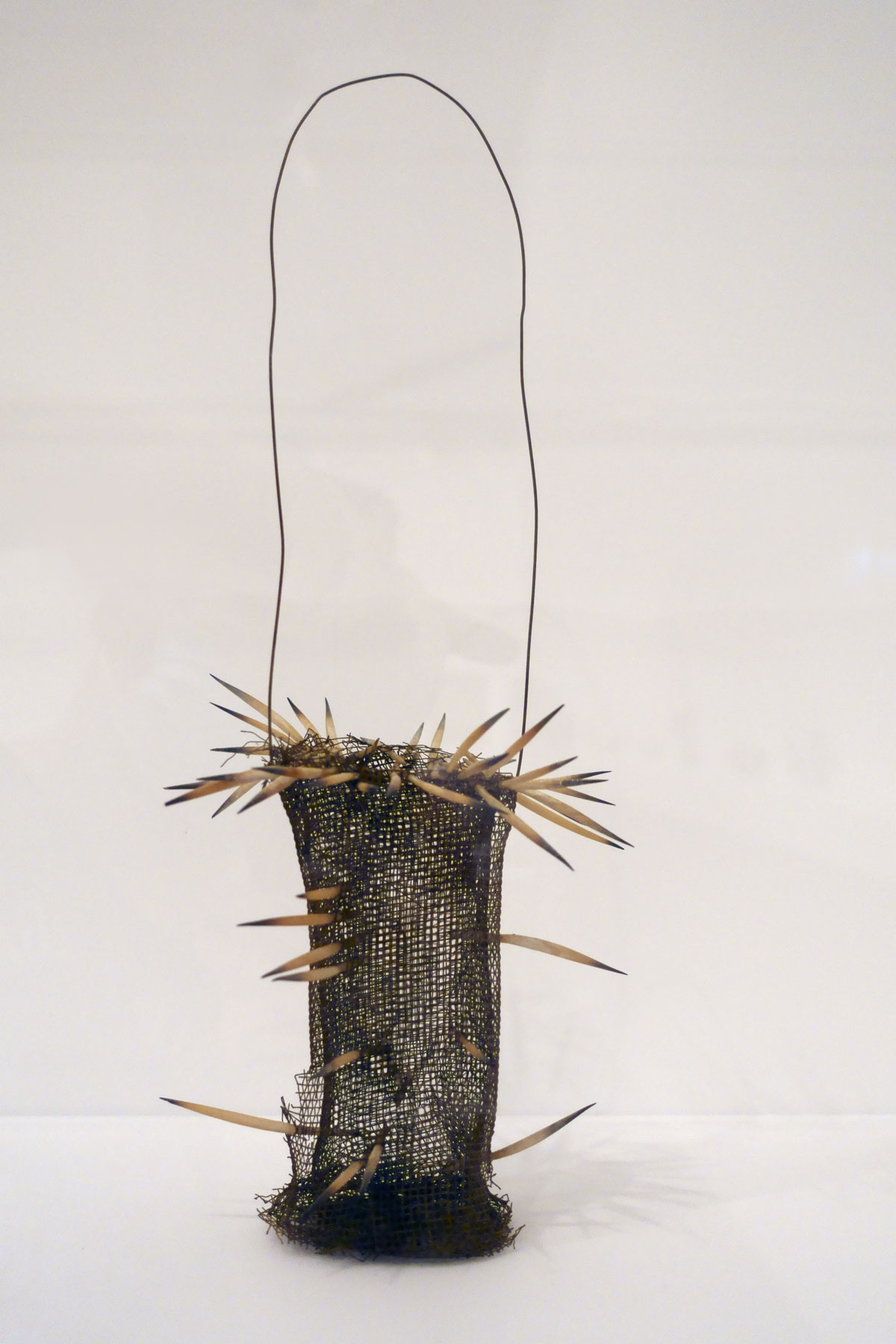
TarraWarra Museum of Art website

LIKE ART BLART ON FACEBOOK

Back to top

Exhibition: ‘Darron Davies: The Travellers’ at the Centre for Theology and Ministry, Melbourne

Exhibition dates: 9th April – 10th May 2016


Darron Davies (Australian) 'Voyager' 2016


Darron Davies (Australian)
Voyager
2016
From the series The Travellers
Pigment print


I opened this exhibition for Darron Davies at the Centre for Theology and Ministry, Melbourne. I can’t remember exactly what I said but it went something like this…
When artists find themselves on a path to new ways of seeing the world, to new forms of enlightenment, then that is a magical and energising place to be. And so it is with this new body of work by Darron Davies. A path of many patterns and possibilities.

I spoke of synaesthesia – the production of a sense impression relating to one sense or part of the body by stimulation of another sense or part of the body. Here, colour and form produce music. As in Messiaen’s music, rather than being a decorative element Davies shows that colour can be a structural, a fundamental element which is the material of the music itself. Little vibrations of energy (in the universe), are caught in time and space and brought forth into consciousness through colour.

I extemporised on the question – is the [origami] model immanent in the paper, or is the paper a blank slate to be written on by the creator? – by asking, are these images already in Davies’ mind before he creates them as a kind of subconscious previsualisation, before he looks through the camera lens, before he relies on the serendipity and happenstance to capture what emerges out of the ether. Does the artist’s consciousness bring forth what he needs to see as an artist so that he can recognise it as such, forms that are already buried in the structure of the cosmos itself.

Perhaps this recognition does allow the artist (and subsequently the viewer) to go on a journey, to travel into other realms of being, of existence, to probe the boundaries of what is possible and what is probable. This work is about just that – being in the world and transcending it, and recognising that we can exist between the phenomenal and the noumenal. As has been said of Joseph Cornell’s boxes, “They partake of both dream and reality, and of something else that doesn’t have a name. They tempt the viewer in two opposite directions. One is to look and admire… and the other is to make up stories about what one sees… Neither (way) by itself is sufficient. It’s the mingling of the two that makes up the third image.”1

The Thirdspace – in which “everything comes together… subjectivity and objectivity, the abstract and the concrete, the real and the imagined, the knowable and the unimaginable, the repetitive and the differential, structure and agency, mind and body, consciousness and the unconscious, the disciplined and the transdisciplinary, everyday life and unending history”2 – allows that none of these couples, such as the phenomenal and the noumenal, can be divided by an either-or attitude. “This… does not mean differences are denied, instead, it most of all means the inevitable reciprocity of any pair of definitions. In such a case both leave a mark on the other. It is a question of both-and – how each of the pair influences the other.”3 In the case of Davies’ work, this reciprocity allows the images to possess a multivalent narrative, which is neither here nor there. It allows the work to be accessible to different interpretations, meanings, and values: a new door or path opens up on the basis of very diverse needs and objectives. For the artist the possibilities are endless.

Dr Marcus Bunyan


Footnotes

1/ Simic, Charles. “First, there are,” in Dime Store Alchemy. New York: The Ecco Press, 1992, p. 60 quoted in Heaney, Seamus. The Redress of Poetry. Faber and Faber, London, 1995, p. 181.

2/ Soja, Edward W. Thirdspace. Malden (Mass.): Blackwell, 1996, p. 57 quoted in “Edward Soja” on the Wikipedia website [Online] Cited 01/05/2016.

3/ Hannula, Mika. “Third space – a merry-go-round of opportunity,” on the Kiasma Magazine website No 12 Vol 4, 2001 [Online] Cited 01/05/2016. No longer available online


Many thankx to Darron Davies for allowing me to publish the photographs in the posting. Please click on the photographs for a larger version of the image.


Darron Davies (Australian) 'Horizon' 2016


Darron Davies (Australian)
Horizon
2016
From the series The Travellers
Pigment print


Darron Davies (Australian) 'Unbridle' 2016


Darron Davies (Australian)
Unbridle
2016
From the series The Travellers
Pigment print


Darron Davies (Australian) 'Emanation' 2016


Darron Davies (Australian)
Emanation
2016
From the series The Travellers
Pigment print


Darron Davies (Australian) 'The Break' 2016


Darron Davies (Australian)
The Break
2016
From the series The Travellers
Pigment print


The Travellers is a series exploring light, in particular its abstractions as it passes through glass. Utilising a framework that supports glass sheets, a light, filters, and all manner of glass ranging from old ash trays to vases, I use a macro lens to focus on patterns created by the interaction of light. The prismatic effects are extraordinary. The narrow depth of field allows patterns to be further discovered within the glass.

Based on the experiments of photographers such as Wynn Bullock – his much under-recognised light abstraction work from 1959 to 1965 utilising similar experimentation – this project uses a digital camera to create fascinating landscapes. These landscapes in their variety of forms, at times volcanic, primordial, celestial, or atomic, are a metaphor for the ancient and current travellers – perhaps the subatomic world – that shape and have shaped our world.

Apart from slightly adjusting the blowing out of light caused by the delicate uneveneness of light within the macro image none of these images are highly photoshopped. What is captured is pretty much true to what is seen through the lens – an extraordinary world at play within light and colour fields. I have a heard the story that the experimental filmmaker Stan Brakhage once changed a film about the interior of a house to a pure focus of patterns that he found in ashtrays lying on a table. Fantastic! See the film The Text of Light. This is an interesting tradition embracing the likes of Brakhage, Bullock , Len Lye and the Cantrills.

At the discussion session after the premiere of his film The Text of Light at the Carnegie Institute, Pittsburgh in 1974, he (Brakhage) paraphrased the later English ‘Light Philosopher’ Robert Grosseteste: “all that sense can comprehend, is Light: because it partakes of that which it is. To comprehend dark, or a shape, it must withdraw from its own nature – it must withdraw or turn against its own electrical illuminating nature in order to comprehend a shape”.

Courtesy Cantrill’s Filmnotes, 21/22, (April 1975) photography. (Arthur was my lecturer at Melb State College in the early 80s and he and Corinne live now in Castlemaine, where I live, so have discussed these ideas on many occasions, as well as assisted them with their screenings).

Extract from the artist’s statement


Darron Davies (Australian) 'Manifest' 2016


Darron Davies (Australian)
Horizon
2016
From the series The Travellers
Pigment print


Darron Davies (Australian) 'Embodiment' 2016


Darron Davies (Australian)
Embodiment
2016
From the series The Travellers
Pigment print


Darron Davies (Australian) 'Guise' 2016


Darron Davies (Australian)
Guise
2016
From the series The Travellers
Pigment print


Darron Davies (Australian) 'Frame' 2016


Darron Davies (Australian)
Frame
2016
From the series The Travellers
Pigment print


Darron Davies (Australian) 'The Self Returning' 2016


Darron Davies (Australian)
The Self Returning
2016
From the series The Travellers
Pigment print


Darron Davies (Australian) 'Advent' 2016


Darron Davies (Australian)
Advent
2016
From the series The Travellers
Pigment print


Darron Davies (Australian) 'The Mainspring' 2016


Darron Davies (Australian)
The Mainspring
2016
From the series The Travellers
Pigment print


Darron Davies (Australian) 'Designer' 2016


Darron Davies (Australian)
Designer
2016
From the series The Travellers
Pigment print


The Centre for Theology and Ministry
29 College Crescent, Parkville,
Melbourne, Victoria
Phone: (03) 9340 8800

Gallery hours:
Monday to Friday 9am – 5pm (not weekends)

The Centre for Theology and Ministry website

The Travellers exhibition website

Darron Davies website

LIKE ART BLART ON FACEBOOK

Back to top