Exhibition: ‘Jan Senbergs: Observation – Imagination’ at The Ian Potter Centre: NGV Australia, Melbourne

Exhibition dates: 18th March – 12th June, 2016

Curator: Elena Taylor
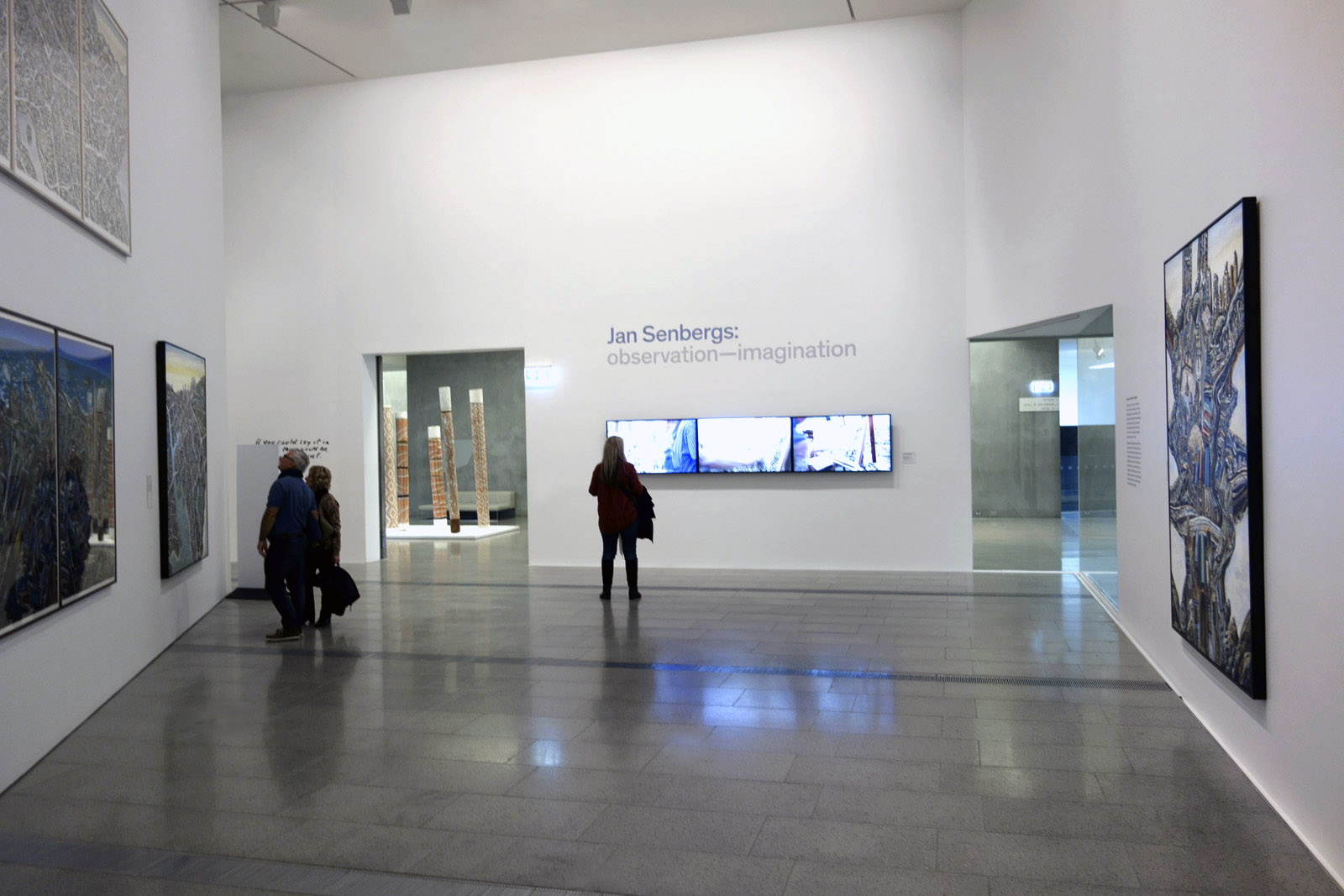
 

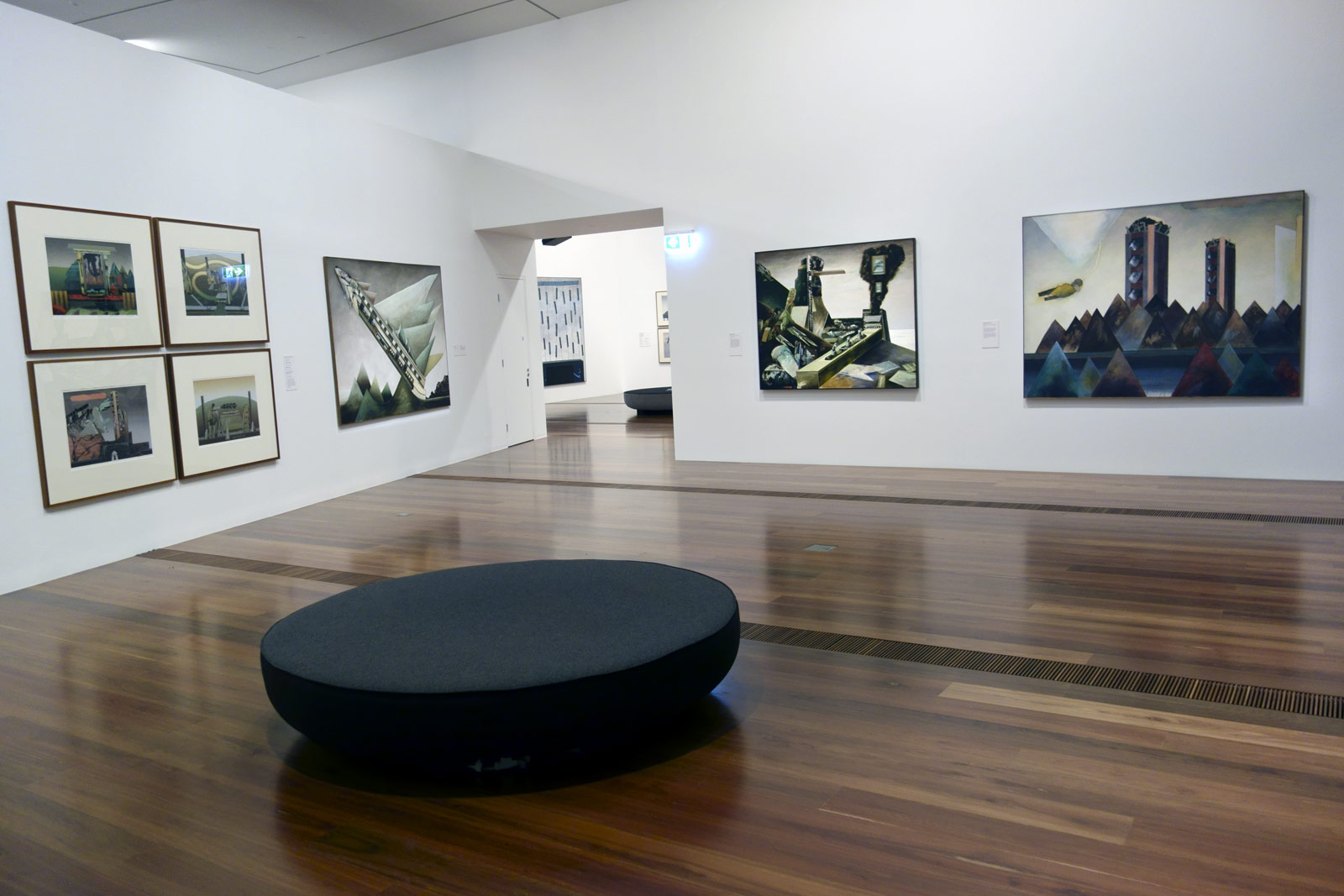
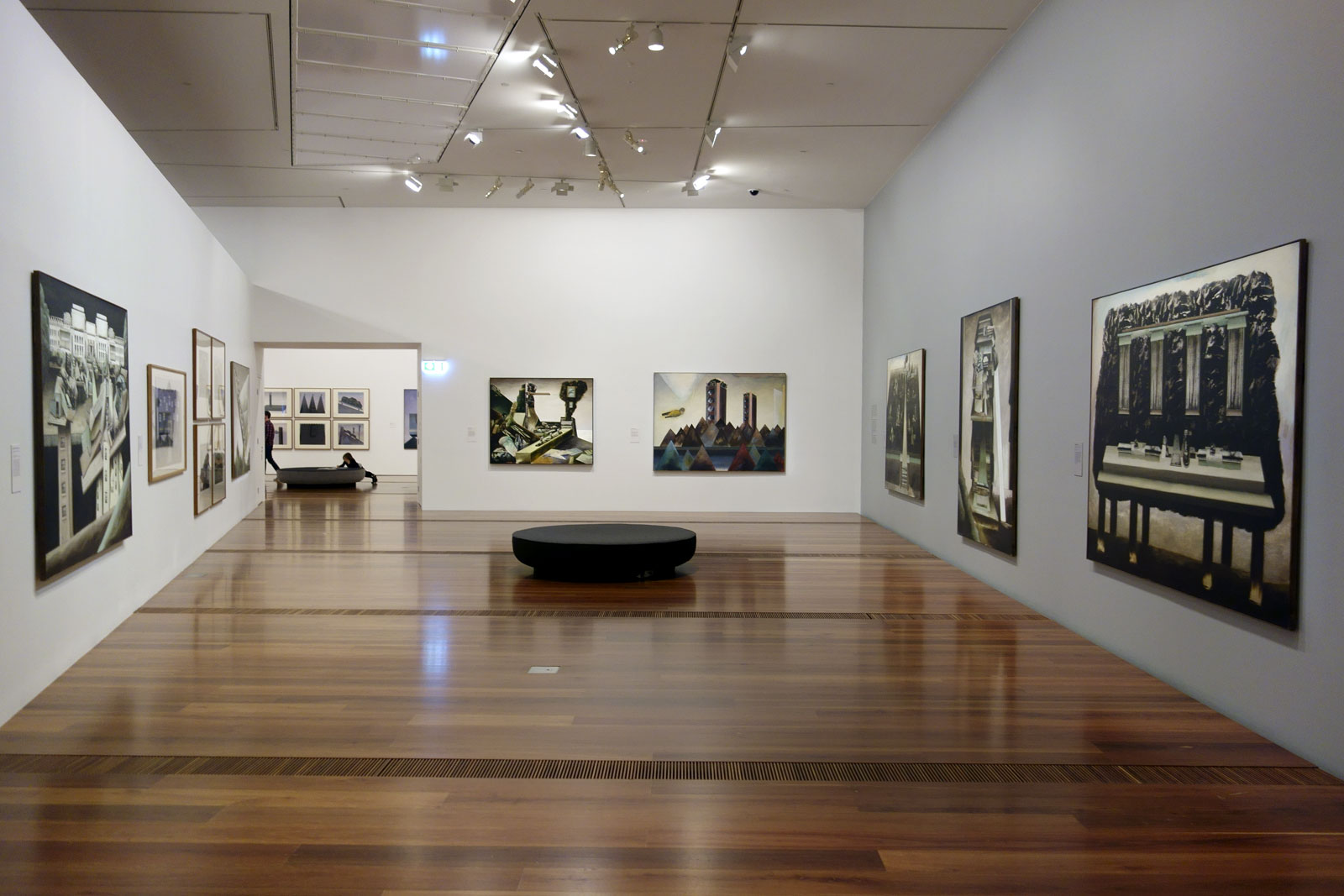
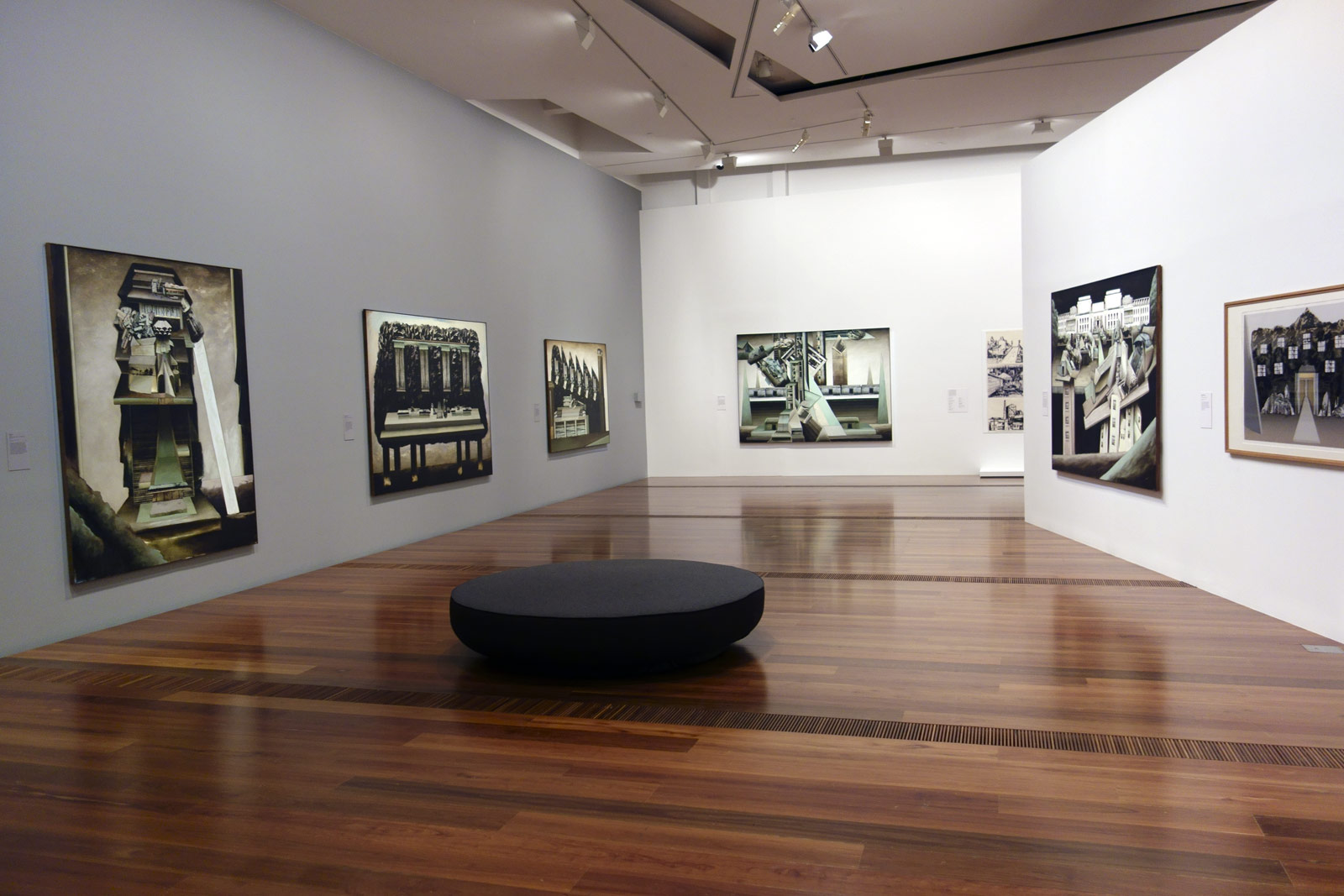
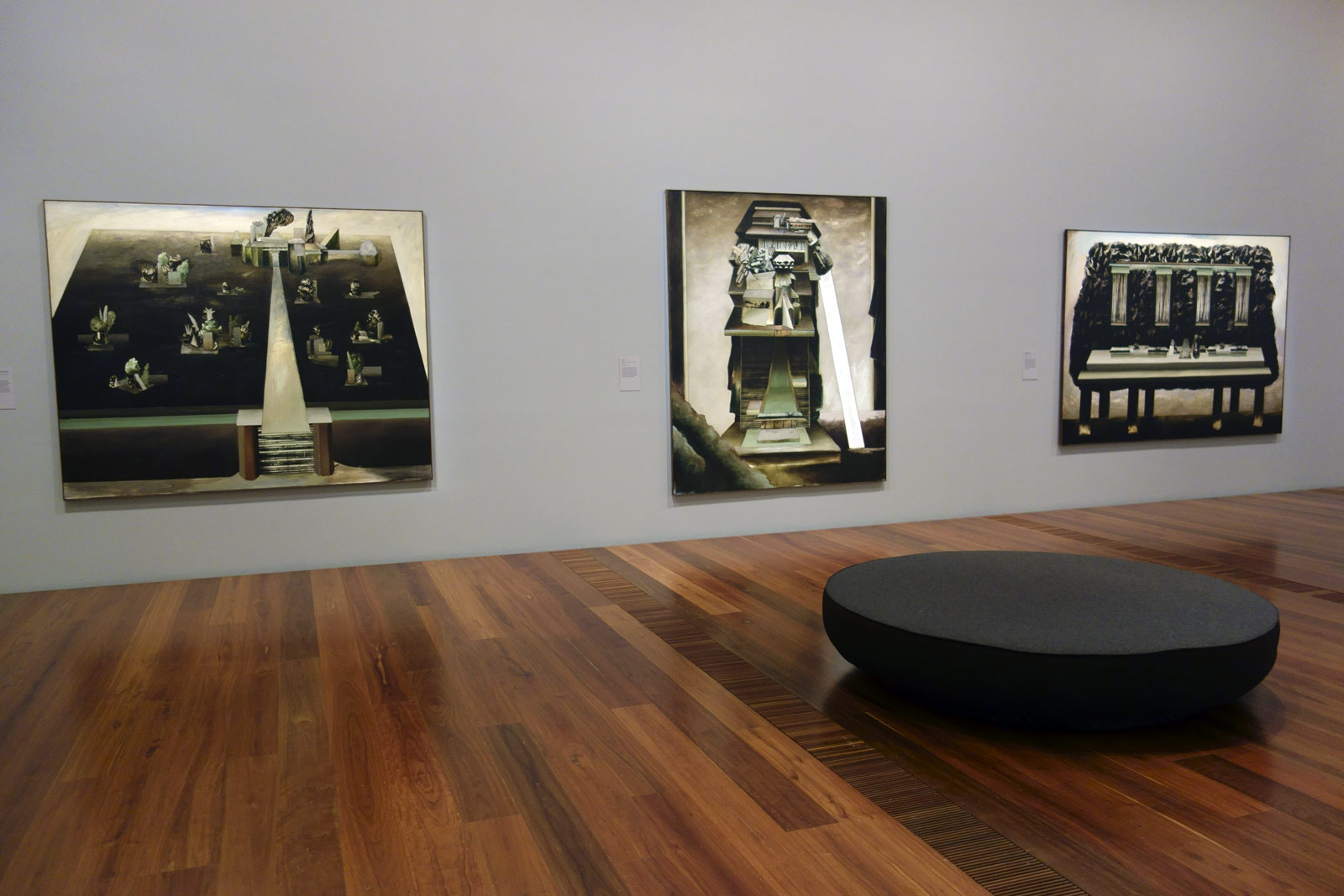
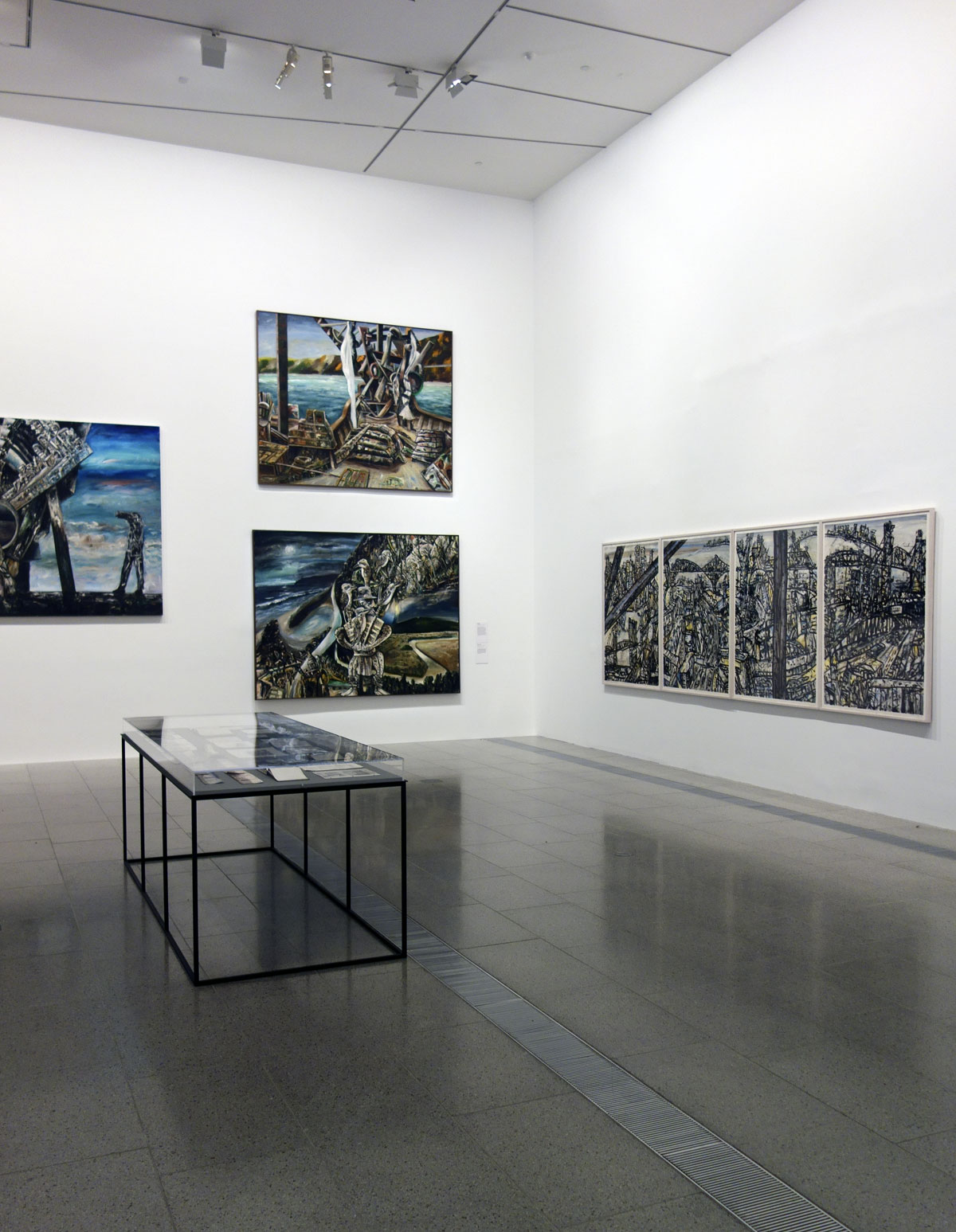
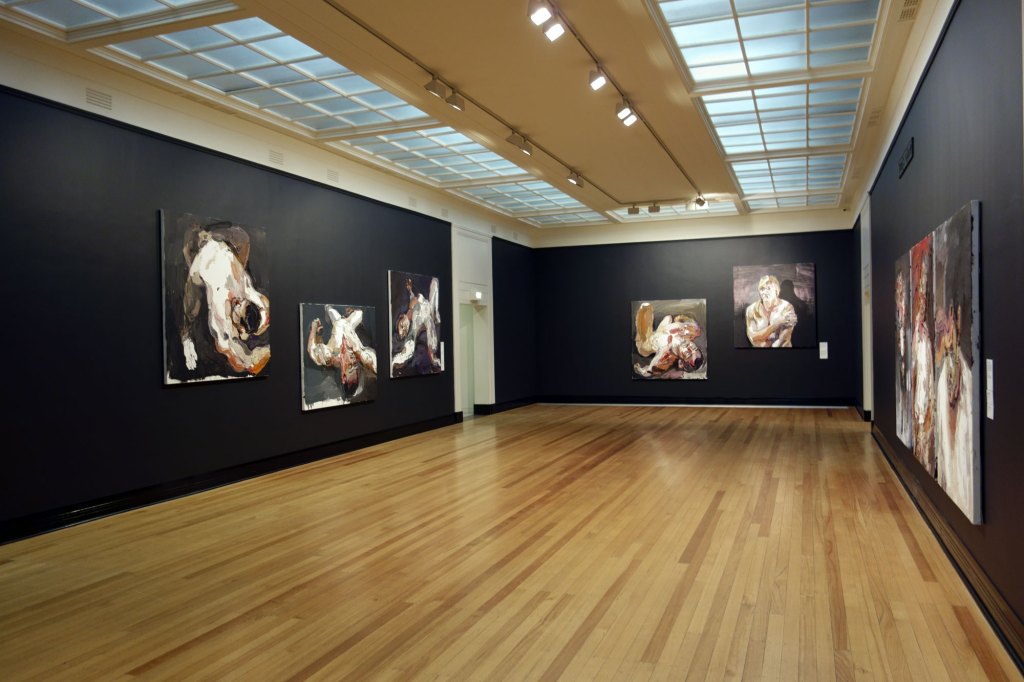
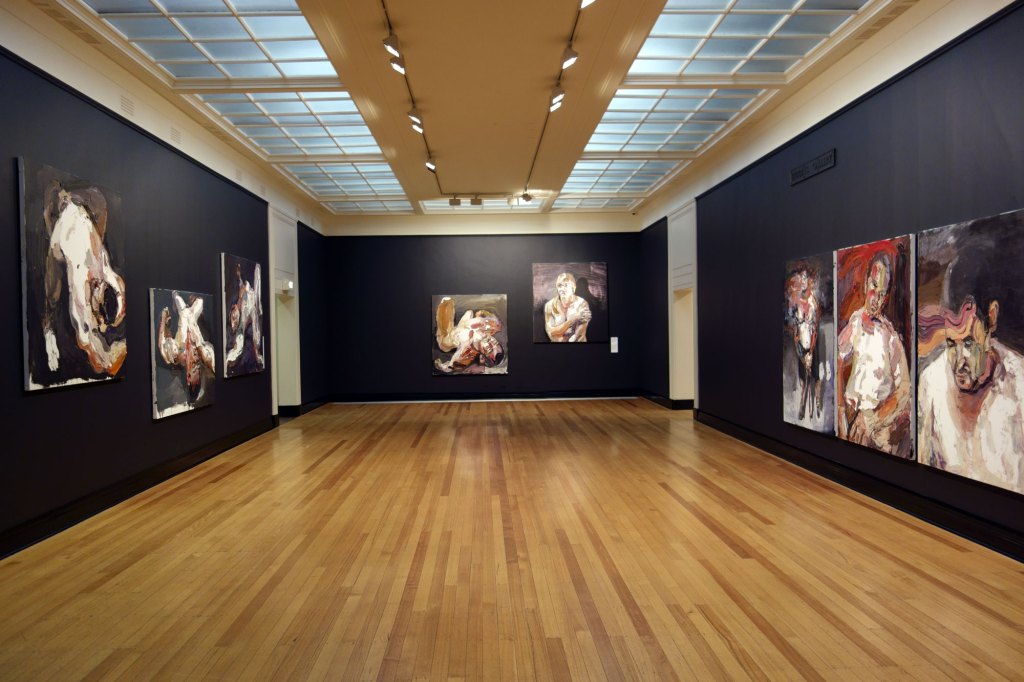
Installation view of the exhibition 'Jan Senbergs: Observation – Imagination' at The Ian Potter Centre: NGV Australia


Installation view of the opening room of the exhibition Jan Senbergs: Observation – Imagination at The Ian Potter Centre: NGV Australia
Photo: Marcus Bunyan


You only have five days left to catch what I consider to be one of the best exhibitions I have seen this year in Melbourne.

If ever there was a man deserving of a large retrospective, it is Jan Senbergs. This wondrous, intelligent, immersive exhibition by this iconic Australian artist is a joy. Particularly so as you witness the gestation of the artist, the journey from very first exhibition to latest work.

Witness is a particularly apt metaphor for Senbergs – he is a witness to the world who uses his imagination to create, as he says, “maybe something architectonic or machine-like, but not quite: and ambiguous … I was trying to create something irrational, something out of the imagination but belonging to the world.” He belongs to the world but creates things not of the world as we know it. It is a twisted world n/visioned in multiple forms. Twisted labyrinthine structures – mechanistic, naturalistic, humanistic – swirling around in his head, put down as marks on paper, synthetic polymer paint on canvas.

Mark making is important to this man. He maps mechanistic and biomorphic elements, always intelligently informed by sources as diverse as “literature, history, architecture and non-Western art, and finds imagery within obscure technical journals, ancient mythology and illustrated encyclopaedias.” His influences are various – German Expressionism, Max Beckmann, Neo-Expressionist painting of the early 1980s, Brutalism, Eduardo Paolozzi, Pop Art and the writing of American postmodernist author Donald Bartheme – to name but a few. And his perspective is unique, as John Olsen insightfully observes, “not often on the vanishing point, but … more related to the spatial  orientation in Chinese or Islamic art. This kind of perspective gives weight to an object; the sensation is abrupt and very blunt, ideally related to his vision.”

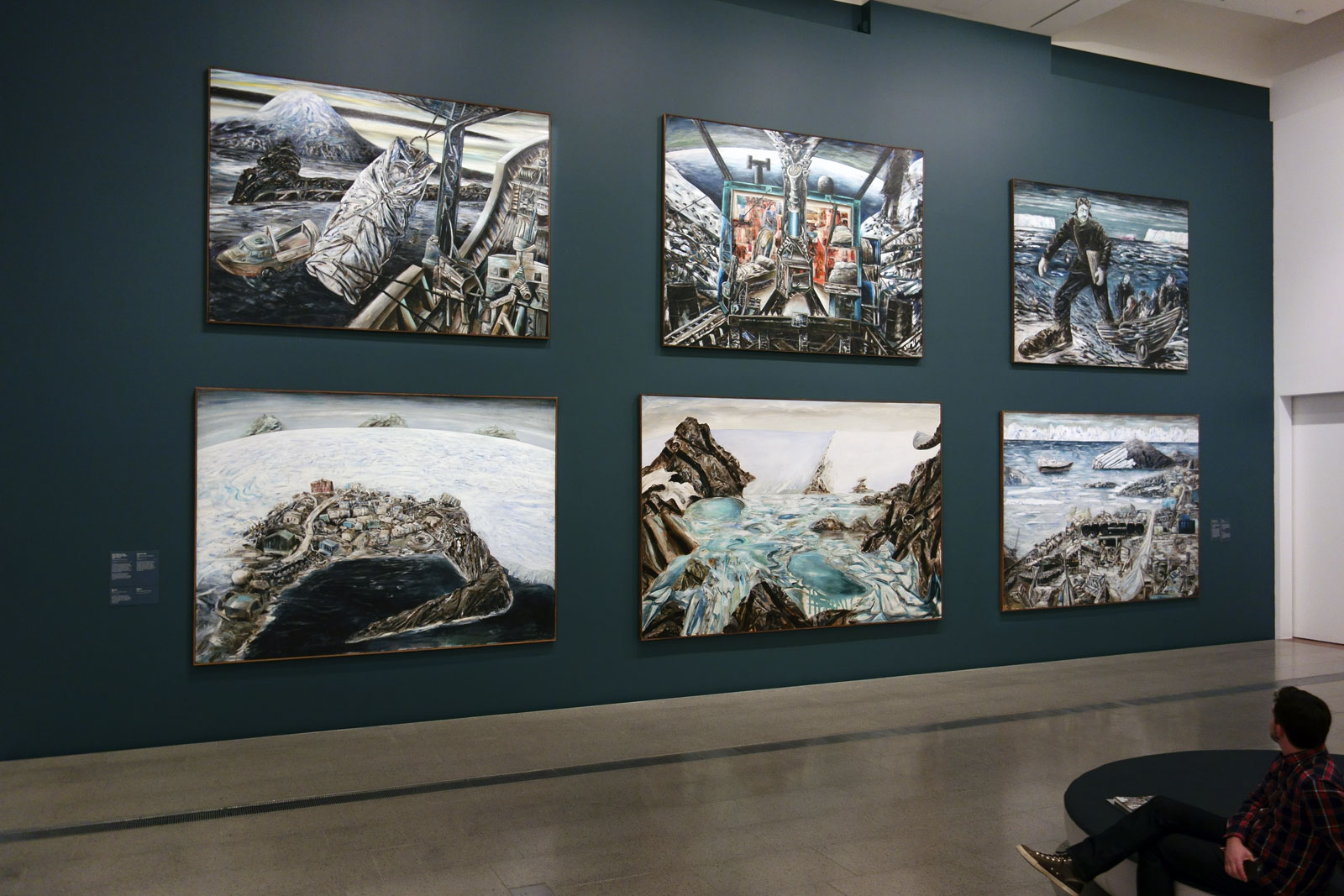
Standing in front of the huge six painting wall of Senbergs’ Antarctic paintings you feel the power of that (topographical? analytical? cut-away) vision. I dare you not to.

There are downsides. When they do appear in his paintings, his literal figures and landscapes (such as people, boats and bays), are weak. But that’s not what this artist is about. His screen print work of the mid to late 1970s lead him into a formally stylistic dead end. But he was an intelligent enough artist to recognise it as such and returned to mark making: “But it was a period when I was getting too confident. It was time to leave it alone, go back to the mark.” And his popularist map paintings of Sydney and Melbourne, painted in a brighter colour palette, don’t have the depth of feeling and response to the world that other works possess.

His limited colour palette – all blacks and subdued colours in the early enamel work; green and browns in the 1970s work; greys, blacks and beiges in the early 1980s; blues and greens with splashes of colour for the Antarctic and mining paintings; through to the more colourful map paintings of the 1990s and the recent oranges of the bushfire paintings – has always given weight to the object, weight to his constructed upside-down world, weight to his vision of a place where anything might happen. And frequently does.

Irrational, perhaps (but the irrational can only exist if there is the rational).
Something out of the imagination but belonging to the world, indubitably.
A world that is neither dysfunctional in vision nor balance.

Dr Marcus Bunyan


Many thankx to the National Gallery of Victoria for allowing me to publish the artworks in the posting. All installation photographs as noted © Marcus Bunyan and the National Gallery of Victoria. Please click on the photographs for a larger version of the image.


“I was always interested in painting buildings and things and I tried to make them half human, trying to put figures into them, in the end they blended together as one, the figures, the buildings and the people.”


Jan Senbergs, 1965


“I was always trying to invent new forms, different forms, shapes which were recognisable – maybe something architectonic or machine-like, but not quite: and ambiguous … I was trying to create something irrational, something out of the imagination but belonging to the world.”


Jan Senbergs, 2008
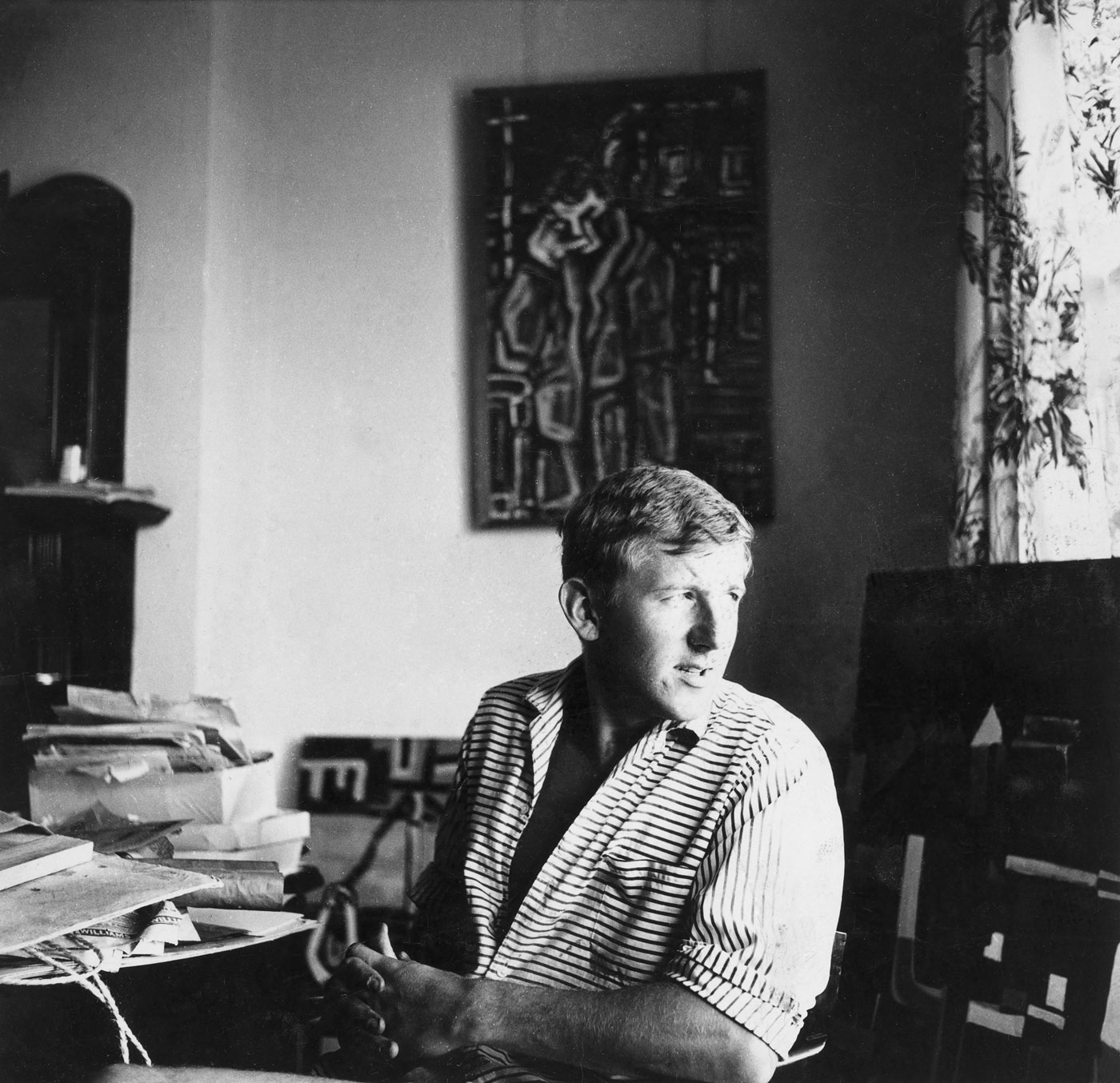


Alan Kilner. 'Jan Senbergs, Melbourne' c. 1959


Alan Kilner
Jan Senbergs, Melbourne
c. 1959
Image courtesy Jan Senbergs


This is the first comprehensive retrospective of renowned Melbourne artist Jan Senbergs. Throughout his long career, Senbergs’ work has been characterised by a fundamental humanist vision, a finely-honed sense of the absurd, and a rigorous studio practice spanning printmaking, drawing and painting. He is considered to be amongst Australia’s leading painters and his large-scale expressive drawings are highly regarded. More recently Senbergs has created labyrinthine views of cities, employing aerial perspectives to present a bird’s eye view of humankind’s endeavours. The exhibition includes paintings, drawings and prints from his first exhibition in 1960 until the present day, borrowed from public and private collections around Australia.

Jan Senbergs is one of Australia’s most distinctive artists. He is both an acute observer and a creator of fantastical imagery. Since his first exhibition in 1960, Senbergs’s work has undergone many transformations of style, technique and subject, yet there have also been recurring themes and motifs. Elements from his very first works have reappeared, reworked and reinterpreted, throughout his career.

Senbergs’s artistic imagination has been fed by many sources, including his love of literature and poetry; his interest in no-Western artistic traditions and the work of outsider artists; journeys to distant locales as well as familiar places close to home. The artist has often referred to himself as a ‘visual scavenger’ of images – photographs, scientific diagrams, maps – which he transforms and incorporates into his own work. Above all, Senbergs’s art reflects his essential humanism, humour and wide-ranging curiosity.

Text from the NGV website
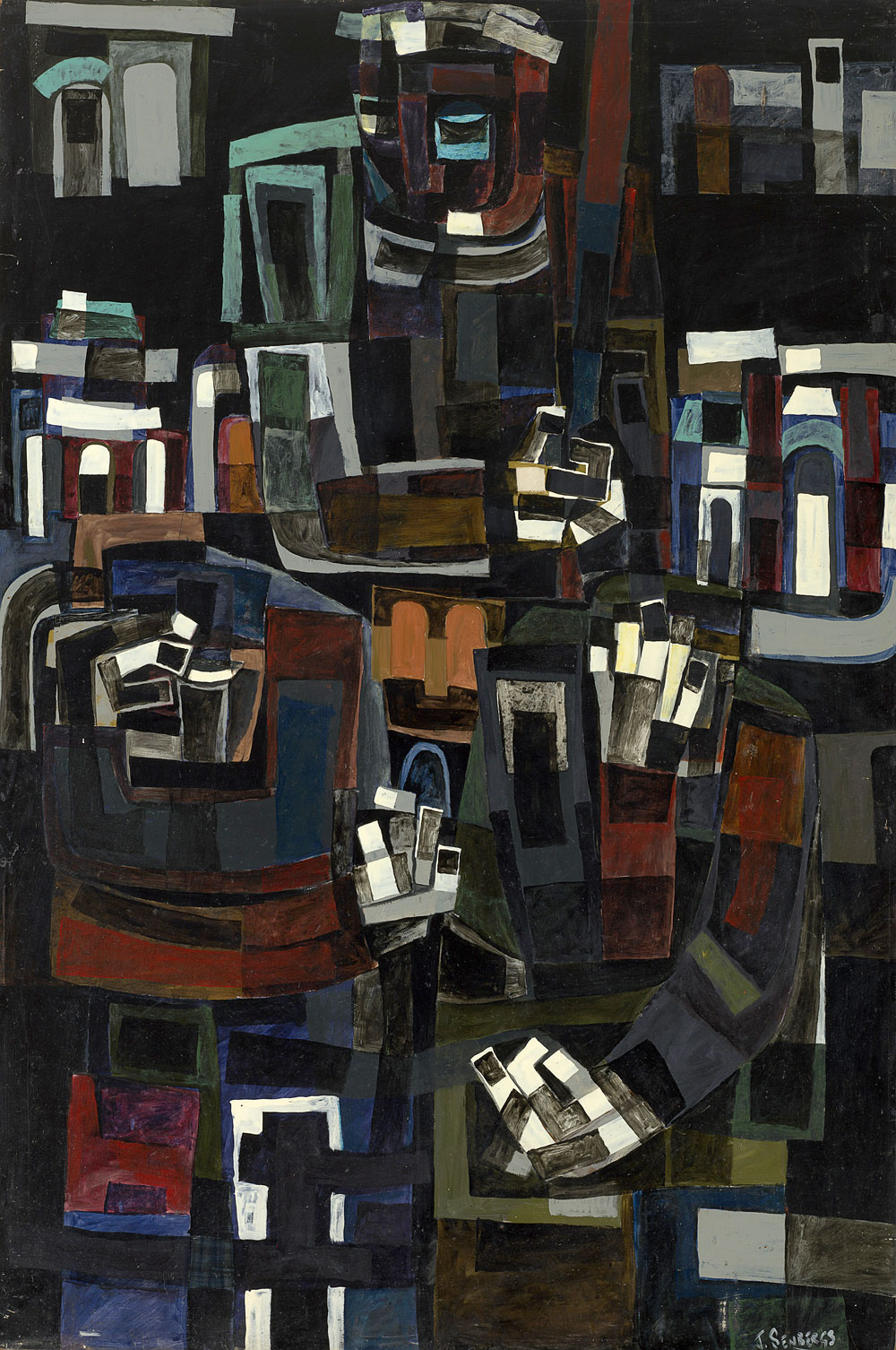
 

Jan Senbergs (born Latvia 1939, arrived Australia 1950, died Melbourne 2024) 'The whipper' 1961 from the exhibition Exhibition: 'Jan Senbergs: Observation – Imagination' at The Ian Potter Centre: NGV Australia, Melbourne, March - June, 2016


Jan Senbergs (born Latvia 1939, arrived Australia 1950, died Melbourne 2024)
The whipper
1961
Enamel paint on composition board
183.0 x 122.0cm
Courtesy of the artist and Niagara Galleries, Melbourne
© Jan Senbergs


Literature has always been an important source of imagery for Senbergs. This work, one of his earliest, is based upon an episode in The Trial (1925) by Czech writer Franz Kafka. In the painting two figures cower beneath ‘the whipper’, who metes out a brutal punishment to them. This work was included in Senbergs’s second solo exhibition at the Argus Gallery, Melbourne, in 1962.
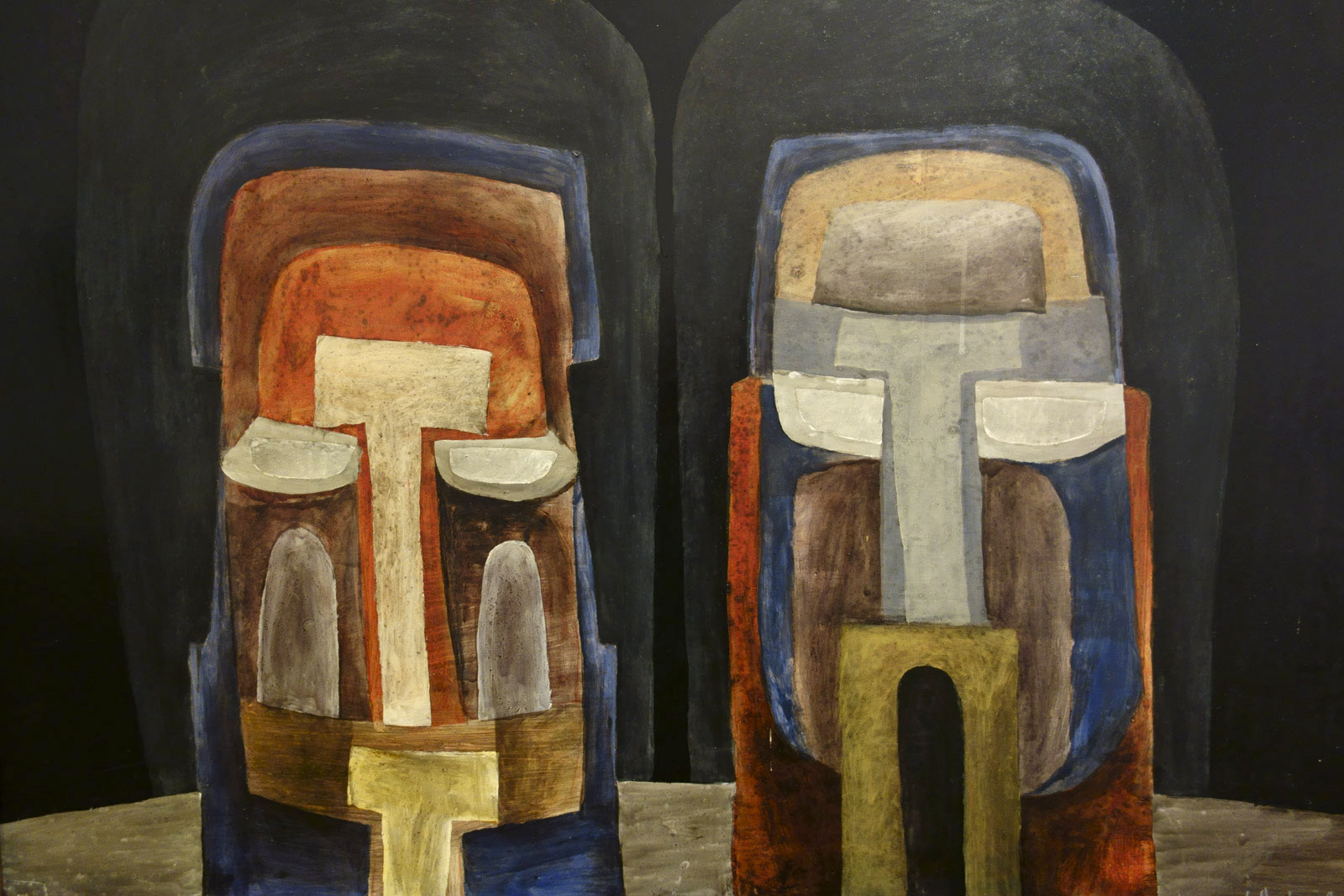
 

Jan Senbergs (born Latvia 1939, arrived Australia 1950, died Melbourne 2024) 'Two heads' 1961


Jan Senbergs (born Latvia 1939, arrived Australia 1950, died Melbourne 2024)
Two heads
1961
Enamel paint on composition board
Private collection, Melbourne


“I was always interested in painting buildings and things and I tried to make them half-human, trying to put the figures into them; in the end they blended together as one, the figures and the buildings and the people.”

~ Jan Senbergs, 1965


Jan Senbergs (born Latvia 1939, arrived Australia 1950, died Melbourne 2024) 'Head' 1963


Jan Senbergs (born Latvia 1939, arrived Australia 1950, died Melbourne 2024)
Head
1963
Colour screen print on paper, artist’s proof, edition of 10
42.4 x 35.2cm (image and sheet)
Courtesy of the artist and Niagara Galleries, Melbourne
© Jan Senbergs
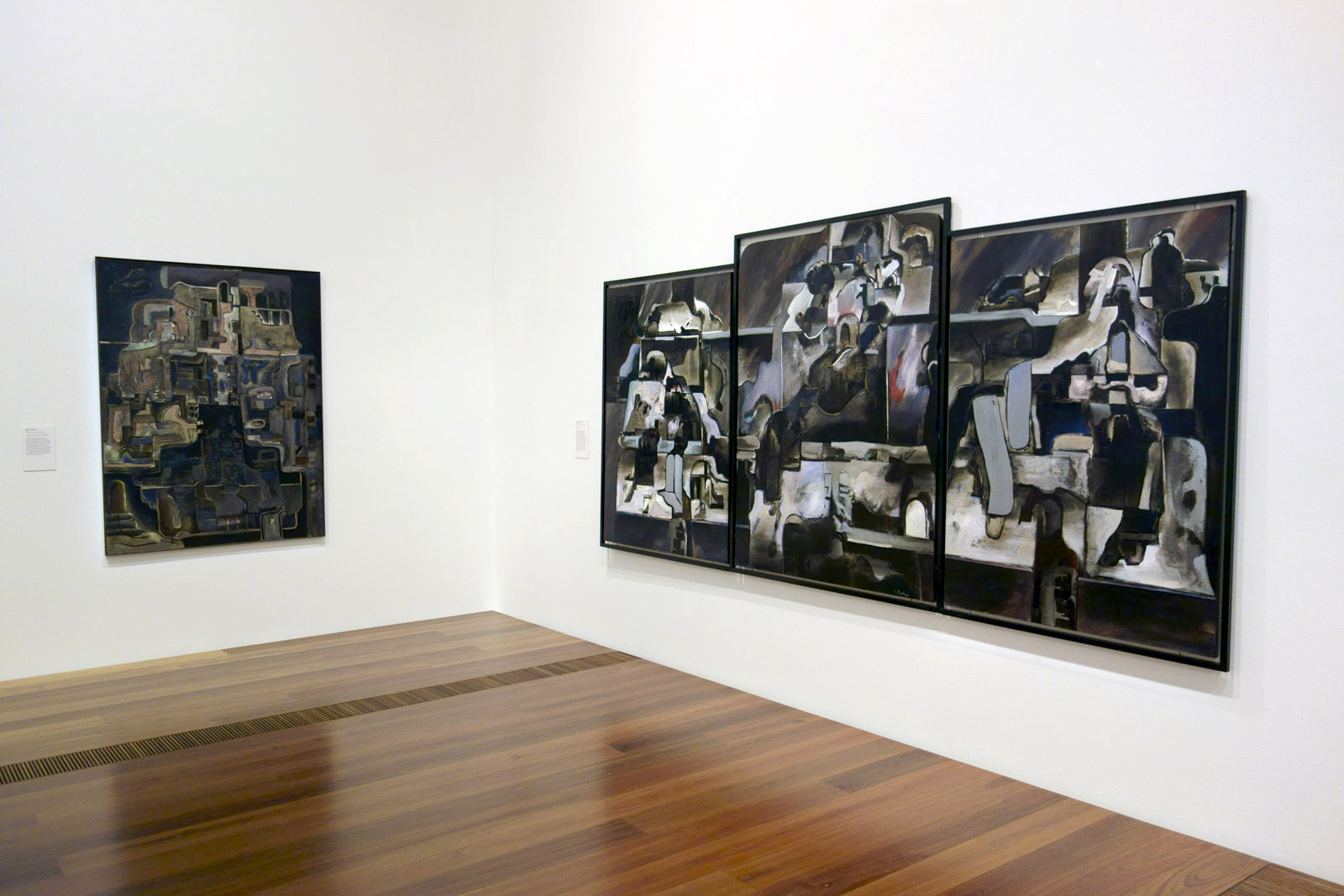
 

Jan Senbergs (born Latvia 1939, arrived Australia 1950, died Melbourne 2024) 'The night parade' 1966 (installation view)

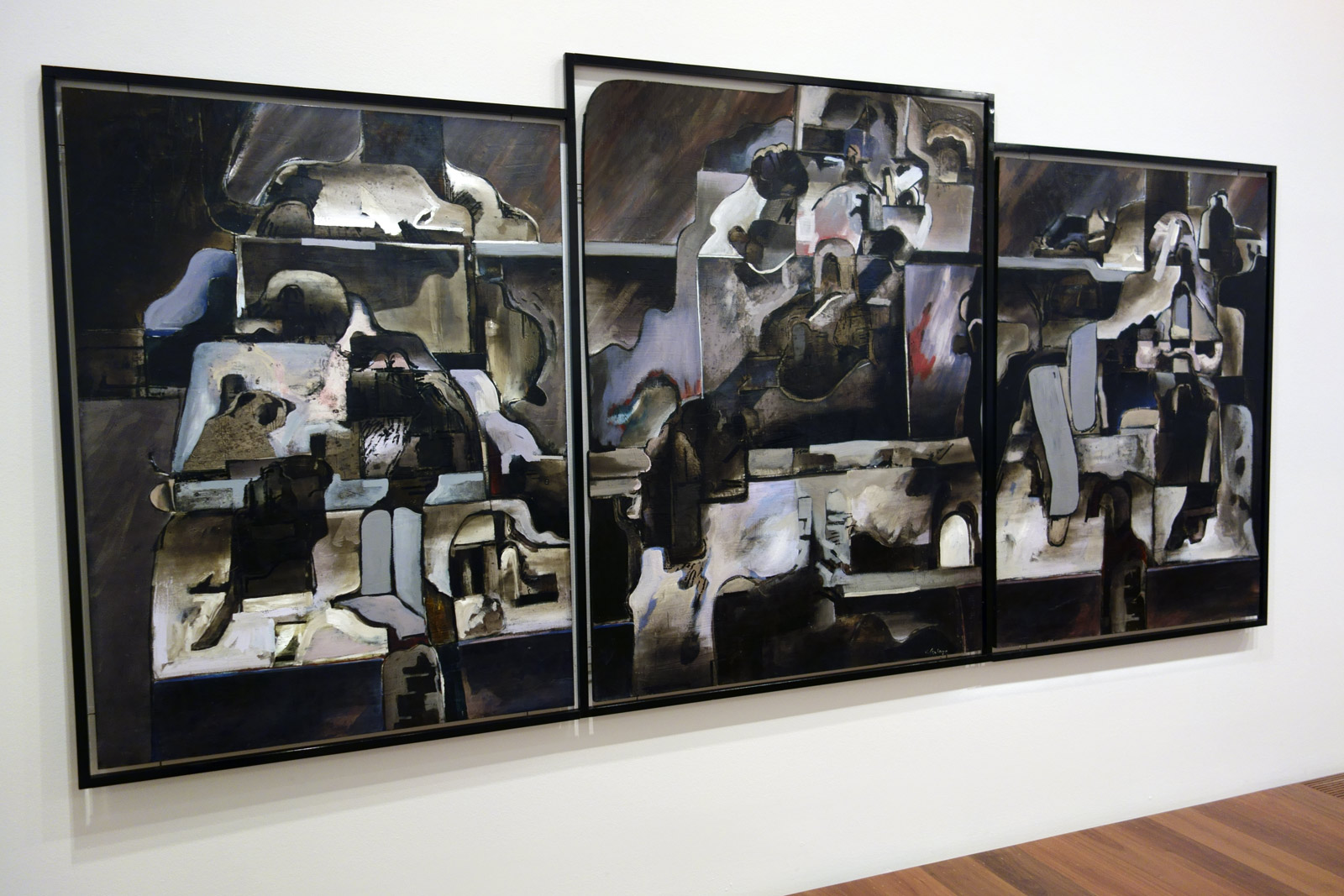
Jan Senbergs (born Latvia 1939, arrived Australia 1950, died Melbourne 2024) 'The night parade' 1966 (installation view)


Jan Senbergs (born Latvia 1939, arrived Australia 1950, died Melbourne 2024)
The night parade (installation views)
1966
Enamel paint on composition board
Mornington Peninsula Regional Gallery
Gift of the artist, 1977
Photos: Marcus Bunyan


At the time of its creation, this was Senbergs’s largest and most ambitious painting to date, and it formed the centrepiece of his 1966 exhibition at Georges Gallery in Melbourne. The triptych format recalls the work of German Expressionist painter Max Beckmann, one of Senbergs’s earliest and ongoing artistic heroes. In his review of the exhibition, critic Allan McCulloch wrote: “Instead of simply looking at abstract pictures we have the feeling of standing on the perimeter of a vast industrial landscape in which hills and slag heaps, factories and cities are relentlessly pushed and jostled by an omni-present parade of silent watchers. The huge triptych “The night parade’ … illustrates the point.”


Jan Senbergs (born Latvia 1939, arrived Australia 1950, died Melbourne 2024) 'Observation post 2' 1968


Jan Senbergs (born Latvia 1939, arrived Australia 1950, died Melbourne 2024)
Observation post 2
1968
Synthetic polymer paint, oil screenprint on canvas
246.0 x 185.0cm
National Gallery of Australia, Canberra
Purchased 1971
© Jan Senbergs


On his return to Melbourne in late 1967, Senbergs’ work changed dramatically. He ceased painting with enamel on Masonite composition boards, and instead started working with oil or acrylic on canvas and began to incorporate screen printed elements into his paintings. Of his year in Europe he later recalled, “I got a lot out of it, it completely made me revise and rethink a whole lot of things regarding my painting, my work, my attitudes and so on … I felt very refreshed and confident when I came back.”

By the mid 1960s Senbergs’ imagery was becoming increasingly sculptural, merging mechanistic and biomorphic elements, in part stimulated by his interest in the work of Scottish Pop artist Eduardo Paolozzi. Senbergs entered what he refers to as his ‘axle-grease’ period, when his colours became darker and more sombre, which he considered would enhance form in his work.
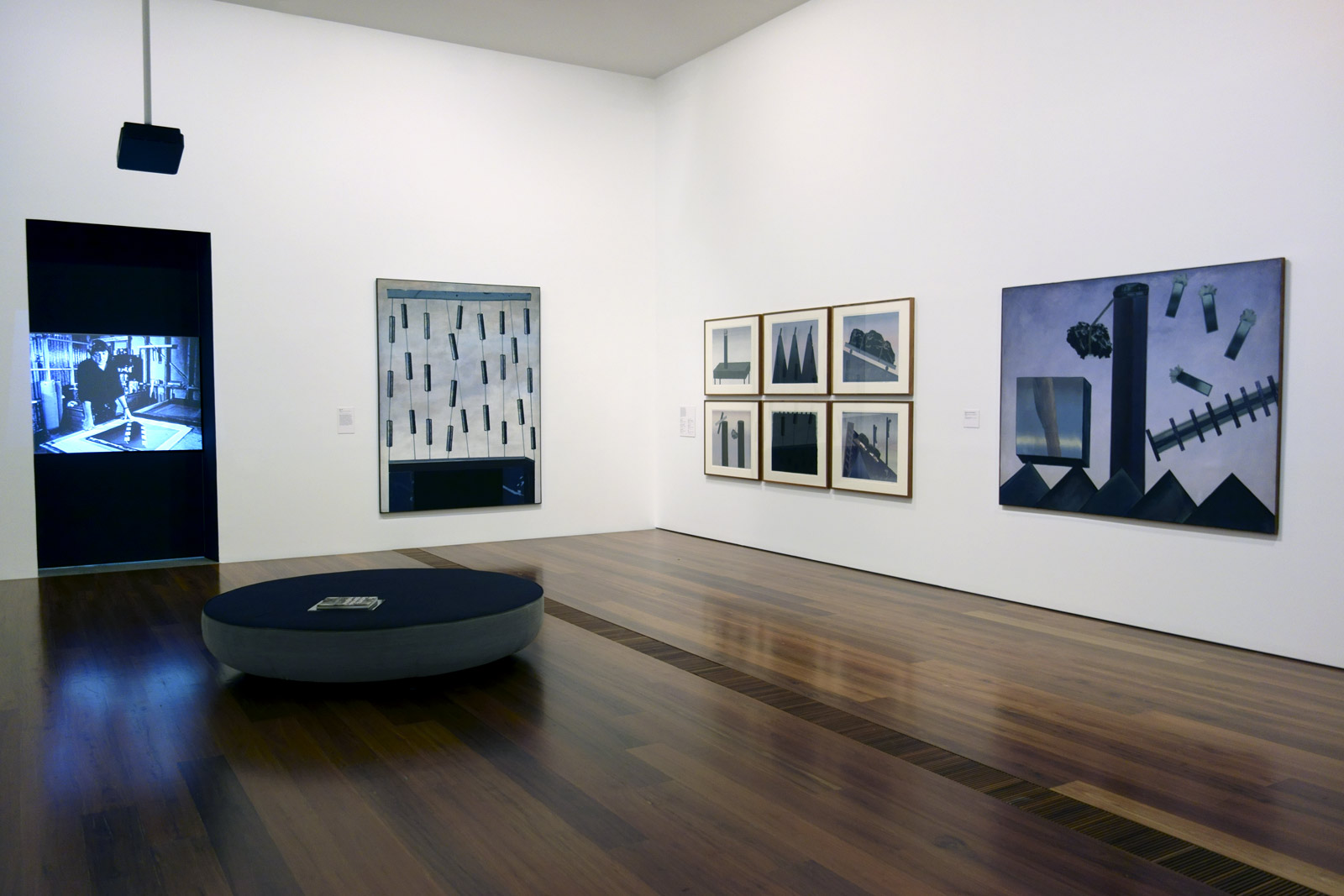
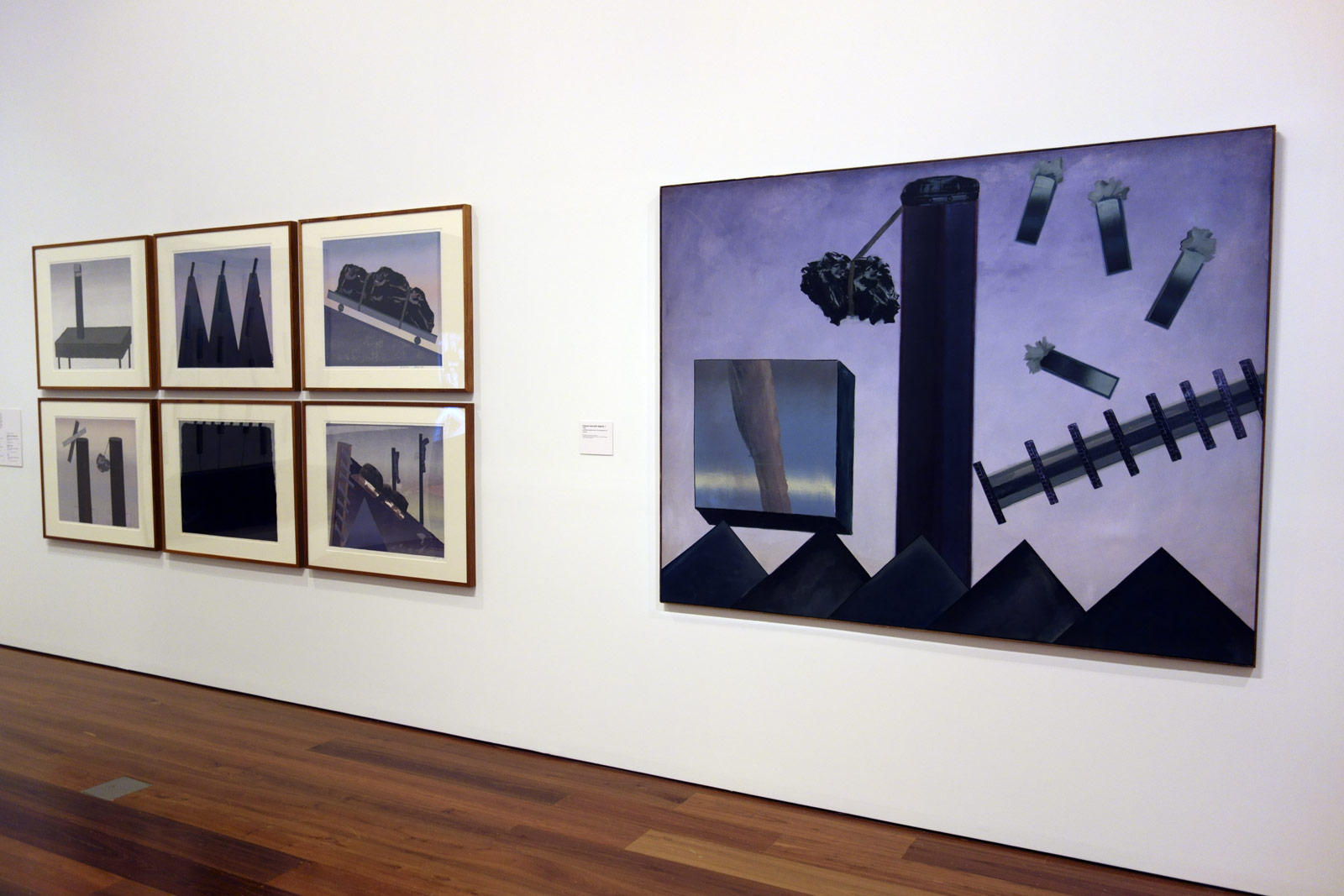
 

Installation view of the exhibition 'Jan Senbergs: Observation - Imagination' at The Ian Potter Centre: NGV Australia showing at right, 'Column and still objects 1' (1968)

Installation view of the exhibition 'Jan Senbergs: Observation - Imagination' at The Ian Potter Centre: NGV Australia showing at right, 'Column and still objects 1' (1968)


Installation views of the exhibition Jan Senbergs: Observation – Imagination at The Ian Potter Centre: NGV Australia showing at right, Column and still objects 1 (1968)
Photos: Marcus Bunyan
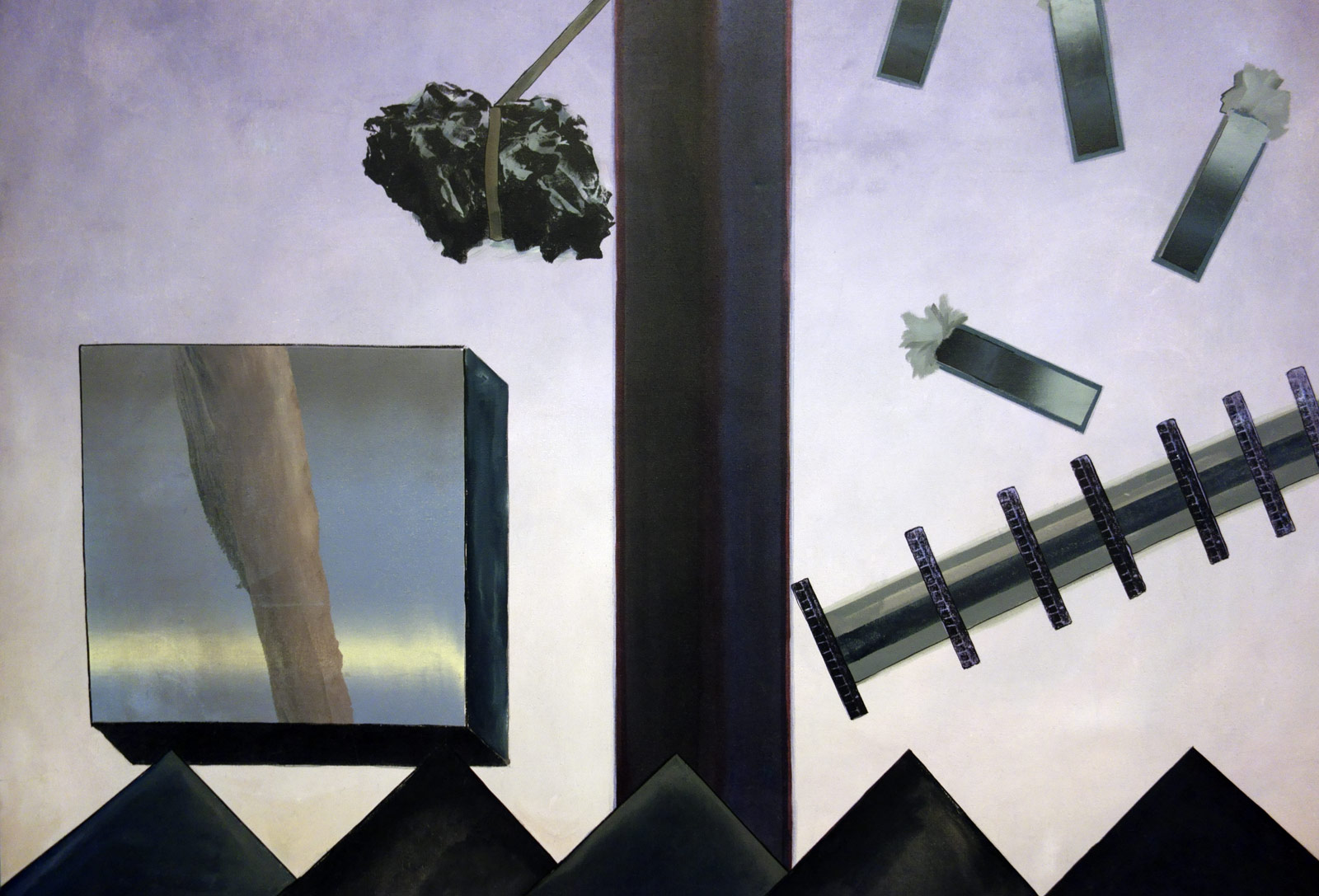
 

Jan Senbergs (born Latvia 1939, arrived Australia 1950, died Melbourne 2024) 'Column and still objects 1' 1968 (detail)


Jan Senbergs (born Latvia 1939, arrived Australia 1950, died Melbourne 2024)
Column and still objects 1 (detail)
1968
The Edith Cowan University Art Collection
Donated through the Australian Government’s Cultural Gifts Program by Mr Timothy James Bernadt
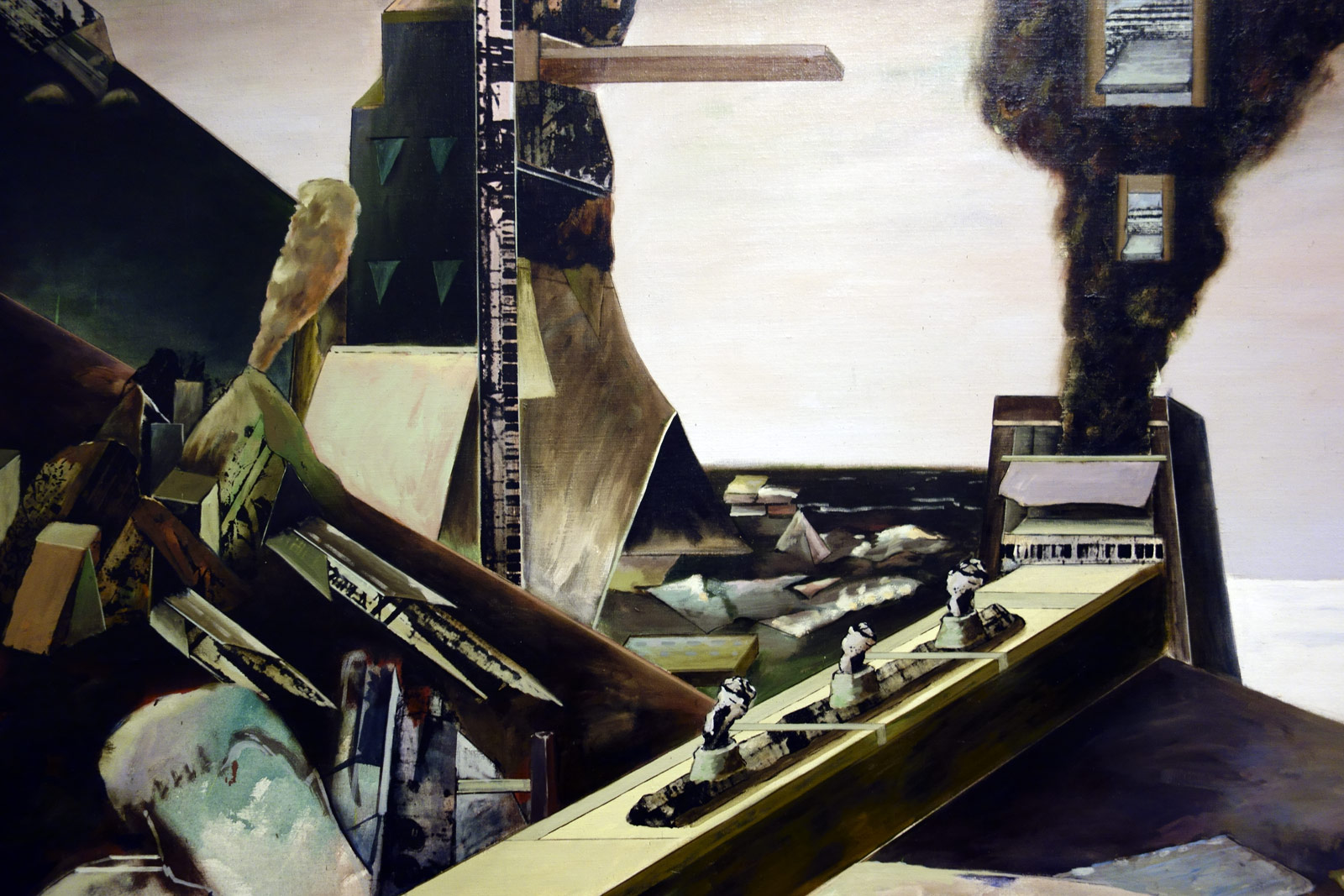
 

Jan Senbergs (born Latvia 1939, arrived Australia 1950, died Melbourne 2024) 'Black garden' 1972 (detail)


Jan Senbergs (born Latvia 1939, arrived Australia 1950, died Melbourne 2024)
Black garden (detail)
1972
Synthetic polymer paint, oil screenprint on canvas plywood
National Gallery of Australia, Canberra
Purchased 1973


In 1972 Senbergs exhibition sixteen new paintings at Melbourne’s Gallery A, including Black garden, in which he created ambiguous cityscapes from surrealistic combinations of screen printed fragments of images. With their absurdist sensibility and disjointed fragmentary images, these paintings emulate the writing of American postmodernist author Donald Bartheme, whose short stories Senbergs admired greatly and whom he credits with being a major influence upon him.
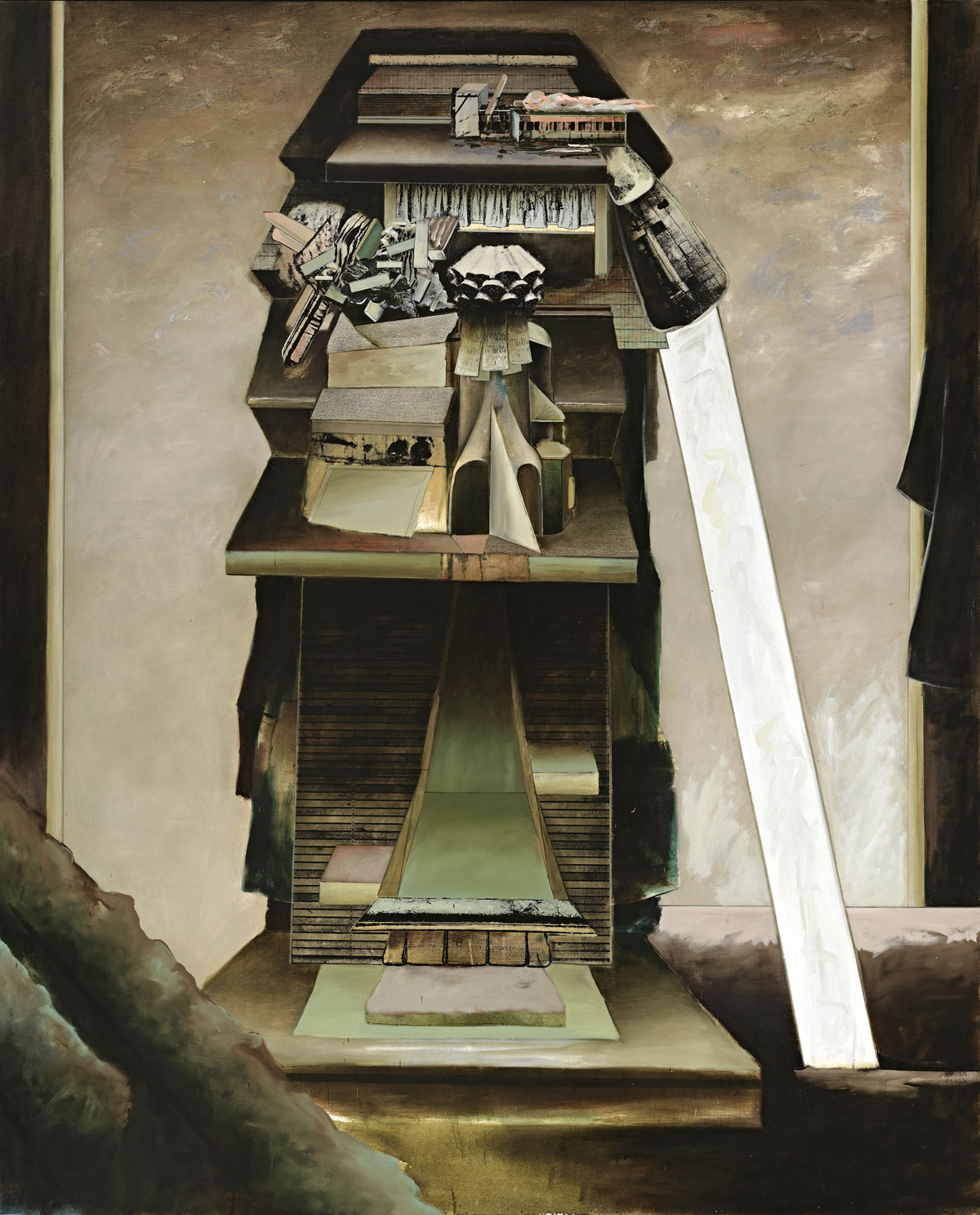
 

Jan Senbergs (born Latvia 1939, arrived Australia 1950, died Melbourne 2024) 'Fort 2' 1973


Jan Senbergs (born Latvia 1939, arrived Australia 1950, died Melbourne 2024)
Fort 2
1973
Synthetic polymer paint, oil screen print on canvas
243.7 x 197.8cm
National Gallery of Australia, Canberra
Purchased 1974
© Jan Senbergs


The paintings Senbergs created in 1973 in response to his selection to represent Australia at the 12th São Paolo Biennial in Brazil were larger and more imposing than his 1972 paintings, and often incorporated an image of a ramp to suggest entry into the forms. With their realistic modelling of architectural forms set against a horizon line, these works evoke the real world, yet remain defiantly resistant to interpretation.
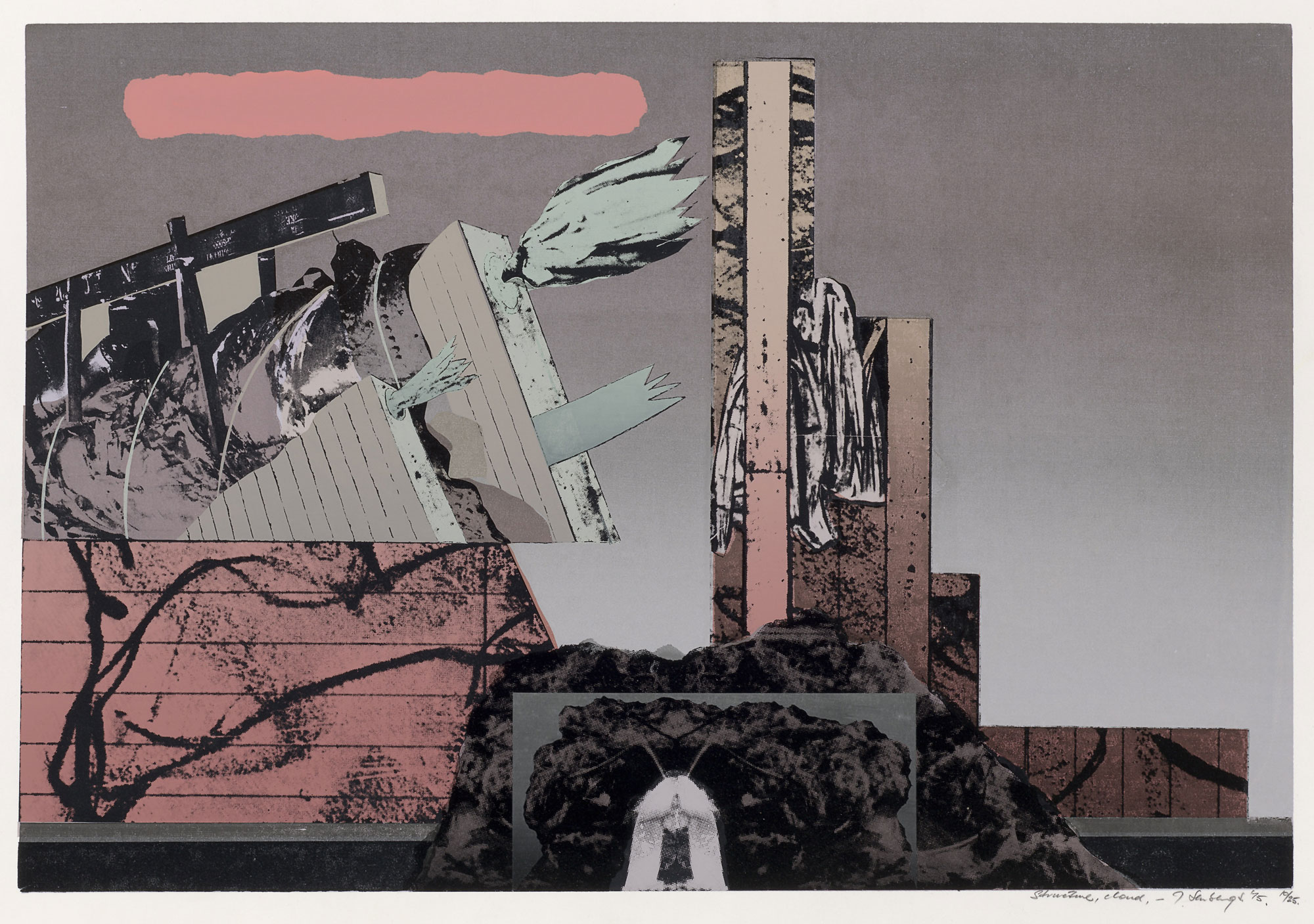
 

Jan Senbergs (born Latvia 1939, arrived Australia 1950, died Melbourne 2024) 'Structure, cloud' 1975


Jan Senbergs (born Latvia 1939, arrived Australia 1950, died Melbourne 2024)
Structure, cloud
1975
Colour screen print, ed. 19/25
55.6 x 81.2cm (image), 71.0 x 100.2cm (sheet)
Courtesy of the artist and Niagara Galleries, Melbourne
© Jan Senbergs


“The printing technique was very important to me because I was a kind of scavenger of odd sorts of images. I mean a lot of those sort of shapes and forms were things that one saw perhaps in an old engraving book, a little detail of a section of some background somewhere and I’d look into it and see certain sorts of forms there … I was a collector, a scavenger. I used to go to libraries and collect these images and I’d buy a lot of books.”

~ Jan Senbergs


“When I was doing these prints and as I was coming to a conclusion to them, I also realised I was handling it in a more sophisticated way. The prints were becoming more refined, more in control … But it was a period when I was getting too confident. It was time to leave it alone, go back to the mark.”

~ Jan Senbergs 2008
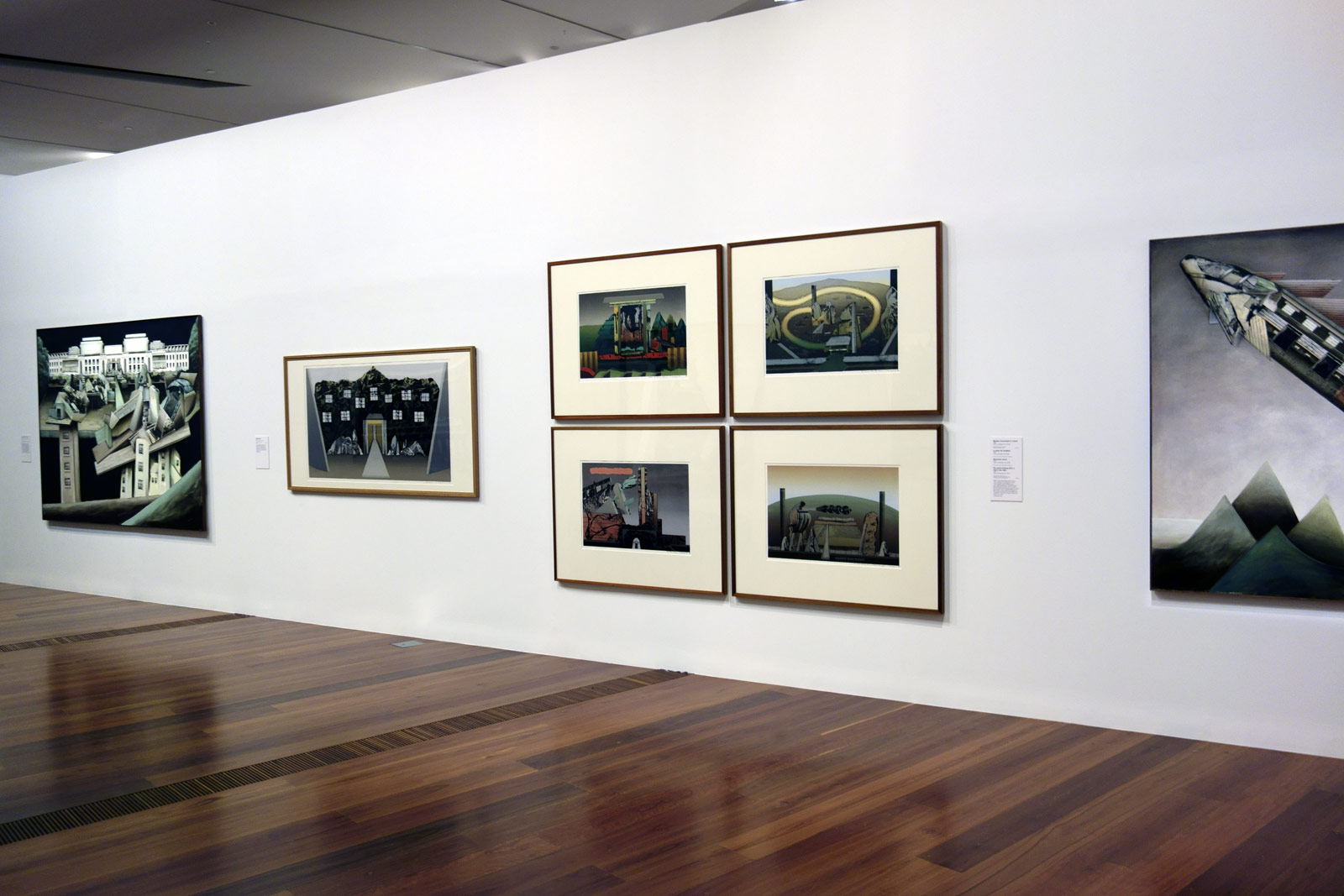
 

Installation view of the exhibition 'Jan Senbergs: Observation – Imagination' at The Ian Potter Centre: NGV Australia

Installation view of the exhibition 'Jan Senbergs: Observation – Imagination' at The Ian Potter Centre: NGV Australia

Installation view of the exhibition 'Jan Senbergs: Observation - Imagination' at The Ian Potter Centre: NGV Australia

Installation view of the exhibition 'Jan Senbergs: Observation - Imagination' at The Ian Potter Centre: NGV Australia

Installation view of the exhibition 'Jan Senbergs: Observation - Imagination' at The Ian Potter Centre: NGV Australia


Installation views of the exhibition Jan Senbergs: Observation – Imagination at The Ian Potter Centre: NGV Australia
Photos: Marcus Bunyan
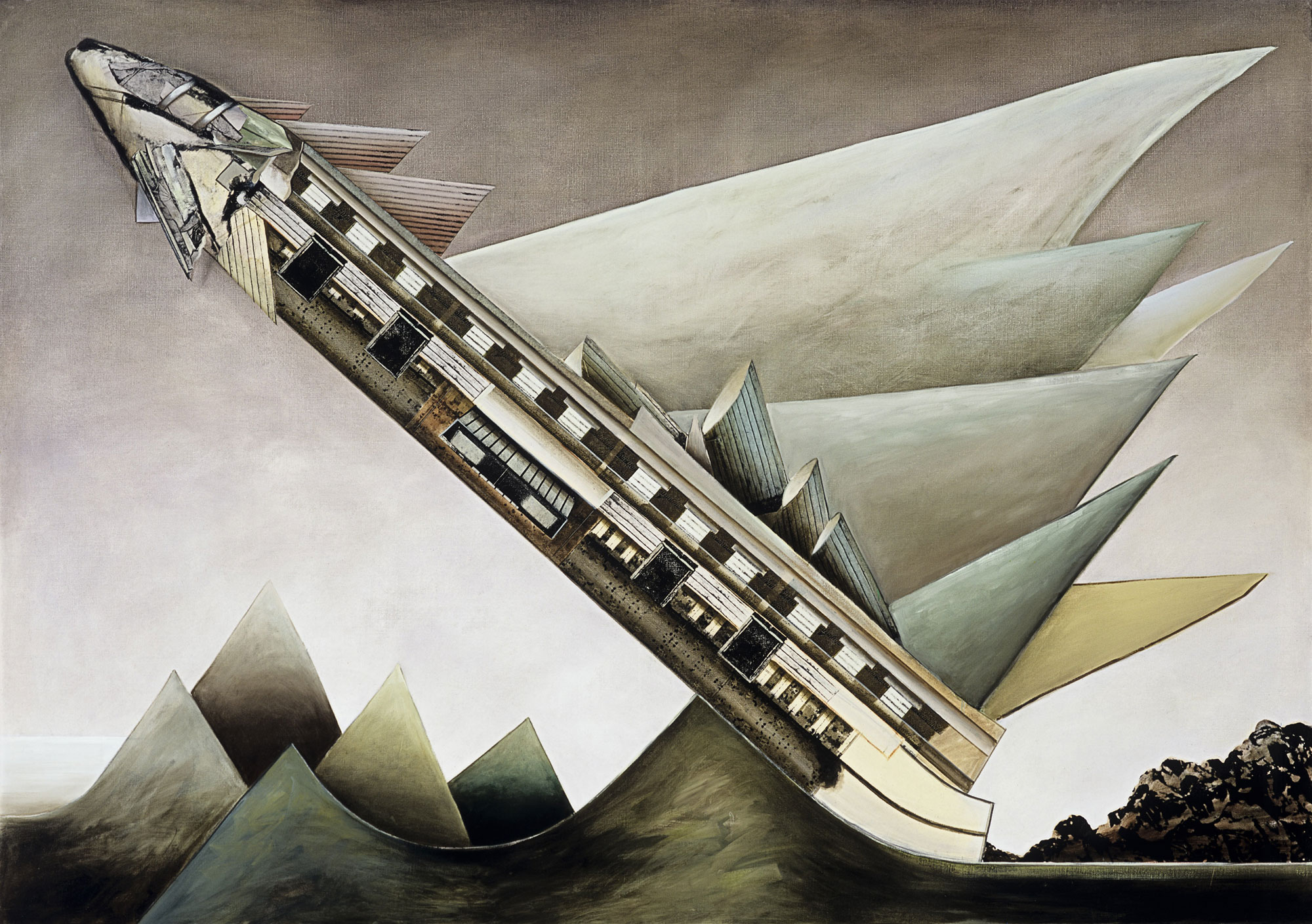
 

Installation view of the exhibition 'Jan Senbergs: Observation – Imagination' at The Ian Potter Centre: NGV Australia 'The flyer' 1975


Jan Senbergs (born Latvia 1939, arrived Australia 1950, died Melbourne 2024)
The flyer
1975
Synthetic polymer paint, oil silkscreen on canvas
167.0 x 244.0cm
Collection of Paul Guest, Melbourne
© Jan Senbergs
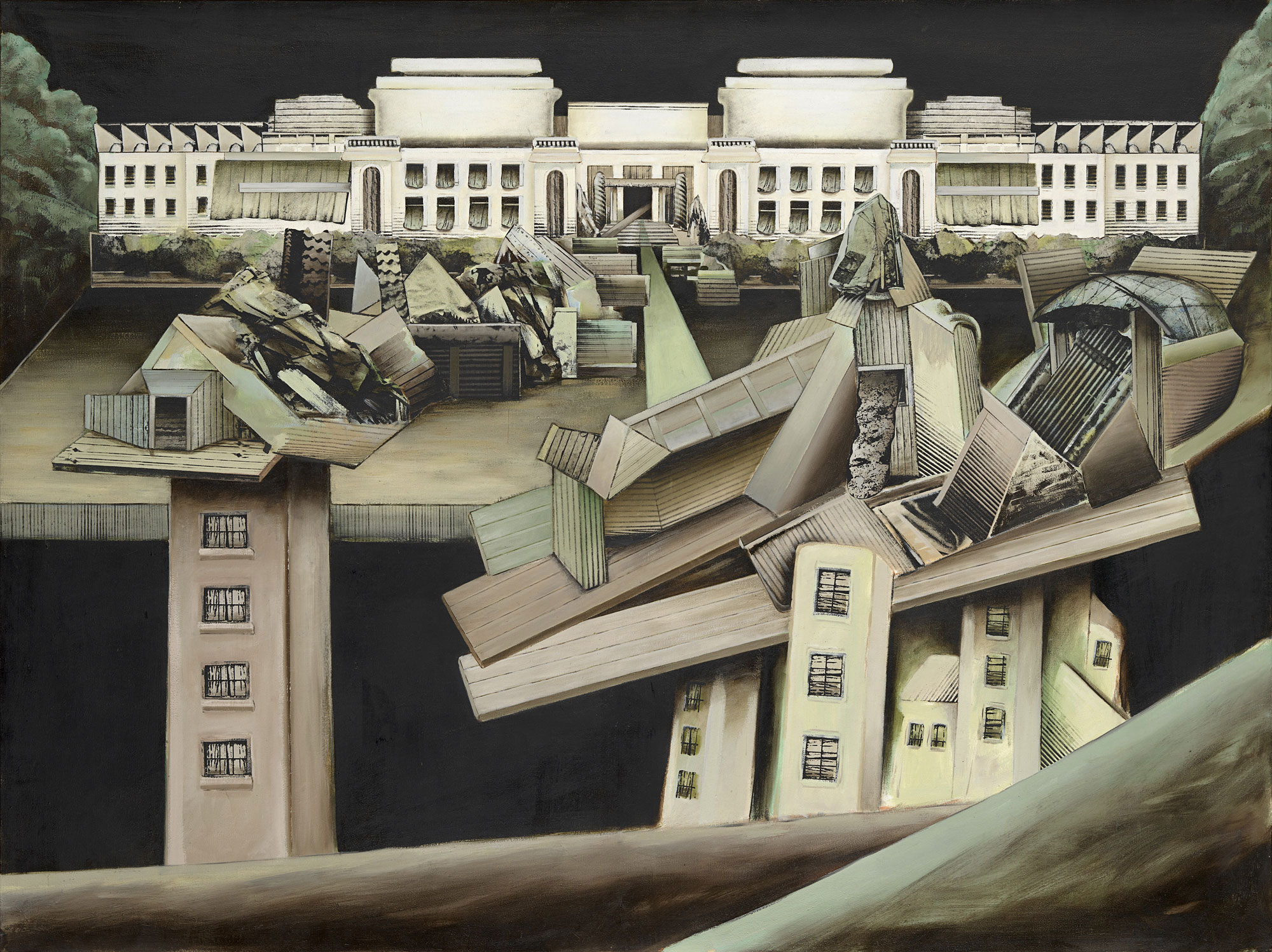
 

Jan Senbergs (born Latvia 1939, arrived Australia 1950, died Melbourne 2024) 'Altered Parliament House 1' 1976 from the exhibition Exhibition: 'Jan Senbergs: Observation – Imagination' at The Ian Potter Centre: NGV Australia, Melbourne, March - June, 2016


Jan Senbergs (born Latvia 1939, arrived Australia 1950, died Melbourne 2024)
Altered Parliament House 1
1976
Synthetic polymer paint, oil silkscreen on canvas
182.5 x 243.5cm
National Gallery of Victoria, Melbourne
Presented by Mrs Adrian Gibson as the winner of the 1976 Sir William Angliss Memorial Art Prize, 1977
© Jan Senbergs


While living in Canberra, on his walk home Senbergs would see Parliament House: “I’d see this white glowing dreadnought in the distance … that’s the way it appeared, sort of floating, just this whiteness because it was lit up … This form fascinated me. But also, and on another level, I was there in ’75 when all the political things happened and [after that] it didn’t have that sort of purity and whiteness that it appeared to have beforehand. In a way that gave me more liberty to change the imagery of the building.”
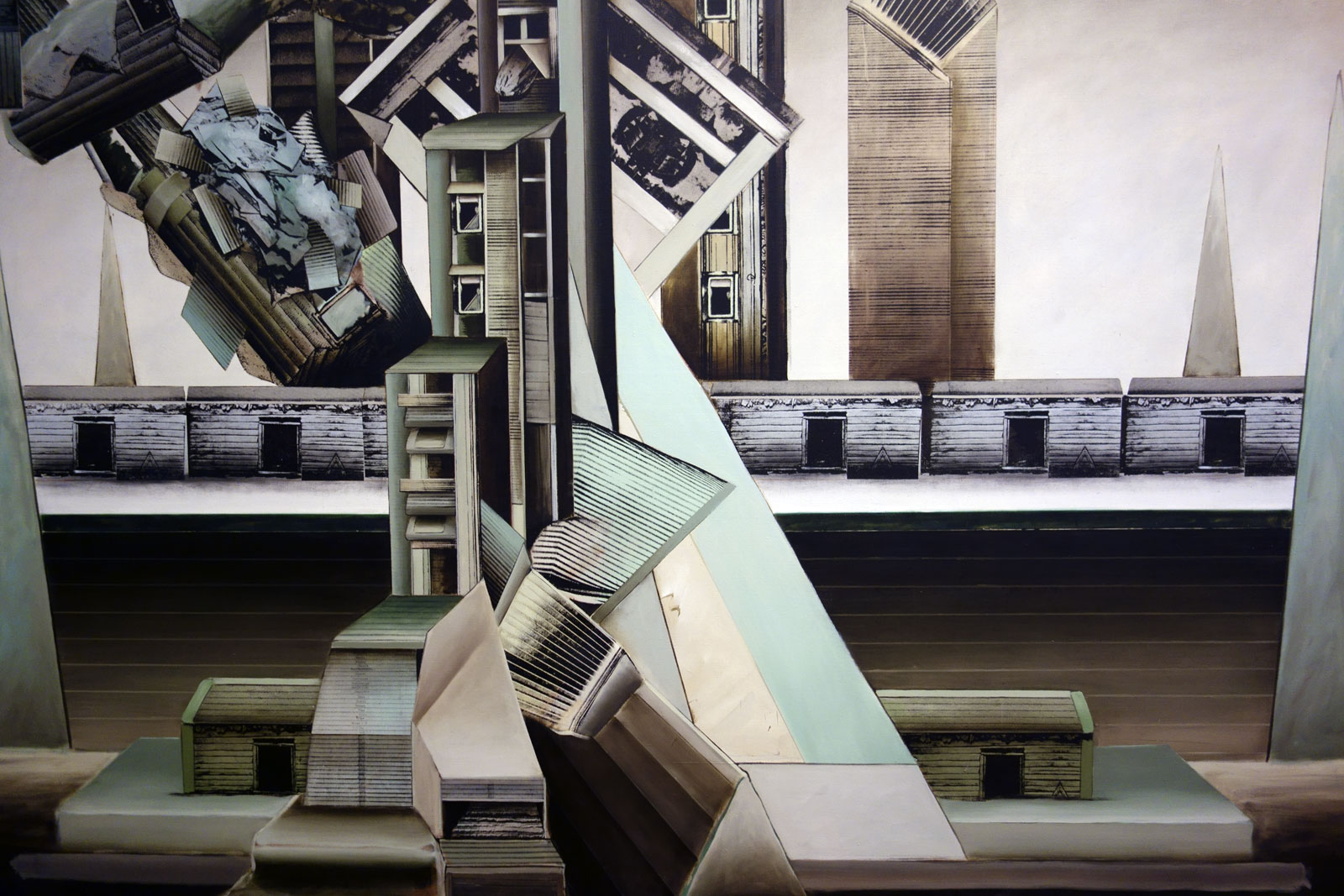
 

Jan Senbergs (born Latvia 1939, arrived Australia 1950, died Melbourne 2024) 'Observatory of hard edges' 1976 (detail)


Jan Senbergs (born Latvia 1939, arrived Australia 1950, died Melbourne 2024)
Observatory of hard edges (detail)
1976
Synthetic polymer paint, oil screen print on canvas
National Gallery of Australia, Canberra
Purchased 1976


This is one of Senbergs’ most architectonic images; its massing of asymmetrical forms, pronounced geometry and pale colours bring to mind the contemporaneous style of Brutalist architecture.
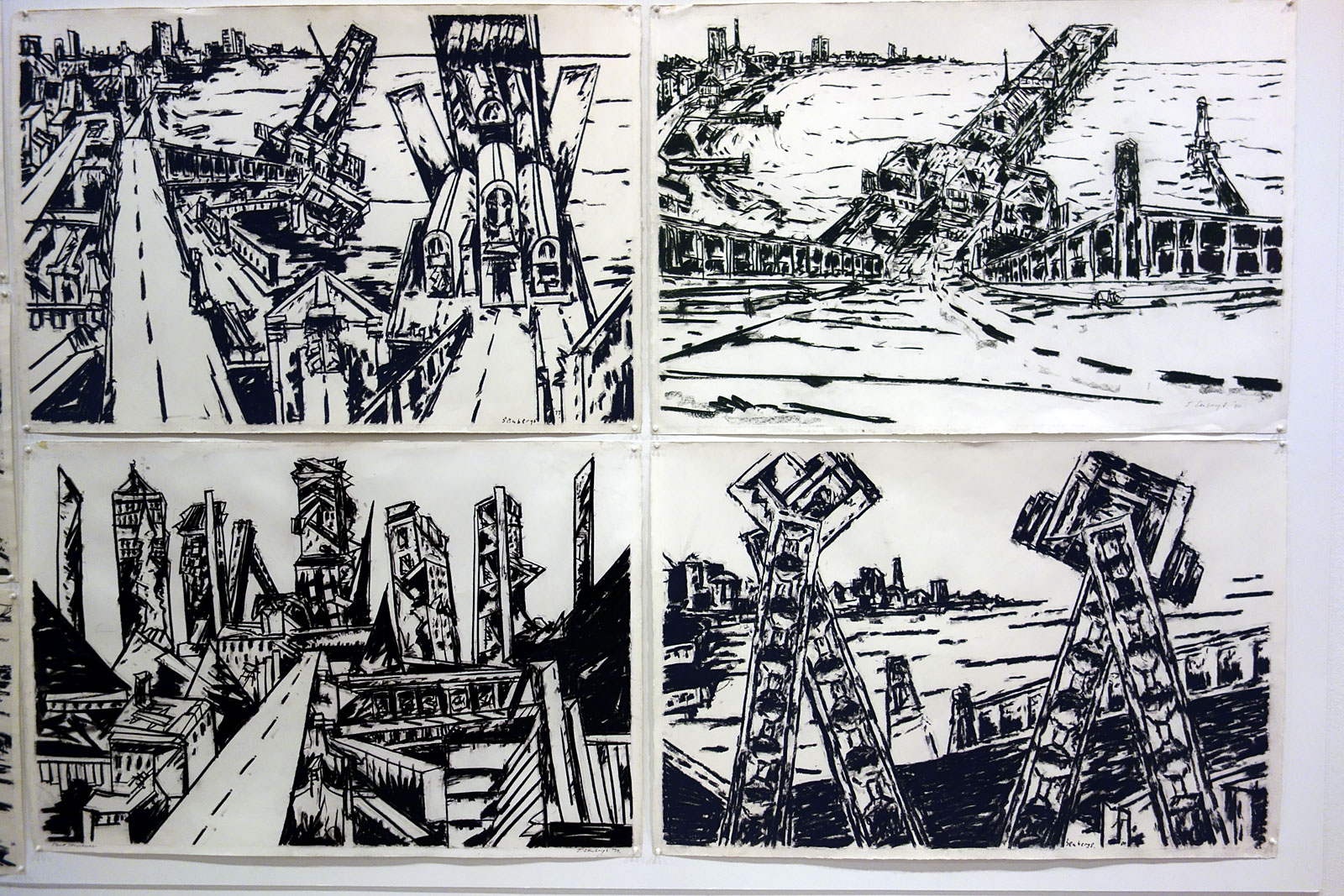
 

Jan Senbergs (born Latvia 1939, arrived Australia 1950, died Melbourne 2024) drawings late 1970s - early 1980s


Jan Senbergs (born Latvia 1939, arrived Australia 1950, died Melbourne 2024)

Port piers and overpass (top left)
1979
Pastel on paper
Courtesy of the artist and Niagara Galleries, Melbourne

Port structure (bottom left)
1979
Pastel on paper
Courtesy of the artist and Niagara Galleries, Melbourne

Station Pier (top right)
1980
Pastel on paper
Courtesy of the artist and Niagara Galleries, Melbourne

Port signals (bottom right)
1980
Pastel on paper
Courtesy of the artist and Niagara Galleries, Melbourne
Photo: Marcus Bunyan


“Yesterday I visited Jan Senbergs at his studio in Port Melbourne … I was greatly impressed by what I saw: he has moved away from a photo image to observation, perhaps with [Max] Beckmann as his distant father. His line is slow and sullen and he creates a feeling of junk-heap menace … His perspective is not often on the vanishing point, but is more related to the spatial  orientation in Chinese or Islamic art. This kind of perspective gives weight to an object; the sensation is abrupt and very blunt, ideally related to his vision.”

~ John Olsen 1980
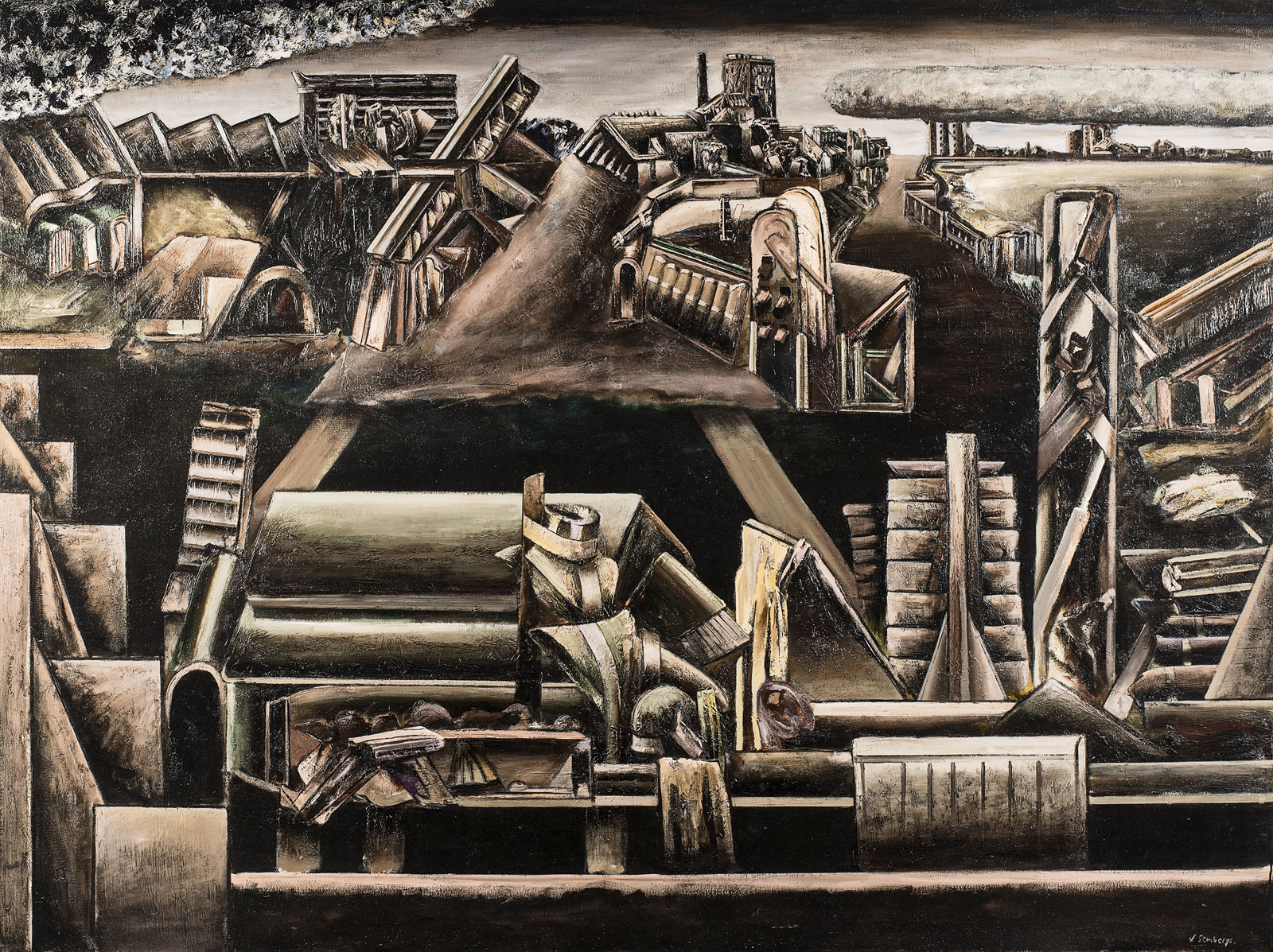
 

Jan Senbergs (born Latvia 1939, arrived Australia 1950, died Melbourne 2024) 'Port Liardet' 2 1981


Jan Senbergs (born Latvia 1939, arrived Australia 1950, died Melbourne 2024)
Port Liardet 2
1981
Synthetic polymer paint on canvas
183 x 244cm
Latrobe Regional Gallery Collection.
Acquired with assistance from the Caltex Victorian Government Art Fund and the Shire of Morwell
© Jan Senbergs
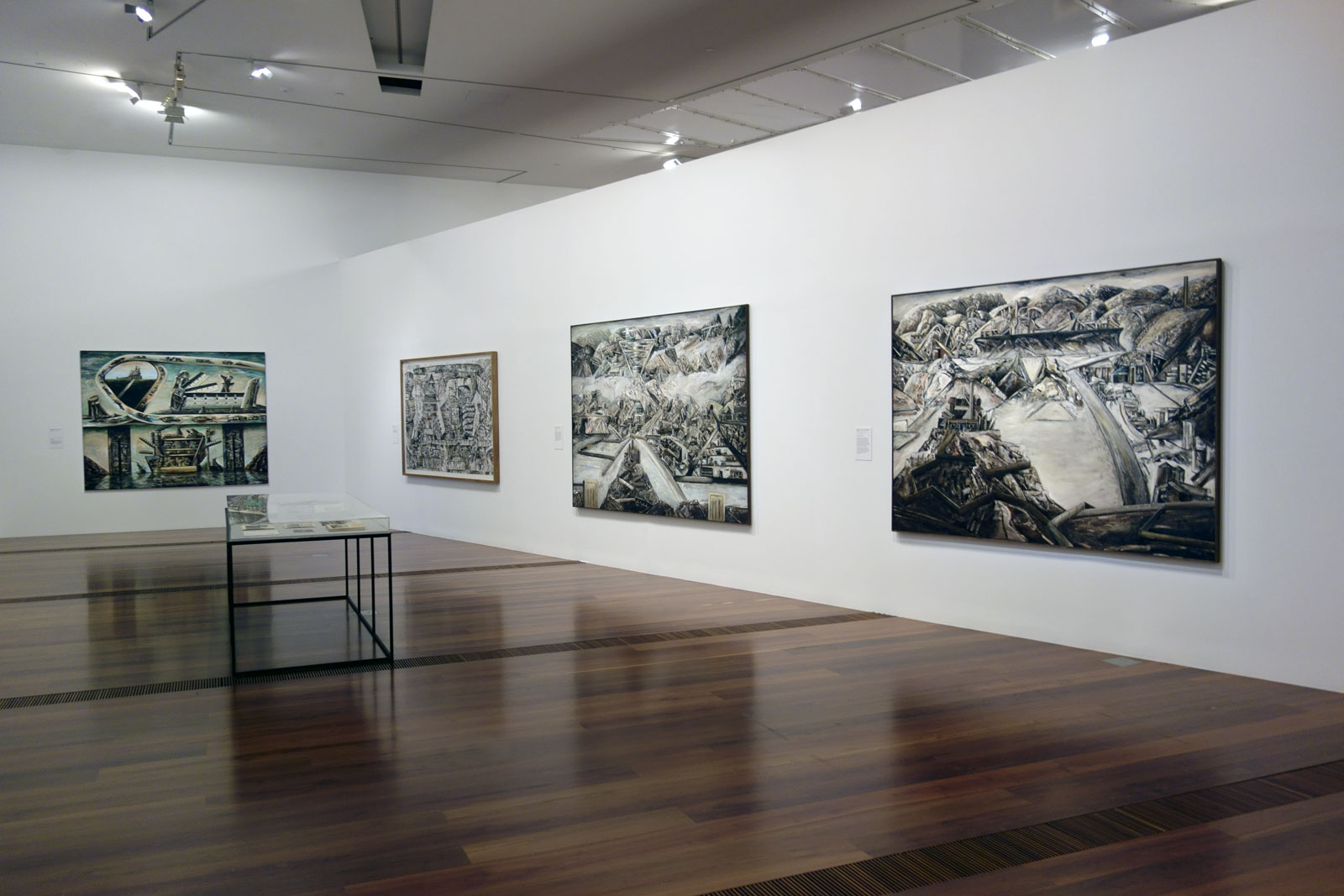
 

Installation view of the exhibition 'Jan Senbergs: Observation – Imagination' at The Ian Potter Centre: NGV Australia with 'Sticht's view to the smelters 1' at right


Installation view of the exhibition Jan Senbergs: Observation – Imagination at The Ian Potter Centre: NGV Australia with Sticht’s view to the smelters 1 at right
Photo: Marcus Bunyan
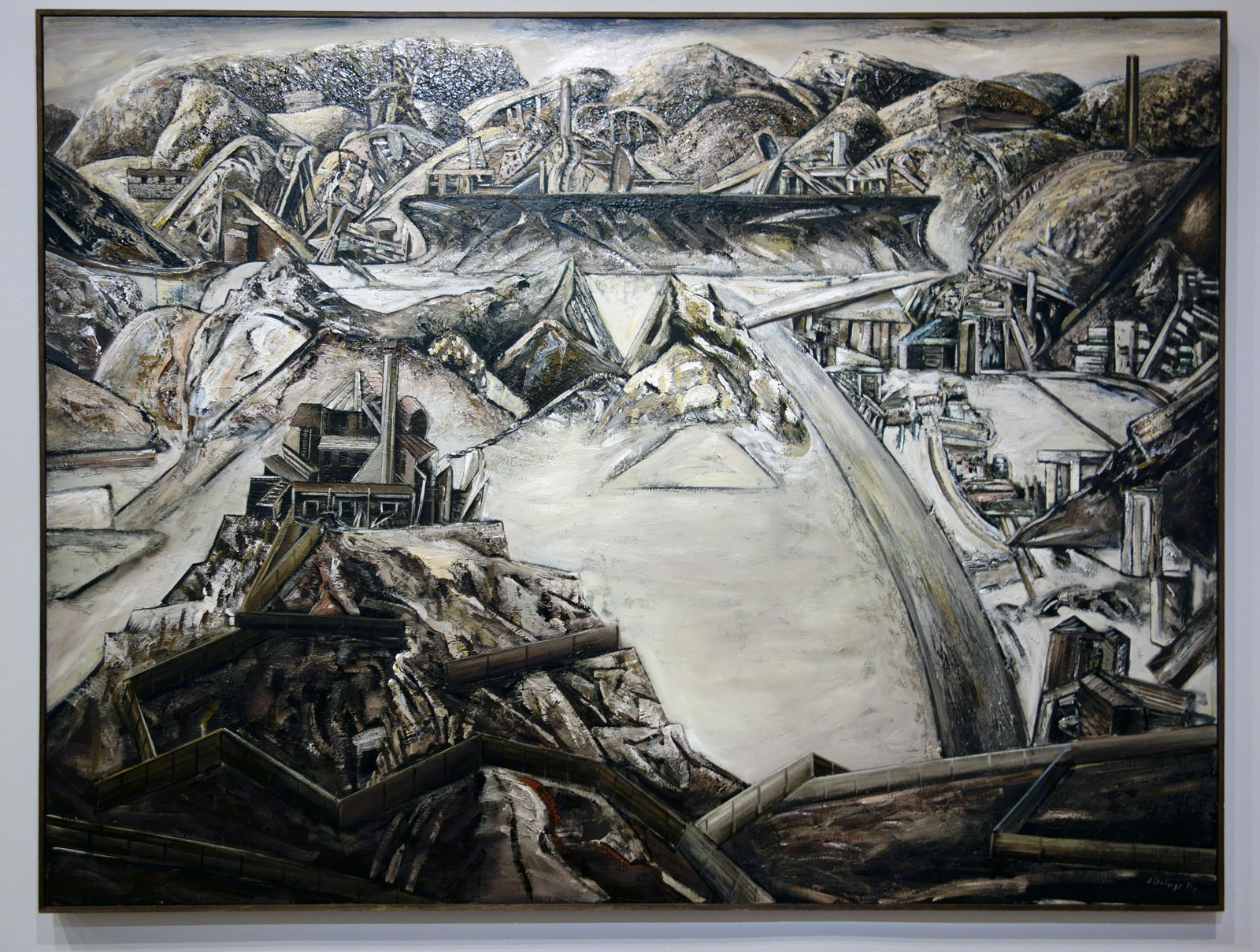
 

Jan Senbergs (born Latvia 1939, arrived Australia 1950, died Melbourne 2024) 'Sticht's view to the smelters 1' 1982 (installation view)


Jan Senbergs (born Latvia 1939, arrived Australia 1950, died Melbourne 2024)
Sticht’s view to the smelters 1 (installation view)
1982
Synthetic polymer paint on canvas
Tasmanian Museum and Art Gallery, Hobart
Purchase with funds presented by Renison Goldfields Consolidated, 1983
Photo: Marcus Bunyan
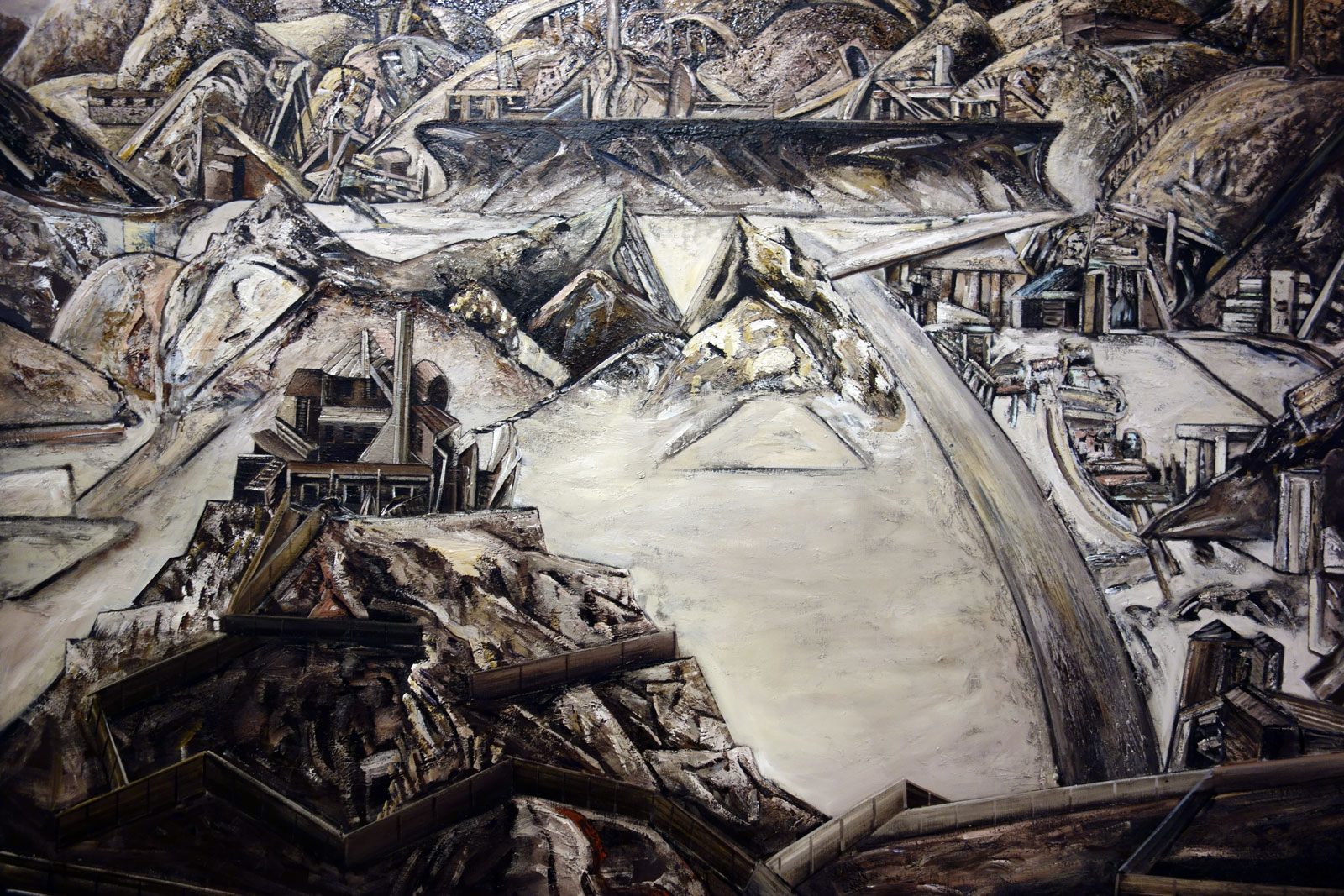
 

Jan Senbergs (born Latvia 1939, arrived Australia 1950, died Melbourne 2024) 'Sticht's view to the smelters 1' 1982 (detail)


Jan Senbergs (born Latvia 1939, arrived Australia 1950, died Melbourne 2024)
Sticht’s view to the smelters 1 (detail)
1982
Synthetic polymer paint on canvas
Tasmanian Museum and Art Gallery, Hobart
Purchase with funds presented by Renison Goldfields Consolidated, 1983


Robert Carl Sticht was an American metallurgist who in 1897 became general manager of the copper mine at Mount Lyell on the remote and rugged west coast of Tasmania. There he introduced a new technique of smelting which released large amounts of deadly sulphur into the air, one of the principal agents of destruction of the natural environment of the region.

In the Copperopolis – Mt Lyell series, Senbergs moved away from the smooth surfaces and clearly articulated forms of his Port Liardet paintings to a more gestural, painterly mode, in accord with the style of Neo-Expressionist painting of the early 1980s.
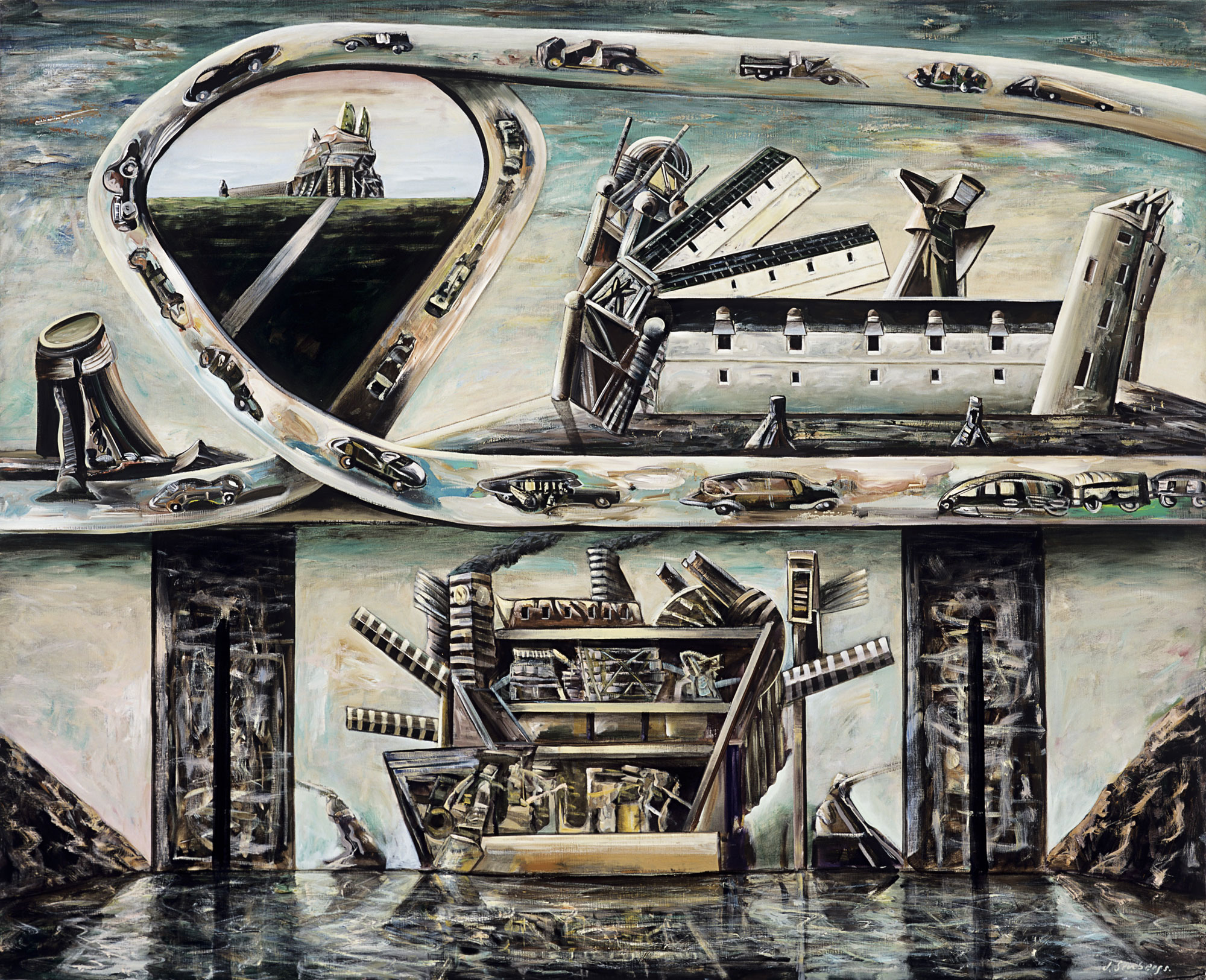
 

Jan Senbergs (born Latvia 1939, arrived Australia 1950, died Melbourne 2024) 'Broadening the mind in Italy' 1986, 1991


Jan Senbergs (born Latvia 1939, arrived Australia 1950, died Melbourne 2024)
Broadening the mind in Italy
1986, 1991
Synthetic polymer paint on canvas
167 x 243cm
Private collection, Melbourne
© Jan Senbergs
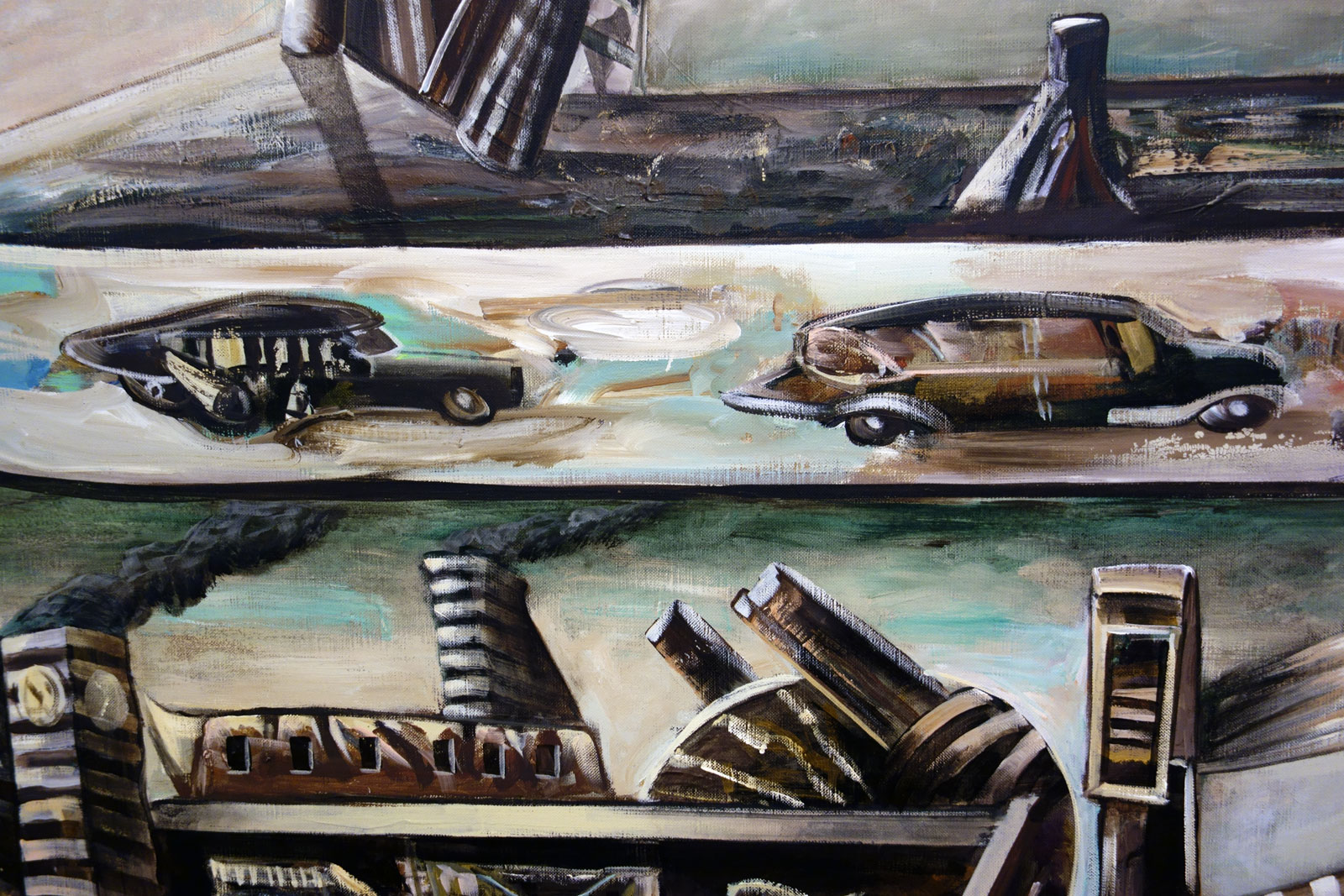
 

Jan Senbergs (born Latvia 1939, arrived Australia 1950, died Melbourne 2024) 'Broadening the mind in Italy' 1986, 1991 (detail)


Jan Senbergs (born Latvia 1939, arrived Australia 1950, died Melbourne 2024)
Broadening the mind in Italy (detail)
1986, 1991
Synthetic polymer paint on canvas
167 x 243cm
Private collection, Melbourne
© Jan Senbergs
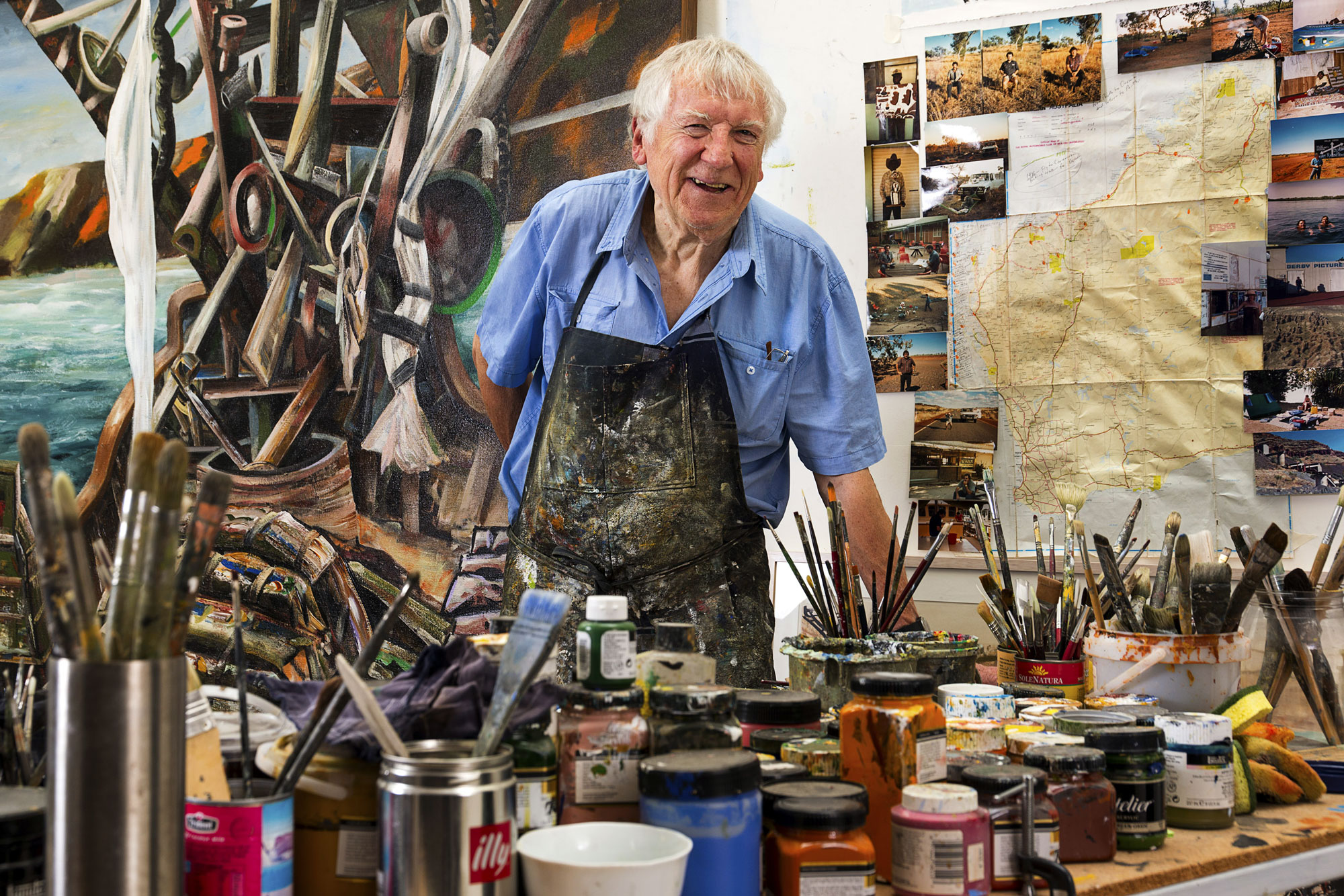
 

Predrag Cancar/NGV Photographic Services. 'Jan Senbergs in his studio' 2015


Predrag Cancar/NGV Photographic Services
Jan Senbergs in his studio
2015


From the vast expanses of Antarctica to labyrinthine Melbourne cityscapes, more than five decades of artist Jan Senbergs’ prolific oeuvre will be revealed in the major retrospective Jan Senbergs: Observation – Imagination.

The exhibition, Senbergs’ first-ever comprehensive survey, will feature over 120 works including large-scale paintings, drawings and prints which depict sprawling aerial views of Australian cities, dystopic industrial landscapes, raging bushfires in the Victorian Otways, the remote deserts of north-Western Australia and more. The exhibition spans Senbergs’ first exhibition in 1960 through to the present day, representing all periods of his career. Recognised for his sheer visual inventiveness and sitting outside any defined artistic trend, Senbergs draws inspiration from a remarkably diverse range of influences; literature, history, architecture and non-Western art, and finds imagery within obscure technical journals, ancient mythology and illustrated encyclopaedias.

Tony Ellwood, Director, NGV, said, “As one of Australia’s leading contemporary artists, Jan Senbergs is an extraordinary inventor of his own visual language, at once simple and bold. From lush landscapes to barren urban spaces, his body of work signifies an artist who has continually experimented with shape, form and motif, and one who to this day continues to push his art in new and unexpected directions. The NGV is pleased to present the first major retrospective of Jan Senbergs’ work and offer visitors the opportunity to experience the full spectrum and constant evolution of his career.”

Senbergs, born in 1939 in Latvia, moved to Melbourne in 1950 following the end of World War II. Among other honours, he represented Australia at the prestigious 12th São Paolo Biennial in 1973 and was appointed to the Visiting Chair in Australian Studies at Harvard University in 1989, the first artist to hold this illustrious post. Observation – Imagination will include key works from Senbergs’ most important and critically acclaimed series including his 1973 São Paolo Biennial paintings, the Copperopolis – Mt Lyell mining landscape series, 1983, and his immense multi-panelled studio drawings of 1993-1995.

Senbergs’ Antarctica series is considered one of the most significant artistic responses to the continent. In 1987, Senbergs spent six weeks with the Australian Antarctic Division, travelling with fellow artists Bea Maddock and John Caldwell, on an annual resupply mission. Observation – Imagination will include key works such as his epic landscapes Mawson and Davis. The exhibition will also present Senbergs’ epic, 4.6 metre long Pulaski Skyway painting, which reflects the post-industrial landscape of the five and a half kilometre freeway that crosses the wasteland of western New Jersey from Newark to Jersey City. In this, Senbergs found a metaphor for the American experience and its splendour and decay.

More recently Senbergs has produced intricate labyrinthine views of cities, combining memory and imagination, and the exhibition will include map-like images of Melbourne, Sydney, Geelong, Wollongong and Port Kembla. The exhibition will also feature works from Senbergs’ recent 2014 Victorian bushfire series, which burst with visual drama and chromatic brilliance. Senbergs often refers to himself as a scavenger and collector of imagery taken from a wide variety of sources, and Observation – Imagination will include an enormous showcase, created by the artist, filled with cut-outs, photographs and personal artefacts that reference the people, places and artworks which have fuelled his visual imagination.

Press release from the National Gallery of Victoria
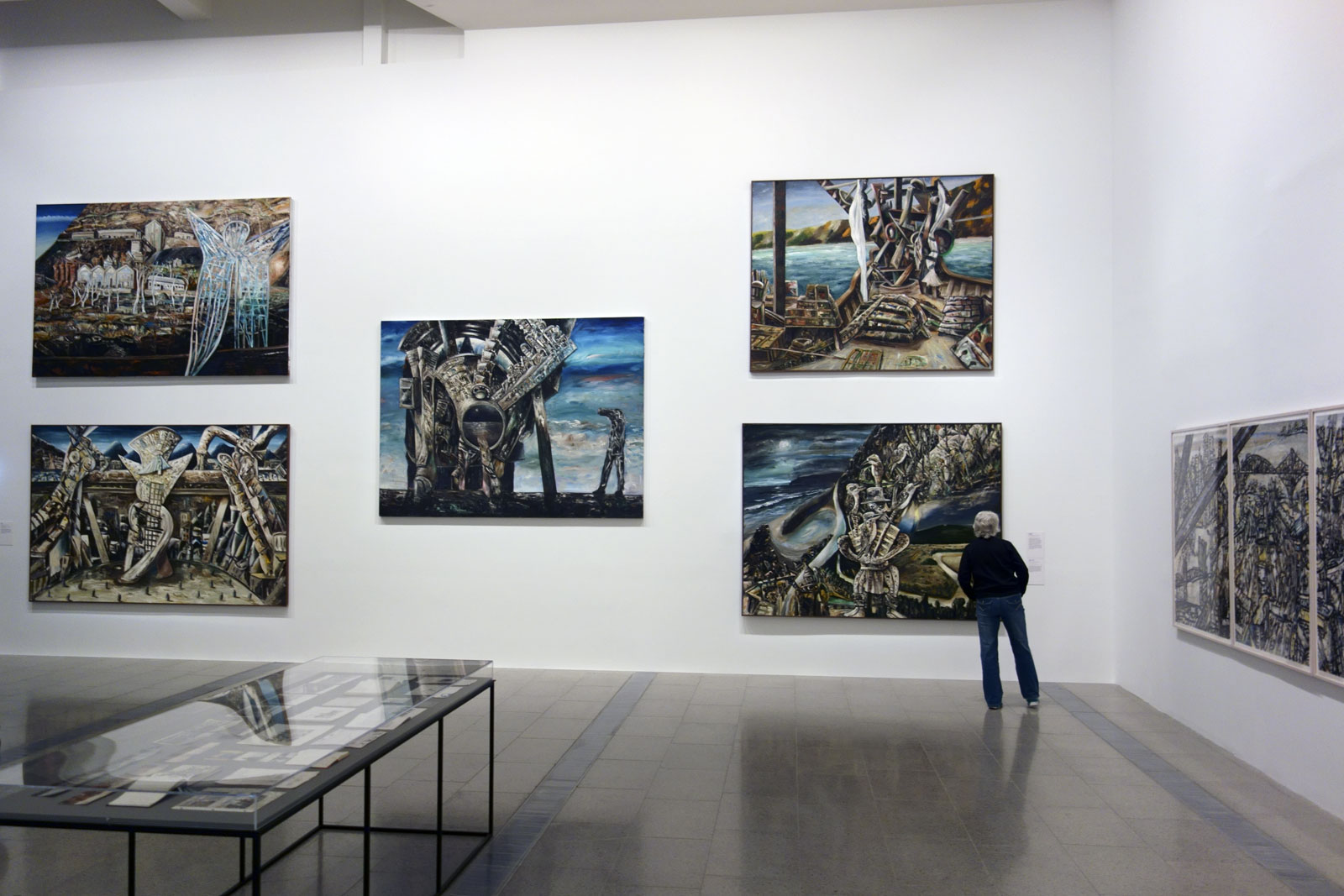
 

Installation view of the exhibition 'Jan Senbergs: Observation – Imagination' at The Ian Potter Centre: NGV Australia showing 'Blue angel of Wittenoom' at top left (1988, below); and 'Otway night' at bottom right (1994, below)

Installation view of the exhibition 'Jan Senbergs: Observation – Imagination' at The Ian Potter Centre: NGV Australia


Installation views of the exhibition Jan Senbergs: Observation – Imagination at The Ian Potter Centre: NGV Australia showing in the top image, Blue angel of Wittenoom at top left (1988, below); and Otway night at bottom right (1994, below)
Photos: Marcus Bunyan
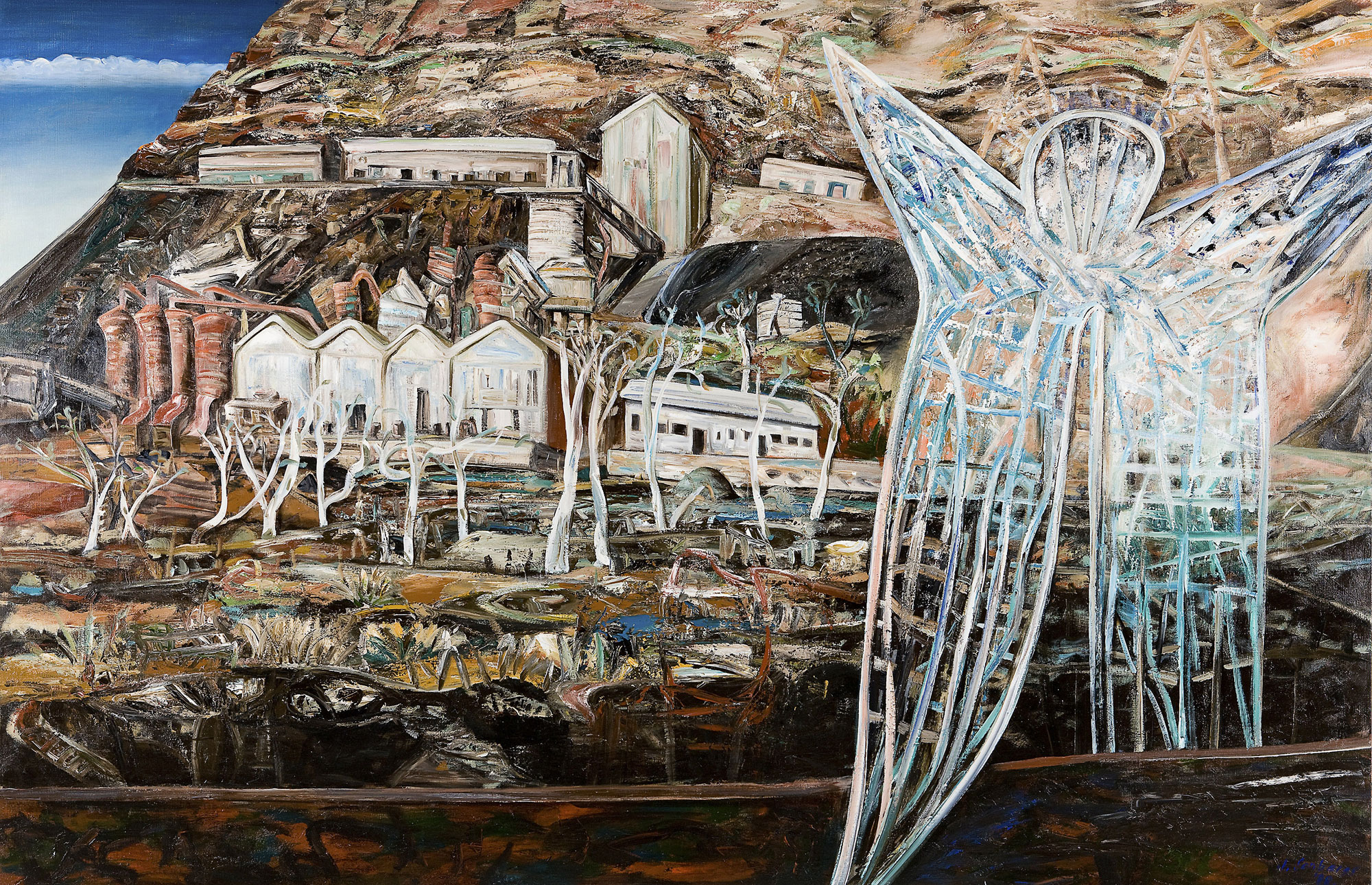
 

Jan Senbergs (born Latvia 1939, arrived Australia 1950, died Melbourne 2024) 'Blue angel of Wittenoom' 1988


Jan Senbergs (born Latvia 1939, arrived Australia 1950, died Melbourne 2024)
Blue angel of Wittenoom
1988
Synthetic polymer paint on canvas
197.5 x 305cm
State Art Collection, Art Gallery of Western Australia, Perth
Purchased 1989
© Jan Senbergs
Photo: Eva Fernandez


The blue angel in the painting refers to the dangers of asbestos in the mining town of Wittenoom.

Wittenoom is a ghost town 1,106 kilometres (687 mi) north-north-east of Perth in the Hamersley Range in the Pilbara region of Western Australia. The area around Wittenoom was mainly pastoral until the 1930s when mining began in the area. By 1939, major mining had begun in Yampire Gorge, which was subsequently closed in 1943 when mining began in Wittenoom Gorge. In 1947 a company town was built, and by the 1950s it was Pilbara’s largest town. During the 1950s and early 1960s Wittenoom was Australia’s only supplier of blue asbestos. The town was shut down in 1966 due to unprofitability and growing health concerns from asbestos mining in the area.

Today, six residents still live in the town, which receives no government services. In December 2006, the Government of Western Australia announced that the town’s official status would be removed, and in June 2007, Jon Ford, the Minister for Regional Development, announced that the townsite had officially been degazetted. The town’s name was removed from official maps and road signs and the Shire of Ashburton is able to close roads that lead to contaminated areas.

The Wittenoom steering committee met in April 2013 to finalise closure of the town, limit access to the area and raise awareness of the risks. Details of how that would be achieved were to be determined but it would likely necessitate removing the town’s remaining residents, converting freehold land to crown land, demolishing houses and closing or rerouting roads. by 2015 six residents remained.

Text from the Wikipedia website
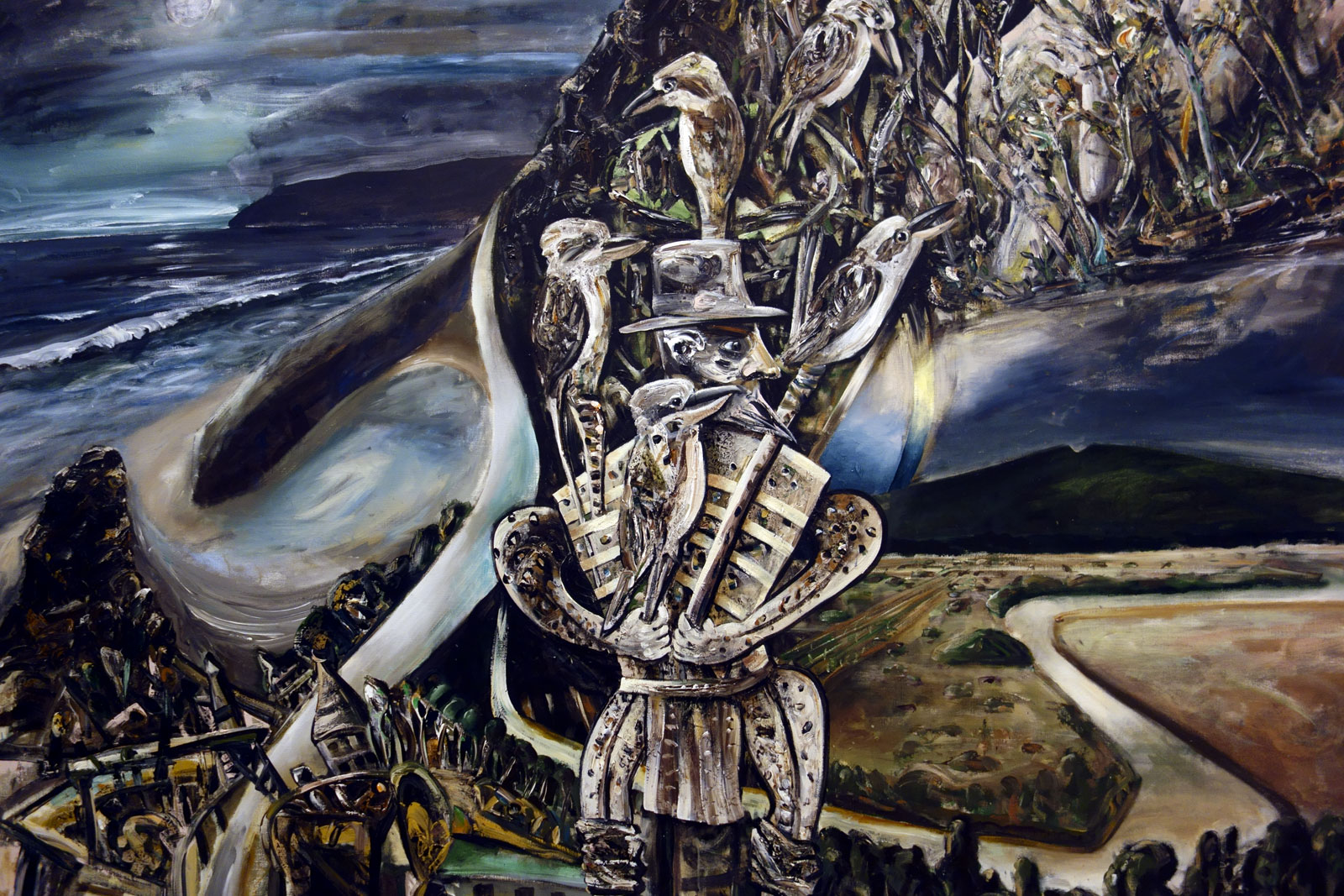
 

Jan Senbergs (born Latvia 1939, arrived Australia 1950, died Melbourne 2024) 'Otway night' 1994 (detail)


Jan Senbergs (born Latvia 1939, arrived Australia 1950, died Melbourne 2024)
Otway night (detail)
1994
Synthetic polymer paint on canvas
Art Gallery of New South Wales
Purchase with assistance from Ruth Komon, 1994


After purchasing a holiday house at Aireys Inlet, Senbergs became interested in the history of Victoria’s west coast and the story of escaped convict William Buckley, ‘the wild white man’ who lived with the local Wathaurung people from 1803 until 1835 before being integrated back into colonial society.
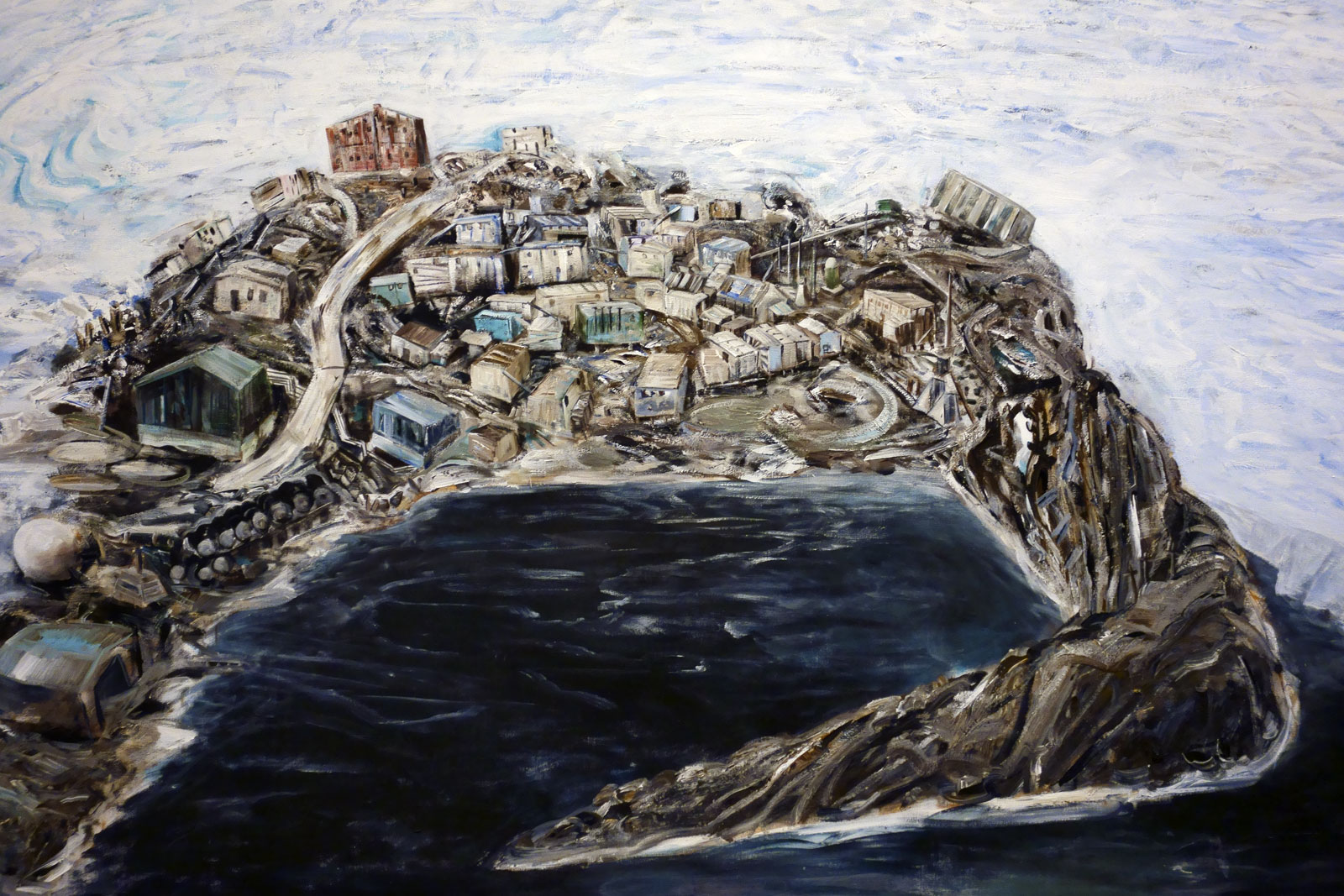
 

Jan Senbergs (born Latvia 1939, arrived Australia 1950, died Melbourne 2024) 'Mawson' 1987 (detail)


Jan Senbergs (born Latvia 1939, arrived Australia 1950, died Melbourne 2024)
Mawson (detail)
1987
Synthetic polymer paint on canvas
Private collection, Melbourne


“As in previous settlements in history, in Antarctica we are again squatting on the edge of yet another continent and bringing our cultural baggage with us. Already there is a sense of history there: architectural, social and visual.”

~ Jan Senbergs, 2002
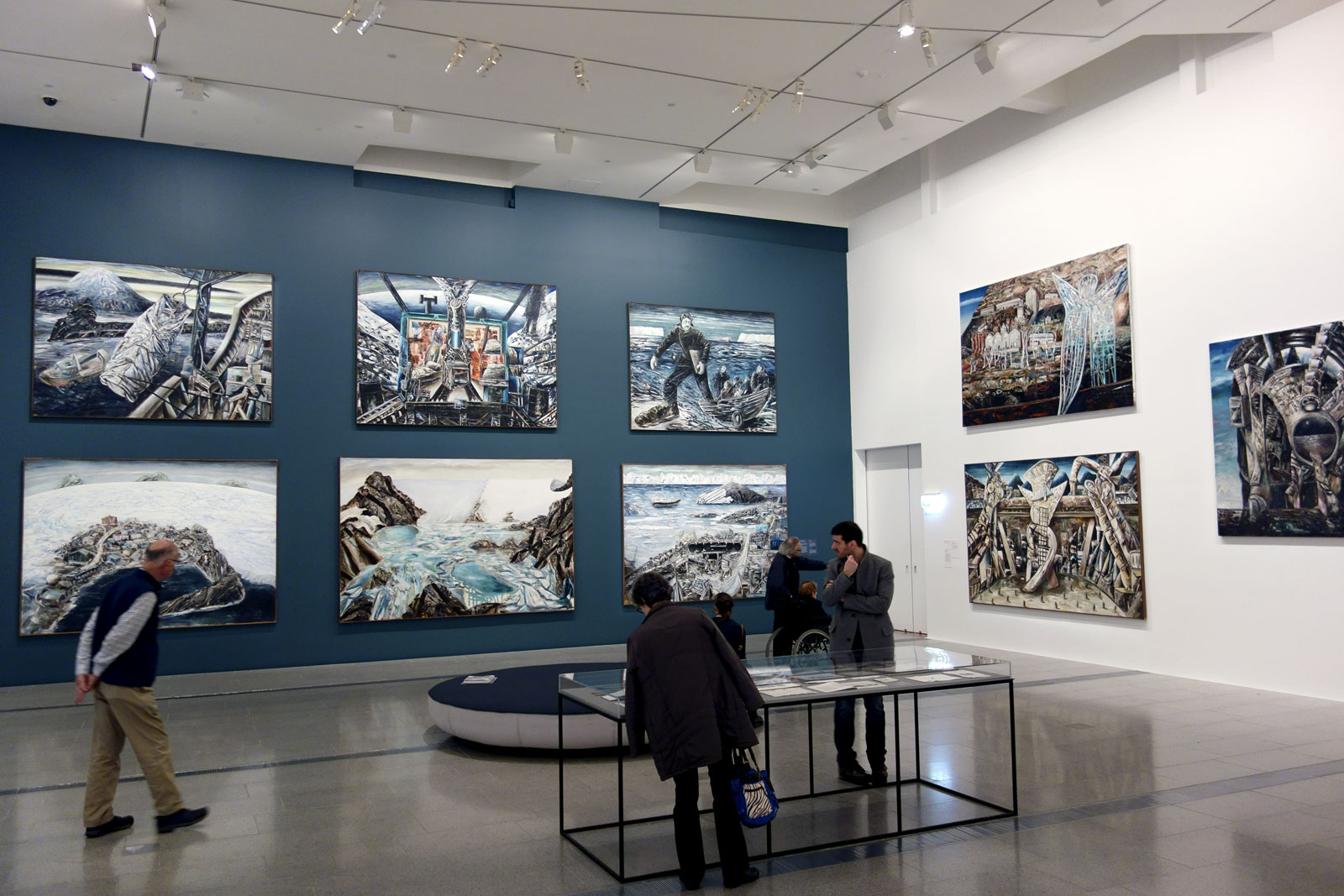
 

Installation view of the exhibition 'Jan Senbergs: Observation – Imagination' at The Ian Potter Centre: NGV Australia

Installation view of the exhibition 'Jan Senbergs: Observation – Imagination' at The Ian Potter Centre: NGV Australia showing in the bottom image at top left, 'Bea Maddock being lifted onto the Icebird – Heard Island' (1987); at top middle, 'Antarctic night' (1989); at bottom left, 'Mawson'; and at bottom middle, 'Platcha' (1987)


Installation views of the exhibition Jan Senbergs: Observation – Imagination at The Ian Potter Centre: NGV Australia showing in the bottom image at top left, Bea Maddock being lifted onto the Icebird – Heard Island (1987, below); at top middle, Antarctic night (1989, below); at bottom left, Mawson; and at bottom middle, Platcha (1987, below)
Photos: Marcus Bunyan
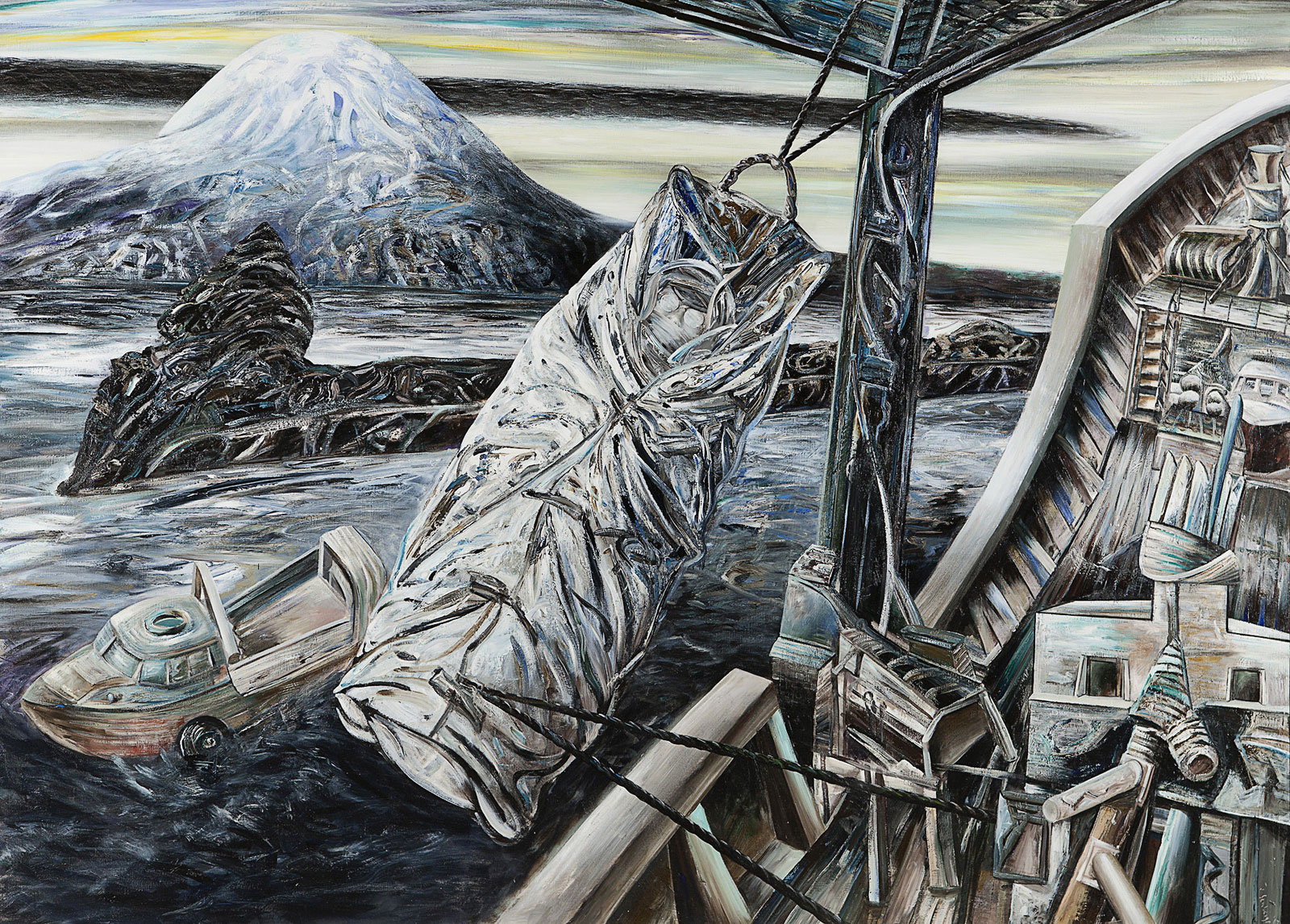
 

Jan Senbergs (born Latvia 1939, arrived Australia 1950, died Melbourne 2024) 'Bea Maddock being lifted onto the Icebird – Heard Island' 1987


Jan Senbergs (born Latvia 1939, arrived Australia 1950, died Melbourne 2024)
Bea Maddock being lifted onto the Icebird – Heard Island
1987
Synthetic polymer paint on canvas
197.2 x 274.1cm
State Art Collection, Art Gallery of Western Australia, Perth
Purchased 1987
© Jan Senbergs


Senbergs was one of three artists invited by the Australian Antractic Division to take part in the resupply Voyage Six to Antarctica as observers. Leaving Hobart in early January 1987, during their six‐week journey the artists visited Heard Island, Scullin Monolith, Law Base, Davis, Mawson and the Russian base at Mirny. This painting depicts fellow artist Bea Maddock who broke her leg while disembarking at Heard Island and needed to be winched back on board. Unfortunately, she was incapacitated for the remainder of the trip.
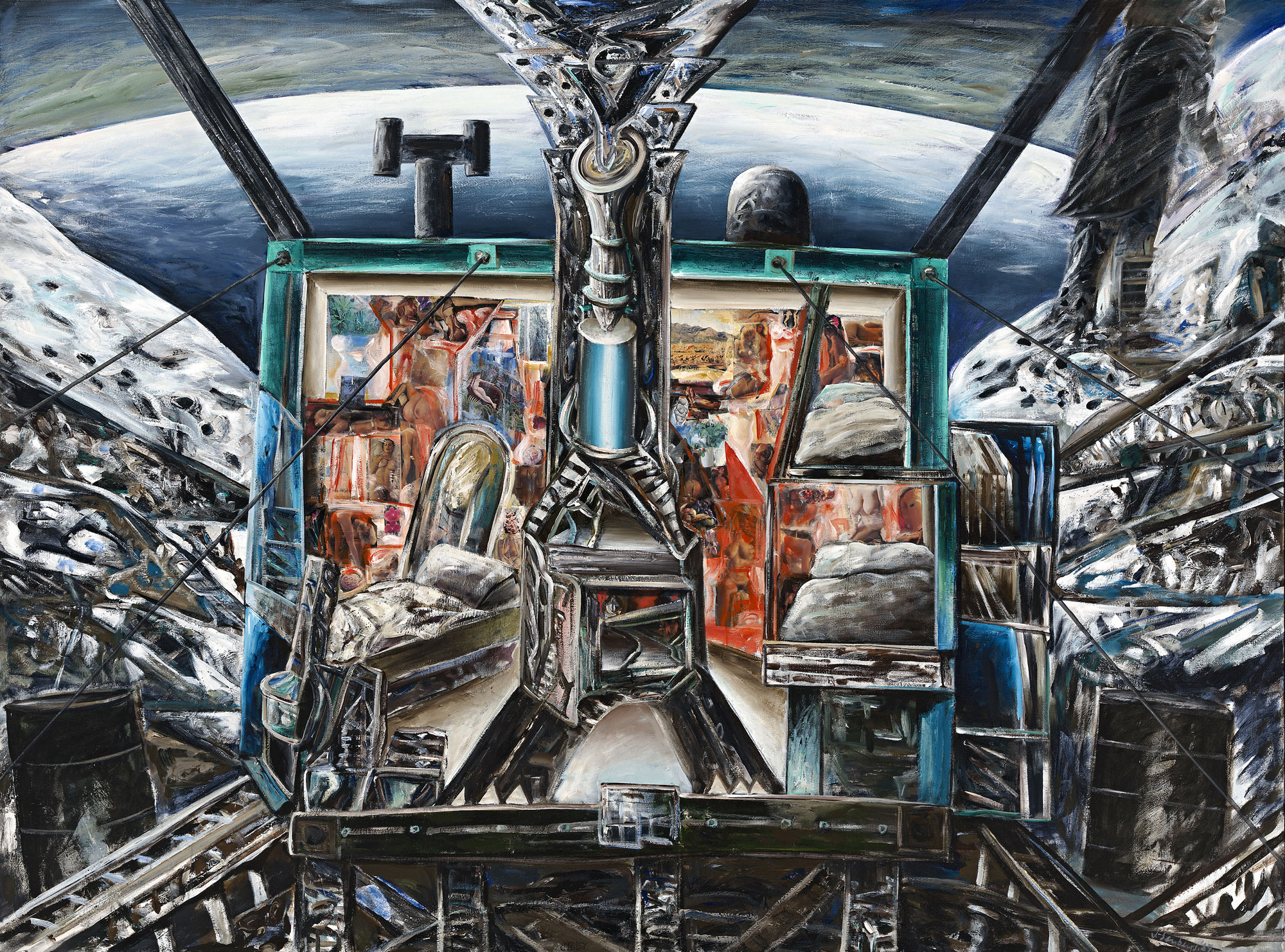
 

Jan Senbergs (born Latvia 1939, arrived Australia 1950, died Melbourne 2024) 'Antarctic night' 1989


Jan Senbergs (born Latvia 1939, arrived Australia 1950, died Melbourne 2024)
Antarctic night
1989
Synthetic polymer paint and collage on canvas
202 x 292cm
National Gallery of Australia, Canberra
Purchased 1990
© Jan Senbergs


“In a “cut-away” view, [Antarctic night] shows the interior of a winterer’s hut with its wall covered in a “tapestry” of pin-up images – from the earliest “pin‐up”, the Venus of Willendorf, to the Playboy centrefolds of the 1950s and 1960s … The more you saw of it, the more it seemed like an Antarctic Pop Art movement.”
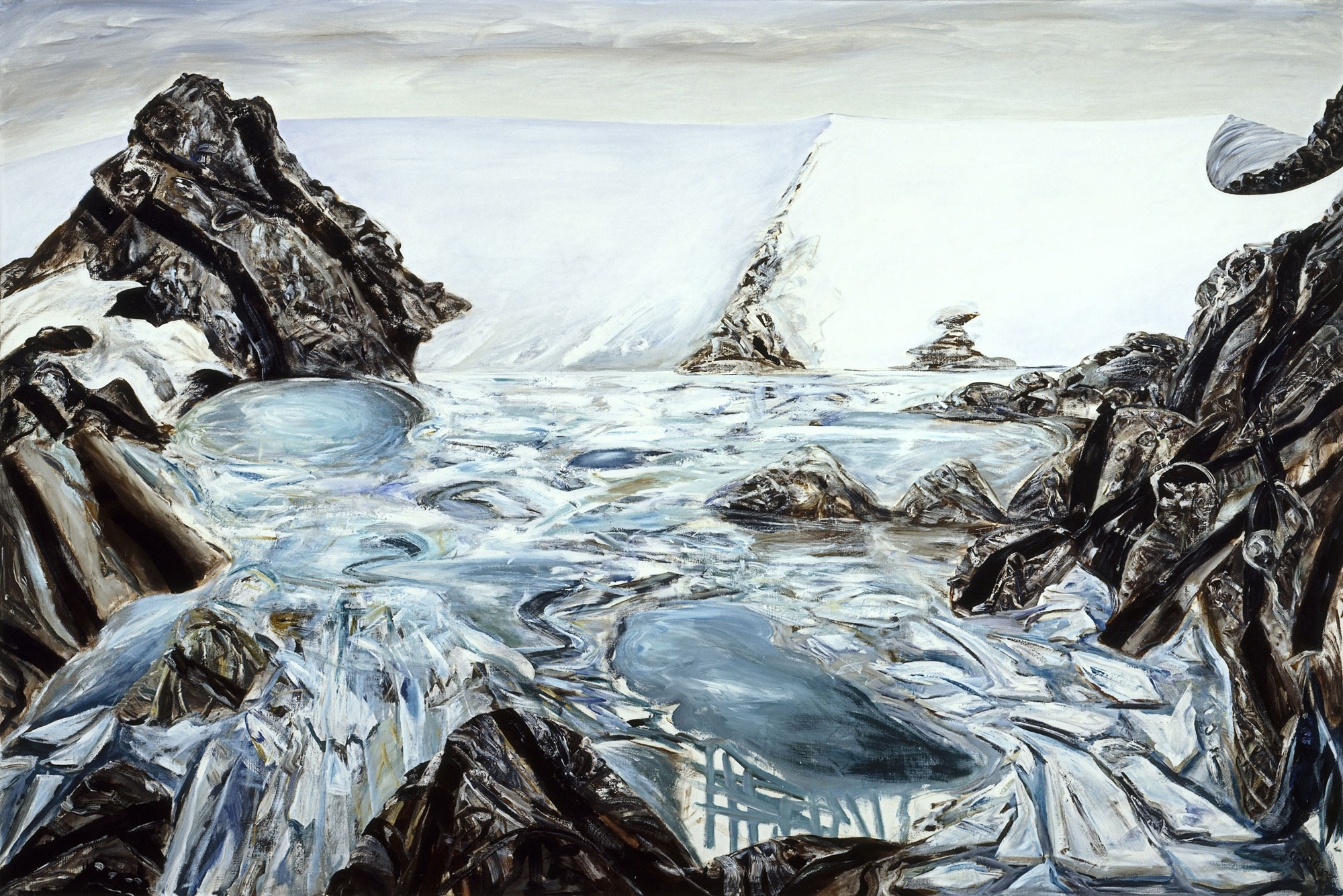
 

Jan Senbergs (born Latvia 1939, arrived Australia 1950, died Melbourne 2024) 'Platcha' 1987


Jan Senbergs (born Latvia 1939, arrived Australia 1950, died Melbourne 2024)
Platcha
1987
Synthetic polymer paint on canvas
224.0 x 355.0cm
Melbourne Convention and Exhibition Trust Collection
© Jan Senbergs
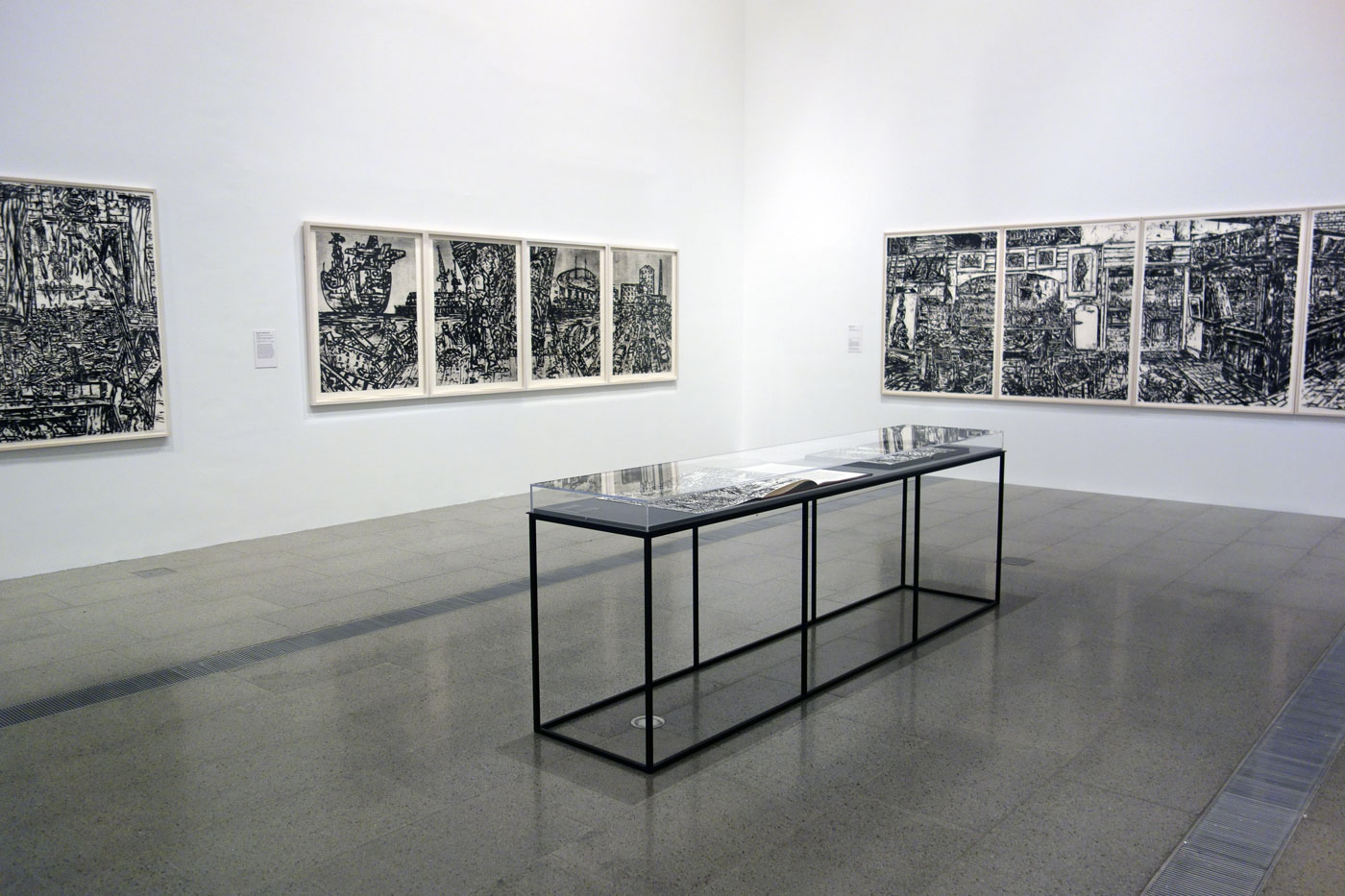
 

Installation view of the exhibition 'Jan Senbergs: Observation – Imagination' at The Ian Potter Centre: NGV Australia


Installation view of the exhibition Jan Senbergs: Observation – Imagination at The Ian Potter Centre: NGV Australia
Photo: Marcus Bunyan


Jan Senbergs. Installation view of 'New Guinea sheilas triptych' (centre row) and 'New Guinea male triptych' (bottom row) both 1993


Installation view of New Guinea sheilas triptych (centre row) and New Guinea male triptych (bottom row) both 1993
Pastel on paper
Courtesy of the artist and Niagara Galleries, Melbourne
Photo: Marcus Bunyan


Jan Senbergs. Detail view of 'New Guinea sheilas triptych' (centre row) and 'New Guinea male triptych' (bottom row) both 1993


Detail view of New Guinea sheilas triptych (centre row) and New Guinea male triptych (bottom row) both 1993
Pastel on paper
Courtesy of the artist and Niagara Galleries, Melbourne
Photo: Marcus Bunyan


Jan Senbergs (born Latvia 1939, arrived Australia 1950, died Melbourne 2024) 'New Guinea male triptych' 1993 (detail)


Jan Senbergs (born Latvia 1939, arrived Australia 1950, died Melbourne 2024)
New Guinea male triptych (detail) 
1993
pastel on paper
(a-c) 160 x 366cm (overall)
Courtesy of the artist and Niagara Galleries, Melbourne
© Jan Senbergs


“I enjoy the freedom of drawing, the directness of what I call my “Long Arm Drawing” with a black pastel or an oil stick, where there’s no room for corrections or embellishments – dancing in front of a sheet of paper, keeping a spontaneous line, and if you hesitate, it shows. It’s “unforgiving” drawing and if you’re out of form you lose, and sheets of paper end up in the bin. Like an athlete or a dancer, you’ve got to put in the hours to make the confident mark.”


Jan Senbergs, 2016
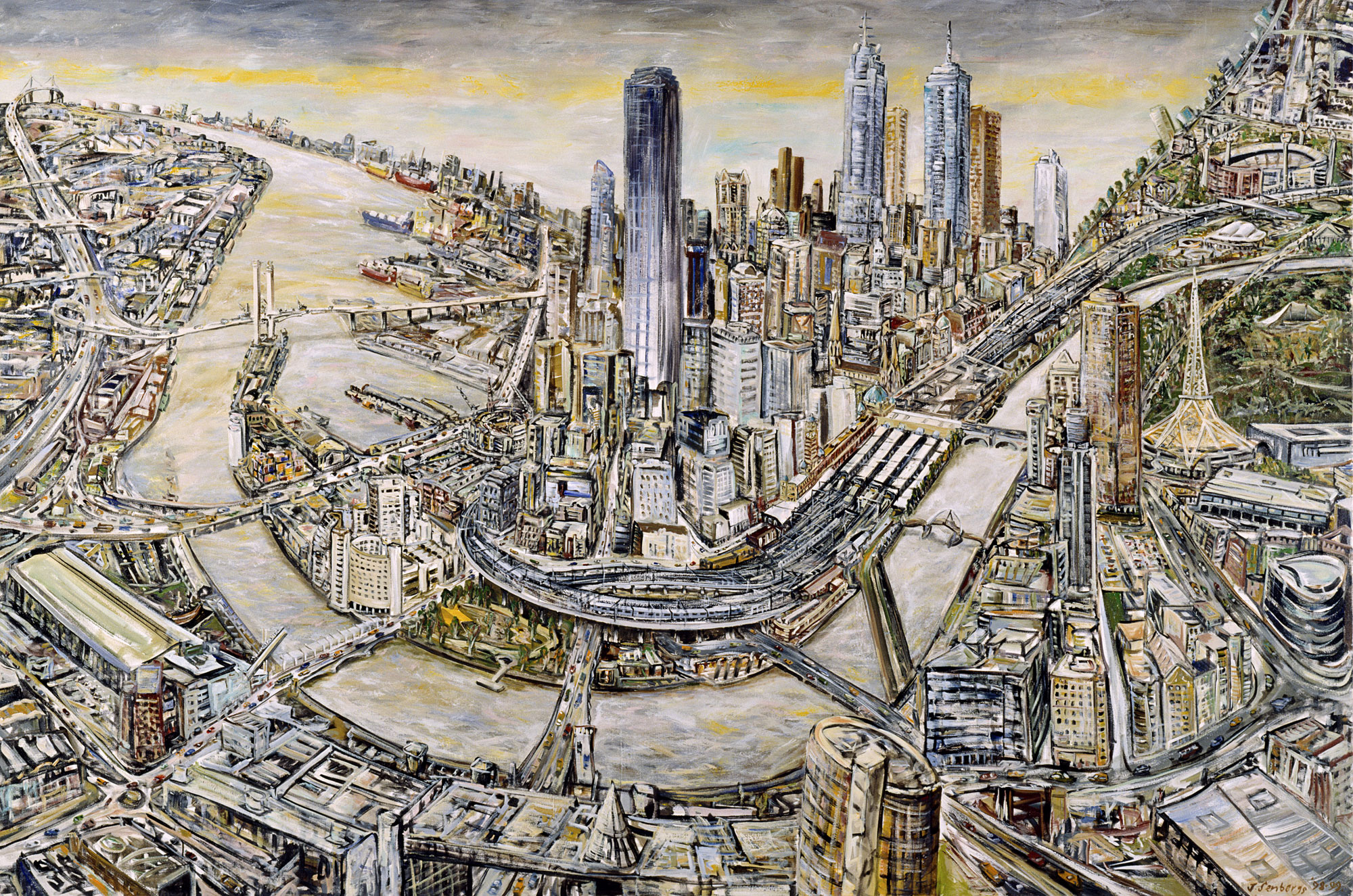


Jan Senbergs (born Latvia 1939, arrived Australia 1950, died Melbourne 2024) 'Melbourne' 1998-1999 from the exhibition Exhibition: 'Jan Senbergs: Observation – Imagination' at The Ian Potter Centre: NGV Australia, Melbourne, March - June, 2016


Jan Senbergs (born Latvia 1939, arrived Australia 1950, died Melbourne 2024)
Melbourne
1998-1999
Synthetic polymer paint on canvas
183 x 274cm
State Library of Victoria, Melbourne
Gift of the Gualtiero Vaccari Foundation in recognition of services provided by the State Library to the Italian Community, 1999
© Jan Senbergs


“[The] map-like images of the city that I’ve developed – of Melbourne, Sydney, Wollongong, Barcelona – they come out of a fascination with map-making, particularly early map-making … I started to look for an imagined way of painting and drawing actual places like Melbourne or Sydney: not exactly what you see in front of you but what you know to be there … It’s like those early maps, imaginary maps where people were drawing what they knew, not what they saw or measured.”


Jan Senbergs, 2006
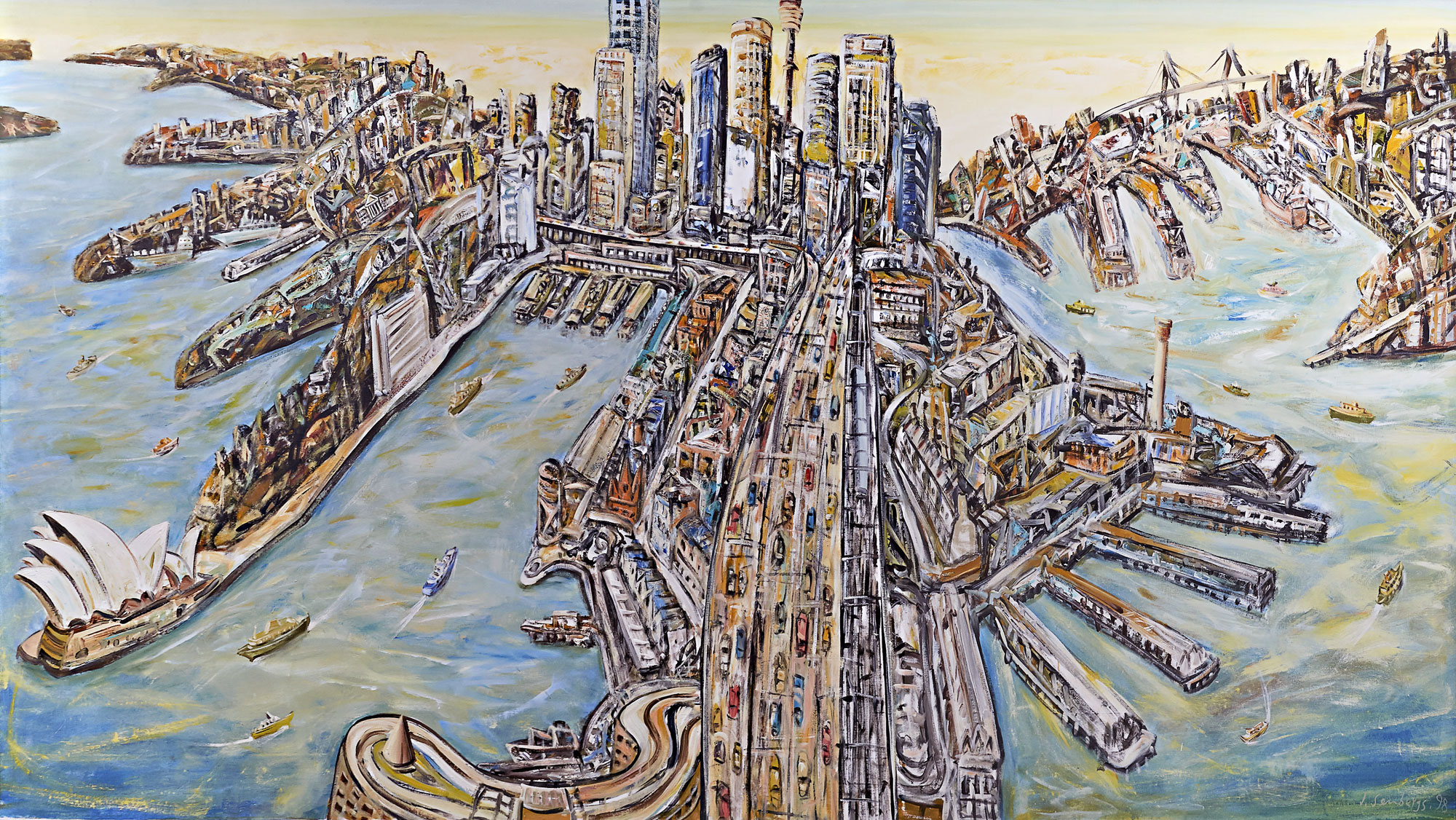


Jan Senbergs (born Latvia 1939, arrived Australia 1950, died Melbourne 2024) 'Sydney' 1998


Jan Senbergs (born Latvia 1939, arrived Australia 1950, died Melbourne 2024)
Sydney
1998
Synthetic polymer paint on canvas
174 x 344cm (framed)
Collection of McDonald’s Australia Limited
© Jan Senbergs
Photo: Felicity Jenkins
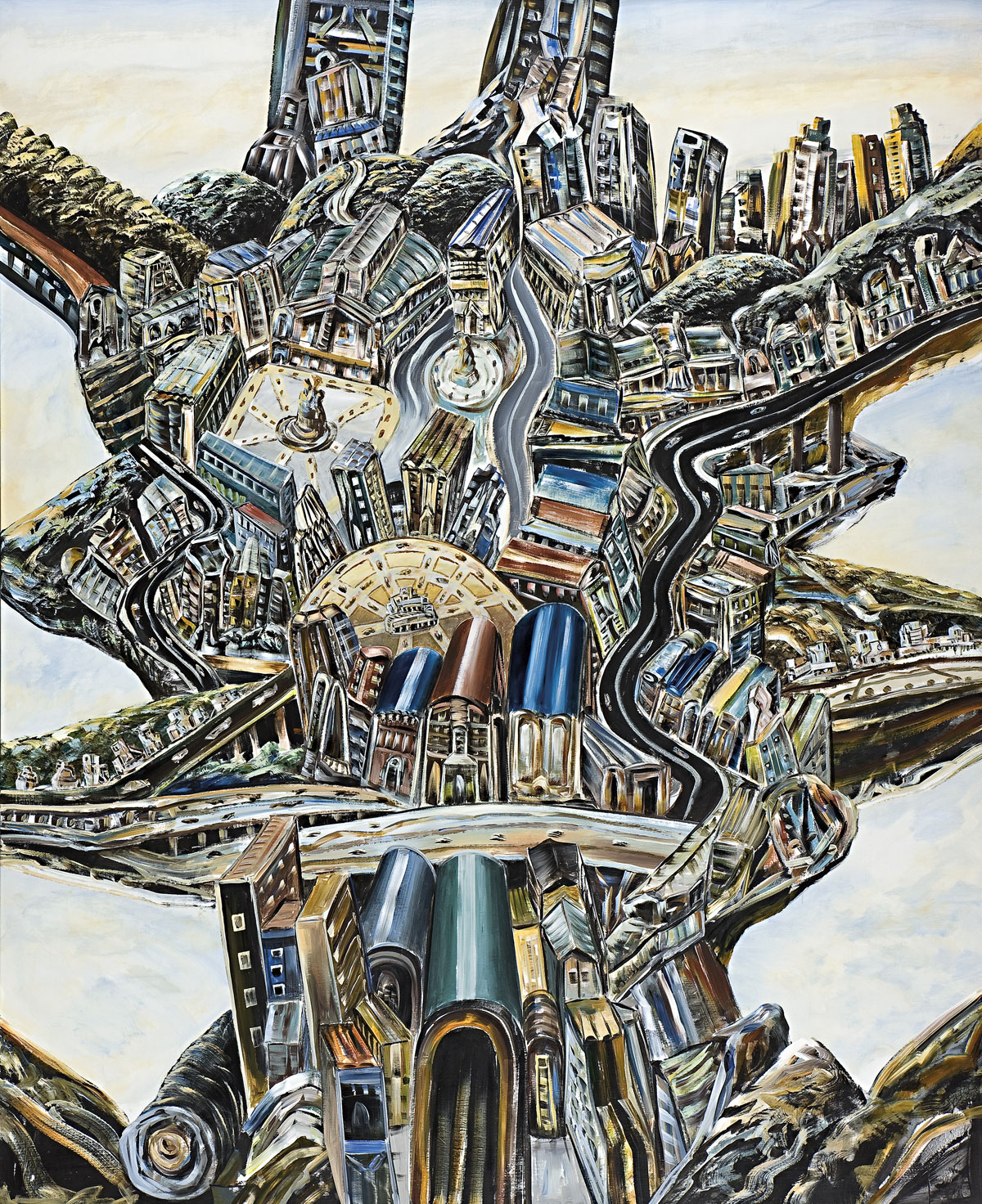
 

Jan Senbergs (born Latvia 1939, arrived Australia 1950, died Melbourne 2024) 'The elated city' 2009


Jan Senbergs (born Latvia 1939, arrived Australia 1950, died Melbourne 2024)
The elated city
2009
Synthetic polymer paint on canvas
239 x 196cm
Courtesy of the artist and Niagara Galleries, Melbourne
© Jan Senbergs


Figures and heads made from mechanistic and architectural elements was one of Senbergs’s earliest subjects. He returned to this motif recently in several monumental paintings, including Paolozzi’s city, 2010, and The elated city, 2009.
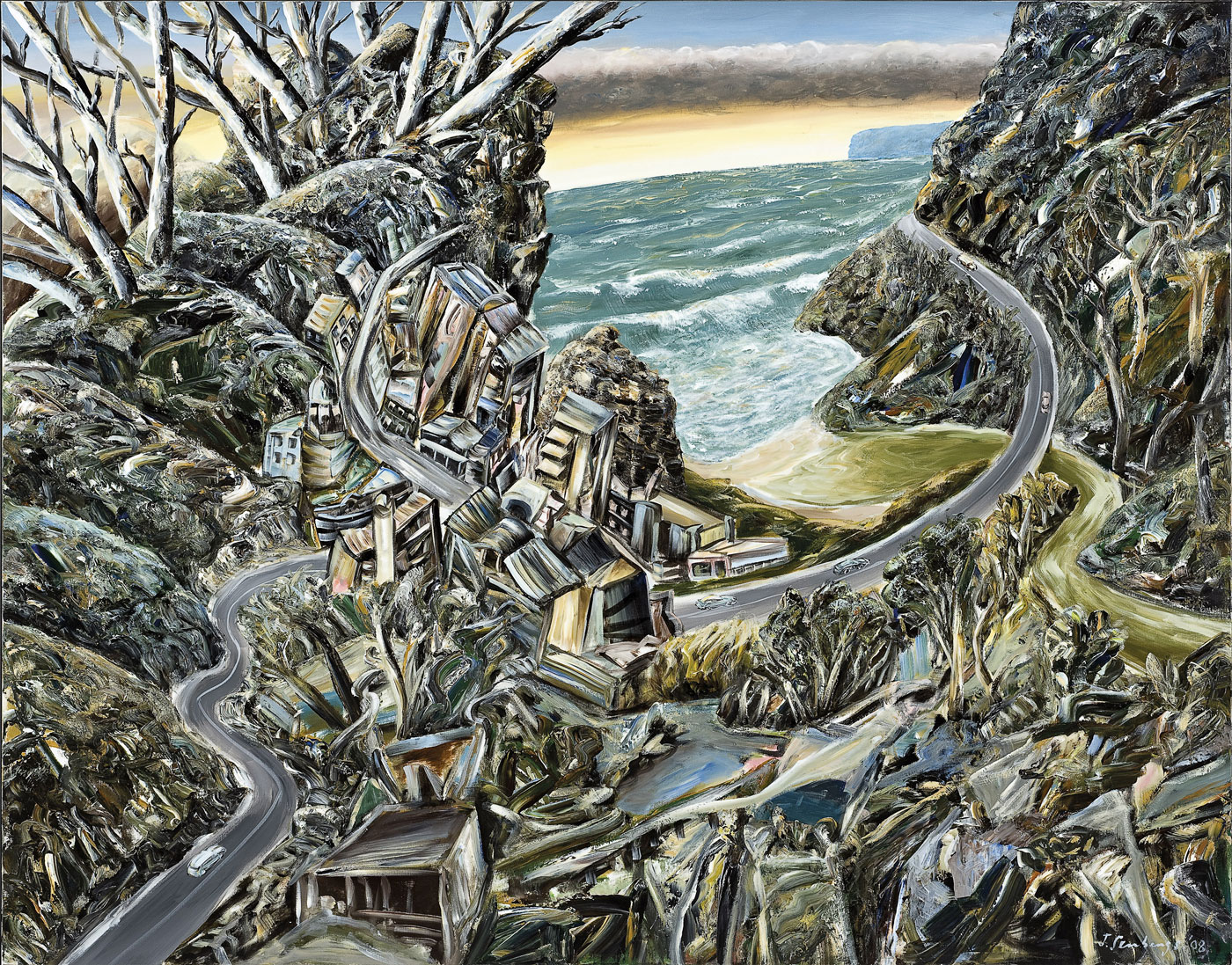
 

Jan Senbergs (born Latvia 1939, arrived Australia 1950, died Melbourne 2024) 'Coastal settlement' 2009


Jan Senbergs (born Latvia 1939, arrived Australia 1950, died Melbourne 2024)
Coastal settlement
2009
Synthetic polymer paint on canvas
169 x 216cm
Private collection, Melbourne
© Jan Senbergs


Jan Senbergs (born Latvia 1939, arrived Australia 1950, died Melbourne 2024) 'Melbourne capriccio 3' 2009


Jan Senbergs (born Latvia 1939, arrived Australia 1950, died Melbourne 2024)
Melbourne capriccio 3
2009
Synthetic polymer paint on canvas
195.2 x 184cm
National Gallery of Victoria, Melbourne
Purchased with funds donated by The Hugh D. T. Williamson Foundation, 2009
© Jan Senbergs


In the history of painting, a capriccio refers to an architectural fantasy where buildings and other architectural elements and places come together in imaginary settings. Senbergs’ Melbourne capriccio offers the viewer the pleasure of a bird’s-eye view of familiar landmarks, seen through a rich blend of memory and imagination.
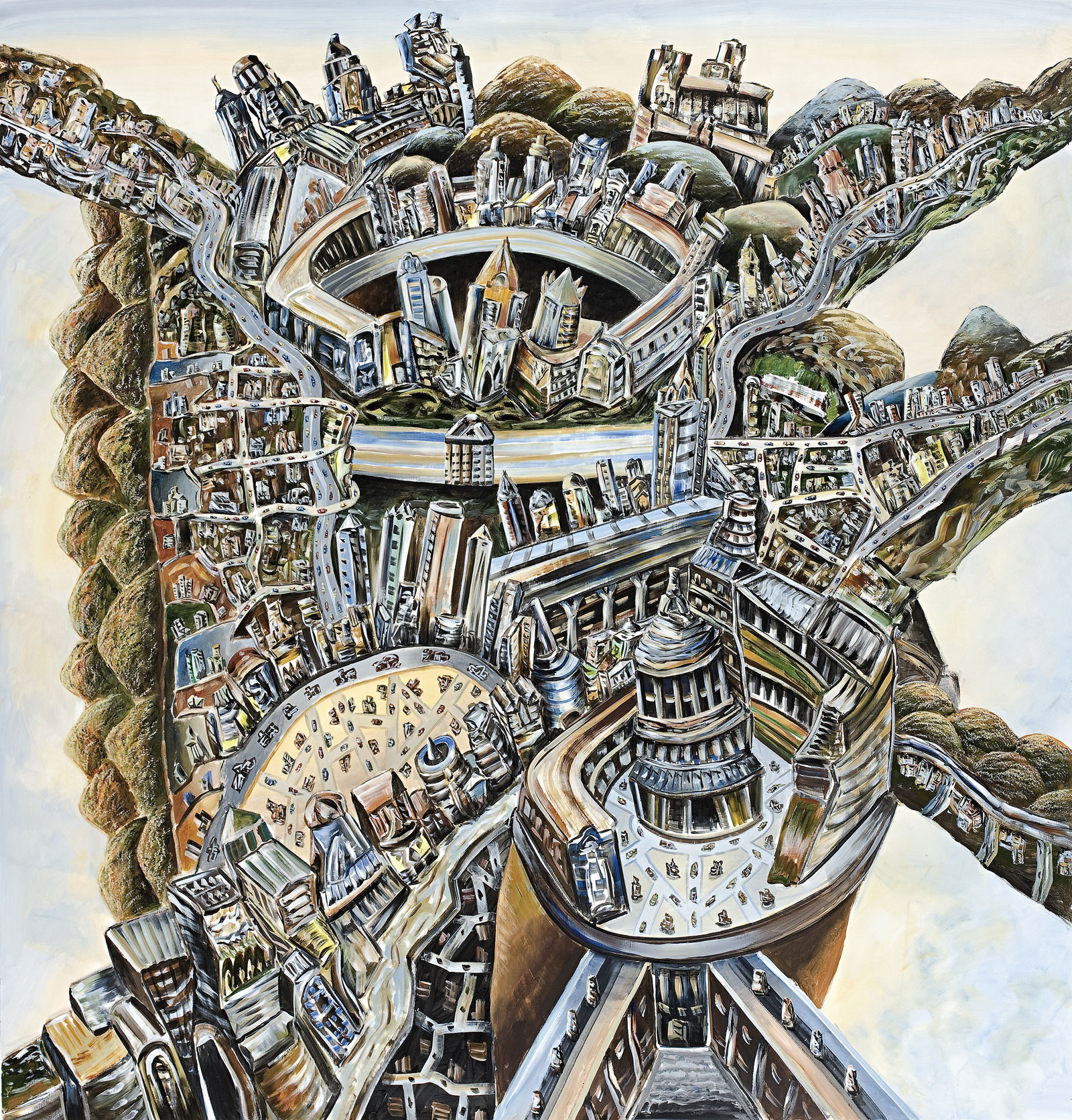
 

Jan Senbergs (born Latvia 1939, arrived Australia 1950, died Melbourne 2024) 'Paolozzi's city' 2010


Jan Senbergs (born Latvia 1939, arrived Australia 1950, died Melbourne 2024)
Paolozzi’s city
2010
Synthetic polymer paint on canvas
200.5 x 193.2cm
TarraWarra Museum of Art Collection
Acquired 2011
© Jan Senbergs


As a young artist in the 1960s, Senbergs greatly admired Scottish Pop artist Edouardo Paolozzi’s strange fusions of machine and organic forms, and explored similar ideas in his own paintings and screen prints. In Paolozzi’s city Senbergs has created a fantastical head out of buildings and roads, and pays homage to one of his first artistic heroes.
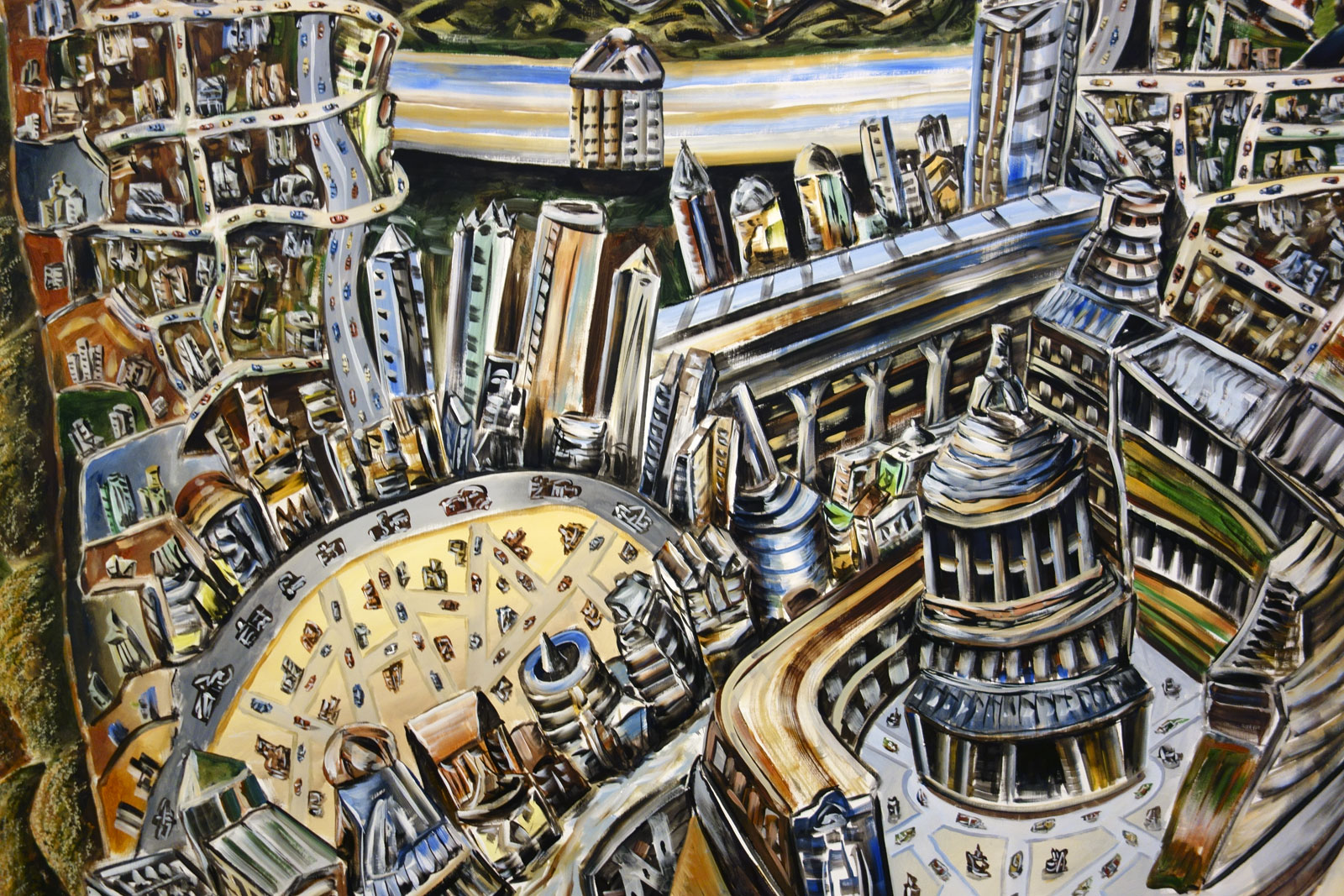
 

Jan Senbergs (born Latvia 1939, arrived Australia 1950, died Melbourne 2024) 'Paolozzi's city' 2010 (detail)


Jan Senbergs (born Latvia 1939, arrived Australia 1950, died Melbourne 2024)
Paolozzi’s city (detail)
2010
Synthetic polymer paint on canvas
200.5 x 193.2cm
TarraWarra Museum of Art Collection
Acquired 2011
© Jan Senbergs
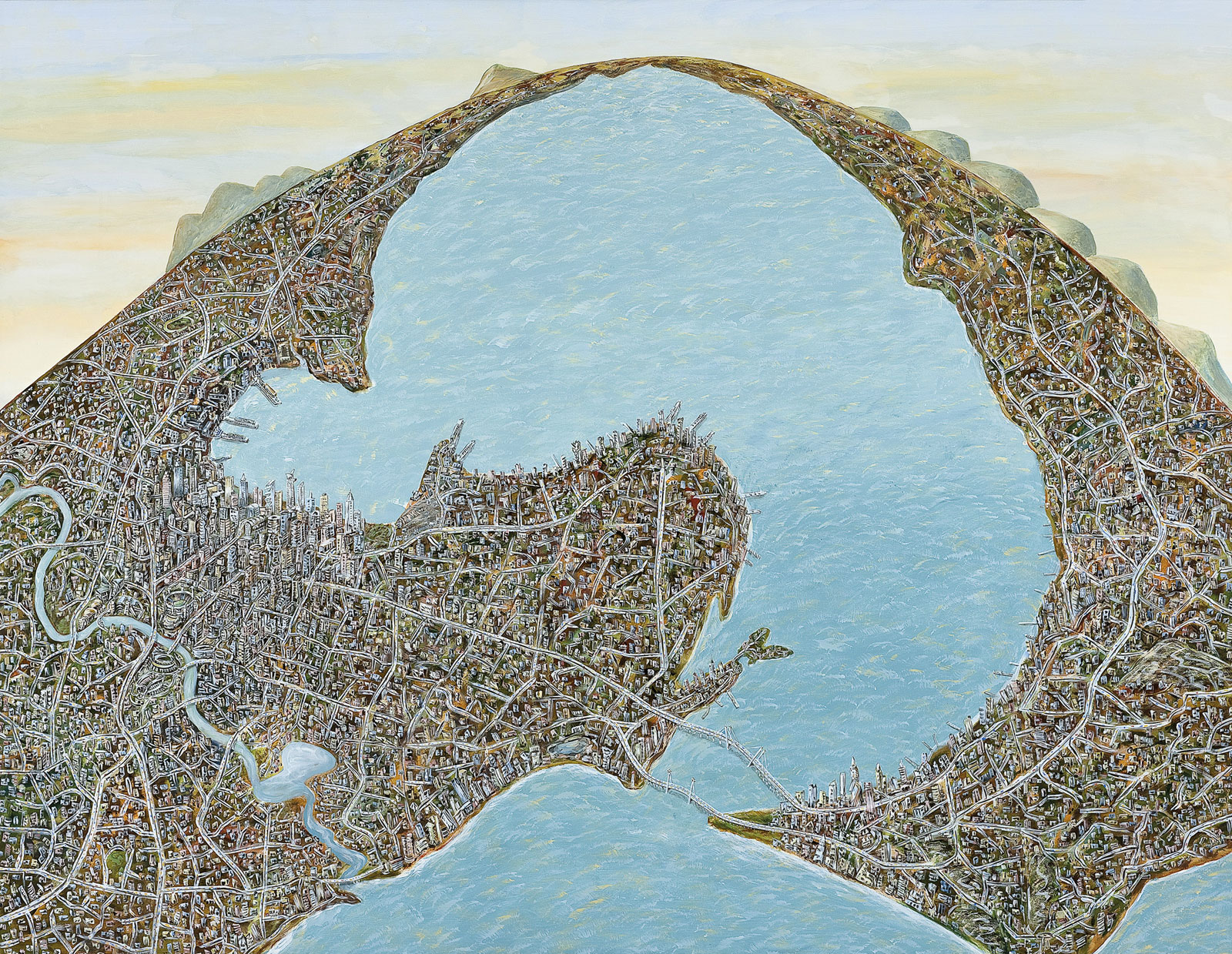
 

Jan Senbergs (born Latvia 1939, arrived Australia 1950, died Melbourne 2024) 'Geelong capriccio (if Geelong were settled instead of Melbourne)' 2010


Jan Senbergs (born Latvia 1939, arrived Australia 1950, died Melbourne 2024)
Geelong capriccio (if Geelong were settled instead of Melbourne)
2010
Synthetic polymer paint on canvas
197 x 255cm
Deakin University Art Collection
© Jan Senbergs
Image courtesy Niagara Galleries, Melbourne


“One of the rarest qualities in contemporary painting is wit … Jan Senberg’s ‘Geelong capriccio’ is in every way a painting of wit, its single and absurd proposition as to what the world would look like if Geelong had become the capital and the site of Melbourne remained open paddocks … It seems to be a very Antipodean painting: the upside-down world, which Europe imagined Australia to be, a place where anything might happen.”


Patrick McCaughey, 2010
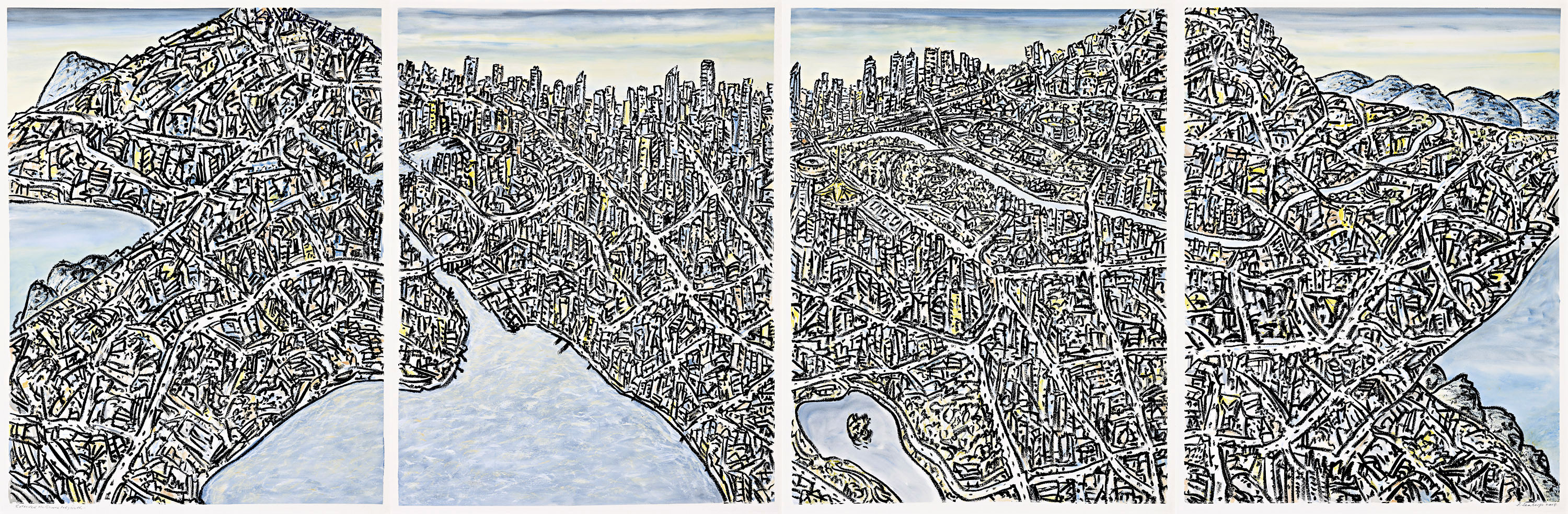


Jan Senbergs (born Latvia 1939, arrived Australia 1950, died Melbourne 2024) 'Extended Melbourne labyrinth' 2013


Jan Senbergs (born Latvia 1939, arrived Australia 1950, died Melbourne 2024)
Extended Melbourne labyrinth
2013
Oil stick, synthetic polymer paint wash
(a-d) 162.5 x 497.4cm (framed) (overall)
National Gallery of Victoria, Melbourne
Yvonne Pettengell Bequest, 2014
© Jan Senbergs
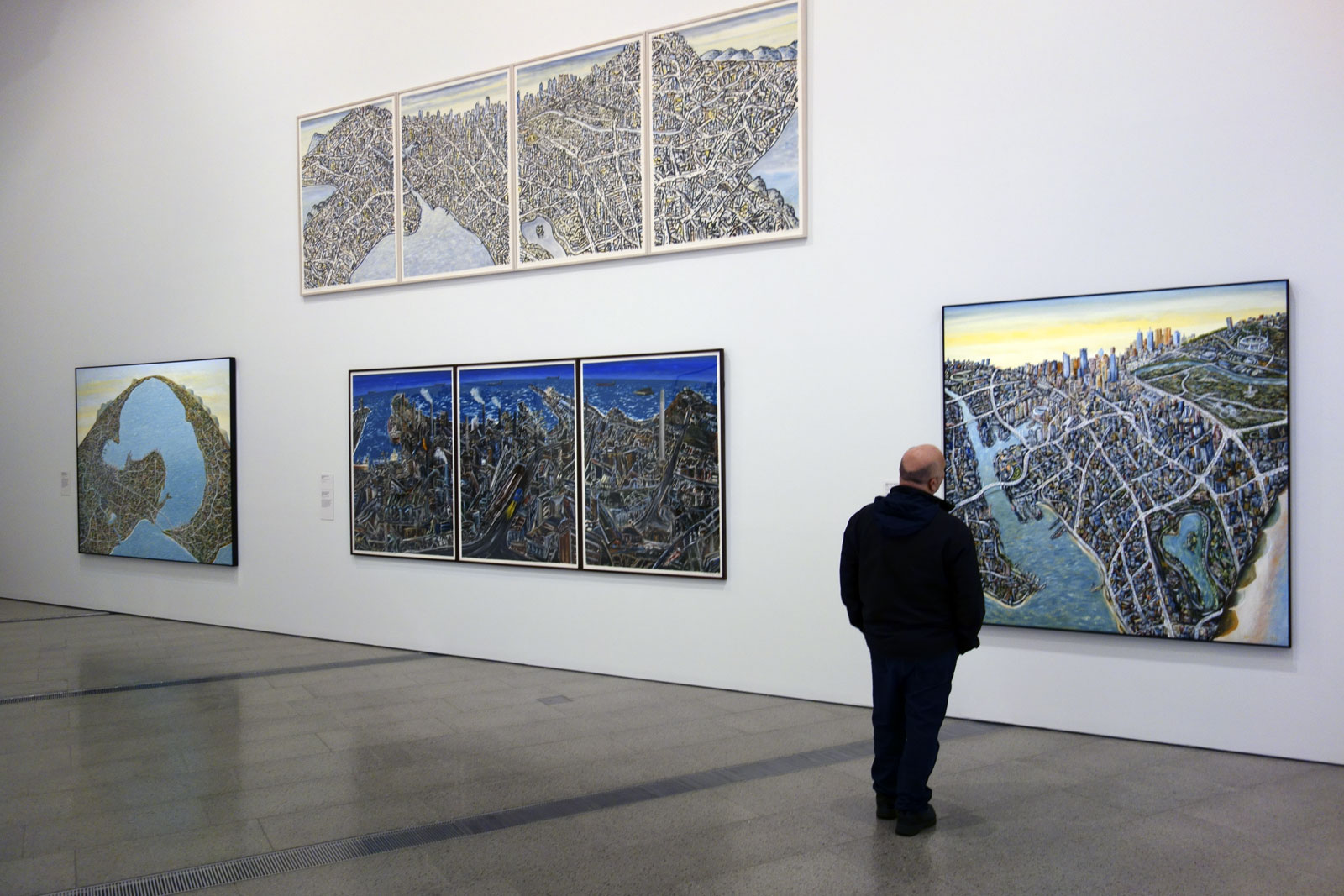
 

Installation view of the exhibition Jan Senbergs: Observation – Imagination at The Ian Potter Centre: NGV Australia showing at top, 'Extended Melbourne labyrinth' (2013, above); at left, 'Geelong capriccio (if Geelong were settled instead of Melbourne)' (2010, above); at right 'Melbourne capriccio 3'


Installation view of the opening room of the exhibition Jan Senbergs: Observation – Imagination at The Ian Potter Centre: NGV Australia showing at top, Extended Melbourne labyrinth (2013, above); at left, Geelong capriccio (if Geelong were settled instead of Melbourne) (2010, above); at right Melbourne capriccio 3
Photo: Marcus Bunyan
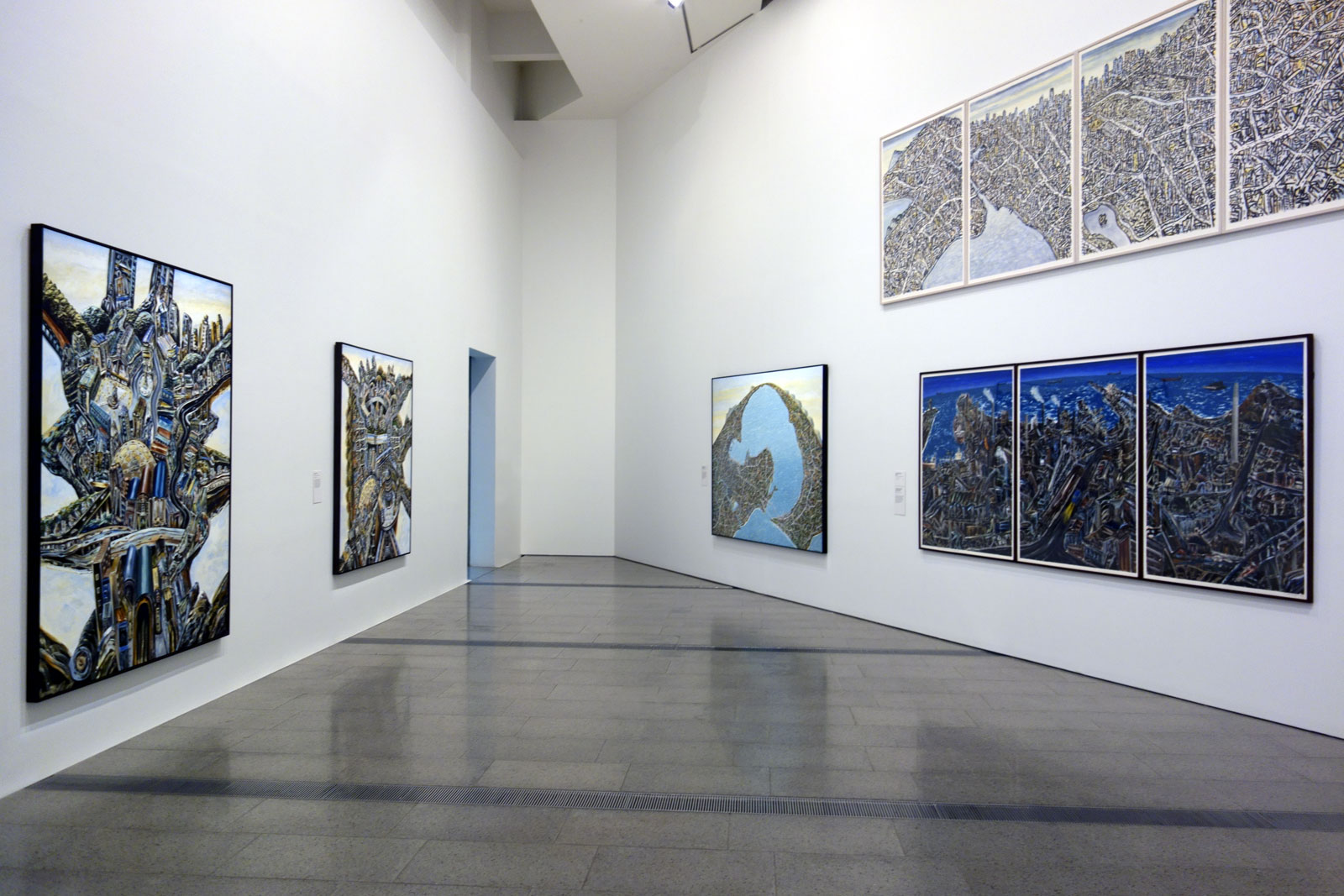
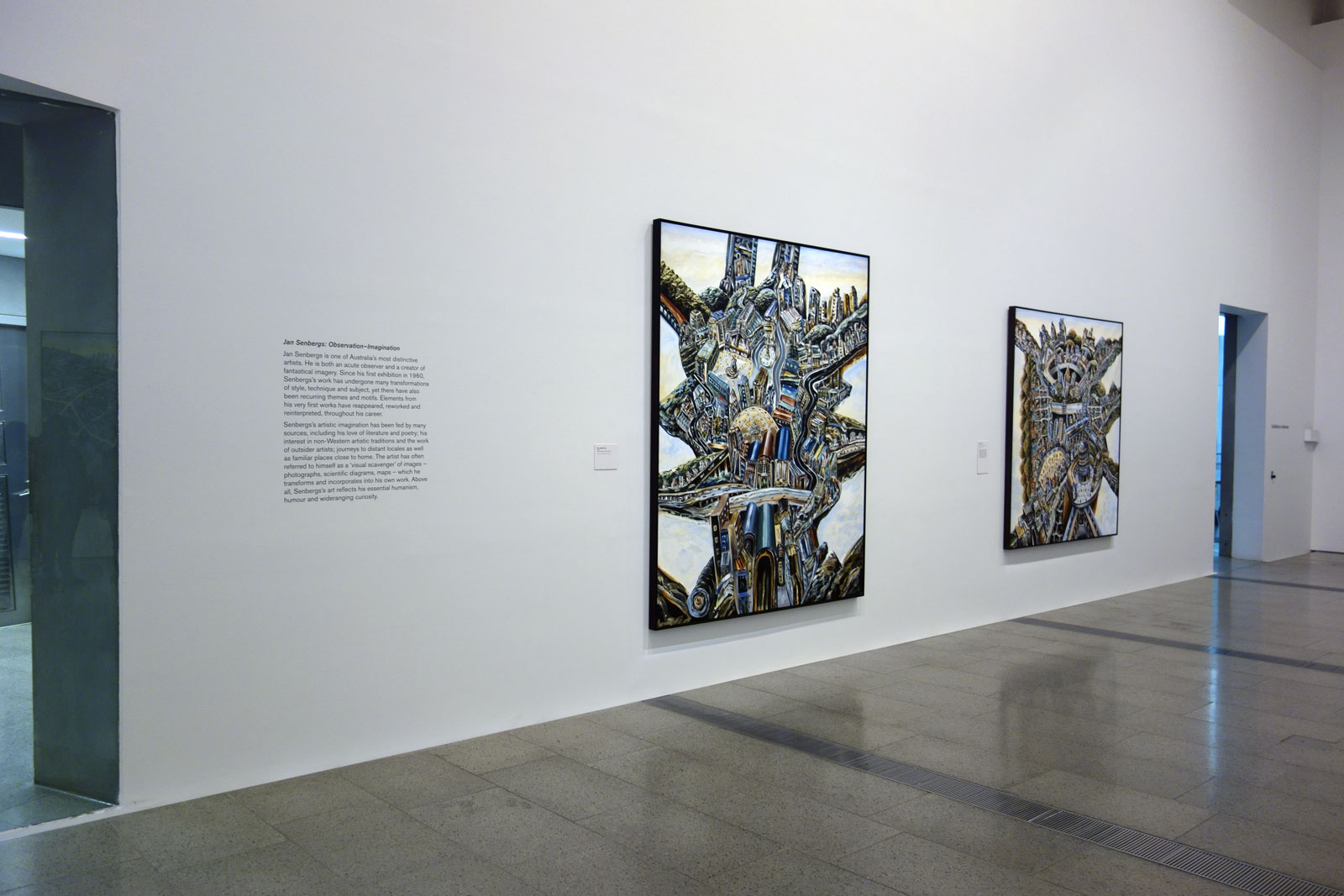
 

Installation view of the opening room of the exhibition 'Jan Senbergs: Observation – Imagination' at The Ian Potter Centre: NGV Australia showing at left in both images, 'The elated city' followed by 'Paolozzi's city'

Installation view of the opening room of the exhibition 'Jan Senbergs: Observation – Imagination' at The Ian Potter Centre: NGV Australia showing at left in both images, 'The elated city' followed by 'Paolozzi's city'


Installation views of the opening room of the exhibition Jan Senbergs: Observation – Imagination at The Ian Potter Centre: NGV Australia showing at left in both images, The elated city followed by Paolozzi’s city
Photo: Marcus Bunyan
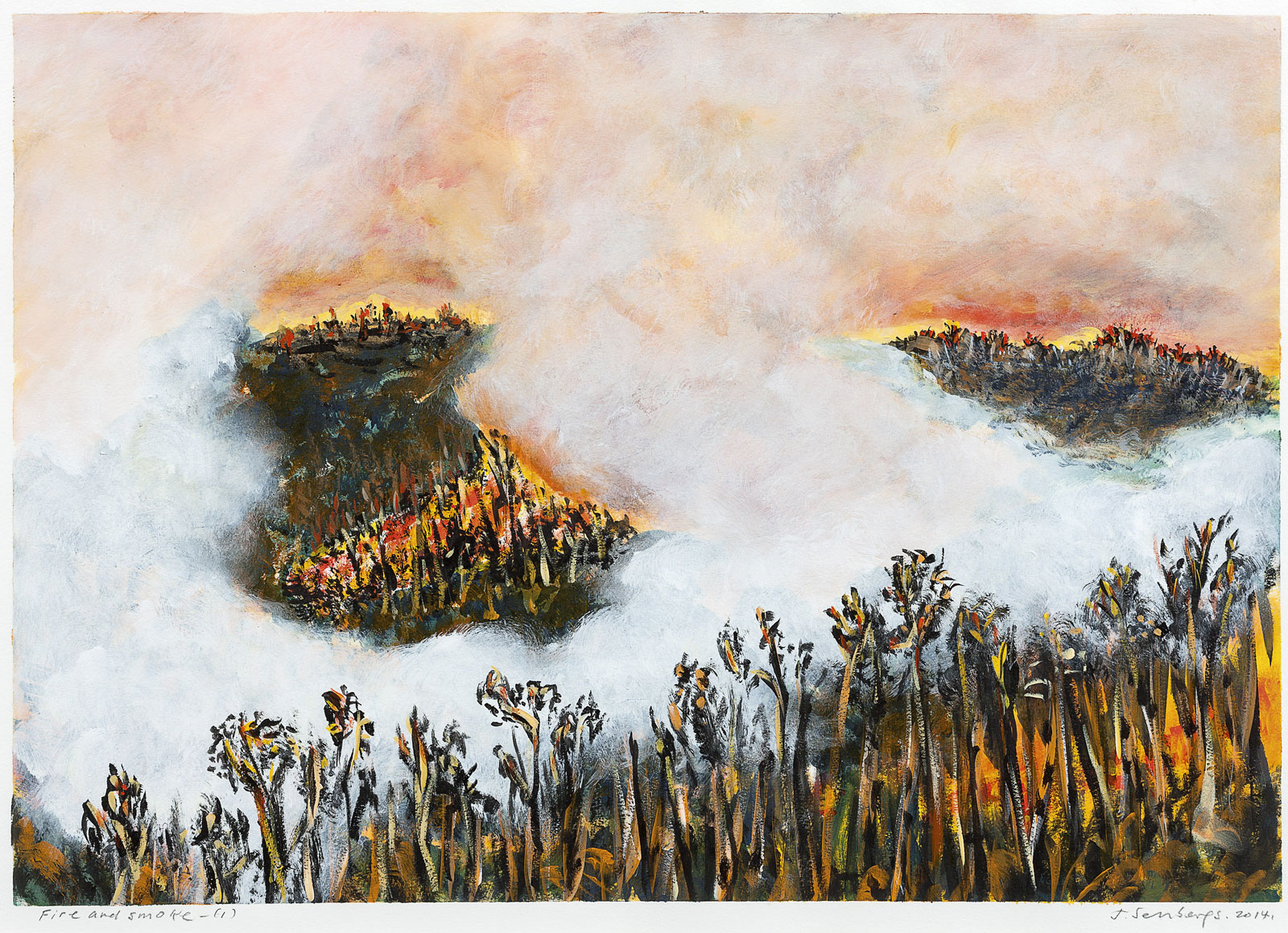
 

Jan Senbergs (born Latvia 1939, arrived Australia 1950, died Melbourne 2024) 'Fire and smoke' 1 2014


Jan Senbergs (born Latvia 1939, arrived Australia 1950, died Melbourne 2024)
Fire and smoke 1
2014
Synthetic polymer paint on paper
48 x 70cm (sheet)
Private collection, Melbourne
© Jan Senbergs
Image courtesy Niagara Galleries, Melbourne


In contrast to the enclosed, almost claustrophobic spaces of the studio interiors, by the end of the 1990s Senbergs had embarked upon a new series of map-like paintings, sprawling bird’s-eye view of cities, which continue to occupy him to the present day. Initially inspired by seeing Melbourne from a high-rise building, these works reflect the artist’s long fascination with early and non-Western map-making traditions. Like these maps, Senbergs’ views are not scientifically measured recordings; rather they are imaginative constructions of place based on observation and memory.

At the same time Senbergs began his most extensive group of landscapes, painting the rugged terrain of the Victorian west coast, an area that he knew well. While some of these works depict untouched wilderness, others include roads and townships and employ multiple perspectives to convey the experience of travelling through the landscape. Senbergs’ recent Heat – Fire – Smoke series is a response to the 2014 bushfires in Victoria, a new subject for the artist, in which he reflects on the cycle of destruction and regeneration. (Wall text from the exhibition)
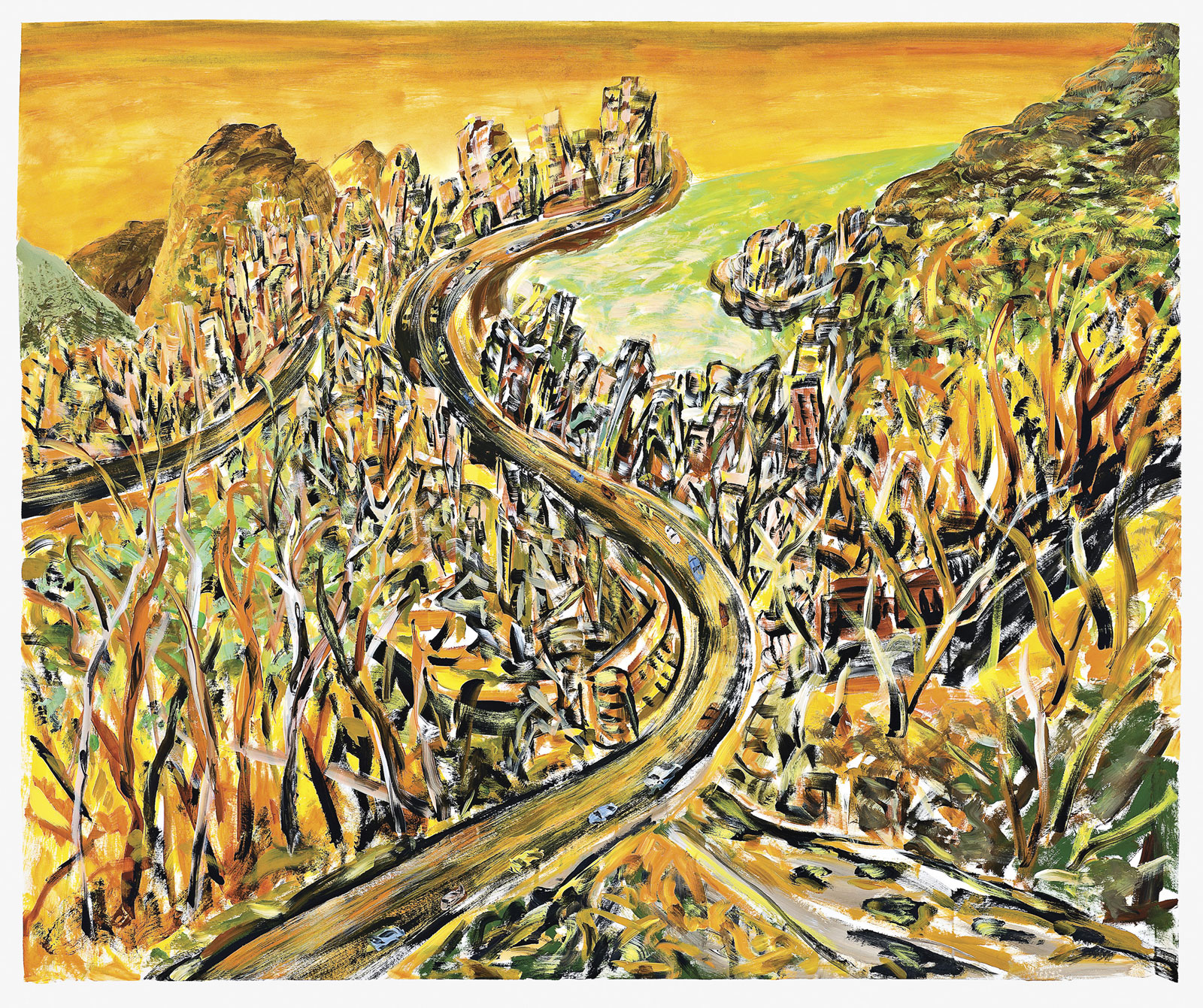
 

Jan Senbergs (born Latvia 1939, arrived Australia 1950, died Melbourne 2024) 'Code Red day 1' 2014


Jan Senbergs (born Latvia 1939, arrived Australia 1950)
Code Red day 1
2014
Synthetic polymer paint on paper
119.0 x 145.0cm
Private collection, Melbourne
© Jan Senbergs


“In January 2014 in Melbourne we had four days of forty-plus degrees of intense heat – with bushfires raging in the countryside casting a pall of acrid smoke over the extended city and all around ominous skies that seemed to portend an inferno that would be all engulfing. That oppressive atmosphere and that sense of threat at the edges of the extended city seemed as if an overwhelming and merciless force was at the gates and ready to break down the barricades.”

~ Jan Senbergs, 2015


The Ian Potter Centre: NGV Australia
Federation Square
Corner of Russell and 
Flinders Streets, Melbourne

Opening hours:
Daily 10am – 5pm
National Gallery of Victoria website

LIKE ART BLART ON FACEBOOK

Back to top

Exhibition: ‘Darron Davies: The Travellers’ at the Centre for Theology and Ministry, Melbourne

Exhibition dates: 9th April – 10th May, 2016


Darron Davies (Australian) 'Voyager' 2016 from the exhibition 'Darron Davies: The Travellers' at the Centre for Theology and Ministry, Melbourne, April - May, 2016


Darron Davies (Australian)
Voyager
2016
From the series The Travellers
Pigment print


I opened this exhibition for Darron Davies at the Centre for Theology and Ministry, Melbourne. I can’t remember exactly what I said but it went something like this…

When artists find themselves on a path to new ways of seeing the world, to new forms of enlightenment, then that is a magical and energising place to be. And so it is with this new body of work by Darron Davies. A path of many patterns and possibilities.

I spoke of synaesthesia – the production of a sense impression relating to one sense or part of the body by stimulation of another sense or part of the body. Here, colour and form produce music. As in Messiaen’s music, rather than being a decorative element Davies shows that colour can be a structural, a fundamental element which is the material of the music itself. Little vibrations of energy (in the universe), are caught in time and space and brought forth into consciousness through colour.

I extemporised on the question – is the [origami] model immanent in the paper, or is the paper a blank slate to be written on by the creator? – by asking, are these images already in Davies’ mind before he creates them as a kind of subconscious previsualisation, before he looks through the camera lens, before he relies on the serendipity and happenstance to capture what emerges out of the ether. Does the artist’s consciousness bring forth what he needs to see as an artist so that he can recognise it as such, forms that are already buried in the structure of the cosmos itself.

Perhaps this recognition does allow the artist (and subsequently the viewer) to go on a journey, to travel into other realms of being, of existence, to probe the boundaries of what is possible and what is probable. This work is about just that – being in the world and transcending it, and recognising that we can exist between the phenomenal and the noumenal. As has been said of Joseph Cornell’s boxes, “They partake of both dream and reality, and of something else that doesn’t have a name. They tempt the viewer in two opposite directions. One is to look and admire… and the other is to make up stories about what one sees… Neither (way) by itself is sufficient. It’s the mingling of the two that makes up the third image.”1

The Thirdspace – in which “everything comes together… subjectivity and objectivity, the abstract and the concrete, the real and the imagined, the knowable and the unimaginable, the repetitive and the differential, structure and agency, mind and body, consciousness and the unconscious, the disciplined and the transdisciplinary, everyday life and unending history”2 – allows that none of these couples, such as the phenomenal and the noumenal, can be divided by an either-or attitude. “This… does not mean differences are denied, instead, it most of all means the inevitable reciprocity of any pair of definitions. In such a case both leave a mark on the other. It is a question of both-and – how each of the pair influences the other.”3 In the case of Davies’ work, this reciprocity allows the images to possess a multivalent narrative, which is neither here nor there. It allows the work to be accessible to different interpretations, meanings, and values: a new door or path opens up on the basis of very diverse needs and objectives. For the artist the possibilities are endless.

Dr Marcus Bunyan


Footnotes

1/ Simic, Charles. “First, there are,” in Dime Store Alchemy. New York: The Ecco Press, 1992, p. 60 quoted in Heaney, Seamus. The Redress of Poetry. Faber and Faber, London, 1995, p. 181.

2/ Soja, Edward W. Thirdspace. Malden (Mass.): Blackwell, 1996, p. 57 quoted in “Edward Soja” on the Wikipedia website [Online] Cited 01/05/2016.

3/ Hannula, Mika. “Third space – a merry-go-round of opportunity,” on the Kiasma Magazine website No 12 Vol 4, 2001 [Online] Cited 01/05/2016. No longer available online


Many thankx to Darron Davies for allowing me to publish the photographs in the posting. Please click on the photographs for a larger version of the image.


Darron Davies (Australian) 'Horizon' 2016 from the exhibition 'Darron Davies: The Travellers' at the Centre for Theology and Ministry, Melbourne, April - May, 2016


Darron Davies (Australian)
Horizon
2016
From the series The Travellers
Pigment print


Darron Davies (Australian) 'Unbridle' 2016


Darron Davies (Australian)
Unbridle
2016
From the series The Travellers
Pigment print


Darron Davies (Australian) 'Emanation' 2016


Darron Davies (Australian)
Emanation
2016
From the series The Travellers
Pigment print


Darron Davies (Australian) 'The Break' 2016


Darron Davies (Australian)
The Break
2016
From the series The Travellers
Pigment print


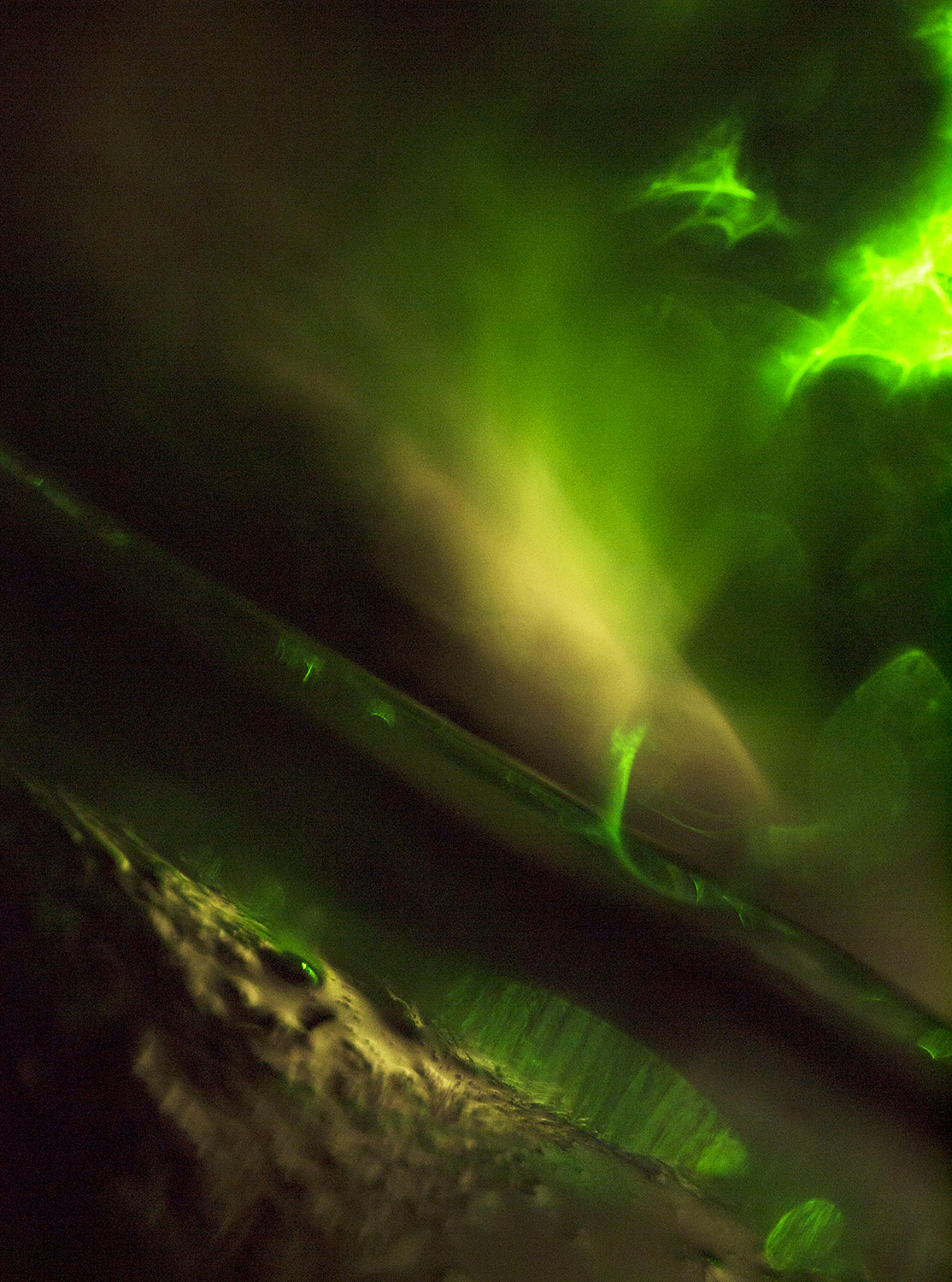
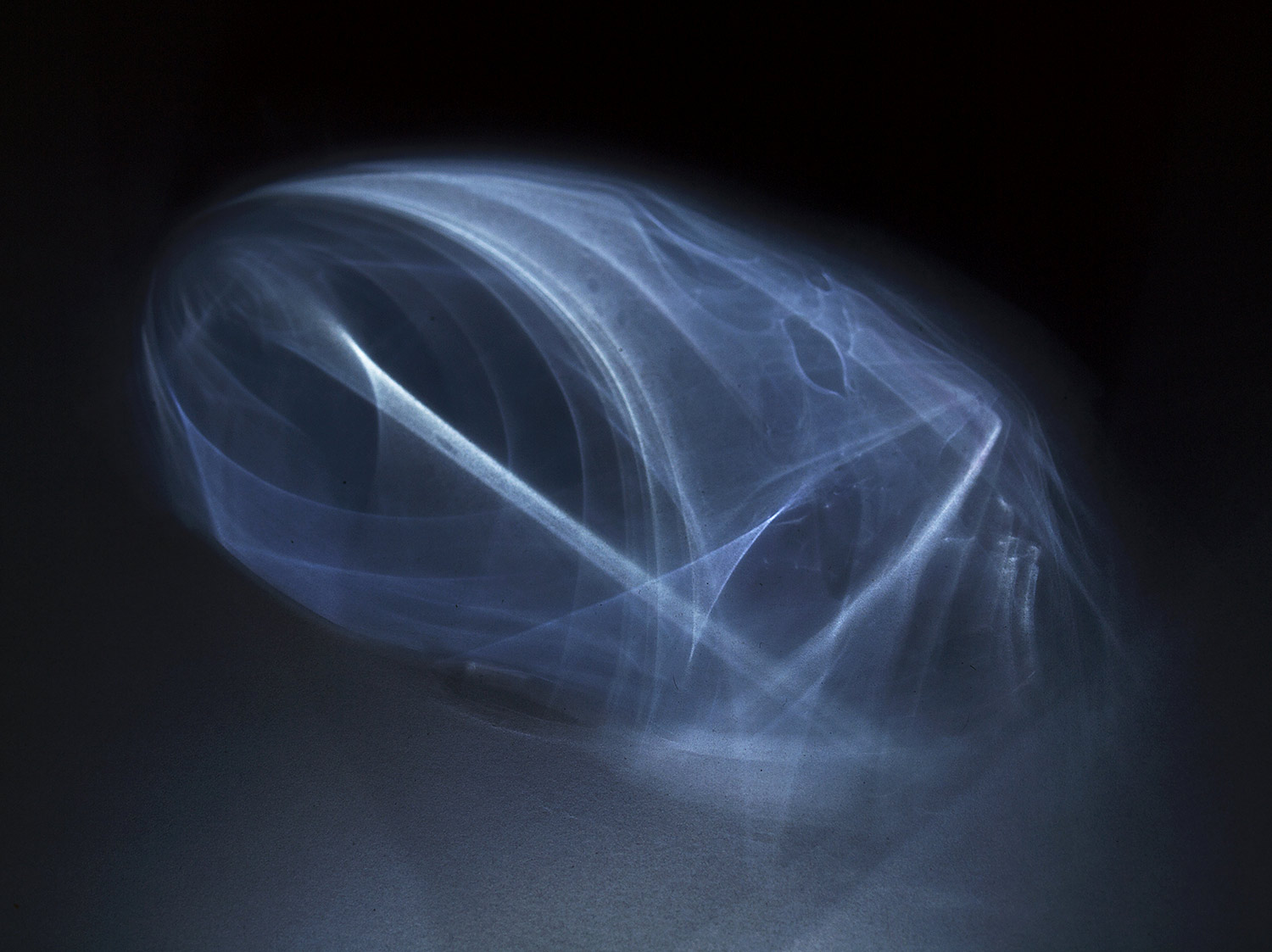
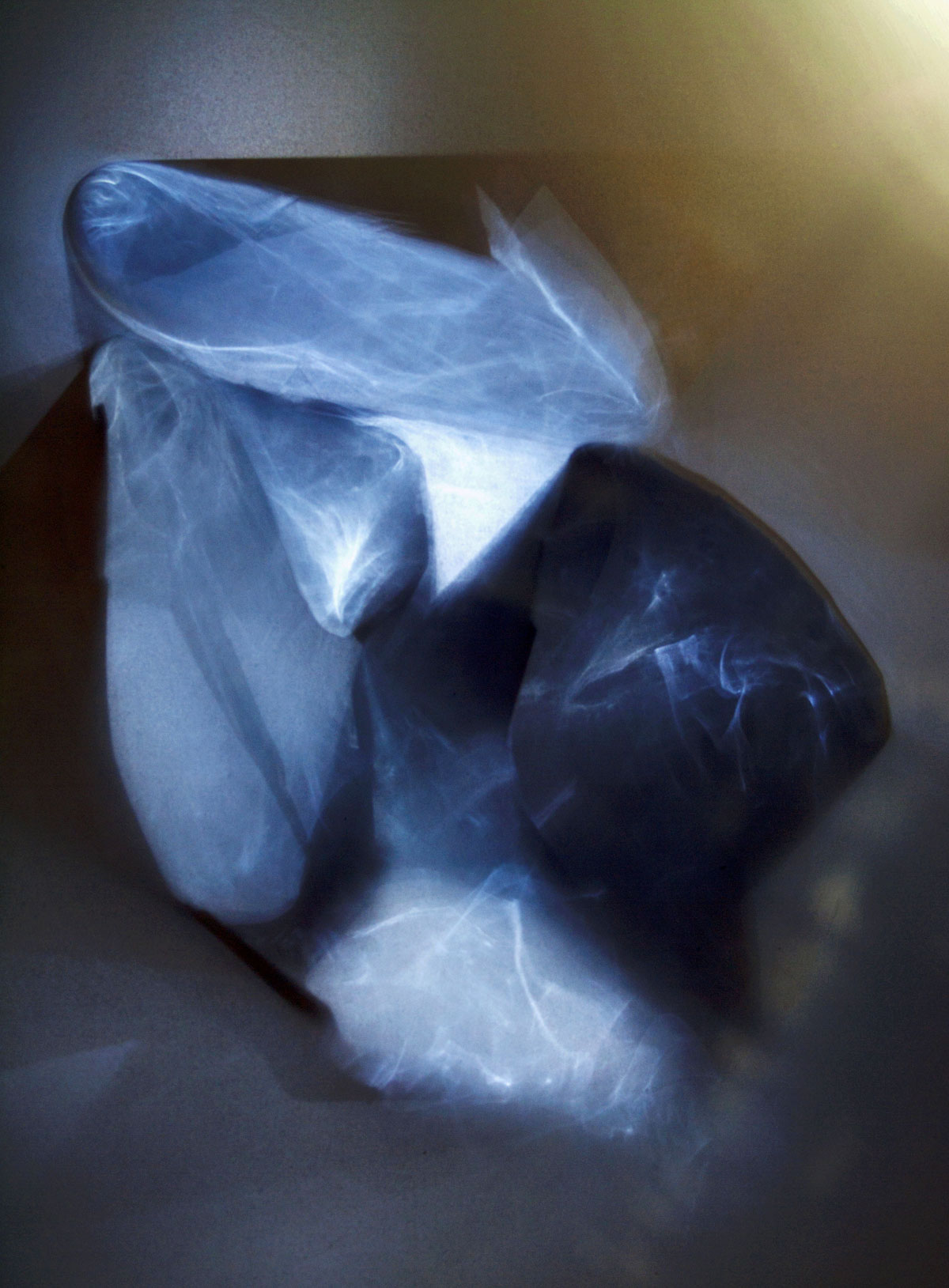
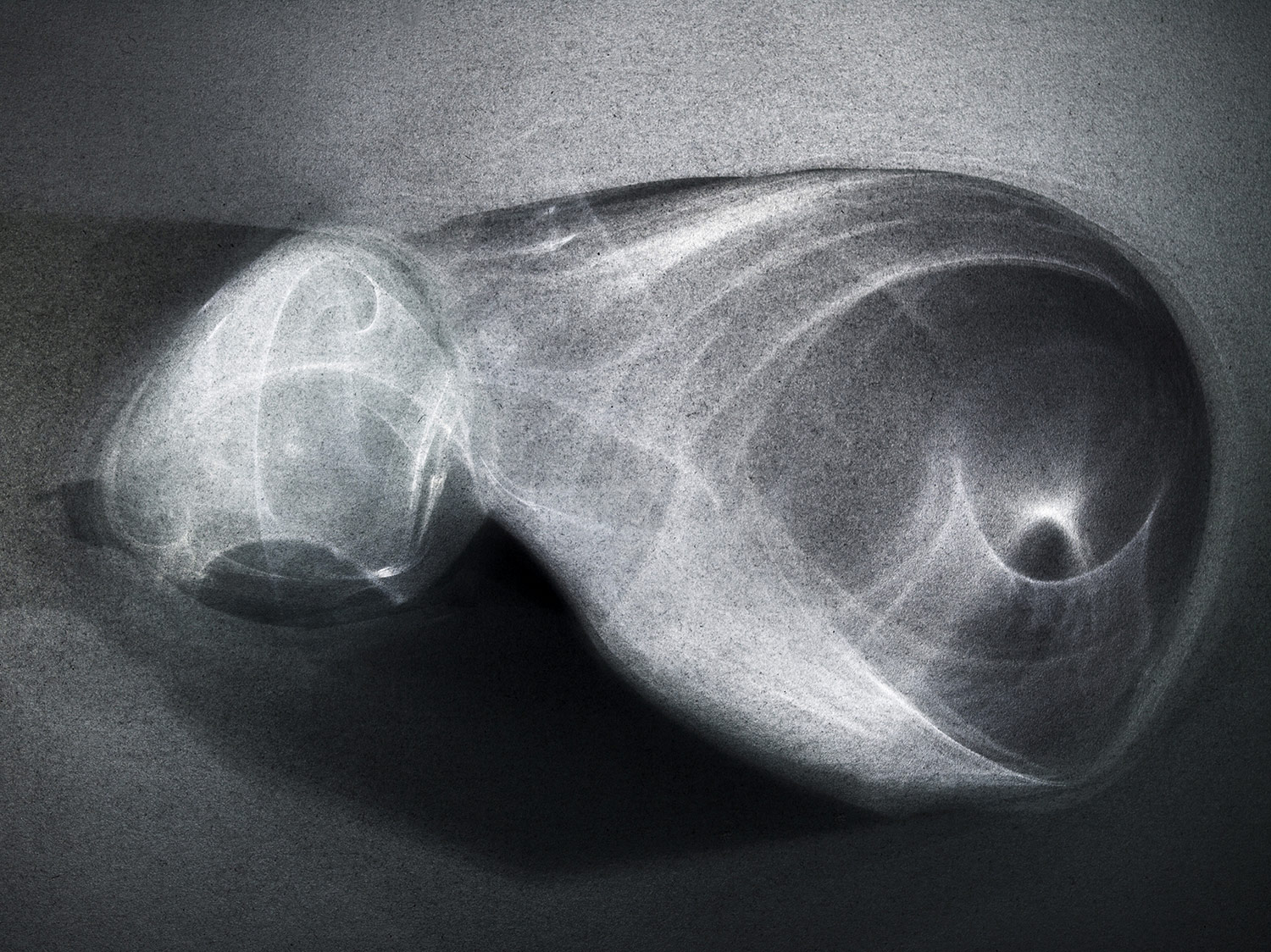
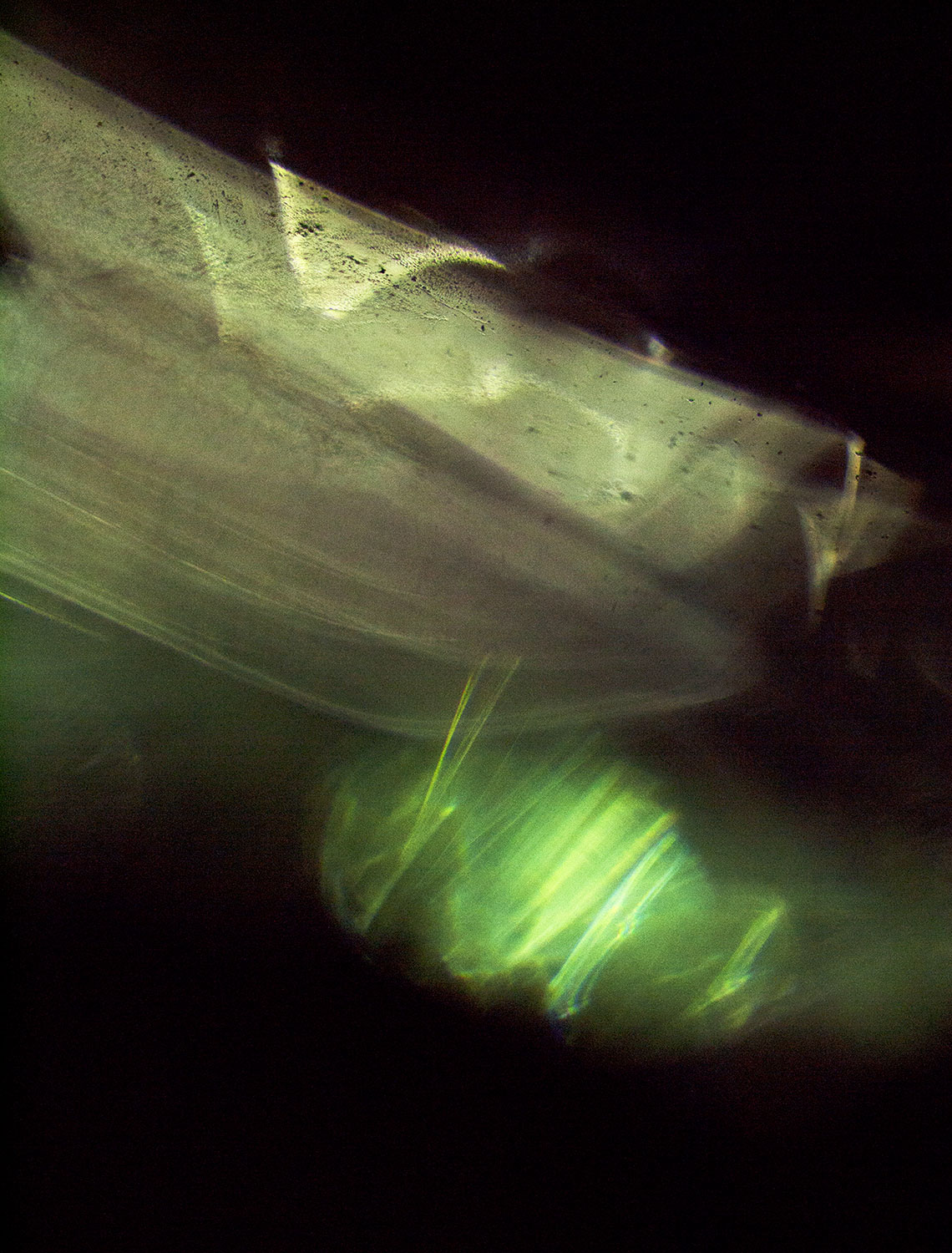
The Travellers is a series exploring light, in particular its abstractions as it passes through glass. Utilising a framework that supports glass sheets, a light, filters, and all manner of glass ranging from old ash trays to vases, I use a macro lens to focus on patterns created by the interaction of light. The prismatic effects are extraordinary. The narrow depth of field allows patterns to be further discovered within the glass.

Based on the experiments of photographers such as Wynn Bullock – his much under-recognised light abstraction work from 1959 to 1965 utilising similar experimentation – this project uses a digital camera to create fascinating landscapes. These landscapes in their variety of forms, at times volcanic, primordial, celestial, or atomic, are a metaphor for the ancient and current travellers – perhaps the subatomic world – that shape and have shaped our world.

Apart from slightly adjusting the blowing out of light caused by the delicate uneveneness of light within the macro image none of these images are highly photoshopped. What is captured is pretty much true to what is seen through the lens – an extraordinary world at play within light and colour fields. I have a heard the story that the experimental filmmaker Stan Brakhage once changed a film about the interior of a house to a pure focus of patterns that he found in ashtrays lying on a table. Fantastic! See the film The Text of Light. This is an interesting tradition embracing the likes of Brakhage, Bullock , Len Lye and the Cantrills.

At the discussion session after the premiere of his film The Text of Light at the Carnegie Institute, Pittsburgh in 1974, he (Brakhage) paraphrased the later English ‘Light Philosopher’ Robert Grosseteste: “all that sense can comprehend, is Light: because it partakes of that which it is. To comprehend dark, or a shape, it must withdraw from its own nature – it must withdraw or turn against its own electrical illuminating nature in order to comprehend a shape”.

Courtesy Cantrill’s Filmnotes, 21/22, (April 1975) photography. (Arthur was my lecturer at Melb State College in the early 80s and he and Corinne live now in Castlemaine, where I live, so have discussed these ideas on many occasions, as well as assisted them with their screenings).

Extract from the artist’s statement


Darron Davies (Australian) 'Manifest' 2016


Darron Davies (Australian)
Horizon
2016
From the series The Travellers
Pigment print


Darron Davies (Australian) 'Embodiment' 2016


Darron Davies (Australian)
Embodiment
2016
From the series The Travellers
Pigment print


Darron Davies (Australian) 'Guise' 2016


Darron Davies (Australian)
Guise
2016
From the series The Travellers
Pigment print


Darron Davies (Australian) 'Frame' 2016


Darron Davies (Australian)
Frame
2016
From the series The Travellers
Pigment print


Darron Davies (Australian) 'The Self Returning' 2016


Darron Davies (Australian)
The Self Returning
2016
From the series The Travellers
Pigment print


Darron Davies (Australian) 'Advent' 2016


Darron Davies (Australian)
Advent
2016
From the series The Travellers
Pigment print


Darron Davies (Australian) 'The Mainspring' 2016


Darron Davies (Australian)
The Mainspring
2016
From the series The Travellers
Pigment print


Darron Davies (Australian) 'Designer' 2016


Darron Davies (Australian)
Designer
2016
From the series The Travellers
Pigment print


The Centre for Theology and Ministry
29 College Crescent, Parkville,
Melbourne, Victoria
Phone: (03) 9340 8800

Gallery hours:
Monday to Friday 9am – 5pm (not weekends)

Centre for Theology and Ministry website

Darron Davies website

LIKE ART BLART ON FACEBOOK

Back to top

Review: ‘Ben Quilty: After Afghanistan’ at the Castlemaine Art Gallery and Historical Museum

Exhibition dates: 15th January – 15th April, 2016

Curator: Laura Webster, Curator of Art at the Australian War Memorial (AWM)


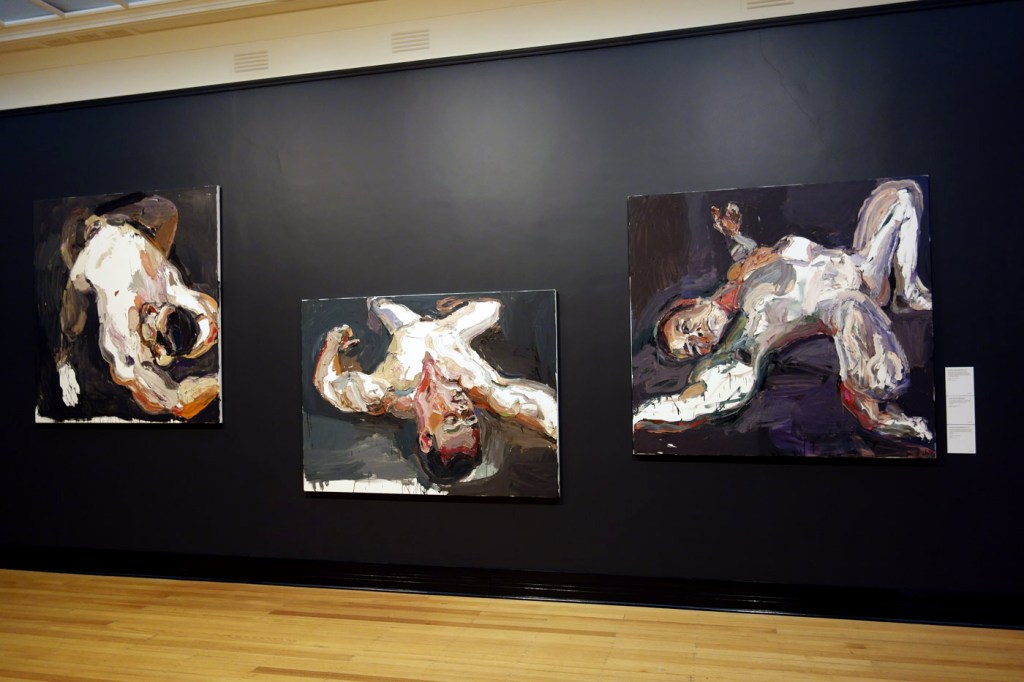
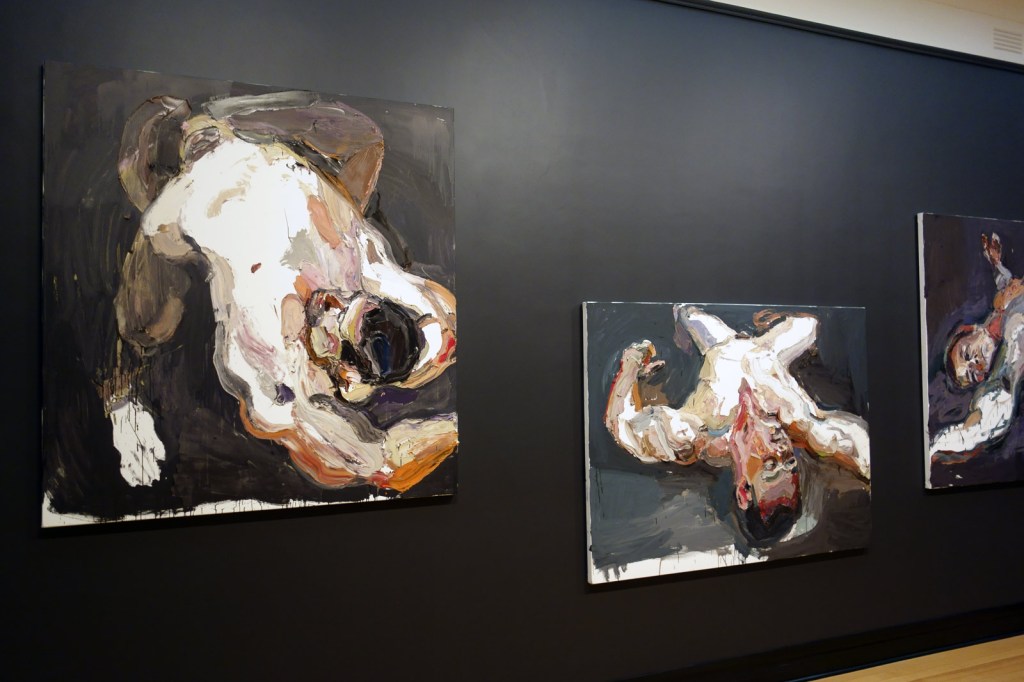
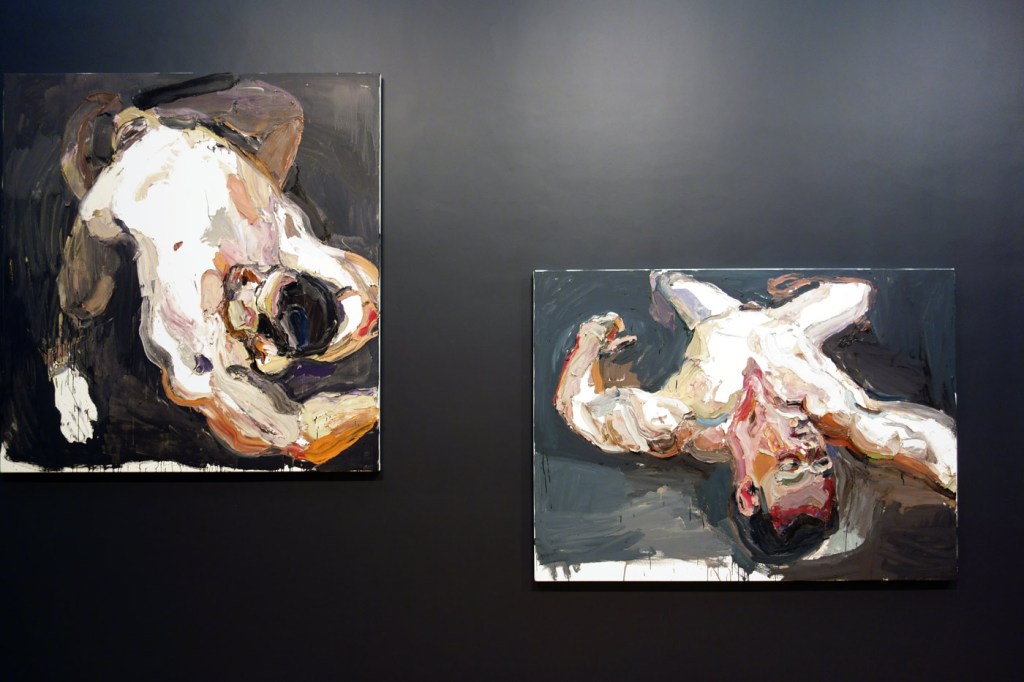
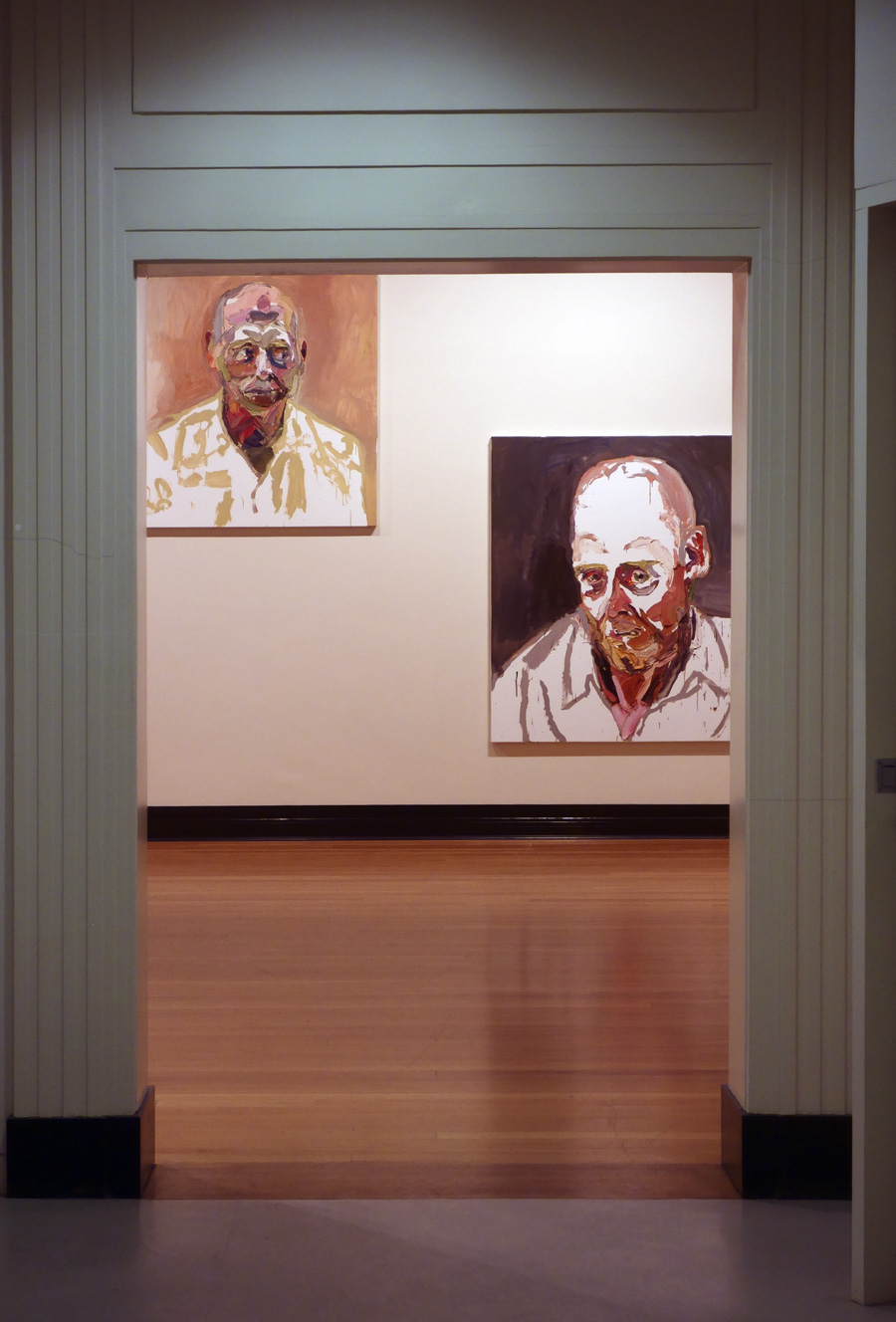
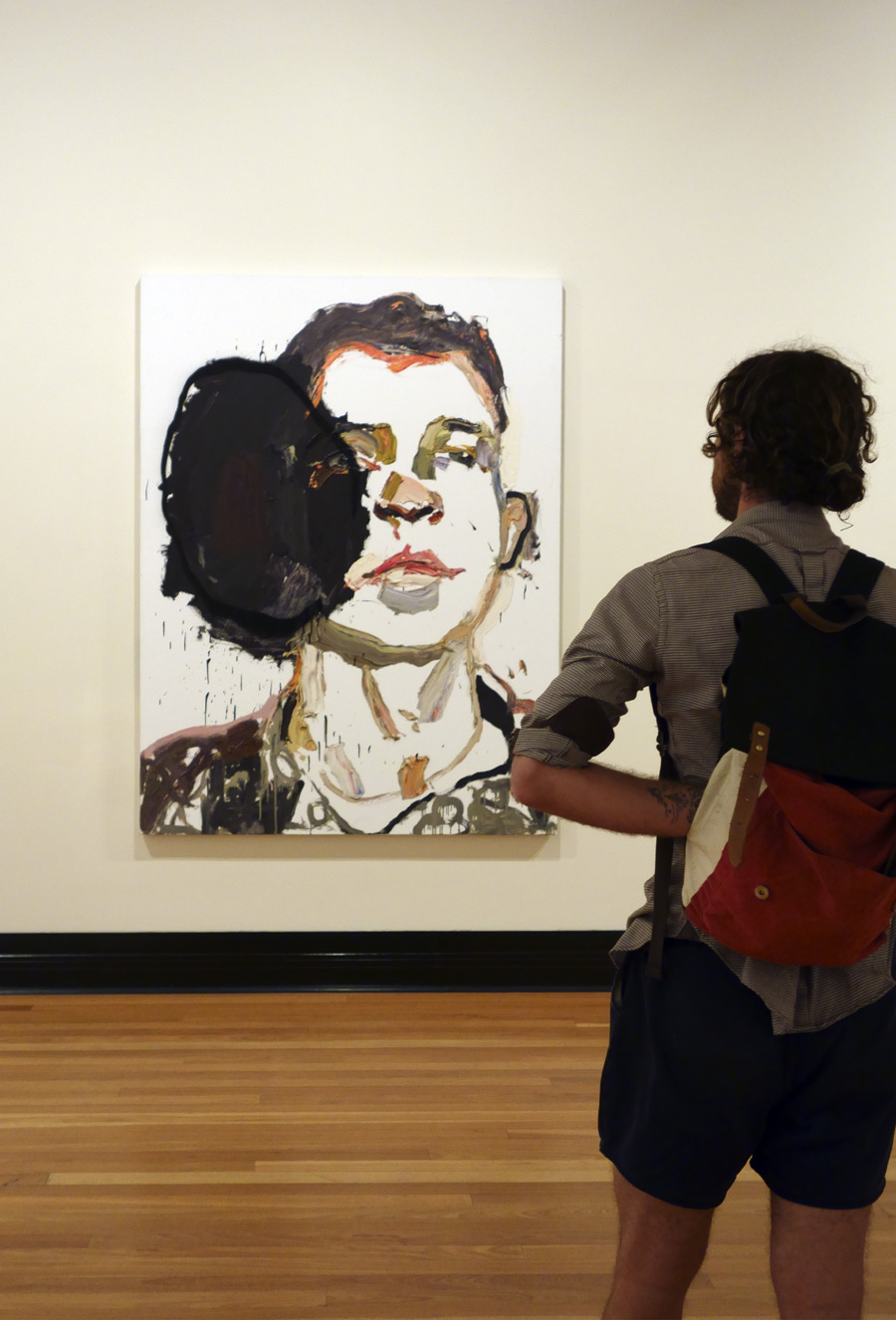
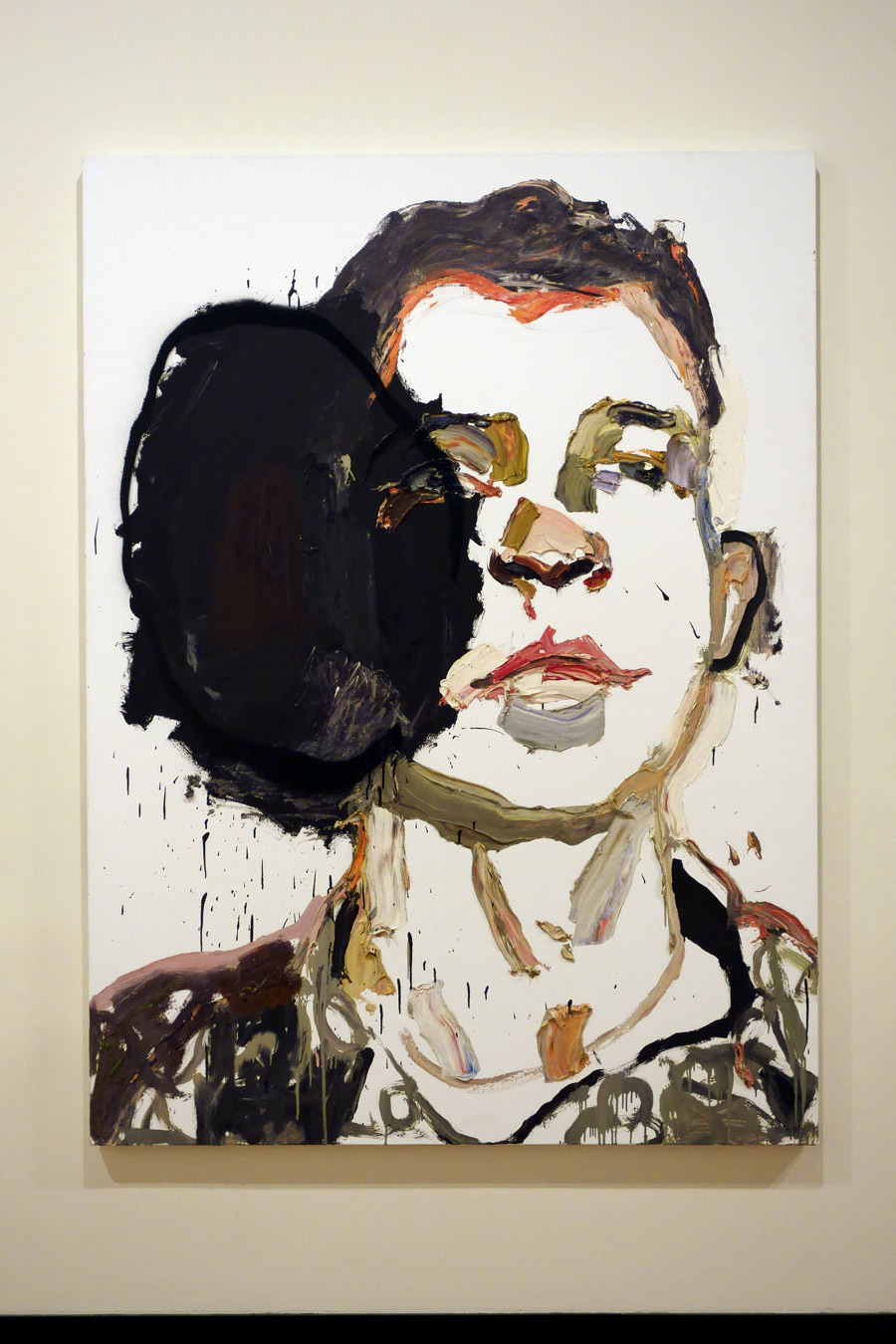
Installation view of the exhibition 'Ben Quilty: After Afghanistan' at the Castlemaine Art Gallery showing from left to right, 'Trooper M, after Afghanistan' (2012); and 'Trooper M, after Afghanistan, no. 2' (2012)


Installation view of the exhibition Ben Quilty: After Afghanistan at the Castlemaine Art Gallery showing from left to right, Trooper M, after Afghanistan (2012); and Trooper M, after Afghanistan, no. 2 (2012)
Photo: Marcus Bunyan


This is the most profound exhibition that I have seen so far this year. Simply put, the exhibition is magnificent … a must see for any human being with an ounce of understanding and compassion in their body.

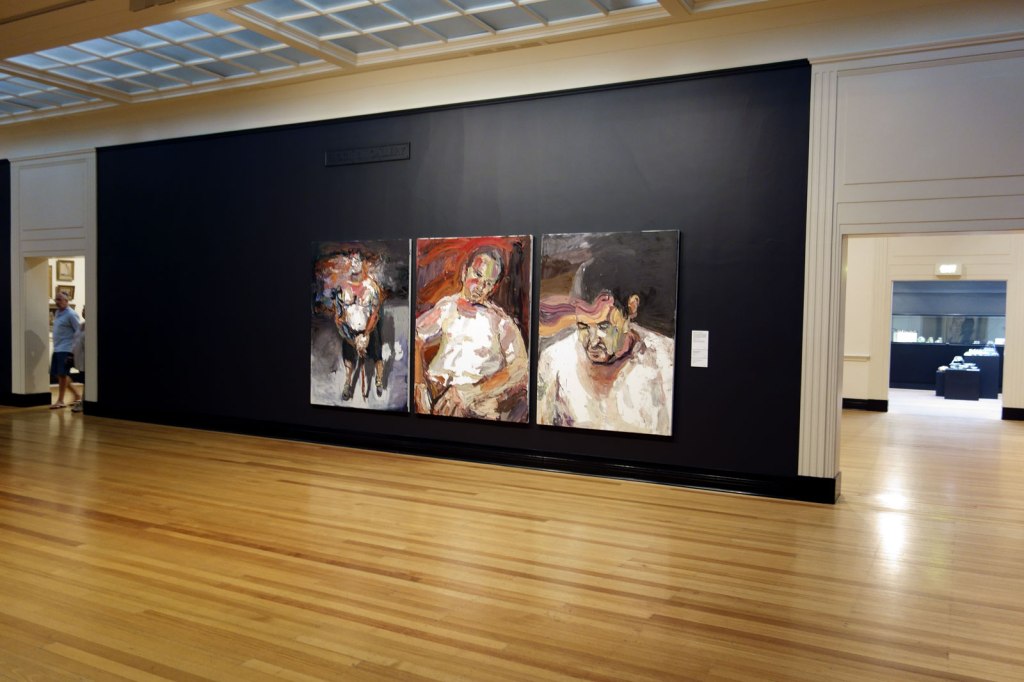
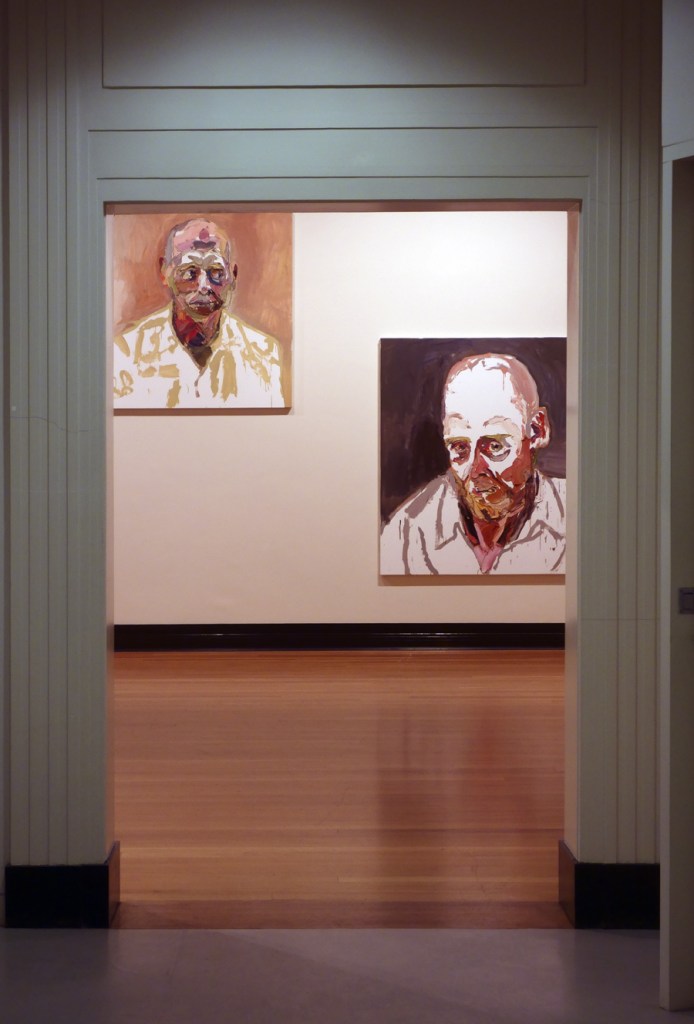
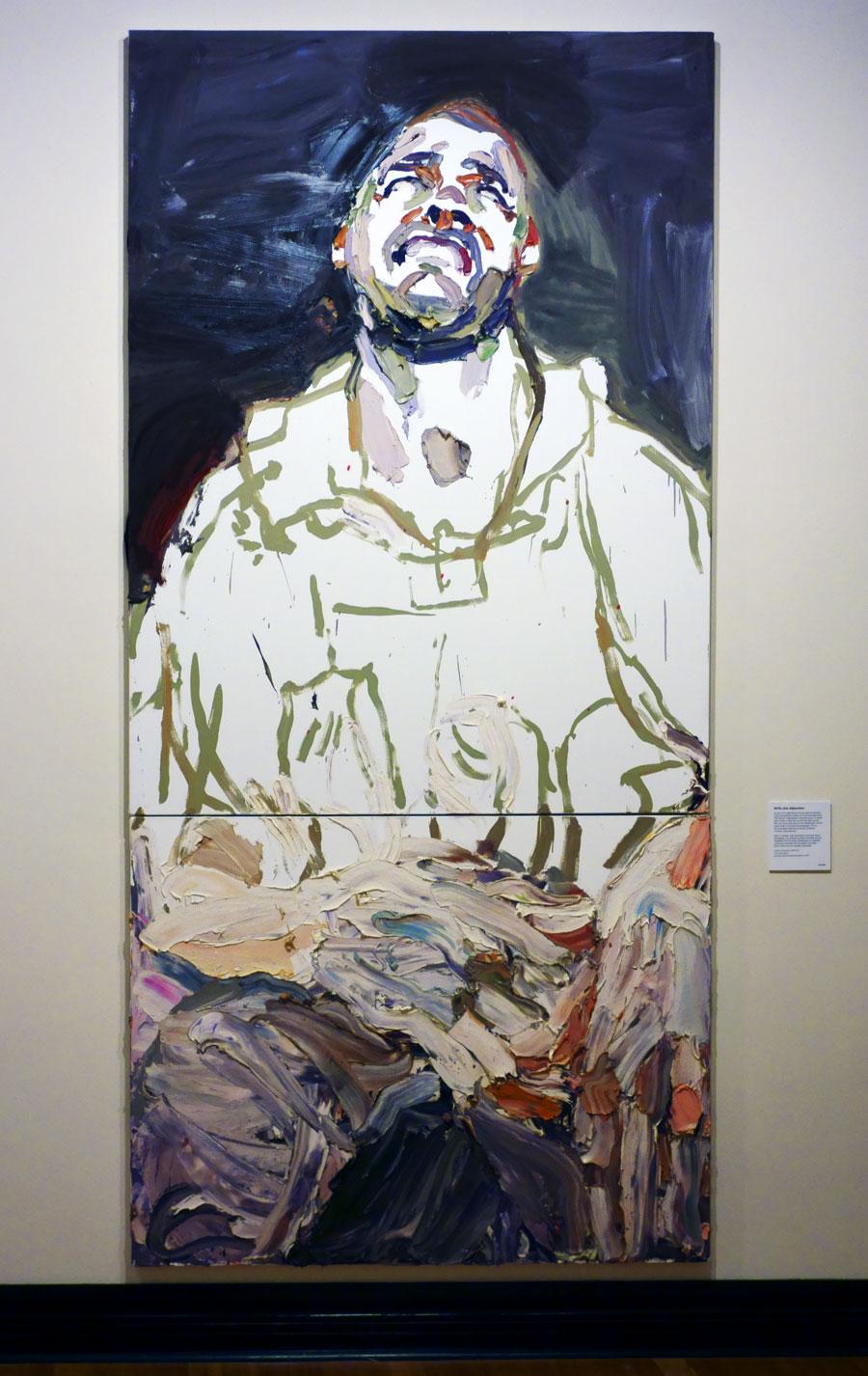
While I am vehemently anti-war, and believe that we should have never have been in Afghanistan in the first place, these sensual and skeletal paintings represent the danger that these soldiers exposed themselves to in the line of duty. The sensuousness and vulnerability of their solitary, contorted poses – poses which they themselves chose to for Quilty to paint – reflect an actual event, such as taking cover to engage insurgents. That these naked poses then turn out to have a quiet eroticism embedded in them confirms the link between eroticism, death and sensuality as proposed by Georges Bataille. The three forms of eroticism (physical, emotional, religious) try to substitute continuity (life) for discontinuity (death). In these paintings the soldiers lay bare their inner self. They bring forth experiences that have been buried – their dissociation from the reality of what occurred, the experiences they have repressed, the post-traumatic stress – brought to the surface and examined in these paintings through the re-presentation of suppressed emotions, through a form of emotional eroticism, a primordial rising of eroticism, death and sensuality. An affirming act of life over death.

As an artist, Quilty intimately understands this process. I think a strong element of this exhbition is the feeling that there is something missing, that the range of concerns is lacking something. I suspect this is deliberate. Something is being withheld. And what is being withheld in the paintings is, I believe, narrative.

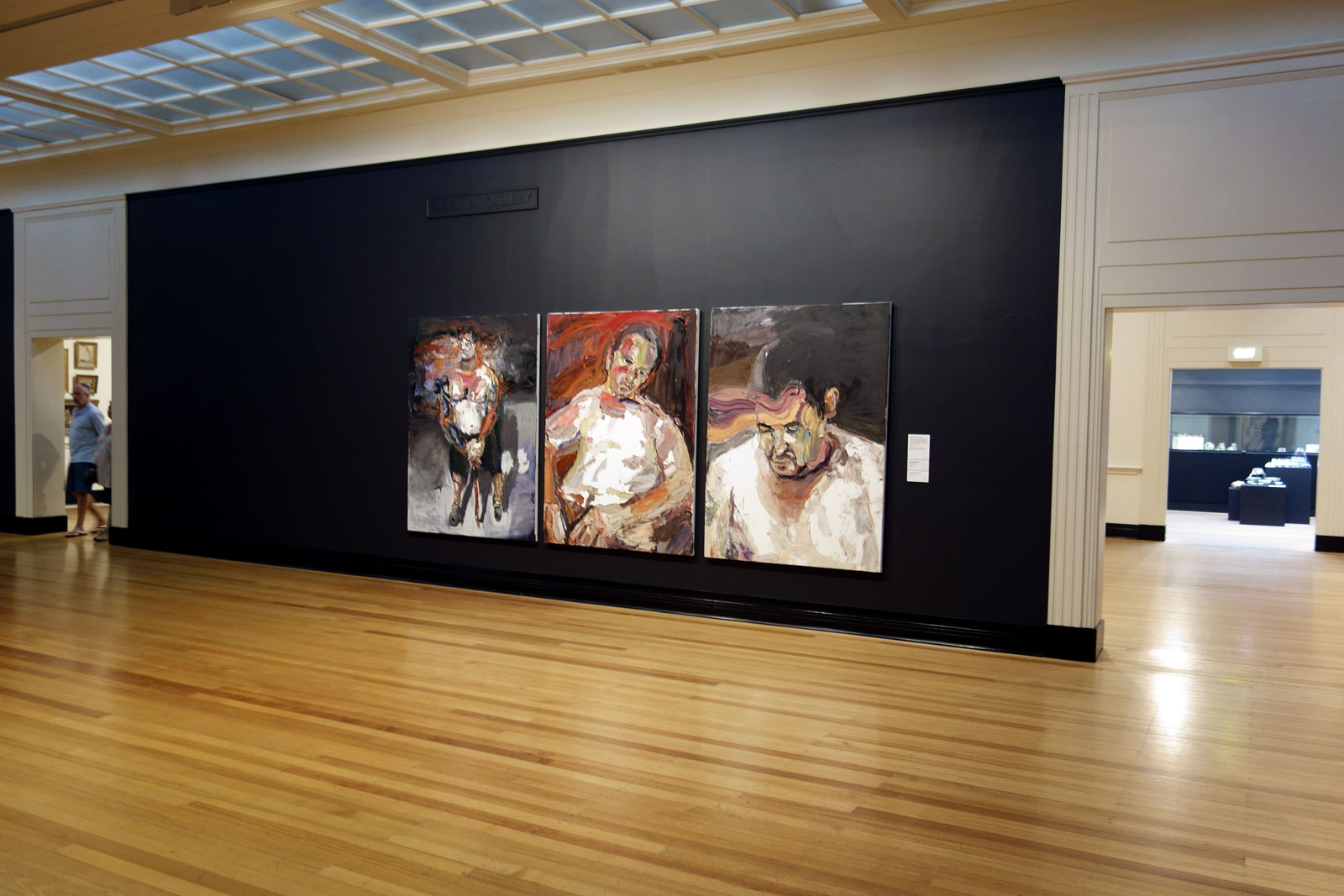
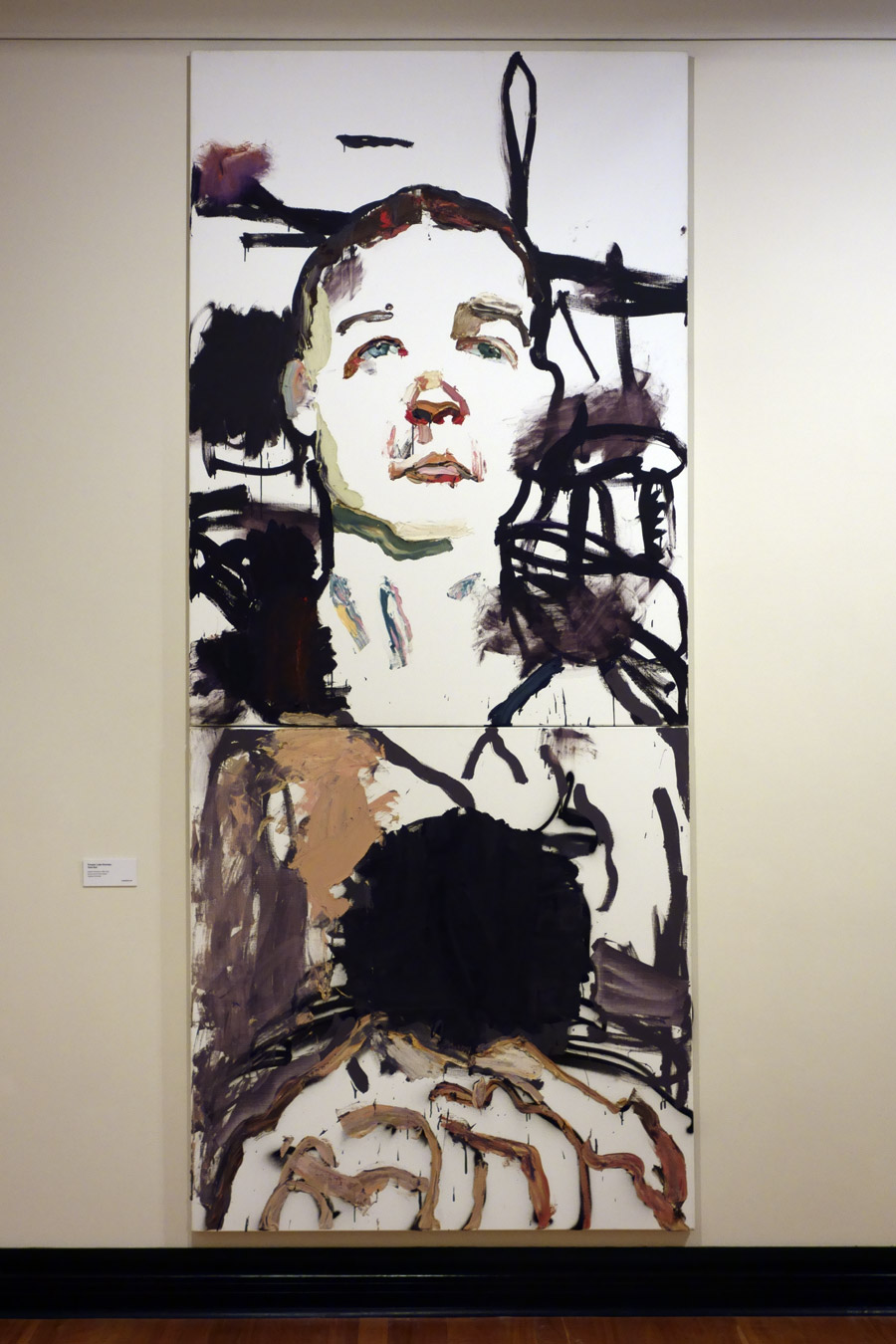
While there is an overarching text narrative – soldiers painted “after Afghanistan” – and individual paintings have titles such as Sergeant P, Troy Park, Trooper M and Trooper Daniel Westcott, these paintings could almost be of any human being who has been a soldier. Other than the specific triptych of Air Commodore John Oddie (and even then the portraits remind me of the ambiguity of Francis Bacon’s Study after Velázquez’s Portrait of Pope Innocent X, 1953), these paintings could be of any soldier. As Gerhard Ricther observes, “You can only express in words what words are capable of expressing, what language can communicate. Painting has nothing to do with that.” After Richter, you might say that “there is no plan”, there is only feeling in the work of Ben Quilty, embodied through his brush. Here, I see links to the work of that great British painter, Francis Bacon.

“Bacon was deeply suspicious of narrative. For him, narrative seems to be the natural enemy of vision; it blinds… Bacon seems to propose an opposition between narrative as a product that can be endlessly reproduced, as re-presentation – the ‘boredom’ is inspired by the deja vu of repetition – and narrative as process, as sensation. Conveying a story implies that a pre-existing story, fictional or not, is transferred to an addressee. Narrative is then reduced to a kind of transferable message. Opposed to this ‘conveying of story’, ‘telling a story’ focuses on the activity or process of narrative. This process is not repeatable; it cannot be iterative because it takes place, it happens, whenever ‘story’ happens… Bacon’s hostility toward narrative is directed against narrative as product, as re-presentation, not against narrative as process.
(Bacon) does not paint characters, but figures. Figures, unlike characters, do not imply a relationship between an object outside the painting and the figure in the painting that supposedly illustrates that object. The figure is, and refers only to itself.”1

The figure is, and refers only to itself, and it is up to the viewer to actively interpret this telling of the story each time they view one of Quilty’s paintings. There is no transferable message.

Further, much like Bacon’s triptychs, Quilty’s paintings depict isolated figures or figural events on the panels. The figures are isolated in their space and their is never any clear interaction between the figures. “Bacon explains the use of the triptych as follows: ‘It helps to avoid storytelling if the figures are painted on three different canvases’ … The figures never fully become characters, while the figural events are never explained by being embedded in a sequence of events. The figures interact neither with each other nor with their environment. Although Bacon’s paintings display many signs which traditionally signify narrativity, by the same token any attempt to postulate narratives based on the paintings is countered.”2

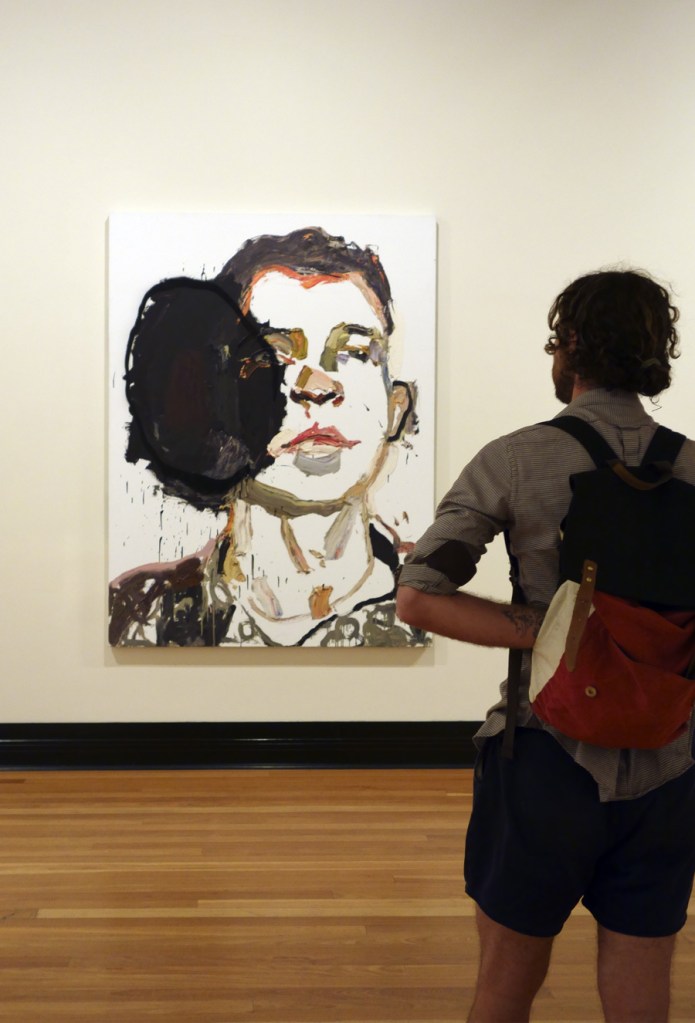
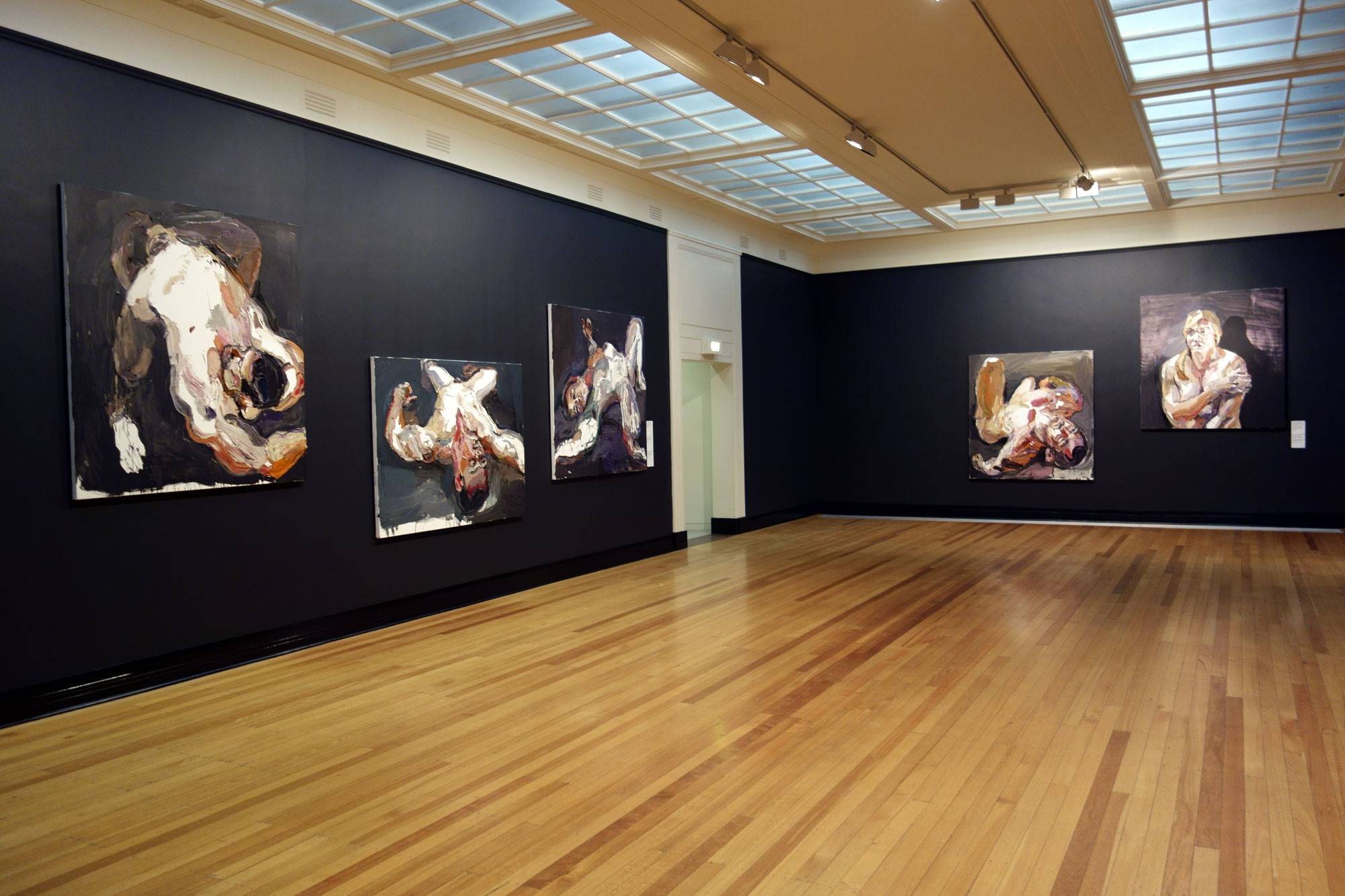
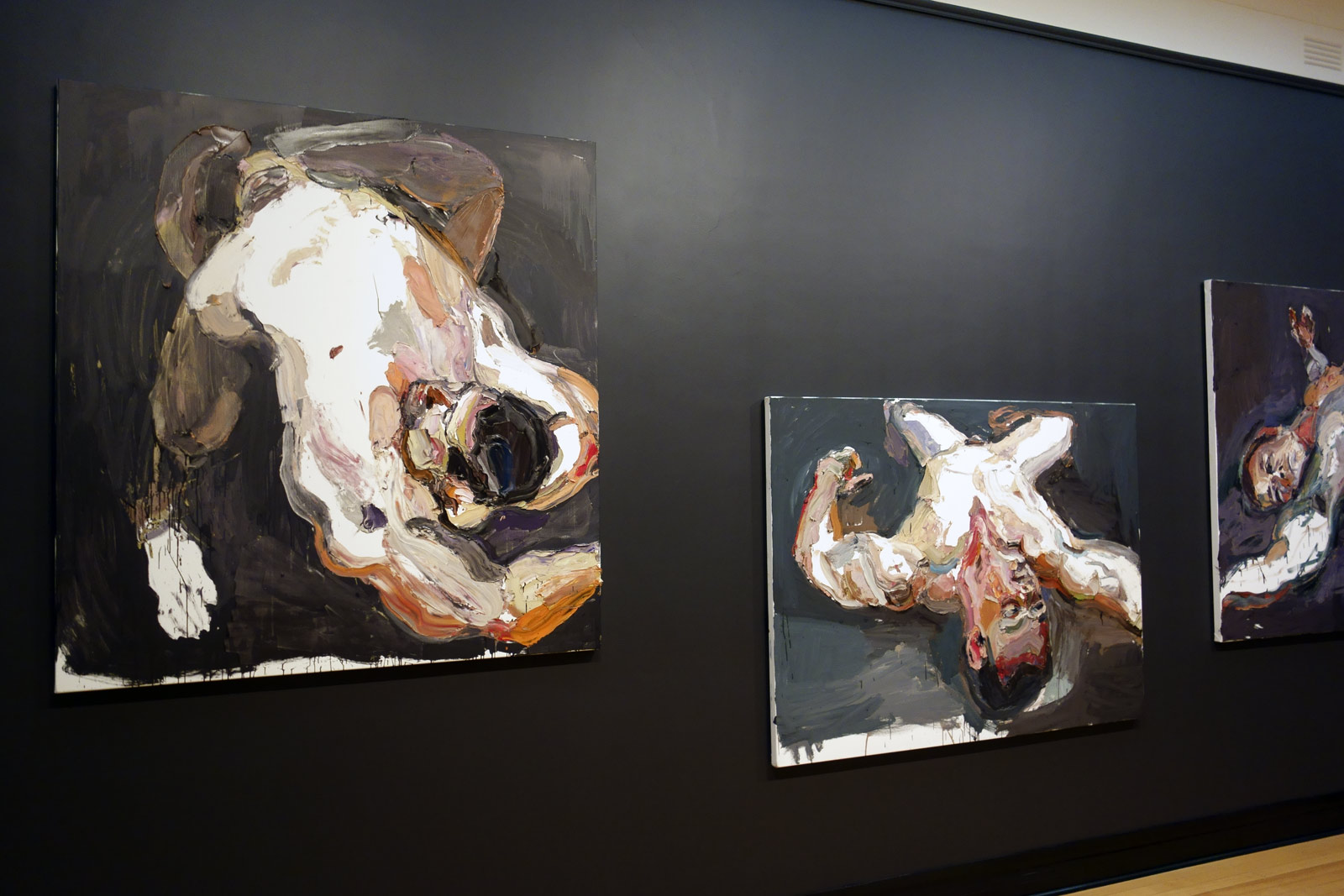
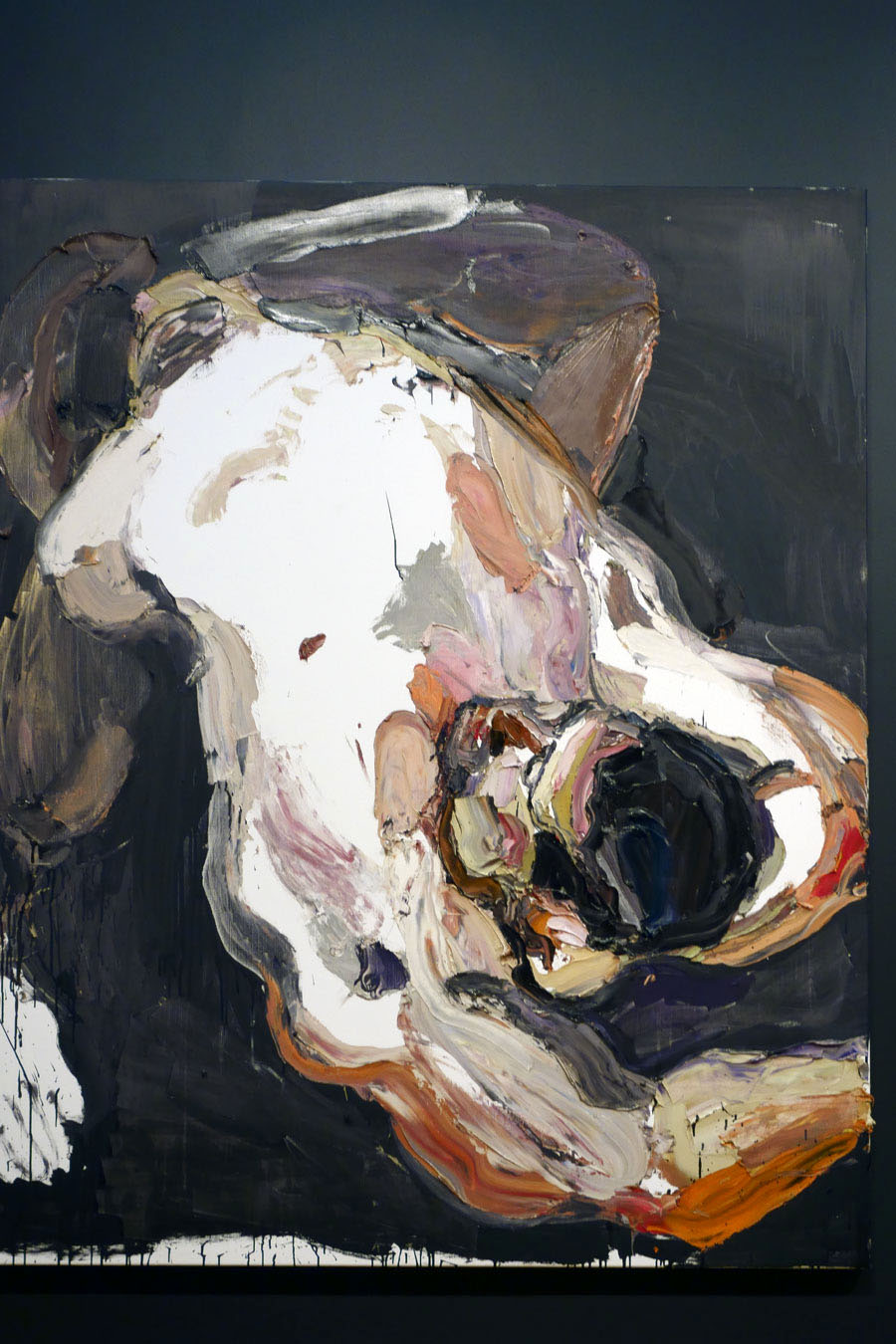
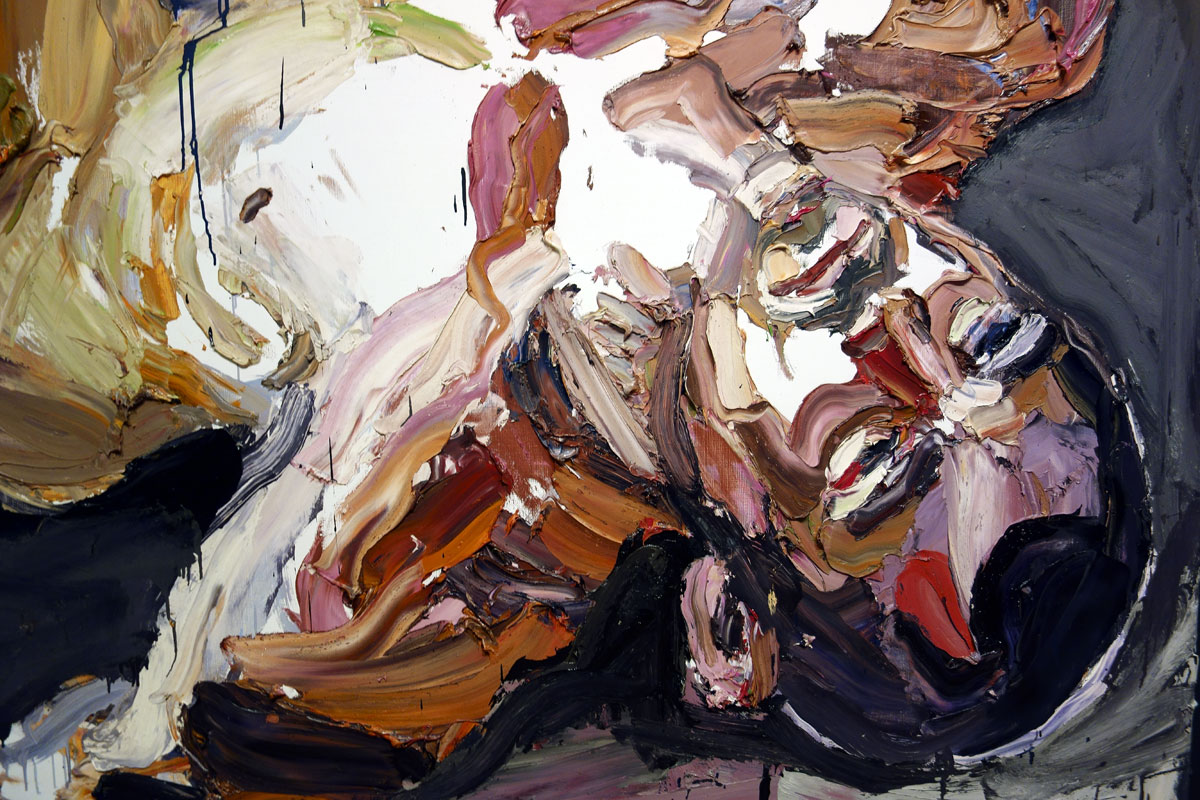
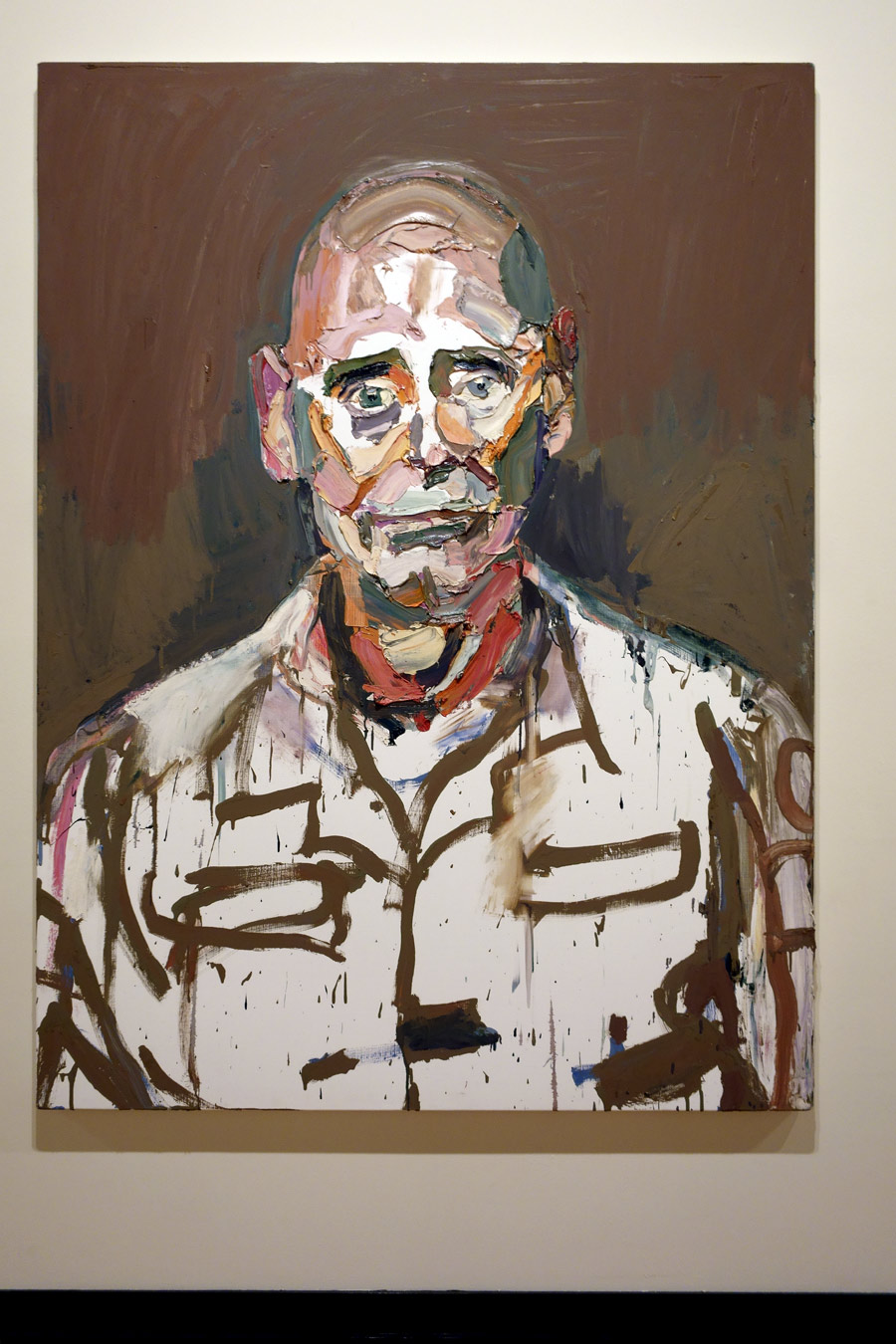
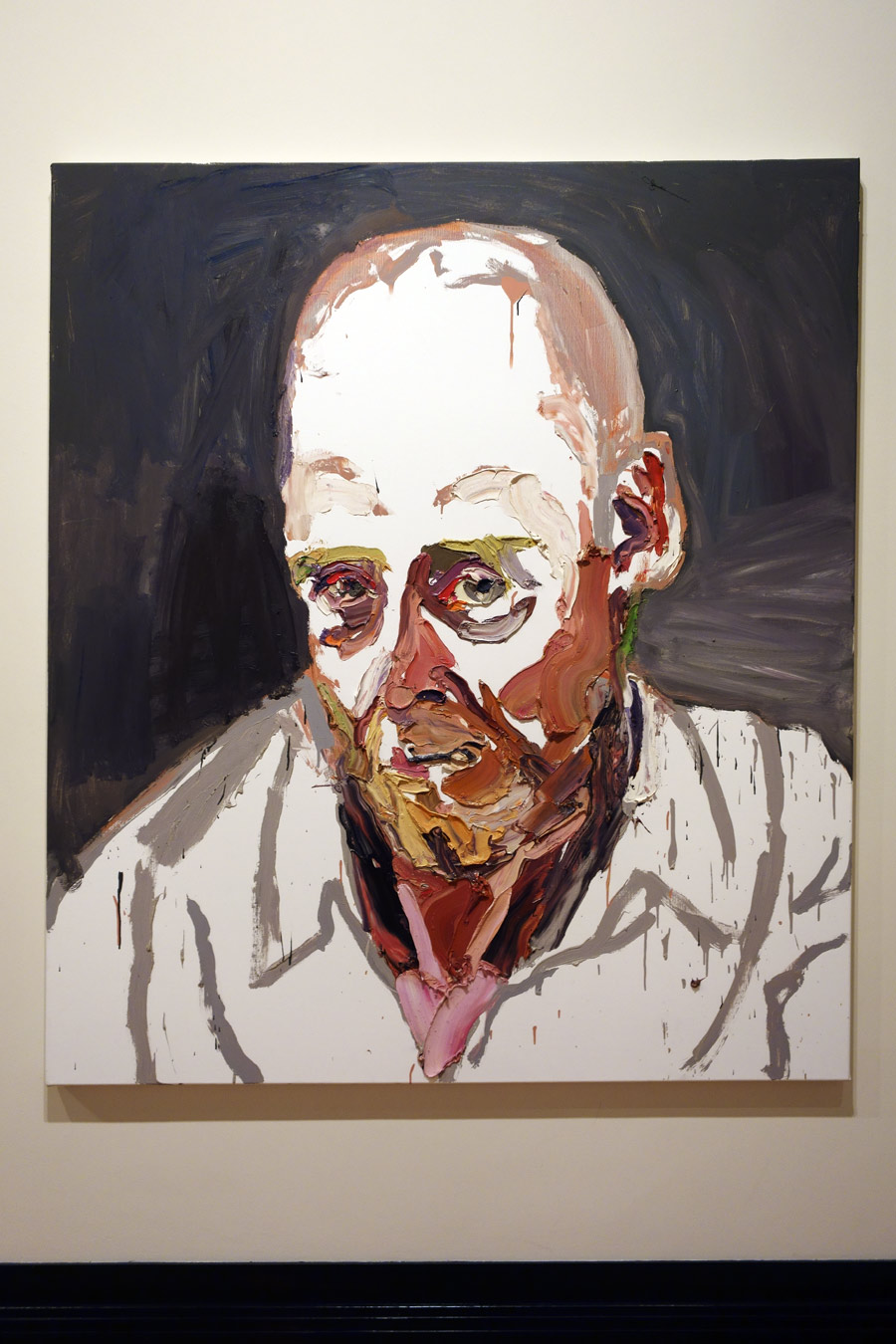
In these paintings, Quilty does not turn away from the evidence of the soldiers before him who express through their bodies that life is violent. He does not attempt to save the viewer from such unpleasantries. As Bacon comments, “The feelings of desperation and unhappiness are more useful to an artist than the feeling of contentment, because desperation and unhappiness stretch your whole sensibility.” Quilty stretches his sensibility as an artist and as a human being by getting down and dirty with his subject matter, both physically and emotionally. In fact, I would say Quilty becomes his subject, so close does the artist get to the object of his attention (after all, this is also Quilty’s experience of Afghanistan, as much as it is the soldiers who he is painting. The artist is always present in the work). The closer you get to one of his paintings, the more the detail vanishes and the more the paint becomes like blood and guts. The artist presses up against his subject which dissolves into abstraction. A bravura tour de force of painting that it so confident in its intent… [that there are] huge stretches of bare white canvas as flesh, with these striking gestures for throat and nipple executed without fear in one stroke of the brush. The black hole appearing out of the side of the soldiers head reminds me of Carl Jung’s ambivalent feelings toward his unconscious shadow; and at one end of the gallery you have a black hole (Trooper Luke Korman, Tarin Kot, 2012, below) and at the other a white hole (Trooper Luke Korman, 2012, below), such are the energies of yin yang that flow through the lighter of the gallery spaces.

Using what the photographer Imogen Cunningham termed the ‘paradox of expansion via reduction’ – closing in on subject (either physically and/or mentally), the intensity and focus attendant to a clear way of seeing – allows Quilty’s work to be flooded with sensuality and reductive power. The horror of the body, of how fragile we are (Damien Hirst) is expressed through the visceral paint. The viewer’s mind tells the story, creates the horror, the closer you get to the work. As I said earlier, there is no transferable message, no actual interpretation but universal triggers that impinge on the viewer’s mind.

Quilty plays with the flow of time and space, memory and war by disassociating himself from traditional narrative. As the quotation below from Peter Handke’s novel Across eloquently expresses it, it is a sense of “being-empty” (Zen), an empty form that is also full at the same time. Every object in Quilty’s opus moves into place and we pass over, quietly, into a place we have never been before, through paintings that picture the unknowable. Something we have never seen or felt before.

In painting, I don’t think there are many artists that could have achieved what Quilty has with this body of work.

Dr Marcus Bunyan

Word count: 1,125


Many thankx to Castlemaine Art Gallery and Historical Museum for allowing me to publish the photographs in the posting. Please click on the photographs for a larger version of the image. All installation photographs © Marcus Bunyan, the artist and Castlemaine Art Gallery and Historical Museum


1/ Ernst Van Alphen. Francis Bacon and the Loss of Self, 1992 quoted in “Francis Bacon and ‘Narrative’, the Natural Enemy of Vision,” on the ASX website, June 27 2013 [Online] Cited 29/03/2016.

2/ Ibid.,


“With the light of that moment, silence fell. The warming emptiness that I need so badly spread. My forehead no longer needed a supporting hand. It wasn’t exactly a warmth, but a radiance; it welled up rather than spread; not an emptiness, but a being-empty; not so much my being-empty as an empty form. And the empty form meant: story. But it also meant that nothing happened. When the story began, my trail was lost. Blurred. This emptiness was no mystery; but what made it effective remained a mystery. It was as tyrannical as it was appeasing; and its peace meant: I must not speak. Under its implosion, everything (every object) moved into place. “Emptiness!” The word was equivalent to the invocation of the Muse at the beginning of an epic. It provoked not a shudder but lightness and joy, and presented itself as a law: As it is now, so shall it be. In terms of image, it was a shallow river crossing.”


Peter Handke. Across. Ralph Manheim (translator). Farrar, Straus and Giroux, 2000, p. 5.


“I do not want to avoid telling a story, but I want very, very much to do the thing that Valery said – to give the sensation without the boredom of its conveyance. And the moment the story enters, the boredom comes upon you.”


Francis Bacon


Installation view of the exhibition 'Ben Quilty: After Afghanistan' at the Castlemaine Art Gallery showing from left to right, 'Sergeant P, after Afghanistan' (2012); 'Trooper Daniel Westcott, after Afghanistan' (2012); and 'Troy Park, after Afghanistan' (2012)


Installation view of the exhibition Ben Quilty: After Afghanistan at the Castlemaine Art Gallery showing from left to right, Sergeant P, after Afghanistan (2012); Trooper Daniel Westcott, after Afghanistan (2012); and Troy Park, after Afghanistan (2012)
Photo: Marcus Bunyan


Sergeant P, a Special Operations Task Group soldier, is a survivor of a Black Hawk helicopter crash that claimed the lives of three Australians. Some of the soldiers depicted in the other portraits witnessed the crash and were first on the scene to provide assistance. The memory of this experience, and the friends who did not make it, will stay with these men for a long time.


Ben Quilty (Australian, b. 1951) 'Trooper Daniel Westcott, after Afghanistan' 2012 (installation view)


Ben Quilty (Australian, b. 1951)
Trooper Daniel Westcott, after Afghanistan (installation view)
2012
Oil on linen
Collection of the artist
Photo: Marcus Bunyan


Ben Quilty (Australian, b. 1951) 'Troy Park, after Afghanistan' 2012 (installation view)


Ben Quilty (Australian, b. 1951)
Troy Park, after Afghanistan (installation view)
2012
Oil on linen
Collection of the artist
Photo: Marcus Bunyan


Installation view of the exhibition 'Ben Quilty: After Afghanistan' at the Castlemaine Art Gallery

Installation view of the exhibition 'Ben Quilty: After Afghanistan' at the Castlemaine Art Gallery

Installation view of the exhibition 'Ben Quilty: After Afghanistan' at the Castlemaine Art Gallery

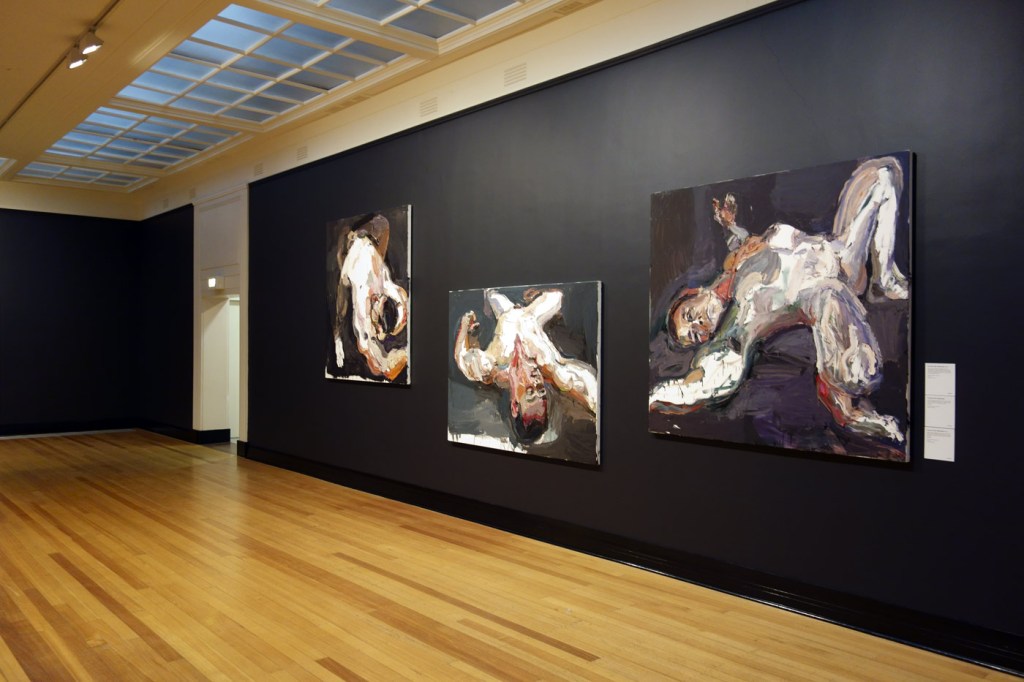
Installation view of the exhibition 'Ben Quilty: After Afghanistan' at the Castlemaine Art Gallery showing from left to right, 'Troy Park, after Afghanistan, no. 2' (2012); 'Trooper M, after Afghanistan' (2012); and 'Trooper M, after Afghanistan, no. 2' (2012)

Installation view of the exhibition 'Ben Quilty: After Afghanistan' at the Castlemaine Art Gallery showing from left to right, 'Troy Park, after Afghanistan, no. 2' (2012); 'Trooper M, after Afghanistan' (2012); and 'Trooper M, after Afghanistan, no. 2' (2012)

Installation view of the exhibition 'Ben Quilty: After Afghanistan' at the Castlemaine Art Gallery showing from left to right, 'Troy Park, after Afghanistan, no. 2' (2012); 'Trooper M, after Afghanistan' (2012); and 'Trooper M, after Afghanistan, no. 2' (2012)


Installation views of the exhibition Ben Quilty: After Afghanistan at the Castlemaine Art Gallery showing from left to right in the bottom three images, Troy Park, after Afghanistan, no. 2 (2012); Trooper M, after Afghanistan (2012); and Trooper M, after Afghanistan, no. 2 (2012)
Photos: Marcus Bunyan


Ben Quilty (Australian, b. 1951) 'Troy Park, after Afghanistan, no. 2' 2012 (installation view)


Ben Quilty (Australian, b. 1951)
Troy Park, after Afghanistan, no. 2 (installation view)
2012
Oil on linen
Collection of the artist
Photo: Marcus Bunyan


Quilty asked the soldiers to suggest a post that encapsulated some of the emotions that surrounded their experience in Afghanistan. Often the pose is quite contorted, as it reflects an actual event, such as taking cover to engage insurgents.


Ben Quilty (Australian, b. 1951) 'Trooper M, after Afghanistan' 2012 (installation view)


Ben Quilty (Australian, b. 1951)
Trooper M, after Afghanistan (installation view)
2012
Oil on linen
Collection of the artist
Photo: Marcus Bunyan


“You can’t really stop out there. You have to keep doing your job and keep moving forward … There is no time, until you get home, to stop and think about it.”

Trooper M


Ben Quilty (Australian, b. 1951) 'Trooper M, after Afghanistan, no. 2' 2012 (installation view detail)


Ben Quilty (Australian, b. 1951)
Trooper M, after Afghanistan, no. 2 (installation view detail)
2012
Oil on linen
Collection of the artist
Photo: Marcus Bunyan


“Sitting for Ben is therapeutic; it does get a lot of stuff off your chest. And actually seeing your portrait on canvas, I think for me it’s definitely a chapter that I can close and leave there.”

Trooper M


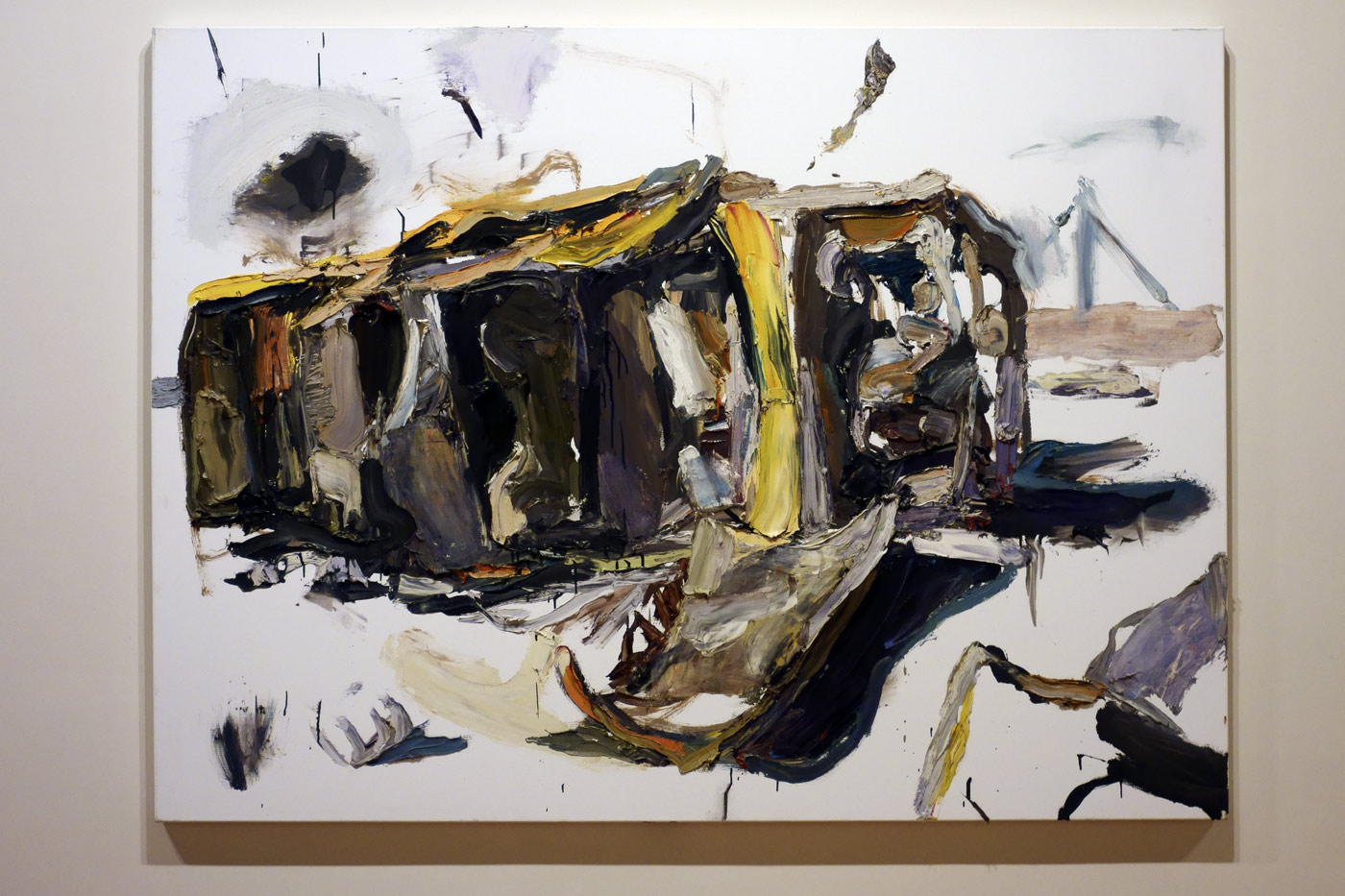
Ben Quilty (Australian, b. 1951) 'Bushmaster' 2012 (installation view)


Ben Quilty (Australian, b. 1951)
Bushmaster (installation view)
2012
Aerosol and oil on linen
Donated by Ben Quilty through the Australian Government’s Cultural Gifts Program in 2013
Photo: Marcus Bunyan


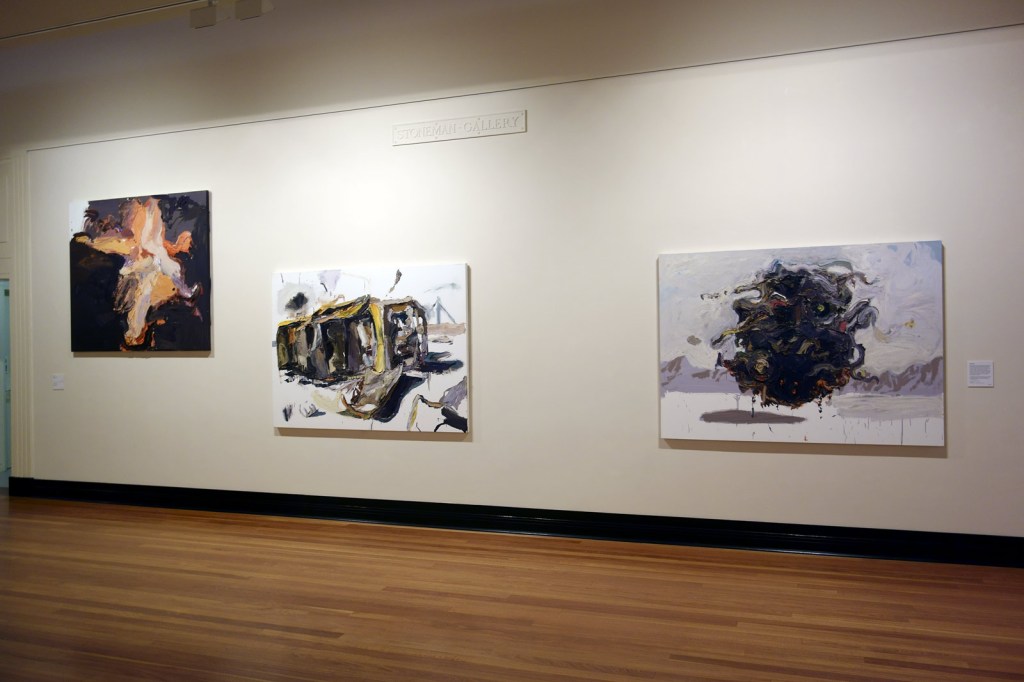
Portraiture for Quilty can also take a vehicle as its subject. This destroyed Bushmaster reflects the soldiers’ identity and is a vestige of their physical experience. They risk their lives while carrying out their duties in these versatile military vehicles.

“I met a young man who’d been in the back of a Bushmaster that had blown up. The Bushmaster is the big armoured four-wheel-drive vehicle that’s saving a lot of Australian lives, but even so the explosion caused every single you man inside that vehicle to suffer from concussion and one of them was blown out of the gun turret and landed in front of the vehicle among possibly more hidden explosive devices.”

Ben Quilty


Ben Quilty (Australian, b. 1951) 'Captain S, after Afghanistan' 2012 (installation view)


Ben Quilty (Australian, b. 1951)
Captain S, after Afghanistan (installation view)
2012
Oil on linen
Acquired under the official art scheme 2012
Photo: Marcus Bunyan


“I think when Ben paints, he’s not looking for what’s on the outside … He’s more after what they’re feeling o what they’ve been through … He’s looking at the inner instead of just the outer.”

Captain S


Ben Quilty (Australian, b. 1951) 'Lance Corporal M, after Afghanistan' 2012 (installation view)


Ben Quilty (Australian, b. 1951)
Lance Corporal M, after Afghanistan (installation view)
2012
Oil on linen
Collection of the artist
Photo: Marcus Bunyan


Ben Quilty (Australian, b. 1951) 'Lance Corporal M, after Afghanistan' 2012 (installation view detail)


Ben Quilty (Australian, b. 1951)
Lance Corporal M, after Afghanistan (installation view detail)
2012
Oil on linen
Collection of the artist
Photo: Marcus Bunyan


The naked portraits have a sensuousness and vulnerability in their solitary, contorted poses. The rough surface signifies the uniform and body armour that have been stripped away in front of us, and them. We and they recognise what they have endured and achieved.

“I wanted [this soldier] to be naked, showing not only his physical strength but also the frailty of human skin and the darkness of the emotional weight of the war.”

Ben Quilty


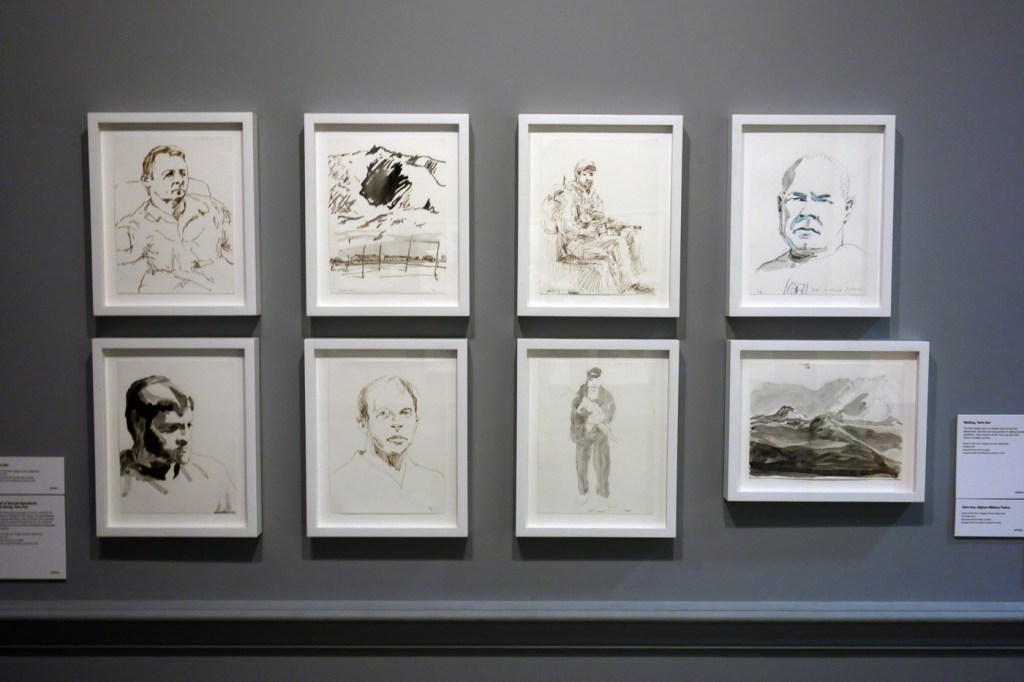
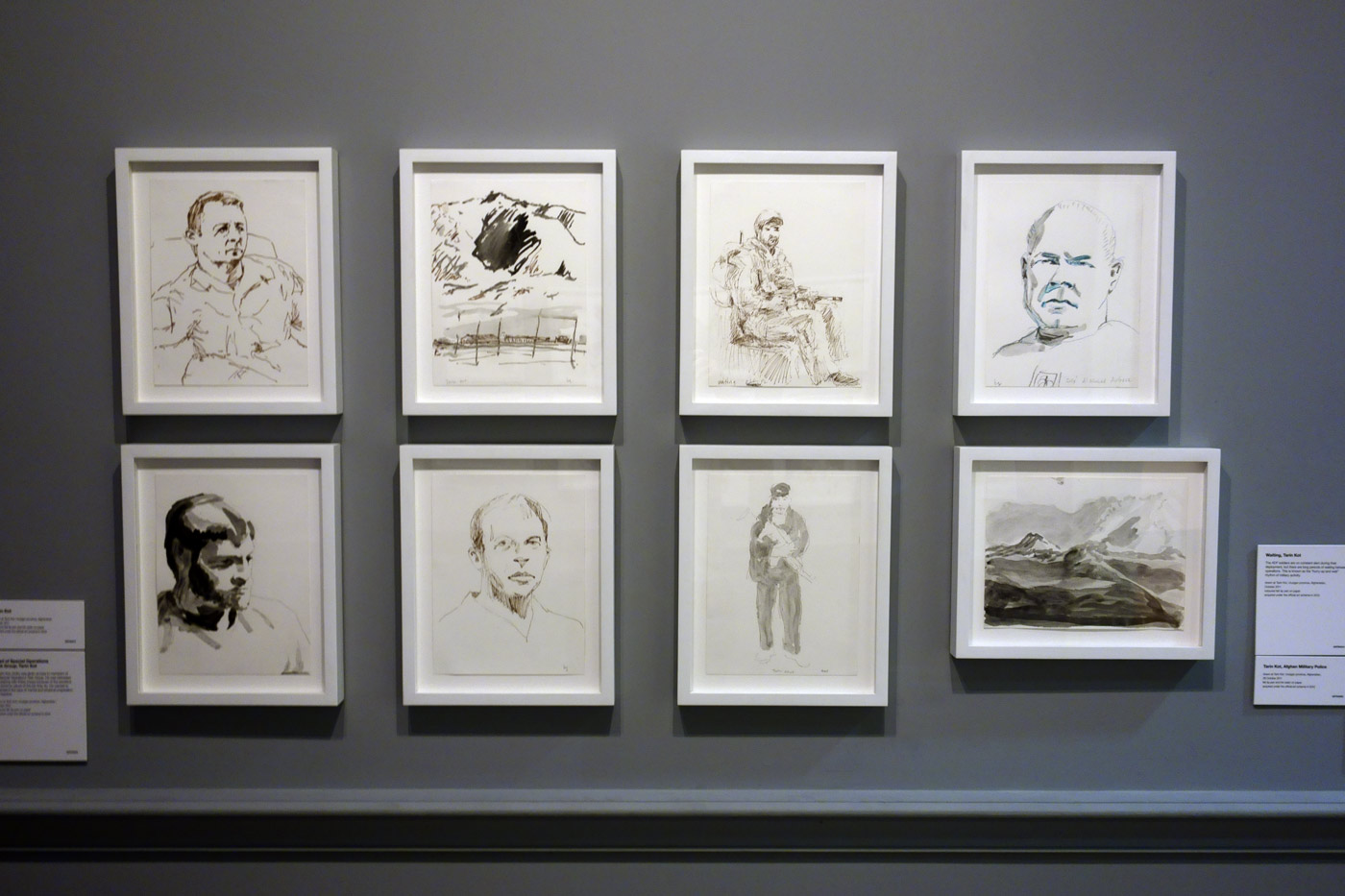
Installation view of drawings from the exhibition 'Ben Quilty: After Afghanistan' at the Castlemaine Art Gallery including, at bottom left, 'Captain M II, Tarin Kot' (October 2011) and third from left top, 'Waiting, Tarin Kot' (October 2011)


Installation view of drawings from the exhibition Ben Quilty: After Afghanistan at the Castlemaine Art Gallery including, at bottom left, Captain M II, Tarin Kot (October 2011, below) and third from left top, Waiting, Tarin Kot (October 2011, below)
Photo: Marcus Bunyan


“This very wild place”

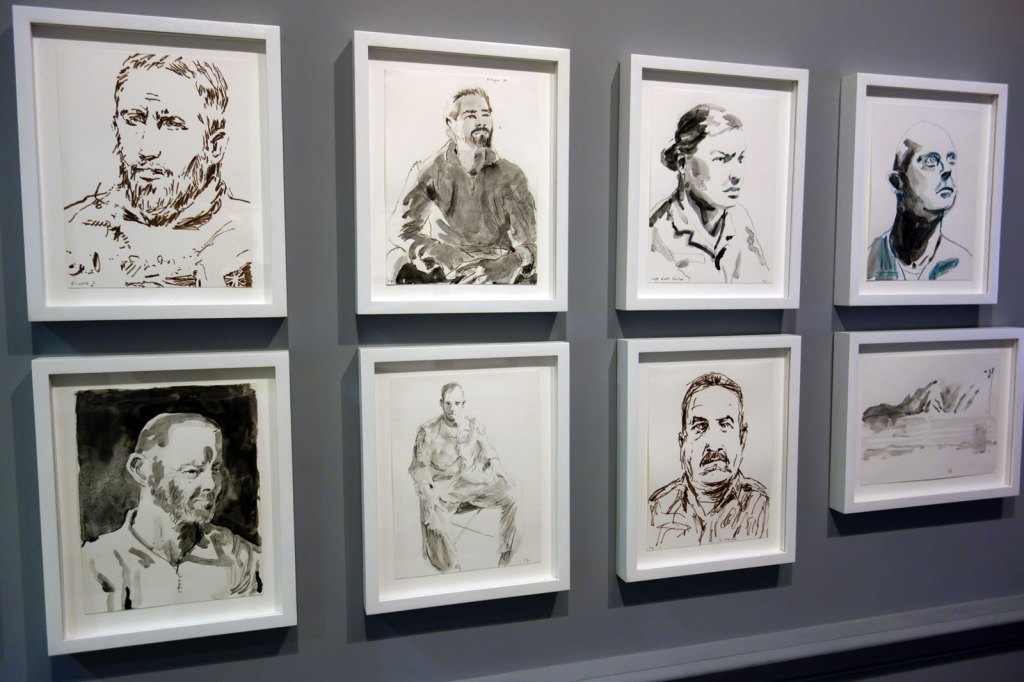
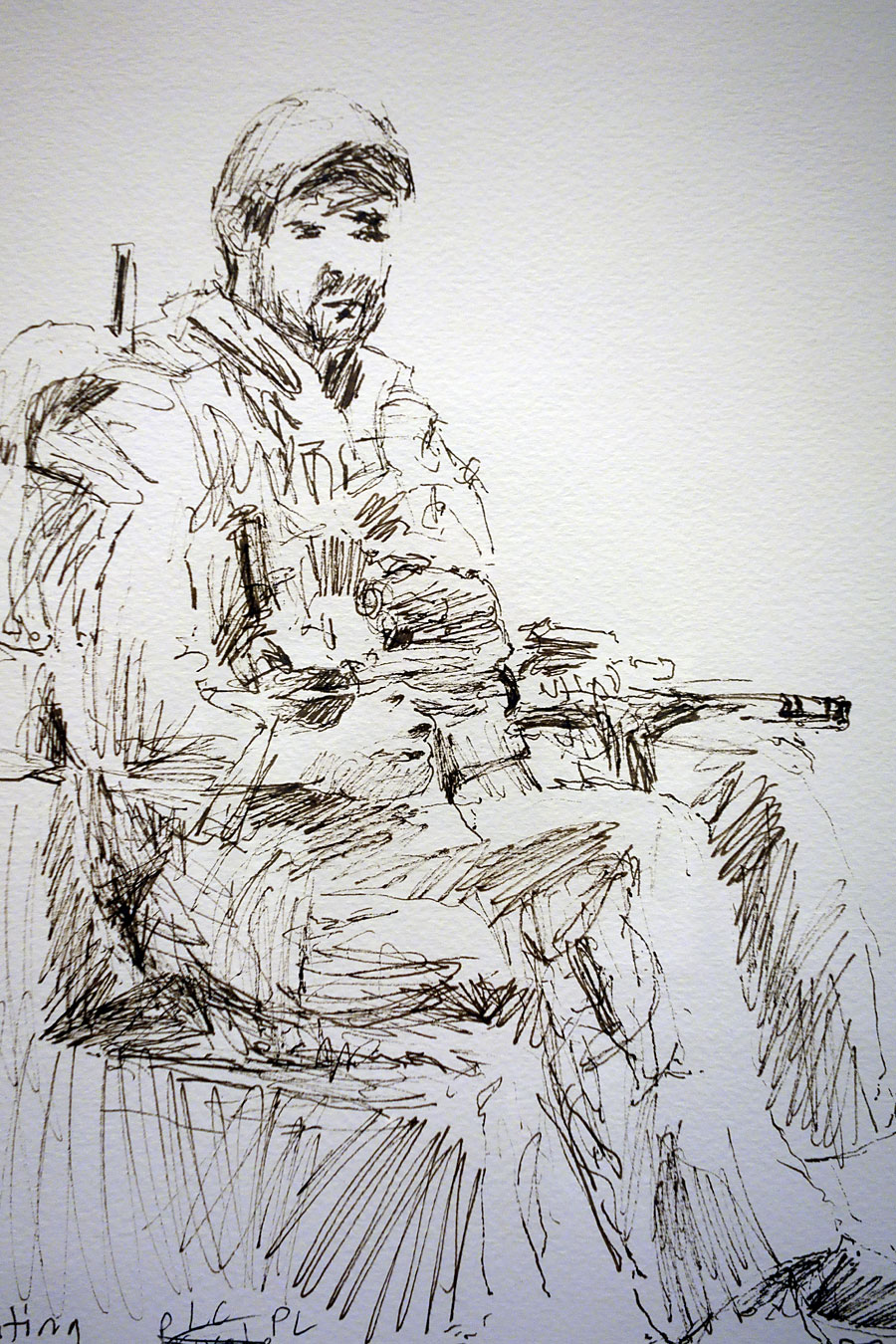
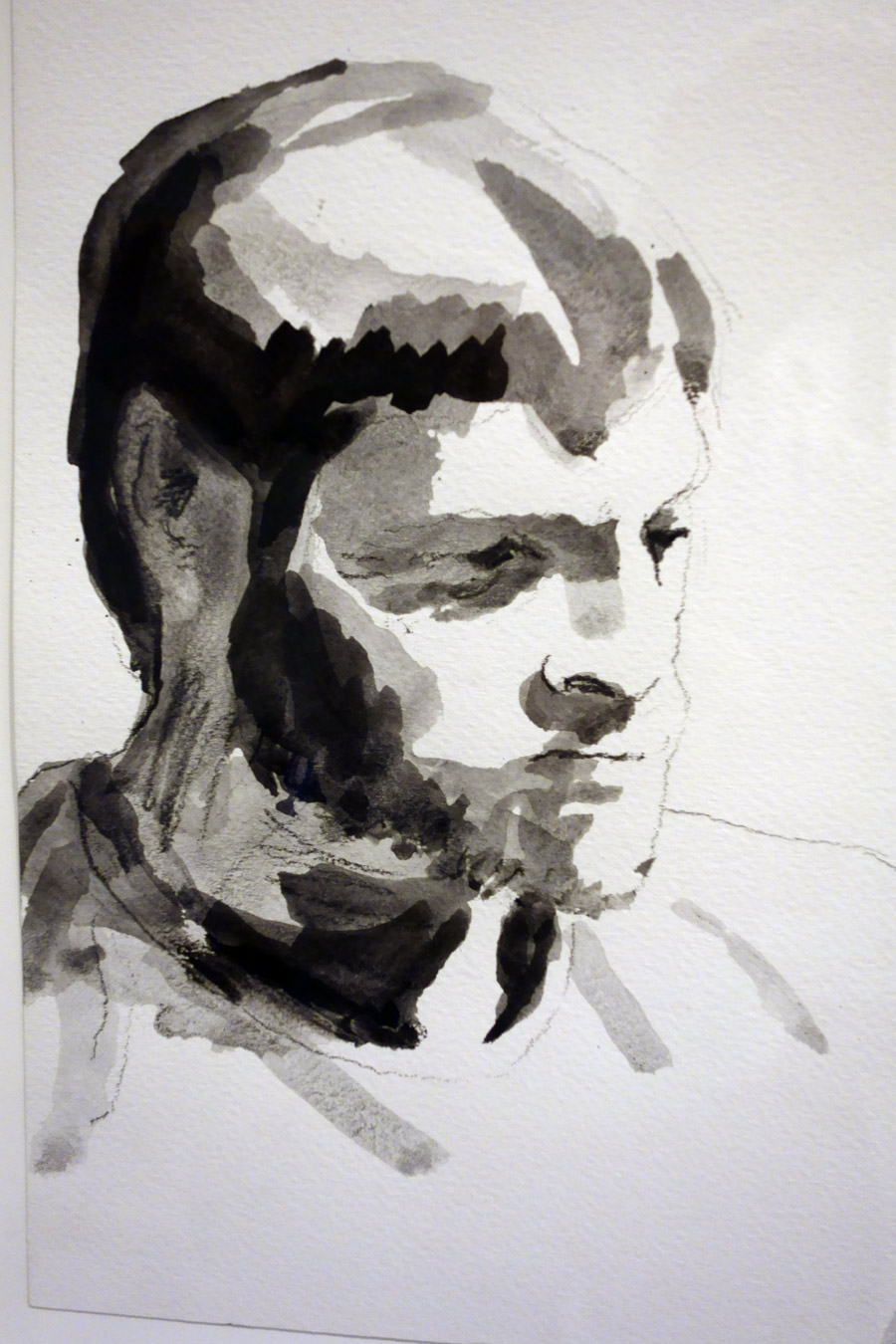
Sitting and talking with the Australian soldiers in Afghanistan, Quilty became intrigued by their experiences. He came to feel responsible for telling the stories of these young men and women.

“I started doing drawings of the soldiers, and hearing their stories about their experiences of being in this very wild place. I realised that I needed to just sit with them … making portraits of these guys in Tarin Kot or wherever I was … getting them to sit still and talk to me about their experience. Those little drawings are a reminder to me of the time that I spent with those people. I hoped that there’d be some remnant of that experience that I could then draw out … to put into the paintings when I returned to Australia.”

Ben Quilty

The trust that Quilty developed with these soldiers in Afghanistan was strong enough to continue at home in Quilty’s studio, where he invited some to sit for larger portraits.


Installation view of drawings from the exhibition 'Ben Quilty: After Afghanistan' at the Castlemaine Art Gallery


(top row, first three from left)

Ben Quilty (Australian, b. 1951)
Private C, Tarin Kot
October 2011
Drawn at Tarin Kot, Uruzgan province, Afghanistan
Coloured felt tip pen on paper
Acquired under the official art scheme 2012

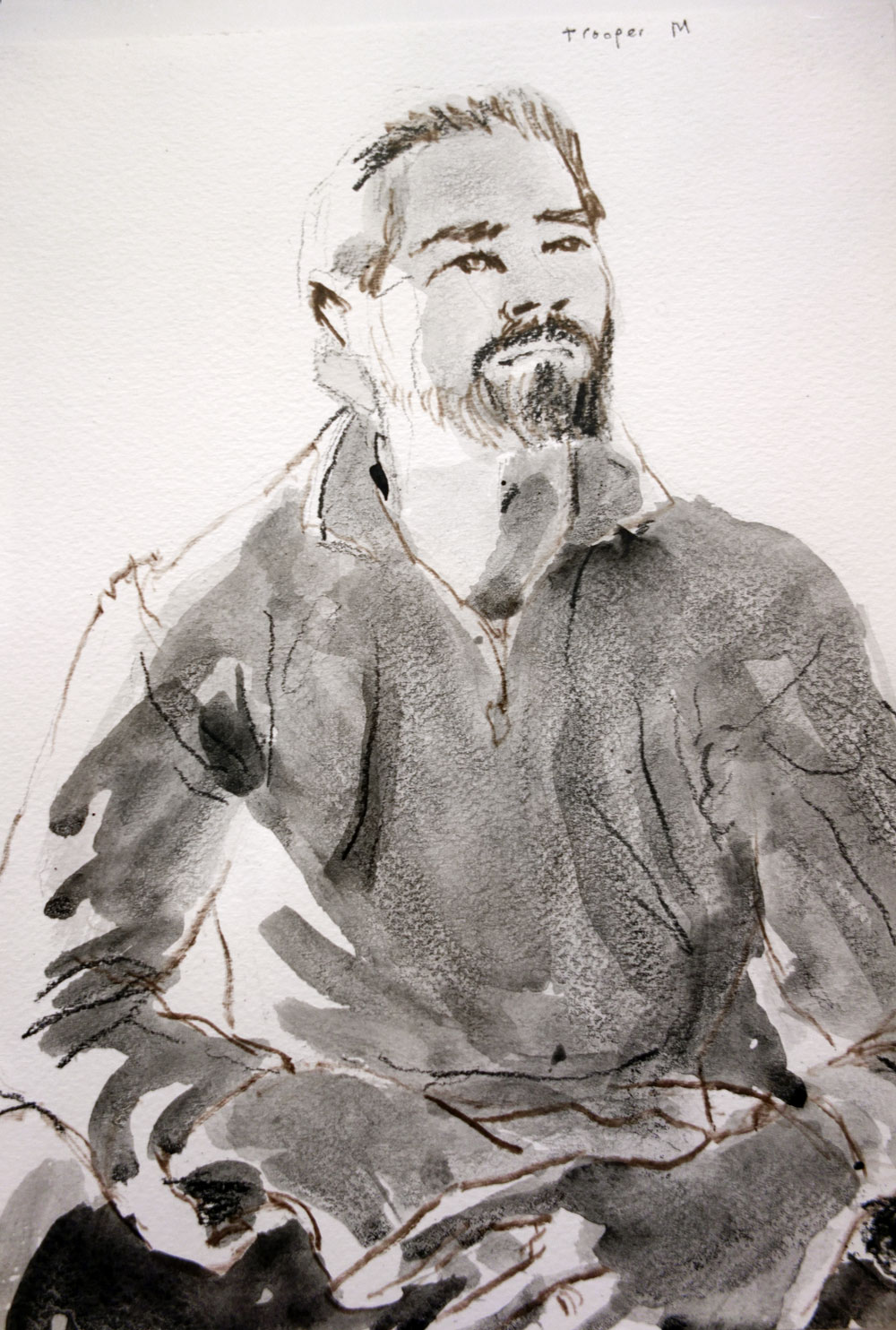
Ben Quilty (Australian, b. 1951)
Trooper M, Special Forces, Tarin Kot
October 2011
Drawn at Tarin Kot, Uruzgan province, Afghanistan
Coloured felt tip pen, pencil and ink wash on paper
Collection of the artist

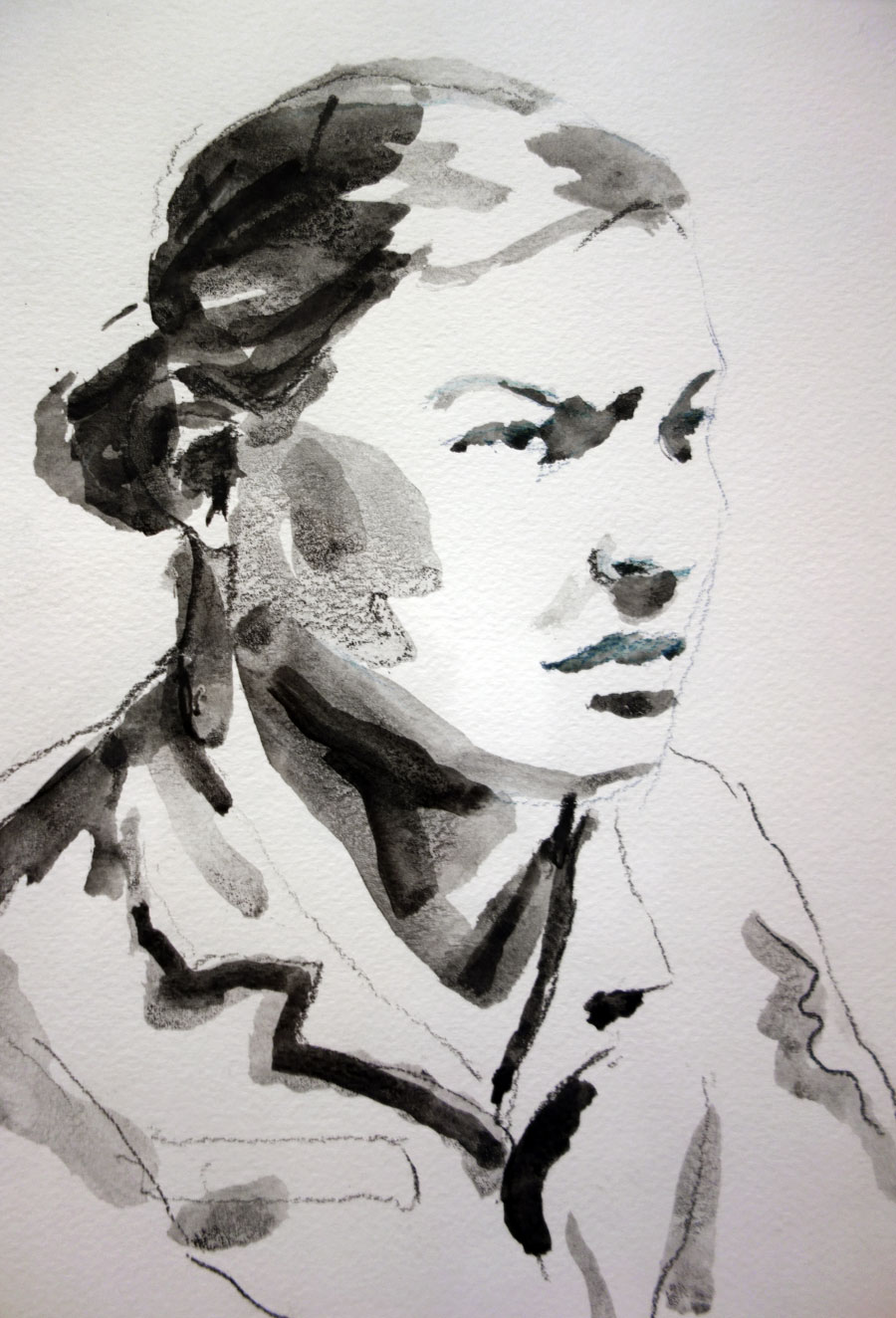
Ben Quilty (Australian, b. 1951)
Captain Kate Porter
27 October 2011
Drawn at Tarin Kot, Uruzgan province, Afghanistan
Coloured pencil and ink wash on paper
Acquired under the official art scheme 2012

(bottom row, first three from left)

Ben Quilty (Australian, b. 1951)
Sergeant M II, Tarin Kot
October 2011
Drawn at Tarin Kot, Uruzgan province, Afghanistan
Pencil and ink wash on paper
Collection of the artist

Ben Quilty (Australian, b. 1951)
Chinook pilot, Kandahar Airfield
October 2011
Drawn at Kandahar Airfield, Kandahar province, Afghanistan
Pencil and ink wash on paper
Collection of the artist

Ben Quilty (Australian, b. 1951)
Brigadier General Noorullah, Afghan National Army, Tarin Kot
22 October 2011
Drawn at Tarin Kot, Uruzgan province, Afghanistan
Coloured felt tip pen on paper
Acquired under the official art scheme 2012

Photo: Marcus Bunyan


While in Tarin Kot, Quilty attended a marching out parade of 400 Afghan National Army (ANA) soldiers who had completed training under the Australian Mentoring Task Fore. There he met a senior ANA commander, Brigadier General Noorullah. Just days later, three Australian soldiers were killed at a similar training parade being held at Forward Operating Base Sorkh Bed (aka Pacemaker). Quilty learnt of the incident the day after he left Afghanistan, giving him an even greater sense of the dangers that the soldiers he met face daily.


Ben Quilty (Australian, b. 1951) 'Captain Kate Porter' 27 October 2011 (installation view)


Ben Quilty (Australian, b. 1951)
Captain Kate Porter (installation view)
27 October 2011
Drawn at Tarin Kot, Uruzgan province, Afghanistan
Coloured pencil and ink wash on paper
Acquired under the official art scheme 2012
Photo: Marcus Bunyan


Quilty wanted to meet a cross-section of people serving in Afghanistan – soldiers driving Bushmasters, Chinook pilots, Special Forces soldiers, and both men and women of all ranks – to try to understand who makes up the Australian Defence Force. He met Captain Kate Porter at Tarin Kot. There he spoke to her about her experiences as female in the very masculine community of the Special Operations Task Group, as well as her general experience as a soldier in Afghanistan.


Ben Quilty (Australian, b. 1951) 'Trooper M, Special Forces, Tarin Kot' October 2011 (installation view)


Ben Quilty (Australian, b. 1951)
Trooper M, Special Forces, Tarin Kot (installation view)
October 2011
Drawn at Tarin Kot, Uruzgan province, Afghanistan
Coloured felt tip pen, pencil and ink wash on paper
Collection of the artist
Photo: Marcus Bunyan


Ben Quilty (Australian, b. 1951) 'Waiting, Tarin Kot' October 2011 (installation view)


Ben Quilty (Australian, b. 1951)
Waiting, Tarin Kot (installation view)
October 2011
Drawn at Tarin Kot, Uruzgan province, Afghanistan
Coloured felt tip pen on paper
Acquired under the official art scheme 2012
Photo: Marcus Bunyan


Ben Quilty (Australian, b. 1951) 'Captain M II, Tarin Kot' October 2011 (installation view)


Ben Quilty (Australian, b. 1951)
Captain M II, Tarin Kot (installation view)
October 2011
Drawn at Tarin Kot, Uruzgan province, Afghanistan
Pencil and ink wash on paper
Collection of the artist
Photo: Marcus Bunyan


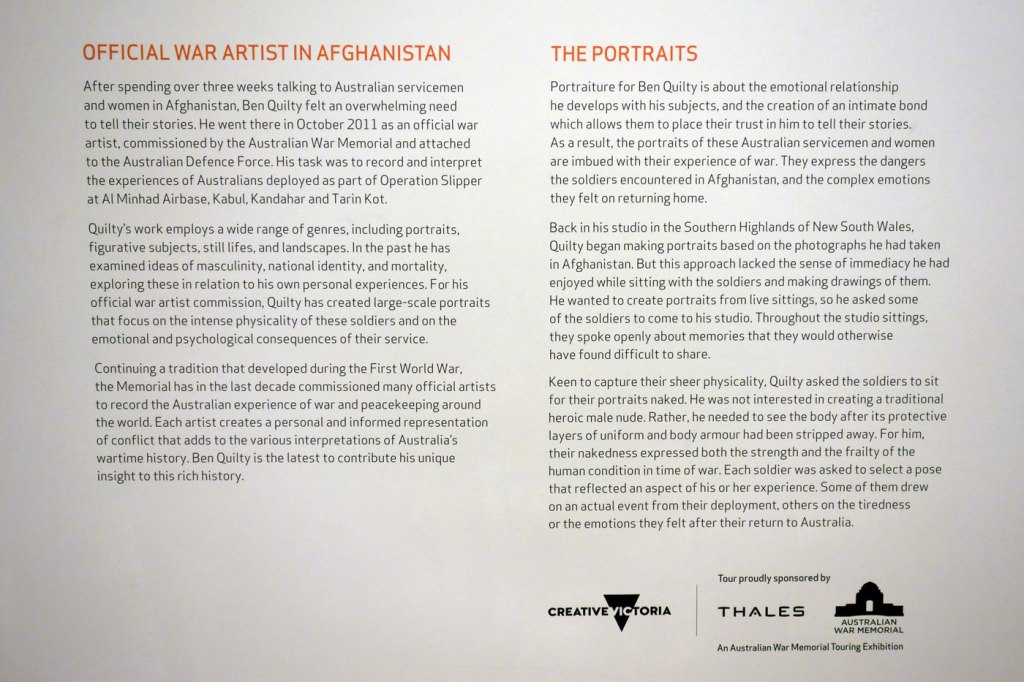
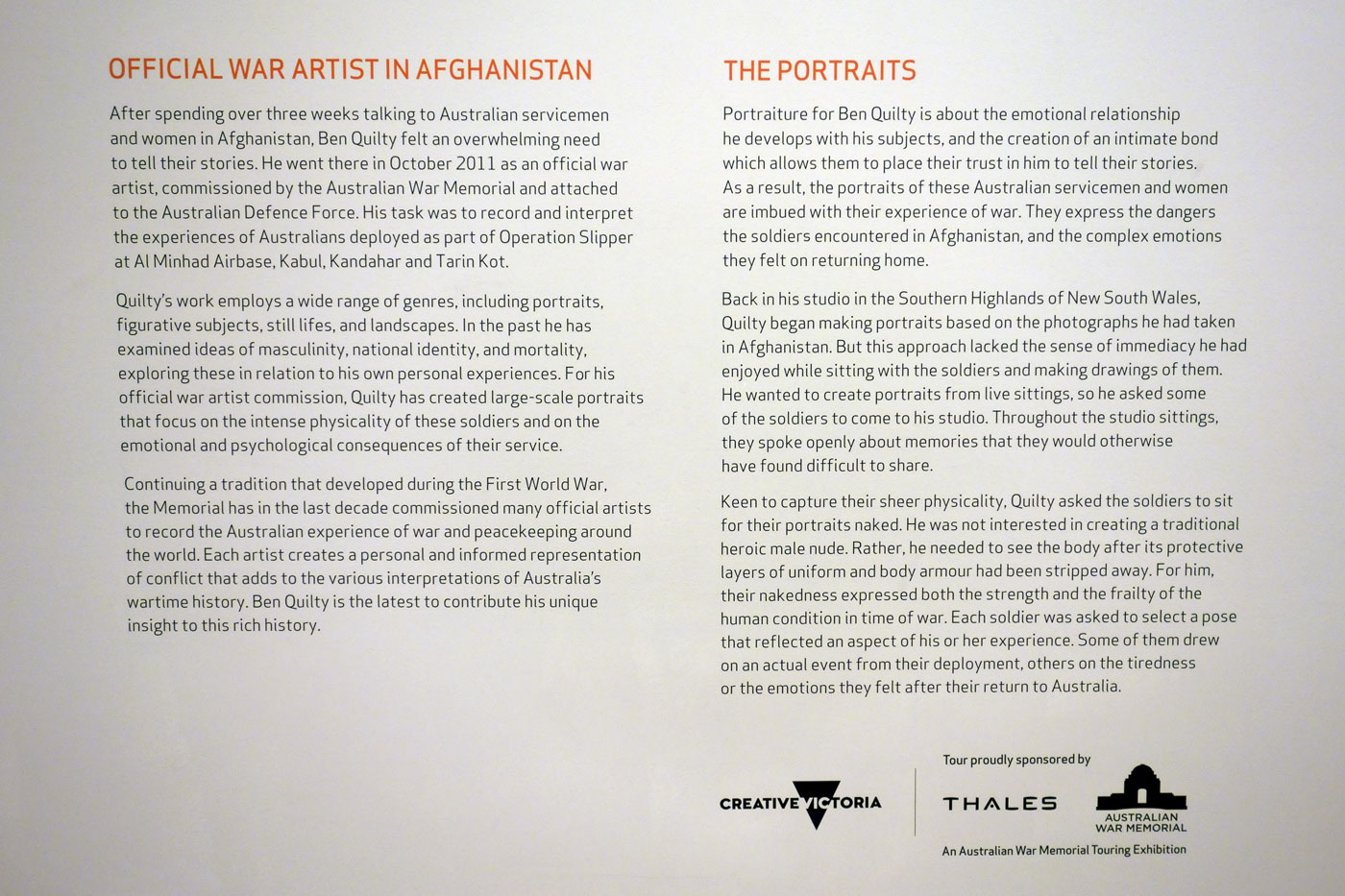
“Ben Quilty: After Afghanistan is an extraordinary Australian War Memorial Touring Exhibition by one of the nation’s most incisive artists, and is of great relevance to all Australians. The exhibition officially opens at Castlemaine Art Gallery on Friday 15 January 2016.

The exhibition itself was the result of the Archibald Prize-winning artist’s three-week tour across Afghanistan in October 2011. Engaged as an Official War Artist, his purpose was to record and interpret the experiences of Australians deployed as part of Operation Slipper in Kabul, Kandahar, and Tarin Kot in Afghanistan and at Al Minhad Airbase in the United Arab Emirates. In fulfilling his brief, Quilty spoke with many Australian servicemen and women, gaining an insight into their experiences whilst serving in the region, and ultimately leaving with an overwhelming need to tell their stories.

Quilty recently spoke on ANZAC Day 2015 and paid tribute not only to those who did not return from Afghanistan and their grieving families, but also to “the young men and women who live amongst us who have paid so dearly and will quietly wear the thick cloak of trauma for many years to come, after Afghanistan.”

The exhibition is a must see as Quilty is arguably one of Australia’s greatest living painters, and this exhibition, with its intense and emotional subject matter is particularly important to Castlemaine, a town with a history of young men and women serving their country far from home. The exhibition has been very well received across the country with over 70,000 visitors attending the works when on display most recently in Darwin. Dr Brendan Nelson, Director of the Australian War Memorial believes Quilty should be considered one of Australia’s great official war artists.

“Ben Quilty’s works follows a truly great tradition at the Australian War Memorial of appointing artists to record and interpret the Australian experience of war.”

“Ben brought to this task all his brilliance, sensitivity and compassion. The works he produced will leave Australians a legacy which informs them not only about the impact of war on our country, but even more importantly, about the effects on the men and women he has depicted,” said Dr Nelson.

Dr Jan Savage, President of the Castlemaine Art Gallery and Historical Museum Committee of Management said the exhibition, “was significant in understanding the impact of war on serving members of the Australian armed forces and I encourage visitors to attend this most important exhibition.”

Ben Quilty: After Afghanistan is on display at Castlemaine Art Gallery from 15 January until 15 April 2016.

An Australian War Memorial Touring Exhibition, proudly sponsored by Thales.”

Text from the Castlemaine Art Gallery and Historical Museum website


Ben Quilty (Australian, b. 1951) 'Tarin Kot, Hilux' 2012 (installation view)


Ben Quilty (Australian, b. 1951)
Tarin Kot, Hilux (installation view)
2012
Oil on linen
Collection of the artist
Photo: Marcus Bunyan


Ben Quilty (Australian, b. 1951) 'Kandahar' 2012 (installation view)


Ben Quilty (Australian, b. 1951)
Kandahar (installation view)
2012
Oil on linen
Acquired under the official art scheme 2012
Photo: Marcus Bunyan


Ben Quilty (Australian, b. 1951) 'Kandahar' 2012 (installation view detail)


Ben Quilty (Australian, b. 1951)
Kandahar (installation view detail)
2012
Oil on linen
Acquired under the official art scheme 2012
Photo: Marcus Bunyan


Kandahar Airfield is a multinational vase with approximately 35,000 people from the International Security Assistance Fore, aid organisations, and a pool of local civilian staff. Weapons are carried at all times by both military and civilian personnel, creating a tense atmosphere with a violent undercurrent. Quilty described Kandahar as being a cross between the worlds of Mad Max: Beyond Thunderdome and Catch 22, a surreal, dusty, and violent place. “For the first week in Kandahar, I basically felt like I was dodging rockets. The first night we landed there, two or three rockets landed inside the compound.”

This painting was Quilty’s first visceral response on his return from Afghanistan and i sums up his emotions, particularly his personal experience of Kandahar and being a part of the maelstrom of war.


Installation view of the exhibition 'Ben Quilty: After Afghanistan' at the Castlemaine Art Gallery showing at centre, 'Tarin Kot, Hilux' (2012); and at right, 'Kandahar' (2012)


Installation view of the exhibition Ben Quilty: After Afghanistan at the Castlemaine Art Gallery showing at centre, Tarin Kot, Hilux (2012); and at right, Kandahar (2012)
Photo: Marcus Bunyan


Installation view of the exhibition 'Ben Quilty: After Afghanistan' at the Castlemaine Art Gallery


Installation view of the exhibition 'Ben Quilty: After Afghanistan' at the Castlemaine Art Gallery showing at left, 'Air Commodore John Oddie, after Afghanistan, no. 3' (2012)

Installation view of the exhibition 'Ben Quilty: After Afghanistan' at the Castlemaine Art Gallery showing at left, 'Air Commodore John Oddie, after Afghanistan, no. 3' (2012)

Installation view of the exhibition 'Ben Quilty: After Afghanistan' at the Castlemaine Art Gallery showing at left, 'Air Commodore John Oddie, after Afghanistan, no. 3' (2012)


Installation views of the exhibition Ben Quilty: After Afghanistan at the Castlemaine Art Gallery showing at left in the bottom image, Air Commodore John Oddie, after Afghanistan, no. 3 (2012, below)
Photos: Marcus Bunyan


Returning from war

“You can’t take the experiences out of your head.
You can’t take the damages out of your head.”

John Oddie


On his return to Australia, Ben Quilty contacted Air Commodore John Oddie (Ret’d), whom he had met during his Afghanistan deployment, to invite him to sit for a portrait in his studio. From February to October 2011, Oddie had been the Deputy Commander of Australian forces in the Middle east, a position of immense responsibility.

Quilty eventually produced three portraits over five months. These works reveal a man returning from war and its burden of responsibility, exhausted emotionally and mentally, and his progress towards a more positive view of life and of himself as a survivor.


Ben Quilty (Australian, b. 1951) 'Air Commodore John Oddie, after Afghanistan, no. 3' 2012 (installation view)


Ben Quilty (Australian, b. 1951)
Air Commodore John Oddie, after Afghanistan, no. 3 (installation view)
2012
Oil on linen
Collection of the artist
Photo: Marcus Bunyan


Ben Quilty (Australian, b. 1951) 'Air Commodore John Oddie, after Afghanistan, no. 3' 2012 (installation view detail)


Ben Quilty (Australian, b. 1951)
Air Commodore John Oddie, after Afghanistan, no. 3 (installation view detail)
2012
Oil on linen
Collection of the artist
Photo: Marcus Bunyan


“I don’t necessarily see beauty, I see insight in what Ben does. That’s reflected in the way he paints … I think his later portraits, done after he’s got to know us better, are different from the raw emotion of the first ones.”

John Oddie


Ben Quilty (Australian, b. 1951) 'Air Commodore John Oddie, after Afghanistan, no. 1' 2012 (installation view)


Ben Quilty (Australian, b. 1951)
Air Commodore John Oddie, after Afghanistan, no. 1 (installation view)
2012
Oil on linen
Collection of the artist
Photo: Marcus Bunyan


“With through a lack of insight or through an unwillingness … I wasn’t always admitting the truth to myself about my life. Ben really took that out and put it on a table in front of me like a three-course dinner and said, well, how about that? And you know, I sort of thought well, I’m not going to come to this restaurant again in a hurry!”

John Oddie


Ben Quilty (Australian, b. 1951) 'Air Commodore John Oddie, after Afghanistan, no. 2' 2012 (installation view)


Ben Quilty (Australian, b. 1951)
Air Commodore John Oddie, after Afghanistan, no. 2 (installation view)
2012
Oil on linen
Collection of the artist
Photo: Marcus Bunyan


“He’s got this one little gash of paint and it brings out this wry smile that I didn’t even know I had … When I stood back and had a look, I was just stunned at the honesty of the painting – until then I hadn’t really been fully honest with myself about what I was feeling.”

John Oddie


Introductory titles and text for the exhibition 'Ben Quilty: After Afghanistan' at the Castlemaine Art Gallery

Introductory titles and text for the exhibition 'Ben Quilty: After Afghanistan' at the Castlemaine Art Gallery


Introductory titles and text for the exhibition Ben Quilty: After Afghanistan at the Castlemaine Art Gallery
Photos: Marcus Bunyan


Installation view of the exhibition 'Ben Quilty: After Afghanistan' at the Castlemaine Art Gallery showing the work 'Trooper Daniel Spain, Tarin Kot' (2012)


Installation view of the exhibition Ben Quilty: After Afghanistan at the Castlemaine Art Gallery showing the work Trooper Daniel Spain, Tarin Kot (2012, below)
Photo: Marcus Bunyan


Ben Quilty (Australian, b. 1951) 'Trooper Daniel Spain, Tarin Kot' 2012 (installation view)


Ben Quilty (Australian, b. 1951)
Trooper Daniel Spain, Tarin Kot (installation view)
2012
Oil on linen diptych
Collection of the artist
Photo: Marcus Bunyan


In some of the works, Quilty has used dramatic symbols to represent the emotional weight and the sense of emptiness he felt some soldiers brought home with them after Afghanistan. The black hole motif also reflects his own feelings of anxiety and uncertainty during his time there.

“I had such extreme feelings about the smell, sound, emotions of being in Afghanistan … I wanted to convey this.”


Ben Quilty (Australian, b. 1951) 'Trooper Luke Korman' 2012 (installation view)


Ben Quilty (Australian, b. 1951)
Trooper Luke Korman (installation view)
2012
Aerosol and oil on linen
Acquired under the official art scheme 2012
Photo: Marcus Bunyan


Installation view of the exhibition 'Ben Quilty: After Afghanistan' at the Castlemaine Art Gallery showing on the far wall, 'Trooper Luke Korman, Tarin Kot' (2012, left) and 'SOTG, after Afghanistan' (2011, right)


Installation view of the exhibition Ben Quilty: After Afghanistan at the Castlemaine Art Gallery showing on the far wall, Trooper Luke Korman, Tarin Kot (2012, left) and SOTG, after Afghanistan (2011, right)
Photo: Marcus Bunyan


Ben Quilty (Australian, b. 1951) 'Trooper Luke Korman, Tarin Kot' 2012 (installation view)


Ben Quilty (Australian, b. 1951)
Trooper Luke Korman, Tarin Kot (installation view)
2012
Aerosol and oil on linen diptych
Collection of the artist
Photo: Marcus Bunyan


Ben Quilty (Australian, b. 1951) 'SOTG, after Afghanistan' 2011 (installation view)


Ben Quilty (Australian, b. 1951)
SOTG, after Afghanistan (installation view)
2011
Oil on linen diptych
Acquired under the official art scheme 2012
Photo: Marcus Bunyan


As part of his initial idea for the war artist commission, Quilty photographed soldiers of the Special Operations Task Group in Afghanistan in the same pose. He asked each of them to face the sun with their eyes closed, then open them and stare into the blinding light. At that instant Quilty would take the photograph. “To me, this symbolises what they’re facing, something immense, overwhelming.”

Back in Australia, Quilty attempted to work from these photographs, and created a handful of portraits. He was dissatisfied with the results. Determined to re-establish a personal connection with his subjects, he invited some of them to sit for portraits in his studio.


Castlemaine Art Gallery and Historical Museum
14 Lyttleton Street (PO Box 248)
Castlemaine, Vic 3450 Australia
Phone: (03) 5472 2292
Email: info@castlemainegallery.com

Opening hours:
Thursday – Saturday 11am – 4pm
Sunday 12pm – 4pm

Castlemaine Art Gallery and Historical Museum website

LIKE ART BLART ON FACEBOOK

Back to top

Marcus Bunyan black and white archive: England, 1994

August 2015


Marcus Bunyan (Australian, b. 1958) 'Lake District, England' 1994


Marcus Bunyan (Australian, b. 1958)
Lake District, England
1994
Silver gelatin print


I finally got around to scanning some more of my black and white archive, this time from a trip to England in 1994. Beautiful, poignant and funny (with people wearing the solidarity with people living with HIV/AIDS ribbons on their crotch), these images make me laugh and reflect at the same time. To all those that we have lost, we remember them.

Dr MarcusBunyan


I am scanning my negatives made during the years 1991-1997 to preserve them in the form of an online archive as a process of active memory, so that the images are not lost forever. These photographs were images of my life and imagination at the time of their making, the ideas I was thinking about and the people and things that surrounded me.

All images © Marcus Bunyan. Please click the photographs for a larger version of the image. Please remember these are just straight scans of the prints, all full frame, no cropping !

Photographs are available from this series for purchase. As a guide, a vintage 8″ x 10″ silver gelatin print costs $700 plus tracked and insured shipping. For more information please see my store web page.


Marcus Bunyan (Australian, b. 1958) 'Lake District, England' 1994


Marcus Bunyan (Australian, b. 1958)
Lake District, England
1994
Silver gelatin print


Marcus Bunyan (Australian, b. 1958) 'Lake District, England' 1994


Marcus Bunyan (Australian, b. 1958)
Lake District, England
1994
Silver gelatin print


Marcus Bunyan (Australian, b. 1958) 'Manchester Mardi Gras' 1994


Marcus Bunyan (Australian, b. 1958)
Manchester Mardi Gras
1994
Silver gelatin print


Marcus Bunyan (Australian, b. 1958) 'Manchester Mardi Gras' 1994


Marcus Bunyan (Australian, b. 1958)
Manchester Mardi Gras
1994
Silver gelatin print


Marcus Bunyan (Australian, b. 1958) 'Untitled' 1994


Marcus Bunyan (Australian, b. 1958)
Untitled
1994
Silver gelatin print


Marcus Bunyan (Australian, b. 1958) 'Lake District, England' 1994


Marcus Bunyan (Australian, b. 1958)
Lake District, England
1994
Silver gelatin print


Marcus Bunyan (Australian, b. 1958) 'Lake District, England' 1994


Marcus Bunyan (Australian, b. 1958)
Lake District, England
1994
Silver gelatin print


Marcus Bunyan (Australian, b. 1958) 'Untitled' 1994


Marcus Bunyan (Australian, b. 1958)
Untitled
1994
Silver gelatin print


Marcus Bunyan (Australian, b. 1958) 'Manchester Mardi Gras' 1994


Marcus Bunyan (Australian, b. 1958)
Manchester Mardi Gras
1994
Silver gelatin print


Marcus Bunyan (Australian, b. 1958) 'Manchester Mardi Gras' 1994


Marcus Bunyan (Australian, b. 1958)
Manchester Mardi Gras
1994
Silver gelatin print


Marcus Bunyan (Australian, b. 1958) 'Manchester Mardi Gras' 1994


Marcus Bunyan (Australian, b. 1958)
Manchester Mardi Gras
1994
Silver gelatin print


Marcus Bunyan (Australian, b. 1958) 'Manchester Mardi Gras' 1994


Marcus Bunyan (Australian, b. 1958)
Manchester Mardi Gras
1994
Silver gelatin print


Marcus Bunyan (Australian, b. 1958) 'Untitled' 1994


Marcus Bunyan (Australian, b. 1958)
Untitled
1994
Silver gelatin print


Marcus Bunyan (Australian, b. 1958) 'Manchester Mardi Gras' 1994


Marcus Bunyan (Australian, b. 1958)
Manchester Mardi Gras
1994
Silver gelatin print


Marcus Bunyan (Australian, b. 1958) 'Untitled' 1994


Marcus Bunyan (Australian, b. 1958)
Untitled
1994
Silver gelatin print


Marcus Bunyan (Australian, b. 1958) 'Manchester Mardi Gras' 1994


Marcus Bunyan (Australian, b. 1958)
Manchester Mardi Gras
1994
Silver gelatin print


Marcus Bunyan (Australian, b. 1958) 'Untitled' 1994


Marcus Bunyan (Australian, b. 1958)
Untitled
1994
Silver gelatin print


Marcus Bunyan (Australian, b. 1958) 'Lake District, England' 1994


Marcus Bunyan (Australian, b. 1958)
Lake District, England
1994
Silver gelatin print


Marcus Bunyan (Australian, b. 1958) 'Manchester Mardi Gras' 1994


Marcus Bunyan (Australian, b. 1958)
Manchester Mardi Gras
1994
Silver gelatin print


Marcus Bunyan black and white archive page

LIKE ART BLART ON FACEBOOK

Back to top

Exhibition: ‘John Wolseley – Heartlands and Headwaters’ at The Ian Potter Centre: NGV Australia, Melbourne

Exhibition dates: 11th April – 16th August 2015


John Wolseley (Australian, b. 1938) 'Regeneration after fire – the seeders and the sprouters, Mallee' (detail) 2009-2011


John Wolseley (Australian, b. 1938)
Regeneration after fire – the seeders and the sprouters, Mallee (detail)
2009-2011
Watercolour, charcoal, pencil and pigment
152.2 x 256.7cm irreg.
Collection of Sir Roderick Carnegie AC and Family
© John Wolseley


I went for a long walk through recently burnt mallee scrub in the Big Desert Wilderness Park. Some of the mallee roots had vivid amber, scarlet and mauve new growth exploding from the surviving stumps. Nearby were scatterings of tiny, bright banksia seedlings that had germinated after the fire, causing seed pods to burst open and expel their seeds. Botanists call such trees ‘seeders’, while their companions, the mallee eucalypts, are known as ‘sprouters’. Sprouters have a large root, known as a lignotuber, which stores water and nutrients – this is part of a brilliant strategy for survival in arid landscapes.


This is a wondrous exhibition by John Wolseley at NGV Australia. The whole feeling of the exhibition, its scale and intimacy, the attention to detail and the sheer the beauty of the work is quite outstanding. I was fascinated with the text descriptions the artist gives with each piece of work, included here in the posting.

While Wolseley plays with time (deep time, shallow time and now time) and space here it is more than that, for deep time (or “the zone” in the alternative parlance of athletes) is also used in artistic activity to refer to the experience of being lost in the act of creation or the consumption of a work. To the viewer, so it would seem here for we become lost in the art of creation. There is a sense of timelessness, the experience of unusual freedom within time, an unawareness of time, within Wolseley’s work, yet still grounded in the past and present, flowing into the future of this planet. This sense of place, context, space and time(lessness) are lucidly resolved in the artist’s work.

As the Introduction to the exhibition states, Wolseley conceives the exhibition as gesamtkunstwerk, a total work of art, presenting new possibilities for understanding landscape in the twenty-first century. This generally works well in revealing the unique, dynamic processes of natural ecosystems when the work is on the wall. However, the floor of the gallery (natural timber boards) lessened the experience of the “total work of art” for me. If you are designing an exhibition that would seem to me to be immersive (to some extent) then the work needed more grounding than it contains here.

This is a minor observation in an otherwise superlative exhibition. The colours, the sensitivity of the painting, the flow of the images, water, music, prose… are a narrative almost like a fable if the issues were not so real. The heightened imagery and emotional effects of the work make us truly aware that now is the time for action. The future development of the new coal power stations must be stopped. Renewable energy is the energy of the future as much as it is light emanating from the past.

Dr Marcus Bunyan


Many thankx to the National Gallery of Victoria for allowing me to publish the art work in the posting. Please click on the photographs for a larger version of the image.


Artist Interview | John Wolseley 


Over the past four years, John Wolseley has travelled and painted throughout the Australian continent. He has journeyed from the swamps of the Tasmanian high country to the coastal flood plains of the tropical north, exploring the nature and action of water and how it has shaped the land.

Wolseley has worked on site beside strange and diverse wetlands – sphagnum bogs, ephemeral waterholes, bilabongs and mangrove swamps – and combined his own distinctive mark-making processes with more traditional watercolour techniques. He has ‘collaborated’ with plants, birds and insects and used a range of drawing systems that includes frottaging (rubbing against) burnt trees, burying papers in sand and swamps and nature printing from leaves, wood and rocks.

The artist’s layered and collaged papers have been assembled as an installation in the shape of a giant branching tree, surrounded by large-scale works which enclose the viewer in an immersive environment. Wolseley has rejected European landscape conventions that often reduce a complex, living system to a static and generalised representation. Instead, he endeavours to reveal the unique, dynamic processes of natural ecosystems. Conceived as gesamtkunstwerk (total work of art), Heartlands and headwaters presents new possibilities for understanding landscape in the twenty-first century.

Introduction text to the exhibition


John Wolseley (Australian, b. 1938) 'History of the Whipstick Forest with ephemeral swamps and gold bearing reefs' 2011


John Wolseley (Australian, b. 1938)
History of the Whipstick Forest with ephemeral swamps and gold bearing reefs (detail)
2011
Watercolour, charcoal and pencil on 2 sheets (a-b)
233.5 x 286.6cm (overall)
Collection of Sir Roderick Carnegie AC and Family
© John Wolseley


One summer’s day I walked from my studio into the forest and followed a dry creek to some swamps and pools bursting with life. This arid landscape, so torn up and churned over, was still miraculously reinventing itself. Such resilience!

In this drawing I bring together the histories of three kinds of time: the ‘deep time’ of geology, ‘shallow time’ since European arrival, and ‘now time’ in October 2011. The history of the hidden workings of the earth I stole from a geologist’s map. Resting on this ancient framework in the painting’s centre is the green swamp. Above this is another map, which tells the story of William Johnson, a visitor to this forest 160 years ago, whose discovery of gold was the birth of the Bendigo goldfields.

When I was working on this painting, this bush was burnt in line with the government’s draconian legislation to burn all public bushland in Victoria every ten years. This often gives no time for vegetation to mature and seed, and biodiversity in certain fire-sensitive ecologies is being ravaged. My reverence for nature’s resilience was moved to a sense of deep chagrin that yet again we are destroying the matrix which is our home.


John Wolseley (Australian, b. 1938) 'From Siberia to Roebuck Bay – the godwits reach the mangrove swamps, WA' 2012 (detail)


John Wolseley (Australian, b. 1938)
From Siberia to Roebuck Bay – the godwits reach the mangrove swamps, WA (detail)
2012
Watercolour over pencil, charcoal and coloured chalk
151.9 x 199cm irreg.
Collection of Sir Roderick Carnegie AC and Family
© John Wolseley


Each year in June the bar-tailed godwits fly 12,000 kilometres from their breeding grounds in Siberia to the north coast of Australia. I was standing by the sea on the north Kimberley coast when out of a clear sky the godwits arrived in vast, pulsing flocks that swooped down to rest on the mudflats. The land, with its mudflats and sandbanks, had been formed by the great king tides, dragged for eons by the cycles of the moon. And now I could see these great tides of godwit, pulled by another powerful force, flow down and merge with the waters.


John Wolseley (Australian, b. 1938) 'Natural history of swamps III, heron in swamp - Loy Yang Power Station' 2009-2010 (detail)


John Wolseley (Australian, b. 1938)
Natural history of swamps III, heron in swamp – Loy Yang Power Station (detail)
2009-2010
Watercolour, pencil, ink, black chalk, scratching out and leaf
114 x 176cm
Collection of Sir Roderick Carnegie AC and Family
© John Wolseley


I was looking at a dam in the grounds of the Loy Yang Power Station, when in flew a black-backed heron. It looked for fish in the water and then peered at a billboard declaring ‘Hazelwood Power Station – WETLAND DEVELOPMENT PROJECT’. I walked down to the vast open-cut coalmine, and looked for fish fossils and Cryptogamic flora among the seams of coal. Then I returned to the heron, which now seemed to be looking at the steam and CO2 belching out of the cooling towers – those clouds of CO2 that came from the coal which was once a carboniferous swamp.


For four years, artist John Wolseley has roamed the coastal floodplains of the Northern Territory through to the glacial lakes of Tasmania, exploring and recording in exquisite detail the diverse wetlands of Australia. The works he has created will be revealed at NGV Australia.

This series of eighteen evocative works on paper, many of them monumental in scale (up to 10 metres in size), detail the geographical features and unique plants and animals of these wetlands in works characterised by minutely-observed drawing and rich watercolour washes.

Many works combine collage and unusual markings made through burying works or hoisting large sheets of paper across the charred remains of burnt tree trunks and branches. Through this ‘collaboration’ with the natural environment, Wolseley subverts traditional approaches to the depiction of landscape and seeking to give the natural world a more active presence in the work of art.

‘Heartlands and Headwaters celebrates Australia’s unique and diverse natural environment,’ said Tony Ellwood, Director, NGV. ‘Wolseley’s work is not only of great beauty, but also demonstrates how depicting the landscape has become an important form of activism’.

The mangrove swamps of Roebuck Bay in Western Australia, the flood plains of the Gulf of Carpentaria in the Northern Territory, the Finke River in the Simpson Desert and the sphagnum swamps of Skullbone Plains in central Tasmania are just some of the sites detailed in these impressive works.

Commissioned by Sir Roderick Carnegie AC, these works celebrate the beauty of the Australian wilderness and encourage an understanding of the significance and environmental fragility of these remote and little-known sites.

About John Wolseley

Born in England in 1938, John Wolseley immigrated to Australia in 1976 and has gained recognition in the past four decades as one of Australia’s leading contemporary artists whose work engages passionately with the environment.

Over the years Wolseley has travelled extensively throughout the country, into the arid interior and remote wilderness areas in all states, camping out for extended periods and immersing himself in the landscape.

This approach is reflected in the distinctly non-traditional character of the landscape works Wolseley produces. Instead of presenting a single overarching view of a particular site they are composite images that combine precisely observed details of flora and fauna. Informed by readings in geology, biology, cartography and other disciplines, these provide multiple perspectives on the location’s topography, journal notations and observations of natural cycles or patterns of the area.

Press release from the NGV website


John Wolseley (Australian, b. 1938) 'Murray-Sunset refugia with 14 ventifacts' 2008-2010


John Wolseley (Australian, b. 1938)
Murray-Sunset refugia with 14 ventifacts
2008-2010
From The Great Tree of Drawings 1959-2015, installed 2015
Pencil, watercolour and charcoal on 15 sheets (a-o)
Dimensions variable (overall)
Collection of Sir Roderick Carnegie AC and Family
© John Wolseley


John Wolseley (Australian, b. 1938) 'Murray-Sunset refugia with 14 ventifacts' 2008-2010  (detail)

John Wolseley (Australian, b. 1938) 'Murray-Sunset refugia with 14 ventifacts' 2008-2010 (detail)


John Wolseley (Australian, b. 1938)
Murray-Sunset refugia with 14 ventifacts (details)
2008-2010
From The Great Tree of Drawings 1959-2015, installed 2015
Pencil, watercolour and charcoal on 15 sheets (a-o)
Dimensions variable (overall)
Collection of Sir Roderick Carnegie AC and Family
© John Wolseley


This work was made in the Murray-Sunset National Park, where I found an island of unburnt scrub remaining after a bushfire. This refugium, or sanctuary, provided shelter for plants and small creatures from which they could later gradually recolonise the surrounding sand dunes. The small, flying sheets are papers I released to blow on the desert winds for weeks and sometimes months. Each sheet records carbon traces made by the burnt fingers of trees and shrubs. Having been made soft from dews and showers, and dried and tossed by the desert winds, they have become fixed in a variety of sculptural forms.


John Wolseley (Australian, b. 1938) 'Natural history of a sphagnum bog, Lake Ina, Tasmania' 2013


John Wolseley (Australian, b. 1938)
Natural history of a sphagnum bog, Lake Ina, Tasmania
2013
Watercolour, pencil, pen and ink, and sphagnum on 8 sheets (a-h)
155.6 x 407.6cm (overall)
Collection of Sir Roderick Carnegie AC and Family
© John Wolseley


John Wolseley (Australian, b. 1938) 'Natural history of a sphagnum bog, Lake Ina, Tasmania' 2013 (detail)

John Wolseley (Australian, b. 1938) 'Natural history of a sphagnum bog, Lake Ina, Tasmania' 2013 (detail)

John Wolseley (Australian, b. 1938) 'Natural history of a sphagnum bog, Lake Ina, Tasmania' 2013 (detail)


John Wolseley (Australian, b. 1938)
Natural history of a sphagnum bog, Lake Ina, Tasmania (details)
2013
Watercolour, pencil, pen and ink, and sphagnum on 8 sheets (a-h)
155.6 x 407.6cm (overall)
Collection of Sir Roderick Carnegie AC and Family
© John Wolseley


As a creek moves down to the shores of Lake Ina in the central highlands of Tasmania, it swells out into an ancient sphagnum moss swamp. I leant over and peered into a gap between the mats of sphagnum, and a small fish emerged in the crystal water. This brief phantom – a Clarence galaxias – was only miraculously there because its ancestors had been isolated by a glacial moraine (ridge) upstream, which six million years later had saved it from the European trout, which had supplanted most of the other galaxias in the rest of Tasmania. And then, marvellously, it had been saved again by the Tasmanian Land Conservancy, which had purchased these plains to protect them from further loss and degradation.

As the grey shadows moved down the hill and melted into the lake, I soaked and painted the spongy sphagnum mats with tinctures of watercolour – viridian and crimson and Indian yellow – and laid them on several sheets of paper. I did the same with water milfoils, spike reed, tassel sedges and bladderwort, and weighted them down overnight with slabs of bark. Their images were imprinted on the paper, emerging slowly like a photograph being developed.


John Wolseley (Australian, b. 1938) 'From the edge of the great flood plains of Garrangari and Garrangalli, NT' 2012-2014


John Wolseley (Australian, b. 1938)
From the edge of the great flood plains of Garrangari and Garrangalli, NT
2012-2014
Pencil, charcoal, black and brown chalk, watercolour, coloured pencil, coloured pastel, frottage and collages of linocut, wood relief printed in black and brown ink, watercolour, charcoal and coloured pencil over pencil and pen and ink on Japanese and wove paper
155.5 x 961.7cm irreg.
Collection of Sir Roderick Carnegie AC and Family
© John Wolseley


In June 2011 I was standing on the edge of the monsoon rainforest bordering a vast flood plain in East Arnhem Land with Djambawa Marawili, the great Yolngu leader and artist. Djambawa recounted how in the dawn of creation ancestral figures had moved up from the coast, digging for edible roots as they went, creating springs of fresh water that still bubble out along the plains. He described how when the first sun came up these ancestor women turned into brolga cranes. As he sang the song several brolgas emerged from the mists and flew slowly towards the coast.

This was the originary moment of this painting. For the next three years, guided by the Dhudi-Djapu clan leader and artist Mulkun Wirrpanda, I collected and drew specimens of plants and trees of the flood plain, and their edible roots and tubers. In the painting I have drawn many of them, along with the various trees festooned with vines.

For me the great miracle of that morning rested in that moment of time – being there, seeing the living land and sensing the ‘deep time’ so intimately linked with the life and art of the people who have lived in it for so long.


John Wolseley (Australian, b. 1938) 'A Daly River creek, NT' 2012


John Wolseley (Australian, b. 1938)
A Daly River creek, NT
2012
Watercolour, pastel, pencil, charcoal, ink, yellow pencil and collage of woodcut and linocut on Japanese paper (a-c)
152 x 602cm (overall)
Collection of Sir Roderick Carnegie AC and Family
© John Wolseley


John Wolseley (Australian, b. 1938) 'A Daly River creek, NT' 2012 (detail)


John Wolseley (Australian, b. 1938)
A Daly River creek, NT (detail)
2012
Watercolour, pastel, pencil, charcoal, ink, yellow pencil and collage of woodcut and linocut on Japanese paper (a-c)
152 x 602cm (overall)
Collection of Sir Roderick Carnegie AC and Family
© John Wolseley


Here is a flowing tropical creek near Nauiyu, about two hours’ drive south of Darwin. It shows the fecund, flowing mass of life and aquatic plants and fish, and how they are all an integral part of one particular ecosystem. The plants were all drawn on the spot or collected and drawn later in Darwin. It was May 2012 and I went on several trips with the ethnobiologist Glenn Wightman, the Ngan’gi elder Patricia Marrfurra McTaggart AM and other artists from the arts centre at Nauiyu. They showed me the plants in their living habitat so that I could draw them in action, rather than as dried museum specimens – the Nymphaea waterlily, with its long, convulsive stems, several species of bladderwort, water chestnuts and duckweed.

In this tropical aquatic painting I have tried to show how landscape for me is made up of energy fields that I draw as passages of particular plant forms, in which the individual plants move or dance with different rhythms. My intention is to show how these rafts of different species weave in and out of one another, and across the surface of my painting, rather as a passage of a symphony changes key and mood.


John Wolseley (Australian, b. 1938) 'Cycles of fire and water - Lake Tyrrell, Victoria' 2011-2012


John Wolseley (Australian, b. 1938)
Cycles of fire and water – Lake Tyrrell, Victoria
2011-2012
Watercolour, charcoal, pencil, sponging and scratching out on 2 sheets (a-b)
154 x 610cm (overall)
Collection of Sir Roderick Carnegie AC and Family
© John Wolseley


John Wolseley (Australian, b. 1938) 'Cycles of fire and water – Lake Tyrrell, Victoria' 2011-212  (detail)


John Wolseley (Australian, b. 1938)
Cycles of fire and water – Lake Tyrrell, Victoria (detail)
2011-2012
Watercolour, charcoal, pencil, sponging and scratching out on 2 sheets (a-b)
154 x 610cm (overall)
Collection of Sir Roderick Carnegie AC and Family
© John Wolseley


I was sitting on a low sandbank and drawing the pools of water that lay on this ancient salt lake. A rust-coloured cloud erupted into the air and darkened the sky over the water. The wind grew stronger, as if emanating from the core of the fire, and it carried embers and burning branches like dismembered limbs. I felt a kind of disquiet, almost dread. I knew such fires had always been part of the natural cycles of the bush, but this was one of several I had experienced that season where it felt as if fire itself was behaving in a different, more erratic way; as if the subtle equilibrium of the climate was changing.

From out of the billowing clouds of smoke some spoonbills, ibis and cormorants emerged, and flew far out over the lake. Several of them alighted on a patch of sunlit water and remained there, as if illustrating some cycle of eternal return – from action to stillness, from noise to quiet. But as I watched, the great black cloud drifted over their resting place, moving them on as if they were being chased away from the world they had known.


John Wolseley (Australian, b. 1938) 'After fire - spiny-cheeked honeyeaters at Lake Monibeong' 2009-2011 (detail)


John Wolseley (Australian, b. 1938)
After fire – spiny-cheeked honeyeaters at Lake Monibeong (detail)
2009-2011
Watercolour, charcoal, pencil, gouache and brown chalk
151.7 x 128.9cm
Collection of Sir Roderick Carnegie AC and Family
© John Wolseley


Walking through the recently burnt Cobboboonee Forest in Victoria one morning, I reached a lake where fresh water rested in sand dunes bordering the sea. I stood beside a burnt banksia tree with powdery black, corrugated bark. It had been a stormy night, but now the sea and lake were calm. Several spiny-cheeked honeyeaters swooped down, perched in the tree and sung out jubilantly. It was as if they were filled with elation at all these elements coming to rest in equilibrium – the lake resting within the sand dune, the quietening of the wind and the passing of the fire.


The Ian Potter Centre: NGV Australia
Federation Square
Corner of Russell and 
Flinders Streets, Melbourne

Opening hours:
Open daily 10am – 5pm
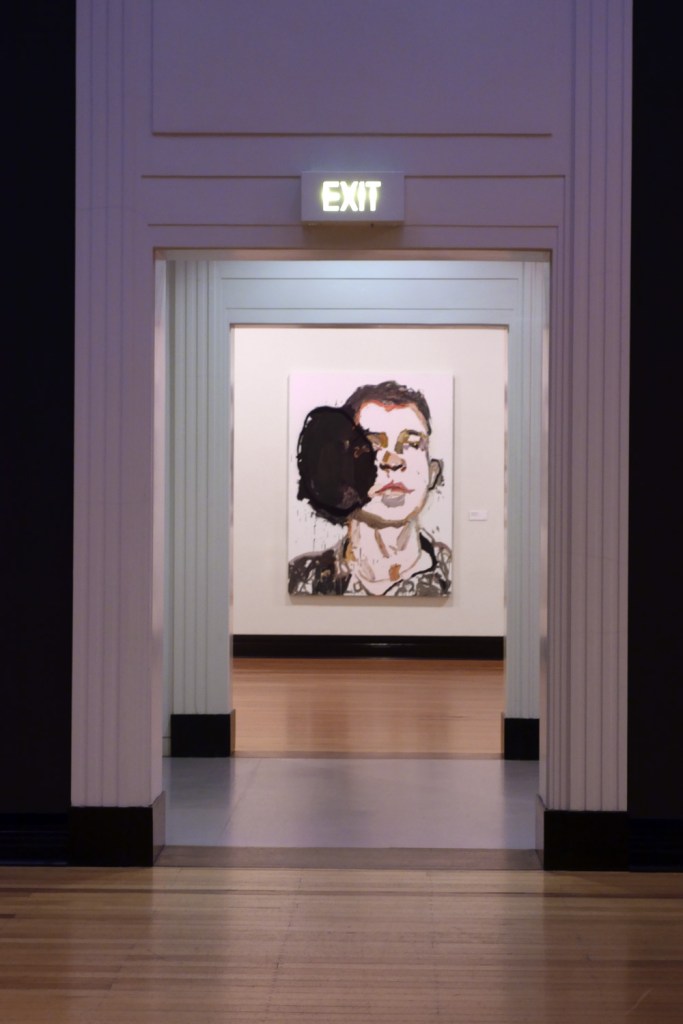
National Gallery of Victoria website

LIKE ART BLART ON FACEBOOK

Back to top

Review: ‘Earth Matters: contemporary photographers in the landscape’ at the Monash Gallery of Art, Wheelers Hill, Melbourne

Exhibition dates: 6th March – 3rd May 2015


Rosemary Laing (Australian, b. 1959) 'Swanfires, Chris's shed' 2002–2004


Rosemary Laing (Australian, b. 1959)
Swanfires, Chris’s shed
2002-04
Chromogenic print
110 x 235.5cm
Monash Gallery of Art, City of Monash Collection acquired 2011
Reproduction courtesy of the artist and Tolarno Galleries, Melbourne


“The term “landscape” can be ambiguous and is often used to describe a creative interpretation of the land by an artist and the terrain itself. But there is a clear distinction: the land is shaped by natural forces while the artist’s act of framing a piece of external reality involves exerting creative control. The terms of this ‘control’ have be theorised since the Renaissance and, while representations of nature have changed over the centuries, a landscape is essentially a mediated view of nature.”


Dr Isobel Crombie. ‘Stormy Weather. Contemporary Landscape Photography’ (exhibition catalogue). Melbourne: National Gallery of Victoria, 2010, p. 15.


What’s the story!

I wish I could say that this is a marvellous, magical exhibition, that it has value in its being in the world… but I can’t. The exhibition is very disappointing, dispiriting even. If this is the current state of contemporary photographers working in the landscape in Australia, then the Earth is in deep trouble (as if we didn’t know it already).

A large part of the exhibition is given over to the work of the ND5 photographic collective. I am not going to name the photographers here since most of the exhibited work does not contain specific names (unlike this posting). The work has been culled (an appropriate word given the theme of the exhibition) from numerous bodies of work spanning the years 2010-2013. Pairs of photographs have been renamed with poetic titles such as The lie of the land and The walls of the world with seemingly scant regard for the origins and stories of the photographs from their respective series, and then cobbled together in this present form under the banal title Investigations (2010-2013). This process pays no heed to the original conceptualisation of each series and the concerns of the collective at that time they were made and here this produces a display that has little rhyme or reason. Text quotations (see below) try to remedy the situation to little avail.

Further, if you think of those lush coffee table books – “Australia from the air” or “The wonders of the Great Barrier Reef” then you get the picture. Technically, the work is superb but aesthetically and emotionally these images are invariably dead (perhaps that is the irony – I looked for irony but it was sadly lacking). The collective say that they are fascinated – in the broadest sense – by places and opposites


“We are fascinated in the broadest sense by places like the Pilbara, including our ignorance and insensitivity to them. We are not ‘in the Pilbara’ in the way that scientists collect and identify it. Rather, we are collecting what can’t be seen; evidence of our uncertainty, interaction, wanderings and pondering…

We were drawn to its boundaries and edges; between solid and liquid, weight and weightlessness, hot and cool, dry and wet, between ourselves and the rest of the world, and that line of habitation that encrusts, indeed misrepresents our nation … The problem is how we index, moralise and politicise land use, rather than appropriating or projecting country as an aesthetic object.”

ND5. “The Pilbara Project – Photographers’ Cut” 2011


Firstly, the opposites thing is such an easy way out; and secondly, as Isobel Crombie notes in the quotation at the top of the posting, any artist’s view of the landscape is always a mediated view of nature. Through their lurid, hyperreal photographs of the land these photographs do exactly what this collective said they didn’t want to do… appropriate and project country as an aesthetic object. Here the pastiche is the real.

The group also seems to want to have AGENCY in both its meanings – as in photographic agency (a business or organisation providing a particular service on behalf of another business, person, or group); or an action or intervention producing a particular effect. What the collective is doing, in the broadest sense (for that is what they are working with), is creating an ideology of the landscape. And it’s not an ideology that I buy into.

You could propose that a couple of the photographs build an argument around the conceit / concept of the sublime – to question whether it can be undermined through irony (the impression of multiple light sources in Stirling Ranges, 2013, below), or to question whether it actually belongs on the surface of the earth (the dust-storm, In my Garden, 2012, below), where it can only be viewed as if the lens is detached from the surface of the earth. But this is drawing a long bow when these are viewed in the context of the rest of the work.

It is worth quoting Joan Fontcuberta extensively here for he, much more eloquently than I, names this work for what it is


“Arthus-Bertrand is a highly experienced and highly regarded professional who has taken more than 100,000 aerial shots, covering almost the entire surface of the globe [author of Earth from Above – “as magnificent a coffee-table book as you could hope to find, whose successive reprints have sold in astronomical numbers”]. There is no doubt as to the quality of his work, on the contrary, we can only celebrate the fact that he and his team at the specialised agency Altitude continue to be so prolific and so creative. But his popular and commercial impact and the eagerness of the cultural institutions to clasp him to their bosoms prompt reflections that go to the very heart of documentary photography and its current crisis.

When paparazzi and the celebrity/human interest-genre reign supreme, serious photo reportage gives way to mere illustration, to the aestheticisation of the world and the masking of conflicts rendered insignificant by distance. Something is wrong when readers can say, ‘How picturesque the favelas are, with those bright colours! What wonderful colours these polluted rivers have!’ Bretch said photographic realism bounces off the façade of things: a photo of the Krupp factories shows us smokestacks and sheds, but tells us nothing about the relations of exploitation inside them. What was needed to refute him were photographers with the talent and the guts to demonstrate that it was a matter of critical sense and eloquence, that photography was a language which really could penetrate the camouflaging surfaces of the real.”

Joan Fontcuberta. “Cosmic Palimpsests,” in Joan Fontcuberta. Pandora’s Camera: Photogr@phy after Photography. Mack, 2014, pp. 156-157.


That photography was a language which really could penetrate the camouflaging surfaces of the real. In this case the wonderful, hyperreal, saturated colours of the polluted rivers – that really hits the nail on the head.

If, as the collective says, “they want to examine its particular confluxes of culture, industry, environment and history in order to begin to craft a stronger vision for its future” (The Pilbara Project – 2010) then they need to be more concerned about what is present in the landscape, what is present in the community not from several emotional steps removed. You only have to look at the work of Edward Burtynsky and his Australian Minescape series to understand that in his series the photographs are all made in a way, and with a concern that goes beyond technical competence and cinematic craft – something that can rarely be said of the work presented by ND5.

Personally, I believe one of the main reasons for being an artist is to seek to redefine the sets of opposites that we find, to excavate… to pull away the mundane description of things. And in my opinion, if you really LOOK AT THIS WORK – and that’s seems to be a simple thing to ask an artist to do, to really look at their own work – then you have to ask yourself ‘Why would I want to look at this?’ There is no story, no pulling away of the veil, for these are boring images cloaked, as Fontcuberta says, in the colours of polluted rivers, in the camouflaging surfaces of the hyperreal. Perhaps these contemporary “picturesque” images are the modern form of the end of Pictorialism?


The lack of a story continues to haunt the rest of the exhibition as well. If we address the title Earth Matters in both its forms – that Earth really does matter to us; and that Earth matters (as in we are all made up of atoms and that matter commonly exists in four states (or phases): solid, liquid and gas, and plasma) then the work can relate to the body, place, landscape, etc… what an opportunity!

The usually reliable Rosemary Laing provides a dirge-like image that took me nowhere. Siri Hayes supplies a wonderful, ironic image (Wanderer in a sea of images 2013, below) with chopped down trees in a grand vista, a person taking a photograph of a person taking a photograph with belching power stations in the background – and then prints it at a massive scale which over stretches the boundaries of the technical possibilities of the negative. At a distance it just about holds up, but as can be seen from the closeup below (click on it for the large version) the image is blurred and distorted when printed at this huge scale. Photographs have a correct proportion to their significance as an image which is completely destroyed here.

David Tatnall exposes black and white pinhole images of the landscape which really didn’t do much for me, especially with an extraneous blurred human figure that really meant very little in the context of the images, while Harry Nankin’s work fails to convince. His creatures crawling over photo-senstised plates of glass and then displayed on a light box left me cold – and yet another artist where you had to look up the meaning of the title / word ekkyklêma to try and understand the story being told. Christian Bumbarra Thompson supplies an image that means nothing to the uninitiated (another story that can only be guessed at – there is no text to explain), while Anne Ferran’s beautiful, luminous ink-jet print’s on aluminium, Untitled (2008) are just that – beautiful and luminous – unless you know the backstory which is nowhere explained in the gallery. (The photographs are “more than a decade’s exploration of a piece of ground on the outskirts of the small village of Ross in central Tasmania. Today little remains of its past as a female convict prison, apart from some mounds of earth and scattered stones. Her photographs and video works about this site reflect the ongoing difficulty of grasping and making sense of a ruined and fragmented past.”)

And last but not least, to the star of the show: Silvi Glattauer’s series Sanctuary (2014, below). OMG, these are gorgeous!

Beautiful photogravure prints on cotton paper give a wonderful soft tonality to these alien environments. The worlds are like liquid mercury. I did a double take trying to work out what they were for quite a few seconds before I got it. Beautifully composed, quiet, sensitive and eloquent these are everything that so much of the rest of the show isn’t. The story is in the macrocosm and the microcosm, the world at our fingertips that we never see, that we are forever destroying. Not the broadest of brush strokes picturesque but getting in and getting your hands dirty, paradoxically revealing cosmic worlds that we usually only dream of. Finally a story worth photographing: some matter that really does matter.

Dr Marcus Bunyan


Many thankx to the Monash Gallery of Art for allowing me to publish the photographs in the posting. All installation photographs © Marcus Bunyan and the Monash Gallery of Art. Please click on the photographs for a larger version of the image.


Christian Bumbarra Thompson (Australian, b. 1978) 'I'm not going anywhere without you' 2009


Christian Bumbarra Thompson (Australian, b. 1978)
Bidjara man of the Kunja Nation
I’m not going anywhere without you
2009
from the series Lost together
Chromogenic print
100 x 99.3cm
Monash Gallery of Art, City of Monash Collection acquired 2009
Reproduction courtesy of the artist


Installation photograph of 'Earth Matters' at the Monash Gallery of Art, Melbourne showing Siri Hayes' 'Wanderer in a sea of images' 2013

Siri Hayes (Australia, b. 1977) 'Wanderer in a sea of images' 2013


Siri Hayes (Australia, b. 1977)
Wanderer in a sea of images
2013
Ink-jet print on polyester
220 x 280cm
Collection of the artist
Courtesy of the artist


Siri Hayes’s exquisitely detailed photographs depict picturesque landscapes but landscapes that are also disturbed, perhaps devastated by fire, littered with debris, or cleared of their native vegetation for plantation timber. By using the conventions of classical landscape painting to photograph the contemporary landscape, Hayes draws our attention to environmental themes in this unique, large-scale installation.


Siri Hayes (Australia, b. 1977) 'Wanderer in a sea of images' 2013 (detail)


Siri Hayes (Australia, b. 1977)
Wanderer in a sea of images (detail)
2013
Ink-jet print on polyester
220 x 280cm
Collection of the artist
Courtesy of the artist


Silvi Glattauer (born Argentina 1966; arrived Australia 1974) 'Sanctuary' 2014


Silvi Glattauer (born Argentina 1966; arrived Australia 1974)
Sanctuary
2014
Six photogravure prints on cotton paper
27.6 x 27.7cm (each)
Collection of the artist
Courtesy of the artist


Silvi Glattauer (born Argentina 1966; arrived Australia 1974) 'Sanctuary I' 2014


Silvi Glattauer (born Argentina 1966; arrived Australia 1974)
Sanctuary I
2014
Six photogravure prints on cotton paper
27.6 x 27.7cm (each)
Collection of the artist
Courtesy of the artist


Silvi Glattauer (born Argentina 1966; arrived Australia 1974) 'Sanctuary VI' 2014


Silvi Glattauer (born Argentina 1966; arrived Australia 1974)
Sanctuary VI 
2014
Six photogravure prints on cotton paper
27.6 x 27.7cm (each)
Collection of the artist
Courtesy of the artist


Installation photograph of 'Earth Matters' at the Monash Gallery of Art, Melbourne

Installation photograph of 'Earth Matters' at the Monash Gallery of Art, Melbourne


Installation photographs of Earth Matters at the Monash Gallery of Art, Melbourne
Photos: Marcus Bunyan


Harry Nankin (Australia, b. 1953) 'Minds in the cave / fragment 2' 2014


Harry Nankin (Australia, b. 1953)
Minds in the cave / fragment 2
2014
Pigment ink-jet prints on cotton pape
Collection of the artist


Harry Nankin (Australia, b. 1953) 'Ekkyklema #1' 2014 (installation view detail)

Harry Nankin (Australia, b. 1953) 'Ekkyklema #1' 2014 (installation view detail)

Harry Nankin (Australia, b. 1953) 'Ekkyklema #1' 2014 (installation view detail)


Harry Nankin (Australia, b. 1953)
Ekkyklema #1 (installation view details)
2014
Gelatin silver chemogram films on starfire glass [on lightbox]
0.5 x 14 x 14cm (each)
Courtesy of the artist
Collection of the artist
Note: 112 plein air silver gelatin shadowgram and chemogram films on starfire glass panes
Photos: Marcus Bunyan


An ekkyklêma (“roll-out machine”) was a wheeled platform rolled out through a skênê in ancient Greek theatre. It was used to bring interior scenes out into the sight of the audience. Some ancient sources suggest that it may have been revolved or turned.

It is mainly used in tragedies for revealing dead bodies, such as Hippolytus’ dying body in the final scene of Euripides’ play of the same name, or the corpse of Eurydice draped over the household altar in Sophocles’ Antigone. Other uses include the revelation in Sophocles’ Ajax of Ajax surrounded by the sheep he killed whilst under the delusion that they were Greeks. The ekkyklêma is also used in comedy to parody the tragic effect. An example of this is in Aristophanes’ Thesmophoriazusae when Agathon, portrayed as an effeminate, is wheeled onstage on an ekkyklêma to enhance the comic absurdity of the scene.

Text from the Wikipedia website


Anne Ferran (Australian, b. 1949) 'Untitled' 2008


Anne Ferran (Australian, b. 1949)
Untitled
2008
From the series Lost to worlds
2 ink-jet print on aluminium
120 x 120cm
Monash Gallery of Art, City of Monash Collection acquired with assistance from the Robert Salzer Foundation 2009
Reproduction courtesy of the artist and Sutton Gallery (Melbourne)


Anne Ferran (Australian, b. 1949) 'Untitled' 2008


Anne Ferran (Australian, b. 1949)
Untitled
2008
From the series Lost to worlds
2 ink-jet print on aluminium
120.0 x 120.0cm
Monash Gallery of Art, City of Monash Collection acquired with assistance from the Robert Salzer Foundation 2009
Reproduction courtesy of the artist and Sutton Gallery (Melbourne)


Intellectually and emotionally engaging, sometimes austere, her [Ferran’s] photographs have explored histories of incarceration in prisons, asylums, hospitals and nurseries. They play with invisibility and anonymity, and are often haunted by things lost or unseen. Lost to Worlds 2008 was the culmination of more than a decade’s exploration of a piece of ground on the outskirts of the small village of Ross in central Tasmania. Today little remains of its past as a female convict prison, apart from some mounds of earth and scattered stones. Her photographs and video works about this site reflect the ongoing difficulty of grasping and making sense of a ruined and fragmented past.


Ninety Degrees Five. 'Earth matters' 2015 installation photograph

Ninety Degrees Five. 'Earth matters' 2015 installation photograph

Ninety Degrees Five. 'Earth matters' 2015 installation photograph


Ninety Degrees Five
Earth matters (installation stills)
2015
Multimedia, 10.13 minutes
Filmed and edited: Michael Fletcher
Score: Jo Quail-Sonver Collection of the artists
Photos: Marcus Bunyan


Earth matters: contemporary photographers in the landscape is an exhibition developed by MGA for ART+CLIMATE=CHANGE; a Melbourne-wide arts festival exploring climate change and environmental ethics. MGA’s contribution to this festival highlights the ecological sensitivity of contemporary Australian photographers. Moving away from the detached ‘picturesque’ views of nature, so prevalent in the history of photography, these artists engage with the earth in immersive and connected ways.

Siri Hayes and Christian Thompson wander into epic vistas to enact comical self-portraits that capture the capricious nature of human presence on this planet. Silvi Glattauer peers into the interiors of bromeliad plants to find fecund microcosms that bubble with humble but hopeful vitality. Rosemary Laing pays tribute to ecological tragedy with a monumental photograph of bushfire devastation, while Anne Ferran ruminates over the tragic scars of colonial history in the landscape. David Tatnall’s eerie photographs have been produced with a rudimentary pinhole camera, embed in the environment to bear witness to the earth’s passing. Harry Nankin does away with the camera and its singular perspective altogether, using raw photographic film to record ecological forces in nocturnal landscapes.

Earth matters features a new installation by the Ninety Degrees Five collective alongside the work of other contemporary landscape photographers including Anne Ferran, Silvi Glattauer, Siri Hayes, Harry Nankin, David Tatnall and Christian Thompson. Ninety Degrees Five (ND5) is a collective of five Australian artists established in 2010, featuring Peter Eastway, Christian Fletcher, Michael Fletcher, Tony Hewitt & Les Walkling.

Text from the MGA website


Installation view of various Ninety Degrees Five 'Investigations' 2010-2013 at the exhibition 'Earth Matters', Monash Gallery of Art


Installation view of Ninety Degrees Five Investigations 2010-2013 at the exhibition Earth Matters, Monash Gallery of Art


Ninety Degrees Five. 'The lie of the land' (installation view) (Christian Fletcher, left; Les Walkling, right) 2012-2013


Ninety Degrees Five
The lie of the land (installation view)
(Christian Fletcher, left; Les Walkling, right)
2012-2013
From the series Investigations 2010-2013
Pigment ink-jet prints
Collection of the artists
Photo: Marcus Bunyan


Christian Fletcher (Australian, b. 1965) From the series 'South West Light' 2012 (detail)


Christian Fletcher (Australian, b. 1965)
From the series South West Light (detail)
2012
Pigment ink-jet print


Ninety Degrees Five. 'The walls of the world' (installation view) (Tony Hewitt, left; Peter Eastway, right) 2012-2013


Ninety Degrees Five
The walls of the world (installation view)
(Tony Hewitt, left; Peter Eastway, right)
2012-2013
From the series Investigations 2010-2013
Pigment ink-jet prints
Collection of the artists
Photo: Marcus Bunyan


Tony Hewitt (Australian) From the series 'Shark Bay Inscription' 2013 (detail)


Tony Hewitt (Australian)
From the series Shark Bay – Inscription (detail)
2013
Pigment ink-jet print


About Ninety Degrees Five

“Our work … seeks to encourage and reinforce public concern for the fate of the earth, and our responsibility to act on that awareness.”

~ Les Walkling


Ninety Degrees Five (ND5) is a unique collaboration of four photographers, Christian Fletcher, Peter Eastway, Tony Hewitt, Les Walkling and film maker Michael Fletcher.

ND5 initially came together for The Pilbara Project in 2010. The Pilbara Project was developed and produced by FORM, an independent, non-profit cultural organisation in Western Australia. Curated by William L. Fox, the Director of the Center for Art and Environment of the Nevada Museum of Art, and Mollie Hewitt (FORM), the collaboration resulted in the book, The Pilbara Project: Field Notes and Photographs Collected over 2010, and the first Pilbara Project exhibition: 52 Weeks On, in February 2011.

Subsequent ND5 projects, South West Light 2011, Shark Bay – Inscription 2012, EAST 2013 and NORTH 2014 consolidated the collective’s independence and artistic agenda. The result has been ten exhibitions on three continents since 2011. Each exhibition is supported by public performances and events, including broadcast media, workshops, master classes, and artist talks.

Investigations 2010-2013 is ND5’s latest installation that remixes works from the first three ND5 projects (The Pilbara Project, South West Light, and Shark Bay – Inscription) to highlight their transcending artistic projections and cultural concerns. In this sense ND5’s projects are a primary research model for their ongoing Investigations, and thereby demonstrate an engaging, enquiring, and speculative process, not just its resolved and published outcome. This is important because ND5 has also become a case study in what can happen when a group forms from diverse but supportive individuals who are secure enough in their own practice to experiment with it.

This model privileges something of the urgency and necessity surrounding our worryingly fragile relationship to land and landscape, place and belonging, rights and duties, environmental crisis and environmental justice, sovereignty and reconciliation, trust and despair.

Investigations 2010-2013 also extends ND5’s collaborative endeavour through the acknowledgement, quotation and incorporation of other voices no less concerned with such matters, and thereby seeks to promote this conversation beyond individuals and collectives.

ND5


Text that accompanies the Ninety Degrees Five series 'Investigations' 2010-2013

Text that accompanies the Ninety Degrees Five series 'Investigations' 2010-2013

Text that accompanies the Ninety Degrees Five series 'Investigations' 2010-2013

Text that accompanies the Ninety Degrees Five series 'Investigations' 2010-2013

Text that accompanies the Ninety Degrees Five series 'Investigations' 2010-2013


Text that accompanies the Ninety Degrees Five series Investigations 2010-2013
Photos: Marcus Bunyan


Christian Fletcher (Australian, b. 1965) 'Stirling Ranges' 2013


Christian Fletcher (Australian, b. 1965)
Stirling Ranges
2013
From the series South West Light
965mm x 2165mm


Tony Hewittt (Australian) 'Red Coast' 2014


Tony Hewittt (Australian)
Red Coast
2014
From the series Shark Bay – Inscription
965mm x 965mm


Peter Eastway (Australian) 'South of Faure Island' 2014


Peter Eastway (Australian)
South of Faure Island
2014
From the series Shark Bay – Inscription
965mm x 965mm


Les Walkling (Australian, b. 1953) 'In my Garden' 2012


Les Walkling (Australian, b. 1953)
In my Garden
2012
From the series The Pilbara Project
965mm x 965mm


https://www.youtube.com/watch?v=VOkSmuV_eVU


Monash Gallery of Art
860 Ferntree Gully Road, Wheelers Hill
Victoria 3150 Australia
Phone: + 61 3 8544 0500

Opening hours:
Tue – Fri: 10am – 5pm
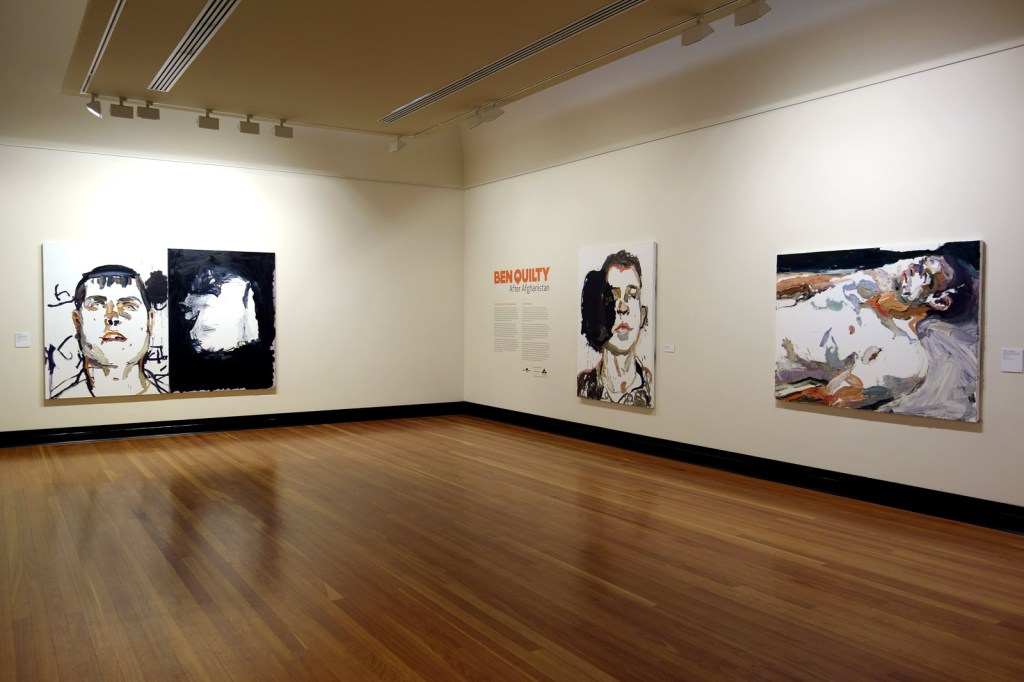
Sat – Sun: 10pm – 4pm
Mon/public holidays: closed

Monash Gallery of Art website

LIKE ART BLART ON FACEBOOK

Back to top

Photographs: Marcus Bunyan. ‘Too Much of the Air’ 2015

April 2015


Marcus Bunyan (Australian, b. 1958) 'Too Much of the Air' 2015


Marcus Bunyan (Australian, b. 1958)
Untitled
2015
Digital photograph
From the series Too Much of the Air 


Too Much of the Air

And now for something completely different… after 16 months hard work, I have completed a new 52 image sequence.

Below is a selection of images from the sequence. Please click on the photographs for a larger version of the image.

To view the whole sequence please visit my website.


“Imagine being in these planes knowing that you only had moments to live, and knowing that you could do nothing about it. What brought you to that point, what decisions did you take as a human being (or were taken for you) that enacted this scenario.

The “greatness” as the event passes is what is being worked with here. It is the inverse aspect of the sublime. Usually the sublime is regarded as beyond time … but not here. Essentially I am sustaining the last moments of a doomed life, outside of time.

We are unusually privileged to experience the sublime in this way. It is usually a lost aspect through the death of the witness.”


Dr Marcus Bunyan


Note: these images will be printed large to reinforce the disintegration of the image, technology and human being. Tullio Crali‘s painting Before the Parachute Opens (Prima che si apra il paracadute) (1939) was one of a few starting points, inspirations, for the new sequence.

Photographs are available from this series for purchase. As a guide, a digital colour 16″ x 20″ costs $1000 plus tracked and insured shipping. For more information please see my Store web page.


Beginning of the sequence


Marcus Bunyan (Australian, b. 1958) 'Too Much of the Air' 2015


Marcus Bunyan (Australian, b. 1958) 'Too Much of the Air' 2015


Marcus Bunyan (Australian, b. 1958) 'Too Much of the Air' 2015


Marcus Bunyan (Australian, b. 1958) 'Too Much of the Air' 2015


Marcus Bunyan (Australian, b. 1958) 'Too Much of the Air' 2015


Marcus Bunyan (Australian, b. 1958) 'Too Much of the Air' 2015


Marcus Bunyan (Australian, b. 1958) 'Too Much of the Air' 2015


Marcus Bunyan (Australian, b. 1958) 'Too Much of the Air' 2015


Marcus Bunyan (Australian, b. 1958) 'Too Much of the Air' 2015


Marcus Bunyan (Australian, b. 1958) 'Too Much of the Air' 2015


Marcus Bunyan (Australian, b. 1958) 'Too Much of the Air' 2015


End of the sequence


Marcus Bunyan (Australian, b. 1958) 'Too Much of the Air' 2015


Marcus Bunyan (Australian, b. 1958) 'Too Much of the Air' 2015


Marcus Bunyan (Australian, b. 1958) 'Too Much of the Air' 2015


Marcus Bunyan (Australian, b. 1958) 'Too Much of the Air' 2015


Marcus Bunyan (Australian, b. 1958) 'Too Much of the Air' 2015


Marcus Bunyan (Australian, b. 1958) 'Too Much of the Air' 2015


Marcus Bunyan (Australian, b. 1958) 'Too Much of the Air' 2015


Marcus Bunyan (Australian, b. 1958) 'Too Much of the Air' 2015


Marcus Bunyan (Australian, b. 1958) 'Too Much of the Air' 2015


Marcus Bunyan (Australian, b. 1958) 'Too Much of the Air' 2015


Marcus Bunyan (Australian, b. 1958) 'Too Much of the Air' 2015


Marcus Bunyan (Australian, b. 1958) 'Too Much of the Air' 2015


Marcus Bunyan (Australian, b. 1958) 'Too Much of the Air' 2015


Marcus Bunyan (Australian, b. 1958) 'Too Much of the Air' 2015


Marcus Bunyan website

LIKE ART BLART ON FACEBOOK

Back to top

Exhibition: ‘Juvenilia: Peter Milne’ at Strange Neighbour, Fitzroy, Melbourne

Exhibition dates: 27th February 27th – 28th March, 2015

Curators: Helen Frajman and Linsey Gosper


Peter Milne (Australian, b. 1960) 'Untitled (Peter Milne and Rowland S Howard' from the series 'A Day in the Life of Rowland S Howard' 1977


Peter Milne (Australian, b. 1960)
Untitled (Peter Milne and Rowland S Howard)
1977
From the series A Day in the Life of Rowland S Howard 1977
Digital photograph
© Peter Milne


For those of you that remember The Venue, St Kilda and Razor Club, this posting is for you.

This is a FAB exhibition of the life and times of Nick Cave, Roland S Howard, Genevieve McGuckin, Polly Borland, The Boys Next Door, The Birthday Party et al. Peter Milne… the photographs are fantastic, perfectly capturing the spirit, youth and electricity of the times. My god, everyone is so young, so skinny and Roland is SO androgynous in quite a few of the photos – all eyeliner and come to bed eyes.

Although I never mixed in these circles I occasionally went to The Venue, but Razor was definitely the place to be. One enduring memory was of me, totally off my face on a big party night, climbing up past the ladies loo using the gutter down pipes up to the first floor balcony and clambering over, so that I could go and get someone from management to let us all in.

The hang of the exhibition is perfect. In a flow of images, here is Peter Milne at 17 sitting on a couch with Roland S Howard reading Playboy; Polly Borland at home with a broken, unlit fag hanging from her mouth; and the most beautiful, colour photograph of Nick Cave and Rowland S Howard after Birthday Party gig (1982, below) with arms around each, Nick planting a kiss on the dapper Roland, flocked wallpaper behind. Youth, innocence, life, love, beauty and nostalgia all rolled into one. Gen (Genevieve McGuckin), long-time partner of Roland, has been a friend of mine for years and so it is wonderful to see photographs of her in her youth, as vivacious and as delightful now as then.

I loved every second of this exhibition. The creativity of the people, the vibrancy of the ad hoc poses and the sheer joy of living the life – coupled with the magic of the insightful, intuitive images – make this a must see exhibition. If you do anything in Melbourne this coming week, go see this show (ends Saturday, 28th March).

Dr Marcus Bunyan


Many thankx to Strange Neighbour and Peter Milne for allowing me to publish the photographs in the posting. Please click on the photographs for a larger version of the image. All images courtesy of the artist and M.33. Download the Juvenilia web essay (2.7Mb pdf)


Installation photograph of the exhibition 'Juvenilia' at Strange Neighbour, Melbourne

Installation photograph of the exhibition 'Juvenilia' at Strange Neighbour, Melbourne

Installation photograph of the exhibition 'Juvenilia' at Strange Neighbour, Melbourne

Installation photograph of the exhibition 'Juvenilia' at Strange Neighbour, Melbourne

Installation photograph of the exhibition 'Juvenilia' at Strange Neighbour, Melbourne


Installation photographs of the exhibition Juvenilia at Strange Neighbour, Melbourne
Photography: Alex Bell Moffat


Juvenilia brings together for the first time 100 astonishing photographs of friends and family taken by renowned Victorian artist Peter Milne when he was a very young man. Warm, intimate, surprising and already displaying the great compositional skills, originality and humour for which Milne is known, these images offer an unprecedented peep into mid 1970s to mid 1980s Melbourne and a milieu of people who would go on to play pivotal roles in Melbourne’s burgeoning cultural scene.

Starting in 1976 when Milne was 16 and photographing school friends Gina Riley and Rowland S Howard, through to images of the legendary band, the Boys Next Door lounging in Nick Cave’s bedroom in his parents’ house, the first Boys Next Door gig and photo shoot, parties, trips to the country, outings to the beach, rehearsals and a full length photo essay tracing A Day in the Life of Rowland S Howard, the photographs feature a dazzling cast including Anita Lane, Blixa Bargeld, Tony Clark, Polly Borland and Mick Harvey as well as Milne’s less famous but equally interesting friends and family.

Peter Milne is based in Castlemaine. He has exhibited extensively around Australia and internationally. He has had three monographs of his work published: When Nature Forgets (M.33, Melbourne, 2013), Beautiful Lies – Notes Towards a History of Australia (QCP, Brisbane, 2011) and Fish in a Barrel – Nick Cave & The Bad Seeds on Tour (Tender Prey, London, 1993). He is represented by M.33, Melbourne.

Text from the Strange Neighbour website


Peter Milne (Australian, b. 1960) 'Untitled (Rowland S Howard)' 1977 From the series 'A Day in the Life of Rowland S Howard' 1977


Peter Milne (Australian, b. 1960)
Untitled (Rowland S Howard)
1977
From the series A Day in the Life of Rowland S Howard 1977
Digital photograph
© Peter Milne


Peter Milne (Australian, b. 1960) 'Untitled (Rowland S Howard)' 1977 From the series 'A Day in the Life of Rowland S Howard' 1977


Peter Milne (Australian, b. 1960)
Untitled (Rowland S Howard)
1977
From the series A Day in the Life of Rowland S Howard 1977
Digital photograph
© Peter Milne


I was initially quite dubious when curators Linsey Gosper and Helen Frajman approached me about exhibiting this work because it is so obviously the product of a callow youth (the earliest images on show here were shot when I was 16 years old, soon after the dismissal of the Whitlam government in the mid 1970s).

I was placated by the argument that the work had some kind of historical value that negated my concerns about poor technique and the visible signs of decay in an archive that has been poorly stored for the last four decades but I still felt uncomfortable. I think my key anxiety was the possibility that I would come across like one of those figures we’ve seen in numerous, recent documentaries about the Punk days in Melbourne – fat, balding, middle-aged individuals banging on about how amazing they were when 18 years old. As a fat, balding, middle-aged artist (with visible signs of decay) I try to be more focused on my next body of work than I am on images I produced so very, very long ago.

However, having pulled the negatives and slides out of their dusty boxes, I now see some merit in them. I am immediately struck by the evidence that I really did hang out with some lovely, clever people who went on to fulfil much of the creative potential that they so clearly promised.

I cannot say that life in Melbourne in the late 1970s and early 1980s was bliss (because the city had some meagre, stale and forbidding ways) but it was a time and a place where I found myself in the company of a cohort with great inventive energy and all the joyous arrogance of youth.

Looking at these images now, I see that my friends and family were every bit as beautiful as I remember them.

Peter Milne
2015


Rowland S. Howard – A Short Biography


Peter Milne (Australian, b. 1960) 'Untitled (Rowland S Howard)' 1977 From the series 'A Day in the Life of Rowland S Howard' 1977


Peter Milne (Australian, b. 1960)
Untitled (Rowland S Howard)
1977
From the series A Day in the Life of Rowland S Howard 1977
Digital photograph
© Peter Milne


Peter Milne (Australian, b. 1960) 'Untitled (Rowland S Howard)' 1977 From the series 'A Day in the Life of Rowland S Howard' 1977


Peter Milne (Australian, b. 1960)
Untitled (Rowland S Howard)
1977
From the series A Day in the Life of Rowland S Howard 1977
Digital photograph
© Peter Milne


Christmas holidays 1977…

My friends and I were in our mid-teens and we’d heard about the coming of Australian punk: the Saints in Brisbane and Radio Birdman in Sydney. We’d been to a few gigs at Burnhearts, a gay venue housed in the old ‘Thumping Tum’ that had given up its Tuesday nights to punk. We’d seen Fiction, the Negatives and News there. Punk had exploded across the world, not that you’d know it in Melbourne unless you were one of the few hundred weirdo kids who listened to the new Community Radio station 3RMT FM.

Every form of popular music culture was about something from outside of Australia, untouchable and inaccessible to us. On the other hand, punk was raw and exciting, friends who could strum a few chords had started picking up guitars and all of a sudden, some of us were playing something that resembled music, sure it was dumb and clumsy but it was also empowering and exhilarating.

There was a girl at my high school, Jenny Shannon. Jenny had been telling me and my mates of when her good friend Anita Lane had taken her to see the coolest punk band in Melbourne, so we had to check them out, but each attempt was thwarted with false gig listings and cancellations. Finally, we heard of a gig in Footscray Gardens where Suicide Records were promoting the release of their ‘Lethal Weapons’ compilation LP with a free open air punk gig. We rolled across to Footscray on a beautiful sunny day with the occasional sun shower. In the old red rattler, we were amongst about 50 curious, pimply kids with our hair becoming shorter as our conviction for this new thing grew.

On this particular day punk bands played, loud, distorted music with no frills and minimal production. The Boys Next Door, a tall skinny gang of guys in black, stove pipe pants, long black duffel coats, high collars turned up and mean, superior stares saunter in. “Rowlands here” Jenny whispers “He’s not a member of the band he’s just a friend of Nicks.” Who’s Rowland? Who’s Nick I’m wondering? “We’re the Boys Next Door” one of them spits. With that, the sky suddenly opens and people run for the cover of the trees.

The promoter jumps onto the mic and announces that due to rain they won’t play. There’s a round of booing from 50 people who wanna witness the spectacle of some real punk bands like animals in a zoo. The tall skinny guy grabs the mic, “We’re not fucking playing!” “That’s Nick” says Jenny… more boos… “Fuck off” says skinny guy, so we’ve seen them now, they seem like real assholes and I can’t wait to actually hear ’em live. As we walk back to the station in the drizzle I’ve got Dum Dum Boys by Iggy Pop ringing in my head…

“The first time I saw the dum dum boys I was fascinated”

I didn’t get to catch the Boys Next Door properly until a few months later at the VCA, it was Rowlands 1st gig as the new member of the band…

“I was most impressed. No one else was impressed… they looked as if they put the whole world… down”

This era was exhilaration, bright, skinny, sharp, obnoxious vitality, compelling handsome boys with eyeliner, well-spoken brats with beautiful intelligent sharp witted girls hanging off their arms, the birth of a movement in popular culture that had come to kick the ass of everything that had come before it, to burn brightly and then splinter off into a million shiny pieces. Peter Milne was there at its birth, captured the first sparks of this Super Nova going off. Fortunately he was the only kid around at the time with a good camera who actually knew how to use it to recognise a bunch of ascending stars and shoot those “Fish in a Barrel.”

Quincy McLean
2015


The Birthday Party
Nick The Stripper
1981

Band Location: Melbourne, VIC, Australia
Track: Nick The Stripper
Album: Prayers On Fire
Composed By: Nick Cave
Produced by: Tony Cohen & The Birthday Party


Peter Milne (Australian, b. 1960) 'Anita Lane and Nick Cave, The Venue, St Kilda' mid-1980s


Peter Milne (Australian, b. 1960)
Anita Lane and Nick Cave, The Venue, St Kilda
mid-1980s
Digital photograph
© Peter Milne


Peter Milne (Australian, b. 1960) 'Anita Lane at a party' mid 1980s


Peter Milne (Australian, b. 1960)
Anita Lane at a party
mid 1980s
Digital photograph
© Peter Milne


Peter Milne (Australian, b. 1960) 'Boys Next Door first photo session after Rowland joined. Nick's bedroom, Caulfield' c. 1978


Peter Milne (Australian, b. 1960)
Boys Next Door first photo session after Rowland joined. Nick’s bedroom, Caulfield
c. 1978
Digital photograph
© Peter Milne


Peter Milne (Australian, b. 1960) 'George and Troy' mid-1980's


Peter Milne (Australian, b. 1960)
George and Troy
mid-1980’s
Digital photograph
© Peter Milne


Peter Milne (Australian, b. 1960) 'Janet Austin and Katy Becle' 1977


Peter Milne (Australian, b. 1960)
Janet Austin and Katy Becle
1977
Digital photograph
© Peter Milne


Peter Milne (Australian, b. 1960) 'Polly Borland at home' early 1980s


Peter Milne (Australian, b. 1960)
Polly Borland at home
early 1980s
Digital photograph
© Peter Milne


The Birthday Party
Deep in the Woods


Peter Milne (Australian, b. 1960) 'Rowland S. Howard, Gina Riley, Simon McLean. TATROC gig, Greville Street, 1976' 1976


Peter Milne (Australian, b. 1960)
Rowland S. Howard, Gina Riley, Simon McLean. TATROC gig, Greville Street, 1976
1976
Digital photograph
© Peter Milne


Peter Milne (Australian, b. 1960) 'Rowland S. Howard and Genevieve McGuckin, St Kilda rooftop' 1977


Peter Milne (Australian, b. 1960)
Rowland S. Howard and Genevieve McGuckin, St Kilda rooftop
1977
Digital photograph
© Peter Milne


Peter Milne (Australian, b. 1960) 'Nick Cave and Rowland S Howard after Birthday Party gig, Melbourne' 1982


Peter Milne (Australian, b. 1960)
Nick Cave and Rowland S Howard after Birthday Party gig, Melbourne
1982
Digital photograph
© Peter Milne


Strange Neighbour

This gallery has now closed

M.33 website

LIKE ART BLART ON FACEBOOK

Back to top

Exhibition/text: ‘Everyday imagining: new perspectives on Outsider art’ at The Ian Potter Museum of Art, Melbourne

Exhibition dates: 1st October 2014 – 18th January 2015

Artists: Andrew Blythe, Kellie Greaves, Julian Martin, Jack Napthine, Lisa Reid, Martin Thompson and Terry Williams

Curator: Joanna Bosse


Martin Thompson (New Zealand, b. 1956) 'Untitled' 2014


Martin Thompson (New Zealand, b. 1956)
Untitled
2014
Ink on paper
52.5 x 105cm
Courtesy the artist and Brett McDowell Gallery, Dunedin


This is a gorgeous exhibition at The Ian Potter Museum of Art. Walking through the show you can’t help but have a smile on your face, because the work is so inventive, so fresh, with no pretension to be anything other than, well, art.

There are big preconceptions about ‘Outsider art’, originally art that was made by institutionalised mentally ill people, but now more generally understood as art that is made by anyone outside the mainstream of art production – “artworks made by folk artists and those who are self-taught, disabled, or on the edges of society” who are disenfranchised in some way or other, either by their own choice or through circumstance or context.

Outsider art promotes contemporary art while still ‘tagging’ the artists as “Outsider” – just as you ‘tag’ a blog posting so that a search engine can find a specific item if it is searched for online. It is a classification I have never liked (in fact I abhor it!) for it defines what you are without ever understanding who you are and who you can become – as an artist and as a human being. One of the good things about this exhibition is that it challenges the presumptions of this label (unfortunately, while still using it).

As Joanna Bosse notes in her catalogue essay, “Most attempts to define the category of Outsider art include caveats about the elasticity of borders and the impact of evolving societal and cultural attitudes… The oppositional dialectic of inside/outside is increasingly acknowledged as redundant  and, in a world marked by cultural pluralism, many question the validity of the category.”1 Bosse goes on to suggest that, with its origins in the term art brut (the raw and unmediated nature of art made by the mentally ill), Outsider art reinforces the link between creativity, marginality and mental illness, proffering “the notion of a pure form of creativity that expresses an artist’s psychological state [which] is a prevailing view that traverses the divergent range of creative practice that falls under the label.”2

The ambiguities of art are always threatened by a label, never more so than in the case of Outsider art. For example, how many readers who visited the Melbourne Now exhibition at NGV International and saw the magnificent ceramic cameras by Alan Constable would know that the artist is intellectually disabled, deaf and nearly blind. Alan holds photographs of cameras three inches away from his eyes and scans the images, then constructs his cameras by feel with his hands, fires them and glazes them. The casual viewer would know nothing of this backstory and just accepts the work on merit. Good art is good art no matter where it comes from. It is only when you enquire about the history of the artist – whether mainstream or outsider – that their condition of becoming (an artist) might affect how you contextualise a work or body of work.

Bosse makes comment about the rationale for the exhibition: ‘The decision to focus on artists’ engagement with the exterior, everyday world was to counter one of the common assumptions about artists in this category – that they are disconnected from society and that their work is solely expressionistic, in that it relates almost exclusively to the self and the expression of the artist’s emotional inner life.”3 Bosse agrees with the position that to simply eliminate the designation would be a different kind of marginalisation – “one where the unique world view and specific challenges the individual faces would become lost in a misguided attempt at egalitarianism.”4

As chair of a panel session at the international conference Contemporary Outsider Art: The Global Context, 23-26th October at The University of Melbourne, curator Lynne Cooke also sees the classification “Outsider” as valuable, for “Outsider art is the condition that contemporary art wants to be” – that is imaginative, free, intuitive, visceral and living on the edge. She sees contemporary art as having run up the white flag leaving Outsider art – however you define that (not the white, middle class male establishment, and belonging to the right galleries) – to be the vanguard, the new avant-garde.5 The exhibition catalogue concludes with her observation that, while current curatorial strategies breakdown the distinctions between ‘inside’ and ‘outside’ – making significant headway concerning stigmatisation – these might have the effect of loosing what she describes as the “‘unique and crucial agency’ that this art has to challenge the ‘monocultural frame’.”6 These artists positions as ‘circuit breakers’, holding counter culture positions, may be threatened as their work is made ready for market, especially if they have little knowledge of it themselves.

And there’s the rub, right there. On the one hand Outsider art wants to be taken seriously, the people promoting it (seldom the artists) want it to be shown in mainstream galleries like the National Gallery of Victoria, and so it should be. Good art is good art not matter what. But they also want to have their cake and eat it too; they want to stand both inside and outside the frame of reference.7 In other words, they promote Outsider art within a mainstream context while still claiming “marginal” status, leveraging funding, philanthropy, international conferences and standing in the community as evidence of their good work. And they do it very successfully. Where would we be without fantastic organisations such as Arts Project Australia and Arts Access Victoria to help people with a disability make art? Can you imagine the Melbourne Art Fair without one of the best stands of the entire proceedings, the Arts Project Australia stand? While I support them 100% I am playing devil’s advocate here, for I believe it’s time that the label “Outsider art” was permanently retired. Surely, if we live in a postmodern, post-human society where there is no centre and no periphery, then ‘other’ can occupy both the centre and the margins at one and the same time WITHOUT BEING NAMED AS SUCH!

[Of course, naming “Outsider art” is also a way of controlling it, to have agency and power over it – the power to delineate, classify and ring fence such art, power to promote such artists as the organisations own and bring that work to market.]

Getting rid of the term Outsider art is not a misguided attempt at egalitarianism as Joanna Bosse proposes, for there will always be a narrative to the work, a narrative to the artist. The viewer just has to read and enquire to find out. Personally, what I find most inspiring when looking at this art is that you are made aware of your interaction with the artist. The work is so immediate and fresh and you can feel the flowering of creativity within these souls jumping off the page.

For any artist, for any work, what we must do is talk about the specific in relation to each individual artist, in relation to the world, in relation to reality and resist the temptation to apply any label, resist the fetishisation of the object (and artist) through that label, absolutely. This is the way forward for any art. May the nomenclature “outsider” and its discrimination be gone forever.

Dr Marcus Bunyan


Footnotes

1/ Bosse, Joanna. Everyday imagining: new perspectives on Outsider art. Catalogue essay. The Ian Potter Museum of Modern Art.

2/ Ibid.,

3/ Ibid.,

4/ Ibid.,

5/ Cooke, Lynne. Senior Curator, Special Projects in Modern Art, National Gallery of Art, Washington, DC. My notes from the panel session “Outsider Art in the Centre: Museums and Contemporary Art,” at Contemporary Outsider Art: The Global Context, 23-26th October at The University of Melbourne.

6/ Cooke, Lynne. “Orthodoxies undermined,” in Great and mighty things: Outsider art from the Jill and Sheldon Bonovitz collection. Philadelphia Museum of Art, 2013, p. 213 quote in Bosse, Joanna, op. cit.,

7/ An example of this can be seen in the launch of the new magazine artsider – “Arts Access Victoria in Partnership with Writers Victoria invites you to the Launch of artsider, a magazine devoted to outsider art and writing.” What a clumsy title that seeks to have a foot in both camps. Email received from Arts Access Victoria 19/11/2014.


Many thankx to The Ian Potter Museum of Art for allowing me to publish the photographs in the posting. Please click on the photographs for a larger version of the image.


Andrew Blythe (New Zealand, b. 1962) 'Untitled' 2012


Andrew Blythe (New Zealand, b. 1962)
Untitled
2012
Synthetic polymer paint on paper
88 x 116cm
Courtesy the artist and Tim Melville Gallery, Auckland


Terry Williams (Australian, b. 1952) 'Stereo' 2011


Terry Williams (Australian, b. 1952)
Stereo
2011
Vinyl fabric, cotton, stuffing and fibre-tipped pen
21 x 43 x 14cm
Private collection, Melbourne. Courtesy the artist and Arts Project Australia, Melbourne


Terry Williams (Australian, b. 1952) 'Telephone' 2011


Terry Williams (Australian, b. 1952)
Telephone
2011
Fabric, cotton, stuffing and fibre-tipped pen
18 x 13 x 20cm
Private collection, Melbourne. Courtesy the artist and Arts Project Australia, Melbourne


An exhibition of Australian and New Zealand ‘Outsider’ artists which challenges a key existing interpretation of the genre will be presented at the Potter Museum of Art at The University of Melbourne, from 1 October 2014 to 15 January 2015. Everyday imagining: new perspectives on Outsider art, features the work of artists Andrew Blythe, Kellie Greaves, Julian Martin, Jack Napthine, Lisa Reid, Martin Thompson and Terry Williams.

The term ‘Outsider art’ was coined by British art historian Roger Cardinal in 1972 expanding on the 1940s French concept of art brut – predominantly artworks made by the institutionalised mentally ill – to include artworks made by folk artists and those who are self-taught, disabled, or on the edges of society. The work of Outsider artists is often interpreted as expressing a unique inner vision unsullied by social or cultural influences. Everyday imagining: new perspectives on Outsider art counters this view by presenting contemporary Outsider artists whose works reveal their proactive engagement with the everyday world through artworks that focus on day-to-day experiences.

Curator Joanna Bosse says the exhibition questions a key interpretive bias of Outsider art that is a legacy of its origins in art brut.

“The association with an interior psychological reality that is unsullied by social or cultural influences remains deeply embedded within the interpretations of Outsider art today, and can lead audiences to misinterpret the agency and intention of the artist. Everyday imagining: new perspectives on Outsider art questions this key interpretive bias, and presents the work of Australian and New Zealander outsider artists that demonstrate a clear and proactive engagement with the world. The work of artists Andrew Blythe, Kellie Greaves, Julian Martin, Jack Napthine, Lisa Reid, Martin Thompson and Terry Williams reveals their blatant interest in the here and now,” Ms Bosse said.

Terry Williams’ soft fabric sculptures of everyday items such as fridges, cameras and clocks convey his keen observation of the world and urgent impulse to replicate what is meaningful through familiarity or fascination. Kellie Greaves’ paintings are based on book cover illustrations with the addition of her own compositional elements and complementary tonal colour combinations. The traditional discipline of life-drawing provides Lisa Reid with a structure to pursue her interest in recording the human figure. Her pen and ink drawings are carefully observed yet intuitive renderings.

Jack Napthine produces drawn recollections of his past and present daily life in the form of visual diaries. Light fittings from remembered environments feature prominently as do doors with multiple and varied locks. Napthine’s work has a bold economy of means; he uses thick texta pen to depict simplified designs accompanied by text detail that often records the names of friends and family.

The work of Martin Thompson and Andrew Blythe also displays a similarly indexical approach. Both artists produce detailed repetitive patterns that are borne out of a desire for order and control. Thompson uses large-scale grid paper to create meticulous and intricate geometric designs whereas Blythe uses select motifs – the word ‘no’ and the symbol ‘x’ – to fill the pictorial plane with dense yet orderly markings that result in graphic and rhythmic patterns.

“In the last decade in particular there has been much debate about the term ‘outsider art’: who does it define? What are the prerequisite conditions for its production? What is it outside of, and who decides? This exhibition doesn’t seek to resolve these ambiguities or establish boundaries, but looks beyond definitions to challenge a key assumption underlying contemporary interpretations of outsider art,” Ms Bosse said.

Everyday imagining: new perspectives on Outsider art is held in conjunction with the international conference Contemporary Outsider art: the global context, presented Art Projects Australia and The University of Melbourne and held 23-26 October at The University of Melbourne. The conference proposes an inter-disciplinary exploration of the field, drawing on the experience and knowledge of Australian and international artists, collectors, curators and scholars.

Press release from The Ian Potter Museum of Art


Julian Martin (Australian, b. 1969) 'Untitled' 2011


Julian Martin (Australian, b. 1969)
Untitled
2011
Pastel on paper
38 x 28cm
Courtesy the artist and Arts Project Australia, Melbourne


Kelly Greaves. 'My little Japan' 2010


Kelly Greaves
My little Japan
2010
Synthetic polymer paint on paper
59.4 x 42cm
Courtesy the artist and Art Unlimited, Geelong


Jack Napthine (Australian, b. 1975) 'Untitled' 2013


Jack Napthine (Australian, b. 1975)
Untitled
2013
Fibre-tipped pen on paper
59.4 x 42cm
Courtesy the artist and Art Unlimited, Geelong


Jack Napthine (Australian, b. 1975) 'Untitled' 2013


Jack Napthine (Australian, b. 1975)
Untitled
2013
Fibre-tipped pen on paper
42 x 59.4cm
Courtesy the artist and Art Unlimited, Geelong


Lisa Reid (Australian, b. 1975) 'Queen of hearts' 2010


Lisa Reid (Australian, b. 1975)
Queen of hearts
2010
Pencil on paper
35 x 25cm
Courtesy the artist and Arts Project Australia, Melbourne


The Ian Potter Museum of Art
The University of Melbourne,
Corner Swanston Street and Masson Road
Parkville, Victoria 3010

Opening hours: Tuesday – Saturday 11am – 5pm

The Ian Potter Museum of Art website

LIKE ART BLART ON FACEBOOK

Back to top

Review: ‘PHOTOGRAPHY MEETS FEMINISM: Australian women photographers 1970s-80s’ at the Monash Gallery of Art, Melbourne

Exhibition dates: 17th October – 7th December 2014

Artists: Micky Allan, Pat Brassington, Virginia Coventry, Sandy Edwards, Anne Ferran, Sue Ford, Christine Godden, Helen Grace, Janina Green, Fiona Hall, Ponch Hawkes, Carol Jerrems, Merryle Johnson, Ruth Maddison, Julie Rrap, Robyn Stacey.

Curator: Shaune Lakin


Christine Godden (Australian, b. 1947) 'Joanie pregnant' 1972


Christine Godden (Australian, b. 1947)
Joanie pregnant
1972
From the series Family
Gelatin silver print
15.3 x 22.6cm
Courtesy of the artist


With the National Gallery of Victoria’s photography exhibition program sliding into oblivion – the apparent demise of its only dedicated photography exhibition space on the 3rd floor of NGV International; the lack of exhibitions showcasing ANY Australian artists from any era; and the exhibition of perfunctory overseas exhibitions of mediocre quality (such as the high gloss, centimetre deep Alex Prager exhibition on show at the moment at NGV International) – it is encouraging that Monash Gallery of Art consistently puts on some of the best photography exhibitions in this city. This cracker of an exhibition, the last show curated by Shaune Lakin before his move to the National Gallery of Australia (and his passionate curatorial concept), is no exception. It is one of the best photography exhibitions I have seen all year in Melbourne.

Most of the welcome, usual suspects are here… but seeing them all together is a feast for the eyes and the intellect. While most are social documentary based photographers what I like about this exhibition is that there is little pretension here. The artists use photography as both a means and an end, to tell their story – of mothers, of workers, of dancers, of lovers – and to depict a revolution in social consciousness. What we must remember is the period in which this early work appeared. In the 1970s in Australia there were no formal photography programs at university and photography programs in techs and colleges were only just beginning: Photography Studies College (1973) in South Melbourne, Prahran College of Advanced Education (Paul Cox, John Cato, 1974) and Preston Tech (c. 1973, later Phillip Institute) were all set up in the early 1970s. The National Gallery of Victoria photography department was only set up in 1969 (the third ever in the world) with Jenny Boddington, Assistant Curator of Photography, was appointed in 1972 (later to become the first full time photography curator). There were three commercial photography galleries showing Australian and international work in Melbourne: Brummels (Rennie Ellis), Church Street Photographic Centre (Joyce Evans) and The Photographers Gallery (Paul Cox, John Williams, William Heimerman and Ian Lobb). While some of the artists attended these schools and others were self taught, few had their own darkroom. It was not uncommon for people to develop their negatives and print in bathrooms, toilets, backyard sheds and alike – and the advise was to switch on the shower before printing to clear the dust out of the air, advise in workshops that people did no bat an eyelid at.

What these women did, as Julie Millowick (another photographer who should have been in this exhibition, along with Elizabeth Gertsakis and Ingeborg Tyssen for example) observes of the teaching of John Cato, was “bring to the work knowledge that extended far beyond picking up a camera or going into a darkroom. He [Cato] believed that you must bring to every image you create a wide depth of insight across social, cultural and historical concerns. John was passionate in his belief that an understanding of humanity and society was crucial to our growth as individuals, and ultimately our success as photographers.”1 And so it is with these artists. Never has there been a time in Australian photography when so much social change has been documented by so few for such great advantage. In all its earthiness and connection, the work of these artists is ground breaking. It speaks from the heart for the abused, for the disenfranchised and downtrodden. The work is not only for women by women, as Ponch Hawkes states, but also points the way towards a more enlightened society by opening the eyes of the viewer to multiple points of view, multiple perspectives.

There are few “iconic” images among the exhibition and, as Robert Nelson notes in his review in The Age, little pretension to greatness. One of the surprising elements of the exhibition is how the four photographs by Carol Jerrems (including the famous Vale Street, 1975), seem to loose a lot of their power in this company. They are out muscled in terms of their presence by some of the more essential and earthy series – such as Women at work by Helen Grace and Our mums and us by Ponch Hawkes – and out done in terms of their sensuality by the work of Christine Godden. These were my two favourite bodies of work: Our mums and us and Christine Godden’s sequence of 44 images and the series Family.

Hawkes’ objective series of mother/daughter relationships are deceptively simple in their formal structure (mother and daughter positioned in family homes usually looking directly at the camera), until you start to analyse them. Their unpretentious nature is made up of the interaction that Hawkes elicits from the pairing and the objet trouvé that are worn (the cowgirl boots in Ponch and Ida, 1976) or surround them (the carpet, the table, the plant and the painting in Mimi and Dany, 1976). This relationship adds to the power of the assemblage, juxtaposition of energy and form being a guiding principle in the construction of the image. While the environment might be ‘natural’ it is very much constructed, both physically and psychologically, by the artist.

The work of Christine Godden was a revelation to me. These small, intense images have a powerful magnetism and I kept returning to look at them again and again. There is sensitivity to subject matter, but more importantly a sensuality in the print that is quite overwhelming. Couple this with the feeling of light, space, form and texture and these sometimes fragmentary photographs are a knockout. Just look at the sensitivity of the hands in Untitled, c. 1976. To see that, to capture it, to reveal it to the world – I was almost in tears looking at this photograph. The humanity of that gesture is something that I will treasure.

The only criticism of the exhibition is the lack of a book that addresses one of the most challenging times in Australian photographic history. This important work deserves a fully researched, scholarly publication that includes ALL the players in the story, not just those represented here. It’s about time. As a good friend of mine recently said, “Circles must expand as history moves away from a generation and cohort and, hopefully, the future will ask its own questions” … and I would add, without putting the blinkers on and creating more ideology.

Dr Marcus Bunyan


Footnotes

1/ Julie Millowick and Christopher Atkins. “Dr John Cato – Educator,” in Paul Cox and Bryan Gracey (eds.,). John Cato Retrospective. Melbourne: Wilkinson Publishing, 2013.


Many thankx to the Monash Gallery of Art for allowing me to publish the photographs in the posting. Please click on the photographs for a larger version of the image. All installation photographs © Marcus Bunyan and Monash Gallery of Art


“As feminism took off among intellectuals of both sexes, art history would sometimes be interrogated to account for the reasons why there were relatively few great female artists.

While art historians would create reasonable apologies and impute the deficit to centuries of disadvantage to women, it was left to women artists to construct a view of art that redefined the stakes.

They sought a vision that didn’t see art as line-honours in transcendent inventions but a conversation that furthered the sympathy and consciousness of the community”


Robert Nelson The Age Wednesday November 5, 2014


Pat Brassington (Australian, b. 1942) 'Untitled' 1984 (1)


Pat Brassington (Australian, b. 1942)
Untitled
1984 (1)
From the series 1 + 1 = 3
Gelatin silver print
18 x 28cm
Monash Gallery of Art, City of Monash Collection
Courtesy of the artist, ARC ONE Gallery (Melbourne), Stills Gallery (Sydney) and Bett Gallery (Hobart)


Pat Brassington‘s photographs have often made use of the artist’s home and family life as subject matter. The photographs included in this exhibition were taken during the early 1980s and, with their tight cropping and diagonal obliques, suggest that family life is an anxious and ambivalent place. Erotically charged body parts – whether partner’s or offspring – are left to hang, like fetish objects drifting through a dream. Brassington is consciously mining the clichés of psychoanalysis, with her focus on shoes, panties and an ominous father figure, but she reworks this symbolism with a comical lightness that is closer to a teen horror film than the analyst’s couch.


Helen Grace. 'Women at work, Newcastle' 1976


Helen Grace
Women at work, Newcastle
1976
From the series Series 1
Gelatin silver prints
17.5 x 11.6cm (each)
Courtesy of the artist


Helen Grace. 'Women at work, Newcastle' 1976


Helen Grace
Women at work, Newcastle
1976
From the series Series 2
Gelatin silver prints
11.6 x 17.5cm (each)
Courtesy of the artist


Helen Grace. 'Women at work, Newcastle' 1976 (detail)


Helen Grace
Women at work, Newcastle (detail)
1976
From the series Series 2
Gelatin silver prints
11.6 x 17.5cm (each)
Courtesy of the artist


Helen Grace was a member of the Sydney-based feminist collective Blatant Image (which also included Sandy Edwards), which formed around the Tin Sheds at Sydney University. The collective was interested in examining and reconfiguring the representation of women in popular culture, and also in developing alternative venues for socially conscious art and film. The photographs displayed here point to the two interconnected preoccupations of Grace’s work at this time: the social and cultural construction of motherhood and femininity (and the way that each of these categories are produced by and through consumerism and popular culture), and the documentation of women’s labour. An active member of Sydney’s labour movement, Grace photographed women working in a range of workplaces (including factories and hospitals) for both the historical record and as promotional aids for activist organisations.

Grace’s Women seem to adapt to repetitive-type tasks was widely shown in Sydney and Melbourne, including the exhibition The lovely motherhood show (1981). This work of seven panoramas depicting a string of nappies on a washing line at once points towards the inexorable tediousness of motherhood, and at the same time attempts to demystify the romantic myths of motherhood found in contemporary advertising and popular culture. Grace’s photographs were also widely used in posters produced by trade union and women’s groups. During the 1970s and 1980s screen printing was a cheap and effective way to incorporate photographic imagery into posters. Community groups also embraced screen printing because its aesthetic stood in opposition to commercial advertising, and the process lent itself to a do-it-yourself work ethic.


Merryle Johnson (Australian, b. 1949) 'Outside the big top' 1979-1980


Merryle Johnson (Australian, b. 1949)
Outside the big top
1979-1980
From the series Circus
Hand coloured gelatin silver prints
Monash Gallery of Art, City of Monash Collection
Donated by Merryle Johnson, 2014


Merryle Johnson‘s photographic feminism sits alongside her contemporaries Micky Allan and Ruth Maddison. In the first instance, it is expressed in the autobiographical nature of her images, which often refer to her family history. And like Allan and Maddison, Johnson also used hand-colouring to reinvigorate documentary photography and to bring a decidedly female perspective to the medium. Johnson’s contribution to feminist photography in Australia is also reflected in her use of photographic sequences – multiple images printed on the same sheet. In these works, the single, perfectly realised photographic image of Modernist photography was replaced with a series of images that draw attention to the fragmentary, contingent and inconclusive nature of photography. The serialisation of photographs also engages a more embodied, spatialised and assertive experience than single pictures alone.


Christine Godden (Australian, b. 1947) 'Joanie and baby Jade, Larkspur' 1973


Christine Godden (Australian, b. 1947)
Joanie and baby Jade, Larkspur
1973
From the series Family
Gelatin silver print
8.4 x 13.8cm
Courtesy of the artist


Christine Godden (Australian, b. 1947) 'Untitled' c. 1976


Christine Godden (Australian, b. 1947)
Untitled
c. 1976
Gelatin silver print
15.3 x 22.8cm
Courtesy of the artist


Christine Godden (Australian, b. 1947) 'Untitled' c. 1976


Christine Godden (Australian, b. 1947)
Untitled
c. 1976
Gelatin silver print
15.2 x 22.7cm
Courtesy of the artist


Christine Godden (Australian, b. 1947) 'Untitled' c. 1976


Christine Godden (Australian, b. 1947)
Untitled
c. 1976
Gelatin silver print
15.2 x 22.8cm
Courtesy of the artist


Christine Godden‘s Untitled c. 1976 is part of a sequence of 44 images that represented fragments and textures that combine tenderness and formal rigour in a way that evokes a sense of poetry. The series Family c. 1973 details the domestic environment and experience of young families in the American West.

As well as presenting subjects that engaged a ‘feminine’ subject, Godden’s photographs critically interrogate many of the claims for a distinctly ‘feminine sensibility’ being made by and for women artists at this time. The ‘Untitled’ prints on display here were originally exhibited in 1976 at George Paton Gallery, Melbourne and the Australian Centre for Photography in Sydney. These pictures were originally shown as part of a tightly organised sequence of 44 photographs intended to show ‘how women see [and] how women think’. The tightly cropped glimpses of bodies and textures combine tenderness and formal rigour in a way that evokes a sense of visual poetry.

Christine Godden’s Family series comprises a large number of images detailing the domestic environment and experience of young families living in the American west. Godden was at this time a student at the San Francisco Art Institute and was very active in feminist networks, including the Advocates for Women organisation, for whom she photographed events and actions. Godden’s Family series documents her experience of the counter-cultural families of America’s west coast, who provided and celebrated a new model of family life and women’s work.


Installation view of 'Photography Meets Feminism' at the Monash Gallery of Art with, at right, Anne Ferran's 'Scenes on the death of nature, scene I and II' (1980-1986)


Installation view of Photography Meets Feminism at the Monash Gallery of Art with, at right, Anne Ferran’s Scenes on the death of nature, scene I and II (1980-1986)
Photo: Marcus Bunyan


Anne Ferran (Australian, b. 1949) 'Scenes on the death of nature, scene I' 1980-1986


Anne Ferran (Australian, b. 1949)
Scenes on the death of nature, scene I
1980-1986
Gelatin silver print
122.0 x 162.0cm
Monash Gallery of Art, City of Monash Collection
Courtesy the artist and Sutton Gallery (Melbourne)


Anne Ferran‘s series Scenes on the death of nature presents five tableau-like scenes showing the artist’s daughter and her friends in classical dress. When they were first exhibited, commentators noted the enigmatic quality of the images, and how they resisted clear meaning, narrative and any attribute of personal style. To many, they represented a significant shift away from documentary photography. This might well be the ‘death’ to which the titles refer. For the critic Adrian Martin, the pictures appeared to evoke myth, while also being ambivalent about a photograph’s capacity to point to or allude to anything outside of itself; in this way, they can be seen to exemplify a certain post-modern approach to photography.

All the same, it is possible to see these important pictures as signposts for another kind of death. The photographs allude to some of the ways that the subject of girl/woman has been produced through visual culture, whether the monumental friezes of classical or Victorian architecture, or Pre-Raphaelite tableaux. In this way, they evoke the idea of ‘femininity’ as a source of meaning. Rather than rejoicing in, resisting or critiquing ‘femininity’ as earlier feminist photographers might have done, Ferran’s pictures remain steadfastly, even ‘passively’ ambivalent. As the artist wrote at the time, the works reveal ‘very little of a personal vision or private sensibility’.

Wall text


Installation view of four Carol Jerrems photographs with 'Vale Street' (1975) at left and 'Lynn' (1976) at right in the exhibition 'Photography Meets Feminism' at the Monash Gallery of Art


Installation view of four Carol Jerrems photographs with Vale Street (1975) at left and Lynn (1976) at right in the exhibition Photography Meets Feminism at the Monash Gallery of Art
Photo: Marcus Bunyan


Carol Jerrems (Australian, 1949-1980) 'Vale Street' 1975


Carol Jerrems (Australian, 1949-1980)
Vale Street
1975
Gelatin silver photograph
National Gallery of Australia, Canberra
Purchased 1976
© Ken Jerrems and the Estate of Lance Jerrems


Carol Jerrems (Australian, 1949-1980) 'Lynn' 1976


Carol Jerrems (Australian, 1949-1980)
Lynn
1976
Gelatin silver photograph
National Gallery of Australia, Canberra
© Ken Jerrems and the Estate of Lance Jerrems


Carol Jerrems was one of a number of Australian women whose work during the 1970s challenged the dominant ideas of what a photographer was and how they worked. She adopted a collaborative approach to making photographs, which often featured friends and associates, and sought a photographic practice that would bring about social change. For Jerrems, as for many of her contemporaries, the photograph was an agent of social change, a means of both bringing people together and creating active and engaged social relationships. As she stated:

“I really like people … I try to reveal something about people, because they are so separate, so isolated; maybe it’s a way of bringing people together … I care about [people], I’d like to help them if I could, through my photographs…”

The iconic Vale Street shows Jerrems’s friend Catriona Brown standing in front of Mark Lean and Jon Bourke, teenage boys from Heidelberg Technical School where Jerrems was teaching at the time. The photograph was taken at a house in Vale Street, St Kilda. Although it is unclear if Jerrems conceived of this image as a feminist gesture, the subject’s assertive, bare-chested pose and Venus symbol led to this photograph being interpreted as a statement of feminist power.


Installation view of the exhibition 'Photography Meets Feminism' at the Monash Gallery of Art

Installation view of the exhibition 'Photography Meets Feminism' at the Monash Gallery of Art


Installation views of Photography Meets Feminism at the Monash Gallery of Art
Photos: Marcus Bunyan


Installation view of Ponch Hawkes series 'Our mums and us' at the exhibition 'Photography Meets Feminism' at the Monash Gallery of Art


Installation view of Ponch Hawkes series Our mums and us at the exhibition Photography Meets Feminism. Her photographs were made by women, of women, for women
Photo: Marcus Bunyan


Ponch Hawkes (Australian, b. 1946) 'Ponch and Ida' 1976


Ponch Hawkes (Australian, b. 1946)
Ponch and Ida
1976
From the series Our mums and us
Gelatin silver print
17.7 x 12.7cm
Monash Gallery of Art, City of Monash Collection
Donated through the Australian Government’s Cultural Gifts Program by Ian Bracegirdle 2012
Courtesy of the artist


Ponch Hawkes (Australian, b. 1946) 'Lorna and Mary' 1976


Ponch Hawkes (Australian, b. 1946)
Lorna and Mary
1976
From the series Our mums and us
Gelatin silver print
17.7 x 12.7cm
Monash Gallery of Art, City of Monash Collection
Donated through the Australian Government’s Cultural Gifts Program by Ian Bracegirdle 2012
Courtesy of the artist


Ponch Hawkes (Australian, b. 1946) 'Mimi and Dany' 1976


Ponch Hawkes (Australian, b. 1946)
Mimi and Dany
1976
From the series Our mums and us
Gelatin silver print
17.7 x 12.7cm
Monash Gallery of Art, City of Monash Collection
Donated through the Australian Government’s Cultural Gifts Program by Ian Bracegirdle 2012
Courtesy of the artist


Ponch Hawkes‘s best-known series Our mums and us documents a selection of the photographer’s contemporaries standing with their mothers. The photographs were taken at each subject’s family home and record generational shifts in personal style and domestic decor. Originally shown at Brummels Gallery of Photography in 1976, which was Hawkes’s first solo exhibition, Our mums and us has become one of the most celebrated examples of feminist photography in Australia.

The use of pronouns in the title suggests the series was made by women, of women and for women; it is a defiant and celebratory feminist gesture, which foregrounds women as at once independent and connected to each other. Reflecting on the series, Hawkes explains that ‘feminism helped me to understand that my mother was actually a woman too, and not just a mother, and Our mums and us came out of that realisation.’


Ephemera and books from Ponch Hawkes personal collection in the exhibition 'Photography Meets Feminism' at the Monash Gallery of Art

Ephemera and books from Ponch Hawkes personal collection in the exhibition 'Photography Meets Feminism' at the Monash Gallery of Art

Ephemera and books from Ponch Hawkes personal collection in the exhibition 'Photography Meets Feminism' at the Monash Gallery of Art

Ephemera and books from Ponch Hawkes personal collection in the exhibition 'Photography Meets Feminism' at the Monash Gallery of Art

Ephemera and books from Ponch Hawkes personal collection in the exhibition 'Photography Meets Feminism' at the Monash Gallery of Art including the cover of the seminal book 'A Book About Australian Women' by Carol Jerrems and Virginia Fraser (Melbourne, 1974)


Ephemera and books from Ponch Hawkes personal collection, including the cover of the seminal book A Book About Australian Women by Carol Jerrems and Virginia Fraser (Melbourne, 1974)
Photos: Marcus Bunyan


Ruth Maddison (Australian, b. 1945) 'Vehicle Builders Union Ball, Collingwood Town Hall, Melbourne' 1979


Ruth Maddison (Australian, b. 1945)
Vehicle Builders Union Ball, Collingwood Town Hall, Melbourne
1979
From the series Let’s dance
Gelatin silver print
27.0 x 18.0cm
Collection of the artist
Courtesy of the artist


Ruth Maddison (Australian, b. 1945) 'Women’s dance, St Kilda Town Hall, Melbourne' 1985


Ruth Maddison (Australian, b. 1945)
Women’s dance, St Kilda Town Hall, Melbourne
1985
Gelatin silver print
36.5 x 24.5cm
Courtesy of the artist


Ruth Maddison photographed the social spaces that had been important to activist communities but which were in the process of passing away. These were mainly commissioned projects for labour and social movements, otherwise these histories would have been lost.

Dancing and entertainment were features of Ruth Maddison’s work throughout the 1980s. These photographs reflected Maddison’s own social life, which often revolved around Melbourne’s pubs and nightclubs. But there was also a classical documentary function to her photographs of trade union dances and the annual women’s dance at St Kilda Town Hall. These pictures reflected social spaces that had been important to activist communities, but which by the mid-1980s were in the process of passing away; as women’s groups began to fragment, and as the membership of labour organisations changed. The photographs shown here of the Vehicle Builders’ Union Ball at Collingwood Town Hall were part of a commission. Like many photographers in this exhibition (including Helen Grace, Sandy Edwards and Ponch Hawkes), political affiliation and professional practice often came together in commissioned projects for labour and social movements.


Virginia Coventry (Australian, b. 1942) 'Miss World televised' 1974


Virginia Coventry (Australian, b. 1942)
Miss World televised
1974
Gelatin silver print
15.5 x 13.5cm (each)
Courtesy of the artist


Miss World televised is typical of Virginia Coventry‘s photographic work from this period, which tended to revolve around tightly organised sequences of pictures of the same subject (swimming pools in a Queensland town; the spaces between houses) or an event (a car moving through a carwash; a receding flood).

At the time, Coventry shared a house with Micky Allan. One night, while watching Allan’s black-and-white television, she saw footage of the 1974 Miss World pageant on the news. Immediately taken by the way the poor reception distorted the bodies of the contestants, Coventry began to photograph the footage. Once she developed the film, she realised the visual ‘disruption’ caused by the incongruity of the telecast process and the camera’s shutter speed obscured the figures and the beauty of the contestants, without necessarily deriding or critiquing the women themselves. As Coventry has written of the pictures: “I remember discussions with other women at the time about the way that the distortions offered a protection to the integrity of the actual person in the photo-images. Because of the radical slippage between reportage and reception, the individual is no longer the subject. The title operates to focus attention on Miss World telecast as a quite abstract construction – as do the black-and-white, grainy, prints.”


PHOTOGRAPHY MEETS FEMINISM: Australian women photographers 1970s-80s looks at the vital relationship of photography and feminism in Australia during the 1970s and ’80s.

Given the vitality of both feminist politics and art photography during the 1970s, it is not surprising that they entered into a lively exchange that extended into the 1980s. On the one hand, feminists used the highly informative and accessible medium of photography to raise awareness of critical social issues.

On the other hand, photographic artists embraced feminist themes as a way of making their practice less esoteric and more engaged with contemporary life. This productive intersection of feminism and photography fostered a range of technical innovations and critical frameworks that made a significant contribution to the direction of visual culture in Australia.

PHOTOGRAPHY MEETS FEMINISM: Australian women photographers 1970s-80s will feature vintage prints of important photographs, many of which have not been seen for decades.

MGA Interim Director, Stephen Zagala states, “We are proud to present this exhibition, which provides an as-yet untold account of Australian photography and draws heavily on MGA’s nationally significant collection of Australian photography.”

Press release from the Monash Gallery of Art


This exhibition explores the encounter between photography and feminist politics during the 1970s and into the 1980s.

Both photography and feminism thrived during this period. Feminist politics of the 1970s expanded on its earlier fight for equal rights by illuminating discrimination against women in various contexts. This included addressing domestic violence, inequality in the workplace, sexism in the media, and the economics of parenting. Alongside this expanded critique of patriarchy, feminist politics also celebrated ‘sisterhood’ by drawing attention to the undervalued achievements of women and by taking pride in distinctly female perspectives on the world.

Photographic practice also expanded its parameters during the 1970s. Together with other art forms such as painting and sculpture, photography became more experimental and irreverent. Most photographic artists rejected the tradition of highbrow fine art photography and invested the medium with personal sentiment and everyday content. The camera also became a useful tool for a generation of artists more interested in social engagement than aesthetic finesse.

Given the vitality of both feminist politics and art photography during the 1970s, it is not surprising that they entered into a lively exchange that extended into the 1980s. On the one hand, feminists used the highly informative and accessible medium of photography to raise awareness of critical social issues. On the other hand, photographic artists embraced feminist themes as a way of making their practice less esoteric and more engaged with contemporary life. This productive intersection of feminism and photography fostered a range of technical innovations and critical frameworks that made a significant contribution to the direction of visual culture in Australia.

Text from the Monash Gallery of Art website


Sue Ford (Australian, 1943-2009) 'Untitled' 1969-1971


Sue Ford (Australian, 1943-2009)
Untitled
1969-1971
From the series The Tide Recedes
Selenium toned gelatin silver print


Sue Ford (Australian, 1943-2009) 'Untitled' 1969-1971


Sue Ford (Australian, 1943-2009)
Untitled
1969-1971
From the series The Tide Recedes
Selenium toned gelatin silver print


Sue Ford‘s series The Tide Recedes 1969-1971 was made for her first solo exhibition at the Hawthorn City Art Gallery in 1971. People were becoming more removed from nature but Ford felt that woman share a particular biological and cultural affinity with nature. The contrasty black and white photographs of bodies melding with rocks in montage prints that are as rough as guts work magnificently.

These prints were made as preparation for Sue Ford’s ambitious series The tide recedes, shown as part of Ford’s first solo exhibition at the Hawthorn City Art Gallery in 1971. Throughout this body of work, images of naked women and of men and women embracing merge with a marine landscape. The series expresses Ford’s concern that people were becoming too removed from nature, and allude to the idea that women share a particular biological and cultural affinity with nature. It also draws on a technique that was central to feminist photographic practice – montage, where two disparate fragments are brought together to produce new and often unexpected meanings. While this reflects Ford’s work as a film maker, where montage is often used in storytelling, this strategy also embeds her pictures in the field of activist art. With montage, it is the viewer who ultimately makes sense of a work, as they find and see connections between disparate fragments.

While the prints presented in the 1971 exhibition were ambitious in scale and resolution, Ford preferred prints that were – in her terms – ‘rough as guts’. Prints such as those shown here represented an explicit rejection of the maleness of both the camera as a technological instrument and the arcane knowledge of the darkroom.


Robyn Stacey (Australian, b. 1952) 'Queensland out west' 1982


Robyn Stacey (Australian, b. 1952)
Queensland out west
1982
Hand-coloured gelatin silver prints
9.2 x 15.2cm (each)
Courtesy of the artist and Stills Gallery (Sydney)


Robyn Stacey (Australian, b. 1952) 'Queensland out west' 1982 (detail)

Robyn Stacey (Australian, b. 1952) 'Queensland out west' 1982 (detail)

Robyn Stacey (Australian, b. 1952) 'Queensland out west' 1982 (detail)


Robyn Stacey (Australian, b. 1952)
Queensland out west (details)
1982
Hand-coloured gelatin silver prints
9.2 x 15.2cm (each)
Courtesy of the artist and Stills Gallery (Sydney)


Robyn Stacey (Australian, b. 1952) 'Untitled (Geoff in Bondi)' 1981


Robyn Stacey (Australian, b. 1952)
Untitled (Geoff in Bondi)
1981
From the series Modified myths 1938-1988
Hand-coloured gelatin silver print
39.0 x 38.3cm
Courtesy of the artist and Stills Gallery (Sydney)


Robyn Stacey (Australian, b. 1952) 'Untitled (Picnic)' 1981


Robyn Stacey (Australian, b. 1952)
Untitled (Picnic)
1981
From the series Modified myths 1938-1988
Hand-coloured gelatin silver print
39.0 x 38.3cm
Courtesy of the artist and Stills Gallery (Sydney)


Robyn Stacey established a reputation for her hand- coloured prints in the late 1970s and early ’80s. Introduced to the process by Micky Allan, Stacey’s early hand-coloured prints examined the life and culture of Australia, especially her native Queensland. Stacey hand-coloured her photographs so as to invest them with personal attributes: “At the time I was interested in hand colouring [because it was] a technique associated with women’s work and craft. This approach seemed a good way to visually re-enforce the personal and intimate quality of the prints.”

Among Stacey’s most important contributions to the feminist tradition of hand colouring photographs are her pictures of Queensland architecture, taken during a road trip to western Queensland made with her mother. These images refer to an heroic subject in Australian culture – the stoicism of the outback and the people who populate it. But Stacey revises these myths, by presenting the images as intimate and personal.


Robyn Stacey (Australian, b. 1952) 'Ice' 1989


Robyn Stacey (Australian, b. 1952)
Ice
1989
from the series Redline 7000
Silver dye bleach print
104.0 x 175.3cm
Monash Gallery of Art, City of Monash Collection
Donated through the Australian Government’s Cultural Gifts Program 2012
Courtesy of the artist and Stills Gallery (Sydney)


Robyn Stacey (Australian, b. 1952) 'Jet' 1989


Robyn Stacey (Australian, b. 1952)
Jet
1989
from the series Redline 7000
Silver dye bleach print
164 x 103cm
Monash Gallery of Art, City of Monash Collection
Donated through the Australian Government’s Cultural Gifts Program 2012
Courtesy of the artist and Stills Gallery (Sydney)


In the late 80s, Stacey began to hand colour her transparencies rather than the print, thereby incorporating an aspect of reproducibility to the images. In this way the work shifted from the unique print, with its references to nostalgia and the careful rendering of places and times, to something resembling the glossy images found in 1980s’ mass media, especially Hollywood cinema.


Julie Rrap (Australian, b. 1950) 'Persona and shadow: Madonna' 1984


Julie Rrap (Australian, b. 1950)
Persona and shadow: Madonna
1984
Silver dye bleach print
203.0 x 126.5cm
Monash Gallery of Art, City of Monash Collection acquired 1997
Courtesy of the artist and Arc One Gallery (Melbourne) and Roslyn Oxley9 Gallery (Sydney)


This photograph is from the series of nine works titled Persona and shadow. Julie Rrap produced this series after visiting a major survey of contemporary art in Berlin (Zeitgeist, 1982) which only included one woman among the 45 artists participating in the exhibition. Rrap responded to this curatorial sexism with a series of self-portraits in which she mimics stereotypical images of women painted by the Norwegian artist Edvard Munch (1863-1944). Each pose refers to a female stereotype employed by Munch: the innocent girl, the mother, the whore, the Madonna, the sister, and so on.

Appropriating the work of other artists is one of the strategies that characterises the work of so-called ‘postmodern’ artists active during the 1980s. The practice of borrowing, quoting and mimicking famous artworks was employed as a way of questioning notions of authenticity. Feminist artists tended to use appropriation to specifically question the authenticity of male representations of females. In more straightforward terms, Rrap reclaims Munch’s clichéd images of women and makes them her own. Rrap ultimately becomes an imposter, stealing her way into these masterpieces of art history, but the remarkable thing about these works is the way that the artist foregrounds the process of reappropriation itself. The procedure of restaging, collage, overpainting, and rephotographing becomes part of the final image, testifying to a do-it-herself politic.

Wall text


Micky Allan (Australian, b. 1944) 'Old age' 1978


Micky Allan (Australian, b. 1944)
Old age
1978
From the series Old age
Gelatin silver photograph, hand coloured with watercolour and pencil
18.2 x 12.0cm
© Micky Allan


Micky Allan (Australian, b. 1944) 'Old age' 1978


Micky Allan (Australian, b. 1944)
Old age
1978
From the series Old age
Gelatin silver photograph, hand coloured with watercolour and pencil
18.2 x 12.0cm
© Micky Allan


Micky Allan (Australian, b. 1944) 'Old age' 1978


Micky Allan (Australian, b. 1944)
Old age
1978
From the series Old age
Gelatin silver photograph, hand coloured with watercolour and pencil
18.2 x 12.0cm
© Micky Allan


Micky Allan’s two series Babies and Old age were shown in Melbourne and Sydney around 1976-1977; their reception revealed much about the anxieties that informed photographic criticism and practice at the time, with critics dismissing the works as ‘slight’ and ‘feminine photographs par excellence’. Across a series of exhibitions between 1976 and 1980, Allan challenged many of the established conventions of fine art photography, in both technique and subject. Allan overpainted the black-and-white print with watercolour, gouache and pencil to the extent of both acknowledging the under recognised history of women’s photographic work – historically, women were employed by studios to hand-paint or tone photographic prints – and transgressing the smooth surface of photographic prints that was prized by traditional art photographers.

For Allan, overpainting rejected the technical sameness of modern photography and introduced an emotional warmth. Allan’s hand-colouring also interrupted the myth of photographic transparency – the notion of the photograph as a ‘disinterested’ window onto the world. Overpainted, the photograph became subjective, contingent and fallible. The lightness of many of Allan’s interventions enhances this sense of fallibility.

Wall text


With a body of work ranging across painting, photography and performance, investigations of subjectivity have been central to Micky Allan’s practice. Allan has consistently drawn on feminist strategies which emphasise the personal and autobiographical. In the early 1970s she became involved with the experimental performance and collective activities based at The Pram Factory in Melbourne, working there as both a set designer and a photographer, documenting early feminist work. Of this time Allan has said that she saw “photography as a form of social encounter … that in comparison with painting it [was] much more integrated to what was going on.”1

Allan has acknowledged social documentary as the basis of her photographic work. For a short period she recorded political figures and the surrounding social changes in which she was both a participant and an observer. Old age, the second of three series whose focus is lifecycles (the other two being Babies 1976 and The prime of life 1979-1980), comprises 40 hand-coloured individual portraits. Allan introduced the technique of hand-colouring in her work in 1976, a technique taken up by many women photographers at that time to counter the then dominant modes of masculine production. While there is stylistic variation across the series, each portrait, close-up in viewpoint, is meticulously rendered in pastel colours. The images do not capture a simple moment but rather work together to poignantly symbolise a rich regard for age. Of this Allan has said: “Altogether they are an attempt to familiarise and personalise “age”, in a society which tends to ignore or stereotype the old.”2

1/ ‘On paper – survey 12’, National Gallery of Victoria, Melbourne, 21 Jun ‘ 20 Jul 1980, as quoted in 1987, Micky Allan: perspective 1975-1987, Monash University Gallery, Clayton p. 4
2/ Ibid p. 19

© Art Gallery of New South Wales Photography Collection Handbook, 2007


Exhibiting artist’s biographies

Micky Allan (b. Australia 1944) studied Fine Art at the University of Melbourne, and painting at the National Gallery School in the 1960s. Allan began taking photographs in 1974 after joining the loosely formed feminist collective at Melbourne’s experimental arts and theatre space the Pram Factory. During this time Allan was part of a vibrant community of feminist artists that included Virginia Coventry, who taught her how to take and print photographs. Allan returned to painting as her primary medium in the early 1980s.

Pat Brassington (b. Australia 1942) is a Hobart-based artist who studied printmaking and photography at the Tasmanian School of Art, graduating with a Master of Fine Arts in 1985. Brassington draws on a personal archive of visual material to compose her images. This archive includes both photographic and non-photographic material, which has either been found or produced by Brassington. Her work takes inspiration from surrealist photography, with its recurring interest in fetish objects and uncanny domestic scenes. Brassington typically employs digital collage to manufacture disjointed compositions, and she exhibits her work in elliptical series that suggest dream-like narratives.

Virginia Coventry (b. Australia 1942) studied painting at the Royal Melbourne Institute of Technology during the early 1960s, before undertaking postgraduate studies at the Slade School of Fine Art, University College, London. While painting and drawing have been constant features of Coventry’s practice, she started taking photographs during the mid-1960s and developed a significant reputation for her photo-based work during the 1970s. Her photographic work typically engages with socio-political issues and often incorporates textual elements that give it a discursive form.

Sandy Edwards (b. New Zealand 1948 arr. Australia 1961) has been an important figure in Australian photography as both a maker and advocate since the 1970s. Edwards’s practice has paid particular attention to women and their relationship with the media of photography and film. Most of her work is documentary in nature but her photographic prints are often presented in sequences that elaborate conceptual points. Edwards has also been a prolific curator of exhibitions promoting the work of contemporary photographers, especially in Sydney.

Anne Ferran (b. Australia 1949) is a Sydney-based photographer and academic. She studied humanities and teaching before training in photography at Sydney College of the Arts. She began exhibiting her work in the mid-1980s and has become one of Australia’s most critically acclaimed photographers. Ferran’s practice is largely concerned with using photography to reclaim forgotten pasts, with a specific interest in the histories of women and children in colonial Australia. In pursuing this interest, Ferran often develops her projects through archival research and fieldwork.

Sue Ford (Australia 1943-2009) studied photography at RMIT and was the first Australian photographer to be given a solo exhibition at the National Gallery of Victoria in 1974. Over the course of her artistic career Ford worked with still photography and moving images, beginning with traditional analogue film and then embracing the possibilities offered by photomedia and digital technologies. In this respect, Ford is a key figure in the history of avant-garde photographic experimentation. Ford’s artworks are also remarkable for their critical engagement with contemporary social issues, while also expressing deeply personal perspectives on the world.

Christine Godden (b. Australia 1947) has played a significant role in Australian photography as a maker, curator and advocate. After studying in Melbourne, Godden completed a Bachelor of Fine Arts at the San Francisco Art Institute in 1975 and a Master of Fine Arts at the Visual Studies Workshop in Rochester, New York in 1980. On her return to Australia, she became director of the Australian Centre for Photography, Sydney, and was consequently a prominent spokesperson for Australian photography during the 1980s. Her own photography is couched in a highly personal and poetic form of documentary practice.

Helen Grace (b. Australia 1949) is a self-taught artist who began making work as an active member of feminist and labour organisations in Sydney during the mid-1970s. Often straight-forwardly documentary in style, Grace’s approach to photography is closely aligned with political consciousness raising. Her work for the labour and women’s movements was widely circulated around the time of its production, both in the pages of publications and in posters produced by trade unions and women’s groups. Grace’s writing on photography and film, history and politics have also made a significant contribution to the critical discussion that surrounds feminist practice in Australia.

Janina Green (b. Germany 1944 arr. Australia 1949) studied Fine Arts at Melbourne University and Victoria College before training as a printmaker at RMIT. In the 1980s she taught herself photography and subsequently specialised in this medium. Green held her first solo exhibition of photography in 1986 and has exhibited regularly since then, participating in over 30 group exhibitions and producing over 20 solo shows. Green’s photographs are distinguished by their sophisticated and often sensuous surfaces, which testify to her early training in printmaking. In her role as a teacher in the photography department at the Victorian College of the Arts, Green has also played a significant role as a mentor for younger photographers.

Fiona Hall (b. Australia 1953) initially trained as a painter, and has ultimately become a celebrated sculptor, but photography was her primary medium in the late 1970s and early 1980s. Hall developed an interest in photography at art school and worked as an assistant to the well-known landscape photographer Fay Godwin while she lived in London between 1977-78. Hall subsequently studied photography at the Visual Studies Workshop in New York during 1982. Hall’s photographic practice demonstrates a fascination with decoration and style, which is informed by a critical interest in the premise of a ‘feminine’ sensibility.

Ponch Hawkes (b. Australia 1946) took up photography in 1972 while working as a journalist for the counter-cultural magazines Digger and Rolling Stone. Her early photography was informed by her role as a commentator on alternative social issues, and she has often used her images to engage with contemporary critical debates. During the 1970s Hawkes was part of a loosely formed feminist collective based at Melbourne’s experimental arts and theatre space the Pram Factory. Since that time she has continued to work closely with community groups around Australia and remains a key figure in contemporary photographic practice.

Carol Jerrems (Australia 1949-80) was born in Melbourne and studied photography at Prahran Technical College under Paul Cox and Athol Shmith between 1967 and 1970. Although she practised as an artist for only a decade, Jerrems has acquired a celebrated place in the annals of Australian photography. Her reputation is based on her compassionate, formally striking pictures, her intimate connection with the people involved in social movements of the day, and her role in the promotion of ‘art photography’ in this country.

Merryle Johnson (b. Australia 1949) graduated from Bendigo College of Advanced Education in 1969 with a major in painting. She took up photography in 1970 and it subsequently became central to her professional life, both as an arts educator and an exhibiting artist. Johnson’s approach to photography is informed by her broader training as an artist. This is particularly evident in her use of hand-colouring and sequencing. While the subject matter of her images is largely drawn from everyday life, she employs artistic devices to bring a sense of drama and fantasy to documentary photography.

Ruth Maddison (b. Australia 1945) is a self-taught photographer and artist. Maddison began working as a professional photographer in 1976, and she has been regularly exhibiting her work since 1979. Photography has been her primary medium, but in later years her artistic practice has expanded to include moving-image, textiles and sculpture. An interest in personal biography and the celebration of everyday existence informs her artistic practice. She is most well-known for her hand-coloured photographs of domestic life. In 1996 Maddison relocated from Melbourne to Eden, on the south coast of NSW.

Julie Rrap (b. Australia 1950) studied humanities at the University of Queensland (1969-71) before establishing her career as an exhibiting artist in Sydney during the 1980s. Rrap’s involvement with performance art and avant-garde politics during the 1970s laid the foundations for her later work in photography, painting, sculpture and video, which is largely concerned with the representation and experience of women’s bodies. The photographic objectification of female bodies is a persistent theme in Rrap’s work, but her highly expressive self-portraits invest the medium with a subjective intensity that affronts the clinical quality of voyeurism.

Robyn Stacey (b. Australia 1952) is a Sydney-based photographer who has been exhibiting since the mid-1980s. During the 1980s Stacey produced staged or ‘directorial’ photographs that drew on the visual language of cinema and television. Through the 1990s Stacey engaged in further training and study, and experimented extensively with new media including digital photography and lenticular prints. In 2000 Stacey began working with natural history collections in Australia and overseas, using photography to bring the contents of these archives to life. Throughout her career, Stacey has been interested in photography as an expressive medium that can be used to reiterate, remix and reanimate visual information.


Monash Gallery of Art
860 Ferntree Gully Road, Wheelers Hill
Victoria 3150 Australia
Phone: + 61 3 8544 0500

Opening hours:
Tue – Fri: 10am – 5pm
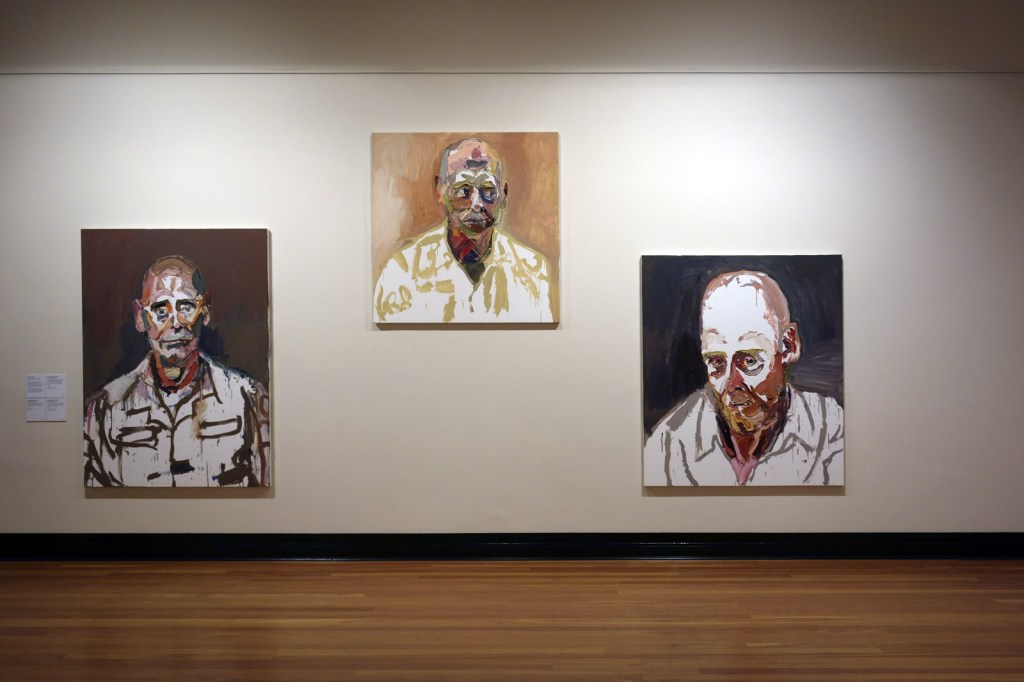
Sat – Sun: 10pm – 4pm
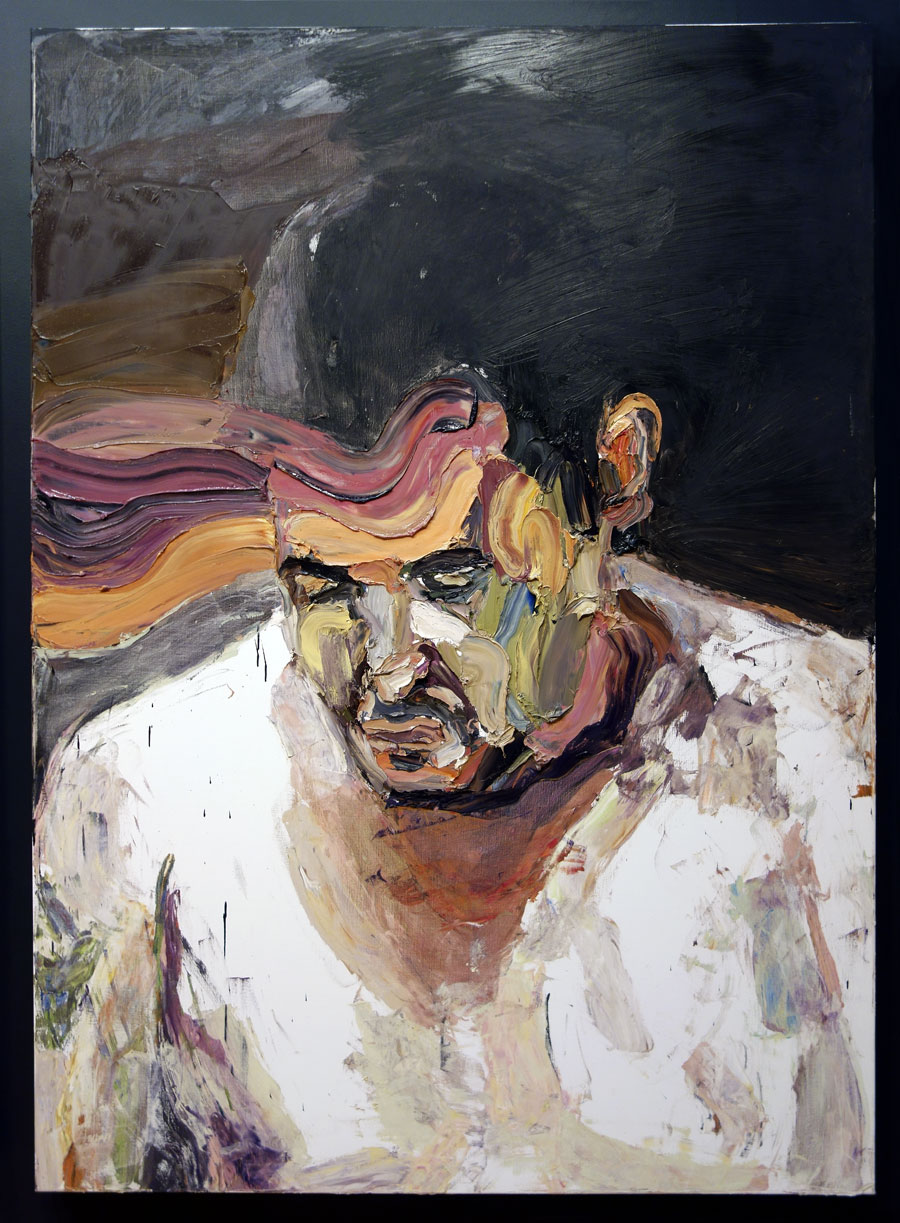
Mon/public holidays: closed

Monash Gallery of Art website

LIKE ART BLART ON FACEBOOK

Back to top