Exhibition: ‘Georgia O’Keeffe: Abstraction’ at The Phillips Collection, Washington D.C.

Exhibition dates: 6th February – 9th May 2010
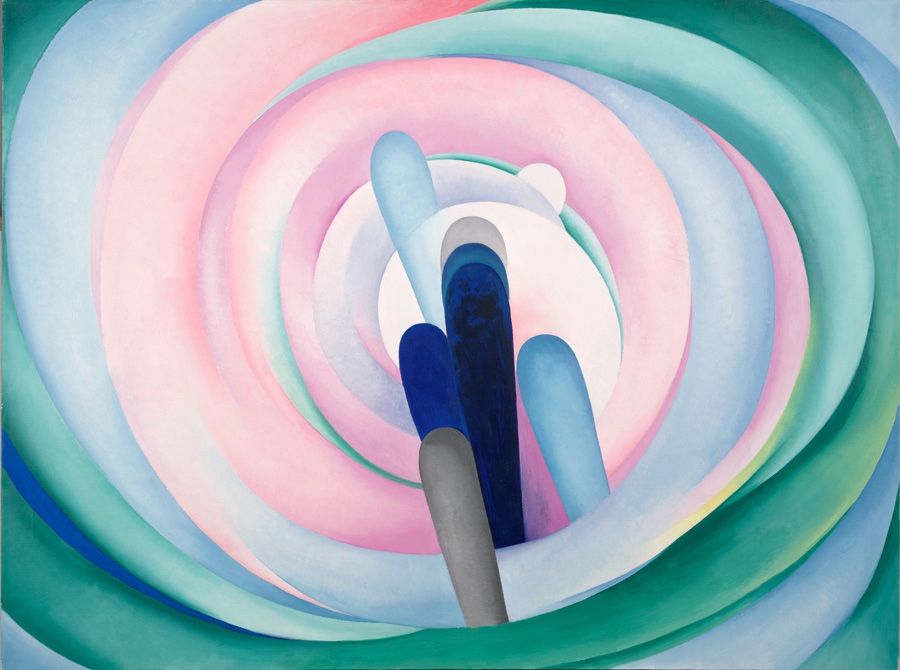
 

Georgia O'Keeffe (American, 1887-1986) 'Grey Blue & Black - Pink Circle' 1929 from the exhibition 'Georgia O'Keeffe: Abstraction' at The Phillips Collection, Washington D.C., February - May, 2010


Georgia O’Keeffe (American, 1887-1986)
Grey Blue & Black – Pink Circle
1929
Oil on canvas
36 x 48 in. (91.4 x 121.9cm)
Dallas Museum of Art
Gift of The Georgia O’Keeffe Foundation


Many thankx to Shira Pinsker and The Phillips Collection for allowing me to reproduce the images in the posting. Please click on the photographs for a larger version of the image.

For an excellent analysis of the convergences between Georgia O’Keeffe and Ansel Adams see Geneva Anderson’s review Masters of the Southwest: Georgia O’Keeffe and Ansel Adams Natural Affinities.

Dr Marcus Bunyan


“It is surprising to me to see how many people separate the objective from the abstract. Objective painting is not good painting unless it is good in the abstract sense. A hill or tree cannot make a good painting just because it is a hill or a tree. It is lines and colours put together so that they say something. For me that is the very basis of painting. The abstraction is often the most definite form for the intangible thing in myself that I can only clarify in paint.”

“I long ago came to the conclusion that even if I could put down accurately the thing that I saw and enjoyed, it would not give the observer the kind of feeling it gave me. I had to create an equivalent for what I felt about what I was looking at – not copy it.”


Georgia O’Keeffe, 1976


Georgia O'Keeffe (American, 1887-1986) 'Flower Abstraction' 1924 from the exhibition 'Georgia O'Keeffe: Abstraction' at The Phillips Collection, Washington D.C., February - May, 2010


Georgia O’Keeffe (American, 1887-1986)
Flower Abstraction
1924
Oil on canvas
48 x 30 in.
Whitney Museum of American Art, New York.
50th Anniversary Gift of Sandra Payson
© Georgia O’Keeffe Museum/Artist Rights Society (ARS), New York
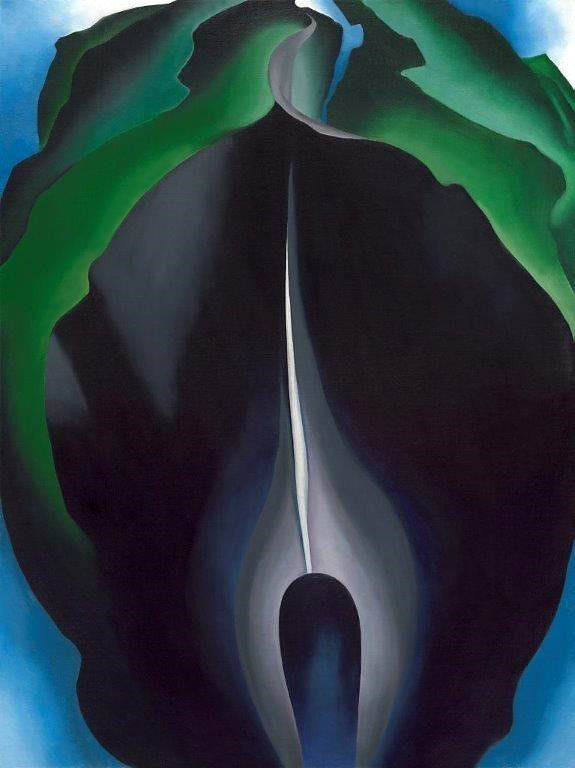
 

Georgia O'Keeffe (American, 1887-1986) 'Jack-in-the-Pulpit No. IV' 1930 from the exhibition 'Georgia O'Keeffe: Abstraction' at The Phillips Collection, Washington D.C., February - May, 2010


Georgia O’Keeffe (American, 1887-1986)
Jack-in-the-Pulpit No. IV
1930
Oil on canvas
40 x 30 in.
National Gallery of Art, Washington, D.C. Alfred Stieglitz Collection, Bequest of Georgia O’Keeffe
Image courtesy of the Board of Trustees, National Gallery of Art, Washington


Georgia O’Keeffe (1887-1986) is fixed in the public imagination as a painter of places and things. She has long been recognised for her still lifes of flowers, leaves, animal bones and shells, her images of Manhattan skyscrapers, and her Lake George and New Mexico landscapes. Yet it was with abstraction that O’Keeffe entered the art world and first became celebrated as an artist. In the spring of 1916, she burst onto the New York art scene with a group of abstract charcoal drawings that were among the most radical works produced in the United States in the early twentieth century. As she expanded her repertoire in the years that followed to include watercolour and oil, she retained the fluid space and dynamic, organic motifs of these early charcoals.

Abstraction dominated O’Keeffe’s output in the early part of her career and remained a fundamental language for her thereafter. Some of her abstractions have no recognisable source in the natural world; others distill visible reality into elemental, simplified forms. For O’Keeffe, abstraction offered a way to portray what she called the “unknown” – intense thoughts and feelings she could not express in words and did not rationally understand. Her abstractions recorded an array of emotions and responses to people and places. At the heart of her practice was an affinity for the flux and sinuous rhythms of nature. Through swelling forms and sumptuous colour, O’Keeffe depicted the experience of being in nature – so enveloped by its sublime mystery and beauty that awareness of all else is suspended.

Wall text from the exhibition
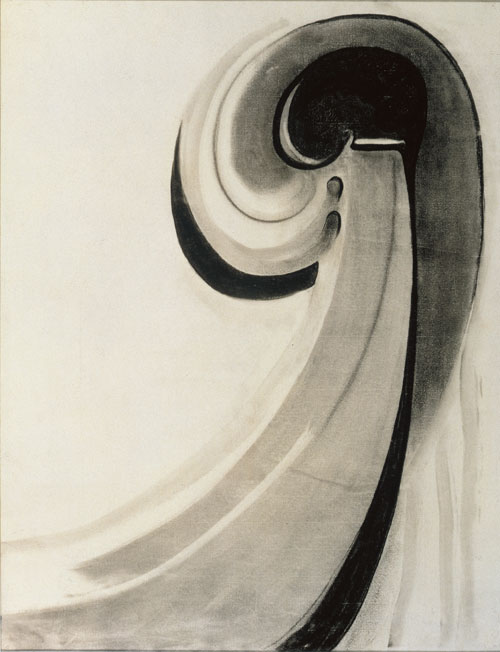
 

Georgia O'Keeffe (American, 1887-1986) 'Early Abstraction' 1915


Georgia O’Keeffe (American, 1887-1986)
Early Abstraction
1915
Charcoal on paper
24 x 18 5/8 in. (61 x 47.3cm)
Milwaukee Art Museum
Gift of Jane Bradley Pettit Foundation and The Georgia O’Keeffe Foundation
Photography by Malcolm Varon
© Milwaukee Art Museum


Georgia O'Keeffe (American, 1887-1986) 'Blue II' 1916


Georgia O’Keeffe (American, 1887-1986)
Blue II
1916
Watercolour on paper
27 7/8 x 22 1/4 in. (70.8 x 56.5cm)
Georgia O’Keeffe Museum, Santa Fe, New Mexico
Gift, The Burnett Foundation
© Georgia O’Keeffe Museum/Artist Rights Society (ARS), New York
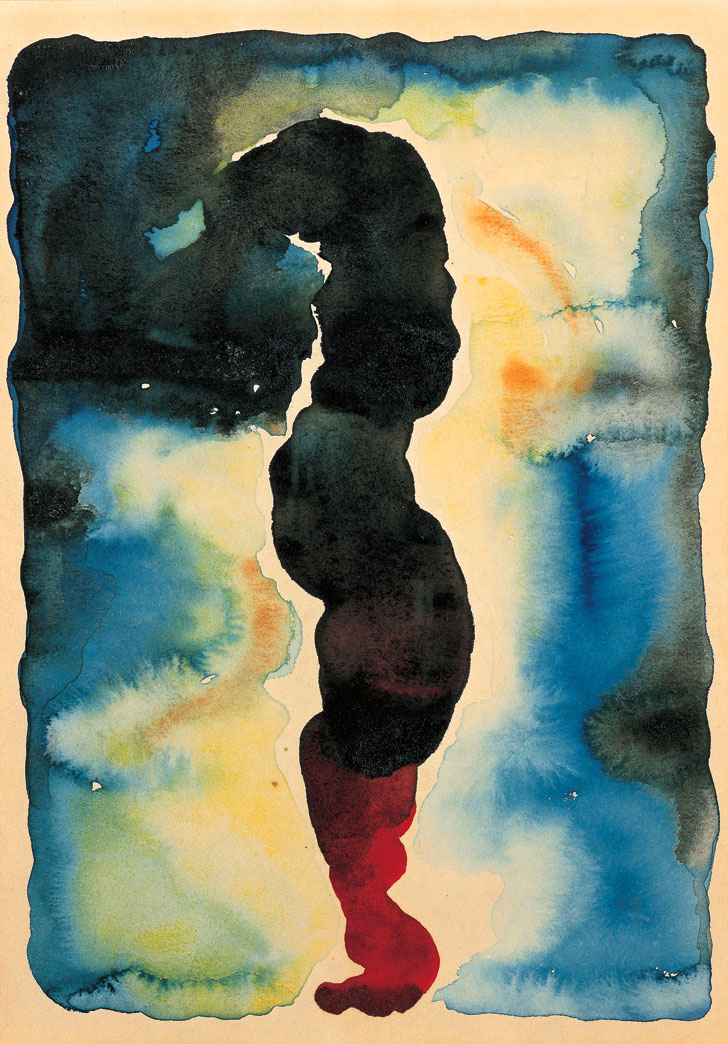
 

Georgia O'Keeffe (American, 1887-1986) 'Untitled (Abstraction/Portrait of Paul Strand)' 1917


Georgia O’Keeffe (American, 1887-1986)
Untitled (Abstraction/Portrait of Paul Strand)
1917
Watercolour on paper
12 x 8 7/8 in. (30.5 x 22.5cm)
Georgia O’Keeffe Museum, Santa Fe, New Mexico
Gift, The Burnett Foundation
© Georgia O’Keeffe Museum/Artist Rights Society (ARS), New York


The artistic achievement of Georgia O’Keeffe is examined from a fresh perspective in Georgia O’Keeffe: Abstraction, a landmark exhibition debuting this winter at The Phillips Collection. While O’Keeffe (1887-1986) has long been recognised as one of the central figures in 20th-century art, the radical abstract work she created throughout her long career has remained less well-known than her representational art. By surveying her abstractions, Georgia O’Keeffe: Abstraction repositions O’Keeffe as one of America’s first and most daring abstract artists. The exhibition, one of the largest of O’Keeffe’s work ever assembled, goes on view February 6 – May 9, 2010.

Including more than 125 paintings, drawings, watercolours, and sculptures by O’Keeffe as well as selected examples of Alfred Stieglitz’s famous photographic portrait series of O’Keeffe, the exhibition has been many years in the making.

While it is true that O’Keeffe has entered the public imagination as a painter of sensual, feminine subjects, she is nevertheless viewed first and foremost as a painter of places and things. When one thinks of her work it is usually of her magnified images of open flowers and her iconic depictions of animal bones, her Lake George landscapes, her images of stark New Mexican cliffs, and her still lifes of fruit, leaves, shells, rocks, and bones. Even O’Keeffe’s canvasses of architecture, from the skyscrapers of Manhattan to the adobe structures of Abiquiu, come to mind more readily than the numerous works – made throughout her career – that she termed abstract.

This exhibition is the first to examine O’Keeffe’s achievement as an abstract artist. In 1915, O’Keeffe leaped into the forefront of American modernism with a group of abstract charcoal drawings that were among the most radical creations produced in the United States at that time. A year later, she added colour to her repertoire; by 1918, she was expressing the union of abstract form and colour in paint. First exhibited in 1923, O’Keeffe’s psychologically charged, brilliantly coloured abstract oils garnered immediate critical and public acclaim. For the next decade, abstraction would dominate her attention. Even after 1930, when O’Keeffe’s focus turned increasingly to representational subjects, she never abandoned abstraction, which remained the guiding principle of her art. She returned to abstraction in the mid 1940s with a new, planar vocabulary that provided a precedent for a younger generation of abstractionists.

Abstraction and representation for O’Keeffe were neither binary nor oppositional. She moved freely from one to the other, cognisant that all art is rooted in an underlying abstract formal invention. For O’Keeffe, abstraction offered a way to communicate ineffable thoughts and sensations. As she said in 1976, “The abstraction is often the most definite form for the intangible thing in myself that I can only clarify in paint.” Through her personal language of abstraction, she sought to give visual form (as she confided in a 1916 letter to Alfred Stieglitz) to “things I feel and want to say – [but] havent [sic] words for.” Abstraction allowed her to express intangible experience – be it a quality of light, colour, sound, or response to a person or place. As O’Keeffe defined it in 1923, her goal as a painter was to “make the unknown – known. By unknown I mean the thing that means so much to the person that he wants to put it down – clarify something he feels but does not clearly understand.”

This exhibition and catalogue chronicle the trajectory of O’Keeffe’s career as an abstract artist and examine the forces impacting the changes in her subject matter and style. From the beginning of her career, she was, as critic Henry McBride remarked, “a newspaper personality.” Interpretations of her art were shaped almost exclusively by Alfred Stieglitz, artist, charismatic impresario, dealer, editor, and O’Keeffe’s eventual husband, who presented her work from 1916 to 1946 at the groundbreaking galleries “291”, the Anderson Galleries, the Intimate Gallery, and An American Place. Stieglitz’s public and private statements about O’Keeffe’s early abstractions and the photographs he took of her, partially clothed or nude, led critics to interpret her work – to her great dismay – as Freudian-tinged, psychological expressions of her sexuality.

Cognisant of the public’s lack of sympathy for abstraction and seeking to direct the critics away from sexualised readings of her work, O’Keeffe self-consciously began to introduce more recognisable images into her repertoire in the mid-1920s. As she wrote to the writer Sherwood Anderson in 1924, “I suppose the reason I got down to an effort to be objective is that I didn’t like the interpretations of my other things [abstractions].” O’Keeffe’s increasing shift to representational subjects, coupled with Stieglitz’s penchant for favouring the exhibition of new, previously unseen work, meant that O’Keeffe’s abstractions rarely figured in the exhibitions Stieglitz mounted of her work after 1930, with the result that her first forays into abstraction virtually disappeared from public view.”

Text from the Phillips Collection website [Online] Cited 15/03/2010 no longer available online
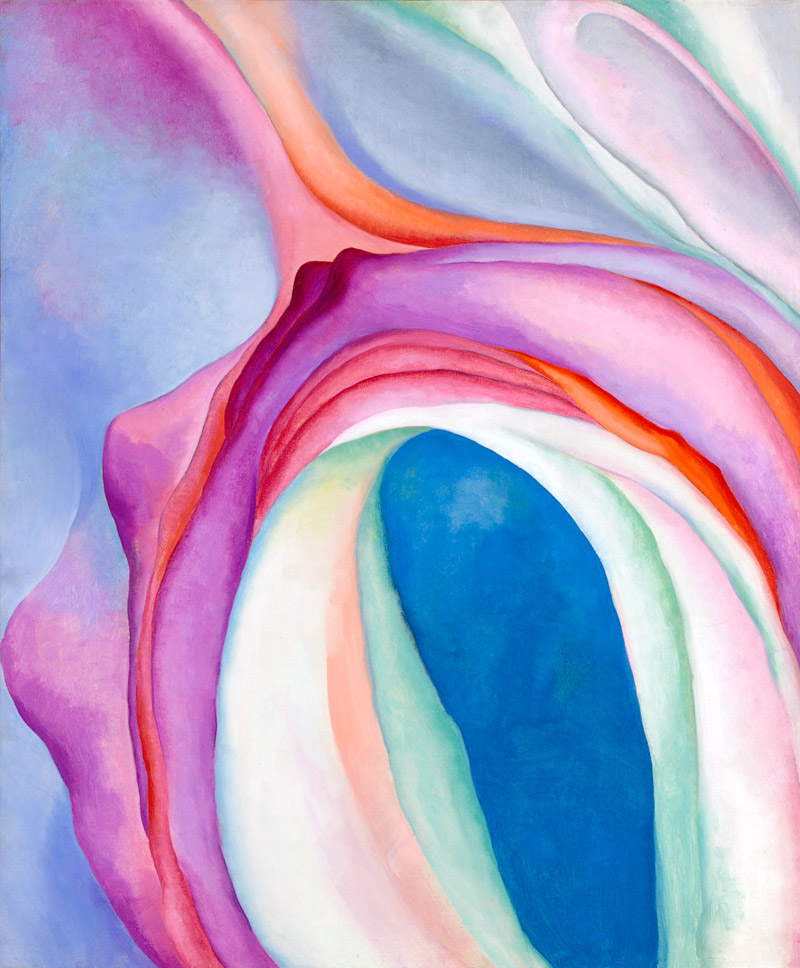
 

Georgia O'Keeffe (American, 1887-1986) 'Music, Pink and Blue No. 2' 1918


Georgia O’Keeffe (American, 1887-1986)
Music, Pink and Blue No. 2
1918
Oil on canvas, 35 x 29 1/8 in. (88.9 x 74cm)
Whitney Museum of American Art, New York
Gift of Emily Fisher Landau in honour of Tom Armstrong
© Georgia O’Keeffe Museum/Artist Rights Society (ARS), New York
Photograph by Sheldan C. Collins
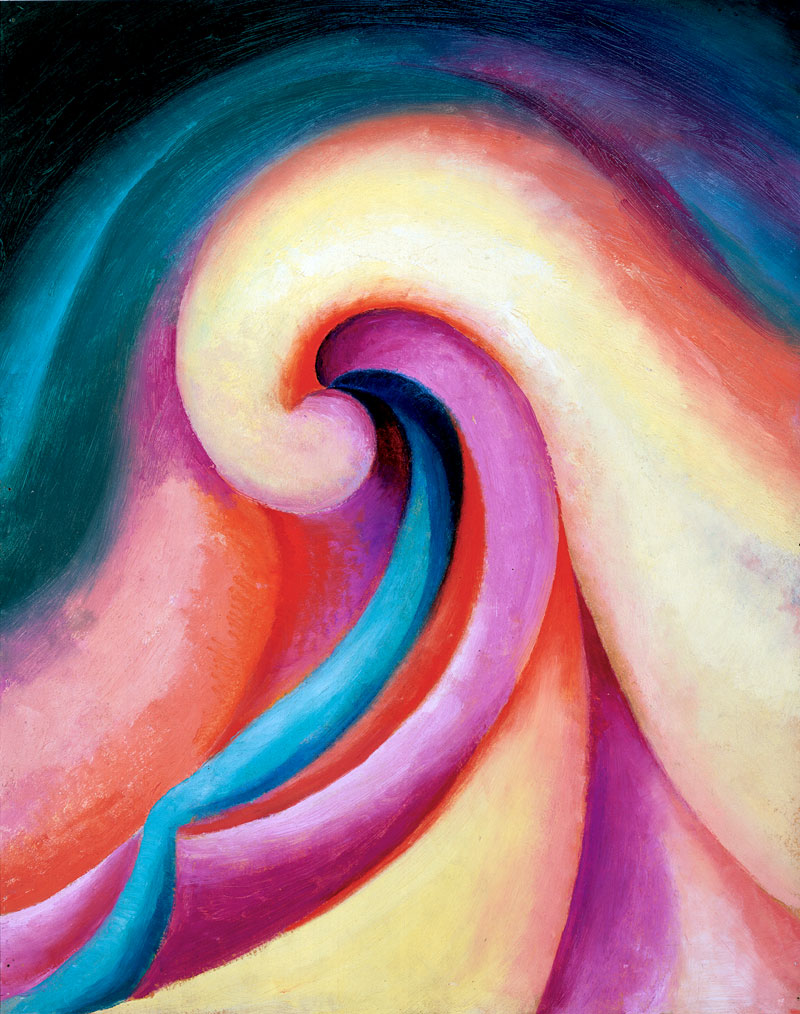
 

Georgia O'Keeffe (American, 1887-1986) 'Series I - No. 3' 1918


Georgia O’Keeffe (American, 1887-1986)
Series I – No. 3
1918
Oil on board
20 x 16 in. (50.8 x 40.6cm)
Milwaukee Art Museum
Gift of Jane Bradley Pettit Foundation and The Georgia O’Keeffe Foundation
Photography by Larry Sanders
© Milwaukee Art Museum


Georgia O'Keeffe (American, 1887-1986) 'Series I, No. 4' 1918


Georgia O’Keeffe (American, 1887-1986)
Series I, No. 4
1918
Oil on canvas
20 x 16 in. (50.8 x 40.6cm)
Städtische Galerie im Lenbachhaus, Munich
Gift of The Georgia O’Keeffe Foundation


Georgia O'Keeffe (American, 1887-1986) 'Abstraction White Rose' 1927


Georgia O’Keeffe (American, 1887-1986)
Abstraction White Rose
1927
Oil on canvas
36 x 30 in. (91.4 x 76.2cm)
Georgia O’Keeffe Museum, Santa Fe, New Mexico
Gift, The Burnett Foundation and The Georgia O’Keeffe Foundation
© Georgia O’Keeffe Museum/Artist Rights Society (ARS), New York


Georgia O'Keeffe (American, 1887-1986) 'Black Place II' 1944


Georgia O’Keeffe (American, 1887-1986)
Black Place II
1944
Oil on canvas
36 x 40 in. (91.4 x 101.6cm)
Georgia O’Keeffe Museum, Santa Fe, New Mexico
Gift, The Burnett Foundation
© 1987, Private Collection


The Phillips Collection
1600 21st Street, NW, Washington, D.C., near the corner of 21st and Q Streets, NW

Opening hours:
Tuesday – Sunday 11am – 6pm

Phillips Collection website

LIKE ART BLART ON FACEBOOK

Back to top

Exhibition: ‘Hawaii’ by Daido Moriyama at Luhring Augustine, New York

Exhibition dates: 13th February – 13th March, 2010


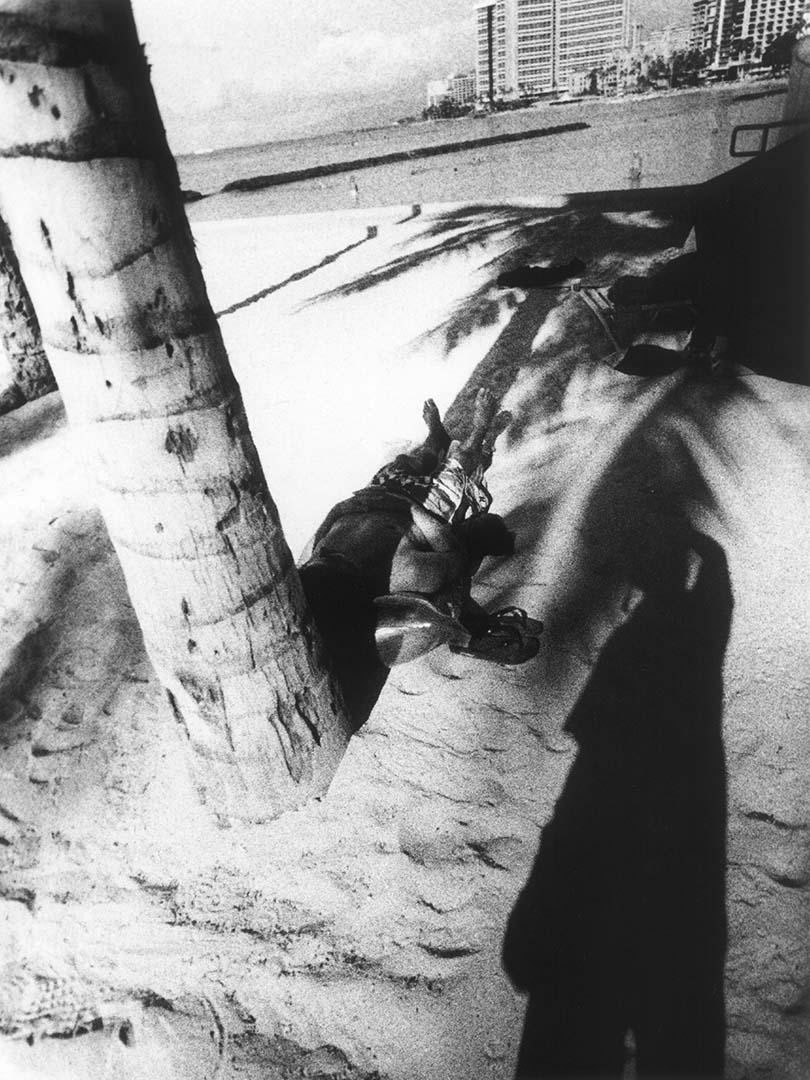
Daido Moriyama (Japanese, b. 1938) 'Nikko Toshogu' 1977 from the exhibition Exhibition: 'Hawaii' by Daido Moriyama at Luhring Augustine, New York, February - March, 2010


Daido Moriyama (Japanese, b. 1938)
Nikko Toshogu
1977
Gelatin silver print


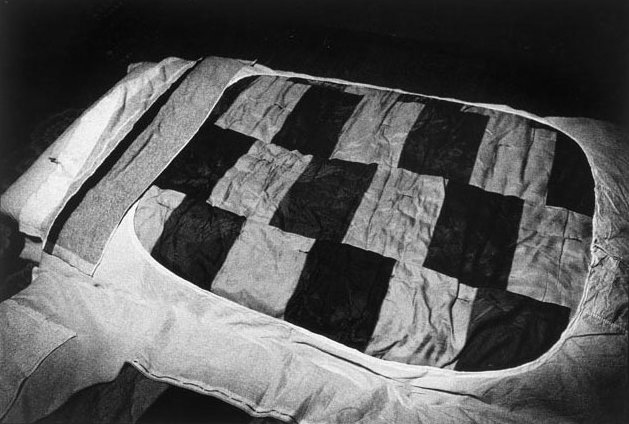
Daido Moriyama (Japanese, b. 1938) 'Quilt' 1977 from the exhibition Exhibition: 'Hawaii' by Daido Moriyama at Luhring Augustine, New York, February - March, 2010


Daido Moriyama (Japanese, b. 1938)
Quilt
1977
Gelatin silver print


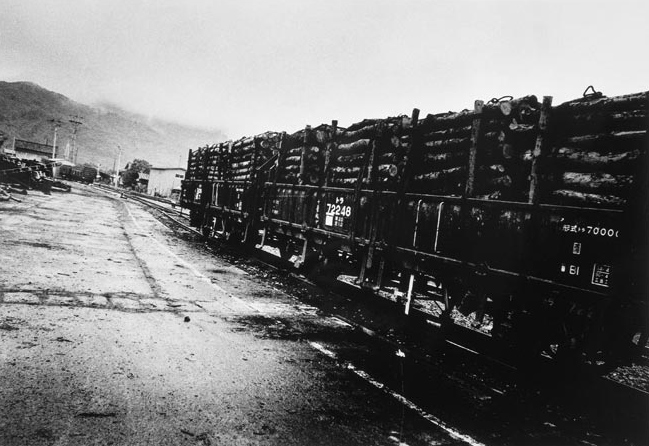
Daido Moriyama (Japanese, b. 1938) 'Hokkaido' 1978 from the exhibition Exhibition: 'Hawaii' by Daido Moriyama at Luhring Augustine, New York, February - March, 2010


Daido Moriyama (Japanese, b. 1938)
Hokkaido
1978
Gelatin silver print


Daido Moriyama (Japanese, b. 1938) 'Tono' 1974


Daido Moriyama (Japanese, b. 1938)
Tono
1974
Gelatin silver print


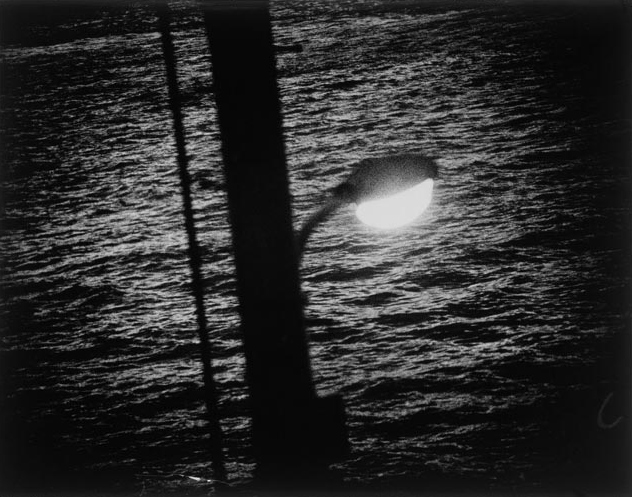
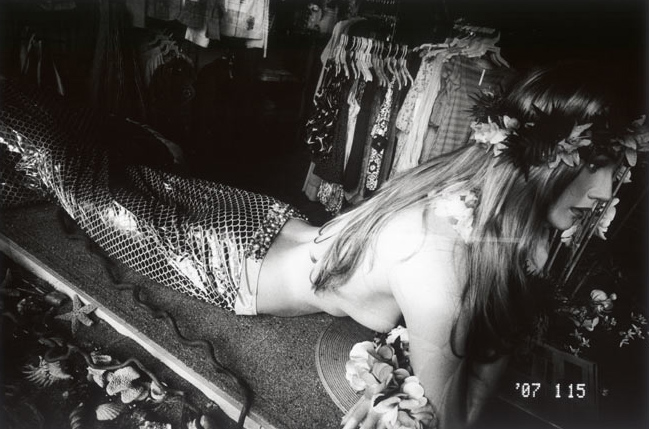
Luhring Augustine is pleased to present its first exhibition featuring the work of Daido Moriyama, one of Japan’s leading figures in photography. Witness to the spectacular changes that transformed postwar Japan, his photographs express a fascination with the cultural contradictions of age-old traditions that persist within modern society. Providing a harsh, crude vision of city life and the chaos of everyday existence, strange worlds, and unusual characters, his work occupies the space between the objective and the subjective, the illusory and the real.

Moriyama takes pictures with a small hand-held camera that enables him to shoot freely while walking or running or through the windows of moving cars. Taken from vertiginous angles or overwhelmed by closeups, his blurred images are charged with a palpable and frenetic energy that reveal a unique proximity to his subject matter. Snapshots of stray dogs, posters, mannequins in shop windows, and shadows cast into alleys present the beauty and sometimes-terrifying reality of a marginalised landscape. His anonymous and detached approach enables him to capture the “visible present” made up of accidental and uncanny discoveries as he experiences them.

Moriyama emerged as a photographer in the 1960’s at the tail end of the VIVO collective, a revolutionary and highly influential group of Japanese artists who reexamined the conventions of photography during the tumultuous postwar period. William Klein’s loose, Beat style images of New York City in the 1960s also served as a major turning point for Moriyama, who found inspiration in Klein’s free-form photographic style. Taken by these innovative approaches at home and abroad, Moriyama ultimately went on to forge his own radical style.

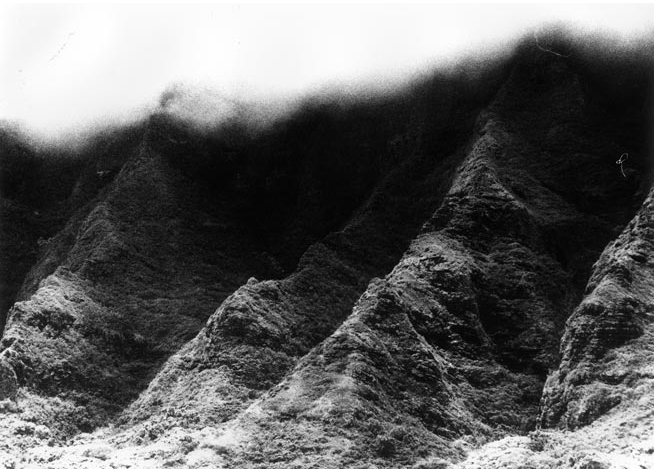
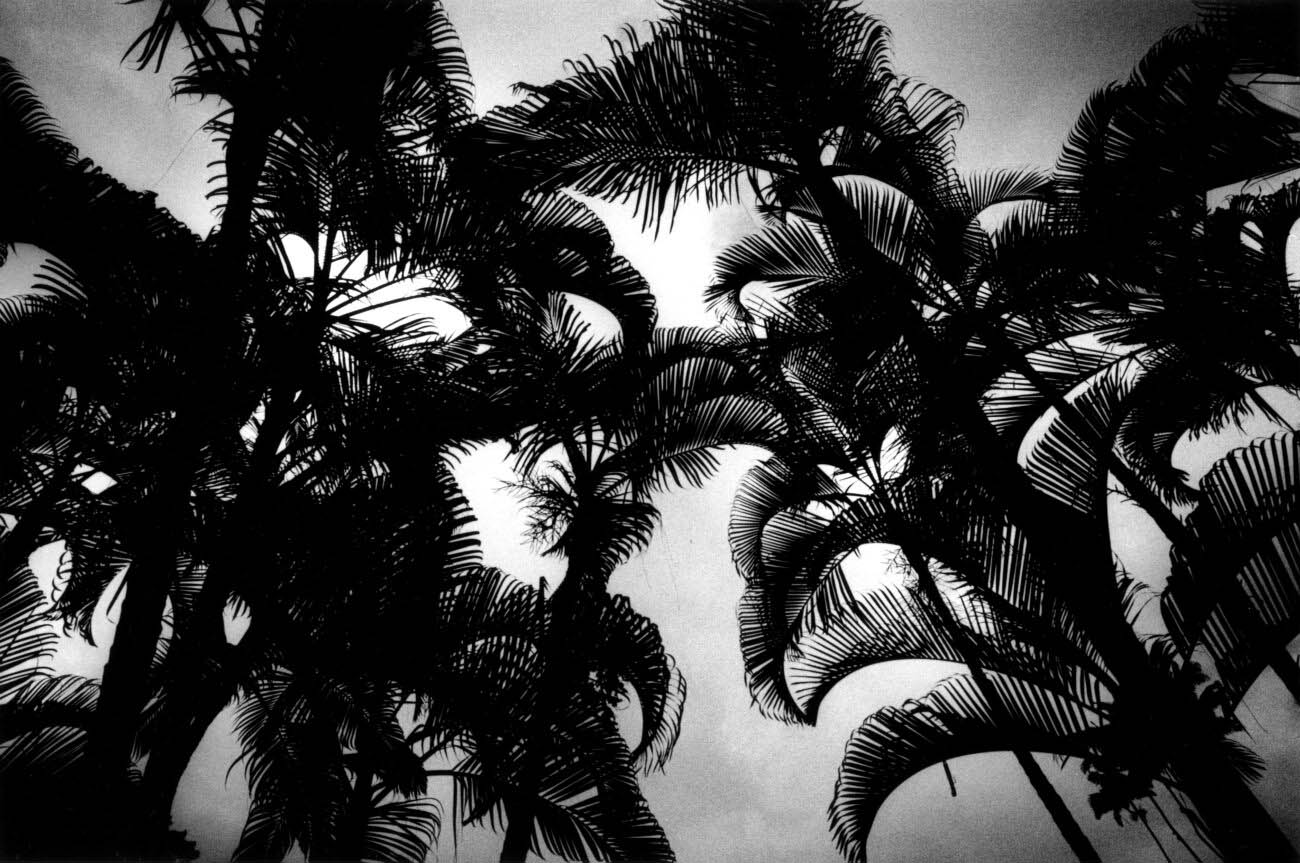
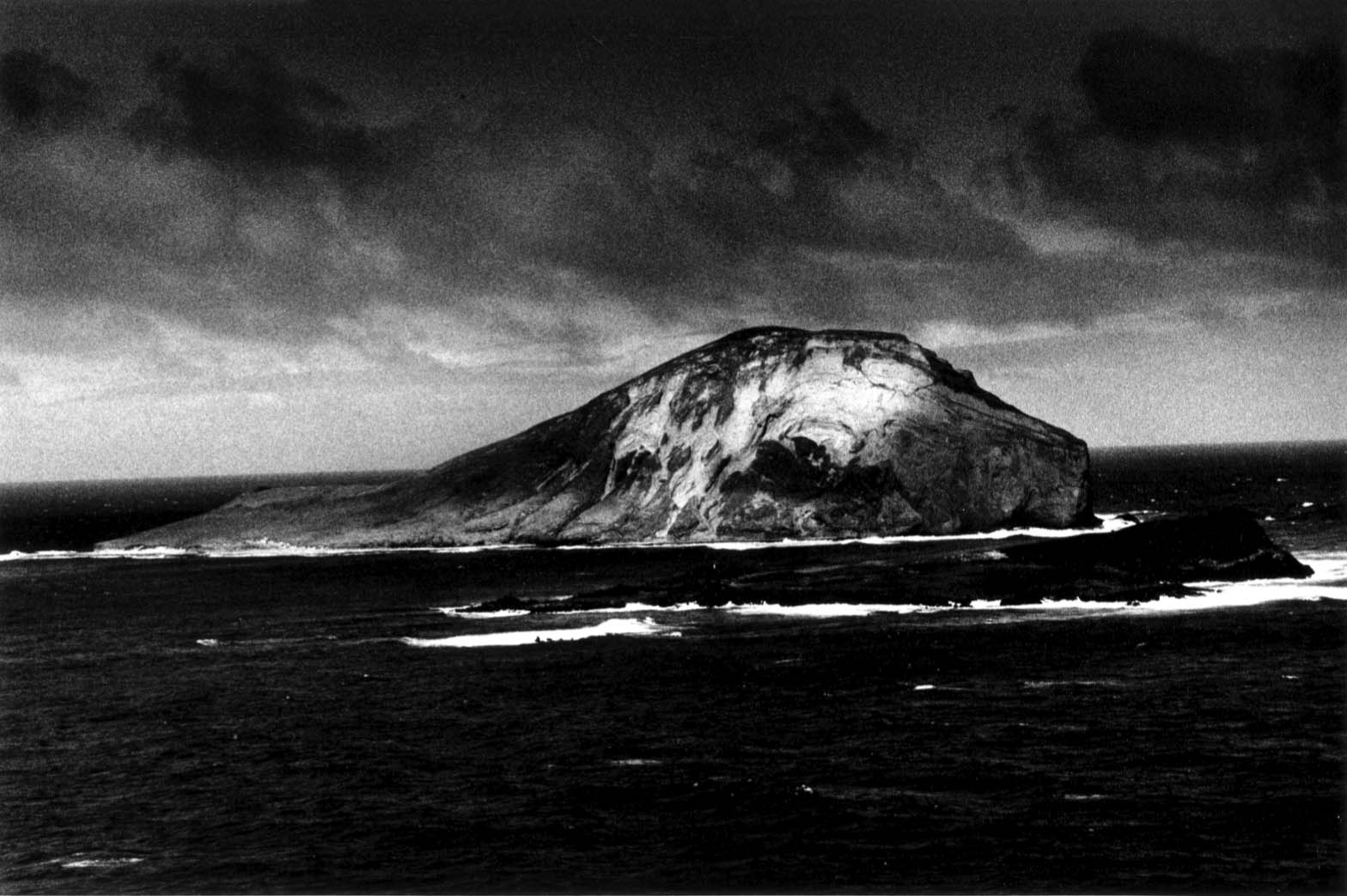
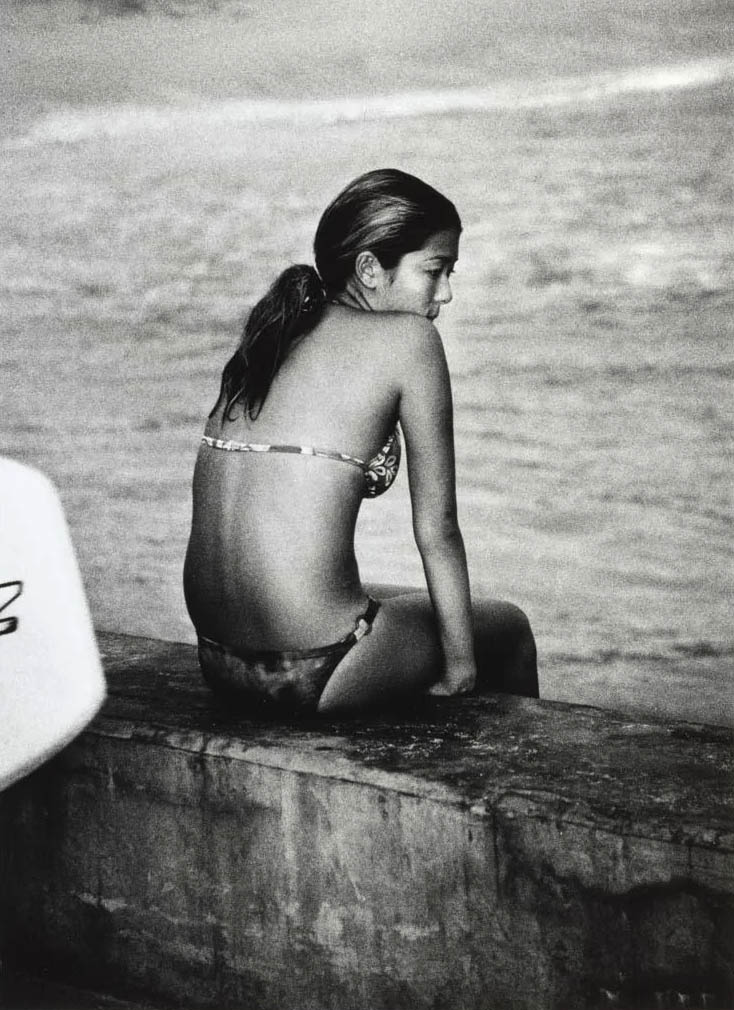
Hawaii, Moriyama’s most recent body of work, was produced over a period of three years and presents his distinct perspective on the daily lives of the people living on the islands of Hawaii and Oahu. Returning to the island five times before feeling prepared to shoot these surroundings, Moriyama’s overall approach is purposeful and considered despite his loose and informal style. The series was recently exhibited at the Tokyo Metropolitan Museum of Photography and published in a volume by the institution.

Daido Moriyama was born in Osaka in 1938. He has had museum shows around the world including the San Francisco Museum of Modern Art, the Fotomuseum Winterthur, Switzerland, the Fondation Cartier pour l’Art Contemporain, Paris and the Tokyo Metropolitan Museum of Photography. His work is part of many major public collections such as the Museum of Modern Art, New York, the Centre Pompidou, Paris, the Metropolitan Museum of Art, New York, the Los Angeles County Museum, the San Francisco Museum of Modern Art, the Museum of Fine Arts, Boston and the Getty in Los Angeles.

Press release from the Luhring Augustine website [Online] Cited 24/02/2010 no longer available online


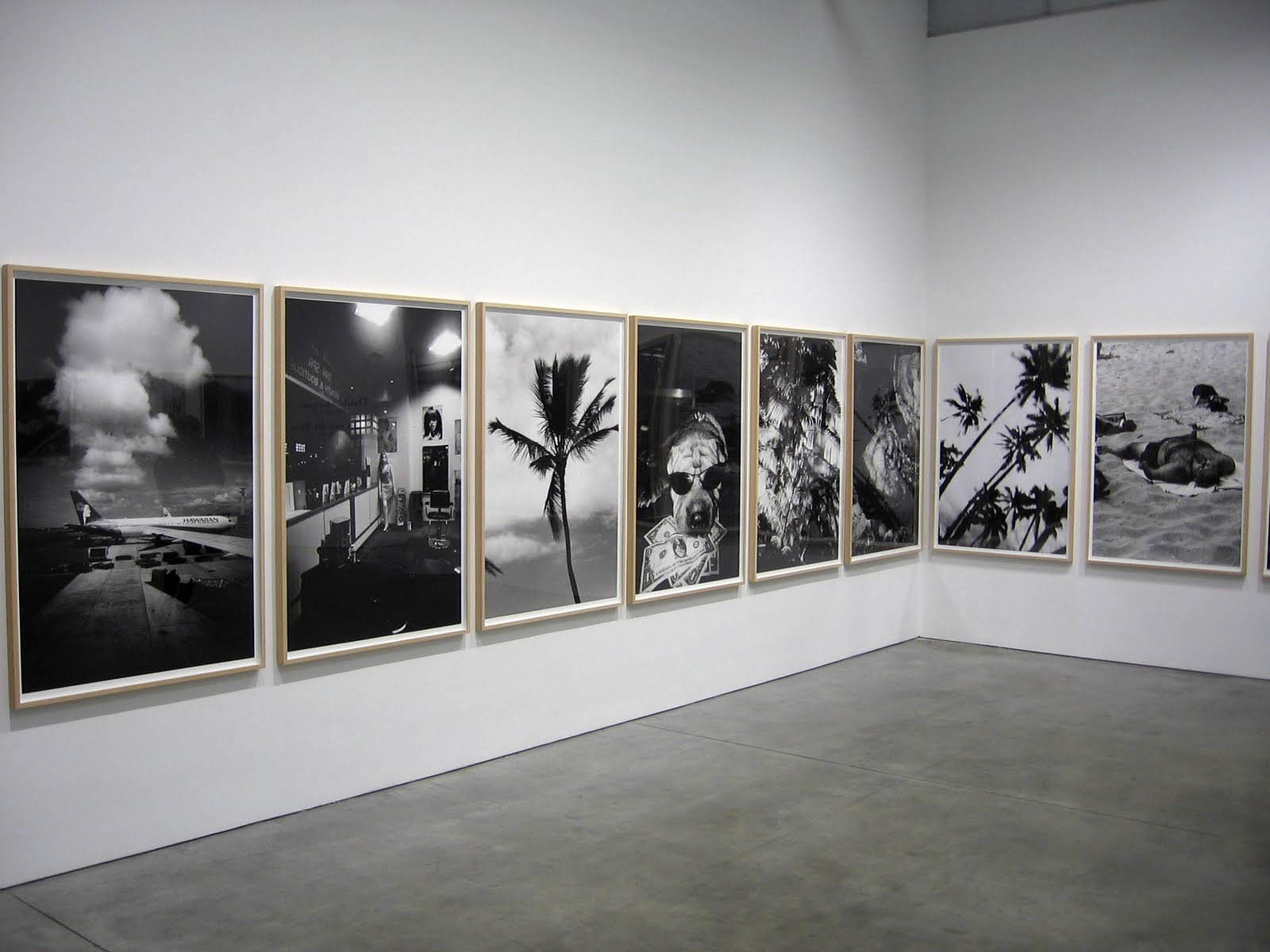
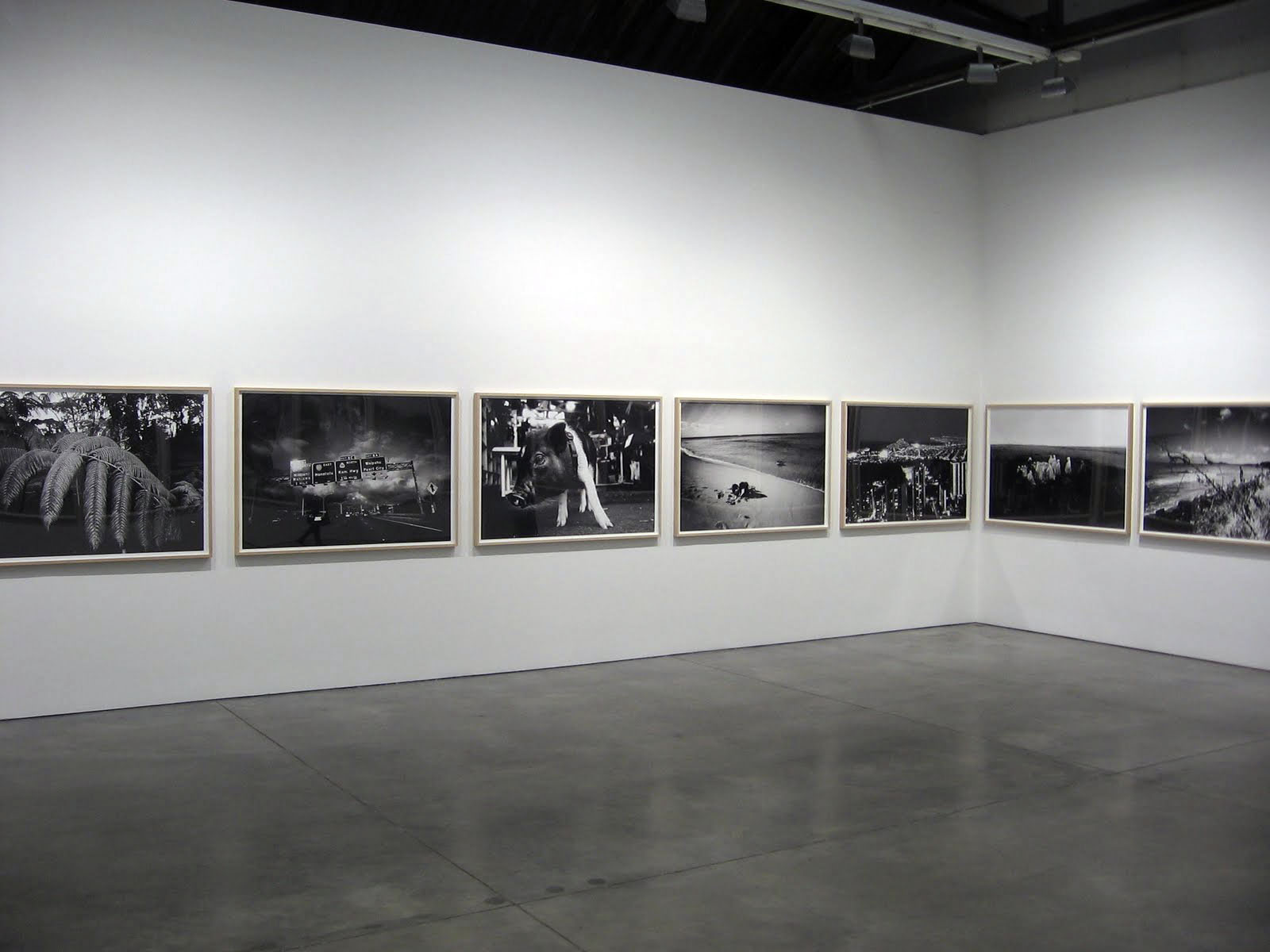
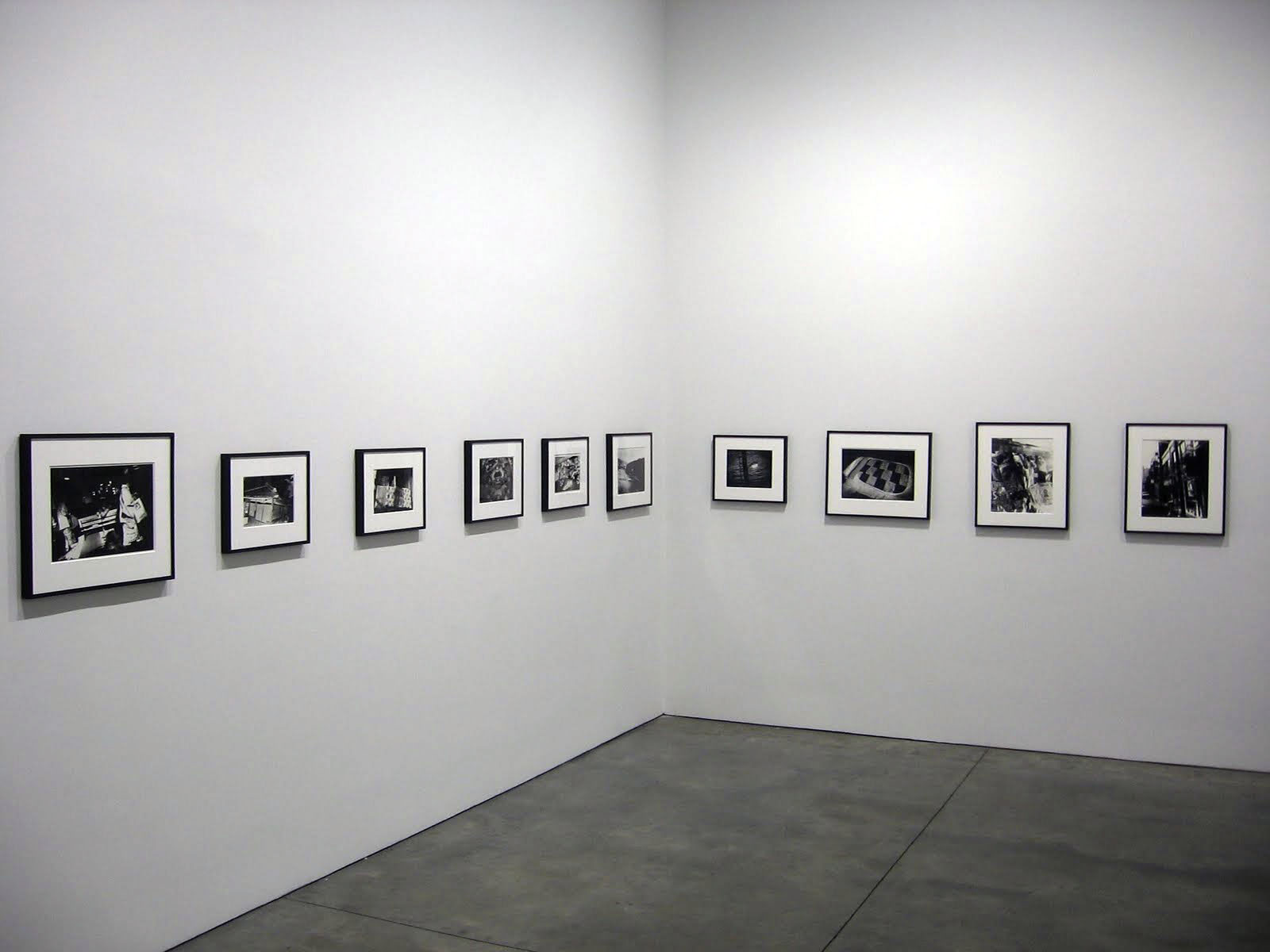
Installation view of the exhibition 'Hawaii' by Daido Moriyama at Luhring Augustine, New York, February - March, 2010


Installation views of the exhibition Hawaii by Daido Moriyama at Luhring Augustine, New York, February – March, 2010


A total of 52 black and white photographs, hung in the entry, main gallery, and one of the back rooms. 29 of the images are from the recent Hawaii series, taken / printed between 2007 and 2010…

What if Sander had taken portraits in India or China? (Another recent example of this phenomenon would be Eggleston’s images of Paris, here.) The effect is somewhat like musicians making covers, taking someone else’s songs and making them their own; sometimes the mashup creates something wholly original and unexpected, and sometimes the combination doesn’t quite work.

This exhibit extends this line of thinking, with the Japanese photographer Daido Moriyama making pictures of Hawaii, using a group of the artist’s vintage images of Japan as a counterweight for comparison. The older works provide a reminder of Moriyama’s powerful visual vocabulary: dark shadowy images, with skewed off-kilter angles, harsh contrasts, and a rawness that often mixes the gloomy and the menacing. His best images uncover the dark underbelly of the streets, capturing the cultural nuances of Japan in gritty, grainy blackness. 

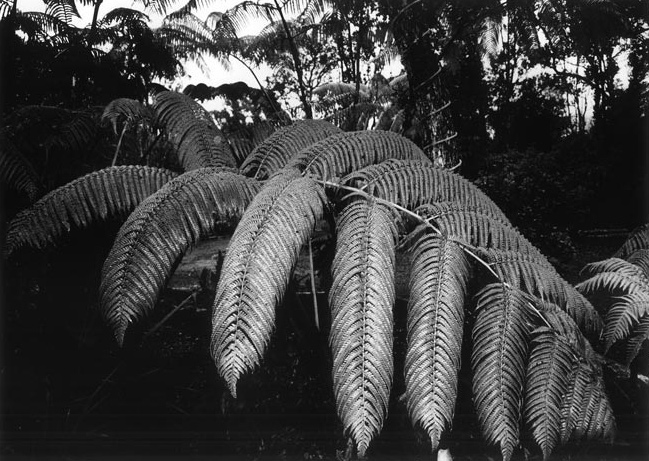
The island life of Hawaii, with its shakas and mellow aloha spirit, presents a surprising challenge for Moriyama: where can a visitor find the brooding or sinister in this paradise? Moriyama does his best to apply his trademark darkness to palm trees and ferns, beaches and hotels, jungles and clouded hills, tourist shops and conch shells, but the overall effect lacks the malignant edginess that haunts his images of Tokyo; he has found some unexpected surface oddities, but the subjects feel a bit too obvious and superficial. Visually, the big prints (roughly 3 by 5 feet) and their shadowy palette make for a jarring view of the easy going, sunny destination, but the subject matter just doesn’t lend itself all that well to deep psychological probing. The real culture of Hawaii is hidden somewhere else, far from the welcoming hula girls, tiki fabrics, and flowers offered to visitors.

Loring Knoblauch. “Daido Moriyama, Hawaii @Luhring Augustine,” on the Collector Daily website, March 4, 2010 [Online] Cited 28/04/2025


Daido Moriyama (Japanese, b. 1938) 'Hawaii' 2007


Daido Moriyama (Japanese, b. 1938)
Hawaii
2007
Gelatin silver print


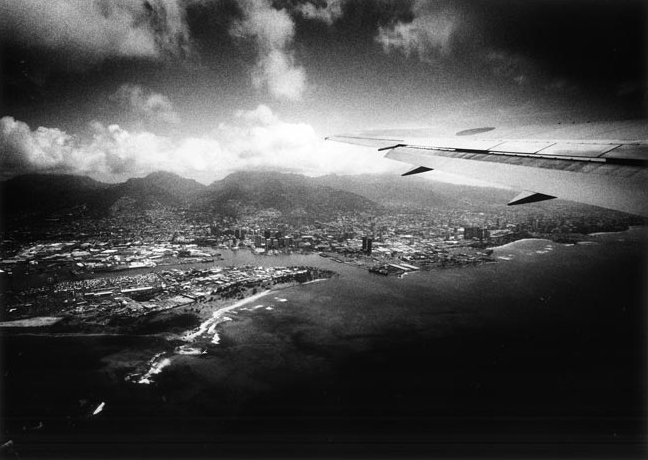
Daido Moriyama (Japanese, b. 1938) 'Hawaii' 2007-2010


Daido Moriyama (Japanese, b. 1938)
Hawaii
2007-2010
Gelatin silver print


Daido Moriyama (Japanese, b. 1938) 'Hawaii' 2007-2010


Daido Moriyama (Japanese, b. 1938)
Hawaii
2007-2010
Gelatin silver print


Daido Moriyama (Japanese, b. 1938) 'Hawaii' 2007


Daido Moriyama (Japanese, b. 1938)
Hawaii
2007
Gelatin silver print


Daido Moriyama (Japanese, b. 1938) 'Hawaii' 2007-2010


Daido Moriyama (Japanese, b. 1938)
Hawaii
2007-2010
Gelatin silver print


Daido Moriyama (Japanese, b. 1938) 'Hawaii' 2007-2010


Daido Moriyama (Japanese, b. 1938)
Hawaii
2007-2010
Gelatin silver print


Daido Moriyama (Japanese, b. 1938) 'Hawaii' 2007


Daido Moriyama (Japanese, b. 1938)
Hawaii
2007
Gelatin silver print


Daido Moriyama (Japanese, b. 1938) 'Hawaii' 2007-2010


Daido Moriyama (Japanese, b. 1938)
Hawaii
2007
Gelatin silver print


Daido Moriyama (Japanese, b. 1938) 'Hawaii' 2007-2010


Daido Moriyama (Japanese, b. 1938)
Hawaii
2007
Gelatin silver print


Luhring Augustine Gallery
531 West 24th Street, New York
Phone: 1-212-206-9100

Opening hours:
Summer hours (June 20 – September 2):
Monday – Friday, 10am – 5.30pm
Winter hours
Tuesday – Saturday, 10am – 6pm

Luhring Augustine Gallery website

LIKE ART BLART ON FACEBOOK

Back to top

Exhibition: ‘Calder: Sculptor of Air’ at the Palazzo delle Esposizioni, Rome

Exhibition dates: 22nd October, 2009 – 14th February, 2010


Many thankx to the Palazzo delle Esposizioni for allowing me to publish the photographs in the posting. Please click on the photographs for a larger version of the image.

Marcus


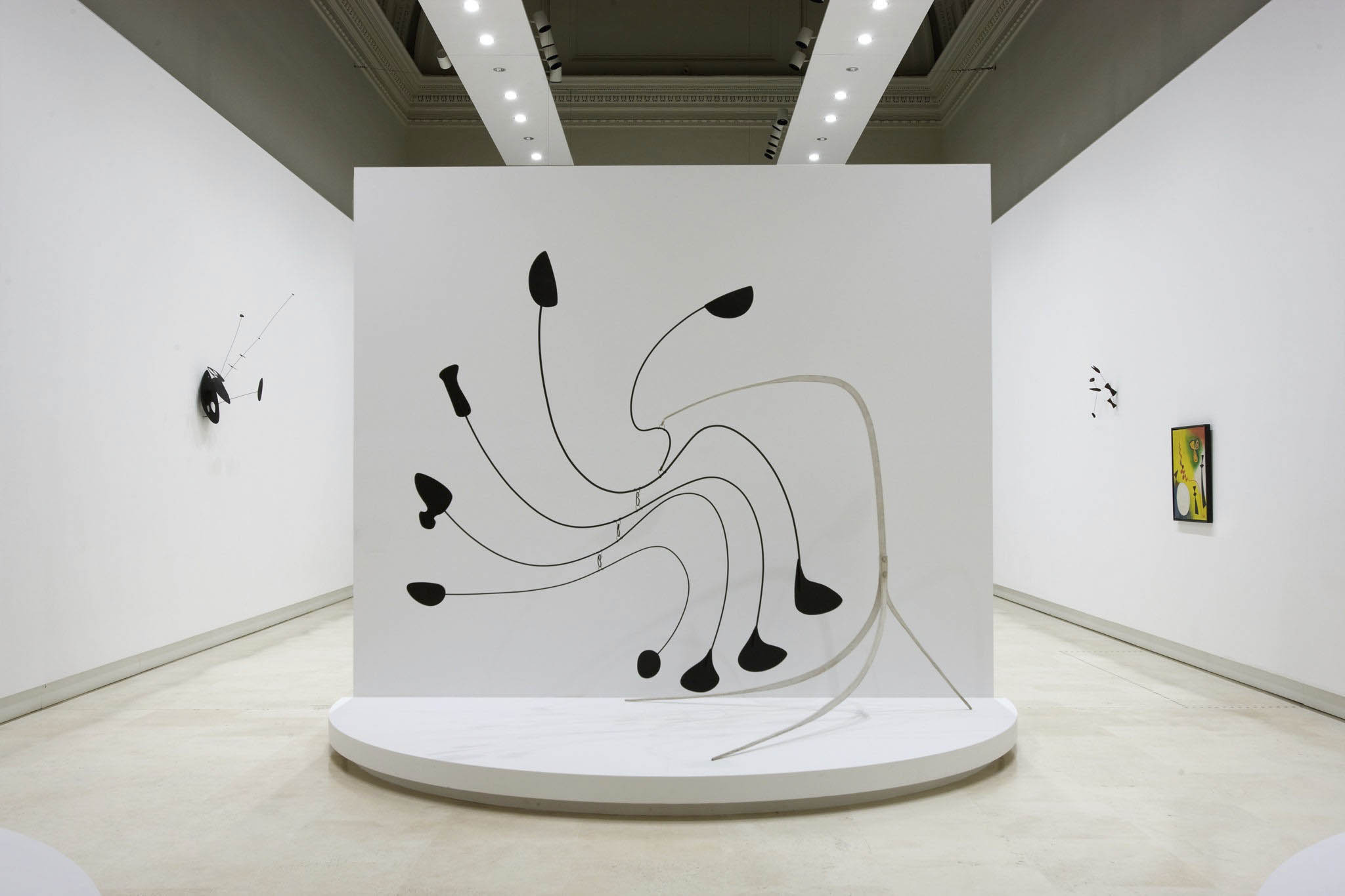
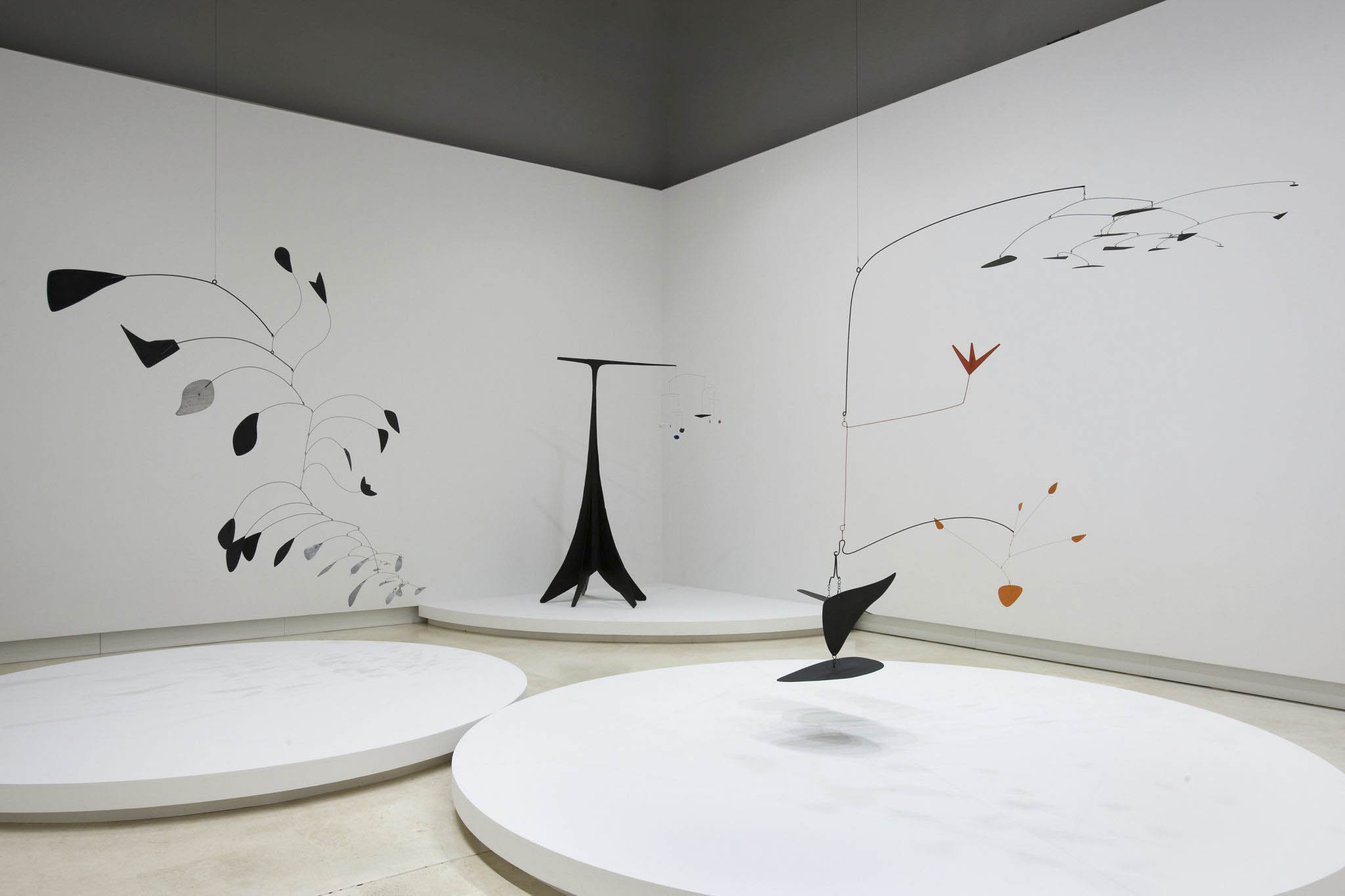
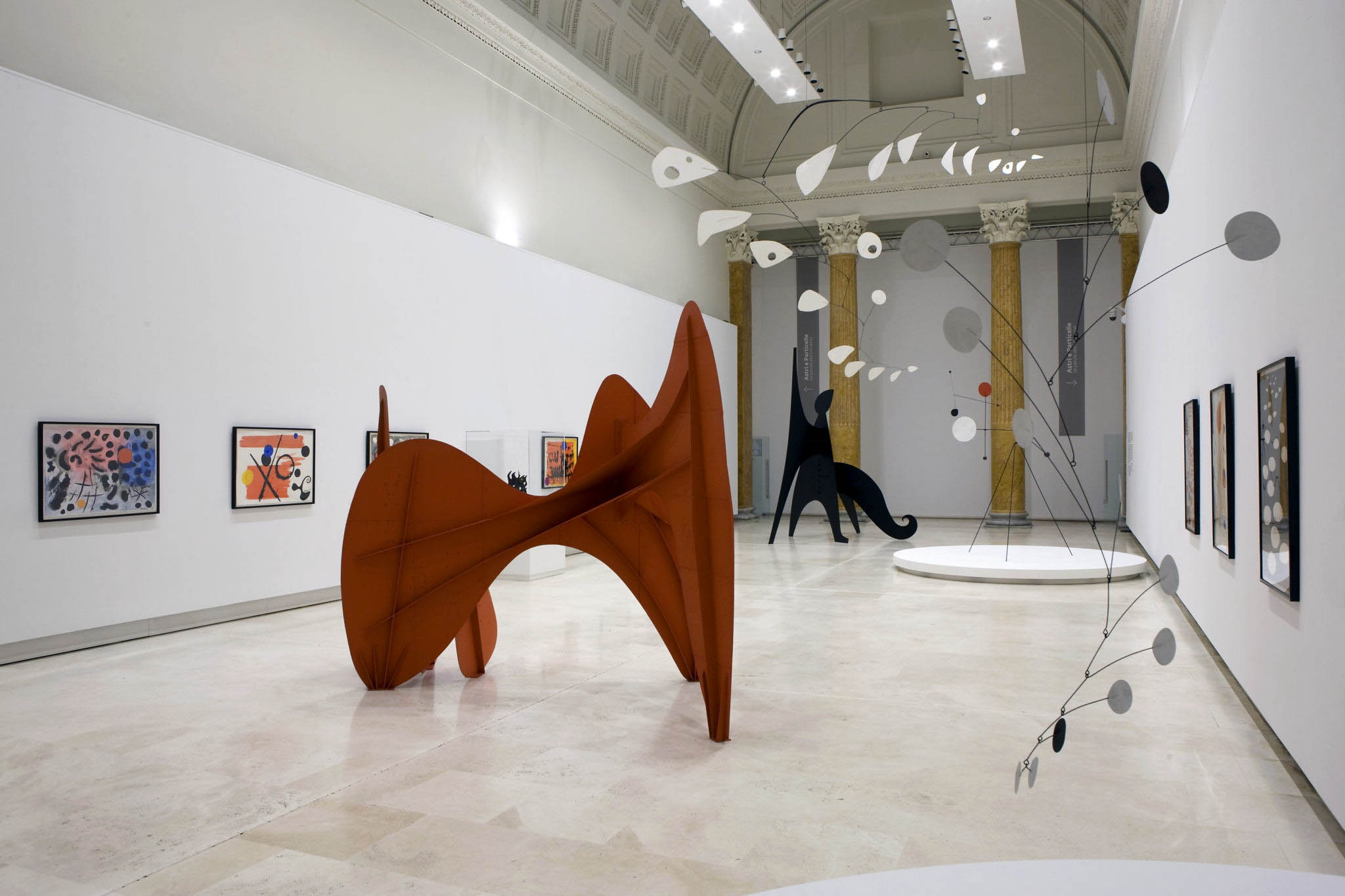
Installation view of the exhibition 'Calder: Sculptor of Air' at the Palazzo delle Esposizioni, Rome, October 2009 - February 2010 showing at centre, Calder's 'The Spider' 1940


Installation view of the exhibition Calder: Sculptor of Air at the Palazzo delle Esposizioni, Rome, October 2009 – February 2010 showing at centre, Calder’s The Spider 1940 (below)
Photograph by Claudio Abate


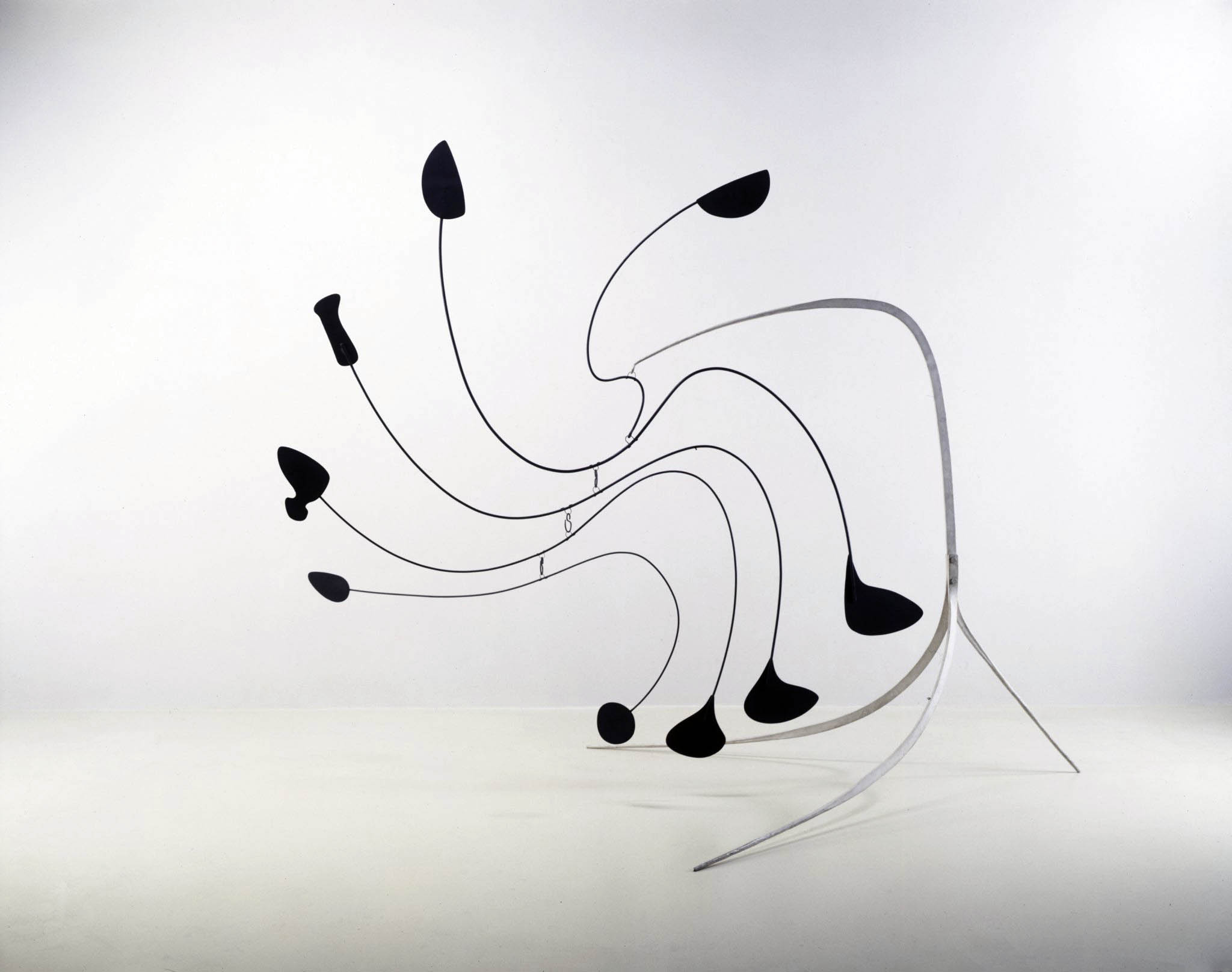
Alexander Calder (American, 1898-1976) 'The Spider' 1940


Alexander Calder (American, 1898-1976)
The Spider
1940
Sheet metal, wire, and paint
95″ × 99″ × 73″
Nasher Sculpture Center, Dallas


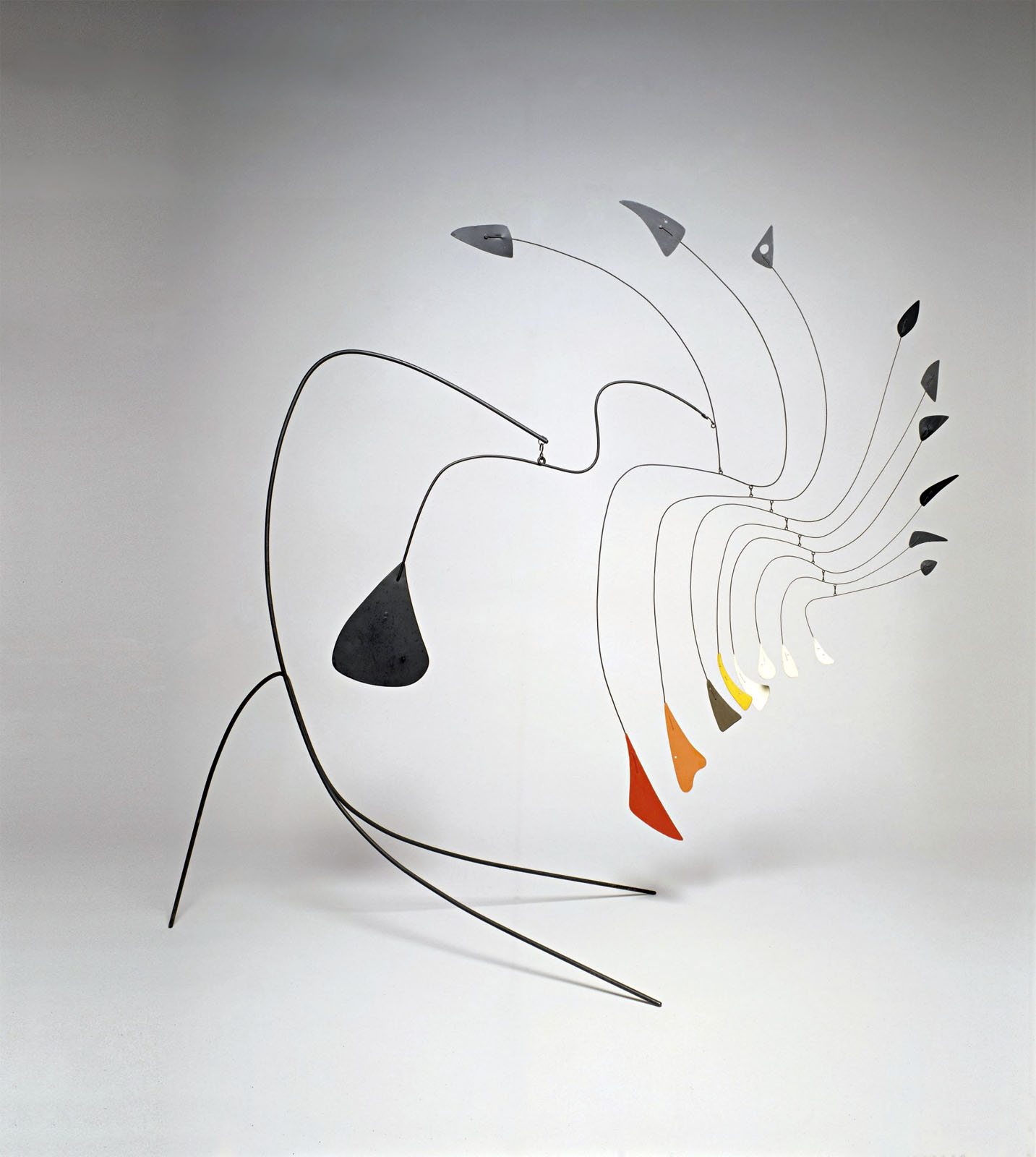
Alexander Calder (American, 1898-1976) 'Little Spider' c. 1940


Alexander Calder (American, 1898-1976)
Little Spider
c. 1940
Media
Sheet metal, rod, wire, and paint
55″ × 50″
National Gallery of Art, Washington, D.C.
Gift of Mr. & Mrs. Klaus G. Perls, 1996


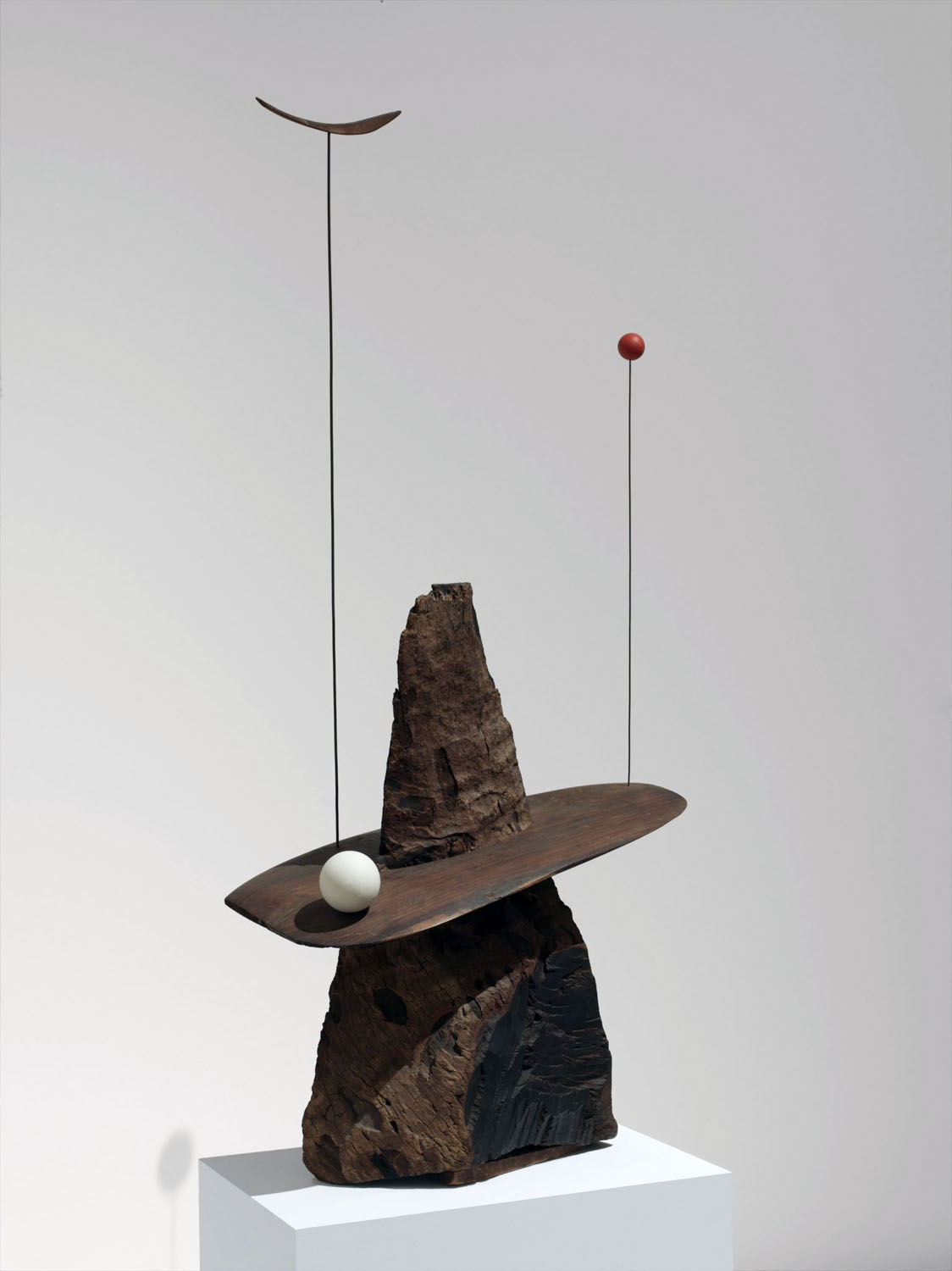
Alexander Calder (American, 1898-1976) 'Gibraltar' 1936 from the exhibition 'Calder: Sculptor of Air' at the Palazzo delle Esposizioni, Rome, October 2009 - February 2010


Alexander Calder (American, 1898-1976)
Gibraltar
1936
Wood, wire, and paint
Dimensions
51 7⁄8″ × 24 1⁄4″ × 11 3⁄8″
The Museum of Modern Art, New York; Gift of the Artist


Alexander Calder (American, 1898-1976) 'Cascading Flowers' 1949 from the exhibition 'Calder: Sculptor of Air' at the Palazzo delle Esposizioni, Rome, October 2009 - February 2010


Alexander Calder (American, 1898-1976)
Cascading Flowers
1949


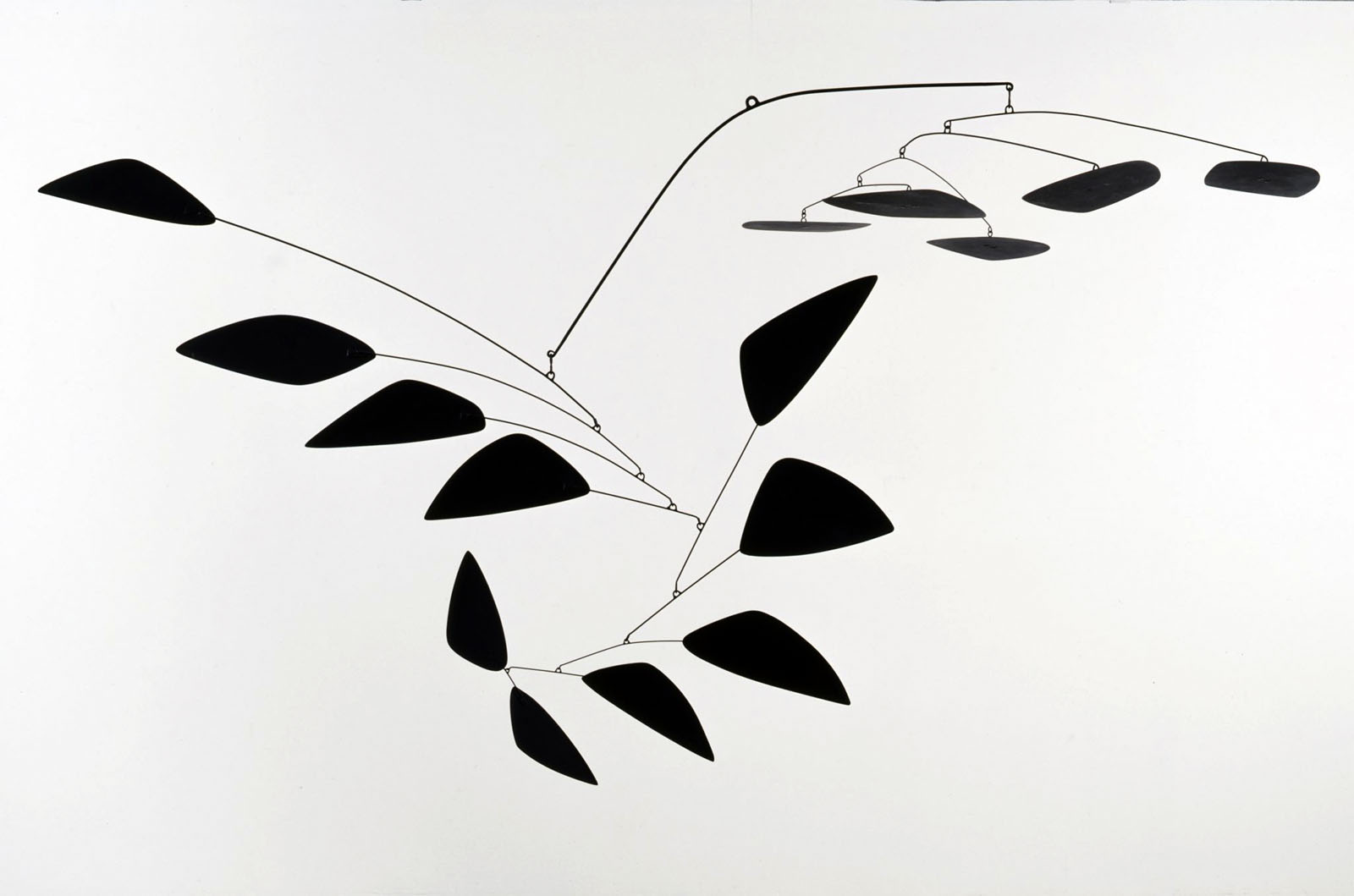
The City of Rome is to devote its first ever major exhibition to Alexander Calder. The exhibition is being organised by the Azienda Speciale Palaexpo to celebrate the famous US artist born in Lawnton, Pennsylvania, in 1898 and who died in New York in 1976. His Mobiles are some of the modern era’s most celebrated icons. Exuberance, happiness, vigour and a strong and lively sense of humour are features James J. Sweeney already attributed to Calder in the catalogue of a retrospective held at the Museum of Modern Art in New York in 1943. This was the exhibition that raised Calder to the level of one of the leading artists of the day. After majoring in engineering, being awarded a diploma at the Art Students’ League in New York and immersing himself fully in the Parisian Avant-Garde movement in the twenties, Calder went on in the following decade to produce his first Mobiles, as Marcel Duchamp was to christen them. In these sculptures, which were to become enormously popular, the artist harmonically fused shape, colour and movement into an essential whole, which he himself saw as a “universe” where “each element can move, shift and oscillate back and forth in a changing relationship with each of the other elements.”

The exhibition at the Palazzo delle Esposizioni – over 100 works from major public and private collections and the Calder Foundation itself – is set out in the form of a chronological journey designed to explore the artist’s entire creative cycle starting in the twenties. A large selection of his most important works will be on display, including some of the sculptures that were shown at the 1943 exhibition at the MoMa. The exhibition will also be taking a look at some of the lesser known aspects of his work, with groups of works that are rarely on display to the general public. The exhibition opens with his wire sculptures of acrobats, animals and portraits, most of which were created in Paris in the twenties. They include his first attempts to portray movement in a playful and wryly ironic mood.

A lesser known series of small bronze figures produced in 1930 showing contortionists and acrobats will allow the visitor to see how the artist resorted to different techniques to experiment in expressing the notion of movement. An important selection of works also illustrates the way in which Calder wholeheartedly embraced the Abstract movement after paying a visit to Mondrian’s studio in Paris. The visitor will also be able to track Calder’s surrealist vein and his interest in biomorphic shapes through a series of masterpieces produced in the mid-thirties including: Gibraltar, Tightrope, Yellow Panel and Orange Panel, all completed in 1936 (see images above).

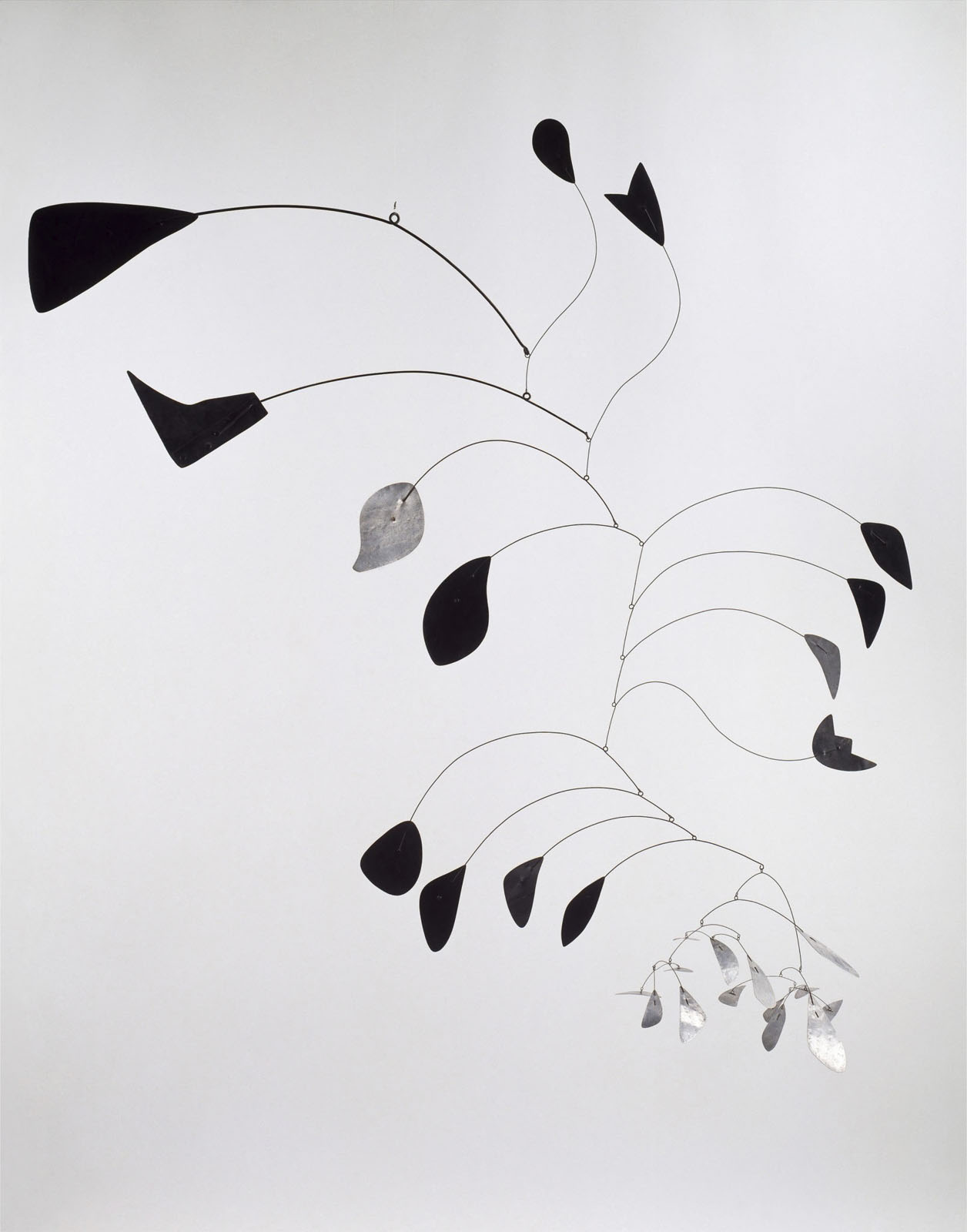
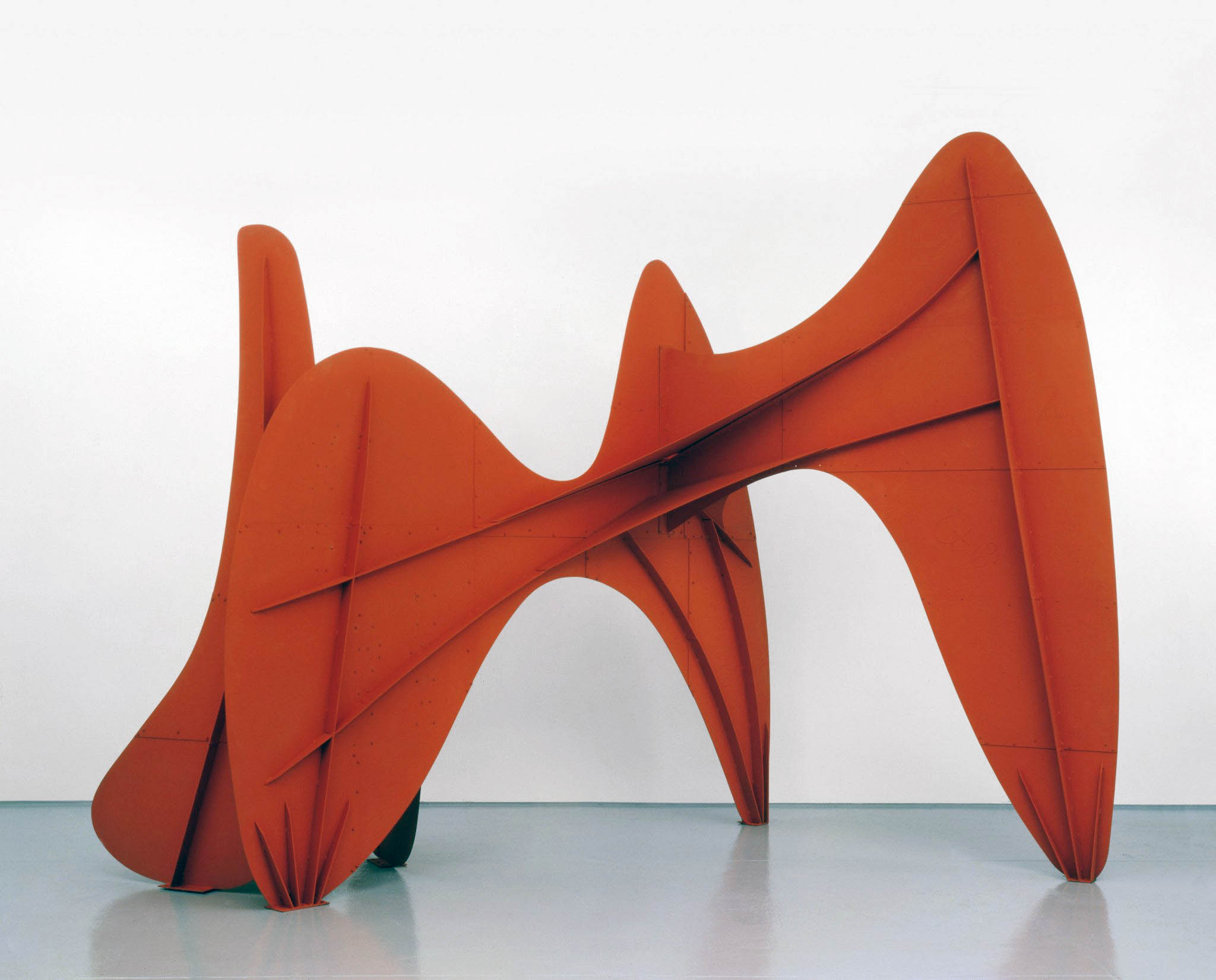
The exhibition will be built around the Mobiles that the artist produced throughout his career, working industrial metal plates using a craftsman’s technique. Throughout the exhibition, visitors will be able to admire a selection of the most representative pieces from different periods: Arc of Petals, 1941 (see image below); Cascading Flowers, 1949 (see image above); Le 31 Janvier, 1950; and The Y, 1960 (see image below). The exhibition will also be hosting a significant selection of Stabiles, free-standing sculptures that were given their name by Hans Arp. The Stabiles on display will range from those produced in the mid-thirties, such as Black Beast and Hollow Egg (dated 1939), right up to the more recent Cactus, dated 1959, and La Grande Vitesse created in 1969 (see image below). The exhibition will also be exploring the chronological development of Calder’s painting, a branch of his art in which the artist resorted principally to the agile and dynamic method of gouache on paper. The exhibition will be accompanied by a catalogue published by Motta, with contributions from Alexander S. C. Rower and Giovanni Carandente as well as a broad anthology of texts by the artist himself and other authors, many of whose works will be appearing in Italian translation for the first time.

Press release from the Palazzo delle Esposizioni website [Online] Cited 01/09/2010. No longer available online


Alexander Calder (American, 1898-1976) 'Helen Wills' 1927


Alexander Calder (American, 1898-1976)
Helen Wills
1927


Helen Newington Wills (October 6, 1905 – January 1, 1998), also known as Helen Wills Moody and Helen Wills Roark, was an American tennis player. She became famous around the world for holding the top position in women’s tennis for a total of nine years: 1927-33, 1935 and 1938. She won 31 Grand Slam tournament titles (singles, women’s doubles, and mixed doubles) during her career, including 19 singles titles.

Wills was the first American woman athlete to become a global celebrity, making friends with royalty and film stars despite her preference for staying out of the limelight. She was admired for her graceful physique and for her fluid motion. She was part of a new tennis fashion, playing in knee-length pleated skirts rather than the longer ones of her predecessors. Unusually, she practiced against men to hone her craft, and she played a relentless game, wearing down her female opponents with power and accuracy. In 1933 she beat the 8th-ranked US male player in an exhibition match.

Her record of eight wins at Wimbledon was not surpassed until 1990 when Martina Navratilova won nine. She was said to be “arguably the most dominant tennis player of the 20th century”, and has been called by some (including Jack Kramer, Harry Hopman, Mercer Beasley, Don Budge, and AP News) the greatest female player in history.

Text from the Wikipedia website


Alexander Calder (American, 1898-1976) 'Parasite' 1947


Alexander Calder (American, 1898-1976)
Parasite
1947
Sheet metal, wire, and paint
41″ × 68″ × 28″
Calder Foundation, New York


Installation view of the exhibition 'Calder: Sculptor of Air' at the Palazzo delle Esposizioni, Rome, October 2009 - February 2010 showing at left, Calder's 'Mobile (Arc of Petals)' 1941


Installation view of the exhibition Calder: Sculptor of Air at the Palazzo delle Esposizioni, Rome, October 2009 – February 2010 showing at left, Calder’s Mobile (Arc of Petals) 1941 (below)
Photograph by Claudio Abate


Alexander Calder (American, 1898-1976) 'Mobile (Arc of Petals)' 1941


Alexander Calder (American, 1898-1976)
Mobile (Arc of Petals)
1941
Sheet metal, wire, rivets, and paint
94 1⁄2″ × 86 5⁄8″ × 35 7⁄16″
Solomon R. Guggenheim Foundation
Peggy Guggenheim Collection, Venice, 1976


Alexander Calder (American, 1898-1976) 'The Y' 1960


Alexander Calder (American, 1898-1976)
The Y
1960
Sheet metal, rod, and paint
Dimensions
98 13⁄16″ × 14’6 1⁄2″ × 66 3⁄8″
Collection
The Menil Collection, Houston


Installation view of the exhibition 'Calder: Sculptor of Air' at the Palazzo delle Esposizioni, Rome, October 2009 - February 2010


Installation view of the exhibition Calder: Sculptor of Air at the Palazzo delle Esposizioni, Rome, October 2009 – February 2010 showing at centre, Calder’s La Grande vitesse (1:5 intermediate maquette) 1969 (below)
Photograph by Claudio Abate


Alexander Calder (American, 1898-1976) 'La Grande vitesse (1:5 intermediate maquette)' 1969


Alexander Calder (American, 1898-1976)
La Grande vitesse (1:5 intermediate maquette)
1969
Sheet metal, bolts, and paint
8’6″ × 11’3″ × 93″
Calder Foundation, New York


Alexander Calder (American, 1898-1976) 'La Grande Vitesse' 1969


Alexander Calder (American, 1898-1976)
La Grande Vitesse
1969


Palazzo delle Esposizioni, Rome
Via Nazionale, 194, and Via Milano, 9

Opening hours:
Tuesday – Sunday 10am – 8pm
Monday closed

Palazzo delle Esposizioni website

LIKE ART BLACK ON FACEBOOK

Back to top

Exhibition: ‘Chaotic Harmony: Contemporary Korean Photography’ at the Museum of Fine Arts, Houston

Exhibition dates: 18th October, 2009 – 3rd January, 2010


Sekwon Ahn (Korean, b. 1968) Triptych from the series 'Seoul New Town' 2005-2007 from the exhibition 'Chaotic Harmony: Contemporary Korean Photography' at the Museum of Fine Arts, Houston, Oct 2009 - Jan 2010


Sekwon Ahn (Korean, b. 1968)
Triptych from the series Seoul New Town (Lights of Weolgok-dong, 2005; Disappearing Lights of Weolgok-dong I, 2006; and Disappearing Lights of Weolgok-dong II, 2007)
2005-2007
Chromogenic photographs
Courtesy of the artist © Ahn Sekwon


Great to have some really good quality photographs to show you from this exhibition!

Marcus


Many thankx to the Museum of Fine Arts in Boston for allowing me to publish the photographs in the posting. Please click on the photographs for a larger version of the image.


Sekwon Ahn (Korean, b. 1968) 'Lights of Weolgok-dong', 2005 from the exhibition 'Chaotic Harmony: Contemporary Korean Photography' at the Museum of Fine Arts, Houston, Oct 2009 - Jan 2010


Sekwon Ahn (Korean, b. 1968)
Lights of Weolgok-dong
2005
Chromogenic photograph
Courtesy of the artist © Ahn Sekwon


Sekwon Ahn (Korean, b. 1968) 'Disappearing Lights of Weolgok-dong I', 2006 from the exhibition 'Chaotic Harmony: Contemporary Korean Photography' at the Museum of Fine Arts, Houston, Oct 2009 - Jan 2010


Sekwon Ahn (Korean, b. 1968)
Disappearing Lights of Weolgok-dong I
2006
Chromogenic photograph
Courtesy of the artist © Ahn Sekwon


Sekwon Ahn (Korean, b. 1968) 'Disappearing Lights of Weolgok-dong II', 2007


Sekwon Ahn (Korean, b. 1968)
Disappearing Lights of Weolgok-dong II
2007
Chromogenic photograph
Courtesy of the artist © Ahn Sekwon


Dae-Soo Kim (Korean, b. 1955) 'Untitled' from the series 'Bamboo' (1998-2008) 1999


Dae-Soo Kim (Korean, b. 1955)
Untitled
1999
From the series Bamboo 1998-2008
Gelatin silver photograph, printed 2007
Santa Barbara Museum of Art; museum purchase with funds provided by PhotoFutures


Bien-U Bae (Korean, b. 1950) 'Kyung ju' from the series 'Sonamu' 1985


Bien-U Bae (Korean, b. 1950)
Kyung ju
1985
From the series Sonamu
Gelatin silver photograph
The Museum of Fine Arts, Houston; museum purchase with funds provided by Photo Forum


This October, the Museum of Fine Arts, Houston, presents Chaotic Harmony: Contemporary Korean Photography, the most comprehensive exhibition of contemporary Korean photography to ever be shown in the United States. Organised by Anne Wilkes Tucker, The Gus and Lyndall Wortham Curator of Photography at the MFAH, and Karen Sinsheimer, Curator of Photography at the Santa Barbara Museum of Art, Chaotic Harmony features large scale photographs by 40 Korean artists, many of who have never before exhibited in international museum exhibitions and whose work will be on view in the United States for the first time in this show. At the MFAH, the works will be on display in the Audrey Jones Beck Building’s Cameron Foundation Gallery, as well as the Lower Beck Corridor, from October 18, 2009 through January 3, 2010, presenting a fascinating window onto the vital and constantly evolving country, Korea.

“As South Korea has exploded onto the international trade scene, South Korean artists have also emerged onto the global stage, which the recent high auction prices for Korean artwork attest to. Despite this fact, Korean art is still rarely presented in the United States, and the specific field of Korean photography is even less explored here,” said MFAH director Peter C. Marzio. “Following the MFAH’s tradition of presenting pioneering photography exhibitions, we are pleased to exhibit this brilliant survey of contemporary South Korean photography, which can be seen in the enhanced context of Your Bright Future and the museum’s Arts of Korea gallery.”

“Operating under a relatively new democracy in South Korea, artists experienced a burst of creative energy and freedom of expression in recent decades, and an entirely fresh perspective of modern-day Korea is presented in this show,” added curator Anne W. Tucker. “The photographers in ‘Chaotic Harmony’ observe the country’s notable growth in terms of industry and urbanisation and convey the resultant issues as well as reflect on the country’s ancient culture and religions.”

Within the exhibition, two distinct generations of Korean artists are represented: those born in the mid-1950s and 1960s, during a succession of military dictatorships when the country was still largely agrarian, and those born in the 1970s, predominantly in urban areas and who came into maturity in the new democratic era which began in 1987. With two exceptions, one work by each artist is included. Through recent works by both generations of photographers, Chaotic Harmony explores Korea through five thematic sections: land and sea; urbanisation and globalisation; family, friends, and memory; identity: cultural and personal; and anxiety.

Land and Sea

Most of the work represented in the Land and Sea section of the exhibition was created by the first generation of Korean artists who traveled abroad for their graduate educations and brought their new ideas back to dramatically effect photographic styles in Korea. Nevertheless, many of them remained tied to Korean landscapes and traditions while embracing new aesthetic ideas. The extraordinarily beautiful land and seascapes in this section celebrate Korea’s surrounding oceans and the forests that cover large sections of its mountainous terrain. In addition, these photographers often explore religious practices that are primarily tied to nature. BAE Bien-u’s Kyung ju (1985, see photograph above) from the series Sonamu (which translates to sacred pine grove), documents mist-shrouded pine trees surrounding Gyeongiu, the ancient city of the Shilla kingdom (A.D. 668-935). KIM Young-sung’s Untitled photograph (2005) from the Dolman series, shows a man standing atop one of Korea’s 50,000 dolmans (or ancient tombs). Over 60 percent of the world’s 80,000 dolmans are located in Korea. Gap-Chul Lee has documented shamanism (as well as Buddhism) in Korea for decades, but most specifically in his series Conflict and Reaction (1990-2001).

Urbanisation and Globalisation

An ancient civilisation, South Korea has recently transformed into one of the world’s major global economies. Three-fourths of the population is categorised as urban, with half living in the country’s six major cities. Seoul is the world’s fourth largest metropolitan area. This section of the exhibition responds to the shift of the population from rural to city living, and the entrance of Korea on to the world stage. Young-Joon CHO’s Usual & Circle – Seoul Namdaemun, Rho Gwang-hyo (2005) is a diptych: the image on the left presents an urban area teeming with stores, advertisements, people, and traffic, while the image on the right isolates a woman who we would not have otherwise noticed in the larger view of the city. Her expression of emotional distress is consistent with all the isolated figures in the series. Ahn Sekwon documented Seoul’s rapid physical changes by photographing one particular neighbourhood of the Weolgok-dong section of Seoul in 2005, 2006, and 2007 as the old homes are destroyed to make room for new high rises. The resulting triptych (see photographs above) dramatically conveys the destruction of the modest-scale homes to make way for the towering scale of a modern city.

Family, Friends, and Memory

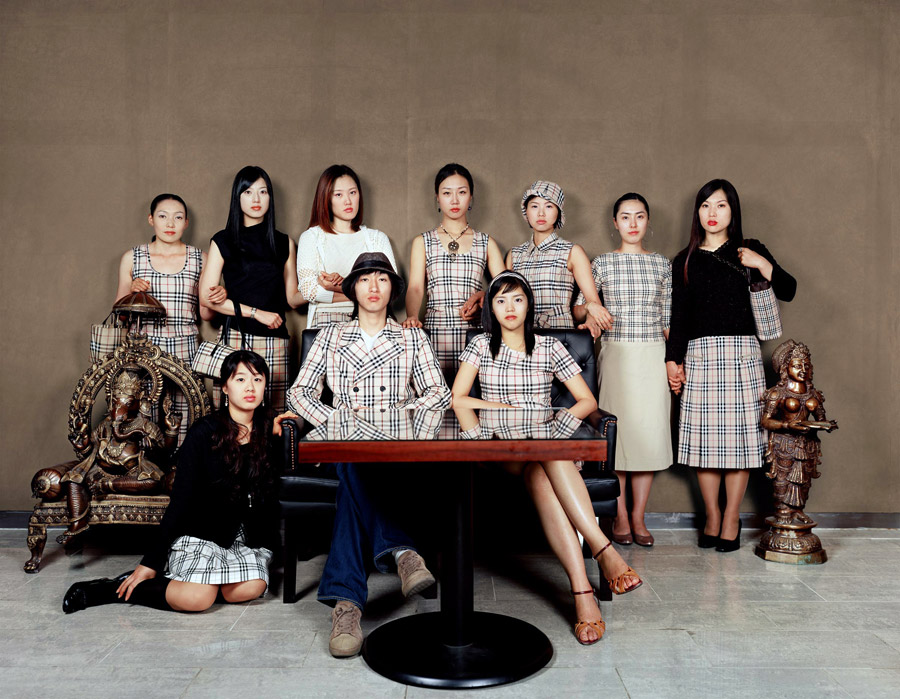
Family, Friends, and Memory reflects the tensions in shifting societal values and practices as Korea continues its rapid growth. Traditionally, families followed Confucian norms: the father was the respected head of household and made decisions for his wife and children, financially supporting the family and arranging schooling and marriages. Social values have changed with increasing awareness of Western cultures through travel and the importation of Western products and media. Also with dramatic urban growth, came shifts from homes to crowded high rises, the entrance of women into the workforce, and other changes. Sunmin LEE’s photograph, Lee, Sunja’s House #1 – Ancestral Rites (2004, see below), portrays traditional values playing out in a modern setting: the men and boys of a family conduct traditional rituals in one room while the women watch from the doorway. Sanggil KIM’s Off-line: Burberry Internet Community (2005, see photograph below) depicts a modern phenomenon: people who met over the internet, united by a common passion, in this case, that of wearing Burberry Check (registered as a trademark of the Burberry brand) and enjoying an “off-line” get-together.

Identity: Cultural and Personal

Between 1910 to 1945, Japan annexed Korea and systematically attempted to eradicate Korean culture and identity, for example, by banning Korean literature and language from schools. Only six years after World War II, Korea was devastated by the Korean War. This section of Chaotic Harmony investigates what it means to be Korean today after this disruptive history. Some artists, such as Bohnchang KOO, seek to reclaim past cultural history, by photographing treasured and uniquely Korean items such as Celadon – the main type of ceramic produced in ancient Korea and generally exalted as Korea’s most significant artistic legacy. Jungjin Lee in term photographs native crafts from Korean folk culture. Exploring more personal aspects of identity is Yeondoo JUNG’s Bewitched #2 (below), a diptych juxtaposing images of the same teenager, mopping the floor of a Baskin Robbins in her day job and exploring the Arctic regions in her dream job (see photographs below); and Hyo Jin IN’s Violet #01 from the High School Lovers series (2007, below), which portrays an openly lesbian couple.

Anxiety

The “Anxiety” section of Chaotic Harmony investigates the constant tension provoked by strained relations and the potential of a violent outbreak between North and South Korea. Jung LEE’s Bordering North Korea, #2 (2005), from her 2005-2008 series of the same title, offers a view of North Korea seen from China and them superimposes over it an accompanying text chosen from the set phrases that North Koreans are allowed to say to the few foreigners who gain access to the country, such as Our country is the paradise of the people. She wants the viewer to experience both the beauty of the land and the palpable repression evident in the political slogans. Seung Woo Back references the subliminal fear of an attack from North Korea by staging “invasions” of toy soldiers that march across a family’s yard and up their wall to the kitchen window ledge, presumably unbeknownst to the person whose silhouette is visible though the window.”

Press release from the Museum of Fine Arts, Houston website [Online] Cited 11/11/2009. No longer available online


Yeondoo Jung (Korean, b. 1969) 'Bewitched #2' 2001


Yeondoo Jung (Korean, b. 1969)
Bewitched #2
2001


Sanggil Kim (Korean, b. 1974) 'Off-line: Burberry internet community' 2005


Sanggil Kim (Korean, b. 1974)
Off-line: Burberry internet community
2005
From the series off-line 2005
Chromogenic photograph
Santa Barbara Museum of Art; museum purchase with funds provided by PhotoFutures
© Sanggil Kim


JeongMee Yoon (Korea, b. 1965) 'Seo Woo and Her Pink Things' from 'The Pink and Blue Project' 2005-2008


JeongMee Yoon (Korean, b. 1965)
Seo Woo and Her Pink Things
From The Pink and Blue Project 2005-2008
© JeongMee Yoon


In “Family,” the last section of her essay, Sinsheimer addresses the traditional and changing structures of the Korean family: inter-racial marriage, Confucian traditions, the nuclear family, and the effects of consumerism on the younger generation. Sunmin Lee’s photograph of an ancestral ritual, Lee, Sunja’s House #1 – Ancestral Rites (2004, below), represents the loosening of Confucian practice as the participants wear Western dress. Yet modernisation goes only so far, since the women do not take part in this vestige of patriarchal society.

A pair of photographs from Jeong Mee Yoon’s The Pink & Blue Project (2005-2008, above), created during her studies in New York, shows portraits of children surrounded by their accumulated belongings arranged neatly on the floor. All pink for girls and all blue for boys, the massed items, suggest that a global consumerist culture, rather than national or ethnic values, determine male and female versions of identity and acquisition. As the author observes, these images of children engulfed by material abundance are “a portrait of consumerism.”

Hyewon Yi. “Review of Chaotic Harmony: Contemporary Korean Photography [exhibition catalog],” in Trans-Asia Photography Review Volume 1, Issue 1, Fall 2010 Creative Commons Attribution-NonCommercial-NoDerivatives 3.0 License


PA-YA (Korean, b. 1971) 'Noblesse Children #12' from the series 'Noblesse Children' 2008


PA-YA (Korean, b. 1971)
Noblesse Children #12
2008
From the series Noblesse Children 2008
Chromogenic photograph
Santa Barbara Museum of Art; museum purchase with funds provided by PhotoFutures


Sunmin Lee (Korean, b. 1968) 'Sunja's House #1 - Ancestral Rites' 2004 from the series 'Woman's House II' 2003-2004


Sunmin Lee (Korean, b. 1968)
Lee, Sunja’s House #1 – Ancestral Rites
2004
From the series Woman’s House II 2003-2004
Chromogenic photograph
© Sunmin Lee, courtesy of the artist


Sungsoo Koo (Korean, b. 1970) 'Tour Bus'  2005 from the series 'Magical Reality' 2005-2006


Sungsoo Koo (Korean, b. 1970)
Tour Bus
2005
From the series Magical Reality 2005-2006
Chromogenic photograph
Courtesy of the artist © Sungsoo Koo


Chan-Hyo Bae (Korea, b. 1975) 'Existing in Costume_1' 2006 from the series 'Existing in Costume' 2006


Chan-Hyo Bae (Korea, b. 1975)
Existing in Costume_1
2006
From the series Existing in Costume 2006
© Chan-Hyo Bae


Chan-Hyo Bae has chosen the iconography of queenliness to express his own feelings of cultural estrangement. Originally from South Korea and currently living in London, England, Bae begins from very simple, common sentiments of foreignness. His works – large-format colour prints, in which he plays unidentified female British monarchs from the 13th to 19th centuries (all his works are untitled) – initially appear to be a cheeky sort of wish fulfilment. One is readily reminded of Yasumasa Morimura, the Japanese artist who casts himself in Western art’s biggest roles, and also, perhaps, of the phenomenon of cosplay – the subculture of dressing up like fictional or historical characters – which originates in Japan but has become popular throughout Asia and the rest of the world. Bae seems to be performing a blatant paradox: that of the outsider gleefully destabilising the hierarchies of a culture about which he has admittedly fantasised, but which has forbade him full entrance because of an unalterable ethnicity.

Text from the photography-now website [Online] Cited 09/05/2019 no longer available online


Hein-kuhn Oh (Korea, b. 1979) 'So-young Kang, Age 16, 2003' from the series 'Girl's Act' 2001-2005


Hein-kuhn Oh (Korean, b. 1979)
So-young Kang, Age 16, 2003
2003
From the series Girl’s Act 2001-2005
© Hein-kuhn Oh


Hyo Jin In (Korea, b. 1975) 'Violet #02' from the series 'High School Lovers' (2007)


Hyo Jin In (Korean, b. 1975)
Violet #02
2007
From the series High School Lovers (2007)
© Hyo Jin In, courtesy Sarah Lee Artworks & Projects


Bohnchang Koo (Korea, b. 1953) 'In the Beginning I' 1991


Bohnchang Koo (Korea, b. 1953)
In the Beginning, I
1991
Gelatin silver print with thread on paper
53 x 37 1/2 inches (135 x 95cm)
© Bohnchang Koo


Museum of Fine Arts, Boston
Avenue of the Arts
465 Huntington Avenue
Boston, Massachusetts

Opening hours:
Thursday – Monday 10am – 5pm
Closed Tuesday and Wednesday

Museum of Fine Arts, Boston website

LIKE ART BLART ON FACEBOOK

Back to top

Exhibition: ‘Proud Flesh’ by Sally Mann at Gagosian Gallery, New York

Exhibition dates: 15th September – 31st October, 2009


Sally Mann (American, b. 1951) 'Memory's Truth' 2008 from the exhibition 'Proud Flesh' by Sally Mann at Gagosian Gallery, New York, Sept - Oct, 2009


Sally Mann (American, b. 1951)
Memory’s Truth
2008
Gelatin silver print
Contact print from a wet-plate collodion negative


“I can think of numberless males, from Bonnard to Callahan, who have photographed their lovers and spouses, but I am having trouble finding parallel examples among my sister photographers. The act of looking appraisingly at a man, making eye contact on the street, asking to photograph him, studying his body, has always been a brazen venture for a woman, though, for a man, these acts are commonplace, even expected.”


Sally Mann


Many thankx to Gagosian Gallery for allowing me to publish the photographs in the posting. Please click on some of the photographs for a larger version of the image.


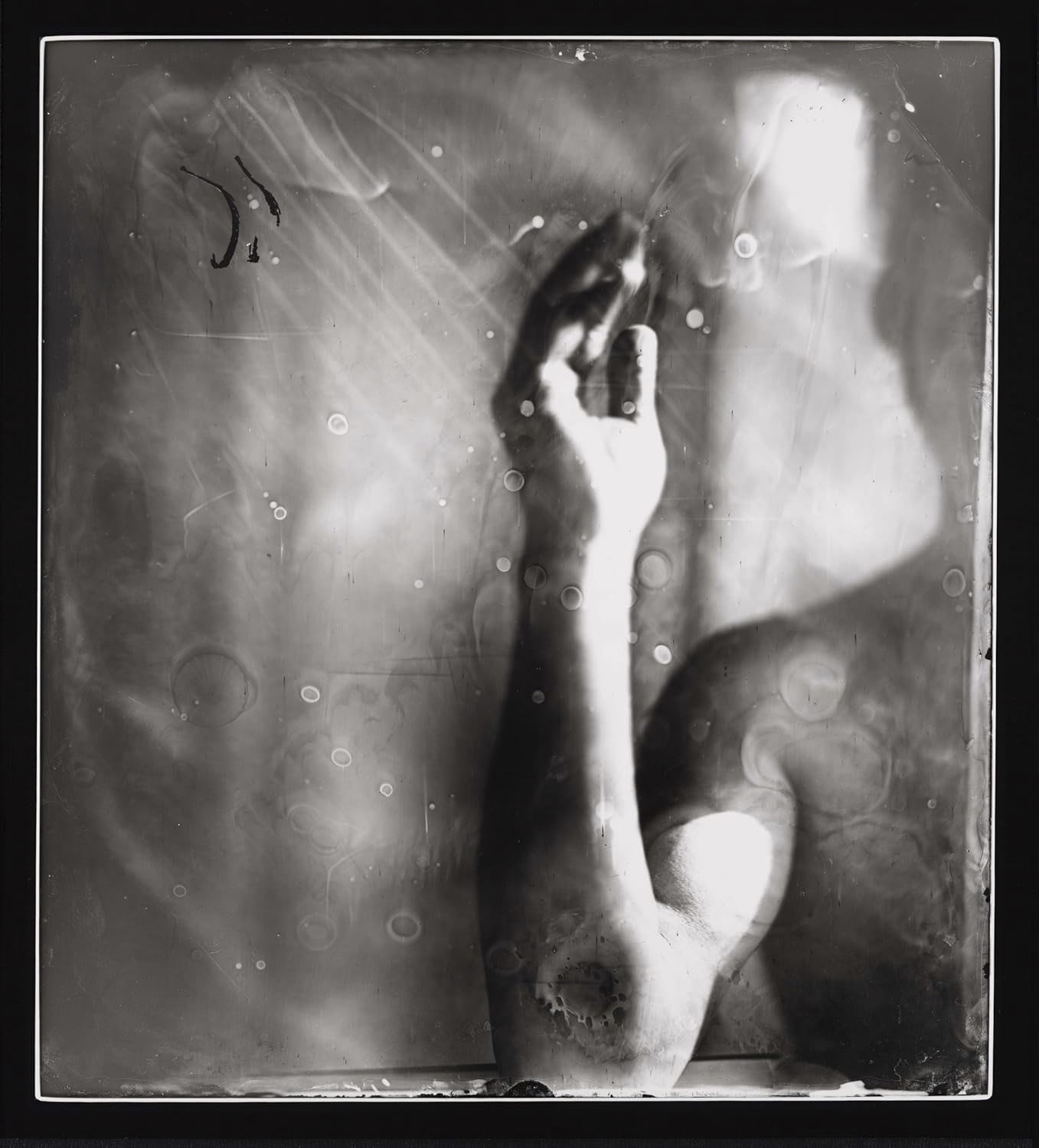
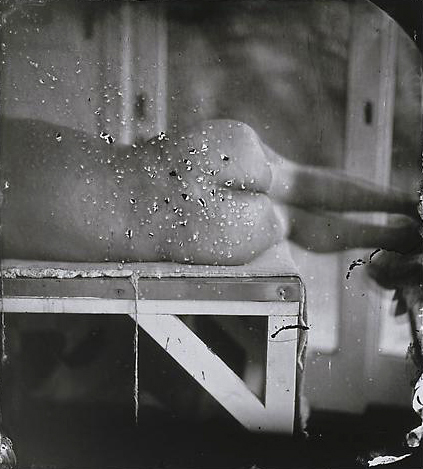
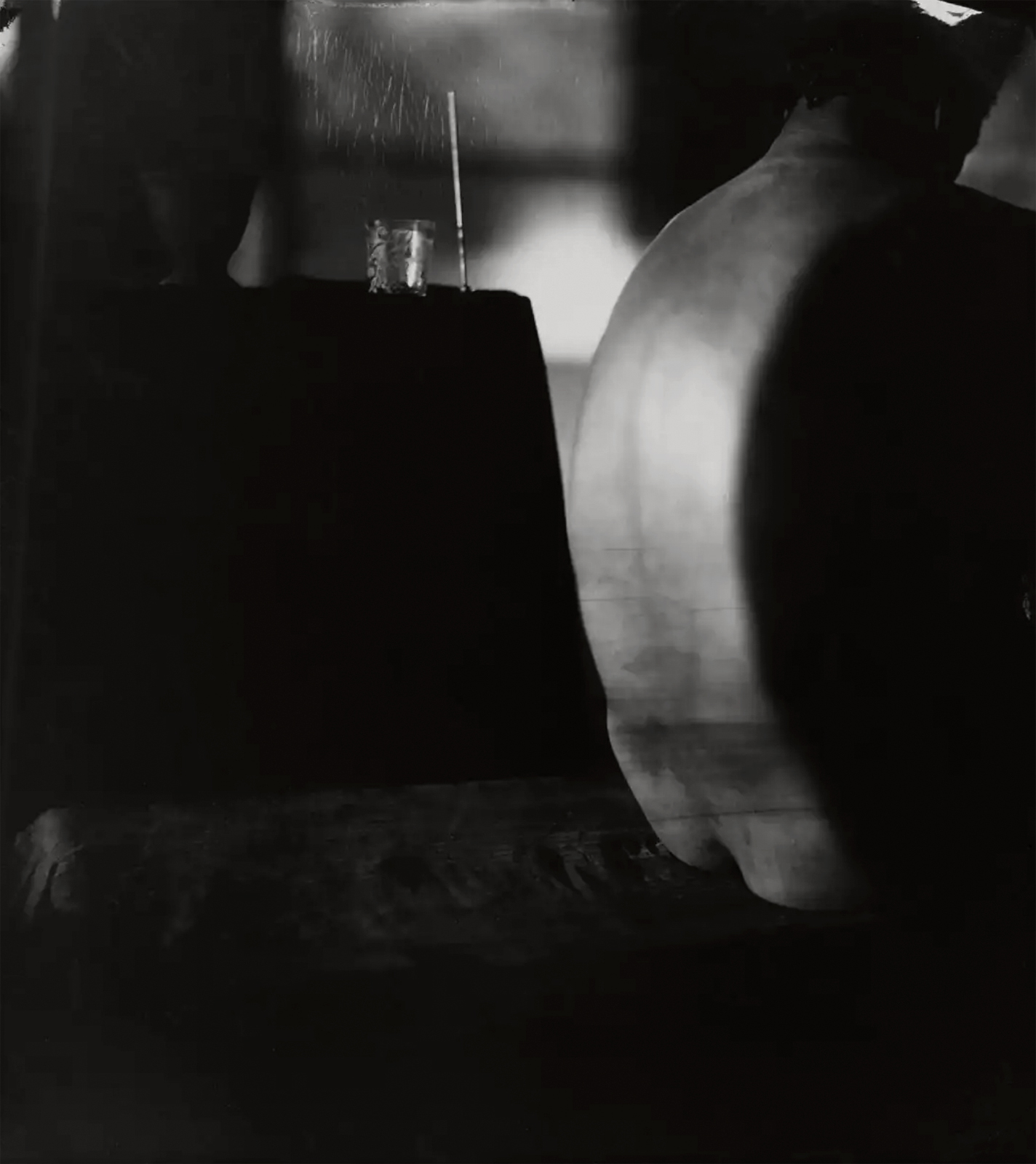
Proud Flesh is for me an emotionally exhausting work about withering. It has elements of 19th century clinical photography done with absolute loving care for the subject. Its factual surface is quickly replaced by metaphor and the haze of imperfection from the wet-plate collodion negatives she employs. In a few of the images, due to the choice of striped bedding on which the figure lays, we might be looking at a historical photograph take from Auschwitz or Bergen Belsen. With Larry’s thin and seemingly weak legs dangling over the edge of a wooden cot, the soiled bedding following the contour of his legs, it is difficult for me to see this image without this harsh historical reference. The following image in the book, he is turned into a martyr – arms out stretched – the sheet underneath him now sharply crinkled like a bed of straw (or an imagined crown of thorns).

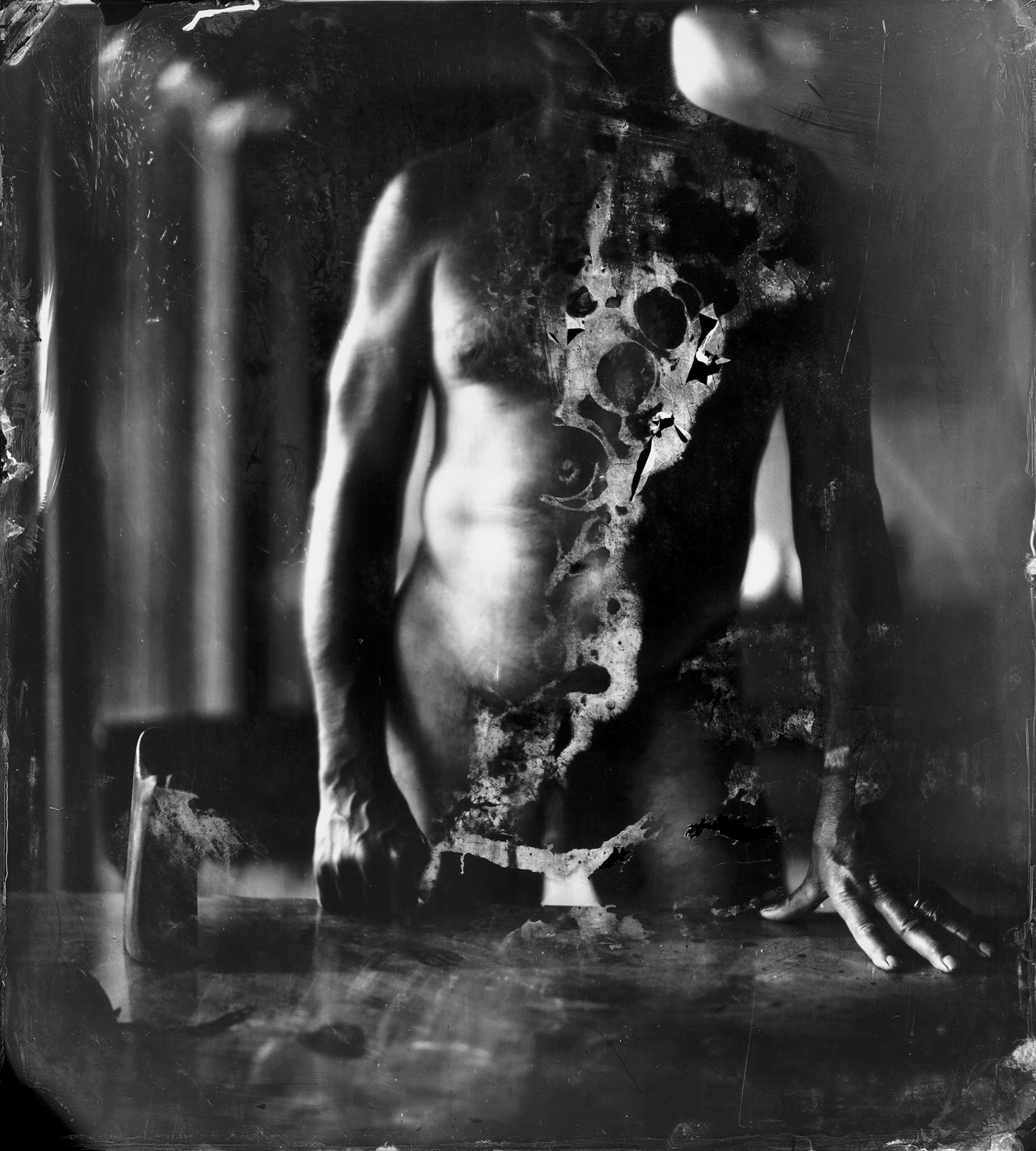
The surface texture plays such a strong role in these photos much of the seduction of these photos comes from the beauty of those imperfections. At times they can be nauseating, for their liquid streaks ooze over the images of aged flesh keeping viscera and bodily fluids as a second metaphoric subject. On the cover image, the disturbed collodion emulsion leaves a pattern which seems to be both looking at, and looking inside, the torso standing before the camera. Like Lee Friedlander’s shadow self-portrait (see the cover of Like a One-eyed Cat) where his organs are replaced with a jumble of rocks and his head is filled with straw, Mann’s image turns Larry’s insides into a mix of man and machine – collodion cogs and gears. This is the most wishful, as it portrays the strongest sense of life and the perhaps even the possibility of escaping its mortality. He stands at table’s edge with a steadying hand and a closed fist.

The most remarkable image for me appears as plate 20 and is captioned Time and the Bell (2008). Like the aforementioned cover image, this is an ideal as Mann has turned her husband’s head and shoulders into a profile bust of marble – the washed out light tones give way to a few angular shapes of rich shadow. It could be a still life of artefacts from an artists work space, a table and a sculptural work in progress. The surprise of the photographic description, which is present in most of the photos in Proud Flesh, is so complex and engaging for me it is difficult to not have it outshine all of the rest.

Text from 5B4: Photography and Books blog October 1, 2009 [Online] Cited 28/04/2019. No longer available online


Sally Mann (American, b. 1951) 'Semaphore' 2003


Sally Mann (American, b. 1951)
Semaphore
2003
Gelatin silver print
Contact print from a wet-plate collodion negative


Sally Mann (American, b. 1951) 'Hephaestus' 2008 from the exhibition 'Proud Flesh' by Sally Mann at Gagosian Gallery, New York, Sept - Oct, 2009


Sally Mann (American, b. 1951)
Hephaestus
2008
Gelatin silver print
Contact print from a wet-plate collodion negative


Sally Mann’s poignant image of her husband, Larry, symbolises both his illness and his skill as a blacksmith.


Sally Mann (American, b. 1951) 'The Nature of Loneliness' 2008


Sally Mann (American, b. 1951)
The Nature of Loneliness
2008
Gelatin silver print
Contact print from a wet-plate collodion negative
15 x 13 1/2 inches


Sally Mann (American, b. 1951) 'Somnambulist' 2009


Sally Mann (American, b. 1951)
Somnambulist
2009
Gelatin silver print
Contact print from a wet-plate collodion negative


Gagosian Gallery is pleased to present “Proud Flesh”, a series of new photographs by Sally Mann.

Children, landscape, lovers – these iconic subjects are as common to the photographic lexicon as light itself. But Mann’s take on them, rendered through processes both traditional and esoteric, is anything but common. From the outset of her career she has consistently challenged the viewer, rendering everyday experiences at once sublime and deeply disquieting.

In previous projects, Mann has explored the relationships between parent and child, brother and sister, human and nature, site and history. Her latest photographic study of her husband Larry Mann, taken over six years, has resulted in a series of candid nude studies of a mature male body that neither objectifies nor celebrates the focus of its gaze. Rather it suggests a profoundly trusting relationship between woman and man, artist and model that has produced a full range of impressions – erotic, brutally frank, disarmingly tender, and more. While the relation of artist and model is, traditionally, a male-dominated field that has yielded countless appraisals of the female body and psyche, Mann reverses the role by turning the camera on her husband during some of his most vulnerable moments.

Mann’s technical methods and process further emphasise the emotional and temporal aspects of these fragile life studies. The images are contact prints made from wet-plate collodion negatives, produced by coating a sheet of glass with ether-based collodion and submerging it in silver nitrate. Mann exploits the surface aberrations that can result from the unpredictability of the process to produce painterly photographs marked by stark contrasts of light and dark, with areas that resemble scar tissue. In works such as Hephaestus and Ponder Heart, the scratches and marks incurred in the production process become inseparable from the physical reality of Larry’s body.”

Text from the Gagosian Gallery website [Online] Cited 10/10/2009. No longer available online


Sally Mann (American, b. 1951) 'Kingfisher's Wing' 2007


Sally Mann (American, b. 1951)
Kingfisher’s Wing
2007
Gelatin silver print
Contact print from a wet-plate collodion negative


Sally Mann (American, b. 1951) 'The Quality of the Affection' 2006


Sally Mann (American, b. 1951)
The Quality of the Affection
2006
Gelatin silver print
Contact print from a wet-plate collodion negative


Sally Mann (American, b. 1951) 'Ponder Heart' 2009


Sally Mann (American, b. 1951)
Ponder Heart
2009
Gelatin silver print
Contact print from a wet-plate collodion negative


Sally Mann (American, b. 1951) 'Was Ever Love' 2009


Sally Mann (American, b. 1951)
Was Ever Love
2009
Gelatin silver print
Contact print from a wet-plate collodion negative


Gagosian Gallery – Madison Avenue Gallery
980 Madison Avenue
New York, NY 10075
Phone: 212.744.2313

Opening hours:
Tuesday – Saturday 10am – 6pm

Gagosian Gallery website

LIKE ART BLART ON FACEBOOK

Back to top

Review: ‘Between Lines’ by Kim Lawler at fortyfive downstairs, Flinders Lane, Melbourne

Exhibition dates: 29th September – 10th October, 2009

Curator: Amy Barclay


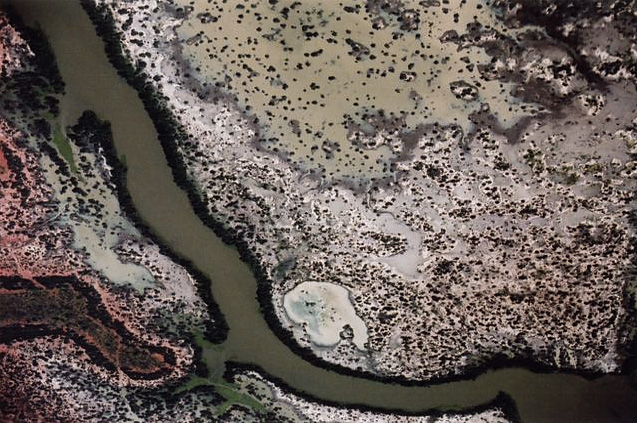
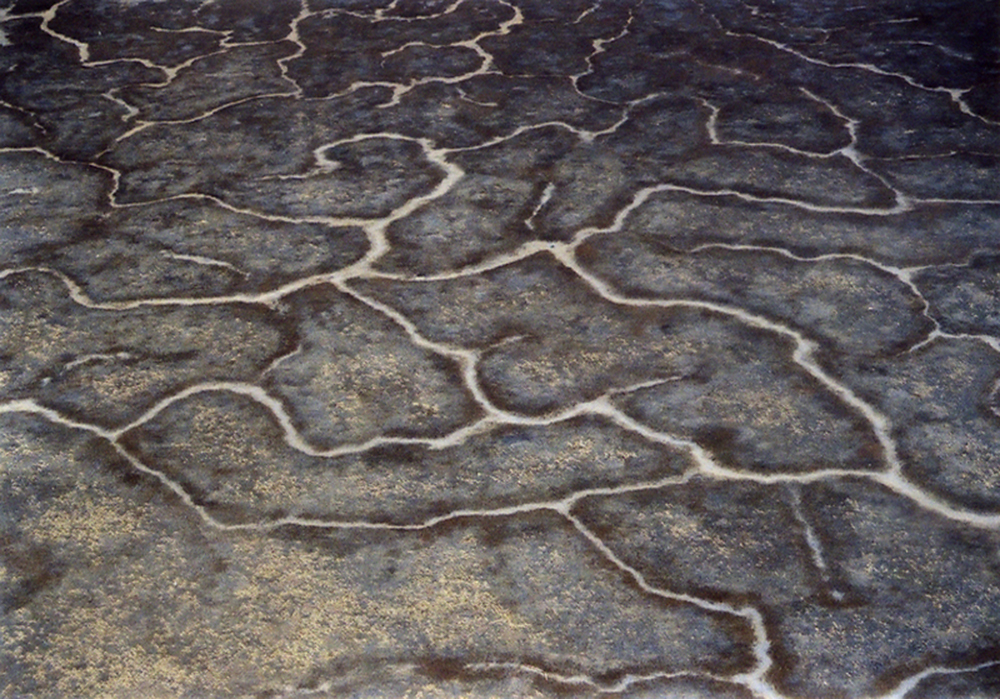
Kim Lawler (Australian) 'Between Lines' #4 2009 from the exhibition 'Between Lines' by Kim Lawler at fortyfive downstairs, Flinders Lane, Melbourne, Sept - Oct, 2022


Kim Lawler (Australian)
Between Lines #4
Aerial Photograph, Great Sandy Desert, Western Australia
2009


I finally made it to Kim Lawler’s exhibition Between Lines at fortyfive downstairs, Flinders Lane, Melbourne and, in many ways, the trip was well worth it. Lawler presents 12 prints from her eponymous series, aerial photographs taken over Western Australia.

Eschewing the essentially topographic state promoted in the “New Topographics: Photographs of a Man-Altered Landscape” of 1975 that have influenced so many photographers in recent decades (including the hyper-real photographs of the West Australian landscape by Edward Burtynsky where there is an emotional distance between the photograph and the viewer), Lawler instead mines the depths of abstraction in landscape photography.

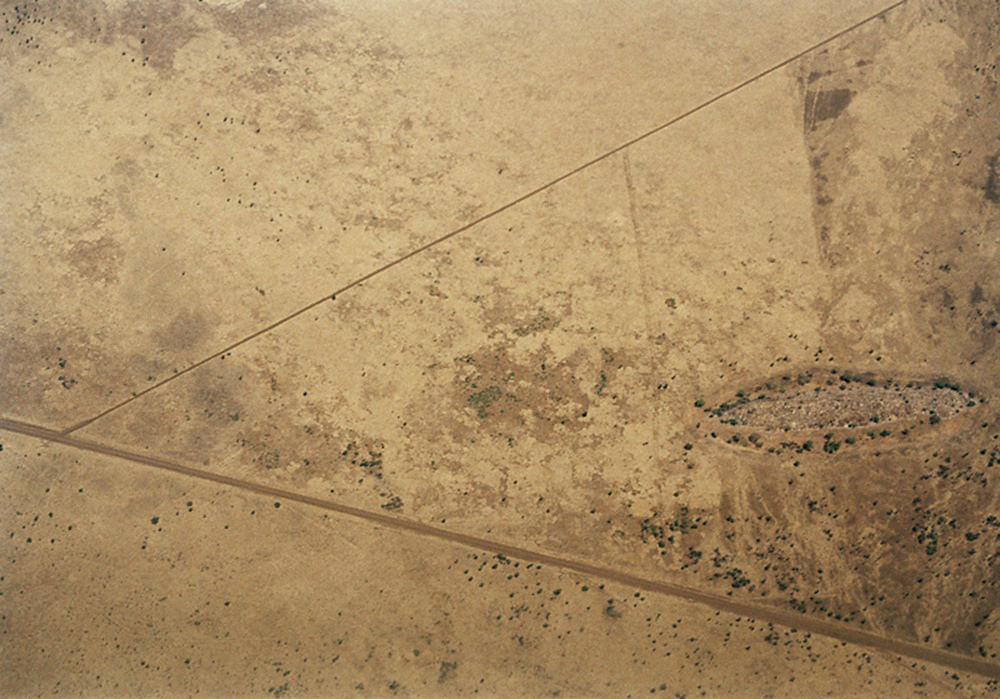
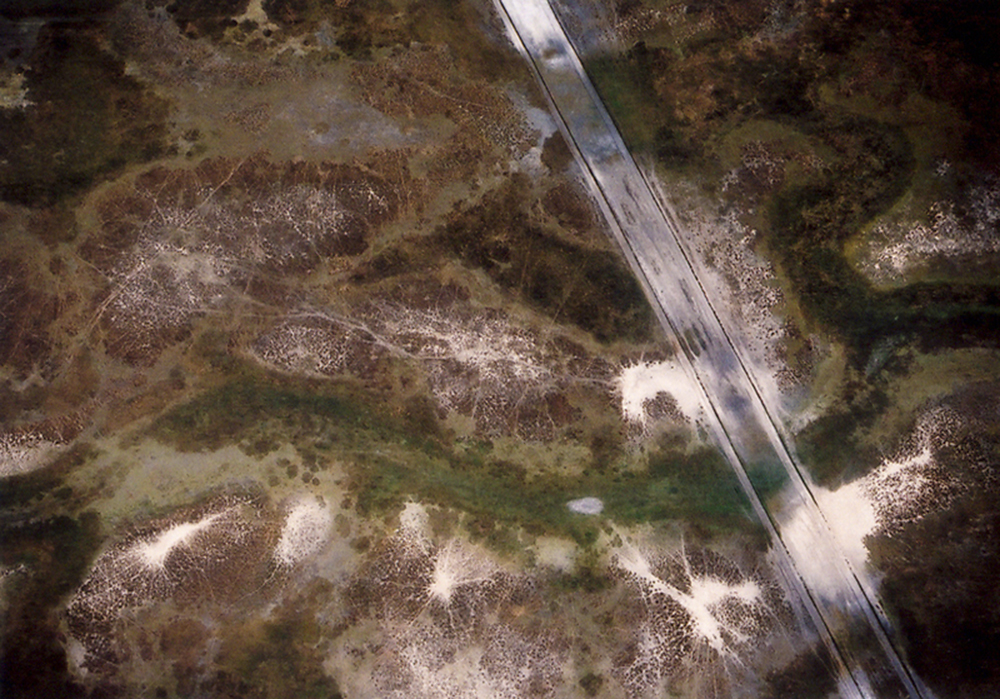
These are visceral photographs – in #4 the river and surrounds almost become vascular and cellular; in #13 the synapses and electrons infiltrate the highway reminding me of bomb craters from a Second World War landscape. In #7 the shrubs, unlike the precision of the New Topographics, become feckless dots, the landing strip a scar on the body; in #12 the toxic unsutured wound bleeds across the surface of the skin, white scar tissue surrounding it.

In these atypical mappings Lawler employs a taxonomy of disorder. The photographs are very soft in focus, soft in printing, big in the grain of the film and there is very little depth of field employed – in other words there is really nothing in focus at all, nothing that the eye and the mind can fix on. These are interstitial spaces (i.e. gaps between spaces full of structure or matter) and the title Between Lines is entirely appropriate for the work. The photographs contain beautiful textures, colours, surfaces.

This is their strength but also their weakness. The eye and the mind longs for something to hold onto, perhaps just a small fraction of the image to be in focus, so that the disorder plays off the order (for one cannot exist without the other!). Mutation only exists if their is something to mutate against. The other two small problems I had with the work were a matter of semantics and others may disagree – personally I found the size of the prints neither here nor there and they could have done with being about 2-3 inches larger and the white frames were too heavy. That is a funny thing to say about contemporary white frames, that they are too heavy for the work, but this is entirely possible: the moulding was too thick and the depth of the box frames to deep for my liking, detracting from the print itself and making the works darker than they needed to be.

Overall then an excellent exhibition that offers a positive variation on the cliched narrative of aerial photography of the Australian outback, one that questions the munificence of human habitation of the body and of the earth.

Dr Marcus Bunyan


Many thankx to fortyfive downstairs for allowing me to publish the photographs in the posting. Please click on the photographs for a larger version of the image.


Kim Lawler (Australian) 'Between Lines #7 (Landing Strip)' 2009 from the exhibition 'Between Lines' by Kim Lawler at fortyfive downstairs, Flinders Lane, Melbourne, Sept - Oct, 2022


Kim Lawler (Australian)
Between Lines #7 (Landing Strip)
Aerial Photograph, Great Sandy Desert, Western Australia
2009


Kim Lawler (Australian) 'Between Lines #8' 2009


Kim Lawler (Australian)
Between Lines #8 (Jones Soak, position approximate)
Aerial Photograph, Great Sandy Desert, Western Australia
2009


“Beyond romance or nostalgia, Lawler’s lucid visual studies reveal the aesthetic beauty of the stories being written and rewritten onto this responsive and at times fragile environment.”

~ Amy Barclay, curator


Between Lines comprises a series of aerial photographs taken in the Kimberley, far north Western Australia. This remote area is embedded with stories of Indigenous and non-Indigenous inhabitants, transitory visitors and scarred by multinational companies resource development. The artist, Kim Lawler, is concerned with markings, both natural and constructed, that tell stories of places, transitions and interruptions that occur within the landscape.

Between Lines is informed by Lawler’s experience of living in these regions and local perspectives on the displacement of people and their consequential relationship to the land that has taken place. It is also informed by the opposing qualities of abandon and connection that occur as the stories within these landscapes continue to unfold.

Competing demands for natural resources, and the resulting impact upon transitional landscapes, resonate with the stories of many generations of people that continue to flow through or inhabit each region. Attuned to the markings on these landscapes, it is these residual narratives ‘Between Lines’ seeks to record.

The imagery seen in Between Lines extends from Lawler’s previous artwork that interrogated additional Kimberley locations including: the remote Buccaneer Archipelago; the isolated far northern reaches of the Kimberley Coastline; Cockatoo Island iron ore mine and resort and; inland regions such as Warmun Aboriginal Community on the periphery of the Great Sandy Desert.

“Lawler’s eye is arrested by markings, natural and constructed, that trace and recount places, transitions and interruptions; the signifiers of change in a landscape millions of years old.”

Amy Barclay, curator

Text from the fortyfive downstairs website


Kim Lawler (Australian) 'Between Lines #12' 2009


Kim Lawler (Australian)
Between Lines #12
Joseph Bonaparte Gulf, Northern Kimberley, Western Australia
2009


Kim Lawler (Australian) 'Between Lines #13' 2009


Kim Lawler (Australian)
Between Lines #13
Great Northern Highway, Kimberley, Western Australia
2009


Kim Lawler (Australian) 'Between Lines #16' 2009


Kim Lawler (Australian)
Between Lines #16
Cockatoo Island Cyanide Settling Pool, Yampi Sound, Western Australia
2009


fortyfive downstairs
45, Flinders Lane
Melbourne 3000

Opening hours:
Tuesday – Friday 12 – 6pm
Saturday 12 – 4pm
fortyfive downstairs website

Kim Lawler website

LIKE ART BLART ON FACEBOOK

Back to top

Review: ‘Ivy’ photographs by Jane Burton at Karen Woodbury Gallery, Richmond, Melbourne

Exhibition dates: 2nd September – 26th September, 2009


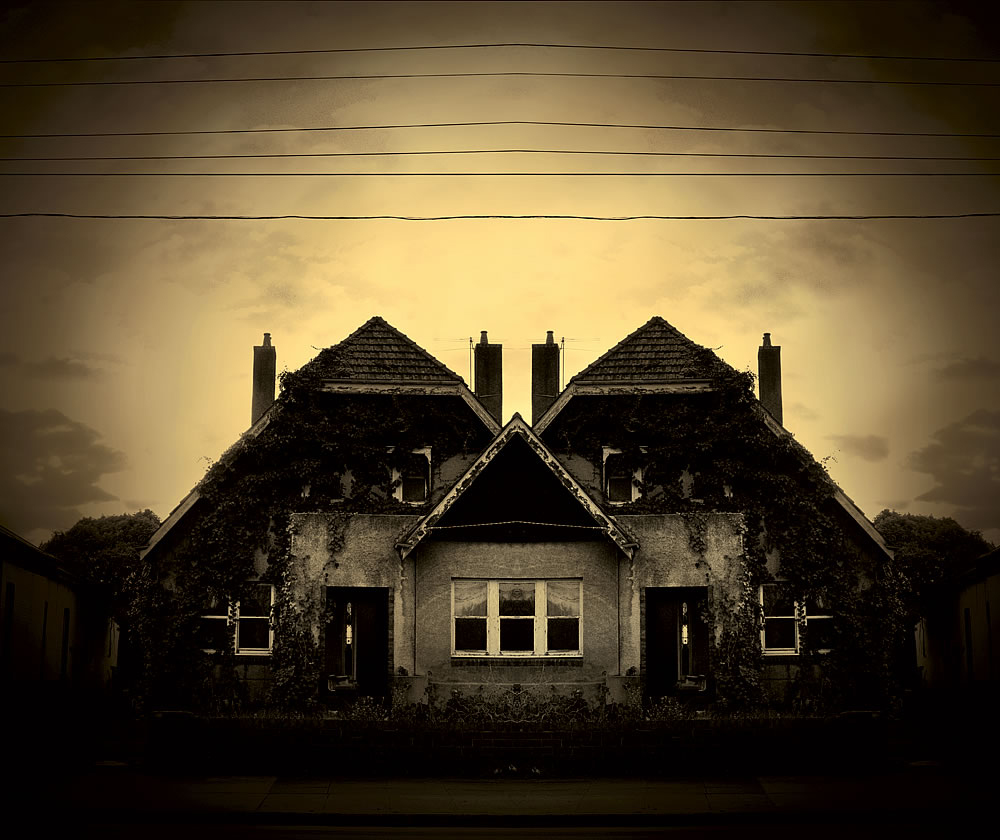
Jane Burton (Australian, b. 1966) 'Ivy #1' 2009 from the exhibition 'Ivy' photographs by Jane Burton at Karen Woodbury Gallery, Richmond, Melbourne, Sept, 2009


Jane Burton (Australian, b. 1966)
Ivy #1
2009
Pigment print
89 x 75cm


This is another outstanding body of photographic work on display in Melbourne. Featuring 10 large and 2 small sepia toned, vignetted pigment prints Burton’s work creates dark enchanted worlds of faceless female figures placed in the built environment that balance (meta)physical light and shade creating ambiguous narratives of innocence tinged with a darker edge.

The eponymous photograph Ivy #1 (above) is the seminal image of the series: a dark brooding house, hunched down positioned low in the photographic space, covered in ivy with black windows and dark eves has an ominous almost impenetrable presence and sets the tone for the rest of the work.

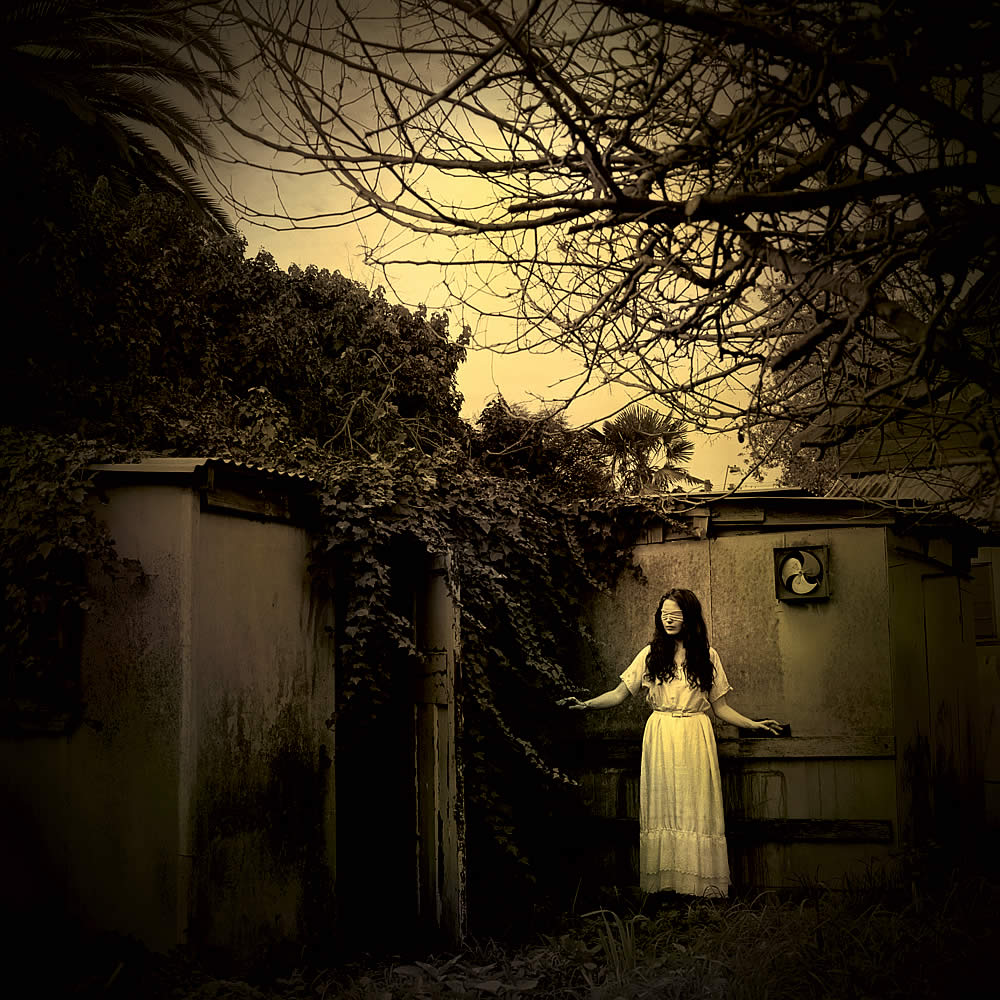
There are wonderful references to the history of photography if one cares to look (not simply generic references to Victorian daguerreotypes, postcards and family photographs). Ivy #2 (below) is a powerful photograph where the female figure is blindfolded, unable to see the encroaching tumescence of vegetation that surrounds and is about to engulf her. The placement of the hands is exquisite – unsure, reaching out, doubting her surroundings – with the 3-bladed fan hovering behind ready to devour the unwary. This photograph has resonances of the magical photographs of the garden by the Czech photographer Josef Sudek.

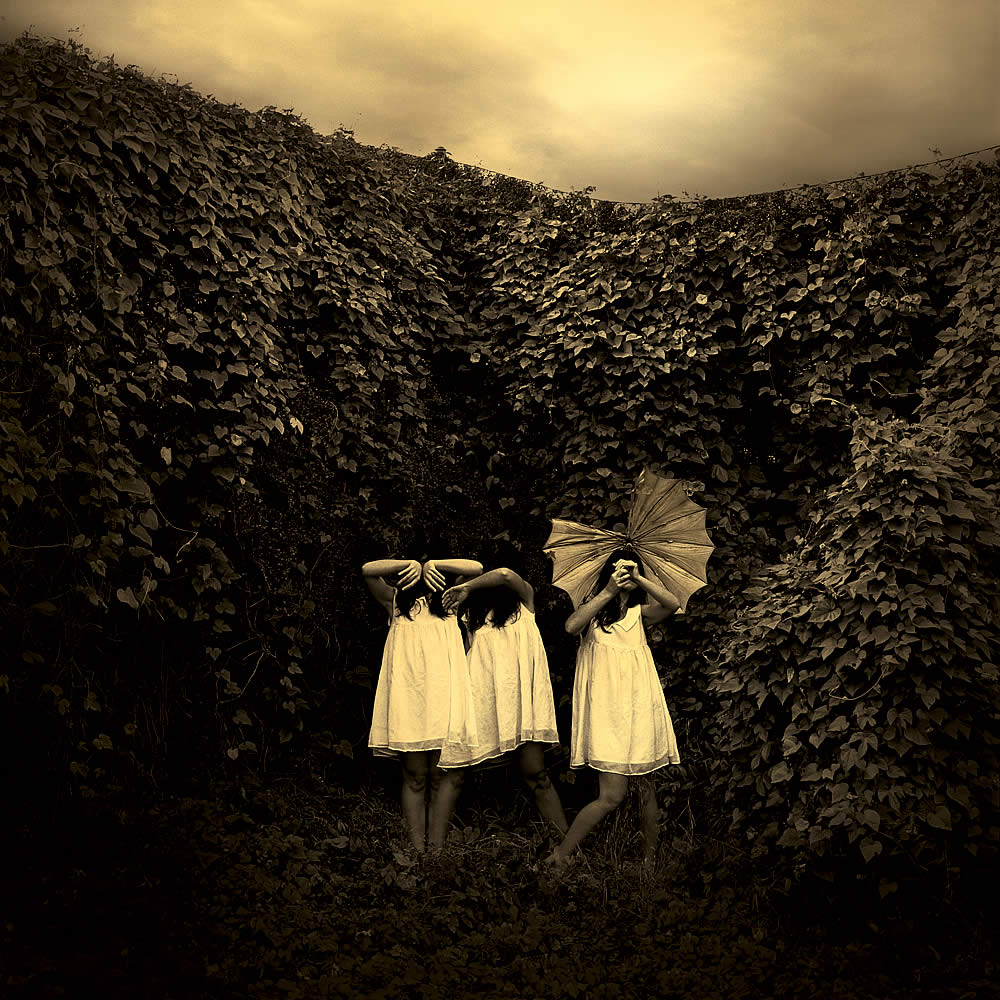
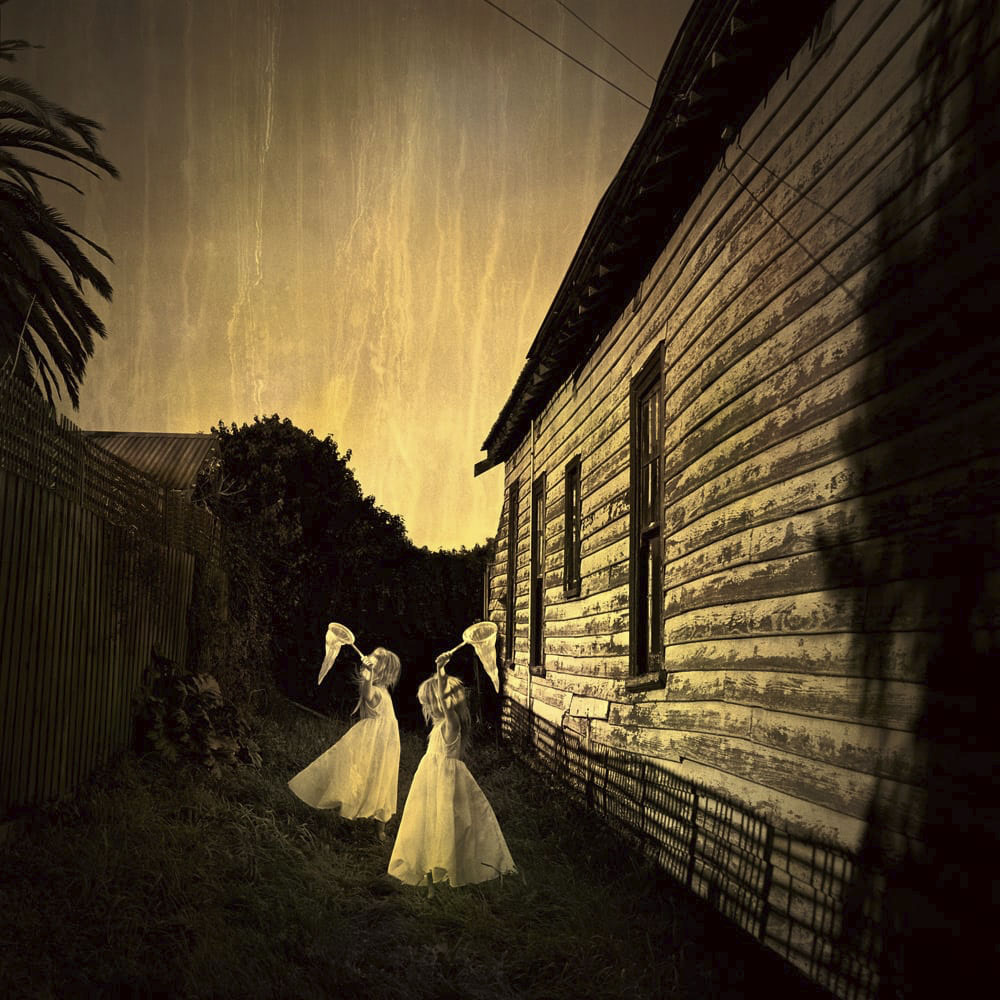
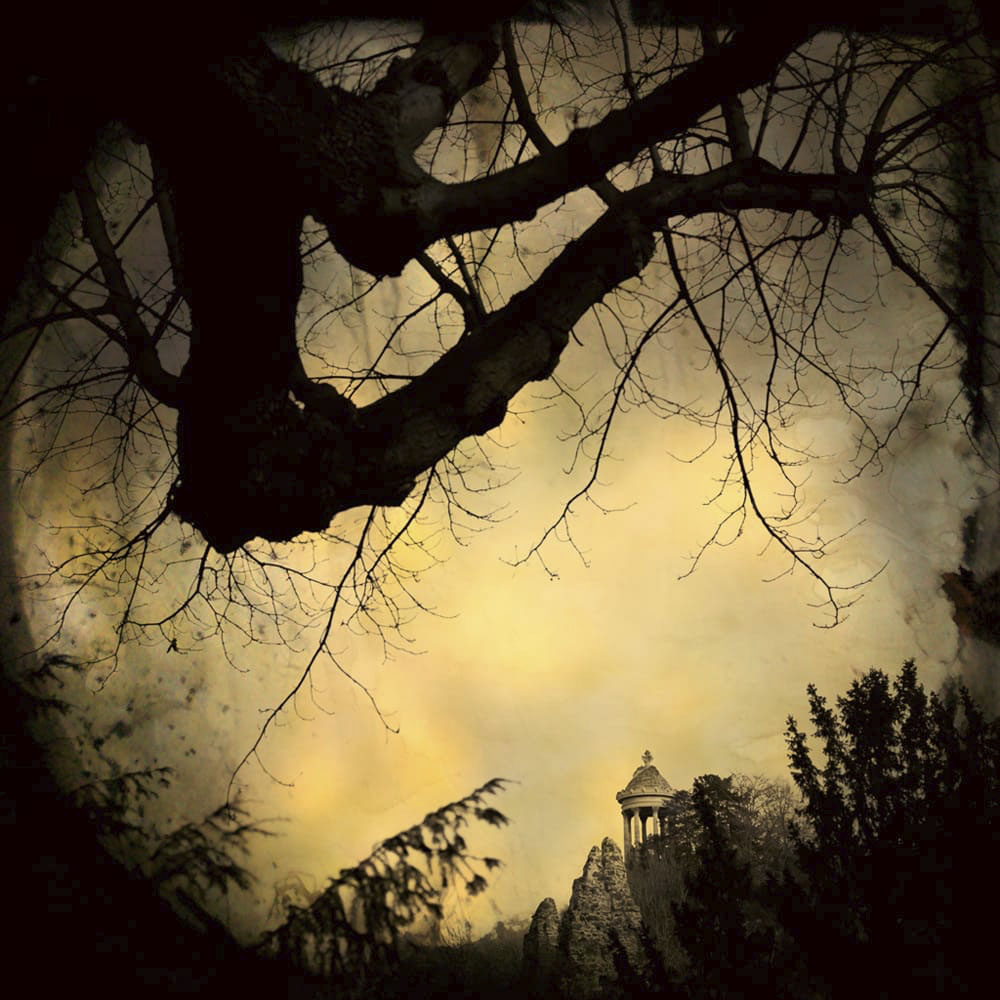
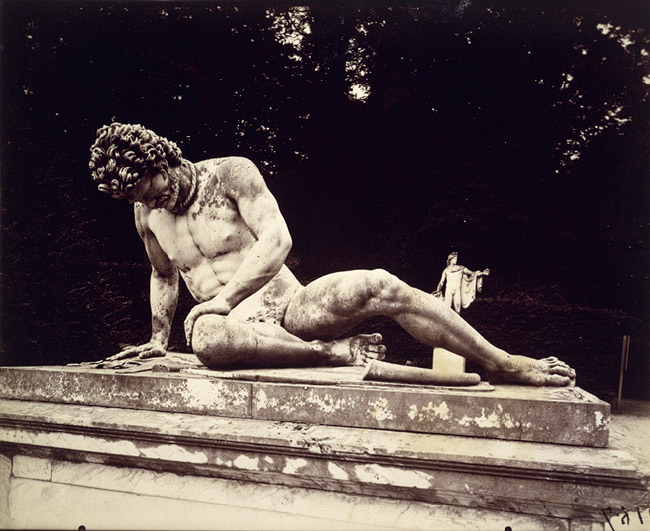
Ivy #3 (below) has echoes of the work of the American photographer Ralph Eugene Meatyard and his placement of masked people within built environments. In Burton’s photograph the broken umbrella becomes like insect wings, the faceless whiteness of the three-legged and three-armed creature cocooned among the overhanging predatory ivy, the luminescent sky offering the possibility of redemption. Other photographs such as Ivy #6 (below) and Ivy #7 with their wonderful colours, depth of field, heavy shadows and elegiac romantic feel have references to Eugene Atget and his photographs of the parks of Versailles (see photograph below).

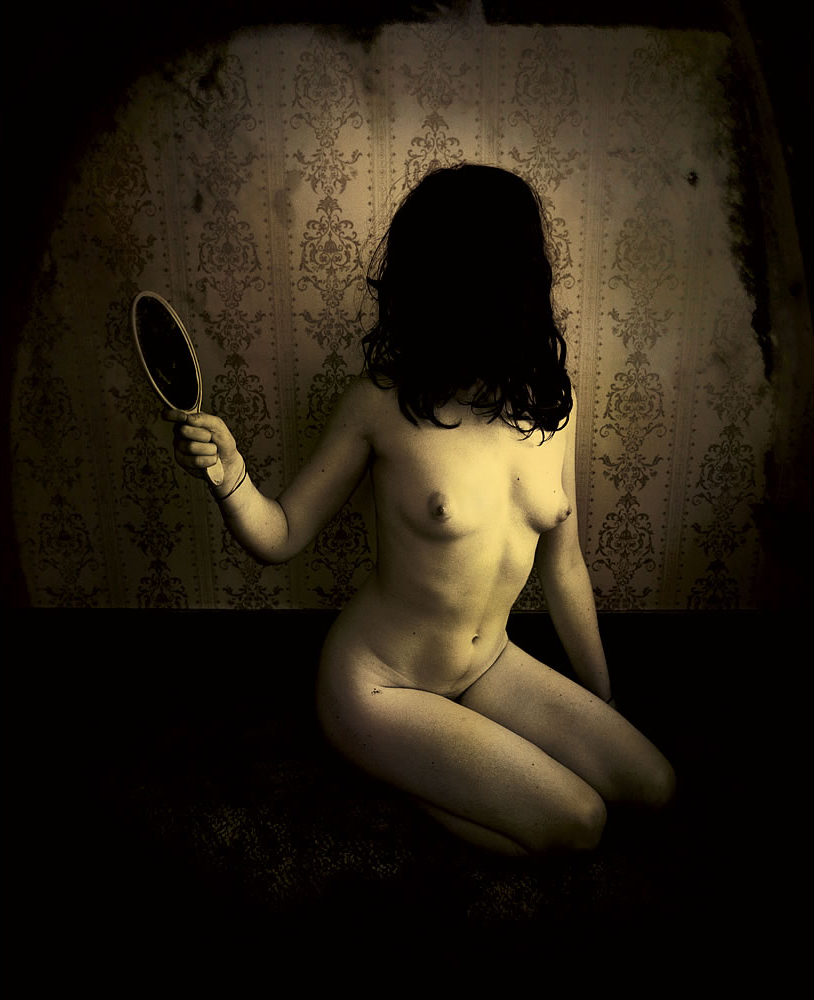
Still further references to the history of photography can be found in the photographs Ivy #9 and Ivy #10 (below). In Ivy #9 the intersection of the two female bodies through double exposure forms a slippage in (photographic) reality and the disappearance of original identity in the layering of the photographs and into the empty non-reflection of the mirror. This non-reflection is confirmed in Ivy #10 where the faceless nude woman holds a mirror with no reflection. These photographs remind me of the photographs of New Orleans prostitutes in the early years of the 20th century by the photographer Bellocq with their masked faces and the ornamentation of the wallpaper behind the figures (see below).

I feel that in these photographs with their facelessness and the non-reflection of the mirror investigate notions of ‘Theoria’ – a Greek emphasis on the vision or contemplation of God where theoria is the lifting up of the individual out of time and space and created being and through contemplative prayer into the presence of God.1 In fact the whole series of photographs can be understood through this conceptualisation – not just remembrances of past time, not a blind contemplation on existence but a lifting up out of time and space into the an’other’ dark but enlightening presence.

The greatest wonder of this series is that the photographs magically reveal themselves again and again over time. Despite (or because of) the references to other artists, the beauty of Burton’s work is that she has made it her own. The photographs have her signature, her voice as an artist and it is an informed voice; this just makes the resonances, the vibrations of energy within the work all the more potent and absorbing. I loved them.

Dr Marcus Bunyan


Many thankx to Karen Woodbury Gallery for allowing me to publish the photographs in the posting. Please click on the photographs for a larger version of the image.


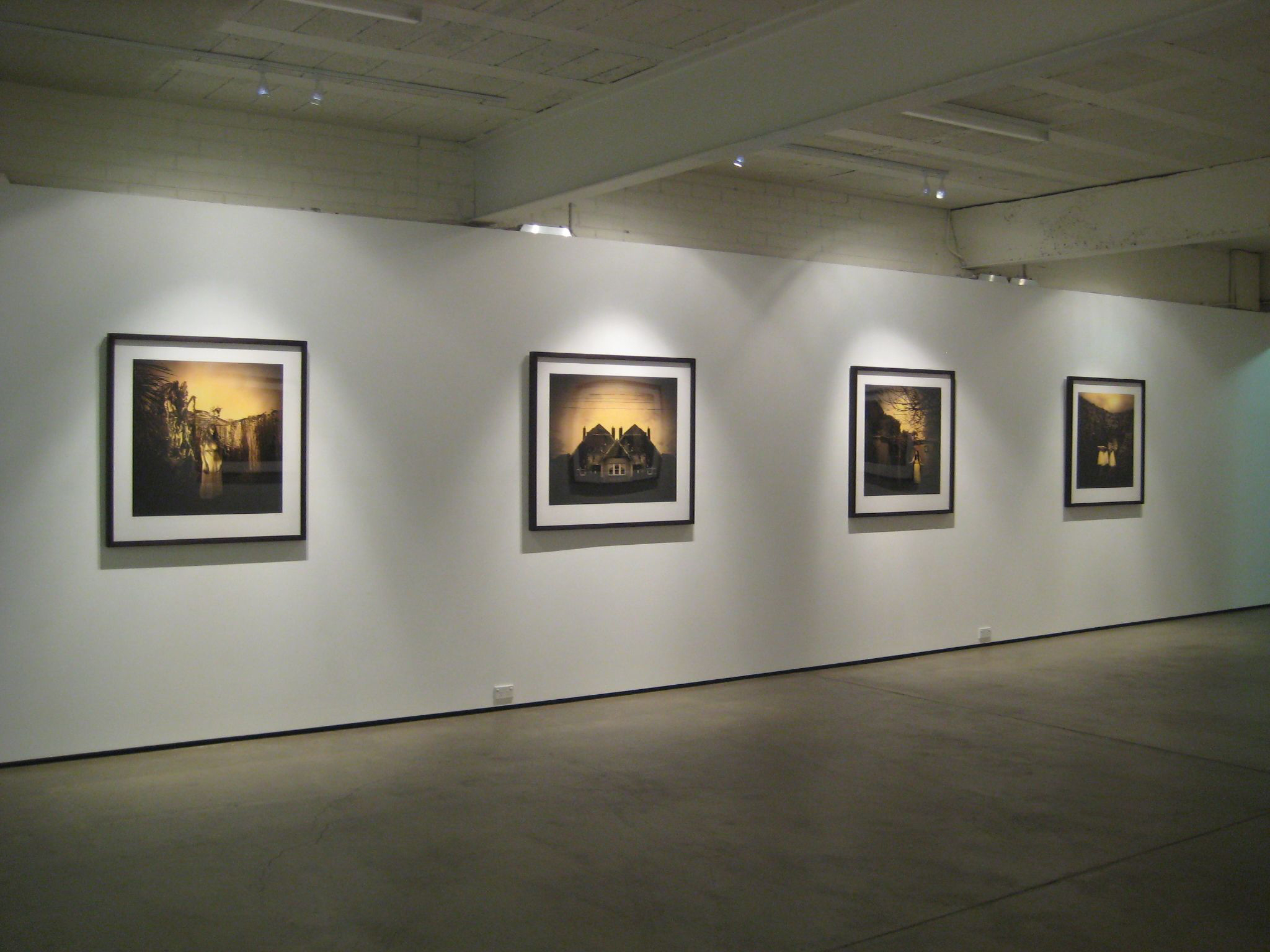
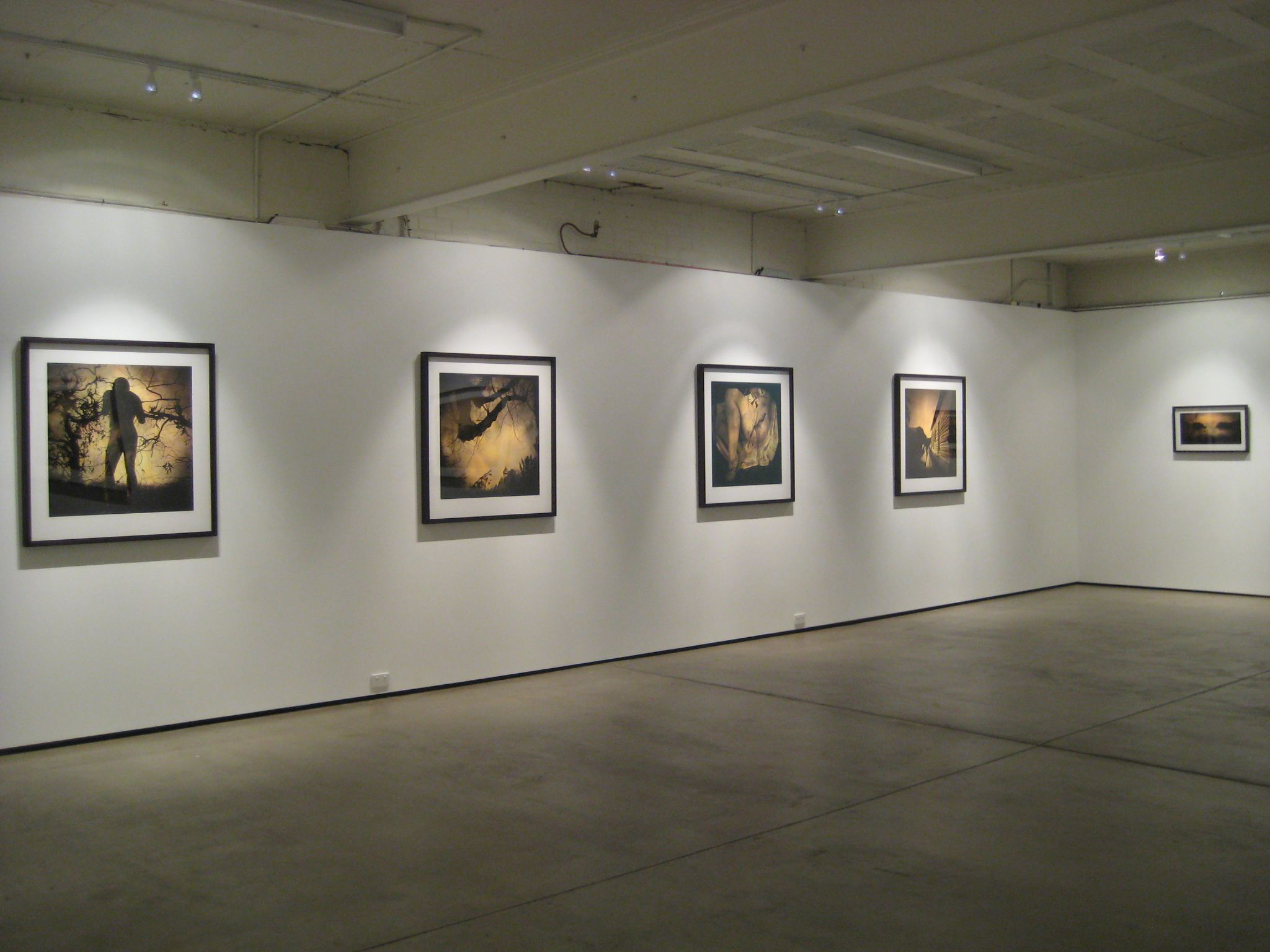
Installation view of 'Ivy' by Jane Burton at Karen Woodbury Gallery, Melbourne

Installation view of 'Ivy' by Jane Burton at Karen Woodbury Gallery, Melbourne


Installation views of Ivy by Jane Burton at Karen Woodbury Gallery, Melbourne
Photos: Marcus Bunyan


Jane Burton (Australian, b. 1966) 'Ivy #2' 2009 from the exhibition 'Ivy' photographs by Jane Burton at Karen Woodbury Gallery, Richmond, Melbourne, Sept, 2009


Jane Burton (Australian, b. 1966)
Ivy #2
2009
Pigment print
75 x 75cm


Jane Burton (Australian, b. 1966) 'Ivy #3' 2009 from the exhibition 'Ivy' photographs by Jane Burton at Karen Woodbury Gallery, Richmond, Melbourne, Sept, 2009


Jane Burton (Australian, b. 1966)
Ivy #3
2009
Pigment print
75 x 75cm


Jane Burton (Australian, b. 1966) 'Ivy #5' 2009


Jane Burton (Australian, b. 1966)
Ivy #5
2009
Pigment print
75 x 75cm


Jane Burton (Australian, b. 1966) 'Ivy #7' 2009


Jane Burton (Australian, b. 1966)
Ivy #7
2009
Pigment print
75 x 75cm


Jane Burton’s exhibition, Ivy comprises a series of photographs captured in black and white. The final prints are rendered with a sepia, peach-champagne tone, with many displaying a mottled hand-coloured effect in faded pastels of pink and green. These works hope to suggest an era past, perhaps Victorian. The imagery is evocative of old picture postcards from Europe and old photographs from the pages of family albums.

Central to the series is an image of a house covered with ivy. Depicted as dark and malevolent, the house is ‘haunted’ by the traces and stains of family history, habitation, and the buried secrets of all that occurred within.

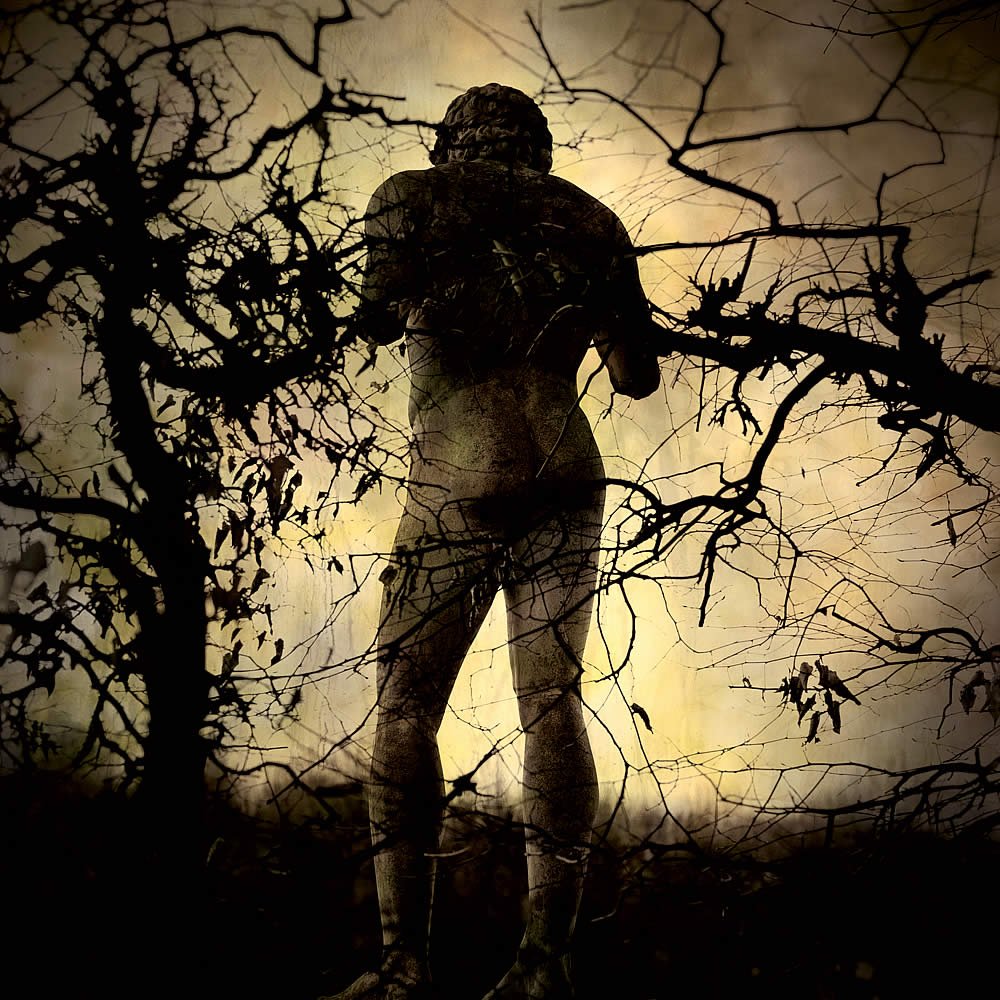
Anonymous female figures are seen in garden settings where the foliage is rampant and encroaching and the shadows deep. There is an air of enchantment perceived with unspecified darker edge. The figures are innocent and playful. The viewer is asked to question if the and girls aware of the camera capturing their activity? Are the poses staged or caught spontaneously. In another photograph, a dilapidated male statue stands broken and armless, the texture of stone worn, and bruised with dark lichen and moss.

In the interior photographs, several nudes are depicted in the style of 19th century French daguerreotype photographs. These vignetted images display women against wall-papered backdrops with theatrical props reminiscent of earlier works by Burton such as the series ‘The other side’ (2003). Posed suggestively for the camera and the viewer’s gaze, the subjects themselves are faceless, their own gaze and features hidden behind dark hair. The surface and texture of these particular works suggests the patina of decay and the damage and wear of time.

Text from the Karen Woodbury Gallery website [Online] Cited 20/09/2009. No longer available online


E. J. Bellocq (American, 1873-1949) 'Untitled [prostitute of Storyville, New Orleans]' 1912


E. J. Bellocq (American, 1873-1949)
Untitled [prostitute of Storyville, New Orleans]
1912


Jane Burton (Australian, b. 1966) 'Ivy #10' 2009


Jane Burton (Australian, b. 1966)
Ivy #10
2009
Pigment print


Eugene Atget (French, 1857-1927) 'Versailles, France' 1923


Eugene Atget (French, 1857-1927)
Versailles, France
1923
Albumen print


Jane Burton (Australian, b. 1966) 'Ivy #6' 2009


Jane Burton (Australian, b. 1966)
Ivy #6
2009
Pigment print
75 x 75cm


Karen Woodbury Gallery

This gallery has now closed.

Jane Burton website

LIKE ART BLART ON FACEBOOK

Back to top

Exhibition: ‘In Focus: Making A Scene’ at The J. Paul Getty Museum, Los Angeles

Exhibition dates: 30th June – 18th October, 2009


Hill & Adamson (Scottish, active 1843-1848) '[Lane and Peddie as Afghans]' 1843 from the exhibition 'In Focus: Making A Scene' at The J. Paul Getty Museum, Los Angeles, June - Oct, 2009


Hill & Adamson (Scottish, active 1843-1848)
[Lane and Peddie as Afghans]
1843
Salted paper print from a paper negative
20.6 × 14.3cm (8 1/8 × 5 5/8 in.)
The J. Paul Getty Museum


The team of Hill and Adamson initially began making dramatic portrait photographs as studies for one of Hill’s composite paintings. They also produced costume studies, including this scene in which Arabic scholar Mr. Lane and Mr. (Peddie) Redding appear in foreign garb.


What a fabulous selection of photographs to illustrate a fascinating “scene”. I love staged, theatrical, constructed, conceptual, collaged, surreal, imaginary, narrative photography.

Dr Marcus Bunyan


Many thankx to the J. Paul Getty Museum for allowing me to publish the photographs in the posting. Please click on the photographs for a larger version of the image.


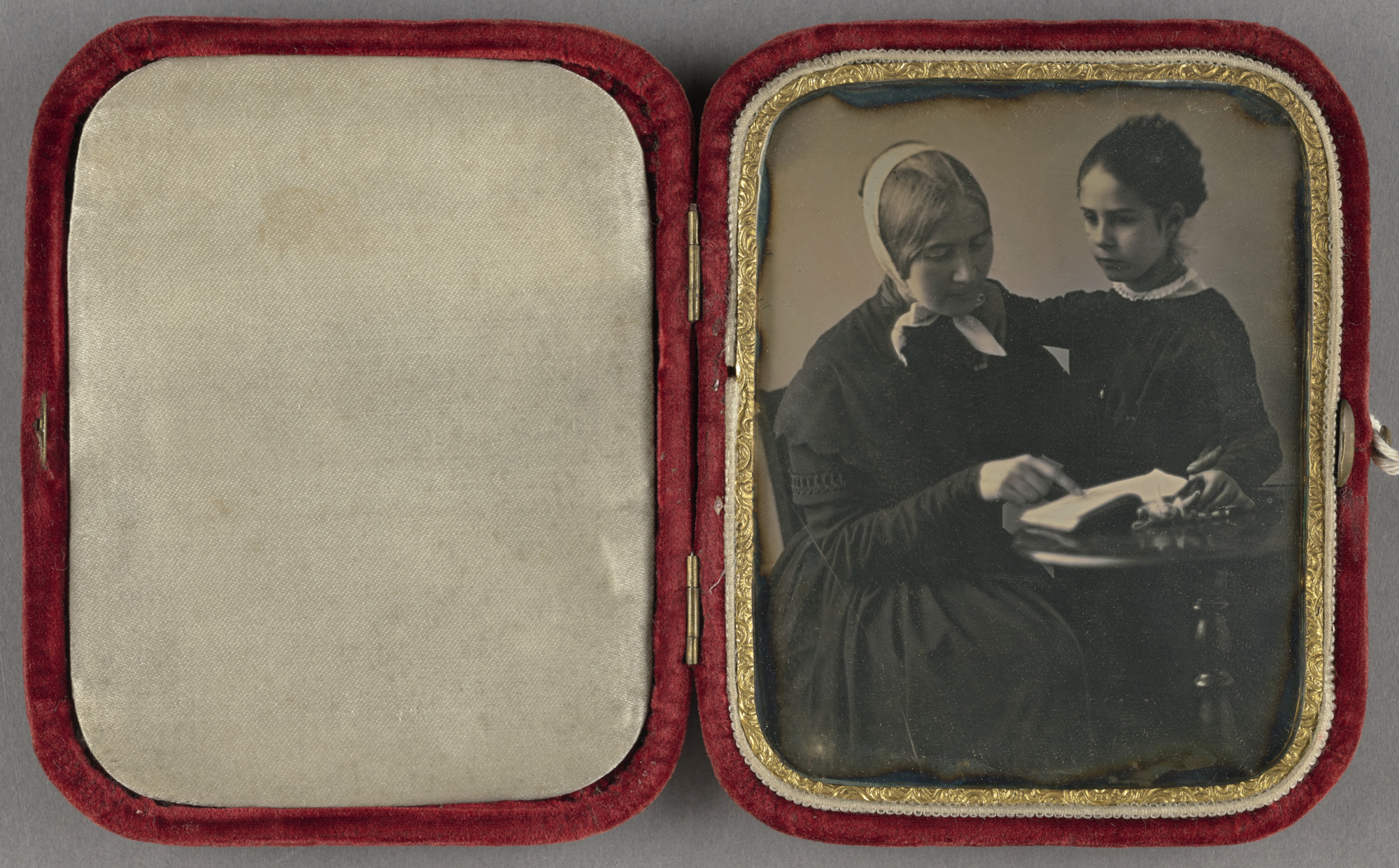
Unknown maker, French. 'Woman Reading to a Girl' c. 1845 from the exhibition 'In Focus: Making A Scene' at The J. Paul Getty Museum, Los Angeles, June - Oct, 2009


Unknown maker, French
Woman Reading to a Girl
c. 1845
Daguerreotype
9.1 × 7.1cm (3 9/16 × 2 13/16 in.)
The J. Paul Getty Museum


Through a skilful manipulation, the light coming from above and behind the figures casts the faces of mother and child in a softly modulated half-shadow. Their close grouping and familiar, intimate gestures evoke tenderness. The reflected light on the woman’s pointing finger and on the glowing white pages of the open book forms a strong visual triangle, drawing the viewer’s eye and serving to integrate and balance the composition.


Oscar Gustave Rejlander (British, born Sweden, 1813-1875) 'The Infant Photography Giving the Painter an Additional Brush' c. 1856 from the exhibition 'In Focus: Making A Scene' at The J. Paul Getty Museum, Los Angeles, June - Oct, 2009


Oscar Gustave Rejlander (British born Sweden, 1813-1875)
The Infant Photography Giving the Painter an Additional Brush
c. 1856
Albumen silver print
6 × 7.1cm (2 3/8 × 2 13/16 in.)
The J. Paul Getty Museum


Oscar Rejlander’s photograph could be read as a metaphor of his own career. The additional “brush” or image-making tool provided by photography to painters was evident from the beginnings of the medium. Many early practitioners arrived at photography from painting, as did Rejlander. Photographs were often thought of and used as sketching tools for painters. Although photographs never managed to signal the death of painting as initially predicted, they did frequently assume the function that drawing had traditionally held in relation to painting.

Compositionally, this is an unusual photograph. Rejlander employs a narrative device from painting: the use of figures, or parts of figures, as allegorical representations for ideas. A very young child represents the infant medium of photography. The Painter appears only as a hand extending into the frame at the upper left, although the traditional arts are also represented by the sculpture reproduction in the lower left corner. The Infant Photography, identified by the camera on which the child supports himself, faces away from the camera, his features totally obscured. The mirror behind the child gives a clear reflection of Rejlander at his camera, making this image.


Roger Fenton (English, 1819-1869) 'Contemplative Odalisque' 1858


Roger Fenton (English, 1819-1869)
Contemplative Odalisque
1858
Albumen silver print
35.9 × 43.8cm (14 1/8 × 17 1/4 in.)
The J. Paul Getty Museum
Gift of Professors Joseph and Elaine Monsen


Three years after traveling in the Crimea, Roger Fenton made a series of Orientalist photographs in his London studio using props gathered during his travels and non-Eastern models. Orientalism refers to just such romanticised depictions of imagined scenes of Muslim culture in the Ottoman Empire and its territories in the Near East and North Africa.

Orientalist scenes were more often fiction than fact. Cultural biases and misunderstandings were laid down on paper or canvas and frequently became the only source of information on the subjects depicted. When a group of these Orientalist photographs was exhibited in 1858, one reviewer described them as “truly representing some phases in the life of this interesting people.”

But not everyone so easily accepted Fenton’s images at face value; a more astute critic called for “the necessity of having real national types as models.” The same model shown here also appears as “Nubian” and “Egyptian” in other photographs by Fenton. This photograph may have originally been exhibited with the title The Reverie. The odalisque, meaning a slave or concubine in a harem, poses upon her sofa. Barefoot, blouse open, her surroundings convey a sensual disarray that conforms to an Orientalising fantasy of the available woman.


Julia Margaret Cameron (British, born India, 1815-1879) 'The Rosebud Garden of Girls' June 1868


Julia Margaret Cameron (British, born India, 1815-1879)
The Rosebud Garden of Girls
June 1868
Album silver print
29.4 × 26.7cm (11 9/16 × 10 1/2 in.)
The J. Paul Getty Museum


As evolutionary science and increasing secularism transformed the way Victorians understood the world, Cameron remained a devout Christian. She photographed influential public figures of her day as well as the women of her household, casting them in allegories of literary and religious subjects. Like her artistic contemporaries, the Pre-Raphaelite painters, who modelled their work on medieval religious and mythological art, Cameron intended her photographs to evince a connection between the spiritual and the natural realms.


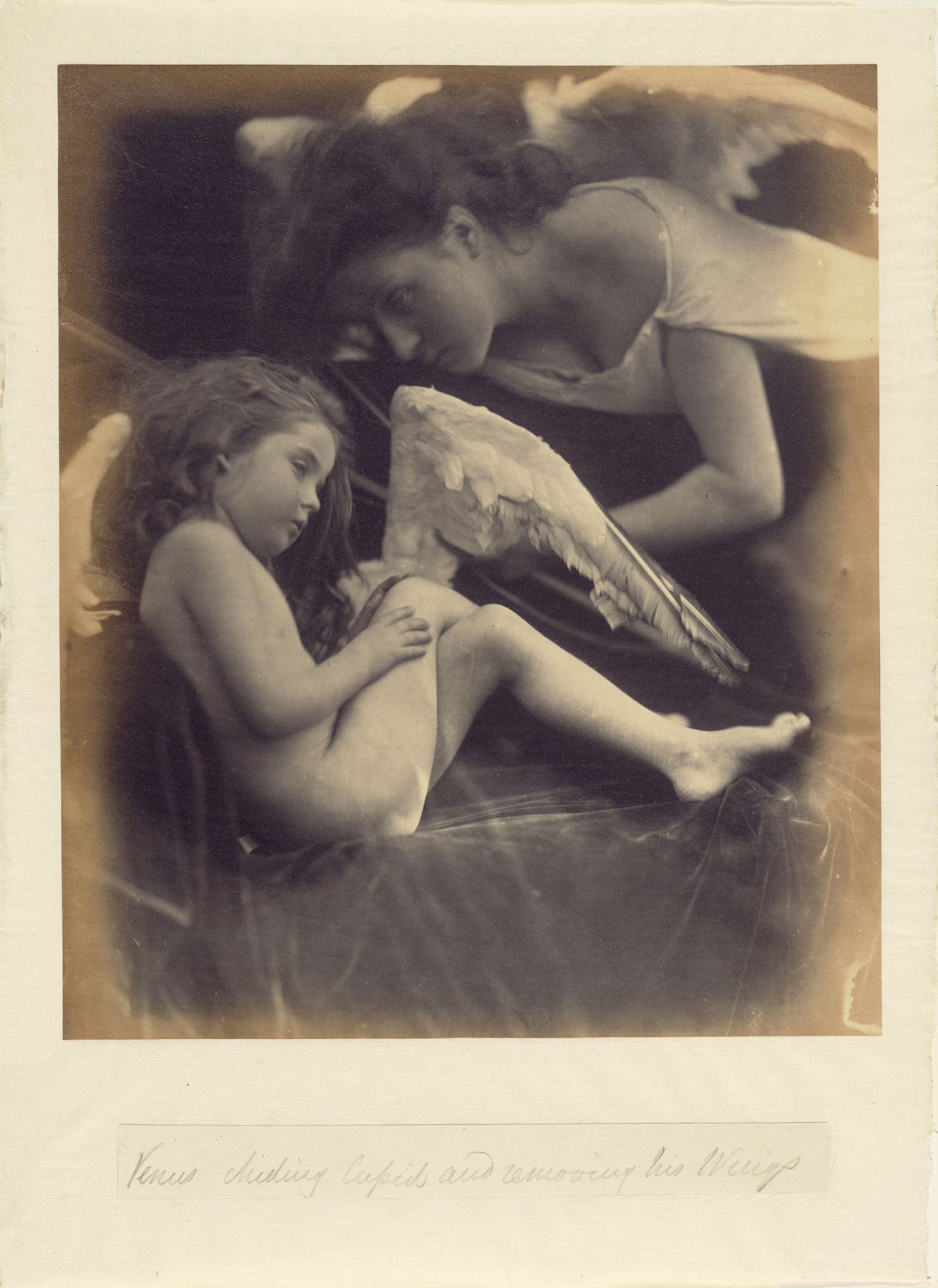
Julia Margaret Cameron (British, born India, 1815-1879) 'Venus Chiding Cupid and Removing His Wings' 1872


Julia Margaret Cameron (British, born India, 1815-1879)
Venus Chiding Cupid and Removing His Wings
1872
Album silver print
32.4 × 27.3cm (12 3/4 × 10 3/4 in.)
The J. Paul Getty Museum


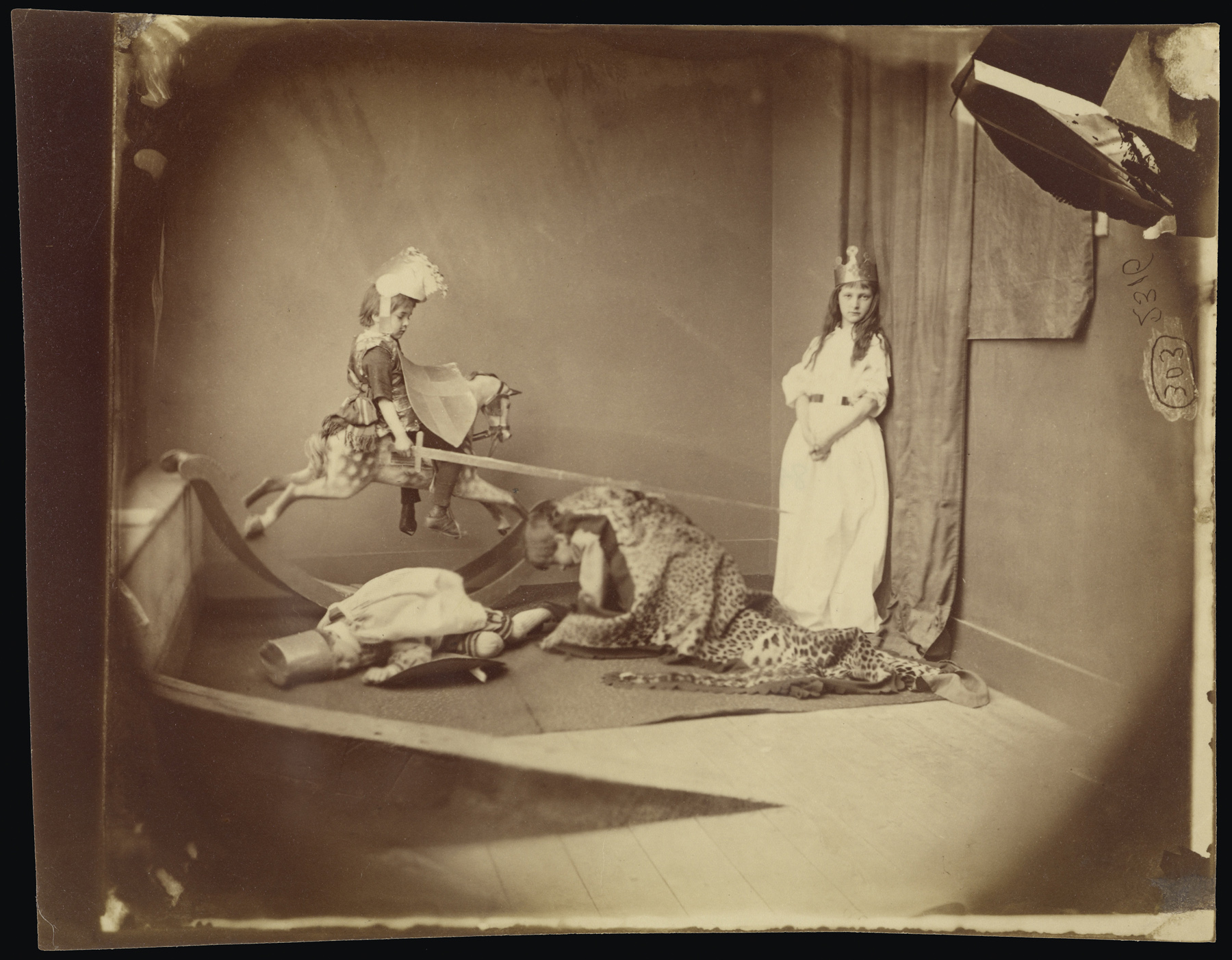
Lewis Carroll (British, 1832-1898) 'Saint George and the Dragon' June 26, 1875


Lewis Carroll (British, 1832-1898)
Saint George and the Dragon
June 26, 1875
Albumen silver print
12.2 × 16.2cm (4 13/16 × 6 3/8 in.)
The J. Paul Getty Museum


Like Alice’s Adventures in Wonderland and his other books, Carroll’s photographs are fantasies starring the children of his friends. In this production, the Kitchin siblings enacted the romantic legend of Saint George, the patron saint of England, who slayed a child-eating dragon before it devoured a princess. George later married the rescued princess and converted her pagan town to Christianity. Using crude stagecraft to reference key plot points, Carroll condensed the entire legend into a single scene in which the princess appears as both damsel in distress and bride.


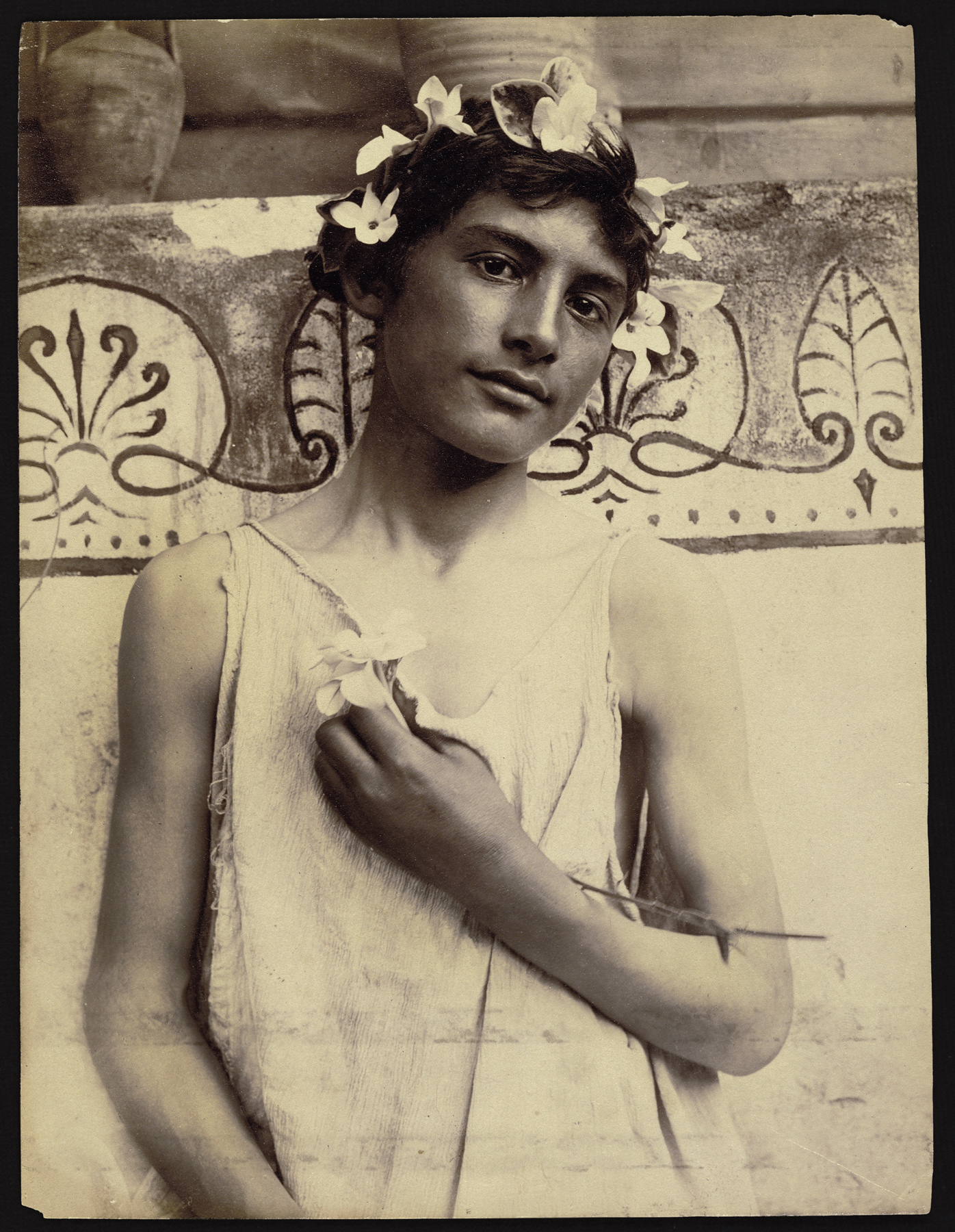
Baron Wilhelm von Gloeden (German, 1856-1931) 'Untitled [Two Male Youths Holding Palm Fronds]' c. 1885 - 1905


Baron Wilhelm von Gloeden (German, 1856-1931)
Untitled [Two Male Youths Holding Palm Fronds]
c. 1885-1905
Albumen silver print
23.3 × 17.5cm (9 3/16 × 6 7/8 in.)
The J. Paul Getty Museum


Baron Wilhelm von Gloeden (German, 1856-1931) 'L'Offerta' (The Offering) 1902


Baron Wilhelm von Gloeden (German, 1856-1931)
L’Offerta (The Offering)
1902
Albumen silver print
22.4 × 16.8cm (8 13/16 × 6 5/8 in.)
The J. Paul Getty Museum


Von Gloeden left Germany and settled in a coastal town in Sicily, where he took up photography. His subjects were young native boys, whom he often photographed nude in classical compositions. Rather than reenact specific historical or literary scenes, von Gloeden mused nostalgically on the ancient Greek and Roman ancestry of his attractive models.


Guido Rey (Italian, 1861-1935) '[The Letter]' 1908


Guido Rey (Italian, 1861-1935)
[The Letter]
1908
Platinum print
21.9 × 17cm (8 5/8 × 6 11/16 in.)
The J. Paul Getty Museum


A deliberate homage to an earlier artistic style that Guido Rey admired, the composition derives from a painting made by Dutch artist Jan Vermeer in the 1600s. In this posed scene, a young suitor bearing flowers approaches a woman seated at her writing desk, with her pen poised in mid-air as she turns to greet him. A leaded glass window opens into her room, providing a natural light source for the photograph’s illumination. The mounted corner clock, decorative jar on the desk, and painting on the wall were Rey’s everyday household items or objects borrowed from friends, carefully chosen for period accuracy. Likewise, a seamstress who lived in the attic of Rey’s home in Turin created the costumes to his specifications.


Photography, although commonly associated with truthfulness, has been used to produce fiction since its introduction in 1839. The acceptance of staging, and the degree of its application, has varied greatly depending on the genre and the historical moment, but it has persisted as an artistic approach. The photographs in this exhibition, drawn exclusively from the J. Paul Getty Museum’s collection, make no pretence about presenting the world as it exists; instead, they are the productions of directors and actors who rely on stagecraft and occasional darkroom trickery to tell stories.
 Spanning photography’s history and expressing a range of sentiments, the images in this exhibition are inspired by art history, literature, religion, and mainstream media.

Like Alice’s Adventures in Wonderland and his other books, Lewis Carroll’s photographs are fantasies starring his friends’ children. In the image below, children enact the mythological story of Saint George, the patron saint of England, slaying a child-eating dragon before it could devour a princess.

Life Imitating Art

Well-represented in this exhibition are tableaux vivants (living pictures), inspired by the popular Victorian parlour game in which costumed participants posed to resemble famous works of art or literary scenes.
The genre paintings of 17th-century Dutch masters Johannes Vermeer and Pieter de Hooch fascinated Guido Rey. Not self-conscious about being slavish to the past, he carefully studied the paintings and then arranged similar tableaux for his camera. His photographs captured equally serene domestic scenes and mimicked the minute architectural details of 17th-century interiors, such as the leaded-glass windowpanes and the checkerboard floor.

Playing Dress Up

The exhibition also includes costume studies of people posing as literary characters and self-portraits of artists pretending to be other people. 

American painter and photographer Man Ray and the French artist Marcel Duchamp met in New York in 1915, and they began a playful, iconoclastic collaboration that resulted in the photograph (above), among others. Influenced by Dadaism, a cultural movement that rejected reason and logic in favour of anarchy and the absurd, their work embraced games of chance, performance, and wordplay. Here an irreverent Duchamp appears in women’s clothing as his alter ego, Rrose Sélavy, a pun on the French pronunciation “Eros, c’est la vie” (Sex, that’s life).

Imaginary Subjects

A number of photographs in the exhibition explore the medium’s capacity to visualise subjects of the imagination by using darkroom trickery to manipulate prints.
 An optician and family man, Ralph Eugene Meatyard photographed his children, friends, and neighbours enacting dramas in suburban backyards and abandoned buildings near his Lexington, Kentucky, home. He often used experimental techniques, such as multiple exposures and blurred motion. Uncanny details imbue Meatyard’s otherwise ordinary vernacular scenes with the qualities of a dream or supernatural vision.

Theatricality as a Critical Strategy

In recent decades there has been renewed interest in theatricality among contemporary photographers whose highly artificial scenes critique mainstream media and representation.
 In her series Family Docudrama Eileen Cowin blurs the boundaries between truth and fiction, and private behaviour and public performance. Drawing equally from family snapshots and soap operas, Cowin presents staged domestic scenes in which she and members of her family, including her identical twin sister, perform as actors. In these ambiguous, open-ended narratives, dramatic moments are exaggerated, and the camera’s glare is ever present.”

Text from The J. Paul Getty Museum website [Online] Cited 16/04/2019


Man Ray (American, 1890-1976) 'Rrose Sélavy (Marcel Duchamp)' 1923


Man Ray (American, 1890-1976)
Rrose Sélavy (Marcel Duchamp)
1923
Gelatin silver print
22.1 × 17.6cm (8 11/16 × 6 15/16 in.)
The J. Paul Getty Museum
© Man Ray Trust ARS-ADAGP


When Man Ray moved to Paris, he was greeted by his friend and artistic compatriot Marcel Duchamp, who introduced him to members of the Dada circle of writers and artists. The two men had collaborated in a number of creative endeavours in New York, including the creation of a female alter-ego for Duchamp named Rrose Sélavy (a pun on the French pronunciation Eros, c’est la vie “Sex, that’s life”). Man Ray photographed Duchamp several times as Rrose Sélavy.


Man Ray (American, 1890-1976) 'Larmes' 1930


Man Ray (American, 1890-1976)
Larmes (Tears)
1930-1932
Gelatin silver print
22.9 × 29.8cm (9 × 11 3/4 in.)
The J. Paul Getty Museum
© Man Ray Trust ARS-ADAGP


Judging from his inclusion of this image in other photographic compositions, Man Ray must have considered Tears one of his most successful photographs. A cropped version of it with a single eye also appears as the first plate in a 1934 book of his photographs.

Like the emotive expression of a silent screen star in a film still, the woman’s plaintive upward glance and mascara-encrusted lashes seem intended to invoke wonder at the cause of her distress. The face belongs to a fashion model who cries tears of glistening, round glass beads; the effect is to aestheticise the sentiment her tears would normally express. Man Ray made this photograph in Paris around the time of his breakup with his lover Lee Miller, and the woman’s false tears may relate to that event in the artist’s life.


Dora Maar (French, 1907-1997) 'Le Simulateur (The Pretender)' 1936


Dora Maar (French, 1907-1997)
Le Simulateur (The Pretender)
1936
Gelatin silver print
26.6 × 21.7cm (10 1/2 × 8 1/2 in.)
The J. Paul Getty Museum
© Dora Maar Estate/Artists Rights Society (ARS), New York/ADAGP, Paris


In this picture Dora Maar constructed her own reality by joining together several images and rephotographing them. The seamlessness of the photographic surface makes this construction believable and leaves the viewer wondering about the strange world the figure inhabits. On closer examination, the viewer may notice that the floor is an upside-down ceiling vault, that the bricked-in windows are drawn in by hand, and that the figure was added separately. Despite these discoveries, the picture resists logical interpretation.


Ralph Eugene Meatyard (American, 1925-1972) 'Untitled (Michael and Christopher Meatyard)' 1966


Ralph Eugene Meatyard (American, 1925-1972)
Untitled (Michael and Christopher Meatyard)
1966
Gelatin silver print
16.8 × 17.5cm (6 5/8 × 6 7/8 in.)
The J. Paul Getty Museum
Gift of Christopher Meatyard and Jonathan Greene
© Estate of Ralph Eugene Meatyard


An optician and family man, Meatyard photographed his children, friends, and neighbours enacting dramas in the suburban backyards and abandoned buildings of Lexington, Kentucky. He often used experimental techniques, such as multiple exposures and blurred motion. Uncanny details imbue Meatyard’s otherwise ordinary vernacular scenes with the qualities of a dream or supernatural vision.


Lucas Samaras (American born Greece, b. 1936) 'Photo-Transformation' November 22, 1973


Lucas Samaras (American born Greece, b. 1936)
Photo-Transformation
November 22, 1973
Polaroid SX-70 dye diffusion print
7.6 × 7.6cm (3 × 3 in.)
The J. Paul Getty Museum
© Lucas Samaras


In this self-portrait, Lucas Samaras reaches out as if trapped in the photograph. In sharp contrast to the indistinct background of his upper body, his crisply defined fingers curl forward, as if he is searching for a way to transcend a two-dimensional world of his own creation. An overriding sense of claustrophobia defines this image, underscored by the small scale of the Polaroid print. Samaras, a hermit-like person, made many Polaroid self-portraits like this in the 1970s as a means of observing himself. The images are open to a wide range of interpretation. Here, Samaras may have tried to convey the sense of isolation he experiences as a reclusive person.


Lucas Samaras (American born Greece, b. 1936) 'Photo-Transformation' September 9, 1976


Lucas Samaras (American born Greece, b. 1936)
Photo-Transformation
September 9, 1976
Polaroid SX-70 dye diffusion print
7.6 × 7.6cm (3 × 3 in.)
The J. Paul Getty Museum
© Lucas Samaras


As if engaging in a tug-of-war with himself, Lucas Samaras confronts and struggles with his own reflection in this self-portrait. The leg-less reflection is incomplete, however, giving the impression of a deformed adversary. A monochromatic polka-dot background and a vibrant green and red border act as a stage for this dramatic struggle.

Samaras’s Photo-Transformations, which he made in the 1970s as a means to examine various facets of himself, could be understood as visual manifestations of internal conflict. They are complex psychological investigations that, according to at least one critic, illustrate one person’s efforts toward spiritual healing.


Lucas Samaras (American, born Greece, 1936) 'Photo-Transformation, 1976'


Lucas Samaras (American born Greece, b. 1936)
Photo-Transformation, 1976
1976
Polaroid SX-70 dye diffusion print
7.6 × 7.6cm (3 × 3 in.)
The J. Paul Getty Museum
© Lucas Samaras


Submerged in narcissism, nothing remains… but “me and myself, I am my own audience, the other, contemplating my existence.”

Made in the 1970s as a means of studying himself, Lucas Samaras’s photographs illustrate the internal struggle that can occur between conflicting aspects of one personality. Bent over a captain’s chair, Samaras rests his head as if he is at the guillotine. Another blurry form hovers above, about to violently attack the submissive figure.

Samaras made his Photo-Transformations, a series of self-portraits, with SX-70 Polaroid film. Still wet, the film’s emulsions could be manipulated to alter the finished image. He used straight pins, rubber erasers, and other simple tools to “draw” into the developing surface. For this portrait, he created a diamond pattern over and around the dominant figure that underscores the frenzy of motion.


Joel Peter-Witkin (American, born 1939) 'Mother and Child (with Retractor, Screaming)' 1979


Joel Peter-Witkin (American, b. 1939)
Mother and Child (with Retractor, Screaming)
1979
Gelatin silver print
36 × 36cm (14 3/16 × 14 3/16 in.)
The J. Paul Getty Museum
© Joel-Peter Witkin


Eileen Cowin (American, born 1947) 'Untitled' from the series 'Family Docudrama' 1980-1983


Eileen Cowin (American, b. 1947)
Untitled from the series Family Docudrama
1980-1983
Chromogenic print
48.4 × 60.7cm (19 1/16 × 23 7/8 in.)
The J. Paul Getty Museum
Purchased with funds provided by the Photographs Council
© Eileen Cowin


In her series Family Docudrama Cowin blurs the boundaries between truth and fiction, and private behaviour and public performance. Drawing equally from family snapshots and soap operas, she presents staged domestic scenes in which she and members of her family, including her identical twin sister, perform as actors. In these ambiguous, open-ended narratives, dramatic moments are exaggerated and the camera’s glare is ever present.


The J. Paul Getty Museum
1200 Getty Center Drive
Los Angeles, California 90049

Opening hours:
Daily 10am – 5.30pm

The J. Paul Getty Museum website

LIKE ART BLART ON FACEBOOK

Back to top

Exhibition: ‘Pierre et Gilles. Retrospective’ at the C/O Berlin Gallery, Berlin

Exhibition dates: 25th July – 4th October, 2009


Many thankx to the C/O Berlin Gallery for allowing me to publish the photographs in the posting. Please click on the photographs for a larger version of the image.


Pierre et Gilles (French, Pierre Commoy b. 1950 and Gilles Blanchard, b. 1953) 'Mercury' 2001 from the exhibition 'Pierre et Gilles. Retrospective' at the C/O Berlin Gallery, Berlin, July - Oct, 2009


Pierre et Gilles (French, Pierre Commoy b. 1950 and Gilles Blanchard, b. 1953)
Mercury
2001


“It’s hard to think of contemporary culture without the influence of Pierre et Gilles, from advertising to fashion photography, music video, and film. This is truly global art.”


Jeff Koons


The cosmos of the worldwide renowned French artist duo is a vivid, colourful world poised between baroque sumptuousness and earthly limbo. Pierre et Gilles create unique hand-painted photographic portraits of film icons, sailors and princes, saints and sinners, of mythological figures and unknowns alike. Pierre et Gilles pursue their own, stunningly unique vision of an enchanted world spanning fairytale paradises and abyssal depths, quoting from popular visual languages and history of art. Again and again, they re-envision their personal dream of reality anew in consummate aesthetic perfection.

Pierre et Gilles are among the most influential artists of our time. In their complex, multilayered images, they quote from art history, transgress traditional moral codes, and experiment adeptly with social clichés. Their painterly photographic masterpieces exert an intense visual power that leaves the viewer spellbound.

Over the last thirty years, Pierre et Gilles have created photographic portraits of numerous celebrities including Marc Almond, Mirelle Mathieu, Catherine Deneuve, Serge Gainsbourg, Iggy Pop, Jean-Paul Gaultier, Nina Hagen, Madonna, and Paloma Picasso. They work almost exclusively in an opulently furnished studio, where their subjects are costumed lavishly and placed before three-dimensional backgrounds. Pierre photographs the model, and Gilles retouches and hand-colours the print. The reproducible portrait is rendered unique through painting, which highlights each detail with carefully selected materials and accessories.

As only venue in Germany, C/O Berlin presents the exhibition as the first of Pierre et Gilles in fifteen years. The show comprised a total of 80 unique large-format works – from their early photographies of the 1970s to the brand new pictures that were never shown in public before.”

Text from the C/O Berlin website [Online] Cited 20/08/2009 no longer available online


Pierre et Gilles (French, Pierre Commoy b. 1950 and Gilles Blanchard, b. 1953) 'St. Sebastian' 1987 from the exhibition 'Pierre et Gilles. Retrospective' at the C/O Berlin Gallery, Berlin, July - Oct, 2009


Pierre et Gilles (French, Pierre Commoy b. 1950 and Gilles Blanchard, b. 1953)
St. Sebastian
1987


Pierre et Gilles (French, Pierre Commoy b. 1950 and Gilles Blanchard, b. 1953) 'Neptune' 1988


Pierre et Gilles (French, Pierre Commoy b. 1950 and Gilles Blanchard, b. 1953)
Neptune
1988


Pierre et Gilles (French, Pierre Commoy b. 1950 and Gilles Blanchard, b. 1953) 'Saint Rose De Lima' 1989


Pierre et Gilles (French, Pierre Commoy b. 1950 and Gilles Blanchard, b. 1953)
Saint Rose De Lima
1989


Pierre et Gilles (French, Pierre Commoy b. 1950 and Gilles Blanchard, b. 1953) 'Le Petit Communiste Christophe' 1990


Pierre et Gilles (French, Pierre Commoy b. 1950 and Gilles Blanchard, b. 1953)
Le Petit Communiste Christophe (The Little Communist Christophe)
1990


Pierre et Gilles (French, Pierre Commoy b. 1950 and Gilles Blanchard, b. 1953) 'Legend' (Madonna) 1990


Pierre et Gilles (French, Pierre Commoy b. 1950 and Gilles Blanchard, b. 1953)
Legend (Madonna)
1990


Pierre et Gilles (French, Pierre Commoy b. 1950 and Gilles Blanchard, b. 1953) 'La Madone au coeur blessé' 1991


Pierre et Gilles (French, Pierre Commoy b. 1950 and Gilles Blanchard, b. 1953)
La Madone au coeur blessé (Madonna with a wounded heart)
1991


Pierre et Gilles (French, Pierre Commoy b. 1950 and Gilles Blanchard, b. 1953) 'St. Sebastian of the Sea' 1994


Pierre et Gilles (French, Pierre Commoy b. 1950 and Gilles Blanchard, b. 1953)
St. Sebastian of the Sea
1994


Pierre et Gilles (French, Pierre Commoy b. 1950 and Gilles Blanchard, b. 1953) 'The Martyrdom of St Sebastian' 1996


Pierre et Gilles (French, Pierre Commoy b. 1950 and Gilles Blanchard, b. 1953)
The Martyrdom of St Sebastian
1996


Pierre et Gilles (French, Pierre Commoy b. 1950 and Gilles Blanchard, b. 1953) 'Extase' (Arielle Dombasle) 2002


Pierre et Gilles (French, Pierre Commoy b. 1950 and Gilles Blanchard, b. 1953)
Extase (Arielle Dombasle)
2002


Pierre et Gilles (French, Pierre Commoy b. 1950 and Gilles Blanchard, b. 1953) 'Le Grand Amour' (Marilyn Manson and Dita von Teese) 2004


Pierre et Gilles (French, Pierre Commoy b. 1950 and Gilles Blanchard, b. 1953)
Le Grand Amour (Marilyn Manson and Dita von Teese)
2004


C/O Berlin
Postfuhramt
Oranienburger Straße 35/36
10117 Berlin

Opening hours:
Daily 11am – 8pm

C/O Berlin website

LIKE ART BLART ON FACEBOOK

Back to top