Exhibition: ‘Postwar Propliners in Miniature: Models from the Collection of Anthony J. Lawler’ at SFO Museum (SFOM), San Francisco International Airport

Exhibition dates: June 2011 – December 2011

Location: Aviation Museum and Library 1 – Front Wall Cases
 

Lockheed Aircraft Co., Burbank, California. 'American Overseas Airlines Lockheed L-049 Constellation' c. 1946


Lockheed Aircraft Co., Burbank, California
American Overseas Airlines Lockheed L-049 Constellation
c. 1946
Scale 1:44
Metal, paint
Collection of Anthony J. Lawler


One of my favourite postings in a long while. As an inveterate collector how I would love to have these in my collection. What beautiful aircraft; what graceful models; what simple, gorgeous photographs by photographer Chad Michael Anderson. The Lockheed Constellation has to be one of the most delicious aircraft ever made. But the model I would take is the gorgeous Air France Breguet 763 Provence, because of it’s aerodynamic beauty and angle of flight.

Dr Marcus Bunyan


Many thankx to John Hill, Assistant Director, Aviation for his help and to SFO Museum for allowing me to publish the text and the photographs. Attribution for the photographs is to the SFO Museum (actual photographer unknown). Please click on the photographs for a larger version of the image.


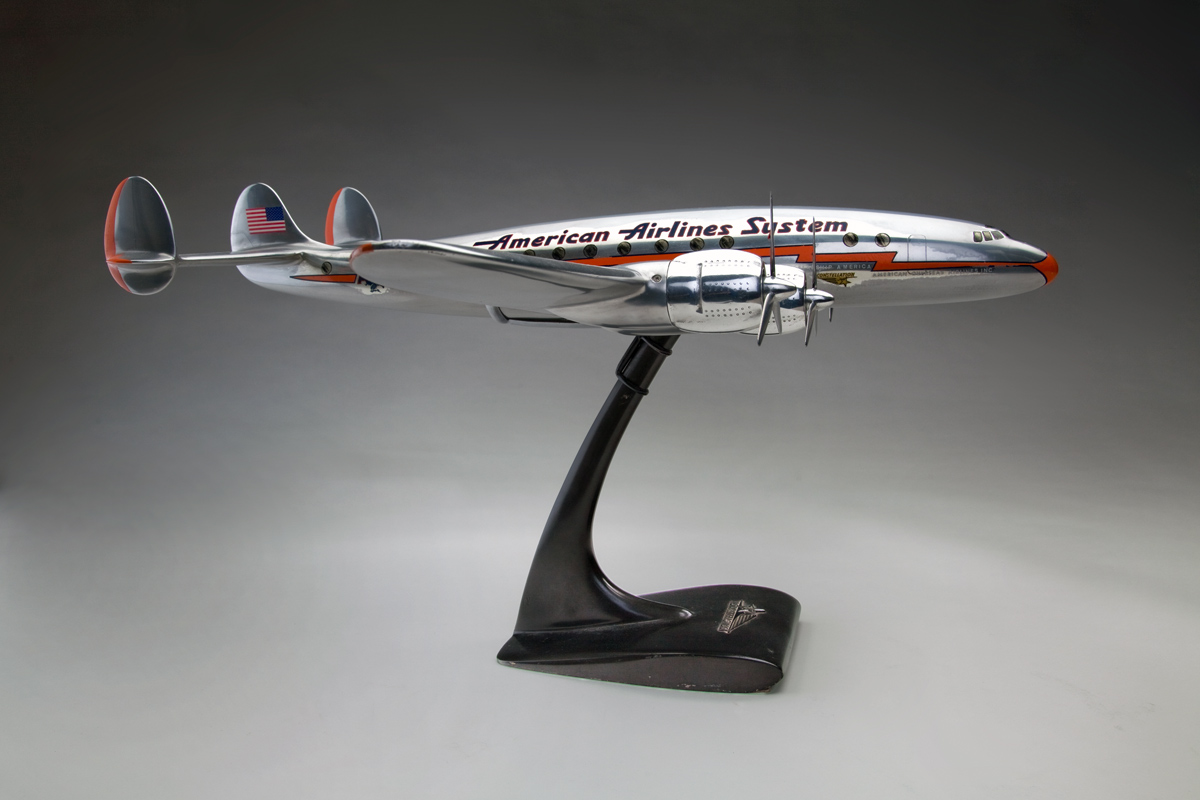
Lockheed Aircraft Co., Burbank, California. 'American Overseas Airlines Lockheed L-049 Constellation' c. 1946


Lockheed Aircraft Co., Burbank, California
American Overseas Airlines Lockheed L-049 Constellation
c. 1946
Scale 1:44
Metal, paint
Collection of Anthony J. Lawler


In 1945, in an effort to gain transatlantic routes to Europe, American Airlines purchased American Export Airlines (founded in 1937 as a subsidiary of the shipping company American Export Lines) and renamed it American Overseas Airlines (AOA). The airline then began purchasing suitable aircraft for its new subsidiary. The best choice for the lengthy route to Europe was the Lockheed Model 047 Constellation, one the longest-range and fastest airliners produced at the time. Like other airliner manufacturers, Lockheed had its own in-house model factory that constructed highly-accurately scaled models for its customers. It produced this 1:44 scale model for AOA in polished sheet aluminium and painted in the airline’s earliest livery scheme.

Text from the SFO Museum website
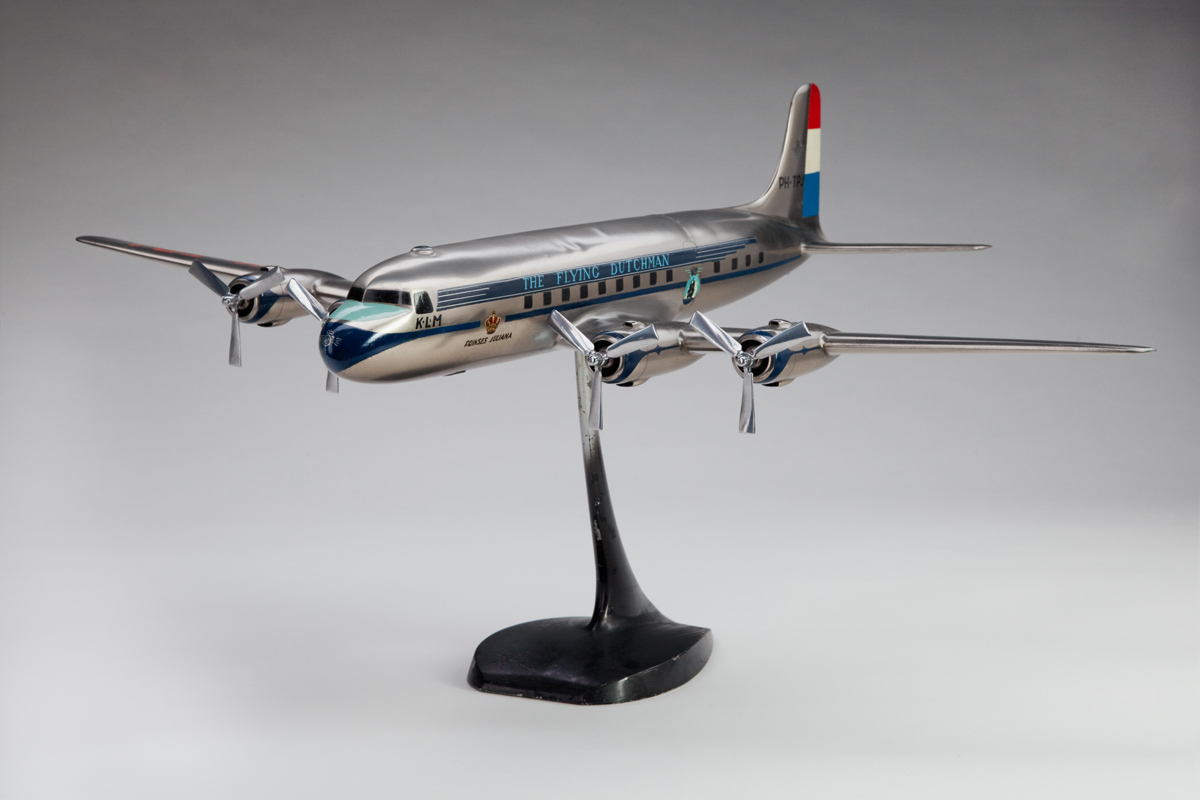
 

Maarten Matthys Verkuyl (Dutch). 'KLM (Koninklijke Luchtvaart Maatschappij) Royal Dutch Airlines Douglas DC-6' c. 1950


Maarten Matthys Verkuyl (Dutch)
KLM (Koninklijke Luchtvaart Maatschappij) Royal Dutch Airlines Douglas DC-6
c. 1950
Scale 1:48
Metal, paint
Collection of Anthony J. Lawler


KLM (Koninklijke Luchtvaart Maatschappij) Royal Dutch Airlines commenced service in 1920. After ceasing operations during World War II, the airline rapidly emerged to become a leading European and international carrier during the postwar era. KLM received its first deliveries of the Douglas DC-6, both freighter and passenger versions, in 1948. The DC-6 was the first American-produced airliner to be introduced after the war. The model represents the DC-6 Princess Juliana (Koningin Juliana), which was the second aircraft Douglas delivered of the passenger version. The Dutch model maker Maarten Matthys Verkuyl fabricated the model from sheet zinc for a KLM pilot around 1950. It is one of only two produced by Verkuyl of the type using this material during this period.

Text from the SFO Museum website
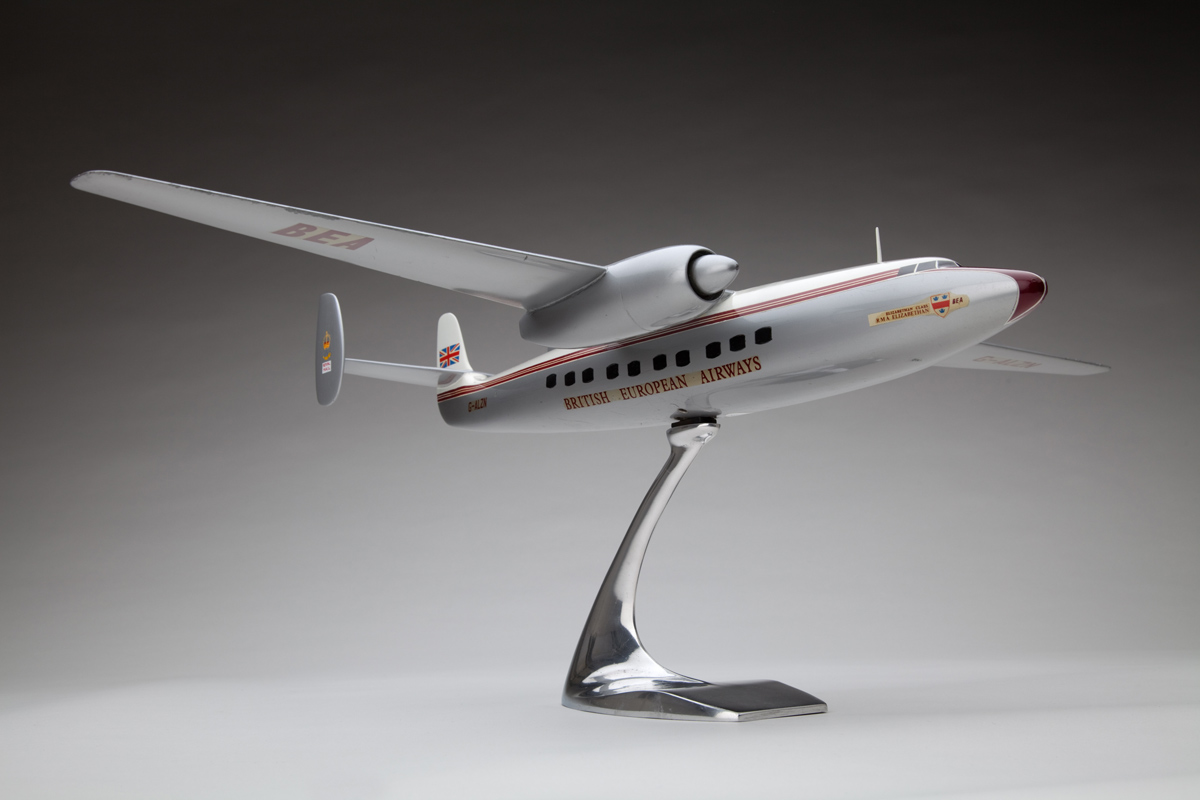
 

Shawcraft Models, Uxbridge, England. 'BEA Airspeed AS.57 Ambassador' 1950s


Shawcraft Models, Uxbridge, England
BEA Airspeed AS.57 Ambassador
1950s
Scale 1:48
Wood, metal, paint
Collection of Anthony J. Lawler


In 1946, BEA (British European Airways) was formed as the British flag carrier for domestic and Continental Europe flights. By 1947, a number of independent airlines, including Scottish Airways, had merged with the company. In 1948, BEA placed an order for twenty of the Ambassador, a Douglas DC-3 replacement that had been under development by Airspeed of Great Britain since the latter years of World War II. This high-wing, tripletail, two-engine, mid-range aircraft was introduced in 1952 and operated by the airline until 1958. Shawcraft of Great Britain crafted the model of wood during the same decade, which accurately represents the Ambassador RMA Elizabethan, the flagship of the fleet. BEA’s comfortable Ambassador service, which was named “Elizabethan Class,” became highly popular among commuters between Britain and the Continent.

Text from the SFO Museum website


Peter V. Nelson, Reading, England 'Ethiopian Air Lines Convair 240 model aircraft' Early 1950s


Peter V. Nelson, Reading, England
Ethiopian Air Lines Convair 240 model aircraft
Early 1950s
Scale 1:48
Metal, paint
Collection of Anthony J. Lawler


Ethiopian Air Lines was founded in 1946 and began operating out of Addis Ababa Airport in 1947, with administrative, managerial, and flight crew support from TWA (Transcontinental & Western Airlines). In 1950, the airline acquired three Convair 240s in order to expand its routes and offer international service to Europe and Asia. These aircraft were produced by Convair of San Diego, California and developed to replace the Douglas DC-3. The sand-casted metal model represents the first aircraft to be delivered, ET-T-20, and was crafted by Peter V. Nelson in Great Britain during the same period. It was accurately painted in Ethiopian Air Lines’ vibrant early livery with the national colours of red, yellow, and green, and the Lion of Judah, the symbol of Ethiopia’s former ruler Haile Selassie – whose family traces their origins to King Solomon. Selassie played a major role in establishing the national airline, which was considered vital to the modernisation of Ethiopia after World War II.

Text from the SFO Museum website


Walkers Westway Models, London, England 'Capital Airlines Vickers Viscount model aircraft' 1950s


Walkers Westway Models, London, England
Capital Airlines Vickers Viscount model aircraft
1950s
Scale 1:48
Metal, paint
Collection of Anthony J. Lawler


Capital Airlines originated out of a merger between Pennsylvania and Central Airlines to form Pennsylvania Central Airlines or PCA in 1936. In 1941, the airline moved its headquarters to the newly built Washington National Airport, and in 1948, changed its name to Capital Airlines. In 1955, in an effort to attract more passengers by offering technologically advanced aircraft, it became the first U.S. carrier to inaugurate turboprop-powered airliner service with the introduction of the British produced Vickers Viscount. The aircraft was originally introduced by BEA (British European Airways) in 1950, which made it the first of its kind to go into service, and moreover, it was years ahead of the introduction of other turboprop airliners. Capital purchased sixty of the aircraft and realised an increased market share nearly everywhere the Viscount flew. This sand-cast metal model was produced in the 1950s by Walkers Westway in London, England, and accurately painted in Capital’s iconic 1950s red, white, and blue livery with eagle logo.

Text from the SFO Museum website
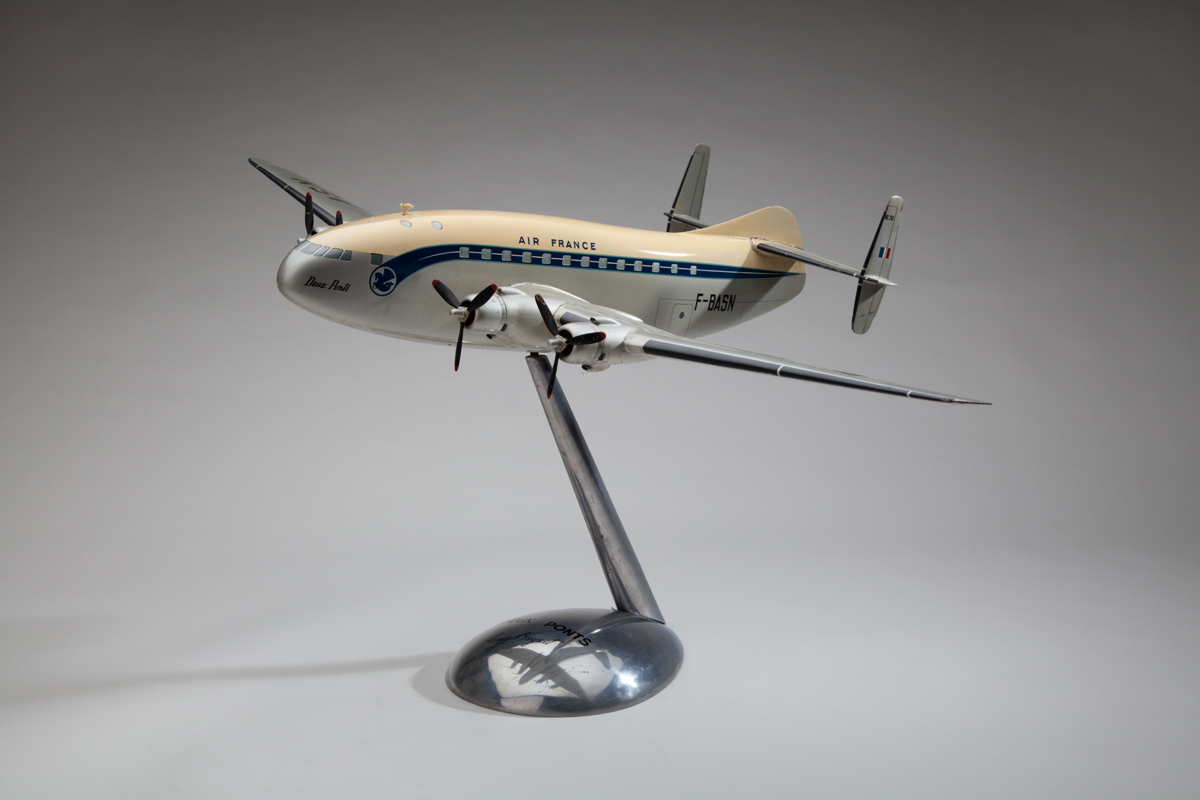
 

La Maquette d'Etude et d'Exposition à Aubervilliers, France. 'Air France Breguet 763 Provence' 1950s


La Maquette d’Etude et d’Exposition à Aubervilliers, France
Air France Breguet 763 Provence
1950s
Scale 1:50
Wood, plastic, metal, paint
Collection of Anthony J. Lawler


Created in 1933 through a merger of several French aviation concerns, Air France became one of the largest airlines in Europe by the late 1930s, with routes throughout Europe and to French colonies in North Africa and Asia. During World War II, the carrier moved its base of operation to Morocco, and by 1946, became nationalized by the French government and opened its first terminal in central Paris. During the latter years of the war, the French aircraft manufacturer Breguet began designing a large capacity, mid-range airliner that would ultimately become the double deck (Deux Ponts in French), twin-tail, four-engine 763 Provence. Air France ordered twelve of the aircraft, which entered service in 1953 and were operated on routes to Algiers and Southern Europe for carrying both passengers and freight. Crafted from wood by the French model maker La Maquette d’Etude et d’Exposition à Aubervilliers, the model represents the first aircraft delivered to Air France, F-BASN.

Text from the SFO Museum website


Immediately following the end of World War II in 1945, airlines and passengers benefited from a surplus of inexpensive, advanced propeller-driven transport aircraft, or “propliners.” Over the next fifteen years, commercial aviation expanded rapidly as airlines persistently requested improved propliner designs to lower costs, attract new customers, and gain advantages over competitors. In meeting these demands the manufacturers of North America and Europe developed increasingly superior aircraft. These included the jet-powered turboprop airliners that flew successively faster, higher, and farther.

Making scale models of these airliners was an important part of the design, manufacturing, and marketing process during this period. Crafted by in-house model shops or independent model makers, they represented the new designs in miniature for convenient three-dimensional analysis. Accurately painted livery schemes on the models helped the airlines to imagine the new airliner operating within their fleet. Carriers also commissioned the making of models to promote their improved services in airline offices and travel agencies. During the late 1940s and early 1950s, they were usually made of sheet or cast metal and complemented with metal bases often formed into unique streamline shapes. By the late 1950s, models began to be produced from plastic, which was easier to mold into intricate shapes and reflected the proliferation of new synthetic resins.

These models represent the age of postwar propliners, which lasted until the 1960s when faster, more fuel-efficient and propeller-less turbojet airliners began to supersede them. They are from the collection of Anthony J. Lawler, an aviation industry professional and avid airplane model collector since first seeing the De Havilland Comet – the world’s first jetliner – fly over his boyhood home in Rhodesia. Mr. Lawler has spent decades assembling one of the finest collections of scale airliner display models, most of which were acquired while working as a senior sales representative for Airbus North America during the 1980s and 1990s. His collection spans a century of commercial aviation design innovation.

Text from the SFO Museum website
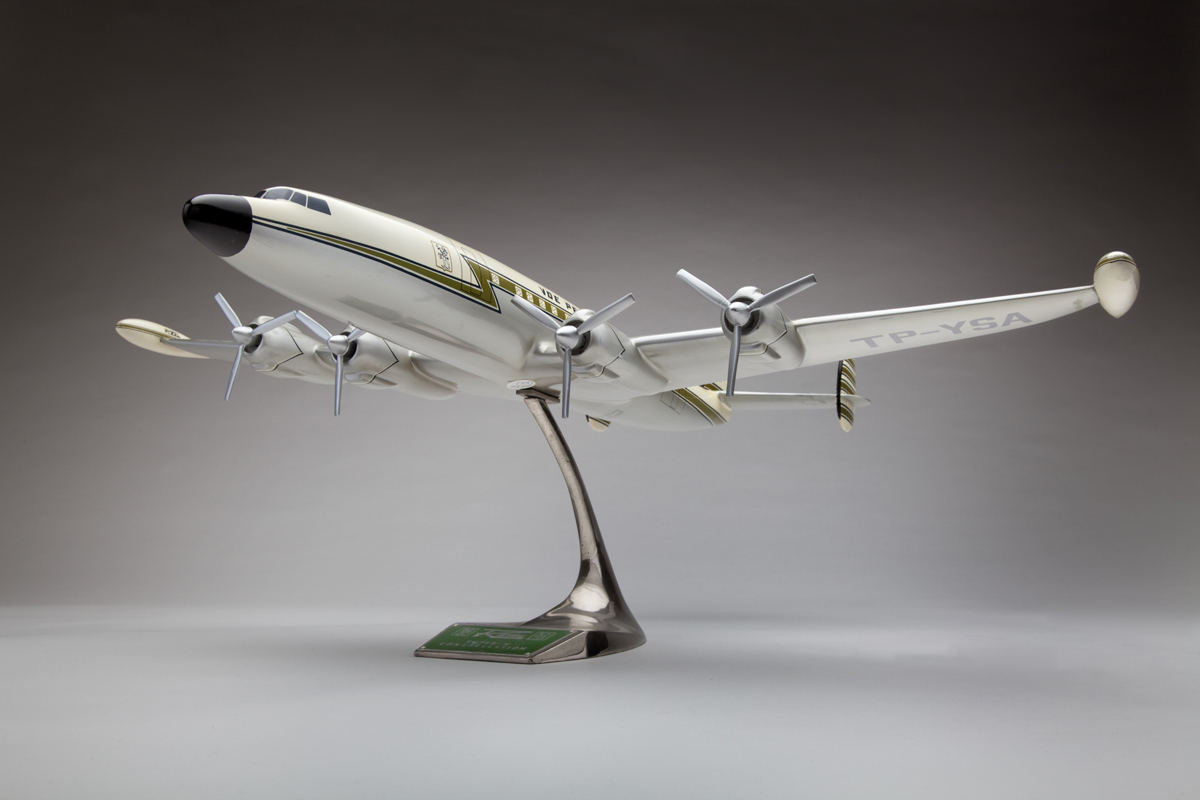
 

Raise-Up Models, Rotterdam, Netherlands. 'REAL (Redes Estaduais Aéreas Limitadas) Transportes Aéreos Lockheed 1049H Super Constellation' 1950s


Raise-Up Models, Rotterdam, Netherlands
REAL (Redes Estaduais Aéreas Limitadas) Transportes Aéreos Lockheed 1049H Super Constellation
1950s
Metal, paint
Collection of Anthony J. Lawler


In 1945, Vicente Mammana Netto and Linneu Gomes formed REAL (Redes Estaduais Aéreas Limitadas) Transportes Aéreos, as a small regional Brazilian airline. By the mid-1950s, the airline had grown substantially by acquiring numerous other Brazilian airlines and expanding its routes through South America. In 1958, in order to compete with its rival Varig, REAL acquired three long-range Lockheed 1049H Super Constellations. The next year, the airline inaugurated international service between Rio de Janeiro and Los Angeles with stops in Manaus-Ponta Pelada, Bogotá, and Mexico City. By 1960, REAL had expanded its Constellation service to include trans-pacific flights to Tokyo. Ultimately, however, the international service proved too costly for the airline, and in 1961, amid financial difficulties, it was acquired by Varig. Raise-Up Models of the Netherlands produced the cast-metal model of the REAL Super Constellation. It was painted in the airline’s eye-catching green livery of the late 1950s, with the slogan “Voe Pela REAL,” meaning, “Fly on REAL” in Portuguese.

Text from the SFO Museum website
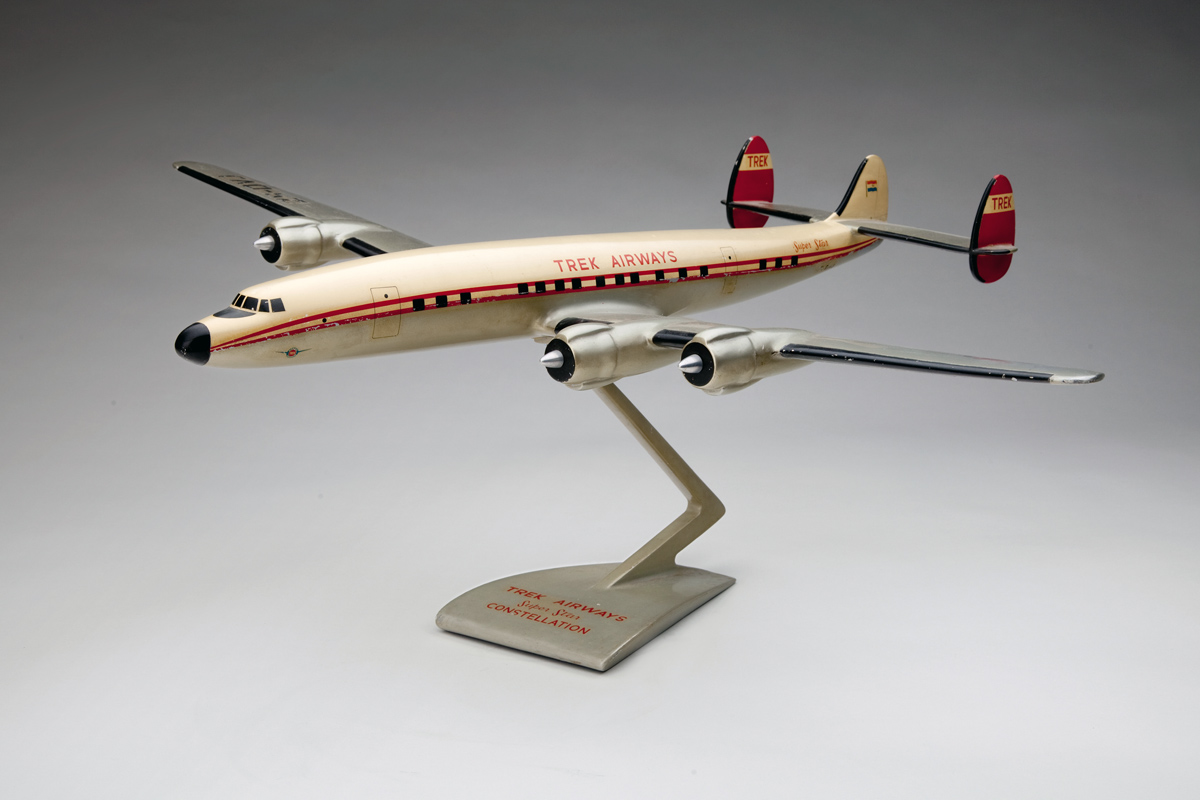
 

Peter V. Nelson, Reading, England. 'Trek Airways Lockheed 1649 Starliner' early 1960s


Peter V. Nelson, Reading, England
Trek Airways Lockheed 1649 Starliner
Early 1960s
Scale 1:62
Metal, paint
Collection of Anthony J. Lawler


Founded in 1953, Trek Airways was a South African airline based out of Johannesburg with service to Northern Europe. Initially, Trek was equipped with Vickers Vikings, which required overnight stops on routes to Europe. By the early 1960s, the airline began acquiring long-range Lockheed 1649 Starliners from carriers like TWA (Trans World Airlines) and Lufthansa, which had begun to replace these models with jetliners such as the Boeing 707 and Douglas DC-8. The Starliner provided fast, smooth, and comfortable service, along with the range and speed necessary for limited stops on routes to Düsseldorf, Vienna, and Luxembourg. British model maker Peter V. Nielson crafted the Starliner model for the airline in the early 1960s. At the time of acquisition, the heavy, all-metal model was used as a doorstop for the airline’s storeroom.

Text from the SFO Museum website
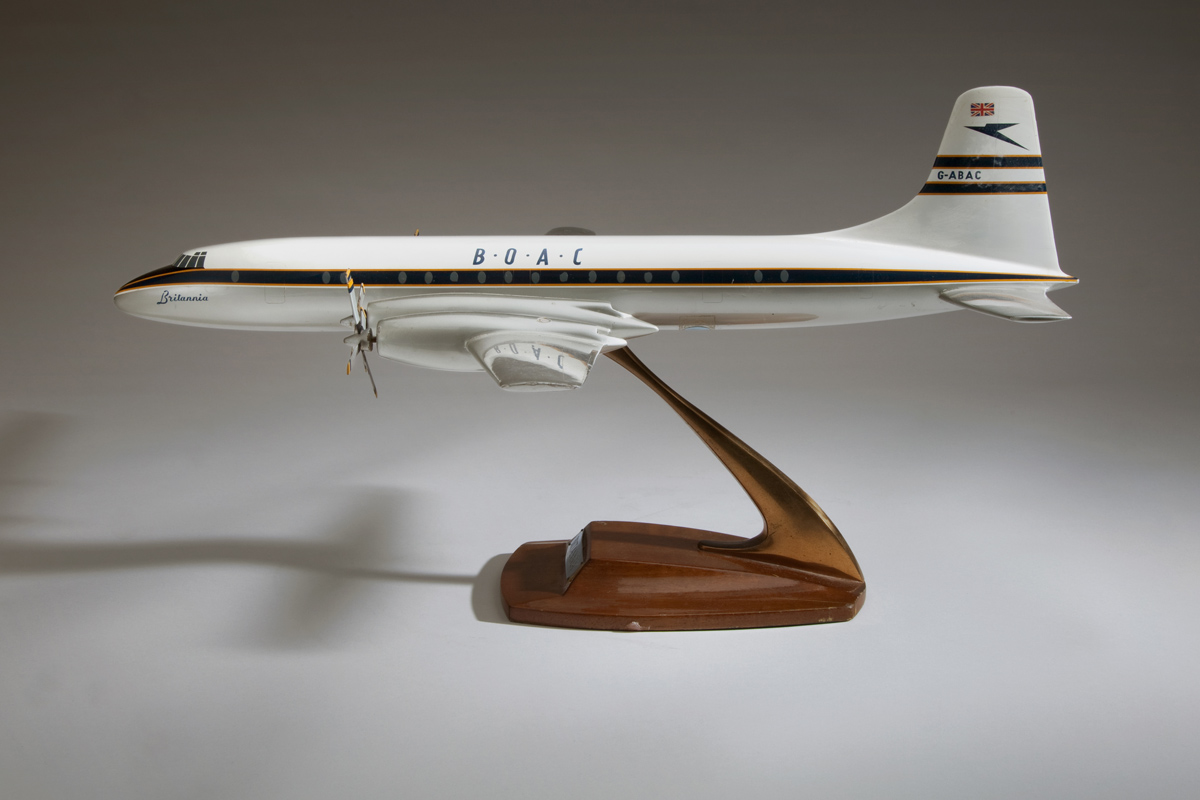
 

Westway Models, London, England. 'BOAC Bristol Britannia 300' late 1950s


Westway Models, London, England
BOAC Bristol Britannia 300
Late 1950s
Scale 1:72
Metal, plastic, wood, paint
Collection of Anthony J. Lawler


In 1957, Britain’s long-haul international flag carrier BOAC (British Overseas Airways Corporation) introduced the Bristol Aircraft Company’s turboprop Britannia on its routes to South Africa and New York. Two years later, the airline inaugurated the first regular round-the-world Britannia service via San Francisco, Hong Kong, and Tokyo. The large capacity, long-range, jet-prop-powered airliner, nicknamed the “Whispering Giant,” was significantly quieter than piston-engine airliners of the period and provided smooth, fast service with comfortable accommodations. Due to many delays in its development, the airliner was introduced later than anticipated and only operated into the early 1960s, before it was replaced by faster jetliners with similar range and capacity, such as the Boeing 707. The all-metal model was crafted in England by Westway, a prominent builder of airliner models for the British aerospace industry during the 1950s.

Text from the SFO Museum website


Raise-Up Models, Rotterdam, the Netherlands 'Western Airlines Lockheed L-188 Electra model aircraft'
Late 1950s


Raise-Up Models, Rotterdam, the Netherlands
Western Airlines Lockheed L-188 Electra model aircraft
Late 1950s
Scale 1:40
Metal, paint
Collection of Anthony J. Lawler


Western Air Express was founded in 1925, and after several mergers and name changes, became Western Air Lines in 1941. During the postwar era, Western quickly grew as a regional airline serving routes from Minneapolis, Minnesota, to the West Coast. In 1959, the airline began receiving delivery of the Lockheed L-188 Electra, a new, revolutionary turboprop airliner developed and produced by Lockheed Aircraft of Burbank, California. With medium range, a cruise speed of nearly four hundred miles per hour, and a capacity for approximately one hundred passengers, the Electra was ideal for Western’s regional needs and, initially, was instrumental in attracting a larger customer base. This large-scale model was fabricated of metal by Raise-Up Models of Rotterdam, Holland, and was painted to represent one of the first aircraft received from Lockheed in Western’s late 1950s red-and-white livery with the Native American logo.

Text from the SFO Museum website
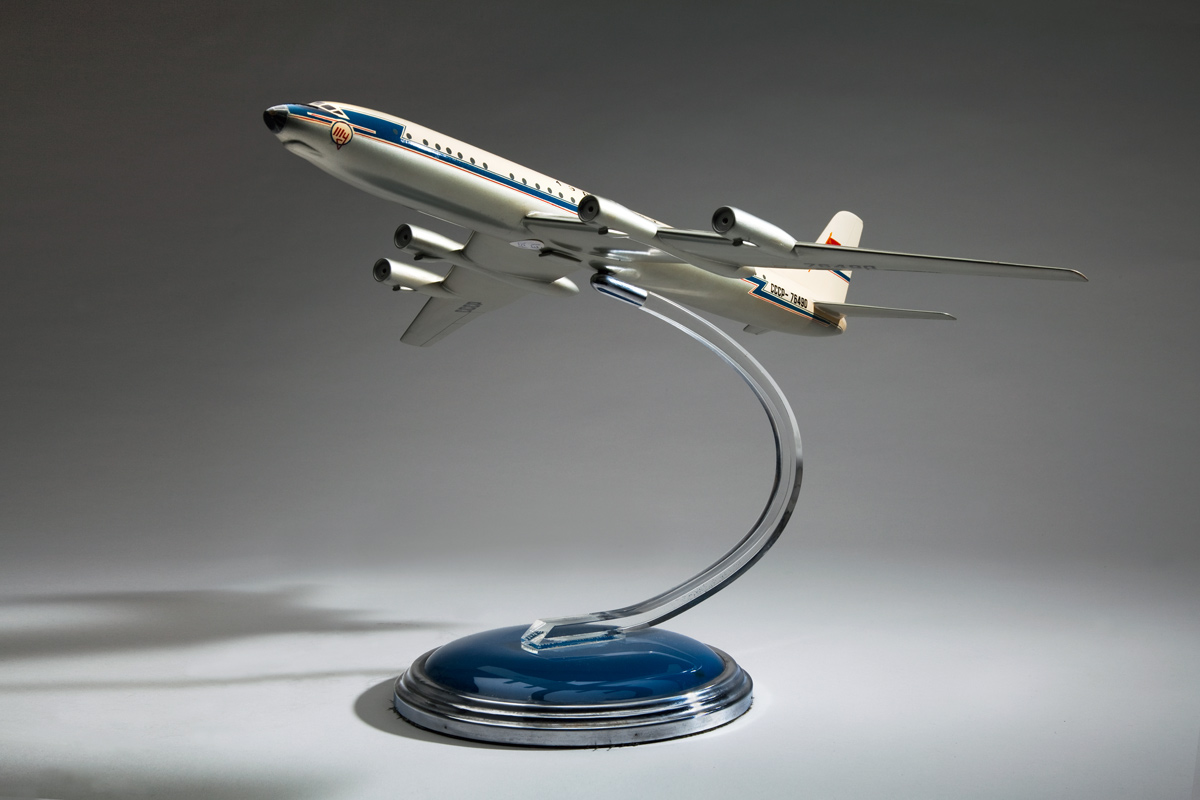
 

U.S.S.R. 'Aeroflot Tupolev Tu-114 Rossiya' early 1960s


U.S.S.R.
Aeroflot Tupolev Tu-114 Rossiya
Early 1960s
Scale 1:100
Metal, paint, plastic
Collection of Anthony J. Lawler


SFO Museum 
San Francisco International Airport
P.O. Box 8097
San Francisco, CA 94128 USA
Phone: 650.821.6700
SFO Museum website

LIKE ART BLART ON FACEBOOK

Back to top

Artwork: Alan Constable camera. Opening night photographs: ‘Movement and Emotion’ at Arts Project Australia, Melbourne

Exhibition dates: 20th October – 26th November 2011


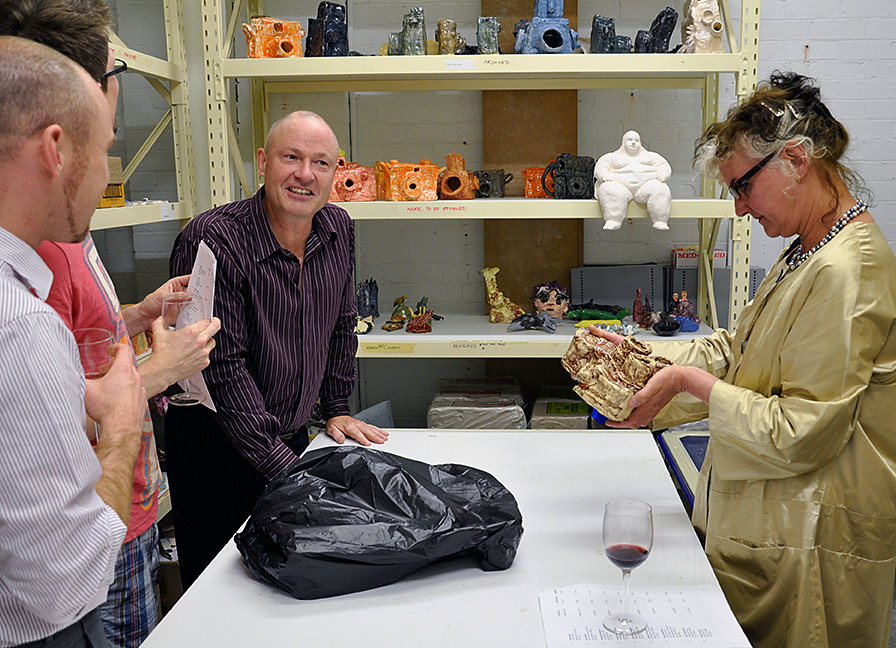
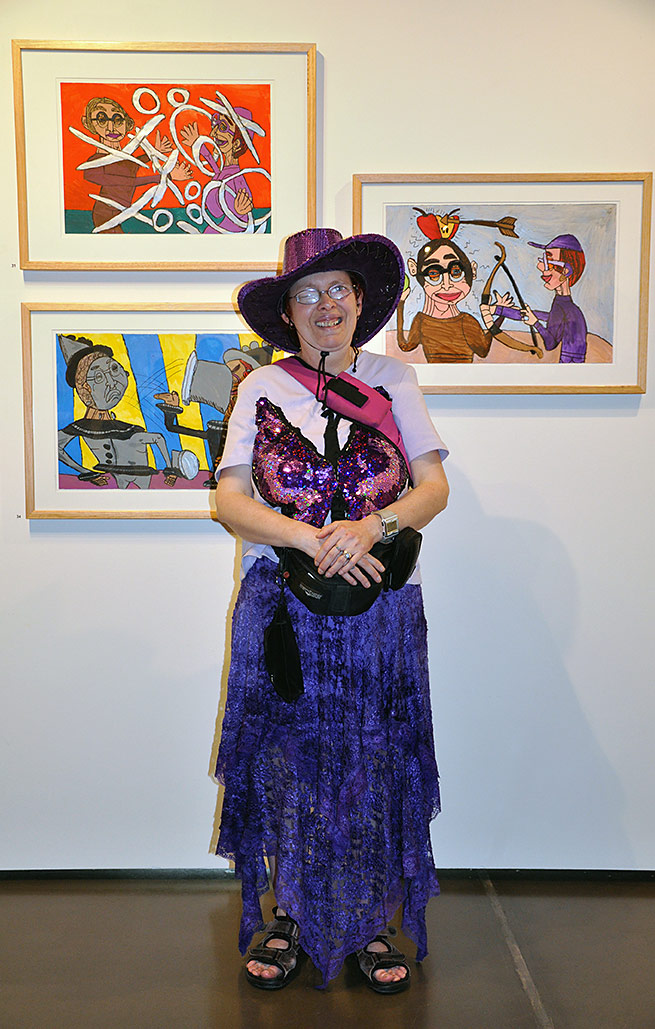
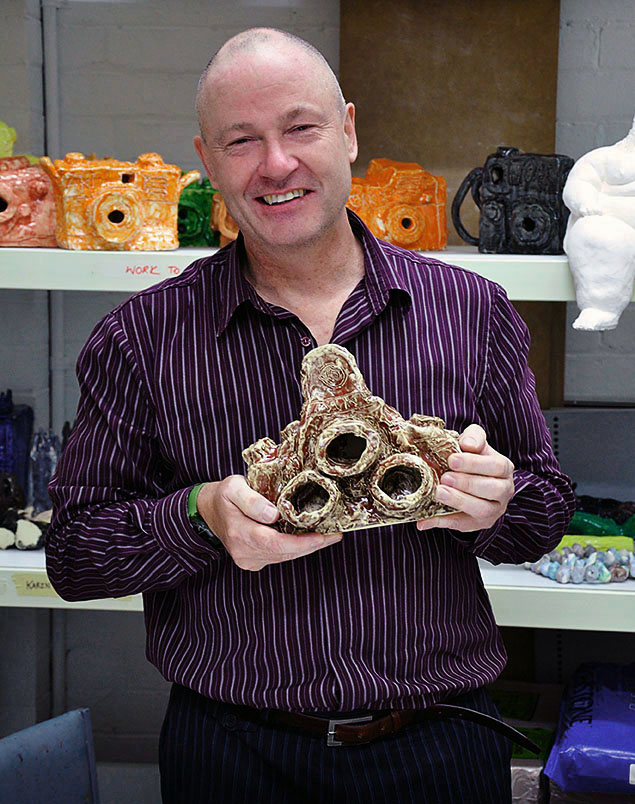
Dr Marcus Bunyan holdling his new Alan Constable camera at the opening of Movement and Emotion 2011. More of Alan's cameras can be seen behind.


Dr Marcus Bunyan holding his new Alan Constable camera at the opening of Movement and Emotion 2011.
More of Alan’s cameras can be seen behind.


I have added a new Alan Constable camera to my collection. Yah!

The one I have chosen is very unusual. The camera has a third eye and a stunning glaze. The exhibition features the work of three Arts Project Australia artists: Alan Constable, Chris O’Brien and Terry Williams. All three artists explore machine aesthetics within their practice.

I really do hope that the National Gallery of Victoria purchases some of these cameras. They are the most unusual and beautiful sculptural pieces I have seen in a long time.

Dr Marcus Bunyan


Many thankx to Art Project Australia for allowing me to publish the photographs in the posting. Please click on the photographs for a larger version of the image. See more images from the Movement and Emotion exhibition.


Alan Constable (Australian, b. 1956) 'Not titled (three lens red camera)' 2011


Alan Constable (Australian, b. 1956)
Not titled (three lens red camera)
2011


Marcus with jeweller Marianne Cseh at right looking at the Alan Constable camera


Marcus with jeweller Marianne Cseh at right looking at the Alan Constable camera


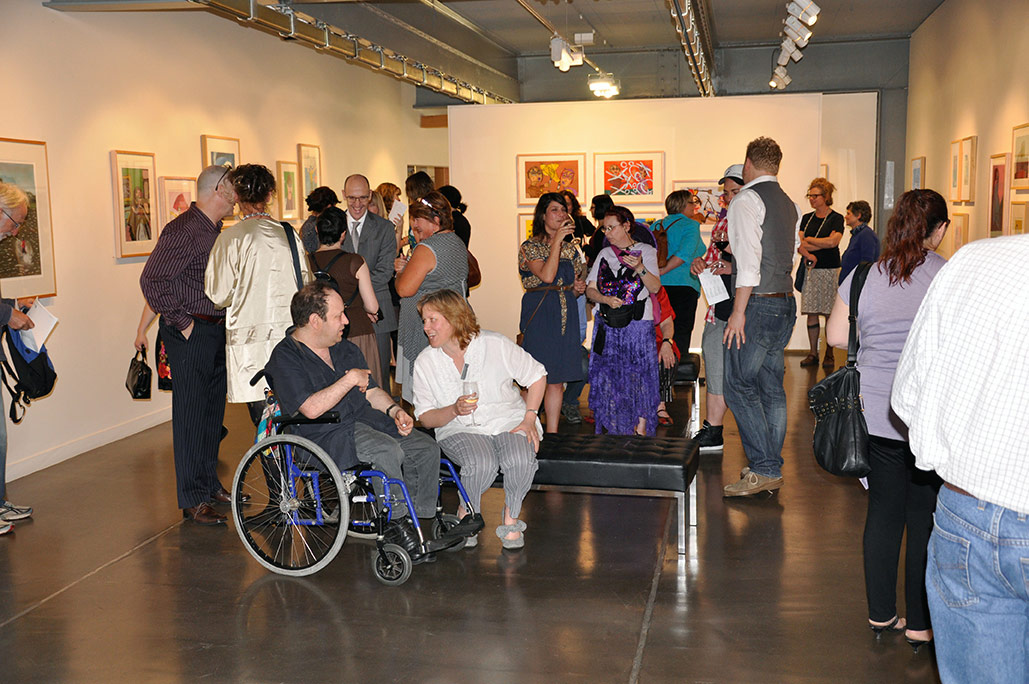
Opening night crowd at 'Movement and Emotion'


Opening night crowd at Movement and Emotion, Arts Project Australia


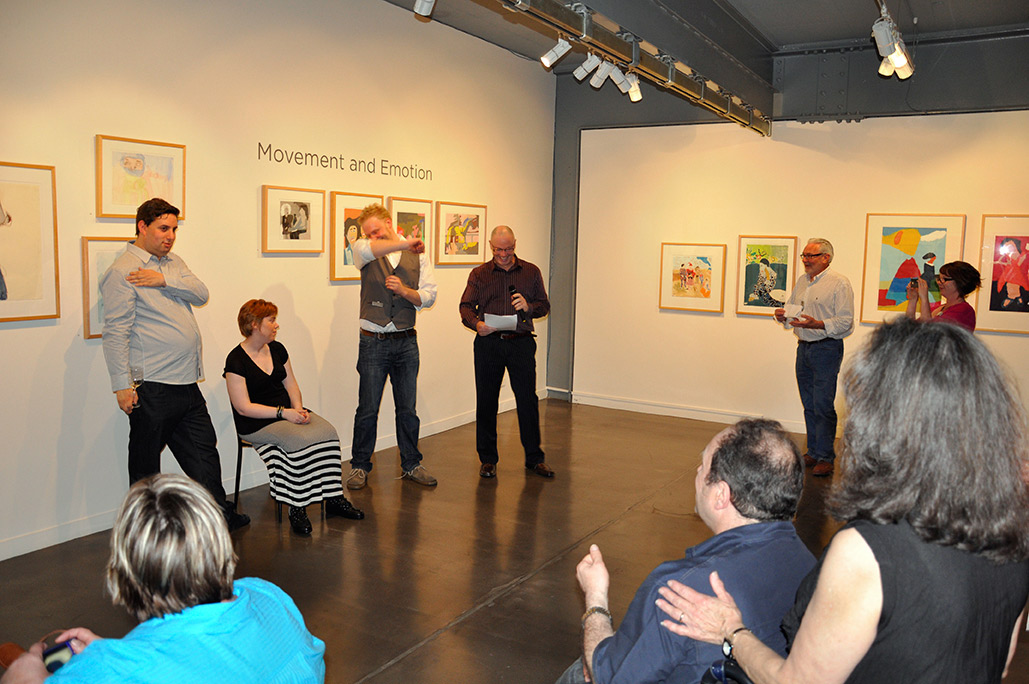
Opening night, with at left curator Paul Hodges, artist Jodie Noble (seated), myself and at right, Jonah Jones, President of the board of Arts Project Australia


Opening night, with at left curator and artist Paul Hodges, artist Jodie Noble (seated), myself and, at right, Jonah Jones, President of the board of Arts Project Australia


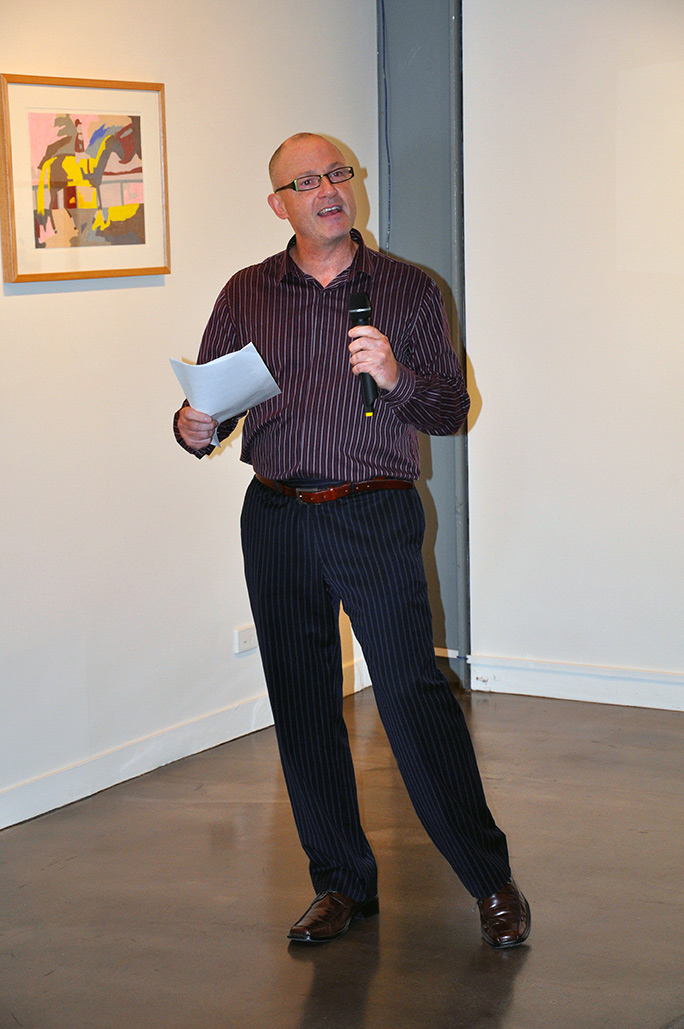
Dr Marcus Bunyan giving the opening night speech at the exhibition 'Movement and Emotion' at Arts Project Australia


Dr Marcus Bunyan giving the opening night speech for the exhibition Movement and Emotion. Read the opening night speech. I was so nervous my jeweller friend Marianne said she could see my hands shaking from where she was standing in the crowd!!


Artist Catherine Staughton standing in front of her work


Artist Catherine Staughton standing in front of her work


Arts Project Australia

Studio
24 High Street
Northcote Victoria 3070
Phone: + 61 3 9482 4484

Gallery
Level 1 Perry Street building
Collingwood Yards
Enter via 35 Johnson Street or 30 Perry Street, Collingwood
Phone: +61 477 211 699

Opening hours:
Wednesday – Friday 11am – 5pm
Saturday & Sunday 12 – 4pm

Arts Project Australia website

LIKE ART BLACK ON FACEBOOK

Back to top

Exhibition: ‘Joel Meyerowitz – Aftermath’ at the Miami Art Museum

Exhibition dates: 19th August – 6th November 2011


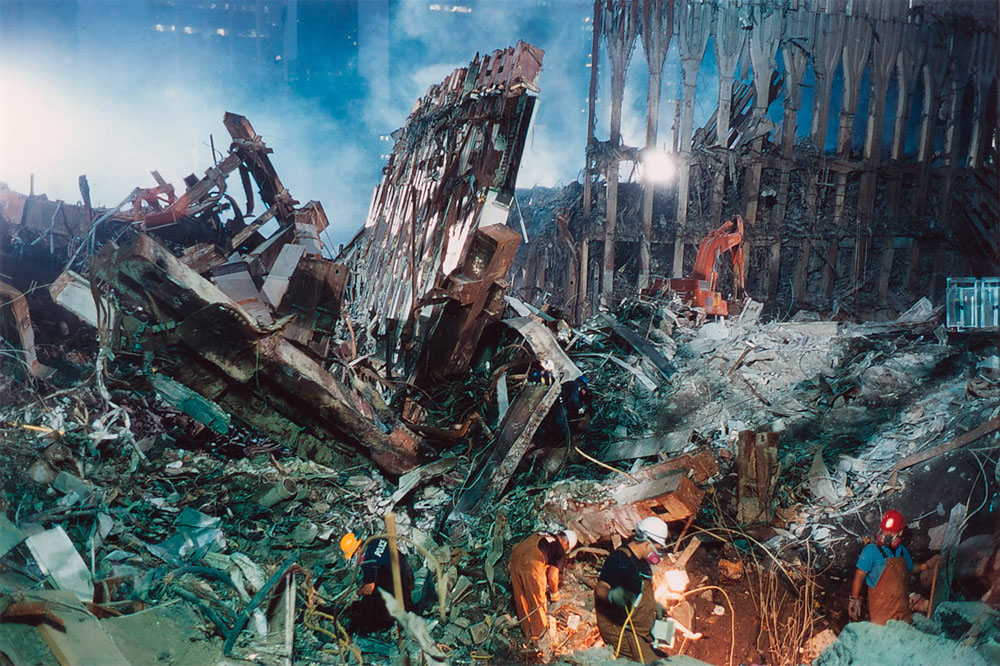
Joel Meyerowitz (American, b. 1938) 'Searchers in Rubble' 2001


Joel Meyerowitz (American, b. 1938)
Searchers in Rubble
2001
Vintage contact print
Collection Miami Art Museum, gift of Steven E. and Phyllis Gross


And do you know what “the world” is to me? Shall I show it to you in my mirror? This world: a monster of energy, without beginning, without end; a firm, iron magnitude of force that does not grow bigger or smaller, that does not expend itself but only transforms itself; as a whole, of unalterable size, a household without expenses or losses, but likewise without increase or income; enclosed by “nothingness” as by a boundary; not something blurry or wasted, not something endlessly extended, but set in a definite space as a definite force, and not a space that might be “empty” here or there, but rather a force throughout, as a play of forces and waves of forces, at the same time one and many, increasing here and at the same time decreasing there …


Frederick Nietzsche, The Will to Power


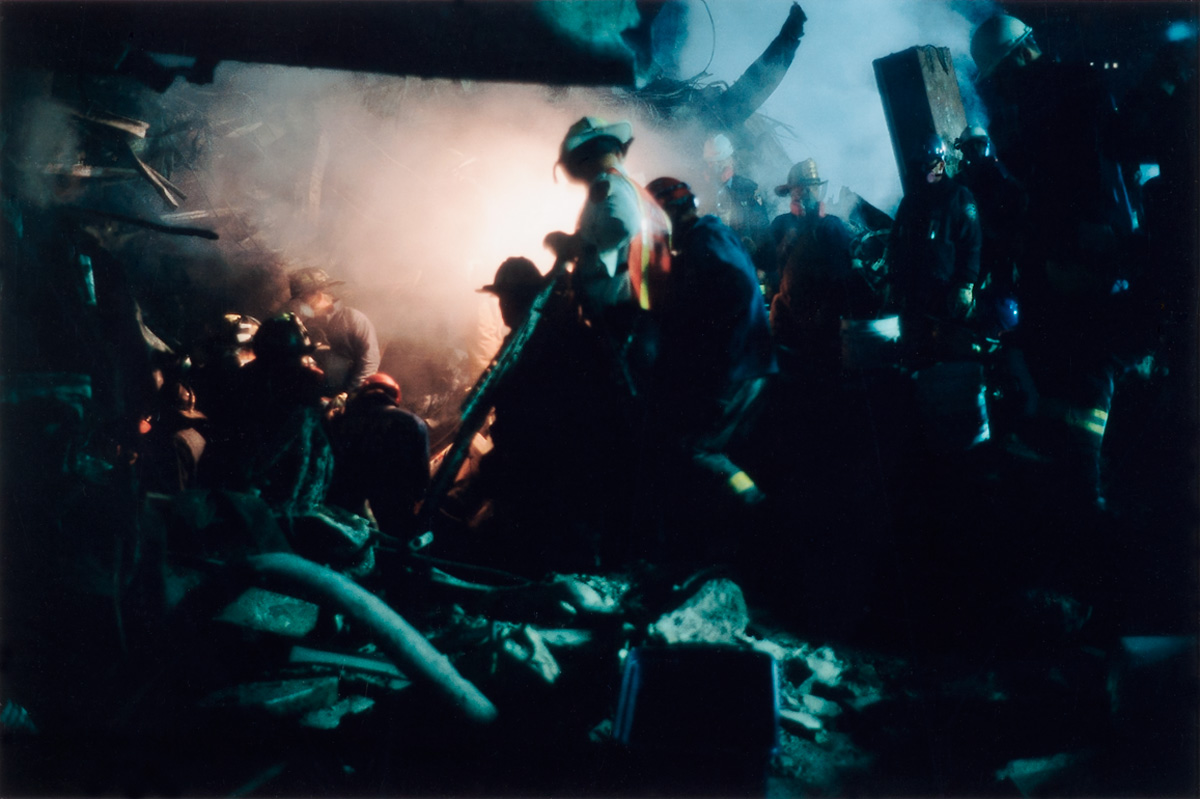
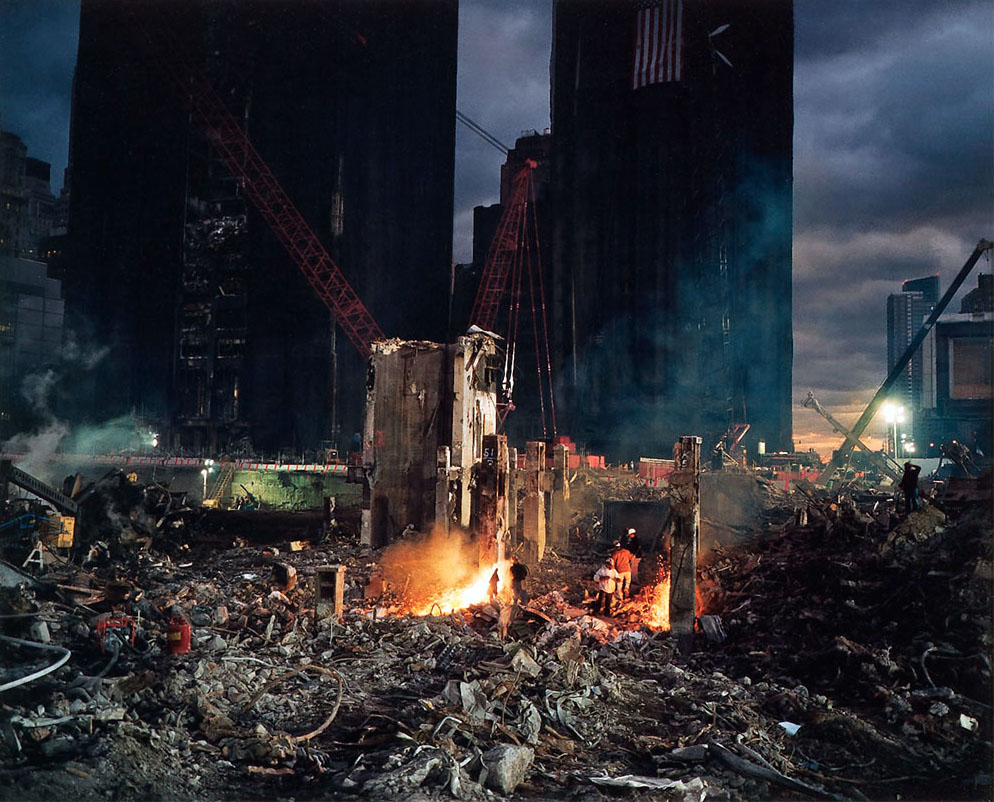
Sadness. And light. Hope. Amidst the inferno. Study the masterpiece Finding More Fireman (below) in the enlarged version and you cannot fail to be moved. It is all there: monumental, intimate, hellish, redemptive – a modern, “disastrous” form of the Rembrandt’s The Night Watch.

Dr Marcus Bunyan


Many thanxk to the Miami Art Museum for allowing me to publish the photographs in the posting. Please click on the photographs for a larger version of the image.


Joel Meyerowitz (American, b. 1938) 'Flower Offering' 2001


Joel Meyerowitz (American, b. 1938)
Flower Offering
2001
Vintage contact print
Collection Miami Art Museum, gift of Steven E. and Phyllis Gross


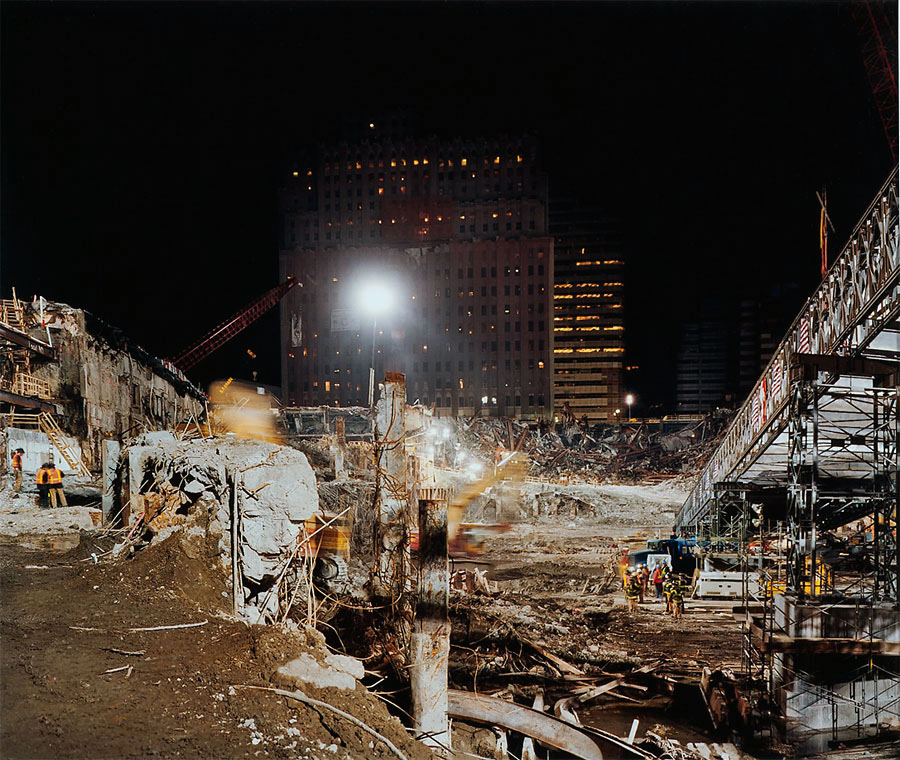
Joel Meyerowitz (American, b. 1938) 'Pit Looking North' 2002


Joel Meyerowitz (American, b. 1938)
Pit Looking North
2002
Vintage contact print
Collection Miami Art Museum, gift of Steven E. and Phyllis Gross


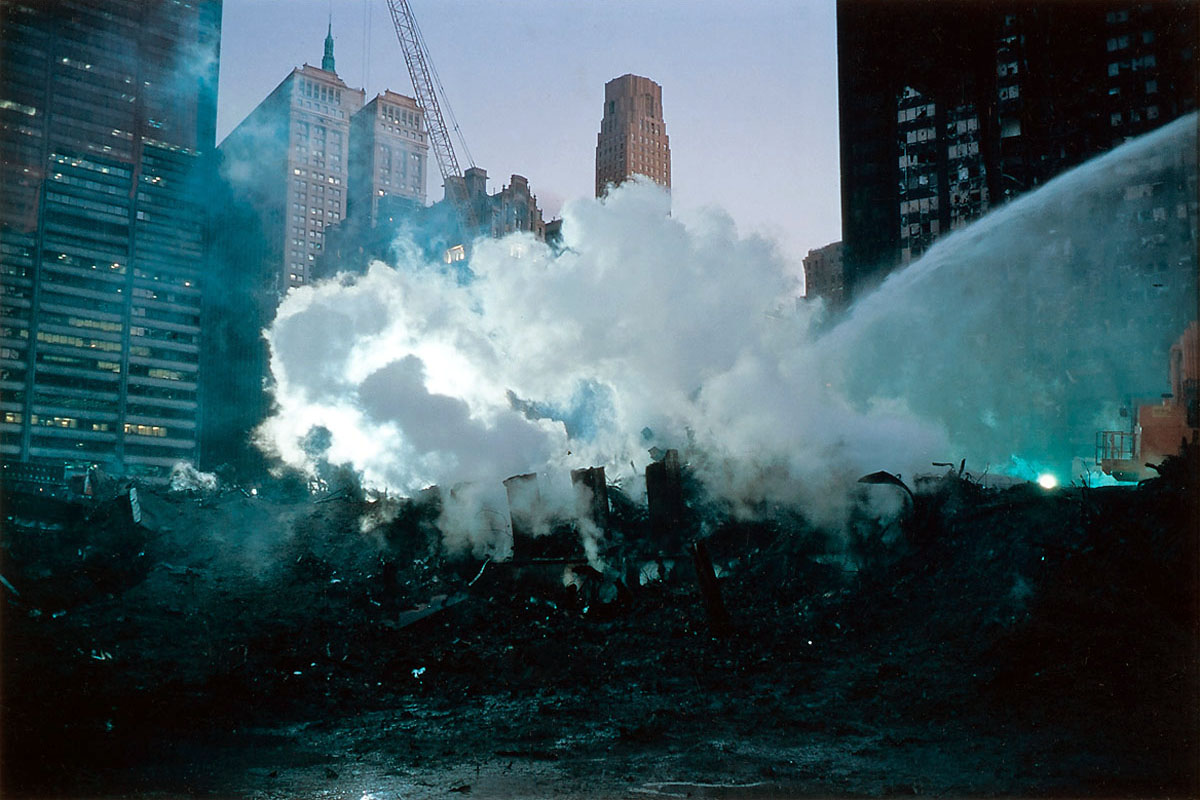
Joel Meyerowitz (American, b. 1938) 'Smoke and Spray' 2001


Joel Meyerowitz (American, b. 1938)
Smoke and Spray
2001
Vintage contact print
Collection Miami Art Museum, gift of Jeffrey Hugh Newman


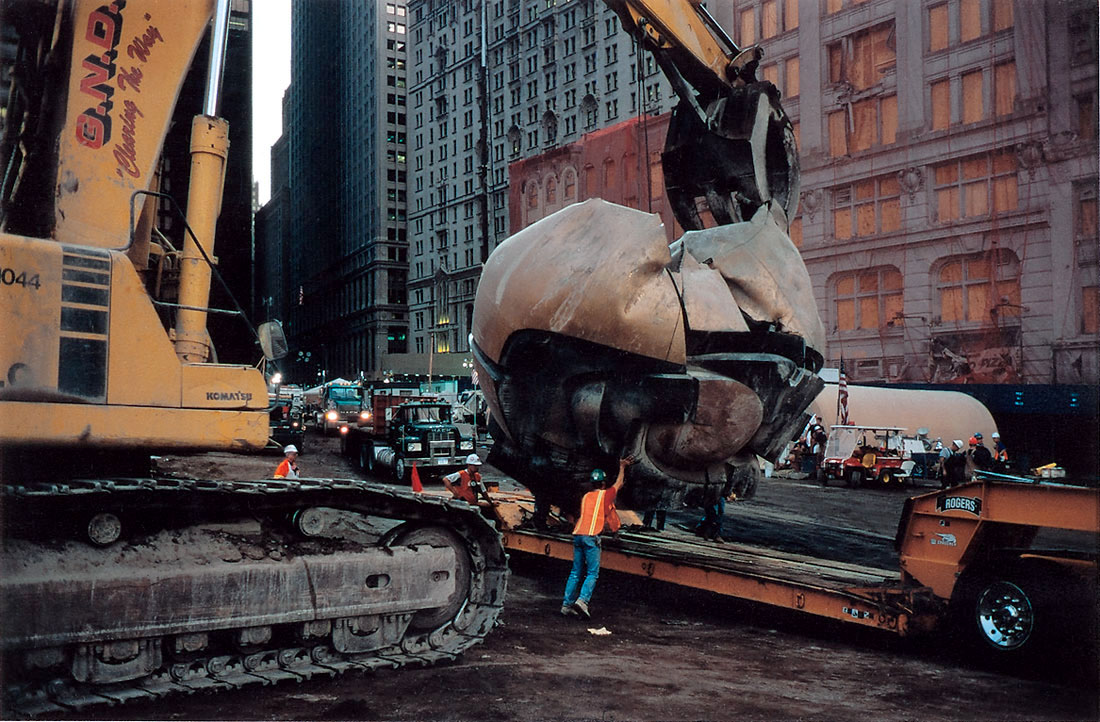
Joel Meyerowitz (American, b. 1938) 'Moving the Monument' 2001


Joel Meyerowitz (American, b. 1938)
Moving the Monument
2001
Vintage contact print
Collection Miami Art Museum, gift of Jeffrey Hugh Newman


Joel Meyerowitz (American, b. 1938) 'Finding More Fireman' 2001


Joel Meyerowitz (American, b. 1938)
Finding More Fireman
2001
Vintage contact print
Collection Miami Art Museum, gift of Charles S. and Elynne B. Zucker


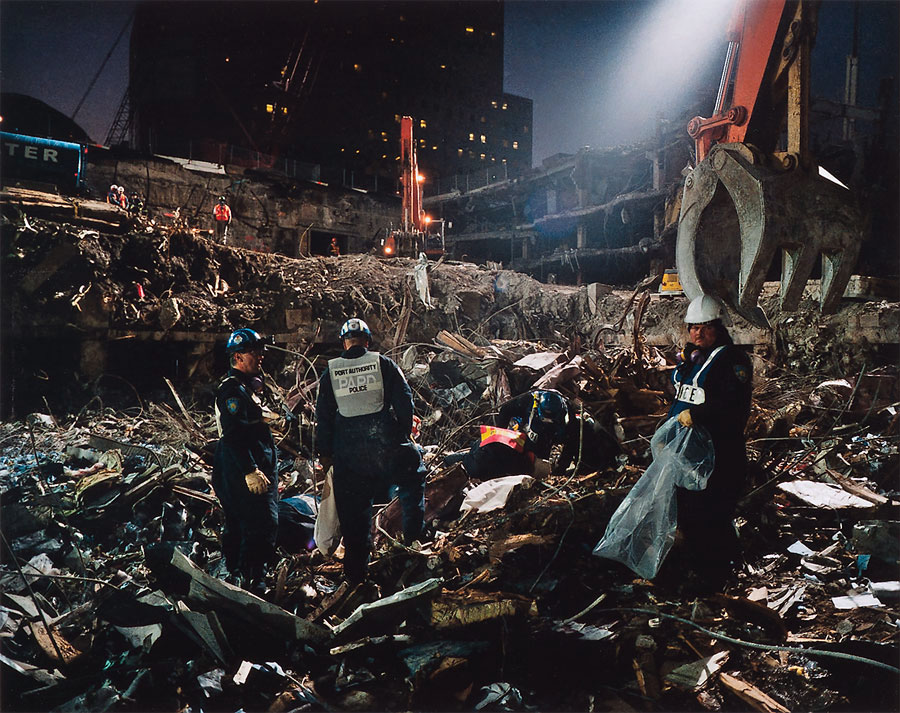
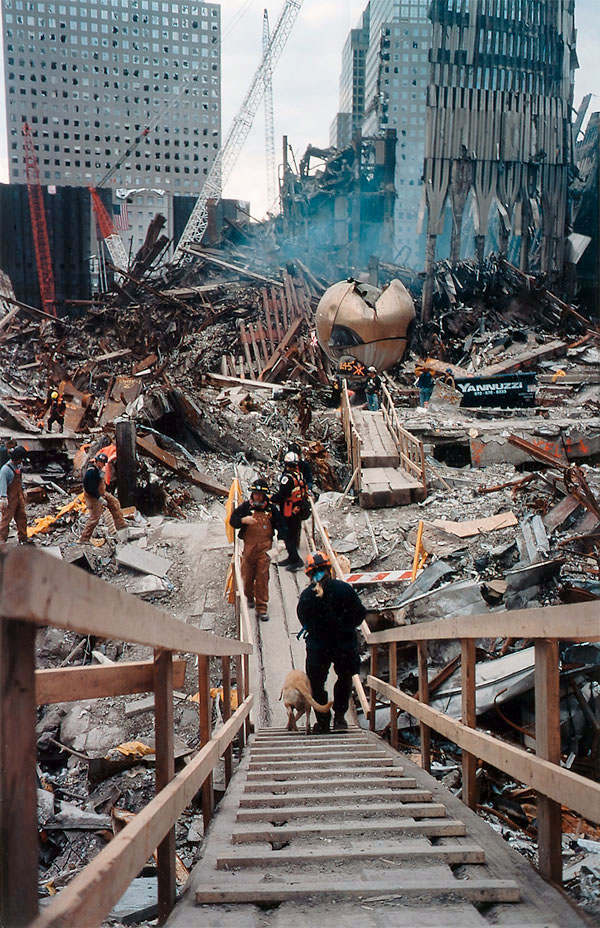
Joel Meyerowitz (American, b. 1938) 'Searchers' 2002


Joel Meyerowitz (American, b. 1938)
Searchers
2002
Vintage contact print
Collection Miami Art Museum, gift of Charles S. and Elynne B. Zucker


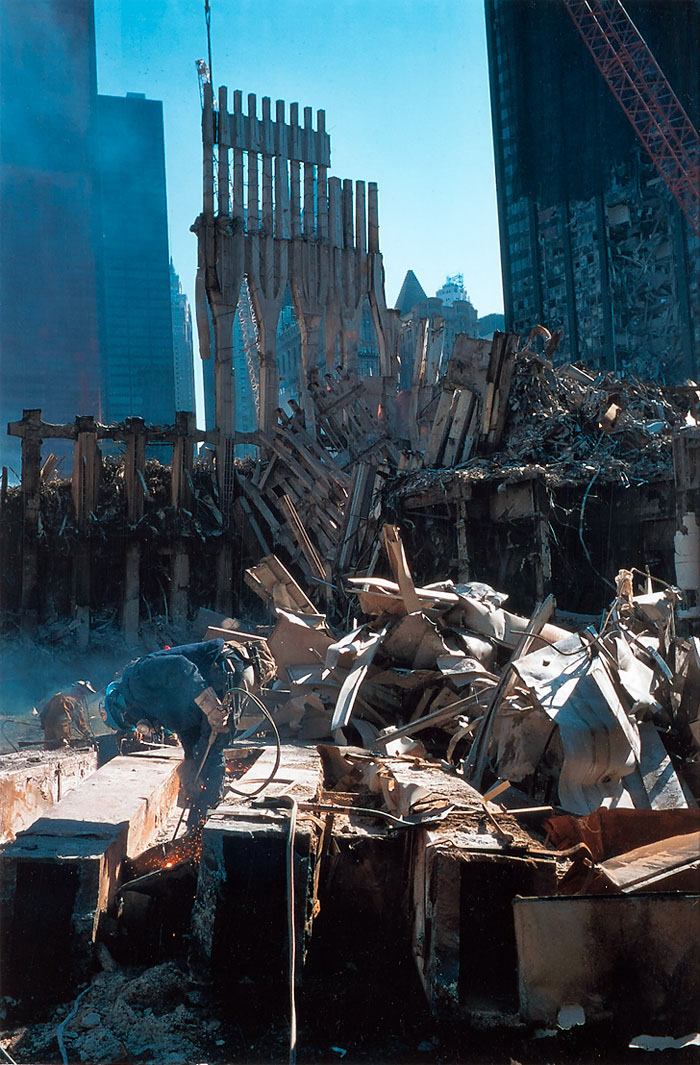
Joel Meyerowitz (American, b. 1938) 'Welders in South Tower' 2001


Joel Meyerowitz (American, b. 1938)
Welders in South Tower
2001
Vintage contact print
Collection Miami Art Museum, gift of Charles S. and Elynne B. Zucker


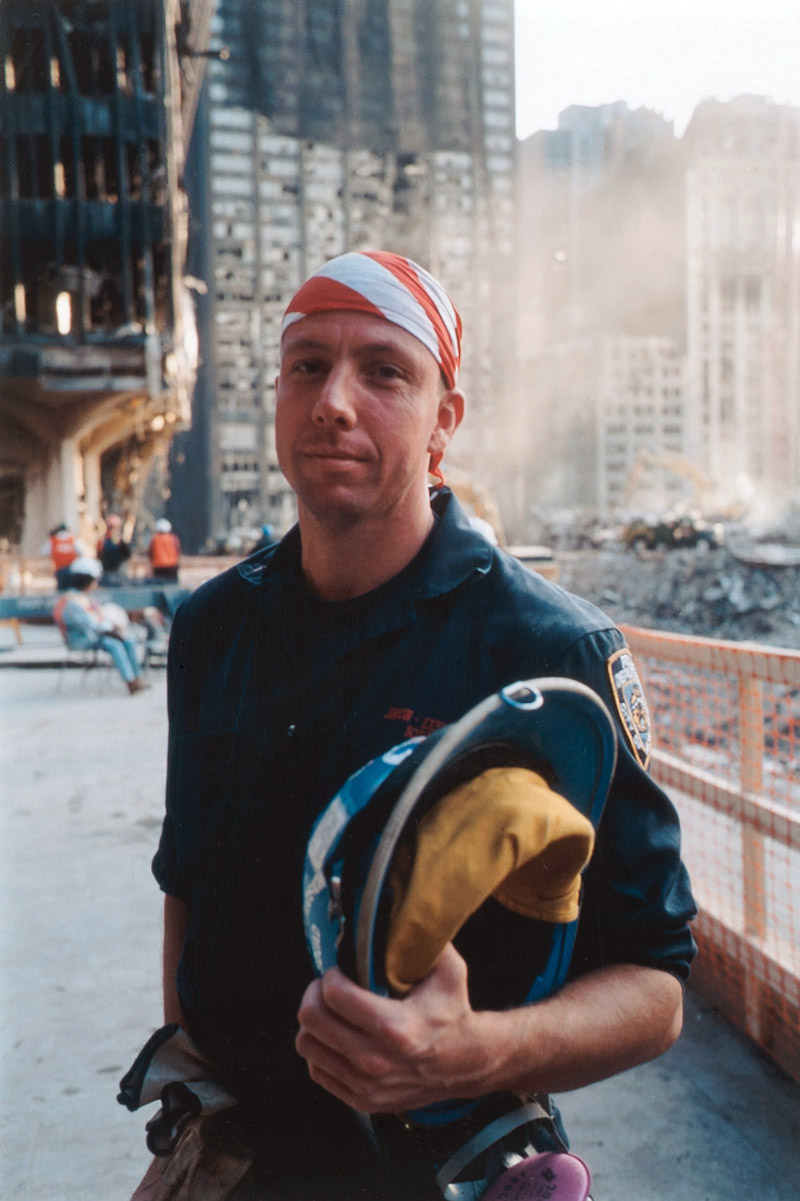
In commemoration of the 10th anniversary of 9/11, Miami Art Museum presents Focus Gallery: Joel Meyerowitz – Aftermath, an exhibition of photographs taken by the only photographer granted right of entry into Ground Zero after the September 11, 2001 attacks on the World Trade Center in New York City. For nine months during the day and night, Meyerowitz photographed “the pile,” as the World Trade Center came to be known, and the over 800 people a day that were working in it. The exhibition consists of 24, recently-donated photographs, presented in the Focus Gallery section of the Museum’s Permanent Collection installation. Admission to Miami Art Museum will be free to all emergency personnel, including police and firefighters, and their guests throughout the exhibition’s run, August 19 – November 6, 2011. A special preview for emergency personnel will be held on Thursday, August 18, 2011, 4-7pm. Author and photography critic Vicki Goldberg will give a lecture entitled “What Remains” on Thursday, September 8, 2011, beginning at 6:30pm.

After September 11, 2001, the Ground Zero site in New York City was classified as a crime scene and only those directly involved in the recovery efforts were allowed inside. The press was prohibited from the site. Influenced by Walker Evans’s and Dorothea Lange’s work for the Farm Security Administration during the Great Depression, Meyerowitz, long recognised as one of the pioneers of colour photography, was convinced that if a photographic record of the unprecedented recovery efforts was not made, “there would be no history.” With the help of sympathetic officials, he managed to become the only photographer granted right of entry into Ground Zero.

“I was making photographs for everyone who didn’t have access to the site,” says Meyerowitz, “I wanted to communicate what it felt like to be in there as well as what it looked like: to show the pile’s incredible intricacy and visceral power. I could provide a window for everyone else who wanted to be there, too, to help, or to grieve, or simply to try to understand what had happened to our city.”

Armed with a large-format wooden camera, Meyerowitz spent nine months photographing the site. In the first few weeks, he was chased off the site repeatedly, but over time, with the help of officials on and off site, the use of forged workers’ passes, and by assuming the “uniform” of hard hat, goggles, respirator, gloves, boots and duct taped pants, Meyerowitz became “woven into the fabric of the site.”

About the experience, Meyerowitz has written, “The nine months I worked at Ground Zero were among the most rewarding of my life. I came in as an outsider, a witness bent on keeping the record, but over time I began to feel a part of the very project I’d been intent on recording… the intense camaraderie I experienced at Ground Zero inspired me, changing both my sense of myself and my sense of responsibility to the world around me. September 11th was a tragedy of almost unfathomable proportions. But living for nine months in the midst of those individuals who faced that tragedy head-on, day after day, and did what they could to set things right, was an immense privilege.”

The photographs in MAM’s collection are from a unique set of contact prints (photographs printed on a 1:1 scale from the negatives) issued by the artist in 2006. As a group, they span the entire nine month period that Meyerowitz was on site, presenting a poignant, condensed view of the clean up effort, including portraits of the workers involved. The set is introduced by a single image of the World Trade Center towers taken by the artist in the 1980s from his apartment window.

The entire set of more than 8,000 photographs taken by Meyerowitz form an archive at the Museum of the City of New York. The Aftermath series was the focus of a 2006 book, Aftermath: World Trade Center Archives published by Phaidon (reissued this year in a special 10th anniversary edition) and an exhibition organised by the US Department of State that traveled worldwide from 2002 to 2005.

Press release from the Miami Art Museum website


Joel Meyerowitz (American, b. 1938) 'Explosion Squad Detective' 2001


Joel Meyerowitz (American, b. 1938)
Explosion Squad Detective
2001
Vintage contact print
Collection Miami Art Museum, gift of Steven E. and Phyllis Gross


Joel Meyerowitz (American, b. 1938) 'Steps Down to Plaza' 2001


Joel Meyerowitz (American, b. 1938)
Steps Down to Plaza
2001
Vintage contact print
Collection Miami Art Museum, gift of Jeffrey Hugh Newman


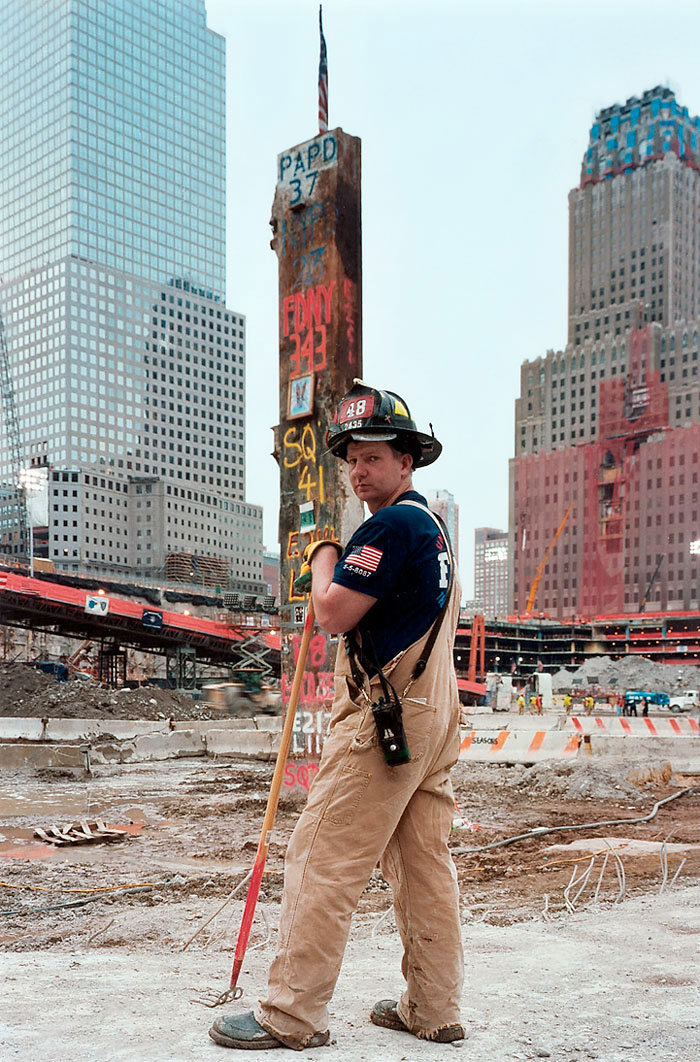
Joel Meyerowitz (American, b. 1938) 'Fireman at Last Column' 2002


Joel Meyerowitz (American, b. 1938)
Fireman at Last Column
2002
Vintage contact print
Collection Miami Art Museum, gift of Charles S. and Elynne B. Zucker


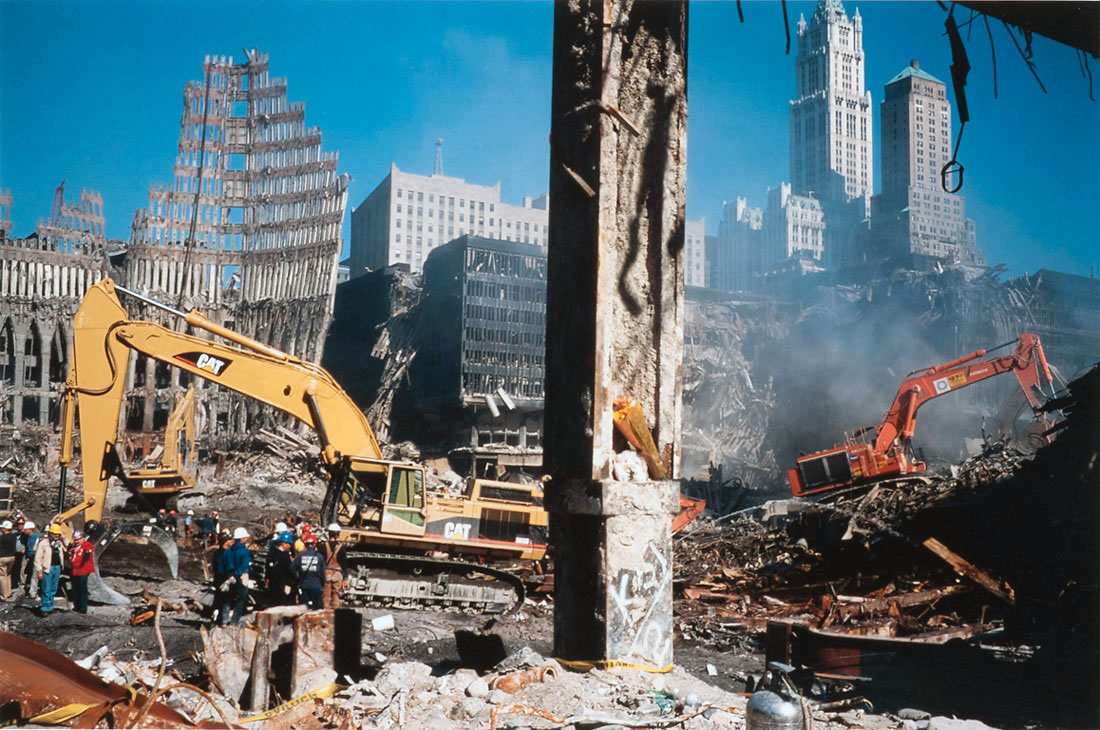
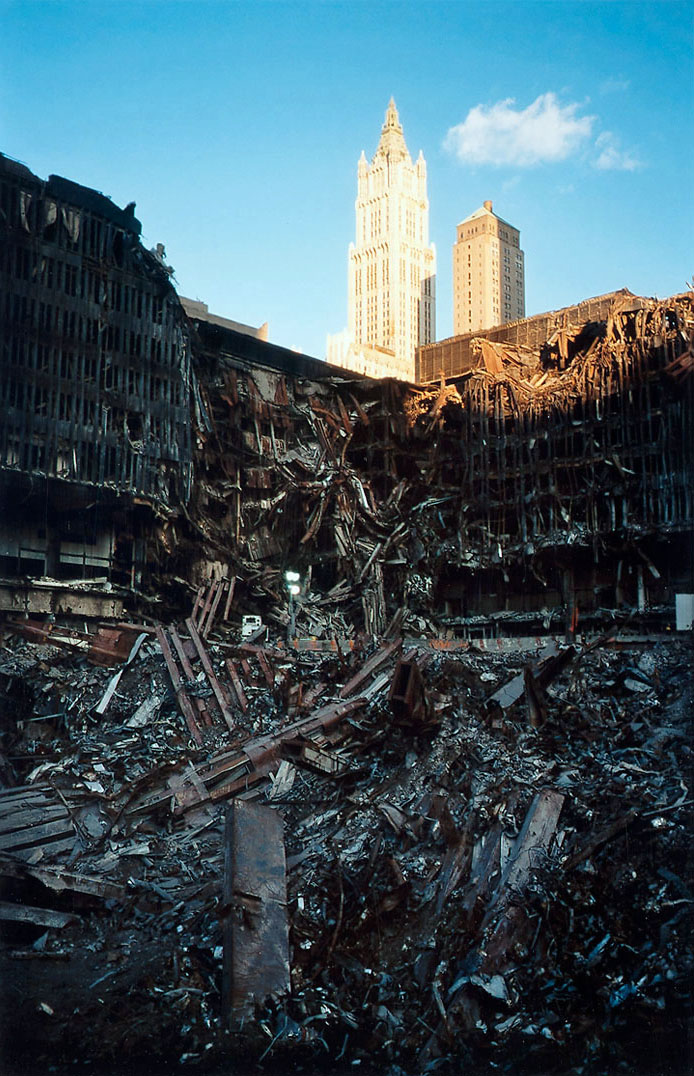
Joel Meyerowitz (American, b. 1938) 'Building #5 and Woolworth' 2001


Joel Meyerowitz (American, b. 1938)
Building #5 and Woolworth
2001
Vintage contact print
Collection Miami Art Museum, gift of Simon and Bonnie Levin


Joel Meyerowitz (American, b. 1938) 'Welder and Rubble' 2001


Joel Meyerowitz (American, b. 1938)
Welder and Rubble
2001
Vintage contact print
Collection Miami Art Museum, gift of Steven E. and Phyllis Gross


Miami Art Museum
101 W Flagler St., Miami, FL 33130

Opening hours:
Monday 11am – 6pm
Tuesday – Wednesday Closed
Thursday 11am – 9pm
Friday – Sunday 11am – 6pm

Miami Art Museum website

LIKE ART BLART ON FACEBOOK

Back to top

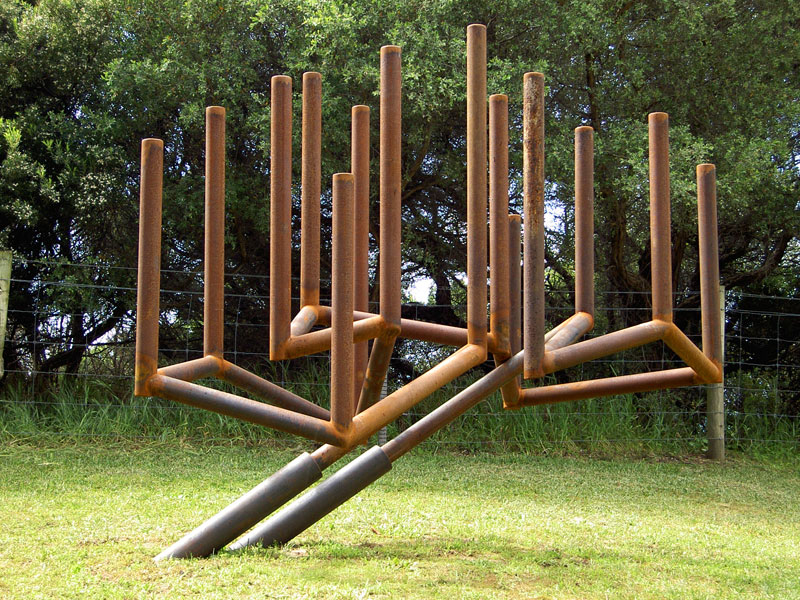
Sculpture: ‘Everything’ by Fredrick White, 2011

October 2012


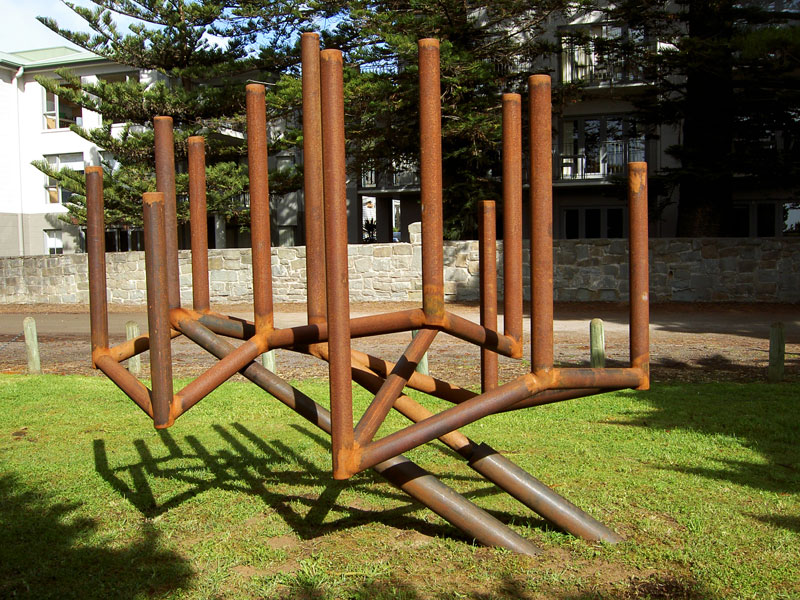
Fredrick White. 'Everything' 2011


Fredrick White (Australian)
Everything
2011
steel
210 x 120 x 250cm


A new sculpture by Fredrick White is appearing in the Lorne Sculpture Prize (now Biennale) which opened on the 16th October and continues until 5th November, 2011. The work continues the artist’s exploration into the matrix of what is seen and not seen, what lies above and below.

Dr Marcus Bunyan


Please click on the photographs for a larger version of the image.


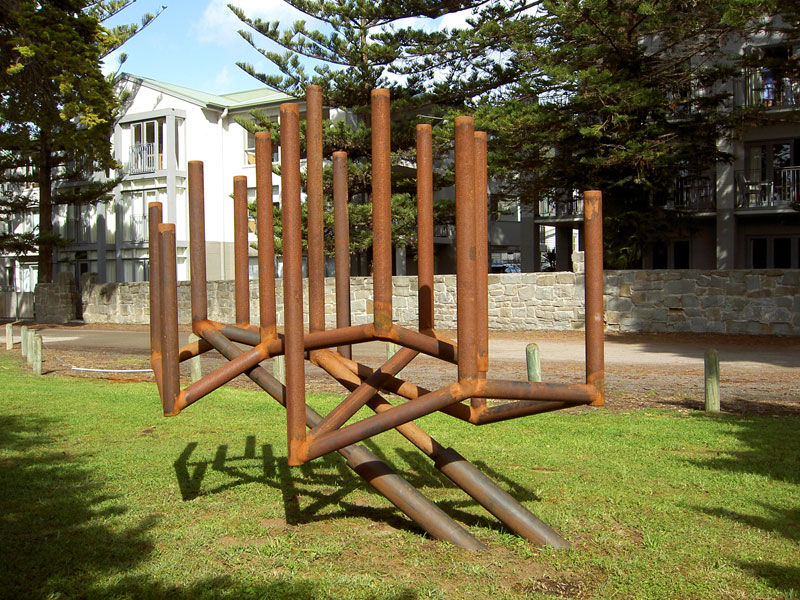
Fredrick White. 'Everything' 2011

Fredrick White. 'Everything' 2011


Fredrick White (Australian)
Everything
2011
steel
210 x 120 x 250cm


LIKE ART BLART ON FACEBOOK

Back to top

Exhibition: ‘Raphaël Dallaporta: Observation’ at Foam, Amsterdam

Exhibition dates: 2nd September – 26th October 2011

Foam Paul Huf Award 2011


Raphaël Dallaporta (French, b. 1980) 'Fragile, Blood 1' 2010


Raphaël Dallaporta (French, b. 1980)
Fragile, Blood 1
2010
© Raphaël Dallaporta


Antipersonnel. The positive pleasure of inflicting cruelty at an ambiguous physical and ethical distance. Use limited only by the imagination of the user. Detonated remotely using a laptop computer. 10 million times. US$3 each.

Dr Marcus Bunyan


Many thankx to Foam for allowing me to publish the photographs in the posting. Please click on the photographs for a larger version of the image.


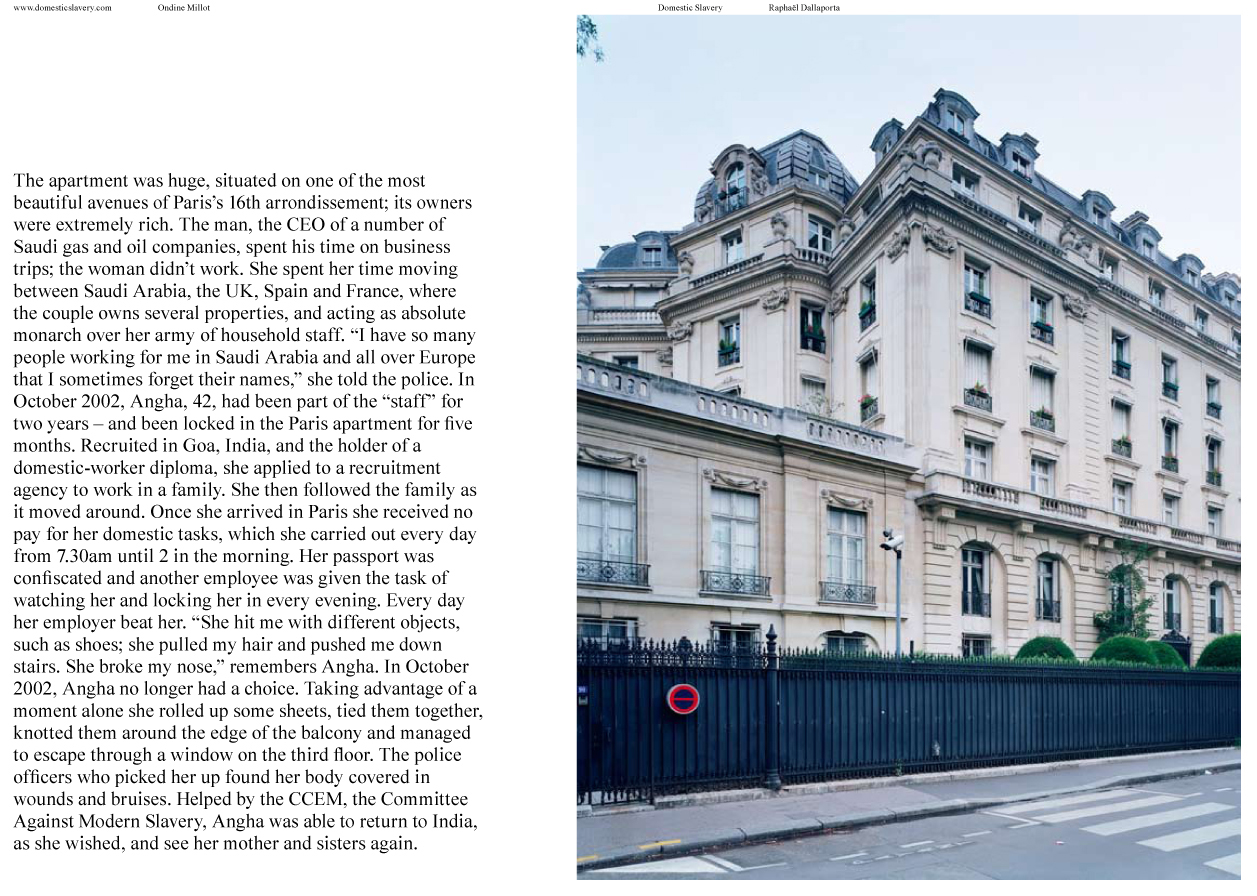
Raphaël Dallaporta (French, b. 1980) 'Domestic Slavery, Angha' 2006


Raphaël Dallaporta (French, b. 1980)
Domestic Slavery, Angha
2006
© Raphaël Dallaporta


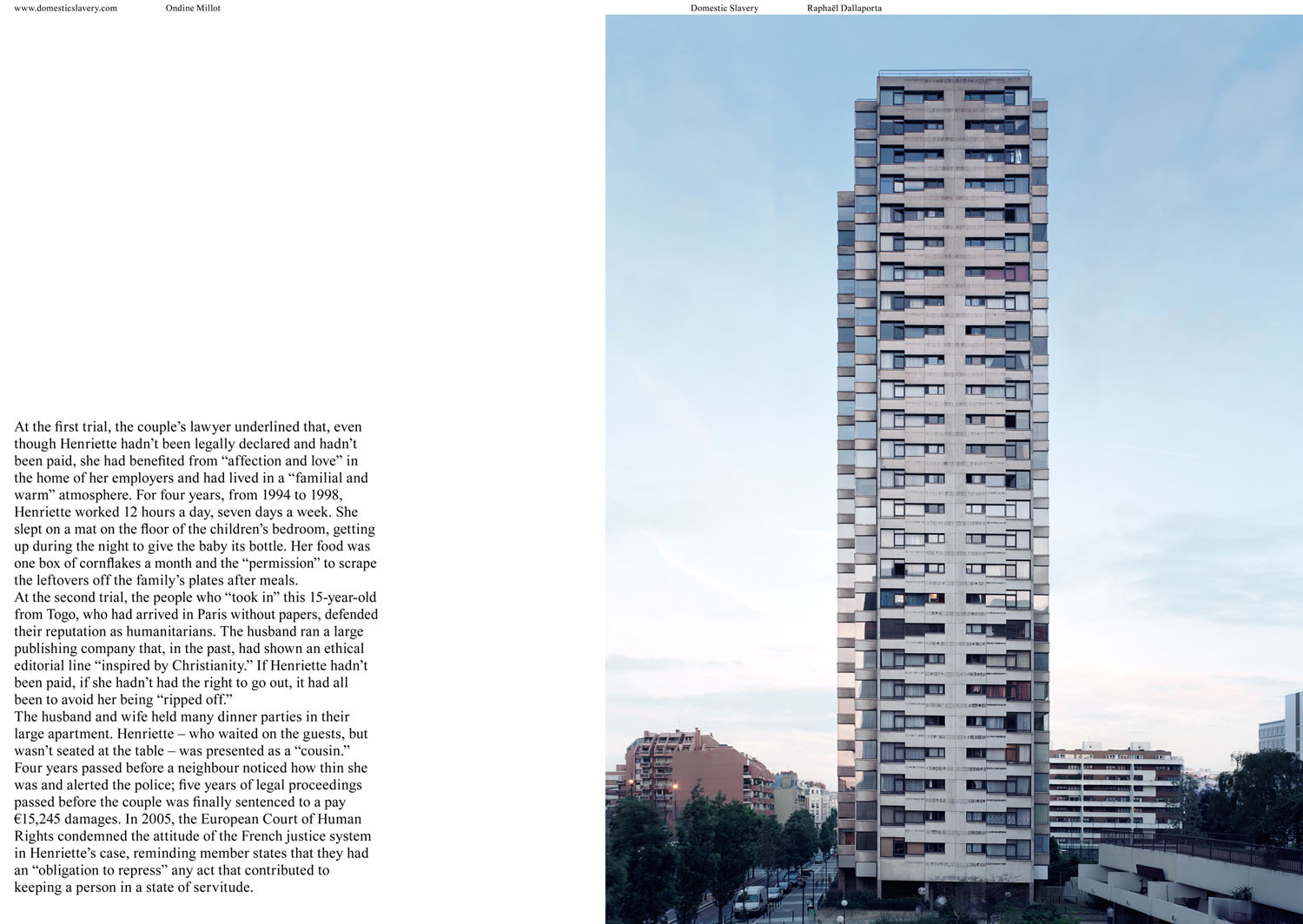
Domestic Slavery, 2006

Cold, distant images of building facades are associated with text. The narratives are written by Ondine Millot to describe the events that took place at the exact address of the buildings in the photographs. The spectator comes to understand that the series deals with an often undocumented consequence of human trafficking: modern slavery.

The images force us to come to terms with the upsetting reality that is hidden behind the ordinary facades. Raphaël Dallaporta denounces unbearable situations where one human being reduces another to the status of thing, and gives it depth through the distance of the photographs and his refusal to sensationalise.

Text from the Musée Nicéphore Niépce website [Online] Cited 29/03/2020


Raphaël Dallaporta (French, b. 1980) 'Domestic Slavery, Henriette' 2006


Raphaël Dallaporta (French, b. 1980)
Domestic Slavery, Henriette
2006
© Raphaël Dallaporta


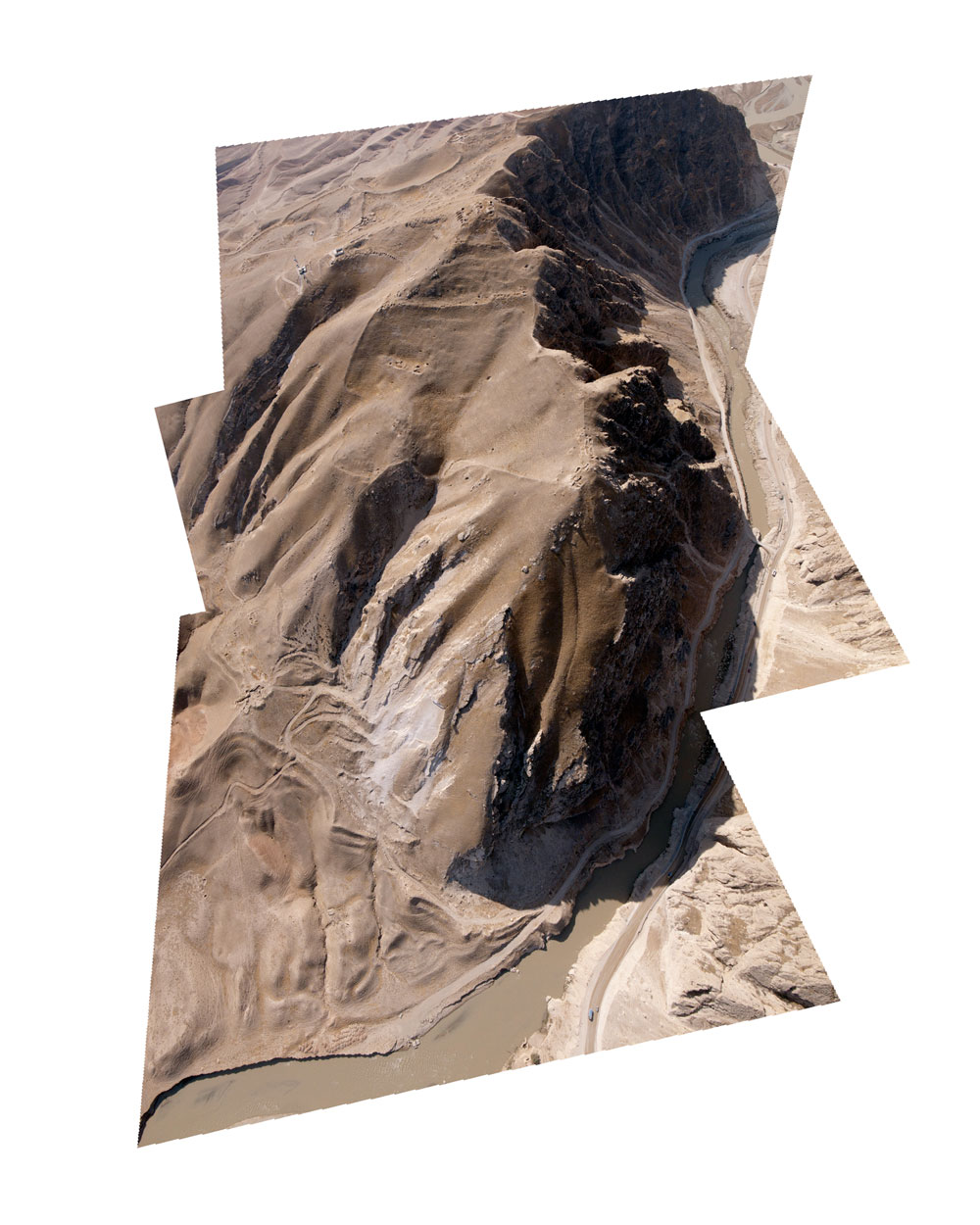
Raphaël Dallaporta (French, b. 1980) 'Ruins (Season 1), The Balkh-AB gorges, Afghanistan' 2011


Raphaël Dallaporta (French, b. 1980)
Ruins (Season 1), The Balkh-AB gorges, Afghanistan
2011
© Raphaël Dallaporta


Ruin, Season 1, 2011

In the autumn of 2010, Raphaël Dallaporta took part in an archaeological mission in the Bactriane region in Afghanistan, scene of Alexander the Great’s mythical conquest. Using a drone he designed himself, he took aerial photographs of endangered or heretofore unknown archaeological sites in a country at war. The remote controlled device was timed to take photos of unrivalled precision every five seconds. The way the images are put together with their voluntarily asymmetrical contours depict these inaccessible monuments and places at their best. The most cutting-edge technology reveals the artist’s themes – destruction, the precariousness of things. It brings to light that which was and is no longer. Is this not the very definition of all photography?

Text from the Musée Nicéphore Niépce website [Online] Cited 29/03/2020


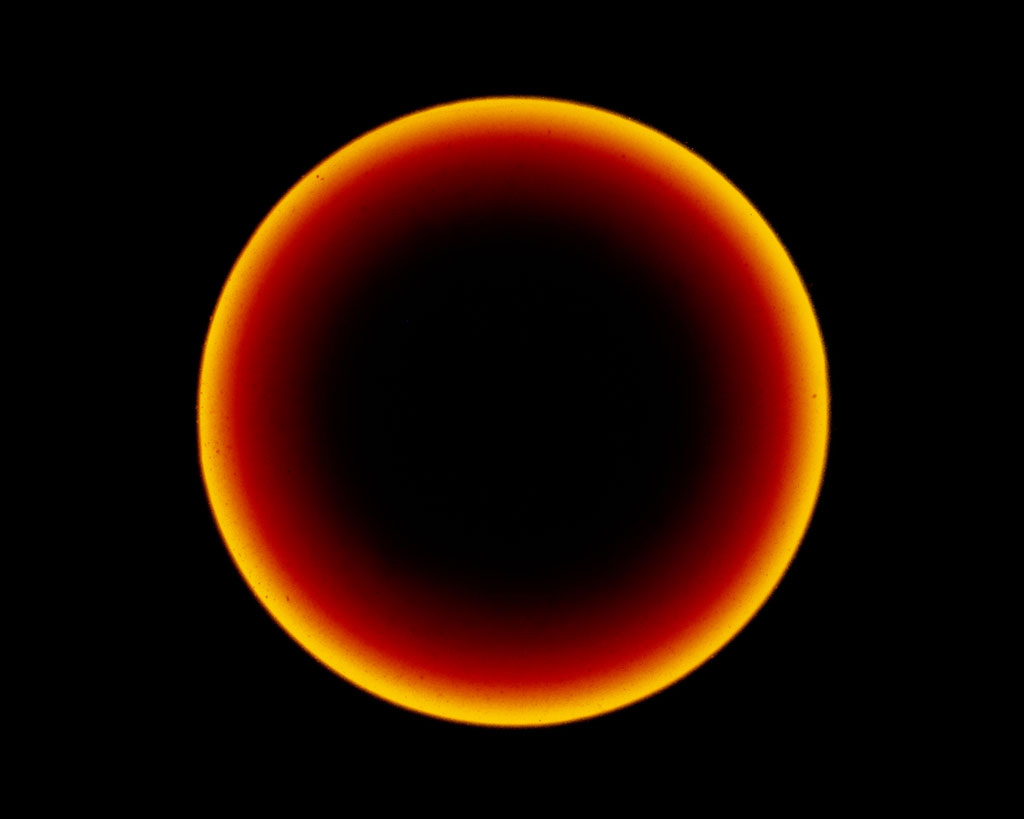
Raphaël Dallaporta (French, b. 1980) 'Fragile, "Four Moods", Black Bile'  2010


Raphaël Dallaporta (French, b. 1980)
Fragile, “Four Moods”, Black Bile 
2010
© Raphaël Dallaporta


Fragile, 2010

Raphaël Dallaporta photographs organs, like the encyclopaedic colour plates for an anatomy class. The legend, again, explains the origins of these silent images. The organ represented is not the issue; the reason for its presence on the slab is the issue. The apparent neutrality of the shot, according to a strict protocol (frontal shot, on a black background enabling the strong lighting of the “subject”), isolates each fragment of the body as a clue that enables to determine the cause of death. These relics of flesh and bone have a real role to play. But the way they are shot lends them a metaphysical and philosophical dimension that reminds us of life’s ephemeral nature and human vulnerability.

Text from the Musée Nicéphore Niépce website [Online] Cited 29/03/2020


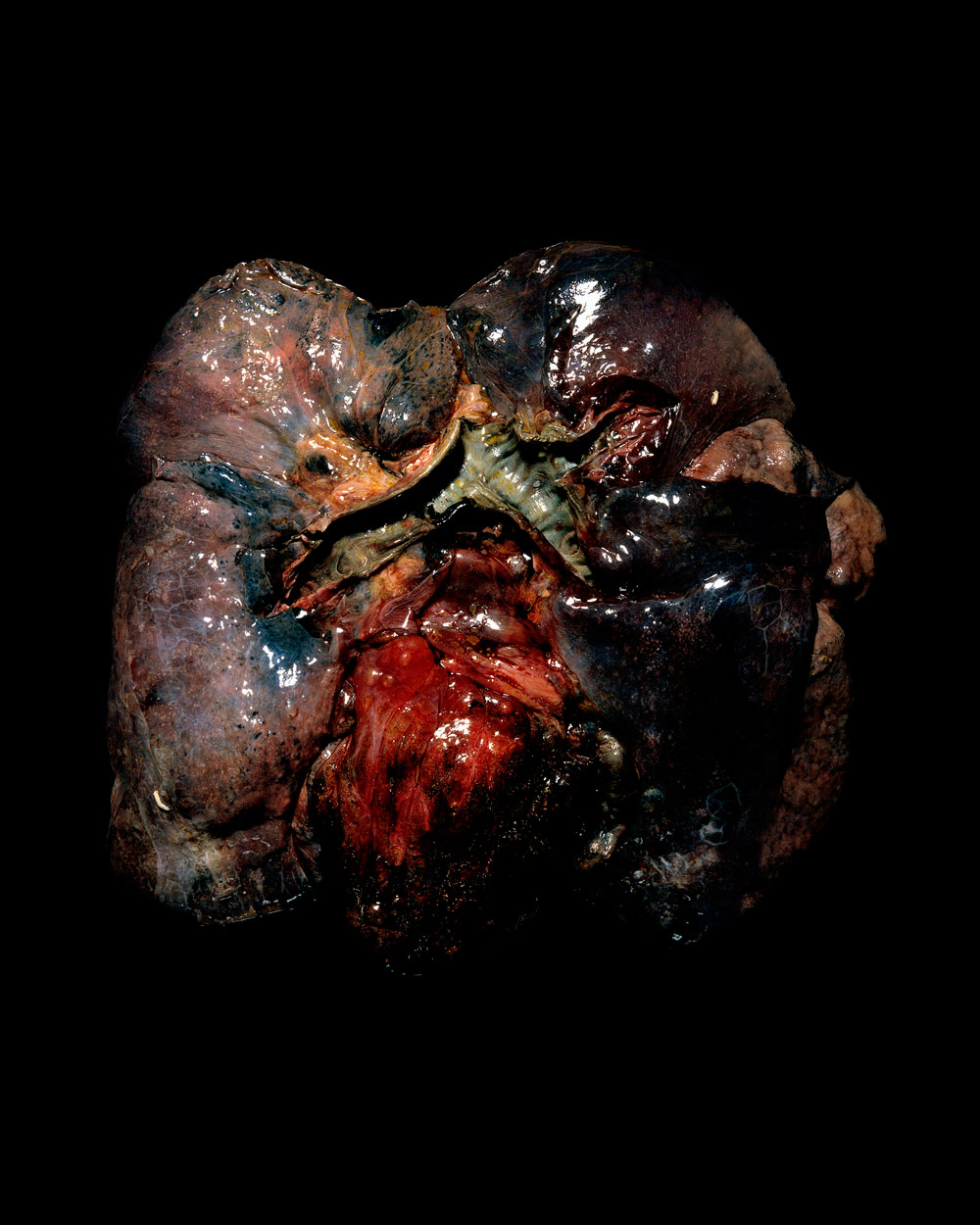
Raphaël Dallaporta (French, b. 1980) 'Fragile, Cardiopulmonary system' 2010


Raphaël Dallaporta (French, b. 1980)
Fragile, Cardiopulmonary system
2010
© Raphaël Dallaporta


Undetermined circumstances

The body of the subject whose presumed identity is …, aged 92, was found in a ditch around 10.05am by a walker whose attention had been attracted by his dog.

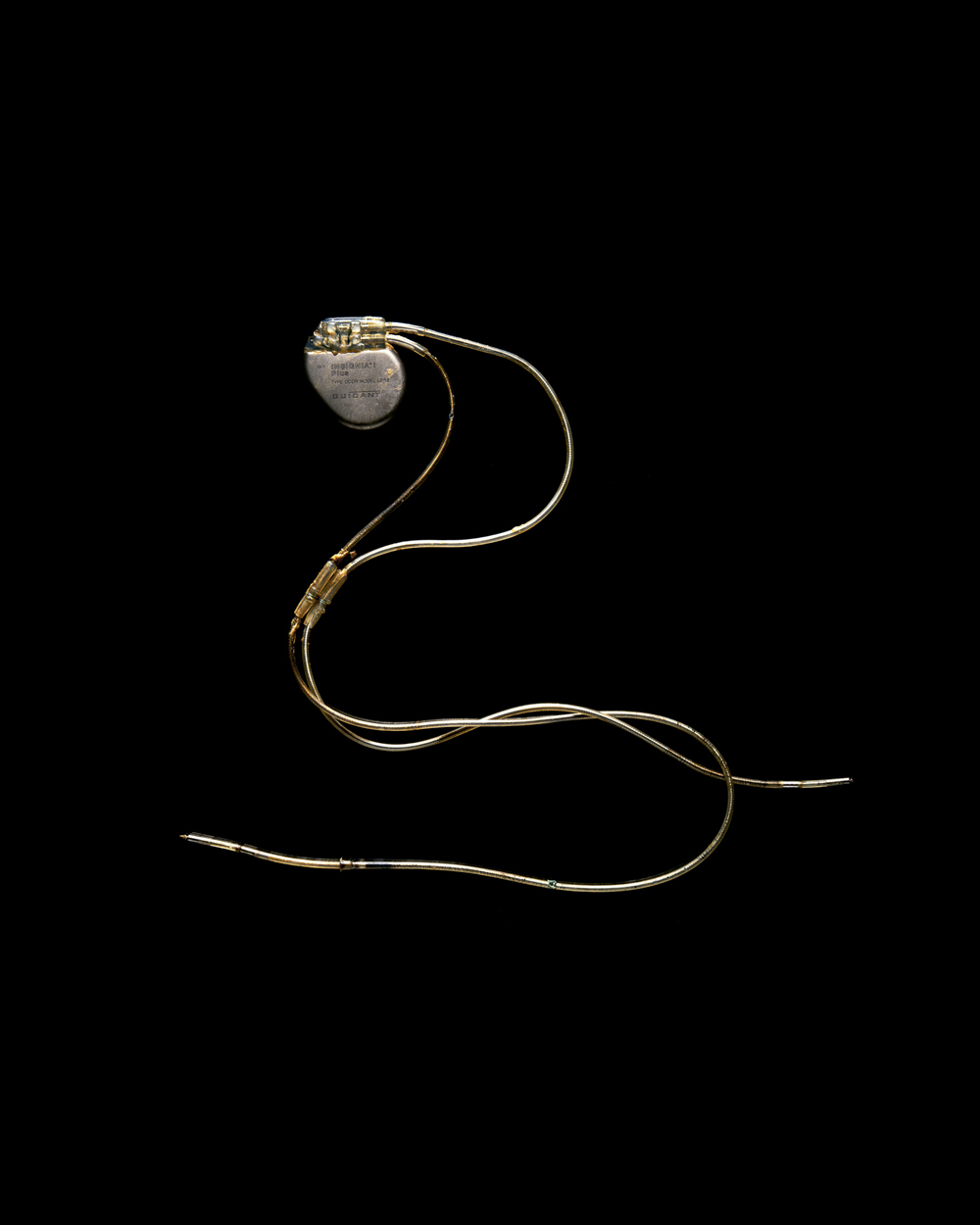
The autopsy that we carried out on the body showed the presence of a state of extremely advanced putrefaction with partial skeletonisation, consistent with a death dating back one month in an outdoor environment; it is not possible to be more precise. There is no immediately detectable cause of death. No lesions suggesting recent detectable violence were observed. As for identification, the deceased is an adult male, wearing a pacemaker and an old surgical scar on the abdominal wall.


Raphaël Dallaporta (French, b. 1980) 'Fragile, Pacemaker' 2010


Raphaël Dallaporta (French, b. 1980)
Fragile, Pacemaker
2010
© Raphaël Dallaporta


French photographer Raphaël Dallaporta (b. 1980) received the Foam Paul Huf Award earlier this year from an international jury. The prize is organised by Foam and is awarded annually to up and coming international photographers below the age of 35. A major aspect of the award is an exhibition. Observation appears at Foam from 2 September to 26 October. Characteristic of the show’s four series is the clinical, perceptive style of photography. Dallaporta’s photos possess an inner tension that stems from the beauty of the object and the serious tone of the subject. The photographer works intensively with specialists in fields relating to his series. Jury chair François Hébel (director of Les Rencontres d’Arles international photography festival) comments on Dallaporta’s work that ‘He combines involvement with a highly analytical approach to social perversities. His uncompromising, conceptual and extremely creative approach mark him as an authentic artist who stands out in the young generation of photographers.’

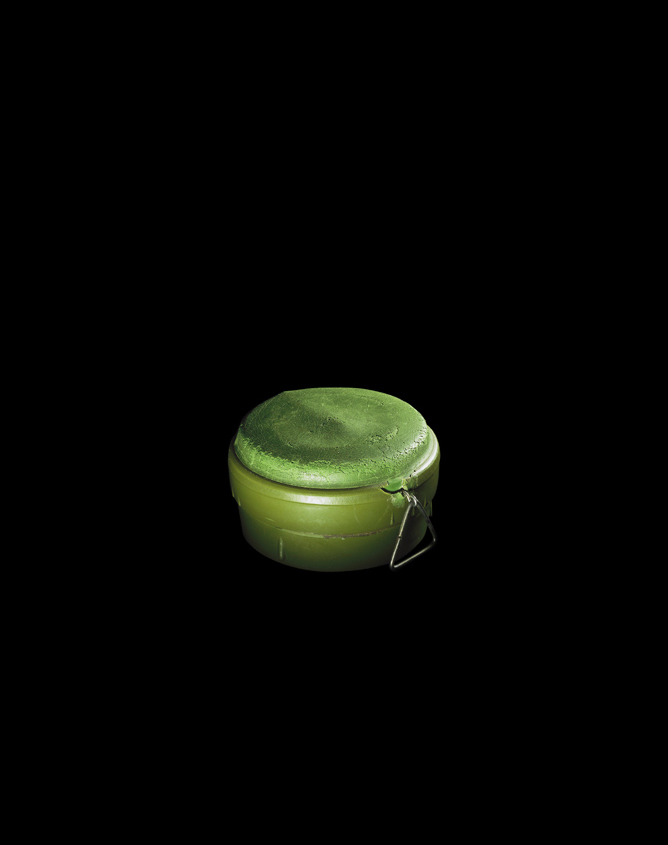
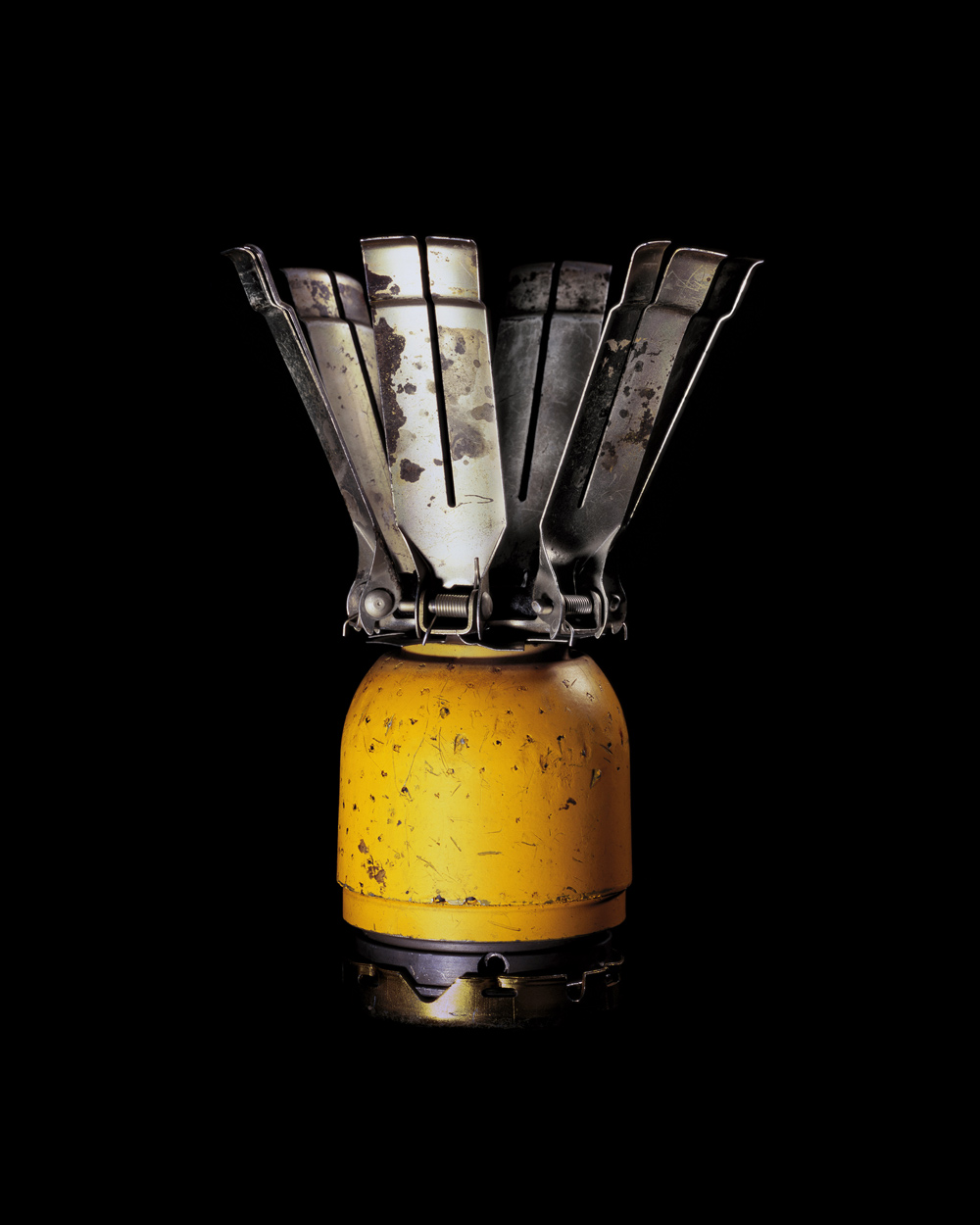
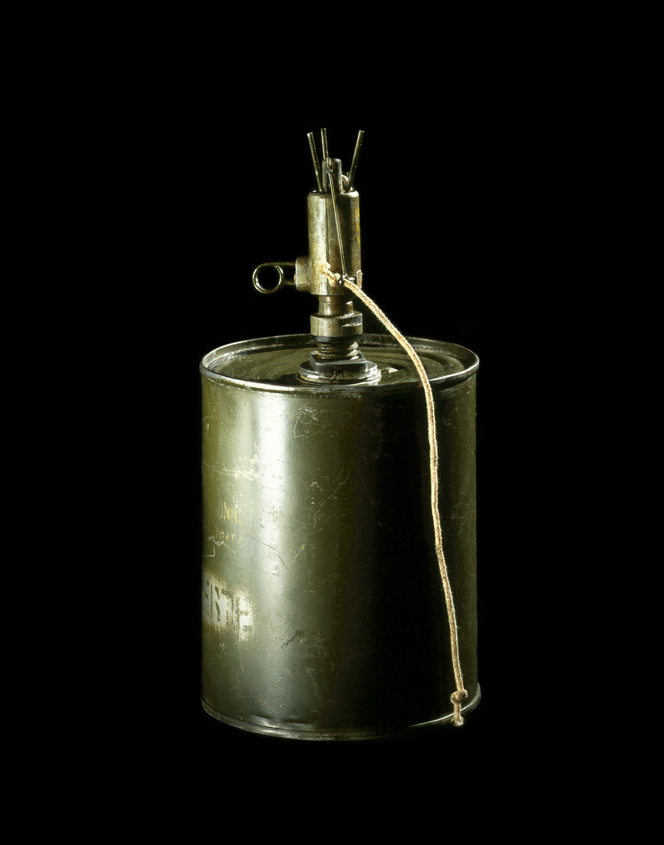
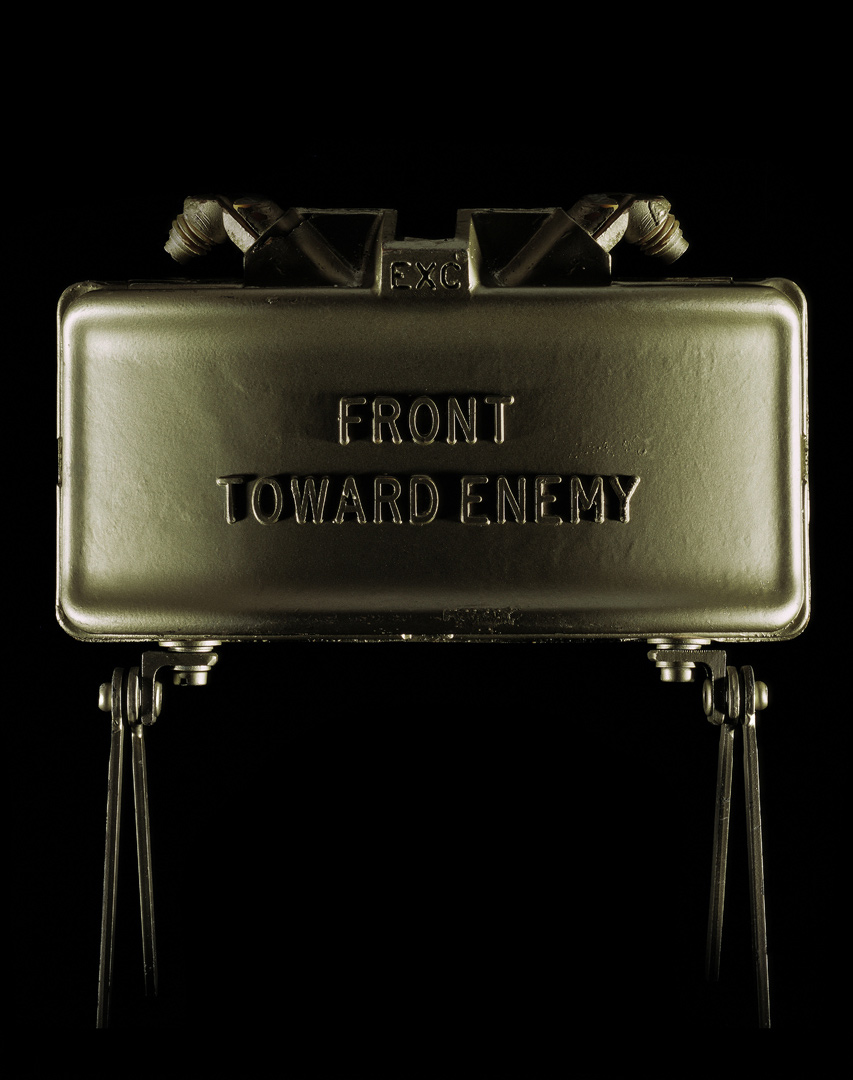
The landmines in the Antipersonnel series have an exquisite beauty: small, with pleasant colours and an attractive form. Elegantly photographed, simply framed and persuasively presented, their aesthetic quality is what first attracts attention. Until we realise the full purpose of their existence: pure cruelty.

Fragile features frontal and objective shots of organs and limbs taken from corpses. Dallaporta worked with a team of forensic surgeons for this series. While the physicians were looking for causes of death, Dallaporta recorded the body parts they examined and the instruments they used. The power of this work comes from the combination of apparently neutral images and texts relating to human pain.

Dallaporta also worked with experts when making Ruins. He travelled with a team of French archaeologists to Afghanistan. Using a drone – a small remote-controlled helicopter – he took numerous photos of the war-ravaged landscape. In combination, these form a single large aerial picture that also shows traces of ancient civilisations. Past and present come together in this series of almost scientific photos.

In Domestic Slavery, Dallaporta (pictures) and Ondine Millot (text) tackle the tragic reality of this phenomenon: people, many unregistered migrants, held against their will in places where their voice cannot be heard. While their names have been altered, the stories are true. Dallaporta’s clinical, unsentimental pictures of the buildings in which these modern-day slaves are kept testify to the banality of day-to-day inhumanity.

Text from the Foam website


Antipersonnel, 2004

Unknown objects seem to emerge from the darkness. The legend quickly informs us that they are anti-personnel mines. Raphaël Dallaporta deals with the object reproduced to scale and lets us imagine the consequences of its existence. There are no bloody reportage images to illustrate the mutilations caused by these devices. The photographer presents us with contemporary still life that appear inoffensive but that tend to be aestheticised by photographic techniques all the better to erase the actual use of the object.

Text from the Musée Nicéphore Niépce website [Online] Cited 29/03/2020


Raphaël Dallaporta (French, b. 1980) 'Antipersonnel, Blast Mine Type 72B China' 2004


Raphaël Dallaporta (French, b. 1980)
Antipersonnel, Blast Mine Type 72B China
2004
© Raphaël Dallaporta


Type 72 blast mines are said to make up 100 million of China’s 110 million antipersonnel landmine stockpiles (Chinese officials claim this figure is exaggerated). Manufactured by China North Industries Corporation (NORINCO), Type-72s are reportedly priced at US$3 each. The Type-72B includes an anti-handling mechanism that makes it impossible to neutralise – if the mine is moved more than 8º from the horizontal, it will explode, amputating the limb that activated it.


Raphaël Dallaporta (French, b. 1980) 'Antipersonnel, Submunition BLU-­3/B USA' 2004


Raphaël Dallaporta (French, b. 1980)
Antipersonnel, Submunition BLU-­3/B USA
2004
© Raphaël Dallaporta


On release from a CBU-2C.A bomb this 785 g submunition – known as the “Pineapple” – is stabilised and slowed in its descent by six fins. Each CBU-2C/A contains 409 BLU-3/Bs, of which nearly 25 percent do not explode on impact. d: 73mm W: 785g


Raphaël Dallaporta (French, b. 1980) 'Antipersonnel, Bounding Fragmentation Mine M-16, USA' 2004


Raphaël Dallaporta (French, b. 1980)
Antipersonnel, Bounding Fragmentation Mine M-16, USA
2004
© Raphaël Dallaporta


When detonated the M-16 antipersonnel bounding fragmentation mine is shot up approximately 1.5m in the air and explodes within 0.5 seconds, creating a lethal radius of 10m. Nicknamed the “Bouncing Betty,” each mine is supplied with four tripwires (two olive-green, two sand-coloured) and a wrench. In September 2002 (the most recent statistics available) the USA had 465,330 M16s in stock.


Raphaël Dallaporta (French, b. 1980) 'Antipersonnel, Directional Fragmentation Mine M-18/A1, USA' 2004


Raphaël Dallaporta (French, b. 1980)
Antipersonnel, Directional Fragmentation Mine M-18/A1, USA
2004
© Raphaël Dallaporta


A “Claymore” directional fragmentation mine releases 700 steel balls when detonated by a hand-turned dynamo, a tripwire or, when used with the “Matrix” system, remotely using a laptop computer. (Multiple Claymores can also be linked together using a detonator cord.) A 1996 Department of the Army filed manual states that, “the number of ways in which the Claymore may be employed is limited only by the imagination of the user.” In September 2002 (the most recent available statistics), Claymores made up 403,096 of the 10,404,148 landmines stockpiled by the USA.


Raphaël Dallaporta (French, b. 1980) 'Antipersonnel Bounding Fragmentation Mine, V-69, Italy' 2004


Raphaël Dallaporta (French, b. 1980)
Antipersonnel Bounding Fragmentation Mine, V-69, Italy
2004
© Raphaël Dallaporta


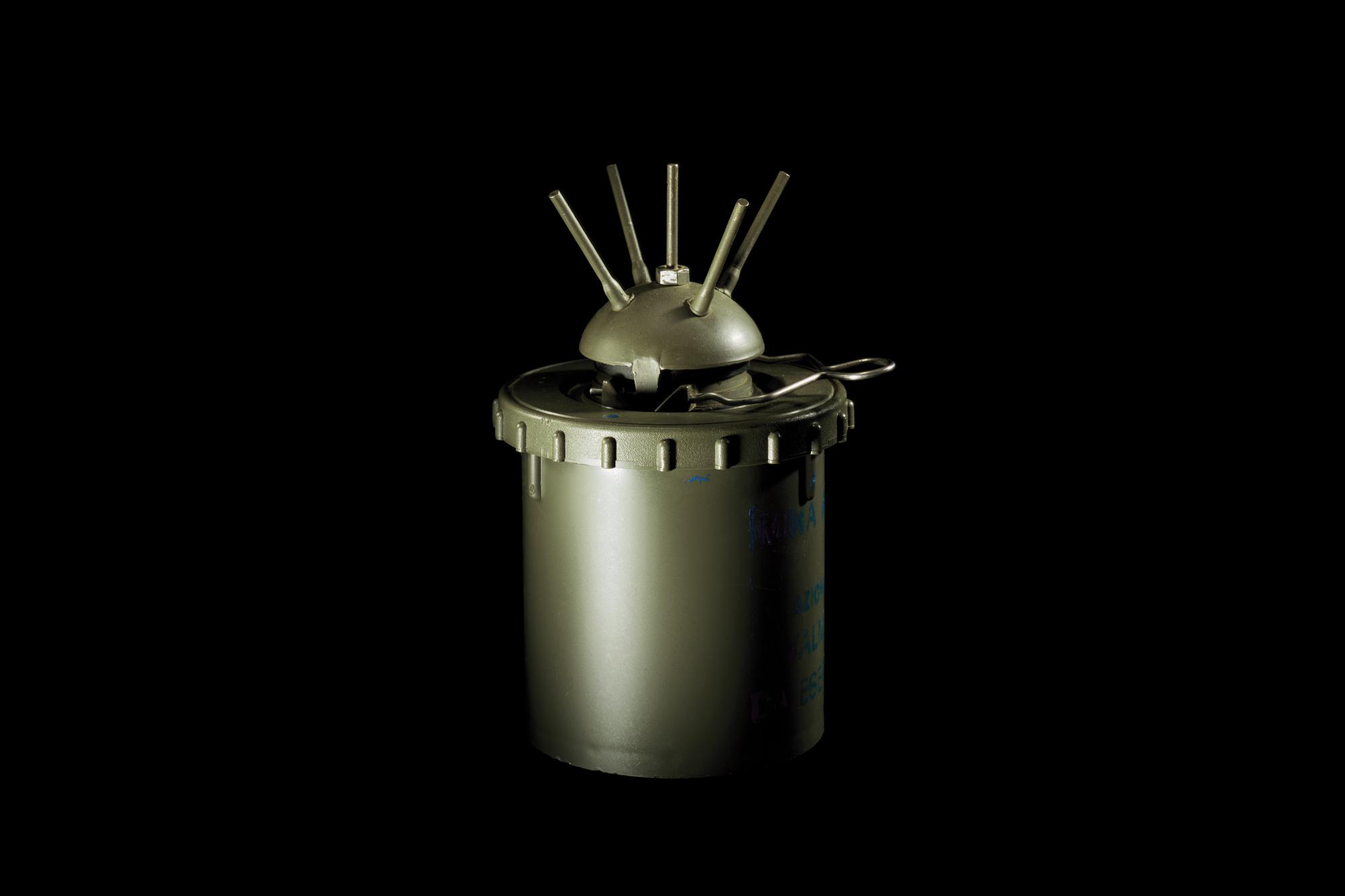
Antipersonnel Bounding Fragmentation Mine, V-69, Italy. The V-69 can be set off by footfall pressure or through a tripwire. When detonated the fuse sets off propellant gases that fire the mine’s inner body 45cm above the ground. This explodes sending out more than 1,000 pieces of chopped steel. Between 1982 and 1985, its manufacturer Valsella sold around 9 million V-69s to Iraq. The mine was given a nickname by Iraqi minelayers: the “Broom”. 120mm, 3.2kg.


Foam
Keizersgracht 609
1017 DS Amsterdam
The Netherlands
Phone: + 31 20 5516500

Opening hours:
Mon – Wed 10am – 6pm
Thu & Fri 10am – 9pm
Sat & Sun 10am – 6pm

Foam website

LIKE ART BLACK ON FACEBOOK

Back to top

Exhibition: ‘Line and Space. American Drawings and Sculpture since 1960, from a private collection’ at Pinakothek de Moderne, Munich

Exhibition dates: 28th July – 25th September 2011


Many thankx to the Pinakothek der Moderne for allowing me to publish the art work in the posting. Please click on the art work for a larger version of the image.


Barry Le Va (American, 1941-2021) 'Untitled' 1977


Barry Le Va (American, 1941-2021)
Untitled
1977
Pencil, ink and ballpoint on graph paper
Private collection
Photo: Arne Schultz
© Barry Le Va 2011


Sol LeWitt (American, 1928-2007) 'A2' 1967


Sol LeWitt (American, 1928-2007)
A2
1967
Painted steel
Private collection
Photo: Arne Schultz
© VG Bild-Kunst, Bonn 2011


Donald Judd (American, 1928-1994) 'Untitled' 1962


Donald Judd (American, 1928-1994)
Untitled
1962
Woodcut on paper, trial proof
Private collection
Photo: Arne Schultz
© Art Judd Foundation, Licensed by VAGA, NY / VG Bild-Kunst, Bonn 2011


Gordon Matta-Clark (American, 1943-1978) 'Untitled (cut drawing)' 1974


Gordon Matta-Clark (American, 1943-1978)
Untitled (cut drawing)
1974
Cuts in paper
Private collection
Photo: Arne Schultz
© VG Bild-Kunst, Bonn 2011


The exhibition, part of the AMERICAN SUMMER project, features the predominantly American holdings of drawings and sculptures from a private collection, with most of the works going on public display for the first time. What comes to the fore in this exemplary selection of largely American artists from the sixties and seventies and their impressive groups of works is the relationship between the media of sculpture and drawing. At the heart of the show lies the subtle dialogue between the conceptual ideas of ‘disegno’ and their sensual transfer to the materiality of sculpture.

One of the private collection’s particular strengths is its focus on groups of works by individual artists. As a result, entire rooms have been dedicated to the artists Fred Sandback and Barry Le Va, while in addition larger groups of works by other artists, including Donald Judd or Gordon Matta-Clark, can be studied in detail.

The selection of exhibits creates a display of the art movements of the sixties and seventies: among them, Minimal Art, as represented by Carl Andre, Bill Bollinger, Donald Judd, Dan Flavin and Fred Sandback, Post-minimalism of Barry Le Va or Keith Sonnier, Conceptual Art, as represented by Sol LeWitt, and Land Art of such artists as Michael Heizer and Walter de Maria. The exhibition is enriched with works from the Staatliche Graphische Sammlung München and the Sammlung Moderne Kunst.

A fully illustrated catalogue accompanies the exhibition: Der Raum der Linie – Amerikanische Zeichnungen und Skulpturen, edited by Michael Semff, Corinna Thierolf and Alexander Klar, with assistance from Pia Gottschaller and Birgitta Heid (containing essays from Jörg Daur, Pia Gottschaller, Birgitta Heid, Christiane Meyer-Stoll, Michael Semff, a conversation with Peter Soriano and an interview with the collector).

Press release from the Pinakothek de Moderne


Barry Le Va (American, 1941-2021) 'Bearings Rolled' 1966


Barry Le Va (American, 1941-2021)
Bearings Rolled
1966
Ink on paper
Sheet from a series of 15 drawings
Private collection
Photo: Arne Schultz
© Barry Le Va 2011


Fred Sandback (American, 1943-2003) 'Untitled (Milanese Drawing)' c. 1971/72


Fred Sandback (American, 1943-2003)
Untitled (Milanese Drawing)
c. 1971/1972
Chalk on paper
Private collection
Photo: Arne Schultz
© Fred Sandback Archive 2011


Dan Flavin (American, 1933-1996) 'from August 5, 1964' 1966


Dan Flavin (American, 1933-1996)
from August 5, 1964
1966
Crayon on black paper
Private collection
Photo: Arne Schultz
© Estate of Dan Flavin / VG Bild-Kunst, Bonn 2011


Sol LeWitt (American, 1928-2007) 'Incomplete open cube drawing - ten & eleven part variations' undated (c. 1973/74)


Sol LeWitt (American, 1928-2007)
Incomplete open cube drawing – ten & eleven part variations
Undated (c. 1973/1974)
Pencil and ink on paper
Private collection
Photo: Staatliche Graphische Sammlung München
© VG Bild-Kunst, Bonn 2011


Robert Mangold (American, b. 1937) '104" Perimeter Series' 1969


Robert Mangold (American, b. 1937)
104″ Perimeter Series
1969
Pencil on paper
Private Collection
Photo: Arne Schultz
© VG Bild-Kunst, Bonn 2011


Pinakothek Der Moderne
Barer Strasse 40
Munich

Gallery Hours:
Daily except Monday 10am – 6pm
Thursday 10am – 8pm

Pinakothek der Moderne website

LIKE ART BLART ON FACEBOOK

Back to top

Exhibition: ‘The Art of the Automobile: Masterpieces of the Ralph Lauren Collection’ at The Arts Décoratifs Museum, Paris

Exhibition dates: 28th April – 28th August 2011


Many thankx to The Arts Décoratifs Museum for allowing me to publish the photographs in the posting. Please click on the images for a larger version of the image.


Mercedes Benz SSK “Count Trossi”, 1930


Mercedes Benz SSK “Count Trossi”
1930
Ralph Lauren collection
© Photo Michael Furman


The notion of line in a car echoes that of the perfectly harmonious line of trajectory. The design is never far from this line, even in those coachworks designed without drawing boards, of which some of the most marvellous examples are seen here. It is interesting to see that in the French language at least, cars have taken on board the concept of ligne (or “line”), a word with many meanings. Yet the term ligne, taken in the sense that it is used nowadays in reference to coachwork, is classified by French lexicographer Littré within the sphere of fine art, and defined by him as: “the general effect produced by the coming together and combination of different parties of either a natural object or a composition.” The natural development of language thus shows us the relationship between cars and fine art.


Excerpt from the catalog, Editions Les Arts Décoratifs, Paris 2011


In 1970, Les Arts Décoratifs presented a selection of competition cars, “Bolides Design.” To compile the exhibition, a special jury was assembled, featuring designers Joe Colombo, Roger Tallon and Pio Manzu, and the artists Jean-Paul Riopelle, Jean Tinguely and Victor Vasarely, as well as Robert Delpire and François Mathey. The jury chose the models with the idea of the car as a design object, a work of art, showing that “art and technique, each at their own level, are the expression of man and his relationship with design.”

The Ralph Lauren collection can be seen from the same perspective. Patiently assembled over several decades by the fashion designer in a quest for speed and performance, it includes some of the most extraordinary jewels in the crown of European automobile history, with beauty as its common denominator.

Within the collection are some of the most elegant and innovative cars in automotive history, from the “Blower” Bentley (1929), the Ferrari 250 GTO (1962), the famous Mercedes 300 SL (1955) and the unforgettable Jaguar “D type,” whose shark fin blazed a triumphant trail at Le Mans in 1955, 1956 and 1957. But the grand tourer, the Bugatti Atlantic (1938) of which only four models were produced, represents the ultimate in luxury while showcasing the evolution of styles and techniques on the road. Each of these exceptional vehicles was designed as a masterpiece blending technological innovation and boldness of style.

For its first presentation in Europe, the Ralph Lauren collection will be put on display by Jean-Michel Wilmotte, who has opted for an intimate visual approach as these vehicles stand out both for their overall design and detail, as well as for bodywork, chassis and engines.

The kinetic and sound of the vehicles will be reproduced by means of several films and recordings. A seminar on automobile design will also be held during the exhibition.

Press release from The Arts Décoratifs Museum website


Mercedes Benz SSK “Count Trossi”, 1930


Mercedes Benz SSK “Count Trossi”
1930
Ralph Lauren collection
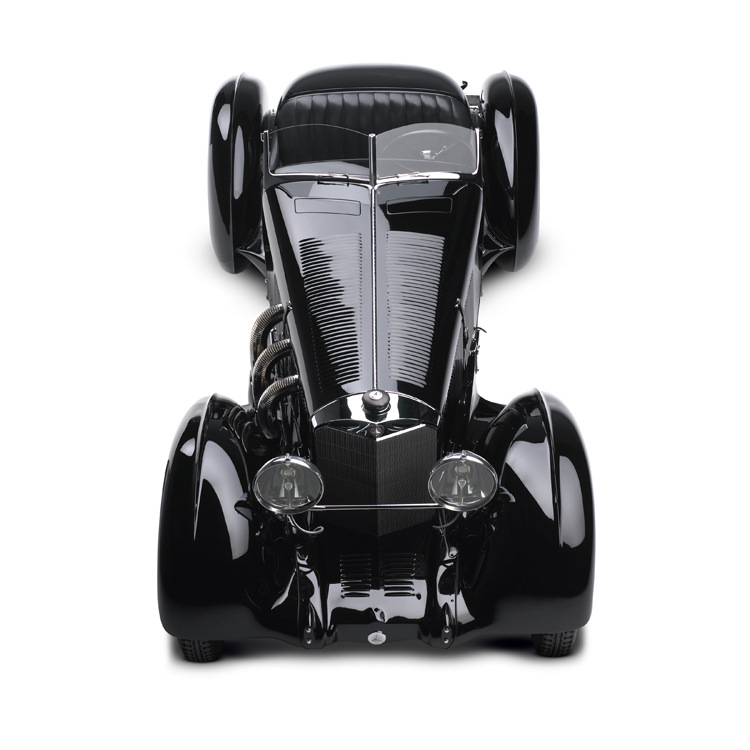
© Photo Michael Furman


Chassis number SSK 36038, currently owned by Ralph Lauren, remained unsold by the Mercedes-Benz factory in 1928, but was then sent out to Japan in 1930, before being brought back to Europe. This car was put together by the young British coach builder, Willy White, based on a design suggested by its aristocratic owner-cum-industrialist, Count Carlo Felice Trossi, himself a racing driver. The SSK, the archetypal Mercedes of the 1920s, built on a short chassis, is dominated by a colossal hood with a trio of exhaust pipes emerging from each side – a hood encompassing over half the car’s length with a radiator projecting out front as a windbreak. Its flamboyant rear end, dramatically tapered, adds a touch of civility to this extraordinary model, contrasting with the hieratic image of its front end. The supercharging gives the Mercedes SSK its fiery temperament, as well as the legendary noise of its seven litre straight 6 cylinder engine producing 300 CV and enabling a flat-out speed of 235kph!


Bugatti 57 SC Atlantic, 1938


Bugatti 57 SC Atlantic, 1938


Bugatti 57 SC Atlantic
1938
Collection Ralph Lauren
© Photo Michael Furman


According to Paul Bracq, “the Atlantic is a monument in the history of French coach building! More than any other car, it expresses a French-Italian look. An incredible sense of lightness is given off by this sculpture.” Powered by a straight 8 cylinder engine fitted with twin overhead camshafts and a compressor, this beauty is also incredibly fast, capable of reaching 200 kph. As the aluminium alloy used for the coachwork did not lend itself to shaping and soldering, Jean Bugatti was obliged to make the wings and roof in two parts and then assemble them with rivets. His talent lay precisely in the art of transforming this inconvenient technique into a stylistic advantage. Power and speed are suggested by the doors which are cut out of the roof and the ellipsoidal windows reminiscent of airplanes. Chassis number 57591 was the last of the four examples originally produced, a masterpiece embodying sport and luxury at their height – in short, the automobile exception.


Alfa Romeo 8C 2900 Mille Miglia, 1938


Alfa Romeo 8C 2900 Mille Miglia
1938
Collection Ralph Lauren
© Photo Michael Furman


This racing model fitted out with a straight 8 cylinder 2.9 litre engine with twin overhead camshafts supercharged by two compressors is equipped with fully independent suspension and a four speed rear transaxle. The whole thing is perfectly balanced, resulting in the most extraordinary roadholding. The hydraulic brakes are an additional bonus, enabling it to outclass its rivals at over 185 kph. The Turin factory called upon Carrozzeria Touring to design a small series of four two-seater roadsters intended to take part in the 1938 Mille Miglia, the first example of which is the car exhibited here. Driven by the Pintacuda-Mambelli team, the car came in an incredible second under the number 142. The tear drop shaped wings add the final touch to this extraordinary car which is considered to be one of the most prestigious pre-War Grand Touring Alfa Romeos.


Ferrari 375 Plus, 1954


Ferrari 375 Plus
1954
Collection Ralph Lauren
© Photo Michael Furman


The Ferrari known as the 375 Plus was an extrapolation of the Type 375 MM, a model powered by a V12 engine with three carburettors, a gearbox with four speeds plus reverse that increased its engine size to nearly 5 litres, giving it more power and enabling it to reach 340 CV, and attain 250 kph. Because Ferrari did not have its own design department, the 375 Plus, an absolute masterpiece, was created by highly qualified, talented artisans under the guidance of Pinin Farina, Ferrari’s official coach builder. Only five examples of the Type 375 Plus were made, including a spyder version which won the Le Mans 24 Hours in 1954. Ralph Lauren’s car, chassis number 0398 AM – the last of the series – left the factory in 1954 and had a relatively illustrious career in Argentina, often driven by Valiente.


Jaguar XKD, 1955


Jaguar XKD
1955
Collection Ralph Lauren
© Photo Michael Furman


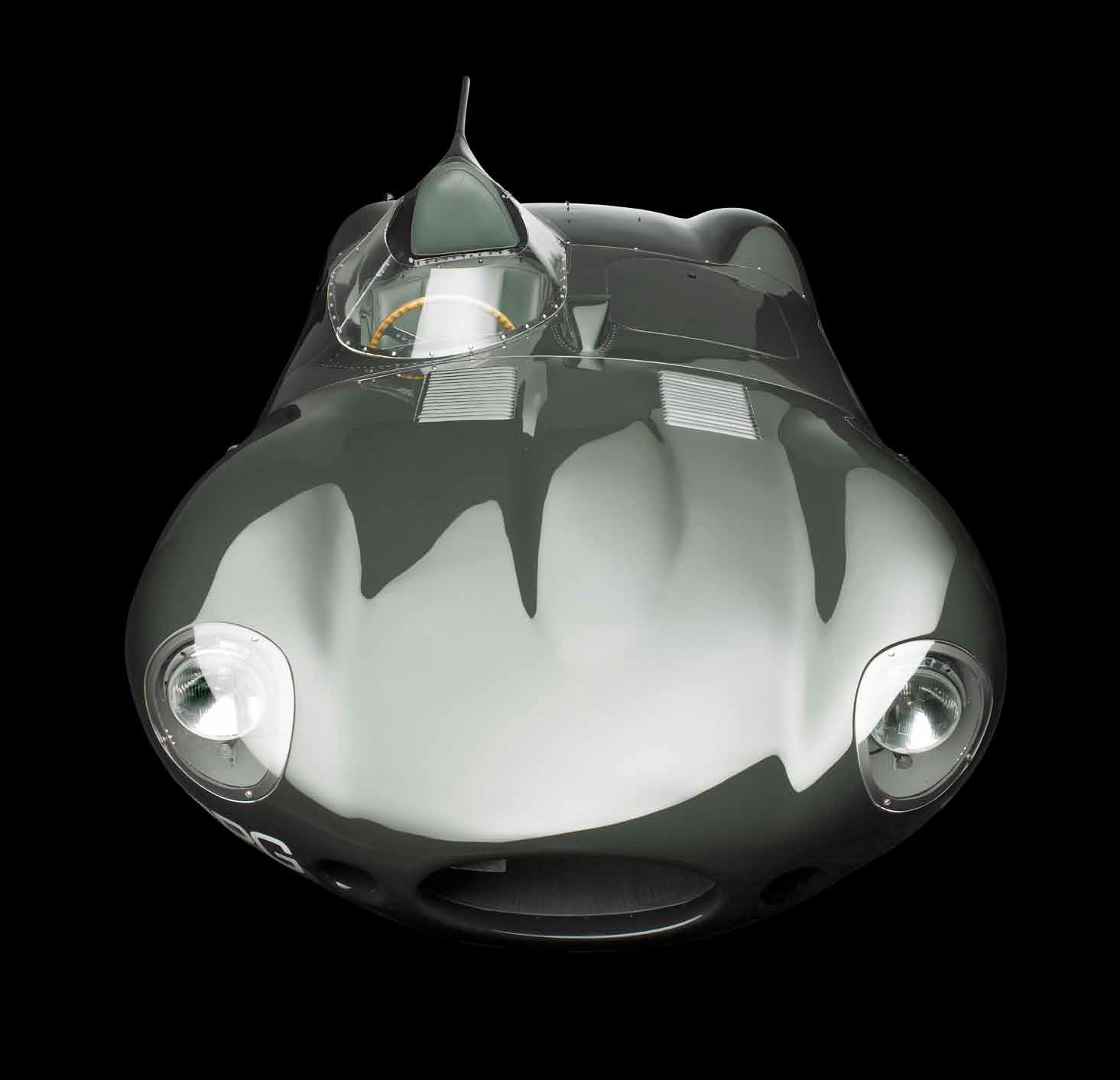
In order to find a worthy successor to the brilliant Jaguar Type XKC, winner on two occasions of the Le Mans 24 Hours, the aeronautic aerodynamicist Malcolm Sayer came up with a non-conformist vehicle. The D-Type has a long hood with no radiator grille, opening away from the block and a slender, extremely graceful rear, easily recognisable thanks to the highly original fin that extends the driver’s head-rest, providing greater stability at high speeds. With the classic straight 6 cylinder 3.4 litre engine, the D-Type, built on a monocoque structure, also has disk brakes. The “long-nosed” version (only 10 examples of which left the factory, including Ralph Lauren’s 505/601) gained an additional 15 kph at maximum speed, pushing it to 260 kph. No other car from the 1950s embodies speed better than this Jaguar D, with three consecutive victories in the Le Mans 24 Hours between 1955 and 1957 and another at Nurburgring in 1956. It was the most successful racing car of its generation.


Jaguar XKSS, 1958


Jaguar XKSS
1958
Collection Ralph Lauren
© Photo Michael Furman


Following on from Jaguar’s magnificent victories in the 1955 and 1956 Le Mans 24 Hours, demand from its enthusiastic clients was such that the company decided to make a road version of the XKD (straight 6 cylinder 3.4 litre engine with a 250 CV output capable of propelling the car to nearly 250 kph) which was named the XKSS. Principally aimed at the American market, it differed from the racing model in having a windscreen, a convertible roof, bumpers and a more civilised interior, and the famous fin was removed. Only 16 examples were constructed between January and February 1957, and a further two examples of the D-Type were transformed by the factory in 1958. Ralph Lauren’s car is one of these, created from the XKD 533 in 1956. It participated in the Six Heures du Forez in 1957, driven by Monnoyeur and Dupuy, finishing 7th, behind a fleet of Jaguar Ds which took the three first places.


Ferrari 250 Testa Rossa, 1958


Ferrari 250 Testa Rossa
1958
Collection Ralph Lauren
© Photo Michael Furman


The 250 Testa Rossa (red head) owes its name to the red camshaft covers of its V12 3 litre engine. Made by Carrozzeria Scaglietti, adapted from a design by Pinin Farina introducing a torpedo shaped body, the car had a headrest that stuck out above the bodywork and integrated headlights behind protruding Plexiglas protection. The very particular line of this vehicle proved to be primarily functional, rather than aesthetic. Indeed, the originality of the pontoon fenders enabled the wheels to remain partially uncovered, to allow for a sufficient supply of cold air to the drum brakes. Equipped with a light body that allowed it to attain 270 kph, its 300 CV engine carried it to victory on numerous occasions, including in the Le Mans 24 Hours in 1958, 1960 and 1961. Ralph Lauren’s car is the 14th of 34 similar examples produced by Ferrari.


Ferrari 250 GT Berlinetta SWB, 1960


Ferrari 250 GT Berlinetta SWB
1960
Collection Ralph Lauren
© Photo Michael Furman


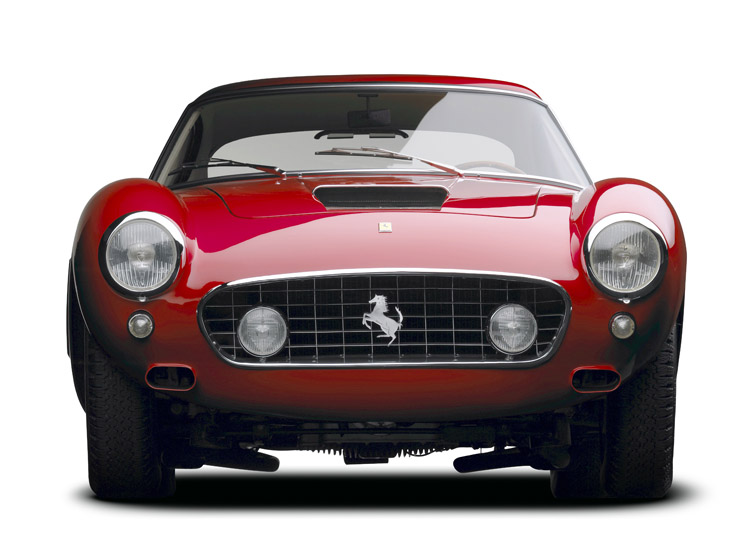
While the name 250 GT appeared in the Maranello catalog in 1955, the 1959 Paris Motor Show presented a short chassis Berlinetta version, with a wheelbase 20 cms shorter than other versions of the line – a thoroughbred equipped for the road, with aluminium coachwork designed by Pinin Farina and made in the Scaglietti workshops in Modena. Compared to the grand tourer version, intended for road use, the racing version was devoid of all luxury interior trimmings and bumpers, but equipped with disk brakes and a 280 CV engine that enabled this flagship model to masterfully dominate the legendary Tour de France automobile for three consecutive seasons (1960-1962) and the GT category of the Le Mans 24 Hours. Its sensual line, unequalled handling and performance (250kph), and list of victories, all combined to make the short chassis 250 GT Berlinetta one of Ferrari’s most popular models. Ralph Lauren’s car was the 31st example to leave the factory out of the 165 produced.


Ferrari 250 GTO, 1962


Ferrari 250 GTO
1962
Collection Ralph Lauren
© Photo Michael Furman


Designed in the utmost secrecy, the 250 GTO is considered by aficionados today to be the quintessential vintage Ferrari model, both technically and aesthetically, embodying one of the most famous and most expensive sports cars of all time. This Grand Tourer, of which only 39 examples were produced, clocked up an impressive list of victories, including the International Championship for GT Manufacturers in 1962, 1963 and 1964, thanks to its V12 300 CV engine situated up front, but also because of the lightness of its aluminium body, enabling it to attain 280 kph flat out! With its Scaglietti coachwork and its long hood, stocky cockpit and truncated rear, it symbolised the Grand Tourer par excellence. Ralph Lauren’s car was the 21st out of 36 Series I GTOs produced, and won many races driven by Pedro and Ricardo Rodriguez, Roger Penske, Augie Pabst and Richie Ginther.


The Arts Décoratifs Museum
107 rue de Rivoli
75001 Paris
Phone: +33 01 44 55 57 50

Open Tuesday to Sunday 11am – 6pm

The Arts Décoratifs Museum website

LIKE ART BLART ON FACEBOOK

Back to top

Exhibition: ‘Hiroshima: Ground Zero 1945’ at the International Center of Photography, New York

Exhibition dates: 20th May – 28th August, 2011


United States Strategic Bombing Survey, Physical Damage Division. '[Ruins of the Hiroshima Prefectural Commercial Exhibition Hall (A-Bomb Dome)]' October 24, 1945


United States Strategic Bombing Survey, Physical Damage Division
[Ruins of the Hiroshima Prefectural Commercial Exhibition Hall (A-Bomb Dome)]
October 24, 1945
Gelatin silver print
© International Center of Photography


The “United States Strategic Bombing Survey, Physical Damage Division”. Don’t you just love the irony in this title? The aim of the military group who took these photographs as part of a survey on “strategic bombing” of Hiroshima was to document the physical damage that took place. As if an atomic bomb is anything other than destructive! As if an atomic bomb is anything other than catastrophic! As if an atomic bomb is anything less than death itself!

Upon this realisation, the father of the atomic bomb, J. Robert Oppenheimer, famously quoted the Bhagavad Gita after the detonation of the first bomb on July 16, 1945 in the Trinity test in New Mexico, “Now, I am become Death, the destroyer of worlds.”

In saying that, military jurisprudence, that disciplinary machine of death, becomes not only the recorder of destruction but also the re-ordering of the world, thus re(c)ording the world under Foucault’s Matrix of Practical Reason:

~ Through the technologies of production, which permit us to produce, transform or manipulate things

~ Through the technologies of power, which determine the conduct of individuals and submit them to certain ends or domination, an objectivising of the subject.1


In short, the military is power; the military subjugates humans; and the military destroys at will.

The strange beauty of the Physical Damage Division photographs is that they simply document what remains. Like the “shadow” of a hand valve wheel on the painted wall of a gas storage tank, Ground Zero is burnt onto the ground glass of the camera.

Like the “shadow” these events are eternally seared into the collective memory never, ever, to be forgotten.

Dr Marcus Bunyan


1/ Foucault, Michel. “Technologies of the Self,” quoted in Martin, Luther and Gutman, Huck and Hutton, Patrick (eds.,). Technologies of the Self: A Seminar with Michel Foucault. London: Tavistock Publications, 1988, p. 18


Many thankx to the International Center of Photography for allowing me to publish the photographs in the posting. Please click on the photographs for a larger version of the image.


United States Strategic Bombing Survey, Physical Damage Division. '[View of burned-over area with Hiroshima Kirin Beer Hall at far right]' October 16, 1945


United States Strategic Bombing Survey, Physical Damage Division
[View of burned-over area with Hiroshima Kirin Beer Hall at far right]
October 16, 1945
Gelatin silver print
3 11/16 x 4 9/16 in. (9.4 x 11.6cm)
© International Center of Photography
Purchase, with funds provided by the ICP Acquisitions Committee, 2006


United States Strategic Bombing Survey, Physical Damage Division. '[Ruins of Shima Surgical Hospital, Hiroshima]' October 24, 1945


United States Strategic Bombing Survey, Physical Damage Division
[Ruins of Shima Surgical Hospital, Hiroshima]
October 24, 1945
Gelatin silver print
4 1/8 x 6 1/16 in. (10.5 x 15.4cm)
© International Center of Photography
Purchase, with funds provided by the ICP Acquisitions Committee, 2006


United States Strategic Bombing Survey, Physical Damage Division. '[Group of people near damaged trolley cars, Hiroshima]' October 31, 1945


United States Strategic Bombing Survey, Physical Damage Division
[Group of people near damaged trolley cars, Hiroshima]
October 31, 1945
Gelatin silver print
3 11/16 x 4 7/16 in. (9.4 x 11.3cm)
© International Center of Photography
Purchase, with funds provided by the ICP Acquisitions Committee, 2006


United States Strategic Bombing Survey, Physical Damage Division. '[Distorted steel-frame structure of Odamasa Store, Hiroshima]' November 20, 1945


United States Strategic Bombing Survey, Physical Damage Division
[Distorted steel-frame structure of Odamasa Store, Hiroshima]
November 20, 1945
Gelatin silver print
© International Center of Photography


United States Strategic Bombing Survey, Physical Damage Division. '[Reinforced-concrete fire shutter in cast wall of Yasuda Life Insurance Company, Hiroshima branch]' November 15, 1945


United States Strategic Bombing Survey, Physical Damage Division
[Reinforced-concrete fire shutter in cast wall of Yasuda Life Insurance Company, Hiroshima branch]
November 15, 1945
Gelatin silver print
3 11/16 x 4 3/4 in. (9.4 x 12.1cm)
© International Center of Photography
Purchase, with funds provided by the ICP Acquisitions Committee, 2006


United States Strategic Bombing Survey, Physical Damage Division. '[Ruins of Chugoku Coal Distribution Company or Hiroshima Gas Company]' November 8, 1945


United States Strategic Bombing Survey, Physical Damage Division
[Ruins of Chugoku Coal Distribution Company or Hiroshima Gas Company]
November 8, 1945
Gelatin silver contact print
© International Center of Photography


United States Strategic Bombing Survey, Physical Damage Division. '[Remains of a school building]' November 17, 1945


United States Strategic Bombing Survey, Physical Damage Division
[Remains of a school building]
November 17, 1945
Gelatin silver contact print
© International Center of Photography


Once-classified images of atomic destruction at Hiroshima will be displayed in a new exhibition Hiroshima: Ground Zero 1945 at the International Center of Photography (1133 Avenue of the Americas at 43rd Street) from May 20 to August 28, 2011. Drawn from ICP’s permanent collection, the Hiroshima archive includes more than 700 images of absence and annihilation, which formed the basis for civil defence architecture in the United States. These images had been mislaid for over forty years before being acquired by ICP in 2006.

This exhibition will include approximately 60 contact prints and photographs as well as the secret 1947 United States Strategic Bombing Survey (USSBS) report, The Effects of the Strategic Bombing on Hiroshima, Japan. It will be accompanied by a catalogue published by ICP/Steidl, with essays by John W. Dower, Adam Harrison Levy, David Monteyne, Philomena Mariani, and Erin Barnett.

After the nuclear attacks in August 1945, President Truman dispatched members of the USSBS to Japan to survey the military, economic, and civilian damage. The Survey’s Physical Damage Division photographed, analysed, and evaluated the atomic bomb’s impact on the structures surrounding the Hiroshima blast site, designated “Ground Zero.” The findings of the USSBS provided essential information to American architects and civil engineers as they debated the merits of bomb shelters, suburbanisation, and revised construction techniques.

The photographs in this exhibition were in the possession of Robert L. Corsbie, an executive officer of the Physical Damage Division who later worked for the Atomic Energy Commission. An architectural engineer and expert on the effects of the atomic bomb, he used what he learned from the structural analyses and these images to promote civil defence architecture in the U.S. The photographs went through a series of unintended moves after Corsbie, his wife and son died in a house fire in 1967.

The U.S., at war with Japan, detonated the world’s first weaponised atomic bomb over Hiroshima, a vast port city of over 350,000 inhabitants, on August 6, 1945. The blast obliterated about 70 percent of the city and caused the deaths of more than 140,000 people. Three days later, the U.S. dropped a second nuclear bomb on Nagasaki, resulting in another 80,000 fatalities. Within a week, Japan announced its surrender to the Allied Powers, effectively ending World War II.

“Once part of a classified cache of government photographs, this archive of haunting images documents the devastating power of the atomic bomb,” said ICP Assistant Curator of Collections Erin Barnett, who organised the exhibition.

Press release from the International Center of Photography website


United States Strategic Bombing Survey, Physical Damage Division. '["Shadow" of a hand valve wheel on the painted wall of a gas storage tank; radiant heat instantly burned paint where the heat rays were not obstructed, Hiroshima]' October 14 - November 26, 1945


United States Strategic Bombing Survey, Physical Damage Division
[“Shadow” of a hand valve wheel on the painted wall of a gas storage tank; radiant heat instantly burned paint where the heat rays were not
obstructed, Hiroshima]
October 14 – November 26, 1945
Gelatin silver print
© International Center of Photography


United States Strategic Bombing Survey, Physical Damage Division. '[Interior of Hiroshima City Hall auditorium with undamaged walls and framing but spalling of plaster and complete destruction of contents by fire]' November 1, 1945


United States Strategic Bombing Survey, Physical Damage Division
[Interior of Hiroshima City Hall auditorium with undamaged walls and framing but spalling of plaster and complete destruction of contents by fire]
November 1, 1945
Gelatin silver print
© International Center of Photography


United States Strategic Bombing Survey, Physical Damage Division. '[Ruins of Sumitomo Fire Insurance Company, Hiroshima branch]' October 24, 1945


United States Strategic Bombing Survey, Physical Damage Division
[Ruins of Sumitomo Fire Insurance Company, Hiroshima branch]
October 24, 1945
Gelatin silver print
3 3/16 x 4 7/16 in. (8.1 x 11.3cm)
© International Center of Photography
Purchase, with funds provided by the ICP Acquisitions Committee, 2006


United States Strategic Bombing Survey, Physical Damage Division. '[Rooftop view of atomic destruction, looking southwest, Hiroshima]' October 31, 1945


United States Strategic Bombing Survey, Physical Damage Division
[Rooftop view of atomic destruction, looking southwest, Hiroshima]
October 31, 1945
Gelatin silver print
© International Center of Photography


United States Strategic Bombing Survey, Physical Damage Division. '[Burned-over landscape north of ground zero in the vicinity of Hiroshima Castle]' October 31, 1945


United States Strategic Bombing Survey, Physical Damage Division
[Burned-over landscape north of ground zero in the vicinity of Hiroshima Castle]
October 31, 1945
Gelatin silver print
3 3/4 x 4 5/8 in. (9.5 x 11.7cm)
© International Center of Photography
Purchase, with funds provided by the ICP Acquisitions Committee, 2006


United States Strategic Bombing Survey, Physical Damage Division. '[Interior with heavy spalling of cement plaster by fire in combustiible floor of Yasuda Life Insurance Company, Hiroshima branch]' November 1, 1945


United States Strategic Bombing Survey, Physical Damage Division
[Interior with heavy spalling of cement plaster by fire in combustiible floor of Yasuda Life Insurance Company, Hiroshima branch]
November 1, 1945
Gelatin silver print
3 11/16 x 4 3/4 in. (9.4 x 12.1cm)
© International Center of Photography
Purchase, with funds provided by the ICP Acquisitions Committee, 2006


United States Strategic Bombing Survey, Physical Damage Division. '[Damaged turbo-generator and electrical panel of Chugoku Electric Company, Minami Sendamachi Substation, Hiroshima]' November 18, 1945


United States Strategic Bombing Survey, Physical Damage Division
[Damaged turbo-generator and electrical panel of Chugoku Electric Company, Minami Sendamachi Substation, Hiroshima]
November 18, 1945
Gelatin silver print
3 13/16 x 4 7/16 in. (9.7 x 11.3cm)
© International Center of Photography
Purchase, with funds provided by the ICP Acquisitions Committee, 2006


United States Strategic Bombing Survey, Physical Damage Division. '[Steel stairs warped by intense heat from burned book stacks of Asano Library, Hiroshima]' November 15, 1945


United States Strategic Bombing Survey, Physical Damage Division
[Steel stairs warped by intense heat from burned book stacks of Asano Library, Hiroshima]
November 15, 1945
Gelatin silver contact print
© International Center of Photography


International Center of Photography
79 Essex Street, New York, NY 10002
between Delancey Street and Broome Street

Opening hours:
Wednesday – Monday 11am – 7pm
Closed: Tuesday

International Center of Photography website

LIKE ART BLART ON FACEBOOK

Back to top

The Museum of Old and New Art (MONA), Hobart

August 2011


MONA exterior, Hobart


MONA exterior, Hobart
Image Courtesy of MONA Museum of Old and New Art


“Lyotard writes,”We must not begin with transgression, we must immediately go to the very end of cruelty, construct the anatomy of polymorphous perversion, unfold the immense membrane of the libidinal ‘body,’ which is quite the inverse of a system of parts.” Lyotard sees this “membrane” as composed of the most heterogeneous items: human bone and writing paper, steel and glass, syntax and the skin on the inside of the thigh. In the libidinal economy, writes Lyotard: “All of these zones are butted end to end … on a Moebius strip … a moebian skin [an] interminable band of variable geometry (a concavity is necessarily a convexity at the next turn) [with but] a single face, and therefore neither exterior nor interior.”


Jean-François Lyotard quoted in Victor Burgin. In/Different Spaces 1


“Taking a walk is also an extremely immediate form of experience. Serge Daney describes the act of perception while taking a walk: ‘Because I am not particularly fond of bravura pieces, I always need a transition from one thing to the next. And I am glad that I can find it through by body and experience of walking…’
The visual memory of the walker / viewer determines the sequence of the pictures. Since the 1960s Marcel Broodthaers has defined the exhibition as a cinematic sequence of pictures and objects, thereby subverting the fixity of the single object through recontextualisation.”


Serge Daney quoted in Hans Obrist. “In the Midst of Things, At the Centre of Nothing.”2


Libidinal, Moebic MONA

My analogy: you are standing in the half-dark, your chest open, squeezing the beating heart with blood coursing between your fingers while the other hand is up your backside playing with your prostrate gland. I think ringmeister David Walsh would approve.

My best friends analogy: a cross between a car park, night club, sex sauna and art gallery.

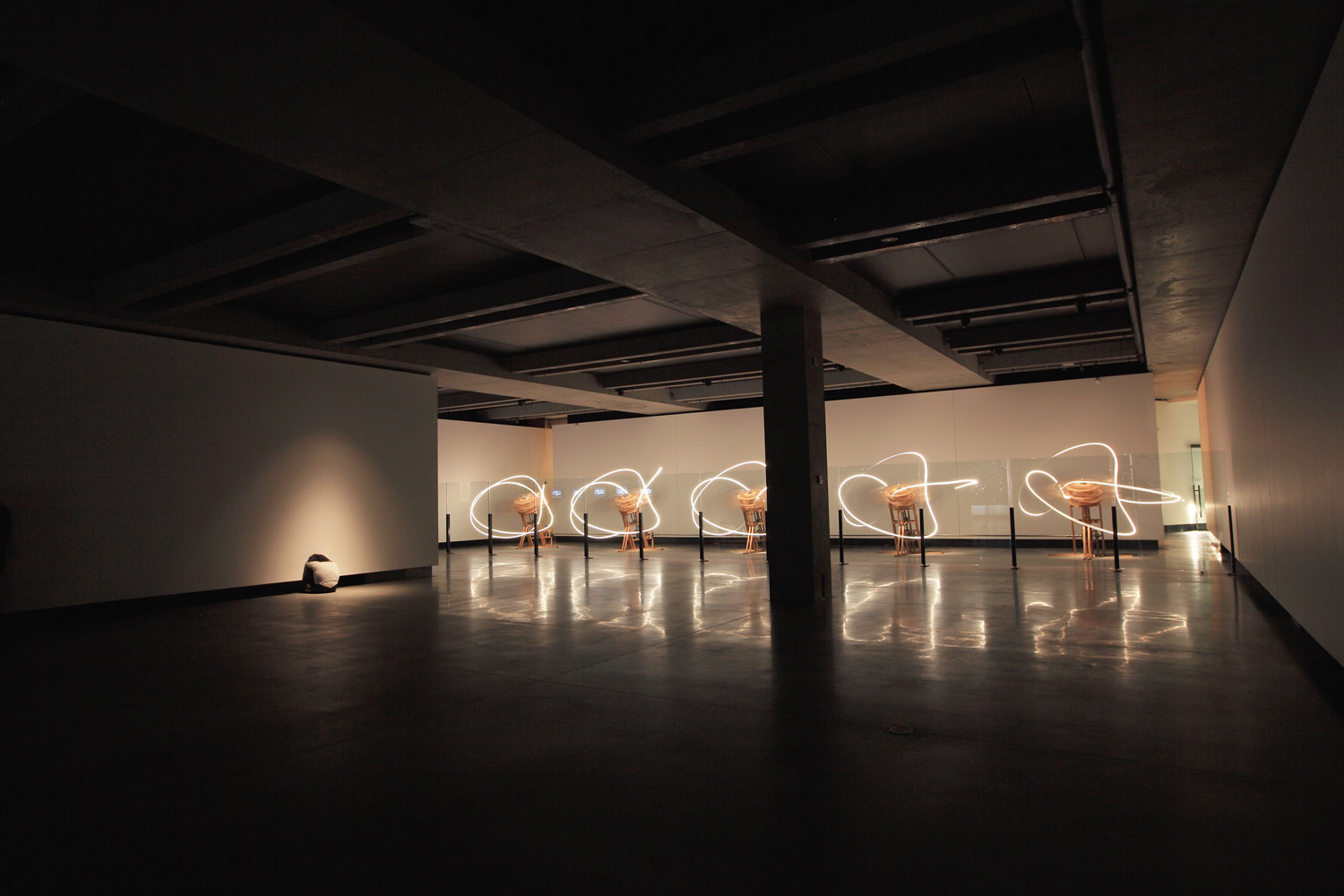
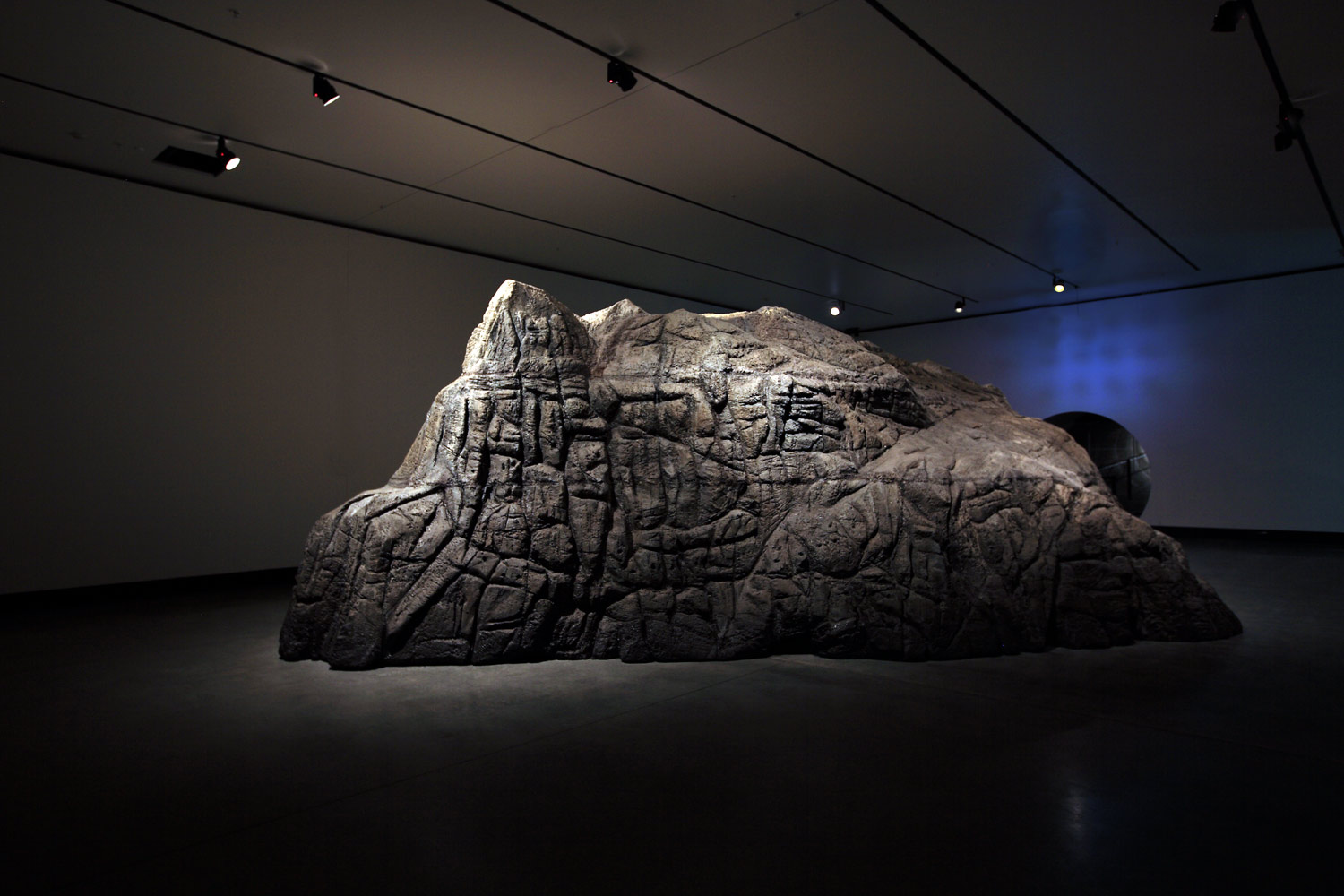
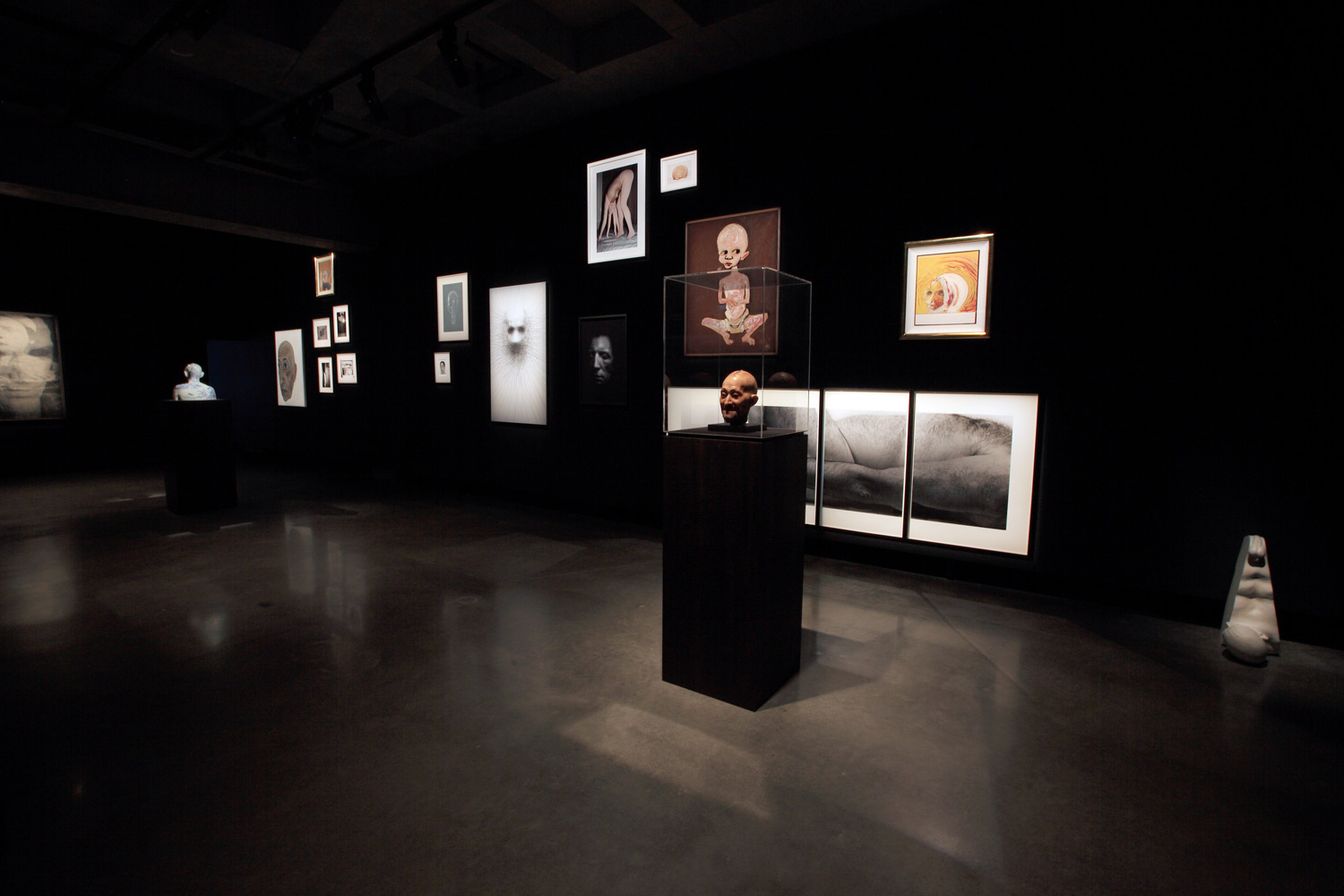
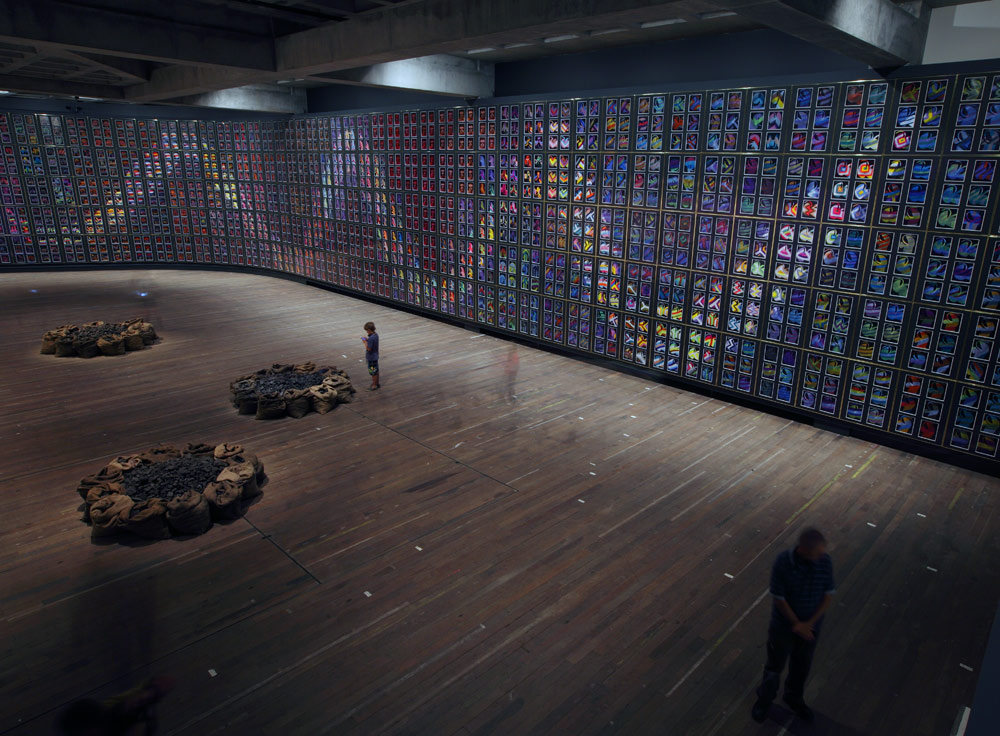
Weeks later I am still thinking about the wonderful immersive, sensory experience that is MONA. Peter Timms in an insightful article in Meanjin calls it a post-Google Wunderkammer, or wonder chest.3 It can be seen as a mirabilia – a non-historic installation designed primarily to delight, surprise and in this case shock. The body, sex, death and mortality are hot topics in the cultural arena4 and Walsh’s collection covers all bases. The collection and its display are variously hedonistic, voyeuristic, narcissistic, fetishistic pieces of theatre subsumed within the body of the spectacular museum architecture.

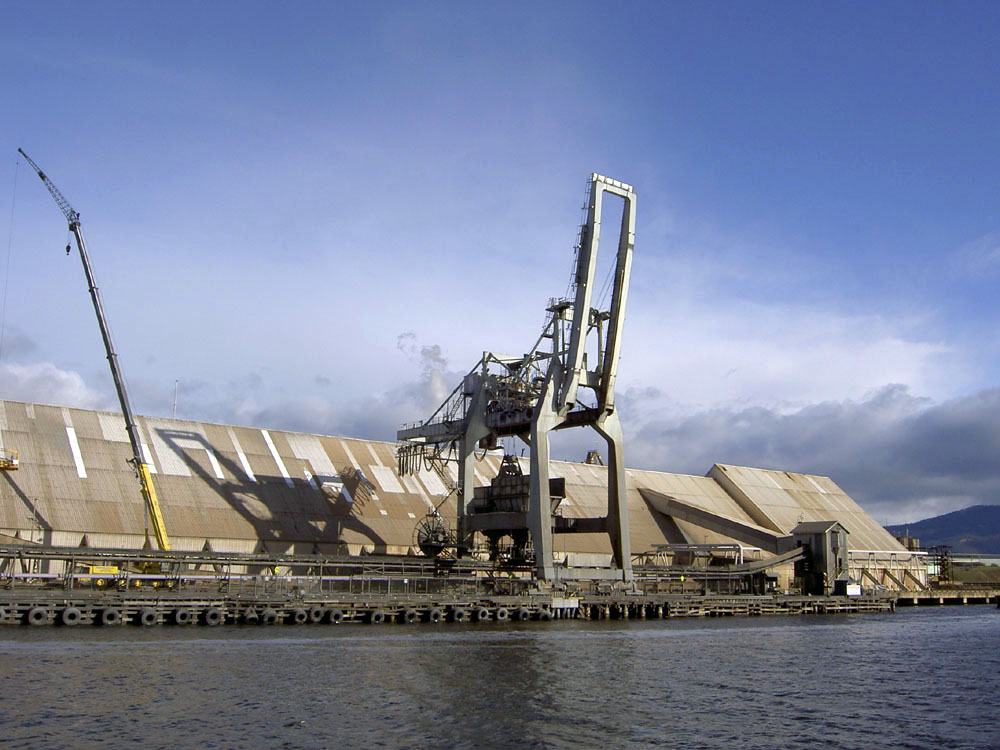
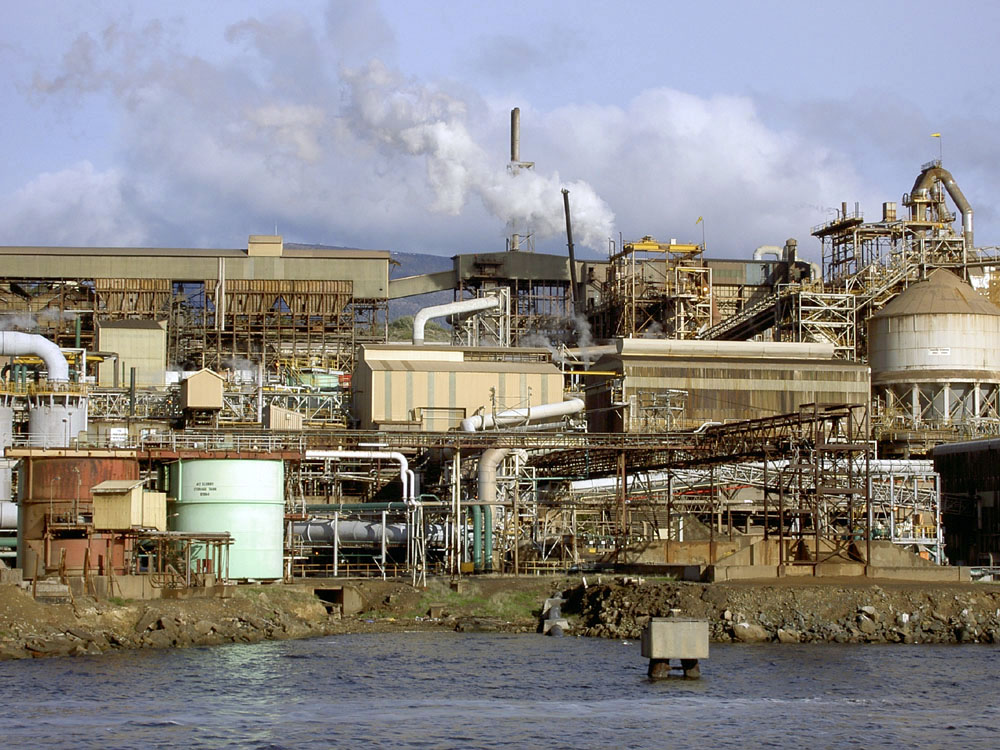
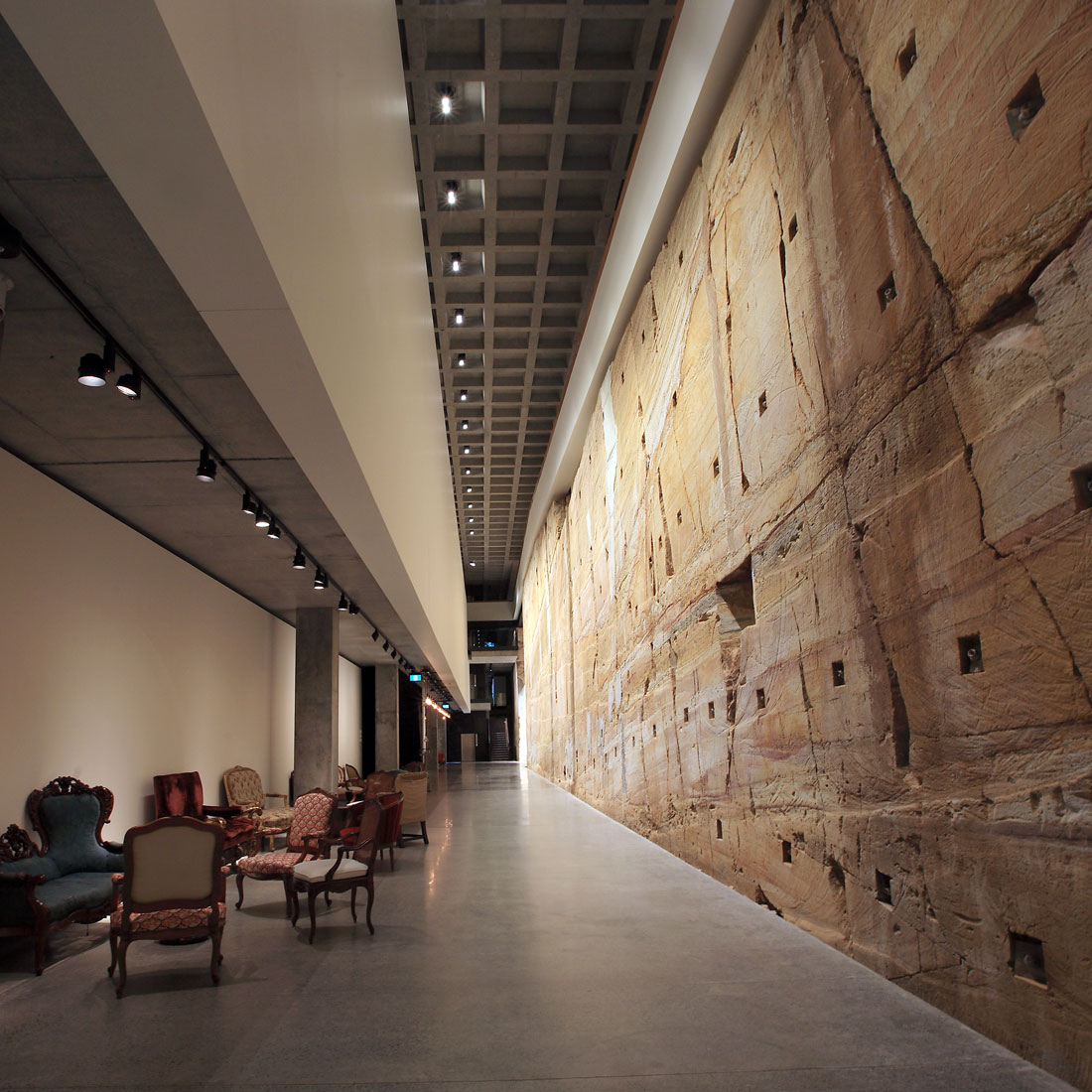
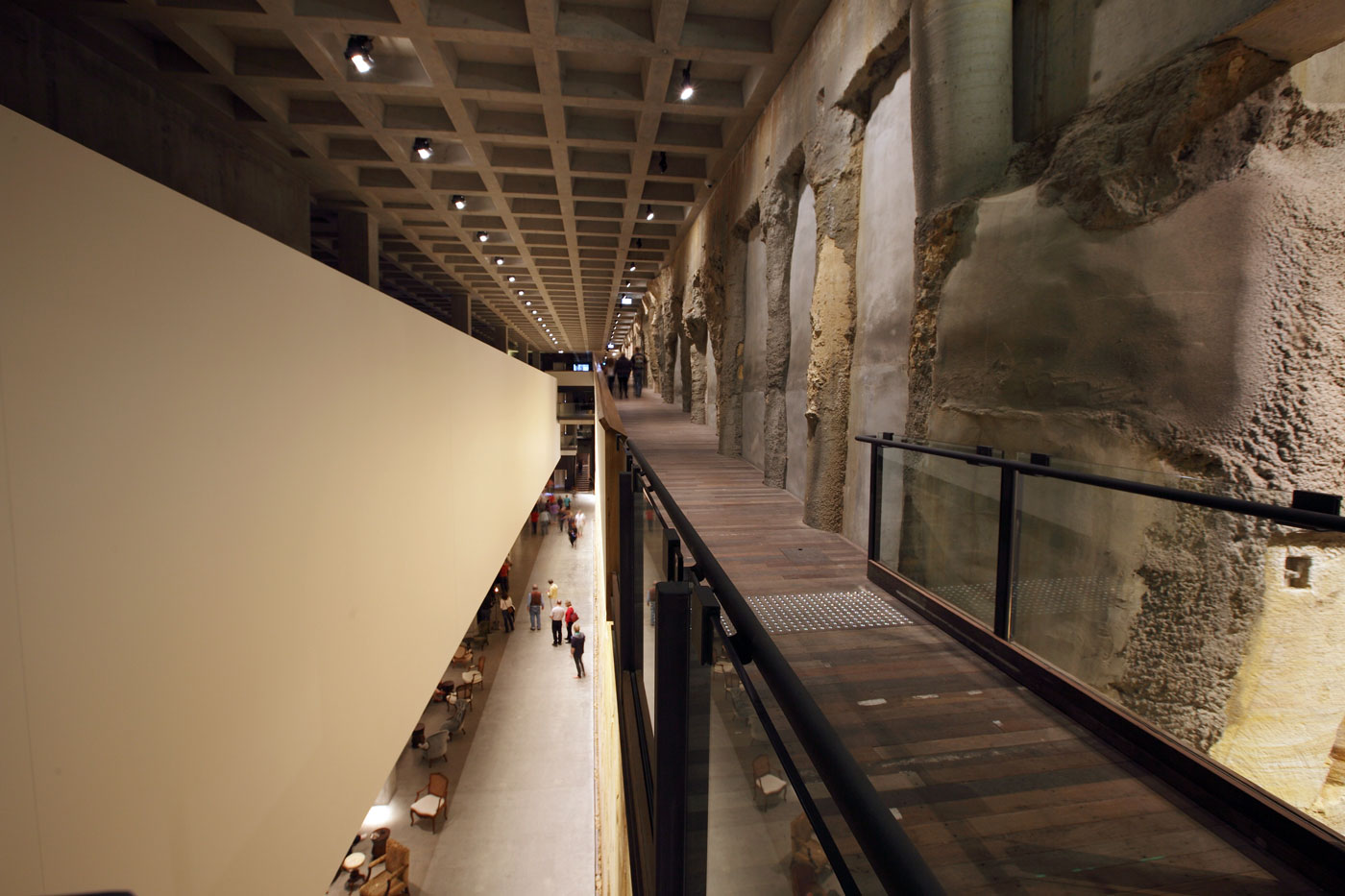
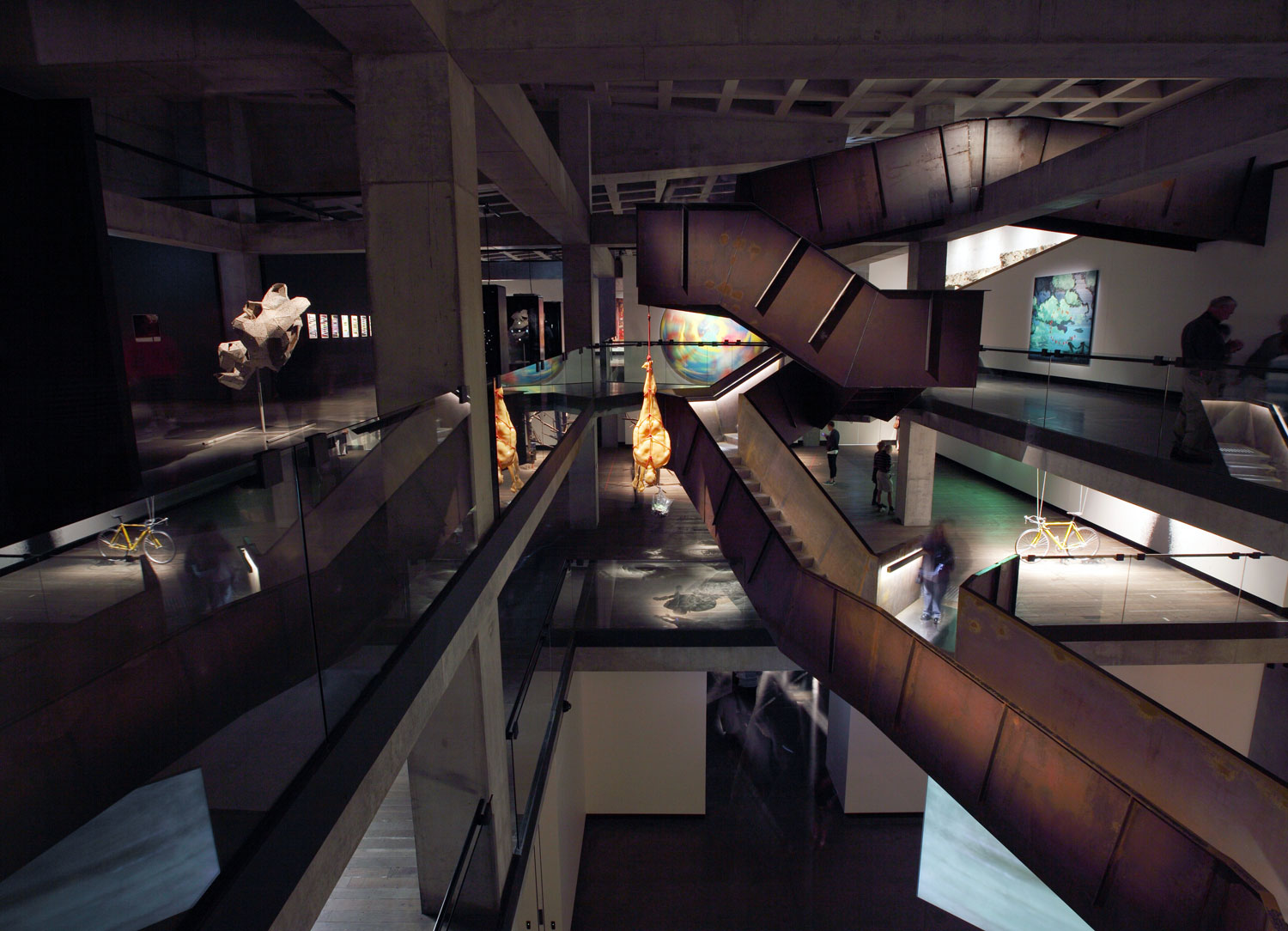
The experience starts with the ferry ride from the wharf in Hobart to the museum – the only way to arrive. During the 20 minutes of the journey mental baggage seems to drop away as you look over the water to the industrial zinc works, pass under bridges and then the museum comes into view. Perched on a promontory of land the museum rises like a rusted ancient temple. After disembarking you climb a colossal staircase to the entrance of the museum, all angles and mirrored surfaces. You enter one of two Roy Grounds listed modernist buildings built in the 1950s – beautiful, crisp white spaces that house the shop and a cafe, cloakroom and inquiry desk where you collect your ‘O’, an iPhone-like device that tracks all the artworks that you look at. The are no didactic text panels in the museum freeing the viewer to just experience, all data such as artists names and educational information and the tit-bit Gonzo text being accessed through the ‘O’. Into the large enclosed forecourt space a spiral staircase with a circular lift in the centre descends into the abyss (an inspired piece of design) and your journey proper has begun. Three levels deep into the ground you travel, the space carved out of solid rock. Impressive.

The museum is the body and the artworks are the organs, fragments of the whole exhibition (that of the actual museum). The experience is very kinaesthetic as the body gets lost within the space of the gallery. We wandered like flâneur among the darkened, cinema-like spaces, almost floating from one area to the next, discovering, feeling disorientated, following underground passages, tunnels and stairs, emerging into light and then descending into the abyss again. Hours passed. Like a Moebius strip there seemed to be no interior/exterior to the body. As Lyotard notes the membrane of the libidinal ‘body’ is composed of the most heterogeneous items: here was rock, steel, shit, bestiality, intestines, brain, touch, burial etc… the curating of the collection within the space “creating a safe space for the appreciation and consideration of seemingly extreme and subversive practices.”5

Into this space of controlled transgression, the carnivalesque mise-en-scène allow the artists to delve into the deeper and darker areas of the human condition: “as Anthony Everitt once said of Damien Hirst [to] ‘open up paths for the viewer into areas of experience which are not anti-moral or amoral but extra-moral… a world where bad taste is driven to the point of elegance and disgust is filtered into delight’.”6

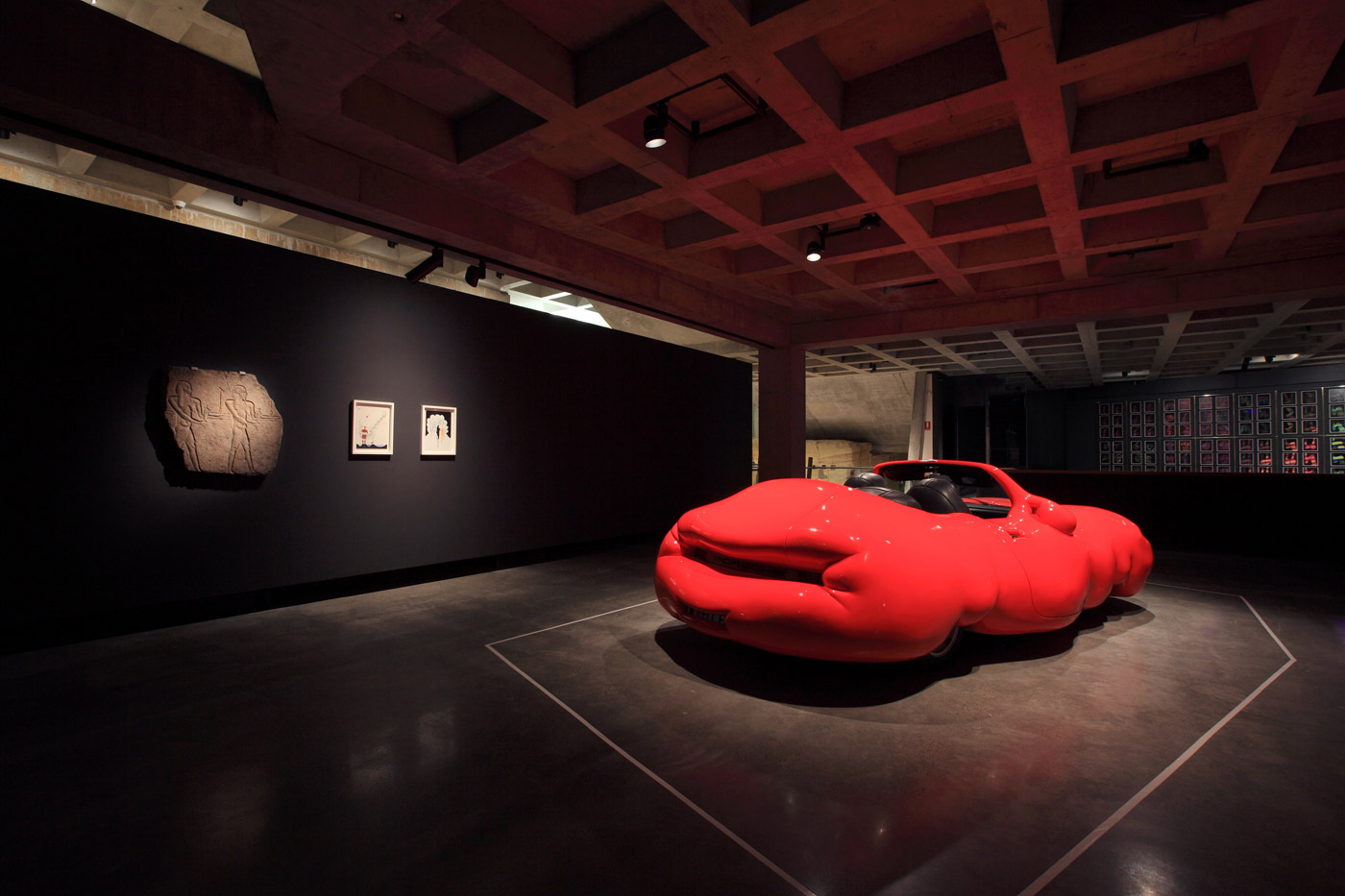
While some of the works were spotlit in the darkened galleries, “this dramatic lighting working to decontextualise the art objects, evoking a crepuscular and “timeless” sense of space, out of which the individual pieces emerged,”7 there also seemed to be an affinity between the building itself and the artworks (relating to the concept of affinity in museum curation). The diversity of installation techniques made an acknowledgement of the institutionalising processes part of the viewer’s experience of the show, disrupting a unified, totalising presentation of these objects and their cultures as “exhibition.”8 The intertextual tableaux mixed a Damien Hirst spin painting with Egyptian sculpture, ancient artefacts with Fat Cars. The context of the objects and their relationship to each other and the architecture is how the works are “framed.” This device emphasises the aesthetic rather than information and encourages the viewer to think about the relationship between the artefacts, objects and contemporary works. These inventive arrangements create a meta-narrative that offers the possibility of multiple interpretations to the viewer, multiple truths. All of this undertaken as the body moves through the spaces of the gallery and gets “lost”. As Norman Bryson has observed, “Architecture is sensed primarily through the eye and through bodily movement, and these sensations also play a key role in the way in which the contents of museums make their impact.”9

While the items are not explicitly related in terms of subject, medium or style through unexpected confrontation the works spring to dissonant life. Most of the time. When this process doesn’t work the viewer is left a little flat feeling, and…. so? wandering from piece to piece becoming slightly disenchanted. Little of the work at MONA took me to new spaces; in fact some of it was pretty mediocre, including the very dated Sir Sidney Nolan Snake (1970 to 1972, see below) that is permanent ‘wallpaper’ and takes up a whole, beautiful gallery wall. The tri-screen video by Russian collective AES+F, the works by Anselm Kiefer and the ancient artefacts (most of all) were notable exceptions. The museum is not a place for prolonged concentration and contemplation. This is not really the point of the place. The whole museum is a sensory, immersive surprising experience that cannot be broken down to its parts. David Walsh’s collection does tick all the fashionable boxes: here a Juan Davila, there a Del Kathyrn Barton, now a Howard Arkeley as though his buyers have advised him on just what to buy, but it is his personal vision, his collection. You can’t argue with that.

On of the problems of lumping all of these works together is obvious: “Ancient objects whose meaning is lost to us, medieval utensils, Christian religious images, and art objects made by modern masters were reduced to one meaning – stylistic resemblances providing evidence of the essential nature of humanity.”10 In other words a return to the globalising view of humanity evidenced by Edward Steichen’s MoMA world touring photographic exhibition of the 1950s The Family of Man. Conversely, when this strategy works well it promotes for the viewer different modes and levels of ‘interpretation’ through subtle juxtaposition of ‘experience’. As Emma Barker has observed, “we still need a curator to stimulate readings of the collection and to establish those ‘climatic zones’ which can enrich our appreciation and understanding of art… Our aim must be to generate a condition in which visitors can experience a sense of discovery in looking at particular paintings, sculptures or installations in a particular room at a particular moment, rather than find themselves standing on the conveyer belt of history.”11 Within this plastic space experience is paramount, allowing the viewer to develop their own reading without relying on the curatorial interpretation of history, setting new parameters for the relationship between viewer and object. As Barker notes such juxtapositions are a more natural strategy for a private collector than for a museum curator, with exhibitions and displays according to this dialectical principle happening with more frequency.12 The museum looses its fundamental didactic, educational purpose.

Other problems may also become evident. In a museum whose spectacular architecture was specifically designed for David Walsh’s collection it will be interesting to see how outside, touring exhibitions (such as the recently installed Experimenta Utopia Now exhibition) display in the space, especially given the psychosexual nature of his collection and its relationship to the building. If the quality of the temporary exhibitions is overwhelmed by the architecture, if the labyrinthine, enigmatic and layered nature of the space (all those floating bridges and the huge Void that can be seen in the photographs below) engulfs lesser works then it may well fall very flat.

At the end of the day we emerged into the afternoon light, expelled from the museum in a tidal wave of humanity, exhausted, satiated. Where else in Australia could you spend all day at a museum and not have seen enough? On flying home you can log into the MONA website to retrieve your ‘O’ tour, to see what art you liked and what you didn’t; what pieces you saw and all those that somehow you missed! The physical and its remembrance transported into the virtual.


Since Laura Mulvey’s essay of 1974 “Visual Pleasure and Narrative Cinema,” we have been aware of the voyeuristic and fetishistic character of our psychosexual relation to cinema. Engulfed in the dark cube, that psychosexual panorama, the cinematic labyrinth that is MONA has the viewer absenting themselves in front of the art in favour of the Eye and the Spectator.13 Spectatorship and their attendant erotics has MONA as a form of fetishistic cinema. It is as if what Barthes calls “the eroticism of place” were a modern equivalent of the eighteenth century genius loci, the “genius of the place.”

The place is spectacular, the private collection writ large as public institution, the symbolic power of the institution masked through its edifice. The art become autonomous, cut free from its cultural associations, transnational, globalised, experienced through kinaesthetic means; the viewer meandering through the galleries, the anti-museum, as an international flaneur. Go. Experience!

Dr Marcus Bunyan


Footnotes

1/ Lyotard, Jean-François. Économie Libidinale. Paris: Éditions de Minuit, 1974, pp. 10-11 quoted in Burgin, Victor. In/Different Spaces: Place and Memory in Visual Culture. Berkeley: University of California Press, 1995, p. 150

2/ Obrist, Hans Ulrich. “In the Midst of Things at the Center of Nothing,” in Harding, Anna (ed.,). Curating: The Contemporary Museum and Beyond, (Art & Design Magazine Profile No. 52), London: A.D., 1997, p. 88

3/ Timms, Peter. “A Post-google Wunderkammer: Hobart’s Museum of Old and New Art Redefines the Genre,” in Meanjin, Vol. 70, No. 2, Winter 2011. pp. 31-39

4/ Keidan, Lois. “Showtime: Curating Live Art  in the 90s,” in Harding, Anna (ed.,). Curating: The Contemporary Museum and Beyond, (Art & Design Magazine Profile No. 52), London: A.D., 1997, p. 41

5/ Ibid., p. 41

6/ Ibid., p. 41

7/ Staniszewski, Mary Anne. The power of display: a history of exhibition installations at the Museum of Modern Art. Cambridge, Mass.: MIT Press, 1998, p. 84

8/ Ibid., p. 97

9/ Bryson, Norman. “A Walk for a Walk’s Sake,” in De Zegher, Catherine (ed.,). The Stage of Drawing: Gesture and Act. London: Tate, 2003, pp. 149-58.

10/ Staniszewski, op. cit. p. 129

11/ Barker, Emma. “Exhibiting the Canon: The Blockbuster Show,” in Barker, Emma (ed.,). Contemporary Cultures of Display. New Haven and London: Yale University Press, 1999, p. 55

12/ Ibid., p. 45

13/ O’Neill, Paul. “The Curatorial Turn: From Practice to Discourse,” in Rugg, Judith and Sedgwick, Michèle (eds.,). Issues in Curating Contemporary Art and Performance. Bristol: Intellect, 2007, pp. 13-28


Many thankx to Delia Nicholls for all her help and to MONA for allowing me to publish most of the photographs in the posting (all except the top two and the one of us inside Babylonia that were taken by Fredrick White). Please click on the photographs for a larger version of the image.


Zinc works from the ferry on the way to MONA

Zinc works from the ferry on the way to MONA


Zinc works from the ferry on the way to MONA
Photos: Marcus Bunyan


3d schematic from the O, showing the levels and nodes indicating art works visited, MONA


3d schematic from the O, showing the levels and nodes indicating art works visited, MONA


MONA The Void February 2011


The Void
February 2011
Museum of Old and New Art – interior
Photo credit: MONA/Leigh Carmichael
Image Courtesy of MONA Museum of Old and New Art


MONA B1 walkway overlooking The Void February 2011


B1 walkway overlooking The Void
February 2011
Museum of Old and New Art – interior
Photo credit: MONA/Leigh Carmichael
Image Courtesy of MONA Museum of Old and New Art


MONA Loop System Quintet/Untitled (stool for guard)


Loop System Quintet/Untitled (stool for guard)

Left:
Taiyo Kimura (Japanese, b. 1970)
Untitled (stool for guard)
2007
Mixed media, clothes, cd player, speaker

Right:
Conrad Shawcross (English, b. 1977)
Loop System Quintet

2005
Waxed machined oak, five light bulbs, electric motor and gearbox, drive shafts, cogs, universal joints, flange units, screws, bolts, nuts, washers

Photo credit: MONA/Leigh Carmichael
Image Courtesy of MONA Museum of Old and New Art


Callum Morton (Australian born Canada, b. 1965) 'Babylonia' 2005


Callum Morton (Australian born Canada, b. 1965)
Babylonia
2005
Wood, polystyrene, epoxy resin, acrylic paint, light, carpet, mirror and sound
Photo credit: MONA/Leigh Carmichael
Image Courtesy of MONA Museum of Old and New Art


Sculptor Fredrick White and Marcus Bunyan inside Callum Morton's 'Babylonia' wearing the 'O'


Sculptor Fredrick White and Marcus Bunyan inside Callum Morton’s Babylonia wearing the ‘O’


Portrait gallery. Various artworks by various artists. Museum of Old and New Art - interior


Portrait gallery
Various artworks by various artists
Museum of Old and New Art – interior
Photo credit: MONA/Leigh Carmichael
Image Courtesy of MONA Museum of Old and New Art


Masturbation. It is a source of endless irony to me that when I was young, and desperately in need of endless fucking, no one was interested in helping me out, whereas now, older and slower, I could fill even my desired adolescent quota. What saved me then was my right hand, even though I call myself left-handed. Surely the hand that you wank with (I guess John Holmes was ambidextrous) defines you just as much as the hand you write with? Anyway, who writes anymore? It’s so much easier to type. Mental masturbation allows me to pretend I’m a mental John Holmes, takes both hands. But no brains.

Art. I’m not at all sure that conceptual art and traditional art are the same thing. One can come from muscle memory, from pragma; at its best it’s not at all conscious. The former, though, is so self-aware it’s often targeting its own self-awareness. Check out the Hirst and the Pylypchuk at the other end of the gallery.


David Walsh 2011


MONA Corten Stairwell February 2011


Corten Stairwell
February 2011
Museum of Old and New Art – interior
Photo credit: MONA/Leigh Carmichael
Image Courtesy of MONA Museum of Old and New Art


MONA Corten Stairwell & Surrounding Artworks February 2011


Corten Stairwell & Surrounding Artworks
February 2011
Museum of Old and New Art – interior
Photo credit: MONA/Leigh Carmichael
Image Courtesy of MONA Museum of Old and New Art


MONA The Nolan Gallery February 2011


The Nolan Gallery

Sir Sidney Nolan (Australian, 1917-1992)
Snake
1970 to 1972
Mixed media on paper, 1620 sheets

Jannis Kounellis (Greece, 1936-2017)
Untitled

2002
Jute coffee bags, coal; three parts

Photo credit: MONA/Leigh Carmichael
Image Courtesy of MONA Museum of Old and New Art


Erwin Wurm (Austrian, b. 1954) 'Fat Car' 2006
 at MONA


Erwin Wurm (Austrian, b. 1954)
Fat Car
2006
Steel chassis and body; leather interior, with polystyrene and fibreglass
Photo credit: MONA/Leigh Carmichael
Image Courtesy of MONA Museum of Old and New Art


Museum of Old and New Art
655 Main Road Berriedale
Hobart Tasmania 7011, Australia

Opening hours:
Fridays – Mondays, 10am – 5pm

MONA website

LIKE ART BLART ON FACEBOOK

Back to top

Exhibition: ‘Chihuly: Through the Looking Glass’ at Museum of Fine Arts, Boston

Exhibition dates: 10th April – 7th August, 2011


Dale Chihuly (American, b. 1941) 'Neodymium Reeds on Logs', de Young Museum, San Francisco, California, 2008


Dale Chihuly (American, b. 1941)
Neodymium Reeds on Logs
2008
de Young Museum, San Francisco, California
Photo by Teresa Nouri Rishel
© 2008 Chihuly Studio


“The way I paint or draw, I don’t think about it very much. If I’m thinking about it, that kind of means that I don’t know what to do. If I start thinking, ‘I want to draw, now what can I draw?’ and I’m not inspired – because that can happen very easily – then they start to get mundane. On the other hand, if I start making drawings that I know how to do already, and if I can go fast enough, they start to get really good.”


Dale Chihuly


I love contemporary glass and Dale Chihuly is one of my favourite artists in the world. The Persian ceiling is breathtaking – organic and pulsating like the most outrageously coloured jellyfish floating over your head; the Ikebana boat, the Mille Fiori pitch perfect – a riot of colour and form, playing with ideas and the chandeliers, the chandeliers – wow! Then to do something as sensitive and restrained as the Tabac basket or the beautiful Neodymium Reeds on Logs. This is the full package, bravo.

Dr Marcus Bunyan


Many thankx to the Museum of Fine Arts, Boston for allowing me to publish the photographs in the posting. Please click on the photographs for a larger version of the image.


Often considered the greatest artist working in American glass since Louis Comfort Tiffany, Dale Chihuly is known for creating dramatic works, impressive for their size and bold use of color. Fortunately for Bostonians, his massive glass forms can now be seen in a dozen installations at the Museum of Fine Arts…


Dale Chihuly (American, b. 1941) 'Ikebana Boat' 2011


Dale Chihuly (American, b. 1941) 
Ikebana Boat
2011
Blown glass, boat hull
5 X 17 X 7′
Artwork © 2011 by Chihuly Studio, All rights reserved
Photograph © Museum of Fine Arts, Boston


Dale Chihuly (American, born 1941) 'Mille Fiori' 2011


Dale Chihuly (American, b. 1941)
Mille Fiori
2011
Blown glass
9½ X 56 X 12′
Artwork © 2011 by Chihuly Studio, All rights reserved
Photograph © Museum of Fine Arts, Boston


Installation view of the exhibition 'Chihuly: Through the Looking Glass' at Museum of Fine Arts, Boston showing Chihuly's 'Lime Green Icicle Tower' (2011)


Installation view of the exhibition Chihuly: Through the Looking Glass at Museum of Fine Arts, Boston showing Chihuly’s Lime Green Icicle Tower (2011)


Dale Chihuly (American, b. 1941) 'Persian Ceiling' 2011


Dale Chihuly (American, b. 1941)
Persian Ceiling
2011
Blown glass
15 X 28′
Artwork © 2011 by Chihuly Studio, All rights reserved.
Photograph © Museum of Fine Arts, Boston


Dale Chihuly (American, b. 1941) 'Persian Ceiling' 2011


Dale Chihuly (American, b. 1941)
Persian Ceiling
2011
Blown glass
15 X 28′
Artwork © 2011 by Chihuly Studio, All rights reserved
Photograph © Museum of Fine Arts, Boston


Dale Chihuly (American, b. 1941) 'Persian Ceiling' 2011 (detail)


Dale Chihuly (American, b. 1941)
Persian Ceiling (detail)
2011
Blown glass
15 X 28′
Artwork © 2011 by Chihuly Studio, All rights reserved
Photograph © Museum of Fine Arts, Boston


Dale Chihuly (American, b. 1941) 'Persian Wall' 2011


Dale Chihuly (American, b. 1941)
Persian Wall 
2011
Blown glass
15 X 30′
Artwork © 2011 by Chihuly Studio, All rights reserved
Photograph © Museum of Fine Arts, Boston


A magical wonderland to delight Alice herself unfolds in Chihuly: Through the Looking Glass at the Museum of Fine Arts, Boston (MFA), from April 10 through August 7, 2011. This exhibition presents new and early works created over the last four decades by Dale Chihuly, one of the world’s foremost artists working in glass. Chihuly: Through the Looking Glass features 12 boldly hued installations. Nine of these glass artworks are on view in the MFA’s Ann and Graham Gund Gallery, which serves as the main stage for the exhibition. Three additional installations are displayed within and outside of the Museum’s soaring, glass-enclosed Ruth and Carl J. Shapiro Family Courtyard, including the 42-foot-tall Lime Green Icicle Tower. The exhibition is organised by the Museum of Fine Arts, Boston, in cooperation with Dale Chihuly. It is supported by Highland Street Foundation. The media sponsors are The Boston Phoenix and WFNX Radio Network.

“Dale Chihuly is an American original, a master artist and craftsman who brings a truly magical touch to the fragile, yet malleable medium of glass, and who embodies the message: art is for everyone,” said Malcolm Rogers, Ann and Graham Gund Director of the MFA. “Visitors to the exhibition will be surprised and delighted by his dazzling installations, which create a kaleidoscopic world full of colour and light. This exhibition gives us the wonderful opportunity to showcase the full range and grand scale of his art.”

First Installation in the New Shapiro Family Courtyard

The MFA continues the celebration of the recently opened Art of the Americas Wing and Shapiro Family Courtyard with Chihuly: Through the Looking Glass, showcasing the artwork of one of the most innovative and beloved American artists of our time. The show was conceived two years ago when Chihuly visited the Museum while the courtyard was still under construction, and marks the first time that exhibition-related works are on view in the courtyard. Chihuly: Through the Looking Glass was designed by Chihuly specifically for the Museum site. Works created in the Chihuly Studio hot shop in Seattle, Washington, incorporating thousands of individual pieces of hand-blown glass, were sent to Boston in six 53-foot containers. The 12 installations were assembled on site at the MFA during a three-week period in March. During this time, visitors to the MFA were able to watch a team from Chihuly Studio install the monumental glass artworks in the courtyard and surrounding gardens…

Works created specifically for Chihuly: Through the Looking Glass, such as the dramatic Lime Green Icicle Tower, have transformed the Shapiro Family Courtyard. Measuring 42-feet high and weighing approximately 10,000 pounds, the sculpture’s 2,342 glass elements catch the light flooding into the glass-enclosed space. Also in the courtyard, along the colonnade of the Museum’s historic interior façade, is the newly created Boathouse Neon II – an expansive profusion of red, yellow, and orange – spanning 98 feet. Outside, along the courtyard’s glass walls, Amber Cattails extend the length of the northern-landscaped area as though planted in their natural environment.

“Perhaps the greatest artist in American glass since Louis Comfort Tiffany, Dale Chihuly is one of the central figures in the contemporary studio glass movement. This exhibition will give our visitors a look at his extraordinary career – the creation of enchanting environments that, through the manipulation of light and colour, both delight the eye and challenge our perception of space,” said Gerald W.R. Ward, the Katharine Lane Weems Senior Curator of American Decorative Arts and Sculpture, who organised the exhibition.

Nine Unique Installations in the New Gund Gallery

The exhibition continues below the courtyard, where nine unique Chihuly installations (including both newly made and early works) are on view in the Gund Gallery for special exhibitions. Outside of the gallery, a glistening, 30′ long and 15′ tall Persian Wall composed of intricately detailed rondels – flower-like shapes in yellows, reds, and oranges – offer an enchanting welcome to visitors. Inside the gallery, Scarlet Icicle Chandelier, measuring 6’ high, sets the stage for the bold creations that lie beyond, such as Ikebana Boat, a 17′-long, newly made composition featuring a weathered wooden rowboat filled with brightly colored, seemingly alien glass forms. Chihuly’s Ikebana series, which alludes to Japanese flower arrangements, is featured in a nearby room, where 5′-to-6′-tall silvered vessels hold inventive floral “stems”. Also on view in the room is an assortment of Venetians – silvered blown glass sculptures originally conceived by Chihuly after seeing Venetian Art Deco glass. Chihuly Drawings seen in this space serve as complement and inspiration for the glass Venetian works. The nearby Northwest Room evokes the artist’s native Pacific Northwest environment and the Native American influence on his work. It features an assemblage of ethereal Baskets inspired by Native American baskets, as well as displays of 75 colourful trade blankets and a variety of woven baskets from the artist’s own extensive collection.

Adjacent to this installation is a darkened space showcasing Mille Fiori (Italian for “a thousand flowers”), measuring 58′ long and 11′ tall and presented on a 12′-wide raised platform. This breathtaking work of art is one of the artist’s largest installations, a combination of many of the colourful, inventive shapes found in Chihuly’s other creations – from exotic Cattails and tall Reeds, to giant glass Niijima Floats and ribbon-like Herons – brilliantly coloured in shades of yellow, red, lavender, green, orange, and blue. Persian Ceiling, a dazzling 15′ by 25′ array of vibrant and beautifully articulated shapes encased and suspended from the ceiling, is featured in the adjacent gallery. This eruption of colour continues in the Chandelier Room, featuring six dramatic Chandeliers hanging at different heights from the 16′-high Gund Gallery ceiling. Included are newly created works, the 12′-tall Silvered Chrysalis Tiered Chandelier and Iris Yellow Frog Foot Chandelier, as well as the spectacular Chiostro di Sant’Apollonia Chandelier and three other works: Palazzo di Loredana Balboni Chandelier, Orange Hornet and Eelgrass Chandelier, and Onyx and Caramel Chandelier. The final exhibition space showcases luminescent Neodymium Reeds, a large-scale installation composed of birch logs and elegant glass Reeds in shades of lavender.

Press release from the Museum of Fine Arts, Boston website


Dale Chihuly (American, b. 1941) 'Persian Wall' 2011 (detail)


Dale Chihuly (American, b. 1941)
Persian Wall (detail)
2011
Blown glass
15 X 30′
Artwork © 2011 by Chihuly Studio, All rights reserved
Photograph © Museum of Fine Arts, Boston


Dale Chihuly (American, b. 1941) 'Palazzo di Loredana Balboni Chandelier' 2011


Dale Chihuly (American, b. 1941)
Palazzo di Loredana Balboni Chandelier
2011
Blown glass, steel
9 X 7 X 7′
Artwork © 2011 by Chihuly Studio, All rights reserved
Photograph © Museum of Fine Arts, Boston


Dale Chihuly (American, b. 1941) 'Chiostro di Sant'Apollonia Chandelier' 2011


Dale Chihuly (American, b. 1941) 
Chiostro di Sant’Apollonia Chandelier
2011
Blown glass, steel
10 X 7 X 9′
Artwork © 2011 by Chihuly Studio, All rights reserved
Photograph © Museum of Fine Arts, Boston


Dale Chihuly (American, b. 1941) 'Tabac Basket' 2008


Dale Chihuly (American, b. 1941)
Tabac Basket
Photo by Teresa Nouri Rishel
© 2008 Chihuly Studio


Museum of Fine Arts, Boston
Avenue of the Arts
465 Huntington Avenue
Boston, Massachusetts

Opening hours:
Thursday – Monday 10am – 5pm
Closed Tuesdays and Wednesdays

Museum of Fine Arts Boston website

LIKE ART BLACK ON FACEBOOK

Back to top