Opening 1: Review: ‘Continuous Moment: Bad Infinity’ by Damiano Bertoli at The Narrows, Melbourne

Exhibition dates: 5th March – 28th March, 2009

Opening: Thursday 5th March, 2009


Damiano Bertoli (Australian, 1969-2021) 'Continuous Moment: Bad Infinity' 2009 video still

Damiano Bertoli (Australian, 1969-2021) 'Continuous Moment: Bad Infinity' 2009 video still


Damiano Bertoli (Australian, 1969-2021)
Continuous Moment: Bad Infinity
2009
Video stills


In a busy night of openings in Melbourne we arrive to watch, to be a spectator and voyeur at Damiano Bertoli’s new twin video installation at The Narrows on Flinders Lane, ensconced in the darkness of the gallery space. The looped installation features on the left scenes from the original Miami Vice TV series and on the right approximate scenes from the 2006 feature film of the same name. The synchronicity of the two splices of time moving in and out of register is uncanny. We have memories of these appearances, flickering signifiers embedded in our psyche which are called to presence in the space between screen and viewer as we add our own layer of temporal distortion to the unfolding events.

In an erudite catalogue note Bertoli expounds on the nature of the performative and the question of authorship by analysing Glenn Gould’s two recordings of J. S. Bach’s Goldberg Variations, one recorded at the beginning of his career and one in the final year of his life. Bertoli posits that Gould used counterpoint “as a formal construct for its capacity to produce ‘an explosion of simultaneous idea’s’ … as a solution for his dissatisfaction with singularity and linear definition.”

He notes that, “As an interpreter of others work, Gould occupied a position of equivalence – we are aware that we are listening to Bach and Gould – simultaneously … These co-existing yet distinct voices move in and out of synchronicity, as does the listener’s experience of Gould’s interpretation (actually an interpretation of an interpretation) as the latter version iterates and embodies the version which precedes it. We are constantly comparing the two, as is Gould.”

This is quite true but I do not think the metaphor can be so literally applied to the video installation Bertoli has constructed. Firstly Gould’s interpretations and our recognition of them requires knowledge of the authoritative voice of the author as composer and the author as performer: Bach and Gould. Conversely in the videos the directors are unknown by most and the actors anonymous except by those with specific memory of appearances. There is no contrapuntal fugue like working of the sound or images in search of the purity of musical ideas – the dialogue talks over each other and splice cuts jump the scene from one location to another – forming a fractured hypertextual narrative driven by the spectacular gaze of the viewer, a simularcrum of the ‘real’. The simultaneity of being in three worlds at once is the world of simulacra not of equivalence.

As Ron Burnett has observed

“Video creates what I will describe as a logic of the present while simultaneously producing an image-event in the past. This generates a somewhat different temporal context than we are normally accustomed to – a mixture of present and past that is both, and neither, simultaneously. The disjuncture that results is part of the attraction but also part of what makes the electronic image so puzzling. It suggests that history has already been made while one continues to make it. It is this suppleness that allowed broadcasters for example to repeat the Rodney King beating in Los Angeles over and over again, as if each showing would somehow reconstitute the event, as if to prove that this was not a dramatisation, not a fiction. In order to gain control over the many disjunctures, repetition was used … But this only validates the contradictions, proposing that the disjunctures in time and place can be controlled, that there is some way of gaining authority over the impact of the event as image.”1


I would argue that what Bertoli’s installation does offer is a release from inert rationalist geometries, a deterritorialization and reterritorialization of temporal time in a heterotopic space, juxtaposing in a single real place several spaces, several sites that are in themselves incompatible. These are layered images of hyper-performativity and hypermediacy, where the fragmented images become a process and a performance, where the spectator becomes the screen not the author.

As Baudrillard has said, “Today we live in the imaginary world of the screen, of the interface and the reduplication of contiguity and networks. All our machines are screens. We too have become screens, and the interactivity of men has become the interactivity of screens. Nothing that appears on the screen is meant to be deciphered in depth, but actually to be explored instantaneously, in an abreaction immediate to meaning.”2

Here is the immediacy of continuous time – the removal of psychological depth, the reduction of life to a series continuous presents and surface phenomena that repeat over and over again. Is this bad infinity? We will never know… as we can never have knowledge of infinity. It is a noumenal concept, an event known only to the imagination, independent of the senses.

This is an interesting and fun installation. Well worth a visit.

Dr Marcus Bunyan


1/ Burnett, Ron. Cultures of Vision: Images, Media, & the Imaginary. Bloomington: Indiana University Press, 1995, p. 249

2/ Baudrillard, Jean. Xerox and Infinity (trans. Agitac). Paris: Touchepas, 1988, p. 7


Many thankx to The Narrows gallery for allowing me to publish the photographs in the posting. Please click on the photographs for a larger version of the image.


    Damiano Bertoli Continuous Moment: Bad Infinity (2009)


    Damiano Bertoli (Australian, 1969-2021) 'Continuous Moment: Bad Infinity' 2009 video still

    Damiano Bertoli (Australian, 1969-2021) 'Continuous Moment: Bad Infinity' 2009 video still

    Damiano Bertoli (Australian, 1969-2021) 'Continuous Moment: Bad Infinity' 2009 video still


    Damiano Bertoli (Australian, 1969-2021)
    Continuous Moment: Bad Infinity
    2009
    video stills


    Vale Damiano Bertoli (1969-2021)

    In September, artist Damiano Bertoli passed away unexpectedly at the age of 52. Bertoli was a staple in the Melbourne art community. He could be relied upon to regularly attend openings and see most exhibitions. Along the way, he would dish out wit, sarcasm and charm. Seeing him across a crowded room, he would go cross-eyed as a form of greeting, breaking the ice with humour. Bertoli had a rich and expansive artistic practice, spanning collage, film, sculpture, installation, even theatre, but he was equally known for his large personality. In preparation for this piece, I spoke to several of Bertoli’s closest friends who had many things to say about him, but some underlying themes proved unanimous. He possessed a great sense of curiosity and generosity; he loved sharing knowledge; he built rich relationships with others through engagement with art; and that he has left behind a massive legacy – albeit one that could have been much, much bigger.

    Read more about Damiano Bertoli’s legacy.  Amelia Winata. “Damiano Bertoli 1969-2021,” on the MeMO website 13 Oct 2021 [Online] Cited 12/06/2022


    Damiano Bertoli (Australian, 1969-2021) 'Continuous Moment: Bad Infinity' 2009 video still

    Damiano Bertoli. 'Continuous Moment: Bad Infinity' 2009 video still


    Damiano Bertoli (Australian, 1969-2021)
    Continuous Moment: Bad Infinity
    2009
    video stills


    The Narrows

    This gallery is now closed.

    LIKE ART BLART ON FACEBOOK

    Back to top

    Artist’s talk: Photographer Gregory Crewdson to present at the Nelson-Atkins Museum of Art, Kansas City

    12th March, 2009


    Many thankx to the Nelson-Atkins Museum of Art for allowing me to publish the photographs in the posting. Please click on the photographs for a larger version of the image.


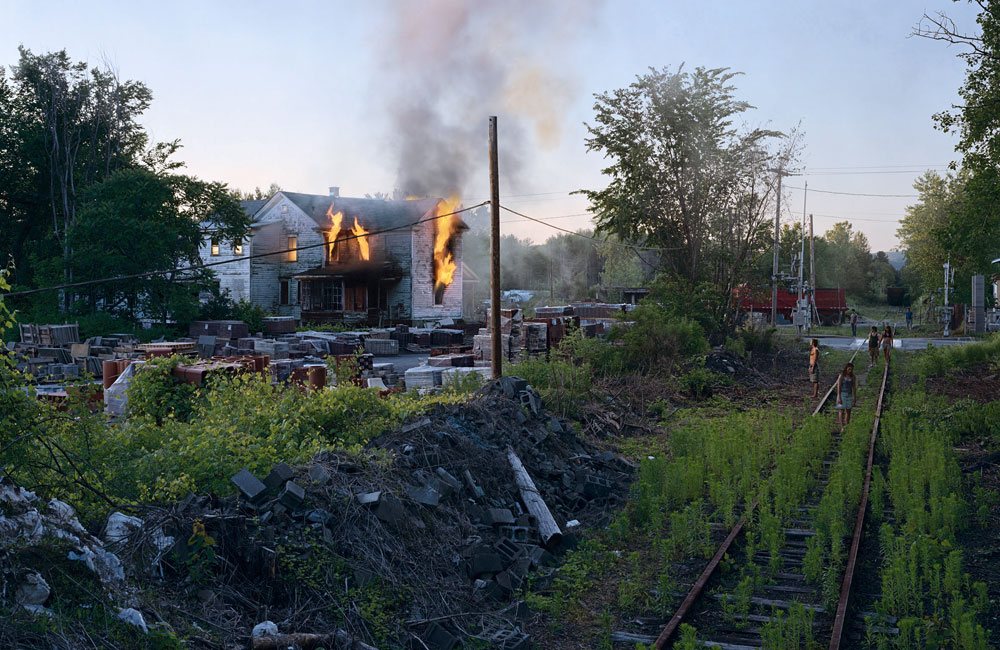
    Gregory Crewdson (American, b. 1962) 'Untitled' from the series 'Beneath the Roses' 2006


    Gregory Crewdson (American, b. 1962)
    Untitled from the series Beneath the Roses
    2006
    Digital pigment print


    Famed photographer Gregory Crewdson will present the inaugural discussion in a series sponsored by the Photography Society of The Nelson-Atkins Museum of Art, Kansas City…

    Crewdson’s work has been widely exhibited and reviewed. He makes large-scale photographs of elaborate and meticulously staged tableaux, which have been described as “micro-epics” that probe the dark corners of the psyche. Working in the manner of a film director, he leads a production crew, which includes a director of photography, special effects and lighting teams, casting director and actors. He typically makes several exposures that he later digitally combines to produce the final image.

    “Crewdson is one of the most daring and inventive contemporary artists using photography,” said Keith F. Davis, Curator of Photography at the Nelson-Atkins. “His meticulously crafted works are immensely rich in both narrative and psychological terms. They prod us to rethink our ‘usual’ relationship to photographs as physical objects and as records of worldly fact. Crewdson is a genuinely important figure in today’s art world. He has an international reputation and has influenced an entire generation of younger photographic artists.”

    Attendance to the program is free.

    Text from ArtDaily.org website


    Gregory Crewdson (American, b. 1962) 'Untitled' from the series 'Beneath the Roses' 2005


    Gregory Crewdson (American, b. 1962)
    Untitled from the series Beneath the Roses
    2005
    Digital pigment print


    Gregory Crewdson (American, b. 1962) 'Untitled' from the series 'Beneath the Roses' 2005


    Gregory Crewdson (American, b. 1962)
    Untitled from the series Beneath the Roses
    2005
    Digital pigment print


    Gregory Crewdson (American, b. 1962) 'Untitled (Sunday Roast)' from the series 'Beneath the Roses' 2005


    Gregory Crewdson (American, b. 1962)
    Untitled (Sunday Roast) from the series Beneath the Roses
    2005
    Digital pigment print


    Nelson-Atkins Museum of Art
    4525 Oak Street
    Kansas City, MO 64111

    Opening hours:
    Thursday – Monday 10am – 5pm
    Closed Tuesday and Wednesday

    Nelson-Atkins Museum of Art website

    Gregory Crewdson on the Gagosian website

    LIKE ART BLART ON FACEBOOK

    Back to top

    Exhibition: ‘Biografías’ by Óscar Muñoz at Art Gallery of New South Wales, Sydney

    Exhibition dates: 19th February – 14th June, 2009


    Óscar Muñoz (Colombian, b. 1951) 'Biografías' 2002 (installation view)

    Óscar Muñoz (Colombian, b. 1951) 'Biografías' 2002 (installation view)


    Óscar Muñoz (Colombian, b. 1951)
    Biografías (installation views)
    2002
    5 video projections, 7 ‘, loop, without sound, DVD, mdf support, metal grids, variable dimensions


    “How can one construe a notion of time in this immemorial setting? How can one assimilate and articulate in one’s memory all these events that have been happening for so many years now?”

    “My work today … is based on my endeavour to understand the mechanism developed by a society which has ultimately suffered the routinisation of war… A past, a present and in all likelihood a future full of violent events on a daily basis, which are stubbornly repeated, in a practically identical fashion.”


    Óscar Muñoz


    Óscar Muñoz is something of a gentle magician. His ‘disappearing’ drawings are poignant and beautiful, combining consummate skill with conceptual subtlety and rigour.

    Muñoz is a senior Colombian artist. He plays an important role in mentoring younger artists but his own work is very focused on a personal language that is closely tied to the body and its disappearance. His work has always combined traditional drawing skills with video in a completely original and surprising way.

    Although Muñoz is not assertively political, his work is more about mortality than specific acts of violence but it is impossible not to look at it in the context of Colombian life. A common technique for social control has become the ‘disappearing’ of people. The work shown in this exhibition, Biografías 2002 is structured to reflect this pervasive theme of disappearance.

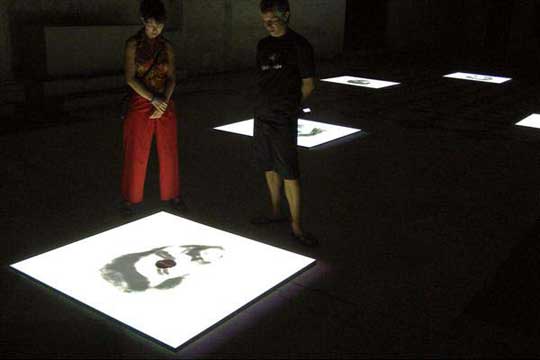
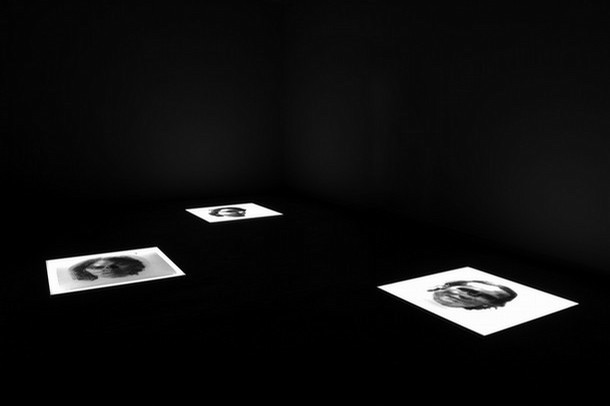
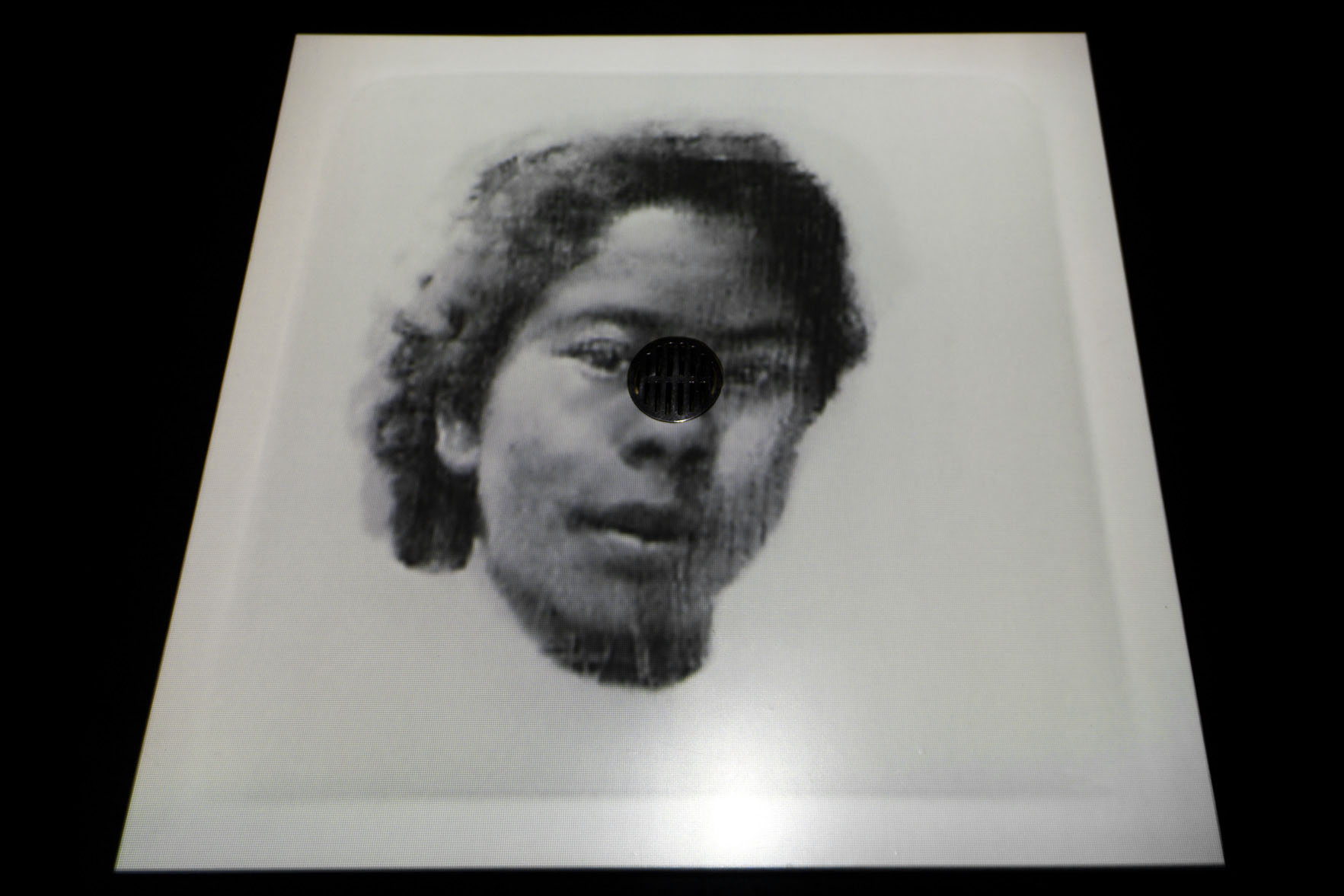
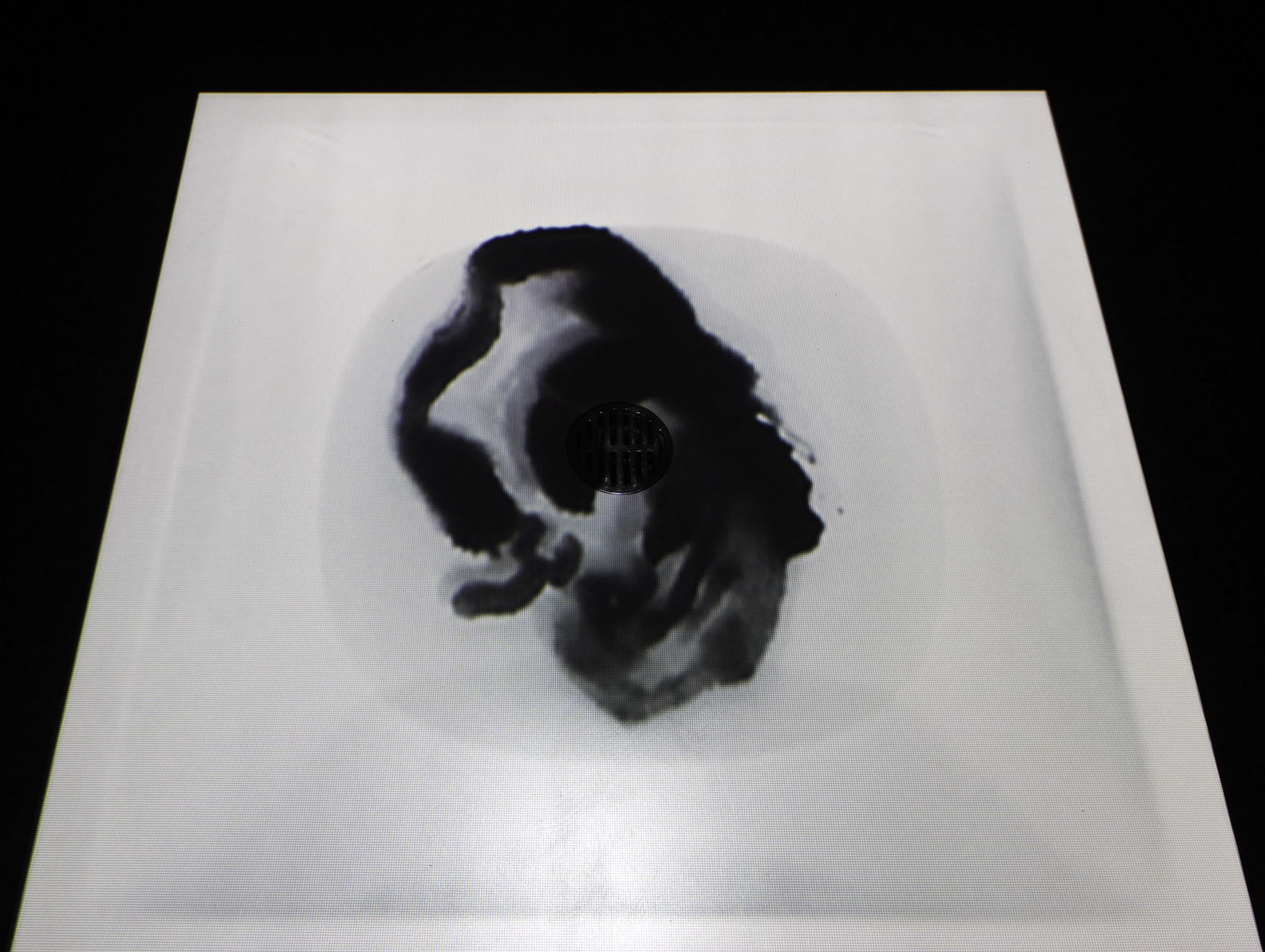
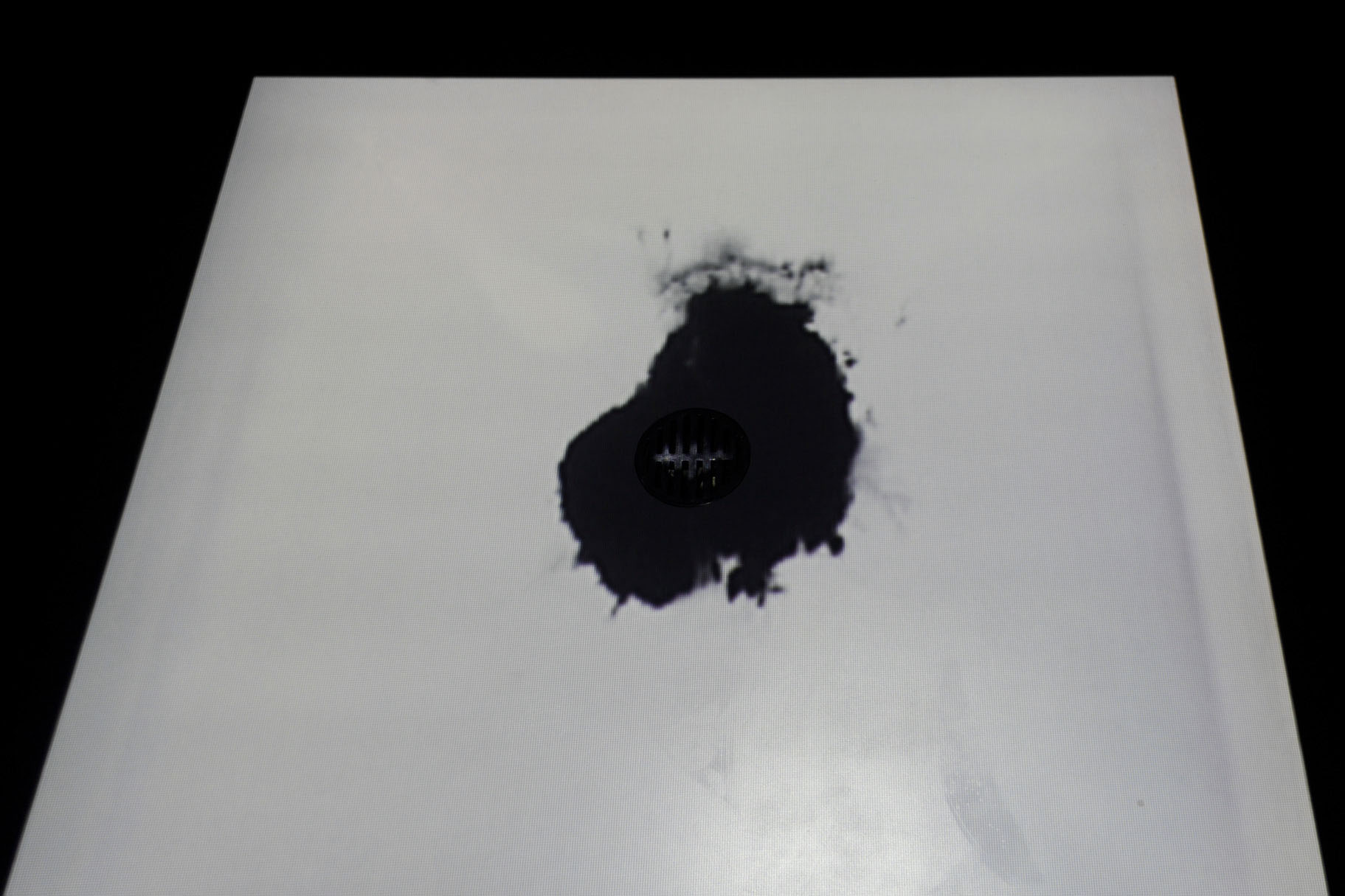
    Biografías is one of a series of works in which portraits slowly disappear, reflecting the disappearance of people on a regular basis in Colombia. Muñoz has made silk screen portraits of people but instead of forcing ink through the screen onto paper he has dusted fine coal dust through the screen onto a flat basin of water. The portrait in coal is then transferred to float on the surface of the water. After a while the water starts to drain out of a plug hole in the basin causing the image to begin to distort. Eventually the image is compressed becomes unrecognisable and finally disappears down the drain.

    Five such portraits are shown in Biografías by projecting video of the performed drawings onto screens on the floor complete with plug holes beneath which you hear the sound of water running down the drain.

    Text from the Art Gallery of New South Wales website [Online] Cited 22/02/2009 (no longer online)


    Many thankx to Art Gallery of New South Wales for allowing me to publish the art work in the posting. Please click on the art work for a larger version of the image.


    Óscar Muñoz (Colombian, b. 1951) 'Biografías' 2002 (still)

    Óscar Muñoz (Colombian, b. 1951) 'Biografías' 2002 (still)

    Óscar Muñoz (Colombian, b. 1951) 'Biografías' 2002 (still)


    Óscar Muñoz (Colombian, b. 1951)
    Biografías (stills)
    2002
    5 video projections, 7 ‘, loop, without sound, DVD, mdf support, metal grids, variable dimensions


    Óscar Muñoz Biografías

    The work refers to the idea of death, disappearance and transience of memory, linked to acts of violence.

    Muñoz is also known for his use of ephemeral materials, in poetic reflections upon memory and mortality.


    Art Gallery of New South Wales
    Art Gallery Road, The Domain
    Sydney NSW 2000, Australia

    Opening hours:
    Open every day 10am – 5pm
    except Christmas Day and Good Friday

    Art Gallery of New South Wales website

    LIKE ART BLART ON FACEBOOK

    Back to top

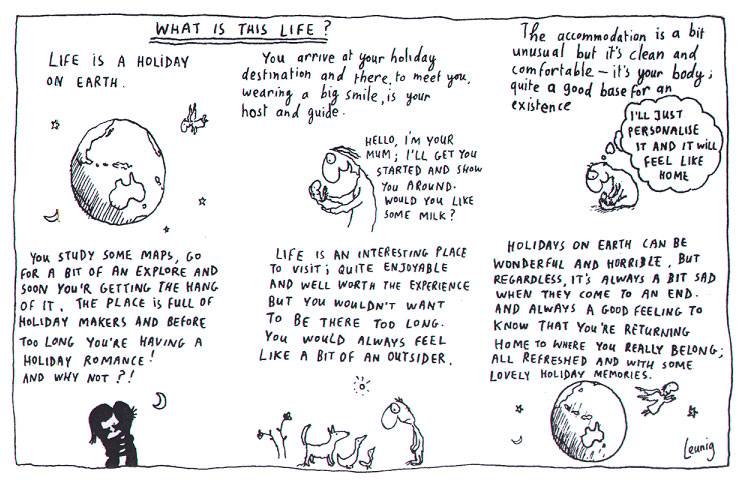
    Cartoon: Michael Leunig. ‘What is This Life?’ 2009

    February 2009


    What a wonderful invocation of life, to life!

    Marcus


    Please click on the image for a larger version of the cartoon.


    Michael Leunig (Australian, 1945-2024) 'What is This Life?' 2009


    Michael Leunig (Australian, 1945-2024)
    What is This Life?
    2009


    Michael Leunig on Wikipedia

    LIKE ART BLART ON FACEBOOK

    Back to top

    Photographs: Marcus Bunyan. ‘Momentum’ 2009

    February 2009


    Marcus Bunyan (Australian, b. 1958) 'Untitled' from the series 'Momentum' 2009


    Marcus Bunyan (Australian, b. 1958)
    Untitled from the series Momentum
    2009
    Digital colour photograph


    Momentum

    A new body of work – the first of 2009 – is now online.

    All 30 images can be seen on my website.

    Marcus

    Photographs are available from this series for purchase. As a guide, a digital colour 16″ x 20″ costs $1000 plus tracked and insured shipping. For more information please see my Store web page.


    Marcus Bunyan (Australian, b. 1958) 'Untitled' from the series 'Momentum' 2009


    Marcus Bunyan (Australian, b. 1958)
    Untitled from the series Momentum
    2009
    Digital colour photograph


    Marcus Bunyan (Australian, b. 1958) 'Untitled' from the series 'Momentum' 2009


    Marcus Bunyan (Australian, b. 1958)
    Untitled from the series Momentum
    2009
    Digital colour photograph


    Marcus Bunyan (Australian, b. 1958) 'Untitled' from the series 'Momentum' 2009


    Marcus Bunyan (Australian, b. 1958)
    Untitled from the series Momentum
    2009
    Digital colour photograph


    Marcus Bunyan (Australian, b. 1958) 'Untitled' from the series 'Momentum' 2009


    Marcus Bunyan (Australian, b. 1958)
    Untitled from the series Momentum
    2009
    Digital colour photograph


    Marcus Bunyan (Australian, b. 1958) 'Untitled' from the series 'Momentum' 2009


    Marcus Bunyan (Australian, b. 1958)
    Untitled from the series Momentum
    2009
    Digital colour photograph


    Marcus Bunyan (Australian, b. 1958) 'Untitled' from the series 'Momentum' 2009


    Marcus Bunyan (Australian, b. 1958)
    Untitled from the series Momentum
    2009
    Digital colour photograph


    Marcus Bunyan website

    LIKE ART BLART ON FACEBOOK

    Back to top

    Exhibition: ‘The best is often the Memories: Photographic Portraits of Romy Schneider’ at Museum für Kunst Und Gewerbe, Hamburg

    Exhibition dates: 6th February – 13th April, 2009


    Will McBride (American, 1931-2015) 'Romy Schneider, Paris, 1964' from the exhibition 'The best is often the Memories: Photographic Portraits of Romy Schneider' at Museum für Kunst Und Gewerbe, Hamburg, Feb - April, 2009


    Will McBride (American, 1931-2015)
    Romy Schneider, Paris, 1964
    1964
    Gelatin silver print


    The legend that was Romy!

    I have never known the filmography of Romy Schneider, never come across this actress before sad to say. But now I do. What great photographs. What a beautiful woman: sensitive, vivacious, stunning. A soul I would have liked to have known.

    Marcus


    Many thankx to the Museum für Kunst Und Gewerbe for allowing me to publish the photographs in the posting. Please click on the photographs for a larger version of the image.


    Romy Schneider (German: born Rosemarie Magdalena Albach; 23 September 1938 – 29 May 1982) was a German-French actress. She began her career in the German Heimatfilm genre in the early 1950s when she was 15. From 1955 to 1957, she played the central character of Empress Elisabeth of Austria in the Austrian Sissi trilogy, and later reprised the role in a more mature version in Luchino Visconti’s Ludwig (1973). Schneider moved to France, where she made successful and critically acclaimed films with some of the most notable film directors of that era.

    Read more about Romy Schneider on the Wikipedia website


    Peter Brüchmann (German, 1932-2016) 'Romy Schneider, Munich, 1968' from the exhibition 'The best is often the Memories: Photographic Portraits of Romy Schneider' at Museum für Kunst Und Gewerbe, Hamburg, Feb - April, 2009


    Peter Brüchmann (German, 1932-2016)
    Romy Schneider, Munich, 1968
    1968
    Gelatin silver print


    Peter Brüchmann

    Born in Berlin, Peter Brüchmann trained to be a photographer with the fashion and portrait photographer Lotte Söhring and subsequently completed a traineeship at the German press agency dpa. In the 1950s and 1960s he worked for well-known magazines, such as Schöner Wohnen, Stern and Bild am Sonntag. Brüchmann is primarily known for his portraits of celebrities of the movie and music industry. In 2008 the photographer participated in the group exhibition Die Erinnerung ist oft das Schönste – Fotografische Porträts von Romy Schneider, an exhibition comprising portraits of the famous Franco-German actress Romy Schneider, held at the Stiftung Opelvillen Rüsselheim, Germany. Today Peter Brüchmann works as a freelance photographer for several national and international magazines. Numerous of his photographs are among the collections of the German Historical Museum in Berlin.


    Roger Fritz (German, 1936-2021) 'Romy Schneider, Paris, 1961'


    Roger Fritz (German, 1936-2021)
    Romy Schneider, Paris, 1961
    1961
    Gelatin silver print


    Herbert List, Max Scheler, Roger Fritz, F. C. Gundlach, Will McBride, Peter Brüchmann, Werner Bokelberg, Helga Kneidl and Robert Lebeck took photos of Romy Schneider in quite different ways, as a young girl, in her film roles, together with her children, apparently unobserved in everyday situations or in set poses and dressed up in various costumes, merry or pensive, beautiful and fragile. More than 140 pictures will be on show, of which about 40 are being exhibited for the first time.

    Hardly any other star has left us with so many different and conflicting images as Romy Schneider. She was photographed thousands of times – and yet she always remained enigmatic. Some of the photographers whose work is presented in this exhibition only met Romy once – Herbert List, for instance, captured her as a teenager around 1954 on pictures which remained unknown until recently – or accompanied her throughout her life, like Robert Lebeck, who succeeded in taking disturbingly personal pictures of her from the 1950s through to shortly before her death.

    These snapshots conjure up once again the legend that was Romy, while at the same time making a powerful statement which reveals the transitoriness of existence. Because that is the core of what a photo does: it creates an image in order to bear lasting witness to an event which happened – yet at the very moment of capturing the image on film, it is no more than the proof that the fleeting moment has passed.

    The photos by Herbert List, Werner Bokelberg, Peter Brüchmann, Roger Fritz and Max Scheler are being shown publicly for the first time. This also applies to the majority of the photos by F. C. Gundlach and Will McBride. The pictures by Helga Kneidl and Robert Lebeck have already appeared in books about Romy Schneider. These volumes are however now out of print.

    Text from the Museum für Kunst Und Gewerbe website


    Herbert List (German, 1903-1975) 'Romy Schneider, Munich, 1954'


    Herbert List (German, 1903-1975)
    Romy Schneider, Munich, 1954
    1954
    Gelatin silver print


    Herbert List

    Herbert List (7 October 1903 – 4 April 1975) was a German photographer, who worked for magazines, including VogueHarper’s Bazaar, and Life, and was associated with Magnum Photos. His austere, classically posed black-and-white compositions, particularly his homoerotic male nudes, taken in Italy and Greece being influential in modern photography and contemporary fashion photography.

    Photographer

    In 1929 he met Andreas Feininger who inspires his greater interest in photography and who gives him a Rolleiflex camera. From 1930 he began taking portraits of friends and shooting still life, is influenced by the Bauhaus and artists of the surrealist movements, Man Ray, Giorgio De Chirico and Max Ernst, and creates a surrealist photograph titled Metaphysique in a style he called fotografia metafisica in homage to De Chirico, his most important influence during this period. He used male models, draped fabric, masks and double-exposures to depict dream states and fantastic imagery. He has explained that his photos were “composed visions where [my] arrangements try to capture the magical essence inhabiting and animating the world of appearances.”

    In 1936, in response to the danger of Gestapo attention to his openly gay lifestyle and his Jewish heritage, List left Germany for Paris, where he met George Hoyningen-Huene with whom he travelled to Greece, deciding then to become a photographer. During 1937 he worked in a studio in London and held his first one-man show at Galerie du Chasseur d’Images in Paris. Hoyningen-Huene referred him to Harper’s Bazaar magazine, and 1936-1939 he worked for Arts et Metiers GraphiquesVerveVoguePhotographie, and Life. List was unsatisfied with fashion photography. He turned back to still life imagery, continuing in his fotografia metafisica style.

    From 1937 to 1939 List traveled in Greece and took photographs of ancient temples, ruins, sculptures, and the landscape for his book Licht über Hellas. In the meantime he supported himself with work for magazines Neue LinieDie Dame and for the press from 1940-1943, and with portraits which he continued to make until 1950. In List’s work the revolutionary tactics of surrealist art and a metaphysical staging of irony and reverie had been honed in an the fashion industry that relied on illusion and spectacle which after World War II returned to a classical fixation on ruins, broken male statuary and antiquity.

    Text from the Wikipedia website


    F. C. Gundlach (German, 1926-2021) 'Romy Schneider, Hamburg, 1961'


    F. C. Gundlach (German, 1926-2021)
    Romy Schneider, Hamburg, 1961
    1961
    Gelatin silver print


    F. C. Gundlach

    F. C. Gundlach (Franz Christian Gundlach; born 16 July 1926 in Heinebach, Hesse; died 23 July 2021, Hamburg, Germany) is a German photographer, gallery owner, collector, curator und founder. In 2000 he created the F.C. Gundlach Foundation, since 2003 he has been founding director of the House of Photography – Deichtorhallen Hamburg.

    His fashion photographs of the 1950s, 1960s and 1970s, which in many cases integrated social phenomena and current trends in the visual arts, have left their context of origin behind and found their way into museums and collections. Since 1975 he also curated many internationally renowned photographic exhibitions. On the occasion of the reopening of the House of Photography in April 2005, he curated the retrospective of the Hungarian photographer Martin Munkácsi. Here, the exhibitions A Clear VisionThe Heartbeat of Fashion and Maloney, Meyerowitz, Shore, Sternfeld. New Color Photography of the 1970s from his collection were presented since 2003. Most recently he curated the exhibitions More Than Fashion for the Moscow House of Photography and Vanity for the Kunsthalle Wien 2011.

    The fashion photographer

    F. C. Gundlach attended the Private Lehranstalt für Moderne Lichtbildkunst (Private School for Modern Photography) under Rolf W. Nehrdich in Kassel from 1946 to 1949. Subsequently, he began publishing theatre and film reports in magazines such as Deutsche Illustrierte, Stern, Quick and Revue as a freelance photographer.

    His specialisation in fashion photography began in 1953 with his work for the Hamburg-based magazine Film und Frau, for which he photographed German fashion, Parisian haute couture and fur fashion campaigns. Additionally he photographed portraits of artists such as Romy Schneider, Hildegard Knef, Dieter Borsche and Jean-Luc Godard. For Film und Frau, but also for Stern, Annabelle, Twen and other magazines, F. C. Gundlach has since made fashion and reportage trips to the Near, Middle and Far East as well as to Central and South America. Under an exclusive contract with the magazine Brigitte, he photographed many of the trendsetting fashion pages until 1983, a total of more than 160 covers and 5,000 pages of editorial fashion. In the 1970s and 1980s he worked in South America, Africa, but above all in New York and on the American west coast.

    His retrospective solo exhibitions, such as ModeWelten (1985), Die Pose als Körpersprache (1999), Bilder machen Mode (2004) or F. C. Gundlach. The photographic work (2008) were shown in many museums and galleries in Germany and abroad.

     
    “He is a photographer whose images show the knowledge of the dominant role of fashion as a cultural social factor. For this reason, he rarely presented the phenomena of fashion in isolation, but rather linked them to the phenomenology of everyday reality and placed them in the socio-cultural context from which they ultimately originated. F. C. Gundlach proves to be a photographic artist with a will to style, a mastery of staging and the ability to shape the photographic image at his leisure, who arranges his models in ever new formal constellations: as a photographer of extraordinary aesthetic quality.”

    ~ Klaus Honnef

     
    “As a fashion photographer who makes use of a recording medium, the photographer must live, think and feel entirely in his time. Fashion photographs are always interpretations and stagings. They reflect and visualise the zeitgeist of the present and anticipate the spirit of tomorrow. They offer projection screens for identification, but also for dreams, wishes and desires. And yet fashion photographs say more about a time than documentary photographs pretending to depict reality.”

    ~ F.C. Gundlach


    Text from the Wikipedia website


    Werner Bokelberg (German, 1937-2024) 'Romy Schneider, London, 1968'


    Werner Bokelberg (German, 1937-2024)
    Romy Schneider, London, 1968
    1968
    Gelatin silver print


    Helga Kneidl (German, b. 1939) 'Romy Schneider, Paris, 1972'


    Helga Kneidl (German, b. 1939)
    Romy Schneider, Paris, 1972
    1972


    Helga Kneidl (German, b. 1939) 'Romy Schneider, Paris, 1973'


    Helga Kneidl (German, b. 1939)
    Romy Schneider, Paris, 1973
    1973


    Museum für Kunst und Gewerbe Hamburg
    Steintorplatz, 20099 Hamburg

    Opening hours:
    Tuesday to Sunday 10am – 6pm
    Thursday 10am – 9pm
    Closed Mondays

    Museum für Kunst Und Gewerbe website

    LIKE ART BLART ON FACEBOOK

    Back to top

    Exhibition: ‘Edward Burtynsky: The Residual Landscapes’ at The Whyte Museum of the Canadian Rockies, Banff, Alberta

    Exhibition dates: 7th February – 26th April, 2009


    Edward Burtynsky (Canadian, b. 1955) 'Silver Lake Operations #1, Lake Lefroy, Western Australia 2007' from the exhibition 'Edward Burtynsky: The Residual Landscapes' at The Whyte Museum of the Canadian Rockies, Banff, Alberta, Feb - April, 2009


    Edward Burtynsky (Canadian, b. 1955)
    Silver Lake Operations #1, Lake Lefroy, Western Australia 2007
    2007


    One of the great photographers of the world.

    Enjoy some of his images and for more photographs please visit his website.


    Many thankx to The Whyte Museum of the Canadian Rockies for allowing me to publish the photographs in the posting. Please click on the photographs for a larger version of the image.


    Edward Burtynsky (Canadian, b. 1955) 'Tanggu Port, Tianjin, China 2005' from the exhibition 'Edward Burtynsky: The Residual Landscapes' at The Whyte Museum of the Canadian Rockies, Banff, Alberta, Feb - April, 2009


    Edward Burtynsky (Canadian, b. 1955)
    Tanggu Port, Tianjin, China 2005
    2005


    Nature transformed through industry is a predominant theme in my work. I set course to intersect with a contemporary view of the great ages of man; from stone, to minerals, oil, transportation, silicon, and so on. To make these ideas visible I search for subjects that are rich in detail and scale yet open in their meaning. Recycling yards, mine tailings, quarries and refineries are all places that are outside of our normal experience, yet we partake of their output on a daily basis.

    These images are meant as metaphors to the dilemma of our modern existence; they search for a dialogue between attraction and repulsion, seduction and fear. We are drawn by desire – a chance at good living, yet we are consciously or unconsciously aware that the world is suffering for our success. Our dependence on nature to provide the materials for our consumption and our concern for the health of our planet sets us into an uneasy contradiction. For me, these images function as reflecting pools of our times.

    Edward Burtynsky quoted on The Whyte Museum website


    Edward Burtynsky (Canadian, b. 1955) 'Oxford Tire Pile #8, Westley, California 1999' 1999


    Edward Burtynsky (Canadian, b. 1955)
    Oxford Tire Pile #8, Westley, California 1999
    1999


    Edward Burtynsky (Canadian, b. 1955) 'Nickel Tailings #30, Sudbury, Ontario, 1996'


    Edward Burtynsky (Canadian, b. 1955)
    Nickel Tailings #30, Sudbury, Ontario, 1996
    1996


    Edward Burtynsky (Canadian, b. 1955) 'Nickel Tailings #31, Sudbury, Ontario 1996'


    Edward Burtynsky (Canadian, b. 1955)
    Nickel Tailings #31, Sudbury, Ontario 1996
    1996


    Edward Burtynsky (Canadian, b. 1955) 'Feng Jie #4, Three Gorges Dam Project, Yangtze River, 2002'


    Edward Burtynsky (Canadian, b. 1955)
    Feng Jie #4, Three Gorges Dam Project, Yangtze River, 2002
    2002


    These images are meant as metaphors to the dilemma of our modern existence; they search for a dialogue between attraction and repulsion, seduction and fear,” said Edward Burtynsky, photographer. “We are drawn by desire – a chance at good living, yet we are consciously or unconsciously aware that the world is suffering for our success. Our dependence on nature to provide the materials for our consumption and our concern for the health of our planet sets us into an uneasy contradiction. For me, these images function as reflecting pools of our times.

    Speaking of his “Quarries” series, Burtynsky has said, “The concept of the landscape as architecture has become, for me, an act of imagination. I remember looking at buildings made of stone, and thinking, there has to be an interesting landscape somewhere out there, because these stones had to have been taken out of the quarry one block at a time. I had never seen a dimensional quarry, but I envisioned an inverted cubed architecture on the side of a hill. I went in search of it, and when I had it on my ground glass I knew that I had arrived.”

    Text from The Whyte Museum of the Canadian Rockies


    Edward Burtynsky (Canadian, b. 1955) 'Shipbreaking #1, Chittagong, Bangladesh, 2000'


    Edward Burtynsky (Canadian, b. 1955)
    Shipbreaking #1, Chittagong, Bangladesh, 2000
    2000


    Edward Burtynsky (Canadian, b. 1955) 'Bao Steel #2, Shanghai, China, 2005'


    Edward Burtynsky (Canadian, b. 1955)
    Bao Steel #2, Shanghai, China, 2005
    2005


    Edward Burtynsky (Canadian, b. 1955) 'Iberia Quarries #3, Bencatel, Portugal, 2006'


    Edward Burtynsky (Canadian, b. 1955)
    Iberia Quarries #3, Bencatel, Portugal, 2006
    2006


    Edward Burtynsky (Canadian, b. 1955) 'China Quarries #8, Xiamen, Fujian Province, 2004'


    Edward Burtynsky (Canadian, b. 1955)
    China Quarries #8, Xiamen, Fujian Province, 2004
    2004


    Edward Burtynsky (Canadian, b. 1955) 'Dam #6 ,Three Gorges Dam Project, Yangtze River, 2005'


    Edward Burtynsky (Canadian, b. 1955)
    Dam #6, Three Gorges Dam Project, Yangtze River, 2005
    2005


    Trailer for the film Manufactured Landscapes in which Jennifer Baichwal documents Edward Burtynsky doing what artists do – making art, in this case photographing Bangladesh and China as he observes the “manufacturer to the world”.


    Edward Burtynsky Manufactured Landscapes


    The Whyte Museum of the Canadian Rockies
    111 Bear Street, Banff, Alberta
    T1L 1A3 Canada
    Phone: 1 403 762 2291

    Opening hours:
    Thursday – Monday 11am – 5pm
    Tuesday and Wednesday – CLOSED

    The Whyte Museum of the Canadian Rockies website

    LIKE ART BLART ON FACEBOOK

    Back to top

    Exhibition: ‘Utopia: Qiu Anxiong’ at Arken Museum of Modern Art, Denmark

    Exhibition dates: 6th February – 22nd November, 2009


    Qui Anxiong (Chinese, b. 1972) 'Staring into Amnesia' 2008 (detail)


    Qui Anxiong (Chinese, b. 1972)
    Staring into Amnesia (detail)
    2008


    A dream has come true. ARKEN has opened the first of three contemporary art exhibitions under the heading UTOPIA.

    The first UTOPIA artist is Chinese Qiu Anxiong (b. 1972). His work Staring into Amnesia (2008), an enormous original Chinese train carriage from the 1960s, is the principal work in ARKEN’s exhibition. Documentary video clips and poetic silhouettes have been added to the carriage taking us on a journey into China’s past, present and future.

    In recent years Qiu Anxiong has received great international attention with his poetic and moving video works which span from big and complex installations to hand painted animated films. The exhibition is the first presentation of Qiu Anxiong’s works in Denmark.

    Utopia and dystopia

    Qiu Anxiong belongs to a new generation of Chinese artists who bridge Chinese culture and history and today’s globalised contemporary art. Cultures arise and perish, and the yearning for the perfect society is closely followed by the utopia’s antithesis: an oppressed, conflicted dystopia. In a poetic and sensual idiom Qiu Anxiong raises the issue of which new utopias may provide the clue for today’s globalised reality.

    Text from the Arken Musem of Modern Art website


    ARKEN Museum of Modern Art

    Chinese artist Qiu Anxiong talks about his work Staring into Amnesia – the main part of ARKEN’s UTOPIA – exhibition.


    Qui Anxiong (Chinese, b. 1972) 'Staring into Amnesia' 2008 (detail)


    Qui Anxiong (Chinese, b. 1972)
    Staring into Amnesia (detail)
    2008


    Qui Anxiong (Chinese, b. 1972) 'Staring into Amnesia' 2008 (detail)


    Qui Anxiong (Chinese, b. 1972)
    Staring into Amnesia (detail)
    2008


    A 25 metres long, 42 tons heavy Chinese train carriage stops in Arken Museum of Modern Art‘s unique exhibition space The Art Axis, ready to take the museum’s visitors on a journey unlike any other. A journey into China’s past, presence and future. Into deliberations of the good life and the good society. Of the dreams we have today – for ourselves and for the world.

    In the 1960s and ’70s it ran in northeastern China. Ordinary Chinese people sat on the hard wooden seats and were transported to and from work, on family visits, tours and holidays. Now it stops in ARKEN’s Art Axis with the purpose of making Danish museum visitors think about the dreams and values that drive them and the world they live in.

    The train carriage is the principal work of the first exhibition in the museum’s large-scale UTOPIA project. A project that is to raise the issue of the grand shared notion of the perfect society. Whatever happened to it? Does it still exist today? Have the international financial crisis and the American presidential election made it more topical? And if it does not exist, what has taken its place? Individual dreams of the good life, notions of globalisation, small enclaves of communities?

    Opening on 6 February 2009, the UTOPIA exhibition is the first of three exhibitions of contemporary art shown in ARKEN’s Art Axis in the period 2009-2011 – one per year. Each exhibition presents a significant, international contemporary artist who explores art’s potential with regards to the notions of “the good life.” The first artist is the Chinese Qui Anxiong (b. 1972).

    Qui Anxiong gave the train carriage an artistic makeover after it had ended its career as a means of public transportation, transforming it into the work Staring into Amnesia (2007). A work of art which invites us on a journey even though the carriage is motionless. A journey into China’s past, presence and future. For when the guests come aboard the train and sit down on the hard wooden seats, they journey through China’s history. Video clips of documentary and propaganda films from China from 1910 until today pass by the windows as fragments of memories alternating with silhouettes of everyday scenes: a girl waiting by a ventilator, two people playing chess, groups of people in processions, riots, struggles or celebration. What has been is juxtaposed with what is. And with the train as metaphor for movement in time, it raises the question of which destinations await us up ahead. Is the next stop Utopia? What do we hope will come, what do we dream of?

    6,000 drawings – one movie – Staring into Amnesia is the chief work of the UTOPIA exhibition. It explores how humankind’s endeavours to create the perfect society through political and religious overall solutions, both historically and today, often result in the utopia’s antithesis: an oppressed, conflicted dystopia.

    Another work in the exhibition is the animated film The New Book of Mountains and Seas (2006). The film consists of 6,000 drawings created by Qiu Anxiong in his small one bedroom apartment in Shanghai. It presents us with a mythologised version of the world today in which modern technology and nature merge: helicopters hover in the air like big birds, and black clad people fly like planes, crashing the Twin Towers in a drawn version of 9/11. In a poetic and dreamlike idiom, sharply contrasting with the depicted reality, the work explores the themes of religious and political conflicts characterising the global reality of our time. UTOPIA is supported by the Nordea Foundation.

    Text from the Artdaily.org website


    Qui Anxiong (Chinese, b. 1972) 'Staring into Amnesia' 2008


    Qui Anxiong (Chinese, b. 1972)
    Staring into Amnesia
    2008


    Images courtesy of Boers-Li Gallery and ArtShortCut

    Arken Museum of Modern Art
    Skovvej 100, 2635 Ishøj
    Phone: +45 43 54 02 22

    Opening hours:
    Tuesday – Sunday: 10am – 5pm
    Monday: Closed

    Arken Museum of Modern Art website

    LIKE ART BLART ON FACEBOOK

    Back to top

    Exhibition: ‘Villa Edur. Eduardo Sourrouille’ at Artium, Basque Centre-Museum of Contemporary Art

    Exhibition dates: 17th January – 19th April, 2009


    Eduardo Sourrouille (Spanish, b. 1970) 'Salon para Gaydjteam' 2008


    Eduardo Sourrouille (Spanish, b. 1970)
    Salon para Gaydjteam
    2008


    Artium, Basque Centre-Museum of Contemporary Art, presents the exhibition Villa Edur. Eduardo Sourrouille (North Gallery, from January 17 to April 19), an intimate self-portrait of this Basque artist based on more than 170 photographs taken in recent years. Sourrouille (Basauri, Bizkaia, 1970) proposes a metaphorical visit to the private rooms of his life, from the most superficial to the most intimate, to explore all aspects of the relationship with others and with oneself. Based on three different series of technically exquisite photographs, the author displays a world in which affection and the need to love and to feel loved predominates, in which there are ever-present allusions to questions such as sexual identity, the demands of friendship and recognition of links with others.

    Villa Edur, the title of the first major one-man show of the work of Eduardo Sourrouille in a Museum, is taken from the maternal home of Eduardo Sourrouille, “the first legacy I received from her, the most valuable of all her bequests: besides being a home, it is an ongoing project, a driving force in my life and a reflection of my artistic career.” As in a home, the exhibition allows the visitors to explore a number of different rooms, each more intimate than the previous one, in which the artist receives visitors, who are converted into a host and guests.

    Thus, in the exhibition, as in his house, “the host receives his guests at the entrance, where newcomers have access to proof of all the visitors that preceded them.” And in this way, the visitor sees two different series of portraits in the first room, Of the folder, people who visited my house and Of the folder, people who visited my house: room for… In the first Gallery, the artist presents different portraits of couples, consisting of himself with the different people with whom he has had some kind of relationship, be this emotional, family, friendship or any other kind. In this case, the photographs come very close to studio portraits, with carefully prepared, static poses, with hardly any atrezzo.

    Each of these photographs is matched in the exhibition with another belonging to the second gallery of images, in which Sourrouille repeats the figures but in this case with a more accentuated theatricality, with a set design that may make the spectator imagine anecdotes or stories that occur in the encounter. The room, dominated by a more than one hundred photographs, reveals an entire “network of relationships, in which friendship, affection, love, fascination, desire, etc. (sometimes mixed up), have a place. The number of people including his father and other relatives, a large number of friends, artists such as Miguel Ángel Gaüeca, Manu Arregui and Ignacio Goitia, have been present here and have left their mark, and as the entire exhibition is imbued with games and humour, fictional figures such as Doña Rogelia are also included.

    From this broad entrance, densely inhabited by figures “whose ghost lives on”, the artist invites first to step into his sitting room, the place in his house that “offers a precise image of what its owner is and would like to be.” In this space, Eduardo Sourrouille presents thirty self-portraits that “show of the people who have coexisted in me” and who “embody in the symbolic manner the different aspects of love and friendship, that can be found in me, as in any other individual.” With this aim in mind, Sourrouille presents in this exhibition space the Selfportrait with a friend series, thirty images in which the artist photographs himself with different animals, ironic portraits in which the human being appears to adopt certain characteristics of the animal.

    There remain two more rooms in this house, the most private of all, where “intimate secret processes” take place. Sourrouille once again portrays himself with his father in the environment where the legacy is transmitted by means of simple rites, before going on to “the most secret room of all (…) in which the intimate world of each person is developed, in other words, what one does not necessarily confess but what one, nevertheless, has decided to experience.” Here, the spectator confronts a video entitled If you could see him through my eyes, in which the sheets are lowered slowly to discover the artist accompanied by two wild boar.

    Press release from Basque Centre-Museum of Contemporary Art


    Eduardo Sourrouille. Villa Edur from Artium Museoa on Vimeo.


    Guided tour of Eduardo Sourrouille

    The house that I show in Villa Edur is my house, as it was (is) my mother’s. It is the first legacy I received from her, the most valuable of all: in addition to a home, it is a perpetual project, a vital engine and a reflection of my career.


    Eduardo Sourrouille (Spanish, b. 1970) 'Self-portrait with impetuous friend' 2008


    Eduardo Sourrouille (Spanish, b. 1970)
    Self-portrait with impetuous friend
    2008


    “The house I depict in Villa Edur is my home, as it was (is) my mother’s home. It is the first legacy I received from her, the most valuable of all her bequests: besides being a home, it is an ongoing project, the driving force in my life and a reflection of my artistic career.

    1

    In my house, the host receives his guests at the entrance, where newcomers find proof of all the visitors that preceded them. Everything takes place in this zealously staged space, and so each decorative element is selected with the very same care. Objects, costumes and scenery make up, both individually and jointly, a system of symbols alluding to the nature of its own contents.

    One by one, the portrait of the person in question confronts his situation within the context that was created for him and which, at the same time, he himself contributed to defining, and whose ghost still lives on. Each portrait determines both a singular identity and the kind of relationship in which at least two individuals interact and this, in turn, is the reflection of a specific experience. Each relationship leaves a visible and definitive mark on the other, like the dent in an aluminium vessel, which reasserts the experience and provides solace (provisionally) as it is the proof of our materiality. The inescapable need to make these marks involves the creation of an entire network of relationships in which friendship, affection, love, fascination, desire, etc. (sometimes mixed up), have a place.

    Next to the door, raised on her solid, light shelf, my mother observes us and invites us in.

    2

    A door leads to the sitting room, a multifunctional and ultimately magical space, an environment in which everything that can be shown to visitors (plus part of what cannot be shown) is put on display. Definitively, the sitting room always offers a precise image of who its owner is and would like to be, of what he deliberately reveals to others and what he cannot prevent from being perceived through the cracks in his subconscious.

    For this reason, the sitting room offers visitors a gallery of thirty self-portraits that show them the different people who coexist in me, what they can expect and the extent of the range of choices permitted. From a conceptual viewpoint and in a symbolic manner, these portraits embody different aspects of love and friendship that can be found in me, as in any other individual.

    3

    Beyond the sitting room lie the private rooms in which intimate, secret processes take place, ceremonies that create individuals and subsequently shape them, mould them and endorse them for the world. In one of these, I share the space with my father because this room is where his offspring receive their legacy through atavistic and recurrent rites – so simple that they scarcely cause pain. In another room, I (at last) dare to make the call I have learnt, the one that I use to invoke the Other, even though in some ways the person I seek is myself. There is anguish and confusion in that call, but also the desire to establish constructive communication, as I also offer myself to the Other so that he might leave his mark on me.

    4

    The intimate world of each person, in other words, what one does not necessarily confess but what one, nevertheless, has decided to experience, is developed in the most secret room of all. It is also the space reserved for the beauty that one finds by one’s own means – as it has not been revealed by any of one’s elders – and which therefore will be treasured as the exclusive property of its discoverer.

    I live in Villa Edur because all the relationships that crystallise around me also reside there. Every individual harbours a space that he uses as a scenario to display his relationships, his family, lovers, friends, and for life, everything that is deposited with the passing of time, following the structure of his stage machinery. That is the space that is often called home.”

    Ianko López Ortiz de Artiñano for Eduardo Sourrouille

    Text from the Artium, Basque Centre-Museum of Contemporary Art website


    Eduardo Sourrouille (Spanish, b. 1970) 'Panolis' 2008


    Eduardo Sourrouille (Spanish, b. 1970)
    Panolis
    2008


    Eduardo Sourrouille (Spanish, b. 1970) 'Double self-portrait' 2008


    Eduardo Sourrouille (Spanish, b. 1970)
    Double self-portrait
    2008


    Eduardo Sourrouille (Spanish, b. 1970) 'Self-portrait with a proud friend' 2008


    Eduardo Sourrouille (Spanish, b. 1970)
    Self-portrait with a proud friend
    2008


    Eduardo Sourrouille (Spanish, b. 1970) 'Self-portrait with a gorgeous friend' 2008


    Eduardo Sourrouille (Spanish, b. 1970)
    Self-portrait with a gorgeous friend
    2008


    Artium, Basque Centre-Museum of Contemporary Art
    24 Francia Street. Vitoria-Gasteiz, 01002 Araba
    Phone: 945 20 90 00

    Opening hours:
    Tuesdays to Fridays: 11am to 2.00pm and 5.00pm to 8.00pm
    Saturdays and Sundays: 11.00am to 8.00pm
    Mondays closed

    Artium, Basque Centre-Museum of Contemporary Art website

    LIKE ART BLART ON FACEBOOK

    Back to top

    Exhibition: ‘The Last Days of W’ by Alec Soth at Gagosian Gallery, New York

    Exhibition dates: 20th January – 7th March, 2009


    Alec Soth (American, b. 1969) 'Civic Fest, Minneapolis, MN (Presidential office)' 2008 from the exhibition 'The Last Days of W' by Alec Soth at Gagosian Gallery, New York, jan - March, 2009


    Alec Soth (American, b. 1969)
    Civic Fest, Minneapolis, MN (Presidential office)
    2008


    Another fantastic group of Americurbana from this wonderful photographer!

    Dr Marcus Bunyan


    Many thankx to Gagosian Gallery for allowing me to publish the photographs in the posting. Please click on the photographs for a larger version of the image.


    “Henri Cartier-Bresson famously said, “The world is going to pieces and people like Adams and Weston are photographing rocks.” But I don’t think the world would have been a better place if these photographers had headed off to a war zone. The question is whether you can be a political photographer while you photograph rocks. My pictures don’t have a specific social commentary but I think they have social and political meaning.”


    Alec Soth on the Gagosian Gallery website 2009


    Alec Soth (American, b. 1969) 'Dynell, Bemidji, MN (Girl in store)' 2007 from the exhibition 'The Last Days of W' by Alec Soth at Gagosian Gallery, New York, jan - March, 2009


    Alec Soth (American, b. 1969)
    Dynell, Bemidji, MN (Girl in store)
    2007


    Alec Soth (American, b. 1969) 'Josh, Joelton, Tennessee' 2004


    Alec Soth (American, b. 1969)
    Josh, Joelton, Tennessee
    2004


    Gagosian Gallery is pleased to present The Last Days of W., colour photographs taken by Alec Soth between 2000 and 2008.

    Although originally conceived without explicit political intent, in retrospect Soth considers this selected body of work, which spans both terms of George W. Bush’s presidency, to represent “a panoramic look at a country exhausted by its catastrophic leadership.” Soth’s earlier series such as Sleeping by the Mississippi, Niagara, and Dog Days, Bogotá – all subjective narratives containing disenfranchised figures and decaying landscapes – laid the conceptual groundwork for The Last Days of W. It provides a wry commentary on the adverse effects of the national administration, perhaps best exemplified by an unwittingly ironic remark that Bush made in 2000: “I think we can agree, the past is over.”

    Following in the humanist tradition established by the great chroniclers of the American experience such as Walker Evans, Robert Frank, and Stephen Shore, Soth captures diverse images of a country disillusioned with, and deceived by, its own identity, from mothers of marines serving in Iraq to teenage mothers in the Louisiana Bayou; from religious propaganda in the American workplace to the mortgage crisis in Stockton, CA. His incisive depiction of contemporary American reality confronts the ideals romanticised in the American Dream with the hastening decline of the American Empire.

    Text from the Gagosian Gallery website 2009


    Alec Soth 'The Last Days of W' installation view at Gagosian Gallery


    The Last Days of W installation view at Gagosian Gallery


    Alec Soth (American, b. 1969) 'Home Environment, Billings, MT' 2008


    Alec Soth (American, b. 1969)
    Home Environment, Billings, MT
    2008


    Alec Soth (American, b. 1969) 'Republican National Convention, Saint Paul, MN' 2008


    Alec Soth (American, b. 1969)
    Republican National Convention, Saint Paul, MN
    2008


    Gagosian Gallery
    980 Madison Avenue
    New York, NY 10075
    Phone: 212.744.2313

    Opening hours:
    Monday – Saturday 10am – 6pm

    Gagosian Gallery website

    LIKE ART BLART ON FACEBOOK

    Back to top