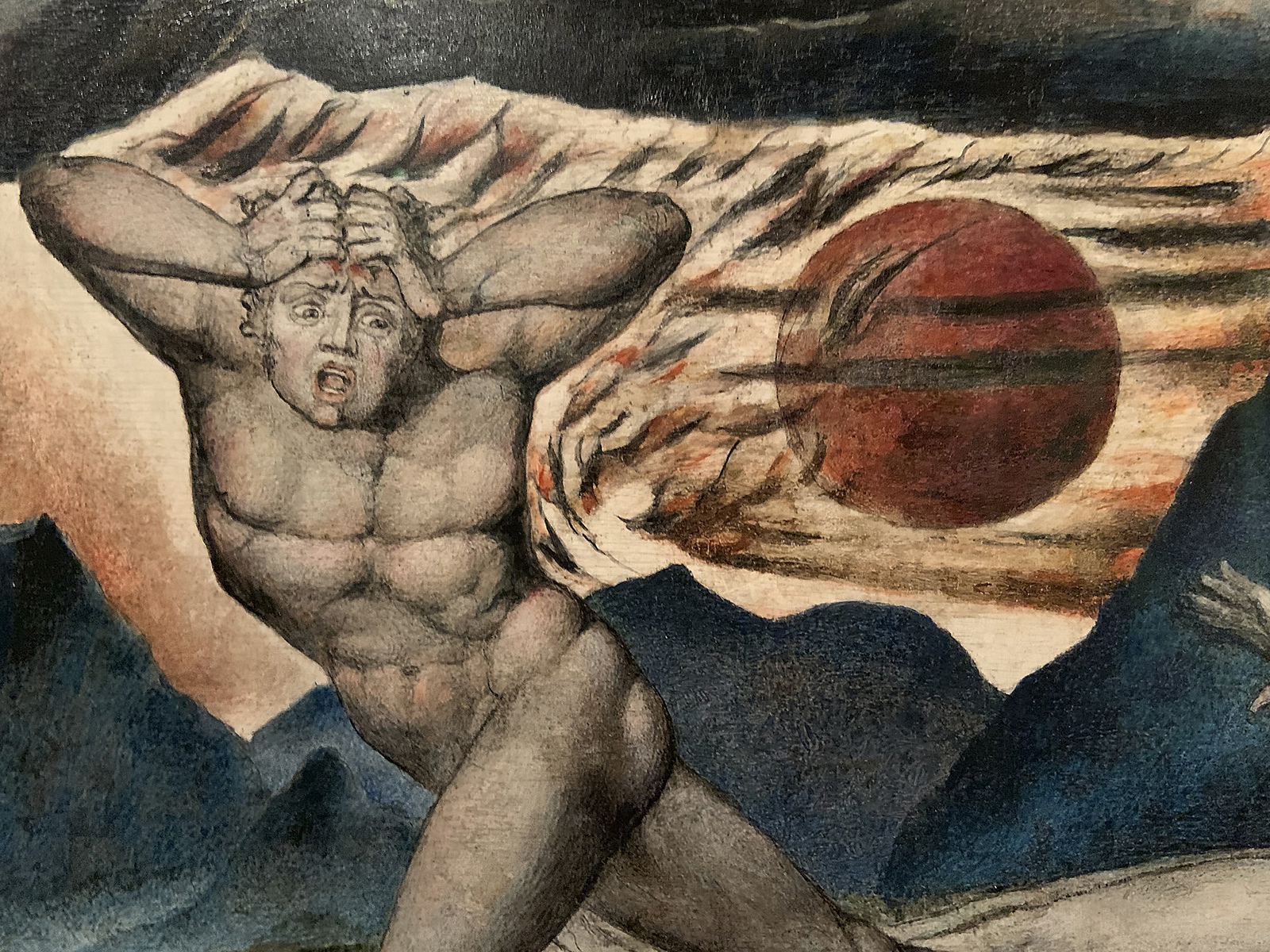
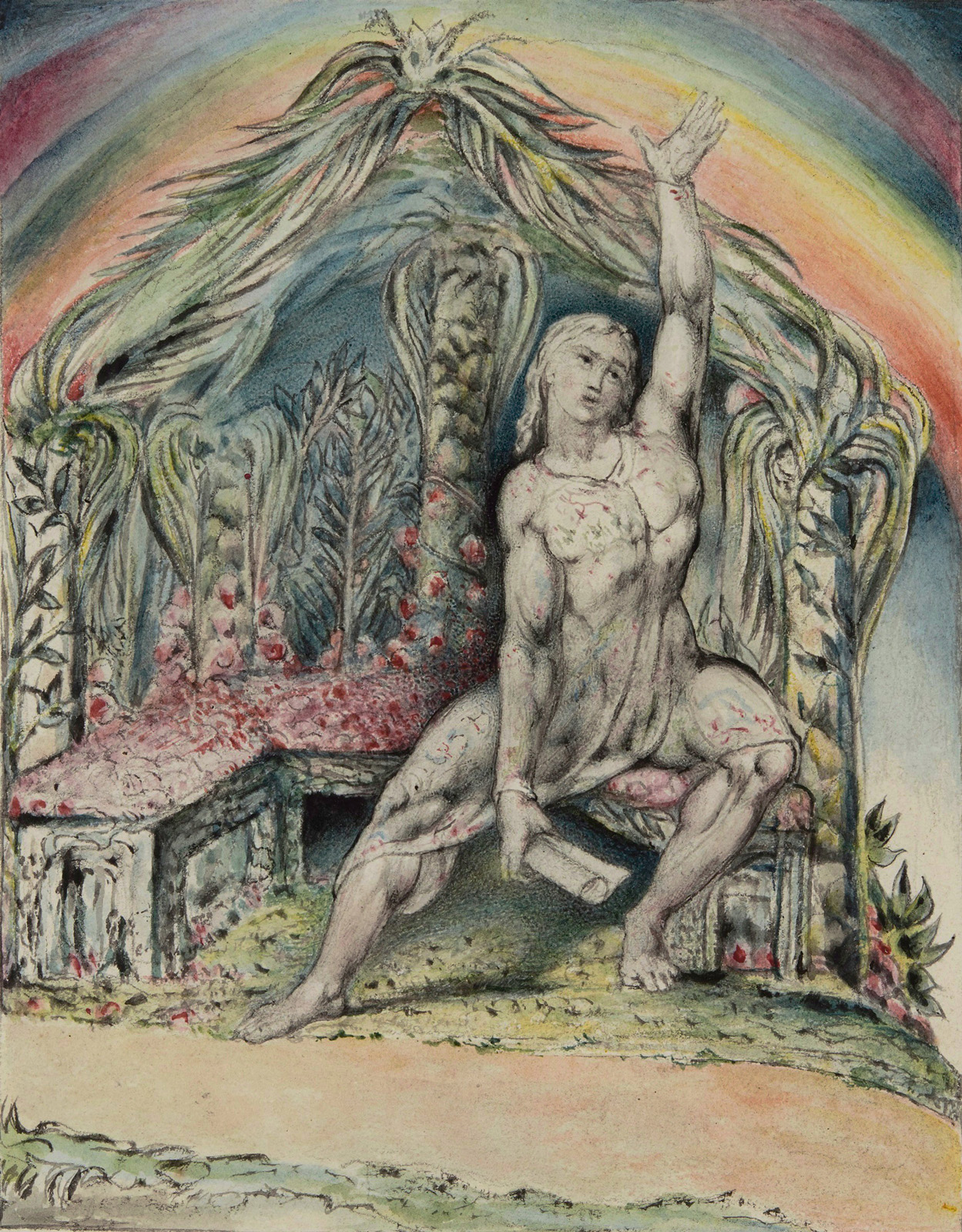
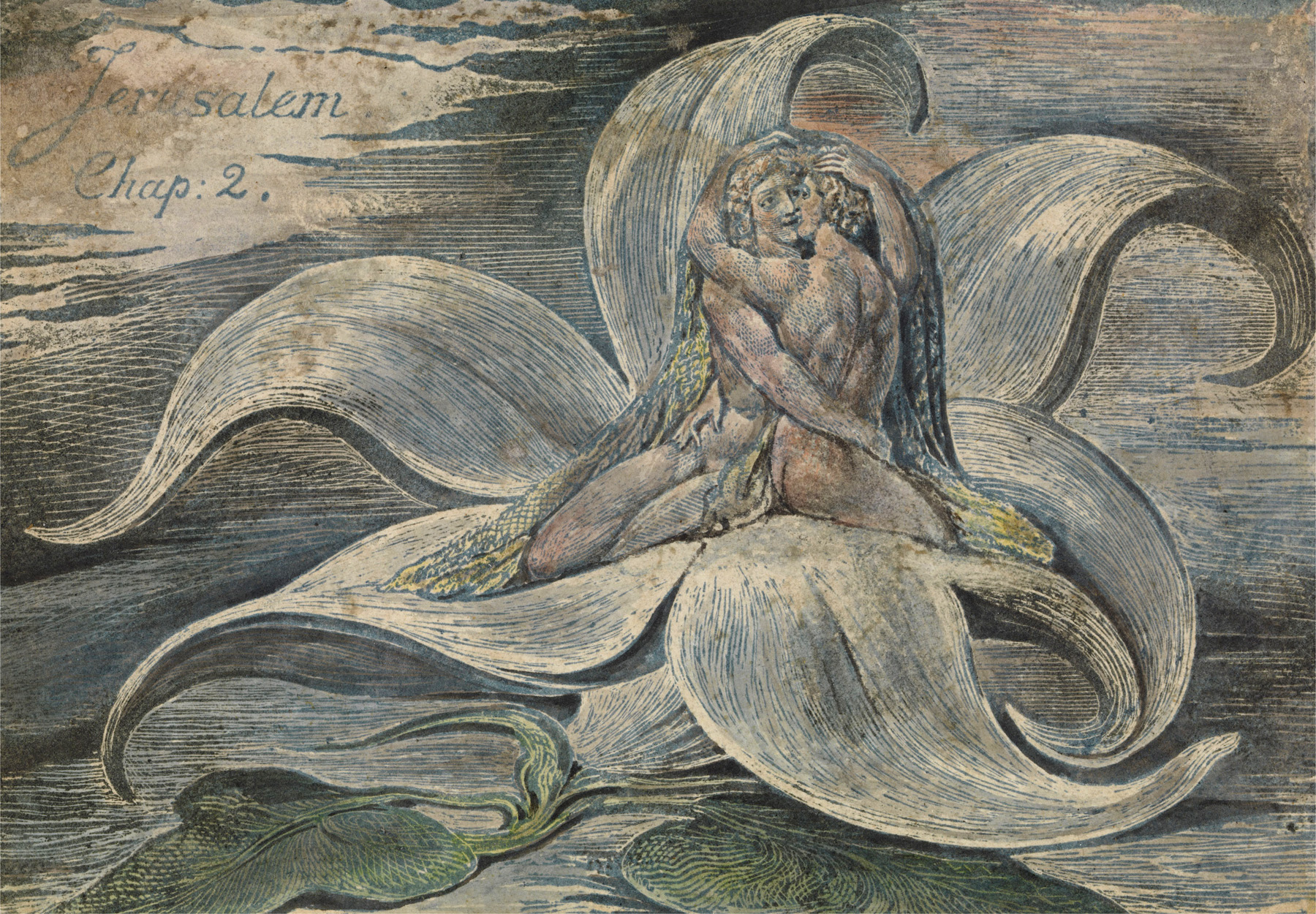
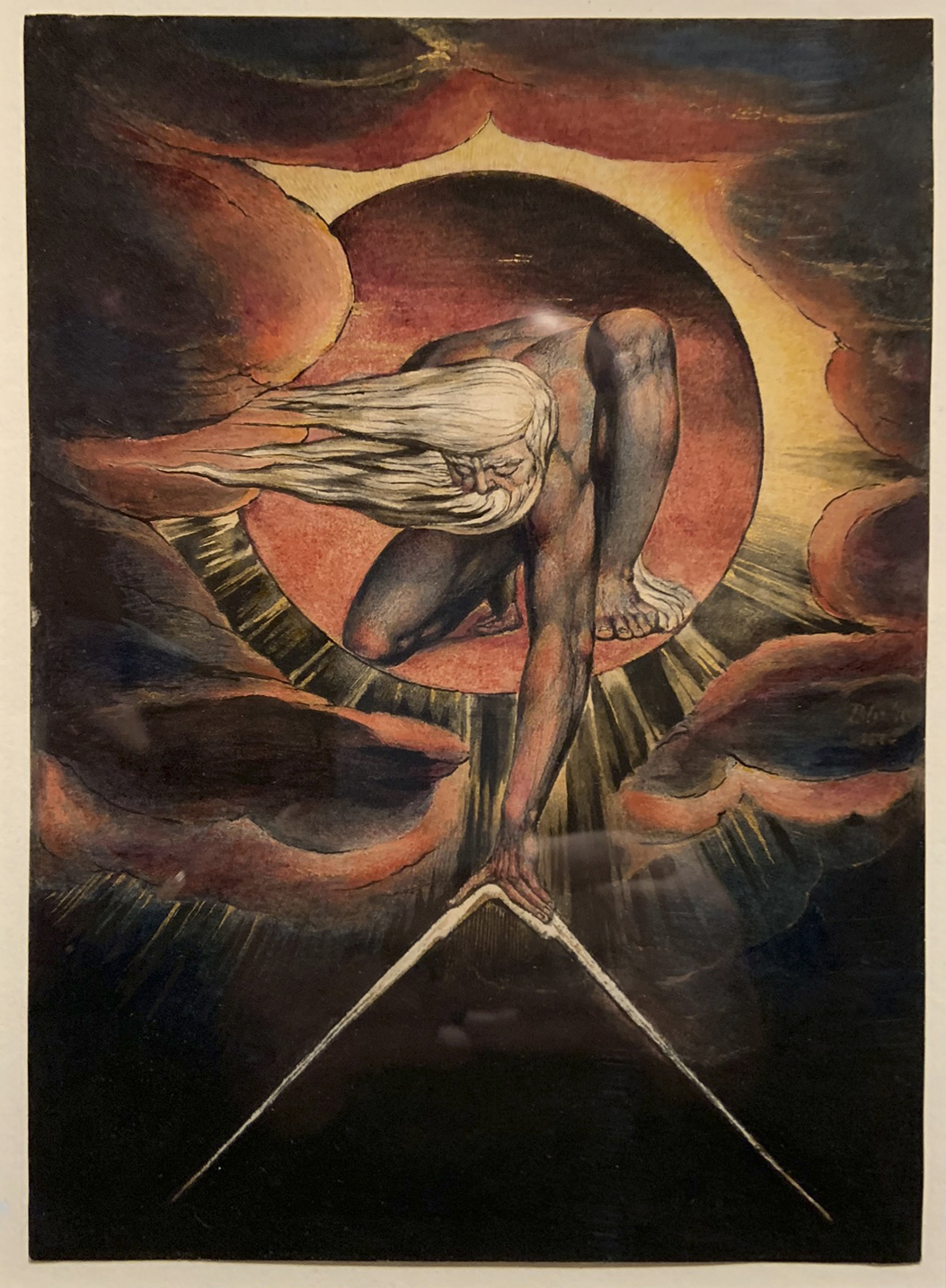
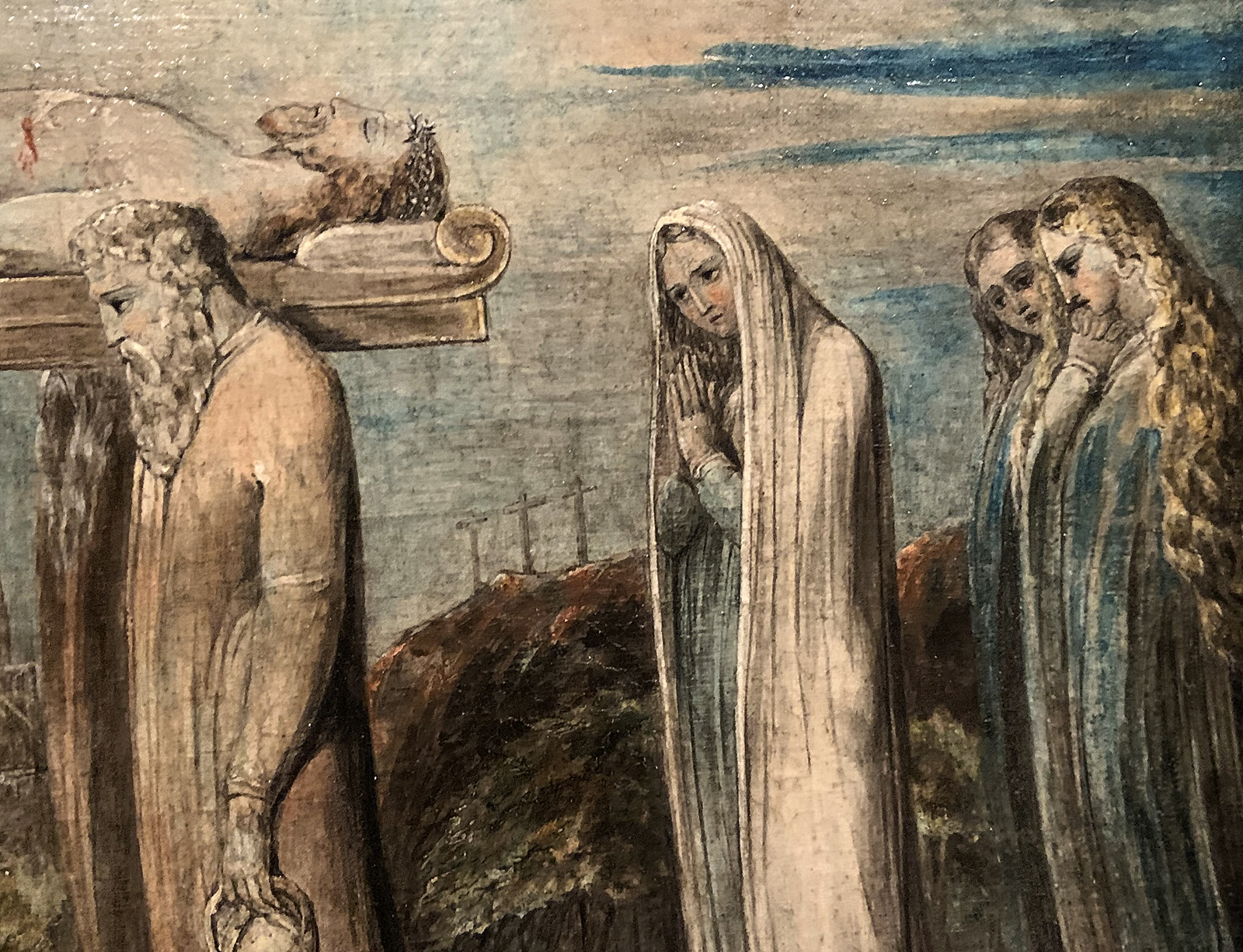
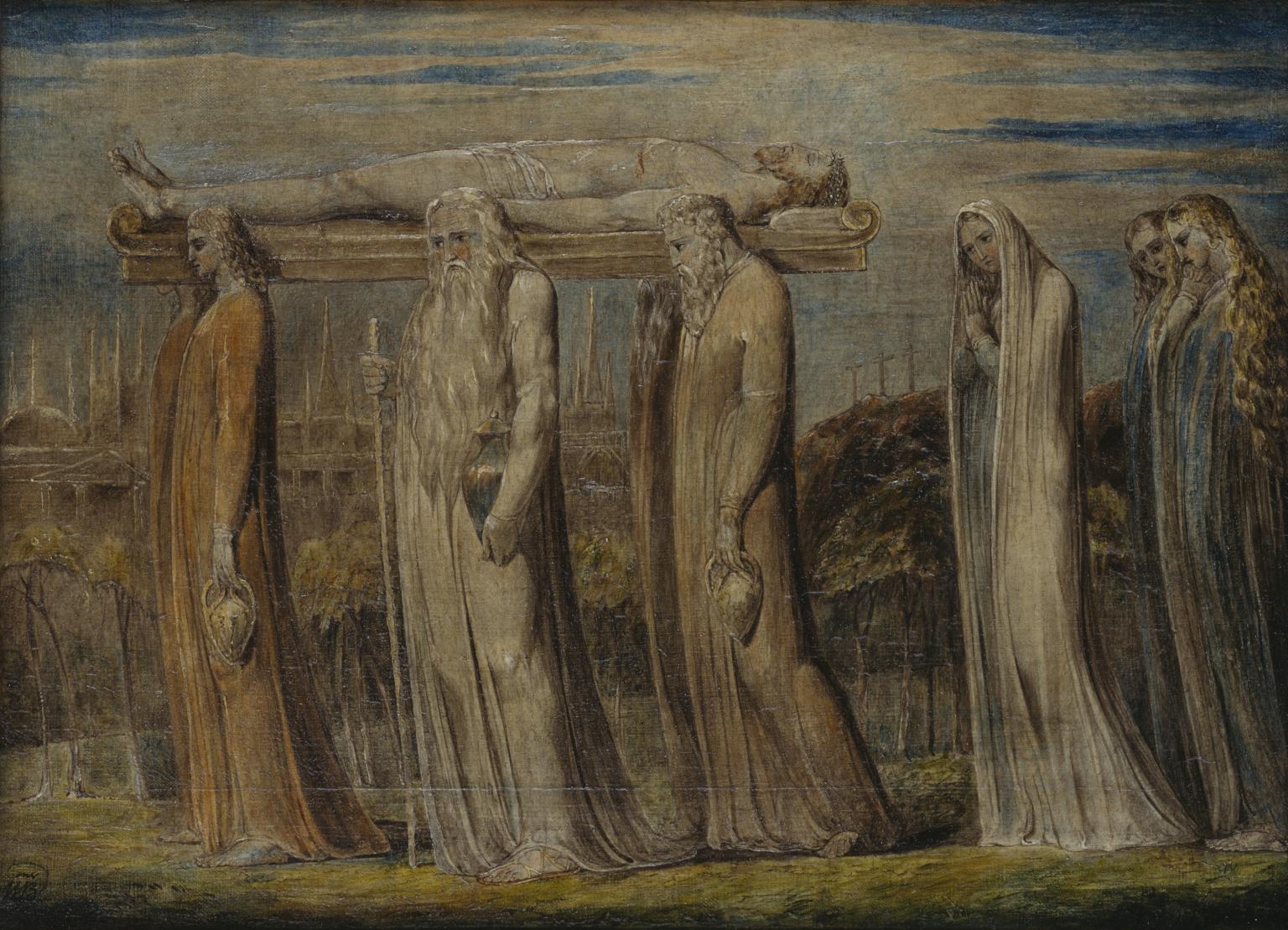
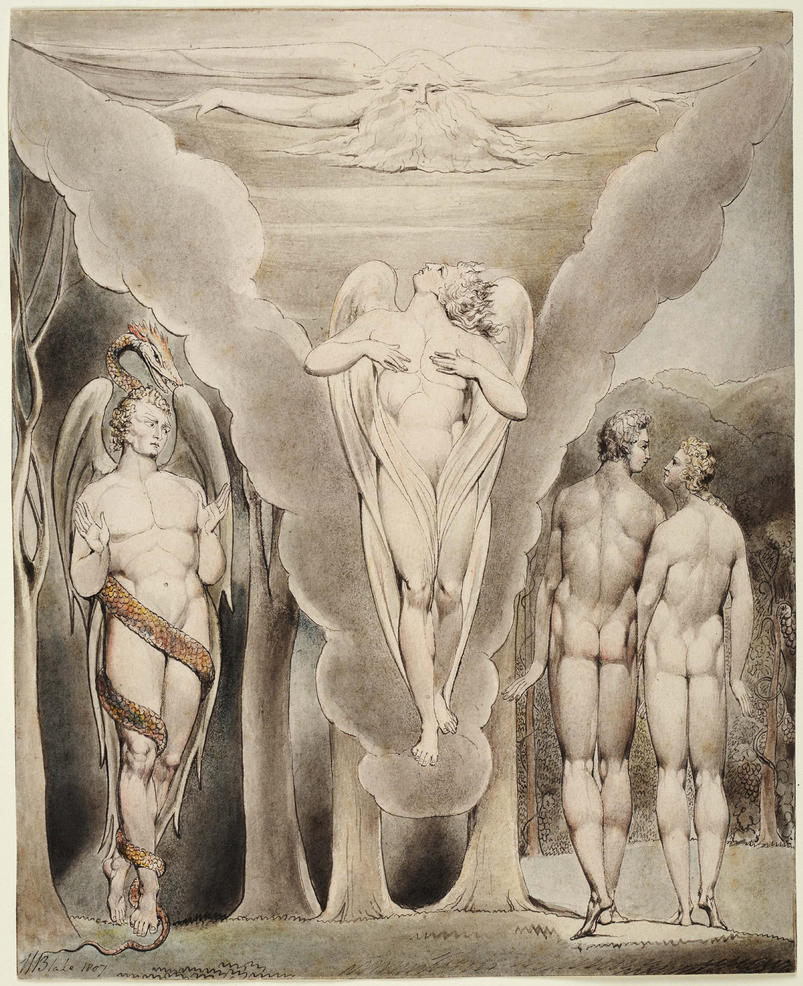
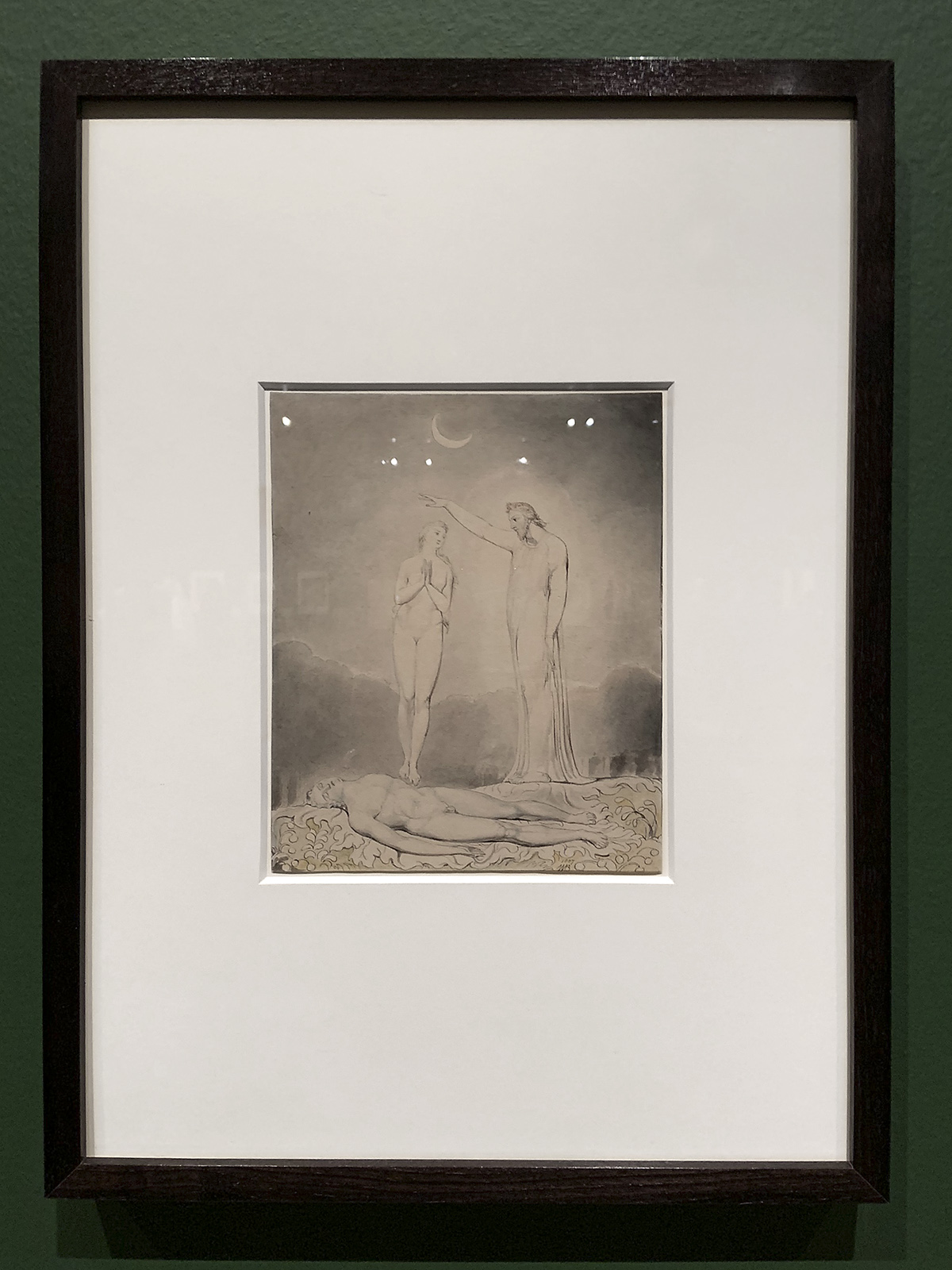
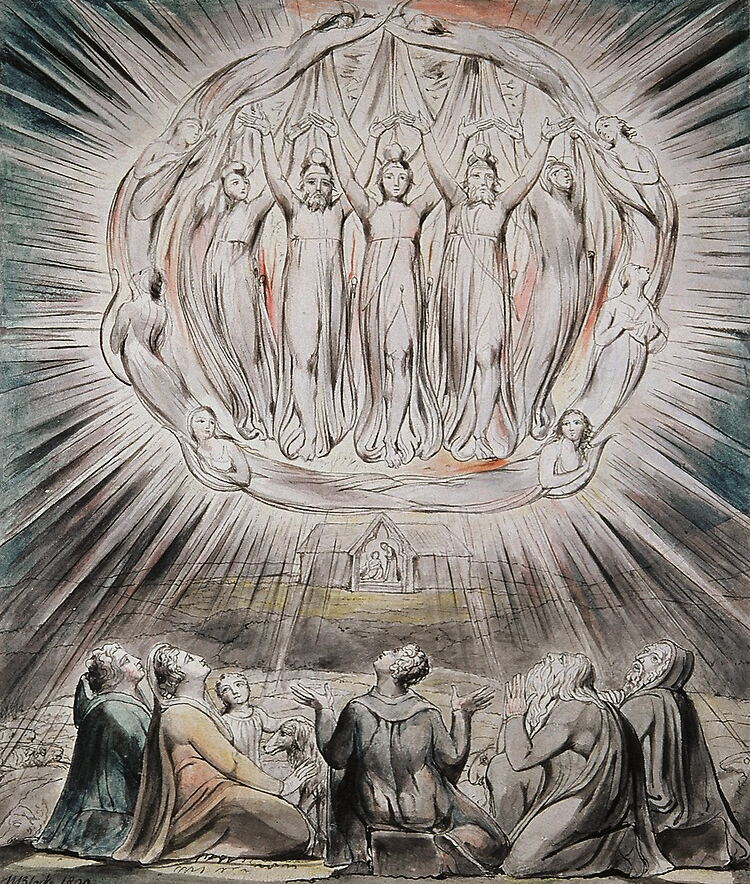
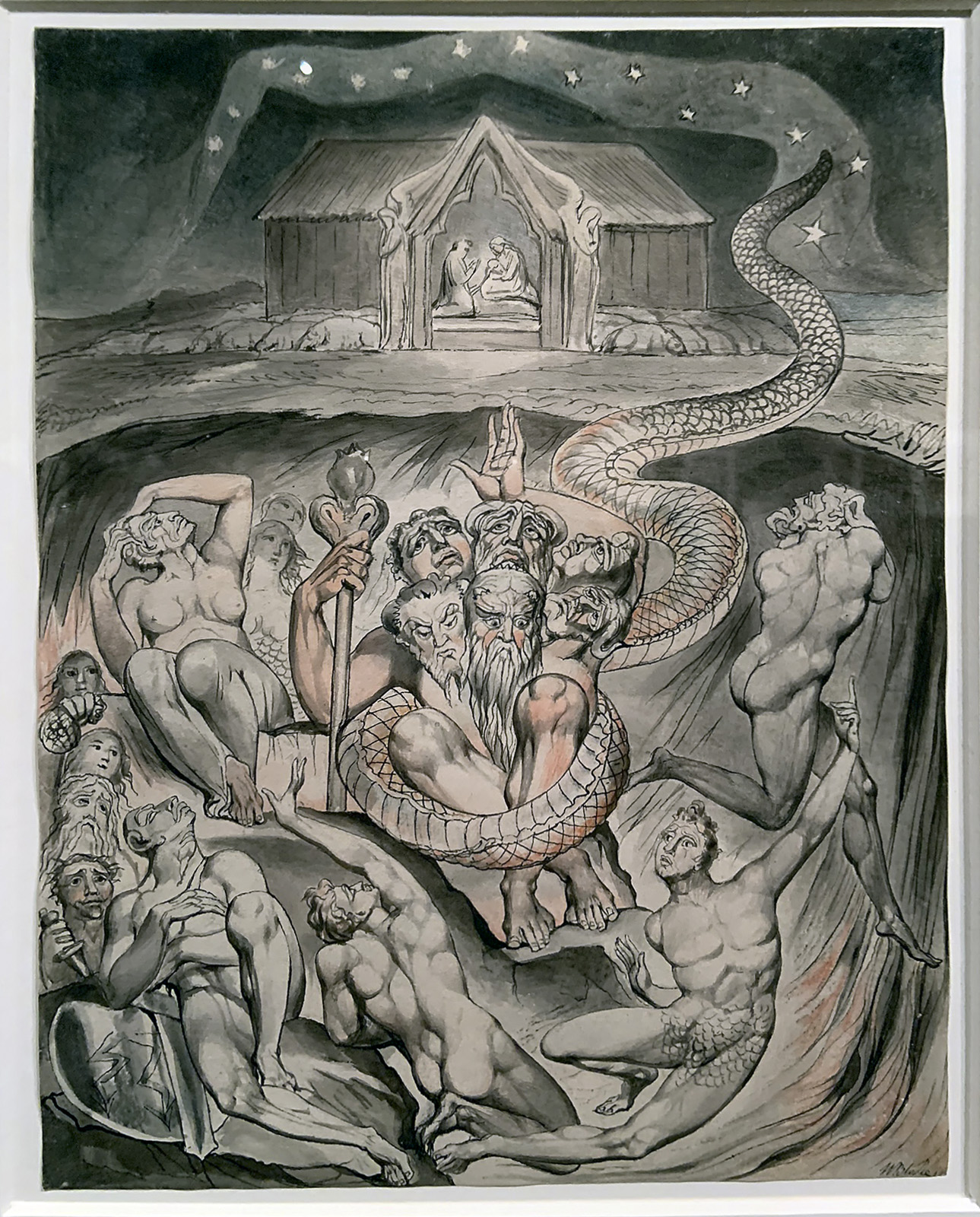
European research tour exhibition: ‘William Blake’ at Tate Britain, London Part 2

Exhibition dates: 11th September, 2019 – 2nd February, 2020
Visited October 2019 posted February 2020

Curators: Martin Myrone, Senior Curator, pre-1800 British Art, and Amy Concannon, Curator, British Art 1790-1850


Room 3 continued…

Patronage and independence


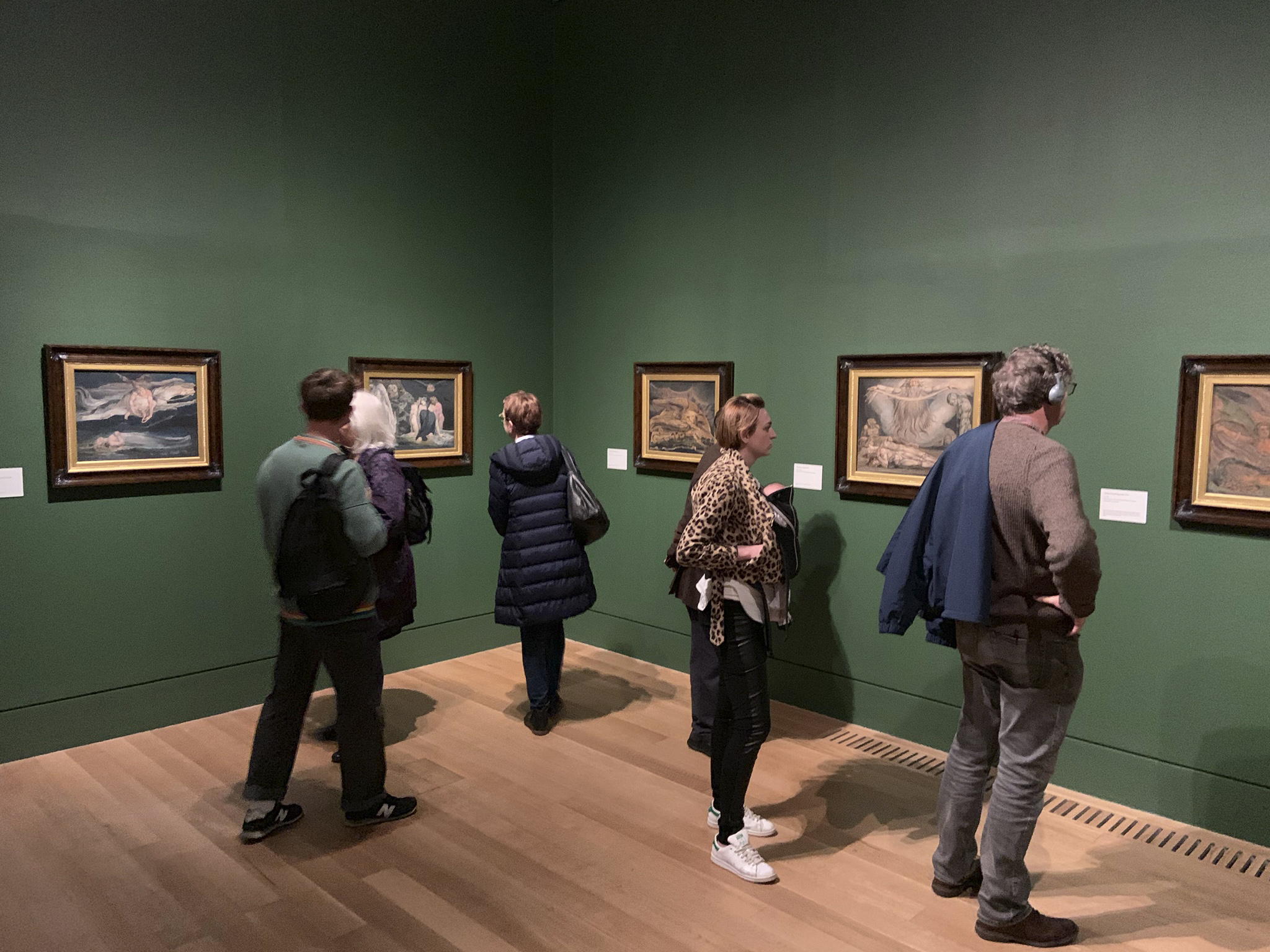
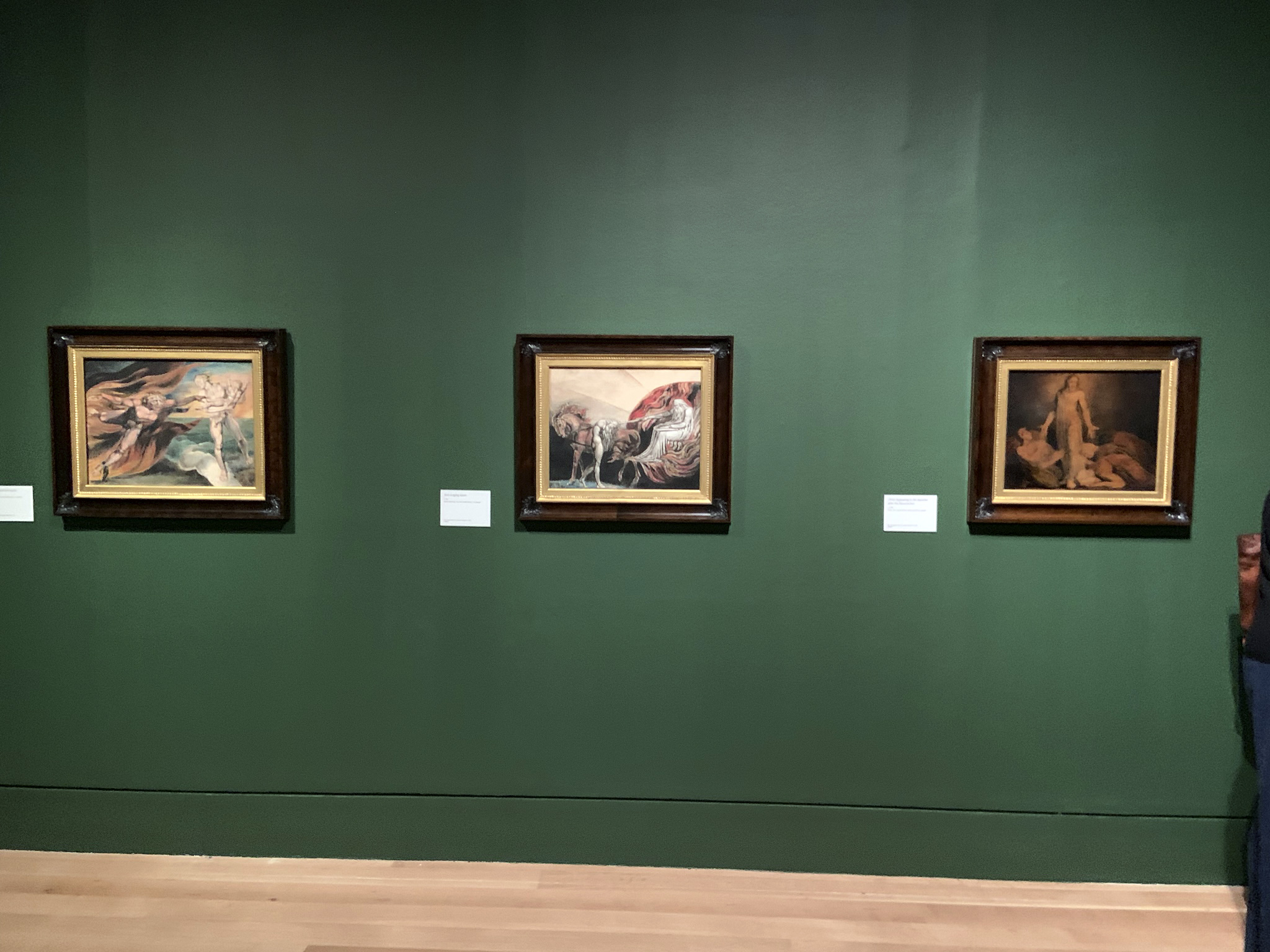
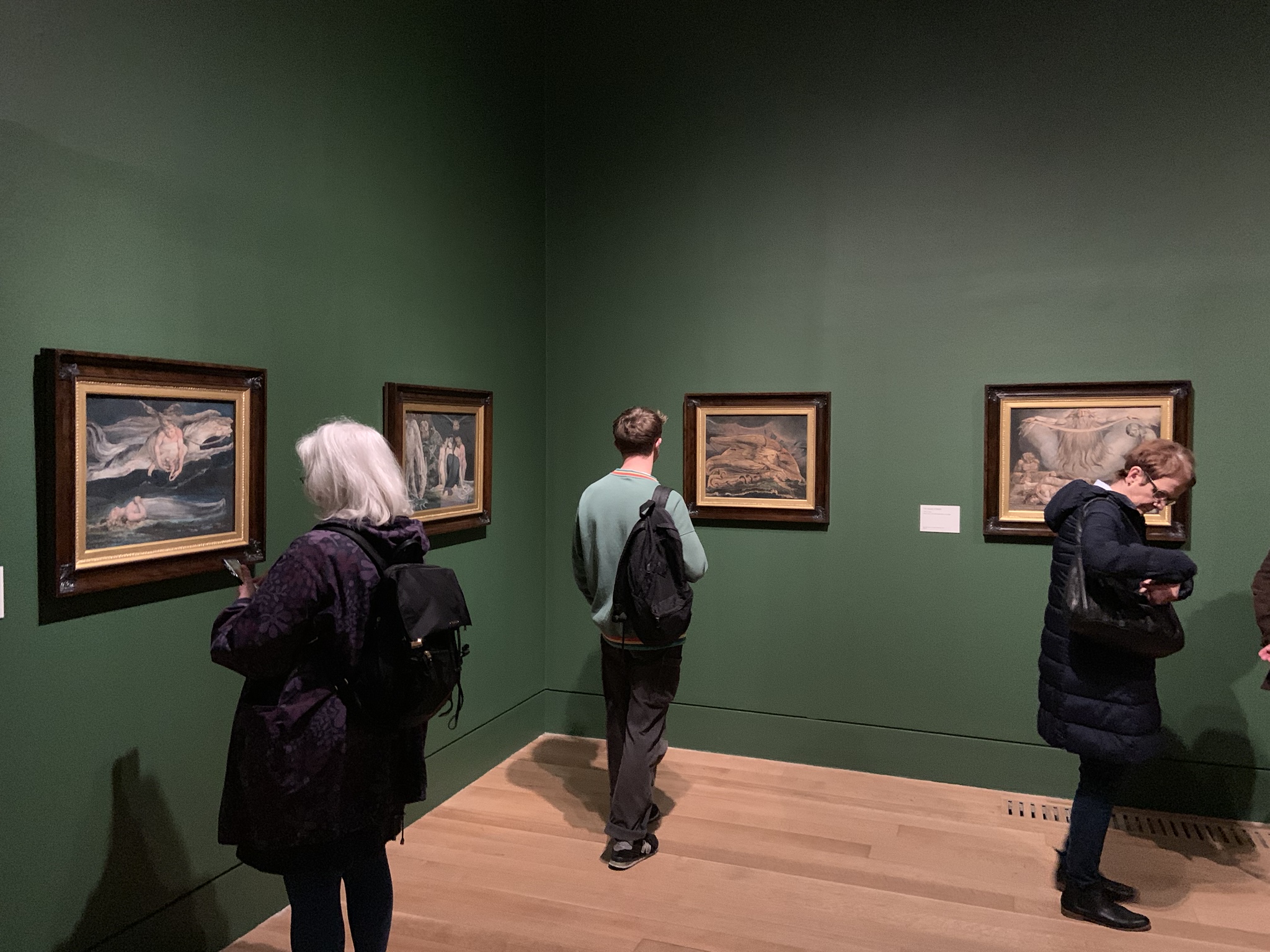
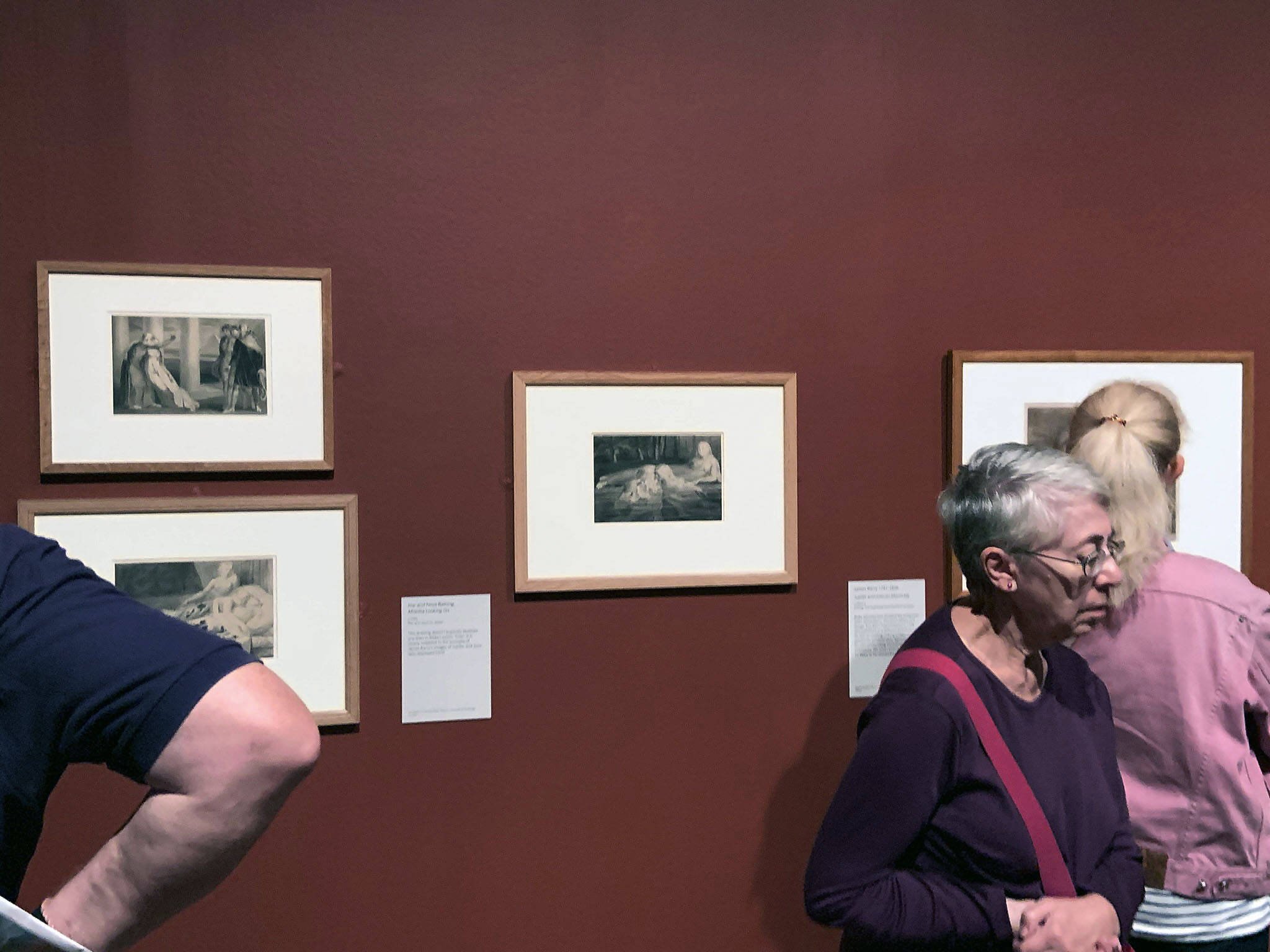
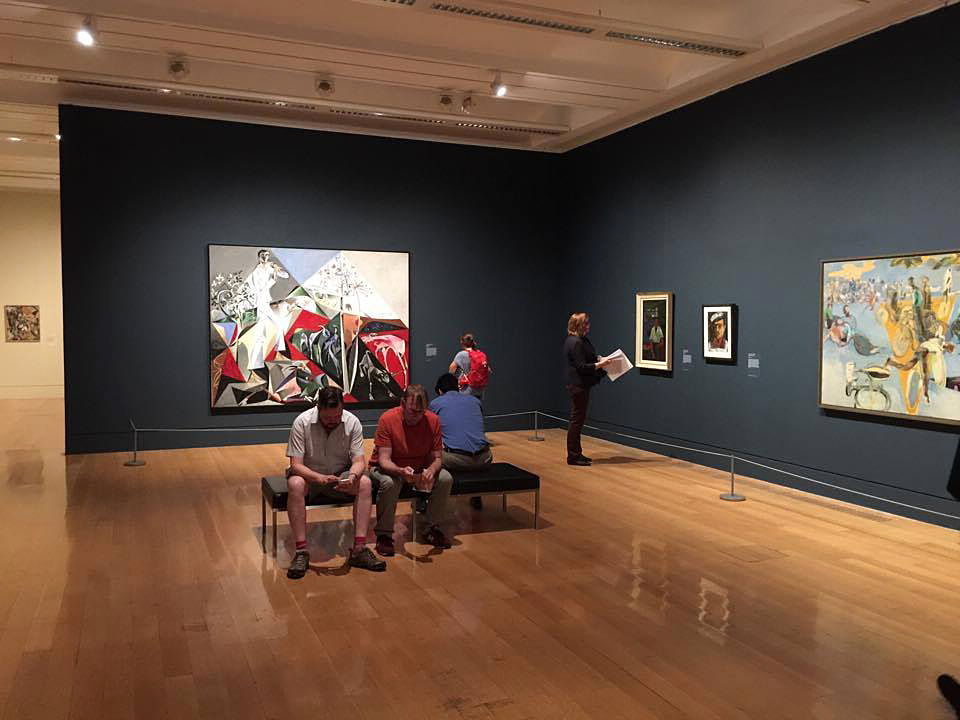
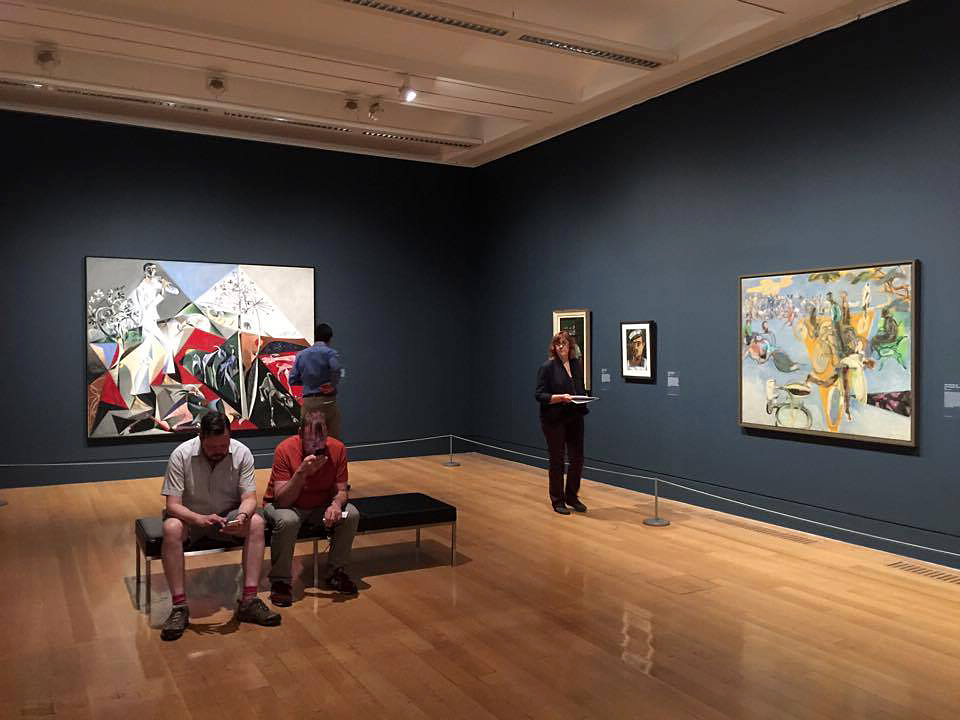
Installation view of the exhibition 'William Blake' at Tate Britain, London showing twelve large colour prints

Installation view of the exhibition 'William Blake' at Tate Britain, London showing twelve large colour prints

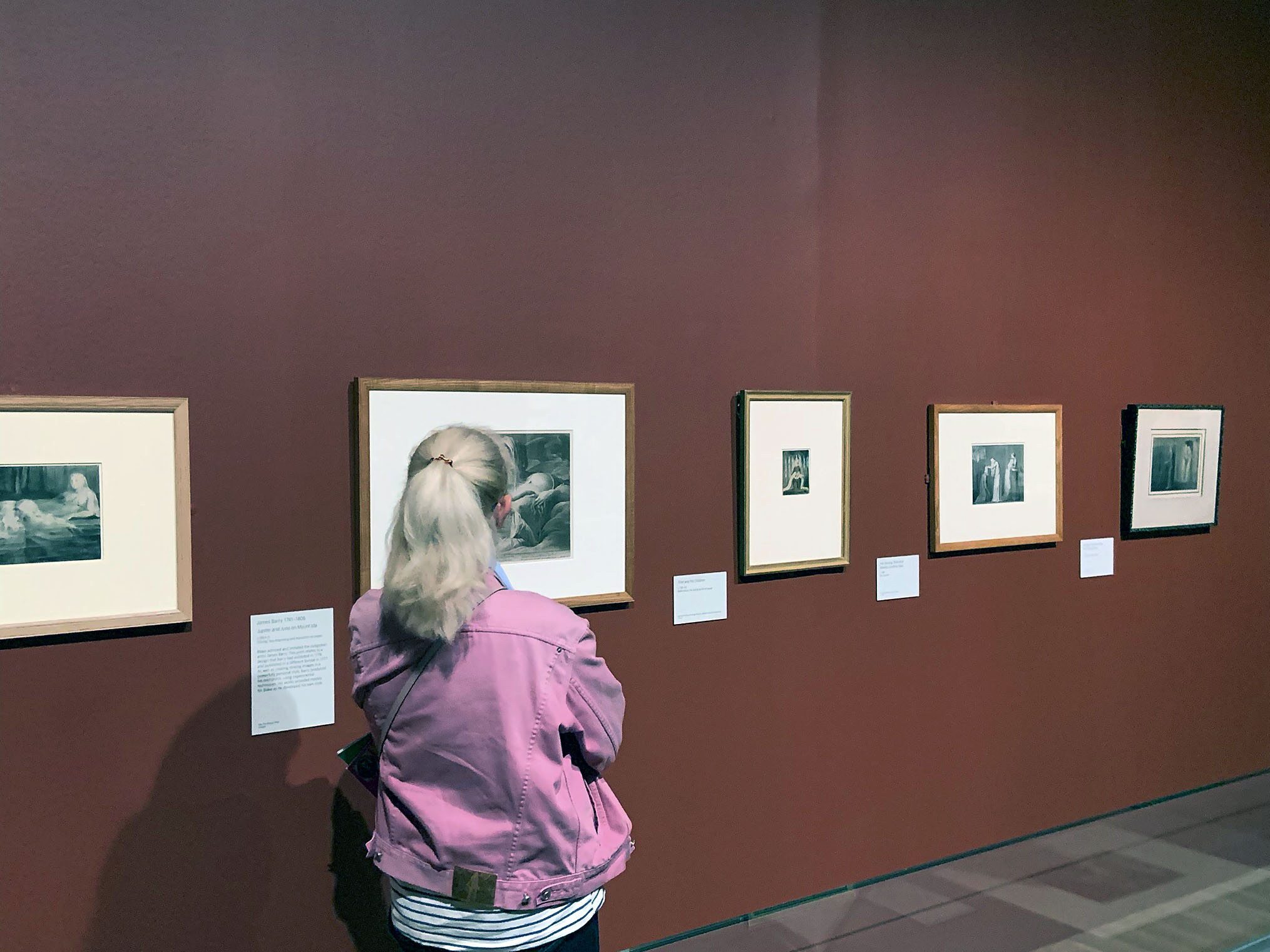
Installation view of the exhibition 'William Blake' at Tate Britain, London showing twelve large colour prints

Installation view of the exhibition 'William Blake' at Tate Britain, London showing twelve large colour prints

Installation view of the exhibition 'William Blake' at Tate Britain, London showing twelve large colour prints


Installation views of the exhibition William Blake at Tate Britain, London showing twelve large colour prints
Photos: Marcus Bunyan


Visions of divine damnation

I believe. I am a believer… a person who believes in the truth and/or existence of something, that ineffable something, that is the magic of the art of William Blake.

I believe that it would take a lifetime of scholarship to begin to fully understand the mythology, symbolism, and poetry of this man. I do not possess that knowledge. What I do posses is the ability to look at these images, process their form, colour, movement and, possibly, feel their spirit.

From academic beginnings Blake develops a unique artistic language. The rebellious, radical symbolism of his books, humanist veins, tap into the un/bound scrimmage of pleasure and pain, f(l)ights of good and evil told through visual poems, paeans to the diabolical munificence of the cosmos.

When I look at Blake I am swept along in the sensuous, writhing curves of the body. I feel their lyrical movement, whether they are partner to themes of childhood and morality, or suffering and social injustice for example. I feel that they touch my soul, deeply. Suffused with melancholy, damnation, joy, redemption and forgiveness his forms raise me up from the everyday. They challenge me to understand… to understand the work, myself and the world in which I live. They have as much relevance today as they ever did. They are revelatory.

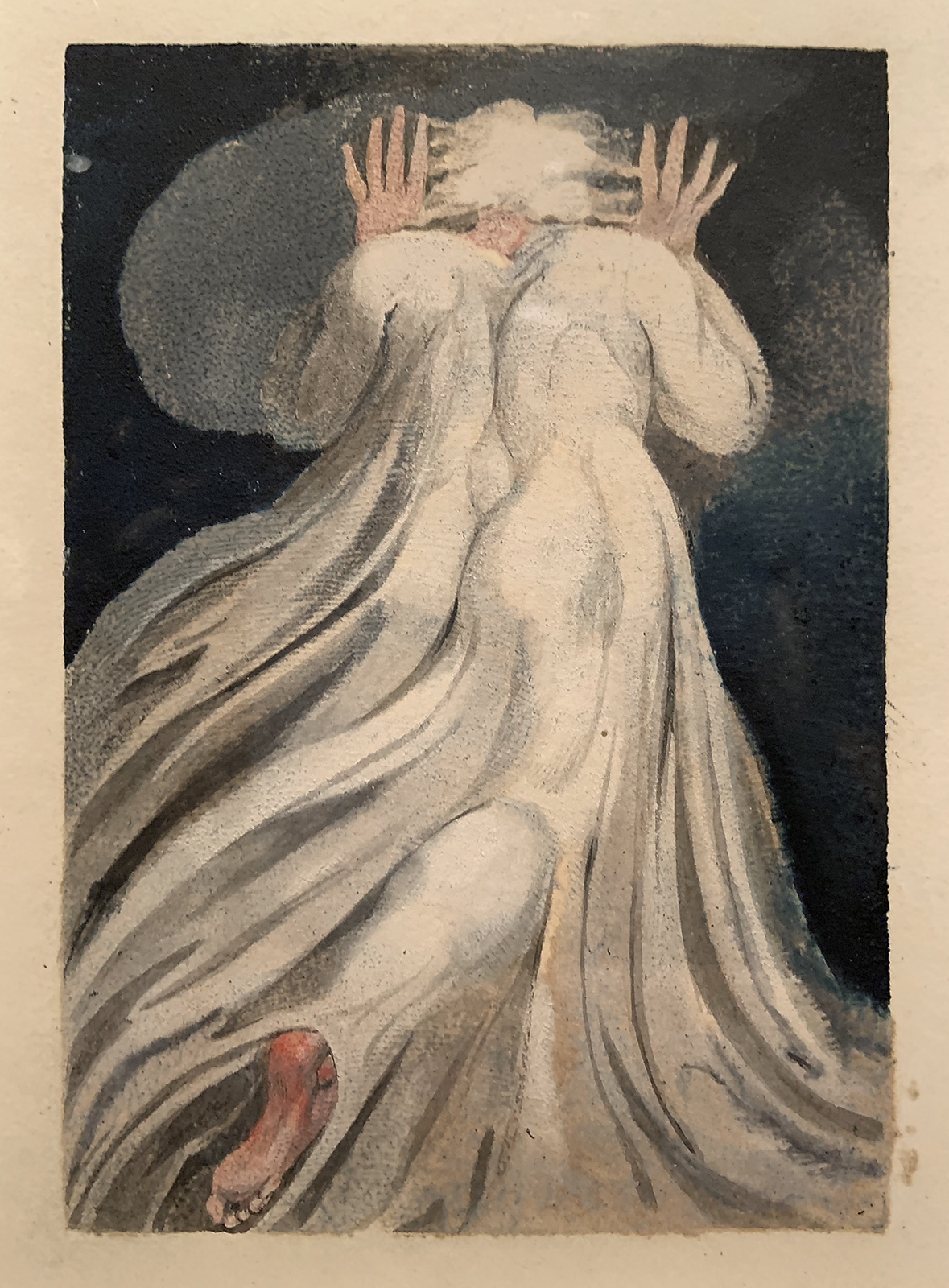
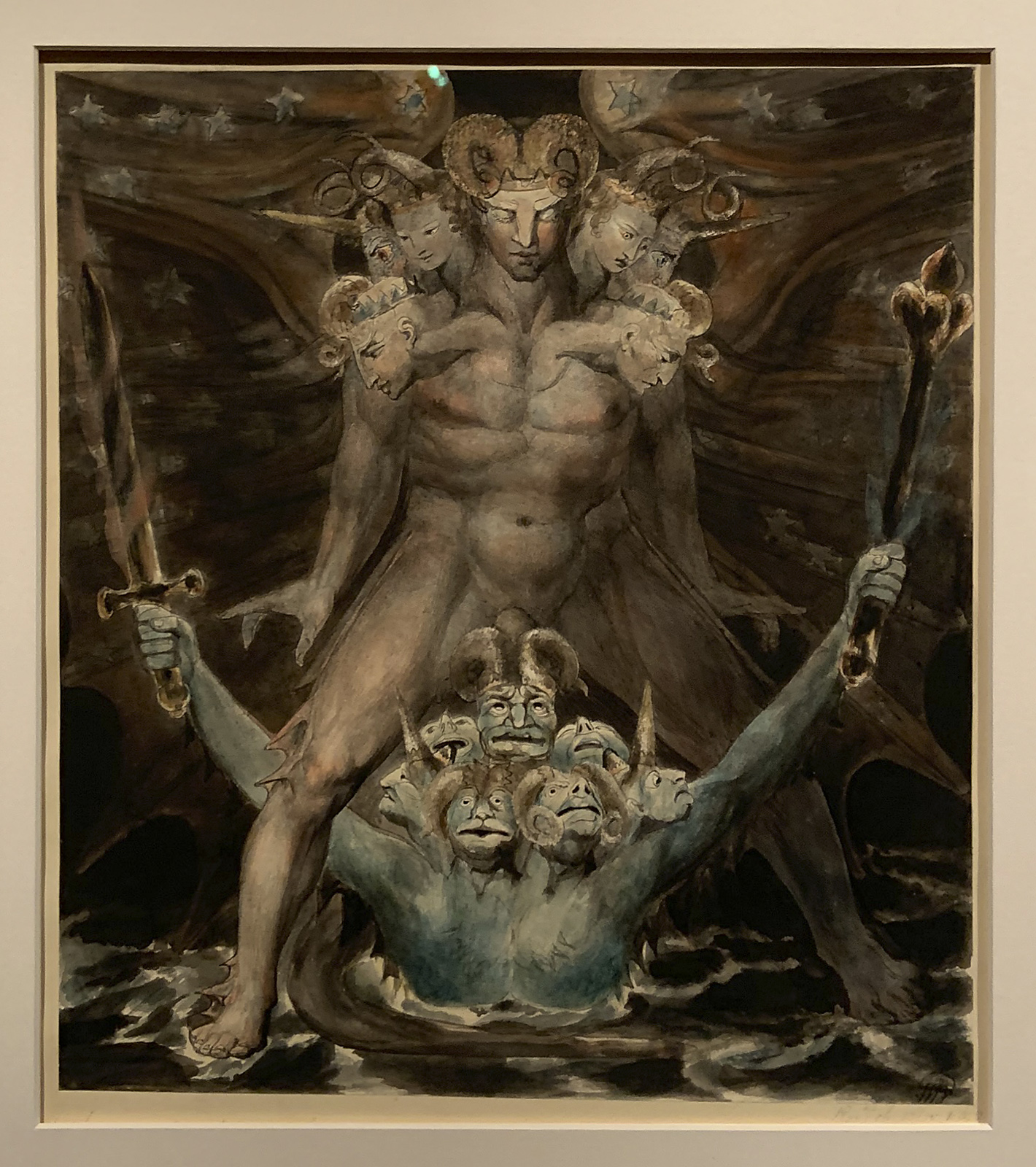
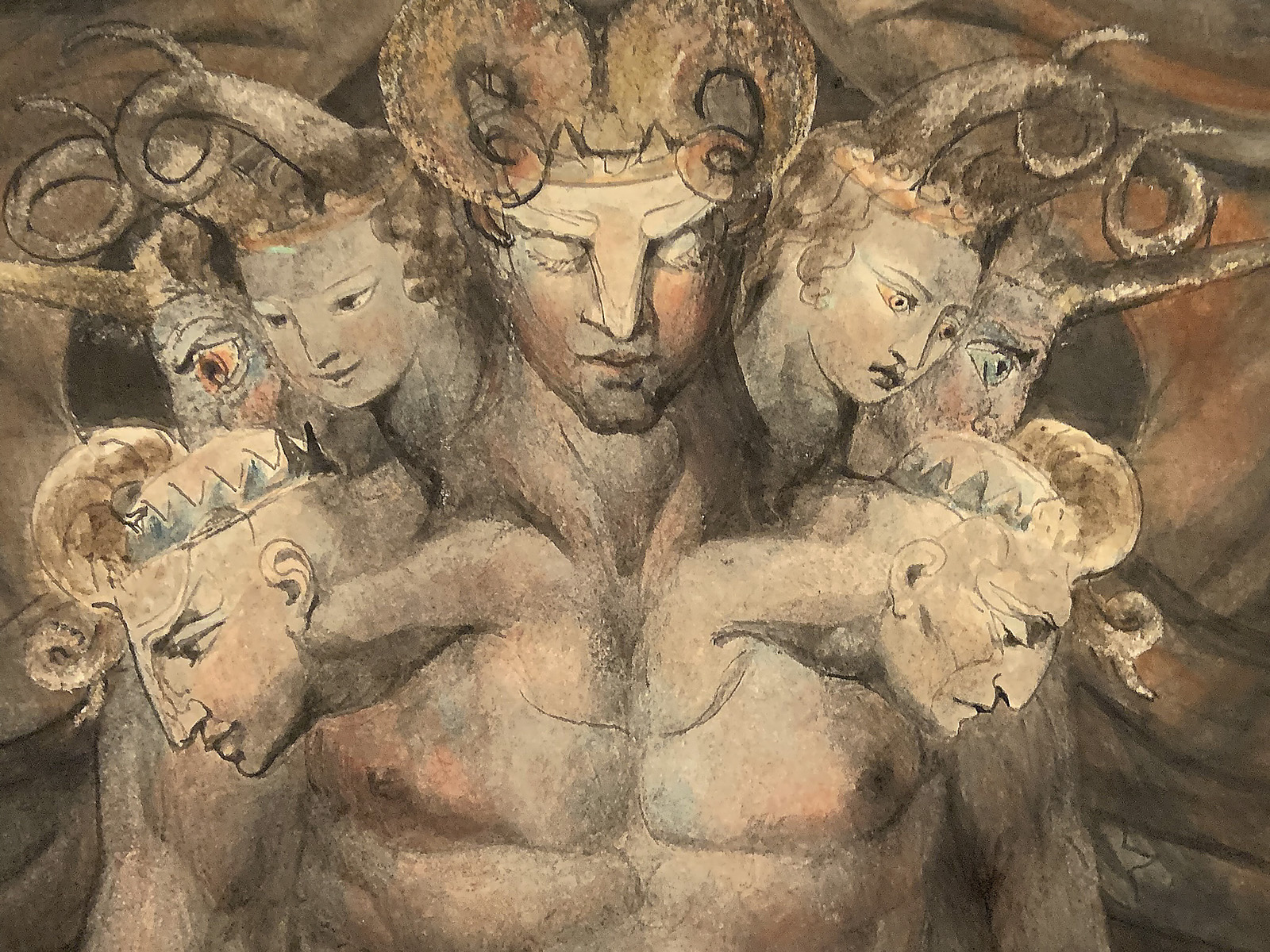
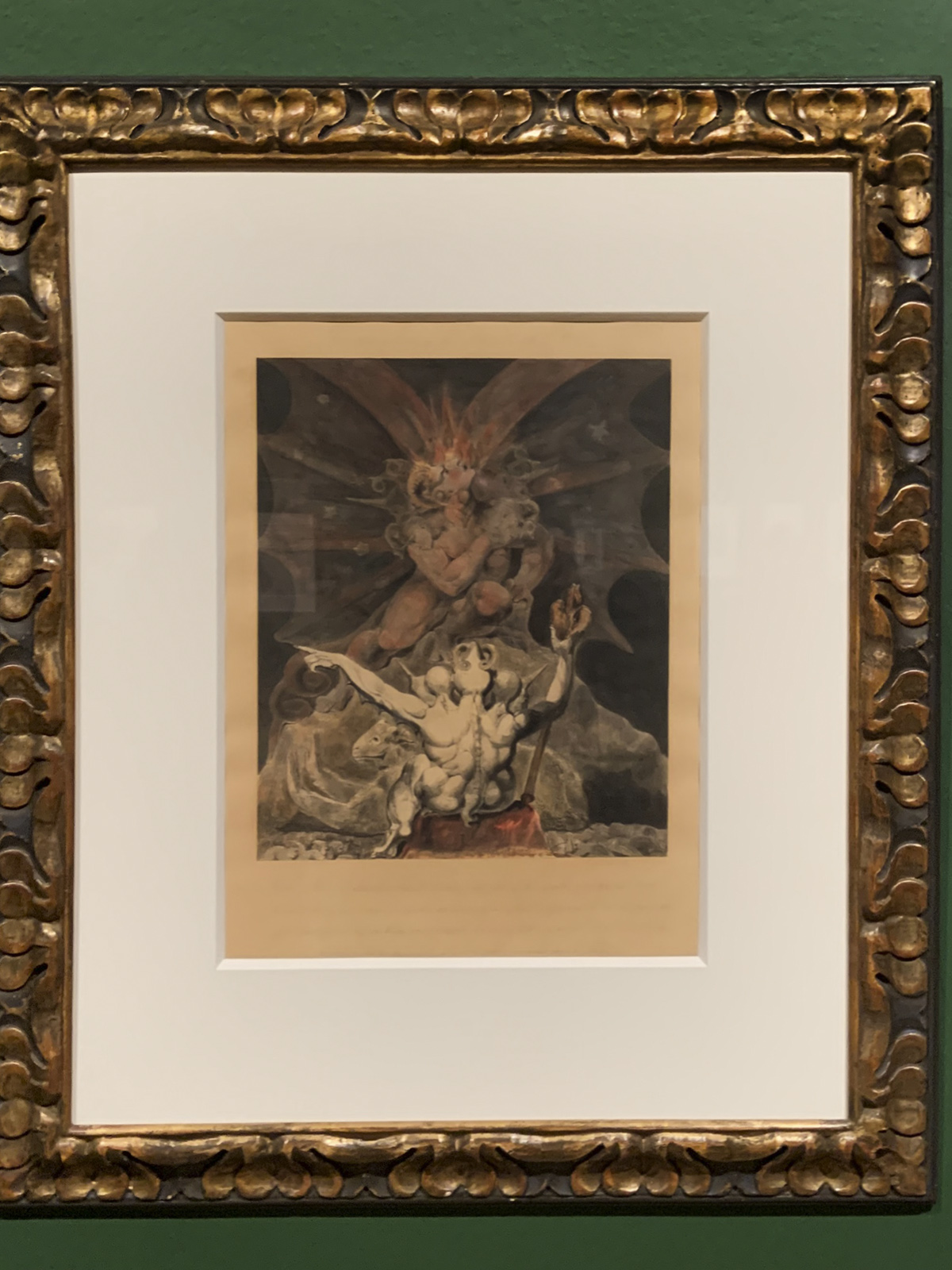
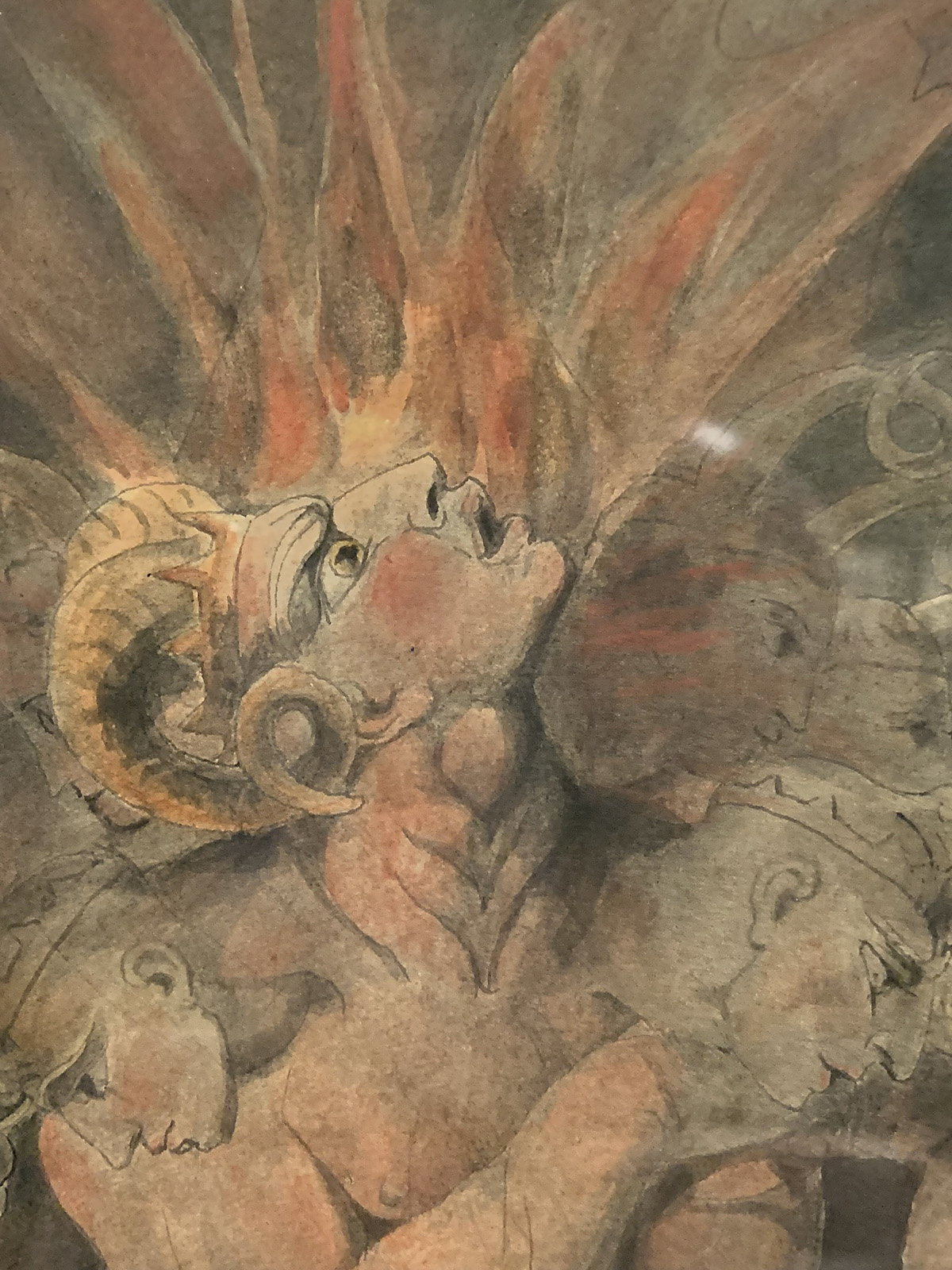
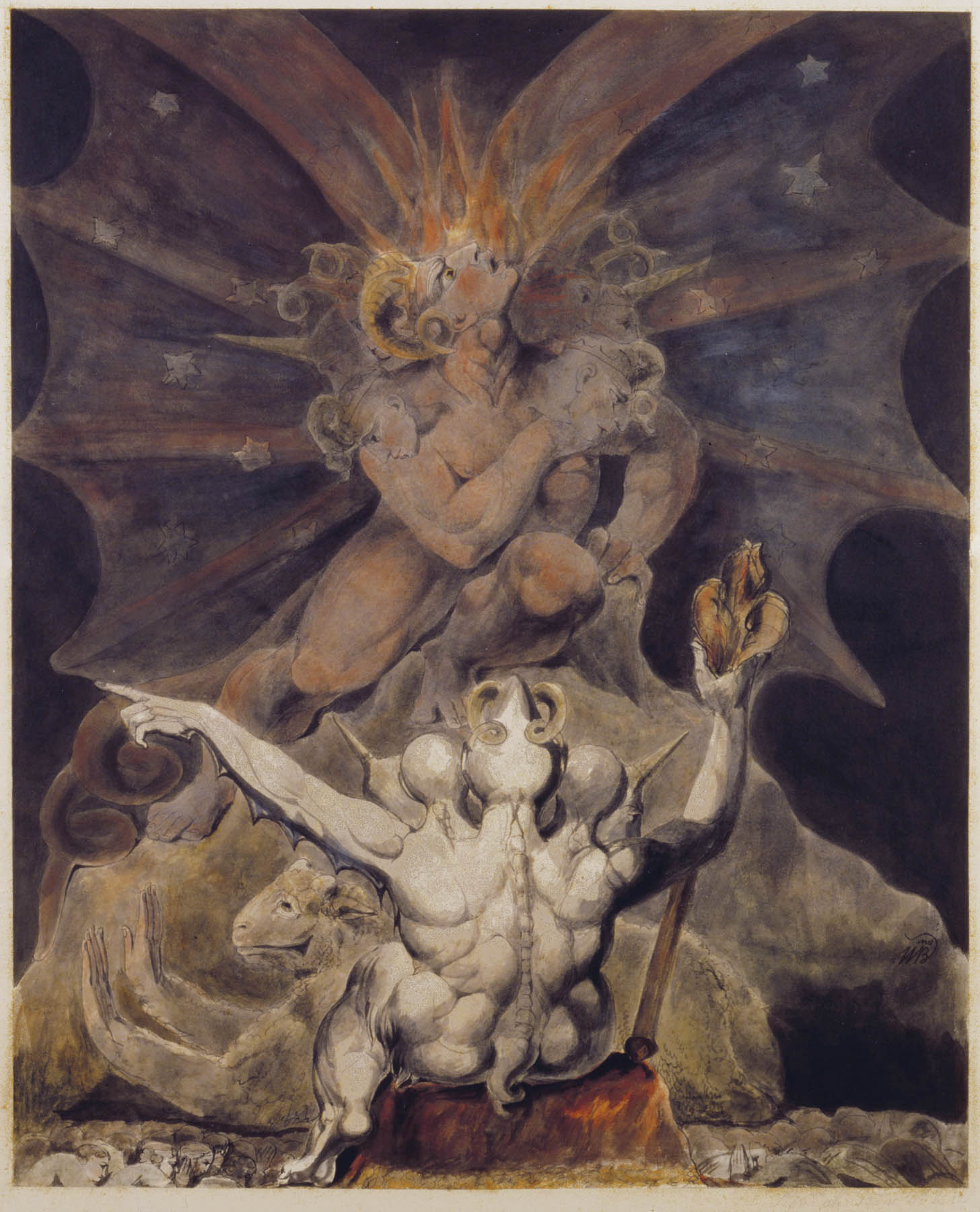
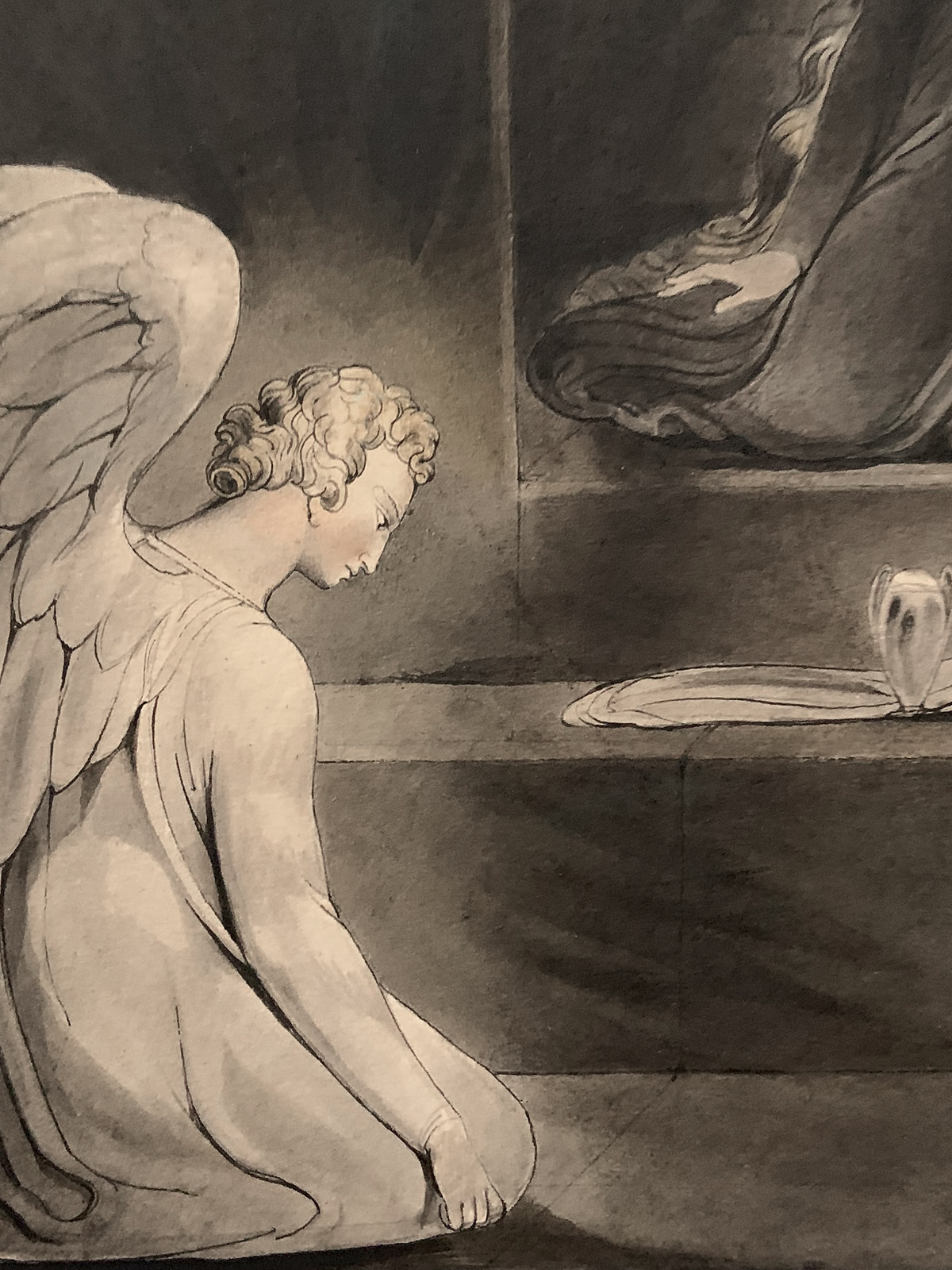
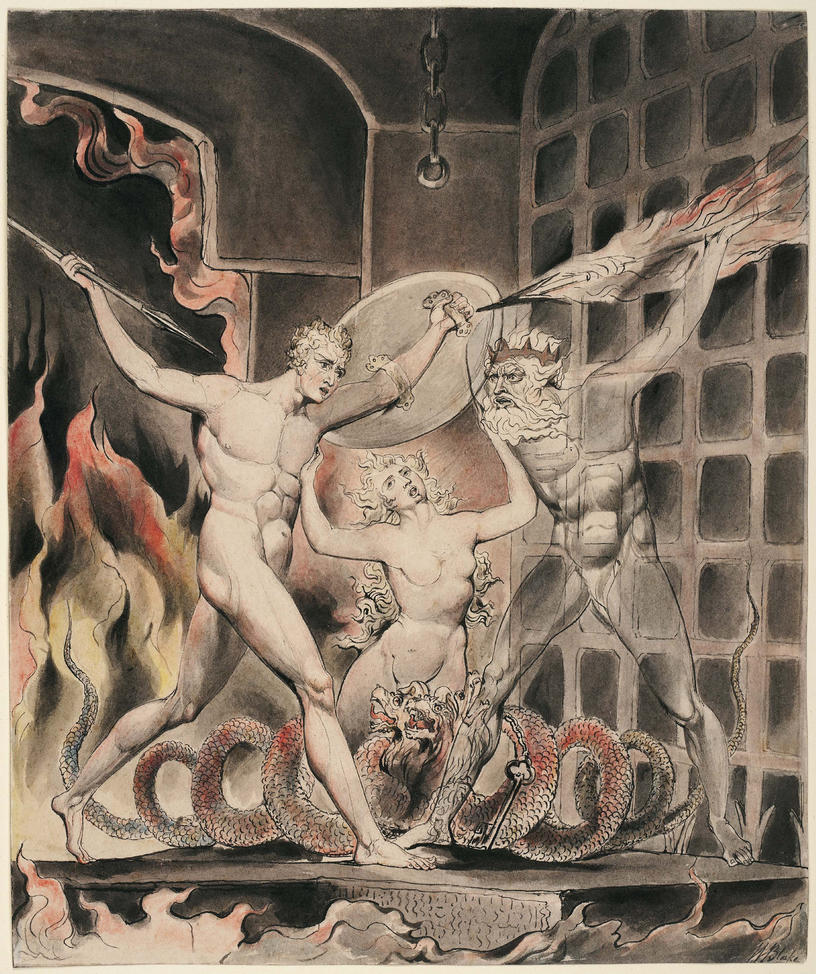
The startling a/symmetry and interweaving of forms that characterises so much of his work is particularly affective. The symmetry of the hands in Small Book of Designs: Plate 11, Gowned Male Seen from behind (1794) with the diagonal sweep of the leg; the interwoven leg and arms of The Great Red Dragon and the Beast from the Sea (c. 1805); and the glorious design for The Angel Rolling away the Stone (c. 1805) with its suffused colour scheme and ethereal light are three examples in this rich tapestry of creation. His work seems to float as if a breathless cloud, suffused with sex and spiritual ecstasy, imbibing of the realm of the sublime and the imagination.

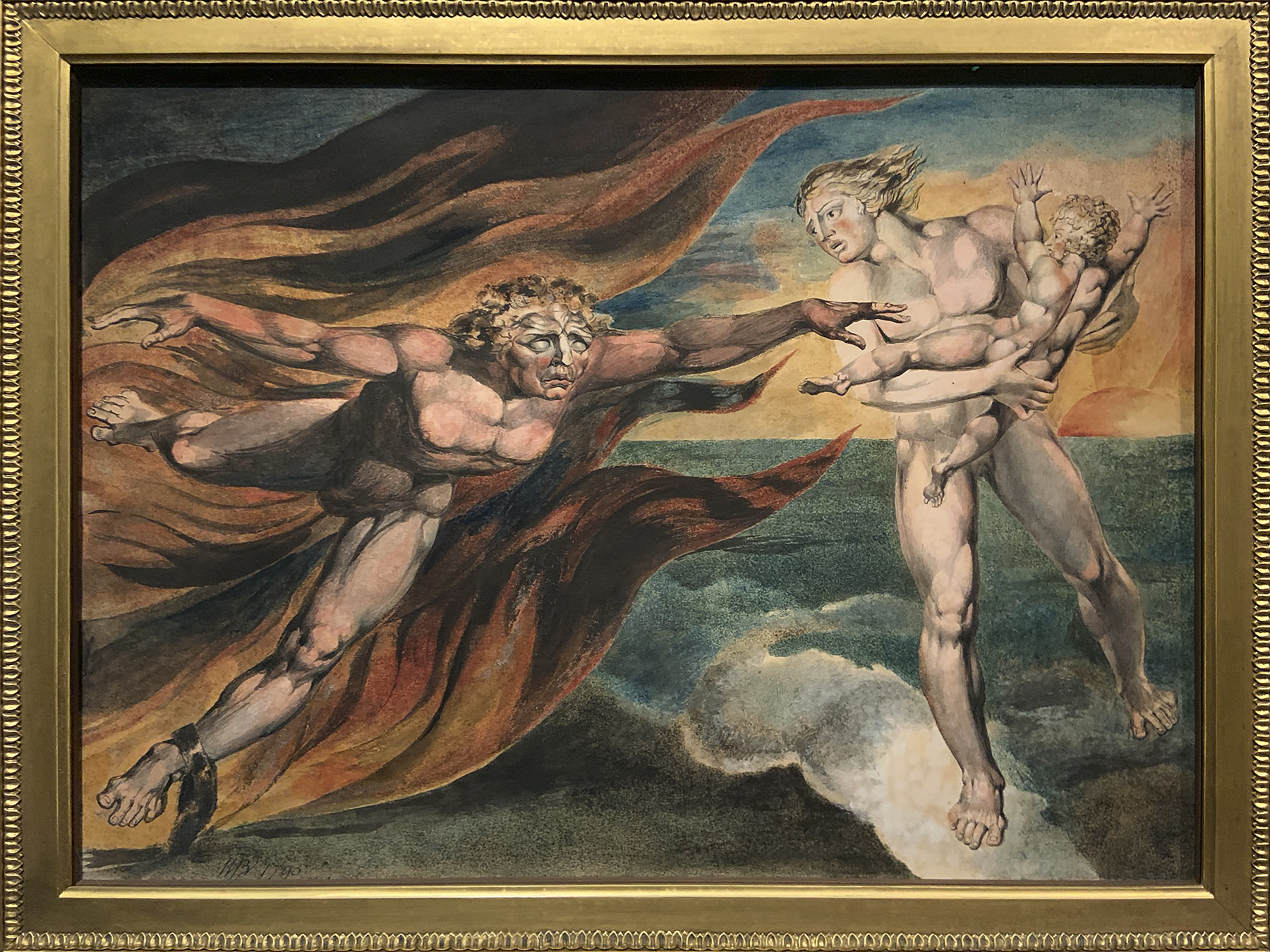
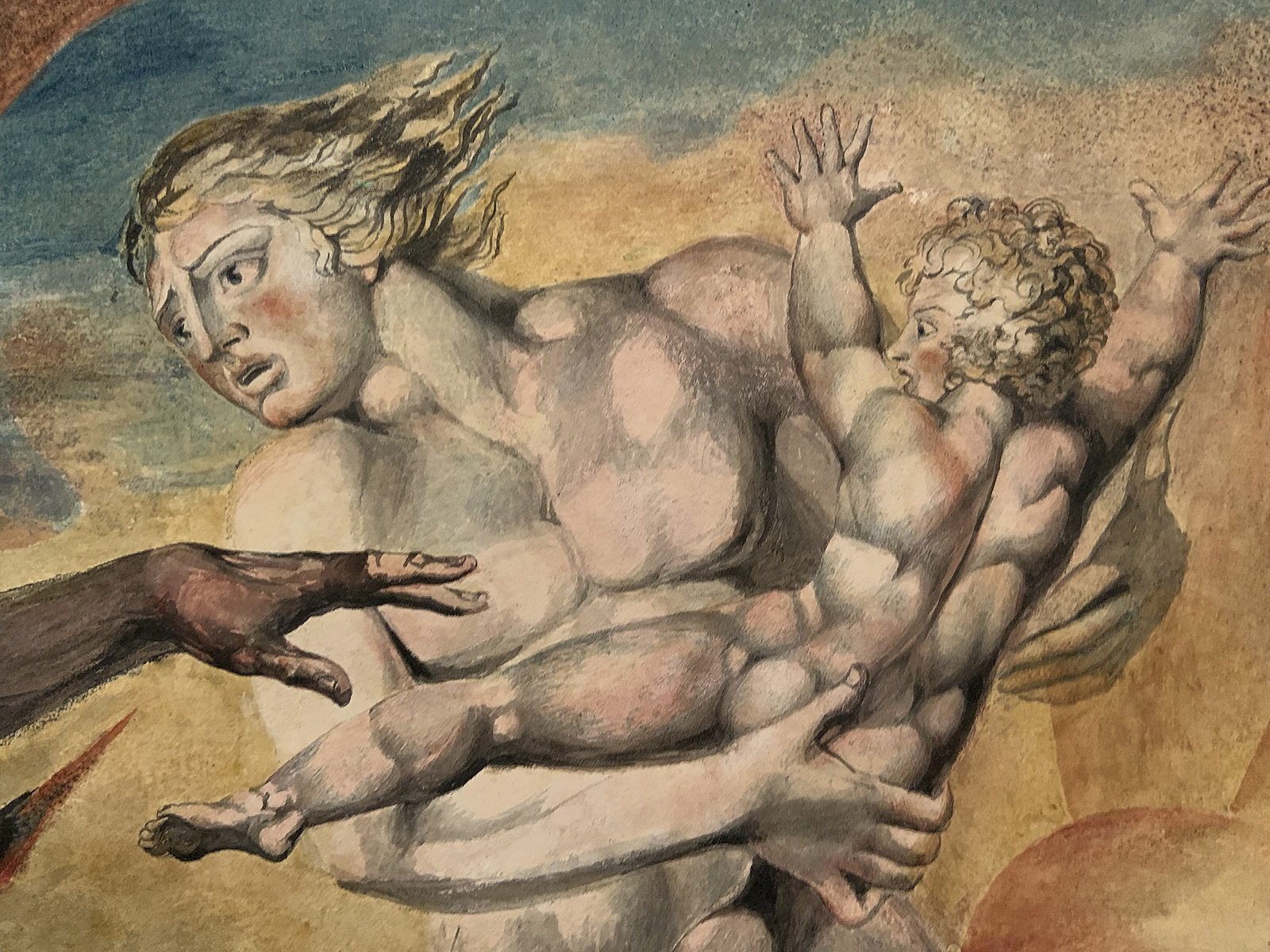
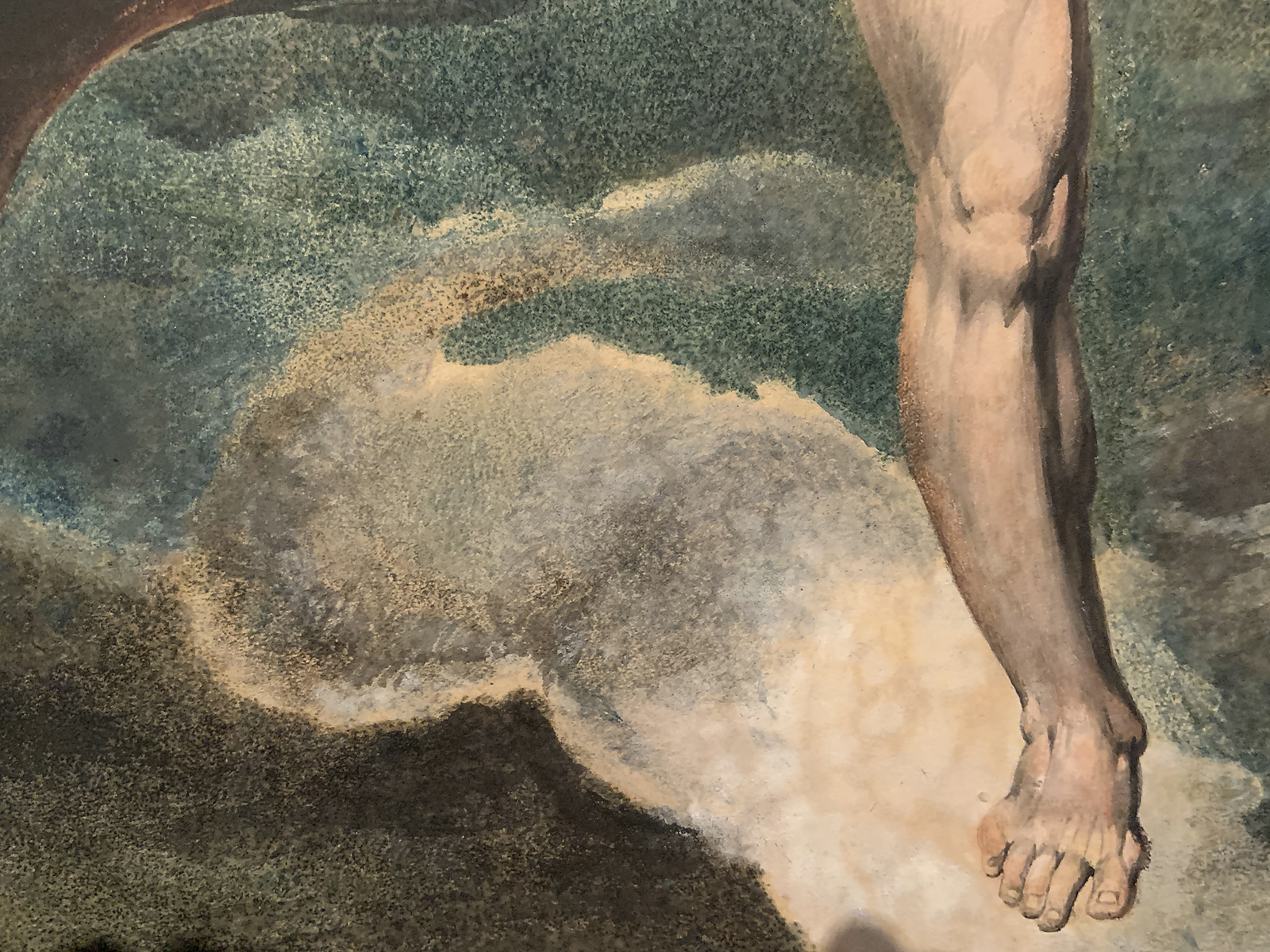
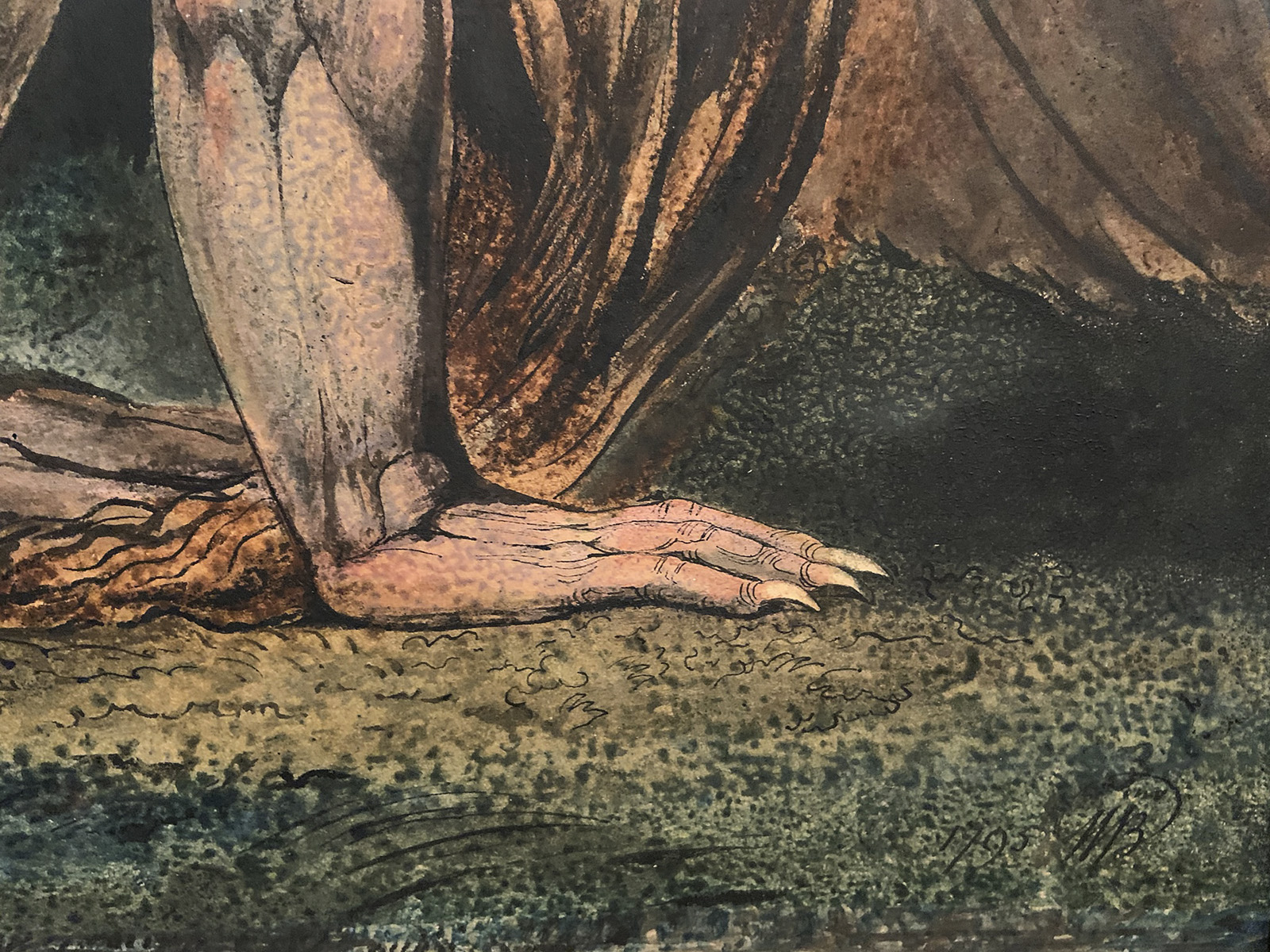
In this second part of the posting, most impressive were the twelve large colour prints (below), a series of 12 large ‘frescos’ as Blake called them. To stand in a gallery and be surrounded by such powerful images was incredible. One after the other took your breath away through their musical form and colour. The binary opposites of The Good and Evil Angels (1795 – c. 1805), the Active Evil angel – “strong, muscular, agile; but dirty, indolent and trifling” – with his sightless eyes transfixing you. The hybrid of man and beast that is Nebuchadnezzar (1795 – c. 1805), “crawling the Earth on his hands and knees, skin like hide, toes turning into griffin’s talons.” Or the question mark of the form that is Newton (1795 – c. 1805), which shows “the mathematician and physicist completely absorbed in a geometrical problem, oblivious to the wondrous rock on which he sits.” Blind to the wonders of the world, here scientific rationalism is seen to be inadequate without the imagination and the creativity of the artist. Just a small detail, but the colouration of the rocks behind Newton will long live in my memory for its delicacy and radiance – a colour print enhanced with additional watercolour on paper, almost sponged on, like the under/world sponges at the bottom of the sea.

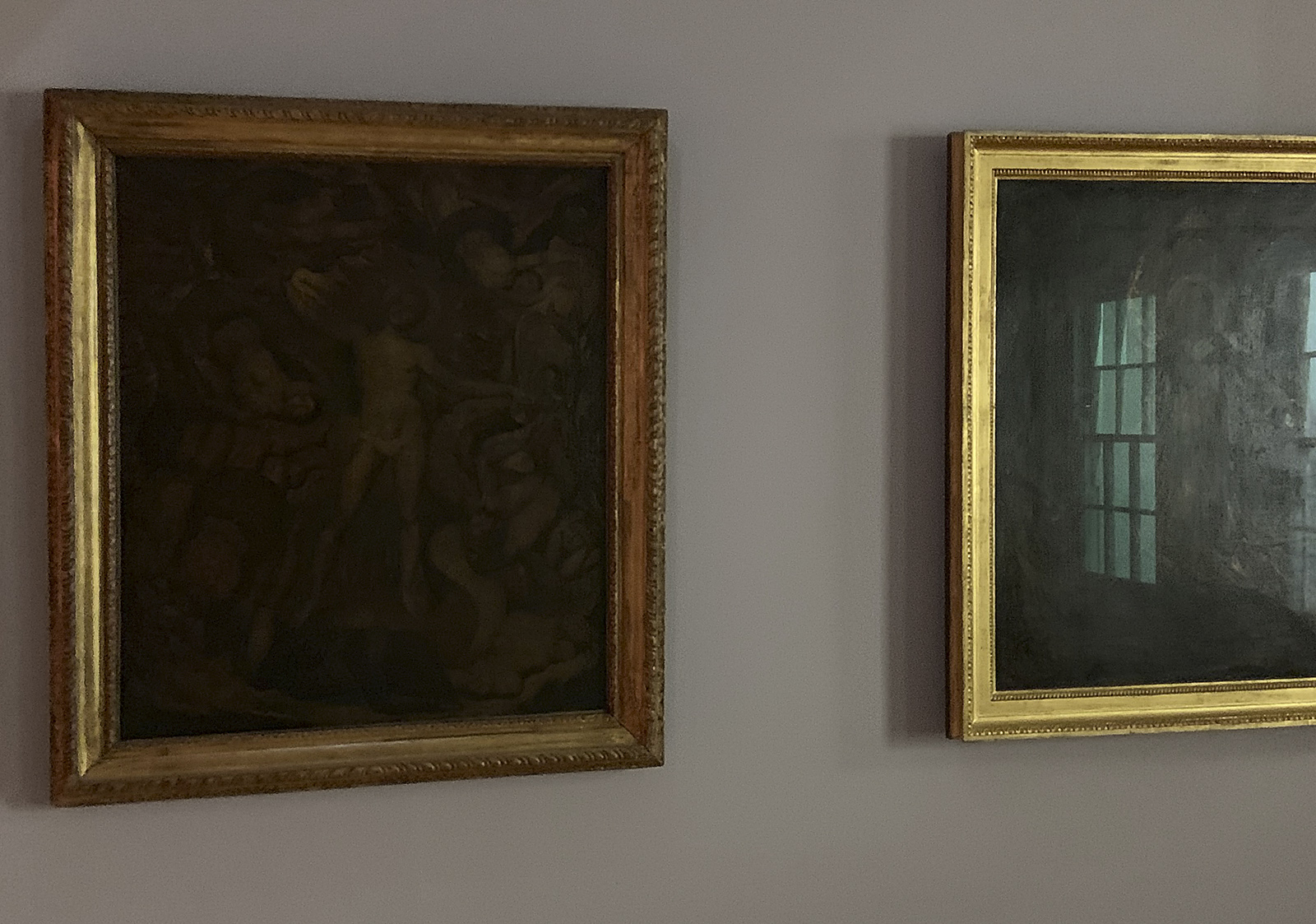
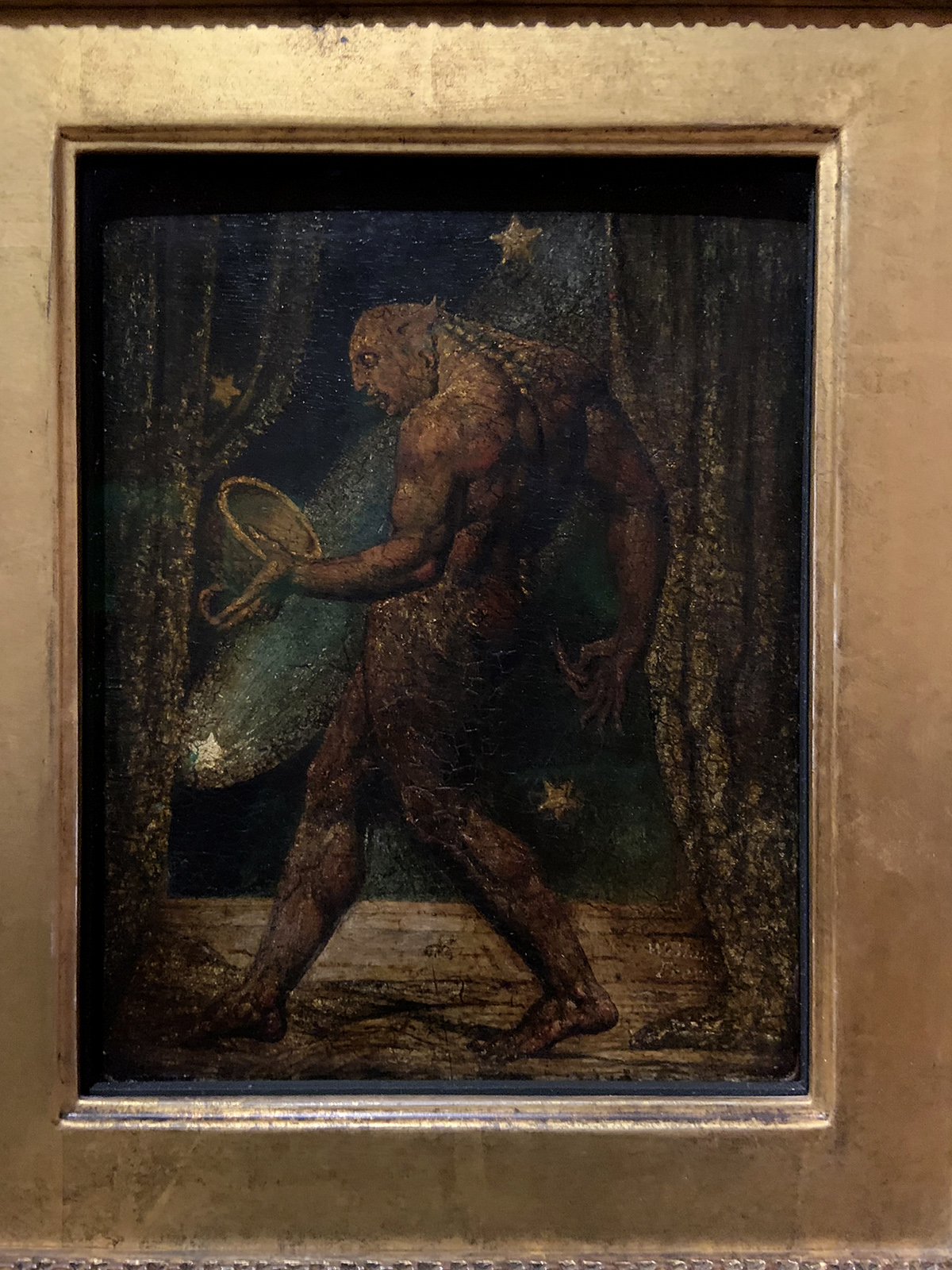
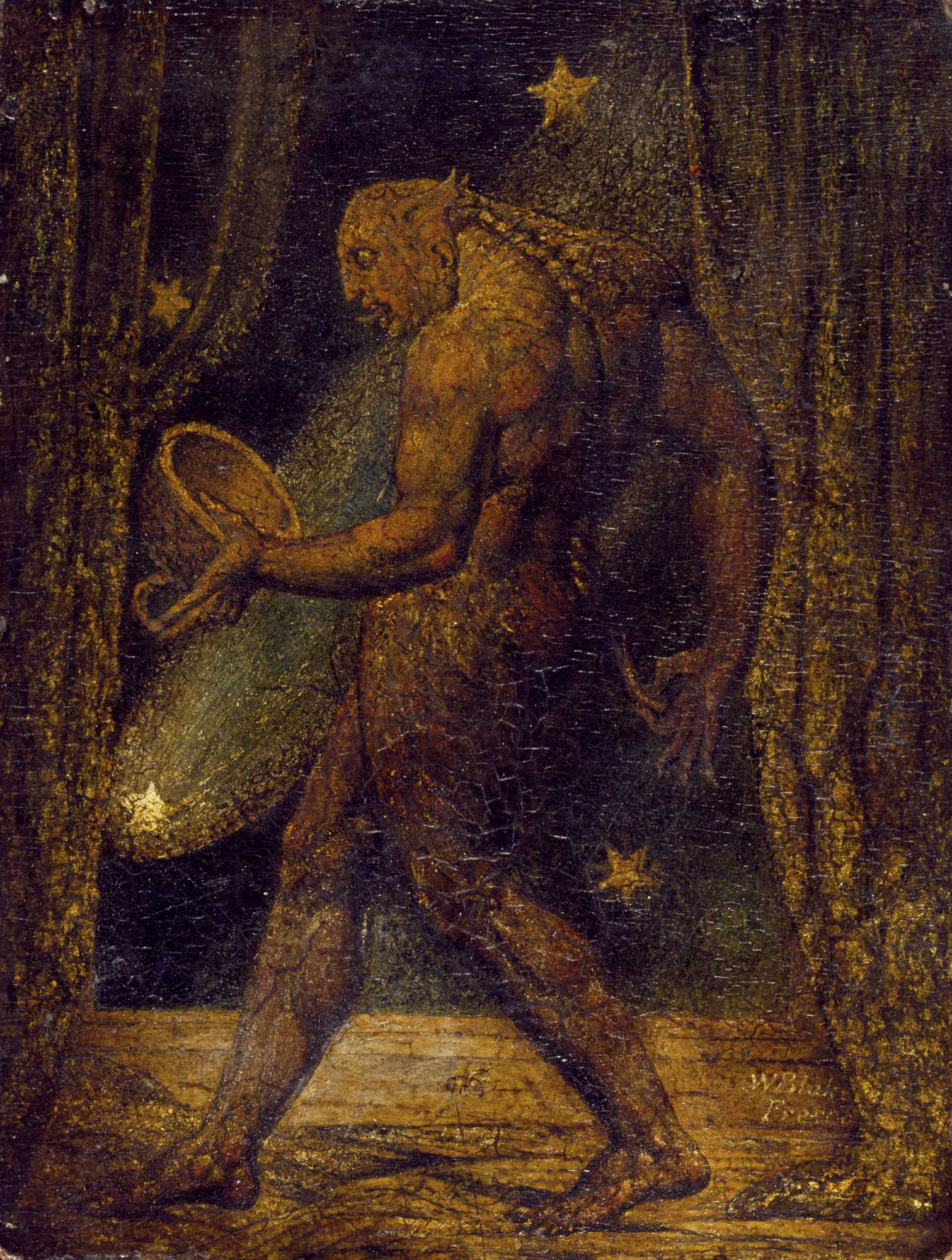
Other highlights in the second half of the exhibition was a recreation of Blake’s 1809 solo exhibition at his home at 28 Broad Street, London. Even though the paintings have darkened significantly over the years, the installation gave you an idea of how the paintings, highlighted with gold leaf, would have looked through the filtered light of Georgian windows, or would have shimmered under candlelight, as your eyes strained to see the forms of his paradise / lost. Another physiognomic “vision” – “the stuff of delirium and nightmare, [which] taps into the unconscious, internalised sublime” – was the painting The Ghost of a Flea (c. 1819) used to illustrate John Varley’s Treatise on Zodiacal Physiognomy (1828). In studying the work of Blake for this posting, I found it instructive to look at Blake’s preparatory sketches for his works which can be found online. They give you a good idea of the spontaneity of the drawing and the ideas that arise, transformed into the finished work. Here in the graphite on paper drawing of The Ghost of a Flea we can see Blake’s initial vision, a more static, pensive figure with serrated wings which morphs into a muscular, blood sucking monster set on a cosmic stage, of life framed by curtains and a shooting star. As the vision appeared to Blake he is said to have cried out: ‘There he comes! his eager tongue whisking out of his mouth, a cup in his hand to hold blood, and covered with a scaly skin of gold and green.’

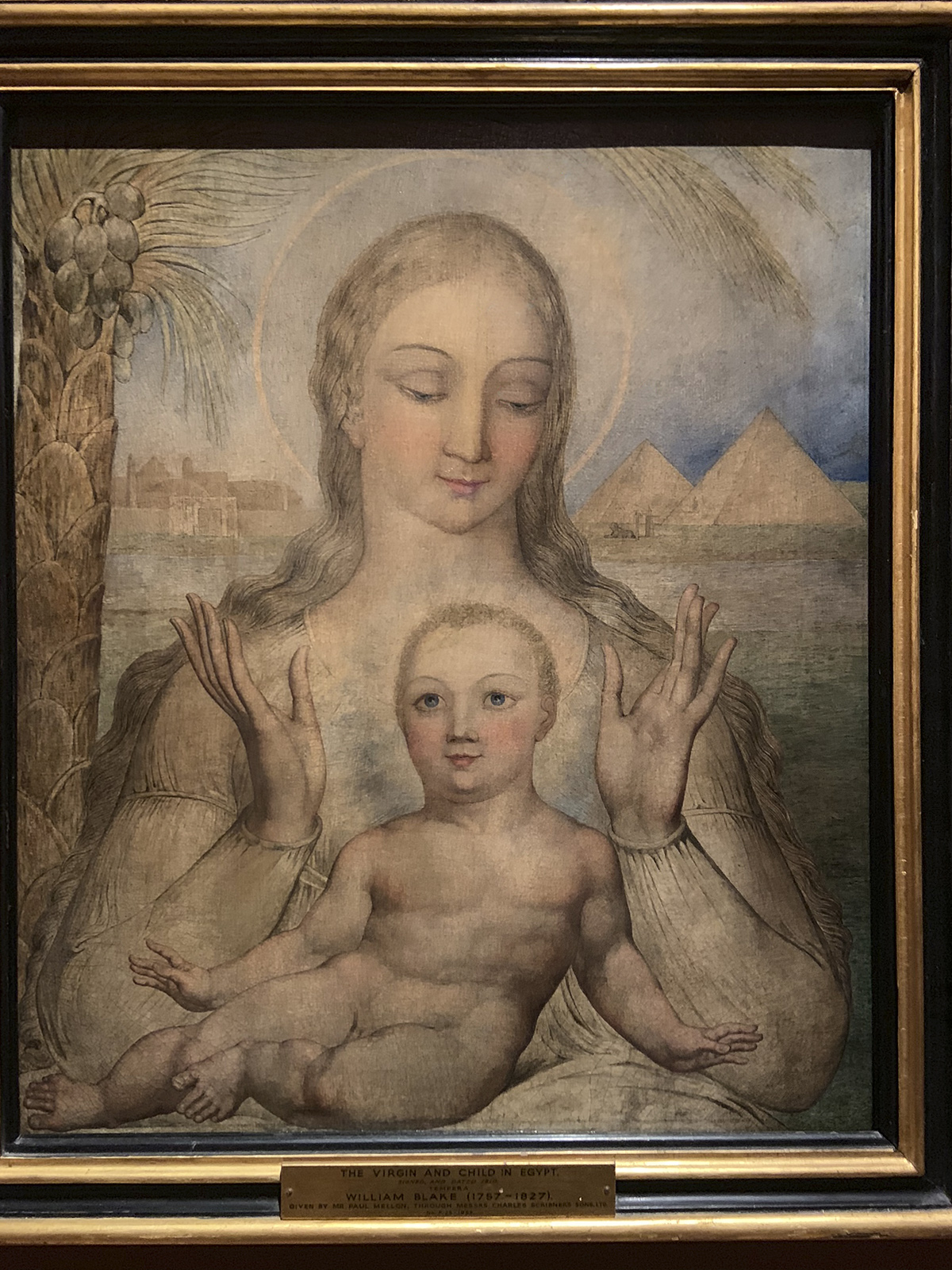
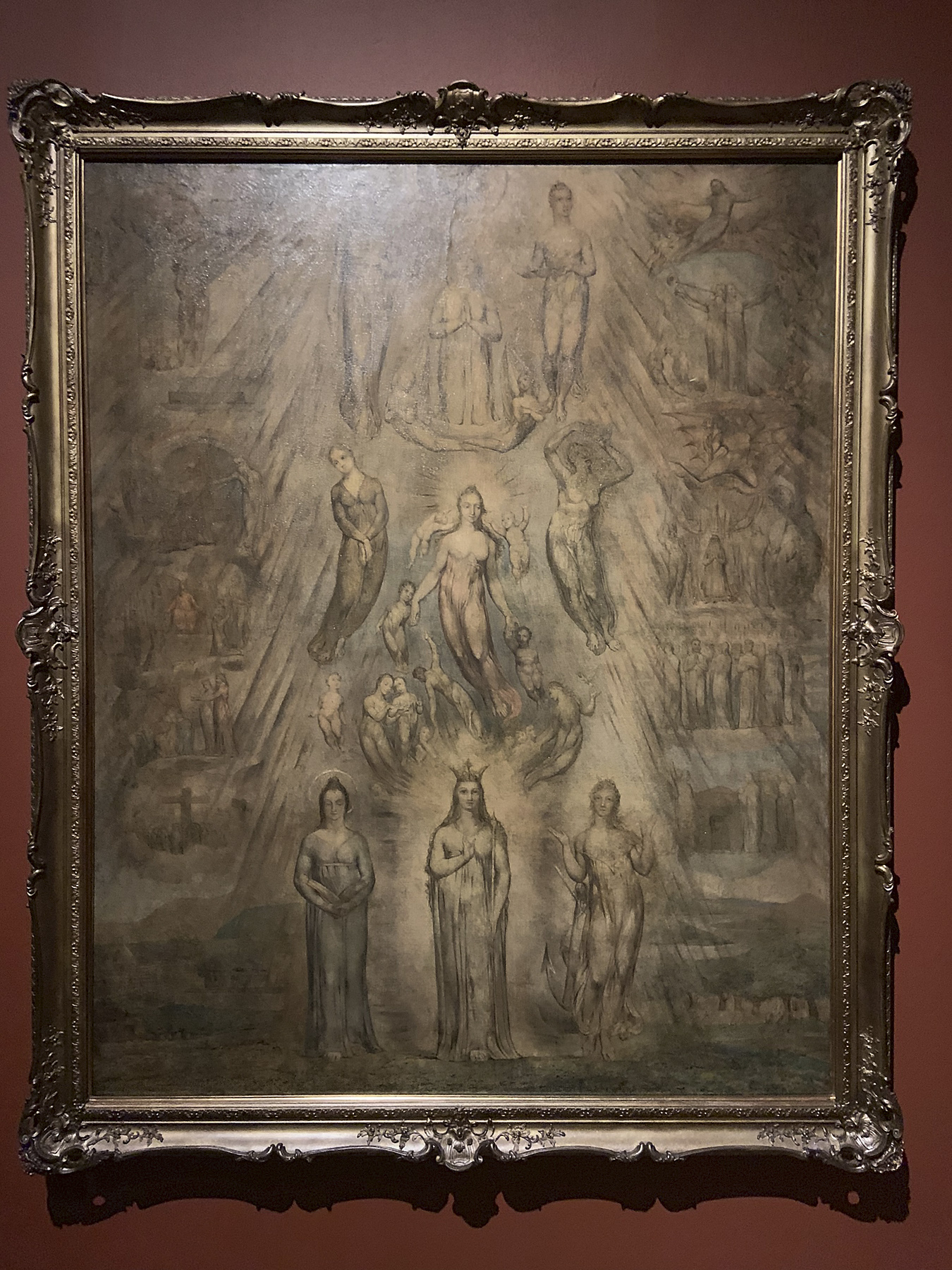
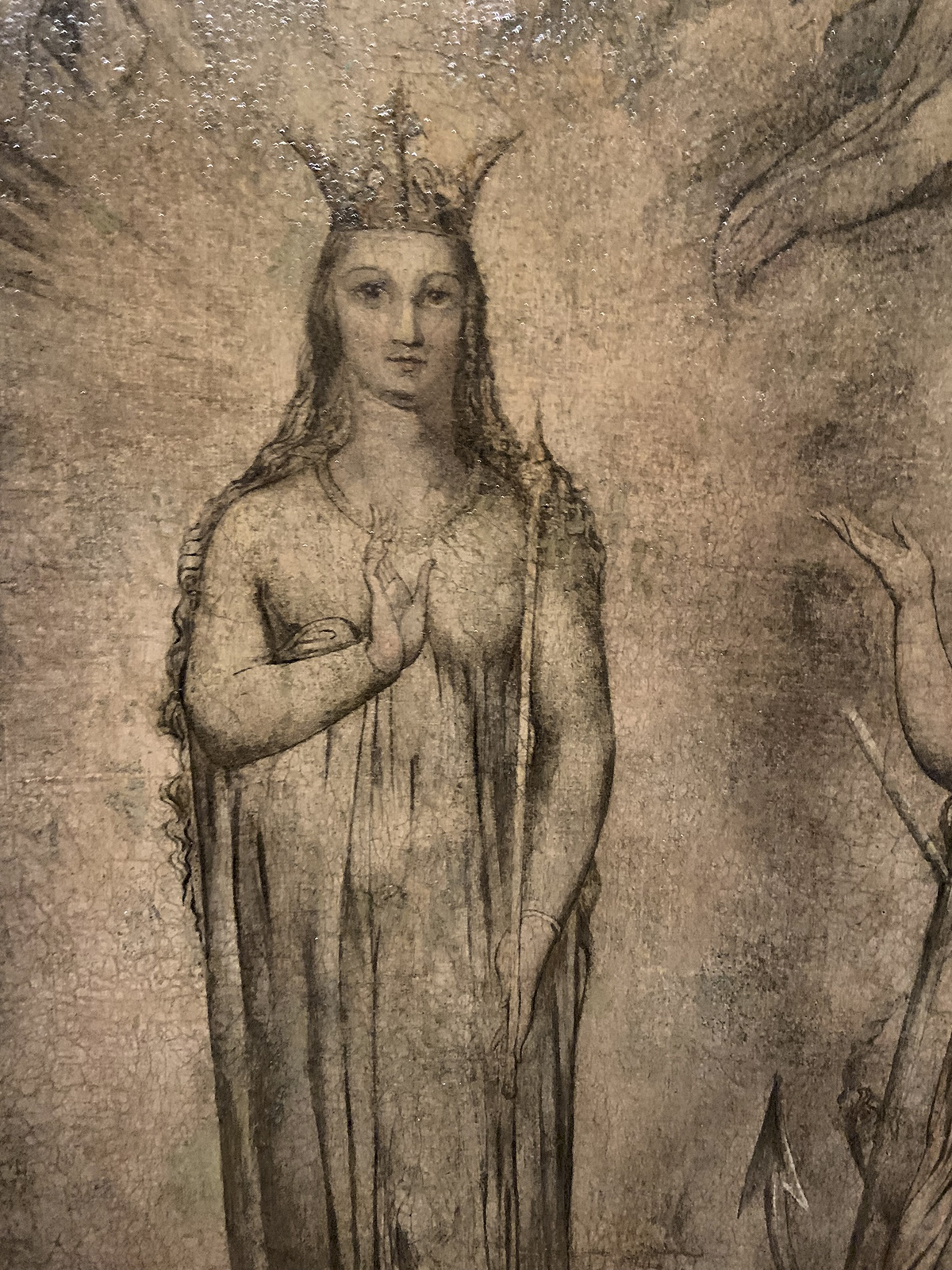
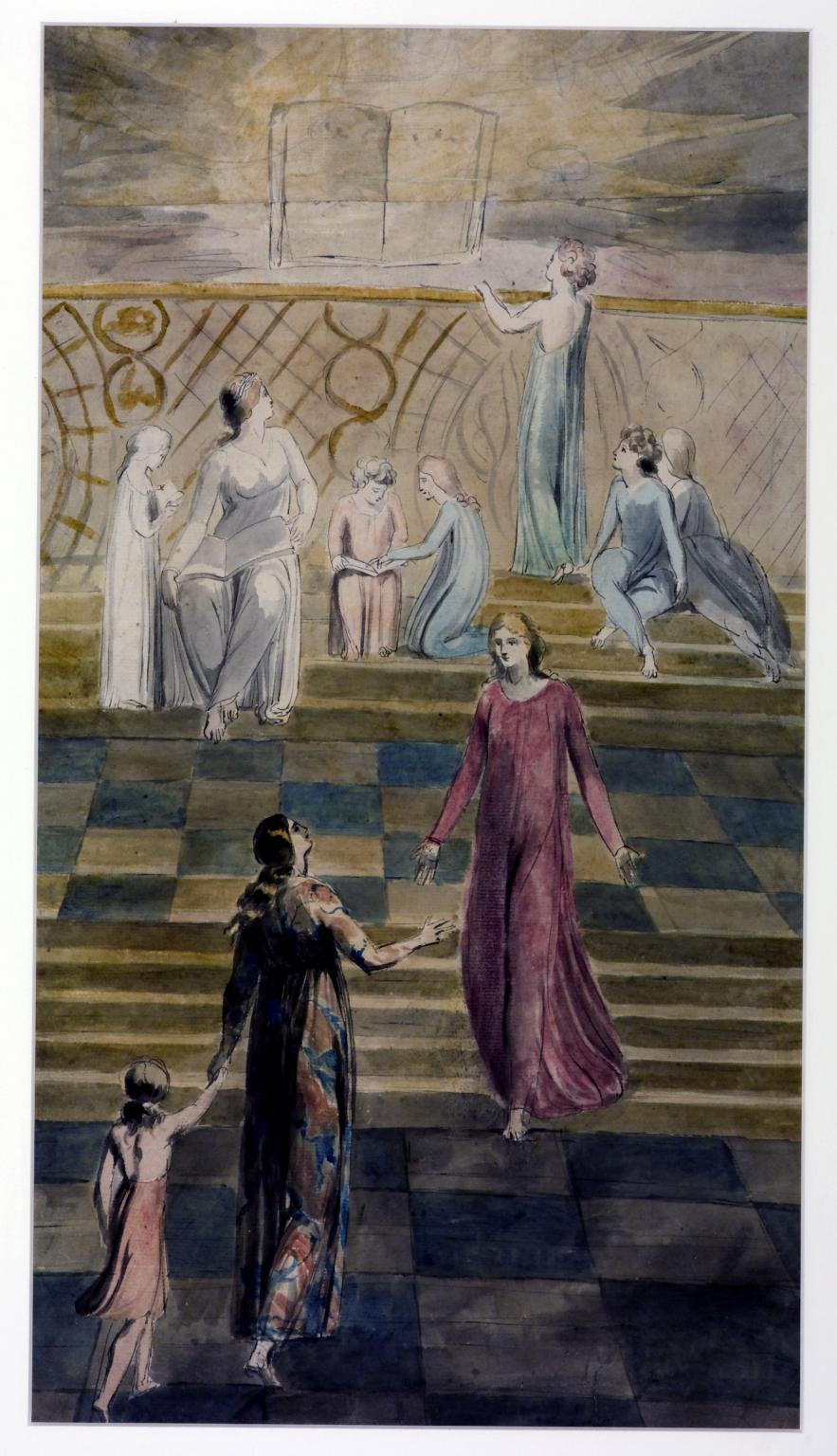
My favourite works in this exhibition were Blake’s two exquisite large paintings, The Virgin and Child in Egypt (1810) and An Allegory of the Spiritual Condition of Man (? 1811). Bearing in mind that these two paintings would have darkened over time and the colours have changed, I was completely mesmerised by the intimacy of these images. The Mannerist hands and beatific nature of the first, and the Ascension of the figures in the second were completely sublime. His largest surviving canvases are RADIANT, all triangular structure, shimmering paint and Buddhist, Northern European iconography. That’s something that I did notice that hardly anyone talks about – how some of his figures echo the Zen-like quality of Buddhist painting.

His celestial bodies seem to exist in a place outside of this world, but they speak to us today as strongly as ever, of the trials and tribulations of our contemporary world – the struggle for the existence of life, of the animals and creatures of this planet, against the avarice of the rich and powerful, of nations and corporations that rape and pillage. Blake was an artist of the imagination rather than reason, a champion of creativity and feeling. Humanity, nature, creatures and creation are still the stuff of life on earth. Our life on earth.

I was so fully immersed in Blake’s world I did not want to leave. The spirit of this man and his work places him at the pinnacle of artistic creation, up there with Michelangelo and Rembrandt. At the time that Blake was working (and was considered a crackpot and mad), Beethoven was still conducting his own symphonies and dedicating his ‘Eroica’ (heroic) symphony to the tyrant Napoleon in 1804 before, in a fit of rage, scrubbing out Napoleon’s name after he ignominiously named himself Emperor. Both Blake and Beethoven were inspired by the ideals of the French Revolution and the liberty of the common man. Just think about that.

Dr Marcus Bunyan

Word count: 1,137


Many thankx to Tate Britain for allowing me to publish the media images in the posting. All other installation photographs as noted © Dr Marcus Bunyan. Please click on the photographs for a larger version of the image. See the first part of the posting.


“The curators of this colossal survey, the first on such a scale in nearly 20 years, are wise to point out the almost impenetrable complexities of Blake’s thinking from the start. Their aim is to throw the focus on his works as images, as opposed to emblems – tiny, teeming visions of gods, monsters and wild scenarios taking place at the bottom of the ocean or outer space, but above all in the free world of Blake’s imagination. …

And Blake’s art remains irreducibly strange. Familiarity cannot diminish the utter singularity of his home-grown aesthetic: heads floating on columns of transparent Lycra-like material, rippling up towards multicoloured skies or gathering in tumultuous spirals. Saints diving through the firmament, devils flickering like fire, angels back-crawling through transparent seas. Lone bodies are shown in convulsion, drowning, paralysed or hunched tight as padlocks. Unbound, they appear spreadeagled, levitating, or hurtling upwards like the bellowed flames up a chimney.”


Laura Cumming. “William Blake review – a rousing call to arms,” on The Guardian website Sun 15 Sep 2019 [Online] Cited 18/01/2020


Twelve large colour prints

Blake made these prints using a form of experimental monotype. This involved painting tacky ink onto a board and transferring it through pressure onto paper. He enhanced the basic printed image with ink and watercolour. The end result is very painterly, but with textures impossible to achieve by hand. Blake referred to these works as ‘frescos’. This reflects his wish to imitate the grand wall paintings of the ancient world and medieval times.

Thomas Butts purchased eight of these prints from Blake in 1805, and probably owned a full set. The subject matter comes from the Bible, Shakespeare and Milton, as well as Blake’s imagination. There is no definitive sequence. Scholars have connected the prints in many different, inventive ways.

Wall text


A collection of twelve large prints by William Blake have been brought together at Tate Britain. Over 200 years old, these fragile works are normally only shown in small groups for short periods of time, making this an unmissable opportunity to see the remarkable full series together. The striking prints were sold by Blake as a group in 1805 and included one of his most iconic images, Newton 1795 – c. 1805. Produced using an experimental form of monotype printing that was enhanced with ink and watercolour, they appear painterly but with some extraordinary textures which would be impossible to achieve by hand. The collection draws inspiration from the world of science, the Bible, Shakespeare and Milton, as well as Blake’s own mind. Scholars have connected the prints in many different, inventive ways, but each image remains open to the viewers’ imagination.

Text from Tate Britain
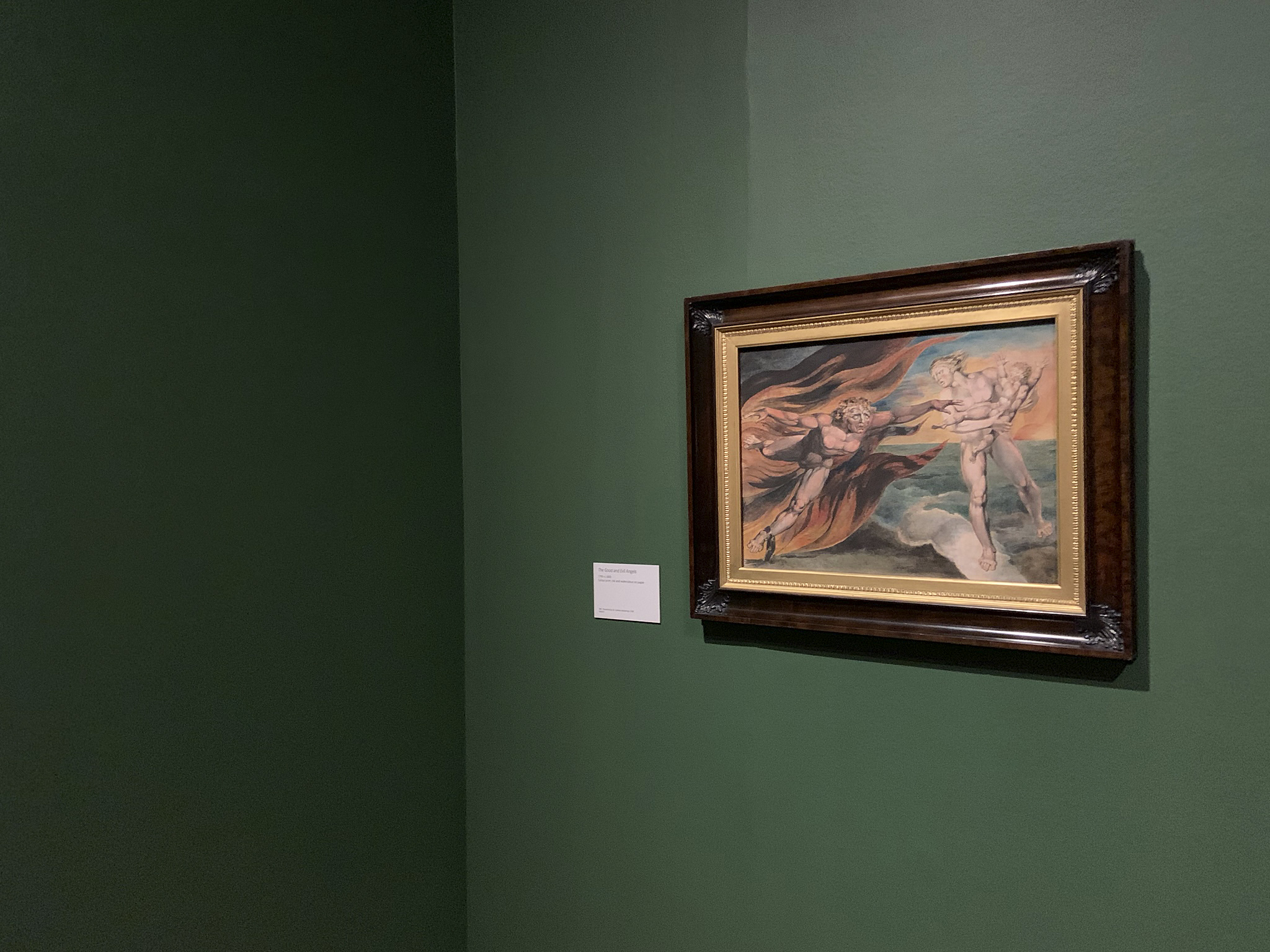
 

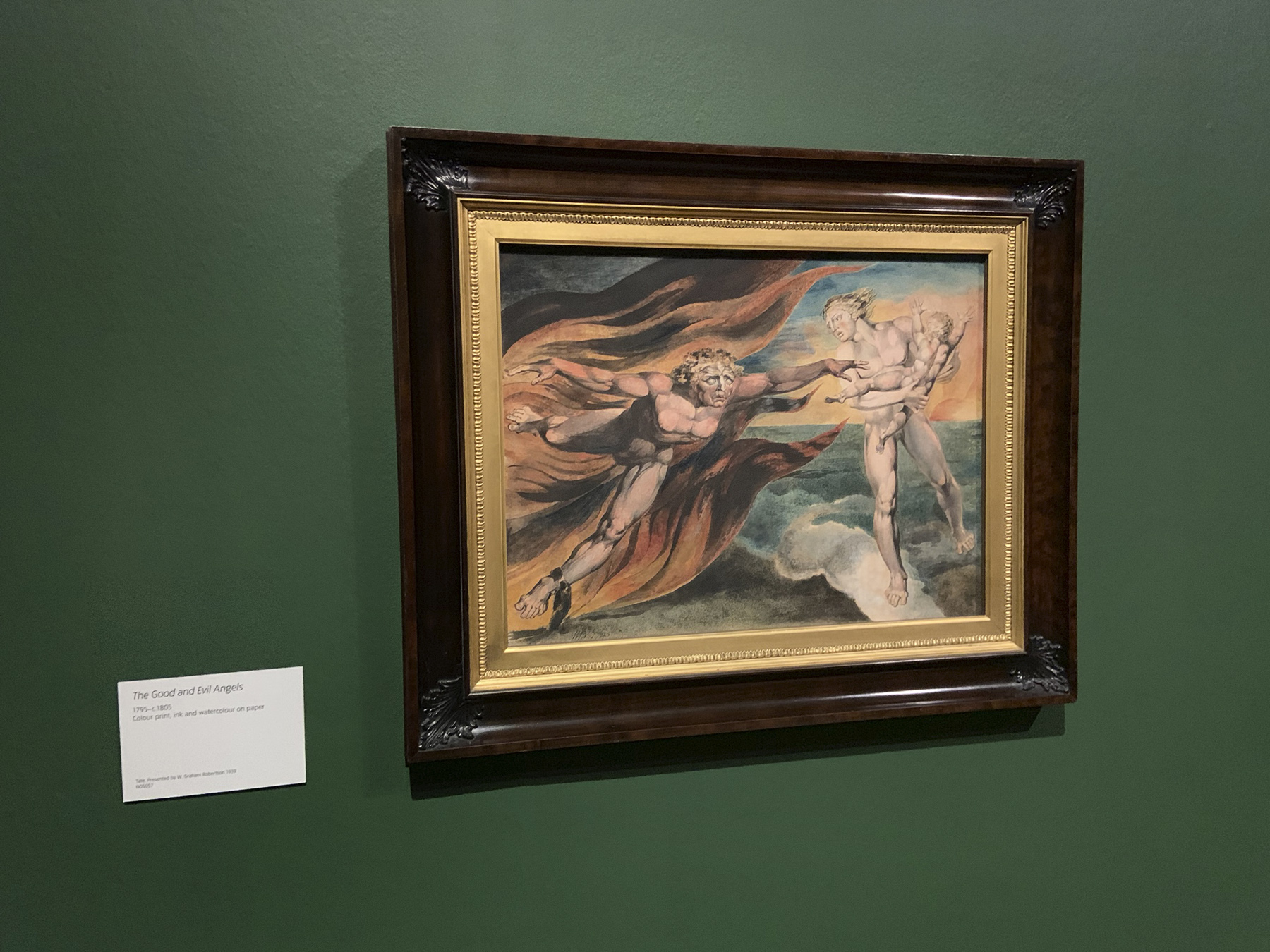
William Blake (British, 1757-1827) 'The Good and Evil Angels' 1795 - c. 1805 (installation view)

William Blake (British, 1757-1827) 'The Good and Evil Angels' 1795 - c. 1805 (installation view)

William Blake (British, 1757-1827) 'The Good and Evil Angels' 1795 - c. 1805 (installation view)

William Blake (British, 1757-1827) 'The Good and Evil Angels' 1795 - c. 1805 (installation view)


William Blake (British, 1757-1827)
The Good and Evil Angels (installation views)
1795 – c. 1805
Colour print, ink and watercolour on paper
Tate. Presented by W. Graham Robertson 1939
Photos: Marcus Bunyan


William Blake (British, 1757-1827) 'The Good and Evil Angels' 1795 - c. 1805 from the exhibition 'William Blake' at Tate Britain, London, Sept 2019 - Feb 2020


William Blake (British, 1757-1827)
The Good and Evil Angels
1795 – c. 1805
Colour print, ink and watercolour on paper
445 × 594 mm
Tate. Presented by W. Graham Robertson 1939


In his annotations to a text by Lavater, Blake claimed that ‘Active Evil is better than Passive Good’, rendering the figures in this picture somewhat ambiguous. Perhaps the chain attached to the ‘evil’ angel’s ankle suggests the curtailing of energy by misguided rational thought?

In constructing his figures, Blake evokes conventional eighteenth century stereotypes. The heavy build and darker skin of the ‘evil’ angel suggest a non-European character, described by Lavater as ‘strong, muscular, agile; but dirty, indolent and trifling’, while the fair hair and light skin of the ‘good’ angel are consonant with ideas of physical – and intellectual – perfection.

Gallery label, March 2011


William Blake (British, 1757-1827) 'The Good and Evil Angels' 1795 - c. 1805 (installation view detail)

William Blake (British, 1757-1827) 'The Good and Evil Angels' 1795 - c. 1805 (installation view detail)

William Blake (British, 1757-1827) 'The Good and Evil Angels' 1795 - c. 1805 (installation view detail)


William Blake (British, 1757-1827)
The Good and Evil Angels (installation views details)
1795 – c. 1805
Colour print, ink and watercolour on paper
Tate. Presented by W. Graham Robertson 1939
Photos: Marcus Bunyan


Installation view of the exhibition 'William Blake' at Tate Britain, London showing at left, 'Christ Appearing to the Apostles after the Resurrection' (c. 1795) and at right, 'Nebuchadnezzar' (1795 - c. 1805)


Installation view of the exhibition William Blake at Tate Britain, London showing at left, Christ Appearing to the Apostles after the Resurrection (c. 1795) and at right, Nebuchadnezzar (1795 – c. 1805)
Photo: Marcus Bunyan


William Blake (British, 1757-1827) 'Nebuchadnezzar' 1795 - c. 1805 (installation view)

William Blake (British, 1757-1827) 'Nebuchadnezzar' 1795 - c. 1805 (installation view)


William Blake (British, 1757-1827)
Nebuchadnezzar (installation views)
1795 – c. 1805
Colour print, ink and watercolour on paper
Tate. Presented by W. Graham Robertson 1939
Photos: Marcus Bunyan


William Blake (British, 1757-1827) 'Nebuchadnezzar' 1795 - c. 1805 from the exhibition 'William Blake' at Tate Britain, London, Sept 2019 - Feb 2020


William Blake (British, 1757-1827)
Nebuchadnezzar
1795 – c. 1805
Colour print, ink and watercolour on paper
54.3 x 72.5cm
Tate. Presented by W. Graham Robertson 1939
Gift of Mrs. Robert Homans
Wikipedia Commons, Public Domain
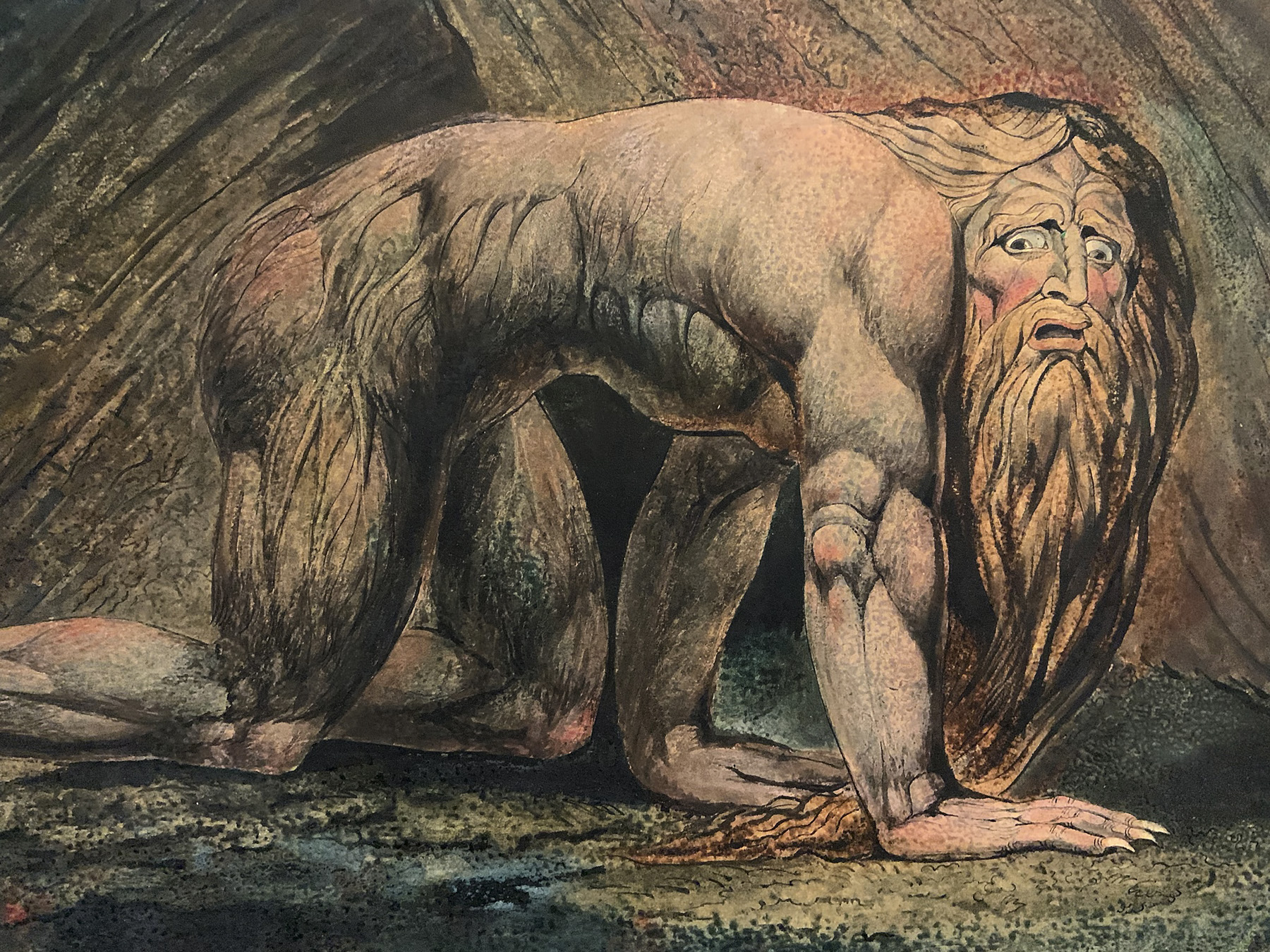
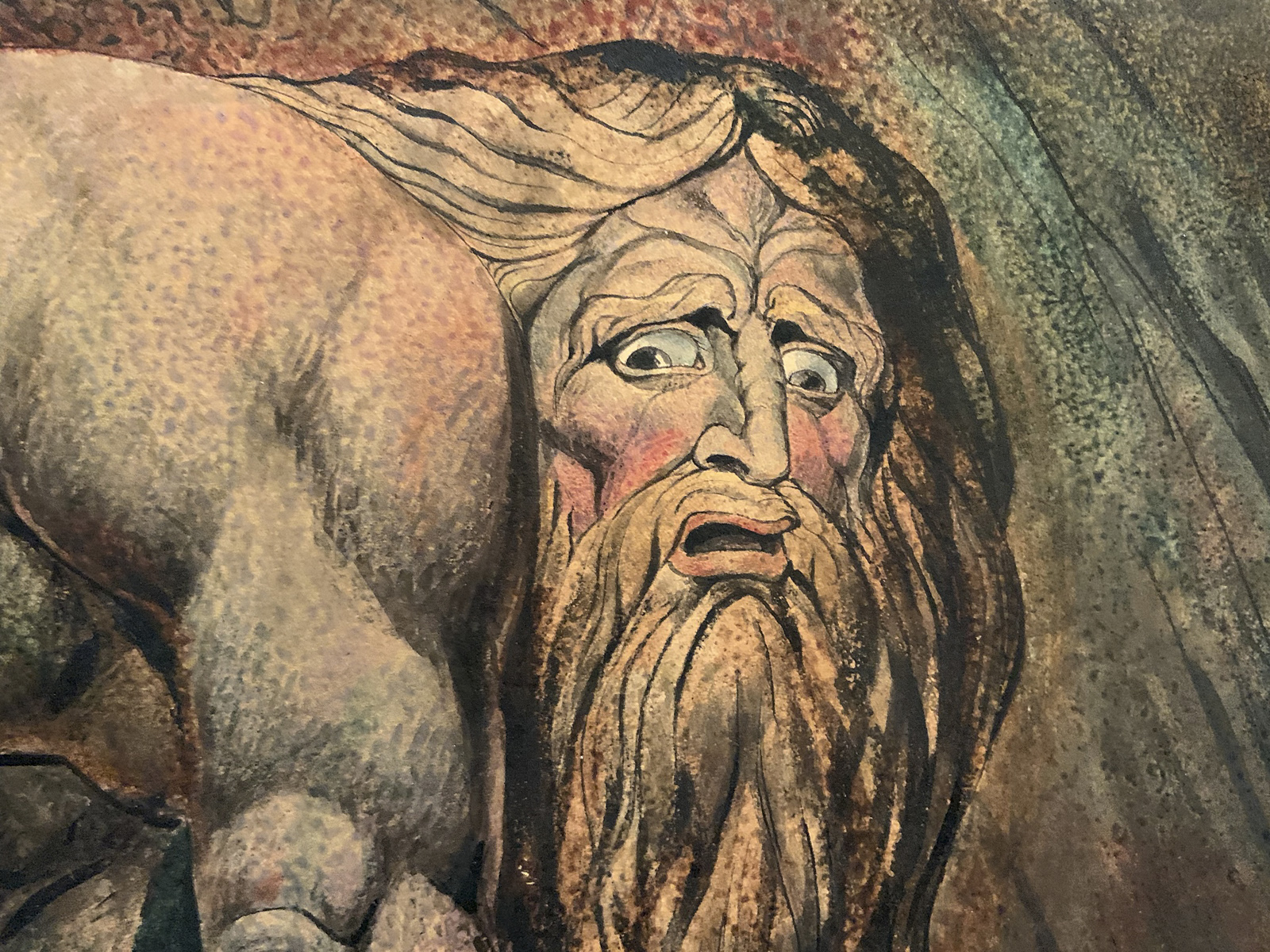
 

William Blake (British, 1757-1827) 'Nebuchadnezzar' 1795 - c. 1805 (installation view detail)

William Blake (British, 1757-1827) 'Nebuchadnezzar' 1795 - c. 1805 (installation view detail)

William Blake (British, 1757-1827) 'Nebuchadnezzar' 1795 - c. 1805 (installation view detail)


William Blake (British, 1757-1827)
Nebuchadnezzar (installation view details)
1795 – c. 1805
Colour print, ink and watercolour on paper
Tate. Presented by W. Graham Robertson 1939
Photos: Marcus Bunyan


The king of Babylon is a terrible warning to us all: “those that walk in pride, the Lord can abase”. Blake’s Nebuchadnezzar has been so abased it is by now a hybrid of man and beast, crawling the Earth on his hands and knees, skin like hide, toes turning into griffin’s talons.

Laura Cumming. “William Blake review – a rousing call to arms,” on The Guardian website Sun 15 Sep 2019 [Online] Cited 18/01/2020


William Blake (British, 1757-1827) 'Newton' 1795 - c. 1805 (installation view)

William Blake (British, 1757-1827) 'Newton' 1795 - c. 1805 (installation view)


William Blake (British, 1757-1827)
Newton (installation views)
1795 – c. 1805
Colour print, ink and watercolour on paper
Tate. Presented by W. Graham Robertson 1939
Photos: Marcus Bunyan


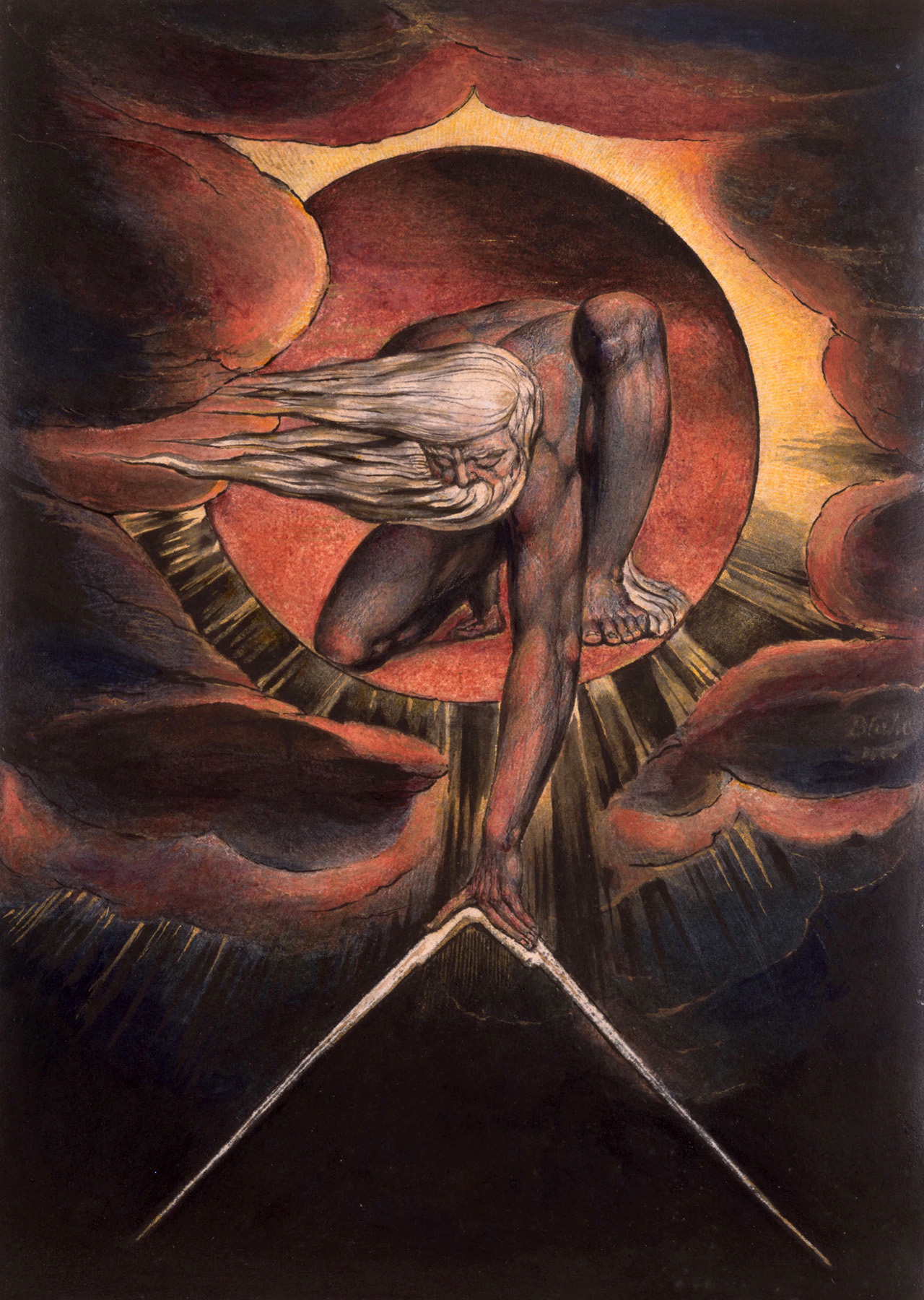
Newton (1795 – c. 1805), the first impression, is another of Blake’s most famous images. It shows the brilliant mathematician and physicist completely absorbed in a geometrical problem, oblivious to the wondrous rock on which he sits. Its standard interpretation is that Newton’s scientific rationalism was inadequate without imagination and the creativity of the artist – a negative view of the man who is still considered a towering genius.

Hoakley. “Tyger’s eye: the paintings of William Blake, 5 – The large prints, 1795,” on The Electric Light Company website November 26, 2016 [Online] Cited 18/01/2020
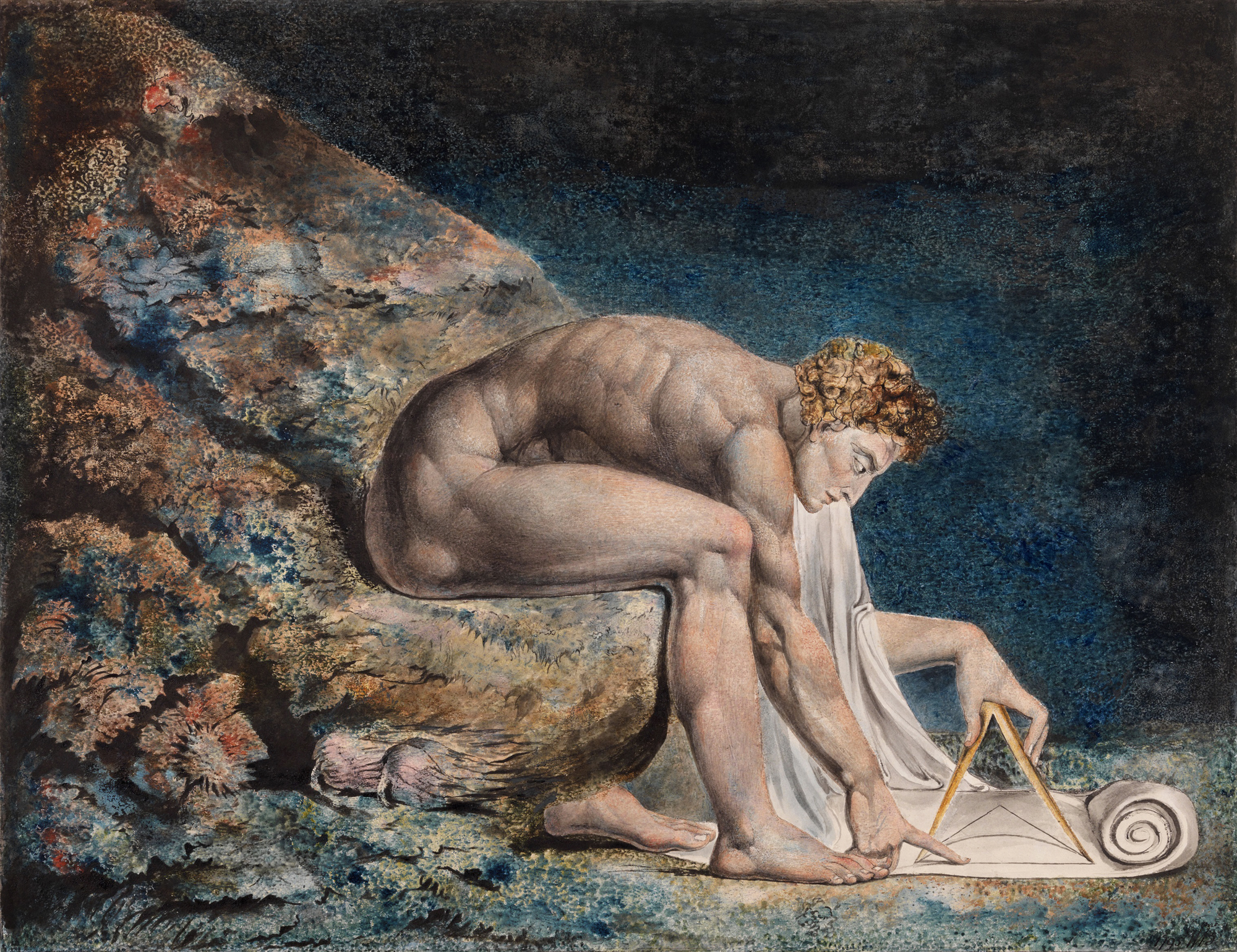
 

William Blake (British, 1757-1827) 'Newton' 1795 - c. 1805 from the exhibition 'William Blake' at Tate Britain, London, Sept 2019 - Feb 2020


William Blake (British, 1757-1827)
Newton
1795 – c. 1805
Colour print, ink and watercolour on paper
460 x 600 mm
Tate. Presented by W. Graham Robertson 1939


In this work Blake portrays a young and muscular Isaac Newton, rather than the older figure of popular imagination. He is crouched naked on a rock covered with algae, apparently at the bottom of the sea. His attention is focused on a diagram which he draws with a compass. Blake was critical of Newton’s reductive, scientific approach and so shows him merely following the rules of his compass, blind to the colourful rocks behind him.

Gallery label, October 2018
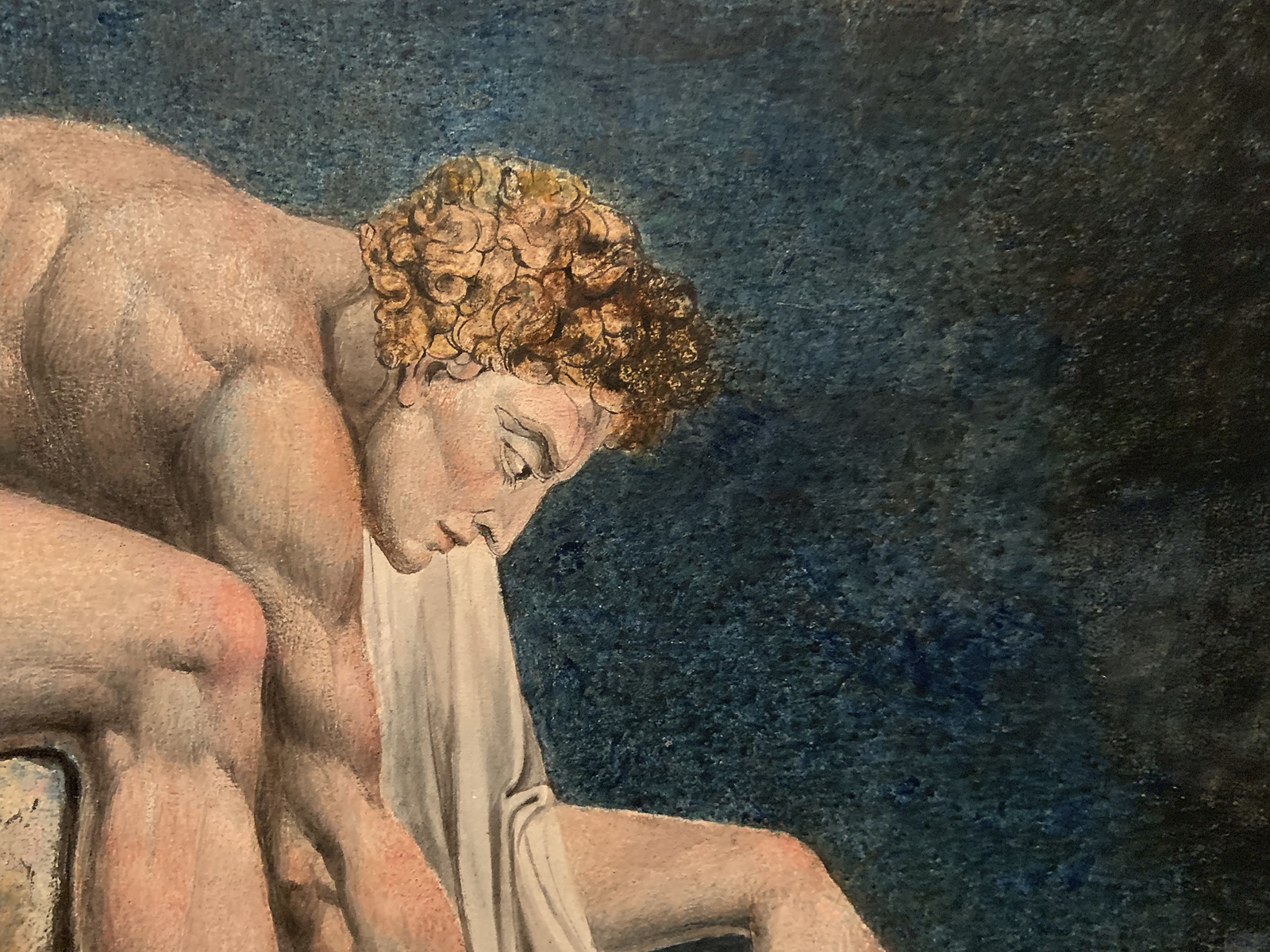
 

William Blake (British, 1757-1827) 'Newton' 1795 - c. 1805 (installation view detail)


William Blake (British, 1757-1827)
Newton (installation view detail)
1795 – c. 1805
Colour print, ink and watercolour on paper
Tate. Presented by W. Graham Robertson 1939
Photo: Marcus Bunyan


Tate Britain has reimagined Blake’s paintings on the grand scale he envisioned, alongside recreating the humble reality of the only exhibition he staged in his lifetime. For the first time, The Spiritual Form of Nelson Guiding Leviathan c. 1805-1809 and The Spiritual Form of Pitt Guiding Behemoth c. 1805 have been digitally enlarged to be projected onto the gallery wall. The original paintings are shown nearby in a reconstruction of Blake’s ill-fated exhibition of 1809.

William Blake had grand ambitions as a visual artist and proposed vast frescos that were never realised. The artist suggested that Nelson and Pitt be executed 100-feet-high, following in the tradition of Renaissance masters such as Michelangelo and Raphael. Blake was confident he would ‘receive a national commission to execute these two pictures on a scale that was suitable to the grandeur of the nation’. However, the subjects he chose were ambiguous. Although depicting great British heroes of the time, each figure is shown commanding a vicious biblical beast, hinting at Blake’s own liberal and anti-war politics.

Blake first exhibited these images in 1809 above his family’s hosiery business in Soho. The architectural details of this small domestic space have been recreated at Tate Britain, allowing visitors to see the original works in context. The 1809 exhibition was a critical and commercial disaster and Blake consequently withdrew from public life. Attracting few visitors, the only review described ‘a few wretched pictures … a farrago of nonsense, unintelligibleness, and egregious vanity, the wild effusions of a distempered brain’.

Martin Myrone, Senior Curator, pre-1800 British Art, Tate said: “We are thrilled to celebrate Blake as a true visionary and to finally realise the full scale of his ambitions as a visual artist. It’s also important to set him in context, considering the reception of his work and how it was experienced by his contemporaries. Through the re-staging of the 1809 exhibition, as well as through the rare display of his illuminated books in their original bindings, visitors will be able to encounter Blake’s works as they were first seen over 200 years ago.”

Text from Tate Britain


Short Biography

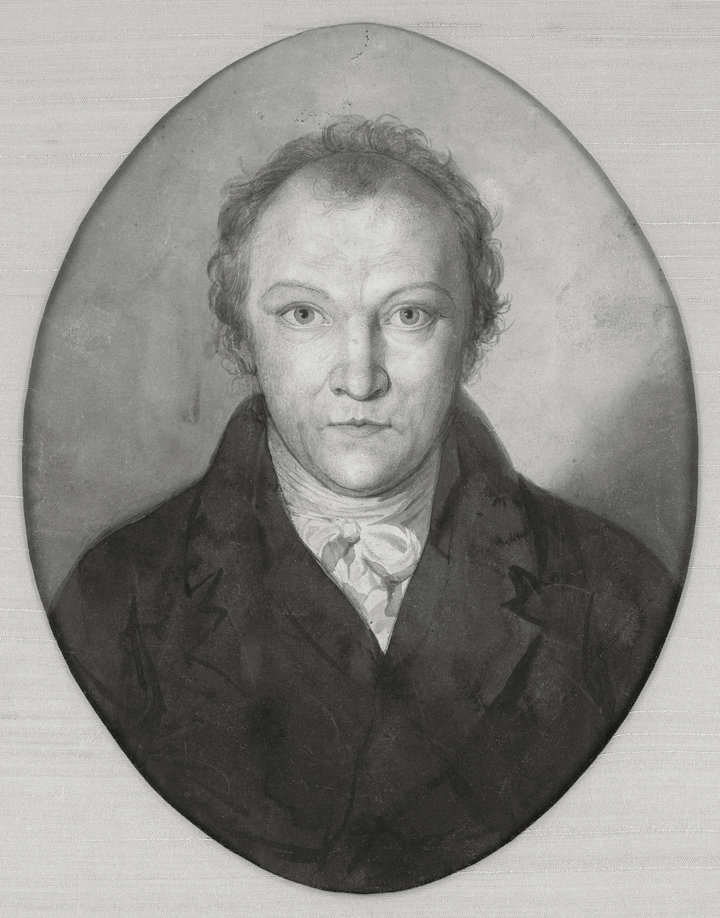
William Blake (28 November 1757 – 12 August 1827) was an English poet, painter, and printmaker. Largely unrecognised during his lifetime, Blake is now considered a seminal figure in the history of the poetry and visual arts of the Romantic Age. What he called his prophetic works were said by 20th-century critic Northrop Frye to form “what is in proportion to its merits the least read body of poetry in the English language”. His visual artistry led 21st-century critic Jonathan Jones to proclaim him “far and away the greatest artist Britain has ever produced”. In 2002, Blake was placed at number 38 in the BBC’s poll of the 100 Greatest Britons. While he lived in London his entire life, except for three years spent in Felpham, he produced a diverse and symbolically rich œuvre, which embraced the imagination as “the body of God” or “human existence itself”.

Although Blake was considered mad by contemporaries for his idiosyncratic views, he is held in high regard by later critics for his expressiveness and creativity, and for the philosophical and mystical undercurrents within his work. His paintings and poetry have been characterised as part of the Romantic movement and as “Pre-Romantic”. A committed Christian who was hostile to the Church of England (indeed, to almost all forms of organised religion), Blake was influenced by the ideals and ambitions of the French and American Revolutions. Though later he rejected many of these political beliefs, he maintained an amiable relationship with the political activist Thomas Paine; he was also influenced by thinkers such as Emanuel Swedenborg. Despite these known influences, the singularity of Blake’s work makes him difficult to classify. The 19th-century scholar William Michael Rossetti characterised him as a “glorious luminary”, and “a man not forestalled by predecessors, nor to be classed with contemporaries, nor to be replaced by known or readily surmisable successors”.

Text from the Wikipedia website


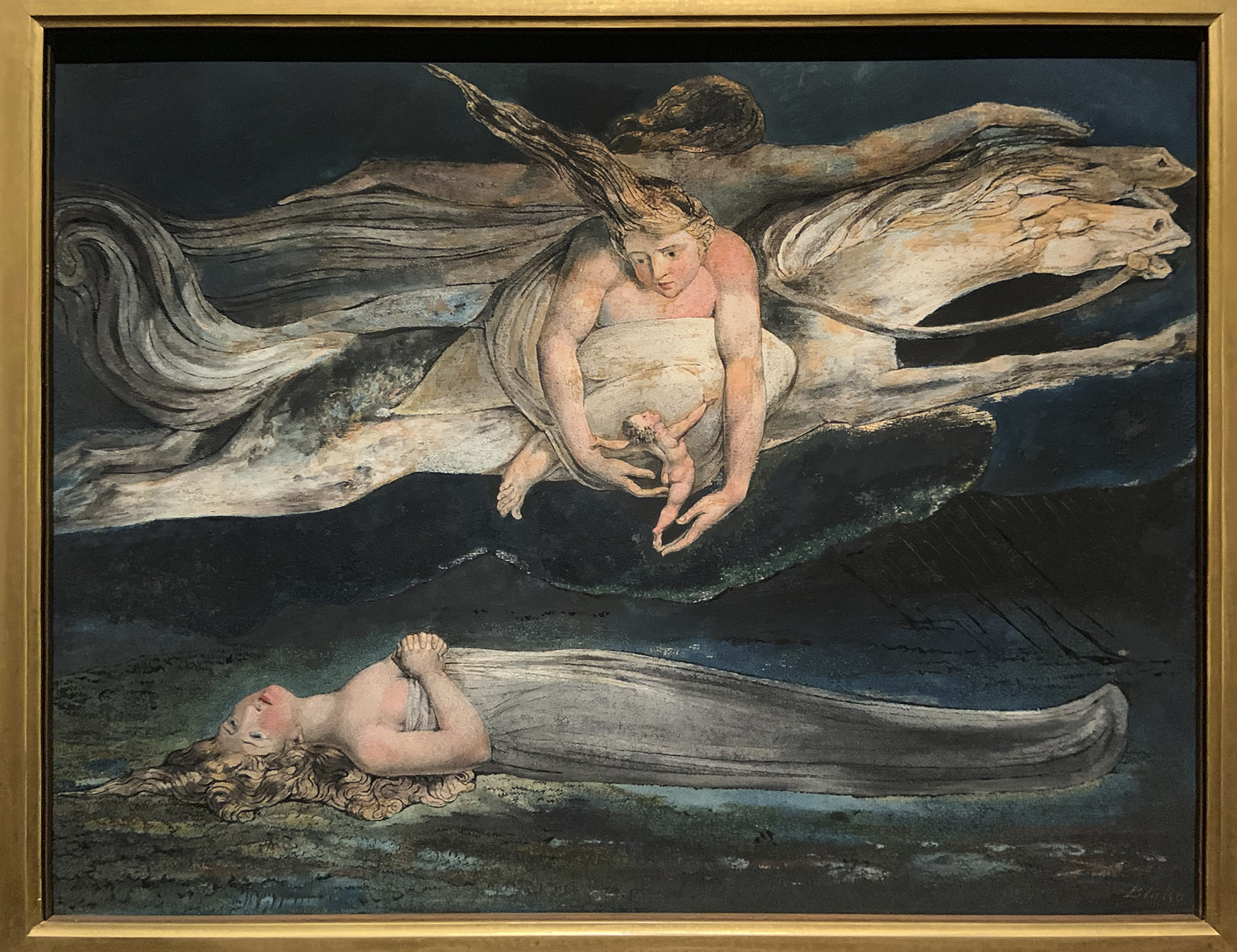
William Blake (British, 1757-1827) 'Pity' c. 1795 (installation view)

William Blake (British, 1757-1827) 'Pity' c. 1795 (installation view)

William Blake (British, 1757-1827) 'Pity' c. 1795 (installation view)

William Blake (British, 1757-1827) 'Pity' c. 1795 (installation view detail)


William Blake (British, 1757-1827)
Pity (installation views)
c. 1795
Colour print, ink and watercolour on paper
425 x 539 mm
Tate. Presented by W. Graham Robertson 1939
Photos: Marcus Bunyan


This image is taken from Macbeth: ‘pity, like a naked newborn babe / Striding the blast, or heaven’s cherubim horsed / Upon the sightless couriers of the air’. Blake draws on popularly-held associations between a fair complexion and moral purity. These connections are also made by Lavater, who writes that ‘the grey is the tenderest of horses, and, we may here add, that people with light hair, if not effeminate, are yet, it is well known, of tender formation and constitution’. Blake’s interest in the characters of different horses can also be seen in his Chaucer’s Canterbury Pilgrims.

Gallery label, March 2011


And pity, like a naked new-born babe,
Striding the blast, or heaven’s cherubim, horsed
Upon the sightless couriers of the air,
Shall blow the horrid deed in every eye,
That tears shall drown the wind. …

Act 1 Scene 7 of Shakespeare’s tragedy Macbeth
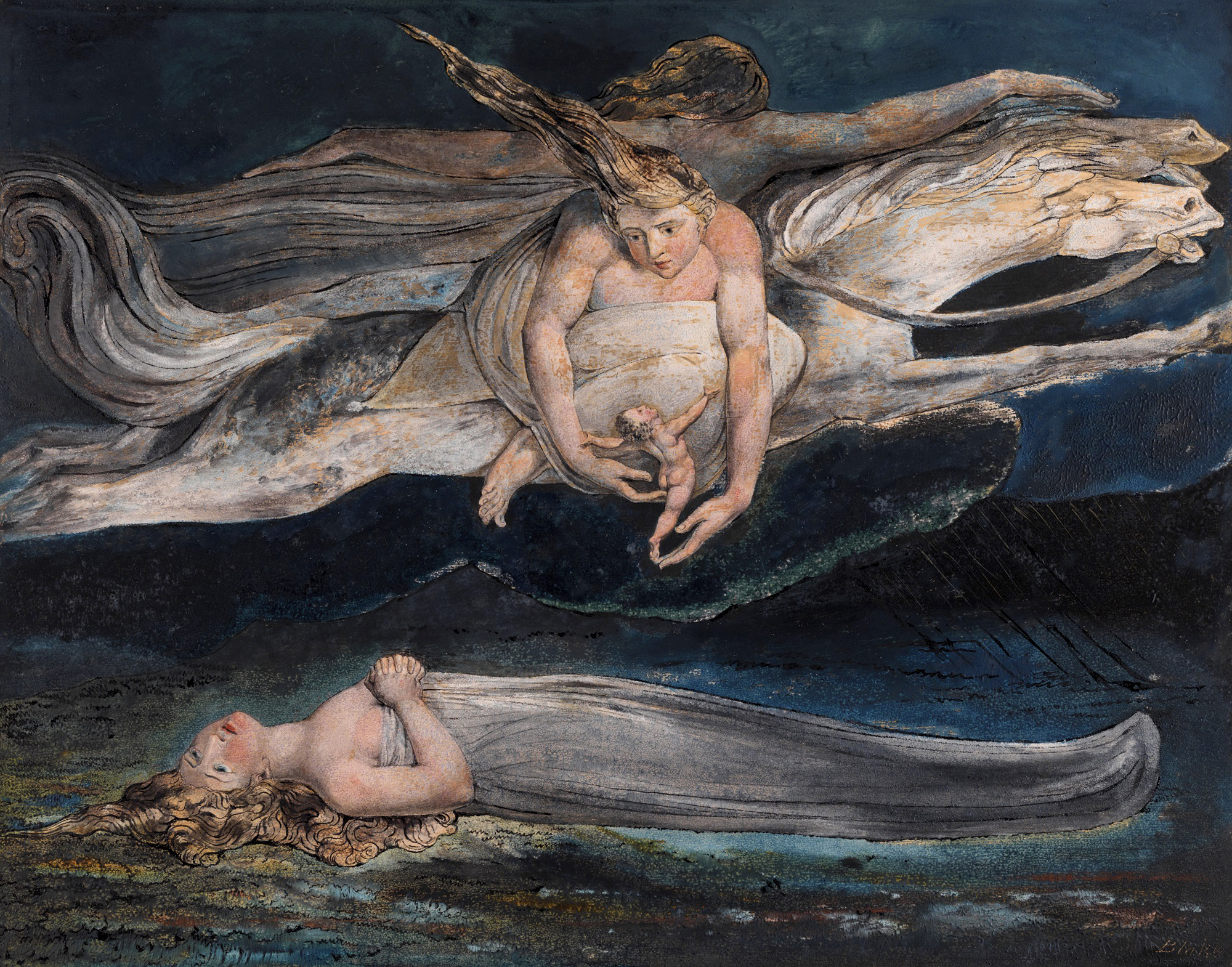
 

William Blake (British, 1757-1827) 'Pity' c. 1795


William Blake (British, 1757-1827)
Pity
c. 1795
Colour print, ink and watercolour on paper
425 x 539 mm
Tate. Presented by W. Graham Robertson 1939
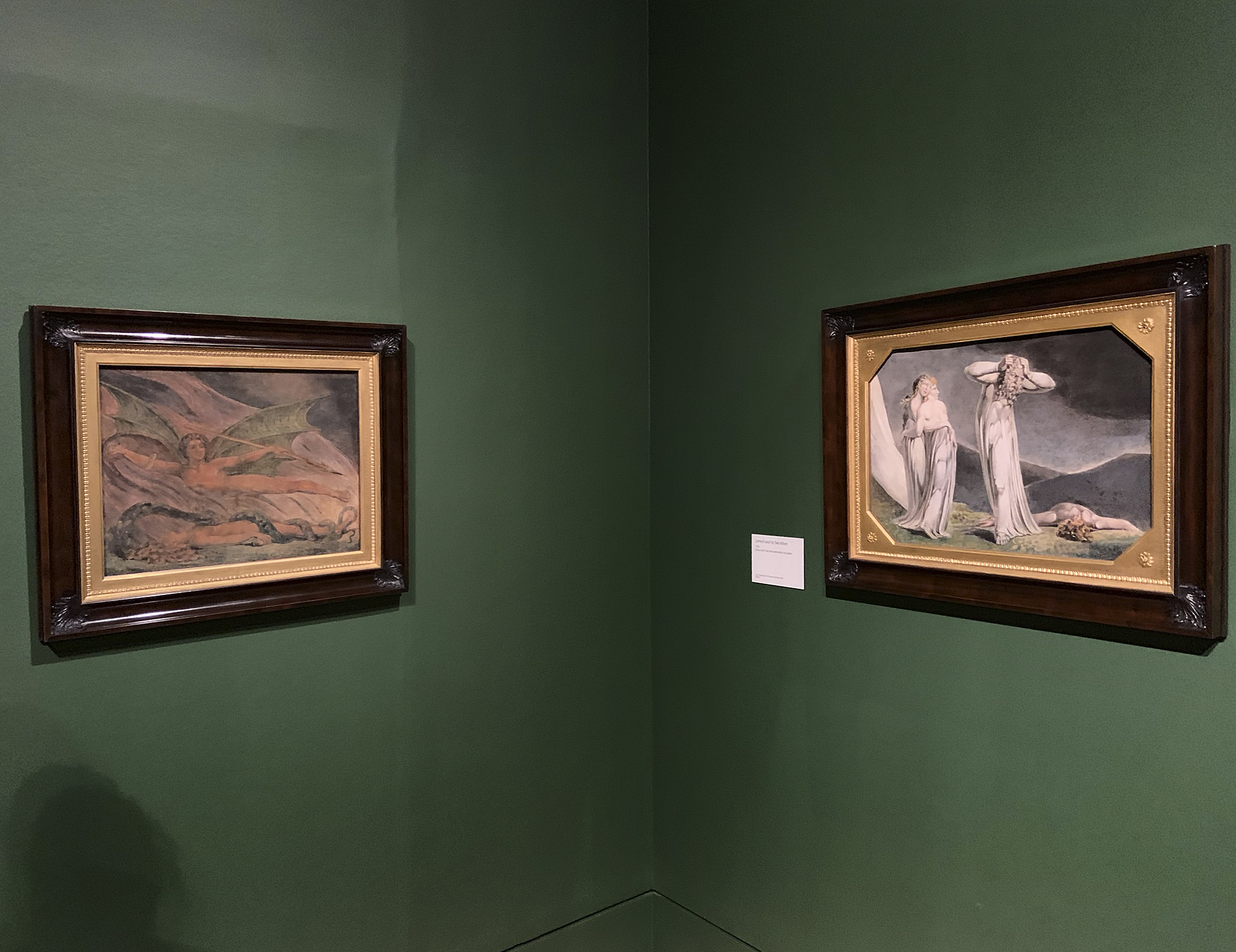
 

Installation view of the exhibition 'William Blake' at Tate Britain, London showing at left, 'Satan Exulting over Eve' (c. 1795) and at right, 'Lamech and his Two Wives' (1795)


Installation view of the exhibition William Blake at Tate Britain, London showing at left, Satan Exulting over Eve (c. 1795) and at right, Lamech and his Two Wives (1795)
Photo: Marcus Bunyan


Installation view of the exhibition 'William Blake' at Tate Britain, London showing at left, 'Lamech and his Two Wives' (1795) and at right, 'Naomi Entreating Ruth and Orpah to Return to the Land of Moab' (c. 1795)

Installation view of the exhibition 'William Blake' at Tate Britain, London showing at left, 'Lamech and his Two Wives' (1795) and at right, 'Naomi Entreating Ruth and Orpah to Return to the Land of Moab' (c. 1795)


Installation view of the exhibition William Blake at Tate Britain, London showing at left, Lamech and his Two Wives (1795) and at right, Naomi Entreating Ruth and Orpah to Return to the Land of Moab (c. 1795)
Photos: Marcus Bunyan
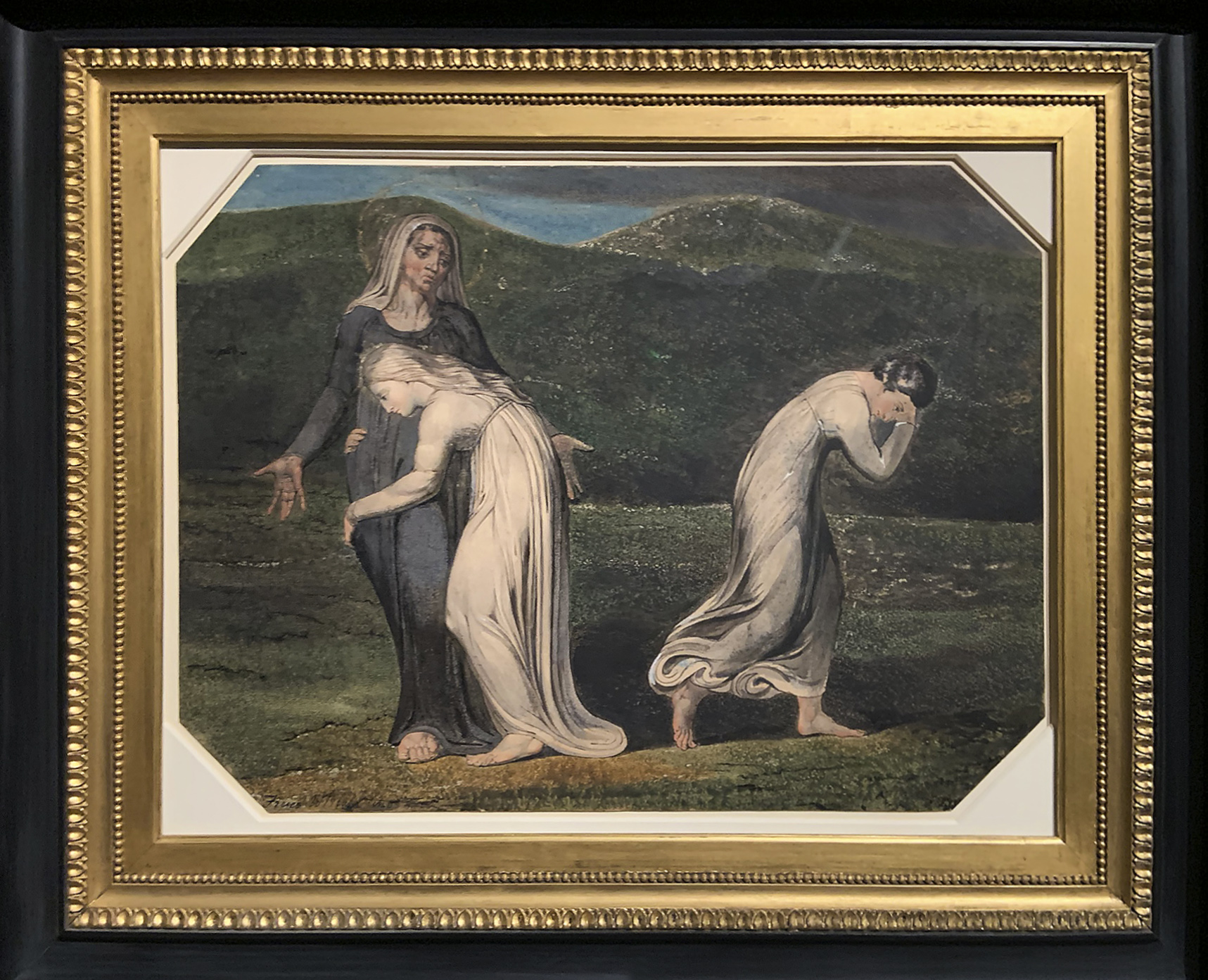
 

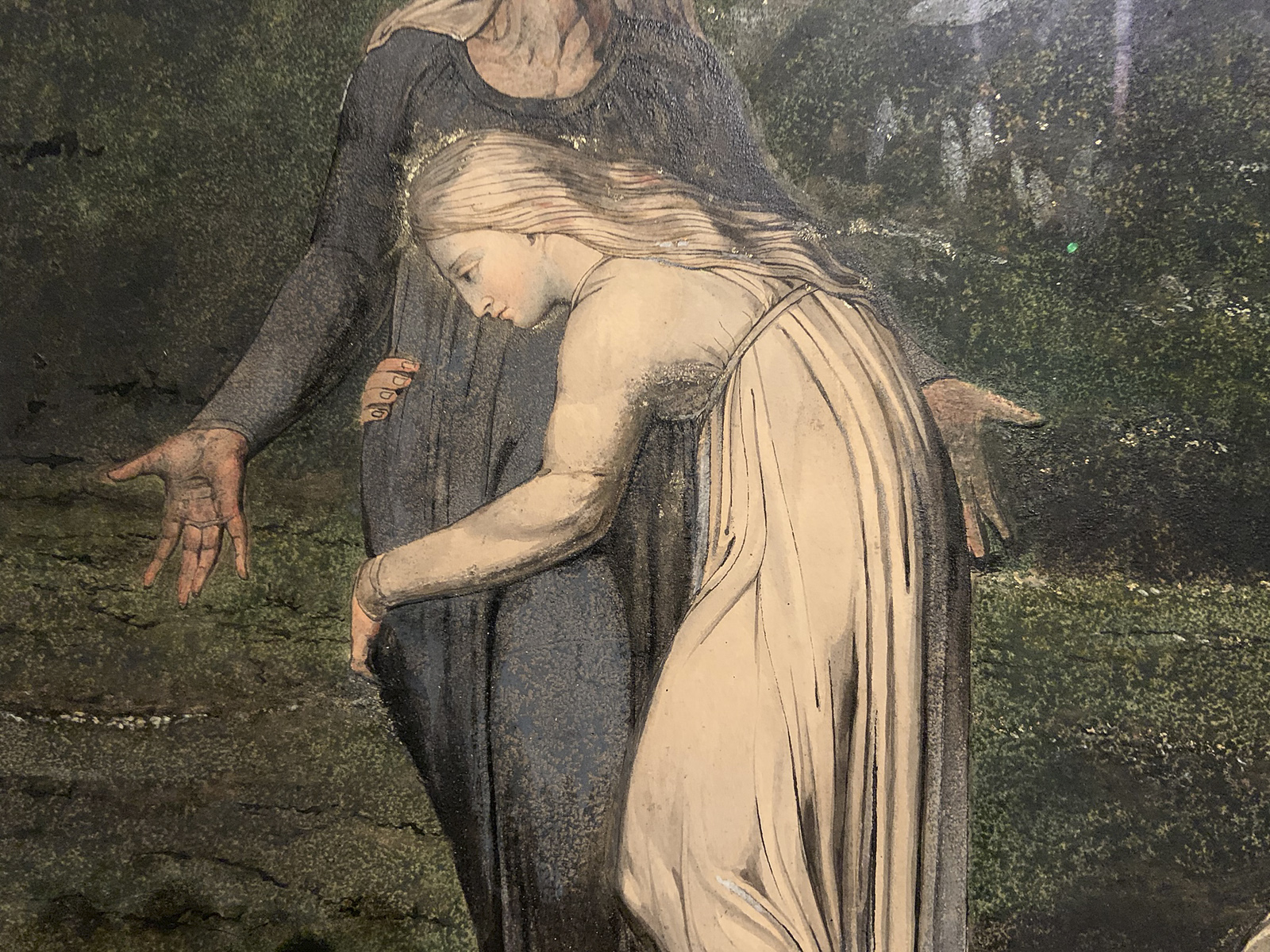
William Blake (British, 1757-1827) 'Naomi Entreating Ruth and Orpah to Return to the Land of Moab' c. 1795 (installation view)

William Blake (British, 1757-1827) 'Naomi Entreating Ruth and Orpah to Return to the Land of Moab' c. 1795 (installation view)

William Blake (British, 1757-1827) 'Naomi Entreating Ruth and Orpah to Return to the Land of Moab' c. 1795 (installation view detail)


William Blake (British, 1757-1827)
Naomi Entreating Ruth and Orpah to Return to the Land of Moab (installation views)
c. 1795
Colour print finished in pen and ink, shell gold and Chinese white on paper
42.5 x 60cm
Victoria and Albert Museum. Given by J. E. Taylor, Esq, London
Photos: Marcus Bunyan


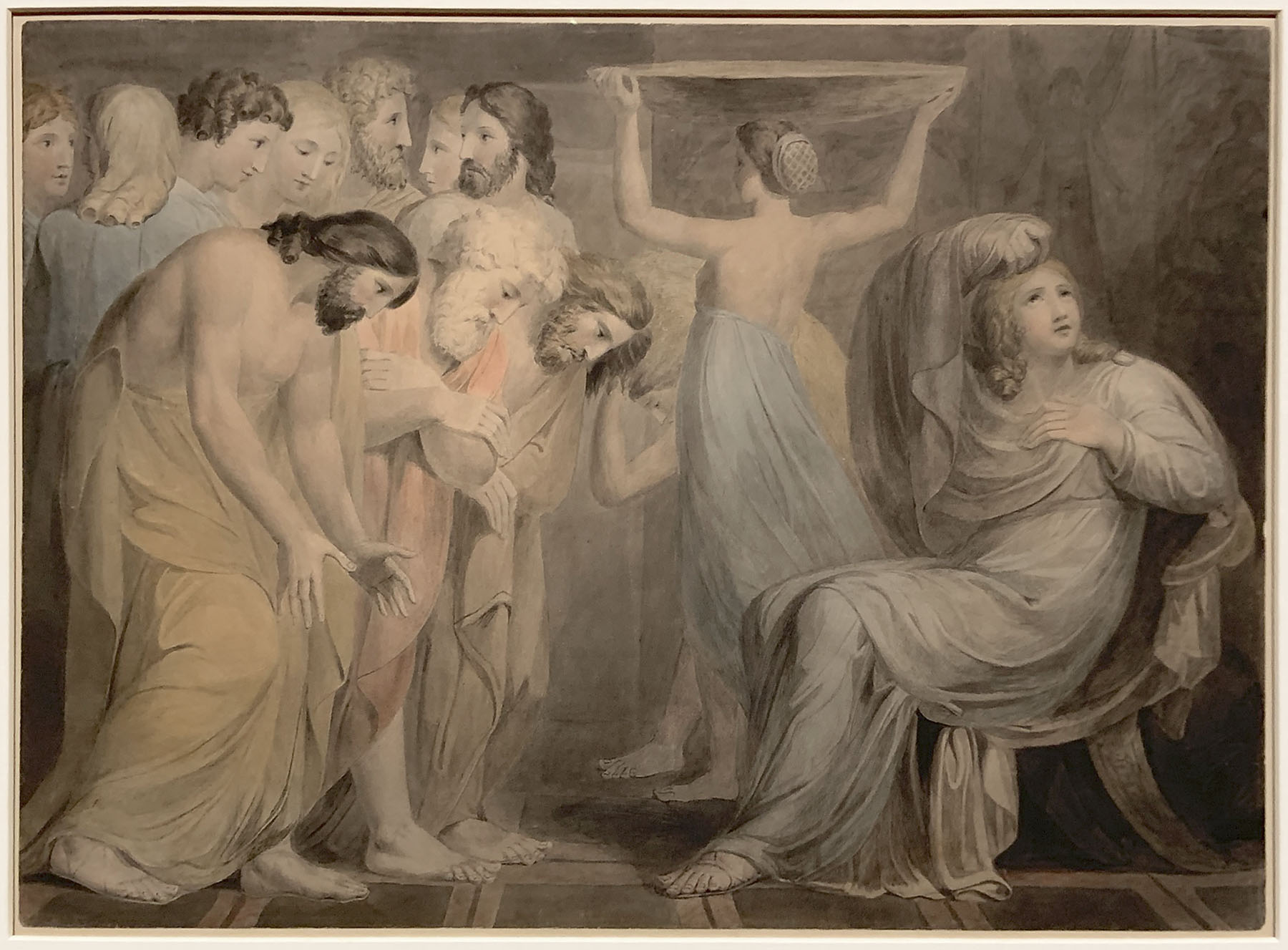
Naomi Entreating Ruth and Orpah to Return to the Land of Moab (c. 1795) is another first impression, showing a slightly more familiar Biblical narrative from the book of Ruth, chapter 1, verses 11-17. Naomi, seen at the left in a black robe, and her two daughters-in-law have become widowed. She decides to leave the land of Moab to return to her kin in Judah. Ruth, who is embracing her, remains devoted to Naomi, and returns with her, but Orpah, walking off to the right, decides to stay. Interestingly, because of her place in the lineage of David and so that of Jesus, Blake gives Naomi a halo, but not Ruth.

Hoakley. “Tyger’s eye: the paintings of William Blake, 5 – The large prints, 1795,” on The Electric Light Company website November 26, 2016 [Online] Cited 18/01/2020
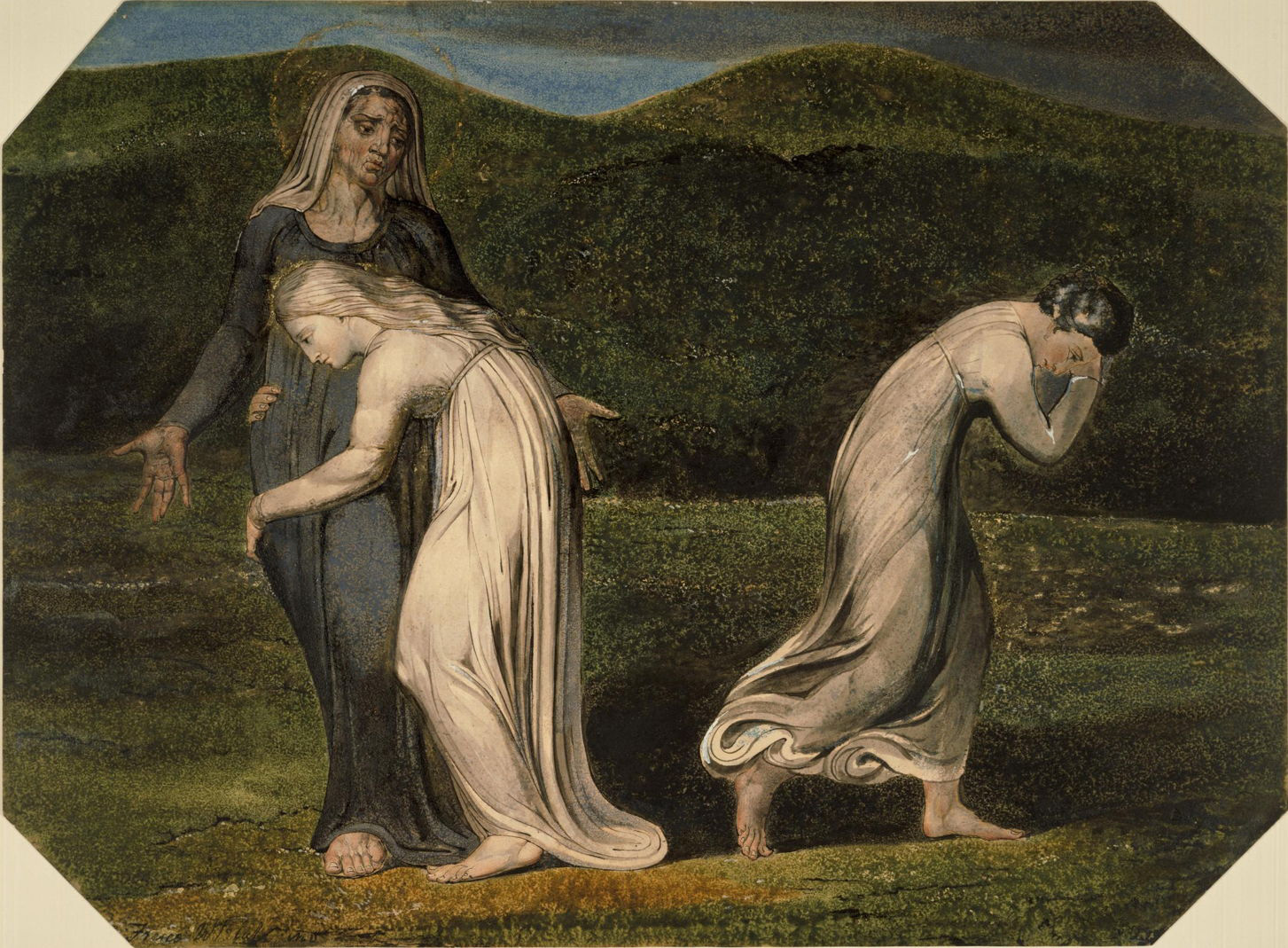
 

William Blake (British, 1757-1827) 'Naomi Entreating Ruth and Orpah to Return to the Land of Moab' c. 1795


William Blake (British, 1757-1827)
Naomi Entreating Ruth and Orpah to Return to the Land of Moab
c. 1795
Colour print finished in pen and ink, shell gold and Chinese white on paper
42.5 x 60cm
Victoria and Albert Museum. Given by J. E. Taylor, Esq, London
Image courtesy of and © Victoria and Albert Museum, London

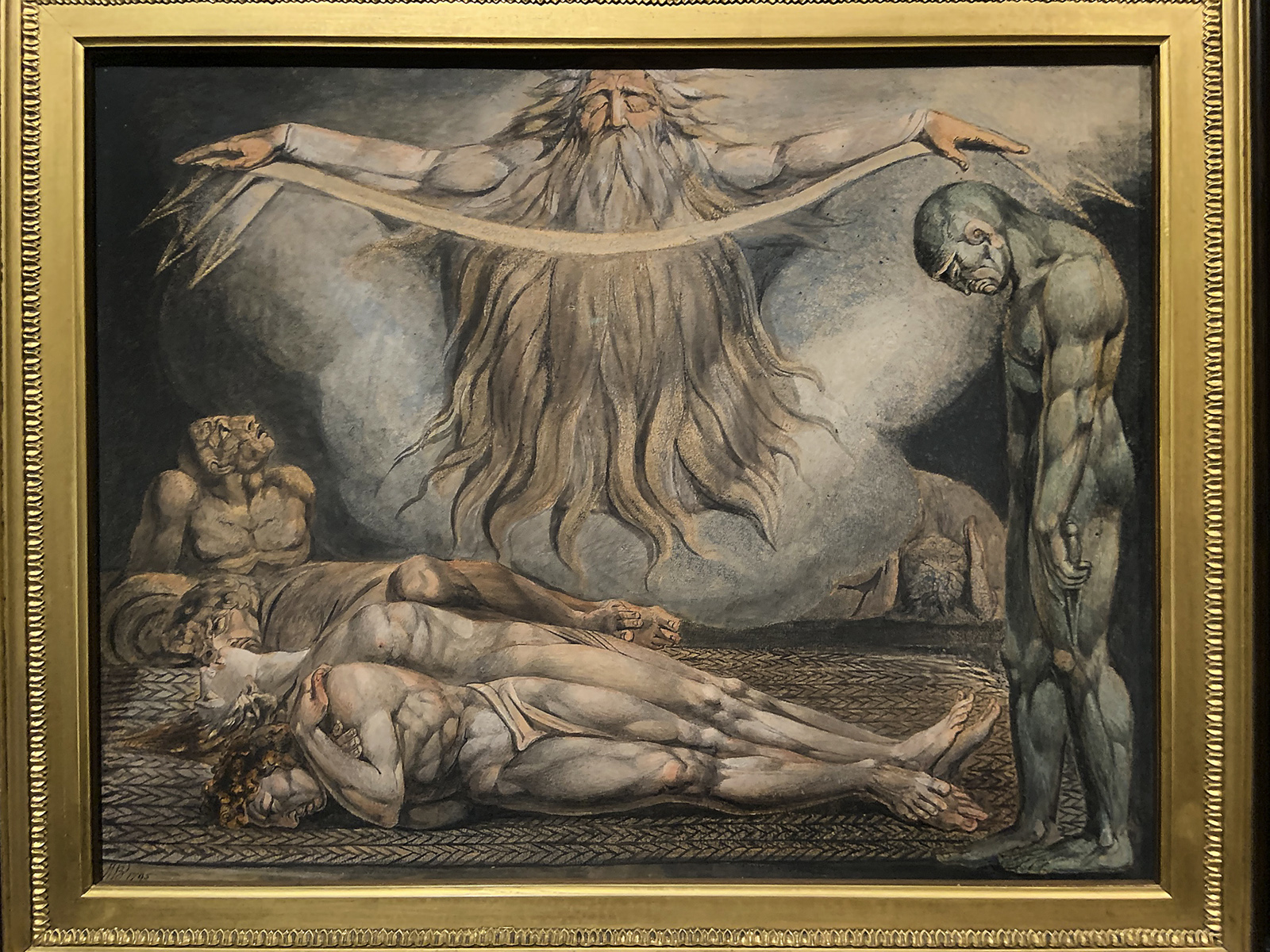
 

William Blake (British, 1757-1827) 'The House of Death' 1795 - c.1805 (installation view)

William Blake (British, 1757-1827) 'The House of Death' 1795 - c.1805 (installation view)

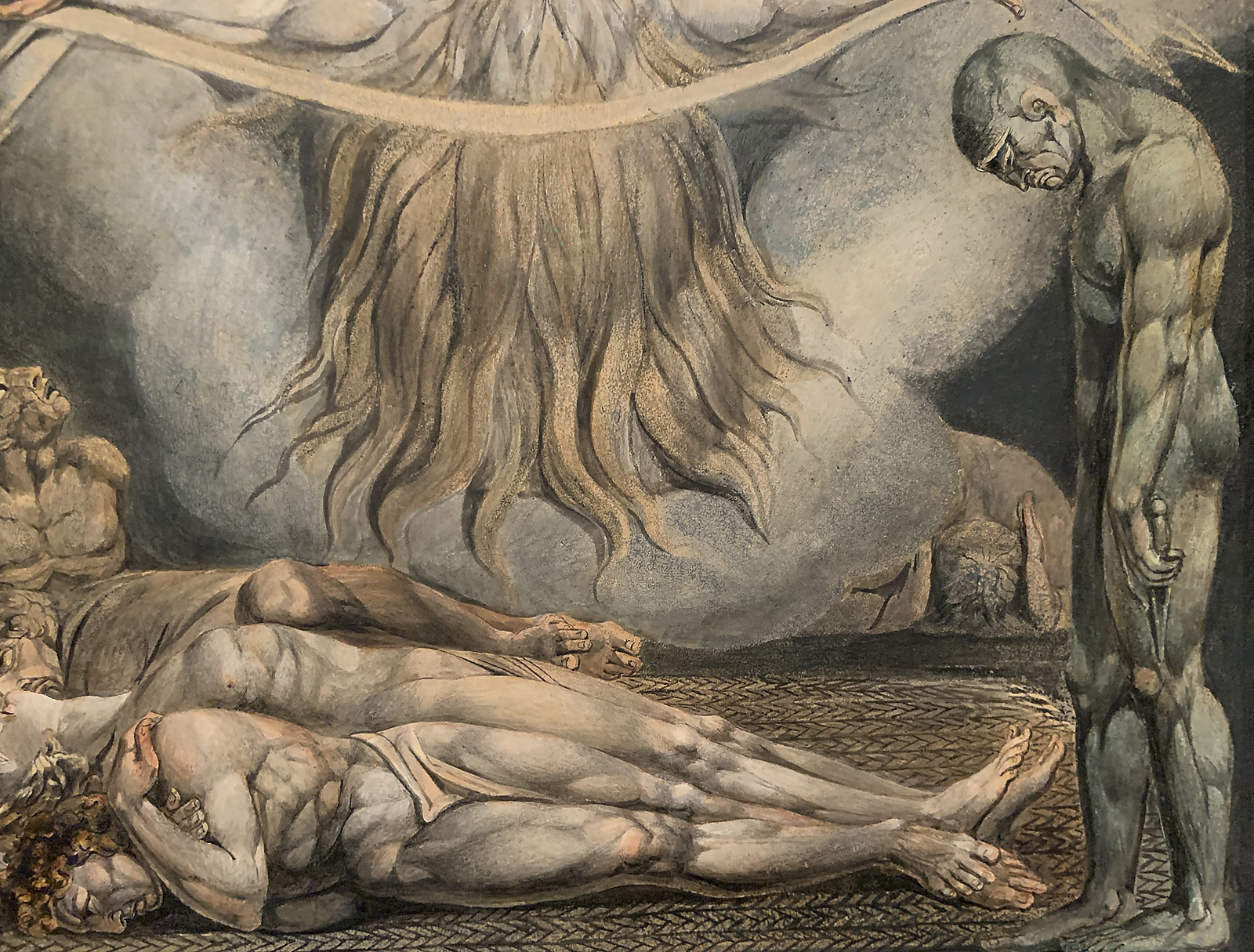
William Blake (British, 1757-1827) 'The House of Death' 1795 - c.1805 (installation view detail)

William Blake (British, 1757-1827) 'The House of Death' 1795 - c.1805 (installation view detail)


William Blake (British, 1757-1827)
The House of Death (installation views)
1795 – c.1805
Colour print, ink and watercolour on paper
Tate. Presented by W. Graham Robertson 1939
Photos: Marcus Bunyan


Blake produced a number of designs relating to plague, war, fire and disaster … This design has been linked to the poet John Milton’s vision of a ‘Lazar House’ – a hospital for infectious diseases – from Paradise Lost (1664).

The English poet John Milton, who died in 1674, was viewed by Blake as England’s greatest poet, worthy of emulation but by no means above criticism. It was inevitable that in the large colour prints, his most important printing project, Blake would include Miltonic subjects.This print illustrates lines from Book XI of Milton’s poem Paradise Lost. The Archangel Michael shows Adam the misery that will be inflicted on Man now he has eaten the Forbidden Fruit. In a vision of ‘Death’s ‘grim Cave” Adam sees a ‘monstrous crew’ of men afflicted by ‘Diseases dire’.

Gallery label, August 2004


The House of Death (1795 – c. 1805), sometimes known as The Lazar House (a lazar is someone afflicted with a disease), is the first impression. It is a rather grim image taken from Milton’s Paradise Lost book 11, lines 477-493. There, the Archangel Michael shows Adam the afflictions that man will suffer in the form of disease, now that he has eaten the Forbidden Fruit. So rather than the bodies being dead, they are in the throes of suffering the diseases which have been unleashed following the Fall.

The similarity of the figure, who should (by Milton) be the Archangel Michael, to Blake’s images of Urizen, is clear, and may refer back to his illuminated books, and to the French Revolution.

Hoakley. “Tyger’s eye: the paintings of William Blake, 5 – The large prints, 1795,” on The Electric Light Company website November 26, 2016 [Online] Cited 18/01/2020
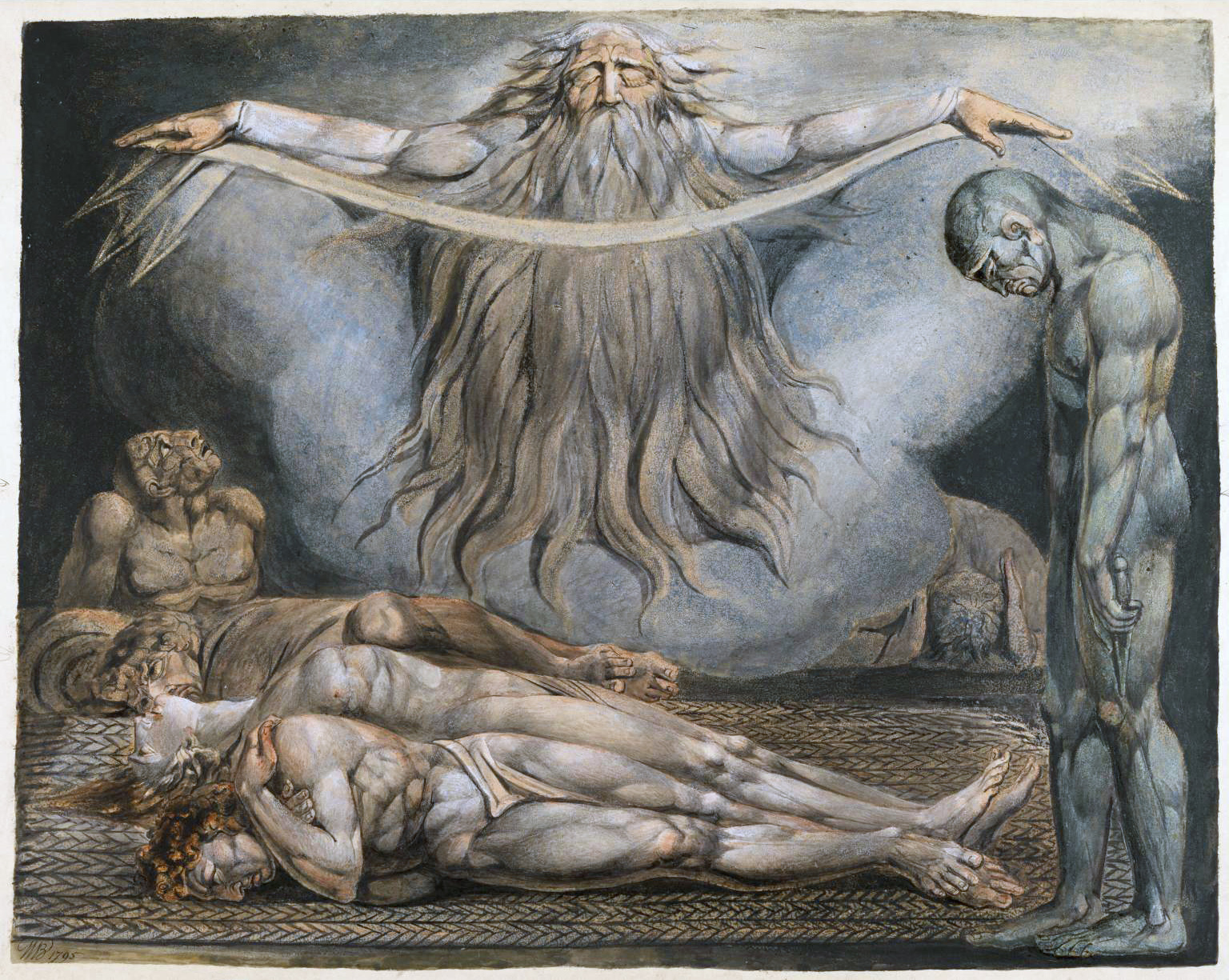
 

William Blake (British, 1757-1827) 'The House of Death' 1795 - c.1805


William Blake (British, 1757-1827)
The House of Death
1795 – c.1805
Colour print, ink and watercolour on paper
Tate. Presented by W. Graham Robertson 1939
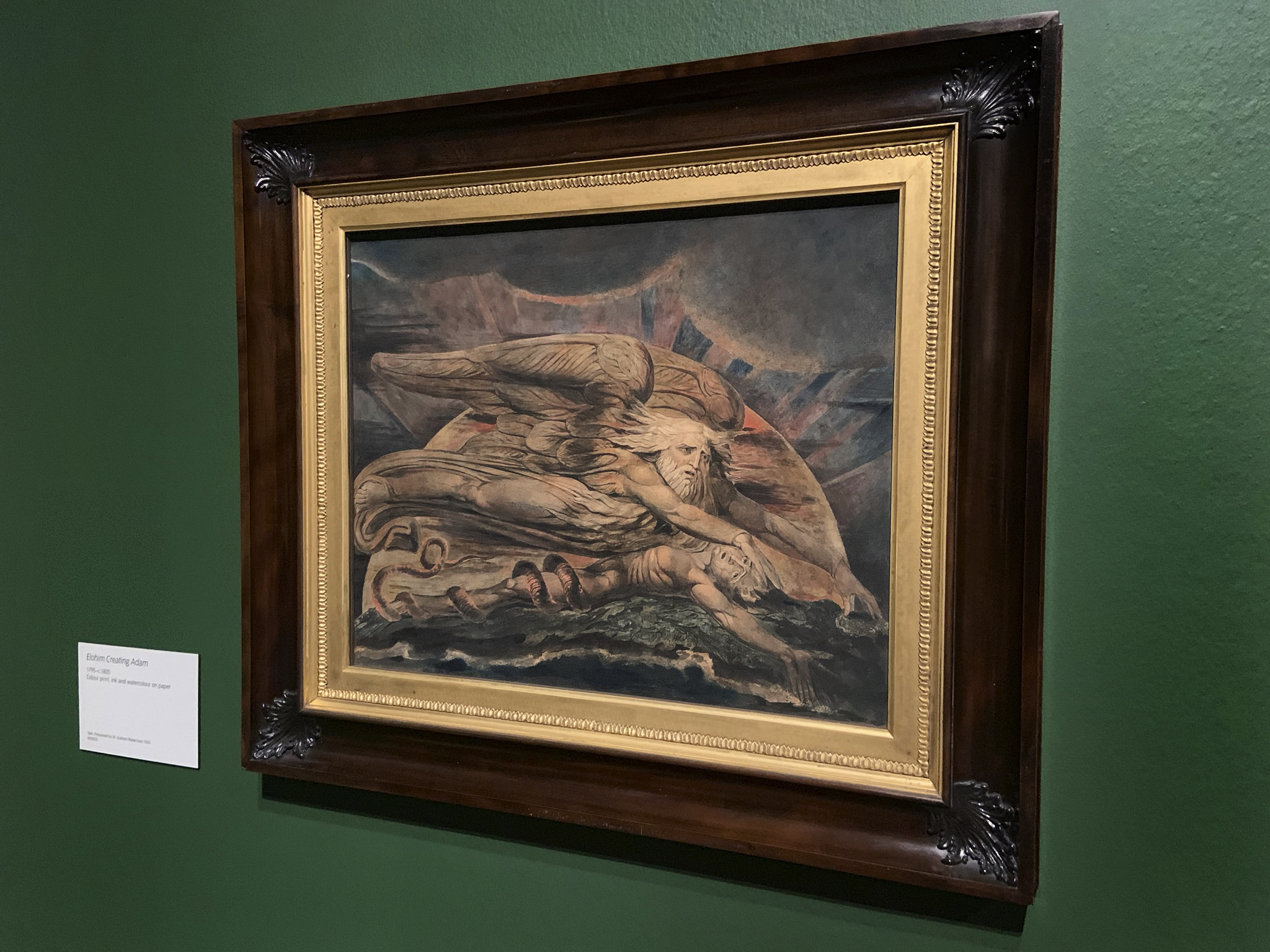
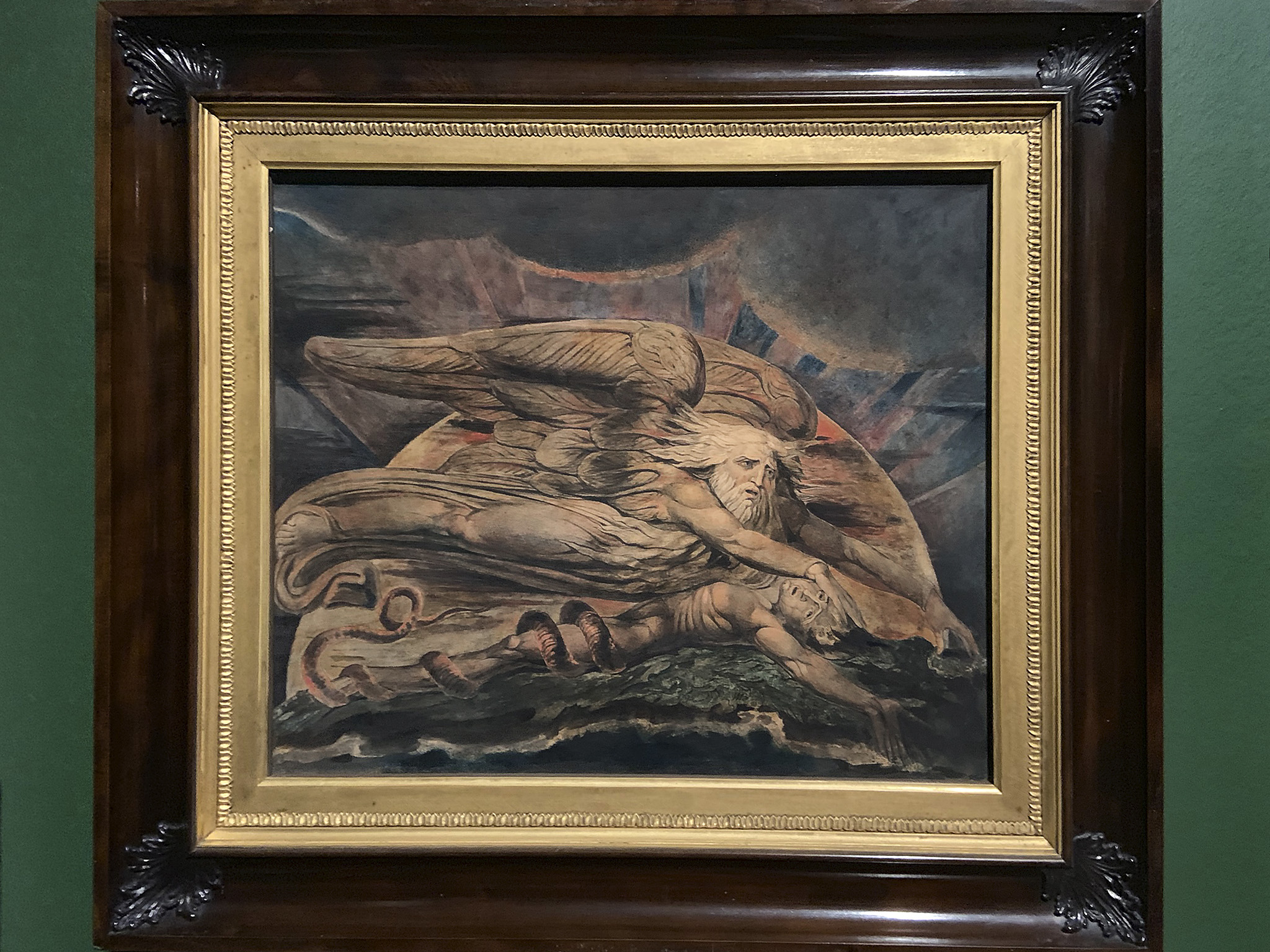
 

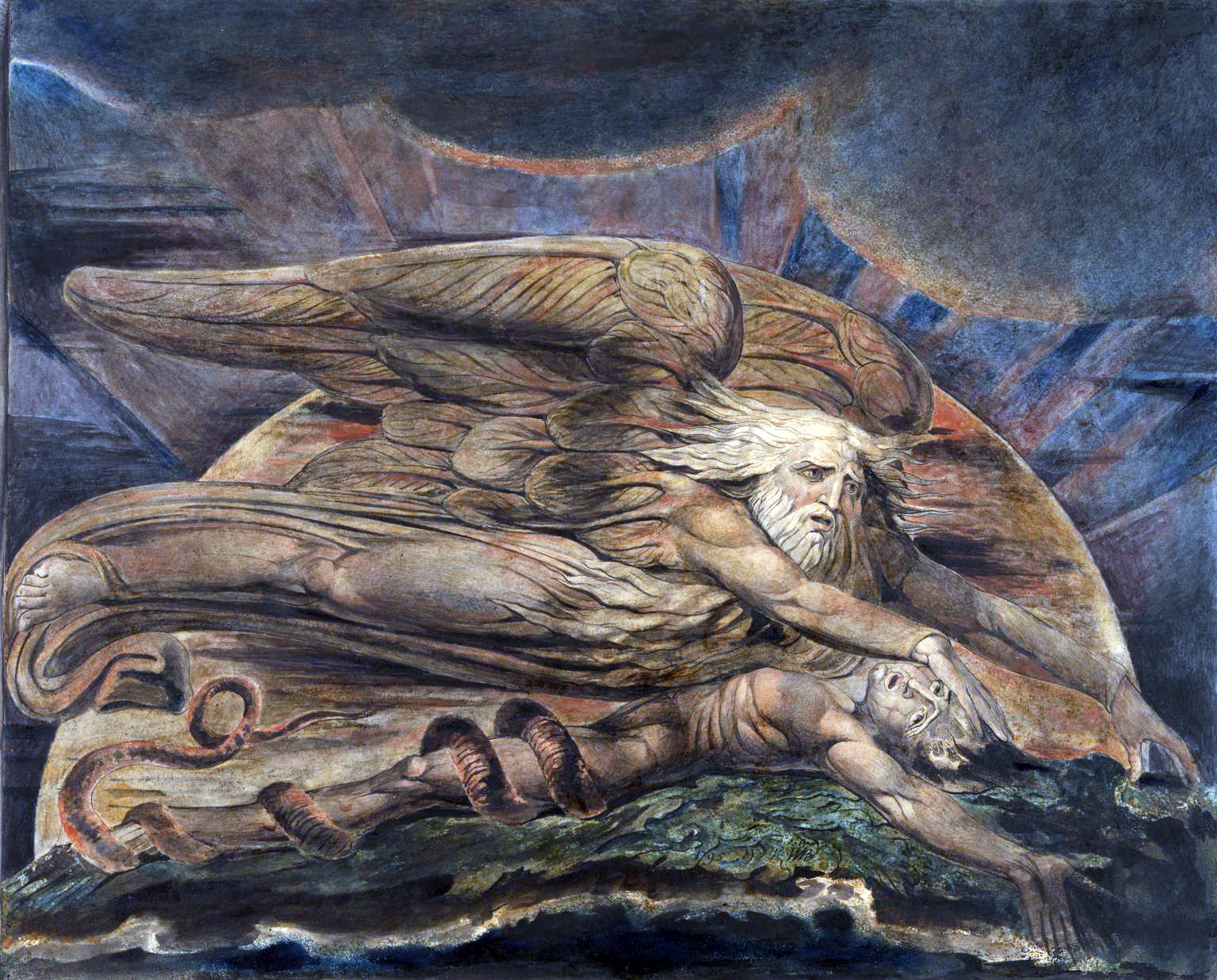
William Blake (British, 1757-1827) 'Elohim Creating Adam' 1795 - c. 1805 (installation view)

William Blake (British, 1757-1827) 'Elohim Creating Adam' 1795 - c. 1805 (installation view)

William Blake (British, 1757-1827) 'Elohim Creating Adam' 1795 - c. 1805 (installation view)

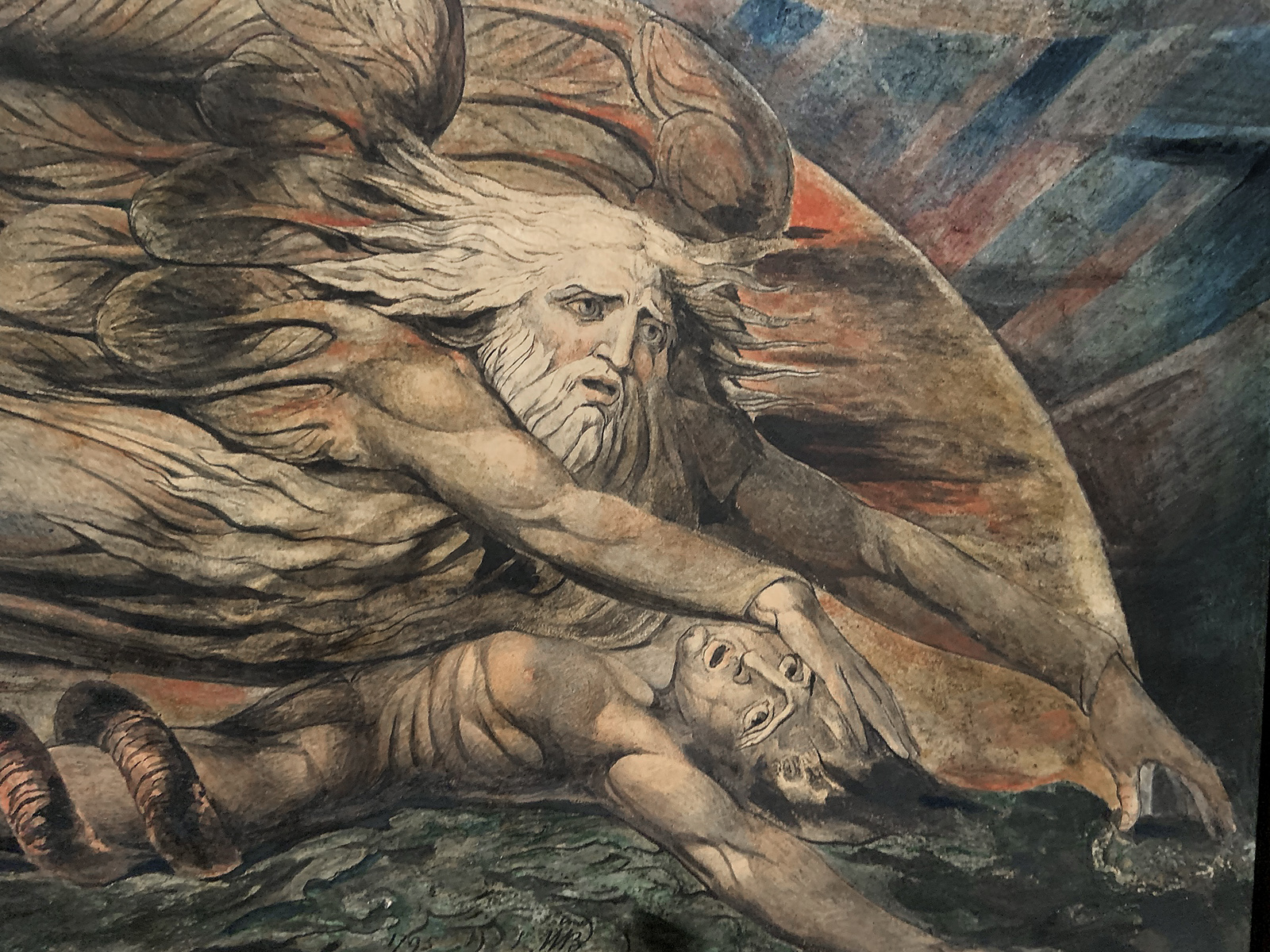
William Blake (British, 1757-1827) 'Elohim Creating Adam' 1795 - c. 1805 (installation view detail)


William Blake (British, 1757-1827)
Elohim Creating Adam (installation views)
1795 – c. 1805
Colour print, ink and watercolour on paper
Tate. Presented by W. Graham Robertson 1939
Photos: Marcus Bunyan


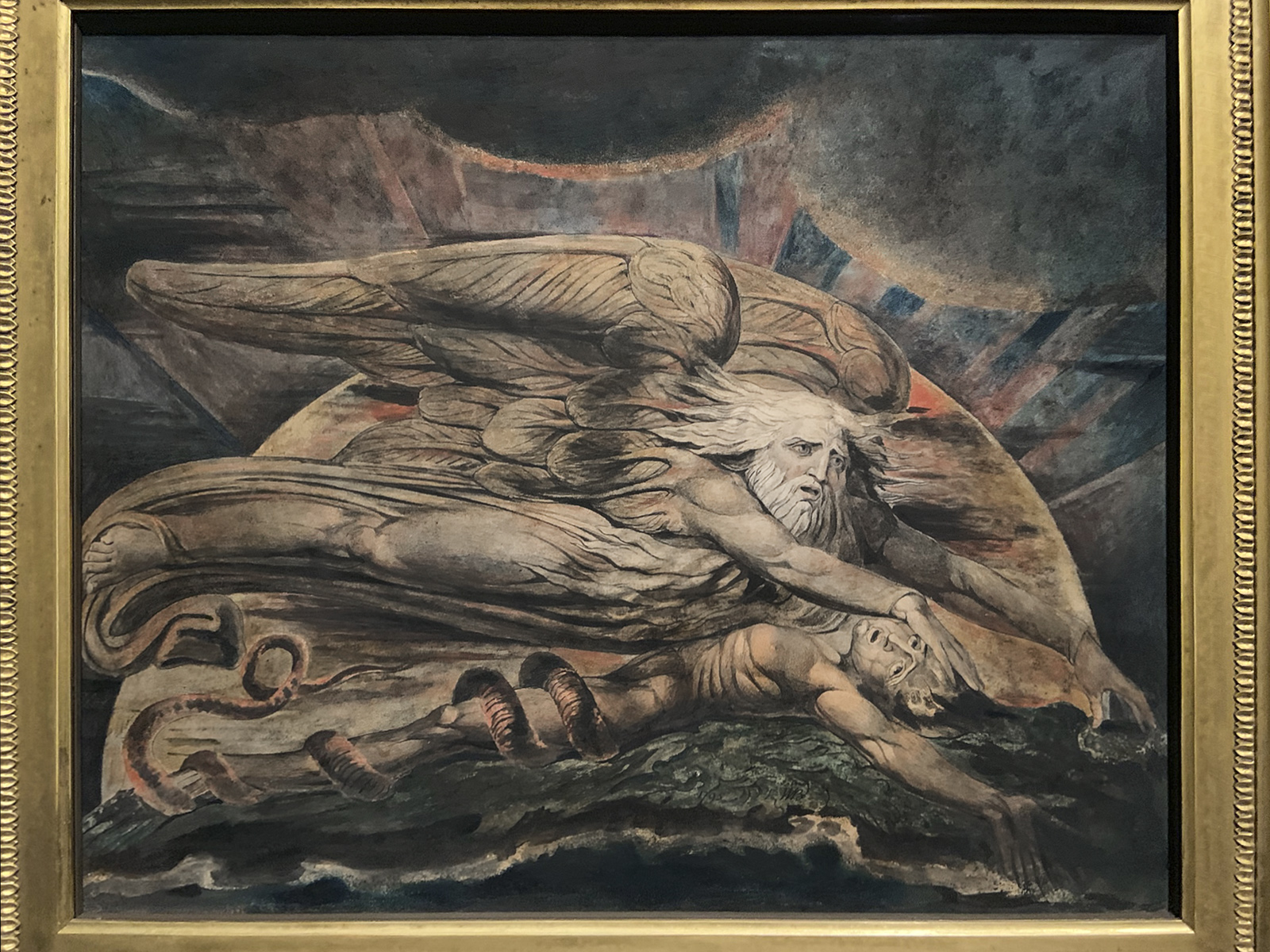
Elohim is a Hebrew name for God. This picture illustrates the Book of Genesis: ‘And the Lord God formed man of the dust of the ground’. Adam is shown growing out of the earth, a piece of which Elohim holds in his left hand.

For Blake the God of the Old Testament was a false god. He believed the Fall of Man took place not in the Garden of Eden, but at the time of creation shown here, when man was dragged from the spiritual realm and made material.

Gallery label, May 2003


Elohim Creating Adam (1795, c 1805) is the only surviving impression of this work, which appears to have been listed by Blake as God Creating Adam. It is based on the book of Genesis chapter 2 verse 7:

And the Lord God formed man of the dust of the ground, and breathed into his nostrils the breath of life; and man became a living soul.

Blake shows this fairly literally, with Adam’s body still being formed out of the earth, and a large worm (not a serpent) is coiled around his left leg. The worm is also a symbol of mortality.

Blake’s mythology for Elohim, the Hebrew word for God and judge, is different from the ‘standard’ Christian concept of God, and distinct from Urizen too. I am not convinced that Blake intended to show his Elohim or Urizen here, and therefore the work may better be titled simply as God Creating Adam.

Hoakley. “Tyger’s eye: the paintings of William Blake, 5 – The large prints, 1795,” on The Electric Light Company website November 26, 2016 [Online] Cited 18/01/2020


William Blake (British, 1757-1827) 'Elohim Creating Adam' 1795 - c. 1805


William Blake (British, 1757-1827)
Elohim Creating Adam (installation views)
1795 – c. 1805
Colour print, ink and watercolour on paper
Tate. Presented by W. Graham Robertson 1939
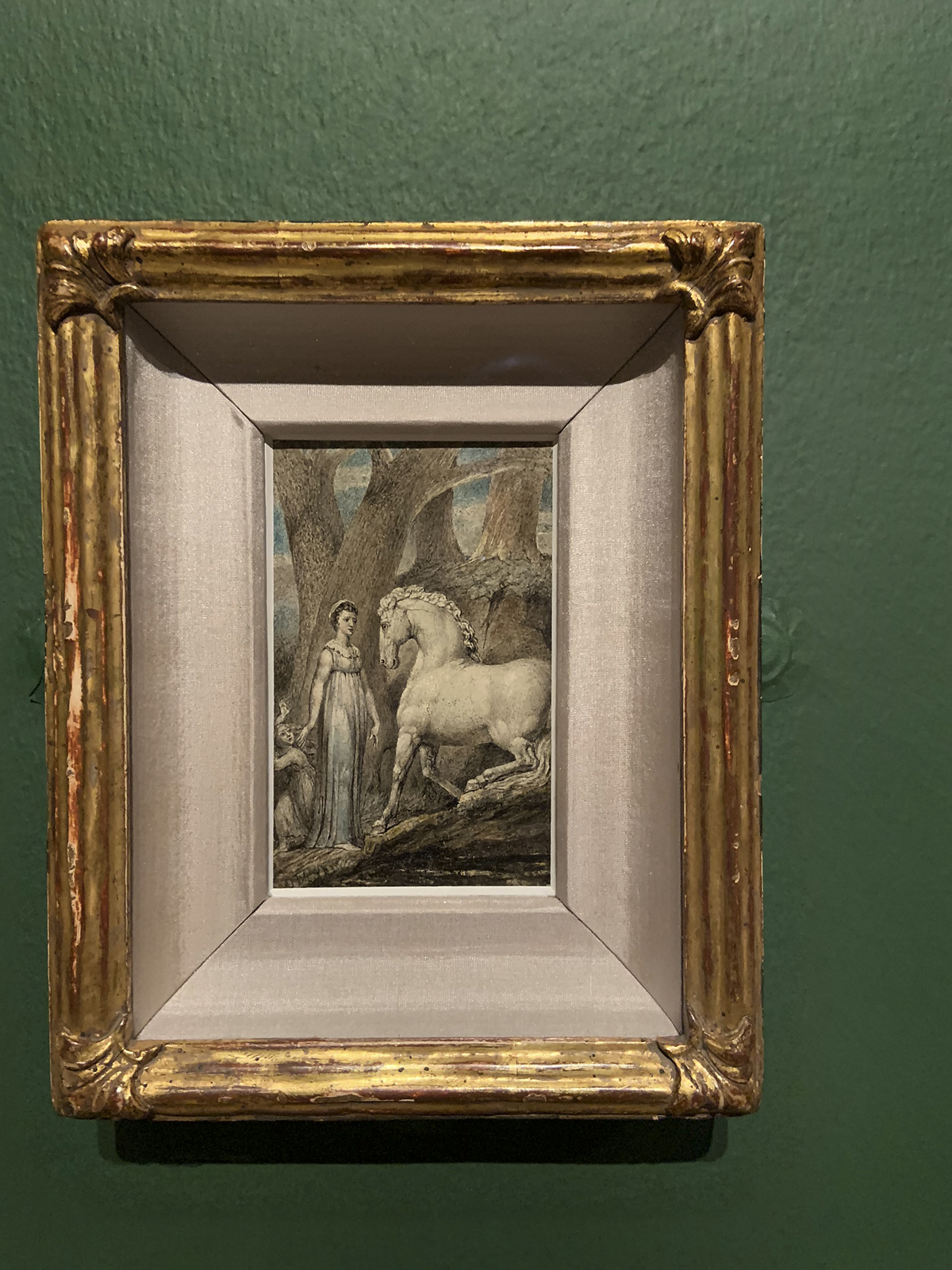
 

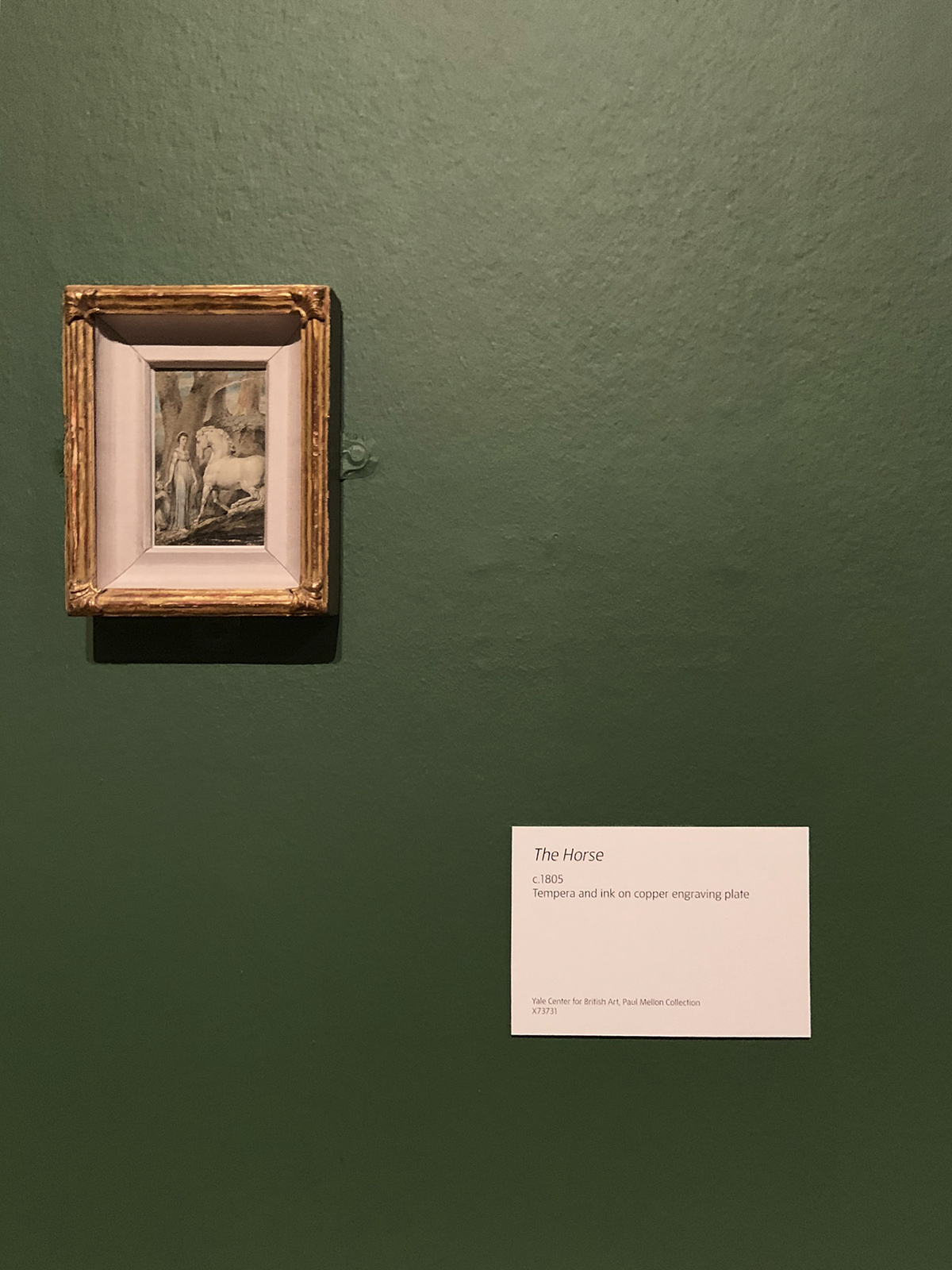
William Blake (British, 1757-1827) 'The Horse' c. 1805 (installation view)

William Blake (British, 1757-1827) 'The Horse' c. 1805 (installation view)


Installation view of the exhibition William Blake at Tate Britain, London showing The Horse c. 1805
Photos: Marcus Bunyan


Quote above The Horse


“For when Los joind with me he took me in his firy whirlwind My Vegetated portion was hurried from Lambeths shades He set me down in Felphams Vale & prepard a beautiful Cottage for me that in three years I might write all these Visions To display Natures cruel holiness: the deceits of Natural Religion Walking in my Cottage Garden, sudden I beheld The Virgin Ololon & address’d her as a Daughter of Beulah.”


William Blake, from ‘Milton a Poem’, c. 1804-1811


William Blake (British, 1757-1827) 'The Horse' c. 1805 (installation view)


William Blake (British, 1757-1827)
The Horse (installation view)
c. 1805
Tempera and ink on copper engraving plate
Yale Center for British Art, Paul Mellon Collection
Photo: Marcus Bunyan


Room 4

Independence and despair


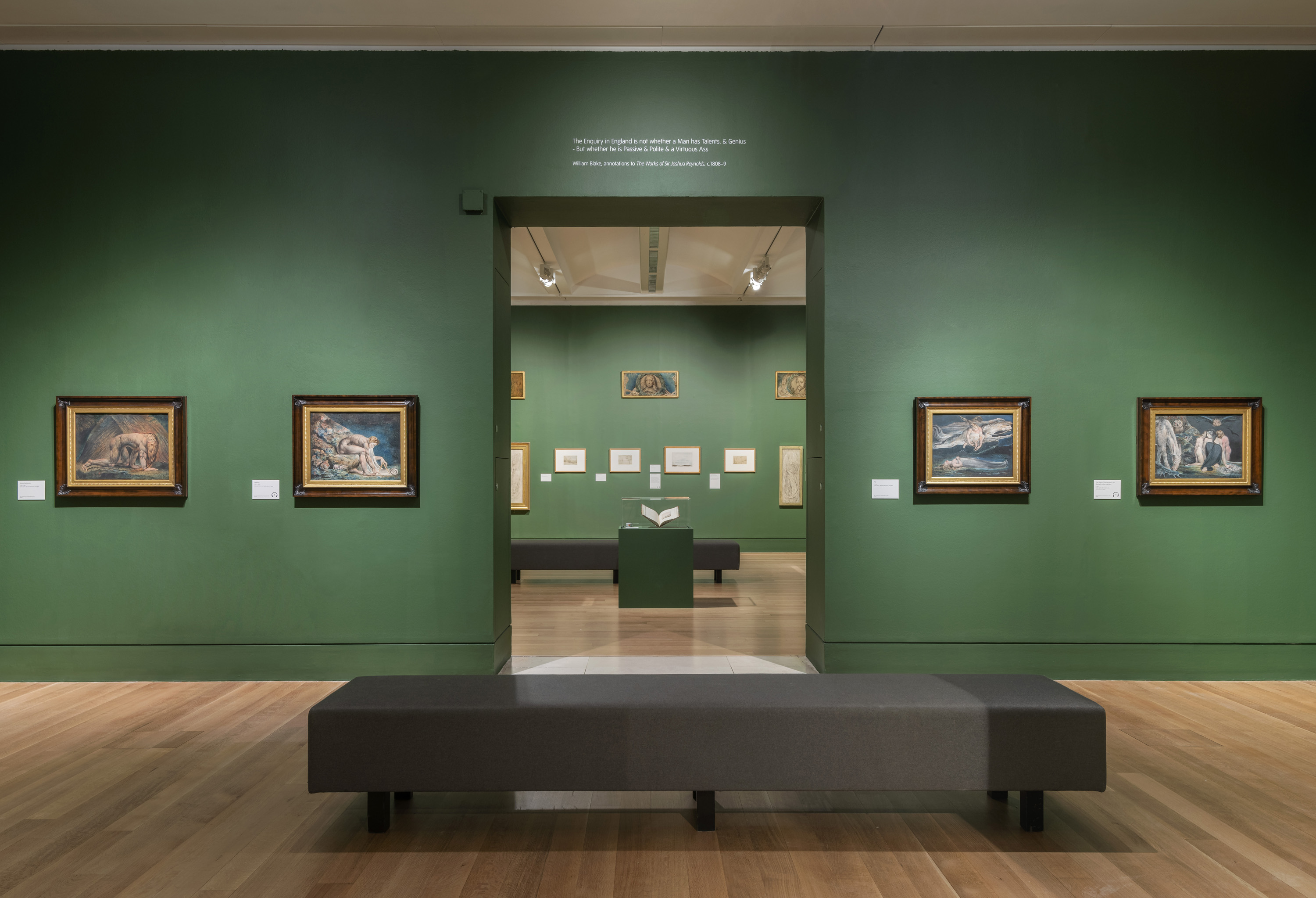
The Enquiry in England is not whether a Man has Talents. & Genius – But whether he is Passive & Polite & a Virtuous Ass


This gallery traces a particularly tumultuous period in Blake’s life, from 1805 to 1812. In 1805 he secured work illustrating Robert Blair’s poem The Grave. Published in 1808, his designs were a critical success, praised by many leading artists and patrons. But Blake was disappointed that he did not get the work of engraving the illustrations as well as designing them. He also suspected the publisher, Robert Cromek, of stealing his idea to do an engraving of the pilgrims from Chaucer’s Canterbury Tales.

In 1809 Blake organised a retrospective exhibition of his work. This was held in Broad Street, Soho, in the family home where his brother was now running the hosiery business. The exhibition catalogue set out his highly personal ideas about art and his ambitions as a painter of large-scale frescos. This room includes a recreation of the 1809 exhibition where you can experience Blake’s work as it would have been seen in Broad Street. There is also a projection showing his paintings at the gigantic scale he hoped to realise them.

The exhibition of 1809 was, however, a critical and commercial disaster. Blake was bitterly disappointed and felt betrayed by his friends in the art world. Having made big claims about restoring ‘the grand style of Art’, he exhibited for the last time in 1812. He then withdrew from the public gaze for several years.
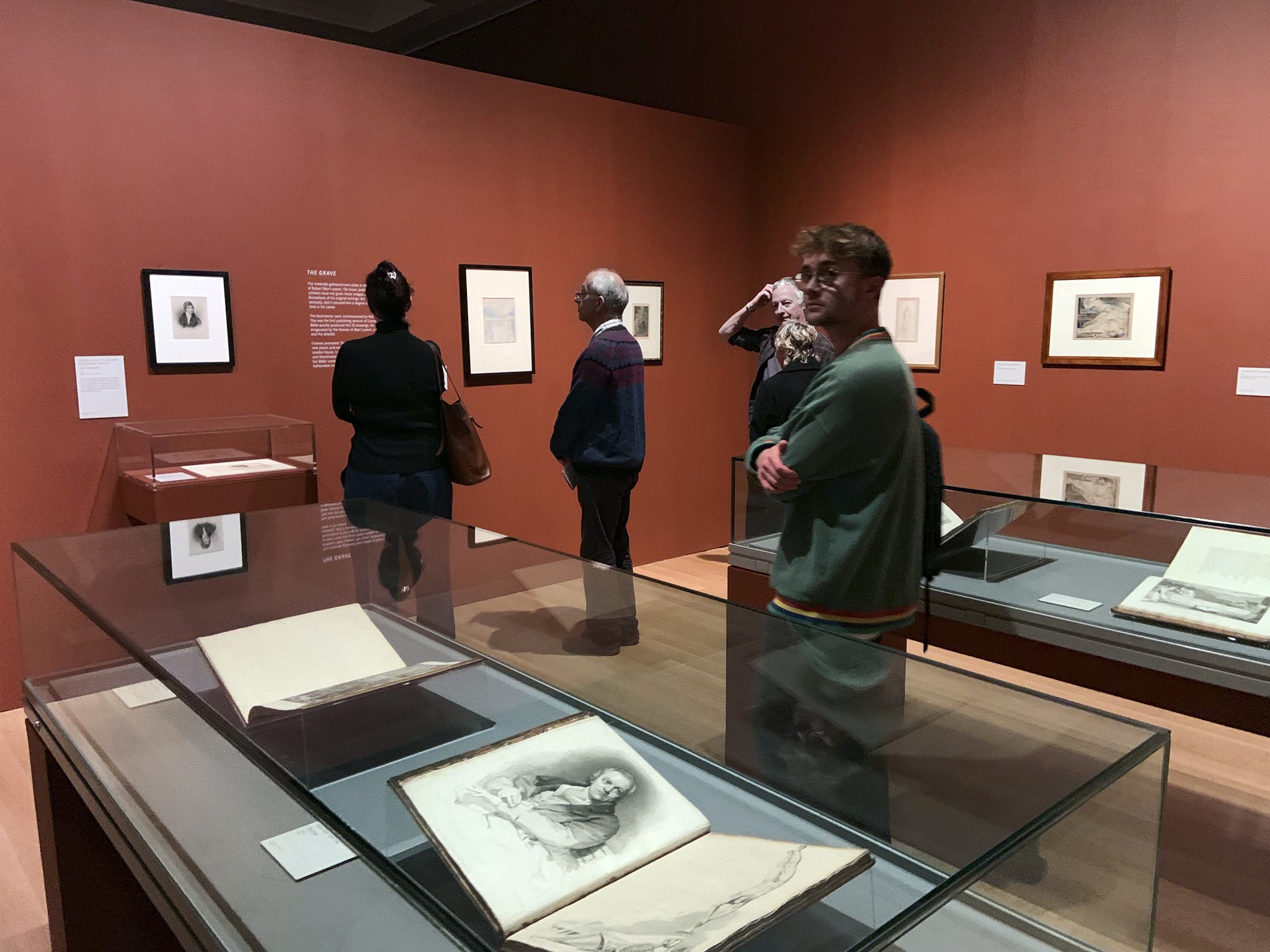
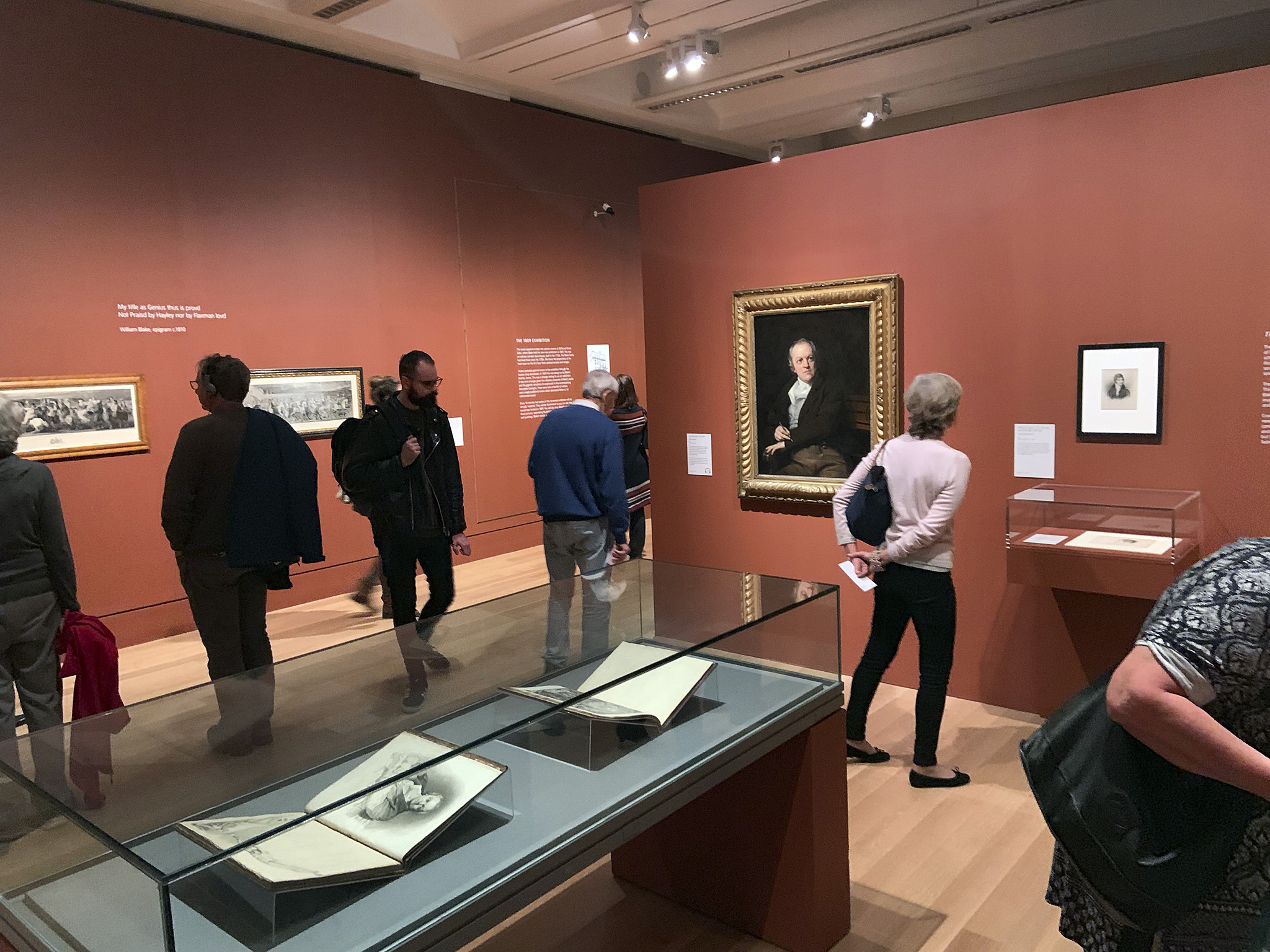
 

Installation view of the exhibition 'William Blake' at Tate Britain, London

Installation view of the exhibition 'William Blake' at Tate Britain, London

Installation view of the exhibition 'William Blake' at Tate Britain, London

Installation view of the exhibition 'William Blake' at Tate Britain, London


Installation views of the exhibition William Blake at Tate Britain, London
Photos: Marcus Bunyan
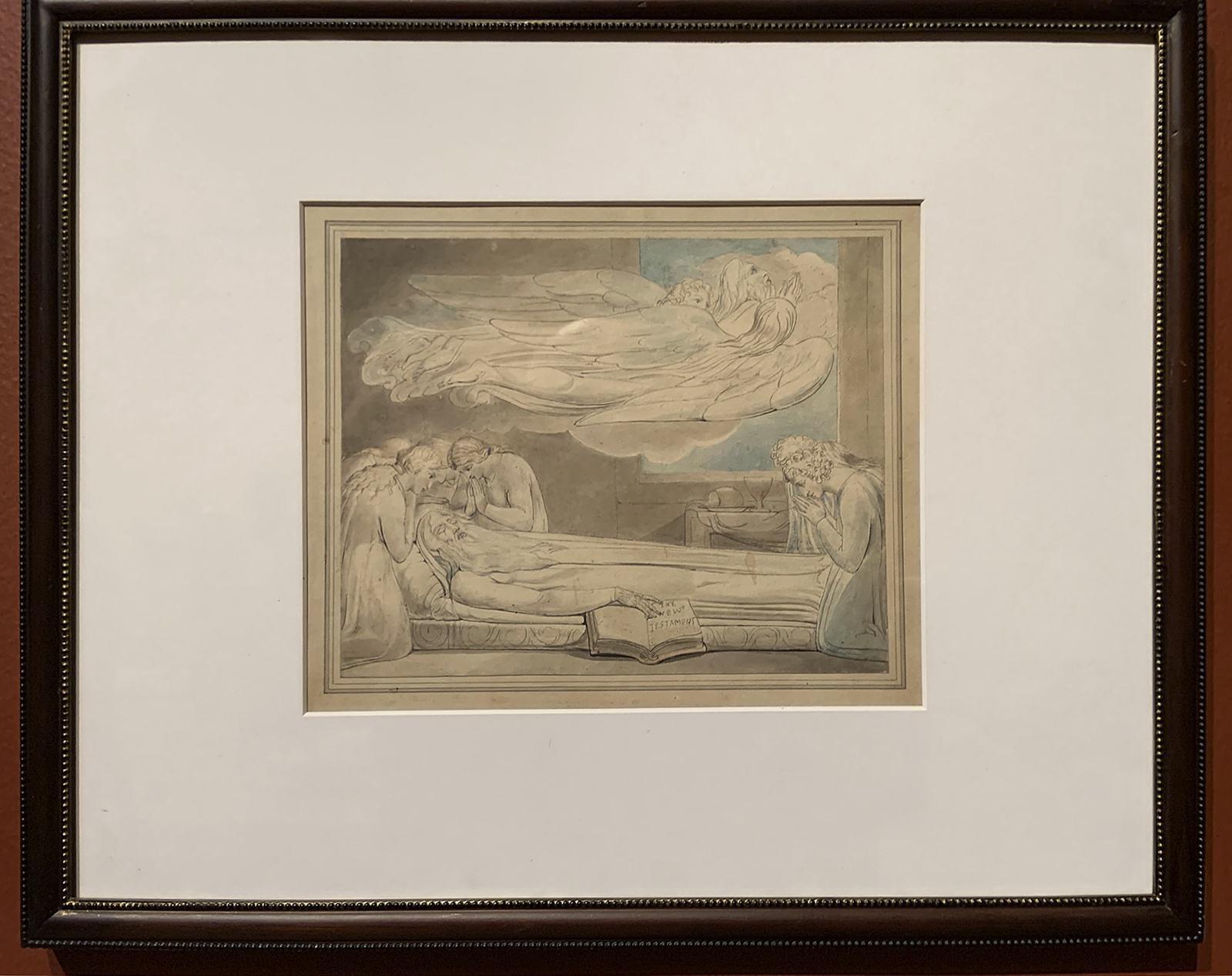
 

William Blake (British, 1757-1827) 'The Death of the Good Old Man' 1805 (installation view)

William Blake (British, 1757-1827) 'The Death of the Good Old Man' 1805 (installation view)


William Blake (British, 1757-1827)
The Death of the Good Old Man (installation views)
1805
Pen and ink and watercolour over traces of graphite on paper
Collection of Robert N. Essick
Photos: Marcus Bunyan
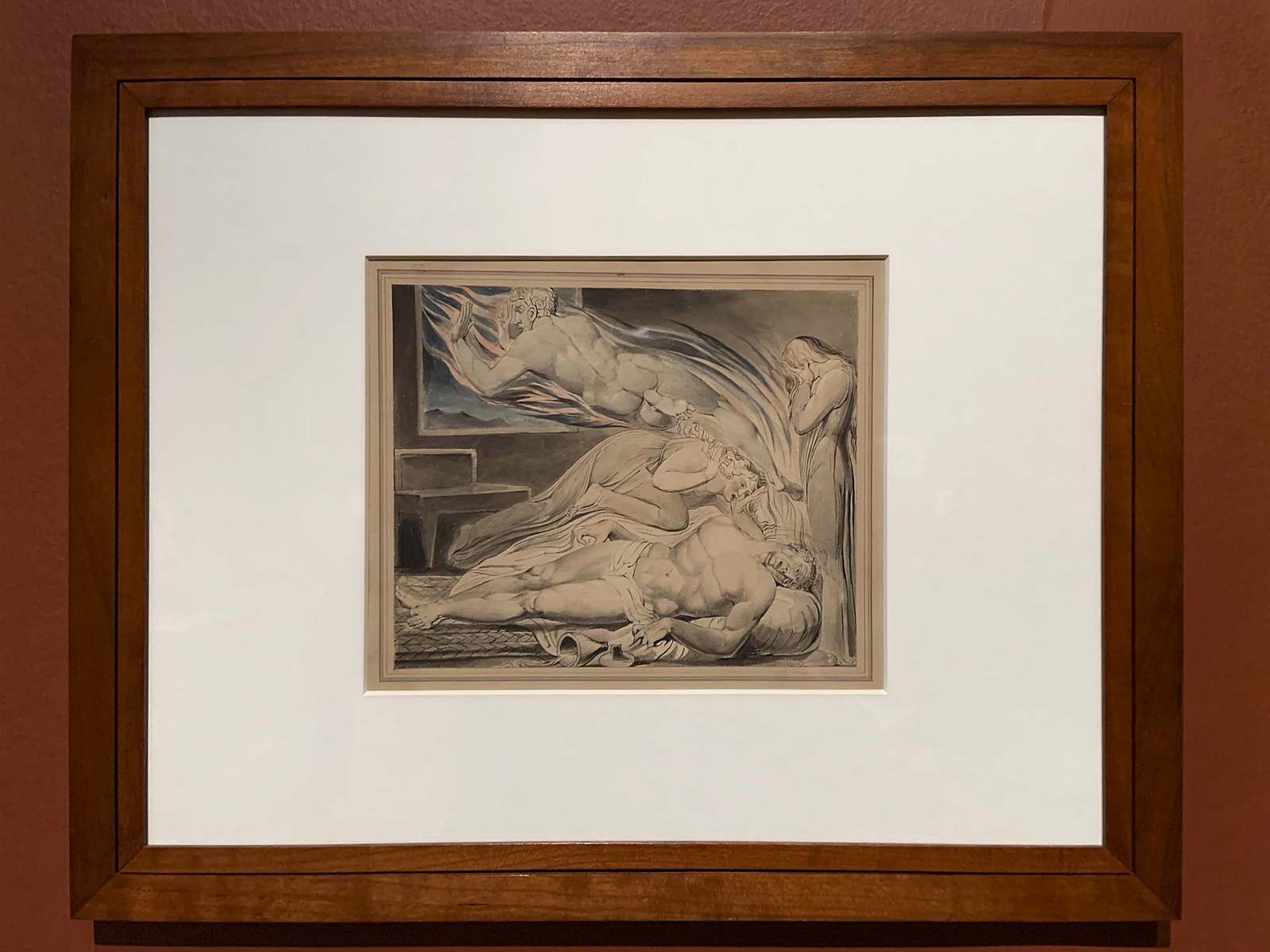
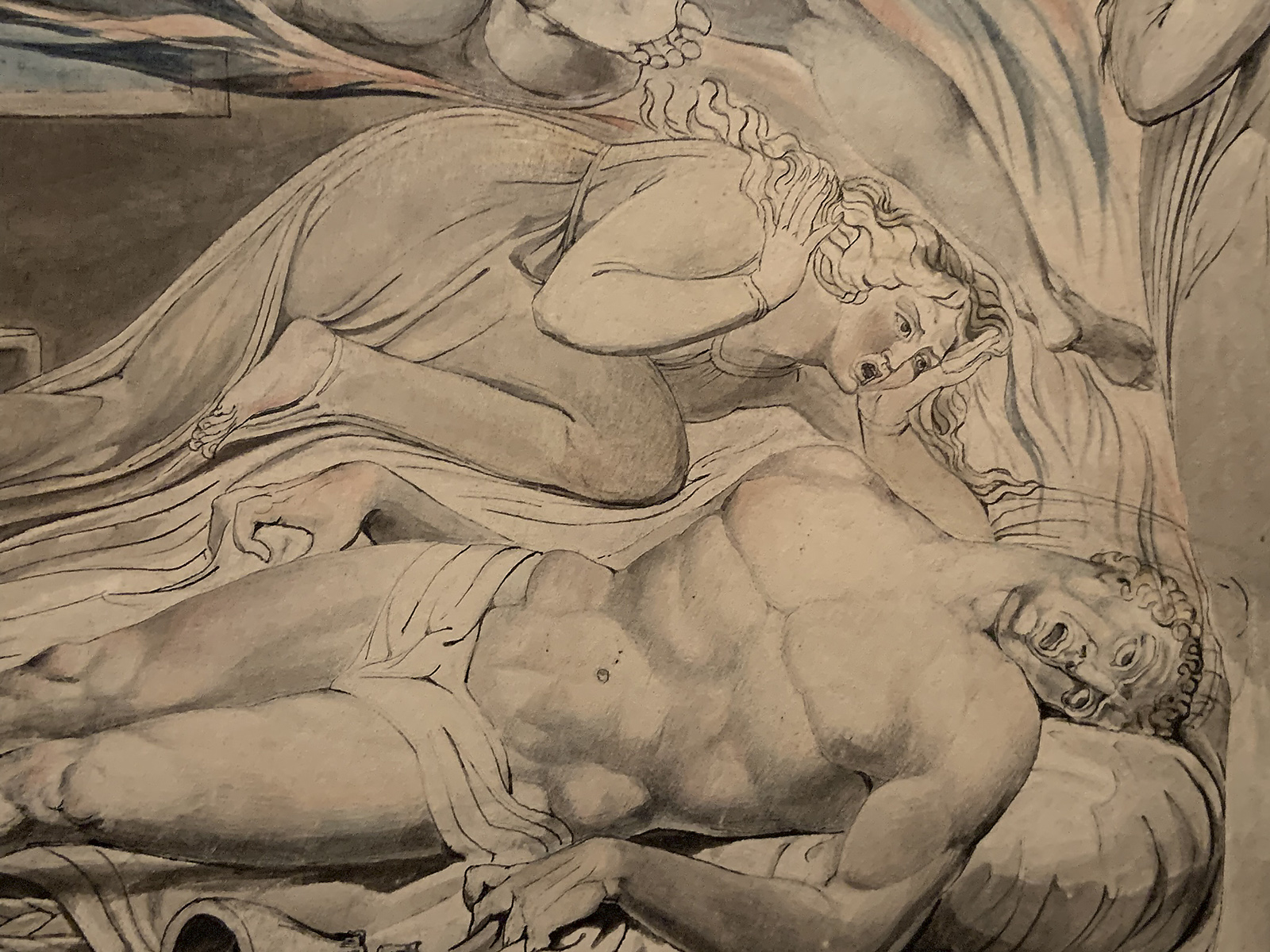
 

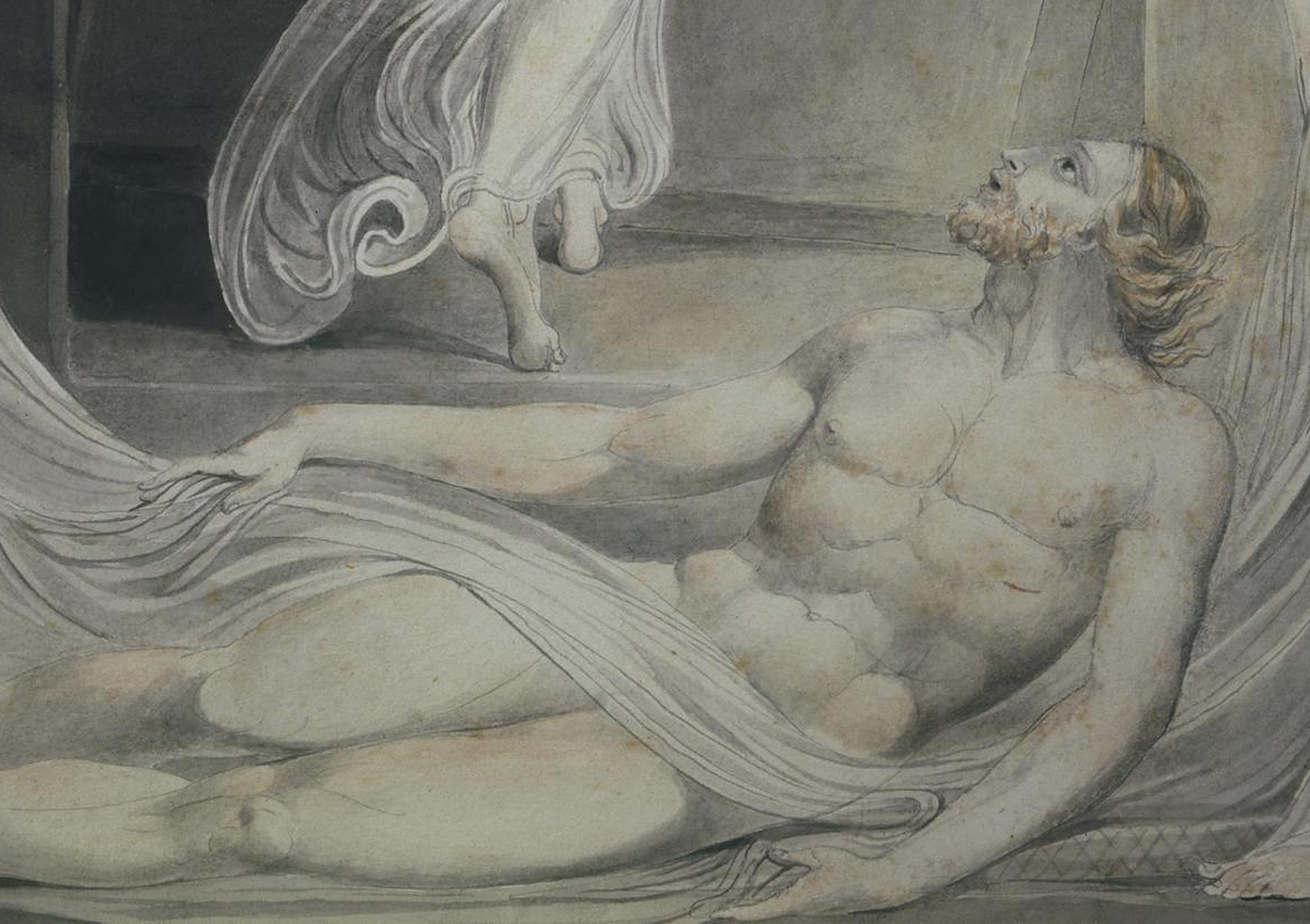
William Blake (British, 1757-1827) 'Death of the Strong Wicked Man' 1805 (installation view)

William Blake (British, 1757-1827) 'Death of the Strong Wicked Man' 1805 (installation view detail)


William Blake (British, 1757-1827)
Death of the Strong Wicked Man (installation views)
1805
Ink, watercolour and graphite on paper Paris, Musée du Louvre, Départment of Arts graphiques
Photos: Marcus Bunyan
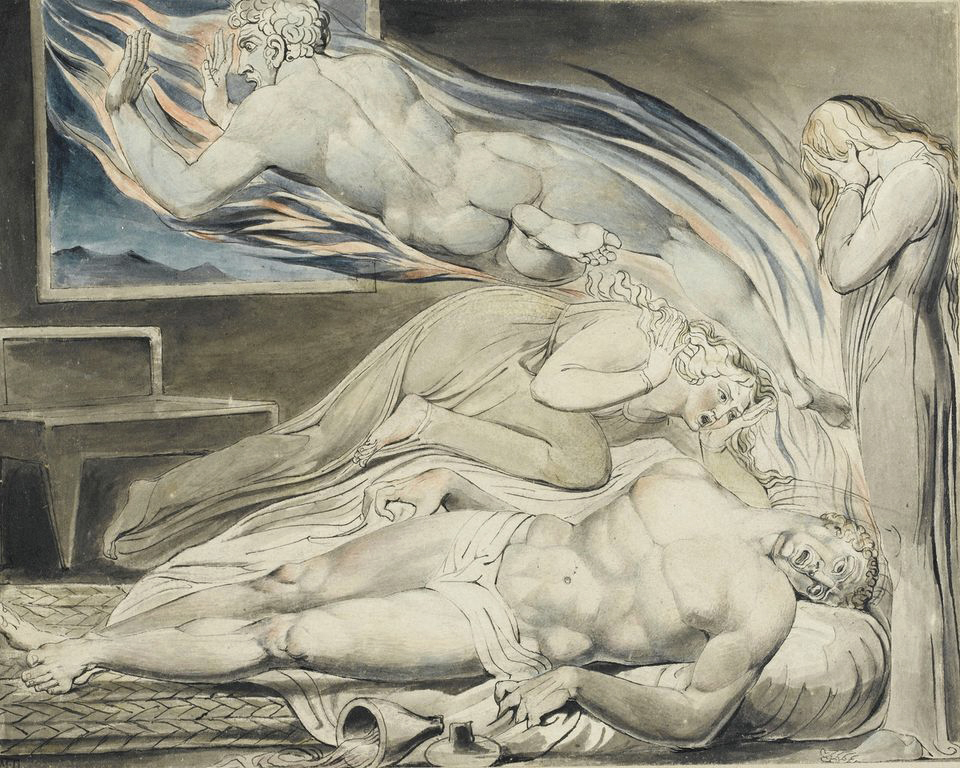
 

William Blake (British, 1757-1827) 'Death of the Strong Wicked Man' 1805


William Blake (British, 1757-1827)
Death of the Strong Wicked Man
1805
Ink, watercolour and graphite on paper Paris, Musée du Louvre, Départment of Arts graphiques
© Photo RMN – Gerard Blot


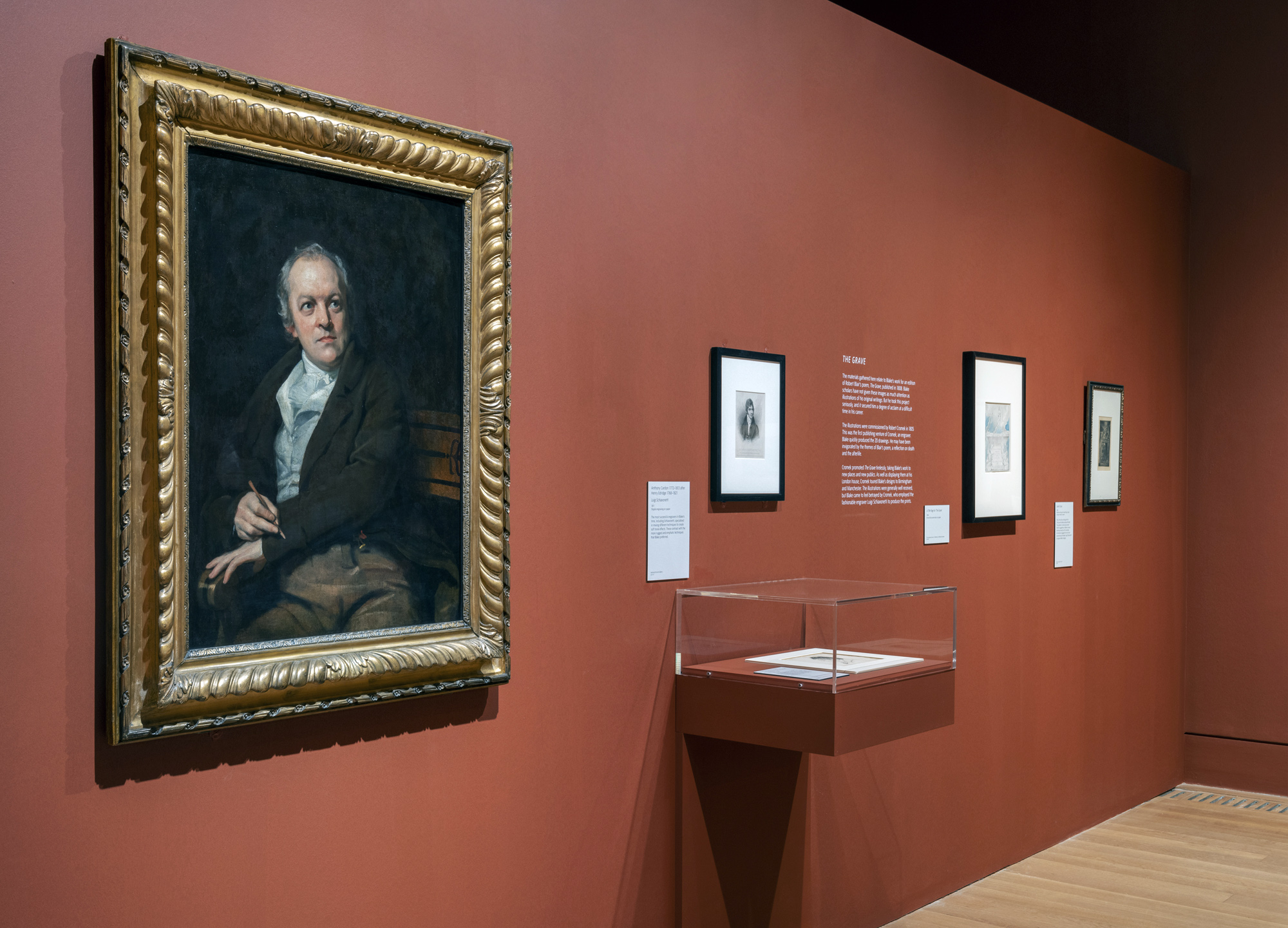
The Grave

The materials gathered here relate to Blake’s work for an edition of Robert Blair’s poem, The Grave, published in 1808. Blake scholars have not given these images as much attention as illustrations of his original writings. But he took this project seriously, and it secured him a degree of acclaim at a difficult time in his career.

The illustrations were commissioned by Robert Cromek in 1805. This was the first publishing venture of Cromek, an engraver. Blake quickly produced the 20 drawings. He may have been invigorated by the themes of Blair’s poem, a reflection on death and the afterlife.

Cromek promoted The Grave tirelessly, taking Blake’s work to new places and new publics. As well as displaying them at his London house, Cromek toured Blake’s designs to Birmingham and Manchester. The illustrations were generally well received, but Blake came to feel betrayed by Cromek, who employed the fashionable engraver Luigi Schiavonetti to produce the prints.

Wall text from the exhibition William Blake


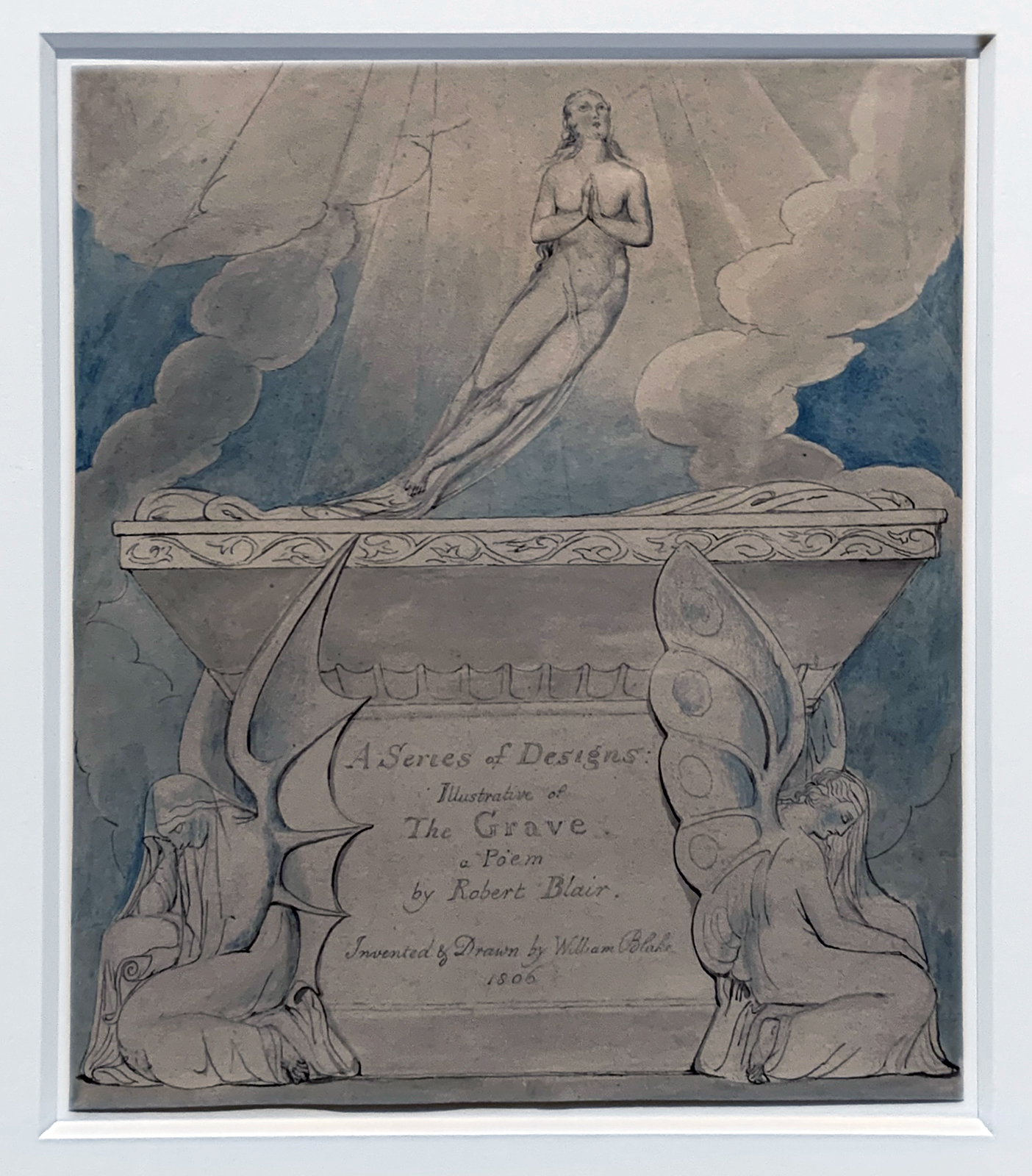
William Blake (British, 1757-1827) A Title Page for 'The Grave' 1806 (installation view)

William Blake (British, 1757-1827) A Title Page for 'The Grave' 1806 (installation view)

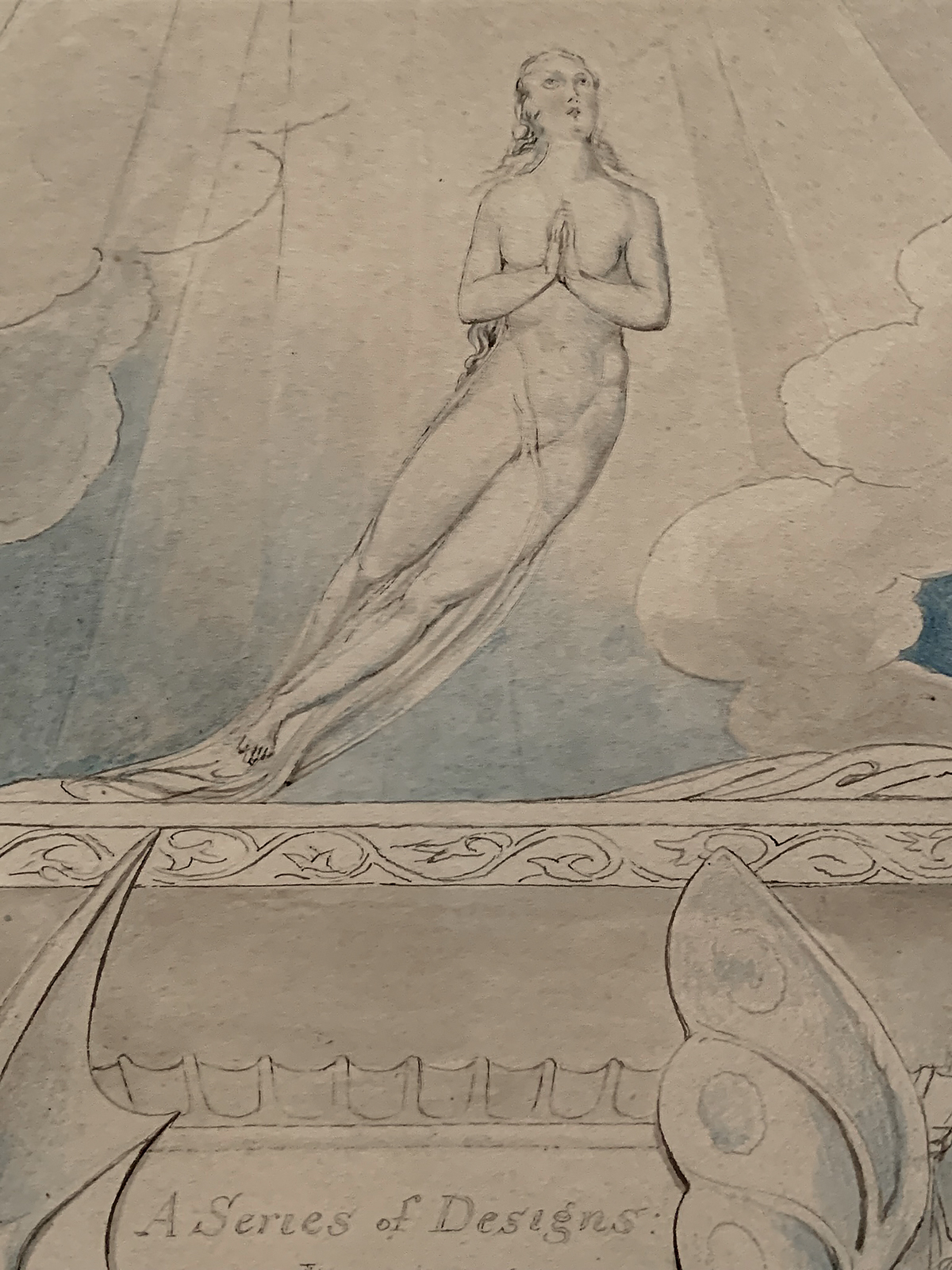
William Blake (British, 1757-1827) A Title Page for 'The Grave' 1806 (installation view detail)


William Blake (British, 1757-1827)
A Title Page for The Grave (installation views)
1806
Ink and blue watercolour on paper
238 × 200 mm
The Huntington Library, Art Collections, and Botanical Gardens
Photos: Marcus Bunyan


The 1809 Exhibition

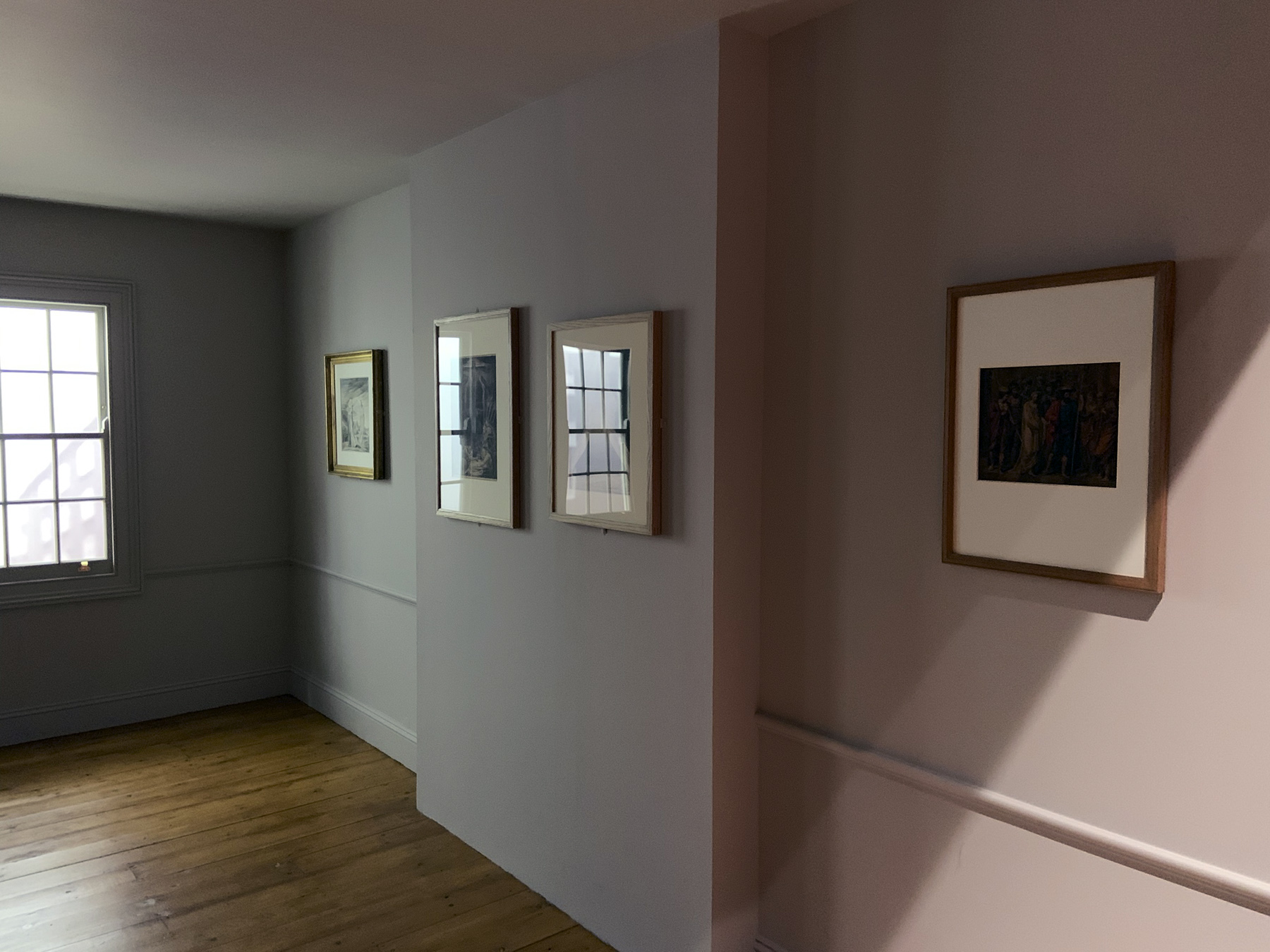
The space opposite evokes the upstairs rooms at 28 Broad Street, Soho, where Blake held his one-man exhibition in 1809. This was an ordinary London town-house, built in the 1730s. The Blake family had lived there since the 1750s. We know the proportions of the front room on the first floor from archival records and images. Visitors probably gained access to the exhibition through the hosiery shop downstairs. In 1809 this was being run by Blake’s brother, James. This was a strange setting for an art exhibition.

It was even stranger given the visionary character of Blake’s works and the gigantic ambitions he expressed in the accompanying Descriptive Catalogue. There were only a handful of visitors, and a single published review which dismissed Blake as ‘an unfortunate lunatic’. Every 20 minutes two works in this recreated exhibition will be virtually ‘restored’. They will be illuminated so you can see how they would have looked in 1809. You will also hear Blake’s words about these pictures, expressing his ambition to be a painter of large-scale wall paintings. Blake’s words are spoken by the actor Kevin Eldon.

The projection shows details from two of Blake’s paintings at the scale Blake hoped his work might one day be seen. They depict the ‘spiritual forms’ of the Prime Minster, William Pitt, and the naval hero, Admiral Nelson. In the catalogue of his 1809 exhibition, Blake wrote of his ambition to execute these and other paintings 30 metres high or more, for display in public buildings.

Many artists in Blake’s time aspired to such ambitious paintings, inspired by the high-minded rhetoric of the Royal Academy. But Blake himself observed: ‘The Painters of England are unemployed in Public Works’. There was no state support for artists, and little patronage from the monarchy or Church of England. Artists were instead freelancers, dependent on the market.

Despite his aspirations, Blake must have known that his dreams would never be fulfilled. After the failure of his one-man show in 1809 he became increasingly withdrawn and bitter.


William Blake (British, 1757-1827) 'The Penance of Jane Shore in St Paul's Church' c. 1793


William Blake (British, 1757-1827)
The Penance of Jane Shore in St Paul’s Church
c. 1793
Ink, watercolour and gouache on paper
245 × 295 mm
Tate
Presented by the executors of W. Graham Robertson through the Art Fund 1949
Creative Commons CC-BY-NC-ND (3.0 Unported)


Jane Shore was a mistress of King Edward IV. After his death in 1483 she was accused of being a harlot and condemned to do public penance in St Paul’s Cathedral. The ‘golden glow’ of this watercolour comes from a very thick, now-yellowed glue layer that was almost certainly applied as a varnish by Blake. He varnished his temperas in a similar way. Once it had yellowed someone else added a picture varnish on top. This also went yellow but has since been removed. The subtle colouring of Blake’s painting is suppressed by the glue varnish.

Gallery label, September 2004


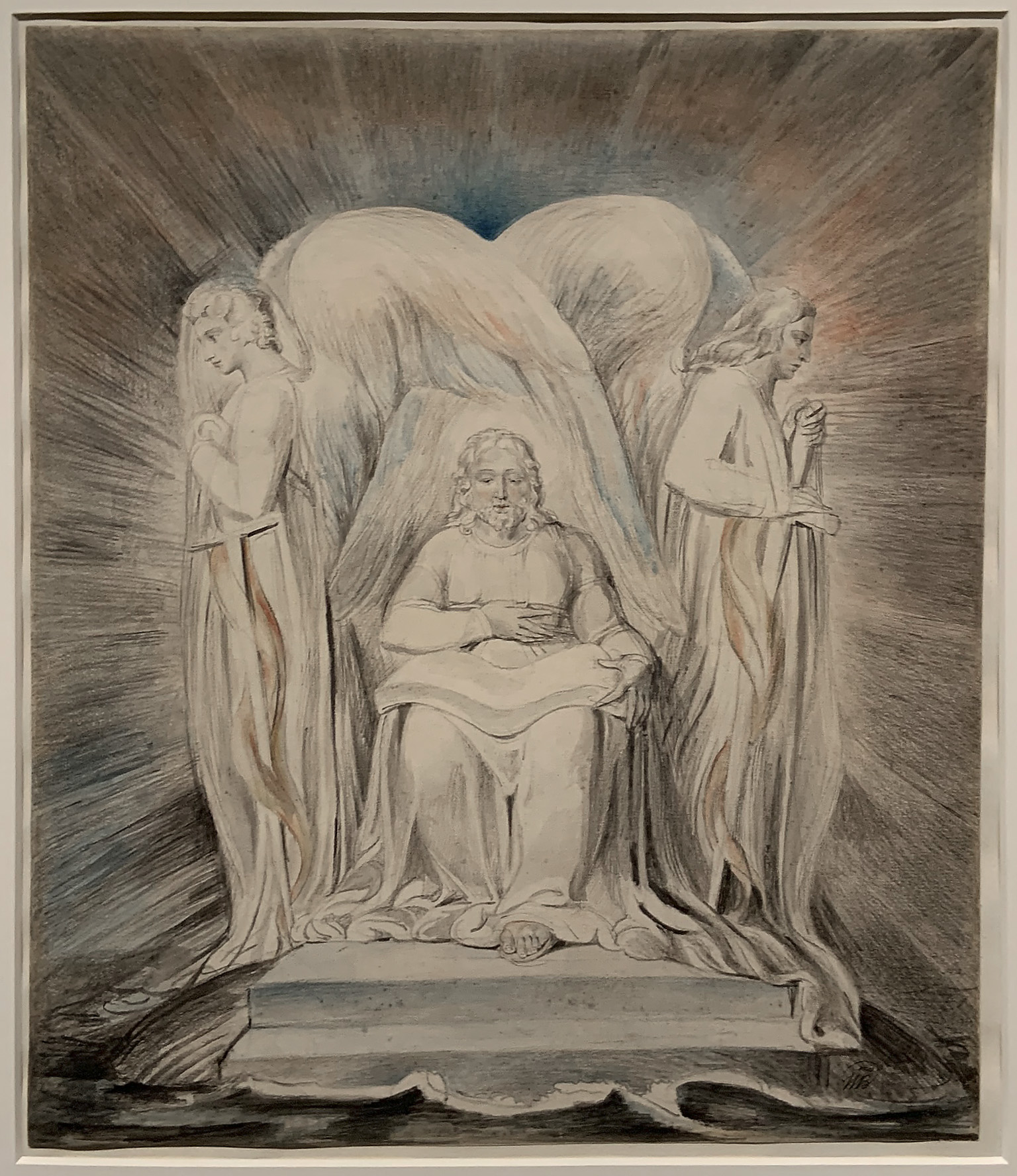
William Blake (British, 1757-1827) 'Christ in the Sepulchre, Guarded by Angels' c. 1805


William Blake (British, 1757-1827)
Christ in the Sepulchre, Guarded by Angels
c. 1805
Ink and watercolour on paper
42.0 x 30.2 cm
Lent by the Victoria and Albert Museum, London
Wikipedia Commons, Public Domain


William Blake (British, 1757-1827) 'Ruth the Dutiful Daughter in Law' 1803


William Blake (British, 1757-1827)
Ruth the Dutiful Daughter in Law
1803
Wash, graphite, and coloured chalk on paper
Southampton City Art Gallery


Blake’s one-man exhibition was organised during a period of war and social upheaval. His imagery is spiritual and allegorical. It may appear disconnected from contemporary politics. But Blake imagined a public role for art. In connection with his watercolour of angels hovering over the body of Christ, on display here, he wrote: ‘The times require that every one should speak out boldly; England expects that every man should do his duty, in Arts, as well as in Arms, or in the Senate’.


Installation view of the exhibition 'William Blake' at Tate Britain showing the recreation of the 1809 exhibition. From left to right on the wall were: 'Satan calling up his Legions' (1800-1805, out of shot); 'The Spiritual Form of Nelson Guiding Leviathan' (c. 1805-1809); 'The Spiritual Form of Pitt Guiding Behemoth' (1805); and 'The Bard, from Gray' (? 1809)


Installation view of the exhibition William Blake at Tate Britain, London showing the recreation of the 1809 exhibition. From left to right on the wall were: Satan calling up his Legions (1800-1805, out of shot); The Spiritual Form of Nelson Guiding Leviathan (c. 1805-1809); The Spiritual Form of Pitt Guiding Behemoth (1805); and The Bard, from Gray (? 1809)
Photo: Marcus Bunyan


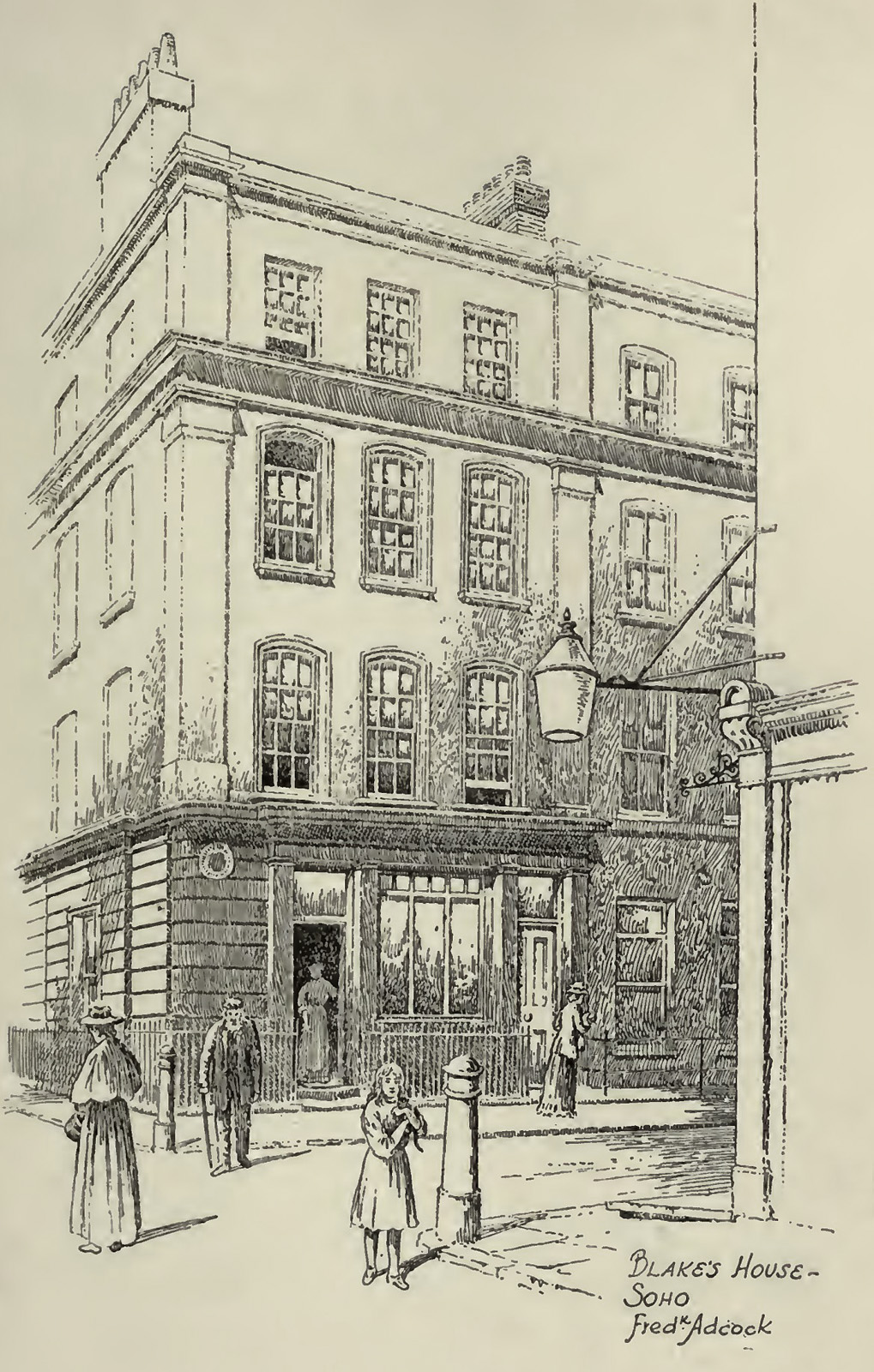
Frederick Adcock (British, 1864-1930) 'William Blake's house, Soho, London' 1912


Frederick Adcock (British, 1864-1930)
William Blake’s house, Soho, London
1912
Wikipedia Commons, Public Domain


Birthplace of William Blake at No. 28 Broad (now Broadwick) Street, Soho, London. Demolished to make way for a block of flats.


28 Broad Street

Blake’s exhibition was held in the first-floor rooms of 28 Broad Street. The plasterwork and window surrounds were later 19th-century additions. In 1809 Blake’s sister, brother and his wife lived at this address and ran the hosiery and haberdashery shop on the ground floor.


“The execution of my Designs, being all in Water-colours, (that is in Fresco) are regularly refused to be exhibited by the Royal Academy, and the British Institution has, this year, followed its example, and has effectually excluded me by this Resolution … it is therefore become necessary that I should exhibit to the Public, in an Exhibition of my own, my Designs, Painted in Watercolours. If Italy is enriched and made great by RAPHAEL, if MICHAEL ANGELO is its supreme glory, if Art is the glory of a Nation, if Genius and Inspiration are the great Origin and Bond of Society, the distinction my Works have obtained from those who best understand such things, calls for my Exhibition as the greatest of Duties to my Country.”


William Blake, from ‘[Advertisement of] Exhibition of Paintings in Fresco, Poetical and Historical Inventions’, 1809


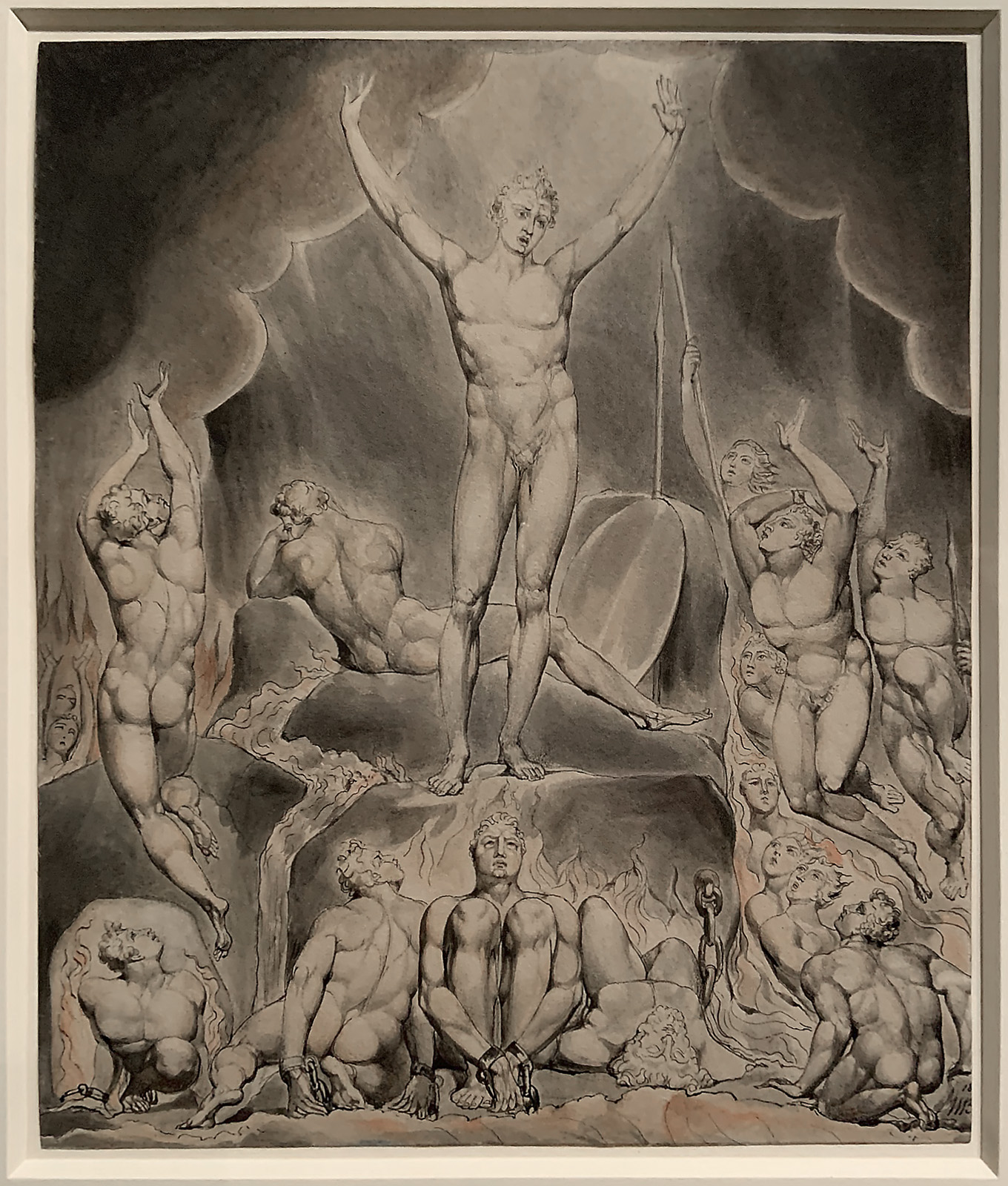
William Blake (British, 1757-1827) 'Satan calling up his Legions (from John Milton's 'Paradise Lost')' 1800-1805 (installation view)

William Blake (British, 1757-1827) 'Satan calling up his Legions (from John Milton's 'Paradise Lost')' 1800-1805 (installation view detail)


William Blake (British, 1757-1827)
Satan calling up his Legions (from John Milton’s Paradise Lost) (installation views)
1800-1805
Tempera and gold leaf on canvas
533 × 496 mm
National Trust Collections, Petworth House, (The Egremont Collection)
Photos: Marcus Bunyan


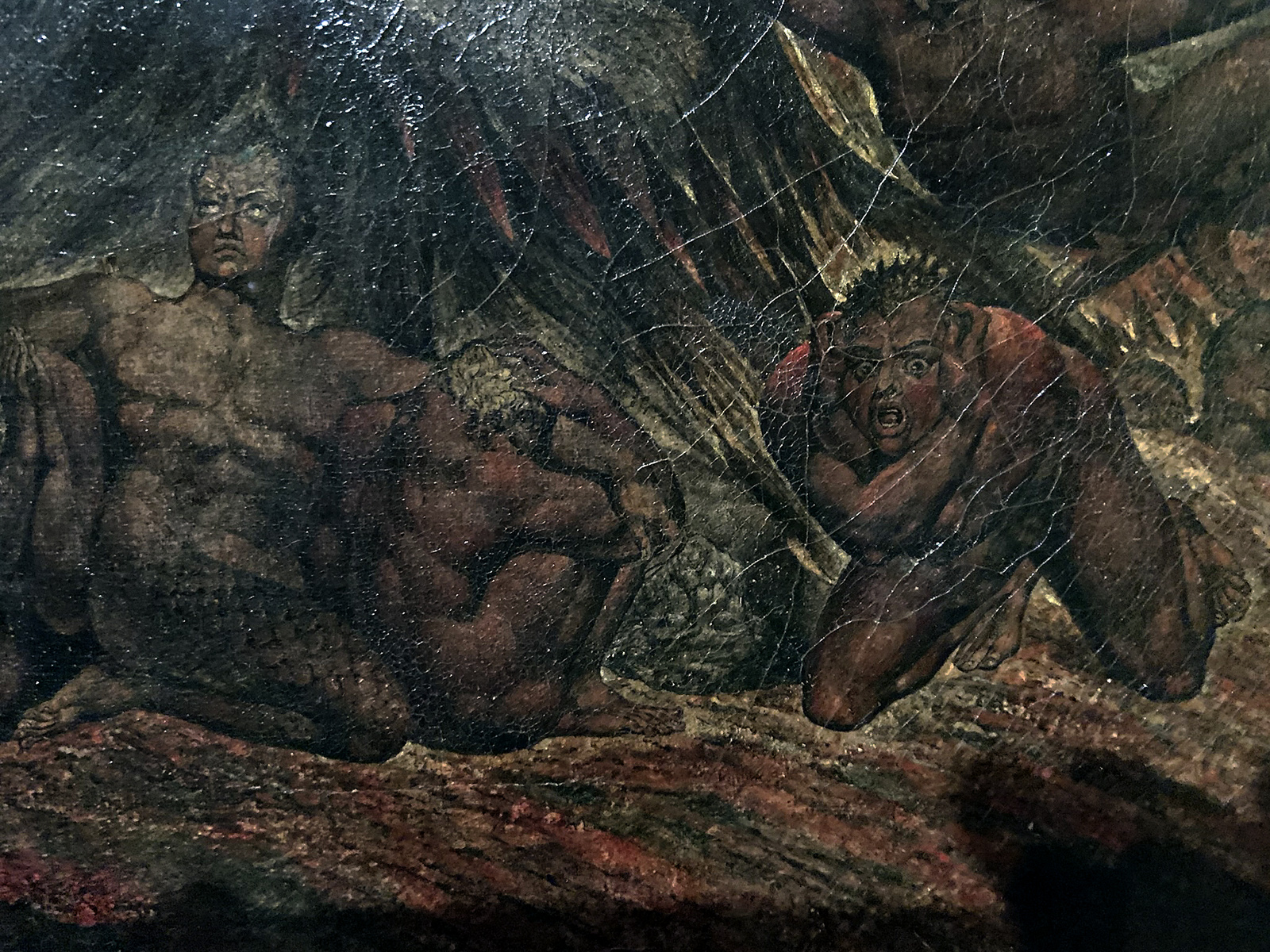
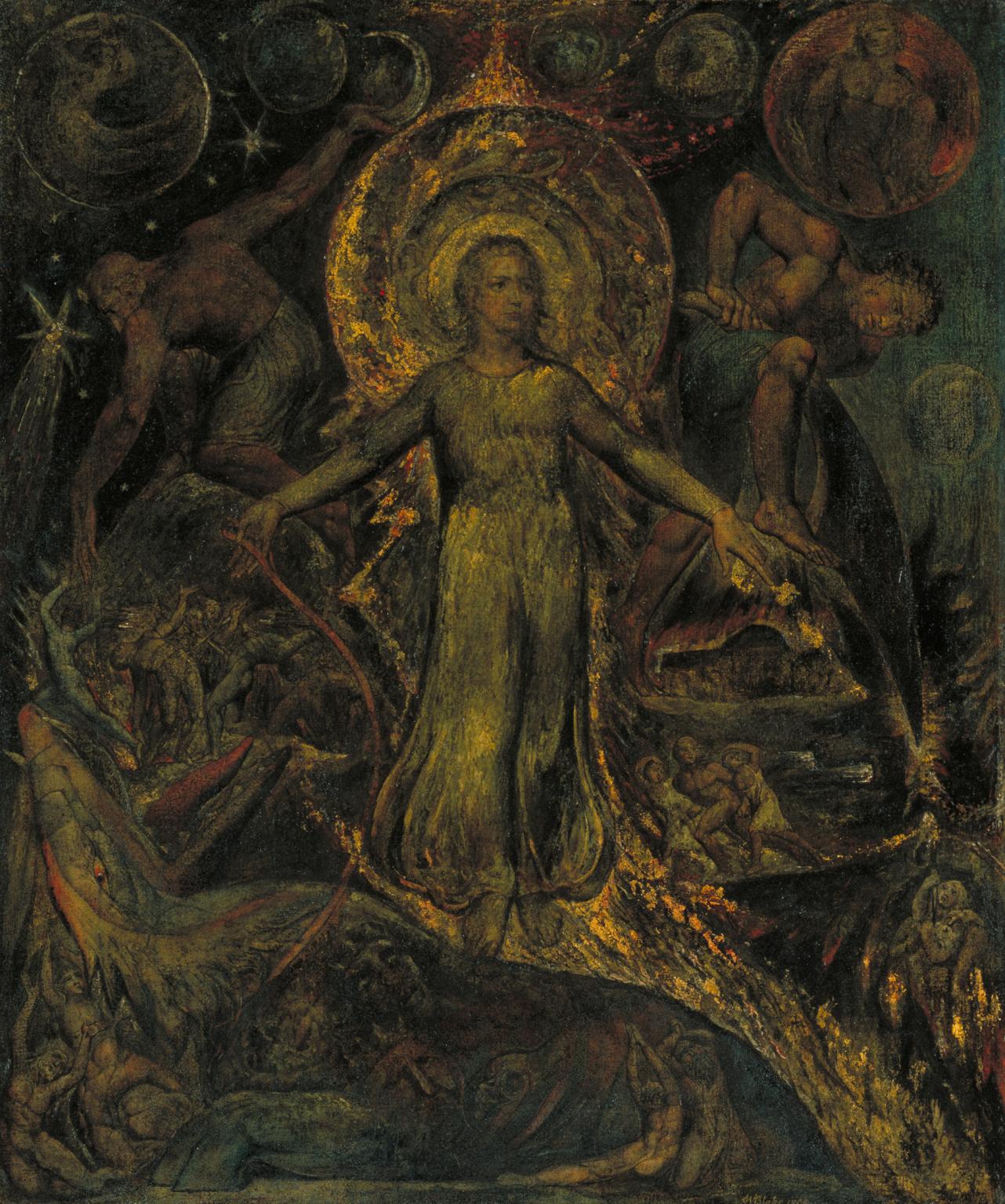
William Blake (British, 1757-1827) 'The Spiritual Form of Nelson Guiding Leviathan' c. 1805-1809


William Blake (British, 1757-1827)
The Spiritual Form of Nelson Guiding Leviathan
c. 1805-9
Tempera and gold on canvas
762 x 625 mm
Tate. Purchased 1914


Blake showed this painting in his 1809 exhibition. It was exhibited alongside The Spiritual Form of Pitt Guiding Behemoth. He provided a long commentary on his ‘spiritual forms’ of both Pitt and Nelson. The recently-deceased Prime Minster William Pitt and naval hero Admiral Nelson had both led Britain in the war against France. Blake shows these national figures guiding biblical monsters bringing chaos and destruction to the world. The symbolism used is complex. In the picture of Nelson ‘The Nations of the Earth’ are shown as contorted figures enveloped by the serpent. A figure of colour in chains lies collapsed at the bottom. He appears to be freed of the serpent’s coils, perhaps suggesting that such destruction could also lead to new freedoms and spiritual rebirth.

This work is cracked and damaged because Blake used a thin canvas and chalk-based ground. The ground layer has darkened due to the conservation treatment of ‘glue’ lining; this is only suitable for oil paintings. Layers of glue in some of Blake’s paints have also darkened. The orange tonality comes from remnants of a discoloured varnish. The contraction of the glue-rich layers and the movement of the thin canvas has created stress, causing cracking.

Gallery label, October 2019


Blake provided a long commentary on his ‘spiritual forms’ of Pitt and Nelson. The recently deceased Prime Minister William Pitt and naval hero Admiral Nelson had both led Britain in the war against France. Blake shows these national figures guiding biblical monsters bringing chaos and destruction to the world. The symbolism is complex. In the picture of Nelson ‘The Nations of the Earth’ are show as contorted figures enveloped by the serpent. A figure of colour in chains lies collapsed at the bottom. He appears to be freed of the serpent’s coils, perhaps suggesting that such destruction could also lead to new freedoms and spiritual rebirth.

Wall text


William Blake (British, 1757-1827) 'The Spiritual Form of Pitt Guiding Behemoth' 1805


William Blake (British, 1757-1827)
The Spiritual Form of Pitt Guiding Behemoth
1805
Tempera and gold on canvas
740 x 627 mm
Tate. Purchased 1882


William Blake (British, 1757-1827) 'The Spiritual Form of Pitt Guiding Behemoth' 1805


William Blake (British, 1757-1827)
The Spiritual Form of Pitt Guiding Behemoth
1805
Tempera and gold on canvas
740 x 627 mm
Tate. Purchased 1882
Wikipedia Commons, Public Domain


The subject of this picture is the prime minister, William Pitt. Blake showed this work in his exhibition in 1809, describing Pitt as ‘that Angel who, pleased to perform the Almighty’s orders, rides on the whirlwind, directing the storms of war.’

Pitt had led Britain into war against France after the 1789 Revolution. Blake saw him as one ‘ordering the Reaper to reap the Vine of the Earth, and the Plowman to plow up the Cities and Towers’. The words reflect Blake’s apocalyptic vision of war. The huge beast, Behemoth, is under Pitt and at his command.

Gallery label, December 2004


Installation view of the exhibition 'William Blake' at Tate Britain, London

Installation view of the exhibition 'William Blake' at Tate Britain, London showing paintings from the 1809 exhibition

Installation view of the exhibition 'William Blake' at Tate Britain, London showing paintings from the 1809 exhibition


Installation views of the exhibition William Blake at Tate Britain, London showing paintings from the 1809 exhibition
Photos: Marcus Bunyan


Understanding the objectives behind Blake’s exhibition is far from straightforward. Although this display of sixteen works could be considered as a retrospective exhibition, Blake seems to have had several principal aims. Both the exhibition advertisement issued by Blake and the text of the Descriptive Catalogue itself make clear that the works on display were for sale. At the same time Blake was promoting and seeking subscriptions for his engraving of the Canterbury Pilgrims (issued in 1810). Moreover, the exhibition displayed Blake’s painting of Chaucer’s Canterbury Pilgrims (Pollok House, Glasgow) as a deliberate challenge to Thomas Stothard’s rival version of the same subject, The Pilgrimage to Canterbury 1806-1807 (Tate). Blake complained that his works were not accepted by the two most important exhibition venues of the time, the Royal Academy and the British Institution, because they were in the form of watercolours (rather than oil paintings). That might seem to be motivation for setting up this independent show. However, his works had been accepted at the Royal Academy on six different occasions, the last time being the year before his 1809 exhibition. And the exhibition was promoting what Blake called his latest invention: the ‘portable fresco’ (a kind of tempera painting). Blake explained that he could enlarge such fresco works and decorate public buildings. The Spiritual Form of Nelson and The Spiritual Form of Pitt (nos. I and II in the Descriptive Catalogue) were intended as monuments to the heroes of his country. This aspiration, expressed amidst the Napoleonic wars, at a time of rampant nationalism when several public monuments were commissioned and executed by sculptors, shows that Blake was hoping to gain a state commission. He thus associated his fresco productions with patriotic works and the advancement of the English School of art.

Above all, however, I believe that Blake’s exhibition was intended to present Blake as a painter, and the ‘inventor’ of subjects and techniques. He asserted unequivocally that this was an exhibition of ‘paintings’ or ‘pictures’ and designated them as ‘poetical and historical inventions’. His portable fresco, for example, as Aileen Ward has argued, was Blake’s attempt, ‘to circumvent the Academy prejudice against watercolour’ in the hope of being elected at the Academy as a painter.

Extract from Kostantinos Stefanis. “Reasoned Exhibitions: Blake in 1809 and Reynolds in 1813,” in Tate Papers no.14 Autumn 2010 on the Tate website [Online] Cited 26/01/2020


William Blake (British, 1757-1827) 'The Bard, from Gray' ? 1809 (installation view)


William Blake (British, 1757-1827)
The Bard, from Gray (installation view)
? 1809
Tempera and gold on canvas
Tate. Purchased 1920
Photo: Marcus Bunyan


A bad iPhone photo I know but it gives you an idea of how dark these paintings were


William Blake (British, 1757-1827) 'The Bard, from Gray' ? 1809


William Blake (British, 1757-1827)
The Bard, from Gray
? 1809
Tempera and gold on canvas
Tate. Purchased 1920


This tempera has greatly altered since it was painted. Blake used a very thin, white, preparatory layer of chalk and glue. This was impregnated with more glue during a conservation ‘lining’ treatment more appropriate to an oil painting. This reduced the effect of transparent colours over a white background, and displaced some details painted in shell gold. Blake’s paint medium has also darkened greatly. The opaque red vermilion used for the line of blood, glazed over with madder lake, has survived better than blue areas.

Gallery label, September 2004


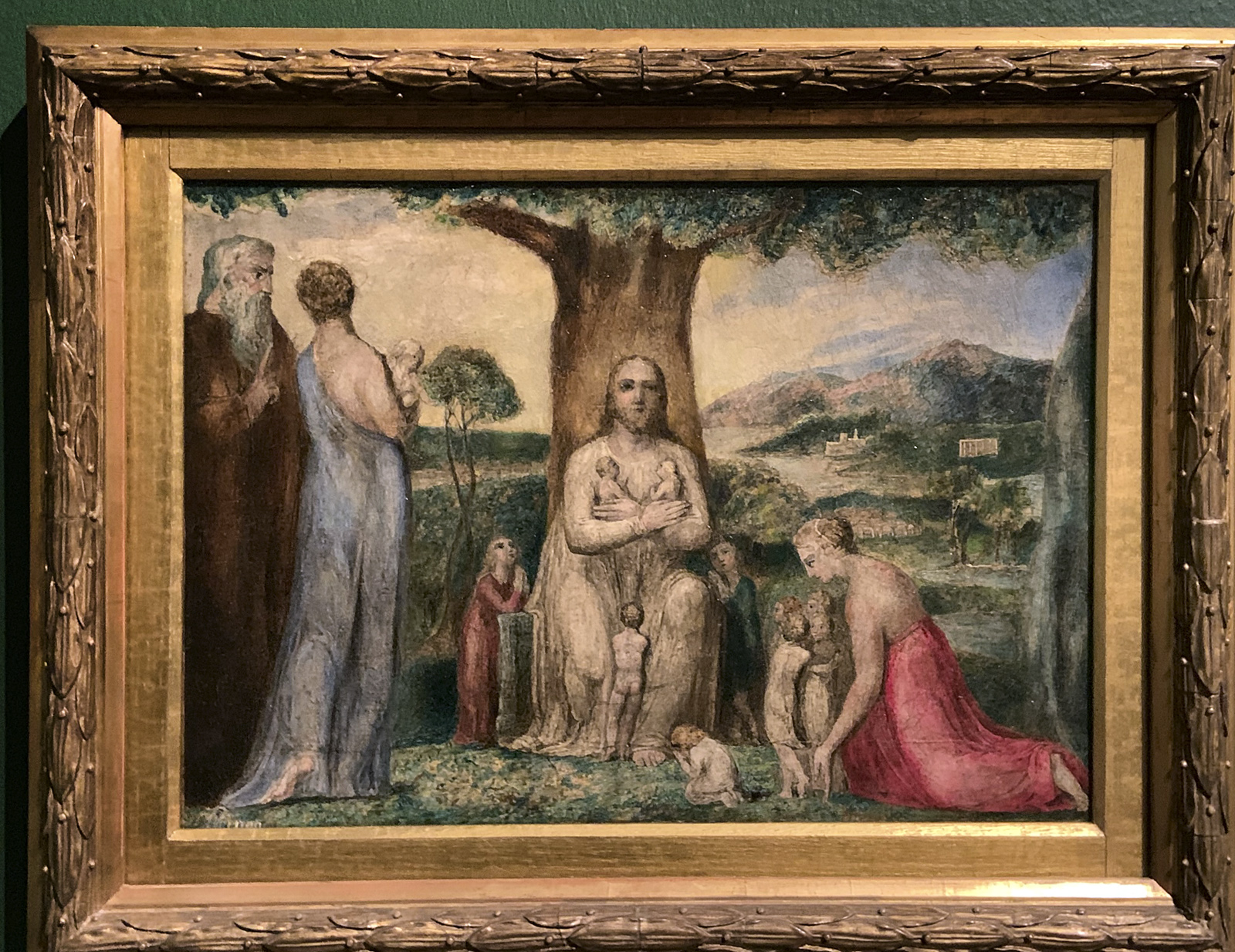
William Blake (British, 1757-1827) 'The Virgin and Child in Egypt' 1810 (installation view)

William Blake (British, 1757-1827) 'The Virgin and Child in Egypt' 1810 (installation view)


Installation views of the exhibition William Blake at Tate Britain, London showing Blake’s work The Virgin and Child in Egypt (1810)
Photos: Marcus Bunyan


William Blake (British, 1757-1827) 'The Virgin and Child in Egypt' 1810 (installation view)

William Blake (British, 1757-1827) 'The Virgin and Child in Egypt' 1810 (installation view detail)

William Blake (British, 1757-1827) 'The Virgin and Child in Egypt' 1810 (installation view detail)


William Blake (British, 1757-1827)
The Virgin and Child in Egypt (installation views)
1810
Tempera on canvas
Lent by the Victoria and Albert Museum, London
Photos: Marcus Bunyan


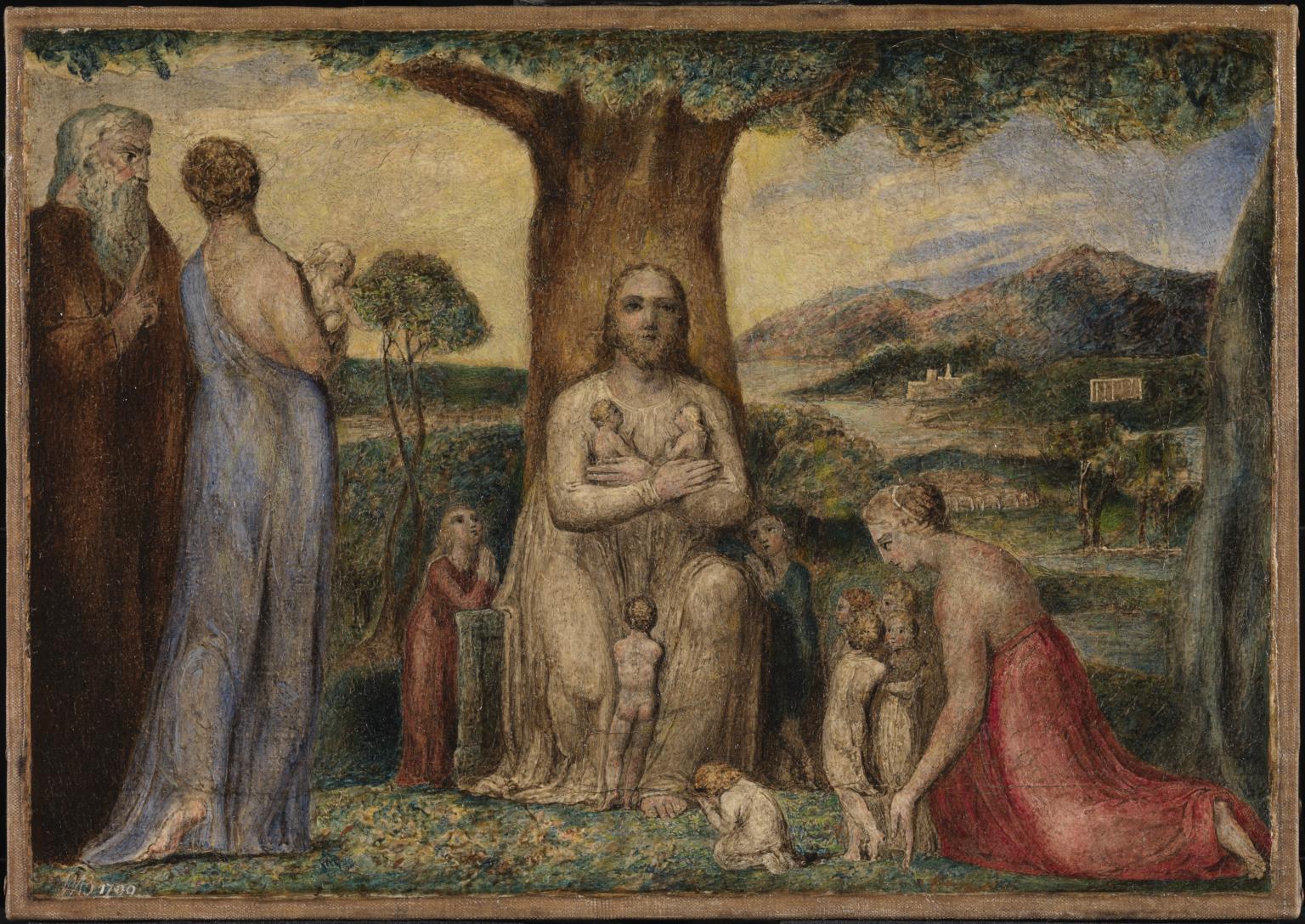
This painting demonstrates Blake’s enduring ambition to work on a larger scale. He adopted the ‘Tüchlein’ technique of 16th-century Netherlandish painting, using tempera (glue-based paint) on linen. Blake had seen such paintings on the London art market. It is one of four life-size figure paintings done for Thomas Butts in 1810.


William Blake (British, 1757-1827) 'The Virgin and Child in Egypt' 1810


William Blake (British, 1757-1827)
The Virgin and Child in Egypt
1810
Tempera on canvas
Lent by the Victoria and Albert Museum, London


William Blake (British, 1757-1827) 'An Allegory of the Spiritual Condition of Man' ? 1811 (installation view)


Installation views of the exhibition William Blake at Tate Britain, London showing Blake’s work An Allegory of the Spiritual Condition of Man (? 1811)
Photo: Marcus Bunyan


William Blake (British, 1757-1827) 'An Allegory of the Spiritual Condition of Man' ? 1811 (installation view)

William Blake (British, 1757-1827) 'An Allegory of the Spiritual Condition of Man' ? 1811 (installation view)

William Blake (British, 1757-1827) 'An Allegory of the Spiritual Condition of Man' ? 1811 (installation view detail)

William Blake (British, 1757-1827) 'An Allegory of the Spiritual Condition of Man' ? 1811 (installation view detail)


William Blake (British, 1757-1827)
An Allegory of the Spiritual Condition of Man (installation views)
? 1811
Ink and tempera on canvas
The Syndics of the Fitzwilliam Museum, University of Cambridge
Photos: Marcus Bunyan


This is the largest surviving painting by Blake. The title is not Blake’s, and the subject matter remains open to interpretation. The symmetrical composition evokes large-scale European church paintings of the Middle Ages and Renaissance.


A new kind of man

After years of obscurity, Blake enjoyed a burst of creativity in the last ten years of his life. In 1818 he met a younger, more business-savvy artist, John Linnell. Together with fellow artists Samuel Palmer and John Varley, Linnell provided Blake with employment, friendship and a new sense of recognition.

Buoyed by their material and moral support, Blake produced some of his most extraordinary works. He completed his last and most ambitious illuminated book, Jerusalem, in 1820. He also found new purchasers for his older books and relief-etchings. He created a series of ‘visionary heads’ to indulge Varley’s spiritualist interests. For Linnell he made a long series of large and vivid watercolours illustrating Dante’s Divine Comedy and engravings for the biblical Book of Job, undertaken in the antiquated style he had always admired.

Blake spent his last years living with Catherine in modest accommodation in Fountain Court off the Strand, with a view onto the Thames. For the younger, more materially successful artists who gathered around him, he represented an ideal of creative integrity and spiritual authenticity. Their memories of him have been crucial in shaping modern perceptions of the artist. An influential 1863 biography drew on Blake’s followers’ recollections of him as ‘a new kind of man, wholly original’.

Text from the Tate website


Installation view of the exhibition 'William Blake' at Tate Britain, London

Installation view of the exhibition 'William Blake' at Tate Britain, London

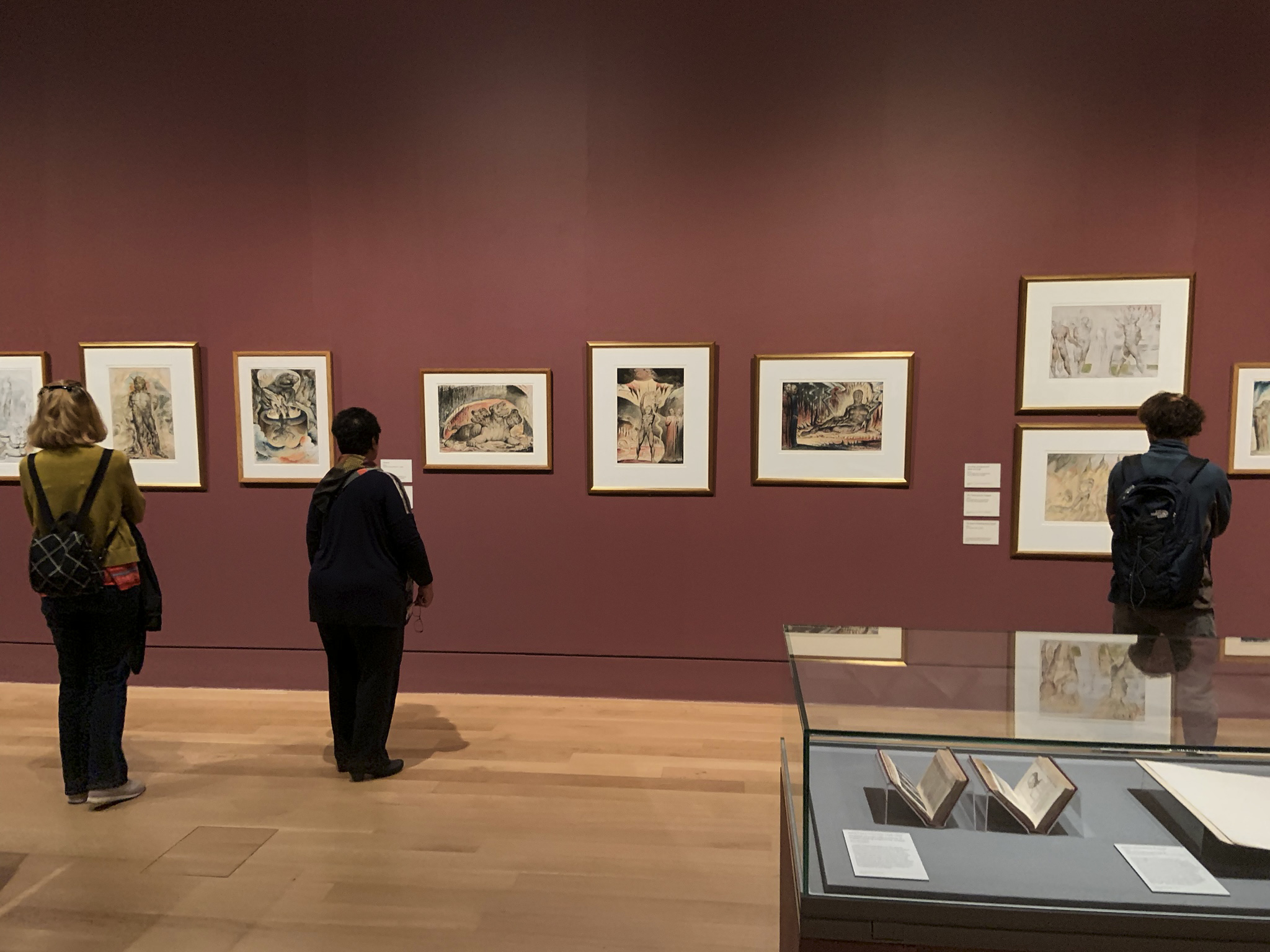
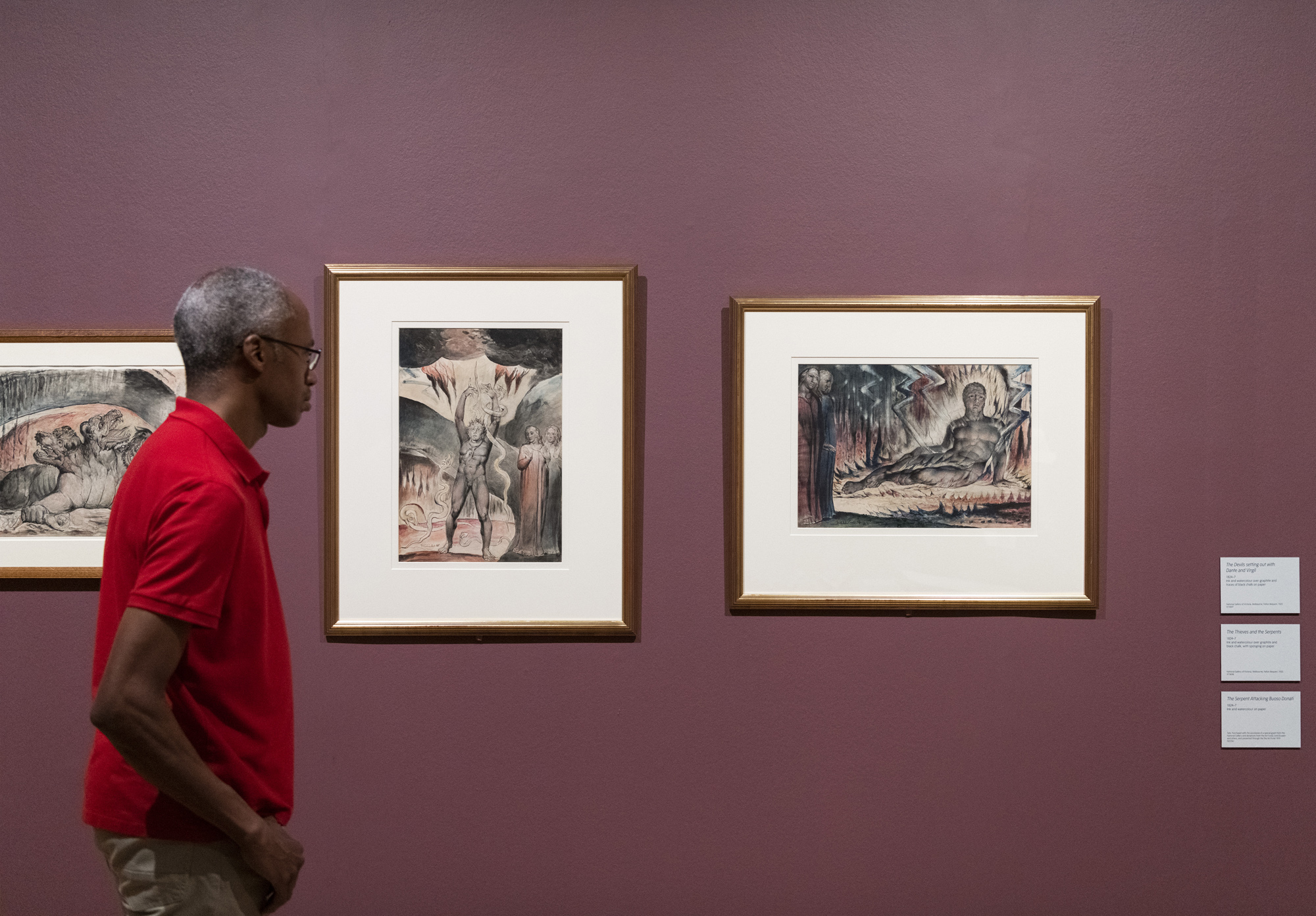
Installation view of the exhibition 'William Blake' at Tate Britain, London showing at second right, 'Capaneus the Blasphemer' (1824-1827) and at fourth right, 'Cerberus' (1824-1827)


Installation views of the exhibition William Blake at Tate Britain, London showing in bottom image at second right, Capaneus the Blasphemer (1824-1827) and at fourth right, Cerberus (1824-1827)
Photos: Marcus Bunyan


William Blake (British, 1757-1827) 'Capaneus the Blasphemer' 1824-1827


William Blake (British, 1757-1827)
Capaneus the Blasphemer
1824-1827
Illustration for The Divine Comedy by Dante Alighieri (Inferno XIV, 46-72)
Pen and ink and watercolour over pencil and black chalk, with sponging and scratching out
374 x 527 mm
National Gallery of Victoria, Melbourne


William Blake (British, 1757-1827) 'Cerberus' (from Illustrations to Dante's 'Divine Comedy') 1824-1827


William Blake (British, 1757-1827)
Cerberus
1824-1827
From Illustrations to Dante’s Divine Comedy
Graphite, ink and watercolour on paper
Tate. Purchased with the assistance of a special grant from the National Gallery and donations from the Art Fund, Lord Duveen and others, and presented through the the Art Fund 1919
Creative Commons CC-BY-NC-ND (3.0 Unported)


Cerberus, the terrifying three-headed monster, guards the circle of Hell where gluttons are punished.

Blake drew this design with charcoal as well as pencil and, later, pen and ink. The distant flames of Hell are contrasts of deep red vermilion, a brownish-pink lake pigment that is probably brazilwood, and yellow gamboge. Brazilwood was one of the cheaper and less popular red/pink lake colours. Blake was always careful not to overlay colours or drawing media. This served him in good stead here because, as he undoubtedly knew, charcoal tends to absorb a lot of colour from red lakes.

Gallery label, September 2004


Cerberus is the horrifying three-headed canine monster shown in Blake’s late illustrations to Dante’s Divine Comedy, painted between 1824-27. This refers to Dante’s Inferno, canto 6 verses 12-24, where Dante and Virgil enter the Third Circle, in which gluttons are punished. Blake is true to his source, except that he adds a cave to signify the weight of the material world. There are two versions of this painting: this in the Tate, and another in The National Gallery of Victoria in Melbourne, Australia.

Cerberus is a good example of the redeployment of pre-Christian mythology into Christian beliefs: it was originally the guardian of the Underworld, and prevented those within from escaping back to the earthly world. It even features in the twelve labours of Heracles (Hercules), in which he captured Cerberus. Dante – with Virgil’s explicit involvement – incorporates it into his Christian concepts of the afterlife.

Most recently, Cerberus has been used in a more faithful transliteration from the Greek as Kerberos, a computer network authentication protocol. Such are the changes that have taken place in human mythology.

Hoakley. “Tyger’s eye: the paintings of William Blake, 16 – A miscellany,” on The Electric Light Company website December 28, 2016 [Online] Cited 18/01/2020


Cerberus, cruel monster, fierce and strange,
Through his wide threefold throat, barks as a dog
Over the multitude immersed beneath.
His eyes glare crimson, black his unctuous beard,
His belly large, and claw’d the hands, with which
He tears the spirits, flays them, and their limbs
Piecemeal disparts. Howling there spread, as curs, ~
Under the rainy deluge, with one side
The other screening, oft they roll them round,
A wretched, godless crew.


The Divine Comedy

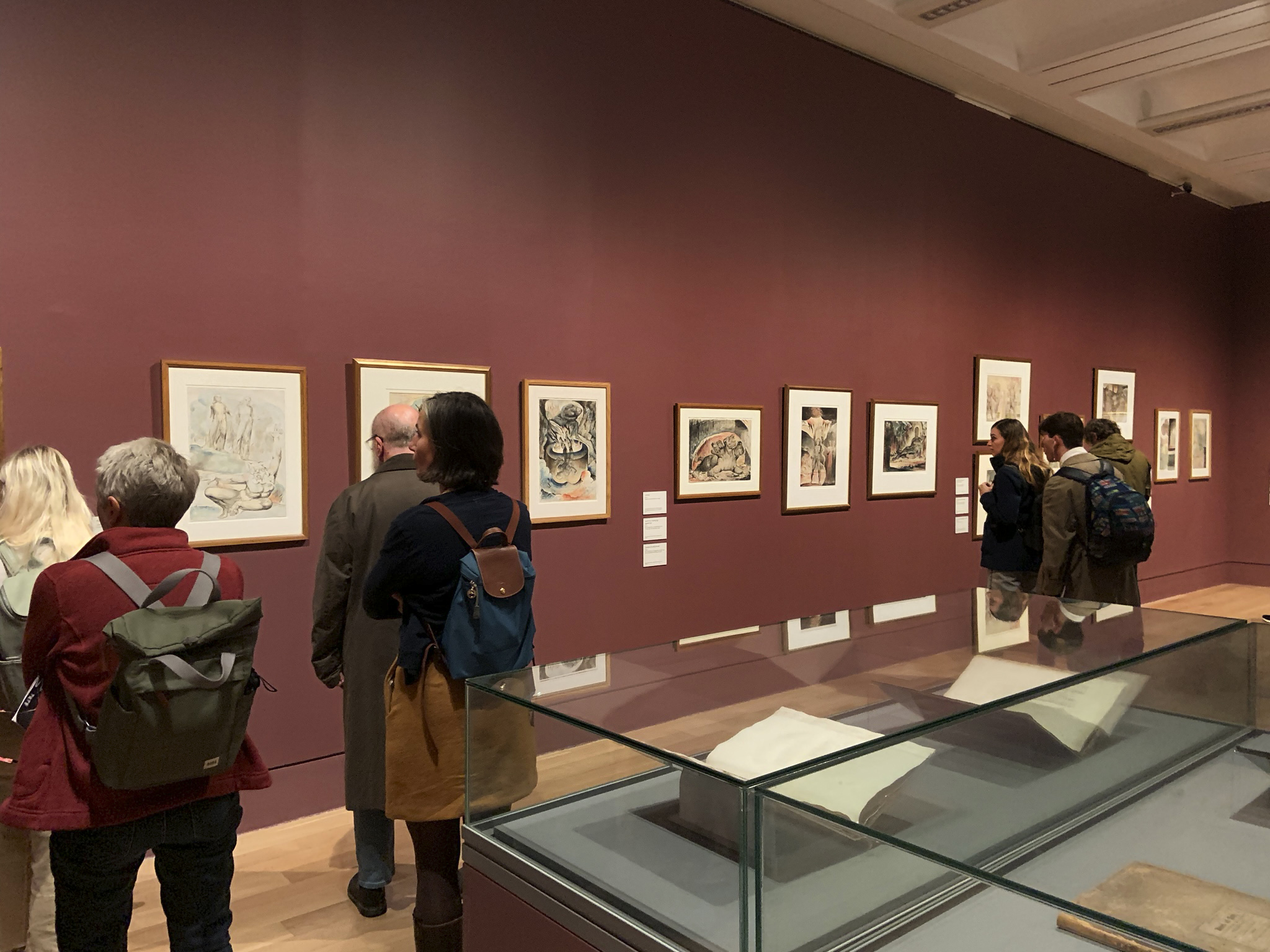
The last three years of Blake’s life were dominated by a major commission from Linnell. This was to illustrate The Divine Comedy by medieval Italian poet Dante Alighieri. This epic poem describes a journey through Hell, Purgatory and Paradise.

Blake threw himself into the task and apparently learned Italian especially. The young artist Samuel Palmer observed him at work on the watercolours, ‘hard working on a bed covered with books… like one of the Antique patriarchs, or a dying Michael Angelo.’

In his designs Blake uses colour to convey the transition from dark, menacing Hell to luminous Paradise. No other British artist since Flaxman had attempted to illustrate the poem in its entirety. Sadly the project, totalling 102 watercolours and seven engravings, remained unfinished at Blake’s death. Even in its unfinished state, this series demonstrates the power of Blake’s imagination, his unceasing creative energy and technical skill.

Wall text from the exhibition


Installation view of the exhibition 'William Blake' at Tate Britain, London showing work from Blake's 'The Divine Comedy'


Installation view of the exhibition William Blake at Tate Britain, London showing work from Blake’s The Divine Comedy
Photo: Marcus Bunyan


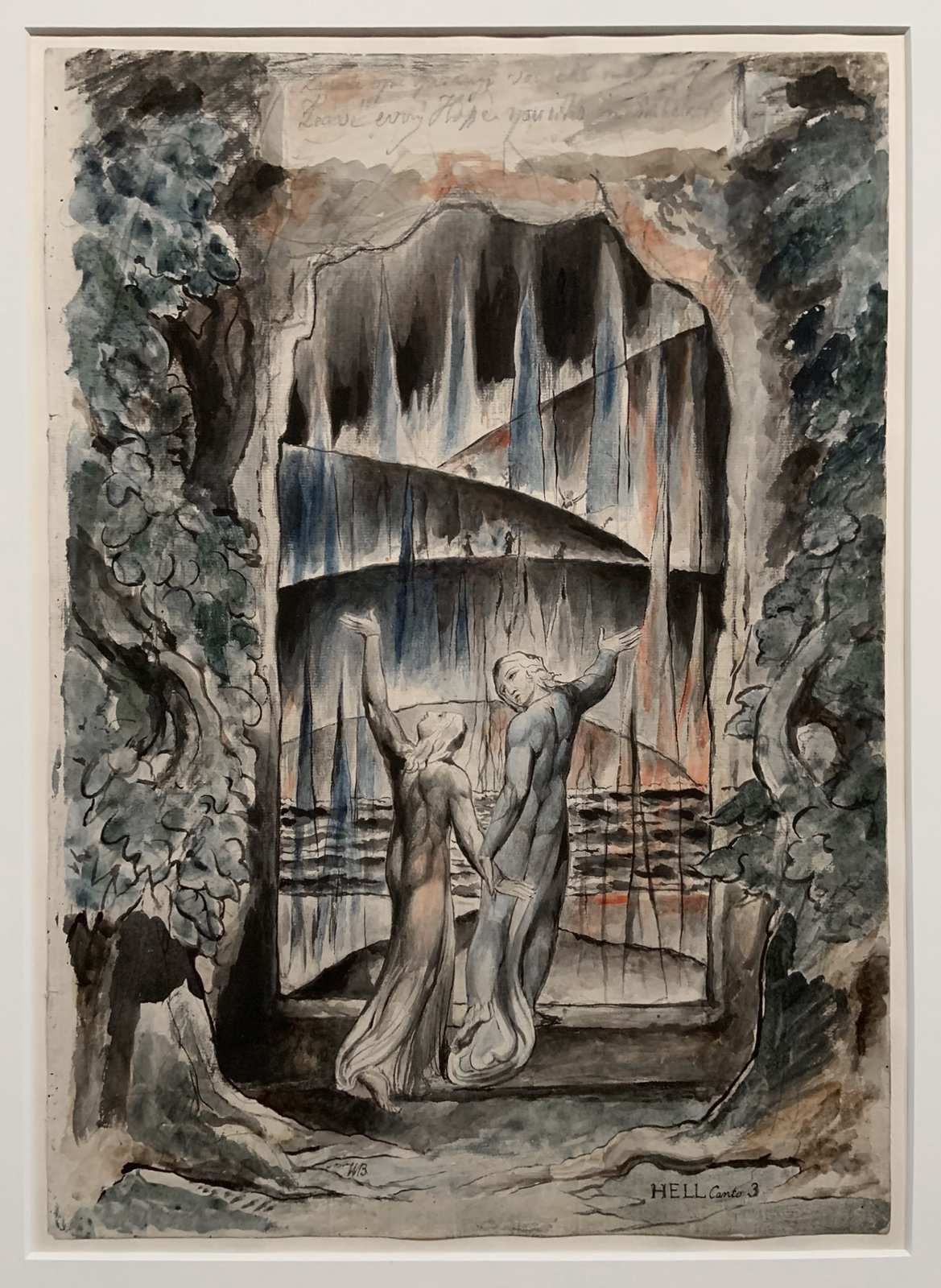
William Blake (British, 1757-1827) 'The Inscription over the Gate' 1824-1827 (installation view)


William Blake (British, 1757-1827)
The Inscription over the Gate (installation view)
1824-1827
From Illustrations to Dante’s Divine Comedy
Graphite, ink and watercolour on paper
527 × 374 mm
Tate
Photo: Marcus Bunyan


Here Dante and his guide, the Roman poet Virgil, stand before the gates of Hell. The sublime landscape is populated by souls trapped in alternating circles of fire and ice.

Three quarters of Blake’s Divine Comedy illustrations depict Hell. Displayed nearby are Blake’s interpretations of its resident beasts and the various painful fates suffered by sinners. A corrupt Pope is plunged into a fiery pit, and a thief, Agnello Brunelleschi, undergoes a grotesque mutation, becoming half-man, half-serpent.

Wall text from the exhibition


William Blake (British, 1757-1827) 'The Inscription over the Gate' 1824-1827
 

William Blake (British, 1757-1827)
The Inscription over the Gate
1824-1827
From Illustrations to Dante’s Divine Comedy
Graphite, ink and watercolour on paper
527 × 374 mm
Tate


In his Divine Comedy, Dante describes the pilgrimage he made with the poet Virgil, travelling into Hell, up the Mountain of Purgatory to reach Paradise at last. Entering the Gate of Hell was a moment when Dante (in red) wept with fear.

Dante describes the ‘dim’ colours which contribute to his terror. Blake’s dark shadows of pure black pigment next to areas of unpainted white paper contribute to this. He used Prussian blue for the blue areas, and indigo blue mixed with yellow for the green foliage, so that they contrast. The blue, green and vermilion red do not overlap.

Gallery label, September 2004


Through me you pass into the city of woe:
Through me you pass into eternal pain:
Through me among the people lost for aye.
Justice the founder of my fabric moved:
To rear me was the task of Power divine,
Supremest Wisdom, and primeval Love.
Before me things create were none, save things
Eternal, and eternal I endure.
All hope abandon, ye who enter here.

Such characters, in colour dim, I mark’d
Over a portal’s lofty arch inscribed.


Dante is being led by Virgil, the Roman poet, through Hell, Purgatory and Paradise. Here they are shown entering the Gate of Hell. Once inside, they shall first pass through the region where the souls of the uncommitted (those who lived their lives without doing anything notably good or bad) reside. They shall then be ferried by Charon across the river Acheron into Hell proper. Virgil is the right-hand figure in blue, Dante the left-hand one in grey.

Notice how the greenery framing the outside of the gate contrasts with the bleak panorama of fire and ice inside. If you look carefully you can see tiny figures in torment on the hills. These successive hills represent the different circles of hell, where the souls of people guilty of different sins are punished in an appropriate manner. Those guilty of the sin of lust, for example, are buffeted about by the winds of passion and desire in the second circle.

Text from “William Blake’s illustrations to Dante’s Divine Comedy,” on the Tate website [Online] Cited 27/01/2020


William Blake (British, 1757-1827) 'The Serpent Attacking Buoso Donati' 1824-1827 (installation view)


William Blake (British, 1757-1827)
The Serpent Attacking Buoso Donati (installation view)
1824-1827
From Illustrations to Dante’s Divine Comedy
Ink and watercolour on paper
Tate. Purchased with the assistance of a special grant from the National Gallery and donations from the Art Fund, Lord Duveen and others, and presented through the the Art Fund 1919
Photo: Marcus Bunyan


William Blake (British, 1757-1827) 'The Serpent Attacking Buoso Donati' 1824-1827


William Blake (British, 1757-1827)
The Serpent Attacking Buoso Donati
1824-1827
From Illustrations to Dante’s Divine Comedy
Ink and watercolour on paper
Tate. Purchased with the assistance of a special grant from the National Gallery and donations from the Art Fund, Lord Duveen and others, and presented through the the Art Fund 1919
Creative Commons CC-BY-NC-ND (3.0 Unported)


In Hell, Dante and Virgil see a thief, in the guise of a serpent ‘all on fire’, preparing to attack another thief, named Buoso de’Donati.

Here Blake’s figures show subtle effects of light and shade, particularly in their flesh tones. He used small brushstrokes of red, blue and black for this, laying the colours side by side rather than mixing them. The robber Donati (right) is about to be punished by being turned into a serpent. Blake’s technique and colour give form to his figure, but the blue also shows human life draining away into coldness.

Gallery label, August 2004


William Blake (British, 1757-1827) 'The Lawn with the Kings and Angels' 1824-1827 (installation view)


William Blake (British, 1757-1827)
The Lawn with the Kings and Angels (installation view)
1824-1827
Illustration for The Divine Comedy by Dante Alighieri (Purgatorio VII, 64-90 and VIII, 22-48 and 94-108)
Ink and watercolour over black chalk and traces of graphite, with sponging on paper
National Gallery of Victoria, Melbourne, Felton Bequest, 1920
through the the Art Fund 1919
Photo: Marcus Bunyan


William Blake (British, 1757-1827) 'The Lawn with the Kings and Angels' 1824-1827


William Blake (British, 1757-1827)
The Lawn with the Kings and Angels
1824-1827
Illustration for The Divine Comedy by Dante Alighieri (Purgatorio VII, 64-90 and VIII, 22-48 and 94-108)
Ink and watercolour over black chalk and traces of graphite, with sponging on paper
National Gallery of Victoria, Melbourne, Felton Bequest, 1920


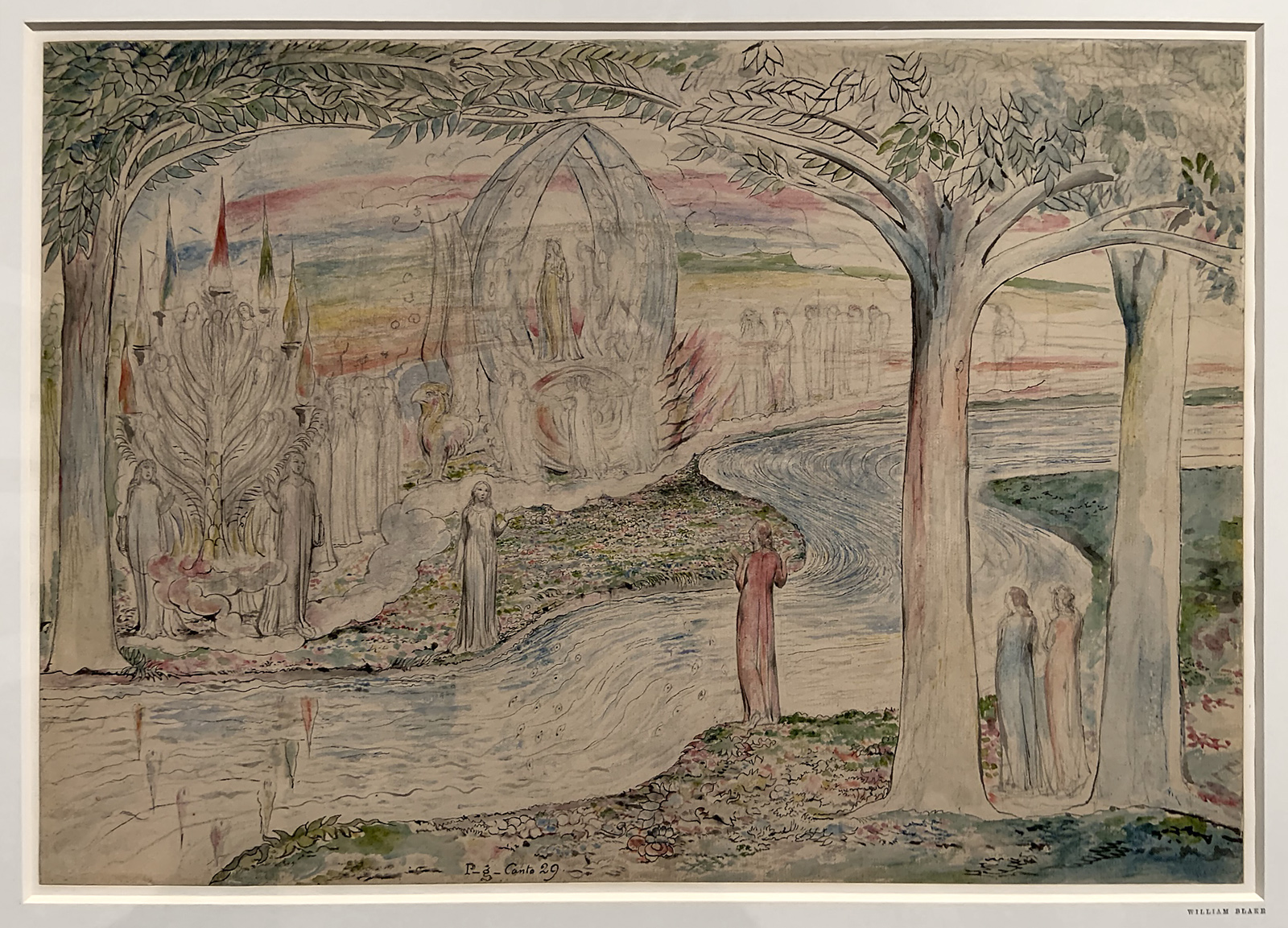
Purgatorio VII, 64-90 and VIII, 22-48 and 94-108. The poets are now accompanied by Virgil’s fellow Mantuan, the poet Sordello and have come to a lawn scooped out from the mountainside. Here they see a group of Negligent Rulers singing sacred songs. Two angels appear with blunted, flaming swords to guard the kings from a serpent. Dante describes the richly coloured grass and flowers, but Blake shows the kings in a grove of trees, the symbol of error.


William Blake (British, 1757-1827) 'Matilda and Dante on the Banks of the Lethe with Beatrice on the Triumphal Chariot' 1824-1827 (installation view)

William Blake (British, 1757-1827) 'Matilda and Dante on the Banks of the Lethe with Beatrice on the Triumphal Chariot' 1824-1827 (installation view)


William Blake (British, 1757-1827)
Matilda and Dante on the Banks of the Lethe with Beatrice on the Triumphal Chariot (installation views)
1824-1827
From Illustrations to Dante’s Divine Comedy
Graphite, ink and watercolour on paper
Lent by The British Museum, London
Photos: Marcus Bunyan


In Dante’s Divine Comedy, Matilda is a beautiful woman who represents the active life of the soul. She stands on the Earthly Paradise side of the river Lethe, and offers to answer Dante’s questions. She tells him to look at Beatrice’s procession, which can be seen in Blake’s painting behind Matilda. Blake illustrated Dante’s Divine Comedy in 1824, a commission he undertook in 1824 at the request of John Linnell. A reverse Newtonian rainbow hangs above the scene.


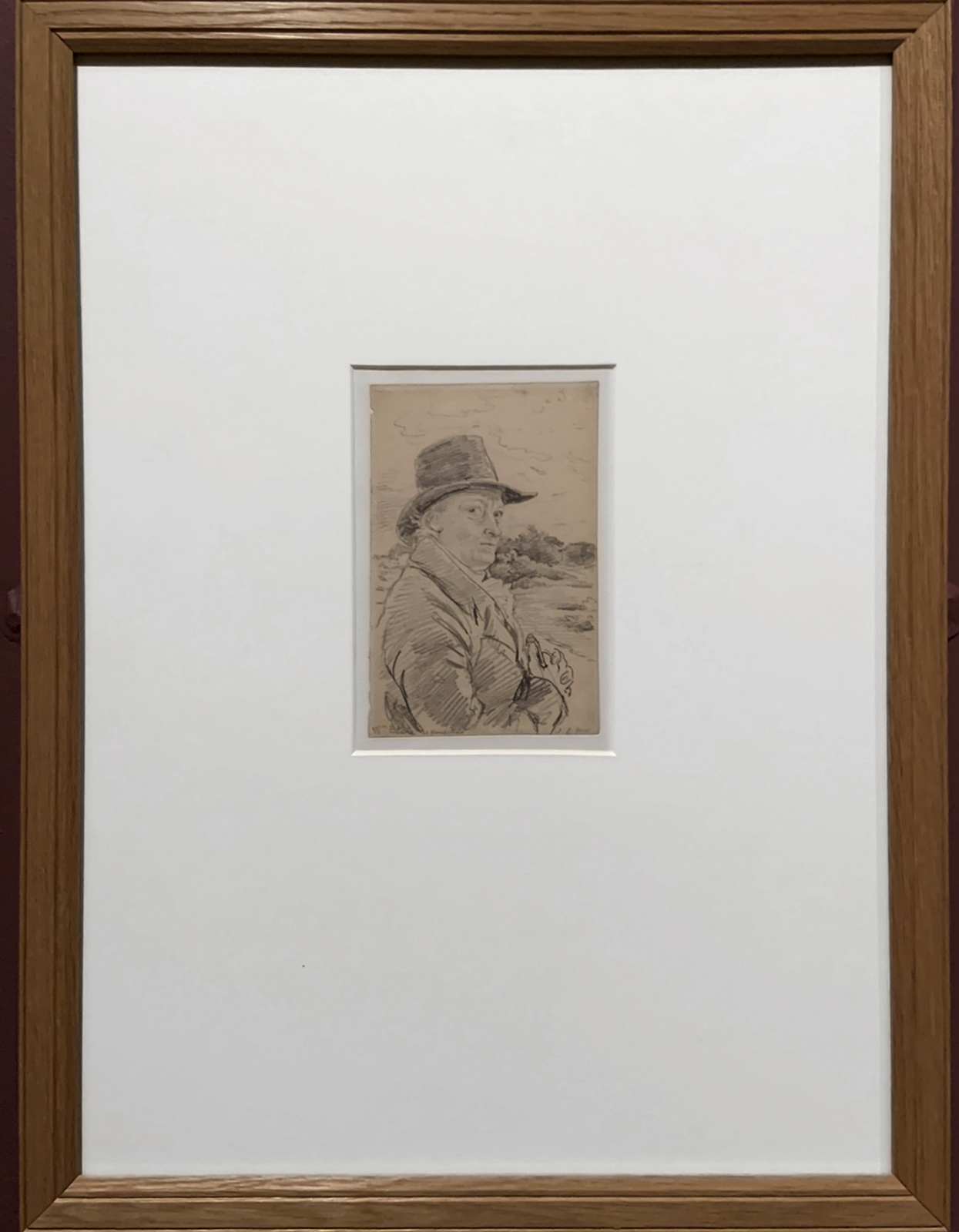
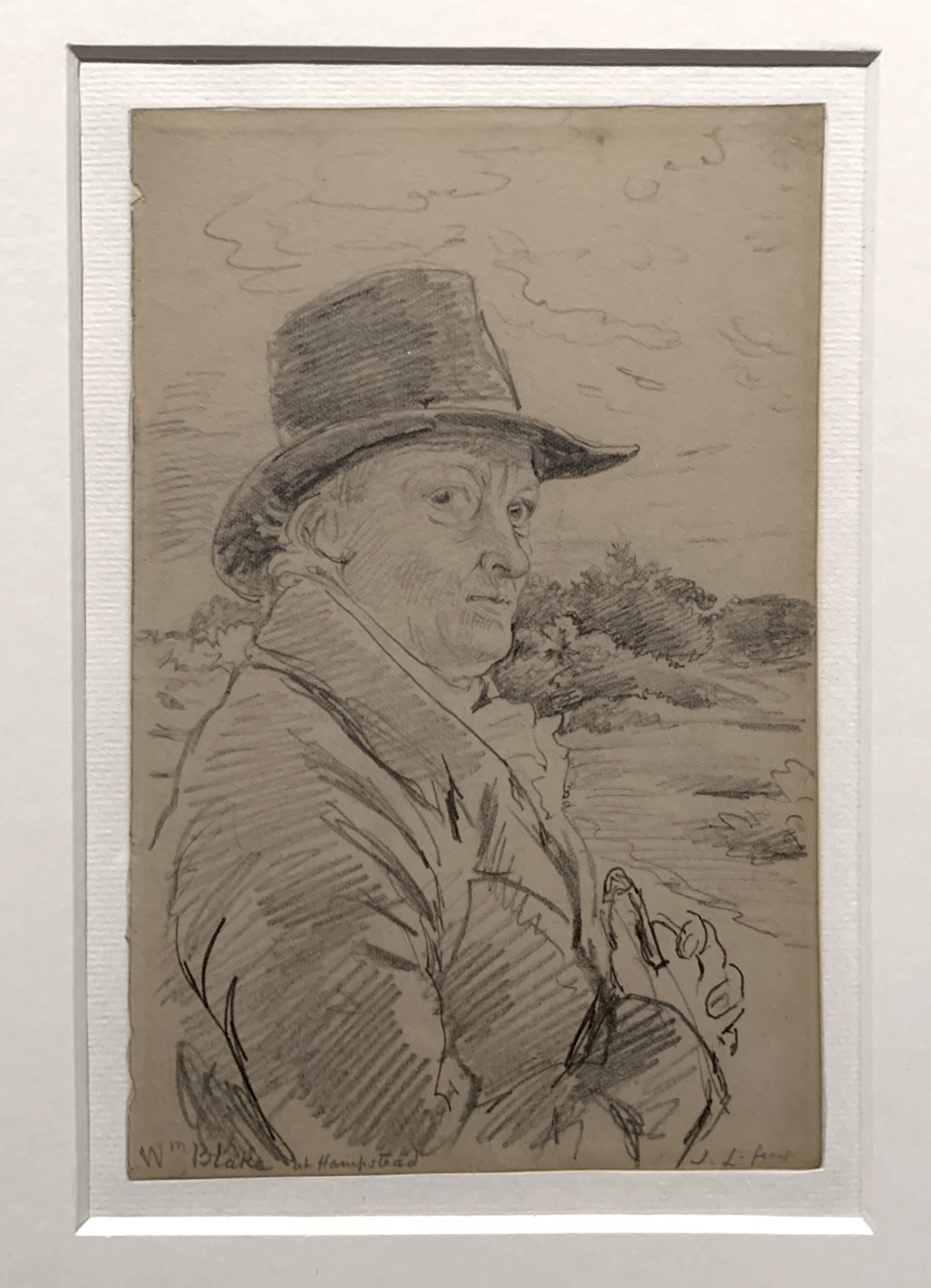
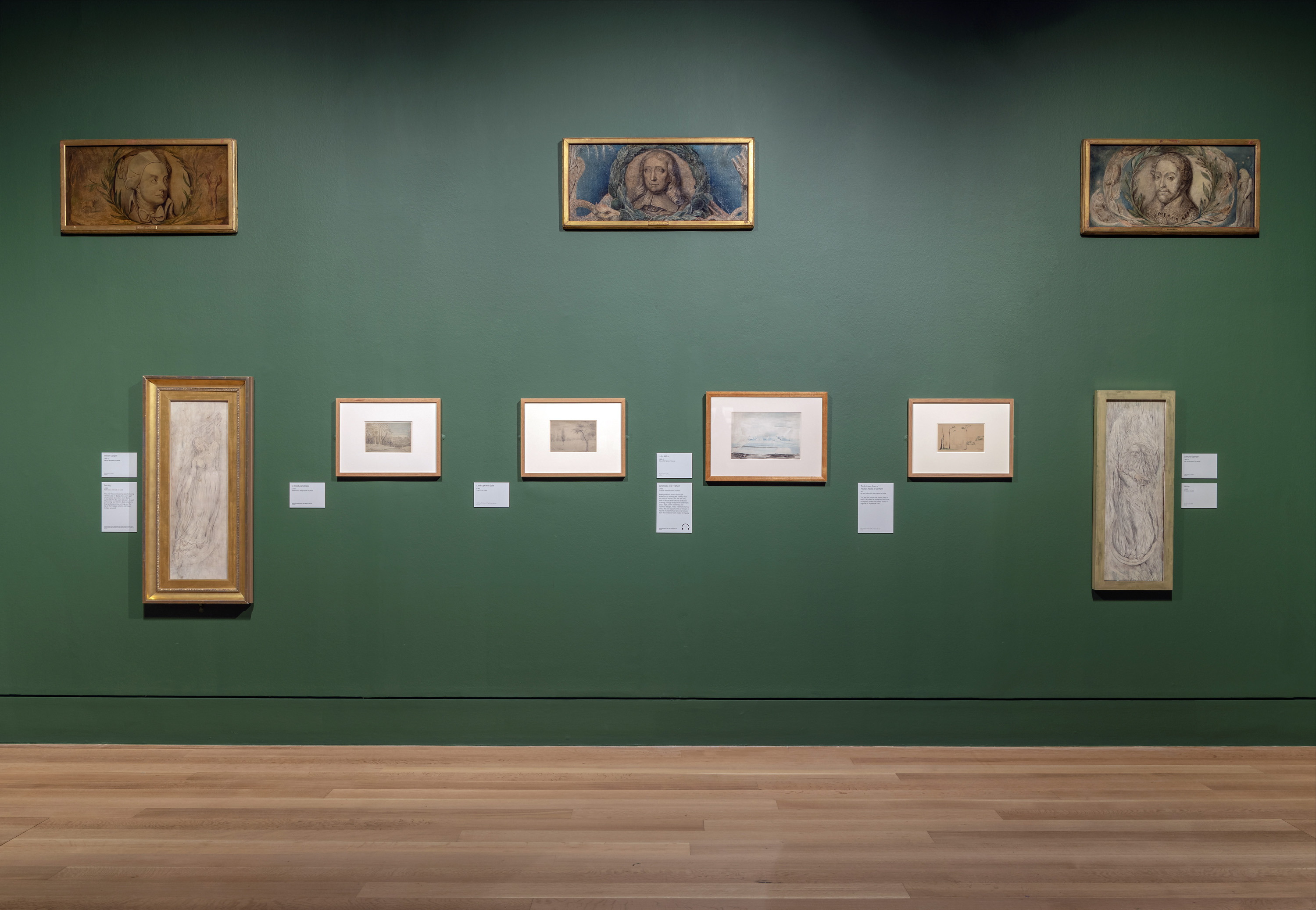
John Linnell (British, 1792-1882) 'William Blake wearing a hat' c. 1825 (installation view)

John Linnell (British, 1792-1882) 'William Blake wearing a hat' c. 1825 (installation view)


John Linnell (British, 1792-1882)
William Blake wearing a hat
c. 1825
Graphite on paper
The Syndics of the Fitzwilliam Museum, University of Cambridge
Photos: Marcus Bunyan


Linnell made this seemingly spontaneous portrait of Blake during one of their regular walks on Hampstead Heath, to the north of London. Linnell, who lived by the Heath, was Blake’s most important friend during his final years. Their families became close and through Linnell Blake’s social circle expanded. He met landscape artist John Constable at Linnell’s house. Looking at Constable’s drawing of trees on Hampstead Heath, Blake exclaimed that it was ‘not drawing, but inspiration!

Wall text


John Linnell (British, 1792-1882) and John Varley (British, 1778-1842) 'The Blake / Varley Sketchbook' 1819 (installation view)


John Linnell (British, 1792-1882) and John Varley (British, 1778-1842)
The Blake / Varley Sketchbook (installation view)
1819
Book
Private collection


Varley gave Blake sketchbooks to record his nocturnal visions. This page shows Rowena, a Saxon queen renowned for her beauty.


The ‘Visionary Heads’

In October 1819 Blake began a series of extraordinary sketches of spirits. He claimed to have seen and even spoken with the spirits in ‘visions’. John Varley encouraged him. He provided Blake with drawing materials to make these so-called ‘Visionary Heads’. He also attended the séance-like sessions when the spirits appeared to Blake. Varley described sitting with Blake ‘from ten at night till three in the morning sometimes slumbering and sometimes waking, but Blake never slept’. According to Linnell, Varley believed in Blake’s visions ‘more than even Blake himself’.

Over a period of about six years Blake made over 100 ‘Visionary Heads’. They depict real historical figures such as medieval kings, as well as legendary characters like Merlin and a range of imagined beasts. Blake’s contemporaries debated whether his nocturnal visions were a sign of mental ill health or a charming quirk.

Wall text from the exhibition


William Blake (British, 1757-1827) 'The Ghost of a Flea' c. 1819 (installation view)
William Blake (British, 1757-1827) 'The Ghost of a Flea' c. 1819 (installation view)


William Blake (British, 1757-1827)
The Ghost of a Flea (installation views)
c. 1819
Tempera heightened with gold on mahogany
214 x 162 mm
Tate. Bequeathed by W. Graham Robertson 1949
Photos: Marcus Bunyan


William Blake (British, 1757-1827) 'The Ghost of a Flea' c. 1819


William Blake (British, 1757-1827)
The Ghost of a Flea
c. 1819
Tempera heightened with gold on mahogany
214 x 162 mm
Tate. Bequeathed by W. Graham Robertson 1949


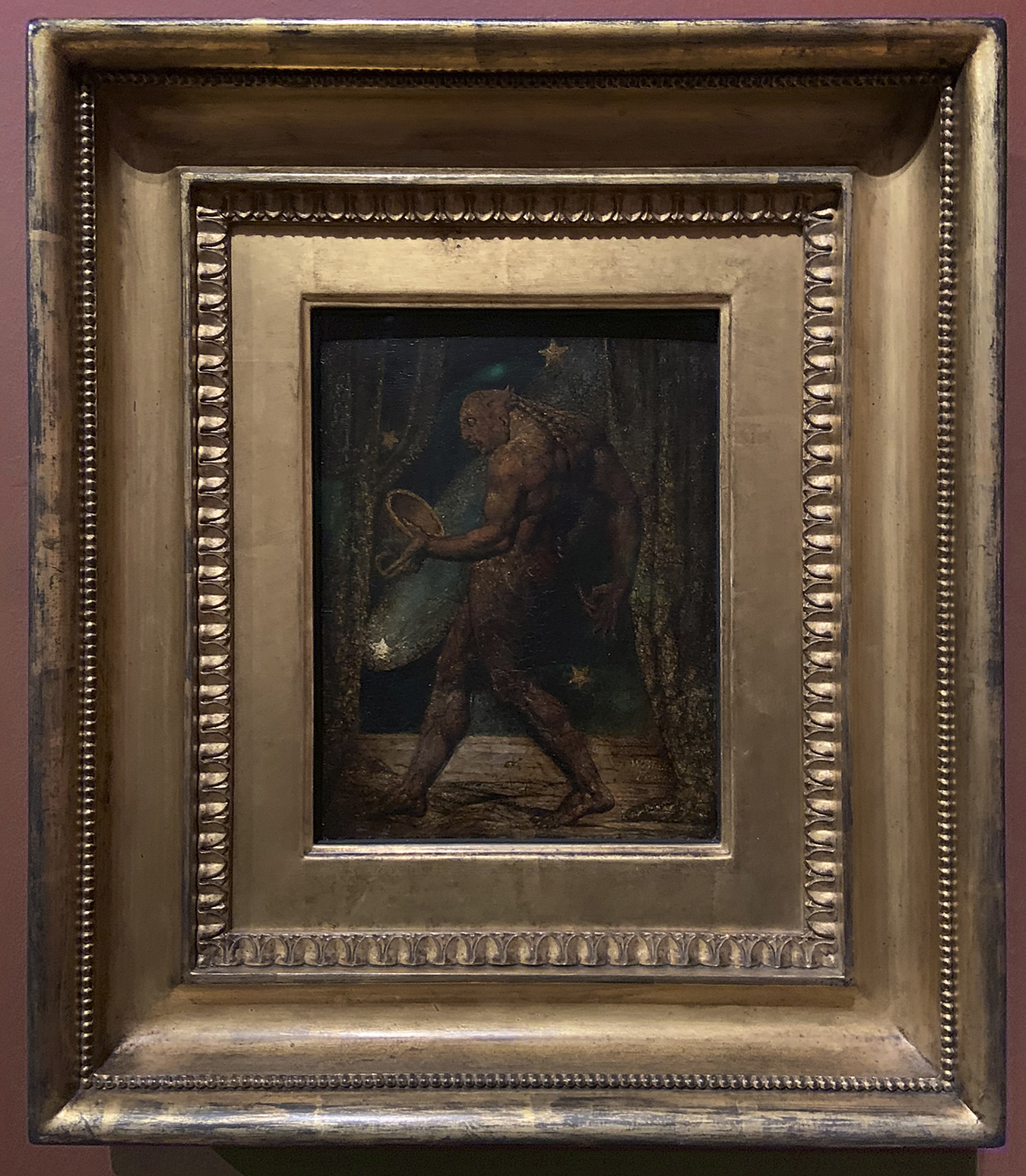
The Ghost of a Flea is one of Blake’s most bizarre and famous characters. As the vision appeared to Blake he is said to have cried out: ‘There he comes! his eager tongue whisking out of his mouth, a cup in his hand to hold blood, and covered with a scaly skin of gold and green.’ John Varley watched Blake make the original sketch of this character. He also owned this painting showing the creature on a stage, flanked by curtains with a shooting star behind. Varley was a keen astrologer. He paid Linnell to engrave Blake’s drawings, including the Flea, to illustrate his Treatise on Zodiacal Physiognomy (1828).

Wall text from the exhibition


Artist and astrologer John Varley encouraged Blake to sketch the figures, called ‘visionary heads’, who populated his visions. This image is the best known. While sketching the flea, Blake claimed it told him that fleas were inhabited by the souls of bloodthirsty men, confined to the bodies of insects because, if they were the size of horses, they would literally drain the population. Their bloodthirsty nature is shown by the eager tongue flicking at the ‘blood’ cup it carries. This intense disorientating image, the stuff of delirium and nightmare, taps into the unconscious, internalised sublime.

William Blake, “The Ghost of a Flea c. 1819-20,” in Nigel Llewellyn and Christine Riding (eds.), The Art of the Sublime, Tate Research Publication, January 2013


William Blake (British, 1757-1827) 'The Ghost of a Flea' c. 1819 (installation view)


William Blake (British, 1757-1827)
The Ghost of a Flea
c. 1819
Graphite on paper
Private collection
Photo: Marcus Bunyan


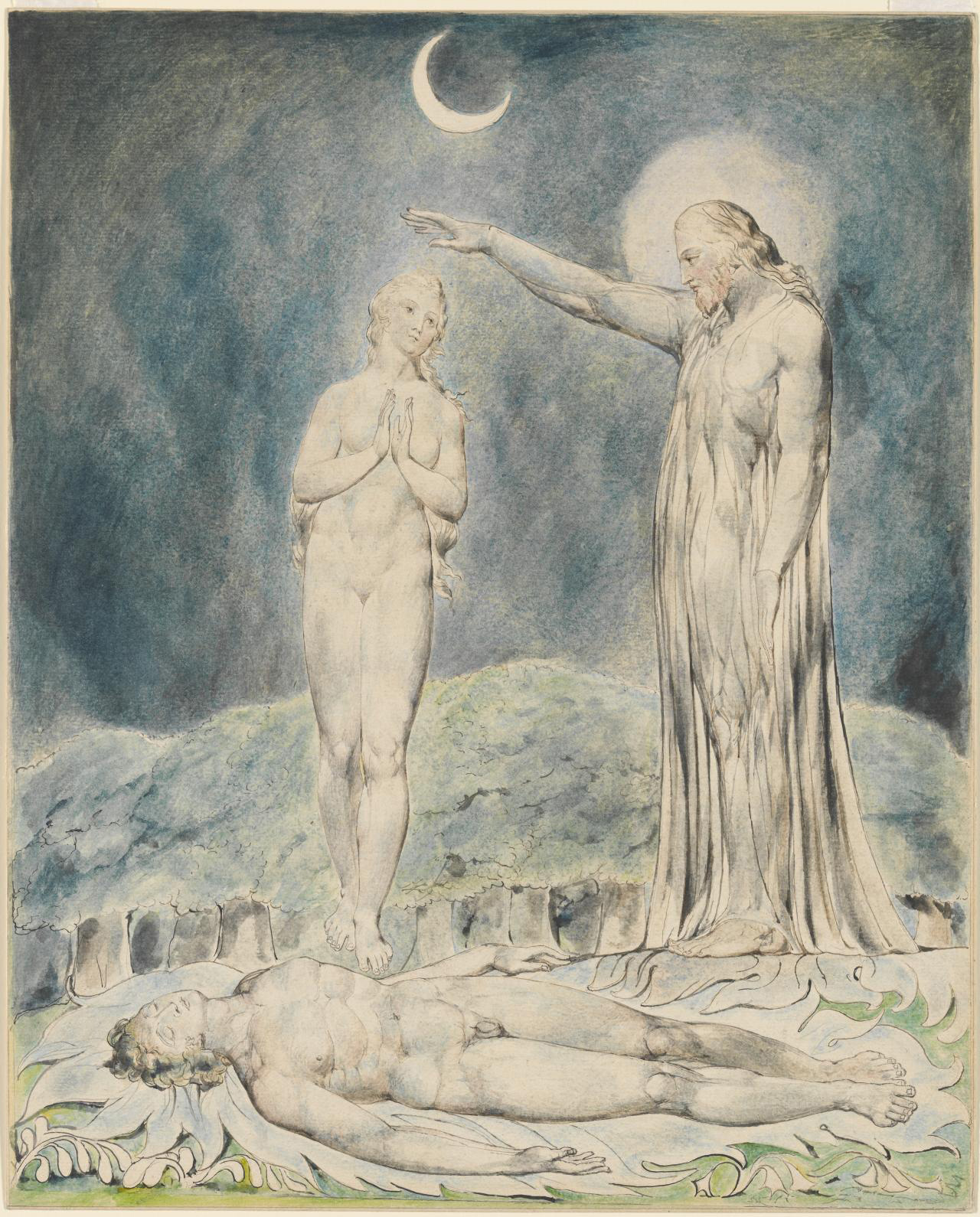
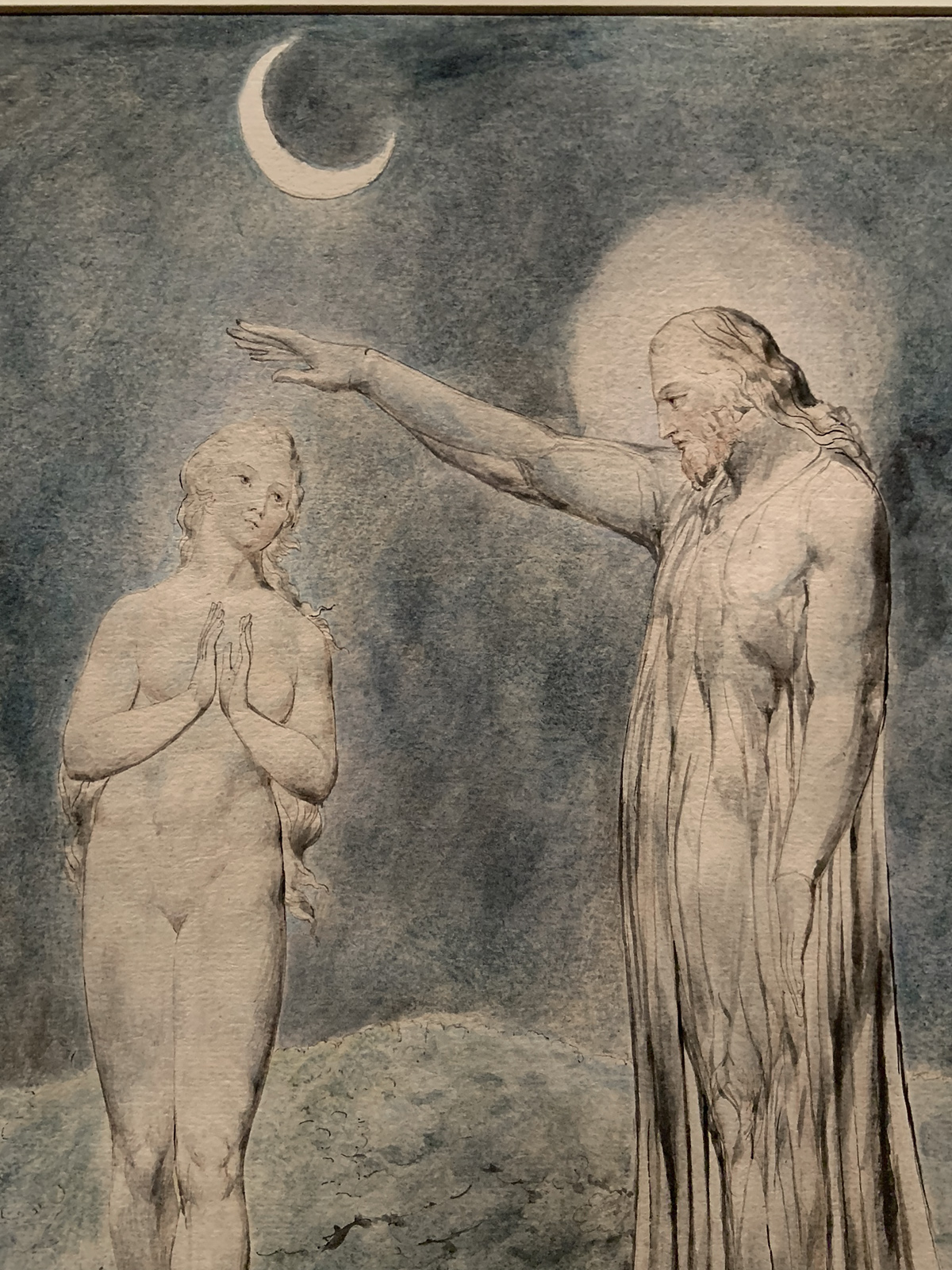
William Blake (British, 1757-1827) 'The Creation of Eve' 1822


William Blake (British, 1757-1827)
The Creation of Eve
1822
Illustration for Paradise Lost by John Milton (VIII, 452-77)
Pen and brown and black ink and watercolour over pencil and black chalk, with stippling and sponging
50.4 × 40.7cm (sheet)
National Gallery of Victoria, Melbourne, Felton Bequest, 1920


William Blake (British, 1757-1827) 'The Creation of Eve' 1822 (installation view)

William Blake (British, 1757-1827) 'The Creation of Eve' 1822 (installation view)


William Blake (British, 1757-1827)
The Creation of Eve (installation views)
1822
Illustration for Paradise Lost by John Milton (VIII, 452-77)
Pen and brown and black ink and watercolour over pencil and black chalk, with stippling and sponging
50.4 × 40.7cm (sheet)
National Gallery of Victoria, Melbourne, Felton Bequest, 1920
Photos: Marcus Bunyan


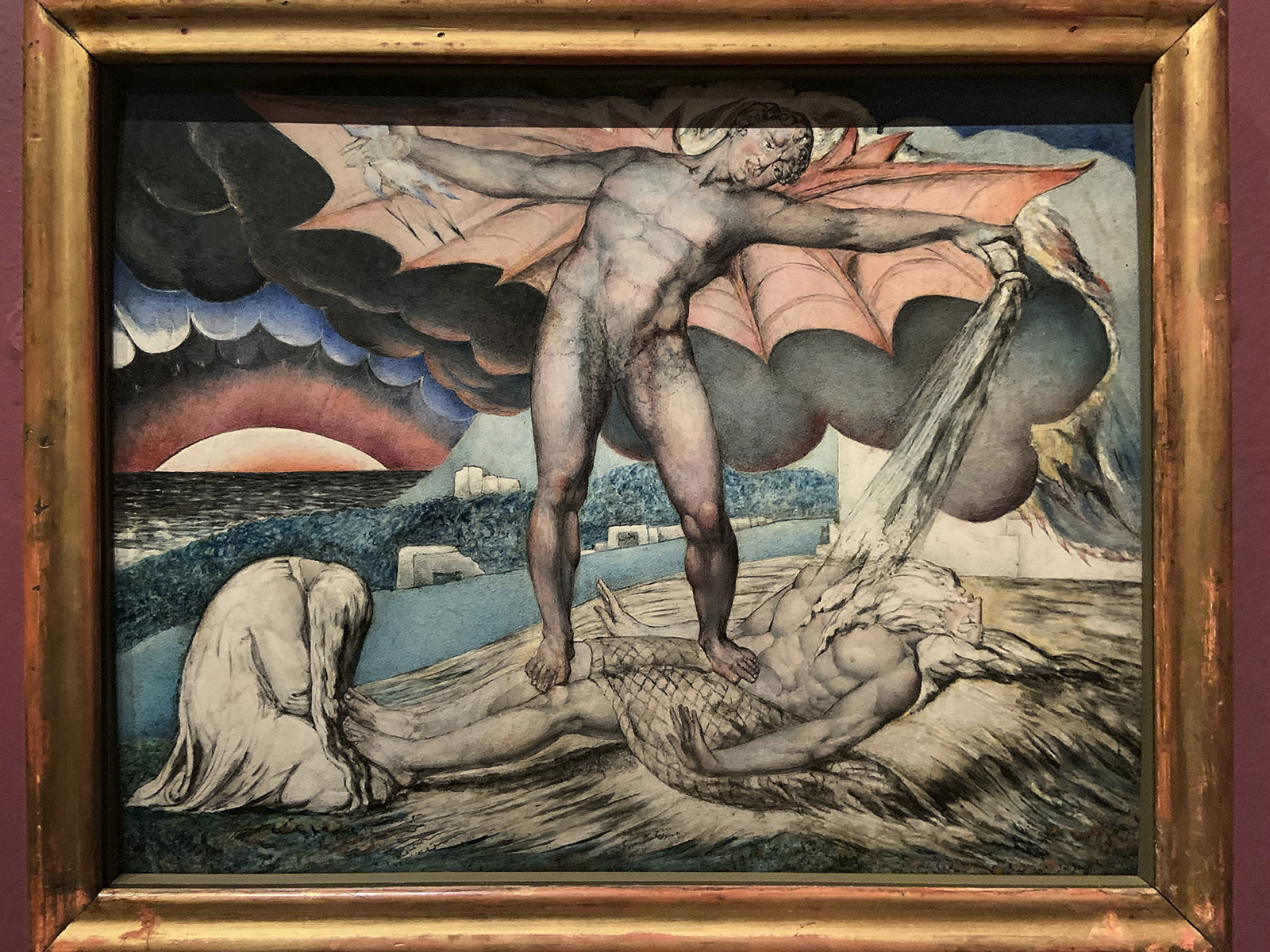
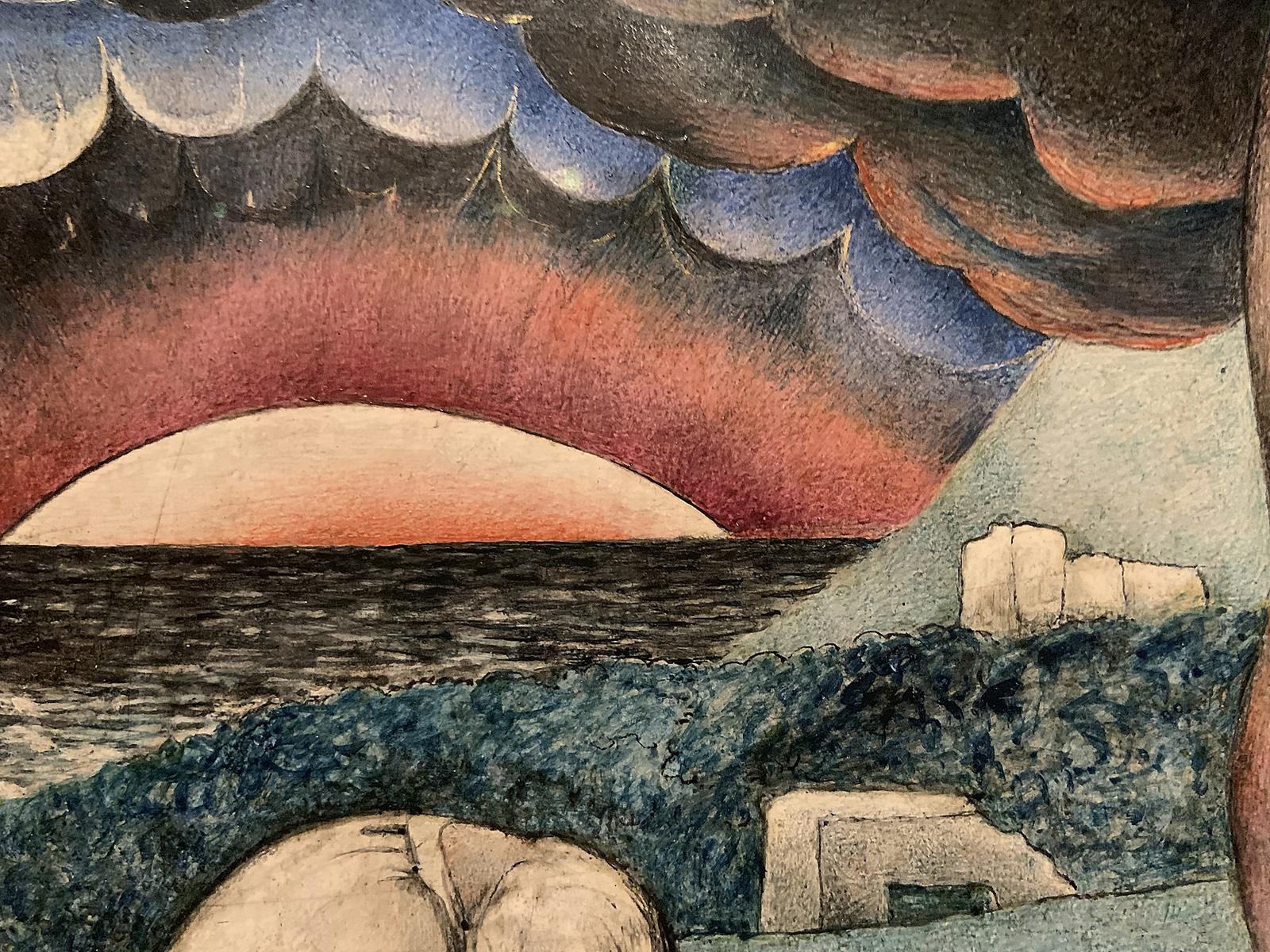
William Blake (British, 1757-1827) 'Satan Smiting Job with Sore Boils' c. 1826 (installation view)

William Blake (British, 1757-1827) 'Satan Smiting Job with Sore Boils' c. 1826 (installation view detail)


William Blake (British, 1757-1827)
Satan Smiting Job with Sore Boils (installation views)
c. 1826
Ink and tempera on mahogany
Tate. Presented by Miss Mary H. Dodge through the Art Fund 1918
Photos: Marcus Bunyan


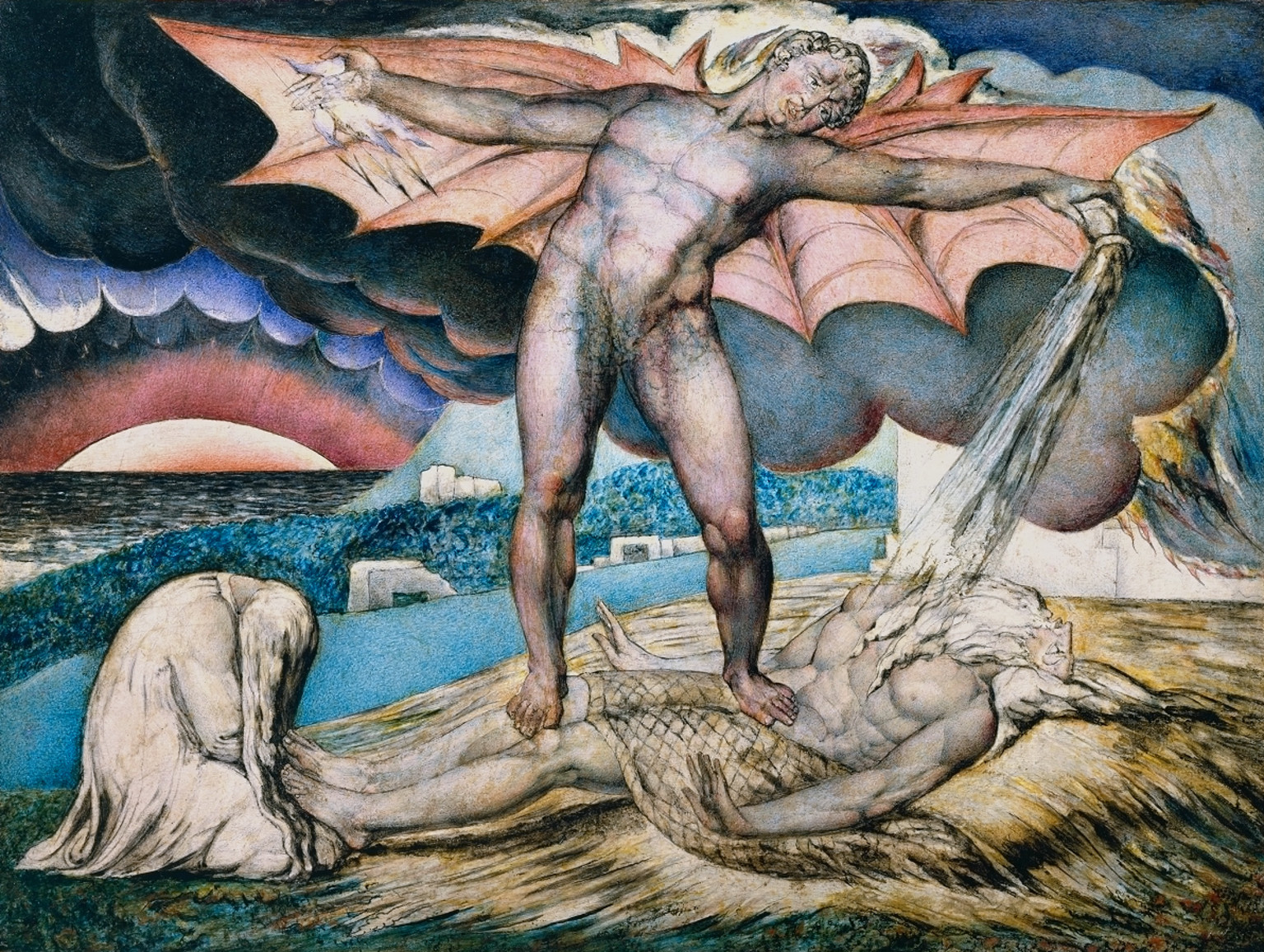
William Blake (British, 1757-1827) 'Satan Smiting Job with Sore Boils' c. 1826


William Blake (British, 1757-1827)
Satan Smiting Job with Sore Boils
c. 1826
Ink and tempera on mahogany
Tate. Presented by Miss Mary H. Dodge through the Art Fund 1918
Creative Commons CC-BY-NC-ND (3.0 Unported)


The first owner of this tempera was George Richmond, a member of the ‘Ancients’. This was a circle of young artists who gathered around Blake in the 1820s.

In the biblical text this work refers to, Satan is given permission by God to torture Job in order to test the limits of his faith. The Body of Abel Found by Adam and Eve and the set of engravings to the Old Testament Book of Job (displayed nearby) reprise work that Blake had made for Thomas Butts 20 years earlier.

Wall text from the exhibition


The biblical ‘Book of Job’ addresses the existence of evil and suffering in a world where a loving, all-powerful God exists. It has been described as ‘the most profound and literary work of the entire Old Testament’. In ‘Job’, God and Satan discuss the limits of human faith and endurance. God lets Satan force Job to undergo extreme trials and tribulations, including the destruction of his family. Despite this, as God predicted, Job’s faith remains unshaken and he is rewarded by God with the restoration of his health, wealth and family. Here Blake shows Satan torturing Job with boils.

William Blake, “Satan Smiting Job with Sore Boils c. 1826,” in Nigel Llewellyn and Christine Riding (eds.), The Art of the Sublime, Tate Research Publication, January 2013.


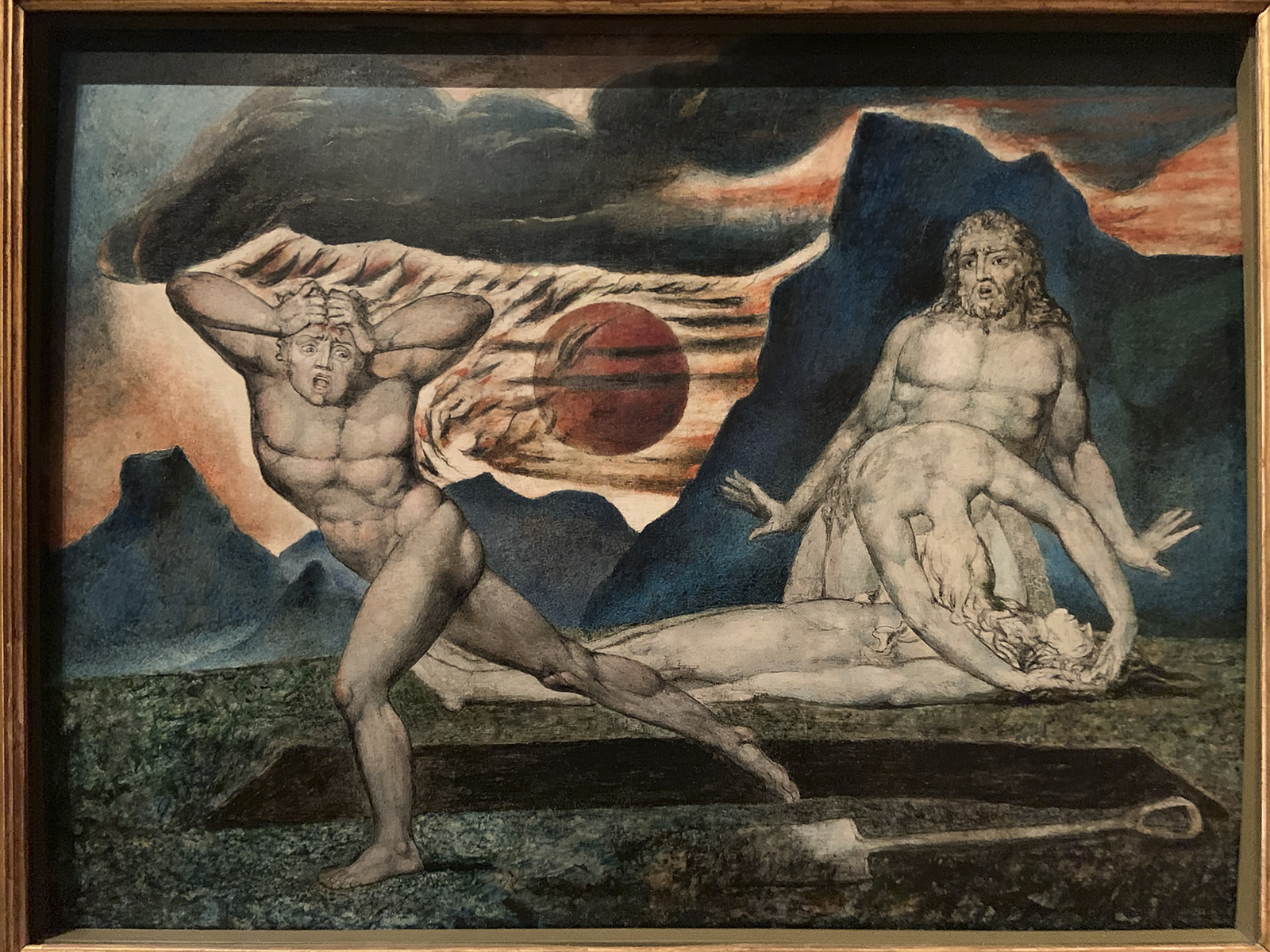
William Blake (British, 1757-1827) 'The Body of Abel Found by Adam and Eve' c. 1826 (installation view)

William Blake (British, 1757-1827) 'The Body of Abel Found by Adam and Eve' c. 1826 (installation view)

William Blake (British, 1757-1827) 'The Body of Abel Found by Adam and Eve' c. 1826 (installation view detail)


William Blake (British, 1757-1827)
The Body of Abel Found by Adam and Eve (installation views)
c. 1826
Ink, tempera and gold on mahogany
Tate. Bequeathed by W. Graham Robertson 1949
Photos: Marcus Bunyan


In the 1820s Blake’s work took on a richer appearance. He began to use more vibrant colour and to apply gold leaf more frequently. Another new practice was his use of a mahogany support. These innovations were perhaps inspired by Northern European art of the late 15th century, which adapted ideas of the Italian Renaissance. Blake and Linnell often visited such works in private and public collections across London. Blake’s use of gold may have been facilitated by the fact that one of his Fountain Court neighbours was a gilder.

Wall text


William Blake (British, 1757-1827) 'The Body of Abel Found by Adam and Eve' c. 1826


William Blake (British, 1757-1827)
The Body of Abel Found by Adam and Eve
c. 1826
Ink, tempera and gold on mahogany
Tate. Bequeathed by W. Graham Robertson 1949
Creative Commons CC-BY-NC-ND (3.0 Unported)


Pilgrim’s Progress

John Bunyan’s The Pilgrim’s Progress from This World, to That Which Is to Come (1678) was a popular religious text in Blake’s day. It is not known why Blake embarked on this series of illustrations. They were left unfinished at his death.

Pilgrim’s Progress tells the story of a challenging journey. Taking place in the realm of a dream, it follows the character Christian as he travels from the City of Destruction (earth) to the Celestial City (heaven) in the hope of unburdening himself of his sins.

Although it contains some of Blake’s most imaginative and original imagery, Pilgrim’s Progress has not received the same level of attention as his other late projects. One reason for this may be that Catherine, Blake’s wife, is thought to have been involved in colouring the illustrations. For nearly all their married life Catherine helped Blake to print and hand-colour his works. Her creative and practical influence is only beginning to be fully appreciated.

Wall text from the exhibition


William Blake (British, 1757-1827) 'Christian in the Arbour' 1824-1827


William Blake (British, 1757-1827)
Christian in the Arbour
1824-1827
Illustration to Pilgrim’s Progress
Watercolour and ink over graphite and chalk on paper
Private collection


Reader! lover of books! lover of heaven,
And of that God from whom all books are given,
Who in mysterious Sinais awful cave
To Man the wond’rous art of writing gave,
Again he speaks in thunder and in fire!
Thunder of Thought, & flames of fierce desire:
Even from the depths of Hell his voice I hear,
Within the unfathomd caverns of my Ear.
Therefore I print; nor vain my types shall be:
Heaven, Earth & Hell, henceforth shall live in harmony
I must Create a System, or be enslav’d by another Mans

I will not Reason & Compare: my business is to Create


William Blake


William Blake (British, 1757-1827) 'Jerusalem', plate 28, proof impression, top design only 1820


William Blake (British, 1757-1827)
Jerusalem, plate 28, proof impression, top design only
1820
Relief etching with pen and black ink and watercolour on medium, smooth wove paper
111 x 159 mm
Yale Center for British Art (New Haven, USA)


William Blake (British, 1757-1827) 'The Sea of Time and Space' 1821 (installation view)

William Blake (British, 1757-1827) 'The Sea of Time and Space' 1821 (installation view detail)


William Blake (British, 1757-1827)
The Sea of Time and Space (installation views)
1821
Ink, watercolour and body colour on gesso ground on paper
National Trust Collections, Arlington Court (The Chichester Collection)
Photos: Marcus Bunyan


The subject of this detailed and richly coloured painting is a mystery. It appears to relate to the theme of choice. The kneeling figure has been identified as divine inspiration and imagination. Its title comes from Blake’s poem Vala, or the Four Zoas and was only applied in 1949.

It is shown in its original frame, which was made by John Linnell’s father, the framer James Linnell. It is thought that Colonel John Palmer Chichester, of Arlington Court, may have purchased it directly from Blake.

Wall text from the exhibition


William Blake (British, 1757-1827) 'Europe' Plate i: Frontispiece, 'The Ancient of Days' 1827 (installation view)

William Blake (British, 1757-1827) 'Europe' Plate i: Frontispiece, 'The Ancient of Days' 1827 (installation view)

William Blake (British, 1757-1827) 'Europe' Plate i: Frontispiece, 'The Ancient of Days' 1827 (installation view)


William Blake (British, 1757-1827)
‘Europe’ Plate i: Frontispiece, ‘The Ancient of Days’ (installation views)
1827
Relief etching with ink and watercolour on paper
232 x 120mm
The Whitworth, The University of Manchester
Photos: Marcus Bunyan


William Blake (British, 1757-1827) 'Europe' Plate i: Frontispiece, 'The Ancient of Days' 1827


William Blake (British, 1757-1827)
‘Europe’ Plate i: Frontispiece, ‘The Ancient of Days’
1827
Relief etching with ink and watercolour on paper
232 x 120mm
The Whitworth, The University of Manchester


Tate Britain’s major William Blake retrospective ends with what is believed to be the artist’s final work. On his deathbed, Blake is said to have coloured this impression of Ancient of Days 1827, claiming with satisfaction that it was ‘the best I have ever finished’. This ominous figure was created as a frontispiece for Blake’s 1794 prophetic book Europe a Prophecy. Along with its partner publication America, a Prophecy 1793, these epic and highly symbolic texts relate to the French revolution and revolutionary war in America respectively. Blake created several known versions of the work in his lifetime, including one thought coloured by his wife Catherine. One of Blake’s own favourite works, the image has since been embraced in popular culture and has been used to cover books and albums in recent years. It is reported that upon finishing this version the artist turned to Catherine, a constant source of support and inspiration, and proclaimed ‘you have ever been an angel to me’. He died only days later on 12 August 1827.

Text from Tate Britain


In his final days Blake is said to have coloured an impression of this work. He is reported to have claimed it ‘the best I have ever finished’. Though small in size it has become one of Blake’s best-known images. Its central figure is Urizen. He represents the scientific quest for answers. Urizen measures the world below with his golden compass. This act symbolises a threat to freedom of thought, imagination and creativity. For Blake, these were the cornerstones of human happiness.

Wall text from the exhibition


The divine white-beard, reaching down from his burning disc to measure the Earth below with his shining dividers. For all the force and similarity, this is not in fact God but Blake’s Urizen, the despised personification of Reason and Science.

Laura Cumming. “William Blake review – a rousing call to arms,” on The Guardian website Sun 15 Sep 2019 [Online] Cited 18/01/2020


Tate Britain
Millbank, London SW1P 4RG
United Kingdom
Phone: +44 20 7887 8888

Opening hours:
10.00am – 18.00pm daily

Tate Britain website

LIKE ART BLART ON FACEBOOK

Back to top

European research tour exhibition: ‘William Blake’ at Tate Britain, London Part 1

Exhibition dates: 11th September, 2019 – 2nd February, 2020
Visited October 2019 posted January 2020

Curators: Martin Myrone, Senior Curator, pre-1800 British Art, and Amy Concannon, Curator, British Art 1790-1850


Installation view of the exhibition 'William Blake' at Tate Britain, London Photo: Marcus Bunyan


Installation view of the exhibition William Blake at Tate Britain, London
Photo: Marcus Bunyan


This first of two parts of this humongous posting. This exhibition has to be one of the highlights of my (art) life. The techniques, the colours, the forms and the MAGIC of Blake’s compositions brought me to tears.

I will write more on the work in the second part of the posting.

Dr Marcus Bunyan


Many thankx to Tate Britain for allowing me to publish the media images in the posting. All other installation photographs as noted © Dr Marcus Bunyan. Please click on the photographs for a larger version of the image.


“Every page is a window open in Heaven … interwoven designs companion the poems, and gold and yellow tints diffuse themselves over the page like summer clouds. The poems [of Songs of Innocence] are the morning song of Blake’s genius.”


W.B. Yeats


“Blake sang of the ideal world, of the truth of the intellect, and of the divinity of the imagination. … The only writer to have written songs for children with the soul of a child … he holds, in my view, a unique position because he unites intellectual sharpness with mystic sentiment.”


James Joyce


Installation view of the exhibition 'William Blake' at Tate Britain

Installation view of the exhibition 'William Blake' at Tate Britain

Installation view of the exhibition 'William Blake' at Tate Britain

Installation view of the exhibition 'William Blake' at Tate Britain

Installation view of the exhibition 'William Blake' at Tate Britain

Installation view of the exhibition 'William Blake' at Tate Britain

Installation view of the exhibition 'William Blake' at Tate Britain

Installation view of the exhibition 'William Blake' at Tate Britain


Installation views of the exhibition William Blake at Tate Britain
© Tate
Photos: Seraphina Neville


Tate Britain presents the largest survey of work by William Blake (1757-1827) in the UK for a generation. A visionary painter, printmaker and poet, Blake created some of the most iconic images in the history of British art and has remained an inspiration to artists, musicians, writers and performers worldwide for over two centuries. This ambitious exhibition brings together over 300 remarkable and rarely seen works and rediscovers Blake as a visual artist for the 21st century.

Tate Britain reimagines the artist’s work as he intended it to be experienced. Blake’s art was a product of his tumultuous times, with revolution, war and progressive politics acting as the crucible of his unique imagination, yet he struggled to be understood and appreciated during his life. Now renowned as a poet, Blake also had grand ambitions as a visual artist and envisioned vast frescos that were never realised. For the first time, The Spiritual Form of Nelson Guiding Leviathan c. 1805-1809 and The Spiritual Form of Pitt Guiding Behemoth c. 1805 have been enlarged and projected onto the gallery wall on the huge scale that Blake imagined. The original artworks are displayed nearby in a re-staging of Blake’s ill-fated exhibition of 1809, the artist’s only significant attempt to create a public reputation for himself as a painter. Tate has recreated the domestic room above his family hosiery shop in which the show was held, allowing visitors to encounter the paintings exactly as people did over 200 years ago.

The exhibition also provides a vivid biographical framework in which to consider Blake’s life and work. There is a focus on London, the city in which he was born and lived for most of his life. The burgeoning metropolis was a constant source of inspiration for the artist, offering an environment in which harsh realities and pure imagination were woven together. Blake’s creative freedom was also dependent on the unwavering support of those closest to him: his friends, family and patrons. Tate Britain highlights the vital presence of his wife Catherine Blake who offered both practical assistance and became an unacknowledged hand in the production of the artist’s engravings and illuminated books. The exhibition showcases a series of illustrations to Pilgrim’s Progress 1824-1827 and a copy of the book The Complaint, and the Consolation, or, Night Thoughts 1797, now thought to be coloured by Catherine.

William Blake was a staunch defender of the fundamental role of art in society and the importance of artistic freedom. Shaped by his personal struggles in a period of political terror and oppression, his technical innovation, and his political commitment, these beliefs have inspired the generations that followed and remain pertinent today. Tate Britain’s exhibition opens with Albion Rose c. 1793, an exuberant visualisation of the mythical founding of Britain, created in contrast to the commercialisation, austerity and crass populism of the times. A section of the exhibition is also dedicated to his illuminated books such as Songs of Innocence and of Experience 1794, his central achievement as a radical poet.

Additional highlights include some of Blake’s best-known works including Newton 1795 – c. 1805 and Ghost of a Flea c. 1819-1820. This intricate painting was inspired by a séance-induced vision and is shown alongside a rarely seen preliminary sketch. The exhibition closes with The Ancient of Days 1827, an illustration for an edition of Europe: A Prophecy, completed only days before the artist’s death.

William Blake at Tate Britain is curated by Martin Myrone, Senior Curator, pre-1800 British Art, and Amy Concannon, Curator, British Art 1790-1850. The exhibition is accompanied by a catalogue from Tate Publishing and a programme of talks and events in the gallery.

Text from Tate Britain


William Blake (British, 1757-1827) 'Albion Rose' c. 1793 (installation view)

William Blake (British, 1757-1827) 'Albion Rose' c. 1793 (installation view)

William Blake (British, 1757-1827) 'Albion Rose' c. 1793 (installation view)

William Blake (British, 1757-1827) 'Albion Rose' c. 1793 (installation view detail)


William Blake (British, 1757-1827)
Albion Rose (installation views)
c. 1793
Colour engraving
250 x 211 mm
Courtesy of the Huntington Art Collections
Photos: Marcus Bunyan


This image exemplifies how any single work by Blake might have multiple meanings. It can be related to several different strands within Blake’s poetry and thought. The figure has been reinterpreted many times, as a symbol of youthful rebellion, spiritual freedom and of creativity.

Wall text from the exhibition


William Blake (British, 1757-1827) 'Albion Rose' c. 1793 from the exhibition 'William Blake' at Tate Britain, London, September 2019 - February 2020


William Blake (British, 1757-1827)
Albion Rose
c. 1793
Colour engraving
250 x 211 mm
Courtesy of the Huntington Art Collections


William Blake

The art and poetry of William Blake have influenced generations. He has inspired many creative people, political radicals and independent minds. His images and words are admired around the world for their originality and spirituality.

Blake lived at a time of radical thought, war and global unrest. The British Empire was expanding. New ideas about social justice developed alongside rapid industrialisation. Blake created imaginative images and texts that resonated with this changing world. They drew on his deeply felt religious beliefs and personal struggles.

The exhibition is organised chronologically. It takes us through the ups and downs of Blake’s creative and professional life. The full range of Blake’s work is on display here. His commercial engravings, original prints, his unique ‘illuminated books’ and paintings are all included. These have been drawn from public and private collections from around the world. To preserve these rarely seen objects, the light levels across the exhibition are deliberately low.

Blake’s art and poetry have appealed to many kinds of people, for different reasons. His work has provoked diverse interpretations. This exhibition does not try to explain Blake’s imagery and symbolism in a definitive way.

Instead it considers the reception of his art and how it was experienced by his contemporaries. It sets out the personal and social conditions in which it was made. In doing so we hope to reveal the circumstances that gave Blake the freedom to create such innovative works.

Wall text


Room 1

The art and poetry of William Blake have influenced generations. He has inspired many creative people, political radicals and independent minds. His images and words are admired around the world for their originality and spirituality.

Blake lived at a time of radical thought, war and global unrest. The British Empire was expanding. New ideas about social justice developed alongside rapid industrialisation. Blake created imaginative images and texts that resonated with this changing world. They drew on his deeply felt religious beliefs and personal struggles.

The exhibition is organised chronologically. It takes us through the ups and downs of Blake’s creative and professional life. The full range of Blake’s work is on display here. His commercial engravings, original prints, his unique ‘illuminated books’ and paintings are all included. These have been drawn from public and private collections from around the world. To preserve these rarely seen objects, the light levels across the exhibition are deliberately low.

Blake’s art and poetry have appealed to many kinds of people, for different reasons. His work has provoked diverse interpretations. This exhibition does not try to explain Blake’s imagery and symbolism in a definitive way. Instead it considers the reception of his art and how it was experienced by his contemporaries. It sets out the personal and social conditions in which it was made. In doing so we hope to reveal the circumstances that gave Blake the freedom to create such innovative works.


William Blake (British, 1757-1827) 'Joseph Making himself Known to his Brethren' 1784-1785 (installation view)

William Blake (British, 1757-1827) 'Joseph Making himself Known to his Brethren' 1784-1785 (installation view)


William Blake (British, 1757-1827)
Joseph Making himself Known to his Brethren (installation views)
1784-1785
India ink and watercolour over graphite on paper
The Syndics of the Fitzwilliam Museum, University of Cambridge
Photos: Marcus Bunyan


Installation view of the exhibition 'William Blake' at Tate Britain, London showing at left, Blake's 'Joseph's Brethren Bowing down before him' (1784-1785) and at right, 'Joseph Ordering Simeon to be Bound' (1784-1785)


Installation view of the exhibition William Blake at Tate Britain, London showing at left, Blake’s Joseph’s Brethren Bowing down before him (1784-1785) and at right, Joseph Ordering Simeon to be Bound (1784-1785)
Photo: Marcus Bunyan


The story of Joseph

Blake’s bitter view of the contemporary art world has its origins in the disappointments and frustrations he experienced early in his career.

In 1785 Blake exhibited these three watercolour designs showing the biblical story of Joseph. Blake showed them at the annual exhibition at the Royal Academy of Arts, the main showcase for contemporary art.

Students at the Academy were encouraged to depict serious, dramatic subject matter in a classical style. But these exhibitions were filled with more commercial artworks. The exhibition catalogue, also on display here, shows the dominance of portraits, landscapes and light-hearted ‘fancy’ subjects. Being watercolours, Blake’s designs were shown in a separate space where they got less public attention than the oil paintings in the main gallery.

Wall text from the exhibition


William Blake (British, 1757-1827) 'Joseph's Brethren Bowing down before him' 1784-1785 (installation view)

William Blake (British, 1757-1827) 'Joseph's Brethren Bowing down before him' 1784-1785 (installation view)


William Blake (British, 1757-1827)
Joseph’s Brethren Bowing down before him (installation views)
1784-1785
India ink and watercolour over graphite on paper
The Syndics of the Fitzwilliam Museum, University of Cambridge
Photos: Marcus Bunyan


Installation view of the exhibition 'William Blake' at Tate Britain, London with at bottom middle, 'Drawing of the legs of Cincinnatus' (c. 1779-1780) Photo: Marcus Bunyan


Installation view of the exhibition William Blake at Tate Britain, London with at bottom middle, Drawing of the legs of Cincinnatus (c. 1779-1780)
Photo: Marcus Bunyan


William Blake wall text


William Blake wall text


William Blake (British, 1757-1827) 'Drawing of the legs of Cincinnatus' c. 1779-1780 (installation view)


William Blake (British, 1757-1827)
Drawing of the legs of Cincinnatus (installation view)
c. 1779-1780
Ink and wash over graphite on paper
Bolton Museum and Archive
Photo: Marcus Bunyan


This intimate and apparently casually-drawn portrait shows Catherine Blake (née Boucher, 1762-1831). William and Catherine were married from 1782 until Blake’s death in 1827. Catherine played a huge part in Blake’s creative and commercial work. She helped him with printing and colouring his works, even finishing some of his drawings. Blake’s extraordinary vision depended on his partnership with Catherine.

Wall text


William Blake (British, 1757-1827) 'Catherine Blake' 1805 (installation view)


William Blake (British, 1757-1827)
Catherine Blake (installation view)
1805
Graphite on paper
286 x 221 mm
Tate. Bequeathed by Miss Alice G.E. Carthew 1940
Photo: Marcus Bunyan


William Blake (British, 1757-1827) 'Catherine Blake' 1805  from the exhibition 'William Blake' at Tate Britain, London, September 2019 - February 2020


William Blake (British, 1757-1827)
Catherine Blake
1805
Graphite on paper
286 x 221 mm
Tate. Bequeathed by Miss Alice G.E. Carthew 1940


A portrait of William Blake, thought to be his only self-portrait, will be exhibited in the UK for the first time in a major survey of his work at Tate Britain. In the 200 years since its creation, the detailed pencil drawing only been shown once before and never in the artist’s own country. It offers a unique insight into the visionary painter, printmaker and poet responsible for some of Britain’s best loved artwork and will be displayed alongside a sketch of Blake’s wife Catherine from the same period, highlighting her vital contribution to his life and work.

Created when Blake was around 45 years old, the work is thought to present an idealised likeness. Rather than showing Blake as a painter or engraver, signs of his creative intensity are conveyed in his direct hypnotic gaze. This compelling image was produced after 1802, at a turning-point in Blake’s life. Having lived in Sussex for three years and been falsely accused of treason, Blake returned to his native city of London and was re-establishing himself as an artist. The portrait shows Blake as an isolated and misunderstood figure.

A crucial presence in Blake’s life, Catherine offered both practical assistance and became an unacknowledged hand in the production of his engravings and illuminated books. His visual art and poetry began to develop in original ways only after their marriage in 1782. At the time she was illiterate but learnt to read and write with her husband and became an accomplished printmaker in her own right. Together, these rare examples of Blake’s portraiture highlight the ways in which his extraordinary vision was dependent on the domestic stability of his life with Catherine.

Text from the Tate Britain website


William Blake (British, 1757-1827) 'Portrait of William Blake' c. 1802 (installation view)


William Blake (British, 1757-1827)
Portrait of William Blake (installation view)
c. 1802
Graphite with black, white and grey washes on paper
Collection of Robert N. Essick
Photo: Marcus Bunyan


This is probably a self-portrait drawn by Blake when he was in his 40s. It does not present him in the act of writing or drawing. Instead, the image invites us to see his intense gaze as a sign of his creative force. This perhaps reflects his claim that he saw visions. Blake’s art and personal behaviour divided contemporary opinion. A few friends and supporters accepted him as a genius. Many others considered him eccentric or questioned his mental health.

Wall text from the exhibition


William Blake (British, 1757-1827) 'Portrait of William Blake' c. 1802 (installation view)


William Blake (British, 1757-1827)
Portrait of William Blake (installation view)
c. 1802
Graphite with black, white and grey washes on paper
Collection of Robert N. Essick
Photo: Marcus Bunyan


‘Blake be an artist!’

Blake was born in London in 1757, the son of a fairly successful shopkeeper in Broad Street, Soho. Blake wanted to be an artist from an early age. His family indulged his passion. They bought prints and plaster casts for him to copy, paid for drawing lessons and funded his training as an apprentice engraver. In 1779 he enrolled as a student at the Royal Academy of Arts. This gallery explores the art he created in the years that followed. It was during this time that he developed his ambitions as an original artist and poet.

The Royal Academy encouraged its students to imitate the great art of the past. They were expected to copy antique sculptures and look to Renaissance artists like Michelangelo and Raphael for inspiration.

Blake later rejected the more rigid ideas associated with Academic teaching. He sought to create a more personal vision and began to identify with the ‘Gothic’ artists of the medieval past. He felt the Academy was being taken over by portrait painters motivated by self-interest. But he did admire some ambitious and individualistic figures there. These included James Barry and Henry Fuseli. Blake took seriously their ideas about painting great public works full of moral purpose and drama. The conflict between such aims and the realities of a cynical and market-driven art world would be a shaping force in Blake’s creative life.

Wall text from the exhibition


William Blake (British, 1757-1827) 'Academy Study' 1779-1780 (installation view)


William Blake (British, 1757-1827)
Academy Study (installation view)
1779-1780
Graphite on paper
Lent by the British Museum, London
Photo: Marcus Bunyan


Installation view of the exhibition 'William Blake' at Tate Britain, London Photo: Marcus Bunyan


Installation view of the exhibition William Blake at Tate Britain, London
Photo: Marcus Bunyan


Early drawings and watercolours

Blake’s earliest drawings typically used sweeping lines and areas of grey washed ink or watercolour. His figures make grand gestures in bare, even abstract, settings.

His style was based on the innovative art of the 1760s and 1770s, especially the drawings of James Barry, Henry Fuseli, and John Flaxman. They became well known for creating works with strong visual and emotional impact and communicating ideas in a bold way.

Blake’s subjects were often drawn from history, literature and the Bible. This was in keeping with the teaching of the Royal Academy and traditional ideas about ‘high art’. However, Blake’s subject matter from these early years is sometimes unclear. Spiritual forms, ghosts and visions start to appear. This means that the story and meaning of his individual works can be difficult to decipher.

Wall text from the exhibition


Installation view of the exhibition 'William Blake' at Tate Britain, London showing Blake's 'Age Teaching Youth' (c. 1785-1790) Photo: Marcus Bunyan


Installation view of the exhibition William Blake at Tate Britain, London showing Blake’s Age Teaching Youth (c. 1785-1790)
Photo: Marcus Bunyan


William Blake (British, 1757-1827) 'An Allegory of the Bible' c. 1780-1785 (installation view)


William Blake (British, 1757-1827)
An Allegory of the Bible (installation view)
c. 1780-1785
Graphite, ink and watercolour on paper
Tate, Bequeathed by Miss Rachel M. Dyer 1969
Photo: Marcus Bunyan


Blake started using more colours in the mid-1780s. The mysterious subject matter of this design is new as well. The title is not the artist’s own. It was added by later commentators, as is often the case with Blake’s symbolic designs.

Wall text from the exhibition


William Blake (British, 1757-1827) 'An Allegory of the Bible' c. 1780-1785


William Blake (British, 1757-1827)
An Allegory of the Bible
c. 1780-1785
Graphite, ink and watercolour on paper
Tate, Bequeathed by Miss Rachel M. Dyer 1969


The title of this work is not Blake’s, but its theme seems to be the revelation of knowledge.

Unusually, the foreground and background were both painted initially with a single base colour. The figures and the screen behind those in the background were applied straight onto the white paper. The screen and the lower half of the sky behind it were originally painted a deep rose, with a red lake pigment that is probably brazilwood. This has lost so much colour, except at the edges, that it gives the unintended effect of a flat brown base tone to the whole screen.

Gallery label, September 2004


Installation view of the exhibition 'William Blake' at Tate Britain, London showing Blake's 'The Good Farmer, Probably the Parable of the Wheat and the Tares' (c. 1780-1785) Photo: Marcus Bunyan


Installation view of the exhibition William Blake at Tate Britain, London showing Blake’s The Good Farmer, Probably the Parable of the Wheat and the Tares (c. 1780-1785)
Photo: Marcus Bunyan


This is an illustration of one of Christ’s parables, which appears in several biblical sources.


William Blake (British, 1757-1827) 'The Good Farmer, Probably the Parable of the Wheat and the Tares' c. 1780-1785 (installation view)


William Blake (British, 1757-1827)
The Good Farmer, Probably the Parable of the Wheat and the Tares (installation view)
c. 1780-1785
Ink and watercolour on paper
Tate. Bequeathed by Miss Alice G.E. Carthew 1940
Photo: Marcus Bunyan


Installation view of the exhibition 'William Blake' at Tate Britain, London Photo: Marcus Bunyan

Installation view of the exhibition 'William Blake' at Tate Britain, London Photo: Marcus Bunyan


Installation views of the exhibition William Blake at Tate Britain, London
Photos: Marcus Bunyan


Tiriel

In the late 1780s Blake had established a reputation as a designer and poet among a small circle of friends. He began writing an epic poem, which he also intended to illustrate. It is not clear how Blake would have funded the production of an illustrated edition and it was not published.

Blake’s manuscript and many of the surviving drawings are displayed here. The story combined elements of Greek tragedy and Shakespeare. It also drew on supposedly ancient Gaelic stories (actually composed by the Scottish writer James Macpherson in the 1760s). The narrative concerns a king, now blind, his arguments with his sons and daughters, and his encounter with his elderly parents, Har and Heva. The language is dramatic, with exaggerated imagery suggesting surging emotions, ‘Thunder & fire & pestilence’.

The project represents the culmination of Blake’s early efforts as a painter and poet. It also exposes how his ambitions to combine epic images and texts were frustrated by conventional publishing techniques.

Wall text from the exhibition


Installation view of the exhibition 'William Blake' at Tate Britain, London Photo: Marcus Bunyan


Installation view of the exhibition William Blake at Tate Britain, London
Photo: Marcus Bunyan


William Blake (British, 1757-1827) 'Oberon, Titania and Puck with Fairies Dancing' c. 1786


William Blake (British, 1757-1827)
Oberon, Titania and Puck with Fairies Dancing
c. 1786
Watercolour and graphite on paper
Support: 475 × 675 mm
Tate. Presented by Alfred A. de Pass in memory of his wife Ethel 1910
Creative Commons CC-BY-NC-ND (3.0 Unported)


The subject is from Shakespeare’s A Midsummer Night’s Dream illustrating Titania’s instruction to her fairy train in the last scene:

Hand in hand, with fairy grace,
Will we sing, and bless this place.

Oberon and Titania, King and Queen of the fairies, are on the left. Puck, the perplexer of mortals, faces us. The fairies Moth and Peaseblossom are easily identifiable.

During the 1780s there was a growing taste for Shakespeare illustrations. Blake had formed a print-publishing partnership in 1784. If the approximate dating of this work is correct, it may represent an attempt by Blake to break into this market.

Supernatural and fantastical subject matter like this enjoyed great popularity in Blake’s time.

Wall text from the exhibition and gallery label, August 2004


William Blake (British, 1757-1827) 'Oberon, Titania and Puck with Fairies Dancing' c. 1786 (installation view detail)

William Blake (British, 1757-1827) 'Oberon, Titania and Puck with Fairies Dancing' c. 1786 (installation view detail)


William Blake (British, 1757-1827)
Oberon, Titania and Puck with Fairies Dancing (installation view details)
c. 1786
Watercolour and graphite on paper
Support: 475 × 675 mm
Tate. Presented by Alfred A. de Pass in memory of his wife Ethel 1910
Photos: Marcus Bunyan


Installation view of the exhibition 'William Blake' at Tate Britain, London

Installation views of the exhibition 'William Blake' at Tate Britain, London


Installation views of the exhibition William Blake at Tate Britain, London
Photos: Marcus Bunyan


William Blake (British, 1757-1827) 'Europe, A Prophecy (Copy E)' 1794 (installation view)

William Blake (British, 1757-1827) 'Europe, A Prophecy (Copy E)' 1794 (installation view)


William Blake (British, 1757-1827)
Europe, A Prophecy (Copy E) (installation views)
1794
Book, 17 plates on 10 leaves
Open to plates 17: Ethinius queen of waters... and 18 Shot from the heights of Enitharrnon
Relief and white-line etching with colour printing and hand colouring
Library of Congress. Lessing J. Rosenwald collection, 1806
Photos: Marcus Bunyan


William Blake (British, 1757-1827) 'Europe, A Prophecy (Copy A)' 1794 (installation view)

William Blake (British, 1757-1827) 'Europe, A Prophecy (Copy A)' 1794 (installation view)


William Blake (British, 1757-1827)
Europe, A Prophecy (Copy A) (installation views)
1794
Book, 17 plates on 17 leaves
Open to Plate 2, title page
Colour-printed relief etching in dark brown with pen and black ink, oil and watercolour on paper
Photos: Marcus Bunyan


Europe, A Prophecy relates contemporary historical events – specifically the French Revolution – in an epic, symbolic form. As Blake’s biographer Alexander Gilchrist (1828-1861) observed of the book: ‘It is hard to describe poems wherein the dramatis personae are giant shadows, gloomy phantoms; the scene, the realms of space; the time, of such corresponding vastness, that eighteen hundred years pass as a dream’. Catherine Blake is likely to have coloured many of the plates in this copy, including the title page. This copy, may be that bought from Blake by the painter George Romney (1734-1802).

Label text


William Blake (British, 1757-1827) 'First Book of Urizen' pl. 6 1796, printed c. 1818


William Blake (British, 1757-1827)
First Book of Urizen pl. 6 ‘I sought Pleasure & found Pain, Unntennable’
1796, printed c. 1818
Etching with paint, watercolour and ink on paper
Tate. Purchased with funds provided by the Art Fund, Tate Members, Tate Patrons, Tate Fund and individual donors 2009
Creative Commons CC-BY-NC-ND (3.0 Unported)


William Blake (British, 1757-1827) 'The First Book of Urizen (Copy G)' 1794, printed c. 1818 (installation view)

William Blake (British, 1757-1827) 'The First Book of Urizen (Copy G)' 1794, printed c. 1818 (installation view)


William Blake (British, 1757-1827)
The First Book of Urizen (Copy G) (installation views)
1794, printed c. 1818
27 leaves, open to plate number 14
Relief etching printed in yellow brown with watercolour and gold
Library of Congress. Lessing J. Rosenwald collection, 1807
Photos: Marcus Bunyan


During his lifetime, Blake’s books were appreciated by collectors for their visual qualities far more than for their political and literary content. The First Book of Urizen was first printed in 1794. It was already strongly visual. In this new copy, printed in around 1818, Blake has enhanced this full-page image with intense colouring and gold.

Label text


William Blake (British, 1757-1827) 'The Marriage of Heaven and Hell (Copy H)' c. 1790 (installation view)


William Blake (British, 1757-1827)
The Marriage of Heaven and Hell (Copy H) (installation view)
c. 1790
Book, 27 plates on 15 leaves
Open to title page
Relief etching with hand-colouring
The Syndics of the Fitzwilliam Museum, University of Cambridge
Photo: Marcus Bunyan


William Blake (British, 1757-1827) 'The Marriage of Heaven and Hell (Copy B)' c. 1790 (installation view)

William Blake (British, 1757-1827) 'The Marriage of Heaven and Hell (Copy B)' c. 1790 (installation view)

William Blake label text


William Blake (British, 1757-1827)
The Marriage of Heaven and Hell (Copy B) (installation views)
c. 1790
Book, 27 plates on 15 leaves
Open to A Memorable Fancy
Relief etched plates in coloured inks with glue-based pigments and hand-colouring paper
Bodlieian Libraries, University of Oxford
Photos: Marcus Bunyan


A Memorable Fancy describes Blake’s invention of relief etching in symbolic terms. His text does little to explain his process practically. Blake’s commitment to individualism and rebellious nature are present in this description of art-making as an experimental and inspired process. This copy belonged to the scholar and collector Francis Douce (1757-1834) and may be in his original binding.

Label text


Relief etching

Blake conceived his technique of relief etching in around 1788. He claimed this was under the inspiration of his brother Robert, who had died in 1787. The technical details of his method have long fascinated and frustrated scholars and collectors and remain debated.

Engraving and etching involve making lines in a copper plate which are filled with ink to create the printed image. Relief etching, on the other hand, involves using acid to eat away areas of the plate that you want to leave unprinted. The remaining surfaces are inked and printed. Relief etching allowed Blake to combine hand-written texts and images on a single plate. These were normally entirely separate processes. Blake also experimented in printing with colours, and added pen and ink, watercolour and later on gold to create more dense, painterly images.

Wall text from the exhibition


William Blake (British, 1757-1827) 'Book of Thel (Copy I)' c. 1789 (installation view)


William Blake (British, 1757-1827)
There is no Natural Religion (Copy B) (installation view)
c. 1788 (composition date)
c. 1794 (print date)
Book, 11 plates on 11 leaves
Open to Plate 10. I Mans Perceptions are not Bounded…
Colour-printed relief etching on paper
Yale Center for British Art, Paul Mellon Collection
Photo: Marcus Bunyan


This collection of short philosophical statements was one of Blake’s first experiments in relief etching. This copy, printed in coloured inks, was produced in 1794.

Label text


Room 2

Making prints, making a living


“I curse & bless Engraving alternately because it takes so much time & is so untractable.
tho capable of such beauty & perfection”

~ William Blake


Blake was trained as a reproductive engraver. This exacting craft involved copying an image by cutting fine lines onto a metal plate so that it could be printed and reproduced many times. Blake enjoyed the precision of this work. He gained a good reputation and engraving provided him with an income throughout his life. He was sometimes employed to design as well as engrave illustrations, and for a short period from 1784 ran his own print publishing business with his friend and fellow engraver James Parker.

While Blake admired the uncompromising qualities of older prints, the market favoured more obviously decorative techniques. Blake could adapt his style, but he found the limitations of commercial work frustrating.

Around 1788 Blake invented a new form of printmaking, ‘relief etching’. He described the technique in poetic rather than practical terms so his exact methods remain mysterious. The process allowed Blake to print in colour and combine texts and images. Blake used the technique to create a succession of visionary books. These engaged with the most pressing moral and political questions of the day, including revolution, sexual freedom and the slave trade. Blake’s illuminated books combined poetry and images in experimental ways. His images rarely illustrate the text directly. He also printed some of the images separately without words. Later in life Blake continued to print copies for fellow artists and rare book collectors, adding richer colours and gold to make them more visually enticing.

Wall text from the exhibition


William Blake (British, 1757-1827) 'Joseph of Arimathea among the Rocks of Albion' c. 1810 (installation view)


William Blake (British, 1757-1827)
Joseph of Arimathea among the Rocks of Albion (installation view)
c. 1810
Engraving using carbon ink on paper
The Syndics of the Fitzwilliam Museum, University of Cambridge
Photo: Marcus Bunyan


William Blake (British, 1757-1827) 'Joseph of Arimathea among the Rocks of Albion' c. 1810 (installation view)


William Blake (British, 1757-1827)
Joseph of Arimathea among the Rocks of Albion (installation view)
c. 1810
Engraving using carbon ink on paper
The Syndics of the Fitzwilliam Museum, University of Cambridge
Photo: Marcus Bunyan


William Blake (British, 1757-1827) 'Los and Orc' c. 1792-1793


William Blake (British, 1757-1827)
Los and Orc
c. 1792-1793
Ink and watercolour on paper
217 × 295 mm
Tate. Presented by Mrs Jane Samuel in memory of her husband 1962
Creative Commons CC-BY-NC-ND (3.0 Unported)


This watercolour represents a turning-point in Blake’s art because it depicts a subject taken from his invented mythology which he used across the illuminated books. The figures appear to be the characters Los, representing imagination, and the chained Orc, the spirit of rebellion.

Wall text from the exhibition


William Blake (British, 1757-1827) 'Hell beneath is Moved for thee, to Meet thee at thy Coming Isaiah, xiv, 9' c. 1780-1885 (installation view)


William Blake (British, 1757-1827)
Hell beneath is Moved for thee, to Meet thee at thy Coming (installation view)
Isaiah, xiv, 9
c. 1780-1785
Ink and grey wash on toned paper
Lent by her Majesty The Queen
Photo: Marcus Bunyan


William Blake (British, 1757-1827) 'Lucifer and the Pope in Hell' c. 1794-1796 (installation view)


William Blake (British, 1757-1827)
Lucifer and the Pope in Hell (installation view)
c. 1794-1796
Etching or engraving printed in colour with gum or glue-based pigments and hand-finished with watercolours and ink on paper
The Huntington Library, Art Collections, and Botanical Gardens
Photo: Marcus Bunyan


This image was produced using Blake’s relief etching method, printed in colour with additional pen and ink and watercolour, to create a dense, painterly effect. It is based on an earlier drawing.

Wall text from the exhibition


Installation view of the exhibition 'William Blake' at Tate Britain showing Frontispiece and Plate 4 to 'Visions of the Daughters of Albion' (installation view) c. 1795


William Blake (British, 1757-1827)
Frontispiece to ‘Visions of the Daughters of Albion’ (installation view)
c. 1795
Relief etching, ink and watercolour on paper
Tate

William Blake (British, 1757-1827)
Plate 4 of ‘Visions of the Daughters of Albion’ (installation view)
c. 1795
Relief etching, ink and watercolour on paper
Tate
Photo: Marcus Bunyan


William Blake (British, 1757-1827) Frontispiece to 'Visions of the Daughters of Albion' c. 1795 (installation view)


William Blake (British, 1757-1827)
Frontispiece to ‘Visions of the Daughters of Albion’ (installation view)
c. 1795
Relief etching, ink and watercolour on paper
Tate
Photo: Marcus Bunyan


Installation view of the exhibition 'William Blake' at Tate Britain showing Small Book of Designs: Plate 7, 'Of life on his forsaken mountains' (installation view) 1794 and Small Book of Designs: Plate 8, 'dark seascape with figure in water' (installation view) 1794


William Blake (British, 1757-1827)
Small Book of Designs: Plate 7, ‘Of life on his forsaken mountains’ (installation view)
1794
Colour-printed relief etching with hand-colouring, on paper
Lent by the British Museum, London

William Blake (British, 1757-1827)
Small Book of Designs: Plate 8, ‘dark seascape with figure in water’ (installation view)
1794
Colour-printed relief etching with hand-colouring, on paper
Lent by the British Museum, London
Photo: Marcus Bunyan


William Blake (British, 1757-1827) Small Book of Designs: Plate 7, 'Of life on his forsaken mountains' 1794 (installation view)


William Blake (British, 1757-1827)
Small Book of Designs: Plate 7, ‘Of life on his forsaken mountains’ (installation view)
1794
Colour-printed relief etching with hand-colouring, on paper
Lent by the British Museum, London
Photo: Marcus Bunyan


William Blake (British, 1757-1827) 'A Small Book of Designs copy A object 7 The First Book of Urizen plate 23' 1796


William Blake (British, 1757-1827)
A Small Book of Designs copy A object 7 The First Book of Urizen plate 23
1796
Colour-printed relief etching with hand-colouring, on paper
The William Blake Archive, The British Museum
Wikipedia Commons, Public Domain


William Blake (British, 1757-1827) Small Book of Designs: Plate 8, 'dark seascape with figure in water' 1794 (installation view)


William Blake (British, 1757-1827)
Small Book of Designs: Plate 8, ‘dark seascape with figure in water’ (installation view)
1794
Colour-printed relief etching with hand-colouring, on paper
Lent by the British Museum, London
Photo: Marcus Bunyan


William Blake (British, 1757-1827) Small Book of Designs: Plate 9, 'Lo, a shadow of horror' 1794 (installation view)


William Blake (British, 1757-1827)
Small Book of Designs: Plate 9, ‘Lo, a shadow of horror’ (installation view)
1794
Colour-printed relief etching with hand-colouring, on paper
Lent by The British Museum, London
Photo: Marcus Bunyan


William Blake (British, 1757-1827) Small Book of Designs: Plate 11, 'Gowned Male Seen from behind' 1794 (installation view)


William Blake (British, 1757-1827)
Small Book of Designs: Plate 11, ‘Gowned Male Seen from behind’ (installation view)
1794
Colour-printed relief etching with hand-colouring, on paper
Lent by The British Museum, London
Photo: Marcus Bunyan


William Blake (British, 1757-1827) 'The Book of Thel, Plate 6' 1796, c. 1818 (installation view)

William Blake (British, 1757-1827) 'The Book of Thel, Plate 6' 1796, c. 1818 (installation view)

William Blake (British, 1757-1827) 'The Book of Thel, Plate 6' 1796, c. 1818 (installation view)


William Blake (British, 1757-1827)
The Book of Thel, Plate 6 ‘Doth God take Care of these’ (installation views)
1796, c. 1818
Etching with paint, watercolour and ink on paper
Tate. Purchased with funds provided by the Art Fund, Tate Members,Tate Patrons, Tate Fund and individual donors 2009
Photos: Marcus Bunyan


William Blake (British, 1757-1827) 'Copy A, Plate 7 in 'The First Book of Urizen' 1794 (installation view)


William Blake (British, 1757-1827)
Copy A, Plate 7 in ‘The First Book of Urizen’ (installation view)
1794
Colour relief etching predominantly in black, grey and pink, with hand-colouring, on paper
Lent by The British Museum, London
Photo: Marcus Bunyan


William Blake (British, 1757-1827) Copy A, plate 12, Design from 'Preludium' in 'The First Book of Urizen' 1794 (installation view)


William Blake (British, 1757-1827)
Copy A, plate 12, Design from ‘Preludium’ in ‘The First Book of Urizen’ (installation view)
1794
Colour-printed relief etchings with hand-colouring, on paper
Lent by The British Museum, London
Photo: Marcus Bunyan


William Blake (British, 1757-1827) 'First Book of Urizen, Plate 10' 1796, c. 1818 (installation view)

William Blake (British, 1757-1827) 'First Book of Urizen, Plate 10' 1796, c. 1818 (installation view)


William Blake (British, 1757-1827)
First Book of Urizen, Plate 10 ‘Every thing is an attempt, To be Human’ (installation views)
1796, c. 1818
Etching with paint, watercolour and ink on paper
Tate. Purchased with funds provided by the Art Fund, Tate Members, Tate Patrons, Tate Fund and individual donors 2009
Photos: Marcus Bunyan


William Blake (British, 1757-1827)
First Book of Urizen, Plate 10 ‘Every thing is an attempt, To be Human’
1796, c. 1818
Etching with paint, watercolour and ink on paper
Tate. Purchased with funds provided by the Art Fund, Tate Members, Tate Patrons, Tate Fund and individual donors 2009
Creative Commons CC-BY-NC-ND (3.0 Unported)


“I was in a Printing house in Hell, & saw the method in which knowledge is transmitted from generation to generation.”


William Blake, ‘The Marriage of Heaven and Hell’ c. 1790


William Blake (British, 1757-1827) 'First Book of Urizen, Plate 15' 1796, c. 1818 (installation view)

William Blake (British, 1757-1827) 'First Book of Urizen, Plate 15' 1796, c. 1818 (installation view)

William Blake (British, 1757-1827) 'First Book of Urizen, Plate 15' 1796, c. 1818 (installation view)


William Blake (British, 1757-1827)
First Book of Urizen, Plate 15 (installation views)
1796, c. 1818
Etching with paint, watercolour and ink on paper
Tate. Purchased with funds provided by the Art Fund, Tate Members, Tate Patrons, Tate Fund and individual donors 2009
Photos: Marcus Bunyan


William Blake (British, 1757-1827) 'First Book of Urizen, Plate 15' 1796, c. 1818


William Blake (British, 1757-1827)
First Book of Urizen, Plate 15 ‘Vegetating in fibres of Blood’
1796, c. 1818
Etching with paint, watercolour and ink on paper
Tate. Purchased with funds provided by the Art Fund, Tate Members, Tate Patrons, Tate Fund and individual donors 2009
Creative Commons CC-BY-NC-ND (3.0 Unported)


William Blake (British, 1757-1827) 'First Book of Urizen, Plate 17' 1796, c.1818 (installation view)

William Blake (British, 1757-1827) 'First Book of Urizen, Plate 17' 1796, c.1818 (installation view)

William Blake (British, 1757-1827) 'First Book of Urizen, Plate 17' 1796, c.1818 (installation view)


William Blake (British, 1757-1827)
First Book of Urizen, Plate 17 ‘Is the Female Death, Become new Life’ (installation views)
1796, c. 1818
Etching with paint, watercolour and ink on paper
Tate. Purchased with funds provided by the Art Fund, Tate Members, Tate Patrons, Tate Fund and individual donors 2009
Photos: Marcus Bunyan


William Blake (British, 1757-1827) 'First Book of Urizen, Plate 17' 1796, c.1818


William Blake (British, 1757-1827)
First Book of Urizen, Plate 17 ‘Is the Female Death, Become new Life’
1796, c. 1818
Etching with paint, watercolour and ink on paper
Tate. Purchased with funds provided by the Art Fund, Tate Members, Tate Patrons, Tate Fund and individual donors 2009
Creative Commons CC-BY-NC-ND (3.0 Unported)


Songs of Innocence and of Experience

Songs of Innocence (1789), Songs of Experience (1793) and the combined Songs of Innocence and of Experience (1794) are the best known of Blake’s illuminated books. He sold more copies of these books than any other (although he probably printed no more than 30 in his lifetime).

The poems deal with themes of childhood and morality, and include striking observations about suffering and social injustice. The visual style is highly decorative. The dense crowding of texts and borders is suggestive of illustrations to children’s books or even embroidered samplers.

Wall text


Installation view of the exhibition 'William Blake' at Tate Britain, London


Installation view of the exhibition William Blake at Tate Britain, London
Photo: Marcus Bunyan


Installation view of the exhibition 'William Blake' at Tate Britain, London

Installation view of the exhibition 'William Blake' at Tate Britain, London


Installation view of the exhibition William Blake at Tate Britain, London
Photo: Marcus Bunyan


William Blake (British, 1757-1827) America, A Prophecy (Copy M) Plate 13, 'Fiery the Angels Rose...' 1793 (installation view)

William Blake (British, 1757-1827) America, A Prophecy (Copy M) Plate 13, 'Fiery the Angels Rose...' 1793 (installation view)


William Blake (British, 1757-1827)
America, A Prophecy (Copy M) Plate 13, ‘Fiery the Angels Rose…’ (installation view)
1793
18 plates on 18 leaves, disbound
Colour-printed relief etching in brown with ink and watercolour on paper
Yale Center for British Art, Paul Mellon Collection
Photo: Marcus Bunyan


The American War of Independence (1775-1783) was the key historical event of Blake’s youth. It shattered the British elite’s assumptions that they could rule over a global, English-speaking empire. For many others, including Blake, it was a heroic overturning of the oppressive old order. Blake’s poem deals with historical events in mythical terms. The central character is Orc, the spirit of revolution, who pursues the ‘shadowy daughter of Urthona’. It was produced at a time when the French Revolution inspired both hope and fear that revolution would spread across Europe.

Wall text


Room 3

Patronage and independence

Throughout his life Blake depended upon the support of family and friends. These included several fellow-artists and amateurs, including John and Ann FlaxmanThomas Stothard and George Cumberland. In the 1790s Blake started selling works to Thomas Butts, a senior civil servant. Butts became his most important patron, eventually owning up to 200 works by the artist. The Rev. Joseph Thomas also commissioned series of watercolours illustrating Milton and Shakespeare. The wealthy poet William Hayley was another important supporter. In 1800-1803 Blake went to work for Hayley, moving with Catherine to Sussex.

The move opened up new connections, with the Rev. John Johnson and Elizabeth Ilive, Countess of Egremont. The support of Flaxman, Butts, Hayley and their friends gave Blake a degree of financial stability. Blake’s patrons were well-off and socially established, much more so than the artist. They admired the artist’s unconventional character and independent spirit. But Blake resented being their employee and the advice they sometimes offered. As a result these relationships often became strained.

Wall text from the exhibition


Edward Young (British, 1683-1765) 'Night Thoughts' 1797 (installation view)


Edward Young (British, 1683-1765)
Night Thoughts (installation view)
1797
Book, 43 plates on 43 leaves
Engravings with hand-colouring
By courtesy of the Trustees of Sir John Soane’s Museum, London
Photo: Marcus Bunyan


Blake produced over 530 watercolours for Edward Young’s long poem on ‘life, death and immortality’. He created bold designs in large margins around each sheet of the printed text. These often give literal form to ideas in the text. Publisher Richard Edwards commissioned Blake, but later abandoned the project and closed down his business. Blake had asked for over £100 for the designs but was paid only £21. He despaired, writing in 1799: ‘I am laid by in a corner as if I did not Exist’. This copy was hand-coloured by Blake or by Catherine Blake.

Label text


William Blake (British, 1757-1827). 'The Christ Child Asleep on the Cross' 1799-1800 (installation view)


William Blake (British, 1757-1827)
The Christ Child Asleep on the Cross (installation view)
1799-1800
Tempera on canvas Lent by the Victoria and Albert Museum, London
Photo: Marcus Bunyan


William Blake (British, 1757-1827) 'Christ Blessing the Little Children' 1799 (installation view)

William Blake (British, 1757-1827) 'Christ Blessing the Little Children' 1799 (installation view) 'Christ Blessing the Little Children' 1799 (installation view detail)


William Blake (British, 1757-1827)
Christ Blessing the Little Children (installation views)
1799
Tempera on canvas
Tate. Presented by the executors of W. Graham Robertson through the Art Fund 1949
Photos: Marcus Bunyan


William Blake (British, 1757-1827) 'Christ Blessing the Little Children' 1799


William Blake (British, 1757-1827)
Christ Blessing the Little Children
1799
Tempera on canvas
Tate. Presented by the executors of W. Graham Robertson through the Art Fund 1949
Creative Commons CC-BY-NC-ND (3.0 Unported)


This painting is from of a group of fifty illustrations to the Bible commissioned by Blake’s patron, Thomas Butts. Its subject is taken from chapter 10 of St Mark’s Gospel. Christ, seated beneath a spreading tree, blesses children brought to him while he was preaching. To the left is one of his disciples, who tries to send the children away. Christ tells the disciples:

Suffer the little children to come unto me, and forbid them not: for of such is the kingdom of God… Whosoever shall not receive the kingdom of God as a little child, he shall not enter therein.

Gallery label, August 2004


William Blake (British, 1757-1827) 'The Body of Christ Borne to the Tomb' c. 1799-1800 (installation view)

William Blake (British, 1757-1827) 'The Body of Christ Borne to the Tomb' c. 1799-1800 (installation view detail)


William Blake (British, 1757-1827)
The Body of Christ Borne to the Tomb (installation views)
c. 1799-1800
Tempera on canvas mounted onto cardboard
Tate. Presented by Francis T. Palgrave 1884
Photos: Marcus Bunyan


The frame is original and may even have been chosen by Blake.


William Blake (British, 1757-1827) 'The Body of Christ Borne to the Tomb' c. 1799-1800


William Blake (British, 1757-1827)
The Body of Christ Borne to the Tomb
c. 1799-1800
Tempera on canvas mounted onto cardboard
Tate. Presented by Francis T. Palgrave 1884
Creative Commons CC-BY-NC-ND (3.0 Unported)


This tempera is very well preserved, mainly because it was painted on thin linen canvas, stuck onto thin cardboard. This is stiff enough to reduce the cracking that develops on flexible canvas. It also made it unnecessary to add the animal glue lining which has spoilt the opaque white effect of Blake’s chalk preparatory layer in many temperas. As a result, Blake’s delicate painted details can still be seen as he intended.

This is the only Blake tempera in this room in a frame dating from the time it was painted. Blake may have chosen the frame design himself.

Gallery label, August 2004


William Blake (British, 1757-1827) 'The Great Red Dragon and the Beast from the Sea' c. 1805 (installation view)

William Blake (British, 1757-1827) 'The Great Red Dragon and the Beast from the Sea' c. 1805 (installation view detail)

William Blake (British, 1757-1827) 'The Great Red Dragon and the Beast from the Sea' c. 1805 (installation view detail)

William Blake (British, 1757-1827) 'The Great Red Dragon and the Beast from the Sea' c. 1805 (installation view detail)


William Blake (British, 1757-1827)
The Great Red Dragon and the Beast from the Sea (installation views)
c. 1805
Ink with watercolour over graphite on paper
National Gallery of Art, Washington, Rosenwald Collection, 1943
Photos: Marcus Bunyan


William Blake (British, 1757-1827) 'The Great Red Dragon and the Beast from the Sea' c. 1805


William Blake (British, 1757-1827)
The Great Red Dragon and the Beast from the Sea
c. 1805
Ink with watercolour over graphite on paper
National Gallery of Art, Washington, Rosenwald Collection, 1943
Wikipedia Commons, Public Domain


William Blake (British, 1757-1827) The Number of the Beast is 666 c. 1805 (installation view)

William Blake (British, 1757-1827) 'The Number of the Beast is 666' c. 1805 (installation view)

William Blake (British, 1757-1827) The Number of the Beast is 666 c. 1805 (installation view detail)


William Blake (British, 1757-1827)
The Number of the Beast is 666 (installation views)
c. 1805
Ink and watercolour on paper
The Rosenbach, Philadelphia
Photos: Marcus Bunyan


William Blake (British, 1757-1827) 'The Number of the Beast is 666' c. 1805


William Blake (British, 1757-1827)
The Number of the Beast is 666
c. 1805
Ink and watercolour on paper
The Rosenbach, Philadelphia
Wikipedia Commons, Public Domain


William Blake (British, 1757-1827) Satan in his Original Glory: 'Thou wast Perfect till Iniquity was Found in Thee' c. 1805 (installation view)

William Blake (British, 1757-1827) Satan in his Original Glory: 'Thou wast Perfect till Iniquity was Found in Thee' c. 1805 (installation view)

William Blake (British, 1757-1827) Satan in his Original Glory: 'Thou wast Perfect till Iniquity was Found in Thee' c. 1805 (installation view)

William Blake (British, 1757-1827) Satan in his Original Glory: 'Thou wast Perfect till Iniquity was Found in Thee' c. 1805 (installation view)


William Blake (British, 1757-1827)
Satan in his Original Glory: ‘Thou wast Perfect till Iniquity was Found in Thee’ (installation views)
c. 1805
Ink and watercolour on paper
Tate. Presented by the executors of W. Graham Robertson through the Art Fund 1949
Photos: Marcus Bunyan


This watercolour shows how such works have changed over time. There is a strip of much stronger blue colour at the bottom right edge, in an area which had been masked from the light in the past.

This watercolour shows Satan as he once was, a perfect part of God’s creation, before his fall from grace. His orb and sceptre symbolise his role as Prince of this World. It is also an extreme example of the damaging effects of over-exposure to light. The sky was originally an intense blue, now only visible at the lower right edge. The only colours which have survived unaltered are the vermilion red Blake used for the flesh, and red ochre in Satan’s wings. The paper has yellowed considerably. There is no evidence left of any yellow gamboge or pinkish red lakes.

Gallery label, September 2004


William Blake (British, 1757-1827) 'Christ Girding Himself with Strength' c. 1805 (installation view)


William Blake (British, 1757-1827)
Christ Girding Himself with Strength (installation view)
c. 1805
Chalk and watercolour over pencil on paper
280 × 325 mm
Bristol Culture: Bristol Museums & Art Gallery
Photo: Marcus Bunyan


William Blake (British, 1757-1827) 'David Delivered out of Many Waters' c. 1805


William Blake (British, 1757-1827)
David Delivered out of Many Waters
c. 1805
Ink and watercolour on paper
Tate. Presented by George Thomas Saul 1878
Creative Commons CC-BY-NC-ND (3.0 Unported)


This work shows how Blake responded visually to textual sources. It is an illustration to Psalm 18, in which David (at the bottom of the image with his arms stretched wide) calls out to God for salvation from his enemies. Christ appears above, riding upon seven cherubim (angels), not one as in the text. Blake’s gentle, linear style, formal composition and free interpretation of a written source made him attractive to many modern artists. Paul Nash saw Blake as representing a British imaginative tradition.

Gallery label, August 2004


William Blake (British, 1757-1827) The Crucifixion: 'Behold Thy Mother' c. 1805


William Blake (British, 1757-1827)
The Crucifixion: ‘Behold Thy Mother’
c. 1805
Ink and watercolour on paper
Tate. Presented by the executors of W. Graham Robertson through the Art Fund 1949
Creative Commons CC-BY-NC-ND (3.0 Unported)


Blake often treated subjects from Jerusalem’s history. Christian thought is centred on Christ’s crucifixion at Calvary outside the city, when he died to redeem mankind. His cross, his resurrection and return to earth three days after his death are central to Stanley Spencer’s Resurrection of the Soldiers altarpiece at Sandham; sketches for this are shown in the display case to your left.

Spencer believed that the soldiers had a ‘perfect understanding’ of the sacrifice they had to make. This suggests that both Blake’s ‘Mental Fight’ to build the Jerusalem of peace in England, and the soldiers’ physical fight are equally valid.

Gallery label, July 2008


William Blake (British, 1757-1827) 'The Magdalene at the Sepulchre' c. 1805 (installation view)

William Blake (British, 1757-1827) 'The Magdalene at the Sepulchre' c. 1805 (installation view detail)


William Blake (British, 1757-1827)
The Magdalene at the Sepulchre (installation views)
c. 1805
Pen, ink and watercolour on paper
427 × 311 mm
Yale Center for British Art, Paul Mellon Collection
Photos: Marcus Bunyan


William Blake (British, 1757-1827) 'The Angel Rolling away the Stone' c. 1805


William Blake (British, 1757-1827)
The Angel Rolling away the Stone
c. 1805
Watercolour on paper
Victoria and Albert Museum, London, the Morse gift


Two angels in white the one at the head, and the other at the feet / Matw. cn. 28th v. 2nd And below there was a great earthquake, for the angel of the Lord descended from heaven, and came and rolled back the stone from the door. /17.


William Blake (British, 1757-1827) 'The Angel Rolling away the Stone' c. 1805 (detail)


William Blake (British, 1757-1827)
The Angel Rolling away the Stone (detail)
c. 1805
Watercolour on paper
Victoria and Albert Museum, London, the Morse gift


William Blake (British, 1757-1827) Illustrations to Milton's 'Paradise Lost' (Thomas set) 1807 (installation view)

William Blake (British, 1757-1827) Illustrations to Milton's 'Paradise Lost' (Thomas set) 1807 (installation view detail)


William Blake (British, 1757-1827)
Illustrations to Milton’s ‘Paradise Lost’ Plate 1: ‘Satan Arousing the Rebel Angels’ (Thomas set) (installation views)
1807
12 designs on 12 sheets
Ink and watercolour on paper
The Huntington Library, Art Collections, and Botanical Gardens
Photos: Marcus Bunyan


John Milton’s epic poem describes Adam and Eve’s banishment from the Garden of Eden. Satan, the rebellious fallen angel, is a major character. Blake made these illustrations for the Rev. Joseph Thomas, following an introduction from Flaxman.

There are three sets: the Thomas set (1807), the Butts set (1808) and the incomplete Linnell set (1822).


The Thomas set

The paintings of the Thomas set are each approximately 10x 8.25 inches. They were commissioned by the Reverend Joseph Thomas at an unrecorded date, sometime before 1807. Although the sheets were trimmed at some time, obliterating the date from several, some still retain the date of 1807, establishing the year of their completion. Thomas’ grandson inherited them from his father, and sold them at Sotheby’s in 1872. By 1876 they were in the collection of Alfred Aspland, who by 1885 took them to Sotheby’s again, dispersing the set among several buyers. Henry Huntington reunited the works in 1914, and today they are still in the collection of the Huntington Library.

Text from the Wikipedia website

Reverend Joseph Thomas

The Rev. Joseph Thomas of Epsom, Surrey, was a clergyman and friend of Flaxman. Flaxman put him and Blake in touch, leading to a series of commissions. Thomas had married an heiress, Millicent Pankhurst. He held no church appointment and was free to pursue his artistic and scholarly interests.

Blake produced several series of watercolours for Thomas illustrating the poetry of the 17th-century writer John Milton, and Shakespeare’s plays. Thomas also purchased a few published works by Blake.

Wall text from the exhibition


William Blake (British, 1757-1827) Illustrations to Milton's 'Paradise Lost' Plate 1: 'Satan Arousing the Rebel Angels' (Thomas set) 1807


William Blake (British, 1757-1827)
Illustrations to Milton’s ‘Paradise Lost’ Plate 1: ‘Satan Arousing the Rebel Angels’ (Thomas set)
1807
12 designs on 12 sheets
Ink and watercolour on paper
The Huntington Library, Art Collections, and Botanical Gardens
Google Art Project, Wikipedia Commons, Public Domain


William Blake (British, 1757-1827) Illustrations to Milton's 'Paradise Lost' Plate 2: 'Satan, Sin, and Death: Satan Comes to the Gates of Hell' (Thomas set) 1807


William Blake (British, 1757-1827)
Illustrations to Milton’s ‘Paradise Lost’ Plate 2: ‘Satan, Sin, and Death: Satan Comes to the Gates of Hell’ (Thomas set)
1807
12 designs on 12 sheets
Ink and watercolour on paper
The Huntington Library, Art Collections, and Botanical Gardens
Google Art Project, Wikipedia Commons, Public Domain


William Blake (British, 1757-1827) Illustrations to Milton's 'Paradise Lost' Plate 4: 'Satan Spying on Adam and Eve's Descent into Paradise' (Thomas set) 1807


William Blake (British, 1757-1827)
Illustrations to Milton’s ‘Paradise Lost’ Plate 4: ‘Satan Spying on Adam and Eve’s Descent into Paradise’ (Thomas set)
1807
12 designs on 12 sheets
Ink and watercolour on paper
The Huntington Library, Art Collections, and Botanical Gardens
Google Art Project, Wikipedia Commons, Public Domain


William Blake (British, 1757-1827) Illustrations to Milton's 'Paradise Lost' Plate 7: 'The Rout of the Rebel Angels' (Thomas set) 1807 (installation view)


William Blake (British, 1757-1827)
Illustrations to Milton’s ‘Paradise Lost’ Plate 7: ‘The Rout of the Rebel Angels’ (Thomas set) (installation view)
1807
12 designs on 12 sheets
Ink and watercolour on paper
The Huntington Library, Art Collections, and Botanical Gardens
Photo: Marcus Bunyan


William Blake (British, 1757-1827) Illustrations to Milton's 'Paradise Lost' Plate 7: 'The Rout of the Rebel Angels' (Thomas set) 1807


William Blake (British, 1757-1827)
Illustrations to Milton’s ‘Paradise Lost’ Plate 7: ‘The Rout of the Rebel Angels’ (Thomas set)
1807
12 designs on 12 sheets
Ink and watercolour on paper
The Huntington Library, Art Collections, and Botanical Gardens
Google Art Project, Wikipedia Commons, Public Domain


William Blake (British, 1757-1827) Illustrations to Milton's 'Paradise Lost' Plate 8: 'The Creation of Eve' (Thomas set) 1807 (installation view)

William Blake (British, 1757-1827) Illustrations to Milton's 'Paradise Lost' Plate 8: 'The Creation of Eve' (Thomas set) 1807 (installation view detail)


William Blake (British, 1757-1827)
Illustrations to Milton’s ‘Paradise Lost’ Plate 8: ‘The Creation of Eve’ (Thomas set) (installation views)
1807
12 designs on 12 sheets
Ink and watercolour on paper
The Huntington Library, Art Collections, and Botanical Gardens
Photos: Marcus Bunyan


William Blake (British, 1757-1827) Illustrations to Milton's 'Paradise Lost' Plate 8: 'The Creation of Eve' (Thomas set) 1807


William Blake (British, 1757-1827)
Illustrations to Milton’s ‘Paradise Lost’ Plate 8: ‘The Creation of Eve’ (Thomas set)
1807
12 designs on 12 sheets
Ink and watercolour on paper
The Huntington Library, Art Collections, and Botanical Gardens
Google Art Project, Wikipedia Commons, Public Domain


William Blake (British, 1757-1827) Illustrations to Milton's Hymn 'On the Morning of Christ's Nativity' Plate 2: 'The Angels appearing to the Shepherds' 1809 (installation view)

William Blake (British, 1757-1827) Illustrations to Milton's Hymn 'On the Morning of Christ's Nativity' Plate 2: 'The Angels appearing to the Shepherds' 1809 (installation view)


William Blake (British, 1757-1827)
Illustrations to Milton’s Hymn ‘On the Morning of Christ’s Nativity’ Plate 2: ‘The Angels appearing to the Shepherds’ (installation views)
1809
6 designs on 6 sheets
Graphite, ink and watercolour on paper
The Whitworth, The University of Manchester
Photos: Marcus Bunyan


Blake was paid two pounds for each of these six designs by Thomas, twice what he was paid by Butts for the individual Bible watercolours. He made another set of these illustrations for Thomas Butts. Milton’s poem celebrates the birth of Christ, and the retreat of pagan and evil forces.


William Blake (British, 1757-1827) Illustrations to Milton's Hymn 'On the Morning of Christ's Nativity' Plate 3: 'The Descent of Typhon and the Gods into Hell' 1809 (installation view)

William Blake (British, 1757-1827) Illustrations to Milton's Hymn 'On the Morning of Christ's Nativity' Plate 3: 'The Descent of Typhon and the Gods into Hell' 1809 (installation view)

William Blake (British, 1757-1827) Illustrations to Milton's Hymn 'On the Morning of Christ's Nativity' Plate 3: 'The Descent of Typhon and the Gods into Hell' 1809 (installation view)


William Blake (British, 1757-1827)
Illustrations to Milton’s Hymn ‘On the Morning of Christ’s Nativity’ Plate 3: ‘The Descent of Typhon and the Gods into Hell’ (installation views)
1809
6 designs on 6 sheets
Graphite, ink and watercolour on paper
The Whitworth, The University of Manchester
Photos: Marcus Bunyan


Tate Britain
Millbank, London SW1P 4RG
United Kingdom
Phone: +44 20 7887 8888

Opening hours:
10.00am – 18.00pm daily

Tate Britain website

LIKE ART BLART ON FACEBOOK

Back to top

Exhibition: ‘Ansel Adams in Our Time’ at the Museum of Fine Arts, Boston

Exhibition dates: 13th December, 2018 – 24th February, 2019

Curator: Karen Haas, Lane Curator of Photographs


Ansel Adams (American, 1902-1984) 'The Golden Gate Before the Bridge, San Francisco' 1932 from the exhibition 'Ansel Adams in Our Time' at the Museum of Fine Arts, Boston, Dec 2018 - Feb 2019


Ansel Adams (American, 1902-1984)
The Golden Gate Before the Bridge, San Francisco
1932
Gelatin silver print
49.5 x 69.9cm (19 1/2 x 27 1/2 in.)
Gift of Saundra B. Lane
The Lane Collection
Museum of Fine Arts, Boston


Ansel Adams is a wonderful classical, (clinical?), formal photographer… but a photographer of people, Native Indians, Indian dances and the urban landscape, he ain’t. Simply put, he’s not much good at these subjects. In this posting, best stick with what he’s really good at – beautifully balanced art and environmental activist photographs. Oh, the light and form! Images that teeter towards the sublime held in check by F64, perspective and objectivity.

Interesting to have the historical work to riff off, and “contemporary artists whose modern-day concerns centred on the environment, land rights, and the use and misuse of natural resources point directly to Adams’ legacy” … but as with so many exhibitions that try to place an artist within a historical and contemporary context, their work is not necessary. In fact, it probably diminishes the utopian vision of one of the world’s best known photographers.

Dr Marcus Bunyan


Many thankx to the Museum of Fine Arts Boston for allowing me to publish the photographs in the posting. Please click on the photographs for a larger version of the image.


Ansel Adams (American, 1902-1984) 'Lone Pine Peak, Sierra Nevada, California' 1948 from the exhibition 'Ansel Adams in Our Time' at the Museum of Fine Arts, Boston, Dec 2018 - Feb 2019


Ansel Adams (American, 1902-1984)
Lone Pine Peak, Sierra Nevada, California
1948
Gelatin silver print
38.8 x 49.1cm (15 1/4 x 19 5/16 in.)
Gift of Saundra B. Lane
The Lane Collection
Museum of Fine Arts, Boston


Ansel Adams in Our Time traces the iconic visual legacy of Ansel Adams (1902-1984), presenting some of his most celebrated prints, from a symphonic view of snow-dusted peaks in The Tetons and Snake River, Grand Teton National Park, Wyoming (1942) to an aerial shot of a knotted roadway in Freeway Interchange, Los Angeles (1967). The exhibition looks both backward and forward in time: his black-and-white photographs are displayed alongside prints by several of the 19th-century government survey photographers who greatly influenced Adams, as well as work by contemporary artists whose modern-day concerns centred on the environment, land rights, and the use and misuse of natural resources point directly to Adams’ legacy.

While crafting his own modernist vision, Adams was inspired by precursors in government survey and expedition photography such as Carleton Watkins (1829-1916), Eadweard Muybridge (1830-1904), Timothy O’Sullivan (1840-1882) and Frank Jay Haynes (1853-1921), who worked with large bulky cameras and glass-plate negatives and set off into the wilderness carrying their equipment on mules. In some cases, Adams replicated their exact views of the Yosemite Valley, Canyon de Chelly, and Yellowstone, producing images that would become emblematic of the country’s national parks. In Clearing Winter Storm, Yosemite National Park (about 1937), the granite crags of the Yosemite Valley are wreathed in clouds after a sudden storm. Executed with unrivalled sensitivity and rigorous exactitude, the artist’s photographs popularised the notion that the American West was a pristine, and largely uninhabited, wilderness.

Ansel Adams in Our Time also brings Adams forward in time, juxtaposing his work with that of contemporary artists such as Mark Klett (born 1962), Trevor Paglen (born 1974), Catherine Opie (born 1961), Abelardo Morell (born 1948), Victoria Sambunaris (born 1964), and Binh Danh (born 1977). The more than 20 present-day photographers in the exhibition have not only been drawn to some of the same locations, but also engaged with many of the themes central to Adams’ legacy: desert and wilderness spaces, Native Americans and the Southwest, and broader issues affecting the environment: logging, mining, drought and fire, booms and busts, development, and urban sprawl.

Adams’ stunning images were last on view at the MFA in a major exhibition in 2005; this new, even larger presentation places his work in the context of the 21st century, with all that implies about the role photography has played – and continues to play – in our changing perceptions of the land. The Adams photographs in the exhibition are drawn from the Lane Collection, one of the largest and most significant gifts in MFA history.

Text from the MFA website


Ansel Adams (American, 1902-1984) 'Marion Lake, Kings River Canyon, California' c. 1925


Ansel Adams (American, 1902-1984)
Marion Lake, Kings River Canyon, California (from Parmelian Prints of the High Sierras)
c. 1925; print date: 1927
Gelatin silver print
14.6 x 19.8cm (5 3/4 x 7 13/16 in.)
Gift of Saundra B. Lane
The Lane Collection
Museum of Fine Arts, Boston


Ansel Adams (American, 1902-1984) 'Early Morning, Merced River Canyon, Yosemite National Park' c. 1950


Ansel Adams (American, 1902-1984)
Early Morning, Merced River Canyon, Yosemite National Park
c. 1950
Gelatin silver print
Image/Sheet: 39.4 x 49.7cm (15 1/2 x 19 9/16 in.)
Gift of Saundra B. Lane
The Lane Collection
Museum of Fine Arts, Boston


Ansel Adams (American, 1902-1984) 'Cliff Palace, Mesa Verde National Park, Colorado' 1941


Ansel Adams (American, 1902-1984)
Cliff Palace, Mesa Verde National Park, Colorado
1941
Gelatin silver print
Image/Sheet: 19.1 x 23.8cm (7 1/2 x 9 3/8 in.)
Gift of Saundra B. Lane
The Lane Collection
Museum of Fine Arts, Boston


Ansel Adams (American, 1902-1984) 'Thunderstorm, Ghost Ranch, Chama River Valley, Northern New Mexico' 1937


Ansel Adams (American, 1902-1984)
Thunderstorm, Ghost Ranch, Chama River Valley, Northern New Mexico
1937; print date: about 1948
Gelatin silver print
16.6 x 22.9cm (6 9/16 x 9 in.)
Gift of Saundra B. Lane
The Lane Collection
Museum of Fine Arts, Boston


Ansel Adams (American, 1902-1984) 'Clearing Winter Storm, Yosemite National Park' c. 1937


Ansel Adams (American, 1902-1984)
Clearing Winter Storm, Yosemite National Park
c. 1937
Gelatin silver print
Gift of Saundra B. Lane
The Lane Collection
Museum of Fine Arts, Boston
© The Ansel Adams Publishing Rights Trust


Ansel Adams (American, 1902-1984) 'Freeway Interchange, Los Angeles' 1967


Ansel Adams (American, 1902-1984)
Freeway Interchange, Los Angeles
1967
Gelatin silver print
37.2 x 34.8cm (14 5/8 x 13 11/16 in.)
Gift of Saundra B. Lane
The Lane Collection
Museum of Fine Arts, Boston


Ansel Adams (American, 1902-1984) 'Self‑Portrait, Monument Valley, Utah' 1958


Ansel Adams (American, 1902-1984)
SelfPortrait, Monument Valley, Utah
1958
Gelatin silver print
Gift of Saundra B. Lane
The Lane Collection
Museum of Fine Arts, Boston
© The Ansel Adams Publishing Rights Trust


Ansel Adams (1902-1984) is the rare artist whose works have helped to define a genre. Over the last half-century, his black-and-white photographs have become, for many viewers, visual embodiments of the sites he captured: Yosemite and Yellowstone National Parks, the Sierra Nevada, the American Southwest and more. These images constitute an iconic visual legacy – one that continues to inspire and provoke. Organised by the Museum of Fine Arts, Boston (MFA), Ansel Adams in Our Time offers a new perspective on one of the best-known and most beloved American photographers by placing him into a dual conversation with his predecessors and contemporary artists. While crafting his own modernist vision, Adams followed in the footsteps of 19th-century forerunners in government survey and expedition photography such as Carleton Watkins, Eadweard Muybridge, Timothy O’Sullivan and Frank Jay Haynes. Today, photographers including Mark Klett, Trevor Paglen, Catherine Opie, Abelardo Morell, Victoria Sambunaris and Binh Danh are engaging anew with the sites and subjects that occupied Adams, as well as broader environmental issues such as drought and fire, mining and energy, economic booms and busts, protected places and urban sprawl. Approximately half of the nearly 200 works in the exhibition are photographs by Adams, drawn from the Lane Collection – one of the largest and most significant gifts in the MFA’s history, which made the Museum one of the major holders of the artist’s work. The photographs by 19th-century and contemporary artists are on loan from public institutions, galleries and private collectors. Ansel Adams in Our Time is on view in the Ann and Graham Gund Gallery from December 13, 2018 through February 24, 2019. Visitors are encouraged to use #AnselAdamsInOurTime to share their exhibition experiences on social media, as well as submit Adams-inspired landscape photos on Instagram for a chance to win an MFA membership, Ansel Adams publication and a private curatorial tour. Ansel Adams in Our Time is presented with proud recognition of The Wilderness Society and the League of Conservation Voters, made possible by Scott Nathan and Laura DeBonis. Sponsored by Northern Trust. Additional support from the Robert and Jane Burke Fund for Exhibitions, and Peter and Catherine Creighton. With gratitude to the Phillip Leonian and Edith Rosenbaum Leonian Charitable Trust for its generous support of Photography at the MFA.

“Ansel Adams is a larger-than-life figure in the field of photography, and the generous gift of more than 450 of his prints from the Lane Collection has inspired me to revisit his work. With this exhibition, I hope to open up new conversations around this seminal artist, by looking both backward and forward in time,” said Karen Haas, Lane Curator of Photographs. “I invite our visitors to explore the role that photography has historically played in our changing perceptions of the American West, as well as to consider Adams’ legacy of environmental activism – one that still speaks to us today.”

Exhibition overview

Capturing the View

Organised both thematically and chronologically into eight sections, the exhibition begins where Adams’ own photographic life began. Perhaps no place had a more lasting influence on him than Yosemite National Park, in his native California. Adams first visited Yosemite at age 14, bringing along a Kodak Box Brownie camera given to him by his father, and returned almost every year for the rest of his life. It was not only where he honed his skills, but also where he came to recognise the power of photographs to express emotion and meaning. Showcasing its spectacular granite peaks, lakes, rivers and waterfalls, Adams’ photographs of Yosemite have become virtually synonymous with the park itself. Adams, however, was not the first to take a camera into the mountains of California. He acknowledged his debt to the earliest photographers to arrive in the Yosemite Valley, including Carleton Watkins, who in the 1860s began to record scenic views with a cumbersome large-format camera and fragile glass plate negatives processed in the field. Watkins’ 19th-century photographs helped to introduce Americans “back east” to the nation’s dramatic western landscapes, while Adams’ 20th-century images made famous the notion of their “untouched wilderness.” Today, photographers such as Mark Klett are grappling with these legacies. Klett and his longtime collaborator Byron Wolfe have studied canonical views of Yosemite Valley by Adams and Watkins, using the latest technology to produce composite panoramas that document changes made to the landscape over more than a century, as well as the ever-growing presence of human activity.

Marketing the View

As a member of the Sierra Club, which he joined in 1919 at age 17, Adams regularly embarked on the environmental organisation’s annual, month-long “High Trips” to the Sierra Nevada mountains. He produced albums of photographs from these treks, inviting club members to select and order prints. This precocious ingenuity ultimately led to the Parmelian Prints of the High Sierras (1927) – one of the earliest experiments in custom printing, sequencing and distributing fine photographs. Sixteen of the 18 prints from the portfolio, including the iconic Monolith – The Face of Half Dome, are on view in the second gallery of the exhibition, which connects Adams’ innovations in marketing his views of the western U.S. to those of his predecessors. In the 19th century, an entire industry of mass-marketing and distributing images of “the frontier” emerged, catering to a burgeoning tourist trade. In addition to engravings and halftones published in books, magazines and newspapers, photographs such as Valley of the Yosemite from Union Point, No. 33 (1872) by Eadweard Muybridge were circulated through stereo cards, which allowed armchair travellers to experience remote places in three dimensions when viewed through a stereoscope. Today, photography remains closely linked with scenic vistas of the American West. Creating works in extended series or grids, artists including Matthew Brandt, Sharon Harper and Mark Rudewel seem to be responding to the earlier tradition of mass-marketing western views, using photography as a medium to call attention to the passage of time and the changing nature of landscapes.

San Francisco – Becoming a Modernist

The third section of the exhibition focuses on Adams’ hometown of San Francisco, which has long captured photographers’ imaginations with its rolling hills and dramatic orientation toward the water. The city’s transformation over more than a century – including changes made to the urban landscape following the devastating earthquake and fire in 1906 and the rise of skyscrapers in the later 20th century – can be observed in the juxtaposition of panoramas by Eadweard Muybridge and Mark Klett, taken from the same spot 113 years apart. Adams’ images of San Francisco from the 1920s and 1930s trace his development into a modernist photographer, as he experimented with a large-format camera to produce maximum depth of field and extremely sharp-focused images. During the Great Depression, Adams also took on a wider range of subjects, including the challenging reality of urban life in his hometown. He photographed the demolition of abandoned buildings, toppled cemetery headstones, political signs and the patina of a city struggling during difficult times. One sign of hope for the future at the time was the construction of the Golden Gate Bridge, which began in 1933. Adams’ The Golden Gate before the Bridge (1932), taken near his family home five years before the bridge’s opening in 1937, is displayed alongside four contemporary prints from the Golden Gate Bridge project (Private Collection, Cambridge) by Richard Misrach, taken from his own porch in Berkeley Hills. Placing his large-format camera in exactly the same position on each occasion, Misrach recorded hundreds of views of the distant span, at different times of the day and in every season. The series, photographed over three years from 1997 to 2000, was reissued in 2012 to mark the 75th anniversary of the Golden Gate’s landmark opening. The vast expanses of sky in Misrach’s works echo the focus on the massive cumulus cloud in the earlier photograph by Adams, who was fascinated with changing weather and landscapes with seemingly infinite space.

Adams in the American Southwest

Adams produced some of his most memorable images – among them, Moonrise, Hernandez, New Mexico (1941; print date: 1965-1975) – during his frequent travels to the American Southwest. He was intrigued by the region’s distinctive landscape, brilliant sunlight and sudden dramatic storms, as well as its rich mix of cultures. Shortly after his first trip to New Mexico in 1927, Adams collaborated with author Mary Hunter Austin on the illustrated book Taos Pueblo (1930, Harvard Art Museums), for which he contributed 12 photographs that reflect his interest in Taos Pueblo’s architecture and activities. Adams shared Austin’s concern that the artistic and religious traditions of the Pueblo peoples were under threat from the increasing numbers of people traveling through or settling in the region. In contrast to the indigenous peoples of Yosemite, who had been forced out of their native lands many years earlier, Pueblo peoples were still living in their ancestral villages. On his return visits to the American Southwest, Adams often photographed the native communities, their dwellings and their ancient ruins. He also photographed Indian dances, which had become popular among tourists who came by train and automobile to be entertained and to buy pottery, jewellery and other souvenirs. Adams’ images of dancers, which emphasise their costumes, postures and expressions, therefore have a complex legacy, as he was one of the onlookers – though he carefully cropped out any evidence of the gathered crowds. Today, indigenous artists including Diné photographer Will Wilson, are creating work that responds to and confronts past depictions of Native Americans by white artists who travelled west to “document” the people who were viewed as a “vanishing race” in the late 19th and early 20th centuries.

Picturing the National Parks

The largest section of the exhibition examines the critical role that photography has played in the history of the national parks. In the 19th century, dramatic views captured by Carleton Watkins and other photographers ultimately helped convince government officials to take action to protect Yosemite and Yellowstone from private development. Adams, too, was aware of the power of the image to sway opinions on land preservation. In 1941 Harold Ickes, Secretary of the Interior, hired Adams to make a series of mural-sized photographs of the national parks for the capital’s new Interior Building. Although his government funding was cut short by America’s entry into World War II and the murals were never realised, Adams felt so strongly about the value of the project that he sought financial assistance on his own. He secured Guggenheim Foundation grants in 1946 and 1948, which allowed him to travel to national parks from Alaska to Texas, Hawaii to Maine. Marked by a potent combination of art and environmental activism, the photographs he made spread his belief in the transformative power of the parks to a wide audience. Many contemporary artists working in the national parks acknowledge, as Adams did, the work of the photographers who came before them. But the complicated legacies of these protected lands have led some – including Catherine Opie, Arno Rafael Minkkinen, Binh Danh and Abelardo Morell – to take more personal and political approaches to the work they are making in these spaces.

The Other Side of the Mountains

Adams made his reputation mainly through spectacular images of “unspoiled” nature. Less well known are the photographs he produced of the more forbidding, arid landscapes in California’s Death Valley and Owens Valley, just southeast of Yosemite. Here, on the other side of the Sierra Nevada, Adams’ work took a dramatic detour. Fellow photographer Edward Weston introduced Adams to Death Valley, where he captured images of sand dunes, salt flats and sandstones canyons. Owens Valley, located to the west, was once verdant farmland, but was suffering by the 1940s, its water siphoned off to supply the growing city of Los Angeles. In 1943, Adams also traveled to nearby Manzanar, where he photographed Japanese Americans forcibly relocated to internment camps shortly after the U.S. entered World War II. Trevor Paglen, Stephen Tourlentes and David Benjamin Sherry are among the contemporary photographers who continue to find compelling subjects in these remote landscapes. Some are drawn to them as “blank slates” upon which to leave their mark, while others explore the raw beauty of the desolate terrain and the many, sometimes unsettling ways it used today – including as a site for maximum-security prisons and clandestine military projects.

The Changing Landscape

Adams’ photographs are appreciated for their imagery and formal qualities, but they also carry a message of advocacy. The last two sections of the exhibition examine the continually changing landscapes of the sites once captured by Adams. In his own time, the photographer was well aware of the environmental concerns facing California and the nation – thanks, in part, to his involvement with the Sierra Club and Wilderness Society. As his career progressed, Adams began to move away from symphonic and pristine wilderness landscapes in favour of images that showed a more nuanced vision. He photographed urban sprawl, freeways, graffiti, oil drilling, ghost towns, rural cemeteries and mining towns, as well as quieter, less romantic views of nature, such as the aftermath of forest fires – subjects that resonate in new ways today. For contemporary photographers working in the American West, the spirit of advocacy takes on an ever-increasing urgency, as they confront a terrain continually altered by human activity and global warming. Works by artists including Laura McPhee, Victoria Sambunaris, Mitch Epstein, Meghann Riepenhoff, Bryan Schutmaat and Lucas Foglia bear witness to these changes, countering notions that natural resources are somehow limitless and not in need of attention and protection.

Press release from the MFA


Carleton E. Watkins (American, 1829-1916) 'The Yosemite Falls' 1861


Carleton E. Watkins (American, 1829-1916)
Printed by Taber & Co. (American, active in 1850-1860)
The Yosemite Falls
1861, printed 1880-1890
Albumen print
Image/Sheet: 39.8 x 51.2cm (15 11/16 x 20 3/16 in.)
A. Shuman Collection – Abraham Shuman Fund


Catherine Opie (American, b. 1961) 'Untitled #1 (Yosemite Valley)' 2015


Catherine Opie (American, b. 1961)
Untitled #1 (Yosemite Valley)
2015
Pigment print
Museum of Fine Arts, Boston
Courtesy Regen Projects, Los Angeles and Lehmann Maupin, New York, Hong Kong, and Seoul
© Catherine Opie


Carleton E. Watkins (American, 1829-1916) 'Mount Starr King and Glacier Point, Yosemite, No. 69' 1865-1866


Carleton E. Watkins (American, 1829-1916)
Mount Starr King and Glacier Point, Yosemite, No. 69
1865-1866
Mammoth albumen print from wet collodion negative
Museum of Fine Arts, Boston. Ernest Wadsworth Longfellow Fund
Photograph © Museum of Fine Arts, Boston


Eadweard J. Muybridge (American, 1830-1904) 'Valley of the Yosemite from Union Point, No. 33' 1872


Eadweard J. Muybridge (American, 1830-1904)
Valley of the Yosemite from Union Point, No. 33
1872
Albumen print
Image/Sheet: 42.5 x 54.2cm (16 3/4 x 21 5/16 in.)
Gift of Charles T. and Alma A. Isaacs
Museum of Fine Arts, Boston


Frank Jay Haynes (American, 1853-1921) 'Grand Canyon of Yellowstone and Falls' c. 1887


Frank Jay Haynes (American, 1853-1921)
Grand Canyon of Yellowstone and Falls
c. 1887
Albumen print
Museum of Fine Arts, Boston. Sophie M. Friedman Fund
Photograph © Museum of Fine Arts, Boston


Ansel Adams (American, 1902-1984) 'The Tetons and Snake River, Grand Teton National Park, Wyoming' 1942


Ansel Adams (American, 1902-1984)
The Tetons and Snake River, Grand Teton National Park, Wyoming
1942
Gelatin silver print
47.1 x 61.2cm (18 9/16 x 24 1/8 in.)
Gift of Saundra B. Lane
The Lane Collection
Museum of Fine Arts, Boston
© The Ansel Adams Publishing Rights Trust


Abelardo Morell (American born Cuba, b. 1948) 'Tent‑Camera Image on Ground: View of Mount Moran and the Snake River from Oxbow Bend, Grand Teton National Park, Wyoming' 2011


Abelardo Morell (American born Cuba, b. 1948)
TentCamera Image on Ground: View of Mount Moran and the Snake River from Oxbow Bend, Grand Teton National Park, Wyoming
2011
Inkjet print
Museum of Fine Arts, Boston


Adam Clark Vroman (American, 1856-1916) 'Four of Hearts (Bashful)' c. 1894


Adam Clark Vroman (American, 1856-1916)
Publisher Lazarus and Melzer (American)
Four of Hearts (Bashful)
c. 1894
Playing card with halftone print
8.9 x 6.4cm (3 1/2 x 2 1/2 in.)
Gift of Lewis A. Shepard
Museum of Fine Arts, Boston


John K. Hillers (American born Germany, 1843-1925) 'Big Navajo' c. 1879-1880


John K. Hillers (American born Germany, 1843-1925)
Big Navajo
c. 1879-1880
Albumen print
22.9 x 19.1cm (9 x 7 1/2 in.)
Gift of Jessie H. Wilkinson – Jessie H. Wilkinson Fund
Museum of Fine Arts, Boston
Photograph © Museum of Fine Arts, Boston


John K. Hillers (American born Germany, 1843-1925) 'Heaipu, Navaho Woman' c. 1879


John K. Hillers (American born Germany, 1843-1925)
Heaipu, Navaho Woman
c. 1879
Albumen print
Gift of Jessie H. Wilkinson – Jessie H. Wilkinson Fund
Museum of Fine Arts, Boston
Photograph © Museum of Fine Arts, Boston


Will Wilson ((Diné (Navajo), b. 1969) 'How the West is One' 2014


Will Wilson ((Diné (Navajo), b. 1969)
How the West is One
2014
Inkjet print
Museum of Fine Arts, Boston
© Will Wilson


Trevor Paglen (American, b. 1974) 'Untitled (Reaper Drone)' 2015


Trevor Paglen (American, b. 1974)
Untitled (Reaper Drone)
2015
Pigment print
Museum of Fine Arts, Boston
Courtesy of the artist and Metro Pictures, New York


Ansel Adams (American, 1902-1984) 'Monolith - The Face of Half Dome, Yosemite National Park' 1927


Ansel Adams (American, 1902-1984)
Monolith – The Face of Half Dome, Yosemite National Park
1927; print date: 1950-1960
Gelatin silver print
Gift of Saundra B. Lane
The Lane Collection
Museum of Fine Arts, Boston
© The Ansel Adams Publishing Rights Trust


Bryan Schutmaat (American, b. 1983) 'Cemetery, Tonopah, NV' 2012


Bryan Schutmaat (American, b. 1983)
Cemetery, Tonopah, NV
2012
Archival inkjet print
Museum of Fine Arts, Boston


Ansel Adams (American, 1902-1984) 'Moonrise, Hernandez, New Mexico' 1941


Ansel Adams (American, 1902-1984)
Moonrise, Hernandez, New Mexico
1941; print date: 1965-1975
Gelatin silver print
Gift of Saundra B. Lane
The Lane Collection
Museum of Fine Arts, Boston
© The Ansel Adams Publishing Rights Trust


Ansel Adams (American, 1902-1984) 'Moonrise, Hernandez, New Mexico' 1941 (detail)


Ansel Adams (American, 1902-1984)
Moonrise, Hernandez, New Mexico (detail)
1941; print date: 1965-1975
Gelatin silver print
Gift of Saundra B. Lane
The Lane Collection
Museum of Fine Arts, Boston
© The Ansel Adams Publishing Rights Trust


Ansel Adams (American, 1902-1984) 'Pine Forest in Snow, Yosemite National Park' c. 1932


Ansel Adams (American, 1902-1984)
Pine Forest in Snow, Yosemite National Park
c. 1932
Gelatin silver print
Gift of Saundra B. Lane
The Lane Collection
Museum of Fine Arts, Boston
© The Ansel Adams Publishing Rights Trust


Laura McPhee (American, b. 1958) 'Midsummer (Lupine and Fireweed)' 2008


Laura McPhee (American, b. 1958)
Midsummer (Lupine and Fireweed)
2008
Archival pigment print
Museum of Fine Arts, Boston
© Laura McPhee


Ansel Adams (American, 1902-1984) 'Grass and Burned Stump, Sierra Nevada, California' 1935


Ansel Adams (American, 1902-1984)
Grass and Burned Stump, Sierra Nevada, California
1935
Gelatin silver print
The Lane Collection
Museum of Fine Arts, Boston
© The Ansel Adams Publishing Rights Trust


Ansel Adams (American, 1902-1984) 'Cemetery Statue and Oil Derricks, Long Beach, California' 1939


Ansel Adams (American, 1902-1984)
Cemetery Statue and Oil Derricks, Long Beach, California
1939
Gelatin silver print
The Lane Collection
Museum of Fine Arts, Boston
© The Ansel Adams Publishing Rights Trust


Mitch Epstein (American, b. 1952) 'Altamont Pass Wind Farm, California' 2007


Mitch Epstein (American, b. 1952)
Altamont Pass Wind Farm, California
2007
Chromogenic print
Reproduced with permission
Museum of Fine Arts, Boston


Museum of Fine Arts, Boston
Avenue of the Arts
465 Huntington Avenue
Boston, Massachusetts

Opening hours:
Saturday – Monday, Wednesday 10am – 5pm
Thursday – Friday 10am – 10pm
Tuesday Closed

Museum of Fine Arts, Boston website

LIKE ART BLART ON FACEBOOK

Back to top

Exhibition: ‘Black Mist Burnt Country’ at the National Museum of Australia, Canberra

Exhibition dates: 24th August – 18th November, 2018

Curator: JD Mittmann

Aboriginal and Torres Strait Islander viewers are advised that the following post may contain images and voices of people who have died.


Rosemary Laing (Australian, 1959-2024) 'One Dozen Considerations - Emu Totem I' 2013 from the exhibition 'Black Mist Burnt Country' at the National Museum of Australia, Canberra, August - November, 2018


Rosemary Laing (Australian, 1959-2024)
One Dozen Considerations – Emu Totem I
2013
C type photograph
49 x 76cm
© Rosemary Laing


The empty yet altered landscape takes on different moods with Rosemary Laing’s, One Dozen Considerations Totem 1 – Emu (2013) monument marking the site of an weapon’s test with a British flag flying behind it. Both look like conqueror’s claims to territory, powerful images of the attempts to colonise Indigenous space, to write a colonial history through markers of significance, to write out the Indigenous voice but at the same time to appropriate Indigenous ideas and language.

Larissa Behrendt. “Black Mist Burnt Country,” on the Artlink website 12 October 2016 [Online] Cited 07/11/2018


Field of thunder ~ big devil spirit ~ colonial fireworks

a/atom

late 15th century: from Old French atome, via Latin from Greek atomos ‘indivisible’, based on a- ‘not’ + temnein ‘to cut’.

a/secret

something that is not properly understood; a mystery

a/secretion

from French sécrétion or Latin secretio(n- ) ‘separation’, from secret- ‘moved apart’, from the verb secernere

a/desecration

late 17th century: from de- (expressing reversal) + a shortened form of consecrate

a/segregation

the enforced separation of different racial groups in a country, community, or establishment


Lest we forget what was bequeathed the land, Traditional Owners and servicemen by the British and Australian governments. Death, disease, displacement from Country and radioactivity so they can never return. Literally sickening.

Shame, shame and more shame.

Dr Marcus Bunyan


Many thankx to the National Museum of Australia for allowing me to publish the art work in the posting. Please click on the photographs for a larger version of the image.


There was also a lot of tearing down of Aboriginal sites according to what I’ve heard and just sort of this blinkered vision, and I think it’s a horrible education to learn that’s the way Aboriginal in those areas were perceived… and then you look at the ramifications of the health of both the people and the land and how that has been totally compromised…

Whether it came to treatment of Aboriginal people or whether it came to treatment of the environment. Hopefully [the exhibition will] engender something that people will fight, fight for their rights and fight for their land.


Waanyi artist Judy Watson


Jessie Boylan (Australian, b. 1986) 'Yami Lester at Walatinna Station, South Australia' 2006 from the exhibition 'Black Mist Burnt Country' at the National Museum of Australia, Canberra, August - November, 2018


Jessie Boylan (Australian, b. 1986)
Yami Lester at Walatinna Station, South Australia
2006
Digital inkjet print
85 x 85cm
© Jessie Boylan


Yami Lester, Walatinna Station, South Australia, 2006 – In 1953, Yami, a Yankunytjatjara man, was ten years old, living at Wallatinna Station when Totem One went off, it was part of a series of atmospheric atomic bombs that the British and Australian governments were testing during the 50’s and 60’s at Emu Field and Maralinga in South Australia and the Monte Bello Islands off the West Australian coast. He was blinded not long after the fallout.

Jessie Boylan


Yami Lester (Boylan)
Yunkunytjatjara man Yami Lester talks about the mysterious poisonous ‘black mist’ that badly affected Aboriginal area after the Totem 1 atomic test in 1952


At Maralinga, the tests caused adverse effects on both the local people and military personnel, but in many cases it was difficult to determine the extent to which people had been affected. But for Yankunytjatjara Elder Tjamu Yami Lester it was devastating. He was blinded at 10 years old as a result of the ‘black mist’ that descended onto his country.

He died last year at the age of 75.

Much of his life was spent fighting for people affected by nuclear testing, subsequently becoming the public face of a tireless campaign. He led the push for the 1984 Royal Commission into British Nuclear Tests in Australia, which resulted in a clean-up of the testing ground and compensation for the Anangu people. While reparations can never repair the damage inflicted upon Yami Lester, his people and country, his remarkable legacy lives on.

Extract from Nakari Thorpe. “Art beneath the ‘black mist’ of Maralinga,” on the NITV website 27 September 2018 [Online] Cited 07/11/2018


Blak Douglas (Australian, b. 1970) 'Tjarutja Tragedy' 2016


Blak Douglas (Australian, b. 1970)
Tjarutja Tragedy
2016
Tragedy
Synthetic polymer on canvas
100 x 200cm
© Blak Douglas


The burnt, barren trees in Blak Douglas’s Tjarutja Tragedy are bent, leaning to one side with their branches split in two representing the letter Y.

“That’s because I’m asking why did this happened to us people?”

The Dunghutti artist’s work captures a land destroyed by atomic testing in Australia and speaks to the deep displacement of its Traditional Owners.

“I wanted to create a piece that really encapsulated the return of blackfellas to their country when your country has been blasted. It’s metaphoric for a lot of blackfellas… [And] effectively it’s a metaphor for the continent en masse, and how much of us can’t return to our tribal homelands including myself.”

“Whole peoples were dispossessed from their country and this was done complicity on behalf of the British government and the Australian people really had no say in it.” …

Blak Douglas says his own work was inspired by Mr Lester’s spirited crusade [see above].

“I remember seeing images of him and I googled Maralinga on YouTube a long time ago and I saw Uncle Yami as he was blinded as result of the atomic tests,” he said.

“I’ve dedicated this painting to that mob and I’m proud of that and I’m sure that Uncle Yami, or that mob there when I meet them in due time, will be embracing of it.”

He says Maralinga was one of the “worst atrocities any blackfella has suffered.”

“To blow bombs like that on country and to name them gammin white names or code names that’s just the epitome of colonial fireworks,” he says.

Extract from Nakari Thorpe. “Art beneath the ‘black mist’ of Maralinga,” on the NITV website 27 September 2018 [Online] Cited 07/11/2018


Blak Douglas
Sydney-based artist Blak Douglas talks about his painting ‘Tjarutja Tragedy’ which is part of the exhibition Black Mist Burnt Country


Paul Ogier (New Zealand, b. 1974) 'One Tree (former emu field atom test site)' 2010


Paul Ogier (New Zealand, b. 1974)
One Tree (former emu field atom test site)
2010
Carbon pigment on rag paper
94 x 117cm
© Paul Ogier


An award-winning national touring exhibition of artworks by over 30 Indigenous and non-Indigenous artists, commemorating the British atomic tests in Australia in the 1950s, opens today at the National Museum of Australia in Canberra.

Black Mist Burnt Country features artworks from the past seven decades, selected from public and private collections, including works by Sidney Nolan, Arthur Boyd, Pam Debenham, Toni Robertson, Rosemary Laing, Jonathan Kumintjarra Brown, Judy Watson, Hilda Moodoo and Yvonne Edwards.

Developed by the Burrinja Dandenong Ranges Cultural Centre, Black Mist Burnt Country revisits the history of the British atomic test program at Maralinga, Emu Field and Montebello Islands and examines the impact on people and land, as well as its on-going legacies.

It presents works across the mediums of painting, printmaking, sculpture, photography, new media and music, while exploring the varied perspectives and creative approaches of artists from post-Second World War modernists to contemporary artists.

A variety of interactive elements enable visitors to gain insights into the social, political and environmental dimensions, while placing the Australian atomic tests in the context of the nuclear arms race and its present-day realities.

Margo Neale, Head of the National Museum’s Indigenous Knowledge Centre and Advisor to the Director, said, ‘This potent exhibition by a cast of great artists broaches a number of thresholds in the telling of Australian history through art, and the role of museums in bringing these relatively little-known stories to life. These visual stories penetrate the heart while revealing little-known truths of human consequence about a tragic event in our shared history.’

Burrinja exhibition curator JD Mittmann said, ‘It is surprising how few people are aware that atomic bombs were exploded in Australia, and how little they know about the dislocation of Aboriginal people, the exposure of Australian servicemen and the contamination of the land. This exhibition offers some remarkable insights into a chapter of our history that has long-lasting consequences, while it poses some important questions in relation to contemporary nuclear issues’.

The project has been produced by Burrinja Dandenong Ranges Cultural Centre, Upwey, Victoria and has been on tour nationally since September 2016, when it marked the 60th anniversary of the first British test at Maralinga. The project has been assisted by the Australian Government’s Visions of Australia program and developed through the Exhibition Development Fund of National Exhibition Touring Support (NETS) Victoria. The project has also received financial assistance from the Gordon Darling Foundation.

Black Mist Burnt Country received the 2017 Museums Australia Victoria Archival Survival Award (Small Museums) and a Highly Commended at the Museums Australia National Conference (Touring and Temporary Exhibitions).

Press release from the National Museum of Australia


Karen Standke (German, b. 1973) 'Road to Maralinga II' 2007


Karen Standke (German, b. 1973)
Road to Maralinga II
2007
Oil on canvas
112 x 85cm
© Karen Standke


Kate Shaw (Australian, b. 1969) 'Charcoal, UK: Maralinga' 2012


Kate Shaw (Australian, b. 1969)
Charcoal, UK: Maralinga
2012
Acrylic and resin on board
120 x 240cm
© Kate Shaw


Adam Norton (English, b. 1964) 'Prohibited Area' 2010


Adam Norton (English, b. 1964)
Prohibited Area
2010
Acrylic paint on board, wooden poles and bolts
240 x 122x 7cm
© Adam Norton


Adam Norton
Sydney-based artist Adam Norton talks about his work Prohibited Area, which is part of a series of reproduced signs he encountered in “nuclear badlands”.


'Maralinga Prohibited Area sign on Emu/Nawa Road' 1974


Maralinga Prohibited Area sign on Emu/Nawa Road
1974
National Archives of Australia NAA: A6457, P042


British nuclear tests at Maralinga

Historical context

On 3 October 1952, the United Kingdom tested its first nuclear weapon, named “Hurricane”, at the Monte Bello Islands off the coast of Western Australia. A year later the first nuclear test on the Australian mainland was Totem 1 (9.1 kilotonnes of TNT (38 TJ)) at Emu Field in the Great Victoria Desert, South Australia, on 15 October 1953. Totem 2 (7.1 kilotonnes of TNT (30 TJ)) followed two weeks later on 27 October. The Supply Minister, Howard Beale, stated in 1955 that “England has the know how; we have the open spaces, much technical skill and a great willingness to help the Motherland. Between us we should help to build the defences of the free world, and make historic advances in harnessing the forces of nature.”

The British government formally requested a permanent test facility on 30 October 1953. Due to concerns about nuclear fallout from the previous tests at Emu Field and the site’s inadequate infrastructure and water supply, the recently surveyed Maralinga site was selected for this purpose. The new site was announced in May 1955. It was developed as a joint, co-funded facility between the British and Australian governments.

Prior to selection, the Maralinga site was inhabited by the Pitjantjatjara and Yankunytjatjara Aboriginal people, for whom it had a great spiritual significance. Many were relocated to a new settlement at Yalata, and attempts were made to curtail access to the Maralinga site. These were often unsuccessful. (My emphasis) …

A Department of Veterans’ Affairs study concluded that “Overall, the doses received by Australian participants were small. … Only 2% of participants received more than the current Australian annual dose limit for occupationally exposed persons (20 mSv).” However, such findings are contested. Australian servicemen were ordered to: repeatedly fly through the mushroom clouds from atomic explosions, without protection; and to march into ground zero immediately after bomb detonation. Airborne drifts of radioactive material resulted in “radioactive rain” being dropped on Brisbane and Queensland country areas. A 1999 study for the British Nuclear Test Veterans Association found that 30 per cent of involved veterans had died, mostly in their fifties, from cancers.

Successive Australian governments failed to compensate servicemen who contracted cancers following exposure to radiation at Maralinga. However, after a British decision in 1988 to compensate its own servicemen, the Australian Government negotiated compensation for several Australian servicemen suffering from two specific conditions, leukaemia (except lymphatic leukaemia) and the rare blood disorder multiple myeloma.

One author suggests that the resettlement and denial of aboriginal access to their homelands “contributed significantly to the social disintegration which characterises the community to this day. Petrol sniffing, juvenile crime, alcoholism and chronic friction between residents and the South Australian police have become facts of life.” In 1994, the Australian Government reached a compensation settlement with Maralinga Tjarutja, which resulted in the payment of $13.5 million in settlement of all claims in relation to the nuclear testing. (My emphasis)

Media coverage

According to Liz Tynan from James Cook University, the Maralinga tests were a striking example of what can happen when the popular media are unable to report on activities that the government may be trying to hide. Maralinga was an example of extreme secrecy, but by the late 1970s there was a marked change in how the Australian media covered the British nuclear tests. Some resourceful investigative journalists emerged, whistle-blowers such as Avon Hudson [see photograph below] spoke out and political scrutiny became more intense. The investigative journalist Brian Toohey ran a series of stories in the Australian Financial Review in October 1978, based in part on a leaked Cabinet submission.

In June 1993, New Scientist journalist Ian Anderson wrote an article entitled “Britain’s dirty deeds at Maralinga” and several related articles. They are a detailed analysis of the legacy of Vixen B and the Australian government’s prolonged negotiations with the United Kingdom on cleaning up Maralinga and sharing the cost of “safe-sealing” waste plutonium. Previously, much of this highly toxic nuclear waste had simply been lightly bulldozed into the soil rather than buried in deep, secure, purpose-built, concrete bunkers. In 1993, Anderson won two Michael Daley Awards for his Maralinga articles.

Maralinga: Australia’s Nuclear Waste Cover-up is a book by Alan Parkinson about the clean-up following the British nuclear tests at Maralinga, published in 2007. Parkinson, a nuclear engineer, explains that the clean-up of Maralinga in the late 1990s was compromised by cost-cutting and simply involved dumping hazardous radioactive debris in shallow holes in the ground. Parkinson states that “What was done at Maralinga was a cheap and nasty solution that wouldn’t be adopted on white-fellas land.”

Text from the Wikipedia website


Australian Atomic Confessions

Sacrificial Lambs on the High Alter of Science

Australian servicemen and nomadic Aboriginals reveal the devastating effects of atomic weapons testing carried out in Australia by the British during the 1950s. For the first time, members of the Royal Australian Army, Air Force and Navy describe former top secret aspects of those tests. With the use of rare archival film and photographs, as well as eye witness accounts, Australian Atomic Confessions chronicles the hidden history and exposes previously hidden Government cover-ups. The consequences of nuclear testing imposed on the Australian people and land are not just skeletons of the past. Sydney’s new nuclear reactor continues to pose a threat to the environment and civilians, and the problem of removing and disposing of the old nuclear reactor remains an unanswered question. Prominent Aboriginal Elders also warn that an imminent catastrophe may occur in Central Australia as a result of two uranium mines. Australian Atomic Confessions is a chilling expose of nuclear testing and its damaging legacy, one that continues to this day.


Jessie Boylan (Australian, b. 1986) 'Portrait of a whistleblower: Avon Hudson was a leading aircraftman for the RAAF during the nuclear tests in Maralinga' 2011-2015


Jessie Boylan (Australian, b. 1986)
Portrait of a whistleblower: Avon Hudson was a leading aircraftman for the RAAF during the nuclear tests in Maralinga
2011-2015
Image: Burrinja Cultural Centre


This series chronicles Avon Hudson’s life, from early years growing up in regional South Australia, to service in the Royal Australian Air Force as a Leading Aircraftman, through the experience of British atomic bomb tests, to his “whistle blower” act of revealing Maralinga’s deadly legacy.

What Avon knew, and was prepared to tell publically about Maralinga, contributed to the establishment of the Royal Commission into British Nuclear Tests in Australia (1984-1985). His motivation was to put a halt to government plans to return Maralinga to its traditional owners, pending a full clean-up of land still contaminated by radioactive debris.

The story of nuclear testing is unknown to most Australians. Between 1952 and 1963, after a decision made by Prime Minister Menzies alone, nine atomic bombs were exploded and hundreds of ‘minor’ experiments were conducted at the British-run testing ranges at Emu and Maralinga in South Australia. Three bombs were also exploded at Monte Bello Islands in Western Australia.

The impacts of these experiments continue to play out in the ill health and changed lives of both Aboriginal and non-Aboriginal communities, who were exposed to or involved in the tests, over multiple generations. The tests have also left a deep-future legacy of environmental contamination.

It is a portrait of someone with a photographic memory, capable of grasping and articulating every detail of the atomic age as he experienced it.

It depicts a committed citizen and serviceman, husband and father, always an advocate and an activist, who in civilian life became a Wakefield councillor for over 20 years. It shows a practical man – mechanic, wood-turner and furniture maker; and portrays a nature-enthusiast and an educator on environmental and social issues.

It is also a portrait of someone who has invariably lived by his convictions – as that’s what whistleblowers do. Since the 1970s, Avon has campaigned for recognition of nuclear veterans and civilian personnel. As his co-authored book “Beyond Belief” records, “His life has been deeply affected by a sense of injustice and by the callousness of successive Australian and British governments ignoring the plight of those caught up in ‘the grand game’.”

This series is a recognition and celebration of the significant role Avon has played South Australia’s unfolding atomic history. His life as an activist seems to belong to the present, as the future of nuclear science and technology is considered anew.

Text from the Jessie Boylan website (with permission)


Boylan is a photomedia artist who explores issues relating to human impacts on the land and communities in relation to environmental and social devastation – nuclear testing, mining and war. Through her work Boylan’s has expressed ideas of history and place in relation to contemporary Australian identity, community and activism. She recently completed her MFA on the topic of photography, the campsite and the anti-nuclear movement in Australia.

Jessie Boylan is a key member of the Atomic Photographers Guild, an international group who aim to render visible all aspects of the nuclear age. She won first place in Images of Justice at Adelaide University 2015 and has been a finalist for the Josephine Ulrick and Win Schubert Photography Award in 2007, 2009 & 2012, the Spirit of Youth Award in 2009, the Head On Alternative Portrait Awards, ACP, Sydney in 2009 & 2010.

Text from the Black Mist Burnt Country website


Craig McDonald (Australian) 'Maralinga Test Dummy' 2010


Craig McDonald (Australian)
Maralinga Test Dummy
2010
Bronze sculpture
Photograph: Julie Millowick/Craig McDonald


Hugh Ramage (New Zealand, b. 1958, emigrated to Sydney in 1978) 'Taranaki' 2014


Hugh Ramage (New Zealand, b. 1958, emigrated to Sydney in 1978)
Taranaki
2014
Oil on canvas
42 x 37cm
© Hugh Ramage


Taranaki test site-and cleanup-area


Taranaki test site-and cleanup-area
(image source: Google Earth)


Jonathan Kumintjarra Brown

Pitjantjatjara artist Jonathan Kumintjarra Brown talks about his country and the effects the atomic tests had on it.

Jonathan Brown was removed from his parents at Ooldea and grew up with foster parents in Melbourne and Sydney. At a later stage of his life he located his parents at Yalata and learnt about the atomic tests, the removal of his people from their traditional lands and the destruction of country. Jonathan first came to recognition as artist when he worked with Lin Onus for the 1990 exhibition Balance at the Queensland Art Gallery. His later paintings were heavily influenced by the experiences of the Pitjantjatjara / Anangu which became the focus of his work.

Text from the Black Mist Burnt Country website


Jonathan Kumintjarra Brown (Australian, 1960-1997) 'Maralinga before the Atomic Test' 1994


Jonathan Kumintjarra Brown (Australian, 1960-1997)
Maralinga before the Atomic Test
1994
Ochres, sand and kapok on linen
227 x 205cm
Yarra Ranges McLeod Gift Collection


Much of the exhibition centres on the story of artist Jonathan Kumintjara Brown who was removed from his family at Ooldea Mission, located on the transcontinental railway near Watson about 250 kilometres west of Ceduna.

Three of his works feature in the exhibition, and grainy textures bring his pieces to life. One in particular, Black Rain, powerfully illustrates the destruction of country through a black sky punctured by white thick stripes of rain and cloud.

“He did it with such a great sense of power and visual impact,” says Burrinja Executive Director Ross Farnell.

“He would depict the landscape and then basically throw a whole heap of ochre, sand and glue over the top of it and then just obliterate most of the painting and then go that’s Maralinga after the test, ‘that’s what happened to my country’,” Mr Farnell told NITV News.

Extract from Nakari Thorpe. “Art beneath the ‘black mist’ of Maralinga,” on the NITV website 27 September 2018 [Online] Cited 07/11/2018


Jonathan’s story

One of the central stories of Black Mist Burnt Country is the story of artist Jonathan Kumintjarra Brown. Jonathan was removed from his parents at Ooldea mission station at very early age and grew up with in a foster family in Melbourne and Sydney. At a later stage of his life he located his parents at Yalata and went back to be reunited with them.

The return to his people was traumatic. Neither could he speak Pitjantjatjara, nor did he know he had a brother. He learned about the removal of his people from their country and the destruction of country through atomic testing.

Fabian Peel, who worked as a nurse in the community at the time and is now director of Tullawon Health Clinic in Yalata, took Jonathan around the country. He remembers: “It was very painful. Jonathan cried all the way.”

Jonathan went on to make several paintings depicting the impacts of the nuclear testing program on Anangu and the land, some of which will be included in the exhibition.

Text from the Black Mist Burnt Country website


Jonathan Kumintjarra Brown (Australian, 1960-1997) 'Maralinga' 1992


Jonathan Kumintjarra Brown (Australian, 1960-1997)
Maralinga
1992
Acrylic, sand and lizard skeleton on linen
Ebes Collection
© the artist estate
Photograph: Jonathan Kumintjarra Brown


Jonathan Kumintjarra Brown (Australian, 1960-1997) 'Maralinga' 1992 'Maralinga' 1992 (detail)


Jonathan Kumintjarra Brown (Australian, 1960-1997)
Maralinga (detail)
1992
Acrylic, sand and lizard skeleton on linen
Ebes Collection
© the artist estate


Jonathan Kumintjarra Brown (Australian, 1960-1997) 'Maralinga Atomic Test Dust Storm and Old Sites Significance' 1996


Jonathan Kumintjarra Brown (Australian, 1960-1997)
Maralinga Atomic Test Dust Storm and Old Sites Significance
1996
Synthetic polymer paint, natural ochres and sand on canvas
122 x 92cm
© the artist estate


Jonathan Kumintjarra Brown (Australian, 1960-1997) 'Frogmen' 1996


Jonathan Kumintjarra Brown (Australian, 1960-1997)
Frogmen
1996
Synthetic polymer paint, natural ochre and sand on canvas
122 x 92cm
© the artist estate


Kate Downhill (English, b. 1955, emigrated to Australia 2009) 'Operation Hurricane' 2013


Kate Downhill (English, b. 1955, emigrated to Australia 2009)
Operation Hurricane
2013
Acrylic on dress fabric laid on canvas
101 x 76cm
© Kate Downhill


Kate studied graphic design at Newcastle-upon-Tyne College of Art and worked in London during the 1970s as an illustrator and layout artist in various publishing houses. In the 1980s she studied painting at Exeter College of Art, graduating with a BA in Fine Art and Literature and concentrated on her purely abstract paintings in the tradition of the St. Ives School of painters with whom she trained. In the mid 1990s her working style changed dramatically and abstraction became a background element in new works where a variety of figurative styles and painting techniques were used within the same image. Since then she has worked to combine both painterly and graphic imagery to narrative effect. A life-long interest in textiles, quilting and the language of stitching is also evident in her work.

Since emigrating to Australia Kate has been concentrating on a series of paintings whose theme is the fragmentary and personal nature of memory and the process of memorialisation, as with the paintings she presents in this exhibition. Here she is using the naive imagery of rural community quilting to bring together varied scraps of information and family anecdotes about the British Australian nuclear tests. Kate’s father was a seismologist for the Atomic Weapons Research Institute and he was closely involved in the development and testing of the H Bomb during the 1950s. Her work here is a deeply personal response to historical events.

Text from the Black Mist Burnt Country website


Kate Downhill
Kate Downhill talks about her father’s involvement in the British atomic test program as a seismologist and explains her painting’s reference to quilting.


Tjariya Stanley (Pitjantjatara/Australian, 1939-2020) 'Puyu - Black Mist' 2015


Tjariya Stanley (Pitjantjatara/Australian, 1939-2020)
Puyu – Black Mist
2015
Acrylic on canvas
© Margo Birnberg and the artist


Tjariya Stanley was a Pitjantjatara woman, born in Wingellina (Irrunytju) in 1939. Until recently, she went by her birth name Nungalka, but changed to Tjariya following a death in the community. She lived and worked in Ernabella and had two daughters, one of whom (Renata) is also a senior artist at Ernabella. Tjariya has been involved in the art centre for a long time and mastered several different media.

Initially she assisted in making floor rugs, painting moccasins and knitting jumpers, the first enterprise undertaken by the Ernabella craft room. In the 1970’s she learnt batik from Daisy Baker following her visit to Indonesia, and developed into one of Ernabella’s most accomplished batik artists. She also taught herself weaving with grass and raffia (tjanpi) and crocheting mukata (beanies) with the sheep wool that she still hand spun. Stanley also developed as a painter and ceramic designer, and used these mediums to tell tjukurpa (creation stories) of her country and family, or used designs of the landscape such as tjukula (rockholes) and flowers.

Tjariya was a stalwart of the community and the heart of the art centre. Her traditional knowledge was strong and deep and she was also a ngankari (traditional healer). She was an excellent story teller, and delighted in telling stories of when she was a young girl growing up in Ernabella mission. Her grandson Ngunytjima is also an accomplished potter. Tjariya’s works are in a number of public collections including the Queen Victoria Museum & Art Gallery of Tasmania, the National Museum of Australia, the National Museum of Scotland, the National Gallery of Australia and Artbank.

Anonymous text from the Every When Art website


Hilda Moodoo (Australian, b. 1952) and Jeffrey Quema (Pitjantjatjara/Australian, 1947-2009) 'Destruction II' 2002


Hilda Moodoo (Australian, b. 1952) and Jeffrey Quema (Pitjantjatjara/Australian, 1947-2009)
Destruction II
2002
Synthetic polymer paint on canvas
101 x 122cm
Santos Fund for Aboriginal Art 2002, Art Gallery of South Australia, Adelaide
Courtesy of the artists


Hilda Moodoo painting began at Oak Valley in December 2001 when Victorian Yorta Yorta artist Lance Atkinson spent two months in the community teaching the technical skills for painting on canvas. Hilda Moodoo and Kunmanara Queama’s collaborative paintings Destruction I and II were included in the resulting Desert Oaks exhibition at the Adelaide Festival Centre in March 2002 and are now in the collection of the Art Gallery of South Australia. The Desert Oaks project was a deliberate expression of identity and an opportunity to pass on knowledge through painting.

Text from the Black Mist Burnt Country website


Queama, a Pitjantjatjara man, was born at Ooldea, on the eastern edge of the Nullabor Plain. With the dispersal of residents after the closure of the United Aborigines Mission (UAM) at Ooldea in 1952, he was sent to the Lutheran mission school at Koonibba, near Ceduna. He worked for many years on land conservation and management boards, and lobbied tirelessly for the return of the Maralinga-Tjarutja lands to the traditional owners. In 1984 the lands were been returned, and he and his wife Hilda Moodoo among others founded Oak Valley community, 150 kilometres northwest of Maralinga.

Text from the Black Mist Burnt Country website


Arthur Boyd (Australian, 1920-1999) 'Jonah on the Shoalhaven Outside the City' 1976


Arthur Boyd (Australian, 1920-1999)
Jonah on the Shoalhaven Outside the City
1976
Oil on canvas
Bundanon Trust Collection
© Bundanon Trust


In Arthur Boyd’s Jonah on the Shoalhaven – Outside the City (1976), the iconic cloud sits on the horizon, almost like a puff of dust rising off the white sand. Boyd had been conscripted into the army and became a pacifist. For him, the threat of nuclear destruction sits in the backdrop, no less menacing than Nolan’s apocalyptic response two decades earlier.

Larissa Behrendt. “Black Mist Burnt Country,” on the Artlink website 12 October 2016 [Online] Cited 07/11/2018


Sidney Nolan (Australian, 1917-1992) 'Central Desert Atomic Test' 1952-1957


Sidney Nolan (Australian, 1917-1992)
Central Desert Atomic Test
1952-1957
Oil on canvas


Nolan’s landscape sits harsh and red under a blue sky and the mushroom cloud of the bomb. Nolan was living in London at the time but news of the tests started appearing in the media. The cloud and dust were added to one of Nolan’s desert paintings as an act of protest over the events taken place back in Australia and the addition turns a rugged landscape into an image that seethes with anger at the act of destruction. In Nolan’s landscape, the bomb looms large.

Larissa Behrendt. “Black Mist Burnt Country,” on the Artlink website 12 October 2016 [Online] Cited 07/11/2018


Toni Robertson (Australian, b. 1953) 'The Royal Nuclear Show - 6' 1981


Toni Robertson (Australian, b. 1953)
The Royal Nuclear Show – 6
1981
Screen print on paper (set of 6 screenprints)
Prints, screenprints, printed in colour inks, each from four hand-cut and three photo-stencils
Flinders University Art Museum Collection
Image courtesy of National Gallery of Australia, Canberra


Toni Robertson studied fine arts at the University of Sydney in the 1970s and was a founding member of the influential Earthworks Poster Collective (1971-1980) at the University’s Tin Sheds. Robertson’s work has appeared in many group exhibitions in the 1970s and 1980s, and along with Chips Mackinolty and others she is recognised as a leading figure in Australian political printmaking. Her work is held in many public collections, including the National Gallery of Australia, the Art Gallery of New South Wales, the National Gallery of Victoria, the Australian War Memorial, Artbank and the Museum of Contemporary Art, Sydney as well as tertiary, state library and union collections.

Text from the Black Mist Burnt Country website


Toni Robertson (Sydney, New South Wales, Australia, b. 1953) and Chips Mackinolty (Morwell, Victoria, Australia, b. 1954) 'Daddy, what did YOU do in the Nuclear War?' 1977


Toni Robertson and Chips Mackinolty
Toni Robertson
(Sydney, New South Wales, Australia, b. 1953)
Chips Mackinolty
(Morwell, Victoria, Australia, b. 1954)
Earthworks Poster Collective
(commenced 1971-1980 | poster design studio (organisation))
Tin Sheds Art Workshop
(commenced 1969 | print workshop (organisation))
Daddy, what did YOU do in the Nuclear War?
1977
Prints, posters, screenprint, printed in colour inks, from multiple stencils
Printed image: 73.4 h x 48.2 w cm
Sheet: 76.2 h x 50.7 w cm
National Gallery of Australia, Given in memory of Mitch Johnson 1988
© Toni Robertson


The political poster movement in Australia was at its height in the 1970s, supporting anti-war, anti-uranium, pro-land rights and pro-feminist causes. Members of the Earthworks Poster Collective, opposed to the egotism of individual artistic fame, worked from the Tin Sheds (University of Sydney Art Workshop). In Daddy what did you do in the nuclear war? Toni Robertson and Chips Mackinolty appropriated a British recruiting poster from the First World War, adapting the children’s bodies to reflect the genetic consequences of radiation.

Christine Dixon


Victorian-born artist Chips Mackinolty was involved in the campaigns against the war in Vietnam by producing protest posters. He was a key figure in the radical poster movement and was introduced to screen printing in Goulburn Street, Sydney. During the 1970s posters became an art form artists using the cheap posters as a political tool. The Earthworks Poster Collective, established in 1971, was the most active and well-known of these groups. Earthworks operated from the Sydney University Art Workshop, commonly known as the Tin Sheds, finally demolished in 2007. Mackinolty used sharp, flat colours and increasingly professional techniques to produce posters such as “For the man who said life wasn’t meant to be easy – make life impossible.” The poster is a multi-imaged send-up of former Australian Prime Minister Malcolm Fraser. It was posted up at night around Sydney, helping to politicise a generation. His work is held in major national and international institutions.

Text from the Black Mist Burnt Country website


Pam Debenham (Launceston, Tasmania, Australia, b. 1955) 'No nukes in the Pacific' 1984


Pam Debenham (Launceston, Tasmania, Australia, b. 1955)
Tin Sheds Posters (Sydney, New South Wales, Australia | commenced 1984 (organisation))
Tin Sheds Art Workshop (commenced 1969 | print workshop (organisation))
No nukes in the Pacific
1984
Prints, posters, screenprint, printed in colour inks, from multiple stencils
Printed image: 88.0 h x 62.0 w cm
Sheet: 91.0 h x 65.0 w cm
National Gallery of Australia, purchased 1990


Pam Debenham (Launceston, Tasmania, Australia, b. 1955) 'No Nukes No Tests' 1984


Pam Debenham (Launceston, Tasmania, Australia, b. 1955)
Tin Sheds Posters (Sydney, New South Wales, Australia | commenced 1984 (organisation))
Tin Sheds Art Workshop (commenced 1969 | print workshop (organisation))
No Nukes No Tests
1984
Screenprint on paper
© Pam Debenham
Image courtesy of the National Gallery of Australia, Canberra


Adam Norton (English, b. 1964) 'Prohibited Area' 2010


Adam Norton (English, b. 1964)
Prohibited Area
2010
Acrylic paint on board, wooden poles and bolts,
240 x 122x 7cm
© Adam Norton


National Museum of Australia
Lawson Crescent
Acton Peninsula, Canberra

Opening hours:
Daily 9am – 5pm

Black Mist Burnt Country website

National Museum of Australia website

LIKE ART BLACK ON FACEBOOK

Back to top

Exhibition: ‘Shape of Light: 100 Years of Photography and Abstract Art’ at Tate Modern, London

Exhibition dates: 2nd May – 14th October, 2018

Curators: Simon Baker, Senior Curator, International Art (Photography) and Shoair Mavlian, Assistant Curator, Tate Modern, with Emmanuelle de l’Ecotais, Curator for Photographs


Pierre Dubreuil (French, 1872-1944) 'Interpretation of Picasso, The Railway' 1911 from the exhibition 'Shape of Light: 100 Years of Photography and Abstract Art' at Tate Modern, London, May - Oct, 2018


Pierre Dubreuil (French, 1872-1944)
Interpretation Picasso, The Railway
1911
Gelatin silver print on paper
238 x 194mm
Centre Pompidou, Paris
Musée National d’Art Moderne / Centre de Création Industrielle
Purchased, 1987


An interesting premise –

“a premise is an assumption that something is true. In logic, an argument requires a set of (at least) two declarative sentences (or “propositions”) known as the premises or premisses along with another declarative sentence (or “proposition”) known as the conclusion” (Wikipedia)

– that the stories (the declarative sentences) of abstract art and abstract photography are intertwined (the conclusion). The two premises and one conclusion forms the basic argumentative structure of the exhibition.

Unfortunately in this exhibition, the abstract art and abstract photographs (declarations), seem to add up to less than the sum of its parts (conclusion).

Why is this so?


The reason these two bedfellows sit so uncomfortably together is that they are of a completely different order, one to the other.

Take painting for example. There is that ultimate linkage between brain, eye and hand as the artist “reaches out” into the unknown, and conjures an abstract representation from his imagination. This has a quality beyond my recognition. The closest that photography gets to this intuition is the cameraless Photogram, as the artist paints with light, from his imagination, onto the paper surface, the physical presence of the print.

Conversely, we grapple with the dual nature of photography, its relation to reality, to the real, and its interpretation of that reality through a physical, mechanical process – light entering a camera (metal, glass, digital chips, plastic film) to be developed in chemicals or on the computer, stored as a physical piece of paper or in binary code – but then we LOOK and FEEL what else a photograph can be. What it is, and what else it can be.

Initially, to take a photograph is to recognise something physical in the world which can then be abstracted. Here is a tree, a Platonic ideal, now here is the bark of the tree, or cracks in dried mud, or Aaron Siskind’s Pleasures and Terrors of Levitation in which, in our imagination, the body is no longer human. This archaeology of photography is a learnt behaviour (from the world, from abstract paintings) where ones learns to turn over the truth to something else, a recognition of something else. Where one digs a clod of earth, inspects it, and then turns it over to see what else it can be.

We can look at something in the world just for what it is and take a photograph of it, but then we can look at the same object for what else it can be (for example, Man Ray’s image Dust Breeding (1920), which is actually dust motes on the top of Duchamp’s Large Glass). Photographers love these possibilities within the physicality of the medium, its processes and outcomes. Photographers love changing scale, perspective, distortion using their intuition to perhaps uncover spiritual truths. Here I are not talking about making doodles – whoopee look what I can make as a photographer! it’s important because I can do it and show it and I said it’s important because I am an artist! the problem with lots of contemporary photography – it is something entirely different. It is the integrity of the emotional and intellectual process.

Not a reaching out through the arm and hand, but an unearthing (a reaching in?) of the possibilities of what else photography can be (other than a recording process). As Stieglitz understood in his Equivalents, and so Minor White espoused through his art and in one of his three canons:

When the image mirrors the man
And the man mirrors the subject
Something might take over


And that revelation is something completely different from the revelation of abstract art.

Dr Marcus Bunyan


Many thankx to the Tate Modern for allowing me to publish the art work in the posting. Please click on the photographs for a larger version of the image.


“Despite its roll call of stellar names, the show’s adrenaline soon slumps. A rhythm sets in, as each gallery offers perhaps a single non photographic work and dozens of medium format black and white abstracts arranged on an allied theme: extreme close ups, engineered structures, worms’ and birds’ eye views, moving light, the human body, urban fabric.

Individually each photograph is quite wonderful, but they echo each other so closely in their authors’ attraction to diagonal arrangements, rich surface textures, dramatic shadows, odd perspectives and close cropping, that the same ‘point’ is being made a dozen times with little to distinguish between the variants. …

By the present day, abstract photography has given in to its already Ouroboros-like tendencies, and swallowed itself whole, offering abstract photographs about the process of photography, and the action of light on its materials. This is a gesture I relished in Wolfgang Tillmans’s show in the same space this time last year, when it was broken up by a plethora of other ideas and perspectives on photography. Here it feels like another level of earnest self-absorption with a century-long backstory.”


Hettie Judah. “By halfway round I actually felt faint,” on the iNews website May 5th 2018 [Online] Cited 14/07/2018. No longer available online


For the first time, Tate Modern tells the intertwined stories of photography and abstract art. The birth of abstract art and the invention of photography were both defining moments in modern visual culture, but these two stories are often told separately.

Shape of Light is the first major exhibition to explore the relationship between the two, spanning the century from the 1910s to the present day. It brings to life the innovation and originality of photographers over this period, and shows how they responded and contributed to the development of abstraction.

Key photographs are brought together from pioneers including Man Ray and Alfred Stieglitz, major contemporary artists such as Barbara Kasten and Thomas Ruff, right up to exciting new work by Antony Cairns, Maya Rochat and Daisuke Yokota, made especially for the exhibition.


Shape of Light | First Look

Tate Curator, Simon Baker, meets Caroline von Courten from leading photography Magazine, Foam. Together they explore the exhibition Shape of Light: 100 Years of Photography and Abstract Art at Tate Modern.


Exhibition Review – Shape of Light: 100 years of Photography and Abstract Art at Tate Modern


Wyndham Lewis (British, 1882-1957) 'Workshop' c. 1914-1915 (installation view)


Wyndham Lewis (British, 1882-1957)
Workshop (installation view)
c. 1914-1915
Tate
Purchased 1974
© Wyndham Lewis and the estate of Mrs G A Wyndham Lewis by kind permission of the Wyndham Lewis Memorial Trust (a registered charity)


Percy Wyndham Lewis (18 November 1882 – 7 March 1957) was a British writer, painter, and critic. He was a co-founder of the Vorticist movement in art and edited BLAST, the literary magazine of the Vorticists.

His novels include Tarr (1918) and The Human Age trilogy, composed of The Childermass (1928), Monstre Gai (1955) and Malign Fiesta (1955). A fourth volume, titled The Trial of Man, was unfinished at the time of his death. He also wrote two autobiographical volumes: Blasting and Bombardiering (1937) and Rude Assignment: A Narrative of my Career Up-to-Date (1950).


Paul Strand (American, 1890-1976) 'Abstraction Bowls, Twin Lakes, Connecticut' 1916 from the exhibition 'Shape of Light: 100 Years of Photography and Abstract Art' at Tate Modern, London, May - Oct, 2018


Paul Strand (American, 1890-1976)
Abstraction Bowls, Twin Lakes, Connecticut
1916
Silver gelatin print


Alvin Langdon Coburn (American, 1882-1966) 'Vortograph' 1917


Alvin Langdon Coburn (American, 1882-1966)
Vortograph
1917
Gelatin silver print on paper
283 x 214mm
Courtesy of the George Eastman Museum NY
© The Universal Order


Installation view of the exhibition 'Shape of Light: 100 Years of Photography and Abstract Art' at Tate Modern, London showing László Moholy-Nagy's 'K VII' at centre


Installation view of the exhibition Shape of Light: 100 Years of Photography and Abstract Art at Tate Modern, London showing László Moholy-Nagy’s K VII at centre
Photo: © Tate / Andrew Dunkley


László Moholy-Nagy (Hungarian, 1895-1946) 'K VII' 1922


László Moholy-Nagy (Hungarian, 1895-1946)
K VII
1922
Oil paint and graphite on canvas
Frame: 1308 x 1512 x 80mm
Tate
Purchased 1961


The ‘K’ in the title of K VII stands for the German word Konstruktion (‘construction’), and the painting’s ordered, geometrical forms are typical of Moholy-Nagy’s technocratic Utopianism. The year after it was painted, he was appointed to teach the one year-preliminary course at the recently founded Bauhaus in Weimar. Moholy-Nagy’s appointment signalled a major shift in the school’s philosophy away from its earlier crafts ethos towards a closer alignment with the demands of modern industry, and a programme of simple design and unadorned functionalism.

Gallery label, April 2012


Man Ray (American, 1890-1976) 'Rayograph' 1922


Man Ray (American, 1890-1976)
Rayograph
1922
Gelatin silver print on paper
Private Collection
© Man Ray Trust/ADAGP, Paris and DACS, London 2018


El Lissitzky (Russian, 1890-1941) 'Proun in Material (Proun 83)' 1924


El Lissitzky (Russian, 1890-1941)
Proun in Material (Proun 83)
1924
Gelatin silver print on paper
140 x 102mm
© Imogen Cunningham Trust. All rights reserved


László Moholy-Nagy (Hungarian, 1895-1946) 'Photogram' c. 1925


László Moholy-Nagy (Hungarian, 1895-1946)
Photogram
c. 1925
Gelatin silver print on paper
Photo: Jack Kirkland Collection, Nottingham


Wassily Kandinsky (Russian, 1866-1944) 'Swinging' 1925


Wassily Kandinsky (Russian, 1866-1944)
Swinging
1925
Oil paint on board
705 x 502mm
Tate


Edward Steichen (American, 1879-1973) 'Bird in Space' [L'Oiseau dans l'espace] 1926


Edward Steichen (American, 1879-1973)
Bird in Space (L’Oiseau dans l’espace)
1926
Gelatin silver print on paper
253 x 202mm
Bequest of Constantin Brancusi, 1957
Centre Pompidou, Paris
Musée National d’Art Moderne / Centre de Création Industrielle


Installation view of the exhibition 'Shape of Light: 100 Years of Photography and Abstract Art' at Tate Modern, London showing at centre, Constantin Brancusi's bronze and stone sculpture 'Maiastra' (1911)


Installation view of the exhibition Shape of Light: 100 Years of Photography and Abstract Art at Tate Modern, London showing at centre, Constantin Brancusi’s bronze and stone sculpture Maiastra (1911)
Photo: © Tate / Andrew Dunkley


Imogen Cunningham (American, 1883-1976) 'Triangles' 1928


Imogen Cunningham (American, 1883-1976)
Triangles
1928, printed 1947-1960
Gelatin silver print on paper
119 x 93mm
Pierre Brahm
© Imogen Cunningham Trust. All rights reserved


Joan Miró (Spanish, 1893-1983) 'Painting' 1927


Joan Miró (Spanish, 1893-1983)
Painting
1927
Tempera and oil paint on canvas
972 x 1302mm
Tate
© Succession Miro/ADAGP, Paris and DACS, London 2018


Man Ray (American, 1890-1976) 'Anatomies' 1930


Man Ray (American, 1890-1976)
Anatomies
1930
Photo: © Man Ray Trust/ADAGP, Paris and DACS, London 2016


Aleksandr Rodchenko (Russian, 1891-1956) 'Radio Station Power' 1929


Aleksandr Rodchenko (Russian, 1891-1956)
Radio Station Power
1929
Gelatin silver print on paper
Lent by Jack Kirkland Collection, Nottingham
© A. Rodchenko and V. Stepanova Archive. DACS, RAO 2018


László Moholy-Nagy (Hungarian, 1895-1946) 'Xanti Schawinsky on the balcony of the Bauhaus' 1929


László Moholy-Nagy (Hungarian, 1895-1946)
Xanti Schawinsky on the balcony of the Bauhaus
1929
Gelatin silver print on paper


Luo Bonian (Chinese, 1911-2002) 'Untitled' 1930s


Luo Bonian (Chinese, 1911-2002)
Untitled
1930s
Gelatin silver print on paper
Courtesy The Three Shadows Photography Art Centre, Beijing
© Luo Bonian


Marta Hoepffner (German, 1912-2000) 'Homage to de Falla' 1937


Marta Hoepffner (German, 1912-2000)
Homage to de Falla
1937
Gelatin silver print on paper
387 x 278mm
Stadtmuseum Hofheim am Taunus
© Estate Marta Hoepffner


Nathan Lerner (American, 1913-1997) 'Light Tapestry' 1939


Nathan Lerner (American, 1913-1997)
Light Tapestry
1939
Gelatin silver print on paper
401 x 504mm
Musée d’Art Moderne de la Ville de Paris
Gift of Mrs Kiyoko Lerner, 2014
Photo: Nathan Lerner/© ARS, NY and DACS, London


Luigi Veronesi (Italian, 1908-1998) 'Construction' 1938


Luigi Veronesi (Italian, 1908-1998)
Construction
1938
Gelatin silver print on paper
286 x 388mm
Tate
Accepted under the Cultural Gifts Scheme by HM Government from Massimo Prelz Oltramonti and allocated to Tate 2015


Luigi Veronesi (Italian, 1908-1998) 'Photo n.145' 1940, printed 1970s


Luigi Veronesi (Italian, 1908-1998)
Photo n.145
1940, printed 1970s
Gelatin silver print on paper
310 x 280mm
Tate
Accepted under the Cultural Gifts Scheme by HM Government from Massimo Prelz Oltramonti and allocated to Tate 2015


Luigi Veronesi (Italian, 1908-1998) 'Photo n.152' 1940, printed 1970s


Luigi Veronesi (Italian, 1908-1998)
Photo n.152
1940, printed 1970s
Gelatin silver print on paper
320 x 298mm
Tate
Accepted under the Cultural Gifts Scheme by HM Government from Massimo Prelz Oltramonti and allocated to Tate 2015


A major new exhibition at Tate Modern will reveal the intertwined stories of photography and abstract art. Shape of Light: 100 Years of Photography and Abstract Art will be the first show of this scale to explore photography in relation to the development of abstraction, from the early experiments of the 1910s to the digital innovations of the 21st century. Featuring over 300 works by more than 100 artists, the exhibition will explore the history of abstract photography side-by-side with iconic paintings and sculptures.

Shape of Light will place moments of radical innovation in photography within the wider context of abstract art, such as Alvin Langdon Coburn’s pioneering ‘vortographs’ from 1917. This relationship between media will be explored through the juxtaposition of works by painters and photographers, such as cubist works by George Braque and Pierre Dubreuil or the abstract expressionism of Jackson Pollock and Otto Steinert’s ‘luminograms’. Abstractions from the human body associated with surrealism will include André Kertesz’s Distorsions, Imogen Cunningham’s Triangles and Bill Brandt’s Baie des Anges, Frances 1958, exhibited together with a major painting by Joan Miró. Elsewhere the focus will be on artists whose practice spans diverse media, such as László Moholy-Nagy and Man Ray.

The exhibition will also acknowledge the impact of MoMA’s landmark photography exhibition of 1960, The Sense of Abstraction. Installation photographs of this pioneering show will be displayed with some of the works originally featured in the exhibition, including important works by Edward Weston, Aaron Siskind and a series by Man Ray that has not been exhibited since the MoMA show, 58 years ago.

The connections between breakthroughs in photography and new techniques in painting will be examined, with rooms devoted to Op Art and Kinetic Art from the 1960s, featuring striking paintings by Bridget Riley and installations of key photographic works from the era by artists including Floris Neussis and Gottfried Jaeger. Rooms will also be dedicated to the minimal and conceptual practices of the 1970s and 80s. The exhibition will culminate in a series of new works by contemporary artists, Tony Cairns, Maya Rochat and Daisuke Yokota, exploring photography and abstraction today.

Shape of Light is curated by Simon Baker, Senior Curator, International Art (Photography) and Shoair Mavlian, Assistant Curator, Tate Modern, with Emmanuelle de l’Ecotais, Curator for Photographs, Musée d’Art Moderne de la Ville de Paris. The exhibition will be accompanied by a fully illustrated catalogue from Tate Publishing and a programme of talks and events in the gallery.

Press release from Tate Modern


Otto Steinert (German, 1915-1978) 'Composition of Forms' 1949


Otto Steinert (German, 1915-1978)
Composition of Forms
1949
Gelatin silver print on paper
290 x 227mm
Jack Kirkland Collection, Nottingham


Guy Bourdin (French, 1928-1991) 'Untitled' 1952


Guy Bourdin (French, 1928-1991)
Untitled
1952
Gelatin silver print on paper
277 x 164mm
Purchased with funds provided by the Photography Acquisitions Committee 2015
© The Guy Bourdin Estate


Guy Bourdin (French, 1928-1991) 'Untitled' 1952


Guy Bourdin (French, 1928-1991)
Untitled
1952
Gelatin silver print on paper
232 x 169mm
Purchased with funds provided by the Photography Acquisitions Committee 2015
© The Guy Bourdin Estate


Guy Bourdin (French, 1928-1991) 'Untitled' c. 1950s


Guy Bourdin (French, 1928-1991)
Untitled
c. 1950s
Gelatin silver print on paper
239 x 179mm
Purchased with funds provided by the Photography Acquisitions Committee 2015
© The Guy Bourdin Estate


Untitled c.1950s is a black and white photograph by the French photographer Guy Bourdin. The entirety of the frame is taken up by a close-up of peeling paint. The paint sections fragment the image into uneven geometric shapes, which are interrupted by a strip of the dark surface beneath that winds from the top to the bottom of the frame. There is little sense of scale or contextual detail, resulting in a near-abstract composition.

Bourdin is best known for his experimental colour fashion photography produced while working for French Vogue between 1955 and 1977. This photograph belongs to an earlier period of experimentation, before he began to use colour and work in fashion. Taken outside the studio, it shows Bourdin’s sensitivity to the natural world and his attempt to transform the everyday into abstract compositions, bridging the gap between surrealism and subjective photography. Bourdin’s early work was heavily influenced by surrealism, as well as by pioneers of photography as a fine art such as Edward Weston, Paul Strand and Bill Brandt. His surrealist aesthetic can be attributed to his close relationship with Man Ray, who wrote the foreword to the catalogue for Bourdin’s first solo exhibition of black and white photographs at Galerie 29, Paris, in 1952.

This and other early works in Tate’s collection (such as Untitled (Sotteville, Normandy) c. 1950s, Tate P81205, and Solange 1957, Tate P81216) are typical of Subjektive Fotografie (‘subjective photography’), a tendency in the medium in the late 1940s and early 1950s. Led by the German photographer and teacher Otto Steinert, who organised three exhibitions under the title Subjektive Fotografie in 1951, 1954 and 1958, the movement advocated artistic self-expression – in the form of the artist’s creative approach to composition, processing and developing – above factual representation. Subjektive Fotografie’s emphasis on, and encouragement of, individual perspectives invited both the photographer and the viewer to interpret and reflect on the world through images. Bourdin’s interest in this can be seen in his early use of texture and abstraction, evident in close-up studies of cracked paint peeling off an external wall or a piece of torn fabric. These still lives were often dark in subject matter and tone, highlighting Bourdin’s interest in surrealist compositions and the intersection between death and sexuality. The works made use of the photographer’s urban environment, with deep black and high contrast printing techniques employed to create a sombre mood.

This approach was also important for Bourdin’s early portraiture, which anticipated his subsequent work in fashion. The subject of his portraits – often Solange Gèze, to whom the artist was married from 1961 until her death in 1971 – is usually framed subtly, rarely appearing in the centre or as the main focus of the image. In these works the figure is secondary, showing how Bourdin let the natural or urban environment frame the subject and integrate the body into its immediate surroundings. Bourdin was meticulous about the creative process from start to finish, sketching out images on paper and then recreating them in the landscape, using the natural environment as a stage set for his work.

Shoair Mavlian
August 2014


Jackson Pollock (American, 1912-1956) 'Number 23' 1948


Jackson Pollock (American, 1912-1956)
Number 23
1948
Enamel on gesso on paper
575 x 784mm
Tate: Presented by the Friends of the Tate Gallery (purchased out of funds provided by Mr and Mrs H.J. Heinz II and H.J. Heinz Co. Ltd) 1960
© ARS, NY and DACS, London 2018


Installation view of the exhibition 'Shape of Light: 100 Years of Photography and Abstract Art' at Tate Modern, London showing  at left Jackson Pollock's 'Number 23' (1948)


Installation view of the exhibition Shape of Light: 100 Years of Photography and Abstract Art at Tate Modern, London showing  at left Jackson Pollock’s Number 23 (1948, above)
Photo: © Tate / Sepharina Neville


Installation view of the exhibition 'Shape of Light: 100 Years of Photography and Abstract Art' at Tate Modern, London showing at top left, Nathan Lerner's 'Light Tapestry'; and at centre right, Otto Steinert's 'Luminogram II' (1952)


Installation view of the exhibition Shape of Light: 100 Years of Photography and Abstract Art at Tate Modern, London showing at top left, Nathan Lerner’s Light Tapestry; and at centre right, Otto Steinert’s Luminogram II (1952, below)
Photo: © Tate / Sepharina Neville


Otto Steinert (German, 1915-1978) 'Luminogram II' 1952


Otto Steinert (German, 1915-1978)
Luminogram II
1952
Gelatin silver print on paper
302 x 401mm
Jack Kirkland Collection Nottingham
© Estate Otto Steinert, Museum Folkwang, Essen


Brett Weston (American, 1911-1993) 'Mud Cracks' 1955


Brett Weston (American, 1911-1993)
Mud Cracks
1955
Silver gelatin print
203 x 254mm
Lent by the Tate Americas Foundation, courtesy of Christian Keesee Collection 2013
© The Brett Weston Archive/CORBIS


Peter Keetman (German, 1916-2005) 'Steel Pipes, Maximilian Smelter' 1958


Peter Keetman (German, 1916-2005)
Steel Pipes, Maximilian Smelter
1958
Gelatin silver print on paper
508 x 427mm
F.C. Gundlach Foundation


Man Ray (American, 1890-1976) 'Unconcerned Photograph' 1959


Man Ray (American, 1890-1976)
Unconcerned Photograph
1959
Museum of Modern Art, New York
© Man Ray Trust/ADAGP, Paris and DACS, London 2018


Jacques Mahé de la Villeglé (French, 1926-2022) 'Jazzmen' 1961


Jacques Mahé de la Villeglé (French, 1926-2022)
Jazzmen
1961
Printed papers on canvas
2170 x 1770mm
Presented by the Friends of the Tate Gallery 2000
© Jacques Mahé de la Villeglé


The Jazzmen is a section of what Jacques Villeglé termed affiches lacérées, posters torn down from the walls of Paris. These particular ones were taken on 10 December 1961. Following his established practice, Villeglé removed the section from a billboard and, having mounted it on canvas, presented it as a work of art. In ‘Des Réalités collectives’ of 1958 (‘Collective Realities’, reprinted in 1960: Les Nouveaux Réalistes, pp. 259-60) he acknowledged that he occasionally tore the surface of the posters himself, although he subsequently restricted interventions to repairs during the mounting process. The large blue and green advertisements for Radinola (at the top right and lower left) provide the main visible surface for The Jazzmen. These establish a compositional unity for the accumulated layers. Overlaid are fragmentary music posters and fly-posters, some dated to September 1961, including the images of the red guitarists that lend the work its title. The artist’s records give the source as rue de Tolbiac, a thoroughfare in the 13th arrondissement in south-east Paris. Villeglé usually uses the street as his title, but has suggested (interview with the author, February 2000) that the title The Jazzmen may have been invented for the work’s inclusion in the exhibition L’Art du jazz (Musée Galliera, Paris 1967).

Villeglé worked together with Raymond Hains (b. 1926) in presenting torn posters as works of art. They collaborated on such works as Ach Alma Manetro, 1949 (Musée nationale d’art moderne, Centre Georges Pompidou, Paris), in which typography dominates the composition. They first showed their affiches lacérées in May 1957 at the Galerie Colette Allendy, Paris, in a joint exhibition named Loi du 29 juillet 1881 ou le lyrisme à la sauvette (The Law of 29 July 1881 or Lyricism through Salvage) in reference to the law forbidding fly-posting. Villeglé sees a social complexity in the developments in the style, typography and subject of the source posters. He also considers the processes of the overlaying and the pealing of the posters by passers-by to be a manifestation of a liberated art of the street. Both aspects are implicitly political. As Villeglé points out, anonymity differentiates the torn posters from the collages of the Cubists or of the German artist Kurt Schwitters. In ‘Des Réalités collectives’ Villeglé wrote: ‘To collages, which originate in the interplay of many possible attitudes, the affiches lacérées, as a spontaneous manifestation, oppose their immediate vivacity’. He saw the results as extending the conceptual basis of Marcel Duchamp’s readymades, whereby an object selected by an artist is declared as art. However, this reduction of the artist’s traditional role brought an end to Villeglé’s collaboration with Hains, who held more orthodox views of creative invention.

In 1960 Villeglé, Hains and François Dufrêne (1930-1982), who also used torn posters, joined the Nouveaux Réalistes group gathered by the critic Pierre Restany (b.1930). Distinguished by the use of very disparate materials and techniques, the Nouveaux Réalistes – who also included Arman (b.1928), Yves Klein (1928-1962) and Jean Tinguely (1925-1991) – were united by what Villeglé has called their ‘distance from the act of painting’ as characterised by the dominant abstraction of the period (interview February 2000). In this way, Klein’s monochrome paintings (see Tate T01513) and Villeglé’s affiches lacérées (lacerated posters) conform to the group’s joint declaration of 27 October 1960: ‘The Nouveaux Réalistes have become aware of their collective singularity. Nouveau Réalisme = new perceptual approaches to reality.’ The Jazzmen, of the following year, embodies Villeglé’s understanding of his ‘singularity’ as a conduit for anonymous public expression.

Matthew Gale
June 2000


Edward Ruscha (American, b. 1937) 'Gilmore Drive-In Theater - 6201 W. Third St.' 1967, printed 2013


Edward Ruscha (American, b. 1937)
Gilmore Drive-In Theater – 6201 W. Third St.
1967, printed 2013
Gelatin silver prints on paper
356 x 279mm
Courtesy Ed Ruscha and Gagosian Gallery
© Ed Ruscha


Installation view of the exhibition 'Shape of Light: 100 Years of Photography and Abstract Art' at Tate Modern, London


Installation view of the exhibition Shape of Light: 100 Years of Photography and Abstract Art at Tate Modern, London
Photo: © Tate / Andrew Dunkley


Installation view of the exhibition 'Shape of Light: 100 Years of Photography and Abstract Art' at Tate Modern, London showing Gregorio Vardanega's 'Circular Chromatic Spaces' 1967


Installation view of the exhibition Shape of Light: 100 Years of Photography and Abstract Art at Tate Modern, London showing Gregorio Vardanega’s Circular Chromatic Spaces 1967. Musée d’Art moderne de la Ville de Paris
Photo: © Tate / Andrew Dunkley


John Divola (American, b. 1949) '74V11' 1974


John Divola (American, b. 1949)
74V11
1974
Silver gelatin print
Jack Kirkland Collection, Nottingham
© John Divola


Barbara Kasten (American, b. 1936) 'Photogenic Painting, Untitled 74/13' (ID187) 1974


Barbara Kasten (American, b. 1936)
Photogenic Painting, Untitled 74/13 (ID187)
1974
Salted paper print
558 x 762mm
Courtesy the artist, Thomas Dane Gallery and Bortolami Gallery, New York
© Barbara Kasten


James Welling (American, b. 1951) 'Untitled' 1986


James Welling (American, b. 1951)
Untitled
1986
C-print on paper
254 x 203mm
Jack Kirkland Collection, Nottingham
© James Welling. Courtesy the artist and David Zwirner, New York/London/Hong Kong and Maureen Paley, London


Installation view of the exhibition 'Shape of Light: 100 Years of Photography and Abstract Art' at Tate Modern, London showing Sigmar Polke's 'Untitled (Uranium Green)' 1992


Installation view of the exhibition Shape of Light: 100 Years of Photography and Abstract Art at Tate Modern, London showing Sigmar Polke’s Untitled (Uranium Green) 1992. Hans Georg Näder © The Estate of Sigmar Polke / VG Bild-Kunst Bonn and DACS London, 2018
Photo: © Tate / Seraphina Neville


Sigmar Polke (German, 1941-1910) 'Untitled (Uranium Green)' 1992


Sigmar Polke (German, 1941-1910)
Untitled (Uranium Green) (detail)
1992
10 Photographs, C-print on paper
Image, each: 610 x 508mm
The Estate of Sigmar Polke / VG Bild-Kunst Bonn 2017
Photo: Adam Reich/The Estate of Sigmar Polke / VG Bild-Kunst Bonn and DACS London, 2018


Daisuke Yokota (Japanese, b. 1983) 'Untitled' 2014


Daisuke Yokota (Japanese, b. 1983)
Untitled
2014
from Abstracts series
© Daisuke Yokota
Courtesy of the artist and Jean-Kenta Gauthier Gallery


Process is at the core of Yokota’s photographs. For his black-and-white work, such as the series Linger or Site/Cloud, Yokota sifts through an archive of more than 10 years of photographs in his Tokyo apartment. When he finds something that speaks to him – a nude figure, a chair, a building, a grove of trees – he makes a digital image of it, develops it, and rephotographs the image up to 15 times, until it becomes increasingly degraded. He develops the film in ways that are intentionally “incorrect,” allowing light to leak in, or singeing the negatives, using boiling water, or acetic acid. The purported subject fades, and shadows, textures, spots and other sorts of visual noise emerge. For his recent colour work, trippy, sensual abstractions, the process is similar, except that it is cameraless; he doesn’t start with a preexisting image. “I wanted to focus on the emulsion, on the different textures, more than on a subject being photographed,” says Yokota.

IN THE STUDIO
Daisuke Yokota
By Jean Dykstra

November – December 2015. No longer available online


Antony Cairns (British, b. 1980) 'LDN5_051' 2017


Antony Cairns (British, b. 1980)
LDN5_051
2017
Courtesy of the artist
© Antony Cairns


Installation view of the exhibition 'Shape of Light: 100 Years of Photography and Abstract Art' at Tate Modern, London showing the installation 'A Rock Is A River', 2018 by the artist Maya Rochat


Installation view of the exhibition Shape of Light: 100 Years of Photography and Abstract Art at Tate Modern, London showing the installation A Rock Is A River, 2018 by the artist Maya Rochat. Courtesy Lily Robert and VITRINE, London | Basel © Maya Rochat
Photo: © Tate / Sepharina Neville


Maya Rochat (German, b. 1985) 'A Rock is a River (META CARROTS)' 2017


Maya Rochat (German, b. 1985)
A Rock is a River (META CARROTS)
2017
Courtesy Lily Robert
© Maya Rochat


Maya Rochat (German, b. 1985) 'A Rock is a River (META RIVER)' 2017


Maya Rochat (German, b. 1985)
A Rock is a River (META RIVER)
2017
Courtesy Lily Robert
© Maya Rochat


Tate Modern
Bankside
London SE1 9TG
United Kingdom

Opening hours:
Daily 10am – 5pm

Tate Modern website

LIKE ART BLART ON FACEBOOK

Back to top

Exhibition: ‘Colony: Australia 1770-1861’ at NGV Australia at Federation Square, Melbourne Part 1

Exhibition dates: 15th March – 15th July, 2018

Presented in conjunction with the exhibition Colony: Frontier Wars (15 March – 2 September, 2018) which presents a powerful response to colonisation through a range of historical and contemporary works by Indigenous and non-Indigenous artists dating from pre-contact times to present day.

Warning: Aboriginal and Torres Strait Islander readers should be aware that this posting contains images and names of people who may have since passed away.


Installation view of the entrance to the exhibition 'Colony: Australia 1770 - 1861' at NGV Australia at Federation Square, Melbourne featuring 19th century Aboriginal shields from the NGV Collection

Installation view of the entrance to the exhibition 'Colony: Australia 1770 - 1861' at NGV Australia at Federation Square, Melbourne featuring 19th century Aboriginal shields from the NGV Collection

Installation view of the entrance to the exhibition 'Colony: Australia 1770 - 1861' at NGV Australia at Federation Square, Melbourne featuring 19th century Aboriginal shields from the NGV Collection


Installation views of the entrance to the exhibition Colony: Australia 1770-1861 at NGV Australia at Federation Square, Melbourne featuring 19th century Aboriginal shields from the NGV Collection
Photos: © Dr Marcus Bunyan and the National Gallery of Victoria


This is an ambitious double exhibition from the National Gallery of Victoria: historical with a contemporary response. I didn’t have time to take installation photographs of the contemporary exhibition on Level 3 during the media call, concentrating instead on Colony: Australia 1770-1861, the historical exhibition on the ground floor of NGV Australia at Federation Square, Melbourne.

A review, along with the installation photographs of the many early photographs present in the exhibition, will be presented in Part 2 of the posting.

Suffice to say that his exhibition should not be missed by any Australian.

Dr Marcus Bunyan


Many thankx to the National Gallery of Victoria for allowing me to publish the photographs in the posting. Please click on the photographs for a larger version of the image. All installation photographs © Dr Marcus Bunyan and the National Gallery of Victoria.


Colonial Frontier Massacres in Eastern Australia 1788-1872

'Colonial Frontier Massacres in Eastern Australia 1788-1872' from The Centre for 21st Century Humanities, The University of Newcastle


Colonial Frontier Massacres in Eastern Australia 1788-1872 from The Centre for 21st Century Humanities, The University of Newcastle


Unknown. 'Broad shield' (early 19th century-mid 19th century) (installation view)


Unknown
Broad shield (early 19th century-mid 19th century) (installation view)
earth pigments on wood, cane, pipeclay
91.3 x 19.5 x 9.5cm irreg.
National Gallery of Victoria, Melbourne
Felton Bequest, 2011
Photo: © Dr Marcus Bunyan and the National Gallery of Victoria


Shields

Aboriginal people have occupied the Australian continent for more than 65,000 years. The arrival and settlement of Europeans, from 1788, affected them profoundly. This proud massing of nineteenth-century shields at the entrance to this exhibition serves as both a reminder of the resilience of Aboriginal people in the face of colonisation, and a representation of the first chapter in Australian art.

The painted and incised designs on the shields are signifiers of the identities and places of these artists whose names, language groups and precise locations were not recorded by European collectors.

There are two kinds of shields traditional to south-east Australia. The first type is narrow and fashioned from a single piece of hardwood, designed to block the forceful blows of clubs, usually in individual combat, and is called a parrying shield. The second is broad and thin with a convex outer face and concave under-surface, and is fashioned from the outer bark or cambium. It is known as a broad or spear shield. This type of shield deflects sharply barbed spears thrown in general fights and also has a ceremonial purpose. These precious cultural objects are of inestimable value to Aboriginal people today.

Text from the NGV website


Melchisédec Thévenot (cartographer, French c. 1620-1692) New Holland, revealed 1644: Terra Australis, discovered 1644 (Hollandia Nova detecta 1644: Terre Australe decouverte l'an 1644) from the exhibition 'Colony: Australia 1770-1861' at NGV Australia at Federation Square, Melbourne, March - July, 2018


Melchisédec Thévenot (cartographer, French c. 1620-1692)
New Holland, revealed 1644: Terra Australis, discovered 1644 (Hollandia Nova detecta 1644: Terre Australe decouverte l’an 1644)
1644
Ink on paper
50 x 37cm
Published in De l’imprimerie de Iaqves Langlois, 1663
National Library of Australia, Canberra
Photo: National Library of Australia


Included in Melchisédec Thévenot’s travel account of 1663, this is the first published large-scale map of Australia. It shows how much of the continent’s coastline was known to Europeans 100 years before James Cook’s Pacific voyages, which would substantially complete European cartographic knowledge about both Australia and New Zealand. Thévenot’s map was published when French colonial aspirations were expanding and it divides the continent along the 135-degree meridian, which marked the western limit of Spain’s imperial claim in the South Pacific. Designating the eastern, undescribed expanse in French (‘Terre Australe’), the map signals French interest in the land east of New Holland.

Exhibition text


European exploration before 1770

The notion that James Cook ‘discovered’ Australia denies the presence of Aboriginal people for 65,000 years and overlooks other European and regional visitors to the Australian coast. The existence of a great southern land, Terra Australis, had long exercised Europeans’ imaginings about the world and began to take a more realistic shape on maps in the early seventeenth century because of maritime exploration. The earliest documented European contact was that of Willem Janszoon and his crew aboard the Dutch ship Duyken, which landed on the west coast of Cape York Peninsula in 1606.

Subsequently, a number of navigators on Dutch and English ships charted the west coast of the continent. Dutch explorer and trader Abel Tasman mapped the west and southern coasts of Van Diemen’s Land in 1642. Two years later, on his second voyage, he reached the north and west coast of Australia, which he named New Holland. The British privateer William Dampier reached the west coast in 1688, and trade between Aboriginal people and the Makassans (from modern-day Indonesia) is documented from around 1720. The Dutch charts of the western coast of Australia were known to the British for more than a century before Cook set sail on his first Pacific voyage.

Text from the NGV website


Unknown 'Beardman jug, from the wreck site of Vergulde Draeck' before 1656 (installation view) from the exhibition 'Colony: Australia 1770-1861' at NGV Australia at Federation Square, Melbourne, March - July, 2018


Unknown
Beardman jug, from the wreck site of Vergulde Draeck (installation view)
before 1656
Earthenware Australian National Maritime Museum, Sydney
Transferred from Australian Netherlands Committee on Old Dutch Shipwrecks, 1991
Photo: © Dr Marcus Bunyan and the National Gallery of Victoria


Thirty years after the Batavia was wrecked off the Australian west coast, the VOC ship Vergulde Draeck was destroyed on a reef 100 kilometres north of current-day Perth. More than 300 years later, in 1963, the submerged wreck was discovered by fisherman, and a large quantity of gold and silver bullion and German beardman or bellarmine jugs retrieved from within. The latter name is popularly associated with late sixteenth- to early seventeenth-century cardinal Robert Bellarmine, an opponent of Protestantism who was known for his fierce anti-alcohol stance. These potbellied, anthropomorphic jugs were certainly intended to ridicule him; they were regularly used to store wine.

Exhibition text


Unknown 'Beardman jug, from the wreck site of Vergulde Draeck' before 1656 (installation view)


Unknown
Beardman jug, from the wreck site of Vergulde Draeck (installation view)
before 1656
Earthenware Australian National Maritime Museum, Sydney
Transferred from Australian Netherlands Committee on Old Dutch Shipwrecks, 1991
Photo: © Dr Marcus Bunyan and the National Gallery of Victoria


Isaac Gilsemans (cartographer) 'Coastal profiles of Van Diemen's Land, 4-5 December 1642' from the exhibition 'Colony: Australia 1770-1861' at NGV Australia at Federation Square, Melbourne, March - July, 2018


Isaac Gilsemans (cartographer) (Dutch, 1606-1646)
Coastal profiles of Van Diemen’s Land, 4-5 December 1642
1642
Bound into Extract from the Journal of the Skipper Commander Abel Janssen Tasman kept by himself in discovering the unknown Southland 1642-43, compiled c. 1643-1647
Pen and ink
23.5 x 37.6cm
State Library of New South Wales, Sydney
Acquired from Martinus Nijhoff, 1926


Victor Victorszoon (draughtsman) Johannes van Keulen II. 'Amsterdam Island, St Paul Island, Black swans near Rottnest Island' c. 1724-1726


Victor Victorszoon (draughtsman) (Dutch, b. 1653)
Johannes van Keulen II
Amsterdam Island, St Paul Island, Black swans near Rottnest Island
c. 1724-1726
Plate from Oud en Nieuw Oost-Indien (The Old and New East Indies) by François Valentijn, vol. 3, part 2, published by Johannes von Braam and Gerard Onder de Linden, Dordrect and Amsterdam, 1724-1726
Engraving
30.4 x 18.5cm (plate)
34.7 x 22.1cm (sheet)
Art Gallery of South Australia, Adelaide
J.C. Earl Bequest Fund 2011


William Ellis (England 1751 - Belgium 1785, Australia 1777) 'View of Adventure Bay, Van Diemen's Land, New Holland' 1777


William Ellis (England 1751 – Belgium 1785, Australia 1777)
View of Adventure Bay, Van Diemen’s Land, New Holland
1777
Watercolour and brush and ink
20.0 x 47.3cm
National Library of Australia, Canberra


William Ellis served as surgeon’s mate on Cook’s Third Voyage and doubled his duties as unofficial natural history draughtsman, producing numerous sketches and watercolours. In these two watercolours he documents the Discovery and the Resolution harboured in the calm waters of Adventure Bay on Bruny Island, and the distinctive geological features of Fluted Cape at the southern end of the bay.

Exhibition text


William Bradley (England c. 1757 - France 1833, Australia 1788-1791) 'Botany Bay. Sirius & Convoy going in: Supply & Agents Division in the Bay. 21 Janry 1788'


William Bradley (England c. 1757 – France 1833, Australia 1788-1791)
Botany Bay. Sirius & Convoy going in: Supply & Agents Division in the Bay. 21 Janry 1788
opposite p. 56 in his A Voyage to New South Wales 1786-92, compiled 1802
Watercolour and pen and ink
19.0 x 24.3cm (sheet)
Mitchell Library, State Library of New South Wales, Sydney


William Bradley sailed with the First Fleet as first lieutenant on board HMS Sirius and remained in the colony until 1792. Like many officers he kept a journal, illustrating key events. This work shows the First Fleet’s second contingent of ships sailing in to Botany Bay to join the advance party already anchored there. Signed and dated 21 January 1788, this and other Bradley images are significant eyewitness accounts of history in the making. Bradley compiled this journal after 1802, and may have made copies of earlier drawings.

Exhibition text


Landing and settlement at Sydney Cove 1788

Although Botany Bay had been chosen as the site for the establishment of the new penal colony, within days of arriving in January 1788, Governor Arthur Phillip relocated the First Fleet north to Sydney Cove in Port Jackson. Here the ships could be safely anchored and a freshwater stream provided a crucial water supply around which the first rudimentary settlement of tents, huts and the governor’s residence was established. The early years were extremely difficult and the colony faced starvation as the crops failed due to the lack of skilled farmers, unfamiliar climate and poor soil. But as farming pushed into more arable lands during the 1790s, settlement expanded and new townships were laid out, competing for resources with the Aboriginal inhabitants and dispossessing them of their lands.

No official artists accompanied the First Fleet and the colony’s earliest works of art were drawings made by officers trained in draughtsmanship and convicts with artistic skills. These drawings largely comprised ethnographic records of local people, natural history images of flora and fauna, charts and coastal views of the harbour’s topography. By the early years of the nineteenth century views of Sydney emphasised its growth, as urban development symbolised for the colonists the progress of Empire.

Text from the NGV website


Installation view of the exhibition 'Colony: Australia 1770 - 1861' at NGV Australia at Federation Square, Melbourne

Installation view of the exhibition 'Colony: Australia 1770 - 1861' at NGV Australia at Federation Square, Melbourne showing at right, 'Sketch and description of the settlement at Sydney Cove, Port Jackson in the County of Cumberland' 1788; and second right top, 'View of the entrance into Port Jackson taken from a boat lying under the North Head' c. 1790


Installation views of the exhibition Colony: Australia 1770-1861 at NGV Australia at Federation Square, Melbourne with in the bottom image at right, Sketch and description of the settlement at Sydney Cove, Port Jackson in the County of Cumberland 1788; and second right top, View of the entrance into Port Jackson taken from a boat lying under the North Head c. 1790
Photos: © Dr Marcus Bunyan and the National Gallery of Victoria


Francis Fowkes (draughtsman) (active c. 1788 - c. 1800) Samuel John Neele (etcher) 'Sketch and description of the settlement at Sydney Cove Port Jackson in the County of Cumberland' 1788


Francis Fowkes (draughtsman) (active c. 1788 – c. 1800)
Samuel John Neele (etcher)
Sketch and description of the settlement at Sydney Cove Port Jackson in the County of Cumberland
1788
Hand-coloured etching and engraving published by R. Cribb, London, 24 July 1789
19.6 x 31.7cm (image)
26.8 x 38.7cm (sheet)
National Library of Australia, Canberra


Dated 16 April 1788, this extremely rare map (there are only three known copies) was drawn by former navy midshipman and convict, Francis Fowkes, some three months after the First Fleet arrived in New South Wales. Published in London in July 1789, it presents a schematised view of the infant settlement with buildings, tents, sawpits, workshops, storehouses, quarries and gardens identified in the key. The eleven ships of the First Fleet are shown at anchor and the Governor’s ‘mansion’ is clearly identified on the eastern side of the cove.

Exhibition text


Port Jackson Painter. 'View of the entrance into Port Jackson taken from a boat lying under the North Head' c. 1790


Port Jackson Painter
View of the entrance into Port Jackson taken from a boat lying under the North Head
c. 1790
Watercolour
11.7 x 24.2cm
Rex Nan Kivell Collection: National Library of Australia and National Gallery of Australia, Canberra


Installation view of the exhibition 'Colony: Australia 1770 - 1861' at NGV Australia at Federation Square, Melbourne with at left lower, George Tobin's 'Native Hut (or Wigwam) of Adventure Bay, Van Diemans (Diemen's) Land' 1792 folio 16 in his 'Sketches on H.M.S. Providence; including some sketches from later voyages on Thetis and Princess Charlotte' album 1791-1831


Installation view of the exhibition Colony: Australia 1770-1861 at NGV Australia at Federation Square, Melbourne with at left lower, George Tobin’s Native Hut (or Wigwam) of Adventure Bay, Van Diemans (Diemen’s) Land 1792 folio 16 in his Sketches on H.M.S. Providence; including some sketches from later voyages on Thetis and Princess Charlotte album 1791-1831 watercolour. State Library of New South Wales, Sydney Acquired from Truslove and Hanson, in 1915 – in the image below at bottom left.
Photo: © Dr Marcus Bunyan and the National Gallery of Victoria


Installation view of the exhibition 'Colony: Australia 1770 - 1861' at NGV Australia at Federation Square, Melbourne with at bottom centre, Sarah Stone's 'Shells' 1781


Installation view of the exhibition Colony: Australia 1770-1861 at NGV Australia at Federation Square, Melbourne with at bottom centre, Sarah Stone’s Shells 1781
Photo: © Dr Marcus Bunyan and the National Gallery of Victoria


Sarah Stone (British, c. 1760 - 1844) 'Shells' 1781 from the exhibition 'Colony: Australia 1770-1861' at NGV Australia at Federation Square, Melbourne, March - July, 2018


Sarah Stone (British, c. 1760 – 1844)
Shells
1781
Watercolour over black pencil
43 x 58cm
National Gallery of Australia, Canberra
Purchased 2016


Sarah Stone (British, c. 1760 – 1844)

Sarah Stone (c. 1760 – 1844), later known as Sarah Smith, was a British natural history illustrator and painter. Her works included many studies of specimens brought back to England from expeditions in Australia and the Pacific. Her illustrations are amongst the first studies of many species and are as scientifically significant.

Stone was the daughter of a fan painter. She worked as a draftsman, natural history and scientific illustrator, and painter between 1777 and 1820. She was commissioned by Sir Ashton Lever in the 1770s to sketch and paint images of objects in his Leverian Museum, which included specimens brought back by British expeditions to Australia, the Americas, Africa and the Far East in the 1780s and 1790s. She exhibited as an “Honorary Exhibitor” at the Royal Academy of Arts in 1781, 1785 and 1786. Stone created numerous watercolour paintings of specimens sent by John White, the First Surgeon General of the Australian colony, between 1789 and 1790. These paintings were used to produce engravings for White’s A Journal of a Voyage to New South Wales (1790). Although beautiful and skilfully drawn the drawings were sometimes compromised by the fact that she was working from skins collected in Australia and reconstructed by a taxidermist in London to reproduce an animal or bird that had never been seen. Her collection of more than a thousand water colours based on specimens from the Leverian Museum were dispersed along with the museum items auctioned in 1806. Some of her paintings were acquired by the Natural History Museum, London while others went into private collections. They may be valuable in resolving some species described by J.F. Gmelin, the specimens of which are now untraceable.

Text from the Wikipedia website


Installation view of the exhibition 'Colony: Australia 1770 - 1861' at NGV Australia at Federation Square, Melbourne with at left, 'View of the town of Sydney in the colony of New South Wales' c. 1799; and second left of the row of four, Juan Ravenet's 'Convicts in New Holland' (Convictos en la Nueva Olanda) and 'English in New Holland' (Ingleses en la Nueva Olanda) 1789-1794


Installation view of the exhibition Colony: Australia 1770-1861 at NGV Australia at Federation Square, Melbourne with at left, View of the town of Sydney in the colony of New South Wales c. 1799; and second left of the row of four, Juan Ravenet’s Convicts in New Holland (Convictos en la Nueva Olanda) and English in New Holland (Ingleses en la Nueva Olanda) 1789-1794 (see below)
Photo: © Dr Marcus Bunyan and the National Gallery of Victoria


Unknown artist (England) Thomas Watling (after) (British, 1762-1814?) 'View of the town of Sydney in the colony of New South Wales' c. 1799


Unknown artist (England)
Thomas Watling (after) (British, 1762-1814?)
View of the town of Sydney in the colony of New South Wales
c. 1799
Oil on canvas
65 x 133cm
Art Gallery of South Australia, Adelaide
Gift of M.J.M. Carter AO through the Art Gallery of South Australia Foundation in recognition of the abilities of James Bennett to promote public awareness and appreciation of Asian art and culture 2015
Donated through the Australian Government’s Cultural Gifts Program


Transportation to New South Wales

The favourable accounts of New South Wales by James Cook and Joseph Banks were influential in the government’s selection of Botany Bay as the site for a new penal colony. Britain’s loss of the American colonies in 1783 ended convict transportation across the Atlantic and increased the pressure for new solutions to the rising rates of crime and incarceration experienced in late eighteenth-century Britain. The founding of a penal settlement in New South Wales was perceived not only as providing a solution to domestic, social and political problems but also as holding the key to territorial expansion in the South Pacific and the promotion of imperial trade.

The lengthy preparation for the First Fleet raised huge public interest. For most people at that time it was a journey of unimaginable length to a place as remote and unknown as the moon. The eleven ships comprising the First Fleet left Portsmouth in May 1787 with more than 1300 men, women and children on board. Although most were British, there were also African, American and French convicts. After a voyage of eight months the First Fleet arrived in Botany Bay in January 1788.

Text from the NGV website


Unknown artist. 'Transported for sedition' 1793 (installation view)


Unknown artist
Transported for sedition (installation view)
1793
Woodcut on linen
Mitchell Library, State Library of New South Wales, Sydney
Photo: © Dr Marcus Bunyan and the National Gallery of Victoria


This printed linen handkerchief shows five men popularly known as the ‘Scottish martyrs’. In 1794 they were sentenced to transportation to New South Wales for terms of up to fourteen years for the crime of sedition – inciting rebellion against the government of Britain. When published, or printed on paper, images such as this were also considered seditious and censored. Printed handkerchiefs, however, were not subjected to the same sanctions. They had the added advantage of being easily concealed and, when safe to do so, were displayed to show the owner’s political affiliation.

Exhibition text


Juan Ravenet (Italy 1766 - Spain c. 1821) 'Convicts in New Holland (Convictos en la Nueva Olanda)' 1789-1794


Juan Ravenet (Italy 1766 – Spain c. 1821)
Convicts in New Holland (Convictos en la Nueva Olanda)
1789-1794
From an album of drawings made on the Spanish Scientific Expedition to Australia and the Pacific in the ships Descubierta and Atrevida under the command of Alessandro Malaspina, 1789-1794
Brush and ink and wash
19.5 x 12.5cm
Mitchell Library, State Library of New South Wales, Sydney


Juan Ravenet (Italy 1766 - Spain c. 1821) 'English in New Holland (Ingleses en la Nueva Olanda)' 1789-1794


Juan Ravenet (Italy 1766 – Spain c. 1821)
English in New Holland (Ingleses en la Nueva Olanda)
1789-1794
From an album of drawings made on the Spanish Scientific Expedition to Australia and the Pacific in the ships Descubierta and Atrevida under the command of Alessandro Malaspina, 1789-1794
Brush and ink and wash
19.5 x 12.5cm
Mitchell Library, State Library of New South Wales, Sydney


Extremely few realistic depictions of convicts in Australia are known. These rare portraits, showing garments worn by male and female convicts and by officials, were painted by one of two artists on board the Spanish expedition (1789-1794), led by Alessandro Malaspina, that visited Sydney in 1793. A major scientific expedition, like Cook’s and La Pérouse’s, the visit also had political implications, as Sydney formed a strategic British base in the Pacific that could threaten Spanish interests in the Americas and Philippines.

Exhibition text


Installation view of the exhibition 'Colony: Australia 1770 - 1861' at NGV Australia at Federation Square, Melbourne with at left, 'Half-length portrait of Gna-na-gna-na' c. 1790


Installation view of the exhibition Colony: Australia 1770-1861 at NGV Australia at Federation Square, Melbourne with at left, Half-length portrait of Gna-na-gna-na c. 1790
Photo: © Dr Marcus Bunyan and the National Gallery of Victoria


Port Jackson Painter. 'Half-length portrait of Gna-na-gna-na' c. 1790


Port Jackson Painter
Half-length portrait of Gna-na-gna-na
c. 1790
Gouache
29.4 x 24.0cm
National Library of Australia, Canberra
Rex Nan Kivell Collection


Indigenous representation

In the early years of settlement there was little contact with the Eora, the Traditional Owners of the area around Sydney Cove, who actively avoided the new arrivals, but as the colony grew, communication, and occasionally friendships, developed. The English had little understanding of the deep relationship between the Eora and their lands, and their careful management of resources, which were soon overstretched by the colonists. Famine and introduced diseases also devastated numerous communities. As the nineteenth century progressed, traditional life along the east coast of Australia was irrevocably changed.

Early images of Aboriginal people reflect the curiosity of the early colonists. Studies of the material culture of Indigenous people, and attempts to record everyday activities ranging from ceremonial gatherings to fishing and hunting, reveal the Europeans’ desire to understand Aboriginal people and culture through ethnographic documentation. Importantly, a number of these portraits include the names of the people depicted – they are not generic representations. The European artists who made these images were fascinated by the appearance of the individuals they encountered, sometimes producing finely detailed drawings and watercolours showing the particulars of hairstyles, ornamentation and scarification.

Text from the NGV website


Jean Piron (draughtsman, Belgium 1767/1771 - south-east Asia after 1795) Jacques Louis Copia (engraver, Germany 1764-1799) 'Natives of Cape Diemen fishing (Pêche des sauvages du Cap de Diemen)' 1800


Jean Piron (draughtsman, Belgium 1767/1771 – south-east Asia after 1795)
Jacques Louis Copia (engraver, Germany 1764-1799)
Natives of Cape Diemen fishing (Pêche des sauvages du Cap de Diemen)
1800
Plate 4 from the Atlas pour servir à relation du Voyage à la Recherche de La Pérouse (Atlas of the voyage in search of La Pérouse), by J-J. H. de Labillardière, published by Chez Dabo, Paris 1817
Etching and engraving
National Gallery of Victoria, Melbourne
Purchased NGV Foundation, 2017


Jean Piron was an artist trained in the Neoclassical tradition who accompanied the expedition led by Admiral Joseph-Antoine Raymond Bruni D’Entrecasteaux during 1791-1794. His drawings from this expedition are the earliest surviving visual observations of the Aboriginal people of Tasmania by French explorers. Prints, engraved after his death, show Piron’s idealised vision of Tasmanian Aboriginal people living in tranquil harmony with their surroundings. However, apart from the spear-throwing man and the accurately depicted fibre and kelp baskets, there is little to indicate Tasmania in the classicised representation of the landscape and its people.

Exhibition text


Unknown artist (draughtsman, active in England early 19th century) Samuel John Neele (etcher, England 1758-1825) 'Pimbloy [Pemuluwuy], native of New Holland in a canoe of that country' 1804


Unknown artist (draughtsman, active in England early 19th century)
Samuel John Neele (etcher, England 1758-1825)
Pimbloy [Pemuluwuy], native of New Holland in a canoe of that country
1804
Following p. 170 in The Narrative of a Voyage of Discovery in his Majesty’s vessel the Lady Nelson by James Grant, published by Thomas Egerton, London, 1803
Etching
Special Collections, Deakin University, Melbourne


Pemuluwuy was an important man and warrior of the Eora nation. In December 1790 he gained notoriety after spearing, and killing, Governor Phillip’s gamekeeper. He then went on to lead raids on many of the settlements in the Sydney area, including Parramatta. David Collins, the lieutenant-governor, acknowledged that he was ‘a most active enemy’; however, he also noted that Pemuluwuy’s attacks were precipitated by the vicious ‘misconduct’ of the colonisers. In 1801 Governor King issued a proclamation that Indigenous people could be shot on sight, and placed a bounty on Pemuluwuy. He was murdered by a settler in 1802 and his body was subsequently desecrated.

Exhibition text


John Heaviside Clark (draughtsman Scotland 1770-1863, England 1801-32) Matthew Dubourg (engraver active in England 1786-1838) 'Climbing trees' 1813 (installation view)


John Heaviside Clark (draughtsman Scotland 1770-1863, England 1801-1832)
Matthew Dubourg (engraver active in England 1786-1838)
Climbing trees (installation view)
Plate 4 from Field Sports &c. &c. of the Native Inhabitants of New South Wales, published by Edward Orme, London
1813
Hand-coloured aquatint
National Gallery of Victoria, Melbourne
Gurnett-Smith Bequest, 1999
Photo: © Dr Marcus Bunyan and the National Gallery of Victoria


Field Sports &c. &c. of the Native Inhabitants of New South Wales was the first publication to focus on the representation of Indigenous Australian life. The set of ten colour aquatints was part of a much larger series called Foreign Field Sports, which depicted sporting and hunting pursuits from around the world. These prints contain accurate details, such as the spear thrower, however, the plants and animals are inaccurate and were clearly unfamiliar to the London artists who made them, neither of whom came to Australia.

Exhibition text


John Heaviside Clark (draughtsman Scotland 1770-1863, England 1801-32) Matthew Dubourg (engraver active in England 1786-1838) 'Warriors of New S. Wales' 1813 (installation view)


John Heaviside Clark (draughtsman Scotland 1770-1863, England 1801-1832)
Matthew Dubourg (engraver active in England 1786-1838)
Warriors of New S. Wales (installation view)
Plate 6 from Field Sports &c. &c. of the Native Inhabitants of New South Wales, published by Edward Orme, London
1813
Hand-coloured aquatint
National Gallery of Victoria, Melbourne
Gurnett-Smith Bequest, 1999
Photo: © Dr Marcus Bunyan and the National Gallery of Victoria


The Flinders and Baudin expeditions

Between 1801 and 1804, skilled British navigator Matthew Flinders and his crew aboard the Investigator circumnavigated Australia, funded by the Royal Society and its president Sir Joseph Banks. Their directive was to chart the final stretch of southern coastline that remained unknown on European maps, and learn more about the continent’s extraordinary natural history. A similar French expedition led by Nicolas Baudin on the Géographe and the Naturaliste had already commenced (1800-1804). Sent by the Marine Ministry and Napoleon Bonaparte, the expedition sought to map and explore the unfamiliar land and its inhabitants; however, the British feared that it was a reconnaissance mission with a view to founding a French base in New Holland or Van Diemen’s Land.

The most dazzling record of both voyages’ scientific achievement was produced by the artists on board. Travelling with Baudin on the Géographe was Charles-Alexandre Lesueur, who delineated thousands of animal specimens, and Nicolas-Martin Petit, who represented the Aboriginal people encountered on the voyage. Their drawings were the basis for the engravings published in the official account of the expedition, Voyage of Discovery to the Southern Lands (1807-1811). Aboard the Investigator was the mature natural history artist Ferdinand Bauer and the talented young landscape painter William Westall.

Text from the NGV website


Charles-Alexandre Lesueur (draughtsman, France 1778-1846) Victor Pillement (engraver, France 1767-1814) Marie-Alexandre Duparc (engraver, active in France 18th century - 19th century) 'New Holland: New South Wales. View of the southern part of the town of Sydney' Plate 38 from 'Voyage de Découvertes aux Terres Australes' (Voyage of Discovery to the Southern Lands) atlas, by François Peron and Louis de Freycinet, published by L'Imprimerie Impèriale, Paris, 1807-1816


Charles-Alexandre Lesueur (draughtsman, France 1778-1846)
Victor Pillement (engraver, France 1767-1814)
Marie-Alexandre Duparc (engraver, active in France 18th century – 19th century)
New Holland: New South Wales. View of the southern part of the town of Sydney (Nouvelle-Hollande: Nouvelle Galles du Sud. Vue de la partie meridionale de la Ville de Sydney)
Plate 38 from Voyage de Découvertes aux Terres Australes (Voyage of Discovery to the Southern Lands) atlas, by François Peron and Louis de Freycinet, published by L’Imprimerie Impèriale, Paris, 1807-1816
Etching and engraving
National Gallery of Victoria, Melbourne
Presented through the NGV Foundation by John Baird, Member, 2005


Following their lengthy voyage and exploration of the south-east coastline of Australia, the Géographe and Naturaliste struggled into Port Jackson in June 1802. The French crew remained there for five months to recover and repair their ships. The surveying and scientific parties continued with their work, to some British suspicion, and Charles-Alexandre Lesueur drew scenes of Sydney and its surrounds, as well as exquisite natural history records. Taken from their camp on Bennelong Point (where the Sydney Opera House now stands) this view looks across Sydney Cove to where The Rocks and the southern end of the Harbour Bridge are now.

Exhibition text


Ferdinand Bauer (Austria 1760-1826, England 1787-1801, 1805-1814, Australia 1801-1805) 'Gymea Lily' 1806-1813, published 1813 (installation view)


Ferdinand Bauer (Austria 1760-1826, England 1787-1801, 1805-1814, Australia 1801-1805)
Gymea Lily (installation view)
1806-1813, published 1813
Plate 13 from Illustrationes florae Novae Hollandiae, sive icones generum quae in Prodromo Novae Hollandiae et insulae van Diemen decripsit Robertus Brown, published London 1813
Colour engraving with hand-colouring
36.2 x 24.3cm irreg. (image)
39 x 25.2cm (plate)
51 x 34cm (sheet)
National Gallery of Australia, Canberra Purchased 2004
Photo: © Dr Marcus Bunyan and the National Gallery of Victoria


Ferdinand Bauer (Austria 1760-1826, England 1787-1801, 1805-1814, Australia 1801-1805) 'Banksia coccinea' 1806-1813


Ferdinand Bauer (Austria 1760-1826, England 1787-1801, 1805-1814, Australia 1801-1805)
Banksia coccinea
1806-1813, published 1813
Plate 3 from Illustrationes florae Novae Hollandiae, sive icones generum quae in Prodromo Novae Hollandiae et insulae van Diemen decripsit Robertus Brown, published London 1813
Colour engraving with hand-colouring
36.2 x 24.3cm irreg. (image)
39 x 25.2cm (plate)
51 x 34cm (sheet)
National Gallery of Australia, Canberra Purchased 2004


Austrian-born Ferdinand Bauer is recognised as one of the most accomplished natural history artists who did much of his art while travelling, both in the Mediterranean and then as an official artist on Matthew Flinders’ circumnavigation of Australia (1801-1803). Working closely with botanist Robert Brown, Bauer produced over 2000 drawings and watercolours, and continued with his meticulous work upon his return to London. This engraving exemplifies his skill: it is engraved, printed in colour and then carefully hand-painted, all by Bauer himself. Regrettably his intended botanical publication ran to only fifteen plates.

Exhibition text


Barthélemy Roger (engraver, France 1767-1841) Nicolas-Martin Petit (after) (draughtsman, France 1777-1804) 'Y-erran-gou-la-ga' 1824 Plate 24 in the 'Voyage de Découvertes aux Terres Australes' (Voyage of Discovery to the Southern Lands) atlas Arthus Bertrand, Paris, 1824, 2nd edition


Barthélemy Roger (engraver, France 1767-1841)
Nicolas-Martin Petit (after) (draughtsman, France 1777-1804)
Y-erran-gou-la-ga, a native of the environs of Port Jackson (Y-erran-gou-la-ga, suavage des environs du port Jackson)
1824
Plate 24 in the Voyage de Découvertes aux Terres Australes (Voyage of Discovery to the Southern Lands) atlas
Arthus Bertrand, Paris, 1824, 2nd edition
Hand-coloured engraving, etching and stipple engraving printed in black and brown ink
31.5 x 24.1cm (plate)
36.5 x 27.6cm (sheet)
National Gallery of Victoria, Melbourne
Joe White Bequest, 2010


William Westall (England 1781-1850, Australia 1801-1803) 'Chasm Island, native cave painting' 1803


William Westall (England 1781-1850, Australia 1801-1803)
Chasm Island, native cave painting
1803
Watercolour
26.7 x 36.6cm
National Library of Australia, Canberra


William Westall (England 1781-1850, Australia 1801-1803) 'A view of King George's Sound' 1802


William Westall (England 1781-1850, Australia 1801-1803)
A view of King George’s Sound
1802
Watercolour and pen and brown ink
27.9 x 42.9cm
National Gallery of Victoria, Melbourne
Purchased, 1978


William Westall was one of two artists who accompanied Matthew Flinders on the Investigator as it circumnavigated Australia between 1801 and 1803. This highly finished watercolour of King George’s Sound in south-western Australia is not a topographical study, but a romantic vision of a vast, silent and forbidding land. Two generic Aboriginal people figures are included in the foreground in the guise of the noble savage. Their classicised robes and the lack of a European presence, particularly the explorers encountering them, shows Westall casting the scene in an Arcadian period prior to British encounter.

Exhibition text


Installation view of the exhibition 'Colony: Australia 1770 - 1861' at NGV Australia at Federation Square, Melbourne showing the 'Bowman flag' 1806

Installation view of the exhibition 'Colony: Australia 1770 - 1861' at NGV Australia at Federation Square, Melbourne showing the 'Bowman flag' 1806


Installation view of the exhibition Colony: Australia 1770-1861 at NGV Australia at Federation Square, Melbourne showing the Bowman flag 1806
Photos: © Dr Marcus Bunyan and the National Gallery of Victoria


Mary Bowman (attributed to) (active in Australia early 19th century)
Bowman flag
1806
Oil on silk
State Library of New South Wales, Sydney
Presented by John Bowman’s great grandchildren to Richmond Superior Public School, 1905; transferred to the Mitchell Library by the Dept. of Public Instruction, 1916


Made to commemorate Lord Nelson’s naval victory at Trafalgar, this remarkable flag was flown at Scottish free settler John Bowman’s farm in 1806. The first Australian-made flag, it features the earliest recorded image of a kangaroo and emu supporting a shield, one hundred years prior to the implementation of the current coat of arms. According to family members, the Bowman flag was made from the silk of Honor Bowman’s wedding dress and sewn by her daughter Mary Bowman; however, more recent analysis suggests the design was most likely commissioned from a professional sign painter.

Exhibition text


John Lewin (England 1770 - Australia 1819, Australia from 1800) 'Koala and young' 1803


John Lewin (England 1770 – Australia 1819, Australia from 1800)
Koala and young (installation view)
1803
Watercolour and gouache
Mitchell Library, State Library of New South Wales, Sydney
Purchased from a descendant of Governor King, 1983
Photo: © Dr Marcus Bunyan and the National Gallery of Victoria


Surprisingly, koalas were not captured by colonists until 1803, although their existence had been known of for several years, and they were described as cullawine or colo, the names used by Aboriginal hunters. In August 1803 a female and two joeys were taken to Sydney, where they were reported in the recently founded Sydney Gazette. After one joey died, the mother and surviving joey were painted, proficiently by the Sydney-based artist John Lewin, and exquisitely by expedition artist Ferdinand Bauer. Bauer was unable to complete his watercolour in time to be sent on a departing ship, and thus Lewin’s was the first visual record of this animal to reach England.

Exhibition text


John Lewin (England 1770 - Australia 1819, Australia from 1800) 'The gigantic lyllie of New South Wales' 1810


John Lewin (England 1770 – Australia 1819, Australia from 1800)
The gigantic lyllie of New South Wales
1810
Watercolour
54.1x 43.6cm
Art Gallery of New South Wales, Sydney Purchased 1968


Natural history

In the late eighteenth and nineteenth centuries, the world was being studied and described by Europeans on a scale never seen before. Exploration in the Pacific revealed unanticipated communities and environments and the vast quantities of material brought back – objects, artefacts, specimens, maps, records, descriptions – were regarded with awe and astonishment. Enlightenment ambitions to understand the world through empirical observation led to intense scientific scrutiny, as people sought to comprehend and to classify this exciting, bemusing abundance. In this period, visual imagery became increasingly important, far exceeding a written description and surpassing dried or dead specimens in its ability to depict form, texture, colour, oddity and beauty.

From the time of the British landing in 1770, the people of Britain and Europe were astounded by what they saw in the colony. Captain (later Governor) John Hunter wrote ‘it would require the pencil of an able limner [artist] to give a stranger an idea of [the colourful birds], for it is impossible by words to describe them’. John Lewin was the first professional artist to arrive in New South Wales. Trained in natural history illustration and printmaking, Lewin promptly began drawing and making etchings of local moths and birds perched on Australian plants.

Text from the NGV website


George Stubbs after (England 1724-1806) Unknown (etcher active in England 1770s) 'The kanguroo, an animal found on the coast of New Holland' 1773 Plate in 'An Account of the Voyages undertaken ... for making Discoveries in the Southern Hemisphere by John Hawkesworth', printed for W. Strahan and T. Cadell, London, 1773


George Stubbs after (England 1724-1806)
Unknown (etcher active in England 1770s)
The kanguroo, an animal found on the coast of New Holland
1773
Plate in An Account of the Voyages undertaken … for making Discoveries in the Southern Hemisphere by John Hawkesworth, printed for W. Strahan and T. Cadell, London, 1773
Etching
Rare Books Collection, State Library Victoria, Melbourne


Of all the ‘discoveries’ made in Australia by the crew of the Endeavour, one completely unexpected creature captured European imaginations; an animal, Cook wrote, like a greyhound except that ‘it jump’d like a Hare or Deer’. Several of these were caught in northern Queensland where they were called gangurru by the local Guugu Yimithirr. In London, Banks commissioned leading animal painter George Stubbs to paint the kangaroo, although he had only skins, skulls and sketches by Parkinson as his guide. This painting was reproduced in the official account of the voyage, published in 1773, two years after the Endeavour returned home.

Exhibition text


Installation view of the exhibition 'Colony: Australia 1770 - 1861' at NGV Australia at Federation Square, Melbourne with at third right top, James Sowerby's 'Embothrium speciosissimum' (now Telopea speciosissima) 1793

Installation view of the exhibition 'Colony: Australia 1770-1861' at NGV Australia at Federation Square, Melbourne with at second right top, James Sowerby's 'Embothrium speciosissimum' (now Telopea speciosissima) 1793


Installation views of the exhibition Colony: Australia 1770-1861 at NGV Australia at Federation Square, Melbourne with at second right top in the bottom image, James Sowerby’s Embothrium speciosissimum (now Telopea speciosissima) 1793
Photos: © Dr Marcus Bunyan and the National Gallery of Victoria


James Sowerby (England 1757 - France 1822) 'Embothrium speciosissimum (now Telopea speciosissima)' 1793


James Sowerby (England 1757 – France 1822)
Embothrium speciosissimum (now Telopea speciosissima)
1793
Plate 7 from A Specimen of the Botany of New Holland, part 2, by James Edward Smith, published by James Sowerby, London 1793
Hand-coloured etching and gum arabic
23.6 x 16cm (image and plate)
30 x 23.2cm (sheet)
National Gallery of Victoria, Melbourne
Joe White Bequest, 2015


A Specimen of the Botany of New Holland by the preeminent English botanist James Edward Smith was the first book dedicated to the study of Australia’s flora. The publication was illustrated by one of England’s leading botanical artists, James Sowerby, who was working from drawings made by John White, surgeon-general of New South Wales, as well as from dried specimens. The detailed illustrations and use of proper Latin names in Smith and Sowerby’s publication follows the authors’ intention to publish a scientific book that also reached a lay audience.

Exhibition text


Richard Browne (illustrator, Ireland 1776 - Australia 1824, Australia from 1811) 'Insects' 1813


Richard Browne (illustrator, Ireland 1776 – Australia 1824, Australia from 1811)
Insects
1813
Page 52 in Select Specimens from Nature of the Birds Animals &c &c of New South Wales collected and arranged by Thomas Skottowe 1813
Watercolour
18.7 x 30.0cm (page)
Mitchell Library, State Library of New South Wales, Sydney
Bequeathed by D.S. Mitchell, 1907


Convicts with artistic talent were often put to work by their overseers. This was the case for convict Richard Browne who was assigned to Newcastle commandant Thomas Skottowe. Browne hand-painted the illustrations in Skottowe’s 1813 book, Select Specimens from Nature. Upon his release, Browne returned to Sydney, where he continued to paint stylised images of emus, lyrebirds and other animals. He also made portraits of Awabakal and Eora individuals, with the intention of selling these drawings to the developing local market, or as souvenirs to people aboard visiting ships.

Exhibition text


Installation view of the exhibition 'Colony: Australia 1770 - 1861' at NGV Australia at Federation Square, Melbourne

Installation view of the exhibition 'Colony: Australia 1770 - 1861' at NGV Australia at Federation Square, Melbourne showing at right, John Lewin's 'Fish catch and Dawes Point, Sydney Harbour' c. 1813; and second right, John Lewin's 'Platypus' 1810


Installation views of the exhibition Colony: Australia 1770-1861 at NGV Australia at Federation Square, Melbourne with in the bottom image at right, John Lewin’s Fish catch and Dawes Point, Sydney Harbour c. 1813; and second right, John Lewin’s Platypus 1810
Photos: © Dr Marcus Bunyan and the National Gallery of Victoria


Installation view of the exhibition 'Colony: Australia 1770-1861' at NGV Australia at Federation Square, Melbourne showing John Lewin (English-Australian, 1770-1819) 'Fish catch and Dawes Point, Sydney Harbour' c. 1813 (installation detail)


John Lewin (English-Australian, 1770-1819)
Fish catch and Dawes Point, Sydney Harbour (installation detail)
c. 1813
Oil on canvas
86.5 x 113cm
Art Gallery of South Australia, Adelaide
Gift of the Art Gallery of South Australia Foundation and South Australian Brewing Holdings Limited 1989
Given to mark the occasion of the Company’s 1988 Centenary
Photo: © Dr Marcus Bunyan and the National Gallery of Victoria


John Lewin (England 1770 - Australia 1819, Australia from 1800) 'Fish catch and Dawes Point, Sydney Harbour' c. 1813 


John Lewin (England 1770 – Australia 1819, Australia from 1800)
Fish catch and Dawes Point, Sydney Harbour
c. 1813
Oil on canvas
86.5 x 113cm
Art Gallery of South Australia, Adelaide
Gift of the Art Gallery of South Australia Foundation and South Australian Brewing Holdings Limited 1989
Given to mark the occasion of the Company’s 1988 Centenary


In 1812, John Lewin wrote to a friend that he had two oil paintings underway, one of which is believed to be this unusual composition of a haul of fish caught in Sydney Harbour set against the background of Dawes Point (now The Rocks, Sydney). It is thus the earliest oil painting known to have been produced in Australia. Pictured in the composition are various identifiable fish varieties, including a crimson squirrelfish, estuary perch, rainbow wrasse, sea mullet and hammerhead shark, later named the Zygaena lewini (now Sphyrna lewini) after the artist.

Exhibition text


John Lewin (England 1770 - Australia 1819, Australia from 1800) 'Platypus' 1810 (installation view)


John Lewin (England 1770 – Australia 1819, Australia from 1800)
Platypus (installation view)
1810
Watercolour and gouache
Mitchell Library, State Library of New South Wales, Sydney
Bequeathed to the Trustees of the National Art Gallery of N.S.W. by Helen Banning; transferred to the Mitchell Library 1913
Photo: © Dr Marcus Bunyan and the National Gallery of Victoria


Sydney Bird Painter. 'Black Swan' c. 1790


Sydney Bird Painter
Black Swan
c. 1790
Watercolour and ink
48.1 x 29.2cm
Kerry Stokes Collection, Perth


Images of the black swan, as well as living birds and skins, were sent back to a fascinated Europe. One depiction became the pose de rigueur – a swan afloat, shown in profile like a heraldic symbol, with wings raised to show the white flight feathers. Like the Stubbs kangaroo, this black swan appeared in numerous forms. This beautiful watercolour was painted by an unidentified artist, possibly a member of the First Fleet, whose hand has also been identified in a volume of watercolours depicting birds held in the Mitchell Library, Sydney. Two or three artists made these drawings, and they are now collectively referred to as the Sydney Bird Painter.

Exhibition text


Peter Brown (active in England 1758-1799) 'Blue-bellied parrot' 1776


Peter Brown (active in England 1758-1799)
Blue-bellied parrot
1776
Plate VII in New Illustrations of Zoology: Containing Fifty Coloured Plates of New, Curious, and Non-Descript Birds, with a Few Quadrupeds, Reptiles and Insects, published by B. White, London 1776
Hand coloured etching
19 x 24.6cm (image and plate)
24 x 30.5cm (sheet)
Special Collections, Deakin University, Melbourne


It is unusual to know about an individual bird but this rainbow lorikeet (as it is now known) was captured at Botany Bay by Tupaia, the skilled Polynesian navigator and arioi (priest) who joined the Endeavour in Tahiti. The bird was taken back alive to London, and presented by Joseph Banks to the wealthy collector Marmaduke Tunstall. A watercolour of it was painted in 1772, and this print was published in 1776, carefully hand-coloured to show the bird’s distinctive plumage.

Exhibition text


Installation view of the exhibition 'Colony: Australia 1770 - 1861' at NGV Australia at Federation Square, Melbourne with at centre, Joseph Lycett's 'Inner view of Newcastle' c. 1818


Installation view of the exhibition Colony: Australia 1770-1861 at NGV Australia at Federation Square, Melbourne with at centre, Joseph Lycett’s Inner view of Newcastle c. 1818
Photo: © Dr Marcus Bunyan and the National Gallery of Victoria


Joseph Lycett (England c. 1775-1828, Australia 1814-1822) 'Inner view of Newcastle' c. 1818


Joseph Lycett (England c. 1775-1828, Australia 1814-1822)
Inner view of Newcastle
c. 1818
Oil on canvas
59.6 x 90cm
Newcastle Art Gallery, Newcastle
Purchased with assistance from the National Art Collections Fund, London UK 1961


Forger Joseph Lycett was sent to the secondary penal settlement in Newcastle in 1815 after reoffending. His artistic skills soon attracted the patronage of Commandant Captain James Wallis, and under his direction he produced several paintings and drawings for etchings of birds and the landscape, as well as keenly observed watercolours of the local Awabakal people. This view shows the unmistakable profile of Newcastle’s Nobby’s Island, a site which is, according to the Awabakal people, the home of a giant kangaroo that was banished from its kin. The crashing of his great tail against the ground is said to be the cause of earthquakes and tremors in the area.

Exhibition text


Newcastle 1804

A penal settlement was established in Newcastle in 1804 as a place of secondary punishment for convicts. The area was rich in natural resources, including timber in the hinterland, large deposits of coal in the cliffs at the entrance to the harbour and shell middens for lime burning. Reoffenders sent to Newcastle experienced gruelling physical labour extracting these materials and desertion occurred frequently.

Yet, from this brutal setting, a rich body of work was born which represents the first local art movement by settlers within the Australian colonies. Over a decade, two commandants overseeing the settlement, Lieutenant Thomas Skottowe (1811-1818) and Captain James Wallis (1816-1822), both of whom were appointed by Governor Lachlan Macquarie, used convicts with artistic skills on a range of projects and capital works programs. They set artists to work documenting the Newcastle region and the local flora and fauna in drawings, paintings and prints. Others interacted with the local Awabakal people and produced important visual documents recording specific individuals and their way of life. Convicted forger Joseph Lycett was sent to Newcastle in 1815, and was the most significant artist involved in these projects, executing a group of major oil paintings, numerous watercolours, and drawings for subsequent etchings.

Text from the NGV website


James Wallis (Ireland c. 1785 - England 1858, Australia 1814-19) 'View of Awabakal Aboriginal people, with beach and river inlet, and distant Aboriginal group in background' c. 1818 (installation view)


James Wallis (Ireland c. 1785 – England 1858, Australia 1814-1819)
View of Awabakal Aboriginal people, with beach and river inlet, and distant Aboriginal group in background (installation view)
c. 1818
in his Album of original drawings by Captain James Wallis and Joseph Lycett, bound with An Historical Account of the Colony of New South Wales by James Wallis, published by R. Ackerman, London, 1821 (c. 1817-1821)
Watercolour and collaged watercolour
Mitchell Library, State Library of New South Wales, Sydney
Purchased 2011
Photo: © Dr Marcus Bunyan and the National Gallery of Victoria


This image is one of a number of watercolours painted by Captain James Wallis that were bound into his personal copy of this publication. This naive image shows Awabakal people from the Newcastle region, whose figures have been cut out and collaged over the coastal scene behind. This presents a harmonious relationship between the Awabakal, colonisers and the military. Such a suggestion is at odds with earlier events of April 1816 when Wallis, under the direction of Governor Macquarie, led an armed regiment against Dharawal and Gandangara people south of Sydney, in what is now acknowledged as the first officially sanctioned massacre of Indigenous people in Australia.

Exhibition text


Installation view of the exhibition 'Colony: Australia 1770 - 1861' at NGV Australia at Federation Square, Melbourne showing the 'Dixson collector's chest' c. 1818-1820


Installation view of the exhibition Colony: Australia 1770-1861 at NGV Australia at Federation Square, Melbourne showing the Dixson collector’s chest c. 1818-1820
Photo: © Dr Marcus Bunyan and the National Gallery of Victoria


William Temple (cabinetmaker) (Australian born England, 1779-1839) Patrick Riley (cabinetmaker) (Australian born Ireland, 1786-1841) John Webster (cabinetmaker) Joseph Lycett (attributed to) (decorator) (British active Australia, c. 1774 - 1828) James Wallis (after) William Westall (after) 'Dixson collector's chest' c. 1818-1820


William Temple (cabinetmaker) (Australian born England, 1779-1839)
Patrick Riley (cabinetmaker) (Australian born Ireland, 1786-1841)
John Webster (cabinetmaker)
Joseph Lycett (attributed to) (decorator) (British active Australia, c. 1774 – 1828)
James Wallis (after)
William Westall (after)
Dixson collector’s chest
c. 1818-1820
Australian Rose Mahogany (Dysoxylum fraserianum), Red Cedar (Toona ciliata), brass, oil, natural history specimens
56 x 71.3 x 46.5cm (closed)
Dixson Galleries, State Library of New South Wales, Sydney
Presented by Sir William Dixson, 1937


The Dixson collector’s chest

The Dixson collector’s chest, c. 1818-1820, and its close relation, the Macquarie collector’s chest, c. 1818, are rare examples of colonial ‘cabinets of curiosity’ and among the most fascinating and complex objects of the colonial period. The Macquarie collector’s chest was commissioned and likely designed by Captain James Wallis, commandant of Newcastle, to present to Governor Lachlan Macquarie. It is debated whether the Dixson collector’s chest, on display here, was produced as its prototype or subsequently as a second version.

Crafted by expert convict cabinet-makers from local Australian timbers, the cabinet opens to reveal painted panels by convict artist Joseph Lycett. Several show the Newcastle region, while others are painted after views by exploration artist William Westall. The drawers contain shells and originally would have also held other natural history specimens including birds, insects, coral and seaweed, tagged and arranged fastidiously by shape, colour and/or type. It is believed these specimens were collected with the assistance of the local Awabakal people, as Wallis had an amicable relationship with their kinsman Burigon.

Both of these chests were only discovered in the twentieth century; the example owned by Macquarie was found in a Scottish castle in the late 1970s, while the Dixson collector’s chest was acquired by Sir William Dixson, benefactor of the State Library of New South Wales, from a London dealer in 1937.

Text from the NGV website


Installation view of the exhibition 'Colony: Australia 1770 - 1861' at NGV Australia at Federation Square, Melbourne with in foreground, showing 'Dress uniform worn by Sir Edward Deas Thomson, Colonial Secretary of New South Wales' 1832-1842; and in the background, Augustus Earle's 'Captain John Piper' c. 1826 and 'Mary Ann Piper and her children' c. 1826

Installation view of the exhibition 'Colony: Australia 1770 - 1861' at NGV Australia at Federation Square, Melbourne with in foreground, showing 'Dress uniform worn by Sir Edward Deas Thomson, Colonial Secretary of New South Wales' 1832-1842; and in the background, Augustus Earle's 'Mary Ann Piper and her children' c. 1826


Installation views of the exhibition Colony: Australia 1770-1861 at NGV Australia at Federation Square, Melbourne with in foreground, showing Dress uniform worn by Sir Edward Deas Thomson, Colonial Secretary of New South Wales 1832-1842; and in the background, Augustus Earle’s Captain John Piper c. 1826 and Mary Ann Piper and her children c. 1826
Photos: © Dr Marcus Bunyan and the National Gallery of Victoria


In the three years he spent in the colonies, Augustus Earle established himself as one of its leading artists, specialising in portraiture. He was commissioned to produce several portraits of prominent officials including surveyor George Evans, also on display; the departing governor, Sir Thomas Brisbane; and this pair of canvases depicting Captain John Piper and his family. Dressed in a uniform of his own design, Piper is portrayed as a man at the height of his power. The accompanying portrait of Mary Ann with four of their thirteen children depicts the family at home. Her gentility is emphasised by her fashionable dress, banishing all trace of her origins as the daughter of First Fleet convicts.

Exhibition text


Installation view of the exhibition 'Colony: Australia 1770 - 1861' at NGV Australia at Federation Square, Melbourne showing 'Dress uniform worn by Sir Edward Deas Thomson, Colonial Secretary of New South Wales' 1832-1842 (detail)


Installation view of the exhibition Colony: Australia 1770-1861 at NGV Australia at Federation Square, Melbourne showing Dress uniform worn by Sir Edward Deas Thomson, Colonial Secretary of New South Wales (detail) 1832-1842
Photo: © Dr Marcus Bunyan and the National Gallery of Victoria


Unknown, England / Australia (maker)
Firmin & Sons, London (button maker England est. 1677)
Dress uniform worn by Sir Edward Deas Thomson, Colonial Secretary of New South Wales
1832-1842
Wool, silver brocade (appliqué), metal (buttons)
Museum of Applied Arts and Sciences, Sydney Purchased 1966


Worn by Sir Edward Deas Thomson, Colonial Secretary of New South Wales between 1837 and 1856, this dress coat and trousers formed part of Thomson’s official livery. Loosely based on the Windsor uniform, introduced by King George III, the outfit’s striking red collar and cuffs with oak leaf and acorn hand embroidery impart splendour. In the nascent colony, uniforms were a way to differentiate status, easing anxieties about social mobility and instilling discipline and obedience.

Exhibition text


Augustus Earle (England 1793-1838, Brazil 1820-24, Australia 1825-28) 'Wentworth Falls' c. 1830 (installation view)


Augustus Earle (England 1793-1838, Brazil 1820-1824, Australia 1825-1828)
Wentworth Falls
c. 1830
Oil on canvas
Rex Nan Kivell Collection: National Library of Australia and National Gallery of Australia, Canberra
Photo: © Dr Marcus Bunyan and the National Gallery of Victoria


The intrepid artist and adventurer Augustus Earle arrived in Australia in January 1825 at a time when the economic and social hierarchies of the new colony were still in flux. An accidental émigré, rescued from the tiny island of Tristan da Cunha, where he had been marooned, Earle’s enterprising nature and versatile talents saw him build up a rich visual record of the colonial encounter for local and international audiences. These large oils were produced in England, several years after his return from the colony, and are among the first to evoke the scale and grandeur of the Australian wilderness.

Exhibition text


Augustus Earle (England 1793-1838, Brazil 1820-24, Australia 1825-28) 'A bivouac of travellers in Australia in a cabbage-tree forest, day break' c. 1838


Augustus Earle (England 1793-1838, Brazil 1820-1824, Australia 1825-1828)
A bivouac of travellers in Australia in a cabbage-tree forest, day break (see installation photograph below at left)
c. 1838
Oil on canvas
118 x 82cm
Rex Nan Kivell Collection: National Library of Australia and National Gallery of Australia, Canberra


Installation view of the exhibition 'Colony: Australia 1770 - 1861' at NGV Australia at Federation Square, Melbourne

Installation view of the exhibition 'Colony: Australia 1770 - 1861' at NGV Australia at Federation Square, Melbourne

Installation view of the exhibition 'Colony: Australia 1770 - 1861' at NGV Australia at Federation Square, Melbourne showing at centre, Augustus Earle's 'Portrait of Bungaree, a native of New South Wales' c. 1826


Installation views of the exhibition Colony: Australia 1770-1861 at NGV Australia at Federation Square, Melbourne showing in the bottom image at centre, Augustus Earle’s Portrait of Bungaree, a native of New South Wales c. 1826
Photos: © Dr Marcus Bunyan and the National Gallery of Victoria


Bungaree (Australian / Kuringgai, 1775-1830)

Bungaree, or Boongaree, (1775 – 24 November 1830) was an Aboriginal Australian from the Kuringgai people of the Broken Bay area, who was known as an explorer, entertainer, and Aboriginal community leader. He is significant in that he was the first person to be recorded in print as an Australian.

By the end of his life, he had become a familiar sight in colonial Sydney, dressed in a succession of military and naval uniforms that had been given to him. His distinctive outfits and notoriety within colonial society, as well as his gift for humour and mimicry, especially his impressions of past and present governors, made him a popular subject for portrait painters.

Bungaree first came to prominence in 1798, when he accompanied Matthew Flinders on a coastal survey as an interpreter, guide and negotiator with local indigenous groups. He later accompanied Flinders on his circumnavigation of Australia between 1801 and 1803 in the Investigator. Flinders was the cartographer of the first complete map of Australia, filling in the gaps from previous cartographic expeditions, and was the most prominent advocate for naming the continent “Australia”. Flinders noted that Bungaree was “a worthy and brave fellow” who, on multiple occasions, saved the expedition. Bungaree continued his association with exploratory voyages when he accompanied Phillip Parker King to north-western Australia in 1817 in the Mermaid.

In 1815, Governor Lachlan Macquarie dubbed Bungaree “Chief of the Broken Bay Tribe” and presented him with 15 acres (61,000 m2) of land on George’s Head. He also received a breastplate inscribed “BOONGAREE – Chief of the Broken Bay Tribe – 1815”. Bungaree was also known by the titles “King of Port Jackson” and “King of the Blacks”. Bungaree spent the rest of his life ceremonially welcoming visitors to Australia, educating people about Aboriginal culture (especially boomerang throwing), and soliciting tribute, especially from ships visiting Sydney. In 1828, he and his clan moved to the Governor’s Domain, and were given rations, with Bungaree described as ‘in the last stages of human infirmity’. He died at Garden Island on 24 November 1830 and was buried in Rose Bay. Obituaries of him were carried in the Sydney Gazette and The Australian.

Text from the Wikipedia website


Augustus Earle (England 1793-1838, Brazil 1820-1824, Australia 1825-1828) 'Portrait of Bungaree, a native of New South Wales' c. 1826


Augustus Earle (England 1793-1838, Brazil 1820-1824, Australia 1825-1828)
Portrait of Bungaree, a native of New South Wales
c. 1826
Oil on canvas
68.5 x 50.5cm
Rex Nan Kivell Collection: National Library of Australia and National Gallery of Australia, Canberra


Sydney 1810s-1850s

The 1810s through to the 1850s was an era of expansion for the colonists who had settled in New South Wales and a time of continuing dispossession for Aboriginal people. Transportation ended in 1840, but convict labour continued to be assigned to assist with building roads and clearing land for pastoralists. The settler population grew and continued to occupy land further inland, north and south of Sydney. Emigration commissioners in London, and advocates within the colony, worked to encourage the arrival of free settlers, particularly women.

Throughout this period Sydney was the local centre of political power, and social and cultural sophistication. Artistic patronage was fostered. This is reflected in the proliferation of images in which nature and civilisation are pleasantly unified; the newly tamed wilderness placed against views of newly constructed Georgian buildings, demonstrating the colony’s ability to create order and flourish. Portraits were also in demand, and not only reflected the material success of prominent families but were commissioned by the expanding middle class. A print industry was established and expanded as the demand for locally produced prints increased. Images of colonial subjects, including portraits of Aboriginal people, account for a significant proportion of the art market at this time.

Text from the NGV website


Edward Charles Close (Bengal (Bangladesh) 1790 - Australia 1866, Australia from 1817) 'The costume of the Australasians' c. 1817


Edward Charles Close (Bengal (Bangladesh) 1790 – Australia 1866, Australia from 1817)
The costume of the Australasians
c. 1817
In his New South Wales Sketchbook: Sea Voyage, Sydney, Illawarra, Newcastle, Morpeth c. 1817-1840
Watercolour
Mitchell Library, State Library of New South Wales, Sydney
Purchased 2009


Installation view of the exhibition 'Colony: Australia 1770 - 1861' at NGV Australia at Federation Square, Melbourne showing 'Elizabeth Macquarie', 'Governor Lachlan Macquarie' and 'Lachlan Macquarie junior' c. 1817-1819


Installation view of the exhibition Colony: Australia 1770-1861 at NGV Australia at Federation Square, Melbourne showing Elizabeth Macquarie, Governor Lachlan Macquarie and Lachlan Macquarie junior
Photo: © Dr Marcus Bunyan and the National Gallery of Victoria


Unknown artist
Elizabeth Macquarie
c. 1819
Watercolour on ivory
State Library of New South Wales, Sydney
Presented by F. W. Lawson, 1928

Unknown artist
Governor Lachlan Macquarie
c. 1819
Watercolour on ivory
State Library of New South Wales, Sydney
Presented by Miss M. Bather Moore and Mr T. C. Bather Moore, 1965

Unknown artist
Lachlan Macquarie junior
c. 1817-1818
Watercolour on ivory State Library of New South Wales, Sydney
Presented by Miss M. Bather Moore and Mr T. C. Bather Moore, 1965


Portrait miniatures were produced in England from the sixteenth century, with the first example on ivory painted in 1707. They remained a popular form of portraiture, as they were both intimate and easy to carry, until photography gradually took over all but the high end of the market. In Australia miniatures were similarly popular with the more affluent colonists. Lachlan Macquarie was the governor of New South Wales from 1810 to 1821. This suite of miniatures, painted in Australia by a skilled but now unknown artist, show Macquarie, his wife Elizabeth and their young son. They were presented to Captain John Cliffe Watts, Macquarie’s aide-de-camp, as a gift and memento of friendship, prior to Cliffe’s return to England in April 1819.

Exhibition text


Installation view of the exhibition 'Colony: Australia 1770 - 1861' at NGV Australia at Federation Square, Melbourne showing Henry Gritten's oil on canvas 'Hobart, Tasmania' 1856


Installation view of the exhibition Colony: Australia 1770-1861 at NGV Australia at Federation Square, Melbourne showing Henry Gritten’s oil on canvas Hobart, Tasmania 1856 National Gallery of Victoria, Melbourne Felton Bequest, 1975
Photo: © Dr Marcus Bunyan and the National Gallery of Victoria


Hobart’s Mount Wellington was a landmark of such majestic beauty that for many it rivalled the magnificent natural harbour of Sydney. The site naturally attracted the pen and brush of many colonial artists including John Glover, Knud Bull and Eugene von Guérard. Henry Gritten, who lived in Hobart from 1856 until at least 1858, painted it many times, and it is almost as common in his oeuvre as his views of Melbourne from the Botanic Gardens of the 1860s. Most artists painted the view from the same vantage point adopted by Gritten, looking across the Derwent River towards the settlement nestled at the foot of the rising mountain.

Exhibition text


Van Diemen’s Land 1803

In 1803, 160 years after the Dutch explorer Abel Tasman named and charted Van Diemen’s Land, the British laid claim to the island by relocating convicts and officers from New South Wales to forestall any incursion by the French. Convict transports continued to arrive intermittently in Van Diemen’s Land, mostly bringing prisoners from Britain and Ireland, until 1856, by which time more than 72,000 convicts had been sent there. There were several penal settlements established in Van Diemen’s Land, the most notorious of which were at Macquarie Harbour and Port Arthur.

In 1804, a year after the arrival of the first transports of convicts, Hobart Town was founded on the banks of the Derwent River and it quickly became an important southern trading port.

Over the next twenty years the settlement developed into a cultured, albeit provincial, Georgian township. Local sandstone was widely used to build fine buildings, including places of worship and civic and commercial buildings, and in turn the cultural life of the colony developed. In 1822 fifty-eight per cent of the population of Van Diemen’s Land were convicts, and consequently the majority of artists and artisans came from their ranks.

Text from the NGV website


Installation view of the exhibition 'Colony: Australia 1770 - 1861' at NGV Australia at Federation Square, Melbourne showing Unknown, Tasmania. 'Waistcoat' mid 19th century (installation view)


Unknown, Tasmania
Waistcoat (installation view)
Mid 19th century
Wool, cotton, bone
Collection of Port Arthur Historic Site Management Authority, Hobart
Photo: © Dr Marcus Bunyan and the National Gallery of Victoria


Installation view of the exhibition 'Colony: Australia 1770 - 1861' at NGV Australia at Federation Square, Melbourne showing Unknown, Tasmania 'Jacket' mid 19th century


Unknown, Tasmania
Jacket (installation view)
Mid 19th century
Wool, linen, cotton, bone
Collection of Port Arthur Historic Site Management Authority, Hobart
Photo: © Dr Marcus Bunyan and the National Gallery of Victoria


Installation view of the exhibition 'Colony: Australia 1770 - 1861' at NGV Australia at Federation Square, Melbourne showing Unknown, Tasmania 'Jacket and Indoor cap' mid 19th century


Installation view of the exhibition Colony: Australia 1770-1861 at NGV Australia at Federation Square, Melbourne showing Unknown, Tasmania Jacket and Indoor cap mid 19th century, wool, linen, cotton, bone
Photo: © Dr Marcus Bunyan and the National Gallery of Victoria


Unknown
Tasmania Jacket
Mid 19th century
Wool, linen, cotton, bone
Collection of Port Arthur Historic Site Management Authority, Hobart

Unknown, Tasmania
Indoor cap
Mid 19th century
Wool
Collection of Port Arthur Historic Site Management Authority, Hobart


All convicts transported to Australia were issued with a set of clothing designed to differentiate between them and to facilitate identification should they attempt to escape. Although most convicts wore what became known as ‘slops’ in plain greys, dark browns and blues – like this jacket – the lowest class of convicts, particularly those with life sentences, were made to wear yellow. Colloquial terms soon emerged to describe these uniforms: a partly coloured black and buff uniform that demarcated reoffenders became known as a ‘magpie’, while the yellow-suited convicts were called ‘canaries’.

Exhibition text


Installation view of the exhibition 'Colony: Australia 1770 - 1861' at NGV Australia at Federation Square, Melbourne showing Lion's head, Book-shaped puzzle box, Bell and Fork mid 19th century


Installation view of the exhibition Colony: Australia 1770-1861 at NGV Australia at Federation Square, Melbourne showing Lion’s head, Book-shaped puzzle box, Bell and Fork mid 19th century
Photo: © Dr Marcus Bunyan and the National Gallery of Victoria


Unknown, Tasmania
Lion’s head
Mid 19th century
Iron
Collection of Port Arthur Historic Site Management Authority, Port Arthur

Unknown, Tasmania
Book-shaped puzzle box
Mid 19th century wood
Queen Victoria Museum and Art Gallery, Launceston Beattie Collection

Unknown, Tasmania
Bell
Mid 19th century
Wood, brass, iron, bronze
Collection of Port Arthur Historic Site Management Authority, Hobart

Unknown, Tasmania
Fork
Mid 19th century
Wood
Collection of Port Arthur Historic Site Management Authority, Port Arthur


NGV Australia will host two complementary exhibitions that explore Australia’s complex colonial history and the art that emerged during and in response to this period. Presented concurrently, these two ambitious and large-scale exhibitions, Colony: Australia 1770-1861 and Colony: Frontier Wars, offer differing perspectives on the colonisation of Australia.

Featuring an unprecedented assemblage of loans from major public institutions around Australia, Colony: Australia 1770-1861 is the most comprehensive survey of Australian colonial art to date. The exhibition explores the rich diversity of art, craft and design produced between 1770, the arrival of Lieutenant James Cook and the Endeavour, and 1861, the year the NGV was established.

The counterpoint to Colony: Australia 1770-1861, Colony: Frontier Wars presents a powerful response to colonisation through a range of historical and contemporary works by Indigenous and non-Indigenous artists dating from pre-contact times to present day. From nineteenth-century drawings by esteemed Wurundjeri artist and leader, William Barak, to the iridescent LED light boxes of Jonathan Jones, this exhibition reveals how Aboriginal people have responded to the arrival of Europeans with art that is diverse, powerful and compelling.

Tony Ellwood, Director, NGV said: ‘Cook’s landing marks the beginning of a history that still has repercussions today. This two-part exhibition presents different perspectives of a shared history with unprecedented depth and scope, featuring a breadth of works never-before-seen in Victoria. In order to realise this ambitious project, we have drawn upon the expertise and scholarship of many individuals from both within and outside the NGV. We are extremely grateful to the Aboriginal Elders and advisory groups who have offered their guidance, expertise and support,’ said Ellwood.

Joy Murphy-Wandin, Senior Wurundjeri Elder, said: ‘I am overwhelmed at the magnitude and integrity of this display: such work and vision is a credit to the curatorial team. The NGV is to be congratulated for providing a visual truth that will enable the public to see, and hopefully understand, First Peoples’ heartache, pain and anger. Colony: Australia 1770-1861 / Frontier Wars is a must see for all if we are to realise and action true reconciliation.’

Charting key moments of history, life and culture in the colonies, Colony: Australia 1770-1861 includes over 600 diverse and significant works, including examples of historical Aboriginal cultural objects, early watercolours, illustrated books, drawings, prints, paintings, sculpture and photographs, to a selection of furniture, fashion, textiles, decorative arts, and even taxidermy specimens.

Highlights from the exhibition include a wondrous ‘cabinet of curiosities’ showcasing the earliest European images of Australian flowers and animals, including the first Western image of a kangaroo and illustrations by the talented young water colourist Sarah Stone. Examples of early colonial cabinetmaking also feature, including the convict made and decorated Dixson chest containing shells and natural history specimens, as well as a rarely seen panorama of Melbourne in 1841 will also be on display.

Following the development of Western art and culture, the exhibition includes early drawings and paintings by convict artists such as convicted forgers Thomas Watling and Joseph Lycett; the first oil painting produced in the colonies by professional artist John Lewin; work by the earliest professional female artists, Mary Morton Allport, Martha Berkeley and Theresa Walker; landscapes by John Glover and Eugene von Guérard; photographs by the first professional photographer in Australia, George Goodman, and a set of Douglas Kilburn’s silver-plated daguerreotypes, which are the earliest extant photographs of Indigenous peoples.

Colony: Frontier Wars attests to the resilience of culture and Community, and addresses difficult aspects of Australia’s shared history, including dispossession and the stolen generation, through the works of Julie Gough, Brook Andrew, Maree Clarke, Ricky Maynard, Marlene Gilson, Julie Dowling, S. T. Gill, J. W. Lindt, Gordon Bennett, Arthur Boyd, Tommy McRae, Christian Thompson, and many more.

Giving presence to the countless makers whose identities have been lost as a consequence of colonialism, Colony: Frontier Wars also includes a collection of anonymous photographic portraits and historical cultural objects, including shields, clubs, spear throwers and spears, by makers whose names, language groups and Countries were not recorded at the time of collection. Challenging global museum conventions, the exhibition will credit the subjects and makers of these cultural objects as ‘once known’ rather than ‘unknown’.

Press release from the National Gallery of Victoria


Installation view of the exhibition 'Colony: Australia 1770 - 1861' at NGV Australia at Federation Square, Melbourne showing William Francis Emery's 'View of Ipswich from Limestone Hill' c. 1861


Installation view of the exhibition Colony: Australia 1770-1861 at NGV Australia at Federation Square, Melbourne showing William Francis Emery’s (active in Australia c. 1850-1865) oil on canvas View of Ipswich from Limestone Hill c. 1861 Ipswich Art Gallery Collection, Ipswich
Photo: © Dr Marcus Bunyan and the National Gallery of Victoria


Installation view of the exhibition 'Colony: Australia 1770 - 1861' at NGV Australia at Federation Square, Melbourne featuring Australian 19th century earthenware and stoneware


Installation view of the exhibition Colony: Australia 1770-1861 at NGV Australia at Federation Square, Melbourne featuring 19th century earthenware and stoneware
Photo: © Dr Marcus Bunyan and the National Gallery of Victoria


Left

Andreas Fritsch (Germany 1808 – Australia 1896, Australia from 1849)
Teapot
c. 1850
Earthenware
National Gallery of Victoria, Melbourne
Gift of W. G. Tuck, 1972

Middle

Andreas Fritsch (Germany 1808 – Australia 1896, Australia from 1849)
Coffee pot
c. 1850
Earthenware
National Gallery of Victoria, Melbourne
Gift of W. G. Tuck, 1972

Right

Trewenack, Magill, South Australia (pottery 1853-1928)
John Henry Trewenack (potter England 1853 – Australia 1883, Australia from 1849)
Lidded storage jar
c. 1855
Stoneware
National Museum of Australian Pottery, Holbrook, New South Wales


This sharply waisted coffee pot, with its flat lid and nipped-in knob, is of a traditional German type. Fritsch arrived in Melbourne from Schwarzenbek in northern Germany in 1849, accompanied by his wife and four children. He showed eight earthenware objects (which may have included this coffee pot and teapot) at the Victoria Industrial Society exhibition in Melbourne in 1851. The Argus commented on 30 January that Fritsch’s exhibits, which earned him a large silver medal, ‘shewed [sic] how little necessity there is for Victoria being dependent in this article on any other portion of the globe’.

Exhibition text


Edward Robert Mickleburgh (England 1814 - late 19th century, Australia from c. 1841-1870s) 'The barque Terror commencing after Sperm Whales' 1840s (installation view)


Edward Robert Mickleburgh (England 1814 – late 19th century, Australia from c. 1841-1870s)
The barque Terror commencing after Sperm Whales (installation view)
1840s
Panbone and pigment
Australian National Maritime Museum, Sydney
Purchased, 2004
Photo: © Dr Marcus Bunyan and the National Gallery of Victoria


Edward Robert Mickleburgh was navigator on the whaling vessel Terror, and like many sailors practised the art of scrimshaw. Scrimshaw entails engraving or incising into bone, teeth or ivory and rubbing ink, or other pigments, into the lines to reveal the image. This particularly fine example illustrates both the art of the whaler and the industry of whaling. Mickleburgh has use the pantone, or lower jawbone of the sperm whale, to incise an image of the ship under full sail during the chase, lookouts atop its masts, boiling-down furnace fired up.

Exhibition label text


Installation view of the exhibition 'Colony: Australia 1770 - 1861' at NGV Australia at Federation Square, Melbourne

Installation view of the exhibition 'Colony: Australia 1770 - 1861' at NGV Australia at Federation Square, Melbourne showing Lieutenant Robert Dale (draughtsman England 1810-1853, Australia 1829-1833) Robert Havell junior (engraver England 1793-1878, United States 1839-1878) 'Panoramic view of King George's Sound, part of the colony of Swan River' 1834


Installation view of the exhibition Colony: Australia 1770-1861 at NGV Australia at Federation Square, Melbourne showing Panoramic view of King George’s Sound, part of the colony of Swan River 1834
Photos: © Dr Marcus Bunyan and the National Gallery of Victoria


Lieutenant Robert Dale (draughtsman England 1810-1853, Australia 1829-1833)
Robert Havell junior (engraver England 1793-1878, United States 1839-1878)
Panoramic view of King George’s Sound, part of the colony of Swan River
1834
Engraving, colour aquatint and watercolour on 3 joined sheets
National Gallery of Victoria, Melbourne
Purchased, 1958


This lengthy and detailed print shows the distinctive coastline viewed from the rocky summit of Mount Clarence, with the recently established government farm at Strawberry Hill and what later became Albany below. Drawn by surveyor Lieutenant Robert Dale and translated into print by Robert Havell in London, it depicts Nyungar and European figures in friendly contact, surrounded by native vegetation and animals. The spectacular view may have enticed prospective investors or settlers, promoting an idyllic vision with its abundance of fertile land and peaceful relations with the Traditional Owners.

Exhibition text


Installation view of the exhibition 'Colony: Australia 1770 - 1861' at NGV Australia at Federation Square, Melbourne showing John Glover's 'The Island of Madeira' 1831-1839

Installation view of the exhibition 'Colony: Australia 1770 - 1861' at NGV Australia at Federation Square, Melbourne showing John Glover's 'The Island of Madeira' 1831-1839


Installation view of the exhibition Colony: Australia 1770-1861 at NGV Australia at Federation Square, Melbourne showing at bottom, John Glover’s oil on canvas The Island of Madeira 1831-1839 National Gallery of Australia, Canberra
Photos: © Dr Marcus Bunyan and the National Gallery of Victoria


John Glover (England 1767 - Australia 1849, Australia from 1831) 'Moulting Lagoon and Great Oyster Bay, from Pine Hill' c. 1838 (installation view)


John Glover (England 1767 – Australia 1849, Australia from 1831)
Moulting Lagoon and Great Oyster Bay, from Pine Hill (installation view)
c. 1838
Oil on canvas
National Gallery of Victoria, Melbourne
Purchased with assistance of an anonymous donor and the M. G. Chapman Bequest, 2011
Photo: © Dr Marcus Bunyan and the National Gallery of Victoria


John Glover (England 1767 - Australia 1849, Australia from 1831) 'View of Mills Plains, Van Diemen's Land' 1833


John Glover (England 1767 – Australia 1849, Australia from 1831)
View of Mills Plains, Van Diemen’s Land
1833
Oil on canvas
76.2 x 114.6cm
Art Gallery of South Australia, Adelaide
Morgan Thomas Bequest Fund 1951


John Glover was a mature and well-established artist by the time he immigrated to Van Diemen’s Land in 1831. He had enjoyed a long and mostly successful career as a painter in England and had exhibited at London’s Royal Academy on several occasions. He took to the bright light and colour of Van Diemen’s Land easily, depicting the distinctive terrain and vegetation with unerring naturalism and the selective, idealising eye of the picturesque painter. He established a farm named Patterdale in Deddington, outside of Launceston, with his sons. The property and surrounding Mills Plains countryside often feature as a subject in his paintings.

Exhibition text


Van Diemen’s Land 1820s-1850s

The increased arrival of free settlers from the 1820s onwards saw the colony of Van Diemen’s Land evolve from a brutal penal settlement into an economically sound and vibrant cultural centre. With its pleasant climate, few droughts and floods, and open grassland, which seemed pre-prepared for aspiring pastoralists, Van Diemen’s Land became the preferred destination for immigrants. By 1830, almost a third of the arrivals to Australia settled in the south, and the small island experienced economic prosperity.

Colonial society was increasingly able to support a vibrant artistic community, composed of amateurs and professionals, free settlers, highly skilled convicts and emancipists who found patronage despite their unsavoury backgrounds. In August 1837 the colony asserted its cultural superiority when Hobart hosted the first exhibition of art to be held in Australia, under the patronage of Lieutenant-Governor John Franklin and his wife, Jane. The Franklins had arrived in Hobart earlier that year, and during their tenure (1837-43) enthusiastically fostered the development of intellectual life, regarding the visual arts as an outward signifier of culture in the colony. The Vandemonian art, decorative arts and design produced from the 1830s to the early 1850s are among the most sophisticated and diverse of the colonial era.

Text from the NGV website


Installation view of the exhibition 'Colony: Australia 1770 - 1861' at NGV Australia at Federation Square, Melbourne with at left, John Glover's 'The River Nile, Van Diemen's Land, from Mr Glover's farm' 1837; at centre, 'Hamilton Inn Sofa' c. 1825; and in cabinet 'Necklace' late 19th century


Installation view of the exhibition Colony: Australia 1770-1861 at NGV Australia at Federation Square, Melbourne with at left, John Glover’s The River Nile, Van Diemen’s Land, from Mr Glover’s farm 1837; at centre, Hamilton Inn Sofa c. 1825; and in cabinet Necklace late 19th century
Photo: © Dr Marcus Bunyan and the National Gallery of Victoria


John Glover (England 1767 - Australia 1849, Australia from 1831) 'The River Nile, Van Diemen's Land, from Mr Glover's farm' 1837


John Glover (England 1767 – Australia 1849, Australia from 1831)
The River Nile, Van Diemen’s Land, from Mr Glover’s farm
1837
Oil on canvas
76.4 x 114.6cm
National Gallery of Victoria, Melbourne
Felton Bequest, 1956


John Glover’s colonial landscapes can be divided into two groups: pastoral scenes of the land surrounding his own property, and pre-contact Aboriginal Arcadias. Although the Aboriginal figures are at times generic, they are shown as active participants in the landscape. Such scenes were, however, entirely imagined, as Glover encountered very few Tasmanian Aboriginal people while in the colony. Glover had not experienced the conflict or witnessed the violence between Tasmanian Aboriginal resistance fighters and white settlers during the 1820s. By the time of his arrival in 1831, the Tasmanian Aboriginal survivors had been forced to leave Country and relocate to Flinders Island.

Exhibition text


Installation view of the exhibition 'Colony: Australia 1770 - 1861' at NGV Australia at Federation Square, Melbourne with at front left, 'Necklace' late 19th century


Installation view of the exhibition Colony: Australia 1770-1861 at NGV Australia at Federation Square, Melbourne with at front left, Necklace late 19th century
Photo: © Dr Marcus Bunyan and the National Gallery of Victoria


Unknown (Tasmanian Aboriginal active late 19th century)
Necklace
Late 19th century
Maireener shells (Phasianotrochus sp.)
Tasmanian Museum and Art Gallery, Hobart


Shell necklace-making represents the most significant cultural tradition of Tasmanian Aboriginal women, one of few customary practices that has continued without interruption from long before British colonisation of Van Diemen’s Land in 1803. This necklace is strung from the rarest and most highly prized of shells, the maireneer (Phasianotrochus sp.). Seasonally gathered directly from the sea, maireneer shells are painstakingly processed to remove the outer brown casing and reveal their pearlescent lustre before being pierced and strung. Eighteenth-century French explorers remarked on the iridescent beauty of maireneer shell necklaces, and the esteem in which they were held by their skilled makers.

Exhibition text


Installation view of the exhibition 'Colony: Australia 1770 - 1861' at NGV Australia at Federation Square, Melbourne showing Thomas Bock's paintings 'John Robertson' 1850 (top left); 'Mrs William Robertson' mid 1830s (bottom left); 'Jessie Robertson' 1850 (top right); and 'Captain William Robertson' 1830s (bottom right)

Installation view of the exhibition 'Colony: Australia 1770 - 1861' at NGV Australia at Federation Square, Melbourne showing Thomas Bock's paintings 'John Robertson' 1850 (top left); 'Mrs William Robertson' mid 1830s (bottom left); 'Jessie Robertson' 1850 (top right); and 'Captain William Robertson' 1830s (bottom right)


Installation views of the exhibition Colony: Australia 1770-1861 at NGV Australia at Federation Square, Melbourne showing Thomas Bock’s paintings John Robertson 1850 (top left); Mrs William Robertson mid 1830s (bottom left); Jessie Robertson 1850 (top right); and Captain William Robertson 1830s (bottom right) all oil on canvas, Art Gallery of South Australia, Adelaide Mrs Mary Overton Gift Fund 1996
Photos: © Dr Marcus Bunyan and the National Gallery of Victoria


Sentenced to transportation for fourteen years, Thomas Bock arrived in Hobart in 1824. He was already successful as an engraver in Birmingham so was put to work by government officials, engraving bank notes for the Bank of Van Diemen’s Land, stationery and illustrations for locally printed publications. Following his pardon, he was kept busy with painting commissions. His elegant and flattering portraits, executed in the grand Georgian manner fashionable in England, were greatly prized by colonists. In addition to painting these likenesses, Bock is believed to have photographed Captain Robertson, his wife and their son William junior in the early 1850s.

Exhibition text


Installation view of the exhibition 'Colony: Australia 1770 - 1861' at NGV Australia at Federation Square, Melbourne with at centre, 'Hamilton Inn Sofa' c. 1825


Installation view of the exhibition Colony: Australia 1770-1861 at NGV Australia at Federation Square, Melbourne with at centre, Hamilton Inn Sofa c. 1825
Photo: © Dr Marcus Bunyan and the National Gallery of Victoria


Unknown, (Tasmania)
Hamilton Inn Sofa
c. 1825
Red Cedar (Toona ciliata), Eucalyptus (Eucalyptus sp.), pearwood, Mahogany, metal (steel and brass fittings), horsehair, wool, cotton
Tasmanian Museum and Art Gallery, Hobart
Purchased for the Tasmanian Museum and Art Gallery by Federal Group with the assistance of the Art Foundation of Tasmania, 2005


This sofa is believed to be one of the earliest pieces of Tasmanian-made furniture. It is characteristically austere and reflects the Greek Revival taste popular in Britain during the Regency period, relying on the discipline of its refined line and silhouette for effect with ornamentation restricted to geometric motifs. Significantly, it has only been subject to repairs to stabilise the upholstery and framework, meaning it is in near original condition, rare for colonial furniture of this type. Usually, upholstery of this age has been replaced multiple times due to daily wear and tear and changing tastes in home furnishings.

Exhibition text


Little is known of the sofa’s provenance before the late 19th century, when it entered the Sonners family of Hamilton – residents of the original Hamilton Inn from 1912 until the 1990s. Its earliest confirmed owner was Albert Sonners (1860-1935). The sofa’s maker, their client and the circumstances of production – including the date of manufacture – remain the subject of ongoing research.

However, it appears likely that the sofa was made during the 1820s, when wealthy colonists started to build large houses of the kind implied by the scale of the Hamilton Inn sofa. The sofa’s ambitious design would have been the height of fashion in the first decade of the 19th century, and is typical of the then fashionable, Greek-revival style. Pattern books became increasingly important as sources of ideas and promulgators of fashions from the late eighteenth century.

Thomas Hope’s (1769-1831) Household Furniture and Interior Decoration, published in 1807, was the first to promote the Greek-revival style and may have indirectly influenced the design of the Hamilton Inn sofa. The double-ended sofa – with scrolled arms and ‘sabre’ legs – displays an aesthetic that is restrained and geometric, consisting of shaped and relieved panels, reeding and tablets of decorative veneers.

The apparent simplicity emphasises the sofa’s elegant, curved and sweeping profile. Structural components made in Tasmanian hardwoods are disguised by either the upholstery or by cedar panels that also serve to disguise the attaching points for the upholstery. Ultimately, the design and scale of the sofa records the rapid transmission of British fashions to the new island colony, as well as the early presence of highly skilled furniture makers in Tasmania.

Tasmanian Museum and Art Gallery. “Hamilton Inn sofa: c. 1825,” on the ABC website 15 February, 2013 [Online] Cited 16/02/2022


In November 2005, an unrestored red cedar couch discovered in a Tasmanian shed came up for auction in Hobart. The owner of the couch only wanted to make enough money to mend a fence. Instead, the couch sold at a drama-fuelled auction for more than $310,000.

At the auction, the couch was initially knocked down for $48,000 but a bidder protested and the auctioneer was forced to reopen the bidding. When the new round of bidding finally ceased, the sale was one of the highest prices ever paid for a piece of Australian furniture.

The couch was purchased by the Federal Group, a local Tasmanian hospitality and tourism group, with the assistance of the Art Foundation of Tasmania. It donated it to Hobart’s Tasmanian Museum and Art Gallery. …

When the gallery received the couch it faced a dilemma. The timber finish and upholstery were in poor condition and there was discussion over whether it should be restored or left untouched. After much consultation with experts, it was decided to improve the appearance without compromising the historical significance.

“It has the original upholstery, which is very unusual for this age,” says Hughes. “The finish and the wood are also pretty much original. So this makes it an extremely rare historical document, as well as a fantastic object.

“It has survived with more information than almost any other piece of colonial furniture. It has much to tell us about craftsmanship, materials and design in the early years of the Australian colonies.”

Bronwyn Watson. “Public works: Hamilton Inn couch,” on The Australian website 15/7/2011 [Online] Cited 16/02/2022


Mary Morton Allport (England 1806 - Australia 1895, Australia from 1830) 'John Glover' c. 1832


Mary Morton Allport (England 1806 – Australia 1895, Australia from 1830)
John Glover
c. 1832
Watercolour on ivory, Huon Pine veneer, gilt
11.8 x 9.3cm
Allport Library and Museum of Fine Arts, Hobart


Installation view of the exhibition 'Colony: Australia 1770 - 1861' at NGV Australia at Federation Square, Melbourne showing Frederick Woodhouse Senior's 'Owner, trainer, horse and jockey' 1858 (installation view)


Frederick Woodhouse Senior (England 1820 – Australia 1909, Australia from 1858)
Owner, trainer, horse and jockey (installation view)
1858
Oil on canvas
Art Gallery of South Australia, Adelaide
Elder Bequest Fund 1980
Photo: © Dr Marcus Bunyan and the National Gallery of Victoria


Installation views= of the exhibition 'Colony: Australia 1770 - 1861' at NGV Australia at Federation Square, Melbourne

Installation view of the exhibition 'Colony: Australia 1770 - 1861' at NGV Australia at Federation Square, Melbourne

Installation view of the exhibition 'Colony: Australia 1770 - 1861' at NGV Australia at Federation Square, Melbourne

Installation view of the exhibition 'Colony: Australia 1770 - 1861' at NGV Australia at Federation Square, Melbourne with at right, Benjamin Duterrau's 'Tasmanian Aboriginal' 1837; and at bottom third from left, Thomas Bock's 'Woureddy (Wurati): Native of Bruné Island, Van Diemen's Land' c. 1837


Installation views of the exhibition Colony: Australia 1770-1861 at NGV Australia at Federation Square, Melbourne with in the bottom image at right, Benjamin Duterrau’s (England 1761 – Australia 1851, Australia from 1832) oil on canvas Tasmanian Aboriginal 1837; and at bottom third from left, Thomas Bock’s Woureddy (Wurati): Native of Bruné Island, Van Diemen’s Land c. 1837
Photos: © Dr Marcus Bunyan and the National Gallery of Victoria


Tasmanian Aboriginal People

Between the establishment of the settlement of Hobart in 1804 and the early 1820s the British government granted to settlers just over 100,000 acres of land already occupied by Tasmanian Aboriginal people. By the beginning of the 1830s more than fourteen times this acreage had been taken over by Europeans. During these decades, Tasmanian Aboriginal communities were ravaged by introduced diseases and famine as their hunting grounds disappeared, and were involved in violent clashes with the settler population. These conflicts escalated during the 1820s and came to be known as the Black War.

In 1830, George Augustus Robinson was engaged in the so-called Friendly Mission, which sought to make peaceful contact with the Tasmanian Aboriginal people remaining on Country. With the assistance of groups of Aboriginal individuals, he persuaded those still living freely on the land to relocate to the Wybalenna settlement on Flinders Island. By 1835, many of the Tasmanian Aboriginal population lived permanently on Flinders Island, waiting to return to Country as they had been promised. Their numbers dwindled rapidly and in 1847 the remaining forty-seven individuals were forced to move to a former penal settlement at Oyster Cove, until the site was closed in 1874. Their traditions have lived on through Tasmanian Aboriginal people living outside of the official Wybalenna settlement in other coloniser and fishing communities.

Text from the NGV website


Benjamin Duterrau (England 1761 - Australia 1851, Australia from 1832) 'Tasmanian Aboriginal' 1837


Benjamin Duterrau (England 1761 – Australia 1851, Australia from 1832)
Tasmanian Aboriginal
1837
Oil on canvas on composition board
National Library of Australia, Canberra
Presented by Mrs A. M. Barker 1936
Photo: © Dr Marcus Bunyan and the National Gallery of Victoria


Benjamin Duterrau arrived in Van Diemen’s Land at the age of sixty-five as a free settler. He had planned to take up the position of drawing and music master at Ellinthrop Hall in Hobart, a fashionable school for ladies; however, this post was instead taken up by Henry Mundy. He lectured often on the importance of the fine arts in the developing colony after his arrival. Working predominantly in portraiture and occasionally in landscape, he is best known for producing the first Australian history paintings, which recorded the so-called ‘conciliation’ between Chief Protector of the Aborigines George Augustus Robinson and the Tasmanian Aboriginal people.

Exhibition text


Thomas Bock (England 1790 - Australia 1855, Australia from 1824) 'Woureddy [Wurati]: Native of Bruné Island, Van Diemen's Land' c. 1837


Thomas Bock (England 1790 – Australia 1855, Australia from 1824)
Woureddy (Wurati): Native of Bruné Island, Van Diemen’s Land
c. 1837
From the album Sketches in New South Wales and Tasmania by John Thompson, 1827-1832
watercolour
28.3 x 21cm
Dixson Library, State Library of New South Wales, Sydney
Bequeathed by Sir William Dixson, 1952


Between 1830 and 1834 Thomas Bock completed several watercolour portraits of Tasmanian Aboriginal people, many of whom were associated with George Augustus Robinson’s so-called ‘friendly mission’. Commissioned by Robinson himself, these sensitively rendered images were so admired for their accuracy that Bock was asked to make several duplicate copies by patrons Lady Jane Franklin and Reverend Henry Dowling. This group derives from one of these subsequent sets. The subject, Wurati of Bruny Island, was the husband of Trukanini and accompanied Robinson throughout Van Diemen’s Land in the early 1830s, and through Port Phillip between 1839 and 1842. He died just prior to returning to Flinders Island in 1842.

Exhibition text


Installation view of the exhibition 'Colony: Australia 1770 - 1861' at NGV Australia at Federation Square, Melbourne showing Ludwig Becker's 'Aborigines of Tasmania' 1852


Installation view of the exhibition Colony: Australia 1770-1861 at NGV Australia at Federation Square, Melbourne showing Ludwig Becker’s Aborigines of Tasmania 1852
Photo: © Dr Marcus Bunyan and the National Gallery of Victoria


Ludwig Becker (Germany 1808 - Australia 1861, Australia from 1851) 'Aborigines of Tasmania: Woannadie, young woman' 1852


Ludwig Becker (Germany 1808 – Australia 1861, Australia from 1851)
Aborigines of Tasmania: Woannadie, young woman
1852
Watercolour
Pictures Collection, State Library Victoria, Melbourne
Purchased 1960


Ludwig Becker (Germany 1808 - Australia 1861, Australia from 1851) 'Aborigines of Tasmania: Naplomata, grandmother' 1852


Ludwig Becker (Germany 1808 – Australia 1861, Australia from 1851)
Aborigines of Tasmania: Naplomata, grandmother
1852
Watercolour
Pictures Collection, State Library Victoria, Melbourne
Purchased 1960


Ludwig Becker arrived in Launceston in 1851 and remained in Van Diemen’s Land for a year before relocating to Melbourne. During this time he produced small but poignant portraits of Tasmanian Aboriginal women living at Oyster Cove, south of Hobart. In 1847, the survivors of Wybalenna had returned to the mainland. Of the some 200 who were removed to Bass Strait, only forty-seven returned. By the time of Becker’s visit, close to a third of their population had died, and by the end of the decade approximately twelve people remained.

Exhibition text


Douglas T. Kilburn (English-Australian, 1811-1871) 'No title (Group of Koori men)' c. 1847


Douglas T. Kilburn (English-Australian, 1811-1871)
No title (Group of Koori men)
c. 1847
Daguerreotype; leather, wood, velvet, brass
7.5 x 6.5cm (image)
9.2 x 7.9 x 1.7cm (case)(closed)
National Gallery of Victoria, Melbourne
Purchased from Admission Funds, 1983


Douglas T. Kilburn (English-Australian, 1811-1871) 'No title (Group of Koori men)' c. 1847 (detail)


Douglas T. Kilburn (English-Australian, 1811-1871)
No title (Group of Koori men) (detail)
c. 1847
Daguerreotype; leather, wood, velvet, brass
7.5 x 6.5 cm (image)
9.2 x 7.9 x 1.7 cm (case)(closed)
National Gallery of Victoria, Melbourne
Purchased from Admission Funds, 1983


As a way of attracting attention to his newly opened business Douglas Kilburn took at least eight daguerreotypes of Aboriginal people in the lands of the Kulin nation. As a result of the nineteenth-century belief that the Aboriginal people were doomed to annihilation, Kilburn intended the images as ethnographic studies rather than individual portraits; nevertheless, his unnamed sitters project a proud and dignified presence. His photographs were popular with local artists such as Eugene von Guérard and John Skinner Prout, who copied them, and they also reached an international audience when they were used as the basis for wood engravings in William Westgarth’s Australia Felix in 1848, Nordisk Penning-Magazin in 1849 and the Illustrated London News in 1850.

Exhibition text


The Port Phillip District

In 1835, Melbourne was established on the Country of the Kulin nation on the northern bank of Birrarung, the ‘river of mists and shadows’. Contact between Indigenous peoples and European explorers and raiding groups of sealers had begun prior to the arrival of hopeful colonists from Van Diemen’s Land. They were soon followed by John Pascoe Fawkner and John Batman, each leading separate parties of settlers keen to secure acreage on the fertile lands found in what was soon to be known as the Port Phillip District.

In the early years Melbourne went through a period of rapid development, quickly becoming a progressive provincial town. In 1839 a visitor noted: ‘When I was here three years ago there were but two houses of any note whatever … Now I find a town occupying an area of nearly a mile square, on which are some hundreds of houses, and many of them spacious and well-built edifices’. In tandem with the settlement of Melbourne, pastoral expansion devastated Aboriginal communities already severely affected by disease. Dispossessed of their traditional lands and forced from Country and the food sources that had long sustained them, the remaining populations faced starvation.

Text from the NGV website


Unknown (New South Wales / Victorian Aboriginal active 19th century) 'Club' 19th century (installation view)


Unknown (New South Wales / Victorian Aboriginal active 19th century)
Club
19th century
Wood
Koorie Heritage Trust, Melbourne
Photo: © Dr Marcus Bunyan and the National Gallery of Victoria


Douglas T. Kilburn (English-Australian, 1811-1871) 'No title (Group of Koori women)' 1847


Douglas T. Kilburn (English-Australian, 1811-1871)
No title (Group of Koori women)
1847
Daguerreotype; glass, brass, gold
6.6 x 5.4cm (image)
National Gallery of Victoria, Melbourne
Purchased, 1999


Douglas T. Kilburn (English-Australian, 1811-1871) 'No title (Group of Koori women)' 1847 (detail)


Douglas T. Kilburn (English-Australian, 1811-1871)
No title (Group of Koori women) (detail)
1847
Daguerreotype; glass, brass, gold
6.6 x 5.4 cm (image)
National Gallery of Victoria, Melbourne
Purchased, 1999


Henry Gritten (England 1818 - Australia 1873, Australia from 1853) 'Melbourne from the south bank of the Yarra' 1856


Henry Gritten (England 1818 – Australia 1873, Australia from 1853)
Melbourne from the south bank of the Yarra
1856
Watercolour over traces of pencil
(25.6 x 35.8cm) (image)
National Gallery of Victoria, Melbourne
Gift of John H. Connell, 1914


Ludwig Becker (Germany 1808 - Australia 1861, Australia from 1851) 'Melbourne from across the Yarra' 1854


Ludwig Becker (Germany 1808 – Australia 1861, Australia from 1851)
Melbourne from across the Yarra
1854
Tempera and watercolour on gesso on cardboard
Art Gallery of South Australia, Adelaide
V. K. Burmeister Bequest Fund and South Australian Government Grant 1990


Robert Dowling (England 1827-1886, Australia 1834-1857, 1884-1886) 'Jane Sceales with daughters, Mary Jane and Hilda' c. 1856 (installation view)


Robert Dowling (England 1827-1886, Australia 1834-1857, 1884-1886)
Jane Sceales with daughters, Mary Jane and Hilda (installation view)
c. 1856
Oil on canvas
National Gallery of Australia, Canberra
Purchased 2016. Acquired through family of Ella Lewis (nee Hood), granddaughter of Jane Hood (nee Sceales)
Photo: © Dr Marcus Bunyan and the National Gallery of Victoria


Jane Sceales and her daughters lived at Merrang, the pastoral run next to Minjah, owned by Joseph Ware. This is one of two known mourning portraits commissioned by Jane after the death of her husband Adolphus Sceales in 1855, produced while Robert Dowling was staying and working at Minjah. Scottish-born Jane is depicted in mourning dress, a teal and black tartan bow knotted elegantly at her collar. The skirt of her elder daughter, Mary Jane, is trimmed in the same fabric. By the close of 1856, Jane had remarried Robin Hood, becoming the matriarch of one of the most prominent families of the Western District.

Exhibition text


Robert Dowling (England 1827-1886, Australia 1834-1857, 1884-1886) 'Masters George, William and Miss Harriet Ware with the Aborigine Jamie Ware' 1856 (installation view)


Robert Dowling (England 1827-1886, Australia 1834-1857, 1884-1886)
Masters George, William and Miss Harriet Ware with the Aborigine Jamie Ware (installation view)
1856
Oil on canvas
National Gallery of Australia, Canberra
Eleanor M. Borrow Bequest, 2007
Photo: © Dr Marcus Bunyan and the National Gallery of Victoria


Robert Dowling (England 1827-1886, Australia 1834-1857, 1884-1886) 'Masters George, William and Miss Harriet Ware with the Aborigine Jamie Ware' 1856


Robert Dowling (England 1827-1886, Australia 1834-1857, 1884-1886)
Masters George, William and Miss Harriet Ware with the Aborigine Jamie Ware
1856
Oil on canvas
National Gallery of Australia, Canberra
Eleanor M. Borrow Bequest, 2007


In the late 1830s the young brothers Jeremiah, Joseph and John Ware, the eldest just twenty years of age, had played a major role in the settlement of the Western District in Victoria. By 1856 they were established and notable figures in the colony and had become significant patrons of the fine arts.

Robert Dowling’s family portrait Masters George, William, and Miss Harriet Ware and the Aborigine Jamie Ware is set in the grounds of pastoralist Joseph Ware’s property, Minjah. The group is headed by the eldest son, George, who bears a staff, the Biblical symbol of leadership often associated with Moses. To the right sits his younger brother, William, on the left is their sister Harriet and the Mopor youth from Spring Creek who took the family name, Jamie Ware. The portrait has remained with the descendants of the Ware family since its commission and is a poignant depiction of interracial accord.

There is an obvious affection between Jamie and Harriet: he reclines comfortably while the young girl drapes her arm casually over his leg. The absence of Jamie’s employers – the children’s parents, John and Barbara Ware, gives added resonance to the work, revealing the trust and intimate position Jamie held in the family. The depiction of the youth in European dress rather than as an anthropological study expresses the family’s concern for harmonious relations with Indigenous people.

Jamie’s inclusion is also symbolic of the Ware family’s awareness of the traumatic post-contact history experienced by Indigenous Australians, an understanding that was not generally shared in mid-nineteenth-century Victoria. By the 1850s it was reported that Tasmania’s Indigenous population had been decimated, which would have been a significant issue for Dowling and the Wares who had all migrated from the southern-most colony. Dowling painted a number of works that were intended as memorials, such as the NGV’s Tasmanian Aborigines, 1856, and Warrnambool Art Gallery’s Minjah in the old time, 1856. While these works look to the past and convey a sense of mourning, the Ware family portrait looks positively towards a more harmonious future and therefore is a transformative work to enter the NGV’s nineteenth-century Australian collection.

Masters George, William, and Miss Harriet Ware and the Aborigine Jamie Ware joins a number of works in the NGV collection that share a Ware family provenance. Joseph Ware commissioned six works from Dowling between 1855 and 1856, and the NGV collection contains works acquired by his younger brother, John Ware, that were donated in 2004 as part of the Joseph Brown Collection. These include Eugène von Guérard’s Spring in the valley of the Mitta Mitta with the Bogong Ranges in the distance, 1863, and the homestead portrait of John Ware’s Yalla-y-Poora, 1864.

Dowling continued to receive Ware family patronage after he left Australia in 1857; his portrait Miss Annie Ware, 1882, the daughter of John Ware, being commissioned during the sitter’s European travels.

Humphrey Clegg, Assistant Curator, Australian Art, NGV (in 2007)


Installation view of the exhibition 'Colony: Australia 1770 - 1861' at NGV Australia at Federation Square, Melbourne with at centre middle, Martha Berkeley's 'Georgina, Emily and Augusta Rose' c. 1848


Installation view of the exhibition Colony: Australia 1770-1861 at NGV Australia at Federation Square, Melbourne with at centre middle, Martha Berkeley’s oil on metal Georgina, Emily and Augusta Rose c. 1848
Photo: © Dr Marcus Bunyan and the National Gallery of Victoria


The Province of South Australia 1836

As early as 1829 the development of a convict‑free colony, home to settlers and migrants from Britain, was mooted. Seven years later, with regal approval, the Province of South Australia was officially proclaimed. Nine ships carrying free settlers to the colony set sail from England in 1836. They landed at Kangaroo Island and Holdfast Bay and finally settled on the banks of the Torrens River, where the township of Adelaide was established. With a number of trained artists among the early colonists, South Australia rapidly secured a position comparable to that of Hobart as a sophisticated centre for the visual arts.

These artists documented the earliest years of the colony and the first settlers. In 1845, Australia’s first solo exhibition was held by George French Angas, and two years later Adelaide artists held a group exhibition in the new colony. The discovery of gold in Victoria led to an exodus to the eastern colonies, slowing but not halting activity in South Australia.

The Province of South Australia was established on the land of the Kaurna people; the South Australia Act of 1834 included a guarantee of the rights of ‘any Aboriginal Natives’ and their descendants to lands they ‘now actually enjoy’. Despite these worthy ambitions, colonial expansion did ultimately dispossess and marginalise Aboriginal people.

Text from the NGV website


Alexander Schramm (Germany 1813 - Australia 1864, Australia from 1849) 'A scene in South Australia' c. 1850 (installation view)


Alexander Schramm (Germany 1813 – Australia 1864, Australia from 1849)
A scene in South Australia (installation view)
c. 1850
Oil on canvas
Art Gallery of South Australia, Adelaide
South Australian Government Grant 1982
Photo: © Dr Marcus Bunyan and the National Gallery of Victoria


Martha Berkeley (England 1813 - Australia 1899, Australia from 1837) 'Georgina, Emily and Augusta Rose' c. 1848


Martha Berkeley (England 1813 – Australia 1899, Australia from 1837)
Georgina, Emily and Augusta Rose
c. 1848
Oil on metal
36.4 x 39.5cm
Art Gallery of South Australia, Adelaide
M.J.M. Carter AO Collection 2007
Given in memory of Di Townsend, Betty McIlwham and fellow Gallery Guides’ education programs for children


Martha Berkeley’s painting practice encompassed landscapes and views of the infant settlement, flower studies and portraiture. She depicted her family on several occasions and her portraits of her husband Charles, sister Theresa, brother-in-law and children are among her finest paintings. This charming group portrait presents her three daughters against the backdrop of their home in Adelaide. Berkeley adopts a format typical of Regency depictions of children; the youthful trio are happily engaged in the wholesome activity of posy-making, with the eldest, Augusta Rose, looking towards the viewer, as though appealing to them to join in.

Exhibition text


S.T. Gill (England 1819 - Australia 1880, Australia from 1839) 'Port Adelaide looking north along Commercial Road' 1847


S.T. Gill (England 1819 – Australia 1880, Australia from 1839)
Port Adelaide looking north along Commercial Road
1847
Watercolour
20.3 x 32cm
Art Gallery of South Australia, Adelaide
Morgan Thomas Bequest Fund 1923


S.T. Gill (England 1819 - Australia 1880, Australia from 1839) 'Country NW of tableland, Aug. 22 1846' 1846


S.T. Gill (England 1819 – Australia 1880, Australia from 1839)
Country NW of tableland, Aug. 22 1846
1846
Watercolour
19 x 30.7cm
National Library of Australia, Canberra
Gift of her Majesty Queen Elizabeth II to the Australian Government, 1956


Along with government-supported expeditions, individuals also sought to discover new stock routes and pastures. In 1846 John Ainsworth Horrocks organised one such venture to explore beyond Lake Torrens, and S. T. Gill volunteered to accompany the party, with goats for food and a pack camel, named Harry. The trip ended abruptly when Horrocks accidentally shot himself at a desolate salt lake – he died later at his property in the Clare Valley. Gill subsequently painted a series of ‘faithful scenic representations’ documenting their tragic journey and exhibited them in Adelaide in 1847, providing the public with an accurate indication of South Australia’s dry interior.

Exhibition text


George French Angas (England 1822-1886, Australia 1844-1845, 1850-1863) 'Encounter Bay looking south' 1844


George French Angas (England 1822-1886, Australia 1844-1845, 1850-1863)
Encounter Bay looking south
1844
Watercolour
26.2 x 35.9cm
Art Gallery of South Australia, Adelaide
Bequest of J. Angas Johnson 1902


George French Angas was the eldest son of one of the founding members of the South Australian Land Company, formed to develop a settlement in South Australia, and came to Australia as an experienced naturalist, artist and author. He travelled widely throughout South Australia, to the Murray River and down to Lake Coorong, sketching the countryside, and the customs and dwellings of the Aboriginal people he met, as well as spending time in New Zealand. Angas exhibited his watercolours in Adelaide and Sydney and upon his return to London, where his book South Australia Illustrated, with impressive full-page coloured lithographs, was published.

Exhibition text


Melbourne 1851-1861

The township of Melbourne grew steadily as migrants from Britain and other European countries sought economic opportunities and political and religious freedom. In 1851, the Port Phillip District became an independent colony and was named Victoria in honour of the Queen. The town’s fortunes were further transformed that year when gold was discovered. Victoria was the richest source of gold in Australia, and consequently experienced the greatest levels of growth and change. The population exploded as enthusiastic and optimistic prospectors poured in from around the world with the hope of making their fortunes. Despite enormous social turmoil and environmental destruction, gold propelled Melbourne into an unprecedented phase of expansion and prosperity.

This had a profound impact on the arts and cultural life in colonial Australia. The desire to replicate the cultural institutions of European capitals reached new heights and wealth from gold enabled these aspirations to be realised, with the establishment of a university, library and museum. In 1861, in a moment of great significance and pride, the Museum of Art – Australia’s first art museum, later known as the National Gallery of Victoria – opened at the Melbourne Public Library on Swanston Street.

Text from the NGV website


Installation view of the exhibition 'Colony: Australia 1770 - 1861' at NGV Australia at Federation Square, Melbourne

Installation view of the exhibition 'Colony: Australia 1770 - 1861' at NGV Australia at Federation Square, Melbourne

Installation view of the exhibition 'Colony: Australia 1770 - 1861' at NGV Australia at Federation Square, Melbourne with to the left, George Cavenagh's 'Glorious News! Separation at last!' 1850; and at centre top in the same image, Henry Burn's 'Swanston Street from the Bridge' 1861


Installation views of the exhibition Colony: Australia 1770-1861 at NGV Australia at Federation Square, Melbourne with to the left in the bottom image, George Cavenagh’s Glorious News! Separation at last! 1850; and at centre top in the same image, Henry Burn’s oil on canvas Swanston Street from the Bridge 1861
Photos: © Dr Marcus Bunyan and the National Gallery of Victoria


George Cavenagh (editor and publisher) (India 1808 - Australia 1869, Australia from 1825) 'Glorious News! Separation at last!' Issued with the Melbourne Morning Herald 11 November 1850 (installation view)


George Cavenagh (editor and publisher) (India 1808 – Australia 1869, Australia from 1825)
Glorious News! Separation at last! (installation view)
Issued with the Melbourne Morning Herald
11 November 1850
Letterpress on buff paper
Pictures Collection, State Library Victoria, Melbourne
Photo: © Dr Marcus Bunyan and the National Gallery of Victoria


From the establishment of Melbourne in 1835, its colonial inhabitants campaigned for it to be a separate colony, rather than a distant district within New South Wales, controlled by the Sydney-based governor and legislative council. A public campaign began in 1839 and petitions were repeatedly sent to London. After many delays, on 11 November 1850 news was received that independence was to be granted. A jubilant population celebrated with fireworks, parades, balls and a three-day public holiday. Further festivities were held when the colony was formally proclaimed on 1 July 1851, and the first parliament sat in November of that year.

Exhibition text


Henry Burn (England c. 1807 - Australia 1884, Australia from 1853, died 1884) 'Swanston Street from the Bridge' 1861


Henry Burn (England c. 1807 – Australia 1884, Australia from 1853, died 1884)
Swanston Street from the Bridge
1861
Oil on canvas
71.8 x 92.2cm
National Gallery of Victoria, Melbourne
Gift of John H. Connell, 1914


Painted just twenty-six years after foundation, Henry Burn’s view of young Melbourne looks north from the Yarra towards the centre of the city. It reveals a number of identifiable landmarks including the original St Paul’s Church; the coroner’s office and Registry of Births, Deaths and Marriages, at what is now Federation Square; and Johnson’s Bridge Hotel, now the Young & Jackson Hotel.

Exhibition text


Unknown, Australia. 'Dress' c. 1855


Unknown, Australia
Dress (see installation photo below right)
c. 1855
Cotton, silk, metal, mother-of-pearl, baleen
152.0cm (centre back)
34.5cm (waist, flat)
National Gallery of Victoria, Melbourne
Gift of Mrs Michael Parker, 1983


Installation view of the exhibition 'Colony: Australia 1770 - 1861' at NGV Australia at Federation Square, Melbourne with at centre right, Eugene von Guérard's 'Ferntree Gully in the Dandenong Ranges' 1857

Installation view of the exhibition 'Colony: Australia 1770 - 1861' at NGV Australia at Federation Square, Melbourne with at right, Eugene von Guérard's 'Ferntree Gully in the Dandenong Ranges' 1857


Installation views of the exhibition Colony: Australia 1770-1861 at NGV Australia at Federation Square, Melbourne with at centre right, Eugene von Guérard’s oil on canvas Ferntree Gully in the Dandenong Ranges 1857
Photos: © Dr Marcus Bunyan and the National Gallery of Victoria


Eugene von Guérard (Austria 1811 - England 1901, Italy 1830-1838, Australia 1852-1882, Germany 1838-1852, 1882-1891, England from 1891) 'Ferntree Gully in the Dandenong Ranges' 1857


Eugene von Guérard (Austria 1811 – England 1901, Italy 1830-1838, Australia 1852-1882, Germany 1838-1852, 1882-1891, England from 1891)
Ferntree Gully in the Dandenong Ranges
1857
Oil on canvas
92 x 138cm
National Gallery of Australia, Canberra
Gift of Dr Joseph Brown AO OBE 1975


Within five years of arriving in Victoria to try his luck on the Ballarat goldfields, Eugene von Guérard had undertaken several trips to sketch remote wilderness regions of Victoria, Tasmania and South Australia. These meticulous studies were translated into sublime panoramic vistas of volcanic plains and mountain ranges, and primordial bushland views, which melded his romantic European sensibility with scientific intensity. In early 1857 he returned a second time to the Dandenong Ranges east of Melbourne and later completed this scene in his studio. This celebration of nature was an immediate local success and became an important image that was reproduced in subsequent drawings and engravings.

Exhibition text


Daniel Thomas discusses Eugene Von Guérard’s Ferntree Gully in the Dandenong Ranges


Installation view of the exhibition 'Colony: Australia 1770 - 1861' at NGV Australia at Federation Square, Melbourne with at centre 'Sofa' 1840s


Installation view of the exhibition Colony: Australia 1770-1861 at NGV Australia at Federation Square, Melbourne with at centre Sofa 1840s
Photo: © Dr Marcus Bunyan and the National Gallery of Victoria


Unknown (Victoria / South Australia) 'Sofa' 1840s


Unknown (Victoria / South Australia)
Sofa
1840s
Red Cedar (Toona ciliata), upholstery, (other materials)
National Gallery of Victoria, Melbourne
Gift of Michael and Traudl Moon, 1996


The success of German immigrants in South Australia saw the establishment of the German Immigration Committee in Melbourne in 1849 to encourage their settlement in Victoria. By the close of the decade, German immigrants had settled near Geelong, establishing Germantown, now the suburb of Grovedale, and by the 1850s were expanding into the Western District. It is likely this sofa was produced by German makers in either of these South Australian or Victorian communities. Its sweeping curves recall the architectural forms of the German Biedermeier style, but its lines and elaborate carved ornamentation reveal more Classical influences.

Exhibition text


Further images

Tommy McRae (Kwat Kwat/Wiradjuri) (c. 1836-1901) 'Ceremony; hunting and fishing' 1860


Tommy McRae (Kwat Kwat/Wiradjuri) (c. 1836-1901)
Ceremony; hunting and fishing
1860
Pen and ink on blue paper
Pictures Collection, State Library Victoria, Melbourne
Accessioned c. 1931


As a consequence of colonisation Tommy McRae created cross-cultural pen and ink drawings on paper as a dialogue with the colonisers and a means of recording a culture often subjected to change and silencing. On a single sheet, McRae creates a holistic picture of his rich culture, which includes two distinct corroborees, a eucalypt with bird perched atop its foliage and a hunting story of four emus being stalked by men in camouflage while another spears a large fish. Two lines of male dancers are freely sketched in silhouette upon Country, indicated by a light tangle of lines.

Exhibition text


Tommy McRae (Kwat Kwat/Wiradjuri) (c. 1836-1901) Page from 'Sketchbook' c. 1891 Sketchbook

Tommy McRae (Kwat Kwat/Wiradjuri) (c. 1836-1901) Page from 'Sketchbook' c. 1891 Sketchbook

Tommy McRae (Kwat Kwat/Wiradjuri) (c. 1836-1901) Page from 'Sketchbook' c. 1891 Sketchbook


Tommy McRae (Kwat Kwat/Wiradjuri) (c. 1836-1901)
Pages from Sketchbook
c. 1891
Sketchbook: pen and blue ink, 26 pages, paper and cardboard cover, stitched binding
24.4 x 31.2cm (image and sheet)
24.4 x 31.2cm (page)
24.4 x 31.2 x 1cm (closed)
24.4 x 62.4 x 0.5cm (open)
National Gallery of Victoria, Melbourne
Purchased, 2001
Purchased with the assistance of Ian Hicks AM, John Higgins and two anonymous donors, 2008


The Ian Potter Centre: NGV Australia

Federation Square
Corner of Russell and 
Flinders Streets, Melbourne

Opening hours:
Daily 10am – 5pm

National Gallery of Victoria website

LIKE ART BLART ON FACEBOOK

Back to top

Review: ‘Del Kathryn Barton: The Highway is a Disco’ at the Ian Potter Centre: NGV Australia at Federation Square, Melbourne

Exhibition dates: 17th November, 2017 – 12th March, 2018


Del Kathryn Barton (Australian, b. 1972) 'I’m going through changes' 2016 from the exhibition 'Del Kathryn Barton: The Highway is a Disco' at the Ian Potter Centre: NGV Australia at Federation Square, Melbourne, Nov 2017 - March 2018


Del Kathryn Barton (Australian, b. 1972)
I’m going through changes
2016
Synthetic polymer paint and fibre-tipped pen on canvas
200 x 180cm
Collection of the artist
© Del Kathryn Barton


Hocus pocus, mumbo jumbo

Meaningless talk or activity / a form of words used by a person performing conjuring tricks.
Language or ritual causing or intended to cause confusion or bewilderment.


I have never been convinced by the work Del Kathryn Barton and this medium-sized exhibition at NGV Australia does absolutely nothing to change my mind.

Replete with the artist’s usual cacophony of tits, vulva and penises, the works mine various forms: sculpture, drawing, painting, film and collage; have multiple influences: Louise Bourgeois, Max Ernst, Barbara Kruger to name a few; and investigate numerous concepts such as the fluidity of gender, the link between human and animal forms, women’s genitalia and the blooming of flowers, the ornate decoration of species, “the strength of women, the visceral power of female sexuality and … Barton’s multiple interests in feminism, nature and the maternal figure.” Too much she cried!

Barton has a certain facility in the drawing of line, but this is too often overwhelmed by her inability to let negative space speak for itself. Every work is filled to the brim with vacuous detail, then overlaid with multicoloured polka dots in both collages and paintings (see the detail of her work in the face of cosmic odds, 2016 below), as though this device will tie all the works together. Her signature paintings of women have surface presence, are “just so meticulously attractive”, but absolutely lack what Barton is seeking – “so inexplicably intimate, so beyond, so seemingly effortless that there can be no defence. In these moments there is an opening-up within the body, the mind, within all the senses …”

I felt nothing of that when looking at these works – no connection to an inner self or ‘the vast ocean of the collective-consciousness’.

Barton’s inability to engage the viewer in an intimate dialogue of body and mind can be seen in both text and graphic.

“today my body is feeling love
you fell into my flesh…… and we are fresh…… again
the unflesh are so clean somehow….. and their stirrings inform our smallness….. so that we are still small”

You fell into my flesh and we are fresh again. Please.

Then you look at the line work in volcanic woman (2016, below) as “these women erupt upward, as molten liquid bodies of agency. They display their genitals as though it is from their vaginas that the Earth’s energy spills forth,” and note the caricaturesque drawings lack any sense of intimacy or sensuality despite the subject matter. I think about Barton’s hero Louise Bourgeois and her work “10 AM IS WHEN YOU COME TO ME” (2006, below). Both works are displayed in a grid and produced in the same colour but the difference could not be more stark: Bourgeois’ use of negative space, the quiet sensitivity, eroticism and the superb intimacy of the work is the antithesis of Barton’s sexual megalomania. So often in art, less is more but Barton never seems to understand the adage.

To use Christopher Allen’s turn of phrase about the NGV Triennial, Barton’s works are “frenetically busy, but inherently insipid,” despite the overabundance / reliance on the display of sexual organs and excretions. While the artist desperately wants the viewer to be drawn into an intimate embrace with the supposed psychological and spiritual meanings of the work, the lack of emotional, sensual or erotic sensation negates any feeling towards it. Barton’s meaninglessness talk using confusing iconographies lays a surface trap for the viewer, taken in by decoration and sexual abundance.

But if you look beyond the psychedelic aesthetic and decorative surfaces it’s just a conjuring trick, ritual representation as pseudo-spiritual experience.

Dr Marcus Bunyan


Many thankx to the National Gallery of Victoria for allowing me to publish the photographs in the posting. Please click on the photographs for a larger version of the image.


“The creatures are so gorgeous. They’re just so meticulously attractive, I’m never repulsed. Without the darkness Barton seems to think is there, what is left? Passive psychedelia? I believe Barton feels intensely, but a second-hand trip, like a dream told to a friend, is never as emotional as the teller thinks it is.”


Victoria Perrin. “Del Kathryn Barton: The Highway is a Disco,” on the MeMO website 23 Dec 2017 [Online] Cited 10/02/2022


“I had a weak-at-the-knees, tingle-all-over moment when I saw Louise Bourgeois’ work for the first time about fifteen years ago in Los Angeles. Yes I am a CRAZY fan. And, yes, it’s true I lay under her big spider in Tokyo and cried…

These are the releases I hope for in our vast world of art. Encounters when the artwork is somehow so inexplicably intimate, so beyond, so seemingly effortless that there can be no defence. In these moments there is an opening-up within the body, the mind, within all the senses … an experience of recognition, relief and awe that informs one’s deeper creative makeup.”


Del Kathryn Barton


The NGV presents a major solo exhibition of one of Australia’s most popular artists, Del Kathryn Barton. Del Kathryn Barton: The Highway is a Disco reveals the artist’s imaginative and deeply sensuous world, where ornately decorated species – both human and animal – are rendered in seductive line and colour. Del Kathryn Barton: The Highway is a Disco is a survey of new and recent work by the two times Archibald Portrait Prize winner that reveals the breadth of Barton’s practice. Featuring comprehensive displays of recent paintings and drawings for which she is arguably best known, the exhibition also includes collage, sculpture, textiles and film, all drawn together by the artist’s exuberant and psychedelic aesthetic.


Installation view of 'Del Kathryn Barton: The Highway is a Disco' at the Ian Potter Centre: NGV Australia

Installation view of 'Del Kathryn Barton: The Highway is a Disco' at the Ian Potter Centre: NGV Australia

Installation view of 'Del Kathryn Barton: The Highway is a Disco' at the Ian Potter Centre: NGV Australia


Installation views of Del Kathryn Barton: The Highway is a Disco at the Ian Potter Centre: NGV Australia, 17 November 2017 – 12 March 2018 featuring the inside another land series (2017, detail)
Photos: © Tom Ross


In this series of seventy-five montages that combine digital collage with hand painted details, Barton creates post-human visions in which women’s bodies are both human and plant. The Dadaists used collage to access the Freudian domain of the unconscious mind, and the great Dada artist Hannah Höch was a key proponent of photomontage in her exploration of the role of women in a changing world. Like the Surrealists, Barton uses collage as a method to critique the illusion of a defined and orderly world, in favour of absurdity. The visual delirium of these works induces a kind of hallucinatory experience in which new creatures seem possible.

It is widely understood that flowers symbolise female sexuality: their physical resemblance to women’s genitalia is coupled with an associative significance in their blooming, which invokes the creation of new life in birth. The history of floral representation strongly binds femininity and flowers, from the Greek nymph Chloris and her Roman counterpart Flora, who oversaw spring and flowers, to Sigmund Freud who was very clear on the matter: ‘Blossoms and flowers represent the female genitals, or more particularly, virginity. Do not forget that the blossoms are really the genitals of the plants’.

Wall text from the exhibition


Del Kathryn Barton (Australian, b. 1972) 'inside another land' 2017 (detail)

Del Kathryn Barton (Australian, b. 1972) 'inside another land' 2017 (detail)

Del Kathryn Barton (Australian, b. 1972) 'inside another land' 2017 (detail)

Del Kathryn Barton (Australian, b. 1972) 'inside another land' 2017 (detail)

Del Kathryn Barton (Australian, b. 1972) 'inside another land' 2017 (detail)

Del Kathryn Barton (Australian, b. 1972) 'inside another land' 2017 (detail)


Del Kathryn Barton (Australian, b. 1972)
inside another land (details)
2017
Collection of the artist
© Del Kathryn Barton


Del Kathryn Barton (Australian, b. 1972) 'you’re not a bit ashamed' 2017 from the exhibition 'Del Kathryn Barton: The Highway is a Disco' at the Ian Potter Centre: NGV Australia at Federation Square, Melbourne, Nov 2017 - March 2018


Del Kathryn Barton (Australian, b. 1972)
you’re not a bit ashamed
2017
Synthetic polymer paint and ink on paper
152.0 x 194.0cm (image and sheet)
Collection of the artist
© Del Kathryn Barton


Del Kathryn Barton (Australian, b. 1972) 'to speak of anger, I will take care' 2017


Del Kathryn Barton (Australian, b. 1972)
to speak of anger, I will take care
2017
Synthetic polymer paint and ink on paper
152.0 x 194.0cm (image and sheet)
Collection of the artist
© Del Kathryn Barton


Installation view of 'Del Kathryn Barton: The Highway is a Disco' at the Ian Potter Centre: NGV Australia

Installation view of 'Del Kathryn Barton: The Highway is a Disco' at the Ian Potter Centre: NGV Australia featuring the work 'briefly turned into dreams' (2016)


Installation views of Del Kathryn Barton: The Highway is a Disco at the Ian Potter Centre: NGV Australia, 17 November 2017 – 12 March 2018 featuring the work briefly turned into dreams (2016)
Photos: © Tom Ross


Del Kathryn Barton (Australian, b. 1972) 'briefly turned into dreams' 2016 (detail)


Del Kathryn Barton (Australian, b. 1972)
briefly turned into dreams (detail)
2016
Collection of the artist
© Del Kathryn Barton


Del Kathryn Barton (Australian, b. 1972) 'come home to me' 2014-2017 (installation view)


Del Kathryn Barton (Australian, b. 1972)
come home to me (installation view)
2014-2017
Gouache and ink on hot pressed paper
Collection of the artist. Courtesy Roslyn Oxley9 Gallery and A3
Photo: © Dr Marcus Bunyan and National Gallery of Victoria


The flexibility of language is revealed in come home to me. Barton loves language but at the same time questions its ability to communicate. The floating words are a strategy for awakening us to the various, infinite and slippery meaning of words. Like poetry, Barton’s fiercely non-didactic texts are open to diverse understandings. There is no wrong or right interpretation of these texts. Without dictating the associations these words create in each of our minds, Barton evokes sensual delights and pleasures of the flesh.

Wall text from the exhibition


Installation view of 'Del Kathryn Barton: The Highway is a Disco' at the Ian Potter Centre: NGV Australia featuring a detail from the work 'come home to me' (2014-2017)


Installation view of Del Kathryn Barton: The Highway is a Disco at the Ian Potter Centre: NGV Australia, 17 November 2017 – 12 March 2018 featuring a detail from the work come home to me (2014-2017)
Photo: © Dr Marcus Bunyan and National Gallery of Victoria


Del Kathryn Barton (Australian, b. 1972) 'mud monster' 2014 (detail)

Del Kathryn Barton (Australian, b. 1972) 'mud monster' 2014 (detail)


Del Kathryn Barton (Australian, b. 1972)
mud monster (details)
2014
Collection of the artist
© Del Kathryn Barton


Installation view of 'Del Kathryn Barton: The Highway is a Disco' at the Ian Potter Centre: NGV Australia featuring the 'I am flesh again' series (2008)

Installation view of 'Del Kathryn Barton: The Highway is a Disco' at the Ian Potter Centre: NGV Australia featuring the 'I am flesh again' series (2008)


Installation views of Del Kathryn Barton: The Highway is a Disco at the Ian Potter Centre: NGV Australia, 17 November 2017 – 12 March 2018 featuring the I am flesh again series (2008)
Photos: © Tom Ross


Installation view of 'Del Kathryn Barton: The Highway is a Disco' at the Ian Potter Centre: NGV Australia featuring a detail from the 'I am flesh again' series (2008)


Installation view of Del Kathryn Barton: The Highway is a Disco at the Ian Potter Centre: NGV Australia, 17 November 2017 – 12 March 2018 featuring a detail from the I am flesh again series (2008)
Photo: © Dr Marcus Bunyan and National Gallery of Victoria


Del Kathryn Barton (Australian, b. 1972) 'I am flesh again' 2008 (detail)


Del Kathryn Barton (Australian, b. 1972)
I am flesh again (detail)
2008
Queensland Art Gallery, Brisbane
© Del Kathryn Barton


Installation view of 'Del Kathryn Barton: The Highway is a Disco' at the Ian Potter Centre: NGV Australia featuring the photogravure work 'the stars eat your body' (2009) and the bronze 'up in this' (2012)

Installation view of 'Del Kathryn Barton: The Highway is a Disco' at the Ian Potter Centre: NGV Australia featuring the bronze 'i can grow you more, drunk on its own nectar' (2017)


Installation views of Del Kathryn Barton: The Highway is a Disco at the Ian Potter Centre: NGV Australia, 17 November 2017 – 12 March 2018 featuring the photogravure work the stars eat your body (2009) and the bronze up in this (2012) top; and the bronze i can grow you more, drunk on its own nectar (2017) bottom
Photos: © Dr Marcus Bunyan and National Gallery of Victoria


Two-time Archibald prize-winner Del Kathryn Barton is being celebrated in the largest ever exhibition of her work to date at NGV Australia. Del Kathryn Barton: The Highway is a Disco features 150 new and recent works by Barton, including her famed kaleidoscopic portraits, a never-before-seen large-scale sculpture in homage to her mother and Barton’s short film RED, starring Australian actress and Academy Award-winner Cate Blanchett.

‘With a practice spanning art, fashion and film, Barton’s psychedelic images reveal her personal responses to the human experience. She is one of Australia’s most popular artists, renowned for her highly intricate and distinctive hybrid forms, that break down boundaries between humans and nature’, said Tony Ellwood, Director, NGV.

This show is deeply personal for Barton with the debut of her new sculpture, at the foot of your love, which has been created in response to her mother’s terminal illness. Completed in 2017 and comprised of printed silk and Huon pine, the sculpture is reflective of Barton’s reoccurring themes of motherhood and nature. Featuring a wooden conch shell and an enormous silk ‘handkerchief’, the work is symbolic of Barton’s grief for her own mother.

Comprised of five panels and over 10 metres in length, sing blood-wings sing is Barton’s newest and largest painting to date. The painting features a female-focused reimagining of the 1963 Peter, Paul and Mary coming-of-age song, Puff the Magic Dragon. Barton often listens to the folk tune whilst working in her studio as a symbolic reminder to maintain her childlike curiosity through her artistic practice. Barton’s interpretation of the song and its meaning is depicted by four breasted, rainbow coloured dragons. In her signature style, she blurs human, mythological and animal representations in art, encouraging her audience to see how imagination and desire can test traditional forms.

The exhibition also features Barton’s acclaimed film RED, where Cate Blanchett plays a mother re-enacting the redback spider’s deadly mating ritual, alongside actor Alex Russell, Sydney Dance Company’s Charmene Yap and Barton’s own daughter Arella. In RED Barton conveys the strength of women, the visceral power of female sexuality and encapsulates Barton’s multiple interests in feminism, nature and the maternal figure.

Born in Sydney in 1972, Barton graduated with a Bachelor of Fine Arts from the College of Fine Arts, University of New South Wales, Sydney, in 1993. She won her first Archibald prize in 2008 for her self-portrait with her two children and then again in 2013 for her portrait of Australian actor Hugo Weaving.

Del Kathryn Barton: The Highway is a Disco is one of five solo exhibitions by leading Australian artists for NGV Australia’s 2017-18 summer program. The exhibition is on display at the Ian Potter Centre: NGV Australia at Federation Square, Melbourne from 17 November 2017 – 12 March 2018.

Press release from the NGV


Installation view of 'Del Kathryn Barton: The Highway is a Disco' at the Ian Potter Centre: NGV Australia showing the work 'sing blood-wings sing' (2017)

Installation view of 'Del Kathryn Barton: The Highway is a Disco' at the Ian Potter Centre: NGV Australia showing the work 'sing blood-wings sing' (2017)

sing blood-wings sing (2017)
Installation view of 'Del Kathryn Barton: The Highway is a Disco' at the Ian Potter Centre: NGV Australia


Installation views of Del Kathryn Barton: The Highway is a Disco at the Ian Potter Centre: NGV Australia, 17 November 2017 – 12 March 2018.
Photos: © Tom Ross


Del Kathryn Barton (Australian, b. 1972) 'the highway is a disco' 2015


Del Kathryn Barton (Australian, b. 1972)
the highway is a disco
2015
Synthetic polymer paint and fibre-tipped pen on canvas
Private collection, Austria
© Del Kathryn Barton


Del Kathryn Barton (Australian, b. 1972) 'I want to love you' 2016


Del Kathryn Barton (Australian, b. 1972)
I want to love you
2016
Collection of the artist
© Del Kathryn Barton


Installation view of 'Del Kathryn Barton: The Highway is a Disco' at the Ian Potter Centre: NGV Australia featuring at left, 'I want to love you' (2016)

Installation view of 'Del Kathryn Barton: The Highway is a Disco' at the Ian Potter Centre: NGV Australia featuring at centre, the work 'at the foot of your love' (2017)

Installation view of 'Del Kathryn Barton: The Highway is a Disco' at the Ian Potter Centre: NGV Australia the work 'at the foot of your love' (2017)


Installation views of Del Kathryn Barton: The Highway is a Disco at the Ian Potter Centre: NGV Australia, 17 November 2017 – 12 March 2018 featuring the work at the foot of your love (2017)
Photos: © Tom Ross


Installation view of 'Del Kathryn Barton: The Highway is a Disco' at the Ian Potter Centre: NGV Australia the work 'at the foot of your love' (2017, detail)


Installation view of Del Kathryn Barton: The Highway is a Disco at the Ian Potter Centre: NGV Australia, 17 November 2017 – 12 March 2018 featuring the work at the foot of your love (2017)
Photo: © Dr Marcus Bunyan and National Gallery of Victoria


at the foot of your love  (2017) was made by Barton as she prepared for her mother’s death. The fabric represents a handkerchief for the tears of all children who mourn their mother’s departure. The wooden conch shell is envisaged by the artist as a boat on which to sail into the darkness of eternity and ‘the vast ocean of the collective-consciousness’. It celebrates home and place, since the Huon Pine tree, from which the work is made, is a precious and endangered timber of Australia, subject to decay.

Wall text from the exhibition


Del Kathryn Barton (Australian, b. 1972) 'of pink planets' 2014


Del Kathryn Barton (Australian, b. 1972)
of pink planets
2014
Collection of Boris Tosic, Sydney
© Del Kathryn Barton


In this work a creature with the head of a wallaby and the tail of a snake looks as though it might suckle from one of the woman’s five breasts. The breast is a dual organ, both of pleasure and sustenance, and multiple breasts suggest abundant life energy. Symbolically, the multi-breasted woman recalls the mythological icon Artemis of Ephesus, goddess of the wilderness, the hunt, wild animals and fertility. In some interpretations of the iconography, the nodes on Artemis’s chest are said to be the testes of bulls sacrificed to her. This fluidity of gender, human and animal forms is a strong current in Barton’s art.

Wall text from the exhibition


Del Kathryn Barton (Australian, b. 1972) 'openly song' 2014


Del Kathryn Barton (Australian, b. 1972)
openly song
2014
Private collection, Melbourne
© Del Kathryn Barton


Del Kathryn Barton (Australian, b. 1972) 'or fall again' 2014


Del Kathryn Barton (Australian, b. 1972)
or fall again
2014
Collection of Leonard Warson, Melbourne
© Del Kathryn Barton


The tangled and lush floral decoration of Barton’s paintings recreates the millefleur (1000 flowers) technique of late Middle Ages to early Renaissance tapestries, distinguished by a lack of uniform pattern. The medieval period is sometimes perceived as a time of pagan superstition when the mysteries of nature and humanity were still full of wonder and darkness, and the unknown and unexplained were revered. Barton’s works evoke this period and direct viewers to a mysteriously interconnected world where spirit, psyche, natural cycles and the body are interconnected in intimate, unknowable relationships.

Wall text from the exhibition


Installation view of 'Del Kathryn Barton: The Highway is a Disco' at the Ian Potter Centre: NGV Australia featuring a detail from the work 'or fall again' (2014)


Installation view of Del Kathryn Barton: The Highway is a Disco at the Ian Potter Centre: NGV Australia, 17 November 2017 – 12 March 2018 featuring a detail from the work or fall again (2014)
Photo: © Dr Marcus Bunyan and National Gallery of Victoria


Installation view of 'Del Kathryn Barton: The Highway is a Disco' at the Ian Potter Centre: NGV Australia featuring a detail from the work 'in the face of cosmic odds' (2016)


Installation view of Del Kathryn Barton: The Highway is a Disco at the Ian Potter Centre: NGV Australia, 17 November 2017 – 12 March 2018 featuring a detail from the work in the face of cosmic odds (2016)
Photo: © Dr Marcus Bunyan and National Gallery of Victoria


Del Kathryn Barton (Australian, b. 1972) 'See ya mumma' 2016


Del Kathryn Barton (Australian, b. 1972)
See ya mumma
2016
Synthetic polymer paint and fibre-tipped pen on canvas
140 x 160cm
Collection of Brooke Horne, Sydney
© Del Kathryn Barton


Del Kathryn Barton (Australian, b. 1972) 'is the energy' 2014


Del Kathryn Barton (Australian, b. 1972)
is the energy
2014
Private collection, Melbourne
© Del Kathryn Barton


Del Kathryn Barton (Australian, b. 1972) 'girl as sorcerery figure' 2005


Del Kathryn Barton (Australian, b. 1972)
girl as sorcerery figure
2005
Collection of Jane Badler, Melbourne
© Del Kathryn Barton


Del Kathryn Barton (Australian, b. 1972) 'girl #8' 2004 (installation view)


Del Kathryn Barton (Australian, b. 1972)
girl #8 (installation view)
2004
Fibre-tipped pen, gouache, watercolour and synthetic polymer paint on canvas
Art Gallery of New South Wales
© Del Kathryn Barton
Photo: © Dr Marcus Bunyan and National Gallery of Victoria


Louise Bourgeois (French-American, 1911-2010) '10 AM IS WHEN YOU COME TO ME' 2006 (detail)


Louise Bourgeois (French-American, 1911-2010)
“10 AM IS WHEN YOU COME TO ME” (details)
2006
Etching, ink, watercolour, pencil and gouache on paper


Installation view of 'Del Kathryn Barton: The Highway is a Disco' at the Ian Potter Centre: NGV Australia featuring 'the volcanic women' series 2016-


Installation view of Del Kathryn Barton: The Highway is a Disco at the Ian Potter Centre: NGV Australia, 17 November 2017 – 12 March 2018 featuring the volcanic women series 2016-
Photo: © Tom Ross


‘I, too, overflow; my desires have invented new desires, my body knows unheard-of songs. Time and again I, too, have felt so full of luminous torrents that I could burst.’

HÉLÈNE CIXOUS, THE LAUGH OF THE MEDUSA (1975)


In this new series of works, entitled volcanic women, Barton coaxes and melts women into and out of the Earth’s larval core. Bodies flow from the ground, emerging as hot red lines of ink. These women erupt upward, as molten liquid bodies of agency. They display their genitals as though it is from their vaginas that the Earth’s energy spills forth. Barton here celebrates the abundance and generative necessity of women’s desire and sexual vigour. The suppression of women’s sexuality by a culture of fear is melted away in these volcanic works.

Wall text from the exhibition


Del Kathryn Barton (Australian, b. 1972) 'volcanic woman' 2016


Del Kathryn Barton (Australian, b. 1972)
volcanic woman
2016
From the volcanic women series 2016-
Collection of the artist
© Del Kathryn Barton


Installation view of 'Del Kathryn Barton: The Highway is a Disco' at the Ian Potter Centre: NGV Australia featuring a detail from 'the volcanic woman' series (2016)


Installation view of Del Kathryn Barton: The Highway is a Disco at the Ian Potter Centre: NGV Australia, 17 November 2017 – 12 March 2018 featuring a detail from the volcanic woman series (2016)
Photo: © Dr Marcus Bunyan and National Gallery of Victoria


RED | Del Kathryn Barton

“The film is split into sections titled MOTHER, FATHER, LIFE, DEATH and DAUGHTER. When it comes time for the father to feature, he is accompanied by a shot of a car revving. When the spider arrives (in a wonderful dance performed by Charmene Yap), she moves in an incredibly enthralling manner, but she’s writhing on a muscle car. The performance of gender isn’t twisted, it moves straight past the iconic and into the parodic. But it’s not supposed to be a parody of the deadly spider that eats its mate, it’s dead serious. Barton has no intimation of the taboo and genuinely titillating danger that Bourgeois could reproduce in spades. Then it hits me, everything in Barton’s world is conventionally beautiful, yet we’re supposed to find it shocking. I don’t see women reflected in her vision of “hyper-women”, I see great beauties, I see movie stars and high-fashion models.”

Victoria Perrin. “Del Kathryn Barton: The Highway is a Disco,” on the MeMO website 23 Dec 2017 [Online] Cited 10/02/2022


Del Kathryn Barton (Australian, b. 1972) Still from 'RED' 2016

Del Kathryn Barton (Australian, b. 1972) Still from 'RED' 2016

Del Kathryn Barton (Australian, b. 1972) Still from 'RED' 2016

Del Kathryn Barton (Australian, b. 1972) Still from 'RED' 2016


Del Kathryn Barton (Australian, b. 1972)
Stills from RED
2016
Collection of the artist
© Del Kathryn Barton


‘Mother of otherness Eat me’

SYLVIA PLATH, POEMS FOR A BIRTHDAY (1960)


Sylvia Plath’s words open Barton’s first short film, RED. The human maternal figure at the heart of this work (played by Cate Blanchett) is interchangeable with a red-back spider. Alongside Blanchett, Barton’s daughter, Arella Plater, and actor Alex Russell portray the nuclear family, and Sydney Dance Company’s Charmene Yap is the arching, writhing spider. The film explores women’s desire and maternal experience. In the realm of recent art history, the mother-spider recalls American sculptor Louise Bourgeois’s massive, looming arachnids. Bourgeois is one of Barton’s greatest influences and represented spiders in a renowned series begun in 1994 and continued until the end of her life in 2010. Like Plath and Bourgeois before her, in this work Barton has rendered the overwhelming complexities and contradictions of motherhood.

Wall text from the exhibition


The Ian Potter Centre: NGV Australia
Federation Square
Corner of Russell and 
Flinders Streets, Melbourne

Opening hours:
Daily 10am – 5pm

National Gallery of Victoria website

LIKE ART BLART ON FACEBOOK

Back to top

Review: ‘Brave New World: Australia 1930s’ at The Ian Potter Centre: NGV Australia, Melbourne

Exhibition dates: 14th July – 15th October, 2017


Installation view of 'Brave New World: Australia 1930s' at NGVA


Installation view of the exhibition Brave New World: Australia 1930s at NGVA
Photo: Eugene Hyland


Brave New World: Australia 1930s at NGV Australia, Melbourne is a small but stylishly designed exhibition that presents well in the gallery spaces. The look and feel of the exhibition is superb, and it was a joy to see so many works in so many disparate medium brought together to represent a decade in the history of Australia: photography, sculpture, painting, drawing, ceramic art, magazine art, travel posters, Art Deco radios, film, couture, culture, Aboriginal art, and furniture making, to name but a few.

The strong exhibition addresses most of the concerns of the 1930s – The Great Depression, beach and body culture, style, fashion, identity, culture, prelude to WW2, dystopian and utopian cities etc., – but it all felt a little cramped and truncated. Such a challenging time period needed a more expansive investigation. What there is was excellent but one display case on slums or magazine art was not substantive enough. The same can be said for most of the exhibition.

There needed to a lot more about the impact of the Great Depression and people living in poverty, for you get the feeling from this exhibition that everyone was living the Modernist high-life, wearing fashionable frocks and smoking cigarettes sitting around beautifully designed furniture surrounded by geometric textiles. The reality is that this paradigm was the exception rather than the rule. Many people struggled to even feed themselves due to The Great Depression, and it was a time of extreme hardship for people in Australia. Life for many, many people in Australia during the 1930s was a life of disenfranchisement, assimilation, oppression, social struggle, poverty, hunger and a hand to mouth existence.

“After the crash unemployment in Australia more than doubled to twenty-one per cent in mid-1930, and reached its peak in mid-1932 when almost thirty-two per cent of Australians were out of work… The Great Depression’s impact on Australian society was devastating. Without work and a steady income many people lost their homes and were forced to live in makeshift dwellings with poor heating and sanitation.” (Text from “The Great Depression,” on the Australian Government website [Online] Cited 06/10/2017. No longer available online)

New artists and designers may have been emerging, new skyscrapers being built and the new ‘Modern Woman’ may have made her appearance but the changes only affected white, middle and upper social classes. Migrants, particularly those from Italy and southern Europe, were resented because they worked for less wages than others; and only brief mention is made of the White Australia policy in the exhibition but not by name (see text under Indigenous art and culture below). This section was more interested in how white artists appropriated Aboriginal design during this period for their own ends.

With this in mind, it is instructive to read sections of the illustrated handbook (see cover below, handbook not in the exhibition) produced by the National Museum of Victoria (in part, the forerunner of the NGV) to accompany a special exhibition of objects illustrating Australian Aboriginal Art in 1929:

“The subject of aboriginal Art – in this case the Art of the Australian Aboriginal – has to be approached with the utmost caution, for, though it comes directly within the domain of anthropology, it is in an indirect way a very important question in psychology and pedagogies. We possess some knowledge of our own mentality through the kind of offices of psychology; but though we have some – many in certain classes – material relics of our primitive and prehistoric ancestor, the only evidence of evolution of thought and the development of his powers of abstract conception must be derived from his art…

Still it appears possible that the study of primitive man, as represented by our Australian black, will throw some new light on the subject, and even if not more important than the old world pictographs themselves, his art work will enable the efforts of the Aurignacian and Magdalenian artists [cultures of the Upper Paleolithic in western Europe] to be better comprehended, and their import understood. But, for that study to achieve even a modicum of success, it is essential that the inquiring psychologist divest his mind of all civilized conceptions and mentality and assume those of the prehistoric man – or of the infant of the present day.”1


This is the attitude towards Aboriginal art that pervaded major art institutions right across Australia well into the 1950s. That the white has to “divest his mind of all civilised conceptions and mentality and assume those of the prehistoric man” – in other words, he has to become a savage – in order to understand Aboriginal art. It says a lot that the Trustees of the National Museum of Victoria then decided to reprint the illustrated handbook in 1952 without amendment, reprinting the publication originally used for the Exhibition in 1929. Nothing had changed in 22 years!

Other small things in the exhibition rankle. The preponderance of the work of photographer Max Dupain is so overwhelming that from this exhibition, it would seem that he was the only photographer of note working in Australia throughout the decade. While Dupain was the first Modernist photographer in Australia, and a superb artist, Modernist photography was very much on the outer during most of the 1930s… the main art form of photography being that of Pictorialism. None of this under appreciated style of photography makes an appearance in this exhibition because it does not fit the theme of “Brave New World”. This dismisses the work of such people as Cecil Bostock, Harold Cazneaux, Henri Mallard, John Eaton et al as not producing “brave”, or valuable, portraits of a country during this time frame. This is a perspective that needs to be corrected.

Highlights in this exhibition included an earthenware vase by Ethel Blundell; a painting by that most incredible of atmospheric painters, Clarice Beckett (how I long to own one of her paintings!); a wonderful portrait by the underrated Cybil Craig; two stunning Keast Burke photographs; two beautiful stained glass windows of a male and female lifesaver; the slum photographs of F. Oswald Barnett (more please!); and the graphic covers of mostly short-lived radical magazines.

These highlights are worth the price of admission alone. A must see before the exhibition closes.

Dr Marcus Bunyan


Footnotes

1/ A. S. Kenyon. “The Art of the Australian Aboriginal.” in Australian Aboriginal Art. Melbourne: Trustees of the National Museum of Victoria, (1929) reprinted 1952, p. 15.


Many thankx to the National Gallery of Victoria for allowing me to publish the photographs in the posting. Some installation photographs © Dr Marcus Bunyan. Please click on the photographs for a larger version of the image.


Australian Aboriginal Art 1952 (reprint of 1929 illustrated handbook)


National Museum of Victoria
Australian Aboriginal Art (cover)
1952 (reprint of 1929 illustrated handbook)
Brown, Prior, Anderson Pty. Ltd., Melbourne (publishers)
Trustees of the National Museum of Victoria
39 pages

See the whole pamphlet


The 1930s was a turbulent time in Australia’s history. During this decade major world events, including the Depression and the rise of totalitarian regimes in Europe, shaped our nation’s evolving sense of identity. In the arts, progressive ideas jostled with reactionary positions, and artists brought substantial creative efforts to bear in articulating the pressing concerns of the period. Brave New World: Australia 1930s encompasses the multitude of artistic styles, both advanced and conservative, which were practised during the 1930s. Included are commercial art, architecture, fashion, industrial design, film and dance to present a complete picture of this dynamic time.

The exhibition charts the themes of celebrating technological progress and its antithesis in the nostalgia for pastoralism; the emergence of the ‘New Woman’ and consumerism; nationalism and the body culture movement; the increasing interest in Indigenous art against a backdrop of the government policy of assimilation and mounting calls for Indigenous rights; the devastating effects of the Depression and the rise of radical politics; and the arrival of European refugees and the increasing anxiety at the impending threat of the Second World War. Brave New World: Australia 1930s presents a fresh perspective on the extraordinary 1930s, revealing some of the social and political concerns that were pertinent then and remain so today.

Text from the NGV website


Harold Cazneaux (New Zealand 1878 - Australia 1953, Australia from 1886) 'No title (Powerlines and chute)' c. 1935 from the exhibition 'Brave New World: Australia 1930s' at The Ian Potter Centre: NGV Australia, Melbourne, July - Oct, 2017


Harold Cazneaux (New Zealand 1878 – Australia 1953, Australia from 1886)
No title (Powerlines and chute)
c. 1935
Gelatin silver photograph
National Gallery of Victoria, Melbourne
Purchased through The Art Foundation of Victoria with the assistance of the H. J. Heinz II Charitable and Family Trust, Governor, 1993


In 1934 BHP (Broken Hill Proprietary Company Limited) commissioned leading pictorialist photographer Harold Cazneaux to record their mining and steel operations for a special publication to mark their fiftieth anniversary in 1935. Cazneaux’s dramatic industrial images blended a soft, atmospheric focus with a modernist sense of space, form and geometry. In 1935-36 Australia exported close to 300,000 tonnes of iron ore to Japan; however, after Japan’s invasion of China in 1937 fear of its expansionist aims in the Pacific increased and soon afterwards the federal government announced a ban on the export of all iron ore to Japan.


Fred Ward (designer) (Australia 1900-90) Sideboard, side table and tray table' c. 1932 from the exhibition 'Brave New World: Australia 1930s' at The Ian Potter Centre: NGV Australia, Melbourne, July - Oct, 2017


Fred Ward (designer) (Australian, 1900-1990)
E. M. Vary, Fitzroy, Melbourne (attributed to) (manufacturer) active 1920s-1940s

Sideboard
c. 1932
Mountain ash (Eucalyptus sp.), painted wood, painted plywood, steel
(a-e) 84.0 x 119.7 x 48.7cm (overall)
Proposed acquisition

Side table
c. 1932
Mountain ash (Eucalyptus sp.), jarrah (Eucalyptus marginata), steel
55.7 x 66.0 x 49.2cm
Proposed acquisition

Tray table
c. 1932
Mountain ash (Eucalyptus sp.), blackwood (Acacia melanoxylon), steel
(a-b) 52.0 x 60.9 x 42.5cm (overall)
Proposed acquisition


A new generation of artists and designers

While modern art was a source of debate and controversy throughout the 1930s, modernism in architecture, interior design, industrial design and advertising became highly fashionable. In Melbourne a small group of designers pioneered modern design in Australia. Furniture designer Fred Ward first designed and made furniture for his home in Eaglemont, where he had established a studio workshop. It was admired by friends and he was encouraged to produce furniture for sale. In 1932 Ward opened a shop in Collins Street, Melbourne. There he offered his furniture, as well as linens and Scandinavian glass. The fabrics for curtains and upholstery were printed by Australian designer Michael O’Connell with bold designs that shocked some but were favoured by a new generation looking to create modern interiors.

More than in most periods, in the 1930s art, design and architecture were closely integrated with the changing realities of contemporary life. It was a time when the last vestiges of the conservative art establishment were swept away by a new generation of artists and designers who were to drive Australian art in the second half of the twentieth century.


Installation view of 'Brave New World: Australia 1930s' at NGVA

Installation view of the exhibition 'Brave New World: Australia 1930s' at NGVA with Max Dupain's 'Illustration for Kelvinator' advertisement at left and Ethel Blundell's 'Vase' centre on sideboard


Installation views of the exhibition Brave New World: Australia 1930s at NGVA with Max Dupain’s Illustration for Kelvinator advertisement at left and Ethel Blundell’s Vase centre on sideboard
Photos: Courtesy NGV Photographic Services


Fred Ward was one of the first and most important designers of modern furniture in Australia. He began making furniture around 1930, and in 1932 opened a shop in Collins Street selling his furniture, as well as textiles by Michael O’Connell and other modern design pieces. In 1934 Ward went into partnership with Myer Emporium and established the Myer Design Unit, for which he designed a line of modular ‘unit’ furniture for commercial production. Ward’s simple, functional aesthetic and use of local timbers with a natural waxed finish was in contrast to the luxurious materials and decorative motifs of the contemporary Art Deco style.

The armchair, sideboard and occasional tables were designed by Fred Ward and purchased by Maie Casey in the early 1930s. The wife of R. G. Casey, federal treasurer in the Lyons Government, Maie was a prominent supporter of modern art and design. Moving to Canberra in 1932, she furnished her house at Duntroon in a modern style with furniture by Ward and textiles by Michael O’Connell. The design of Ward’s armchair closely resembles a 1920s armchair by German Bauhaus furniture designer Erich Dieckmann, who was known for his standardised wooden furniture based on geometric designs.


Michael O'Connell designer (England 1898-1976, Australia 1920-37) 'Textile' c. 1933 from the exhibition 'Brave New World: Australia 1930s' at The Ian Potter Centre: NGV Australia, Melbourne, July - Oct, 2017


Michael O’Connell designer (England 1898-1976, Australia 1920-1937)
Textile
c. 1933
Block printed linen
National Gallery of Victoria, Melbourne Purchased, 1988


Michael O’Connell pioneered modernist textiles in Melbourne and was an influential advocate of modern design. Working with his wife Ella from his studio in Beaumaris, O’Connell used woodblocks and linocuts to hand print onto raw linens and silks, which were used for fashion garments and home furnishing. O’Connell’s boldly patterned and highly stylised designs were considered startlingly modern. Some of his early fabrics featured ‘jazz age’ scenes of nightclubs and dancing, while later motifs were based on Australian flora and fauna, or derived from Oceanic and Aboriginal art.


Sam Atyeo. 'Album of designs: tables' c. 1933 - c. 1936


Sam Atyeo (Australian, 1910-1990)
Album of designs: tables
c. 1933 – c. 1936
Album: watercolour, brush and coloured inks, coloured pencils, 14 designs tipped into an album of 16 grey pages, card covers, tape and stapled binding
30.0 x 19.2 cm (page) 30.0 x 20.8 x 0.8cm (closed)
National Gallery of Victoria, Melbourne
Gift of the artist, 1988


Sam Atyeo was a leading figure in Melbourne’s emerging modernist circles in the early 1930s, the partner of artist Moya Dyring and lover of Sunday Reed. He had studied at the National Gallery School, where he was a brilliant and rebellious student. Around 1932 Atyeo became friendly with Cynthia Reed, who managed Fred Ward’s furniture shop and interior design consultancy on Collins Street. After she opened Cynthia Reed Modern Furnishings in Little Collins Street, Atyeo designed furniture for Reed, that was strongly influenced by Ward’s designs.


Max Dupain (Australia 1911-92) 'Illustration for Kelvinator advertisement' 1936


Max Dupain (Australia 1911-1992)
Illustration for Kelvinator advertisement
1936
Gelatin silver photograph
32.8 x 25.3cm
Art Gallery of New South Wales, Sydney
Purchased with funds provided by the Photography Collection Benefactors’ Program 2000


Ethel Blundell. 'Vase' 1936


Ethel Blundell (Australian, 1918-2010, worked in Switzerland 1946-2010)
Vase
1936
Earthenware
17.6 x 16.8cm diameter
National Gallery of Victoria, Melbourne
Presented through The Art Foundation of Victoria by Mrs Margaret Howie, Governor, 1999
© Ethel Blundell


Utopian cities

Modernity reflected what was new and progressive in Australian urban life. The image of the city became an allegory for this in art, and efficiency and speed became watchwords for modernity. Many artists celebrated the city and technological advancements in works utilising a modern style of hard-edged forms, flat colours and dynamic compositions. The engineering marvel of the Sydney Harbour Bridge, which opened in 1932, was an ongoing source of fascination for artists, as were images of building the city, industry and modern modes of transport.

The skyscraper was also a powerful symbol of modern prosperity, especially when the Great Depression cast doubt on the inevitability of progress; hence the advent of tall buildings in Australian cities was hailed with relief and optimism. In 1932, at the peak of the Depression, the tallest building in Melbourne was opened: the Manchester Unity Building at the corner of Swanston and Collins streets. With its ornamental tower and spire taking its overall height to 64 metres, the building was welcomed by The Age newspaper as ‘a new symbol of enterprise and confidence, undaunted by the “temporary eclipse” of the country’s economic fortune’.


Installation view of the exhibition 'Brave New World: Australia 1930s' at NGVA with 'Seventh city of the Empire - Melbourne, Victoria' at left; and 'Evening dress' at right


Installation view of the exhibition Brave New World: Australia 1930s at NGVA with Seventh city of the Empire – Melbourne, Victoria at left; and Evening dress at right
Photo: Eugene Hyland


Percy Trompf (Australia 1902-64) 'Seventh city of the Empire - Melbourne, Victoria' 1930s


Percy Trompf (Australian, 1902-1964)
Seventh city of the Empire – Melbourne, Victoria
1930s
Colour lithograph printed by J. E. Hackett, Melbourne
State Library Victoria, Melbourne
Gift of Mr Grant Lee, 2007


Percy Trompf’s poster celebrates Melbourne’s first skyscraper, the iconic Manchester Unity Building on the corner of Swanston and Collins streets. Designed by architect Marcus Barlow in the Art Deco ‘Gothic’ style, it was built at high speed between 1930 and 1932, and provided much needed employment during the Depression. At twelve storeys high and topped with a decorative tower it was Melbourne’s tallest building and contained the city’s first escalators. A powerful symbol of the city’s modernity, it was often featured in images of Melbourne.


Unknown, Australia 'Evening dress' c. 1935


Unknown, Australia
Evening dress
c. 1935
Silk
144cm (centre back), 36cm (waist, flat)
National Gallery of Victoria, Melbourne
Gift of Miss Irene Mitchell, 1975


Ethel Spowers (Australia 1890-1947, England and France 1921-24) 'The works, Yallourn' 1933


Ethel Spowers (Australia 1890-1947, England and France 1921-1924)
The works, Yallourn
1933
Colour linocut, ed. 3/50
National Gallery of Victoria, Melbourne
The Joseph Brown Collection
Presented through the NGV Foundation by Dr Joseph Brown AO OBE, Honorary Life Benefactor, 2004


Ethel Spowers and Eveline Syme were leading figures in modern art in Melbourne. In the 1920s they studied with modernist Claude Flight at the Grosvenor School in London, where they learnt to make colour linocuts that followed Flight’s principles of rhythmic design combined with flat colour. In April 1933 Spowers and Syme visited the Yallourn Power Station in Gippsland, which had been opened in 1928 and was the largest supplier of electricity to the state.


Vida Lahey (Australia 1882-1968) 'Sultry noon (Central Station Brisbane)' 1931


Vida Lahey (Australian, 1882-1968)
Sultry noon (Central Station Brisbane)
1931
Oil on canvas on plywood
44.7 x 49.2cm
Queensland Art Gallery, Brisbane Purchased 1983
© QAGOMA


Clarice Beckett (Australia 1887-1935) 'Taxi rank' c. 1931


Clarice Beckett (Australian, 1887-1935)
Taxi rank
c. 1931
Oil on canvas on board
Kerry Stokes Collection, Perth


Installation view of Herbert Badham's 'George Street, Sydney' (1934) from the exhibition 'Brave New World: Australia 1930s' at NGVA


Installation view of Herbert Badham’s George Street, Sydney (1934) from the exhibition Brave New World: Australia 1930s at NGVA
Photo: Dr Marcus Bunyan


After serving in the Royal Australian Navy during the First World War, Herbert Badham studied at the Sydney Art School and began exhibiting in 1927. In his paintings he was a keen observer of everyday urban life: streets with shoppers, city workers on their lunch break and drinkers in the pub were painted in a contemporary, hard-edged realist style.


Max Dupain (Australia 1911-92) 'Rush hour in King's Cross' 1938, printed c. 1986


Max Dupain (Australian, 1911-1992)
Rush hour in King’s Cross
1938, printed c. 1986
Gelatin silver photograph
41.2 x 40.3cm
National Gallery of Victoria, Melbourne
Purchased through The Art Foundation of Victoria with the assistance of Mr A.C. Goode, Fellow, 1987


During the 1930s the city provided a rich source of imagery for artists working in modern styles, who celebrated the speed and efficiency of modern transport technology and expanding road and rail networks. Yet as car ownership increased during the 1930s, larger cities began to suffer congestion and the rush hour became part of urban life. Throughout the decade the pace and stress of modern life became a topic of public debate, with conservative commentators decrying this transformation of the Australian lifestyle.


Installation view of the exhibition 'Brave New World: Australia 1930s' at NGVA with Max Dupain's Rush hour in King's Cross at right


Installation view of the exhibition Brave New World: Australia 1930s at NGVA with Max Dupain’s Rush hour in King’s Cross at right
Photo: Courtesy NGV Photographic Services


Installation view of the exhibition 'Brave New World: Australia 1930s' at NGVA with Grace Cossington Smith's 'The Bridge in-curve' at right


Installation view of the exhibition Brave New World: Australia 1930s at NGVA with Grace Cossington Smith’s The Bridge in-curve at right
Photo: Courtesy NGV Photographic Services


Grace Cossington Smith. 'The Bridge in-curve' 1930


Grace Cossington Smith (Australia 1892-1984, England and Germany 1912-14, England and Italy 1949-1951)
The Bridge in-curve
1930
Tempera on cardboard
83.6 x 111.8cm
National Gallery of Victoria, Melbourne
Presented by the National Gallery Society of Victoria, 1967
© Estate of Grace Cossington Smith


The slow rise of the Sydney Harbour Bridge above the city was recorded by numerous painters, printmakers and photographers, including Sydney modernist Grace Cossington Smith. Her iconic The Bridge-in-curve depicts the bridge just before its two arches were joined in August 1930, and conveys the sense of wonder, achievement and hope that was inspired by this engineering marvel. By painting the emerging, rather than the complete bridge, Cossington Smith also focuses our attention on the energy and ambition required to create it.


Frank Hinder (Australia 1906-92, United States 1927-34) 'Trains passing' 1940 (installation view)


Installation view of Frank Hinder’s Trains passing (1940) from the exhibition Brave New World: Australia 1930s at NGVA
Photo: Dr Marcus Bunyan


Frank Hinder (Australia 1906-92, United States 1927-34) 'Trains passing' 1940


Frank Hinder (Australian, 1906-1992, United States 1927-1934)
Trains passing
1940
Oil on composition board
National Gallery of Australia, Canberra
Purchased 1974


Frank Hinder was one of the first abstract artists in Australia. After living and studying in the United States, Hinder and his wife, the American sculptor Margel, returned to Sydney in 1934. There they became part of a small avant-garde group that included Grace Crowley, Rah Fizelle, Ralph Balson and the German sculptor and art historian Eleanore Lange, all of whom were interested in Cubist, Constructivist and Futurist art. Hinder later said that this work was inspired by seeing Lange, sitting next to him on a train, reflected in the windows of a passing train.


Frank Hinder (Australia 1906-92, United States 1927-34) 'Commuters' 1938


Frank Hinder (Australia 1906-1992, United States 1927-1934)
Commuters
1938
Tempera on paper on board
Private collection


Victorian Railways, Melbourne (publisher) Australia 1856-1976 'The Victorian Railways present The Spirit of Progress' 1937


Victorian Railways, Melbourne (publisher) (Australia, 1856-1976)
The Victorian Railways present The Spirit of Progress
1937
Booklet: colour photolithographs and letterpress,
12 pages, cardboard cover
printed by Queen City Printers, Melbourne
20.8 x 26.8cm (closed)
State Library Victoria, Melbourne


Launched in November 1937, The Spirit of Progress express passenger train was a source of immense pride to Victorians. Built in Newport, Victoria, the train featured many innovations, including all-steel carriages and full air-conditioning. Designed in the Art Deco, streamlined style by architectural firm Stephenson & Turner, the passenger carriages were fitted out to a level of comfort not previously seen in Australia, and included a full dining carriage. The train ran between Melbourne and the New South Wales state border at Albury, the longest non-stop train journey in Australia at that time, at an average speed of 84 kilometres per hour.


Installation view of Ivor Francis' 'Speed!' from the exhibition 'Brave New World: Australia 1930s' at NGVA


Installation view of Ivor Francis’ Speed! from the exhibition Brave New World: Australia 1930s at NGVA
Photo: Dr Marcus Bunyan


Ivor Francis (England 1906-Australia 1993, Australia from 1924) 'Speed!' 1931


Ivor Francis (England 1906 – Australia 1993, Australia from 1924)
Speed!
1931
Colour process block print
Art Gallery of South Australia
Adelaide South Australian Government Grant 1986


Randille, Melbourne (maker) active 1930s 'Night gown' c. 1938


Randille, Melbourne (maker) active 1930s
Night gown
c. 1938
Silk (a) 166cm (centre back) 38.9cm (waist, flat) (dress) (b) 121cm (centre back) 38cm (waist, flat) (slip)
National Gallery of Victoria, Melbourne
Presented by Mrs A. G. Pringle, 1982


Installation view of the exhibition 'Brave New World: Australia 1930s' at NGVA with Max Dupain's 'Rush hour in King's Cross' left and Frank Hinder's 'Jackhammer' third from right and Margel Hinder's 'Man with jackhammer' second right


Installation view of the exhibition Brave New World: Australia 1930s at NGVA with Max Dupain’s Rush hour in King’s Cross left and Frank Hinder’s Jackhammer third from right and Margel Hinder’s Man with jackhammer second right
Photo: Courtesy NGV Photographic Services


Margel Hinder (United States 1906-Australia 1995, Australia from 1934) 'Man with jackhammer' 1939


Margel Hinder (United States 1906 – Australia 1995, Australia from 1934)
Man with jackhammer
1939
Cedar
National Gallery of Victoria, Melbourne
Purchased through the NGV Foundation with the assistance of J. B. Were & Son, Governor, 2001


American-born Margel Hinder was one of Australia’s leading modernist sculptors. She had studied art in Boston, where she met and married Sydney artist Frank Hinder. In 1934 they moved to Australia and became an important part of Sydney’s small modern art scene. In Man with jackhammer Hinder has simplified and contained the figure within a square frame, the strong diagonal form of the jackhammer creating a sense of compressed energy and force. Man and machine have fused in this celebration of industry and progress.


Frank Hinder (Australia 1906-92, United States 1927-34) 'Jackhammer' 1936


Frank Hinder (Australia 1906-1992, United States 1927-1934)
Jackhammer
1936
Airbrush on black paper
52 x 38cm
Private collection, Sydney
© Enid Hawkins


Modern Woman

In the 1930s the new ‘Modern Woman’ made her appearance as a more serious and emancipated version of the giddy 1920s ‘flapper’. A woman who worked, she often lived alone in one of the new city apartment buildings, visited nightclubs and showed less interest in traditional marriage and child rearing. A lean body type became fashionable and was enhanced by the lengthened hemlines and defined waists introduced by French couturier Jean Patou in 1929. This slender silhouette was supported by form-fitting foundation garments by manufacturers such as Berlei.

The Modern Woman became one of the most potent images of contemporary life, being celebrated in women’s magazines such as the ultra-stylish Home and the Australian Women’s Weekly, launched in 1933. While such magazines were congratulating her and promoting new consumer goods to the Modern Woman, at the same time she was criticised by conservative commentators. In 1937 photographer Max Dupain wrote: ‘There must be a great shattering of modern values if woman is to continue to perpetuate the race… In her shred of a dress and little helmet of a hat, her cropped hair, and stark bearing, the modern woman is a sort of a soldier… It is not her fault it is her doom’.


Installation view of the exhibition 'Brave New World: Australia 1930s' at NGVA with Peter Purves Smith's 'Maisie' left, Cybil Craig's 'Peggy' second left and Peter Purves Smith's 'Lucile' at  top right


Installation view of the exhibition Brave New World: Australia 1930s at NGVA with Peter Purves Smith’s Maisie left, Cybil Craig’s Peggy second left and Peter Purves Smith’s Lucile at  top right
Photo: Eugene Hyland


Installation view of the exhibition 'Brave New World: Australia 1930s' at NGVA with Cybil Craig's 'Peggy' second left and Lina Bryans 'The babe is wise' at right


Installation view of the exhibition Brave New World: Australia 1930s at NGVA with Cybil Craig’s Peggy second left and Lina Bryans The babe is wise at right
Photo: Courtesy NGV Photographic Services


Peter Purves Smith (Australia 1912-1949, England 1935-1936, England and France 1938-1940) 'Maisie' 1938-1939


Peter Purves Smith (Australia 1912-1949, England 1935-1936, England and France 1938-1940)
Maisie
1938-1939
Gouache
National Portrait Gallery, Canberra
Bequest of Lady Maisie Drysdale 2001


In 1937 the striking, auburn-haired Maisie Newbold was a student at the George Bell School in Melbourne, where she met fellow student Peter Purves Smith and his best friend Russell Drysdale. Maisie and Purves Smith were married in 1946, only three years before latter’s premature death from tuberculosis. Purves Smith painted this portrait at the start of their relationship. It depicts Maisie as a stylish woman wearing the latest fashion, the angularity of her features contrasted by the soft fur of her collar and feathers of her hat. Many years later Maisie married Drysdale.


Installation view of Sybil Craig's work 'Peggy' c. 1932


Installation view of Sybil Craig’s work Peggy c. 1932
Photo: Dr Marcus Bunyan


Sybil Craig (England 1901 - Australia 1909, Australia from 1902) 'Peggy' c. 1932


Sybil Craig (England 1901 – Australia 1909, Australia from 1902)
Peggy
c. 1932
Oil on canvas
40.4 x 30.4cm
National Gallery of Victoria, Melbourne Purchased, 1978
© The Estate of Sybil Craig


Lina Bryans (Germany (of Australian parents) 1909-Australia 2000, Australia from 1910) 'The babe is wise' 1940


Lina Bryans (Germany (of Australian parents) 1909 – Australia 2000, Australia from 1910)
The babe is wise
1940
Oil on cardboard
National Gallery of Victoria, Melbourne
Gift of Miss Jean Campbell, 1962


Lina Bryans’s portrait of author Jean Campbell is titled after Campbell’s 1939 novel The Babe is Wise, a contemporary story set in Melbourne and in which the main protagonists are European migrants. A well-known figure in Melbourne’s literary circles, Campbell was noted for her ‘quick and slightly audacious wit’. Bryans had begun painting in 1937 with the support of William Frater. In the late 1930s she lived at Darebin Bridge House, which became an informal artists’ colony and meeting place for writers associated with the journal Meanjin.


Peter Purves Smith (Australia 1912-1949, England 1935-1936, England and France 1938-1940) 'Lucile' 1937


Peter Purves Smith (Australian, 1912-1949, England 1935-1936, England and France 1938-1940)
Lucile
1937
Oil on board
Queensland Art Gallery, Brisbane
Purchased 2011 with funds raised through the Queensland Art Gallery Foundation Appeal


Nora Heysen (Australia 1911-2003, England and Italy 1934-37) 'Self-portrait' 1932


Nora Heysen (Australian, 1911-2003, England and Italy 1934-1937)
Self-portrait
1932
Oil on canvas
National Gallery of Australia, Canberra
Acquired with the assistance of the Masterpieces for the Nation Fund 2011


During the first decade of her life as a professional artist, Nora Heysen completed numerous self-portraits. In many of these she depicts herself in the act of drawing or painting, holding a palette and brush or with other accoutrements of the artist, and thereby asserting her professional identity. Yet these are also highly charged works in which Heysen scrutinises herself (and the viewer) with an unflinching and unsmiling gaze.


Installation view of the exhibition 'Brave New World: Australia 1930s' at NGVA with Arthur Challen's 'Miss Moira Madden' above chair


Installation view of the exhibition Brave New World: Australia 1930s at NGVA with Arthur Challen’s Miss Moira Madden above chair
Photo: Eugene Hyland


Arthur Challen 'Miss Moira Madden' 1937


Arthur Challen (Australian, 1911-1964)
Miss Moira Madden
1937
Oil on canvas
89.8 x 77.4cm (framed)
State Library of Victoria
Gift of Mrs S. M. Challen, 1966
© The Estate of Arthur Challen


Body culture

The terrible physical losses and psychological traumas of the First World War changed Australian society and prompted anxious concerns about the direction of the nation. For some this meant an inward-looking isolationism, a desire that Australian culture should develop independently and untouched by the ‘degenerate’ influences of Europe.

The search for rejuvenation frequently involved explorations of the capabilities and vulnerabilities of the human body. In the hands of artists, corporeal forms came to symbolise nationhood, most often expressed through references to the art of Classical Greece and mythological subjects. The evolution of a new Australian ‘type’ was also proposed in the 1930s – a white Australian drawn from British stock, but with an athletic and streamlined shape honed by time spent swimming and surfing on local beaches.

This art often has a distinctive quality to it, which in the light of history can sometimes make for disquieting viewing. With the terrible knowledge of how the Nazi Party in Germany subsequently used eugenics in its systematic slaughter of those with so-called ‘bad blood’, the Australian enthusiasm for ‘body culture’ can now seem problematic. Images of muscular nationalism soon lost their cache in Australia following the Second World War, tainted by undesirable fascistic overtones.


Keast Burke (New Zealand 1896 - Australia 1974, Australia from 1904) 'Harvest' c. 1940


Keast Burke (New Zealand 1896 – Australia 1974, Australia from 1904)
Harvest
c. 1940
Gelatin silver photograph (25.6 x 30.5cm)
National Gallery of Victoria, Melbourne
Gerstl Bequest, 2000


Keast Burke (New Zealand 1896 - Australia 1974, Australia from 1904) 'Husbandry 1' c. 1940


Keast Burke (New Zealand 1896 – Australia 1974, Australia from 1904)
Husbandry 1
c. 1940
Gelatin silver photograph
Art Gallery of New South Wales, Sydney
Gift of Iris Burke 1989


Max Dupain (Australia 1911-92) 'Discus thrower' 1937, printed (c. 1939)


Max Dupain (Australian, 1911-1992)
Discus thrower
1937, printed (c. 1939)
Gelatin silver photograph
38.5 x 37.5cm
National Gallery of Victoria, Melbourne
Purchased, 2003


Max Dupain (Australia 1911-1992) 'Souvenir of Cronulla' 1937


Max Dupain (Australian, 1911-1992)
Souvenir of Cronulla
1937
Gelatin silver photograph
National Gallery of Victoria, Melbourne
Purchased through The Art Foundation of Victoria with the assistance of National Australia Bank Limited, Honorary Life Benefactor, 1992


In the 1930s Max Dupain responded to Henri Bergson’s book Creative Evolution (1907) in which he considered creativity and intuition as central to the renewed development of society, and the artist as prime possessor of these powers. Vitalism, as this philosophy was termed, was believed to be expressed through polarised sexual energies. In this work Dupain focuses on the sexually differentiated ‘energies’ of men and women, associating women with the forces of nature.


Installation view of the exhibition 'Brave New World: Australia 1930s' at NGVA with Daphne Mayo's 'A young Australian' in foreground


Installation view of the exhibition Brave New World: Australia 1930s at NGVA with Daphne Mayo’s A young Australian in foreground
Photo: Eugene Hyland


Daphne Mayo (Australia 1895-1982, England 1919-1923, France 1923-1925) 'A young Australian' 1930, cast 1931


Daphne Mayo (Australian, 1895-1982, England 1919-1923, France 1923-1925)
A young Australian
1930, cast 1931
Bronze, marble
(a-b) 51.0 x 35.2 x 18.1cm (overall)
Art Gallery of New South Wales, Sydney Purchased 1930
© 1982 by The Surf Life Saving Foundation and the Uniting Church in Australia Property Trust (Q.)


Installation view of the exhibition 'Brave New World: Australia 1930s' at NGVA with Dorothy Thornhill's 'Neo-classical nudes' and 'Resting Diana' at left; Tom Purvis' 'Australia's 150th Anniversary Celebrations' (wall print) at centre rear; and Jean Broome-Norton's 'Abundance' on plinth at right


Installation view of the exhibition Brave New World: Australia 1930s at NGVA with Dorothy Thornhill’s Neo-classical nudes and Resting Diana at left; Tom Purvis’ Australia’s 150th Anniversary Celebrations (wall print) at centre rear; and Jean Broome-Norton’s Abundance on plinth at right
Photo: Courtesy NGV Photographic Services


Tom Purvis (England 1888-1959) 'Australia's 150th Anniversary Celebrations' c. 1938


Tom Purvis (England, 1888-1959)
Australia’s 150th Anniversary Celebrations
c. 1938
Colour lithograph
Courtesy of Josef Lebovic Gallery, Sydney


Installation view of Dorothy Thornhill's 'Neo-classical nudes' from the exhibition 'Brave New World: Australia 1930s' at NGVA


Installation view of Dorothy Thornhill’s Neo-classical nudes from the exhibition Brave New World: Australia 1930s at NGVA
Photo: Dr Marcus Bunyan


Dorothy Thornhill (England 1910 - Australia 1987, New Zealand 1920-1929, Australia from 1929) 'Resting Diana' 1931


Dorothy Thornhill (England 1910 – Australia 1987, New Zealand 1920-1929, Australia from 1929)
Resting Diana
1931
Oil on canvas
National Gallery of Australia, Canberra
Purchased 1977


The invocation of the Classical body as a modern prototype was a powerful idea in the 1930s. The Graeco- Roman goddess Diana, the virgin patron goddess of the hunt, was popularly invoked as an ideal of female perfection, and represented with a slender and athletic physique. Dorothy Thornhill’s Diana is a remarkable visualisation of such a ‘modern Diana’, her angular body and defined musculature reflecting the masculinisation of female bodies at this time. She is a formidable presence, the quiver of arrows slung nonchalantly across her shoulders a trophy of her victory over the male gender.


Jean Broome-Norton (Australia 1911-2002) 'Abundance' 1934


Jean Broome-Norton (Australian, 1911-2002)
Abundance
1934
Plaster, bronze patination
National Gallery of Victoria, Melbourne
Purchased through The Art Foundation of Victoria with the assistance of ICI Australia Limited, Fellow, 1994


“High-rise buildings, fast trains and engineering feats such as the Sydney Harbour Bridge jostled against the Great Depression, conservatism and a looming Second World War during the 1930s, one of the most turbulent decades in Australian history. The major exhibition at the NGV, Brave New World: Australia 1930s, will explore the way artists and designers engaged with these major issues providing a fresh look at a period characterised by both optimism and despair. The exhibition will present a broad-ranging collection of more than 200 works spanning photography, painting, printmaking, sculpture and decorative arts as well as design, architecture, fashion, graphics, film and dance.

Tony Ellwood, Director, NGV, commented, “Brave New World explores an important period of Australian art history during which Abstraction, Surrealism and Expressionism first emerged, and women artists arose as trailblazers of the modern art movement. It will offer an immersive look at the full spectrum of visual and creative culture of the period, from Max Dupain’s iconic depictions of the Australian body and beach culture to a vast display of nearly 40 Art Deco radios, which were an indispensable item for the Australian home during the 1930s.”

Presented thematically, Brave New World will show how artists and designers responded to major social and political concerns of the 1930s. The Great Depression, which saw Australia’s unemployment rate rise to 32% by 1932, is seen through the eyes of photographer F. Oswald Barnett in his powerful images of poverty-stricken inner Melbourne suburbs such as Fitzroy, Collingwood and Carlton, and in the works of Danila Vassilieff, Yosl Bergner, Arthur Boyd and Albert Tucker who were among the first artists to depict Australia’s working class and destitute.

In contrast, many other artists at the time chose to focus upon the vibrant city streets, cafes and buildings of contemporary Australian cities, such as renowned modernist Grace Cossington Smith with her energetic canvasses of flat colours and abstracted forms. Other artists featured in Brave New World including Hilda Rix Nicholas and Elioth Gruner concentrated on more traditional scenes of the Australian bush, which was seen as a place of respite from the frenetic pace of modern city life.

The exhibition will explore artists’ responses to the growing calls for Indigenous rights during the 1930s, which was accompanied by a rising interest in Aboriginal art and particularly the work of Albert Namatjira, the first Indigenous artist of renown in Australia; and the rise of the ‘modern woman’, a female who favoured urban living, freedom and equality over marriage and child rearing.

The 1930s also saw the idea of the ‘Australian body’, a tanned, muscular archetype shaped by sand and surf, come to the fore of the Australian identity. Artists who engaged with this idea, including Max Dupain, Charles Meere and Olive Cotton, will be presented in Brave New World. The exhibition will be accompanied by a fully-illustrated, 212-page hardback publication, featuring essays by leading writers on each of the exhibition themes. A series of public programs will also be offered including a major symposium, an Art Deco walking tour of Melbourne and a dance performance, recreating Demon machine (1924) by the Bodenweiser company that toured Australia in the late 1930s as well as an original solo by the choreographer, Carol Brown (NZ).

Press release from the NGV


Nanette Kuehn (Germany 1911-Australia 1980, Australia from 1937) 'Borislav Runanine and Tamara Grigorieva in Jeux D'Enfants, original Ballets Russes, Australian tour' 1939-1940


Nanette Kuehn (Germany 1911 – Australia 1980, Australia from 1937)
Borislav Runanine and Tamara Grigorieva in Jeux D’Enfants, original Ballets Russes, Australian tour
1939-1940
Gelatin silver photograph
Performing Arts Collection, Arts Centre, Melbourne
The Australian Ballet Collection. Gift of The Australian Ballet, 1998


The expressive body: dance in Australia

If modern art encapsulated the ideals and conflicting forces of the early twentieth century, then modern dance embodied its restless vitality and the quest for a different kind of subjectivity and expression. To many, modern dance is the pivotal art form for a mid twentieth century concerned with plasticity, the expressive body and tensions between the individual and its collective formation.

The decade of the 1930s is framed by the 1928-1929 tour of Anna Pavlova’s dance company and the three tours of the remnant Ballets Russes companies (1936-1937, 1938-1939,1939-1940) that excited many aspiring modernist artists. These tours sowed the seeds for subsequent ballet narratives in Australia, because the eruption of war in 1939 meant that Ballets Russes dancers, including Helene Kirsova and Edouard Borovansky, stayed in the country and established ballet companies. While trained in Russian dance technique, these artists were also influenced by the aesthetics of change in European art and dance that included new bodily techniques, dynamic movement patterns and modern technologies. It was the individual dancers of modern dance, however, including Louise Lightfoot and Sonia Revid, who produced the expressive intensity of a more autonomous art of movement.


Installation view of 'Brave New World: Australia 1930s' at NGVA

Installation views of the exhibition 'Brave New World: Australia 1930s' at NGVA featuring a wall print of 'Sonia Revid dancing on Brighton beach' c. 1935 by an unknown Australian photographer


Installation views of the exhibition Brave New World: Australia 1930s at NGVA featuring a wall print of Sonia Revid dancing on Brighton beach c. 1935 by an unknown Australian photographer
Photos: Courtesy NGV Photographic Services


Australia, Unknown photographer. 'Sonia Revid dancing on Brighton beach' c. 1935


Australia, Unknown photographer
Sonia Revid dancing on Brighton beach
c. 1935
Courtesy of State Library Victoria, Melbourne


Sonia Revid was one of the leading proponents of modern interpretative dance in Melbourne. Born in Latvia, she studied with the great dancer Mary Wigman in Germany before coming to Australia in 1932. Revid is credited with introducing the ‘German Dance’ to Australian audiences, and in the mid 1930s established the Sonia Revid School of Art and Body Culture in Collins Street. She composed her own dances, one of the best known being Bushfire drama (1940), based on the 1939 Victoria Bushfires.


Max Dupain (Australia 1911-1992) 'Ballet (Emmy Towsey and Evelyn Ippen, Bodenwieser Dancers performing Waterlilies)' 1937, printed (c. 1939)


Max Dupain (Australian, 1911-1992)
Ballet (Emmy Towsey and Evelyn Ippen, Bodenwieser Dancers performing Waterlilies)
1937, printed (c. 1939)
Gelatin silver photograph
44.5 x 33.5cm
National Gallery of Victoria, Melbourne
Purchased, 2003


Jack Cato (Australia 1889-1971, England 1909-1914, South Africa 1914-1920) 'Helene Kirsova and Igor Youskevitch in Les Presages, Monte Carlo Russian Ballet' 1936-1937


Jack Cato (Australia 1889-1971, England 1909-1914, South Africa 1914-1920)
Helene Kirsova and Igor Youskevitch in Les Presages, Monte Carlo Russian Ballet
1936-1937
Gelatin silver photograph
24.8 x 19.4cm
Performing Arts Collection, Arts Centre, Melbourne
The Australian Ballet Collection
Gift of The Australian Ballet, 1998


Choreographed by Léonide Massine in 1933, Les Presages (Destiny) was a popular and avant-garde work during the Ballets Russes tours to Australia in 1936-1937. It was one of the first contemporary ballets to be choreographed to an existing musical score, Tchaikovsky’s Fifth Symphony. Portrayed in this picture are two principal dancers from the Monte Carlo Ballets Russes: Hélène Kirsova, who remained in Australia and formed her own ballet company in Sydney in the early 1940s, and Igor Youskevitch, who became a leading American ballet dancer, appearing here in the role of the Hero.


Evelyn Ippen (designer and maker active in Australia 1930s) 'Dress for Slavonic Dances' 1939


Evelyn Ippen designer and maker active in Australia 1930s
Dress for Slavonic Dances
1939
Cotton, silk (velvet) (appliqué), elastic, metal (zip) for a production of the Bodenwieser Ballet, choreographed by Gertrud Bodenwieser
Performing Arts Collection, Arts Centre, Melbourne
Bodenwieser Collection. Gift of Barbara Cuckson, 2000


The Slavonic Dances were choreographed by Gertrud Bodenwieser to represent what she described as the ‘vigour and passionate feelings of the Slavonic people’, and toured with her first company in Australia in 1939. Loosely using folk-dance motifs, this ensemble work would have been a stylish crowd-pleaser in contrast to more serious dances. The appliqué and colourful flower motifs on this dress are similar to designs by Natalia Goncharova for the Ballets Russes, although the simplified appeal of its ‘red bodice, long, swirling skirt, and gathered white sleeves’ were probably designed by one of the company dancers, Evelyn Ippen.


Max Dupain (Australia 1911-1992) 'Tamara Tchinarova in Presages' 1937


Max Dupain (Australian, 1911-1992)
Tamara Tchinarova in Presages
Published in Art in Australia, February 15, 1937
National Gallery of Victoria
Melbourne Shaw Research Library


Australia Tunes Into The World

These radios comprise a selection of Australian designed and manufactured tabletop models from the 1930s at a time when this new method of communication became an integral part of every home. They reflect the rapid spread of the streamlined style to Australia from the United States, England and Europe, where industrial designers applied machine-age styling to everyday household appliances. The use of new synthetic plastics (Bakelite) and mass production helped to make radios affordable for ordinary people, even in the depths of the Depression, and radio transmission brought the world into every Australian home. As cheap alternatives to the expensive wooden console in the lounge room, these small, portable radios allowed individual family members to listen to serials, quizzes and popular music in other rooms such as the kitchen, bedroom and verandah, as well as in the workplace.

Radios of the 1930s are now appreciated as quintessential examples of Art Deco styling, and one of the first expressions of art meeting industry. These colourful and elegant radio sets were one of the first pieces of modern styling in the Australian home. They were also a symbol of modern technology and a new future.


Installation view of Australian Art Deco radios from the exhibition 'Brave New World: Australia 1930s' at NGVA


Installation view of Australian Art Deco radios from the exhibition Brave New World: Australia 1930s at NGVA
Photo: Eugene Hyland


Airzone (1931) Ltd, Sydney (manufacturer) 'Mullard' 1938


Airzone (1931) Ltd, Sydney (manufacturer)
Mullard (white)
1938
Collection of Peter Sheridan and Jan Hatch

Airzone (1931) Ltd, Sydney (manufacturer)
Mullard (speckled green)
1938
Collection of Peter Sheridan and Jan Hatch

Airzone (1931) Ltd, Sydney (manufacturer)
Mullard (black)
1938
Collection of Peter Sheridan and Jan Hatch
Photo © Peter Sheridan


Amalgamated Wireless (Australasia) Ltd., Sydney (manufacturer) est. 1913 'AWA 'Egg crate' (various colours)' 1938


Amalgamated Wireless (Australasia) Ltd., Sydney (manufacturer) est. 1913
AWA ‘Egg crate’ (various colours)
1938
Bakelite
21.0 x 33.0 x 19.0cm (each)
Collection of Peter Sheridan and Jan Hatch
Photo © Peter Sheridan


Amalgamated Wireless (Australasia) Ltd., Sydney (manufacturer) est. 1913 'AWA Radiolette 'Empire State' and cigarette box (green)' 1934


Amalgamated Wireless (Australasia) Ltd., Sydney (manufacturer) est. 1913
AWA Radiolette ‘Empire State’ and cigarette box (green)
1934
Bakelite
(a) 28.0 x 27.0 x 15.0cm (radio) (b) 8.0 x 8.0 x 4.5cm (cigarette box)
Collection of Peter Sheridan and Jan Hatch
Photo © Peter Sheridan


Installation view of Australian Art Deco radios from the exhibition 'Brave New World: Australia 1930s' at NGVA

Installation view of Australian Art Deco radios from the exhibition 'Brave New World: Australia 1930s' at NGVA


Installation views of Australian Art Deco radios from the exhibition Brave New World: Australia 1930s at NGVA
Photos: Courtesy NGV Photographic Services


Sun and surf

The beach was a complex location in the Australian creative imagination. It was a democratic site in which the trappings of wealth and position were abandoned as people stripped down to their bathers. It was a place of hedonistic pleasures that offered sensuous engagement with sun and surf, and a primitive landscape where natural forces restored the bodies of those depleted by modern life. It was a playground for the tourist that was considered distinctively Australian. As war loomed again in the late 1930s, it was also a pseudo-militaristic zone in which the lifesaver was honed for ‘battle’ in the surf.

The lifesavers that helped protect the beach-going public were regularly praised as physical exemplars who could build the eugenic stock of the nation. As the Second World War approached, the connection of these trained lifesavers to military servicemen also became painfully apparent.

Male lifesavers were used by artists in promoting Australia to tourists: a poster commemorating the opening of the Sydney Harbour Bridge in 1932 positioned the lifesaver as the quintessential representative of Australian manhood. Douglas Annand and Arthur Whitmore’s virile lifesaver proudly gestures towards the new bridge, his muscles as strong and protective as the steel girders that span the harbour.


Max Dupain (Australia 1911-1992) 'On the beach. Man, woman, boy' 1938


Max Dupain (Australian, 1911-1992)
On the beach. Man, woman, boy
1938
Gelatin silver photograph
39.2 x 47.2cm
National Gallery of Australia, Canberra
Purchased 1982


Showing a naked family on the beach, Max Dupain’s work is a perfect illustration of social concerns of the times. As Australia moved closer to engagement in another world war, fears about the poor physical fitness of the population were debated, with a ‘national fitness’ campaign instituted by the government in 1938. Dupain’s father, George, was one of the country’s first physical educationalists, opening the Dupain Institute of Physical Education and Medical Gymnastics in 1900 and writing extensively on the subject of health and fitness. Max Dupain attended the gym and was well versed in contemporary concerns about fitness.


Installation view of 'Brave New World: Australia 1930s' at NGVA


Installation view of the exhibition Brave New World: Australia 1930s at NGVA
Photo: Eugene Hyland


Installation view of 'Male lifesaver, window' and 'Female lifesaver, window' (both c. 1935)


Installation view of Male lifesaver, window and Female lifesaver, window (both c. 1935) from the exhibition Brave New World: Australia 1930s at NGVA
Photo: Dr Marcus Bunyan


Unknown, Melbourne. 'Male lifesaver, window' c. 1935


Unknown, Melbourne
Male lifesaver, window
c. 1935
Stained glass, lead
47.5 x 40.8cm
Williamstown Swimming and Life Saving Club, Williamstown
Donated by C. J Dennis


‘On golden and milky sands, bodily excellence is displayed the year round, clearly defined by the sun in an atmosphere as viewless and benign as the air of Hellas as described by Euripides.’

J. S. Macdonald, 1931


Unknown, Melbourne. 'Female lifesaver, window' c. 1935


Unknown, Melbourne
Female lifesaver, window
c. 1935
Stained glass, lead
47.0 x 40.9cm
Williamstown Swimming and Life Saving Club, Williamstown
Donated by Councillor R. T. Bell


Although much was made of the ‘gods of the golden sand’, as one poet glowingly described lifesavers, lifesaving clubs were not entirely male in membership. Women lifesavers also made their mark, albeit in more limited numbers and with much less recognition. At the Williamstown Lifesaving Club in Melbourne a woman lifesaver was included in this fine and very rare stained glass window that, along with its counterpart featuring a male lifesaver, graced the newly established clubhouse around 1935.


Installation view of the exhibition 'Brave New World: Australia 1930s' at NGVA with the male and female lifesavers (centre); Max Dupain's 'The carnival at Bondi' (fourth from right); 'Sydney Bridge celebrations' (second right); and Douglas Annand and Max Dupain's 'Australia' (right)


Installation view of the exhibition Brave New World: Australia 1930s at NGVA with the male and female lifesavers (centre); Max Dupain’s The carnival at Bondi (fourth from right); Sydney Bridge celebrations (second right); and Douglas Annand and Max Dupain’s Australia (right)
Photo: Courtesy NGV Photographic Services


Max Dupain (Australian 1911-1992) 'Sunbaker' 1937


Max Dupain (Australian 1911-1992)
Sunbaker
(1938), dated 1937, printed c. 1975
Gelatin silver photograph
38.0 x 43.1cm
National Gallery of Victoria, Melbourne
Purchased with the assistance of the Visual Arts Board, 1976


Taken on a camping trip near Culburra, on the Shoalhaven River in New South Wales, in January 1938, Max Dupain’s original version of the Sunbaker was a much darker image that existed at the time only in an album gifted to his friend Chris Van Dyke. Dupain lost the original negative and printed this variant version in 1975 for an exhibition. It is an image that is now considered an icon in Australian photography, and has come to represent key values of the interest in ‘body culture’, celebrating health and fitness in the context of the beach.


Max Dupain (Australian, 1911-1992) 'The carnival at Bondi' 1938


Max Dupain (Australian, 1911-1992)
The carnival at Bondi
1938
Gelatin silver photograph
National Gallery of Australia, Canberra
Purchased 1982


‘The lifesaving teams … are splendid examples of the physique, resourcefulness and vitality of our youth and manhood. They are typical of the outdoor life which Australians lead and they are living testimonies to the value of surfing and the vigour and stamina of our race.’

DAILY EXAMINER, July 1935


Max Dupain (Australian, 1911-1992) 'Manly' 1938, printed c. 1986


Max Dupain (Australian, 1911-1992)
Manly
1938, printed c. 1986
Gelatin silver photograph
National Gallery of Victoria, Melbourne
Purchased from funds donated by Hallmark Cards Australia Pty Ltd, 1987


Gert Sellheim (Russia (of German parents) 1901-Australia 1970, Australia from 1926) 'The seaside calls - go by train - take a Kodak' 1930s


Gert Sellheim (Russia (of German parents) 1901 – Australia 1970, Australia from 1926)
The seaside calls – go by train – take a Kodak
1930s
Colour lithograph
Printed by F. W. Niven, Melbourne
State Library Victoria, Melbourne
Gift of Mr Grant Lee


Gert Sellheim was born to German parents in Estonia, at that time part of the Russian Empire. After studying architecture in Europe he travelled to Western Australia in 1926, before settling in Melbourne in 1931, where he began working as an industrial and commercial designer. Working for the Australian National Travel Association, Sellheim created a series of posters promoting beach holidays, which incorporated Art Deco motifs and typography. His most famous design is the flying kangaroo logo for Qantas, which he created in 1947.


Douglas Annand (Australian, 1903-1976) Arthur Whitmore (Australian, 1910-1965) 'Sydney Bridge celebrations' 1932


Douglas Annand (Australian, 1903-1976)
Arthur Whitmore (Australian, 1910-1965)
Sydney Bridge celebrations
1932
Colour lithograph
47.6 x 63.6cm (image and sheet)
Australian National Maritime Museum Purchased, 1991
© Courtesy of the artist’s estate


Douglas Annand (Australian, 1903-1976) Max Dupain (Australian, 1911-1992) 'Australia' c. 1937


Douglas Annand (Australian, 1903-1976)
Max Dupain (Australian, 1911-1992)
Australia
c. 1937
Colour and process lithograph
105.3 x 68.4cm (image and sheet)
Australian National Maritime Museum Purchased, 1991
© Courtesy of the artist’s estate


Douglas Annand (attributed to) (Australian, 1903-1976) 'Follow the sun - Australia's 150th Anniversary celebrations' 1938


Douglas Annand (attributed to) (Australian, 1903-1976)
Follow the sun – Australia’s 150th Anniversary celebrations
1938
Colour lithograph and photolithograph
Courtesy of Josef Lebovic Gallery, Sydney


The 1930s were the heyday of the travel poster. Posters were commissioned by railway and tourism groups or shipping companies and airlines to promote Australian holiday destinations, both at home and overseas. The Australian National Travel Association was formed in 1929 to promote Australia to overseas markets. As part of its strategy it commissioned posters from leading graphic artists, such as Percy Trompf, James Northfield and Douglas Annand. From the late 1920s Australia began to actively promote itself to the world by using the beach, sun and surf as motifs.


Installation view of the exhibition 'Brave New World: Australia 1930s' at NGVA with the work of John Rowell, Hilda Rix Nicholas, Gert Sellheim and Percy Trompf on the far wall, and Robert E. Coates 'Photographs of Australian Pavilion at New York World's Fair' (1939) on the projector screen at left

Installation view of the exhibition 'Brave New World: Australia 1930s' at NGVA with the work of John Rowell, Hilda Rix Nicholas, Gert Sellheim and Percy Trompf on the far wall, and Robert E. Coates 'Photographs of Australian Pavilion at New York World's Fair' (1939) on the projector screen at left


Installation views of the exhibition Brave New World: Australia 1930s at NGVA with the work of John Rowell, Hilda Rix Nicholas, Gert Sellheim and Percy Trompf on the far wall, and Robert E. Coates Photographs of Australian Pavilion at New York World’s Fair (1939) on the projector screen at left
Photos: Courtesy NGV Photographic Services


The Australian Pavilion at the New York World’s Fair projected an image of Australia as a young and healthy nation, a place of industry, sport and tourism. Designed by John Oldham of Sydney architectural firm Stephenson & Turner, the modern design of the building was complemented by Douglas Annand’s interior displays featuring the latest graphic design, and audio-visual and photomontage techniques. These photographs of the Australian Pavilion at the New York World’s Fair were taken by commercial photographer Robert E. Coates.


Installation view of Robert E. Coates' 'Photographs of Australian Pavilion at New York World's Fair' (1939)

Installation view of Robert E. Coates' 'Photographs of Australian Pavilion at New York World's Fair' (1939)

Installation view of Robert E. Coates' 'Photographs of Australian Pavilion at New York World's Fair' (1939)

Installation view of Robert E. Coates' 'Photographs of Australian Pavilion at New York World's Fair' (1939)

Installation view of Robert E. Coates' 'Photographs of Australian Pavilion at New York World's Fair' (1939)


Installation views of Robert E. Coates’ Photographs of Australian Pavilion at New York World’s Fair (1939) (digital images, looped)
Photos: Dr Marcus Bunyan


Pastoral landscapes

Along with the beach, another national myth evolved around the Australian bush. Although most Australians lived in cities, in the years following the First World War the nation became increasingly informed by a mythology centred on the bush and the landscape. For those who considered the modern city a profoundly depleting force, the bush was a touchstone of traditional ‘values’. It was nostalgically conceived of as an idyllic natural realm whose soil, literally and metaphorically, sustained its people. Both the classical Pastoral ideal of a land in which only sheep and cattle roam, and the Georgic tradition, which celebrated the achievements of agriculture, became dominant themes in landscape art.

Pastoral landscapes were admired above all as representing the antithesis of ‘decadent’ modern life. As art critic and gallery director J. S. Macdonald wrote, such art would ‘point the way in which life should be lived in Australia, with the maximum of flocks and the minimum of factories’. With their emphasis on farming and pastoral industries, such works affirmed white landownership, with Indigenous people largely absent.


John Rowell (Australian, 1894-1973) 'Blue hills' c. 1936


John Rowell (Australian, 1894-1973)
Blue hills
c. 1936
Oil on canvas
National Gallery of Victoria, Melbourne Felton Bequest, 1936


Gert Sellheim (Russia (of German parents) 1901-Australia 1970, Australia from 1926) 'Spring in the Grampians' 1930s


Gert Sellheim (Russia (of German parents) 1901 – Australia 1970, Australia from 1926)
Spring in the Grampians
1930s
Colour photolithograph
State Library Victoria, Melbourne
Purchased 2000


Hilda Rix Nicholas (Australian, 1884-1961, Europe 1911-1918) 'The fair musterer' c. 1935


Hilda Rix Nicholas (Australian, 1884-1961, Europe 1911-1918)
The fair musterer
c. 1935
Oil on canvas
Queensland Art Gallery, Brisbane
Purchased 1971


As a young artist Hilda Rix Nicholas had a successful career in France before returning to Australia after the First World War. In 1934, several years after the birth of her son, Rix Nicholas returned to painting and depicted her new life living on the family property Knockalong, on the Monaro Plains in New South Wales. Depicting the governess of her young son holding the reins of her horse, dog at her feet, and sheep in the distance, in The fair musterer Rix Nicholas claims for women an active role in the masculine world of pastoral Australia.


Hilda Rix Nicholas (Australian, 1884-1961, Europe 1911-1918) 'The shepherd of Knockalong' 1933


Hilda Rix Nicholas (Australian, 1884-1961, Europe 1911-1918)
The shepherd of Knockalong
1933
Oil on canvas
Collection of Peter Rix, Sydney
Courtesy of Deutscher & Hackett


Depicting the artist’s husband and young son, The shepherd of Knockalong is a reminder of the traditional importance of the wool industry to the nation’s economy. With his legs firmly connected to the ground and pictured as a large figure dominating the landscape setting, the farmer is the benign owner and ‘shepherd’ of the land spreading out behind him, the presence of his young son ensuring dynastic succession. At a time when Aboriginal people were confined to reservations and denied citizenship, Hilda Rix Nicholas’s painting can also be considered as an assertion of the British colonisers’ right to ownership of Australia.


Percy Trompf (Australian, 1902-1964) 'Western Australia' c. 1936


Percy Trompf (Australian, 1902-1964)
Western Australia
c. 1936
Colour lithograph
Courtesy of Josef Lebovic Gallery, Sydney


Indigenous art and culture

During the 1930s Aboriginal people were often pejoratively referred to as a ‘dying race’. The Australian Government continued to enforce a ‘divide and rule’ assimilationist policy. Determined by eugenics, this entailed removing Aboriginal people of mixed descent from their families and reserves, and absorbing them into the dominant society, with consequent loss of their own language and customary ritual practices. Increasingly during this period, Aboriginal people formed their own organisations and agitated for full citizenship rights.

This was also a decade that saw increasing awareness of, and interest in, Indigenous art. Albert Namatjira astonished Melbourne audiences at his first solo exhibition at the Athenaeum Gallery in 1938. Comprising forty-one watercolour paintings, all of his works sold within three days of the opening. The following year the Art Gallery of South Australia purchased one of Namatjira’s works. Indigenous art also inspired non-Indigenous artists, including Margaret Preston and Frances Derham who appropriated design elements in their works. The idea of ‘Aboriginalism’, in which settlers sought an Australian identity in the context of Britishness and the Empire, saw artists travelling to the outback to paint and sketch subjects they believed connected them to Indigenous history.


Frances Derham (Australian, 1894–1987, New Zealand and Ireland 1902-1908) Kangaroo and 'Aboriginal motifs' 1925-1940


Frances Derham (Australian, 1894-1987, New Zealand and Ireland 1902-1908)
Kangaroo and Aboriginal motifs
1925-1940
Linocut printed in brown ink on buff paper
4.6 x 7.3cm (image) 12.6 x 10.3cm (sheet)
National Gallery of Victoria, Melbourne
Gift of Mr Richard Hodgson Derham, 1988
© Estate of Frances Derham


Best known as a progressive educator and advocate of children’s art, Frances Derham was also an active member of the Arts and Crafts Society of Victoria, and with potter Allan Lowe shared Margaret Preston’s interest in the appropriation of Indigenous art. From the mid 1920s Derham began to incorporate Aboriginal motifs into her linocuts and in 1929, synchronous with the exhibition Australian Aboriginal Art at the Museum of Victoria, Derham presented a lecture to the Arts and Crafts Society, entitled ‘The Interest of Aboriginal Art to the Modern Designer’.


Frances Derham (Australian, 1894-1987, New Zealand and Ireland 1902-1908) 'Kangaroo (at the zoo)' c. 1931


Frances Derham (Australian, 1894-1987, New Zealand and Ireland 1902-1908)
Kangaroo (at the zoo)
c. 1931
Linocut printed in brown ink on Chinese paper
National Gallery of Victoria, Melbourne
Gift of Mr Richard Hodgson Derham, 1988


Frances Derham (Australian, 1894-1987, New Zealand and Ireland 1902-1908) 'The Aboriginal artist' 1931


Frances Derham (Australia 1894-1987, New Zealand and Ireland 1902-1908)
The Aboriginal artist
1931
Colour linocut on Japanese paper
National Gallery of Victoria, Melbourne
Gift of Mr Richard Hodgson Derham, 1988


Margaret Preston (Australian, 1875-1963, Germany and France 1904-1907, France, England and Ireland 1912-1919) 'Shoalhaven Gorge, New South Wales' 1940-1941


Margaret Preston (Australia 1875-1963, Germany and France 1904-1907, France, England and Ireland 1912-1919)
Shoalhaven Gorge, New South Wales
1940-1941
Oil and gouache on canvas
53.7 x 45.8cm
National Gallery of Victoria, Melbourne
Purchased with funds donated from the Estate of Dr Donald Wright, 2008
© Margaret Preston/Licensed by VISCOPY, Australia


During the 1920s Margaret Preston considered Aboriginal art a source of good design in the decoration of household items. In the 1930s her study of Aboriginal culture intensified, as she developed a greater interest in its anthropological and cosmological elements. In 1940 Preston travelled to the Northern Territory to study Aboriginal art. On her return she developed a more explicit Aboriginal style in paintings featuring earthy tones, strong black outlines and patterns of dots and lines.


Unknown Walamangu active (1930s) 'Dhukurra dhaawu (Sacred clan story)' c. 1935


Unknown
Walamangu active (1930s)
Dhukurra dhaawu (Sacred clan story)
c. 1935
Earth pigments on Stringybark (Eucalyptus sp.), resin
128.3 x 63.9cm
The Donald Thomson Collection
Donated by Mrs Dorita Thomson to the University of Melbourne and on loan to Museums Victoria, Melbourne


During the late nineteenth and early twentieth centuries, segregation was the main government policy regarding Aboriginal people. It was re-enforced by the 1909 Aborigines Protection Act, which gave the Aborigines Protection Board the power to control where Aboriginal people lived in New South Wales. In 1937 the Commonwealth Government adopted a policy of assimilation, whereby Aboriginal people of mixed descent were henceforth to be assimilated into white society, while others were confined to reserves. In 1931 Arnhem Land was declared an Aboriginal Reserve by the government and non-Indigenous entry into the region was restricted.


Tjam Yilkari Katani Liyagalawumirr active 1930s 'Wagilag dhaawu (Wagilag Sisters story)' 1937


Tjam Yilkari Katani
Liyagalawumirr active 1930s
Wagilag dhaawu (Wagilag Sisters story) (installation view)
1937
Earth pigments on Stringybark (Eucalyptus sp.)
The Donald Thomson Collection Donated by Mrs Dorita Thomson to the University of Melbourne and on loan to Museums Victoria, Melbourne
Photo: Dr Marcus Bunyan


For Yolgnu people, painting on bark or objects is intimately connected with painting on the body, and the Yolgnu term barrawan means both ‘skin’ and ‘bark’. These paintings are transcriptions of the sacred designs that were painted onto men’s bodies and convey the power of the Yolgnu ancestors whose actions created their world. The Wagilag Sisters Dreaming story chronicles the creative acts of the sisters as they travelled across Arnhem Land. Such stories pass on important knowledge, cultural values and belief systems to later generations.


Arthur Murch (Australian, 1902-1989, Europe 1936-1940) 'Walila, Pintupi tribe' 1934


Arthur Murch (Australian, 1902-1989, Europe 1936-1940)
Walila, Pintupi tribe
1934
Pencil
National Gallery of Victoria, Melbourne
Purchased, 1934


In 1933, on the invitation of Professor H. Whitridge Davies, Sydney artist Arthur Murch accompanied a research team from Sydney University to Hermannsburg Lutheran Mission, south-west of Alice Springs. Murch remained there for six weeks painting the landscapes and making portraits of Indigenous people. These were exhibited in Sydney soon after his return.


Percy Leason (Australia 1888-United States 1959, United States from 1938) 'Thomas Foster' (installation view) 1934


Percy Leason (Australia 1888 – United States 1959, United States from 1938)
Thomas Foster (installation view)
1934
Oil on canvas
State Library Victoria, Melbourne
Gift of Mrs Isabelle Leason, 1969
Photo: Dr Marcus Bunyan


Thomas Foster was born at Coranderrk Station in 1882, the son of Edward Foster and Betsy Benfield. Foster’s was one of the last portraits painted by Leason as part of the unfortunately titled exhibition The Last of the Victorian Aborigines. These portraits were debuted on 11 September at the Athenaeum Gallery in Collins Street, Melbourne, to great public acclaim. Foster, like most of Leason’s subjects, appears shirtless, his arms folded behind his back, pushing forward his chest and clearly showing his scarification marks.


Gert Sellheim (Russia (of German parents) 1901 - Australia 1970, Australia from 1926) 'Corroboree Australia' 1934


Gert Sellheim (Russia (of German parents) 1901 – Australia 1970, Australia from 1926)
Corroboree Australia
1934
Colour lithograph printed by F. W. Niven, Melbourne
State Library Victoria, Melbourne
Gift of the Australian National Travel Association, 1934


Dystopian cities

Australia was hit hard by the Great Depression. The worst year was 1932, when unemployment reached nearly thirty-two per cent, and by the following year almost a third of all unemployed men had been without work for three years. With wages cut and unemployment rising, many families were left struggling to survive and this poverty was most evident in run-down, inner-city areas. Two émigrés, Danila Vassilieff and Yosl Bergner, were the first Australian artists to turn their attention to the plight of the urban poor and the disposed. Their powerful, expressive style was influential upon young artists, including Arthur Boyd and Albert Tucker.

Economic hardship fostered bitterness and political unrest, and membership of radical groups on both the left and right increased. Boundaries between political agendas and art production became porous in this decade, and many artists believed, like Bergner, ‘that by painting we would change the world’. The complex enmeshment of the creative and political became a defining feature of the decade, and art in Australia became increasingly political, with the political realm involving itself with art.

By the end of the decade the worsening political situation overseas and a sense that another world war was inevitable contributed to a growing sense of unease. Many artists expressed this anxiety and foreboding in their works.


Laurence Le Guay (Australian, 1917-1990) 'No title (War montage with globe)' c. 1939


Laurence Le Guay (Australian, 1917-1990)
No title (War montage with globe)
c. 1939
Gelatin silver photograph
30.4 x 24.9cm
National Gallery of Victoria, Melbourne
Purchased through the NGV Foundation with the assistance of Mrs Mem Kirby, Fellow, 2001


Max Dupain (Australian, 1911-1992) 'Hot rhythm!' 1936


Max Dupain (Australian, 1911-1992)
Hot rhythm!
1936
Silver gelatin photograph
24.7 x 17.8cm
National Gallery of Victoria, Melbourne
William Kimpton Bequest, 2016


In this work, Max Dupain has the shadow of a slide trombone seemingly bisect the naked body of a woman in a photograph that, in the context of his known views, is less an erotic celebration of modern jazz culture and nightlife than a comment on the disruptive nature of modernity.


Max Dupain (Australian, 1911-1992) 'Doom of youth' 1937


Max Dupain (Australian, 1911-1992)
Doom of youth
1937
Gelatin silver photograph
National Gallery of Australia, Canberra
Purchased 1982


In Doom of youth – a title taken from Wyndham Lewis’s 1932 polemical book of the same name – Max Dupain creates an allegorical photograph in which a naked male body represents his vision of modern Australia. Using symbols that suggest disempowerment, Dupain implies that the flywheel of mechanisation has doomed youth (the representatives of a nation’s future) to a bleak fate.


Max Dupain (Australian, 1911-1992) 'Night with her train of stars and her gift of sleep' 1936-1937


Max Dupain (Australian, 1911-1992)
Night with her train of stars and her gift of sleep
1936-1937
Gelatin silver photograph
National Gallery of Victoria, Melbourne
William Kimpton Bequest, 2016


Referring to Edward Hughes’s 1912 Symbolist work of the same name, Max Dupain has replaced the painter’s dark-winged goddess of the night, who tries to calm the putti (or ‘stars’) that cling to her, with an updated modern version in which city lights replace starlight. The symbolism of the giant breast that towers over the electric lights of the urban landscape suggests an inversion of the natural for the man-made. The personification of night refers to the Greek goddess Nyx, a powerful force born of Chaos, and the mother of children including Sleep, Death and Pain. Given his often gloomy assessment of modernity, Dupain’s invocation of Nyx seems appropriate in the context.


Installation view of the exhibition 'Brave New World: Australia 1930s' at NGVA with Herbert Badham's 'Paint and morning tea' second left and Albert Tucker's 'Self-portrait' third from right

Installation view of the exhibition 'Brave New World: Australia 1930s' at NGVA with Herbert Badham's 'Paint and morning tea' second left and Albert Tucker's 'Self-portrait' third from right


Installation views of the exhibition Brave New World: Australia 1930s at NGVA with Herbert Badham’s Paint and morning tea second left and Albert Tucker’s Self-portrait third from right
Photos: Courtesy NGV Photographic Services


Herbert Badham (Australian, 1899-1961) 'Paint and morning tea' 1937


Herbert Badham (Australian, 1899-1961)
Paint and morning tea
1937
Oil on cardboard
75.6 x 71.5cm
National Gallery of Victoria, Melbourne Felton Bequest, 1937
© The Estate of Herbert Badham


Installation view of the exhibition 'Brave New World: Australia 1930s' at NGVA with Albert Tucker's 'Self-portrait' (1937) at left


Installation view of the exhibition Brave New World: Australia 1930s at NGVA with Albert Tucker’s Self-portrait (1937) at left
Photo: Eugene Hyland


Installation view of Albert Tucker's 'Self-portrait' from the exhibition 'Brave New World: Australia 1930s' at NGVA


Installation view of Albert Tucker’s Self-portrait (1937) from the exhibition Brave New World: Australia 1930s at NGVA
Photo: Dr Marcus Bunyan


In the late 1930s Albert Tucker’s contact with émigré artists Yosl Bergner and Danila Vassilieff was to provide important encouragement for him to pursue his artistic vocation and to make art that was responsive to the issues of his time. In 1938 Tucker was a founding member of the Contemporary Art Society, and he became one of the most articulate voices in the often bitter debates between modernists and conservatives. In the 1940s, together with his partner Joy Hester, Tucker was a key member of the group of artists and writers that formed around John and Sunday Reed at Heide.

From 1936 until the early 1940s Albert Tucker chronicled himself with numerous painted and drawn self-portraits. In these works we witness a harrowing disintegration of his physical self, which mirrored the artist’s overwrought emotional state. He recalled: ‘It was a period when the whole world, and all the people I knew, seemed to be seething with ideas and energies and experiences; and my own mind was a seething mess … The highly emotional, overwrought expressionist paintings suited my state at the time’.


Installation view of the exhibition 'Brave New World: Australia 1930s' at NGVA with work by Danila Vassilieff on the centre black wall including 'Street scene with graffiti' (left), 'Truth, Woolloomooloo' (second left) and 'Young girl (Shirley)' the large painting at right; and F. Oswald Barnett's photographs of Melbourne slums in the display cabinet


Installation view of the exhibition Brave New World: Australia 1930s at NGVA with work by Danila Vassilieff on the centre black wall including Street scene with graffiti (left), Truth, Woolloomooloo (second left) and Young girl (Shirley) the large painting at right; and F. Oswald Barnett’s photographs of Melbourne slums in the display cabinet
Photos: Courtesy NGV Photographic Services


Danila Vassilieff (Russia 1897-Australia 1958, Australia from 1923, Central and South America, Europe, England 1929-1934) 'Street scene with graffiti' 1938


Installation view of Danila Vassilieff ‘s Street scene with graffiti (1938) from the exhibition Brave New World: Australia 1930s at NGVA
Photo: Dr Marcus Bunyan


Danila Vassilieff (Russia 1897-Australia 1958, Australia from 1923, Central and South America, Europe, England 1929-1934) 'Truth, Woolloomooloo' 1936


Danila Vassilieff (Russia 1897 – Australia 1958, Australia from 1923, Central and South America, Europe, England 1929-1934)
Truth, Woolloomooloo
1936
Oil on canvas
Private collection


It is notable that the first artists to depict the poverty of inner-city slums were two recently arrived émigrés, Danila Vassilieff and Yosl Bergner. Russian-born Vassilieff, who had fought with the white Russian army, first arrived in Australia in 1923 before leaving again in 1929. On his return in 1935 he painted a series of dark streetscapes, depicting the inner suburban areas of Woolloomooloo and Surry Hills in Sydney. Moving to Melbourne, Vassilieff’s expressionist style influenced many young artists, including Lina Bryans, Albert Tucker, Arthur Boyd and Sidney Nolan.


Danila Vassilieff (Russia 1897-Australia 1958, Australia from 1923, Central and South America, Europe, England 1929-1934) 'Young girl (Shirley)' 1937


Danila Vassilieff (Russia 1897 – Australia 1958, Australia from 1923, Central and South America, Europe, England 1929-1934)
Young girl (Shirley)
1937
Oil on canvas on composition board
National Gallery of Victoria, Melbourne
National Gallery Society of Victoria Century Fund, 1984


F. Oswald Barnett (Australian, 1883-1972) 'Fitzroy. View from the Brotherhood of St Lawrence'

F. Oswald Barnett (Australian, 1883-1972) 'Fitzroy. Rear view of house'

F. Oswald Barnett (Australian, 1883-1972) 'North Melbourne. Group of children in Erskine Place'

F. Oswald Barnett (Australian, 1883-1972) 'West Melbourne. A Dudley Mansion'

F. Oswald Barnett (Australian, 1883-1972) 'Carlton. Wash-house and bath-room 48 Palmerston Street'

F. Oswald Barnett (Australian, 1883-1972) 'North Melbourne. No. 19 Byron Street'

F. Oswald Barnett. 'West Melbourne rubbish tip'


F. Oswald Barnett (Australian, 1883-1972)

Fitzroy. View from the Brotherhood of St Lawrence
Fitzroy. Rear view of house
North Melbourne. Group of children in Erskine Place
West Melbourne. A Dudley Mansion
Carlton. Wash-house and bath-room, 48 Palmerston Street
North Melbourne. No. 19 Byron Street
West Melbourne rubbish tip

c. 1930 – c. 1935
Gelatin silver photograph and typewriting on card
State Library Victoria, Melbourne
F. Oswald Barnett Collection
Gift of Department of Human Services, Victoria 2001


One of the most visible and lasting effects of the Great Depression was the housing crisis in the poor working class areas of Melbourne and Sydney. Many of the nineteenth-century houses had fallen into disrepair, overcrowding was endemic and a great number of families lived in squalid and unhealthy conditions. Throughout the decade ‘slum’ abolition movements in Melbourne and Sydney ran public campaigns to place public housing on the political agenda, leading to the creation of the first state Housing Commissions.

In Melbourne, Methodist layman F. Oswald Barnett led a campaign calling for slum demolition and the rehousing of residents in government-financed housing. He took hundreds of photographs that were used in public lectures and to illustrate the 1937 report of the Housing Investigation and Slum Abolition Board. This led to the creation of the Housing Commission of Victoria in 1938, with its first major project being the Garden City estate at Fishermans Bend. In Sydney a similar campaign led to the Housing Improvement Act of 1936 and the construction of the first fifty-six home units at Erskineville. (NGV)

The photographs in the F. Oswald Barnett Collection were taken by Barnett and other unidentified photographers in the 1930s. Many of them were used to illustrate a government report on slum housing and/or made into lantern slides for lectures in a public campaign.  F. Oswald Barnett was born in Brunswick, Victoria. A committed Methodist and housing reformer, he led a crusade against Melbourne’s inner city slums. In 1936 he was appointed to the Slum Abolition Board and from 1938-1948 he was the vice-chair of the Housing Commission. In this position he attempted to shape compassionate public housing policy. He later protested vigorously against proposed high-rise housing (Monash Biographical Dictionary of 20th century Australia).

See my text, “Communities dismantled,” on the photographs of Frederick Oswald Barnett.


Scenes from Melbourne during the depression (extract)
c. 1935
Black and white film transferred to media player
1 min. 51 sec. silent (looped)
Courtesy of National Film and Sound Archive of Australia, Canberra
Video: Dr Marcus Bunyan


While there is an abundance of newspaper and documentary photographs which document the 1930s shanty towns, slums, relief and charity works, there is very little moving image recordings available. Instead, the moving image medium at the time was primarily focused on providing entertainment that would allow the audience temporary relief from the Depression. This rare footage depicts slum areas of inner Melbourne, and provides great insight into the horrible living conditions that many Australian families experienced.


Ola Cohn (Australian, 1892-1964, England 1926-1930) 'The sundowner' 1932


Ola Cohn (Australian, 1892-1964, England 1926-1930)
The sundowner
1932
Painted plaster
National Gallery of Victoria, Melbourne
Gift of Jack and Zena Cohn, 2016


Ola Cohn studied sculpture with Henry Moore at the Royal College of Art in London in the 1920s. She returned to Melbourne in 1930, where the following year her solo exhibition established her as a leading proponent of modern sculpture. During the Depression the sight of ‘swagmen’ or ‘sundowners’ became commonplace as unemployed men travelled across the country in order to find work. In 1932 Cohn submitted this maquette of a sundowner to a competition for a full-scale sculpture to be erected in Fitzroy Gardens in Melbourne: unsurprisingly it was not chosen as the winning entry.


Installation view of the exhibition 'Brave New World: Australia 1930s' at NGVA with Bernard Smith's 'The advance of Lot and his Brethren' at centre and Albert Tucker's 'The futile city' at right


Installation view of the exhibition Brave New World: Australia 1930s at NGVA with Bernard Smith’s The advance of Lot and his Brethren at centre and Albert Tucker’s The futile city at right
Photo: Eugene Hyland


Installation view of Bernard Smith's 'The advance of Lot and his Brethren' from the exhibition 'Brave New World: Australia 1930s' at NGVA


Installation view of Bernard Smith’s The advance of Lot and his Brethren from the exhibition Brave New World: Australia 1930s at NGVA
Photo: Dr Marcus Bunyan


Bernard Smith (Australian, 1916-2011, England and Europe 1948-1951) 'The advance of Lot and his Brethren' 1940


Bernard Smith (Australian, 1916-2011, England and Europe 1948-1951)
The advance of Lot and his Brethren
1940
Oil on canvas
National Gallery of Australia, Canberra
Gift of the artist, 2008


In the early 1930s, artists depicted the city as a modern utopia, a place of triumphant progress and aspiration later in the decades, a new radical iconography of the city as a place of moral decay and corruption appeared. Painted at the start of the Second World War, Lot and his brethren expresses Bernard Smith’s despair at the conflagration that the world had been plunged into. Based on the biblical story of Lot, who fled from God’s destruction of Sodom, Smith depicts Karl Marx as the saviour who leads his people from the burning city.


Albert Tucker (Australian, 1914-1999, Europe and United States 1947-1960) 'The futile city' 1940


Albert Tucker (Australian, 1914-1999, Europe and United States 1947-1960)
The futile city
1940
Oil on cardboard
Heide Museum of Modern Art, Bulleen, Melbourne
Purchased from John and Sunday Reed, 1980


At the start of the Second World War Surrealism was an important influence upon Albert Tucker, as were the writings of T. S. Eliot. The futile city was inspired by Eliot’s epic poem The Waste Land (1922): ‘I came on T. S. Eliot, and instantly I recognised a twin soul because here was horror, outrage, despair, futility, and all the images that went with them. He confirmed my own feelings and also became a source … because of the images that would involuntarily form while I was reading the poetry’.


Installation view of the exhibition 'Brave New World: Australia 1930s' at NGVA with Yosl Bergner's 'Citizen' (c. 1940) at left


Installation view of the exhibition Brave New World: Australia 1930s at NGVA with Yosl Bergner’s Citizen (c. 1940) at left
Photo: Eugene Hyland


Installation view of Yosl Bergner's 'Citizen' from the exhibition 'Brave New World: Australia 1930s' at NGVA


Installation view of Yosl Bergner’s Citizen (c. 1940) from the exhibition Brave New World: Australia 1930s at NGVA
Photo: Dr Marcus Bunyan


Yosl Bergner was one of approximately 7000-8000 Jewish people, mainly from Germany, Austria and Czechoslovakia, who arrived in Australia between 1933 and 1939 fleeing Nazi persecution. This number included many artists, musicians, architects, writers and intellectuals who were to contribute greatly to Australia’s cultural life. However, government policy remained opposed to large-scale intake of Jewish refugees, and some were met with anti-Semitic sentiments upon their arrival.


Yvonne Atkinson (Australia 1918-99) 'The tram stop' 1937


Installation view of Yvonne Atkinson The tram stop (1937) from the exhibition Brave New World: Australia 1930s at NGVA
Photo: Dr Marcus Bunyan


Max Dupain (Australian, 1911-92) 'Brave New World' 1938


Max Dupain (Australian, 1911-1992)
Brave New World
1938
Gelatin silver photograph
29 x 20cm
National Gallery of Victoria, Melbourne
William Kimpton Bequest, 2017


In 1935 Max Dupain referred to Aldous Huxley’s book Brave New World (1932) in his photograph of a woman trapped by technology. Dupain was attracted to this biting satire on the ethical dilemmas of social engineering because it appeared to endorse his own fervently held ideas of how modernity was affecting the individual and national body. At the time his choice to directly reference this book was surprisingly provocative: Brave New World had been banned by the Australian customs department, with existing copies rounded up and burned. Dupain returned again to the theme in 1938, producing this variant version.


Installation view of the exhibition 'Brave New World: Australia 1930s' at NGVA with Max Dupain's 'Brave New World' (wall print) at centre rear with Sideboard and Chest of drawers at right


Installation view of the exhibition Brave New World: Australia 1930s at NGVA with Max Dupain’s Brave New World (wall print) at centre rear with Sideboard and Chest of drawers at right
Photo: Eugene Hyland


Installation view of Sideboard and Chest of drawers from the exhibition 'Brave New World: Australia 1930s' at NGVA


Installation view of Sideboard and Chest of drawers from the exhibition Brave New World: Australia 1930s at NGVA
Photo: Eugene Hyland

Unknown, Australia
Sideboard
1920s-1940s
Painted wood, wood, tin
National Gallery of Victoria, Melbourne
Purchased NGV Foundation, 2013

Unknown, Australia
Chest of drawers
1920s-1940s
Painted wood, wood, tin
National Gallery of Victoria, Melbourne
Purchased NGV Foundation, 2013


Unknown, Australia. 'Sideboard' 1920s-1940s


Unknown, Australia
Sideboard
1920s-1940s
Painted wood, wood, tin
National Gallery of Victoria, Melbourne
Purchased NGV Foundation, 2013


Unknown, Australia. 'Chest of drawers' 1920s-1940s


Unknown, Australia
Chest of drawers
1920s-1940s
Painted wood, wood, tin
National Gallery of Victoria, Melbourne
Purchased NGV Foundation, 2013


Working-class people were the most affected by the high levels of unemployment during the Depression. By 1932 more than 60,000 men, women and children were dependent on the susso, a state-based sustenance payment that enabled families to buy only the bare minimum of food. Many families unable to pay their rent were evicted from their homes. For those suffering economic hardship, ‘making do’ became a way of life, and furniture would be constructed from found items such as kerosene tins and packing crates.


J. M. Harcourt (writer) John Long (publisher) 'Upsurge' 1934


J. M. Harcourt (writer) (Australian, 1902-1971)
John Long (publisher)
Upsurge
1934
London, March 1934
State Library Victoria, Melbourne


Censorship of books was vigorously pursued by federal and state governments during the 1930s. Australia was one of only two countries in the world to ban Aldous Huxley’s Brave New World when it was first published in 1932. Australian author J. M. Harcourt’s novel Upsurge (1934) was the first book to be banned following a recommendation by the newly established Book Censorship Board in 1934. Portraying the lives of Western Australia’s working class during the Depression, it was described by one customs official as ‘thinly disguised propaganda on behalf of Communism and social revolution’.


Activism

During the 1930s a small number of artists became active in the militant working-class struggle through their involvement in social and cultural organisations affiliated with the Communist Party, such as the Friends of the Soviet Union, the Workers’ Art Club and the Workers’ Theatre Group, which were formed in Sydney, Melbourne and other metropolitan centres. A number of these artists were also involved with a variety of mostly short-lived radical magazines, helping with their production, as well as providing covers and illustrations. Linocuts were a preferred medium for these artists, as the materials were inexpensive and the images reproduced well.


Jack Maughan illustrator (Australian, 1897-1980) 'Masses' 1932


Jack Maughan (illustrator) (Australia 1897-1980)
Masses
Cover illustration for Masses, vol. 1, no. 1, printed by Bright Printing Services, published by the Workers’ Art Club, Melbourne, November 1932
1932
Linocut printed in red and black ink
State Library Victoria, Melbourne


Installation view of Herbert McClintock's cover illustration for 'Strife', vol. 1, no. 1


Installation view of Herbert McClintock’s cover illustration for Strife, vol. 1, no. 1 (1930) from the exhibition Brave New World: Australia 1930s at NGVA
Photo: Dr Marcus Bunyan


Edited by eighteen-year-old communist Judah Waten, with Herbert McClintock as art editor, Strife declared itself ‘an organ of the new culture, destructive and constructive’. The first issue was due for release in October 1930; however, a blasphemous poem by Brian Fitzpatrick published in the magazine prompted a police raid on the Strife office and the editor’s hasty destruction of (most) copies of the issue.


Installation view of cover illustration for 'Proletariat', vol. 2, no. 1 (1933) by an unknown illustrator


Installation view of cover illustration for Proletariat, vol. 2, no. 1 (1933) by an unknown illustrator from the exhibition Brave New World: Australia 1930s at NGVA
Photo: Dr Marcus Bunyan


The Ian Potter Centre: NGV Australia
Federation Square
Corner of Russell and 
Flinders Streets, Melbourne

Opening hours:
Open daily 10am – 5pm

National Gallery of Victoria website

LIKE ART BLART ON FACEBOOK

Back to top

Review: ‘Queer British Art 1861-1967’ at Tate Britain, London

Exhibition dates: 5th April – 1st October, 2017

Curators: Clare Barlow, Assistant Curator, Tate Britain with Amy Concannon, Assistant Curator, Tate Britain


Queer British Art book cover


Queer British Art 1861-1967 book cover


Very Pauline

Queer British Art 1861-1967 at Tate Britain examines the “historical reality of same-sex relationships and non-normative sexual identities” from 1861, the year for the end of the death penalty for sodomy in Great Britain, through to 1967 which is when sex between consenting adults in private, obviously male homosexuality is partially decriminalised in England and Wales. The timescale of the exhibition encompasses the beginning of a more considered understanding of gender and sexual identity through to the beginnings of a limited freedom: from repression to liberation.

For a man who came out in London in 1975, only 8 short years after the decriminalisation of homosexuality, this exhibition should have been more engaging than it was. While there were some outstanding art works and artefacts presented in the eight rooms of the exhibition, chronologically laid out in the posting below – such as the prison door from Oscar Wilde’s cell at Reading Gaol, Joe Orton and Kenneth Halliwell’s book covers, the paintings of Henry Scott Tuke and the photography of Angus McBean – there was little of the passion of being gay in evidence in much of the objects, or how they were presented. It all seemed so very academic, and not in a good way. Other than some stunning erotic drawings by Aubrey Beardsley, Duncan Grant and Keith Vaughan (see below) there was little to suggest that being gay had anything to do with sex, the exhibition living up to that very British of axiom’s, “No sex please, we’re British!” The curators may have thought that sex would be a distraction, for it was all ‘very Pauline’.

The exhibition is full of innuendo, supposition, obfuscation, abstinence, hints, traces, clouded desires and supposed longings – in both the art work and the wall texts which accompanied the work. Of course, this is how artists had to hide their sexuality, same-sex desires and relationships during much of this period for fear of ostracisation from society and possible prosecution, but the presentation came across as little more than “au fait”, so much matter of fact. The exhibition was not helped by illuminating texts such as this: “The exact nature of Thomas and Philpot’s relationship is unknown. Many of Philpot’s depictions of Thomas carry a homoerotic charge and some are exoticising. What Thomas felt about his years with Philpot from 1929 to the artist’s death in 1937 is unknown.” Ugh!

You might as well have said nothing, and let the art work speak for itself.

Other commentaries could have done with a more insightful enunciation of the circumstances of the particular artist, in addition to text on the specific art work. A perceptive anointing of their life would have added invaluably to the frisson of the exhibition. For example, I wanted to know why the painter Christopher Wood died at the young age of 29 as well as the specifics of his painting Nude Boy in a Bedroom (1930, below). According to Wikipedia, Wood – bisexual, addicted to opium and painting frenetically in preparation for his Wertheim exhibition in London – became psychotic and jumped under a train at Salisbury railway station. These are the things that you need to know if you are to fully appreciate the gravitas of a life and a person’s relationship to their art, don’t you think?

Further, no pictures were allowed in the gallery spaces. Whereas I could take photographs of the Rachel Whiteread exhibition at the same venue to my heart’s content (even after being confronted by a guard who said I couldn’t, who was then corrected by a colleague with no apology for his attitude to me), I had to play a Machiavellian game of cunning hide and seek with guards and attendants to get the installation photographs of this exhibition. Why was this so? It almost seemed to be a case of the gallery being ashamed of the art they were exhibiting, as though the attitudes of the past towards art that explores same-sex relationships was being replicated by the duplicity of the gallery itself: the art could be seen but not heard, hidden away in the bowls of an academic institution. I also noted that one of 19 collages that Kenneth Halliwell exhibited at the Anno Domino gallery in 1967 (see below) was purchased by the Tate in 2016. Considering “the exhibition was a failure and Halliwell’s professional frustration contributed to the breakdown of his relationship with Orton,” eventuating the murder of the playwright and his own suicide… for some of those very same works to now reside at the Tate is the ultimate irony. I doubt Halliwell would have been laughing in his grave.

The stand out works in this exhibition were by Duncan Grant and Keith Vaughan. Their work explores the strength and beauty of the male form with a vitality of purpose and harmony of composition that was succinct and illuminating for this viewer. Grant’s Bathing (1911, below) ascribes anthropomorphic qualities to distorted figures whose elongated arms, distended chests and exposed buttocks would have been shocking to the people of Belle Epoque Britain. His erotic drawings (below) were the most beautiful, sensitive and sensual art works in the whole exhibition. Vaughan’s simplification of the figuration of the male form into abstract shapes, whilst still retaining the enigma of sensuality, narrative and context, are the triumph of this inverts painting. Their patterning and displacement of time and space onto an intimate other – a copious, coital realm of existence full of feeling, information and matter – were a revelation to me.

While the exhibition enunciates a remarkable range of identities and stories, from the playful to the political and from the erotic to the domestic, it was a deflating experience. I came away thankful that I had seen the work, that the artist’s had been able to express themselves however surreptitiously, but angry that so much of the world still sees LGBTQI people as second class citizens whose art work has to be examined through the prism of sexuality, rather than on the quality of the work itself.

Dr Marcus Bunyan

PS. How you can classify Claude Cahun as a British artist I will never know: she lived on the Channel Islands for a few years, but she was the very epitome of a French artist!


Many thankx to Tate Britain for allowing me to publish the art work in the posting. All installation images are © Dr Marcus Bunyan. Please click on the photographs for a larger version of the image.


“Much more fucking and they’ll be screaming hysterics in next to no time.”


Joe Orton


“For me, to use the word ‘queer’ is a liberation; it was a word that frightened me, but no longer.”


Derek Jarman


“It’s really interesting as to whether or not we should be concerned with the sexuality of an artist when we consider the merits of his artwork, because really what he does behind closed doors – or she does – has nothing to do, or shouldn’t have anything to do with the impact of the artwork as we see it. But what is important is the artist can use that material of their personal life and create a work that is almost a personal diary but visually.”


Estelle Lovatt


Featuring works from 1861-1967 relating to lesbian, gay, bisexual, trans and queer (LGBTQ) identities, the show marks the 50th anniversary of the partial decriminalisation of male homosexuality in England. Queer British Art explores how artists expressed themselves in a time when established assumptions about gender and sexuality were being questioned and transformed.

Deeply personal and intimate works are presented alongside pieces aimed at a wider public, which helped to forge a sense of community when modern terminology of ‘lesbian’, ‘gay’, ‘bisexual’ and ‘trans’ were unrecognised. Together, they reveal a remarkable range of identities and stories, from the playful to the political and from the erotic to the domestic. With paintings, drawings, personal photographs and film from artists such as John Singer Sargent, Dora Carrington, Duncan Grant and David Hockney the diversity of queer British art is celebrated as never before.

Text from the Tate Britain website


100 years of gay art history, from repression to liberation

On the 50th anniversary of the partial decriminalisation of homosexuality in England and Wales, the Tate Britain gallery is launching a major exhibition exploring Queer British Art. The new exhibition showcases 100 years of art and artists from the repression of the Victorian era through to the love and lust of 1960s Soho.


Room 1: Coded Desires

In spite of the Victorian era’s prudish reputation, there are many possible traces of transgressive desire in its art – in Frederic Leighton’s sensuous male nudes, for instance, or Evelyn De Morgan’s depictions of Jane Hales. Simeon Solomon attracted sustained criticisms of ‘unwholesomeness’ or ‘effeminacy’ – terms which suggest disapproval of alternative forms of masculinity as much as same sex desire. Yet other works which might look queer to us passed without comment.

The death penalty for sodomy was abolished in 1861 but it was still punishable with imprisonment. Sex between women was not illegal and society sometimes tolerated such relationships. Yet for most people, there seems to have been little sense that certain sexual practices or forms of gender expression reflected a core aspect of the self. Instead, this was a world of fluid possibilities.

These ambiguities offered scope for artists to produce work that was open to homoerotic interpretation. Queer subcultures developed: new scholarship on same-sex desire in Renaissance Italy and ancient Greece allowed artists to use these civilisations as reference points, while the beautiful youths in Wilhelm von Gloeden’s photographs attracted communities of collectors. As long as there was no public suggestion that artists had acted on their desires, there was much that could be explored and expressed.


Installation view of Room 1 of the exhibition 'Queer British Art' at Tate Britain with Frederic Leighton's 'The Sluggard' (1885, bronze) in the middle of the room

Installation view of Room 1 of the exhibition 'Queer British Art' at Tate Britain with Frederic Leighton's 'The Sluggard' (1885, bronze) in the middle of the room


Installation views of Room 1 of the exhibition Queer British Art at Tate Britain with Frederic Leighton’s The Sluggard (1885, bronze) in the middle of the room
Photos: © Dr Marcus Bunyan


Simeon Solomon (British, 1840-1905) 'Sappho and Erinna in a Garden at Mytilene' 1864 from the exhibition 'Queer British Art 1861-1967' at Tate Britain, London, April - October, 2017


Simeon Solomon (British, 1840-1905)
Sappho and Erinna in a Garden at Mytilene
1864
Watercolour on paper
330 x 381mm
Tate. Purchased 1980


Sappho and Erinna in a Garden at Mytilene is a touching image of female love. The piece is inspired by fragmented poems written by a woman named Sappho in the 4th century BC, in which she pleads that Aphrodite help her in her same-sex relationship. The term ‘lesbian’ derives directly from this poet, as her homeland was the Greek Island of Lesbos. Sappho’s story points to a longer history of same-sex desire. It’s perhaps for this reason that Simeon Solomon, a man who was attracted to men in defiance of the law, painted her. While a depiction of two men kissing would have been completely taboo, this is a passionate depiction of same-sex desire.

Solomon’s own sexual preferences eventually lead to his incarceration. When he was released from prison he was rejected by many of his acquaintances, struggled to find work and soon became homeless; a painful reminder of our repressive past.

Text from the Tate website

This strikingly frank image shows the ancient Greek poet Sappho in a passionate embrace with her fellow poet Erinna. Sappho is associated with the Island of Lesbos and her story gives us the word ‘lesbian’. There was a surge of interest in Sappho’s achievements and desires from the 1840s onwards. Solomon may be responding to his friend Algernon Charles Swinburne’s poem Anactoria which includes Erinna amongst Sappho’s lovers. While female same-sex desire was considered more acceptable than its male equivalent, Solomon’s depiction of Sappho’s fervent kiss and Erinna’s swooning response is unusually explicit and the image was not publicly exhibited.

Wall text from the exhibition


Simeon Solomon (British, 1840-1905) 'The Bride, Bridegroom and Sad Love' 1865 from the exhibition 'Queer British Art 1861-1967' at Tate Britain, London, April - October, 2017


Simeon Solomon (British, 1840-1905)
The Bride, Bridegroom and Sad Love
1865
Ink on paper
Victoria and Albert Museum


This work was inspired by a passage from the Gospel of St John which tells how ‘the friend of the bridegroom… rejoices greatly at the bridegroom’s voice’. In Solomon’s drawing, the friend of the bridegroom has the wings of love but his downcast expression identifies him as ‘sad love’, forever excluded. The positioning of his and the bridegroom’s hands hints at the reason for his grief, implying that that they are former sexual partners. He is forced to look on as his lover enters a heterosexual marriage: a fate shared by many men in same-sex relationships in this period.

Wall text from the exhibition


Simeon Solomon (British, 1840-1905) 'Bacchus' 1867


Simeon Solomon (British, 1840-1905)
Bacchus
1867
Oil paint on paper on canvas
Lent by Birmingham Museums Trust on behalf of Birmingham City Council


The classical god of wine, Bacchus also embodies sexual ambiguity and gender fluidity. While grapes and vine leaves identify the god in Solomon’s painting, Bacchus’s full lips, luxuriant hair and enigmatic gaze hint at his elusive sexuality. When it was exhibited at the Royal Academy in 1867, the critic of The Art Journal thought the figure looked effeminate, commenting ‘Bacchus is a sentimentalist of rather weak constitution; he drinks mead, possibly sugar and water, certainly not wine’. Solomon’s friend, critic Walter Pater wrote a favourable essay about the painting and poet Algernon Charles Swinburne said he found in Solomon and Bacchus alike, ‘the stamp of sorrow; of perplexities unsolved and desires unsatisfied’.

Wall text from the exhibition


Simeon Solomon (British, 1840-1905) 'The Moon and Sleep' 1894


Simeon Solomon (British, 1840-1905)
The Moon and Sleep
1894
Oil paint on canvas
Tate. Presented by Miss Margery Abrahams in memory of Dr Bertram L. Abrahams and Jane Abrahams 1973


Made a few years after Solomon’s arrest and social ostracisation, this painting depicts the love of the moon goddess Selene for Endymion, who, in one version of the myth, is given eternal youth and eternal sleep by Zeus. While it ostensibly depicts a heterosexual pairing, the striking similarity of the profiles of the figures in Solomon’s painting gives them both an air of androgyny. This painting was given to Tate by a descendent of Rachel Simmons, Solomon’s first cousin, who helped to support him after his fall from public favour by regularly buying his works for small sums of money.

Wall text from the exhibition


Photographer unknown. 'John Addington Symonds' (installation view) c. 1850s


Photographer unknown
John Addington Symonds (installation view)
c. 1850s
Photograph, tinted collodion on paper
Photo: © Dr Marcus Bunyan


John Addington Symonds was a writer, critic and an early campaigner for greater tolerance of same-sex desire. This photograph probably dates from Symonds’s time at Oxford University (1858-1863). His studies informed his later essay, A Problem in Greek Ethics 1873, one of the earliest attempts at a history of male same-sex desire. Symonds frankly discussed his desires in his diaries and unpublished writings, which he believed would be ‘useful to society’. However, when his friend Edmund Gosse inherited Symonds’s papers in 1926, he burned them all apart from Symonds’s autobiography. This destruction nauseated Symonds’s granddaughter Janet Vaughan. It was not until 1984 that Symonds’s autobiography was finally published.

Wall text from the exhibition


Sidney Harold Meteyard (English, 1868-1947) 'Hope Comforting Love in Bondage' Exhibited 1901


Sidney Harold Meteyard (English, 1868-1947)
Hope Comforting Love in Bondage
Exhibited 1901
Oil paint on canvas
Lent by Birmingham Museums Trust on behalf of Birmingham City Council


Hope is depicted as a respectably fully-clothed matron, whereas Love’s only costume is his elaborate cloth bindings and the rose briars that are delicately threaded through the feathers of his wings. The flowers and thorns of the roses hint at pleasures and pains combined. Love’s pensive expression and androgynous beauty is reminiscent of the work of Simeon Solomon and, while Hope stretches out her hand to comfort him, his gaze is fixed elsewhere, leaving the object of his affections undefined.

Wall text from the exhibition


Installation view of Frederic Leighton's 'Daedalus and Icarus' 1896 from the exhibition 'Queer British Art' at Tate Britain


Installation view of Frederic Leighton’s Daedalus and Icarus 1896 from the exhibition Queer British Art at Tate Britain
Photo: © Dr Marcus Bunyan


Frederic Leighton (British, 1830-1896) 'Daedalus and Icarus' Exhibited 1869


Frederic Leighton (British, 1830-1896)
Daedalus and Icarus
Exhibited 1869
Oil paint on canvas
Private collection


In a story from the Roman poet Ovid’s Metamorphoses, Daedalus made wings for his son Icarus to escape from Rhodes. Icarus’s golden beauty is here contrasted with his weather-beaten father. When the work was exhibited at the Royal Academy Summer Exhibition in 1869, The Times anxiously remarked that Icarus had the air of ‘a maiden rather than a youth’ and exhibited ‘the soft rounded contour of a feminine breast’. This response may reflect increasing concern amongst educated circles about the pairings of older men and adolescent youths in books such as Plato’s Symposium, as new scholarship explored the eroticism of the original texts.

Wall text from the exhibition


Installation view of Henry Scott Tuke's 'A Bathing Group' 1914 from the exhibition 'Queer British Art' at Tate Britain


Installation view of Henry Scott Tuke’s A Bathing Group 1914 from the exhibition Queer British Art at Tate Britain
Photo: © Dr Marcus Bunyan


Henry Scott Tuke (English, 1858-1929) 'A Bathing Group' 1914


Henry Scott Tuke (English, 1858-1929)
A Bathing Group
1914
Oil paint on canvas
Lent by the Royal Academy of Arts, London


While Henry Scott Tuke used the professional model Nicola Lucciani for this painting, it is similar to his images of Cornish youths in its frank appreciation of the male nude. Lucciani’s torso is illuminated by a shaft of sunlight and he looks towards the second figure, who crouches as if in awe of his godlike beauty. Tuke presented the painting to the Royal Academy on his election as a member. Tuke used professional models when he first moved to Cornwall, but he soon befriended some of the local fishermen and swimmers in Falmouth who modelled for him in many paintings.

Wall text from the exhibition


Henry Scott Tuke (English, 1858-1929) 'The Critics' 1927


Henry Scott Tuke (English, 1858-1929)
The Critics
1927
Oil paint on board
Courtesy of Leamington Spa Art Gallery & Museum (Warwick District Council)


Made just two years before Tuke’s death, The Critics is one of a number of works by Henry Scott Tuke depicting young men bathing off the Cornish coast. There has been much speculation about his relationships with his Cornish models although nothing has been substantiated. It is, however, not difficult to find a homoerotic undercurrent in this painting, as the two men on the shore appraise the swimming technique – and possibly the physique – of the youth in the water. Writer John Addington Symonds was a frequent visitor and he encouraged Tuke in his painting of male nudes in a natural outdoor setting.

Wall text from the exhibition


Room 2: Public Indecency

This room looks at ways in which sexuality and gender identity did – and did not – go public, from the 1880s to the 1920s. Public debate over sexuality and gender identity was stirred up by scandals, campaigns and scientific studies. The trials of Oscar Wilde in 1895 for gross indecency and Radclyffe Hall’s novel The Well of Loneliness in 1928 for supposed obscenity put a spotlight on same-sex desire. In the field of science, the project of classifying sexual practices and forms of gender presentation into distinct identities, which had been begun by German psychiatrists such as Richard von Krafft-Ebing, reached Britain through the work of Havelock Ellis who co-authored his book Sexual Inversion 1896 with John Addington Symonds. However, change was slow, and many people remained unaware of new terminologies and approaches to the self that this new science offered.


Installation view of Henry Bishop's 'Henry Havelock Ellis' from the exhibition 'Queer British Art' at Tate Britain


Installation view of Henry Bishop’s Henry Havelock Ellis from the exhibition Queer British Art at Tate Britain
Photo: © Dr Marcus Bunyan


Henry Bishop (British, 1868-1939) 'Henry Havelock Ellis' 1890s


Henry Bishop (British, 1868-1939)
Henry Havelock Ellis
1890s
Oil paint on canvas
National Portrait Gallery, London. Bequeathed by François Lafitte, 2003


The sexologist Henry Havelock Ellis’s great work Sexual Inversion, co-authored with John Addington Symonds, defined queer sexualities in Britain for a generation. Published in English in 1897, it drew on the experiences of people such as Edward Carpenter (whose portrait hangs nearby). It was effectively banned in Britain after the prosecution of a bookseller, George Bedborough. This informal portrait was probably made around the time of Bedborough’s trial. It depicts Ellis sitting in a deckchair in Henry Bishop’s studio in St Ives. There is some evidence Bishop was attracted to men and Ellis’s non-judgemental attitudes may have encouraged Bishop to make his acquaintance. He became a lifelong friend.

Wall text from the exhibition


Edmund Dulac (British born France, 1882-1953) 'Charles Ricketts and Charles Shannon as Medieval Saints' 1920


Edmund Dulac (British born France, 1882-1953)
Charles Ricketts and Charles Shannon as Medieval Saints
1920
Tempera on linen over board
The Syndics of the Fitzwilliam Museum, University of Cambridge


Oscar Wilde described the home of the artist and designer Charles Ricketts and his lifelong partner the painter Charles Shannon as ‘the one house in London where you will never be bored’. Here, the couple are playfully depicted by their friend Edmund Dulac in the robes of Dominican friars. These robes possibly hint at the permanence of their bond: monastic vows were, after all, intended to mark entry for life into an all-male community. The peacock feather in Rickett’s hand signals their devotion to aestheticism, an art movement dedicated to beauty and ‘art for art’s sake’. By the 1920s, this was an emblem of a previous era.

Wall text from the exhibition


Charles Buchel (British, 1872-1950) 'Radclyffe Hall' 1918 (installation view)


Charles Buchel (British, 1872-1950)
Radclyffe Hall (installation view)
1918
Oil paint on canvas
National Portrait Gallery, London. Bequeathed by Una Elena Vincenzo (née Taylor), Lady Troubridge, 1963
Photo: © Dr Marcus Bunyan


Born ‘Marguerite’ Radclyffe Hall and known as ‘John’ to close friends, Radclyffe Hall was a key figure in provoking debate on female same-sex desire. This portrait was made ten years before Hall found fame as the author of The Well of Loneliness 1928. Despite the pleas of literary figures, including Virginia Woolf, this novel was effectively banned on the grounds of obscenity for its frank depiction of female same-sex desire. It was semi-autobiographical and was influenced by Havelock Ellis’s Sexual Inversion. Hall’s sober jacket, skirt, cravat and monocle in this image reflected contemporary female fashions for a more masculine style of dress. After the trial, Hall’s clothes and cropped hair became associated with lesbianism and this portrait has become a queer icon. It was given to the National Portrait Gallery by Hall’s lover, Una Troubridge.

Wall text from the exhibition


Installation view of Room 2 of the exhibition 'Queer British Art' at Tate Britain with Oscar Wilde's Prison Door c. 1883

Installation view of Room 2 of the exhibition 'Queer British Art' at Tate Britain with Oscar Wilde's Prison Door c. 1883


Installation views of Room 2 of the exhibition Queer British Art at Tate Britain with Oscar Wilde’s Prison Door c. 1883
Photos: © Dr Marcus Bunyan


This is the door of Oscar Wilde’s prison cell at Reading Gaol. Wilde spent three months of his incarceration writing a tortured letter to his lover Lord Alfred Douglas. This was later published as De Profundis (‘from the depths’). Wilde was not allowed to send the letter, although the manuscript was given back to him when he left prison. He told his friend Robert Ross, ‘I know that on the day of my release I will merely be moving from one prison into another, and there are times when the whole world seems to be no larger than my cell, and as full of terror for me’.

Wall text from the exhibition


Robert Goodloe Harper Pennington (American, 1854-1920) 'Oscar Wilde' c. 1881 (installation view)


Robert Goodloe Harper Pennington (American, 1854-1920)
Oscar Wilde (installation view)
c. 1881
William Andrews Clark Memorial Library, Los Angeles, California
Photo: © Dr Marcus Bunyan


The American artist Harper Pennington gave this portrait to Wilde and his wife Constance as a wedding present in 1884. It captures Wilde as a young man aged 27, on the cusp of success and it hung in Wilde’s home in Tite Street, Chelsea, London. While awaiting trial, Wilde was declared bankrupt and all his possessions, including this portrait, were sold at public auction to pay his debts. Few objects from his extensive collection have been traced. This painting was bought by Wilde’s friend Ada Leverson and it was kept in storage. Wilde told a friend that Ada’s husband ‘could not have it in his drawing-room as it was obviously, on account of its subject, demoralising to young men, and possibly to young women of advanced views’.

Wall text from the exhibition


Aubrey Beardsley (English, 1872-1898) 'Enter Herodias' 1893


Aubrey Beardsley (English, 1872-1898)
Enter Herodias from ‘Salome’ by Oscar Wilde
1890s
Photo-process print on paper
Victoria and Albert Museum


Here Herodias, Salome’s mother makes a dramatic entrance, bare-breasted and positioned at the centre of the composition. The grotesque figure on the left plucks at her cloak, his robe barely concealing his giant phallus, while the slender page appears notably unmoved. They seem to epitomise two forms of masculinity: the grotesquely heterosexual and the elegantly ambiguous. Oscar Wilde is satirised as the showman-like jester in the foreground.

Wall text from the exhibition


Cecil Beaton (British, 1904-1980) 'Cecil Beaton and his Friends' 1927


Cecil Beaton (British, 1904-1980)
Cecil Beaton and his Friends
1927
Photograph, bromide print on paper
National Portrait Gallery, London. Accepted in lieu of tax by H.M. Government and allocated to the Gallery, 1991


This photograph was taken at Wilsford Manor in Wiltshire, Stephen Tennant’s childhood home. The party depicted here includes Tennant, artist Rex Whistler, society hostess Zita Jungman and Beaton himself, although their elaborate fancy dress and make-up makes it hard to tell them apart. The poet Siegfried Sassoon, Tennant’s lover at this time, wrote in his diary, ‘It was very amusing, and they were painted up to the eyes, but I didn’t quite like it’.

Wall text from the exhibition


Room 3: Theatrical Types

The use of ‘theatrical’ as a euphemism for queer hints at the rich culture on the late nineteenth and early twentieth century stage. The extent to which audiences were aware of this varied. Music hall male and female ‘impersonation acts’ were wildly popular but were mostly seen as innocent ‘family fun’. In the formal theatre, plays for public production had to be passed by the Lord Chamberlain’s office. While some directors found ways to avoid censorship, there were few positive and explicit depictions of queer lives and experience. Many celebrities who were in same-sex relationships understandably tried to keep their lives from public view, although their desires were often open secrets. Nevertheless, whether as the subject of a moralistic ‘problem’ play or an innuendo in a saucy song, queer perspectives could find public expression on the stage.


Installation view of Room 3 of the exhibition 'Queer British Art' at Tate Britain


Installation view of Room 3 of the exhibition Queer British Art at Tate Britain
Photo: © Dr Marcus Bunyan


Unknown photographer, published by The Philco Publishing Company. 'Hetty King (Winifred Ems)' 1910s


Unknown photographer, published by The Philco Publishing Company
Hetty King (Winifred Ems)
1910s
National Portrait Gallery


Angus McBean (Welsh, 1904-1990)

Angus McBean’s career was forged in the theatre. Success came in 1936 with his photographs of Max Beerbohm’s The Happy Hypocrite 1896, starring Ivor Novello. In a break with convention, McBean’s close-up images were well lit with studio lights and staged as intimate tableaux. Inspired by the International Surrealist exhibitions of 1936 and 1937, he began to make playful ‘surrealised portraits’, which were initially published in The Sketch. These used complex props and staging to create fantastical scenes and to give the illusion of distorted scale.

The images here all depict sitters who were in same-sex relationships. McBean’s own relationships with men led to a police raid on his house and his arrest in 1942 for criminal acts of homosexuality. He was convicted and sentenced to four years in jail but was released in 1944 and quickly reestablished his reputation as a photographer.


Angus McBean (Welsh, 1904-1990) 'Sir Robert Murray Helpmann' 1950


Angus McBean (Welsh, 1904-1990)
Sir Robert Murray Helpmann
1950
Photograph, bromide print on paper
© Estate of Angus McBean / National Portrait Gallery, London


McBean’s portrait of Robert Helpmann, published in The Tatler and Bystander on 28 April 1948, shows him in the role of Hamlet, which he was then playing at Stratford-upon-Avon. The production was designed to be Victorian gothic: an Elsinore of guttering candles and chiaroscuro lighting effects. There is perhaps some suggestion of this in the heavy shadows of McBean’s photograph, while Helpmann’s dramatic make-up emphasises his melancholic expression. The backdrop was created from a blown-up photograph of text from the First Folio of the play. In defiance of the law, Helpmann lived comparatively openly with his partner, the theatre director Michael Benthall. Their relationship lasted from 1938 until Benthall’s death, in 1974.

Wall text from the exhibition


Angus McBean (Welsh, 1904-1990) 'Danny La Rue' 1968


Angus McBean (Welsh, 1904-1990)
Danny La Rue
1968
Photograph, bromide print on paper
National Portrait Gallery, London


Born Danny Carroll, Danny La Rue was one of the greatest stars in female impersonation. La Rue first performed while in the navy during the Second World War and later toured with all male revues such as Forces in Petticoats before becoming a cabaret star. La Rue’s glamorous appearance on stage, captured here, was undercut by the gruff ‘wotcher mates’, with which he opened his set. La Rue preferred the term ‘comic in a frock’ to ‘female impersonator’ and described his act as ‘playing a woman knowing that everyone knows it’s a fella’.

Wall text from the exhibition


Glyn Warren Philpot (British, 1884-1937) 'Glen Byam Shaw as 'Laertes'' 1934-1935


Glyn Warren Philpot (British, 1884-1937)
Glen Byam Shaw as ‘Laertes’
1934-1935
Oil paint on canvas
Kindly lent by the sitter’s grandson, Charles Hart


The actor Glen Byam Shaw is depicted here as Laertes in John Gielgud’s 1934 critically acclaimed production of Hamlet in a costume designed by Motley: Elizabeth Montgomery, Margaret Percy and Sophie Harris. Glyn Philpot cut down the original three-quarter length portrait after it was exhibited at the Royal Academy in 1935. This reduction puts even greater focus on Byam Shaw’s face and heavy stage make-up. While the image is typical of productions of the period, the medium of the portrait removes it from its original theatrical context. Coupled with Byam Shaw’s arch expression, the overriding impression is one of high camp. Byam Shaw had almost certainly been the lover of the poet Siegfried Sassoon (1886-1967) and may have met Philpot through Sassoon.

Wall text from the exhibition


Francis Goodman (English, 1913-1989) 'Oliver Messel' 1945


Francis Goodman (English, 1913-1989)
Oliver Messel
1945
Photograph, silver gelatin print on paper
National Portrait Gallery, London
Bequeathed by the estate of Francis Goodman, 1989


Francis Goodman’s carefully posed photograph depicts Oliver Messel, the foremost British stage designer from the 1920s to the 1950s, surrounded by eclectic props. The producer Charles Cochran recalled how Messel ‘would pull something new out of his pocket – usually something used for domestic work – which he proposed to employ to give the illusion of some other fabric’. Messel was attracted to men and his fascination with dandyish excess, pastiche and artifice has been interpreted as a queer aesthetic.

Wall text from the exhibition


Paul Tanqueray (English, 1905-1991) 'Douglas Byng' 1934


Paul Tanqueray (English, 1905-1991)
Douglas Byng
1934
Photograph, bromide print on paper
National Portrait Gallery. Given by Paul Tanqueray, 1974


Gay performer Douglas Byng gained the title ‘The Highest Priest of Camp’ with songs such as ‘Doris the Goddess of Wind’, ‘I’m a Mummy (An Old Egyptian Queen)’ and ‘Cabaret Boys’, which he performed with Lance Lester. Coward described him as ‘The most refined vulgarity in London, mais quel artiste!’ Byng’s costume in Paul Tanqueray’s photograph was probably the one he wore for his song ‘Wintertime’.

Wall text from the exhibition


Room 4: Bloomsbury and Beyond

The Bloomsbury Group of artists and writers famously ‘lived in squares and loved in triangles’. Dora Carrington had relationships with men and women but loved and was loved by Lytton Strachey, who was attracted to men. Duncan Grant and Vanessa Bell lived together in Charleston Farmhouse in East Sussex. A chosen few of Duncan Grant’s male lovers made visits but Paul Roche was forced to camp on the South Downs as he did not meet with Bell’s approval. Bell’s husband Clive lived apart from her but they remained happily married. While sexual intimacy was valued by the Group, it was not the most important bond tying the members together. Their network was a profoundly queer experiment in modern living founded on radical honesty and mutual support.

Bloomsbury’s matter-of-fact acceptance of same-sex desire was unusual but not unique. The objects in this room show a variety of different perspectives, from the quiet homeliness of Ethel Sands’s Tea with Sickert, to Gluck’s defiant self-portrait. Together, they reveal a generation of artists and sitters exploring, confronting and coming to terms with themselves and their desires.


Installation view of Room 4 of the exhibition 'Queer British Art' at Tate Britain featuring Ethel Walker's 'Decoration: The Excursion of Nausicaa' 1920


Installation view of Room 4 of the exhibition Queer British Art at Tate Britain featuring Ethel Walker’s Decoration: The Excursion of Nausicaa 1920
Photo: © Dr Marcus Bunyan


Ethel Walker (Scottish, 1861-1951) 'Decoration: The Excursion of Nausicaa' 1920


Ethel Walker (Scottish, 1861-1951)
Decoration: The Excursion of Nausicaa
1920
Oil paint on canvas


The composition of this painting reveals Ethel Walker’s fascination with Greco-Roman friezes, as well as the artistic possibilities of the female nude. The painting is inspired by Book IV of Homer’s Odyssey, in which the princess Nausicaa bathes with her maidens. In 1900, Walker became the first woman member of the New English Arts Club, whose select committee reacted to this painting with ‘spontaneous and enthusiastic applause’. There has been some speculation about the nature of Walker’s relationship with painter Clara Christian, with whom she lived and worked in the 1880s, although little evidence survives. This image offers a utopian vision of an all-female community.

Wall text from the exhibition


Installation view of Room 4 of the exhibition 'Queer British Art' at Tate Britain featuring Duncan Grant's 'Bathing' 1911

Installation view of Room 4 of the exhibition 'Queer British Art' at Tate Britain featuring at left, Duncan Grant's 'Bathing' 1911


Installation views of Room 4 of the exhibition Queer British Art at Tate Britain featuring Duncan Grant’s Bathing 1911 (at left in the bottom image)
Photos: © Dr Marcus Bunyan


Duncan Grant (British, 1885-1978) 'Bathing' 1911


Duncan Grant (British, 1885-1978)
Bathing
1911
Oil paint on canvas
2286 x 3061mm
© Tate. Purchased 1931


Bathing was conceived as part of a decorative scheme for the dining room at Borough Polytechnic, and it was Duncan Grant’s first painting to receive widespread public attention. Grant’s design takes inspiration from summers spent around the Serpentine in Hyde Park, which was one of a number of sites associated with London’s queer culture. The painting celebrates the strength and beauty of the male form, and its homoerotic implications were not lost on Grant’s contemporaries: the National Review described the dining room as a ‘nightmare’ which would have a ‘degenerative’ effect on the polytechnic’s working-class students.

Wall text from the exhibition


Duncan Grant (British, 1885-1978) 'Bathers by the Pond' 1920-1921 (installation view)


Duncan Grant (British, 1885-1978)
Bathers by the Pond (installation view)
1920-1921
Oil paint on canvas
Pallant House Gallery, Chichester (Hussey Bequest, Chichester District Council 1985)
Photo: © Dr Marcus Bunyan


This painting shows a scene filled with homoerotic possibilities. The setting is possibly Charleston Farmhouse in East Sussex, where Duncan Grant lived with Vanessa Bell, her children and his lover David (Bunny) Garnett. Grant’s use of dots of colour shows the influences of the pointillist technique pioneered by Georges Seurat. The nude figure in the foreground basks in the sun while the seated figures behind him exchange appreciative glances. Swimming ponds often served as cruising grounds and it is perhaps unsurprising that this work was not exhibited in Grant’s lifetime.

Wall text from the exhibition


Duncan Grant (British, 1885-1978) 'Paul Roche Reclining' c. 1946 (installation view)


Duncan Grant (British, 1885-1978)
Paul Roche Reclining (installation view)
c. 1946
Oil paint on canvas
The Charleston Trust
Photo: © Dr Marcus Bunyan


This painting depicts Duncan Grant’s close friend and possible lover Paul Roche, lying as if asleep. He is depicted against a patterned background reminiscent of colours and fabrics produced by the Omega Workshop, the design collective founded in 1913 by Roger Fry. These soft textures contrast with Roche’s bare torso, which is further emphasised by his briefs, socks and open shirt. Grant and Roche met by chance in July 1946: after making eye contact crossing the road at Piccadilly Circus, the two struck up a conversation. Their friendship lasted until Grant’s death in 1978.

Wall text from the exhibition


Duncan Grant (British, 1885-1978)

Duncan Grant produced erotic works on paper prolifically throughout his life. These objects were created in private and for personal consumption only. Racially diverse figures are presented in various states of sexual play, and Grant’s range of representation moves from explicit passion to tender post-coital repose. Overlapping bodies are depicted in impossible contortions, and the works reveal Grant’s fascination with the artistic possibilities of the male form as well as the importance of harmonious composition. The objects also demonstrate a characteristically witty approach to sexuality, with some copulating figures playfully masquerading as ballet dancers and wrestlers. As his daughter Angelica Garnett recalled, one of Grant’s favourite maxims was to ‘never be ashamed’, and his private erotica offers an unapologetic celebration of gay male sex and love.


Installation view of erotic drawing by Duncan Grant

Installation view of erotic drawing by Duncan Grant


Installation views of erotic drawings by Duncan Grant
Photos: © Dr Marcus Bunyan


Installation view of Ethel Sands' 'Tea with Sickert' c. 1911-1912 from Room 4 of the exhibition Queer 'British Art' at Tate Britain


Installation view of Ethel Sands’ Tea with Sickert c. 1911-1912 from Room 4 of the exhibition Queer British Art at Tate Britain
Photo: © Dr Marcus Bunyan


Ethel Sands (English born America, 1873-1962) 'Tea with Sickert' c. 1911-1912


Ethel Sands (English born America, 1873-1962)
Tea with Sickert
c. 1911-1912
Oil paint on canvas
Tate. Bequeathed by Colonel Christopher Sands 2000, accessioned 2001


The scene of this painting is the sitting room Nan Hudson and Sands’s home. Although it features two figures – the artist Walter Sickert and Hudson – the table is set for afternoon tea for three. The composition of the painting is arranged as if the artist was standing behind Nan, and this perspective highlights their position as a couple. In 1912, the work was exhibited as part of Sands and Hudson’s joint exhibition at the Carfax Gallery and it drew mixed reactions: Westminster Gazette called it ‘a daring picture’ but ‘a somewhat overwhelming indulgence in pure orange vermilion’.

Wall text from the exhibition


Clare Atwood (British, 1866-1962) 'John Gielgud's Room' 1933


Clare Atwood (British, 1866-1962)
John Gielgud’s Room
1933
Oil paint on canvas
Tate. Presented by Mrs E.L. Shute 1937


This picture was painted in Sir John Gielgud’s flat at the time he was playing Richard II in Gordon Daviot’s Richard of Bordeaux at the New Theatre. Rather than emphasising his life in the public eye, this work draws attention to Gieglud’s domestic life. In this way, Clare ‘Tony’ Atwood gently subverts traditional associations of the feminine with private space. Atwood lived in a menage a trois with Gielgud’s second-cousin, Edith (Edy) Craig and the feminist playwright Christopher St John, who had previously lived together as an openly lesbian couple. St John later stated that ‘the bond between Edy and me was strengthened not weakened by Tony’s association with us’.

Wall text from the exhibition


Installation view of Gluck's 'Self-Portrait' 1942 from Room 4 of the exhibition 'Queer British Art' at Tate Britain


Installation view of Gluck’s Self-Portrait 1942 from Room 4 of the exhibition Queer British Art at Tate Britain
Photo: © Dr Marcus Bunyan


Gluck (Hannah Gluckstein) (British, 1895-1978) 'Self-Portrait' 1942


Gluck (Hannah Gluckstein) (British, 1895-1978)
Self-Portrait
1942
Oil paint on canvas
National Portrait Gallery, London
Given by the sitter and artist, ‘Gluck’ (Hannah Gluckstein), 1973


Gluck locks gazes with the viewer in this unflinching self-portrait. Born Hannah Gluckstein, Gluck requested that the name Gluck be reproduced with ‘no prefix, suffix or quotes’. Gluck exhibited to great acclaim at the ‘The Gluck Room’ of The Fine Art Society, where visitors included Queen Mary. This painting was painted in 1942, in a difficult period in Gluck’s relationship with Nesta Obermer, Gluck’s ‘darling wife’. Obermer was frequently away, sometimes with her husband Seymour Obermer. In 1944, their relationship broke down and Gluck went to live with Edith Shackleton Herald. Their relationship lasted until Gluck’s death.

Wall text from the exhibition


Gluck (Hannah Gluckstein) (British, 1895-1978) 'Lilac and Guelder Rose' 1932-1937


Gluck (Hannah Gluckstein) (British, 1895-1978)
Lilac and Guelder Rose
1932-1937
Oil paint on canvas
Manchester Art Gallery


This was one of a number of flower paintings that Gluck made during and immediately after her relationship with society florist and author Constance Spry, who she met in 1932. Spry was a leading figure in cultivating a fashion for white flowers, and often used Gluck’s paintings to illustrate her articles. Many of Spry’s customers also commissioned flower paintings from Gluck. When Lilac and Guelder Rose was exhibited at Gluck’s 1937 exhibition at the Fine Art Society, it was much admired by Lord Villiers, who remarked ‘It’s gorgeous, I feel I could bury my face in it’.

Wall text from the exhibition


Glyn Warren Philpot (British, 1884-1937) 'Henry Thomas' 1934-1935 (installation view)


Glyn Warren Philpot (British, 1884-1937)
Henry Thomas (installation view)
1934-1935
Oil paint on canvas
Pallant House Gallery, Chichester (Bequeathed by Mrs Rosemary Newgas, the neice of the artist 2004)
Photo: © Dr Marcus Bunyan


Henry Thomas was Glyn Philpot’s servant and one of his favourite models. The high-cheekboned angularity of Thomas’s face is echoed in the diagonal lines of the abstracted background, perhaps an allusion to the batik fabric behind. The exact nature of Thomas and Philpot’s relationship is unknown. Many of Philpot’s depictions of Thomas carry a homoerotic charge and some are exoticising. What Thomas felt about his years with Philpot from 1929 to the artist’s death in 1937 is unknown. The words he wrote on Philpot’s funeral wreath, ‘For memory to my dear master as well as my father and brother to me’, hints at the imbalance between them, while also suggesting many complex layers of relationship.

Wall text from the exhibition


Edward Wolfe (British, 1897-1982) 'Portrait of Pat Nelson' 1930s (installation view)


Edward Wolfe (British, 1897-1982)
Portrait of Pat Nelson (installation view)
1930s
Oil paint on canvas
James O’Connor
Photo: © Dr Marcus Bunyan


Patrick Nelson emigrated from Jamaica to North Wales in 1937, before settling in London to study law the following year. While living in Bloomsbury, Nelson worked as an artists’ model and soon became acquainted with Edward Wolfe. Nelson would also meet other prominent gay artists at this time, including his sometime boyfriend and lifelong friend Duncan Grant. Wolfe’s depiction of Nelson against the rich green background is exoticising and his pose invites the viewer to admire his body. Such objectification was typical of many depictions of black men from this time and reflects an uneven power dynamic, although Nelson’s friendship with members of the Bloomsbury group adds a level of complexity to the relationship between artist and sitter.

Wall text from the exhibition


Glyn Warren Philpot (British, 1884-1937) 'Man with a Gun' 1933 (installation view)


Glyn Warren Philpot (British, 1884-1937)
Man with a Gun (installation view)
1933
Oil paint on canvas
The Ashmolean Museum, Oxford. Bequeathed by Jeffrey Daniels, 1986
Photo: © Dr Marcus Bunyan


Glyn Philpot developed a strong reputation as a society portraitist until the 1930s, at which point he began to explore modernist forms, as well as express his sexuality more openly. This work depicts Philpot’s friend Jan Erland, who was the subject of a series of paintings by Philpot on the theme of sports and leisure. Erland is depicted cradling a gun which, he recalled, had been specifically borrowed for the occasion. Erland’s firm grip on the gun’s phallic barrel seems suggestive. Writing to his sister Daisy, Philpot described ‘every moment with this dear Jan’ as filled with ‘inspiration and beauty’.

Wall text from the exhibition


Glyn Warren Philpot (British, 1884-1937) 'Man with a Gun' 1933


Glyn Warren Philpot (British, 1884-1937)
Man with a Gun
1933
Oil paint on canvas
The Ashmolean Museum, Oxford. Bequeathed by Jeffrey Daniels, 1986


Tate Britain today opens the first exhibition dedicated to queer British art. Unveiling material that relates to lesbian, gay, bisexual, trans and queer (LGBTQ+) identities, the show marks the 50th anniversary of the partial decriminalisation of male homosexuality in England and Wales. It presents work from the abolition of the death penalty for sodomy in 1861 to the passing of the Sexual Offences Act in 1967 – a time of seismic shifts in gender and sexuality that found expression in the arts as artists and viewers explored their desires, experiences and sense of self.

Spanning the playful to the political, the explicit to the domestic, Queer British Art 1861-1967 showcases the rich diversity of queer visual art and its role in society. Themes explored in the exhibition include coded desires amongst the Pre-Raphaelites, representations of and by women who defied convention (including Virginia Woolf), and love and lust in sixties Soho. It features works by major artists such as Francis Bacon, Keith Vaughan, Evelyn de Morgan, Gluck, Glyn Philpot, Claude Cahun and Cecil Beaton alongside queer ephemera, personal photographs, film and magazines.

Work from 1861 to 1967 by artists with diverse sexualities and gender identities is showcased, ranging from covert images of same-sex desire such as Simeon Solomon’s Sappho and Erinna in a Garden at Mytilene 1864 through to the open appreciation of queer culture in David Hockney’s Going to be a Queen for Tonight 1960. A highlight of the exhibition is a section focusing on the Bloomsbury set and their contemporaries – an artistic group famous for their bohemian attitude towards sexuality. The room includes intimate paintings of lovers, scenes of the homes artists shared with their partners and large commissions by artists such as Duncan Grant and Ethel Walker.

Many of the works on display were produced in a time when the terms ‘lesbian’, ‘gay’, ‘bisexual’ and ‘trans’ had little public recognition. The exhibition illustrates the ways in which sexuality became publicly defined through the work of sexologists such as Henry Havelock Ellis and campaigners such as Edward Carpenter. It also looks at the high profile trials of Oscar Wilde and Radclyffe Hall. Objects on display include the door from Wilde’s prison cell, Charles Buchel’s portrait of Radclyffe Hall and erotic drawings by Aubrey Beardsley.

In contrast to the bleak outlook from the courtroom prior to 1967, queer culture was embraced by the British public in the form of theatre. From music hall acts to costume design, the theatre provided a forum in which sexuality and gender expression could be openly explored. Striking examples on display include photographs of performers such as Beatrix Lehmann, Berto Pasuka and Robert Helpmann by Angus McBean, who was jailed for his sexuality in 1942, alongside stage designs by Oliver Messel and Edward Burra. Theatrical cards of music hall performers such as Vesta Tilley (whose act as ‘Burlington Bertie’ had a large lesbian following) are featured, as well as a pink wig worn in Jimmy Slater’s act ‘A Perfect Lady’ from the 1920s.

Queer British Art 1861-1967 shows how artists and audiences challenged the established views of sexuality and gender identity between two legal landmarks. Some of the works in the show were intensely personal while others spoke to a wider public, helping to forge a sense of community. Alongside the exhibition is a room showing six films co-commissioned by Tate and Channel 4 Random Acts. Created in response to Queer British Art 1861-1967 and featuring figures in the LGBTQ+ community, including Sir Ian McKellen and Shon Faye, they present personal stories prompted by the themes in the show, and invite visitors to relate their own experiences.

Queer British Art 1861-1967 is curated by Clare Barlow, Assistant Curator, Tate Britain with Amy Concannon, Assistant Curator, Tate Britain. The exhibition is accompanied by a fully illustrated catalogue from Tate Publishing and a programme of talks and events in the gallery.

Press release from Tate Britain


Why is the word ‘queer’ used in the exhibition title?

Queer has a mixed history – from the 19th century onwards it has been used both as a term of abuse and as a term by LGBT people to refer to themselves. Our inspiration for using it came from Derek Jarman who said that it used to frighten him but now ‘for me to use the word queer is a liberation’. More recently, of course, it has become reclaimed as a fluid term for people of different sexualities and gender identities. Historians of sexuality have also argued that it is preferable to other terms for sexualities in the past as these often don’t map onto modern sexual identities. In addition to carrying out audience research, we took advice from Stonewall and other LGBT charities and held focus groups with LGBT people. The advice from all of these sources was overwhelmingly that we should use it. While we tried other titles, no other option captured the full diversity of sexualities and gender identities that are represented in the show.

Text provided by Clare Barlow, curator of Queer British Art.


Installation view of Alvaro Guevara's 'Dame Edith Sitwell' 1916 from Room 5 of the exhibition 'Queer British Art' at Tate Britain


Installation view of Alvaro Guevara’s Dame Edith Sitwell 1916 from Room 5 of the exhibition Queer British Art at Tate Britain
Photo: © Dr Marcus Bunyan


Alvaro Guevara (Chilean, 1894-1951) 'Dame Edith Sitwell' 1916


Alvaro Guevara (Chilean, 1894-1951)
Dame Edith Sitwell
1916
Oil paint on canvas
Tate. Presented by Lord Duveen, Walter Taylor and George Eumorfopoulos through the Art Fund 1920


The poet Edith Sitwell does not seem to have had sexual relationships but was viciously satirised by the artist and writer Wyndham Lewis as a lesbian. Sitwell described the life of the artist as ‘very Pauline’, referring to the letters of St Paul, which may suggest she thought sex would be a distraction. She was close friends with Alvaro Guevara, the artist of this portrait, who had relationships with men and women. Diana Holman Hunt in her 1974 biography of Guevara suggested that Sitwell and Guevara shared a love that was ‘not physical but certainly romantic and spiritual.’ The bright colours reflect the designs of Roger Fry and Vanessa Bell’s Omega Workshops and Sitwell is sitting on a dining chair designed by Fry.

Wall text from the exhibition


Room 5: Defying Conventions

This room shows how artists and writers in the late nineteenth and early twentieth century challenged gender norms. Some, such as Laura Knight, laid claim to traditionally masculine sources of artistic authority by depicting themselves in the act of painting nude female models. Others, such as Vita Sackville-West, had open marriages and same-sex relationships, or, like Claude Cahun, questioned the very concept of gender binaries. This was a period of radical social change. Women took on new roles during the First and Second World Wars, and gained the vote in 1918. Sackville-West worked with the Land Girls. Cahun resisted the Nazis on Jersey and was sentenced to death, imprisoned for a year and only freed by the end of the war. New fashions developed. For women, wearing trousers in public became stylishly avant-garde. Expectations were changing. Public discussion about female same-sex desire offered ways of viewing the self, but it also brought problems. Lives that had previously passed without comment might now be labelled transgressive. But for some, this was a time of liberating possibilities.


Installation view of Room 5 of the exhibition 'Queer British Art' at Tate Britain featuring at left, Laura Knight's 'Self-portrait' 1913; second right, William Strang's 'Lady with a Red Hat' 1918, and at right Alvaro Guevara's 'Dame Edith Sitwell' 1916


Installation view of Room 5 of the exhibition Queer British Art at Tate Britain featuring with at left, Laura Knight’s Self-portrait 1913; second right, William Strang’s Lady with a Red Hat 1918, and at right Alvaro Guevara’s Dame Edith Sitwell 1916
Photo: © Dr Marcus Bunyan


Installation view of William Strang's 'Lady with a Red Hat' 1918 from Room 5 of the exhibition 'Queer British Art' at Tate Britain


Installation view of William Strang’s Lady with a Red Hat 1918 from Room 5 of the exhibition Queer British Art at Tate Britain
Photo: © Dr Marcus Bunyan


William Strang (Scottish, 1859-1921) 'Lady with a Red Hat' 1918


William Strang (Scottish, 1859-1921)
Lady with a Red Hat
1918
Oil paint on canvas
Lent by Glasgow Life (Glasgow Museums) on behalf of Glasgow City Council
Purchased 1919


This portrait is of writer Vita Sackville-West. According to her son, Nigel Nicolson, she attended sittings with her lover Violet Trefusis. Sackville-West adopted a male persona, ‘Julian’, at some points in this relationship, allowing her and Trefusis to pose as a married couple so they could stay together at a boarding-house. Her fashionable dress in this image, however, gives no sign of such androgynous role-playing. The book in Sackville-West’s hand may refer to her book Poems of East and West 1917. At the time this was painted she was writing Challenge, a novel about her relationship with Trefusis, but this was not published until 1974.

Wall text from the exhibition


Laura Knight (English, 1877-1970) 'Self-portrait' 1913


Laura Knight (English, 1877-1970)
Self-portrait
1913
Oil paint on canvas
National Portrait Gallery, London


When this painting was exhibited at the Grosvenor Gallery in 1913, the reviewer Claude Phillips wrote ‘it repels, not by any special inconvenience – for it is harmless enough and with an element of sensuous attraction – but by dullness and something dangerously close to vulgarity’. His strong reaction hints at anxieties over women painting the female nude, which subverted the hierarchy of male artist and female model. When Laura Knight was at art school women were not been allowed to attend life classes. Her sensuous depiction of herself painting Ella Naper, a friend, lays claim to a professional artistic identity. In 1936, Knight was the first woman to become an Academician since its foundation.

Wall text from the exhibition


Dorothy Johnstone (Scottish, 1892-1980) 'Rest Time in the Life Class' 1923


Dorothy Johnstone (Scottish, 1892-1980)
Rest Time in the Life Class
1923
Oil paint on canvas
City Art Centre, City of Edinburgh Museums and Galleries


This image depicts the life-class Johnstone taught for women at Edinburgh College of Art, which Johnstone presents as a space of friendship and collaboration. In the foreground, one woman comments on another’s drawing while in the background, Johnstone depicts herself gesturing towards the canvas. Johnstone had an intense relationship with Cecile Walton and Walton’s husband Eric Robertson, who were also part of the Edinburgh Group of artists. She later married fellow artist David Macbeth Sutherland.

Wall text from the exhibition


Claude Cahun (French, 1894-1954) 'Untitled' 1936

Claude Cahun (French, 1894-1954) 'Untitled' 1936


Claude Cahun (French, 1894-1954)
Untitled
1936
2 photographs, gelatin silver print on paper


These images (to the left and right of I Extend My Arms), from a larger group of photographs, hint at different narrative possibilities for the sexless manikin. In one, the doll seems to take on a feminine air, posed as if delighting in the long hair that trails round its body. The other is less overtly gendered, wearing a hat made from an upright feather and holding aloft a tiny plant. The porcelain dolls’ heads outside the jar in one image are reminiscent of the masks that repeated occur in Cahun’s work and these images seem to hint at the themes of role-playing that Cahun explored in earlier self-portraits.

Wall text from the exhibition


Room 6: Arcadia and Soho

London was a magnet for queer artists. In the 1950s and 1960s, Soho was the epicentre of queer culture, described by Francis Bacon as ‘the sexual gymnasium of the city’. Many of the artists shown in this room were friends, often living in London, sometimes sharing studios. Several were encouraged by the patron and collector Peter Watson, founder of the influential literary magazine Horizon and co-founder of the Institute of Contemporary Arts. Their work was often inspired by travel: to the Mediterranean, to costal Brittany, or to the seedy American bars that inspired works such as Edward Burra’s Izzy Orts.

John Craxton, John Minton and Keith Vaughan have been described as ‘neo-romantics’. Craxton, however, preferred the term ‘Arcadian’, referencing a classical utopian vision of a harmonious wilderness, populated by innocent shepherds. Yet, while it is idealised, depictions of Arcadia still sometimes include references to death and its peace can be disrupted by undercurrents of desire.


Installation view of Christopher Wood's 'Nude Boy in a Bedroom' 1930 from Room 6 of the exhibition 'Queer British Art' at Tate Britain


Installation view of Christopher Wood’s Nude Boy in a Bedroom 1930 from Room 6 of the exhibition Queer British Art at Tate Britain
Photo: © Dr Marcus Bunyan


Christopher Wood (English, 1901-1930) 'Nude Boy in a Bedroom' 1930


Christopher Wood (English, 1901-1930)
Nude Boy in a Bedroom
1930
Oil paint on hardboard laid on plywood
Scottish National Gallery of Modern Art, Edinburgh


Christopher Wood’s Nude Boy in a Bedroom depicts the artist’s friend and sometime lover Francis Rose, in a hotel room in Brittany where they stayed with a group of friends in 1930. The group was later joined by Wood’s mistress, Frosca Munster. According to Rose, the work ‘is a nude painting of me washing at a basin’ in which Wood ‘scattered playing cards on the bed’. The cards are tarot cards and the top card shows the Page of Cups reversed, symbolising anxiety about a deception that will be soon discovered, or referring to someone incapable of making commitments. Wood may have included these cards as an oblique reference to his ongoing relationships with his male lover and female mistress.

Wall text from the exhibition


Edward Burra (English, 1905-1976) 'Soldiers at Rye' 1941


Edward Burra (English, 1905-1976)
Soldiers at Rye
1941
Tate
© Tate. Presented by Studio 1942


Edward Burra based Soldiers at Rye on sketches of troops around his home town of Rye between September and October 1940. His macabre sensibility was informed by his experiences in the Spanish Civil War. In the final stages of painting, he added red and yellow Venetian carnival masks, giving the figures the air of predatory birds – a regular symbol in Burra’s work from the 1930s. Seen from behind, the soldiers’ close-fitting uniforms and bulbous physiques led one critic to comment that they had the ‘bulging husky leathery shape’ of ‘military ruffians’. There is an ominous atmosphere to the painting, conveying a dangerous homoeroticism.

Wall text from the exhibition


John Craxton (English, 1922-2009) 'Head of a Cretan Sailor' 1946


John Craxton (English, 1922-2009)
Head of a Cretan Sailor
1946
Oil paint on board
On loan from the London Borough of Camden Art Collection
© Estate of John Craxton. All rights reserved, DACS 2016
Photo credit: London Borough of Camden


The sitter in this portrait was on national service in the Greek Navy when he first met John Craxton in a taverna in Poros. He caught Craxton’s eye with his performance of the Greek dance the zeibékiko, with ‘splendidly controlled steps, clicking his thumbs and forefingers and circling round and round in his white uniform like a seagull’. Craxton followed him to Crete in 1947, where the sailor was now working as a butcher in Herákleion. The island was a revelation and Craxton returned often, eventually partly settling there in 1960.

Wall text from the exhibition


Installation views of Room 6 of the exhibition 'Queer British Art' at Tate Britain

Installation views of Room 6 of the exhibition 'Queer British Art' at Tate Britain

Installation view of Room 6 of the exhibition 'Queer British Art' at Tate Britain with Robert Medley's 'Summer Eclogue No. 1: Cyclists' 1950 at left, Keith Vaughan's 'Kouros' 1960 second left, Keith Vaughan's 'Three Figures' 1960-1961 second right, and his 'Bather: August 4th 1961' 1961 at right


Installation views of Room 6 of the exhibition Queer British Art at Tate Britain with Robert Medley’s Summer Eclogue No. 1: Cyclists 1950 at left in the bottom image, Keith Vaughan’s Kouros 1960 second left, Keith Vaughan’s Three Figures 1960-1961 second right, and his Bather: August 4th 1961 1961 at right
Photos: © Dr Marcus Bunyan


Robert Medley (English, 1905-1994) 'Summer Eclogue No. 1: Cyclists' 1950


Robert Medley (English, 1905-1994)
Summer Eclogue No. 1: Cyclists
1950
Oil paint on canvas
Tate. Purchased 1992


Exhibited at the Hanover Gallery in February 1950, Robert Medley’s painting of racing cyclists on a summer’s evening in a Gravesend public park underscores his attraction to cross-class sociability. The river esplanade offers a permissible space for observing the muscular bodies and taut limbs of the youths and their admirers. The title refers to Virgil’s Eclogues, in which pastoral tranquillity is disrupted by erotic forces and revolutionary change. Medley wrote in his autobiography that the eclogue theme provided for ‘a more contemporary subject matter’. One of the cyclists was modelled on fellow artist Keith Vaughan’s lover, Ramsay McClure.

Wall text from the exhibition


Installation view of Keith Vaughan's 'Kouros' 1960 from Room 6 of the exhibition 'Queer British Art' at Tate Britain


Installation view of Keith Vaughan’s Kouros 1960 from Room 6 of the exhibition Queer British Art at Tate Britain
Photo: © Dr Marcus Bunyan


Keith Vaughan (British, 1912-1977) 'Kouros' 1960


Keith Vaughan (British, 1912-1977)
Kouros
1960
Oil paint on canvas
Private collection


In a diary entry for 1956, Keith Vaughan wrote of ‘A silver bromide image of Johnny standing naked in my studio, aloof, slightly tense, withdrawn like a Greek Kouros, gazing apprehensively at himself in the mirror, lithe, beautiful… it lies tormenting me on my table’. This was a photograph of Vaughan’s lover Johnny Walsh who is also represented in this painting. A ‘Kouros’ was a free-standing ancient Greek sculpture of a male youth and the image may also have been inspired by a visit Vaughan made to Greece in 1960.

Wall text from the exhibition


Keith Vaughan (British, 1912-1977) 'Three Figures' 1960-1961 (installation view)


Keith Vaughan (British, 1912-1977)
Three Figures (installation view)
1960-1961
Oil paint on board
Photo: © Dr Marcus Bunyan


Three Figures is typical of Keith Vaughan’s approach to group figure painting. The subjects are depicted in indeterminate locations and the lack of details a makes it to impossible to identify them or guess at their social class or profession. The close proximity of the figures in this image and the contrast between the nudity of the man with his back towards us and the other two men might suggest that this is an erotic encounter. Yet the composition remains intentionally enigmatic.

Wall text from the exhibition


Keith Vaughan (British, 1912-1977) 'Bather: August 4th 1961' 1961


Keith Vaughan (British, 1912-1977)
Bather: August 4th 1961
1961
Oil paint on canvas
Tate. Purchased 1962


Keith Vaughan wrote in his journal, ‘The continual use of the male figure…retains always the stain of a homosexual conception… “K.V. paints nude young men”. Perfectly true, but I feel I must hide my head in shame. Inescapable, I suppose – social guilt of the invert’. He wrestled with the competing impulses of figuration and abstraction in his work, describing how: ‘I wanted to go beyond the specific, identifiable image – yet I did not want to do an “abstract” painting. Bather: August 4th 1961 was the first break through. Every attempt up to then had finally resolved itself into another figure painting or an “abstract”.’

Wall text from the exhibition


Keith Vaughan (British, 1912-1977)

In contrast over his concerns whether his desires would be shown in his paintings, Keith Vaughan’s private drawings are explicitly erotic. Across them he depicts a range of different encounters, from sadomasochistic fantasies through to moments of tender intimacy. This is perhaps a hint of these fluctuating desires in his descriptions of relationship with his lover Jonny Walsh, of which Vaughan said, ‘I can move from tenderness to sadism in the same harmonic key’.


Keith Vaughan (British, 1912-1977) 'Drawing of two men kissing' 1958-1973


Keith Vaughan (British, 1912-1977)
Drawing of two men kissing
1958-1973
Tate Archive © DACS, The Estate of Keith Vaughan


Room 7: Public / Private Lives

This room explores the contradictions of queer life in the 1950s and 1960s. Before the partial decriminalisation of sex between men in 1967, the boundaries between public and private were acutely important to couples in same-sex relationships. Joe Orton and Kenneth Halliwell had separate beds in their tiny flat to maintain the pretence that they weren’t a couple. Such caution was justified. Peter Wildeblood, Lord Montagu of Beaulieu and Michael Pitt-Rivers were sent to jail in a case that became a rallying point for calls to change the law, which was increasingly attacked as a ‘blackmailer’s charter’. Lesbianism was not illegal, but women faced prejudice. Avant-garde photographer Barbara Ker-Seymer was thrown out of her room after she left a copy of Radclyffe Hall’s banned book The Well of Loneliness out in plain sight.

Yet despite the threat of exposure, couples lived happily together, community flourished, and a few even became queer celebrities.


Stephen Tennant (British, 1906-1986) 'Lascar, a story of the Maritime Boulevard' Nd


Stephen Tennant (British, 1906-1986)
Lascar, a story of the Maritime Boulevard
Nd
Ink, watercolour and collage on paper
The Viktor Wynd Museum of Curiosities, Fine Art & Natural History, London


In this illustration for Stephen Tennant’s novel Lascar a riotous collage of burly sailors, bright flowers, letters and visiting cards seem to burst forth from the page. Some of Tennant’s initial sketches of sailors were made on visits to the Old Port of Marseilles in the 1930s, but he constantly reworked the illustrations and text, never completing it. In the last two decades of his life, visitors to Wilsford Manor in Wiltshire where Tennant lived in virtual seclusion, found pages of the novel strewn across the decaying interiors.

Wall text from the exhibition


Because We’re Queers

Between 1959 and 1962, couple Joe Orton and Kenneth Halliwell borrowed and stole books from libraries around Islington. They cut out some of the illustrations, which they used to paper the walls of their flat and to create new collaged covers for the books. They then returned the volumes to the shelves of the libraries and waited to watch reactions.

The covers they created are full of jokes and references to queer culture. The addition of wrestling men turns Queen’s Favourite into an innuendo. Acting family the Lunts become kitsch glass figurines, while The Secret of Chimneys is depicted as a pair of giant cats. Others were more explicit: The World of Paul Slickey gains not only a phallic budgerigar but also a cut out shape of an erect penis. The plays of Emlyn Williams are retitled Knickers must fall and Fucked by Monty.

Orton and Halliwell were eventually caught and jailed for six months for ‘malicious damage’, which Orton claimed was ‘because we’re queers’. Prison destroyed Halliwell. While Orton became a successful playwright, Halliwell became an alcoholic. In 1967, he killed Orton and took his own life. Yet while their lives ended in tragedy, the book covers give insight into a playful and subversive relationship.


Joe Orton (British, 1933-1967) and Kenneth Halliwell (British, 1951-1967)‎ 'The Secret Chimneys by Agatha Christie'


Joe Orton (British, 1933-1967) and Kenneth Halliwell (British, 1951-1967)‎
The Secret Chimneys by Agatha Christie
Islington Local History Centre


Joe Orton (British, 1933-1967) and Kenneth Halliwell (British, 1951-1967)‎ 'Queen's Favourite'


Joe Orton (British, 1933-1967) and Kenneth Halliwell (British, 1951-1967)‎
Queen’s Favourite
Islington Local History Centre


Interior of the flat at 25 Noel Rd showing the extent of the collages


Interior of the flat at 25 Noel Rd showing the extent of the collages
Image courtesy of Islington Council


Kenneth Halliwell (British, 1951-1967)‎ 'Untitled' 1967 (installation view)


Kenneth Halliwell (British, 1951-1967)‎
Untitled (installation view)
1967
Printed papers on hardboard
Tate. Purchased 2016
Photo: © Dr Marcus Bunyan


This is one of 19 collages that Halliwell exhibited at the Anno Domino gallery in 1967. Unlike the earlier book-covers, these were made by Halliwell alone, yet they are similarly kaleidoscopic in their use of images. An archeological artefact here sits alongside fashion photography, sea-shells, insects and words from newspapers and magazines. Some of these juxtapositions are playful: ‘Eye’ appears where an eye would be. Others are more obscure and the phrases ‘Blackmail’ and ‘dirty word’ perhaps hint at oppression. The exhibition was a failure and Halliwell’s professional frustration contributed to the breakdown of his relationship with Orton, who was now established as a playwright.

Wall text from the exhibition


George Elam. 'Joe Orton in Islington, London' 1967


George Elam
Joe Orton in Islington, London
1967
George Elam/Daily Mail/REX


Angus McBean (Welsh, 1904-1990) 'Quentin Crisp' 1941


Angus McBean (Welsh, 1904-1990)
Quentin Crisp
1941
Photograph, bromide print on paper
National Portrait Gallery, London


Angus McBean met the writer and raconteur Quentin Crisp while walking in the blackout in 1941 and the two became lovers. McBean later said of Crisp, ‘He was really one of the most beautiful people I have ever photographed. It was a completely androgynous beauty and under different circumstances it would have been difficult to know what sex he was’. This ambiguity is captured in McBean’s photograph, which is posed to emphasise Crisp’s long lashes, glossy lips and elaborate ring, the position of which is suggestive of an earring. Crisp’s refusal to conform to traditional masculine appearance was courageous and unswerving.

Wall text from the exhibition


John Deakin (English, 1912-1972) 'Colin' c. 1950s (installation view)


John Deakin (English, 1912-1972)
Colin (installation view)
c. 1950s
Photograph, gelatin silver print on paper
John Deakin Archive / James Moores Collection
Photo: © Dr Marcus Bunyan


We don’t know anything about the sitter in this portrait. Deakin’s friend Bruce Bernard, who catalogued John Deakin’s negatives, likely gave it the label ‘Colin’, perhaps from memory, perhaps from an original sleeve note by Deakin. It is therefore not clear whether it depicts a drag performance or whether the glamorous outfit reflects the sitter’s true identity. It is, however, shot in a domestic setting rather than on the stage, leaving open the possibility that it depicts the sitter’s lived experience.

Wall text from the exhibition


John Deakin (English, 1912-1972)

John Deakin seems almost to embody queer Soho of the 1950s. A close friend and drinking companion of Francis Bacon, his portrait photographs include many artists, actors, poets and celebrities. His style was often startlingly unflattering, capturing his sitters as they truly were. He said of his work, ‘Being fatally drawn to the human race, what I want to do when I take a photograph is make a revelation about it. So my sitters turn into my victims’. Deakin admitted to a drink problem which led to a chequered career and was twice sacked from Vogue. After his death, many of his photographic negatives were found in a box under his bed and were saved by his friend, writer and picture editor Bruce Bernard.


John Deakin (Englsih, 1912-1972) 'The Two Roberts Asleep - Colquhoun and MacBryde' c. 1953


John Deakin (Englsih, 1912-1972)
The Two Roberts Asleep – Colquhoun and MacBryde
c. 1953
Photograph, gelatin silver print on paper
John Deakin Archive / James Moores Collection


Robert Colquhoun and Robert MacBryde are here shown asleep on each other shoulders in a moment of tender intimacy. They had met on their first day at Glasgow School of Art and became lovers and lifelong partners. This photograph was probably taken at Tilty Mill, the home of the writer Elizabeth Smart, who invited Colquhoun and MacBryde to live with her and her partner the poet George Barker, when they’d been evicted from their studio in London. They spent the next four years there, combining painting with helping to raise Smart and Barker’s four children. The edges of the image show evidence of fire damage from some forgotten occasion.

Wall text from the exhibition


Barbara Ker-Seymer (British, 1905-1993)

Barbara Ker-Seymer was a photographer active in the interwar years. After studying at the Chelsea School of Art, she worked for the society portrait photographer Olivia Wyndham. When Wyndham moved to New York to be with her lover, the African-American actress Edna Lloyd-Thomas, Ker-Seymer was left in charge of her studio. She established her own studio on New Bond Street in 1931, and began a successful career as a fashion photographer for Harper’s Bazaar. She pursued relationships with both men and women, and was associated with the queer subculture known as the Bright Young Things. After the Second World War, she ceased to work as a photographer, opening a laundrette in 1951. Her papers, in Tate Archive, are full of playful images of her friends.


Barbara Ker-Seymer (British, 1905-1993) 'Photograph album' Nd (installation view)


Barbara Ker-Seymer (British, 1905-1993)
Photograph album (installation view)
Nd
Tate Archive
Photo: © Dr Marcus Bunyan


This creatively arranged spread in one of Ker-Seymer’s photograph albums shows images of a number of her friends, including Marty Mann, an American who was for a time Ker-Seymer’s business partner and lover. Mann’s drinking was increasingly a problem and their relationship floundered. She later became an important advocate for the newly formed ‘Alcoholics Anonymous’.

Wall text from the exhibition


Room 8: Francis Bacon and David Hockney

The most fearless depictions of male same-sex desire in the years before 1967 are in the work of Francis Bacon and David Hockney. Bacon told how as a teenager his parents threw him out of their home for trying on his mother’s underwear. He gravitated to London, where he began his visceral exploration of the human figure. Hockney arrived in London in 1959 to study at the Royal College of Art. He was deeply impressed by Bacon’s 1960 exhibition at the Marlborough Gallery, commenting ‘you can smell the balls’, but his own style was more playful, experimenting with abstraction and graffiti.

Hockney and Bacon both drew heavily on the visual culture that surrounded them, from well-established artistic sources such as Eadweard Muybridge’s innovative photographs of wrestlers to cheap bodybuilding magazines. They were not alone in spotting the homoerotic potential of this material – artists such as Christopher Wood had already used the trope of wrestlers to hint at queer intimacy. Yet Hockney and Bacon went further, fearlessly stripping away ambiguities.

Their work was controversial. Bacon’s 1955 exhibition at the Institute of Contemporary Arts was investigated by the police for obscenity while Hockney once described his early paintings as ‘homosexual propaganda’. They both continued to push the boundaries of what could be depicted in art, breaking new ground.


Francis Bacon (British, 1909-1992) 'Two Figures in a Landscape' 1956 (installation view)


Francis Bacon (British, 1909-1992)
Two Figures in a Landscape (installation view)
1956
Oil paint on canvas
Lent by Birmingham Museums Trust on behalf of Birmingham City Council
Photo: © Dr Marcus Bunyan


Two Figures in a Landscape combines the homoerotic themes of the ‘crouching nude’ and ‘figures in the grass’ that Francis Bacon explored in multiple paintings throughout the 1950s. He was inspired by Eadweard Muybridge’s photographs of wrestlers and athletes, along with Michelangelo’s drawings and sculpture. Bacon adapted these to explore his homosexuality with varying degrees of ambiguity. He later explained ‘Michelangelo and Muybridge are mixed up in my mind together’ and ‘I manipulate the Muybridge bodies into the form of the bodies I have known’.

Wall text from the exhibition


Francis Bacon (British, 1909-1992) 'Seated Figure' 1961


Francis Bacon (British, 1909-1992)
Seated Figure
1961
Tate. Presented by J. Sainsbury Ltd 1961
© Estate of Francis Bacon


This image probably depicts Francis Bacon’s former lover Peter Lacy. Bacon was a masochist and Lacy once told him ‘you could live in a corner of my cottage on straw. You could sleep and shit there’. Lacy’s suit and the inclusion of domestic details such as the exotic rug and chair contrast with the tempestuous abstract backdrop, giving the image an air of suppressed violence. Bacon spoke of his treatment of sitters in his portraits as an ‘injury’ and once said ‘I hate a homely atmosphere… I want to isolate the image and take it away from the interior and the home’.

Wall text from the exhibition


Installation view of David Hockney's 'Life Painting for a Diploma' 1962 from Room 8 of the exhibition 'Queer British Art' at Tate Britain


Installation view of David Hockney’s Life Painting for a Diploma 1962 from Room 8 of the exhibition Queer British Art at Tate Britain
Photo: © Dr Marcus Bunyan


David Hockney (British, b. 1937) 'Life Painting for a Diploma' 1962


David Hockney (British, b. 1937)
Life Painting for a Diploma
1962
Oil paint, charcoal and collage on canvas
Yageo Foundation Collection, Taiwan


Life Painting for a Diploma formed part of David Hockney’s final submission at the Royal College of Art. The hanging skeleton displays Hockney’s skills as a draftsman but it is the well-toned bodybuilder who catches the viewer’s attention. Hockney’s gay American friend Mark Berger introduced him to ‘beefcake’ magazines such as Physique Pictorial. Here, the stereotypical model and inscription PHYSIQUE references this material. Hockney claimed he painted this image to satisfy the RCA’s requirement that students produce a number of life-drawings. The work’s title and its contrast between the arid skeleton and lively model (clearly not painted from life) subtly mocks his instructors.

Wall text from the exhibition


David Hockney (British, b. 1937) 'Going to be a Queen for Tonight' 1960


David Hockney (British, b. 1937)
Going to be a Queen for Tonight
1960
Oil paint on canvas
Royal College of Art


The words ‘queer’ and ‘queen’, both terms for gay men at this time, are scrawled across the surface of this image. Hockney was fascinated with the graffiti in the public toilets at Earls Court Underground station. Here, messages about opportunities for casual sex were mixed with other slogans. The title playfully hints at these possibilities – ‘queen’ but only for the night. It was one of a number of paintings made by Hockney at the Royal College Of Art which reference queer urban life. Hockney described his early works as ‘a kind of mixture of Alan Davie cum Jackson Pollock cum Roger Hilton’.

Wall text from the exhibition


Keith Vaughan (British, 1912-1977) 'Wrestlers' 1965 (installation view)


Keith Vaughan (British, 1912-1977)
Wrestlers (installation view)
1965
Watercolour and ink on paper
York Museums Trust (York Art Gallery)
Gifted through the Contemporary Art Society, as a bequest from Dr Ronald Lande, in memory of his life partner Walter Urech, 2012
Photo: © Dr Marcus Bunyan


Physique Photography In Britain

British Physique photography flourished after the Second World War. Body-building magazines such as Health and Strength or Man’s World could be purchased quite innocently in newsagents. For many gay men, however, these publications were an important first step towards finding a community.

Bodybuilding shots, wrestlers and ‘art studies’ offered a pretext for gay photographers such as Vince, Basil Clavery (alias ‘Royale’ and ‘Hussar’), Lon of London and John Barrington to produce homoerotic imagery. Their work often included references to classical civilisation, an established shorthand for queer culture. Some dropped the pretence of bodybuilding altogether and sold more explicit material directly to a burgeoning private market.

This was a risky business: selling or sending such images through the post could land both photographer and purchaser in jail. Yet for many gay men, the easy availability of physique imagery gave reassurance that they were not alone. Somebody out there understood and shared their desires.


Installation view of physique album pages from Room 8 of the exhibition 'Queer British Art' at Tate Britain

Installation view of physique album pages from Room 8 of the exhibition 'Queer British Art' at Tate Britain


Installation views of physique album pages from Room 8 of the exhibition Queer British Art at Tate Britain
Photo: © Dr Marcus Bunyan


Tate Britain
Millbank, London SW1P 4RG
United Kingdom
Phone: +44 20 7887 8888

Opening hours:
10.00am – 18.00pm daily

Tate Britain website

LIKE ART BLART ON FACEBOOK

Back to top

Exhibition: ‘Louise Lawler: WHY PICTURES NOW’ at the Museum of Modern Art (MoMA), New York

Exhibition dates: 30th April – 30th July, 2017

Curators: Roxana Marcoci, Senior Curator, with Kelly Sidley, Curatorial Assistant, Department of Photography.
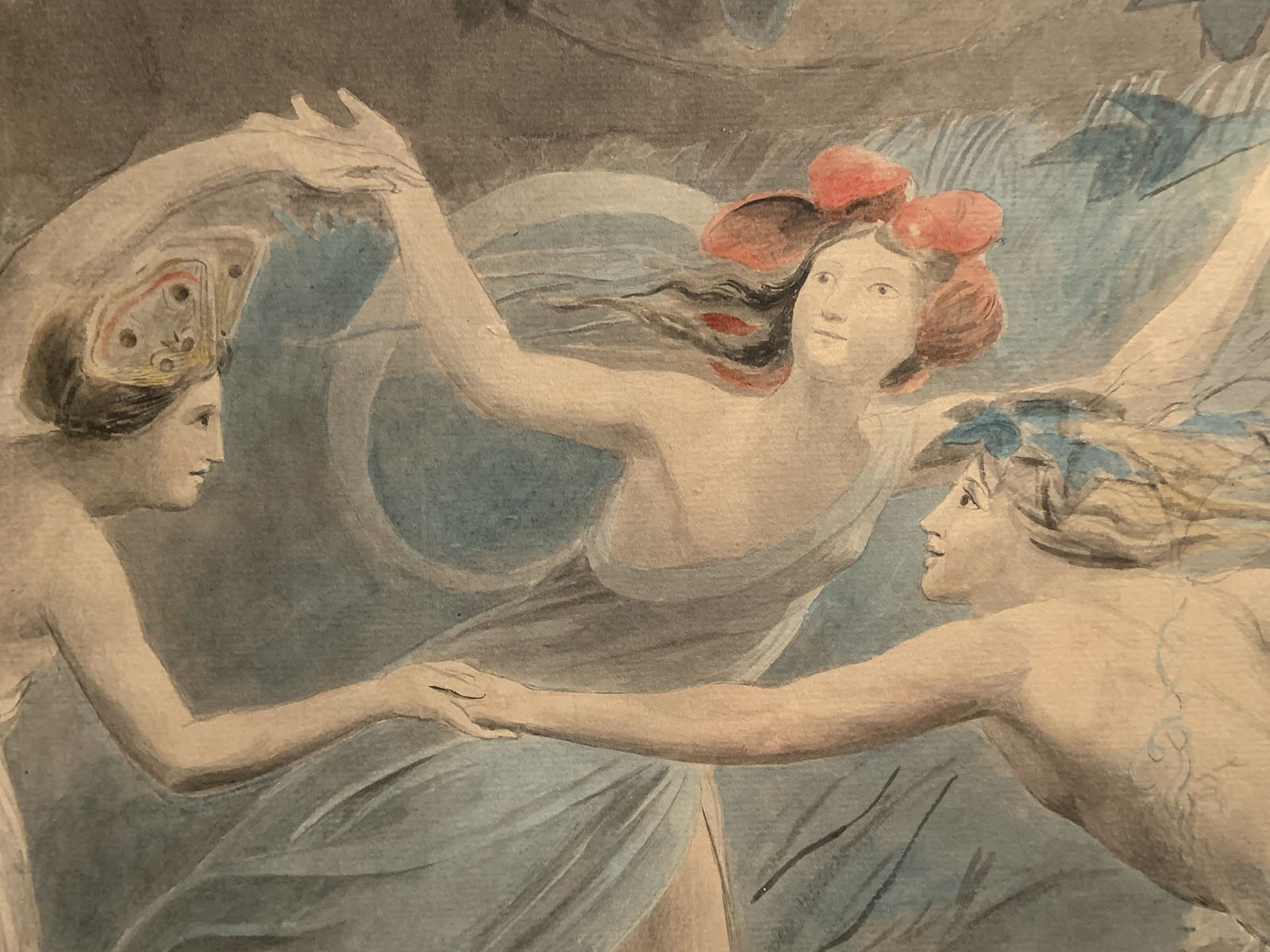
 

Louise Lawler (American, b. 1947) 'Pollyanna (adjusted to fit) distorted for the times' 2007/2008/2012 from the exhibition 'Louise Lawler: WHY PICTURES NOW' at the Museum of Modern Art (MoMA), New York, April - July, 2017


Louise Lawler (American, b. 1947)
Pollyanna (adjusted to fit) distorted for the times
2007/2008/2012
As adjusted for the MoMA exhibition WHY PICTURES NOW, 2017
Dimensions variable
Courtesy the artist and Metro Pictures
© 2017 Louise Lawler


I missed the closing date for this exhibition due to the ongoing problems with my hand. However, I believe it is valuable to post these images because Louise Lawler is an always provocative, thoughtful and interesting artist. She shines a light or, more possibly, pokes a big stick at patriarchal systems of value in art – turning perceived points of view, ways of seeing, and “the cultural circumstances that support art’s production, circulation, and presentation” on their head.

“… behind Ms. Lawler’s shape-shifting works lies a poetic intelligence, a political sharpness and an understanding of the artwork as a form of value, but also as a source and an object of love.”

Well said.

Lawler possesses a unique understanding of the forms of culture embodied within images and also an intimate knowledge of the archetypal forms buried deep within their bones. Is the pattern immanent in the paper (the cosmos), or is the paper a blank slate to be written on by the creator?

Distorted, restaged, reframed and re-presented for the times…

Dr Marcus Bunyan


Many thankx to MoMA for allowing me to publish the photographs in posting. Please click on the photographs for a larger version of the image.

#art #moma #museumofmodernart #museum #modernart #nyc #education #artist #photography #womenartists #femaleartists #louiselawler #whypicturesnow


Louise Lawler (American, b. 1947) 'Pollyanna (adjusted to fit)' 2007/2008/2012 from the exhibition 'Louise Lawler: WHY PICTURES NOW' at the Museum of Modern Art (MoMA), New York, April - July, 2017


Louise Lawler (American, b. 1947)
Pollyanna (adjusted to fit)
2007/2008/2012
As adjusted for the MoMA exhibition WHY PICTURES NOW, 2017
Dimensions variable
Courtesy the artist and Metro Pictures
© 2017 Louise Lawler


Louise Lawler (American, b. 1947) 'Produced in 1988, Purchased in 1989; Produced in 1989, Purchased in 1993 (adjusted to fit), distorted for the times' 1995/2010


Louise Lawler (American, b. 1947)
Produced in 1988, Purchased in 1989; Produced in 1989, Purchased in 1993 (adjusted to fit), distorted for the times
1995/2010
Dimensions variable
Courtesy the artist and Metro Pictures
© 2017 Louise Lawler


(Note on reproducing Lawler’s Adjusted to Fit works: Each time these images are reproduced, they should be stretched to the space given to the reproduction. The original file (un-stretched) is the origin point for anything that is then adjusted by the photo editor.)


Louise Lawler (American, b. 1947) 'Produced in 1988, Purchased in 1989; Produced in 1989, Purchased in 1993 (adjusted to fit)' 1995/2010


Louise Lawler (American, b. 1947)
Produced in 1988, Purchased in 1989; Produced in 1989, Purchased in 1993 (adjusted to fit), distorted for the times
1995/2010
Dimensions variable
Courtesy the artist and Metro Pictures
© 2017 Louise Lawler


Louise Lawler: WHY PICTURES NOW is the first major survey in New York of the artist Louise Lawler (American, b. 1947), spanning the 40-year creative output of one of the most influential artists working in the fields of image production and institutional critique. The exhibition takes its title from one of Lawler’s most iconic works, Why Pictures Now (1982), a black-and-white photograph showing a matchbook propped up in an ashtray. Reminiscent of an advertising photograph or a film noir still, it asks the viewer to consider why the work takes the form of a picture, and why the artist is making pictures now. Lawler came of age as part of the Pictures Generation, a loosely knit, highly independent group of artists named for an influential exhibition, Pictures, organised in 1977 by art historian Douglas Crimp at Artists Space in New York. These artists used photography and appropriation-driven strategies to examine the functions and codes of representation. Lawler’s signature style was established in the late 1970s and early 1980s, when she began taking pictures of other artists’ works displayed in collectors’ homes, museums, storage spaces, and auction houses to question the value, meaning, and use of art.
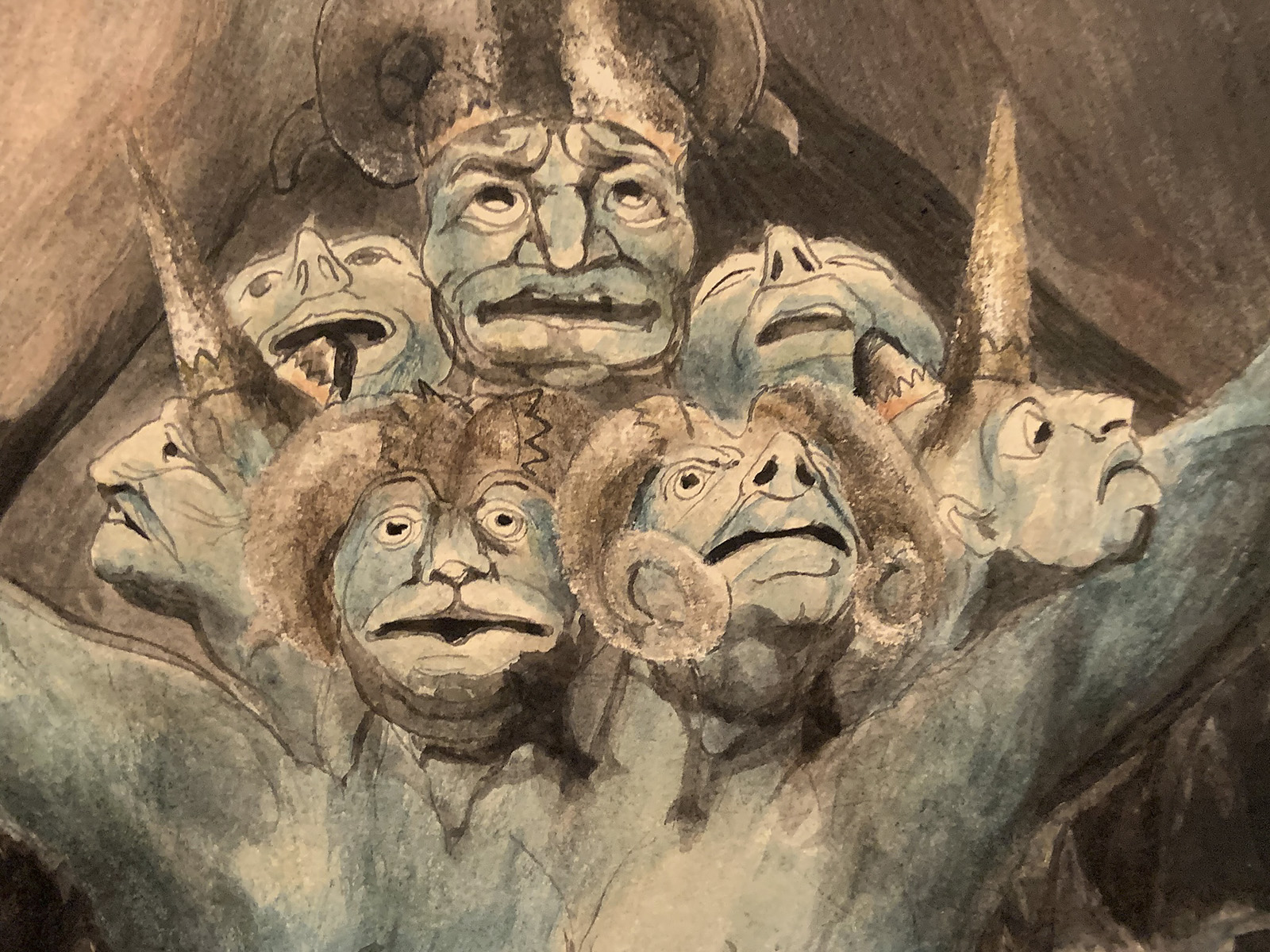
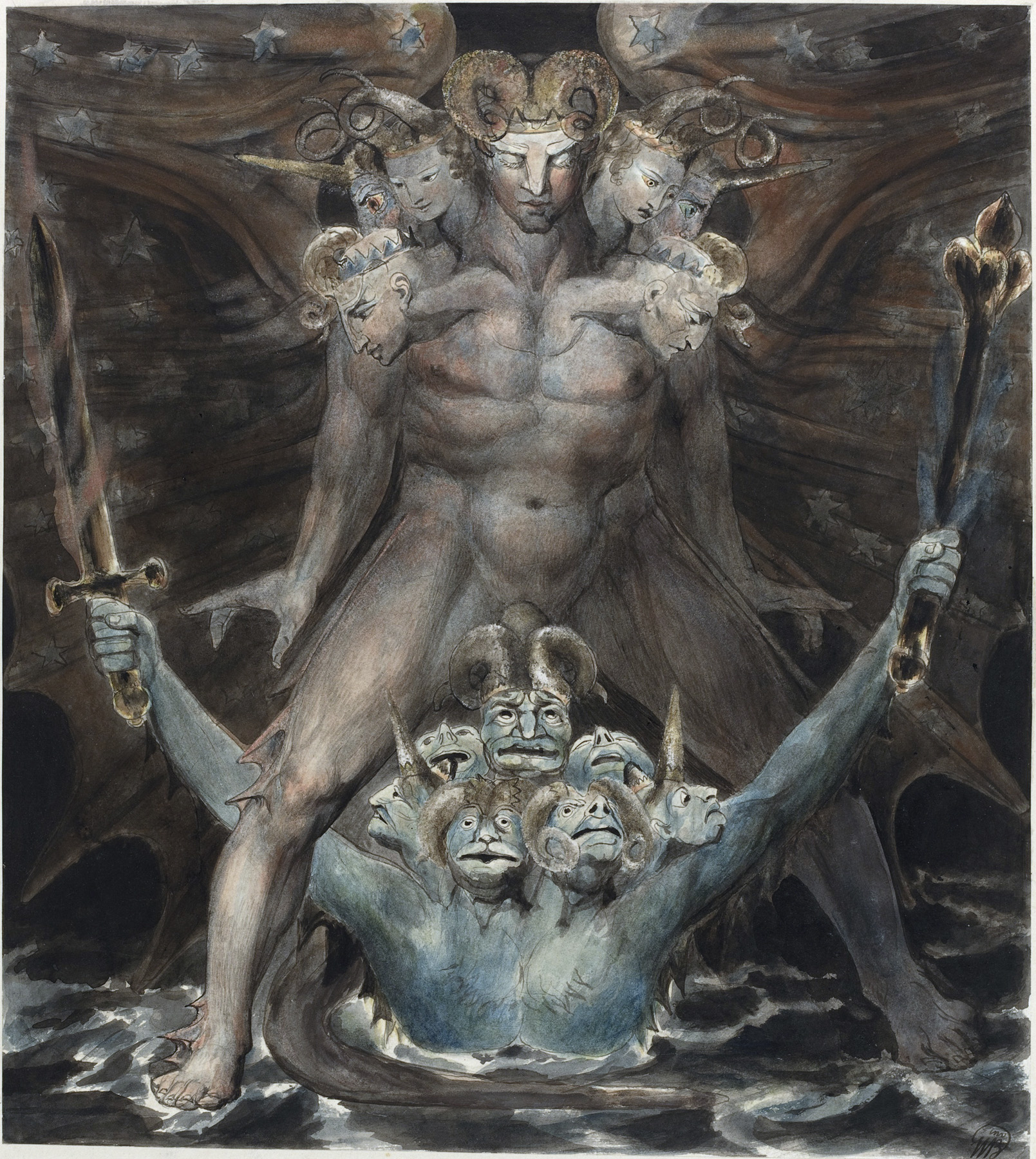
WHY PICTURES NOW is organised by Roxana Marcoci, Senior Curator, with Kelly Sidley, Curatorial Assistant, Department of Photography.


“Ms. Lawler and Roxana Marcoci, the exhibition’s curator, have devised something quite different: an open, airy survey with lots of room for roaming, some chairs for sitting and two conjoined, markedly different halves focusing on Ms. Lawler’s activities with pictures and then words. The first half is dominated by photographs in various shapes and guises, including mural-size images. The second, which seems almost empty at first, contains two large vitrines of ephemera that show off Ms. Lawler’s gifts for graphic design and for language, with displays of everything from matchbook covers and napkins to exhibition announcements and art books that she photo-edited. …

Ms. Lawler’s images have multiple lives, exposing the ceaseless flexibility of photographs. Constantly recycled, they go from framed and portable to paperweights to the wall-covering murals of her “adjusted to fit” series. In the show’s first half, four “adjusted” photos cover immense, staggered walls, looming like ocean liners sliding out of their docks. Their monumentality thrills but also chides the art world for its embrace of spectacle and the overblown. …

It is hard to know if these words [“Why Pictures Now”] proclaim the power, or the worthlessness, of pictures. Probably both. Either way, behind Ms. Lawler’s shape-shifting works lies a poetic intelligence, a political sharpness and an understanding of the artwork as a form of value, but also as a source and an object of love.”


Roberta Smith. “Louise Lawler’s Stealth Aesthetic (and Muted Aura),” on the New York Times website May 11, 2017 [Online] Cited 29/12/2021


Louise Lawler: WHY PICTURES NOW | MoMA LIVE

Join us for a conversation with MoMA director Glenn Lowry and curator Roxana Marcoci on the opening of the exhibition, Louise Lawler: WHY PICTURES NOW. The first New York museum survey of the work of American artist Louise Lawler, this exhibition is an exploration of her creative output, which has inspired fellow artists and cultural thinkers alike for the past four decades.

Among the most intriguing aspects of Lawler’s working process is her continuous re-presentation, reframing, or restaging in the present, a strategy through which she revisits her own images by transferring them to different formats – from photographs to paperweights, tracings, and works she calls “adjusted to fit” (images stretched or expanded to fit the location of their display). Lawler’s critical strategies of reformatting existing content not only suggest the idea that pictures can have more than one life, but underpin the intentional, relational character of her farsighted art.


Louise Lawler | HOW TO SEE the artist with MoMA curator Roxana Marcoci

Can the exact same image have a completely different meaning if its title or medium is changed? Explore the work of one of today’s most influential female artists, Louise Lawler, in the new exhibition Louise Lawler: WHY PICTURES NOW.

MoMA curator Roxana Marcoci gives us a tour of the exhibition that charts Lawler’s continuous re-presentation, reframing, or restaging of the present, a strategy through which Lawler revisits her own images by transferring them to different formats – from photographs to paperweights, tracings, and works she calls “adjusted to fit” (images stretched or expanded to fit the location of their display).


Louise Lawler’s Birdcalls at MoMA

You’re not hearing things. For the duration of the Louise Lawler exhibition, a stroll through our Abby Aldrich Rockefeller Sculpture Garden places you squarely in the middle of Birdcalls, the artist’s defiant, humorous critique of the art world’s captivation with male artists. Find out what exhibition inspired Lawler’s sole sound piece with MoMA curator Roxana Marcoci.


Installation view of 'Louise Lawler: WHY PICTURES NOW' at The Museum of Modern Art

Installation view of 'Louise Lawler: WHY PICTURES NOW' at The Museum of Modern Art

Installation view of 'Louise Lawler: WHY PICTURES NOW' at The Museum of Modern Art

Installation view of 'Louise Lawler: WHY PICTURES NOW' at The Museum of Modern Art

Installation view of 'Louise Lawler: WHY PICTURES NOW' at The Museum of Modern Art

Installation view of 'Louise Lawler: WHY PICTURES NOW' at The Museum of Modern Art

Installation view of 'Louise Lawler: WHY PICTURES NOW' at The Museum of Modern Art

Installation view of 'Louise Lawler: WHY PICTURES NOW' at The Museum of Modern Art

Installation view of 'Louise Lawler: WHY PICTURES NOW' at The Museum of Modern Art


Installation views of Louise Lawler: WHY PICTURES NOW
© 2017 The Museum of Modern Art
Photos: Martin Seck


Lawler’s study of art in its commercial context will be complemented by the display of a work by a younger artist that highlights a different kind of economy. The sculpture New York State Unified Court System (top photo), by artist Cameron Rowland, included in the artist’s knockout exhibition at Artists Space this winter, takes the form of four oak benches used in courtrooms and built using prison labour.

Brian Boucher. “MoMA Plans a Giant Louise Lawler Retrospective for 2017,” on the Artnet website June 23, 2016 [Online] Cited 29/12/2021


Louise Lawler (American, b. 1947) 'Why Pictures Now' 1981


Louise Lawler (American, b. 1947)
Why Pictures Now
1981
Gelatin silver print
3 x 6” (7.6 x 15.2cm)
The Museum of Modern Art, New York
Acquired with support from Nathalie and Jean-Daniel Cohen in honour of Roxana Marcoci
© 2016 Louise Lawler


Louise Lawler (American, b. 1947) 'Why Pictures Now (traced)' 1981/2013


Louise Lawler (American, b. 1947)
Why Pictures Now (traced)
1981/2013
Dimensions variable
Courtesy the artist and Metro Pictures
© 2016 Louise Lawler


Louise Lawler (American, b. 1947) '(Roy Lichtenstein and Other Artists) Black' 1982


Louise Lawler (American, b. 1947)
(Roy Lichtenstein and Other Artists) Black
1982
Silver dye bleach print
28 1/2 x 37 1/4″ (72.4 x 94.6cm)
Courtesy the artist and Metro Pictures
© 2016 Louise Lawler


Louise Lawler (American, b. 1947) '(Andy Warhol and Other Artists) Tulip' 1982


Louise Lawler (American, b. 1947)
(Andy Warhol and Other Artists) Tulip
1982
Silver dye bleach print
38 1/2 x 60 1/2″ (97.8 x 153.7cm)
Courtesy the artist and Metro Pictures
© 2016 Louise Lawler


Louise Lawler (American, b. 1947) 'Monogram' 1984


Louise Lawler (American, b. 1947)
Monogram
1984
Silver dye bleach print
39 1/2 × 28″ (100.3 × 71.1cm)
Courtesy the artist and Metro Pictures, New York
© 2017 Louise Lawler


“Swimming among the show’s images are words and wordplay that can have a few layers. One of Ms. Lawler’s better-known photographs shows Jasper Johns’s creamy “White Flag” (1955) hanging above a bed with an equally creamy monogrammed satin spread. The image is sensibly titled “Monogram,” all the more fittingly since “Monogram” is also the title of one of Robert Rauschenberg’s combines from the 1950s, when he and Mr. Johns were lovers.

Roberta Smith. “Louise Lawler’s Stealth Aesthetic (and Muted Aura),” on the New York Times website May 11, 2017 [Online] Cited 29/12/2021


Louise Lawler (American, b. 1947) 'Untitled, 1950-51' 1987


Louise Lawler (American, b. 1947)
Untitled, 1950-51
1987
Silver dye bleach print
29 3/8 × 39 1/4″ (74.6 × 99.7cm)
Courtesy the artist and Metro Pictures, New York
© 2017 Louise Lawler


Louise Lawler (American, b. 1947) 'Does Andy Warhol Make You Cry?' 1988


Louise Lawler (American, b. 1947)
Does Andy Warhol Make You Cry?
1988
Silver dye bleach print with text on Plexiglass wall label
Image (shown): 27 1/4 x 39″ (69.2 x 99.1cm)
Label: 4 3/8 x 6 3/8 in. (11.1 x 16.2cm)
The Museum of Modern Art, New York
Gift of Gabriella de Ferrari in honour of Karen Davidson
© 2016 Louise Lawler


“Lawler’s suspicion of the image is nothing new. In WHY PICTURES NOW, her career survey currently on view at the Museum of Modern Art, the Pictures Generation artist is again and again engaged in taking the familiar – a famous work of art, different forms of banal ephemera – and making it abnormal through clever subversion. There is a timid jostling of her male peers, a slight nudge off the pedestal of reverence, which is evident in much of her work and makes it eminently appealing – even if some of its institutional critique is diminished under the museum’s glow of prestige. But what is often obscured in Lawler’s work is the way that it’s not only questioning the apparatus of making and displaying art, but also its reception – the formalised way that we, the spectators, are looking.”


Craig Hubert. “Louise Lawler Screens a Movie with No Images,” on the Hyperallergic website May 5, 2017 [Online] Cited 29/12/2021


The Museum of Modern Art announces Louise Lawler: WHY PICTURES NOW, the first major survey in New York of the artist Louise Lawler (American, b. 1947). Spanning the 40-year creative output of one of the most influential artists working in the fields of image production and institutional critique, the exhibition will be on view from April 30 to July 30, 2017, in The Joan and Preston Robert Tisch Exhibition Gallery, sixth floor, along with one sound work, Birdcalls (1972-1981), which will be installed in The Abby Aldrich Rockefeller Sculpture Garden. The exhibition takes its title from one of Lawler’s most iconic works, Why Pictures Now (1982), a black-and-white photograph showing a matchbook propped up in an ashtray. Reminiscent of an advertising photograph or a film noir still, it asks the viewer to consider why the work takes the form of a picture, and why the artist is making pictures at this moment. Lawler came of age as part of the Pictures Generation, a loosely knit, highly independent group of artists named for an influential exhibition, Pictures, organised in 1977 by art historian Douglas Crimp at Artists Space in New York. These artists used photography and appropriation-driven strategies to examine the functions and codes of representation. Lawler’s signature style was established in the late 1970s and early 1980s, when she began taking pictures of other artists’ works displayed in collectors’ homes, museums, storage spaces, and auction houses to question the value, meaning, and use of art. WHY PICTURES NOW is organised by Roxana Marcoci, Senior Curator, with Kelly Sidley, Curatorial Assistant, Department of Photography.

Lawler’s work offers a defiant, witty, and sustained feminist analysis of the strategies that inform art’s production and reception. In 1971, she was invited to assist several artists for independent curator Willoughby Sharp’s Pier 18, an exhibition that featured 27 male artists on an abandoned pier on the Hudson River. While walking home after leaving the pier one evening, Lawler began to mimic birdlike sounds in order to ward off any unwanted interactions, chanting “Willoughby! Willoughby!” This parody evolved into Birdcalls, a seven-minute audio piece in which Lawler squawks, chirps, and twitters the names of famous male artists, from Vito Acconci to Lawrence Weiner – an astute critique of the name recognition enjoyed by her male contemporaries. Birdcalls thematises Lawler’s strategy of resistance to the authoritative and the patronymic proper name. This work will be played throughout the course of the exhibition, in MoMA’s Abby Aldrich Rockefeller Sculpture Garden.

An intriguing aspect of Lawler’s practice is her process of continuous re-presentation, reframing, or restaging in the present: she revisits her own work by transferring her images to different formats, from a photograph to a tracing, and to works that she calls “adjusted to fit.” The “tracings” are large-format black-and-white line versions of her photographs that eliminate colour and detail, functioning instead as “ghosts” of the originals. “Adjusted to fit” images are stretched or expanded to fit the location of their display, not only suggesting the idea that pictures can have more than one life, but also underpinning the intentional, relational character of Lawler’s farsighted art.

The exhibition consists of a sequence of mural-scale, “adjusted to fit” images set in dynamic relation to non-linear groupings of photographs – of collectors’ homes, auction houses, and museum installations – distinctive of Lawler’s conceptual exercises. Additionally, a deceptively empty gallery presents black-and-white tracings of Lawler’s photographs that have been printed on vinyl and mounted directly on the wall. A display of the artist’s ephemera from the 1970s to today highlights the feminist and performative undercurrents of her art. Lawler’s long history of artistic collaborations, with Sherrie Levine, Allan McCollum, Andrea Fraser, Felix Gonzalez-Torres, Christopher d’Arcangelo, Peter Nadin, and Lawrence Weiner, among others, come full circle in the ephemera on display. Furthermore, on the platform outside the gallery space, two “adjusted to fit” images are shown together with Cameron Rowland’s work New York State Unified Court System. Comprised of four oak courtroom benches, it was included in Rowland’s exhibition 91020000, presented at Artists Space in 2016. Lawler and Rowland share an interest in examining the imbalances of exploitative economies, the use value and exchange value of art, the politics of space, and the interplay of power between human relations and larger institutional structures, including markets, museums, prisons, and governments. Additionally, Andrea Fraser will perform her work May I Help You? in the exhibition space. In foregrounding her work’s relationship to the economies of collaboration and exchange, Lawler shifts focus from the individual picture to the broader history of art. Her careful attention to artistic contexts, modes of presentation, and viewers’ receptions generates witty, affective situations that contribute to institutional transformation.

Press release from MoMA


Louise Lawler (American, b. 1947) 'Untitled (Salon Hodler)' 1992


Louise Lawler (American, b. 1947)
Untitled (Salon Hodler)
1992
Paperweight (silver dye bleach print, crystal, felt) with text on wall
Paperweight: 2″ (5.1cm) high, 3 1/2″ (8.9cm) diam.
Courtesy the artist and Metro Pictures, New York
© 2017 Louise Lawler


Louise Lawler (American, b. 1947) 'Salon Hodler (traced)' 1992/1993/2013


Louise Lawler (American, b. 1947)
Salon Hodler (traced)
1992/1993/2013
Dimensions variable
Courtesy the artist and Metro Pictures
© 2016 Louise Lawler


Louise Lawler (American, b. 1947) 'Sentimental' 1999/2000


Louise Lawler (American, b. 1947)
Sentimental
1999/2000
Silver dye bleach print
40 3/4 x 46 3/4 inches (103.5 x 118.7cm)
The Museum of Modern Art, New York
Promised gift of Glenn and Amanda Fuhrman
© 2016 Louise Lawler


Louise Lawler (American, b. 1947) 'WAR IS TERROR' 2001/2003


Louise Lawler (American, b. 1947)
WAR IS TERROR
2001/2003
Silver dye bleach print
30 × 25 3/4″ (76.2 × 65.4cm)
Courtesy the artist and Metro Pictures, New York
© 2017 Louise Lawler


Louise Lawler (American, b. 1947) 'Nude' 2002/2003


Louise Lawler (American, b. 1947)
Nude
2002/2003
Silver dye bleach print
59 1/2 × 47 1/2 inches (151.1 × 120.7cm)
Courtesy the artist and Metro Pictures, New York
© 2017 Louise Lawler


Louise Lawler (American, b. 1947) 'White Gloves' 2002/2004


Louise Lawler (American, b. 1947)
White Gloves
2002/2004
Silver dye bleach print
29 × 27 1/2 inches (73.7 × 69.9cm)
Courtesy the artist and Metro Pictures, New York
© 2017 Louise Lawler


Louise Lawler (American, b. 1947) 'Life After 1945 (Faces)' 2006/2007


Louise Lawler (American, b. 1947)
Life After 1945 (Faces)
2006/2007
Silver dye bleach print
40 x 33 1/4 inches (101.6 x 84.5cm)
The Museum of Modern Art, New York
Promised gift of Glenn and Amanda Fuhrman
© 2016 Louise Lawler


Louise Lawler (American, b. 1947) 'Triangle (adjusted to fit)' 2008/2009/2011


Louise Lawler (American, b. 1947)
Triangle (adjusted to fit)
2008/2009/2011
Dimensions variable
Courtesy the artist and Metro Pictures
© 2016 Louise Lawler


Louise Lawler (American, b. 1947) 'No Drones' 2010/2011


Louise Lawler (American, b. 1947)
No Drones
2010/2011
Chromogenic colour print
29 1/4 x 19 3/4 inches (74.3 x 50.2cm)
Courtesy the artist and Metro Pictures
© 2016 Louise Lawler


Louise Lawler (American, b. 1947) 'Marie +270' 2010/2012


Louise Lawler (American, b. 1947)
Marie +270
2010/2012
Chromogenic colour print
59 x 45 1/2 inches (149.9 x 115.6cm)
The Museum of Modern Art, New York
Promised gift of Ricki Gail Conway
© 2016 Louise Lawler


Louise Lawler (American, b. 1947) 'Pollock and Tureen (traced)' 1984/2013


Louise Lawler (American, b. 1947)
Pollock and Tureen (traced)
1984/2013
Dimensions variable
The Museum of Modern Art, New York
The Abby Aldrich Rockefeller Endowment
© 2016 Louise Lawler


One of her most famous images, “Pollock and Tureen” (1984), shows a fragment of a painting by Jackson Pollock above an antique soup tureen. In the photograph, the colour relationships are clear, offering insight into the choices of the collectors who “arranged” (a favourite word of Lawler’s) the scene. The work is about class, capitalism, and domesticity, not to mention reality and fiction. But when all the site-specific context is removed [in the tracing] … all we’re left with is contemplating the original Lawler artwork’s role in art history and the market.

In Benjamin Buchloh’s essay for Lawler’s retrospective last year at the Museum Ludwig, one of his most cogent points is about the nature of melancholy in her original photographs. “[H]er images,” he writes, “leave equally little doubt that there is hardly a more melancholic space than that of a fulfilled and seemingly satisfied utopian aspiration, one that has, however, not quite lived up to the originary promises … “

Hrag Vartanian. “The Values of Louise Lawler,” on the Hypoallergic website July 21, 2014 [Online] Cited 29/12/2021


Louise Lawler (American, b. 1947) 'Hand on Her Back (traced)' 1997/1998/2013


Louise Lawler (American, b. 1947)
Hand on Her Back (traced)
1997/1998/2013
Dimensions variable
Courtesy the artist and Metro Pictures
© 2016 Louise Lawler


Louise Lawler (American, b. 1947) 'Evening Sale' 2010/2015


Louise Lawler (American, b. 1947)
Evening Sale
2010/2015
Silver dye bleach print
50 x 36 5/8 inches (127 x 93cm)
Courtesy the artist and Metro Pictures
© 2016 Louise Lawler


Louise Lawler (American, b. 1947) 'Big (adjusted to fit)' 2002/2003/2016


Louise Lawler (American, b. 1947)
Big (adjusted to fit)
2002/2003/2016
Dimensions variable
The Museum of Modern Art, New York
Acquired through the generosity of The Modern Women’s Fund and The Contemporary Arts Council
© 2016 Louise Lawler


Louise Lawler (American, b. 1947) 'Still Life (Candle) (adjusted to fit)' 2003/2016


Louise Lawler (American, b. 1947)
Still Life (Candle) (adjusted to fit)
2003/2016
Dimensions variable
Courtesy the artist and Metro Pictures
© 2016 Louise Lawler


Louise Lawler (American, b. 1947) 'Arranged by Donald Marron, Susan Brundage, Cheryl Bishop at Paine Webber Inc. (adjusted to fit)' 1982/2016


Louise Lawler (American, b. 1947)
Arranged by Donald Marron, Susan Brundage, Cheryl Bishop at Paine Webber Inc. (adjusted to fit)
1982/2016
Dimensions variable
Courtesy the artist and Metro Pictures
© 2016 Louise Lawler


The Museum of Modern Art
11 West 53 Street
New York, NY 10019
Phone: (212) 708-9400

Opening hours:
10.30am – 5.30pm
Open seven days a week

MoMA website

LIKE ART BLART ON FACEBOOK

Back to top