Exhibition: ‘Ansel Adams in Our Time’ at the de Young Museum, San Francisco

Exhibition dates: 8th April – 23rd July, 2023

Curator: Karen Haas, Lane Senior Curator of Photographs at the Museum of Fine Arts, Boston

Participating artists: Ansel Adams, 1902-1984;  Matthew Brandt, b. 1982; Lois Conner, b. 1951; Binh Danh, b. 1977; Mitch Epstein, b. 1952; Lucas Foglia, b. 1983; Sharon Harper, b. 1966; Frank Jay Haynes, 1853-1921; CJ Heyliger, b. 1984; John K. Hillers, 1843-1925;  Mark Klett, b. 1952; Chris McCaw, b. 1971;  Laura McPhee, b. 1958; Arno Rafael Minkkinen, b. 1945; Richard Misrach, b. 1949; Abelardo Morell, b. 1948; Eadweard Muybridge, 1830-1904; Catherine Opie, b. 1961; Trevor Paglen, b. 1974; Meghann Riepenhoff, b. 1979; Mark Ruwedel, b. 1954; Victoria Sambunaris, b. 1964; Bryan Schutmaat, b. 1983; David Benjamin Sherry, b. 1981; John Payson Soule, 1827-1904; Stephen Tourlentes, b. 1959; Adam Clark Vroman, 1856-1916; Carleton E. Watkins, 1829-1916; Will Wilson, b. 1969; Byron Wolfe, b. 1967.

Please note: This posting may contain the names or images of people who are now deceased.  Some Indigenous communities may be distressed by seeing the name or image of a community member who has passed away.
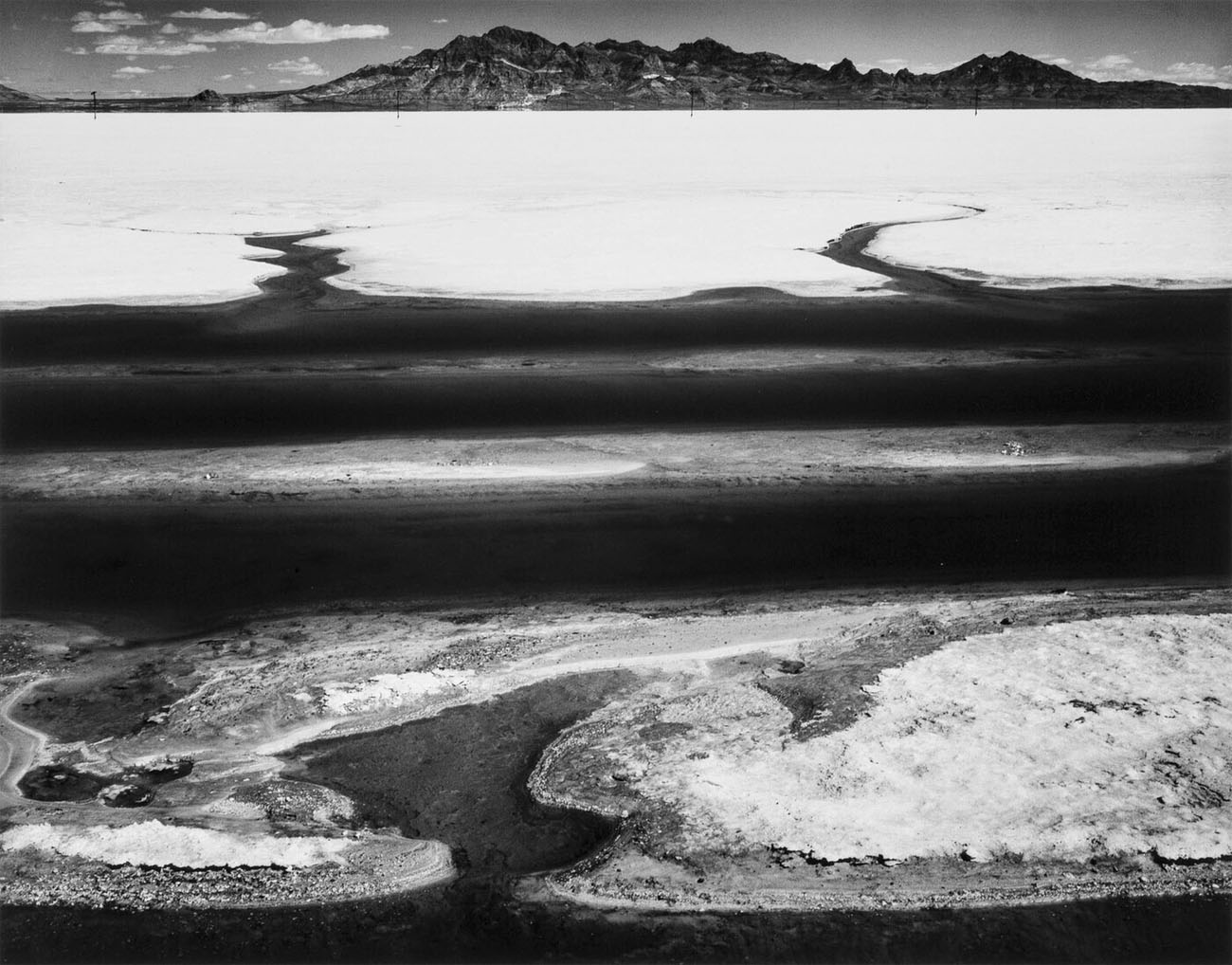
 

Ansel Adams (American, 1902-1984) 'Salt Flats Near Wendover, Utah' 1953 from the exhibition 'Ansel Adams in Our Time' at the de Young Museum, San Francisco, April - July, 2023


Ansel Adams (American, 1902-1984)
Salt Flats Near Wendover, Utah
1953
Gelatin silver print
The Lane Collection
Courtesy Museum of Fine Arts, Boston
© The Ansel Adams Publishing Rights Trust


Ansel Adams made this remarkably abstract image of ancient salt beds during the first year of his national parks project. Barely visible in the distance is a delicate string of telephone poles and wires, a slightly jarring intervention into an otherwise empty space. Adams’ inclusion of the poles might be explained in part by the fact that Wendover was the meeting point for the first telephone line between New York and San Francisco. This achievement was celebrated at the 1915 Panama-Pacific International Exposition – a fair that the young Adams attended nearly every day, after his father gave him a season pass with instructions to visit daily, in place of formal schooling.

Exhibition label text


Man and imagination

Most could not fail to know the superb landscape work of Ansel Adams, that master of the large format camera used to produce stunning black and white silver gelatin photographs of great formal beauty and technical prowess, the rich detail and tonal range of his landscape photographs used “in service of what he called the “spiritual-emotional” aspects of parks and wilderness, conveying their restorative power to as wide an audience as possible.” His photographs are so well known that they became icons and he a legend in his own lifetime. But all is not as effortless in his beautiful modernist photographs as they seem.

Early landscape photographs from his 1927 portfolio Parmelian Prints of the High Sierras (below) show Adams’ indebtedness to pictorialist and modernist photography. Indeed these elemental and muscular photographs show a dramatic use of dark and light hues in the near / far construction of the picture frame, the warm toned prints adding to their chthonic, almost underground and dystopian nature. Dark and brooding, dystopian and abstract. Those dark tones have a warmth that is contradictory – a lack of light: yet warmth! So there is a fiction at their heart… and that is why their dark brooding never seems a threat for they were based on a dream-world that couldn’t exist. What a difference to the later straight-ahead aesthetic of the artist and Group f64 (“a group founded by Adams of seven 20th-century San Francisco Bay Area photographers who shared a common photographic style characterised by sharply focused and carefully framed images seen through a particularly Western viewpoint.” ~ Wikipedia).

Other mutations and obfuscations are hidden from view “in order” that the artist achieve his desired transcendence of the American landscape. Adams cropped out attendant carparks and people viewing the scene even as other artists such as Seema Weatherwax incorporated them into their work (in the 1940s) as “indelible reminders of a Yosemite modernised for tourism – reminders that Adams typically left out of his artistic work.” Adams even manipulated the negative where necessary, for example removing a road that inconveniently ran through the centre of a canyon that destroyed his imaginative (and Western) vision of the pristine Sierra Nevada. So much for his “absolute realism” and honest simplicity in service of a maximum emotional statement.

Adam’s photographs of Indigenous Americans are also pictures seen from a particularly Western viewpoint, that of the fetishistic valorisation of Indigenous culture. “In the 1920s, writers and artists including D. H. Lawrence, Mabel Dodge Luhan, John Sloan, and Marsden Hartley projected an “authenticity” onto Pueblo visual culture, which justified their appropriation of its subject matter and form to create a native modernist aesthetic. Many photographers did the same, including Ansel Adams and Wright Morris…”1

When Adams first visited the American Southwest in 1927 to publish a book about Taos Pueblo “that aimed to communicate the threat tourism in the region posed to the artistic and religious traditions of Indigenous people [he] made images for the book only after receiving permission from the Taos Pueblo council, to whom he paid a fee and gifted a copy of the finished publication. He also photographed some Indian cultural observances that had become popular attractions among tourists. Adams’s own images of Native dancers have a complex legacy: although he was one of the non-Native onlookers, he carefully framed his views to leave out evidence of the gathered crowds.” (Exhibition wall text) As Joseph Aguilar (San Ildefonso Pueblo) notes in a further exhibition label text, “At the time, Pueblo people and other Native Americans in the Southwest were trying to navigate the outsiders who were interested in their culture. Some of them did not quite understand the circumstances surrounding the curiosity, while others did understand the extractive nature, and they had to weigh that in terms of their other needs. I get questions from members of my community about why they did not chase the archaeologists and photographers out, and I often respond it is because of the uneven power relations between Indigenous and non-Native people at the time.” This influx of artists and photographers did lead to the racist exoticisation and flattening of Indigenous identity performed by the photograph. What is heartening to see in this exhibition is that the curators have placed Adams’ Indigenous American portraits and landscapes in both a historical and contemporary setting, proffering alternative points of view from within the communities being photographed.

An extractive, imaginative and emotional Western “nature” then, is at the heart of Adam’s work and his “marketing the view” – whether that be national parks, empty bays before the construction of the Golden Gate Bridge, or Native Americans. While he was a tireless champion of photography as a legitimate form of fine art and an unremitting activist for conservation and wilderness preservation, Adams’ photographs are a creation of a myth of his own of a pristine wilderness which had never co-existed with man. To our benefit, Adams had his ideals and he let them manifest themselves in his imagination.

Dr Marcus Bunyan


1/ Yechen Zhao. “Photographic Fluency (Its Pleasures and Pains): Kyo Koike and Chao-Chen Yang,” in Josie R. Johnson. Reality Makes Them Dream: American Photography, 1929-1941. Iris & B. Gerald Cantor Center for Visual Arts at Stanford University, 2023, p. 55.


Many thankx to the de Young museum for allowing me to publish the photographs in the posting. Please click on the photographs for a larger version of the image.


“Only pictures that look as if they had been made easily can convincingly suggest that beauty is commonplace.”


Robert Adams. Beauty in Photography. New York: Aperture, 1996, p. 28.


A self-described “California photographer,” Ansel Adams had his first museum exhibition at the de Young in 1932. In a San Francisco homecoming, more than 100 of his most iconic works are on view in Ansel Adams in Our Time alongside those of 23 contemporary artists who share his deep concern for the environment, Catherine Opie, Richard Misrach, Trevor Paglen, and Binh Danh among them. An unremitting activist for conservation and wilderness preservation in the spirit of his 19th-century predecessors, Adams is today beloved for his lush gelatin silver prints of the national parks. Organised by the Museum of Fine Arts, Boston, in partnership with the Fine Arts Museums of San Francisco, Ansel Adams in Our Time is enhanced at the de Young by the addition of works from the Museums’ permanent collection and new interpretive framing that explores Adams’ close connection to the Bay Area and the state of California more broadly.
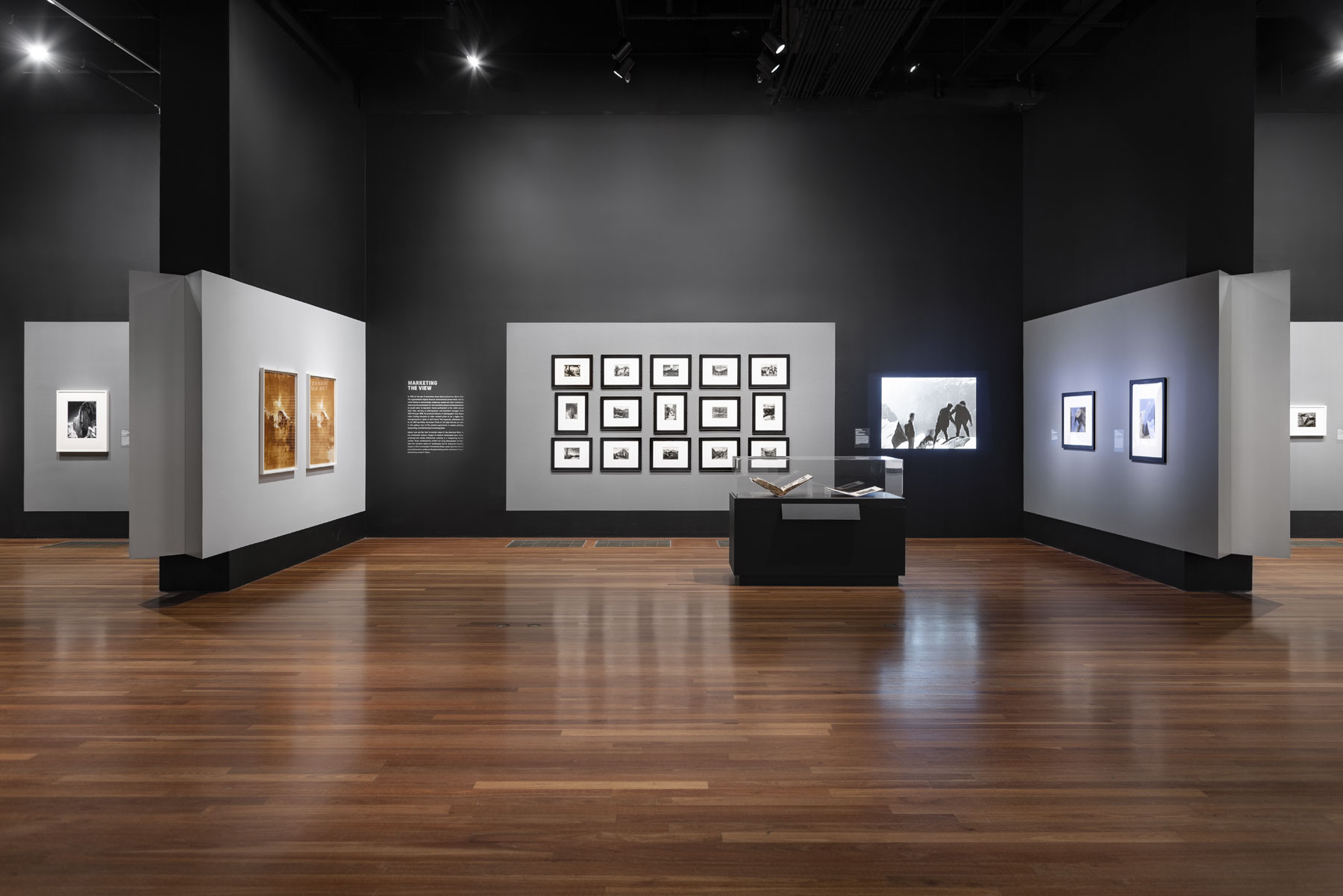
 

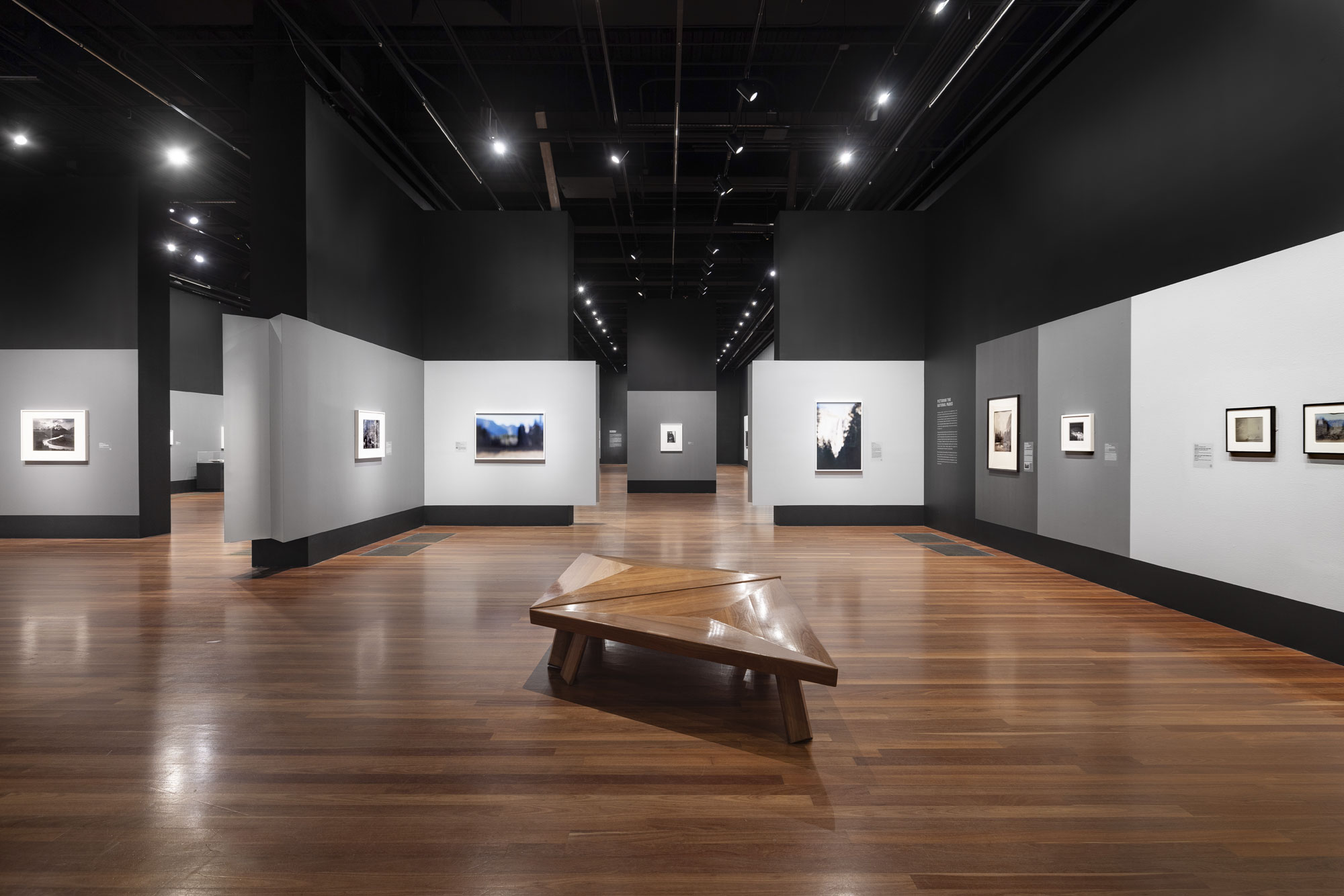
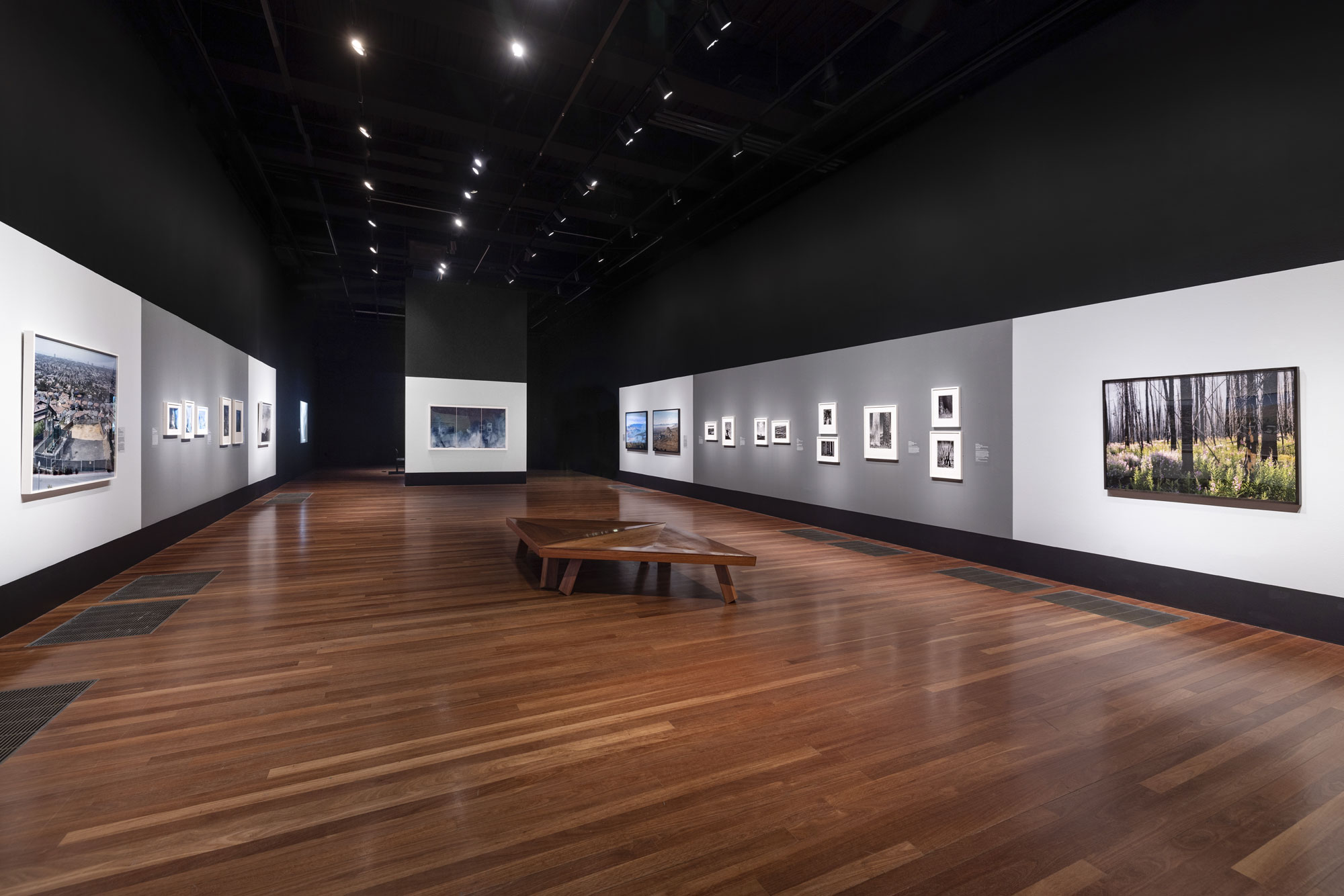
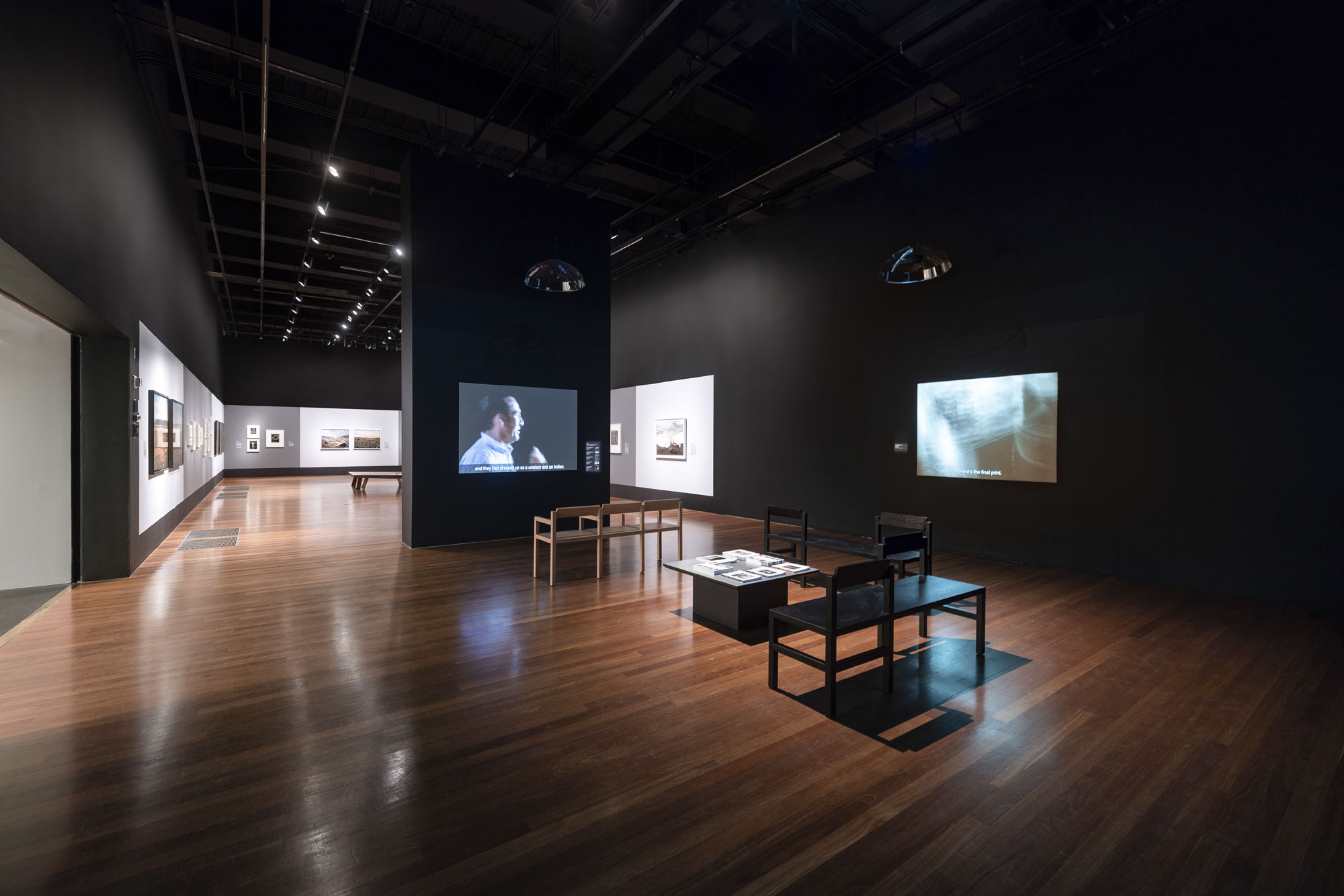
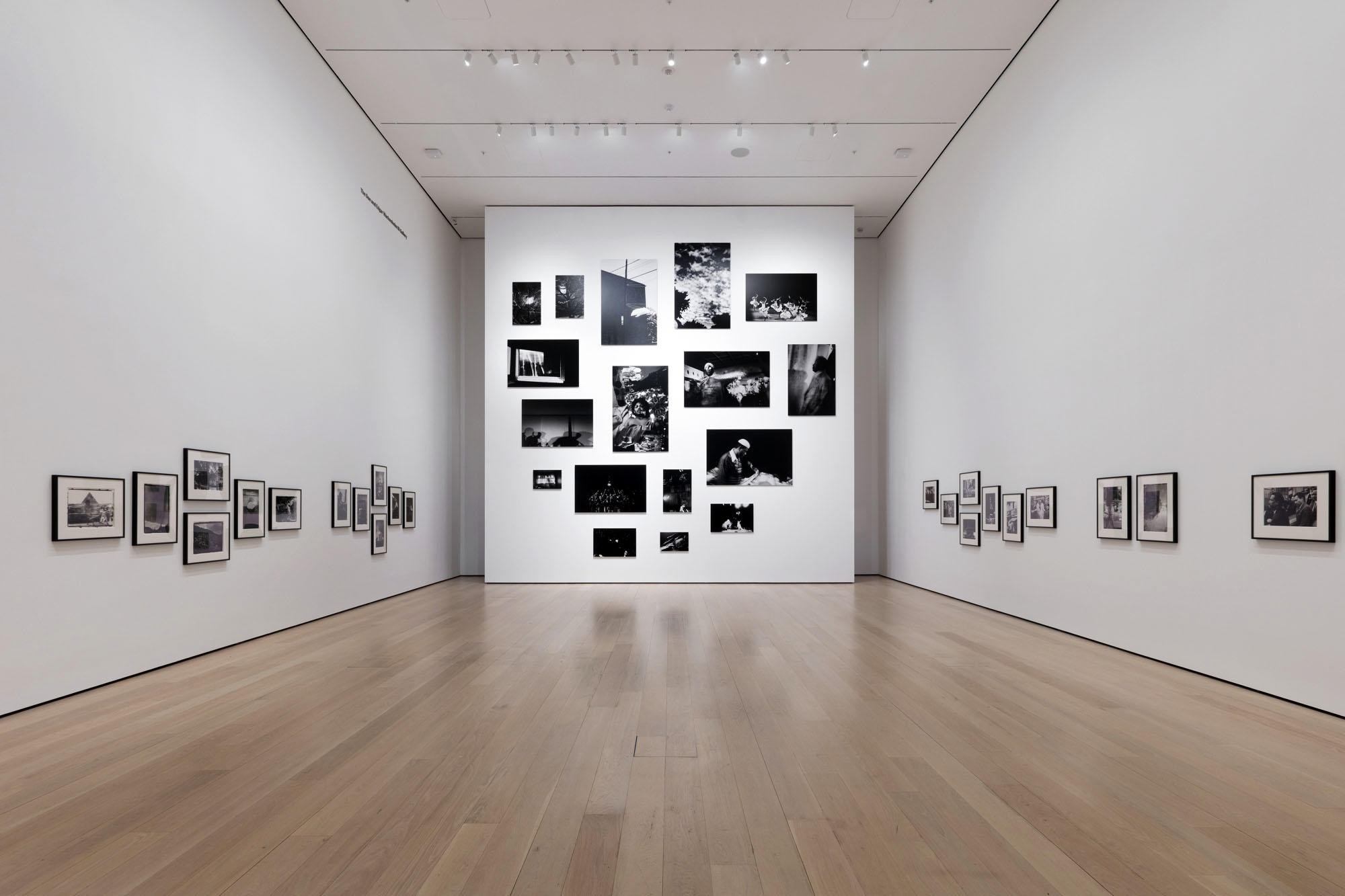
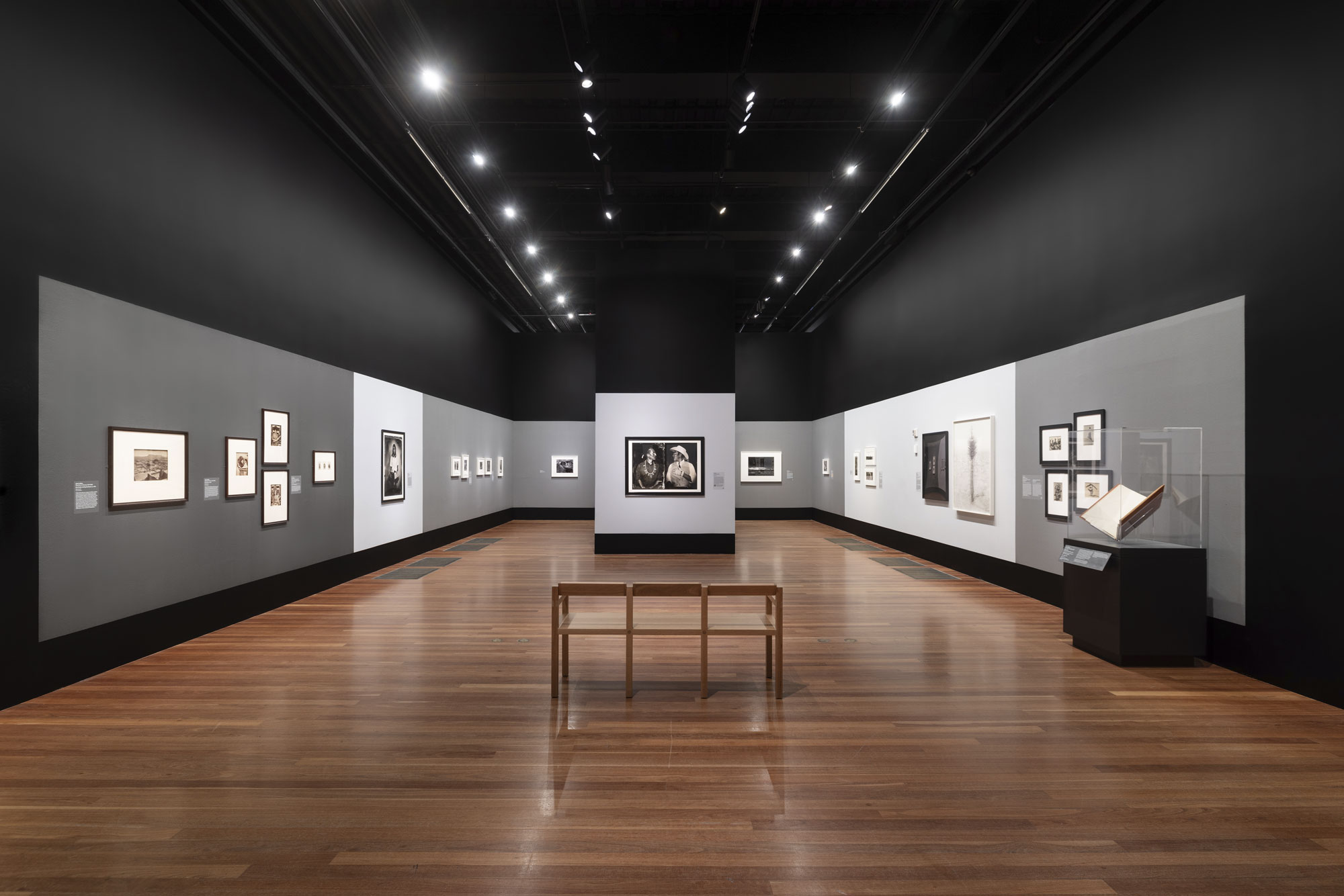
Installation view of the exhibition 'Ansel Adams in Our Time' at the de Young museum, San Francisco 

Installation view of the exhibition 'Ansel Adams in Our Time' at the de Young museum, San Francisco 

Installation view of the exhibition 'Ansel Adams in Our Time' at the de Young museum, San Francisco 

Installation view of the exhibition 'Ansel Adams in Our Time' at the de Young museum, San Francisco 

Installation view of the exhibition 'Ansel Adams in Our Time' at the de Young museum, San Francisco 


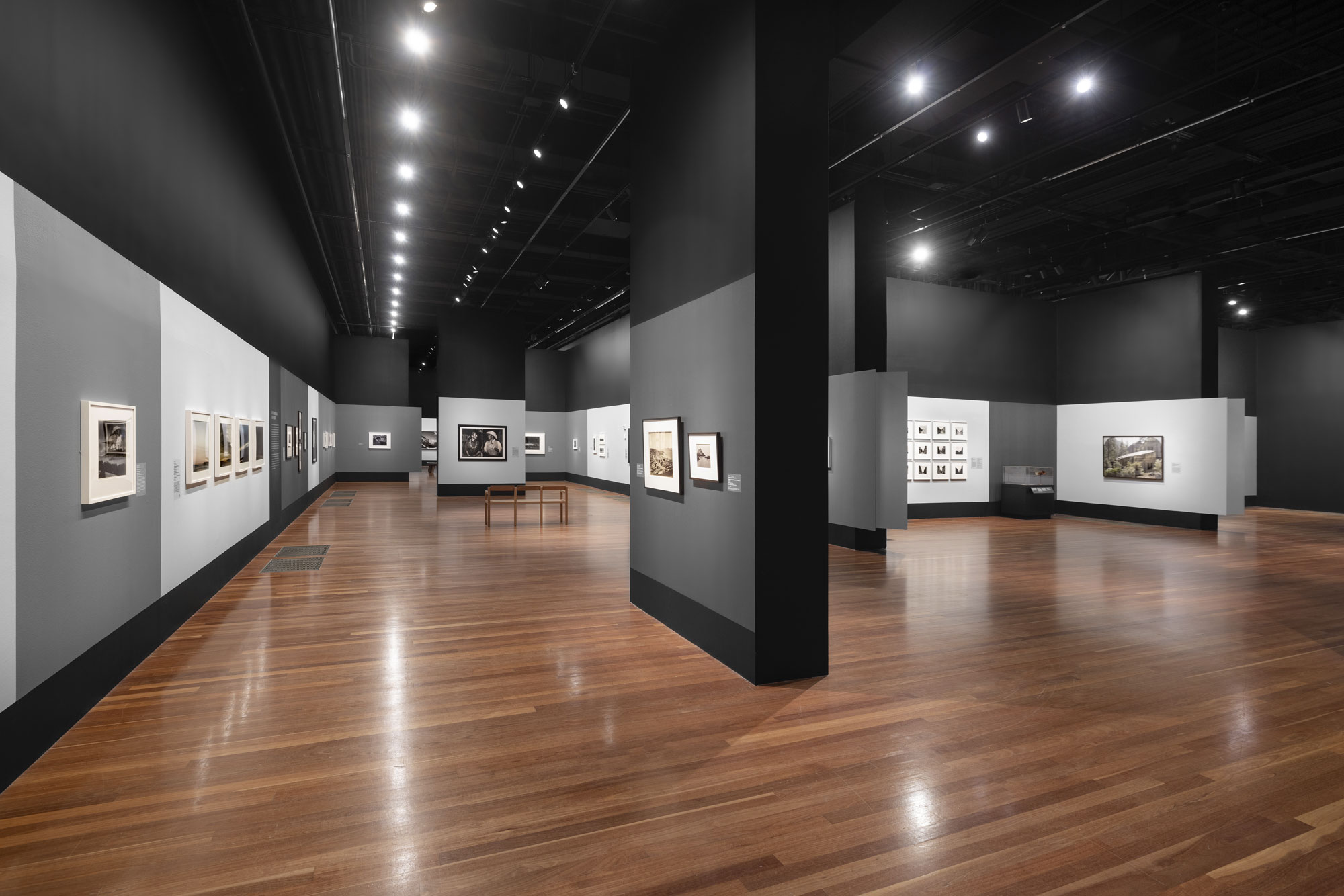
Installation views of the exhibition Ansel Adams in Our Time at the de Young museum, San Francisco
Images courtesy of the Fine Arts Museums of San Francisco
Photos: Gary Sexton


Ansel Adams in Our Time brings iconic artist home to San Francisco

Beloved for his lush gelatin silver photographs of the national parks, Ansel Adams is a giant of 20th-century photography whose images have become icons of the American wilderness. Opening April 8 at the de Young, Ansel Adams in Our Time brings more than 100 works from this self-described “California photographer” to the site of his very first museum exhibition in 1932, placing him in dialogue with 23 contemporary artists who are engaging anew with the landscapes and environmental issues that inspired Adams. The exhibition is organised by the Museum of Fine Arts, Boston, in partnership with the Fine Arts Museums of San Francisco, and enhanced at the de Young by the addition of works from the permanent collection and new interpretive framing exploring Adams’ close connection to his hometown of San Francisco.

“Ansel Adams’ photography is renowned for its formal beauty and technical prowess, but his work is equally one of advocacy,” remarked Thomas P. Campbell, Director and CEO of the Fine Arts Museums of San Francisco. “Adams was a tireless conservationist and wilderness preservationist who fully understood the power of images to sway public opinion. Ansel Adams in Our Time is exceptional in underscoring his brilliant legacy and the critical role that his works and others’ before him have played in safeguarding our national parks and other public lands.”

Instrumental to Adams’ development as a photographer was Yosemite, one of the oldest national parks in the country, which he visited regularly from the age of 14 with his Eastman Kodak Brownie camera in tow. Ansel Adams in Our Time examines the critical role that photography has played in the history of the national parks, with Adams following in the footsteps of predecessors such as Carleton Watkins, whose efforts first secured Yosemite as protected land. A longtime member of the Sierra Club, Adams would go on to perfect the rich detail and tonal range of his landscapes in service of what he called the “spiritual-emotional” aspects of parks and wilderness, conveying their restorative power to as wide an audience as possible. Presenting President Gerald Ford with a print of Yosemite: Clearing Winter Storm (c. 1937) in 1975, Adams urged, “Now, Mr. President, every time you look at this picture, I want you to remember your obligation to the national parks.”

At the de Young, the exhibition delves further into the artist’s Bay Area connections with new interpretive framing and works from the Fine Arts Museums’ permanent collection. Adams became a truly modernist photographer in San Francisco in the 1920s and 1930s, experimenting with the large-format camera that would yield the maximum depth of field and razor-sharp detail that are today considered his signature. He was a tireless champion of photography as a legitimate form of fine art. From his pristine Parmelian Prints of the High Sierras (1927), a landmark work in 20th-century photography, to images of oil derricks, ghost towns, drought conditions, and the sand dunes of Death Valley, Ansel Adams in Our Time spans the scope of the artist’s nearly seven-decade career and efforts to establish both environmental stewardship as a pillar of civic life and the photographic medium as a widely accepted art form.

The works of 23 contemporary artists, including Catherine Opie, Abelardo Morell, Binh Danh, Trevor Paglen, Mitch Epstein, and Victoria Sambunaris, among others, provide a new lens for Adams, drawing on his legacy of art as environmental activism to confront issues such as drought and fire, mining and energy, economic booms and busts, protected places and urban sprawl. The exhibition’s five thematic sections – Capturing the View, Marketing the View, San Francisco: Becoming a Modernist, Adams in the American Southwest, and Picturing the National Parks – open up new conversations around Adams’s work, looking both forward and backward in time to present a richer picture of the relationship between photography, art, environmentalism, and conceptions of landscape.

“Ansel Adams had close ties to San Francisco, and the California landscape, and the de Young museum was among the first institutions to celebrate his work when he was a rising artist,” noted Lauren Palmor, Associate Curator of American Art, who organised Ansel Adams in Our Time at the Fine Arts Museums. “His reverence for our region’s natural beauty drew him to photograph the natural diversity that can be found throughout the Bay Area over the course of his lifetime. Adams was also a tireless advocate for the environment, and the Bay Area shares that spirit as a global center of innovation in conservation and wilderness preservation today.”

Exhibition organisation

Ansel Adams in Our Time was organised by the Museum of Fine Arts, Boston, in partnership with the Fine Arts Museums of San Francisco. The exhibition was curated by Karen Haas, Lane Senior Curator of Photographs at the Museum of Fine Arts, Boston. The Presenting Sponsor is the Clare C. and Jay D. McEvoy Endowment Fund. Lead Sponsors are The Lisa and Douglas Goldman Fund and the San Francisco Auxiliary of the Fine Arts Museums. Major Support is provided by the Byers Family and The Herbst Foundation, Inc. Significant Support is provided by The Ansel Adams Gallery. Generous Support is provided by David A. Wollenberg and Merrill Private Wealth Management.

About Ansel Adams

Ansel Easton Adams (1902-1984) made indelible images of the American landscape and successfully advocated for the environment and the preservation of natural resources. Adams was born in San Francisco in 1902, and he made his first trip to Yosemite when he was just 14 years old. Transfixed by the valley’s beauty, he took his first photographs of Yosemite’s waterfalls and rock formations. Adams went on to develop his photographic practice in parallel with his environmentalist outlook.

The de Young museum hosted several important early Adams exhibitions in the 1930s, celebrating the achievements of this local photographer whose star was rapidly rising nationally: Photographs by Ansel Easton Adams (1932); the landmark Group f.64 exhibition (1932-1933), which also featured the work of Imogen Cunningham, John Paul Edwards, Preston Holder, Consuelo Kanaga, Alma Lavenson, Sonya Noskowiak, Henry Swift, Willard Ames Van Dyke, Brett Weston, and Edward Weston; and Yosemite in Four Seasons: Photographs by Ansel Adams (1935).

Adams shaped the field for other practicing photographers on both coasts, and his impact is immeasurable. In addition to teaching, he authored a celebrated series of books on photographic techniques that distilled his expertise for generations of budding photographers. Parallel to his achievements in photography, Adams dedicated himself to environmental advocacy for over seven decades. In 1980, he was awarded the Presidential Medal of Freedom, the nation’s highest civilian honor, for his artistic and environmental efforts.

Press release from the de Young website
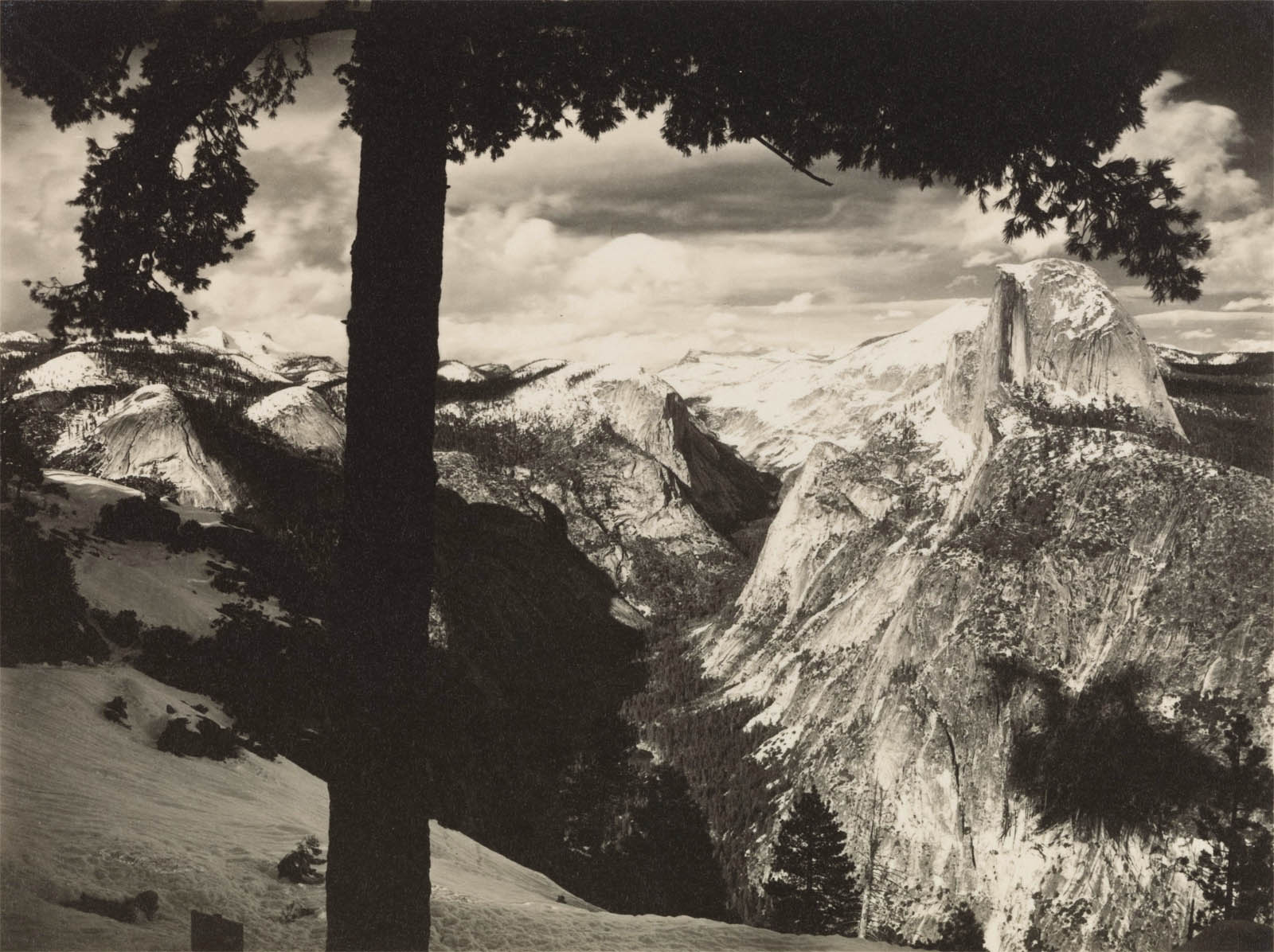
 

Ansel Adams (American, 1902-1984) 'Glacier Point, Yosemite National Park' c. 1923, printed 1927 from the exhibition 'Ansel Adams in Our Time' at the de Young Museum, San Francisco, April - July, 2023


Ansel Adams (American, 1902-1984)
Glacier Point, Yosemite National Park
c. 1923, printed 1927
From the portfolio Parmelian Prints of the High Sierras, 1927
Gelatin silver print
The Lane Collection
Courtesy Museum of Fine Arts, Boston
© The Ansel Adams Publishing Rights Trust


These photographs were issued together as a portfolio by San Francisco’s Grabhorn Press in 1927. Although photographic print portfolios would become common later in the century, Parmelian Prints of the High Sierras represents one of the first attempts to market photographs in this way. Looking back on this moment in his career, a time when he was struggling to make a living and gain recognition as an artist, Ansel Adams was embarrassed by the made-up term “Parmelian” in the title. His publisher thought it was necessary because photographs were not yet considered worthy of investment by fine art collectors. Later, Adams would use the same negative of Half Dome from this series to produce the larger version of Monolith – The Face of Half Dome [below] that appears at the start of this exhibition.

Exhibition label text
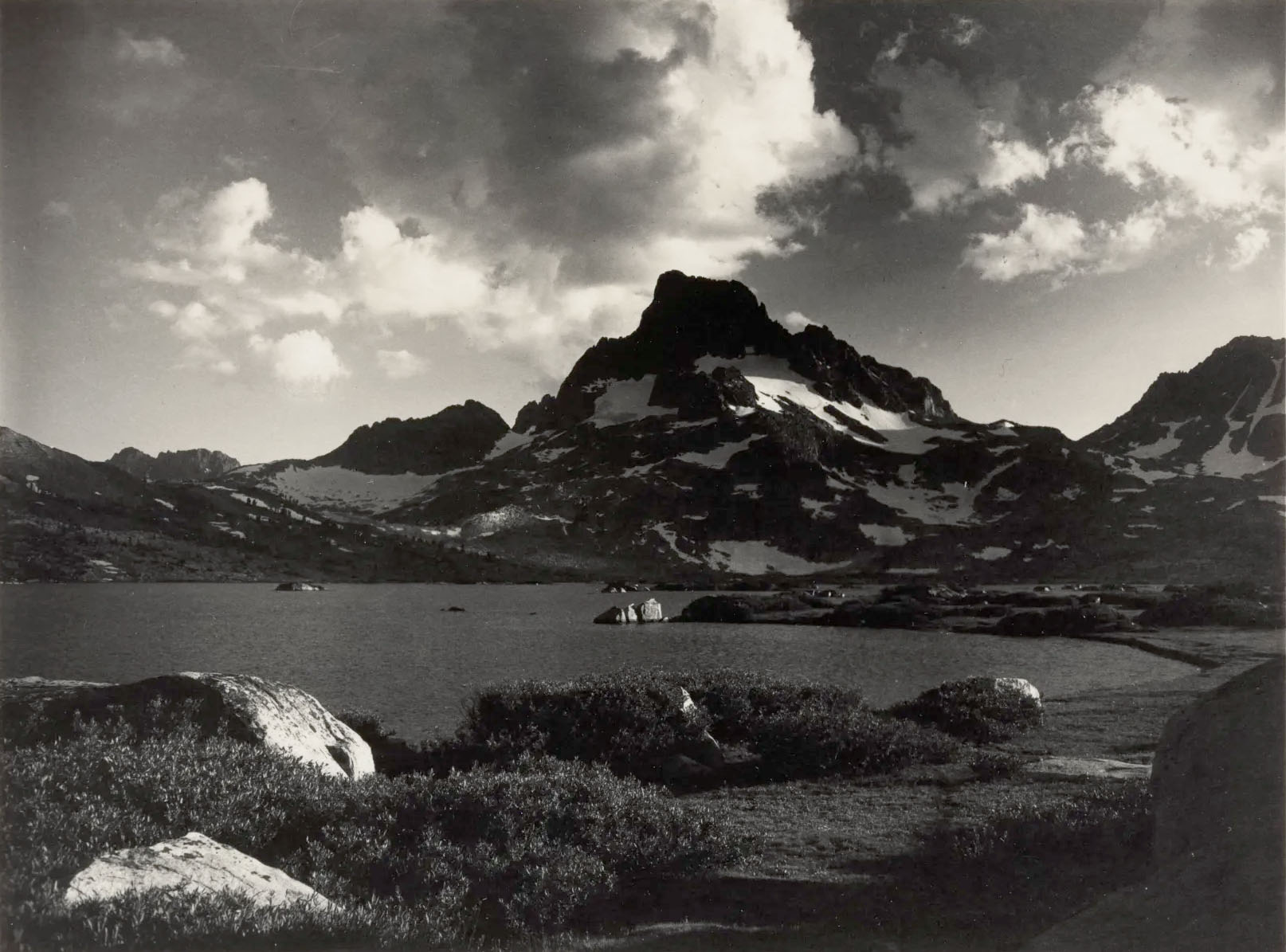
 

Ansel Adams (American, 1902-1984) 'Banner Peak – Thousand Island Lake, Sierra Nevada, California' c. 1923, printed 1927 from the exhibition 'Ansel Adams in Our Time' at the de Young Museum, San Francisco, April - July, 2023


Ansel Adams (American, 1902-1984)
Banner Peak – Thousand Island Lake, Sierra Nevada, California
c. 1923, printed 1927
From the portfolio Parmelian Prints of the High Sierras, 1927
Gelatin silver print
The Lane Collection
Courtesy Museum of Fine Arts, Boston
© The Ansel Adams Publishing Rights Trust
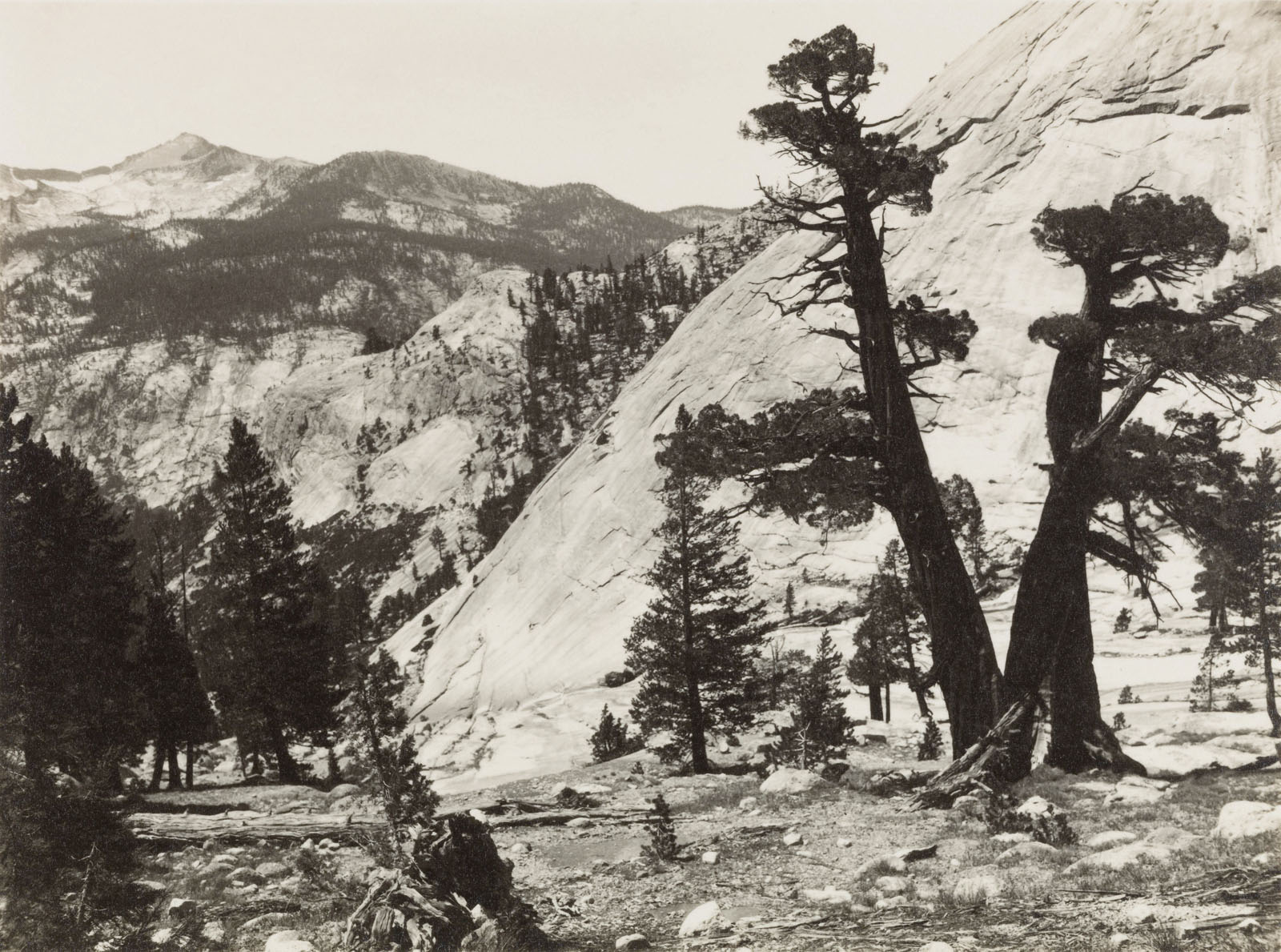
 

Ansel Adams (American, 1902-1984) 'Sierra Junipers' 1927 


Ansel Adams (American, 1902-1984)
Sierra Junipers
1927
From the portfolio Parmelian Prints of the High Sierras, 1927
Gelatin silver print
The Lane Collection
Courtesy Museum of Fine Arts, Boston
© The Ansel Adams Publishing Rights Trust
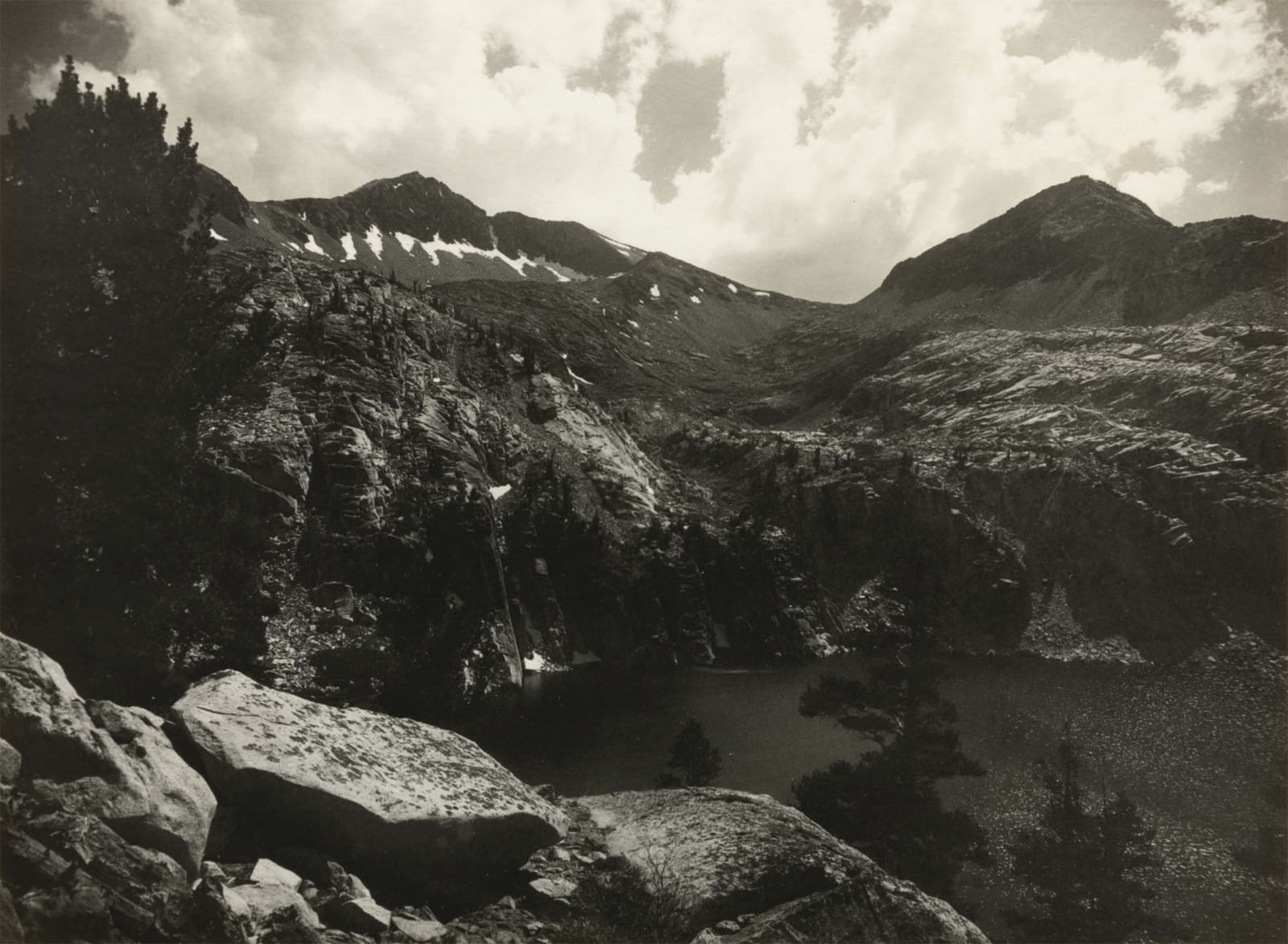
 

Ansel Adams (American, 1902-1984) 'Cloud and Mountain, Kings Canyon National Park, California' c. 1925, printed 1927 


Ansel Adams (American, 1902-1984)
Cloud and Mountain, Kings Canyon National Park, California
c. 1925, printed 1927
From the portfolio Parmelian Prints of the High Sierras, 1927
Gelatin silver print
The Lane Collection
Courtesy Museum of Fine Arts, Boston
© The Ansel Adams Publishing Rights Trust


Ansel Adams (American, 1902-1984) 'Monolith - The Face of Half Dome, Yosemite National Park' 1927


Ansel Adams (American, 1902-1984)
Monolith – The Face of Half Dome, Yosemite National Park
1927, printed 1950-1960
Gelatin silver print
The Lane Collection
Courtesy Museum of Fine Arts, Boston
© The Ansel Adams Publishing Rights Trust


This majestic view of Half Dome is one of Ansel Adams’ most important and groundbreaking early photographs. Shot on a hike in the spring of 1927, it represents his first conscious “visualisation” – an image fully anticipated before he tripped the shutter, and one that for Adams captured the emotional impact of the scene. He made this enlarged print years later, but the dramatic sky and the sharp contrast between the brilliant white snow and dark ridges in the granite were recorded in 1927 when Adams took the photograph, using a deep red filter and a long exposure (made possible by the windless conditions that day).

Exhibition label text
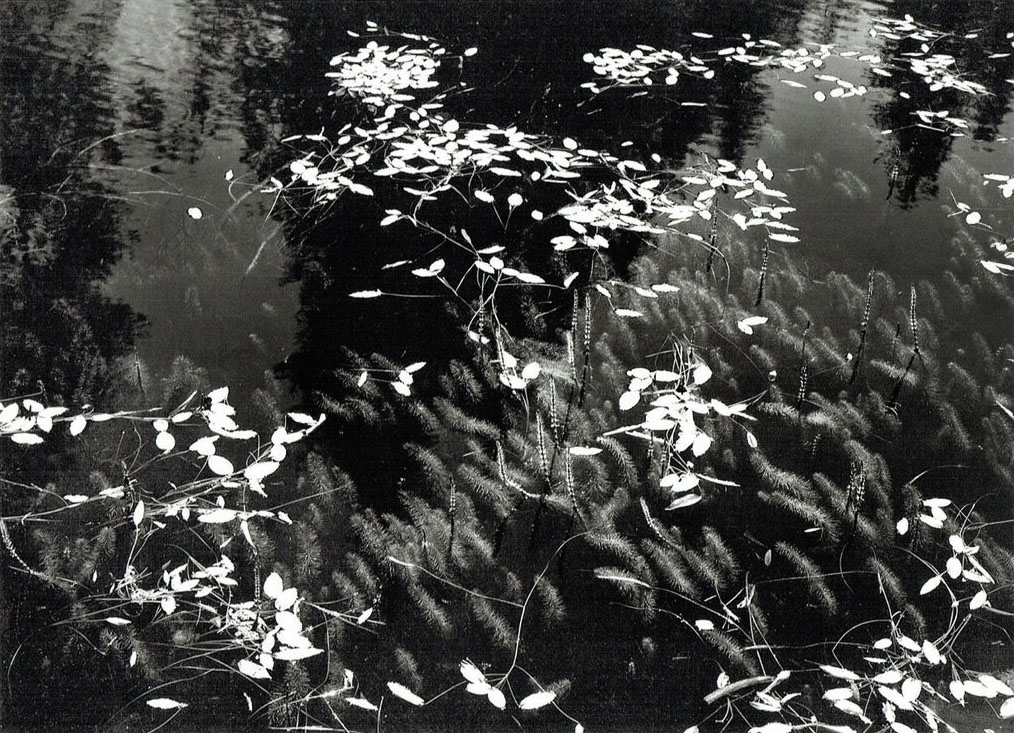
 

Ansel Adams (American, 1902-1984) 'Leaves on Pool, Sierra Nevada, California' c. 1935


Ansel Adams (American, 1902-1984)
Leaves on Pool, Sierra Nevada, California
c. 1935
Gelatin silver print
The Lane Collection
Courtesy Museum of Fine Arts, Boston
© The Ansel Adams Publishing Rights Trust


Spending time in the wilderness was a spiritual experience that Ansel Adams marvelled at his entire life. Describing one such transcendent moment, he wrote: “It was one of those mornings when the sunlight is burnished with a keen wind and long feathers of clouds move in a lofty sky. … I was suddenly arrested … by an exceedingly pointed awareness of the light. The moment I paused, the full impact of the mood was upon me; I saw more clearly than I have ever seen before or since the minute detail of the grasses, the clusters of sand shifting in the wind, the small flotsam of the forest, the motion of the high clouds streaming above the peaks.”

Exhibition label text
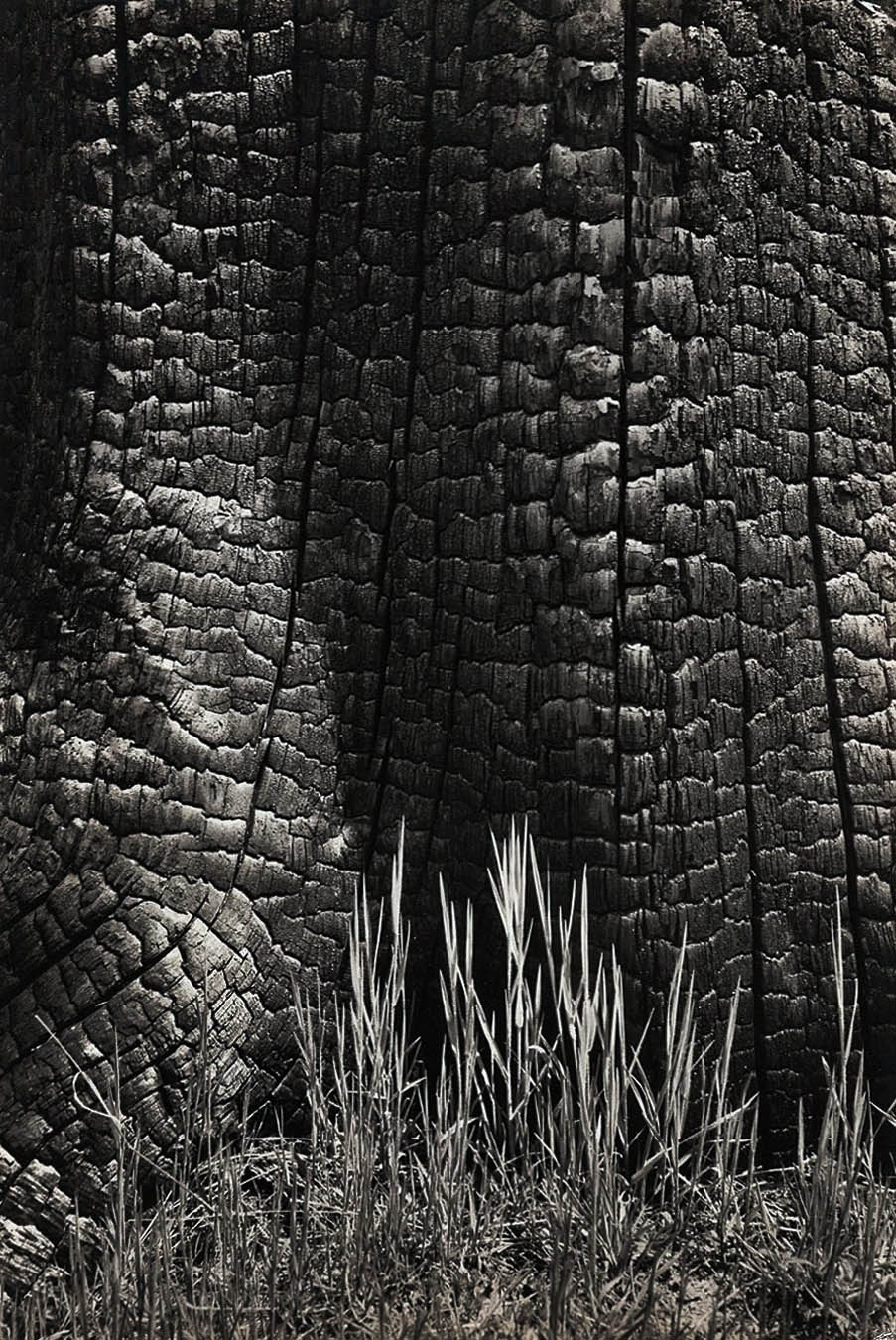
 

Ansel Adams (American, 1902-1984) 'Grass and Burned Stump, Sierra Nevada, California' c. 1935


Ansel Adams (American, 1902-1984)
Grass and Burned Stump, Sierra Nevada, California
c. 1935
Gelatin silver print
The Lane Collection
Courtesy Museum of Fine Arts, Boston
© The Ansel Adams Publishing Rights Trust


Ansel Adams made this photograph near Fish Camp, south of Yosemite National Park, in an area where forest fires raged some years earlier. In his close-up view, he juxtaposes the tender shoots of new grass and the charred surface of a burned stump. This is an example of what Adams liked to call the “microscopic revelation of the lens,” which he saw as the ideal of his “straight,” sharp-focus approach to photography.

Exhibition label text
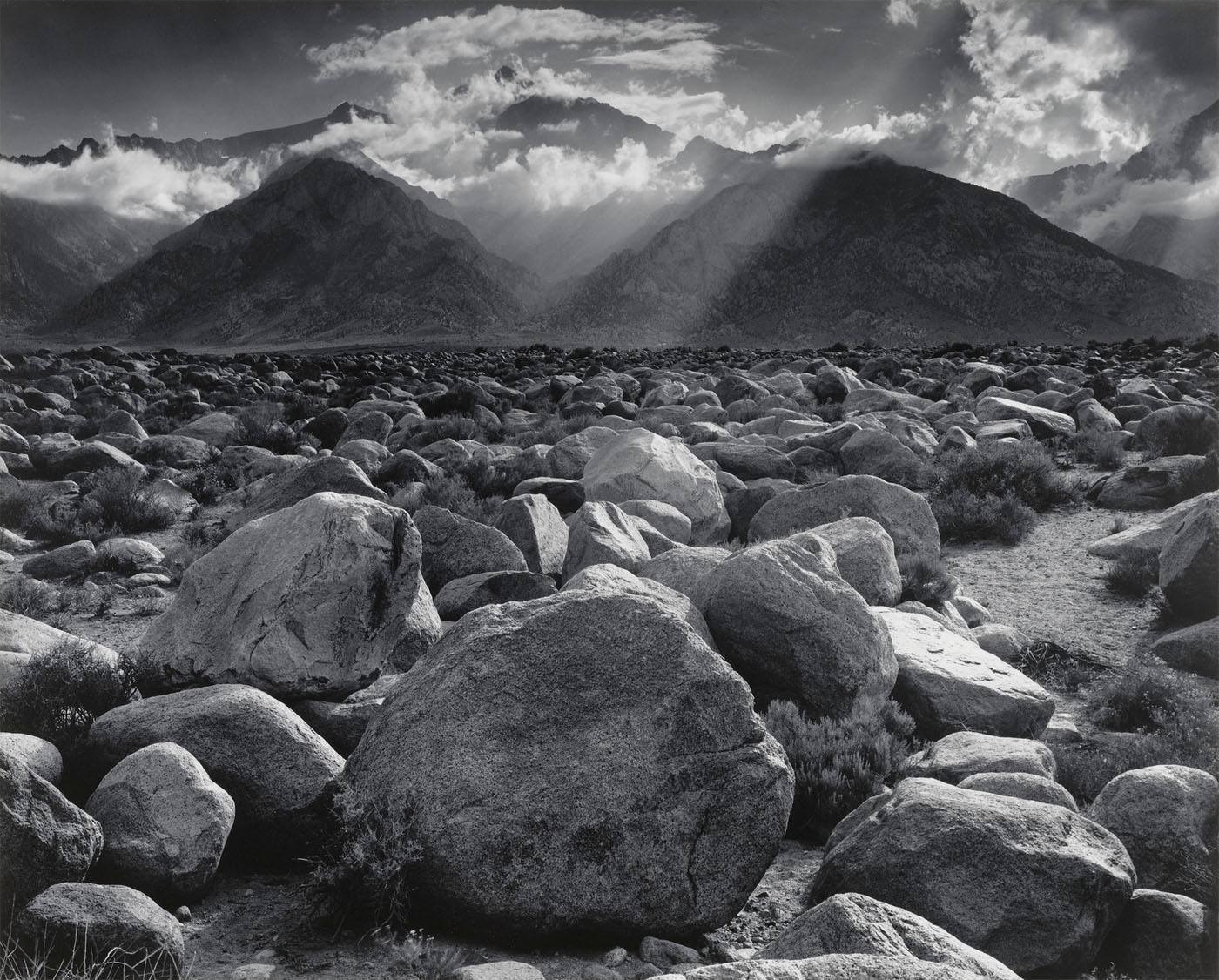
 

Ansel Adams (American, 1902-1984) 'Mount Williamson from Manzanar, Sierra Nevada, California' 1944


Ansel Adams (American, 1902-1984)
Mount Williamson from Manzanar, Sierra Nevada, California
1944
Gelatin silver print
The Lane Collection
Courtesy Museum of Fine Arts, Boston
© The Ansel Adams Publishing Rights Trust


On a visit to Manzanar, a Japanese internment camp, in 1944, Ansel Adams drove to the field of boulders that extends to the base of Mount Williamson. “There was a glorious storm going on in the mountains,” he wrote. “I set up my camera on the rooftop platform of my car, [which] enabled me to get a good view over the boulders to the base of the range.” The resulting photograph captures a storm passing over the distant mountain range – an awe-inspiring image that confounds all sense of scale and perspective.

Exhibition label text


Ansel Adams (American, 1902-1984) 'Birds on Wire, Evening' 1943, printed 1984


Ansel Adams (American, 1902-1984)
Birds on Wire, Evening
1943, printed 1984
Gelatin silver print
This print from the Library of Congress


A few months after Japan attacked Pearl Harbor in December 1941, people of Japanese ancestry living on the West Coast (two-thirds of whom were American citizens) were quickly rounded up, separated from homes, possessions, and businesses, and quietly relocated to remote incarceration camps.

A total of 11,070 Japanese Americans were processed through Manzanar War Relocation Center in Inyo County, California. Ansel Adams was invited to photograph Manzanar by Ralph Merritt, a Sierra Club friend who had recently been appointed director of the isolated detention center. Although he was not allowed to photograph the center’s barbed wire or guns, Adams did see himself as a kind of conscientious objector for his work documenting the site and the people forced to live there.

Adams was personally moved by the treatment of Japanese Americans in World War II when an older Japanese man who worked for his family for many years was transferred to a detention center. When Adams first went to Manzanar in 1943, he was “profoundly affected” by photographing the camp and meeting its incarcerated inhabitants. He later presented his Manzanar images in an exhibition and book entitled Born Free and Equal. Manzanar means “apple orchard” in Spanish, but agriculture in the area had suffered since the diversion of water to Los Angeles began in 1913. Nonetheless, the internees were responsible for raising much of their own food in the fields near the camp.

Exhibition label text
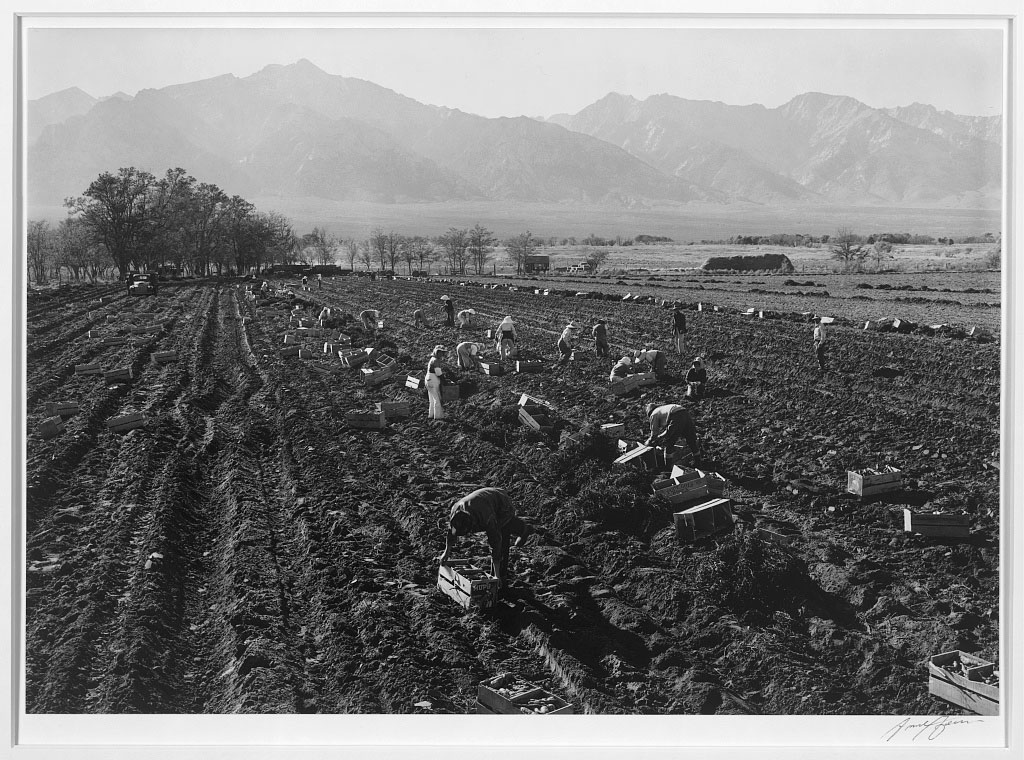
 

Ansel Adams (American, 1902-1984) 'Potato Field, North Farm, Manzanar' 1943, printed 1984


Ansel Adams (American, 1902-1984)
Potato Field, North Farm, Manzanar
1943, printed 1984
Gelatin silver print
This print from the Library of Congress
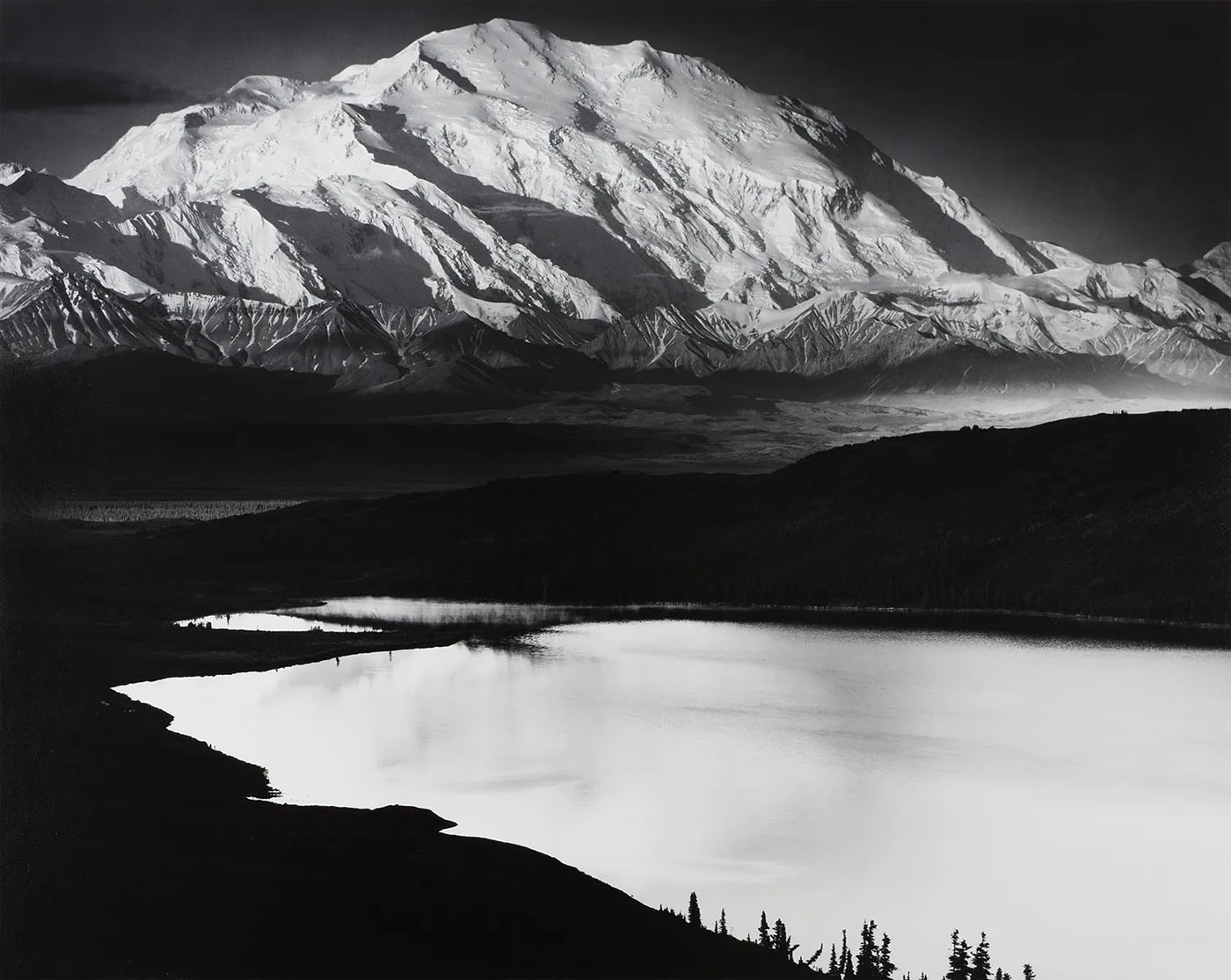
 

Ansel Adams (American, 1902-1984) 'Mount McKinley and Wonder Lake, Alaska' 1948


Ansel Adams (American, 1902-1984)
Mount McKinley and Wonder Lake, Alaska
1948
Gelatin silver print
The Lane Collection
Courtesy Museum of Fine Arts, Boston
© The Ansel Adams Publishing Rights Trust


Ansel Adams shot this image of Mount McKinley in Denali National Park at 1:30 in the morning, just two hours after the setting of the midsummer sun. He described, “As the sun rose, the clouds lifted, and the mountain glowed an incredible shade of pink. Laid out in front of Mount McKinley, Wonder Lake was pearlescent against the dark embracing arms of the shoreline. I made what I visualised as an inevitable image. The scale of this great mountain is hard to believe – the camera and I were thirty miles from McKinley’s base.”

Exhibition label text
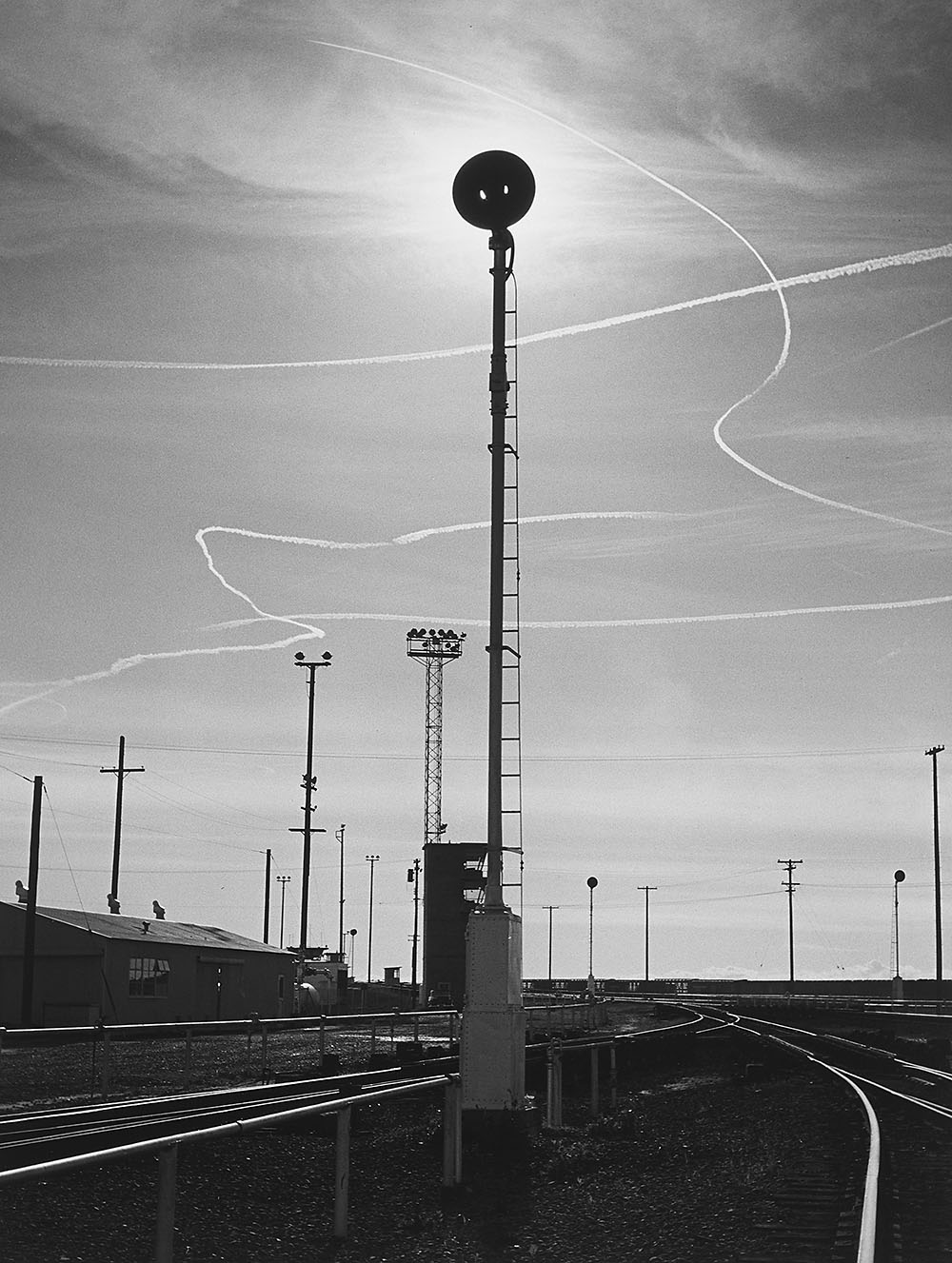
 

Ansel Adams (American, 1902-1984) 'Rails and Jet Trails, Roseville, California' c. 1953


Ansel Adams (American, 1902-1984)
Rails and Jet Trails, Roseville, California
c. 1953
Gelatin silver print
The Lane Collection
Courtesy Museum of Fine Arts, Boston
© The Ansel Adams Publishing Rights Trust


Marketing the view

In 1919, at the age of seventeen, Ansel Adams joined the Sierra Club. The organisation’s original focus on environmental preservation, and its initial failure to acknowledge Indigenous people and their homelands, helped lay the groundwork for the twentieth-century environmentalism he would come to represent. Adams participated in the club’s annual High Trips, serving as photographer and assistant manager from 1930 through 1936. He produced albums of photographs from these treks, inviting members to order contact prints or, for a higher fee, enlargements in “plain or soft-focus.” His ingenuity ultimately lad to his 1927 portfolio, Parmesan Prints of the High Sierras, on view in this gallery – one of the earliest experiments in custom printing, sequencing, and distributing fine photographs.

Adams was not the first to market view of the American West. In the nineteenth century, images of western landscapes were mass-produced and widely distributed, catering to a burgeoning tourist market. Today, contemporary artists are using photography to highlight the dynamic nature of landscapes and to document humans’ impact on the environment. Sometimes these works take the form of extended series or grids, as though invoking earlier methods of mass-distributing western views.

Exhibition wall text
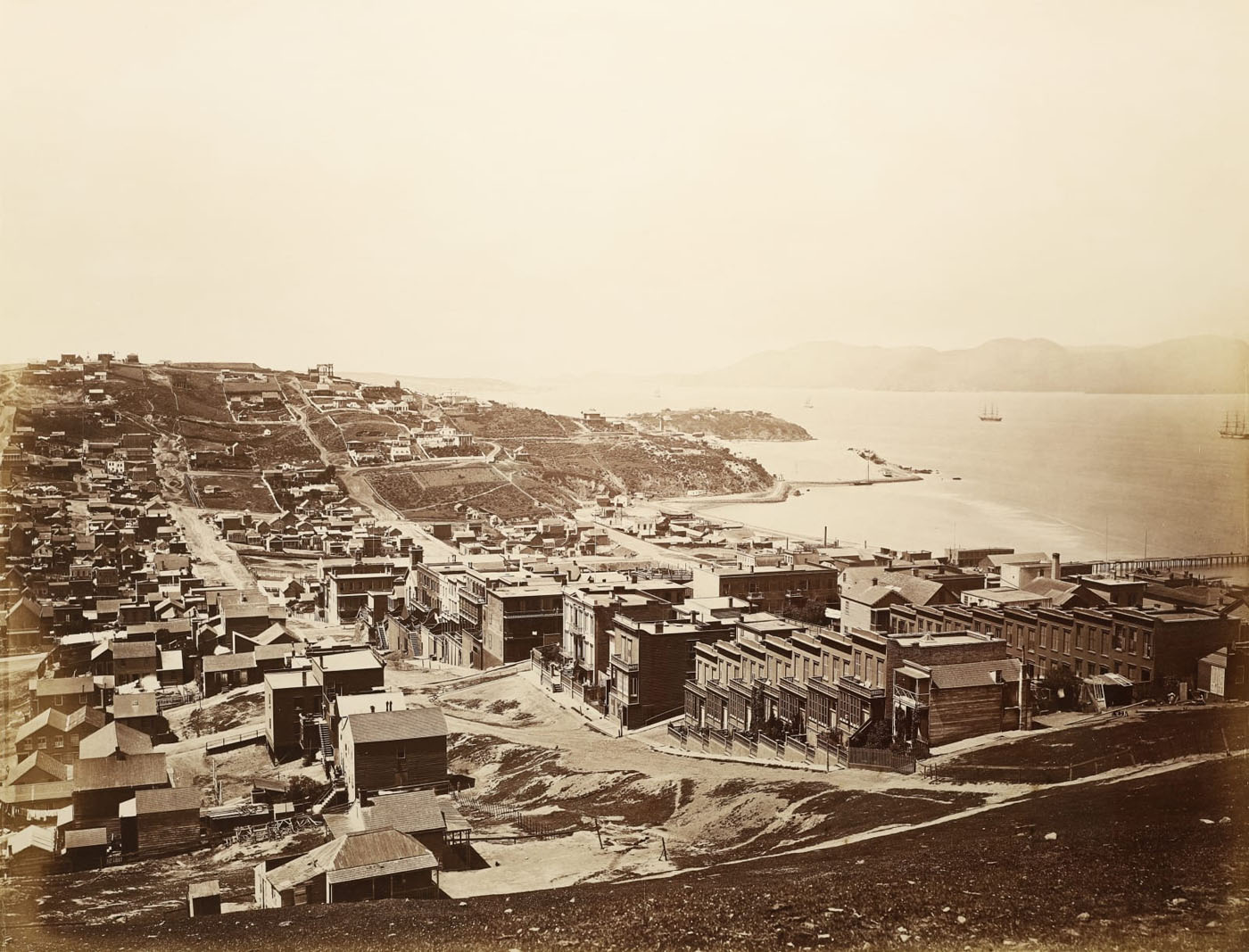
 

Carleton E. Watkins (American, 1829-1916) 'The Golden Gate from Telegraph Hill, San Francisco' 1868


Carleton E. Watkins (American, 1829-1916)
The Golden Gate from Telegraph Hill, San Francisco
1868
Albumen silver print from wet-collodion-on-glass negative
Fine Arts Museums of San Francisco
Museum purchase Prints and Drawings Art Trust Fund
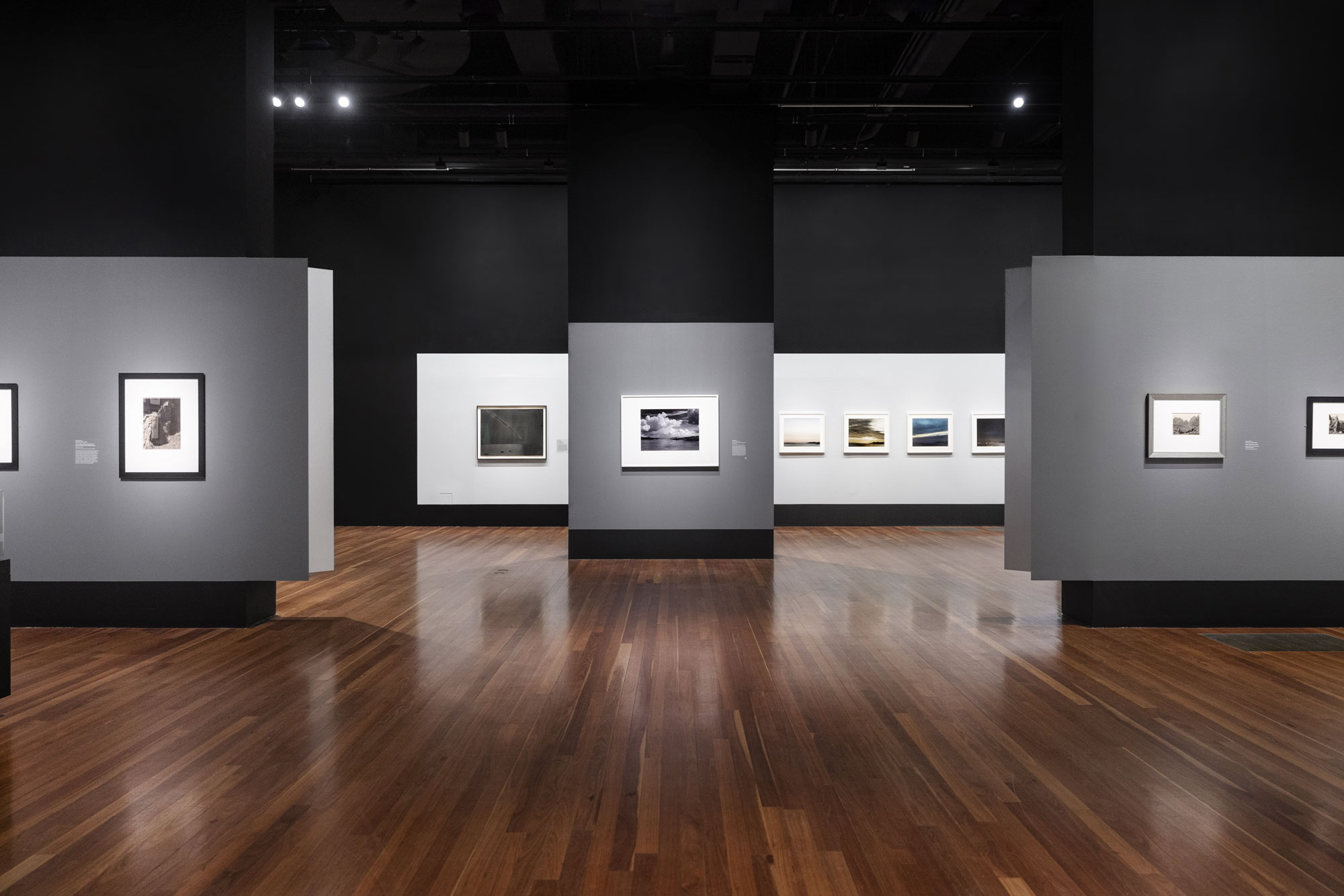
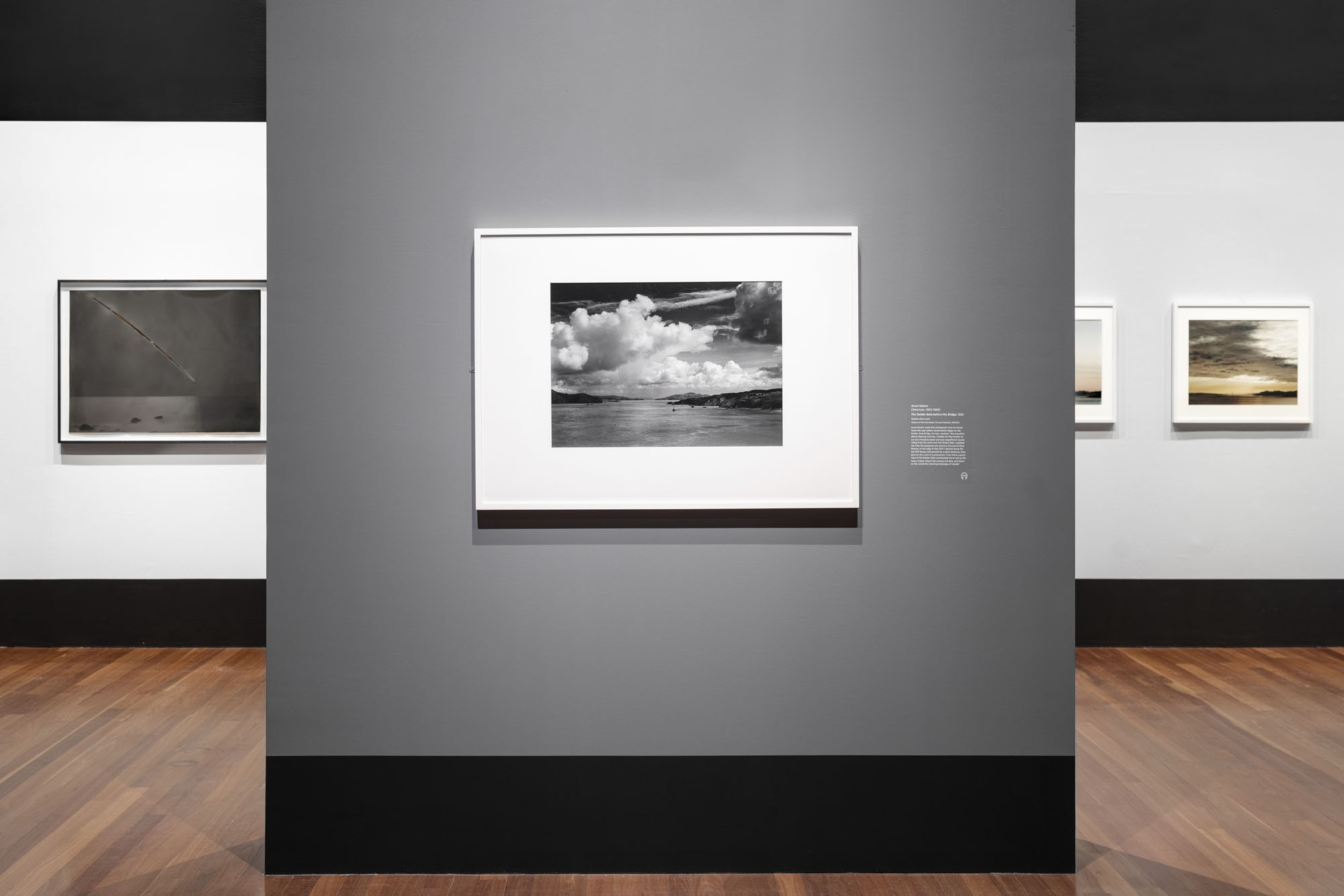
 

Installation view of the exhibition 'Ansel Adams in Our Time' at the de Young museum, San Francisco 

Installation view of the exhibition 'Ansel Adams in Our Time' at the de Young museum, San Francisco 


Installation views of the exhibition Ansel Adams in Our Time at the de Young museum, San Francisco showing at centre Adams’ The Golden Gate Before the Bridge (1932, below)
Images courtesy of the Fine Arts Museums of San Francisco
Photos: Gary Sexton


San Francisco: Becoming a Modernist

San Francisco is where Ansel Adams became a modernist photographer. He grew up in present-day Sea Cliff, where his family home overlooked the Presidio to the Marin Headlands beyond. These views made a lasting impact on his photographs – he later described constantly returning to the elements of nature that surrounded him in his childhood. Adams’ first exhibition, featuring photographs he took on Sierra Club hikes, was held at the club’s headquarters on Montgomery Street in 1928. Convinced that he could make a living as a photographer, he acquired a large-format camera and became an advocate of “straight” (unmanipulated) photography, leaving behind the soft-focus aesthetic of his earlier work. He experimented with abstraction and extreme close-ups, capturing texture and clarity of detail. He recorded cloud-filled skies and depicted landscapes as seemingly infinite spaces devoid of people. During the Great Depression, Adams began photographing a wider range of subjects, including the challenging reality of urban life in San Francisco and the region’s changing landscape. The latter included the construction of the Golden Gate Bridge (1937), which radically transformed the views of San Francisco Bay that had captivated Adams in his youth.

Golden Gate Bridge

Ansel Adams made this photograph [below] near his family home the year before construction began on the Golden Gate Bridge. He later recalled, “One beautiful storm-clearing morning, I looked out the window of our San Francisco home and saw magnificent clouds rolling from the north over the Golden Gate. I grabbed the 8-by-10 equipment and drove to the end of 32nd Avenue, at the edge of Sea Cliff. I dashed along the old Cliff house railroad bed for a short distance, then down to the crest of a promontory. From there grand view of the Golden Gate commanded me to set up the heavy tripod, attach the camera and lens, and focus on the wonderful evolving landscape of clouds.”

Exhibition wall text
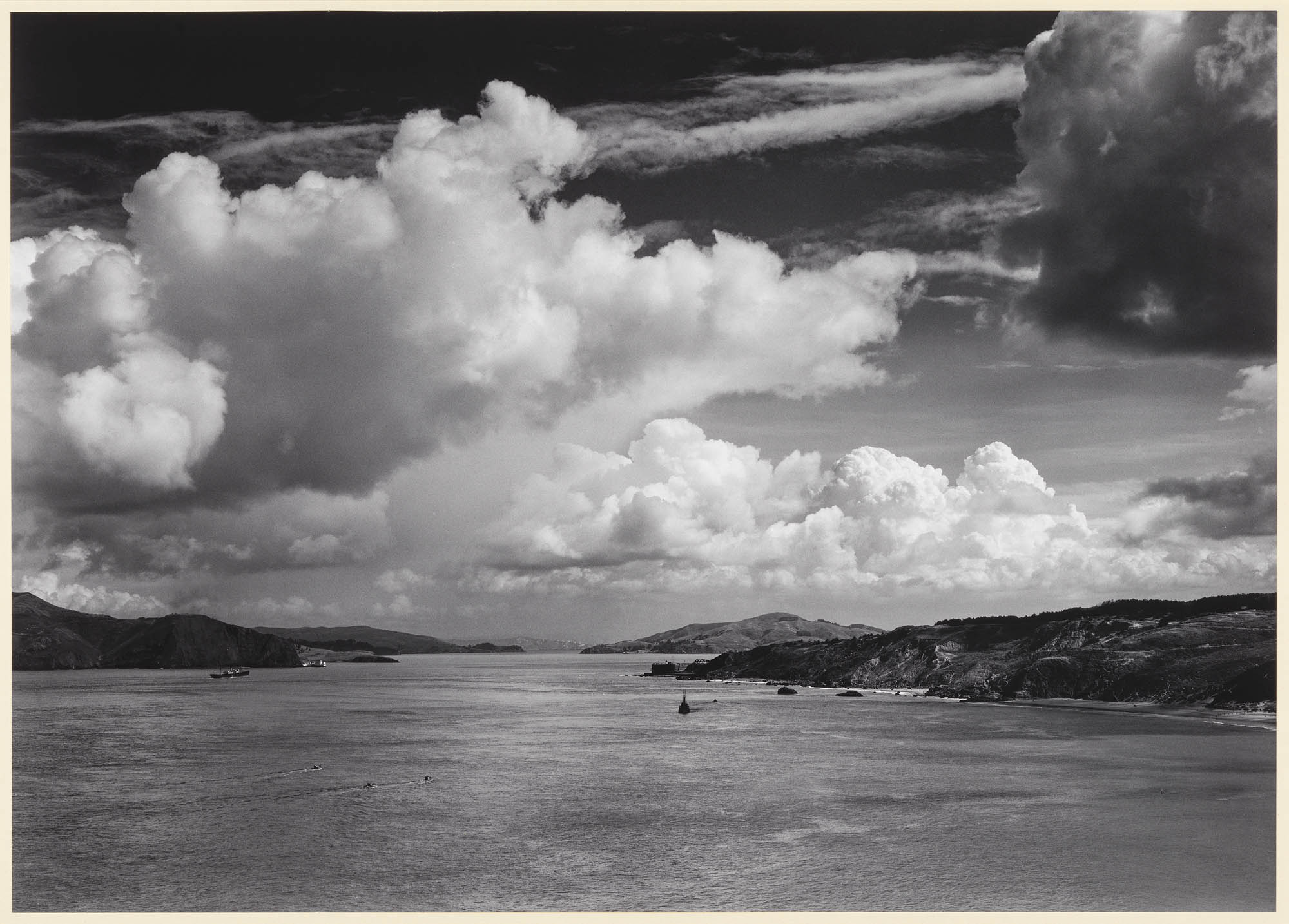
 

Ansel Adams (American, 1902-1984) 'The Golden Gate Before the Bridge' 1932


Ansel Adams (American, 1902-1984)
The Golden Gate Before the Bridge
1932
Gelatin silver print
The Lane Collection
Courtesy Museum of Fine Arts, Boston
© The Ansel Adams Publishing Rights Trust
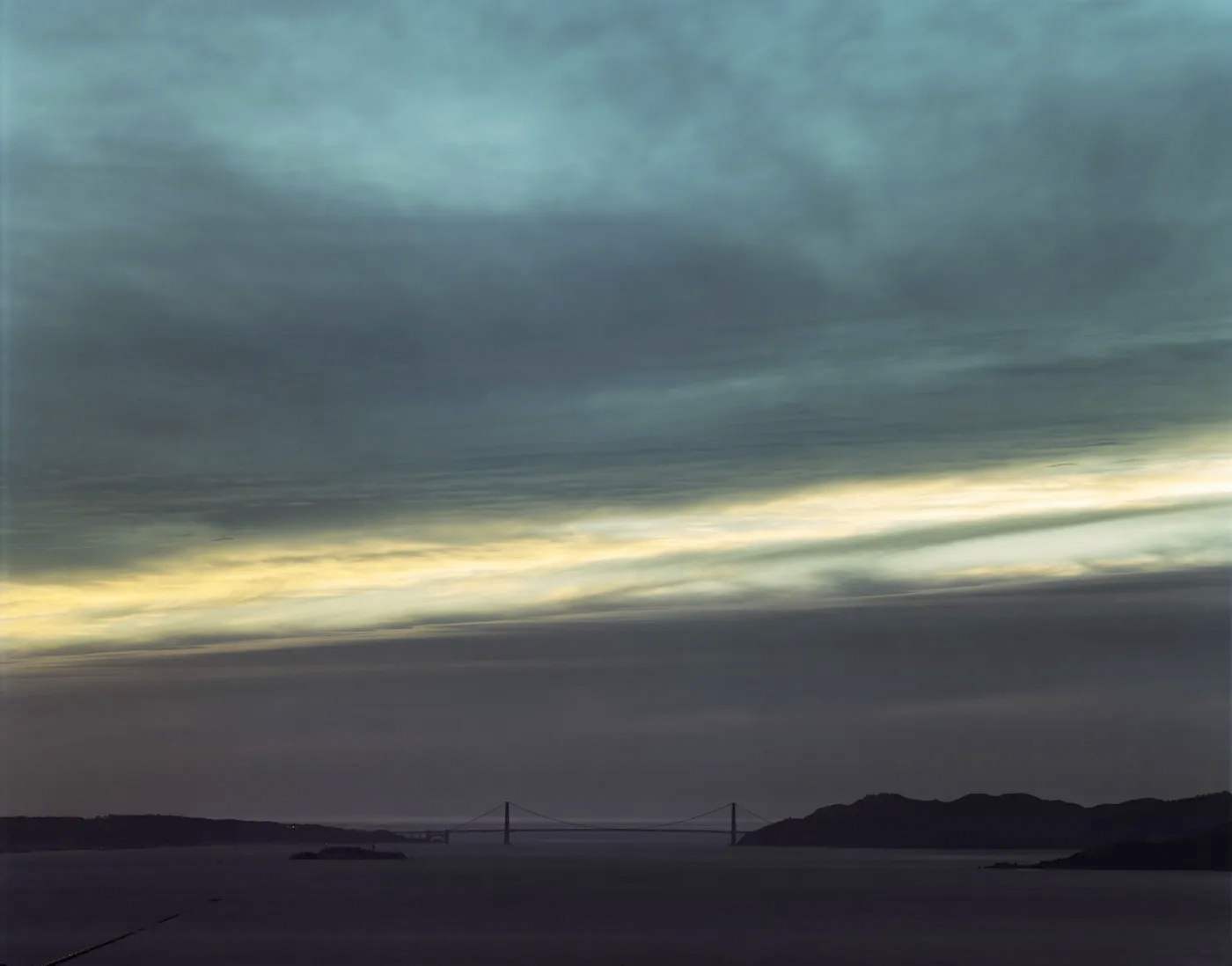
 

Richard Misrach (American, b. 1949) 'Golden Gate Bridge, 10.31.98, 5:18 pm' 1998, printed 2016


Richard Misrach (American, b. 1949)
Golden Gate Bridge, 10.31.98, 5:18 pm
1998, printed 2016
Pigment prints
Courtesy of Fraenkel Gallery, San Francisco


In 1997, Richard Misrach began what would become a three-year project photographing the Golden Gate Bridge from his porch in the Berkeley Hills. Placing his large-format 8-by-10-inch camera in the same position on each occasion, Misrach recorded hundreds of views of the distant span, at various times of day and in every season, set off against the constantly changing sky. The series was reissued in 2012 to mark the occasion of the seventy-fifth anniversary of the bridge’s landmark opening.

Exhibition label text
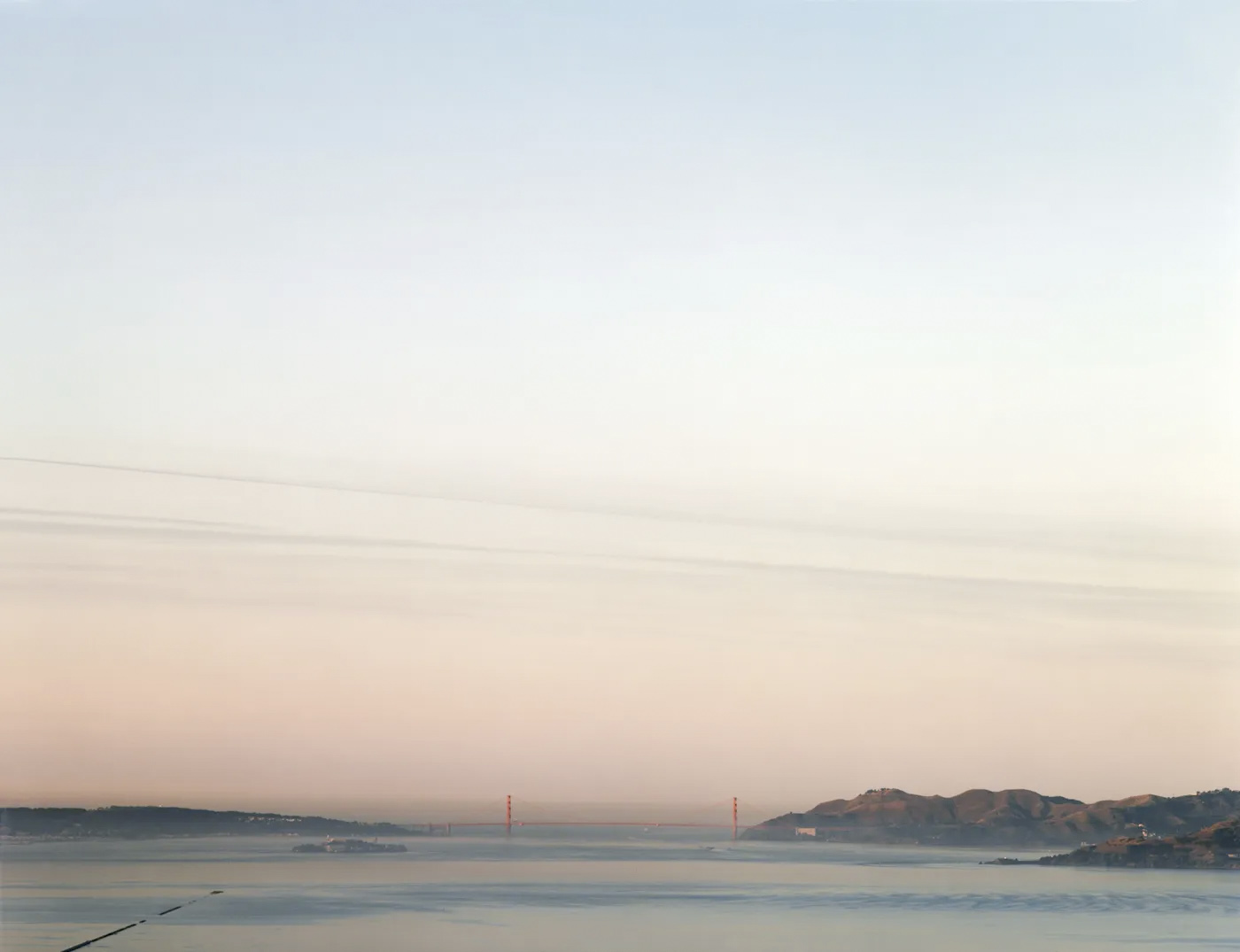
 

Richard Misrach (American, b. 1949) 'Golden Gate Bridge, 12.19.99, 7:31 am' 1999, printed 2020


Richard Misrach (American, b. 1949)
Golden Gate Bridge, 12.19.99, 7:31 am
1999, printed 2020
Pigment prints
Courtesy of Fraenkel Gallery, San Francisco


Picturing National Parks

Photography played a critical role in the establishment of the national parks. The dramatic views made by Carleton Watkins and other nineteenth-century photographers ultimately helped convince government officials to protect Yosemite and Yellowstone from private development. However, the formation of the national parks further dispossessed Indigenous people of their ancestral lands, overlooking their ongoing stewardship of the land and restricting their access to it.

Although Ansel Adams claimed he never intentionally made a creative photograph that related directly to an environmental issue, he was aware of an image’s power to sway opinions on conservation. Adams’ photographs of King’s River Canyon [below] helped the Sierra Club successfully campaign to establish the site as a national park. Over the following years, Adams photographed national parks from Alaska to Texas, Hawaii to Maine, creating images that conveyed the transformative power of the parks to a wide audience.

Many contemporary artists working in the national parks acknowledge, as Adams did, the efforts of the photographers who came before them. But the complicated legacies – and uncertain futures – of these protected lands have led some photographers to take more personal and political approaches to the work they are making in these places.

Exhibition wall text
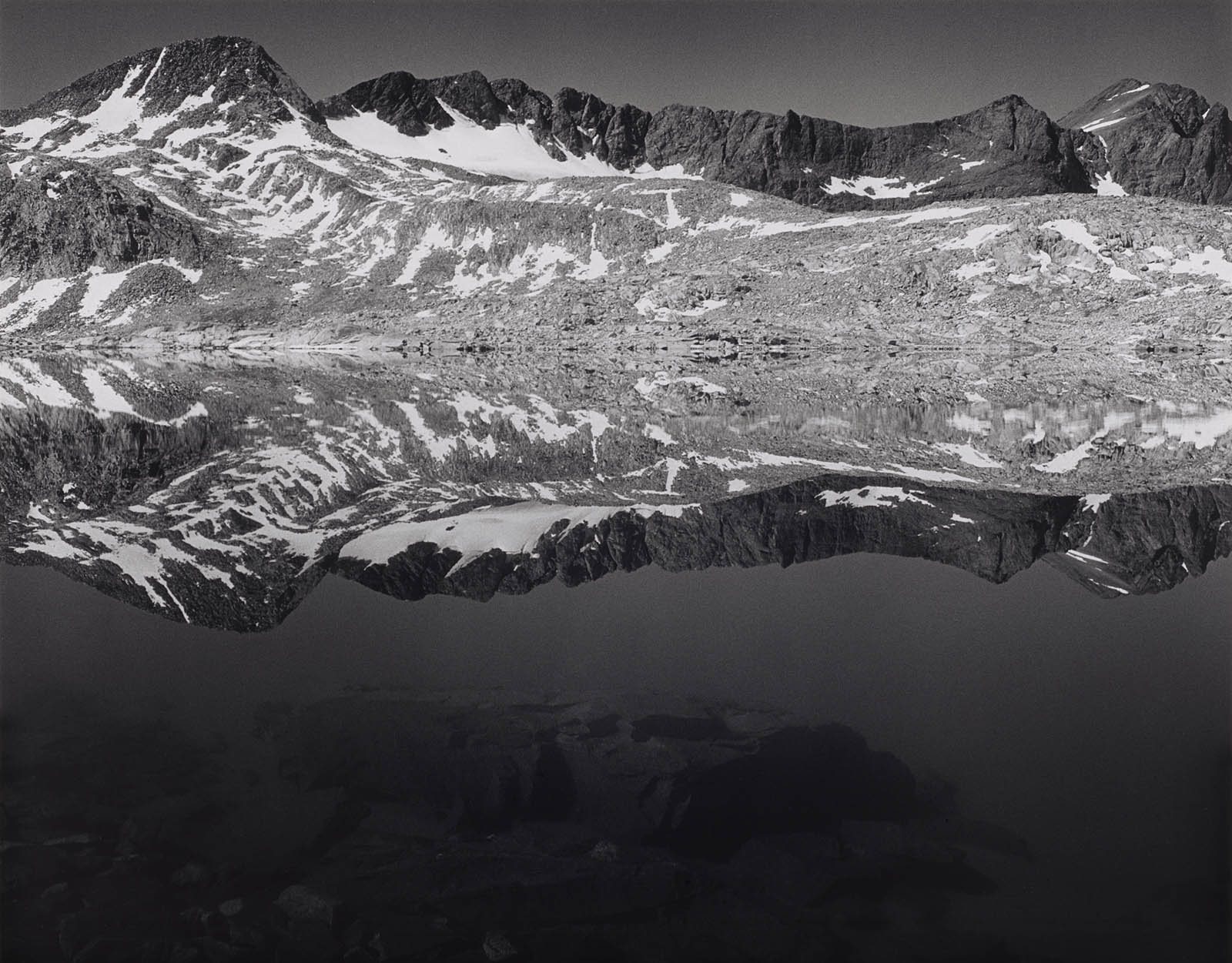
 

Ansel Adams (American, 1902-1984) 'Lake near Muir Pass, Kings Canyon National Park, California' 1933


Ansel Adams (American, 1902-1984)
Lake near Muir Pass, Kings Canyon National Park, California
1933
Gelatin silver print
The Lane Collection
Courtesy Museum of Fine Arts, Boston
© The Ansel Adams Publishing Rights Trust


Ansel Adams made this photograph while on a Sierra Club outing in Kings River Canyon. Three years later, he represented the club at a congressional hearing in Washington, DC. Armed with photographs like this one, he argued successfully for the transfer of Kings River Canyon from the Forest Service to the National Park Service. When it became a national park in 1940, the director of the Park Service wrote to Adams, saying, “I realise that a silent but most effective voice in the campaign was your book Sierra Nevada – John Muir Trail. As long as that book is in existence, it will go on justifying the park.”

Exhibition label text
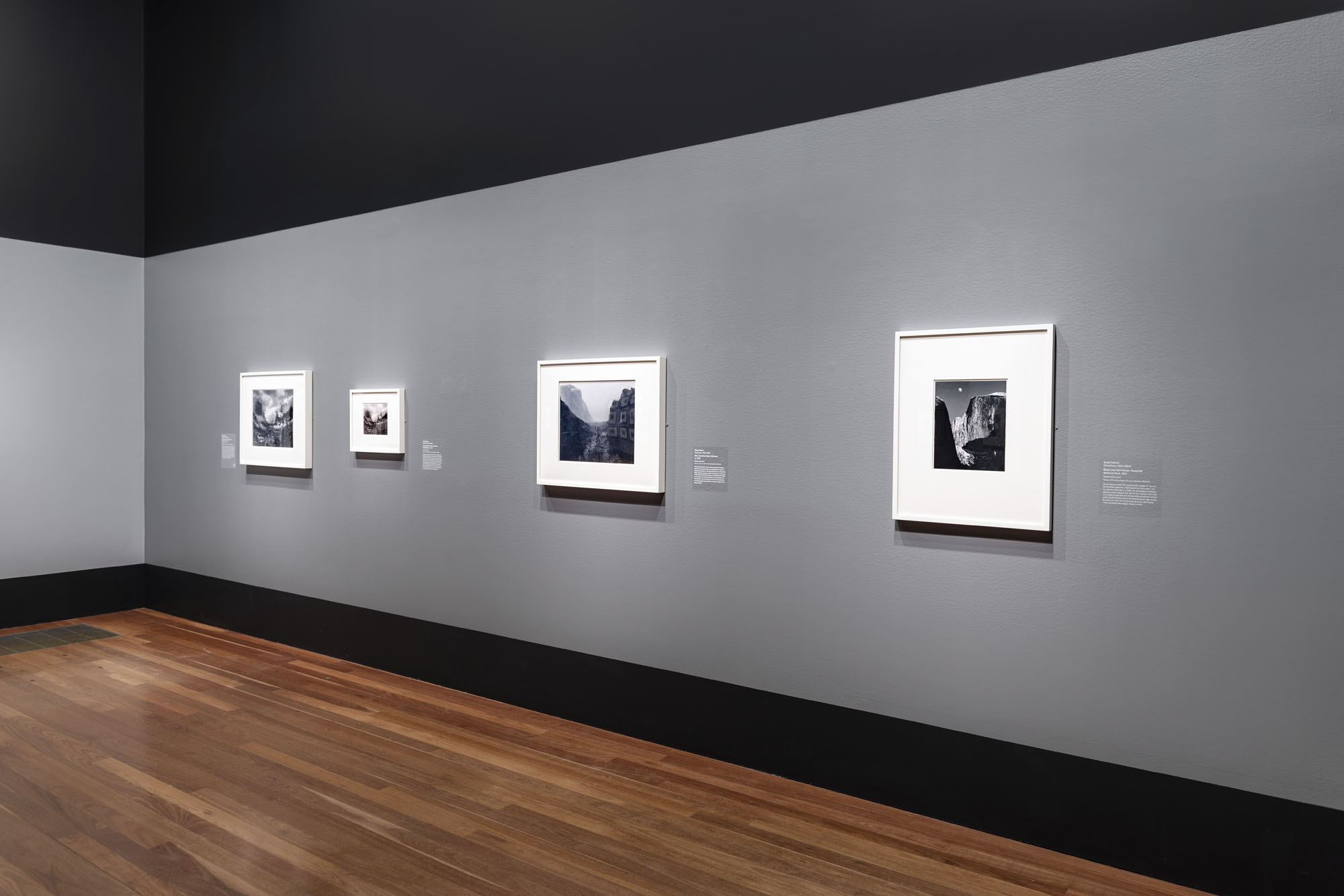
 

Installation view of the exhibition 'Ansel Adams in Our Time' at the de Young museum, San Francisco showing at left, 'Clearing Winter Storm, Yosemite National Park' (about 1937); at centre, 'Rain, Yosemite Valley, California' (c. 1940); and at right, 'Moon and Half Dome, Yosemite National Park' (1960)


Installation view of the exhibition Ansel Adams in Our Time at the de Young museum, San Francisco showing at left, Clearing Winter Storm, Yosemite National Park (about 1937, below); at centre, Rain, Yosemite Valley, California (c. 1940, below); and at right, Moon and Half Dome, Yosemite National Park (1960, below)
Images courtesy of the Fine Arts Museums of San Francisco
Photos: Gary Sexton
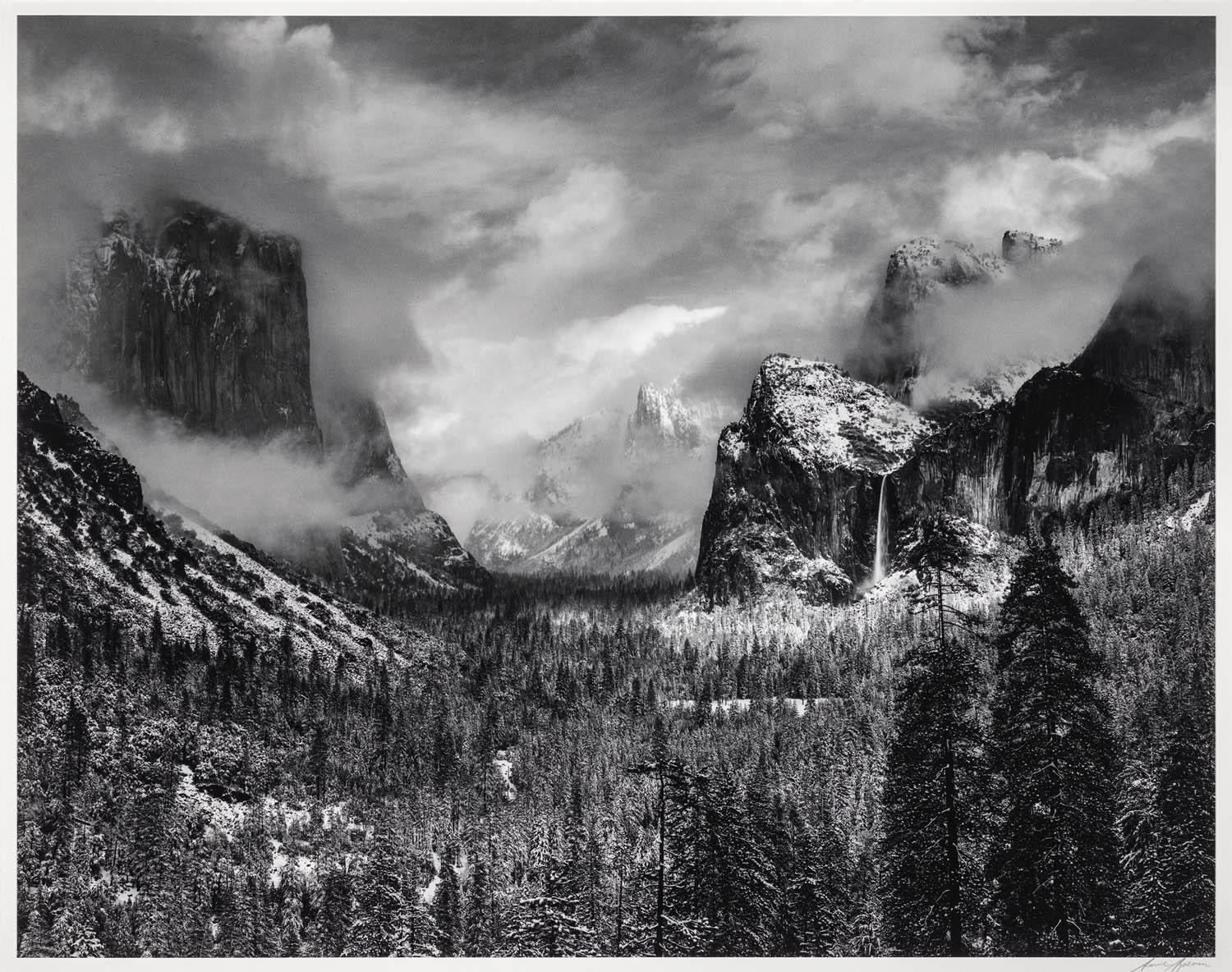
 

Ansel Adams (American, 1902-1984) 'Clearing Winter Storm, Yosemite National Park' About 1937


Ansel Adams (American, 1902-1984)
Clearing Winter Storm, Yosemite National Park
About 1937
Gelatin silver print
The Lane Collection
Courtesy Museum of Fine Arts, Boston
© The Ansel Adams Publishing Rights Trust


Ansel Adams described photographs like Monolith and Clearing Winter Storm as his “Mona Lisas”: images so popular with the public that they were printed countless times over the course of his long career. He took this remarkable photograph from Yosemite’s Inspiration Point soon after a sudden rainstorm turned to snow and then, just as swiftly, began to clear. It records an expansive valley view that Adams had attempted on several previous occasions but never been successful in rendering in such shimmering detail. Trained as a pianist, Ansel Adams often compared the photographic negative to a musical score and described each print from a particular negative as an individual performance of that score.

Exhibition label text
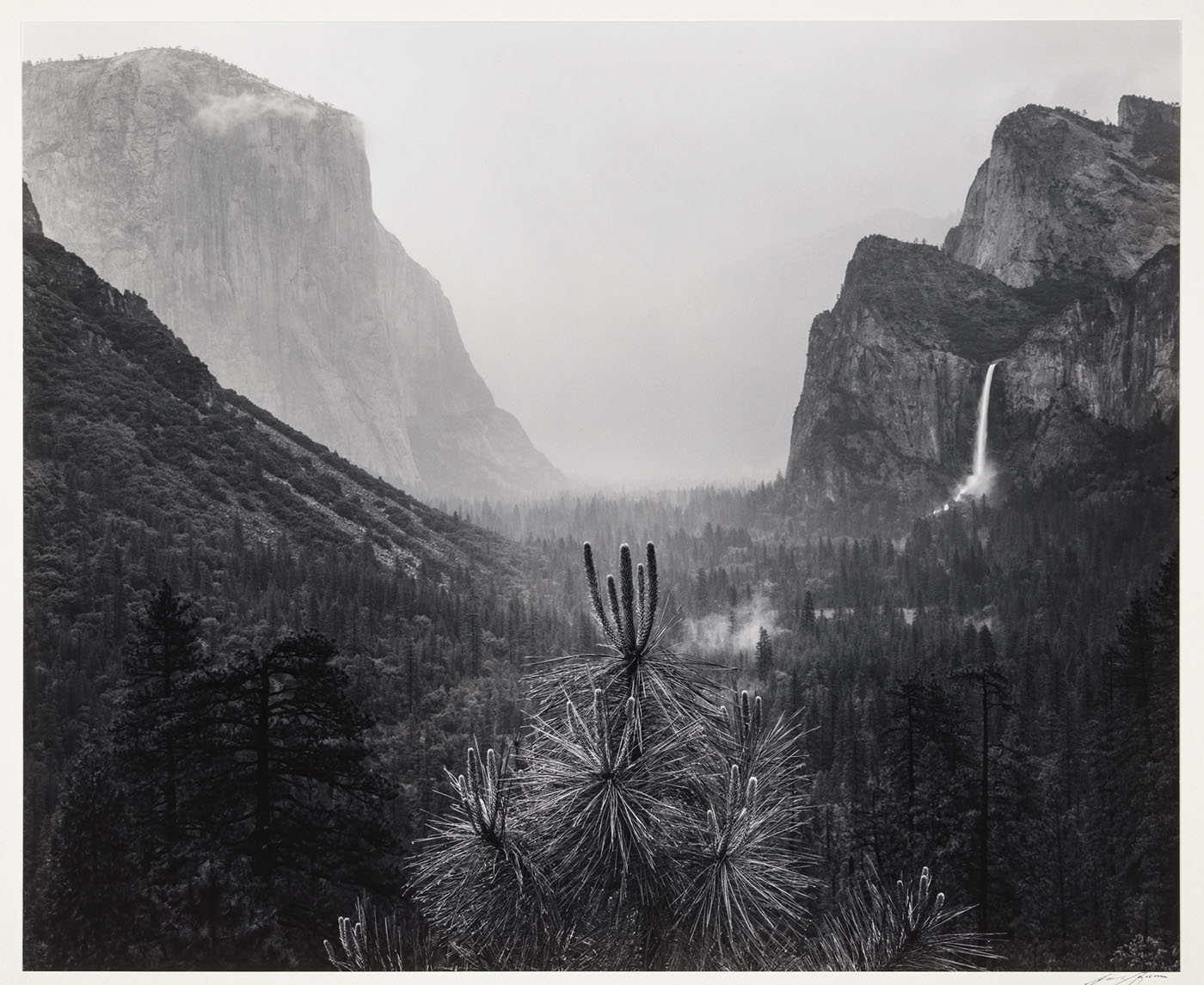
 

Ansel Adams (American, 1902-1984) 'Rain, Yosemite Valley, California' c. 1940


Ansel Adams (American, 1902-1984)
Rain, Yosemite Valley, California
c. 1940
Gelatin silver print
The Lane Collection
Courtesy Museum of Fine Arts, Boston
© The Ansel Adams Publishing Rights Trust


Like Clearing Winter Storm [above], this photograph features what the nineteenth-century photographer Carleton E. Watkins described as “the best general view” of Yosemite Valley, with the massive granite outcropping of El Capitan on the left and the silvery stream of Bridalveil Fall visible on the right. Yet here Yosemite’s famous features are shrouded in mist, and the pine tree in the foreground, its needles glistening with rain, stands in place of the distant peaks.

Exhibition label text
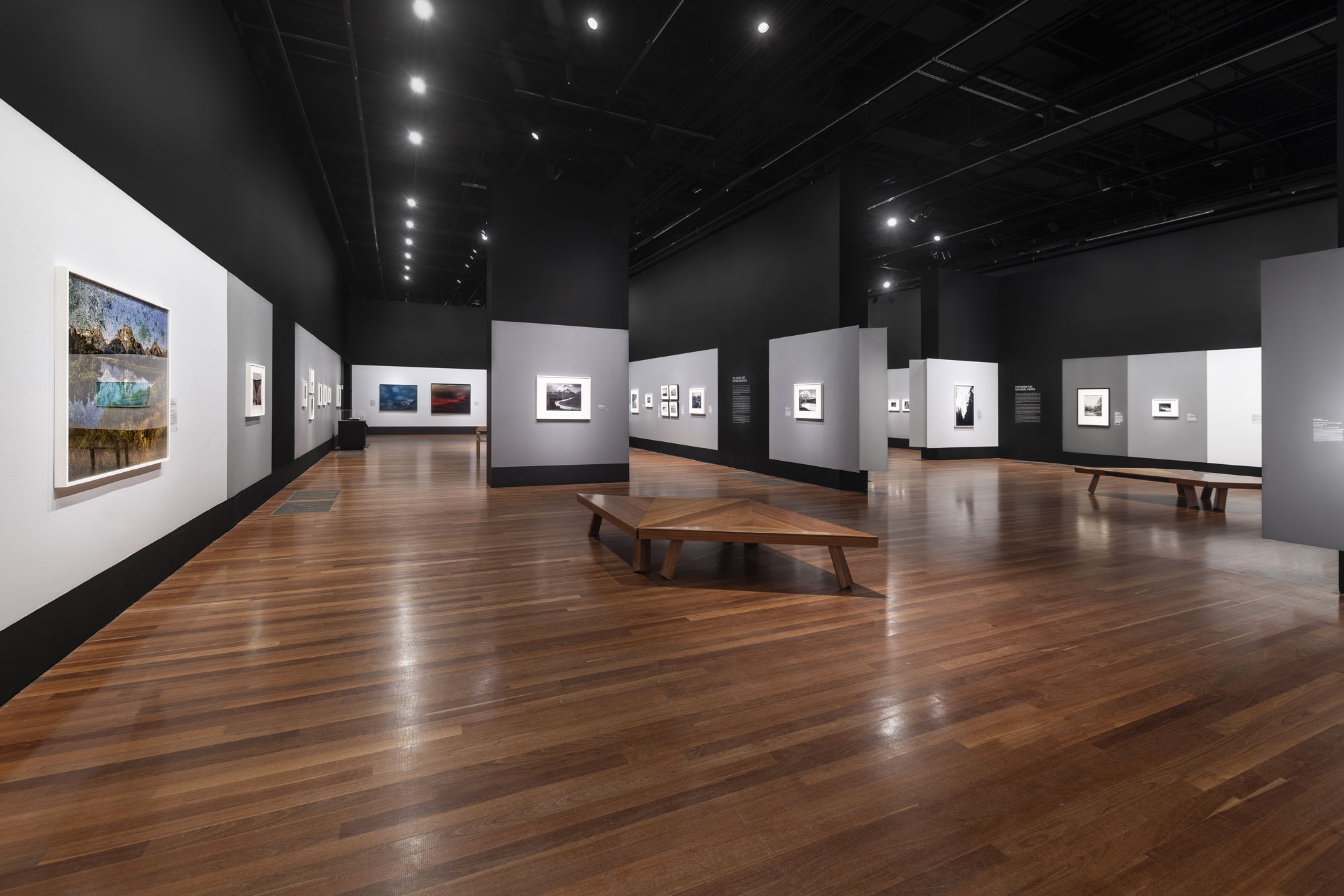
 

Installation view of the exhibition 'Ansel Adams in Our Time' at the de Young museum, San Francisco showing at left, Abelardo Morell's 'Tent-Camera Image on Ground: View of Mount Moran and the Snake River from Oxbow Bend, Grand Teton National Park, Wyoming' (2011); and at centre Adams' 'The Tetons and Snake River, Grand Teton National Park, Wyoming' (1942)


Installation view of the exhibition Ansel Adams in Our Time at the de Young museum, San Francisco showing at left, Abelardo Morell’s Tent-Camera Image on Ground: View of Mount Moran and the Snake River from Oxbow Bend, Grand Teton National Park, Wyoming (2011, below); and at centre Adams’ The Tetons and Snake River, Grand Teton National Park, Wyoming (1942, below)
Images courtesy of the Fine Arts Museums of San Francisco
Photos: Gary Sexton
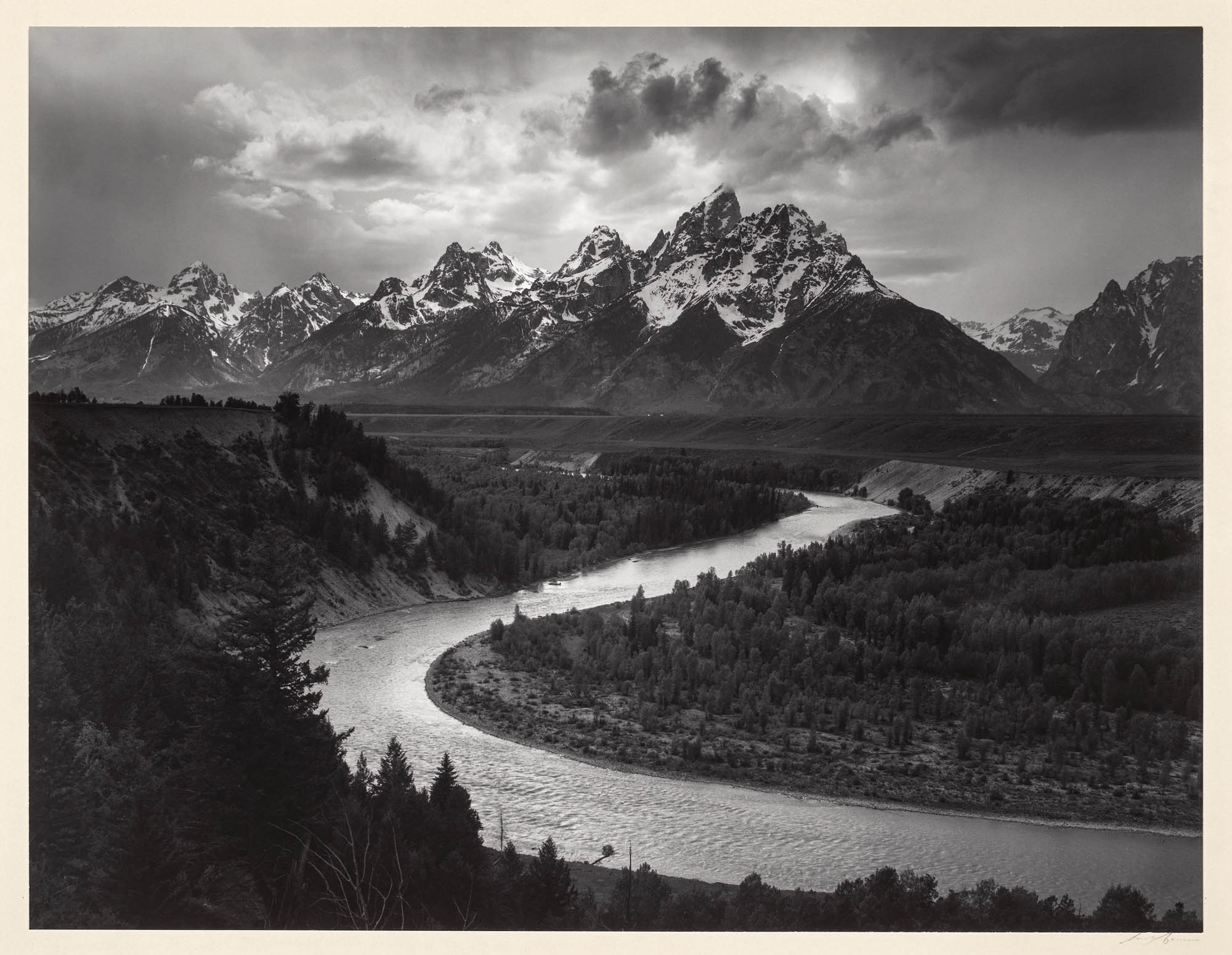
 

Ansel Adams (American, 1902-1984) 'The Tetons and Snake River, Grand Teton National Park, Wyoming' 1942


Ansel Adams (American, 1902-1984)
The Tetons and Snake River, Grand Teton National Park, Wyoming
1942
Gelatin silver print
The Lane Collection
Courtesy Museum of Fine Arts, Boston
© The Ansel Adams Publishing Rights Trust
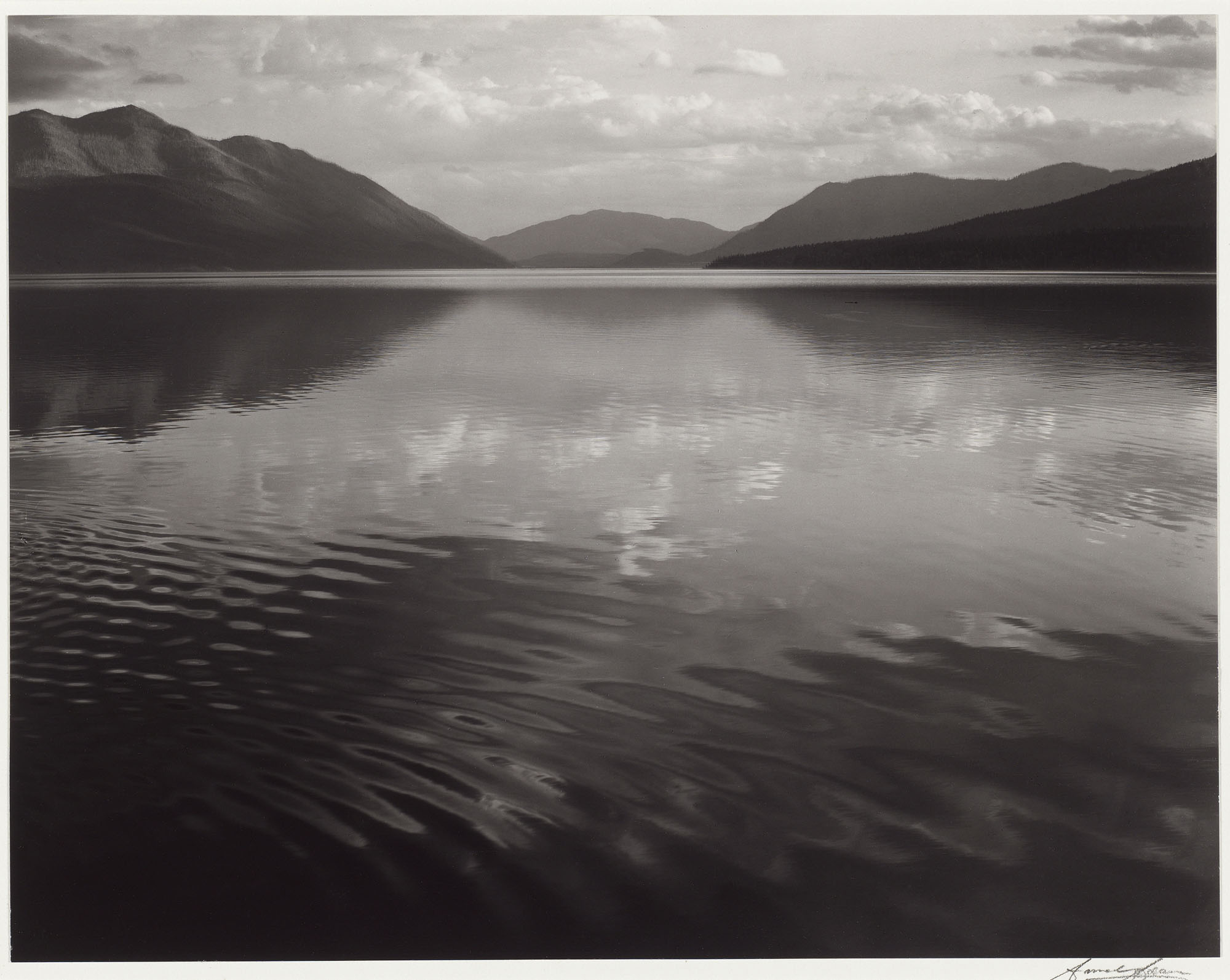
 

Ansel Adams (American, 1902-1984) 'Lake McDonald, Evening, Glacier National Park, Montana' 1942


Ansel Adams (American, 1902-1984)
Lake McDonald, Evening, Glacier National Park, Montana
1942
Gelatin silver print
The Lane Collection
Courtesy Museum of Fine Arts, Boston
© The Ansel Adams Publishing Rights Trust
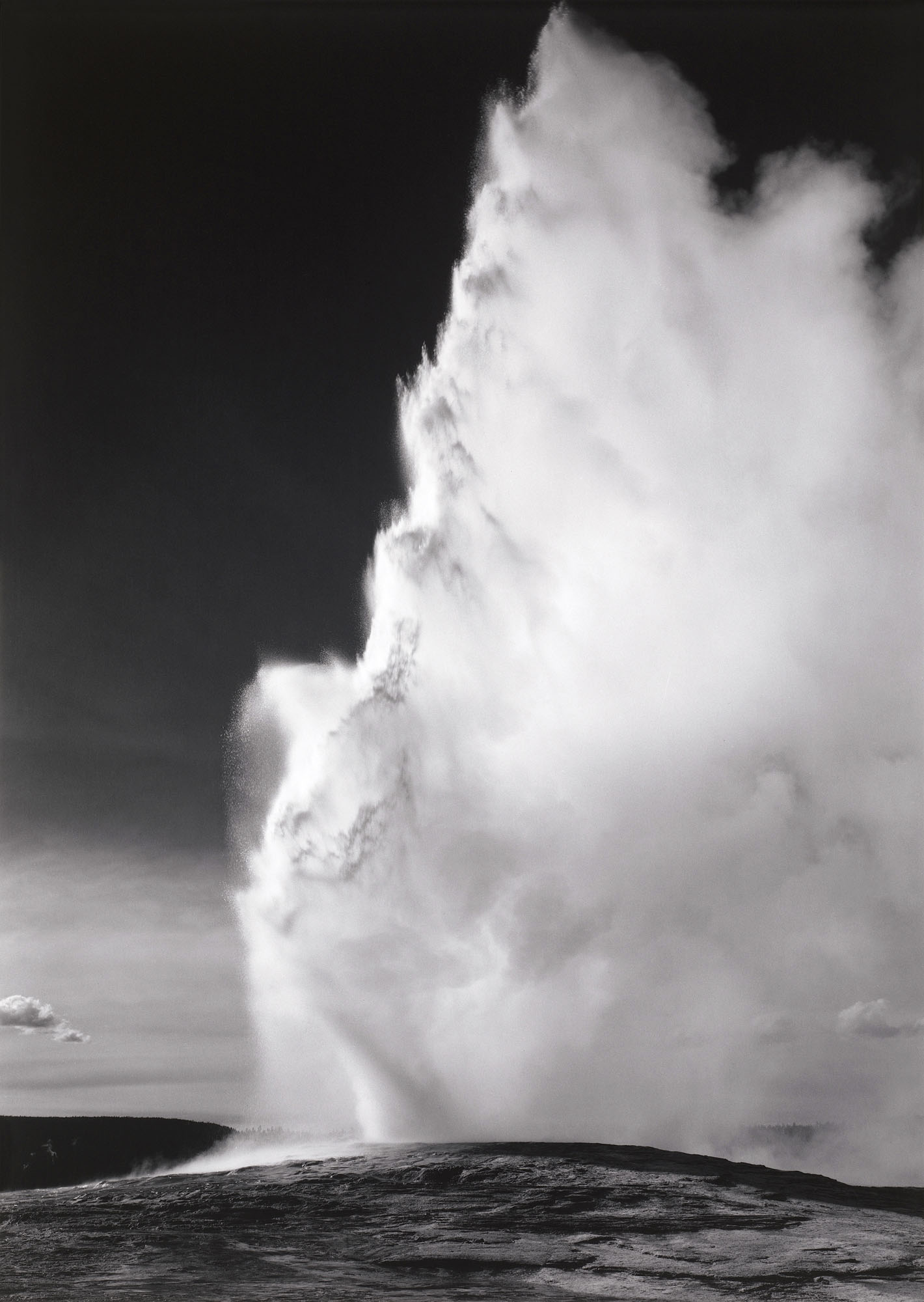
 

Ansel Adams (American, 1902-1984) 'Old Faithful Geyser, Yellowstone National Park, Wyoming' 1942


Ansel Adams (American, 1902-1984)
Old Faithful Geyser, Yellowstone National Park, Wyoming
1942
Gelatin silver print
The Lane Collection
Courtesy Museum of Fine Arts, Boston
© The Ansel Adams Publishing Rights Trust


Ansel Adams began writing how-to books on photography in the mid-1930s, but he is best known for his series of technical books, including Camera and Lens, The Negative, The Print, and Natural Light Photography. In one of his later books, he uses an image of a Yellowstone geyser as an example of a particularly challenging subject that defies light-meter readings and tests a photographer’s ability to “visualise” in advance something so inherently fleeting and unpredictable. “It is difficult to conceive of a substance more impressively brilliant than the spurting plumes of white waters in sunlight against a deep blue sky,” he wrote.

Exhibition label text
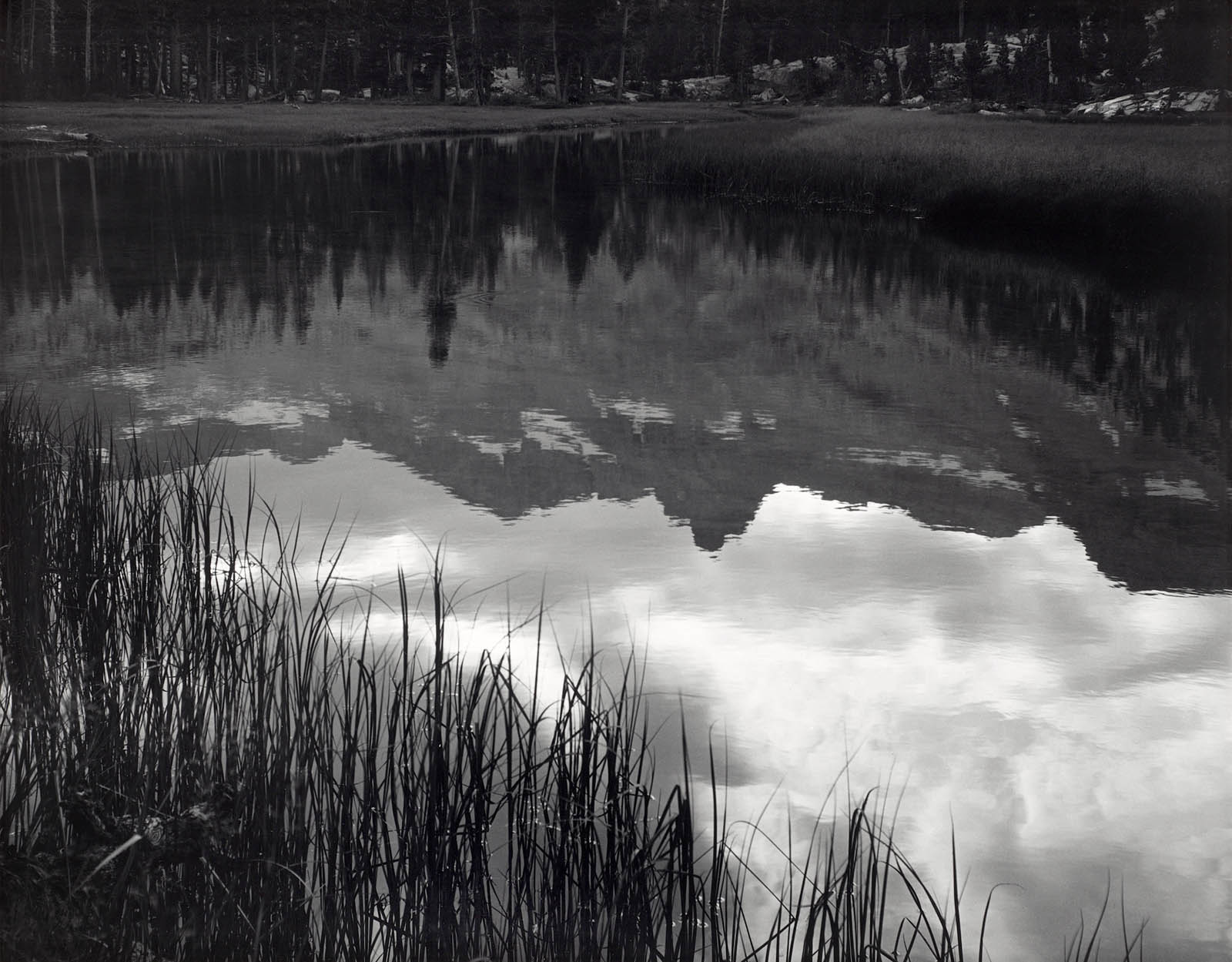
 

Ansel Adams (American, 1902-1984) 'Grass and Reflections, Lyell Fork of the Merced River, Yosemite National Park' About 1943


Ansel Adams (American, 1902-1984)
Grass and Reflections, Lyell Fork of the Merced River, Yosemite National Park
About 1943
Gelatin silver print
The Lane Collection
Courtesy Museum of Fine Arts, Boston
© The Ansel Adams Publishing Rights Trust


Lyell Fork was one of Ansel Adams’ favourite locations from his earliest years as a photographer in Yosemite. It was a place he also loved introducing to others—he took Georgia O’Keeffe and photography collector David McAlpin there when they hiked into the backcountry in 1938. Reflected in the placid water are several distant peaks, the most prominent of which was named Mount Ansel Adams after the photographer’s death in 1984.

Exhibition label text


The Other Side of the Mountain

Ansel Adams made his reputation mainly through images of beautiful, seemingly unspoiled nature. Less well known are the images he produced in California’s Death Valley and Owens Valley [below], southeast of Yosemite. Yet he was drawn to these more forbidding landscapes multiple times – occasionally lured by a book or magazine project but often of his own volition.

Here, on the dry side of the Sierra Nevada, Adams and his work took a dramatic detour. The photographer Edward Weston introduced Adams to Death Valley, where he photographed sand dunes, salt flats, and sandstone canyons. Owens Valley was once farmland, but its residents struggled after their water supply was diverted to the growing city of Los Angeles. In 1943, Adams first traveled to nearby Manzanar, where he photographed Japanese Americans forcibly relocated to internment camps shortly after the US entered World War II. The resulting series explores the tension between the area’s open spaces and the physical restrictions imposed upon internees.

Contemporary photographers continue to find compelling subjects in these remote places. Their images explore the raw beauty of the terrain and the sometimes unsettling ways it is used today – including as the site of maximum-security prisons and clandestine military projects carried out under wide skies.

Exhibition wall text
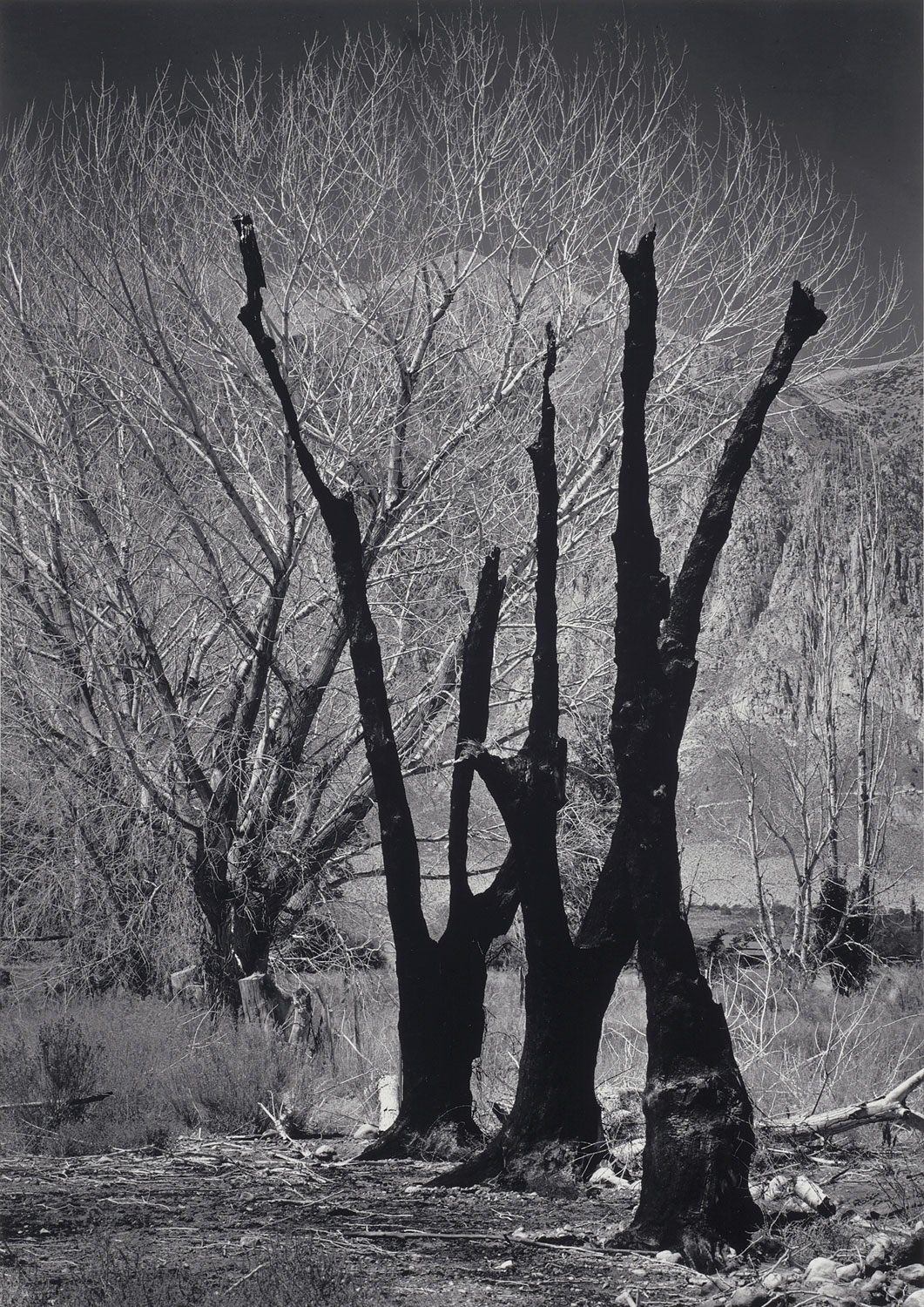
 

Ansel Adams (American, 1902-1984) 'Burned Trees, Owens Valley, California' Negative date: about 1936


Ansel Adams (American, 1902-1984)
Burned Trees, Owens Valley, California
Negative date: about 1936
Gelatin silver print
The Lane Collection
Courtesy Museum of Fine Arts, Boston
© The Ansel Adams Publishing Rights Trust
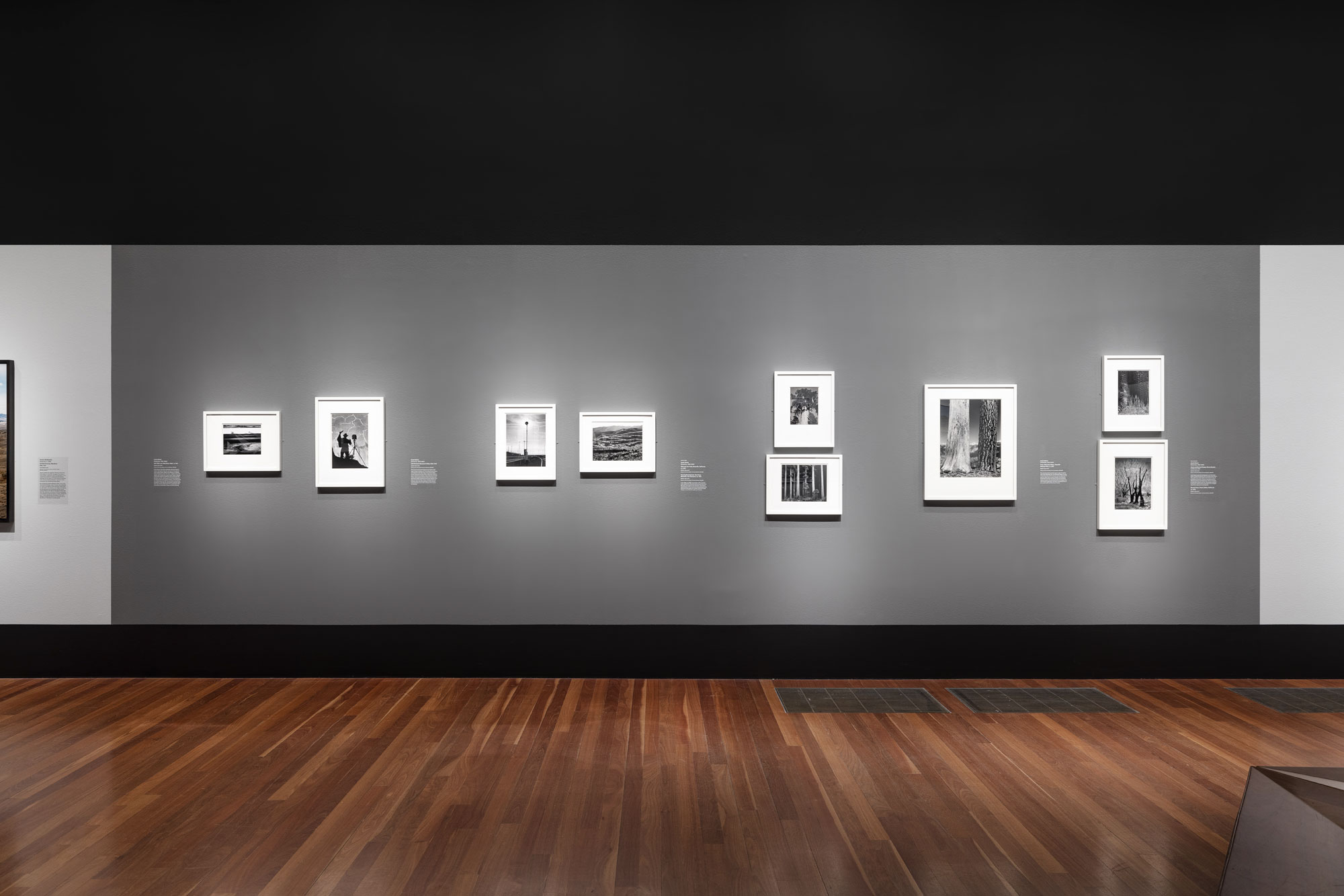
 

Installation view of the exhibition 'Ansel Adams in Our Time' at the de Young museum, San Francisco showing at left, 'Salt Flats Near Wendover, Utah' (1953); at second left, 'Self‑Portrait, Monument Valley, Utah' (1958); at second left 'Trees Near Washburn Point, Illiloutte Ridge, Yosemite Valley' (c. 1945); and at bottom right, 'Burned Trees, Owens Valley, California' (1936)


Installation view of the exhibition Ansel Adams in Our Time at the de Young museum, San Francisco showing at left, Salt Flats Near Wendover, Utah (1953, above); at second left, Self‑Portrait, Monument Valley, Utah (1958, below); at second left Trees Near Washburn Point, Illiloutte Ridge, Yosemite Valley (c. 1945, below); and at bottom right, Burned Trees, Owens Valley, California (1936, above)
Image courtesy of the Fine Arts Museums of San Francisco
Photo: Gary Sexton
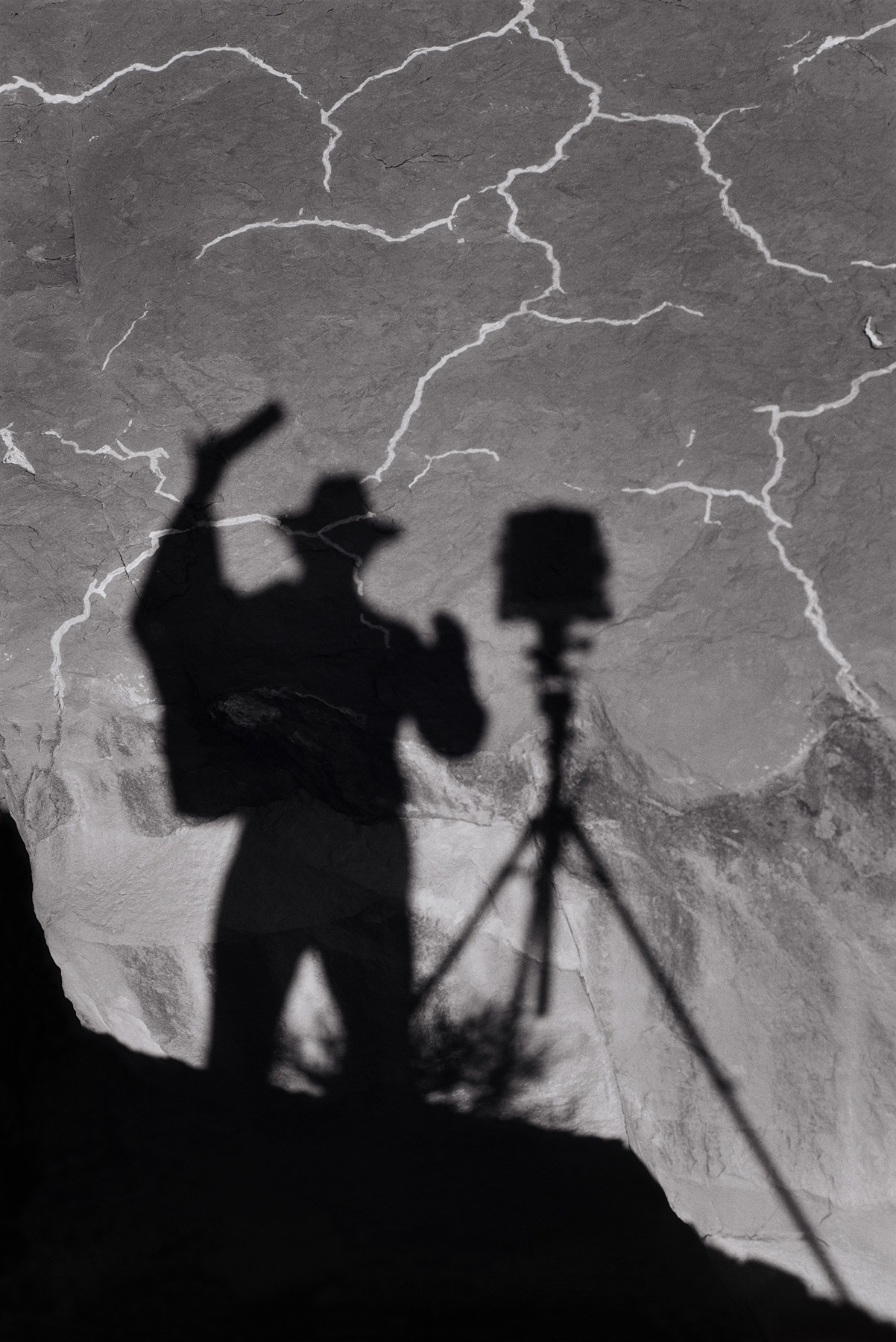
 

Ansel Adams (American, 1902-1984) 'Self‑Portrait, Monument Valley, Utah' 1958


Ansel Adams (American, 1902-1984)
Self‑Portrait, Monument Valley, Utah
1958
Gelatin silver print
The Lane Collection
Courtesy Museum of Fine Arts, Boston
© The Ansel Adams Publishing Rights Trust


This unusual self-portrait depicts Ansel Adams, light meter in hand, standing next to his large-format camera and tripod. He made this image of his shadow falling across a fissured rock face while in Monument Valley to shoot a Colorama for display in New York’s Grand Central Station. Sponsored by Eastman Kodak, Coloramas were panoramic, backlit transparencies, almost eighteen feet high and sixty feet long, whose sweeping scale and luminous colour were the antithesis of this intimate image that Adams shot while waiting for the weather to cooperate.

Exhibition label text
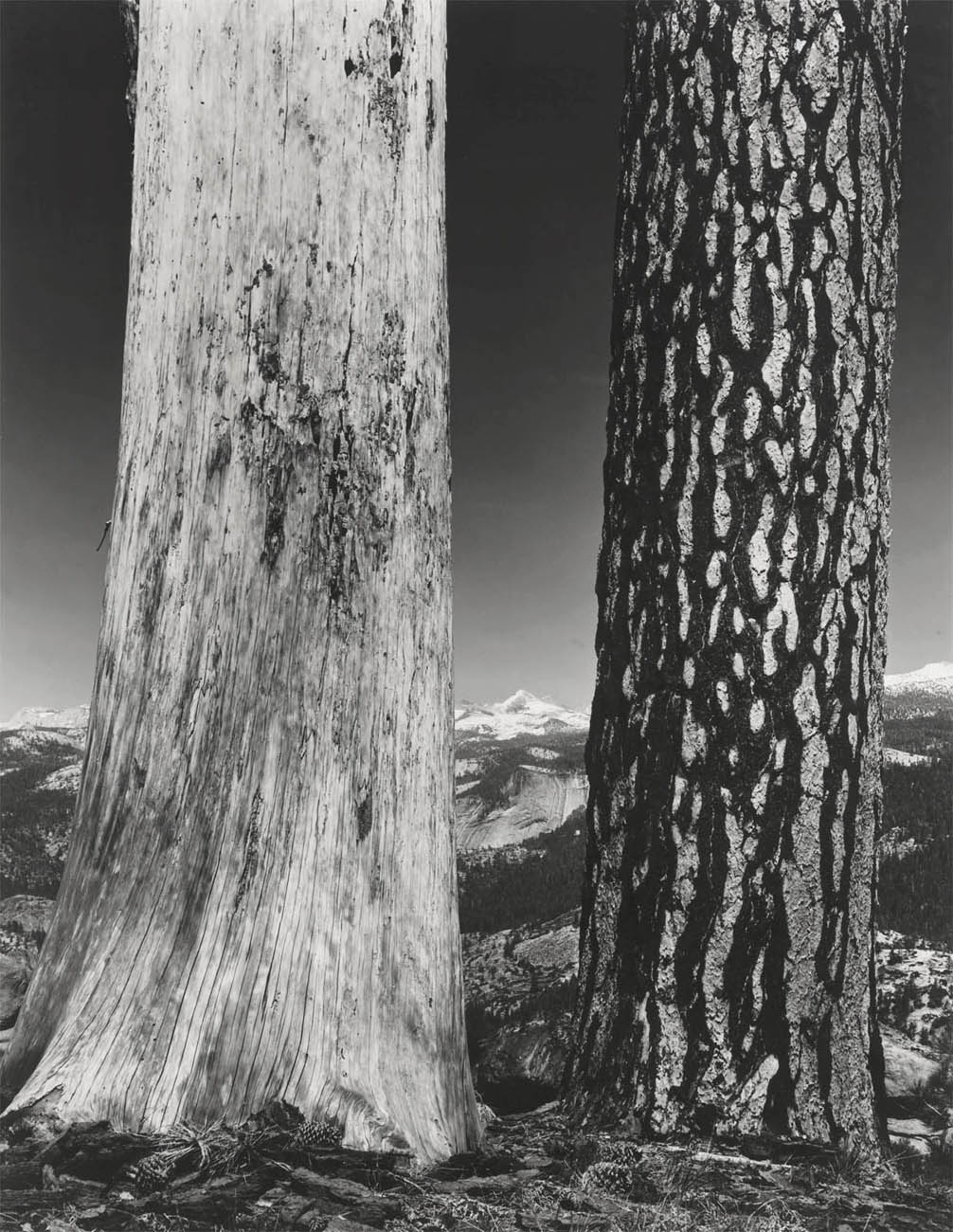
 

Ansel Adams (American, 1902-1984) 'Trees, Illilouette Ridge, Yosemite National Park' c. 1945


Ansel Adams (American, 1902-1984)
Trees, Illilouette Ridge, Yosemite National Park
c. 1945
Gelatin silver print
The Lane Collection
Courtesy Museum of Fine Arts, Boston
© The Ansel Adams Publishing Rights Trust


This stunning double portrait records a pair of massive tree trunks following a fire. The Illilouette Ridge is an area of Yosemite National Park that lies between Glacier Point and the valley floor. In recent decades, the Illilouette Creek basin has been the focus of an environmental study to measure the potential benefit of managing fires with minimal suppression and fewer controlled burns on the overall health and diversity of forests.

Exhibition label text
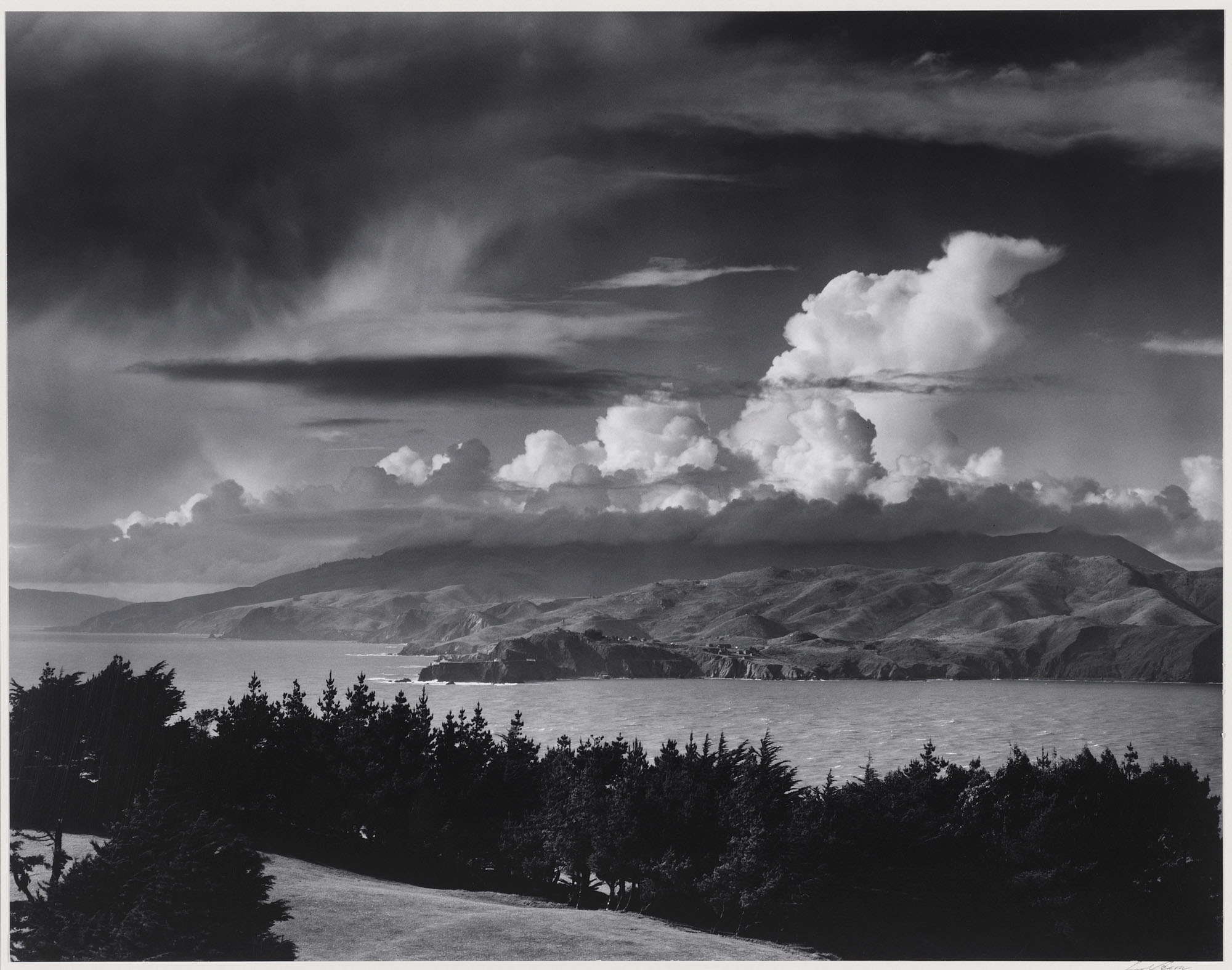
 

Ansel Adams (American, 1902-1984) 'Marin Hills from Lincoln Park, San Francisco' Negative date: 1952


Ansel Adams (American, 1902-1984)
Marin Hills from Lincoln Park, San Francisco
Negative date: 1952
Gelatin silver print
The Lane Collection
Courtesy Museum of Fine Arts, Boston
© The Ansel Adams Publishing Rights Trust
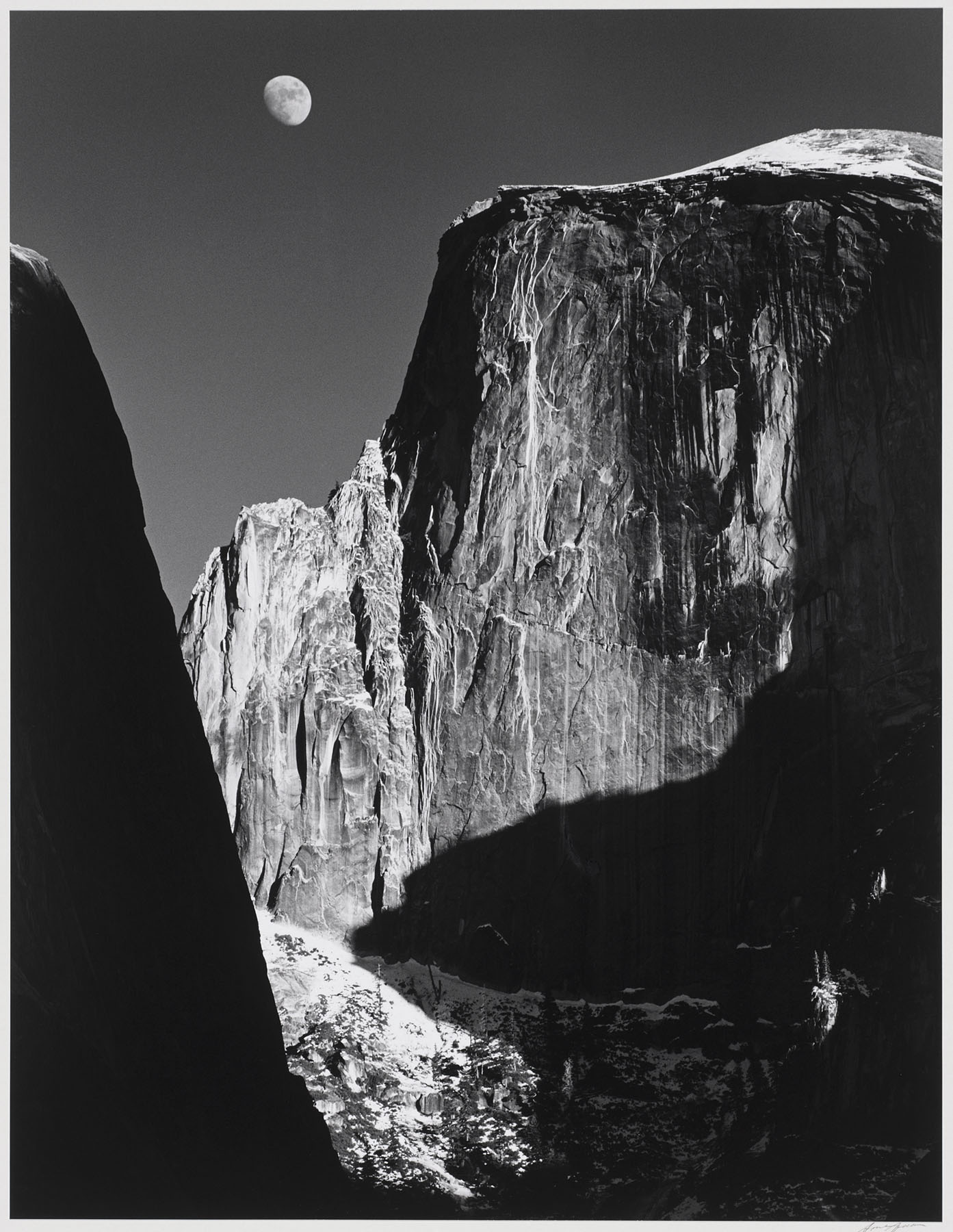
 

Ansel Adams (American, 1902-1984) 'Moon and Half Dome, Yosemite National Park' 1960


Ansel Adams (American, 1902-1984)
Moon and Half Dome, Yosemite National Park
1960
Gelatin silver print
The Lane Collection
Courtesy Museum of Fine Arts, Boston
© The Ansel Adams Publishing Rights Trust


Ansel Adams made this spectacular image of two of his favourite subjects – Half Dome and the moon – on an autumn afternoon in 1960. He witnessed a brilliant gibbous moon rising to the left fo the vertical rock face and, using a long lens and orange filter, carefully framed what would become one of his most popular late works. “As soon as I saw the moon coming up by Half Dome, I had visualised the image,” Adams wrote.

Exhibition label text
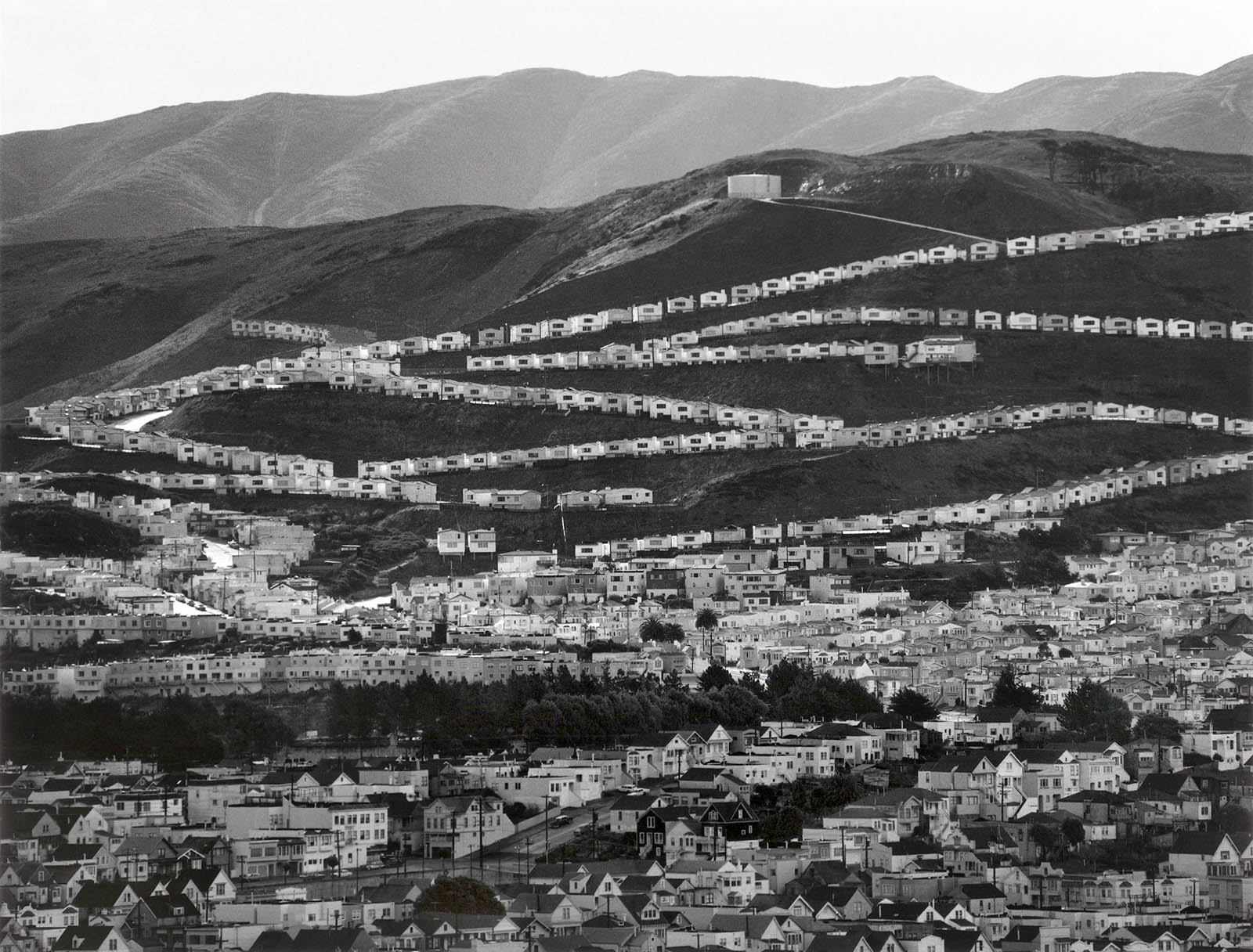
 

Ansel Adams (American, 1902-1984) 'Housing Development, San Bruno Mountains, San Francisco' About 1966


Ansel Adams (American, 1902-1984)
Housing Development, San Bruno Mountains, San Francisco
About 1966
Gelatin silver print
The Lane Collection
Courtesy Museum of Fine Arts, Boston
© The Ansel Adams Publishing Rights Trust


In the 1950s and 1960s, Ansel Adams often recorded urban subjects like this view looking toward San Bruno Mountain, just south of San Francisco. Here Adams documents one of the many tract housing developments built during this period, as it snakes across the steep hillsides surrounding the rapidly growing city.

Exhibition label text
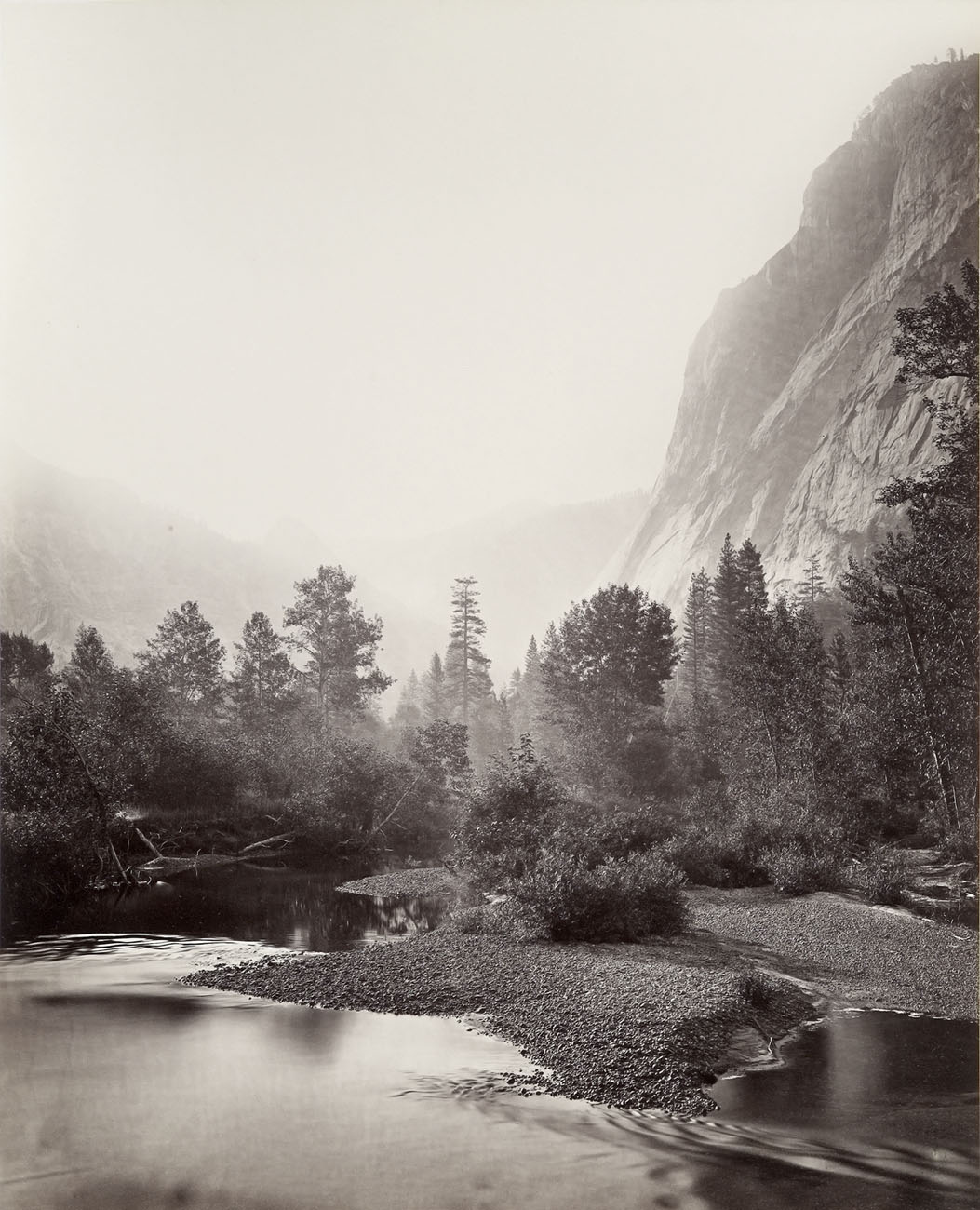
 

Carleton E. Watkins (American, 1829-1916) 'Mount Starr King and Glacier Point, Yosemite, No. 69' 1865-1866


Carleton E. Watkins (American, 1829-1916)
Mount Starr King and Glacier Point, Yosemite, No. 69
1865-1866
Mammoth albumen print from wet collodion negative
Ernest Wadsworth Longfellow Fund
Courtesy Museum of Fine Arts, Boston


Carleton E. Watkins took this photograph from the floor of Yosemite Valley while working for the California State Geological Survey in the mid-1860s. It is a more intimate and less sweeping view than the photograph Watkins self-described as the “best general view of Yosemite” (below), which presents the most recognisable features of the landscape.

Mount Starr King, the distant peak at centre, was named for Thomas Starr King, the Unitarian minister from Boston whose life and ministry were powerfully influenced by his experiences in the Yosemite wilderness. Ansel Adams later shared his “disregard for the naming of things and [his skepticism] of those non-professionals who go through the wilderness classifying and labelling everything in sight.”

Exhibition label text
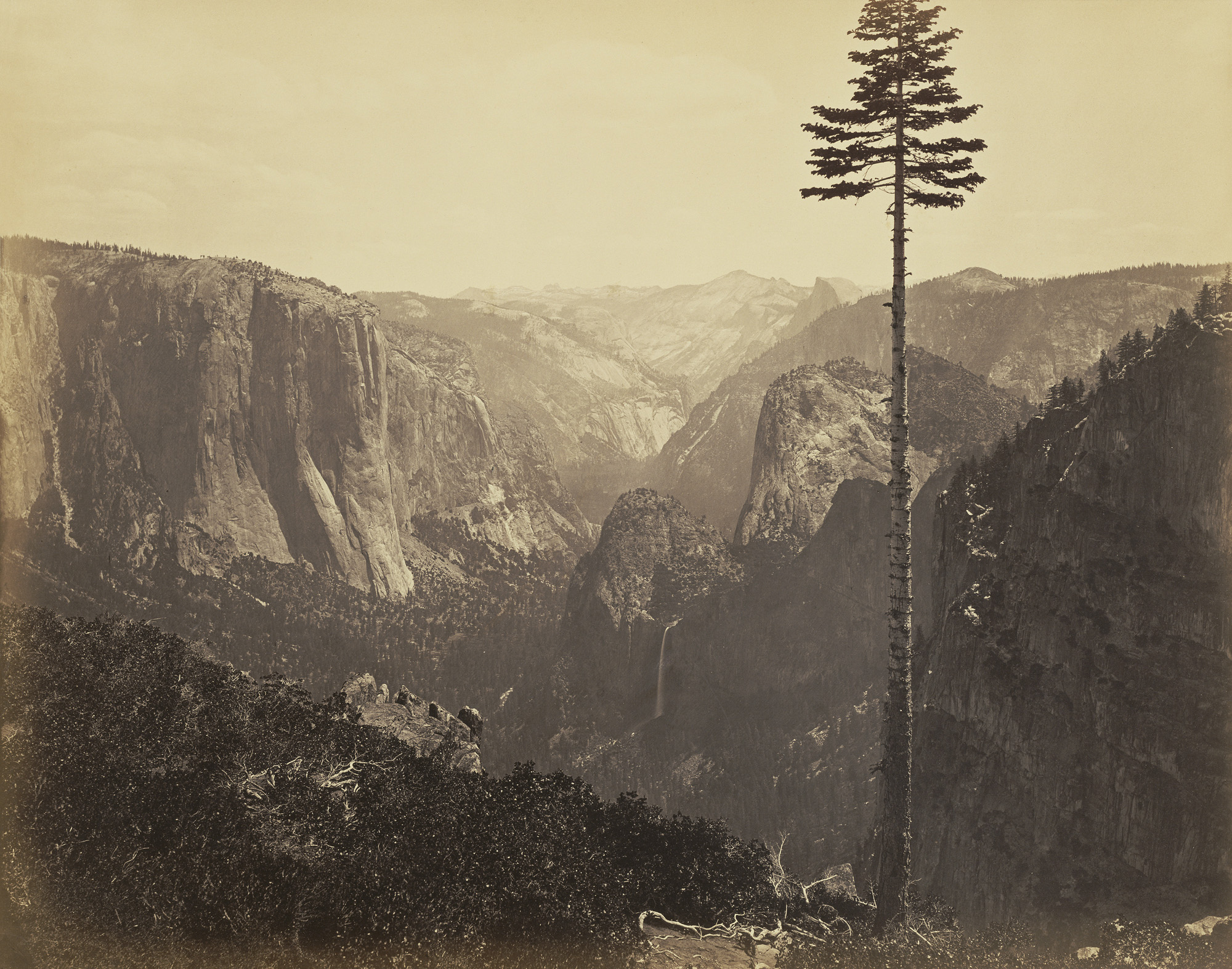
 

Carleton Watkins. 'Yosemite Valley from the Best General View No.2.' 1866


Carleton E. Watkins (American, 1829-1916)
Yosemite from the Best General View No. 2
1866
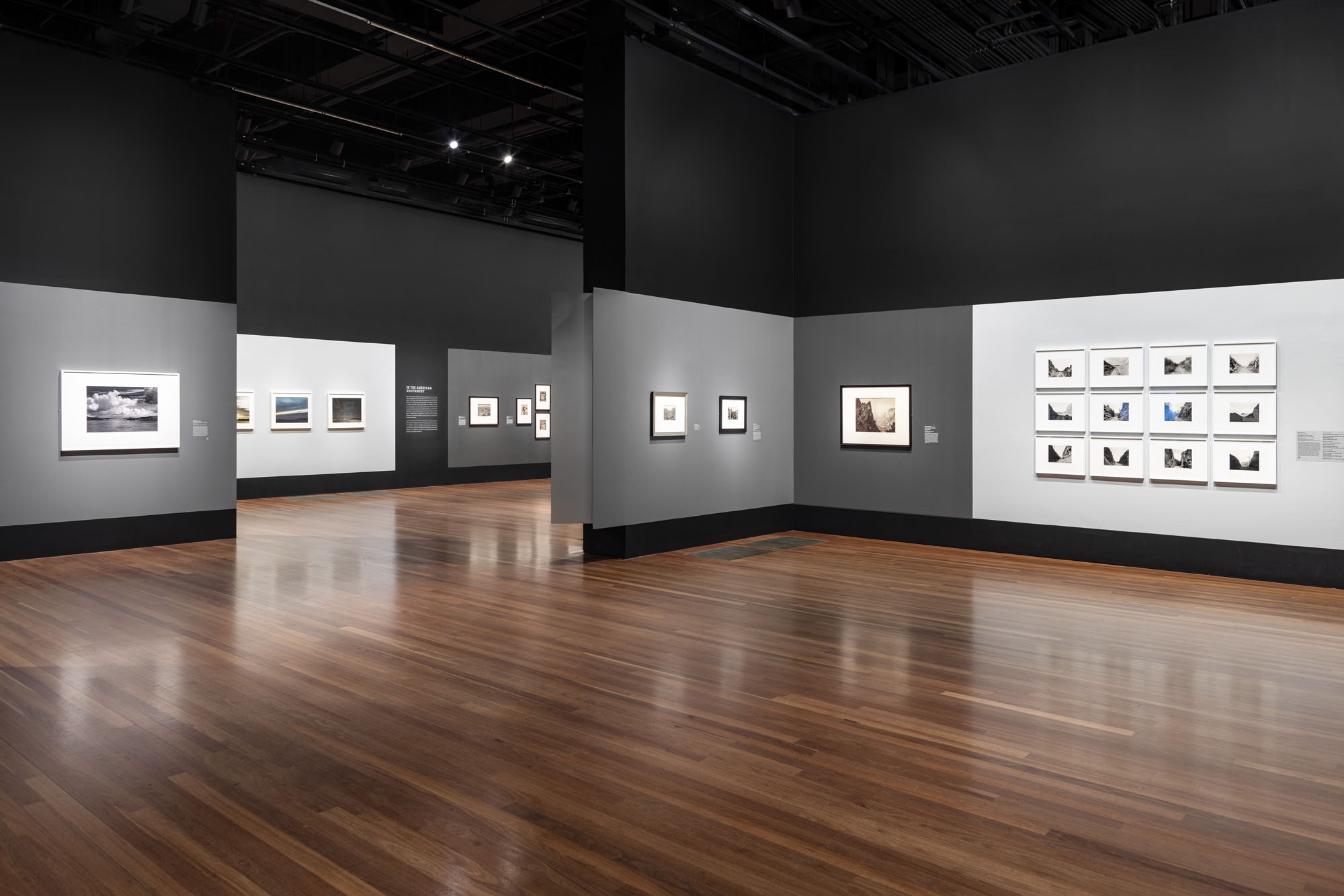
 

Installation view of the exhibition 'Ansel Adams in Our Time' at the de Young museum, San Francisco showing at left, Adams' 'The Golden Gate Before the Bridge' (1932); and at second right, Eadweard J. Muybridge's 'Valley of the Yosemite from Union Point, No. 33' (1872)


Installation view of the exhibition Ansel Adams in Our Time at the de Young museum, San Francisco showing at left, Adams’ The Golden Gate Before the Bridge (1932, above); and at second right, Eadweard J. Muybridge’s Valley of the Yosemite from Union Point, No. 33 (1872, below)
Image courtesy of the Fine Arts Museums of San Francisco
Photo: Gary Sexton
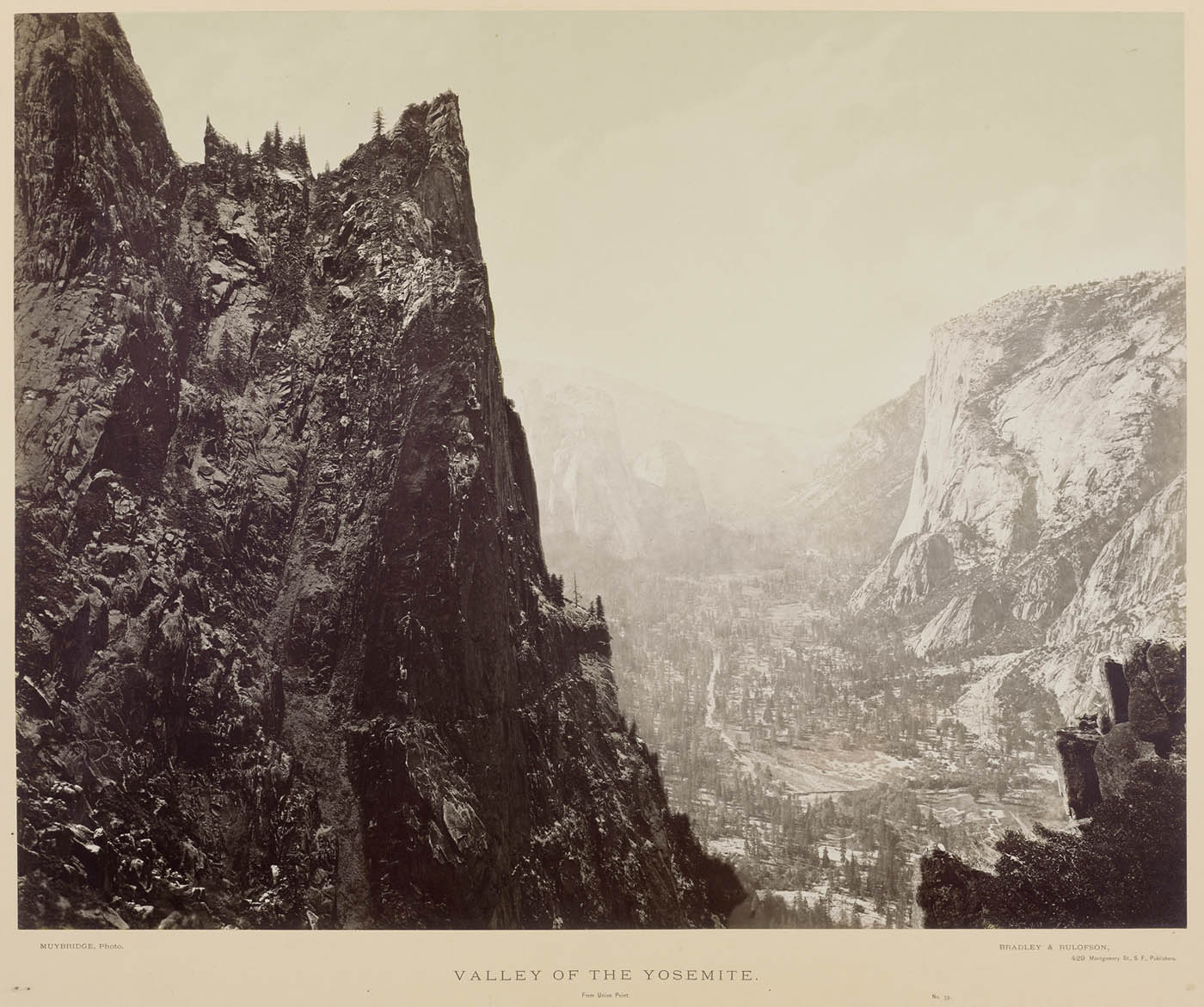
 

Eadweard J. Muybridge (American, 1830-1904) 'Valley of the Yosemite from Union Point, No. 33' 1872


Eadweard J. Muybridge (American, 1830-1904)
Valley of the Yosemite from Union Point, No. 33
1872
Albumen print
Gift of Charles T. and Alma A. Isaacs
Courtesy Museum of Fine Arts, Boston


Eadweard Muybridge first came to Yosemite in the 1860s. Capitalising on the growing popularity of wilderness landscape subjects, he stayed for six months, making large-format albumen prints and stereo views. Hoping to compete with Carleton E. Watkins’s earlier grand vistas, he returned in 1872 with a mammoth-plate camera. Often, Muybridge shot his atmospheric images from unusual perspectives, with sharp contrasts between foreground and background, light and shadow. This is evident in this photograph taken from Union Point, which provided a closer view of the valley and a greater sense of three-dimensional space than the better-known Glacier Point above.

Exhibition label text
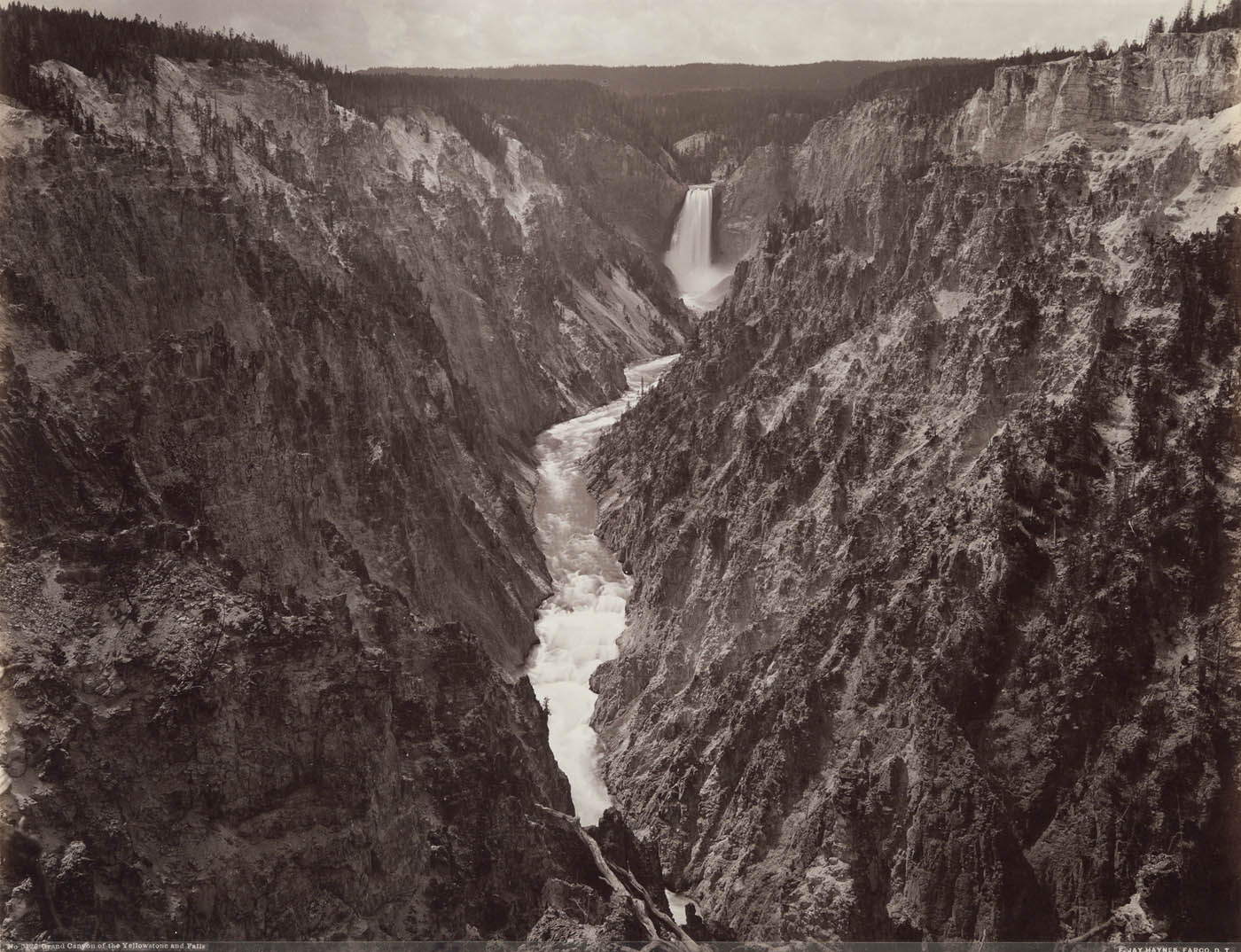
 

Frank Jay Haynes (American, 1853-1921) 'Grand Canyon of Yellowstone and Falls' About 1887


Frank Jay Haynes (American, 1853–1921)
Grand Canyon of Yellowstone and Falls
About 1887
Albumen print
Sophie M. Friedman Fund
Courtesy Museum of Fine Arts, Boston


Frank Jay Haynes was one of the second generation of photographers to be employed by the railroads and government surveys in the American West in the late nineteenth century. In 1884, he was named official photographer and concessionaire of Yellowstone to serve the growing numbers of tourists coming to visit the first national park. Yellowstone is situated on top of a massive subterranean volcano, which produces its active hot springs and towering geysers, such as Old Faithful. For his photograph of the Grand Canyon of the Yellowstone River, Haynes used a mammoth-plate camera to produce a large glass negative, from which he made this highly detailed contact print.

Exhibition label text
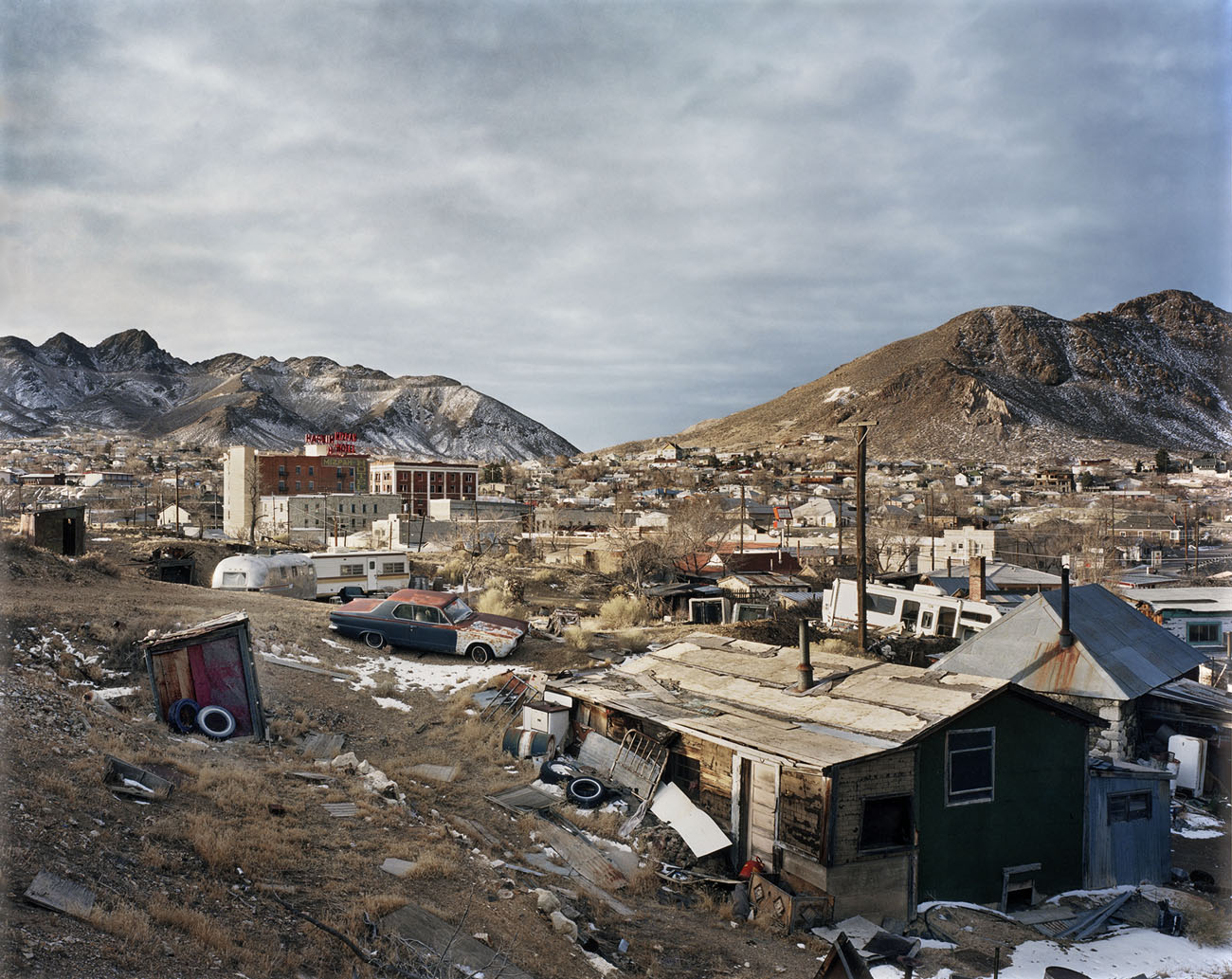
 

Bryan Schutmaat (American, b. 1983) 'Tonopah, NV' Nd


Bryan Schutmaat (American, b. 1983)
Tonopah, NV
Nd
Inkjet print
Gift of Jessie H. Wilkinson – Jessie H. Wilkinson Fund
Courtesy Museum of Fine Arts, Boston
© Bryan Schutmaat


These Nevada landscapes are from Grays the Mountain Sends, a series that depicts the landscapes, structures, and residents of former mining towns. Bryan Schutmaat seeks out these far-flung mountain communities, now mostly abandoned due to the loss of their mineral wealth.

Not unlike Ansel Adams’ fleeting view of Hernandez, New Mexico, first seen in his rearview mirror, Schutmaat’s vision is that of an extended road trip. And like Adams, he is drawn to the methodical way that his large-format camera forces him to work. He waits patiently for the changing light to activate a scene. For Schutmaat, each town’s deserted structures and lonely inhabitants stand as last “relics of hope” and proof of the tragic demise of the American dream. The fragile, hardscrabble beauty of these modern-day ghost towns is also a powerful reminder of the region’s uncertain future and its long history of economic booms and busts.

Exhibition label text
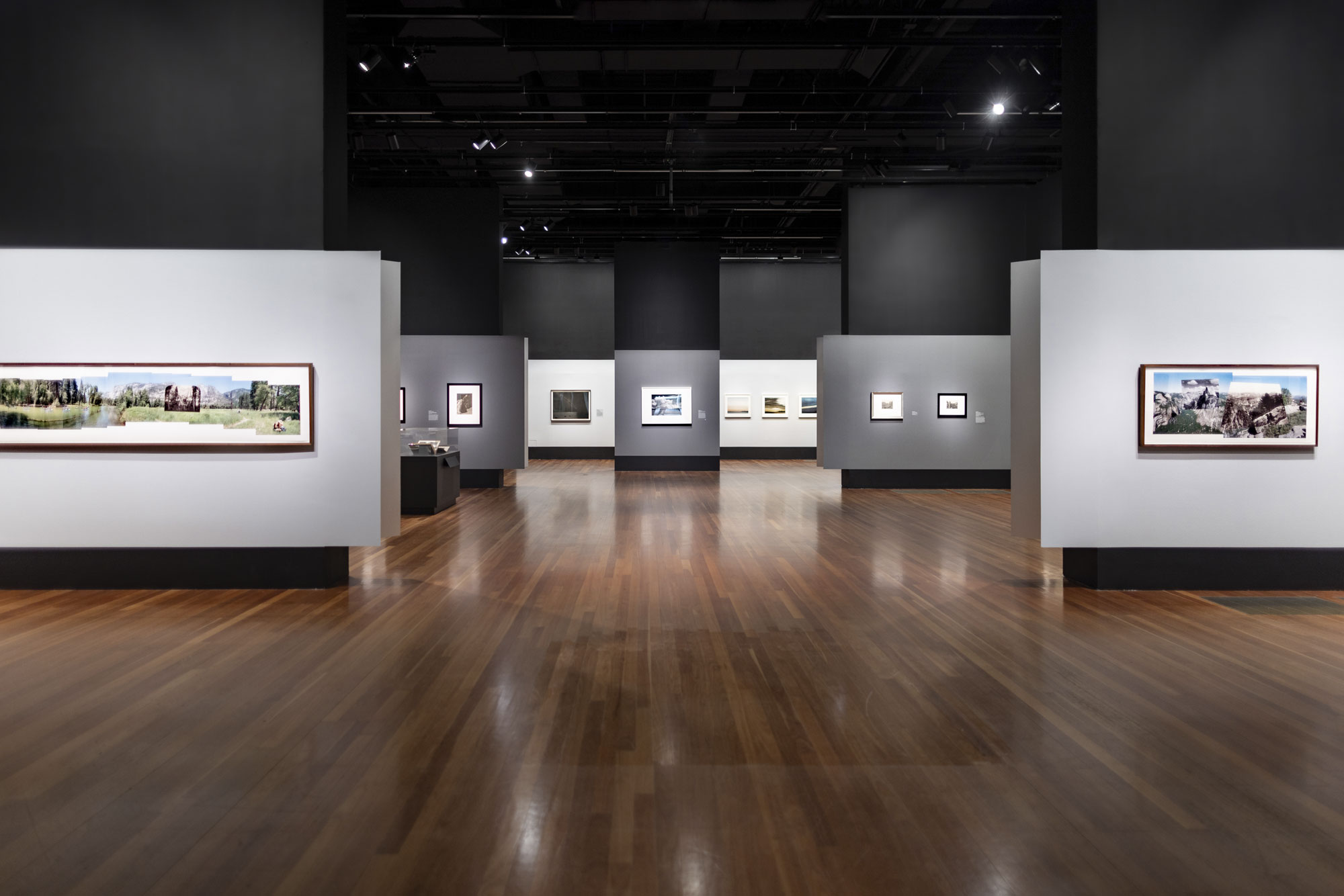
 

Installation view of the exhibition 'Ansel Adams in Our Time' at the de Young museum, San Francisco showing at foreground left and right, works by Mark C. Klett


Installation view of the exhibition Ansel Adams in Our Time at the de Young museum, San Francisco showing at foreground left and right, works by Mark C. Klett (below)
Image courtesy of the Fine Arts Museums of San Francisco
Photo: Gary Sexton
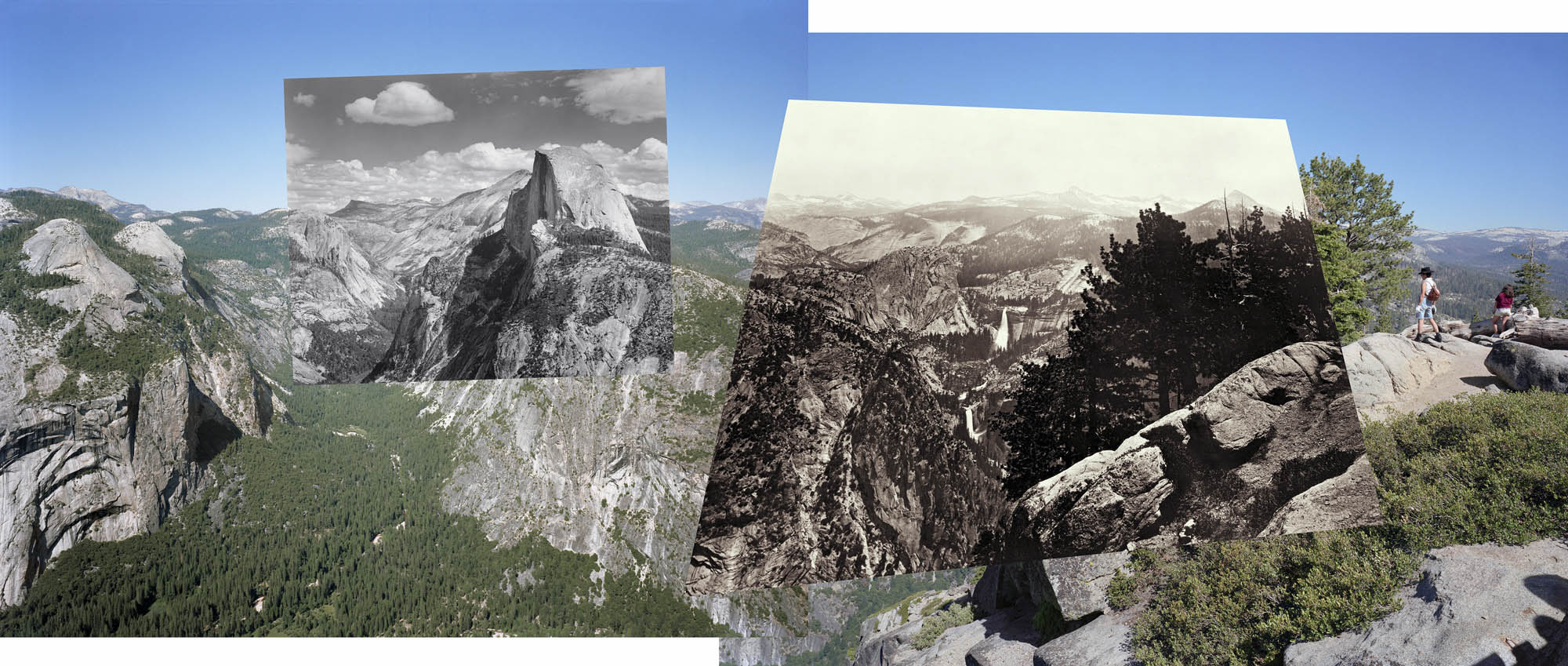
 

Mark C. Klett (American, b. 1952) and Byron Wolfe (American, b. 1967) 'View from the handrail at Glacier Point overlook, connecting views from Ansel Adams to Carleton Watkins' 2003


Mark C. Klett (American, b. 1952) and Byron Wolfe (American, b. 1967)
View from the handrail at Glacier Point overlook, connecting views from Ansel Adams to Carleton Watkins
2003
Archival pigment print
© Mark Klett & Byron Wolfe
Courtesy Etherton Gallery
Courtesy Museum of Fine Arts, Boston


“[Ansel Adams’] depopulated scenes suggest that the landscape does best without our presence, and that wilderness is an entity defined by our absence. However, anyone who has visited the site of one of Adams’ photographs knows that the romance of his landscapes is often best experienced in the photographs themselves. The reality of place is quite different. … The natural beauty of the land is still there to be seen, but you will not see it alone.” ~ Mark Klett

Mark Klett has photographed and rephotographed the western American landscape for more than thirty years. With his longtime collaborator, Byron Wolfe, Klett carefully studies prints by Carleton E. Watkins and other nineteenth-century wilderness photographers, as well as twentieth-century modernists like Ansel Adams. By studying the shadows, they determine the time of year and time of day that an image was made. Once on-site, Klett photographs the view with Polaroid film, and Wolfe measures that image against the original photograph, repeating the process until they locate exactly where the earlier photographer stood. By visually collapsing time and space in this composite panorama of Yosemite Valley, Klett and Wolfe document changes to the landscape over more than a century.

Exhibition label text


The Changing Landscape

In his own time, Ansel Adams was aware of the environmental concerns facing California and the nation. Although Adams continued to make symphonic and pristine wilderness landscapes, as his career progressed, he began to create images that showed a more nuanced vision – images that decidedly break with widely held ideas about his work. He photographed urban sprawl, freeways, graffiti, oil drilling, ghost towns, rural cemeteries, mining towns, and the sometimes-dispossessed inhabitants of those places, as well as less romantic views of nature, such as the aftermath of forest fires.

Appreciated for their imagery and formal qualities, Adams’ photo-graphs also carry a message of advocacy. Photographers working in the American West today confront a changed, and changing, landscape. Human activity – urbanisation, logging, mining, ranching, irrigated farming – and global warming continue to alter the terrain. Works by contemporary artists bear witness to these changes and their impacts, countering notions that our natural resources are limitless. Placed in conversation with Adams’ photographs, these images aid our understanding of his singular contribution to the ways we envision the landscape and the urgency with which we must protect it.

Exhibition wall text
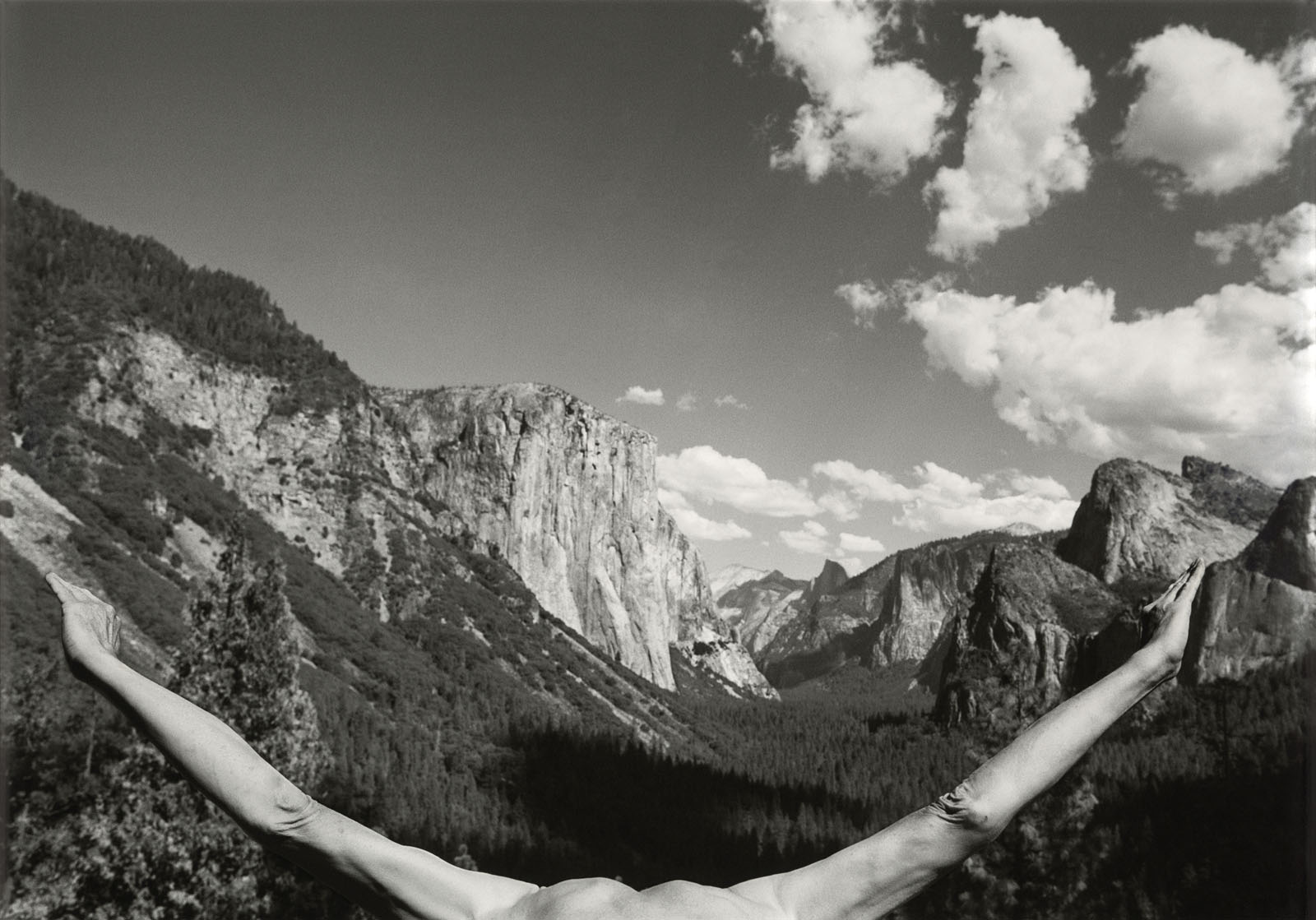
 

Arno Rafael Minkkinen (American born Finland, b. 1945) 'Homage to Watkins, Yosemite' 2007


Arno Rafael Minkkinen (American born Finland, b. 1945)
Homage to Watkins, Yosemite
2007
Inkjet print
Sophie M. Friedman Fund
Courtesy Museum of Fine Arts, Boston
© Arno Rafael Minkkinen


Several of the contemporary photographers in this exhibition call into question the archetypal images of empty wilderness spaces that have long held a central place in the popular imagination. Arno Rafael Minkkinen activates pristine, unpopulated landscapes by introducing his own naked body into them, without relying on digital manipulation. Here, the artist’s seemingly headless torso and the gentle curve of his outstretched arms perfectly echo the bowl-shaped Yosemite Valley as seen from Inspiration Point.

Exhibition label text
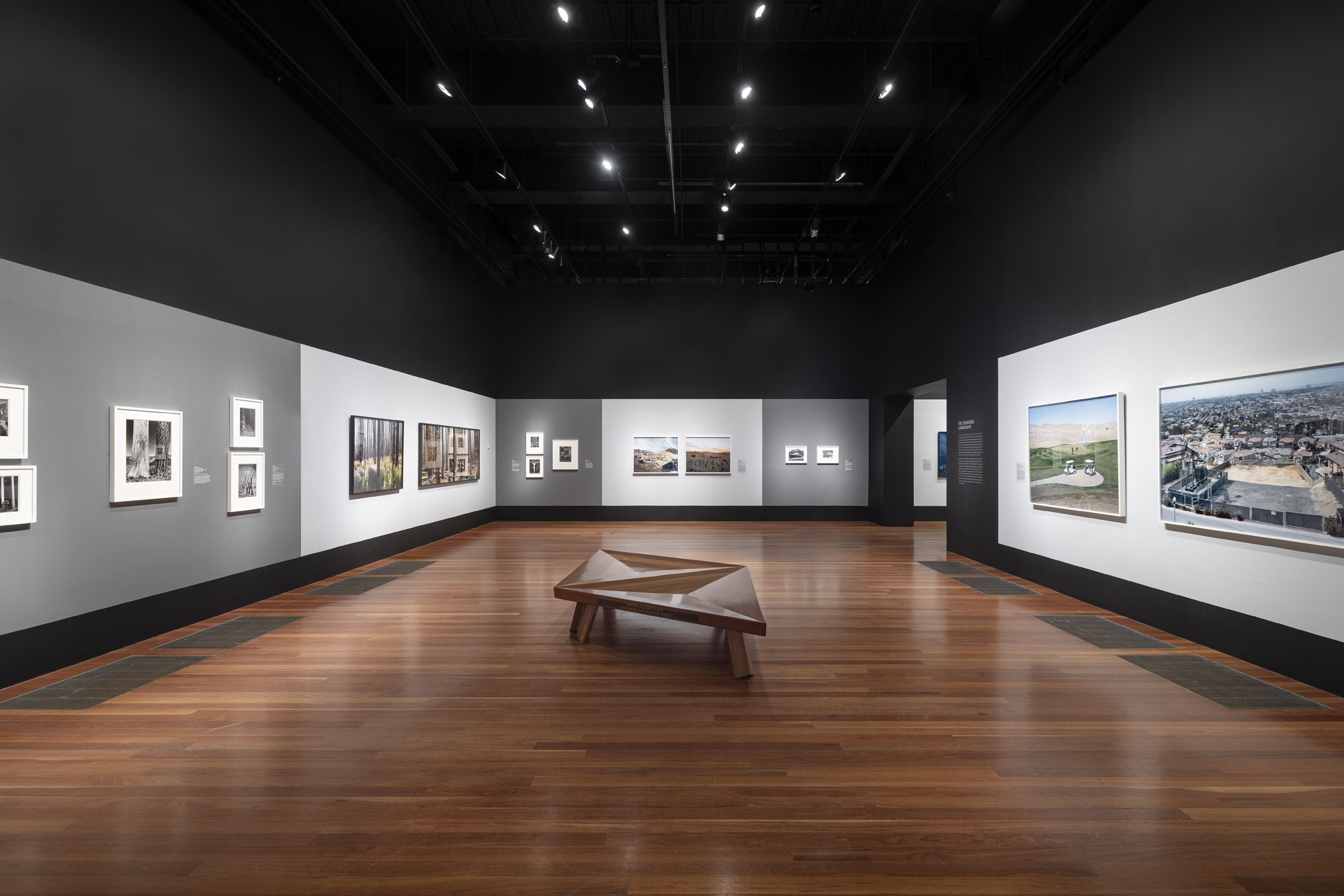
 

Installation view of the exhibition 'Ansel Adams in Our Time' at the de Young museum, San Francisco showing at left in the light panel, Laura McPhee's 'Early Spring (Peeling Bark in Rain)' (2008); and at second right, Mitch Epstein's 'Altamont Pass Wind Farm, California' (2007)


Installation view of the exhibition Ansel Adams in Our Time at the de Young museum, San Francisco showing at left in the light panel, Laura McPhee’s Early Spring (Peeling Bark in Rain) (2008, below); and at second right, Mitch Epstein’s Altamont Pass Wind Farm, California (2007, below)
Image courtesy of the Fine Arts Museums of San Francisco
Photo: Gary Sexton
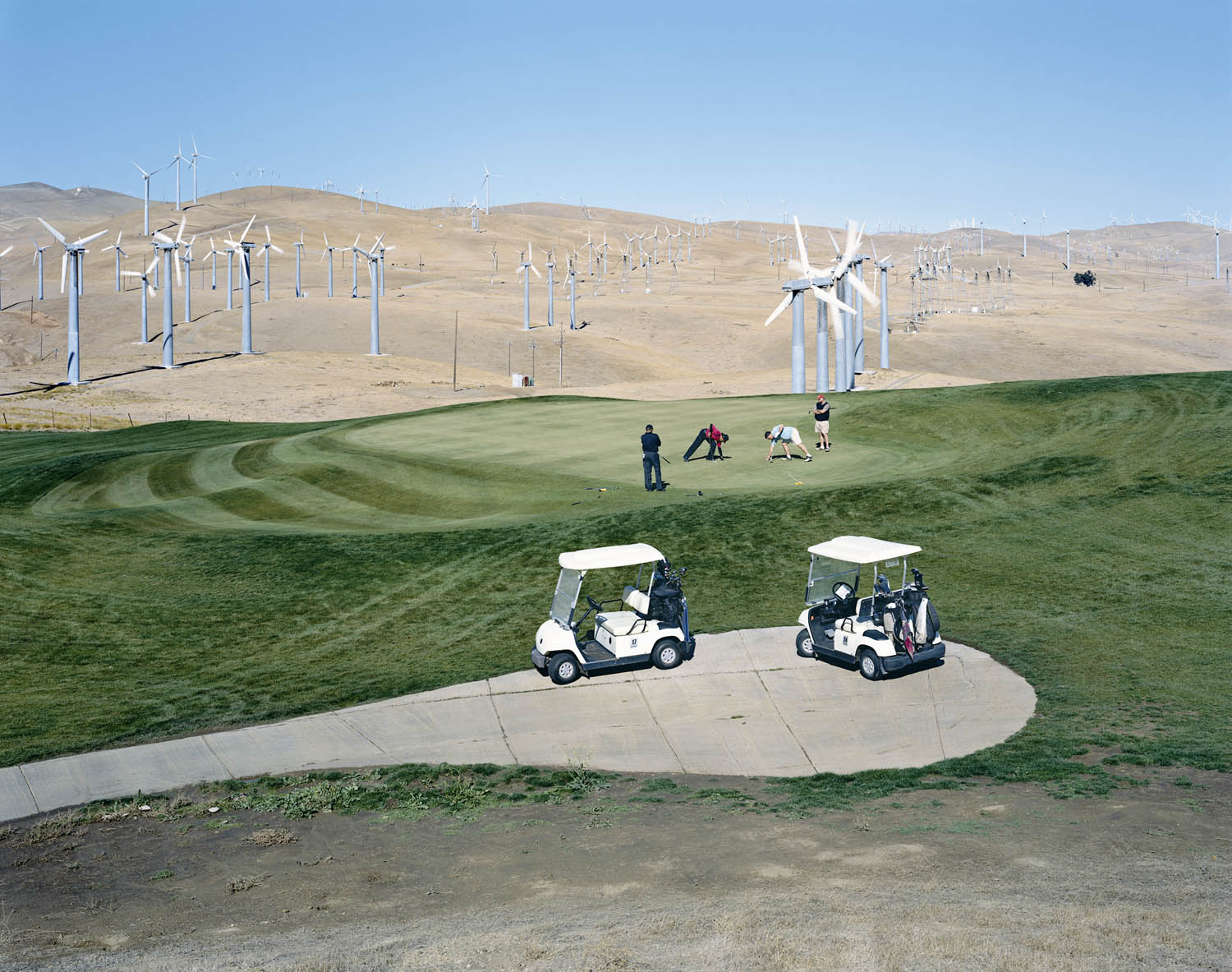
 

Mitch Epstein (American, b. 1952) 'Altamont Pass Wind Farm, California' 2007


Mitch Epstein (American, b. 1952)
Altamont Pass Wind Farm, California
2007
Chromogenic print
Courtesy of the artist and Yancey Richardson Gallery
Courtesy Museum of Fine Arts, Boston
Reproduced with permission


Mitch Epstein’s American Power series investigates energy in its many forms by exploring how we create and consume it, as well as its impact on our daily lives. Often employing a bird’s-eye view and printed on a very large scale, Epstein’s photographs – like these showing oil drilling, wind turbines, desert irrigation, and suburban sprawl – call into question the very definition of power and point to our shared accountability for the abuse of our natural resources. In a world in which we are constantly inundated with photographs, these densely detailed views are also meant to slow down our “reading” of the images and remind us that each may be interpreted in a variety of ways.

“[The] American Power [series] is an active response to the American dream gone haywire. My project focuses on the United States not only because I am American, but because the US has exported its model of unrestricted growth around the world in the form of mass consumerism, corporatism, and sprawl.

“We need to now export a revised model of growth, a revised American dream. I included pictures in American Power of renewable energy – wind, biotech, solar – to show that a healthier, more economical, and compassionate way of life is possible. American Power bears witness to the cost of growth; it asks viewers to consider the landscape they have created – and take responsibility for it.” ~ Mitch Epstein

Exhibition label text
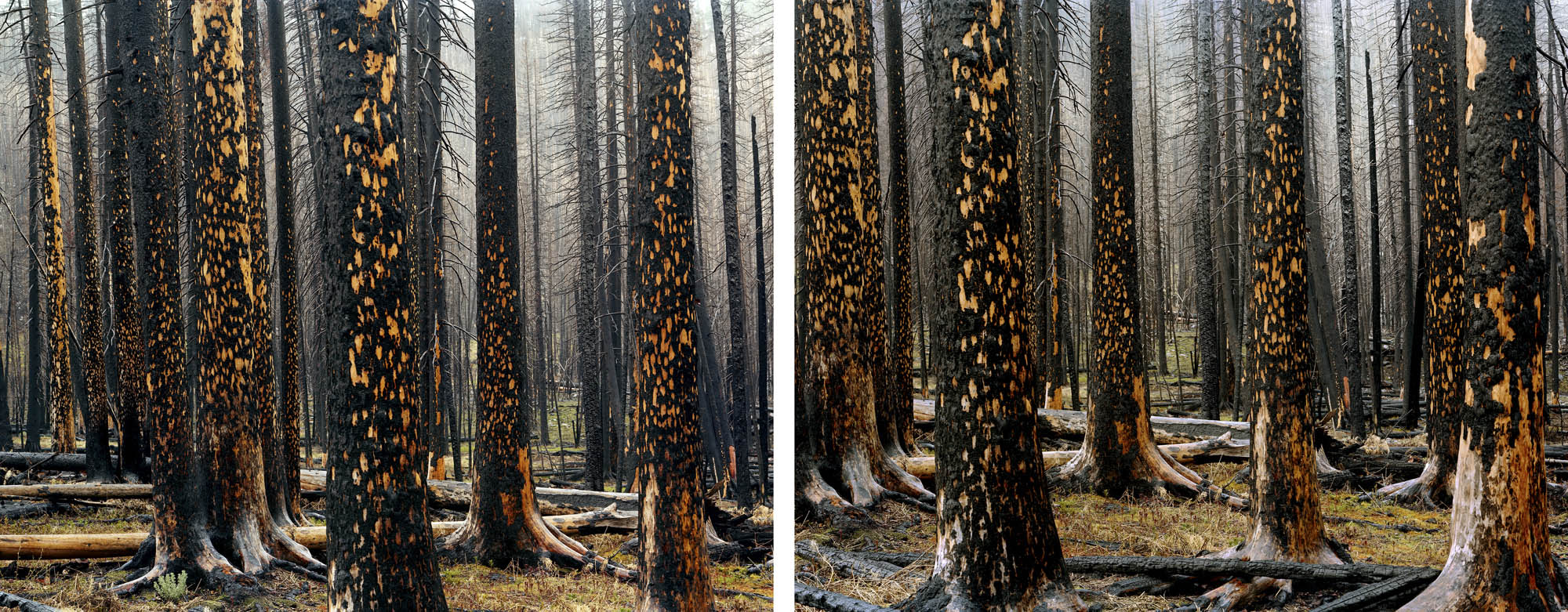
 

Laura McPhee (American, b. 1958) 'Early Spring (Peeling Bark in Rain)' 2008


Laura McPhee (American, b. 1958)
Early Spring (Peeling Bark in Rain)
2008
Inkjet print (diptych)
Courtesy Museum of Fine Arts, Boston
Courtesy of the artist
© Laura McPhee


Working with a large-format camera, Laura McPhee records the impact of human activity on the land, especially in Idaho, a state she loves and visits regularly. These photographs from her Guardians of Solitude series were made in the aftermath of a massive forest fire. Caused by human error, it devastated thousands of acres of woodland before it was finally extinguished. McPhee returned to the area three years later to find that it had burst into bloom. In the renewal of the charred landscape, she found a powerful metaphor for human resilience in the face of terrible personal loss.

Exhibition label text
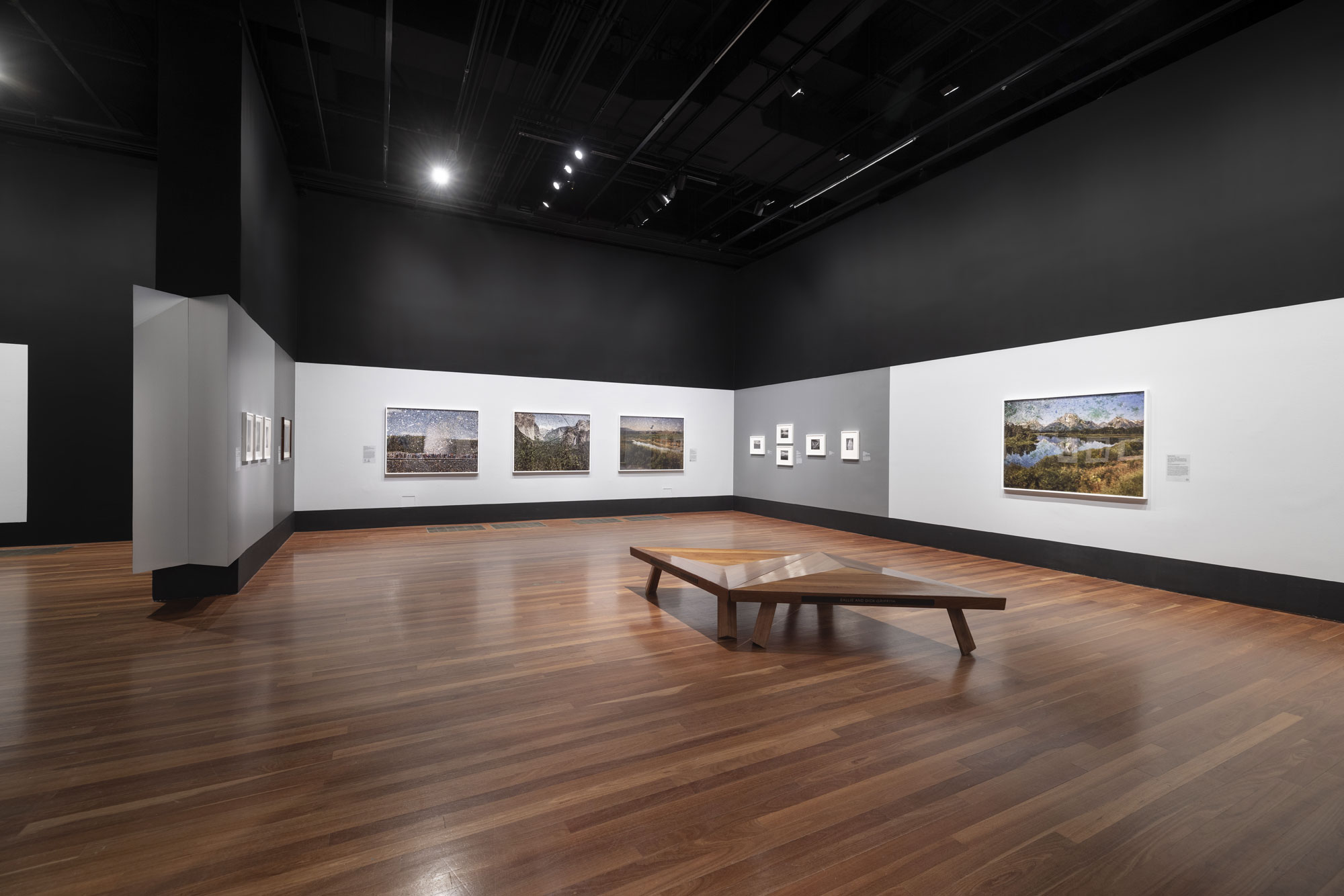
 

Installation view of the exhibition 'Ansel Adams in Our Time' at the de Young museum, San Francisco showing the work of Abelardo Morell including at left centre, 'Tent-Camera Image on Ground: View of the Yosemite Valley from Tunnel View' (2012); at centre, 'Tent-Camera Image on Ground: View of Old Faithful Geyser, Yellowstone National Park, Wyoming' (2011); and at right his 'Tent-Camera Image on Ground: View of Mount Moran and the Snake River from Oxbow Bend, Grand Teton National Park, Wyoming' (2011)


Installation view of the exhibition Ansel Adams in Our Time at the de Young museum, San Francisco showing the work of Abelardo Morell including at left centre, Tent-Camera Image on Ground: View of the Yosemite Valley from Tunnel View (2012, below); at centre, Tent-Camera Image on Ground: View of Old Faithful Geyser, Yellowstone National Park, Wyoming (2011, below); and at right his Tent-Camera Image on Ground: View of Mount Moran and the Snake River from Oxbow Bend, Grand Teton National Park, Wyoming (2011, below)
Image courtesy of the Fine Arts Museums of San Francisco
Photo: Gary Sexton
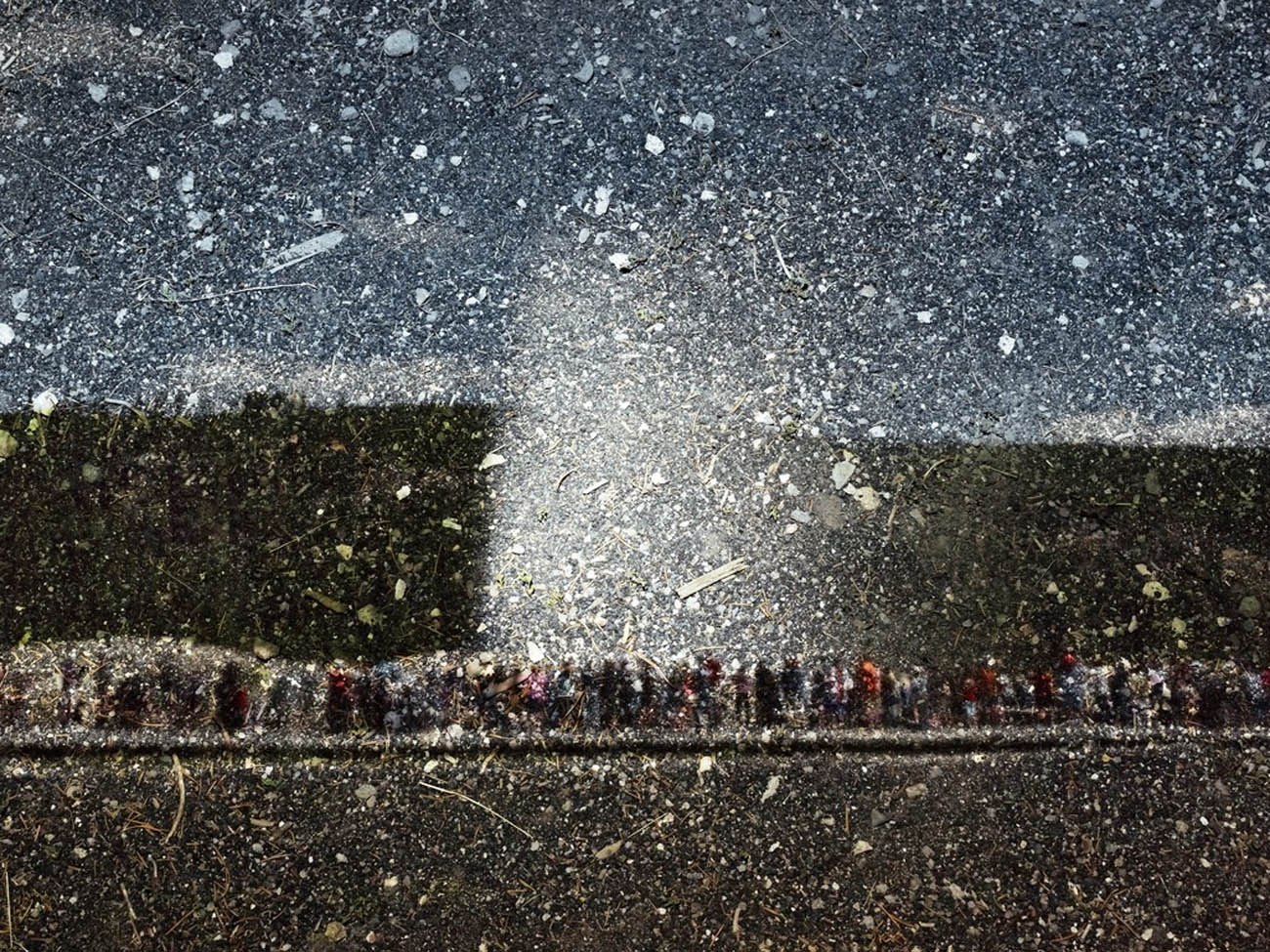
 

Abelardo Morell (American born Cuba, b. 1948) 'Tent-Camera Image on Ground: View of Old Faithful Geyser, Yellowstone National Park, Wyoming' 2011


Abelardo Morell (American born Cuba, b. 1948)
Tent-Camera Image on Ground: View of Old Faithful Geyser, Yellowstone National Park, Wyoming
2011
Inkjet print
Gift of the artist in memory of Robert Andrew McElaney
© Abelardo Morell/Courtesy Bonni Benrubi Gallery, NYC
Courtesy Museum of Fine Arts, Boston


Early in his career, Abelardo Morell began experimenting with the camera obscura (from the Latin for “dark room”), a setup that allowed him to photograph the view outside, projected through a small hole (or lens) and inverted on the opposite wall of an interior. More recently, Morell has adapted this technology, using a tent fitted with a periscope and angled mirror, with a digital camera pointed downward to capture the sweeping landscapes reflected on the ground. This process of combining the distant view with the grass, pebbles, pine needles, sand – even pavement – underfoot, allows Morell to turn the terrain into his “canvas” and transform familiar scenes into otherworldly, impressionistic images.

Exhibition label text
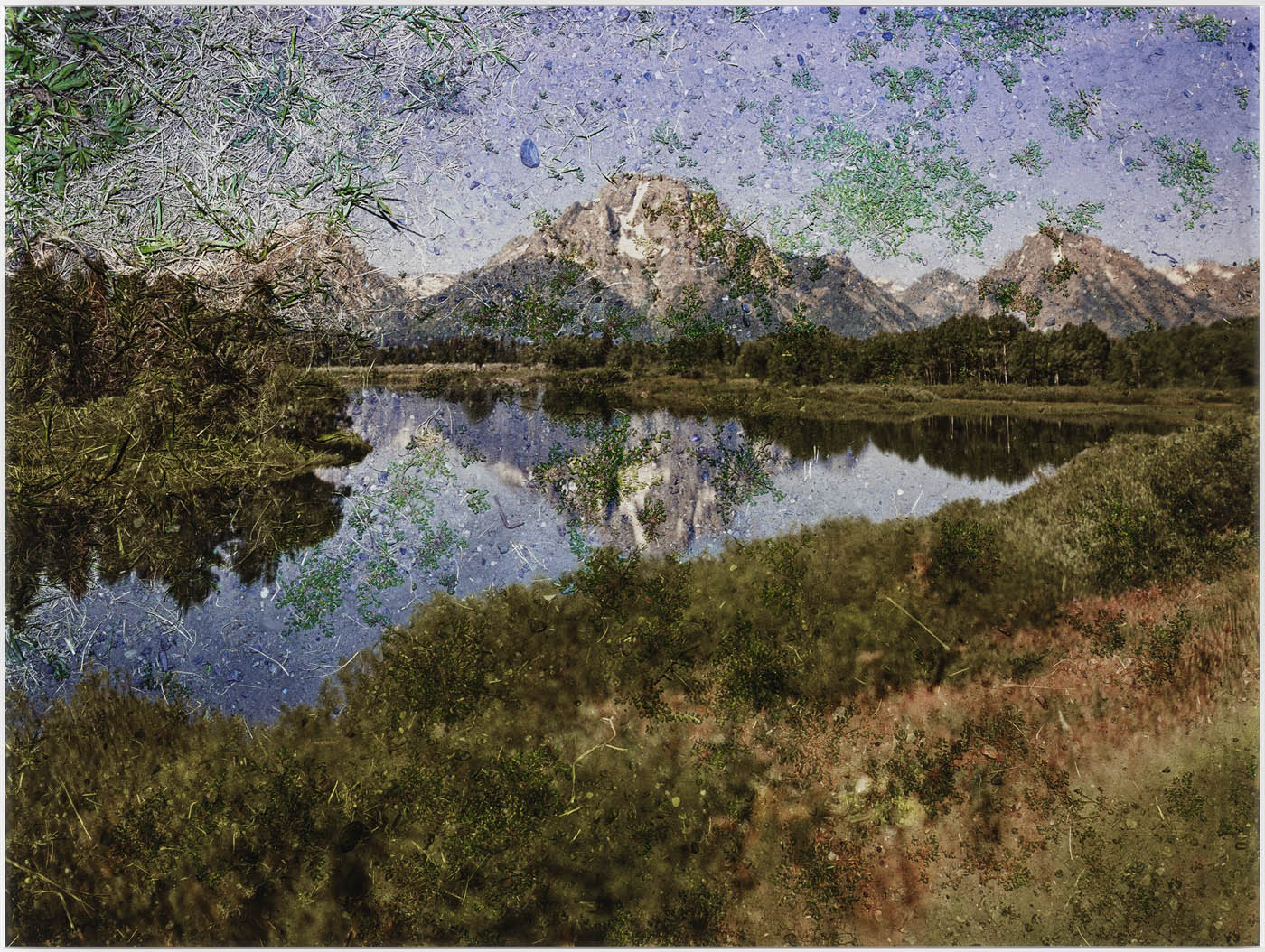
 

Abelardo Morell (American born Cuba, b. 1948) 'Tent-Camera Image on Ground: View of Mount Moran and the Snake River from Oxbow Bend, Grand Teton National Park, Wyoming' 2011


Abelardo Morell (American born Cuba, b. 1948)
Tent-Camera Image on Ground: View of Mount Moran and the Snake River from Oxbow Bend, Grand Teton National Park, Wyoming
2011
Inkjet print
Gift of the artist in memory of Robert Andrew McElaney
© Abelardo Morell/Courtesy Bonni Benrubi Gallery, NYC
Courtesy Museum of Fine Arts, Boston


Like several of the contemporary artists in this gallery, Abelardo Morell is a foreign-born photographer for whom US national parks hold special meaning. While growing up in Cuba, he fell in love with the popular Hollywood Westerns playing at the local cinema. Once he immigrated to the United States, he was eager to discover the region for himself. Here he takes in the sweeping grandeur of snowcapped Mount Moran and the Snake River from a vantage point similar to the one employed by Ansel Adams seventy years earlier for his photograph of Grand Tetons National Park (on view nearby).

Exhibition label text


Abelardo Morell (American born Cuba, b. 1948) 'Tent-Camera Image on Ground: View of the Yosemite Valley from Tunnel View' 2012


Abelardo Morell (American born Cuba, b. 1948)
Tent-Camera Image on Ground: View of the Yosemite Valley from Tunnel View
2012
Inkjet print
Gift of the artist in memory of Robert Andrew McElaney
© Abelardo Morell/Courtesy Bonni Benrubi Gallery, NYC
Courtesy Museum of Fine Arts, Boston


Abelardo Morell made this photograph along the Rio Grande River, which runs for more than one hundred miles through Big Bend National Park in southwest Texas, forming the border between the United States and Mexico. The tranquility of the scene belies the fact that this is contested space, sometimes violently so. Morell’s tent camera optically inverts the river’s northern and southern banks, and the mysteriously floating compass further compounds the sense of dislocation or disorientation.

Exhibition label text
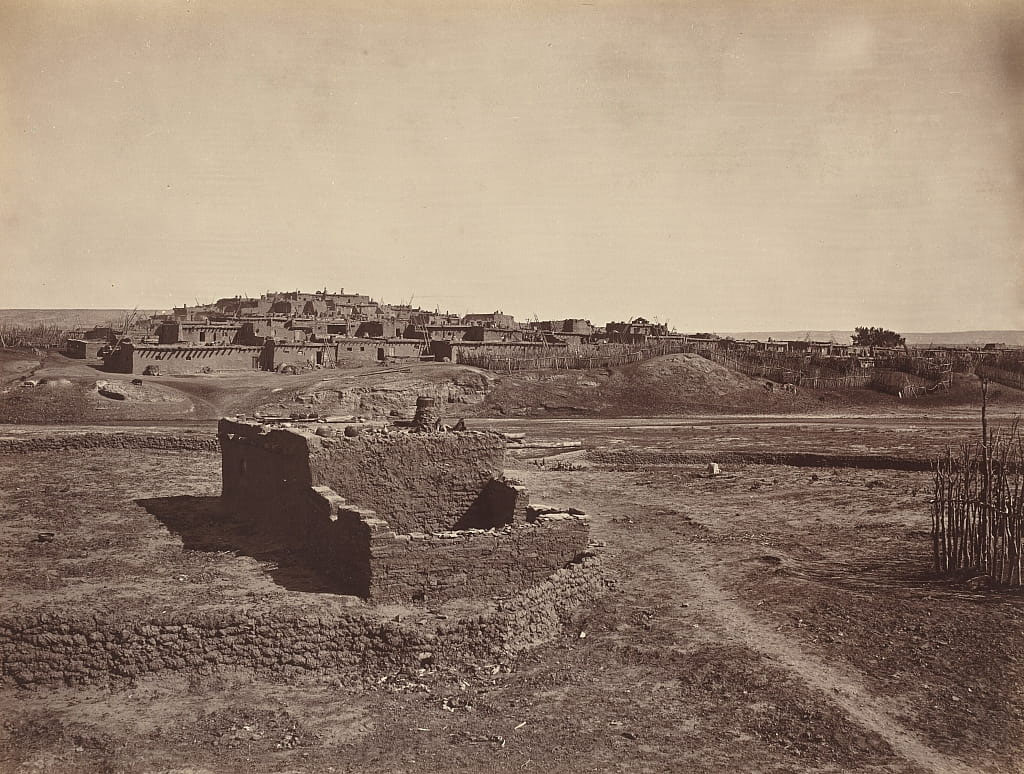
 

John K. Hillers (American born Germany, 1843-1925) 'Zuni Pueblo, Looking Southeast' c. 1879


John K. Hillers (American born Germany, 1843-1925)
Zuni Pueblo, Looking Southeast
c. 1879
Albumen print
The Lane Collection
Courtesy Museum of Fine Arts, Boston


Images such as this one, created in the 1870s and 1880s as ethnographic data for the US government, often ended up in popular magazines, perpetuating problematic stereotypes of Indigenous people. Beginning in 1871, John K. “Jack” Hillers worked on John Wesley Powell’s survey expeditions for such data. He continued to work under Powell’s leadership at the US Bureau of Ethnology for nearly thirty years. Hired by Powell to photograph Indigenous people living in agrarian communities in New Mexico, Arizona, and Utah, Hillers made his most extensive photographic record at Zuni Pueblo in the high plateau region of New Mexico. The photograph is taken at the middle place, or Halona I:diwanna in Zuni/A:shiwi.

Exhibition label text
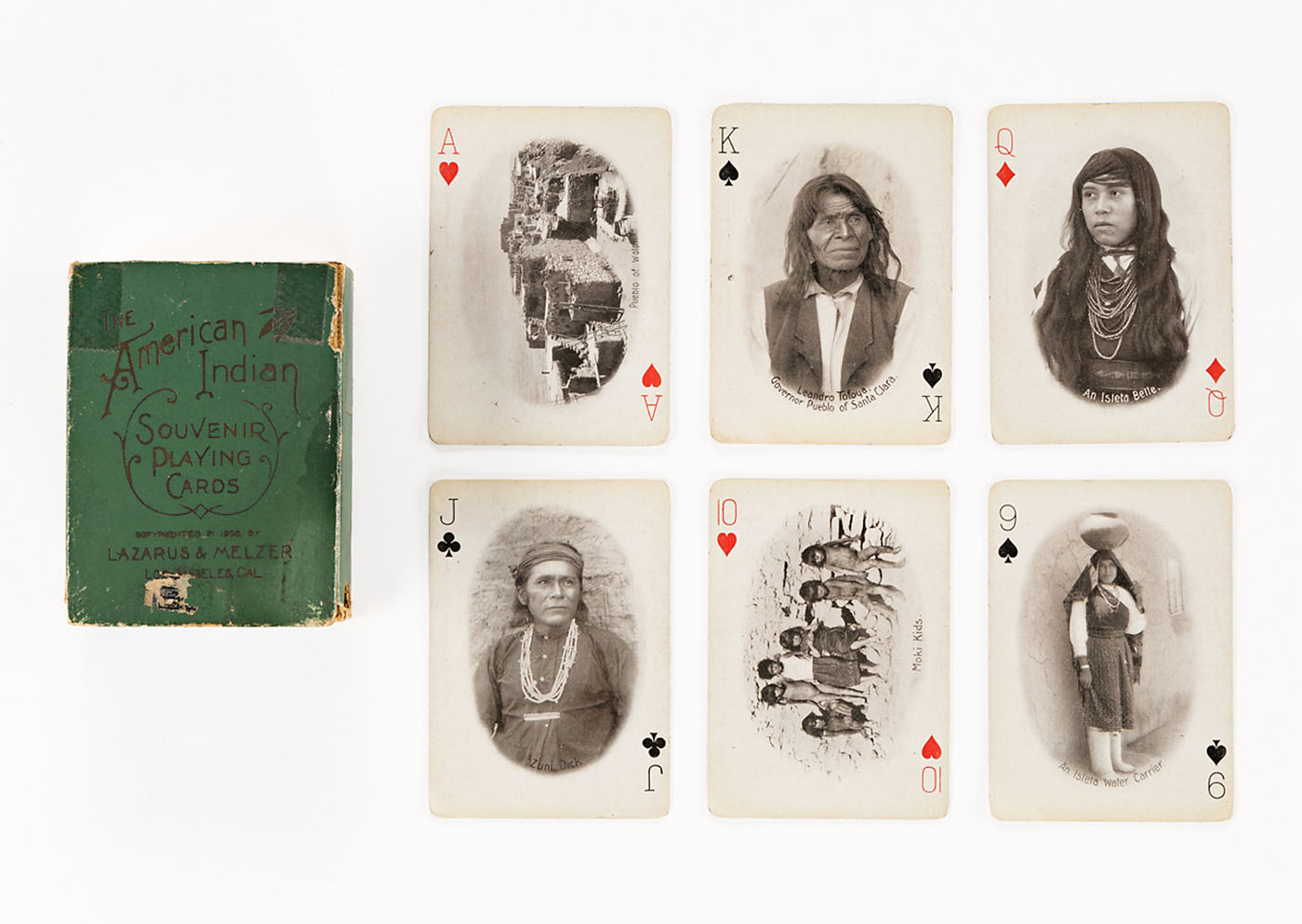
 

Adam Clark Vroman (American, 1856-1916) Playing Cards c. 1894


Adam Clark Vroman (American, 1856-1916)
An Isleta Water Carrier (Nine of Spades)
c. 1894
Chara, Cacique at Pueblo (Jack of Clubs)
c. 1894
Playing cards with halftone prints
Lazarus and Melzer (Los Angeles), publishers
Museum of Fine Arts, Boston, Gift of Lewis A. Shepard, 2006


An amateur archaeologist and committed preservationist, Adam Clark Vroman owned a bookstore in Pasadena, California, that also sold photography supplies. In the mid-1890s, he made the first of many photographic trips to Navajo, Pueblo, and Hopi communities in Arizona and New Mexico. Like Edward S. Curtis and other Anglo-American photographers, he approached Indigenous subjects with concern for what he saw as their threatened lifeways. Nevertheless, when he produced this set of playing cards in 1900, his sitters, each representing a different Southwestern tribe, were reduced to elaborately costumed “types” and often were not identified by name, relegating Indigenous people to a novelty. For instance, in one example shown here, a group of young Walpi women is simply captioned “Bashful,” illustrating the limits of Vroman’s ability to respectfully record the identities of his sitters.

Exhibition label text
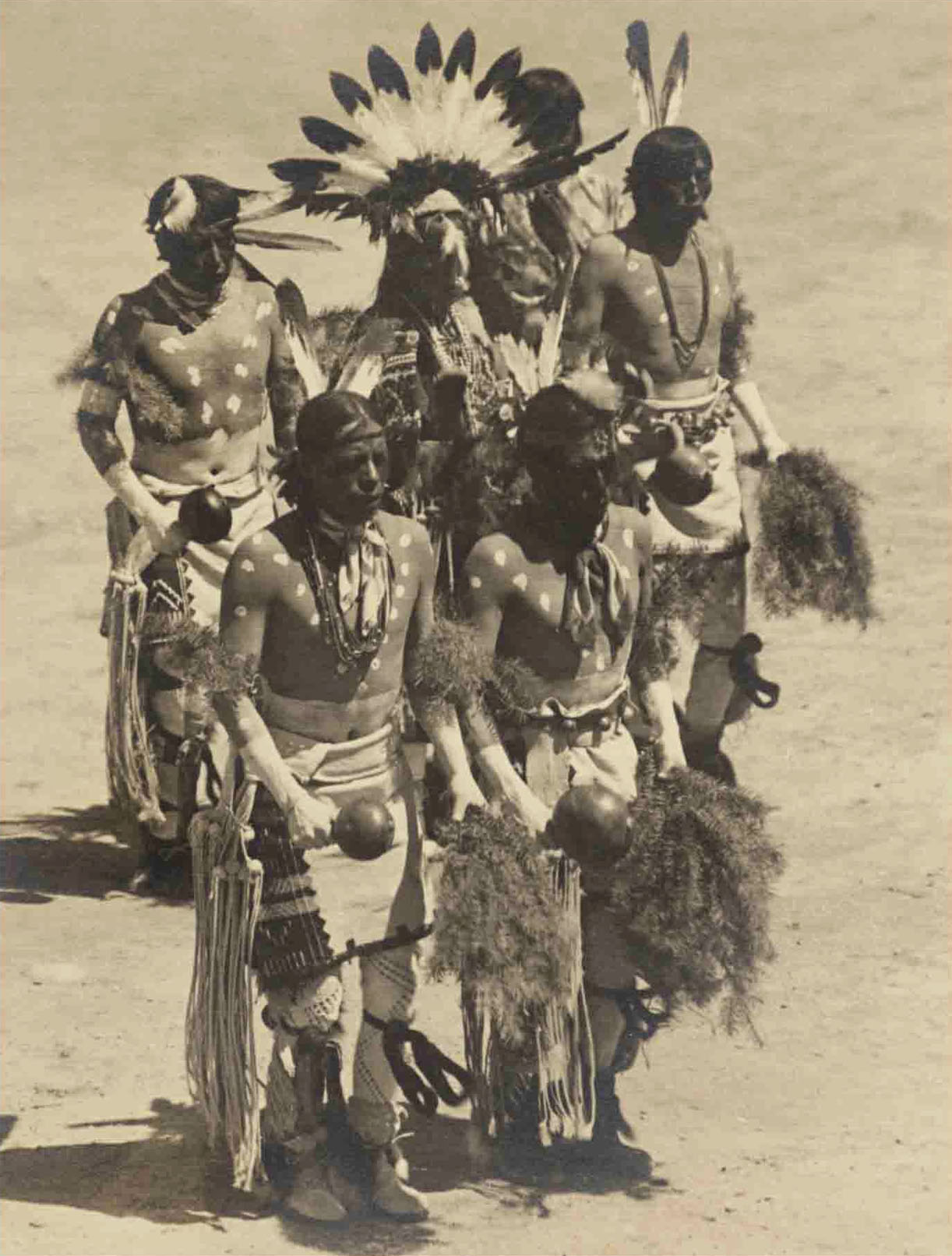
 

Ansel Adams (American, 1902-1984) 'Dance Group, San Ildefonso Pueblo, New Mexico' 1929


Ansel Adams (American, 1902-1984)
Dance Group, San Ildefonso Pueblo, New Mexico
1929
Gelatin silver print
The Lane Collection
Courtesy Museum of Fine Arts, Boston
© The Ansel Adams Publishing Rights Trust


“This photo of Cloud Dance (Po-Who-Geh-Owingeh) was taken at a time when there was an influx of tourists, archaeologists, anthropologists, artists, and photographers who were intrigued by Pueblo people. At the time, Pueblo people and other Native Americans in the Southwest were trying to navigate the outsiders who were interested in their culture. Some of them did not quite understand the circumstances surrounding the curiosity, while others did understand the extractive nature, and they had to weigh that in terms of their other needs. I get questions from members of my community about why they did not chase the archaeologists and photographers out, and I often respond it is because of the uneven power relations between Indigenous and non-Native people at the time.”  ~ Joseph Aguilar (San Ildefonso Pueblo)

Exhibition label text
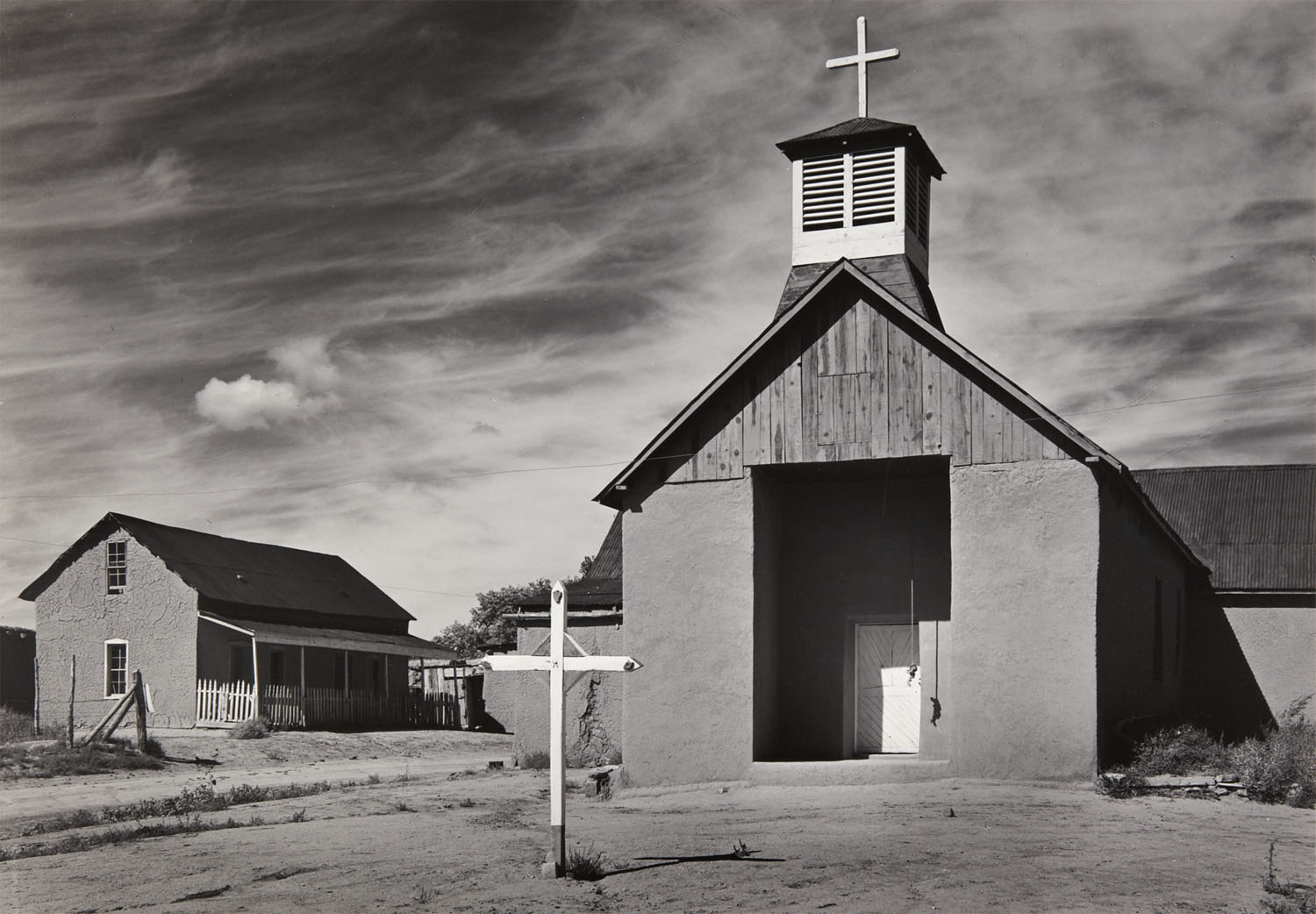
 

Ansel Adams (American, 1902-1984) 'White Cross and Church, Coyote, New Mexico' 1937


Ansel Adams (American, 1902-1984)
White Cross and Church, Coyote, New Mexico
1937
Gelatin silver print
The Lane Collection
Courtesy Museum of Fine Arts, Boston
© The Ansel Adams Publishing Rights Trust


In 1937 Ansel Adams spent several weeks traveling in the Southwestern states with painter Georgia O’Keeffe and friends. Adams and O’Keeffe shared an interest in the region’s expansive skies and distinctive mesas, as well as the mix of Indigenous and Spanish cultures. The group first spent two weeks at Ghost Ranch, O’Keeffe’s home in the Chama River Valley of New Mexico. Adams made this picture in a nearby town, perhaps drawn by the way the foreground cross echoes a smaller one on the church steeple. Their road trip took them through Pueblo and Navajo lands in New Mexico and Hopi lands in Arizona; Monument Valley, Canyon de Chelly, and the Grand Canyon in Arizona; and Mesa Verde in Colorado.

Exhibition label text
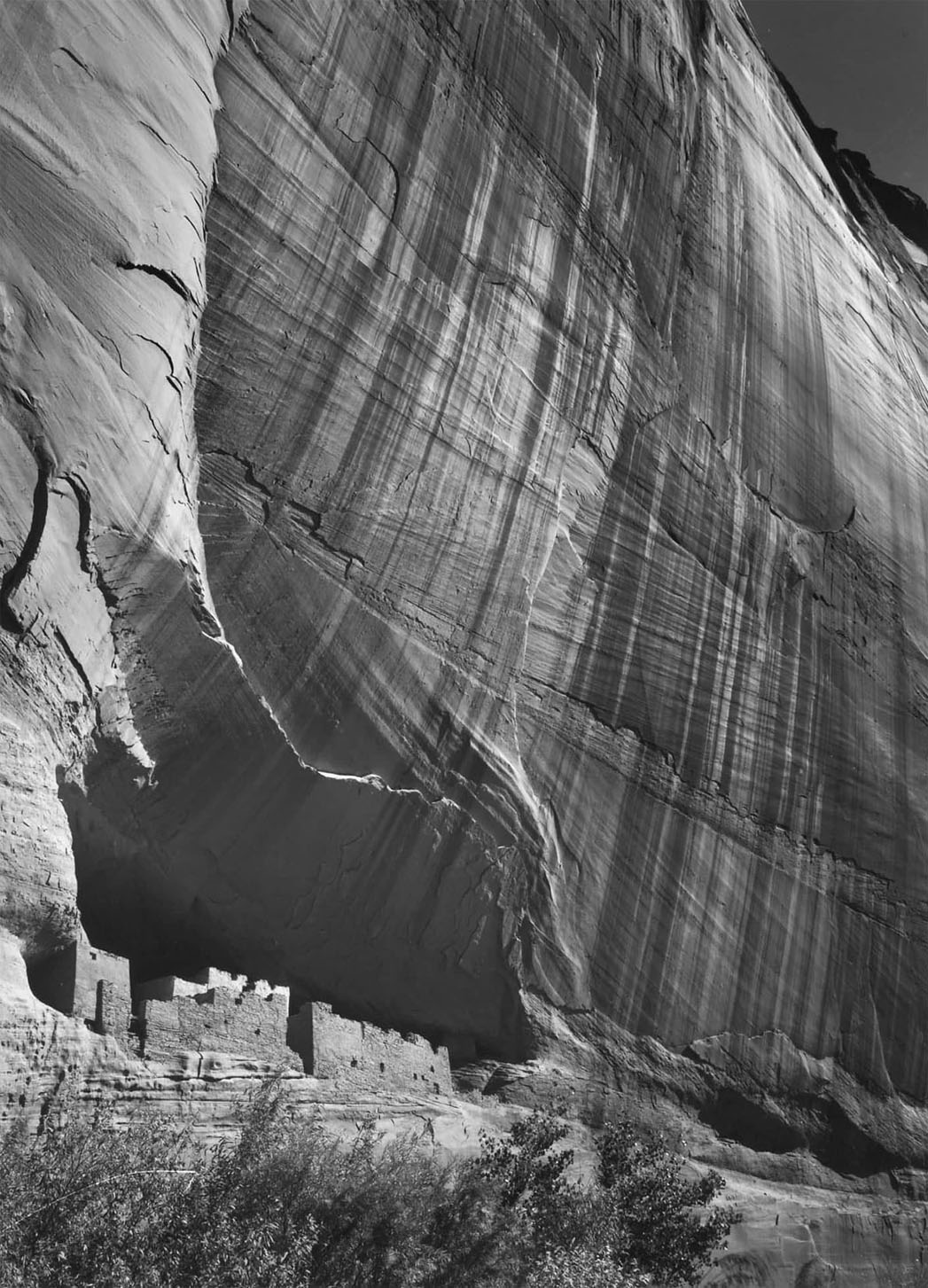
 

Ansel Adams (American, 1902-1984) 'White House Ruin, Canyon de Chelly National Monument, Arizona' 1941


Ansel Adams (American, 1902-1984)
White House Ruin, Canyon de Chelly National Monument, Arizona
1941
Gelatin silver print
The Lane Collection
Courtesy Museum of Fine Arts, Boston
© The Ansel Adams Publishing Rights Trust


When a Sierra Club friend gave him a copy of the Wheeler geographical survey album (1871-1874), Ansel Adams had the opportunity to study Timothy H. O’Sullivan’s photographic technique, as well as his subject matter. In 1941, as Adams set out to work in Canyon de Chelly as part of his national parks project, he decided to try to rephotograph O’Sullivan’s view of an Ancestral Pueblo site. Adams used a green filter to replicate the dramatic striations in the canyon walls that are so pronounced in the early print, as otherwise they would not appear in a “straight” print from his modern negative. Of the power of works like this one, Adams said, “O’Sullivan had that extra dimension of feeling. You sense it, you see it.”

Exhibition label text
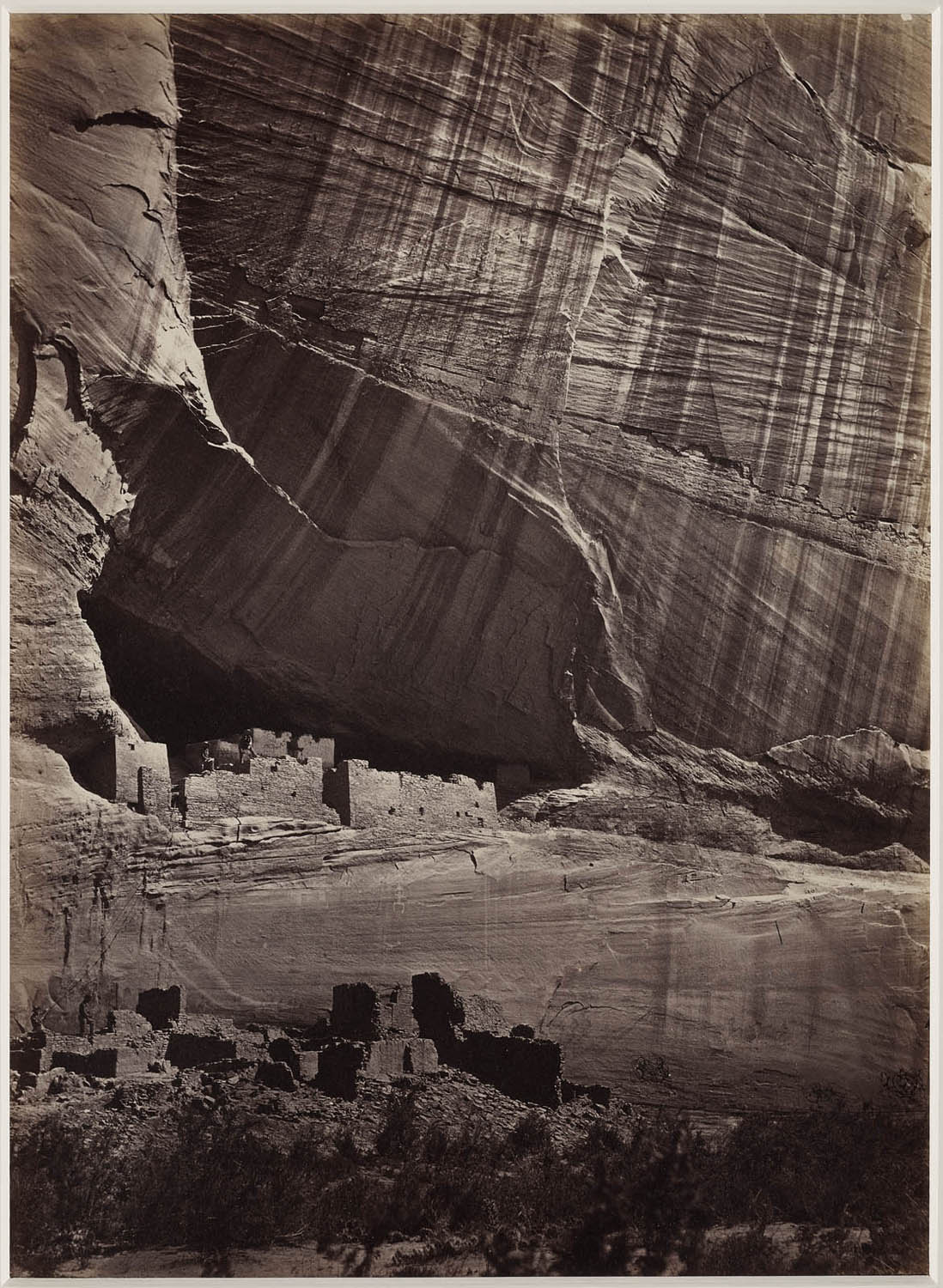
 

Timothy H. O'Sullivan (American born Ireland, 1840-1882) 'Photographs from Geographical explorations and surveys west of the 100th meridian Wheeler' 1873


Timothy H. O’Sullivan (American born Ireland, 1840-1882)
Ancient Ruins in the Cañon de Chelle
1873
Albumen silver print
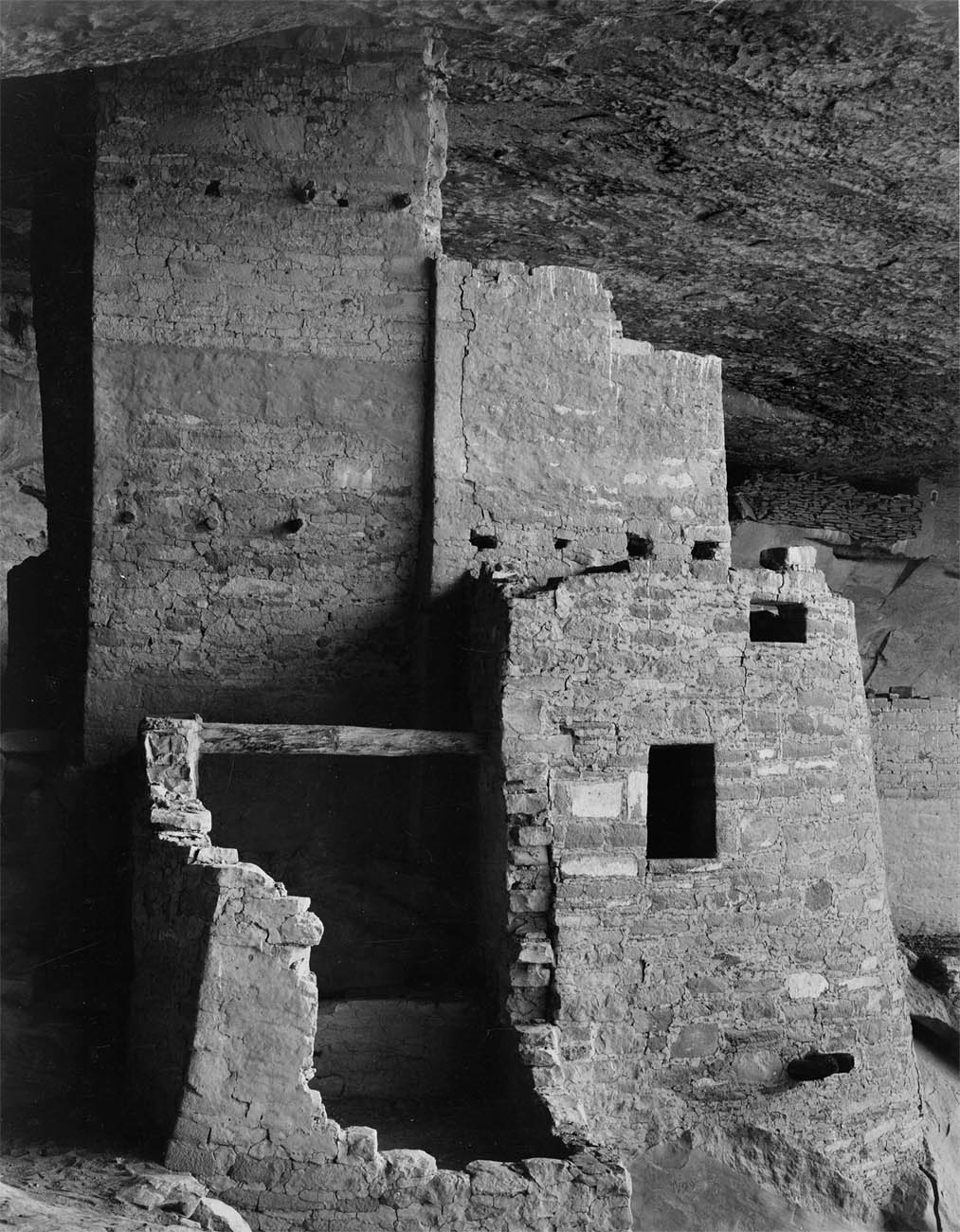
 

Ansel Adams (American, 1902-1984) 'Cliff Palace, Mesa Verde National Park, Colorado' 1941


Ansel Adams (American, 1902-1984)
Cliff Palace, Mesa Verde National Park, Colorado
1941
Gelatin silver print
The Lane Collection
Courtesy Museum of Fine Arts, Boston
© The Ansel Adams Publishing Rights Trust
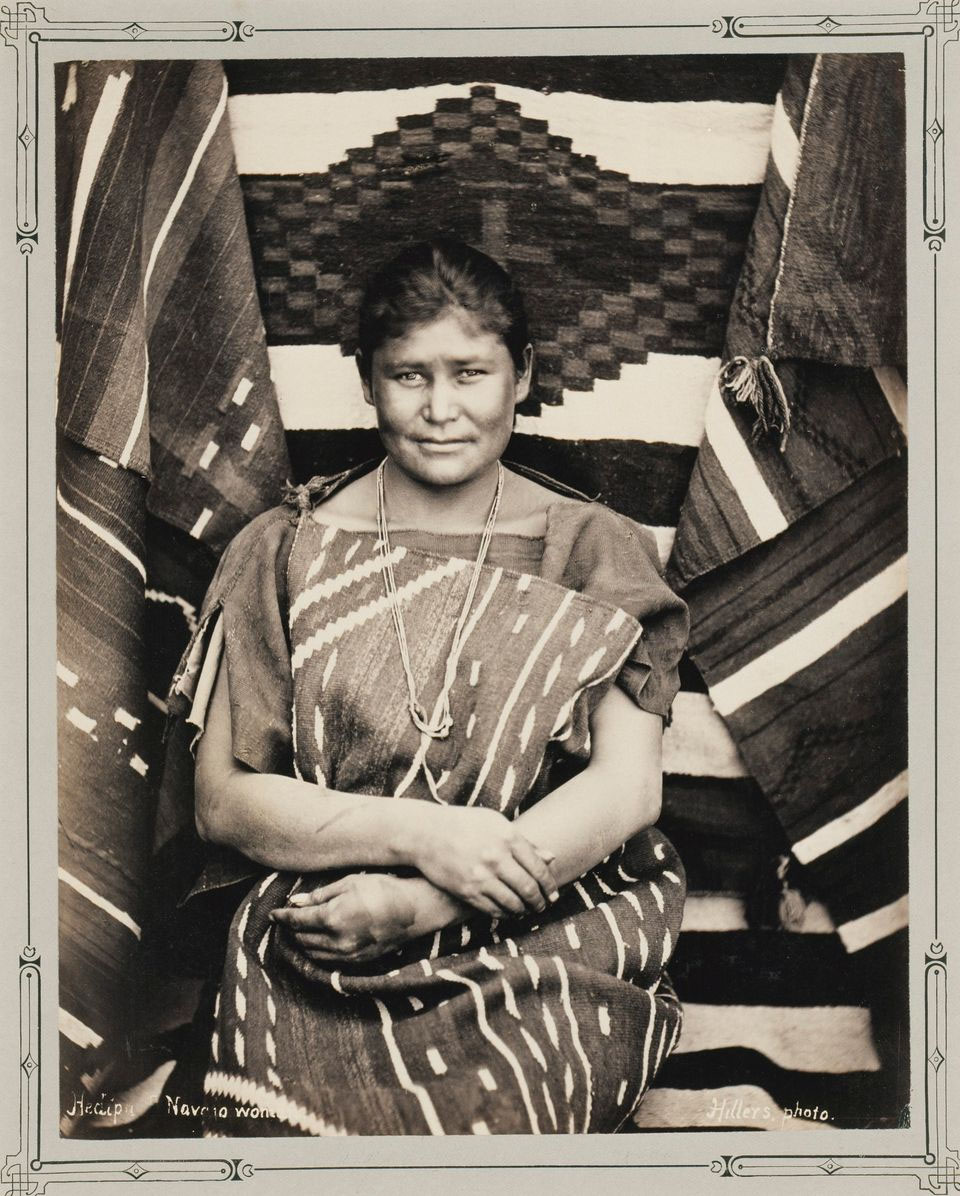
 

John K. Hillers (American b. Germany, 1843-1925) 'Hedipa, Diné (Navajo) Woman' c. 1879


John K. Hillers (American b. Germany, 1843-1925)
Hedipa, Diné (Navajo) Woman
c. 1879
Albumen print
Museum of Fine Arts, Boston
Gift of Jessie H. Wilkinson – Jessie H. Wilkinson Fund


Between 1879 and 1881, Hillers extensively documented the pueblo at Zuni, photographing not only its people and distinctive multi-storied adobe architecture, but also its relationship to the surrounding land. He made panoramic views of the pueblo and recorded cultural observances including ceremonial dance and individual artisans at work.

The Paiutes of Utah gave John K. Hillers a name that meant “Myself in the Water,” a reference to his ability to record their likenesses using the wet-plate collodion process to produce glass negatives. Here, Hillers has photographed a Diné (Navajo) man and woman in front of boldly patterned blankets, which he used to create a backdrop for his outdoor portrait “studio.”

Exhibition label text
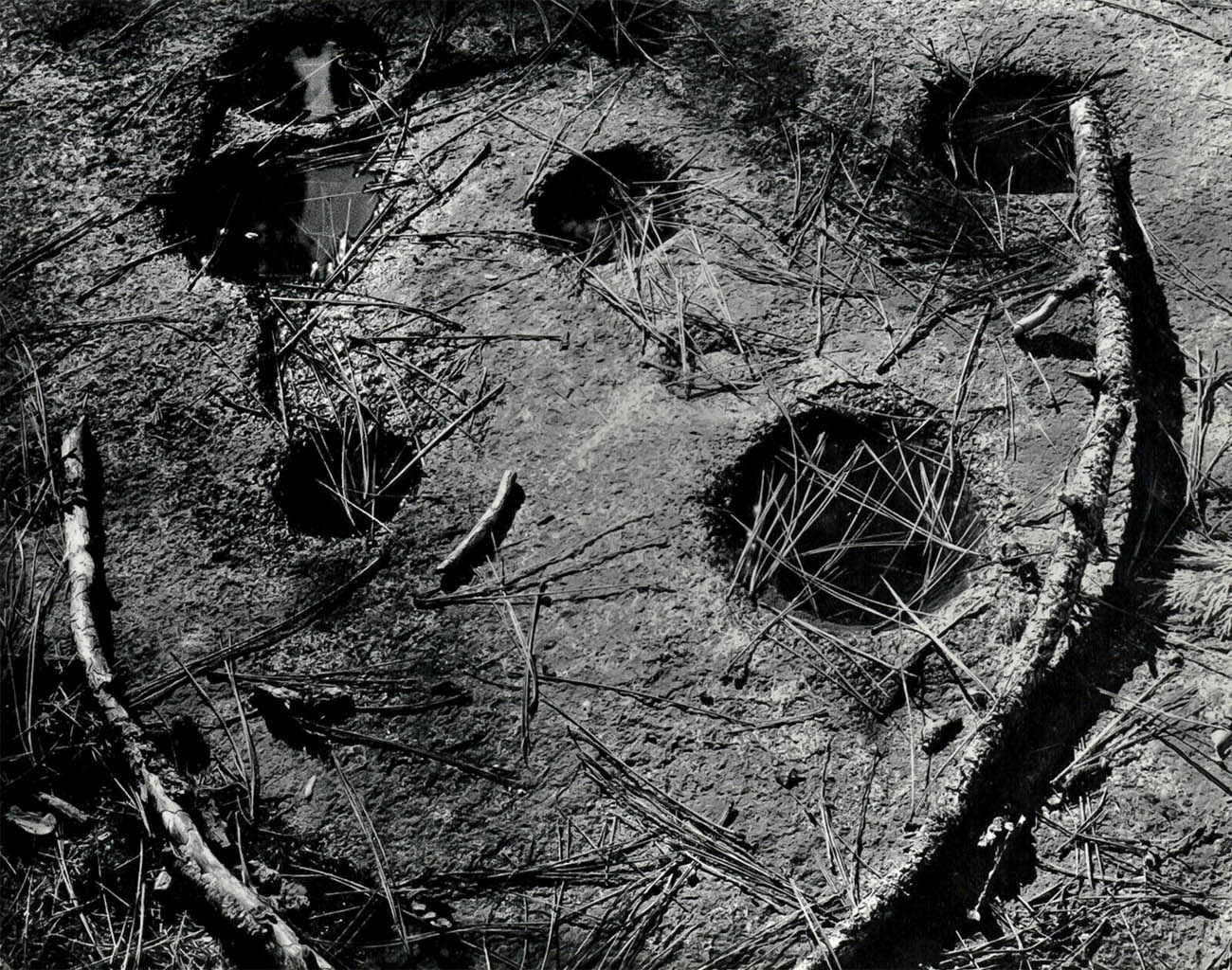
 

Ansel Adams (American, 1902-1984) 'Indian Mortar Holes, Big Meadow, Yosemite National Park' c. 1940


Ansel Adams (American, 1902-1984)
Indian Mortar Holes, Big Meadow, Yosemite National Park
c. 1940
Gelatin silver print
The Lane Collection
Courtesy Museum of Fine Arts, Boston
© The Ansel Adams Publishing Rights Trust


The Ahwahnechee (Miwok) of Yosemite prepared food and sharpened tools using semi-spherical holes ground into bedrock as mortars and smooth stones as grinding tools (or pestles). Acorns of the black oak trees were a diet staple once abundant in the region. Settler colonialism, logging in the nineteenth century, and modern-day fire suppression have led to the growth of mainly conifers in their place.

Exhibition label text


Ansel Adams (American, 1902-1984) 'Freeway Interchange, Los Angeles' 1967


Ansel Adams (American, 1902-1984)
Freeway Interchange, Los Angeles
1967
Gelatin silver print
The Lane Collection
Courtesy Museum of Fine Arts, Boston
© The Ansel Adams Publishing Rights Trust


Ansel Adams made this aerial view of the famously tangled freeways of Los Angeles while photographing for Fiat Lux (1967), a publication commissioned by the University of California to celebrate its centennial. Intended to serve as a visual document of the entire University of California system, the project saw Adams travel to the nine UC campuses, along with the system’s various research stations, observatories, natural reserves, and agricultural extensions. The most extensive of all his commercial projects, Fiat Lux took Adams three years to complete and resulted in several thousand negatives.

Exhibition label text
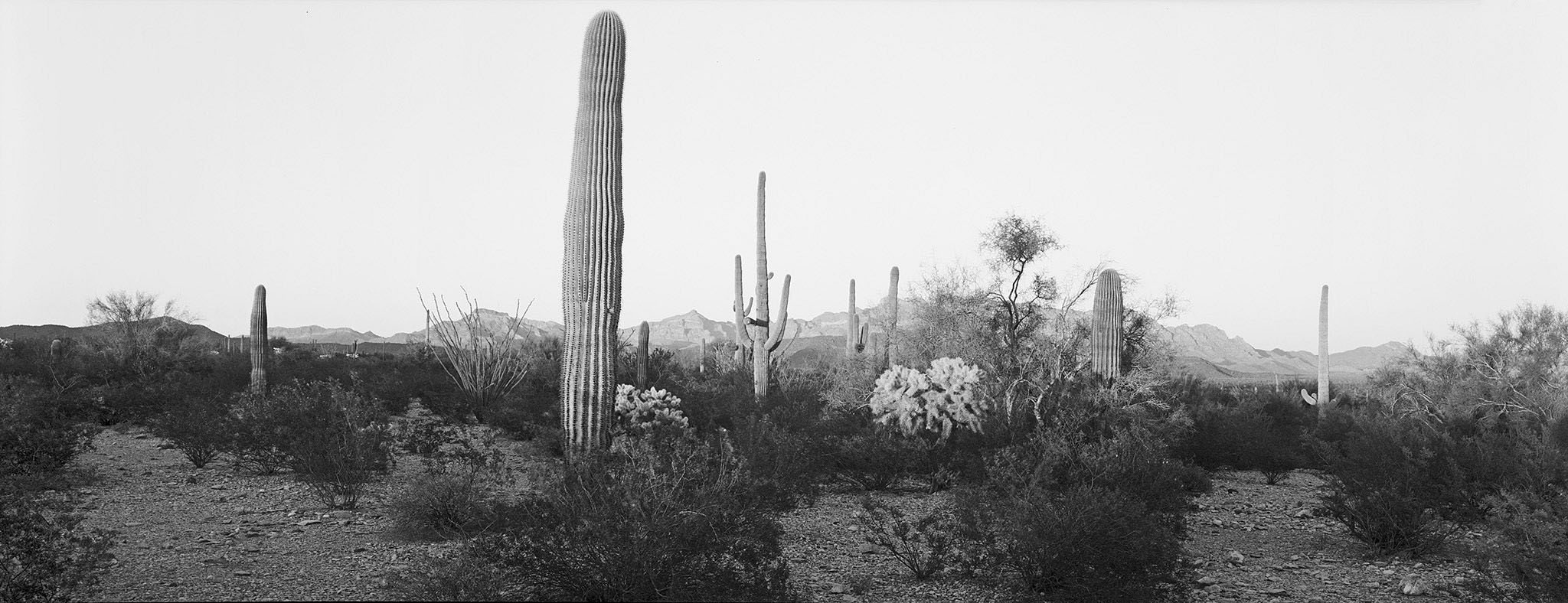
 

Lois Conner (American, b. 1951) 'Organ Pipe Cactus National Monument, Arizona' 1988


Lois Conner (American, b. 1951)
Organ Pipe Cactus National Monument, Arizona
1988
Platinum print
Museum of Fine Arts, Boston, Otis Norcross Fund


Inspired by the stories told to her by her Cree maternal grandmother, Lois Conner regularly traveled throughout the Navajo Nation and Four Corners region with an old-fashioned banquet camera to document Indigenous people and their land. The elongated format and subtle tonal range of the platinum prints that resulted from these trips seem ideally suited to capturing subjects like the expansive desert landscape of Organ Pipe Cactus National Monument and the vertiginous rock face of Canyon de Chelly.

“The extended sweep of the panorama allows me to draw on multiple levels, much as cinema does, and to take something of the immediate present, and layer that with something from a few centuries before. The large-format camera can draw the particular in minute detail. Like adjectives in a sentence, they allow the viewer to look closer, engaging them in the little world contained by the frame.” ~ Lois Conner

Exhibition label text
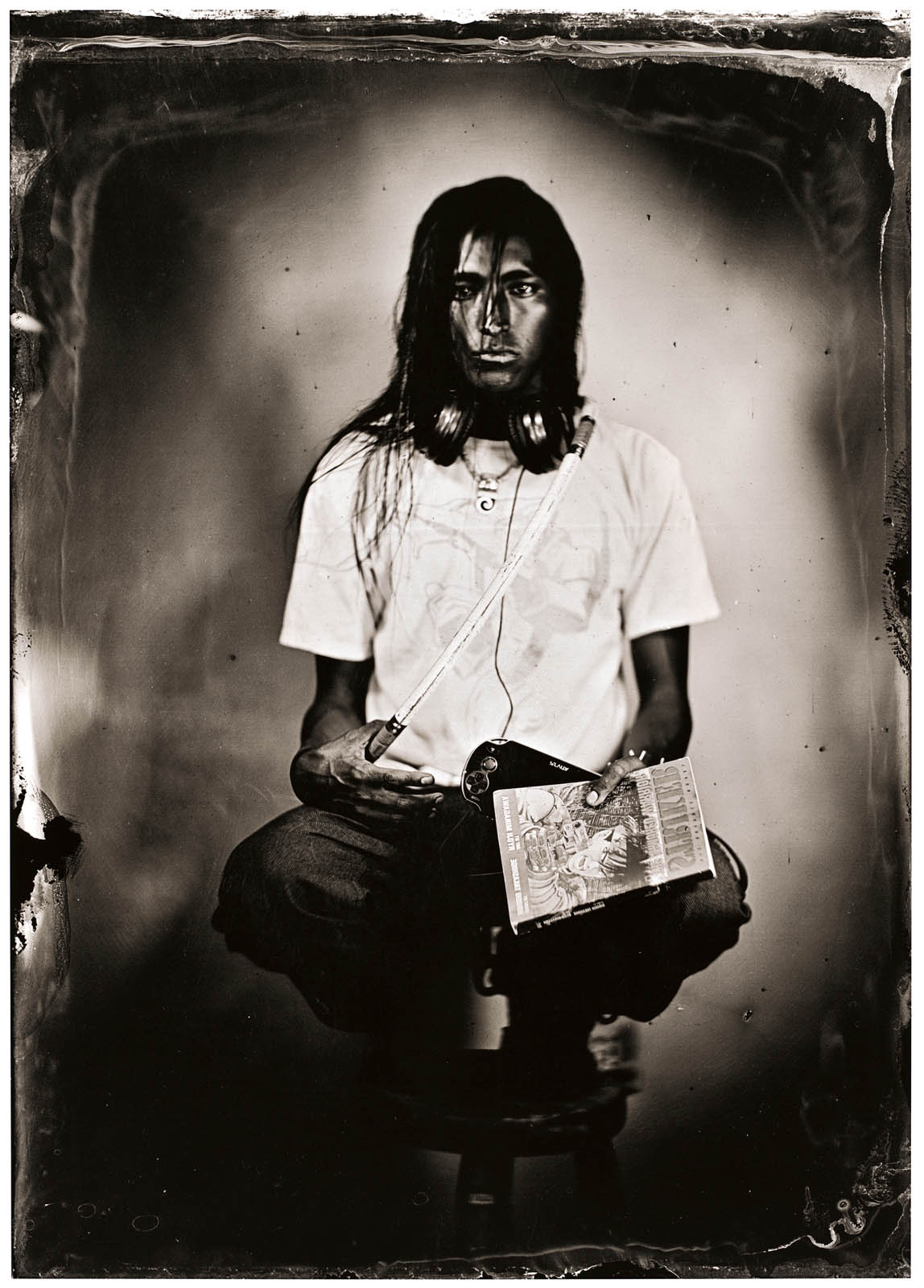
 

Will Wilson (Native American, Navajo (Diné), b. 1969) 'Nakotah LaRance' 2012


Will Wilson (Native American, Navajo (Diné), b. 1969)
Nakotah LaRance
2012
Inkjet print
The Heritage Fund for a Diverse Collection
Courtesy Museum of Fine Arts, Boston
© Will Wilson


This portrait of six-time world-champion hoop dancer Nakotah LaRance (1989-2020) is from an ongoing series that Will Wilson calls the Critical Indigenous Photographic Exchange (CIPX). Using a large-format camera and the wet-plate collodion process – the first photographic process used to image Native Americans – Wilson produces a portrait; he then gives his sitter the original tintype, while he retains a digital copy. Wilson is aware of the long history of inaccurate and romanticised representations of Indigenous people in the United States. His goal is to negotiate a more collaborative relationship between photographer and sitter in order to return personal agency to his subjects, like this young Hopi man with his traditional dance hoop and contemporary headphones, game console, and Japanese manga.

Exhibition label text


Nakotah Lomasohu Raymond LaRance (August 23, 1989 – July 12, 2020) was a Native American hoop dancer and actor. He was a citizen of the Hopi Tribe of Arizona. …

At four years old, LaRance began dancing as a fancy dancer and competed in the youth division of the World Championship Hoop Dance Contest in Phoenix, Arizona. He performed on the Tonight Show with Jay Leno in 2004. LaRance won three championships in the youth division and three in the teenage division of the World Championship Hoop Dance competition.

In 2009, LaRance joined the Cirque du Soleil troupe as a principal dancer. He worked as a traveling performer with the troupe for over three years. In 2015, he danced at the opening of the Pan American Games in Toronto with Cirque du Soleil. He won the title of World Champion at the Hoop Dance Contest three times, as part of the adult division in 2015, 2016 and 2018. LaRance taught hoop dancing to students at the Lightning Boy Foundation in New Mexico.

LaRance died at age 30 on July 12, 2020, after a fall from climbing a bridge in Rio Arriba County, New Mexico.

Text from the Wikipedia website
 

Installation view of the exhibition 'Ansel Adams in Our Time' at the de Young museum, San Francisco showing at left in the light panel, Will Wilson's 'Nakotah LaRance' (2012); and at centre Will Wilson's 'How the West is One' (2014)


Installation view of the exhibition Ansel Adams in Our Time at the de Young museum, San Francisco showing at left in the light panel, Will Wilson’s Nakotah LaRance (2012, above); and at centre Will Wilson’s How the West is One (2014, below)


Adams in the American Southwest

Ansel Adams first visited the American Southwest in 1927. While there he collaborated with author Mary Austin on an illustrated book about Taos Pueblo that aimed to communicate the threat tourism in the region posed to the artistic and religious traditions of Indigenous people. Adams made images for the book only after receiving permission from the Taos Pueblo council, to whom he paid a fee and gifted a copy of the finished publication. He also photographed some Indian cultural observances that had become popular attractions among tourists. Adams’s own images of Native dancers have a complex legacy: although he was one of the non-Native onlookers, he carefully framed his views to leave out evidence of the gathered crowds.

In Diné photographer Will Wilson’s ongoing series Critical Indigenous Photographic Exchange, the artist responds to and confronts historical depictions of Native Americans by white artists. He focuses in particular on those who traveled west in the late nineteenth and early twentieth centuries to document the Indigenous people they viewed as a “vanishing race” due to US government-sanctioned genocide and settler colonialism.

Exhibition wall text


Will Wilson (Diné (Navajo), born in 1969) 'How the West is One' 2014


Will Wilson (Native American, Navajo (Diné), b. 1969)
How the West is One
2014
Inkjet print
The Heritage Fund for a Diverse Collection
Courtesy Museum of Fine Arts, Boston
© Will Wilson


Born in San Francisco, Diné photographer Will Wilson spent his childhood in the Navajo Nation. Today he lives and works in Santa Fe. Made from his original tintypes, Wilson’s double self-portrait shows him in profile, facing off against himself: on one side wearing an elaborate silver and turquoise necklace, and on the other dressed in a cowboy hat and work gloves. The title riffs on the 1962 John Ford movie How the West Was Won, an epic Western of the type that helped turn stereotypical cowboys and Indians into potent symbols for the American public. Wilson’s dual portrait illustrates the disparate ways that he – as a Native American artist – might be portrayed and perceived by others, whereas in his case, the reality lies somewhere between the two.

Exhibition label text
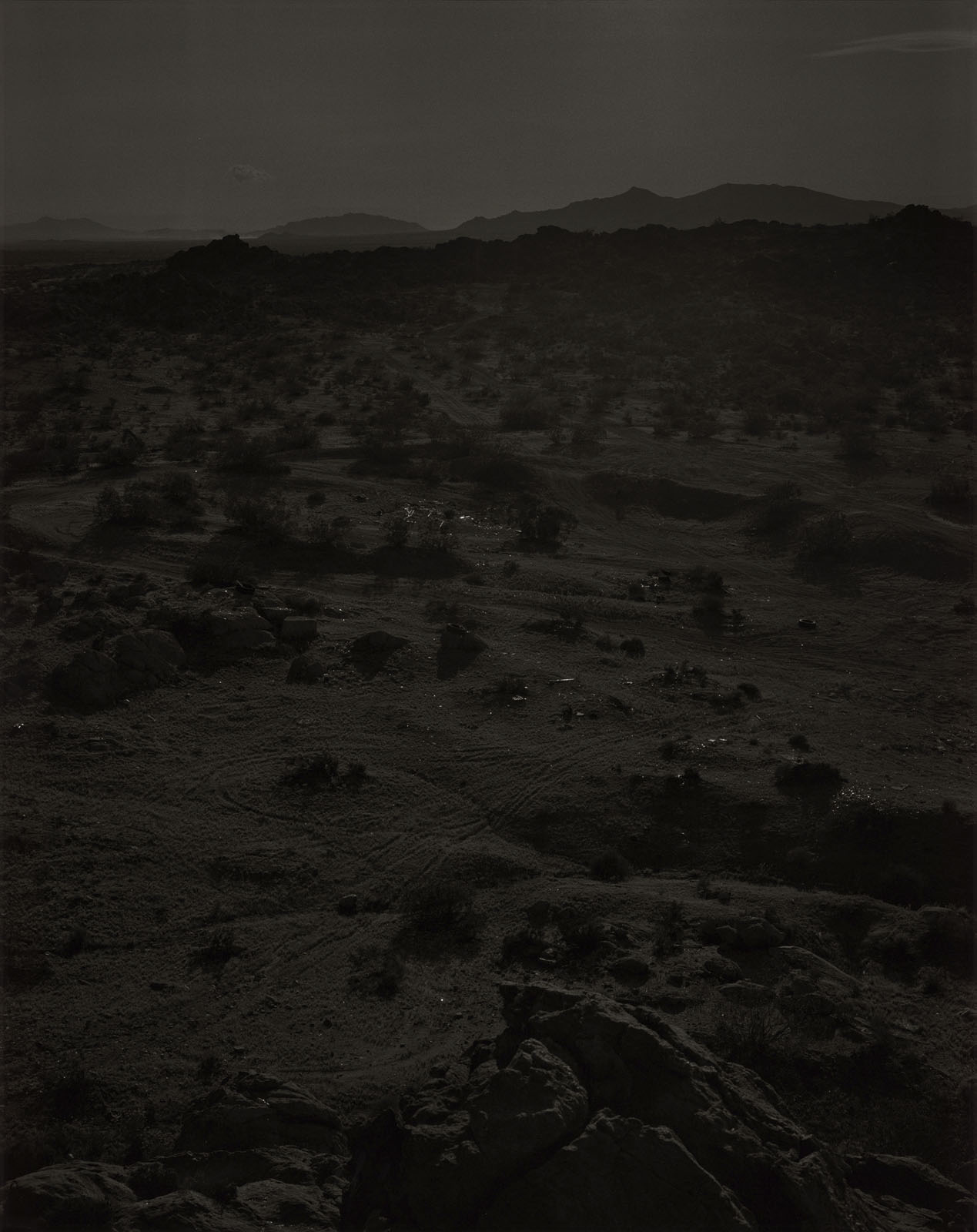
 

CJ Heyliger (American, b. 1984) 'Broken Glass' 2015


CJ Heyliger (American, b. 1984)
Broken Glass
2015
Inkjet print
William E. Nickerson Fund
Courtesy Museum of Fine Arts, Boston
Reproduced with permission


CJ Heyliger makes his desert landscapes in many different places, resulting in images that reveal the sites’ alien beauty and hallucinatory detail. His approach to mapping the terrain on film reduces it to the medium’s most basic elements – simply light and time. Here, he magically transforms a trail of broken glass into a constellation of stars in a night sky, and in North, East, South, West, his multiple exposures of a spiky yucca create a wildly spinning whirligig.

“My current work brings me to places that, for one reason or another, have become geographical outcasts,” says Heyliger. “These scraps of land are often hidden in plain view and are rife with artefacts and submerged histories of their own. Photography allows me to gather these shards of cultural debris and weave them into a new narrative constructed of diverse environments with varying relationships to reality.”

Exhibition label text
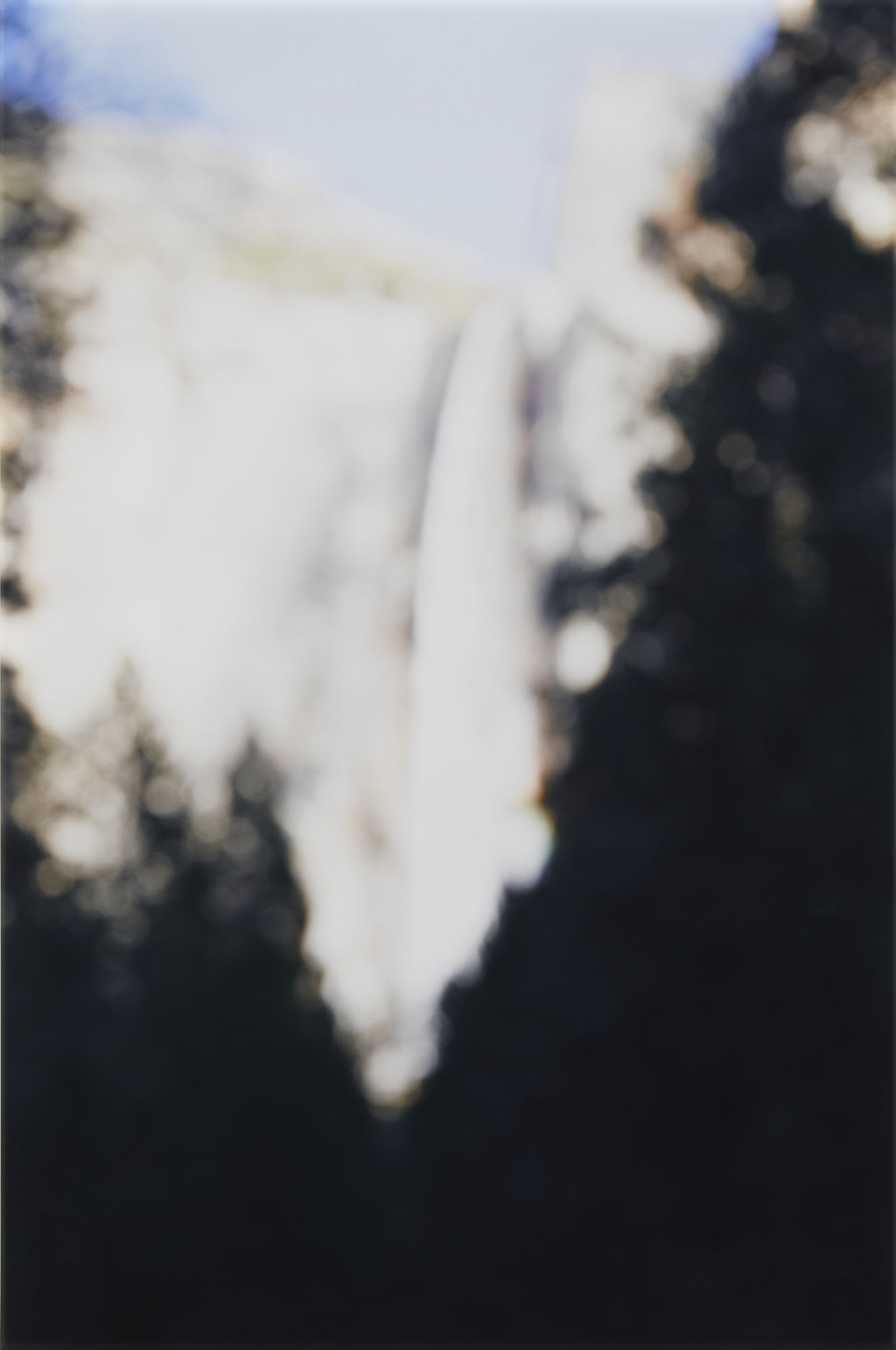
 

Catherine Opie (American, b. 1961) 'Untitled #1 (Yosemite Valley)' 2015


Catherine Opie (American, b. 1961)
Untitled #1 (Yosemite Valley)
2015
Pigment print
Stephen D. and Susan W. Paine Acquisition Fund for 20th century and Contemporary Art
Courtesy Museum of Fine Arts, Boston
© Catherine Opie. Courtesy of Regen Projects, Los Angeles and Lehmann Maupin, New York and Hong Kong


Based in Southern California, Catherine Opie is best known for her unflinching portraits – of herself and of members of the lesbian leather community to which she belongs. In 2015, she was commissioned to create a large-scale piece spanning the multi-story atrium of a new federal courthouse in Los Angeles, which inspired her to tackle a very different California subject: Yosemite National Park.

The opportunity to produce such a major work motivated Opie to take on the iconic views of the park’s natural wonders, examine her relationship with these Western landscapes, and try to “de-cliché” them. Her luminous colour images of Yosemite are often soft-focused yet still recognisable, thanks to the popularisation of such views by earlier photographers like Carleton E. Watkins and Ansel Adams. Depicting Yosemite through a feminist lens, Opie seeks to assert her equal rights to such wilderness subjects, previously considered the domain of photographers who are white men.

Exhibition label text
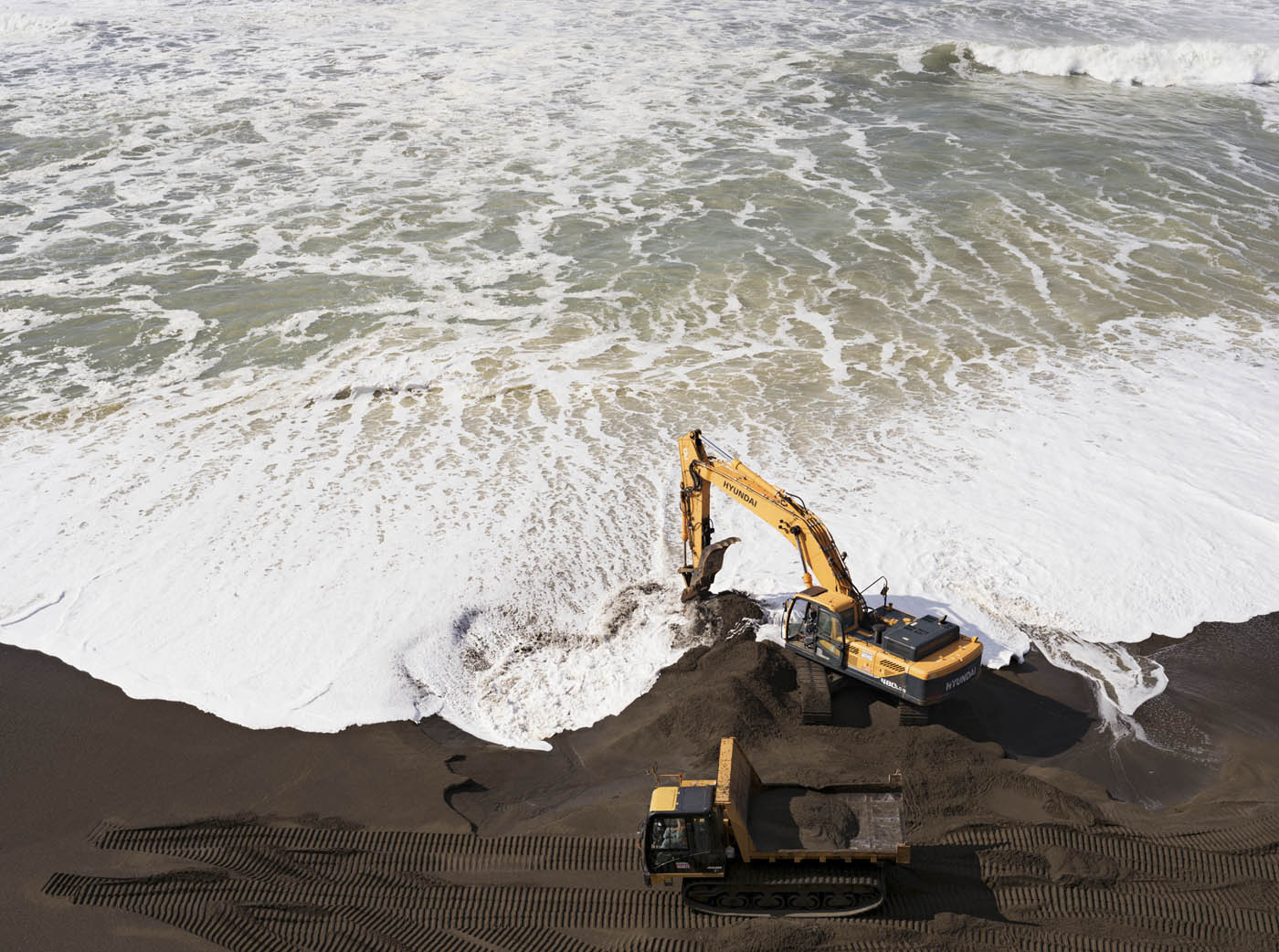
 

Lucas Foglia (American, b. 1983) 'Beach Restoration after El Niño Waves' 2016


Lucas Foglia (American, b. 1983)
Beach Restoration after El Niño Waves
2016
Inkjet print
Courtesy of the Artist and Fredericks & Freiser, NY
Courtesy Museum of Fine Arts, Boston
© Lucas Foglia


Hurricane Sandy was a turning point for Lucas Foglia, who witnessed its disastrous impact on his family’s Long Island farm in 2012. Convinced that human behaviour and the changing weather patterns that produce such destructive storms are connected, he decided to document the many ways in which human beings use science and technology to respond to climate change. Now living in California, Foglia photographed workers and machines performing the extremely demanding and futile task of shoring up the Pacific coastline in the face of El Niño wind and waves. His sharply angled viewpoint from the highway above consciously echoes the abstract composition of Ansel Adams’ Surf Sequence of 1940.

Exhibition label text
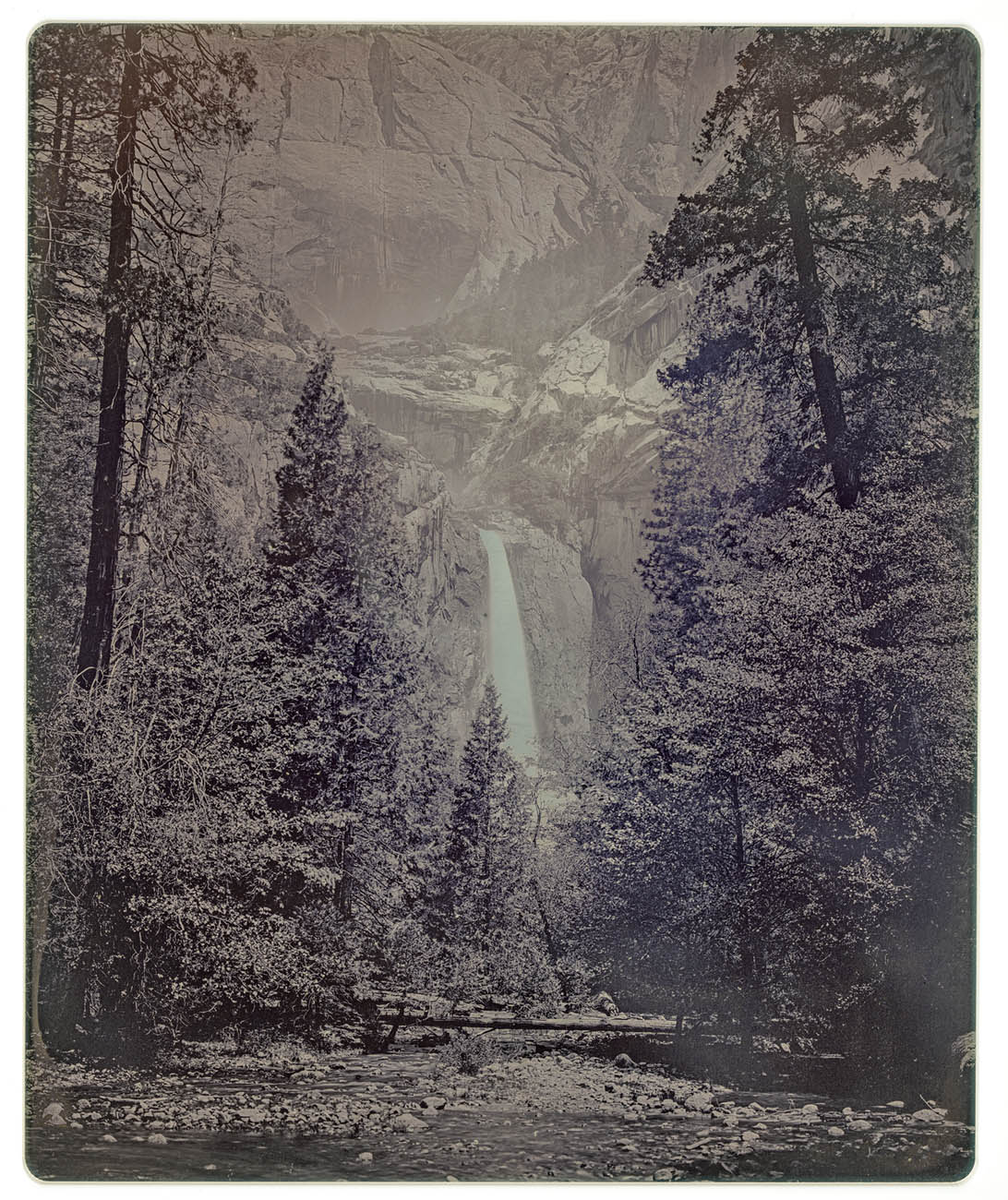
 

Binh Danh (Vietnamese-American, b. 1977) 'Lower Yosemite Fall, August 16, 2016' 2016


Binh Danh (Vietnamese-American, b. 1977)
Lower Yosemite Fall, August 16, 2016
2016
Daguerreotype
Mary S. and Edward J. Holmes Fund
Copyright by Binh Danh
Courtesy Museum of Fine Arts, Boston


Binh Danh and his family immigrated to California after the Vietnam War. For much of his early life, he felt little personal connection to this country’s national parks, several of which were located near his home. That sentiment changed once Danh reached adulthood, took up photography, and discovered a new found pride while documenting these wilderness areas using a mobile darkroom and the daguerreotype process developed in France by Louis-Jacques-Mandé Daguerre in 1839.

Made with a highly polished metal plate, the daguerreotype has a mirror-like surface that allows Danh to capture in stunning detail the same views that he admires in the photographs of Carleton E. Watkins and Ansel Adams. But it also makes it possible for him to create landscapes that reflect his own likeness back to him, literally situating him within those very American spaces.

Exhibition label text


de Young
Golden Gate Park
50 Hagiwara Tea Garden Drive
San Francisco, CA 94118

Opening hours:
Tuesday – Sunday 9.30am – 5.15pm

de Young website

LIKE ART BLART ON FACEBOOK

Back to top

Exhibition: ‘Lucinda Devlin – Frames of Reference’ at the Photographische Sammlung/SK Stiftung Kultur, Cologne

Exhibition dates: 10th March – 16th July 2023


Lucinda Devlin (American, b. 1947) 'Bath, Pocono Palace, Marshall's Creek, Pennsylvania' 1980


Lucinda Devlin (American, b. 1947)
Bath, Pocono Palace, Marshall’s Creek, Pennsylvania
1980
From the series Pleasure Ground
© Lucinda Devlin, courtesy Galerie m, Bochum


I love these works in series!

Frames of reference: spaces that humans construct (mainly interiors that serve specific functions) – for example, spaces of pleasure, corporate arenas, sanctioned death chambers, subterranean spaces, human habitats for captured animals, fields of industrial agriculture.

Format: The square format perfectly supports the themes being investigated, balancing and tensioning the pictorial plane within each image.

Colour palette: The limited colour palette of each image heightens the atmosphere and focuses the senses of the viewer.

Lighting: As in a movie set or theatrical production, whether ambient light, spot light, interior light.

Staging: Nothing is out of place. These are utilitarian/utopian/dystopian spaces.


Everything is perfectly ordered within Devlin’s human(less) worlds… and yet the photographs are instilled with a hyperreality where everything is not as it seems, where spaces exist as a “reality” we do not normally perceive.

The luscious heart shaped red bath surrounded by a halo of lights and flowered red carpet; the unexpected, alien flippers in the round portal of an undersea lodge; “a surgical lamp that looks like an oversized star in the night sky which illuminates the pictorial space”; a bright yellow electric (in colour and intent) chair that looks like an oversized piece of Lego; the ether-reality of the purple haze glacier paradise at the Matterhorn. The spaces are full of human presence even as we acknowledge their physical absence. Their fossilised fingerprints are all over these fantastical creations – these disturbing, sometimes grim, fairy tales.

While acknowledging a debt to the history of photography through the New Color Photography movement, New Topographics, “the direct and objective methodology pursued by August Sander”, and “the strict comparative typology practiced by the photographers Bernd and Hilla Becher” … the photographs are most definitely Devlin’s own. They hold a particular signature, more theatrical than ever New Topographics, Sander or the Bechers.

“The way each space is staged can tell us something about its intended impact and use.” And the recognition and interpretation of that staging can ultimately tell us as much about the artist as about the space itself: perfectionist, environmentalist, passionate creative artist who perceives difference in the everyday, who is aware, aware of the different realities that life (re)presents.

It’s best to view Devlin’s work in the complete series to get the full immersive effect. More photographs from each series can be found on the Lucinda Devlin website.

Dr Marcus Bunyan


Many thankx to the Photographische Sammlung/SK Stiftung Kultur for allowing me to publish the photographs in the posting. Please click on the photographs for a larger version of the image.


Lucinda Devlin – Frames of Reference


American artist Lucinda Devlin rose to fame in the 1990s with a series of soberly observed photographs of execution rooms in US correctional facilities titled “The Omega Suites.” The images caused a sensation at the Venice Biennale in 2001. One of the motifs had already attracted attention in 1992 when it was featured in a controversial advertising campaign for an Italian fashion label. “The Omega Suites” is one of nine photographic series, along with a video, on view in Frames of Reference, the first large-scale survey to be devoted to Lucinda Devlin in Europe.

Devlin, once part of the New Color Photography movement, seeks out her motifs mainly in interiors that serve specific functions. Most of her subjects are in the USA, but she has also done projects in Germany and other countries. In the mid-2000s, the artist added landscape scenes to her repertoire.

One searches in vain for people in Devlin’s pictures, and yet her images tell of human sensitivities and values, evoking existential life questions. In the series “Pleasure Ground” (1977-1990), for example, Devlin provides glimpses of hotel rooms with fantasy themes, discotheques, and beauty salons – places that promise relaxation and enjoyment. By contrast, the interiors in the “Corporal Arenas” series (1982-1998) have an unsettling effect.

Operating rooms for human or animal patients, treatment spaces, and morgues are reproduced here in all objectivity. Viewers are compelled to reflect on their own feelings and experiences in such settings.

It was themes such as these that led the photographer to pursue the project she titled “The Omega Suites” (1991-1998). Devlin did not intend her photographs taken in maximum security prisons to be understood as a statement for or against the death penalty.

Contemplation of these very specific spaces is instead meant as an encouragement to engage personally with a difficult subject.

With the support of a DAAD grant, Devlin shot her series “Water Rites” (1999-2002) in German spas, adding a new twist to “Corporal Arenas.” “Water Rites” takes a look at what are in some cases time-honoured institutions devoted to promoting well-being as well as to healing and convalescence. In Devlin’s “Subterranea” series (ongoing since 1980), she focuses her lens on caves and tunnels that have been made accessible for various uses, reproducing in her pictures the luminous colours generated by artificial lighting schemes installed underground. The way each space is staged can tell us something about its intended impact and use. That Devlin’s interests extend beyond spaces occupied by humans is evident from her “Habitats” series (ongoing since 1985), which spotlights zoo enclosures and aquariums that are modelled on natural animal habitats.

With “Field Culture” (primarily since 2007), the artist has turned to the question of how humans shape the outdoor environment. Here she investigates industrial agriculture in the USA, where genetic engineering and the need to generate sufficient energy are major factors in food production.

Devlin has found an enduring source of inspiration in the vast expanses of Lake Huron, to which she dedicated a series between 2010 and 2019 called “Lake Pictures,” with images illustrating the beauty and grandeur of nature. She presents similarly imposing views of salt lakes and salt flats in Utah in the series “Salt” (ongoing since 2014).

The documentary and serial nature of Devlin’s projects suggests close parallels with the style of depiction represented in the collection of Die Photographische Sammlung / SK Stiftung Kultur. In the 1980s, while working as a university professor and curator, the artist already developed a fascination with the direct and objective methodology pursued by August Sander in his portraiture. And her photos also echo in some ways the strict comparative typology practiced by the photographers Bernd and Hilla Becher. Here as well, compelling correlations can be found among the Cologne collection’s central holdings.

The exhibition has been made possible by generous loans from the artist; Galerie m, Bochum; DZ Bank, Frankfurt/Main; and private lenders.

A publication will accompany the exhibition, featuring essays by Gabriele Conrath-Scholl, Lucinda Devlin, and Claudia Schubert, as well as an interview conducted with the artist by Lisa Le Feuvre (Steidl Verlag, approx. 300 pages, DE/EN).

Press release from Photographische Sammlung/SK Stiftung Kultur


Lucinda Devlin (American, b. 1947) 'Jules UnderSea Lodge, Key Largo, Florida' 1989


Lucinda Devlin (American, b. 1947)
Jules UnderSea Lodge, Key Largo, Florida
1989
From the series Pleasure Ground
© Lucinda Devlin, courtesy Galerie m, Bochum


Pleasure Ground

This series marks the beginning of Lucinda Devlin’s artistic work. Recorded between 1977 and 1996, for example in imaginative theme hotels, in spa and cosmetic areas, in discotheques or striptease bars. Where people seek pleasure and distraction from the toils of everyday life, where desires and dreams provide the incentive to set up these spaces. In their functions and legitimised offers, they are still rarely factual and people are presented in a virtually unrecorded way. They are “stages” for which social agreements exist, but also “space capsules” that are temporary and can become private, taboo-free zones. Socially harmonious, ritualised manners are to be expected as well as one’s hedonistic and borderline actions.

Red emerges as a prominent colour in Pleasure Ground, it signals warmth, love and eroticism. All the more so when in the vicinity of these “islands of happiness” as in the case of the humble Creative Pines Motel little more than highways, gas stations and fast food places. They appear flooded red light retreats with frivolously rigged equipment, even more of the rough world relieved. Lucinda Devlin’s numerous emblematic images in this group of works succeed. That of the heart-shaped whirlpool at Pocono Palace is one of them. The camera stands in the luxurious tub and exposes with the self-timer in the ceiling mirror installed above. This technical trick enabled Devlin to capture the big red heart framed with mirrors and lights undistorted and centred in the picture. The narrow square frame emphasises the rounded shape as well as the oscillating between near and deep space.

Text translated from the German by Google Translate from the Photographische Sammlung / SK Stiftung Kultur


Lucinda Devlin (American, b. 1947) 'Massage Room, Greenbrier Hotel, White Sulphur Springs, WV' 1989


Lucinda Devlin (American, b. 1947)
Massage Room, Greenbrier Hotel, White Sulphur Springs, WV
1989
From the series Corporal Arenas
© Lucinda Devlin, courtesy Galerie m, Bochum

Corporal Arenas

For Lucinda Devlin, the question of physical well-being is of great importance: how much control over your own body and personality is given and in which moments one is in other hands or spheres of influence is handed over. Aspects that make them different in the field of medical treatment and examination rooms for humans and animals. So explores the photographer in her series Corporal Arenas, created between 1986 and 1998, insights into sometimes highly specialised rooms that are mostly shielded from the outside world connect with exceptional situations up to death, while the rooms present themselves as workplaces for certain professional groups.

The picture Operating Room # 8, Forrest General Hospital Hattiesburg is a salient example that meets both the requirements of an operating room clarified as well as the skilful implementation of the subject. He is almost in the middle of the picture operating table provided with a cover protected by cloths. Essential for the constellation is a surgical lamp that looks like an oversized star in the night sky which illuminates the pictorial space above the table to the floor while the surroundings disappear in the dark. This light and line management creates a balanced image geometry. The furnishings thus gain a type spiritual power. Even an altar can be associated.

The other practice rooms considered by Devlin are also connected by a pragmatic decor with smooth, easy-to-clean surfaces and prevailing artificial light. Mostly, however, these are lighter and can be walked through visually. Lucinda Devlin’s pictures also connect in this way to soberly presented documentation views from health technology or from textbooks. But what sets her recordings apart is that they are far removed from any idealised model and in them material ageing and signs of wear as well as irregularities in the arrangement of objects have their place.

Text translated from the German by Google Translate from the Photographische Sammlung / SK Stiftung Kultur


Lucinda Devlin (American, b. 1947) 'Operating Room #8, Forrest General Hospital, Hattiesburg' 1998


Lucinda Devlin (American, b. 1947)
Operating Room #8, Forrest General Hospital, Hattiesburg
1998
From the series Corporal Arenas
© Lucinda Devlin, courtesy Galerie m, Bochum


Lucinda Devlin (American, b. 1947) 'Scotch Douche, The Homestead, Hot Springs, Virginia' 1989


Lucinda Devlin (American, b. 1947)
Scotch Douche, The Homestead, Hot Springs, Virginia
1989
From the series Corporal Arenas
© Lucinda Devlin, courtesy Galerie m, Bochum


Lucinda Devlin (American, b. 1947) 'Electric Chair, Holman Unit, Atmore, Alabama' 1991


Lucinda Devlin (American, b. 1947)
Electric Chair, Holman Unit, Atmore, Alabama
1991
From the series The Omega Suites
© Lucinda Devlin, courtesy Galerie m, Bochum


The Omega Suites

With her views of execution rooms in American prisons, in which are electric chairs, operating tables for administering lethal injections are located or the massive lockable entrances of gas chambers are show, Lucinda Devlin raises awareness of an oppressive topic: the enforcement of the death penalty, which applies in the US and in other countries. However, the photographer is concerned with her project – which took place between 1991 and 1998 in over 20 correctional facilities in various US states – which is neither a sensation nor an accusation. Again, she relies on her thoughtful restrained imagery, which is characterised by realistic colouring and precise perspective and line management of the pictorial space. Not only finding execution rooms with windows and executioners’ technical rooms but also neighbouring cells in which the convicts spend their last hours. There are also rooms for witnesses to witness the execution through a window. To carry out the photographic work Lucinda Devlin completed extensive research. Only the locations of the institutions were laboriously located by her – at that time without the internet – each visit prepared by prior correspondence. A selection of extensive correspondence can be seen in the exhibition showcases.

Text translated from the German by Google Translate from the Photographische Sammlung / SK Stiftung Kultur


Lucinda Devlin (American, b. 1947) 'Ruheraum, Friedrichsbad, Baden-Baden, Germany' 1999


Lucinda Devlin (American, b. 1947)
Ruheraum, Friedrichsbad, Baden-Baden, Germany
1999
From the series Water Rites
© Lucinda Devlin, courtesy Galerie m, Bochum


Water Rites

At the end of the 1990s, Lucinda Devlin developed her Water Rites series. The series is themed with and performs in conjunction with Corporal Arenas, facilities that deal with the physical and mental well-being of the people. Specific objects are the typical spa and bathing landscapes with its extensive range of medical treatments and wellness offers. Lucinda Devlin has visited traditional spa towns where the element of water is used and therapeutic measures for healing are practiced. The American art historian Michael Mackenzie states that that the construction periods of the baths visited by Lucinda Devlin can be divided into three phases: “The earliest is the architecture of the 19th century with its high tiled rooms, with the equipment made of cast iron and stainless steel. They are followed by the cool clinical rooms of the healthcare industry during the post-war period and finally as a recent development spaces that are modelled like ice caves or Arabian oases and the surprising fantasy rooms of American hotels from the Pleasure Ground series” (in: Lucinda Devlin: Water Rites, Göttingen 2003, p. 6)

An overview of the motifs from Water Rites confirms that the photographer is especially looking at manageable parts of the room as well as utensils and furnishings in which the room is dressed, which she encounters at eye level with her camera and gives an optical order by maintaining the central perspective; thus creating an emblem that, like a trademark, has a direct visual access allowed. Again in this series, Lucinda Devlin asks to what extent the body and thus the affected individual has the possibility and ability to control and regulate these influences, or whether this is done by the person or is desired at all.

Text translated from the German by Google Translate from the Photographische Sammlung / SK Stiftung Kultur


Lucinda Devlin (American, b. 1947) 'Massageraum #1, Hufeland Therme, Bad Pyrmont' 2002


Lucinda Devlin (American, b. 1947)
Massageraum #1, Hufeland Therme, Bad Pyrmont
2002
From the series Water Rites
© Lucinda Devlin, courtesy Galerie m, Bochum


Lucinda Devlin (American, b. 1947) 'Römische Bäder, Carolus Thermen, Bad Aachen' 2002


Lucinda Devlin (American, b. 1947)
Römische Bäder, Carolus Thermen, Bad Aachen
2002
From the series Water Rites
© Lucinda Devlin, courtesy Galerie m, Bochum


Lucinda Devlin (American, b. 1947) 'Glacier Paradise at the Matterhorn #4, Zermatt, Switzerland' 2008


Lucinda Devlin (American, b. 1947)
Glacier Paradise at the Matterhorn #4, Zermatt, Switzerland
2008
From the series Subterranea
© Lucinda Devlin, courtesy Galerie m, Bochum


Subterranea

As with the Habitats series, Subterranea dates back to the 1980s. The subject of the series are different natural cave formations in America and Europe, Lucinda Devlin also has tunnels from the former mining industry included.

The cave is always in its uses, as well as in representational contexts, been connected with basic human needs and issues. Due to its circumstances, it can be considered the archetype of dwelling, it can be used as a shelter as well as serve a place of worship. Early evidence of human expression can be found in caves, one thinks, for example, of the paintings of Lascaux in France or of those in Spanish Altamira. For Lucinda Devlin, who designs functional spaces as an expression of cultural self-understanding and cultural acceptance, caves may appear to be downright predestined, and this is exactly what she visually reflects. A look at art history reveals a long iconographic tradition of cave representations. In the visualisation of Christian themes for example the birth of Jesus not only in a stable, but often in one cave shown. His grave is also sometimes located in a rock cave. Saints such as Aegidius are depicted in cave settings. In the psychoanalytic Dream Interpretation can symbolise the unconscious or a reference to caves be female sexuality.

Caves are shrouded in mystery, dark and cool, you can get inside them get lost and never find out. They are fear rooms or can offer protection and be a hiding place in threatening situations. This complexity and ambivalence is captivating in Lucinda Devlin’s recordings in which transparent, iridescent colours are definitely perceptible. The images contrast light and dark, allow a glimpse into corridors whose end cannot be made out and offer bizarre sculptural rock formations.

Text translated from the German by Google Translate from the Photographische Sammlung/SK Stiftung Kultur


Lucinda Devlin (American, b. 1947) 'Lake Huron, 9/1/2012 6-31am' 2012


Lucinda Devlin (American, b. 1947)
Lake Huron, 9/1/2012 6-31am
2012
From the series Lake Pictures
© Lucinda Devlin, courtesy Galerie m, Bochum


Lake Pictures

In 2010, the first recording was made on the shore of Lake Huron, which is one of the five great lakes of the USA. Until 2019 Lucinda Devlin worked on this series, which differs conceptually and compositionally from its other series. First it is noticeable that they always have a view looking out over the shore viewpoint photographing the lake towards the east. The central picture element is the horizon which Devlin takes at the same height and in the centre of each picture. Accurate to the second, Lucinda Devlin has the time, day, month and year noted for each photograph. Through this precision, combined with the rigorous image structure, the series has the character of a painterly quality for all empirical series that brings together comparative meteorological observations. Seasons, light situations, sky formations and the texture of the water can be understood so clearly that in their interaction they become the real actors. They seem endless variations and leave impressions of a high degree of artistic abstraction which emerge to invite contemplation and reflection.

In addition, it is important to Lucinda Devlin to point out the existential importance in reference to the element of water, from which life arose and without it no life is possible on planet earth. Lake Huron offers the photographer an essential, at the same time exemplary, field of exploration which brings significant habitat to the region, its biodiversity threatened from environmental pollution and climate change.

Text translated from the German by Google Translate from the Photographische Sammlung/SK Stiftung Kultur


Lucinda Devlin (American, b. 1947) 'Lake Huron, 9/1/2012 6:44am' 2012


Lucinda Devlin (American, b. 1947)
Lake Huron, 9/1/2012 6:44am
2012
From the series Lake Pictures
© Lucinda Devlin, courtesy Galerie m, Bochum


Lucinda Devlin (American, b. 1947) 'Lake Huron, 3-4-13, 6-31pm' 2013


Lucinda Devlin (American, b. 1947)
Lake Huron, 3-4-13, 6-31pm
2013
From the series Lake Pictures
© Lucinda Devlin, courtesy Galerie m, Bochum


Lucinda Devlin (American, b. 1947) 'Pygmy Hippopotamus, Berlin Zoo, Germany' 1999


Lucinda Devlin (American, b. 1947)
Pygmy Hippopotamus, Berlin Zoo, Germany
1999
From the series Habitats
© Lucinda Devlin, courtesy Galerie m, Bochum


Habitats

The Habitats series has been photographed in numerous zoos and aquariums since the 1980s originating mainly in America. In this decade lies the beginning of Lucinda Devlin’s interest in the animal world and in particular how humans interact with the creatures they handle. In order to trace this request, zoological gardens were a very suitable terrain. The photographer especially likes aquariums, her fascination with the element of water can also be felt here, mirrored repeatedly. But basically, aquariums are like the enclosures of zoos around constructed purpose-built spaces, around replicas of natural habitats, ideally the needs of the respective animal adjusted. Lucinda Devlin argues that this must inevitably be an illusion, as in a touching picture of a pygmy hippopotamus in the Berlin zoo from 1999. The animal stands on the bottom of its pool and nudges its snout against a glass border. As can be in front of a shop window with goods on offer the zoo visitor – currently the viewer of the photograph – from a safe distance look at every movement of the living being in front of him. About zoology and animal science, it is a central function of zoological gardens to meet this human need to see. This is also intended as a mastery of man over nature.

And yet, in Lucinda Devlin’s Habitats series, there are photographic compositions that seem to elude real space. So drift in a picture three jellyfish through seemingly infinite deep blue waters in one, in others a shark swims directly towards the viewer. Habitats is the only series showing those for whom the spaces have been created.

Text translated from the German by Google Translate from the Photographische Sammlung / SK Stiftung Kultur


Lucinda Devlin (American, b. 1947) 'Georgia Aquarium #1 (Shark), Atlanta' 2021


Lucinda Devlin (American, b. 1947)
Georgia Aquarium #1 (Shark), Atlanta
2021
From the series Habitats
© Lucinda Devlin, courtesy Galerie m, Bochum


Lucinda Devlin (American, b. 1947) 'Turbine Base, Earl Park, IN' 2009


Lucinda Devlin (American, b. 1947)
Turbine Base, Earl Park, IN
2009
From the series Field Culture
© Lucinda Devlin, courtesy Galerie m, Bochum


Field Culture

Lucinda Devlin also sees the outside space as a designed space, shaped according to human needs and ideas. Her series Field Culture redeems this to a particular degree by showing the diverse phenomena of industrial agriculture in the USA. In the Corn Belt states and beyond, which are characterised by large-scale cultivation of grain, cotton or soya, for example, is in what the photographer finds her own expressive motifs. Monocultures prevail in these areas, geared towards maximum yield and profit. Such conditions can only be with appropriate plant breeding, often implemented using genetic engineering, chemical fertilisers and intensive energy management. Lucinda Devlin has the necessary structures, constructions and buildings in her series to provide numerous insights. In numerous photographs technology dominates nature, traditional forms of tillage are a thing of the past, direct contact with the earth is only a marginal phenomenon. A shot of the view into a magenta-coloured illuminated greenhouse, the futuristic-surreal. Another shot shows the entrance to one wind turbine reminiscent of a rocket.

Lucinda Devlin sees her Field Culture series in the tradition of the legendary New Topographics. It was under this name in 1975 at the George Eastman House in Rochester, NY, an exhibition of photographs by Robert Adams, Lewis Baltz, Bernd and Hilla Becher, Joe Deal, Frank Gohlke, Stephen Shore and Henry Wessel were shown. They all have a critical view of the environment they encounter: no untouched nature, no romantic moods, no reverential bowing to nature characterise her pictorial creations. Rather, it is a far-reaching urban sprawl with highways and related motels, parking lots and gas stations, industry and peripherals that determine the American landscape.

Text translated from the German by Google Translate from the Photographische Sammlung / SK Stiftung Kultur


Lucinda Devlin (American, b. 1947) 'Greenhouse 48, Copperstate Farms, Snowflake, Arizona' 2022


Lucinda Devlin (American, b. 1947)
Greenhouse 48, Copperstate Farms, Snowflake, Arizona
2022
From the series Field Culture
© Lucinda Devlin, courtesy Galerie m, Bochum


Die Photographische Sammlung/SK Stiftung Kultur
Im Mediapark 7
50670 Cologne
Phone: 0049-(0)221-88895 300

Opening hours:
Open daily 14 – 19hrs
Closed Wednesdays

Die Photographische Sammlung/SK Stiftung Kultur website

LIKE ART BLART ON FACEBOOK

Back to top

Exhibition: ‘Dawoud Bey & Carrie Mae Weems: In Dialogue’ at the J. Paul Getty Museum, Los Angeles

Exhibition dates: 4th April – 9th July, 2023


Dawoud Bey (American, b. 1953) 'Two Women at a Parade' 1978 from the exhibition 'Dawoud Bey & Carrie Mae Weems: In Dialogue' at the J. Paul Getty Museum, Los Angeles, April-  July, 2023


Dawoud Bey (American, b. 1953)
Two Women at a Parade
1978
Gelatin silver print
Grand Rapids Art Museum, Michigan Museum purchase
© Dawoud Bey
Courtesy of Stephen Daiter Gallery


Engaging each other in light

Dialogue: Old English dialogas (plural), from Latin from Greek dialogos, from dia ‘through’ + logos ‘word’

“As we define it, dialogue is “a communicative process in which people with different perspectives seek understanding.” To be in dialogue means that participants are not only engaging each other in light of their different views, but they are also striving to achieve a degree of mutual understanding.”

Jason Combs. “What is Dialogue?” on the University of Dayton website Monday October 28, 2019 [Online] Cited 01/07/2023


Short and sweet because I’m not feeling well.

What an inspired pairing for an exhibition. “Each [artist] addresses race, class, representation, and systems of power in their work, creating photographic series grounded in Black history and realities that speak to the human condition.”

From street-based photographs of everyday life to conceptual excavations of Black Histories, they produce incisive thought provoking works “that intermingle past and present, referenc[ing] African Americans whose lives and stories have been co-opted or lost.”

I love them both for their commitment to and passion for life in all its different forms. Bringing people together. Expressing a degree of mutual understanding.

#BlackLivesMatter #AllLivesMatter

Dr Marcus Bunyan


Many thankx to the J. Paul Getty Museum for allowing me to publish the photographs in the posting. Please click on the photographs for a larger version of the image.


Dawoud Bey and Carrie Mae Weems have been friends and colleagues for more than 40 years. Each addresses race, class, representation, and systems of power in their work, creating photographic series grounded in Black history and realities that speak to the human condition. This exhibition sheds light on their unique trajectories and modes of presentation, and their shared consciousness and principles. Organised by the Grand Rapids Art Museum.


Dawoud Bey (American, b. 1953) 'The Woman in the Light, Harlem, NY' 1980 from the exhibition 'Dawoud Bey & Carrie Mae Weems: In Dialogue' at the J. Paul Getty Museum, Los Angeles, April-  July, 2023


Dawoud Bey (American, b. 1953)
The Woman in the Light, Harlem, NY
1980
Gelatin silver print
© Dawoud Bey
Courtesy of Stephen Daiter Gallery


Dawoud Bey (American, b. 1953) 'Self and Shadow, New York, NY' 1980 from the exhibition 'Dawoud Bey & Carrie Mae Weems: In Dialogue' at the J. Paul Getty Museum, Los Angeles, April-  July, 2023


Dawoud Bey (American, b. 1953)
Self and Shadow, New York, NY
1980
Gelatin silver print
© Dawoud Bey
Courtesy of Stephen Daiter Gallery


Dawoud Bey (American, b. 1953) 'A Young Man Resting on an Exercise Bike, Amityville, NY' 1988


Dawoud Bey (American, b. 1953)
A Young Man Resting on an Exercise Bike, Amityville, NY
1988
Gelatin silver print
© Dawoud Bey
Courtesy of Stephen Daiter Gallery


Dawoud Bey (American, b. 1953) 'Couple in Prospect Park, Brooklyn, NY' 1990


Dawoud Bey (American, b. 1953)
Couple in Prospect Park, Brooklyn, NY
1990
Gelatin silver print Getty Museum
© Dawoud Bey


In 1976 I had been making photographs for a couple of years. I had certainly been looking at a lot more photographs than I had actually made. From looking at photographs in books and magazines and going to exhibitions of pictures by Mike Disfarmer at MoMA, Richard Avedon at Marlborough, and haunting whatever other places there were to see photographs in New York in the early 1970s, I had begun to educate myself, with the intent of adding something to the conversation through my own pictures.

The artist Janet Henry, who was from the same Jamaica, Queens neighborhood that I lived in, had gotten a job in the Education Department at the Studio Museum in Harlem, then located above a Kentucky Fried Chicken on 125th Street and Fifth Avenue in a large second floor loft space. When Frank Stewart, the museum’s staff photographer and photo teacher, left to do a commissioned project in Cuba, Janet called me and asked if I would take over the class. On the first day of class a few students straggled in. One of them, a seemingly shy woman with big expressive eyes, introduced herself, “Hi, my name is Carrie. Do you think I could be a photographer?” she asked, holding her Leica camera in her hand. That began what has now been 33 years of friendship and camaraderie with one of the most brilliant people I know.

From the very beginning, Carrie Mae Weems has had a sharp intelligence that was looking for a way into the world. From her early documentary photographs to the more expansive and materially varied recent works, she has consistently set out to visually define the world on her own terms and to redefine for all of us the nature of the world that we are in. After all these years I still anticipate her work with a fresh sense of wonderment, knowing that her restless search for the deeper meaning of things will yield a continuing rich trove of objects and images. On a Sunday morning in May I called from my home in Chicago to reconnect with my dear friend while she was traveling in Seville, Spain.

Dawoud Bey quoted in “Carrie Mae Weems by Dawoud Bey,” on the BOMB Magazine website July 1, 2009 [Online] Cited 18/06/2023


Dawoud Bey (American, b. 1953) 'Taneesha' 1999


Dawoud Bey (American, b. 1953)
Taneesha
1999
Dye diffusion prints
Collection of Jack and Sandra Guthman
© Dawoud Bey
Courtesy of Stephen Daiter Gallery


Dawoud Bey (American, b. 1953) 'The Birmingham Project: Wallace Simmons and Eric Allums' 2012


Dawoud Bey (American, b. 1953)
The Birmingham Project: Wallace Simmons and Eric Allums
2012
Inkjet prints
Rennie Collection, Vancouver
© Dawoud Bey
Courtesy of Stephen Daiter Gallery


Dawoud Bey (American, b. 1953) 'The Birmingham Project: Taylor Falls and Deborah Hackworth' 2012


Dawoud Bey (American, b. 1953)
The Birmingham Project: Taylor Falls and Deborah Hackworth
2012
Inkjet prints
Rennie Collection, Vancouver
© Dawoud Bey
Courtesy of Stephen Daiter Gallery


Dawoud Bey (American, b. 1953) 'Braxton McKinney and Lavone Thomas, Birmingham, AL' 2012


Dawoud Bey (American, b. 1953)
The Birmingham Project: Braxton McKinney and Lavone Thomas
2012
Inkjet prints
Rennie Collection, Vancouver
© Dawoud Bey
Courtesy of Stephen Daiter Gallery


Dawoud Bey (American, b. 1953) 'Betty Selvage and Faith Speights, Birmingham, AL' 2012


Dawoud Bey (American, b. 1953)
The Birmingham Project: Betty Selvage and Faith Speights
2012
Inkjet prints
Rennie Collection, Vancouver
© Dawoud Bey
Courtesy of Stephen Daiter Gallery


Dawoud Bey (American, b. 1953) 'Boy on Skateboard, Harlem, NY' 2014


Dawoud Bey (American, b. 1953)
Boy on Skateboard, Harlem, NY
2014
Inkjet print
© Dawoud Bey
Courtesy of Stephen Daiter Gallery


Dawoud Bey (American, b. 1953) 'Former Renaissance Ballroom Site, Harlem, NY' 2015


Dawoud Bey (American, b. 1953)
Former Renaissance Ballroom Site, Harlem, NY
2015
Inkjet print
© Dawoud Bey
Courtesy of Stephen Daiter Gallery


Dawoud Bey (American, b. 1953) 'Untitled #15 (Forest with Small Trees)' 2017


Dawoud Bey (American, b. 1953)
Untitled #15 (Forest with Small Trees)
2017
Gelatin silver print
Getty Museum, purchased with funds provided by the Photographs Council
© Dawoud Bey


Since meeting at the Studio Museum in Harlem in 1977, Dawoud Bey and Carrie Mae Weems have been intellectual colleagues and companions.

From the outset of their careers, both have operated from a deep social commitment to participate in, describe, and define culture. In seeking to express themselves fully, each has expanded possibilities within photography and video to address their chosen subjects.

Dawoud Bey & Carrie Mae Weems: In Dialogue, on view April 4 through July 9, 2023, brings together for the first time a focused selection of work from a period of over 40 years by two of today’s most important and influential photo-based artists. Each grapples with issues of race, class, and representation in their work, making art grounded in the experiences and realities of Black Americans while also speaking to the broader human condition.

“The Museum’s Department of Photographs has made great strides in recent years in building an exhibitions program that highlights more expansive narratives of photographic history,” says Timothy Potts, Maria Hummer-Tuttle and Robert Tuttle Director of the J. Paul Getty Museum. “Dawoud Bey and Carrie Mae Weems are two artists who reframe American traumas that have been ignored or simplified in the national historical record. We are proud to showcase their work in dialogue with one another.”

Jim Ganz, senior curator of photographs, adds, “These artists are two of the most dynamic and insightful of our time. As presented in this extraordinary exhibition, their eloquent dialogue gives unique perspective on their shared concerns as image makers.”

Dawoud Bey (American, born 1953) creates photographs that focus on individuals, communities, and important but often overlooked American histories. His carefully composed images convey the dignity and rich inner lives of his subjects. Carrie Mae Weems (American, born 1953) first gained recognition in the 1980s for exploring identity, race, power, and history, themes that still fuel her art. Over her career, Weems has turned increasingly to staged photography and the use of text to heighten the emotional intensity of her work.

This exhibition is divided into five sections, starting with early pictures that both artists made in the photodocumentary tradition and followed by ambitious, groundbreaking explorations of the medium as it developed technologically and artistically. The exhibition then focuses on how both artists moved beyond candid pictures of everyday life and began making larger scale work that is more planned than spontaneous. Bey’s portraiture evolved from street-based glimpses of the world made with a handheld camera to portraits that are formal but intimate, in which his subjects appear at ease and engage directly with the lens. With her Kitchen Table Series, Weems transitioned from representing real people in their natural environments to creating staged photo essays. For each artist, the techniques developed in this period became the foundation for future projects.

In Resurrecting Black Histories, each artist addresses the 19th century and its legacies in distinctive ways. Bey’s carefully composed landscapes evoke the experience of fleeing along the Underground Railroad, the clandestine network that helped enslaved people escape the South. Weems, by incorporating texts that intermingle past and present, references African Americans whose lives and stories have been co-opted or lost.

In Memorial & Requiem, Bey and Weems reference traumatic 20th-century events. They worked with community partners to stage scenes meant to reinvigorate discussion of the American legacy of racial violence. Each photographer also created a related video, bringing their own sensibility – Bey’s searching, intimate gaze; Weems’ choreographed social commentary – to the moving image, using sequencing and sound to deepen engagement with American history.

The exhibition ends with Revelation in the Landscape, where both Bey and Weems contemplate the built environments in which we live and how those spaces affect our perceptions of the world and ourselves. Bey returns to the Harlem neighbourhoods he photographed in the late 1970s, tracking the changes wrought by gentrification. Weems photographs imposing sites in Rome, inserting herself into historical places imbued with power and legacy. Both series reveal the economic and institutional forces that shape daily life.

In conjunction with the exhibition Getty has created a community program inspired by the exhibition, L.A.: In Dialogue. This program brings Dawoud Bey & Carrie Mae Weems: In Dialogue to a wider Los Angeles community, furthering the influence of the two artists and introducing their work to a new generation of artists and viewers. The artist-led program will host educational workshops for local teens and young adult photographers, and will teach participants techniques in black-and-white photography and the artistic practice of capturing portraiture and place. They will explore themes from the exhibition, collaborate with peers, and explore their local communities: Culver City (Black Image Center), South L.A. (LA Commons), Downtown L.A. (Inner-City Arts), and Venice Beach (Venice Arts). This program will result in a satellite exhibition that will open in June 2023.

Related programming includes Dawoud Bey and Carrie Mae Weems in Conversation on Tuesday, April 4 at 4pm. That evening at 7pm, the Museum presents master saxophonist David Murray in concert with his newly formed quartet as part of the exhibition programming.

Press release from the J. Paul Getty Museum


Carrie Mae Weems (American, b. 1953) 'First Self Portrait' 1975 from the exhibition 'Dawoud Bey & Carrie Mae Weems: In Dialogue' at the J. Paul Getty Museum, Los Angeles, April-  July, 2023


Carrie Mae Weems (American, b. 1953)
First Self Portrait
1975
Gelatin silver print
© Carrie Mae Weems
Courtesy of the artist and Jack Shainman Gallery, New York


Carrie Mae Weems (American, b. 1953) 'Harlem Street' 1976-1977 from the exhibition 'Dawoud Bey & Carrie Mae Weems: In Dialogue' at the J. Paul Getty Museum, Los Angeles, April-  July, 2023


Carrie Mae Weems (American, b. 1953)
Harlem Street
1976-1977
Gelatin silver print
© Carrie Mae Weems
Courtesy of the artist and Jack Shainman Gallery, New York


Carrie Mae Weems (American, b. 1953) 'Woman in Shorts, Boardwalk, Santa Monica' 1980-1982


Carrie Mae Weems (American, b. 1953)
Woman in Shorts, Boardwalk, Santa Monica
1980-1982
Gelatin silver print
© Carrie Mae Weems
Courtesy of the artist and Jack Shainman Gallery, New York


Carrie Mae Weems (American, b. 1953) 'Reclining Girl, Fiji' 1982-1983


Carrie Mae Weems (American, b. 1953)
Reclining Girl, Fiji
1982-1983
Gelatin silver print
© Carrie Mae Weems
Courtesy of the artist and Jack Shainman Gallery, New York


Carrie Mae Weems (American, b. 1953) 'Untitled (Woman and daughter with children)' 1990


Carrie Mae Weems (American, b. 1953)
Untitled (Woman and daughter with children)
1990
Gelatin silver print
© Carrie Mae Weems
Courtesy of the artist and Jack Shainman Gallery, New York


Carrie Mae Weems (American, b. 1953) 'Untitled (Woman standing alone)' 1990


Carrie Mae Weems (American, b. 1953)
Untitled (Woman standing alone)
1990
Gelatin silver print
© Carrie Mae Weems
Courtesy of the artist and Jack Shainman Gallery, New York


Carrie Mae Weems (American, b. 1953) 'Untitled (Woman and Daughter with Makeup)' 1990


Carrie Mae Weems (American, b. 1953)
Untitled (Woman and Daughter with Makeup)
1990
Gelatin silver print
© Carrie Mae Weems
Courtesy of the artist and Jack Shainman Gallery, New York


Carrie Mae Weems (American, b. 1953) 'See No Evil' 1991


Carrie Mae Weems (American, b. 1953)
See No Evil
1991
Dye diffusion print (Polaroid Polacolor)
61 × 50.5cm (24 × 19 7/8 in.)
The J. Paul Getty Museum, Los Angeles, Gift of Daniel Greenberg and Susan Steinhauser
© Carrie Mae Weems


Carrie Mae Weems (American, b. 1953) 'Road Sign' 1991-1992


Carrie Mae Weems (American, b. 1953)
Road Sign
1991-1992
Gelatin silver print
© Carrie Mae Weems
Courtesy of the artist and Jack Shainman Gallery, New York


Carrie Mae Weems (American, b. 1953) 'Untitled (Ebo Landing)' 1992


Carrie Mae Weems (American, b. 1953)
Untitled (Ebo Landing)
1992
Two gelatin silver prints and one screenprinted text panel
© Carrie Mae Weems
Courtesy of the artist and Jack Shainman Gallery, New York


Carrie Mae Weems (American, b. 1953) 'You Became a Scientific Profile / An Anthropological Debate / A Negroid Type / A Photographic Subject' 1995-1996


Carrie Mae Weems (American, b. 1953)
You Became a Scientific Profile / An Anthropological Debate / A Negroid Type / A Photographic Subject
1995-1996
From From Here I Saw What Happened and I Cried
© Carrie Mae Weems
Courtesy of the artist and Jack Shainman Gallery, New York


Carrie Mae Weems (American, b. 1953) 'The Edge of Time – Ancient Rome' 2006


Carrie Mae Weems (American, b. 1953)
The Edge of Time – Ancient Rome
2006
Chromogenic print
© Carrie Mae Weems


Carrie Mae Weems (American, b. 1953) 'The Tragedy of Hiroshima' 2008


Carrie Mae Weems (American, b. 1953)
The Tragedy of Hiroshima
2008
Inkjet print
© Carrie Mae Weems
Courtesy of the artist and Jack Shainman Gallery, New York


The pose of the figures, other than the obvious reference to the Pieta, reminds me of that famous and most moving Eugene W. Smith photograph Tomoko and Mother in the Bath (1971)


The J. Paul Getty Museum
1200 Getty Center Drive
Los Angeles, California 90049

Opening hours:
Daily 10am – 5pm

The J. Paul Getty Museum website

LIKE ART BLACK ON FACEBOOK

Back to top

Exhibition: ‘Hannah Villiger: Amaze Me’ at Museum Susch, Switzerland

Exhibition dates: 7th January – 2nd July 2023

Curated by Madeleine Schuppli and Yasmin Afschar


Hannah Villiger (Swiss, 1951-1997) 'Work' 1980 from the exhibition Exhibition: 'Hannah Villiger: Amaze Me' at Museum Susch, Switzerland, Jan - July 2023


Hannah Villiger (Swiss, 1951-1997)
Work
1980
C-print of a polaroid, mounted on aluminium
100 x 100cm
© Foundation The Estate of Hannah Villiger


who am I who I am

I love artists who push the boundaries of seeing / being, body / Self, self / spirit.

Artists who see and feel the world in unique and tantalising – excites the senses or desires of (someone) – ways.

Hannah Villiger is one such artist.

Her fragmentary, space-related assemblages (Works or Blocks) investigate the representation of the female body, “its classification in the media, questions of surface, space and body, and the objectification of the body. In Villiger’s work, the skin – where humans enter a dialogue with their environment – is a setting for highly topical questions of gender and ethnicity, as well as vulnerability and healing. The body was the artist’s primary working material. We encounter it abstracted or deconstructed; it can be human, but also of plant or artificial origin.” (Exhibition text)

But more than that, it is the conceived ‘idea in the mind’ strangeness of Villiger’s out of body gridded experiences… that promote in the viewer an acknowledgement of the physicality, touch, and emotion of actually living and feeling in the human body and beyond. Touch your skin, run your hands over the shape of your mouth, feel your ears, raise your foot, look at your reflection. Marvel at the bodies distortion, energy, spirit. For there is only one you. “I listen to my naked, bare body, the outside of it, the inside of it, traversing it.”

You are unique. An individual, unique, sentient animal. A human – being.

Dr Marcus Bunyan


Many thankx to Museum Susch for allowing me to publish the photographs in the posting. Please click on the photographs for a larger version of the image.


“With my Polaroid camera I listen to my naked, bare body, the outside of it, the inside of it, traversing it. Thus I create images that I can correct immediately.”


Hannah Villiger


“The longest distance between the camera and any body part is between raised arm and my toes. I always trigger the camera myself, sometimes without looking through the viewfinder. I tilt the camera to an angle of 90, 180, 270 degrees. I turn myself – literally – upside down.”


Hannah Villiger. On My Book Envy


Hannah Villiger (1951-1997) was an extraordinary voice in the late 20th-century contemporary art, but her work came to an abrupt end with her untimely death. She became known above all for her photographic works based on the body.

Muzeum Susch is hosting the largest presentation of Hannah Villiger’s oeuvre in fifteen years. Hannah Villiger: Amaze Me offers new perspectives on the work of this important Swiss artist. Villiger’s large-format works based on Polaroid photographs make a lasting contribution to the genre of the self-image within art history. At the same time, her explorations of the body can be discussed against the background of numerous contemporary themes. Her oeuvre spans from the drawings she made in the 1970s to the black-and-white photographs and works with the Polaroid camera that she created from the 1980s onwards. These fragmentary close-ups of her own body, greatly enlarged via an internegative and mounted on aluminium, are presented individually or assembled into space-related ensembles. The results are unlimited possibilities of at times spectacular views of the body. The exhibition expands the view of Villiger to include contemporary themes and issues. The focus is on the representation of the female body, one’s own perspective, as well as that of others, on the human physique, its classification in the media, questions of surface, space and body, and the objectification of the body. In Villiger’s work, the skin – where humans enter a dialogue with their environment – is a setting for highly topical questions of gender and ethnicity, as well as vulnerability and healing. The body was the artist’s primary working material. We encounter it abstracted or deconstructed; it can be human, but also of plant or artificial origin. Although Villiger’s early death brought her oeuvre to an abrupt end, her works point unwaveringly to the present.

Text from the Museum Susch website


Trix Wetter. 'Portrait of Hannah Villiger' 1976, Rome from the exhibition Exhibition: 'Hannah Villiger: Amaze Me' at Museum Susch, Switzerland, Jan - July 2023


Trix Wetter
Portrait of Hannah Villiger
1976, Rome
© Foundation The Estate of Hannah Villiger


Hannah Villiger (Swiss, 1951-1997) 'Work' 1976 from the exhibition Exhibition: 'Hannah Villiger: Amaze Me' at Museum Susch, Switzerland, Jan - July 2023


Hannah Villiger (Swiss, 1951-1997)
Work
1976
Four black and white photographs
61 x 51cm / 40.5 x 33.5cm each
© Foundation The Estate of Hannah Villiger


Hannah Villiger (Swiss, 1951-1997) 'Work' 1976


Hannah Villiger (Swiss, 1951-1997)
Work
1976
black and white photograph
70 x 100cm
© Foundation The Estate of Hannah Villiger


Hannah Villiger (Swiss, 1951-1997) 'Work' 1976


Hannah Villiger (Swiss, 1951-1997)
Work
1976
68 x 97cm
© Foundation The Estate of Hannah Villiger


Hannah Villiger (Swiss, 1951-1997) 'Work' 1980


Hannah Villiger (Swiss, 1951-1997)
Work
1980
C-print of a polaroid, mounted on aluminium
99.5 x 99.5cm
© Foundation The Estate of Hannah Villiger


Installation view of 'Hannah Villiger: Amaze Me' at Muzeum Susch showing at left Hannah Villager's 'Block' (1997); and at right, 'Work' (1980-1981)


Installation view of Hannah Villiger: Amaze Me at Muzeum Susch showing at left Hannah Villager’s Block (1997); and at right, Work (1980-1981, below)
Courtesy: © Muzeum Susch / Art Stations Foundation
Photograph: Federico Sette


Installation view of 'Hannah Villiger: Amaze Me at Muzeum Susch' showing at left Hannah Villiger's 'Work' (1987); and at right, 'Work' (1980-1981)


Installation view of Hannah Villiger: Amaze Me at Muzeum Susch showing at left Hannah Villiger’s Work (1987, below); and at right, Work (1980-1981, below)
Courtesy: © Muzeum Susch / Art Stations Foundation
Photograph: Federico Sette


Hannah Villiger (Swiss, 1951-1997) 'Work' 1987


Hannah Villiger (Swiss, 1951-1997)
Work
1987
Black and white photograph
127.5 x 86.5cm
© Foundation The Estate of Hannah Villiger


Hannah Villiger (Swiss, 1951-1997) 'Work' 1980-1981


Hannah Villiger (Swiss, 1951-1997)
Work
1980-1981
C-prints of polaroids, mounted on aluminium (12 pieces)
355 x 475cm
© Foundation The Estate of Hannah Villiger


Installation view of 'Hannah Villiger: Amaze Me' at Muzeum Susch showing at left Hannah Villiger's 'Work' (1981); and at right, 'Work' (1982)


Installation view of Hannah Villiger: Amaze Me at Muzeum Susch showing at left Hannah Villiger’s Work (1981, below); and at right, Work (1982, below)
Courtesy: © Muzeum Susch / Art Stations Foundation
Photograph: Federico Sette


Hannah Villiger (Swiss, 1951-1997) 'Work' 1981


Hannah Villiger (Swiss, 1951-1997)
Work
1981
Two C-prints of polaroids, mounted on aluminium
Each 38 x 38cm
© Foundation The Estate of Hannah Villiger


Running from 4 January to 2 July 2023, Muzeum Susch presents Hannah Villiger: Amaze Me, a comprehensive survey dedicated to the Swiss artist Hannah Villiger (1951-1997) with contributions from contemporary artists Alexandra Bachzetsis, Lou Masduraud (b. 1990) and Manon Wertenbroek (b. 1991).

The exhibition Hannah Villiger: Amaze Me offers new perspectives on the work of this important Swiss artist. Hannah Villiger’s (1951-1997) large-format works based on Polaroid photographs make a lasting contribution to the genre of the self-image within art history. At the same time, her explorations of the body can be discussed against the background of numerous contemporary themes.

Muzeum Susch is hosting the largest presentation of Hannah Villiger’s work in fifteen years. The exhibition spans her oeuvre, from the drawings she made in the 1970s to the black-and-white photographs and works with the Polaroid camera that she created from the 1980s onwards. These fragmentary close-ups of her own body, greatly enlarged via an internegative and mounted on aluminium, are presented individually or assembled into space-related ensembles. The results are unlimited possibilities of at times spectacular views of the body. On display are vintage prints, existing though often still unknown individual works, as well as so-called blocks, large-format assemblages of up to fifteen square picture panels. Some of these will be shown for the first time in the exhibition in Susch.

The exhibition expands the view of Villiger to include contemporary themes and issues. The focus is on the representation of the female body, one’s own perspective, as well as that of others, on the human physique, its classification in the media, questions of surface, space and body, and the objectification of the body. In Villiger’s work, the skin – where humans enter a dialogue with their environment – is a setting for highly topical questions of gender and ethnicity, as well as vulnerability and healing. The body was the artist’s primary working material. We encounter it abstracted or deconstructed; it can be human, but also of plant or artificial origin. Although Villiger’s early death brought her oeuvre to an abrupt end, her works point unwaveringly to the present.

The undiminished relevance of Villiger’s work is underscored by the inclusion of works by the contemporary artists Alexandra Bachzetsis, Lou Masduraud and Manon Wertenbroek. These younger women artists present thematically related works – distributed throughout the entire exhibition – in dialogue with Villiger and at the same time represent strong contemporary positions. The artists have been selected based on their exploration of similar themes to those of Villiger. Bachzetsis in collaboration with Julia Born presents This Side Up, a video installation of the artist moving in all directions in a confined space, much like the way Villiger writhes, turns and shapes her own body under the eye of her Polaroid camera. Masduraud presents Petrifying basin (kisses with the nymphs), a sculptural installation and small wall objects that playfully and sensually rethink organic life and anchors mythological traditions in the present day. And finally, Wertenbroek presents a selection of objects addressing the boundaries between the skin and surrounding world and reflects on themes such as unveiling and veiling.

On the exhibition and Hannah Villiger, Muzeum Susch’s found Grazyna Kulczyk says, “Female artists are no longer afraid to document their bodies being destructed due to illness or ageing – often the artworks become projects showing chronicles of pain. Observing and recording their own bodies has become a form of manifesto for female artists, reclaiming the subjectivity of the body. Female artists have painted, photographed and sculpted themselves. In this way, the shame of nakedness or imperfection has often become a point of pride. Hannah Villiger, through photographs of her body, become the body’s conscious sculptor.”

The exhibition is accompanied by a monograph on the latest research on Hannah Villiger’s practice and influence. Villiger is often likened to an artist’s artist, which has inspired the editors to invite artists who knew her to contribute texts, including Katja Schenker, Beat Streuli, and Claudia and Julia Müller. The book, part of a series of monographs by Muzeum Susch and Skira, will be published in March 2023.

Hannah Villiger (1951-1997) grew up as the fourth of five children in Cham (CH). After completing her studies at the School of Applied Arts in Lucerne, Villiger spent a period travelling and living between Toronto, Rome, Montefalco and Switzerland until she finally settled in Basel in 1977. In Basel, she produced her first black-and-white photographs as well as wood and Plexiglas objects. In 1980 Villiger fell ill with open tuberculosis and spent a month isolated in the Basel Cantonal Hospital, followed by a stay in a sanatorium in Davos. Despite her poor health, Villiger continued to create and exhibit her work. From 1981 to 1982 she undertook a world road-trip with Susan Wyss, with whom she had been in a relationship since 1975. In the early 1980s, Villiger began to use Polaroid cameras primarily to explore her body, serving as a working material, and increasingly moved away from the classic black-and-white and colour photographs. In 1988 in Paris, she met Mouhamadou Mansour (“Joe”) Kébé, with whom she had a son with in 1991. Between 1992 and 1997, Villiger taught at the Basel School of Art and Design. She died of heart failure in 1997.

Text from the Museum Susch website


Installation view of 'Hannah Villiger: Amaze Me' at Muzeum Susch

Installation view of 'Hannah Villiger: Amaze Me' at Muzeum Susch showing at left in the bottom image, Hannah Villiger's 'Work' (1982); and at right, 'Sculpting' (1983)


Installation views of Hannah Villiger: Amaze Me at Muzeum Susch showing at left in the bottom image, Hannah Villiger’s Work (1982, below); and at right, Sculpting (1983, below)
Courtesy: © Muzeum Susch / Art Stations Foundation
Photograph: Federico Sette


Hannah Villiger (Swiss, 1951-1997) 'Work' 1982


Hannah Villiger (Swiss, 1951-1997)
Work
1982
C-print of a polaroid, mounted on aluminium
125 x 123cm
© Foundation The Estate of Hannah Villiger


Hannah Villiger (Swiss, 1951-1997) 'Sculpting' 1983


Hannah Villiger (Swiss, 1951-1997)
Sculpting
1983
Six C-prints of polaroids, mounted on aluminium
222 x 322cm
© Foundation The Estate of Hannah Villiger
Courtesy of Collection Pictet


Installation view of 'Hannah Villiger: Amaze Me' at Muzeum Susch

Installation view of 'Hannah Villiger: Amaze Me' at Muzeum Susch showing in the bottom image at left, 'Sculptural' (1984-1985); at centre, 'Sculptural' (1984-1985); and at right, 'Sculptural' (1984-1985)


Installation views of Hannah Villiger: Amaze Me at Muzeum Susch showing in the bottom image at left, Sculptural (1984-85, below); at centre, Sculptural (1984-85, below); and at right, Sculptural (1984-85, below)
Courtesy: © Muzeum Susch / Art Stations Foundation
Photograph: Federico Sette


Hannah Villiger (Swiss, 1951-1997) 'Sculptural' 1984-1985


Hannah Villiger (Swiss, 1951-1997)
Sculptural
1984-85
C-print of a polaroid, mounted on aluminium
© Foundation The Estate of Hannah Villiger


Hannah Villiger (Swiss, 1951-1997) 'Sculptural' 1984-1985


Hannah Villiger (Swiss, 1951-1997)
Sculptural
1984-85
C-print of a polaroid, mounted on aluminium
© Foundation The Estate of Hannah Villiger


Hannah Villiger (Swiss, 1951-1997) 'Sculptural' 1984-1985


Hannah Villiger (Swiss, 1951-1997)
Sculptural
1984-85
C-print of a polaroid, mounted on aluminium
© Foundation The Estate of Hannah Villiger


Installation view of 'Hannah Villiger: Amaze Me' at Muzeum Susch showing at centre, 'Block XVI' (1989); and at right, 'Sculptural' (1988-1989)


Installation views of Hannah Villiger: Amaze Me at Muzeum Susch showing at centre, Block XVI (1989, below); and at right, Sculptural (1988-89, below)
Courtesy: © Muzeum Susch / Art Stations Foundation
Photograph: Federico Sette


Hannah Villiger (Swiss, 1951-1997) 'Block XVI' 1989


Hannah Villiger (Swiss, 1951-1997)
Block XVI
1989
Nine C-prints of polaroids, mounted on aluminium
© Foundation The Estate of Hannah Villiger


Hannah Villiger (Swiss, 1951-1997) 'Block XVI' 1989 (detail)

Hannah Villiger (Swiss, 1951-1997) 'Block XVI' 1989 (detail)

Hannah Villiger (Swiss, 1951-1997) 'Block XVI' 1989 (detail)


Hannah Villiger (Swiss, 1951-1997)
Block XVI (details)
1989
Nine C-prints of polaroids, mounted on aluminium
© Foundation The Estate of Hannah Villiger


Hannah Villiger (Swiss, 1951-1997) 'Sculptural' 1988-1989


Hannah Villiger (Swiss, 1951-1997)
Sculptural
1988-89
C-print of a polaroid, mounted on aluminium
© Foundation The Estate of Hannah Villiger


Hannah Villiger (Swiss, 1951-1997) 'Sculptural' 1988-1989


Hannah Villiger (Swiss, 1951-1997)
Sculptural
1988-89
C-print of a polaroid, mounted on aluminium
© Foundation The Estate of Hannah Villiger


Installation view of 'Hannah Villiger: Amaze Me' at Muzeum Susch

Installation view of 'Hannah Villiger: Amaze Me' at Muzeum Susch


Installation views of Hannah Villiger: Amaze Me at Muzeum Susch
Courtesy: © Muzeum Susch / Art Stations Foundation
Photograph: Federico Sette


Installation view of 'Hannah Villiger: Amaze Me' at Muzeum Susch showing at left 'Block XIII' (1989)


Installation view of Hannah Villiger: Amaze Me at Muzeum Susch showing at left Block XIII (1989, below)
Courtesy: © Muzeum Susch / Art Stations Foundation
Photograph: Federico Sette


Installation view of 'Hannah Villiger: Amaze Me' at Muzeum Susch showing 'Block XIII' (1989)


Installation view of Hannah Villiger: Amaze Me at Muzeum Susch showing Block XIII (1989, below)
Courtesy: © Muzeum Susch / Art Stations Foundation
Photograph: Federico Sette


Hannah Villiger (Swiss, 1951-1997) 'Block XIII' 1989


Hannah Villiger (Swiss, 1951-1997)
Block XIII
1989
Fifteen C-prints of polaroids, mounted on aluminium
© Foundation The Estate of Hannah Villiger


Hannah Villiger (Swiss, 1951-1997) 'Block XIII' 1989 (detail)

Hannah Villiger (Swiss, 1951-1997) 'Block XIII' 1989 (detail)

Hannah Villiger (Swiss, 1951-1997) 'Block XIII' 1989 (detail)


Hannah Villiger (Swiss, 1951-1997)
Block XIII (details)
1989
Fifteen C-prints of polaroids, mounted on aluminium
© Foundation The Estate of Hannah Villiger


Installation view of 'Hannah Villiger: Amaze Me' at Muzeum Susch showing at left, 'Sculptural' (1990-91); and at right, 'Block XXX' (1993-1994)


Installation view of Hannah Villiger: Amaze Me at Muzeum Susch showing at left, Sculptural (1990-91, below); and at right, Block XXX (1993-1994)
Courtesy: © Muzeum Susch / Art Stations Foundation
Photograph: Federico Sette


Hannah Villiger (Swiss, 1951-1997) 'Sculptural' 1990-1991


Hannah Villiger (Swiss, 1951-1997)
Sculptural
1990-91
C-print of a polaroid, mounted on aluminium
© Foundation The Estate of Hannah Villiger


Hannah Villiger (Swiss, 1951-1997) 'Block XXX' 1993-1994


Hannah Villiger (Swiss, 1951-1997)
Block XXX
1993-94
Six C-prints of polaroids, mounted on aluminium
Jacques Herzog und Pierre de Meuron Kabinett, Basel
© Foundation The Estate of Hannah Villiger


Installation view of 'Hannah Villiger: Amaze Me' at Muzeum Susch showing at left, 'Block XXXV' (1994); and at right, 'Place' (1985)


Installation view of Hannah Villiger: Amaze Me at Muzeum Susch showing at left, Block XXXV (1994, below); and at right, Place (1985, below)
Courtesy: © Muzeum Susch / Art Stations Foundation
Photograph: Federico Sette


Hannah Villiger (Swiss, 1951-1997) 'Block XXXV' 1994


Hannah Villiger (Swiss, 1951-1997)
Block XXXV
1994
Four C-prints of polaroids, mounted on aluminium
© Foundation The Estate of Hannah Villiger


Hannah Villiger (Swiss, 1951-1997) 'Place' 1985


Hannah Villiger (Swiss, 1951-1997)
Place
1985
C-print of a polaroid, mounted on aluminium
© Foundation The Estate of Hannah Villiger


Hannah Villiger (Swiss, 1951-1997) 'Sculptural' 1995


Hannah Villiger (Swiss, 1951-1997)
Sculptural
1995
Six C-prints of polaroids, mounted on aluminium
© Foundation The Estate of Hannah Villiger


Installation view of 'Hannah Villiger: Amaze Me' at Muzeum Susch showing the work 'Block' (1996)


Installation view of Hannah Villiger: Amaze Me at Muzeum Susch showing the work Block (1996, below)
Courtesy: © Muzeum Susch / Art Stations Foundation
Photograph: Federico Sette


Hannah Villiger (Swiss, 1951-1997) 'Block' 1996


Hannah Villiger (Swiss, 1951-1997)
Block
1996
Six C-prints of polaroids, mounted on aluminium
© Foundation The Estate of Hannah Villiger


Hannah Villiger (Swiss, 1951-1997) 'Block' 1997


Hannah Villiger (Swiss, 1951-1997)
Block
1997
Nine C-prints of polaroids, mounted on aluminium
© Foundation The Estate of Hannah Villiger


Hannah Villiger (Swiss, 1951-1997) 'Block' 1997 (detail)

Hannah Villiger (Swiss, 1951-1997) 'Block' 1997 (detail)


Hannah Villiger (Swiss, 1951-1997)
Block (details)
1997
Nine C-prints of polaroids, mounted on aluminium
© Foundation The Estate of Hannah Villiger


Installation view of 'Hannah Villiger: Amaze Me' at Muzeum Susch showing at left, 'City' (1997)


Installation view of Hannah Villiger: Amaze Me at Muzeum Susch showing at left, City (1997, below)
Courtesy: © Muzeum Susch / Art Stations Foundation
Photograph: Federico Sette


Hannah Villiger (Swiss, 1951-1997) 'City' 1997


Hannah Villiger (Swiss, 1951-1997)
City
1997
Two C-prints of polaroids, mounted on aluminium
© Foundation The Estate of Hannah Villiger


Museum Susch
Surpunt 78
CH – 7542 Susch, Switzerland

Opening hours:
Wednesday: 11.00 – 17.00
Thursday: 11.00 – 17.00
Friday: 11.00 – 17.00
Saturday: 11.00 – 17.00
Sunday: 11.00 – 17.00

Museum Susch website

LIKE ART BLART ON FACEBOOK

Back to top

Exhibition: ‘Photographs. An Early Album of the World (1842-1911)’ at the musée du quai Branly – Jacques Chirac, Paris

Exhibition dates: 4th April – 2nd July 2023

Curators: Christine Barthe: Head of the Photography Heritage Department at the Musée du quai Branly – Jacques Chirac; Annabelle Lacour: Head of the Photography Collection at the Musée du quai Branly – Jacques Chirac

Warning: Aboriginal and Torres Strait Islander readers should be aware that this posting contains images and names of people who may have since passed away.


Unknown photographer. 'Portrait of a Persian Dignitary' Tehran, 1848 from the exhibition 'Photographs. An Early Album of the World (1842-1911)' at the musée du quai Branly – Jacques Chirac, Paris, April - July, 2023


Unknown photographer
Portrait of a Persian Dignitary
Tehran, 1848
Daguerreotype
Photo: RMN – Grand Palais (Musée d’Orsay)  Hervé Lewandowski


I wish we had tele-transportation so that I could go and see this incredible exhibition about the beginnings of photography practiced outside Europe.

It took me many hours to construct this posting. Placing the information into a logical order was an important consideration, matching the installation photographs with the exhibition texts and individual images so that the story makes sense. Finding country of origin and dates for the photographers was another issue. Further bibliographic information has been added from sources around the internet to fill out life stories and sometimes this information was difficult to find.

Congratulations to the curators for assembling a photographic tour de force in which “the production of these images is diverse and responds to different wishes, desires, and fits into various different contexts.” In other words what was the force majeure, the greater force, that directed the what, where, when, how, who and for whom of their production. Here, force is the operative word… for many of the foremost contexts are both anthropological and geographic (to record what people and places looked like) under the guise of European colonial conquest: to “capture” the spirit of the people and conquered lands under force of occupation.

More interesting are the photographs taken by photographers of their own people, for example different Indian “casts” taken by a Indian born photographer. How did they picture themselves using a European machine? In this context we must remember that the images were usually taken to fulfil a commercial brief, either taken for a rich patron or to be sold through the photographers studio to local and foreign clients.

Predominantly using a Western pictorial language, sometimes these local photographers step outside the mould of making a portrait or casting a ‘type’ or recording a monument within the landscape by embodying within their art the aesthetics of their own cultural history. For example, “Lai Afong’s photographic compositions show the technical and aesthetic influence of traditional Chinese painting, known as guóhuà.” (Wikipedia) “In many regions, from Colombia to West Africa to Madagascar, and from Iran to Japan to India, photography was adopted and sometimes adapted to social uses and local cultures and in many places seems to satisfy the desire for self-representation and the construction of modern identities.” (Exhibition text)

Undoubtedly this was the exception rather than the rule – for the rule of the lawful image was usually Western in power and aesthetic. As the exhibition text notes, “The 19th century in Europe was characterised by a need to accumulate objects, knowledge and also territory. Through photography, landscapes became lands to be mapped and conquered, and their inhabitants subjects to be studied. In the scientific field, the natural history model influenced the use of photography. It contributed to the myth of virgin territories and was a tool in the growing geographical discipline, making claims of exhaustivity: see everything, photograph everything.” And one might add, own everything, both physically and visually (through the photographers and viewers gaze).

Thus the European photographer of the 19th century taxonomically ordered the world around him through a classification of the visual culture of the exotic. Anthropologically, “within the framework of a science then racial, and in a project typology inherited from natural history classification methods, photography is a tool that establishes visual categories that shape racial stereotypes.” This racial science was to have a lasting impact well into the 20th century through the now debunked theory of eugenics (which has no association with anthropology) – “the study of all agencies under human control which can improve or impair the racial quality of future generations” (Galton) – influencing cultures around the world with devastating impact especially through the genocide of untermensch, or what were seen as racial subhumans, by the Nazi party in Germany in the 1930s-1940s.

What is undeniable is the inalienable presence of the sitter in these powerful portraits. This is William Lane in the here and now, with his strong face and sorrowful eyes. This is Botcudo “brought to France by a certain Mr. Porte and are going to stay in Paris for a few months.” This is his representation but also his spirit from the past, this impression all that is left of his life force today. But it is enough. We pay reverence to his life. This is a half-length portrait of a 77-year-old Japanese man… what did he do in his life, what journey led him to be present in front of the camera in February 1890, the learnt lines on his open face evidence of a hard life well lived. And these are Majeerteen Woman trapped in silver like ghosts in a machine, a movement of mutable energy through time and space that still has me engaging with their life even today. Bless them all.

Dr Marcus Bunyan


Many thankx to the musée du quai Branly – Jacques Chirac for allowing me to publish the photographs in the posting. Please click on the photographs for a larger version of the image.


“Among the 101 photographers on show, 52 are Westerners and 49 are indigenous. This near-parity was made possible by the rise, over the last decade, of acquisitions of works by artists from the four continents.”


Quotation by curator Christine Barthe, head of the heritage unit at the Quai Branly’s photographic collection and co-curator of the exhibition with Anabelle Lacour, head of the photographic collection


Installation view of the exhibition 'Photographs. An Early Album of the World (1842-1911)' at the musée du quai Branly – Jacques Chirac, Paris

Installation view of the exhibition 'Photographs. An Early Album of the World (1842-1911)' at the musée du quai Branly – Jacques Chirac, Paris showing the section 'Daguerreotypes for anthropology'

Installation view of the exhibition 'Photographs. An Early Album of the World (1842-1911)' at the musée du quai Branly – Jacques Chirac, Paris showing the section 'Daguerreotypes for anthropology' and the daguerreotypes of Henri Jacquart (French, 1809 - died after 1873) from September 1851


Installation views of the exhibition Photographs. An Early Album of the World (1842-1911) at the musée du quai Branly – Jacques Chirac, Paris showing in the two bottom images the section ‘Daguerreotypes for anthropology’ and in the bottom image the daguerreotypes of Henri Jacquart (French, 1809 – died after 1873) from September 1851 (below)


Many places in the world became accessible through photography as soon as it was invented in 1839. From the 1840s, darkrooms were taken on official expedition ships and crossed the borders of Europe. From Mexico to Gabon, the camera served the taste of the time for archaeological and geographical description and curiosity about the models encountered. In the second half of the 19th century, photography was used to examine all areas of the globe. This thirst for images was notably fuelled by the European colonial conquest.

Starting from the Musée du quai Branly – Jacques Chirac’s photograph collection, completed by exceptional loans from public and private collections, the exhibition considers the routes and the dissemination of photography outside Europe in the 19th century. Through a selection of photographs produced between 1842 and 1911 in Asia, Africa, Oceania and the Americas, it aims to understand better the development and the different appropriations of the medium locally by bringing to light less well-known photographs, patrons, phenomena and forms of photography in different parts of the world. An attempt to rebalance the history of photography, too often centred on Europe and the United States.

This exhibition is an adaptation of the exhibition Photographs. 1842-1896: An Early Album of the World designed by the Musée du quai Branly – Jacques Chirac and presented at the Louvre Abu Dhabi from 25 April to 13 July 2019.

Text from the musée du quai Branly – Jacques Chirac website


There was a time without photography, and there were places without cameras. Even if it is hard to imagine nowadays, it was not so long ago. Since its invention in 1839, photography has extended its reach at varying paces into all the visible spaces and every corner of the globe: starting in familiar places, spreading to nearby regions and neighbouring countries, and finally making it way into more far-flung lands as well. From the most extraordinary scenes to the most trivial, from breathtaking scenery to the food on our plates, nothing is too intimate or too grandiose to escape our desire to take a picture of it.

But how did it all start? How did photography spread, contributing to our view of the world? Who are the players who make this “photo album of the world”?

Since the 1840s, photography has accompanied countless scientific and military expeditions and trips. It was part of the usual conquest of the world, in the context of colonial expansion by the European powers, which intensified in the second half of the 19th century. As a tool to describe landscape and map territories, it contributed to the knowledge and control of Indigenous populations. Europe did not have a monopoly over this modern technology, however. Photography travelled and was transformed. In many regions, from Mexico and Colombia to Sierra Leone and Madagascar, Iran, Japan and India, it was adopted and sometimes adapted to social practices and local cultures, to create, control and conserve an image of the self and one’s environment.

The exhibition revisits some of this early histories of photography outside of Europe.

Text from the exhibition


Henri Jacquart (French, 1809 died after 1873) 'Mohamed ben Said' Paris, France, 1851 (installation view)


Henri Jacquart (French, 1809 – died after 1873)
Mohamed ben Said (installation view)
Paris, France, 1851
Daguerreotype
© musée du quai Branly – Jacques Chirac


Henri Jacquart (French, 1809 died after 1873) 'Ibrahim Nascer, mozabite' Paris, France, September 1851 (installation view)


Henri Jacquart (French, 1809 – died after 1873)
Ibrahim Nascer, mozabite (installation view)
Paris, France, September 1851
Daguerreotype
© musée du quai Branly – Jacques Chirac


Exhibition introduction

There was a time without photography and places without a camera. Even if it is difficult to imagine it today, this period is not so far away.

Since the announcement of its invention in 1839, photography has more or less quickly invaded all visible spaces, penetrated all places on the scale of the globe: familiar places, nearby regions, then neighbouring countries, also the most distant. From the most extraordinary to the most trivial, from the sublime landscape to the content of our plates, nothing was too intimate or too grandiose to escape the desire to create its image.

How did it all start? How did photography come about? propagated, participating in the global geographical imagination? Who are the actors who make up this “world album”?

Since the 1840s, photography has accompanied the countless voyages and scientific and military expeditions. It participates in the visual conquest planetary, in the context of the colonial expansion of the European powers which accelerated in the second half of the 19th century. Description tool landscapes, territorial mapping, it supported the knowledge and population control. But Europe did not have a monopoly on this modern technology. Photography travels, transforms, takes root. In many regions, Mexico, Colombia, West Africa in Madagascar, from Iran to Japan via India, it has been adopted and sometimes adapted to social uses and local cultures to build, control and maintain an image of oneself and one’s environment.

This exhibition proposes to return to some of these stories from the beginnings of photography practiced outside Europe.

First appearances

The first technique that was widely used in the early days photography, between the 1840s and 1850s, takes its name “daguerreotype” of its inventor Louis Jacques Mandé Daguerre. It’s about of a copper plate coated with silver and made sensitive to light. Relatively expensive to manufacture and requiring learning, this technique was widely used to produce portraits. The long exposure time made it difficult to apply it to the landscape. These images are unique because formed directly on the silver plate, they cannot therefore give rise to several tests. The difficulty of their realisation as well as their cost explain their rarity today. European and American practice in its very beginnings, the daguerreotype quickly exported around the world. new technique modifying the relationship to its own image, the daguerreotype is also used as a tool of scientific description. Practiced by travellers and traveling photographers, it was also adopted very early in many photographic studios of major world cities, such as Mexico City, Bogotá and Lima. In Tehran, the daguerreotype is practiced at the court of the Shah of Persia from 1845.

Daguerreotypes for anthropology

If photography is quickly adopted by travellers and offers a new vision of the real world, it also serves a new discipline: anthropology. In France, the first scientific applications of photography to this burgeoning field are experienced in the years 1840-1850. Within the framework of a science then racial, and in a project typology inherited from natural history classification methods, photography is a tool that establishes visual categories, that shape racial stereotypes. Daguerreotypes made on demand from the anthropology laboratory of the National Museum of Natural History show the importance attached by scientists to skulls, casts and human skeletons, central in a discipline marked by the medicine and comparatism. Produced by professionals like Louis-Auguste Bisson, or by employees of the Museum like Henri Jacquart, these examples testify of an objectification of bodies that photography reinforces. These daguerreotypes are produced or collected by the institution in the same way as the portraits of living people.

Text from the exhibition


Henri Jacquart (French, 1809 died after 1873) 'Ali ben Mohamed, 29 ans, Arab from the plain' September 1851 from the exhibition 'Photographs. An Early Album of the World (1842-1911)' at the musée du quai Branly – Jacques Chirac, Paris, April - July, 2023


Henri Jacquart (French, 1809 – died after 1873)
Ali ben Mohamed, 29 ans, Arab from the plain
September 1851
Daguerreotype
© musée du quai Branly – Jacques Chirac


Henri Jacquart (French, 1809 died after 1873) 'Ali ben Mohamed, 29 ans, Arab from the plain' September 1851 (detail)


Henri Jacquart (French, 1809 – died after 1873)
Ali ben Mohamed, 29 ans, Arab from the plain (detail)
September 1851
Daguerreotype
© musée du quai Branly – Jacques Chirac


Twenty years after the conquest of Algeria, the Arab horsemen have stopped fighting, and are but the shadows of those who for years thwarted the French army. They came to Paris for a show set up by the Museum, Children of the Desert, a fantasia on the Champ de Mars in June, 1851. They too are photographed, and casts of their bodies taken for science – but as popular artists, these horsemen leave their names under their portraits and are paid to pose.

Catherine Darley. “Ghosts (1) – Shadows,” on the Poemas del río Wang blog 10/08/2012 [Online] Cited 07/05/2023


Installation view of the exhibition 'Photographs. An Early Album of the World (1842-1911)' at the musée du quai Branly – Jacques Chirac, Paris

Installation view of the exhibition 'Photographs. An Early Album of the World (1842-1911)' at the musée du quai Branly – Jacques Chirac, Paris

Installation view of the exhibition 'Photographs. An Early Album of the World (1842-1911)' at the musée du quai Branly – Jacques Chirac, Paris

Installation view of the exhibition 'Photographs. An Early Album of the World (1842-1911)' at the musée du quai Branly – Jacques Chirac, Paris

Installation views of the exhibition 'Photographs. An Early Album of the World (1842-1911)' at the musée du quai Branly – Jacques Chirac, Paris showing in the bottom image the section 'Recreated worlds: photo studios'


Installation views of the exhibition Photographs. An Early Album of the World (1842-1911) at the musée du quai Branly – Jacques Chirac, Paris showing in the bottom image the section ‘Recreated worlds: photo studios’ (below)


Recreated worlds: photo studios

In the second half of the 19th century, travel by land and sea developed considerably. European colonial expansion was one of the drivers behind the rise in global photographic coverage, not only did cameras and photographers travel, but so did their models. Members of the Indigenous elites made regular diplomatic trips or came to Europe to study. At the major colonial world’s fairs between 1870 and the early 20th century, groups were brought to European cities to be exhibited.

From the 1860s onwards, a great number of photo studios were set up in major cities. Those involved in this new commercial practice adapted to demand from a tourist clientele in search of exoticism, and sets and accessories were used to recreate artificial worlds. These widely distributed images with simplistic, sometimes demeaning captions, transmitted and perpetuated stereotypes. Photos with the frame centred on the face were often taken to respond to the need for description expressed in the field of physical anthropology. But studio decors also attracted a local clientele keen to create souvenirs with their loved ones.

Looking at these portraits, many questions remain today: Who are these individuals? What can we find out about their interactions with the photographer and their participation when being photographed?

Portraits of Aboriginal Australians

The aboriginal populations were privileged subjects of the first commercial photographers in Australia. Produced in the studio, these portraits obey 19th century racialist scientific interests; they are designed to document what was then considered to be an endangered population. German photographer John William Lindt, based in Grafton, New Wales of the South, produces a series of portraits of the aboriginal populations of Clarence Valley, marketed in the form of portfolios from the 1870s.

Combining exoticism and pictorial tradition, his pictures met with great success. Despite this problematic production context and the sometimes artificial nature stagings, this visual heritage is now a resource important for the descendants of the communities. In Australia, research have been undertaken since the 1990s to obtain information on the models, their identity and their territory of origin. The photography model known as “Mary Ann of Ulmarra” was identified in 2013 as Mary Ann Williams, née Cowan, through research conducted by one of his descendants.

Text from the exhibition


John William Lindt (Australian born Germany, 1845-1926) 'Mary Ann of Ulmarra' (Mary Ann Williams, née Cowan) 1873 from the exhibition 'Photographs. An Early Album of the World (1842-1911)' at the musée du quai Branly – Jacques Chirac, Paris, April - July, 2023


John William Lindt (Australian born Germany, 1845-1926)
Mary Ann of Ulmarra (Mary Ann Williams, née Cowan)
1873
Albumen print


Lindt took at least sixty photographs in this series of studio portraits of Clarence River Aborigines, although extant albums usually contain fewer than a dozen each. When first published, these studio tableaux were regarded as accurate. Reference: An Eye for Photography: the camera in Australia / Alan Davies. Carlton, Vic: Melbourne University Press, 2004, p. 60.


Antoine Julien Nicolas Fauchery (French, 1823-1861) and Richard Daintree (Australian born United Kingdom, 1832-1878) 'Untitled (Two Aborginal Australian men and three women posing in front of a studio backdrop)' Victoria possibly Mt Franklin, 1858


Antoine Julien Nicolas Fauchery (French, 1823-1861) and Richard Daintree (Australian born United Kingdom, 1832-1878)
Untitled (Two Aborginal Australian men and three women posing in front of a studio backdrop)
Victoria possibly Mt Franklin, 1858
9.20 x 21.20cm


John Watt Beattie (Australian born Scotland, 1859-1930) 'The Pinnacle & Dream Pipes, Mt Wellington, Hobart, Tasmania' Australia, 1880-1890


John Watt Beattie (Australian born Scotland, 1859-1930)
The Pinnacle & Dream Pipes, Mt Wellington, Hobart, Tasmania
Australia, 1880-1890
Albumen paper print
© Quai Branly Museum – Jacques Chirac


John Beattie

John Beattie (1859-1930) came to Tasmania from Scotland at the age of nineteen, in 1878. Within a year, he was using the brand-new dry-plate photographic technique to take a series of views of Lake St Clair. He joined the Anson Brothers studio, and worked with the three siblings until he bought them out in 1891. In the 1890s he established a museum of curiosities he had collected. The first of the island’s wilderness photographers – with a keen interest in preservation of the environment – Beattie became the ‘official’ photographer for the Tasmanian Government. In addition to his well-known series of photographs of convicts, he made a number of portraits of Aboriginal people, of whom he said ‘for about thirty years this ancient people held their ground bravely against the invaders of their beautiful domain.’

Text from the National Portrait Gallery


Of Scottish origin, John Watt Beattie landed in Australia in 1878. The following year, he moved to Tasmania to a farm in New Norfolk, northwest of Hobart. Feeling more interest in going out in the bush than for the work of the farm, he then devotes himself to the photography of countryside. He was appointed official government photographer of Tasmania in 1896. Able to promote his work, he also enthusiastically supported the development of the tourism industry. In 1906, he traveled to Melanesia, Polynesia and the Norfolk Islands and derives hundreds of widely distributed photographs.

Text from the exhibition


Charles Woolley (Australian, 1834-1922) 'William Lanne' 1866


Charles Woolley (Australian, 1834-1922)
William Lanne
1866
Albumen silver photograph


William Lanne (1834-1869), also known as King Billy or William Laney, is said to have been Truganini’s third partner. Lanne was captured along with his family in 1842 and taken to the Aboriginal camp at Wybelenna on Flinders Island. He moved for a time to Oyster Cove in 1847, before spending the years until 1851 in a Hobart orphanage. Four years later he joined a whaling ship. Regarded as the last surviving male of the Oyster Cove clan, Lanne died in March 1869 from a combination of cholera and dysentery. Following his death an argument broke out between England’s Royal College of Surgeons and Tasmania’s Royal Society over who should have his remains for scientific purposes. A member of the College of Surgeons, William Crowther, managed to break into the morgue where Lanne’s body was kept, decapitating the corpse, removing the skin and inserting a skull from a white body into the remnants. The Royal Society, discovering Crowther’s work, moved to thwart any further violations by amputating the hands and feet and discarding them separately. In this state, Lanne’s body was buried.

Text from the National Portrait Gallery website


Charles Alfred Woolley (17 December 1834-1922) was born in Hobart Town, Tasmania, Australia. He was an Australian photographer but also created drawings, portraits and visual art. He is best known for his photographic portraits of the five surviving Oyster Cove Aboriginal people taken in August 1866 and exhibited at the Intercolonial Exhibition of Australasia colonial exhibition in Melbourne the same year. …

In August 1866, Woolley took photographic portraits in his studio of the five surviving Oyster Cove Aboriginal people which became his best known work. These were exhibited at the Intercolonial Exhibition of Australasia colonial exhibition in Melbourne later that year. Two of the portraits were of Truganini, a female, and William Lanne, also known as King Billy.

These works are now exhibited in the National Library, and the State Libraries of New South Wales, Tasmania and Victoria. James Bonwick’s publication The Last of the Tasmanians (1870) included several of the photographs and shortly after engravings started to appear. Woolley exhibited the prints again in 1875 at the Victorian Intercolonial Exhibition. A few of the original sets survive, mainly in English collections, as well as copies that J. W. Beattie made.

After Lanne’s death in 1869, his grave was desecrated and his body mutilated and a full sized bust was produced by an artist named Francisco Santé. The Evening Mail advertised that it could be seen for a “small fee”. Though Woolley was not known as a sculptor, the Hobart Town Examiner reported that “numerous” busts he had produced were at Walch and Sons and Birchall’s bookshops.

Text from the Wikipedia website


Installation view of the exhibition 'Photographs. An Early Album of the World (1842-1911)' at the musée du quai Branly – Jacques Chirac, Paris showing the section 'Conquering souls and spreading the word' with, at left, three photographs by Augustine Dyer (Australian, 1858-1931) of Papua New Guinea (1884)


Installation view of the exhibition Photographs. An Early Album of the World (1842-1911) at the musée du quai Branly – Jacques Chirac, Paris showing the section ‘Conquering souls and spreading the word’ with, at left, three photographs by Augustine Dyer (Australian, 1858-1931) of Papua New Guinea (1884, see below)


Conquering souls and spreading the word

The movement of colonial conquest also proceeded through missionary work where competition between congregations and between nations played out, much like at the political level. The Pacific was a place of rivalry between the United Kingdom and France. Protestant societies established from 1875 onwards in south-eastern New Guinea found themselves in competition with the Catholic missionaries. National alliances were formed between explorers and missionaries, promoting each other’s work. At the turn of the 19th and 20th centuries, the development of illustrated travel press allowed these heroic stories to be shared with a wide audience. Conferences with photo projections organised by the Geographical and Anthropological Societies were part of this process, combining different sources of images and narratives and establishing a lasting visual culture of the exotic.

Text from the exhibition


Augustine Dyer (Australian, 1858-1931) 'View from Dinner Island, China Strait, H.M. Ships "Nelson" and "Espiègle" at anchor, Papua New Guinea' 1884


Augustine Dyer (Australian, 1858-1931)
View from Dinner Island, China Strait, H.M. Ships “Nelson” and “Espiègle” at anchor, Papua New Guinea
1884
© Musée du Quai Branly – Jacques Chirac


Dyer was the Australian Government Printing Office photographer who went to British New Guinea with John Paine (a studio photographer), for the purpose of recording the British annexation of the territory. He travelled more extensively with Paine in 1884 through PNG visiting Port Moresby, Motu-Motu, Kerepunu, etc.


Augustine Dyer (Australian, 1858-1931) 'View from Dinner Island, China Strait, H.M. Ships "Nelson" and "Espiègle" at anchor, Papua New Guinea' 1884 (detail)


Augustine Dyer (Australian, 1858-1931)
View from Dinner Island, China Strait, H.M. Ships “Nelson” and “Espiègle” at anchor, Papua New Guinea (detail)
1884
© Musée du Quai Branly – Jacques Chirac


Taking as its starting point the photography collection of the musée du quai Branly – Jacques Chirac, a reference collection for the representation of the extra-European world in the early years of photography, the exhibition focuses on the trajectories and geographies of the medium outside Europe in the 19th century, from its invention. Through a selection of nearly 300 photographs taken between 1842 and 1911 in Asia, Africa, Oceania, and the Americas, it seeks to better understand the phenomenon of the global dissemination of photography and the regional histories of non-European photography.


A visual collection of the world

Many places in the world became accessible through photography after the official announcement of its invention. The technical details of the daguerreotype were revealed in Paris in August 1839 and, in September, the darkrooms were loaded onto ships and crossed the borders of Europe. A tool associated with Western technological modernity, taken on countless voyages and scientific and military expeditions around the world, the medium of photography was used in the second half of the 19th century to investigate everywhere on the globe. From Mexico to Gabon, photography was in turn an instrument of description and the visual appropriation of landscapes and monuments, a tool for knowledge and the control of populations, and an object of diplomacy with the local elite. European colonial expansion was one of the driving forces that greatly accelerated global photography.

Dissemination and local appropriation

The new medium spread throughout the world from the 19th century, with very varied adoption rates in different regions. Europeans were no longer the only ones experimenting with, commissioning and marketing photography. Its local roots can be linked to the relations of countries with the West and to the relationship of societies to images. The exhibition, which presents the work of European and local photographers on four continents, seeks to better understand the development and appropriation of the medium around the world on a local scale by bringing to light lesser-known photographers, sponsors, phenomena and photographic forms, in an attempt to rebalance a history of photography that too often focuses on Europe and the United States. In many regions, from Colombia to West Africa to Madagascar, and from Iran to Japan to India, photography was adopted and sometimes adapted to social uses and local cultures and in many places seems to satisfy the desire for self-representation and the construction of modern identities. If cameras and photographers travelled, their models also travelled. The indigenous elites made regular diplomatic visits or came to Europe for training. From the 1860s, many photography studios were set up in large cities to meet the demands of tourists looking for exoticism. But the studios’ decor also attracted a local clientele wanting to preserve the memory of their loved ones.

How far should photography be taken?

The 19th century in Europe was characterised by a need to accumulate objects, knowledge and also territory. Through photography, landscapes became lands to be mapped and conquered, and their inhabitants subjects to be studied. In the scientific field, the natural history model influenced the use of photography. It contributed to the myth of virgin territories and was a tool in the growing geographical discipline, making claims of exhaustivity: see everything, photograph everything. But this thirst for images, which began in 1840 in Europe and then spread rapidly throughout the world, met with contrasting situations. From the beginning, the question of limits arose: how far to go, under what conditions and for what purposes should a photograph be taken? This was sometimes a technical challenge, but above all an ethical question when it involved showing the horrors of wars or producing the image of scenes or objects that were supposed to remain hidden. Some photographers may have tricked, coerced or negotiated to get an image.

The selection of works, mostly taken from the quai Branly photography collection, highlights the diversity of photographic practices outside Europe at their origins and reveals early testimonies of indigenous photographers. By revealing the scientific, military and commercial uses, as well as the memorial and social functions of photography, and by presenting a wide range of objects and techniques, the exhibition invites us to re-examine today the meaning of the photographic gesture in these different non-European contexts.

Publication

Mondes photographiques, histoires des débuts

The book that accompanies the exhibition broadens its scope of study to offer the first decentralised history of early world photography. Taking as its base the photography collection of the musée du quai Branly – Jacques Chirac, a reference collection for the representation of the extra-European world in the early years of photography, it deepens this study to focus on the trajectories and geographies of the medium outside Europe from the 19th century. Co-publication musée du quai Branly – Jacques Chirac / Actes Sud 400 pages. €69

Text from the musée du quai Branly – Jacques Chirac


Eugene Thiesson (French, 1822-1877) 'Botocudo' 1844


Eugene Thiesson (French, 1822-1877)
Botocudo
1844
Daguerreotype
10.5 x 8cm
© Quai Branly Museum – Jacques Chirac


Eugene Thiesson

In 1844, two Brazilian Indians were brought to France by a certain Mr. Porte and are going to stay in Paris for a few months. This man baptised Manuel (and the young woman baptised Marie) in the press, will arouse interest certain among the anthropologists of the Natural History Museum. Werner, painter from the Museum, paints their portrait in watercolour, while Thiesson photographs them using the daguerreotype. They also lend themselves at a moulding session in the anthropology laboratory. The five daguerreotypes that remain today from the photography session show us two people with the top of the body undressed, and the bottom dressed of what appears to be European clothing.

Text from the exhibition


This man from the Canaries counts among the very first non-Europeans to have been photographed, probably in Paris. His portrait illustrates the first scientific publication offering daguerreotypes to visually appreciate the anatomic characteristics of human skulls. The Botocudo Indian from Brazil was photographed in Lisbonne, in 1844, but he visited Paris; his name was Manuel, and his wife was Maris. They lodged with some man called Porte, who brought them to the Museum. There, people wanted to make casts of their faces, their torsos, their arms and legs. Manuel and Marie walked across Marville’s Paris – across that city that was to disappear; they walked on the Boulevard du Temple and might have even visited the theaters. Actors, spectators? Dressed, costumed, naked? Under applause, mockery, examination, or measurement?

Catherine Darley. “Ghosts (1) – Shadows,” on the Poemas del río Wang blog 10/08/2012 [Online] Cited 07/05/2023


Luis Garcia Hevia (Colombian, 1816-1887) 'Untitled (portrait of a man)' c. 1843-1850


Luis Garcia Hevia (Colombian, 1816-1887)
Untitled (portrait of a man)
c. 1843-1850
Colourized daguerreotype, mounted under passe-partout and under glass, encased in a gutta-percha box
Dimensions of the plate: 7.5 x 10cm
Dimensions of the assembly: 10 x 12.4cm
Dimensions with box open: 20.2 x 12.4cm
© Quai Branly Museum – Jacques Chirac


Luis Garcia Hevia

Luis Garcia Hevia is the first Colombian photographer and daguerreotypist. He exhibited his first “two essays of daguerreotypes” at the exhibition of industry in Bogota in November 1841. He was also a painter and miniaturist.

Recreated Worlds: The Studios

In the second half of the 19th century, land and sea travel grow considerably. European colonial expansion is one of the driving forces behind the acceleration of global photographic coverage. If cameras and photographers travel, their models also travel. The indigenous elites make regular diplomatic visits or come to
train in Europe. During major universal and colonial exhibitions, population groups are moved and exhibited in European metropolises, between the 1870s and the beginning of the 20th century.

From the 1860s, many photographic studios set up in the big cities. The actors of this new commercial practice adapt to the demand of a tourist clientele in search of exoticism. Staging and props recreate artificial worlds. When the framing refocuses on the face, it is often to respond to the descriptive need of physical anthropology. But the decor of the studio attracts also a local clientele anxious to preserve the memory of their loved ones.

Faced with these portraits, many questions persist today: who were these individuals? What can we know of their interaction with the photographer and their participation at the time of the shot?


Jacques-Philippe Potteau (French, 1807-1876) 'Charles Ozbee' Nd


Jacques-Philippe Potteau (French, 1807-1876)
Charles Ozbee
Nd
© Quai Branly Museum – Jacques Chirac


Jacques-Philippe Potteau (1807-1876)

In photography, the portrait genre has from the outset brought together goals and very different situations. Like today, it may have been used at recreational or law enforcement purposes, as a personal memento or as a means of recording. The very ambiguity of the medium lies in this possible permeability of domains: a family album image can leave the private sphere, a photograph made for an anthropological description can sometimes also be a true portrait, shedding light on the personality of its subject.

The images of Jacques-Philippe Potteau, produced for scientific purposes between 1860 and 1869 at the National Museum of Natural History in Paris, confer a undeniable dignity to their models, sometimes photographed as part of diplomatic functions (embassies of India, Siam, Japan). Jean Lagrêne, Philippe Colarossi are closely associated with the artistic world, as models. If Jacques-Philippe Potteau, a technician employed by the Museum, took care to note the names of the people he photographs, the reason for their presence in the photographic workshop, or in the Parisian capital is not always known to us. This is currently under research.

Text from the exhibition


Jacques Philippe Potteau (French, 1807-1876) 'Mostapha Ahmed (21), Nubian born in Mudrici d'Ungle' Paris, France, 1862


Jacques Philippe Potteau (French, 1807-1876)
Mostapha Ahmed (21), Nubian born in Mudrici d’Ungle
Paris, France, 1862
Print on albumen paper
18 x 12.7cm
© Quai Branly Museum – Jacques Chirac


Jacques-Philippe Potteau was a member of the anthropology department of the Muséum d’histoire naturelle, Paris. Between 1860 and 1869 he made a series of ethnographic portraits for the museum under the collective title Collection anthropologique du Muséum de Paris. In 1862 Potteau succeeded Louis Rousseau as the departmental photographer. Potteau showed his work at the London Photography Exhibit in 1862 and 1863, and the 1863 Paris International Photography Exhibit.


Jacques Philippe Potteau (French, 1807-1876) 'Mostapha Ahmed (21), Nubian born in Mudrici d'Ungle' Paris, France, 1862 (detail)


Jacques Philippe Potteau (French, 1807-1876)
Mostapha Ahmed (21), Nubian born in Mudrici d’Ungle (detail)
Paris, France, 1862
Print on albumen paper
18 x 12.7cm
© Quai Branly Museum – Jacques Chirac


Jacques Philippe Potteau (French, 1807-1876) 'Emir Abd el-Kader (57), born in Maskara (Province of Oran, Algeria)' Paris, 1865


Jacques Philippe Potteau (French, 1807-1876)
Emir Abd el-Kader (57), born in Maskara (Province of Oran, Algeria)
Paris, 1865
Albumen paper print
Paris, musée du quai Branly – Jacques Chirac
Crédit photo: © musée du quai Branly – Jacques Chirac, Dist. RMN – Grand Palais / image musée du quai Branly – Jacques Chirac


Capture the distance

As early as the 1840s, cameras were on board on expedition ships departing from Europe. sailors, explorers, archaeologists, missionaries, artists are among the first experimenters of this new technology in remote regions, which are gradually passing under the yoke of the colonial powers. From Mexico to Gabon, photography is in turn an instrument of description and visual appropriation landscapes and monuments, a knowledge and control tool populations, or even an object of diplomacy vis-à-vis the local elite.

If the camera records with the same acuity the architectural detail, the landscape grandiose and the faces crossed, the authors gathered here turn out to be excellent technicians with a personal eye. Their travelogues relate the difficulties overcome: technical challenges, climatic constraints or even reluctance of local populations to pose. But these spectacular images, carried out in more or less accessible places, are also the result of a collaboration with many less visible local intermediaries: guides, interpreters, informants or porters – necessary to transport photographic equipment – ​​played a decisive role.

Text from the exhibition


Philip Henry Egerton (Welsh, 1824-1893) '"Kee Monastery", Pl. 22, Journal of a tour through Spiti, to the frontier of Chinese Tibet' Tibet, 1863


Philip Henry Egerton (Welsh, 1824-1893)
“Kee Monastery”, Pl. 22, Journal of a tour through Spiti, to the frontier of Chinese Tibet
Tibet, 1863
Album comprising 37 albumen prints
Dimensions of the album: 29 x 38.4cm
Dimensions of the prints: 21.6 x 26.7cm
© Quai Branly Museum – Jacques Chirac


Philip Henry Egerton (Welsh, 1824-1893) '"Kee Monastery", Pl. 22, Journal of a tour through Spiti, to the frontier of Chinese Tibet' Tibet, 1863 (detail)


Philip Henry Egerton (Welsh, 1824-1893)
“Kee Monastery”, Pl. 22, Journal of a tour through Spiti, to the frontier of Chinese Tibet (detail)
Tibet, 1863
Album comprising 37 albumen prints
Dimensions of the album: 29 x 38.4cm
Dimensions of the prints: 21.6 x 26.7cm
© Quai Branly Museum – Jacques Chirac


Philip Henry Egerton

The Briton Philip Henry Egerton worked for most of his life as senior civil servant for the colonial regime in northern India. He realises these photographs during a semi-official mission in the Himalayas, trying identify alternative routes for the wool trade across the border

India and Chinese Tibet. The Kangra and Kullu valleys, as well as the sites of Spiti and the Bara Shigri glacier are thus photographed for the first time. The images are published, accompanied by the story of their author, in 1864, with the support of the government of Punja.

Text from the exhibition


Philip Henry Egerton (Welsh, 1824-1893) 'Shigri Glacier – From the River (Main View)' Negative June - August 1863; print 1863-1864


Philip Henry Egerton (Welsh, 1824-1893)
Shigri Glacier – From the River (Main View)
Negative June – August 1863; print 1863-1864
From Journal of a Tour Through Spiti, To The Frontier of Chinese Thibet, With Photographic Illustrations
Albumen silver print
21.6 × 26.5cm (8 1/2 × 10 7/16 in.)
Credit Line: The J. Paul Getty Museum, Los Angeles
Public domain


Philip Henry Egerton (Welsh, 1824-1893) 'Shigri Glacier – Lower View' Negative June - August 1863; print 1863-1864


Philip Henry Egerton (Welsh, 1824-1893)
Shigri Glacier – Lower View
Negative June – August 1863; print 1863-1864
From Journal of a Tour Through Spiti, To The Frontier of Chinese Thibet, With Photographic Illustrations
Albumen silver print
21.6 × 26.5cm (8 1/2 × 10 7/16 in.)
Credit Line: The J. Paul Getty Museum, Los Angeles
Public domain


Désiré Charnay (French, 1828-1915) 'Palace of governor in Uxmal Yucatán' Mexico, June 1860


Désiré Charnay (French, 1828-1915)
Palace of governor in Uxmal Yucatán
Mexico, June 1860
Assembly of two prints on paper albumen
32.8 x 84.8cm
© Quai Branly Museum – Jacques Chirac


Desire Charnay

Improvised archaeologist and photographer with a taste for travel, Désiré Charnay is known to be the first to have brought back from several archaeological sites Mexicans a harvest of spectacular images. He uses the process of the negative on wet collodion glass, which requires him to carry heavy equipment. His fame was ensured by the publication, in 1861-1862, of the album photographic American cities and ruins.

Local stories and self-images

Europeans are not the only ones to experiment, order and market photography from the 19th century. The new medium is spreading to scale across the globe and has very variable rates of adoption depending on the region. Its local roots can be linked to the countries’ relations with the West or the relationship of societies to images. In Qajar Iran, in Siam (Thailand present day), in the princely courts of India and Java, royalty has been a patron enthusiast of photography and accelerated its growth by designating official photographers and importing equipment. The leaders take awareness of the potential of photography for the representation of power and the assertion of their authority. In India, Japan, China, West Africa and in Madagascar, indigenous photographers are getting professional training to practice, open their commercial studio in the major port cities, and very often work for a wider clientele, among the local and colonial elite. Photography is appropriate and adapted to social uses, it sometimes mixes to local visual traditions – such as painting or calligraphy – and seems in many places respond to the desire for self-representation and construction modern identities.

Royal appropriations of photography in Iran and Thailand

The monarchs Naser al-Din Shah (r. 1848-1896), in Iran, and Mongkut in Siam (Rama IV, r. 1851-1868), seduced by the technology and the possibilities of dissemination of the royal image, were important patrons. Naser al-Din Shah, defender of the arts and open to Europe, initiated himself into the practice, becoming an amateur keen. It promotes the development of photography through the diversity of actions which he led: in 1858, he established the Royal Photography Workshop within the of the Golestan Palace in Tehran, promotes the teaching of technique at school polytechnic of Dar ol-Fonoun, imports equipment, translates manuals, and appoints official court photographers who are given the title of Akkasbashi. Siam’s science-savvy King Mongkut also ramps up production photography at court. The Thai Francis Chit, who receives the title of “photographer of His Majesty the King of Siam”, produced several portraits of the royal family and views of official court events.

Text from the exhibition


Anonymous photographer. 'Half-length portrait of a 77-year-old man' Kyoto area, Japan, February 1890

Anonymous photographer. 'Half-length portrait of a 77-year-old man' Kyoto area, Japan, February 1890


Anonymous photographer
Half-length portrait of a 77-year-old man
Kyoto area, Japan, February 1890
Ambrotype
11 x 8.5cm
© Quai Branly Museum – Jacques Chirac


In Japan, a considerable boom during the Meiji era (1868-1912)

In Japan, photography developed as soon as the country opened up to trade international in 1859, and experienced considerable growth during the Meiji era (1868-1912), period of great modernisation. Uchida Kuichi and Ueno Hikoma, trained in Nagasaki, are among the most famous Japanese photographers of their time. They have developed a unique style with a pronounced taste for theatricality and sometimes humour. The production of ambrotypes, known as garasu shashin – “photography on glass” – is experiencing a particular boom in the field portraiture from the 1860s. Unique objects, they are mounted in boxes in raw paulownia wood, with traditional geometric shapes simple, used to preserve calligraphy or personal property.

The ambrotypes were intended for the private sphere of Japanese families, wishing to pass on the portraits of their loved ones as an inheritance. The tekagami-style accordion albums, richly decorated with gilding and sophisticated paintings, originally planned to accommodate calligraphy, have been diverted from their traditional use to receive prints large format photographs of Ichida Sota and Suzuki Shin’ichi II.


Anonymous photographer. 'Half-length portrait of a 77-year-old man' Kyoto area, Japan, February 1890 (detail)


Anonymous photographer
Half-length portrait of a 77-year-old man (detail)
Kyoto area, Japan, February 1890
Ambrotype
11 x 8.5cm
© Quai Branly Museum – Jacques Chirac


Tamoto Kenzō (Japanese, 1832-1912) 'Ainu with boat' Hokaido, Japan, c. 1874


Tamoto Kenzō (Japanese, 1832-1912)
Ainu with boat
Hokaido, Japan, c. 1874
© Kenzo Tamoto © Quai Branly Museum – Jacques Chirac


Tamoto Kenzō (田本 研造, 1832-1912) was a Japanese photographer. He was born in Kumano, in the Mie Prefecture of Honshu. When he was twenty-three, he moved to Nagasaki to study western culture. In 1859, he relocated to Hakodate, where he lost a foot due to frostbite. The surgeon who amputated his foot had an interest in photography, specifically ambrotypes, and Tamoto became his apprentice. It was not until 1866 that he began working as a photographer. In 1867, he photographed the construction of the last castle to be built in Japan, Fukuyama Castle. Tamoto took photographs of military leaders Enomoto Takeaki and Hijikata Toshizō during the Battle of Hakodate between 1868-1869. Tamoto opened his own portrait studio in Hakodate in 1869. Starting in 1871, he documented the improvements to infrastructure in the Hokkaido region, eventually presenting 158 photographs of the process to the Settlement Office.

Text from the Wikipedia website


Tamoto Kenzō (Japanese, 1832-1912) 'Ainu with boat' Hokaido, Japan, c. 1874 (detail)


Tamoto Kenzō (Japanese, 1832-1912)
Ainu with boat (detail)
Hokaido, Japan, c. 1874
© Kenzo Tamoto © Quai Branly Museum – Jacques Chirac


In India, a technology adopted by the elites

Introduced in India in 1840, photography was used by the authorities British and quickly adopted by the Indian elite. Studios set up in major port cities like Bombay, Madras and Calcutta. Active members of the Photographic Society of Bombay, Narayan Dajee and Hurrychund Chintamon are among the first native photographers to practice from the 1850s with the local elite, Brahmans, members of the government, and at the same time participate in colonial projects ethnographic documentation. The technology aroused enthusiasm very early on many maharajas. Famous Indian photographer Lala Deen Dayal received the title of official photographer of the ruler of Hyderabad in 1884. In some princely states like Indore, Udaipur and Mewar, photography of painted court is a great success and is part of the tradition of royal portraiture of pageantry. Enlarged prints are coated with a vivid layer of paint and opaque, which emphasises the abundance of jewels and the sumptuous character clothes.

Text from the exhibition


Hurrychund Chintamon. 'Untitled (Portrait of a man)' 1860s-1880s


Hurrychund Chintamon (Indian)
Untitled (Portrait of a man)
1860s-1880s
Albumen print
© Quai Branly Museum – Jacques Chirac


One of India’s earliest commercial photographers who specialised in portraiture, Hurrychund Chintamon was based in Bombay (now Mumbai). He received his training at Elphinstone College in 1855 under WHS Crawford, a secretary of the Photographic Society of Bombay, where Chintamon also exhibited his work the following year. He subsequently set up his photography studio in the city, initially photographing members of local mercantile families and later expanding his clientele to aristocracy and important political, administrative and literary figures, including Jamsetjee Jejeebhoy and Manickjee Antarya.

When Elphinstone introduced a course in photography in 1855, under instruction from the British East India Company, Chintamon was among the first batch of forty students to enroll. He graduated in 1856 with distinction, having twice earned the best photographs prize. The same year, he exhibited his photographs at the Bombay Photographic Society, along with others such as Narayan Daji, gaining the visibility he needed to operate as an independent professional. He also went on to produce a number of ethnographic images, some of which were displayed at the Exposition Universelle, or the Paris International Exposition, of 1867 for industrial, art and craft manufactures. His studio, Hurrychund & Co., which he set up at Rampart Row in 1858 flourished until 1881, when it ceased operations. …

Accompanying the proliferation of independent photography studios in the mid-nineteenth century, was the development of a hybrid aesthetic, seen also in Chintamon’s work. He evolved a visual style that combined the Victorian iconographies of class and refinement with the Indian symbols of ethnicity, caste and status. In staging his sitters, he used the popular European conventions of painted backdrops as well as props such as printed carpets and flower vases. The sitters were often posed or arranged to suggest an air of casualness or informality, in conspicuous contrast to their own self-conscious formality – likely a result of having to hold still during extended individual exposure times. This unintended tension between setting and sitter is another notable characteristic of Chintamon’s portraits.

Anonymous. “Hurrychund Chintamon,” on the Mapacademy website April 21, 2022 [Online] Cited 27/05/2023


Anonymous photographer. 'Portrait of a Maharaja of the Royal Family. Holkar, princely state of Indore' 1910-1920


Anonymous photographer
Portrait of a Maharaja of the Royal Family. Holkar, princely state of Indore
1910-1920
Silver print enhanced with gouache
© Quai Branly Museum – Jacques Chirac


Johnston & Hoffmann (active 1880-1950) 'The Maharani of Nepal and her Ladies in Waiting' Nepal, 1885-1894


Johnston & Hoffmann (active 1880-1950).
The Maharani of Nepal and her Ladies in Waiting
Nepal, 1885-1894
Albumen print
musée du quai Branly – Jacques Chirac
© Musée du Quai Branly – Jacques Chirac, Dist. RMN-Grand Palais
Image: Musée du Quai Branly – Jacques Chirac


Johnston & Hoffmann (active 1880-1950) 'The Maharani of Nepal and her Ladies in Waiting' Nepal, 1885-1894 (detail)


Johnston & Hoffmann (active 1880-1950).
The Maharani of Nepal and her Ladies in Waiting (detail)
Nepal, 1885-1894
Albumen print
musée du quai Branly – Jacques Chirac
© Musée du Quai Branly – Jacques Chirac, Dist. RMN-Grand Palais
Image: Musée du Quai Branly – Jacques Chirac


P.A. Johnston and Theodore Julius Hoffmann

Of British origin, P. A. Johnston and Theodore Julius Hoffmann founded the Johnston & Hoffmann studio, at its time the second largest European studio important in India. Established in Calcutta in 1882, they opened eight years later a annex to Darjeeling. Their studio is best known for its portraits of locals and royalty from Nepal, Sikkim and Tibet.

Text from the exhibition


Lala Deen Dayal (Indian, 1844-1905) 'Portrait of Sir Pratab Singh, Maharajah of Orchla, with his entourage India' 1882


Lala Deen Dayal (Indian, 1844-1905)
Portrait of Sir Pratab Singh, Maharajah of Orchla, with his entourage
India, 1882
Albumen print
musée national des arts asiatiques – Guimet
© Bibliothèque nationale de France, Paris


Lala Deen Dayal

Raja Lala Deen Dayal (Hindi: लाला दीन दयाल; 1844-1905; also written as ‘Din Dyal’ and ‘Diyal’ in his early years), famously known as Raja Deen Dayal) was an Indian photographer. His career began in the mid-1870s as a commissioned photographer; eventually he set up studios in Indore, Mumbai and Hyderabad. He became the court photographer to the sixth Nizam of Hyderabad, Mahbub Ali Khan, Asif Jah VI, who awarded him the title Raja Bahadur Musavvir Jung Bahadur, and he was appointed as the photographer to the Viceroy of India in 1885. He received the Royal Warrant from Queen Victoria in 1897.


Lala Deen Dayal (Indian, 1844-1905) 'Portrait of Sir Pratab Singh, Maharajah of Orchla, with his entourage India' 1882 (detail)


Lala Deen Dayal (Indian, 1844-1905)
Portrait of Sir Pratab Singh, Maharajah of Orchla, with his entourage (detail)
India, 1882
Albumen print
musée national des arts asiatiques – Guimet
© Bibliothèque nationale de France, Paris


Lala Deen Dayal (Indian, 1844-1905) 'Portrait of Sir Pratab Singh, Maharajah of Orchla, with his entourage India' 1882 (detail)


Lala Deen Dayal (Indian, 1844-1905)
Portrait of Sir Pratab Singh, Maharajah of Orchla, with his entourage (detail)
India, 1882
Albumen print
musée national des arts asiatiques – Guimet
© Bibliothèque nationale de France, Paris


Installation view of the exhibition 'Photographs. An Early Album of the World (1842-1911)' at the musée du quai Branly – Jacques Chirac, Paris showing the section 'Composite photographs in Mexico'


Installation view of the exhibition Photographs. An Early Album of the World (1842-1911) at the musée du quai Branly – Jacques Chirac, Paris showing the section ‘Composite photographs in Mexico’


Composite photographs in Mexico

In the history of painted photography practices, colourisation often aims to embellish the print considered monochromatic and dull. A set of photographs painted by landscape artist Conrad Wise Chapman show a association of these two techniques around picturesque and popular subjects. Other forms of formal hybridisation are attested in Mexico. Three shots set with a medallion were partially covered with feathers in the colours shimmering, to highlight clothes and certain elements of the decor. These composite objects are rare testimonies that combine the art of featherwork, widespread in Mexico during the pre-Hispanic and colonial periods, with the new technique of photography. The figure of the peddler is attributed to the photographer Augustin Péraire [below] and the image of the three women is a reproduction of a print of the popular figure showing the “China poblana”.

Wall text from the exhibition


Augustin Péraire (active c. 1860) 'Portrait of a Man' c. 1867


Augustin Péraire (active c. 1860)
Portrait of a Man
c. 1867
Print on albumen paper enhanced with gouache and partially feather coloured, laminated on card size cardboard. Oval frame format, frame and gilt window, black and tan passe-partout swirl effect
13 x 9.2cm
© Quai Branly Museum – Jacques Chirac


Installation view of the exhibition 'Photographs. An Early Album of the World (1842-1911)' at the musée du quai Branly – Jacques Chirac, Paris showing at second left, W.J. Sawyer's 'Mr Sawyer, photo man' (Nigeria, 1880-1890)


Installation view of the exhibition Photographs. An Early Album of the World (1842-1911) at the musée du quai Branly – Jacques Chirac, Paris showing at second left, W.J. Sawyer’s Mr Sawyer, photo man (Nigeria, 1880-1890, below)


W.J. Sawyer (Nigerian) 'Mr Sawyer, photo man' Nigeria, 1880-1890


W.J. Sawyer (Nigerian)
Mr Sawyer, photo man
Nigeria, 1880-1890
Albumen paper print
Print on aristotype paper
© Quai Branly Museum – Jacques Chirac


Photo of W. J. Sawyer and his sons taken in Calabar (possibly at his studio). W. J. Sawyer was a photographer based in Calabar, mostly active during the late 19th century and early 20th century, having photographed the Oba of Benin during the period of his craft.


W.J. Sawyer

The biography of W. J. Sawyer is still quite incomplete. He takes, on demand of the Spanish Commander Francisco Romero, several photographs in Bioko (current Equatorial Guinea), in 1883. The images are shown the same year at the International Colonial and Export Exhibition in Amsterdam. The picture showing a man accompanied by two boys could be a self-portrait of the photographer, as the title on the back suggests.

Rapid growth in West Africa

Photography was quickly adopted in many regions in the world from the 1840s to the 1860s. West Africa combines several factors which have fostered its rapid growth. Many ports connect the cities with each other and with the European continent, facilitating transatlantic and regional trade. In Freetown (current Sierra Leone), Lagos (current Nigeria), Libreville (current Gabon) established communities made up of elders freed and returning slaves from North and South America and the Caribbean. A cosmopolitan culture reigns in these cities where trade can develop.

As early as 1853, the African-American Augustus Washington left the United States and set up a daguerreotype studio in Monrovia. In the 1860s, Francis W. Joaque or J.P. Decker practice photography on an itinerant basis on the coast. These photographers respond to a local demand for photography loved ones or events to remember. They also include a clientele European, Joaque realising for example many portraits of the explorer Italian Pierre Savorgnan de Brazza. The Lutterodt dynasty establishes several studios photographers who operate in Accra (current Ghana) and Freetown between the years 1870 and 1940.

Text from the exhibition


Jonathan Adagogo Green (Nigerian, 1873-1905) 'Last photo of Chief Henry Long John. Behind him stands his successor' Nigeria, 1895


Jonathan Adagogo Green (Nigerian, 1873-1905)
Last photo of Chief Henry Long John. Behind him stands his successor
Nigeria, 1895
Albumen print
© Quai Branly Museum – Jacques Chirac


J.A. Green

J. A. Green is one of West Africa’s most prolific photographers. Born in Nigeria, he is the son of a palm oil merchant. He practices photography from 1891 and provides images to a clientele African and European. He also trains other photographers. In this image, Green photographs a stage at the leader’s funeral slaver Amonibienye Ofori Long John. The tanda burial custom involves, for the elites, the public presentation of the body of the deceased dressed in his clothes of pageantry. Son Henry Obulu supports his father’s jaw to affirm his position as legitimate heir.

Text from the exhibition

Jonathan Adagogo Green

Jonathan Adagogo Green (J. A. Green), born in the village of Ayama (Peterside), Bonny (Rivers State, Nigeria) in 1873. The son of Chief Sunju Okoronkwoye Dublin Green and Madame Idameinye Green, he was looked after by his uncle Uruasi Dublin Green after his father’s death in 1875. He attended school in Lagos and possibly Sierra Leone. It is unknown where he trained as a photographer but by 1891 he had set up his photographic practice in Bonny. His work covered a range of themes including portraiture of British colonial officers, European merchants, prominent chiefs and their families, scenes of daily and ritual life, commerce and building – a body of work that appealed to both local elites and expatriate clients. Green died in 1905 at the age of 32, after practicing in the Niger Delta for 14 years. His work is in held in a number of collections in the UK, USA and Nigeria.

Text from the exhibition


Jonathan Adagogo Green (1873-1905) was according to some sources the first professional photographer in what is now Nigeria to have ethnic origins in that area. He is significant in being a pioneering photographer in what is now Nigeria, noted for his documentation of the colonial power and local culture, particularly his Ibani Ijo community.

Green was born in Bonny, present day Rivers State. “He studied photography in Sierra Leone and then established a studio in Bonny.” The area where he lived became part of the British Oil Rivers protectorate in 1884, which was renamed to the Niger Coast Protectorate in 1893. It was part of the Southern Nigeria Protectorate for the last few years of Green’s life, starting in 1900.

Green was active as a photographer for only a short lifetime, dying at the age of 32. “But during this period he was both energetically productive and remarkably adroit in serving both indigenous and colonial clienteles.” “When he set up shop his work was appreciated and rewarded by two very different communities.” His “strategic use of initials on his business cards and stamps… disguised his African origins”, part of his working with the colonial era officials.

Text from the Wikipedia website


Jonathan Adagogo Green (Nigerian, 1873-1905) 'Last photo of Chief Henry Long John. Behind him stands his successor' Nigeria, 1895 (detail)


Jonathan Adagogo Green (Nigerian, 1873-1905)
Last photo of Chief Henry Long John. Behind him stands his successor (detail)
Nigeria, 1895
Albumen print
© Quai Branly Museum – Jacques Chirac


William Ellis (British, 1794-1872) 'Untitled (portrait of a woman)' 1853-1865


William Ellis (British, 1794-1872)
Untitled (portrait of a woman)
1853-1865
Salted paper print
20.5 x 24cm
© musée du quai Branly – Jacques Chirac


William Ellis (British, 1794-1872) 'Untitled (portrait of a woman)' 1853-1865 (detail)


William Ellis (British, 1794-1872)
Untitled (portrait of a woman) (detail)
1853-1865
Salted paper print
20.5 x 24cm
© musée du quai Branly – Jacques Chirac


William Ellis (29 August 1794 – 9 June 1872) was a British missionary and author. He travelled through the Society Islands, Hawaiian Islands, and Madagascar, and wrote several books describing his experiences.


Joseph Razafy (Madagascar, 1881-1949) 'Untitled (portrait of two men and a woman)' Nd


Joseph Razafy (Madagascar, 1881-1949)
Untitled (portrait of two men and a woman)
Nd
© musée du quai Branly – Jacques Chirac


In Madagascar, photography as a tool of social distinction

Photography is introduced to Madagascar by the British missionary William Ellis [above]. First rejected by Queen Ranavalona I (r. 1828-1861), the technology was enthusiastically adopted during the reign of Radama II (r. 1861-1863) by the king himself, the court and the Malagasy elite, responding to the desire for individualisation and social distinction from high society. Several European photographers mentioned the ease and familiarity of the models with the device. From the 1890s, the first Malagasy studios won great success with a population wishing to design and maintain a self-image. The photos presented here are the work of this first generation Malagasy photographers, including Joseph Razaka based in Antananarivo and Joseph Razafy in Toamasina.

Text from the exhibition


Joseph Razafy (Madagascar, 1881-1949) 'Untitled (portrait of two men and a woman)' Nd (detail)


Joseph Razafy (Madagascar, 1881-1949)
Untitled (portrait of two men and a woman) (detail)
Nd
© musée du quai Branly – Jacques Chirac


Joseph Razafy (Madagascar, 1881-1949) 'Untitled (portrait of a woman)' Nd


Joseph Razafy (Madagascar, 1881-1949)
Untitled (portrait of a woman)
Nd
© musée du quai Branly – Jacques Chirac


Ulke Brothers Studio (Julius Ulke and Henry Ulke) 'Apsáalooke (Crow) delegation' 1872


Ulke Brothers Studio (Julius Ulke and Henry Ulke)
Apsáalooke (Crow) delegation
1872
Albumen silver print from glass negative
8 x 10 in.
National Anthropological Archives, Smithsonian Institution

Back row (standing) from left to right: Long Horse; Thin Belly; Bernard Prero (interpreter); unknown name, wife of Awé Kúalawaachish (Sits In The Middle Of The Land); Major F.D. Pease (agent); unknown name, wife of Uuwatchiilapish (Iron Bull); Frank Shane (interpreter); and Bear In The Water. Front row (seated in chairs) from left to right: Bear Wolf; White Calf; Awé Kúalawaachish (Sits In The Middle Of The Land); Uuwatchiilapish (Iron Bull); One Who Leads The Old Dog; and Peelatchixaaliash (Old Crow [Raven]). Front row (seated on the floor) from left to right: Stays With The Horses, wife of Bear Wolf; and Pretty Medicine Pipe, wife of Peelatchixaaliash (Old Crow [Raven])


Timothy H. O'Sullivan (American born Ireland, 1840-1882) 'Photographs from Geographical explorations and surveys west of the 100th meridian Wheeler' 1873


Timothy H. O’Sullivan (American born Ireland, 1840-1882)
Photographs from Geographical explorations and surveys west of the 100th meridian Wheeler 1871-2-3
1871-1873
© musée du quai Branly – Jacques Chirac


Timothy H. O’Sullivan

This series by Timothy H. O’Sullivan comes from the album Photographs from Geographical explorations and surveys west of the 100th meridian Wheeler 1871-2-3, consisting of fifty photographs of explorations in the Western United States (New Mexico, Nevada, Arizona, Utah, etc.). The set shows mainly landscapes and natural sites, some portraits of Zunis, Apaches and Navajos, and views of architecture and monuments.

The limits of visibility

The thirst for images which manifested itself as early as 1840 in Europe and then rapidly in the whole world has encountered contrasting situations. From the beginning arose the question of limits: how far to go? Under what conditions do a photography ? For what purposes? Technical challenge sometimes but above all question ethics when it comes to bearing witness to the horrors of war, or when it comes to to produce the image of scenes or objects that are supposed to remain hidden. Some photographers could trick, coerce or negotiate. The images produced are remained secret or, conversely, circulated widely. The life of photographs after the shot is a fundamental element of this medium, they are led to undergo multiple changes of meaning depending on the way we perceives them, from which they are presented. In this section are photographs that evoke certain situations limits: images of conflicts shown or hidden, sacred places of which a part remains invisible, images obtained by trickery. These photographs are not shown as trophies but as traces of practices that we can re-examine today.

Uncover the Sacred

For many photographers, the attraction of the forbidden or the opportunity to attend a singular event played into the desire to create an image. We consider
today with a certain reserve these images of masks or places Holy. While they may still constitute factual documents, our attention now turns to the conditions of their realisation. In what contexts could they have been made, and what do they show us, apart from the very fact that they were produced in an exceptional way?

James album

The history of photography in Pueblo territory, in the United States, offers a rare example of strong reaction to the invasion of photography. The first reactions of mistrust from the Indian communities, from the 1890s, are linked to the dissemination of images and the tourist promotion of rituals supposed remain secret. The Hopi Snake Dance ceremony had become a major attraction. Often disrupted by ever-increasing numbers of visitors, it will be definitively prohibited to photographers in 1913, following the mobilisations of Hopi communities. The exhibition does not present here the photographs of this ritual that George Wharton James manages to capture, in order respect the Hopi restrictions. The exposed double page combines two times of shooting, the first image showing the perplexed waiting of the Indians in front the church of Acoma, and the second their reaction of just surprise and mistrust after shooting.

Text from the exhibition


F. Bonfils et Cie (French, 1831-1885) 'Egyptian mummy, Medinet-Abou, Egypt' Cairo, 1870


F. Bonfils et Cie (French, 1831-1885)
Egyptian mummy, Medinet-Abou, Egypt
Cairo, 1870
© Quai Branly Museum – Jacques Chirac


Félix Adrien Bonfils was a French photographer and writer who was active in the Middle East. He was one of the first commercial photographers to produce images of the Middle East on a large scale and amongst the first to employ a new method of colour photography, developed in 1880. …

Maison Bonfils produced thousands of photographs of the Middle East. Bonfils worked with both his wife and his son. Their studio became “F. Bonfils et Cie” in 1878. They photographed landscapes, portraits, posed scenes with subjects dressed up in Middle Eastern regalia, and also stories from the Bible. Bonfils took photographs in Lebanon, Egypt, Palestine, Syria, Greece and Constantinople (now Istanbul). While Bonfils produced the vast majority of his work, his wife, Lydie, and son Adrien were also involved in photography produced by the studio. As few are signed, it is difficult to identify who is responsible for individual photographs. Lydie is thought to have taken some of the studio portraits, especially those of Middle Eastern women, who were more inclined to pose for a female photographer. Adrien became more involved in the landscape photography at age 17, when Félix returned to Alès to have compiled collections of their photographs published and then to open a collotype printing factory. Félix died in Alès on the 9th of April 1855.

Text from the Wikipedia website


Charles Guillain (French, 1808-1875) 'Majeerteen Woman' East Coast of Africa, 1847-1848


Charles Guillain (French, 1808-1875)
Majeerteen Woman
East Coast of Africa, 1847-1848
Daguerreotype
Musée du Quai Branly – Jacques Chirac
© Musée du Quai Branly – Jacques Chirac, Dist. RMN-Grand Palais
Image: Musée du Quai Branly – Jacques Chirac


As Christine Barthe observes, “In the first ten years of photography, from 1841 to 1851, many travelers would try their hands at daguerreotypes outside Europe. Guillain’s photographs, taken in very difficult conditions, are not always perfect from a technical point of view, but they nevertheless represent the pioneering works in the history of photography.” They offer extraordinary insight into the people, the policies, and the places along the east coast of Africa during the mid nineteenth-century.

Erin Rushing. “Swahili Coast: Exploration by French Captain Charles Guillain, 1846-1848. Part 3, Encounters and Partnerships,” on the Smithsonian Unbound blog May 13, 2015 [Online] Cited 22/05/2023


Ernest Benecke (German born England, 1817-1894) 'Dead crocodile on a boat on the Nile' Egypt, 1852


Ernest Benecke (German born England, 1817-1894)
Dead crocodile on a boat on the Nile
Egypt, 1852
Salt paper print
Bibliothèque nationale de France, Manuscripts Department
Émile Prisse d’Avennes Egyptian Collection
© Bibliothèque nationale de France, Paris


Ernest Philipp Benecke may have been part of a well-known German banking family of the same name from the Hamburg and Hanover area. Benecke made his only known photographs in Egypt and Nubia in 1852, which consisted of portraits and studies of the daily life of the cultures he visited. His works are among the earliest surviving photographs of non-Western civilizations.


Muhammad Sadiq Bey (Egyptian, 1822-1902) 'View of the Holy Shrine and the City of Mecca' Saudi Arabia, 1881


Muhammad Sadiq Bey (Egyptian, 1822-1902)
View of the Holy Shrine and the City of Mecca
Saudi Arabia, 1881
Photographic print
Bibliothèque nationale de France, Rare Books Reserve
© Bibliothèque nationale de France, Paris


Muhammad Sadiq Bey

Muhammad Sadiq Bey (1832-1902) was an Ottoman Egyptian army engineer and surveyor who served as treasurer of the Hajj pilgrim caravan. As a photographer and author, he documented the holy sites of Islam at Mecca and Medina, taking the first ever photographs in what is now Saudi Arabia. …

Born in Cairo, Sadiq was educated in Cairo’s military college and at the Paris École Polytechnique. He qualified as an colonel in the Egyptian army and returned to the military college to teach cartographic drawing.

In 1861, he was assigned to visit the region of Arabia from Medina to the port of Al Wajh and conduct a detailed survey. He took a small team and some surveying equipment as well as his own camera; photography was not part of the official mission. His records of the expedition are the earliest known detailed accounts of the region’s climate and settlements. His photographs of Medina were the first ever taken there. In 1880 he was assigned to accompany the Hajj pilgrim caravan from Egypt to Mecca as its treasurer. He was responsible for the safe passage of the mahmal, a ceremonial passenger-less litter, to Mecca. Again he brought a camera, becoming the first person to photograph Mecca, the Great Mosque, the Kaaba, and pilgrim camps at Mina and Arafat. …

Sadiq used a wet-plate collodion camera, which had been invented in the 1850s. This produced negatives on wet glass plates, requiring a portable darkroom. From these negatives he made albumen prints which he signed or, later, stamped.

The sanctuaries of Mecca and Medina are the holiest sites of Islam. As part of the Hajj which is one of the five pillars of Islam, pilgrims perform rituals at Mecca and other nearby sites. On his expeditions from 1861 to 1881, Sadiq photographed the interiors and exteriors of sites on the Hajj pilgrimage route as well as at Medina. Photographing the Al-Masjid an-Nabawi (Prophet’s Mosque) and its surroundings in Medina on 11 February 1861, he noted in his diary that no-one had taken such photographs before.

He used walls and mosque roofs as vantage points to capture panoramas of the cities. He also photographed people connected to the holy sites. As well as the Hajj pilgrims walking around the Kaaba, he photographed Shaykh ‘Umar al-Shaibi, the keeper of the key of the Kaaba, and Sharif Shawkat Pasha, guardian of the Prophet’s Mosque.

Text from the Wikipedia website


Jules Borelli (French, 1853-1941) 'Portrait of a young woman' Ethiopia 1885-1888


Jules Borelli (French, 1853-1941)
Portrait of a young woman, Ethiopia
1885-1888
Photo: © Dist. RMN – Grand Palais/musée du quai Branly – Jacques Chirac


Jules Borelli

Jules Borelli (b. 1853, d. 1941) was a French traveller and explorer who travelled to Ethiopia from Egypt on 16 September 1885 to explore the Omo river. In this effort he was supported by his brother, a financier in Cairo and the owner of a fine collection of Egyptian antiquities. He was delayed from moving into western and southwestern Ethiopia by ase Ménilék II, who, out of political concerns, detained him at the capital of Éntotto for part of the period from July 1886 to November 1887. Finally, in November 1887. Borelli started out for the headwaters of the Omo river, and reached a point some 300 miles north of Lake Rudolf (Turkana) on 17 June 1888, three months after Count Samuel Teleki von Szek and Lieutenant Ludwig Ritter von Hohnel had arrived on the lake’s southern shore. Had Ménilék not detained him and had he not fallen ill with malaria, Borelli could have reached the lake well before Teleki and von Hohnel. During his travels, Borelli was given a good description of the lake by people in Ethiopia, who called it Lake Šambara.

Borelli arrived in Cairo on 15 November 1888, where he later met Teleki and von Hohnel who were returning to Europe from their trip. The latter assisted B. in drawing his maps of the country surrounding the Omo river. Borelli doubted von Hohnel’s unsubstantiated claim that two rivers flowed into Lake Rudolf, and, as was later proven, correctly deduced that only the Omo flowed into the lake. In 1889, Borelli invited von Hohnel to Paris to attend an international geographical congress, where both men lectured. Borelli described his Ethiopian travels in his beautifully illustrated and well documented book published in 1890.

Text from Encyclopaedia Aethiopica


Jules Borelli (French, 1853-1941) 'Portrait of a young woman' Ethiopia 1885-1888 (detail)


Jules Borelli (French, 1853-1941)
Portrait of a young woman, Ethiopia (detail)
1885-1888
Photo: © Dist. RMN – Grand Palais/musée du quai Branly – Jacques Chirac


Unknown photographer. 'Malay Interior' Nd


Unknown photographer
Malay Interior
Nd
Photo: musée du quai Branly – Jacques Chirac, Dist. RMN – Grand Palais image musée du quai Branly – Jacques Chirac


Isidore Van Kinsbergen (Dutch-Belgian, 1821-1905) 'Baris, Warrior dancers Bali' Indonesia, 1865-1866


Isidore Van Kinsbergen (Dutch-Belgian, 1821-1905)
Baris, Warrior dancers Bali
Indonesia, 1865-1866
Albumen print
Musée du Quai Branly – Jacques Chirac
© Musée du Quai Branly – Jacques Chirac, Dist. RMN-Grand Palais
Image: Musée du Quai Branly – Jacques Chirac


Isidore van Kinsbergen (Bruges 1821-Batavia 1905) was a Dutch-Belgian engraver, who after an educational period in Bruges and Gent discovered the artistic wealth of the theatre. In Batavia (Jakarta) he proved to be a real all-rounder, combining decoration painting with singing, acting and management. In 1855, Van Kinsbergen also took up photography. He was invited to photograph ‘all peculiarities’ on the Dutch mission to Bangkok in 1862 and took part in two inspection tours covering Java, Madura and Bali (1862 and 1865). Between 1863 and 1867 and again in 1873 he was contracted by the Government of the Netherlands-Indies to photograph Java’s antiquities. Two series, together holding over 375 photos, constitute his art and archaeology legacy.

There is a less or even ‘unknown’ Van Kinsbergen as well, who commercially operated from a professional studio in Batavia. Thanks to research, more than 200 anonymous or wrongly attributed photos can now be assigned to him. How to recognize Van Kinsbergen in portraits, landscapes, views and ‘types’? After all, making a portrait or casting a ‘type’ is quite different from photographing monuments. Are characteristics found within his art and archaeology series evident in his so-called commercial work? Yes, but not in one stereotypical way. Besides a general artistic rendering of items and the careful use of light, his style is direct, full of contrast, academic and theatrical at the same time.

Gerda Theuns de Boer. “Isidore van Kinsbergen: photographs of Java and Bali, 1855-1880,” on the International Institute for Asian Studies website Newsletter #35 June 2005 [Online] Cited 21/05/2023


Isidore van Kingsbergen (1821-1905) is sometimes described as the “sleeping beauty” of nineteenth-century photography, because his remarkable body of work has never been presented in its entirety. Yet he was a flamboyant artist who appeals to the imagination. For the first time, this publication gives a broad overview of the exceptional qualities of this photo pioneer. Van Kinsbergen became famous for the almost four hundred photographs he took of Java’s antiquities at the behest of the Dutch colonial government and the Batavian Society. Detailed research has also brought to light a hitherto unknown part of his oeuvre, including the portraits he made at the courts of Yogyakarta, Surakarta, Bandung, Madura and Buleleng (Bali). In his studio, he used his experience as a theatre director to photograph people from various social backgrounds in an expressive manner. Due to his tireless efforts for new cultural projects, he has also been called as the “soul of colonial artistic life in Batavia.”

Text from the Brill website


Unknown photographer. 'Album of photographs of the Philippines' Nd


Unknown photographer
Album of photographs of the Philippines
Nd
Photo: musée du quai Branly – Jacques Chirac, Dist. RMN – Grand Palais image musée du quai Branly – Jacques Chirac


Eugene Maunoury (French, 1830-1896) 'Hitoro, King of the island Ua Pou in the Marquesas Archipelago' Peru, 1863


Eugene Maunoury (French, 1830-1896)
Hitoro, King of the island Ua Pou in the Marquesas Archipelago
Peru, 1863
Albumen paper print
© Quai Branly Museum – Jacques Chirac


The text on the photo stating that this man is from Papua New Guinea is incorrect. He is from the Marquesas archipelago. Please see another photograph of Hitoro, King of the island Ua Pou by Eugene Maunoury on the Ua Pou Wikipedia entry.


Eugene Maunoury

Eugène Maunoury settled in Chile between 1858 and 1865, in Santiago and Valparaiso. Then, from 1861, he was at the head of a luxurious studio in Lima (Peru) which saw parade the elite of society. From 1862 he was a correspondent for the Nadar studio. However, these portraits of Marquesans taken in Peru are neither intended images exotic, or photographs intended for scientific use. They were made by Maunoury to protest against the kidnapping of these people intended for be employed in forced labor in the exploitation of guano, in Peru. Maunoury publishes in L’Illustration of August 29, 1863 an article denouncing the situation of the raid, using some of his portraits. We recognise the king of the island Ua Pou, in the Marquesas Archipelago.


Émile Colpaërt (French born 1830 died after 1874, active 1858-1870) 'Native of Urcos' Scientific Expedition Peru, 1864


Émile Colpaërt (French born 1830 – died after 1874, active 1858-1870)
Native of Urcos
Scientific Expedition, Peru, 1864
© Musée du Quai Branly – Jacques Chirac, Dist. RMN-Grand Palais
Image: Musée du Quai Branly – Jacques Chirac


Attributed to Robert H. Vance (American, 1825-1876) 'A Tambo in the Mountains at a Height of 16,000 Feet, Andes Mountains' 1849


Attributed to Robert H. Vance (American, 1825-1876)
A Tambo in the Mountains at a Height of 16,000 Feet, Andes Mountains
1849
Daguerreotype
RMN – Grand Palais image musée du quai Branly – Jacques Chirac
Photo: © musée du quai Branly – Jacques Chirac, Dist


Attributed to Robert H. Vance (American, 1825-1876) 'A Tambo in the Mountains at a Height of 16,000 Feet, Andes Mountains' 1849 (detail)


Attributed to Robert H. Vance (American, 1825-1876)
A Tambo in the Mountains at a Height of 16,000 Feet, Andes Mountains (detail)
1849
Daguerreotype
RMN – Grand Palais image musée du quai Branly – Jacques Chirac
Photo: © musée du quai Branly – Jacques Chirac, Dist


Paul-Émile Miot (French, 1827-1900) 'Portrait of three Mi'kmaq Women, Newfoundland' 1857


Paul-Émile Miot (French, 1827-1900)
Portrait of three Mi’kmaq Women, Newfoundland
1857
Image: Bibliothèque nationale de France, Paris


Paul-Émile Miot (French, 1827-1900) 'Matelots virant au Cabestan, Gaillard d'avant de l'Ardent, Terre Neuve' (Sailors tacking to Capstan, forecastle of the Ardent, Newfoundland) 1857


Paul-Émile Miot (French, 1827-1900)
Matelots virant au Cabestan, Gaillard d’avant de l’Ardent, Terre Neuve (Sailors tacking to Capstan, forecastle of the Ardent, Newfoundland)
1857
Albumen print
6 1/2 x 10 in.
© musée du quai Branly – Jacques Chirac, Dist


Many places in the world have become accessible through photography since it was invented. In August 1839, the technical details of the daguerreotype were revealed in Paris, and from September onwards, cameras were taken on board the ships of countless scientific and military expeditions and voyages all around the world. Associated with technological modernity, photography was used in the second half of the 19th century to record the whole planet. From Mexico to Gabon, photography was in turn an instrument of description and the visual appropriation of landscapes and monuments, a tool for knowledge and the control of populations, and an object of diplomacy with the local elite.

European colonial expansion was one of the driving forces that greatly accelerated global photography. Taking as its starting point the collection of photographs at the musée du quai Branly – Jacques Chirac, enriched by several exceptional loans from public and private collections, the exhibition focuses on the trajectories and geographies of photography outside Europe in the 19th century.


4 key questions for Christine Barthe and Annabelle Lacour, the curators of the exhibition

1- What is the origin of this exhibition project?

Christine Barthe: The origins of this exhibition can be found in a project set up for the Louvre Abu Dhabi, where a first version of the exhibition was shown in 2019. Originally, it was based on the museum’s own collection, focusing on early photographs taken in regions far removed from Europe. The museum’s collection mainly reflects the European and American point of view, and we wanted, right from the beginning, and even more so for this adaptation for the musée du quai Branly – Jacques Chirac, to show a little more interest in local productions, which are not so well known and visible as those of Westerners. So this project quickly expanded in terms of research to try and decentralise the history of photography.

2- More precisely, what discoveries did you make during this new research?

C.B.: The project was built up over a period of several years, and so we benefited from the layering of experiences, in-depth research, new acquisitions, contacts… It’s a long-term project. Right from the beginning, we have been researching images from the museum’s collection. This work has allowed us to re-identify major artists in the history of photography, whose images were previously anonymous in the museum’s collections. Lesser-known photographers have been found in French collections such as the National Library and the Asian arts museum Guimet. We were thus able to include a lot of local photographers in the exhibition, especially from West Africa, in present-day Ghana, Sierra Leone, Iran, India, Japan…

3- How did photography spread outside Europe?

Annabelle Lacour: What is striking about the beginning is how fast things happened. As soon as the French government announced the invention of the process in 1839, there were articles in newspapers all over the world. In the weeks that followed, boats left for foreign countries carrying cameras to make daguerreotypes. Lots of people all over the world were curious to see how it worked. As early as 1842, the Shah of Iran asked Russia and the United Kingdom to send him some cameras. Photographers trained people at the Persian court. There were different examples in India, in Thailand, where we see this infatuation of sovereigns for photography. However, the speed it was taken up with also varied greatly depending on the region. In Japan, for example, photography developed a little later, in the late 1850s, when the country opened up to trade. In Europe, photography was related to the idea of a visual conquest that accompanied the colonial conquest. And of course, we should never forget the significant use of photography to design and build up one’s own image.

4- Today, the way we perceive these photographs has evolved. How does this translate into the way they are displayed?

A.L.: The idea of this exhibition, through these fascinating images, is to give visitors the opportunity to see how, right from the beginning, the production of these images is diverse and responds to different wishes, desires, and fits into various different contexts. Obviously, the intention with which they were made for was not fixed in time. Some images may have seen their meaning change completely in the course of history. So we have this whole issue of a new reading of the images, which is important. The questions they posed when they were taken, and pose again today, are very much contemporary. The end of the exhibition raises certain ethical questions: what does it mean to want to photograph everything? What do we do with the images of scenes or people that we were not allowed to see or photograph? I don’t think the choice lies in the alternative of showing or concealing everything. The interest in showing these images today is the possibility to reflect, to ask the question of meaning, to show certain contexts and historical narratives, to realise just how contemporary these issues are.

Text from the musée du quai Branly – Jacques Chirac


Lai Afong (Chinese, c. 1838 or 1839 - 1890) 'China. A Street, Canton' c. 1860


Lai Afong (Chinese, c. 1838 or 1839 – 1890)
China. A Street, Canton
c. 1860
Albumen print
© musée du quai Branly – Jacques Chirac, Dist


Lai Afong

Lai Afong (Chinese: 黎芳; c. 1838 or 1839 – 1890) was a Chinese photographer who established Afong Studio, considered to be the most successful photographic studio in the late Qing Dynasty. He is widely acknowledged as the most significant Chinese photographer of the nineteenth century. …

Lai Afong was the most successful of his generation of Chinese photographers in appealing to both a Chinese and foreign cosmopolitan clientele. Lai Afong advertised in English-language newspapers – offering a “Larger, and more complete collection of Views than any other Establishment in the Empire of China” – and the artist captioned much of his work in both Chinese and English. Afong Studio photographs were sold to both Chinese patrons – both those local to Hong Kong and those visiting from other parts of China – and foreign visitors to China.

The Afong Studio became a destination and training ground for foreign photographers in the region, and photographers such as Emil Rusfeldt and D.K. Griffith began their careers under the tutelage of Lai Afong. In 1875, Griffith claimed that his mentor had “entered the arena of European art, associating his name with photography in its best form, and justly stands first of his countrymen in Hong Kong.” John Thomson, a Scottish photographer working in China at the time, praised Lai Afong’s images as “extremely well-executed, [and] remarkable for their artistic choice of position,” in his book The Straits of Malacca, Indo-China, and China.

Lai Afong seems to have been the only Chinese photographer of his generation to be embraced by his foreign contemporaries. However, his work is distinct among them, as many of Lai Afong’s photographic compositions show the technical and aesthetic influence of traditional Chinese painting, known as guóhuà. Additionally, Lai Afong favoured the panorama more than any other photographer working in China in the 19th century, earning his work a place among the giants of 19th century landscape photography such as Carleton Watkins in America and Gustave Le Gray in France. No other nineteenth-century Chinese photographer offered as extensive and diverse a view of late Qing Dynasty China.

Text from the Wikipedia website


Lai Afong (Chinese, c. 1838 or 1839 - 1890) 'China. A Street, Canton' c. 1860 (detail)


Lai Afong (Chinese, c. 1838 or 1839 – 1890)
China. A Street, Canton (detail)
c. 1860
Albumen print
© musée du quai Branly – Jacques Chirac, Dist


Poster for the exhibition 'Photographs. An Early Album of the World (1842-1911)' at the musée du quai Branly – Jacques Chirac, Paris


Poster for the exhibition Photographs. An Early Album of the World (1842-1911) at the musée du quai Branly – Jacques Chirac, Paris


Musée du Quai Branly – Jacques Chirac
37 Quai Jacques Chirac
75007 Paris, France

Opening hours:
Closed on Monday
Monday, Tuesday, Wednesday, Friday, Saturday, Sunday: 10.30am – 7.00pm
Thursday: 10.30 am – 10.00pm

Musée du Quai Branly – Jacques Chirac website

LIKE ART BLART ON FACEBOOK

Back to top

Exhibition: ‘Ernest Cole: House of Bondage’ at Foam, Amsterdam

Exhibition dates: 27th January – 14th June, 2023

Trigger warning: this exhibition contains historic images and text that can be experienced as disturbing or offensive


Ernest Cole (South African, 1940-1990) 'Pensive tribesmen, newly recruited to mine labour, awaiting processing and assignment' 1960-1966 from the exhibition 'Ernest Cole: House of Bondage' at Foam, Amsterdam, Jan - June, 2023


Ernest Cole (South African, 1940-1990)
Pensive tribesmen, newly recruited to mine labour, awaiting processing and assignment
1960-1966
From House of Bondage Period
Courtesy of the Hasselblad Foundation, Gothenburg, Sweden
© The Ernest Cole Family Trust


“Cole – Photographer”

Upon his tomb is inscribed this epitaph: “Cole – Photographer”

‘Photographer’ could have had the prefix: ethical, conscientious, brave, magnificent. But there is no need… Ernest Cole was a photographer.

Cole fled South Africa in 1966 in order to publish his seminal book about living under apartheid, House of Bondage (1967), and then lived a nomadic existence around the world until his death, never returning to the country of his birth.

I feel so sad that this legend of photography died penniless and living rough on the streets of New York in 1990.

But then I rejoice in the photographs that he left us. For (unlike so many photographs) they are memorable. They make us remember that we must respect each other – through an ability to see a person as he is, to be aware of his unique individuality.

“Respect is not fear and awe, it denotes, in accordance with the root of the word (respicere = to look at), the ability to see a person as he is, to be aware of his unique individuality. Respect means the concern that the other person should grow and unfold as he is. Respect, thus, implies the absence of exploitation … It is clear respect is possible only if I have achieved independence; if I can stand and walk without needing crutches, without having to dominate and exploit anyone else. Respect exists only on the basis of freedom … To respect a person is not possible without knowing him; care and responsibility would be blind if they were not guided by knowledge. Knowledge would be empty if it were not motivated by concern. There are many layers of knowledge; the knowledge which is an aspect of love is one which does not stay at the periphery, but penetrates to the core. It is possible only when I can transcend the concern for myself and see the other person in his own terms.”1


Respect exists only on the basis of freedom … and love.

Dr Marcus Bunyan


1/ Erich Fromm. The Art of Loving. London: Allen and Unwin, 1957, pp. 28-29.

For more information please read my 2013 paper ‘Ernest Cole: Journeys through photojournalism, social documentary photography and art’ which investigates the trajectory of the work of Ernest Cole in order to understand how it developed under the influence of the South African Apartheid system. (2,316 words)

For more photographs from House of Bondage please see the Moderna Museet website.


Many thankx to FOAM for allowing me to publish the photographs in the posting. Many thankx to my friend and fellow artist Drager Meurtant for visiting the exhbition for me and allowing me to publish his photographs of the exhibition in the posting. Please click on the photographs for a larger version of the image.


“I knew what I must do. I would show the world what the white South African had done to the black.”


Ernest Cole


“Cole was born Ernest Levi Tsoloane Kole in 1940, to a working-class Black family in a Black township outside the city of Pretoria. Growing into that society he came to know, with a depth of understanding that only belonging could bring, both its richness and the hardship and humiliation imposed by apartheid. As a boy he photographed people in the township for a shilling a time. By the age of eighteen he had begun to work as a photojournalist, and within a few years he was deeply committed to his essay on what it meant to be Black under apartheid. At age twenty-six, to escape the Security Police and to publish his seminal book, House of Bondage, he went into bitter and destructive exile. Cancer killed him in 1990. Apartheid destroyed him.”


David Goldblatt


Foam x Aperture: Celebrating the Legacy of Ernest Cole

For the current exhibition House of Bondage by Ernest Cole, Foam has joined forces with Aperture to host a special online event celebrating the enduring legacy of Ernest Cole (1940-1990). During the evening, a distinguished panel of experts will share their insights and reflections on Cole’s powerful photographic work, which captured the brutal realities of apartheid-era South Africa, exposing the dehumanising effects of racial oppression in the daily life of black South Africans.


The Mines


Installation view of the exhibition 'Ernest Cole: House of Bondage' at Foam, Amsterdam showing at left, Cole's 'Pensive tribesmen, newly recruited to mine labour, awaiting processing and assignment' (1960-1966)


Installation view of the exhibition Ernest Cole: House of Bondage at Foam, Amsterdam showing at left, Cole’s Pensive tribesmen, newly recruited to mine labour, awaiting processing and assignment (1960-1966, above)


Ernest Cole. 'After processing they wait at railroad station for transportation to mine. Identity tag on wrist shows shipment of labor to which man is assigned' 1960-1966 from the exhibition 'Ernest Cole: House of Bondage' at Foam, Amsterdam, Jan - June, 2023


Ernest Cole (South African, 1940-1990)
After processing they wait at railroad station for transportation to mine. Identity tag on wrist shows shipment of labor to which man is assigned
1960-1966
Gelatin silver print
8 11/16 x 12 5/8 in. (22 x 32cm)
Courtesy of the Hasselblad Foundation, Gothenburg, Sweden
© The Ernest Cole Family Trust


Ernest Cole (South African, 1940-1990) 'Miner sleeps on concrete slab, must supply own bedding' 1960-1966 (installation view)


Ernest Cole (South African, 1940-1990)
Miner sleeps on concrete slab, must supply own bedding (installation view)
1960-1966
Gelatin silver print
On loan from Magnum Photos
© The Ernest Cole Family Trust
Photo: Drager Meurtant


Caption from House of Bondage


Installation view of the exhibition 'Ernest Cole: House of Bondage' at Foam, Amsterdam showing at right an Untitled image from Cole's 'House of Bondage' (1960-1966)


Installation view of the exhibition Ernest Cole: House of Bondage at Foam, Amsterdam showing at right an Untitled image from Cole’s House of Bondage (1960-1966, below)


Ernest Cole (South African, 1940-1990) 'Untitled' 1960-1966 From the series 'House of Bondage' from the exhibition 'Ernest Cole: House of Bondage' at Foam, Amsterdam, Jan - June, 2023


Ernest Cole (South African, 1940-1990)
Untitled (South Africa 1960s)
1960-1966
From House of Bondage Period
Courtesy of the Hasselblad Foundation, Gothenburg, Sweden
© The Ernest Cole Family Trust


Installation view of the exhibition 'Ernest Cole: House of Bondage' at Foam, Amsterdam


Installation view of the exhibition Ernest Cole: House of Bondage at Foam, Amsterdam


Foam proudly presents the first overview of the work of South African photographer Ernest Cole. The exhibition includes parts of his archive, which had long been considered lost. The overview was assembled in collaboration with the Ernest Cole Family Trust, which in 2017 secured control of Cole’s archive. Restless and tenacious, yet dedicated and empathetic. It is difficult to define the enigmatic South African photographer Ernest Cole (1940-1990). He is celebrated for his tireless documentation of Black lives in South Africa under apartheid: a regime of institutionalised racial segregation that was in effect from 1948 to the early 1990s.

As one of the first Black freelance photographers, Cole offered with his work an unprecedented view from the inside. Born in a township, Cole experienced the strains of apartheid first-hand. By having himself reclassified from ‘black’ to ‘coloured’, he managed to access places where most South Africans were banned. He risked his life exposing the grim reality of racial segregation, by documenting miners inside the mines, police controls and the demolition of townships, among others.

Cole lived a nomadic life, exiled from his native South Africa for his photographic publication House of Bondage (1967). The chapters from this book form the narrative for this exhibition. The book openly denounced the apartheid regime and was promptly banned in South Africa. In risk of arrest, Cole had gone into exile in 1966. He would never return to South Africa again.

Living between Sweden and the United States, Cole continued to document Black lives in the wake of the Civil Rights Movement. However, being Black and stateless proved debilitating there too, and a publication of his American work would never materialise. Towards the end of his life, Cole became increasingly disillusioned and reportedly started living on the streets of New York. He died at age 49 from pancreatic cancer. Much of Cole’s work had been considered lost, until the rediscovery of 60,000 negatives and contact sheets in the safety deposit boxes of a Swedish bank in 2017.

Besides (colour) images from his time in America, the archive contains unpublished photographs and contact sheets from House of Bondage. The exhibition in Foam is the first large scale overview of Cole’s work to include parts of his retrieved archive.

About the exhibition

As one of the first Black freelance photographers, Cole offered with his work an unprecedented view from the inside. Born in a township, Cole experienced the strains of apartheid first-hand. By having himself reclassified from ‘black’ to ‘coloured’, he managed to access places where most South Africans were banned. He risked his life exposing the grim reality of racial segregation, by documenting miners inside the mines, police controls and the demolition of townships, among others.

This exhibition shows the rediscovery of 60,000 negatives and contact sheets in the safety deposit boxes of a Swedish bank in 2017. Besides (colour) images from his time in America, the archive contains unpublished photographs and contact sheets from House of Bondage. The exhibition in Foam is the first large scale overview of Cole’s work to include parts of his retrieved archive.

The photographs in this exhibition were taken between 1958-1966, unless stated otherwise. All contact sheets are modern prints from scans. Original titles and text from House of Bondage are in quotation marks or italics. The exhibition pens in tandem with the launch of two volumes published by Aperture: the first a republication of House of Bondage, the second presenting US work for the first time in history.

This exhibition was made in collaboration with the Ernest Cole Family Trust and Magnum Photos.

Press release from Foam


Installation view of the exhibition 'Ernest Cole: House of Bondage' at Foam, Amsterdam showing in the background at left the section of the exhibition entitled 'Banishment'


Installation view of the exhibition Ernest Cole: House of Bondage at Foam, Amsterdam showing in the background at left the section of the exhibition entitled ‘Banishment’


Banishment

Cole secretly visited Frenchdale, a remote government detention camp. Its inhabitants were banished without trial, on account of their political views. Cole recorded the basis conditions under which they lived in exile, sometimes for decades. Cole’s presence in the camp was unauthorised, and he recalls having to hide from the police during his stay. When he left, he was relieved. “For them and infinity of unremarkable days stretched ahead. For me the frightful nothingness of Frenchdale was about to end (…) ironically, as I re-entered the restricted black life of Johannesburg, I felt free.”

Wall text from the exhibition


Ernest Cole (South African, 1940-1990) 'Piet falls asleep with Bible on his face, Africans say: "When the Europeans came, they had the Bible. Now we have the Bible, and they have our land".' 1960-1966 from the exhibition 'Ernest Cole: House of Bondage' at Foam, Amsterdam, Jan - June, 2023


Ernest Cole (South African, 1940-1990)
Piet falls asleep with Bible on his face, Africans say: “When the Europeans came, they had the Bible. Now we have the Bible, and they have our land.”
1960-1966
From House of Bondage Period
Courtesy of the Hasselblad Foundation, Gothenburg, Sweden
© The Ernest Cole Family Trust


Caption from House of Bondage


Ernest Cole (South African, 1940-1990) 'Frenchdale banishment camp: twelve huts with nothing around them but miles of barren veldt' 1960-1966 (installation view)


Ernest Cole (South African, 1940-1990)
Frenchdale banishment camp: twelve huts with nothing around them but miles of barren veldt
1960-1966
Vintage print
From House of Bondage Period
On loan from the Arpad A Busson Foundation
© The Ernest Cole Family Trust
Photo: Drager Meurtant


Caption from House of Bondage


Education for Servitude

Cole’s anger about apartheid education is inescapable in his chapter ‘Education for Servitude’, for which he visited various Bantu schools. His images and handwritten notes from a visit to a school in Vlakfontein in 1965 testify to overly crowded and understaffed classrooms in which children are studying to be “educated for servitude”.⁠

Wall text from the exhibition


Installation view of the exhibition 'Ernest Cole: House of Bondage' at Foam, Amsterdam

Installation view of the exhibition 'Ernest Cole: House of Bondage' at Foam, Amsterdam showing photographs from the section 'Education for Servitude': in the image at left, Cole's 'Earnest boy' (1960-1966); and at right, 'Teacher toward end of her day in school, South Africa' (1960-1966)


Installation views of the exhibition Ernest Cole: House of Bondage at Foam, Amsterdam showing photographs from the section ‘Education for Servitude’: in the bottom image at left, Cole’s Earnest boy (1960-1966, below); and at right, Teacher toward end of her day in school, South Africa (1960-1966, below)


Ernest Cole (South African, 1940-1990) 'Earnest boy squats on haunches and strains to follow lesson in heat of packed classroom, South Africa' 1960-1966 from the exhibition 'Ernest Cole: House of Bondage' at Foam, Amsterdam, Jan - June, 2023


Ernest Cole (South African, 1940-1990)
Earnest boy squats on haunches and strains to follow lesson in heat of packed classroom, South Africa
1960-1966
From House of Bondage Period
Courtesy of the Hasselblad Foundation, Gothenburg, Sweden
© The Ernest Cole Family Trust


Ernest Cole (South African, 1940-1990) 'Teacher toward end of her day in school, South Africa' 1960-1966


Ernest Cole (South African, 1940-1990)
Teacher toward end of her day in school, South Africa
1960-1966
From House of Bondage Period
Courtesy of the Hasselblad Foundation, Gothenburg, Sweden
© The Ernest Cole Family Trust


Ernest Cole (South African, 1940-1990) 'SOUTH AFRICA. 1960s. Students kneel on floor to write. Government is casual about furnishing schools for blacks' 1960-1966


Ernest Cole (South African, 1940-1990)
SOUTH AFRICA. 1960s. Students kneel on floor to write. Government is casual about furnishing schools for blacks
1960-1966
From House of Bondage Period
Courtesy of the Hasselblad Foundation, Gothenburg, Sweden
© The Ernest Cole Family Trust


Ernest Cole (South African, 1940-1990) 'Untitled (Education for Servitude)' 1960-1966 (installation view)


Ernest Cole (South African, 1940-1990)
Teacher is stifling with one her two daily sessions of one hundred students each (installation view)
1960-1966
From House of Bondage Period
© The Ernest Cole Family Trust
Photo: Drager Meurtant


Caption from House of Bondage


Black Spots


Installation view of the exhibition 'Ernest Cole: House of Bondage' at Foam, Amsterdam showing photographs and contact sheets from Cole's series 'Black Spots' from Cole's 'House of Bondage'

Installation view of the exhibition 'Ernest Cole: House of Bondage' at Foam, Amsterdam showing photographs and contact sheets from Cole's series 'Black Spots' from Cole's 'House of Bondage'


Installation views of the exhibition Ernest Cole: House of Bondage at Foam, Amsterdam showing photographs and contact sheets from Cole’s series Black Spots from Cole’s House of Bondage (see photographs below)


Installation view of the exhibition 'Ernest Cole: House of Bondage' at Foam, Amsterdam showing photographs and contact sheets from Cole's series 'Black Spots' from Cole's 'House of Bondage'


Installation view of the exhibition Ernest Cole: House of Bondage at Foam, Amsterdam showing photographs and contact sheets from Cole’s series Black Spots from Cole’s House of Bondage
Photo: Drager Meurtant


Ernest Cole (South African, 1940-1990) 'Untitled (Black Spots)' 1960-1966 (installation view)


Ernest Cole (South African, 1940-1990)
Untitled (Black Spots) (installation view)
1960-1966
Vintage print
From House of Bondage Period
On loan from the Arpad A Busson Foundation
© The Ernest Cole Family Trust
Photo: Drager Meurtant


Ernest Cole (South African, 1940-1990) 'African township is bulldozed out of existence to make way for white expansion (Black Spots)' 1960-1966


Ernest Cole (South African, 1940-1990)
African township is bulldozed out of existence to make way for white expansion (Black Spots) (installation view)
1960-1966
Vintage print
From House of Bondage Period
© The Ernest Cole Family Trust
Photo: Drager Meurtant


“African township is bulldozed out of existence to make way for white expansion. Government trucks will move residents and their few possessions to matchbox houses in new locations, usually in remote areas, perhaps not even named on the map. Even to live there, families must qualify. People at right did not, and thus have not only had their homes razed, but have nowhere to go.”

Caption from House of Bondage


Ernest Cole (South African, 1940-1990) 'With older children in school and mothers at work, baby bay-minders are common sight on African township streets' 1960-1966 (installation view)


Ernest Cole (South African, 1940-1990)
With older children in school and mothers at work, baby bay-minders are common sight on African township streets (installation view)
1966 or before
Vintage print
From House of Bondage Period
On loan from the Arpad A Busson Foundation
© The Ernest Cole Family Trust
Photo: Drager Meurtant


Caption from House of Bondage


Ernest Cole (South African, 1940-1990) 'SOUTH AFRICA. 1960s. Black Spots' 1960-1966


Ernest Cole (South African, 1940-1990)
SOUTH AFRICA. 1960s. Black Spots
1960-1966
From House of Bondage Period
Courtesy of the Hasselblad Foundation, Gothenburg, Sweden
© The Ernest Cole Family Trust


Ernest Cole (South African, 1940-1990) 'SOUTH AFRICA. 1960s. Black Spots' 1960-1966


Ernest Cole (South African, 1940-1990)
SOUTH AFRICA. 1960s. Black Spots
1960-1966
From House of Bondage Period
Courtesy of the Hasselblad Foundation, Gothenburg, Sweden
© The Ernest Cole Family Trust


Ernest Cole (South African, 1940-1990) 'SOUTH AFRICA. Mamelodi. 1960s. Typical location has acres of identical four-room houses on nameless streets. Many are hours by train from city jobs' 1960-1966


Ernest Cole (South African, 1940-1990)
SOUTH AFRICA. Mamelodi. 1960s. Typical location has acres of identical four-room houses on nameless streets. Many are hours by train from city jobs
1960-1966
From House of Bondage Period
Courtesy of the Hasselblad Foundation, Gothenburg, Sweden
© The Ernest Cole Family Trust


Ernest Cole (South African, 1940-1990) 'SOUTH AFRICA. 1960s. After a few drinks, young mother begins to sag' 1960-1966


Ernest Cole (South African, 1940-1990)
SOUTH AFRICA. 1960s. After a few drinks, young mother begins to sag
1960-1966
From House of Bondage Period
Courtesy of the Hasselblad Foundation, Gothenburg, Sweden
© The Ernest Cole Family Trust


Ernest Cole (South African, 1940-1990) 'Until the Government went into the business of selling liquor to Africans, it was illegal for them to drink' 1960-1966 (installation view)


Ernest Cole (South African, 1940-1990)
Until the Government went into the business of selling liquor to Africans, it was illegal for them to drink. They did drink, however, in placed called shebeens, where many still prefer to gather. In a shebeen, oil can containing potent liquor is passed from man to man; jokingly they call it “crude oil.” (installation view)
1960-1966
Vintage print
From House of Bondage Period
On loan from the Arpad A Busson Foundation
© The Ernest Cole Family Trust
Photo: Drager Meurtant


Caption from the House of Bondage


Ernest Cole (South African, 1940-1990) 'Atmosphere of the shebeens is free, in contrast to that of regimented Government beer halls' 1960-1966 (installation view)


Ernest Cole (South African, 1940-1990)
Atmosphere of the shebeens is free, in contrast to that of regimented Government beer halls (installation view)
1960-1966
Vintage print
From House of Bondage Period
On loan from the Arpad A Busson Foundation
© The Ernest Cole Family Trust
Photo: Drager Meurtant


Caption from the House of Bondage


Installation view of the exhibition 'Ernest Cole: House of Bondage' at Foam, Amsterdam

Installation view of the exhibition 'Ernest Cole: House of Bondage' at Foam, Amsterdam


Installation views of the exhibition Ernest Cole: House of Bondage at Foam, Amsterdam
Photos: Drager Meurtant


Ernest Cole (South African, 1940-1990) 'SOUTH AFRICA. 1960s' 1960-1966


Ernest Cole (South African, 1940-1990)
SOUTH AFRICA. 1960s. Servants are not forbidden to love. Woman holding child said, “I love this child, though she’ll grow up to treat me just like her mother does. Now she is innocent.”
1960-1966
From House of Bondage Period
Courtesy of the Hasselblad Foundation, Gothenburg, Sweden
© The Ernest Cole Family Trust


Nightmare Rides


Installation view of the exhibition 'Ernest Cole: House of Bondage' at Foam, Amsterdam showing 'Nightmare Rides' (1960-1966) from the 'House of Bondage' Period


Installation view of the exhibition Ernest Cole: House of Bondage at Foam, Amsterdam showing Nightmare Rides (1960-1966, all below) from the House of Bondage Period
Photo: Drager Meurtant


Encouraged by his boss Jürgen Schadeberg, and inspired by other photographers at Drum – such as Peter Magubane, Bob Gosani and Alf Kumalo – Cole became one of South Africa’s first Black freelance photojournalists. Working in Johannesburg but not being allowed to live there, he commuted to the office by train. The platforms and carriages were segregated and overcrowded leading to bizarre situations that inspired the series ‘Nightmare Rides’. The item was commissioned by the Rand Daily Mail and first published in the Netherlands in 1962 as Mensen als vee [People as Cattle] in Katholieke Illustratie.

Wall text from the exhibition


Ernest Cole (South African, 1940-1990) 'Untitled (Nightmare Rides)' 1960-1966 (installation view)


Ernest Cole (South African, 1940-1990)
Untitled (Nightmare Rides) (installation view)
1960-1966
From House of Bondage Period
© The Ernest Cole Family Trust
Photo: Drager Meurtant


Ernest Cole (South African, 1940-1990) 'Untitled (Nightmare Rides)' 1960-1966 (installation view)


Ernest Cole (South African, 1940-1990)
Untitled (Nightmare Rides) (installation view)
1960-1966
From House of Bondage Period
© The Ernest Cole Family Trust
Photo: Drager Meurtant


Ernest Cole (South African, 1940-1990) 'Untitled (Nightmare Rides)' 1960-1966 (installation view)


Ernest Cole (South African, 1940-1990)
Untitled (Nightmare Rides) (installation view)
1960-1966
From House of Bondage Period
© The Ernest Cole Family Trust
Photo: Drager Meurtant


“Twice each day, at the morning and evening rush hours, the segregated station platforms are a bizarre sight. At one end, a few white trailers stand about, surrounded by space. At the other, a dense mass of Africans is congregated, crowded and compressed.”

~ Ernest Cole


Ernest Cole (South African, 1940-1990) 'SOUTH AFRICA. 1960s. Africans throng Johannesburg station platform during late afternoon rush hour. The train accelerates with its load of clinging passengers. They ride like this through rain and cold, some for the entire journey' 1960-1966


Ernest Cole (South African, 1940-1990)
SOUTH AFRICA. 1960s. Africans throng Johannesburg station platform during late afternoon rush hour. The train accelerates with its load of clinging passengers. They ride like this through rain and cold, some for the entire journey
1960-1966
From House of Bondage Period
Courtesy of the Hasselblad Foundation, Gothenburg, Sweden
© The Ernest Cole Family Trust


Ernest Cole (South African, 1940-1990) 'All stand packed together on the floor and seats' 1960-1966 (installation view)


Ernest Cole (South African, 1940-1990)
All stand packed together on the floor and seats (installation view)
1960-1966
From House of Bondage Period
Vintage print
On loan from the Arpad A Busson Foundation
© The Ernest Cole Family Trust
Photo: Drager Meurtant


Installation view of the exhibition 'Ernest Cole: House of Bondage' at Foam, Amsterdam

Installation view of the exhibition 'Ernest Cole: House of Bondage' at Foam, Amsterdam

Installation view of the exhibition 'Ernest Cole: House of Bondage' at Foam, Amsterdam showing in the bottom image at right, 'Untitled (Police and Passes)' (1960-1966) from the 'House of Bondage' Period


Installation views of the exhibition Ernest Cole: House of Bondage at Foam, Amsterdam showing in the bottom image at right, Untitled (Police and Passes) (1960-1966, below) from the House of Bondage Period
Photos: Drager Meurtant


Police and Passes


Ernest Cole (South African, 1940-1990) 'SOUTH AFRICA. 1960s. These boys were caught trespassing in a white area' 1960-1966


Ernest Cole (South African, 1940-1990)
SOUTH AFRICA. 1960s. These boys were caught trespassing in a white area
1960-1966
From House of Bondage Period
Courtesy of the Hasselblad Foundation, Gothenburg, Sweden
© The Ernest Cole Family Trust


Ernest Cole (South African, 1940-1990) 'SOUTH AFRICA. 1960s. A pass raid outside Johannesburg station. Every African had to show his pass before being allowed to go about his business. Sometimes these police checks broadened into body and belongings searches' 1960-1966


Ernest Cole (South African, 1940-1990)
SOUTH AFRICA. 1960s. A pass raid outside Johannesburg station. Every African had to show his pass before being allowed to go about his business. Sometimes these police checks broadened into body and belongings searches
1960-1966
From House of Bondage Period
Courtesy of the Hasselblad Foundation, Gothenburg, Sweden
© The Ernest Cole Family Trust


Ernest Cole (South African, 1940-1990) 'Untitled (Police and Passes)' 1960-1966


Ernest Cole (South African, 1940-1990)
Untitled (Police and Passes)
1960-1966
From House of Bondage Period
© The Ernest Cole Family Trust


“The standard by which the police operate is cruelly simple. To them every black man is a criminal suspect. In a technical sense, the police are not far off the mark to be so suspicious. The laws of apartheid are a far-reaching tangle of restrictions, reaching so deeply into everyday life that it is a rare African who does not violate some law.”

~ Ernest Cole


Ernest Cole (South African, 1940-1990) Caption unknown 1960-1966 (installation view)


Ernest Cole (South African, 1940-1990)
Caption unknown (For Whites Only) (installation view)
1960-1966
Vintage print
On loan from the Arpad A Busson Foundation
© The Ernest Cole Family Trust
Photo: Drager Meurtant


(According to Cole’s colleague Struan Robertson, Johannesburg city benches were for white people only and were so inscribed)


Ernest Cole (South African, 1940-1990) 'New York City' 1971


Ernest Cole (South African, 1940-1990)
New York City
1971
Courtesy of the Hasselblad Foundation, Gothenburg, Sweden
© The Ernest Cole Family Trust


Ernest Cole (South African, 1940-1990) 'Harlem, New York City' 1971


Ernest Cole (South African, 1940-1990)
Harlem, New York City
1971
Courtesy of the Hasselblad Foundation, Gothenburg, Sweden
© The Ernest Cole Family Trust


More photographs from Ernest Cole’s House of Bondage


Ernest Cole (South African, 1940-1990) '"Penny, baas, please baas, I hungry…" This plaint is part of nightly scene in Golden City, as black boys beg from whites. They may be thrown a coin or, as here, they may get slapped in the face' 1960-1966


Ernest Cole (South African, 1940-1990)
“Penny, baas, please baas, I hungry…” This plaint is part of nightly scene in Golden City, as black boys beg from whites. They may be thrown a coin or, as here, they may get slapped in the face
1960-1966
[Caption from House of Bondage]
From House of Bondage Period
© The Ernest Cole Family Trust Courtesy of the Hasselblad Foundation, Gothenburg, Sweden


Ernest Cole (South African, 1940-1990) 'Handcuffed blacks were arrested for being in white area illegally' 1960-1966


Ernest Cole (South African, 1940-1990)
Handcuffed blacks were arrested for being in white area illegally
1960-1966
[Caption from House of Bondage]
From House of Bondage Period
© The Ernest Cole Family Trust Courtesy of the Hasselblad Foundation, Gothenburg, Sweden


Ernest Cole (South African, 1940-1990) 'A student who said he was going to fetch his textbook is pulled in. To prove he was still in school he showed his fountain pen and ink-stained fingers. But that was not enough; in long pants he looked older than sixteen' 1960-1966


Ernest Cole (South African, 1940-1990)
A student who said he was going to fetch his textbook is pulled in. To prove he was still in school he showed his fountain pen and ink-stained fingers. But that was not enough; in long pants he looked older than sixteen
1960-1966
Gelatin silver print
8 11/16 x 12 5/8 in. (22 cm x 32cm)
Courtesy of the Hasselblad Foundation, Gothenburg, Sweden
© The Ernest Cole Family Trust


Ernest Cole. 'Africans throng Johannesburg station platform during late afternoon rush' 1960-1966


Ernest Cole (South African, 1940-1990)
Africans throng Johannesburg station platform during late afternoon rush
1960-1966
Gelatin silver print
8 11/16 x 12 5/8 in. (22 x 32cm)
Courtesy of the Hasselblad Foundation, Gothenburg, Sweden
© The Ernest Cole Family Trust


Ernest Cole (South African, 1940-1990) 'Untitled (White Washroom)' 1960-1966


Ernest Cole (South African, 1940-1990)
Untitled (White Washroom)
1960-1966
Gelatin silver print
12 5/8 x 8 11/16 in. (32 x 22cm)
Courtesy of the Hasselblad Foundation, Gothenburg, Sweden
© The Ernest Cole Family Trust


Ernest Cole (South African, 1940-1990) 'Newspapers are her carpet, fruit crates her chairs and table' 1960-1966


Ernest Cole (South African, 1940-1990)
Newspapers are her carpet, fruit crates her chairs and table
1960-1966
Gelatin silver print
12 5/8 x 8 11/16 in. (32 x 22cm)
Courtesy of the Hasselblad Foundation, Gothenburg, Sweden
© The Ernest Cole Family Trust


Foam
Keizersgracht 609
1017 DS Amsterdam
The Netherlands
Phone: + 31 20 5516500

Opening hours:
Monday – Wednesday 10am – 6pm
Thursday – Friday 10am – 9pm
Sat – Sun 10am – 6pm

Foam website

LIKE ART BLART ON FACEBOOK

Back to top

Exhibition: ‘A Hard Man is Good to Find!’ at The Photographers’ Gallery, London

Exhibition dates: 3rd March – 11th June, 2023

Curated by Alistair O’Neill, professor of Fashion History and Theory at Central Saint Martins (University of the Arts London)

Please note: This exhibition includes photographs showing nudity and sexually suggestive scenes. There is no age restriction for visitors to the exhibition. We are leaving the decision to visit to the discretion of parents, guardians and carers.


Keith Vaughan (British, 1912-1977) 'Highgate Men's Pond Album' 1933 from the exhibition 'A Hard Man is Good to Find!' at The Photographers' Gallery, London, March - June, 2023


Keith Vaughan (British, 1912-1977)
Highgate Men’s Pond Album
1933
Courtesy Aberystwyth University School of Art Museum and Galleries


Nothing hard to see here…

This looks to be a fascinating exhibition albeit with not a single erect penis on show and about half the exhibition showing flaccid examples. The photographs seem particularly asexual. Hardly any of them are what you would call “erotic”, except perhaps the photographs from the earliest album in this posting, Keith Vaughan’s Highgate Men’s Pond Album (1933, above and below). For me, the most sexual photographs are the “rough trade” such as the skins and carnies… an archetype which has existed for centuries.

My Phd research titled Presing the Flesh: Sex, Body Image and the Gay Male (1997-2001) examined in part the history of the male body in photography, including photos of ephebes (young men), the muscular mesomorphic body as featured in the physique magazines and gay male pornography. My history of the male body in photography can be found in the Historical Pressings chapter while the Bench Press chapter investigates the ‘Cult of Muscularity’, the development of gym culture, its ‘masculinity’, ‘lifestyle’, and the images used to represent it.

Much as gay men had to speak ‘Polari’ (gay slang language) when going to pubs such as the Salisbury on St Martin’s Lane in London in the 1970s so that those around us could not understand what we were saying, so physique or ‘beefcake’ magazines of the 1950s and 1960s relied heavily on the iconography of classical Rome and Greece to legitimise and hide from unknowing eyes (in plain sight) their homo-erotic overtones. Use was made of columns, drapery, and sets that presented the male body as the contemporary equivalent of idealised male beauty of ancient times.

Conversely, during my Phd I visited the Kinsey Institute and examined their M2M photographic collection where it was fascinating to see men having sex with each in photographs dating back from the Victorian era to the 1960s, most men with erect penises posed in a variety of intimate positions, situated in both indoor and outdoor urban settings. There were also black and white and colour physique photographs taken indoors and outdoors of the models having sex with each other. See my notes on the images of photographers such as Russ Warner, Al Urban, Lon of New York, Bob Mizer, Charles Renslow and Bruce of Los Angeles held in the Collection at the Kinsey Institute.

While Simon in his excellent post on the exhibition notes that there was a delicate balancing act in the photographs in their subtle aesthetics of constraint and tact and a “self-imposed restraint which made ‘physique photographs’ walk such an exciting fine line between factual depiction of male anatomy and objects of lust from the 1930s to the 80s,” behind the scenes the models were getting boners and having sex all over the place. Purely for private consumption in their day, none of these photographs are ever shown (as in this exhibition) or published today and hardly anyone knows about them. The limp, flaccid penis is all that we get to see for fear of offence and/or moral outrage… for what was covert activity at the time (with a wide underground circulation) is kept impotent today.

Dr Marcus Bunyan


Many thankx to The Photographers’ Gallery for allowing me to publish the photographs in the posting. Please click on the photographs for a larger version of the image.


“I think the interest is not so much in the images, per se, as in their variety, and also in the extraordinary density and complexity of the clandestine networks of gay photographers, subjects, printers, publishers and distributors which the wall labels describe and explain. That’s interesting social history.

And then, when you lay the complex mesh of legal and cultural and visual parameters over the images you get, as it were, another layer of complexity beyond the images themselves; you get to see them as varying visual strategies and approaches and sublimations of very powerful male urges of desire and sexuality.”


Simon. “A Hard Man is Good to Find! @ the Photographers Gallery,” on the Books and Boots website May 24, 2023 [Online] Cited 29/05/2023


American physique photography

“The bodies in the ‘beefcake’ magazines of the 1950’s tend to be bigger than that of the ephebe, even when the models were quite young in some cases. As the name ‘beefcake’ implies, the muscular mesomorphic shape was the attraction of these bodies – perfectly proportioned Adonis’s with bulging pectorals, large biceps, hard as rock abdomens and small waists. The 1950’s saw the beginning of the fixation of gay men with the muscular mesomorph as the ultimate ideal image of a male body. The lithe bodies of young dancers and swimmers now gives way to muscle – a built body, large in its construction, solid and dependable, sculpted like a piece of rock. These bodies are usually smooth and it is difficult to find a hirsute body11 in any of the photographs from the physique magazines of this time. According to Alan Berube in his book, Coming Out Under Fire,

“The post-war growth and commercialization of gay male erotica in the form of mail-order 8 mm films, photographic stills, and physique magazines were developed in part by veterans and drew heavily on World War II uniforms and iconography for erotic imagery.”12


Looking through images from the 1940s in the collection at The Kinsey Institute, I did find that uniforms were used as a fetish in some of the explicitly erotic photographs as a form of sexual iconography. These photographs of male2male sex were for private consumption only. I found little evidence of the use of uniforms as sexual iconography in the published photographs of the physique magazines. Here image composition mainly featured classical themes, beach scenes, outdoor and studio settings. …

As the 1950s turned into the 1960s other stereotypes became available to the photographers – for example the imagery of the marine, the sailor, the biker, the boy on a tropical island, the wrestler, the boxer, the mechanic. The photographs become more raunchy in their depiction of male nudity.

In the 1950s, however, classical aspirations were never far from the photographers minds when composing the images as can be seen in the undated photograph Jim Stevens by Lon of New York in London taken from a book called ‘Art in Physique Photography’.14 This book, illustrated with drawings of classical warrior figures by David Angelo, is subtitled: ‘An Album of the world’s finest photographs of the male physique’.

Here we observe a link between art and the body. This connection was used to confirm the social acceptability of physique photographs of the male body while still leaving them open to other alternative readings. One alternative reading was made by gay men who could buy these socially acceptable physique magazines to gaze with desire upon the naked form of the male body. It is interesting to note that with the advent of the first openly gay pornography magazines after the ruling on obscenity by the Supreme Court in America in the late 1960s,15 classical figures were still used to justify the desiring gaze of the camera and viewer upon the bodies of men. Another reason used by early gay pornography magazines to justify photographs of men having sex together was that the images were only for educational purposes! …

As social morals relaxed in the age of ‘free love’, physique photographers such as Bob Mizer from Athletic Model Guild produced more openly homo-erotic images. In his work from the 1970s full erections are not prevalent but semi-erect penises do feature, as do revealing “moon” shots from the rear focusing on the arsehole as a site for male libidinal desires. A less closeted, more open expression of homosexual desire can be seen in the photographs of the male body in the 1970s.17 What can also be seen in the images of gay pornography magazines from the mid 1970s onwards is the continued development of the dominant stereotypical ‘ideal’ body image that is present in contemporary gay male society – that of the smooth, white, tanned, muscular mesomorphic body image.


Marcus Bunyan. “Historical Pressings,” from Presing the Flesh: Sex, Body Image and the Gay Male. PhD thesis, RMIT University, 2001


A Hard Man is Good to Find! celebrates a clandestine visual culture of men’s bodies that emerged in the post-war period, during a time when making and distributing such images was a criminal offence.

This exhibition highlights key areas of London which were a focus for men seeking out men to photograph. It maps out a territory of risk and possibility across Highgate, between Chelsea and Wellington Barracks, in Soho, Brixton, Portobello and Euston. Catalogues, print ordering sheets, personal albums, magazines and publications explore how these photographs were circulated, exchanged and shared.

While the 1955 Wolfenden Report and the 1967 Sexual Offences Act marked the partial decriminalisation of gay sexual activity, prompting gay liberation and the fight for social equality; any depiction of male nudity which suggested homosexuality remained subject to the 1857 Obscene Publications Act.

Including work by John S. Barrington, Cecil Beaton, Guy Burch, Basil Clavering, Rotimi Fani-Kayode, Bill Green, David Gwinnutt, Angus McBean, Patrick Procktor, Ajamu X and many more.

Whilst this is an exhibition of queer pictures, it is important to note that not all the photographers or models can be claimed as queer subjects. It also acknowledges that language evolves and while queer is employed today for its inclusivity, the reclaiming of the derogatory term can sit uneasily for the generation subjected to it; the term homosexual can be similarly problematic for a younger generation.

As a number of the works are historical documents, it has not been possible to identify all individuals represented in the exhibition. We welcome any amendments or additions.

Text from The Photographers’ Gallery website


A Hard Man is Good to Find! Interview with exhibition curator Alistair O’Neill

Alistair O’Neill, professor of Fashion History and Theory at Central Saint Martins (University of the Arts London) talks about curating the exhibition A Hard Man is Good to Find! – a bold new exhibition charting over 60 years of queer photography of the male physique.


Keith Vaughan (British, 1912-1977) 'Highgate Men's Pond Album' 1933 (detail)


Keith Vaughan (British, 1912-1977)
Highgate Men’s Pond Album (detail)
1933
Courtesy Aberystwyth University School of Art Museum and Galleries


Keith Vaughan (British, 1912-1977) 'Highgate Men's Pond Album' 1933 (detail)


Keith Vaughan (British, 1912-1977)
Highgate Men’s Pond Album (detail)
1933
Courtesy Aberystwyth University School of Art Museum and Galleries


Keith Vaughan (British, 1912-1977) 'Highgate Men's Pond Album' 1933 from the exhibition 'A Hard Man is Good to Find!' at The Photographers' Gallery, London, March - June, 2023


Keith Vaughan (British, 1912-1977)
Highgate Men’s Pond Album
1933
Courtesy Aberystwyth University School of Art Museum and Galleries


Keith Vaughan (British, 1912-1977) 'Highgate Men's Pond Album, front cover' 1933 from the exhibition 'A Hard Man is Good to Find!' at The Photographers' Gallery, London, March - June, 2023


Keith Vaughan (British, 1912-1977)
Highgate Men’s Pond Album, front cover
1933
Courtesy Aberystwyth University School of Art Museum and Galleries


Highgate men’s pond has a history of accommodating physical culturists and queer men as swimmers and sunbathers. At the age of 21, artist Keith Vaughan purchased a Leica camera and set up a darkroom in his bedroom. One of his first projects was a photobook he designed and made charting the climbing temperature of a summer’s day at the pond. This is the first time the album has been exhibited.


Keith Vaughan (British, 1912-1977) 'Highgate Men's Pond Album' 1933


Keith Vaughan (British, 1912-1977)
Highgate Men’s Pond Album
1933
Courtesy Aberystwyth University School of Art Museum and Galleries


Keith Vaughan (British, 1912-1977) 'Highgate Men's Pond Album' 1933 (detail)


Keith Vaughan (British, 1912-1977)
Highgate Men’s Pond Album (detail)
1933
Courtesy Aberystwyth University School of Art Museum and Galleries


Angus McBean (Welsh, 1904-1990) 'David Dulak' 1946


Angus McBean (Welsh, 1904-1990)
David Dulak
1946
Courtesy Rupert Smith Collection


In a study of Dulak taken in Angus McBean’s Covent Garden studio, an idealised diptych of the naked dancer is created from controlled lighting and double exposure. It was taken after McBean was released from prison, having served two years’ hard labour for gross indecency. During the Blitz, McBean relocated his studio to Bath and it was raided by police in 1941.


Between Chelsea and Wellington Barracks

I.e. Pimlico, an area of boarding houses and rented rooms, an enclave of queer life. Angus McBean opened his photographic studio on Belgrave Road in 1935.

Montague Glover had served in the First World War where he was awarded a medal. He went on to practice as an architect with photography on the side. His military career gave him easy access to the barracks where he recruited like-minded Guards to return to his studio or rented rooms and pose in less than full uniform. Squaddies available for gay sex were known as ‘a bit of scarlet’.

Wall text from the exhibition on Simon. “A Hard Man is Good to Find! @ the Photographers Gallery,” on the Books and Boots website May 24, 2023 [Online] Cited 29/05/2023


Angus McBean (Welsh, 1904-1990) 'David Dulak' 1946 (detail)


Angus McBean (Welsh, 1904-1990)
David Dulak (detail)
1946
Courtesy Rupert Smith Collection


“… by the time of the 1939 National Register he was 35 and living in a Hertfordshire cottage with three other men; his 19 year old photographer’s assistant, a 21 year old theatre clerk, and a 26 year old builder’s carpenter. Because of the London Blitz McBean moved to Bath where he set up a studio in his ground floor flat in Kingston House, Pierrepont Street, which soon became a meeting place for gay men, including servicemen who were stationed nearby.

On 13 November 1941 Bath police raided the flat and arrested McBean and a 16 year old youth. This began a chain of arrests using evidence from letters, diaries and statements to the police. It also resulted in one, and possibly two, suicides.

McBean and five other men were tried “on grave charges” at Winchester Assizes in March 1942 in front of Bristol born and former Clifton College pupil Lord Chief Justice Thomas Inskip, 1st Viscount Caldecote. All six men were found guilty and sent to prison with McBean receiving a 4 year sentence of hard labour for three charges of gross indecency. On hearing the sentence McBean collapsed in the dock. Others convicted were: 25 year old Lt. Tom Gill, in civilian life an actor, who received 15 months in prison; 18 year old Theodore Parker who was found in possession of 36 love letters from Gill and was sent to borstal for three years; 28 year old Arthur Sigmund Politzer, a well known artist and glass designer serving with the Field Security Police who received a 20 month prison sentence; 21 year old Eric Hughes, a civil servant sentenced to three years Borstal; and 22 year old Brian Ball, a soldier stationed in Surrey and sentenced to 15 months imprisonment.

Two other lives were ended by the case, though neither was charged. Alan Farr, a 30 year old Admiralty electrical fitter and draughtsman had been interviewed twice by police in the week after the raid about connections with McBean. On 16 December 1941 a Detective Inspector called at Farr’s office to escort him to the police station, probably to be charged. On the pretext of visiting the cloakroom before leaving, Farr shot himself and died instantly. Also mentioned during the trial was 18 year old Allan Patrick Nottingham, already on probation for indecency charges in Portsmouth, who may have been the catalyst for the initial discovery of Bean’s circle. A week after the trial, the Bath Chronicle of 21 March 1942 reported that Nottingham had been found in a crashed car on the Wiltshire Downs and had died shortly after in Swindon Hospital.

Jonathan Rowe. “Angus McBean,” on the Out Stories Bristol website 2021 [Online] Cited 29/05/2023


Angus McBean (Welsh, 1904-1990) 'David Dulak' Ballet, January 1946


Angus McBean (Welsh, 1904-1990)
David Dulak
Ballet, January 1946
Courtesy Rupert Smith Collection


Dulak was a dancer, found by physique photographer John S Barrington in 1938 on Charing Cross Road. Barrington introduced him to theatre photographer Angus McBean; this study featured on the cover of Richard Buckle’s progressive dance journal, Ballet.


The Photographers’ Gallery presents A Hard Man is Good to Find! – a bold new exhibition charting over 60 years of queer photography of the male physique, on display from 2 March to 11 June 2023.

Bringing together more than 100 works, the exhibition centres on queer photographs of men’s bodies, produced in London in the twentieth century. While the 1955 Wolfenden Report and the 1967 Sexual Offences Act marked the partial decriminalisation of gay sexual activity, prompting gay liberation and the fight for social equality; any depiction of male nudity which suggested homosexuality remained subject to the 1857 Obscene Publications Act, which made making or distributing such images a criminal offence.

A clandestine visual culture emerged, regulated by laws which enforced homosexuality as invisible. In turn, it directly fed the defiant, overt visuality of gay men’s bodies that emerged in the post-war period. The tension between invisibility and visibility was negotiated through ideas about the male body drawn from art, physical culturists, and pornography – both home-grown and imported.

Taking a novel approach, the exhibition highlights key areas of London which were a focus for men seeking out men to photograph. It maps out a territory of risk and possibility across Highgate, between Chelsea and Wellington Barracks, in Soho, Brixton, Portobello and Euston. Within each site it is possible to locate artists of all persuasions, creating work about queer sensibilities and men’s bodies in radical ways. Catalogues, print ordering sheets, personal albums, magazines and publications are also included in the exhibition to explore how these photographs were circulated, exchanged and shared. Drawing together photographs produced for commercial, as well as creative and personal purposes, A Hard Man is Good to Find! dissolves hierarchies, creates non-linear historical narratives and brokers unlikely adjacencies.

Covering the 1930s to early 1990s, many works are exhibited here for the firsttime including Keith Vaughan’s Highgate Men’s Pond album, a modernist photo collage made in 1933; ‘The Portobello Boys’, an anonymous and striking portfolio of young men taken in the late 1950s and early 1960s in North Kensington. A set of archetypes, ‘The Londoners’, documented in the late 1960s by Anthony C Burls (trading as Cain of London) and Martin Spenceley’s street portraits of subcultural men photographed in Euston in the 1980s.

The hinge of this history is the posing pouch, a modest fabric covering for the male genitals developed by gay physique photographers to show as much of the male body as possible. Its origins lie in the US, in the Athletic Model Guild established by Bob Mizer in 1945, although there is evidence of it being worn for sunbathing in London in the early 1930s. An original 1950s posing pouch will on display in the exhibition. Employed to circumvent the ban on full nudity (which included the postal system), the pouch was also painted on mail order reproductions so that customers could rub them off once received in the post. The sighting and dematerialising of the posing pouch is key to thinking through how such images were consumed, and how queer erotics were discursively constructed from imaginative forms of resistance to power and oppression.

The exhibition includes works by: John S Barrington, Cecil Beaton, Guy Burch, Basil Clavering (trading as Royale), Rotimi Fani-Kayode, Bill Green (trading as Vince), David Gwinnutt, Paul Hawker, Angus McBean and Ajamu X.

Press release from the Photographers’ Gallery


Installation view of the exhibition 'A Hard Man is Good to Find!' at The Photographers' Gallery, London 


Installation view of the exhibition A Hard Man is Good to Find! at The Photographers’ Gallery, London


Mrs Mizer. 'Tangerine Posing Strap' 1955


Mrs Mizer
Tangerine Posing Strap
1955
Miles Chapman Collection


In 1945 Bob Mizer started the Athletic Model Guild, a model agency for bodybuilders for the film industry. In 1951 he launched a quarterly magazine, Physique Pictorial. For his photoshoots Mizer developed the skimpiest possible garment which dwindled down to the posing pouch. The exhibition explains that the earliest versions were sewn for him by his mother who, nonetheless, strongly disapproved of his sexuality. …

Slightly spoiling the effect, there is a small mention of the photographic evidence that this kind of super-minimalist covering was, in fact, being worn by sunbathing men in London in the early 1930s. Still. American has to be shoehorned in somehow. [see photographs by Keith Vaughan at the top of the posting]

Simon. “A Hard Man is Good to Find! @ the Photographers Gallery,” on the Books and Boots website May 24, 2023 [Online] Cited 29/05/2023


Bill Green (Vince). 'catalogue sheet 31949' June 1949


Bill Green (Vince)
catalogue sheet 31949
June 1949


Bill Green set up Vince Studio at 46 Manchester Street, Marylebone in 1946, specialising in photographs of bodybuilders. Prints could be ordered from catalogue sheets advertised in the classifieds of Health and Strength magazine. His catalogue sheets always had a gutter in the middle so they could be folded for discreet posting without creasing any image.


“Vince” had originally been the pseudonym of Bill Green, a photographer for men’s magazines, who shot wrestlers and bodybuilders naked but for nifty briefs he had cut down from chainstore trunks. These were so unlike available mens’ underwear that models and readers wanted to buy them. Green obliged by mail order, later adding to his catalogue the black sweater get-up of intellectual Paris and unshrunk Levis; in 1954 he set up in the Soho premises – described by Richard Benson of the Face magazine as “a CS Lewis of a wardrobe for young men” – they passed through its door into somewhere far out.

Vince and his boys supplied flagrant colour, untweedy texture, tight fit and low cut to a theatrical and artistic clientele, and many followers of camp. But these were not the only customers for that “certain ambiguity”: pink hipsters walked out of the shop on heteros, too.

Veronica Horwell. “John Stephen,” on The Guardian website Mon 9 Feb 2004 [Online] Cited 29/05/2023


Bill Green (Vince). 'Monotosh Roy' c. 1950s


Bill Green (Vince)
Monotosh Roy
c. 1950s
Courtesy Rupert Smith Collection


Bill Green – ‘Vince Man’s Shop’

In the 1940s, Bill Green was a local photographer who specialised in artistic images of ‘muscle men’ and male wrestlers. His models wore fairly revealing (for the time) homo-erotic garments that were mainly designed by himself due to the lack of availability of commercial items. He decided to develop this business and by 1950 was selling them through mail-order catalogues appealing mainly to the gay community. Following European trips in the early Fifties he expanded his portfolio to include the ‘existentialist’ look that was popular in France and Italy and was the first to introduce British men to ‘Beatnik’-style fashions.

With the continued success of his mail-order business, and aware of its popularity with the gay community, he opened Vince Man’s Shop in 1954. The establishment was located in Newburgh Street, an intelligent business decision as this was right at the heart of London’s gay community and very close to Marshall Street Public Baths which was a well-known and popular meeting area for gay men. One of the earliest advertisements featured a muscular Sean Connery in a ‘matelot’ vest and skin-tight jeans.

His colourful and unconventional designs, which included velvet and silk materials and pre-faded denim, quickly widened its appeal by attracting younger members of the Bohemian and Thespian fraternities who frequented the West End of London. The window displays were provocative for the time, often featuring mannequins wearing outrageous fashions including briefs and pink hipster-style slacks, and his wide range of clientele included the likes of George Melly, Peter Sellers, Sean Connery, Pablo Picasso and even the King of Denmark!

The fashions in the establishment were not cheap, and were generally out of the normal price range of ordinary teenagers, but this brought a certain ‘respectability’ to the informality and flamboyance of new styles and were certainly one of the catalysts in the major changes that were to take place in the fashions appealing to young males in the Sixties. As the decade progressed, and ’boutiques’ started providing a progressively fast-moving outlet for cheap fashion clothing, Vince’s came under increasing financial pressure and the establishment was forced to move to a less expensive location in North London. Bill Green closed the shop for good in 1969, subsequently becoming the manager of a Soho restaurant.

Anonymous. “Carnaby Street,” on the Sixties City website Nd [Online] Cited 29/05/2023


Montosh Roy (1916-2014)

Monotosh Roy (1916-2014) was an Indian bodybuilder, who held the Mr. Universe title in Group III Amateur Division in 1951. Roy was the first Indian and Asian to be awarded the Mr. Universe title. …

In 1939, he competed in his first bodybuilding competition, but did not fare well. He resolved for success and engaged himself in further practice. In 1939, he won the East Indian Bodybuilding Championship. In 1947, he won the All India Bodybuilding Championship.

In 1951, Roy travelled to the United Kingdom and participated in the Mr. Universe competition. He won the Mr. Universe title in Group III Amateur Division category. The audience at the competition were mesmerised by his muscle display. They queued up for his autograph and even waited up to two and half hours for his autograph. Following his victory at the Mr. Universe competition, he was felicitated at the India House by the Indian High Commissioner.

After his return to India he acted as a trainer in many physical culture clubs. He used to train fitness and yoga to celebrities. He founded the Indian Bodybuilding Federation in 1958. He was also the founding member of Asian Bodybuilding Federation. He also taught at the Calcutta University and the Law College. He became a featured columnist in periodicals on health and fitness. He also wrote a few books on Yoga. He conducted bodybuilding programmes that were telecast in the Doordarshan. He set up several bodybuilding and yoga centres in Kolkata.

Text from the Wikipedia website


Bill Green (Vince). 'Vince advertisement' Health and Strength, 29 May 1952


Bill Green (Vince)
Vince advertisement
Health and Strength, 29 May 1952


In 1951, Green was advertising posing briefs in the Daily Mirror. They were made by shortening and over-dyeing Marks & Spencer underwear. This advertisement was shot at the Serpentine Lido. In 1954, Green opened the first men’s fashion boutique, Vince Man’s Shop, on Fouberts Place, Soho; it was the start of the peacock revolution and Carnaby Street as a fashionable retail destination.


Bill Green (Vince) Vince Man's Shop catalogue, model Sean Connery Spring/Summer 1957


Bill Green (Vince)
Vince Man’s Shop catalogue, model Sean Connery
Spring/Summer 1957
Courtesy Alistair O’Neill Collection


Vince Man’s Shop was the first boutique to sell imported men’s fashion such as American workwear jeans and Italian suiting and shirting. It catered to homosexual men and benefited from its proximity to the Marshall Street gym, Soho’s coffee bars and Piccadilly Circus. The cover model here is aspiring actor Sean Connery, better known at the time as a bodybuilder and artist’s model


Cecil Beaton (British, 1904-1980) ''Narcissus of 1967' (Gervase Griffiths)' c. 1967


Cecil Beaton (British, 1904-1980)
‘Narcissus of 1967’ (Gervase Griffiths)
c. 1967
Gelatin silver print


Marylebone

‘The City of Quebec’ pub in Marylebone is supposed to be London’s oldest gay pub. It opened in 1946 and was popular with gay RAF men. Bill Green learned photography and wrestling in the RAF and in 1946 set up Vince Studio at 46 Manchester Street, soon establishing a name for ‘physique photography’. He advised beginners to use a little oil to help highlight the contours of male musculature.

In 1954 Green opened a men’s fashion boutique in Foubert’s Place, Soho. In 1956 his assistant, John Stephen, opened another fashion store. According to the exhibition’s curator, Alistair O’Neill, Professor of Fashion History and Theory at Central Saint Martins, these sparked ‘the peacock revolution’ in men’s fashion. They helped turn Carnaby Street into the centre of modern fashion.

Artist Patrick Prockter also had a studio on Manchester Street. He took photos as preparatory studies for paintings, especially of his boyfriend Gervase Griffiths. He cultivated an artistic circle which included painter David Hockney, fashion designer Ossie Clark, and physique model Peter Hinwood. The veteran photographer Cecil Beaton was attracted to this young group of openly queer men. The exhibition includes sets of colour photos of Griffiths on a beach, and two by Beaton which are among my favourites, not because they’re nude, camp or gay – simply because they’re beautiful.

Simon. “A Hard Man is Good to Find! @ the Photographers Gallery,” on the Books and Boots website May 24, 2023 [Online] Cited 29/05/2023


Basil Clavering (British, 1910-1973) (Royale, Hussar, Dolphin) 'Mail order Storyette' print late 1950s


Basil Clavering (British, 1910-1973) (Royale, Hussar, Dolphin)
Mail order Storyette print
late 1950s
Courtesy Rupert Smith Collection


Basil Clavering ran the Cameo Royal cinema on the Charing Cross Road, and the Cameo Poly (now Regent Street Cinema). He built a studio in the basement of his home on Denbigh Street, Pimlico, with his friend, John Charles Pankhurst, both of whom had served in the navy. In their studio Basil & John recruited military men to model in authentic uniforms, and Clavering innovated the ‘storyette’ where the catalogue sheet of photos available to order would set out a narrative drama like film stills from a motion picture.


Basil Clavering (British, 1910-1973) (Royale, Hussar, Dolphin) 'Photograph from Storyette EX FJSS' 1950s


Basil Clavering (British, 1910-1973) (Royale, Hussar, Dolphin)
Photograph from Storyette EX FJSS
1950s
Courtesy Rupert Smith Collection


“Clavering and Parkhurst’s work reflects in both imagery and subject matter the drawings of Tom of Finland (Touko Laaksonen, 1920-1991). Laaksonen met Clavering during a visit to London and Studio Hussar commissioned a series of 17 panel drawings from him entitled The Thieving Cowboy (1957). No other photographers of the time were extracting so much visual drama from the clothed male figure. Other physique photographers were viewing the legal restrictions of the time as a challenge, whereas Royale and Hussar embraced them as an opportunity to produce magnificent risqué images.

Clavering and Parkhurst both served in the Navy, and their experience and connection to their subject matter is evident in the way clothing and partial undress was depicted, reflecting an insider’s comprehension and understanding.

Many of the models were also active military personnel, who Clavering met in public houses close to Hyde Park and the Chelsea barracks. Consequently, the images are not simply of men dressing up in uniforms, but rather men fully aware of both the purpose and symbolism of the uniform.”

Extract from the Royale HUSSAR catalogue published by the Collection Of Male Erotic Art © June 2016


Basil Clavering (British, 1910-1973) (Royale, Hussar, Dolphin) 'Photograph from Storyette EX FJSS' 1950s


Basil Clavering (British, 1910-1973) (Royale, Hussar, Dolphin)
Photograph from Storyette EX FJSS
1950s
Courtesy Rupert Smith Collection


Clavering was a successful businessman, and owned the Gala-Royale cinema chain. More as a hobby than anything else, he established a photographic studio in the basement of his Pimlico home, with his friend John Charles Parkhurst (1927-2000). Both men had served in the Navy, and they were drawn to the military men around the Hyde Park and Chelsea barracks, whom they paid to model for them.

The studio operated under two names, Royale and Hussar, and Clavering sold the photographs by mail order. The images are profoundly erotic, despite there being no frontal nudity. Models are occasionally depicted solo, but more often in groups, and scenarios involve uniform, military and naval discipline, wrestling, light bondage and spanking – somehow always in a mood of levity and playfulness. Clavering met Tom of Finland, and several images from a biker series echo the Finn’s work; in 1957 Studio Hussar even commissioned a series of drawings from him.

Text from the Bonhams website


Basil Clavering (British, 1910-1973) (Royale). 'Untitled (Footballer)' 1950s


Basil Clavering (British, 1910-1973) (Royale)
Untitled (Footballer)
1950s
Gelatin silver print


As far as I know this photograph is not in the exhibition but I like it!


Paul Hawker. 'Spencer Churchill' 1951


Paul Hawker
Spencer Churchill
1951
Courtesy Rupert Smith Collection


The Serpentine

In the 1950s British bodybuilding magazines catered for two audiences, straight bodybuilders and a gay readership. As well as the obvious photos and articles, in their back pages these magazines offered discreet mail order services for ‘original physique studies’. This section features the work of mail order publisher William Domenique (trading as Lon of New York) and gay erotic artist Bill Ward.

Paul Hawker came from Bristol, moved to London, and took photos of young men preening and parading at the Serpentine Open Air swimming pool, another well-known gay haunt. He is represented by some of the photos he took of his friend, body builder Spencer Churchill. Apparently Churchill was one of the first to adopt the American fashion for denim workware jeans as regular casual clothing.

Wall text from the exhibition on Simon. “A Hard Man is Good to Find! @ the Photographers Gallery,” on the Books and Boots website May 24, 2023 [Online] Cited 29/05/2023


William Domenique (Lon of London). 'Model Spencer Churchill print' 1951


William Domenique (Lon of London)
Model Spencer Churchill print
Bill Ward adjusted print, 1955
© Estate of William Domenique (‘Lon of London’)/ Burch Collection


And once you knew, you could purchase. Lots of the images here skirt around the legality of the male nude by being available in bodybuilding magazines, or as a catalogue of physiques for fitness buffs to emulate at home. One amazing image shows Spencer Churchill tensed and glistening while wearing a posing pouch that you could scratch off to reveal the goods beneath. It’s a fascinating portrait of hidden mid-century male desire in London.

But there are ethical questions here too. John S Barrington pretended to be a Vogue photographer to persuade men to pose for him. That’s uncomfortable, exploitative and not really dealt with in the show. Also, lots of the subjects in the exhibition wouldn’t have considered themselves gay or queer either, so framing them anonymously in a queer context totally removes the sitters’ agency.

Then there’s the group of photos of young men lounging around in west London bedrooms and living rooms. They’re amazing images, totally unguarded and joyful, but they were purchased as a box of anonymous negatives from Portobello Antiques Market by Emmanuel Cooper. These men have had no say in their private nude moments being plastered across The Photographers’ Gallery decades after they were taken. This was a time when privacy not only mattered, but had a tangible impact on people’s lives, and this has taken the choice away from them.

So there are issues here and some tricky ethical moments, but there’s still a lot to like. At its best, this show is a celebration of the male form in London from a time when that was an incredibly dangerous thing to celebrate. The thing is, men are hot, always have been, and we should be very grateful that these days we can say that without getting put in prison.

Eddy Frankel. “‘A Hard Man Is Good to Find!’,” on the Time Out website 6 March 2023 [Online] Cited 29/05/2023


Anonymous photographer. 'The Portobello Boys' Early 1960s


Anonymous photogapher
The Portobello Boys
Early 1960s
Courtesy Emmanuel Cooper Archive
The Bishopsgate Institute Special Collections and Archives


Emmanuel Cooper purchased a set of negatives from Portobello Antiques Market in the early 1980s. Cooper was a ceramicist, writer, art critic and gay rights activist. He called this anonymous body of work The Portobello Boys, as he believed they were taken in the north Kensington area in the late 1950s to mid-60s. Taken in an era before gay liberation, they document young men posing, in turns uncertainly and assertively, in states of undress.


Notting Hill

Became known after the war for its combination of bachelor housing and growing immigrant community. In the early 1980s ceramics artist Emmanuel Cooper picked up a set of negatives at Portobello Market. It turned out to be a set of studies of nude or partially clothed young men with an obvious queer vibe taken in the late 1950s and early 1960s in North Kensington. Cooper titled it ‘The Portobello Boys’ and arranged for its publication. They are surprisingly homely, unguarded, intimate studies of everyday life.

Wall text from the exhibition on Simon. “A Hard Man is Good to Find! @ the Photographers Gallery,” on the Books and Boots website May 24, 2023 [Online] Cited 29/05/2023


Anthony C Burls (Cain of London). 'Catalogue sheet' c. 1968-1970


Anthony C Burls (Cain of London)
Catalogue sheet
c. 1968-1970
Guy Burch collection


Anthony C Burls was a photographer who engaged young men to model through street casting. He also ran a coffee shop at World’s End in Chelsea in the 1960s, took casual work at Battersea Funfair and regularly attended a gym in Brixton. He used these contexts to find working-class men to photograph.


White Brixton

Anthony C. Burls was an interesting character. In the 1960s he ran a coffee shop at the World’s End in Chelsea, got odd jobs working at funfairs, and attended a gym in Brixton. In all these settings he asked working class men if he could photograph them and the result is a series of full length, mostly fully clothed studies which I think I liked most out of the exhibition. He named the series ‘The Londoners: Official reports’, including not just the photos but the man’s job description and a pen profile. His first business address was Studio 200 on Railton Road, also home to the South London Gay Community Centre. …

I liked Anthony C. Burls’ set of photos of the rough, dirty, tough-looking young men you get working at funfairs and such, swaggering among the dodgems in tight jeans, unbuttoned shirts and rocker brylcreemed hair. [see photograph at bottom of posting]

Simon. “A Hard Man is Good to Find! @ the Photographers Gallery,” on the Books and Boots website May 24, 2023 [Online] Cited 29/05/2023


John S Barrington (British, 1920-1990) 'John Hamill' c. 1966


John S Barrington (British, 1920-1990)
John Hamill
c. 1966
Courtesy Rupert Smith Collection


John S. Barrington (1920-1991) was a British physique photographer and publisher. Barrington’s photos of nude or semi-nude men appeared widely in British and American physique magazines, sometimes under the pseudonym John Paignton. Barrington published many of his own physique magazines, including Male Model Monthly, the first in Britain. He also published a number of books related to photography and anthropometry. Barrington was a prolific artist and publisher, and by 1984 was said to have published more nude titles than any other individual in Europe or the United States.

Barrington had frequent sexual encounters with men throughout his life, particularly with the men who modeled for him, though he identified as heterosexual.

Barrington began photographing men in 1938 at the men’s bathing pond at Hampstead Heath. He studied at St Martin’s School of Art and L’Ecole des Beaux Arts in Paris. In addition to photography, Barrington was also a visual artist and sculptor.

Barrington began working as a physique photographer in 1948. In 1954, he began publishing Male Model Monthly, the first physique magazine in Britain. From 1954 until 1979, he would go on to publish many more physique magazines in Britain and the US, among the best-known being MAN-ifique, FORMosus, Superb Youth, and Youth in the Sun.

Barrington was known to select models in the “boy next door” mold, with average body types. His photographs were mostly taken outdoors, with models appearing in relaxed, natural poses.

In the 1950s and 1960s Barrington published books on anatomy and anthropometry, ostensibly for the benefit of artists.

Text from the Wikipedia website


John S Barrington (British, 1920-1990) 'Catalogue sheet' c. 1970s


John S Barrington (British, 1920-1990)
Catalogue sheet
c. 1970s
Courtesy Rupert Smith Collection


John S Barrington (British, 1920-1990) 'Catalogue sheet' c. 1970s (detail)

John S Barrington (British, 1920-1990) 'Catalogue sheet' c. 1970s (detail)


John S Barrington (British, 1920-1990)
Catalogue sheet (details)
c. 1970s
Courtesy Rupert Smith Collection


John S Barrington (British, 1920-1990) 'Catalogue sheet' c. 1970s


John S Barrington (British, 1920-1990)
Catalogue sheet
c. 1970s
Courtesy Rupert Smith Collection


John S Barrington (British, 1920-1990) 'Catalogue sheet' c. 1970s (detail)

John S Barrington (British, 1920-1990) 'Catalogue sheet' c. 1970s (detail)


John S Barrington (British, 1920-1990)
Catalogue sheet (details)
c. 1970s
Courtesy Rupert Smith Collection


Martin Spenceley. 'Untitled' 1980s


Martin Spenceley
Untitled
1980s
Courtesy of the Michael Carnes Collection


Martin Spenceley photographed young men in Euston in the 1980s, scouting for Teds, punks and skinheads, persuading them to pose by cheekily lying that he worked for Vogue America.


Martin Spenceley. 'Untitled' 1980s


Martin Spenceley
Untitled
1980s
Courtesy of the Michael Carnes Collection

Rough trade!


The show is split into different geographical areas of London, each of which had a slightly different character, lending themselves to different types of man and images. We start in the bedsit land of Pimlico. In the 1950s this was home to many single young queer men as well as soldiers living in the two nearby army barracks. We see pictures of many of the young fit soldiers who liked being photographed to earn a little extra money.

We then move on to Hampstead Heath the famous cruising area and home to the men-only Highgate Men’s Swimming Pond. A good collection of sunbathing men from the 1930s is included here. Other areas of London shown include a selection of 1950s male physique photography shot in Marylebone and in Hyde Park and ‘The Portobello Boys,’ an interesting selection of men shot at home in Notting Hill and Portobello in the 1960s. This area of West London was very queer back then.

Then we head south of the river to Battersea and Brixton where pictures range from 1960s fairground and other workers through to queer artists and activists in the 70s and 80s.

Ris Fatah. “A HARD MAN IS GOOD TO FIND! a bold new exhibition charting over 60 years of queer photography of the male physique,” on the queerguru website Friday, March 24th, 2023 [Online] Cited 28/05/2023


Anthony C Burls (Cain of London). 'The Young Londoners' late 1960s - early 1970s


Anthony C Burls (Cain of London)
The Young Londoners
late 1960s – early 1970s


“The show is structured through areas of London that were known for attracting queer communities and related imagemaking practices,” he explains.

“This might be open air sites where men could see and be seen, such as Highgate Men’s Pond or the Serpentine Lido, but it also includes areas that offered furnished rooms for rent that were popular with single gay men, such as Pimlico or Notting Hill.”

Interesting adjacencies are revealed, such as the fact that artist Patrick Procktor had a studio in Marylebone in the same street as physique photographer Bill Green (who traded under the name Vince).

Many of the works in the show are being exhibited at the gallery for the first time, including a set of archetypes, ‘The Londoners’, documented in the late 60s by Anthony C Burls (who traded as Cain of London) and Martin Spenceley’s street portraits, photographed in Euston in the 80s.

It also highlights fascinating historical objects such as an original 1950s posing pouch, which has its origins in the US Athletic Model Guild established by Bob Mizer in 1945, but was widely used by gay physique photographers to show as much of the male body as possible.

In bringing the show to life, O’Neill hopes to demonstrate how this fascinating pocket of queer history has gone on to influence visual culture more broadly. “The movement certainly informed the body consciousness of queer visual culture,” he says, “but I would argue that it’s intertwined history with the emergence of men’s fashion in the 1950s and 60s has played a significant role in contemporary queer style positions, both naked and dressed.”

Curator Alistair O’Neill quoted in Aimee Mclaughlin. “A queer photographic history of the male physique,” on the Creative review website 01/03/2023 [Online] Cited 29/05/2023


Anthony C Burls (Cain of London). 'Untitled (Carnie)' 1960s


Anthony C Burls (Cain of London)
Untitled (Carnie)
1960s

As far as I know this photograph is not in the exhibition but I like it!


A secret history

All this explains why, as the tools of photography became cheaper and more widely available, from the 1920s and 30s onwards a clandestine visual culture emerged. During the 1930s stunning images of athletic male physiques could be associated with the general social trend towards hiking and healthy outdoor activities. During the Second World War photographers were encouraged to take photos of our brave boys looking butch and manly. After the war publishers gained more confidence but were still liable for arrest and confiscation of stock. It was only really in the later 1960s that, along with so many other social movement, gay men felt increasing confidence in depicting their lifestyles and objects of desire openly.

Throughout the period there is a continual interplay and overlap between licit and illicit ways of visualising the male body: the naked athlete trope ultimately derived from statues of ancient Greek and Roman men. Images of tough soldiers could walk a narrow line between being heterosexual propaganda and gay adoration. Young men sunbathing could be following European models of health and fitness. Models and precedents from heterosexual art and culture were continually being subtly reworked, the borderline between legal art and illegal ‘obscenity’ shimmered and wavered within individual images, different definitions of desire fight in single photographs.

Anyway, the repression gay photos were liable to be subject to at any moment explains why a good deal of this visual culture was underground or hidden. Some gay publications were subscription only, others were available as a sideline in otherwise ‘respectable’ book and art shops. In the 60s and 70s more magazines and specialist shops came out of the closet.

Simon. “A Hard Man is Good to Find! @ the Photographers Gallery,” on the Books and Boots website May 24, 2023 [Online] Cited 29/05/2023


The Photographers’ Gallery
16-18 Ramillies Street
London
W1F 7LW

Opening hours:
Mon – Wed: 10.00 – 18.00
Thursday – Friday: 10.00 – 20.00
Saturday: 10.00 – 18.00
Sunday: 11.00 – 18.00

The Photographers’ Gallery website

LIKE ART BLART ON FACEBOOK

Back to top

Exhibition: ‘This Is Britain: Photographs from the 1970s and 1980s’ at the National Gallery of Art, Washington

Exhibition dates: 29th January – 11th June 2023

Curator: The exhibition is curated by Kara Felt, assistant curator of art at the Denver Botanic Gardens and a former Andrew W. Mellon Postdoctoral Curatorial Fellow in the department of photographs at the National Gallery of Art, with the organisational assistance of Diane Waggoner, Curator of Photographs, National Gallery of Art.


Gilles Peress (French, b. 1946) 'NORTHERN IRELAND. Belfast. Summer evening' 1989


Gilles Peress (French, b. 1946)
NORTHERN IRELAND. Belfast. Summer evening
1989
Gelatin silver print
Corcoran Collection
Museum Purchase with funds donated by the Marlin Miller, Jr. Family Foundation and by exchange: John Bryant and Patricia Bauman


I lived through these years in Britain.

Strikes, unemployment, high inflation and economic failure
New Right, monetarist ideas and the free market economy
The Troubles
The Winter of Discontent
The queens silver jubilee
Glam Rock, punk and then New Romantics; disco and then HiNRG
Aston Martin, Triumph TR7, two door Capri and MGB GT
Falklands War
Charles and Diana
1984-1985 miners’ strike
Recession
North-South divide
Gay Liberation, women’s liberation
Clause 28
HIV/AIDS
Brixton Riots (September 1985)
Racism and the National Front
Victorian values and moral behaviour vs the permissive society

and Margaret Thatcher

That one name still sends shivers down my spine.

The photographs in this posting capture the grittiness of those years… and the surreality of the lived experience. From my perspective, I worked really hard and partied even harder at clubs such as Scandals, Adams, Bang and Heaven. I spent as much as I earnt and careered around London in my beloved Mini 1275 GT as fast as I could, listening to David Bowie, Barry White and the Love Unlimited Orchestra, Pink Floyd, and the inimitable Grace Jones.

In black and white, Graham Smith’s Bennetts Corner (Giro Corner), the Erimus Club and Commercial Pub, South Bank, Middlesbrough (1982, below) perfectly encapsulates the depressive, dank mood of the country during these years. The meaning of “Giro corner” in the title references a place where people would go, in this case two pubs, to spend their Giro cheque: an unemployment or income support payment by giro cheque, posted fortnightly.

In colour, Martin Parr’s two photographs of New Brighton, Merseyside (1984, below) reference the absurdity of the British at play: leisure time in “new” Brighton on Mersyside in North West England (many miles from the affluent Brighton on the south coast of England) – eating surrounded by rubbish and relaxing on a hard concrete ramp with crying baby, while other artists capture the isolation of individuals, their working class lives and middle class pretensions.

Dr Marcus Bunyan


Many thankx to the National Gallery of Art for allowing me to publish the photographs in the posting. Please click on the photographs for a larger version of the image.


Profound changes in British society in the 1970s and 1980s inspired a revolution in British photography. This Is Britain highlights the socially conscious photographers who captured this moment in time, among them Vanley Burke, Pogus Caesar, Anna Fox, Paul Graham, Sunil Gupta, Chris Killip, Sirkka-Liisa Konttinen, and Martin Parr. The exhibition features some 45 newly acquired prints in the National Gallery of Art’s collection. It brings together works by photographers who explored the national identity as Britain grappled with deindustrialisation, uprisings in inner cities, the Troubles in Northern Ireland, and the controversial policies of Prime Minister Margaret Thatcher. The exhibition also includes Handsworth Songs (1986, below), a 59-minute film on the uprisings that rocked London and Birmingham in 1985. It was produced by the Black Audio Film Collective and directed by John Akomfrah. The exhibition is organised by the National Gallery of Art.

Text from the National Gallery of Art website


Anna Fox (British, b. 1961) 'Advertising Agency, Docklands Enterprise Zone' 1988


Anna Fox (British, b. 1961)
Advertising Agency, Docklands Enterprise Zone
1988
From the series Work Stations
Chromogenic print
Image (visible): 44.5 x 54.8 cm (17 1/2 x 21 9/16 in.)
Framed: 68.5 x 83.8 cm (26 15/16 x 33 in.)
National Gallery of Art, Washington, Alfred H. Moses and Fern M. Schad Fund


Anna Fox (British, b. 1961) 'Conference and Exhibitions Organiser, Euston. Personal Assistant to the Director' 1988, printed later


Anna Fox (British, b. 1961)
Conference and Exhibitions Organiser, Euston. Personal Assistant to the Director
1988, printed later
From the series Work Stations
Chromogenic print
Image (visible): 44.5 x 54.8cm (17 1/2 x 21 9/16 in.)
Framed: 68.5 x 83.8cm (26 15/16 x 33 in.)
National Gallery of Art, Washington, Alfred H. Moses and Fern M. Schad Fund


Anna Fox (British, b. 1961) 'Cafe, the City. Salesperson' 1988 from the series 'Work Stations'


Anna Fox (British, b. 1961)
Cafe, the City. Salesperson
1988
From the series Work Stations
Chromogenic print
Image (visible): 44.5 x 54.8cm (17 1/2 x 21 9/16 in.)
Framed: 68.5 x 83.8cm (26 15/16 x 33 in.)
National Gallery of Art, Washington, Alfred H. Moses and Fern M. Schad Fund


Britain experienced profound changes in the 1970s and 1980s, when it was racked by deindustrialization, urban uprisings, the controversial policies of Prime Minister Margaret Thatcher, and the Troubles in Northern Ireland. Photography became a central form of creative expression during this period, supported and disseminated through new schools, galleries, artists’ collectives, magazines, and government funding.

This Is Britain brings together the work of a generation of photographers who were commenting on the deep unrest of these pivotal decades. Vanley Burke, Pogus Caesar, Anna Fox, Paul Graham, Sunil Gupta, Chris Killip, Sirkka-Liisa Konttinen, Martin Parr, and others pictured communities, traditions, and landscapes affected by Britain’s shifting social and economic realities. Together, they photographed a nation redefining what it meant to be British and, ultimately, modern.

Text from the National Gallery of Art website


Profound changes in British society in the 1970s and 1980s inspired a revolution in British photography. This Is Britain: Photographs from the 1970s and 1980s highlights the work of socially conscious photographers who captured this period of unrest. The exhibition features some 45 newly acquired prints by Vanley Burke, Pogus Caesar, Anna Fox, Paul Graham, Sunil Gupta, Chris Killip, Sirkka-Liisa Konttinen, Martin Parr, and others. It brings together photographers who examined national identity as Britain grappled with deindustrialisation, uprisings in inner cities, the Troubles in Northern Ireland, and the sometimes controversial policies of Prime Minister Margaret Thatcher. On view on the Ground Floor of the National Gallery’s West Building from January 29 through June 11, 2023, the exhibition also features the film Handsworth Songs (1986). The 59-minute film, produced by the Black Audio Film Collective and directed by John Akomfrah, explores uprisings in London and Birmingham in 1985. Reece Auguiste, a member of the Black Audio Film Collective, is the guest curator for an accompanying film program.

Beginning in the 1970s, photography gained its contemporary prominence in Britain, with a rapidly expanding network of galleries, artists’ collectives, schools, and magazines dedicated to promoting the medium. Immigrants and artists of colour, reflecting Britain’s growing multiculturalism, introduced fresh perspectives, as did the many women who entered the field. A generation of young photographers moved from largely black-and-white, documentary styles to more conceptual and often humorous projects in colour in the 1980s. As photographers forged new directions, they pictured a country redefining what it meant to be British and, ultimately, modern.

This Is Britain tells history on an intimate scale, highlighting stories we may have otherwise missed. The addition of these photographs to the National Gallery’s collection allows us to reflect on two decades of artistic innovation and celebrate the talented, diverse group of creators who captured them. We hope that this exhibition inspires visitors, as they contemplate some of the highs and lows experienced by British citizens in the ’70s and ’80s,” said Kaywin Feldman, director of the National Gallery of Art.

Exhibition overview

This Is Britain: Photographs from the 1970s and 1980s focuses on the work of photographers who recorded ways of life that were under threat or disappearing in those tumultuous decades. John Davies’s expansive view of Agecroft Power Station, Salford (1983​) emphasises the displacement of industrial structures. Paul Graham’s​ elegiac series A1: The Great North Road (1982​) examines the shift away from the A1 – a major thoroughfare from London to Edinburgh – to the newer, more direct M1 motorway, resulting in businesses along the former highway to suffer. With their forlorn colours and barren spaces, his pictures challenged the expectation that photography on social themes should be in black and white. Reflecting Britain’s growing immigration and multiculturalism during this period of modernisation, Vanley Burke’s Boy with Flag, Winford in Handsworth Park (1970) pictures a Black youth proudly displaying the Union Jack from his bike.

Many artists in the 1980s continued exploring colour photography, using intense hues inspired by advertising to poke fun at the rise of leisure activities, consumerism, and corporate greed. The series The Last Resort (1983-1986) by Martin Parr, arguably Britain’s most influential living photographer, surveys seaside tourists in New Brighton with acerbic wit. Chris Steele-Perkins​’s decade-long project The Pleasure Principle (1980-1989) captures Margaret Thatcher’s England through surreal images, such as Hypnosis Demonstration, Cambridge University Ball. Six photographs from Anna Fox’s Work Stations (1987-1988​) signal the competition and stress of London office life in the late 1980s. Sunil Gupta strikes a more polemical tone in his series “Pretended” Family Relationships (1988) by responding to Thatcher’s policy prohibiting the promotion of gay and lesbian lifestyles.

The final room presents Handsworth Songs (1986, 59 minutes), a landmark nonfiction film that connects the civil unrest in London and the Handsworth section of Birmingham in 1985 with Britain’s colonial past, weaving contemporary reports and interviews with historical footage and photographs. The film, produced by the Black Audio Film Collective and directed by the acclaimed filmmaker John Akomfrah, features a soundtrack that mixes reggae and post-punk with industrial noises and voiceovers.

Press release from the National Gallery of Art, Washington


Martin Parr (British, 1952-2025) 'New Brighton, Merseyside' 1984 from the series 'The Last Resort'


Martin Parr (British, 1952-2025)
New Brighton, Merseyside
1984
From the series The Last Resort
Chromogenic print
Image: 26.67 x 33.02cm (10 1/2 x 13 in.)
Sheet: 30.48 x 40.64cm (12 x 16 in.)
National Gallery of Art, Washington, Alfred H. Moses and Fern M. Schad Fund
© Martin Parr, Courtesy Rocket Gallery


Martin Parr (British, 1952-2025) 'New Brighton, Merseyside' 1984 from the series 'The Last Resort'


Martin Parr (British, 1952-2025)
New Brighton, Merseyside
1984
From the series The Last Resort
Chromogenic print
Image: 26.67 × 33.02cm (10 1/2 × 13 in.)
Sheet: 30.48 × 40.64cm (12 × 16 in.)
National Gallery of Art, Washington, Alfred H. Moses and Fern M. Schad Fund
© Martin Parr, Courtesy Rocket Gallery


Punk Rock, record unemployment, urban uprisings, Margaret Thatcher, the Troubles in Northern Ireland: profound changes shook British society and inspired a revolution in photography in the 1970s and 1980s. A generation of young photographers used their cameras to comment on the deep unrest of these pivotal decades. With a keen eye for social critique and a spirit of rebellion, they photographed a country redefining what it meant to be British and, ultimately, modern.

Photography during this period became a central form of creative expression, fuelled by a rapidly expanding network of galleries, museum departments, artists’ collectives, schools, and magazines dedicated to the medium. Immigrants and artists of colour, reflecting the nation’s growing multiculturalism, introduced new perspectives, as did the many women who entered the field.

Moving from largely black-and-white, documentary styles toward more conceptual projects in colour, photographers adopted new strategies to examine national identity. In the face of severe economic dislocation, widespread civil disorder, and Prime Minister Thatcher’s controversial policies, these artists declared: This is Britain.

Documenting the Deindustrial Revolution

The decline of British heavy industry in the 1970s led to labor disputes and high unemployment in the early 1980s. As the country prioritised modern technologies and greater efficiency, photographers recorded the communities, structures, and ways of life that were under threat or disappearing. Graham Smith and Vanley Burke portrayed people they had known for decades, while Chris Killip, Sirkka-Liisa Konttinen, and Gilles Peress undertook long-term projects to create intimate yet often bleak photographs of life on the margins of society. Paul Graham and John Davies explored England’s uneasy embrace of the future by showing the people and places being left behind. While these photographers held no real hope of inspiring change, they shared an earnest concern for who and what was being lost as the nation modernised.

Picturing Absurdity in the Thatcher Years

As the leader of the Conservative Party from 1975 and as prime minister from 1979 to 1990, Margaret Thatcher was a polarising figure in Britain. She oversaw the development of an American-style free market economy, the resurgence of British nationalism, and major cutbacks to public spending (famously declaring that “there is no such thing” as society). During the Thatcher years, photographers Martin Parr and Anna Fox used the brash colours of advertising to poke fun at the rise of leisure activities, consumerism, and corporate greed. Combining text and image, Karen Knorr and Sunil Gupta considered how traditional English institutions sidelined women, people of colour, and gay and lesbian communities. Their works openly satirise long-held traditions and question emerging values in British society.

Wall text from the exhibition


Tony Ray-Jones (English, 1941-1972) 'Butlin's Holiday Camp, Scarborough' 1968


Tony Ray-Jones (English, 1941-1972)
Butlin’s Holiday Camp, Scarborough
1968
Gelatin silver print
Image: 15.8 x 24.8cm (6 1/4 x 9 3/4 in.)
Sheet: 35.8 x 28cm (14 1/8 x 11 in.)
National Gallery of Art, Washington, Alfred H. Moses and Fern M. Schad Fund


Karen Knorr (American born Germany, b. 1954) 'A mood of Highly Coloured Naturalism' 1983 from the series 'Country Life'


Karen Knorr (American born Germany, b. 1954)
A mood of Highly Coloured Naturalism
1983
From the series Country Life
Gelatin silver print mounted on board
Image: 40.2 x 40.9cm (15 13/16 x 16 1/8 in.)
Sheet: 60.7 x 51cm (23 7/8 x 20 1/16 in.)
National Gallery of Art, Washington, Alfred H. Moses and Fern M. Schad Fund


Karen Knorr (American born Germany, b. 1954) 'Newspapers are no longer ironed, Coins no longer boiled So far have Standards Fallen' 1981-1983, printed 2015 from the series 'Gentlemen'


Karen Knorr (American born Germany, b. 1954)
Newspapers are no longer ironed, Coins no longer boiled So far have Standards Fallen
1981-1983, printed 2015
From the series Gentlemen
Gelatin silver print
Image: 40.6 × 40.5cm (16 × 15 15/16 in.)
Sheet: 61.5 × 50.7cm (24 3/16 × 19 15/16 in.)
Mat: 71 × 55.8cm (27 15/16 × 21 15/16 in.)
National Gallery of Art, Washington, Alfred H. Moses and Fern M. Schad Fund


Karen Knorr (American born Germany, b. 1954) 'We owe it to the Free world not to Allow Brutal Forces to succeed. When the Rule of law Breaks down, the World takes a further Step towards Chaos' 1981-1983, printed 2015 from the series 'Gentlemen'


Karen Knorr (American born Germany, b. 1954)
We owe it to the Free world not to Allow Brutal Forces to succeed. When the Rule of law Breaks down, the World takes a further Step towards Chaos
1981-1983, printed 2015
From the series Gentlemen
Gelatin silver print
Image: 40.5 x 40.7cm (15 15/16 x 16 in.)
Sheet: 60.8 x 50.5cm (23 15/16 x 19 7/8 in.)
National Gallery of Art, Washington, Alfred H. Moses and Fern M. Schad Fund


Chris Killip (Isle of Man, 1946-2020) 'Margaret, Rosie, and Val, Seacoal Camp, Lynemouth, Northumberland' 1983


Chris Killip (Isle of Man, 1946-2020)
Margaret, Rosie, and Val, Seacoal Camp, Lynemouth, Northumberland
1983
Gelatin silver print
Image: 40.5 x 50.5cm (15 15/16 x 19 7/8 in.)
Sheet: 47.8 x 57.6cm (18 13/16 x 22 11/16 in.)
National Gallery of Art, Washington, Alfred H. Moses and Fern M. Schad Fund


Chris Killip (Isle of Man, 1946-2020) 'Crabs and People, Skinningrove, North Yorkshire, UK' 1981


Chris Killip (Isle of Man, 1946-2020)
Crabs and People, Skinningrove, North Yorkshire, UK
1981
Gelatin silver print
Image: 39.9 × 48.9cm (15 11/16 × 19 1/4 in.)
Sheet: 50.7 × 59.7cm (19 15/16 × 23 1/2 in.)
Mat: 56 × 71.2cm (22 1/16 × 28 1/16 in.)
National Gallery of Art, Washington, Alfred H. Moses and Fern M. Schad Fund
© Chris Killip Photography Trust / Magnum Photos, Courtesy Augusta Edwards Fine Art


Colin Jones (English, 1936-2021) 'The Black House, London' 1973-1976


Colin Jones (English, 1936-2021)
The Black House, London
1973-1976
Gelatin silver print
Image: 33.8 x 49.1cm (13 5/16 x 19 5/16 in.)
Sheet: 41 x 50.8cm (16 1/8 x 20 in.)
National Gallery of Art, Washington, Alfred H. Moses and Fern M. Schad Fund


Vanley Burke (British born Jamaica, b. 1951) 'Young Men on See-Saw, Handsworth Park, Birmingham' 1984, printed 2021


Vanley Burke (British born Jamaica, b. 1951)
Young Men on See-Saw, Handsworth Park, Birmingham
1984, printed 2021
Gelatin silver print
Image: 30.1 x 45.4cm (11 7/8 x 17 7/8 in.)
Sheet: 40.4 x 50.5cm (15 7/8 x 19 7/8 in.)
National Gallery of Art, Washington, Alfred H. Moses and Fern M. Schad Fund


Vanley Burke (British born Jamaica, b. 1951) 'Boy with Flag, Winford in Handsworth Park' 1970, printed 2022


Vanley Burke (British born Jamaica, b. 1951)
Boy with Flag, Winford in Handsworth Park
1970, printed 2022
Gelatin silver print
National Gallery of Art, Washington, Alfred H. Moses and Fern M. Schad Fund


Sirkka-Liisa Konttinen (Finland, b. 1948) 'Young Couple in a Backyard on a Summer's Day' 1975, printed 2012


Sirkka-Liisa Konttinen (Finland, b. 1948)
Young Couple in a Backyard on a Summer’s Day
1975, printed 2012
Gelatin silver print
Image: 36.1 × 39.3cm (14 3/16 × 15 1/2 in.)
Sheet: 40.4 × 50.5cm (15 7/8 × 19 7/8 in.)
National Gallery of Art, Washington, Alfred H. Moses and Fern M. Schad Fund Courtesy L. Parker Stephenson Photographs


John Davies (British, b. 1949) 'Agecroft Power Station, Salford' 1983


John Davies (British, b. 1949)
Agecroft Power Station, Salford
1983
Gelatin silver print
Image: 37.6 × 56.1cm (14 13/16 × 22 1/16 in.)
Sheet: 50.5 × 60.4cm (19 7/8 × 23 3/4 in.)
National Gallery of Art, Washington, Alfred H. Moses and Fern M. Schad Fund Courtesy L. Parker Stephenson Photographs


Graham Smith (British, b. 1947) 'The Queen's Pub, Southbank, Middlesbrough' 1981


Graham Smith (British, b. 1947)
The Queen’s Pub, Southbank, Middlesbrough
1981
Gelatin silver print
Image: 17.8 × 22.8cm (7 × 9 in.)
Sheet: 21.8 × 26.8cm (8 9/16 × 10 9/16 in.)
Mat: 28 × 35.6cm (11 × 14 in.)
National Gallery of Art, Washington, Alfred H. Moses and Fern M. Schad Fund
© Graham Smith, Courtesy Augusta Edwards Fine Art


Graham Smith (British, b. 1947) 'Bennetts Corner (Giro Corner), the Erimus Club and Commercial Pub, South Bank, Middlesbrough' 1982, printed 2008


Graham Smith (British, b. 1947)
Bennetts Corner (Giro Corner), the Erimus Club and Commercial Pub, South Bank, Middlesbrough
1982, printed 2008
Gelatin silver print
Image: 37.4 x 47cm (14 3/4 x 18 1/2 in.)
Sheet: 47.7 x 57.4cm (18 3/4 x 22 5/8 in.)
National Gallery of Art, Washington, Alfred H. Moses and Fern M. Schad Fund


Paul Graham (British, b. 1956) 'Café Assistants, Compass Café, Colsterworth, Lincolnshire' November 1982


Paul Graham (British, b. 1956)
Café Assistants, Compass Café, Colsterworth, Lincolnshire
November 1982
Chromogenic print
Image: 19.4 x 24cm (7 5/8 x 9 7/16 in.)
Sheet: 27.4 x 35cm (10 13/16 x 13 3/4 in.)
National Gallery of Art, Washington, Alfred H. Moses and Fern M. Schad Fund


Paul Graham (British, b. 1956) 'Little Chef in Rain, St. Neots, Cambridgeshire' May 1982


Paul Graham (British, b. 1956)
Little Chef in Rain, St. Neots, Cambridgeshire
May 1982
Chromogenic print
Image: 24.2 x 30.6cm (9 1/2 x 12 1/16 in.)
Sheet: 27.9 x 35.7cm (11 x 14 1/16 in.)
Mat: 35.5 x 45.8cm (14 x 18 1/16 in.)
National Gallery of Art, Washington, Alfred H. Moses and Fern M. Schad Fund
© Paul Graham, courtesy Pace Gallery


Tom Wood (Irish, b. 1951) 'Between Chester and Birkenhead' 1989


Tom Wood (Irish, b. 1951)
Between Chester and Birkenhead
1989
Vintage gelatin silver print
Image: 17.2 x 26.1cm (6 3/4 x 10 1/4 in.)
Sheet: 27.9 x 35.2cm (11 x 13 7/8 in.)
National Gallery of Art, Washington, Alfred H. Moses and Fern M. Schad Fund


Tom Wood (Irish, b. 1951) 'Lime Street' 1995


Tom Wood (Irish, b. 1951)
Lime Street
1995, printed 1997
Analogue hand print
Image: 19 x 25.6 cm (7 1/2 x 10 1/16 in.)
Sheet: 19.8 x 27.2cm (7 13/16 x 10 11/16 in.)
National Gallery of Art, Washington, Alfred H. Moses and Fern M. Schad Fund


Sunil Gupta on Community and Activism

Sunil Gupta, photographer, curator, writer, and activist has maintained a visionary approach to photography, producing bodies of work with keen social and political commentary. Gupta’s diasporic experience of multiple cultures informs a practice dedicated to themes of race, migration, and queer identity. His photographic projects – born from a desire to see himself and others like him represented in art history – draw upon his own life as a point of departure.

The Arnold Newman Lecture Series on Photography provides a forum for leading photographers, primarily known for portraits, to discuss contemporary issues in the medium. Arnold Newman (1918-2006) is acknowledged as one of the great masters of the twentieth and twenty-first centuries whose work changed portraiture. The Arnold and Augusta Newman Foundation generously supported this series to make such conversations available to the public.

Text from the YouTube website


Sunil Gupta (Canadian born India, b. 1953) 'Untitled #1' 1988, printed 2020


Sunil Gupta (Canadian born India, b. 1953)
Untitled #1
1988, printed 2020
From the series “Pretended” Family Relationships
Inkjet print
Image: 61 x 91.4cm (24 x 36 in.)
Sheet: 63.5 x 94cm (25 x 37 in.)
National Gallery of Art, Washington, Alfred H. Moses and Fern M. Schad Fund
© Sunil Gupta


Pogus Caesar (British born St. Kitts, b. 1953) 'Handsworth Riots: Birmingham, United Kingdom September' 1985, printed 2022


Pogus Caesar (British born St. Kitts, b. 1953)
Handsworth Riots: Birmingham, United Kingdom
September 1985, printed 2022
Gelatin silver print
Image: 50.8 × 60.96cm (20 × 24 in.)
Sheet: 41.6 × 57.4cm (16 3/8 × 22 5/8 in.)
National Gallery of Art, Washington, Alfred H. Moses and Fern M. Schad Fund
© Pogus Caesar/OOM Gallery Archive, ARS, New York, DACS, London


Handsworth Songs (1986)

A landmark in nonfiction filmmaking, Handsworth Songs was the first film directed by the Ghanaian-born artist John Akomfrah. It was produced by the Black Audio Film Collective (1982-1998), a group of experimental Black artists who examined the diasporic African and Asian experience in Britain. The film weaves archival footage with scenes, interviews, and pictures from contemporary events, including photographs by Vanley Burke, with a haunting soundtrack that mixes reggae and post-punk music with industrial noises and voiceovers. This layered structure connects Britain’s colonial past with unrest in London’s Tottenham and Brixton neighbourhoods and Birmingham’s Handsworth area in 1985. Today, Handsworth Songs reveals the solidarity shared by Britons of African and Asian descent in the face of inequality as it brings historical perspective to civil disturbances in the 1980s.

This film includes depictions of police violence and the use of racial slurs. Viewer discretion is advised.

Wall text from the exhibition


Chris Steele-Perkins (British, b. 1947) 'Hypnosis Demonstration, Cambridge University Ball' 1980-1989


Chris Steele-Perkins (British, b. 1947)
Hypnosis Demonstration, Cambridge University Ball
1980-1989
Silver dye bleach print
Image: 25.4 × 38.1cm (10 × 15 in.)
Sheet: 30.2 × 40.4cm (11 7/8 × 15 7/8 in.)
National Gallery of Art, Washington, Alfred H. Moses and Fern M. Schad Fund


Paul Reas (British, b. 1955) 'Constable County, Flatford Mill, Suffolk' c. 1992


Paul Reas (British, b. 1955)
Constable County, Flatford Mill, Suffolk
c. 1992
From the series Flogging a Dead Horse
Inkjet print image: 41 x 50.5cm (16 1/8 x 19 7/8 in.)
Sheet: 50.5 x 61cm (19 7/8 x 24 in.)
National Gallery of Art, Washington, Alfred H. Moses and Fern M. Schad Fund


National Gallery of Art
National Mall between 3rd and 7th Streets
Constitution Avenue NW, Washington

Opening hours:
Daily 10am – 5pm

National Gallery of Art website

LIKE ART BLART ON FACEBOOK

Back to top

Exhibition: ‘Projects: Ming Smith’ at the Museum of Modern Art (MoMA), New York

Exhibition dates: 4th February – 29th May, 2023

Projects: Ming Smith is organised by Thelma Golden, Director and Chief Curator, The Studio Museum in Harlem, and Oluremi C. Onabanjo, Associate Curator, Department of Photography, The Museum of Modern Art, with the assistance of Kaitlin Booher, Beaumont and Nancy Newhall Curatorial Fellow, Department of Photography, The Museum of Modern Art, and Habiba Hopson, Curatorial Assistant, The Studio Museum in Harlem.


Ming Smith (American, b. 1950) 'Circular Breathing, Hart Leroy Bibbs, Paris' 1980 from the exhibition 'Projects: Ming Smith' at the Museum of Modern Art (MoMA), New York, February - May, 2023


Ming Smith (American, b. 1950)
Circular Breathing, Hart Leroy Bibbs, Paris
1980
Vinyl wallpaper
147 1/2 × 262″ (374.7 × 665.5cm)
Courtesy of the artist
© Ming Smith


Free spirit

Another fascinating, stimulating, challenging artist finally getting their due.

Music, spirit, transcendence, light, blur, dreams, improvisation, composition, jamming, joy, rhythm, respect, wonder, emotion, African American culture. Conjoined in a mysterious, reverent wistfulness…

“You don’t make art for money, especially as a Black artist. You do it because there is that need to create – and that has been part of my survival; that has helped me survive.”

I feel that too. Creativity has kept the black dog from the door, creativity has helped me survive. I’m sure it does for many artists.

Dr Marcus Bunyan


Many thankx to the Museum of Modern Art for allowing me to publish the photographs in the posting. Please click on the photographs for a larger version of the image.


“You don’t make art for money, especially as a Black artist. You do it because there is that need to create – and that has been part of my survival; that has helped me survive.”

“My work as a photographer was to record, culturally, the period of time in which I lived – and I recorded it as an artist.”

“Oh no, it’s all discovery, it’s all improvisation. It’s like when jazz musicians solo. They improvise, and photography is definitely that, for me.”

“Whether I’m photographing a person on the street, someone I know, or on an assignment, I’m doing it because I admire them. I like the sense of exchange – they’re giving and I’m taking, but I’m also giving them something back. There were certain people who would understand what I was looking for and would try to give me a photograph by posing. Whatever I’m shooting, whether it’s a portrait or a place, my intention is to capture the feeling I have about that exchange and that energy.”

“I evolved as a photographer with the series Invisible Man [1990-1991], just like a jazz musician who plays the head [the known melody of a song] before they start improvising. Ralph Ellison’s book Invisible Man [1952] was an inspiration, especially the idea of what it means not to be seen, but I didn’t consciously set out to make work about it. I wanted to capture the feeling of painting and make photographs on an artistic scale. Living in a Black environment, the people I photographed didn’t have to put on any airs, they were just living their life. The series was about a feeling, an expression. Anyone could identify it. We were present but we weren’t there. We were visible but also invisible.”

“Living in Harlem was an authentic experience for me, and I was trying to capture that authenticity. I was living and my work came out of my life. I would go out with my camera to shoot events like the Million Youth March [1998] or meet musical figures like Dr. Edward Boatner or academics like Dr. John Henrik Clarke, and even watch Duke Ellington on TV – these people had so much history in them. Some people look at certain areas and only see the depravity and the struggle, but there’s so much love and genius there; there’s warmth. I think that was my motive in photographing Harlem, to communicate that warmth.”


Ming Smith


The Museum of Modern Art announces Projects: Ming Smith, on view in the Museum’s street-level galleries from February 4 through May 29, 2023. A photographer who has lived and worked in New York since the 1970s, Ming Smith has served as a precedent for a generation of artists engaging the politics and poetics of the photographic image. Through a deep exploration of the artist’s archive, the exhibition will offer a critical reintroduction to Smith’s work through her distinctive approach to movement, light, rhythm, and shadow, highlighting how she transforms the image from a document of photographic capture into a space of emotive expression.

Text from the MoMA website


The moody magic of a long exposure photograph | Ming Smith | UNIQLO ArtSpeaks

Photography curator Oluremi Onabanjo examines Smith’s 1991 “Invisible Man, Somewhere, Everywhere,” a poignant image from this series inspired by Ralph Ellison’s 1952 novel “Invisible Man.”


Installation view of 'Projects: Ming Smith' on view at The Museum of Modern Art, New York from February 4, 2023 - May 29, 2023

Installation view of 'Projects: Ming Smith' on view at The Museum of Modern Art, New York from February 4, 2023 - May 29, 2023

Installation view of 'Projects: Ming Smith' on view at The Museum of Modern Art, New York from February 4, 2023 - May 29, 2023

Installation view of 'Projects: Ming Smith' on view at The Museum of Modern Art, New York from February 4, 2023 - May 29, 2023

Installation view of 'Projects: Ming Smith' on view at The Museum of Modern Art, New York from February 4, 2023 - May 29, 2023


Installation views of Projects: Ming Smith, on view at The Museum of Modern Art, New York from February 4, 2023 – May 29, 2023
Photos: Robert Gerhardt


The Museum of Modern Art announces Projects: Ming Smith, on view in the Museum’s street-level galleries from February 4 through May 29, 2023. A photographer who has lived and worked in New York since the 1970s, Ming Smith has served as a precedent for a generation of artists engaging the politics and poetics of the photographic image. Through a deep exploration of the artist’s archive, the exhibition will offer a critical reintroduction to Smith’s work through her distinctive approach to movement, light, rhythm, and shadow, highlighting how she transforms the image from a document of photographic capture into a space of emotive expression. Projects: Ming Smith is organised by Thelma Golden, Director and Chief Curator, The Studio Museum in Harlem, and Oluremi C. Onabanjo, Associate Curator, Department of Photography, The Museum of Modern Art, with the assistance of Kaitlin Booher, Beaumont and Nancy Newhall Curatorial Fellow, Department of Photography, The Museum of Modern Art, and Habiba Hopson, Curatorial Assistant, Permanent Collection, The Studio Museum in Harlem.

As Oluremi C. Onabanjo states, “For Ming Smith, the photographic medium is a site where the senses and the spirit collide. Calling attention to the synesthetic range of her photographic approach, this exhibition highlights how her images collapse the senses, encouraging us to attend to the hue of sound, the rhythm of form, and the texture of vision.” Works featured in the exhibition showcase a wide array of subjects, ranging from finely attuned studies of Black avant-garde musicians and dancers to depictions of everyday life in Harlem and Pittsburgh’s Hill District through photographic series made in response to Ralph Ellison’s novel Invisible Man and August Wilson’s Pittsburgh Cycle of plays.

Projects: Ming Smith is the fourth exhibition in MoMA’s ongoing Projects collaboration with The Studio Museum in Harlem. It takes up the work of a photographer who is important to the history of both museums. MoMA was the first institution to acquire Smith’s work (in 1979), and the Studio Museum has shown Smith’s work since the beginning of her career, when she was the first female member of the trailblazing Black photography collective the Kamoinge Workshop.

Thelma Golden says, “Almost from the day she arrived in New York City, Ming Smith was at the centre of an extraordinary cultural ferment, contributing to the Black Arts Movement while creating a space for herself within Harlem’s legendary Kamoinge Workshop. Working for over five decades, her contribution to modern photography is deeply significant – she continues to influence countless photographers through her singular documentation of, society’s humanity and pageantry. I’m thrilled that audiences who know her work will have the opportunity to revisit and reappraise her many achievements, and that new audiences will have the excitement of discovering her graceful, stunning images through Projects: Ming Smith.”

Projects: Ming Smith is accompanied by Ming Smith: Invisible Man, Somewhere, Everywhere, a new volume in MoMA’s One on One series, written by Oluremi C. Onabanjo. The book provides a sustained meditation on Smith’s photograph Invisible Man, Somewhere, Everywhere (1991) in MoMA’s collection.

Press release from the Museum of Modern Art


Introduction

For Ming Smith, photography is a site where the senses and the spirit collide through the prism of light. “I’m dealing with all these elements, getting that precise moment,” Smith has said. “Getting the feeling, the way the light hits the person – to put it simply, these pieces are like the blues.”

Projects: Ming Smith offers a critical reintroduction to a photographer who has lived in New York since the 1970s, and whose work has served as a precedent for generations of artists engaging the politics and the poetics of the photographic image in relation to experiences of Blackness. Through her skilful deployment of long exposures – which involves slowing the shutter speed of the camera lens to render movement as blur – Smith dissolves the boundaries between her subjects and their surroundings. Her dreamlike, abstract compositions are led by intuition and perfected through repetition.

The result of a deep dive into Smith’s archive, this exhibition reckons with the crucial position of this artist in the history of photography, and in the institutional memories of both The Museum of Modern Art and The Studio Museum in Harlem. MoMA was the first institution to acquire Smith’s work (in 1979), and the Studio Museum has shown Smith’s work since the beginning of her career, when she was the first female member of the trailblazing Black photography collective the Kamoinge Workshop. Bridging the distance between the present and the past, Projects: Ming Smith creates a photographic portal through which to encounter Smith’s images anew. It highlights how her pictures collapse the senses, encouraging us to attend to the hue of sound, the rhythm of form, and the texture of vision.

Text from the Museum of Modern Art


Installation view of 'Projects: Ming Smith' on view at The Museum of Modern Art, New York from February 4, 2023 - May 29, 2023


Installation view of Projects: Ming Smith, on view at The Museum of Modern Art, New York from February 4, 2023 – May 29, 2023
Photo: Robert Gerhardt


Page from 'Projects: Ming Smith' Extended Labels


Page from Projects: Ming Smith extended labels (photographs below)


Ming Smith (American, b. 1950) 'Sun Breeze After the Bluing, Hoboken, NJ' 1972 from the exhibition 'Projects: Ming Smith' at the Museum of Modern Art (MoMA), New York, February - May, 2023


3. Ming Smith (American, b. 1950)
Sun Breeze After the Bluing, Hoboken, NJ
1972
UV print on dibond
Sheet: 72 × 47″ (182.9 × 119.4cm)
Courtesy of the artist
© Ming Smith


Ming Smith (American, b. 1950) 'Black Dance' 1981 from the exhibition 'Projects: Ming Smith' at the Museum of Modern Art (MoMA), New York, February - May, 2023


5. Ming Smith (American, b. 1950)
Black Dance
1981
UV print on dibond
Sheet: 40 × 60″ (101.6 × 152.4cm)
Courtesy of the artist


Ming Smith (American, b. 1950) 'The Window Overlooking Wheatland Street Was My First Dreaming Place' 1979 from the exhibition 'Projects: Ming Smith' at the Museum of Modern Art (MoMA), New York, February - May, 2023


6. Ming Smith (American, b. 1950)
The Window Overlooking Wheatland Street Was My First Dreaming Place
1979
UV print on dibond
Sheet: 40 × 60″ (101.6 × 152.4cm)
Courtesy of the artist
© Ming Smith


Ming Smith (American, b. 1950) 'Sun Ra Space II' 1978


9. Ming Smith (American, b. 1950)
Sun Ra Space II
1978
UV print on dibond
Sheet: 47 × 72″ (119.4 × 182.9cm)
Courtesy of the artist
© Ming Smith


Ming Smith (American, b. 1950) 'Roxbury Interior, Boston, MA' 1978


11. Ming Smith (American, b. 1950)
Roxbury Interior, Boston, MA
1978
UV print on dibond
Sheet: 16 × 24″ (40.6 × 61cm)
Courtesy of the artist
© Ming Smith


Ming Smith (American, b. 1950) 'Pharoah Sanders at the Bottom Line' 1977


14. Ming Smith (American, b. 1950)
Pharoah Sanders at the Bottom Line
1977
UV print on dibond
Sheet: 47 × 72″ (119.4 × 182.9cm)
Courtesy of the artist
© Ming Smith


Ming Smith (American, b. 1950) 'Cascading Light' 1981


16. Ming Smith (American, b. 1950)
Cascading Light
1981
UV print on dibond
Sheet: 16 × 24″ (40.6 × 61cm)
Courtesy of the artist
© Ming Smith


The stellar photographer Ming Smith remembers walking past the Museum of Modern Art when she was in her early 20s and telling herself, “I’m going to be in that museum one day.”

Anyone hearing her might have thought: Dream on. This was the 1970s. Smith was Black, female, new to New York City, with zero art credentials of the kind demanded by any museum of even the brashest up-and-comer, which Smith – a self-described low-key loner – was not.

But even then some changes were afoot – a few, isolated, sporadic – for artists and institutions alike. In 1979, in response to an open call by MoMA’s photography department for new work, Smith dropped off her portfolio. (The receptionist assumed she was a courier.) The museum bought two pictures, making her the first Black woman photographer to enter MoMA’s collection.

Forty years later came another landmark. In 2019, when MoMA opened its new Geffen Wing and the Studio Museum in Harlem, where Smith had shown over several decades, closed to build its new home, the two institutions began collaborating on exhibitions at MoMA’s Midtown and Long Island City locations.

The current show, called “Projects: Ming Smith,” installed on the ground floor at MoMA on 53rd Street (which has free public access), is the latest of these joint ventures, and it’s a beauty. With 52 pictures, mostly black and white, several being exhibited for the first time anywhere, it gives a good sense of Smith’s subject range and of her distinctive, self-invented style: improvisatory, multilayered, painterly, shadow-soaked, with images blurred as if shot at very high or low velocity, or viewed through retreating memory, or a volcanic rain.

Born in Detroit, raised in Columbus, Ohio, Smith started taking pictures when she was young – her pharmacist father was an amateur photographer – and learned the formal ropes as she went. While majoring in premed biology at Howard University she took a photography class and was told by the teacher that, given her race and gender, her prospects of a career in that field were next to nil. After graduating in 1971, she moved to New York City, where she supported herself as a fashion model, and kept taking pictures.

She soon plugged into a crucial support system. In 1972 she joined the Kamoinge Workshop, a Black photography collective based in Harlem. Kamoinge’s first female member, she participated in their notoriously hard-hitting group crits and for a while worked closely with one of the originating members, Anthony Barboza, accompanying him on a working trip to Senegal.

As was clear from a traveling survey of Kamoinge artists organised by the Virginia Museum of Fine Arts in 2020 – it later came to the Whitney Museum – the collective’s original members were eclectic in their styles and interests. But almost all their work adhered to the genre loosely known as “street photography,” grounded in a direct capturing of images, candid and unposed, of everyday life, with results that were documentary in effect and humanistic in intent. Smith’s work basically comes out of this aesthetic too, but also radically, romantically departs from it.

Many of her images, including the 1972 “Raise Your Window High,” the show’s earliest entry, are of city life, which became a long-term subject. A selection of Harlem-related pictures includes shots of the Apollo Theater marquee, a church service in progress, Alvin Ailey’s 1989 funeral, and a fist-pumping rally for the 1998 Million Youth March.

At the same time, much of her urban photography is not event-oriented, or even geographically specific. A series of photos taken in Pittsburgh in 1991, conceived as a visual response to a series of plays by August Wilson set there, could, by the look of them, have been shot in almost any city. A woman and child sit pensively on a Greyhound bus. A man in a pool hall practices cue moves. A dark silhouette of a figure trudges at night down a snow-covered street. Mood, not place or even people, is the real subject here. The title of the snowstorm picture, “Invisible Man, Somewhere, Everywhere,” says as much. So does the fact that the image once appeared in a MoMA show devoted to New York City.

Smith is a longtime jazz and blues devotee. She married a musician (saxophonist David Murray) and has photographed many. A visual equivalent of jazz performance has produced her most experimental work. Applied to street photography’s fairly set subject matter, her use of quick, reflexive shooting, manipulated shutter speeds, and multiple exposure printing opens the possibility for perceptual accident, and for improvisation, to be followed wherever it might lead, which is often in an abstracting direction. In addition, her penchant for framing small areas of light in fields of prevailing darkness gives a bluesy cast to all of this.

The show’s organisers — Thelma Golden, director of the Studio Museum in Harlem, and Oluremi C. Onabanjo, an associate curator of photography at MoMA, working with curatorial fellows Kaitlin Booher and Habiba Hopson – provide a chance to consider a wide and varied sampling of work at a glance in a group of 17 photographs from the 1970s and ’80s, printed large and small, and installed up and across a high gallery wall.

Many of Smith’s favoured subjects are here: city life, performance, travel. A white cloth whips in the wind on a tenement clothesline. The moon, a vortex of brightness, hangs tangled in trees in a Tokyo park. Alvin Ailey dancers flicker like vigil lights in a dark theater. Saxophonist Pharoah Sanders looks rock-solid onstage in New York while another musician, Sun Ra, is clearly an ET about to lift off, his sparkling gold scarf streaming like a comet tail behind him.

There’s a street-level mystic at work in Smith’s art. You sense it in her tremorous cityscapes, especially in her images of people – the primary subject, after all, of street photography. She shoots straightforward portraits, sometimes identifying the sitter by name (composer Edward Boatner; dancer Judith Jamison; writer Amiri Baraka), sometimes not. She makes self-portraits, though they’re hard to read. In one from 1992 called “Womb,” which Smith shot on a trip to Egypt, she appears to be emanating, barely materialised, from a pyramid behind her.

And then there are what I can only call holy pictures in which charismatic figures are transcendentally lifted up. In one, from 1979, titled “James Baldwin in Setting Sun Over Harlem,” Smith, using double exposure, overlays very faintly a photo she took of Baldwin onto a skyscape of light-shot dark clouds. In a second picture using the same technique, she floats above the city the visage of the immortal Harlem photographer James Van Der Zee. Sure, these images are just blatant hero worship. They’re also, like so much of Smith’s art, just wow.

Holland Cotter. “Ming Smith’s Poetic Blur,” on The New York Times website 16 February 2023 [Online] Cited 19/02/2023


1970s


Ming Smith (American, b. 1950) 'West Indian Parade, Brooklyn' 1972


Ming Smith (American, b. 1950)
West Indian Parade, Brooklyn
1972
Gelatin silver print
Frame: 21 1/4 × 27 1/4 × 1 1/2″ (54 × 69.2 × 3.8cm)
Sheet: 16 × 20″ (40.6 × 50.8cm)
Image: 12 × 18 1/2″ (30.5 × 47cm)
Courtesy of the artist
© Ming Smith


Ming Smith (American, b. 1950) 'Luxembourg Gardens, Paris' 1974


Ming Smith (American, b. 1950)
Luxembourg Gardens, Paris
1974
Pigment print
Frame: 21 1/4 × 27 1/4 × 1 1/2″ (54 × 69.2 × 3.8cm)
Sheet: 16 × 20″ (40.6 × 50.8cm)
Image: 13 × 18 1/2″ (33 × 47cm)
Courtesy of the artist
© Ming Smith


Ming Smith (American, b. 1950) 'Oopdeedoo, Brooklyn' 1976


Ming Smith (American, b. 1950)
Oopdeedoo, Brooklyn
1976
from the series Coney Island
Pigment print
Frame: 27 1/4 × 21 1/4 × 1 1/2″ (69.2 × 54 × 3.8cm)
Sheet: 20 × 16″ (50.8 × 40.6cm)
Image: 17 3/4 × 13″ (45.1 × 33cm)
Courtesy of the artist
© Ming Smith


Ming Smith (American, b. 1950) 'Jump, Harlem, New York' 1976


Ming Smith (American, b. 1950)
Jump, Harlem, New York
1976
Pigment print
Frame: 27 1/4 × 21 1/4 × 1 1/2″ (69.2 × 54 × 3.8cm)
Sheet: 20 × 16″ (50.8 × 40.6cm)
Image: 19 × 13 1/2″ (48.3 × 34.3cm)
Courtesy of the artist
© Ming Smith


Ming Smith (American, b. 1950) 'Professor Edward Boatner, New York City, New York' 1979


Ming Smith (American, b. 1950)
Professor Edward Boatner, New York City, New York
1979
Gelatin silver print
Frame: 21 1/4 × 27 1/4 × 1 1/2″ (54 × 69.2 × 3.8cm)
Sheet: 16 × 20″ (40.6 × 50.8cm)
Image: 12 3/4 × 18 1/4″ (32.4 × 46.4cm)
Courtesy of the artist
© Ming Smith


Ming Smith (American, b. 1950) 'James Baldwin in Setting Sun Over Harlem, New York' 1979


Ming Smith (American, b. 1950)
James Baldwin in Setting Sun Over Harlem, New York
1979
Pigment print
Frame: 21 1/4 × 27 1/4 × 1 1/2″ (54 × 69.2 × 3.8cm)
Sheet: 16 × 20″ (40.6 × 50.8cm)
Image: 12 1/2 × 18 1/4″ (31.8 × 46.4cm)
Courtesy of the artist
© Ming Smith


Ming Smith (American, b. 1950) 'Amina and Amiri Baraka "Lovers," New York' 1980


Ming Smith (American, b. 1950)
Amina and Amiri Baraka “Lovers,” New York
1980
Pigment print
Frame: 21 1/4 × 27 1/4 × 1 1/2″ (54 × 69.2 × 3.8cm)
Sheet: 16 × 20″ (40.6 × 50.8cm)
Image: 13 × 18 1/2″ (33 × 47cm)
Courtesy of the artist
© Ming Smith


“The image is always moving, even if you’re standing still.”

Ming Smith

“I like catching the moment, catching the light, and the way it plays out,” the photographer Ming Smith has said. “I go with my intuition… it’s about always looking at lines and the quality of the movement. It’s about seeking energy, breath, and light. The image is always moving, even if you’re standing still.”1 For Smith, these are the central tenets of her approach to image-making: a practice attuned to bodily movement and spatial relations that maintains a commitment to the poetry of light and shadow.

In the early 1970s, Smith arrived in New York City after graduating from Howard University. She had studied microbiology and chemistry, but took the university’s only photography class to sustain a passion for the image inculcated in her by her father. Supporting herself as a model while shooting on the city streets, Smith spent time in Anthony Barboza’s studio and met photographers such as Louis Draper and Joe Crawford, swiftly becoming immersed in fiery debates about the stakes of photography as an art form.2 In 1972, Draper invited Smith to join The Kamoinge Workshop, a collective of African American photographers who gathered weekly to review and critique each other’s work. Its name derived from the Kikuyu word for “a group of people acting together,” Kamoinge was founded in 1963 and emerged as a shared political and artistic space for photographic improvement and, especially, self-determination. It was a powerful sentiment at a time of pivotal gains for the US Civil Rights Movement and decolonization across the African continent.

Joining Kamoinge was transformational for Smith’s photography and self-perception as an artist. She cut her teeth as a photographer and sharpened her conceptual focus, mining the structural and psychological tensions that animate experiences of Blackness. By turns dense and diaphanous, Smith’s pictures sustain hefty blacks alongside frothy swirls of gray and white. These mercurial, moody scenes resist spectacular clarity or straightforward interpretation. As historian and curator Maurice Berger has said, “Ms. Smith’s subjects are often suspended between visibility and invisibility: faces turned away, or are blurred or shrouded in shadow, mist or darkness, a potent metaphor of the struggle for African-American visibility in a culture in which black men and women were disparaged, erased or ignored.”3 In this way, Smith gives shape to the quotidian idiosyncrasies of Black life.

In an unending oscillation between light and darkness, Smith revels in the emotive elements of her subjects. Key to this is the photographer’s command of the blur, which critic Jessica Lynne succinctly defines as “the technique by which Smith collapses the boundaries between a photograph’s subject and its background.”4 Executed with rhythmic pacing and maintaining an acuity of vision, her engagement with sonic and lyrical forms is particularly notable. Subjects and captions refer to the plays of August Wilson, the words of Ralph Ellison’s Invisible Man (1952), and the music of Marvin Gaye and Billie Holiday, John Coltrane and David Murray. These intertextual references bring forward recognizable figures while affirming the function of these photographs as speculative compositions, shaped through intuition. “In the art of photography, I’m dealing with light, I’m dealing with all these elements, getting that precise moment,” Smith has said. “Getting the feeling, getting the way the light hits the person – to put it simply, these pieces are like the blues.”5

Oluremi C. Onabanjo, Associate Curator, The Robert B. Menschel Department of Photography, 2022


1/ Ming Smith quoted in “A Portrait of the Artist: Ming Smith in Conversation with Janet Hill Talbert,” in Ming Smith (New York & Dallas: Aperture & Documentary Arts, 2020). 15.

2/ Ibid., 12.

3/ Berger, Maurice. “A Photographer Who Made Ghosts Visible,” The New York Times, January 11, 2017. Accessed online. https://lens.blogs.nytimes.com/2017/01/11/a-photographer-who-made-ghosts-visible-ming-smith/

4/ Lynne, Jessica. “Jessica Lynne Revisits Ming Smith’s ‘Amina and Amiri Baraka (Lovers),'” Frieze, August 20, 2020. Accessed online. https://www.frieze.com/article/jessica-lynne-revisits-ming-smiths-amina-and-amiri-baraka-lovers

5/ Ming Smith quoted in “Photographer Ming Smith Shows Just How Much Black Life Matters,” by Siddhartha Mitter. The Village Voice, February 7, 2017. Accessed online. https://www.villagevoice.com/2017/02/07/photographer-ming-smith-shows-just-how-much-black-life-matters/


1990s


Ming Smith (American, b. 1950) 'Invisible Man, Somewhere, Everywhere' 1991


Ming Smith (American, b. 1950)
Invisible Man, Somewhere, Everywhere
1991
Oil paint on gelatin silver print
18 11/16 × 12 9/16″ (47.4 × 32cm)
Gift of Kathleen Lingo in memory of Linda McCartney
The Museum of Modern Art, New York
© Ming Smith


Ming Smith. 'The Black Jewels of the U.S.A. II' c. 1991


Ming Smith (American, b. 1950)
The Black Jewels of the U.S.A. II
c. 1991
Courtesy of the artist
© Ming Smith


Ming Smith (American, b. 1950) 'Little Brown Baby Wif Spak'lin' Eyes, For Paul Laurence Dunbar' 1991


Ming Smith (American, b. 1950)
Little Brown Baby Wif Spak’lin’ Eyes, For Paul Laurence Dunbar
1991
Pigment print
Frame: 21 1/4 × 27 1/4 × 1 1/2″ (54 × 69.2 × 3.8cm)
Sheet: 16 × 20″ (40.6 × 50.8cm)
Image: 12 × 18 1/4″ (30.5 × 46.4cm)
Courtesy of the artist
© Ming Smith


Ming Smith (American, b. 1950) 'Greyhound Bus, Pittsburgh' 1991


Ming Smith (American, b. 1950)
Greyhound Bus, Pittsburgh
1991
Pigment print
Frame: 27 1/4 × 21 1/4 × 1 1/2″ (69.2 × 54 × 3.8cm)
Sheet: 22 1/4 × 17″ (56.5 × 43.2cm)
Image: 18 × 12″ (45.7 × 30.5cm)
Courtesy of the artist
© Ming Smith


Ming Smith (American, b. 1950) 'August Blues' 1991


Ming Smith (American, b. 1950)
August Blues
1991
From Invisible Man
Pigment print
Frame: 27 1/4 × 21 1/4 × 1 1/2″ (69.2 × 54 × 3.8cm)
Sheet: 20 × 16″ (50.8 × 40.6cm)
Image: 19 × 13 1/2″ (48.3 × 34.3cm)
Courtesy of the artist
© Ming Smith


Ming Smith (American, b. 1950) 'African Burial Ground, Sacred Space' 1991


Ming Smith (American, b. 1950)
African Burial Ground, Sacred Space
1991
From Invisible Man
Pigment print
Frame: 21 1/4 × 27 1/4 × 1 1/2″ (54 × 69.2 × 3.8cm)
Sheet: 20 × 24″ (50.8 × 61cm)
Image: 12 1/2 × 18 1/4″ (31.8 × 46.4cm)
Courtesy of the artist
© Ming Smith


Ming Smith (American, b. 1950) 'Mother and Child Deciding, Pittsburgh' 1991


Ming Smith (American, b. 1950)
Mother and Child Deciding, Pittsburgh
1991
Gelatin silver print
Frame: 27 1/4 × 21 1/4 × 1 1/2″ (69.2 × 54 × 3.8cm)
Sheet: 20 × 16″ (50.8 × 40.6cm)
Image: 19 3/4 × 14″ (50.2 × 35.6cm)
Courtesy of the artist
© Ming Smith


In Mother and Child Deciding (1991), a young woman is seated at a diner booth with a child, both bundled in winter jackets. Her body is turned to the right, with her leg hoisted onto the booth’s seat, revealing a worn sneaker; her right elbow is placed on the booth’s table, and her little finger touches her lower lip. Her turned face and her outward gaze into the middle distance indicate that she is contemplating the menu posted on a board, or the photographs hung on the wall above the wood paneling. But her wistful face tells us that her thoughts are occupied by worries that have accompanied her here – worries that she cannot share with the child.

M. Neelika Jayawardane. “Ming Smith’s Photographic Tribute to August Wilson,” on the Aperture website February 4, 2021 [Online] Cited 07/05/2023


Ming Smith (American, b. 1950) 'Yes, Immigrants' 1991


Ming Smith (American, b. 1950)
Yes, Immigrants
1991
Pigment print
Frame: 27 1/4 × 21 1/4 × 1 1/2″ (69.2 × 54 × 3.8cm)
Sheet: 20 × 16″ (50.8 × 40.6cm)
Image: 19 × 13 1/2″ (48.3 × 34.3cm)
Courtesy of the artist
© Ming Smith


Ming Smith (American, b. 1950) 'Past Any Reason for Song' 1991


Ming Smith (American, b. 1950)
Past Any Reason for Song
1991
Gelatin silver print
Frame: 21 1/4 × 27 1/4 × 1 1/2″ (54 × 69.2 × 3.8cm)
Sheet: 16 × 20″ (40.6 × 50.8cm)
Image: 12 1/2 × 18 1/4″ (31.8 × 46.4cm)
Courtesy of the artist
© Ming Smith


Ming Smith (American, b. 1950) 'Womb' 1992


Ming Smith (American, b. 1950)
Womb
1992
Gelatin silver print
Frame: 21 1/4 × 27 1/4 × 1 1/2″ (54 × 69.2 × 3.8cm)
Sheet: 16 × 20″ (40.6 × 50.8cm)
Image: 12 × 18″ (30.5 × 45.7cm)
Courtesy of the artist
© Ming Smith


Ming Smith (American, b. 1950) 'Khalid Muhammad, Million Youth March, Harlem, New York' 1998


Ming Smith (American, b. 1950)
Khalid Muhammad, Million Youth March, Harlem, New York
1998
Gelatin silver print
Frame: 27 1/4 × 21 1/4 × 1 1/2″ (69.2 × 54 × 3.8cm)
Sheet: 20 × 16″ (50.8 × 40.6cm)
Image: 18 3/4 × 13 1/4″ (47.6 × 33.7cm)
Courtesy of the artist
© Ming Smith


Ming Smith (American, b. 1950) 'Million Youth March, Raised Fists, Harlem, New York' 1998


Ming Smith (American, b. 1950)
Million Youth March, Raised Fists, Harlem, New York
1998
Gelatin silver print
Frame: 27 1/4 × 21 1/4 × 1 1/2″ (69.2 × 54 × 3.8cm)
Sheet: 20 × 16″ (50.8 × 40.6cm)
Image: 19 × 13 1/2″ (48.3 × 34.3cm)
Courtesy of the artist
© Ming Smith


The Museum of Modern Art
11 West 53 Street
New York, NY 10019
Phone: (212) 708-9400

Opening hours:
10.30am – 5.30pm
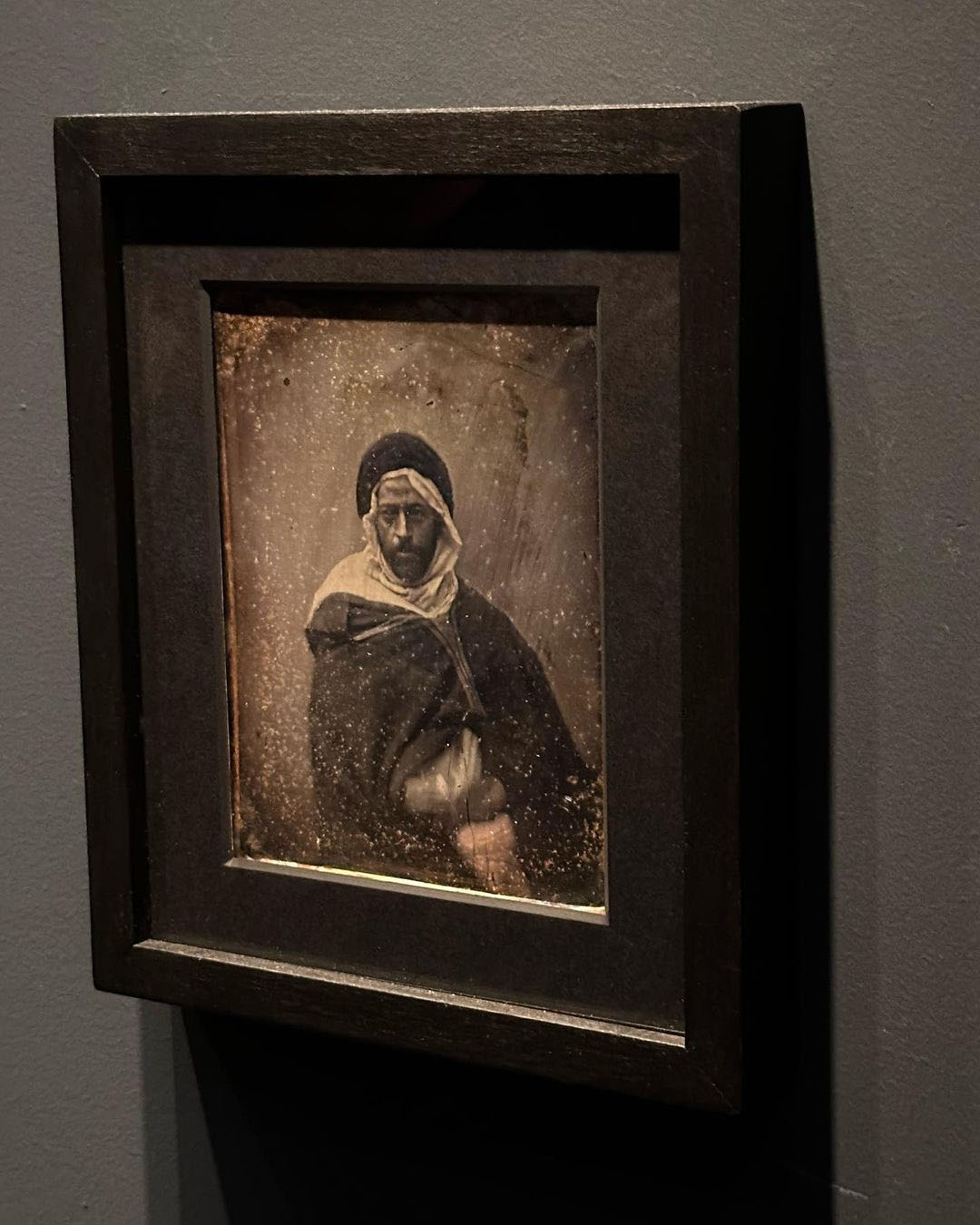
Open seven days a week

MoMA website

LIKE ART BLART ON FACEBOOK

Back to top

Exhibition: ‘VALIE EXPORT – The Photographs’ at the Fotomuseum Winterthur, Zurich, Switzerland
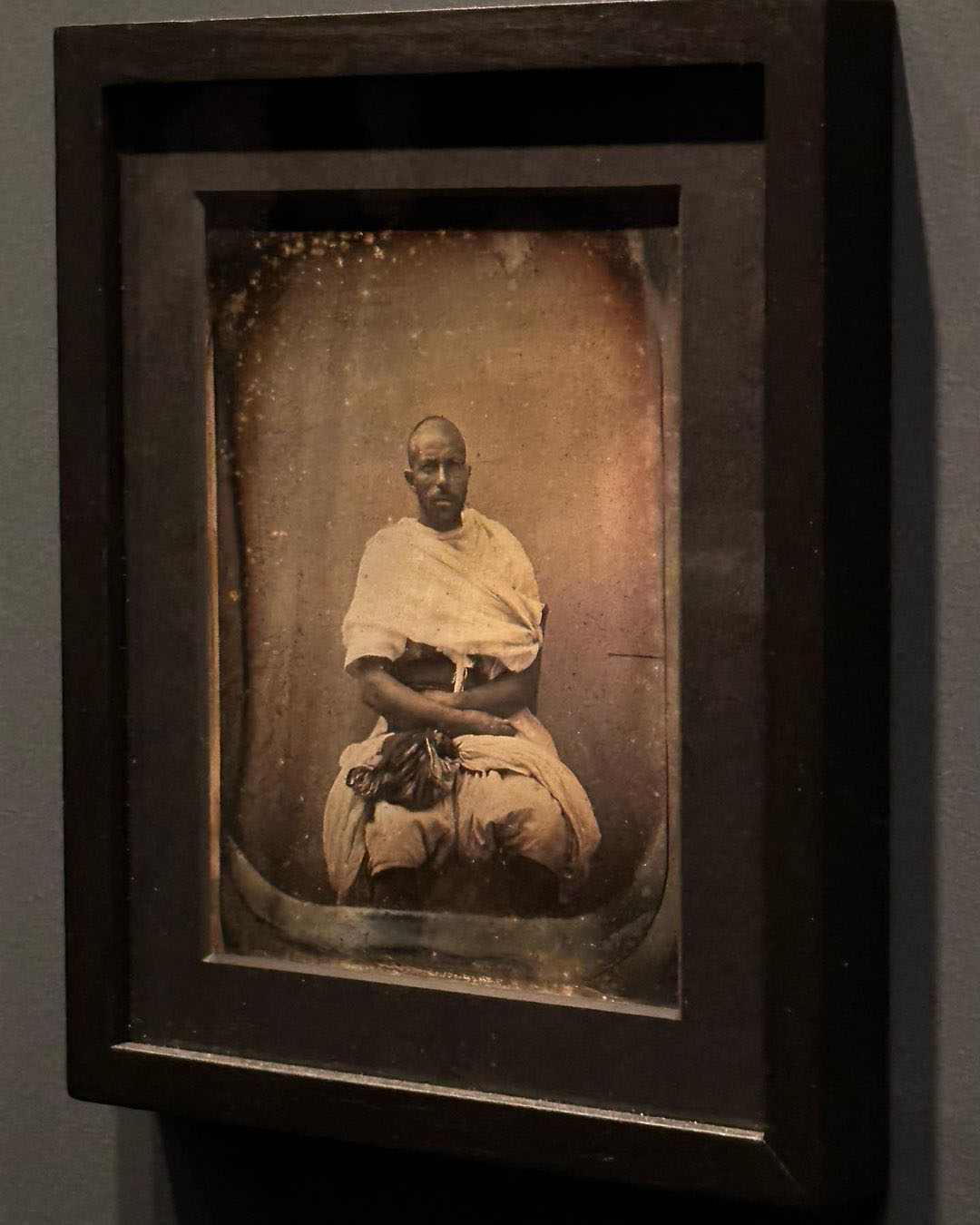
Exhibition dates: 25th February – 29th May, 2023

Curator: Walter Moser


VALIE EXPORT (Austrian, b. 1940) 'Portfolio of Doggedness' (VALIE EXPORT, own words, conversation with Elisabeth Lebovici), in cooperation with Peter Weibel 1968 from the exhibition 'VALIE EXPORT – The Photographs' at the Fotomuseum Winterthur, Zurich, Switzerland, February - May, 2023


VALIE EXPORT (Austrian, b. 1940)
Portfolio of Doggedness (VALIE EXPORT, own words, conversation with Elisabeth Lebovici), in cooperation with Peter Weibel
1968
Courtesy Galerie Thaddaeus Ropac and the artist
© VALIE EXPORT, 2022, ProLitteris, Zurich
Photo: Joseph Tandl


I would really like to meet this artist.

Recent postings have hit a rich vein with exhibitions on artists and concepts which challenge the patriarchal, hegemonic status quo… through an exploration of diversity and the enunciation of different points of view. Postings have included exhibitions on the femme fatale, queer lives and Ukranian modernist painting and artists such as Samuel Fosso, Jimmy DeSana, and Andy Warhol.

Upcoming postings continue the theme with exhibitions by Ming Smith, Ernest Cole, Hannah Villiger, Dawoud Bey and Carrie Mae Weems, and Lucinda Devlin.

Dr Marcus Bunyan


Many thankx to the Fotomuseum Winterthur for allowing me to publish the photographs in the posting. Please click on the photographs for a larger version of the image.


VALIE EXPORT – The Photographs is the first exhibition to focus on the photographic oeuvre of the artist VALIE EXPORT (b. 1940), whose at times provocative performances and experimental installations have been a source of controversy. The show examines EXPORT’s use of photography as a critical exploration of processes of depiction and representation. At the interface of film, video art, drawing and body art the photographs offer a new perspective on her creative oeuvre.


Installation view 'VALIE EXPORT – The Photographs', Fotomuseum Winterthur


Installation view VALIE EXPORT – The Photographs, Fotomuseum Winterthur
© Fotomuseum Winterthur / Conradin Frei


VALIE EXPORT (Austrian, b. 1940) 'TAPP und TASTKINO' (TAP and TOUCH CINEMA) 1968 from the exhibition 'VALIE EXPORT – The Photographs' at the Fotomuseum Winterthur, Zurich, Switzerland, February - May, 2023


VALIE EXPORT (Austrian, b. 1940)
TAPP und TASTKINO (TAP and TOUCH CINEMA) 
1968
Albertina, Wien – The ESSL Collection
© VALIE EXPORT, 2022, ProLitteris, Zurich, photo: Werner Schulz


“As usual, the film is ‘shown’ in the dark. But the cinema has shrunk somewhat – only two hands fit inside it. To see (i.e. feel, touch) the film, the viewer (user) has to stretch his hands through the entrance to the cinema. At last, the curtain which formerly rose only for the eyes now rises for both hands. The tactile reception is the opposite of the deceit of voyeurism. For as long as the citizen is satisfied with the reproduced copy of sexual freedom, the state is spared the sexual revolution. Tap and Touch Cinema is an example of how re-interpretation can activate the public.”

~ Valie Export


At age twenty-eight, Waltraud Hollinger changed her name to VALIE EXPORT, in all uppercase letters, to announce her presence in the Viennese art scene. Eager to counter the male – dominated group of artists known as the Vienna Actionists – including Günter Brus, Otto Mühl, Hermann Nitsch, and Rudolf Schwarzkogler – she sought a new identity that was not bound by her father’s name (Lehner) or her former husband’s name (Hollinger). Export was the name of a popular cigarette brand. This act of provocation would characterise her future performances, especially TAPP und TASTKINO (TOUCH and TAP Cinema) and Aktionhose: Genitalpanik (Action Pants: Genital Panic). Challenging the public to engage with a real woman instead of with images on a screen, in these works she illustrated her notion of “expanded cinema,” in which film is produced without celluloid; instead the artist’s body activates the live context of watching. Born of the 1968 revolt against modern consumer and technical society, her defiant feminist action was memorialised in a picture taken the following year by the photographer Peter Hassmann in Vienna. VALIE EXPORT had the image screen printed in a large edition and fly-posted it in public spaces.

Gallery label from Transmissions: Art in Eastern Europe and Latin America, 1960-1980, September 5, 2015 – January 3, 2016 from the MoMA website Nd [Online] Cited 05/05/2023


VALIE EXPORT’s multimedia work eludes any simplistic categorisation or definition. As a pioneer of performance art, installation art and video art, EXPORT has consistently broken through the boundaries separating media genres, while using her own body as an artistic medium. Photography has always played a key role in her practice – be it for documentary or experimental purposes, as an element in multimedia installations or as art in its own right. EXPORT has had a constant awareness of the importance of visually recording her performances. Back in 1968 two of her best-known performances, “TAPP und TASTKINO” and the action “Aus der Mappe der Hundigkeit”, were attended by photographers and filmmakers. For the performance “TAPP und TASTKINO”, a request was put out by megaphone asking spectators and passers-by to touch EXPORT’s breasts, which were covered by a box inspired by a cinema auditorium with a curtain that the artist wore like a garment. Participants had to maintain eye contact with EXPORT for a defined period of time while touching her, with the artist thereby reversing the voyeuristic male gaze, a typical feature of cinema. For “Aus der Mappe der Hundigkeit”, EXPORT took artist Peter Weibel through the centre of Vienna on a lead, with him crawling on all fours, provocatively drawing attention to the prevailing gender relations and power dynamics by reversing them. Photography was not merely used to make a complete document of EXPORT’s work. Rather, action and photography entered into a dialogue, creating a mutual dependency between them: on the one hand, actions were recorded (and ultimately communicated too) by means of photography; on the other, by virtue of their production, publication and reception – especially of key moments such as the interaction between artist and participants in “TAPP und TASTKINO” and their switch of perspective – EXPORT’s action photos acquired a status that was independent of the performances. EXPORT’s focus on the critical examination of mechanisms of representation dates right back to the start of her career, when she began dealing with the different characteristics of the photographic image and imaging media, questioning the way they worked and subjecting photography to conceptual analysis by lifting the lid on the conditions governing the technical processes of image-making. Deconstructing the photographic gaze and its implicit power structures were of key importance here.

Dimitris Lempesis. “VALIE EXPORT – The Photographs,” on the Dream Idea Machine website Nd [Online] Cited 04/05/2023


VALIE EXPORT (Austrian, b. 1940) 'Action Pants: Genital Panic' 1969 from the exhibition 'VALIE EXPORT – The Photographs' at the Fotomuseum Winterthur, Zurich, Switzerland, February - May, 2023


VALIE EXPORT (Austrian, b. 1940)
Action Pants: Genital Panic
1969
Courtesy Galerie Thaddaeus Ropac and the artist
© VALIE EXPORT, 2022, ProLitteris, Zurich
Photo: Peter Hassmann


VALIE EXPORT (Austrian, b. 1940) 'BODY SIGN B' 1970 from the exhibition 'VALIE EXPORT – The Photographs' at the Fotomuseum Winterthur, Zurich, Switzerland, February - May, 2023


VALIE EXPORT (Austrian, b. 1940)
BODY SIGN B
1970
Albertina, Wien – The ESSL Collection
© VALIE EXPORT, 2022, ProLitteris, Zurich
Photo: Gertraud Wolfschwenger


VALIE EXPORT (Austrian, b. 1940) 'VALIE EXPORT – SMART EXPORT, self-portrait' 1970


VALIE EXPORT (Austrian, b. 1940)
VALIE EXPORT – SMART EXPORT, self-portrait
1970
Albertina, Wien – The ESSL Collection
© VALIE EXPORT, 2022, ProLitteris, Zurich
Photo: Gertraud Wolfschwenger


VALIE EXPORT – The Photographs is the first exhibition to focus on the photographic oeuvre of the artist VALIE EXPORT (b. 1940), whose at times provocative performances and experimental installations have been a source of controversy. The show examines EXPORT’s use of photography as a critical exploration of processes of depiction and representation. At the interface of film, video art, drawing and body art the photographs offer a new perspective on her creative oeuvre. VALIE EXPORT’s multimedia work eludes any simplistic categorisation or definition. As a pioneer of performance art, installation art and video art, EXPORT has consistently broken through the boundaries separating media genres, while using her own body as an artistic medium. Photography has always played a key role in her practice – be it for documentary or experimental purposes, as an element in multimedia installations or as art in its own right.

EXPORT has had a constant awareness of the importance of visually recording her performances. Back in 1968 two of her best-known performances, TAPP und TASTKINO and the action Aus der Mappe der Hundigkeit, were attended by photographers (and filmmakers). For the performance TAPP und TASTKINO, a request was put out by megaphone asking spectators and passers-by to touch EXPORT’s breasts, which were covered by a box inspired by a cinema auditorium with a curtain that the artist wore like a garment. Participants had to maintain eye contact with EXPORT for a defined period of time while touching her, with the artist thereby reversing the voyeuristic male gaze, a typical feature of cinema. For Aus der Mappe der Hundigkeit, EXPORT took artist Peter Weibel through the centre of Vienna on a lead, with him crawling on all fours, provocatively drawing attention to the prevailing gender relations and power dynamics by reversing them.

Photography was not merely used to make a complete document of EXPORT’s work. Rather, action and photography entered into a dialogue, creating a mutual dependency between them: on the one hand, actions were recorded (and ultimately communicated too) by means of photography; on the other, by virtue of their production, publication and reception – especially of key moments such as the interaction between artist and participants in TAPP und TASTKINO and their switch of perspective – EXPORT’s action photos acquired a status that was independent of the performances.

EXPORT’s focus on the critical examination of mechanisms of representation dates right back to the start of her career, when she began dealing with the different characteristics of the photographic image and imaging media, questioning the way they worked and subjecting photography to conceptual analysis by lifting the lid on the conditions governing the technical processes of image-making. Deconstructing the photographic gaze and its implicit power structures were of key importance here.

For EXPORT, the critical analysis of systems of representation invariably went hand in hand, in the context of both media and society, with a questioning of the male gaze directed at a body viewed as female. Making reference to her own body, she repeatedly probed the role of the woman, the artist and the subject in patriarchal sociopolitical structures. In 1970, for example, EXPORT had a garter tattooed on her thigh for Body Sign Action to give visible expression to the woman’s status as a sexual object and projection surface for male fantasies. Besides capturing the act of being tattooed, EXPORT also took photographs of the tattoo itself. The work expresses the pain involved – quite literally – in having patriarchal norms inscribed on a body that is seen as female. With her series Body Configurations (1972–1982), EXPORT investigates the relationships between the subject and power-political structures through body postures too. She explicitly couches her critique of the processes of depiction and representation in feminist terms: her work centres on the relationship between subject and space, body and gaze, femaleness and representation.

The exhibition VALIE EXPORT – The Photographs, which was devised in close collaboration with the artist, focuses on the impact that photography has had on her creative output. However, following the logic of EXPORT’s work, the exhibition not only presents photographs but also juxtaposes different media and works created between 1968 and 2007.

About VALIE EXPORT

VALIE EXPORT was born in 1940 in Linz, Austria, and now lives and works in Vienna. She is one of the pioneers of performance art and conceptual art. In 1967, in what was a radical gesture at the time, she gave up her father’s and her ex-husband’s names and laid claim to a new identity, VALIE EXPORT. Her works have been shown worldwide as part of numerous solo and group exhibitions. EXPORT has taught at various international institutions and was a professor for performance and multimedia at the Academy of Media Arts Cologne from 1995 to 2005. The VALIE EXPORT Center Linz was established through the acquisition of the artist’s estate in 2015, thus laying the foundations for an international research centre to foster artistic and academic engagement with media art and performance art.

Press release from Fotomuseum Winterthur


VALIE EXPORT (Austrian, b. 1940) 'Verletzungen I' (Injuries I) 1972


VALIE EXPORT (Austrian, b. 1940)
Verletzungen I (Injuries I)
1972
Wien – The ESSL Collection
© VALIE EXPORT, 2022, ProLitteris, Zurich
Photo: Hermann Hendrich


VALIE EXPORT (Austrian, b. 1940) 'Train II' 1972


VALIE EXPORT (Austrian, b. 1940)
Train II
1972
Courtesy Galerie Thaddaeus Ropac and the artist
© VALIE EXPORT, 2022, ProLitteris, Zurich


VALIE EXPORT (Austrian, b. 1940) 'Verkreuzung' (Crossing) 1972, printed 1980


VALIE EXPORT (Austrian, b. 1940)
Verkreuzung (Crossing)
1972, printed 1980
Black and white silver gelatin print on baryta paper laid on chip board
Each board 165 x 200cm (64.96 x 78.74 in)
Courtesy Galerie Thaddaeus Ropac and the artist
© VALIE EXPORT, 2022, ProLitteris, Zurich


VALIE EXPORT (Austrian, b. 1940) 'ASEMIE – The Inability to Express Oneself Through Facial Expression' 1973


VALIE EXPORT (Austrian, b. 1940)
ASEMIE – The Inability to Express Oneself Through Facial Expression
1973
Courtesy Galerie Thaddaeus Ropac and the artist
© VALIE EXPORT, 2022, ProLitteris, Zurich
Photo: Alfred Damm

die unfähigeit = the inability


VALIE EXPORT (Austrian, b. 1940) 'From the Geometric Sketchbook of Nature, Tree Triangle' 1973


VALIE EXPORT (Austrian, b. 1941)
From the Geometric Sketchbook of Nature, Tree Triangle
1973
Courtesy Galerie Thaddaeus Ropac and the artist
© VALIE EXPORT, 2022, ProLitteris, Zurich


VALIE EXPORT (Austrian, b. 1940) 'Nachfügung' (Supplement) 1974


VALIE EXPORT (Austrian, b. 1941)
Nachfügung (Supplement)
1974
Courtesy Galerie Thaddaeus Ropac and the artist
© VALIE EXPORT, 2022, ProLitteris, Zurich
Photo: Eric Timmermann


VALIE EXPORT (Austrian, b. 1940) 'Petri / fikation' (after: William Blake, Naomi Entreating Ruth and Orpah to Return to the Land of Moab, 1795) 1976, printed 1980


VALIE EXPORT (Austrian, b. 1940)
Petri / fikation (after: William Blake, Naomi Entreating Ruth and Orpah to Return to the Land of Moab, 1795)
1976, printed 1980
Black and white silver gelatin print on baryta paper laid on chip board
139.5 x 99.5cm
Courtesy Galerie Thaddaeus Ropac and the artist
© VALIE EXPORT, 2022, ProLitteris, Zurich


VALIE EXPORT (Austrian, b. 1940) 'Petri / fikation' (after: William Blake, Naomi Entreating Ruth and Orpah to Return to the Land of Moab, 1795) 1976, printed 1980


VALIE EXPORT (Austrian, b. 1940)
Petri / fikation (after: William Blake, Naomi Entreating Ruth and Orpah to Return to the Land of Moab, 1795)
1976, printed 1980
Black and white silver gelatin print on baryta paper laid on chip board
140 x 100cm
Courtesy Galerie Thaddaeus Ropac and the artist
© VALIE EXPORT, 2022, ProLitteris, Zurich


VALIE EXPORT (Austrian, b. 1940) 'Die Geburtenmadonna' 1976, printed 1980


VALIE EXPORT (Austrian, b. 1940)
Die Geburtenmadonna
1976, printed 1980
Black and white silver gelatin print on baryta paper laid on chip board
Courtesy Galerie Thaddaeus Ropac and the artist
© VALIE EXPORT, 2022, ProLitteris, Zurich


VALIE EXPORT (Austrian, b. 1940) 'DIVIDE ET IMPERA! after: Martin Schongauer, The Holy Family, 1475-1480' 1976


VALIE EXPORT (Austrian, b. 1941)
DIVIDE ET IMPERA! after: Martin Schongauer, The Holy Family, 1475-1480
1976
Courtesy Galerie Thaddaeus Ropac and the artist
© VALIE EXPORT, 2022, ProLitteris, Zurich

Divide et impera! = divide and rule!


VALIE EXPORT (Austrian, b. 1940) 'Anfügung' (Attachment) 1976


VALIE EXPORT (Austrian, b. 1940)
Anfügung (Attachment)
1976
Albertina, Wien – Familiensammlung Haselsteiner
© VALIE EXPORT, 2022, ProLitteris, Zurich


VALIE EXPORT (Austrian, b. 1940) 'Einkreisung' (Encirclement) 1976


VALIE EXPORT (Austrian, b. 1940)
Einkreisung (Encirclement)
1976
From the series Körperkonfigurationen (Body Configurations)
Gelatin silver print with red ink
14 x 23 7/16″ (35.5 x 59.6cm)
The Museum of Modern Art, New York
Carl Jacobs Fund
© 2012 VALIE EXPORT / Artists Rights Society (ARS), New York / VBK, Austria


In her series Body Configurations, the artist had herself or female colleagues photographed in local streets, stairwells, and alleyways, contorting their bodies to mimic the harsh geometries of the city. Influenced not only by the Actionists but also by the human sculpture of Robert Morris, Export complicates the coolly inhuman systems of Minimalism by reintroducing the human body into abstraction, an intimate yet public gesture that effortlessly transmutes the personal into the political.


VALIE EXPORT (Austrian, b. 1940) From the series 'Körperkonfigurationen' (Body Configurations) 1972-1976


VALIE EXPORT (Austrian, b. 1940)
From the series Körperkonfigurationen (Body Configurations)
1972-1976
Gelatin silver print
Courtesy Galerie Thaddaeus Ropac and the artist
© VALIE EXPORT, 2022, ProLitteris, Zurich


VALIE EXPORT (Austrian, b. 1940) from the series 'Körperkonfigurationen' (Body Configurations) 1972-1976


VALIE EXPORT (Austrian, b. 1940)
From the series Körperkonfigurationen (Body Configurations)
1972-1976
Gelatin silver print
Courtesy Galerie Thaddaeus Ropac and the artist
© VALIE EXPORT, 2022, ProLitteris, Zurich


VALIE EXPORT (Austrian, b. 1940) from the series 'Körperkonfigurationen' (Body Configurations) 1972-1976


VALIE EXPORT (Austrian, b. 1940)
From the series Körperkonfigurationen (Body Configurations)
1972-1976
Gelatin silver print
Courtesy Galerie Thaddaeus Ropac and the artist
© VALIE EXPORT, 2022, ProLitteris, Zurich


VALIE EXPORT (Austrian, b. 1940) 'Abrundung I' (Rounding I) 1976, printed 1980


VALIE EXPORT (Austrian, b. 1940)
Abrundung I (Rounding I)
1976, printed 1980
Black and white silver gelatin print on baryta paper laid on chip board
80 x 130.5cm
Courtesy Galerie Thaddaeus Ropac and the artist
© VALIE EXPORT, 2022, ProLitteris, Zurich


VALIE EXPORT (Austrian, b. 1940) 'Elongation' 1976, printed 1980


VALIE EXPORT (Austrian, b. 1940)
Elongation
1976, printed 1980
Black and white silver gelatin print on baryta paper laid on chip board
80 x 130.5cm
Courtesy Galerie Thaddaeus Ropac and the artist
© VALIE EXPORT, 2022, ProLitteris, Zurich


Fotomuseum Winterthur
Grüzenstrasse 44 + 45
CH-8400
Winterthur (Zürich)

Opening hours:
Tuesday to Sunday 11am – 6pm
Wednesday 11am – 8pm
Closed on Mondays

Fotomuseum Winterthur website

LIKE ART BLART ON FACEBOOK

Back to top