Exhibition: ‘Hiroshi Sugimoto: Time Machine’ at the Hayward Gallery, London

Exhibition dates: 11th October 2023 -⁠ 7th January 2024

Curators: Hiroshi Sugimoto: Time Machine is curated by Hayward Gallery Director Ralph Rugoff with Assistant Curators Thomas Sutton and Gilly Fox, and Curatorial Assistant Suzanna Petot.


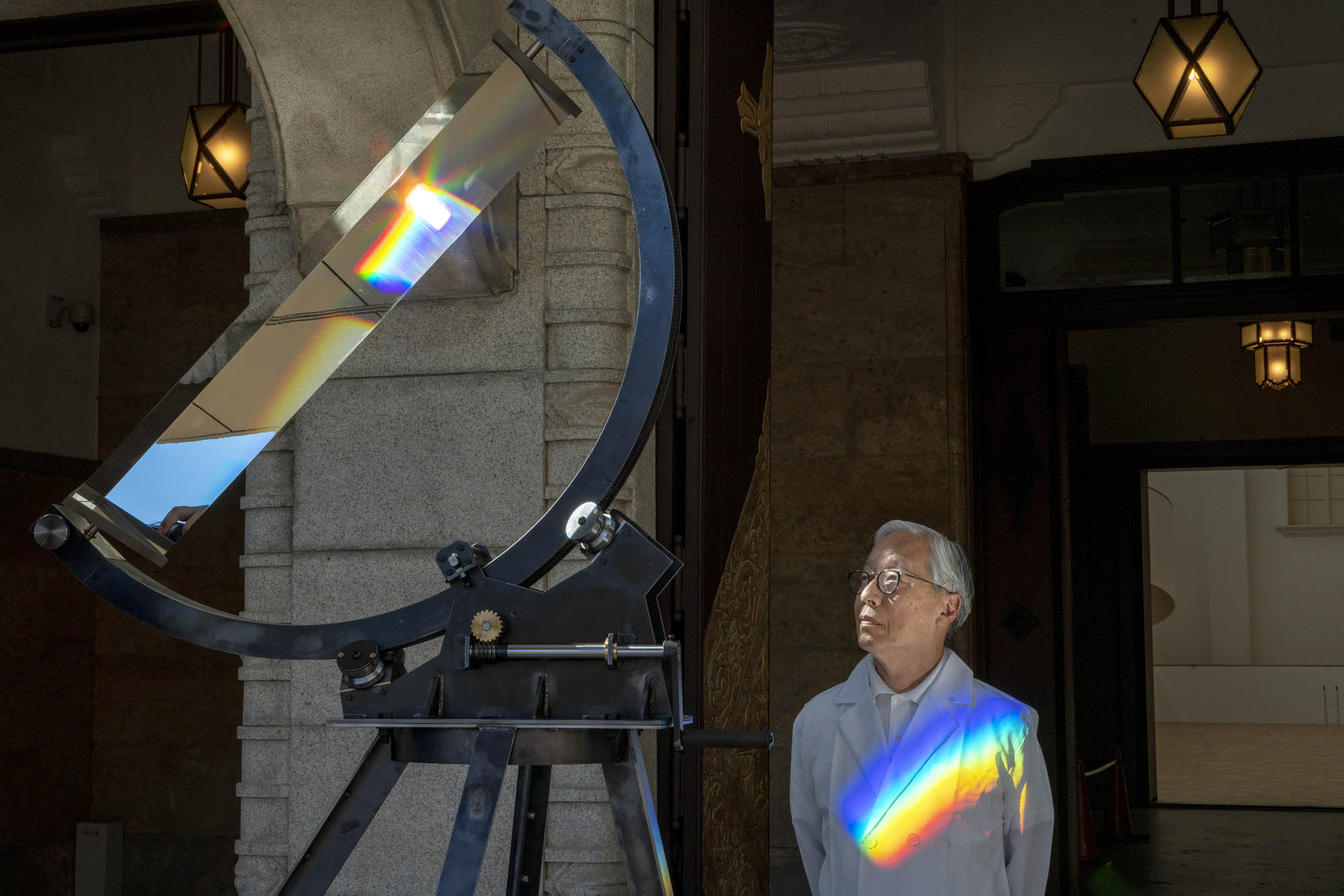
Rachael Smith. 'Hiroshi Sugimoto in the Hayward Gallery with his 'Seascapes' series' 2023 from the exhibition 'Hiroshi Sugimoto: Time Machine' at the Hayward Gallery, London, Oct 2023 - Jan 2024


Rachael Smith
Hiroshi Sugimoto in the Hayward Gallery with his ‘Seascapes’ series
2023


The world is a reality,
not because of the way it is,
but because
of the possibilities it presents


Frederick Sommer


Almost real

I have an ambivalent relationship with the work of Hiroshi Sugimoto.

On the one hand I truly admire the beauty and presence of Sugimoto’s photographs; how his images “contradict the medium’s conventional tasks – to record reality as precisely as possible”; and how his work, through an investigation of “fundamental questions of space and time, past and present, art and science, imagination and reality” push at the boundaries of what a photograph is and can be through an exploration of the very nature of photography.

Through this erudite, conceptual, scientific and creative investigation, Sugimoto’s staged images proffer a reorientation of the referent – of the world, in the world – unsettling the certainty of the truth of the photograph as a visual record of the world.

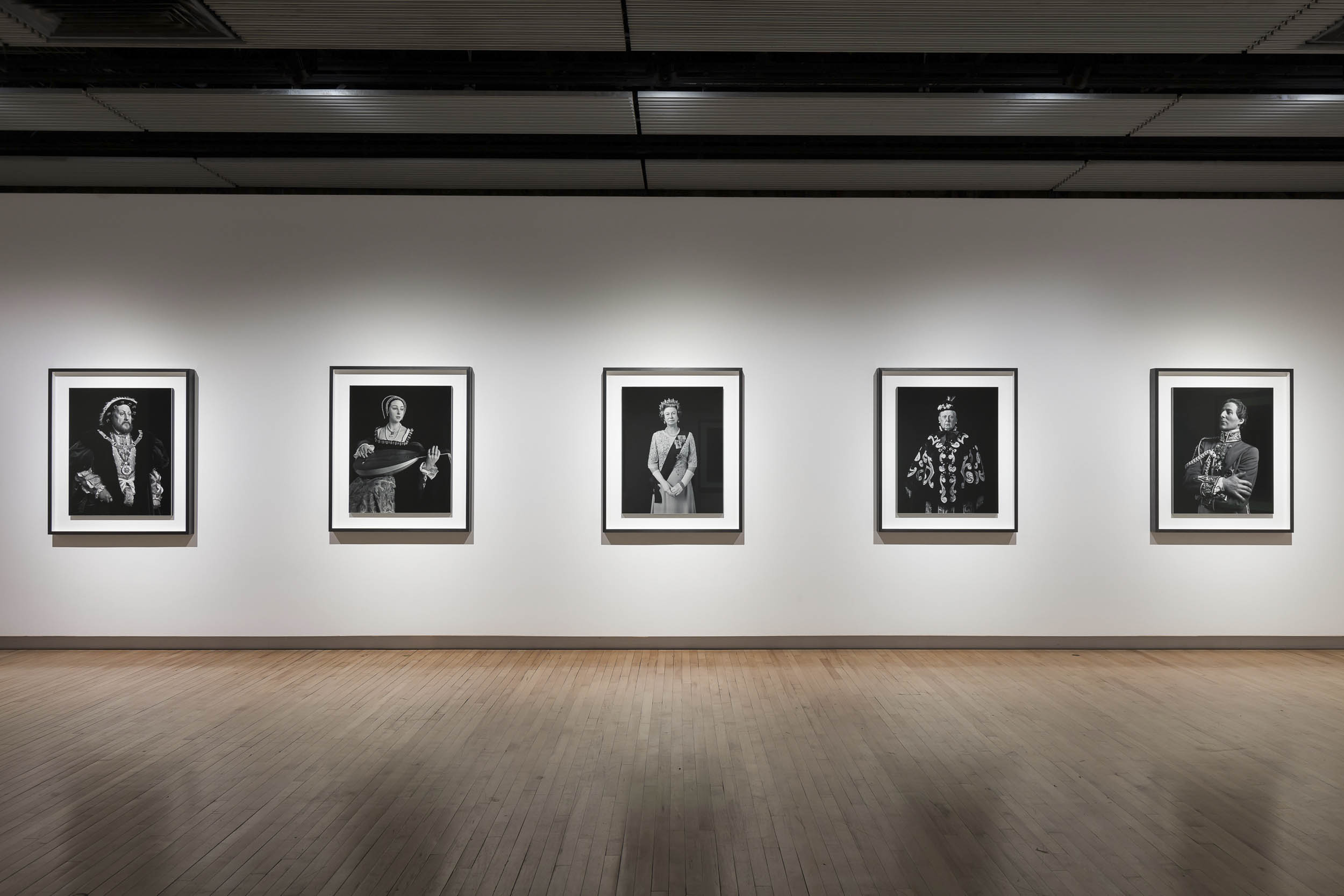
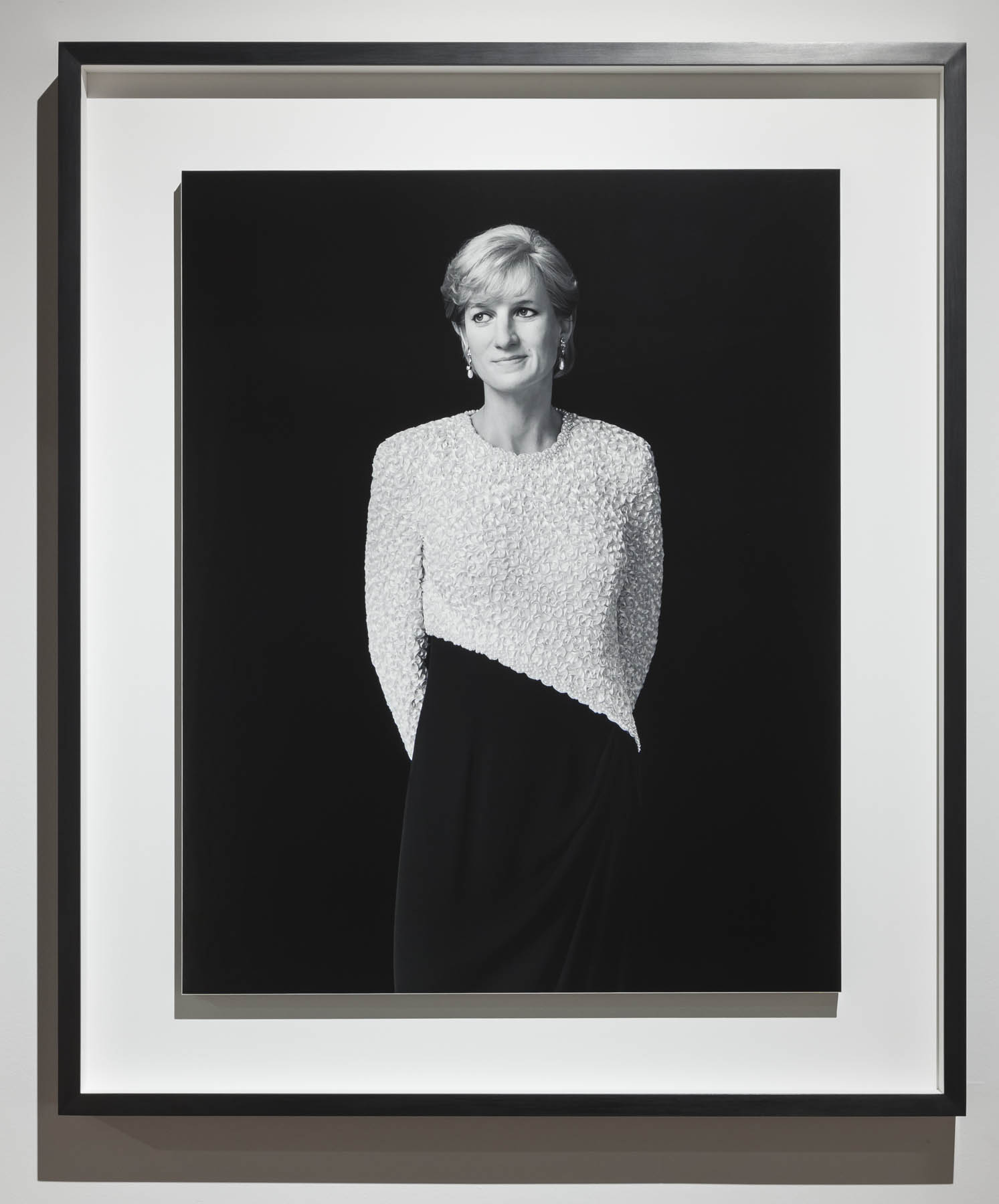
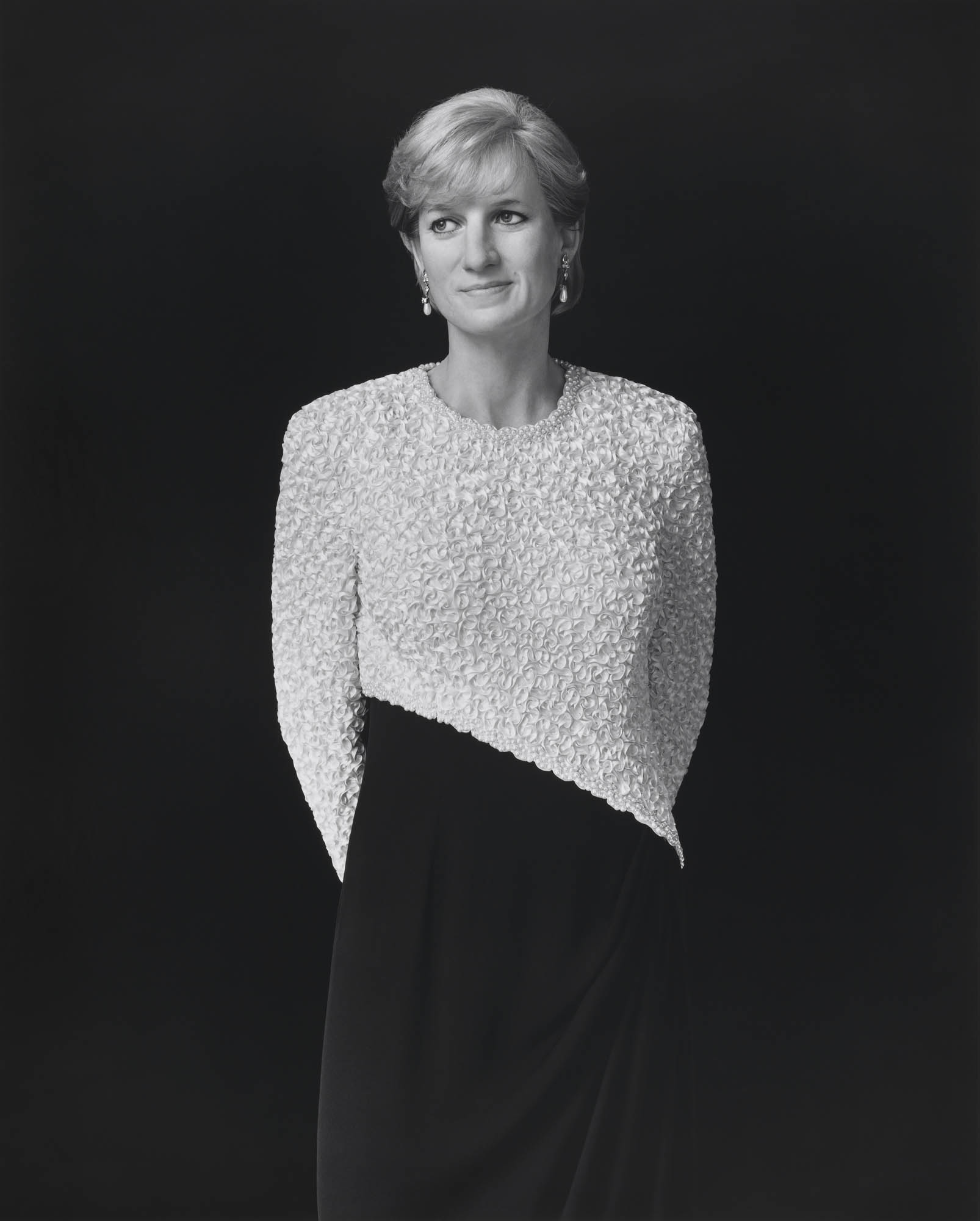
In my favourite series – such as the movie in a moment Theaters (1976 – ), the stuffed animal Dioramas (1974 – ), some of the wax works dead pan Portraits (1999 -) (particularly Oscar Wilde, Queen Victoria and Princess Diana), and the Seascapes (1980 -) – I feel released from the bounds of reality as we perceive it. The artist takes me out of myself and into a new plane of existence. He has reanimated the in/animate through an alchemical process, a mystery of mysteries, to create new life – a transubstantiation of the elements earth, air, water, fire.
On the other hand I am less impressed with bodies of work that simply do not work for me… that leave me feeling cold, lifeless. Series such as Revolution (1990/2012), Lightning Fields (2009), Photogenic Drawings (2009), Architecture (1997 – below) and the recent Opticks (2018 – below), while not derivative, owe a great debt to other artists that have already strode that golden path… and have done it better.

As I have observed in another review of Sugimoto’s work: “I’m not saying Sugimoto is derivative but because of these other works, they don’t have much room to move. Indeed, they hardly move at all. They are so frozen in attitude that all the daring transcendence of light, the light! of space time travel, the transition from one state to another, has been lost. The Flame of Recognition (Edward Weston) – has gone.”

Taking his work as a whole, we observe in Sugimoto’s work a slightly malevolent aura – follow my argument here – not in the sense of the work “showing a wish to do evil to others” but through the photographs unsettling ability to confound the reality of others. The artist’s work is very male/volent, very masculine and in the Latin etymology of the word “volent” (present participle of velle to will, wish) very much (reality) constructed at the will and wish of the artist.

While Sugimoto’s volition (from Latin volo ‘I wish’) creates beautiful and subversive images of true presence and power, it is the artist’s ability to will into existence images that engage with mystical forces beyond the apparent and the factual but which live as completely real and part of the total world of man and nature … that is his most impressive attribute as an artist. Through his photographs he brings to consciousness things only a small portion of which most of us experience directly.1

Dr Marcus Bunyan


1/ Adapted from Ansel Adams’ essay for The Flame of Recognition 1964 in “Edward Weston’s The Flame of Recognition” on the Aperture website August 12, 2015 [Online] Cited 22/12/2023


Many thankx to the Hayward Gallery for allowing me to publish the photographs in the posting. Please click on the photographs for a larger version of the image.


“All my life I have made a habit of never believing my eyes.”


Hiroshi Sugimoto


“Sugimoto’s unique accomplishments in his genre contradict the medium’s conventional tasks – to record reality as precisely as possible. In Sugimoto’s work, one is confronted with the formal reduction of conceptual images, in which he addresses fundamental questions of space and time, past and present, art and science, imagination and reality. “I was concerned,” noted the artist in 2002, “with revealing an ancient stage of human memory through the medium of photography. Whether it is individual memory or the cultural memory of mankind itself, my work is about returning to the past and remembering where we came from and how we came about.” His pictures, which leave a lasting impression through their beauty and their auratic effect, interweave Japanese traditions with Western ideas. This East-West dialogue remains characteristic of his work today, which is captivating in its exceptional craftsmanship and strong aesthetic presence, and can exercise an almost magical effect on viewers.”


Anonymous. “Hiroshi Sugimoto. Revolution,” on the Museum Brandhorst website February 8, 2013


Hiroshi Sugimoto | curator tour with Ralph Rugoff | Hayward Gallery


Hiroshi Sugimoto: ‘My camera works as a time machine’ | Hayward Gallery


‘A camera can be able to stop the world, in that we stop the world and then investigate what is there, carefully.’

~ Hiroshi Sugimoto


Ahead of the opening of Hiroshi Sugimoto: Time Machine at the Hayward Gallery – the largest survey to date of the Sugimoto’s works – we travelled to meet the photographer at the Enoura Observatory in Japan. Situated against the outer rim of the country’s Hakone Mountains, the observatory was designed by Sugimoto as a forum for disseminating art and culture.

In this short video interview Sugimoto considers the impact of the invention of the camera – with this new ability to pause the world around us – and explains how his own photography, such as his Seascapes series, draws on this idea of the camera’s ability to distort linear time.


Dioramas (1974 – )


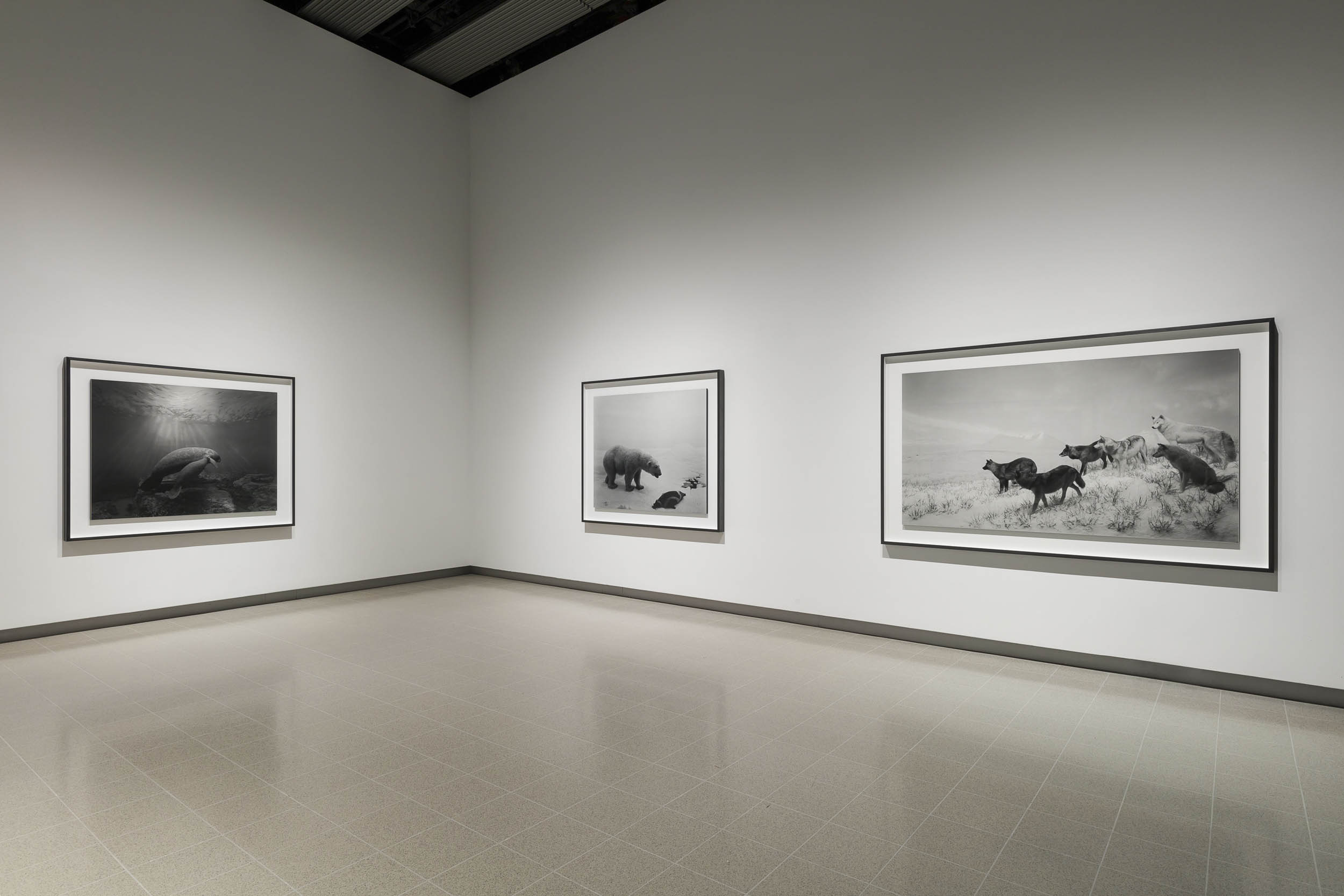
Installation view of Hiroshi Sugimoto, 'Dioramas' (1974) from the exhibition 'Hiroshi Sugimoto: Time Machine' at the Hayward Gallery, London, Oct 2023 - Jan 2024


Installation view of Hiroshi Sugimoto, Dioramas (1974 – ) Silver gelatin prints
Photo: Mark Blower. Courtesy the artist and the Hayward Gallery


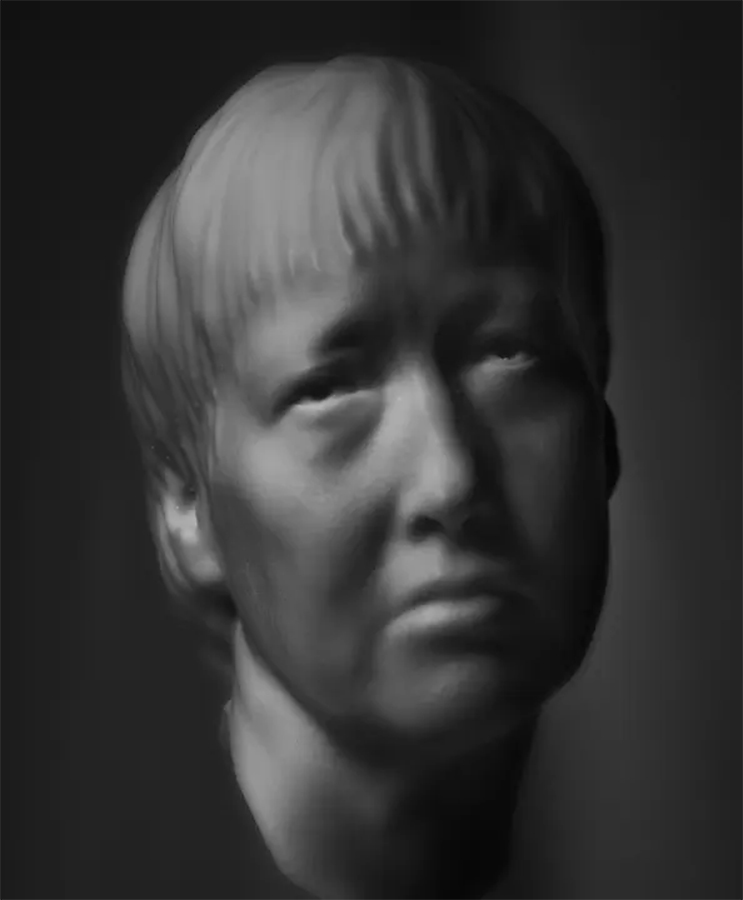
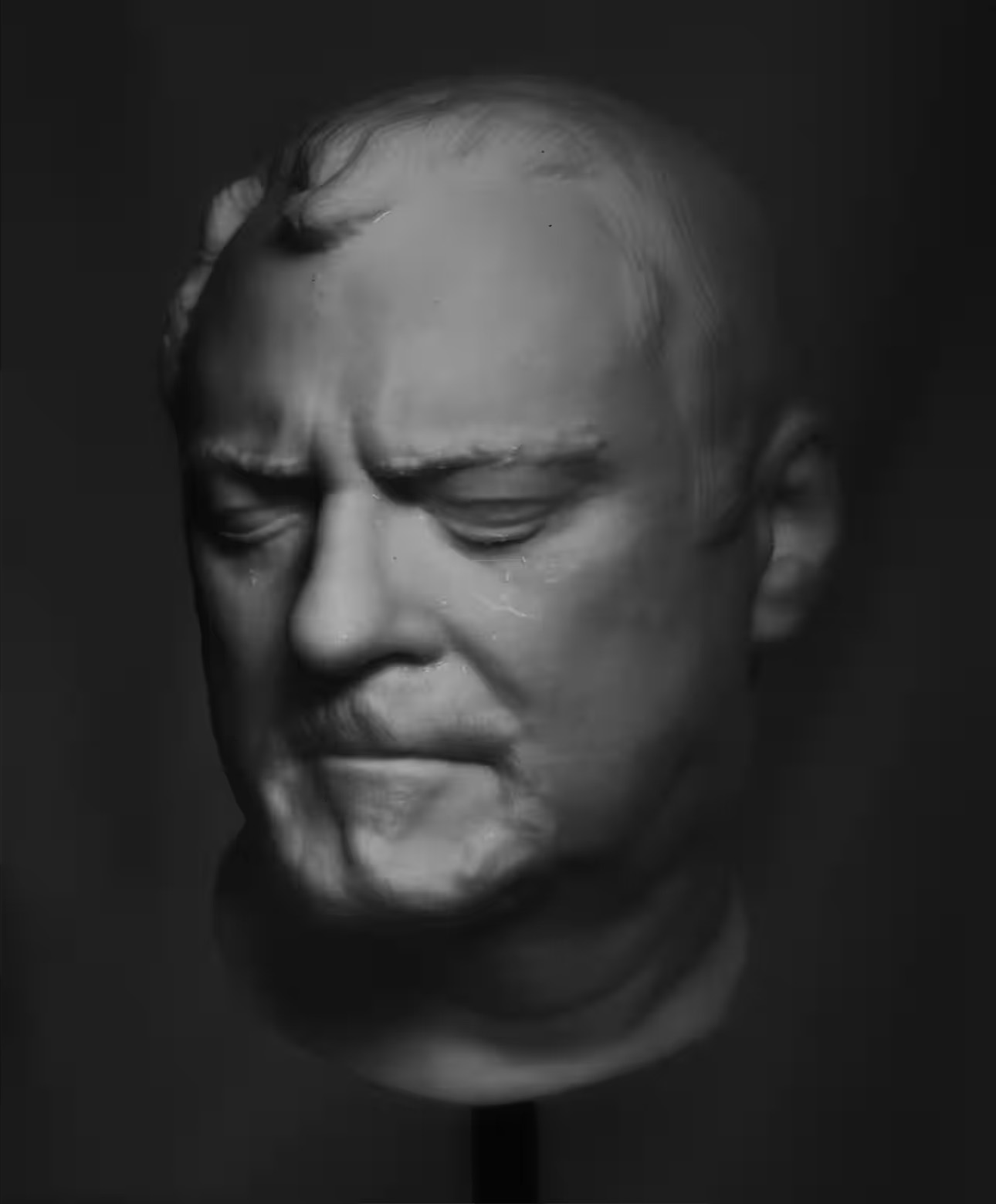
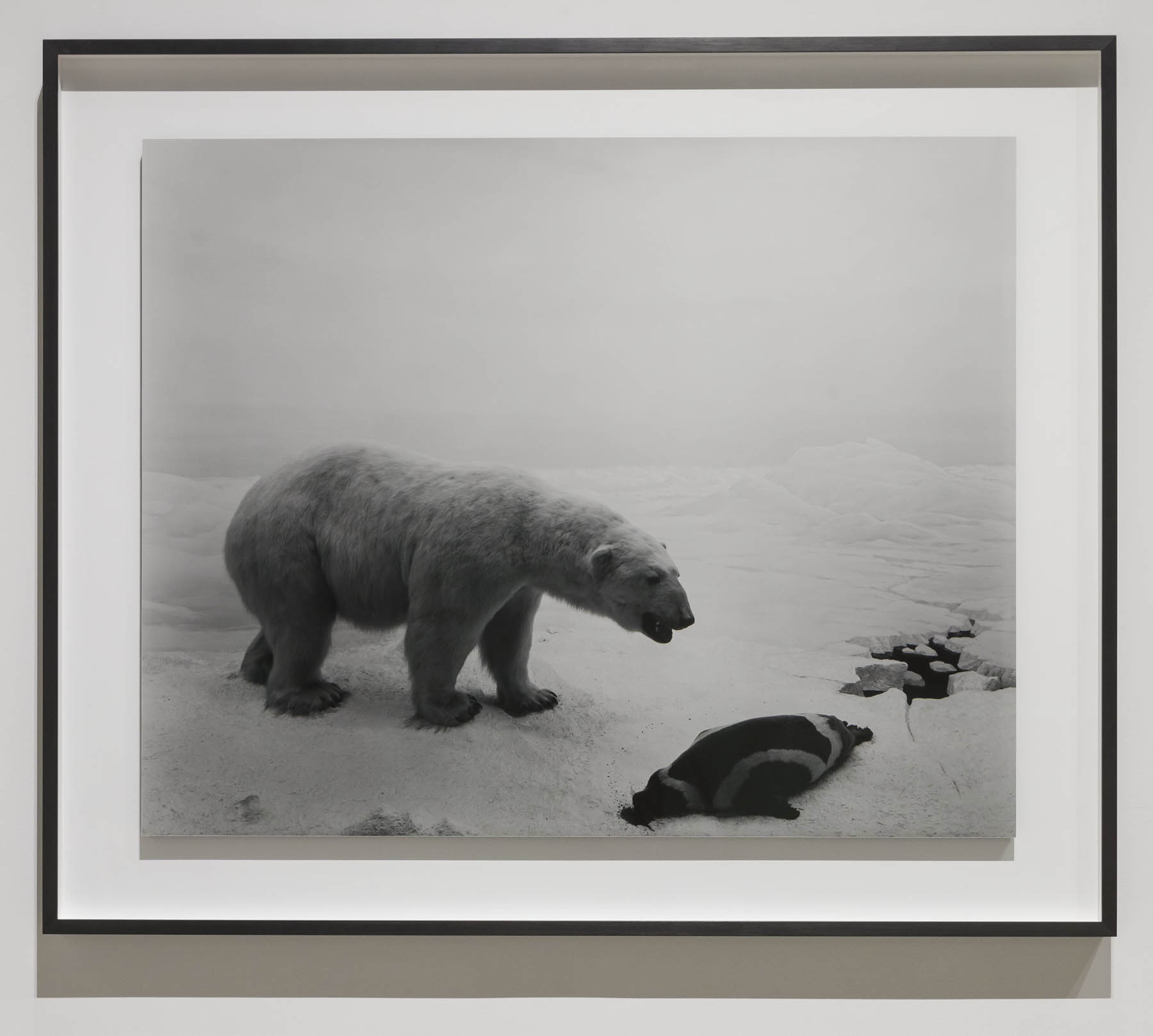
‘My life as an artist began the moment I saw that I had succeeded in bringing the bear back to life on film,’ said Sugimoto about his 1976 work Polar Bear. The image is of an Arctic diorama in the American Museum of Natural History in New York, but through clever use of framing and exposure, Sugimoto was able to make the scene appear real. As well as revisiting the museum, and others across the US, to expand his Dioramas series, Sugimoto later took a similar approach to the waxworks of Madame Tussauds in his Portraits. By removing the figures from their staged displays, and photographing them against a black backdrop with sympathetic lighting, the artist gave the impression that these famous faces had themselves modelled for his portraiture.


Installation view of Hiroshi Sugimoto, 'Polar Bear', 1976 from the 'Dioramas' series (1974 - ) from the exhibition 'Hiroshi Sugimoto: Time Machine' at the Hayward Gallery, London, Oct 2023 - Jan 2024

Installation view of Hiroshi Sugimoto, 'Polar Bear', 1976 from the 'Dioramas' series (1974 - ) from the exhibition 'Hiroshi Sugimoto: Time Machine' at the Hayward Gallery, London, Oct 2023 - Jan 2024


Installation view of Hiroshi Sugimoto, Polar Bear, 1976. Silver gelatin print
Photo: Mark Blower. Courtesy the artist and the Hayward Gallery


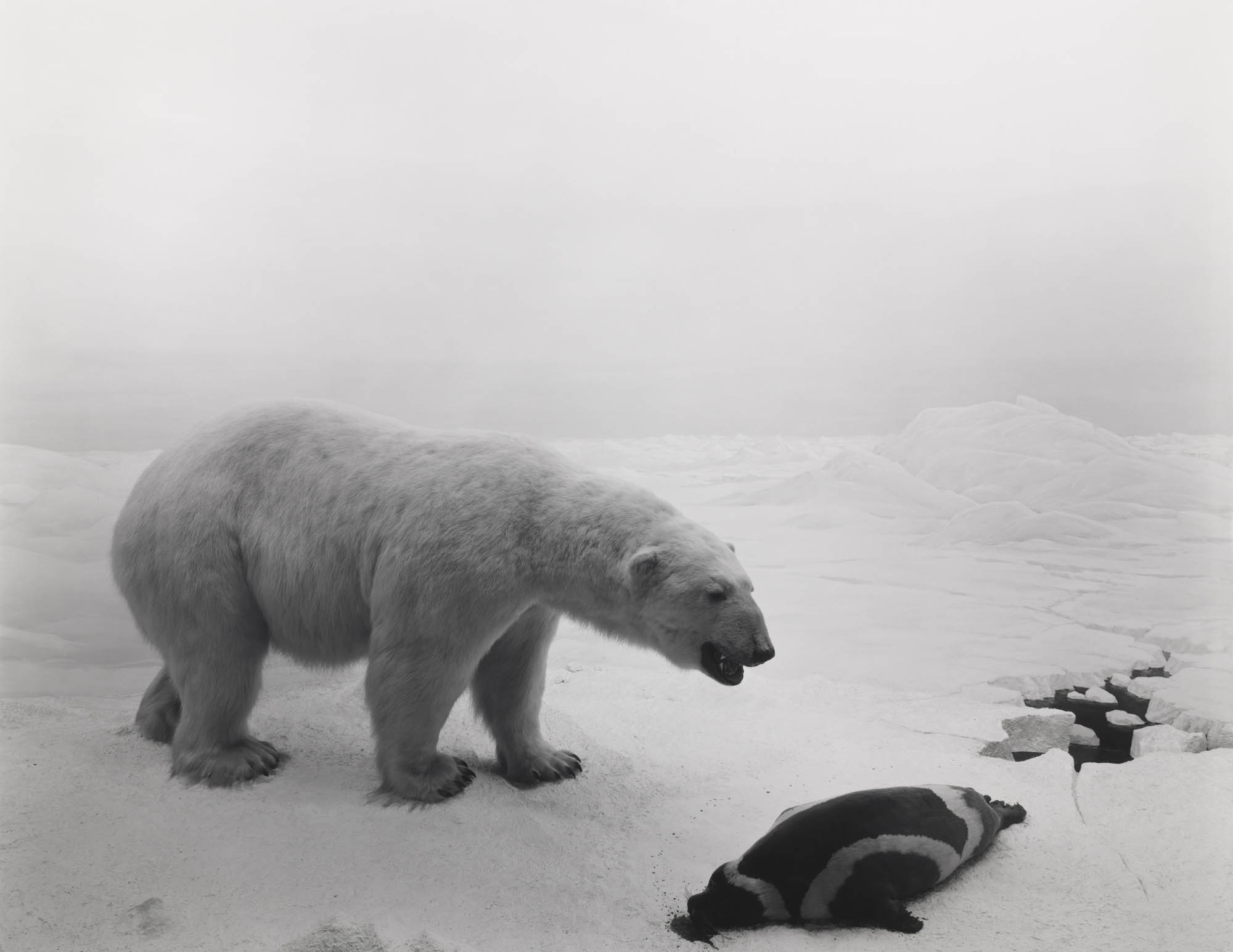
Hiroshi Sugimoto (Japanese, b. 1948) 'Polar Bear' 1976 from the exhibition 'Hiroshi Sugimoto: Time Machine' at the Hayward Gallery, London, Oct 2023 - Jan 2024


Hiroshi Sugimoto (Japanese, b. 1948)
Polar Bear
1976
From the Dioramas series
Gelatin silver print
© Hiroshi Sugimoto, courtesy of the artist


“Polar Bear” (1976) shows the majestic white animal roaring over a fresh kill: the bloodied body of a seal whose inert form is bulky and dark against an Arctic white background that stretches into the distance. Look closely and behind the bear – with its luscious coat of fur, its big paws so heavy in the snow you can almost hear it crunch – the line between two and three dimensions is just visible: a jagged crevasse in the ice floe beneath the two animals merges almost seamlessly with a painted backdrop of receding icy peaks.

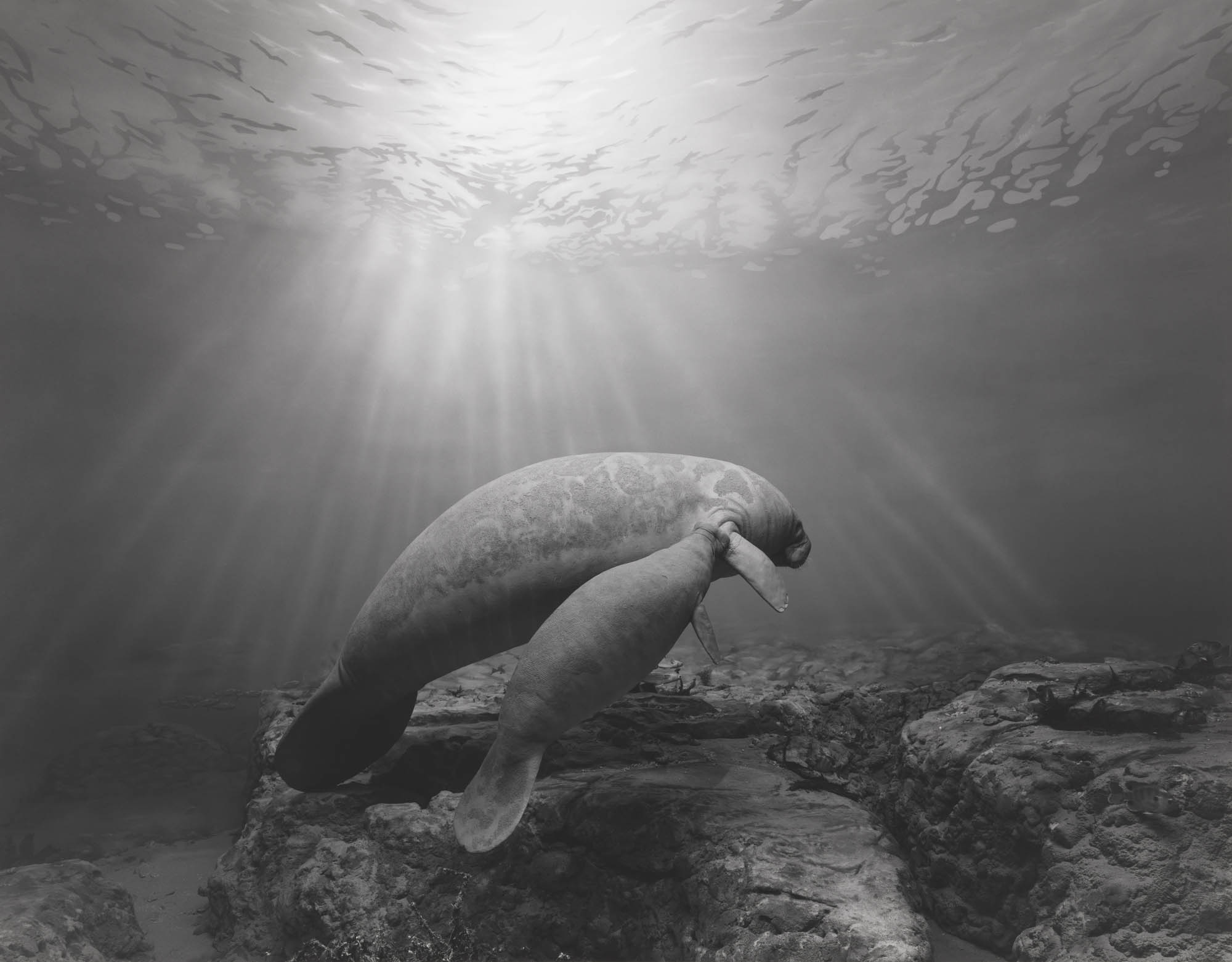
The eye judders between these realities. The dead bear, momentarily brought to life by the vividness of the photograph, dies again, and is preserved again, a copy of a copy, frozen between past and present. Similar fates await a pair of ostriches defending their new hatchlings against a family of wart hogs (“Ostrich-Wart Hog,” 1980) and a placidly floating mother manatee and her calf (“Manatee,” 1994).

Emily LaBarge. “What Is Photography? (No Need to Answer That),” on the New York Times website Nov. 21, 2023 [Online] Cited 23/11/2023


Hiroshi Sugimoto (Japanese, b. 1948) 'Manatee' 1994 from the exhibition 'Hiroshi Sugimoto: Time Machine' at the Hayward Gallery, London, Oct 2023 - Jan 2024


Hiroshi Sugimoto (Japanese, b. 1948)
Manatee
1994
From the Dioramas series
Gelatin silver print
© Hiroshi Sugimoto, courtesy of the artist


Hiroshi Sugimoto (Japanese, b. 1948) 'Earliest Human Relatives' 1994 from the exhibition 'Hiroshi Sugimoto: Time Machine' at the Hayward Gallery, London, Oct 2023 - Jan 2024


Hiroshi Sugimoto (Japanese, b. 1948)
Earliest Human Relatives
1994
From the Dioramas series
Gelatin silver print
© Hiroshi Sugimoto, courtesy of Marian Goodman Gallery


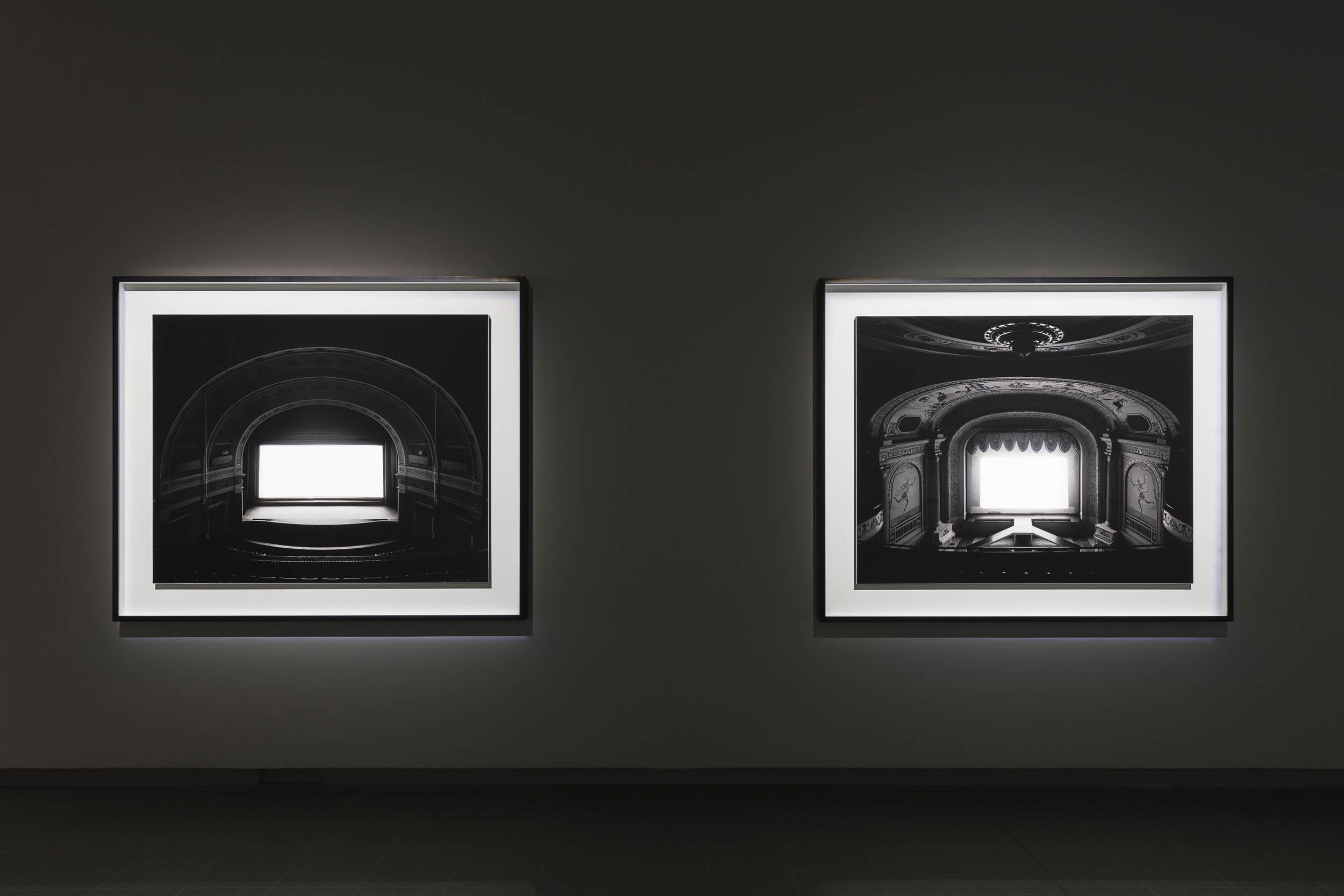
Theaters (1976 – ) and Abandoned Theaters (2015 – )


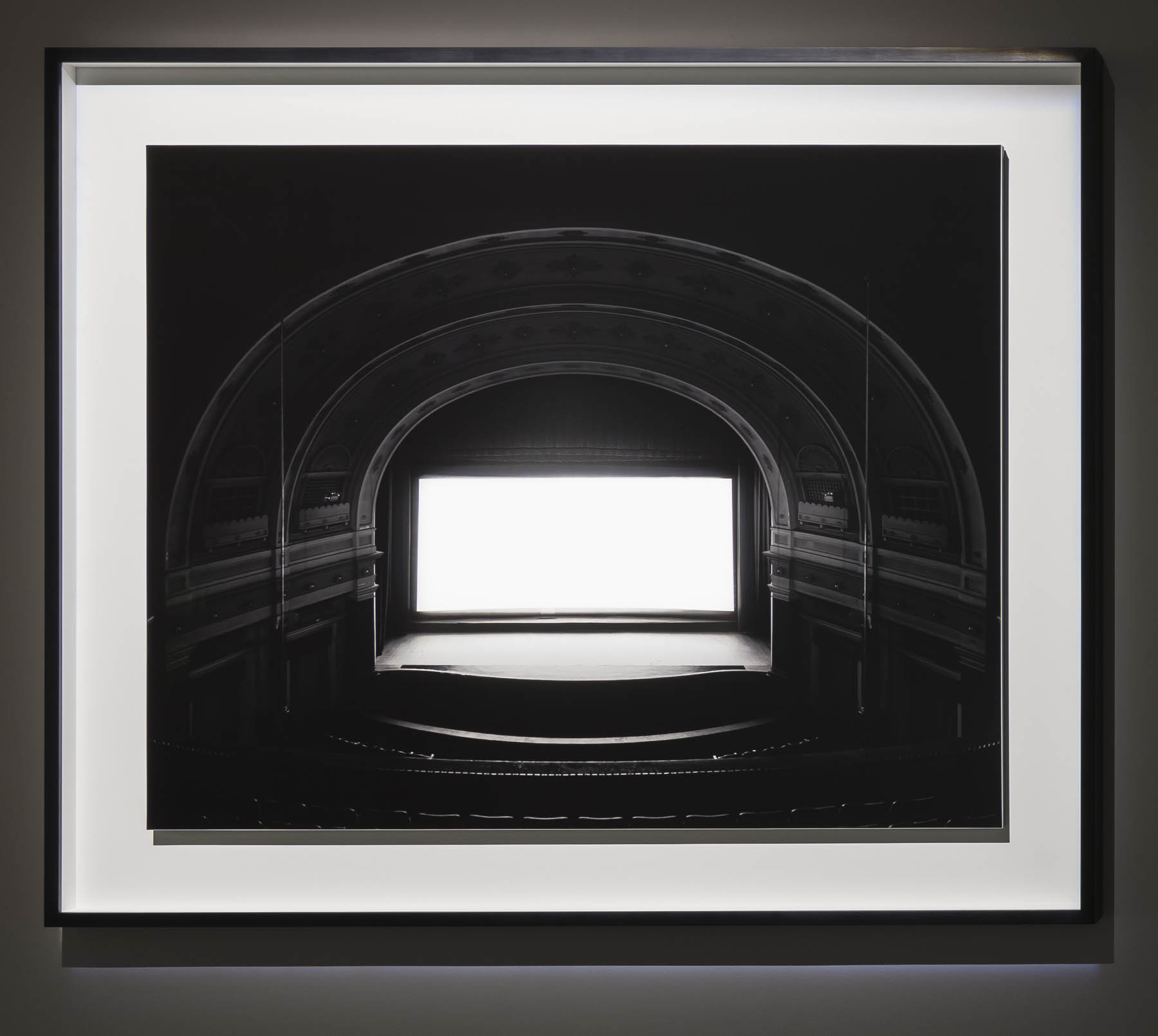
Hiroshi Sugimoto (Japanese, b. 1948) 'UA Playhouse, New York' 1978


Hiroshi Sugimoto (Japanese, b. 1948)
UA Playhouse, New York
1978
Gelatin silver print
© Hiroshi Sugimoto, courtesy of the artist


Installation view of Hiroshi Sugimoto, 'Theaters' series (1976 - )


Installation view of Hiroshi Sugimoto, Theaters series (1976 – ) Gelatin silver prints
Photo: Mark Blower. Courtesy the artist and the Hayward Gallery


Installation view of Hiroshi Sugimoto, 'Goshen Indiana' 1980. Gelatin silver print


Installation view of Hiroshi Sugimoto, Goshen Indiana, 1980. Gelatin silver print
Photo: Mark Blower. Courtesy the artist and the Hayward Gallery


Installation view of Hiroshi Sugimoto, 'Cabot Street Cinema, Beverly, Massachusetts' 1978


Installation view of Hiroshi Sugimoto, Cabot Street Cinema, Beverly, Massachusetts 1978. Gelatin silver print


Installation view of Hiroshi Sugimoto, 'Abandoned Theaters' series (2015 - )


Installation view of Hiroshi Sugimoto, Abandoned Theaters series (2015 – ). Gelatin silver prints
Photo: Mark Blower. Courtesy the artist and the Hayward Gallery


Hiroshi Sugimoto (Japanese, b. 1948) 'Kenosha Theater, Kenosha' 2015


Hiroshi Sugimoto (Japanese, b. 1948)
Kenosha Theater, Kenosha
2015
Gelatin silver print
© Hiroshi Sugimoto, courtesy of the artist


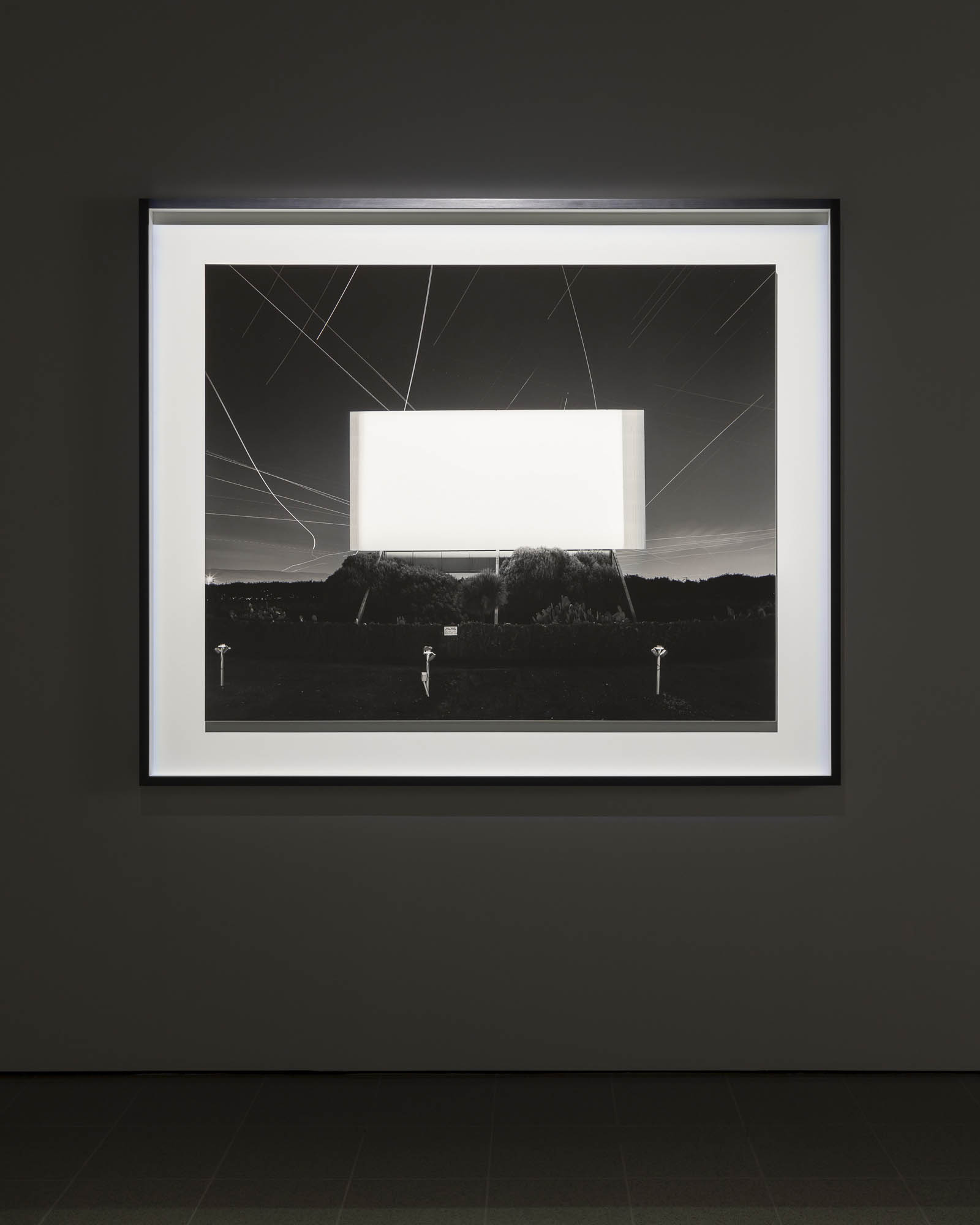
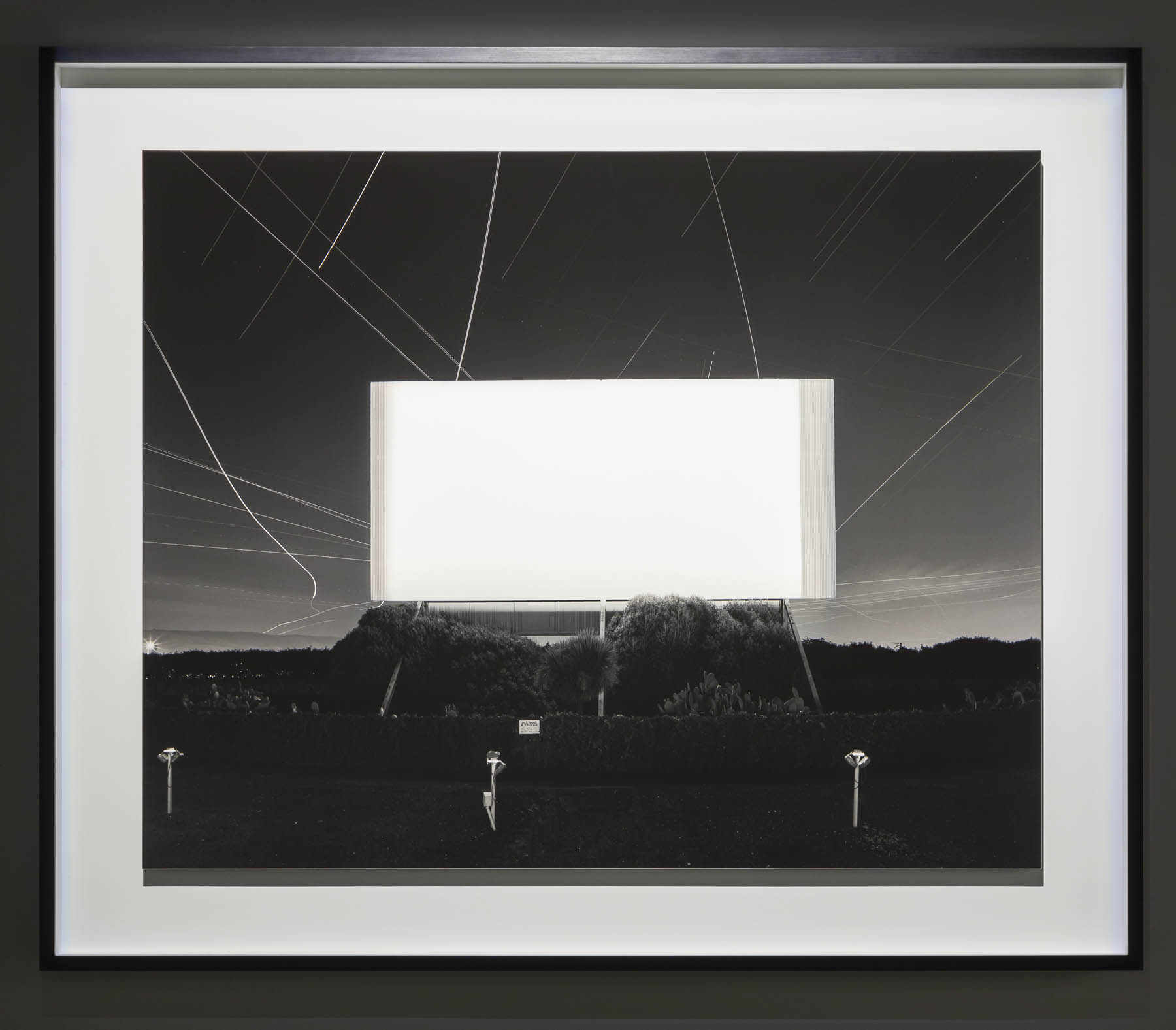
Installation view of Hiroshi Sugimoto, 'Union City Drive-in, Union City' 1993

Installation view of Hiroshi Sugimoto, 'Union City Drive-in, Union City' 1993


Installation view of Hiroshi Sugimoto, Union City Drive-in, Union City, 1993. Gelatin silver print
Photo: Mark Blower. Courtesy the artist and the Hayward Gallery


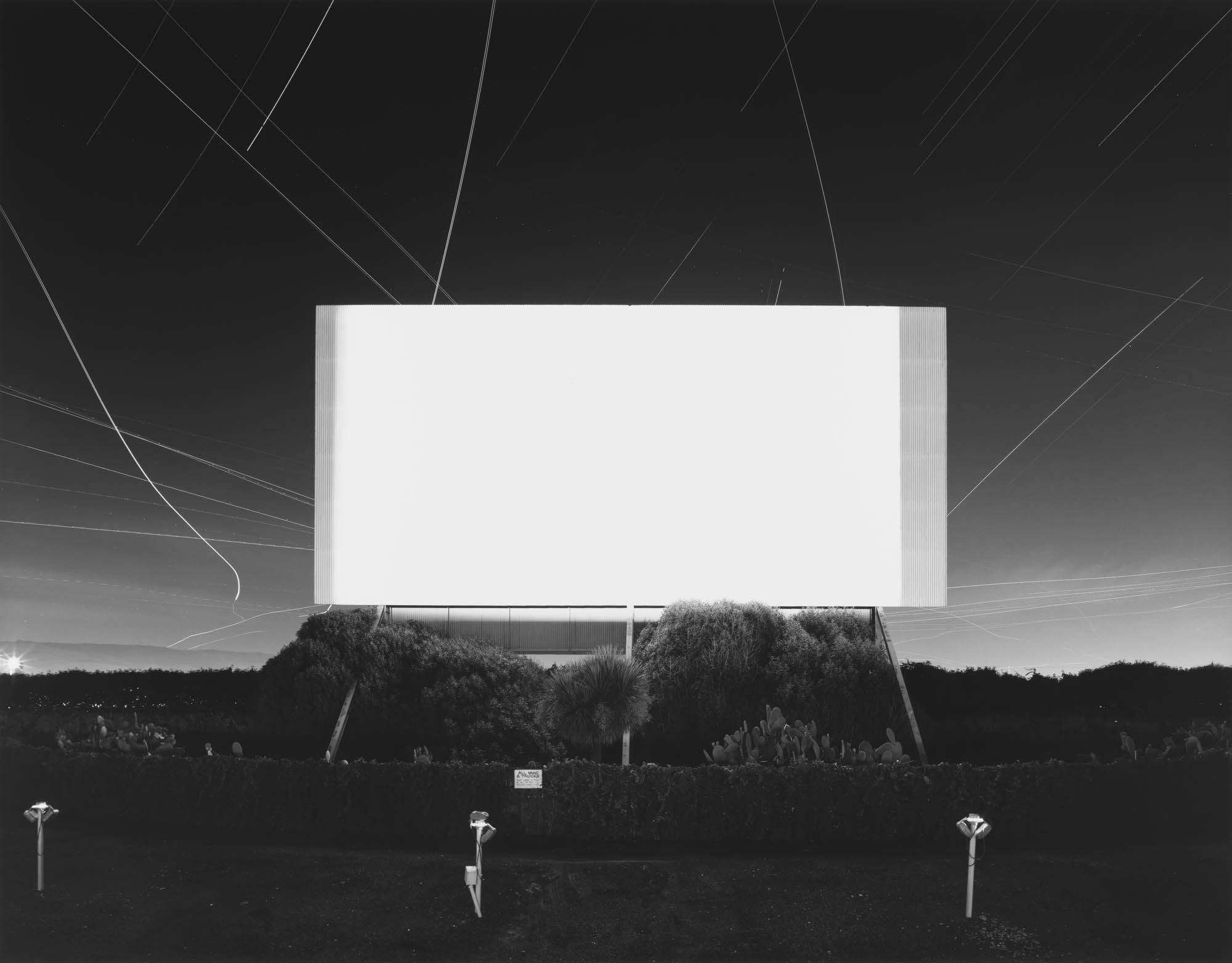
Hiroshi Sugimoto (Japanese, b. 1948) 'Union City Drive-in, Union City' 1993


Hiroshi Sugimoto (Japanese, b. 1948)
Union City Drive-in, Union City
1993
Gelatin silver print
© Hiroshi Sugimoto, courtesy of the artist


The largest survey to date of Hiroshi Sugimoto, an artist renowned for creating some of the most alluringly enigmatic photographs of our time. Over the past 50 years, Sugimoto has created pictures which are meticulously crafted, deeply thought-provoking and quietly subversive.

Featuring key works from all of the artist’s major photographic series, this survey highlights Sugimoto’s philosophical yet playful inquiry into our understanding of time and memory, and photography’s ability to both document and invent.

The exhibition also includes lesser-known works that reveal the artist’s interest in the history of photography, as well as in mathematics and optical sciences.

Often employing a large-format wooden camera and mixing his own darkroom chemicals, Sugimoto has repeatedly re-explored ideas and practices from 19th century photography while capturing subjects including dioramas, wax figures and architecture. His work has stretched and rearranged concepts of time, space and light that are integral to the medium.

Born and raised in Tokyo, Japan, Hiroshi Sugimoto divides his time between Tokyo and New York City. Over the past five decades, his photographs have received international acclaim and have been presented in major institutions across the globe.

While best known as a photographer, Sugimoto has more recently added architecture and sculpture to his multidisciplinary practice, as well as being artistic director on performing arts productions.

Text from the Hayward Gallery website


Seascapes (1980 -)


Installation view of Hiroshi Sugimoto, 'Seascapes' series


Installation view of Hiroshi Sugimoto, Seascapes series. Gelatin silver prints
Photo: Mark Blower. Courtesy the artist and the Hayward Gallery


Installation view of Hiroshi Sugimoto, 'Seascapes' series


Installation view of Hiroshi Sugimoto, Seascapes series. Gelatin silver prints
Photo: Mark Blower. Courtesy the artist and the Hayward Gallery


Hiroshi Sugimoto (Japanese, b. 1948) 'Bay of Sagami, Atami' 1997


Hiroshi Sugimoto (Japanese, b. 1948)
Bay of Sagami, Atami
1997
From the Seascapes series
Gelatin silver print
© Hiroshi Sugimoto, courtesy of the artist


Architecture (1997 – )


Installation view of Hiroshi Sugimoto, 'Chrysler Building' 1997


Installation view of Hiroshi Sugimoto, Chrysler Building 1997. Gelatin silver print
Photo: Mark Blower. Courtesy the artist and the Hayward Gallery


Installation view of Hiroshi Sugimoto, 'Chrysler Building' 1997


Installation view of Hiroshi Sugimoto, Chrysler Building 1997. Gelatin silver print
Photo: Mark Blower. Courtesy the artist and the Hayward Gallery


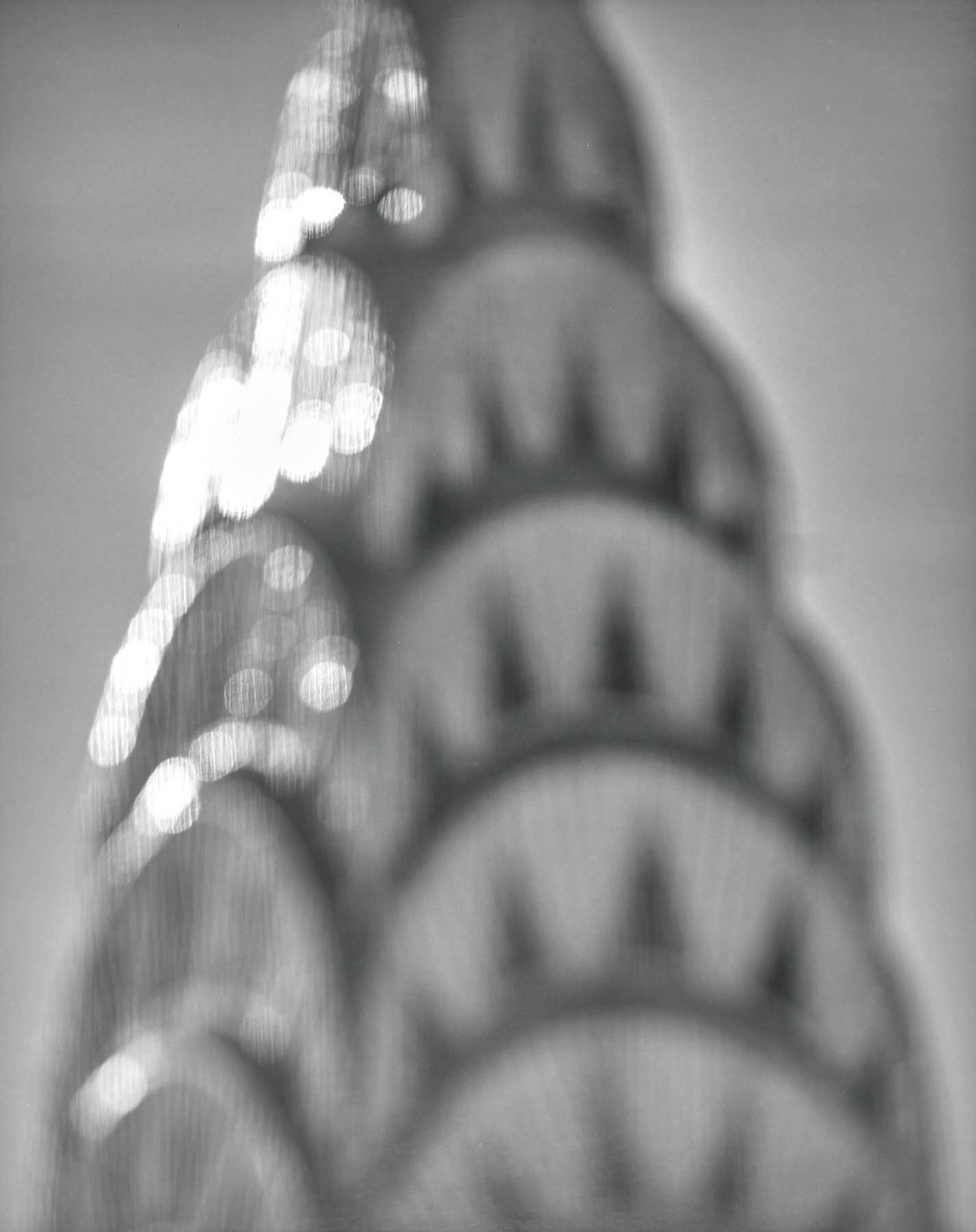
Hiroshi Sugimoto (Japanese, b. 1948) 'Chrysler Building' 1997


Hiroshi Sugimoto (Japanese, b. 1948)
Chrysler Building
1997
Gelatin silver print
© Hiroshi Sugimoto, courtesy of the artist


Hiroshi Sugimoto (Japanese, b. 1948) 'World Trade Center' 1997


Hiroshi Sugimoto (Japanese, b. 1948)
World Trade Center
1997
Gelatin silver print
© Hiroshi Sugimoto, courtesy of the artist


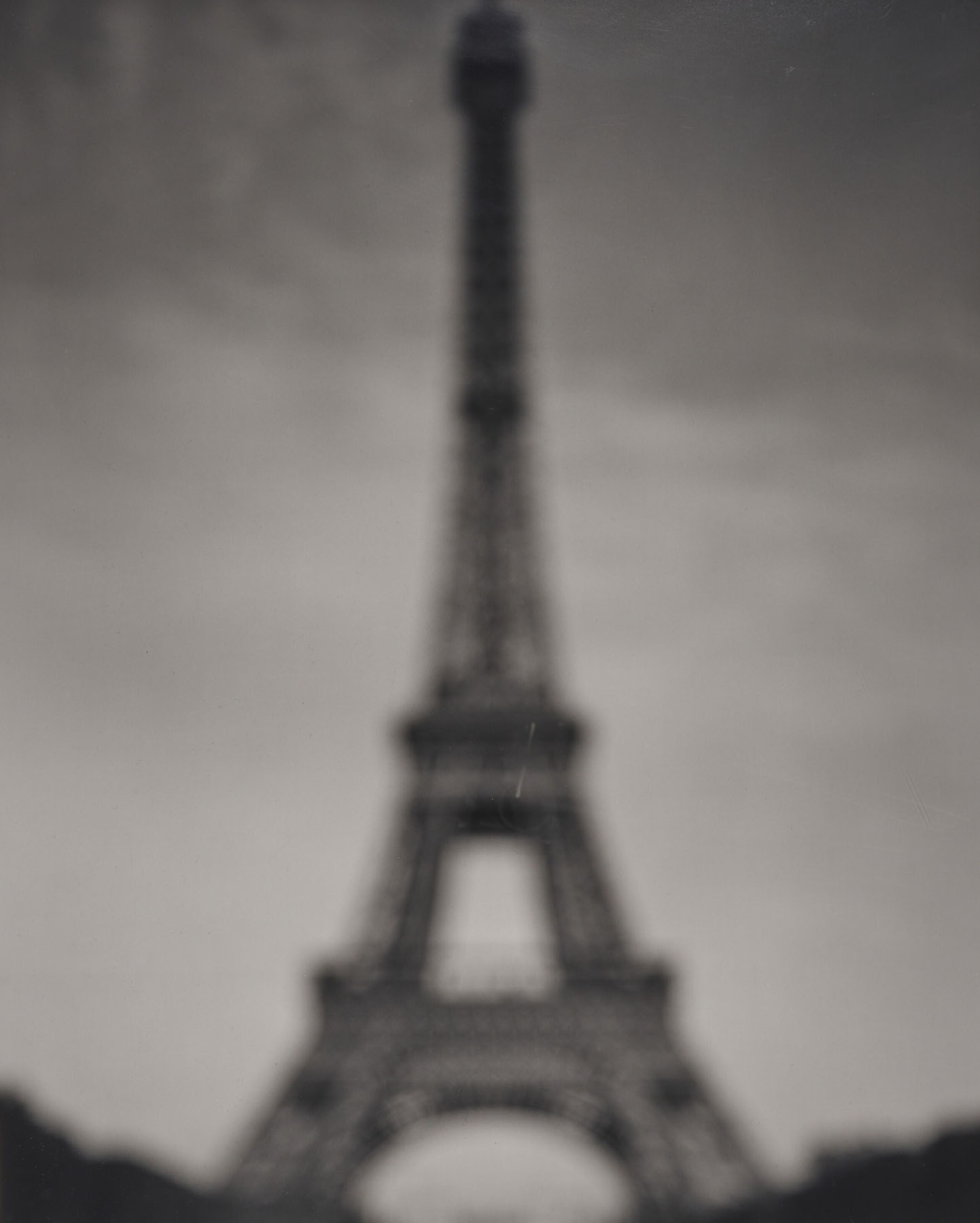
Hiroshi Sugimoto (Japanese, b. 1948) 'Eiffel Tower' 1998


Hiroshi Sugimoto (Japanese, b. 1948)
Eiffel Tower
1998
Gelatin silver print
© Hiroshi Sugimoto, courtesy of the artist


Over the past 50 years, Hiroshi Sugimoto has created some of the most alluringly enigmatic photographs of our time: pictures that are precisely crafted and deeply thought-provoking, familiar yet tantalisingly ambiguous. Featuring key works from all of the artist’s major photographic series, this survey highlights the artist’s philosophical yet playful inquiry into our understanding of time and memory, and the ambiguous character of photography as a medium suited to both documentation and invention.

The exhibition also includes lesser-known works that illuminate the artist’s interest in the history of photography as well as in mathematics and optical sciences. Often employing a large-format wooden camera, mixing his own darkroom chemicals and developing his black-and-white prints by hand, Sugimoto has repeatedly re-explored ideas and practices from 19th century photography, including subjects such as dioramas, wax figures and architecture. In the process, his work has stretched and rearranged concepts of time, space and light that are integral to the medium.

Hiroshi Sugimoto says: “The camera is a time machine capable of representing the sense of time… The camera can capture more than a single moment, it can capture history, geological time, the concept of eternity, the essence of time itself… The more I think about that sense of time, the more I think this is probably one of the key factors of how humans became humans.”

Ralph Rugoff, Director of the Hayward Gallery, says: “Hiroshi Sugimoto is a brilliant visual poet of paradox, a polymath postmodern who embraces meticulous old school craftsmanship to produce exquisite, uncanny pictures that reference science and maths as well as abstract art and Renaissance portraits. Juggling different conceptions of time, and evoking visions ranging from primordial prehistory to the end of civilisation, his photographs ingeniously recalibrate our basic assumptions about the medium, and alter our sense of history, time and existence itself. Amidst all his peers, his work stands apart for its depth and striking originality of thought.”

Time Machine commences with a selection of Sugimoto’s black-and-white photographs of natural history dioramas, a series he began in the mid-1970s. The Dioramas photos draw attention less to the natural world than to its theatrical representation in museums, whilst at the same time conjuring what the artist has called the ‘fragility of existence’.

The subject of time is also explored in two subsequent bodies of work featured in the exhibition: shot in movie palaces as well as drive-ins, Sugimoto’s Theaters (1976 – ) capture entire films with a single long exposure, thus compressing all the dramatic action that appeared on screen into a single image of radiant whiteness. His renowned Seascapes (1980 -), which depict evenly divided expanses of sea and sky unmarked by any trace of human existence, are equally beguiling in their temporal reference, evoking the immediacy of abstract painting even as they speak to Sugimoto’s interest in focusing on vistas that, as he remarks, “are before human beings and after human beings.”

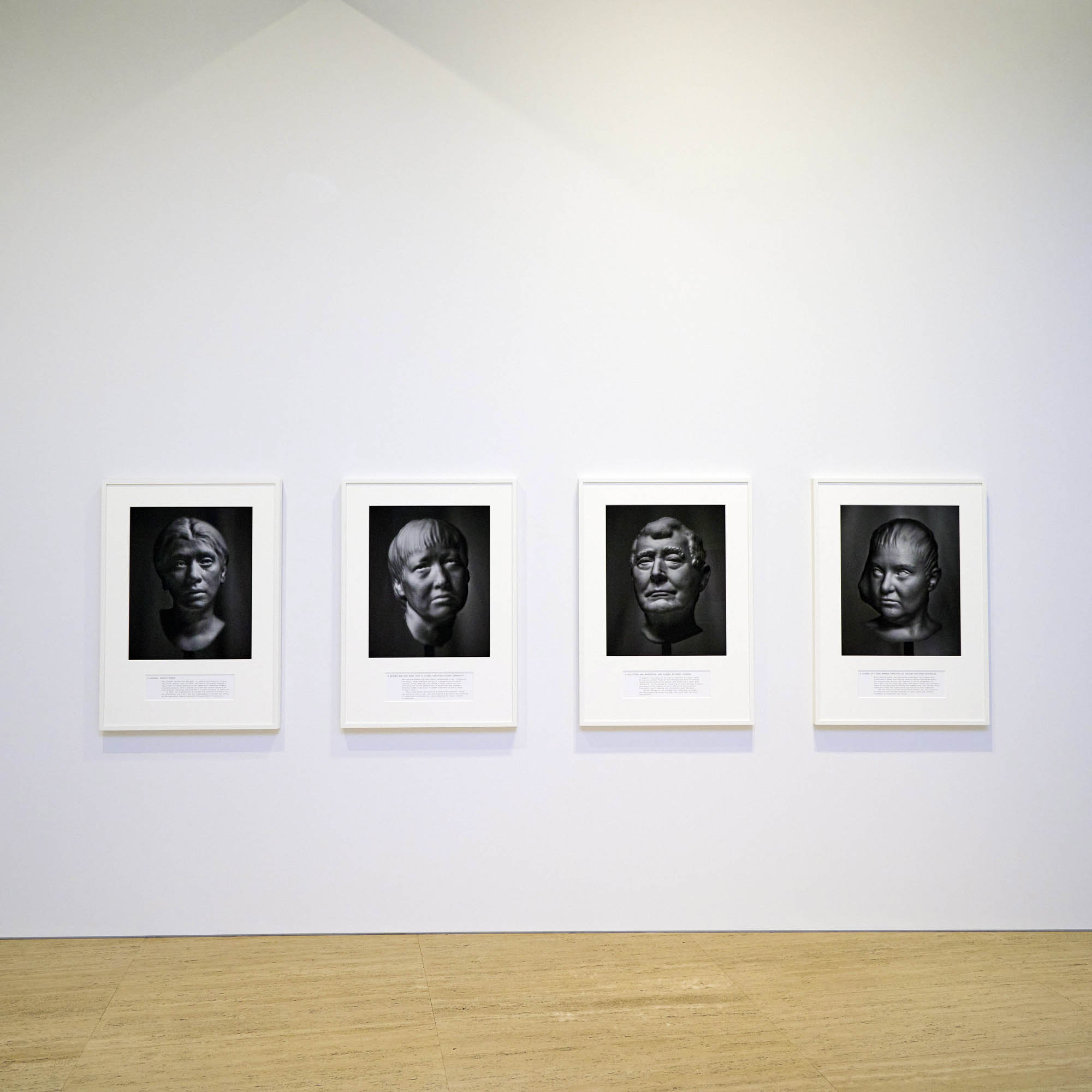
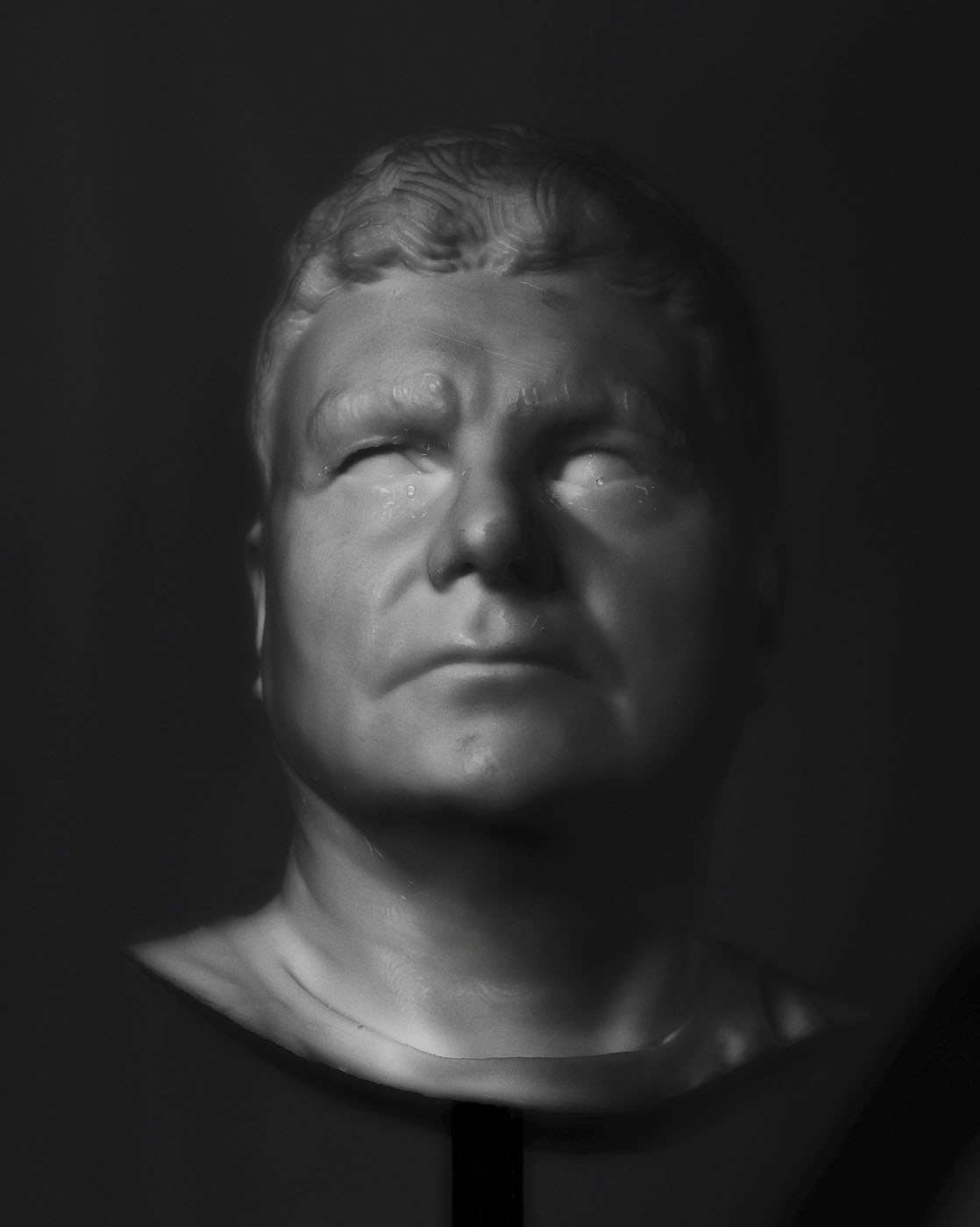
For Architecture (1997 – ), a series of deliberately out-of-focus studies of iconic modernist buildings – ranging from the Eiffel Tower to the Twin Towers – Sugimoto displays the expansive ambiguity that informs his art, at the same time conveying a sense of the visual germ of an idea in an architect’s imagination, as well as fashioning ghostly images of what he has described as “architecture after the end of the world.” For his subsequent Portraits (1999) series, meanwhile, the artist focused his camera on wax models of famous historical figures from Madame Tussauds; rendered more life-like in black-and-white, figures ranging from Queen Elizabeth II to Oscar Wilde and Salvador Dali take on a disarmingly lively appearance, underscoring the camera’s potential for altering our perception. As the artist has noted, “However fake the subject, once photographed, it’s as good as real.”

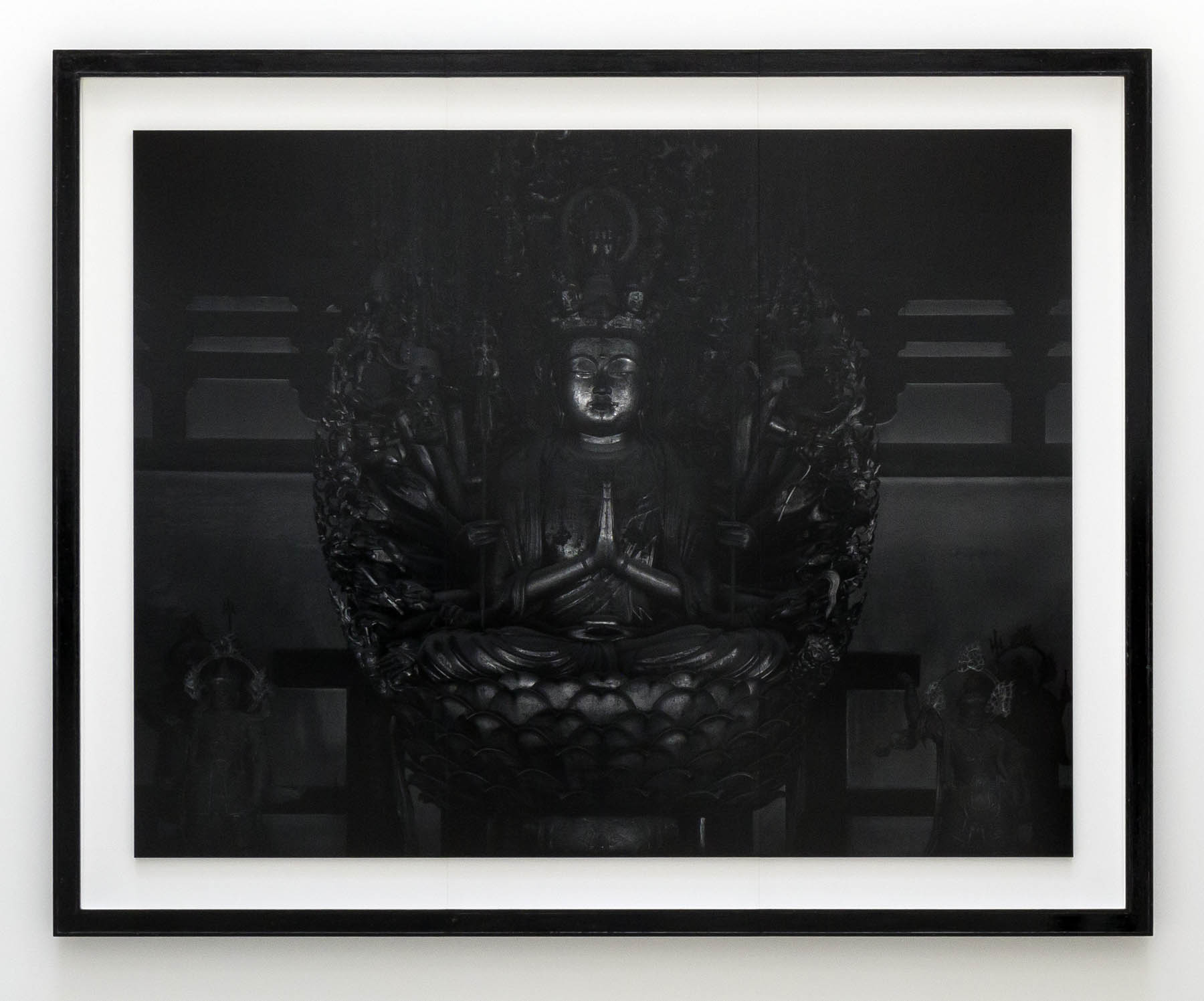
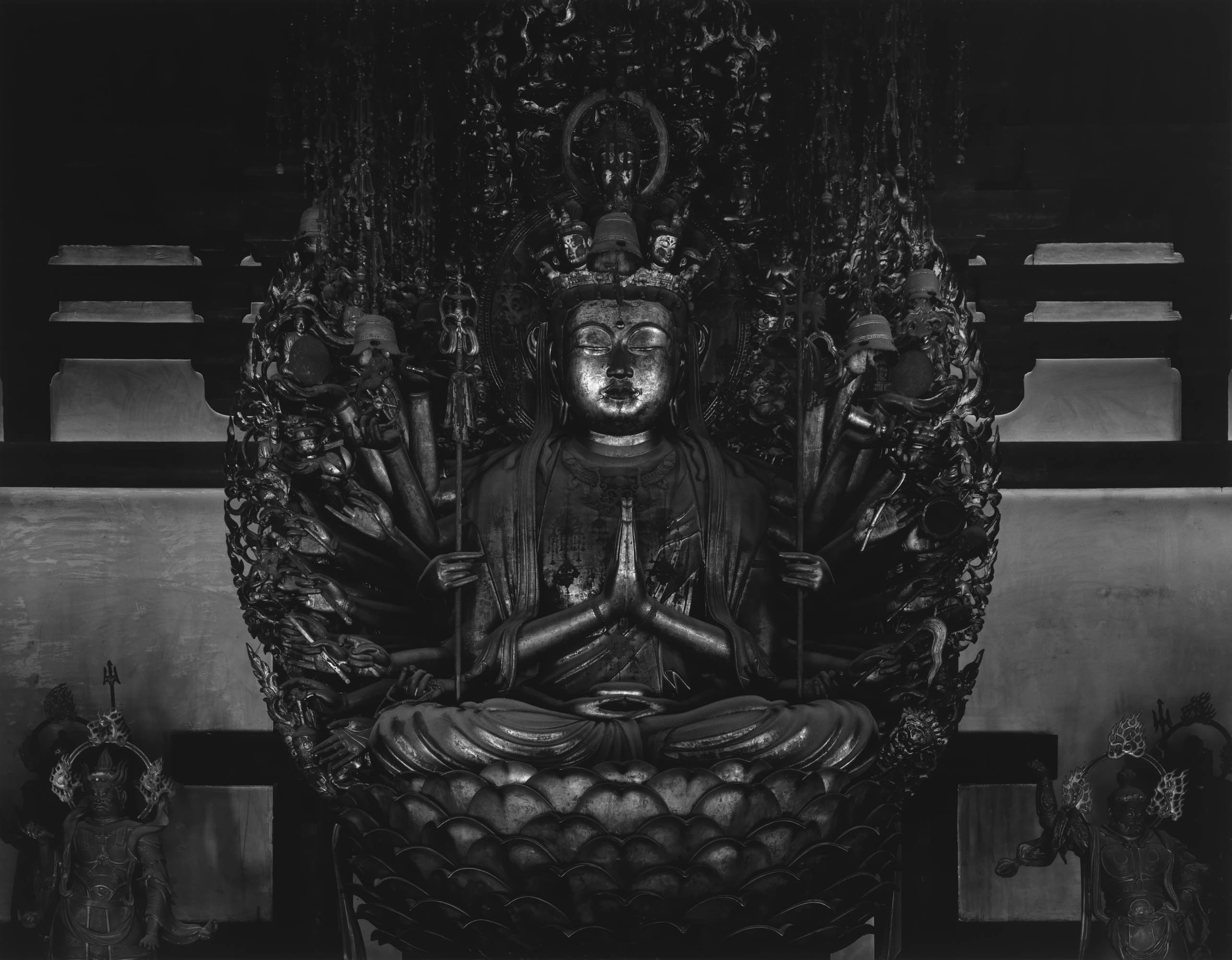
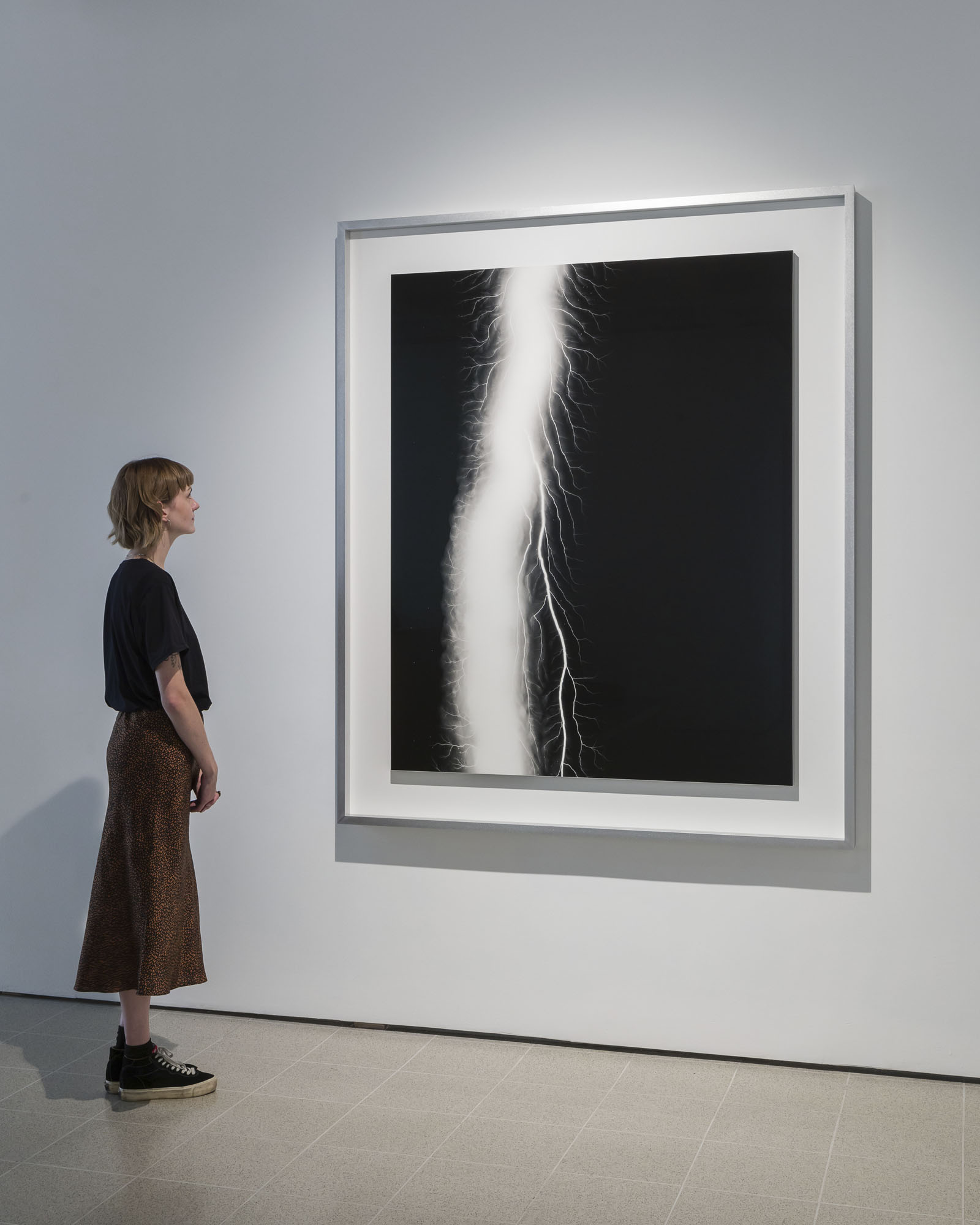
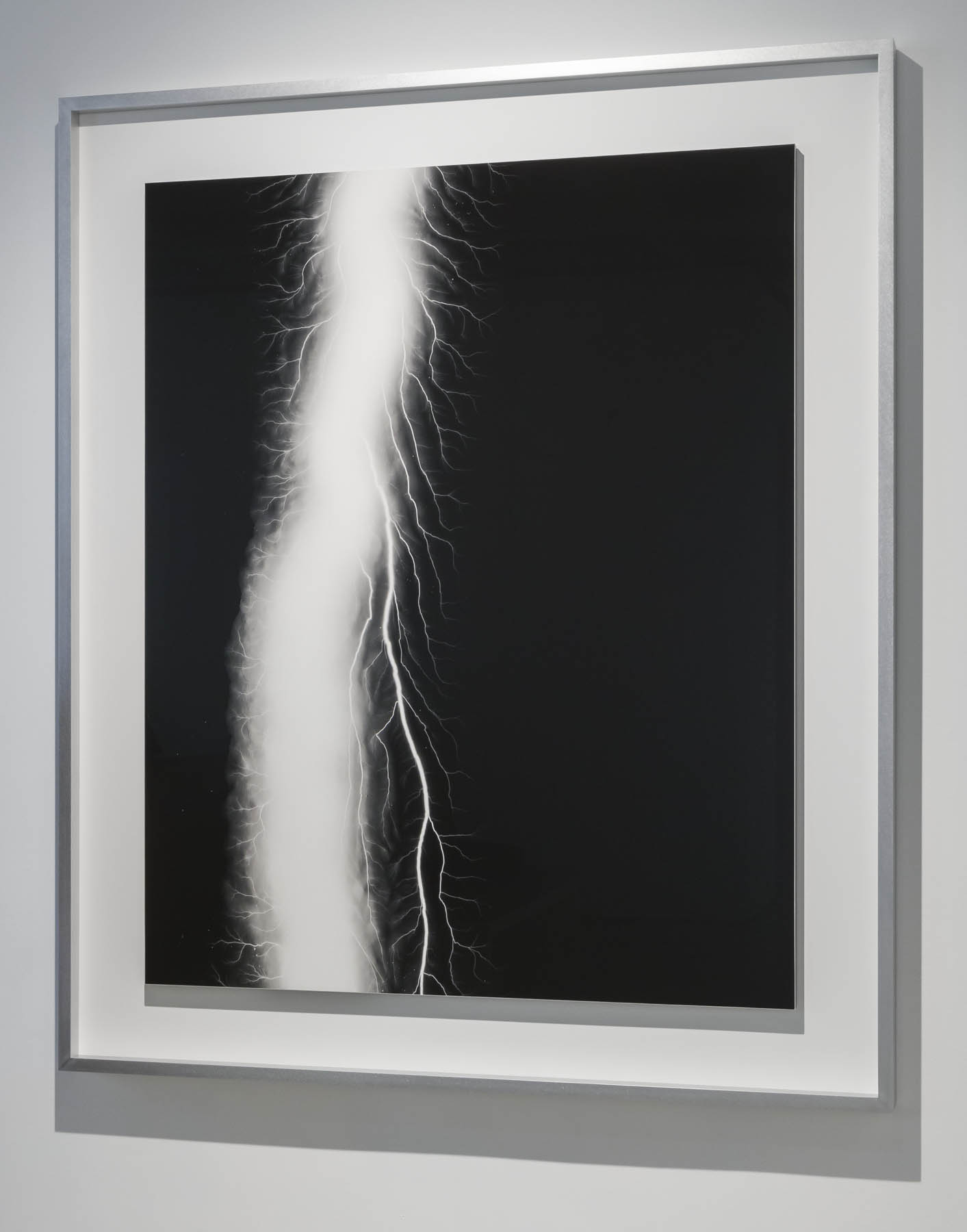
A final section of Hiroshi Sugimoto: Time Machine focuses on photographs that evoke different notions of timelessness, including his Sea of Buddha (1995) series, which portrays an installation in a 12th century Kyoto temple featuring 1001 gilded wooden statues of Buddha; and Lightning Fields (2006 – ), spectacular camera-less photographs created by exposing sensitised paper to electrical impulses produced by a Van der Graaf generator.

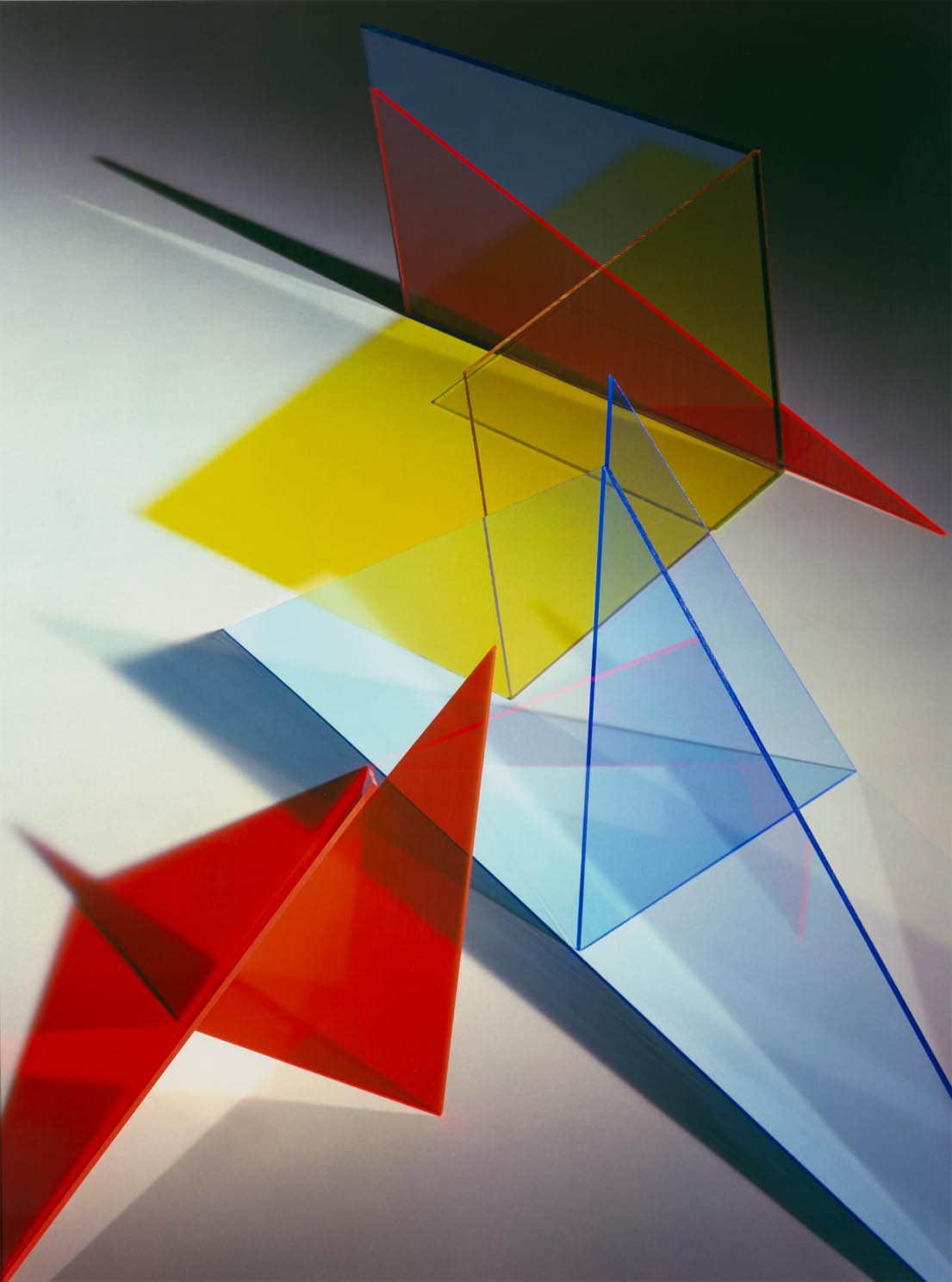
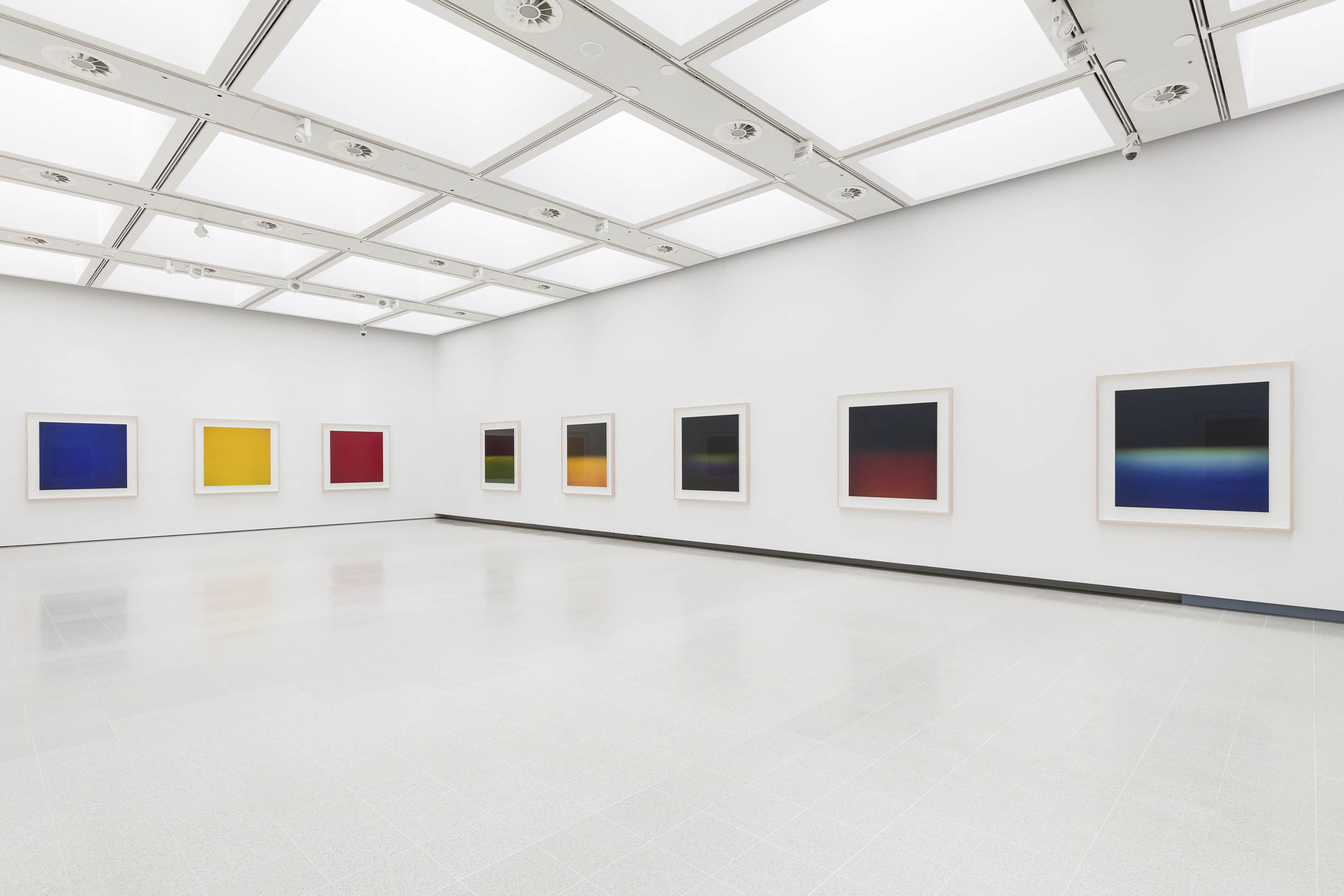
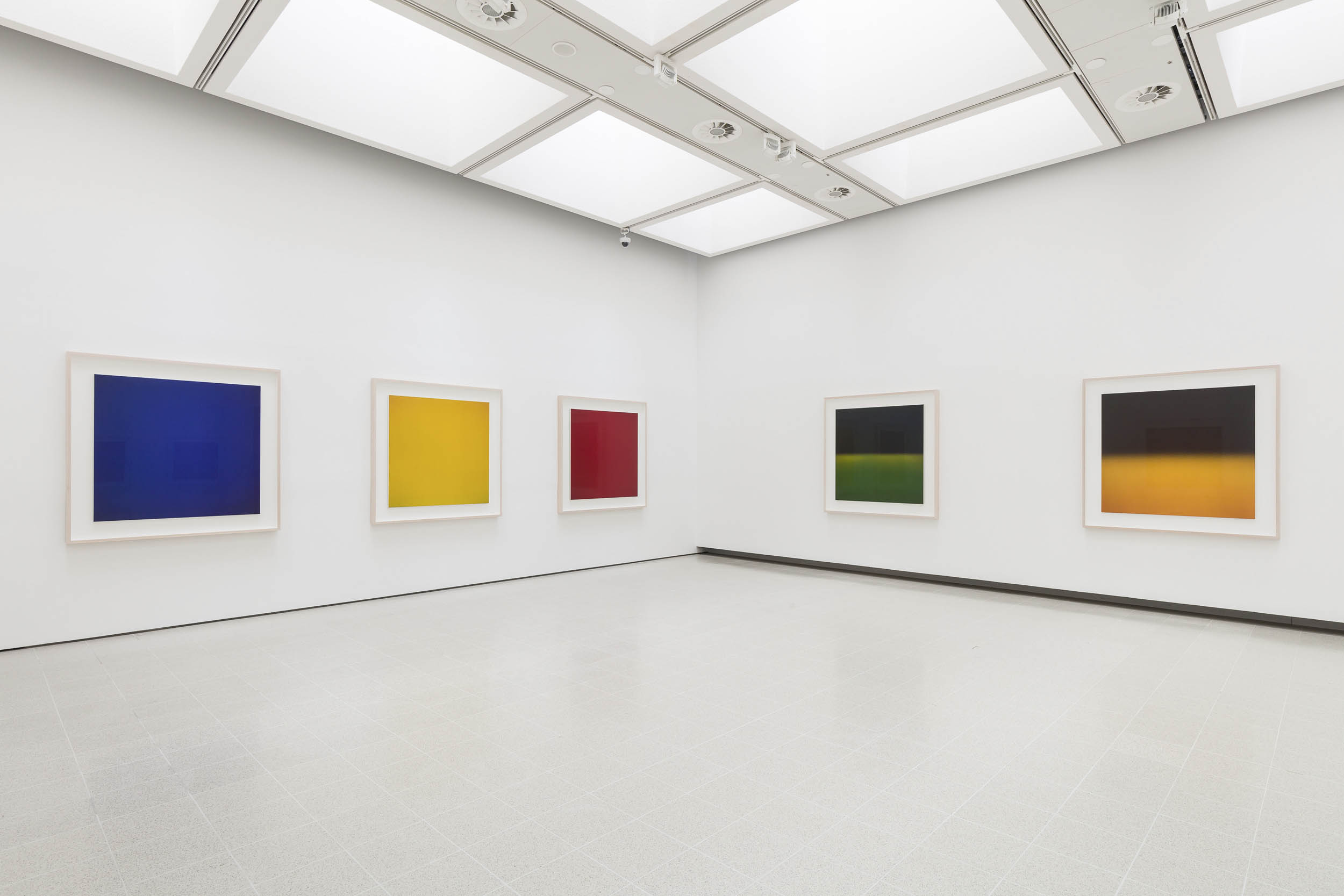
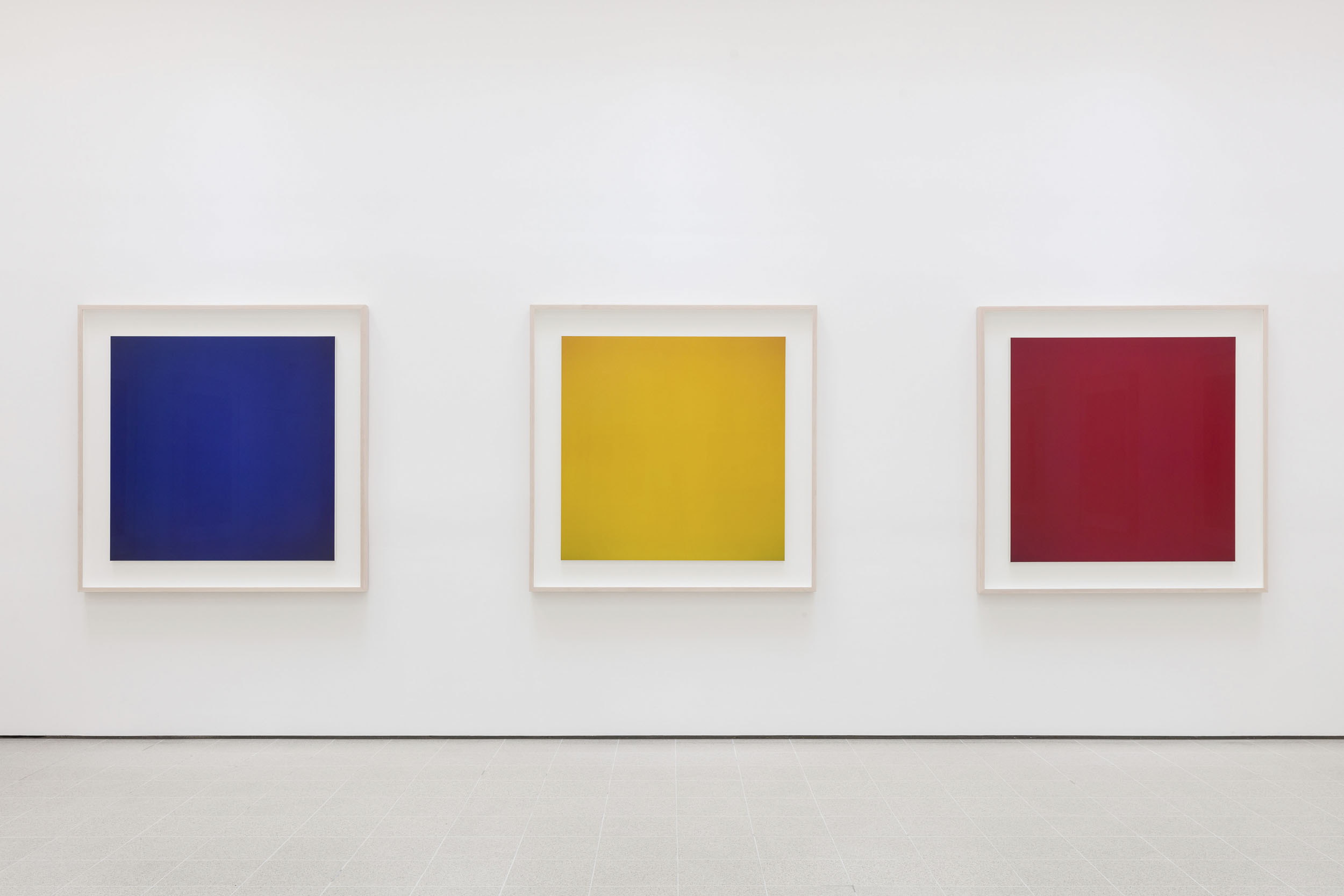
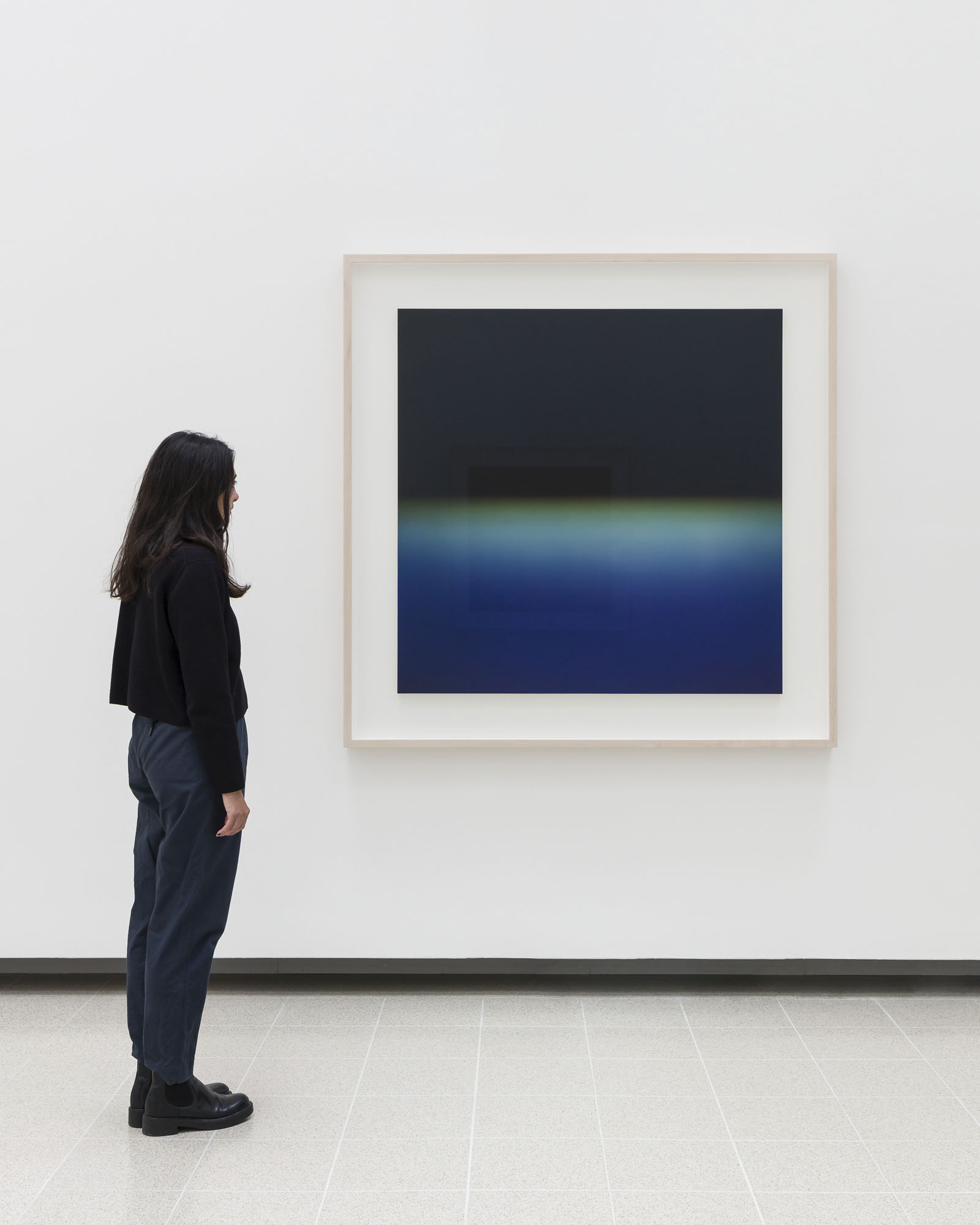
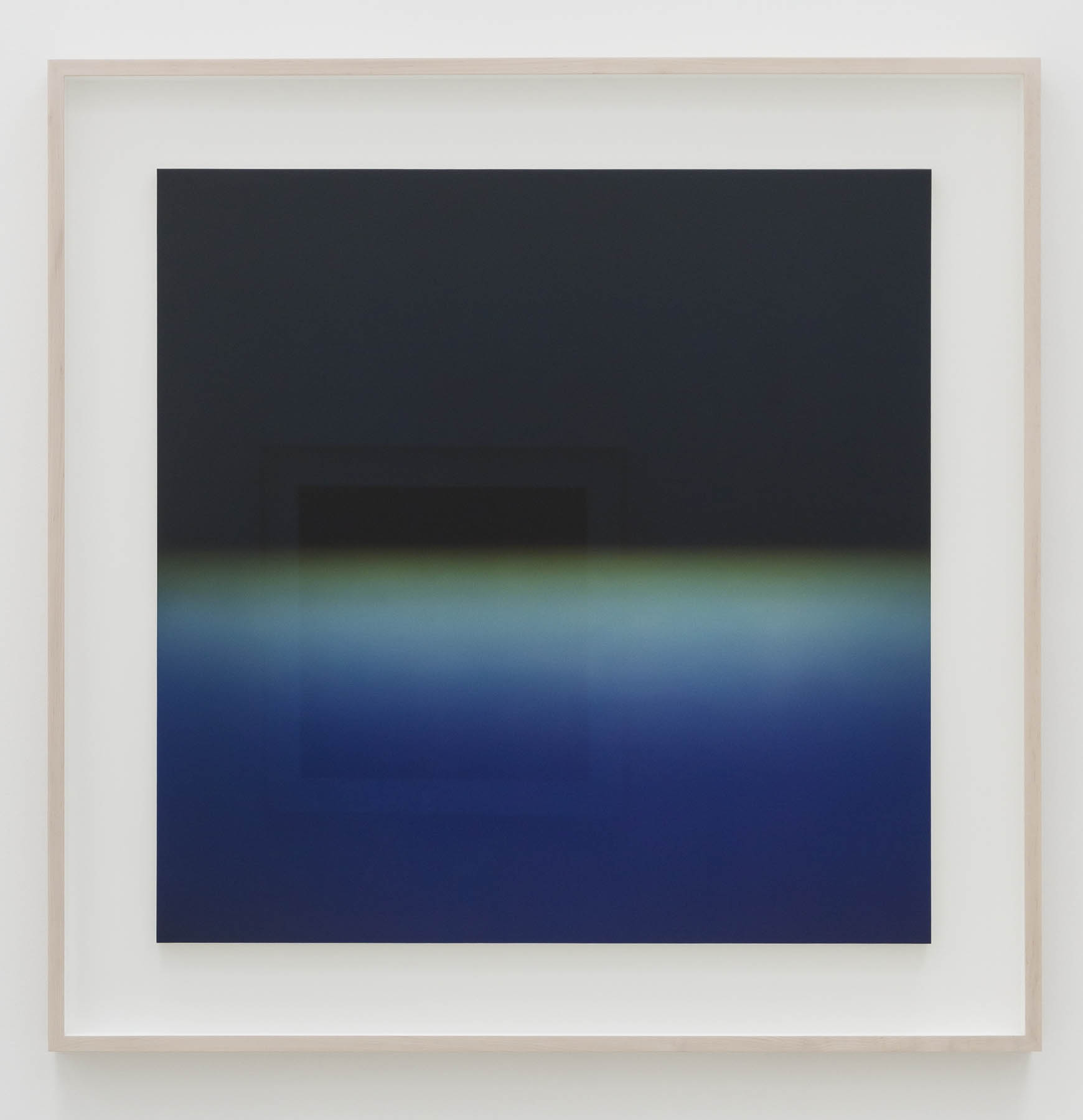
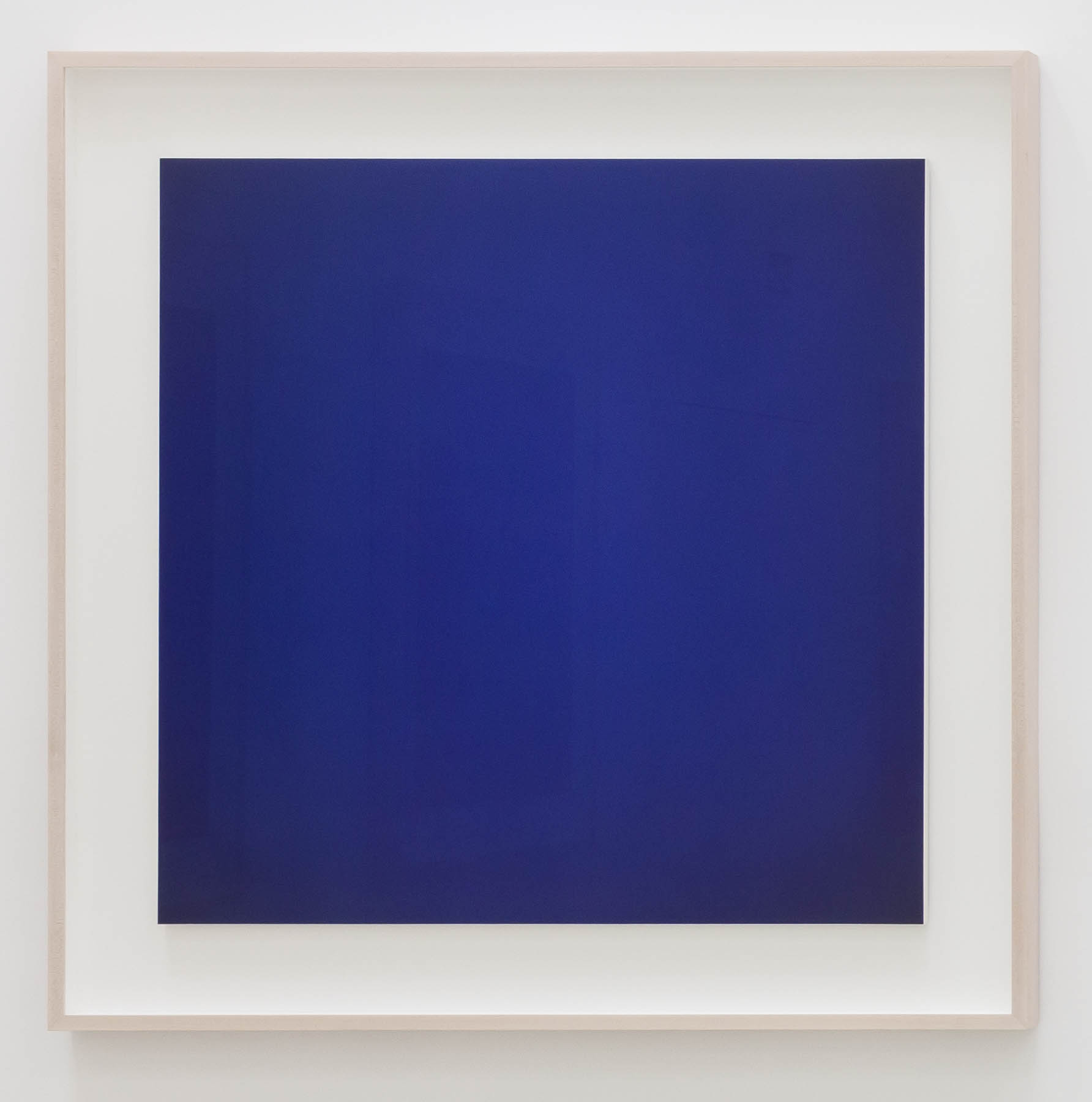
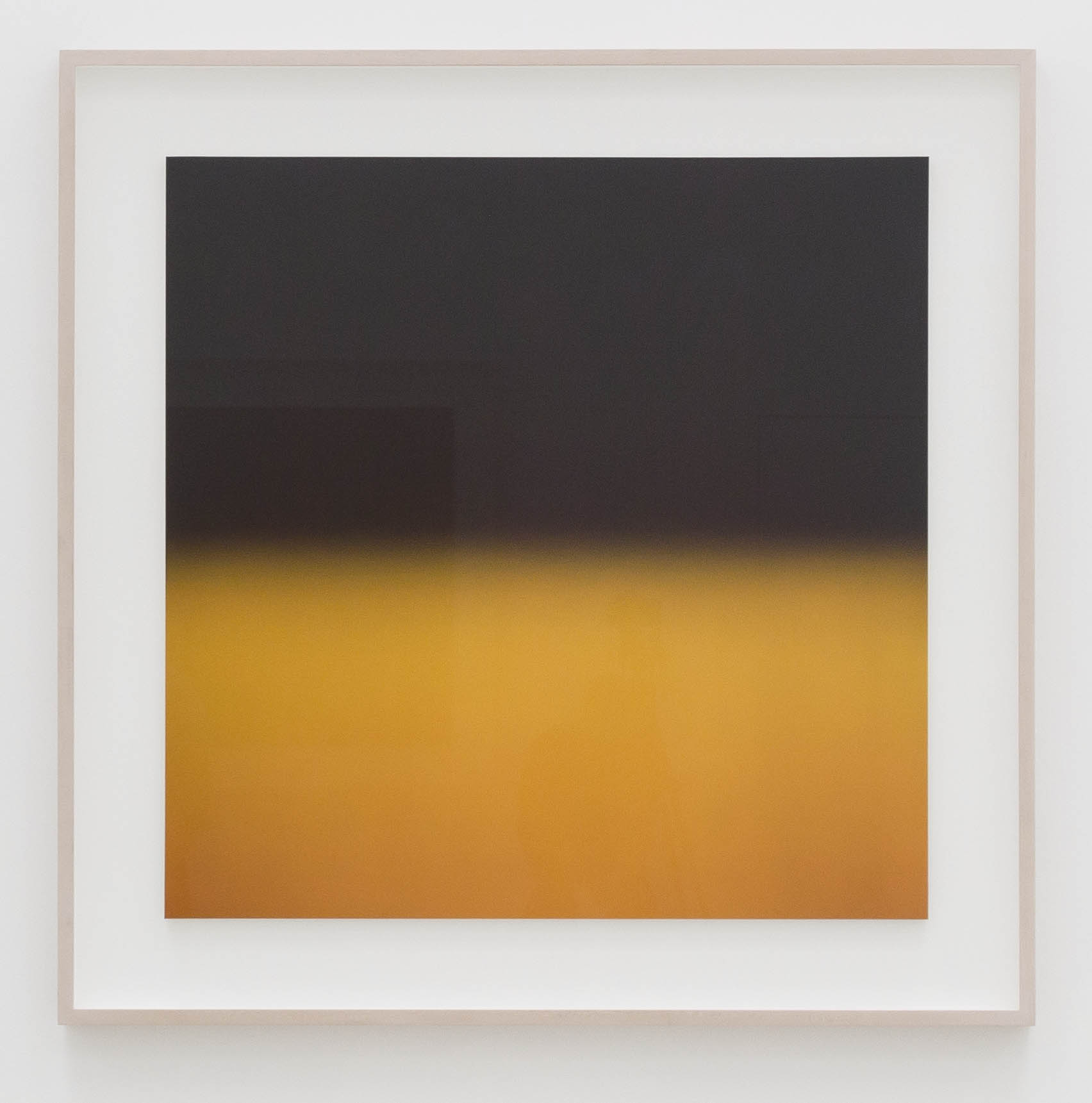
The exhibition comes to a stunning conclusion with a gallery dedicated to Sugimoto’s Opticks (2018 – ), intensely coloured photographs of prism-refracted light. Taking inspiration from Newton’s research into the properties of light whilst calling to mind colour field painting and artists like Mark Rothko, Opticks presents deeply immersive fields of subtly varying hues.

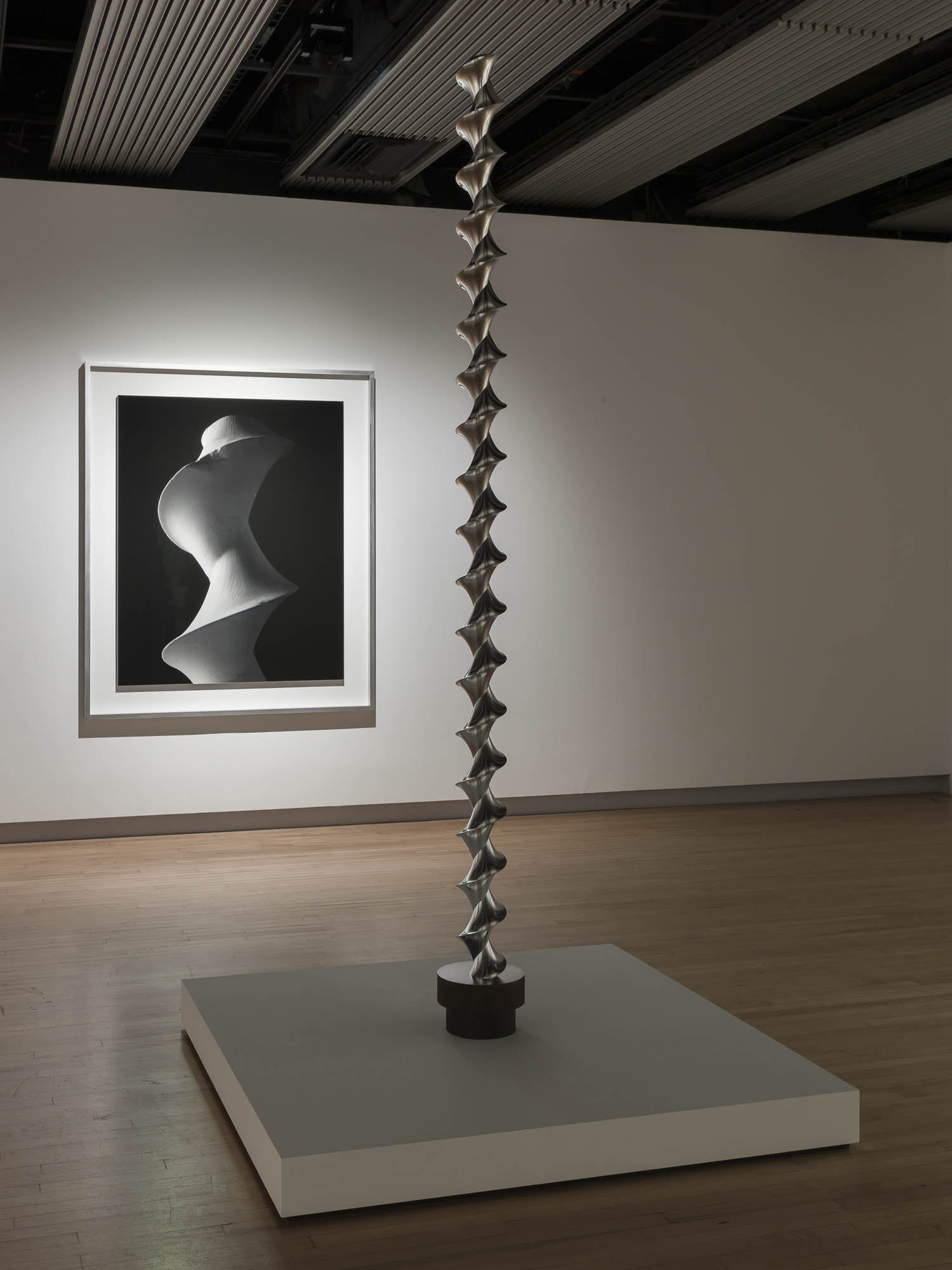
Alongside his photographs, two of Sugimoto’s elegantly contoured and polished aluminium sculptural models are presented, alluding to both mathematical equations and the abstract forms favoured by modernists such as Constantin Brâncuși.

The exhibition is accompanied by a fully-illustrated, 216pp catalogue with newly commissioned essays and an illustrated chronology, co-published with Hatje Cantz. Texts by Ralph Rugoff (on Dioramas), James Attlee (on Theaters), Mami Kataoka (on Seascapes), Lara Strongman (on Portraits), Geoffrey Batchen (on Lightning Fields), Edmund de Waal (on Sea of Buddha), Margaret Wertheim (on Conceptual Forms), Allie Biswas (on Opticks) and David Chipperfield (in conversation, on Architecture).

The show is set to tour internationally in 2024, at the UCCA Center for Contemporary Art (23 March – 23 June 2024) and The Museum of Contemporary Art Australia (2 August – 27 October 2024).

Press release from the Hayward Gallery


Sea of Buddha (1995)


Installation view of Hiroshi Sugimoto, 'Sea of Buddha' series

Installation view of Hiroshi Sugimoto, 'Sea of Buddha' series

Installation views of Hiroshi Sugimoto, Sea of Buddha series. Gelatin silver prints
Photo: Mark Blower. Courtesy the artist and the Hayward Gallery


Installation view of Hiroshi Sugimoto, 'Sea of Buddha 049 (Triptych)' 1995


Installation view of Hiroshi Sugimoto, Sea of Buddha 049 (Triptych) 1995. Gelatin silver print
Photo: Mark Blower. Courtesy the artist and the Hayward Gallery


Hiroshi Sugimoto (Japanese, b. 1948) 'Sea of Buddha 049 (Triptych)' 1995


Hiroshi Sugimoto (Japanese, b. 1948)
Sea of Buddha 049 (Triptych)
1995
Gelatin silver print
© Hiroshi Sugimoto, courtesy of the artist


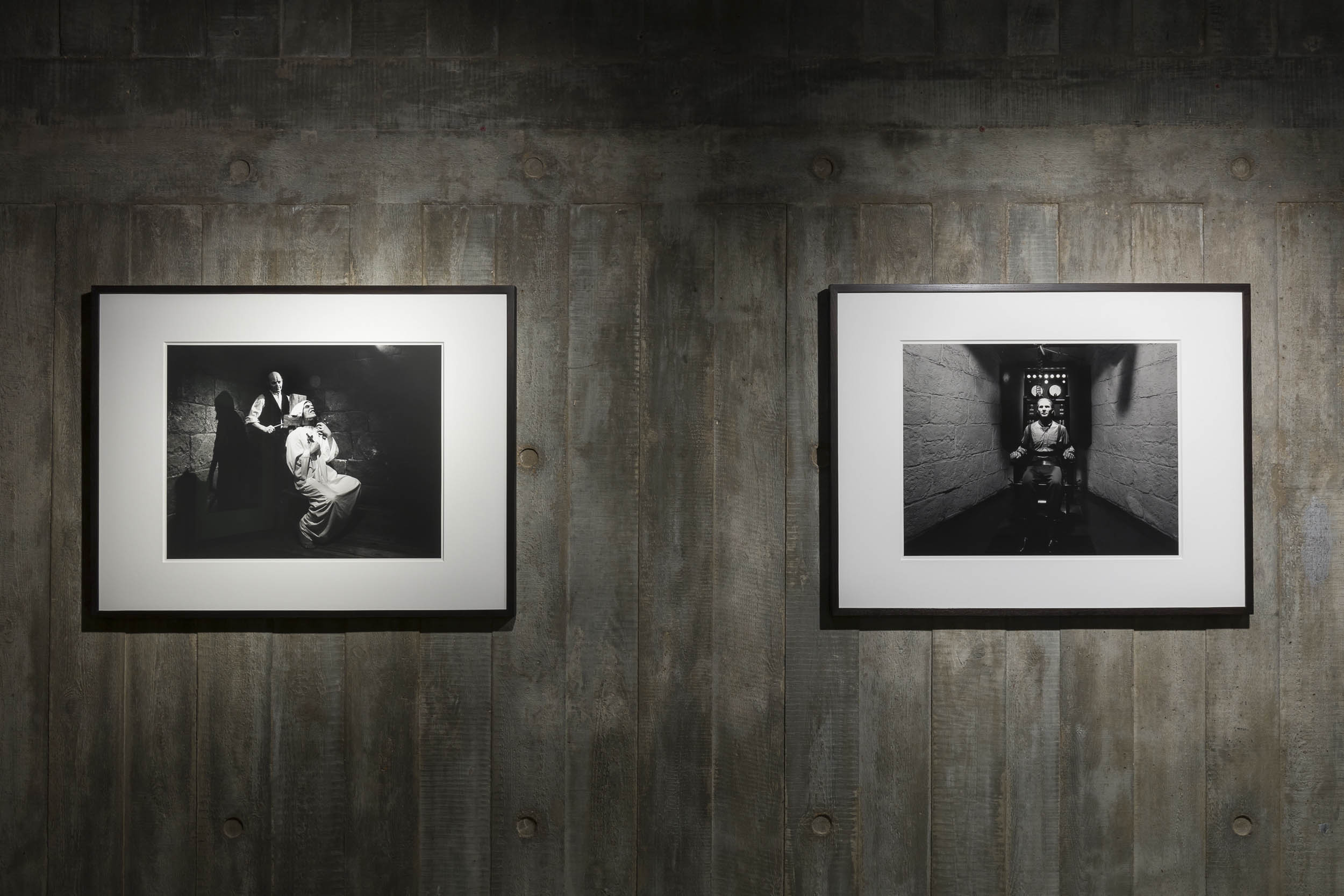
Chamber of Horrors (1994 – ) and Portraits (1999 -)


Installation view of Hiroshi Sugimoto, 'Chamber of Horrors' series


Installation view of Hiroshi Sugimoto, Chamber of Horrors series. Gelatin silver prints
Photo: Mark Blower. Courtesy the artist and the Hayward Gallery


Installation view of Hiroshi Sugimoto, 'The Garrote' 1994


Installation view of Hiroshi Sugimoto, The Garrote 1994. Gelatin silver print
Photo: Mark Blower. Courtesy the artist and the Hayward Gallery


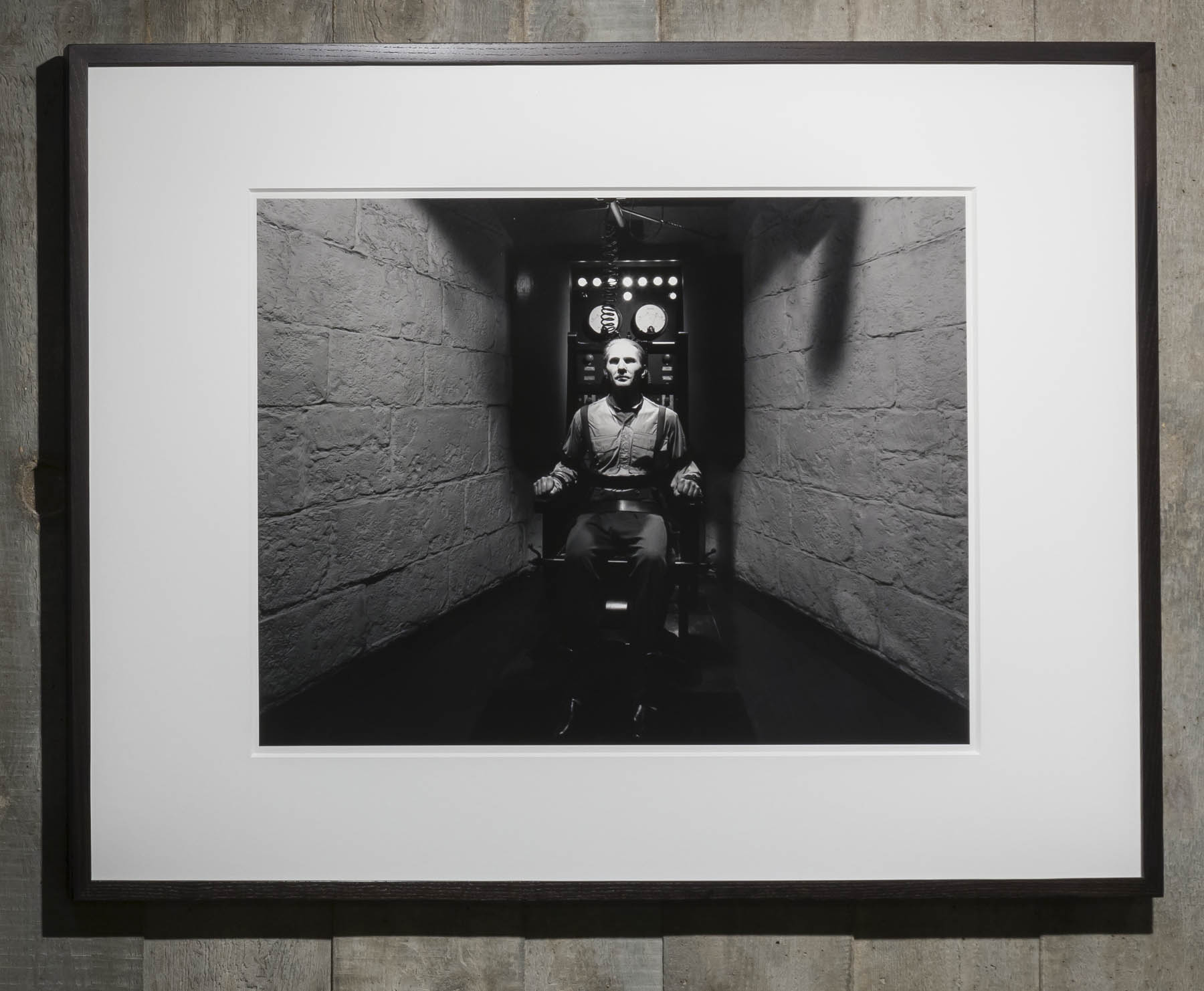
Installation view of Hiroshi Sugimoto, 'The Electric Chair' 1994


Installation view of Hiroshi Sugimoto, The Electric Chair 1994. Gelatin silver print
Photo: Mark Blower. Courtesy the artist and the Hayward Gallery


Hiroshi Sugimoto (Japanese, b. 1948) 'The Electric Chair' 1994


Hiroshi Sugimoto (Japanese, b. 1948)
The Electric Chair
1994
From the series The Chamber of Horrors
Gelatin silver print
© Hiroshi Sugimoto, courtesy of the artist


Installation view of Hiroshi Sugimoto, 'The Plague' 1994


Installation view of Hiroshi Sugimoto, The Plague, 1994. Gelatin silver print
Photo: Mark Blower. Courtesy the artist and the Hayward Gallery


Installation view of Hiroshi Sugimoto, 'Portraits' series


Installation view of Hiroshi Sugimoto, Portraits series. Gelatin silver prints
Photo: Mark Blower. Courtesy the artist and the Hayward Gallery


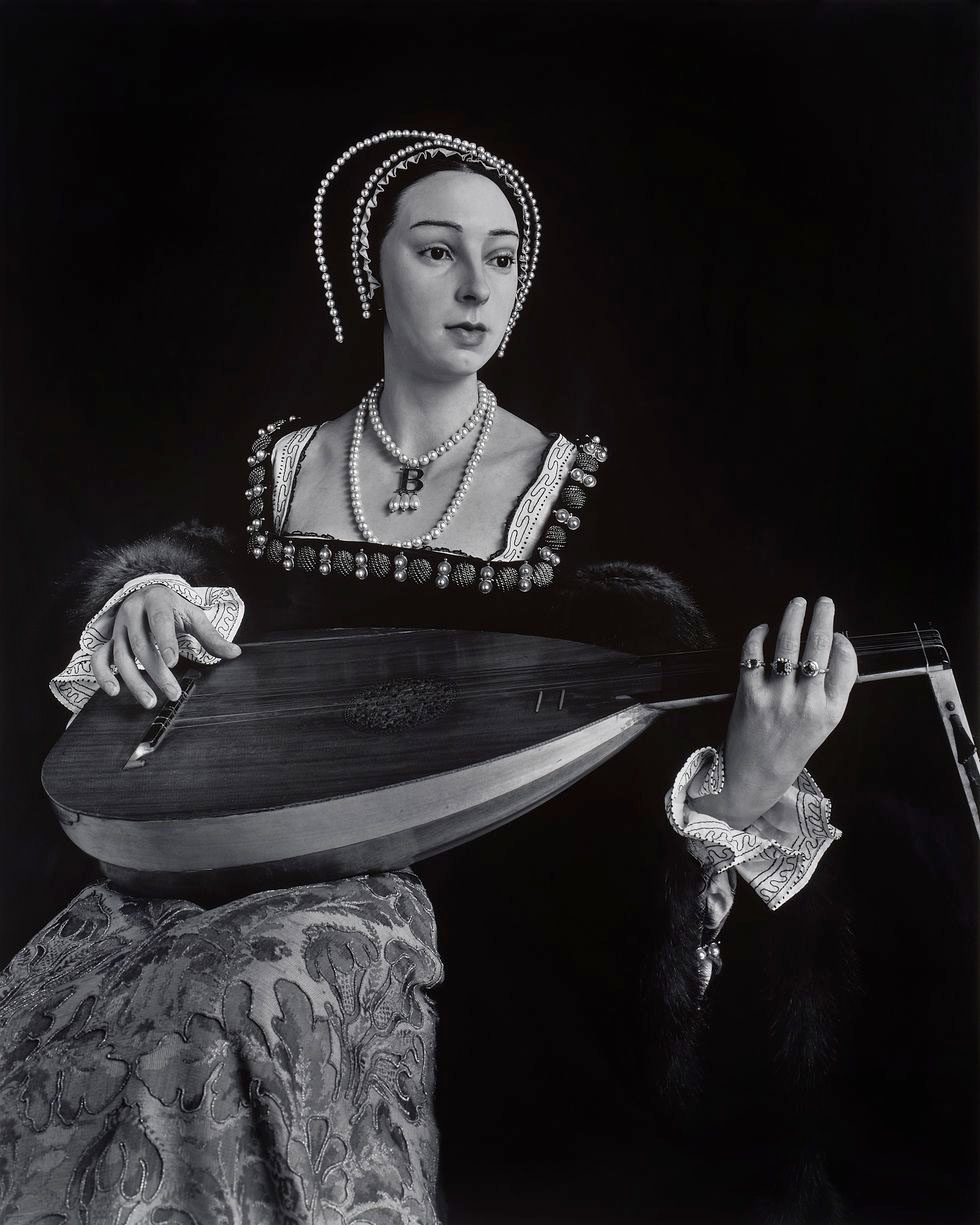
Installation view of Hiroshi Sugimoto, 'Anne Boleyn' 1999


Installation view of Hiroshi Sugimoto, Anne Boleyn 1999. Gelatin silver print
Photo: Mark Blower. Courtesy the artist and the Hayward Gallery


Hiroshi Sugimoto (Japanese, b. 1948) 'Anne Boleyn' 1999


Hiroshi Sugimoto (Japanese, b. 1948)
Anne Boleyn
1999
Gelatin silver print
© Hiroshi Sugimoto, courtesy of the artist


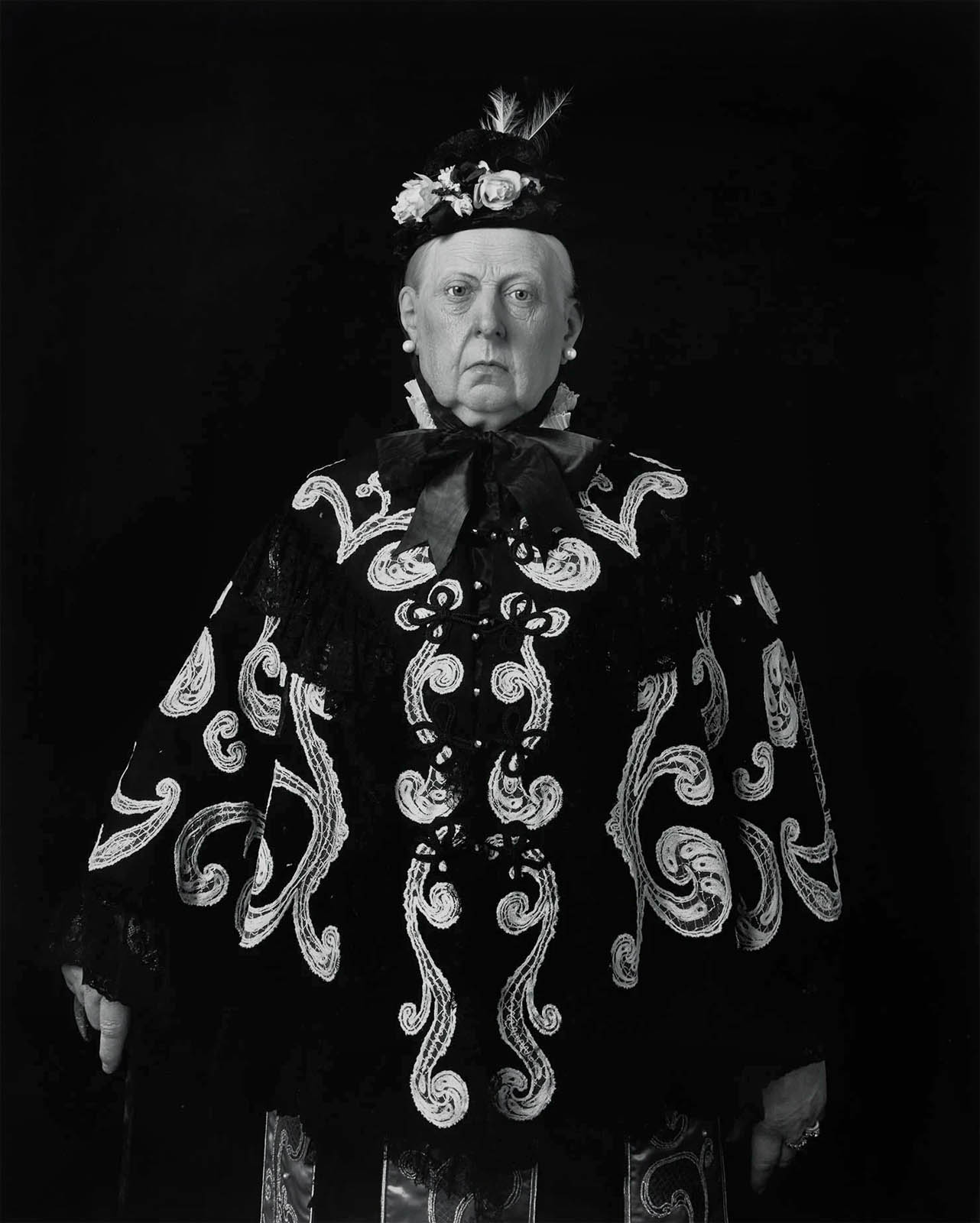
Installation view of Hiroshi Sugimoto, 'Queen Victoria' 1999


Installation view of Hiroshi Sugimoto, Queen Victoria 1999. Gelatin silver print
Photo: Mark Blower. Courtesy the artist and the Hayward Gallery


Hiroshi Sugimoto (Japanese, b. 1948) 'Queen Victoria' 1999


Hiroshi Sugimoto (Japanese, b. 1948)
Queen Victoria
1999
Gelatin silver print
© Hiroshi Sugimoto, courtesy of the artist


Hiroshi Sugimoto (Japanese, b. 1948) 'Salvador Dali' 1999


Hiroshi Sugimoto (Japanese, b. 1948)
Salvador Dali
1999
Gelatin silver print
© Hiroshi Sugimoto, courtesy of the artist


Hiroshi Sugimoto (Japanese, b. 1948) 'Oscar Wilde' 1999


Hiroshi Sugimoto (Japanese, b. 1948)
Oscar Wilde
1999
Gelatin silver print
© Hiroshi Sugimoto, courtesy of the artist


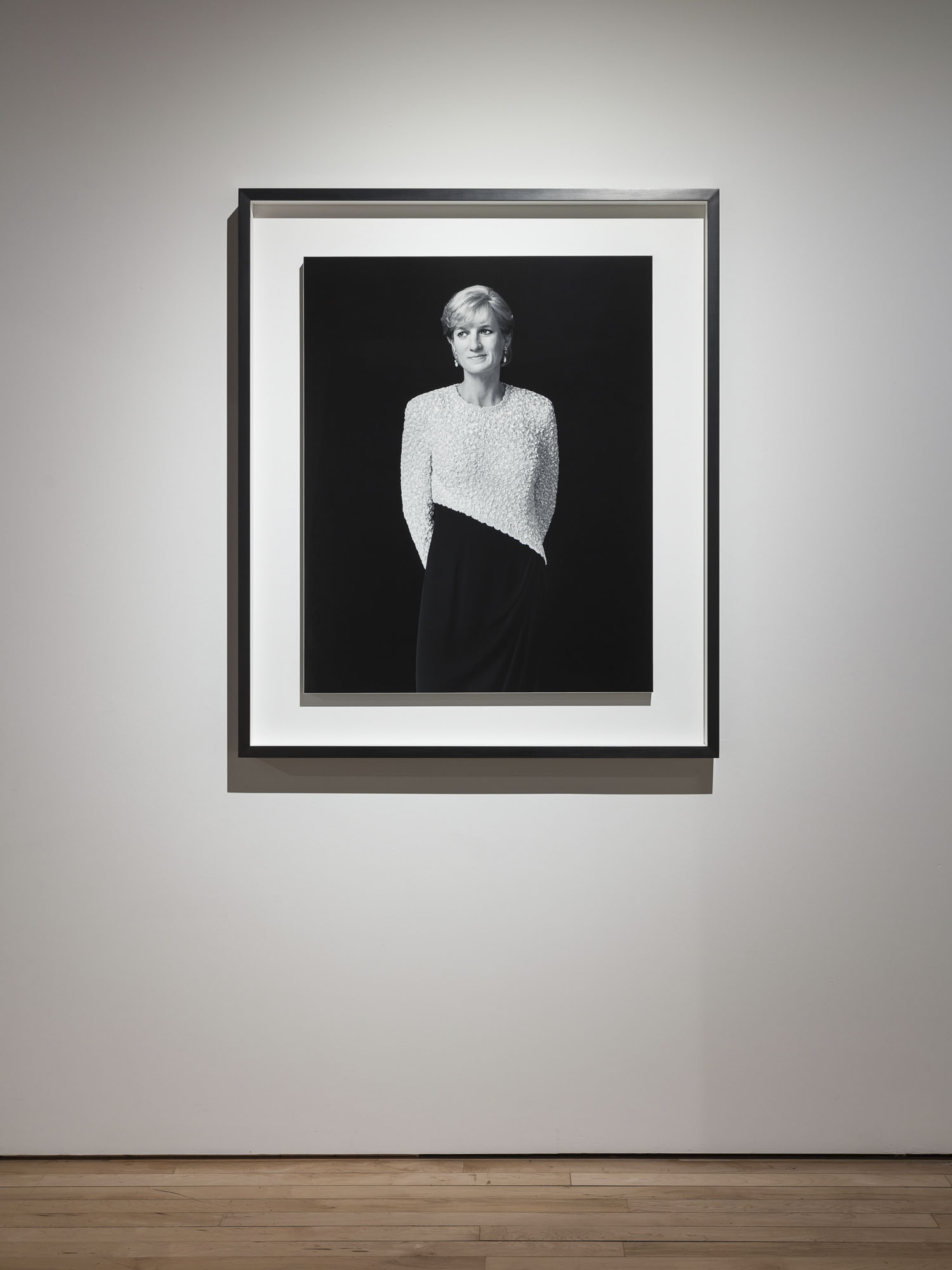
Installation view of Hiroshi Sugimoto, 'Diana, Princess of Wales' 1999

Installation view of Hiroshi Sugimoto, 'Diana, Princess of Wales' 1999


Installation views of Hiroshi Sugimoto, Diana, Princess of Wales 1999. Gelatin silver print
Photo: Mark Blower. Courtesy the artist and the Hayward Gallery


Hiroshi Sugimoto (Japanese, b. 1948) 'Diana, Princess of Wales' 1999


Hiroshi Sugimoto (Japanese, b. 1948)
Diana, Princess of Wales
1999
Gelatin silver print
© Hiroshi Sugimoto, courtesy of the artist


Lightning Fields (2006 – )


Installation view of Hiroshi Sugimoto, 'Lightning Fields 163' 2009


Installation view of Hiroshi Sugimoto, Lightning Fields 163 2009. Gelatin silver print
Photo: Mark Blower. Courtesy the artist and the Hayward Gallery


Installation view of Hiroshi Sugimoto, 'Lightning Fields 163' 2009


Installation view of Hiroshi Sugimoto, Lightning Fields 163 2009. Gelatin silver print
Photo: Mark Blower. Courtesy the artist and the Hayward Gallery


Hiroshi Sugimoto (Japanese, b. 1948) 'Lightning Fields 225' 2009


Hiroshi Sugimoto (Japanese, b. 1948)
Lightning Fields 225
2009
Gelatin silver print
© Hiroshi Sugimoto, courtesy of the artist


Hiroshi Sugimoto: formative years and significant works

For five decades the work of photographer Hiroshi Sugimoto has received international acclaim, whilst being presented in major galleries and institutions the world over.

Sugimoto’s photographs are meticulously crafted, often stretching and rearranging the concept of time, and our understanding of the world around us, and he has often re-explored ideas and practices from photography’s earliest exponents. Over the past 50 years, he has often revisited and expanded upon his own ideas, and series, which we take a closer look at, along with the artist’s formative years, here.

Hiroshi Sugimito: early years

Hiroshi Sugimoto was born in Tokyo in 1948 to a family of merchants. Among the young Sugimoto’s interests were trains, electronics, carpentry and photography, with his early fascination with the latter further enhanced by one of his elementary school science teachers, who showed Sugimoto and his classmates how to use photosensitive paper to make photograms. ‘He used spoons and forks and other items and he exposed the paper under the light for five or six minutes.’ explained Sugimoto, looking back. ‘When he removed it, the shapes of the spoons and forks remained on the paper. It was an amazing experience for me that left a lasting impression’.

At the age of 12 Sugimoto was given his first camera, a Mamiya 6 medium-format, by his father, which he would use to take photographs of trains and gather reference material for model-making. When he moved on to high school, Sugimoto joined the photography club and also began developing an interest in the cinema, which he would visit regularly. It wasn’t long before his love of film and photography combined, as he recalls, ‘Audrey Hepburn was beautiful and I fell in love with her on the screen. I wanted her portrait so I brought my Minolta SR7 camera into a movie theatre, and I studied how to stop the image on the screen. I found that one-fifteenth and one-thirteenth of a second stops the image’.

In 1970, after graduating in Economics from Tokyo’s Rikkyo University, Sugimoto backpacked across Russia and Europe. Influenced by communist ideology, and the writings of Karl Marx and Friedrich Engels as a student, he had wanted to experience Russian society, but disillusioned by what he found, he duly continued on to Europe. ‘I kept moving westwards. I stayed in Moscow for a few weeks and took another train to Poland, and then to Czechoslovakia, Bulgaria and other Eastern European countries. After several weeks I arrived in Vienna for my first taste of Western civilization’.

Hiroshi Sugimoto in America

Later in 1970 Sugimoto would get another taste of Western civilisation as he travelled to the US, and California. Here he studied at Los Angeles’ ArtCentre College of Design, specialising in photography. Speaking of his studies here, Sugimoto has said ‘ArtCenter College was more like a training school for technicians: car design and advertising. For photography you trained to be a commercial photographer, which is what I wanted. I wasn’t interested in academic study at all’.

After completing his study in Los Angeles Sugimoto moved to New York in 1974 in order to pursue a full-time career in photography. Here, Sugimoto soon became part of the city’s hippy counter-culture. ‘I got serious about using photography as a tool in my art after I moved to New York’, says Sugimoto. ‘I saw many good shows, mainly minimalist shows: Sol LeWitt, Dan Flavin, Donald Judd. When I moved to the East Coast I found so many interesting people that I decided to stay. I’d just finished my photographic studies and was hungry to work. Since photography was considered a second-class citizen in the art world then why not use photography? It was more interesting for me to start with something a step down and bring it up’.

Dioramas

In 1974, Sugimoto made his first visit to the American Museum of Natural History in New York, it was a visit that would inspire his first major breakthrough in photography. ‘I made a curious discovery while at the exhibition of animal dioramas,’ the artist explains. ‘The stuffed animals positioned before painted backdrops looked utterly fake, yet by taking a quick peek with one eye closed, all perspective vanished, and suddenly they looked very real. I had found a way to see the world as a camera does. However fake the subject, once photographed, it’s as good as real’.

Inspired by these taxidermy dioramas, he went on to commence his Dioramas series, which among its initial works included Polar Bear (1976) and Hyena – Jackal – Vulture (1976). Sugimoto would return to this idea two decades on, adding more works to Dioramas in the 1990s including 1994’s Earliest Human Relatives. In 1978 Polar Bear was acquired by The Museum of Modern Art, representing Sugimoto’s first photographic sale. The work was also exhibited in the museum’s Recent Acquisitions show, that same year.

Theaters

It was whilst working on his Dioramas series, that Sugimoto also found the inspiration for his next series, Theaters, as he would later detail. ‘I am a habitual self-interlocutor. One evening while taking photographs at the American Museum of Natural History, I had a near-hallucinatory vision. My internal question-and-answer session leading up to this vision went something like this: ‘Suppose you shoot a whole movie in a single frame?’ The answer: ‘You get a shining screen.’ Immediately I began experimenting in order to realise this vision’.

He began this series in 1976, by photographing St. Marks Cinema in Manhattan’s East Village, and the first group of works would also see Sugimoto capture other movie theatres and cinemas in the Northeast and Midwest of the US. It was an approach that the photographer has returned to again and again over the course of his career, firstly in 1993 when he broadened the Theaters series to include depictions of Drive-Ins across the US. The photographer later travelled to Europe, primarily Italy, to replicate the approach with Opera Houses in 2014, and then in 2015 began photographing Abandoned Theaters.

Seascapes

The seeds for Sugimoto’s Seascapes series were sown in 1980. ‘One New York night, during another of my internal question-and-answer sessions I pictured two great mountains’, the photographer has explained. ‘One, today’s Mount Fuji, and the other, Mount Hakone in the days before its summit collapsed, creating the Ashinoko crater lake. When hiking up from the foothills of Hakone, one would see a second freestanding peak as tall as Mount Fuji. Two rivals in height – what a magnificent sight that must have been! Unfortunately, the topography has changed. Although the land is forever changing its form, the sea, I thought, is immutable. Thus began my travels back through time to the ancient seas of the world’.

Sugimoto began the series that same year with a photograph of the Caribbean Sea, taken from a bluff in Jamaica while on a family holiday to the island. Seascapes would subsequently lead Sugimoto across the globe, photographing bodies of water from the Ligurian Sea viewed from Italy to the North Pacific Ocean viewed from Japan.

Chamber of Horrors and Portraits

In 1994 Sugimoto made his first visit to Madame Tussaud’s in London, where he photographed his Chamber of Horrors series on location. ‘I saw the blade that guillotined Louis XVI and Marie Antoinette, and the electric chair that executed the Lindbergh baby’s kidnapper, among other exhibits. They all looked very real to me’, Sugimoto said. ‘To corroborate these various murderous instruments invented by civilised men, I took the requisite eye-witness photographs: thus did people in times past face death head on’.

Sugimoto would return to the wax museum five years later to photograph his Portraits series, for which he was given special permission to remove selected figures from the display to photograph individually, among them Diana, Princess of Wales (1999), Fidel Castro (1999) and Anne of Cleeves (1999). However, he found that the exhibits he had previously captured for Chamber of Horrors had now been removed from the museum. ‘When I asked why,’ he said ‘I was told they’d been removed in a gesture to political correctness. Must we moderns be so sheltered from death?’

Opticks

In 2018 Sugimoto began printing his Opticks series, which was inspired by an 1704 work of the same name by Isaac Newton, in which Newton, through his experiments with prisms presented proof that natural light was not purely white. Drawing on Newton’s approach, Sugimoto used a batch of Polaroid film he had been gifted – one of the last batches of film Polaroid ever produced – along with a glass prism and a mirror to create condensed vivid compositions of pure colour. Sugimoto then enlarged these works into chromogenic prints. Opticks was presented for the first time in 2020 at the Kyoto City KYOCERA Museum of Art in Japan, and received its first UK presentation here at the Hayward Gallery.

Anonymous. “Hiroshi Sugimoto: formative years and significant works,” on the Hayward Gallery website Fri Nov 17, 2023 [Online] Cited 19/11/2023


Opticks (2018 – )


Installation view of Hiroshi Sugimoto, 'Opticks' series

Installation view of Hiroshi Sugimoto, 'Opticks' series

Installation view of Hiroshi Sugimoto, 'Opticks' series

Installation view of Hiroshi Sugimoto, 'Opticks' series


Installation views of Hiroshi Sugimoto, Opticks series. Chromogenic prints
Photo: Mark Blower. Courtesy the artist and the Hayward Gallery


Opticks isn’t the only series in which Sugimoto has experimented with historic techniques. In his 2006 series Lightning Fields, informed by the work of 19th century photography pioneer Henry Fox Talbot, Sugimoto captured the lightning-like shapes of electrical currents as they passed across a negatively-charged metal plate.

In his commitment to historic approaches the artist had initially attempted to supply the current to the plates using a hand-operated 18th century Wimshurst Electrostatic Machine, before switching to a more consistent Van de Graaff Generator.

In 2009, Sugimoto was gifted a batch of colour Polaroid film to see how a photographer who worked primarily in black and white might use it. This proved to be one of the last batches of the film ever produced (Polaroid went out of business in that same year) and would eventually find use in Sugimoto’s 2018 series, Opticks.

The images in Opticks – Sugimoto’s newest series, which has yet to be featured in any surveys of the artist’s work – are inspired by Isaac Newton’s seminal 1704 work of the same name, in which he presented proof that natural light was not purely white. Taking his cue from Newton’s experiments with prisms, Sugimoto used the Polaroid, along with glass and a mirror, to create condensed yet vivid compositions of colour in its purest form, before later enlarging these works into chromogenic prints.


Installation view of Hiroshi Sugimoto, 'Opticks' series

Installation view of Hiroshi Sugimoto, 'Opticks' series


Installation views of Hiroshi Sugimoto, Opticks series. Chromogenic print
Photo: Mark Blower. Courtesy the artist and the Hayward Gallery


Installation view of Hiroshi Sugimoto, 'Opticks' series

Installation view of Hiroshi Sugimoto, 'Opticks' series


Installation views of Hiroshi Sugimoto, Opticks series. Chromogenic print
Photo: Mark Blower. Courtesy the artist and the Hayward Gallery


Installation view of Hiroshi Sugimoto, 'Opticks' series


Installation view of Hiroshi Sugimoto, Opticks series. Chromogenic print
Photo: Mark Blower. Courtesy the artist and the Hayward Gallery


Installation view of Hiroshi Sugimoto, 'Opticks' series

Installation view of Hiroshi Sugimoto, 'Opticks' series


Installation view of Hiroshi Sugimoto, Opticks series. Chromogenic print
Photo: Mark Blower. Courtesy the artist and the Hayward Gallery


Rachael Smith. 'Hiroshi Sugimoto in the Hayward Gallery with his 'Opticks' series' 2023


Rachael Smith
Hiroshi Sugimoto in the Hayward Gallery with his ‘Opticks’ series
2023


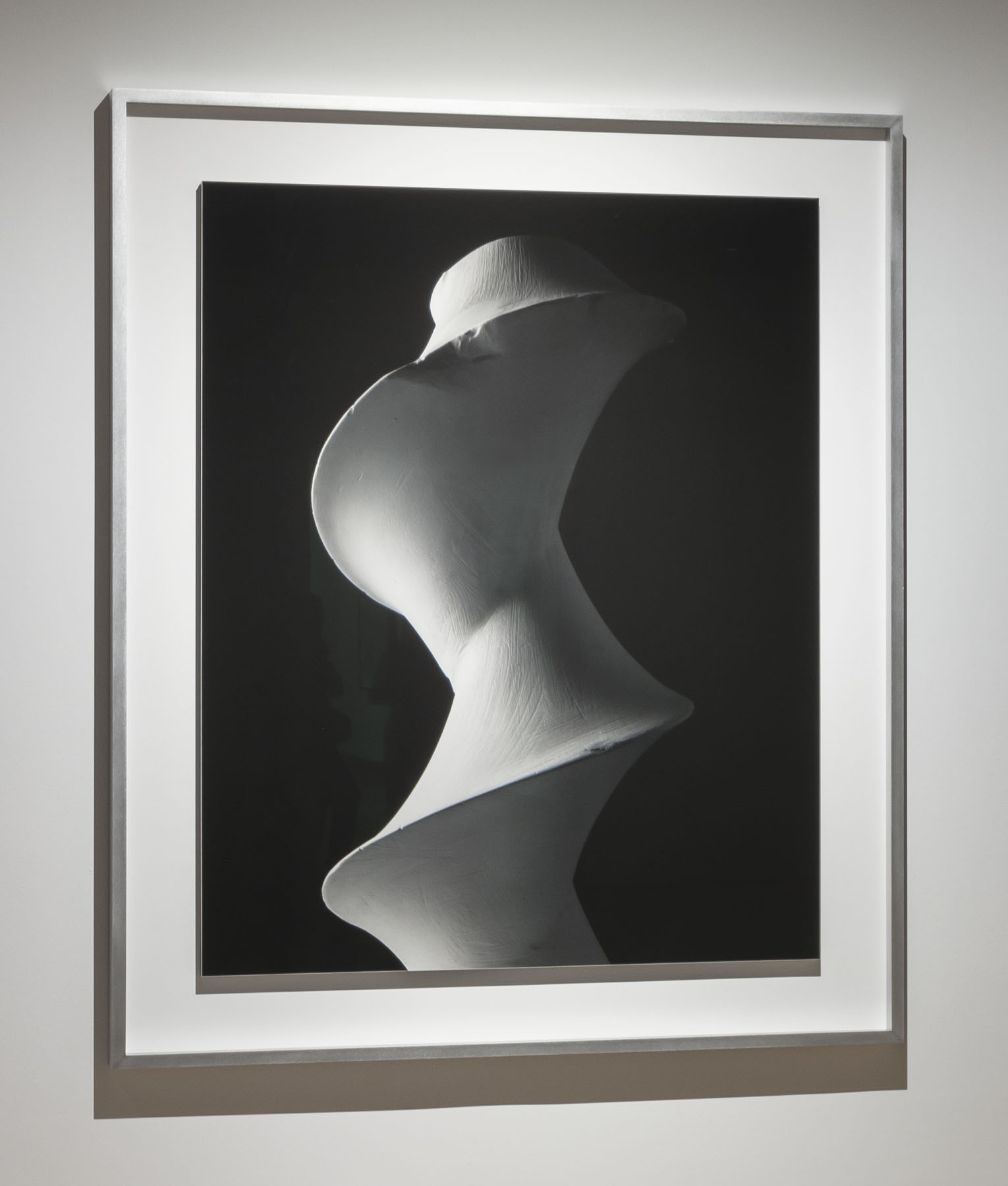
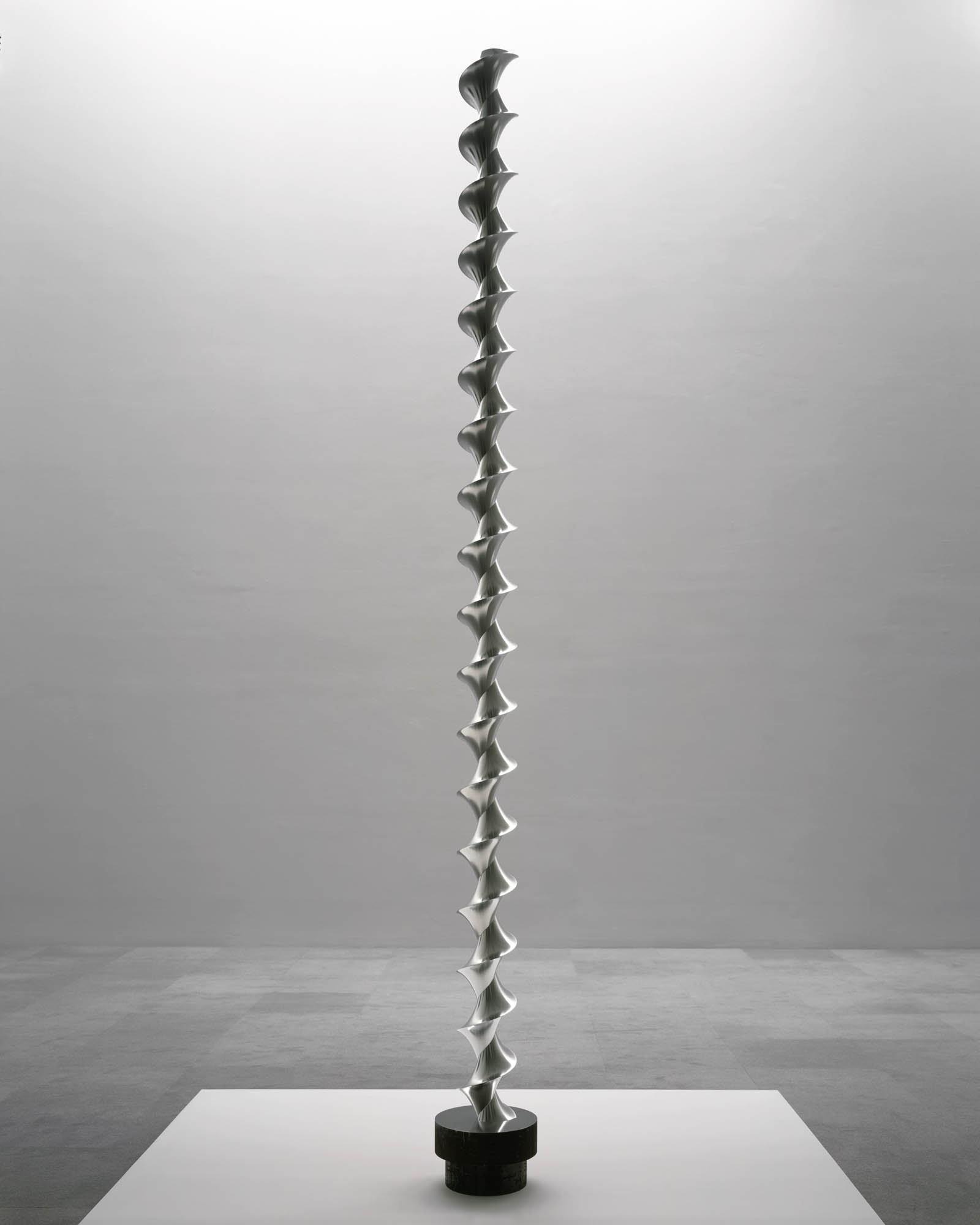
Installation view of Hiroshi Sugimoto, 'Conceptual Forms 0003 and Mathematical Model 002'


Installation view of Hiroshi Sugimoto, Conceptual Forms 0003 and Mathematical Model 002. Gelatin silver print, aluminium and steel
Photo: Mark Blower. Courtesy the artist and the Hayward Gallery


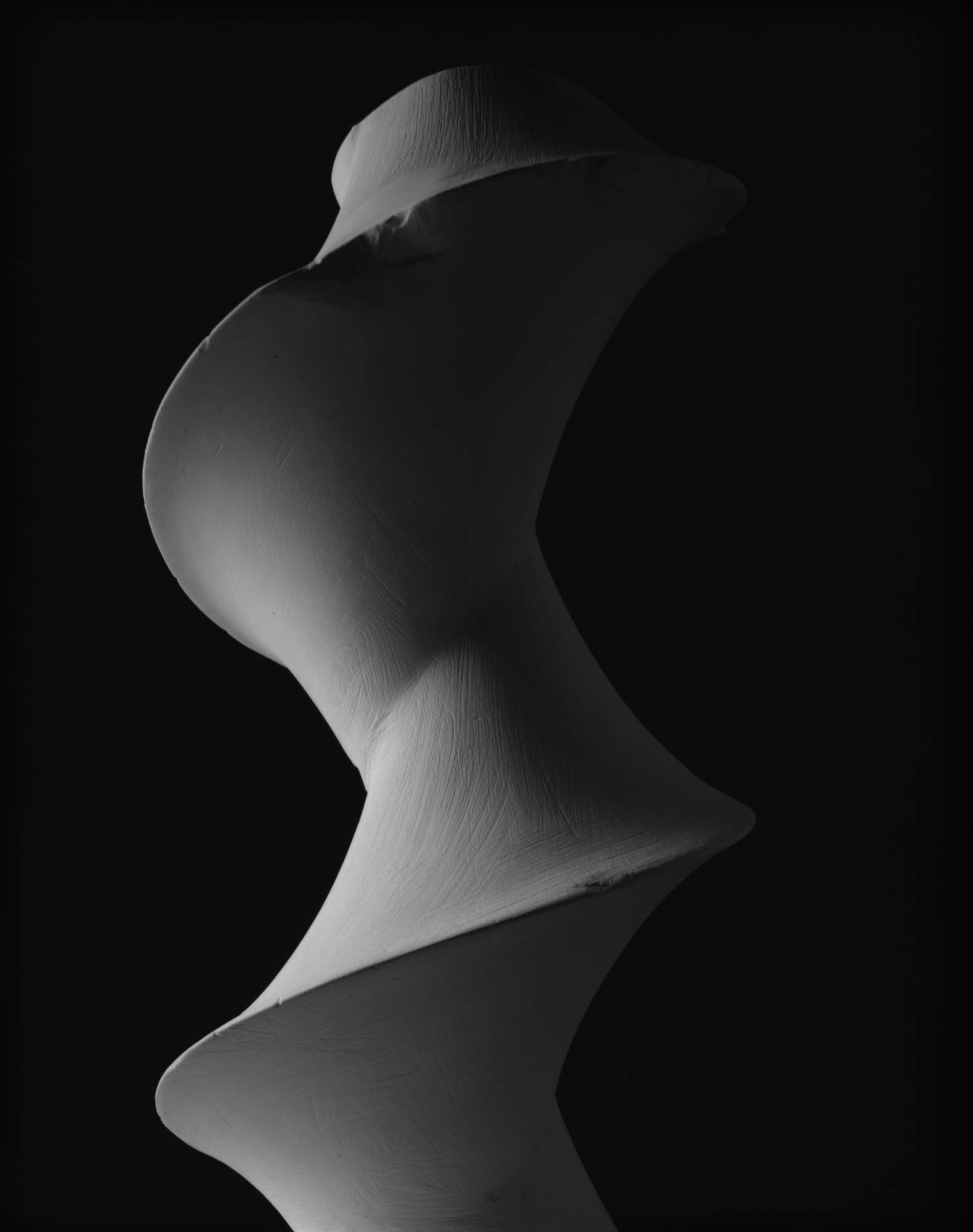
Installation view of Hiroshi Sugimoto, 'Conceptual Forms 0003' 2004


Installation view of Hiroshi Sugimoto, Conceptual Forms 0003 2004. Gelatin silver print
Photo: Mark Blower. Courtesy the artist and the Hayward Gallery


Hiroshi Sugimoto, 'Conceptual Forms 0003 Dini’s surface – a surface of constant negative curvature obtained by twisting a pseudosphere' 2004


Hiroshi Sugimoto (Japanese, b. 1948)
Conceptual Forms 0003 Dini’s surface – a surface of constant negative curvature obtained by twisting a pseudosphere
2004
Gelatin silver print
© Hiroshi Sugimoto, courtesy of the artist


Hiroshi Sugimoto (Japanese, b. 1948) 'Mathematical Model 002 Dini's Surface' 2005


Hiroshi Sugimoto (Japanese, b. 1948)
Mathematical Model 002 Dini’s Surface
2005
Aluminium and steel
© Hiroshi Sugimoto, courtesy of the artist


Installation view of Hiroshi Sugimoto, 'Conceptual Forms and Mathematical Model 006'


Installation view of Hiroshi Sugimoto, Conceptual Forms and Mathematical Model 006. Gelatin silver print, aluminium and steel
Photo: Mark Blower. Courtesy the artist and the Hayward Gallery


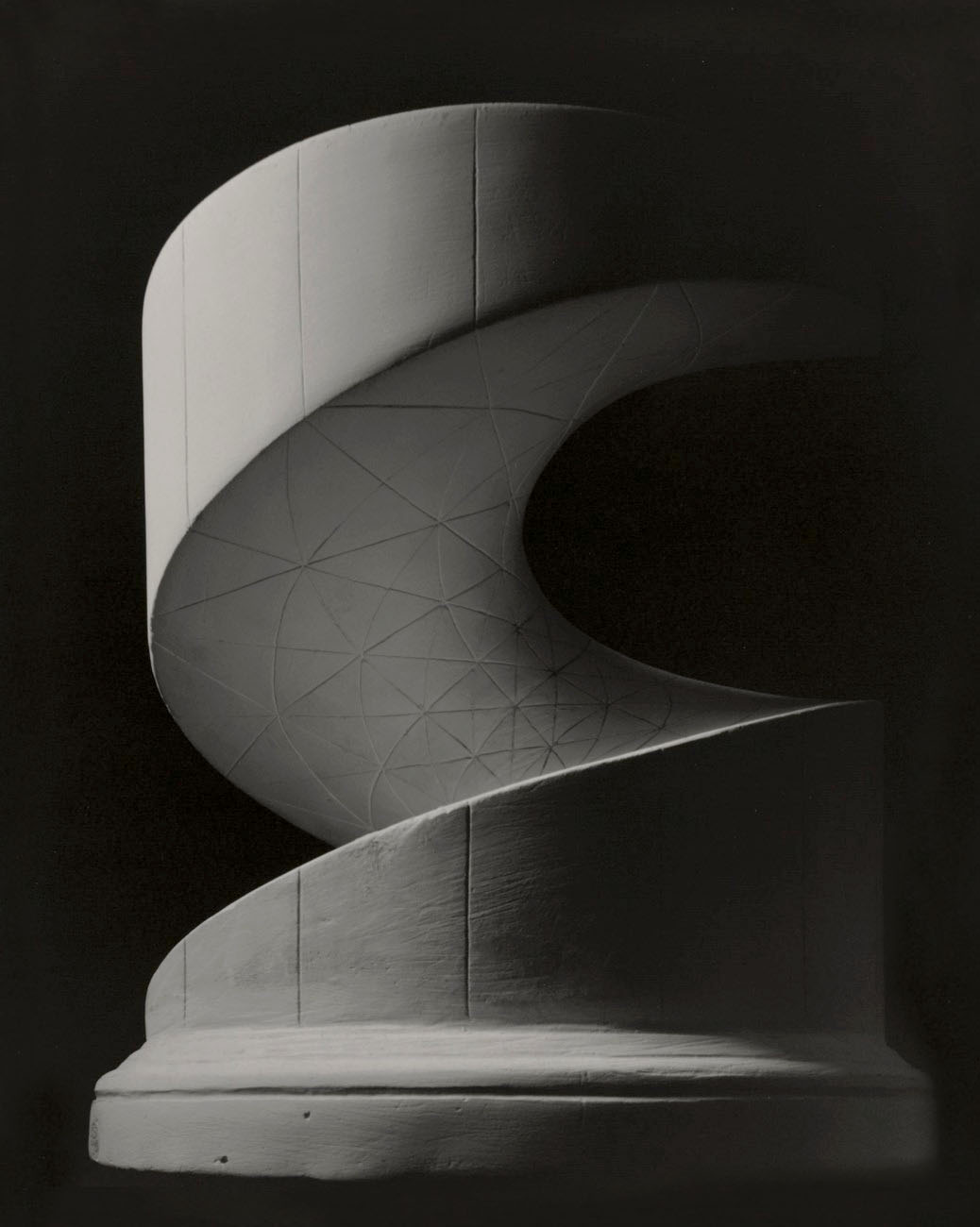
Installation view of Hiroshi Sugimoto, 'Conceptual Form Surface 0001 Helicoid: Minimal Surface' 2004


Installation view of Hiroshi Sugimoto, Conceptual Form Surface 0001 Helicoid: Minimal Surface 2004. Gelatin silver print
Photo: Mark Blower. Courtesy the artist and the Hayward Gallery


Hiroshi Sugimoto (Japanese, b. 1948) 'Conceptual Form Surface 0001 Helicoid: Minimal Surface' 2004


Hiroshi Sugimoto (Japanese, b. 1948)
Conceptual Form Surface 0001 Helicoid: Minimal Surface
2004
Gelatin silver print
© Hiroshi Sugimoto, courtesy of the artist


Hiroshi Sugimoto. Photo credit: Sugimoto Studio


Hiroshi Sugimoto
Photo credit: Sugimoto Studio


Hayward Gallery
Southbank Centre, Belvedere Road,
London SE1 8XX

Wed – Fri 10am – 6pm
Sat 10am – 8pm
Sun 10am – 6pm
Closed Monday and Tuesday

Southbank Centre website

LIKE ART BLART ON FACEBOOK

Back to top

Vale Larry Fink (American, 1941-2023)

December 2023


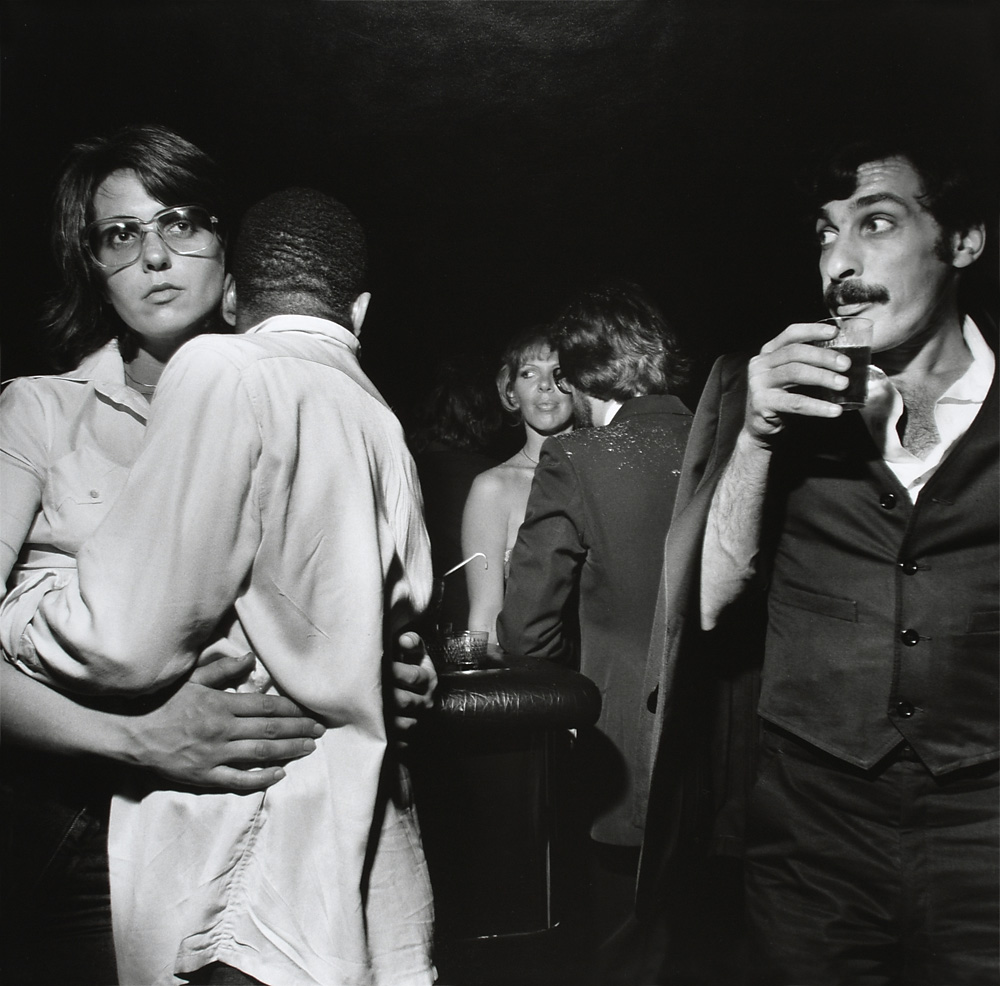
Larry Fink (American, 1941-2023) 'John Sabatine and Molly' 1980 from Vale Larry Fink (American, 1941-2023)


Larry Fink (American, 1941-2023)
John Sabatine and Molly
1980
Gelatin silver print


“To try to see more and better is not a matter of whim or curiosity or self-indulgence. To see or to perish is the very condition laid upon everything that makes up the universe, by reason of the mysterious gift of existence.”


Teilhard de Chardin, “Seeing” 1947


Being human

Another master photographer has died. We are losing so many important visionaries who were born pre-Second World War, during the war and post-war period.

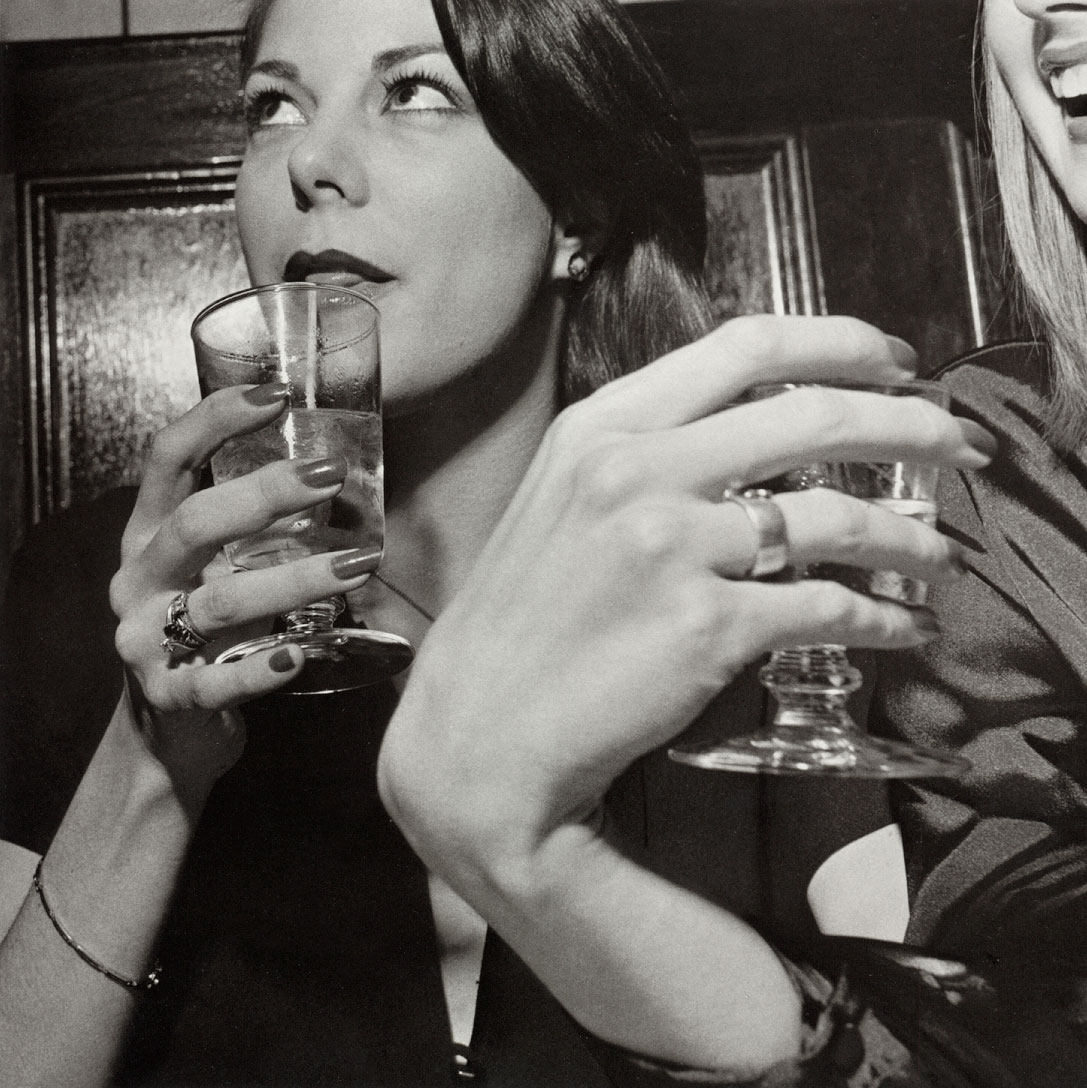
While I have sequenced this posting to highlight the dichotomy in Fink’s exploration of social class in America, that is, between the haves and the have-nots, between the hedonistic party people of Studio 54, the urban New Yorkers of “high society” and rural, working-class Pennsylvanians1 – as ever in life, Fink’s work is much more complex and nuanced than that.

Fink acknowledged that the photographs in his series “Social Graces” of New York “high society” at play were hard of heart. “I used to judge people out of the hardness of my heart. So, I went into these very voluptuous and elegant bourgeois circumstances, and I would judge these people as if they were the enemy.” That does not make these photographs any less valuable as a record of that brief moment of encounter between photographer and subject. For he observed, “The moment that we have is the only moment we will ever have, insofar as it is fleeting. Every breath counts. So does every moment and perception.”

Thus, in any of his photographs you have to admire his skill at capturing that fleeting moment: marvel at the flying pigtail in Studio 54 (1977, below) and feel the immediacy of hand gesture in Pat Sabatine’s 8th Birthday Party (1977, below) or the contemptuous look on the woman’s face in Pat Sabatine’s 11th Birthday Party (1980, below) to understand that.

In later life Fink – an empathetic human with an inquiring mind who obviously worked on his inner growth, who had acquired knowledge and a little wisdom – was aware how he had wronged himself and others during the taking of the photographs for “Social Graces”.

“When age had given me entry into life’s harder organic experiences – my back, my heart, my prostate, my hip – I started to look at my own face in the mirror and see the results of pain. I would see that many of the judgments I had made in the early days, based on an ideal sense of a physical equilibrium, were absolutely and horrendously bigoted. I was not at all sensitive to either the inner or external trappings of what it means to just be alive and all its various, vulnerable complexities.”2

With every breath he understood that when he took photographs he was attempting to touch the eternal, an expression of admiration and gratitude at being alive.

“I am involved with the idea of reaching deeply into the pulsing matter of what it means to be alive and being vulnerable and seeing if I can cast an emotional legacy about being human.”

The emotional legacy of his photographs attests to his enduring spirit.

Dr Marcus Bunyan


1/ “He paired the tales of these two worlds – the chilly anomie of the haute monde and the lively, messy domesticity of the Sabatines – in a collection of photographs he called “Social Graces,” which was first shown in an exhibition at the Metropolitan Museum of Art in 1979 and then published in a book of the same title in 1984, now considered a collector’s item.”

Penelope Green. “Larry Fink, Whose Photographs Were ‘Political, Not Polemical,’ Dies at 82,” on The New York Times website Nov. 30, 2023 [Online] Cited 02/12/2023

2/ Larry Fink quoted in Adriana Teresa. “A Moment With Larry Fink,” on The New York Times website Jan. 6, 2011 [Online] Cited 02/12/2023


Please click on the photographs for a larger version of the image.


“The goal, I suspect, through harmonies and edges and everything that we have in our command, is to take a dumb two-dimensional picture and make it something that a viewer enters and doesn’t want to leave.”


Larry Fink


“It’s about empathy. But the necessary methodology is conventionally in-your-face. Not like other practitioners, who are in your face for the sake of being in your face, I am in your face because I want to be your face. I like to say that if I was not a photographer, I would be in jail. I want to touch everything. My life is profoundly physical. Photography for me is the transformation of desire. …

I don’t like to hurt people. I go after something and I start pointing the camera at somebody, looking for those hard, edgy things I know I am going to find. My pictures will be out of bounds in terms of the convention of how this person wants to be represented. It gives me pause. I don’t feel I have the right to do that. But I do it nevertheless. After all, a picture is not a murder. It is simply a moment which suggests so many things. …

I was severely analytical when I was young, like when I was doing “Social Graces.” I was a good-looking kid. My mother was very vain, competitive and judgmental, and I took on the same characteristics as a younger person. I used to judge people out of the hardness of my heart. So, I went into these very voluptuous and elegant bourgeois circumstances, and I would judge these people as if they were the enemy. I believed the work to be analytical, in a political fashion.

When age had given me entry into life’s harder organic experiences – my back, my heart, my prostate, my hip – I started to look at my own face in the mirror and see the results of pain. I would see that many of the judgments I had made in the early days, based on an ideal sense of a physical equilibrium, were absolutely and horrendously bigoted. I was not at all sensitive to either the inner or external trappings of what it means to just be alive and all its various, vulnerable complexities. …

The moment that we have is the only moment we will ever have, insofar as it is fleeting. Every breath counts. So does every moment and perception. It’s a way to be alive. I am involved with the idea of reaching deeply into the pulsing matter of what it means to be alive and being vulnerable and seeing if I can cast an emotional legacy about being human.”


Larry Fink quoted in Adriana Teresa. “A Moment With Larry Fink,” on The New York Times website Jan. 6, 2011 [Online] Cited 02/12/2023


Larry Fink. 'Studio 54, New York City, May 1977' 1977 from Vale Larry Fink (American, 1941-2023)


Larry Fink (American, 1941-2023)
Studio 54
1977
Gelatin silver print


Larry Fink was born in Brooklyn in 1941. In the 1960s, he studied with noted photographer Lisette Model. This photograph from Studio 54, made in 1977 in the hedonistic heyday of the disco era, is a well know image from Fink’s series “Social Graces,” which explored social class in America by comparing two different worlds: that of urban New Yorkers of “high society” and that of rural, working-class Pennsylvanians through social events like birthday parties. Fink has described his approach to his subject in a straightforward, non-judgmental manner, “The one thing I was trained in being was non-hierarchical. I don’t have an internal class system. Who you are is who is in front of me and who I am in the same, and that’s how we have to relate to each other.”


Larry Fink (American, 1941-2023) Pat Sabatine's 8th Birthday Party' 1977 from Vale Larry Fink (American, 1941-2023)


Larry Fink (American, 1941-2023)
Pat Sabatine’s 8th Birthday Party
1977
Gelatin silver print


Larry Fink (American, 1941-2023) 'Russian Ball, New York City' 1976


Larry Fink (American, 1941-2023)
Russian Ball, New York City
1976
Gelatin silver print


Larry Fink (American, 1941-2023) 'Pat Sabatine's 11th Birthday Party' 1980


Larry Fink (American, 1941-2023)
Pat Sabatine’s 11th Birthday Party
1980
Gelatin silver print


Larry Fink (American, 1941-2023) 'Benefit, MoMA, New York' 1977


Larry Fink (American, 1941-2023)
Benefit, MoMA, New York
1977
Gelatin silver print


Larry Fink, a kinetic photographer whose intimate black-and-white on-the-fly portraits of rural Pennsylvanians, Manhattan society figures, Hollywood royalty, boxers, musicians, fashion models and many others were both social commentary on class and privilege and an exuberant document of the human condition, died on Saturday at his home in Martins Creek, Pa. He was 82. …

… in the early 1970s he turned to overt social commentary, infiltrating the society benefits, debutante parties and watering holes of Manhattan’s privileged tribes and their hangers-on. He was fueled, he once wrote, both by curiosity and by his own rage at the privileged class – “its abuses, voluptuous folds, and unfulfilled lives.”

A few years later, he and his wife at the time, the painter Joan Snyder, moved to a farm in Pennsylvania, where he began photographing his rural neighbors, a charismatic family called the Sabatines who embraced him as one of their own. He went on to capture years’ worth of the family’s baptisms, birthdays and graduations.

He paired the tales of these two worlds — the chilly anomie of the haute monde and the lively, messy domesticity of the Sabatines – in a collection of photographs he called “Social Graces,” which was first shown in an exhibition at the Metropolitan Museum of Art in 1979 and then published in a book of the same title in 1984, now considered a collector’s item.

“Social Graces” placed Mr. Fink firmly in the photographic canon. It drew comparisons to the street photos of Weegee and Diane Arbus and even to the paintings of Caravaggio. (Mr. Fink was a master of shadow and light.) When the pictures were shown in 2001 at the Yancey Richardson gallery in Manhattan’s Chelsea section, Ken Johnson, writing in The New York Times, described them as “wonderfully absorbing, funny, skewed, ethereally glowing documents of human situations.”

Penelope Green. “Larry Fink, Whose Photographs Were ‘Political, Not Polemical,’ Dies at 82,” on The New York Times website Nov. 30, 2023 [Online] Cited 02/12/2023


Larry Fink (American, 1941-2023) 'Skating Rink' 1980


Larry Fink (American, 1941-2023)
Skating Rink
1980
Gelatin silver print


Larry Fink (American, 1941-2023) 'Studio 54, New York City' May 1977


Larry Fink (American, 1941-2023)
Studio 54, New York City
May 1977
Gelatin silver print


Larry Fink (American, 1941-2023) 'Oslin's Graduation Party' 1977


Larry Fink (American, 1941-2023)
Oslin’s Graduation Party
1977
Gelatin silver print


Larry Fink (American, 1941-2023) 'N.Y.C. Club Cornich', from the portfolio '82 Photographs 1974 to 1982' 1977; printed 1983


Larry Fink (American, 1941-2023)
N.Y.C. Club Cornich
1977, printed 1983
From the portfolio 82 Photographs 1974 to 1982
Gelatin silver print


Larry Fink (American, 1941-2023) 'Melzer Family Picnic, Eastport, Long Island, New York' June 2002


Larry Fink (American, 1941-2023)
Melzer Family Picnic, Eastport, Long Island, New York
June 2002
Gelatin silver print


Larry Fink (b. 1941) 'Peter Beard's, East Hampton', from the portfolio '82 Photographs 1974 to 1982' 1982; printed 1983


Larry Fink (American, 1941-2023)
Peter Beard’s, East Hampton
1982, printed 1983
From the portfolio 82 Photographs 1974 to 1982
Gelatin silver print


Larry Fink (American, 1941-2023) 'Jean Sabatine and Molly' 1983


Larry Fink (American, 1941-2023)
Jean Sabatine and Molly
1983
Gelatin silver print


Larry Fink (American, 1941-2023) 'Benefit, Corcoran Museum, Washington DC' 1975


Larry Fink (American, 1941-2023)
Benefit, Corcoran Museum, Washington DC
1975
Gelatin silver print


LIKE ART BLART ON FACEBOOK

Back to top

Vale Elliott Erwitt (1928-2023)

December 2023


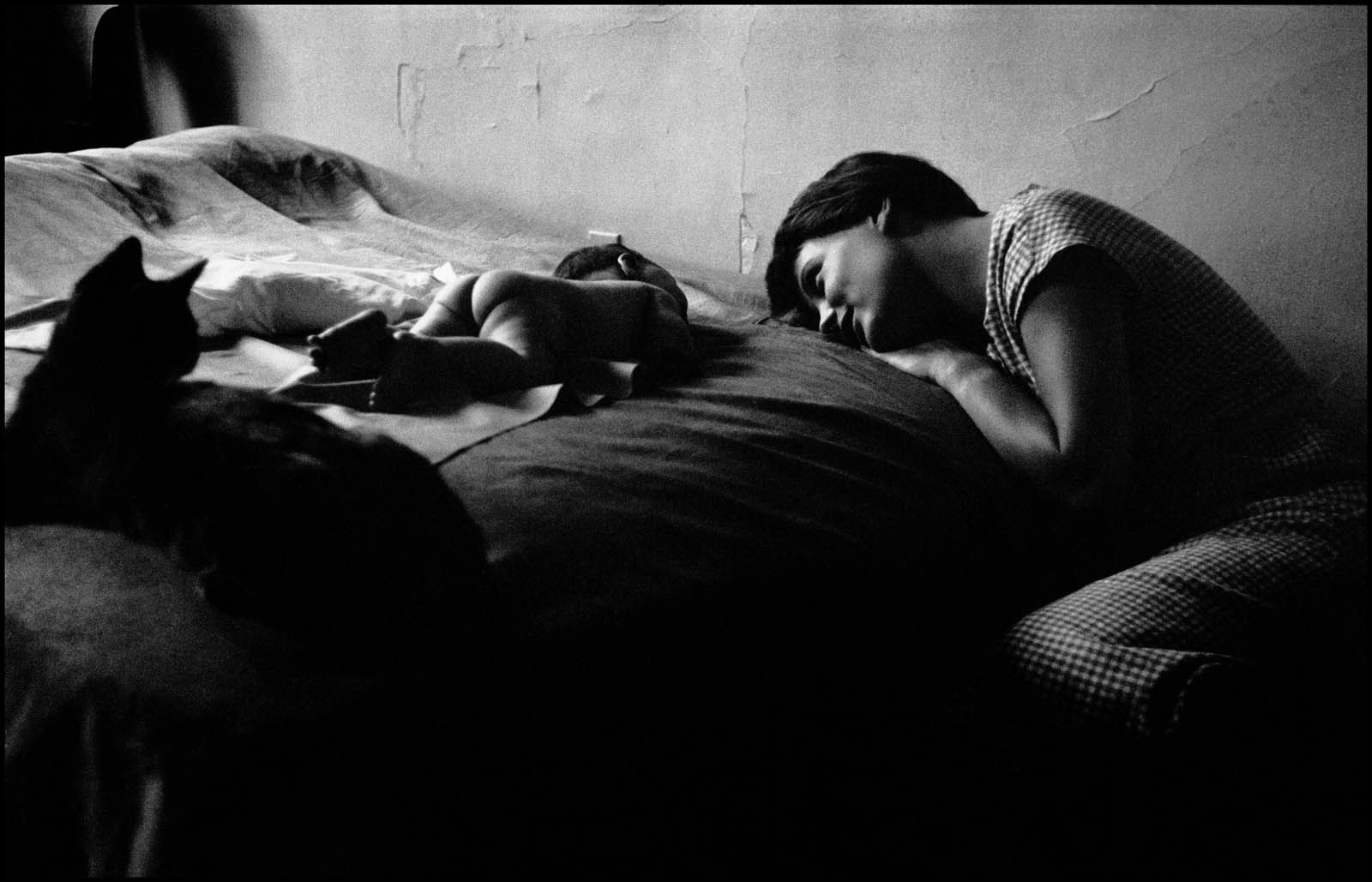
Elliott Erwitt (American born France, 1928-2023) 'New York City' 1955 from Vale Elliott Erwitt (1928-2023)


Elliott Erwitt (American born France, 1928-2023)
New York City
1955
Gelatin silver print


The essence of what happens

Elliott Erwitt’s “art of observation” is a gift of the eye and the mind, where the artist must be truly aware of the world around them in order to capture the mosaic of reality.

Look at the photograph Jackie Kennedy, Arlington, Virginia (1963, below). Observe the split second that particular look of despair was present on Jackie’s face. And there was Erwitt fully aware, in the moment, with his gift of the eye and the mind – and he knew, he absolutely knew that was the moment to take the photograph.

As with much of his work it is the subtle cadences within the image that create their emotional power and magic: sadness, happiness, whimsy, comedy, anger, loneliness, joy – all captured through the reality of the visual language of the image, fully acknowledged in the heart and the mind of the viewer when they imbibe (absorb the ideas) of their spirit.

Dr Marcus Bunyan

Please click on the photographs for a larger version of the image.


“The work I care about is terribly simple … I observe, I try to entertain, but above all I want pictures that are emotion.”


Elliott Erwitt. Personal Exposures. W. W. Norton & Company, 1988


“You either see, or you don’t see.”

“You can take a picture of the most wonderful situation and it’s lifeless, nothing comes through… Then you can take a picture of nothing, of someone scratching his nose, and it turns out to be a great picture.”

“The whole point of taking pictures is so that you don’t have to explain things with words. To me, photography is an art of observation. It’s about finding something interesting in an ordinary place… I’ve found it has little to do with the things you see and everything to do with the way you see them.”

“All the technique in the world doesn’t compensate for the inability to notice.”


Elliott Erwitt


Elliott Erwitt (American born France, 1928-2023) 'Pasadena, California, USA' Nd from Vale Elliott Erwitt (1928-2023)


Elliott Erwitt (American born France, 1928-2023)
Pasadena, California, USA
Nd
Gelatin silver print


Elliott Erwitt (American born France, 1928-2023) 'USA. California. Berkeley' 1956 from Vale Elliott Erwitt (1928-2023)


Elliott Erwitt (American born France, 1928-2023)
USA. California. Berkeley
1956
Gelatin silver print


Photographers with a comic outlook on life seldom win the acclaim granted to exalters of nature or chroniclers of war and squalor. Elliott Erwitt, who died at 95 on Wednesday at his home in Manhattan, was an exception.

For more than six decades he used his camera to tell visual jokes, finding material wherever he strolled. His sharp eye for silly, sometimes telling conjunctions – a dog lying on its back in a cemetery, a glowing Coca-Cola machine amid a public display of missiles in Alabama, a mangy potted plant in a tacky Miami Beach ballroom – earned him constant assignments as well as the affection of a public that shared his sweet, Chaplin-esque sense of the absurd.

Richard B. Woodward. “Elliott Erwitt, Whose Photos Are Famous, and Often Funny, Dies at 95,” on The New York Times website Nov. 30, 2023 [Online] Cited 03/12/2023


Elliott Erwitt (American born France, 1928-2023) 'USA. New York, New York' 1953 from Vale Elliott Erwitt (1928-2023)


Elliott Erwitt (American born France, 1928-2023)
USA. New York, New York
1953
Gelatin silver print


Elliott Erwitt (American born France, 1928-2023) 'Felix, Gladys and Rover (New York, USA)' New York City, 1974


Elliott Erwitt (American born France, 1928-2023)
Felix, Gladys and Rover (New York, USA)
New York City, 1974
Gelatin silver print


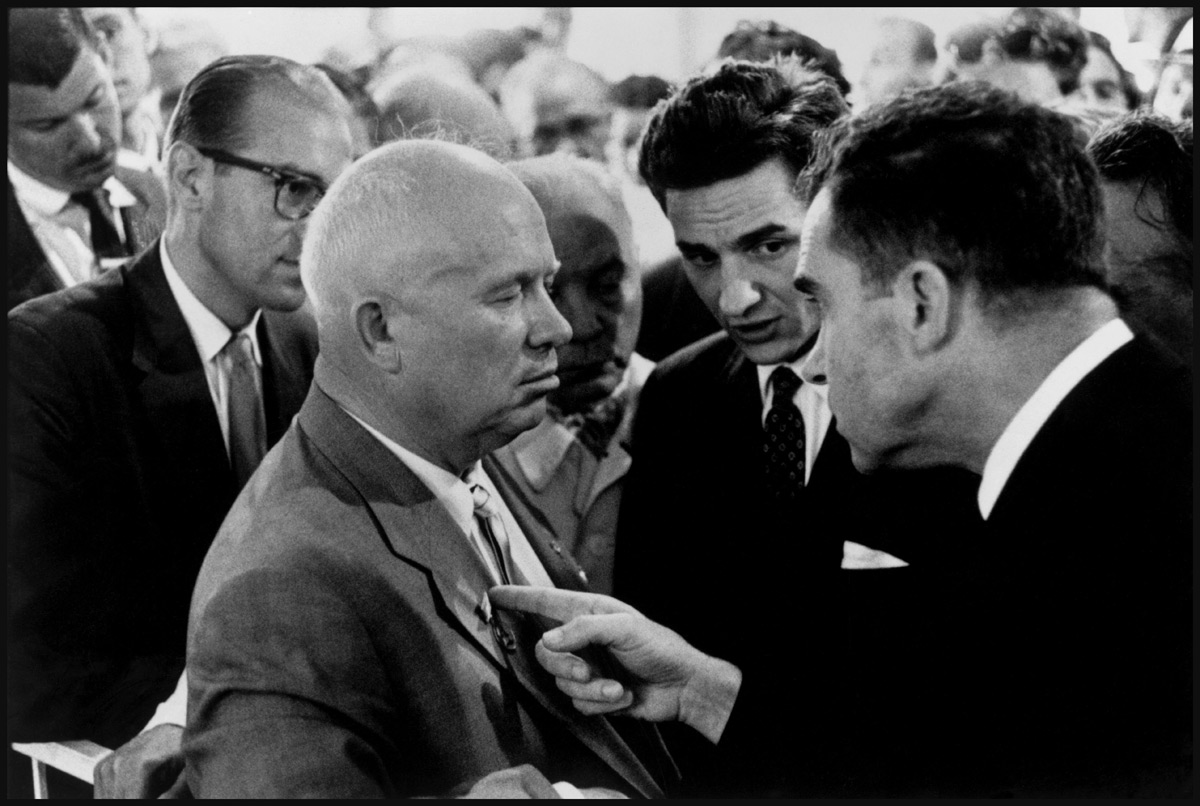
Elliott Erwitt (American born France, 1928-2023) 'Moscow, USSR' 1959


Elliott Erwitt (American born France, 1928-2023)
Moscow, USSR
1959
Gelatin silver print


Elliott Erwitt (American born France, 1928-2023) 'Jackie Kennedy, Arlington, Virginia' 1963. © Elliott Erwitt/MAGNUM PHOTOS


Elliott Erwitt (American born France, 1928-2023)
Jackie Kennedy, Arlington, Virginia
1963
Gelatin silver print


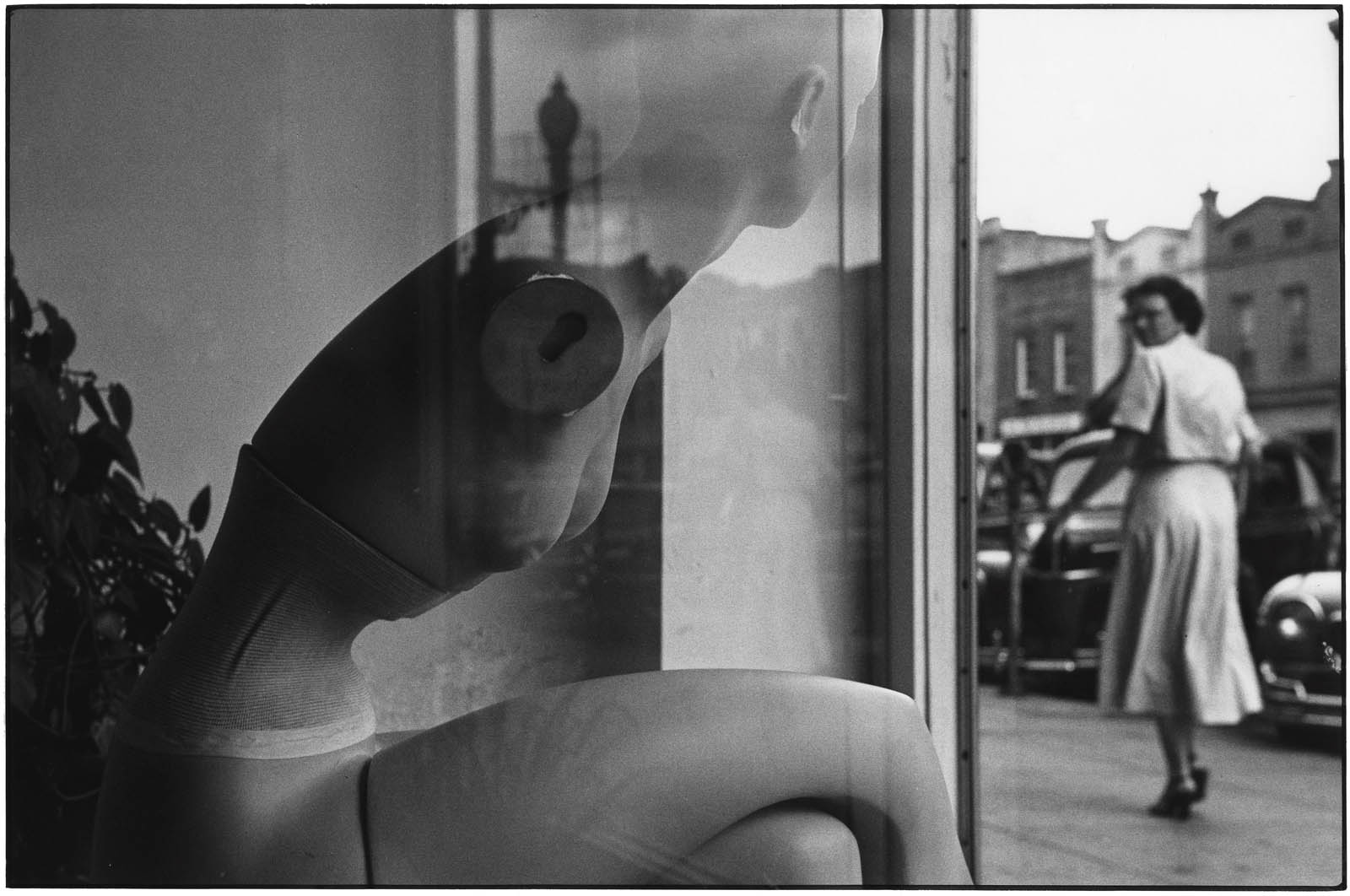
Elliott Erwitt (American born France, 1928-2023) 'Wilmington, North Carolina' 1950


Elliott Erwitt (American born France, 1928-2023)
Wilmington, North Carolina
1950
Gelatin silver print


Elliott Erwitt (American born France, 1928-2023) 'Paris, France' 1989


Elliott Erwitt (American born France, 1928-2023)
Paris, France
1989
Gelatin silver print


Elliott Erwitt (American born France, 1928-2023) 'USA. New York City' 1988


Elliott Erwitt (American born France, 1928-2023)
USA. New York City
1988
Gelatin silver print


Elliott Erwitt (American born France, 1928-2023) 'Pittsburgh, USA' 1950


Elliott Erwitt (American born France, 1928-2023)
Pittsburgh, USA
1950
Gelatin silver print


Elliott Erwitt (American born France, 1928-2023) 'Brazil. Buzios' 1990


Elliott Erwitt (American born France, 1928-2023)
Brazil. Buzios
1990
Gelatin silver print


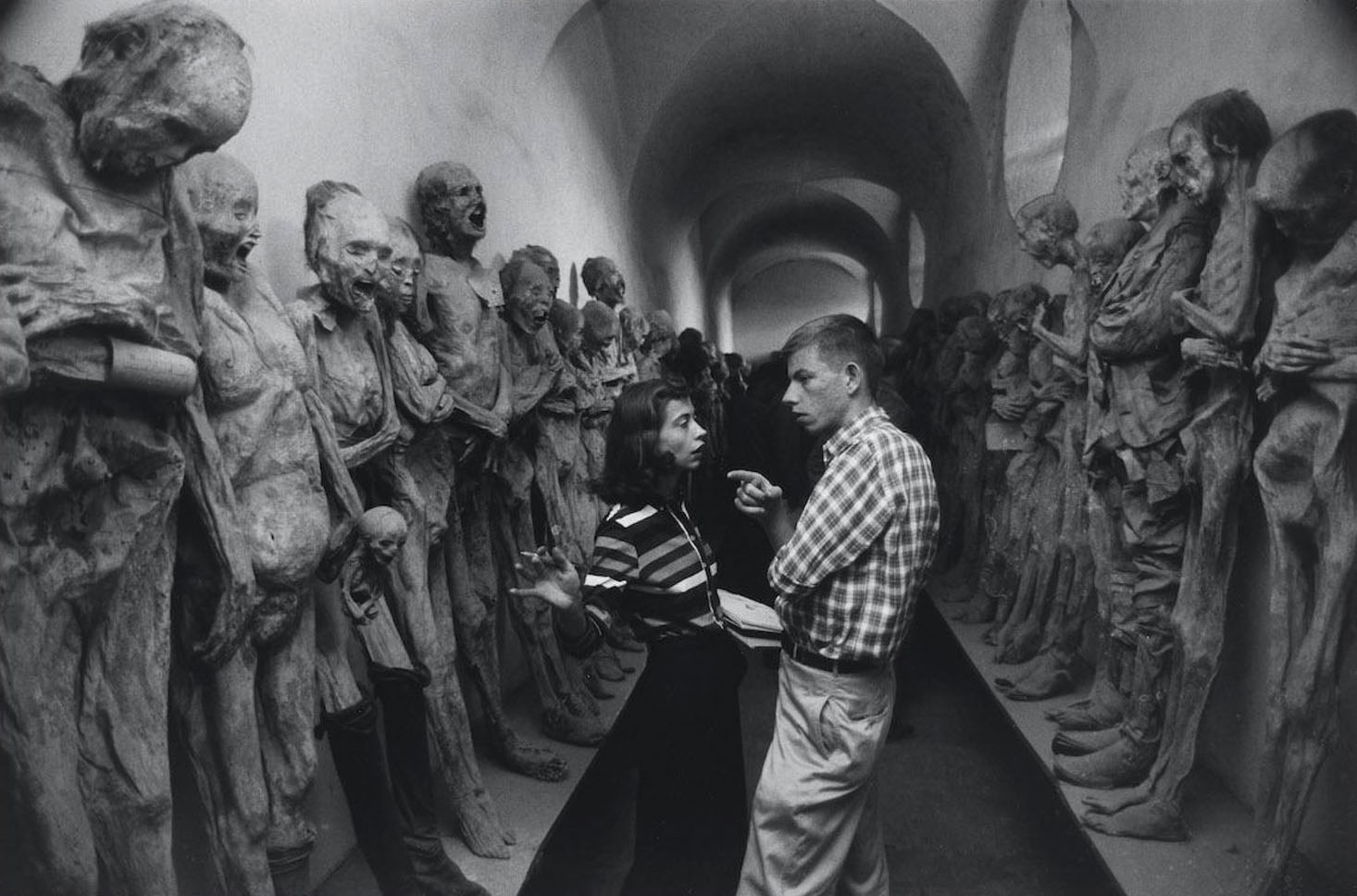
Elliott Erwitt (American born France, 1928-2023) 'Guanajuato, Mexico' 1957


Elliott Erwitt (American born France, 1928-2023)
Guanajuato, Mexico
1957
Gelatin silver print


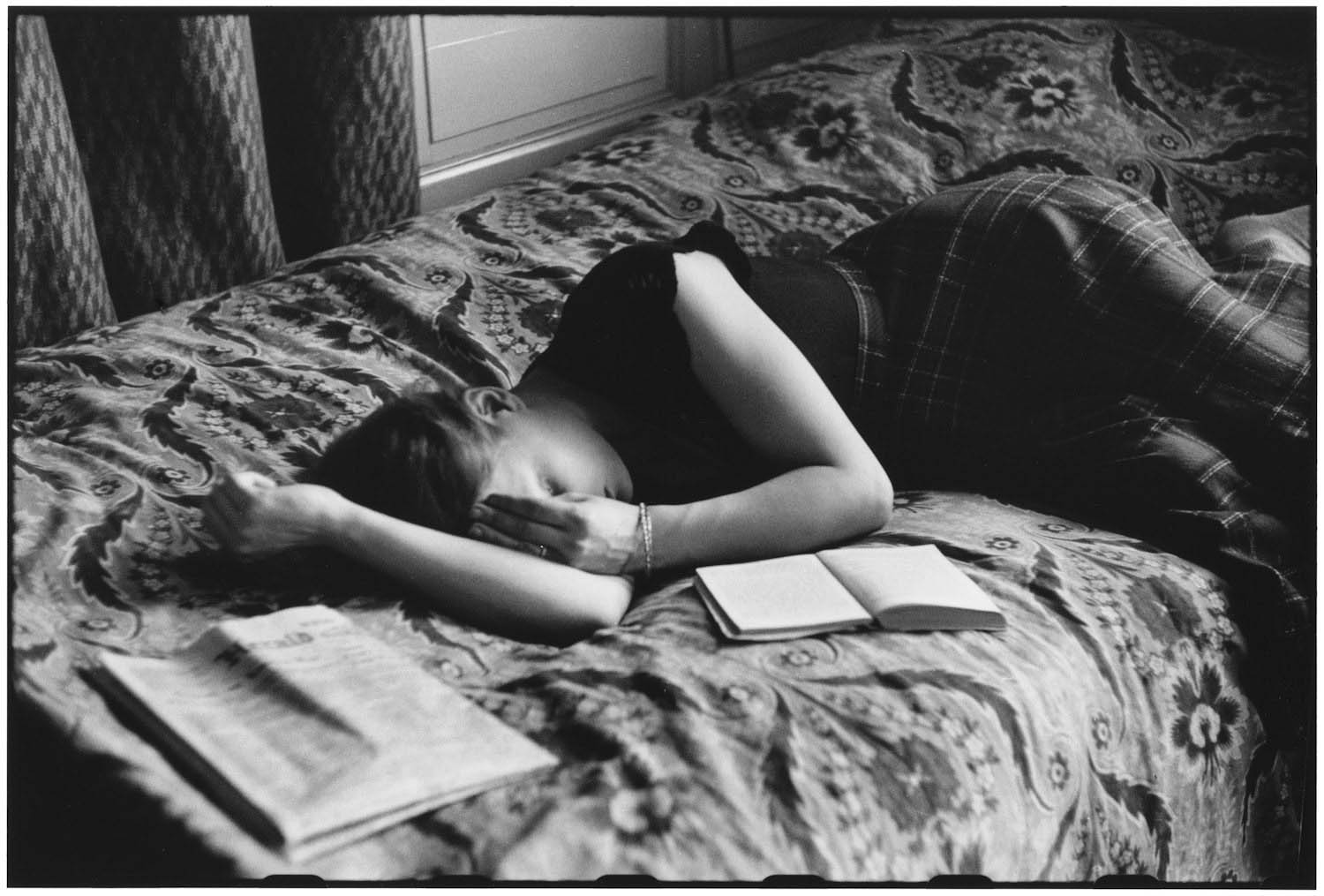
Elliott Erwitt (American born France, 1928-2023) 'France, Paris, Lucienne Van Kan' 1952


Elliott Erwitt (American born France, 1928-2023)
France, Paris, Lucienne Van Kan
1952
Gelatin silver print


Elliott Erwitt (American born France, 1928-2023) 'Fort Dix, USA' 1951


Elliott Erwitt (American born France, 1928-2023)
Fort Dix, USA
1951
Gelatin silver print


Elliott Erwitt (American born France, 1928-2023) 'Bakersfield, USA' 1983


Elliott Erwitt (American born France, 1928-2023)
Bakersfield, USA
1983
Gelatin silver print


Elliott Erwitt (American born France, 1928-2023) 'Bal, Paris, France' 1967


Elliott Erwitt (American born France, 1928-2023)
Bal, Paris, France
1967
Gelatin silver print


Elliott Erwitt (American born France, 1928-2023) 'Spain, Valencia' 1952


Elliott Erwitt (American born France, 1928-2023)
Spain, Valencia
1952
Gelatin silver print


Elliott Erwitt (American born France, 1928-2023) 'Huntsville, Alabama' 1974


Elliott Erwitt (American born France, 1928-2023)
Huntsville, Alabama
1974
Gelatin silver print


LIKE ART BLART ON FACEBOOK

Back to top

Festival and exhibitions: ‘What Makes Us Human? Image in the Age of A.I.’ at the PhotoVogue Festival, BASE Milano, Milan

Exhibition dates: 16th – 19th November, 2023


Kriss Munsya (Belgium born Democratic Republic of Congo) 'Dark Paradise' 2022


Kriss Munsya (Belgium born Democratic Republic of Congo)
Dark Paradise
2022
From the series Genetic Bomb
©
Kriss Munsya


It’s all in a label…

Some quotations on beauty which you may find illuminating:


“Beauty changes quickly, much as the landscape constantly changes with the position of the sun.”


Auguste Rodin


“It is certainly not true that there is in the mind of many any universal standard of beauty with respect to the human body.”


Charles Darwin, “The Origin of Species by Means of Natural Selection. The Descent of Man and Selection in Relation to Sex,” in Great Books of the Western World: 49, Darwin, Encyclopedia Britannica, Chicago, 1952 quoted in Elaine Hatfield and Susan Sprecher, Mirror, Mirror: The Importance of Looks in Everyday Life, State University of New York Press, Albany, 1986, p. 4.


“Beauty is not instantly and instinctively recognisable: we must be trained from childhood to make those discriminations. Nor can we assume an objective and quantifiable standard of beauty against which everyone could be judged with equal fairness …”

“Beauty becomes, like money, externalised, a possession, one that, like money, can be lost. But it is different from money, for it must be lost, sooner of later.”


Robin Lakoff and Raquel Scherr, Face Value: The Politics of Beauty, Routledge and Kegan Paul, Boston, 1984, p. 30, p. 34.


“‘Photogeneity’ is the camera’s contribution to the language of beauty. Suddenly, beauty begins to be judged in new terms… Photographic reproduction helped to make beauty big business… The success of photographically reproduced beauty depended primarily on its popular consumption. Beauty became a collective experience. And consumerism and the camera became bedfellows.

Magazines and movies felt the immediate benefits of photographic reproduction. Audiences were captivated by what they saw… Suddenly, places, objects, people, situations that had once seemed inaccessible became familiar. But at the core remained a paradox which would with time become troublesome. Photographic reproduction seemed to make things familiar, yet they remained remote. It promised intimacy, yet kept the images themselves untouchable, impersonal. In short, it offered the impossible under the guise of the possible. And so it was with beauty which, now turned professional found these media as its new arena, the place where it could best advertise itself.”


Robin Lakoff and Raquel Scherr, Face Value: The Politics of Beauty, Routledge and Kegan Paul, Boston, 1984, pp. 74-75.


“It is not so much that we have to develop a ‘new style’ of beauty … We have to transcend, in the first place, dependence on ‘style’: for as long as we worry about the current fashion in beauty, not only must we worry about ourselves as individuals and how well we fare, individual to individual; but we also become dependent upon the whims of tastemakers beyond our acquaintance, forces we cannot see or touch, and that help to create our confusion…”


Robin Lakoff and Raquel Scherr, Face Value: The Politics of Beauty, Routledge and Kegan Paul, Boston, 1984, p. 283.


“Ideal beauty is ideal because it does not exist; the action lies in the gap between desire and gratification… The beauty myth moves for men as a mirage; its power lies in its ever-receding nature. When the gap is closed, the lover embraces his own disillusion. The myth actually undermines sexual attraction. Attraction is a dialogue… that depends on the unique qualities, memories, patterns of desire, of the two people involved; “beauty” is generic. Attraction is about a sexual fit: two people imagining how they will work together.

“Beauty” is only a visual, more real on film or in stone than in three living dimensions. The visual is the sense monopolised by the advertisers, who can manipulate it much better than mere human beings. But with other senses, advertising is at a disadvantage: Humans can smell, taste, touch, and sound far better than in an advertisement. So humans, in order to become dependable, sexually insecure consumers, had to be trained away from these other, more sensual senses. One needs distance, even in the bedroom, to get a really good look … “Beauty” leaves out smell, physical response, sounds, rhythm, chemistry, texture, fit, in favour of a portrait on the pillow.

The shape and weight and texture and feel of bodies is crucial to pleasure but the appealing body will not be identical… The world of attraction grows blander and colder as everyone, first women and soon men, begin to look alike. People loose one another as more masks are assumed.”


Wolf, Naomi. The Beauty Myth. London: Vintage, 1991, pp. 176-177.


Dr Marcus Bunyan


Many thankx to PhotoVogue Festival for allowing me to publish the photographs in the posting. Please click on the photographs for a larger version of the image.


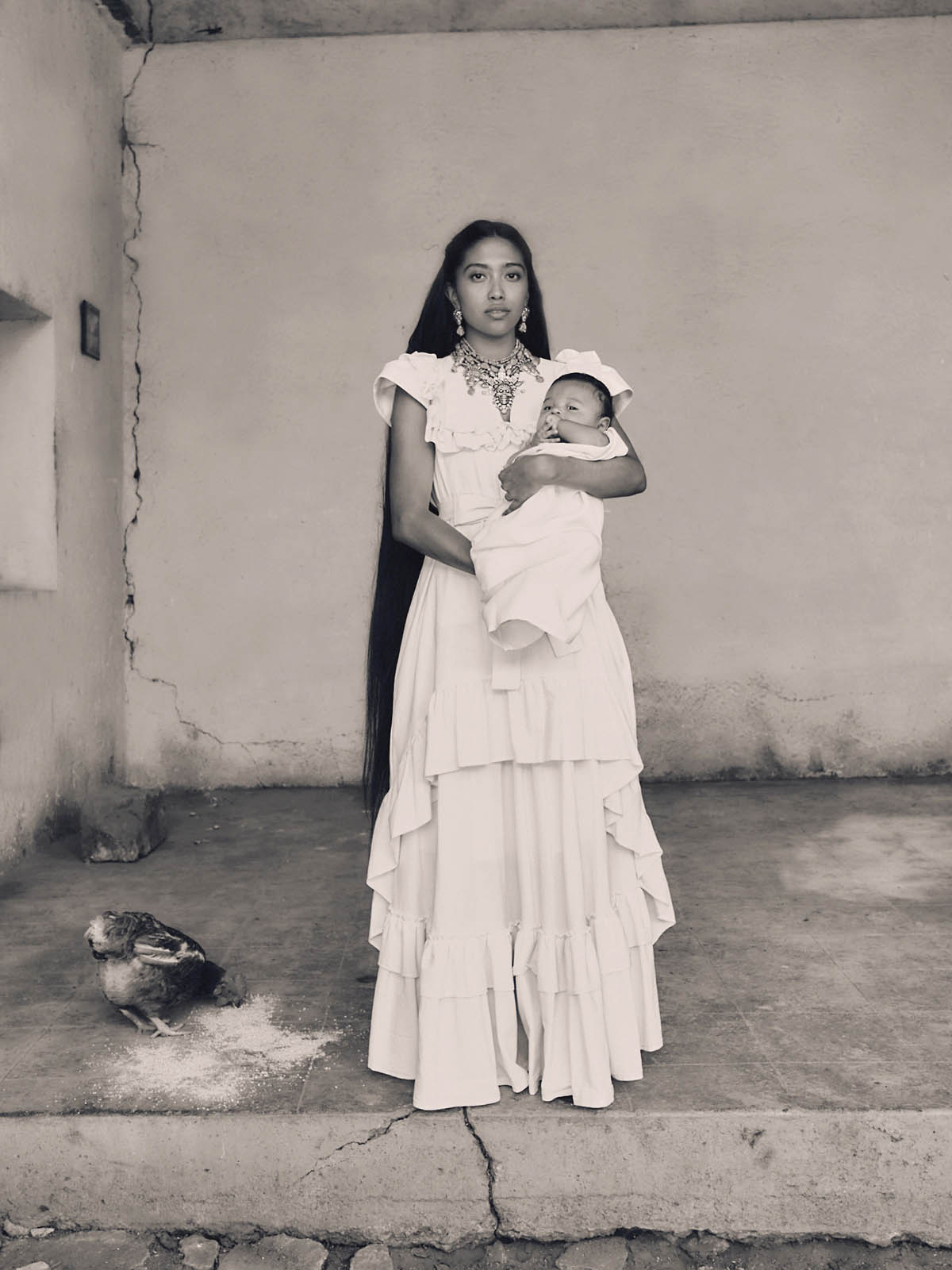
Enrique Leyva (Mexican, b. 1996) 'Madre e hijo' (Mother and son) Nd


Enrique Leyva (Mexican, b. 1996)
Madre e hijo (Mother and son)
Nd
© Enrique Leyva


The PhotoVogue Festival, the first conscious fashion photography festival that focuses on the common ground between ethics and aesthetics, returns for its eighth edition. From November 16 to 19, 2023, BASE Milano will host a series of exhibitions and a three-day symposium examining the profound impact of artificial intelligence (A.I.) on human existence and the creation of images, complemented by satellite events at the city’s finest galleries. Embracing the digital era, the festival also offers online portfolio reviews and panel discussions on the PhotoVogue platform and it will give the opportunity to students from CondéFuture – a program led by Condé Nast community talent that targets high school students from underrepresented communities – to showcase some of their photography and video pieces. Last year’s edition was a great success: about 10 thousand people visited the exhibitions and attended the talks.

At the core of the new edition will be a three-day symposium, featuring a distinguished lineup of experts and thought leaders at the forefront of the A.I. revolution. This symposium aims to comprehensively address all aspects of AI around the creation of images, delving into the legal implications, copyright issues, biases, and the potential threat to the documentary value of photography. Moreover, discussions will extend to exploring how governments should act, gaining insights from big tech’s perspectives, and examining practices in place to mitigate potential threats.

Beyond the technicalities, the symposium will also embark on profound philosophical inquiries about what makes us human. It will explore the marvels of creativity that arise when art is liberated from the constraints of the real. This intellectually enriching journey promises to unveil the complexities and possibilities that AI presents to the world of visual representation, prompting us to reflect on the future of human creativity and expression.

PhotoVogue Festival is a project directed by Alessia Glaviano (Head of Global PhotoVogue) and co-curated by Francesca Marani (Senior Photo Editor, Vogue Italia) Chiara Bardelli Nonino (Editor, Writer and Curator), Daniel Rodríguez Gordillo (Content Operations & Strategy Manager, Condé Nast) and Caterina De Biasio (Visual Editor, PhotoVogue)

Since its inception, the PhotoVogue Festival has been dedicated to exploring ethically and aesthetically crucial themes, ranging from the female gaze to inclusivity and masculinity. Building on last year’s exploration of how the ubiquity of images influences our understanding of experiences and reactions to events, the upcoming PhotoVogue Festival in Milan will take a deep dive into the profound impact of artificial intelligence (A.I.) on human existence and the creation of images.

“Our intention is to address the ethical, aesthetic, and political implications raised by this revolutionary technology. Together, we will explore A.I.’s potential for reshaping our understanding of creativity, human existence, and the very essence of how we communicate and convey our visions to the world” ~ Alessia Glaviano, Head of Global PhotoVogue and Director of PhotoVogue Festival


Exhibitions

What Is Beauty

Throughout its past Open Calls, PhotoVogue festival has celebrated the female gaze, searched for the next great fashion image makers, highlighted diversity behind and in front of the camera, explored masculinity, reframed history, and consistently challenged stereotypes, clichés, and homogeneous representations. Continuing its journey dedicated to shaping a more just and inclusive society through visual literacy, PhotoVogue invited artists from around the world to submit work that challenges the traditional notions of beauty.

As cultural shifts unfold across the globe, so must the very idea of beauty evolve. We break free from the constraints of gender, perfection, and homogeneity, recognising that beauty cannot be confined to pass-fail tests based on antiquated norms. Instead, it becomes a boundless and ever-evolving concept, liberated from the tired stereotypes that once dominated our cultural landscape. Never before has artistic expression been more diversified, and representation more far-reaching.

The exhibition on display at BASE features work by 40 artists from 24 countries, selected by a jury comprising Condé Nast staff from across the globe and experts from the international visual community.

Artists featured: Amy Woodward | Ana María Arévalo Gosen | Andras Ladocsi | Avijit Halder | Avion Pearce | Bettina Pittaluga | Chiron Duong | Clara Belleville | Claudia Revidat | Enrique Leyva | Francesca Bergamini | Gabo Caruso | Hayley Lohn | Imraan Christian | Irina Werning | Jaimy Gail | Jara García Azor and Lucía Lomas | Jean-Claude Moschetti | Jess T. Dugan | Jude Lartey | Julia Cybularz | Kate Biel | Katerina Tsakiri | Kriss Munsya | Kristina Rozhkova | Leslie Fratkin | Luisa Dörr | Lumi Tuomi | Marina Adam | Mauricio Holc | Omar Khaleel | Ruiqi Zhang | Sarfo Emmanuel Annor | Silvana Trevale | Tara Laure Claire | Togo Yeye | Yao Yuan | Yongbin Park | Zahui Yvann | Ziyu Wang


Togo Yeye. 'Simélan (Fish from the water)' 2023


Togo Yeye
Simélan (Fish from the water)
2023
© Togo Yeye


Togo Yeye is a conceptual publication by two friends – London-based photographer and Nataal art director Delali Ayivi and Lomé-based fashion activist Malaika Nabillah. Created for Ayivi’s graduate project at London College of Fashion, she and Nabillah set out to champion Togo’s young fashion creatives, contribute to debates around defining an authentic contemporary identity for the country and dream of its fantastic future.


Amy Woodward (Australian) 'Eb, 25 weeks pregnant, post mastectomy' Nd


Amy Woodward (Australian)
Eb, 25 weeks pregnant, post mastectomy
Nd
© Amy Woodward


Eb proudly shows her post-mastectomy flat closure. She chooses not to wear a prosthesis in everyday life because she feels no less of a woman without breasts. She is proud to model this for her 16-year-old daughter. Eb was told that she and her husband would not be able to conceive without IVF, but much to their surprise, she became pregnant in 2021 with her son, Arlo.


Chiron Duong (Vietnamese, b. 1996) 'If I were a mangrove tree, I will rebirth on the sweet land' Nd


Chiron Duong (Vietnamese, b. 1996)
If I were a mangrove tree, I will rebirth on the sweet land
Nd
© Chiron Duong


Mauricio Holc (Argentinian) "Alex" from the project 'Ser Libre' (Be Free) Nd


Mauricio Holc (Argentinian)
“Alex” from the project Ser Libre (Be Free)
Nd
© Mauricio Holc


Kate Biel (American) 'Jessica and a Dollhouse' 2021


Kate Biel (American)
Jessica and a Dollhouse
2021
© Kate Biel


Luisa Dörr (Brazilian, b. 1988) 'Brenda and Lucia' Nd


Luisa Dörr (Brazilian, b. 1988)
Brenda and Lucia
Nd
© Luisa Dörr


Joselin Brenda Mamani tinta (27) and Lucia Rosmeri tinta Quispe (46) from the series Imilla.

Brenda and her mother are considered Pollera women from a different ethny called Aymara from La Paz. Brenda started skateboarding 6 years ago and felt that this activity could give her direction, something to learn that would stimulate her to drop her fears and get out of her comfort zone. She says – “It makes me feel capable because I can break my own limits and I can dare to do things that I have never thought about, and like this I can get over my daily fear.

For her skateboarding in Pollera outfits means a challenge by itself because it is very hard to skateboard wearing a voluminous skirt but she knows that perseverance and practice will help and she has been improving her skills. For her this activity represents her roots, the place she comes from and who she is.


Silvana Trevale (Venezuelan) 'Las Reinas' (The Queens) Nd


Silvana Trevale (Venezuelan)
Las Reinas (The Queens)
Nd
© Silvana Trevale


Josly, Abril and Elie portray today’s Miss Venezuela beauty pageants on a road in the city of Caracas.


Sarfo Emmanuel Annor (Ghana) 'Serenity' Nd


Sarfo Emmanuel Annor (Ghana)
Serenity
Nd
© Sarfo Emmanuel Annor


The Ghanaian artist explores beauty, fashion and daily life in the African country. He focuses on the dynamic youth and their role in shaping the continent’s future. Through his energetic portraits, Annor challenges conventional beauty standards and emphasises the connections that unite the nation beyond ethnicity and religion. His art captures the essence of Africa’s cultural awakening and showcases the beauty that arises from Ghana’s unique cultural heritage.


Yongbin Park (Korean) 'When was your first kiss?' Nd


Yongbin Park (Korean)
When was your first kiss?
Nd
From the series Girls
© Yongbin Park


Avion Pearce (American, b. 1990) 'Capri and Astro' Nd


Avion Pearce (American, b. 1990)
Capri and Astro
Nd
From the series In the Hours between Dawn
© Avion Pearce


Leslie Fratkin (American, b. 1960) 'Woman Wearing Big White Wig, New York' Nd


Leslie Fratkin (American, b. 1960)
Woman Wearing Big White Wig, New York
Nd
© Leslie Fratkin


‘I encountered this woman, who had the most mesmerising eyes I’d ever seen and a massive, tousled white wig. I asked if I could take her photograph. She hesitated, but eventually, in a barely audible voice, granted permission. I snapped a few shots, noticing a man parked nearby in a car, exuding irritation. After a couple of minutes, he walked up to the camera and declared: “Enough.” Instantly, she averted her gaze. She entered the man’s car and they swiftly departed. I doubt she comprehends the extent of her own beauty’

Leslie Fratkin


Jess T Dugan (American, b. 1986) 'Self-portrait (reaching)' Nd


Jess T Dugan (American, b. 1986)
Self-portrait (reaching)
Nd
© Jess T Dugan


What Is Beauty / A.I.

Featuring 13 artists whose A.I.-generated image submissions earned widespread acclaim from the jury, this exhibition delves into the festival’s overarching theme, “What Makes Us Human? Image in the Age of A.I.” While distinct from traditional photography, these artworks highlight the profound intersection of technology and human creativity, inviting profound contemplation of the boundless possibilities of A.I. in reshaping the artistic landscape and its impact on human expression in the digital era.

Artists featured: Alina Gross | Andrea Baioni | Angelo Formato | Dmytro Levdanski | Guido Castagnoli | Java Jones | Lala Serrano | Lars Nagler | Noah De Costa | Rozemarlin Borkent | Salome Gomis Trezise | Sander Coers | Xinxu Chen


Alina Gross (Ukrainian, b. 1980) 'Femme Orchid' (Orchid Woman) Nd


Alina Gross (Ukrainian, b. 1980)
Femme Orchid (Orchid Woman)
Nd
(Image generated by AI)
© Alina Gross


Rozemarlin Borkent (Dutch, b. 1987) "Ada and Amara" from the project 'I am that I am' Nd


Rozemarlin Borkent (Dutch, b. 1987)
“Ada and Amara” from the project ‘I am that I am’
 Nd
(Image generated by AI)
© Rozemarlin Borkent


Xinxu Chen (Chinese, b. 1992) "Heterochromia" from the project 'What is beauty?' Nd


Xinxu Chen (Chinese, b. 1992)
“Heterochromia” from the project ‘What is beauty?’
Nd
(Image generated by AI)
© Xinxu Chen


Uncanny Atlas: Image In The Age Of A.I.

Curated by Chiara Bardelli Nonino

Photography has long been the lingua franca of our transitional epoch: an era where daily life is exponentially shifting into a virtual dimension, where relationships are consumed online, being beautiful means being photogenic, the proliferation of fake news render any collective discourse precarious and what we once called nature is reduced, at best, to content. The radical ambiguity of the photographic medium, which on the one hand promises adherence to the subject and on the other allows artifice and manipulation, seemed the perfect language to narrate a fluid world in which we moved like tightrope walkers, balancing between the digital and the real.

This exhibition aims to be a principle of cartography of this new world. And it does so through an investigation of how A.I. is changing, along with image production, our idea of photography, and inevitably also that of reality. Above all, the exhibition is an invitation to confrontation, at the intersection of many possible readings of a still largely empty map, where around the small known world there are still large, obscure areas, yet to be explored.

The artists: Alex Huanfa Cheng | Alexey Chernikov | Ali Cha’aban | Alkan Avcıoğlu | Carlijn Jacobs | Chanhee Hong | Charlie Engman | Exhibit A-i | Filippo Venturi | Jonas Bendiksen | Laurie Simmons | Maria Mavropoulou | Michael Christopher Brown | Minne Atairu | Philipp Klak | Prateek Arora | Roope Rainisto | Synchrodogs | Vogue Covers


Ali Cha'aban (Kuwait-based born Lebanon) 'Beirut Dystopia' Nd


Ali Cha’aban (Kuwait-based born Lebanon)
Beirut Dystopia
Nd
(Image generated by AI)
© Ali Cha’aban


Charlie Engman (American, b. 1987) 'Dolphin Lady' Nd


Charlie Engman (American, b. 1987)
Dolphin Lady
Nd
(Image generated by AI)
© Charlie Engman


Prateek Arora (Indian, b. 1990) 'Every family has its demons' Nd


Prateek Arora (Indian, b. 1990)
Every family has its demons
Nd
(Image generated by AI)
© Prateek Arora


Michael Christopher Brown (American, b. 1978) "#266 Stranded" from the project '90 Miles' Nd


Michael Christopher Brown (American, b. 1978)
“#266 Stranded” from the project ’90 Miles’
Nd
(Image generated by AI)
© Michael Christopher Brown


Laurie Simmons (American, b. 1949) 'Red Room/Telephone' 2023


Laurie Simmons (American, b. 1949)
Red Room/Telephone
2023
(Image generated by AI)
© Laurie Simmons


Roope Rainisto (Finnish) 'Cow Master' Nd


Roope Rainisto (Finnish)
Cow Master
Nd
(Image generated by AI)
© Roope Rainisto


BASE Milano
Via Bergognone, 34, 20144
Milano MI, Italy

Opening hours:
November 16: 3 – 9pm
November 17-19: 11am – 9pm

PhotoVogue Festival website

LIKE ART BLART ON FACEBOOK

Back to top

Text: “Re-Pressentation” chapter from Marcus Bunyan’s PhD research ‘Pressing the Flesh: Sex, Body Image and the Gay Male’, RMIT University, Melbourne, 2001

November 2023


Marcus Bunyan (Australian born England, b. 1958) '"My Body (But I Do Not Own It) – Not the Governments Nor the Churches." Self portrait as gay skinhead' 1992


Marcus Bunyan (Australian born England, b. 1958)
“My Body (But I Do Not Own It) – Not the Governments Nor the Churches.” Self portrait as gay skinhead
1992
Silver gelatin photograph

The title of this photograph is taken from graffiti seen in Newtown, Sydney, Australia, where my scarification was done. In the image you can see that I have just had tribal scarification (cutting causing scarring) to my arm the previous night. I suggest body modifications such as tattooing, branding or scarring confronts the keeper of the body with a journey of exploration into the Self, a continuing ‘rite of passage’ through life. It is my body but I am just the keeper of it for a short period of time and I experience my body through touch, intimacy and an understanding of its interactions with my-Self and others. The title also reveals an ironic challenge to the dominant notions of traditional heterosexual skinhead identity: gay men have appropriated the skinhead image subverting it’s social identity construction because of their sexuality whilst still desiring the fantasy because of its masculinity. While this fantasy may reinforce the lust for the power of patriarchy through the use of a hyper-masculine image, the image of two gay skins walking down the street arm in arm challenges and subverts the ‘normal’ ideology and social identity of the skinhead image as racist, fascist and heterosexual.


Since the demise of my old website, my PhD research Pressing the Flesh: Sex, Body Image and the Gay Male (RMIT University, Melbourne, 2001) has no longer been available online.

I have now republished the fourth of twelve chapters, “Re-Pressentation”, so that it is available to read. More chapters will be added as I get time. I hope the text is of some interest. Other chapters include Historical Pressings (examines the history of photographic images of the male body) and Bench Press (investigates the development of gym culture, its ‘masculinity’, ‘lifestyle’, and the images used to represent it); and In Press (investigates the photographic representation of the muscular male body in the (sometimes gay) media and gay male pornography. In the title of the chapter I use the word ‘press’ to infer a link to the media.

Dr Marcus Bunyan November 2023


“Re-Pressentation” chapter from Marcus Bunyan’s PhD research ‘Pressing the Flesh: Sex, Body Image and the Gay Male’, RMIT University, Melbourne, 2001

Through plain language English (not academic speak) the text of this chapter investigates alternative ways of imag(in)ing the male body and the issues surrounding the re-pressentation of different body images for gay men. The title is a play on the word representation, an alternative way of re-pressing and re-pressenting the body in different non-stereotypical forms.


Keywords

male body, representation of the male body, male body image, gay men, alternative male body image, body image and self-esteem, masculinity, body images facades and fantasies, imaging the gay male body, gay male body


Sections

1/ The power of masculinity
2/ Body image and self-esteem
3/ High and low self-esteem
4/ Sex and self-esteem
5/ Love and respect
6/ Increasing self-esteem and happiness
7/ Body images, facades and fantasies
8/ Getting older
9/ Imaging the gay male body
10/ Re-Pressing, responsibility and respect
11/ Re-imag(in)ing the male body
12/ Conclusion

Word count: 12,048


The power of masculinity


“Awareness of the Cult of Masculinity‘s power and pull helps to loosen its grip on us. Awareness allows us to look at masculinity as something in large part that is constructed within our culture … But we must stop allowing masculinity to define who we are: We must reject the use of terms like “straight-acting” in describing ourselves and others, prevailing those among us whom we deem as more “masculine,” and thus more “straight.” We must understand that what was considered our preferred “sexual type” was in all likelihood actually formed soon after we entered the gay ghettos and saw what the Cult of Masculinity deemed as “hot.” We can each remember a time when we liked older men or thinner men or heavier men or men whose bodies didn’t fit so rigidly to the standard, men whose bodies weren’t the first or only thing we noticed.”


Michelangelo Signorile.1


To be made aware of the power of masculinity allows us the possibility of challenging that power. If we have the will and determination to do so! As we have seen in the In Press chapter it is still all too easy for the dominant hegemonic group within a subculture or society to impose and identify what a ‘valuable’ body should look like. This is achieved mainly through physical and pictorial appearance. As Michelangelo Signorile says in the above quotation, what gay men find desirable today is probably a behaviour that was formed soon after they entered the gay ghetto and saw what was termed a “hot” body. My research suggests that body-type desirability in gay men may be learned from an exposure to the images and bodies of men at a relatively early age.

These images may be found in at the beach, playing sports, reading magazines and looking at TV and pornography to name but a few. In some cases I found that the desirability for a particular type of body was altered after the gay man came out and was exposed to the imagery and body idealism present within the gay community, causing a narrowing in the range of body-types that person found desirable. This narrowing of desirability may cause anxiety and insecurity amongst gay men as they seek a partner who ‘fits’ their ideal body-type and try to match this ‘ideal’ themselves. They may feel inferior about their own body, causing a dis-ease within themselves and in their relations with others. Body image may then affect levels of self-esteem.

I suggest that the ‘Cult of Masculinity’ doesn’t necessarily attract young gay men after they first come out. Personally I believe that it is only after a period of experimentation (perhaps with androgyny, ‘campness’ or being a twink for for example, that may last some years) that gay men then start looking more closely at the development of their bodies. After the first flush of being ‘out’ and going to the clubs is over they start to want to attract a different type of man, a more masculine man, and feel they have to have the body to do so. I think gay men can then become complicit in their addiction to and desire of, the ‘ideal’ gay male hyper-masculine body. This addiction is not so much learnt in childhood but observed and stored in adolescence and the early days of being on the scene until it later finds full expression as gay men grow up.

With the emergence of the gay man onto the ‘scene’ he is exposed to the intense rituals of male body worship which are focused on one particular type of body. The images and rituals of body beautification are presented to gay men who, as free agents, are responsible for their developing addiction. As I noted in the In Press chapter, we cannot blame our addictions solely on the media or consumerism for, in reality, these images are an expression of our identity and our desires. In an interview with counsellor Barry Taylor2 I asked how he thought gay identity was formed:

BT: Perceptions are important – your perception of what you think it is to be gay is based on stereotypes – drag, dirty men in park, Commercial Road, Mardi Gras, TV, paedophilia, etc., … There is a wide range of stereotypes to draw from/engage with.

MAB: Before you ‘come out’ you don’t have ‘the look’. Gay people take on board the images of the gay community very quickly after ‘coming out’. Are there social pressures to conform to this style?

BT: Your desire to belong to the group is strong. What you have given up to come and belong to the group (eg. family, security, love) is great.
Is there something about natural beauty that leads people to it. What is it that appeals to us? The nature of the appeal of beauty.

MAB: Does it just have to be the facade though. I am interested in the inner self. How do people relate to this image. How do you get across to gay people a positive, alternative self image that says self is enough?

BT: That’s a maturity thing. When you are young and come out onto the scene you take on the image of the gay body. It happens in a short space of time. And so about 22, I start asking more questions – What’s my inner self. I see an uptake of people that come to counselling between 22-26 because there must be more to life than parties. Vulnerability – lots of depression at this time. In the gay community we can put off this 22-26 period indefinitely and continue partying (exterior image) which leads to alcohol and substance abuse and no inner development under the facade.


Gay men are attracted to identity images and styles that are seen as perpetually powerful, successful identity images within the gay community. One such style is known as the ‘Party Boy’, which is based on social affluence, looks and body image appearance, a style which is, as Damien Ridge notes below, highly restrictive. Not all gay men have the physical attributes, money, time and social contacts to attain this style, and the relentless pursuit of it can leave undeveloped the inner Self because of substance abuse, partying and the need to focus constant attention on the facade. I examine the issue of building identity & self-esteem based on appearance & body image on the following page.

“Styles such as the ‘Party Boy’, promoted on the scene and in the gay media, are highly restrictive. As with women exposed to ‘supermodels’ promoted by the fashion industry, few men have the social resources, appearances and body type to fully emulate the ‘Party Boy’. In an environment that prioritises style, this inadequacy readily taps into informants’ insecurities. The inability to fit in with dominant gay middle-class styles works to isolate and alienate young men regardless of class or ethnicity. Informants report they need to constantly work on their styles, such as their weight and physiques, to gain and maintain access to valued social networks, sex, and relationships.”3


Marcus Bunyan (Australian born England, b. 1958) 'I Do Dick, Glenn, Darlinghurst, Sydney' 1992


Marcus Bunyan (Australian born England, b. 1958)
I Do Dick, Glenn, Darlinghurst, Sydney
1992
Silver gelatin photograph

The title is taken from the graffiti seen at the right of Glenn


Body image and self-esteem


“Appearance is not a very stable or permanent basis for self-esteem. Not everyone agrees about who is attractive, so even the best-looking are bound to receive mixed reviews. Furthermore, no matter how attractive people are, there will always be times when they do not feel attractive – when suffering from a cold or when they get old. We can always find flaws in ourselves. Objective observers may tell us we are cute and adorable, but we are likely to mutter, “Sure, except for my nose.” Finally, no matter how good-looking a person is, there will always be others who seem better looking. Many of the best looking people compare themselves with someone better-looking, someone younger, and conclude they are not good enough.”


Elaine Hatfield and Susan Sprecher4


May I suggest that self-esteem is an evaluation, either positively or negatively, of self worth. It is based on global (or overall) self-esteem and local self- esteem (such as body image) – conditions that positively or negatively affect each other. Self-esteem is formed by reflected appraisal (what you think other people think of you) and social comparison (comparing yourself with others) and is improved by achieving things within different spheres of your life. Positive self-esteem can lead to a condition of happiness with all aspects of the self. It is the ability to value and love yourself not in an ego way (look at me I’m beautiful, I’m gorgeous) but in a way that accepts all faults and grievances and values them as part of an overall identity.

Lou Benson thinks that self-esteem, “Is a quiet confidence in one’s own worth regardless of any shortcomings or deficiencies. Fromm describes it as the ability to love oneself, not by falsifying a version of the self, but by acceptance of what one really is.”5

Erich Fromm says that self-esteem is essential if we are to love ourselves as well as others. He continues, “The affirmation of one’s own life, happiness, growth, freedom, is rooted in one’s capacity to love, ie., in care, respect, responsibility, and knowledge. If an individual is able to love productively he loves himself too; if he can only love others he cannot love at all.”6

Here Fromm is arguing for a love of the self that is not narcissistic, but based on a true ‘care’ for the self. I think that many gay men suffer from an inability to truly love themselves in this sense. They seek completion of their self in an image of themselves (narcissism) and in the image of others (voyeurism). This is where body image impacts on levels of self-esteem. Researchers such as Leonard Wankel7 have found that body image is related to self-esteem. Crockett and Peterson8 have also found that in adolescence physical attractiveness is one of the key domains that affect a person’s judgement of their self-esteem. My research also suggests that how a gay man feels about his own and his partner’s body image can be a factor in the decision to have sex without a condom. Gay men place greater emphasis on physical attractiveness than heterosexual men and it continues to be a priority throughout their lives.

Appearance is vital in the association between self-esteem and body image (because it is present in every visible social interaction, including sexual relations, that takes place between human beings), but as Elaine Hatfield and Susan Sprecher have noted in the quotation above, appearance is not a very permanent or stable basis for self-esteem. Still, it would seem that many gay men seek higher self-esteem by altering their appearance, believing it (higher SE) can be attained by changing their bodies. This is like building a house on sand – eventually the house is washed away as the foundations are built on unstable ground; we all get older and loose our looks and there is always someone that is better looking than ourselves.

Through behaviours formed in the crucible of the gay beauty ritual some gay men come to believe that the only way to raise their self-esteem is to pump their bodies at the gym in order to be able to compete against other gay men. But having a good body image does not necessarily mean that you will also have good self-esteem.


Marcus Bunyan (Australian, b. 1958) 'Glenn, Darlinghurst, Sydney' 1992


Marcus Bunyan (Australian, b. 1958)
Glenn, Darlinghurst, Sydney
1992
Silver gelatin photograph


High and low self-esteem

According to Hatfield and Sprecher, “People with low self-esteem are often afraid they will be rejected. They fear stepping out of line and being different. They seek social approval. Shy teenagers, unsure of themselves, find it very difficult to date a person who friends find unappealing. High self-esteem individuals, on the other hand, are not so desperate for social approval. They can afford to date someone much less attractive than they are.”9

Fundamentally I believe that these observations are flawed.

I agree that people with low self esteem are often afraid of rejection. But do they seek social approval? Perhaps not. For example, if an unattractive person was given the chance of having sex with his body image ideal only by having sex without a condom he would not be seeking social approval for his actions. His actions would be contrary to societies moral and ethical taboo against unsafe sex. On the other hand high self-esteem individuals are equally if not more desperate for social approval so that they can keep their self-esteem high. They usually date someone who is as beautiful and as built, tanned, and toned as they are! Its like looking in a mirror – they see a reflection of their own perfection in their partner and they have to show this possession off to other people to reinforce their high self-esteem; if they fear loosing him they could have sex without a condom to try to keep him.

From the evidence of my research data I suggest that people with different levels of self-esteem are equally likely to have sex without a condom.

People with low self-esteem might have unsafe sex because they think that they won’t get the man they desire otherwise. People with high self-esteem could have unsafe sex because they feel invincible and that their stunning partner couldn’t possibly be infected with the HIV / AIDS virus. People with a built body image but low self-esteem might seek validation of themselves and their body through the adoration of another and then fuck this other person unsafely. There are so many different contexts and no hard and fast rules.

Having a great body does not necessarily mean we feel good about ourselves as appearance is not everything; overall self-esteem is based on a whole heap of other factors, as well as body image, that affect our lives. Conversely, if we feel good about our overall self this can help us feel good about our body and I think that an acceptance of Self does not come through appearance alone, but is possible only through the integration of all parts of the Self into a balanced holistic whole. Of course, self-esteem, body image and sex without a condom are very complex issues and I realise that body image is not the only criteria in assessing the likelihood of unsafe sexual practices taking place.


Sex and self-esteem


“The myth of the ‘Cult of Masculinity’ … is that validation and self- worth are achieved through physical adoration. The cult encourages single gay men to believe they can achieve self-worth through sex, and it encourages men in relationships to believe that they can boost self-esteem by having sex outside the relationship.”


Michelangelo Signorile10


Much like money, photographs of muscular male bodies have ‘value’ without the owner of the body ever being present. This is because society knows the semiotic language in which they (the bodies and the photographs) speak and what their social value and power is. The same thing could be said for muscular bodies in real life; even though you can see and desire the bodies in question and you know their social value and the power of their image you can’t touch unless given permission. And usually permission is given only to those that match up to the same ‘ideals’ so that sex then becomes a validation of Self, of the person’s own existence. As Michelangelo Signorile has said (in the quotation above), this encourages gay men to believe they can increase their self worth through sex (trophy collecting), especially by having sex with someone who comes close to the ‘ideal’ either inside or outside of a relationship.

Having sex with someone is exciting and fun but it is not an understanding of the whole person. Personally I have used sex with gay men as a form of handshake, getting to know what they were like, an introduction as to whether we were compatible sexually yes, but also whether we got along on a social and intellectual level. That I could get along with him, that I wanted him around, that we liked doing things together and that we wanted to help each other along the way. Sex for me has always been used as a tool in this manner – to make friendships and relationships with other gay men. To have great sex, to have some fun but also to find out what makes them tick.

I believe that there are many gay men that use sex to increase their self worth but I also suggest that quite a few gay men use sex in the way I do, as a way of getting to know other men.11 They are looking for something or someone. Not just an addiction to pleasure, an increasing of self worth through sex but a search for a deeper connection. But paradoxically gay men seem scared of this connection, fearful of the exposure and revealing of Self to others that this intimacy brings. For gay men who are supposed to be more sensitive to the feminine side of their masculinity, I find that many gay men are afraid of touching, holding and intimacy.

(The hero in our society is usually ‘masculine’, with a well defined and muscular body such as Tarzan or Superman, the Man of Steel. Heterosexual iconography portrays him as powerful, masterly, and virile. Gay men have adopted this stereotype in opposition to the effeminate ‘camp’ pansy stereotype still present today. I suggest that gay men adopt this ‘masculine’ stereotype in order to be seen as ‘real’ men. In adopting this symbolic facade, the mask like iconography may create a paradox between the desire for, and fear of, intimacy and closeness. This fear may form a taboo against intimacy and closeness and the troubling revelations that these conditions can bring.)


Marcus Bunyan. 'Fred and Andrew smoking in Paris' 1992


Marcus Bunyan (Australian born England, b. 1958)
Fred and Andrew Smoking a Joint in Paris
1992
Silver gelatin photograph


Love and respect


“One of the most essential factors in the respect for others concerns their uniqueness and individuality. Love in this sense becomes the recognition and affirmation of the uniqueness of the other. It is not the loss of the self or the subservience of one’s self to another, but the recognition of the many individual qualities that make up the particular individual and the acceptance of their existence. The lover even respects those qualities of the other with which he is not always in accord.”


Lou Benson13


According to Lou Benson love is a respect for the uniqueness and individuality of your partner even if you don’t agree with him on some issues. I believe he is right. It is not the loss of the Self in an-other nor the completion of the Self in an-other (your partner is one’s ‘other half’ as though you are completing your- self in another), it is love through an understanding of the true representation of Self and other and the development of a happiness within and through that journey. But one doesn’t have to be in love to put this understanding into practice. In everyday life the relationships and interactions that we form can be informed by our respect for others, whatever they look like, whoever they are. We are ‘aware‘ of our situation, of our own and other’s ego projections, and this awareness can help us in the acceptance of ourselves and others. Through exploration and respect for the Self we can make our lives happier.


Increasing self-esteem and happiness

Good self-esteem involves the acceptance of all facets of our identity. It is the integration of all strands of our personality into a unified whole. If we visualise, are aware of what we do at any given time; if we are aware of the process of, say, the creativity of cooking a meal, we enjoy the experience as much as the outcome. It is not just the final product but the journey itself that gives us satisfaction. This process is called ‘self-actualization’,14 and I think it can help us to attain higher self-esteem. We fulfil our potential both in the journey and in the outcome and this can make us happier. Instead of pinning after something we cannot have, we accept what we have to work with and get on with it! We enjoy the experience instead of whingeing about it all the time.

“Another important area in which self-actualizing people differ from others is in their non-judgemental acceptance of themselves. Maslow says that they seem to have a lack of overriding guilt and crippling shame and also to be free of the anxieties that usually accompany these feelings. They can accept their own human nature in the stoic style, with all its shortcomings, with all its discrepancies from the ideal image without feeling real concern (Maslow 1970). Such feeling of comfort and acceptance with the self are extremely important in terms of laying down a tone that underlies a person’s whole existence.” (My bold).

~ Lou Benson15


I feel that the above quotation is very important for gay men who have been persecuted, may feel guilt and shame at being homosexual, hate their bodies, and who may have given up the security and love of family and friends to ‘come out’ as a gay man. They hopefully learn to accept their own human nature with all its discrepancies from the ‘ideal’ image. This acceptance of Self helps to improve overall self-esteem and provides the basis for a state of happiness within the Self. Interest in change should be encouraged. Instead of sitting in the middle of a comfort zone we can put some faith in ourselves and our ability to challenge cultural and personal stereotypes.


Marcus Bunyan (Australian born England, b. 1958) 'Jeff standing on his Chrysler, Studley Park, Melbourne, Victoria, 1992' 1992


Marcus Bunyan (Australian born England, b. 1958)
Jeff standing on his Chrysler, Studley Park, Melbourne, Victoria, 1992
1992
Silver gelatin photograph


Body images, facades and fantasies


“There are these guys, hot guys with, I mean, the really chiselled bodies, who I used to look at in awe, who wouldn’t give me the time of day,” recalls David … “I didn’t exist to them. I wasn’t a person. I’d try to strike up a conversation at the bar, and they’d just turn away, in a mean way – treated me like shit. Now, here it is four years later, and I’m all built up, got my forty-two-inch chest and my big biceps, and now these guys are all over me – they can’t get enough of me. And, well, I have to say it does make me feel powerful. I’ve conquered them. That is a feeling of power.”


Michelangelo Signorile16


Has David really conquered them or has he been defeated by the very ‘disciplinary system’ (the power of the muscular body) that was excluding him in the first place? If you can’t beat ’em, join ’em so to speak. That feeling of power that he now feels he has; does he now ignore other people who used to look like he did; does he treat them the same way he was treated; does he treat them like shit as well?

I don’t think that David has conquered them at all.

I suggest he has just capitulated and joined the dominant body image ideology within gay society. Is this power giving him a false sense of self-esteem? Possibly. For in the end he is relying on his body, one part of himself which with wither and age anyway, to uphold his self-esteem. Without the body he was always wanting to belong. Now he has the body he belongs to what?

Perhaps he belongs to a powerful hierarchical ‘disciplinary system’ that controls the desires of other gay men through the symbolic image of the muscular mesomorphic body image. I asked Barry Taylor17 about body image, the fantasy of the ‘ideal’, self-esteem and learning to accept the self:

BT: Because of metabolism, some people will never have the body beautiful and this ALMOST BECOMES A GRIEF to them. THE CRUCIAL POINT THEN BECOMES HOW CAN I BE SATISFIED IN MY-SELF? Then it becomes who am I, and about my self-acceptance.

MAB: How do you change images of the male body to broaden their appeal?

BT: Its difficult. You are dealing with fantasy and the erotic, transcending the mundane of everyday life…

MAB: And so this body beautiful image becomes the fantasy?

BT: Yes, it is the fantasy.

MAB: How can you change that image to become different fantasies not just one?

BT: This would be a long term process of cultural change. One way would be to present images that are normative but are also sexy … Another way would be a broader cultural change in which we are encouraging a greater sense of self-awareness and depth, [NOT self-reflexivity] so that people can be more accepting of those kind of differences – that we feel good about those kind of different relationships. I can construct and feel sexy in bigness, hairy legs, being thin … The last thing would be to build resilience in our lives and this happens by experiencing success and achievement in our lives (and this builds self-esteem).

How do I measure success and achievement?

If I measure success and achievement by getting the body beautiful …

MAB: And belonging to the ‘A team’ …

BT: … then I am going to be constantly disappointed. But if I say this is Barry Taylor and I am happy with who I am, I am happy in my work or whatever, I’m not only successful, but I also have MEANING and am CONTENTED with that.

MAB: I think it is very good to challenge the self, challenge the path you are taking in life, but also for that path to have meaning and for you to be contented in what you are doing.

BT: To be comfortable in going through that process. The other thing is that people around you affirm that path, and affirm and celebrate what we do. Once you find a group of like-minded people that are affirming and nurturing of me, then growth often occurs.

MAB: For the older gay man who hasn’t developed that inner sense of self, and the body sags and its all gone, how do they cope?

BT: Vulnerable thing. The new priest, as it were, is the therapist. Not only because people have problems to deal with, but because they are on a spiritual journey.

The construction, social reproduction and representation of meaning in image identity is critical.


Indeed, Barry Taylor sees the last part of ‘coming out’ as an integration of sexuality into the identity of the whole self. This process may not take place until the gay men is well into his thirties, when they are on a spiritual journey. Unfortunately, as Barry Taylor comments later in the interview (see below), many gay men put off this journey by constantly immersing themselves in the ‘Party Boy’ image and living behind a facade.

In an age when I believe there is a shifting down of the time frame of the development of not just homosexual men but all human beings, I suggest it is important that we do not hide behind facades and have the courage to face adversity and encourage our diversity. We can help maintain high self-esteem by promoting the positive side of our identities and abilities without hiding behind masks.

We must not be afraid to fantasise about bodies that are different from the stereotype. I like scars, broken noses, bow legs and slim boys! I find these things very, very sexy but some people are amazed that I do. They think it strange, but attractiveness rather than ‘beauty’ depends upon a deeper understanding in the eye of the beholder; someone may be considered a great beauty in a ‘collective’ sense but I believe attractiveness is of a more personal, individual consideration.

For example, I don’t think that work alone would make many gay men fancy a ‘weary’, world worn face and many would find such a face unattractive. But many gay men still have fantasies about ‘straight-acting’ men such as plumbers and labourers! To be told through social stereotyping that something is beautiful is not the same as making up our own mind that we find a person attractive.

Lakoff and Scherr have pointed out,

We must learn to separate our judgements about beauty from our learned expectations, that is, our social stereotypes. We must close the gap between what we really find beautiful, and what we think we find beautiful because we have been told to think that way … We must learn, somehow, to accept a wider range of physical attributes as potentially ‘beautiful’.”18 (My bold).


We form our self-esteem partially through the appraisal of those around us. If we can encourage gay men to appreciate a wider range of body-types as fantasies, then perhaps more gay men would not feel the need to conform to the dominant ideal of the muscular mesomorphic body and this could lead to higher levels of self-esteem in gay men who do not ‘fit’ this ideal.


Marcus Bunyan (Australian, b. 1958) 'Fred and Andrew, Sherbrooke Forest, Victoria' 1992


Marcus Bunyan (Australian, b. 1958)
Fred and Andrew, Sherbrooke Forest
1992
Gelatin silver print


Getting older

As gay men get older (from their mid-twenties onwards) they may perhaps begin to contemplate the rituals of life in a more understanding and accepting way (although the ageism evidenced in online gay cruising sites is particularly evident). Their seems to be a general expansion of the body-types that gay men find desirable at this time. Perhaps this expansion is due to several factors:

1. Sexual attractions may change and become more diverse the older we get.

2. As we get older (into our thirties), we may become less fussy in our choice of sexual partners due to the availability of sex with prospective partners that ‘fit’ our ideal body-types.

3. We may become more aware of every-body having something to offer and that what is presented is just an image – that we must get past the image / facade to look inside.


Extracts from research project interviews

Can you tell me what was your ideal body type:

a) When you were first attracted to men 14-17: About the same body shape as himself – tall, slender, petite.

b) When you had your first sexual experiences with men. 17-20: It changed into a bit more muscular. Anthony had moved to the city by this time and he had just started going to gay clubs, around the age of 17-18. Saw his first gay porn around the age of 20. Anthony was looking at older guys with bigger, more developed bodies. Anthony wanted a body like that himself because he was very thin.

c) Now 32: Like stocky guys now, depends on what sexual experience he is after. So the body influences the sexual experience. He has a greater appreciation of different body-types now. Range of desire is broader. Still smooth: 0-10% hairy chest only.

Interview with Anthony, Australian, 32, 5’10”, 69kg. Melbourne. 23/09/1998.

Can you tell me what was your ideal body type:

a) When you were first attracted to men: A proper man or what he defined then as a proper man. Straight acting, slightly butch type. This was before coming out. About 16 saw Tv experience on Channel 4 – homosexual virtual sex , voyeurism, rubbing of naked bodies and simulated fucking. They were gym fit, stereotypical gay bodies. First idea of a gay body was this kind of body. His idea of the ideal body type was formed quite early on before coming out.

b) When you had your first sexual experiences with men: Basically the same.

c) Now 23: It has changed now. He doesn’t look at stereotypes as much now and looks at the individual person instead. He tends to notice them more if they have shaved heads. Is this just another stereotype though? Its personal taste and depends on who the individual is – what chemistry is happening. More confident about his body now after starting going to the gym. Promised himself to get a “better” body – brings other rewards – more attention, more looks from people, gives him more self-esteem. Works on different areas – is quite aware of mental, spiritual areas and feels body is just part of an overall package.

Phil feels that if he wanted sex any time he could go out and get it (the sauna or sex venue) and this would not be based so much on body image. Does not use his body to go out and get sex. He has lower self-esteem in regards to positioning his body in an order of desirability – he feels that there are more people higher up the body chain with better bodies than him. How does that make him feel? He shuts himself off to this when cruising. On the street it does not matter as he has higher self-esteem there.

Interview with Phil, English, 23, about 5’10”, 73kg, robotics technician, middle class. Melbourne. 13/09/1997.

MB: Interesting that in situations of cruising and the street that levels of body image self-esteem change – possibly because in one situation Phil reveals his body image, has less control and is more vulnerable to the judging gaze of others. In the other he is clothed and the revealing of his body can be escaped from. The element of an ‘order of desirability’ is much more pronounced in an unclothed cruising environment.

Can you tell me what was your ideal body type:

a) When you were first attracted to men 13-19: Large and ripply. Because he is small he was attracted to the security of larger men. Particularly muscles, smooth people. Pre-anything in gay mags – going down beach seeing other men.

b) When you had your first sexual experiences with men 19-20: Difficult to attract men – sheltered because he liked that muscular stereotype and could not have it. So he was on his own, so when he was approached he tried to make friends instead of solely looking at the body. That worked OK.

c) Now 23: It has changed a lot – he now likes all manner of shapes and sizes. Growing up and accepting other people for who and what they are. Now he is much happier in his self and this helps!

Interview with Marcus, Australian, 23, 5’4″, 65kg, worker – storeman/packer, waiter, middle-class. Lives country Victoria area. 28/09/1997.

Can you tell me what was your ideal body type:

a) When you were first attracted to men: Definitely muscular Adonis look – bulging everything, smooth. Formed that through a natural liking for this kind of body – influenced by seeing these images in news media and TV programmes such as OUT (gay and lesbian programme on SBS) and gay magazines. Bombarded by this image.

b) When you had your first sexual experiences with men (came out at 18): Very much the same.

c) Now 22: Hairy men are quite attractive now – explains this through experiencing them. Attraction with hairier men because they were more masculine. Still muscular – an appreciation of the image. He has become more perceptive towards peoples individuality in body-image composition. Very rarely do people fit into the media image ideal that they sell us. It is not important that they do – is it important for them?

Interview with Michael, Australian, 22, 5’10”, 83kg, clerk, working-middle class. Melbourne. 05/10/1997.

Can you tell me what was your ideal body type:

a) When you were first attracted to men 12-26: Usually the blond hair, blue eyes and slim muscular thing – good legs, good arse. Not attracted to body hair. Never attracted to really tall men – went for the balanced, proportionate look in respect to height.

b) When you had your first sexual experiences with men 26-30: Gavin’s first sexual experience was 2 men in a car in a car park in St. Kilda. The blue-eyed blond was supplemented when he started to look at gay porn videos – hairy chests, the Mediterranean look, interested in the construction worker, working men (‘straight-acting’ fantasy). The images in the porn videos and mags influenced the bodies he liked. Even started to look at family albums and noticed how handsome relatives were in their earlier years.

c) Now 34: Gavin’s idea of “gorgeous” is really wide – but whether he goes further depends upon their personality, intelligence, sensitivity, honesty, punctuality, inner soul stuff. Guys who exercise their inner spirituality in some way. He finds it difficult to relate to people who spend lots of time at the gym and on the facades. His appreciation of different body-types has increased a lot – in combination with inner work.

Interview with Gavin, Australian, 34, 6′, 70kg, middle-class. Melbourne. 03/11/1997.


For some gay men this expansion is a very positive growth experience. Other gay men do not undertake it at all, forever mired in the never ending circuit of drugs, body, lifestyle and party scene until well into their mid-thirties to early forties.

Barry Taylor had important things to say about this age group:

BT: The next big group is 35 onwards – who by now may have developed a major alcohol and drug problem.

In their 40’s, they desire the body beautiful and try to buy young boys, go to the sauna and can’t pick up. They suicide because of loneliness – because the gay community doesn’t provide any other model for them (other than the body beautiful). No place for them to meet and be part of.

MAB: I always wanted a big body. I have struggled with that for years. Now, at 39, how does the gay community support men in mid-life? In the last 6 months acceptance is starting to come that I am no longer young in body, but still young at heart!

BT: This happens because you start to synthesise yourself. This is the last stage of coming out, I believe. This is Barry Taylor who works in the area of suicide, who likes classical music, has a sense of the spiritual self and is also gay. So the area of sexuality is only one part of who I am. I am not reliant on going to gay places all the time. If I’m still in the PRIDE stage, so long as your young and fit into the image, on and on it goes. BUT – if a relationship fails, you loose your job, or have some insight of who you really are, that’s when suicide can happen. They crack or they do something about it.

MAB: Is this mid-life crisis happening younger these days?

BT: Yes, I’m seeing some suicidal people at 14-15 who have had enough of life, are wearied out. At 22-26 people are looking for more choices. The first group used to be in their 20’s but are now in their teens.

MAB: Ages have not compacted but have shifted down.

BT: Yes, people are finding a void and are looking for a spiritual self earlier.In the past it has been mainstream religion but now they are searching for something different in the void of boredom – because mainstream religion has not been a factor in their lives.

MAB: The adverts that appear in Blue, XY, Large magazines – they perpetuate the myth of the beautiful body.

BT: Yes, that’s right. Gay life is like school or adolescence. If you are invited to a group party, they have the power, they are popular, the select ‘in’ crowd.”


Jez Smith. 'Antigay' 1997


Jez Smith (Australian)
Antigay
Nd
in Blue Magazine. Sydney: Studio Magazines, April 1997, p. 23.

“There’s a new gay sentiment sweeping the globe and it’s perpetrators are homos themselves. They don’t object to what we are – just what we’ve become.”


Imaging the gay male body


“The gay scene is a market and both sellers and buyers have become used to the coinage of appeal and neither can change it without losing out. The way the compulsive cruisers present themselves is geared to the way the buyers choose: looking no further than skin deep, ignoring what might or what might not be underneath … The majority of gays are placing their cosmetic selves, not their real selves, on the line.”


R. Houston19


An article in April 1997 Blue Magazine titled “McQueer” examined the impact of the commercialisation of ‘gay’. In a short but interesting article David Taylor looked at a book called ‘Anti-Gay’ edited by Mark Simpson, first published in 1996. This book, through essays by social commentators from different parts of the world, examines the development of a backlash against the attitudes and ideologies of the commercial gay scene.

In the article The Divine David observes that, “Anti-gay is a reaction by the people to their dissatisfaction with a lot of the imagery used in the gay media that centres around total body obsession, and the idea that being gay is some sort of lifestyle that has to be pandered to (and is quite expensive). Being gay has become a commercial thing which doesn’t seem to have anything to do with civil rights or people feeling comfortable with their sexuality. ‘Gay’ has resulted in something which is quite soulless.”

Paul Burston also explains that, “When I say I’m anti-gay, it doesn’t mean that I hate all of the things that the gay scene is. What I’m saying is that I hate a lot of the mindset that comes attached to that – it’s the herding instinct I hate. And there is no reason why people should feel they can’t still take part in the scene, so long as they think for themselves.”

Here is the crux of the argument. To think for oneself. To be aware.

Because it is not enough to blame the media or the ‘scene’, it is important to think for oneself and be aware of the pressures, addictions and imagery that interacting with the commercial gay scene may involve. As an alternative to the commercial gay scene quite a few alternative clubs like Kooky and Home in Sydney and Queer & Alternative in Melbourne have sprung up over the last 5 years to cater for gay people disillusioned with the usual scene pubs and clubs.

‘Blue’ choose to illustrate the “McQueer” article with the image above by Jez Smith. While interesting the image is difficult to read. The body, in it’s deconstruction, becomes dehumanised and has virtually no identity at all. The image seems to be saying that by being anti-gay your body is not worthy of being a fantasy for other gay men. Compare this with other images appearing in the same and later issues of ‘Blue’ with the interchangeability and replaceability of the muscular, smooth, white Adonis that usually grace the pages of the magazine.

As informative social comment the article pays lip service to alternative points of view, to alternative discursive structures and images within society that do not have space to express themselves, but is just a token gesture on the part of the publisher whose magazine constantly reinforces underlying social values and stereotypes in regards to male body image representations.

A different approach has been taken by the Body Shop. The first issue of it’s magazine Full Voice20 looks at the body and self-esteem. Of course, the Body Shop promotes it’s own philosophy and ‘natural’ product within this magazine – it’s a commercial money making enterprise otherwise they wouldn’t be in business – but the magazine does not pull any punches. Below is an image from the magazine; it shows how a ‘natural’ looking Barbie model would appear and comments on how many women really do look like supermodels.


Anonymous photographer. 'Untitled' 1997


Anonymous photographer
Untitled
1997
Body Shop advertisement in Roddick, Anita (ed.,). Full Voice Issue One. Australia: Adidem Pty. Ltd., 1997


The magazine asks what self-esteem is? It replies:

“SELF RESPECT
SELF AUTHORITY
DIGNITY
PRIDE
AWARENESS
CALMNESS
THE PURSUIT OF DREAMS
A SENSE OF ACHIEVEMENT
A TWINKLE IN THE EYE
THE LIVING OF LIFE”

The magazine contains articles for women on such issues as ‘ideal’ body image versus ‘real’ body image, 10 social symptoms of high and low self-esteem, fat versus thin, how to create a beauty advert called “Want to Know a Secret?” (which is a real laugh), and what is beauty? It concludes with these lines:

“Somewhere in time, society lost the plot. We decided how a person looked was more important that who that person was. When that time was, no-one knows. But we can remember the time we started to put it right.”


The Body Shop should be applauded for their effort. We must acknowledge, though, that people will be attracted to other people through an appearance that engages with their sexual fantasies. This only becomes a problem when sexual attraction through physical appearance turns to discrimination against other people who don’t match their ‘ideal’ look. In an important observation, Greg Blanchford has noted of the sexual objectification of gay men occurring in casual encounters that,

“People in these situations will not be attracted to someone unless they are attracted by some external feature that fulfils some sexual fantasy. It follows that there must be an emphasis on surface or cosmetic characteristics. And because the criteria of selection can be highly specific, one is, in turn, concerned to present an image of oneself that will attract others. Therefore appearance, dress, manner and body build are very important.”21


Of course these elements are important but unfortunately, in our society, not everyone can have a fabulous body build, appearance or dress and the way we treat attractive as opposed to unattractive people is not always equal and fair. Our reaction to the individual shapes the way that their self-esteem may develop and may affect their relationship with the world. If you keep telling an unattractive person that they are unattractive they will eventually begin to believe this themselves. This is called a ‘self-fulfilling prophecy‘. The individual becomes a victim of our discrimination and eventually perpetuates this damaging discrimination upon themselves.

XY Magazine, a publication aimed principally at gay youth, ran a Body Issue in April 1997. Under the title “Perfect Bound,” William Mann talked to social commentators Michelangelo Signorile, Michael Bronski and Victor D’Lugin amongst others. In a thought provoking article Mann asks,

“How many gay kids are … struggling through identity issues like being skinny, or socially awkward or whatever? What does the image of the pumped-up pretty white boy – plastered all over our magazines, our advertising, our literature, and our erotica – say to the non-white or skinny gay kid, looking to find a place in a community that seems to have no place for people who look like him?”22


Pages from 'XY Magazine' 1997


Anonymous photographers
Untitled
Nd
Pages from back issues featured in XY Magazine No. 7. California: XY Publishing. April/May 1997


What indeed – what does it say to them? Does the image make them feel inadequate? Does it alienate them not just from themselves but also from the gay community, a community to which they aspire to belong?

Here, I am not saying you can’t find muscular bodies desirable as long as you understand the possible consequences for other gay men who do not possess such a body. As Michael Bronski notes in the same article, “The minute someone points out something where we should be more culturally sensitive, there’s this cry of political correctness. People see it as an attack on them, a loss for them. But nobody’s saying you can’t find Marky Mark and his kind attractive.”

Indeed nobody is, including myself. I am the first to admire a good, muscular body and always wanted one myself. But I am aware of the problems and alienation from self that such a desire can cause. Under the heading NO PECS, NO SEX Mann goes on to say that this kind of body is not always available for sex and the more that we find this kind of body attractive the less sex we will have. “And when we do [have sex], its always the same, and we miss many kinds of pleasure.” Mann asks Michael Bronski about this point and, talking about the body of the buffed, white, muscular male he replies, “The image is so clean and ultimately non-threatening that it doesn’t allow for us to explore our sexuality, to see what the limits of our fantasies might be.”

Michelangelo Signorile observes that,

“Looking out at the hordes of shirtless, pumped-up men, each virtually indistinguishable from the next, it dawned on me just how much pressure is put on young gay men as they enter the gay community – more than ever before. It’s true that there have always been paradigms in the gay world, but it seemed in the past there were more choices, more leeway about what was considered a gay stud. Today only one very precise body type is acceptable – one that very few gay men have or can achieve. …

We need to empower people who don’t feel attractive. I’m not saying that for vast numbers of people the club and party scene is not fun, is not great. But those who don’t fit in need to see other images. Lots of people don’t see themselves in what they see of gay culture. The range of what’s attractive needs to be expanded, not because it’s a good thing we should do, but because the range really is broader.””23


Anonymous photographer. 'Marky Mark' Nd


Anonymous photographer
Marky Mark
Nd
in XY Magazine No.7. April/May 1997, p. 27

“Marky Mark on 60 foot high Calvin Klein advertising board: icon of beauty, or body fascism?


Finally, the conclusions reached by the article are that:

1. We should try and empower people who don’t feel attractive.
2. We should offer different images to people who feel they don’t fit in.
3. We should broaden the range of what can be seen as attractive.
4. We have limited our own sexual freedom by this hierarchy of beauty.

Then we look at the images that run in the same issue of XY Magazine, a magazine which is marketed and primarily sells to young gay men.

Advertisements for back issues include images that illustrate articles such as ‘Confessions of a Jock-Lover’, or ‘Palm Springs DOA: I Survived the White Party’, (see above images) which feature stunning, rippled torsos. The White Party is a Circuit party in America held to raise money for HIV / AIDS research where there are lots of gorgeous built men all running around having sex and taking drugs – the contrast between the built body and the AIDS body full of sad irony. Then there is the fashion shoot titled ‘Straight acting’. Yes, the models are from different ethnic backgrounds (no racial discrimination here!), but they are all smooth and built (see image below).

These photographs and many more like them feature in the monthly issues of XY magazine, a mag aimed at gay youth. I believe it is constructive that such issues are being debated but, as with the ‘Blue’ article, it is just a token offering that does very little to change omnipresent omnipotent social ideals.


Bradford Noble. 'Untitled' Nd


Bradford Noble
Untitled
Nd
Images from ‘Straight Acting’ Clothes feature, XY Magazine No. 7. California: XY Publishing. April/May 1997, pp. 45-49.


Spiros Politis. 'Untitled' Nd


Spiros Politis
Untitled
Nd
in Todd, Matthew. “In the Eye of the Beholder,” in Mattera, Adam (ed.,). Attitude Vol. 1 No. 66. London: Northern and Shell PLC, October 1999, pp. 56-57.

Left to right: Phil 49, engineer; Andy 21, student; Jon 21, student; Josh 25, escort; Jody 21, aerobics instructor.


Another article that attempts to address issues of beauty, body image and self-esteem in gay men appeared in the October 1999 issue of the London based Attitude magazine. Titled “In the Eye of the Beholder,” journalist Matthew Todd asks rather inane questions about the representation of bodies and the ‘scene’ of four ‘ordinary’ and one ‘perfect’ gay men (see image above). It is interesting to observe that these ‘ordinary’ gay men, while noting that gay magazines “ram it down your throat that ‘You should look like this!'” (Andy) offer no possible alternatives that they think would work to break the dominance of the visual stereotype of the muscular mesomorphic body image.

Although articles such as this do raise awareness of some of the issues concerned with self-esteem and body image, they also confirm the authority of visual ‘fantasy’ images that allows magazines (such as Attitude) to justify the continued publication of white, smooth, muscular ‘Party Boys’ as the epitome of what a gay man should look like by confirming that this image is what the consumer wants to see. This observation is confirmed by presenting a selection of the male body images that appear in articles, not advertisements, in the same issue of Attitude magazine.

Escapism and fantasy (linked to anti-authority and the feminine) are thus grounded in the authority and fixity of the sign of the muscular mesomorphic body image through desire for and “attraction to good looks,” through the watching of the objective eye, and through a nostalgia for the paradise of the perfect body. The authority and meaning of this sign is upheld “through the interpretative acts of members of a sign community,” particularly when the meaning and power of the sign is reinforced and dominant within the gay community. This can be contrasted with a partially seeing objective eye which offers an appreciation of ‘truth’ (subjective, objective, fluid and non-final) through imperfection, diversity, and an acknowledgement of difference. I correlate this non-finality with the quotation by Wendy Chapkis that I use as a summation at the end of the Re-Pressentation chapter.


'Attitude Magazine' 1999


Axel Hoedt
Eric Travis
Nd
in Todd, Matthew. “”Naked,” in Mattera, Adam (ed.,). Attitude Vol. 1 No. 66. London: Northern and Shell PLC, October 1999, p. 38.

Axel Hoedt
Will Mellor
Nd
in Todd, Matthew. “”Naked,” in Mattera, Adam (ed.,). Attitude Vol. 1 No. 66. London: Northern and Shell PLC, October 1999, p. 48.

David Zanes
Ryan Elliot
Nd
in Todd, Matthew. “”Naked,” in Mattera, Adam (ed.,). Attitude Vol. 1 No. 66. London: Northern and Shell PLC, October 1999, p. 50.

Neil MacKenzie
Luke Goss
Nd
in Todd, Matthew. “”Naked,” in Mattera, Adam (ed.,). Attitude Vol. 1 No. 66. London: Northern and Shell PLC, October 1999, p. 54.

Stephan Ziehan
Sam Fragiacomo
Nd
in Clark, Adrian and Day, Luke. “Essentials: Grooming,” in Mattera, Adam (ed.,). Attitude Vol. 1 No. 66. London: Northern and Shell PLC, October 1999, p. 104.


I love how all the penises are covered up with towels or cushions and I note that traditional symbols of masculinity are also well represented – the cigar and the boxing gloves for example. Eric Tavis also happens to be a wrestler as well as a model. Also, notice how all bodies are smooth, white, muscular and look like they could have been pressed from the same mould.

For gay men in contemporary society the maintenance of a healthy social body has become a moral concern, for supposedly anybody can make their frame-work a ‘work of art’ and attain that longed for paradise of the ‘perfect’ body, the body as a sign of virility and traditional masculinity. You only have to exercise and build that lean, hard look, have your tummy tucked or face reconstructed, take those steroids to make your body into a sculpture …

Your body could be a work of art if only you would let it …


Anonymous photographer. Make your body a work of art' 1998


Anonymous photographer
Make your body a work of art
‘Body Sculpture’ brochure
1998


Marcus Bunyan (Australian, b. 1958) 'Andy in the flat, Punt Road, South Yarra' 1991-1992


Marcus Bunyan (Australian, b. 1958)
Andy in the flat, Punt Road, South Yarra
1991-1992
Gelatin silver print


Re-Pressing, responsibility and respect

Bodies and images of the body signify their meaning through representation. How can we re-press the representation of the male body so that we can offer alternative images to gay men that will act as fantasies for them? According to John Tagg25 we must demonstrate that the meaning of already dominant images within a society can be negated and rendered incoherent. Tagg says there are 2 ways of doing this:

1. “We must search for other signifying conventions, other orders of meaning already present in the culture (through conflict of classes, ideologies and forms of control) that are denied a semiotic space to express themselves.” (Semiotics is the study of signs)

2. “We must abandon the above search for other forms of meaning in bodies and body images and adopt images that refuse any meaning at all – bodies and images of them cannot be read or possessed and therefore may come to mean nothing. In other words the image does not signify anything, much like the early non-sexual androgynous ‘figure’ of the gay liberation movement. The figure had no ascertainable gender, even though the body was still actively sexual.”


Personally I think that the second option would be very difficult to achieve on a broad social level.

Body images are understood through ‘conditions of understanding’, in other words how their meaning is understood is through a collective knowledge of the history of context, place and the language that those images speak in. Images are the main source of sensual stimulation in contemporary society and their language is learnt from an early age.

To culturally deny this language would be a very difficult thing to achieve. The first option has a greater possibility of success: that we can open up spaces for images that have previously been denied the room to speak for themselves. This is especially true in regard to the dominance of images of the muscular mesomorph within gay society. We must try and propose different body image types as fantasies for gay men and give them the space within the community to express themselves!

The image below is a good example of allowing other orders of meaning already present within images in our culture to speak for themselves. The photograph below is another form of re-pressentation of the male body image that usually finds no representative space within the context of gay media. These kind of images do offer themselves as alternative fantasy images for gay men but are often denied the space to express themselves and therefore reach a larger audience of gay men. Here I am, accept me for who I am.


Anonymous photographer. 'Untitled' 1998


Anonymous photographer
Untitled
1998
Image from a personal gay web page


An understanding of re-pressentation is the responsibility of every gay man. It is an ability to be able to respond (which is what responsibility means) to his own needs and the needs of others in a voluntary, altruistic and non-discriminatory way. It implies a care and concern for others as well as for the self. This is a hope, a dream if you like, but a good dream all the same. I suggest that, above all, responsibility for the acceptance of difference in others requires an understanding and respect towards yourself.

As Erich Fromm has said more eloquently than I can ever say,

“Respect is not fear and awe, it denotes, in accordance with the root of the word (respicere = to look at), the ability to see a person as he is, to be aware of his unique individuality. Respect means the concern that the other person should grow and unfold as he is. Respect, thus, implies the absence of exploitation … It is clear respect is possible only if I have achieved independence; if I can stand and walk without needing crutches, without having to dominate and exploit anyone else. Respect exists only on the basis of freedom … To respect a person is not possible without knowing him; care and responsibility would be blind if they were not guided by knowledge. Knowledge would be empty if it were not motivated by concern. There are many layers of knowledge; the knowledge which is an aspect of love is one which does not stay at the periphery, but penetrates to the core. It is possible only when I can transcend the concern for myself and see the other person in his own terms.”26 (My bold)


I think this is a fantastic way to view our relationship with the world.

Respect, responsibility, care, and concern are key words in this positive relationship with ourselves and with others, which I believe will increase self-esteem by surrounding both with good energy. I realise that this may be very difficult to put into practice all of the time but if we could try then I believe the world can become a healthier, more balanced place.


Marcus Bunyan. 'Self-portrait in Punk Jacket' 1991-1992 from the series 'Self-portraits and nudes' 1991-1992 Marcus Bunyan. ‘Self-portrait in Punk Jacket’ 1991-1992 from the series ‘Self-portraits and nudes’ 1991-1992


Marcus Bunyan (Australian born England, b. 1958)
Self-portrait in Punk Jacket
1991-1992
From the series Self-portraits and nudes 1991-1992
Gelatin silver print


Re-imag(in)ing the male body


“Modern man is alienated from himself, from his fellow men, and from nature. He has been transformed into a commodity, experiences his life forces as an investment which must bring him the maximum profit obtainable under existing market conditions. Human relations are essentially those of alienated automatons, each basing his security on staying close to the herd, and not being different in thought, feeling or action. While everybody tries to be as close as possible to the rest, everybody remains utterly alone, pervaded by the deep sense of insecurity, anxiety and guilt which always results when human separateness cannot be overcome …” (My bold)


Erich Fromm27


Marcus Bunyan (Australian, born England 1958) 'Untitled' 1995-96 From the series 'Sleep/Wound'


Marcus Bunyan (Australian born England, b. 1958)
Untitled
1995
From the series Sleep/Wound
Gelatin silver print

In the series of photographs I try to explore the gay male body not from the usual viewpoint of desire but from the viewpoint of intimacy, touch, affection and love. The infrared images are the positions of sleep of myself and my partner. If people find them erotic then that is their reading of the photographs. They are not meant to be. They explore an area of imagery of the male body which I think has been totally overlooked – male2male intimacy. An early example of this intimacy is a photograph by Minor White (below). Few have really developed this theme further. This is an imagery not as reliant on the posing, hard bodied, clench fisted, body as phallus orientated iconography so prevalent in contemporary male society. It is an example of imagery that has yet to find a semiotic space to express itself.


We seek to belong to a society that values coherence and conformity whilst promoting ‘individuality’. Staying close to the herd; not being different in thought, feeling or action; assuming masks; the replaceability and interchangeability of bodies. These are all conditions of this supposed ‘individuality’ in contemporary society, a society that is really afraid of any expression of difference and diversity. The gay community, long priding itself on valuing diversity, is equally guilty of this charge. Gay becomes a ‘performativity’,28 a repetition of rituals which does result in a loss of individuality, the subsuming of the individual into the ‘team’.

“The idea of being one’s self is often expressed as “doing one’s own thing.” We can say that one is being himself when he is doing (or thinking) what he really wants to do (or think). When, however, one is acting in a way that is intended to appeal to others or to a code of behaviour that does not come naturally to him, he is not “doing his own thing” at all. He is, in fact, “doing someone else’s thing.”29


A gay man may not really be ‘doing his own thing’ as he would like to think, but ‘doing someone else’s thing’, doing what every-body else is doing. This conformity is enforced by gay men themselves. Not society but individual will, the will to be part of the ‘team’; to seamlessly belong. Erich Fromm has said this is union by conformity. “In contemporary capitalistic society the meaning of equality has been transformed. By equality one refers to the equality of automatons; of men who have lost their individuality. Equality today means ‘sameness’, rather than ‘oneness’.”30

Of course, we are all convinced that we follow our own desires but in the gay community we see how these desires can be shaped to fit in with a standardised ‘ideal’ in regards to male body image, in order to become ‘the same’. I believe that gay men must try to negate and transcend the power inherently embodied in stereotypical representations of male body images. Says Chris Schilling,

“If our embodied experiences negate dominant conceptions of gender roles, for example, there is the basis for the creation or support of alternative views about men and women … It is important to note that not all bodies are changed in accordance with dominant images of masculinity and femininity, and there is much individuals can do to develop their bodies in different directions.”30 (My italics)


Minor White (American, 1908-1976) 'Ernest Stones and Robert Bright (San Francisco)' 1949


Minor White (American, 1908-1976)
Ernest Stones and Robert Bright (San Francisco)
1949
Gelatin silver print
in Bunnell, Peter. Minor White: The Eye That Shapes. Bulfinch Press, 1989, Figure 32


Negative No. 2342I. ‘Ernest Stones and Robert Bright’. 1949. 6″ x 6″ contact print (?)

One of my favourite Minor White photographs. Same men as above but lighter skin tones. Richness – tonality in shirts is amazing. Much more contrast than the reproduction, Plate 32 in Bunnell, Peter. Minor White: The Eye That Shapes. Boston: Bulfinch Press/Princeton University, 1989. Much more clarity than the reproduction, Plate 62 in Ellenzweig, Allen. The Homoerotic Photograph. New York: Columbia University Press, 1992, p. 111.

The presence of the hand on the shoulder is incredible. Such an intimate image between two men!

Bunyan, Marcus. “Research notes on photographs from the Minor White Archive,” Princeton University, New Jersey, 06/08/1999.


Marcus Bunyan (Australian, born England 1958) 'Untitled' 1995-1996 From the series 'Sleep/Wound'


Marcus Bunyan (Australian born England, b. 1958)
Untitled
1995
From the series Sleep/Wound
Gelatin silver print


Through our lived experience, our history of body, it’s context and it’s language, it is possible to support and encourage alternative ways that gay men can look at their own and other men’s bodies. As Michelangelo Signorile said it is possible to remember a time when we liked different types of bodies; we can promote an acceptance of different fantasies in regards to gender role representation that help support alternative views of masculinity, that help create a multiplicity of desires, because we have all previously desired different types of bodies.

As Naomi Wolf in her seminal book The Beauty Myth notes, “The shape and weight and texture and feel of bodies is crucial to pleasure but the appealing body will not be identical … The world of attraction grows blander and colder as everyone, first women and soon men, begin to look alike.”31

As gay men our personal experience of the feel of male bodies is crucial to an acceptance of difference. In the fluctuation of body image and identity boundaries through the interaction of bodies in sex, gay men may begin to explore the possibility of new forms of pleasure. But it would seem to me that gay men, instead of inventing new pleasures, constantly repeat and reiterate an old limiting pleasure, the desire for stereotypical muscular body image ideals. In the desire for intimacy, connection and possession of a man that has the signifier of the ‘ideal’ muscular mesomorphic body image, gay men may have multiple intimate sexual encounters that do not reinvent pleasure but repeatedly seek to confirm existing ‘ideals’ of social reproduction. This is not a multiplicity of pleasures expressed through a desire for different forms, but the expression of a singular, monocular pleasure that validates the social worth of one body-type.

The multiplicity of casual sexual encounters might open a gay man up to new experiences but these experiences are based on a desire for the fixed form of a solid, stable, secure, traditional masculine body. This is not a dissolution of boundaries to reinvent new pleasures but the reinforcement of traditional patriarchal masculine stereotypes that promotes discrimination against gay men who do not possess this kind of body. In revealing themselves in intimate casual sexual encounters by having unsafe sex with a muscular body image ‘ideal’ gay men may be exploring the diversity and difference of man sex in liberating but possibly dangerous ways, ways born out of desperation and desire to possess the body image ‘ideal’ that may be evidenced through a nihilistic lack of care, concern and responsibility for the inner Self and a lack of respect for others.

Expanding on a quotation by Kenneth Dutton I observe that: “The feminist struggle to overcome stereotypical images and open-up to women a range of options as to the roles they may wish to play, free of the male-imposed constraints of traditional socio-sexual expectation, is yet to find its masculine counterpart”31 in the body images of the male within the gay community.

Overcoming stereotypical images means first overcoming the hype of the hyper-masculine body. Strength in itself is not power but this type of muscular body is increasingly seen as powerful within the gay community. For some gay men a desire for the power of patriarchy is evidenced in their desire for these ‘ripped’ bodies with their ‘shredded’ muscle (both, ironically, terms of disembodiment and therefore dehumanisation) as proof that they are ‘real’ masculine men. The supposed irony present in gay male sex and sexuality, of one man fucking another man to disrupt the ‘norms’ of hegemonic masculinity has, I believe, disappeared in a reaffirmation of traditional forms of masculine identity.

The power of beauty is no longer the power of the effete, the weak, the hidden, but the power of the muscularly visible. Judgements made by gay men on other gay men depend to a significant degree on the representation of this power through the possession of the form of the muscular body, the desire for it’s hardness and strength dictated by the collective desire of a gay male sexual orientation. Gay men must be made more aware that this collective desire is based on traditional forms of hegemonic masculinity replete with the discriminations that this identity construction entails. Learning from past histories and experiences we must try to stop such conditions being repeated so that discrimination does not exist in future identities.


Marcus Bunyan (Australian, born England 1958) 'Untitled' 1995-1996 From the series 'Sleep/Wound'


Marcus Bunyan (Australian born England, b. 1958)
Untitled
1995
From the series Sleep/Wound
Gelatin silver print


We must work to expand the underlying societal attitude of what is seen as the desirable ‘look’ of the gay male body in order to open up different body-types as fantasies for gay men. It is gay men’s (re)actions in regards to bodies of all types that is important. We must encourage a personal self-acceptance that increases self-esteem through achievement. This may include going to the gym to develop your body but this activity should be undertaken with an awareness of all the issues involved in such a quest. As Michael East comments,

“At the end of the day, we as men have to do what the women have had to do to cope with body image pressure for the last 50 years: ie., accept ourselves as we are. Ultimately, no matter how big our muscles are, how cool an exterior we can project, or how mental, agile or superior we pretend we are, we too are human, and must set our own bench marks, and not use others. At the end of the day, it comes down to how you feel about your body. No matter what size or shape you’re in, if you are cool about it – that is of primary importance.”33 (My italics and bold).


He goes on to suggest several strategies that help promote an acceptance of body image:

1/ “Make a deal with yourself that you are going to stop giving yourself a hard time about it. With a clear head and less subjective approach to the situation you’ll be better equipped to take stock of what the real issues are, and these could have nothing to do with your body at all.

2/ Clear out the junk – negative thoughts about yourself, the world, what you’re doing with your life [basically self-actualization]. This also includes associates that subtly or otherwise give you a hard time about your body shape/size.

3/ If your house or private space is furnished with nothing but multitudes of images of semi naked men with great bods, why not take them down for a while to give yourself a more neutral space to take stock?

4/ Focus on other aspects of yourself. Unless you’ve convinced yourself that you are a complete loser, list all the good things that you have done with your life, an all the good things about you that people compliment you on.” [Increasing self-esteem through achievement]


I think that the last point is vitally important. Body image is part of an overall self-esteem package and feeling better about yourself overall will help you feel better about your body. Conversely, feeling better about your body by getting in shape, going to the gym for the right reasons, can help improve your overall self-esteem. Self-esteem is built through the acceptance and achievement of an integrated identity, valuing all parts of the self. Its no good going to the gym and getting a great body if you haven’t sorted out other issues in your life because you’ll still think that you look like crap anyway! Then you’ll want bigger muscles and an even better body thinking this will improve your self-esteem and be the solution to your problems34 ….


Conclusion

I will conclude this chapter with an eloquent quotation by Wendy Chapkis and a few comments from myself. I believe that this quotation is a fitting summation to this chapter and perhaps to the whole research project. It most closely expresses and reflects – through the spiritually succinct words of someone I admire – ideas and thoughts on the subject matter that have evolved as this research project has developed to fruition.

“The politics of appearance inextricably bound up with the structures of social, political and economic inequality … Fighting pressure to conform, attempting to hold one’s own against the commercial and cultural images of the acceptable is a crucial first act of resistance. The attempt to pass and blend in actually hides us from those we most resemble. We end up robbing each other of authentic reflections of ourselves. Instead, imperfectly visible behind a fashion of conformity, we fear to meet each others’ eyes … Real diversity can only become a source of strength if we learn to acknowledge it rather than disguise it. Only then can we recognize each other as different and therefore exciting, imperfect and as such enough.”35 (My italics)


Our difference and diversity is our strength as gay people.
We must not crush our difference through discrimination.
We must not hide our diversity behind masks.
We must resist commercial and cultural images of the acceptable.

Yes we are imperfect and what an exciting perfection it is!


Dr Marcus Bunyan 2001


Footnotes

1/ Signorile, Michelangelo. Life Outside: The Signorile Report on Gay Men: Sex, Drugs, Muscles, and the Passages of Life. New York: HarperCollins Publishers, 1997, pp. 298-299.

2/ Interview with Taylor, Barry. Melbourne. 01/07/1997. Manager of the Victorian State Youth Suicide Prevention Programme 1996 and now working with gay people on mental health issues.

3/ Ridge, Damien. “Queer Connections: Community, ‘the Scene’ and an Epidemic,” in Journal of Contemporary Ethnography June 1996, pp. 15-16.

4/ Hatfield, Elaine and Sprecher, Susan. Mirror, Mirror: The Importance of Looks in Everyday Life. Albany: State University of New York Press, 1986, p. 313.

5/ Benson, Lou. Images, Heroes and Self-Perceptions. New Jersey: Prentice-Hall, 1974, p. 30.

6/ Fromm, Erich. The Art of Loving. London: Allen and Unwin, 1957, quoted in Benson, Lou. Images, Heroes and Self-Perceptions. New Jersey: Prentice-Hall, 1974, p. 30.

7/ “… body attractiveness is so highly valued that it has the single most important impact on many individuals feelings of physical self-worth. Physical self-worth affects self-esteem.”

Wankel, Leonard. “Self-Esteem and Body Image: The Research File: information for professionals from the Canadian Fitness and Lifestyle Research Institute,” in Canadian Medical Association Journal 153 (5). September 1st, 1995, p. 607.

See also Berscheid, E., Hatfield (Walster), E. and Bohrnstedt, G. “The Happy American Body: A Survey Report,” in Psychology Today 7. 1973, pp. 119-131.

8/ “Low self-esteem is associated with depression and may contribute to suicidal behaviour (Rutter, 1986) … throughout adolescence, self-esteem appears to be affected by young people’s judgements of their competence in certain valued domains (Harter, 1990). Domains identified as important include physical attractiveness, acceptance by peers, and, to a lesser extent, academic competence, athletic ability, and conduct.”

Crockett, L. and Peterson, A. “Adolescent Development: Health Risks and Opportunities,” in Millstein, S. and Peterson, A. and Nightingale, E. (eds.,). Promoting the Health of Adolescents. Oxford: Oxford University Press, 1993, p. 19.

Rutter, M. “The Developmental Psychopathology of Depression: Issues and Perspectives,” in Rutter, M. and Izard, C. and Read, P. (eds.,). Depression in Young People: Developmental and Clinical Perspectives. New York: Guilford, 1986.

Harter, S. “Self and Identity Development,” in Feldman, S.S. and Elliott, G.R. (eds.,). At the Threshold: The Developing Adolescent. Cambridge, MA: Harvard University Press, 1990.

9/ Hatfield and Sprecher, 1986, Op cit. p. 123.

10/ Signorile, 1997, Op cit. pp. 226-227.

11/ “For gay men, sex, the most powerful implement of attachment and arousal, is also an agent of communion, replacing an often hostile family and even shaping politics.”

Goldstein, Richard. “Heartsick: Fear and Loving in the Gay Community,” in The Village Voice June 28th, 1983, quoted in Watney, Simon. “The Rhetoric of AIDS,” in Wallis, Brian (ed.,). Blasted Allegories. Cambridge, Mass: The MIT Press, 1987, p. 165.

12/ “We have noted earlier that the hero in our society is often depicted as a loner, a man without ties. This encourages people to wear the mask of the loner while inside their need for community remains unfulfilled. There results a kind of taboo on closeness and affiliation in our overt behaviour, while unconsciously the longing continues to cause us great distress.”

Benson, 1974, Op cit p. 397.

13/ Benson, 1974, Op cit p. 397.

14/ MB: Self-actualization is concerned not just with end product, but in the actual experience of the process itself, whether it is baking a cake, playing the piano, going to the gym, or having sex. We can both enjoy the actual process and the outcome FOR WHAT THEY ARE, not what we would like them to be.

“[An] important area in which self-actualizing people differ from others is in their non judgmental acceptance of themselves … They can accept their own human nature in the stoic style, with all its shortcomings, with all its discrepancies from the ideal image without feeling real concern. Such feeling of comfort and acceptance with the self are extremely important in terms of laying down a tone that underlies a person’s whole existence.”

Benson, 1974, Op cit p. 356-357.

15/ Maslow, A. Motivation and Personality. New York: Harper & Row, 1970 cited in Benson, 1974, Op cit pp. 356-357.

16/ Signorile, 1997, Op cit. pp. 267-268.

17/ Interview with Taylor, Barry. Melbourne. 01/07/1997. Manager of the Victorian State Youth Suicide Prevention Programme 1996 and now working with gay people on mental health issues.

18/ Lakoff, Robin and Scherr, Raquel. Face Value: The Politics of Beauty. Boston: Routledge and Kegan Paul, 1984, p. 284.

19/ Houston, R. “The Way We Wear,” in Gay News Vol. 131. 1978, p. 14, quoted in Blachford, Gregg. “Male Dominance and the Gay World,” in Plummer, Kenneth (ed.,). The Making of the Modern Homosexual. London: Hutchinson, 1981, p. 191.

20/ Roddick, Anita (ed.,). “The Body and Self Esteem,” in Full Voice Issue One. Australia: Adidem Pty. Ltd., 1997.

21/ Blachford, Gregg. “Male Dominance and the Gay World,” in Plummer, Kenneth (ed.,). The Making of the Modern Homosexual. London: Hutchinson, 1981, p. 191.

22/ Mann, William J. “Perfect Bound,” in XY Magazine No.7. California: XY Publishing, April/May 1997, pp. 26-28.

23/Michelangelo Signorile quoted in Mann, 1997, Op cit pp. 26-28.

24/ “It is not through any intrinsic quality of the sign but rather through the interpretative acts of members of a sign community that the sign comes to have meaning. Hence the transmutability of all signs, their capacity to serve as signified and signifier, independent of their physical properties.”

Stewart, Susan. On Longing: Narratives of the Miniature, the Gigantic, the Souvenir, the Collection. Durham: Duke University Press, 1993, p. 32.

25/ Tagg, John. The Burden of Representation: Essays on Photographies and Histories. Basingstoke: Macmillan, 1988, pp. 101-102.

26/ Fromm, Erich. The Art of Loving. London: Allen and Unwin, 1957, pp. 28-29.

27/ Ibid., pp. 28-29.

28/ “I would suggest that ‘performativity’ cannot be understood outside of a process of iterability, a regularized and constrained repetition of norms. And this repetition is not performed by a subject; this repetition is what enables a subject and constitutes the temporal condition for the subject. This iterability implies that “performance” is not a singular “act” or event, but a ritualized production, a ritual reiterated under and through constraint, under and through the force of prohibition and taboo, with the threat of ostracism and even death controlling and compelling the shape of the production, but not, I will insist, determining it fully in advance.”

Butler, Judith. Bodies That Matter. New York: Routledge, 1993, pp. 94-95.

“The validation of gay bodies in sex becomes, in Judith Butler’s terms, both ‘citational’ and ‘performative’, where gay men quote their own ‘norms’ of desirability and performance in order not to be named ‘other’, in order to belong and be seen as the ‘same’. And in seeing yourself as a ‘real’ man, I think this ‘performativity’ and ‘citationality’ may have become hidden from view in the deception of gay men seeing themselves as the same. If you do not match up to these ‘normalities’ of interaction then I wonder how much real emotional involvement there is, especially when the negotiation skills of some gay men are not as developed as Gary Dowsett would like to think. Producing sexually proficient men in sexually vital bodies is no longer a hands on task within the gay community, but rather the emotionally uninvolving experience of sexual jurisprudence, a sighting of the law of sexual performance that is not seen as such by gay men.”

Bunyan, Marcus. ‘Sex and Sensibility: Gay Eth(n)ics into the New Millennium’ paper presented at HID3, Proceedings of the 3rd National Lesbian, Gay, Transgender and Bisexual Health Conference, Adelaide, South Australia, 1999

29/ Benson, 1974, Op cit pp. 4-5.

30/ Fromm, 1957 Op cit p. 19.

31/ Wolf, Naomi. The Beauty Myth. London: Vintage, 1991, pp. 176-177.

32/ Dutton, Kenneth. The Perfectible Body. London: Cassell, 1995, p. 373.

33/ East, Michael. “Mirror, Mirror … Exploring men’s body image,” in McLean, Max (ed.,). Melbourne Star Observer Issue 494. Body & Soul. Melbourne: Satellite Media, 29th October 1999, p. 12.

34/ “”I want to be physical perfection in the eyes(most important) of gay men – totally physically appealing, like the ultimate. The perfect tits and butt, bulbous biceps. I want to achieve symmetry, big and in proportion. I would look like the cover of an HX [Homo Xtra, a New York bar giveaway known for its covers of hot men] – lean, sculpted, muscular, virile, a stallion, a guy that would make your mouth water. I want to know what it’s like to walk down the street and have everyone look at you, absolutely everyone. I want to know what it’s like to really feel like an object.” What does he believe all of this will do for him? “Honestly, and I’m embarrassed to say it, but I’m hoping it will boost my self-esteem,” he admits. “I don’t know how to boost my self-esteem now. My feeling is, ‘Get a great body and people will admire you. Get a great body and everything will be okay’ … It’s this belief that if I can just get the perfect body, then I wouldn’t be insecure.””

Signorile, Michelangelo. Life Outside: The Signorile Report on Gay Men: Sex, Drugs, Muscles, and the Passages of Life. New York: HarperCollins Publishers, 1997, p. 4.

35/ Chapkis, Wendy. Beauty Secrets: Women and the Politics of Appearance. Boston: South End Press, 1986, p. 175.


LIKE ART BLART ON FACEBOOK

Back to top

Exhibition: ‘Fashioning Self: The Photography of Everyday Expression’ at the Phoenix Art Museum

Exhibition dates: 8th March – 12th November 2023

Curator: Rebecca A. Senf, chief curator at CCP and curator of Fashioning Self


Roger Minick (American, b. 1944) 'Young Woman in Black with Pendant, Estrada Courts, Boyle Heights, East Los Angeles, 1978' 1978 from the exhibition 'Fashioning Self: The Photography of Everyday Expression' at the Phoenix Art Museum, March - Nov 2023


Roger Minick (American, b. 1944)
Young Woman in Black with Pendant, Estrada Courts, Boyle Heights, East Los Angeles, 1978
1978
Gelatin silver print
Center for Creative Photography, University of Arizona
Gift of the Mexican American Legal Defense and Educational Fund
© Roger Minick 1978


Freedom of the self

This is a strange group of photographs with which to investigate the “long-intertwined relationship between fashion as a tool for self-expression and photography’s role in chronicling it,” for while the many historical portrait photographs depict a link between fashion and photography of the self (through the need to fit into a regimented cultural norm), many of the vernacular images are not about fashion, are a kind of non-fashion, where the people who “pose” for the photographs are just wearing whatever they are in at the time… thereby undermining the premise of the exhibition, that the performance of self becomes a visual language through the picturing of fashion.

Indeed, despite the assertion that historical genres such as street photography “inform contemporary evolutions, such as selfies and carefully crafted social-media platforms”, most selfies taken today through the ubiquity of the phone camera are not carefully crafted, are the very antithesis of the old purpose of a portrait: that is, to picture how we choose to dress, adorn, and re/present ourselves at a particular moment in time.

In today’s contemporary age self is more about the style and context of the individual (as pictured in a photograph) rather than about the fashion (the latest style; the manner of doing something) of the individual or the collective.

Today, style is casual, informal, ephemeral, temporary… which leads us to pose the questions, are historical photographs evidence of a self-expression of more substance, compared to the rapid self, the throw away self, the narcissistic self of today? Are selfies today just a shallow expression of self or are they intended to be more, can they be more?

Today, there is less a consciousness of fashionability than there is the ability to enact the self without resort to fashion. As Yves Saint Laurent once said, “Fashion fades, style is eternal.”

While visual representations of identity continue to shape our understandings of self and each other “with intimate details that alert viewers to who we are, as filtered through the photographic medium” this is no longer achieved through the definition of self as “fashionable” (as defined on a hierarchical scale of who is fashionable and who isn’t, who is beautiful and who isn’t) – rather, it is through the equivalence of a nonhierarchical expression of self where everything becomes valuable, every selfie and portrait of equal awareness and importance in a collective and individual consciousness of self.

The very non-fashion of contemporary self expression is a non-performance, an anti-ritual if you like (which destroys the ritual of production of consumable fashion), which negates fashion as defining the self, much as photography of the self does not define who we are but is only a very small facet of a multi-layered identity.

All of which makes the premise of this exhibition (that the performance of self becomes a visual language through the picturing of fashion) and the first part of its title – Fashioning Self – highly problematic.

Dr Marcus Bunyan

PS. Many thankx to my friend and artist Elizabeth Gertsakis for her help in providing thoughts and inspiration for this text.


Many thankx to the Phoenix Art Museum for allowing me to publish the photographs in the posting. Please click on the photographs for a larger version of the image.


Louis Carlos Bernal (American, 1941-1993) 'Albert and Lynn Morales, Silver City, New Mexico' 1978 from the exhibition 'Fashioning Self: The Photography of Everyday Expression' at the Phoenix Art Museum, March - Nov 2023


Louis Carlos Bernal (American, 1941-1993)
Albert and Lynn Morales, Silver City, New Mexico
1978
Chromogenic print. Center for Creative Photography, University of Arizona
Gift of the Mexican American Legal Defense and Educational Fund
© Lisa Bernal Brethour and Katrina Berna


Louis Carlos Bernal (1941-1993) was born in Douglas, Arizona, and grew up in Phoenix. After completing his M.F.A. at Arizona State University in 1972, he joined the faculty of Pima Community College in Tucson, where he remained for the duration of his career, developing and heading its photography program. In 1979, Bernal, along with four other photographers – Morrie Camhi, Abigail Heyman, Roger Minick, and Neal Slavin – received funding from the Mexican American Legal Defense and Educational Fund to photograph Chicano culture in the Southwest for an exhibition and a book project entitled ESPEJO: Reflections of the Mexican American. The commission brought him closer to his ethnic roots and fueled a passionate direction for his work that gained him international recognition for championing regional diversity while symbolizing his exploration of identity as a Mexican American.

Following a tradition of Latin American documentary street photography, Bernal photographed in the barrio – a young girl and her grandfather in a corner barber shop, a girl taking her quinceañera, or locals posing in front of colourful wall murals – images that captured the unique character of Chicano life. He wrote, “My images speak of the religious and family ties I have experienced as a Chicano. I have concerned myself with the mysticism of the Southwest and the strength of the spiritual and cultural values of the barrio.”

Bernal also centered on the family and the home, believing these two elements combined to form the most significant structure within the Mexican-American community. As he wandered streets from Texas to Los Angeles, and met people who were soon drawn to charismatic personality, he was often invited into their homes. He asked permission to photograph them surrounded by their treasured possessions, their family portraits and mementos, and their shrines decorated with saints, candles, and flowers. His subjects appear at ease and confident in front of his camera, a product of Bernal’s deep respect for them. Bernal’s interest in what people chose to surround themselves with led him to photograph the interiors of homes without people. These sensitive portraits of both prized and everyday items in living rooms, bedrooms and gardens were perhaps his most significant innovation.

Bernal’s interest in strong compositional design and technical expertise are evident in both his skilfully printed black-and-white images and his colour work that luminously captures the bright pinks, blues, and greens of interior painted adobe walls, window curtains, and religious icons. He felt a particular urgency to document the streets, people, homes, and artefacts in historic neighbourhoods, as many were undergoing rapid changes or being bulldozed to make way for urban renewal. In recording the Mexican- American experience of Southwest towns and barrios, Bernal created a visual document that preserves the specific iconography and reveals many aspects of this distinct culture.

The Louis Carlos Bernal Collection contains 98 fine prints, both black-and-white and colour, and research materials that include project records, correspondence, clippings, writings and publications.

Anonymous. “Louis Carlos Bernal,” on the Centre for Creative Photography website Nd [Online] Cited 28/09/2023


Kozo Miyoshi (Japanese, b. 1947) 'Tucson, Arizona' 1992 from the exhibition 'Fashioning Self: The Photography of Everyday Expression' at the Phoenix Art Museum, March - Nov 2023


Kozo Miyoshi (Japanese, b. 1947)
Tucson, Arizona
1992
Gelatin silver print
Center for Creative Photography, University of Arizona
Gift of the artist, DEP’T CO.,LTD., Tokyo, Nippon Polaroid, Tsudani Oil Co. Ltd.
© Kozo Miyosh


Kozo Miyoshi was born in Chiba, Japan in 1947. He graduated from the Department of Photography at Nihon University College of Art in 1971. He began his photographic career in the 1970s and started shooting an 8 × 10-inch large format camera in 1981. In 2009 he upgraded to an ultra large format 16 × 20-inch camera which he continues to use on his travels. Miyoshi’s photographs have received international acclaim for their unique and sincere approach to his fleeting subjects.


Dennis Feldman (American, b. 1946) 'Man with Reflective Glasses' 1969-1972


Dennis Feldman (American, b. 1946)
Man with Reflective Glasses
1969-1972
Center for Creative Photography, University of Arizona
Gift of the artist
© Dennis Feldman


Dennis Feldman (American, b. 1946) 'White Girl 1970' 1970


Dennis Feldman (American, b. 1946)
White Girl 1970
1970
Gelatin silver print
Center for Creative Photography, University of Arizona
Gift of the artist
© Dennis Feldman


From the seedy streets of Los Angeles to empty living rooms and apartments across the United States, the photographs of Dennis Feldman (b. 1946) explore the ways popular entertainment seeps into American consciousness. Pictures from his most acclaimed series, Hollywood Boulevard, 1969-1972, invite subjects from social parade of Los Angeles’s famed sidewalk to animate their self-styled identities. His American Images series, published in 1977, pursues other disclosures, revealing tensions that have come to define the underside of the American dream. In some pictures, people relish the escape and freedom symbolised by cars and movieland, while others seem to search for more elusive horizons. Like Walker Evans, Robert Frank, and Frederick Sommer – pioneering photographers whom he considers mentors – Feldman carefully crafts compositions that do not judge their subjects. Instead, they pry apart the world of appearances to reflect on fantasy and desire as they intertwine with paths of everyday life.

Anonymous. “Dennis Feldman: Photographs,” on the BAMPFA website 2019 [Online] Cited 28/09/2023


Garry Winogrand (American, 1928-1984) 'Untitled [Liberace with his mother]' New York, 1954


Garry Winogrand (American, 1928-1984)
Untitled [Liberace with his mother]
New York, 1954
Gelatin silver print
Center for Creative Photography, University of Arizona
Garry Winogrand Archive
Gift of the artist
© The Estate of Garry Winogrand, courtesy Fraenkel Gallery, San Francisco


Fashioning Self: The Photography of Everyday Expression examines the role of photography in shaping, sharing, and shifting identity.

About the exhibition

Whether for a selfie or formal portrait, we all craft our appearance and identity for a public audience. We consider cultural and social norms, the emotions we wish to express or hide away, where we’re going and with whom, and the purpose of the photograph when choosing how we dress, adorn, and present ourselves. The resulting images serve as a window into a particular moment of our life, with intimate details that alert viewers to who we are, as filtered through the photographic medium.

Organised by Phoenix Art Museum and the Center for Creative Photography (CCP), Fashioning Self: The Photography of Everyday Expression features 54 works of street, documentary, and self-portrait photography from 1912 to 2015 that explore this long-intertwined relationship between fashion as a tool for self-expression and photography’s role in chronicling it. Iconic views by Dennis Feldman, Laura Volkerding, Linda Rich, John Simmons, David Hume Kennerly, Teenie Harris, and more illuminate the dialogue that occurs between photographer and subject – the give-and-take between self-performance and art making.

Alongside these works drawn from CCP’s outstanding collection, Fashioning Self also features a rotating display of social media images reflecting community members and individuals from across the United States. Throughout the duration of the exhibition, the Museum and CCP will invite visitors, Arizona residents, and our collective social media followings to take their own selfies and portraits in the galleries or in their environments and share them via the hashtag #FashioningSelf for display in Norton Gallery. By placing these contemporary, real-time images in conversation with works by renowned photographers of the Americas, the exhibition interrogates what it means to be an artist or maker in a world where cameras are commonplace and everyone curates a feed.

Text from the Phoenix Art Museum website


Max Yavno (American, 1911-1985) 'Muscle Beach, Los Angeles' 1949


Max Yavno (American, 1911-1985)
Muscle Beach, Los Angeles
1949
Gelatin silver print
Center for Creative Photography, University of Arizona
Purchase
© Center for Creative Photography, The University of Arizona Foundation


Max Yavno (American, 1911-1985) 'Kuniyoshi Portrait' c. 1941


Max Yavno (American, 1911-1985)
Kuniyoshi Portrait
c. 1941
Gelatin silver
Center for Creative Photography, University of Arizona
Max Yavno Archive
© Center for Creative Photography, The University of Arizona Foundation


Yasuo Kuniyoshi (国吉 康雄, Kuniyoshi Yasuo, September 1, 1889 – May 14, 1953) was an eminent 20th-century Japanese-American painter, photographer and printmaker.


Max Yavno (American, 1911-1985) 'Untitled [Opening Night at the San Francisco Opera]' 1947


Max Yavno (American, 1911-1985)
Untitled [Opening Night at the San Francisco Opera]
1947
Gelatin silver print
Center for Creative Photography, University of Arizona
Max Yavno Archive
© Center for Creative Photography, The University of Arizona Foundation


Social documentary photographer Max Yavno (1911-1985) identified the odd charm that constitutes the identity of a place and people. Born in New York, Yavno was a social worker from 1932-1936; this background clearly informed his photographic career. His humanistic sensibility is revealed in his work, which includes street photographs made in New York, San Francisco, and Los Angeles. Yavno is best known for his depictions of these great American cities and the cultural and social detail of their inhabitants, many of which distinctively reflect their era.

In 1936, Yavno began photographing New York street life for the Works Progress Administration’s Federal Theater Project. As his interest in photography burgeoned, Yavno joined the Photo League and served as its President in the late 1930s. Through this organisation he met Aaron Siskind who became his roommate and lifelong friend. During World War II, Yavno served in the United States Army Air Force as a film and photography instructor. Following the war, he relocated to San Francisco and continued teaching. There, Yavno began a freelance career with clients including Vogue and Harper’s Bazaar. During this time Yavno achieved success both as a fine art and a commercial photographer.

Yavno was included in “Seventeen American Photographers,” a 1947 exhibition at the Los Angeles County Museum of Art. This placed him alongside established photographers Berenice Abbott, Ansel Adams, Man Ray, and Edward Weston. Following this pivotal exhibition, Yavno published The San Francisco Book in 1948 and The Los Angeles Book in 1950, both of which chronicled the urban landscape and its population. By 1952, Edward Steichen had purchased Yavno’s prints for The Museum of Modern Art, New York. With recommendations by Edward Weston and Steichen, he was awarded a Guggenheim Fellowship in 1953. From 1954-75, Yavno owned and operated a thriving commercial photography studio in Los Angeles.

In 1975, the sixty four year old photographer closed his studio to allow for more personal pursuits. Yavno continued to photograph California, but also worked in Mexico, Morocco, Israel, and Egypt, securing funds for the later trips from the National Endowment for the Arts. The Photography of Max Yavno was published by University of California press in 1981, to accompany a retrospective at Los Angeles Municipal Art Gallery. Yavno continued to make and exhibit photographic works until his death in 1985.

The Max Yavno Archive contains papers, records of commercial assignments, correspondence, information regarding the Photo League, memorabilia, photographic materials and over 800 fine photographs.

Anonymous. “Max Yavno,” on the Centre for Creative Photography website Nd [Online] Cited 28/09/2023


Max Yavno (American, 1911-1985) 'Air Force Pilot' 1975-1980


Max Yavno (American, 1911-1985)
Air Force Pilot
1975-1980
Gelatin silver print
Center for Creative Photography, University of Arizona
Max Yavno Archive
© Center for Creative Photography, The University of Arizona Foundation


Elliott Erwitt (American born France, b. 1928) 'Pennsylvania Dutch & Adidas, Santa Cruz, U.S.A.' 1975


Elliott Erwitt (American born France, b. 1928)
Pennsylvania Dutch & Adidas, Santa Cruz, U.S.A.
1975
Gelatin silver print
Center for Creative Photography, University of Arizona
Gift of Al Cohen
© Elliott Erwitt


Marion Post Wolcott (American, 1910-1990) 'Jitterbugging in a night club. Memphis, Tennessee, 1939' 1939-11


Marion Post Wolcott (American, 1910-1990)
Jitterbugging in a night club. Memphis, Tennessee, 1939
1939-11
Gelatin silver print
Center for Creative Photography, University of Arizona
Gift of John H. Wolcott
© Courtesy of Linda Wolcott Moore for the Estate of Marion Post Wolcott


Marion Post Wolcott (American, 1910-1990) 'Spectators at the Paddock Fence, Warrenton, West Virginia' 1941


Marion Post Wolcott (American, 1910-1990)
Spectators at the Paddock Fence, Warrenton, West Virginia
1941
Gelatin silver print
Center for Creative Photography, University of Arizona
Gift of Robin Moore
© Courtesy of Linda Wolcott Moore for the Estate of Marion Post Wolcott


Marion Post Wolcott (American, 1910-1990) 'Board of Directors of the Two Rivers Non-stock Cooperative at a Demonstration of Farmall "M" Tractor, Waterloo, Nebraska' 1941


Marion Post Wolcott (American, 1910-1990)
Board of Directors of the Two Rivers Non-stock Cooperative at a Demonstration of Farmall “M” Tractor, Waterloo, Nebraska
1941
Gelatin silver print
Center for Creative Photography, University of Arizona
Gift of Robin Lee Moore
© Courtesy of Linda Wolcott Moore for the Estate of Marion Post Wolcott


Marion Post Wolcott was born in Montclair, New Jersey, and educated at the New School for Social Research, New York University, and at the University of Vienna. Upon graduation in 1932, she returned to New York to pursue a career in photography and attended workshops with Ralph Steiner. By 1936, she was a freelance photographer for Life, Fortune, and other magazines. She became a staff photographer for the Philadelphia Evening Bulletin in 1937 and remained there until Paul Strand recommended her to Roy Stryker at the Farm Security Administration, where she worked from 1938 to 1942. Wolcott suspended her photographic career thereafter in order to raise her family, but continued to photograph periodically as she traveled and taught, in Iran, Pakistan, Egypt, and New Mexico. In 1968 she returned to freelance photography in California and concentrated on colour work, which she had been producing in the early 1940s. Wolcott’s photographs have been included in group and solo exhibitions at the Museum of Modern Art in 1962, ICP, and elsewhere. Among other honours she has received are the Dorothea Lange Award, and the 1991 Society of Photographic Education’s Lifetime Achievement Award. The several books on her life and career include Paul Henrickson’s Looking for the Light: The Hidden Life of Marion Post Wolcott (1992).

Wolcott’s documentary photographs for the FSA are notable for their variation in subject matter. Because she joined the organisation late in its existence, Stryker often gave her assignments intended to complete projects already begun by others. Wolcott’s photographs show wealthy and middle-class subjects in addition to the poor people and migrant workers who appeared in most FSA photographs. Her body of work provides a view into another side of the 1930s in America, among that small percentage of people who could afford to escape the damaging effects of the Depression.

Lisa Hostetler

Handy et al. Reflections in a Glass Eye: Works from the International Center of Photography Collection, New York: Bulfinch Press in association with the International Center of Photography, 1999, p. 232 “Marion Post Wolcott,” on the International Center of Photography website Nd [Online] Cited 28/09/2023


Francis J. Bruguière (American, 1879-1945) 'Self-portrait with Friend' c. 1912


Francis J. Bruguière (American, 1879-1945)
Self-portrait with Friend
c. 1912
Gelatin silver print
Center for Creative Photography, University of Arizona
Gift of James Enyeart


This spring, Phoenix Art Museum (PhxArt) presents Fashioning Self: The Photography of Everyday Expression, a new major photography exhibition organised by PhxArt and the Center for Creative Photography (CCP) in Tucson. It will be on view from March 8 through November 12 in the Doris and John Norton Gallery for the Center for Creative Photography at Phoenix Art Museum.

Spanning the 1910s through the present, Fashioning Self explores the long-intertwined relationship between self-expression, fashion, and the photographic medium, with more than 50 works by Dennis Feldman, Laura Volkerding, Louis Carlos Bernal, Tseng Kwong Chi, David Hume Kennerly, Helen Levitt, Teenie Harris and others drawn from the CCP collection. These fine-art photographs are displayed alongside a social-media feed of community photos and selfies to spark reflection on the dynamic between photographer and subject, particularly as new technologies, self-styling, and the photographic medium continue to shape visual culture and personal and collective identities around the globe.

“Since the mid-1800s, photographers have captured our world and the captivating cast of characters who inhabit it, documenting all the varied and nuanced presentations of style and expression,” said the Sybil Harrington Director and CEO of Phoenix Art Museum, Jeremy Mikolajczak. “Fashioning Self: The Photography of Everyday Expression sparks fascinating conversations around historical photography genres, including street photography, and how they inform contemporary evolutions, such as selfies and carefully crafted social-media platforms, while also exploring the give-and-take between self-performance and art making.”

Fashioning Self showcases 54 works of street, documentary and self-portrait photography that present slices of everyday public life in the United States from 1912 through 2015. Featured works include those by Garry Winogrand, Marion Post Wolcott, Kozo Miyoshi, Laura Volkerding, Tseng Kwong Chi, Joan Liftin and Rosalind Solomon.

The exhibition’s fine-art images are complemented by a rotating display of social-media photos reflecting community members and individuals from across the United States. Throughout the duration of the exhibition, the museum and CCP will invite visitors, Arizona residents and the institutions’ collective social-media followings to snap their own selfies and portraits in the galleries or other environments and share them via the hashtag #FashioningSelf for display in Norton Gallery. By placing these contemporary, real-time images in conversation with works by renowned photographers of the Americas, the exhibition interrogates what it means to be an artist or maker when cameras are commonplace and everyone curates a feed.

“I am excited for visitors to contribute their own photos to Fashioning Self and engage with works from CCP’s collection in a fun and unique way,” said Rebecca A. Senf, chief curator at CCP and curator of Fashioning Self. “By participating in the gallery’s regularly updated social-media feed, they will be included in a century-long history of photographers who have fashioned, captured and distributed visual representations of identity, while considering how technology, digital platforms, and the ubiquity of the camera continue to shape our understandings of self and each other.”

Press release from the Phoenix Art Museum


Laura Volkerding (American, 1939-1996) 'Mrs. Mary Hatchett, Chicago' 1979


Laura Volkerding (American, 1939-1996)
Mrs. Mary Hatchett, Chicago
1979
Gelatin silver print
Center for Creative Photography, University of Arizona
Laura Volkerding Archive
© Center for Creative Photography, The University of Arizona Foundation


Educator and photographer Laura Volkerding (1939-1996) began her artistic career making prints and drawings, and discovered her passion for photography in 1972, at age thirty-three. Volkerding studied fine arts at the University of Louisville and the Institute of Design at the Illinois Institute of Technology where she received a Master’s degree in graphic design. She taught at University of Chicago from 1970 to 1980, and then served as a senior lecturer in photography at Stanford University until her death in 1996.

Citing photographs by Walker Evans and Art Sinsabaugh, as well as Chicago’s modernist architecture as visual influences, Volkerding’s early photographic work depicts quirky vernacular architecture, campgrounds and suggestive landscapes. In the late 1970s, Laura Volkerding, Nicholas Nixon, Stephen Shore, Frank Gohlke, and Lewis Baltz were among twenty-four photographers chosen to participate in an intensive project entitled Court House that documented historic court house architecture across America. Published in 1979, the monograph Court House: A Photographic Document exhibits a diverse and inclusive examination of America’s architectural heritage. In 1980, Volkerding moved to California and embarked on a project documenting the development of the San Francisco and San Pablo Bay waterfronts creating panoramic images by joining continuous frames of 5 x 7 inch negatives into a more expansive view.

Volkerding experimented with multiple photographic formats before settling, in 1984, on the rich clarity of prints produced with a Deardorff 8 x 10 inch view camera. This same year, Volkerding discovered the subject that would drive her work for over a decade: Les Compagnons du Devoir, a French sculpture apprentice community founded in medieval times. Their history of sculptural practice and reverence for craftsmanship resonated for Volkerding. She was attracted to the figurative and architectural forms that populated their work space. Volkerding photographed classrooms and apprentice projects, foundries and workshops, and cathedral restoration projects. The images suggest the presence of the craftsmen, but are devoid of the actual artisans, thus alluding to the longer craft tradition rather than the contemporary individuals. In addition to making many photographs of Les Compagnons in France, Volkerding photographed other sculpture workshops in Quebec, Tunisia, Spain, Greece, Italy, and the United States. This body of work was exhibited at Stanford in 1986; in 1988 she was awarded her second Guggenheim fellowship. The Center for Creative Photography published a related monograph, Solomon’s Temple: the European Building-Crafts Legacy, shortly before Volkerding’s death.

The Laura Volkerding Endowment and the naming of the Laura Volkerding Reading Room at the Center for Creative Photography serve to perpetuate her important role in photography. The Laura Volkerding Archive contains photographic work prints, negatives, personal papers, and a substantial collection of multi-colour intaglio prints and one-colour lithographs, as well as 968 fine prints.

Anonymous. “Laura Volkerding,” on the Centre for Creative Photography Nd [Online] Cited 28/09/2023


Laura Volkerding (American, 1939-1996) 'Easter, Chicago' 1979


Laura Volkerding (American, 1939-1996)
Easter, Chicago
1979
Gelatin silver print
Center for Creative Photography, University of Arizona
Laura Volkerding Archive
© Center for Creative Photography, The University of Arizona Foundation


“Our choices about clothing, makeup, hairstyles and accessories are a component of the way we communicate who we are, what we value, and what is important to us,” says Rebecca A. Senf, Chief Curator at the Center for Creative Photography …

“These prints are not just evidence of the photographer’s process; they are also evidence of the self presentation process of the people who appear in the pictures,” says Senf. “When you have your portrait made, there’s a process that goes behind thinking about what you’ll wear, how you’ll do your hair and what kind of sense of yourself are you trying to convey through the picture.”

Featuring works by Helen Levitt, Tseng Wong Chi, Charles “Teenie” Harris and Dennis Feldman, among others, Fashioning Self considers both the formal and informal ways in which people employ visual signifiers to transit their identities to the world. Whether donning ball gowns and fur wraps, cowboy hats and boots, bandana and chest tattoos, or unironic trucker hats, each subject conveys an intuitive sense of ease and authenticity that comes from being true to who they are.

Senf brings this integrity to the curation of the show, offering a broad array of images sparkling with individual expressions of character and poise that can resonate with the widest possible audience. “One of the most exciting things about photography is that it’s functioning as a visual language and people are using it to communicate ideas,” she says.

Miss Rosen. “Symbiotic relationship between art and identity,” on the Huck website Monday 14 August 2023 [Online] Cited 28/09/2023


John Gutmann (American born Germany, 1905-1998) 'Helene Mayer, Two Time Olympic Fencing Champion' 1935


John Gutmann (American born Germany, 1905-1998)
Helene Mayer, Two Time Olympic Fencing Champion
1935
Gelatin silver print
Center for Creative Photography, University of Arizona
John Gutmann Archive
© Center for Creative Photography, Arizona Board of Regents


John Gutmann received his bachelor’s degree from the State Academy of Arts and Crafts in Breslau, Germany (now Wroclaw, Poland) and studied with master painter Otto Mueller, one of the founding members of the New Realist movement in Germany. Gutmann moved to Berlin in 1927 where he earned his master’s degree at the State Institute for Higher Education. The arts were flourishing in Berlin, and the city’s vibrant social scene provided inspiration for subject matter and aesthetic. Gutmann’s paintings were done in the vein of well-known German painter Otto Dix, who represented Berlin nightlife as both dizzily exciting and darkly isolating. In 1933, due to the rise of the Nazi regime, Gutmann was no longer able to exhibit his paintings or teach and began to experiment with photography as a means of supporting himself. He bought a Rolleiflex camera, shot three rolls of film, and immediately secured a contract with a German agency, Presse-Foto, to photograph in America and send pictures back for German publications. That same year he arrived in San Francisco and started to document America from the detached eye of an anthropologist. By 1936 he had secured a teaching position at San Francisco State College, where a decade later he founded its creative photography program, one of the first in the country. By the end of the thirties, Gutmann switched agencies to Pix, Inc., a New York-based agency, which promoted his work for publication in magazines such as Time, The Saturday Evening Post, Life, and Look. During World War II, he studied at the Signal Corps Motion Picture School in Queens and made still and motion pictures for the United States Army Signal Corps. He focused much of his work during this time on China, Burma, and India. Gutmann retired from teaching in 1973 and began to print and edit his earlier work for exhibition and publication. The San Francisco Museum of Modern Art held a two-man exhibition in 1976 of John Gutmann and Walker Evan’s work focusing on images of the Great Depression and the American culture that emerged from it. Two years later he was awarded a Guggenheim fellowship. In 1984 his first publication titled The Restless Decade was published by Harry N. Abrams, showcasing his work from the 1930s. Beginning in 1989 a major retrospective, Beyond the Document, traveled from San Francisco Museum of Modern Art to the Museum of Modern Art in New York and then to the Los Angeles County Museum of Art. Gutmann died on June 12, 1998 in San Francisco.

Gutmann brings a strong modernist sensibility to his black-and-white documentary photographs. Using a Rolleiflex camera and shooting from the waist, he combines unusual angles, close cropping, and careful – almost classical – framing to create works that are as poetic as they are impactful. Like Walker Evans, he finds beauty in ordinary and everyday subjects such as advertisements, street scenes, and automobiles–subjects he would return to throughout his career. His straight-style depictions of Depression-era America often include an element of humour, capturing quiet moments of human drama, charged with anxiety, but also hope.

Anonymous. “John Gutmann,” on the International Center of Photography website Nd [Online] Cited 28/09/2023


Joan Liftin (American, 1933-2023) 'Drive-in Owners, North Carolina' 1987


Joan Liftin (American, 1933-2023)
Drive-in Owners, North Carolina
1987
Chromogenic print
Center for Creative Photography, University of Arizona
Gift of Helen Levitt
© Joan Liftin


Joan Liftin (American, 1933-2023) 'Marseille' 2008


Joan Liftin (American, 1933-2023)
Marseille
2008
Gelatin silver print
Center for Creative Photography, University of Arizona
Gift of Andrea Stern
© Joan Liftin


Joan Liftin (American, 1933-2023) '70-40, Clairsville, Ohio' 1978


Joan Liftin (American, 1933-2023)
70-40, Clairsville, Ohio
1978
Dye coupler print
Center for Creative Photography, University of Arizona
Gift of artist
© Joan Liftin


Milton Rogovin (American, 1909-2011) 'Untitled' 1973


Milton Rogovin (American, 1909-2011)
Untitled
1973
Gelatin silver print
Center for Creative Photography, University of Arizona
Gift of Dr. and Mrs. John Knaus
© The Rogovin Collection


Milton Rogovin (American, 1909-2011) 'Untitled' 1985


Milton Rogovin (American, 1909-2011)
Untitled
1985
Gelatin silver print
Center for Creative Photography, University of Arizona
Gift of Dr. and Mrs. John Knaus
© The Rogovin Collection


Milton Rogovin (American, 1909-2011) 'Untitled' 1992


Milton Rogovin (American, 1909-2011)
Untitled
1992
Gelatin silver print
Center for Creative Photography, University of Arizona
Gift of Dr. and Mrs. John Knaus
© The Rogovin Collection


Milton Rogovin (American, 1909-2011) 'Untitled' 1963


Milton Rogovin (American, 1909-2011)
Untitled
1963
Gelatin silver print
Center for Creative Photography, University of Arizona
Gift of Dr. J. Patrick Kennedy
© The Rogovin Collection


Rollie McKenna (American, 1918-2003) 'David Jackson and James Merrill, Stonington, Connecticut' 1961


Rollie McKenna (American, 1918-2003)
David Jackson and James Merrill, Stonington, Connecticut
1961
Gelatin silver print
Center for Creative Photography, University of Arizona
Rosalie Thorne McKenna Archive
© Rosalie Thorne McKenna Foundation


David Noyes Jackson (September 16, 1922 – July 13, 2001) was the life partner of poet James Merrill (1926-1995).

A writer and artist, Jackson is remembered today primarily for his literary collaboration with Merrill. The two men met in May 1953 in New York City, after a performance of Merrill’s play, “The Bait.” They shared homes in Stonington, Connecticut, Key West, Florida, and Athens, Greece. “It was, I often thought, the happiest marriage I knew,” wrote Alison Lurie, who got to know both men in the 1950s and thought enough of the relationship to write a memoir about it more than forty years later, Familiar Spirits (2001).

Over the course of decades conducting séances with a Ouija board, Merrill and Jackson took down supernatural transcriptions and messages from otherworldly entities. Merrill’s and Jackson’s ouija transcriptions were first published in verse form in The Book of Ephraim (printed for the first time in Divine Comedies, 1976, which was awarded the Pulitzer Prize in 1977).

Jackson collaborated with James Merrill on much of his most significant poetic output. The Book of Ephraim (1976), Mirabell: Books of Number (1978), and Scripts for the Pageant (1980) were all written with Jackson’s assistance. Together, they constitute the epic trilogy The Changing Light at Sandover, a 560-page apocalyptic poem published in its entirety in 1982.

He and James Merrill are buried side by side at Evergreen Cemetery, Stonington. Jackson’s former wife and Merrill’s friend, Doris Sewell Jackson is buried behind them.

Text from the Wikipedia website


Rollie McKenna (American, 1918-2003) 'Georgia O'Keeffe with René d'Harnoncourt, Director of MoMA, at the Georges Seurat Opening, NYC' 1958


Rollie McKenna (American, 1918-2003)
Georgia O’Keeffe with René d’Harnoncourt, Director of MoMA, at the Georges Seurat Opening, NYC
1958
Gelatin silver print
Center for Creative Photography, University of Arizona
Rosalie Thorne McKenna Archive
© Rosalie Thorne McKenna Foundation


Rosalie Thorne “Rollie” McKenna (November 15, 1918 – June 14, 2003) was an American photographer. Writers photographed by McKenna include Sylvia Plath, Robert Frost, Dylan Thomas, and Truman Capote. McKenna had a long-term friendship with John Malcolm Brinnin, who helped her come in contact with many of the people she photographed. In addition to portraiture, McKenna also had an interest in architecture, particularly the architecture of Stonington, Connecticut.


John Yang (American, 1933-2009) 'Untitled' 1948


John Yang (American, 1933-2009)
Untitled
1948
Gelatin silver print
Center for Creative Photography, University of Arizona
John Yang Archive
© Naomi Yang


John Yang (1933-2009) was an American architect and photographer. Born in China, he settled in the United States with his family in 1939. His interest in photography began as a child and was later developed when he was a student at The Putney School in Vermont where he was classmates with other future photographers such as Tim Asch. In the summer of 1951, he studied with Minor White at The California School of the Fine Arts. He graduated from Harvard College majoring in Philosophy, and in 1957 he earned a MA in Architecture from the University of Pennsylvania studying under Louis Kahn. Before becoming a photographer full-time, Yang worked as an architect and continued in that practice until 1978.

Yang photographed the architecture and streets of New York as well as the surrounding landscape and gardens. Using traditional equipment and alternative darkroom techniques, he produced exquisite large format contact prints, often toned rich magentas: 11″ x 14″, 8″ x 10″, 5″ x 7″ and 10″ x 78″ panoramas. All work was printed by Yang himself.


Larry Fink (American, 1941-2023) 'Ronis Wedding II, Easton Pennslyvania' January 1989


Larry Fink (American, 1941-2023)
Ronis Wedding II, Easton Pennslyvania
January 1989
Gelatin silver print
Center for Creative Photography, University of Arizona
Purchase
© Larry Fink


Larry Fink (American, 1941-2023) 'Melzer Family Picnic, Eastport, Long Island, New York' June 2002


Larry Fink (American, 1941-2023)
Melzer Family Picnic, Eastport, Long Island, New York
June 2002
Gelatin silver print
Center for Creative Photography, University of Arizona
Purchase
© Larry Fink


Harold Jones (American, b. 1940) 'John and Sandy's Wedding' 1980


Harold Jones (American, b. 1940)
John and Sandy’s Wedding
1980
Gelatin silver print
Center for Creative Photography, University of Arizona
Gift of Harold Jones
© Harold Jones


Harold Jones (born 1940) has contributed to photography as an artist, educator, curator and arts administrator. Born in Morristown, New Jersey in 1940, he graduated from the Maryland Institute with a BFA in Painting and Photography, and from the University of New Mexico with an MFA in Art History and Photography. After graduation Jones worked as an assistant curator at the George Eastman House and in 1971 became the first director of LIGHT Gallery in New York City, the first gallery to exclusively represent contemporary photographers, such as Harry Callahan, Aaron Siskind, and Frederick Sommer. In 1975 Jones became the founding director of the Center for Creative Photography and then went on to start the photography program at the University of Arizona where he taught for the next 30 years. Presently he is professor emeritus and volunteer coordinator of the Voices of Photography oral history project at the Center. Jones continues to be a constant student and practitioner of photography.

Harold Jones’s photography is difficult to categorise, and there are no generalisations that satisfactorily describe his varied body of work. His original training in painting and photography led to a practice that Jones referred to as “photodrawings” – gelatin silver prints worked with a variety of hand-coloured surfaces. Over the years, Jones used ink, food colouring, and oil paints as well as a variety of chemical toners to produce effects that range from subtle to direct. The resulting images are unique and cannot be duplicated. Initially he was ambivalent about altering the surfaces of his prints, feeling that it was an impure practice, but ultimately concluded that creating the photograph was the first phase of drawing, and surface treatments and colouring constituted the second phase. Jones’ approach has varied even within his unaltered prints. He has worked with both multiple and long-duration exposures to capture motion. Jones’s subjects are everyday objects arranged in compositions that require viewing and re-viewing. The photographer has described his delight in the process in which a person moves beyond a superficial reading of his work for closer inspection. His images reinforce the idea that a world continues beyond the picture plane; that one is seeing a fragment of a larger whole. Although he often photographs mundane objects, such as a water tower or laundry hanging, his unusual vantage points or unexpected cropping, produce a range of effects from humour to mystery.

The Harold Jones Archive contains over 150 prints, including a number of unique photodrawings, correspondence, biographical materials, teaching and exhibition files, records of the Society for Photographic Education, publications and clippings, and ephemera covering his career. Correspondents include Robert Heinecken, Jim Alinder, Robert Fichter, Beaumont Newhall, Jerry Uelsmann, and many others. An archive highlight is: University: A Photographic Inquiry, 1984-85: a 2-volume maquette from a project titled Universe City, containing 44 gelatin silver prints and 3 colour prints. Jones’s career can also be studied at the Center for Creative Photography through the LIGHT Gallery archive.

Anonymous. “Harold Jones,” on the International Center of Photography website Nd [Online] Cited 28/09/2023


John Simmons (American, b. 1950) 'The Cotillion' 2015


John Simmons (American, b. 1950)
The Cotillion
2015
Inkjet print
Center for Creative Photography, University of Arizona
Gift of the artist
© John Simmons


Miguel A. Gandert (American, b. 1956) 'Juanito with Jesus Tattoo, Albuerquerque, NM' 1986


Miguel A. Gandert (American, b. 1956)
Juanito with Jesus Tattoo, Albuerquerque, NM
1986
Gelatin silver print
Center for Creative Photography, University of Arizona
Gift of Alan Manley
© Miguel Gandert


David Hume Kennerly (American, b. 1947) 'President Barack Obama And First Lady Michelle Obama Attend The Inaugural Balls' 2009


David Hume Kennerly (American, b. 1947)
President Barack Obama And First Lady Michelle Obama Attend The Inaugural Balls
2009
Chromogenic print
Center for Creative Photography, University of Arizona
David Hume Kennerly Archive
© Center for Creative Photography, Arizona Board of Regents


David Hume Kennerly (born March 9, 1947) is an American photographer. He won the 1972 Pulitzer Prize for Feature Photography for his portfolio of photographs of the Vietnam War, Cambodia, East Pakistani refugees near Calcutta, and the Ali-Frazier fight in Madison Square Garden. He has photographed every American president since Lyndon B Johnson. He is the first presidential scholar at the University of Arizona.

Text from the Wikipedia website


Rosalind Solomon (American, b. 1930) 'On the Ranch, Wyoming, USA' 1977


Rosalind Solomon (American, b. 1930)
On the Ranch, Wyoming, USA
1977
Gelatin silver print
Center for Creative Photography, University of Arizona
Rosalind Solomon Archive
© Rosalind Solomon, all rights reserved


The photographer Rosalind Fox Solomon turned her camera on Washington, D.C., between 1977 and 1979. With access to spaces ranging from artist studios to the White House, Solomon made probing portraits, such as this one of First Lady Rosalynn Carter aboard Air Force 2. During her years as first lady, Carter (born in Plains, Georgia, in 1927) expanded the role of the presidential spouse, regularly attending cabinet meetings and representing her husband, Jimmy Carter, in an official capacity at home and abroad.

Carter continues to devote her life to public service. For more than four decades, she has championed the needs of people with mental illness while also advocating on behalf of numerous other causes, including the Equal Rights Amendment, early childhood immunisation, the Cambodian refugee crisis, and homelessness. In 1982, she and her husband co-founded the Carter Center to promote peace and human rights worldwide. They jointly received the Presidential Medal of Freedom in 1999.

Text from the Smithsonian National Portrait Gallery website


Rosalind Solomon (American, b. 1930) 'First Lady Rosalyn Carter, Airforce 2 en route Orlando, USA' 1978


Rosalind Solomon (American, b. 1930)
First Lady Rosalyn Carter, Airforce 2 en route Orlando, USA
1978
Gelatin silver print
Center for Creative Photography, University of Arizona
Rosalind Solomon Archive
© Rosalind Solomon, all rights reserved


Phoenix Art Museum
McDowell Road & Central Avenue
1625 N. Central Avenue
Phoenix, AZ 85004

Opening hours:
Monday and Tuesday Museum closed
Wednesday: 10am – 7pm
Thursday – Sunday: 10am – 5pm

Phoenix Art Museum website

LIKE ART BLART ON FACEBOOK

Back to top

Exhibition: ‘Peter Hujar: Performance and Portraiture’ at the Art Institute of Chicago

Exhibition dates: 13th May – 9th October 2023

Curators: Grace Deveney, David C. and Sarajean Ruttenberg Associate Curator, Photography and Media


Peter Hujar (American, 1934-1987) 'Nude Self-Portrait Series #5' 1967 from the exhibition 'Peter Hujar: Performance and Portraiture' at the Art Institute of Chicago, May - Oct 2023


Peter Hujar (American, 1934-1987)
Nude Self-Portrait Series #5
1967
Pigmented ink print
© The Peter Hujar Archive / Artists Rights Society (ARS), NY


What can I say … more from that ecstatic photographer Peter Hujar. One of my top ten photographers of all time.

I can’t get enough of his uncomplicated, fleeting photographs of people who have the bravery to be themselves. Photographs that haunt my memory.

A big thank you to Nick Henderson for allowing me to use the photographs that he took of the exhibition in the posting.

Dr Marcus Bunyan


Many thankx to the Art Institute of Chicago for allowing me to publish some of the photographs in the posting. Please click on the photographs for a larger version of the image. All installation images courtesy of and with thankx to Nick Henderson.


Installation view of the exhibition 'Peter Hujar: Performance and Portraiture' at the Art Institute of Chicago


Installation view of the exhibition Peter Hujar: Performance and Portraiture at the Art Institute of Chicago showing Hujar’s Nude Self-Portrait Series #5 (1967, above)
Photo: Nick Henderson


While photography has long been associated with documentation and memory, Peter Hujar (American, 1934-1987) sought to produce images that construct a new reality through subtle exchanges between himself and his subjects. He created direct yet enigmatic portraits of people and animals, pictures of performers, and sexually charged male nudes. These were influenced by various dimensions of his experience, including a childhood spent on his grandparents’ farm, a lifelong interest in dance and theatre, and his identity as a gay man.

In the early 1970s Hujar lived in a loft in downtown Manhattan, amid numerous performers, choreographers, and playwrights who were exploring new approaches to representation. Operating in modes ranging from experimental dance to drag, they challenged the distinction between art and everyday life. Hujar created portraits of many members of these creative communities, and his work embodies the same sense of experimentation that his subjects pursued in their live and performance.

Hujar sought not to document a person or moment but instead to create a reality that exists only within the photograph. This exhibition connects these new realities with the worlds their subjects were making through performance. In keeping with the spirit of collaboration and exchange that typified the downtown New York scene, this exhibition also includes artwork by some of those in his circle.

Wall text from the exhibition


Installation view of the exhibition 'Peter Hujar: Performance and Portraiture' at the Art Institute of Chicago


Installation view of the exhibition Peter Hujar: Performance and Portraiture at the Art Institute of Chicago showing Hujar’s Nude Self-Portrait Series #5 (1967, above)
Photo: Nick Henderson


Installation view of the exhibition 'Peter Hujar: Performance and Portraiture' at the Art Institute of Chicago


Installation view of the exhibition Peter Hujar: Performance and Portraiture at the Art Institute of Chicago showing at left, Gary in Contortion (2) (1979, below), and at second right Gary Indiana Veiled (1981, below)
Photo: Nick Henderson


Peter Hujar (American, 1934-1987) 'Gary in Contortion (2)' 1979 from the exhibition 'Peter Hujar: Performance and Portraiture' at the Art Institute of Chicago, May - Oct 2023


Peter Hujar (American, 1934-1987)
Gary in Contortion (2)
1979
Gelatin silver print
Courtesy of the Peter Hujar Archive and Pace Gallery
© The Peter Hujar Archive / Artists Rights Society (ARS), NY


Peter Hujar (American, 1934-1987) 'Gary Indiana Veiled' 1981 from the exhibition 'Peter Hujar: Performance and Portraiture' at the Art Institute of Chicago, May - Oct 2023


Peter Hujar (American, 1934-1987)
Gary Indiana Veiled
1981
Gelatin silver print
Courtesy of the Peter Hujar Archive and Pace Gallery
© The Peter Hujar Archive / Artists Rights Society (ARS), NY


Installation view of the exhibition 'Peter Hujar: Performance and Portraiture' at the Art Institute of Chicago


Installation view of the exhibition Peter Hujar: Performance and Portraiture at the Art Institute of Chicago showing at fifth from left, Hujar’s John Flowers Backstage at the Palm Casino Revue (1974, below); and at right, Hujar’s Larry Ree Backstage (1974, below) with ‘Experimental and Camp Performance’ exhibition text to the extreme right
Photo: Nick Henderson


'Experimental and Camp Performance' exhibition text


Wall text from the exhibition
Photo: Nick Henderson


Peter Hujar (American, 1934-1987) 'John Flowers Backstage at the Palm Casino Revue' 1974


Peter Hujar (American, 1934-1987)
John Flowers Backstage at the Palm Casino Revue
1974
Courtesy of the Peter Hujar Archive and Pace Gallery
© The Peter Hujar Archive / Artists Rights Society (ARS), NY


Peter Hujar (American, 1934-1987) 'Larry Ree Backstage' 1974 (installation view)


Peter Hujar (American, 1934-1987)
Larry Ree Backstage (installation view)
1974
Collection of Randall Kroszner and David Nelson
© The Peter Hujar Archive / Artists Rights Society (ARS), NY
Photo: Nick Henderson


Peter Hujar (American, 1934-1987) 'Larry Ree Backstage' 1974


Peter Hujar (American, 1934-1987)
Larry Ree Backstage
1974
Collection of Randall Kroszner and David Nelson
© The Peter Hujar Archive / Artists Rights Society (ARS), NY


Peter Hujar (American, 1934-1987) 'Palermo Catacombs #6 (Girl with Gloves)' 1963


Peter Hujar (American, 1934-1987)
Palermo Catacombs #6 (Girl with Gloves)
1963
Gelatin silver print
Image: 37.4 × 37.5cm (14 3/4 × 14 13/16 in.)
Paper: 50.5 × 40.5cm (19 15/16 × 16 in.)
Ruttenberg Curatorial Endowment and Photography and Media Purchase funds
© The Peter Hujar Archive / Artists Rights Society (ARS), NY


Wall text from the exhibition 'Peter Hujar: Performance and Portraiture' at the Art Institute of Chicago


Wall text from the exhibition
Photo: Nick Henderson


While photography has long been associated with documentation and memory, Peter Hujar (American, 1934-1987) sought to produce images that construct a new reality through subtle exchanges between himself and his subjects.

He created direct yet enigmatic portraits of people and animals, pictures of performers, and sexually charged male nudes in close dialogue with the performance and movement study scene emerging in New York’s East Village in the 1970s. His subject matter was influenced by various dimensions of his experience, including a childhood spent on his grandparents’ farm, a lifelong interest in dance and theatre, and his identity as a gay man.

In the early 1970s, Hujar was living in a loft in lower Manhattan as, nearby, Robert Wilson founded the Byrd Hoffman School of Byrds, a performance group dedicated to exploring new approaches to theatre and choreography. Byrd Hoffman is just one of the groups Hujar would go on to photograph extensively, along with the Ridiculous Theatrical Company, an absurdist project founded by Charles Ludlam, and The Cockettes, a psychedelic theatre troupe based in San Francisco. Hujar photographed performances by these companies but often paid more attention to capturing the actors and dancers backstage, in moments of transition – as they put on their costumes and make-up, preparing to embody the characters they would play.

This exhibition connects both the experimentation Hujar and his subjects pursued and the new realities they each created – whether through photographs or performance. The presentation includes over 60 works by Hujar, and in keeping with the spirit of collaboration and exchange that typified the downtown New York scene, also includes artwork by some of the artists and performers in his circle, including works by Greer Lankton, Sheryl Sutton, and David Wojnarowicz.

Text from the Art Institute of Chicago website


Peter Hujar (American, 1934-1987) Nude Self-Portrait Series #1 1967 (installation view)


Peter Hujar (American, 1934-1987)
Nude Self-Portrait Series #1 (installation view)
1967
Pigmented ink print
© The Peter Hujar Archive / Artists Rights Society (ARS), NY
Photo: Nick Henderson


Wall text from the exhibition 'Peter Hujar: Performance and Portraiture' at the Art Institute of Chicago


Wall text from the exhibition
Photo: Nick Henderson


Peter Hujar (American, 1934-1987) 'Nude Self-Portrait Series #3' 1967


Peter Hujar (American, 1934-1987)
Nude Self-Portrait Series #3
1967
Pigmented ink print
© The Peter Hujar Archive / Artists Rights Society (ARS), NY


Peter Hujar (American, 1934-1987) 'Iggy Pop Lying Down' 1969


Peter Hujar (American, 1934-1987)
Iggy Pop Lying Down
1969
Gelatin silver print
Courtesy of the Peter Hujar Archive and Pace Gallery
© The Peter Hujar Archive / Artists Rights Society (ARS), NY


Peter Hujar (American, 1934-1987) 'Orgasmic Man' 1969 (installation view)


Peter Hujar (American, 1934-1987)
Orgasmic Man (installation view)
1969
Gelatin silver print
© The Peter Hujar Archive / Artists Rights Society (ARS), NY
Photo: Nick Henderson


Wall text from the exhibition 'Peter Hujar: Performance and Portraiture' at the Art Institute of Chicago 'Orgasmic man'


Wall text from the exhibition
Photo: Nick Henderson


Peter Hujar. 'Orgasmic Man' 1969


Peter Hujar (American, 1934-1987)
Orgasmic Man
1969
Gelatin silver print
© The Peter Hujar Archive / Artists Rights Society (ARS), NY


Peter Hujar (American, 1934-1987) 'Orgasmic Man (I)' 1969


Peter Hujar (American, 1934-1987)
Orgasmic Man (I)
1969
Gelatin silver print
© The Peter Hujar Archive / Artists Rights Society (ARS), NY


Peter Hujar (American, 1934-1987) 'Orgasmic Man (I)' 1969 (installation view)


Peter Hujar (American, 1934-1987)
Orgasmic Man (I) (installation view)
1969
Gelatin silver print
© The Peter Hujar Archive / Artists Rights Society (ARS), NY
Photo: Nick Henderson


'Transitions' wall text from the exhibition 'Peter Hujar: Performance and Portraiture' at the Art Institute of Chicago


Wall text from the exhibition
Photo: Nick Henderson


Peter Hujar (American, 1934-1987) 'Candy Darling on Her Deathbed' 1973 (installation view)


Peter Hujar (American, 1934-1987)
Candy Darling on Her Deathbed (installation view)
1973
© The Peter Hujar Archive / Artists Rights Society (ARS), NY
Photo: Nick Henderson


'Candy Darling on Her Deathbed' wall text from the exhibition 'Peter Hujar: Performance and Portraiture' at the Art Institute of Chicago


Wall text from the exhibition
Photo: Nick Henderson


Peter Hujar. 'Candy Darling on Her Deathbed' 1973


Peter Hujar (American, 1934-1987)
Candy Darling on Her Deathbed
1973
Courtesy of the Peter Hujar Archive and Pace Gallery
© The Peter Hujar Archive / Artists Rights Society (ARS), NY


Peter Hujar (American, 1934-1987) 'Sheryl Sutton' 1977


Peter Hujar (American, 1934-1987)
Sheryl Sutton
1977
The Art Institute of Chicago, Ruttenberg Curatorial Endowment Fund
© The Peter Hujar Archive / Artists Rights Society (ARS), NY


Peter Hujar (American, 1934-1987) 'Arthur Rimbaud in New York' 1978-1979 (installation view)


Peter Hujar (American, 1934-1987)
Arthur Rimbaud in New York (installation view)
1978-1979
Gelatin silver print
© The Peter Hujar Archive / Artists Rights Society (ARS), NY
Photo: Nick Henderson


Peter Hujar (American, 1934-1987) 'Arthur Rimbaud in New York' 1978-1979


Peter Hujar (American, 1934-1987)
Arthur Rimbaud in New York
1978-1979
Gelatin silver print
© The Peter Hujar Archive / Artists Rights Society (ARS), NY


Peter Hujar (American, 1934-1987) 'David Brintzenhofe Applying Makeup' 1982 (installation view)


Peter Hujar (American, 1934-1987)
David Brintzenhofe Applying Makeup (installation view)
1982
Gelatin silver print
© The Peter Hujar Archive / Artists Rights Society (ARS), NY
Photo: Nick Henderson


Peter Hujar (American, 1934-1987) 'David Brintzenhofe Applying Makeup' 1982


Peter Hujar (American, 1934-1987)
David Brintzenhofe Applying Makeup
1982
Gelatin silver print
© The Peter Hujar Archive / Artists Rights Society (ARS), NY


Peter Hujar (American, 1934-1987) 'Canal Street Piers: Luis Frangella Painting' 1983 (installation view)


Peter Hujar (American, 1934-1987)
Canal Street Piers: Luis Frangella Painting (installation view)
1983
Gelatin silver print
© The Peter Hujar Archive / Artists Rights Society (ARS), NY
Photo: Nick Henderson


'Canal Street Piers: Luis Frangella Painting' wall text from the exhibition 'Peter Hujar: Performance and Portraiture' at the Art Institute of Chicago


Wall text from the exhibition
Photo: Nick Henderson


Peter Hujar (American, 1934-1987) 'Greer Lankton's Legs' 1983 (installation view)


Peter Hujar (American, 1934-1987)
Greer Lankton’s Legs (installation view)
1983
Gelatin silver print
The Art Institute of Chicago, purchased with funds provided by Pamela Phillips Weston
© The Peter Hujar Archive / Artists Rights Society (ARS), NY
Photo: Nick Henderson


'Greet Lankton and the Body Transformed' wall text from the exhibition


Wall text from the exhibition
Photo: Nick Henderson


Peter Hujar (American, 1934-1987) 'Greer Lankton's Legs' 1983


Peter Hujar (American, 1934-1987)
Greer Lankton’s Legs
1983
Gelatin silver print
The Art Institute of Chicago, purchased with funds provided by Pamela Phillips Weston
© The Peter Hujar Archive / Artists Rights Society (ARS), NY


Hujar’s representation of artist Greer Lankton’s legs evokes tropes of feminine glamor and imagery such as fashion photographs and pin-ups, while also recalling the fragmentation of the body Lankton effected in her sculptures.


Peter Hujar (American, 1934-1987) 'Dean Savard Reclining' 1984


Peter Hujar (American, 1934-1987)
Dean Savard Reclining
1984
Courtesy of the Peter Hujar Archive and Pace Gallery
© The Peter Hujar Archive / Artists Rights Society (ARS), NY


Peter Hujar (American, 1934-1987) 'Merce Cunningham and John Cage' 1986 (installation view)


Peter Hujar (American, 1934-1987)
Merce Cunningham and John Cage (installation view)
1986
Gelatin silver print
© The Peter Hujar Archive / Artists Rights Society (ARS), NY
Photo: Nick Henderson


Wall text from the exhibition 'David Wojnarowicz and countercultural cityscapes'


Wall text from the exhibition
Photo: Nick Henderson


Peter Hujar (American, 1934-1987) David Wojnarowicz Reclining (II) 1981 (installation view)


Peter Hujar (American, 1934-1987)
David Wojnarowicz Reclining (II) (installation view)
1981
Pigmented ink print
Collection of Randall Kroszner and David Nelson
© The Peter Hujar Archive / Artists Rights Society (ARS), NY
Photo: Nick Henderson


Peter Hujar (American, 1934-1987) 'David Wojnarowicz Reclining (II)' 1981


Peter Hujar (American, 1934-1987)
David Wojnarowicz Reclining (II)
1981
Pigmented ink print
Collection of Randall Kroszner and David Nelson
© The Peter Hujar Archive / Artists Rights Society (ARS), NY


The Art Institute of Chicago
111 South Michigan Avenue
Chicago, Illinois 60603-6404
Phone: (312) 443-3600

Opening hours:
Thursday – Monday 11am – 5pm
Closed Tuesday and Wednesday
The museum is closed Thanksgiving, Christmas, and New Year’s days

The Art Institute of Chicago website

LIKE ART BLART ON FACEBOOK

Back to top

Exhibition: ‘Golden Valley Faces: The photographs of Richard Jenkins’ at the Café Gallery, Hay Castle, Hay-on-Wye

Exhibition dates: until September 2023

Curator: Hilary Engel


Richard Jenkins (British, 1890-1964) 'Untitled [Husband and wife]' Nd from the exhibition 'Golden Valley Faces: The photographs of Richard Jenkins' at the Café Gallery, Hay Castle, Hay-on-Wye


Richard Jenkins (British, 1890-1964)
Untitled [Husband and wife]
Nd
Digital scan from a glass plate negative


Salt of the Earth

Little is known of the life of photographer Richard Jenkins but that matters little for the images the artist left behind captured on glass-plate negatives give clear insight into the nature of the man. His images are sensitive, full of feeling for the people he is photographing, direct and enigmatic at the same time.

An association can be made between Jenkins’ work and that of German photographer August Sander (1876-1964) as can be seen in the examples I have assembled in this posting. Both artists came from farming stock. Both artists took up photography to escape their proletarian roots. Both artists used an old-fashioned large-format camera with glass negatives. Shooting from a single (face-to-face) perspective both artists work possesses a frontality which places the subject front and centre in the pictorial plane with the background thrown out of focus by the use of low depth of field. Both artists planned compositions pictured their subjects within familiar surroundings and “considered the relationship between location and sitter to be the most essential ingredient for communicating both the status and essence of his or her personality.”1

But while Sander’s portraits tell of an uncertain cultural landscape during the Weimar Republic and the rise of the Nazis during the interwar years through a set of typologies – ‘The Farmer’, ‘The Skilled Tradesman’, ‘The Woman’, ‘Classes and Professions’, ‘The Artists’, ‘The City’ and ‘The Last People’ – based on the tenants of the Neue Sachlichkeit (New Objectivity) movement “which advocated a return to realism and social commentary in art with a respectful and unadorned neutrality, and always within their familiar surroundings”2 rejecting all forms of expressionism and romanticism, Jenkins’ portraits picture the stable cultural landscape of Britain’s farming working class, a class of people that had existed since feudal times in the Britain: in sure and certain hope that hard work will be their salvation.

I grew up belonging to this working class. We were very poor. My mother had to boil a large kettle on the stove and then bathe us boys in a cowper on the floor of the kitchen for we had no hot running water when I was a child, and we only existed on what my father could shoot on the farm… pheasant, pigeon, rabbit, hare, partridge. But what we lacked for in creature comforts we made up in spirit. The energy of the land and its people. The connection to nature, the trees and birds, the crops and earth. In some ways it was a magical childhood amongst the forest, cowslips, fields, granaries – in others, not good at all. This spirit is what you can feel in Jenkins’ photographs. The essentialness of being of the people he photographed. As curator Hilary Engel insightfully observes, “He took photographs of them working, and the beautiful, useful things they made. Although Richard was not interested in farm work himself, he admired the skills that it entailed… You can sense their strength, their resilience – the spirit that has enabled them to survive the hard work and challenges of life in this remote farming community. Richard simply presents them, honestly, as they are: and you sense that they trust him.”

Jenkins’ photographs are not mere facades. They reveal in intimate detail, through every hard earned line on a human face, the triumphs and travails of that person’s existence. Observe if you will Jenkins’ photograph Untitled [Family group] (Nd, below) and note the intimacy of the scene with the two children balanced on the knee of their parents, the daughter held by the mother and the son clasped firmly by one of the stocky, dirty, hardened hands of the father who stares straight at the camera with a slight smile and a twinkle in his eye. Notice his patterned waistcoat peeking out from beneath his thick woollen jacket, thick workman’s trousers surmounting his WWI era puttees and likely army boots with studs. Did he serve during the First World War and survive? Observe also Jenkins’ photograph Untitled [Family group probably at a wedding] (Nd, below) where the family group are all in their Sunday best. What fascinates here is the sitters attitude towards the camera: the aloofness and stiff upper lip of the old gentleman (for that is what he would have been called) at top left, the quizzical look of the man at top right, the contemptuous defiance of the girl at lower left, the inscrutability on the man’s face at bottom right and, dominating them all, the openness and straight forward stare towards the camera of the woman at centre, she clutching a bouquet of flowers, wearing a prominent cross and surmounted by an enormous hat bedecked with blooms. High collars, bowlers hats, stiff upper lips, flowers and finery. It would have been a grand day…

“Sander once said ‘The portrait is your mirror. It’s you’. He believed that, through photography, he could reveal the characteristic traits of people. He used these images to tell each person’s story…”3 Jenkins’ photographs also tell each person’s story but my feeling is that he does it with a more humanist approach than those qualities Sander brought to photographic portraiture. There is a warm and empathy in photographs such as Untitled [Group of men with Romford & Evershed Ltd Pershorf 1885 steam engine] (Nd, below), Untitled [Man and dog] (Nd, below) and Untitled [Three women, sheep and dog] (Nd, below replete with sheep and dog) which Sander’s more Germanic portraits (with their rejection of all forms of expressionism and romanticism) shy away from. If as Sander believed, the portrait is your mirror, it’s you… it’s also a reflection of the soul of the photographer evinced through the portraits of his subjects.

Richard Jenkins must have been one hell of a human being to capture such revealing, intimate, celestial portraits of the people he loved.

Dr Marcus Bunyan


1/ Anonymous. “August Sander,” on The Art Story website Nd [Online] Cited 18/09/2023

2/ Ibid.,

3/ Anonymous. “Five things to know: August Sander,” on the Tate website Nd [Online] Cited 21/09/2023


Many thankx to Hay Castle for allowing me to publish the photographs in the posting. Please click on the photographs for a larger version of the image. © Copyright in Richard Jenkins’ photographs: the Jenkins family 2023. © Copyright in the text: Hilary Engel 2023.


Richard Jenkins (British, 1890-1964) Untitled [Family group] Nd from the exhibition 'Golden Valley Faces: The photographs of Richard Jenkins' at the Café Gallery, Hay Castle, Hay-on-Wye


Richard Jenkins (British, 1890-1964)
Untitled [Family group]
Nd
Digital scan from a glass plate negative


Richard Jenkins was born in 1890 on a farm ten miles from Hay and he became a brilliant pioneering photographer. He longed to escape the drudgery of farming – to go away and study. Instead he had to console himself by learning to wield a cumbersome camera, taking and developing spontaneous and moving portraits of his friends and neighbours going about their everyday lives. He had a gift for capturing his subjects’ personalities, paying tribute to their fortitude and skills. Miraculously, nearly a thousand of his glass-plate images survived decades of neglect and since the publication of Golden Valley Faces in 2020, his work has begun to be recognised as a remarkable record of life in rural Herefordshire at the start of the twentieth century.


August Sander (German, 1876-1964) 'Bauernpaar – Zucht und Harmonie [Peasant couple – breeding and harmony]' 1912


August Sander (German, 1876-1964)
Bauernpaar – Zucht und Harmonie [Peasant couple – breeding and harmony]
1912
Gelatin silver print


August Sander (German, 1876-1964) 'Working-class Mother' 1927


August Sander (German, 1876-1964)
Working-class Mother
1927
Gelatin silver print


Richard Jenkins (British, 1890-1964) 'Untitled' Nd from the exhibition 'Golden Valley Faces: The photographs of Richard Jenkins' at the Café Gallery, Hay Castle, Hay-on-Wye


Richard Jenkins (British, 1890-1964)
Untitled
Nd
Digital scan from a glass plate negative


Richard Jenkins was born in 1890 in south west Herefordshire, close to the Black Mountains of Wales. He grew up to be a bright, curious young man: he longed to go to college to study engineering, to be part of the technological revolution that was going on in the outside world. But because he was the only son of a farmer it was not allowed: he had to stay on the farm. Even in this remote valley, new machinery was beginning to take over tasks that had always been done by hand, or with horses – like the mobile steam engine which travelled from farm to farm. Travel was being transformed, with the opening of railways. And country people were beginning to discover a new freedom with bicycles – or even motorbikes.

Communication was revolutionised during Richard’s childhood, with the invention of wireless and telephones. Electricity was reaching across the country. Any one of these burgeoning industries offered enticing prospects for a would-be engineer in the first decade of the twentieth century. But for Richard, it was not to be. As he grew up, Richard found a way to escape the prison of farming. He acquired a camera, and somehow mastered the art of composing telling images, as well as the science of developing and printing. It was his way of celebrating the world that he saw around him. He photographed every stage in the lives of his Golden Valley neighbours: their weddings, their babies, their graves.

He portrayed their children growing up, at school concerts and at chapel anniversaries. He took photographs of them working, and the beautiful, useful things they made. Although Richard was not interested in farm work himself, he admired the skills that it entailed. Richard’s subjects were not used to being photographed. Some of them look uncomfortable, apprehensive. But Richard was evidently charming, and had a knack for getting people to relax. They have various props to put them at their ease – dogs, cats, even sheep or horses. Or a favourite bicycle or motorbike. Richard saw that these additions helped to express his subjects’ personalities. Many of them stare resolutely into the camera. You can sense their strength, their resilience – the spirit that has enabled them to survive the hard work and challenges of life in this remote farming community. Richard simply presents them, honestly, as they are: and you sense that they trust him.

Richard’s portraits differ markedly from the conventional style of the time. A professional photographer might place his subjects in a studio against an elegant setting, and get them to take up a certain pose, gazing into the distance. Or they would be portrayed with objects representative of their status – splendid horses, or impressive houses. Instead, Richard’s subjects appear in their natural, often very modest, habitat. Richard adored his beautiful sister, Eva, and photographed her repeatedly. Her form lights up many of the pictures. She poses, elegantly composed, amongst the bracken at Quarrelly Farm.

Richard Jenkins died in 1964, having lived at Quarrelly Farm all his life. For decades his glass plate negatives were stored in shoeboxes and cupboards in the farmhouse – never catalogued or published. But in 2010 the Jenkins family generously decided to place the collection in the care of the Herefordshire Archive and Records Centre, where it has since been digitised. Since the publication of Golden Valley Faces in 2020, Richard Jenkins has begun to be recognised as a remarkable photographer. Many of his subjects remain unknown: but their faces speak with all the freshness and vigour they had a hundred years ago. His images of the life around him form a unique portrait of rural Herefordshire at the start of the twentieth century.

Text by Hilary Engel on the Golden Valley Faces website Nd [Online] Cited 02/08/2023


Richard Jenkins (British, 1890-1964) 'Untitled [Child and bull]' Nd from the exhibition 'Golden Valley Faces: The photographs of Richard Jenkins' at the Café Gallery, Hay Castle, Hay-on-Wye


Richard Jenkins (British, 1890-1964)
Untitled [Child and bull]
Nd
Digital scan from a glass plate negative


Richard Jenkins (British, 1890-1964) 'Untitled [Family group probably at a wedding]' Nd


Richard Jenkins (British, 1890-1964)
Untitled [Family group probably at a wedding]
Nd
Digital scan from a glass plate negative


Richard Jenkins (British, 1890-1964) 'Untitled [Family group probably at a wedding]' Nd (detail)


Richard Jenkins (British, 1890-1964)
Untitled [Family group probably at a wedding] (detail)
Nd
Digital scan from a glass plate negative


Richard Jenkins (British, 1890-1964) 'Untitled [Woman lying among the ferns]' Nd


Richard Jenkins (British, 1890-1964)
Untitled [Woman lying among the ferns]
Nd
Digital scan from a glass plate negative


Richard Jenkins (British, 1890-1964) 'Untitled [Woman lying in the grass]' Nd (detail)


Richard Jenkins (British, 1890-1964)
Untitled [Woman lying among the ferns] (detail)
Nd
Digital scan from a glass plate negative


Richard Jenkins (British, 1890-1964) 'Untitled [Loading the hay]' Nd


Richard Jenkins (British, 1890-1964)
Untitled [Loading the hay]
Nd
Digital scan from a glass plate negative


Richard Jenkins (British, 1890-1964) 'Untitled [Group of men with Romford & Evershed Ltd Pershorf 1885 steam engine]' Nd


Richard Jenkins (British, 1890-1964)
Untitled [Group of men with Romford & Evershed Ltd Pershorf 1885 steam engine]
Nd
Digital scan from a glass plate negative


Richard Jenkins (British, 1890-1964) 'Untitled [Three men and a press]' Nd


Richard Jenkins (British, 1890-1964)
Untitled [Three men and a press]
Nd
Digital scan from a glass plate negative


Richard Jenkins (British, 1890-1964) 'Untitled [Man with buttonhole posy]' Nd


Richard Jenkins (British, 1890-1964)
Untitled [Man with buttonhole posy]
Nd
Digital scan from a glass plate negative


August Sander (German, 1876-1964) [Farmer, Westerwald (Bauer, Westerwald)] 1910


August Sander (German, 1876-1964)
[Farmer, Westerwald (Bauer, Westerwald)]
1910
Gelatin silver print


Richard Jenkins (British, 1890-1964) 'Untitled [Couple]' Nd


Richard Jenkins (British, 1890-1964)
Untitled [Couple]
Nd
Digital scan from a glass plate negative


August Sander (German, 1876-1964) 'Mother and Daughter' 1912


August Sander (German, 1876-1964)
Mother and Daughter
1912
Gelatin silver print


Richard Jenkins (British, 1890-1964) 'Untitled [Nurse, group of children and candles]' Nd


Richard Jenkins (British, 1890-1964)
Untitled [Nurse, group of children and candles]
Nd
Digital scan from a glass plate negative


Richard Jenkins (British, 1890-1964) 'Untitled [Man and dog]' Nd


Richard Jenkins (British, 1890-1964)
Untitled [Man and dog]
Nd
Digital scan from a glass plate negative


Richard Jenkins (British, 1890-1964) 'Untitled [Three women, sheep and dog]' Nd


Richard Jenkins (British, 1890-1964)
Untitled [Three women, sheep and dog]
Nd
Digital scan from a glass plate negative


Richard Jenkins (British, 1890-1964) 'Untitled [Two heavy horses, two men and a plough]' Nd


Richard Jenkins (British, 1890-1964)
Untitled [Two heavy horses, two men and a plough]
Nd
Digital scan from a glass plate negative


Richard Jenkins (British, 1890-1964) 'Untitled [Two men with pipes, bicycles and dog]' Nd


Richard Jenkins (British, 1890-1964)
Untitled [Two men with pipes, bicycles and dog]
Nd
Digital scan from a glass plate negative


The first published selection of Richard Jenkins’ work, telling the story of his life and his photography

Author: Hilary Engel
112 pages, 240 x 200 mm
140 black and white photographs
ISBN 978-1-5272-6998-9
Available in bookshops, or order online
Retail price £12
Postage and packing within the UK: £5

Profits from sales of the book will go to the Laurie Engel Fund for Teenage Cancer Trust


Hay Castle
Oxford Road
Hay-on-Wye
HR3 5DG
Phone: 01497 820079

Opening hours:
Daily 10am – 5pm

Hay Castle website

LIKE ART BLACK ON FACEBOOK

Back to top

Photographs: Japan through Western Eyes – Felice Beato and Baron Raimund von Stillfried

September 2023


Felice Beato (Italian-British, 1832-1909) 'Shiba Temple, Japan' c 1870 from 'Japan through Western Eyes – Felice Beato and Baron Raimund von Stillfried'


Felice Beato (Italian-British, 1832-1909)
Shiba Temple, Japan
c. 1870
Albumen silver print from wet collodion glass-plate negative


After the latest burst of exhibition postings there seems to be a paucity of exhibitions that I would like to post on until the end of the year… and as I have been pushing it pretty hard lately and not feeling so well (needing a hip replacement), now is the time to take things a little easier.

While the photographs taken by Felice Beato and Baron Raimund von Stillfried of Japanese culture and landscape portray a Western, romanticised, exoticised, staged and persistently Eurocentric view of Japan (linked to Edward Said’s concept of “Orientalism” which denotes the exaggeration of difference, the presumption of Western superiority, and the application of clichéd analytical models for perceiving the “Oriental”, namely those societies and peoples who inhabit the places of Asia, North Africa, and the Middle East world) … there is no doubting the sheer beauty of some of the photographs and the dignity of the sitters.

As such the photographs remain valuable documents of a time far removed from present day Japan but linking Japanese culture to long past ancestors and ways of life.

Dr Marcus Bunyan


Please click on the photographs for a larger version of the image.


Felice Beato (Italian-British, 1832-1909) ‘The Ford at Sakawa Nagawa, Japan’ c. 1870 from 'Japan through Western Eyes – Felice Beato and Baron Raimund von Stillfried'


Felice Beato (Italian-British, 1832-1909)
The Ford at Sakawa Nagawa, Japan
c. 1870
Hand-coloured albumen silver print from wet collodion glass-plate negative


Felice Beato (Italian-British, 1832-1909) 'Ferry boat, Japan' c. 1870 from 'Japan through Western Eyes – Felice Beato and Baron Raimund von Stillfried'


Felice Beato (Italian-British, 1832-1909)
Ferry boat, Japan
c. 1870
Hand coloured albumen silver print from wet collodion glass-plate negative


Felice Beato (Italian-British, 1832-1909) 'Miyanoshita Onsen, Japan' c. 1870


Felice Beato (Italian-British, 1832-1909)
Miyanoshita Onsen, Japan
c. 1870
Albumen silver print from wet collodion glass-plate negative


Felice Beato (Italian-British, 1832-1909) 'Garden, Japan' c. 1870


Felice Beato (Italian-British, 1832-1909)
Garden, Japan
c. 1870
Albumen silver print from wet collodion glass-plate negative


Felice Beato (Italian-British, 1832-1909) 'Single-storied Pagoda, Hachiman Shrine, Kamakura' 1867-1868


Felice Beato (Italian-British, 1832-1909)
Single-storied Pagoda, Hachiman Shrine, Kamakura
1867-1868
Albumen silver print from wet collodion glass-plate negative
Getty Center
Public domain


Felice Beato (Italian-British, 1832-1909) 'Samurai of the Satsuma Clan, during the Boshin War period (1868-1869)' 1860s


Felice Beato (Italian-British, 1832-1909)
Samurai of the Satsuma Clan, during the Boshin War period (1868-1869)
1860s
Hand-coloured albumen silver print from wet collodion glass-plate negative
Public domain


Felice Beato (Italian-British, 1832-1909) 'Noble in dress, Japan' c. 1870


Felice Beato (Italian-British, 1832-1909)
Noble in dress, Japan
c. 1870
Hand-coloured albumen silver print from wet collodion glass-plate negative


Felice Beato (Italian-British, 1832-1909) 'Koboto Santaro, a Japanese military commander, wearing traditional armour' c. 1868


Felice Beato (Italian-British, 1832-1909)
Koboto Santaro, a Japanese military commander, wearing traditional armour
c. 1868
Hand-coloured albumen silver print from wet collodion glass-plate negative
Wellcome Library
Public domain


Felice Beato (Italian-British, 1832-1909) 'Samurai, Yokohama' 1864-1865


Felice Beato (Italian-British, 1832-1909)
Samurai, Yokohama
1864-1865
Albumen silver print from wet collodion glass-plate negative
Gilman Collection, Metropolitan Museum of Art
Purchase, Robert Rosenkranz Gift 2005


Felice Beato (Italian-British, 1832-1909) 'Buddhist Priests' 1870s


Felice Beato (Italian-British, 1832-1909)
Buddhist Priests
1870s
Hand-coloured albumen silver print from wet collodion glass-plate negative


Felice Beato (Italian-British, 1832-1909) 'Barbers' 1868


Felice Beato (Italian-British, 1832-1909)
Barbers
1868
Hand-coloured albumen silver print from wet collodion glass-plate negative
Getty Center
Public domain


Felice Beato (Italian-British, 1832-1909) 'Pipe makers' 1870s


Felice Beato (Italian-British, 1832-1909)
Pipe makers
1870s
Hand-coloured albumen silver print from wet collodion glass-plate negative


Felice Beato (Italian-British, 1832-1909) 'Mukojima, Tokyo' 1870s


Felice Beato (Italian-British, 1832-1909)
Mukojima, Tokyo
1870s
Hand-coloured albumen silver print from wet collodion glass-plate negative


Felice Beato (Italian-British, 1832-1909) 'Mukojima, Tokyo' 1870s


Felice Beato (Italian-British, 1832-1909)
Mukojima, Tokyo
1870s
Hand-coloured albumen silver print from wet collodion glass-plate negative


Felice Beato (Italian-British, 1832-1909) 'Uyeno Park, Tokyo' 1870s


Felice Beato (Italian-British, 1832-1909)
Uyeno Park, Tokyo
1870s
Hand-coloured albumen silver print from wet collodion glass-plate negative


Felice Beato

Felice Beato (1832-1909), also known as Felix Beato, was an Italian-British photographer. He was one of the first people to take photographs in East Asia and one of the first war photographers. He is noted for his genre works, portraits, and views and panoramas of the architecture and landscapes of Asia and the Mediterranean region. Beato’s travels gave him the opportunity to create images of countries, people, and events that were unfamiliar and remote to most people in Europe and North America. His work provides images of such events as the Indian Rebellion of 1857 and the Second Opium War, and represents the first substantial body of photojournalism. He influenced other photographers, and his influence in Japan, where he taught and worked with numerous other photographers and artists, was particularly deep and lasting.

Early life and identity

A death certificate discovered in 2009 shows that Beato was born in Venice in 1832 and died on 29 January 1909 in Florence. The death certificate also indicates that he was a British subject and a bachelor. It is likely that early in his life Beato and his family moved to Corfu, at the time part of the British protectorate of the Ionian Islands, and so Beato was a British subject.

Because of the existence of a number of photographs signed “Felice Antonio Beato” and “Felice A. Beato”, it was long assumed that there was one photographer who somehow photographed at the same time in places as distant as Egypt and Japan. In 1983 it was shown by Chantal Edel that “Felice Antonio Beato” represented two brothers, Felice Beato and Antonio Beato, who sometimes worked together, sharing a signature. The confusion arising from the signatures continues to cause problems in identifying which of the two photographers was the creator of a given image.

Japan

By 1863 Beato had moved to Yokohama, Japan, joining Charles Wirgman, with whom he had travelled from Bombay to Hong Kong. The two formed and maintained a partnership called “Beato & Wirgman, Artists and Photographers” during the years 1864-1867, one of the earliest and most important commercial studios in Japan. Wirgman again produced illustrations derived from Beato’s photographs, while Beato photographed some of Wirgman’s sketches and other works. (Beato’s photographs were also used for engravings within Aimé Humbert’s Le Japon illustré and other works.) Beato’s Japanese photographs include portraits, genre works, landscapes, cityscapes, and a series of photographs documenting the scenery and sites along the Tōkaidō Road, the latter series recalling the ukiyo-e [17th-19th century woodblock prints and paintings] of Hiroshige and Hokusai. During this period, foreign access to (and within) the country was greatly restricted by the Tokugawa shogunate. Accompanying ambassadorial delegations and taking any other opportunities created by his personal popularity and close relationship with the British military, Beato reached areas of Japan where few westerners had ventured, and in addition to conventionally pleasing subjects sought sensational and macabre subject matter such as heads on display after decapitation. His images are remarkable not only for their quality, but also for their rarity as photographic views of Edo period Japan.

The greater part of Beato’s work in Japan contrasted strongly with his earlier work in India and China, which “had underlined and even celebrated conflict and the triumph of British imperial might”. Aside from the Portrait of Prince Kung, any appearances of Chinese people in Beato’s earlier work had been peripheral (minor, blurred, or both) or as corpses. With the exception of his work in September 1864 as an official photographer on the British military expedition to Shimonoseki, Beato was eager to portray Japanese people, and did so uncondescendingly, even showing them as defiant in the face of the elevated status of westerners.

Beato was very active while in Japan. In 1865 he produced a number of dated views of Nagasaki and its surroundings. From 1866 he was often caricatured in Japan Punch, which was founded and edited by Wirgman. In an October 1866 fire that destroyed much of Yokohama, Beato lost his studio and many, perhaps all, of his negatives.

While Beato was the first photographer in Japan to sell albums of his works, he quickly recognised their full commercial potential. By around 1870 their sale had become the mainstay of his business. Although the customer would select the content of earlier albums, Beato moved towards albums of his own selection. It was probably Beato who introduced to photography in Japan the double concept of views and costumes / manners, an approach common in photography of the Mediterranean. By 1868 Beato had readied two volumes of photographs, “Native Types”, containing 100 portraits and genre works, and “Views of Japan”, containing 98 landscapes and cityscapes.

Many of the photographs in Beato’s albums were hand-coloured, a technique that in his studio successfully applied the refined skills of Japanese watercolourists and woodblock printmakers to European photography.

Since about the time of the ending of his partnership with Wirgman in 1869, Beato attempted to retire from the work of a photographer, instead attempting other ventures and delegating photographic work to others within his own studio in Yokohama, “F. Beato & Co., Photographers”, which he ran with an assistant named H. Woollett and four Japanese photographers and four Japanese artists. Kusakabe Kimbei was probably one of Beato’s artist-assistants before becoming a photographer in his own right. These other ventures failed, but Beato’s photographic skills and personal popularity ensured that he could successfully return to work as a photographer.

In 1871 Beato served as official photographer with the United States naval expedition of Admiral Rodgers to Korea. Although it is possible that an unidentified Frenchman photographed Korea during the 1866 invasion of Ganghwa Island, Beato’s photographs are the earliest of Korea whose provenance is clear.

Beato’s business ventures in Japan were numerous. He owned land and several studios, was a property consultant, had a financial interest in the Grand Hotel of Yokohama, and was a dealer in imported carpets and women’s bags, among other things. He also appeared in court on several occasions, variously as plaintiff, defendant, and witness. On 6 August 1873 Beato was appointed Consul General for Greece in Japan.

In 1877 Beato sold most of his stock to the firm Stillfried & Andersen, who then moved into his studio. In turn, Stillfried & Andersen sold the stock to Adolfo Farsari in 1885. Following the sale to Stillfried & Andersen, Beato apparently retired for some years from photography, concentrating on his parallel career as a financial speculator and trader. On 29 November 1884 he left Japan, ultimately landing in Port Said, Egypt. It was reported in a Japanese newspaper that he had lost all his money on the Yokohama silver exchange.

Death and legacy

Although Beato was previously believed to have died in Rangoon or Mandalay in 1905 or 1906, his death certificate, discovered in 2009, indicates that he died on 29 January 1909 in Florence, Italy.

Whether acknowledged as his own work, sold as Stillfried & Andersen’s, or encountered as anonymous engravings, Beato’s work had a major impact:

For over fifty years into the early twentieth century, Beato’s photographs of Asia constituted the standard imagery of travel diaries, illustrated newspapers, and other published accounts, and thus helped shape “Western” notions of several Asian societies.

Photographic techniques

Photographs of the 19th century often now show the limitations of the technology used, yet Beato managed to successfully work within and even transcend those limitations. He predominantly produced albumen silver prints from wet collodion glass-plate negatives.

Beato pioneered and refined the techniques of hand-colouring photographs and making panoramas. He may have started hand-colouring photographs at the suggestion of Wirgman, or he may have seen the hand-coloured photographs made by partners Charles Parker and William Parke Andrew. Whatever the inspiration, Beato’s coloured landscapes are delicate and naturalistic and his coloured portraits, more strongly coloured than the landscapes, are appraised as excellent.

Text from the Wikipedia website


Baron Raimund von Stillfried (Austrian, 1839-1911) 'Akindo, Japan' c. 1870


Baron Raimund von Stillfried (Austrian, 1839-1911)
Akindo, Japan
c. 1870
Hand coloured albumen silver print from wet collodion glass-plate negative


Baron Raimund von Stillfried (Austrian, 1839-1911) 'Middle-class Woman, Japan' c. 1870


Baron Raimund von Stillfried (Austrian, 1839-1911)
Middle-class Woman, Japan
c-1870
Hand coloured albumen silver print from wet collodion glass-plate negative


Baron Raimund von Stillfried (Austrian, 1839-1911) 'Obasan, Japan' c. 1870


Baron Raimund von Stillfried (Austrian, 1839-1911)
Obasan, Japan
c. 1870
Hand coloured albumen silver print from wet collodion glass-plate negative


Baron Raimund von Stillfried (Austrian, 1839-1911) 'Japanese man in armour' 1881


Baron Raimund von Stillfried (Austrian, 1839-1911)
Japanese man in armour
1881
Hand coloured albumen silver print from wet collodion glass-plate negative
Art and Design Library
Public domain


A portrait of a Japanese soldier from the waist up. He is standing facing his left whilst wearing ornate armour consisting of a chest plate and chainmail undershirt. His hair is swept back and is dressed in a topknot.

This item is part of a collection of prints from the studio of Baron Franz von Stillfried-Ratenicz, an Austrian photographer practising in Japan in the late 1870’s. Von Stillfried ran a studio in Yokohama at the same time as his brother Raimund, who was also known as ‘Baron Stillfried’. This caused a great deal of confusion with the local residents and visitors to Japan in the Meiji Period, and with art historians today.

This album, which dates from 1879-1883, comprises 67 separate mounted prints presented in a lacquerware box. Albums of this kind were popular among foreign tourists, who frequently selected the individual prints they wished to include from the studio’s collection. Many of these albumen prints were hand tinted. This was a laborious process for which von Stillfried employed, at the height of his success, a substantial number of Japanese workers.

Text from the Wikipedia website


Baron Raimund von Stillfried (Austrian, 1839-1911) 'Woman, Japan' c. 1870


Baron Raimund von Stillfried (Austrian, 1839-1911)
Woman, Japan
c. 1870
Hand coloured albumen silver print from wet collodion glass-plate negative


Baron Raimund von Stillfried, also known as Baron Raimund von Stillfried-Rathenitz (6 August 1839, in Komotau – 12 August 1911, in Vienna), was an Austrian photographer.

He was son of Baron (Freiherr) August Wilhelm Stillfried von Rathenitz (d. 1806) and Countess Maria Anna Johanna Theresia Walburge Clam-Martinitz (1802-1874).

After leaving his military career, Stillfried moved to Yokohama, Japan and opened a photographic studio called Stillfried & Co. which operated until 1875. In 1875, Stillfried formed a partnership with Hermann Andersen and the studio was renamed, Stillfried & Andersen (also known as the Japan Photographic Association). This studio operated until 1885. In 1877, Stillfried & Andersen bought the studio and stock of Felice Beato. In the late 1870s, Stillfried visited and photographed in Dalmatia, Bosnia, and Greece. In addition to his own photographic endeavours, Stillfried trained many Japanese photographers. In 1886, Stillfried sold the majority of his stock to his protégé, the Japanese photographer Kusakabe Kimbei, he then left Japan.

He left Japan forever in 1881. After travelling to Vladivostock, Hong Kong and Bangkok, he eventually settled in Vienna in 1883. He also received an Imperial and Royal Warrant of Appointment as photographer (k.u.k. Hof-Photograph).

Text from the Wikipedia website


Baron Raimund von Stillfried (Austrian, 1839-1911) 'Hodo Falls at Nikko, Tochigi' between 1871 and 1885


Baron Raimund von Stillfried (Austrian, 1839-1911)
Hodo Falls at Nikko, Tochigi
between 1871 and 1885
Hand coloured albumen silver print from wet collodion glass-plate negative
Rijksmuseum
Public domain


Baron Raimund von Stillfried (Austrian, 1839-1911) 'Group of men, Japan' c. 1870


Baron Raimund von Stillfried (Austrian, 1839-1911)
Group of men, Japan
c. 1870
Hand coloured albumen silver print from wet collodion glass-plate negative


Baron Raimund von Stillfried (Austrian, 1839-1911) 'Minzoku, Japan' c. 1870


Baron Raimund von Stillfried (Austrian, 1839-1911)
Minzoku, Japan
c. 1870
Hand coloured albumen silver print from wet collodion glass-plate negative


Baron Raimund von Stillfried (Austrian, 1839-1911) 'Umbrella maker, Japan' c. 1870


Baron Raimund von Stillfried (Austrian, 1839-1911)
Umbrella maker, Japan
c. 1870
Hand coloured albumen silver print from wet collodion glass-plate negative


Baron Raimund von Stillfried (Austrian, 1839-1911) 'Pipe maker, Japan' c. 1870


Baron Raimund von Stillfried (Austrian, 1839-1911)
Pipe maker, Japan
c. 1870
Hand coloured albumen silver print from wet collodion glass-plate negative


Baron Raimund von Stillfried (Austrian, 1839-1911) 'Japanese woman on her head' between 1871 and 1885


Baron Raimund von Stillfried (Austrian, 1839-1911)
Japanese woman on her head
between 1871 and 1885
Hand coloured albumen silver print from wet collodion glass-plate negative
Rijksmuseum
Public domain


Attributed to Baron Raimund von Stillfried und Ratenitz. 'Portrait of two Chinese Buddhist monks with rosary, bell and slit drum' 1875


Baron Raimund von Stillfried (Austrian, 1839-1911)
Portrait of two Buddhist monks with rosary, bell and slit drum
c. 1875
Hand coloured albumen silver print from wet collodion glass-plate negative
Rijksmuseum
Public domain


Kusakabe Kimbei (Japanese, 1841-1934) and Baron Raimund von Stillfried (Austrian, 1839-1911) 'Japanese Tattoo' between 1870 and 1899


Kusakabe Kimbei (Japanese, 1841-1934) and Baron Raimund von Stillfried (Austrian, 1839-1911)
Japanese Tattoo
between 1870 and 1899
Height: 26cm (10.2 in)
Width: 20cm (7.8 in)
Getty Center
Public domain


Baron Raimund von Stillfried (Austrian, 1839-1911) 'Fille de Sootchow (Suzhou Girl)' 1870s


Baron Raimund von Stillfried (Austrian, 1839-1911)
Fille de Sootchow (Suzhou Girl)
1870s
Albumen silver print from glass negative with applied colour
Metropolitan Museum of Art, Gilman Collection
Museum Purchase 2005


Baron Raimund von Stillfried (Austrian, 1839-1911) 'Portrait of an Old Chinese Woman' 1870s


Baron Raimund von Stillfried (Austrian, 1839-1911)
Portrait of an Old Chinese Woman
1870s
Albumen silver print from glass negative with applied colour
Metropolitan Museum of Art, Gilman Collection
Museum Purchase 2005


Baron Raimund von Stillfried (Austrian, 1839-1911) 'Courios Shop' c. 1875


Baron Raimund von Stillfried (Austrian, 1839-1911)
Courios Shop
c. 1875
Hand-coloured albumen silver print from glass negative
Pictures Collection, State Library of Victoria


Baron Raimund von Stillfried (Austrian, 1839-1911) 'Old beggar' 1870s


Baron Raimund von Stillfried (Austrian, 1839-1911)
Old beggar
1870s
Albumen silver print from glass negative with applied colour
Metropolitan Museum of Art, Gilman Collection
Museum Purchase 2005


Baron Raimund von Stillfried (Austrian, 1839-1911) 'Double portrait' c. 1880


Baron Raimund von Stillfried (Austrian, 1839-1911)
Double portrait
c. 1880
Albumen silver print from glass negative with applied colour


Baron Raimund von Stillfried (Austrian, 1839-1911) 'Untitled (Accountant with newspaper and his servant with folding fan)' 1870s


Baron Raimund von Stillfried (Austrian, 1839-1911)
Untitled (Accountant with newspaper and his servant with folding fan)
1870s
Albumen silver print from glass negative with applied colour


Baron Raimund von Stillfried (Austrian, 1839-1911) 'Portrait of Irezumi Tattooed man – Post Runner' 1880-1890


Baron Raimund von Stillfried (Austrian, 1839-1911)
Portrait of Irezumi Tattooed man – Post Runner
1880-1890
Albumen silver print from glass negative with applied colour


Baron Raimund von Stillfried (Austrian, 1839-1911) 'Young Lady' c. 1875


Baron Raimund von Stillfried (Austrian, 1839-1911)
Young Lady
c. 1875
From Views and Costumes of Japan, c. 1876
Hand-coloured albumen silver photograph
23.8 × 19.1cm
La Trobe Picture Collection, State Library of Victoria


Baron Raimund von Stillfried (Austrian, 1839-1911) and Uchida Kuichi (Japanese, 1844-1875) 'Untitled [The Fishmonger]' 1870s


Baron Raimund von Stillfried (Austrian, 1839-1911) and Uchida Kuichi (Japanese, 1844-1875)
Untitled [The Fishmonger]
1870s
Hand-coloured albumen silver photograph


Baron Raimund von Stillfried (Austrian, 1839-1911) 'Sleeping beauties' 1876


Baron Raimund von Stillfried (Austrian, 1839-1911)
Sleeping beauties
1876
From Views and Costumes of Japan, c. 1876
Hand-coloured albumen silver print from glass negative
Pictures Collection, State Library of Victoria


Baron Raimund von Stillfried (Austrian, 1839-1911) 'Hairdressing' 1876


Baron Raimund von Stillfried (Austrian, 1839-1911)
Hairdressing
1876
From Views and Costumes of Japan, c. 1876
Hand-coloured albumen silver print from glass negative
Pictures Collection, State Library of Victoria


Baron Raimund von Stillfried (Austrian, 1839-1911) 'Tomiyoka' 1876


Baron Raimund von Stillfried (Austrian, 1839-1911)
Tomiyoka
1876
From Views and Costumes of Japan, c. 1876
Albumen silver print from glass negative
Pictures Collection, State Library of Victoria


Baron Raimund von Stillfried (Austrian, 1839-1911) 'Komagatake Volcano' 1876


Baron Raimund von Stillfried (Austrian, 1839-1911)
Komagatake Volcano
1876
From Views and Costumes of Japan, c. 1876
Albumen silver print from glass negative
Pictures Collection, State Library of Victoria


Baron Raimund von Stillfried (Austrian, 1839-1911) 'Ainu Village' 1876


Baron Raimund von Stillfried (Austrian, 1839-1911)
Ainu Village
1876
From Views and Costumes of Japan, c. 1876
Albumen silver print from glass negative
Pictures Collection, State Library of Victoria


Baron Raimund von Stillfried (Austrian, 1839-1911) 'Odji Teahouse' 1876


Baron Raimund von Stillfried (Austrian, 1839-1911)
Odji Teahouse
1876
From Views and Costumes of Japan, c. 1876
Albumen silver print from glass negative
Pictures Collection, State Library of Victoria


Baron Raimund von Stillfried (Austrian, 1839-1911) 'Views of Nagasaki' 1876

Baron Raimund von Stillfried (Austrian, 1839-1911) 'Views of Nagasaki' 1876

Baron Raimund von Stillfried (Austrian, 1839-1911) 'Views of Nagasaki' 1876


Baron Raimund von Stillfried (Austrian, 1839-1911)
Views of Nagasaki, Japan
1876
From Views and Costumes of Japan, c. 1876
Albumen silver print from glass negative
Pictures Collection, State Library of Victoria


Baron Raimund von Stillfried (Austrian, 1839-1911) 'Views of Tokyo, Japan' 1876

Baron Raimund von Stillfried (Austrian, 1839-1911) 'Views of Tokyo, Japan' 1876

Baron Raimund von Stillfried (Austrian, 1839-1911) 'Views of Tokyo, Japan' 1876


Baron Raimund von Stillfried (Austrian, 1839-1911)
Views of Tokyo, Japan
1876
From Views and Costumes of Japan, c. 1876
Albumen silver print from glass negative
Pictures Collection, State Library of Victoria


LIKE ART BLART ON FACEBOOK

Back to top

Exhibition: ‘Tina Modotti’ at Fundación MAPFRE Photography Center (Barcelona)

Exhibition dates: 8th June – 3rd September 2023

Curator: Isabel Tejeda


Johan Hagemeyer (Dutch, 1884-1962) 'Tina Modotti in the role of María de la Guarda in the film 'The Tiger's Coat', Hollywood' 1920 from the exhibition 'Tina Modotti' at Fundación MAPFRE Photography Center (Barcelona), June - Sept 2023


Johan Hagemeyer (Dutch, 1884-1962)
Tina Modotti in the role of María de la Guarda in the film The Tiger’s Coat, Hollywood
1920
Gelatin silver print
© Johan Hagemeyer
Courtesy: Galerie Bilderwelt, Reinhard Schultz


Tina Modotti’s first contact with the performing arts came upon her arrival in San Francisco in 1913, at just 16 years old.

After performing theatre works, in 1920 she will participate in three films: The Tiger’s Coat (1920) by Roy Clements, in which she interpreted the role of the Mexican Jean Ogilvie; Riding with Death (1921) by Jacques Jaccard, in the personage of Rosa Carilla; and I Can Explain (1922) by George D. Baker, with Carmencita Gárdez.


The I of the world

Strong fierce compassionate women! Intelligent, class-conscious human beings who embrace social and political change, with photography being the agent for that change. I would embrace Tina Modotti as this type of artist – her photography a “reflection of her way of seeing life, social sensitivity and revolutionary fervour.”

She was a surrealist/feminist artist who represented the lives and “conditions of workers, women and their role within the community” through both the forms and symbols of working class emancipation and through “honest photography” – eloquent photographs of everyday Mexican life that have a biting directness linked to a surreal reality. Surrealism does not always involve the strange and absurd.

Much as Eugène Atget’s photography “which focussed on seemingly ordinary sights on the streets of Paris – a door knocker, a mannequin, a window rail – is seen as a forerunner of Surrealist and modern approaches to photography…”1 so both Atget and Modotti’s rejection of artistic self-consciousness and “artistic effects” in favour of in Atget’s case, “simple documents”, and in Modotti’s case, “honest photography”, lead to photographs that examine the fleeting nature of material objects and reality itself.

Modotti inserts her/self into these honest photographs through an embodiment of spirit. She brings to her photography how she feels about the world, what she feels passionately about in that world, what she cares deeply about… and in the process of “capturing time, light and memory shapes new states of beings and opens possibilities where by the improbable and the impossible are envisioned as an embodiment of the photographers past, present and future imaginings.”

Through a melding of the artist’s political, social, and aesthetic ideals and through her sur/reality, she becomes the I of the world.

Dr Marcus Bunyan


1/ “Surrealism did not always involve the strange and absurd. For example, the photography of Eugène Atget (1857-1927), which focussed on seemingly ordinary sights on the streets of Paris – a door knocker, a mannequin, a window rail – is seen as a forerunner of Surrealist and modern approaches to photography… Only a year before his death, in 1926, Atget was approached by Man Ray for approval to use his photograph, L’Eclipse – Avril 1912 for the front cover of the publication La Révolution Surréaliste. Despite protestations that, “these are simply documents I make,” Atget’s rejection of artistic self-consciousness combined with his pictures of an old, often hauntingly deserted Paris, appealed to Surrealists.”

Anonymous. “Surrealist photography,” on the V&A website [Online] Cited 07/08/2020


Many thankx to Fundación MAPFRE for allowing me to publish the photographs in the posting. Please click on the photographs for a larger version of the image.


“In reality, what I try to produce is not art, but honest photography, without tricks or manipulations, while most photographers still look for “artistic effects” or the imitation of other means of graphic expression, which results a hybrid product and one that fails to impart to the work that they produce the most valuable trait that it should have: PHOTOGRAPHIC QUALITY.”


Tina Modotti quoted in “On Photography,” Mexican Folkways, Vol. 5, No. 4, 1929, reprinted in Robert Miller, Tina Modotti, and Spencer Throckmorton, Tina Modotti : Photographs (New York: Robert Miller Gallery, 1997)


Pure your gentle name, pure your fragile life,
bees, shadows, fire, snow, silence and foam,
combined with steel and wire and
pollen to make up your firm
and delicate being.


Part of the epitaph for Tina Modotti on her tomb by Chilean poet Pablo Neruda


The life of Tina Modotti (Udine, Italy, 1896 – Mexico City, 1942) was marked by some of the most important historical events of the 1920s and 1930s. Born in northern Italy, she soon emigrated to the United States, where she met Edward Weston in 1923, who will significantly influence her career. In that same year they moved together to Mexico where she developed photographic work for almost a decade that started from modernist aesthetics to immediately give way to a very personal look, a reflection of her way of seeing life. Her social sensitivity developed in parallel to her political militancy and her activism within the Communist Party, within which she will treat David Alfaro Siqueiros, Diego Rivera or Frida Kahlo. With her desire to awaken consciences, Modotti made images that denounce injustices and honour the dispossessed. Some of them, with a strong propaganda sense, were made for periodicals and magazines.

After intense research work due to the limited production of the photographer, this exhibition will bring together around 200 photographs, mostly vintage copies, and relevant documentary material. The show will also include works by photographers around her, such as Edward Weston, and one of the films that Modotti starred in in Hollywood.

Text from the Fundación MAPFRE website


'The Tiger's Coat' movie poster 1920 from the exhibition 'Tina Modotti' at Fundación MAPFRE Photography Center (Barcelona), June - Sept 2023


The Tiger’s Coat movie poster
1920
From The Moving Picture World 1920


The Tiger’s Coat is a 1920 American silent drama film directed by Roy Clements and starring Lawson Butt, Tina Modotti and Myrtle Stedman.


Tina Modotti (Udine, 1896 – Mexico City, 1942) lived in the eye of the storm throughout her life. Her interesting life and artistic career were framed by some of the most important historical events of the 1920s and 1930s and by her constant double commitment: artist-photographer and revolutionary-anti-fascist militant.

Born into a working-class family in Udine, in northern Italy, she emigrated and grew up in the United States, where she became a film actress in Hollywood in the 1920s and met Edward Weston, who introduced her to photography and with whom she moved to Mexico in 1923.

Almost all his photographic work was produced between that date and 1930. During these Mexican years, and following her apprenticeship with Weston, Modotti evolved from an interest in abstract forms to a gaze centred on the human being and on denouncing inequality and injustice. The precarious conditions of workers, urban poverty, and the role of women in the community became, among other similar issues, the main themes of a photography conceived as political propaganda.

This exhibition, Tina Modotti’s most extensive to date, is the result of extensive research, which has made it possible to bring together many vintage prints by Modotti. In addition to the nearly 250 photographs on display, grouped chronologically into four sections, the exhibition includes documentary material, one of the films that Modotti starred in in Hollywood and some works by Edward Weston.

Text from the Fundación MAPFRE website


Tina Modotti

Tina Modotti’s life was marked by some of the most important historical events of the 1920s and 1930s. The nomadic life she led and the turbulent political militancy caused Modotti to suddenly leave many of the countries where she lived, which, as the curator of the exhibition, Isabel Tejeda points out, “decontextualizes and disarranges her production from the start, so that it is impossible to accurately date many of her images”, although it can be stated that almost all of his photographic work was produced between 1923 and 1930.

During these Mexican years, and after his apprenticeship with Weston, the artist evolved from the perfection of formalism to a different and personal perspective conditioned by his way of seeing life, as an emigrant, woman and political activist in which his attraction to the human being and social injustices stands out.

He then portrayed the precarious conditions of workers, inequalities and misery in urban areas. It also focused on women and their role within the community, and on the forms and symbols of the emancipation of the working class. In his desire to raise awareness, Modotti made images that denounce injustices and honour the dispossessed, some of which were for propaganda purposes and intended to be printed in magazines and other publications.

The exhibition presented by Fundación MAPFRE is made up of approximately 240 photographs, mostly period copies, which are grouped into four sections: Early years: from Udine to Los Angeles, Mexico on the other side of the camera, Photography and political commitment and The move to political action: Spain at war.

In addition to emphasising her relationship with Spain, the exhibition reconstructs the figure of Modotti, both as an artist / photographer and as a revolutionary / anti-fascist militant. In addition, there is an extensive amount of documentary material and one of the films that Modotti starred in in Hollywood. The tour is completed with works by photographers from his immediate surroundings, such as Edward Weston.

Text from the Fundación MAPFRE website


Tina Modotti (Italian, 1896-1942) 'Circus tent' Mexico, 1924 from the exhibition 'Tina Modotti' at Fundación MAPFRE Photography Center (Barcelona), June - Sept 2023


Tina Modotti (Italian, 1896-1942)
Circus tent
Mexico, 1924
Platinotype
Collection Center for Creative Photography, University of Arizona
Acquisition


Tina Modotti (Italian, 1896-1942) 'Roses' Mexico, 1924


Tina Modotti (Italian, 1896-1942)
Roses
Mexico, 1924
Paladiotype, period or vintage impression
Fundación Televisa Collection and Archive, Mexico City


Roses, Mexico, is an extreme close-up of four roses. Cropped to fill the frame from edge to edge, this is not a traditional still-life photograph of roses arranged in a vase. Here, the roses lay prone and slightly wilted, just beyond their prime, thus reflecting the passage of time and the ephemerality of delicate blooms. Much like a traditional vanitas still life that asked the viewer to contemplate mortality by reflecting on the fleeting nature of material objects, Roses brings this subject to modern photography. As photography historian Carol Armstrong notes, Roses “calls on the line of figural abstraction identified, not with [Alfred] Stieglitz, [Paul] Strand and the ‘straight’ photograph, but with Georgia O’Keeffe and her blown-up genital flowers, which like [Edward] Weston’s single-object photographs reduced the flora still-life that had been the traditional purview of the female painter to one (or two or four) item(s), expanded to fill the entire field of the image.”

The theme of the still-life preoccupied Modotti throughout much of her brief photography career. A relative newcomer to photography, she made use of the still-life photograph as a means to work through various formal issues including composition, framing, light, pattern, and tone. At this time, she was working with a large-format camera, which was unwieldy, not easy to transport, and forced the photographer to carefully compose the image, rather than creating images on the move with a handheld camera. The still-life, which was easy to set up and did not alter, was the perfect vehicle for mastering the myriad technical complexities of a photograph.

Karen Barber. “Tina Modotti Artist Overview and Analysis,” on The Art Story website 12 Nov 2018 updated 2023 [Online] Cited 06/08/2023


Edward Weston (1886-1958) 'Portrait of Tina Modotti' 1924


Edward Weston (1886-1958)
Portrait of Tina Modotti
1924
Gelatin silver print
Fundación Televisa Collection and Archive, Mexico City


Tina Modotti (Italian, 1896-1942) 'Elisa' 1924


Tina Modotti (Italian, 1896-1942)
Elisa
1924
Palladium print
The Museum of Modern Art, New York
Donation of Edward Weston


Tina Modotti (Italian, 1896-1942) 'Telegraph cables' c. 1924-1925


Tina Modotti (Italian, 1896-1942)
Telegraph cables
c. 1924-1925
Gelatin silver print
Fundación Televisa Collection and Archive, Mexico City


Tina Modotti (Italian, 1896-1942) 'Post with Cables' Mexico City, c. 1925


Tina Modotti (Italian, 1896-1942)
Post with Cables
Mexico City, c. 1925
Gelatin silver print
Fundación Televisa Collection and Archive, Mexico City


In this 1925 photograph of isolated telephone wires, Modotti shifts the perspective, removing any reference to the ground that holds the telephone poles in place. Instead, the carefully composed image focuses on the angles and patterns produced by the wires and clouds, to create a work that mingles modernism and social concerns. During this period Mexico was undergoing increased modernization and industrialization, which Modotti symbolizes in her photograph of telephone wires. Modotti thus presents an optimistic view of Mexico’s modernization and the promise of instant communication brought about by the installation of telephone systems that seemed to open up Mexico to the rest of the world.

Lauded by the Mexican avant-garde group, Estridentistas, who aligned their work with the Mexican Revolution and sought to modernize Mexico, Modotti’s photograph was included in their journal Horizonte because it represented dynamism, technology, and progress. The photograph’s framing and its use of oblique angles and unusual perspective, brought it into alignment with other modernist painters and photographers, including Paul Strand, Charles Sheeler, and Charles Demuth, but also with European avant-garde photographers like László Moholy-Nagy, Man Ray, and Albert Renger-Patzsch. Although the tendency to focus on the subject / object was characteristic of her former mentor Edward Weston’s work, Diego Rivera praised Modotti’s work as “more abstract, more ethereal, and even more intellectual” than Weston’s.

Karen Barber. “Tina Modotti Artist Overview and Analysis,” on The Art Story website 12 Nov 2018 updated 2023 [Online] Cited 06/08/2023


Tina Modotti (Italian, 1896-1942) 'Zapotec peasant woman with a jug on her shoulder' 1926


Tina Modotti (Italian, 1896-1942)
Zapotec peasant woman with a jug on her shoulder
1926
Platinotype
Fundación Televisa Collection and Archive, Mexico City


Tina Modotti (Italian, 1896-1942) 'Untitled (Indians carrying loads of corn husks for the making of "tamales")' 1926-1929


Tina Modotti (Italian, 1896-1942)
Untitled (Indians carrying loads of corn husks for the making of “tamales”)
1926-1929
Gelatin silver print
San Francisco Museum of Modern Art, San Francisco
Art Supporting Foundation donation, John “Launny” Steffens, Sandra Lloyd, Shawn and Brook Byers, Mr. and Mrs. George F. Jewett, Jr., and anonymous donors


Tina Modotti (Italian, 1896-1942) 'Untitled' c. 1926-1929


Tina Modotti (Italian, 1896-1942)
Untitled
c. 1926-1929
Gelatin silver print
San Francisco Museum of Modern Art, San Francisco
Art Supporting Foundation donation, John “Launny” Steffens, Sandra Lloyd, Shawn and Brook Byers, Mr. and Mrs. George F. Jewett, Jr., and anonymous donors


Tina Modotti (Italian, 1896-1942) 'Tank Nr. 1' 1927


Tina Modotti (Italian, 1896-1942)
Tank Nr. 1
1927
Gelatin silver print


Tina Modotti. 'Campesinos (Workers' Parade)' 1926


Tina Modotti (Italian, 1896-1942)
Workers’ Parade
1926
Gelatin silver print
Fundación Televisa Collection and Archive, Mexico City


Workers Parade

A closely cropped image of a sea of sombreros, Workers Parade, much like her earlier photograph Roses, focuses in on the subject by eliminating all extraneous information. The politically charged subject matter, along with the unusual camera angle, attention to light and dark, and the texture and pattern produced by photographing the scene from above recalls the slightly later work of Alexander Rodchenko, and in particular, his Gathering for a Demonstration (1928). The ubiquitous sombrero would have been immediately recognizable to the Mexican viewer for its connection to the campesinos and trabajadores, the Mexican workers, who were gathered for the annual May Day parade in Mexico City. May Day, traditionally celebrated on the first of May, commemorates International Workers’ Day, often with large parades and gatherings as a demonstration of solidarity among workers. This was a calendar event that Modotti had been familiar with since childhood due to her father’s involvement in these very same parades.

Among Modotti’s earliest politically motivated photographs, Workers Parade brings together her formal concerns with her interest in using art to express her political beliefs and her desire to make her photography socially relevant. On a symbolic level, as noted by Sarah Lowe, Workers Parade conveys the power of unity by “suggesting that the source of power to make political changes lies with the peasants.” This photograph signaled a turning point in Modotti’s work toward a new modern form of photography that addressed contemporary issues and events in order to instigate and effect change.

Karen Barber. “Tina Modotti Artist Overview and Analysis,” on The Art Story website 12 Nov 2018 updated 2023 [Online] Cited 06/08/2023


Tina Modotti (Italian, 1896-1942) 'Men reading "El Machete"' c. 1927


Tina Modotti (Italian, 1896-1942)
Men reading “El Machete”
c. 1927
Gelatin silver print
Fundación Televisa Collection and Archive, Mexico City


In this photograph of a peasant reading El Machete, the newspaper of the Mexican Communist Party, Modotti brings her careful attention surrounding composition, cropping, light and dark, and texture, to a subject with great social and political significance. Modotti had joined the Communist Party of Mexico this same year after learning that Italy had fallen to fascism. She brought her revolutionary zeal to her photographs of the late 1920s, many of which she published in Communist newspaper El Machete, a newspaper for workers and peasants. Whilst many photographers of this period, including Edward Weston and Paul Strand, were focused on a romanticized view of a timeless Mexico, Modotti turned to her camera to its people and to the real effects of its ongoing changes. She often collaborated with workers to produce photographs that were intended to raise class-consciousness and depict their daily lives.

At a moment when new governmental education reforms sought to educate the lower and working classes in Mexico, a seemingly straightforward image of a man reading a newspaper also had subversive undertones, particularly to the middle class. As Sarah Lowe notes: “The young obrero reading El Machete is a reminder that the Revolution’s promise of universal literacy would only be fulfilled by the activism of the people.” Although she viewed photography through the lens of modernism, she also believed that photography was a form of mass communication and an important means of enhancing visual literacy.

Karen Barber. “Tina Modotti Artist Overview and Analysis,” on The Art Story website 12 Nov 2018 updated 2023 [Online] Cited 06/08/2023


Tina Modotti (Italian, 1896-1942) 'Bandolier, Corn, Sickle' 1927


Tina Modotti (Italian, 1896-1942)
Bandolier, Corn, Sickle
1927
Gelatin silver print
Fundación Televisa Collection and Archive, Mexico City


A carefully composed photograph of a bandolier, an ear of corn, and a sickle, married Modotti’s interest in the photographic still life with objects symbolic of Mexico and the revolution – the sickle, a popular Communist symbol, corn, a symbol of Mexico and its rural farmers, and the bandolier (a pocketed belt for holding ammunition), the symbol of the Mexican Revolution. Politically active after 1925, Modotti joined the Communist Party of Mexico (CPM) in 1927. Due to her Communist-inflected worldview, her photographs from the late 1920s took a decided turn toward Communist symbolism, in lieu of overt propaganda.

As Sarah Lowe has stated, “her eloquent arrangements – founded on a stringent formal control – relocates the commonplace into the realm of the symbolic. They become potent revolutionary icons, offering a metaphorical union of artista [artist], campesino [farm laborer], and soldado [soldier], thus functioning as both formal still life and propaganda.” Lowe further suggests that in so doing, Modotti created a new kind of political picture. In this respect, Modotti’s relationship with Frida Kahlo becomes more than a shared friendship, and also incorporates shared artistic practice. Kahlo also infused still-lives with political objects and slogans, and as such transforms a seemingly domestic process of making art into a highly charged political statement.

Karen Barber. “Tina Modotti Artist Overview and Analysis,” on The Art Story website 12 Nov 2018 updated 2023 [Online] Cited 06/08/2023


Tina Modotti (Italian, 1896-1942) 'Canana, sickle and guitar' 1927


Tina Modotti (Italian, 1896-1942)
Canana, sickle and guitar
1927
Gelatin silver print
Fundación Televisa Collection and Archive, Mexico City


Tina Modotti (Italian, 1896-1942) 'Hat, hammer and sickle México' 1927


Tina Modotti (Italian, 1896-1942)
Hat, hammer and sickle
México 1927
Gelatin silver print
Fundación Televisa Collection and Archive, Mexico City


Tina Modotti (Italian, 1896-1942) 'Committee of the Organisation of the Pioneers of the Communist Party of Mexico' Mexico City, 1928


Tina Modotti (Italian, 1896-1942)
Committee of the Organisation of the Pioneers of the Communist Party of Mexico
Mexico City, 1928
Gelatin silver print


Tina Modotti (Italian, 1896-1942) 'Woman with flag' México City, c. 1928


Tina Modotti (Italian, 1896-1942)
Woman with flag
México City, c. 1928
Gelatin silver print
Fundación Televisa Collection and Archive, Mexico City


The life of Tina Modotti (Udine, August 16th 1896 – Mexico City, January 5th 1942) was influenced by some of the most important historical events of the 1920s and 30s. A citizen of the world – as many have considered her – Modotti’s work and her life have been surrounded by uncertainties that have only been resolved after in depth study, although some gaps still remain.

Modotti lived in several countries, among them Spain, which coupled with her agitated political militancy led to the dispersion of her work. Consequently, as pointed out by the show’s curator Isabel Tejeda, this “decontextualizes and disorients her production, making it impossible to date many of her images with precision.” Nevertheless, one could argue that most of her photographic work was produced between 1923 and 1930 while she was in Mexico. During those years, after her apprenticeship with Edward Weston, Modotti evolved from the perfection of abstract forms to a different and more personal gaze that was conditioned by her outlook on life and her notable attraction to human beings and social injustice. She went on to portray the precarious conditions of workers, inequalities, and misery in urban areas. Likewise, she focused on women and their role within the community as well as the forms and symbols of working class emancipation. In her eagerness to promote awareness, Modotti produced images denouncing injustice, while honouring the dispossessed; some had propagandistic purposes and were intended for publications and magazines.

The exhibition being presented at Fundación MAPFRE is the most comprehensive show dedicated to Tina Modotti to date. Thanks to the work of Isabel Tejeda, we are able to contemplate a large number of the artist’s originals that have been assembled through the curator’s research. Nearly 200 photographs (predominantly vintage prints) have been grouped chronologically into four sections. Furthermore, a wide range of documentary materials will be on display along with the projection of one of the Hollywood films Modotti featured in. The exhibition is completed with works by photographers that were closely related to her, such as Edward Weston. This exhibition reconstructs Modotti’s figure without fissures for the first time, both in terms of her facets as an artist / photographer and as a revolutionary / antifascist militant.

KEYS

Tina Modotti and film

Tina Modotti’s first contact with the performing arts took place in San Francisco, in 1913, when she was only 16 years old. In 1920, after participating in a few plays, she made her way into the world of film. At the time, actresses were sought out to embody heroines, adventurers, or femme fatales. With her dark hair and complexion, Tina seemed to fit the prototype of an exotic woman; a cliché that she would try to distance herself from shortly after. Modotti was cast in three films: Tiger’s Coat (1920) by Roy Clemens, in the role of Jean Ogilvie; Riding with Death (1921) by Jacques Jaccard, as Rosa Carilla; and I Can Explain (1922) by George D. Baker, as Carmencita Gárdez.

Ideal of beauty, social ideal, political ideal

After her instruction with Edward Weston (it should be noted that she did not receive a formal education in photography) Tina Modotti’s work developed within the group that dominated artistic life in Mexico in the 1920s. Between 1926 and 1929 Modotti dissected popular Mexican life; not only were individuals worthy of her attention, but also water tanks, houses, the corn peasants ate and the hats they wore, sickles symbolising communism, machetes, or the woman (appearing like a sculpture) who carried a flag and personified the commitment to the revolutionary struggle. All of her images possess great clarity and substance. They leave no room for rhetoric, while allowing for the artist’s political, social, and aesthetic ideals to fuse into one.

Mexican social landscape

Some authors have pointed to Tina Modotti’s proletariat origins as the basis for her way of confronting social motifs and human figures. If some have defined this part of her work as “reportage photography”, one must point out that the artist’s curiosity and will to capture a person’s life in one image separates her from simple illustrative intent. One could argue that her portrayals of indigenous Mexican people, women, babies, and children are ethnographic photographs, albeit produced in a spontaneous way without an anthropological purpose. Therefore, despite being her point of departure, Modotti distances herself from the travellers who ventured into Mexican lands with a manner of curiosity that lay between science and romanticism.

International Red Aid

The Spanish section of the MOPR (International Red Aid) was established clandestinely in 1923 with the objective of disseminating political propaganda amid the climate of Primo de Rivera’s (1923-1930) dictatorship and had as another of its objectives to defend the Spanish Republic and its anti-fascist ideals. The MOPR spread throughout the entire world after its founding in the Soviet Union in 1922. Politically, the organisation had to follow the directives of the Communist Party, but in its facet dedicated to solidarity it played a key role in humanitarian aid. In Spain, after the October Revolution in Asturias in 1934, it became the main organisation dedicated to helping and aiding political detainees and their families. However, during the Spanish Civil War, the MOPR would constitute the true basis for the medical system of the Republican military.

The exhibition

Tina Modotti’s life was marked by some of the most important historical events decades of the 1920s and 1930s. Citizen of the world, as many have considered her, both her life like her work are surrounded by gaps that only after an in-depth study have could be completed, although not entirely.

The nomadic life that she led and the agitated political militancy caused Modotti to leave with  sudden departure from many of the countries where she lived, which, as the curator of the exhibition points out, Isabel Tejeda, “decontextualizes and messes up her production from the start, so it is impossible to accurately date many of her images”, although it can be said that almost all her photographic work was produced between 1923 and 1930. During these Mexican years, and after her apprenticeship with Weston, the artist evolved from the perfection of the abstract forms to a different and personal perspective conditioned by her way of
seeing life, in which her attraction to human beings and social injustices stand out. She then portrayed the precarious conditions of workers, inequalities and misery in urban areas. She also focused on women and their role within the community, and on forms and symbols of the emancipation of the working class. In her eagerness to raise awareness, Modotti goes on to make images that denounce injustices and honour the dispossessed, some of which have a propaganda purpose and are intended to be printed in magazines and other publications.

The exhibition that Fundación MAPFRE is presenting is the most extensive that has been made of Tina Modotti until today. Thanks to the work of Isabel Tejeda, today we can see in our exhibition halls a great number of period prints (vintage copies) by the author, gathered after a deep work of research. There are about two hundred and forty photographs that are grouped together chronologically in four sections. In addition, an extensive amount of documentary material is shown and one of the films Modotti starred in in Hollywood. The selection is completed with works by photographers from her immediate environment, such as Edward Weston.

Text from Fundación MAPFRE


Tina Modotti (Italian, 1896-1942) 'Man with log' 1928


Tina Modotti (Italian, 1896-1942)
Man with log
1928
Gelatin silver print
Fundación Televisa Collection and Archive, Mexico City


Tina Modotti (Italian, 1896-1942) 'Woman's hands washing clothes' 1928


Tina Modotti (Italian, 1896-1942)
Woman’s hands washing clothes
1928
Gelatin silver print. Later print, printed by Manuel Álvarez Bravo
Fundación Televisa Collection and Archive, Mexico City


Tina Modotti (Italian, 1896-1942) 'Baby Nursing' 1926-1927


Tina Modotti (Italian, 1896-1942)
Baby Nursing
1926-1927
Gelatin silver print
Fundación Televisa Collection and Archive, Mexico City


Tina Modotti (Italian, 1896-1942) 'Mujer con Jicara en la cabeza' (Woman with Jicara on her head) Juchitán, Oaxaca, 1929


Tina Modotti (Italian, 1896-1942)
Mujer con Jicara en la cabeza (Woman with Jicara on her head)
Juchitán, Oaxaca, 1929
Gelatin silver print
Fundación Televisa Collection and Archive, Mexico City


In this iconic black and white photograph, a woman dominates the picture frame. Standing with arm raised holding a large gourd on her head, she gazes off to the right, somewhere out of the picture frame. She wears a circular pendant and earrings, and a traditional Tehuana dress with geometric patterns, the costume that has been so well made visible by the work of Modotti’s friend, Frida Kahlo. The careful framing, cropping, and pose emphasize the image’s angular forms. Shot from below to emphasize the woman’s noble and heroic stature, the photograph was taken during a trip to Tehuantepec in Southern Mexico. Unlike Modotti’s earlier photographs, the photographs taken in Tehuantepec were largely unposed, typically street photographs that captured the daily lives of the women that lived there.

Like other artists and writers in Mexico, Modotti was influenced by Mexicanidad, which embraced native cultures and indigenous subjects as part of the larger renewal in Mexican art and culture in the 1920s. This interest is evident in Woman from Tehuantepec. One of Modotti’s most iconic images, it became a potent symbol of Mexicanidad and an exercise in photographic modernism. As Sarah Lowe has noted, “the image function[s] like still life, precisely because Modotti chose not just any woman, but a well-known Mexican type – the Tehuana – to photograph. As pictured by Modotti, these women of Tehuantepec were an ideal subject, and provided her with an already-given meaning since Tehuantepec is a matriarchal society, there women have a significant voice in the running of the local economy and politics. Modotti uses the Tehuana to make a powerful political point: that women were capable of independent political action.”

Karen Barber. “Tina Modotti Artist Overview and Analysis,” on The Art Story website 12 Nov 2018 updated 2023 [Online] Cited 06/08/2023


Tina Modotti (Italian, 1896-1942) 'Tehuantepec woman with jicalpextle' 1929


Tina Modotti (Italian, 1896-1942)
Tehuantepec woman with jicalpextle
1929
Gelatin silver print
Fundación Televisa Collection and Archive, Mexico City


Tina Modotti (Udine, 1896 – Mexico City, 1942) took part in some of the most relevant historical events of the first half of the 20th century, such as the economic migration of Europeans to America at the turn of the century, the birth of silent film in the West Coast of the United States, post-revolutionary agrarianism in Mexico, political muralism, the vindication of indigenous Mexican culture, the incorporation of women into the public sphere, the battle between Stalinists and Trotskyists after the revolution of 1917, International Red Aid, and the Spanish Civil War. To some degree, despite the abundance of biographies written about her, certain biographical gaps still exist that are slowly being filled. She was one of the pioneers of women’s photography during the 1920s and although nearly 400 images can be attributed to Modotti today, the number continues to rise with each new discovery; this exhibition being one example. Likewise, Tina Modotti exerted a great influence on later Mexican photography, from Manuel Álvarez Bravo to Graciela Iturbide.

Modotti took up photography through Edward Weston, although she exceeded the North American artist’s formalist teachings through the immediate construction of her own autonomous compositions that possess a unique and personal vision.

Modotti arrived in Mexico after spending her teenage years in San Francisco and Los Angeles and was part of the “Mexican Renaissance”; a time of post-revolutionary cultural splendour. Integrated within the circle of Mexican artists and muralists, her work incorporated a type of embodied photography into Weston’s formalism. Her gaze was influenced by her modest upbringing, being an economic immigrant and a woman, and by her sensibility toward social injustice. A member of the Mexican Communist Party since 1927, she denounced the situation of dispossessed people with her camera, focusing on the construction of a new imaginary for Mexican women.

After being expelled from Mexico in 1930 for being a communist, her photographic militancy soon became full-fledged activism. Apparently, Modotti abandoned photography in the 1930s to dedicate herself to political militancy. Mid-way through the decade, she was sent to Spain by the Communist Party where she would have a key role throughout the Civil War. Taking on the coordination of International Red Aid (MOPR), she organised the escape from Spain of the so-called “children of the war”, coordinated the management of military hospitals – where she also worked as a nurse – and carried out propagandistic and political tasks. At the end of the conflict she crossed the Pyrenees along with thousands of political exiles.

She died in Mexico City in 1942.

Early Years: From Udine to Los Angeles

Tina Modotti was born in 1896 into a modest family from Udine. In 1906 her father migrated to the United States in hopes of reuniting the family later. She arrived to San Francisco on her own in 1913, a city that was home to nearly twenty thousand Italians at the time. She worked in the textile industry, but also took part in the amateur theatre scene. In 1915 she met Roubaix de l’Abrie Richey (Robo) who she moved to Los Angeles with. There she met Edward Weston, modelling for him from 1920 onward. She also wrote and published her first poems and tried her luck in film, taking part in three movies. In The Tiger’s Coat, Modotti played the role of a Mexican Woman. Her physical appearance, dark hair, and Mediterranean skin typecast her into the stereotypical roles U.S. audiences associated with the exotic, romantic, and wicked myth of Latina women. Likewise, as can be observed in her family albums, she played with her ability to shift identities through clothing and costume (she posed dressed up as a ballerina in a pair of pants symbolising the empowerment of modern women and as a character from the Arabian Nights).

Mexico: On the Other Side of the Camera

In 1923 Tina Modotti moved to Mexico City with Edward Weston where they opened a portrait studio. The pair explored and took photographs of the country; this can be observed in Convent of Tepotzotlán and in Zuno’s house, the courtyard (whose exact authorship is unknown, as is the case with other photographs in this exhibition). At the time, the nation was experiencing what became known as the “Mexican Renaissance”. Modotti allowed herself to be influenced by this cultural splendour, soon becoming one of its prominent figures and transforming Mexican photography.

Her work evolved rapidly in Mexico. Modotti incorporated a personal gaze into the formalist perfection she learned from Weston that was influenced by her outlook on life and her attraction to human beings and the denouncement of social injustice (for example, in this section one can compare the photographers’ different approaches when depicting the circus tent or portraying the anthropologist Anita Brenner and the champion of the Náhuatl language Luz Jiménez).

During these early years Modotti worked on several still lives composed mainly of flowers, such as lilies, geraniums, roses, and cacti. Nevertheless, the artist also produced portraits in which she captured the powerful bond between a mother and her daughter (An aztec baby or Luz and baby) that went beyond the mere commodification of female bodies. Some of these images were later used in illustrated magazines of the time as examples of a Mexican identity whose origin was grounded in indigenous culture.

She also documented the work of Mexican muralists, such as Diego Rivera and José Clemente Orozco, among others. Modotti’s photographs were featured in some of the most important publications of the time, including Idols Behind Altars by Anita Brenner and the monograph by Ernestine Evans on muralism in Mexican Folkways magazine.

In late 1926 Weston returned to the United States. Earlier that year Modotti had acquired a new Graflex camera in San Francisco that was lighter than the Corona she previously used. With renewed energy, she set off to photograph Mexico, which for her was embodied in its people.

Photography and Political Commitment. Mexico Is Its People

After becoming affiliated to the Communist Party in 1927, Modotti’s political commitment became more accentuated. She was part of International Red Aid and also collaborated as a translator and a photographer with the newspaper El Machete, whose audience was mainly peasants. Similarly, she attended and photographed demonstrations and participated in political associations such as Manos Fuera de Nicaragua (Hands Off Nicaragua).

She avoided poses and portrayed individuals in real situations, both in the city and in countryside villages; a line of citizens at Monte de Piedad Nacional to pawn their belongings, peasants at agrarian schools, tortilla, cabbage, and hat sellers, corn porters, washerwomen, mothers carrying their children, children at Colonia de la Bolsa living in poverty, popular festivities, etc. Some of them were published in newspapers, such as El Machete, and subsequently in foreign magazines, such as AIZ, Der Arbeiter-fotograf, New Masses, and Put’ Mopr.

Modotti contemplated the dilemma of representation. How to find a visual language that was accessible to the people without betraying her aesthetic principles? She found a formula in symbolic photography. For example, Woman with flag is not merely an image about communism; instead, it expresses the ability of human beings to become empowered through willpower and political ideals. Modotti also produced still lives whose juxtaposed elements represent basic abstract concepts that speak of the people as an emancipated entity and of a communist vision of the future born from the land itself (Sickle, canana and corn cob and Guitar neck, canana and corn cob). In her photographic manifesto of 1929, coinciding with her solo exhibition at the Biblioteca Nacional, Modotti declared that she did not consider herself an “artist”, but rather a “photographer”; a trade she conceived as any other, in consonance with her proletariat ideas.

Toward Political Action: Spain at War

In 1930 Tina Modotti was expelled from Mexico and returned to Europe after having been falsely accused of taking part in an attack against Mexican president Pascual Ortiz Rubio. She spent a short time in Berlin, trying to continue her photographic pursuit unsuccessfully. However, Modotti would soon move to the Soviet Union where she focused on her activities as a member of International Red Aid (MOPR).

The Communist Party sent Modotti to Spain during the Spanish Republic. When the Civil War broke out, she coordinated MOPR under different aliases, reorganizing the Cuatro Caminos Worker’s Hospital (whose purpose was tending to injured militants), supervising, reporting, and writing articles under the names María, Carmen Ruiz, and Vera Martini for MOPR’s newspaper Ayuda. Semanario de la solidaridad [Help. Weekly of Solidarity], and supervising propaganda (in other words, the dissemination of the organisation’s activities). Politically dependent on the Communist Party, MOPR played a major role in humanitarian aid during the war, becoming the main organisation geared toward helping and aiding political detainees and their families, as well as being an important part of the Republican military health system.

In 1937 Modotti participated in the organisation of the Second International Congress for the Defense of Culture in Madrid, Valencia, and Barcelona. Among the participants were André Malraux, Anna Seghers, Ernest Hemingway, Aleksey Tolstoy, Octavio Paz, Elena Garro, Rafael Alberti, María Teresa León, Robert Capa, and Gerda Taro.

There is no trace of the photographs Modotti produced in Spain, although some authors suspect that three of the 17 images found in Viento del pueblo, poesía en la guerra [Wind of the People, Poetry in War] by Miguel Hernández might be hers. What seems to be clear is that the publication of the book of poems as a photobook was Modotti’s idea.

She returned to Mexico with Vittorio Vidali, her partner at the time, and died prematurely in 1942 due to a heart attack. After Modotti’s passing, her Mexican friends and Spanish republican exiles honoured her in Mexico City. The last photograph she produced, which will be on display for the first time in this exhibition, was of her dog Suzi.

Her work was progressively forgotten until the 1970s when it began to be exhibited and studied.

Text from Fundación MAPFRE


Anonymous photographer. 'Italian photographer, actress and political activist Tina Modotti (1896-1942) at an exhibition of her work at the National Library in Mexico City in December 1929'


Anonymous photographer
Italian photographer, actress and political activist Tina Modotti (1896-1942) at an exhibition of her work at the National Library in Mexico City in December 1929
1929
Gelatin silver print


Tina Modotti (Italian, 1896-1942) 'Portrait of a Pregnant Woman' Berlin, Germany, 1930


Tina Modotti (Italian, 1896-1942)
Portrait of a Pregnant Woman
Berlin, Germany, 1930
Gelatin silver print
Fundación Televisa Collection and Archive, Mexico City


Her extensive political activism and bohemian lifestyle earned her enemies. When on January 10, 1929, Julio Antonio Mella was assassinated, and shortly thereafter an assassination attempt was made on Mexican President Pascual Ortiz Rubio, the press suspected Modotti as the perpetrator. Called “the fierce and bloody Tina Modotti,” she was expelled from the country in 1930.

First, she moved to Weimar Berlin, then, after the rise to power of Hitler, she moved to Moscow, Warsaw, Paris, and Madrid, always finding friends in Communist circles. From 1936 she participated in the Spanish Civil War using the pseudonym Maria. She stayed in Spain until the collapse of the Republican government in 1939 when she returned to Mexico. In 1942 she died in a taxi from heart failure which many described as suspicious. Diego Rivera believed that it was her lover Vittorio Vidali who orchestrated her death because Tina Modotti “knew too much.”

Magda Michalska. “Tina Modotti: Photographer Made Revolutionary,” on the Daily Art website 2 October 2022 [Online] Cited 06/08/2023


'Tina Modotti' exhibition at Fundación MAPFRE catalogue cover


Tina Modotti exhibition at Fundación MAPFRE catalogue cover


The Legacy of Tina Modotti

Her work was largely unknown until the 1990s, when a cache of her remarkable photographs was discovered in an Oregon farmhouse. Long overshadowed by her extraordinary life and her relationship with Edward Weston, she was viewed as his muse, rather than as a gifted photographer in her right. Despite a remarkably short career in photography – just seven years – she created a body of iconic images that confirmed her place in history. By fusing rigorous formalism with a desire to effect social change, she reconceived revolutionary photography through the language of modernism. Her work is now a touchstone in the history of photography, reflecting equally the tenets of modernist photography and the experience of post-revolutionary Mexico. Modotti’s photographs continue to inspire many, including many women and activists interested in making a socially and politically relevant art.

In the realms of Straight Photography, Modotti’s work is interesting to consider in comparison to that of Dorothea Lange and Imogen Cunningham, three women known to have had a dialogue in 1925 when Modotti returned to San Francisco for a short while. Like Cunningham and Lange, Modotti excelled in formal technique and as such influenced the next generation of highly skilled photographers. In subject matter and energy however, there is also a strong Surrealist and feminist edge to the work of Modotti extending her field of influence even wider. She is one of many European artists, including Leonora Carrington and Leonor Fini, who found freedom of expression in Mexico City; in this respect Modotti’s oeuvre adds to the history of a place as cultural and artistic capital for a time.

Karen Barber. “Tina Modotti Artist Overview and Analysis,” on The Art Story website 12 Nov 2018 updated 2023 [Online] Cited 06/08/2023


KBr Fundación MAPFRE
Av. del Litoral, 30 08005 Barcelona
Phone: +34 932 723 180

Opening hours:
Tuesdays – Sundays (and public holidays) 11am – 8pm

Fundación MAPFRE website

LIKE ART BLART ON FACEBOOK

Back to top