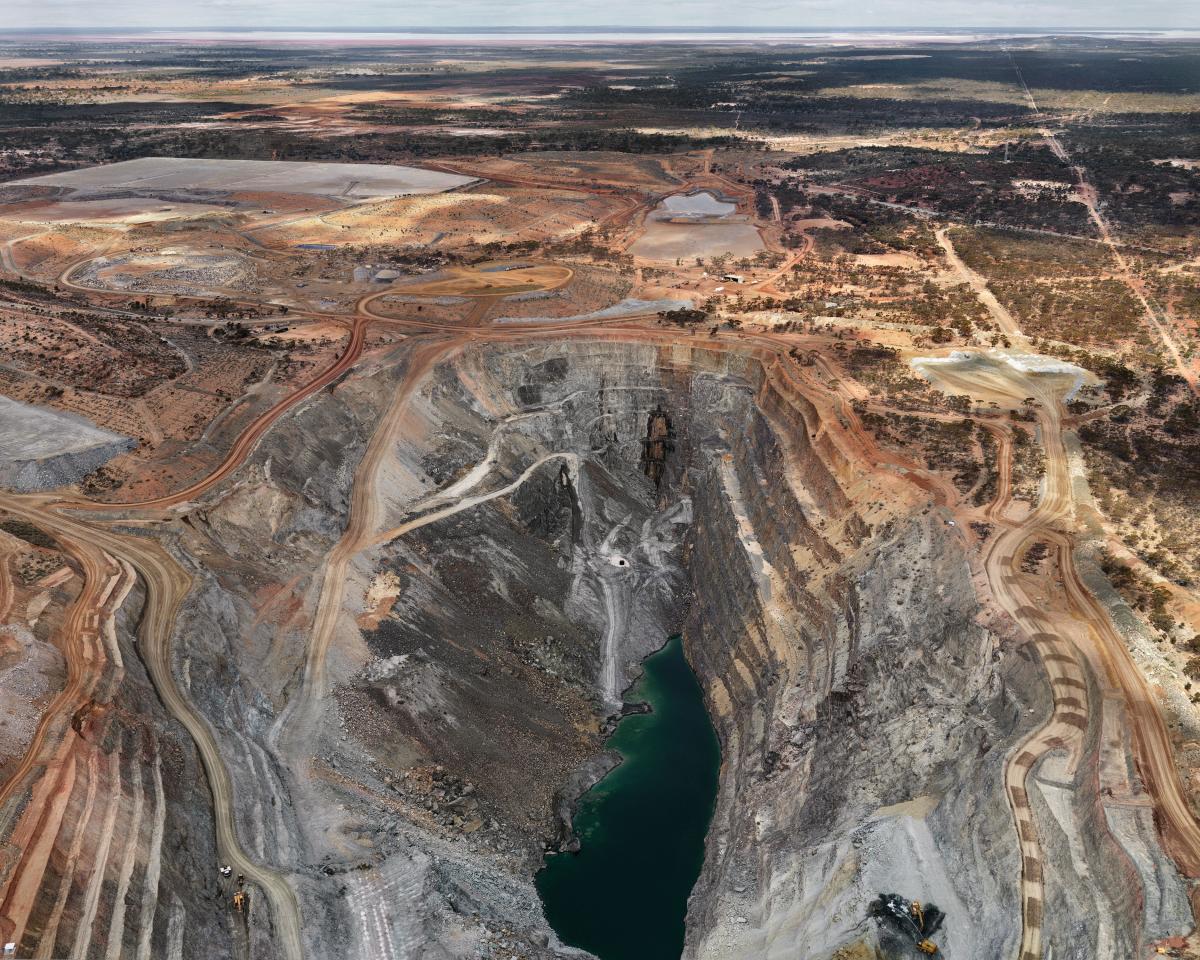
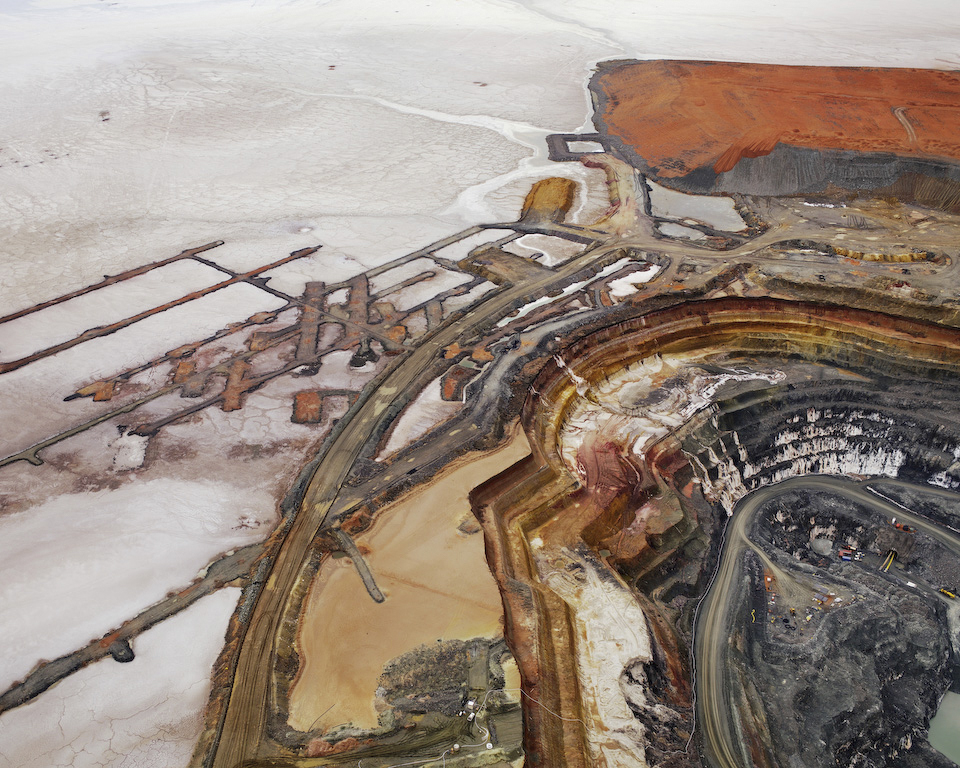
Edward Burtynsky (Canadian, b. 1955) Jubilee Operations #1, Kalgoorlie, Western Australia 2007 Digital chromogenic colour photographic print 1560mm x 1260mm Western Australian Museum
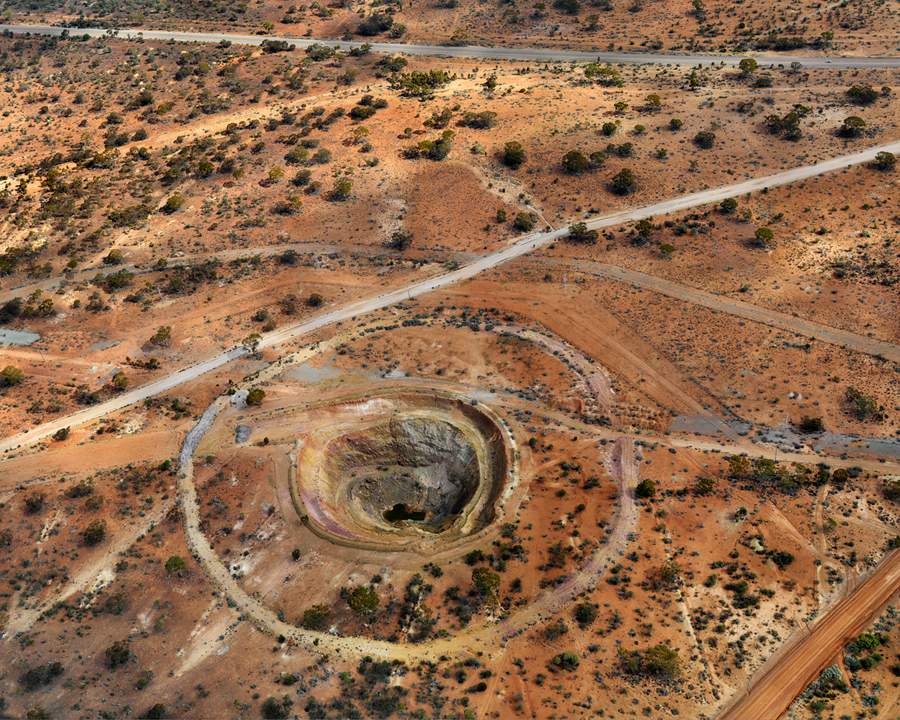
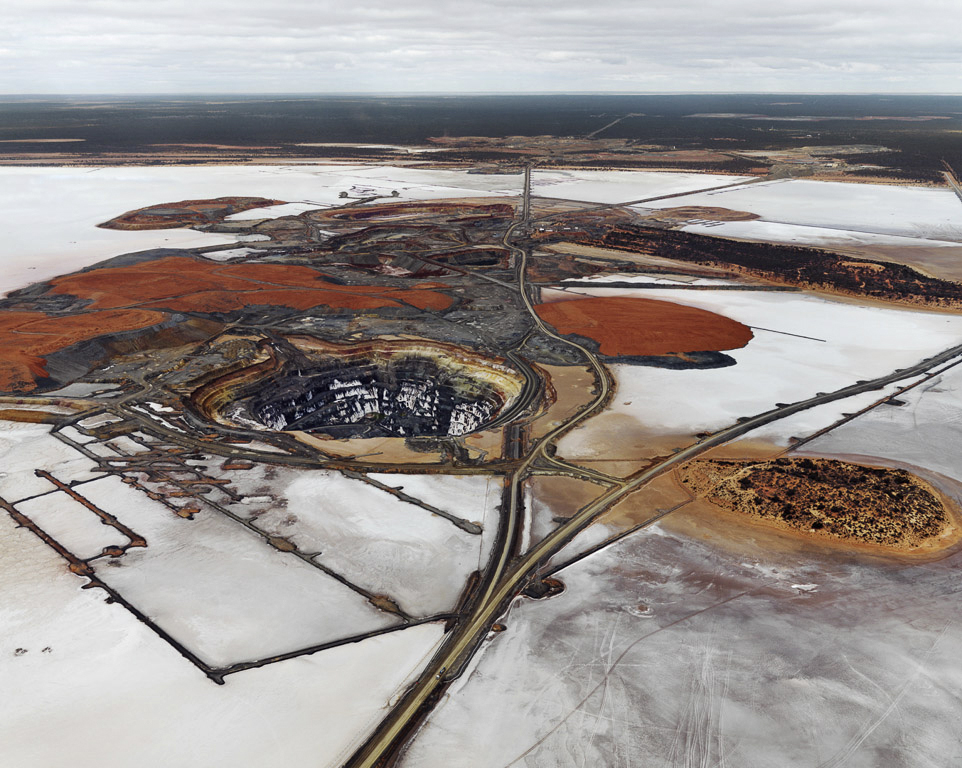
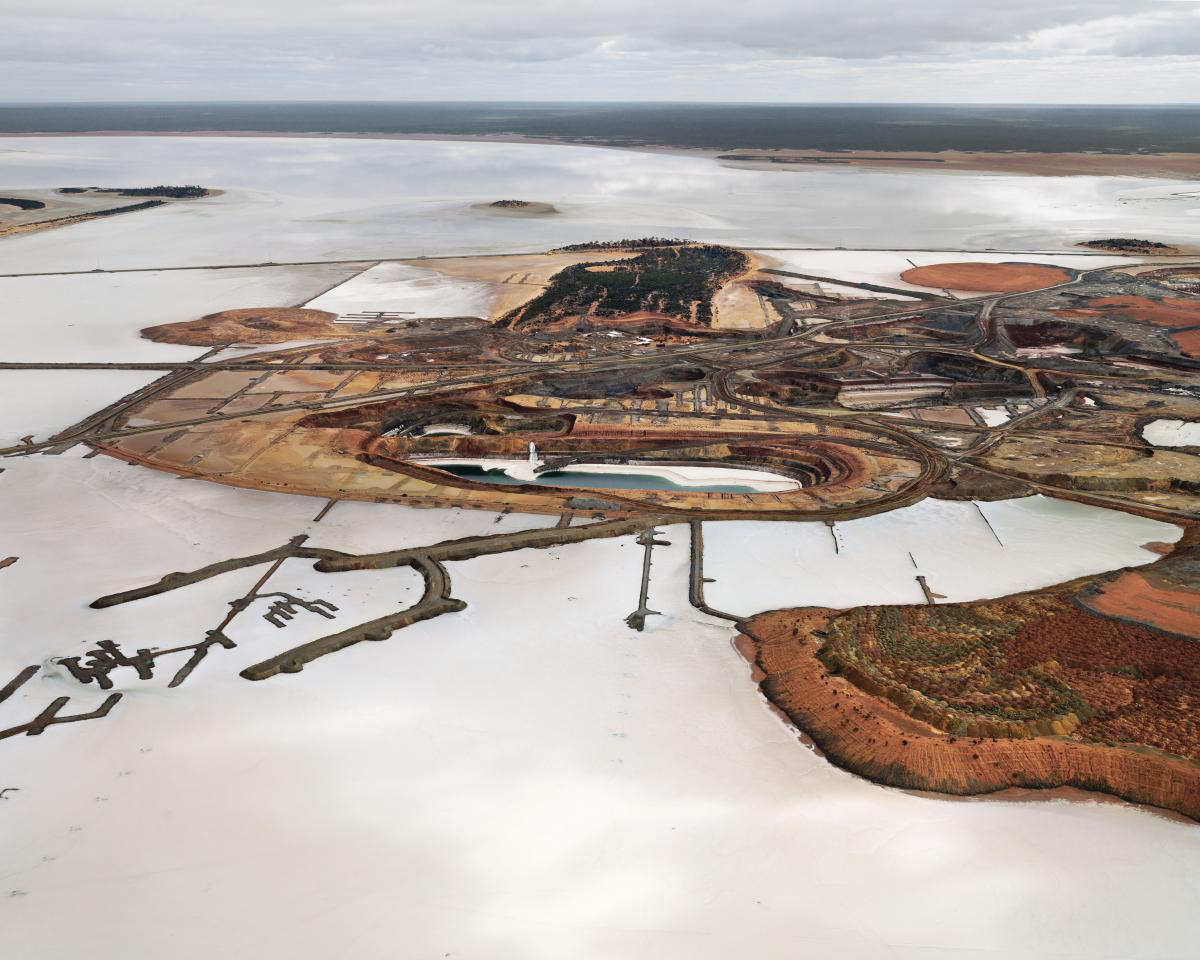
All of these incredible, environmental aerial photographs – beauty, texture, pattern, fabric, scars, desecration, destruction, de / construction – are works in the exhibition. The effects of the Anthropocene era in full swing. I will be glad when I am not here to see the fateful outcome of all of this: the death of most of the animals, and the sickness of the planet.
A travelling exhibition from the Western Australian Museum.
Dr Marcus Bunyan
Many thankx to the Australian Centre for Photography for allowing me to publish the photographs in the posting. Please click on the photographs for a larger version of the image.
Edward Burtynsky (Canadian, b. 1955) Otter Juan Coronet Mine #1, Kalgoorlie, Western Australia 2007 Digital chromogenic colour photographic print 1560mm x 1260mm Western Australian Museum
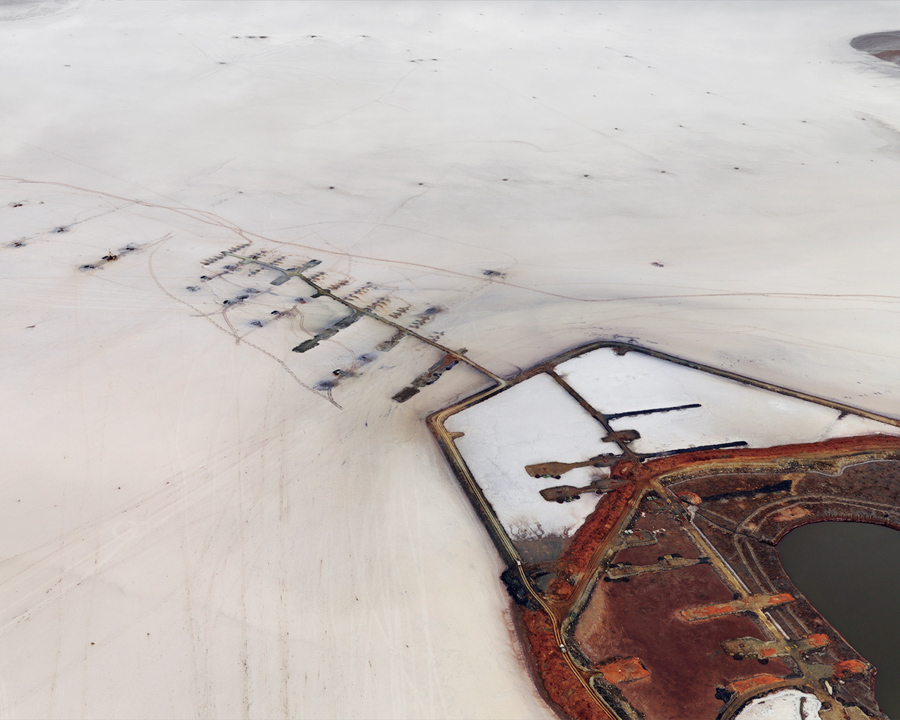
Edward Burtynsky (Canadian, b. 1955) Silver Lake Operations #1, Lake Lefroy, Western Australia 2007 Digital chromogenic colour photographic print 1560mm x 1260mm Western Australian Museum
Edward Burtynsky (Canadian, b. 1955) Silver Lake Operations #2, Lake Lefroy, Western Australia 2007 Digital chromogenic colour photographic print 1560mm x 1260mm Western Australian Museum
Edward Burtynsky (Canadian, b. 1955) Silver Lake Operations #3, Lake Lefroy, Western Australia 2007 Digital chromogenic colour photographic print 1560mm x 1260mm Western Australian Museum
Edward Burtynsky (Canadian, b. 1955) Silver Lake Operations #5, Lake Lefroy, Western Australia 2007 Digital chromogenic colour photographic print 1560mm x 1260mm Western Australian Museum
Edward Burtynsky (Canadian, b. 1955) Silver Lake Operations #11, Lake Lefroy, Western Australia 2007 Digital chromogenic colour photographic print 1560mm x 1260mm Western Australian Museum
Edward Burtynsky (Canadian, b. 1955) Silver Lake Operations #12, Lake Lefroy, Western Australia 2007 Digital chromogenic colour photographic print 1560mm x 1260mm Western Australian Museum
Edward Burtynsky (Canadian, b. 1955) Silver Lake Operations #14, Lake Lefroy, Western Australia 2007 Digital chromogenic colour photographic print 1560mm x 1260mm Western Australian Museum
Edward Burtynsky (Canadian, b. 1955) Silver Lake Operations #15, Lake Lefroy, Western Australia 2007 Digital chromogenic colour photographic print 1560mm x 1260mm Western Australian Museum
Edward Burtynsky (Canadian, b. 1955) Silver Lake Operations #16, Lake Lefroy, Western Australia 2007 Digital chromogenic colour photographic print 1560mm x 1260mm Western Australian Museum
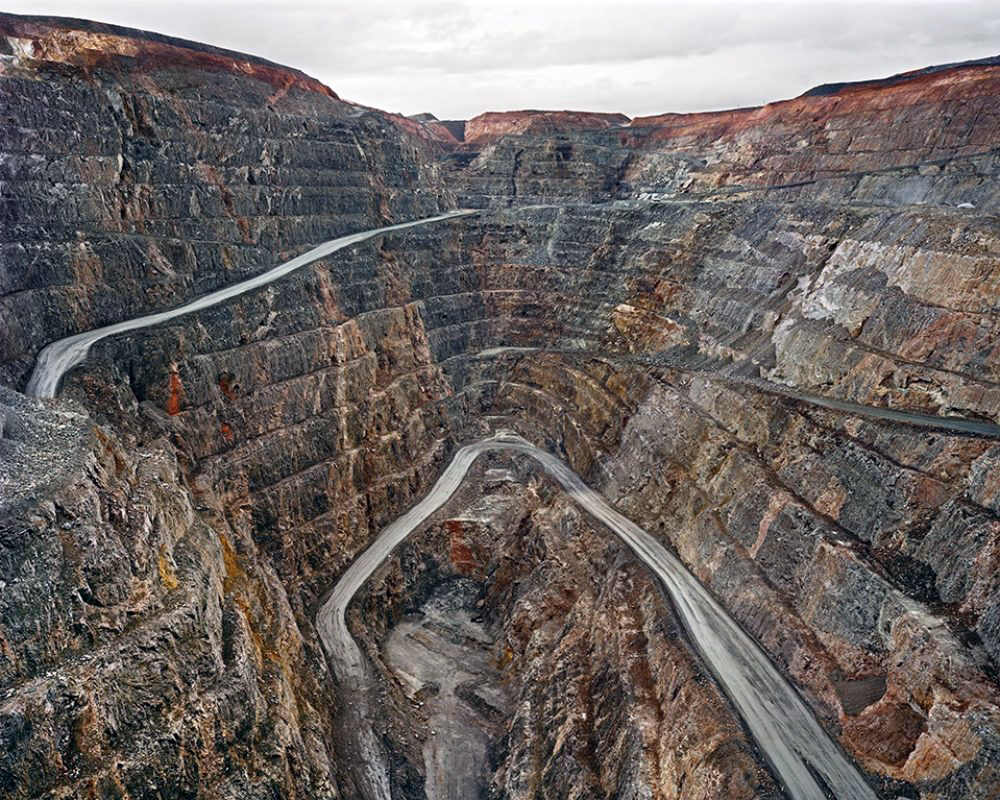
Edward Burtynsky is one of the world’s leading contemporary landscape photographers. His ‘manufactured landscapes’ have included stark images of recycling yards, mine tailings, quarries and refineries. This series of images, taken in the eastern goldfields and the Pilbara of Western Australia, continues Edward Burtynsky’s examination of natural landscapes modified by mankind in the pursuit of the raw materials required for our modern society.
“Our dependence on nature to provide the materials for our consumption and our concern for the health of our planet sets us into an uneasy contradiction. For me, these images function as reflecting pools of our times.” ~ Edward Burtynsky
Australian Minescapes is a new body of work by Burtynsky, commissioned for the FotoFreo 2008 Festival. For this exhibition a selection of images from his Shipyard images from China and Ship Breaking images from Bangladesh will be presented alongside his Australian Minescapes images.
Text from the Australian Centre for Photography website [Online] Cited 01/08/2009. No longer available online
Edward Burtynsky (Canadian, b. 1955) Super Pit #1, Kalgoorlie, Western Australia 2007 Digital chromogenic colour photographic print 1560mm x 1260mm Western Australian Museum
Edward Burtynsky (Canadian, b. 1955) Super Pit #4, Kalgoorlie, Western Australia 2007 Digital chromogenic colour photographic print 1560mm x 1260mm Western Australian Museum
Edward Burtynsky (Canadian, b. 1955) Tailings #1 Kalgoorlie, Western Australia 2007 Digital chromogenic colour photographic print 1560mm x 1260mm Western Australian Museum
Exhibition dates: 21st June – 27th September, 2009
Many thankx to the Bruce Museum and Mike Horyczun (Director of Public Relations) for allowing me to publish the wonderful photographs below.
Marcus
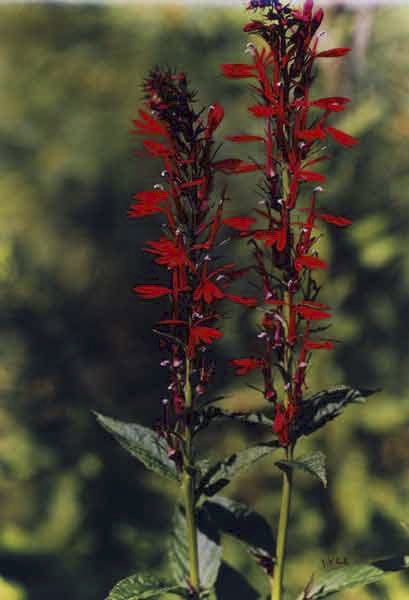
Jeannette Klute (American, 1918-2009) Cardinal Flower Nd (early-mid 1950s) Dye transfer photograph 20 1/4 x 16 1/4 in. Bruce Museum collection Gift of George Stephanopoulos
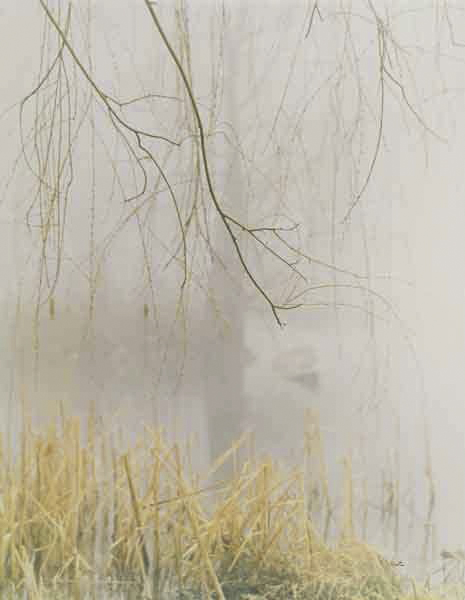
Jeannette Klute (American, 1918-2009) Misty Willow Nd (early-mid 1950s) Dye transfer photograph 20 1/4 x 16 1/4 in. Bruce Museum collection Gift of George Stephanopoulos
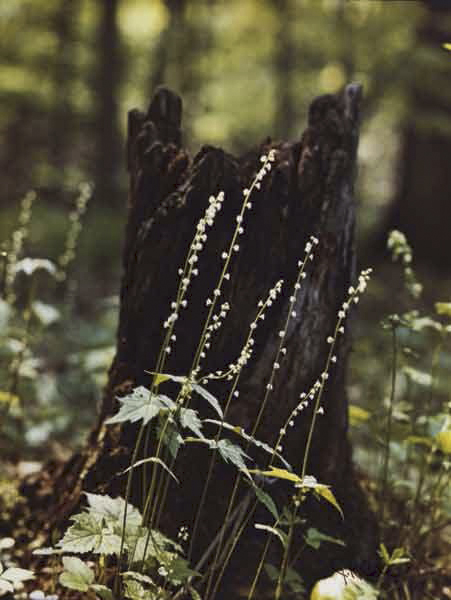
Jeannette Klute (American, 1918-2009) Miterwort Nd (early-mid 1950s) Dye transfer photograph 14 1/8 x 11 1/4 in. Bruce Museum collection Gift of George and Alexandra Stephanopoulos
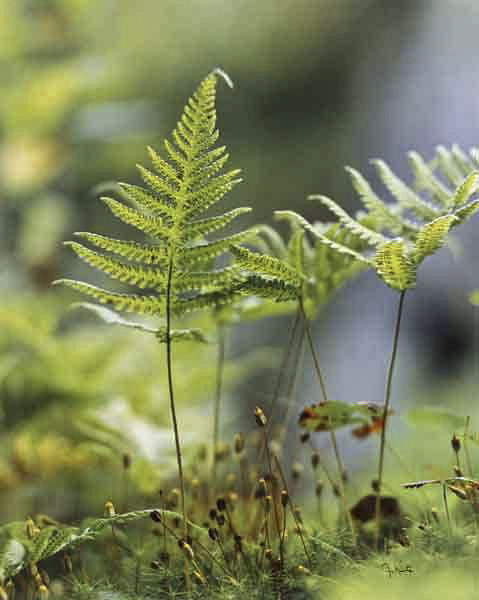
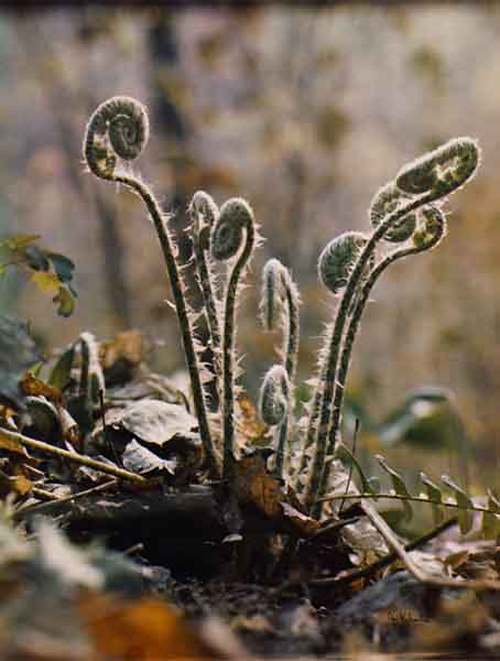
Jeannette Klute (American, 1918-2009) Beech Fern Nd (early-mid 1950s) Dye transfer photograph 20 1/4 x 16 1/4 in. Bruce Museum collection Gift of George Stephanopoulos
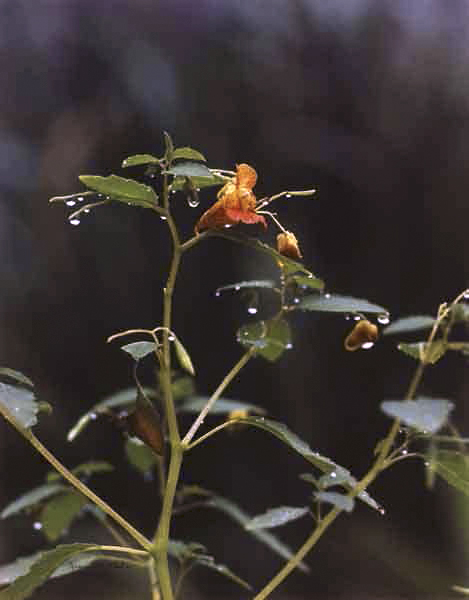
Jeannette Klute (American, 1918-2009) Jewel Weed Nd (early-mid 1950s) Dye transfer photograph 20 1/4 x 16 1/4 in. Bruce Museum collection Gift of George Stephanopoulos
Jeannette Klute (American, 1918-2009) Christmas Fern Nd (early-mid 1950s) Dye transfer photograph 12 1/2 x 9 1/2 in. Bruce Museum collection Gift of George Thomsen
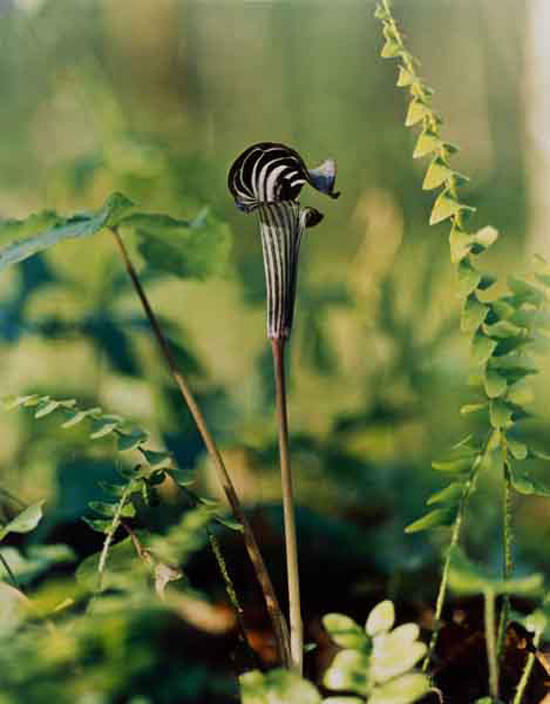
Jeannette Klute (American, 1918-2009) Jack in the Pulpit (Arisaema triphyllum) Nd (early-mid 1950s) Dye transfer photograph 20 1/4 x 16 1/4 in. Bruce Museum collection Gift of George and Alexandra Stephanopoulos
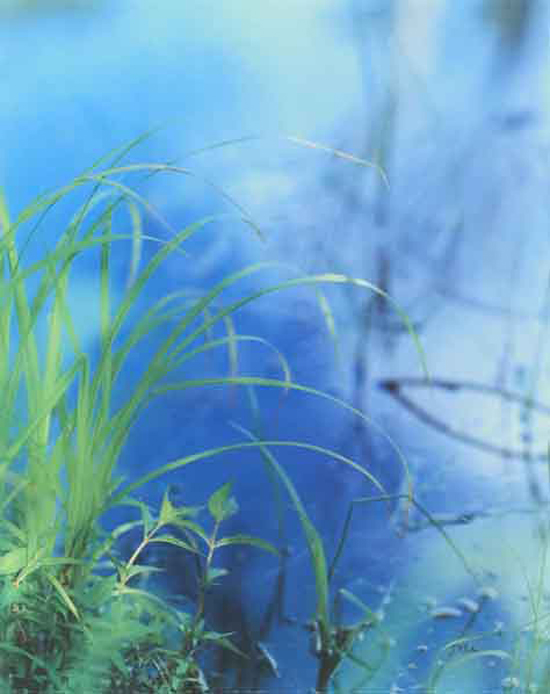
Jeannette Klute (American, 1918-2009) Green Grasses – blue Nd (early-mid 1950s) Dye transfer photograph 20 1/4 x 16 1/4 in. Bruce Museum collection Gift of Richard and Elena Pollack
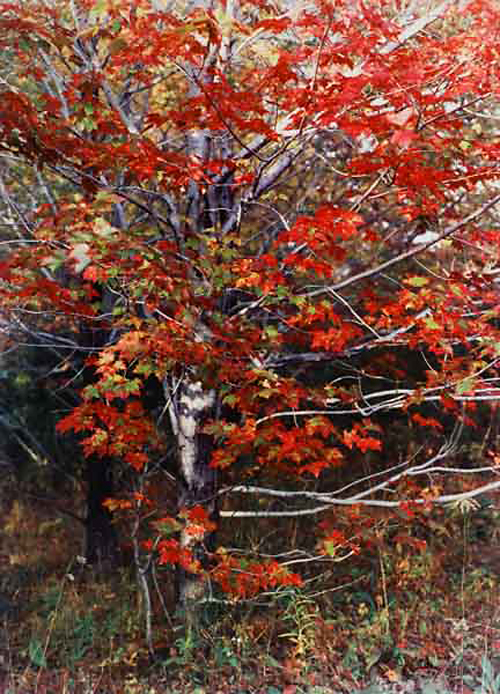
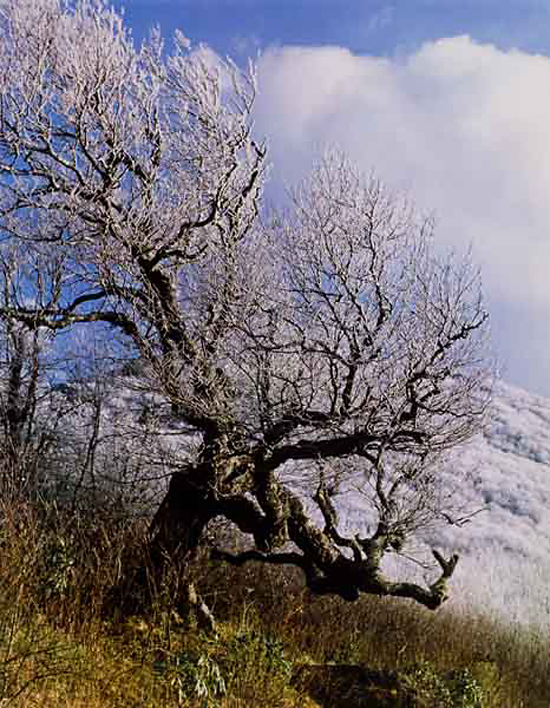
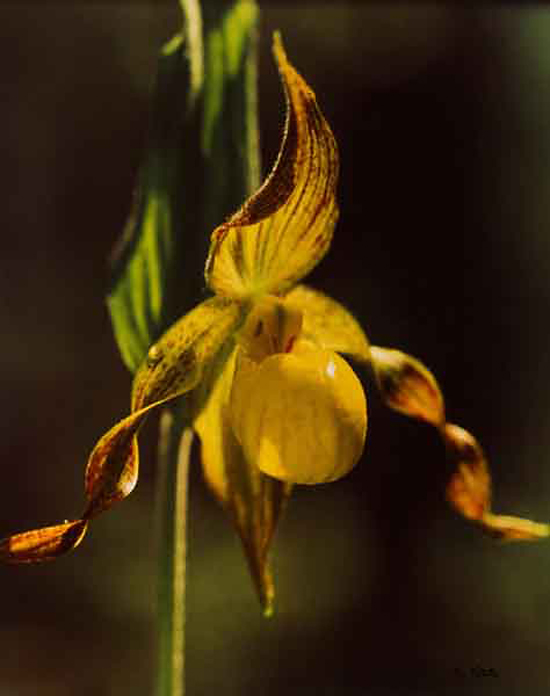
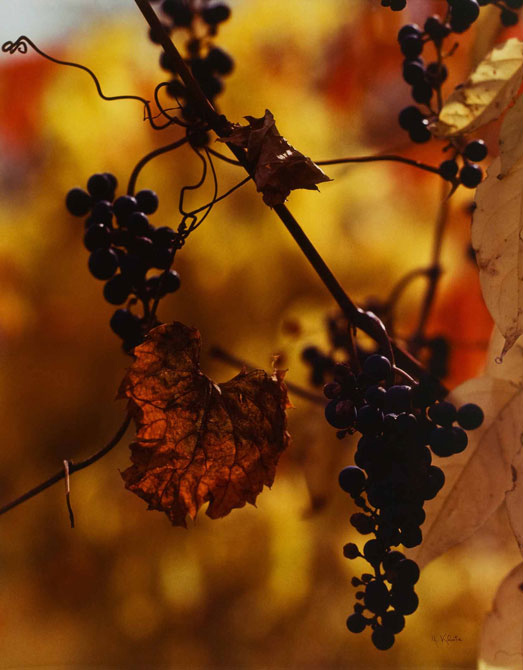
The exhibition features 24 colour photographs by Jeannette Klute (1918-2009) drawn from more than fifty of her prints held in the Bruce Museum’s permanent collection. Ranging from landscapes to intimate “woodland portraits” of orchids, ferns, and trees, Jeannette Klute’s photographs of New England are vibrant compositions produced through the labour intensive dye transfer process.
Trained at the Rochester Institute of Technology through the Works Progress Administration during the Depression, Jeanette Klute worked extensively on perfecting the dye transfer process, a laborious photographic technique that allowed for rich colours in exceptionally permanent prints. Klute tested and refined this process at the Eastman Kodak Company in Rochester, NY, beginning her career as photographic illustrator to physicist Ralph M. Evans and ascending to research photographer in charge of the Visual Research Studio of the Color Control Division.
Klute’s photography merged environmental consciousness with cutting edge technology. Using only natural light and leaving a minimal impact on the environment, she spent many years investigating colour and demonstrating the capabilities of dye transfer by photographing nature. Her work resulted in some of the finest examples of colour printing and all of its capabilities.
“My purpose has been to somehow express the feeling one experiences being out of doors,” Ms. Klute wrote for her Woodland Portraits exhibition. “I am concerned with the delight to the senses as much as with the intellectual. The woods are mystical and enchanting to me as well as spiritual.”
Jeanette Klute’s work was featured in Edward Steichen’s 1950 exhibition All Color Photography at the Museum of Modern Art, and her large one-woman shows were circulated internationally by the Smithsonian Institution and Kodak International. She was also invited to submit work for the San Francisco Museum of Art’s landmark exhibition Women of Photography: An Historical Survey in 1975.
Text from the Bruce Museum website
Jeannette Klute (American, 1918-2009) Maple Tree – red leaves Nd (early-mid 1950s) Dye transfer photograph 20 1/4 x 16 1/4 in. Bruce Museum collection Gift of LeGrand Belnap
Jeannette Klute (American, 1918-2009) Frosted Tree Nd (early-mid 1950s) Dye transfer photograph 20 1/4 x 16 1/4 in. Bruce Museum collection Gift of Richard and Elena Pollack
Jeannette Klute (American, 1918-2009) Yellow Lady’s Slipper Nd (early-mid 1950s) Dye transfer photograph 20 1/4 x 16 1/4 in. Bruce Museum collection Gift of LeGrand Belnap
“The first month they were sending people out for job interviews, but not me,” she recalled in a speech at the Rochester Institute of Technology in 1984. “I asked how come? The head of the department said, ‘Oh, there are no jobs for women in photography.’ My world fell apart.”
Ms. Klute took it upon herself to go out for interviews, and every week on her day off, she walked to the offices of Eastman Kodak Co. to ask for a job. For a long time, she never made it past the personnel office. Then, one day, in the pouring rain, decked in her finest navy blue suit, she stalked to the offices and was sent straight to the sixth floor for an interview.
“The man took a look at me with the rain dripping off my hat and said, ‘If you want a job that bad, you’ve got it,'” she recalled. “There was a celebration in the neighbourhood that night.” …
“She was really like my college education,” said Barbara Erbland, who assisted Ms. Klute in the lab at Kodak for many years. “She taught me everything – about light, colour, about people … how to live well.” … “Her lab consisted of all women,” she said. “I think it was by intention. She believed women had brains. We worked very well together.” …
Lugging a 4-by-5 Graflex single-lens reflex camera wherever they went, Erbland ventured into swamps and tide pools… “She taught me you don’t make do, you make things happen,” said Erbland. “You’re not a victim.”
Back in Rochester, the two sought out swamps and woodland for Ms. Klute to take her photographs – or, as she put it, to “make pictures.”
PHOTO GALLERY: In memory of Jeannette Klute, a ‘Renaissance woman’, by Philip Anselmo, August 2009
Jeannette Klute (American, 1918-2009) Grape Leaves Nd (early-mid 1950s) Dye transfer photograph 20 1/4 x 16 1/4 in. Bruce Museum collection Gift of George Stephanopoulos
Bruce Museum One Museum Drive Greenwich, CT 06830
Opening hours: Tuesday – Sunday 10am – 5pm Last admission 4.30pm Closed Monday and major holidays
“How I wish this selection had been available to me when I was young and trying to make sense of my reactions to the world. How inspirational to have had portraits of the great and the good staring out at me telling me that I was not by any measure on my own.”
“… it is her [K.D. Lang’s] androgynous good looks and tendency to strut on the stage which warms many lesbian hearts.”
~ Sandi Toksvig
Many thankx to the National Portrait Gallery for allowing me to publish the photographs in the posting. Please click on the photographs for a larger version of the image.
The first portrait exhibition to celebrate the contribution of gay people and gay icons to history and culture. 60 photographs selected by Waheed Alli, Alan Hollinghurst, Elton John, Jackie Kay, Billie Jean King, Ian McKellen, Chris Smith, Ben Summerskill, Sandi Toksvig and Sarah Waters.
An important photography exhibition, Gay Icons, at the National Portrait Gallery (2 July – 18 October 2009) will celebrate the contribution of gay people – and the significance of the gay icon – to history and culture. Ten selectors have worked with the Gallery to make their own personal choices of six individuals, their ‘icons’. Not only does this exhibition include many well-known icons, who may or may not be gay themselves, it also reveals some surprises and will encourage a wide audience to think about familiar faces in new ways.
The Gay Icons shown in the exhibition will include those people, living or dead, whatever their sexual orientation or interests, who the ten individual selectors regard as inspirational, or as a personal icon. Gay Icons brings together portraits of those people who are regarded as especially significant to each of the selectors, alongside those of the selectors themselves, all prominent gay figures in contemporary culture and society.
Coinciding with the fortieth anniversary of the Stonewall Riots in New York, this exhibition focuses on portraits of both historical and modern figures. The choices provide a fascinating range of inspiring figures – some very famous, some heroic, others relatively unknown. Each icon is presented with information about their personal, and sometimes public, significance, some of it relating to the sitter but much of it linked to the selectors who have been prepared to share their experiences and feelings in their own exhibition texts.
Themes running through the exhibition include inspiration and how the ‘icons’ have inspired each selector in an extremely personal sense to realise their full potential, human rights, stemming from the specific consideration of sexuality, and how this might lead us to consider parallels between the struggles of different minority groups, re-discovery, or rescuing the reputations of figures who might otherwise have been forgotten or, worse, actively disregarded and surprise at some of the perhaps unexpected choices.
The project was developed from an initial proposal made by Bernard Horrocks, Copyright Officer, at the Gallery. The concept quickly evolved to include invitations to ten gay people – each distinguished in different fields – to act as selectors. They were chosen in consultation with their Chair, Sandi Toksvig.
Each selector could freely choose six ‘icons’, although the Gallery decided to limit the choices to photographic portraits, and therefore to subjects who had lived, more or less, within the last 150 years. This also seemed appropriate because within this same period homosexuality was gradually accepted and made legitimate in Britain.
The selectors are Lord Waheed Alli, Alan Hollinghurst, Sir Elton John, Jackie Kay, Billie Jean King, Sir Ian McKellen, Lord Chris Smith, Ben Summerskill, Sandi Toksvig and Sarah Waters.
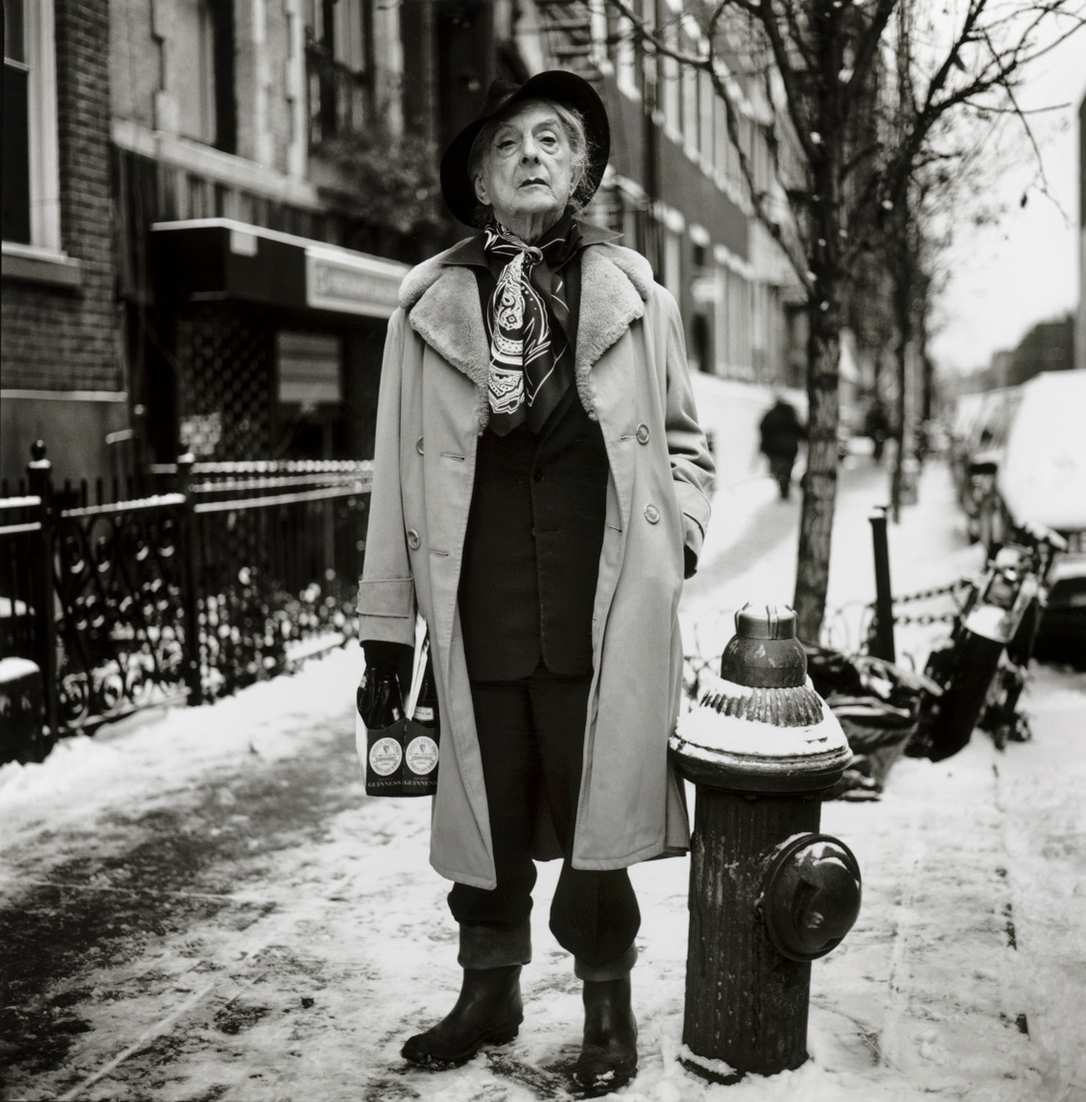
Sitters include artists Francis Bacon and David Hockney, civil rights campaigner Harvey Milk, writers Quentin Crisp, Joe Orton, Dame Daphne Du Maurier, Patricia Highsmith and Walt Whitman, composer Pyotr Tchaikovsky, musicians k.d. lang, Will Young and Village People, entertainers Ellen DeGeneres, Kenneth Williams and Lily Savage, and Nelson Mandela and Diana, Princess of Wales. Their fascinating stories will be illustrated by sixty photographic portraits including works by Andy Warhol, Linda McCartney, Snowdon, Polly Borland, Fergus Greer, Terry O’Neill and Cecil Beaton.
Sandy Nairne, Director of the National Portrait Gallery, London, says: “Gay Icons is an exhibition in which inspiring stories – both private and public – are shared. These are stories of brave lives and significant achievements, told through iconic photographic images chosen by selectors who are themselves icons.
Text from the National Portrait Gallery website [Online] Cited 10/07/2009. No longer available online
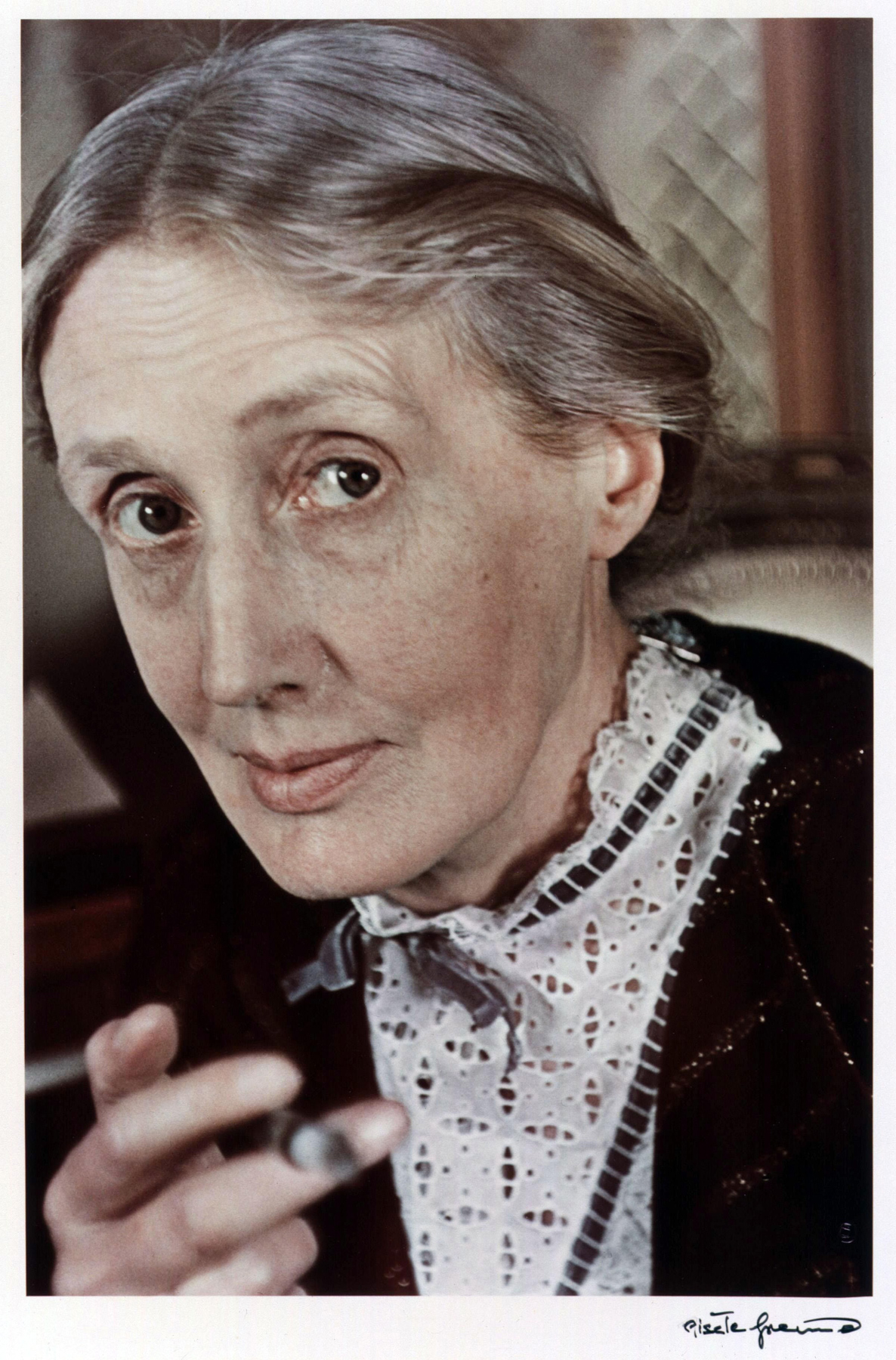
Gisèle Freund (born Gisela Freund; December 19, 1908 in Schöneberg District, Berlin – March 31, 2000 in Paris) was a German-born French photographer and photojournalist, famous for her documentary photography and portraits of writers and artists. Her best-known book, Photographie et société (1974), is about the uses and abuses of the photographic medium in the age of technological reproduction. In 1977, she became President of the French Association of Photographers, and in 1981, she took the official portrait of French President François Mitterrand.
She was made Officier des Arts et Lettres in 1982 and Chevalier de la Légion d’honneur, the highest decoration in France, in 1983. In 1991, she became the first photographer to be honoured with a retrospective at the Musée National d’art Moderne in Paris (Centre Georges Pompidou).
Freund’s major contributions to photography include using the Leica Camera (with its 36 frames) for documentary reportage and her early experimentation with Kodachrome and 35 mm Agfacolor, which allowed her to develop a “uniquely candid portraiture style” that distinguishes her in 20th century photography.
She is buried at the Montparnasse Cemetery in Paris, France near her home and studio at 12 rue Lalande.
“… is a significant writer by any standard, but she deserves honouring as a lesbian and gay icon on the strength of one novel alone, The Price of Salt, a wonderfully complex and upbeat representation of lesbian love.”
~ Sarah Waters
Patricia Highsmith (January 19, 1921 – February 4, 1995) was an American novelist and short story writer best known for her psychological thrillers, including her series of five novels featuring the character Tom Ripley. She wrote 22 novels and numerous short stories throughout her career spanning nearly five decades, and her work has led to more than two dozen film adaptations. Her writing derived influence from existentialist literature, and questioned notions of identity and popular morality. She was dubbed “the poet of apprehension” by novelist Graham Greene.
Her first novel, Strangers on a Train, has been adapted for stage and screen numerous times, notably by Alfred Hitchcock in 1951. Her 1955 novel The Talented Mr. Ripley has been adapted numerous times for film, theatre, and radio. Writing under the pseudonym “Claire Morgan,” Highsmith published the first lesbian novel with a happy ending, The Price of Salt, in 1952, republished 38 years later as Carol under her own name and later adapted into a 2015 film.
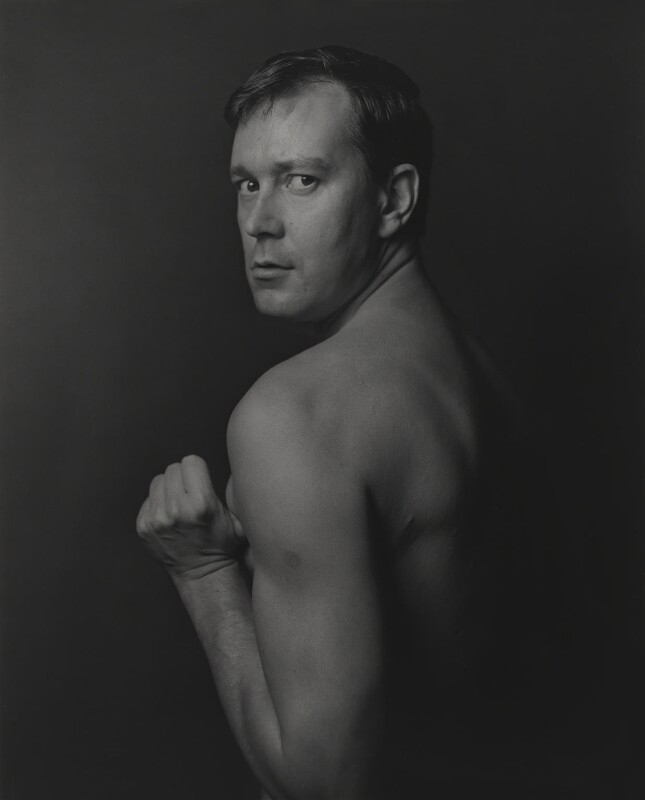
Joseph Angelo D’Allesandro III (born December 31, 1948), better known as Joe Dallesandro, is an American actor and Warhol superstar. Having also crossed over into mainstream roles like mobster Lucky Luciano in The Cotton Club, Dallesandro is generally considered to be the most famous male sex symbol of American underground films of the 20th century, as well as a sex symbol of gay subculture.
Dallesandro starred in the 1968 film produced by Andy Warhol, Flesh, as a teenage street hustler. Rolling Stone magazine in 1970 declared his second starring vehicle, Trash, the “Best Film of the Year”, making him a star of the youth culture, sexual revolution and subcultural New York City art collective of the 1970s. Dallesandro also starred in 1972’s Heat, another Warhol film that was conceived as a parody of Sunset Boulevard. …
Underground film career
Dallesandro met Andy Warhol and Paul Morrissey in 1967 while they were shooting Four Stars, and they cast him in the film on the spot. Warhol would later comment “In my movies, everyone’s in love with Joe Dallesandro.”
Dallesandro played a hustler in his third Warhol film, Flesh (1968), where he had several nude scenes. Flesh became a crossover hit with mainstream audiences, and Dallesandro became the most popular of the Warhol stars. New York Times film critic Vincent Canby wrote of him: “His physique is so magnificently shaped that men as well as women become disconnected at the sight of him”
As Dallesandro’s underground fame began to cross over into the popular culture, he appeared on the cover of Rolling Stone in April 1971. He was also photographed by some of the top celebrity photographers of the time: Francesco Scavullo, Annie Leibovitz, Richard Avedon.
Dallesandro appeared in Lonesome Cowboys (1968), Trash (1970), Heat (1972), Andy Warhol’s Frankenstein, and Andy Warhol’s Dracula (both 1974), also directed by Morrissey. These last two films were shot in Europe. After filming was complete, he chose not to return to the U.S. He appeared in Serge Gainsbourg’s Je t’aime moi non plus (France, 1976), which starred Gainsbourg’s wife, British actress Jane Birkin.
Gay Icons explores gay social and cultural history through the unique personal insights of ten high profile gay figures, who have selected their historical and modern icons.
The chosen icons, who may or may not be gay themselves, have all been important to each selector, having influenced their gay sensibilities or contributed to making them who they are today. They include artists Francis Bacon and David Hockney; writers Daphne du Maurier and Quentin Crisp; composers Pyotr Tchaikovsky and Benjamin Britten; musicians k.d. lang, the Village People and Will Young; entertainers Ellen DeGeneres, Lily Savage and Kenneth Williams; sports stars Martina Navratilova and Ian Roberts and political activists Harvey Milk and Angela Mason.
Their fascinating and inspirational stories will be illustrated by over sixty photographic portraits including works by Andy Warhol, Snowdon and Cecil Beaton together with specially commissioned portraits of the selectors by Mary McCartney. McCartney. All are set in a striking exhibition design conceived by renowned theatre designer, Robert Jones …
This exhibition brings together ten selectors, chaired by Sandi Toksvig, each of whom is a prominent gay figure in contemporary culture and society. Each selector was asked to name six people, who may or may not be gay, whom they personally regard as inspirational, or an icon for them.
Their choices provide a fascinating range of figures – some heroic, some very famous, others less well known. In the exhibition the selectors write about their choices and share their own convictions, experiences and feelings. The display also features specially commissioned portraits of the selectors by Mary McCartney.
Anonymous text. “Gay Icons,” on the National Portrait Gallery website [Online] Cited 18/06/2022. No longer available online
“He has touched my heart, just as he has influenced the hearts and minds of people all over the world.”
~ Billie Jean King
“The great single picture is emotionally satisfying, whereas getting a good journalistic story is more about being a professional”
~ Ian Berry
Ian Berry was born in Lancashire, England. He made his reputation in South Africa, where he worked for the Daily Mail and later for Drum magazine. He was the only photographer to document the massacre at Sharpeville in 1960, and his photographs were used in the trial to prove the victims’ innocence.
Henri Cartier-Bresson invited Ian Berry to join Magnum in 1962 when he was based in Paris. He moved to London in 1964 to become the first contract photographer for the Observer Magazine. Since then assignments have taken him around the world: he has documented Russia’s invasion of Czechoslovakia; conflicts in Israel, Ireland, Vietnam and the Congo; famine in Ethiopia; apartheid in South Africa. The major body of work produced in South Africa is represented in two of his books: Black and Whites: L’Afrique du Sud (with a foreword by the then French president François Mitterrand), and Living Apart (1996). During the last year, projects have included child slavery in Ghana and the Spanish fishing industry.
Important editorial assignments have included work for National Geographic, Fortune, Stern, Geo, national Sunday magazines, Esquire, Paris-Match and LIFE. Ian Berry has also reported on the political and social transformations in China and the former USSR.
Anonymous text. “Ian Berry,” on the Magnum website [Online] Cited 16/03/2019
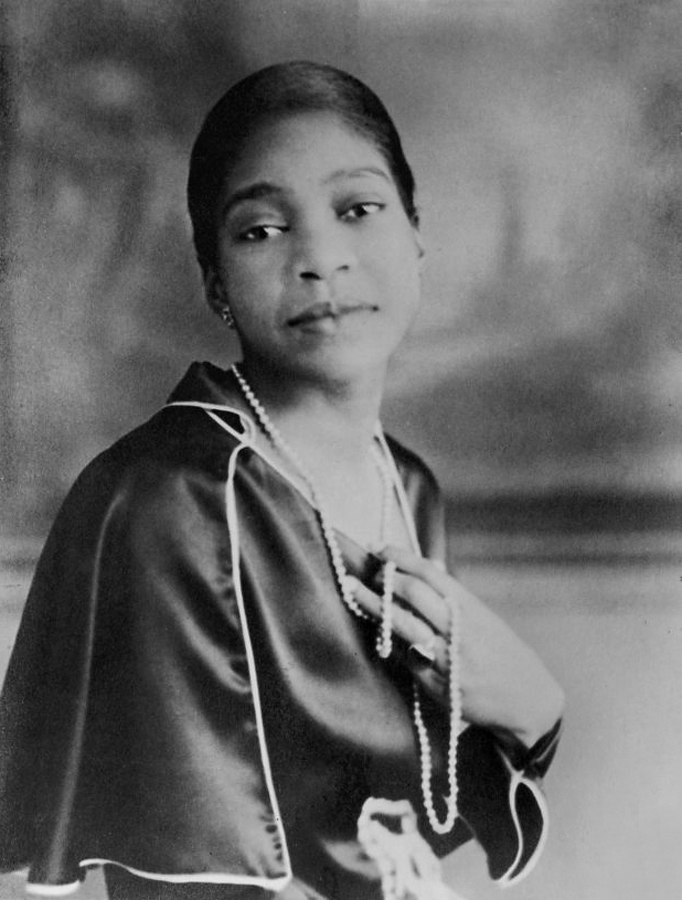
“A feisty woman who always stood up for herself… She was bisexual and practically an alcoholic – the perfect icon.”
~ Jackie Kay
Bessie Smith (April 15, 1894 – September 26, 1937) was an American blues singer. Nicknamed the Empress of the Blues, she was the most popular female blues singer of the 1920s and 1930s. She is often regarded as one of the greatest singers of her era and was a major influence on fellow blues singers, as well as jazz vocalists.
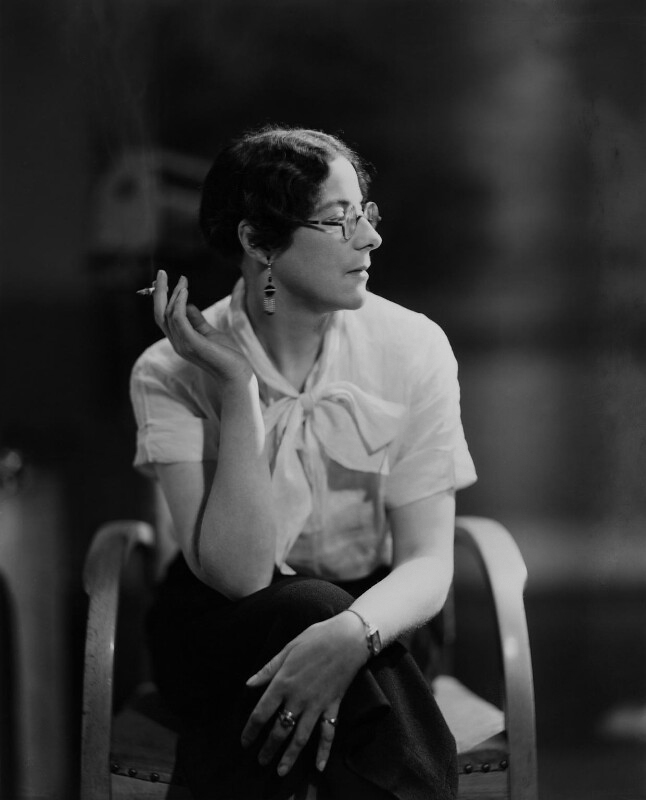
Sylvia Townsend Warner (6 December 1893 – 1 May 1978) was an English novelist and poet. She also made a contribution to musicology as a young woman.
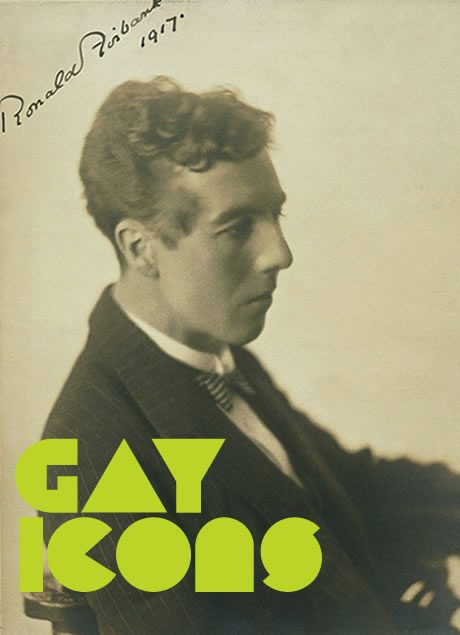
Bertram Park (British, 1883-1972) Ronald Firbank (detail) 1917
“He [Ronald Firbank] is celebrated as a master of high camp, but he was also a radical technician and radical homosexualiser of the novel.”
~ Alan Hollinghurst
Bertram Park (British, 1883-1972) Ronald Firbank 1917
Bertram Charles Percival Park, OBE, (1883-1972) was a portrait photographer whose work included British and European royalty. Engravings of his photographs were widely used on British and British Commonwealth postage stamps, currency, and other official documents in the 1930s. His theatrical portraits were the source for two paintings by Walter Sickert. With his wife Yvonne Gregory, he also produced a number of photographic books of the female nude. He was an expert in the cultivation of the rose and the editor of The Rose Annual.
Arthur Annesley Ronald Firbank (17 January 1886 – 21 May 1926) was an innovative English novelist. His eight short novels, partly inspired by the London aesthetes of the 1890s, especially Oscar Wilde, consist largely of dialogue, with references to religion, social-climbing, and sexuality.
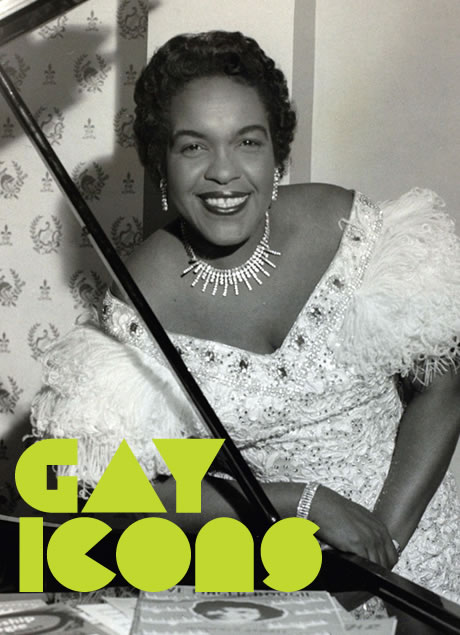
Unknown photographer Winifred Atwell (detail) c. 1950s Courtesy of Getty Images
“Winifred Atwell’s piano performances were simply captivating. She showed me what was possible and was a total inspiration.”
~ Elton John
Una Winifred Atwell (27 February or 27 April 1910 or 1914 – 28 February 1983) was a Trinidadian pianist who enjoyed great popularity in Britain and Australia from the 1950s with a series of boogie-woogie and ragtime hits, selling over 20 million records. She was the first black person to have a number-one hit in the UK Singles Chart and is still the only female instrumentalist to do so.
Read the full entry about this amazing women on the Wikipedia website
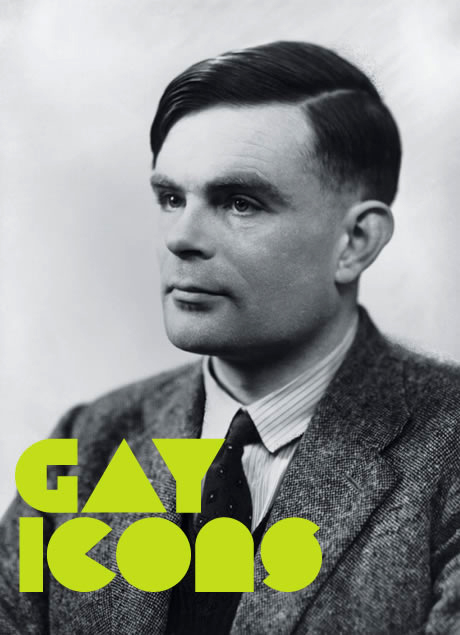
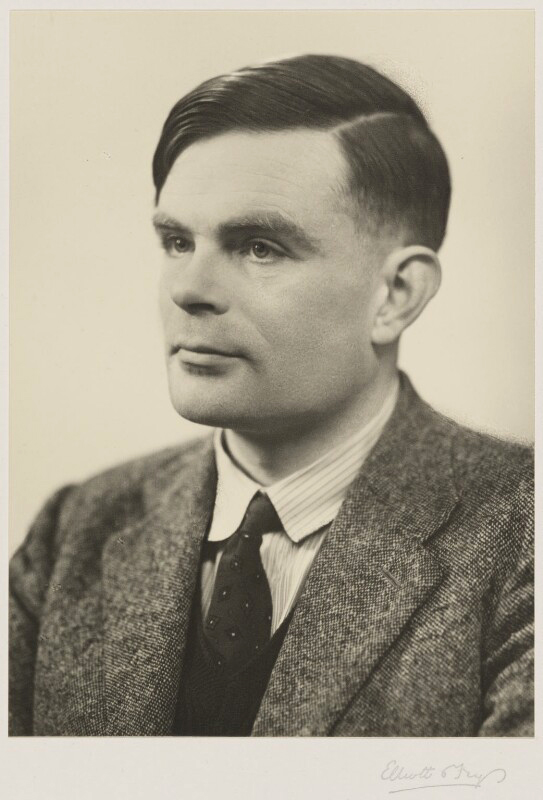
Elliott & Fry was a Victorian photography studio founded in 1863 by Joseph John Elliott (14 October 1835 – 30 March 1903) and Clarence Edmund Fry (1840 – 12 April 1897). For a century the firm’s core business was taking and publishing photographs of the Victorian public and social, artistic, scientific and political luminaries. In the 1880s the company operated three studios and four large storage facilities for negatives, with a printing works at Barnet.
The firm’s first address was 55 & 56 Baker Street in London, premises they occupied until 1919. The studio employed a number of photographers, including Francis Henry Hart and Alfred James Philpott in the Edwardian era, Herbert Lambert and Walter Benington in the 1920s and 1930s and subsequently William Flowers. During World War II the studio was bombed and most of the early negatives were lost, the National Portrait Gallery holding all the surviving negatives. With the firm’s centenary in 1963 it was taken over by Bassano & Vandyk.
“Turing was one of the most brilliant men of the first half of the twentieth century, but the refusal of post-war society to accept his sexuality drove him to commit suicide… We can and should honour him now.”
~ Chris Smith
National Portrait Gallery St Martin’s Place London WC2H 0HE
Exhibition dates: 16th June – 18th September, 2009
Artist duo George (left) and Gilbert (right) pose in front of their work “The Church of England” in Berlin, Germany
That pair of agent provocateurs are at it again!
Marcus
Many thankx to Arndt & Partner for allowing me to publish the photographs in the posting. Please click on the photographs for a larger version of the image.
Gilbert & George (Gilbert Prousch, English born Italy, b. 1943) (George Passmore, English, b. 1942) DATING 2008 Mixed media
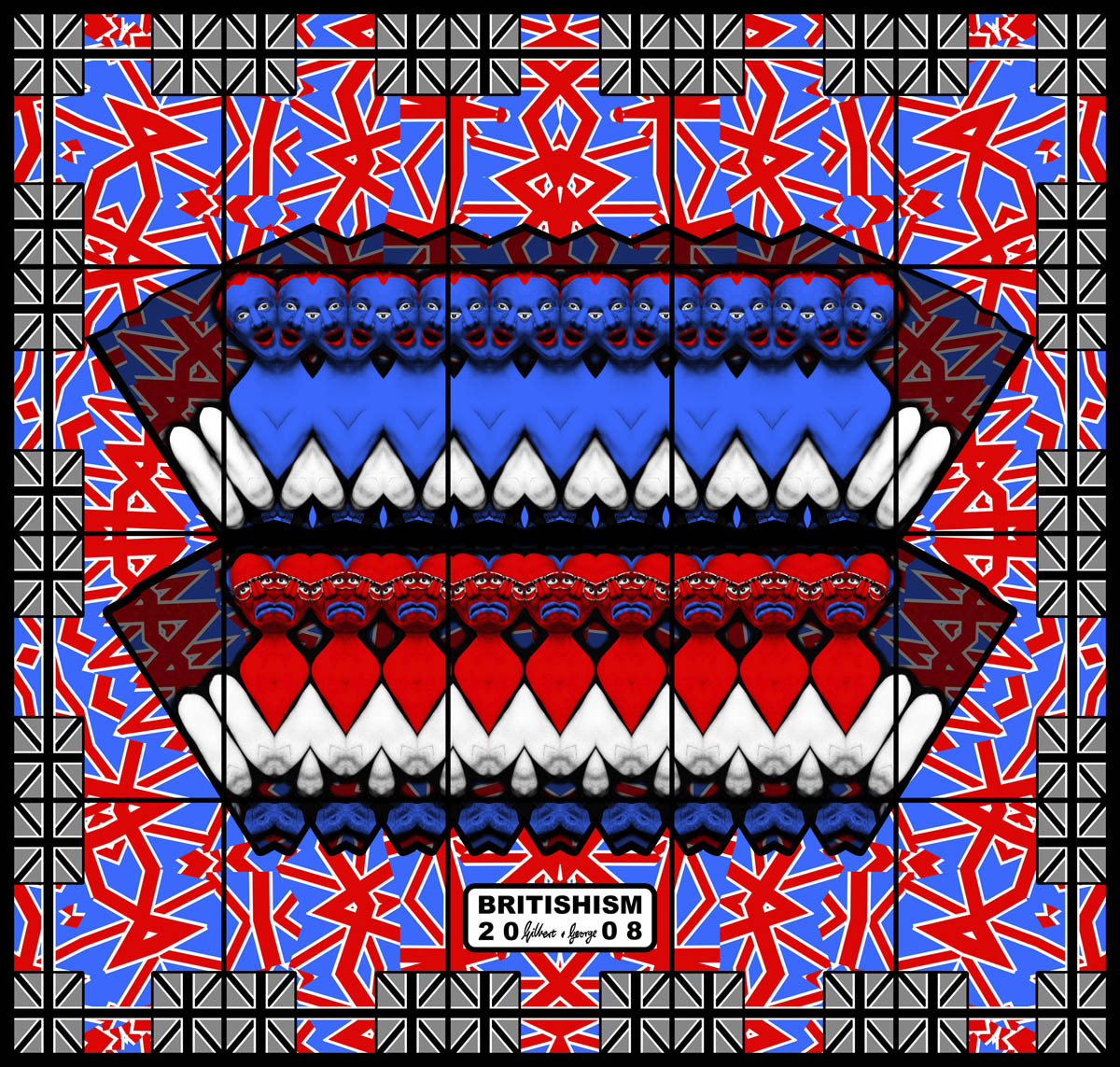
Gilbert & George (Gilbert Prousch, English born Italy, b. 1943) (George Passmore, English, b. 1942) BRITISHISM 2008 Mixed media
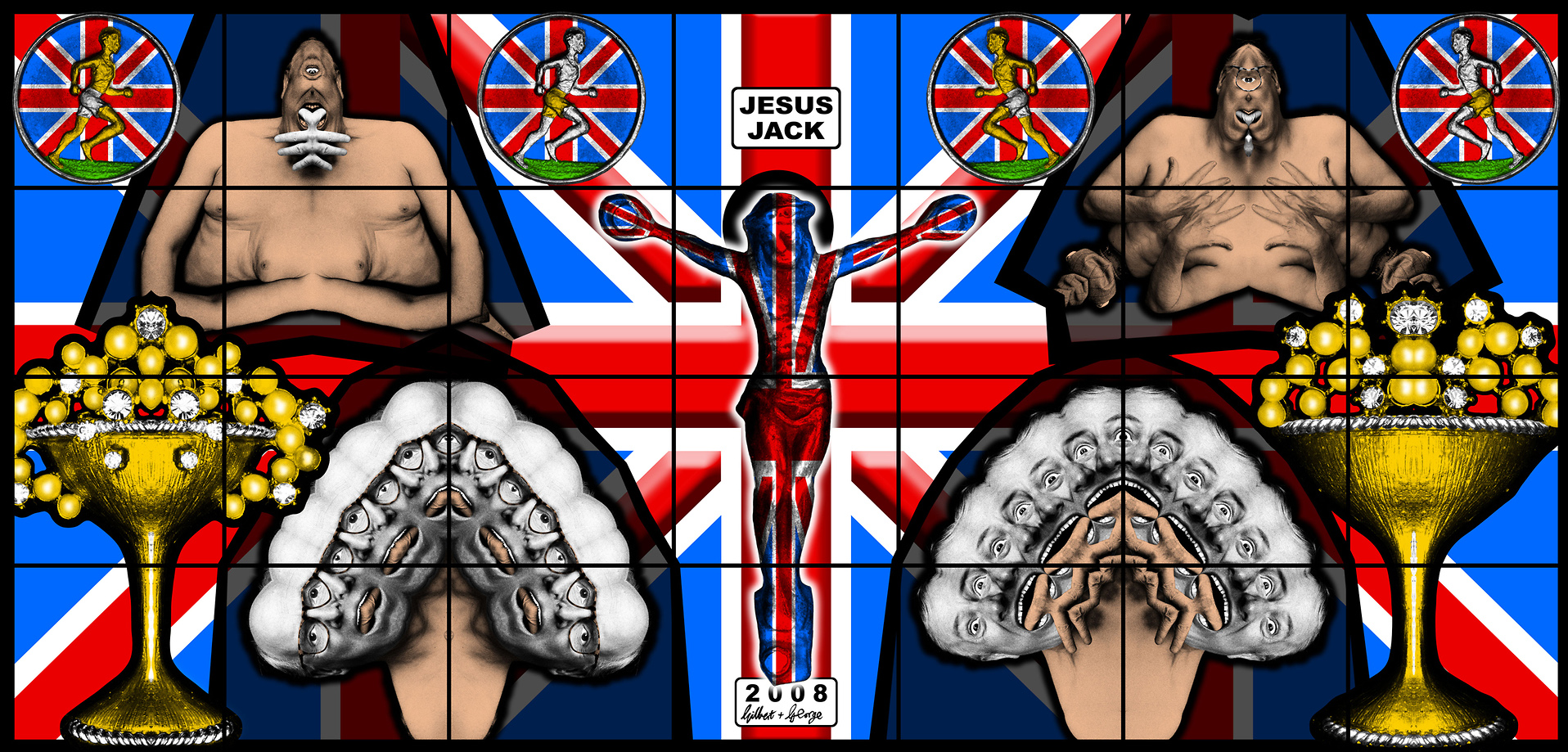
Gilbert & George (Gilbert Prousch, English born Italy, b. 1943) (George Passmore, English, b. 1942) JESUS JACK 2008 Mixed media
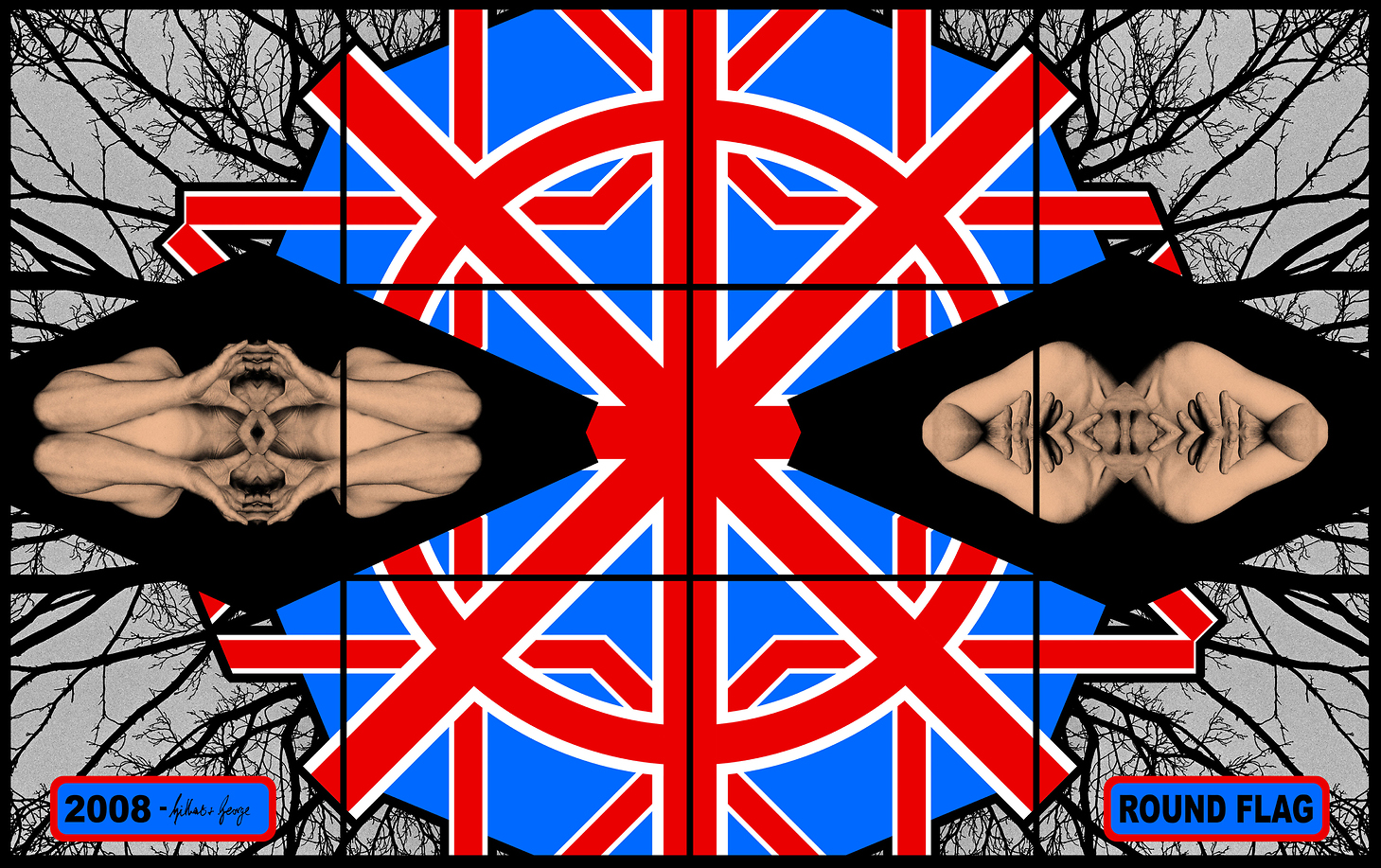
Gilbert & George (Gilbert Prousch, English born Italy, b. 1943) (George Passmore, English, b. 1942) ROUND FLAG 2008 Mixed media
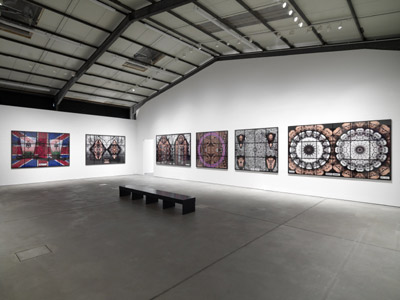
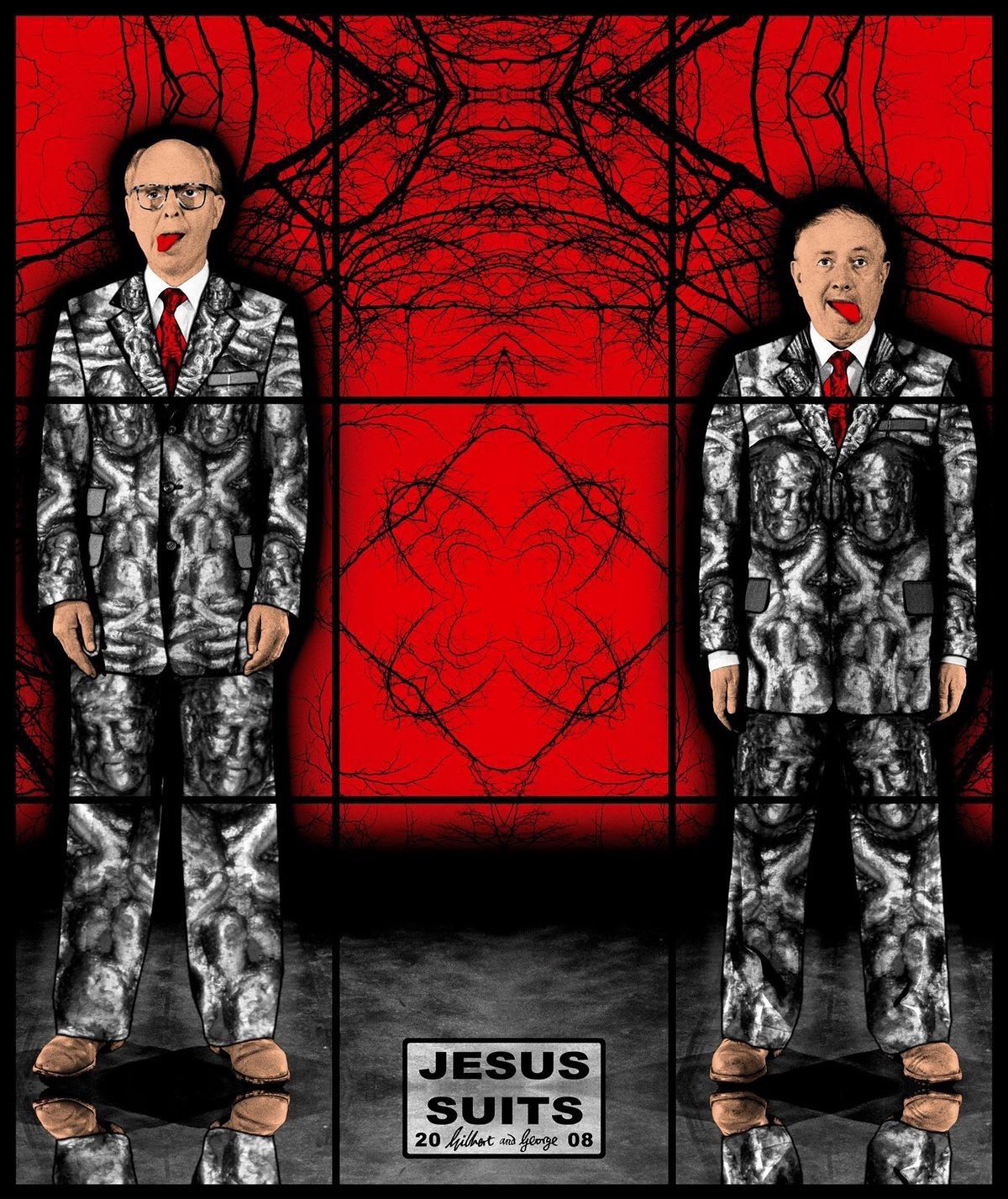
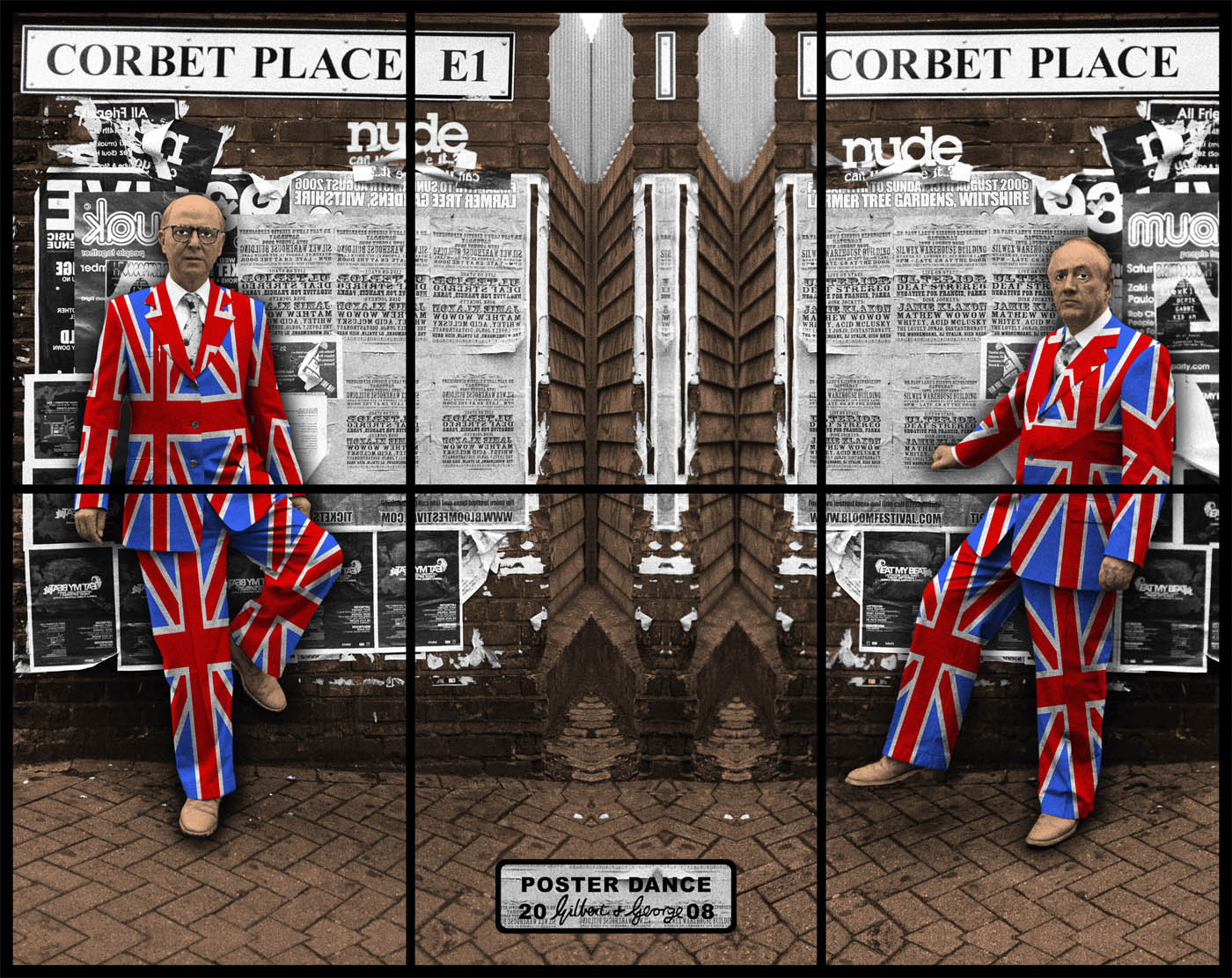
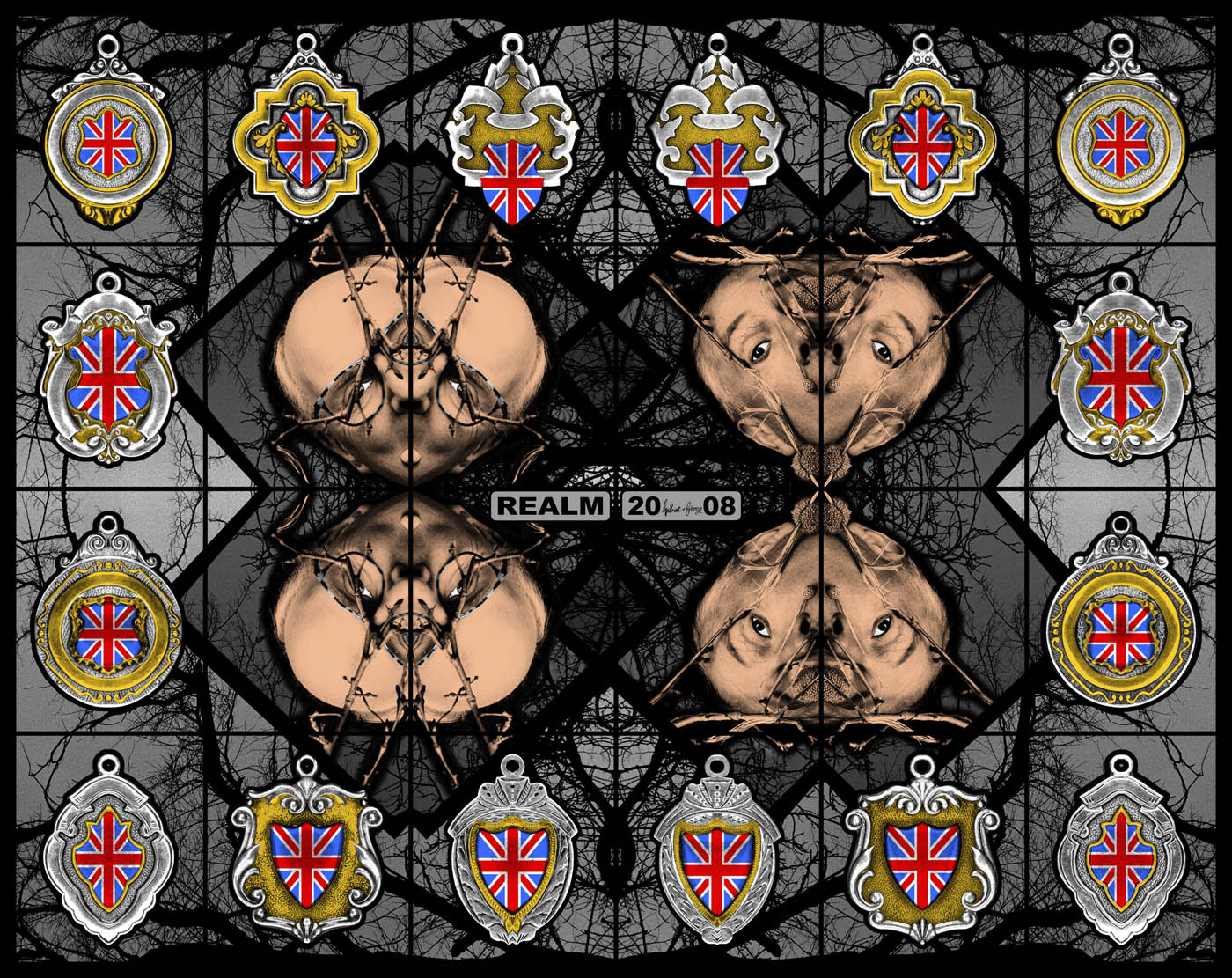
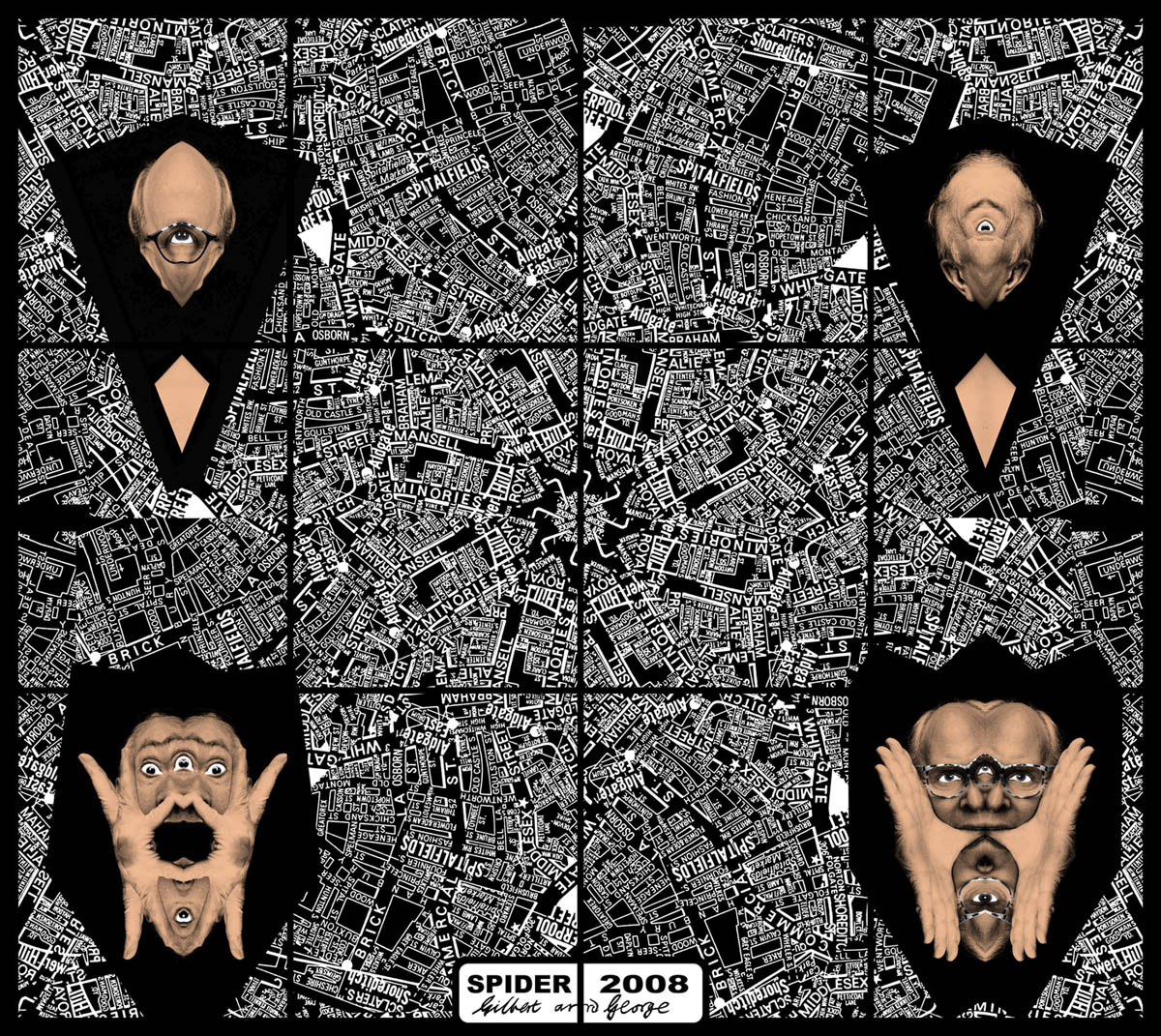
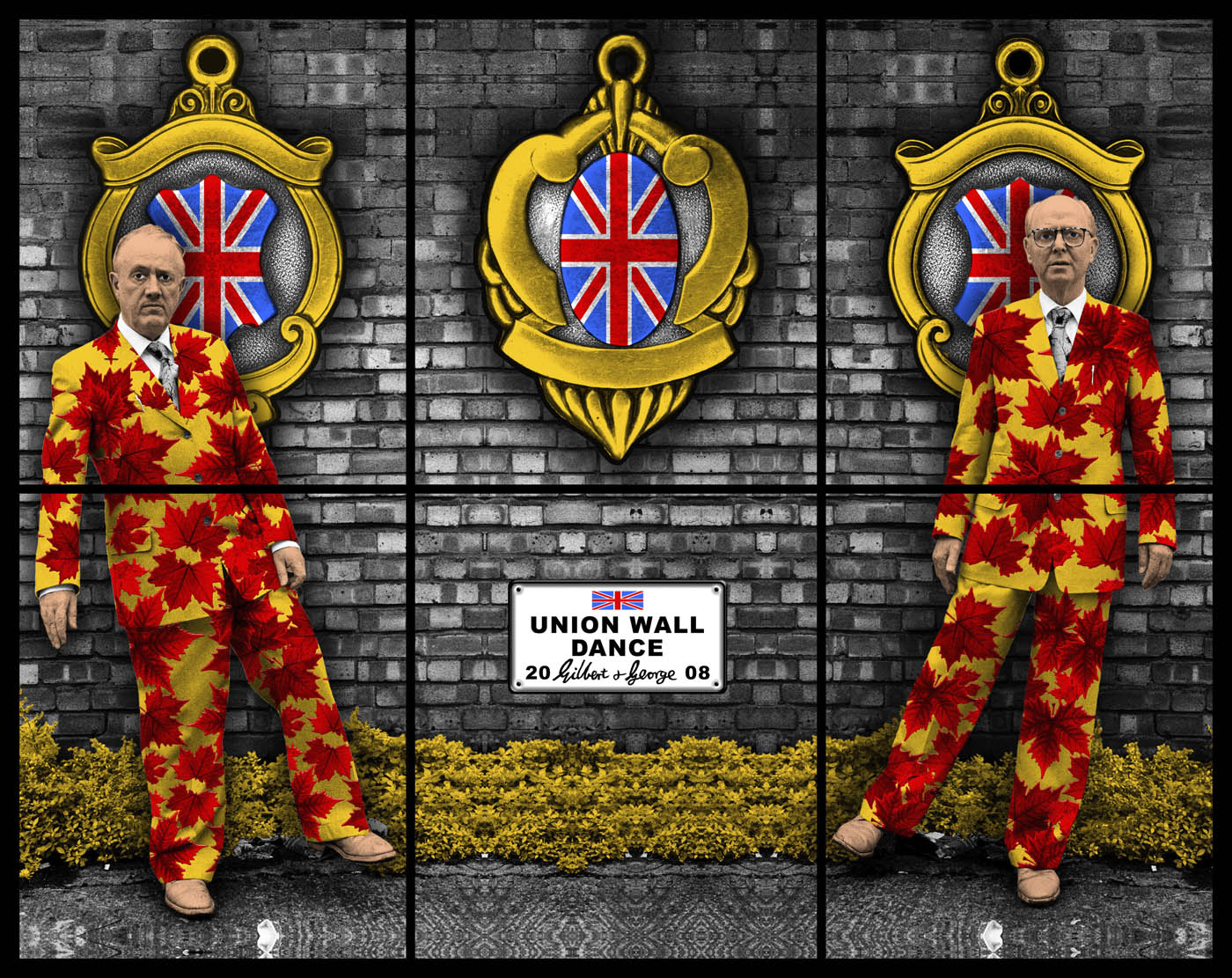
As the international tour of the last Gilbert & George retrospective (2007-2009) did not include Berlin, Arndt & Partner are now presenting a solo exhibition of the celebrity artist duo in its gallery rooms behind the Hamburger Bahnhof. It is the first Gilbert & George solo show in Berlin for 14 years. The exhibition features a selection of 20 large-scale pieces from the Jack Freak Pictures, the largest Gilbert & George group of pictures to date. The thrust of the content is given by the colours and shapes of the Union Jack flag that dominate the bulk of the pictures as well as the recurring motive of medals, emblems and trees. In the Jack Freak Pictures the artist duo explores aspects of nationhood and of the sentient individual in the nets of society. In his essay published in the catalogue accompanying the exhibition the British writer Michael Bracewell describes these pictures as “the most iconic, philosophically astute and visually violent works that Gilbert & George have ever created …”
Gilbert & George, who met as students of sculpture at St. Martin’s School of Art in London 42 years ago, embarked on a joint artistic career that was to encompass a wide range of media from drawing to video and their trademark pictures. Further, the pair revolutionised the concept of sculpture by presenting themselves as “living sculptures” dressed in the quintessentially British tailored suit, shirt and tie. But it was their monumental trademark pictures composed of a grid like array of smaller images which they began to create in the early 70s that first brought them international fame. Figures, cityscapes, symbols, plants, bodily fluids, excrements and text interlock in pictorial messages as visually powerful as their content is provocative. The pictures, which started out in black and white and later assumed increasingly luminous, bold colours, generally also depict portraits of the artists themselves and seize on taboo subjects like sexuality, race, religion and national identity with a brash and fearless candour.
The Jack Freak Pictures again feature the bodies and/or faces of the artists. In these compositions, their bodies function as stylised representatives of the individual in society, whose relationship to social norms and categories, to national, religious and sexual identification processes is relentlessly explored and commented upon. Departing from their earlier oeuvre, some of their new pictures split the raw images into much smaller fragments before merging them into new forms. The result is a fascinating kaleidoscopic mix of the monstrously grotesque with an intricate ornamental structure reminiscent of sacred art. In ever new variations, Gilbert & George order the signs and fragments of social life they find in their neighbourhood – the multicultural East End of London – where solidarity and friendship are as visible as intolerance and marginalisation.
Press release from the Arndt & Partner website [Online] Cited 04/07/2009. No longer available online
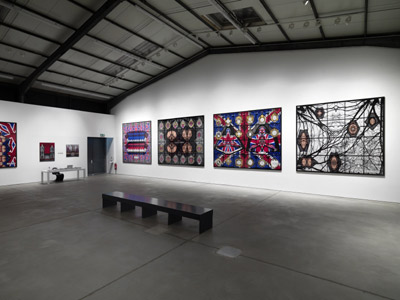
Gilbert & George installation photographs of their exhibition Jack Freak Pictures at Arndt & Partner, Berlin
Gilbert & George (Gilbert Prousch, English born Italy, b. 1943) (George Passmore, English, b. 1942) JESUS SUITS 2008 Mixed media
Gilbert & George (Gilbert Prousch, English born Italy, b. 1943) (George Passmore, English, b. 1942) CHURCH OF ENGLAND 2008 Mixed media
Gilbert & George (Gilbert Prousch, English born Italy, b. 1943) (George Passmore, English, b. 1942) POSTER DANCE 2008 Mixed media
Gilbert & George (Gilbert Prousch, English born Italy, b. 1943) (George Passmore, English, b. 1942) REALM 2008 Mixed media
Gilbert & George (Gilbert Prousch, English born Italy, b. 1943) (George Passmore, English, b. 1942) SPIDER 2008 Mixed media
Gilbert & George (Gilbert Prousch, English born Italy, b. 1943) (George Passmore, English, b. 1942) UNION WALL DANCE 2008 Mixed media
Apocrypha (from the Greek word ἀπόκρυφα, meaning “those having been hidden away”) are texts of uncertain authenticity, or writings where the authorship is questioned.
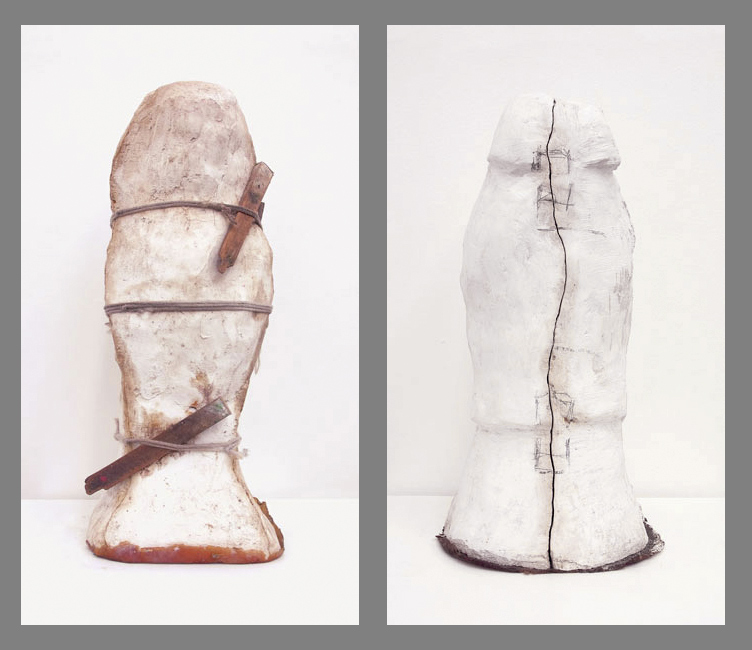
Julie Davis (Australian, b. 1959) and Alex Rizkalla (Australian, b. 1950) Apocrypha #1 (left) and Apocrypha #4 (right) 2008
“Intuitively we know the definition of the output from this process lies hidden within each object, seemingly carved into the underside of their skin, although we cannot see it. But actually it is not carved, it is the three-dimensional tracing of the original. The original becomes a throw-away. It is obsolete. The point of origin lies no longer within an object but at the heart of the creative impulse.”
Vanessa Mooney
Apocrypha is an interesting, if slight, exhibition of eleven photographs by Julie Davis and Alex Rizkalla at Place Gallery in Richmond. Conceptually the work is resolved if not pushed to any great depth, the small photographs of sarcophagi like casements and moulds addressing issues surrounding the absence / presence of the original object and the subsequent loss of identity. In their masking, the objects photographed hide an inner identity that has gone missing; the headless figures, like faceless mummies, protect something that has existed since early man – the inner spiritual machinations of belief – that are embedded within the existential nature of our being. Identity has been rubbed out and spirit is splitting apart the moulds trying to escape the confines of mortality, only held in check by the wooden pegs and ropes.
Like the sutures of the human skull, the marks on the casements (see below right image) try to align form across space and time but these objects are grounded in a contextless backgrounds, seemingly floating free of earthly constraints. Here we have a double tracing – that of the tracing of the original object that has been thrown away (see Vanessa Mooney quotation above) and the tracing of the indexicality of the object by the photograph – the re-presentation of an original that no longer exists. There is a double loss through this re-retracing that fits perfectly with the title Apocrypha – as the photographs become texts of uncertain authenticity.
Where the exhibition is less successful is in the physical presence of the photographs and their aesthetic qualities. While Vanessa Mooney asserts that the photographs are “meticulous in their detail and exact in their depth and texture” this assertion is untrue. From a technical point of view the photographs are soft in focus and lack depth of field. The ropes are fuzzy and the lack of depth of field in the focus plane from front to back adds to a lack of presence that the photographs needed to counterbalance the conceptual idea of apocrypha. I am also unsure about the scale of the photographs – there seems something in-between about the size of the images, neither here nor there. Aesthetically they needed either more presence (through being bigger), or more intensity through a jewel like nature in being smaller, again to counterbalance the conceptual themes. Finally, being surrounded by these eleven photographs in the gallery gives you the feeling of a ‘one shot’ idea that needed further investigation and refinement, an idea that needed to be pushed further. While the actual ideas themselves are interesting the work itself is too simple, too slight to hold the attention and reveal layers of meaning over time.
Dr Marcus Bunyan
Many thankx to Place Gallery for allowing me to publish the photographs in the posting.
Julie Davis (Australian, b. 1959) and Alex Rizkalla (Australian, b. 1950) Apocrypha #5 (left) and Apocrypha #7 (right) 2008
The Father, The Son And Apocrypha
We all have faith that we must lodge somewhere: you; the microscope, me; the earth, and the artist? There are two stories present. The first is Apocrypha, a series of works by Davies and Rizkalla and the second is something you cannot see but will soon know.
Davies and Rizkalla present to us Apocrypha; a series of photographs that are meticulous in their detail and exact in their depth and texture. It is an evocative title and encapsulates the resonance of the objects. What we can see is clear – plaster moulds used by someone, somewhere for casting objects. The clarity of the details of rope, wedges of wood and the depth of the seam tell us of the real working nature of them. The inversion here from background process to foreground subject matter is not for irony’s sake but to evoke the simultaneous banality and sacredness of the transformative creative process. It is documented honestly before the viewer, and yet, the mystery remains. Intuitively we know the definition of the output from this process lies hidden within each object, seemingly carved into the underside of their skin, although we cannot see it. But actually it is not carved, it is the three-dimensional tracing of the original. The original becomes a throw-away. It is obsolete. The point of origin lies no longer within an object but at the heart of the creative impulse.
Tony Scalzo, my father-in-law, was drawn to this process. While the creation of a religious icon amused his communist leanings the irresistible pull of the transformation from dust and water to artefact must have, I feel, fulfilled a greater need to live through making. Countless times he would present to us his recent army of saints or holy persons (Padre Pio was a boom time) to be sold through his community, and would scoff and laugh at how he could make an object that to others was an icon. He would point to the shed, the latex, the plaster dust as if to dispel the mystery, and yet the mystery remained.
Perhaps the final mystery is the process, the collaboration that has come about since Tony passed away and his son Stefano came into possession of the simple and unusual collection. Stefano like his father is drawn to the creative process. So innately aware of the artist, his father, he approached Julie and Alex with these as gifts that are, in a way, not his to give. As a custodian might he passed on the objects and communicated his intuitive knowledge of their meaning. One plus one equals three. The result, Apocrypha, is like a window that was obscured and now has been opened. We can see with clarity what was unseen, but known, before. Apocrypha silently demonstrates the entwining of faith and mystery in the creative life of all.”
Vanessa Mooney
Text from the Place Gallery website [Online] Cited 09/03/2019. No longer available online
Julie Davis (Australian, b 1959) and Alex Rizkalla (Australian, b. 1950) Apocrypha #8 (left) and Apocrypha #9 (right) 2008
Installation view of LE MONDE v. DER MOND by Matthew Hale at The Narrows, Melbourne with n.n. (2008) centre bottom, andPage 93 of MIRIAM DIVORCEE (2008) centre right
Below is the only text I could find on the work – some of which was displayed in London earlier this year.
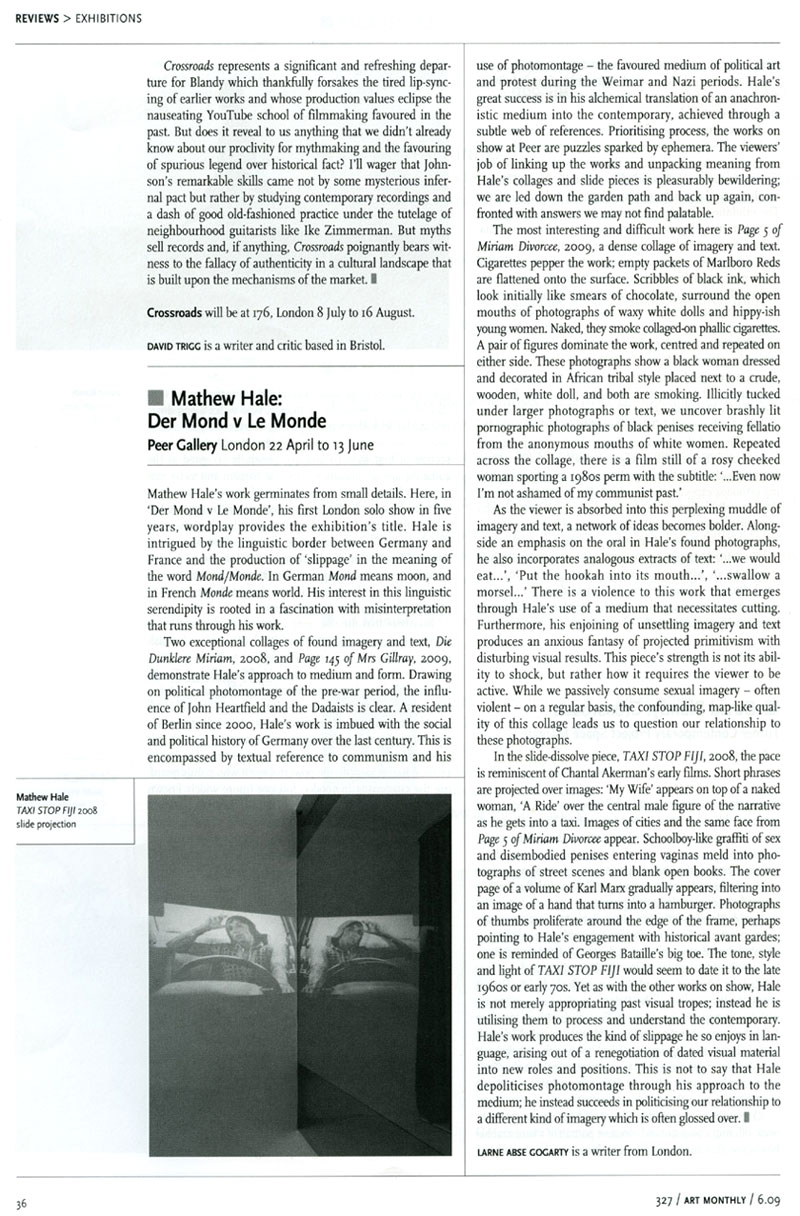
DER MOND v LE MONDE is Mathew Hale’s first solo exhibition in London for five years. It consists of five works: one two-projector and one three-projector slide piece; a constructed painting (that could equally be described as a wall-mounted sculpture); and two large collage works …
Hale’s work has many possible points of departure: a found photograph, a scrap of paper, a page torn from an instructive and obscure book, a bit of out-moded pornography, some anachronistic advertising from the 1970s or 1980s and so forth. Once plucked from a huge collection of such material amassed in his domestic studio space, the work evolves like an unplanned journey – both moving away and turning back on itself … The path of discovery in Hale’s work is the subject of his work, providing it with narrative and process.
With its roots in the collage traditions of political photomontage, dadaist assemblage and free associative surrealism, Hale’s work prioritises process over methodology or style. It activates a complex web of references that takes in history, politics, literature, and philosophy, as much as it does sex, religion, art, architecture and popular culture. To engage with the work is to become carried along by clues that lead to other clues and then circuitously lead somewhere else unexpected yet somehow familiar. Sometimes the clues are visual, sometimes they are language based, often they are both. Even when the work is finished and exhibited it is in a state of flux, the meaning is not fixed. Hale likes slippage of meaning and this constant state of ambiguity and openness for (mis)interpretation or confusion. He explains the title of the show as follows: ‘[in German] … and strikingly weirdly, “der Mond” means “The Moon” and, as we all know, “Le Monde” means “The Earth”. How can a word flip so totally by crossing a border? I am making a work for the show which hinges on their being apparently identical (almost) and yet meaning precisely the opposite – I wonder how it happened.’
Text from the London exhibition of this work (note with title reversed!), on the Peer website [Online] Cited 23/06/2009. No longer available online
Matthew Hale (British, b. 1962) Page 93 of MIRIAM DIVORCEE 2008 Paper collage 69 x 103cm
Matthew Hale (British, b. 1962) Page 150 of MIRIAM DIVORCEE (detail) 2008 Paper collage
Matthew Hale (British, b. 1962) n.n. 2008 Rifle, paper collage 69 x 153cm
Matthew Hale (British, b. 1962) Page 145 of MRS. GILLRAY 2009 Paper collage
Matthew Hale (British, b. 1962) Page 48 of DIE NEUE MIRIAM 2008 Paper collage
Review in Art Monthly, June 2009 from the Peer website [Online] Cited 23/06/2009. No longer available online
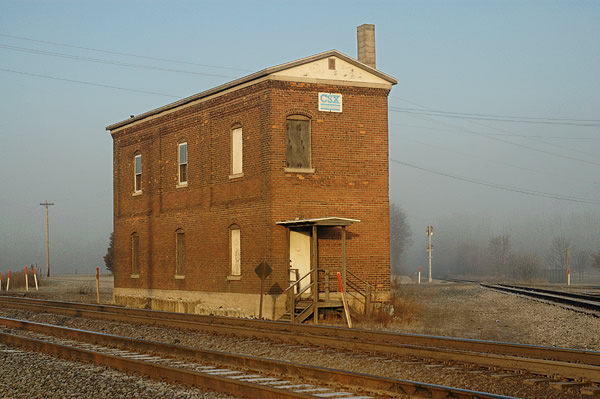
Kay Westhues (American) CSX railroad building, Walkerton 2005
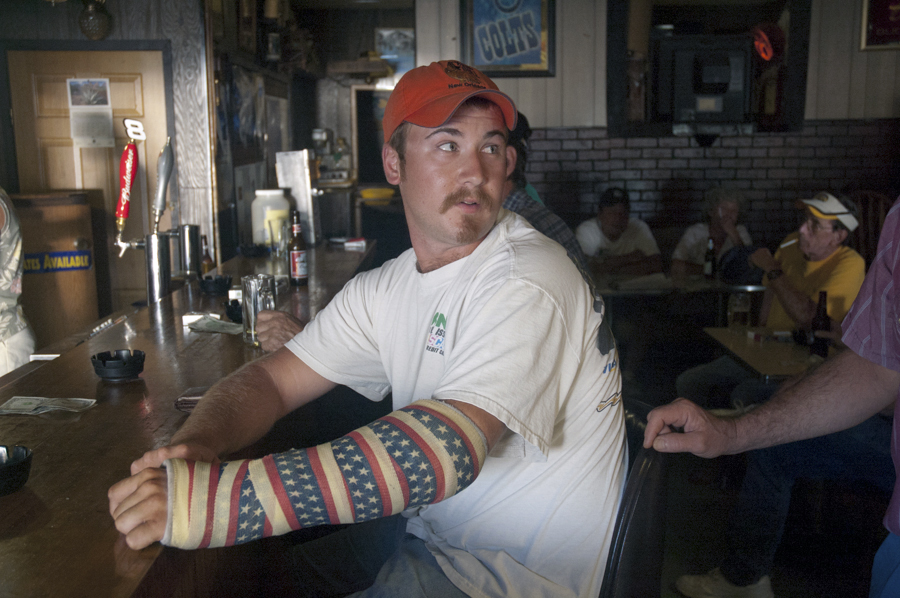
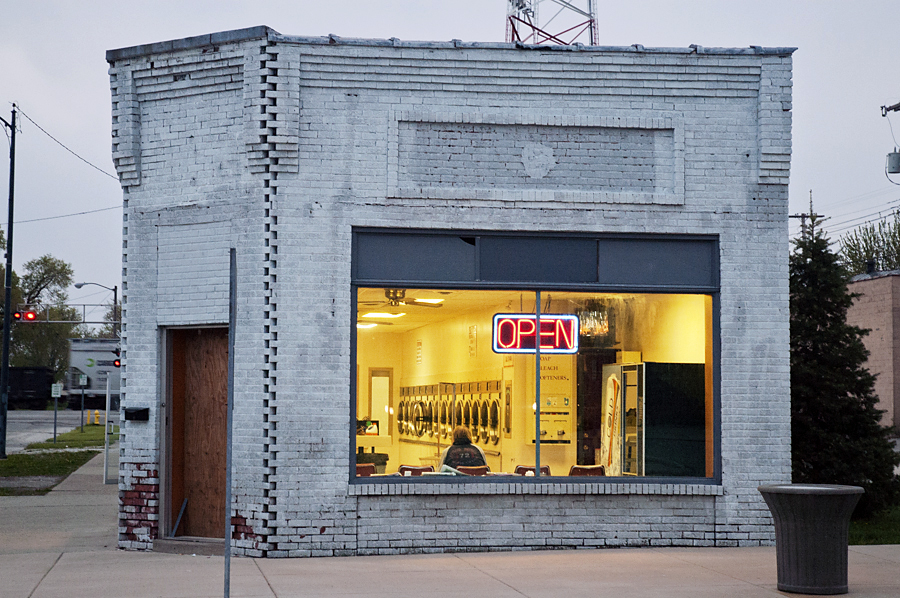
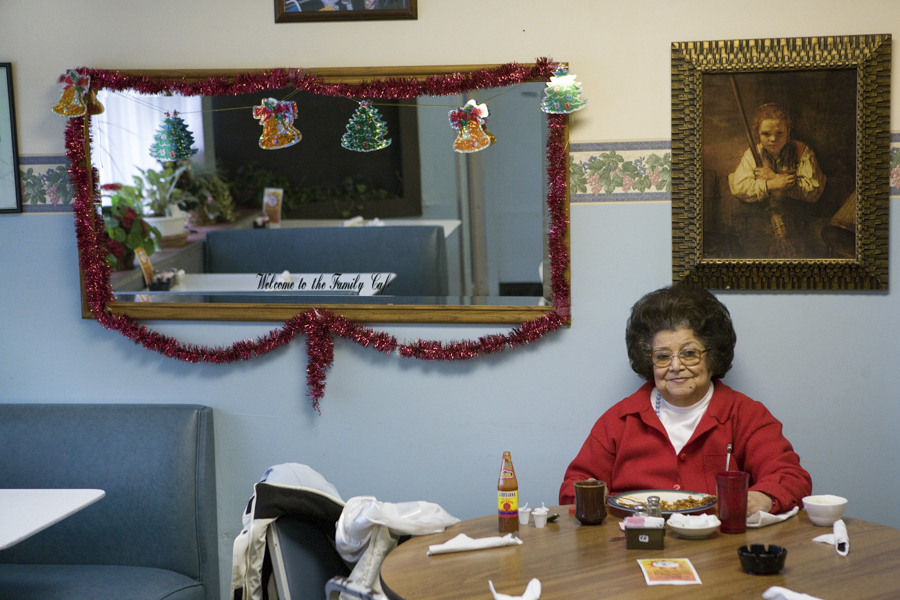
I really like this work. An insightful eye, sensitive, tapped into the community that the artist is documenting. Attuned to its inflections and incongruities, the isolation and loneliness of a particular culture in time and place. There are further strong photographs from the series on the Kay Westhues website. It’s well worth your time looking through these excellent photographs. And observing the wonderful light!
Kay Westhues (American) Man with patriotic cast, Original Famous Fish of Stroh 2005
Kay Westhues (American) Knox laundromat 2005
The Snite Museum of Art announces the opening of the exhibition: Fourteen Places to Eat: a Narrative: Photographing Rural Culture in the Midwest, opening on Sunday, May 31,2009.
Kay Westhues is a photographer who is interested in documenting the ways in which rural tradition and history are interpreted and transformed in the present day. Kay shares her intention for this series of work:
“For the past five years I have been working on a series of photographs depicting rural culture in Indiana and the Midwest. This project was inspired by my memories of growing up on a farm in Walkerton, Indiana, and observing first hand the shifting cultural identity that has occurred over time and through changing economic development. I moved back to Walkerton in order to help care for my ageing parents in 2001.
These photos mirror my personal history, but I am also capturing a people’s history grounded in a sense of place. My intention is to celebrate rural life, without idealising it.
The overall theme since the project’s inception is the effect of the demise of local economies that have historically sustained rural communities. Many of my images contain the remains of an earlier time, when locally owned stores and family farms were the norm. Today chain stores and agribusiness are prevalent in rural communities. These communities are struggling to thrive in the global economy, and my images reflect that reality.
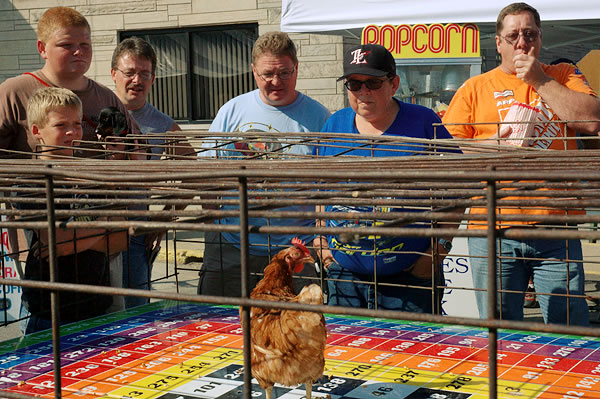
Most recently I have focused on the complex relationship between farmers and domesticated animals. I make many of my images at Animal Swap Meets and sale barns, places where animals are bought and sold. Family farms are quickly being replaced by large-scale food production, and these events still draw smaller farmers and the local people who support them.”
Why fourteen places to eat?
“One of my biggest complaints after moving to Walkerton was that there were not enough places to eat out. Or, rather, practically no places to eat out. So I was happy when news arrived that a new restaurant was opening there. Imagine my surprise when I read a letter to the editor in the local paper against the new restaurant. The letter stated we already had enough places to eat in this town. The writer counted a total of fourteen places to eat, which included four restaurants, three gas stations, four bars, a truck stop, a convenience mart, and a bowling alley.”
Ms. Westhues studied photography at Rhode Island School of Design and Indiana University, Bloomington. She has a BS degree in Photography and Ethnocentrism from the Indiana University Individualised Major Program (1994), and an MS in Instructional Systems Technology at Indiana University (1998). She currently lives in Elkhart, Indiana, and is completing a five-year project photographing rural culture in the Midwest. This series is a visual exploration of the ways rural identity is defined in contemporary society.
Press release from the Snite Museum of Art Cited 20/06/2009. No longer available online
Kay Westhues (American) Chicken bingo, Francesville Fall Festival 2005
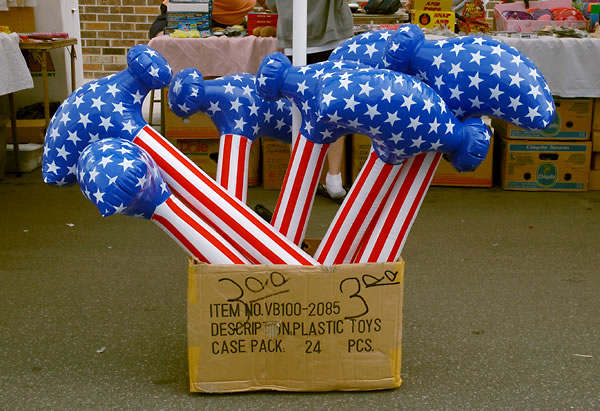
Kay Westhues (American) Patriotic hammers ($3.00) 2005
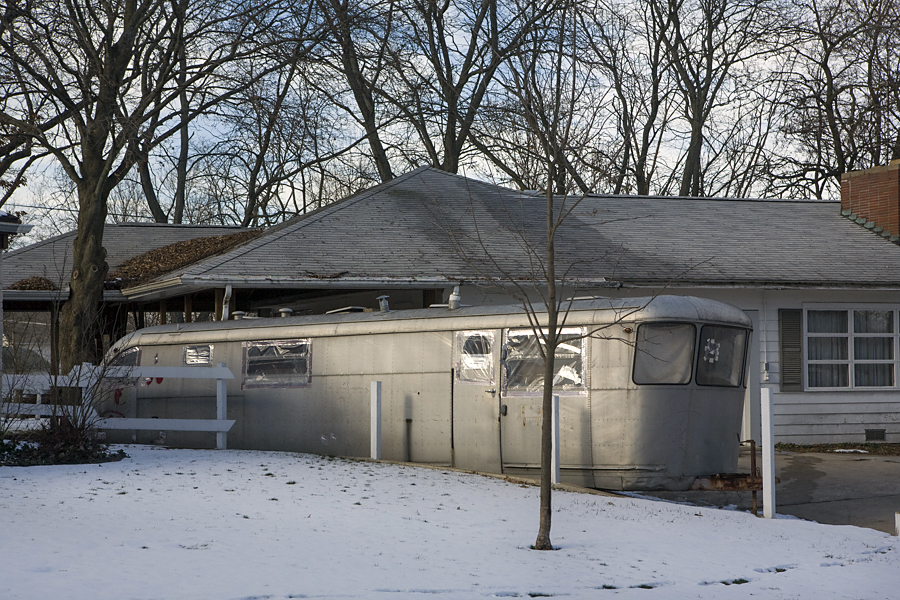
Kay Westhues (American) Parked trailer, Ligonier 2006
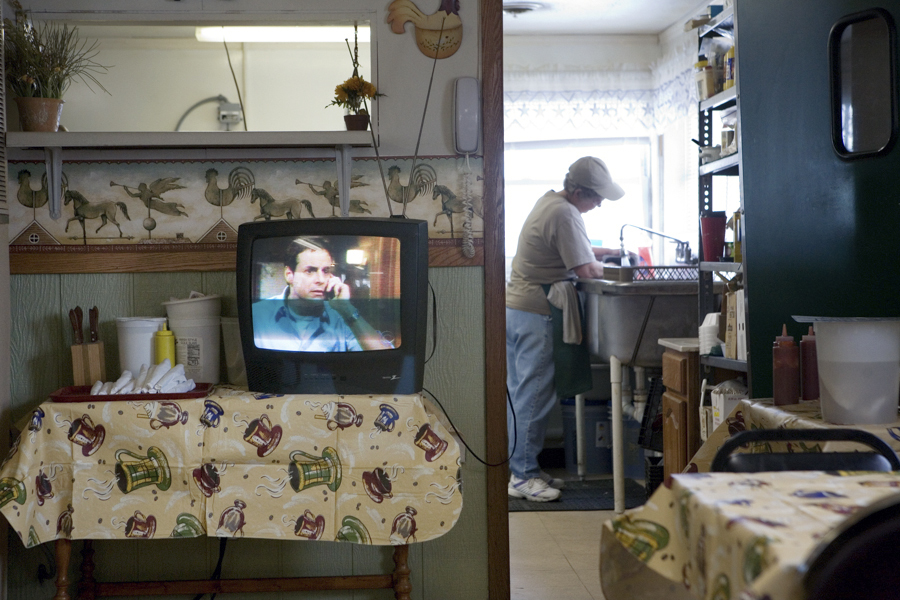
Kay Westhues (American) Lunch at the Crockpot, Walkerton (The Young and the Restless) 2007
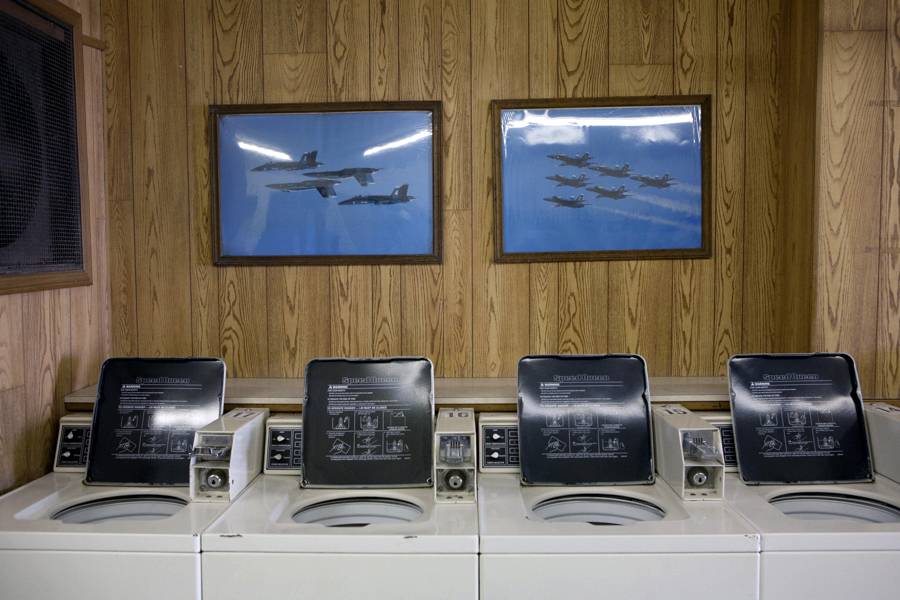
Kay Westhues (American) Momence Speed Wash, Momence IL 2007
Kay Westhues (American) Mary Ann Rubio, Family Cafe, Knox 2007
The Snite Museum of Art at University of Notre Dame, Notre Dame, Indiana
Scott McFarland (Canadian, b. 1975) Fallen Oak Tree 2008 From the series Hampstead Inkjet print 27 x 24 inches (68.6 x 61cm) Edition of 5
Variations on a theme
Whether McFarland’s photographs are “straight” or composites, there always seems to an unnerving feel to them, a formal frontality that empowers the viewer into trying to unlock the photographs secret, like an enigmatic puzzle. Everything is presented front on, square to the camera, no oblique angles, relying in the straight photographs on the scale of the accumulated blocks of information, and in the composites, in the very unlikely, even theatrical, staging of the people within the mise en scène.
These are very cinematic photographs, some, literally, with their panoramic aesthetic, others built by assembling their scudding skies and stiff, neatly placed people. Too neatly placed in my opinion but that’s McFarland’s hook, his aesthetic cough which prompts the viewer to question the veracity of the image, its link to the photographs indexical reality. His multiple exposures push the boundaries of truth or dare, hyperreal solutions to a disengaged world. Personally, I prefer his straight photographs which are built on a fabulous eye, a masterful understanding of pictorial space (monumental elements held in balance) and wonderful previsualisation. You don’t need anything more.
Dr Marcus Bunyan
Many thankx to Regen Projects for allowing me to publish the photographs in the posting. Please click on the photographs for a larger version of the image.
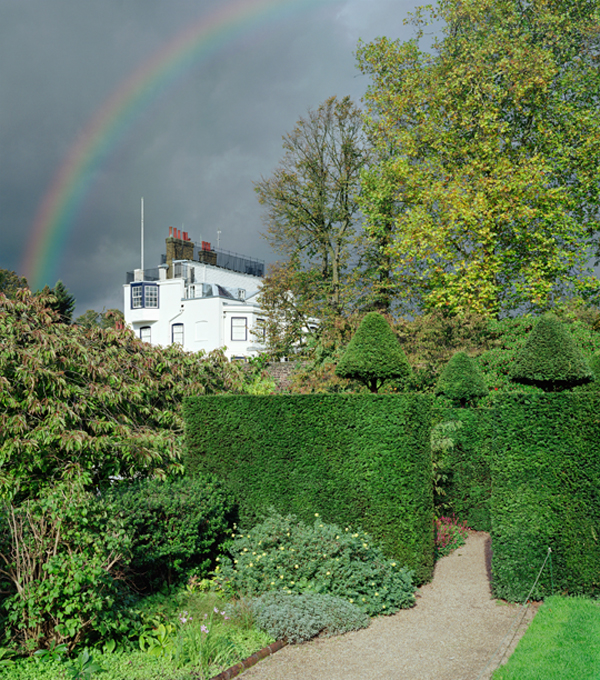
Scott McFarland (Canadian, b. 1975) The Admiral’s House as seen from the Upper Garden at Fenton House 2006 From the series Hampstead Inkjet print Edition of 5
“Regen Projects is pleased to announce an exhibition of new work by Canadian artist Scott McFarland. This exhibition will feature new photographs including 3 large panorama works, smaller works from the “Hampstead” series, and introduce the new “Niagara” series.
Scott McFarland’s photography reconsiders the traditional concept of a photograph as the depiction of a single captured moment in time. Through digital means he is able to manipulate composition, colour, light, space, shape, and form. McFarland’s photographs combine multiple negatives to represent simultaneous temporalities and interweave selected elements into a cohesive whole. Several different moments are packed into what appears to be one densely constructed instant. The photographs are meticulously crafted illusions created within the formal language of documentary photography.
McFarland’s consideration of photography and the built picture was brought about by the artist’s own understanding of the artificial “nature” found in built environments such as gardens and zoos. Taking the relationship of the constructed space/constructed image one step further, McFarland has photographed a modernist architectural landmark: the Berthold Lubetkin designed penguin pool at the London zoo. Through two very distinct works, McFarland investigates the elliptical structure of the famous penguin pool vis-à-vis the elliptical / arcing motion of his camera rotating on a tripod. One photograph is an objective colour rendering where the camera has been left level while rotating; the other is a larger black and white version where the camera arcs along a non-level plane distorting and altering the curve of the structure from right to left.
The new square format photographs from McFarland’s “Niagara” series have a rough unfinished quality unlike any photographs he has taken to date. These softer focus images with odd shifts in light and glare are location studies for the large panorama A Horse Drawn Hearse, Queens Royal Tours, 174 Anne, Niagara on the Lake, Ontario (2009, below). This work depicts an old carriage business and its surroundings during the dead of Canadian winter. In this visually captivating work, a black funeral carriage contrasts against the white snow. The acreage, surrounded by newer suburban homes, evokes the question of how long can this structure resist the modern urban pressures it faces. These straight photographs presented alongside his precise digitally mastered compositions illustrate how the photographic process and the history of art and photography have always informed McFarland’s work.
“Over the last decade, Scott McFarland has produced bodies of work that engage with different aspects of photography … McFarland’s approach is both descriptive and metaphoric … The images, rich in cultural significance, express the complementary workings of conceptual and aesthetic factors all the while holding various characteristics of art and photography in ambiguous relation.”
Andrea Kunard. Scott McFarland: A Cultivated View, published by the National Gallery of Canada, Ottawa, 2009, p. 12.
Text from the Regen Projects press release [Online] Cited 16/06/2009. No longer available online.
Scott McFarland (Canadian, b. 1975) A Horse Drawn Hearse, Queens Royal Tours, 174 Anne, Niagara on the Lake, Ontario 2009 From the series Niagara Inkjet print 59.5 x 124 inches (151.1 x 315cm) Edition of 5
Scott McFarland (Canadian, b. 1975) Boathouse with Moonlight 2002 From the series Boathouse Digital C-print 71 x 91 inches (180 x 231cm) Edition of 5, 2 AP
“Boathouse with Moonlight” is an exploration of the technical advancements afforded by digital photography, created by assembling multiple exposures taken over the space of two hours under the light of a full moon. Unlike traditional photography, this image does not represent one specific moment captured at a particular site; rather, it shows an accumulation of moments that have been manipulated and layered to create a revised version of the boathouse and its surroundings. McFarland’s use of multiple exposures to produce the final image emphasises not only the duration of the photographic act, but also the many facets of the boathouse’s character. This type of building on British Columbia’s “Sunshine Coast” is disappearing with the construction of new, suburban-style retirement housing.
Text from the National Gallery of Canada website [Online] Cited 02/03/2019
Scott McFarland (Canadian, b. 1975) Gorse and Broom, West Heath, Hampstead 2006 From the series Hampstead Inkjet print Edition of 5
Scott McFarland (Canadian, b. 1975) Women Drying Laundry on the Gorse, Vale of Health, Hampstead Heath 2007 From the series Hampstead Inkjet print 29 x 45 inches (73.7 x 114.3cm) Edition of 5
Scott McFarland (Canadian, b. 1975) Inspecting, Allan O’connor Searches for Botrytis cinerea 2003 From the series Gardens Digital C-print 40 x 48 inches (102 x 122cm) Edition of 7
Scott McFarland (Canadian, b. 1975) Orchard View with the Effects of Seasons (Variation #1) 2003-2006 From the series Gardens Digital C-print 42 x 122 inches (106.7 x 309.9cm) Edition of 3
Scott McFarland (Canadian, b. 1975) [Huntington Botanical Gardens in San Marino, Calif] 2005 From the series Empire Inkjet print
Scott McFarland (Canadian, b. 1975) Echinocactus grusonii [Huntington Botanical Gardens in San Marino, Calif] 2006 From the series Empire Inkjet print 24.5 x 27.5 inches (62 x 70cm) Edition of 3 Private collection/Vancouver Art Gallery
This picture comes from Empire, a series on desert vegetation shot in the Huntington Botanical Gardens in San Marino, Calif. Henry E. Huntington, an art collector who made his fortune building railroads, founded the garden in 1919.
“The plantings [of the garden] are dense, and the soil is mostly hidden beneath the thriving vegetation,” writes Grant Arnold in a catalogue essay for the exhibition, “the fullness of the planting continually reminding the visitor of Huntington’s beneficence.” To many gallery visitors, however, these images of lush desert vegetation will simply be appealing to the eye.
Scott McFarland (Canadian, b. 1975) The Granite Bowl in the Berlin Lust Garden 2006 Inkjet print 43 x 62 inches (109.2 x 157.5cm) Edition of 5
At first the photograph appeared to be a simple scene, one of no importance. The two young children, obviously related based on their similar physical features, seemed a bit awkward and posed, but otherwise, I thought it to be a snapshot, much like the one I took of the bowl while in Berlin. Upon learning how McFarland created this and many of his other photographs, I learned how complex of a scene this really is. McFarland uses multiple negatives, often taken over a matter of days, weeks, and even months, and combines them digitally into a seamless print. His interest is in breaking through the concept of a photograph being an image of a single instant in time and space.
A fuller narrative is created as well. With just one negative, there may only be one or two people depicted. We may just have the dog with his owner half shown, or even only half of the brother-sister group. But by overlapping the various negatives, Mr McFarland manipulates his work into a greater piece. We can now ask ourselves, why are the brother and sister so psychologically distant? Or, who is the small girl with the accordion and where is her mother? Is her mother the woman with the baby carriage? How long has that man been sleeping under the bowl? These are all questions that can be asked together because the negatives are combined that couldn’t be asked if we had just the single frame.
Scott McFarland (Canadian, b. 1975) View of Vale of Health, looking towards Hampstead 2007 From the series Hampstead Inkjet print 27 x 42.5 inches (68.6 x 108 cm) Edition of 5
With the stiff figures of a historical painting, Scott McFarland’s View of Vale of Health, Looking Towards Hampstead muddles ideas of what’s real and what’s not.
From the get-go, painting and photography have been inextricably bound together. The Pictorialists tried to make their photographs look like paintings. The Futurists, in their paintings, mimicked the blurred and segmented movement found in Etienne-Jules Marey’s chronophotographs. The photorealists created paintings whose subject was the photograph itself. And in his large-scale, backlit photo-transparencies, Jeff Wall has alluded to paintings by Nicolas Poussin, Edouard Manet, and Paul Cézanne, among others. The digital age has done nothing to diminish each medium’s obsession with the other.
This continued entwining of art forms is evident in Scott McFarland’s computer-montaged photographs, on view at the Vancouver Art Gallery. So is the parallel entanglement of nature and culture. Both conditions are conspicuous in his 2006 series, “Hampstead”, inspired by the landscapes of the early-19th-century English painter John Constable. McFarland’s colour photos, shot in various locations around London’s immense Hampstead Heath, pay homage to Constable’s attraction to the same place. They also play variations on that painter’s rendering of multiple versions of the same scene, and on his open-air studies of the changing effects of light and weather. …
Over the past decade, McFarland’s working methods have changed from straightforward analog photography to the creation of highly manipulated images in which he digitally splices together multiple segments of the same landscape or structure, shot over a period of days, weeks, or even months. In both variations of Orchard View With the Effects of the Seasons, for instance, the blossoms and foliage of spring, summer, and fall are contained within the same seamless panorama.
The digital assist means that there are no constraints of time, space, or documentary veracity in McFarland’s work: he can build whatever impossible pictures he wants and they will look “real”. At least until they’re closely scrutinised, revealing incongruities of light, shadow, time, and figuration. In this sense, his art challenges our understanding of the nature of the photograph and its relationship with the truth. There’s nothing really new about this project – as long as photography’s been around, it’s been manipulated by its practitioners. Photoshop, however, has added a vast digital dimension to the darkroom antics of earlier photo artists.
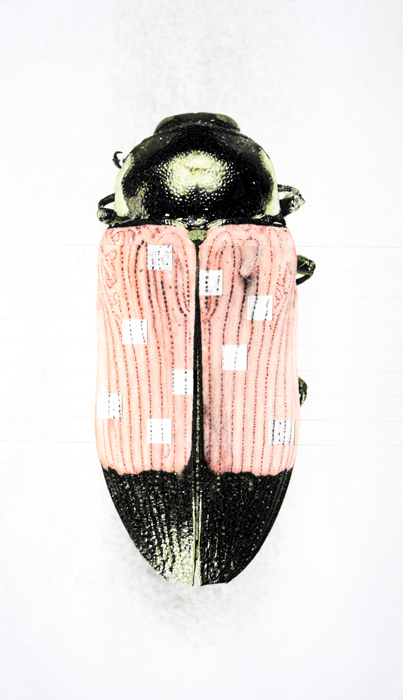
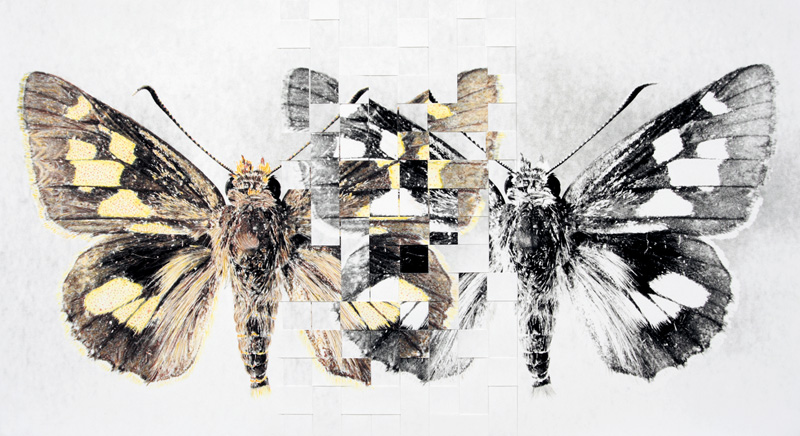
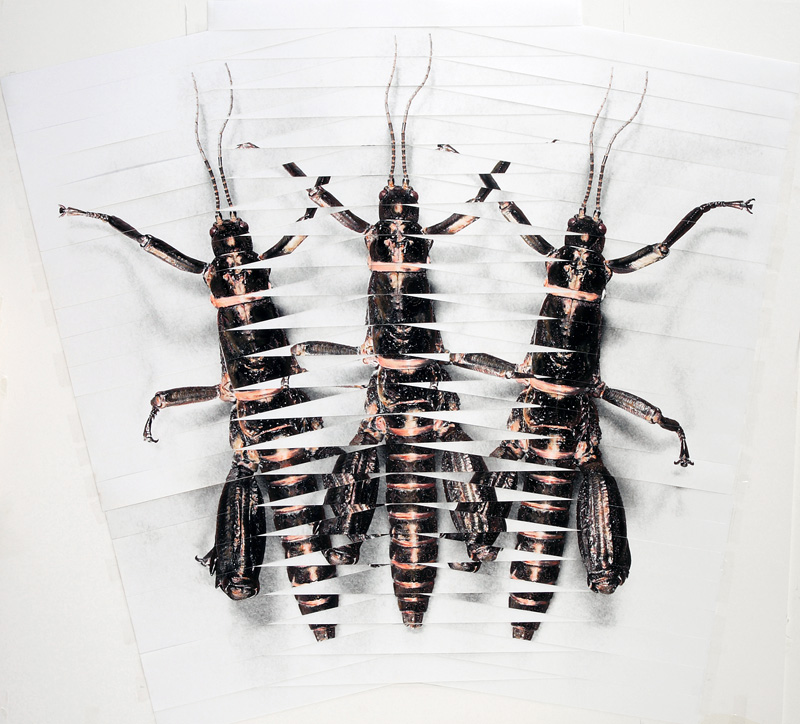
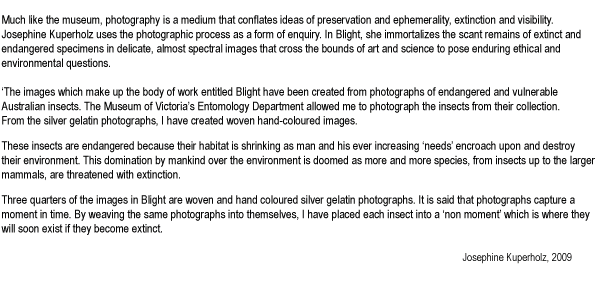
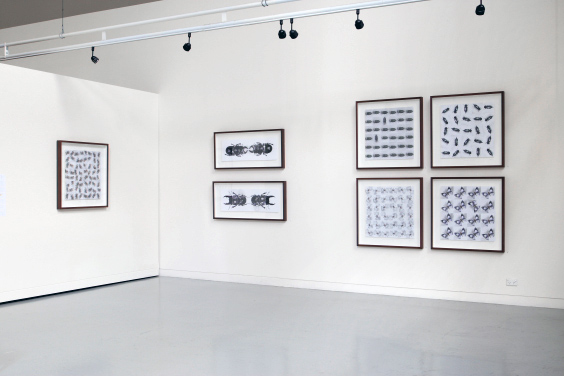
Josephine Kuperholz presents a beautifully engineered set of photographs in her exhibition Blight at Gallery 101, Melbourne. Featuring hand coloured silver gelatin photographs of endangered Australian insects sourced from the Entomology collection of the Victoria Museum, Kuperholz literally weaves multiple narratives into the photographs. The execution (an apt word for the circumstances of extinction facing these insects) of these images is fastidious, the weaving superlative, almost clinical.
The layering of the photographs disrupts their surface tension. There is a disjunction between the dead specimen and the singular photograph of it, a disruption of the smooth surface of the photograph by the hand colouring and a further fragmentation of the original photograph by cutting and weaving. Through these processes the photographs become intertextual in their construction, assemblages, creating new tissues of past citations: animal, colour, silver, artist, text, photograph, environment. At their best the work subverts the concept of the text as self-sufficient and hermetically sealed, blurring the outlines of the fixed image, “dispersing its image of totality into an unbounded, illimitable tissue of connections and associations, paraphrases and fragments, texts and con-texts.”1
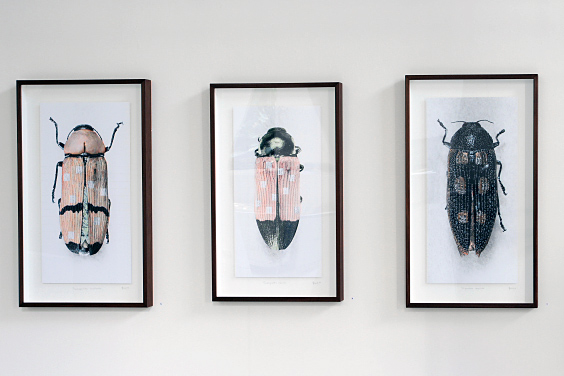
Kuperholz’s mutations, ‘differance’ in Derrida’s terminology, produce spaces that are both fluid and fixed at one and the same time; neither her nor there.Though the original specimens and photographs are already narrativised, already textualised, Kuperholz disrupts this marking, the continual reiteration of norms, by weaving a lack of fixity into her objects; in her reconceptualisations of space and matter Kuperholz redefines the significations of the body of the animal in the fold of inscription, through a process of materialisation. Kuperholz attempts to ground these re-inscriptions through the naming of these disrupted surfaces, equating the images back to the scientific labels for the original specimen, Trapezites eliena for example (see below), and through the box frames surrounding the work that are much like museum cases. Unfortunately I found the constant reference to the habitat of the insect, it’s Latin name inscribed in pencil under the images and the use of plain brown box frames somewhat irritating. These tropes are not necessary for the work is strong enough to stand on it’s own without having to tell the viewer what to think.
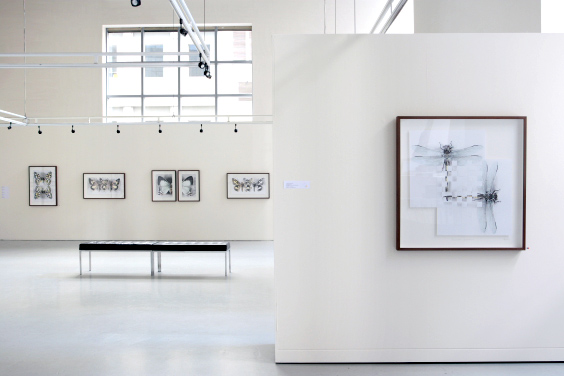
The singular beetles (as seen above) are beautiful images and the multiple images where the weaving intermingles, the self decentred and multiple, fluttering and vibrating like the strobing of a time lapse photograph caught in three-dimensional space, are fantastic. Other photographs are less successful: the reflected beetles are a little passe, while the grid photographs of insects lack presence and intensity (see bottom installation photograph below). Where the concept works it is pushed hard, the fragmentation and interweaving causes an anxiety of identity and a meditation on the problematic nature of existence, revealing the changing sizes, shapes and rhythms of space and structure.
Perhaps a loosening of the rigid structure surrounding the works (the text, the frame, the incantations) would have let the photographs ascend into the ether, further releasing the work from the constraints of author, text and earth. It will be interesting to see future developments of this work. Perhaps the incorporation of gentle, subtle physical elements into the photographs (through the sowing of patterns, through the sowing of objects directly onto the photograph?), will elevate these already beautiful photographs to an-other plane of existence.
Dr Marcus Bunyan
Many thankx to Gallery 101 for allowing me to publish the photographs in the posting. Please click on the photographs for a larger version of the image.
Josephine Kuperholz (Australian) Trapezites eliena 2008 Common name – Eliena Skipper Woven hand coloured silver gelatin photographic image
Josephine Kuperholz (Australian) Dryococelus australis 2008 Common name – Lord Howe Island Phasmid Woven hand coloured silver gelatin photographic image
Josephine Kuperholz Blight exhibition, Gallery 101 website text
Josephine Kuperholz Blight exhibition installation views at Gallery 101, Melbourne Photos: Marcus Bunyan
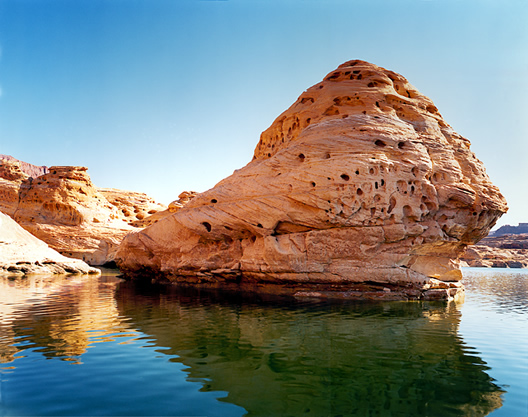
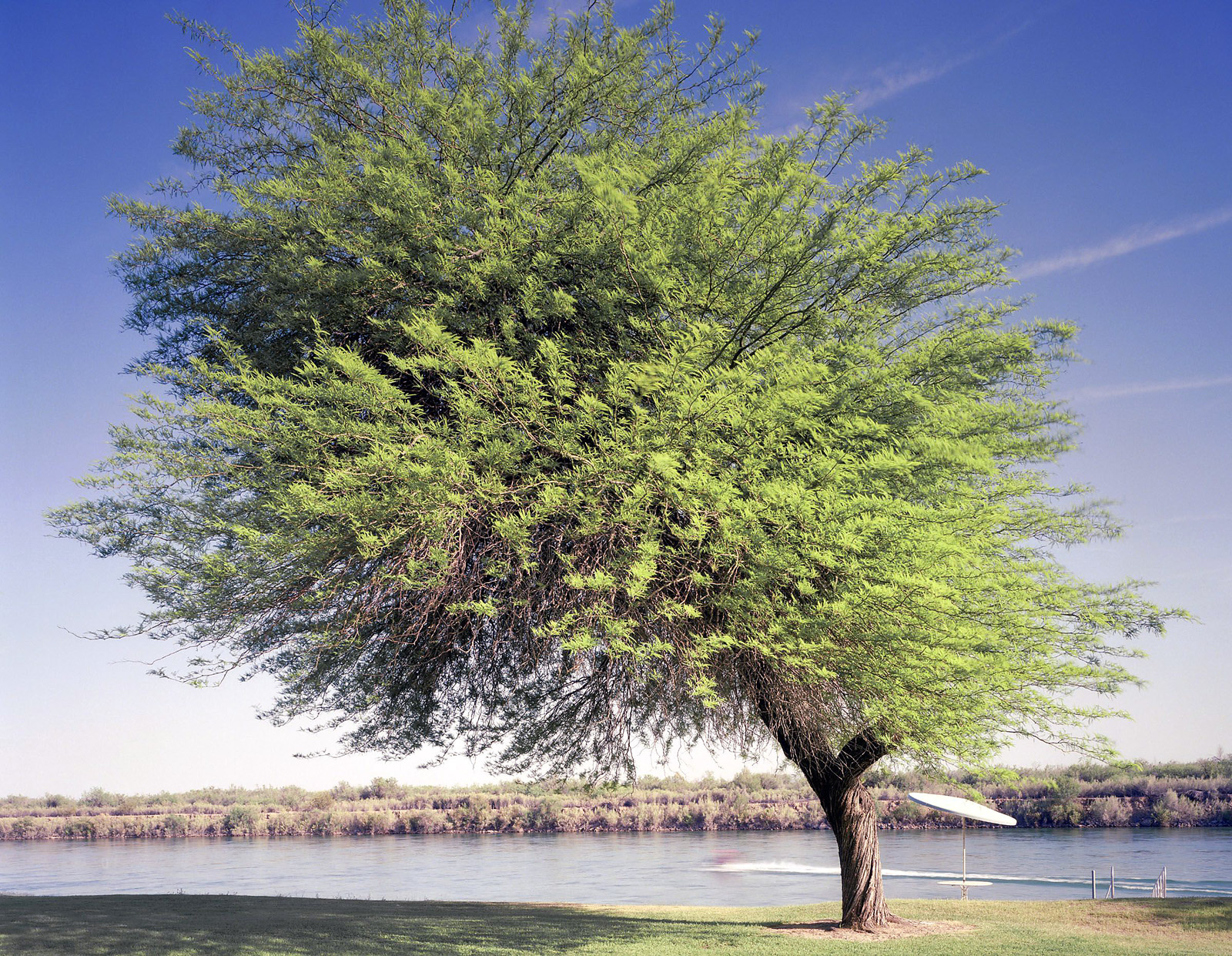
Karen Halverson (American, b. 1941) Hite Crossing, Lake Powell, Utah from the Downstream series 1994-1995
As clear as a bell!
Marcus
Many thankx to the Huntington Library for allowing me to publish the photographs in the posting. Please click on the photographs for a larger version of the image.
Karen Halverson (American, b. 1941) Lodore Canyon, Dinosaur National Monument from the Downstream series 1994-1995
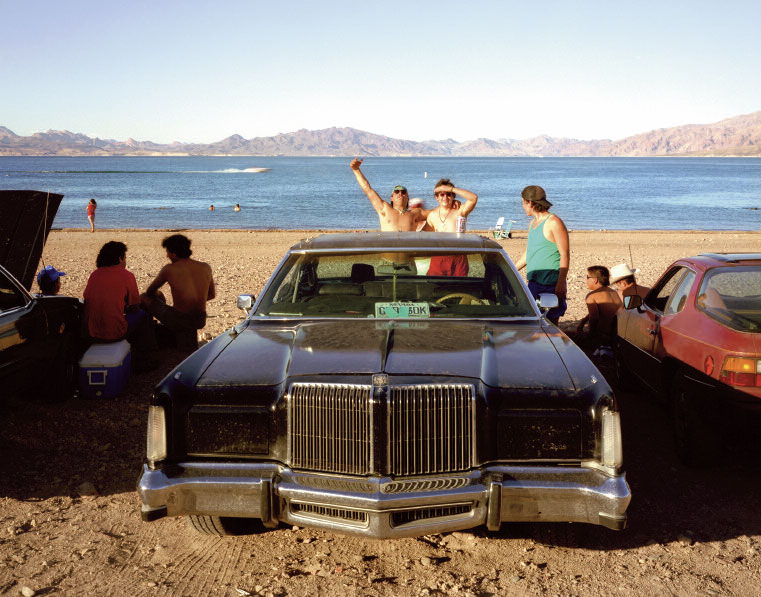
Karen Halverson (American, b. 1941) Boulder Beach, Lake Mead, Nevada from the Downstream series 1994-1995
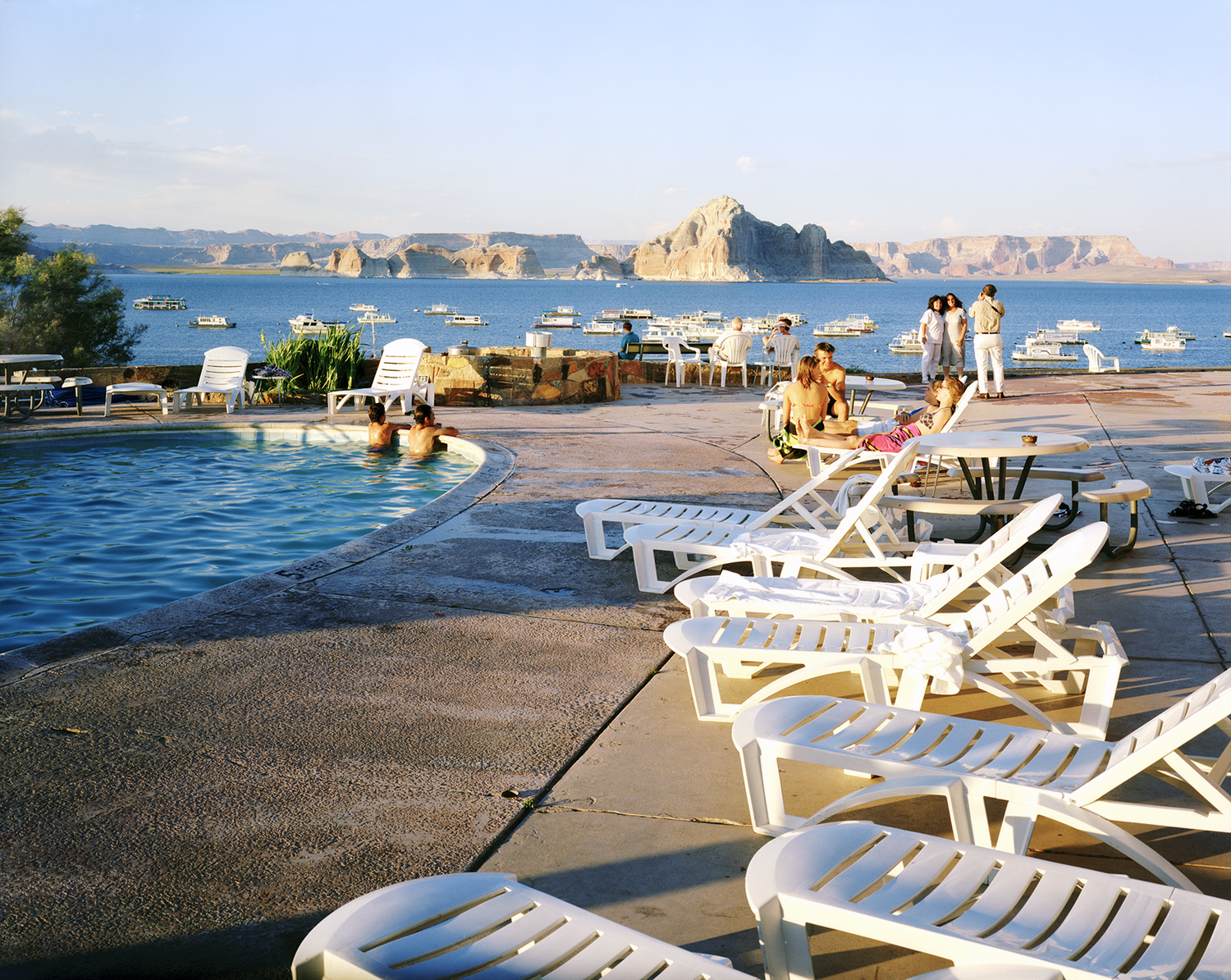
Karen Halverson (American, b. 1941) Wahweap Pool, Lake Powell, Arizona from the Downstream series 1994-1995
To celebrate the expansion and reinstallation of the Virginia Steele Scott Galleries of American Art, The Huntington Library, Art Collections, and Botanical Gardens presents an exhibition of works from American photographer Karen Halverson’s Colorado River series, on view May 30 through Sept. 28, 2009. Downstream: Colorado River Photographs of Karen Halverson will be on display in the Scott Galleries’ Susan and Stephen Chandler Wing, inaugurating a new changing exhibition space that will highlight photography and works on paper that, because of the fragile nature of the medium, cannot be placed on permanent display.
The exhibition will feature 26 works from Halverson’s Downstream series as well as a sampling of images from The Huntington’s historic holdings related to the Colorado River region, including photographs from John Wesley Powell’s pioneering expedition down the Colorado in 1871 and a snapshot album compiled in 1940 by Mildred Baker, one of the first women to successfully navigate the river from Green River, Wyo., to Boulder (now Hoover) Dam.
Halverson (b. 1941) says she woke one wintry morning in 1994 convinced that she needed to photograph the Colorado River. An accomplished landscape photographer who had already spent 20 years exploring the American West, she embarked on a two-year encounter with the vast terrain along the river’s serpentine route.
The desire to explain, understand, and experience the 1,700-mile river – which originates in Wyoming and Colorado before converging in Utah toward its terminus in Mexico – has exerted a powerful influence on a long line of explorers, scientists, thrill seekers, writers, artists, and photographers. Once largely wild, the modern river has been tamed by dams built to slake the American West’s thirst for water and power. Today the river’s reservoirs supply 30 million people.
“In her resonant imagery, Halverson speaks both to this immutable, rugged past while confronting the river’s complicated and often contested present,” says Jennifer Watts, curator of photographs at The Huntington.
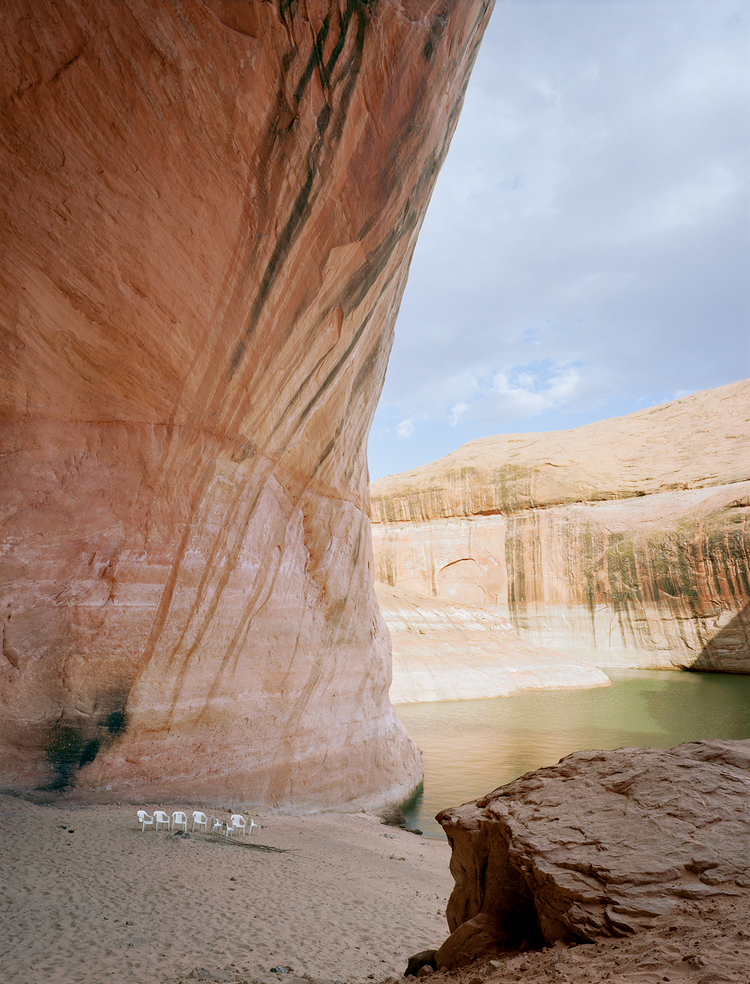
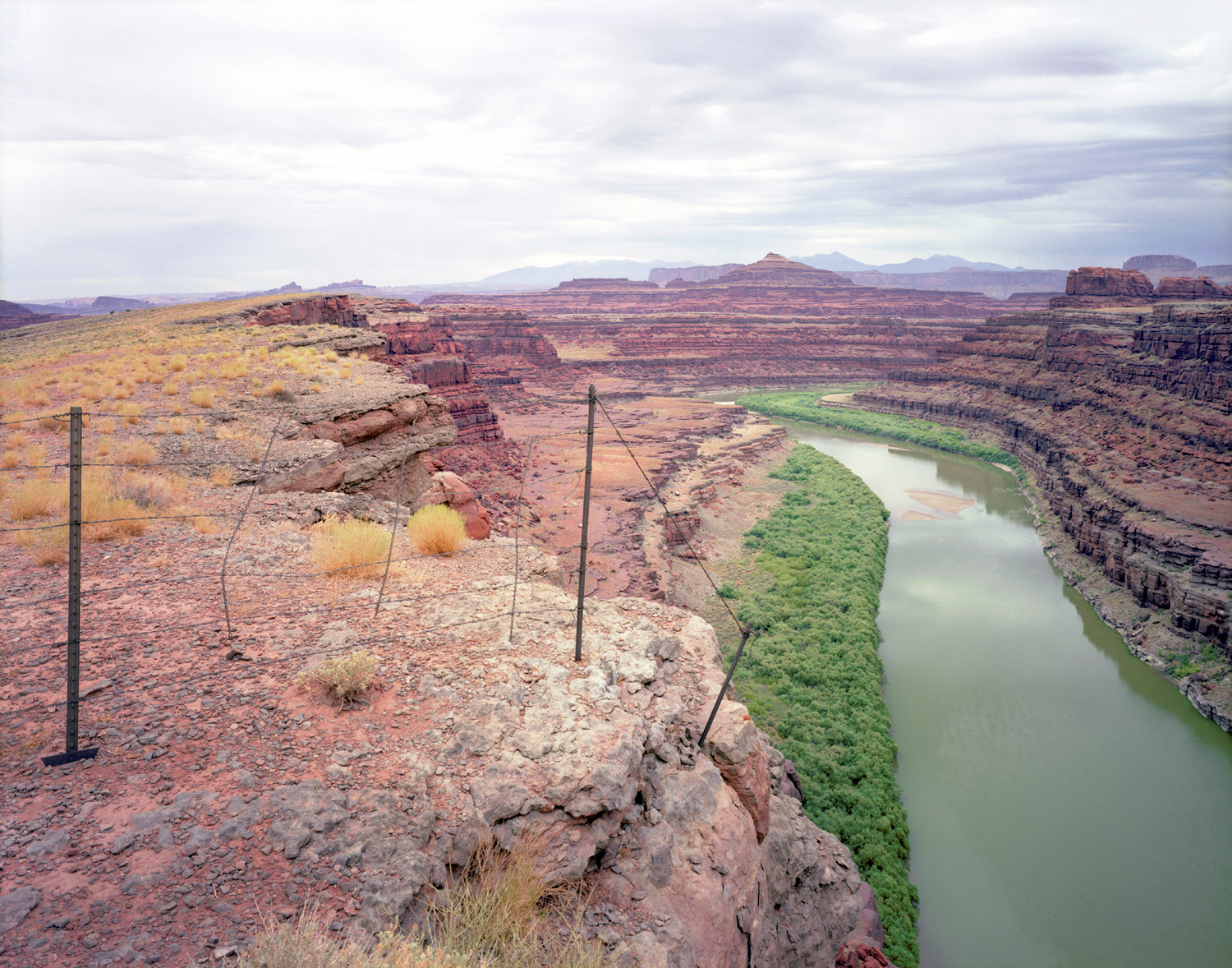
Lush green riverbanks frame a seemingly remote Colorado River in Shafer Trail, Near Moab, Utah – a dramatic departure from the river-turned-lake in Wahweap Marina, Lake Powell, Arizona, in which the setting sun illuminates a satellite dish, a trio of passersby, and a jumble of houseboats set against distant rock outcroppings. Davis Gulch, Lake Powell, Utah captures Halverson’s voice especially succinctly: the power of nature in the form of a gigantic sandstone wall dwarfing a tiny group of plastic lawn chairs, lined up along the river bank, with not a soul in sight.
“In my travels along the Colorado,” says Halverson, “sometimes I find beauty, sometimes desecration, often a perplexing and absurd combination.”
Halverson’s large-format colour photography references the 19th-century era of exploration when the United States, still reeling from the Civil War, saw photographers fan across the West to make pictures for scientific and commercial ends. Many of these iconic views by William H. Bell, John K. Hillers, Timothy O’Sullivan and others form the core of The Huntington’s superlative photography collection. Halverson consulted these works in preparation for her own trips.
The two years Halverson spent hiking, driving, and rafting along the Colorado brought her to a more profound understanding of the river and her relationship to it. During her travels, Halverson wrote, “I feel my place, small and finite in relation to space and time: I feel my self, expansive and trusting.”
Text from The Huntington Library website [Online] Cited 12/06/2009. No longer available online
Karen Halverson (American, b. 1941) Big River, California from the Downstream series 1994-1995
Karen Halverson (American, b. 1941) Davis Gulch, Lake Powell from the Downstream series 1994-1995
“In my travels along the Colorado, sometimes I find beauty, sometimes desecration, often a perplexing and absurd combination.”
Karen Halverson
One wintry morning in1994, Karen Halverson (b. 1941) awoke convinced she needed to photograph the Colorado River. An accomplished artist who had already spent 20 years exploring the American West, she set off on a two-year encounter with the vast, breathtaking terrain along the river’s serpentine route. “The impulse to photograph the Colorado River came to me out of the blue,” she writes, “but I acted on it as if it were my destiny.” Personal destiny and the Colorado River have long been linked in the lives of the explorers, scientists, writers, artists, and thrill seekers who have sought to understand and experience this remarkable river.
“Nature appears to have been partial to this stream,” noted “Captain” Samuel Adams, who described the river in 1869. The Colorado and its major tributary, the Green River, run 1,700 miles from headwaters in the Rocky Mountains and Wyoming’s Wind River Range to a terminus in Mexico. Sheer size helps explain the river’s enduring allure; the Colorado’s gargantuan watershed covers a quarter of a million miles and runs through seven states. The Colorado is the riparian centre and symbol of the American West. Once wild, the river has been tamed by dams built to slake the arid West’s demand for water and power; 30 million people are dependent on it today.
Halverson’s large-format colour photography alludes to a 19th-century era of exploration when photographers fanned out across the West to make pictures for scientific and commercial ends. Iconic views by William H. Bell (1830-1910), John K. Hillers (1843-1925), Timothy O’Sullivan (c. 1840-1882), and others captured timeless landscapes of fierce, often forbidding, beauty. Halverson looked at these works in preparation for her trips, viewing them as documentary and visual points of departure for her own image making. Beyond the debt she owes these photographic pioneers, Halverson is firmly rooted in a late 20th-century aesthetic that comments on humanity’s use, and misuse, of the environment.
Beginning in the 1970s, a group of photographers, almost all of them men – who are now sometimes called the “New Topographers” – used their cameras to criticise the effects of rampant urban and suburban growth on western lands. Sprawling cities like Los Angeles, Phoenix, and Las Vegas owe their existence almost entirely to the importation of water from the Colorado River. As Halverson rightly claims, today the river is a “water delivery system,” with its dozens of reservoirs, dams, and diversions ensuring the allocation of virtually every drop for human needs.
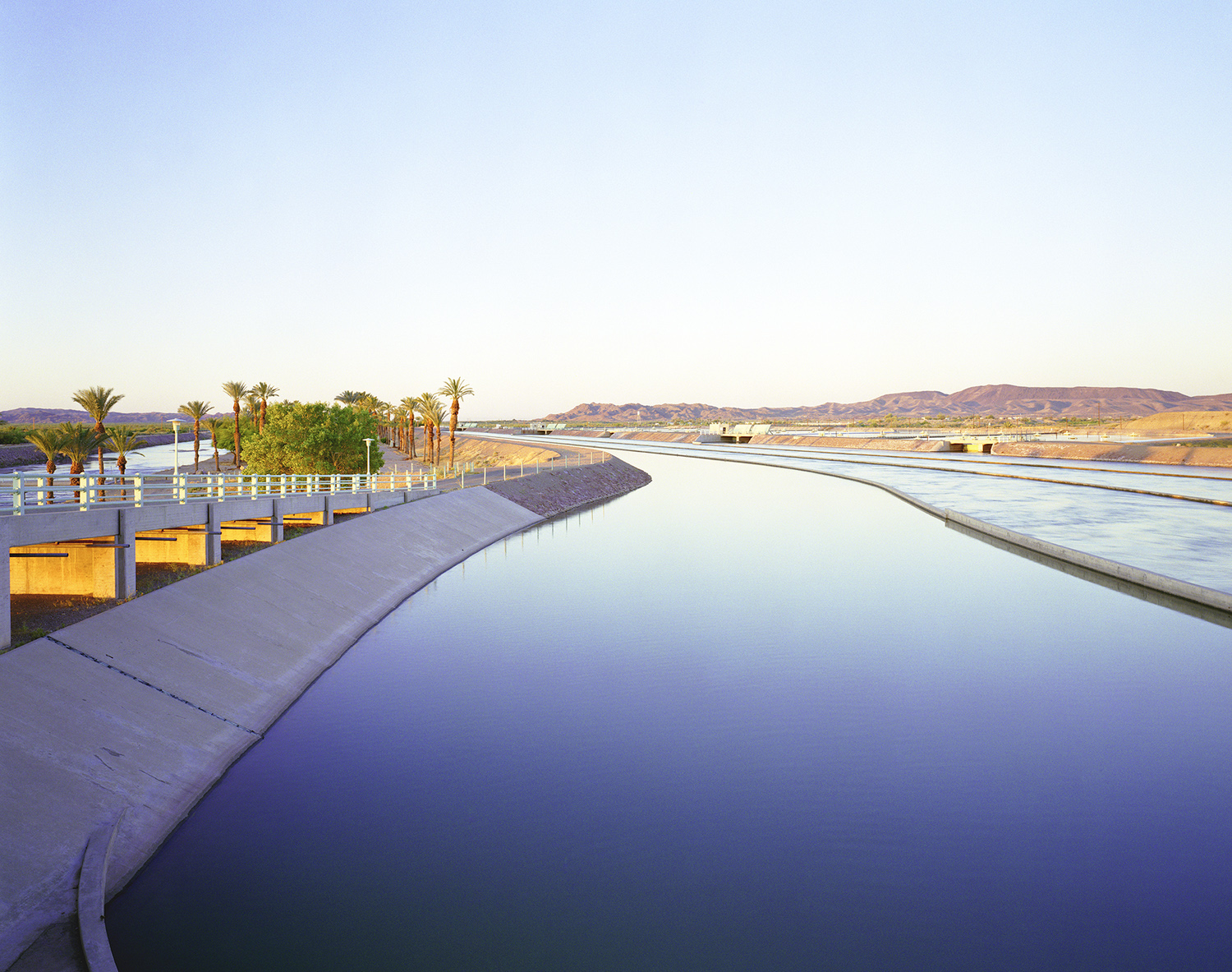
Yet Downstream is no visual jeremiad railing against environmental abuse. Nor is it a dispassionate travelogue of the two years Halverson spent hiking, driving, and rafting along the Colorado. The wild terrain that flabbergasted early explorers is still here in the Paleozoic strata of gigantic rock outcroppings, the ancient calm of ghostly canyons, the dizzying heights overlooking a ribbon of water far below. And the colours – ochre, cerulean blue, deep red, electric green – are all intensified against the palette of a dammed river running colder and deeper than if it flowed freely. A modern-day beauty even finds itself inscribed in steel and concrete, whether in the sleek form of a pipeline or the still surface of an irrigation canal.
But it is in the bizarre, sometimes humorous, intersections of past and present that Downstream gains its potency. Cheap plastic lawn chairs, sitting vacant, look puny and ridiculous against a looming canyon wall. Weekend revellers pump fists skyward on the shores of Lake Mead, a giant reservoir held in place by Hoover Dam. A garden hose waters a scrawny palm tree in a desert oasis populated by rows of RVs.
What is gained and what is lost by controlling the Colorado River? And what are the river’s limits? Halverson’s Downstream series asks the viewer to contemplate these questions in a time when the arid West’s thirsty population threatens to overwhelm technological as well as natural resources, and when our well-watered urban lives remain utterly disconnected from riparian realities. Through her resonant imagery, Halverson speaks to the immutability of the river’s past while confronting its complex, contested present and future.
Jennifer A. Watts, Curator of Photographs from “Colorado River Photographs of Karen Halverson,” The Huntington Library Halverson Gallery guide [Online] Cited 28/02/2019. No longer available online
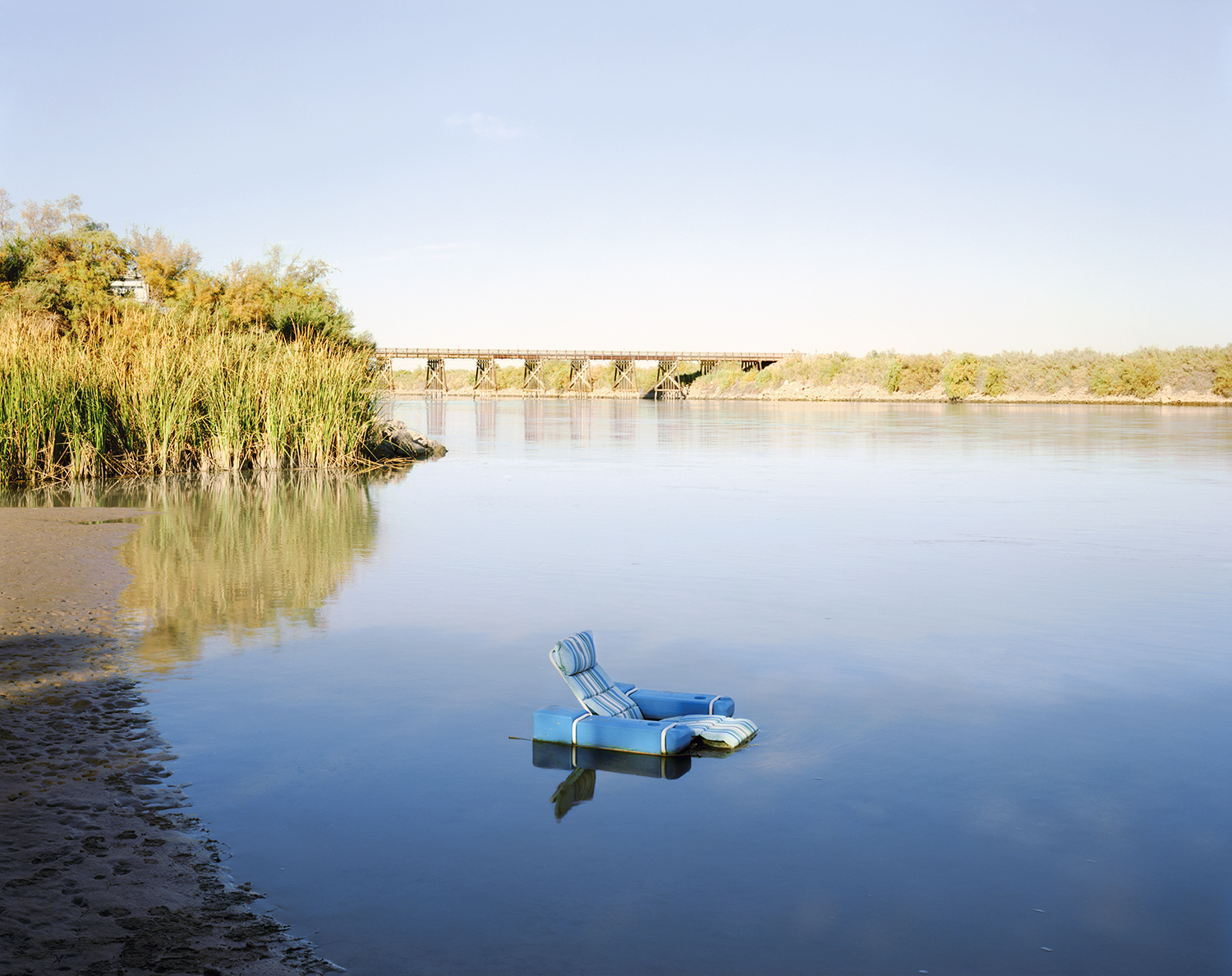
Karen Halverson (American, b. 1941) Near Palo Verde, California from the Downstream series 1994-1995
Karen Halverson (American, b. 1941) Imperial Dam, near Yuma, Arizona from the Downstream series 1994-1995
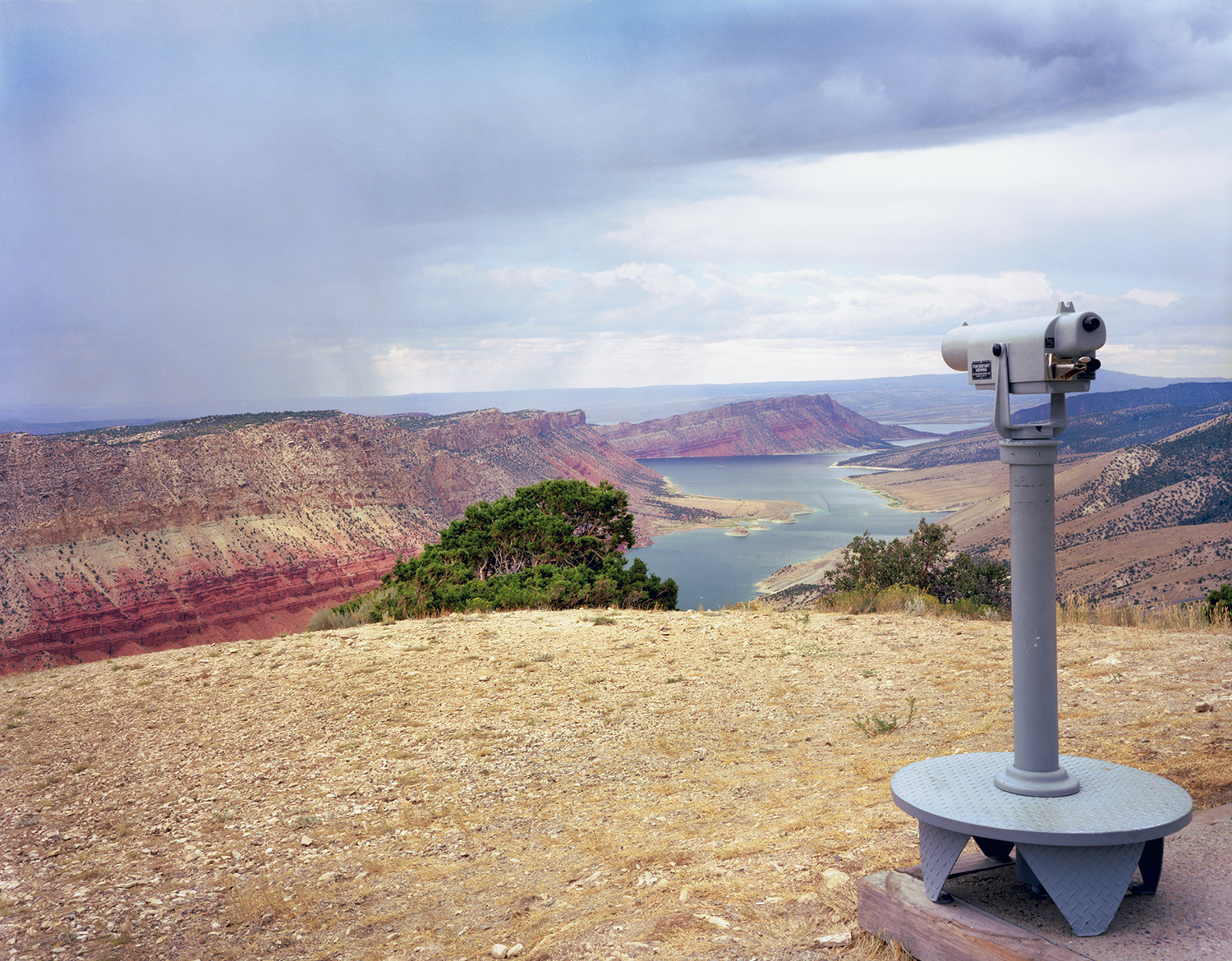
Karen Halverson (American, b. 1941) Flaming Gorge Reservoir, Wyoming from the Downstream series 1994-1995
Karen Halverson (American, b. 1941) Shafer Trail, Near Moab, Utah from the Downstream series 1994-1995
The Huntington Library The Huntington Library, Art Collections, and Botanical Gardens 1151 Oxford Road San Marino, CA 91108
























 Art Blart _ art and cultural memory archive
You must be logged in to post a comment.