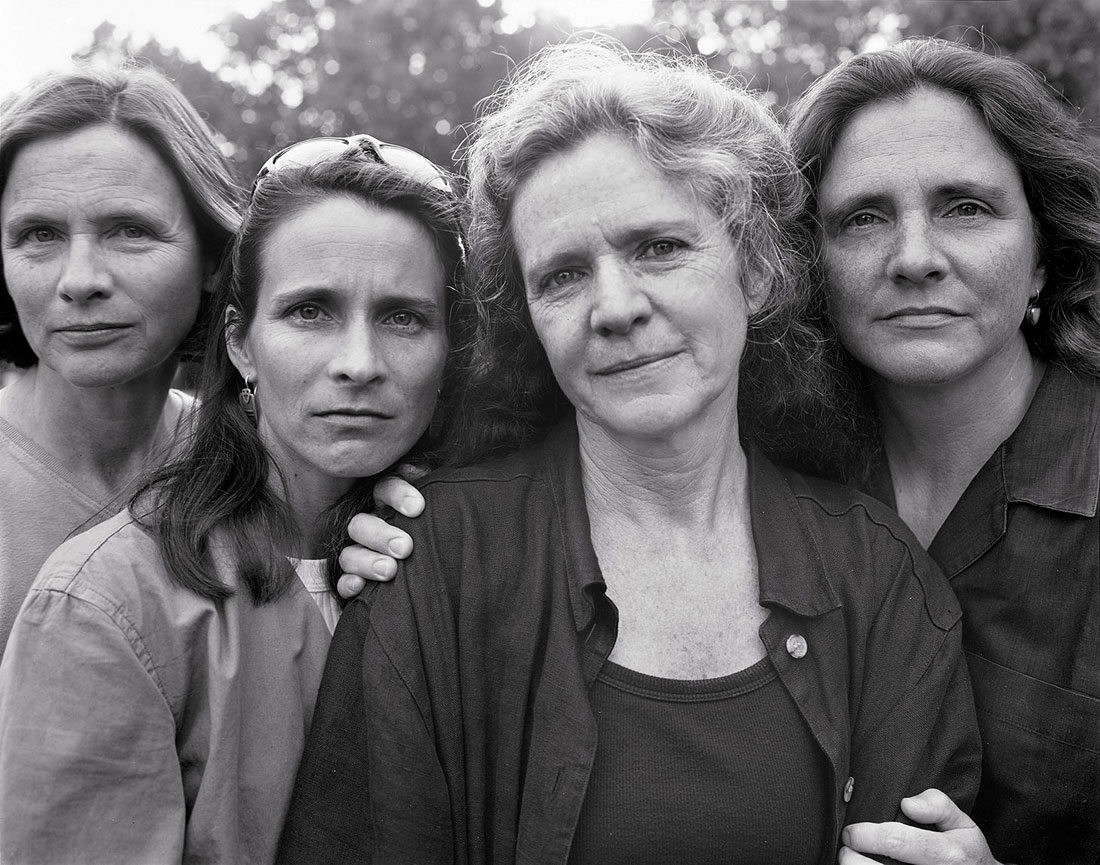
Exhibition: ‘Pictures by Women: A History of Modern Photography’ at The Museum of Modern Art (MoMA), New York

Exhibition dates: 7th May, 2010 – 4th April 2011


Ilse Bing (American born Germany, 1899-1998) 'Self-Portrait in Mirrors' 1931


Ilse Bing (American born Germany, 1899-1998)
Self-Portrait in Mirrors
1931
Gelatin silver print
10 1/2 x 12″ (26.8 x 30.8cm)
The Museum of Modern Art, New York
Joseph G. Mayer Fund
© 2010 The Ilse Bing Estate / Courtesy Edwynn Houk Gallery


How I wish I could have been in New York to see this exhibition!

Marcus


Many thankx to the Museum of Modern Art (MoMA) for allowing me to publish the photographs in the posting. Please click on the photographs for a larger version of the image.
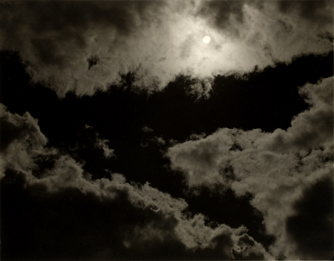


Frances Benjamin Johnston (American, 1864-1952) 'Physiology. Class in emergency work' 1899-1900


Frances Benjamin Johnston (American, 1864-1952)
Physiology. Class in emergency work
1899-1900
Platinum print
7 9/16 × 9 1/2″ (19.2 × 24.2cm)
The Museum of Modern Art, New York
Gift of Lincoln Kirstein


“It is wrong to regard photography as purely mechanical. Mechanical it is, up to a certain point, but beyond that there is great scope for individual and artistic expression.” ~ Frances Benjamin Johnston


After setting up her own photography studio in 1894, in Washington, D.C., Frances Benjamin Johnston was described by The Washington Times as “the only lady in the business of photography in the city.”1 Considered to be one of the first female press photographers in the United States, she took pictures of news events and architecture and made portraits of political and social leaders for over five decades. From early on, she was conscious of her role as a pioneer for women in photography, telling a reporter in 1893, “It is another pet theory with me that there are great possibilities in photography as a profitable and pleasant occupation for women, and I feel that my success helps to demonstrate this, and it is for this reason that I am glad to have other women know of my work.”2

In 1899, the principal of the Hampton Normal and Agricultural Institute in Virginia commissioned Johnston to take photographs at the school for the 1900 Exposition Universelle in Paris. The Hampton Institute was a preparatory and trade school dedicated to preparing African American and Native American students for professional careers. Johnston took more than 150 photographs and exhibited them in the Exposition Nègres d’Amerique (American Negro Exhibit) pavilion, which was meant to showcase improving race relations in America. The series won the grand prize and was lauded by both the public and the press.

Years later, writer and philanthropist Lincoln Kirstein discovered a leather-bound album of Johnston’s Hampton Institute photographs. He gave the album to The Museum of Modern Art, which reproduced 44 of its original 159 photographs in a book called The Hampton Album, published in 1966. In its preface, Kirstein acknowledged the conflict inherent in Johnston’s images, describing them as conveying the Institute’s goal of assimilating its students into Anglo-American mainstream society according to “the white Victorian ideal as criterion towards which all darker tribes and nations must perforce aspire.”3 The Hampton Institute’s most famous graduate, educator, leader, and presidential advisor Booker T. Washington, advocated for black education and accommodation of segregation policies instead of political pressure against institutionalized racism, a position criticized by anti-segregation activists such as author W. E. B. Du Bois.

Johnston’s pictures neither wholly celebrate nor condemn the Institute’s goals, but rather they reveal the complexities of the school’s value system. This is especially clear in her photographs contrasting pre- and post-Hampton ways of living, including The Old Well and The Improved Well (Three Hampton Grandchildren). In both images, black men pump water for their female family members. The old well system is represented by an aged man, a leaning fence, and a wooden pump that tilts against a desolate sky, while the new well is handled by an energetic young boy in a yard with a neat fence, a thriving tree, and two young girls dressed in starched pinafores. Johnston’s photographs have prompted the attention of artists like Carrie Mae Weems, who has incorporated the Hampton Institute photographs into her own work to explore what Weems described as “the problematic nature of assimilation, identity, and the role of education.”4

Kristen Gaylord, Beaumont and Nancy Newhall Curatorial Fellow, Department of Photography, 2016

1/ “Washington Women with Brains and Business,” The Washington Times, April 21, 1895, 9
2/ Clarence Bloomfield Moore, “Women Experts in Photography,” The Cosmopolitan XIV.5 (March 1893), 586
3/ Lincoln Kirstein, “Introduction,” in The Hampton Album: 44 photographs by Frances B. Johnston from an album of Hampton Institute (New York: The Museum of Modern Art, 1966), 10
4/ Quoted in Denise Ramzy and Katherine Fogg, “Interview: Carrie Mae Weems,” Carrie Mae Weems: The Hampton Project (New York: Aperture, 2000), 78


Cindy Sherman (American, b. 1954) 'Untitled #92' 1981


Cindy Sherman (American, b. 1954)
Untitled #92
1981
Chromogenic colour print
24 x 47 15/16″ (61 x 121.9cm)
The Museum of Modern Art, New York
The Fellows of Photography Fund
© 2010 Cindy Sherman


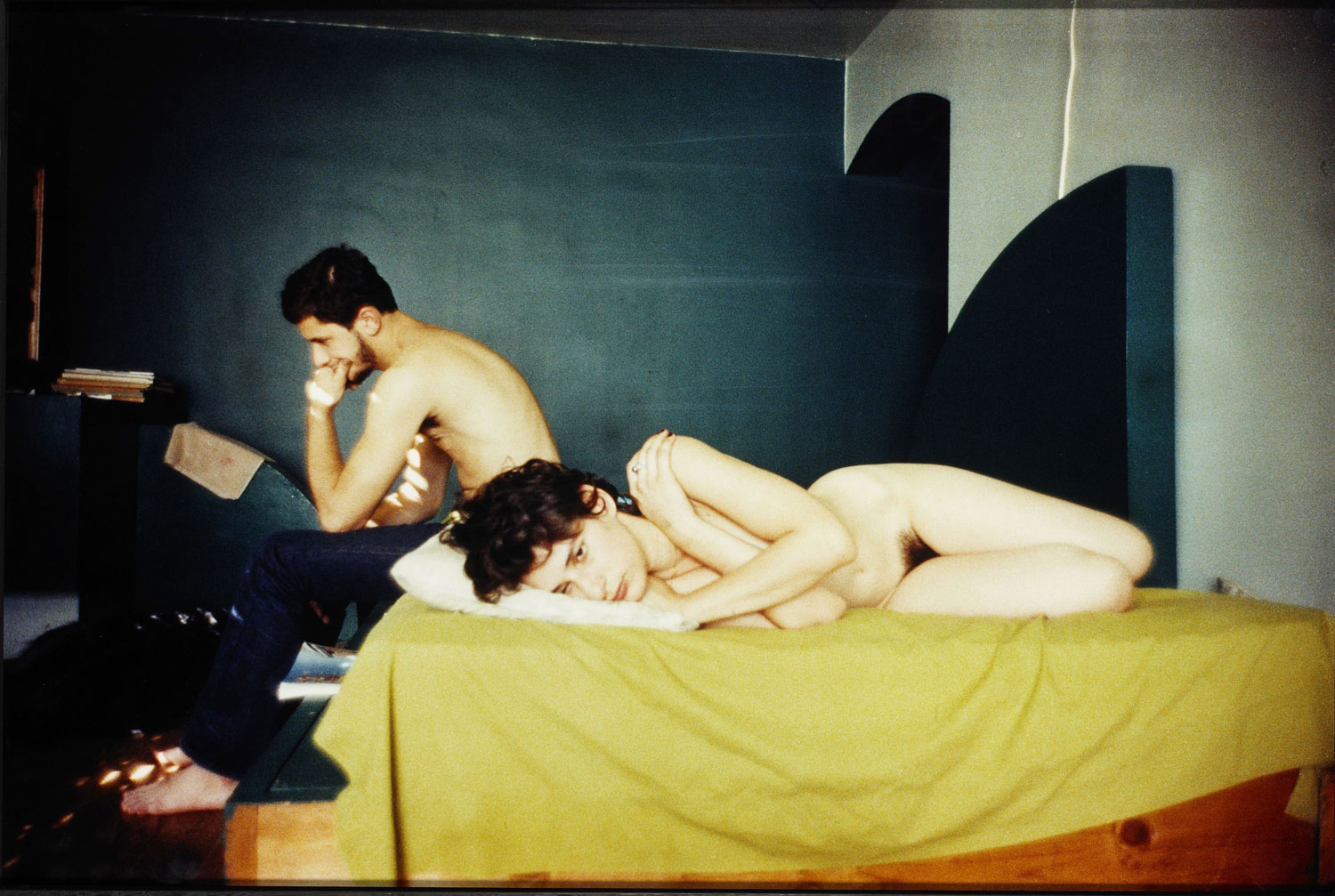
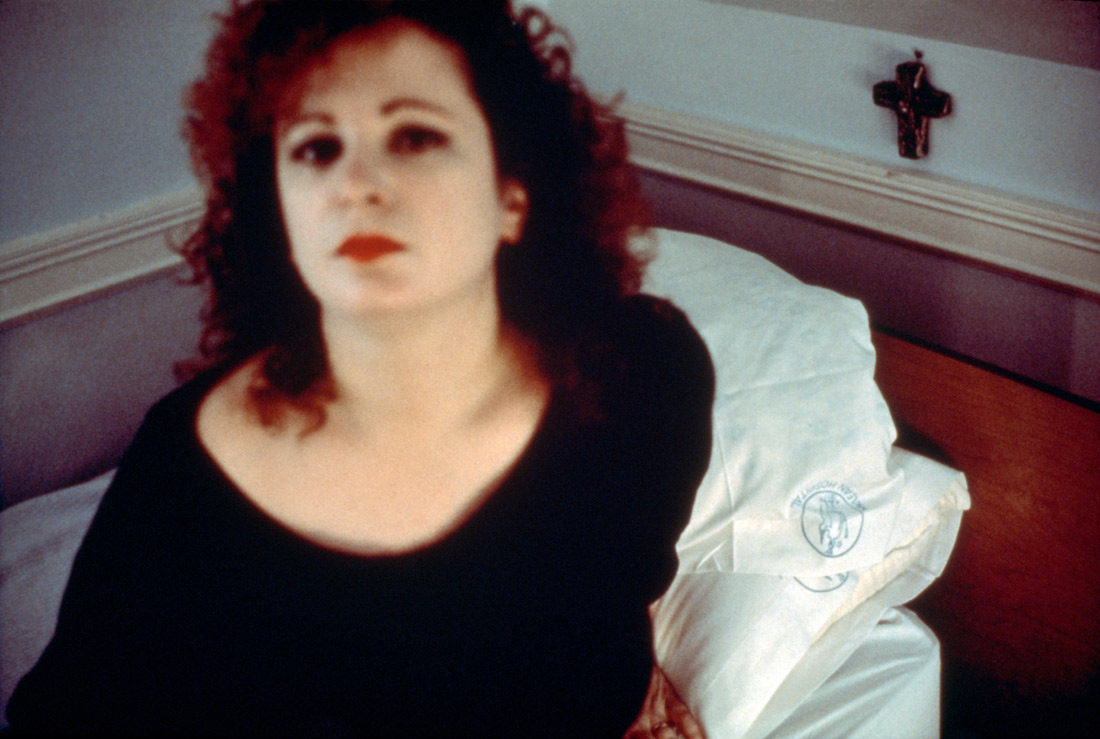
Nan Goldin (American, b. 1953) 'Nan One Month After Being Battered' 1984


Nan Goldin (American, b. 1953)
Nan One Month After Being Battered
1984
Silver dye bleach print (printed 2008)
15 1/2 x 23 1/8″ (39.4 x 58.7cm)
The Museum of Modern Art, New York
Purchase
© 2010 Nan Goldin


JoAnn Verburg (American, b. 1950)
'Still Life with Serial Killers' 1991


JoAnn Verburg (American, b. 1950)
Still Life with Serial Killers
1991
Chromogenic print
19 9/16 × 27 11/16″ (49.7 × 70.4cm)
The Museum of Modern Art, New York
Horace W. Goldsmith Fund through Robert B. Menschel
© 2025 JoAnn Verburg


One day I went to the market in Spoleto, Italy, where my husband and I spent every summer and my flowers were wrapped up in a newspaper that I brought home and realised had a photograph of the serial killers, Charlie Manson and Jeffrey Dahmer, and an article in Italian that asked why these things happen in America. I knew immediately that I wanted to incorporate it into a photograph. And in our bedroom, I had leaned some jumbo postcards from the Courtauld Museum in London on the dresser.

Although the photograph could have a lot of traditional still life elements in it, you know, the bottle or the fruit, or the flowers, I like the fact that an aspect of the still life work that I’m able to bring in is the news that’s going on in another part of the world.

In my still lives, bringing in the newspaper allows me to connect these things that might seem very disparate, a fragment of a painting by a French painter from another century, put together with a news article about murder. But in fact, the nature of our contemporary lives is that we’re flipping the channels all the time. We’re experiencing so many things at once, and we’re not able to selectively engage only one thing at a time.

Text from the The Museum of Modern Art website


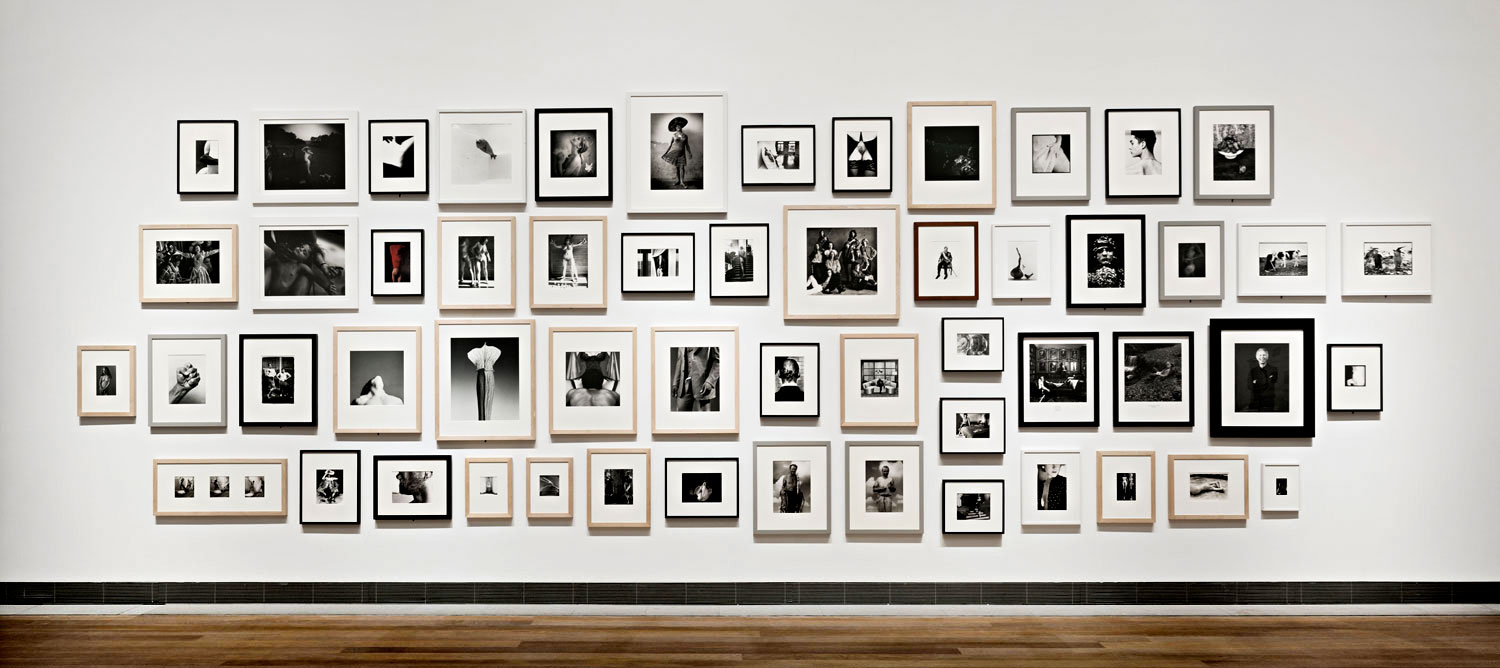
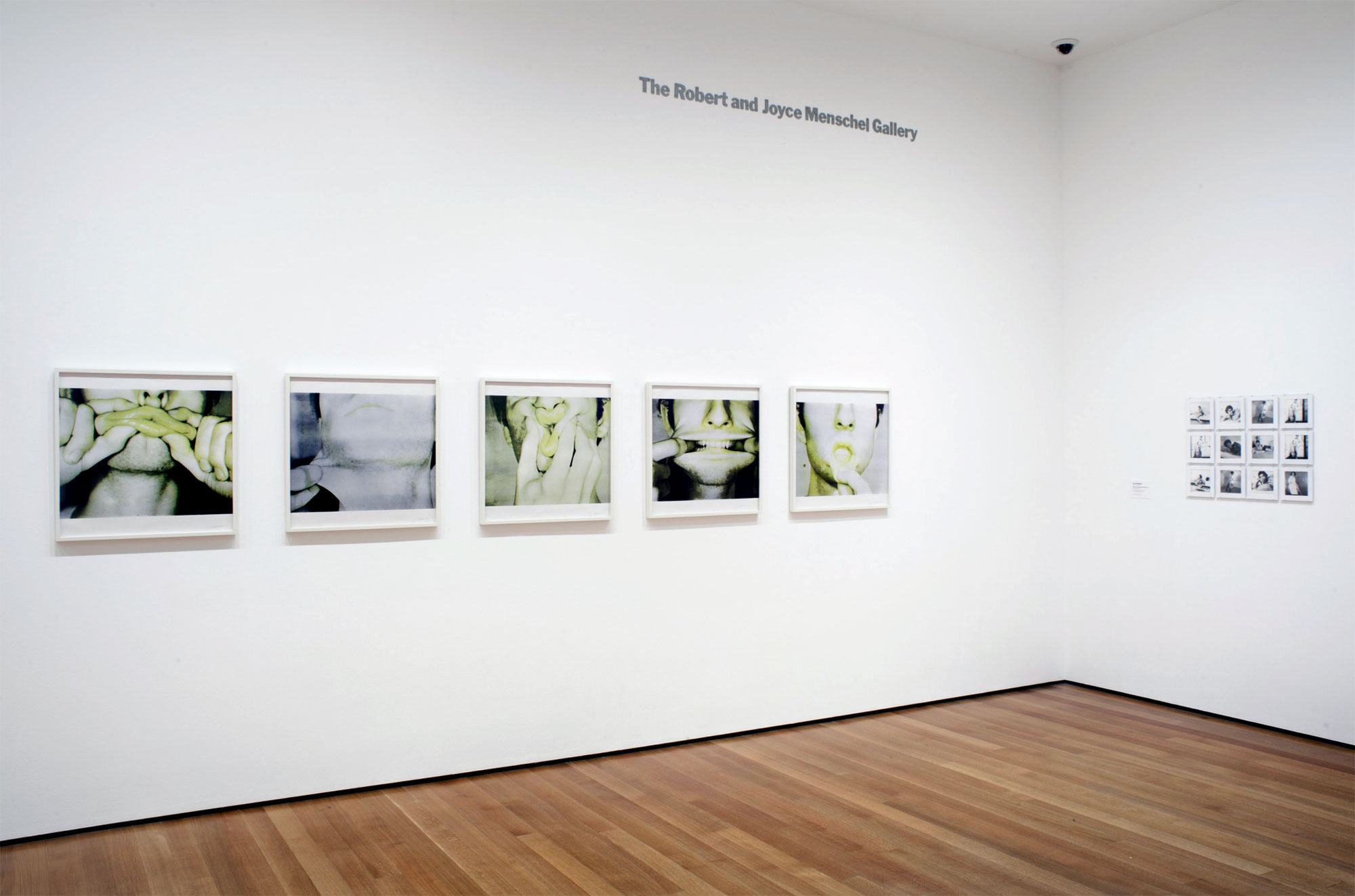
The Museum of Modern Art draws from its rich collection of photography to present the history of the medium from the dawn of the modern period to the present with the exhibition Pictures by Women: A History of Modern Photography, from May 7 to August 30, 2010. Filling the entire third-floor Edward Steichen Photography Galleries with photographs made exclusively by women artists, this installation comprises more than 200 works by approximately 120 artists, including a selection of exceptional recent acquisitions and works on view for the first time by such artists as Anna Atkins, Claude Cahun, Rineke Dijkstra, VALIE EXPORT, Nan Goldin, Helen Levitt, and Judith Joy Ross. The exhibition also includes masterworks by such luminaries as Berenice Abbott, Diane Arbus, Gertrude Käsebier, Dorothea Lange, Lisette Model, Tina Modotti, Cindy Sherman, and Carrie Mae Weems, as well as pictures, collages, video, and photography-based installations drawn from other curatorial departments by artists such as Hannah Höch, Barbara Kruger, Annette Messager, Yoko Ono, Lorna Simpson, Kiki Smith, and Hannah Wilke. The exhibition is organised by Roxana Marcoci, Curator; Sarah Meister, Curator; and Eva Respini, Associate Curator, Department of Photography, The Museum of Modern Art.

The Edward Steichen Photography Galleries comprise a circuit of six rooms devoted to a rotating selection of photographs from the Museum’s collection. The galleries featuring works from 1850 to the 1980s open on May 7, 2010, and remain on view through March 21, 2011. The most contemporary works in the exhibition are currently on view in The Robert and Joyce Menschel Gallery, and they remain on view through August 30, 2010.

For much of photography’s 170-year history, women have contributed to its development as both an art form and a means of communication, expanding its parameters by experimenting with every aspect of the medium. Self-portraits and representations of women by a variety of women practitioners are a recurring motif, as seen in works by artists ranging from Julia Margaret Cameron to Lucia Moholy, and from Germaine Krull to Katy Grannan. Significant groups of works by individual photographers are highlighted within this chronological survey, including in-depth presentations of the work of Frances Benjamin Johnston, Käsebier, Modotti, Lange, Levitt, Arbus, Goldin, and Ross.

Marking the entrance to The Edward Steichen Photography Galleries is a large-scale photographic wallpaper, Fluxus Wallpaper, realised by Yoko Ono and George Maciunas in the early 1970s. This work depicts the serial repetition of a set of buttocks, an image originating from a provocative Fluxus film made by Ono in 1966.

Pictures by Women opens with a gallery of nineteenth and early twentieth-century work, representing the variety of photography’s applications. The earliest photograph in the installation was made in the 1850s by British photographer Anna Atkins, who used the cyanotype process to record her many plant specimens. Presented side by side are in-depth groupings of work by American photographers Frances Benjamin Johnston and Gertrude Käsebier. In 1899 the Hampton Institute commissioned Johnston to take photographs at the school that were featured in an exhibition about contemporary African American life at the Paris Exposition of 1900. On view is a selection of pictures taken from a larger album of 156, which exemplify Johnston’s talent for balancing pictorial delicacy and classical composition with the demands of working on assignment. Käsebier – another woman who produced photographic works of art while operating a successful commercial studio – is best known for her portraits and symbolic, soft-focus pictures of the mother-and-child theme.

The rise of photographic modernism in the 1920s and 1930s is traced in the second gallery primarily with the work of European women artists. A wall of portraits of women showing the range of artistic expression and experimentation during this period includes Claude Cahun’s radical gender-bending self-portrait in drag (1921); Lucia Moholy’s striking portrait of fellow Bauhaus student Florence Henri (1927); and Hannah Höch’s Indian Dancer: From an Ethnographic Museum (1930), a collage evoking the modern woman. Included here is also a photocollage by the little known Japanese artist Toshiko Okanoue, titled In Love (1953). Cannibalising images from U.S. magazines such as Life and Vogue, this surreal collage represents a young Japanese woman’s perception of the Western way of life. A group of pictures taken in Mexico in the late 1920s by Italian photographer Tina Modotti possess an aesthetic clarity and beauty that reflect her increasing political involvement within her adopted country. Also included is Ilse Bing’s Self-Portrait in Mirrors (1931), a picture staging a complex mise-en-scène between two reflections – one in the mirror and the other in the camera’s eye – as well as similarly powerful works by Imogen Cunningham, Florence Henri, Germaine Krull, and Lee Miller, who experimented with mobile perspectives of the handheld camera and graphic compositions.

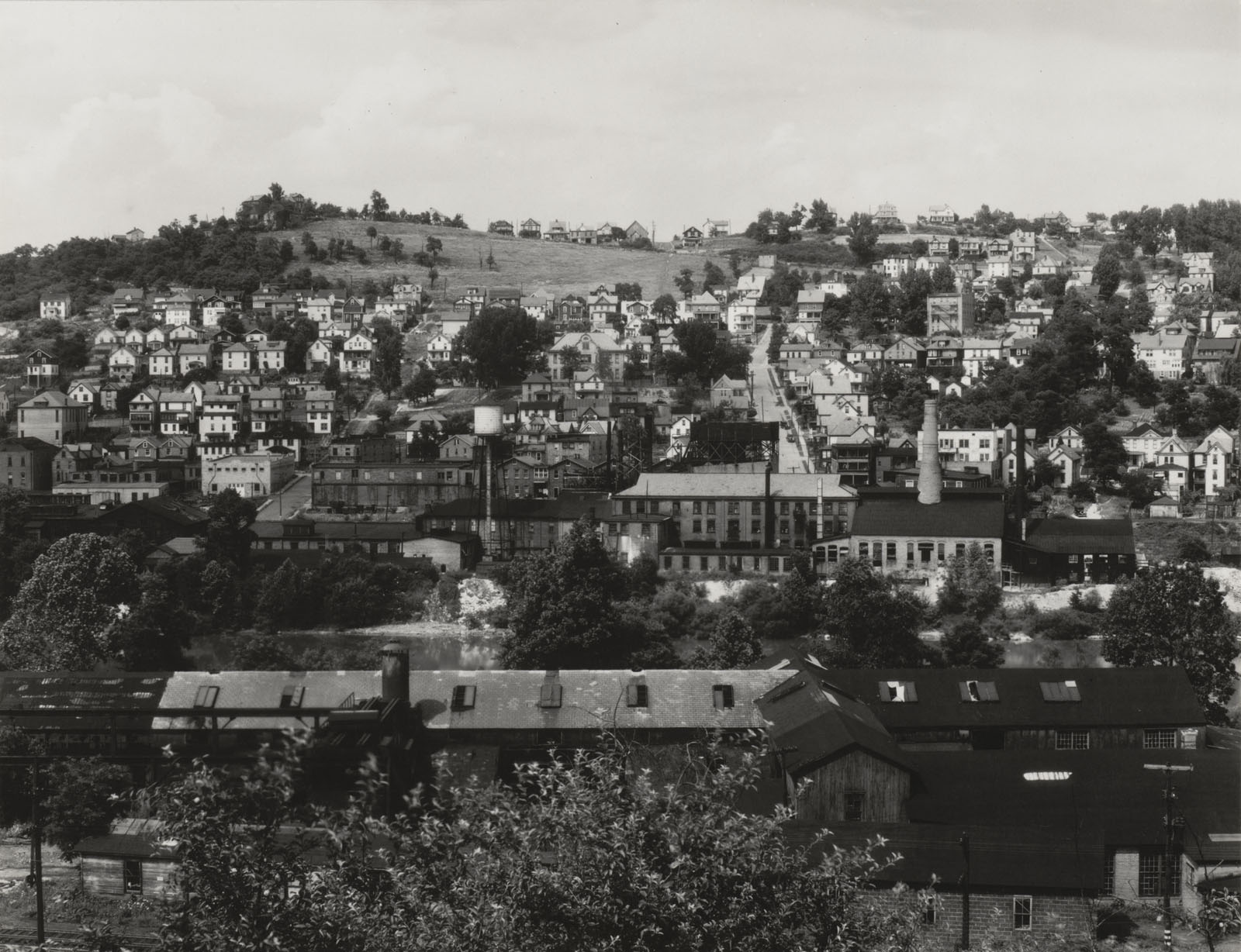
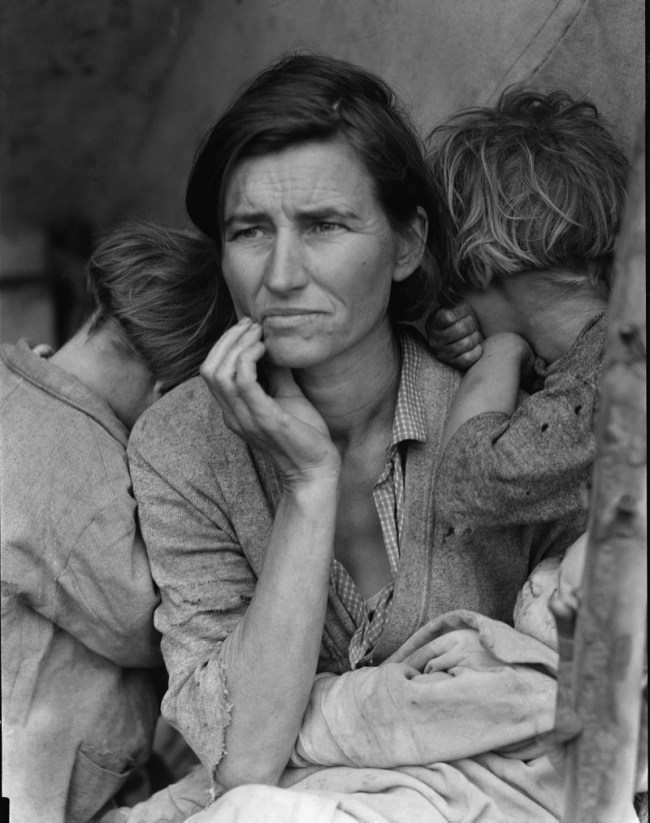
The third gallery features photographers who devoted themselves to the complex challenge of exploring the social world in the interwar and postwar periods. Largely comprising work by American women, this gallery includes comprehensive presentations of two of America’s leading photographers, Dorothea Lange and Helen Levitt. The breadth of Lange’s accomplishments is represented through a selection of approximately 20 photographs, all of women, including her iconic Depression-era picture Migrant Mother, Nipomo, California (1936); the memorable One Nation, Indivisible, San Francisco (1942); and pictures capturing the bustle of postwar life in America, such as Mother and Child, San Francisco (1952). Opposite these works is a wall of colour photographs taken by Levitt in the 1970s on the streets of New York City. These lively, spontaneous pictures are full of humour and drama, and continue the rich tradition of the American documentary genre that Levitt helped establish in the 1940s with her black-and-white photographs. The rest of the gallery includes a variety of work made during the period, including Berenice Abbott’s documents of the changing architecture and character of New York City in the 1930s, and Barbara Morgan’s elegant 1940 photograph of dancer Martha Graham performing her dramatic piece “Letter to the World,” based on the love life of American poet Emily Dickinson.

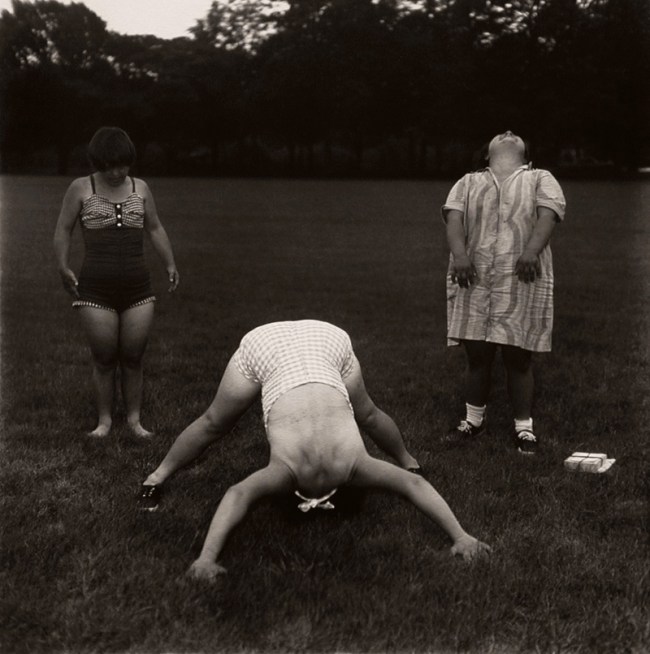
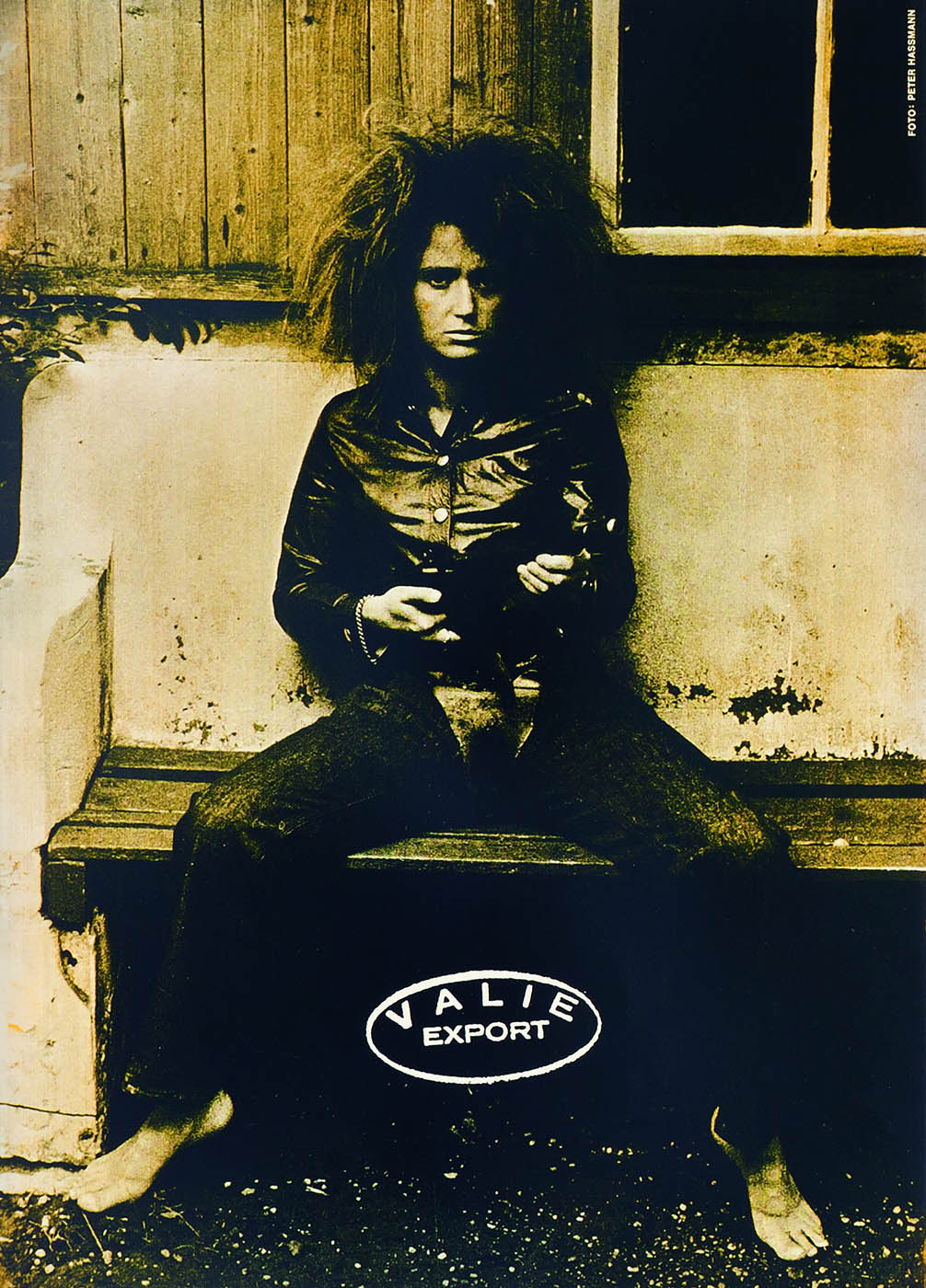
Photography’s documentary tradition in the postwar period continues in the fourth gallery, most notably with a selection of Diane Arbus’s portraits of women, such as A Widow in Her Bedroom, New York City (1963); Identical Twins, Roselle, New Jersey (1966); and Girl in Her Circus Costume, Maryland (1967). This gallery also includes work by artists of the 1960s and 1970s who embraced photography not just as a way of describing experience, but as a conceptual tool for appropriating and manipulating existing photographs. Examples include Martha Rosler’s collage Cleaning the Drapes (1969-1972), which juxtaposes images of domestic bliss taken from women’s magazines with news pictures of the war in Vietnam. The gallery also introduces several notable examples of acts performed for the camera, including Adrian Piper’s self-portrait series Food for the Spirit (1971), a meditation on transcendental being through an analysis of Kant’s Critique of Pure Reason; and VALIE EXPORT’s provocative Action Pants: Genital Panic (1969). Presented as a set of posters, this work memorialised a performance in which the Austrian artist marched into an experimental art-film house in Munich wearing crotchless trousers, challenging mostly male viewers to “look at the real thing” instead of passively enjoying images of women on the screen.

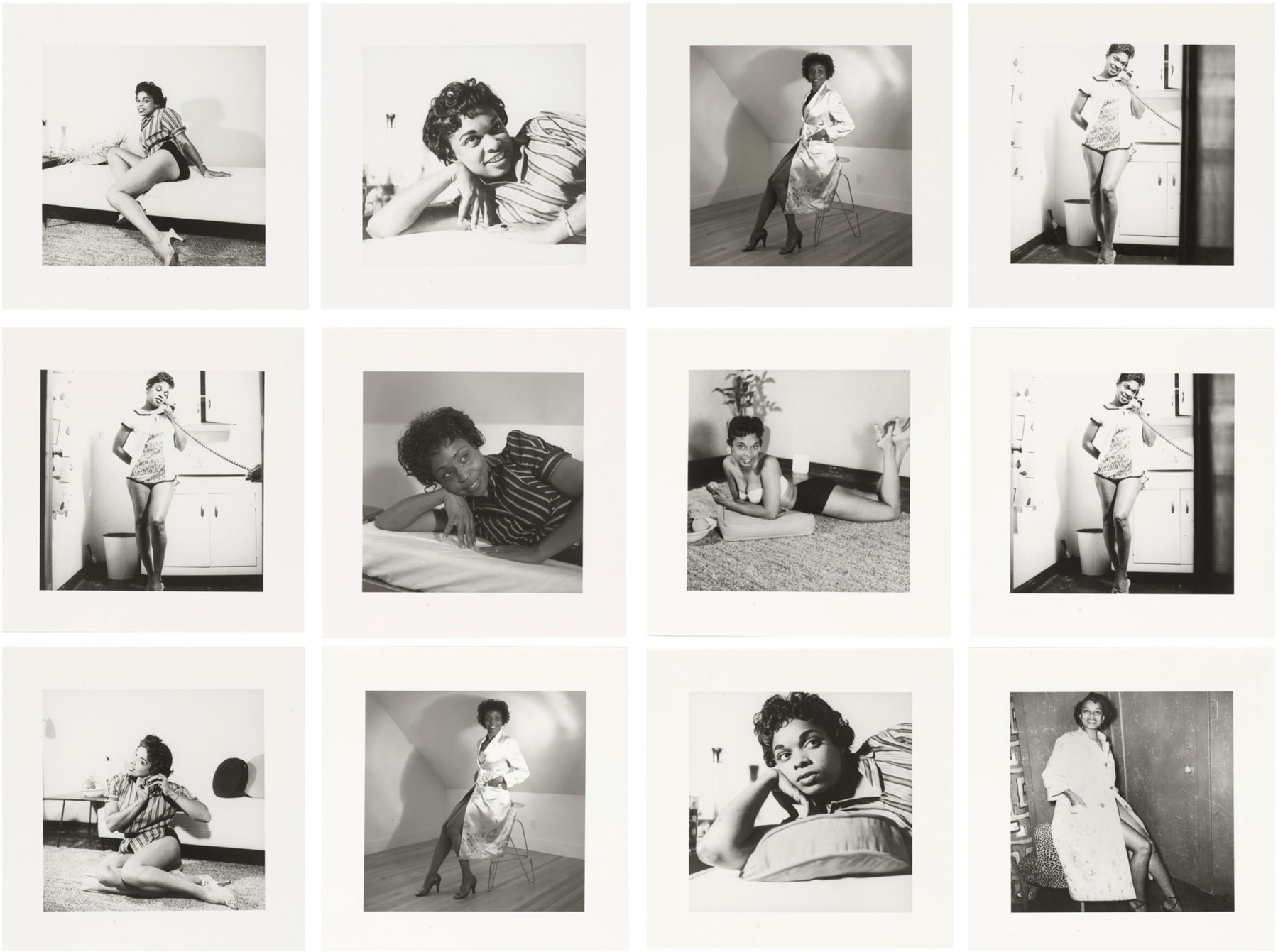
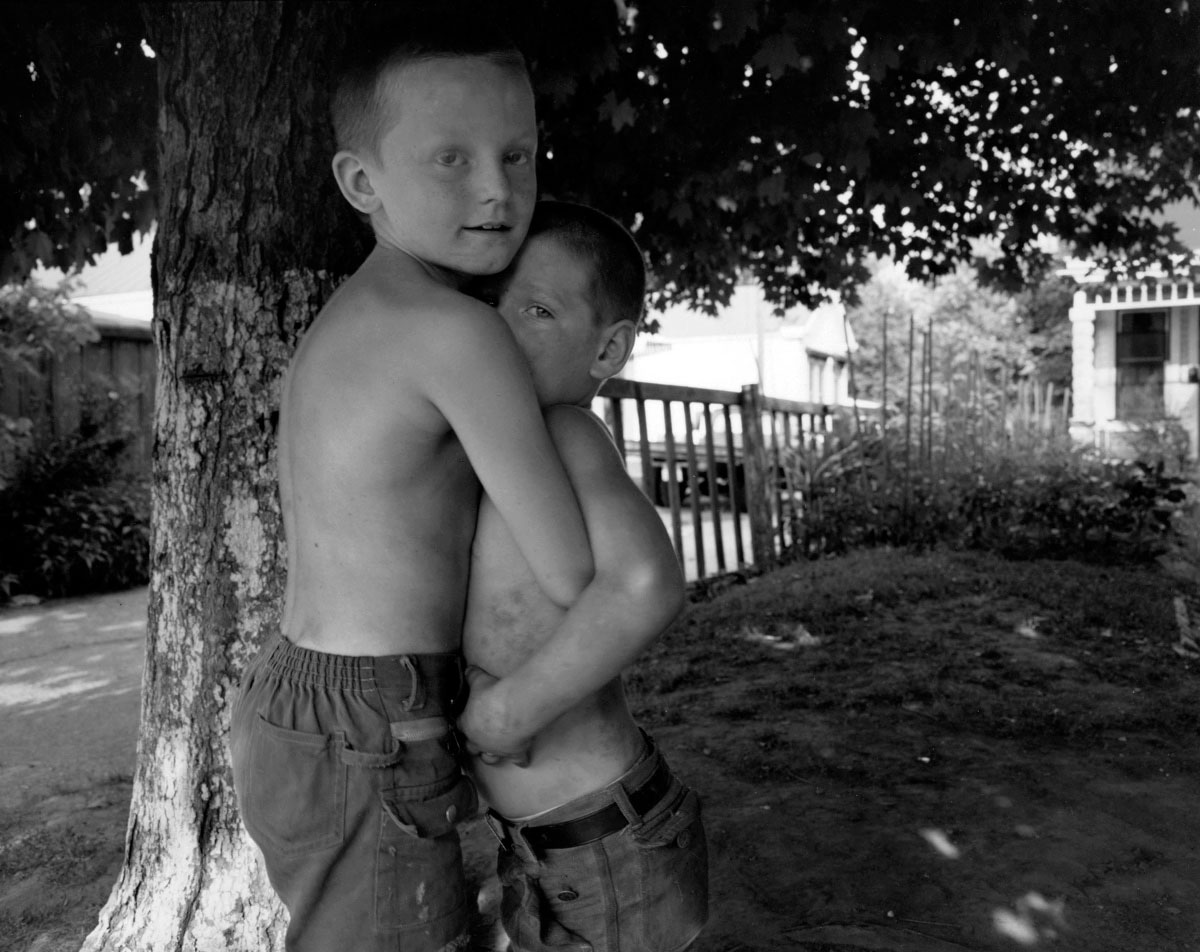
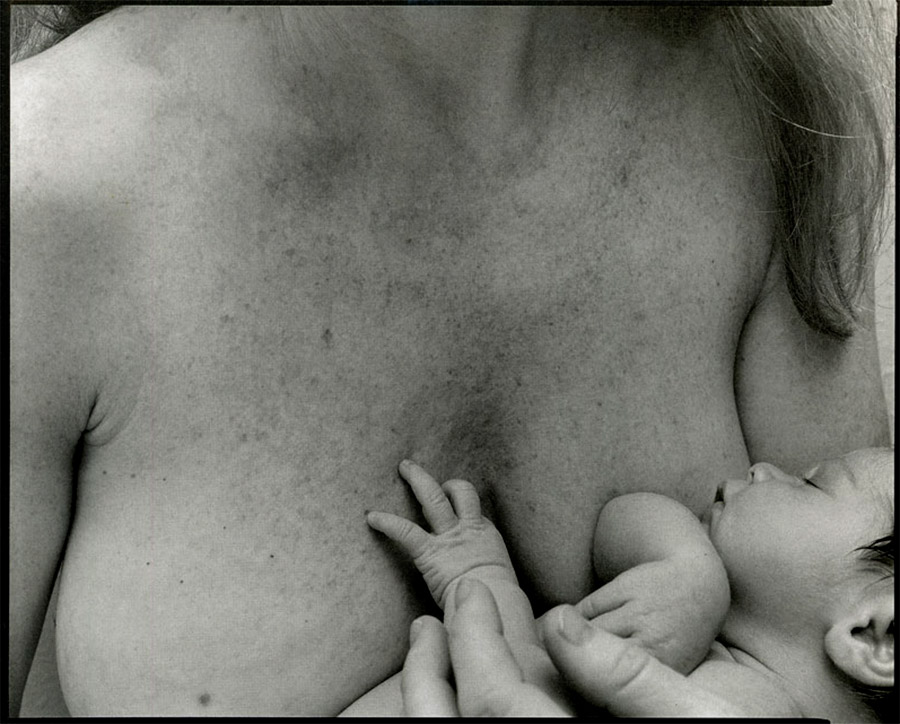
The emergence of colour photography as a major force in the 1970s is seen in the fifth gallery, with large photographs, including Tina Barney’s Sunday New York Times (1982) and a picture from Cindy Sherman’s celebrated Centerfolds (1981) series. This gallery also includes the work of postmodern artists associated with The Pictures Generation, such as Barbara Kruger, Louise Lawler, Sherrie Levine, and Laurie Simmons, who played with photography’s potential to comment on the increasingly image-saturated world of the late twentieth century. Representing the other end of the photographic spectrum is the diaristic aesthetic of Nan Goldin. A group of Goldin photographs dating from 1978 to 1985 capture the shared experience of an artistic downtown New York community – a generation ravaged by drug abuse and AIDS. These pictures of the artist’s friends, lovers, and Goldin herself explore the highs and the lows of amorous relationships. These are presented opposite work by Gay Block, Sally Mann, and Sheron Rupp, who use the probing vision of straightforward photography to explore the world around us.

Concluding the installation in The Robert and Joyce Menschel Gallery are major groups of works that suggest the diversity of artistic strategies and forms in contemporary photography. A group of Judith Joy Ross portraits of very different women – a graduation guest (1993), a soldier (1990), a congresswoman (1987), and a visitor to the Vietnam Veterans Memorial (1984) – invite us to reflect upon the relationship between social roles and the unique identities of the individuals who fulfil them. Presented on the same wall is Rineke Dijkstra’s ongoing series Almerisa, comprising 11 photographs made over a period of 14 years. Dijkstra first photographed Almerisa – a six-year-old Bosnian girl whose family had relocated from their war-torn native country to Amsterdam – as part of a project documenting children of refugees. Dijkstra continued to photograph her at one- or two-year intervals, chronicling not only her development from childhood through adolescence and into adulthood but also her cultural assimilation from Eastern to Western Europe. A selection from Carrie Mae Weems’s series From Here I Saw What Happened and I Cried (1995) superimpose sand-blasted text over found photographs to dissect photography’s historical role in imposing stereotypes upon African Americans. Rounding out this gallery is a wall dedicated to portraits of women, including work by Valérie Belin, Tanyth Berkeley, Katy Grannan, and Cindy Sherman, suggesting the plasticity of photography and, indeed, of female identity itself.

Press release from the MoMA website


Julia Margaret Cameron (British born India, 1815-1879) 'Untitled' c. 1867


Julia Margaret Cameron (British, 1815-1879)
Untitled
c. 1867
Albumen silver print
13 3/16 x 11″ (33.5 x 27.9cm)
The Museum of Modern Art, New York
Gift of Shirley C. Burden


Gertrude Käsebier (American, 1852-1934) 'The Manger' 1899


Gertrude Käsebier (American, 1852-1934)
The Manger
1899
Platinum print
12 13/16 x 9 5/8″ (32.5 x 24.4cm)
The Museum of Modern Art, New York
Gift of Mrs. Hermine M. Turner


Tina Modotti (Italian, 1896-1942) 'Campesinos (Workers' Parade)' 1926


Tina Modotti (Italian, 1896-1942)
Workers Parade
1926
Gelatin silver print
8 7/16 x 7 5/16″ (21.5 x 18.6cm)
The Museum of Modern Art, New York
Given anonymously


Lucia Moholy (British, 1894-1989) 'Untitled (Florence Henri)' 1927


Lucia Moholy (British, 1894-1989)
Untitled (Florence Henri)
1927
Gelatin silver print
14 5/8 x 11″ (37.1 x 28cm)
The Museum of Modern Art, New York
Thomas Walther Collection. Gift of Thomas Walther
© 2010 Lucia Moholy Estate/Artists Rights Society (ARS), New York/VG Bild-Kunst, Bonn


Hannah Höch (German, 1889-1978) 'Indian Dancer: From an Ethnographic Museum' 1930


Hannah Höch (German, 1889-1978)
Indian Dancer: From an Ethnographic Museum (Indische Tänzerin: Aus einem ethnographischen Museum)
1930
Cut-and-pasted printed paper and metallic foil on paper
10 1/8 x 8 7/8″ (25.7 x 22.4cm)
The Museum of Modern Art, New York
Frances Keech Fund
© 2019 Hannah Höch / Artists Rights Society (ARS), New York / VG Bild-Kunst, Germany


Through the cut-and-pasted elements of Indian Dancer, Höch assembled references to film, Central African sculpture, and the domestic sphere. Her collaged model is the actress Renée (Maria) Falconetti (also known simply as “Falconetti”), appearing in a publicity still for Carl Theodor Dreyer’s 1928 film The Passion of Joan of Arc. Half of Falconetti’s face is replaced with the ear, eye, and mouth of a wooden dance mask from Cameroon. Atop her head rests a crown of cutlery: cutout shapes of spoons and knives, set against glinting metallic foil.

This work belongs to a series of photomontages called From an Ethnographic Museum (1924-1934), in which Höch juxtaposed images of women with reproductions of tribal art cut from magazines. The artist cited a visit to the ethnographic museum in Leiden, in the Netherlands, as an influence in the conception of this series; however, she used material from other cultures mostly as a point of departure for commentary on the status of women in contemporary German society. Invoking an androgynous fifteenth-century French martyr as embodied by a glamorous movie star, capping her with the finery of a domestic goddess, and aligning her with a cultural Other, this composite representation examines the complex facets of modern femininity.

Publication excerpt from MoMA Highlights: 375 Works from The Museum of Modern Art, New York (New York: The Museum of Modern Art, 2019)


Grete Stern (Argentine born Germany, 1904-1999) 'Photomontage for Madí, Ramos Mejía, Argentina' 1946-1947


Grete Stern (Argentine born Germany, 1904-1999)
Photomontage for Madí, Ramos Mejía, Argentina
1946-1947
Gelatin silver print
23 9/16 × 19 7/16″ (59.8 × 49.4cm)
The Museum of Modern Art, New York
Latin American and Caribbean Fund and partial gift of Mauro Herlitzka
© 2025 Galería Jorge Mara-La Ruche


Toshiko Okanoue (Japan, b. 1928) 'In Love' 1953


Toshiko Okanoue (Japan, b. 1928)
In Love
1953
Cut-and-pasted printed papers on printed paper
14 x 9 5/8″ (35.6 x 24.4cm)
The Museum of Modern Art, New York
Committee on Photography Fund and Committee on Drawings Funds
© 2019 Toshiko Okanoue


Martha Rosler (American, b. 1943) 'Cleaning the Drapes' from the series 'House Beautiful: Bringing the War Home' c. 1967-1972


Martha Rosler (American, b. 1943)
Cleaning the Drapes from the series House Beautiful: Bringing the War Home
c. 1967-1972
Pigmented inkjet print (photomontage), printed 2011
17 5/16 x 23 3/4″ (44 x 60.3cm)
The Museum of Modern Art, New York
Committee on Photography and The Modern Women’s Fund
© Martha Rosler


Rosler conceived Bringing the War Home during a time of increased intervention in Vietnam by the United States military. Splicing together pictures of Vietnamese citizens maimed in the war, published in Life magazine, with images of the homes of affluent Americans culled from the pages of House Beautiful, Rosler made literal the description of the conflict as the “living-room war,” so called in the USA because the news of ongoing carnage in Southeast Asia filtered into tranquil American homes through television reports. By urging viewers to reconsider the “here” and “there” of the world picture, these activist photomontages reveal the extent to which a collective experience of war is shaped by media images.

Gallery label from The Shaping of New Visions: Photography, Film, Photobook, April 16, 2012 – April 29, 2013


Helen Levitt (American, 1913-2009)
'New York' 1977


Helen Levitt (American, 1913-2009)
New York
1977
Chromogenic print, printed c. 2005
17 15/16 × 11 15/16″ (45.6 × 30.4cm)
The Museum of Modern Art, New York
Gift of Marvin Hoshino
© 2025 Film Documents LLC


The Museum of Modern Art
11 West 53 Street
New York, NY 10019
Phone: (212) 708-9400

Opening hours:
Daily 10.30am – 5.30pm

MoMA website

LIKE ART BLART ON FACEBOOK

Back to top

Exhibition: ‘Ideen sitzen. 50 Years of Chair Design’ at Museum für Kunst und Gewerbe, Hamburg

Exhibition dates: 29th September 2010 – 13th March 2011


Frank Gehry (American, b. 1929) 'Wiggle Side Chair' 1972


Frank Gehry (American, b. 1929)
Wiggle Side Chair
Los Angeles/Cal., U.S.A., 1972
Easy Edges Inc., New York, U.S.A., 1972
84 x 37 x 59cm
Cardboard, hard fiber board
Museum für Kunst und Gewerbe Hamburg
Photo: Jörg Arend/Maria Thrun


I love chairs! There are such fabulous designs throughout the centuries. Once seen as the symbol of ultimate power (only the king and queen could be seated) our favourite chair now occupies the place of form fitting sculpture, the place where we feel most comfortable. Most of these works are not of that mould but they are a tour de force of the designers art and a testament to the mutability of the form, chair.

Dr Marcus Bunyan


Many thankx to the Museum für Kunst und Gewerbe, Hamburg for allowing me to publish the photographs in the posting. Please click on the photographs for a larger version of the image.


Trailer zur Ausstellung IDEEN sitzen – 50 Jahre Stuhldesign

You can see an excerpt from the introductory film for the exhibition IDEEN Sitz – 50 Jahre Stuhldesign, which is being shown from September 28th, 2010 to March 13th, 2011 in the Museum für Kunst und Gewerbe Hamburg.

Chair design over the last 50 years shows that an everyday object can be infinitely varied and reinvented again and again. In this exhibition, classics stand alongside contemporary positions, but the boundaries between art and design are fluid: some objects are autonomous sculptures that reveal the chair as a source of inspiration without fulfilling its function. New technologies have also changed chair design significantly in recent years.


Installation view of the exhibition 'Ideen sitzen. 50 Years of Chair Design' at Museum für Kunst und Gewerbe, Hamburg


Installation view of the exhibition Ideen sitzen. 50 Years of Chair Design at Museum für Kunst und Gewerbe, Hamburg


Marc Newson (Australian, b. 1963) 'Chair 'Wooden Chair'' Sydney, 1988


Marc Newson (Australian, b. 1963)
Chair ‘Wooden Chair’
Sydney, 1988
Made by Cappellini, Arosio/Como, 1993-97
Beech wood (solid, curved)
65 x 85 x 100cm
Museum of Arts and Crafts Hamburg
Photo: Cappellini


Joe Colombo. 'Elda' Italy, 1963


Joe Colombo (Italian, 1930-1971)
Elda
Italy, 1963
Comfort, Meda/Mailand, Italy, 1963
92.5 x 95 x 96cm
Polyester, reinforced glass-fibre
Museum für Kunst und Gewerbe Hamburg
Photo: Jörg Arend/Maria Thrun


Patrick Jouin. 'C2 Solid Chair' Paris, 2008


Patrick Jouin (French, b. 1967)
C2 Solid Chair
Paris, 2008
Paris, Frankreich, 2008
78.5 x 40.4 x 54cm
Plastic (formed with technology of the Stereolithographie/Rapidly Prototyping manufacture)
Museum für Kunst und Gewerbe Hamburg
Photo: Jörg Arend/Maria Thrun


Joris Laarman. 'Bone Chair' Utrecht, 2006


Joris Laarman (Netherlands, b. 1979)
Bone Chair
Utrecht, 2006
77 x 45 x 76cm
Aluminium (poured and polished)
Museum für Kunst und Gewerbe Hamburg
Photo: Jörg Arend/Maria Thrun


With Ideen sitzen. 50 Years of Chair Design the Museum für Kunst und Gewerbe is presenting the first large exhibition on recent seat design dating from 1960 to the present day. One hundred exceptional exhibits selected from the high-calibre collection held by the MKG, among them chairs, arm chairs, chaise longues and stools, offer an insight into the most diverse approaches and motivations of design during five eventful decades. The focus lies on the chair as contemporary witness be it as expression of a utopian idea or instrument in political protest, a reaction to ecological changes or a calculated business idea, an experiment with the most recent technologies or a sculptural art object, where the chair – divorced from its function – can only just be recognised as the source of inspiration. Chairs are regarded as the business card of any designer. They are visually more attractive than tables, wardrobes, settees or kitchen furniture and exemplify the increasingly blurry demarcation between art and design.

Designing a chair forms part of the great challenge of any designer. In modernity it seemed to have found its perfect answer in Michael Thonet’s Coffee House Chair Model No. 14, made in the revolutionary bentwood technique. Today, 150 years on, a multitude of new chair designs are demonstrating artistic, technical and social changes. No other object juxtaposes the conflicting interests of design as directly: appropriate functionality versus the free reign of fantasy and autonomous artistic form. A new idea lies at the core of any new seating furniture, which will then be moulded by factors such as use, the market, the target group, the company’s philosophy, materials, production methods, technological progress and not least the designers interests, depending on whether he or she is an artist, sculptor, director, architect or simply a product designer. The expression “same, same – but different” is particularly valid when it comes to chairs: an intellectual and a practical product, which is manifest in hundreds of forms. The exhibition Ideen sitzen. 50 Years of Chair Design therefore becomes a reflection of time and its self-concept, its necessities and the longing for freedom of artistic expression.

A design exhibition turns into an art exhibition once it presents autonomous sculpture. The chair freed from its functional requirements becomes a source of information only. The MKG’s most recent acquisitions illustrate this phenomenon of contemporary chair design and demonstrate the increasingly blurred demarcation of art and design. Some of them are design classics: the famous spherical Sunball lounge chair by Günter Fedinand Ris, the Well Tempered Chair by Ron Arad, chairs by Stefan Wewerka and Alessandro Mendini’s Proust Armchair – the latter combining baroque opulence of Louis XV style with an impressionist colour scheme referencing Marcel Proust’s time. The design positions represented in the collection are expanded by Joris Laarman’s Bone Chair, which was inspired by the natural growth of bone. Vladi Rapaport turned an oversized skull and an oversized brain into seats called The skull chair and The brain footstool respectively. Tord Boontje created the bench Petit Jardin where a tender web of leaves, flowers and twigs made of white coated laser cut steel is embracing the sitter. For Veryround Louise Campbell interlinked 240 steel circles to form an ornamental seat sculpture.

Putting the various ideas and trends in design into their historical context, highlights how directly it is informed by social and economic trends. At the beginning of the 20th Century chair design was dictated by social factors and functionality: good quality seats had to be produced at low cost for the masses. New materials such as steel tube and multiplex warranted new production techniques. The introduction of injection-moulding for plastic chairs in the early 1960s revolutionised ideas yet again. The 1960s are determined by the new prosperity after the war, but also by burgeoning social unrest. The exhibition presents some increasingly unconventional types of armchair, which reflect the tensions of the period. Gaetano Pesce’s Donna, 1969 is both: a comfortable armchair and a biting political criticism of women’s role in modern society. The prospect of growing markets led the chemical and furniture industry to invest in the production of plastic chairs, a development, which found its preliminary end in the oil crisis of 1973.

The 1970s produced relatively few sweeping designs; the decade is characterised by the criticism of capitalism, consumerism and a heightened sense of uncertainty in manufacturing. Stefan Wewerka created an icon of instability when he came up with “Classroom Chair”; the tried and trusted breaks away, dissolves. The American architect Frank Gehry on the other hand developed new chairs from corrugated cardboard, constructing and glueing the layers so they withhold the greatest pressure; his Wiggle Side Chair is a trendsetting seat constructed with minimal material investment and an original design idea. Towards the end of the century Alessandro Mendini created its antithesis when he combined a neo-baroque silhouette with light colours quoting Impressionism – Proust‘s purpose is the quotation of historic style, which makes it one of the early classics of postmodernism. The architectural and design-movement deliberately cited traditional style elements to reinterpret or pass ironic comment on their meaning. Architecture and interior design were turned into an intellectual game.

Around 1980 the postmodernist approach set off the Italian artists group Memphis led by Ettore Sottsass and Michele de Lucchi. Sottsass turned to the past and to architectural evidence of the world’s cultural heritage. He achieved new singular pieces of furniture inspired by sculpture and architecture – colourful monuments that for a few years were recognised as style icons. Memphis introduced fun and joy into the hitherto predominantly grey and brown furniture scene. Their products offer entertainment value. They are evocative of ideas, full of allusions to earlier cultures, hip, they cherish masquerade and express a way of thinking clearly opposed to industrialism and market strategies. Memphis’ furniture is simply made, using MDF laminated in bright colours. It is to Sottsass’ credit, that against the Zeitgeist Memphis made use of ornament.

While the group’s unique furnishing objects created a lust for new furniture, designers in Germany, England, Japan or Switzerland who followed contemporary product design conceived chairs from metal – tubular steel, steel panel or metal mesh. Intellectually these designers are followers of the Bauhaus creations from the 1920s and 1930s and their proposals are accordingly ambitious. Apart from Northern Italy Paris with Philippe Starck and Barcelona established themselves as the new centres of design. Starck designed numerous new models of chairs from various materials – metal, wood and plastic – within only a few years. His philosophy is to offer to the market ideas that are as innovative as possible while being fairly priced. He formed the counterpart to a fad from the 1980s, where design objects were produced in limited editions and offered to an exclusive clientele. Artists such as Donald Judd, Franz West and Bob Wilson were designing chairs and fittingly documenta in 1989 had a focus on design.

The 1990s return to a design ethos bethinking simplicity and rediscovering natural wood. Pale woods and a concise and rational tenor respond to the demand for clear shapes with a warm and natural character. Numerous designers, including Jasper Morrison or Axel Kufus, turn against the euphoria and affluence of the fin de siècle. Rifts within the structure of society are addressed by works such as Tejo Remy’s Rug Chair made of leftover shred reinforced by a carbon core and s of fabric. In Brazil the Campana brothers conceive an armchair from waste wood of the slums called Favela. The seat is pointing at the destitution of the residents of the slums as well as the creative possibilities inherent in poor materials. Equally Marcel Wanders’ Knotted Chair makes use of the simplest rope; its carbon core and hardened epoxy fix the knotted structure in the shape of a chair giving the illusion of the sitter being suspended on a soft hanging structure.

In the first decade of the 21st century designers like Konstantin Grcic or the Bouroullec Brothers continued to work on intelligent solutions for large social groups. At the same time young designers such as the Dutchman Joris Laarman or the Frenchman Patrick Jouin employ digital methods of design, which allow them to calculate new ways of construction. They also make use of Rapid Prototyping. Their objects are highly experimental and seem to offer a glimpse of the world of tomorrow. Other designers like Tord Boontje work with laser cut metal sheet to create ornamental compositions. Most designs by the younger scene are produced in small numbers and are distributed largely by design galleries. The seating furniture of a new era is taking up the elitist impulse of the 1980s – produced in highly limited numbers they are treated as unique art works. Museums who manage to acquire such pieces directly from the artists are thus in a position to present models that are wholly fresh to the eye and provoke spontaneous responses.

As one of the leading museums of its kind in Germany the MKG holds an extensive collection on the history of modern design. The collection of seating furniture is at its core and comprises hundreds of examples of the history of modern design of all periods from leading countries in Europe, Australia, the USA, Brazil and Japan. William Morris, Peter Behrens, Henry van de Velde, Le Corbusier, Ludwig Mies van der Rohe, Alvar Aalto, Eero Saarinen, Charles Eames, Verner Panton, Joe Colombo, Stefan Wewerka, Frank Gehry, Alessandro Mendini, Ettore Sottsass, Michele De Lucchi, Philippe Starck, Shiro Kuramata, Ron Arad, Marc Newson, Jasper Morrison, Tom Dixon, Konstantin Grcic and many more designers are represented in the collection.

Designers and artists: Eero Aarnio, Ron Arad, Archizoom, Teppo Asikainen, Gijs Bakker, Helmut Bätzner, Mario Bellini, Günter Beltzig, Ricardo Blumer, Matteo Borghi, Tord Boontje, Mario Botta, Andrea Branzi, Fernando and Humberto Campana, Louise Campbell, Joe Cesare Colombo, Paolo Deganello, Tom Dixon, Uwe Fischer, Formfürsorge, Piero Gatti, Frank Gehry, Ginbande Design, Konstantin Grcic, Gruppo Strum, Klaus Achim Heine, Patrick Jouin, Donald Judd, Toshiyuki Kita, Poul Kjaerholm, Gunter König, Axel Kufus, Shiro Kuramata, Angela Kurrer, Joris Laarman, Paolo Lomazzi, Ross Lovegrove, Michele de Lucchi, Vico Magistretti, Peter Maly, Enzo Mari, Javier Mariscal, Alessandro Mendini, Jasper Morrison, Marc Newson, Katsuhito Nishikawa, Verner Panton, Cesare Paolini, Jonathan de Pas, Pierre Paulin, Maurizio Peregalli, Gaetano Pesce, Giancarlo Piretti, Tom Price, Dieter Rams, Bernard Rancillac, Vladi Rapaport, Karim Rashid, Tejo Remy, Günter Ferdinand Ris, Herbert Selldorf, Hubert Matthias Sanktjohanser, Peter Schmitz, Stiletto, Ettore Sottsass, Philippe Starck, Studio 65, Roger Tallon, Donato d’Urbino, Marcel Wanders, Franz West, Stefan Wewerka, Robert Wilson, Tokujin Yoshioka and others.”

Press release from Museum für Kunst und Gewerbe, Hamburg


Alessandro Mendini. 'Poltrona di Proust' Studio Alchimia, Mailand, 1978


Alessandro Mendini (Italian, 1931-2019)
Poltrona di Proust (Proust Armchair)
Studio Alchimia, Mailand, 1978
107 x 93 x 90cm
Wood, Leinenbezug (painted)
Museum für Kunst und Gewerbe Hamburg
Photo: Jörg Arend/Maria Thrun


Ricado Blumer and Matteo Borghi. 'Origami' Casciago, 2007


Ricado Blumer (Italian, b. 1959) and Matteo Borghi (Italian, b. 1976)
Origami
Casciago, 2007
Ycami, Novedrate, 2007
76 x 61 x 63cm
Aluminium
Museum für Kunst und Gewerbe Hamburg
Photo: Jörg Arend/Maria Thrun


Stefan Wewerka. 'Classroom Chair' Berlin, 1970


Stefan Wewerka (German, 1928-2013)
Classroom Chair
Berlin, 1970
70 x 68 x 40cm
Wood (painted)
Museum für Kunst und Gewerbe Hamburg, © VG Bild-Kunst, Bonn 2010
Photo: Jörg Arend/Maria Thrun


Tokujin Yoshioka (Japanese, b. 1967)
'Honey-Pop Armchair' Tokyo, Japan, 2000


Tokujin Yoshioka (Japanese, b. 1967)
Honey-Pop Armchair
Tokyo, Japan, 2000
83 x 81 x 81cm
Greaseproof paper (folded into form)
Justus Brinckmann Society
Museum für Kunst und Gewerbe Hamburg
Photo: Jörg Arend/Maria Thrun


Gunter Beltzig (German, 1941-2022) 'Chair 'Floris'' Wuppertal, 1967


Gunter Beltzig (German, 1941-2022)
Chair ‘Floris’
Wuppertal, 1967
Polyester (reinforced fiberglass, painted)
109 x 59 x 40cm
Museum fur Kunst und Gewerbe Hamburg
Foto: Maria Thrun, Jurgen Arendt


Museum für Kunst und Gewerbe Hamburg
Steintorplatz, 20099 Hamburg

Opening hours:
Tuesday to Sunday 10am – 6pm
Thursday 10am – 9pm
Closed Mondays

Museum fur Kunst und Gewerbe Hamburg website

LIKE ART BLART ON FACEBOOK

Back to top
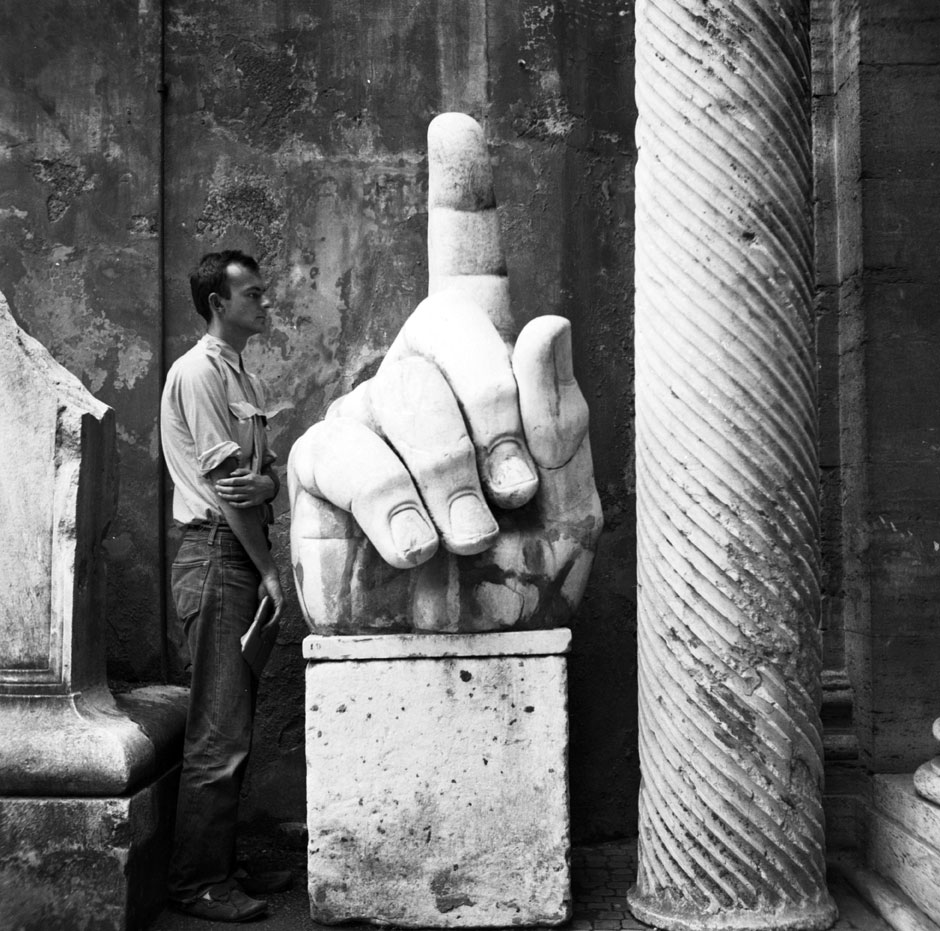
Exhibition: ‘Duane Hanson/Gregory Crewdson: Uncanny realities’ at Museum Frieder Burda, Baden-Baden

Exhibition dates: 27th November 2010 – 6th March 2011

Curators: Götz Adriani and Patricia Kamp


Installation photograph of the exhibition 'Duane Hanson/Gregory Crewdson: Uncanny realities' at Museum Frieder Burda


Installation photograph of the exhibition Duane Hanson/Gregory Crewdson: Uncanny realities at Museum Frieder Burda


A great double act!

An inspired curatorial choice brings the work of these two artist’s together – life-like sculptures of everyday Americans mixing with theatrical, deadpan staged images. The mis en scène created in the exhibition space, the tension between sculpture, photograph, frame and space – is delicious.

Crewdson is at his best when he resists the obvious narrative (for example, all the traffic lights stuck on yellow in the photograph Untitled (Brief Encounter) (2006, see below). Personally I prefer his staged photographs with pairs or groups of people within the image, rather than a single figure. The storyline is more ambiguous and the photographs of people walking along railway tracks always remind me of the Stephen King story filmed as Stand by Me (1986) with a young River Phoenix. Either way they are intoxicating, the viewer drawn into these wonderful, dark psychological dramas.

Dr Marcus Bunyan


Many thankx to Museum Frieder Burda for allowing me to publish the photographs in the posting. Please click on the photographs for a larger version of the image.


Installation photograph of the exhibition 'Duane Hanson/Gregory Crewdson: Uncanny realities' at Museum Frieder Burda with Duane Hanson 'Old Couple on a Bench' (1994) in the foreground and Gregory Crewdson 'Untitled (Worthington Street)' (2006) in the background


Installation photograph of the exhibition Duane Hanson/Gregory Crewdson: Uncanny realities at Museum Frieder Burda with Duane Hanson Old Couple on a Bench (1994) in the foreground and Gregory Crewdson Untitled (Worthington Street) (2006) in the background


The works by the two American artists Duane Hanson (1925-1996) and Gregory Crewdson (born in 1962) confuse and touch the observer.

Both artists present people in their everyday lives, with hopes, yearnings and broken dreams. People we usually do not notice, aged and marked by reality, by life itself. While Hanson shapes his life-sized figures with a great deal of sympathy, Crewdson rather spreads a gloomy and depressing atmosphere in his pictures of lonely people in their houses, gardens and in streets.

With his realistic sculptures, the American artist Duane Hanson has become a synonym for contemporary realism in contemporary art. Typical motives are average people like  housewives, waitresses, car dealers, janitors. Posture and expression of these figures are very close to reality. The photographer Gregory Crewdson arranges his large format pictures with cineastic arrangements and lets the abyss behind every-day life scenes become visible.

The exhibition at the Frieder Burda Museum presents about 30 figures by Duane Hanson, mainly from the artist’s estate, in dialogue with 20 large format works from the series Beneath the Roses by the photographer Gregory Crewdson. The photographies are mainly owned by the artist himself.

The curators Götz Adriani and Patricia Kamp are not aiming at a direct confrontation. They are rather presenting two artists who work with different materials, but deal with very similar topics. Both artists, Hanson and Crewdson, are grand when it comes to arranging their art. Crewdson always puts very much effort into the arrangements of the scenes in his pictures, and Hanson always keeps an eye on his close surroundings.

The works of both artists impressively reflect the complexity of the human existence. …


Duane Hanson (American, 1925-1996) 'Children Playing Game' 1979


Duane Hanson (American, 1925-1996)
Children Playing Game
1979
Polyvinyl chloride, coloured with oil, mixed technique and accessories
Collection Hanson, Davie, Florida
© VG Bild-Kunst, Bonn 2010


Duane Hanson (American, 1925-1996) 'Tourists II' 1988


Duane Hanson (American, 1925-1996)
Tourists II
1988
polyvinyl chloride, coloured with oil, mixed technique, accessories
Collection Hanson, Davie, Florida
© VG Bild-Kunst, Bonn 2010


Duane Hanson (American, 1925-1996) 'Self-Portrait with Model' 1979


Duane Hanson (American, 1925-1996)
Self-Portrait with Model
1979
Polyvinyl chloride, coloured with oil, mixed technique and accessories
Collection Hanson, Davie, Florida
© VG Bild-Kunst, Bonn 2010


Duane Hanson (American, 1925-1996) 'Housepainter I' 1984/1988


Duane Hanson (American, 1925-1996)
Housepainter I
1984/1988
Epoxy resin, coloured with oil, mixed technique, accessories
Collection Hanson, Davie, Florida
© VG Bild-Kunst, Bonn 2010


Duane Hanson (American, 1925-1996) 'Queenie II' 1988


Duane Hanson (American, 1925-1996)
Queenie II
1988
Epoxy resin, coloured with oil, mixed technique, accessories
Collection Hanson, Davie, Florida
© VG Bild-Kunst, Bonn 2010


Duane Hanson

Duane Hanson (1925-1996) is one of the most influential American sculptors of the 20th century committed to Realism.

The proximity to reality of his lifelike, detailed human figures make for perfect irritation. Despite all the seriousness hidden behind the socio-critical issue, which prompted Hanson to create his protagonists, the figures have a great deal of entertainment value, above all – and it is precisely this that makes them so appealing – due to their occasional gravitational bearing. Featuring twenty-five works, the exhibition presents a representative cross-section of the American’s extensive oeuvre, which comprises a total of only 114 works. The figures enter a dialogue with the large-format photographs by the American photo artist Gregory Crewdson, who has a flair for relating human abysses in a different and very subtle way.

In the early 1950s, after completing his study of sculpture at the Cranbrook Academy of Art in Bloomfield Hills, Michigan, Hanson was initially guided by the abstract style of art that prevailed during this period. However, this would not lead to a satisfactory result. In 1953, he turned his back on his homeland and spent nearly ten years of his life earning a living as an art teacher at American schools in Germany. It was during this period that he discovered the materials polyester resin and fibreglass, which would become crucial for his future creative work. After returning to the United States, Hanson spent the ensuing years perfecting his artistic skills in the treatment of these materials in such a way that the boundaries between reality and artificial figure seem to blur – where Hanson was never concerned with the mere illusionistic reproduction of reality, but chose this veristic manner of representation as a medium for communicating his concern in terms of content, i.e., shedding light on the tragedy of human lives that hauntingly consolidates in his characters.

In the human figures produced in the early work phase in the late 1960s, Hanson responded to the sociopolitical tension and protest movements of the day. He created sculptures and ensembles that very directly take issue with social hardship, violence, or racism, and he took a stand for the victims of this system, for the people who never had a chance to successfully face the demands made by life.

Influenced by Pop Art, Hanson turned to thematising everyday American life, frequently switching his observations to a critically satirical attitude that was, however, always guided by compassion. Housewives, construction workers, car salesmen, or janitors – the models for his figures are people in the American middle and working classes in whose biographies the disappointment in the American dream has become entrenched. He often puts his people and all of their small insufficiencies into perspective with ironic kindness, such as, for example, the Tourists, in whom are combined all of the clichés associated with the typical Florida tourist.

Hanson’s participation in documenta 5 in Kassel in 1972 gave rise to his international breakthrough. His figures became more lifelike; they more and more naturally blended into their surroundings. Their gestures, facial expressions, and postures related the emotional and physical burdens of life. The artist concentrated on older people in whose physiognomies one can read the traces of existence, the impact of loneliness, the problems that accompany being old, and their alienation. Hanson was struck by the isolation of this generation by society, a circumstance that has not lost any of its relevance.

Hanson’s interest in rendering the figures as lifelike as possible is surely not rooted in a desire to want to convince the viewer of their “authenticity”; rather, their lifelikeness was meant to move the viewer to experience empathy and concern, thus manifesting Hanson’s humanism. Human values and destinies comprise the focus of his art; he transforms the reality of life into the realism of art and in doing so sharpens our outlook and our view of the world, our fellow human beings, and our own life as well.


Gregory Crewdson (American, b. 1962) 'Untitled (Birth)' from the series 'Beneath the Roses' 2007


Gregory Crewdson (American, b. 1962)
Untitled (Birth)
From the series Beneath the Roses
2007
Digital carbon print
144.8 x 223.5cm
Gregory Crewdson, Courtesy Gagosian Gallery, New York
© Gregory Crewdson, 2010


Gregory Crewdson (American, b. 1962) 'Untitled (Blue Period)' from the series 'Beneath the Roses' 2005


Gregory Crewdson (American, b. 1962)
Untitled (Blue Period)
From the series Beneath the Roses
2005
Digital carbon print
144.8 x 223.5cm
Gregory Crewdson, Courtesy Gagosian Gallery, New York
© Gregory Crewdson, 2010


Gregory Crewdson (American, b. 1962) 'Untitled (Brief Encounter)' from the series 'Beneath the Roses' 2006


Gregory Crewdson (American, b. 1962)
Untitled (Brief Encounter)
From the series Beneath the Roses
2006
Digital carbon print
144.8 x 223.5cm
Gregory Crewdson, Courtesy Gagosian Gallery, New York
© Gregory Crewdson, 2010


Gregory Crewdson (American, b. 1962) 'Untitled (Debutante)' from the series 'Beneath the Roses' 2006


Gregory Crewdson (American, b. 1962)
Untitled (Debutante)
From the series Beneath the Roses
2006
Digital carbon print
144.8 x 223.5cm
Gregory Crewdson, Courtesy Gagosian Gallery, New York
© Gregory Crewdson, 2010


Gregory Crewdson (American, b. 1962) 'Untitled (Forest Clearing)' from the series 'Beneath the Roses' 2006


Gregory Crewdson (American, b. 1962)
Untitled (Forest Clearing)
From the series Beneath the Roses
2006
Digital carbon print
144.8 x 223.5cm
Gregory Crewdson, Courtesy Gagosian Gallery, New York
© Gregory Crewdson, 2010


Gregory Crewdson (American, b. 1962) 'Untitled (House Fire)' from the series 'Beneath the Roses' 2004


Gregory Crewdson (American, b. 1962)
Untitled (House Fire)
From the series Beneath the Roses
2004
Digital carbon print
144.8 x 223.5cm
Gregory Crewdson, Courtesy Gagosian Gallery, New York
© Gregory Crewdson, 2010


Gregory Crewdson (American, b. 1962) 'Untitled (Kent Street)' from the series 'Beneath the Roses' 2007


Gregory Crewdson (American, b. 1962)
Untitled (Kent Street)
From the series Beneath the Roses
2007
Digital carbon print
144.8 x 223.5cm
Gregory Crewdson, Courtesy Gagosian Gallery, New York
© Gregory Crewdson, 2010


Gregory Crewdson (American, b. 1962) 'Untitled (Maple Street)' from the series 'Beneath the Roses' 2004


Gregory Crewdson (American, b. 1962)
Untitled (Maple Street)
From the series Beneath the Roses
Digital carbon print
144.8 x 223.5cm
Gregory Crewdson, Courtesy Gagosian Gallery, New York
© Gregory Crewdson, 2010


Gregory Crewdson (American, b. 1962) 'Untitled (Merchants Row)' from the series 'Beneath the Roses' 2003


Gregory Crewdson (American, b. 1962)
Untitled (Merchants Row)
From the series Beneath the Roses
Digital carbon print
144.8 x 223.5cm
Gregory Crewdson, Courtesy Gagosian Gallery, New York
© Gregory Crewdson, 2010


Gregory Crewdson

Born in 1962 in Brooklyn, New York, Gregory Crewdson is one of the best-known contemporary photographers internationally. In his most important series to date Beneath the Roses, which he created between 2003 and 2008, Crewdson explores the American psyche and the disturbing realities at play within quotidian environments. In his dramatically detailed and realistic photographs situated in America’s morbid, small-town milieu, the artist succeeds to stimulate the viewer’s subconscious on various levels. Twenty outstanding works from the series are being placed in a dialogue with sculptures by Duane Hanson. Gregory Crewdson does not spare either effort or expenses for the production of his visual inventions, which are reminiscent of film productions. The stagings are planned and arranged in advance down to the smallest detail and then elaborately implemented in a major logistical and human effort. The final photograph is the result of what is frequently work lasting several weeks, a circumstance that is substantiated by its depths in terms of content and its technical perfection.

Gregory Crewdson works in two distinct ways to create his photographs. On one hand, he works on location in real neighborhoods and townships. On the other hand, the artist works on the soundstage inventing his world from scratch. Before the photographic location productions start, Crewdson drives around upstate Massachusetts looking for interesting settings, which he then has prepared in an elaborate process. In most cases, local residents of the ramshackle towns also play the characters in his work. Crewdson works closely with the art department of the museum MASSMoCA, when shooting his pictures done on the soundstage. The results are much like stills from a movie and reflect his affinity with cinema. Filmmakers such as Alfred Hitchcock, David Lynch, or Steven Spielberg are the inspiration for Crewdson’s uncanny stories, which he seems to freeze in a single snapshot in time.

The construction of this narrative instant demonstrates the artist’s extraordinary talent. Like sophisticated literature does the reader, his works pose a challenge to viewers, as they have to mount the decisive share of the creative effort themselves. A brief, fleeting glance is not enough. Viewers become immersed in the staged scenes full of details and accessories to experience a moment that is intensely real. Fantasy and the powers of imagination and association fashion the visual event in the mind to become a subjective, alternative reality – an uncanny reality.

In his photographs, Crewdson deliberately works with emotions and fears that extend through his oeuvre in recurring, in part very different scenarios. They mirror alienation, absence, shame, sexuality, and loss – human states of emotion that deeply touch the viewer. That the artist focuses on the mind in his works may be due to the fact that, as the son of a psychoanalyst, he experienced insight into the profundity of the human soul very early on. His works can be regarded as metaphors for fears and desires, for the things that take place below the surface, the palpable, as if Crewdson wanted to make visible a new or different level of reality situated somewhere between the conscious and subconscious.

At the same time, the Beneath the Roses series can be seen as a psychological study of the American province. The settings show social realities and document the economic decline of a society behind the backdrop of the American way of life. Unsentimental and direct, they reflect working-class life – which allows us to strike an arc to the work by Duane Hanson, whose oeuvre also revolves around the concept of humanity, the facets of which he lends expression to in his silent, introverted figures.

The evolution of Beneath the Roses was documented in a series of production stills, original drawings by the artist, and detailed lighting plans. About sixty works from this reservoir are presented in a studio exhibition at the museum in order to illustrate the complex technical process of producing the photographs. Gregory Crewdson completed his study of Street Photography at the Yale School of Art in New Haven in 1988. He returned to Yale in 1993 and has occupied the Chair of Photography since.

Press release from the Museum Frieder Burda website


Gregory Crewdson (American, b. 1962) 'Untitled (Natural Bridge)' from the series 'Beneath the Roses' 2007


Gregory Crewdson (American, b. 1962)
Untitled (Natural Bridge)
From the series Beneath the Roses
Digital carbon print
144.8 x 223.5cm
Gregory Crewdson, Courtesy Gagosian Gallery, New York
© Gregory Crewdson, 2010


Gregory Crewdson (American, b. 1962) 'Untitled (Railway Children)' from the series 'Beneath the Roses' 2003


Gregory Crewdson (American, b. 1962)
Untitled (Railway Children)
From the series Beneath the Roses
2003
Digital carbon print
144.8 x 223.5cm
Gregory Crewdson, Courtesy Gagosian Gallery, New York
© Gregory Crewdson, 2010


Gregory Crewdson (American, b. 1962) 'Untitled (RBS Automotive)' from the series 'Beneath the Roses' 2007


Gregory Crewdson (American, b. 1962)
Untitled (RBS Automotive)
From the series Beneath the Roses
2007
Digital carbon print
144.8 x 223.5cm
Gregory Crewdson, Courtesy Gagosian Gallery, New York
© Gregory Crewdson, 2010


Gregory Crewdson (American, b. 1962) 'Untitled (Shane)' from the series 'Beneath the Roses' 2006


Gregory Crewdson (American, b. 1962)
Untitled (Shane)
From the series Beneath the Roses
2006
Digital carbon print
144.8 x 223.5cm
Gregory Crewdson, Courtesy Gagosian Gallery, New York
© Gregory Crewdson, 2010


Gregory Crewdson (American, b. 1962) 'Untitled (Sunday Roast)' from the series 'Beneath the Roses' 2005


Gregory Crewdson (American, b. 1962)
Untitled (Sunday Roast)
From the series Beneath the Roses
2005
Digital carbon print
144.8 x 223.5cm
Gregory Crewdson, Courtesy Gagosian Gallery, New York
© Gregory Crewdson, 2010


Gregory Crewdson (American, b. 1962) 'Untitled (Temple Street)' from the series 'Beneath the Roses' 2006


Gregory Crewdson (American, b. 1962)
Untitled (Temple Street)
From the series Beneath the Roses
2006
Digital carbon print
144.8 x 223.5cm
Gregory Crewdson, Courtesy Gagosian Gallery, New York
© Gregory Crewdson, 2010


Gregory Crewdson (American, b. 1962) 'Untitled (The Father)' from the series 'Beneath the Roses' 2007


Gregory Crewdson (American, b. 1962)
Untitled (The Father)
From the series Beneath the Roses
Digital carbon print
144.8 x 223.5cm
Gregory Crewdson, Courtesy Gagosian Gallery, New York
© Gregory Crewdson, 2010


Gregory Crewdson (American, b. 1962) 'Untitled (Trailer Park)' from the series 'Beneath the Roses' 200


Gregory Crewdson (American, b. 1962)
Untitled (Trailer Park)
From the series Beneath the Roses
2007
Digital carbon print
144.8 x 223.5cm
Gregory Crewdson, Courtesy Gagosian Gallery, New York
© Gregory Crewdson, 2010


Gregory Crewdson (American, b. 1962) 'Untitled (Worthington Street)' from the series 'Beneath the Roses' 2006


Gregory Crewdson (American, b. 1962)
Untitled (Worthington Street)
From the series Beneath the Roses
2006
144.8 x 223.5cm
Gregory Crewdson, Courtesy Gagosian Gallery, New York
© Gregory Crewdson, 2010


Museum Frieder Burda
Lichtentaler Allee 8b
D-76530 Baden-Baden
Phone: +49 (0)7221 / 3 98 98-0

Opening hours:
Tuesday – Sunday 10am – 6pm
Closed Mondays

Museum Frieder Burda website

LIKE ART BLART ON FACEBOOK

Back to top
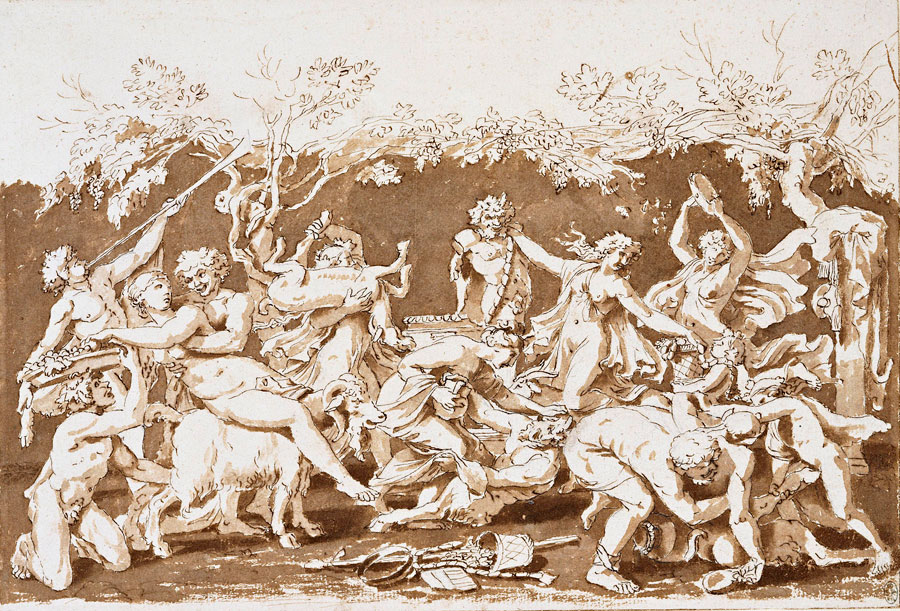
Exhibition: ‘Painting on paper – Josef Albers in America’ at Pinakothek der Moderne, Munich

Exhibition dates: 16th December 2010 – 6th March 2011


Josef Albers (German, 1888-1976) 'Study for a Adobe' c. 1947


Josef Albers (German, 1888-1976)
Study for a Adobe
c. 1947
Oil and graphite on blotting paper
24.1 × 30.5cm
The Josef Albers Museum Quadrat Bottrop
© 2010 The Josef and Anni Albers Foundation/VG Bildkunst, Bonn/Artists Rights Society, New York


I really like the work of Josef Albers and these paintings on paper, studies for later work, give insight into that rare quality of Albers – his ability to mould, no that’s not the right word – his ability to accrete colours and spaces together, to build tectonic plates of colour that collide and burst against each other forming an “osmosis of plane and space.” These harmonic oscillations of vibrant colour form a pleasing equilibrium in the mind, freeing the viewer from conceptual thought and allowing us to enter a different state of being. It is fascinating to me that he painted these studies on blotting paper as the paper seems to soak up the colours, intensifying their existence.

Dr Marcus Bunyan


Many thankx to Pinakothek der Moderne for allowing me to publish the photographs of the art in the posting. Please click on the photographs for a larger version of the image.


Josef Albers (German, 1888-1976) 'Color Study for a Variant / Adobe' Nd


Josef Albers (German, 1888-1976)
Color Study for a Variant / Adobe
Nd
Oil on blotting paper
48.2 × 60.9cm
The Josef and Anni Albers Foundation
© 2010 The Josef and Anni Albers Foundation/VG Bildkunst, Bonn/Artists Rights Society, New York


Josef Albers (German, 1888-1976) 'Study for a Variant / Adobe (I)' c. 1947


Josef Albers (German, 1888-1976)
Study for a Variant / Adobe (I)
c. 1947
Oil on blotting paper with pencil
24.1 × 30.6cm
The Josef and Anni Albers Foundation
© 2010 The Josef and Anni Albers Foundation/VG Bildkunst, Bonn/Artists Rights Society, New York


The exhibition is the first to show such a concentration of paintings on paper by Josef Albers, some of which will be completely unknown to the general public. Works in oil on paper, painted by the artist since the 1940s in preparation for the Adobe and Variant series in particular, are presented together with a large group related to his principal work “Homage to the Square” from the artist’s late period, that he focused on from 1950 until his death in 1976.

Josef Albers was only able to fully develop into an important artist and influential teacher after emigrating to the USA. From around 1940 onwards, Albers was inspired by Mexico’s pre-Columbian architecture, sculpture and textile art that boosted his sense for the aesthetic and led to idiosyncratic, radiant colour compositions, the likes of which had never been seen at that time in European modern art. Around 1950, Albers discovered what was for him the ideal formal shape of colour – the square.

The works exhibited surprise the viewer with their spontaneity, their search for immediacy and the extraordinary delicacy of their colours. Albers studied the interaction of colours like virtually no other. Through his works on paper in particular it can be seen in detail how the artist achieved such a thorough osmosis of plane and space through increasing the density of the colours used.

Text from the Pinakothek der Moderne website


Josef Albers (German, 1888-1976) 'Color Study for Homage to the Square' Nd


Josef Albers (German, 1888-1976)
Color Study for Homage to the Square
Nd
Oil and graphite on blotting paper with varnish
30.5 × 30.5cm
The Josef Albers Museum Quadrat Bottrop
© 2010 The Josef and Anni Albers Foundation/VG Bildkunst, Bonn/Artists Rights Society, New York


Josef Albers (German, 1888-1976) 'Color Study for Homage to the Square' Nd


Josef Albers (German, 1888-1976)
Color Study for Homage to the Square
Nd
Oil on blotting paper
33.2 × 30.9cm
The Josef and Anni Albers Foundation
© 2010 The Josef and Anni Albers Foundation/VG Bildkunst, Bonn/Artists Rights Society, New York


Josef Albers (German, 1888-1976) 'Color Study for Homage to the Square' Nd


Josef Albers (German, 1888-1976)
Color Study for Homage to the Square
Nd
Oil on blotting paper with varnish
33.6 × 30.4cm
The Josef and Anni Albers Foundation
© 2010 The Josef and Anni Albers Foundation/VG Bildkunst, Bonn/Artists Rights Society, New York


Pinakothek Der Moderne
Barer Strasse 40
Munich

Gallery hours:
Daily except Monday 10am – 6pm
Thursday 10am – 8pm

Pinakothek der Moderne website

LIKE ART BLART ON FACEBOOK

Back to top

Exhibition: ‘Acquisitions of Twentieth-Century Photography’ at the Rijksmuseum, Amsterdam

Exhibition dates: 7th December 2010 – 14th February 2011


Many thankx to the Rijksmuseum for allowing me to publish the photographs in the posting. Please click on the photographs for a larger version of the image.


Lewis Hine (American, 1874-1940) 'Don't Smoke, Visits Saloons' 1910


Lewis Hine (American, 1874-1940)
Don’t Smoke, Visits Saloons
1910

Lewis Hine. May 1910. Wilmington, Delaware. “James Lequlla, newsboy, age 12. Selling newspapers 3 years. Average earnings 50 cents per week. Selling newspapers own choice. Earnings not needed at home. Don’t smoke. Visits saloons. Works 7 hours per day.”


Gordon Parks (American, 1912-2006) 'Bessie Fontenelle and Little Richard in bed, Harlem New York' 1968


Gordon Parks (American, 1912-2006)
Bessie Fontenelle and Little Richard in bed, Harlem New York
1968
Gelatin silver print


Helen Levitt (American, 1913-2009) 'Squatting girl/spider girl, New York City' 1980


Helen Levitt (American, 1913-2009)
Squatting girl/spider girl, New York City
1980


From 7 December, the Rijksmuseum will display a selection of 20th-century photographic works acquired in recent years with the support of Baker & McKenzie. The sponsorship from the renowned law firm has already allowed the museum to purchase more than thirty photographs, including works by László Moholy-Nagy, Bill Brandt, Robert Capa and Helen Levitt, as well as photography books by Man Ray and others. When it reopens in 2013, the Rijksmuseum will be the only museum in the Netherlands able to provide an overview of the history of photography in the Netherlands and abroad.

The most recent acquisition sponsored by Baker & McKenzie and the independent art fund Vereniging Rembrandt is a monumental photograph by Bauhaus photographer László Moholy-Nagy (1895-1946). The photograph from 1929 is a key work that marks the transition into modernity. From atop a high bridge, the Pont Transbordeur in Marseille, Moholy-Nagy pointed his camera straight down, where an almost abstract pattern of metal beams contrasted with the sailing boat passing under the bridge. Metal, bridges, machines, aeroplanes and cars formed the icons of a new era for Moholy-Nagy’s generation of artists. They were faced with advancing technology, an enormous increase in scale and mechanisation, and a faster pace of life.

The other photographs to be displayed represent a range of movements in the history of photography. Two photographs by Emil Otto Hoppé (1878-1972) will be displayed. They are both studies of form focusing first and foremost on composition, just as in the Moholy-Nagy work. It was in around 1920 that Hoppé photographed the play of light on cobblestones in New York, and the building of a metal construction in Philadelphia.

The documentary aspects of photography will also be highlighted, with magnificent portraits of a black mother and her child in a report about Harlem in the late 1960s (by Gordon Parks), and a portrait of two men in the southern ‘Cotton States’ of America during the Great Depression of the 1930s (by Peter Sekaer). As early as 1909, Lewis Hine used photography as a weapon in the struggle against injustice. Commissioned by the National Child Labour Committee he documented the child labour industry, in this case a small boy standing on the street selling newspapers.

During the 1930s, Bill Brandt published a (now famous) book on life in London at the time, from which came the photograph Sky lightens over the suburbs, which is both a study of form and documentary in nature. It shows a forest of glistening roofs, depicted in a melancholy yet realistic manner.

In 1942, Piet Mondrian was photographed in his studio by Arnold Newman, a session from which the Rijksmuseum has acquired a range of photographs. There are few portraits of Mondrian in Dutch collections, making this series particularly special.

A work by Helen Levitt is one of the few colour photographs included in the exhibition. Until the 1980s, colour photography was simply ‘not done’ and Levitt was one of the first to experiment with the method. The photograph of a girl searching for something underneath a green car is a marvellous example of composition in colour.

Press release from the Rijksmuseum website


Arnold Newman (American, 1918-2006) 'Piet Mondrian, New York' 1942


Arnold Newman (American, 1918-2006)
Piet Mondrian, New York
1942
Gelatin silver print


Emil Otto Hoppé (British born Germany, 1979-1942) 'Steel construction, Philadelphia' 1926


Emil Otto Hoppé (British born Germany, 1979-1942)
Steel construction, Philadelphia
1926
Gelatin silver print


László Moholy-Nagy (Hungary, 1895-1946) 'View from Pont Transbordeur, Marseille' 1929


László Moholy-Nagy (Hungary, 1895-1946)
View from Pont Transbordeur, Marseille
1929
Gelatin silver print


Rijksmuseum, Amsterdam
Jan Luijkenstraat 1, Amsterdam

Opening hours:
Every day from 9.00 to 17.00

Rijksmuseum website

LIKE ART BLART ON FACEBOOK

Back to top
Exhibition: ‘Artist’s jewels. From Modernisme to the avant-garde’ at Museu Nacional d’Art de Catalunya, Barcelona

Exhibition dates: 27th October 2010 – 13th February 2011


Alexander Calder (American, 1898-1976) 'Still life' Various dates


Alexander Calder (American, 1898-1976)
Still life
© Calder Foundation New York/ VEGAP, Barcelona, 2010


Anyone who reads this archive regularly will know of my love of exceptional jewellery. This posting satiates my desire!

The Calder pieces are just outstanding.

Marcus


Many thankx to the Museu Nacional d’Art de Catalunya for allowing me to publish the photographs in the posting. Please click on the photographs to see a larger version of the image.


Hector Guimard (French, 1867-1942) 'Brooch' 1909


Hector Guimard (French, 1867-1942)
Brooch
1909
© 2010 Digital image, The Museum of Modern Art, New York/Scala, Florence


Jewellery by US artist Alexander Calder from the Metropolitan Museum of Art in New York, USA


Alexander Calder (American, 1898-1976)
Jewellery by US artist Alexander Calder from the Metropolitan Museum of Art in New York, USA
The Metropolitan Museum of Art, New York
© Calder Foundation New York/ VEGAP, Barcelona, 2010


Calder possessed an uncanny ability to synthesise a variety of influences from the world around him to create often simple, always meaningful, and ultimately modern jewellery. In the early 20th century, many avant-garde artists began to collect African tribal art and to reference it in their paintings and sculptures. Likewise, Calder’s brooches, tiaras, and necklaces have more in common with the pectorals, collars, diadems, and neckpieces made by ancient cultures than traditional western European jewellery. For example, Calder repeatedly incorporated the spiral – a typical motif in late Bronze Age artefacts – into his jewellery, as well as his wire figures, drawings, paintings, and other decorative arts. The artist’s personal collections, which included objects from African, Oceanic, and Precolumbian cultures, substantiate his eclectic taste.

Calder’s exploration of jewellery in the 1930s also coincided with his burgeoning interest in Surrealism. As his largest and most dramatic ornaments are unwieldy to wear, Calder’s jewellery may be seen as a Surrealistic strategy to entrap the wearer into participating in an art performance or being metamorphosed by the object. Among those who wore his jewellery were sophisticated art aficionados and artists, such as Peggy Guggenheim, Mary Rockefeller, French actress Jeanne Moreau, and Georgia O’Keeffe.

His sculptural art, regardless of category, has less to do with solidity than with lightness, air, motion, and graceful formal relationships. Calder’s sense of economy, balance, and adaptability, so characteristic of the artist’s much larger and more familiar mobiles and stabiles, extends to his jewellery. While Calder’s more diminutive avant-garde creations converged closely with the aesthetics of the modern age, they remain unmistakably Calder.

 Anon. “Metropolitan Museum of Art features Alexander Calder – Inventive Jewelry” on Art Knowledge News website Nd. [Online] Cited 11/01/2011 no longer available online


Salvador Dalí (Spanish, 1904-1989) 'Time's Eye' Nd


Salvador Dalí (Spanish, 1904-1989)
Time’s Eye
Nd
© Salvador Dali, Fundació Gala-Salvador Dali, VEGAP, Barcelona, 2010


Salvador Dalí (Spanish, 1904-1989) 'Ruby's lips' 1949


Salvador Dalí (Spanish, 1904-1989)
Ruby’s lips
1949
© Salvador Dali, Fundació Gala-Salvador Dali, VEGAP, Barcelona, 2010


Artist’s jewels. From Modernisme to the avant-garde explores the approach to the world of jewellery by leading artists of the main art movements in the first decades of the fertile 20th century. The exhibition gathers almost 350 works, chiefly jewels, that strike a dialogue with paintings, sculptures, photographs, fabrics and objets d’art, showing how jewellery made up the little universe of great artists.

Artist’s jewels. From Modernisme to the avant-garde reveals the relations between jewellery and the work of art. This exhibition, the first on this subject to be held in our country, shows the less well-known side of Auguste Rodin, Hector Guimard, Josef Hoffmann, Josep Llimona, Serrurier-Bovy, Henri Van de Velde, Manolo Hugué, Paco Durrio, Pau Gargallo, Max Ernst, Salvador Dalí, Georges Braque, Alexander Calder, Charlotte Perriand, Hans Arp, Pablo Picasso, Juli González, Henri Laurens and many others.

Painters and sculptors, since earliest times, have transferred their artistic forms to the world of jewellery, but it was not until the end of the 20th century, under the powerful influence of Art Nouveau, that artists approached this discipline more openly: ‘Carrying out a large work’, according to Otto Wagner, ‘means expressing beauty without distinguishing between large and small’.

The merger of arts that was a feature of Modernisme and the subsequent elimination of borders between the arts reached a crescendo in the 1920s and 1930s and crystallised in the numerous interesting incursions into the world of jewellery by the painters, sculptors and architects of the historic avant-garde. In producing these small-format objects (‘micro-sculptures’ or ‘painted jewels’), artists channelled their artistic thinking from different perspectives.

The exhibition opens with a selection of items produced by jeweller artists, who very often also cultivated multiple skills and who incorporated into their creations the offerings of the artistic movements of the time.

The high point of the first section of the exhibition are the jewels by René Lalique, which were purchased at the time of their production by European museums, rich amateurs and collectors. This is the case of the pendant purchased by the director of the Hamburg Museum at the Universal Exhibition in Paris in 1900, the jewels purchased by Calouste Gulbenkian and the unique pendant Antoni Amatller bought in Paris for his daughter Teresa. In a dialogue with these works are the ones with rich enamelling and varied ranges of colour made by the Barcelona jeweller Lluís Masriera, who played a key role in introducing the new style to Barcelona.

Making up the core of the exhibition are the jewels conceived by artists who were not jewellers, such as Hector Guimard, Paco Durrio, Manolo Hugué, Herich Heckel, Pau Gargallo, Juli González, Joaquim Gomis, Ramón Teixé, Anni Albers, Charlotte Perriand, Alexander Calder, Henri Laurens, Hans Arp, Pablo Picasso, Georges Braque and Salvador Dalí. This second section shows these artists’ production in relation to their usual work of painting, sculpture, photography and other creations, establishing parallels with the artistic disciplines they worked at and revealing the affinities and echoes between them.

The legacy of the Arts and Crafts movement and the Bauhaus, which were committed to integration between all the arts, can clearly be seen in the work of these artists, who opened the way to experimentation in the arts, questioning the very nature of jewellery, and who incorporated new materials into their production that were foreign to the tradition of precious metals. Examples of this are Ramon Teixé’s unusual creations in iron, glass, enamel and string and the jewellery by the sculptor Josep de Creeft made with bits of scrap metal from his motor car, not forgetting the jewellery by the architect and designer Charlotte Perriand or the ones produced by the photographer Joan Gomis in collaboration with Manuel Capdevila, which make use of shells and pebbles like real objets trouvées.

Alongside these hand-made items of jewellery that are often produced with non-precious materials, we are exhibiting the ones designed by Braque and Dalí and manufactured by professional jewellers using noble materials like rubies, sapphires or diamonds.

A third section of the exhibition explores the relationship between jewels and the body and shows a selection of clothes, mainly loaned by the Museo del Traje in Madrid, and photographs from the 1930s by Man Ray, Edward Steichen, George Hoyningen-Huené and Horst P. Horst.

The works presented in this exhibition come from public institutions and museums all over the world, such as the Metropolitan Museum of Art, The Museum of Modern Art, Whitney Museum of American Art in New York, the Victoria and Albert Museum in London, the Musée des Arts Décoratifs, the Musée d’Orsay and the Musée Rodin in Paris, the Museo Nacional Centro de Arte Reina Sofía in Madrid, the Institut d’Art Modern (IVAM) in Valencia, the Museo de Bellas Artes in Bilbao and the Fundació Gala-Salvador Dalí in Figueres, who have generously made an exception in lending some of the most emblematic jewels in their collections, as well as from the MNAC itself and from numerous European and American private collections.”

Press release from the Museu Nacional d’Art de Catalunya website


Alexander Calder (American, 1898-1976) 'The jealous husband' c.1940


Alexander Calder (American, 1898-1976)
The jealous husband
c. 1940
Necklace
Brass wire
14″ x 16″
The Metropolitan Museum of Art, New York
© Calder Foundation New York/ VEGAP, Barcelona, 2010


Manuel Capdevila / Ramon Sarsanedas. 'Spain falled back' Broooch Nd


Manuel Capdevila / Ramon Sarsanedas
Spain falled back
Nd
Brooch
Museu Nacional d’Art de Catalunya – MNAC


Erich Heckel (German, 1883-1970) 'Drei Badende' (Three bathers) 1912


Erich Heckel (German, 1883-1970)
Drei Badende (Three bathers)
1912
Museum für Kunst und Gewerbe, Hamburg
© Erich Heckel, VEGAP, Barcelona, 2010


Boucheron, Paris (design by Lucien Hirtz) 'Corsage ornament' 1925


Boucheron, Paris (design by Lucien Hirtz)
Corsage ornament
1925
© Boucheron, Paris


Museu Nacional d’Art de Catalunya
Palau Nacional
Parc de Montjuïc
08038 Barcelona

Opening hours:
Tues – Sat 10am – 7pm
Sunday and public holidays: 10am – 2.30pm

Museu Nacional d’Art de Catalunya website

LIKE ART BLART ON FACEBOOK

Back to top
Exhibition: ‘Mark Morrisroe’ at Fotomuseum Winterthur, Zurich

Exhibition dates: 27th November 2010 – 13th February, 2011


Mark Morrisroe (American, 1959-1989) 'Untitled [Self-Portrait]' 1979 from the exhibition 'Mark Morrisroe' at Fotomuseum Winterthur


Mark Morrisroe (American, 1959-1989)
Untitled [Self-Portrait]
1979
T-108 Polaroid
8.5 x 10.7cm
Sammlung Matthew Marks
© Nachlass Mark Morrisroe (Sammlung Ringier) im Fotomuseum Winterthur


This is an emotional posting for me. I came out as a gay man in 1975, six short years after the Stonewall Riots in New York City that were the touchstone of the gay liberation movement. I partied hard in my youth in London and didn’t have my first HIV test until 1982/1983. We just didn’t know about the disease at all. Those two weeks waiting for the result of that first test, for that is how long it took to get the test results back in those days, seemed terribly long. Even worse was the time spent sitting outside the doctor’s office waiting to be called in to get the test results – literally life and death as there was no treatment, no drugs to help, no hope.

I lost many friends over the years to this terrible disease that continues to decimate human beings all around the world. It was only by pure luck that I survived. This posting shows the work of one artist who didn’t survive. He as experimenting with his sexuality (and documenting it) in Boston at much the same time that I was in London and so I feel an affinity with this beautiful and gifted man. What great images he made! How much poorer is the world without his presence and indeed the presence of all human beings who have succumbed to the disease.

Dr Marcus Bunyan


Many thankx to the Fotomuseum Winterthur, Zurich for allowing me to publish the photographs in the posting. Please click on the photographs for a larger version of the image.


“You know, I’m going to be really famous, so you’re lucky to be meeting me.”


Mark Morrisroe, as quoted by Jack Pierson


Mark Morrisroe (American, 1959-1989) '
After the Laone (In the Home of a London Rubber Fetishist, Dec 82)' 1982 from the exhibition 'Mark Morrisroe' at Fotomuseum Winterthur


Mark Morrisroe (American, 1959-1989)
After the Laone (In the Home of a London Rubber Fetishist, Dec 82)
1982
C-Print von Sandwich-Negativ, bearbeitet mit Retuschefarben und Marker
39.5 x 50.6cm
© Nachlass Mark Morrisroe (Sammlung Ringier) im Fotomuseum Winterthur


Mark Morrisroe (American, 1959-1989) '
La Môme Piaf [Pat and Thierry]' 1982 from the exhibition 'Mark Morrisroe' at Fotomuseum Winterthur


Mark Morrisroe (American, 1959-1989)
La Môme Piaf [Pat and Thierry]
1982
C-Print von Sandwich-Negativ, bearbeitet mit Retuschefarben und Marker
50.7 x 40.5cm
© Nachlass Mark Morrisroe (Sammlung Ringier) im Fotomuseum Winterthur


Mark Morrisroe (American, 1959-1989) 'Pat as Kiki, fall 81 Paris' 1985 from the exhibition 'Mark Morrisroe' at Fotomuseum Winterthur


Mark Morrisroe (American, 1959-1989)
Pat as Kiki, fall 81 Paris
1985
Silbergelatine-Abzug von T-665 Polaroid Negativ, bearbeitet mit Retuschefarbe
25.2 x 20.2cm
© Nachlass Mark Morrisroe (Sammlung Ringier) im Fotomuseum Winterthur


Mark Morrisroe (American, 1959-1989) 'Still Life with Marble Figures (in the Home of Stephen Tashjian NYC)' 1985 from the exhibition 'Mark Morrisroe' at Fotomuseum Winterthur


Mark Morrisroe (American, 1959-1989)
Still Life with Marble Figures (in the Home of Stephen Tashjian NYC)
1985
Negative sandwich
40 x 50cm
© Nachlass Mark Morrisroe (Sammlung Ringier) im Fotomuseum Winterthur


Mark Morrisroe (American, 1959-1989) '
Blow Both of Us, Gail Thacker and Me, Summer 1978' 1986 from the exhibition 'Mark Morrisroe' at Fotomuseum Winterthur


Mark Morrisroe (American, 1959-1989)
Blow Both of Us, Gail Thacker and Me, Summer 1978
1986
C-Print, bearbeitet mit Marker
40.5 x 40.5cm
© Nachlass Mark Morrisroe (Sammlung Ringier) im Fotomuseum Winterthur


More than twenty years after Mark Morrisroe’s early death, Fotomuseum Winterthur is presenting the first comprehensive survey exhibition on his work – an extraordinarily diverse body of works that has usually been shown in group shows, mostly in connection with his famous Boston colleagues Nan Goldin and David Armstrong. The exhibition, curated by Beatrix Ruf and Thomas Seelig, is a collaboration between Fotomuseum Winterthur and the Estate of Mark Morrisroe (Ringier Collection).

In the Boston of the early 1980s, Mark Morrisroe was a well-known, charismatic figure, who often appeared in drag together with the artist friends he had met while studying and who performed in bars and clubs with Stephen Tashjian (alias Tabboo!) as the “Clam Twins.” As an artist and photographer he was also at the center of the lively Boston punk scene, whose most important protagonists were known well beyond the city. Like Nan Goldin and David Armstrong before him, Mark Morrisroe moved to New York in the mid-1980s to try his luck there. He died – far too early – in July 1989, at the age of just 30, from the consequences of AIDS.

References to Morrisroe’s origins and past are surrounded by a dense mist that makes it impossible to differentiate between truth and fantasy. By continually inventing and varying scenarios about himself, the settings for which extended from the past to the future, Morrisroe always understood how to collaborate actively in shaping his own myth, feeding it with fanciful layers of lies, or indeed letting it float into the void. His public presence could be engaging, and sometimes loud and disturbing, too, but silence fell after his death – both around the artist and his photography.

In retrospect, Morrisroe’s art studies in Boston and his years in the punk and art world of that city can in fact be seen as his most content and productive period. There he discovered a positive approach to his sexuality, and in the person of Jonathan “Jack” Pierson, who appears in many of his photographs and Polaroids, found his first great love. The first intimate portraits of close friends such as Lynelle White (with whom he published five editions of the collaged, photocopied and coloured-in Dirt fanzine in 1975-1976) were produced there, as were many of his first narcissistic self-scenarios in front of the camera. There Morrisroe shot the low-budget trash film Nymph-O-Maniac in the style of his idol John Waters, with Pia Howard as the main performer.

Mark Morrisroe’s short creative period, of barely ten years, was characterized by an amazing output of photographic experiments, and stands out for its constantly searching, inquisitive, and always individual aesthetic, as a glance at the photographer’s extensive estate reveals. The estate was acquired by the Ringier Collection in 2004 and was placed in the care of the Fotomuseum Winterthur in 2006. The estate comprises around 600 colour prints – a few of them duplicates – approximately as many gelatin silver prints, about 800 of the 2,000 known Polaroid shots by Morrisroe, all the negatives, contact prints, and some of his personal papers, giving some idea of the unbridled enjoyment and energy with which Mark Morrisroe threw himself into his life and work.

The exhibition will feature early colour and black-and-white prints, Polaroids, and Polaroid negatives from which it was possible to make enlargements, as well as the early and late photograms he processed by hand. During his art studies at the School of the Museum of Fine Arts Boston (1978-1982) Morrisroe was already experimenting with various interpretations of reprography, trying to understand the possibilities of the medium and its inherent limitations, and using different ingenious printing processes for his photographic prints. Within his close circle of friends he soon laid claim to the “invention” of what are called “sandwich” prints – enlargements of double negatives of the same subject mounted on top of one another – which yielded an elaborate pictorial quality, producing a very iconic impression in the final result, which over time Morrisroe learned to use in an increasingly controlled way. Early on, the artist recognised the intrinsic value of prints – irrespective of the medium used to produce them – as pictorial objects that he could manipulate, colour, paint, and write on at will.

By all accounts, Mark Morrisroe was a man driven to achieve fame and recognition. Restless and demanding – of himself as well as of others – he always wanted more, and from this inner restlessness he derived enormous resources of artistic energy. Right to the very end, his life and work, down to the photograms feverishly produced in the makeshift darkroom in his hospital, which have hardly ever been publicly shown until today, attest to an unlimited and ecstatic search for a sensual, aesthetic, and always ambivalently charged pictorial world.

The Estate of Mark Morrisroe (Collection Ringier) at the Fotomuseum Winterthur


Following Pat Hearn’s untimely death in 2000, there was a break in exhibition activities focusing on Mark Morrisroe. From 1998 the Ringier Collection had been continuously in contact with Pat Hearn about Mark Morrisroe’s work and they continued the discussion with Pat Hearn’s husband, Colin de Land of American Fine Arts, who had inherited the Mark Morrisroe estate. In 2002 Colin de Land approached Michael Ringier and Beatrix Ruf to discuss options for the future of the Morrisroe estate because he had also fallen ill and was very aware that he was going to die soon himself. In their conversations, the main concern was how responsibility for this important artist could be taken on by keeping the oeuvre together as a comprehensive group of works and making it accessible to a broad audience internationally as well. The Ringier Collection proposed to Colin de Land that they secure the estate by acquiring it and placing it in the Fotomuseum Winterthur. Furthermore, the decision was made to form a foundation for the Morrisroe estate, which would be the home to a comprehensive group of works and would keep the estate together, provide conversational and curatorial continuity, and act as the leading force in communicating and distributing the work through exhibitions and publications.”

Press release from Fotomuseum Winterthur website


Mark Morrisroe (American, 1959-1989) 'Untitled [Self-Portrait with Jonathan]' c. 1978 from the exhibition 'Mark Morrisroe' at Fotomuseum Winterthur


Mark Morrisroe (American, 1959-1989)
Untitled [Self-Portrait with Jonathan]
c. 1978
T-665 Polaroid
10.7 x 8.5cm
© Nachlass Mark Morrisroe (Sammlung Ringier) im Fotomuseum Winterthur


Mark Morrisroe (American, 1959-1989) '
Self-Portrait (to Brent)' 1982
 from the exhibition 'Mark Morrisroe' at Fotomuseum Winterthur


Mark Morrisroe (American, 1959-1989)
Self-Portrait (to Brent)
1982
C-Print von Sandwich-Negativ, bearbeitet mit Retuschefarben und Marker
50.5 x 40.5cm
Privatsammlung Brent Sikkema
© Nachlass Mark Morrisroe (Sammlung Ringier) im Fotomuseum Winterthur


Mark Morrisroe (American, 1959-1989) 'Untitled (Lynelle)' c. 1985 from the exhibition 'Mark Morrisroe' at Fotomuseum Winterthur


Mark Morrisroe (American, 1959-1989)
Untitled [Lynelle]
c. 1985
T-665 Polaroid
10.7 x 8.5cm
© Nachlass Mark Morrisroe (Sammlung Ringier) im Fotomuseum Winterthur


Mark Morrisroe (American, 1959-1989) 'Baby Steffenelli [John S.]' 1985 from the exhibition 'Mark Morrisroe' at Fotomuseum Winterthur


Mark Morrisroe (American, 1959-1989)
Baby Steffenelli [John S.]
1985
Negative sandwich, retouched with ink and inscribed with marker
31 x 44cm
© Nachlass Mark Morrisroe (Sammlung Ringier) im Fotomuseum Winterthur


The portrait of Baby Steffenelli, captured by the provocative photographer Mark Morrisroe, offers a glimpse into the bold, rebellious spirit of the 1980s underground art scene. Morrisroe, known for his raw and unflinching style, frequently blurred the lines between art and performance, creating images that were both intimate and confrontational. This photograph of Steffenelli, a figure often associated with the New York City art world of the time, reflects the vibrant energy of a subculture that thrived on pushing societal boundaries. Steffenelli, much like Morrisroe, embraced unconventional identities, and their collaboration in this photo serves as a visual statement of individuality and defiance, characteristic of the era’s exploration of gender, sexuality, and self-expression.

The 1980s were a transformative time for the art world, particularly in New York, where artists like Morrisroe, Robert Mapplethorpe, and David Wojnarowicz were redefining the possibilities of photography, painting, and performance. Morrisroe, who was also a member of the artistic collective called “The Factory” and part of the East Village art scene, used his camera as a tool to document the subversive lifestyles of his peers. His work, often marked by a sense of urgency and intimacy, captured the raw emotions and complexities of those living on the fringes of society. This photo of Steffenelli, taken in 1985, is a prime example of how Morrisroe’s photographs served as a historical document, reflecting the ongoing dialogues surrounding identity and the body in the context of the post-punk, pre-AIDS crisis era.

For Steffenelli, this image became an emblem of the intersection between personal expression and the broader cultural shifts taking place in the 1980s. The vibrant, sometimes jarring energy of Morrisroe’s photography mirrored the boldness with which people like Steffenelli navigated their place in an increasingly complex world. The photo not only immortalises Steffenelli’s individuality but also serves as a testament to the powerful and often controversial art scene that defined this period. In this single frame, Morrisroe captures not only a person but the essence of a moment in time – a snapshot of defiance, liberation, and transformation in the face of societal norms.

Text from the Old Historical Facebook page


Mark Morrisroe (American, 1959-1989) 'Untitled [Self-Portrait]' 1986
 from the exhibition 'Mark Morrisroe' at Fotomuseum Winterthur


Mark Morrisroe (American, 1959-1989)
Untitled [Self-Portrait]
1986
Silbergelatine-Abzug
42.5 x 29.8cm
© Nachlass Mark Morrisroe (Sammlung Ringier) im Fotomuseum Winterthur


Mark Morrisroe (American, 1959-1989) '
Untitled' 1987 from the exhibition 'Mark Morrisroe' at Fotomuseum Winterthur


Mark Morrisroe (American, 1959-1989)
Untitled
1987
Silbergelatine-Abzug, Fotogramm von Drucksache
50.4 x 40.3cm
© Nachlass Mark Morrisroe (Sammlung Ringier) im Fotomuseum Winterthur


Mark Morrisroe (American, 1959-1989) '
Untitled' c. 1988 from the exhibition 'Mark Morrisroe' at Fotomuseum Winterthur


Mark Morrisroe (American, 1959-1989)
Untitled
c. 1988
C-Print von Sandwich-Negativ
50.7 x 40.5cm
© Nachlass Mark Morrisroe (Sammlung Ringier) im Fotomuseum Winterthur


Fotomuseum Winterthur
Grüzenstrasse 44 + 45
CH-8400 Winterthur (Zurich)

Opening hours:
Tuesday to Sunday 11am – 6pm
Wednesday 11am to 8pm
Closed on Mondays

Fotomuseum Winterthur website

LIKE ART BLART ON FACEBOOK

Back to top
Exhibition: ‘André Kertész’ at Jeu de Paume, Paris

Exhibition dates: 28th September 2010 – 6th February 2011

Curators: Michel Frizot and Annie-Laure Wanaverbecq


Many thankx to Jeu de Paume for allowing me to publish the photographs in the posting. Please click on the photographs for a larger version of the image.


André Kertész (Hungarian, 1894-1985) 'Underwater Swimmer, Esztergom' 1917 from the exhibition 'André Kertész' at Jeu de Paume, Paris


André Kertész (Hungarian, 1894-1985)
Underwater Swimmer, Esztergom
1917, printed in the 1980s
Gelatin silver print
Bibliothèque Nationale de France


André Kertész

André Kertész (Budapest, 1894 – New York, 1985) has never seen his work the subject of a real retrospective in Europe, although he donated all his negatives to the French State. However, he is one of the major photographers of the 20th century, both in terms of the richness of his work and the longevity of his career…


André Kertész (Hungarian, 1894-1985) 'Esztergom' 1918 from the exhibition 'André Kertész' at Jeu de Paume, Paris


André Kertész (Hungarian, 1894-1985)
Esztergom
1918
Gelatin silver print


André Kertész (Hungarian, 1894-1985) 'Tisza Szalka' 1924 from the exhibition 'André Kertész' at Jeu de Paume, Paris


André Kertész (Hungarian, 1894-1985)
Tisza Szalka
1924
Vintage gelatin silver contact print
Salgo Trust for Education, New York


André Kertész (Hungarian, 1894-1985) 'Self-portrait, Paris' 1927 from the exhibition 'André Kertész' at Jeu de Paume, Paris


André Kertész (Hungarian, 1894-1985)
Self-portrait, Paris
1927
Gelatin silver print


André Kertész (Hungarian, 1894-1985) 'Plaque cassée, Paris' (Broken Plate, Paris) 1929 from the exhibition 'André Kertész' at Jeu de Paume, Paris


André Kertész (Hungarian, 1894-1985)
Plaque cassée, Paris (Broken Plate, Paris)
1929
Gelatin silver print


André Kertész (Hungarian, 1894-1985) 'Distortion n° 41' 1933 from the exhibition 'André Kertész' at Jeu de Paume, Paris


André Kertész (Hungarian, 1894-1985)
Distortion n° 41
1933
[with André Kertész selportrait]
Gelatin silver print, later print
Collection of the Maison Européenne de la Photographie, Paris


Twenty-five years after his death, André Kertész (1894-1985) is today a world-famous photographer who produced images that will be familiar to everyone, but he has yet to receive full recognition for his personal contribution to the language of photography in the 20th century. His career spanning more than seventy years was chaotic, and his longevity was matched by an unwavering creative acuity that rendered difficult an immediate or retrospective understanding of his work.

This exhibition attempts to provide for the first time a broad and balanced view of Kertéz’s work, presenting new elements and bringing together, for the first time also, a large number of period prints (two thirds of the 300 photographs on show). Both the exhibition and the accompanying catalogue were produced in collaboration with The André and Elizabeth Kertész Foundation (New York) and the Médiathèque de l’Architecture et du Patrimoine (Paris), which holds Kertész’s donation to the ministère de la Culture.

An initial investigation was undertaken during his lifetime as part of preparations for the first retrospective in 1985. The book Ma France (1990) paid tribute to his French donation and celebrated his Parisian periods (1925-1936 and after 1963), and the recent catalogue for the exhibition at the National Gallery of Art (2005), Washington, provided lots of circumstantial information and new analyses. With this retrospective exhibition, which draws extensively on archive documents, we have attempted to present Kertész’s work as a whole in its homogeneity and its continuity, as he himself conceived it, reflecting closely the course of his life.

Adopting a chronological and linear exhibition layout reflecting the various periods of his creative life, punctuated by self-portraits at the entrance to each space, we have created thematic groups in the form of “cells” highlighting the unique aspects of his output: his personal photography (the photographic postcards, the Distortions), his involvement in publishing (the book Paris vu par Kertész, 1934), his recurrent creative experiments (shadows, chimneys), and the more diffuse expression of emotions (solitude). The exhibition sheds light on the importance of previously neglected or unexplored periods (his time as a soldier between 1914 and 1918, the New York period and the Polaroids of his last years). In particular, it highlights the beginnings of photojournalism in Paris in 1928, and the dissemination of his photographs in the press, which had become a professional activity for him. Thus numerous copies of magazines are presented (Vu, Art et Médecine, Paris Magazine), as are the various publications of his photo essay on the Trappist monastery in Soligny, with Kertész’s original shots.

Press release from the Jeu de Paume website


André Kertész (Hungarian, 1894-1985) 'Place de la Concorde' Paris 1928 from the exhibition 'André Kertész' at Jeu de Paume, Paris


André Kertész (Hungarian, 1894-1985)
Place de la Concorde
Paris, 1928, printed in the 1970s
Gelatin silver print
Collection of Robert Gurbo


André Kertész (Hungarian, 1894-1985) 'The Eiffel Tower, Paris' 1933 from the exhibition 'André Kertész' at Jeu de Paume, Paris


André Kertész (Hungarian, 1894-1985)
The Eiffel Tower, Paris
1933
Vintage gelatin silver print
Courtesy Stephen Daiter Gallery


André Kertész (Hungarian, 1894-1985) '
Elizabeth and I' 1933 from the exhibition 'André Kertész' at Jeu de Paume, Paris


André Kertész (Hungarian, 1894-1985)
Elizabeth and I
1933
Gelatin silver print


A Small Journal

André Kertész (1894-1985) is today famous for his extraordinary contribution to the language of photography in the 20th century. This retrospective, which will be traveling to Winterthur, Berlin, and Budapest, marshals a large number of prints and original documents that highlight the exceptional creative acuity of this photographer, from his beginnings in Hungary, his homeland, to Paris, where between 1925 and 1936 he was one of the leading figures in avant-garde photography, to New York, where he lived for nearly fifty years without encountering the success that he expected and deserved. It pays tribute to a photographer whom Cartier-Bresson regarded as one of his masters, and reveals, despite an apparent diversity of periods and situations, themes and styles, the coherence of Kertész’s approach. It emphasises his originality and poetic uniqueness, drawing on new elements to present his oeuvre as the photographer himself conceived it, reflecting as closely as possible the course of his life. It makes full use of archive documents, focusing in particular on an area of his work that is little known (the beginnings of photo-reportage in Paris and the publication of his images in the press and books), and it analyses the circumstances surrounding his late resurgence. By exploring the recurring preoccupations and themes of Kertész’s work, it sheds light on the complex output of this unclassifiable photographer, who defined himself as an “amateur,” and in connection with whom Roland Barthes talked of a photography “that makes us think.”

Hungary 1894-1925: from Andor to André

Kertész’s youth left him with an enduring love of the countryside, animals, leisurely walks, and down-to-earth people. His sentimental nature led him to treat photography as “a little notebook, a sketchbook,” whose principal subjects were his friends, his family, his fiancée Elizabeth, and above all his younger brother, Jenö, with whom he carried out most of his early experiments in photography. Called up during the war, he continued to take photographs, capturing for the most part trivial events in the lives of the soldiers, whose situation he shared, for in spite of the context photography remained for him a way of expressing emotions. André Kertész was very independent at this time – his work diverged radically from the prevailing pictorialism of the time – and he was laying the foundations for a unique innovative photographic language. In 1914, he began photographing at night; in 1917, he took an astonishing photo of an underwater swimmer, and captured his brother “as a scherzo” in 1919. The two persons watching the Circus (1920) and The Blind Musician (1921) immediately emerged as modernist images. André Kertész’s photography was distinguished at this time by its freedom and diversity of approach, as well as its reliance on feelings and emotional bonds for inspiration.

France, 1925-1936: The Garden of André Kertész

Hard up and speaking only Hungarian, André Kertész lived in Paris amid a circle of fellow Hungarian émigrés. It was in the studio of one of them, Étienne Beöthy, that the dancer Magda Förstner, mimicking one of the artist’s sculptures, instigated the famous photograph Satiric Dancer in 1926. In the same year, when taking photographs at Mondrian’s studio, the photographer emerged as the master of a new type of unorthodox “portrait in absence.” Kertész evokes more than he shows, giving life to the inanimate, and creating a poetic language of allusive signs, both poetic and visual. During the early years of his life in Paris, he printed a large number of his images on photographic paper in postcard format (this inexpensive practice occupied a notable place in his work, because he resorted to it so persistently and with such inventiveness).

The street also provided the photographer with micro-events, fleeting associations and multiple signs that became metaphors. The leading representative, along with Man Ray, of international modernity in Paris, he worked for the press, initiating photo-reportage; he took part in several important exhibitions, including “Film und Foto” in Stuttgart in 1929. Kertész nevertheless insisted on retaining his independence, keeping artistic movements, in particular Surrealism, at arm’s length. Nourished by his emotions, surprises, and personal associations, his work, with its mirrored images, reflections, shadows, and doubles, established him as a leading exponent of avant-garde photography. But he nevertheless avoided conventional doctrines and styles. The Fork (1928), for example, a perfect application of the modernist creed that held sway at the time, reveals another distinguishing feature of Kertész’s work: his interest in shadows cast by objects or people. In The Hands of Paul Arma (1928) and the extraordinary Self-Portrait (1927), these play subtly on the alternation between absence and presence, doubling and disappearance.

André Kertész always sought to take advantage of innovations that would enable him to reconfigure reality through unusual images. He very quickly became interested in the optical distortions produced by waves (The Swimmer, 1917), or by the polished surfaces of such objects as silver balls or by car headlights. In 1930, when the magazine VU commissioned him to take a portrait of its new editor, Carlo Rim, Kertész took him to the funhouse at Luna Park to pose in front of the distorting mirrors. Then, in 1933, at the request of the editor of a girlie magazine, Le Sourire, he produced an extraordinary series of female nudes, known as Distortions. He used two models, who posed with two distorting mirrors that, depending on the vantage point chosen, produced grotesque elongations, monstrous protuberances, or the complete disintegration of the body. Following his move to the United States, Kertész hoped to make use of this technique by adapting it to advertising, but he was met with incomprehension (it was not until 1976 that a book devoted to the Distortions was published in American and French editions).

United States, 1936-1962: A Lost Cloud

The offer of a contract from the Keystone agency (which would be broken after one year) prompted Kertész’s to move to New York in October 1936. His reservations about fashion photography, the rejection of his photo essays that “talked too much” according to the editorial board of Life, and the incomprehension that greeted the Distortions series gradually plunged Kertész into depression. The war and the curtailment of the “foreign” photographer’s freedom merely added to his difficulties. In 1947, in order to have a regular income, Kertész was forced to accept a contract from the magazine House & Garden. In 1952, he moved into an apartment overlooking Washington Square, which prompted a change of direction in Kertész’s work. He now watched and witnessed what was taking place on the surrounding terraces and in the square. He used telephoto lenses and zooms to create whimsical series, such as the one featuring chimneys.

André Kertész lived in New York from 1936 to 1985 and he never stopped photographing “in” the city, rather than the city itself. He did not record the life of its neighbourhoods, the picturesque aspects of its various trades, and its often paradoxical architectural environments. For him, New York was a sound box for his thoughts, which the city echoed back to him in the form of photographs. He sought everywhere an antidote to the city’s regularity, in the dilapidated brick walls and the inextricable tangle of shadows, beams, and external staircases, and it is sometimes impossible to recognise specific places in these broken geometries: Kertész’s New York is highly fragmented, but a single photo could reveal the imaginary city.

He remained true to his intuitive, allusive personal style, and used his work to give voice to the sadness that undoubtedly permeated his entire life in New York, rendered most explicitly in The Lost Cloud (1937). Right up until the end of his life, he sought images of solitude, sometimes incorporating pigeons into them. On January 1, 1972, during a trip to Martinique, he caught the fleeting, pensive profile of a man behind a pane of frosted glass: this nebulous vision of a solitary man before the immensity of the sea was the last image in his retrospective collection, Sixty Years of Photography, 1912-1972, providing a very provisional conclusion to his career.

Returns and Renewal, 1963-1985

After his retirement in 1961, Kertész developed a new appetite for life and photography. Following a request from the magazine Camera for a portfolio, he made a sort of inventory of his available work. In 1963 he had one-man exhibitions at the Venice Photography Biennale and the Bibliothèque Nationale de Paris, the latter enabling him to stay in a city that, on an emotional level, he had never left. In addition, he located and took possession of several boxes of negatives that had been entrusted to a friend in 1936, at the time of his departure, which prompted a review of his entire oeuvre and led to new prints, with fresh croppings. These various episodes, which can be seen as part of a general reassessment of the value of photography and its history, had a rejuvenating effect on Kertész (who was seventy at the time). The traveling exhibition “The Concerned Photographer” even presented him as a pioneer of photojournalism.

Kertész continued his never-ending search for images, both in the cities that he visited and from the window of his apartment. His two books J’aime Paris (1974) and Of New York … (1976) express his sense of being torn between two cultures. The death of his wife Elizabeth in 1977, shortly before his one-man show at the Centre Georges Pompidou, led him to develop an interest in Polaroids, which enabled him to adopt a more introspective approach. As always, emotion was the driving force behind his work. Of the fifty-three Polaroids brought together in the small book From My Window, dedicated to Elizabeth, Kertész, always curious about new technology, was in reality capturing the light of his recollections and the distortions of his memory.”

Michel Frizot and Annie-Laure Wanaverbecq, curators of the exhibition


André Kertész (Hungarian, 1894-1985) 'Peintre d'ombre, Paris' (Shadow painter, Paris) 1926 from the exhibition 'André Kertész' at Jeu de Paume, Paris


André Kertész (Hungarian, 1894-1985)
Peintre d’ombre, Paris (Shadow painter, Paris)
1926
Gelatin silver print


André Kertész (Hungarian, 1894-1985) 'Satiric Dancer' 1926 from the exhibition 'André Kertész' at Jeu de Paume, Paris


André Kertész (Hungarian, 1894-1985)
Satiric Dancer
1926, printed in the 1950s
Gelatin silver print
Bibliothèque nationale de France


André Kertész (Hungarian, 1894-1985) 'Melancholic Tulip' New York, 1939 from the exhibition 'André Kertész' at Jeu de Paume, Paris


André Kertész (Hungarian, 1894-1985)
Melancholic Tulip
New York, 1939, printed c. 1980
Gelatin silver print
Courtesy Bruce Silverstein Gallery


André Kertész (Hungarian, 1894-1985) 'Lost Cloud, New York' 1937 from the exhibition 'André Kertész' at Jeu de Paume, Paris


André Kertész (Hungarian, 1894-1985)
Lost Cloud, New York
1937, printed in the 1970s
Gelatin silver print
Courtesy Sarah Morthland Gallery, New York


André Kertész (Hungarian, 1894-1985) 'Washington Square, New York' 1954 from the exhibition 'André Kertész' at Jeu de Paume, Paris


André Kertész (Hungarian, 1894-1985)
Washington Square, New York
1954
Gelatin silver print


André Kertész (Hungarian, 1894-1985) 'July 3, 1979
' from the exhibition 'André Kertész' at Jeu de Paume, Paris


André Kertész (Hungarian, 1894-1985)
July 3, 1979

Polaroid


Jeu de Paume
1, place de la Concorde
75008 Paris
métro Concorde
information: 01 47 03 12 50

Opening hours:
Tuesday – Friday 12 – 8pm
Saturday and Sunday 11am – 7pm
Closed Monday (including public holidays)

Jeu de Paume website

LIKE ART BLART ON FACEBOOK

Back to top
Exhibition: ‘Between Here and There: Passages in Contemporary Photography’ at The Metropolitan Museum of Art, New York

Exhibition dates: 2nd July 2010 – 3rd February, 2011

 Curator: Douglas Eklund, Associate Curator in the Department of Photographs


Many thankx to The Metropolitan Museum of Art for allowing me to publish the photographs in the posting. Please click on the photographs for a larger version of the image.


Richard Long (British, b. 1945) 'County Cork, Ireland' 1967 from the exhibition 'Between Here and There: Passages in Contemporary Photography' at The Metropolitan Museum of Art


Richard Long (British, b. 1945)
County Cork, Ireland
1967
Gelatin silver print
76.2 x 101.6 cm (30 x 40 in.)
The Metropolitan Museum of Art, Purchase, Vital Projects Fund Inc. Gift, through Joyce and Robert Menschel, 2010
© Richard Long


Long was a key figure in recasting sculpture in two directions: inward toward the gestures of bodies in space and outward toward the creation of ephemeral works made directly in the landscape. A student of the sculptor Anthony Caro at Saint Martins College of Art, Long was well versed in the reductive quality of geometric abstraction but sought to make the form of his works even more elegantly simple and wedded to life. He would go for solitary walks in the English countryside, and at a particular place he would create elemental forms such as a line, an x shape, or a circle by walking over the ground to leave a temporary imprint. A photograph such as County Cork, Ireland – in which the shape seems to hover in the image like a flying saucer – is thus an imprint of an imprint; the form of the work is derived from the holistic relationship between the concept (idea), the action of the body (figure), and the site of his gesture (ground). It is also informed by an astute understanding of the profound links between British culture and the landscape, from prehistoric hill figures through nineteenth-century theories of the Picturesque.

Wall text from the exhibition


VALIE EXPORT (Austrian, b. 1940) 'Encirclement' 1976 from the exhibition 'Between Here and There: Passages in Contemporary Photography' at The Metropolitan Museum of Art


VALIE EXPORT (Austrian, b. 1940)
Encirclement
1976
Gelatin silver print
40.8 x 61cm (16 1/16 x 24 in.)
Promised Gift of Thea Westreich and Ethan Wagner
© VALIE EXPORT, Courtesy Charim Gallery Vienna


In her series Body Configurations, the artist had herself or female colleagues photographed in local streets, stairwells, and alleyways, contorting their bodies to mimic the harsh geometries of the city. Influenced not only by the Actionists but also by the human sculpture of Robert Morris, Export complicates the coolly inhuman systems of Minimalism by reintroducing the human body into abstraction, an intimate yet public gesture that effortlessly transmutes the personal into the political.

Wall text from the exhibition


Felix Gonzalez-Torres (American born Cuba, 1957–1996) '[No Title]' 1985 from the exhibition 'Between Here and There: Passages in Contemporary Photography' at The Metropolitan Museum of Art


Felix Gonzalez-Torres (American born Cuba, 1957–1996)
[No Title]
1985
Instant black-and-white print
7.2 x 6.9cm (2 13/16 x 2 11/16 in.)
The Metropolitan Museum of Art, New York
Purchase, Anonymous Gift, 1997
© The Felix Gonzalez-Torres Foundation, Courtesy of Andrea Rosen Gallery, New York


Gonzalez-Torres first came to prominence in the early 1990s with his interactive site-specific installations of candy stacks and printed paper. These “antimonuments” parody the coldness and rigor of Minimalist sculpture while actively encouraging participation by the audience. This early work conveys the sense of exile that the artist felt in America after fleeing his native Cuba. It can also suggest a Romantic conception of the soul yearning for the Infinite (represented by the sea) despite the hemming-in of the razor-thin barbed wire that blocks our passage. On the back of this photograph, the artist collaged a printed fragment, possibly from a magazine advertisement, showing cut-off portions of the words “THE BO[?]” and “ANYMORE.” Although made, signed, and dated by the photographer, Gonzalez-Torres thought of works such as this as lying outside his core oeuvre.

Text from The Metropolitan Museum of Art website


Doug Aitken (American, b.1968) 'Passenger' 1997 from the exhibition 'Between Here and There: Passages in Contemporary Photography' at The Metropolitan Museum of Art


Doug Aitken (American, b. 1968)
Passenger
1997
Chromogenic print
100.5 x 122cm (39 9/16 x 48 1/16 in.)
The Metropolitan Museum of Art, Purchase, Alfred Stieglitz Society Gifts, 2004
© Doug Aitken


Aitken is best known for multiscreen video installations exploring the ways in which perception and consciousness are transformed by our global, technology-driven existence. Passenger belongs to a group of still photographs made in 1997 showing planes in flight, most of which focus on the faint traceries of takeoffs and landings over desolate airport landscapes. In its emphasis on luminosity and atmosphere, this example reveals Aitken’s debt to older California artists such as James Turrell and Robert Irwin. It is also unabashedly sensual: Aitken’s high production values – reminiscent of Technicolor cinematography and glossy advertising – refer directly to the media images that unavoidably condition our responses to the world.

There is something of the sublime in Aitken’s photograph, however, in that it describes the limits of the visible while flooding the eye with colour. Starting from an experience familiar to all air travellers of “two ships passing” in the ether, the artist proposes a more complex statement about the way we perceive reality – namely, that the one thing that we cannot see is ourselves seeing and thus that our understanding of the world is always partial and incomplete.

Wall text from the exhibition


Themes of dislocation and displacement in contemporary photography will be explored in The Metropolitan Museum of Art’s forthcoming exhibition in the Joyce and Robert Menschel Hall for Modern Photography. Drawn almost entirely from the Museum’s collection, Between Here and There: Passages in Contemporary Photography on view July 2, 2010 through February 13, 2011, will feature 22 artists whose photographic works convey a sense of a rootless or unfixed existence.

In the 1960s and 1970s, photography was often embraced by artists who had abandoned conventional art media and who were more interested in creating a work of art that took place over a period of time, in a serial progression, or in a fleeting gesture. The individual painting or sculpture was deemed insufficient to represent the fragmented experience that characterises the modern world; thus artists showed how a work of art could take the form of a walk (Richard Long), a 20-foot-long book (Ed Ruscha), or a series of postcards outlining the precise time that the artist got up each day (On Kawara). Since the 1980s, however, the more conventional practice of creating a carefully executed, singular photograph has regained prominence in contemporary art. Works by Rineke Dijkstra, Thomas Struth, and Weng Fen embody a belief in photography’s traditional powers of description, while reflecting feelings of dislocation in our newly global society.

The exhibition also will include works by: Vito Acconci, Doug Aitken, Darren Almond, Lothar Baumgarten, Matthew Buckingham, VALIE EXPORT, Felix Gonzalez-Torres, Svetlana Kopystiansky, Bruce Nauman, Dennis Oppenheim, Allen Ruppersberg, Fazal Sheikh, Erin Shirreff, Robert Smithson, Anne Turyn, and Jeff Wall.

The first half of the exhibition shows how artists in 1960s and 1970s, working in the context of Minimal and Conceptual art, were drawn to photography for its differences from traditional art media: it was low-tech, easily reproducible, and not considered a valuable art object. Photography was also enlisted to document ephemeral works of art. Bruce Nauman and Vito Acconci, for instance, created performances that focused on the actions and movements of their bodies in space, and captured these works in photographs and videos.

Other artists, such as Robert Smithson, chose to work directly in the landscape – often in distant or inaccessible locations – and their “Earthworks” could generally be seen only through photographs. Smithson is best known for his landmark Spiral Jetty (1970) in the Great Salt Lake, Utah. For an early experiment in his Mirror Displacements series of photographs, Smithson placed small mirrors into snow drifts on the roof of his apartment building. Through dizzying shifts in scale, the artist’s 1969 study transforms a corner of his Manhattan roof into an Alpine landscape.

A student of Anthony Caro, British artist Richard Long was well versed in the reductive quality of geometric abstraction, but sought to make his works even more simple and wedded to life. He would go for solitary walks in the countryside, and at a particular place he would create elemental forms such as a line, X, or circle by walking over the ground to leave a temporary imprint. Long’s photograph County Cork, Ireland (1967) – in which a circle seems to hover over the grass like a flying saucer – is thus an imprint of an imprint, creating a holistic relationship between the concept, the action of the body, and the site of his gesture.

For her series Body Configurations, the Austrian artist VALIE EXPORT had herself and female colleagues photographed in local streets, as they contorted their bodies to mimic the harsh geometries of the city. Encirclement (1976) shows a woman lying in the street, her body elongated and arched to follow the bright red curve the sidewalk. The photograph reintroduces the human body into abstraction in an intimate yet public gesture.

Beginning in the 1980s, there was a renewed interest in photography’s historical genres and recommitment to technical skill and visual fidelity, as seen in Rineke Dijkstra’s portraits. Geopolitical displacement and cultural migration are referenced in one of Dijkstra’s most important bodies of work to date: her photographs of a Bosnian refugee girl, Almerisa. Between Here and There will feature four portraits of Almerisa that Dijkstra made between 1994 and 2000, beginning at an asylum seekers’ center in the Netherlands. Eight photographs from this series of 11 works were acquired recently by the Museum.

In both photographs and films, Doug Aitken explores the ways in which perception is transformed by our global, technology-driven existence. Aitken’s photograph Passenger (1997), taken from the window of an airplane in flight, shows another plane flying in parallel in the remote distance, illuminated by the sun setting on a slanted horizon. Aitken references sensations of being adrift in mid-air and of “two ships passing” – paths that do not quite connect, despite their proximity to each other.

Chinese artist Weng Fen explores a young generation poised at a transitional moment between China’s traditional rural society and a quickly burgeoning urbanism. Bird’s Eye View: Haikou V (2002) shows a woman – perhaps an outsider or a new arrival to the city – perched on an old wall, looking toward the new skyscrapers on the horizon, but not fully occupying the space of the past or the future. This work is part of a group of recent gifts and promised gifts of contemporary Chinese photographs to the Museum.

The exhibition comes full circle with a recently acquired video by Erin Shirreff. Roden Crater (2009) takes as its subject artist James Turrell’s legendarily inaccessible and still unfinished celestial observatory carved out of a 400,000-year-old extinct volcano. Shirreff’s mesmerising fixed-camera view of the distant “Earthwork” shows an improbable succession of slow-moving climactic and light effects on the crater, creating a haunting meditation on the never-ending quest for resolution in life and in art.

Between Here and There: Passages in Contemporary Photography is organised by Douglas Eklund, Associate Curator in the Department of Photographs.”

Text from The Metropolitan Museum of Art website


Ed Ruscha (American, b. 1937) 'Every Building on the Sunset Strip'
1966


Ed Ruscha (American, b. 1937)
Every Building on the Sunset Strip
1966
Artist book, offset printed
Each page: 7 x 5 1/2 inches (17.8 x 14cm)
Overall: 7 1/8 x 5 5/8 x 1/2 inches (18.1 x 14.3 x 1.1cm)
© Ed Ruscha


Early in the development of both Minimal and Conceptual art, the linguistic phrase as instruction or directive became paramount: the idea was primary and its execution could be by anyone who followed directions. This paradigm displaced the role of the artist from a kind of benighted savage to cool producer, and no artist commented more sharply on this new “informational” style than the West Coast painter Ed Ruscha, whose Pop-inflected canvases were often of resonant or humorous words such as Flash or Oof rendered in cartoonish yet formally precise typefaces floating on monochromatic backgrounds.

Ruscha’s books are similarly head-scratching fulfillments of their titles. First came Twentysix Gasoline Stations (1962), as blank as an instructional manual and offering a serial Warholian accounting of the most flatfooted-looking snapshots of banal roadside filling stations imaginable. The photographs were not the art, and it was not a luxurious livre d’artiste. Its meaning lay somewhere in the puzzled response of the reader thumbing through it and the circuitous, even futile route that it took through the culture. As Ruscha himself kidded, “My books end up in the trash.” Every Building on the Sunset Strip … is – like a row of bricks placed on the floor by sculptor Carl Andre – a model of “one thing after another” Minimalism as well as a readymade chance arrangement (the strip itself) of the artist’s beloved vernacular architectural eyesores.

Text from The Metropolitan Museum of Art website


Thomas Struth (German, b. 1954)
'National Museum of Art, Tokyo' 1999 from the exhibition 'Between Here and There: Passages in Contemporary Photography' at The Metropolitan Museum of Art


Thomas Struth (German, b. 1954)
National Museum of Art, Tokyo
1999
Chromogenic print
179.4 x 276.9cm (70 5/8 x 109 in.)
Purchase, Jennifer and Joseph Duke, Joyce and Robert Menschel, and Anonymous Gifts, Gift of Dr. Mortimer D. Sackler, Theresa Sackler and Family, and Fletcher and Harris Brisbane Dick Funds, 2001
© Thomas Struth


Throughout the 1990s Struth photographed people in museums, cathedrals, and other shrines that function as tourist meccas for the secular religion of art. The subject of this work is half of a Japanese-French exchange of treasures. The Japanese sent their prized eighth-century bodhisattva from Nara to the Louvre, where it was encased in bulletproof glass and displayed in an incongruously ornate Second Empire gallery. Struth’s photograph shows the French contribution, also behind glass, in the hall the Japanese designed to exhibit it.

Quintessentially Gallic, Delacroix’s 1830 painting Liberty Leading the People is a hymn to the supreme rights of the individual, shot through with sex and high drama. The mise-en-scène, however, is an uncanny reflection of late twentieth-century spectacle culture – the movie theatre, where the crowd passively absorbs images on a glowing screen. Yet, Struth is not simply demonstrating the collision between Delacroix’s characters, who rush forward into history, and those who are immobilised in the face of it; he also discerns a respectful distance on the part of the Japanese toward their visitor, an appreciation of difference and cultural specificity that is a key to this artist’s work.

Text from The Metropolitan Museum of Art website


Jeff Wall (Canadian, b.1946) 'Rainfilled Suitcase' 2001 from the exhibition 'Between Here and There: Passages in Contemporary Photography' at The Metropolitan Museum of Art


Jeff Wall (Canadian, b. 1946)
Rainfilled Suitcase
2001
Transparency in light box
Collection of Jennifer Saul and Stephen Rich, New York
© Jeff Wall


Wall’s tableaux straddle the worlds of the museum and the street. For the last three decades, the artist has created elaborately staged and meticulously rendered scenes of urban and suburban conflict and disorder that he witnessed firsthand, which were then shown as colour transparencies in light boxes reminiscent of backlit advertising images seen in airports and bus stops. About 2000, Wall also began to make smaller, more elliptical photographs – isolating the kinds of details that previously would have been seen in the background of his larger, more programmatic pictures. This grimy half of an abandoned suitcase filled with old clothes and rain seems paradoxically to be both as obsessively arranged as a still life and as randomly disordered as the average flotsam and jetsam on any down-and-out street corner.

Wall text from the exhibition


Matthew Buckingham (American, born 1963) 'Canal St. Canal No. 3' 2002 from the exhibition 'Between Here and There: Passages in Contemporary Photography' at The Metropolitan Museum of Art


Matthew Buckingham (American, b. 1963)
Canal St. Canal No. 3
2002
Chromogenic prints
The Metropolitan Museum of Art, Purchase, Vital Projects Fund Inc. Gift, through Joyce and
Robert Menschel, 2010
© Matthew Buckingham


This is the maquette for a postcard that the artist created for the group show “Nostalgia.” The postcard was sold in the shops along Canal Street accompanied by the following text beneath the image:

ABOVE: a section of Canal Street as it might look today if a 1791 proposal to build a “Venetian-style” canal connecting the Hudson and East Rivers across Lower Manhattan had been realised. The canal and an accompanying commercial harbour were meant to replace both a small stream which ran along present-day Canal Street, and the so-called Fresh Water or Collect Pond, a befouled 70-acre swamp that one New York newspaper of the day called a “shocking hole.” Instead, real-estate interests prevailed, and the stream was widened only enough to drain the pool so it could be filled in and developed. Many basements of new buildings on the landfill soon flooded, so the stream was further enlarged to increase drainage – making it, in effect, an open sewer. After much complaint about odour, and despite efforts to beautify the waterway with a tree-lined promenade, it was covered over in 1819. Flaws in this re-design kept Canal Street smelling foul for years. It is rumoured that the natural spring which once fed the Fresh Water Pond still flows deep below Canal Street today.*

Wall text from the exhibition

*Luc Sante defines nostalgia as a state of inarticulate contempt for the present combined with a fear of the future.


Weng Fen (Chinese, born 1961) 'Bird's Eye View: Haikou V' 2002 from the exhibition 'Between Here and There: Passages in Contemporary Photography' at The Metropolitan Museum of Art


Weng Fen (Chinese, b. 1961)
Bird’s Eye View: Haikou V
2002
Chromogenic print
50 x 62.7cm (19 11/16 x 24 11/16 in.)
The Metropolitan Museum of Art, Gift of Ellie Warsh, 2009
© Weng Fen


Weng Fen belongs to a generation of Chinese photographers whose principal subject is a China in the throes of physical, social, economic, and political change. His Bird’s Eye View series focuses on the elevated urbanism of cities such as Haikou, Shanghai, and Shenzhen. Many of these photographs feature schoolgirls with their backs to the camera, perched on a wall or precipice, staring at the landscape – adolescent figures on the threshold of personal transition looking out onto a landscape and a culture at a similarly transformational moment.

Wall text from the exhibition


Rineke Dijkstra (Dutch, b. 1959) 'Almerisa, Asylum Seekers' Center, Leiden, The Netherlands, March 14, 1994' 1994 from the exhibition 'Between Here and There: Passages in Contemporary Photography' at The Metropolitan Museum of Art


Rineke Dijkstra (Dutch, b. 1959)
Almerisa, Asylum Seekers’ Center, Leiden, The Netherlands, March 14, 1994
1994
Chromogenic print
120 x 100cm (47 1/4 x 39 3/8 in)
The Metropolitan Museum of Art, Gift of Ellen Kern, 2008
© Rineke Dijkstra


Dijkstra is best known for her portraits of teenage beachgoers in Poland, Croatia, the Ukraine, Belgium, England, and America, which convey the poignant intensity of adolescence with startling eloquence. In all her work, she is particularly drawn to subjects in a state of transition – blood-spattered matadors just minutes after bullfights, women cradling their newborns moments after delivery – and renders them with respect, attentiveness, and compassion.

Between 1994 and 2008 Dijkstra made eleven photographs of a Bosnian refugee girl named Almerisa, from her initial processing at an asylum seekers’ center in the Netherlands to her fully Westernised adulthood and motherhood. Here, the imprint of geopolitical displacement is rendered without cant and that of childhood is captured without nostalgia. Like all great portraitists, Dijkstra extracts an elemental, almost mythic quality from the irreducible individuality of her subject – of the eternal radiating from the everyday. This selection is from a recent gift to the Metropolitan of eight of the eleven portraits of Almerisa.

Wall text from the exhibition


The Metropolitan Museum of Art
1000 Fifth Avenue at 82nd Street
New York, New York 10028-0198
Information: 212-535-7710

Opening hours:
Sunday – Tuesday and Thursday: 10am – 5pm
Friday and Saturday: 10am – 9pm
Closed Wednesday

The Metropolitan Museum of Art website

LIKE ART BLART ON FACEBOOK

Back to top

Exhibition: ‘Forced Labour. The Germans, the Forced Labourers and the War’ at the Jewish Museum, Berlin

Exhibition dates: 28th September 2010 – 30th January, 2011


Gerhard Gronfeld (German, 1911-2000) 'Arrival at the transit camp' 1942 from the exhibition 'Forced Labour. The Germans, the Forced Labourers and the War' at the Jewish Museum, Berlin


Gerhard Gronfeld (German, 1911-2000)
Arrival at the transit camp
1942


Female forced labourers from the Soviet Union on their arrival at the Berlin-Wilhelmshagen Transit Camp, December 1942.

Source: Deutsches Historisches Museum, Berlin


This is an emotional and sobering posting.

The photograph of the Liberated forced laborer with tuberculosis by an unknown photographer (1945, below) is as heartbreaking as the photograph of a mother and child, Tomoko Uemura in Her Bath, Minamata (1972) by Eugene Smith. The look on the man’s face when I first saw it made me burst into tears… it is difficult to talk about it now without being overcome. An unknown man photographed by an unknown photographer.

There is something paradoxical about the solidity of the doctor’s steel helmet, his uniform and the fact he is a doctor contrasted with the strength, size and gentleness of his hand as it rests near the elbow of this emaciated man, this human … yet the intimacy and tenderness of this gesture, as the man stares straight into the camera lens – is so touching that to look at this picture, is almost unbearable. Man’s (in)humanity to man.

Some pertinent facts

The Germans abducted about 12 million people from almost twenty European countries; about two thirds of whom came from Eastern Europe. Many workers died as a result of their living conditions, mistreatment or were civilian casualties of the war. They received little or no compensation during or after the war … At the peak of the war, one of every five workers in the economy of the Third Reich was a forced labourer. According to Fried, in January 1944 the Third Reich was relying on 10 million forced labourers. Of these, 6.5 million were civilians within German borders, 2.2 million were prisoners of war, and 1.3 million were located at forced labor camps outside Germany’s borders. Homze reported that civilian forced labourers from other countries working within the German borders rose steeply from 300,000 in 1939 to more than 5 million in 1944.

Examples

Russian Foreign Civilian Forced Labourers in Nazi Germany (total number approximately): 2,000,000

Russian Number of Known and Estimated Survivors Reported by Reconciliation Foundations: 334,500

(Source: Beyer, John C. and Schneider, Stephen A. “Forced Labour under Third Reich – Part 1” (pdf). Nathan Associates Inc.. 1999.)

Russian “volunteer” POW workers

“Between 22 June 1941 and the end of the war, roughly 5.7 million members of the Red Army fell into German hands. In January 1945, 930,000 were still in German camps. A million at most had been released, most of whom were so-called “volunteer” (Hilfswillige) for (often compulsory) auxiliary service in the Wehrmacht. Another 500,000, as estimated by the Army High Command, had either fled or been liberated. The remaining 3,300,000 (57.5 percent of the total) had perished.”

(Source: Streit, Christian. Keine Kameraden: Die Wehrmacht und die Sowjetischen Kriegsgefangenen, 1941-1945, Bonn: Dietz (3. Aufl., 1. Aufl. 1978))


The remaining 3,300,000 had perished. A sobering figure indeed (if you can even imagine such a number of human beings).

Dr Marcus Bunyan


Many thankx to the Jewish Museum in Berlin for allowing me to publish the photographs in the posting. Please click on the photograph for a larger version of the image.


Unknown photographer. 'Liberated forced laborer with tuberculosis' 1945 from the exhibition 'Forced Labour. The Germans, the Forced Labourers and the War' at the Jewish Museum, Berlin


Unknown photographer
Liberated forced laborer with tuberculosis
1945


A doctor of the U.S. Army examines a former forced labourer from Russia who was ill with tuberculosis. The Americans had discovered the sick forced labourers in a barrack yard in Dortmund. Dortmund, 30 April 1945.

Source: National Archives, Washington


Gerhard Gronfeld (German, 1911-2000) 'Registration at the transit camp' 1942 from the exhibition 'Forced Labour. The Germans, the Forced Labourers and the War' at the Jewish Museum, Berlin


Gerhard Gronfeld (German, 1911-2000)
Registration at the transit camp
1942


Berlin-Wilhelmshagen Transit Camp, December 1942. Labour office staff registered the forced labourers and handed out employment certificates.

Source: Deutsches Historisches Museum, Berlin


Unknown photographer. 'Humiliation of Bernhard Kuhnt in Chemnitz' Nd from the exhibition 'Forced Labour. The Germans, the Forced Labourers and the War' at the Jewish Museum, Berlin


Unknown photographer
Humiliation of Bernhard Kuhnt in Chemnitz
Nd


The inscription, “Always dignified! The naval fleet’s mutineer Bernh. Kuhnt arrives at his new workplace (washing off the dirt),” refers to the myth that mutinous social democratic and communist sailors were responsible for the defeat of the German empire in the First World War.

Source: Bundesarchiv, Koblenz


Workbooks issued by the employment office of the German Reich for foreign forced labourers from the exhibition 'Forced Labour. The Germans, the Forced Labourers and the War' at the Jewish Museum, Berlin


Workbooks issued by the employment office of the German Reich for foreign forced labourers; Buchenwald Concentration Camp Memorial, Weimar


Unknown photographer. 'Selection in a Prisoner of War Camp: Recruitment for Mining' 1942 from the exhibition 'Forced Labour. The Germans, the Forced Labourers and the War' at the Jewish Museum, Berlin


Unknown photographer
Selection in a Prisoner of War Camp: Recruitment for Mining
1942


In the summer of 1942, Soviet prisoners of war were selected from the prisoner of war camp Zeithain to perform forced labor in Belgian mines.
Source: Gedenkstätte Ehrenhain Zeithain


Selection in a Prisoner of War Camp

In the summer of 1942, Karl Schmitt – head of the Wehrmacht mining division in Liège, Belgium – went to Berlin on vacation with his wife. On the way, he visited the Zeithain prisoner of war camp in Saxony. The Soviet POWs were ordered to present themselves for inspection with the aim of deploying them to Belgian mines under German control. They were accordingly checked for physical fitness. Karl Schmitt decided who was to be transported to Belgium and who was not.

Soviet prisoners of war were frequently put to work in mines. The Reich Security Main Office had ruled that they could be employed only in work gangs kept separate from German workers. The authorities considered the mines particularly suitable in that respect.

Source: Gedenkstätte Ehrenhain Zeithain.


Over 20 million men, women, and children were taken to Germany and the occupied territories from all over Europe as “foreign workers,” prisoners of war, and concentration camp inmates to perform forced labor. By 1942, forced labourers were part of daily life in Nazi Germany. The deported workers from all over Europe and Eastern Europe in particular were exploited in armament factories, on building sites and farms, as craftsmen, in public institutions and private households. Be it as a soldier of the occupying army in Poland or as a farmer in Thuringia, all Germans encountered forced labourers and many profited from them. Forced labor was no secret but a largely public crime.

The exhibition Forced Labor. The Germans, the Forced Laborers, and the War on view at the Jewish Museum in Berlin provides the first comprehensive presentation of the history of forced labor and its ramifications after 1945. The exhibition was curated by the Buchenwald and Mittelbau-Dora Memorials Foundation and initiated and sponsored by the “Remembrance, Responsibility and Future” Foundation. Federal President Christian Wulff has assumed patronage for the exhibition. The exhibition’s first venue on its international tour is the Jewish Museum Berlin, other venues are planned in European capitals and in North America.

Forced labor was without precedent in European history. No other Nazi crime involved so many people – as victims, perpetrators, or onlookers. The exhibition provides the first comprehensive presentation of the history of this ubiquitous Nazi crime and its ramifications after 1945. It shows how forced labor was part of the Nazi regime’s racist social order from the outset: The propagated “Volksgemeinschaft” (people’s community) and forced labor for the excluded belonged together. The German “Herrenmenschen” (superior race) ruthlessly exploited those they considered “Untermenschen” (subhumans). The ordinariness and the broad societal participation of forced labor reflect the racist core of Nazism.

The exhibition pays special attention to the relationships between Germans and forced labourers. Every German had to decide whether to treat forced labourers with a residual trace of humanity or with the supposedly required racist frostiness and implacability of a member of an allegedly superior race. How Germans made use of the scope this framework reveals something not only about the individuals but also about the allure and shaping power of Nazi ideology and practice. Through this perspective, the exhibition goes beyond a presentation of forced labor in the narrow sense to illustrate the extent to which Nazi values had infiltrated German society. Forced labor cannot be passed off as a mere crime of the regime but should rather be considered a crime of society.

Over 60 representative case histories form the core of the exhibition. As is true of the majority of documents on show, they resulted from meticulous investigations in Europe, the USA, and Israel. Moreover the exhibition team viewed hundreds of interviews with former forced labourers that have been carried out in recent years. In terms of content, these case histories range from the degrading work of the politically persecuted in Chemnitz through the murderous slave labor performed by Jews in occupied Poland to daily life as a forced labourer on a farm in Lower Austria.

Among the surprises of the extensive international archival research was discovering unexpectedly broad photographic coverage of significant events. The photos relating to the case histories represent the second pillar of the exhibition. Whole series of photos were traced back to their creator and the scene and people depicted. This presentation, based on well-founded sources, allows quasi dramatic insight into aspects of forced labor. Cinematically arranged photo or photo-detail enlargements form the introduction to the continued inquiry into the history of forced labor.

The exhibition is divided into four sections. The first covers the years from 1933 to 1939 and unveils in particular how the racist ideology of Nazi forced labor struck roots. What was propagated up to the beginning of WWII, partly laid down in laws and widely implemented by society in practice, formed the basis for the subsequent radicalisation of forced labor in occupied Europe culminating in extermination through labor. This escalation and radicalisation is the focus of the second section of the exhibition. The third part covers forced labor as a mass phenomenon in the Third Reich from 1941/1942, ending with the massacre of forced labourers at the end of the war. The fourth section explores the period from the time of liberation in 1945 to society’s analysis and recognition of forced labor as a crime today. Former forced labourers have the last word.

Press release from The Jewish Museum website


Unknown photographer. 'Daimler facility in Minsk' 1942 from the exhibition 'Forced Labour. The Germans, the Forced Labourers and the War' at the Jewish Museum, Berlin


Unknown photographer
Daimler facility in Minsk
1942


Female forced laborers of the Daimler facility in Minsk, September 1942.

Source: Mercedes-Benz Classic, Archive, Stuttgart


Minsk: German firms in occupied Eastern Europe

In Minsk, a town which had suffered major destruction, Daimler-Benz ran a large repair facility for motorised Wehrmacht vehicles. Together, Daimler and Organisation Todt set up more than thirty repair sheds on the grounds of a ruined military base. With a workforce of five thousand, the facility was soon one of the largest enterprises in occupied Eastern Europe. The management exploited prisoners of war and members of the local population, among them Jews. Labourers were also deported from White Russian villages to the Minsk works as part of the effort to crush the partisan movement.

In the occupied areas of Eastern Europe, many German companies took advantage of the opportunity to take over local firms or establish branch operations. The unlimited availability of labourers was an important factor in their business strategies.


Unknown photographer. 'Foreign workers at BMW in Allach' 1943 from the exhibition 'Forced Labour. The Germans, the Forced Labourers and the War' at the Jewish Museum, Berlin


Unknown photographer
Foreign workers at BMW in Allach
c. 1943


All the foreigners in aircraft engine production had to be visibly identifiable as such. The Soviet prisoners of war had the “SU” symbol on their jackets. Concentration camp inmates could be recognised by their striped uniforms. These photographs were most likely propaganda photos. Munich-Allach, c. 1943.

Source: BMW Group Archiv.


Munich-Allach: Working for BMW

Toward the end of the war ninety percent of the workforce at the largest aircraft engine factory in the German Reich – BMW’s plant in Munich-Allach – consisted of foreign civilian workers, POWs and concentration camp inmates. The number of workers had risen from 1,000 in 1939 to more than 17,000 in 1944.

Forced labourers worked not only in the assembly halls, but also on the factory’s expansion. Due to BMW’s importance to the armament industry, the authorities gave it priority over other companies in the assignment of workers. Nevertheless, its personnel demand was never completely met.

Some of the Western European workers lived in private quarters. For all others, barrack camps were set up all around the factory grounds until 1944, ultimately accommodating 14,000 people. That figure included several thousand concentration camp inmates which the company management had applied for already in 1942.


Unknown photographer. 'KZ-prisoners on the industrial union color building site, Auschwitz' c. 1943 from the exhibition 'Forced Labour. The Germans, the Forced Labourers and the War' at the Jewish Museum, Berlin


Unknown photographer
KZ-prisoners on the industrial union color building site, Auschwitz
c. 1943
Source: © Bundesarchiv, Koblenz


Unknown photographer. 'Liberated Jewish women' 1945 from the exhibition 'Forced Labour. The Germans, the Forced Labourers and the War' at the Jewish Museum, Berlin


Unknown photographer
Liberated Jewish women
1945


These young Jewish women were released from a forced labor camp at Kauritz (Saxony) by U.S. Army troops in early April, 1945. They are part of a large group removed from homes in France, Holland, Belgium and other occupied areas in Europe.

Source: National Archives, Washington


Unknown photographer. 'Wladyslaw Kolopoleski' Nd from the exhibition 'Forced Labour. The Germans, the Forced Labourers and the War' at the Jewish Museum, Berlin


Unknown photographer
Wladyslaw Kolopoleski
Nd


“In addition to the hard work, which exceeded my strength, I was beaten on the slightest provocation, sometimes to the point of unconsciousness. Once, for example, I suffered a severe head injury after I was beaten by Max Ewert, an SA officer. I not only lost consciousness, but I had to have head surgery,” wrote Władysław Kołopoleski, a young Pole born in Łódź in 1932. He was deployed in April 1940 on the estate of mayor Max Ewert in Gervin, now Górawino, in Pomerania.

Source: Foundation “Polish-German Reconciliation,” Warsaw


Jewish Museum Berlin
Lindenstraße 9-14, 10969 Berlin
Phone: +49 (0)30 259 93 300

Opening hours:
10am – 7pm

The Jewish Museum website

LIKE ART BLART ON FACEBOOK

Back to top