Exhibition: ‘They Used To Call Us Guest Workers’ at Museum für Kunst und Gewerbe Hamburg

Exhibition dates: 31st October, 2025 – 17th May, 2026

Curator: Unknown
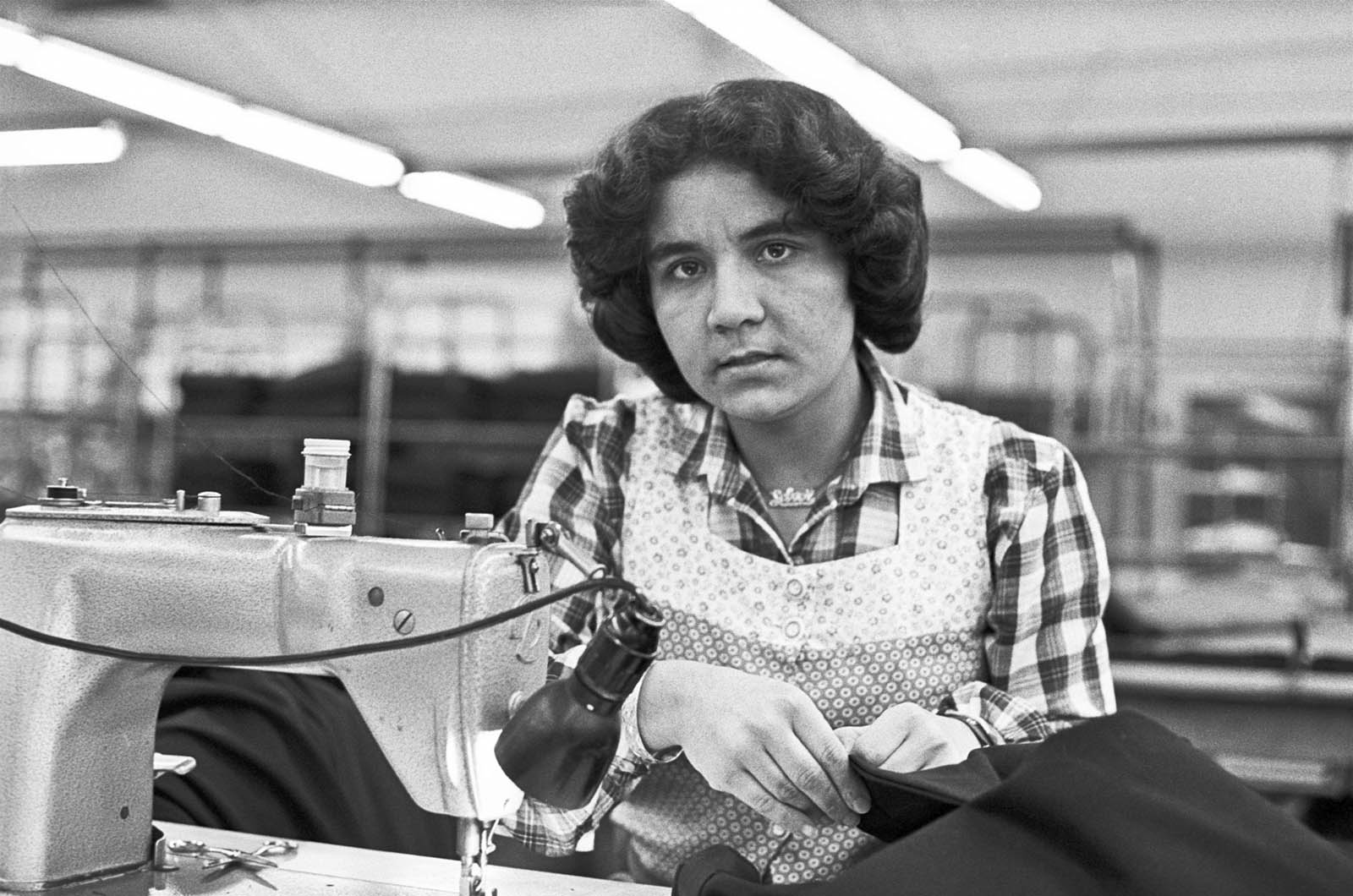
 

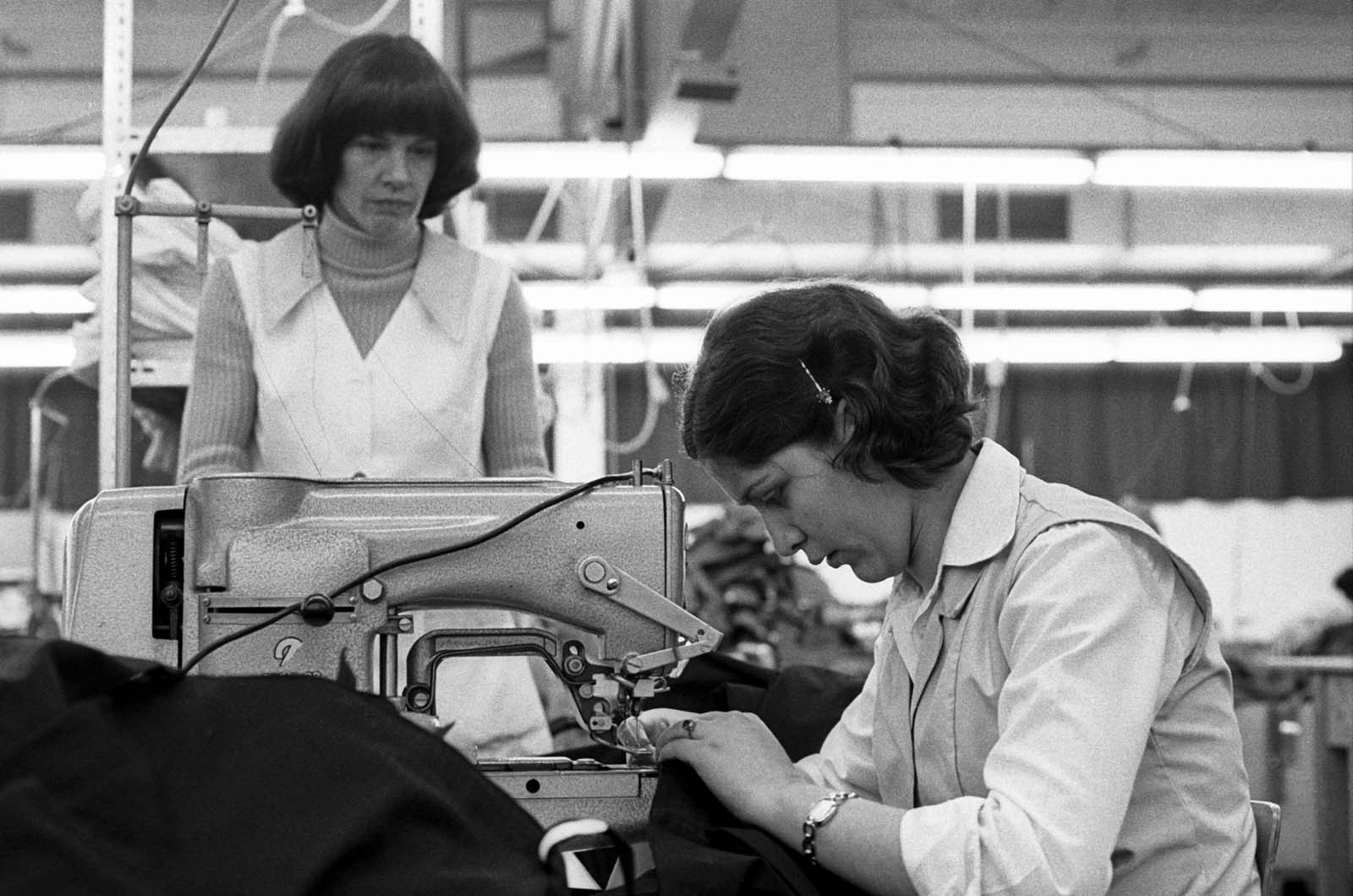
Muhlis Kenter (Turkish, b. 1952) 'Seamstress in textile factory' Alsdorf near Aachen, 1980


Muhlis Kenter (Turkish, b. 1952)
Seamstress in textile factory
Alsdorf near Aachen, 1980
Gelatin silver print
H. 30.4 x W. 40.5cm
© Muhlis Kenter


In the 1970s and 1980s, Bremen professor Muhlis Kenter photographed Turkish workers, then known as guest workers.


Only a little text tonight as I’m battling chronic depression and the little grey cells are not firing on all cylinders.

Absence, longing, loneliness, hard work, isolation, family, home.

Social inequality, sexism, racism and life in exile.

As noted by Annabelle Steffes-Halmer in her article “Migrants’ stories for a new home” (2021) on another exhibition on the same theme, In Situ: Photo Stories on Migration (Museum Ludwig, June – October 2021), photographs of this type are “a story of emancipation. [They] tell tales of people who came to a foreign country, which they discovered for themselves and which ultimately became their home. It is not only a (photo) history of migration, but also the history of Germany.”

Have a great Easter everyone.

Dr Marcus Bunyan


Many thankx to the Museum für Kunst und Gewerbe Hamburg for allowing me to publish the photographs in the posting. Please click on the photographs for a larger version of the image.


Muhlis Kenter (Turkish, b. 1952) 'Textile factory Workers' Alsdorf near Aachen, 1980 from the exhibition 'They Used To Call Us Guest Workers' at Museum für Kunst und Gewerbe Hamburg, October 2025 - May 2026


Muhlis Kenter (Turkish, b. 1952)
Textile factory Workers
Alsdorf near Aachen, 1980
Gelatin silver print
H. 30.4 x W. 40.5cm
© Muhlis Kenter
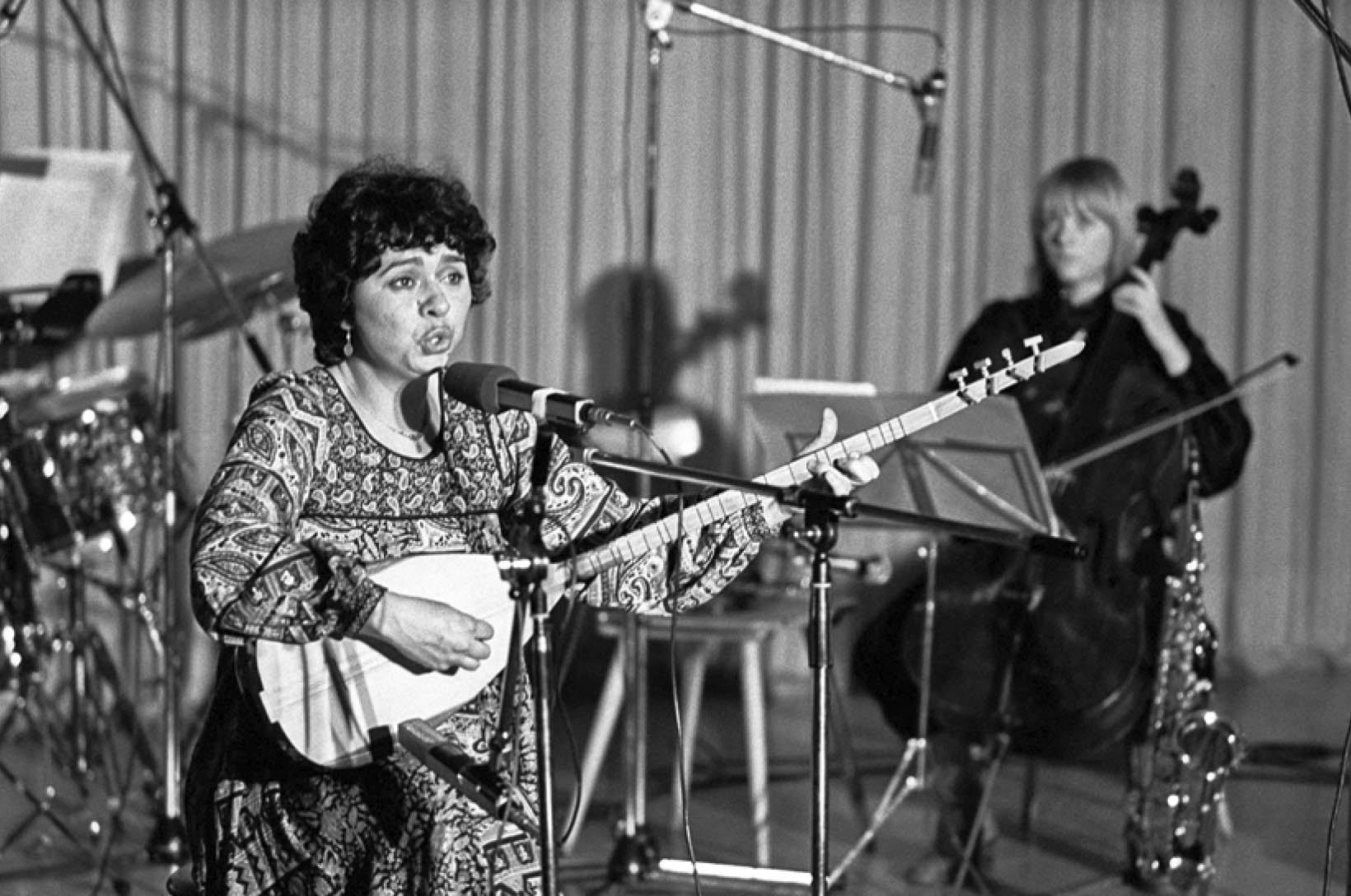
 

Muhlis Kenter (Turkish, b. 1952) 'Concert situation' Nd from the exhibition 'They Used To Call Us Guest Workers' at Museum für Kunst und Gewerbe Hamburg, October 2025 - May 2026


Muhlis Kenter (Turkish, b. 1952)
Concert situation
Nd
Gelatin silver print
H. 30.4 x W. 40.5cm
© Muhlis Kenter
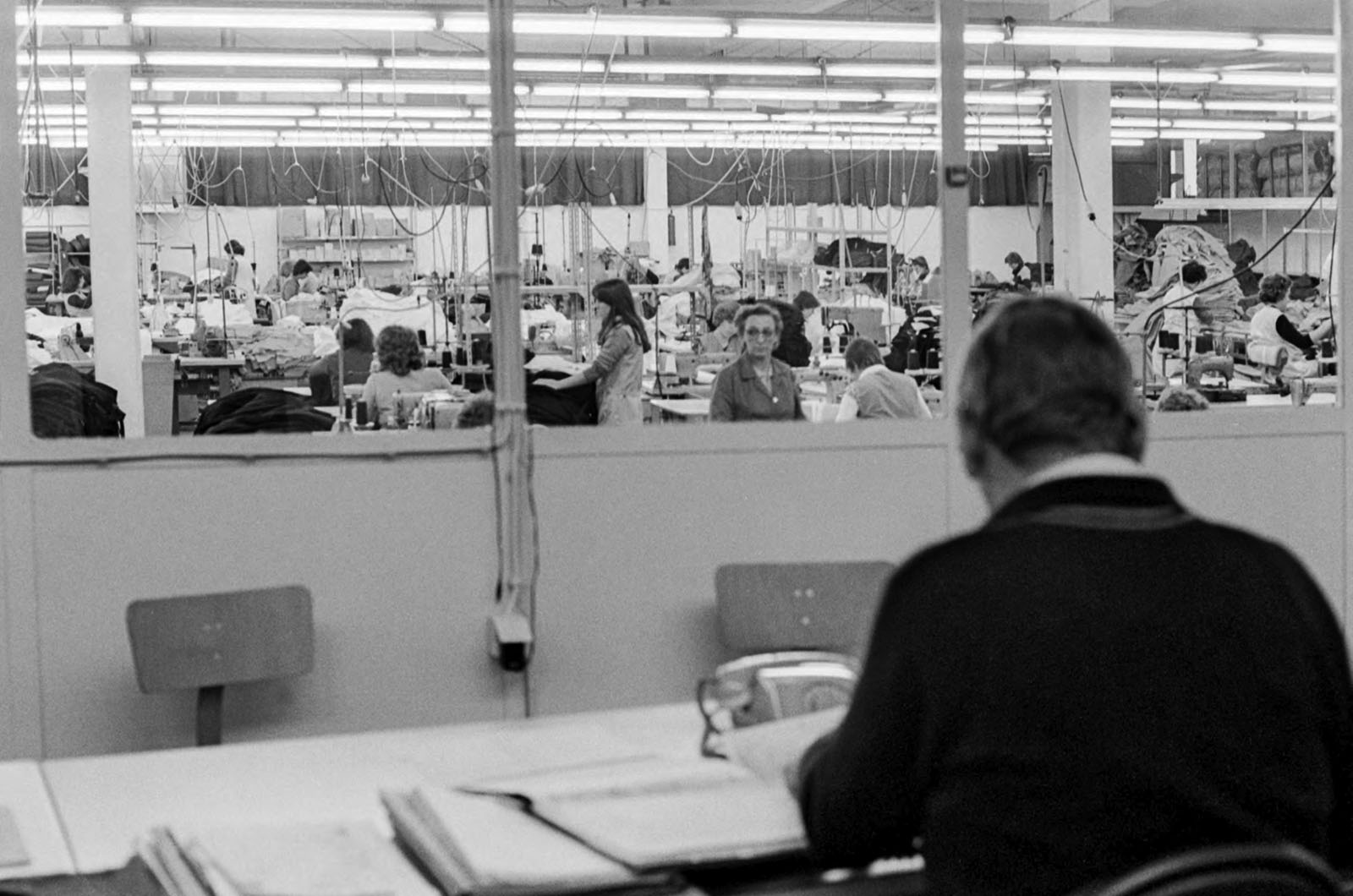
 

Muhlis Kenter (Turkish, b. 1952) 'Sewing company 'Mertes & Söhne'. Sewing company for workwear. The operations manager supervises the entire production process' Alsdorf, 1979


Muhlis Kenter (Turkish, b. 1952)
Sewing company ‘Mertes & Söhne’. Sewing company for workwear. The operations manager supervises the entire production process
Alsdorf, 1979
Gelatin silver print
H. 30.4 x W. 40.5cm
© Muhlis Kenter
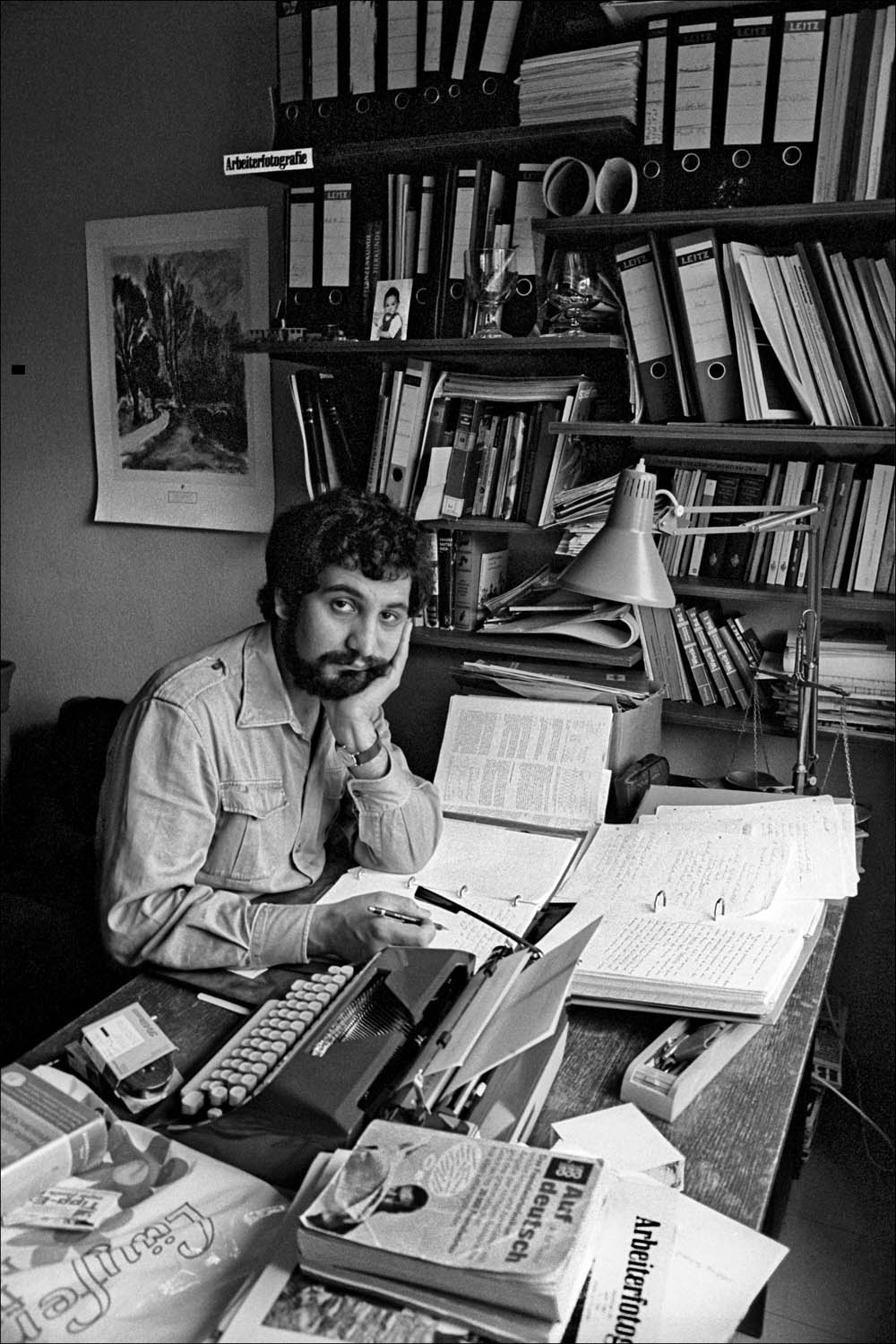
 

Christa Kenter (German) 'Portrait of Muhlis Kenter' Aachen, 1981


Christa Kenter (German)
Portrait of Muhlis Kenter
Aachen, 1981
© Muhlis Kenter


“They Used To Call Us Guest Workers”: Extending the Photography and the New Media Collection 

The Museum für Kunst und Gewerbe Hamburg (MK&G) is expanding its collection with key works by the photographers Muhlis Kenter, Nuri Musluoğlu, Asimina Paradissa and Mehmet Ünal. After coming to Germany from Turkey and Greece in the 1960s and 70s, the four documented life, work and their political engagement there from a migrant perspective. The exhibition “They Used to Call Us Guest Workers” presents around 80 photographs and collages that depict the everyday lives of people with and without a migration background in the Federal Republic of Germany while addressing the themes of social inequality, sexism, racism and life in exile. Viewers have the opportunity to discover here an often-overlooked perspective on socio-political issues that are still highly topical today.

With a shared interest in society and politics, each of the four amateur photographers developed a unique approach and yet they all took up the tradition of the workers’ photography movement. Like its historical role model in the interwar period, this movement was dedicated to the battle against class barriers and social inequality. The aim was for workers to pick up a camera themselves to raise awareness of the realities of their lives and help shape the public debate with their images.

Workers’ Photography

John Heartfield and his contributions to the illustrated magazine “Arbeiter-Illustrierte-Zeitung” (AIZ) in the 1930s were an important source of inspiration for the workers’ photography movement. Founded in Hamburg in 1973, the magazine “Arbeiterfotografie” saw itself as a successor to the AIZ. The main figures in the workers’ photography movement all engaged with developments in society and politics but each developed a different approach. Their common goal was to use their cameras in the battle against social inequality. Workers were encouraged to pick up a camera in order to raise their own awareness for the realities of their lives and enable them to intervene in the public debate. 

Between 1975 and 1990, the theme of migration played a central role in workers’ photography. The reports provide an in-depth look at those living in exile, at living and working conditions and women’s work, and at the peace movement and unequal educational opportunities for immigrants. The articles in the magazine were often published anonymously. The images were supplied by the 30 or so local working groups, who often took the photos together. 

Muhlis Kenter

Bremen-based amateur photographer Muhlis Kenter (b. 1952 in Istanbul, Turkey) depicts work and everyday life in Germany. He documents Turkish workers in mining, the metal industry and a textile factory, and accompanies educational projects for Turkish children and young people with a migration background. In his expressive portraits, Kenter spotlights personal stories. His photographs spotlight people navigating between the sense of being foreign in an unfamiliar country and finding their place in Germany. But Muhlis Kenter also observes German society with his camera, focusing on pigeon breeding, fishing and gardening, which he sees as typical German hobbies.

Muhlis Kenter provides behind-the-scenes glimpses of factory work. He for example photographed workers of Turkish origin in a textile factory where people from different backgrounds work side by side in production. The photos were taken as part of a photo story for the magazine “Arbeiterfotografie”. Kenter often focuses on individuals and personal histories, resulting in expressive portraits. For his reportages, he creates complex compositions that highlight in an arresting way the interplay between people and technology at the companies he visits. In one series, he turned the tables, looking not at the lives of immigrants of Turkish origin but rather at “white German” society and what he regards as typical hobbies: pigeon breeding, fishing and gardening.

Muhlis Kenter was born in 1952 in Istanbul, Turkey. In 1972 he took up mechanical engineering studies in Aachen, where he joined a “workers’ photography” group. Alongside his studies, he acted as a support teacher for Turkish-speaking classes. Kenter later worked as a professor of mechanical engineering at the City University of Applied Sciences in Bremen, and he continues to avidly pursue photography. 

Nuri Musluoğlu

Nuri Musluoğlu (b. 1951 in Istanbul, Turkey) photographs public life. The images he produced between 1975 and 1988 show mainly demonstrations, peace marches, strikes and protest actions, especially those taking place in his hometown of Heilbronn. Supplemented by footage of sporting events, street festivals and celebrations, as well as photos of his own family, a dense panorama emerges of German-Turkish coexistence as a collective experience. Musluoğlu’s photos document particularly vividly the protest culture during the years in question – including the peace movement and European Peace Marches, the trade union struggles and the anti-nuclear movements, and the resistance of Turks living in Germany against the military dictatorship in Turkey. He also lifts the veil on xenophobia in public spaces and the living conditions in asylum shelters.

Nuri Musluoğlu is a photographer and political activist. His camera accompanies him to demonstrations, such as the strike for a 35-hour week and protests by the peace movement, or the blockade of the US missile base in Mutlangen in 1983. He not only captures protest posters and scenes but also documents moments of solidarity – such as workers with and without a migration background dancing. Musluoğlu’s photographs chronicle political struggles as well as everyday moments in German-Turkish life, such as family celebrations and trips home. He examines in detail protest posters that touch on migration issues and in another image shows a worker of Turkish origin playing the saz. 

Born in Istanbul in 1951, Musluoğlu came to Germany in 1965, trained as a toolmaker, and later became a social worker for the “Arbeiterwohlfahrt” (Workers’ Welfare Association). He is active in trade unions (IG Metall, ver.di) and the peace movement. Since 1985, his photos have appeared under a pseudonym in the weekly newspaper “Türkiye Postası”, which is aimed at workers and people seeking political protection. 

Asimina Paradissa

Asimina Paradissa (b. 1945 in Vrastama, Greece) occupies a special position in amateur photography as one of the few migrant women behind a camera. She documented her own life in Germany from 1968 onwards, showing everyday life in a hostel for unmarried female workers in Wilhelmshaven as well as scenes of factory work captured from the workers’ point of view. Paradissa’s many self-portraits deal with questions of self-image and what it feels like to live in a certain place. Although her photographs are private, they are at the same time significant testimonies to contemporary history: By giving the women portrayed names and voices, they draw attention to the stories of female migrants and thus add a rare female perspective to the way in which we view migrant labour.

Asimina Paradissa gazes directly out at us from her pictures. Perched on her bicycle, she laughs openly into the camera, while in another picture she looks us earnestly in the eye as she sits on her bunk bed in a dormitory for unwed workers run by the Olympia typewriter works and caringly embraces her friend Evangelia Manolakaki. Even though others usually press the shutter, these images can still be described as self-portraits. Starting in 1966, Paradissa took photos on a regular basis as a way of reassuring herself about her new life in Germany. Among the “guest workers” who came to West Germany in the 1960s, one in three were women who lead lives largely hidden from the public eye. Paradissa is one of the few women of this generation to document her self-determined life in Germany with her camera. Her pictures are at once private remembrances and documents of the times. 

Asimina Paradissa was born in 1945 in Vrastama, Greece. She came to Wilhelmshaven with her brother in 1966 as part of the recruitment agreements concluded between West Germany and Greece, among other countries. In 1972 she settled in Wuppertal. Alongside her job, she began to make photography and write poetry. 

Mehmet Ünal

Mehmet Ünal’s (b. 1951 in Çanakkale, Turkey) photographic practice includes political image-text collages that emerge from actions and protests. In addition to individual images and series, he also produces posters that incorporate writing and found objects – often from public authorities and agencies – and thus comment on the particular experiences of migrants when dealing with bureaucracy. With their thematic acuity and compositional density, these posters are independent artworks that relentlessly expose exclusion and marginalisation.

Mehmat Ünal’s collages combine written, photographic and found objects from the world of German bureaucracy that reflect experiences of racism. Ünal expresses himself through satire and exaggeration; for example, he created a fake Deutsche Bahn advertising campaign offering a “foreigner’s pass” promoting the return transport of people to Turkey. He compares the application for a work permit to a “TÜV certificate for humans”. In his text-image combinations (circa 1982), Ünal criticizes Germany’s official policies towards immigrants and the degrading treatment of those who were once invited to the country as “guests”. After the recruitment of foreign workers was discontinued in the wake of the economic crisis of the early 1980s, Ünal observed a growing atmosphere of hostility towards those regarded as “foreigners”. The first arson attack on a refugee shelter took place in 1980 in Hamburg-Billbrook. Works that Ünal produced against the backdrop of political street protests were published in the magazine “Arbeiterfotografie” in 1984. In several collages, he draws on the legacy of John Heartfield, whose political montages in the mid-1920s brought him recognition as the founder of this genre. 

Mehmet Ünal was born in Çanakkale, Turkey, in 1951. In 1976, he moved to Mannheim, where the former actor works as a photographer and journalist.

Text from the Museum für Kunst und Gewerbe Hamburg (MK&G)
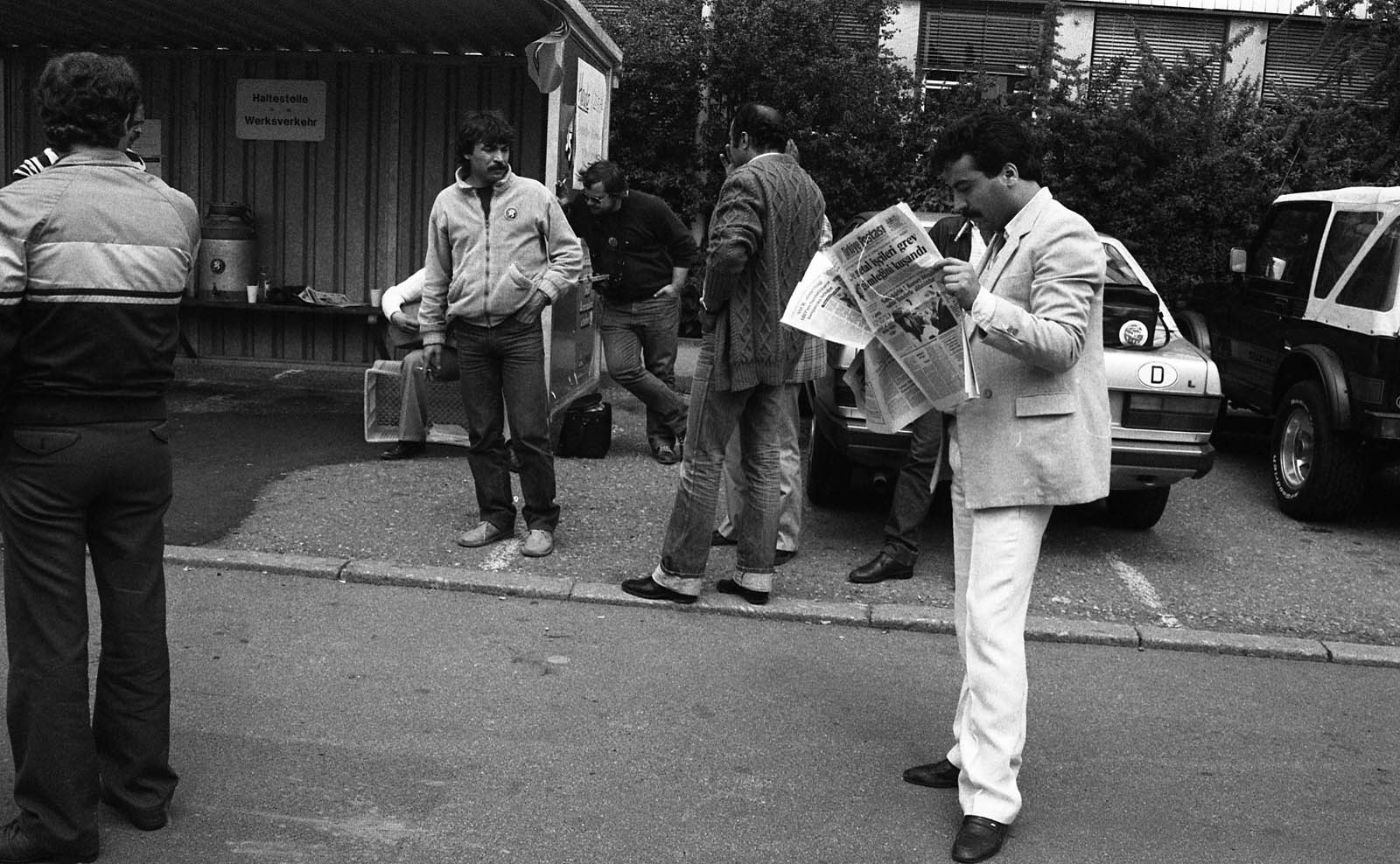
 

Nuri Musluoğlu (Turkish, b. 1951) 'Workers from Kolbenschmidt with the magazine 'Türkiye Postası' during a strike' Neckarsulm, 1984


Nuri Musluoğlu (Turkish, b. 1951)
Workers from Kolbenschmidt with the magazine Türkiye Postası during a strike
Neckarsulm, 1984
Gelatin silver print
H. 25.6 x W. 38.6cm
© Nuri Musluoğlu
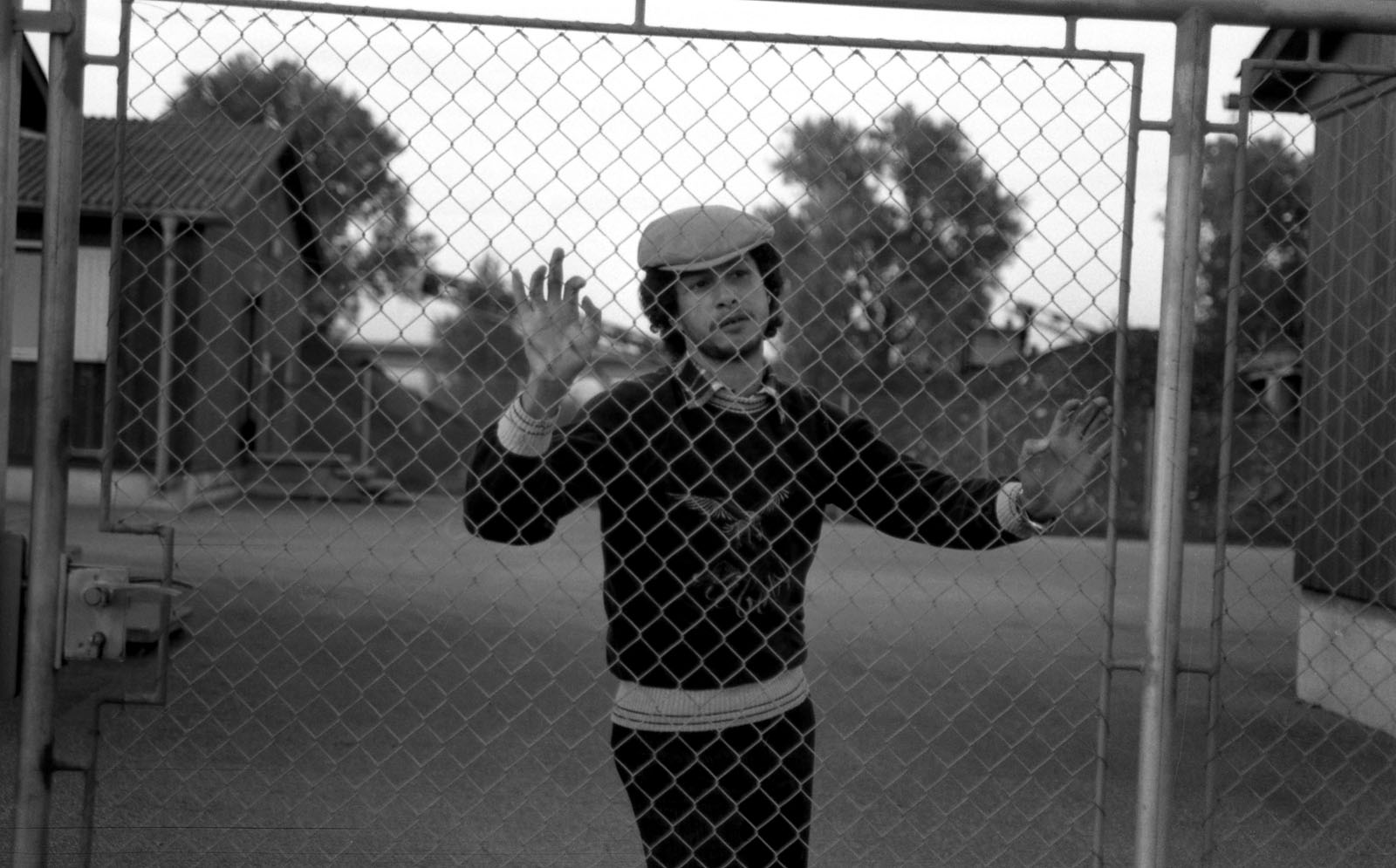
 

Nuri Musluoğlu (Turkish, b. 1951) 'Residential home for asylum seekers' Nd


Nuri Musluoğlu (Turkish, b. 1951)
Residential home for asylum seekers
Nd
Gelatin silver print
H. 25.6 x W. 38.6cm
© Nuri Musluoğlu
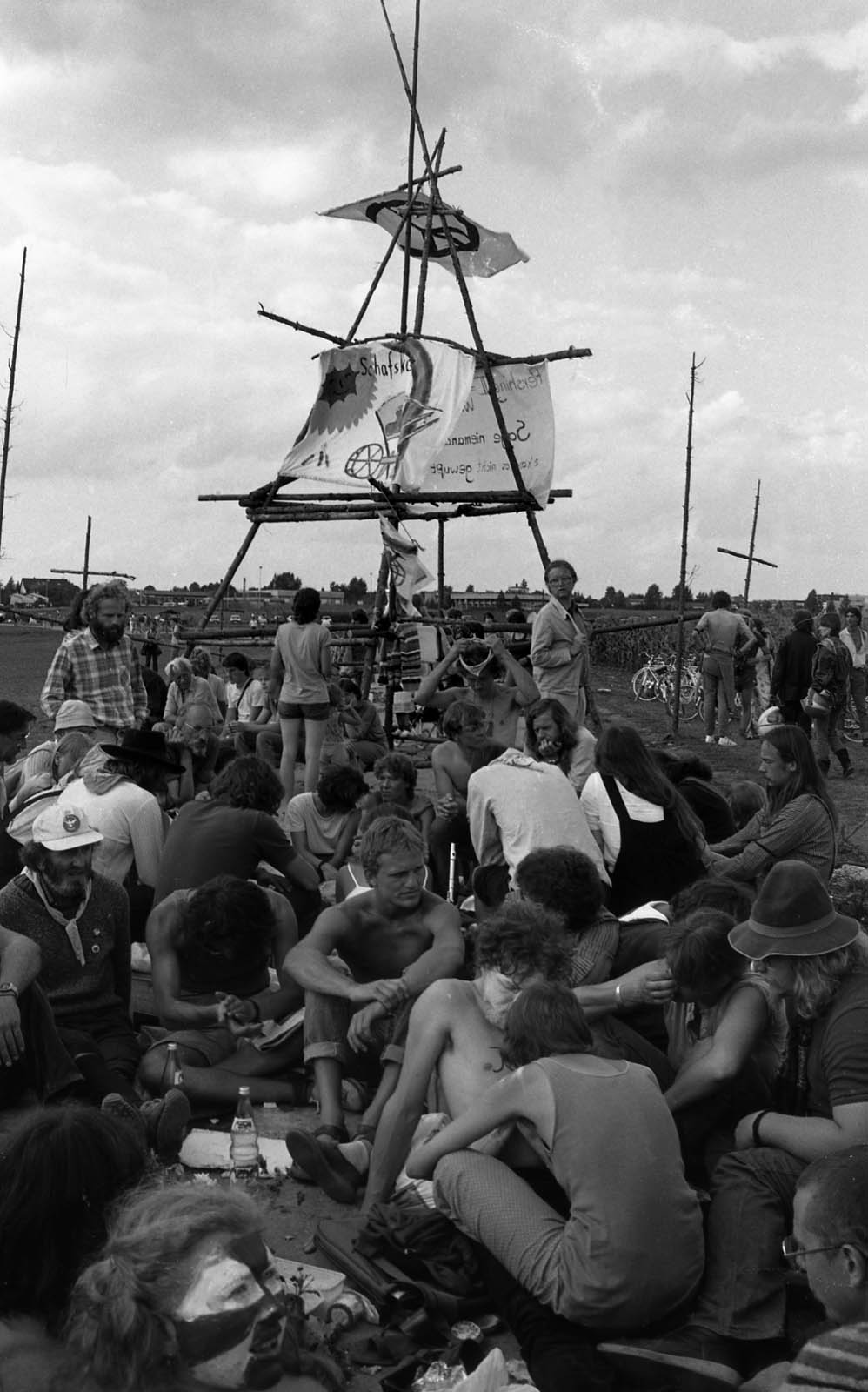
 

Nuri Musluoğlu (Turkish, b. 1951) 'Sit-in, Peace movement' Mutlanger Heide, 1983


Nuri Musluoğlu (Turkish, b. 1951)
Sit-in, Peace movement
Mutlanger Heide, 1983
Gelatin silver print
H. 25.6 x W. 38.6cm
© Nuri Musluoğlu
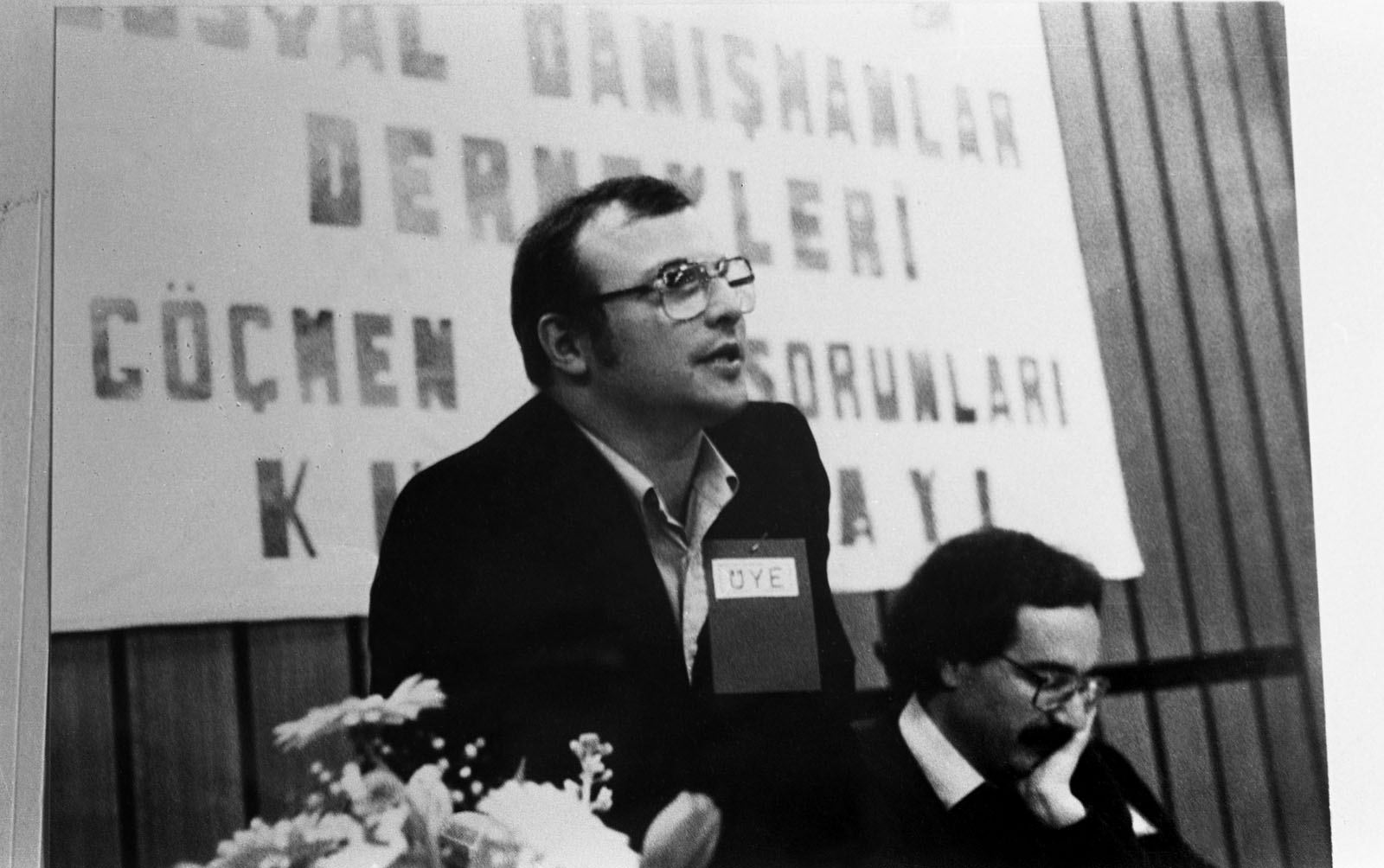
 

Nuri Musluoğlu (Turkish, b. 1951) 'Portrait' 1981


Nuri Musluoğlu (Turkish, b. 1951)
Portrait
1981
© Nuri Musluoğlu


Unknown photographer (Colleague of Asimina Paradissa with her camera) 'Asimina Paradissa and Evangelia Manolakaki at the women's dormitory of Olympia' Wilhelmshaven, 1969


Unknown photographer (Colleague of Asimina Paradissa with her camera)
Asimina Paradissa and Evangelia Manolakaki at the women’s dormitory of Olympia
Wilhelmshaven, 1969
Gelatin silver print
H. 10.5 x W. 7.5cm
© Asimina Paradissa
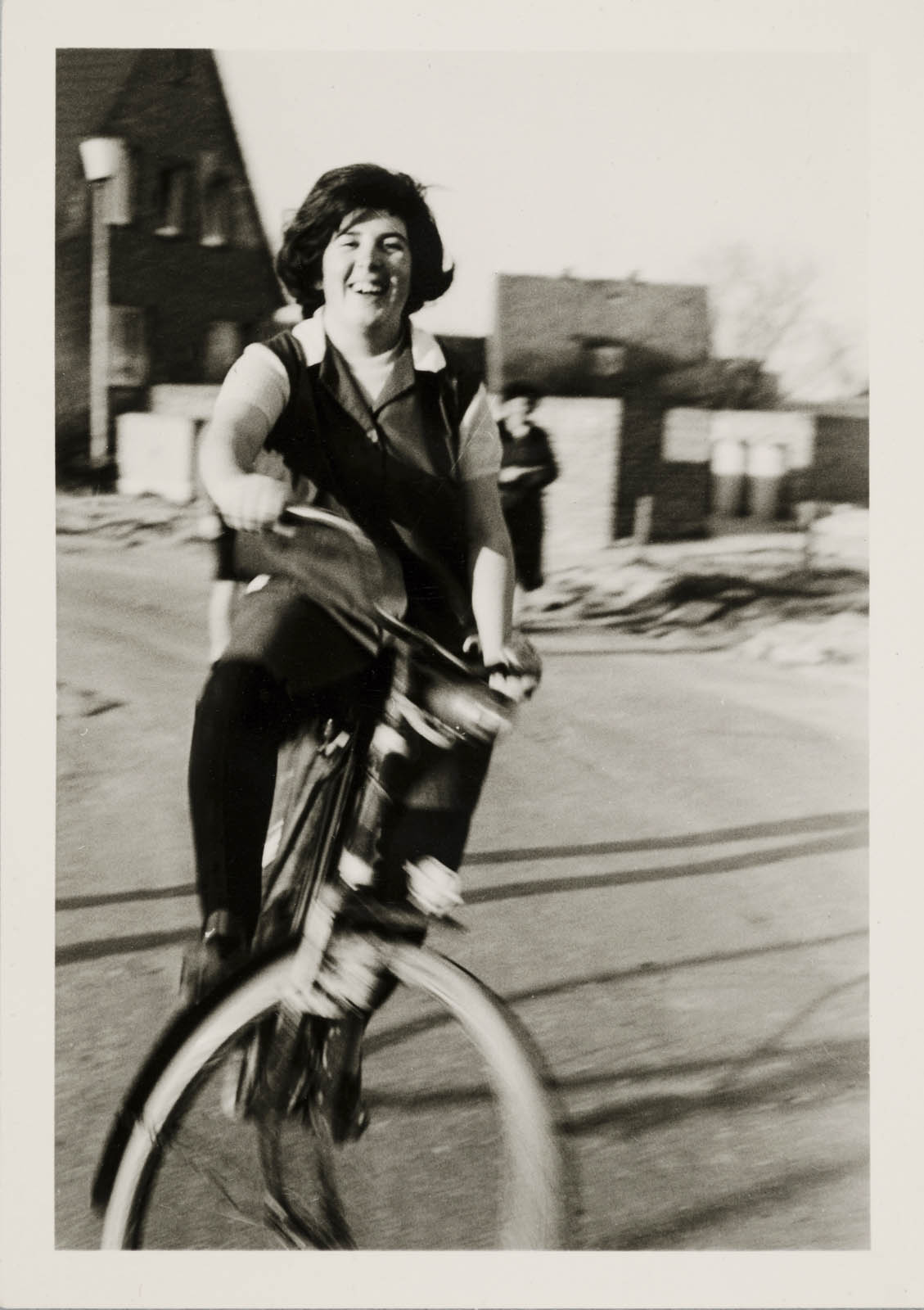
 

Unknown photographer (Colleague of Asimina Paradissa with her camera) 'Asimina Paradissa on the Bike' Wilhelmshaven, 1966/1967


Unknown photographer (Colleague of Asimina Paradissa with her camera)
Asimina Paradissa on the Bike
Wilhelmshaven, 1966/1967
Gelatin silver print
H. 10.8 x W. 7.8cm
© Asimina Paradissa
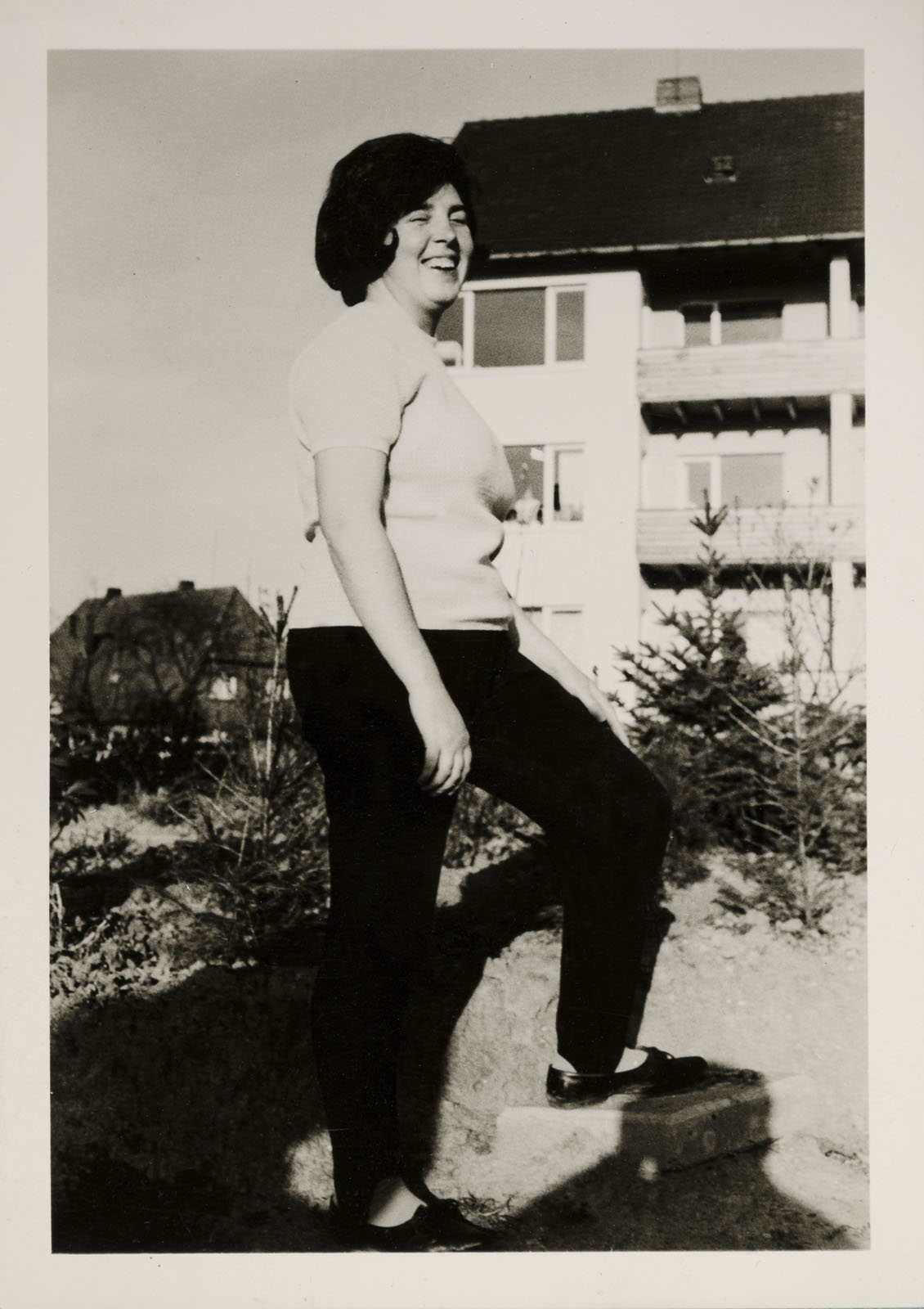
 

Unknown photographer (Colleague of Asimina Paradissa with her camera) 'Asimina Paradissa at the women's dormitory of Olympia' Wilhelmshaven, 1969


Unknown photographer (Colleague of Asimina Paradissa with her camera)
Asimina Paradissa at the women’s dormitory of Olympia
Wilhelmshaven, 1969
Gelatin silver print
H. 10.8 x W. 7.7cm
© Asimina Paradissa


Asimina Paradissa was 20 years old when she moved to Wilhelmshaven in northern Germany. In the photo, the Greek woman poses in front of the dormitory at the Olympia company. Back then, she took pictures of weddings, parties and visits to the zoo for her colleagues and friends. The 76-year-old is still a passionate photographer.
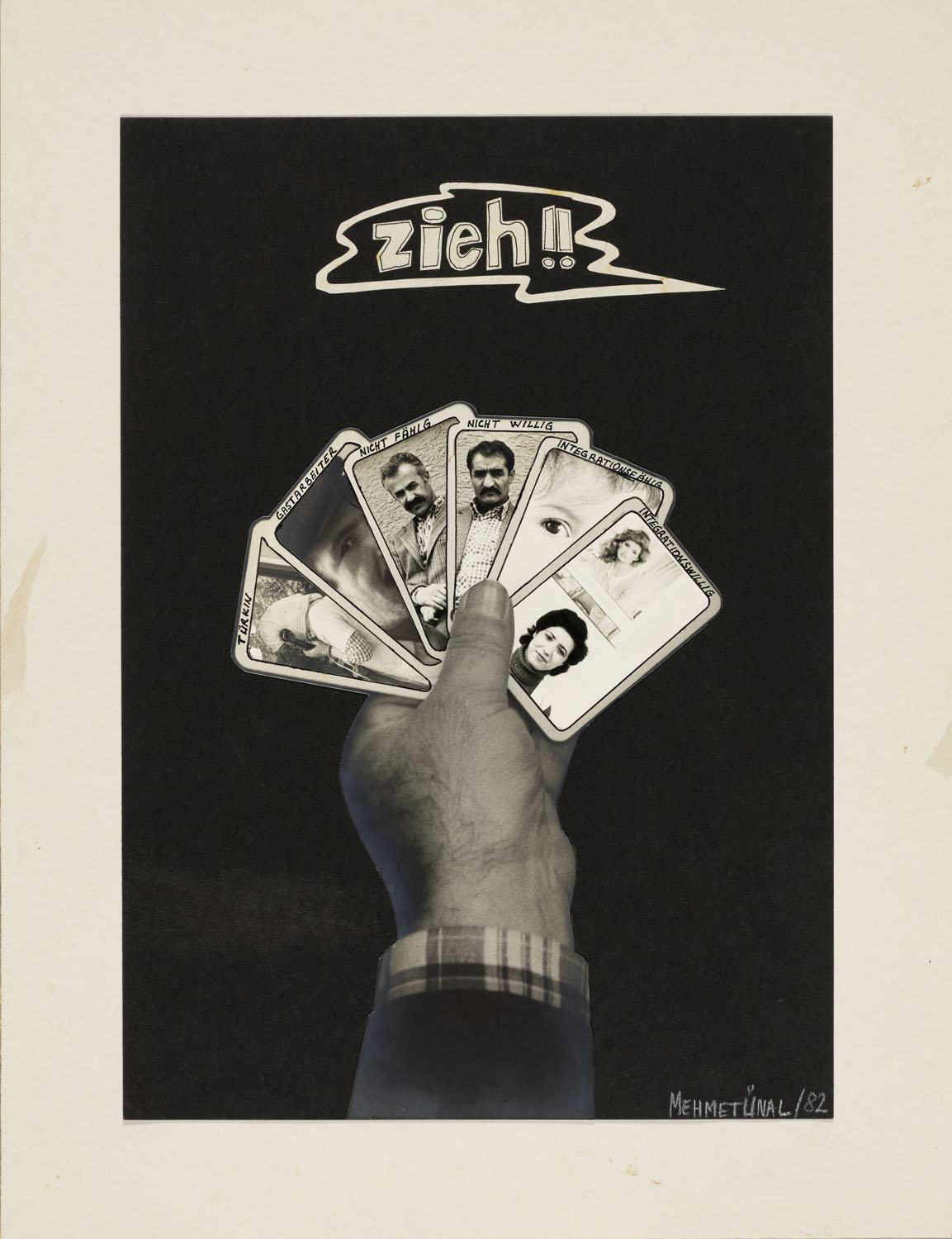
 

Mehmet Ünal (Turkish, b. 1951) 'Untitled' Mainz, 1982


Mehmet Ünal (Turkish, b. 1951)
Untitled
Mainz, 1982
Photo collage
H. 45 x W. 29.8cm
© Mehmet Ünal


Zieh!! = Pull!!
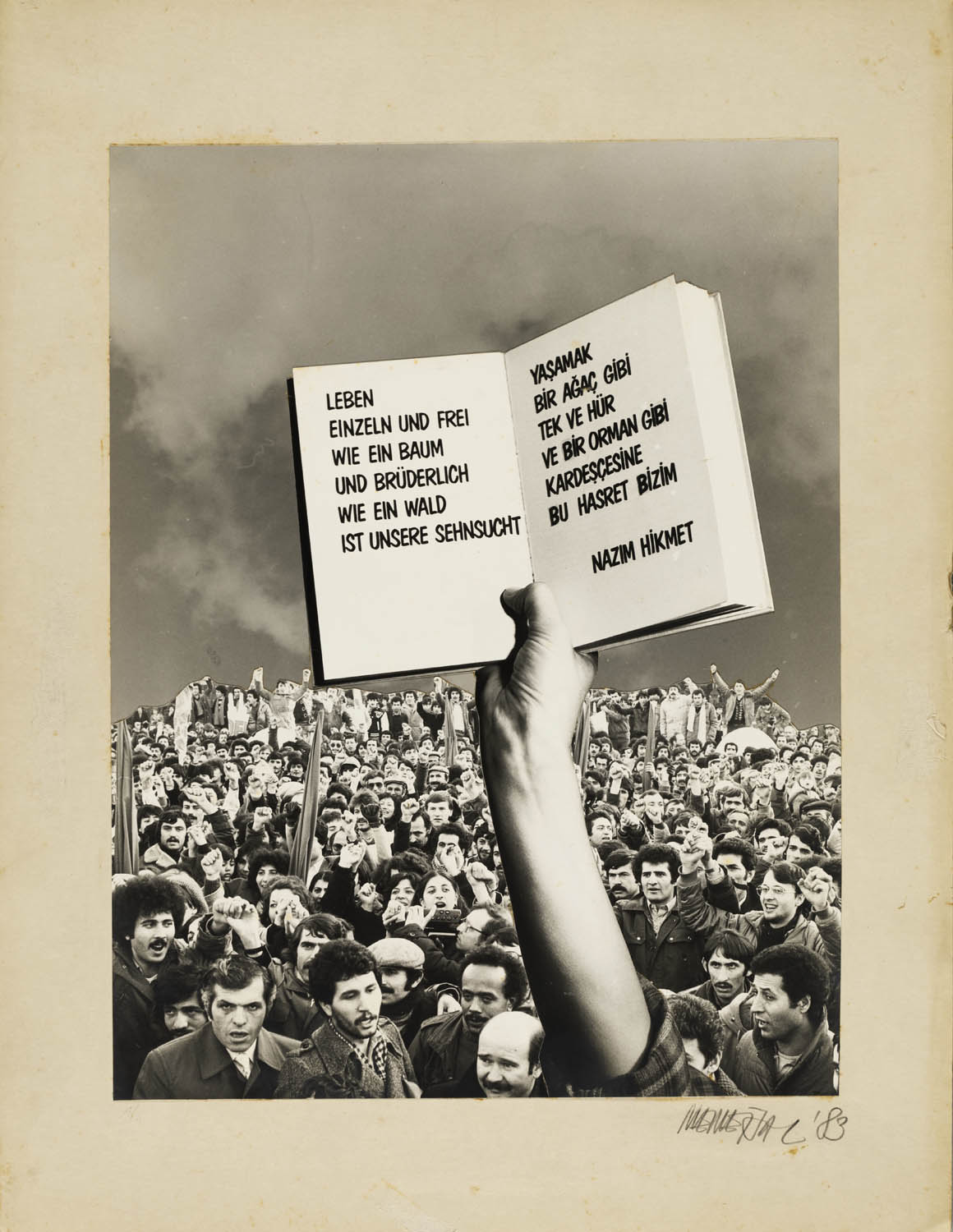
 

Mehmet Ünal (Turkish, b. 1951) 'Untitled (Homage to Nâzım Hikmet)' Mainz, 1982–1986


Mehmet Ünal (Turkish, b. 1951)
Untitled (Homage to Nâzım Hikmet)
Mainz, 1982-1986
Photo collage
H. 42 x W. 29.7cm
© Mehmet Ünal


life
alone and free
like a tree
and brotherly
like a forest
is our longing


Mehmed Nâzım Ran (17 January 1902 – 3 June 1963), commonly known as Nâzım Hikmet, was a Turkish poet, playwright, novelist, screenwriter, director, and memoirist. He was acclaimed for the “lyrical flow of his statements”. Described as a “romantic communist” and a “romantic revolutionary”, he was repeatedly arrested for his political beliefs and spent much of his adult life in prison or in exile. His poetry has been translated into more than 50 languages.
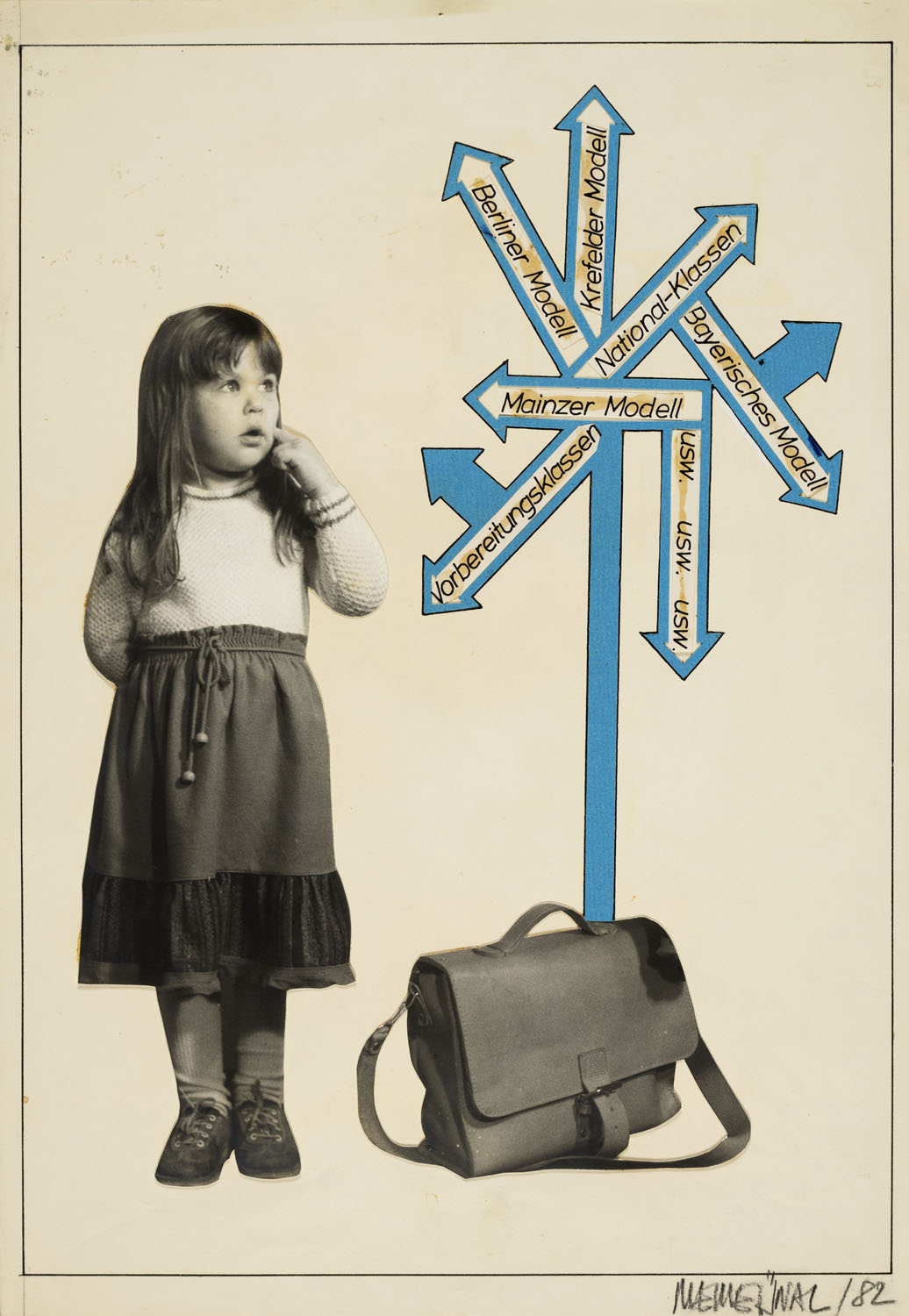
 

Mehmet Ünal (Turkish, b. 1951) 'Untitled' Mainz, 1982


Mehmet Ünal (Turkish, b. 1951)
Untitled
Mainz, 1982
Photo collage
H. 45 x W. 31.1cm
© Mehmet Ünal
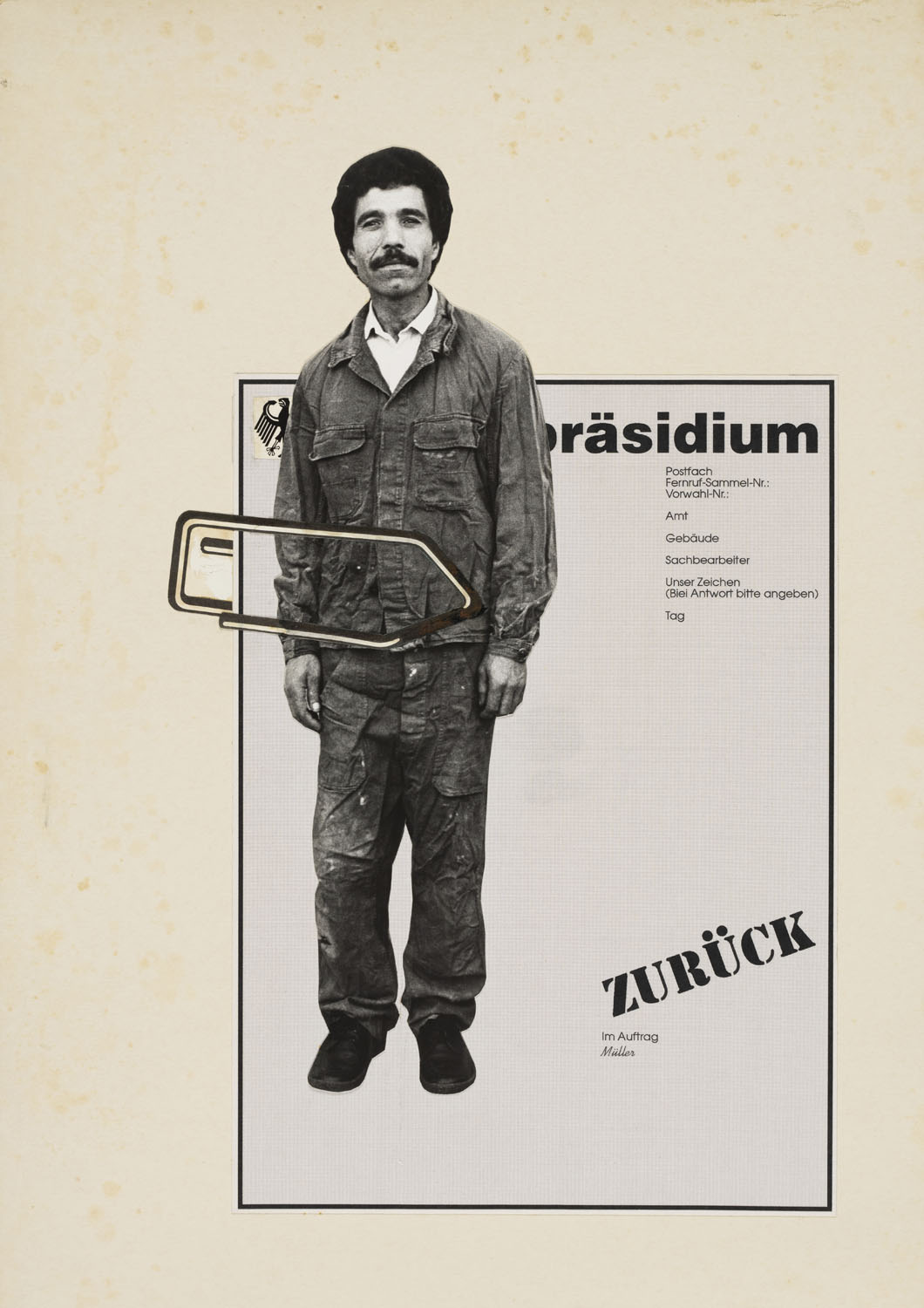
 

Mehmet Ünal (Turkish, b. 1951) 'Untitled' Mainz, 1983


Mehmet Ünal (Turkish, b. 1951)
Untitled
Mainz, 1983
Photo collage
H. 46,1 x W. 35cm
© Mehmet Ünal
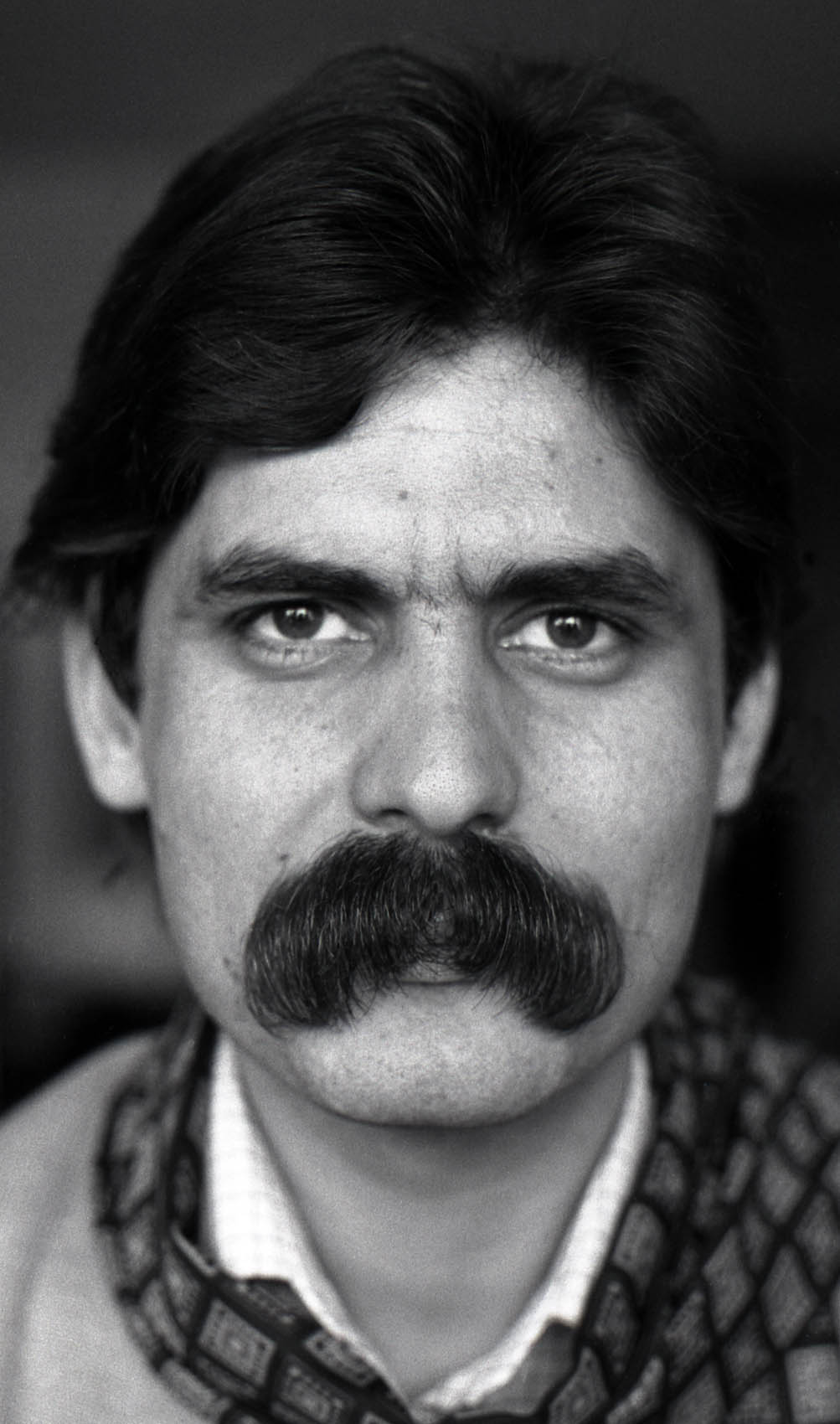
 

Mehmet Ünal (Turkish, b. 1951) 'Self-portrait' c. 1980


Mehmet Ünal (Turkish, b. 1951)
Self-portrait
c. 1980
© Mehmet Ünal


Museum für Kunst und Gewerbe Hamburg
Steintorplatz, 20099 Hamburg

Opening hours:
Tuesday – Sunday 10am – 6pm
Thursday 10am – 9pm
Closed Mondays

Museum für Kunst und Gewerbe Hamburg website

LIKE ART BLART ON FACEBOOK

Back to top

Exhibition: ‘Forced Labour. The Germans, the Forced Labourers and the War’ at the Jewish Museum, Berlin

Exhibition dates: 28th September 2010 – 30th January, 2011


Gerhard Gronfeld (German, 1911-2000) 'Arrival at the transit camp' 1942 from the exhibition 'Forced Labour. The Germans, the Forced Labourers and the War' at the Jewish Museum, Berlin


Gerhard Gronfeld (German, 1911-2000)
Arrival at the transit camp
1942


Female forced labourers from the Soviet Union on their arrival at the Berlin-Wilhelmshagen Transit Camp, December 1942.

Source: Deutsches Historisches Museum, Berlin


This is an emotional and sobering posting.

The photograph of the Liberated forced laborer with tuberculosis by an unknown photographer (1945, below) is as heartbreaking as the photograph of a mother and child, Tomoko Uemura in Her Bath, Minamata (1972) by Eugene Smith. The look on the man’s face when I first saw it made me burst into tears… it is difficult to talk about it now without being overcome. An unknown man photographed by an unknown photographer.

There is something paradoxical about the solidity of the doctor’s steel helmet, his uniform and the fact he is a doctor contrasted with the strength, size and gentleness of his hand as it rests near the elbow of this emaciated man, this human … yet the intimacy and tenderness of this gesture, as the man stares straight into the camera lens – is so touching that to look at this picture, is almost unbearable. Man’s (in)humanity to man.

Some pertinent facts

The Germans abducted about 12 million people from almost twenty European countries; about two thirds of whom came from Eastern Europe. Many workers died as a result of their living conditions, mistreatment or were civilian casualties of the war. They received little or no compensation during or after the war … At the peak of the war, one of every five workers in the economy of the Third Reich was a forced labourer. According to Fried, in January 1944 the Third Reich was relying on 10 million forced labourers. Of these, 6.5 million were civilians within German borders, 2.2 million were prisoners of war, and 1.3 million were located at forced labor camps outside Germany’s borders. Homze reported that civilian forced labourers from other countries working within the German borders rose steeply from 300,000 in 1939 to more than 5 million in 1944.

Examples

Russian Foreign Civilian Forced Labourers in Nazi Germany (total number approximately): 2,000,000

Russian Number of Known and Estimated Survivors Reported by Reconciliation Foundations: 334,500

(Source: Beyer, John C. and Schneider, Stephen A. “Forced Labour under Third Reich – Part 1” (pdf). Nathan Associates Inc.. 1999.)

Russian “volunteer” POW workers

“Between 22 June 1941 and the end of the war, roughly 5.7 million members of the Red Army fell into German hands. In January 1945, 930,000 were still in German camps. A million at most had been released, most of whom were so-called “volunteer” (Hilfswillige) for (often compulsory) auxiliary service in the Wehrmacht. Another 500,000, as estimated by the Army High Command, had either fled or been liberated. The remaining 3,300,000 (57.5 percent of the total) had perished.”

(Source: Streit, Christian. Keine Kameraden: Die Wehrmacht und die Sowjetischen Kriegsgefangenen, 1941-1945, Bonn: Dietz (3. Aufl., 1. Aufl. 1978))


The remaining 3,300,000 had perished. A sobering figure indeed (if you can even imagine such a number of human beings).

Dr Marcus Bunyan


Many thankx to the Jewish Museum in Berlin for allowing me to publish the photographs in the posting. Please click on the photograph for a larger version of the image.


Unknown photographer. 'Liberated forced laborer with tuberculosis' 1945 from the exhibition 'Forced Labour. The Germans, the Forced Labourers and the War' at the Jewish Museum, Berlin


Unknown photographer
Liberated forced laborer with tuberculosis
1945


A doctor of the U.S. Army examines a former forced labourer from Russia who was ill with tuberculosis. The Americans had discovered the sick forced labourers in a barrack yard in Dortmund. Dortmund, 30 April 1945.

Source: National Archives, Washington


Gerhard Gronfeld (German, 1911-2000) 'Registration at the transit camp' 1942 from the exhibition 'Forced Labour. The Germans, the Forced Labourers and the War' at the Jewish Museum, Berlin


Gerhard Gronfeld (German, 1911-2000)
Registration at the transit camp
1942


Berlin-Wilhelmshagen Transit Camp, December 1942. Labour office staff registered the forced labourers and handed out employment certificates.

Source: Deutsches Historisches Museum, Berlin


Unknown photographer. 'Humiliation of Bernhard Kuhnt in Chemnitz' Nd from the exhibition 'Forced Labour. The Germans, the Forced Labourers and the War' at the Jewish Museum, Berlin


Unknown photographer
Humiliation of Bernhard Kuhnt in Chemnitz
Nd


The inscription, “Always dignified! The naval fleet’s mutineer Bernh. Kuhnt arrives at his new workplace (washing off the dirt),” refers to the myth that mutinous social democratic and communist sailors were responsible for the defeat of the German empire in the First World War.

Source: Bundesarchiv, Koblenz


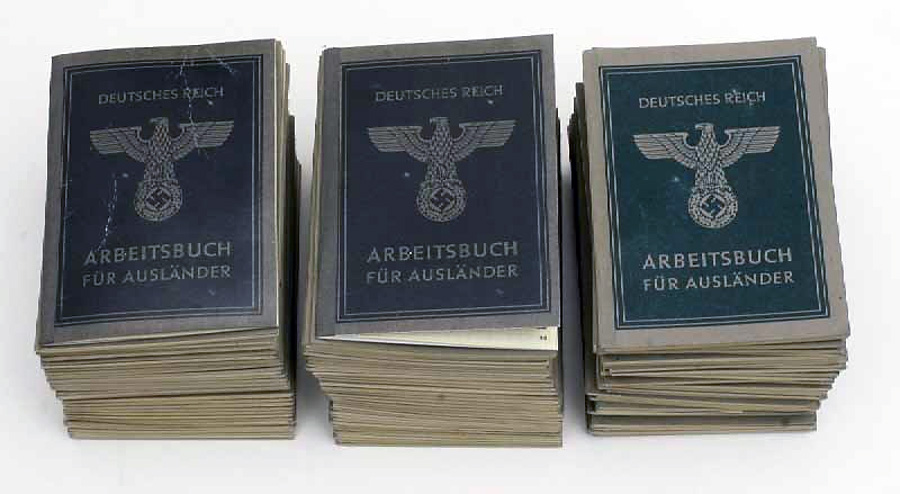
Workbooks issued by the employment office of the German Reich for foreign forced labourers from the exhibition 'Forced Labour. The Germans, the Forced Labourers and the War' at the Jewish Museum, Berlin


Workbooks issued by the employment office of the German Reich for foreign forced labourers; Buchenwald Concentration Camp Memorial, Weimar


Unknown photographer. 'Selection in a Prisoner of War Camp: Recruitment for Mining' 1942 from the exhibition 'Forced Labour. The Germans, the Forced Labourers and the War' at the Jewish Museum, Berlin


Unknown photographer
Selection in a Prisoner of War Camp: Recruitment for Mining
1942


In the summer of 1942, Soviet prisoners of war were selected from the prisoner of war camp Zeithain to perform forced labor in Belgian mines.
Source: Gedenkstätte Ehrenhain Zeithain


Selection in a Prisoner of War Camp

In the summer of 1942, Karl Schmitt – head of the Wehrmacht mining division in Liège, Belgium – went to Berlin on vacation with his wife. On the way, he visited the Zeithain prisoner of war camp in Saxony. The Soviet POWs were ordered to present themselves for inspection with the aim of deploying them to Belgian mines under German control. They were accordingly checked for physical fitness. Karl Schmitt decided who was to be transported to Belgium and who was not.

Soviet prisoners of war were frequently put to work in mines. The Reich Security Main Office had ruled that they could be employed only in work gangs kept separate from German workers. The authorities considered the mines particularly suitable in that respect.

Source: Gedenkstätte Ehrenhain Zeithain.


Over 20 million men, women, and children were taken to Germany and the occupied territories from all over Europe as “foreign workers,” prisoners of war, and concentration camp inmates to perform forced labor. By 1942, forced labourers were part of daily life in Nazi Germany. The deported workers from all over Europe and Eastern Europe in particular were exploited in armament factories, on building sites and farms, as craftsmen, in public institutions and private households. Be it as a soldier of the occupying army in Poland or as a farmer in Thuringia, all Germans encountered forced labourers and many profited from them. Forced labor was no secret but a largely public crime.

The exhibition Forced Labor. The Germans, the Forced Laborers, and the War on view at the Jewish Museum in Berlin provides the first comprehensive presentation of the history of forced labor and its ramifications after 1945. The exhibition was curated by the Buchenwald and Mittelbau-Dora Memorials Foundation and initiated and sponsored by the “Remembrance, Responsibility and Future” Foundation. Federal President Christian Wulff has assumed patronage for the exhibition. The exhibition’s first venue on its international tour is the Jewish Museum Berlin, other venues are planned in European capitals and in North America.

Forced labor was without precedent in European history. No other Nazi crime involved so many people – as victims, perpetrators, or onlookers. The exhibition provides the first comprehensive presentation of the history of this ubiquitous Nazi crime and its ramifications after 1945. It shows how forced labor was part of the Nazi regime’s racist social order from the outset: The propagated “Volksgemeinschaft” (people’s community) and forced labor for the excluded belonged together. The German “Herrenmenschen” (superior race) ruthlessly exploited those they considered “Untermenschen” (subhumans). The ordinariness and the broad societal participation of forced labor reflect the racist core of Nazism.

The exhibition pays special attention to the relationships between Germans and forced labourers. Every German had to decide whether to treat forced labourers with a residual trace of humanity or with the supposedly required racist frostiness and implacability of a member of an allegedly superior race. How Germans made use of the scope this framework reveals something not only about the individuals but also about the allure and shaping power of Nazi ideology and practice. Through this perspective, the exhibition goes beyond a presentation of forced labor in the narrow sense to illustrate the extent to which Nazi values had infiltrated German society. Forced labor cannot be passed off as a mere crime of the regime but should rather be considered a crime of society.

Over 60 representative case histories form the core of the exhibition. As is true of the majority of documents on show, they resulted from meticulous investigations in Europe, the USA, and Israel. Moreover the exhibition team viewed hundreds of interviews with former forced labourers that have been carried out in recent years. In terms of content, these case histories range from the degrading work of the politically persecuted in Chemnitz through the murderous slave labor performed by Jews in occupied Poland to daily life as a forced labourer on a farm in Lower Austria.

Among the surprises of the extensive international archival research was discovering unexpectedly broad photographic coverage of significant events. The photos relating to the case histories represent the second pillar of the exhibition. Whole series of photos were traced back to their creator and the scene and people depicted. This presentation, based on well-founded sources, allows quasi dramatic insight into aspects of forced labor. Cinematically arranged photo or photo-detail enlargements form the introduction to the continued inquiry into the history of forced labor.

The exhibition is divided into four sections. The first covers the years from 1933 to 1939 and unveils in particular how the racist ideology of Nazi forced labor struck roots. What was propagated up to the beginning of WWII, partly laid down in laws and widely implemented by society in practice, formed the basis for the subsequent radicalisation of forced labor in occupied Europe culminating in extermination through labor. This escalation and radicalisation is the focus of the second section of the exhibition. The third part covers forced labor as a mass phenomenon in the Third Reich from 1941/1942, ending with the massacre of forced labourers at the end of the war. The fourth section explores the period from the time of liberation in 1945 to society’s analysis and recognition of forced labor as a crime today. Former forced labourers have the last word.

Press release from The Jewish Museum website


Unknown photographer. 'Daimler facility in Minsk' 1942 from the exhibition 'Forced Labour. The Germans, the Forced Labourers and the War' at the Jewish Museum, Berlin


Unknown photographer
Daimler facility in Minsk
1942


Female forced laborers of the Daimler facility in Minsk, September 1942.

Source: Mercedes-Benz Classic, Archive, Stuttgart


Minsk: German firms in occupied Eastern Europe

In Minsk, a town which had suffered major destruction, Daimler-Benz ran a large repair facility for motorised Wehrmacht vehicles. Together, Daimler and Organisation Todt set up more than thirty repair sheds on the grounds of a ruined military base. With a workforce of five thousand, the facility was soon one of the largest enterprises in occupied Eastern Europe. The management exploited prisoners of war and members of the local population, among them Jews. Labourers were also deported from White Russian villages to the Minsk works as part of the effort to crush the partisan movement.

In the occupied areas of Eastern Europe, many German companies took advantage of the opportunity to take over local firms or establish branch operations. The unlimited availability of labourers was an important factor in their business strategies.


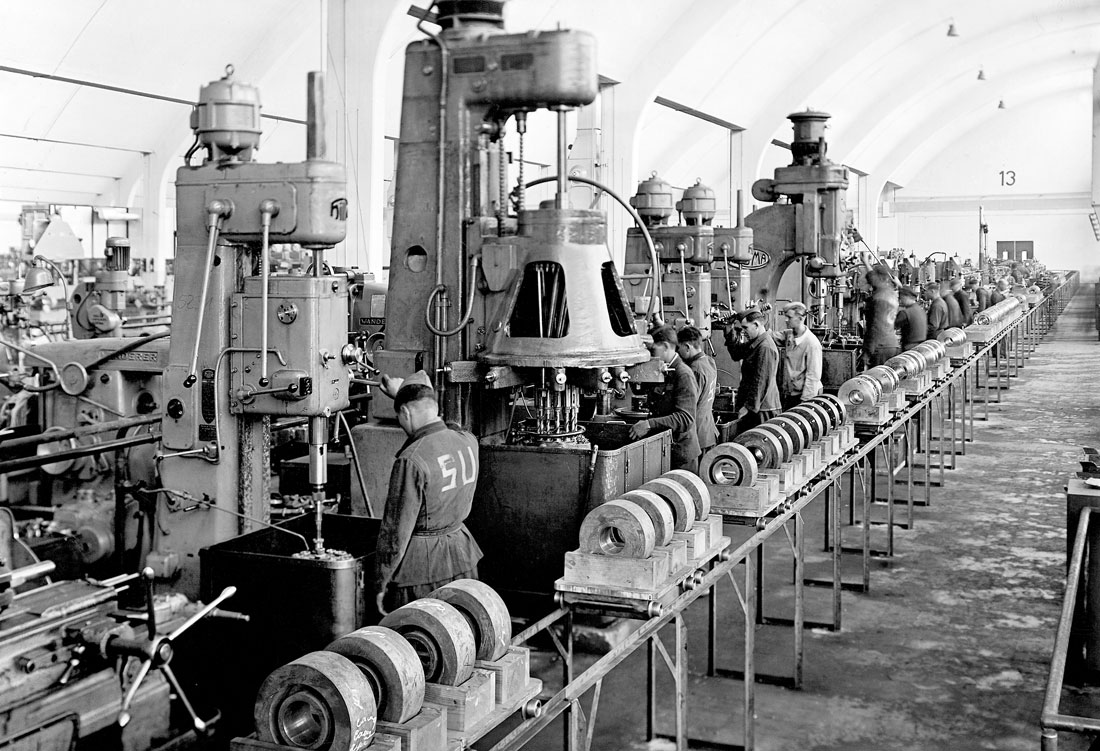
Unknown photographer. 'Foreign workers at BMW in Allach' 1943 from the exhibition 'Forced Labour. The Germans, the Forced Labourers and the War' at the Jewish Museum, Berlin


Unknown photographer
Foreign workers at BMW in Allach
c. 1943


All the foreigners in aircraft engine production had to be visibly identifiable as such. The Soviet prisoners of war had the “SU” symbol on their jackets. Concentration camp inmates could be recognised by their striped uniforms. These photographs were most likely propaganda photos. Munich-Allach, c. 1943.

Source: BMW Group Archiv.


Munich-Allach: Working for BMW

Toward the end of the war ninety percent of the workforce at the largest aircraft engine factory in the German Reich – BMW’s plant in Munich-Allach – consisted of foreign civilian workers, POWs and concentration camp inmates. The number of workers had risen from 1,000 in 1939 to more than 17,000 in 1944.

Forced labourers worked not only in the assembly halls, but also on the factory’s expansion. Due to BMW’s importance to the armament industry, the authorities gave it priority over other companies in the assignment of workers. Nevertheless, its personnel demand was never completely met.

Some of the Western European workers lived in private quarters. For all others, barrack camps were set up all around the factory grounds until 1944, ultimately accommodating 14,000 people. That figure included several thousand concentration camp inmates which the company management had applied for already in 1942.


Unknown photographer. 'KZ-prisoners on the industrial union color building site, Auschwitz' c. 1943 from the exhibition 'Forced Labour. The Germans, the Forced Labourers and the War' at the Jewish Museum, Berlin


Unknown photographer
KZ-prisoners on the industrial union color building site, Auschwitz
c. 1943
Source: © Bundesarchiv, Koblenz


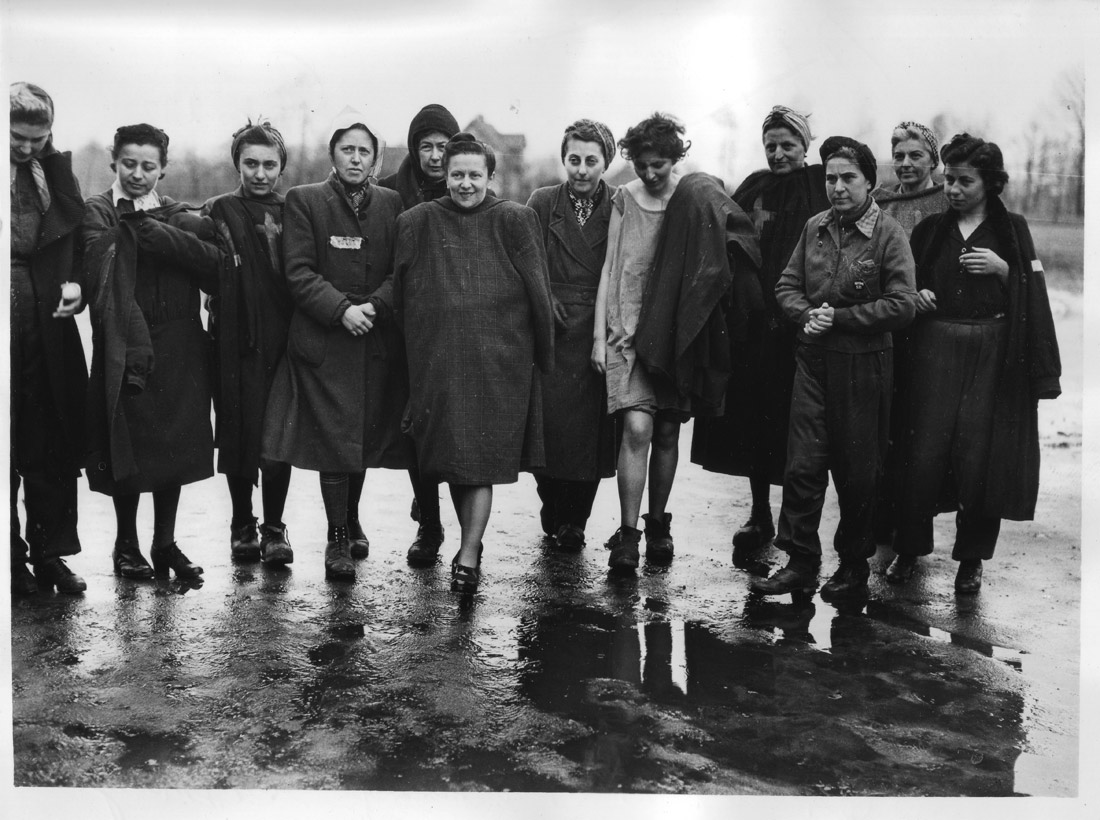
Unknown photographer. 'Liberated Jewish women' 1945 from the exhibition 'Forced Labour. The Germans, the Forced Labourers and the War' at the Jewish Museum, Berlin


Unknown photographer
Liberated Jewish women
1945


These young Jewish women were released from a forced labor camp at Kauritz (Saxony) by U.S. Army troops in early April, 1945. They are part of a large group removed from homes in France, Holland, Belgium and other occupied areas in Europe.

Source: National Archives, Washington


Unknown photographer. 'Wladyslaw Kolopoleski' Nd from the exhibition 'Forced Labour. The Germans, the Forced Labourers and the War' at the Jewish Museum, Berlin


Unknown photographer
Wladyslaw Kolopoleski
Nd


“In addition to the hard work, which exceeded my strength, I was beaten on the slightest provocation, sometimes to the point of unconsciousness. Once, for example, I suffered a severe head injury after I was beaten by Max Ewert, an SA officer. I not only lost consciousness, but I had to have head surgery,” wrote Władysław Kołopoleski, a young Pole born in Łódź in 1932. He was deployed in April 1940 on the estate of mayor Max Ewert in Gervin, now Górawino, in Pomerania.

Source: Foundation “Polish-German Reconciliation,” Warsaw


Jewish Museum Berlin
Lindenstraße 9-14, 10969 Berlin
Phone: +49 (0)30 259 93 300

Opening hours:
10am – 7pm

The Jewish Museum website

LIKE ART BLART ON FACEBOOK

Back to top