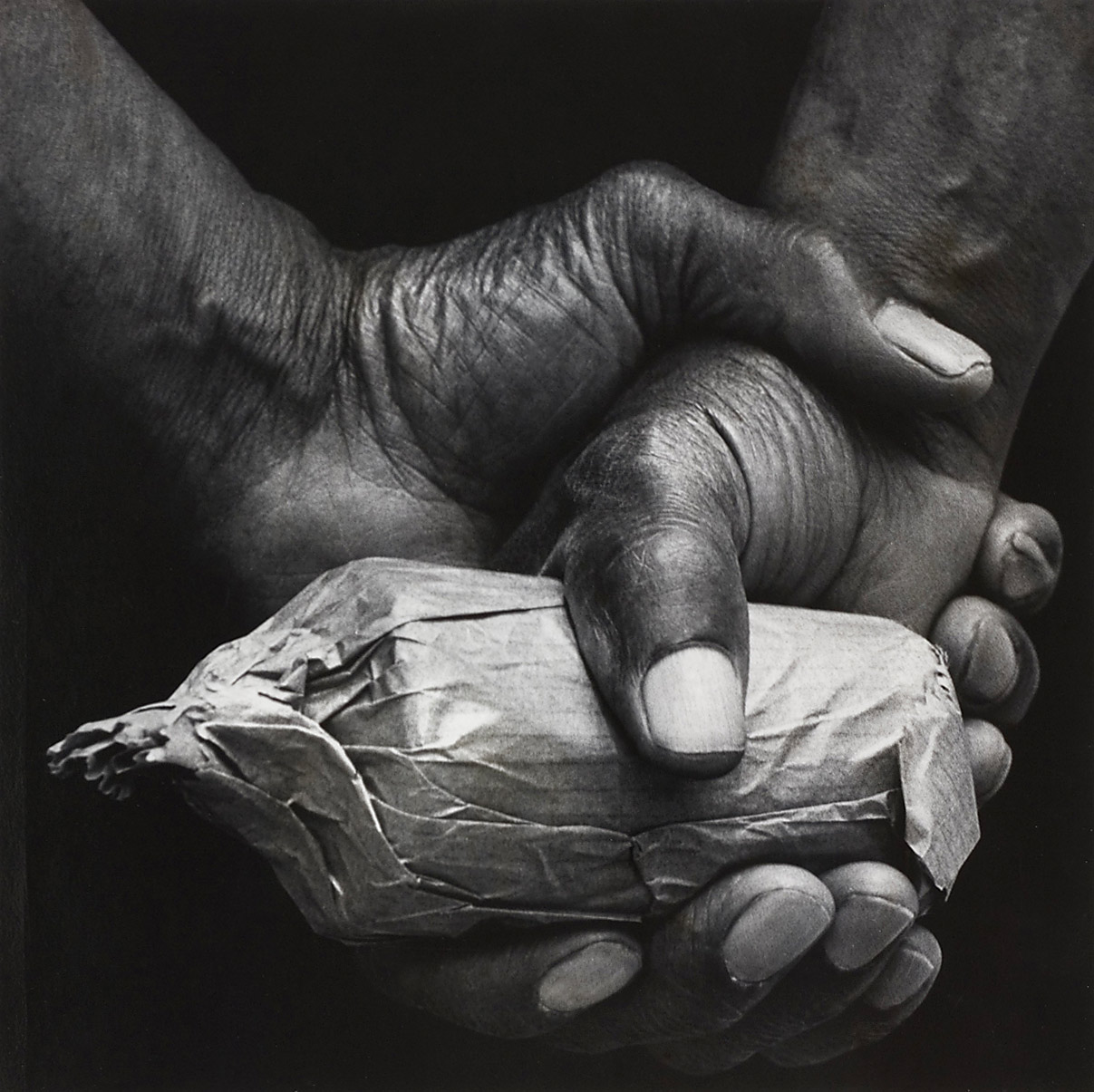
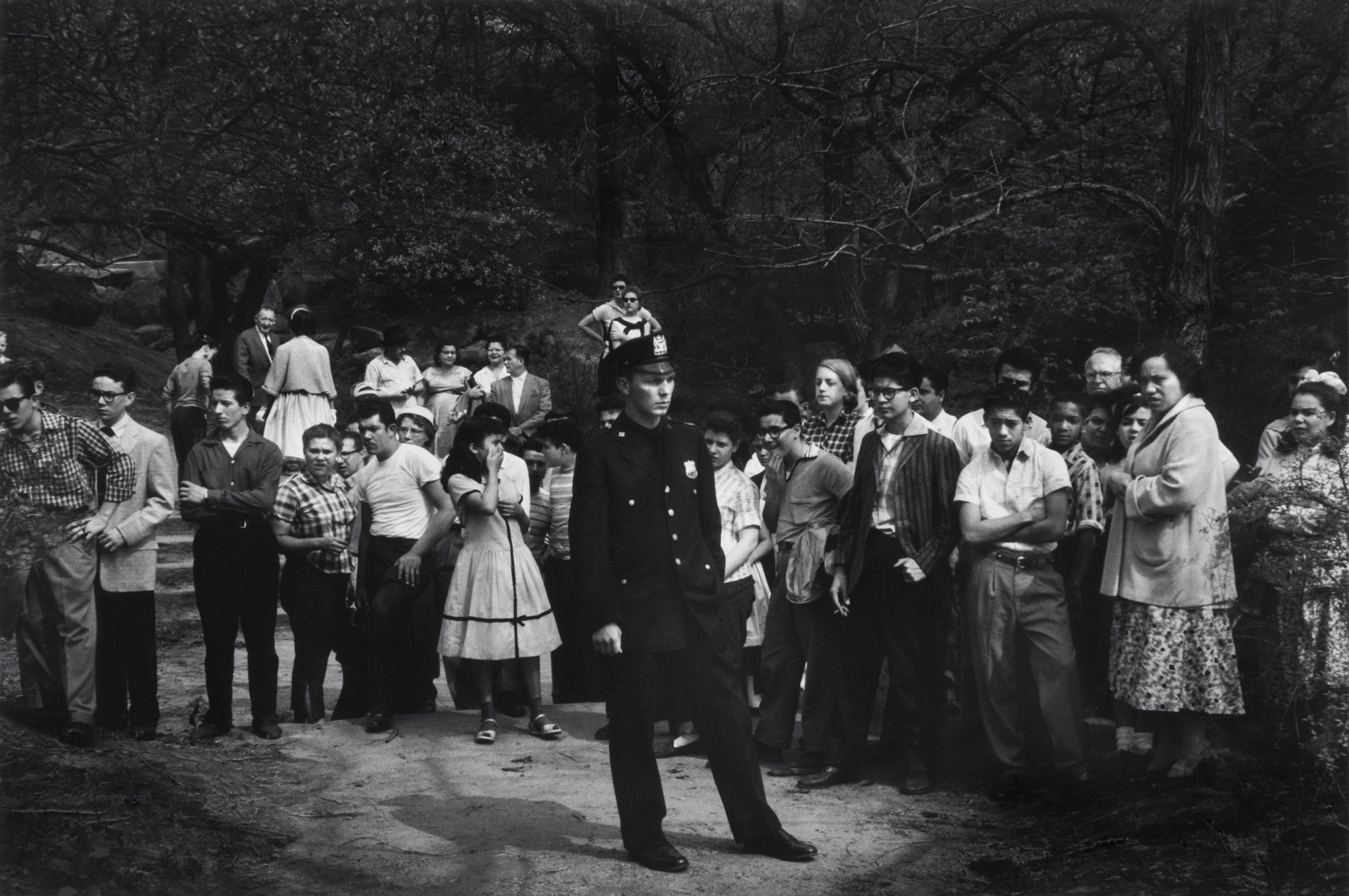
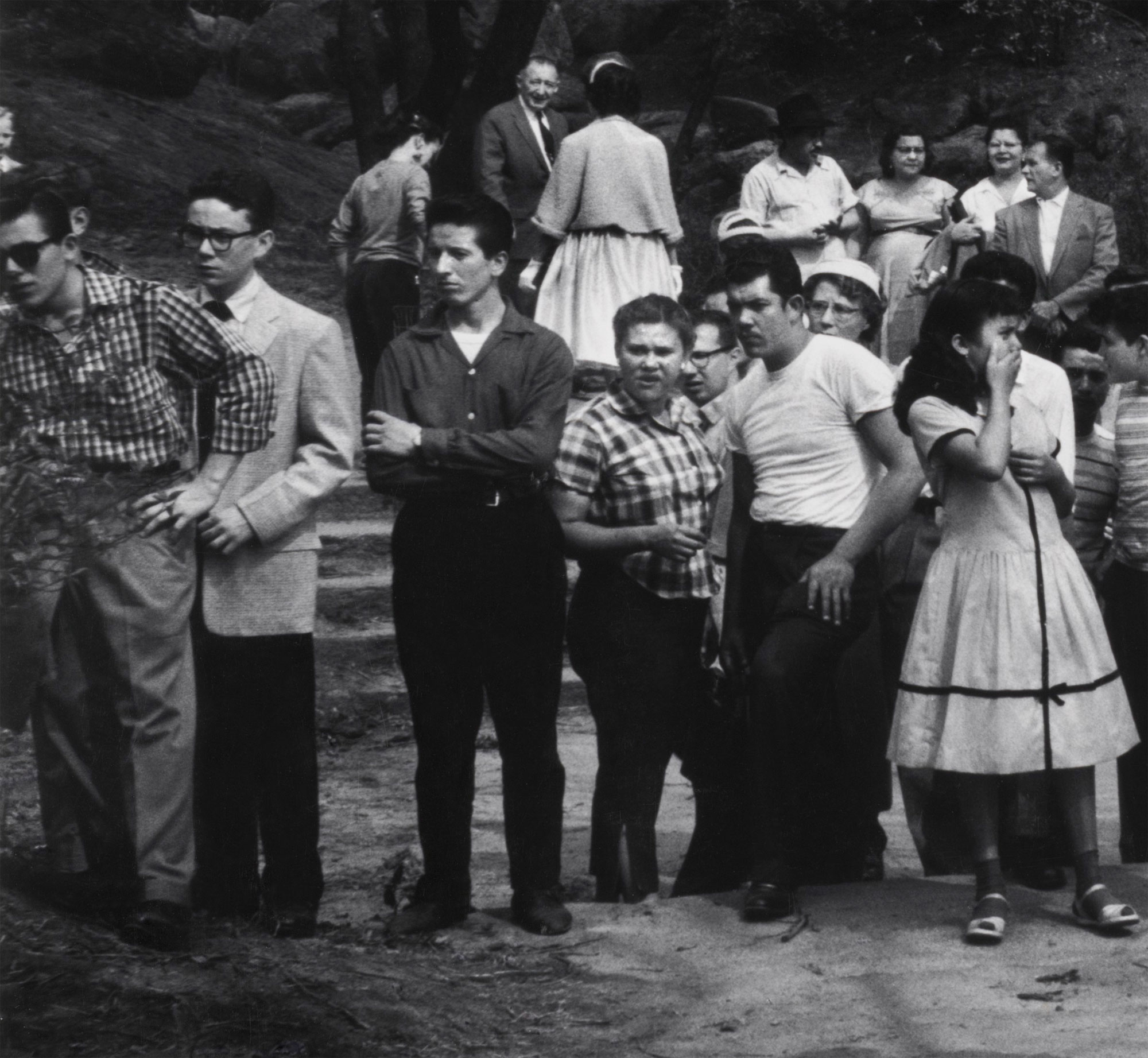
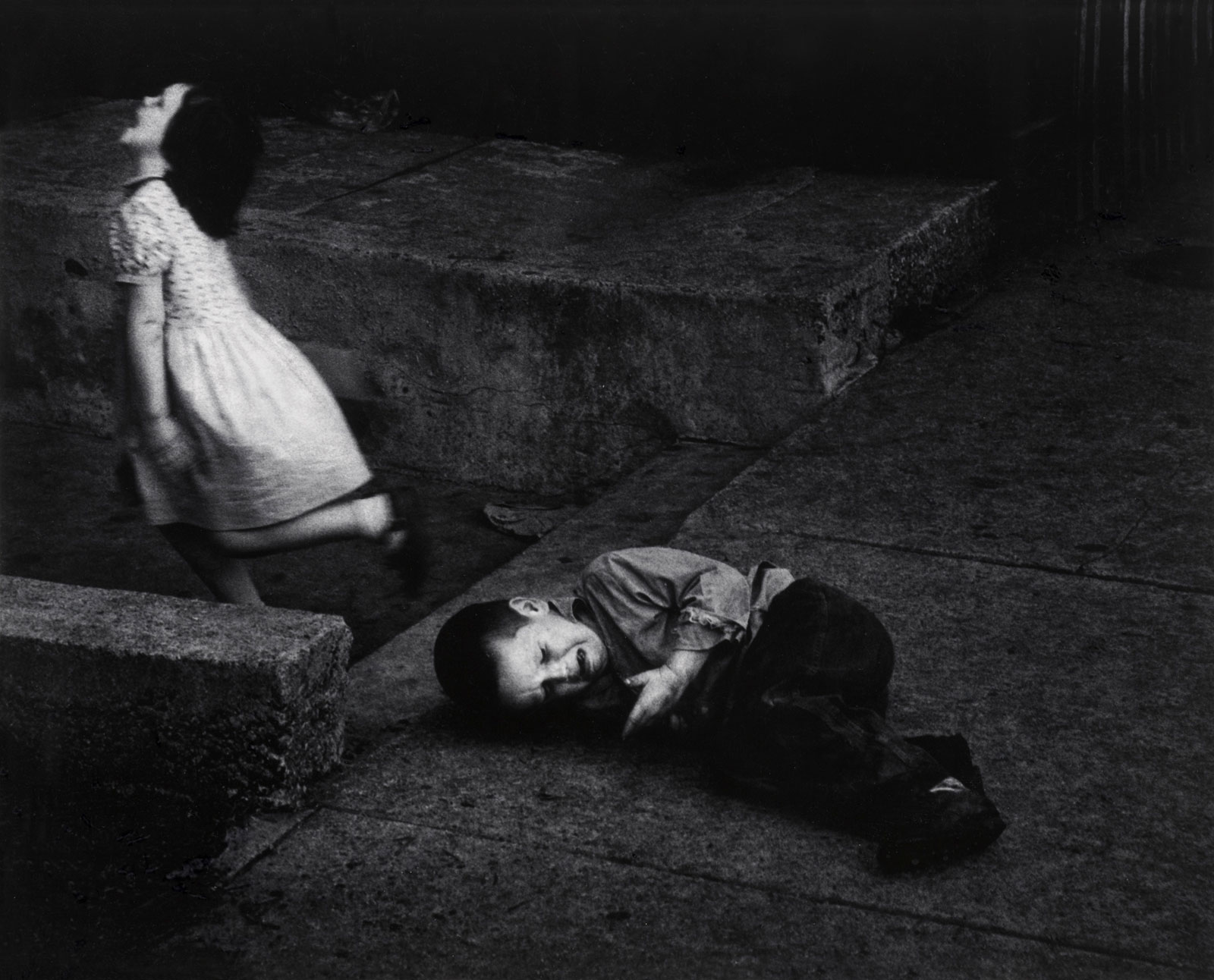
Exhibition: ‘Art AIDS America’ at Tacoma Art Museum, Tacoma

Exhibition dates: 3rd October, 2015 – 10th January, 2016

Co-curators: Rock Hushka, Chief Curator, Tacoma Art Museum and Dr. Jonathan D. Katz


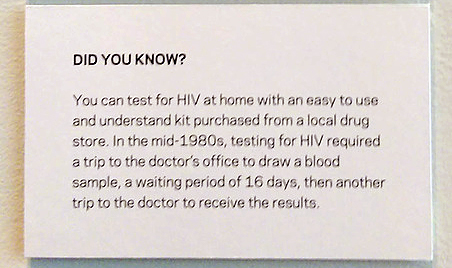
Did You Know?


Living and breathing

This is the biggest exhibition on art relating to HIV/AIDS since the seminal exhibition Art in the Age of AIDS at the National Gallery of Australia, Canberra in 1995, which I was a part of.

I was lucky to survive the initial wave of HIV/AIDS infections. The Centers for Disease Control issued its first statement about a cluster of 19 cases of Kaposi’s sarcoma (a rare skin cancer most common in elderly men from southern Italy) and Pneumocystis carinii pneumonia in young, gay men in New York, Los Angeles, and San Francisco in July 1981… and I had my first HIV test in London in 1983. In those days, as the wall text from the exhibition spells out above, you had to wait 16 days to get the result of a blood test. I vividly remember sitting outside a doctor’s office knowing that when I went in, if he said yes you have it, it was a death sentence. In those early days, there was no treatment. You were going to die. I only survived by luck. Many of my friends and lovers didn’t.

“Art reflects and reacts to social, cultural, and political climates, and in the past 30 years, HIV and AIDS has been a constant presence,” says exhibition co-curator Rock Hushka. “So many of us recall friends, family, and partners we have lost and the terror of the early years of the crisis, while younger people are just learning this story. We seek to create a deeper understanding of the legacy of HIV / AIDS in contemporary American art, and encourage our visitors to see their experiences in these works.” (Press release)

This deep understanding can be supplemented by this posting. I spent many hours securing more images than were sent to me in the press pack, because I think it is really important to have as great a cross-section as possible of work online from this exhibition, as a record of this time and space in the ongoing HIV / AIDS story.

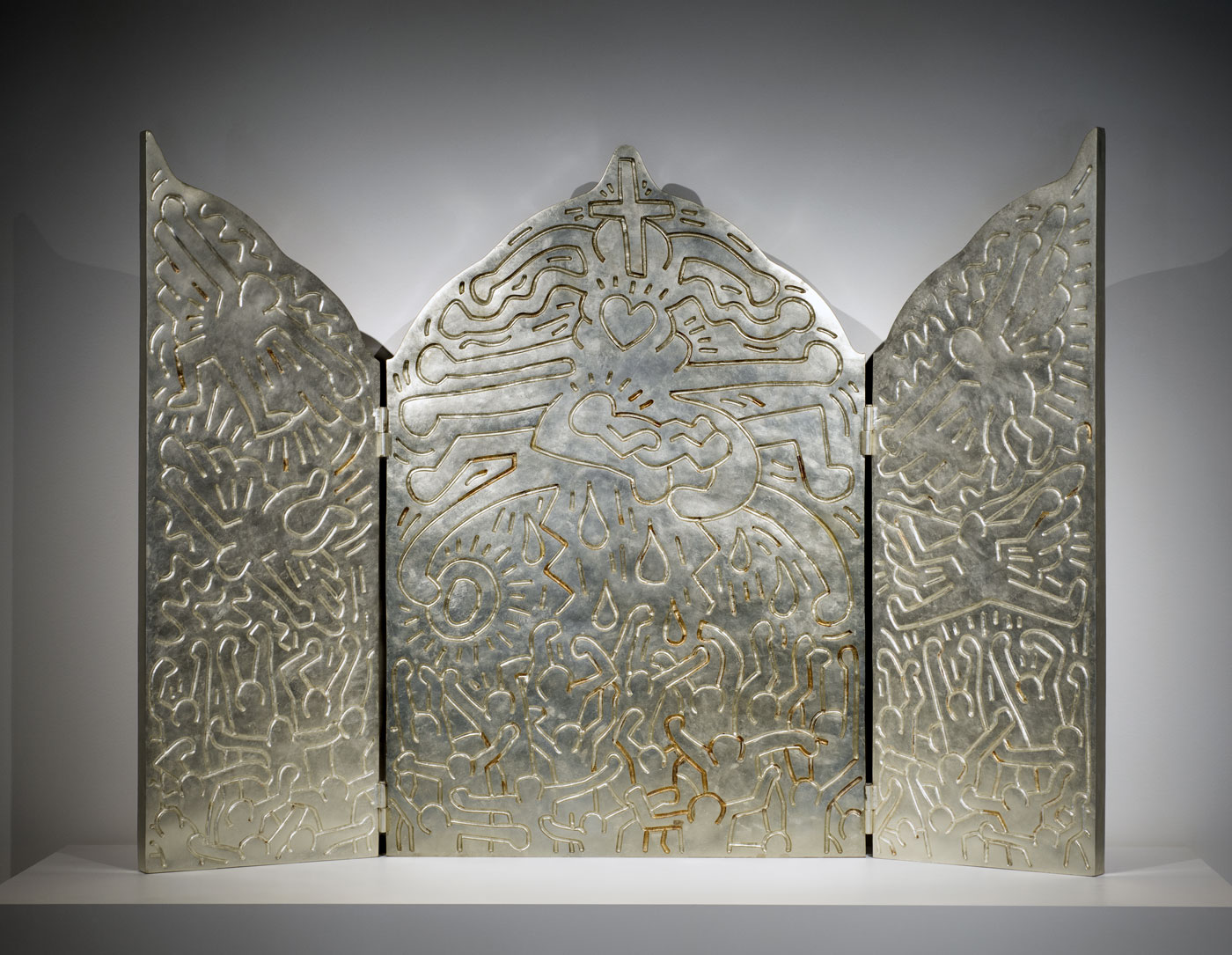
In terms of the art, I find the earlier narratives are much more powerful and focused than the contemporary work. One of the most moving of these, and one that I have never seen before, is Keith Haring’s Altar Piece (1990, cast 1996, below). Can you imagine being an artist, being Haring, working on the wax mould in hospital being treated for AIDS-related illness, thinking that this could possibly be the last art work that you would ever complete. That you would never see it produced. And then to make something that is so compassionate, so beautiful that it is almost beyond belief… my heart is full of admiration and, like the crowd in the triptych, I am washed with tears.

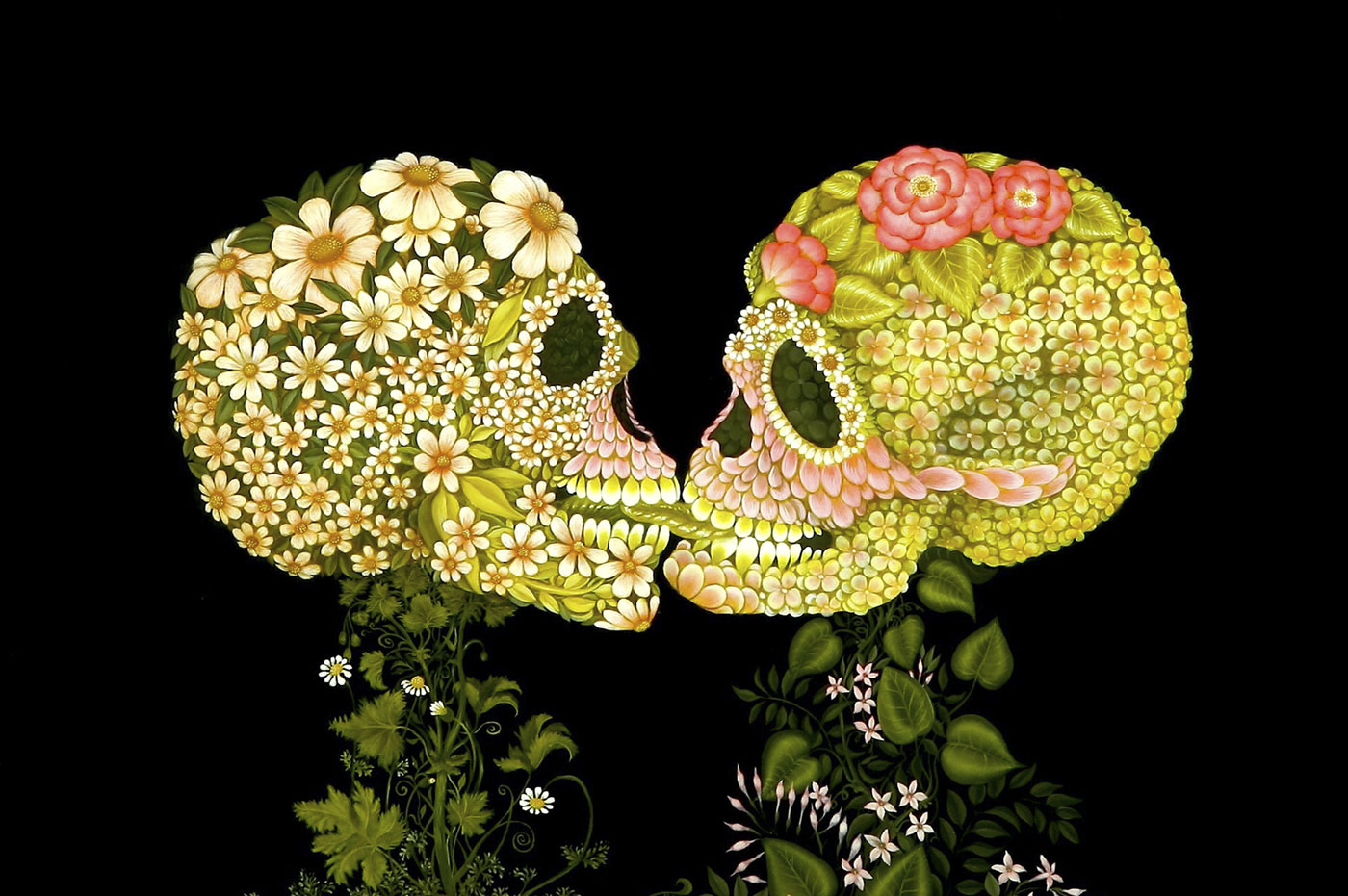
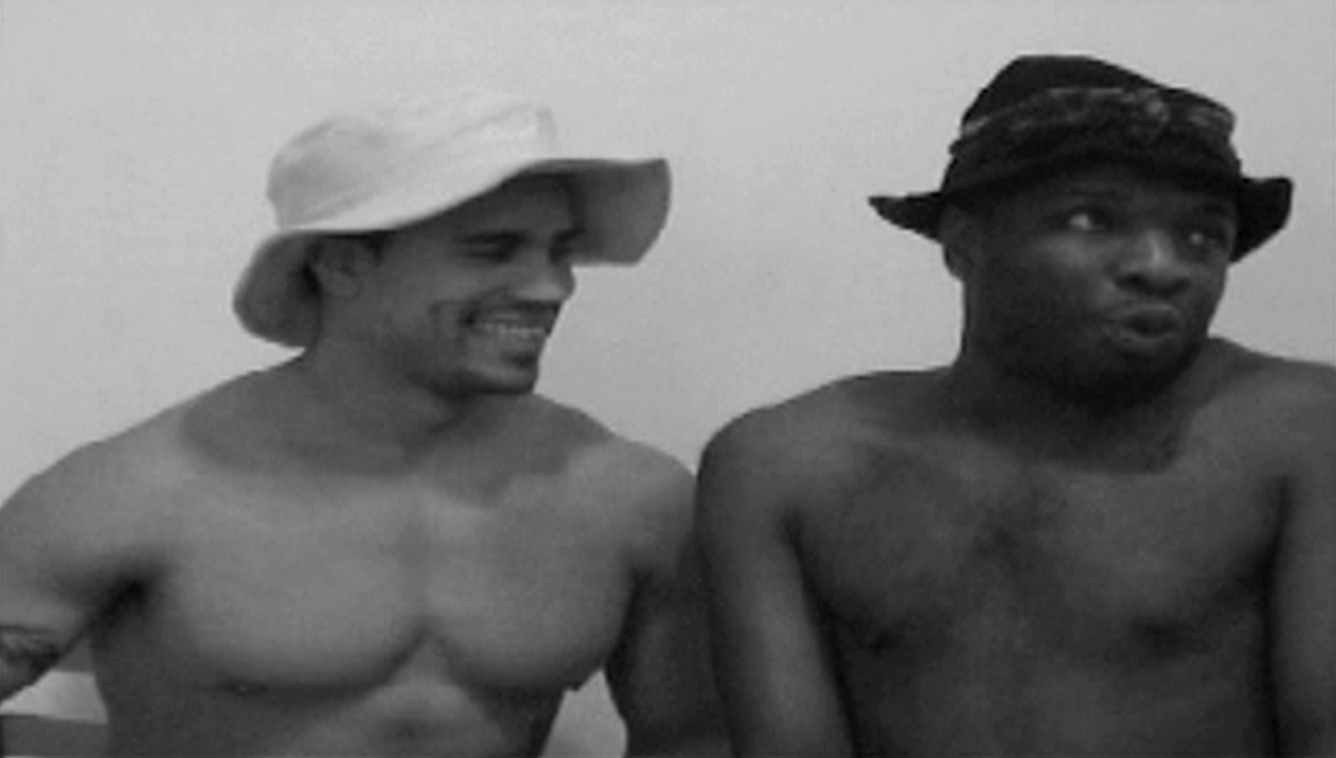
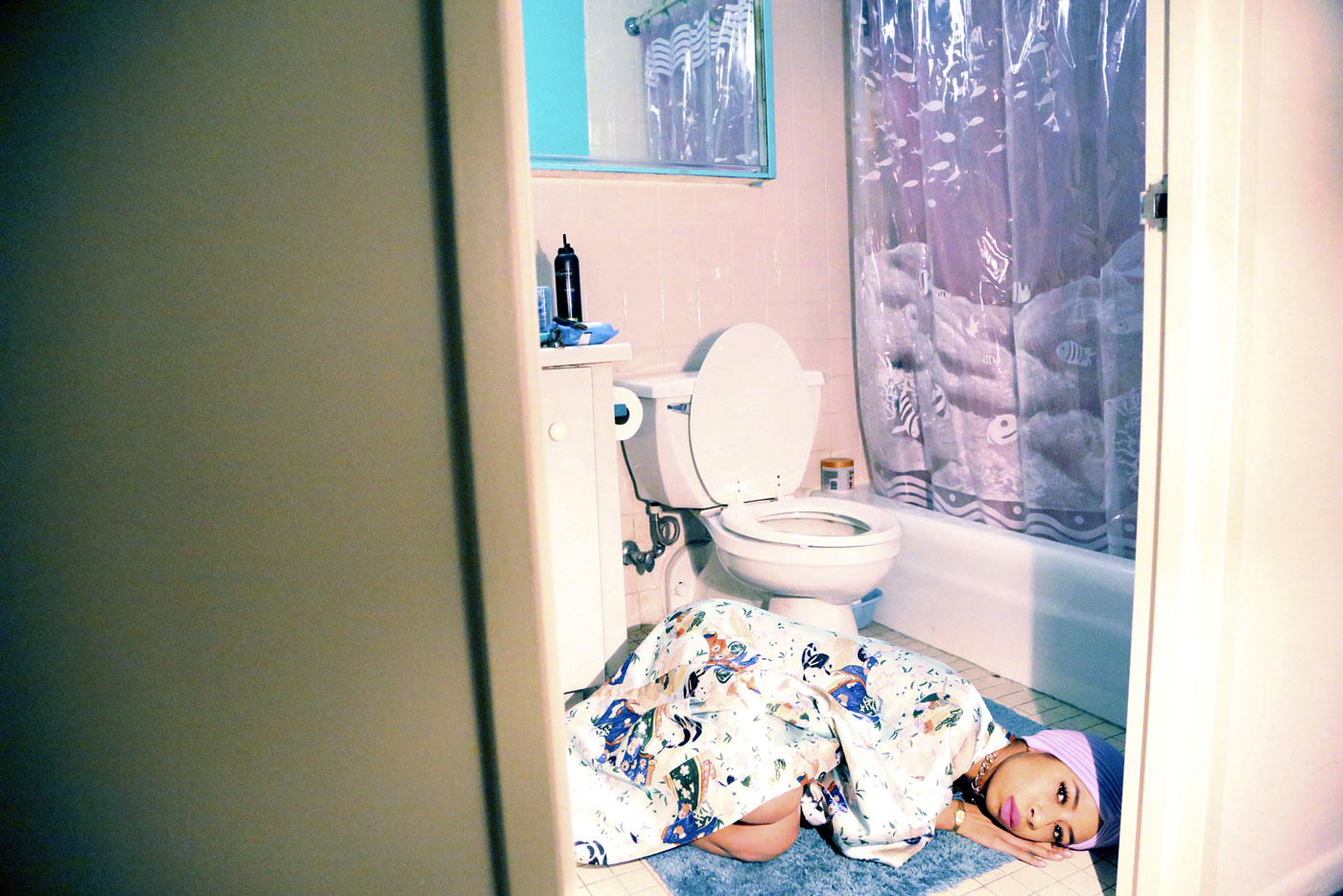
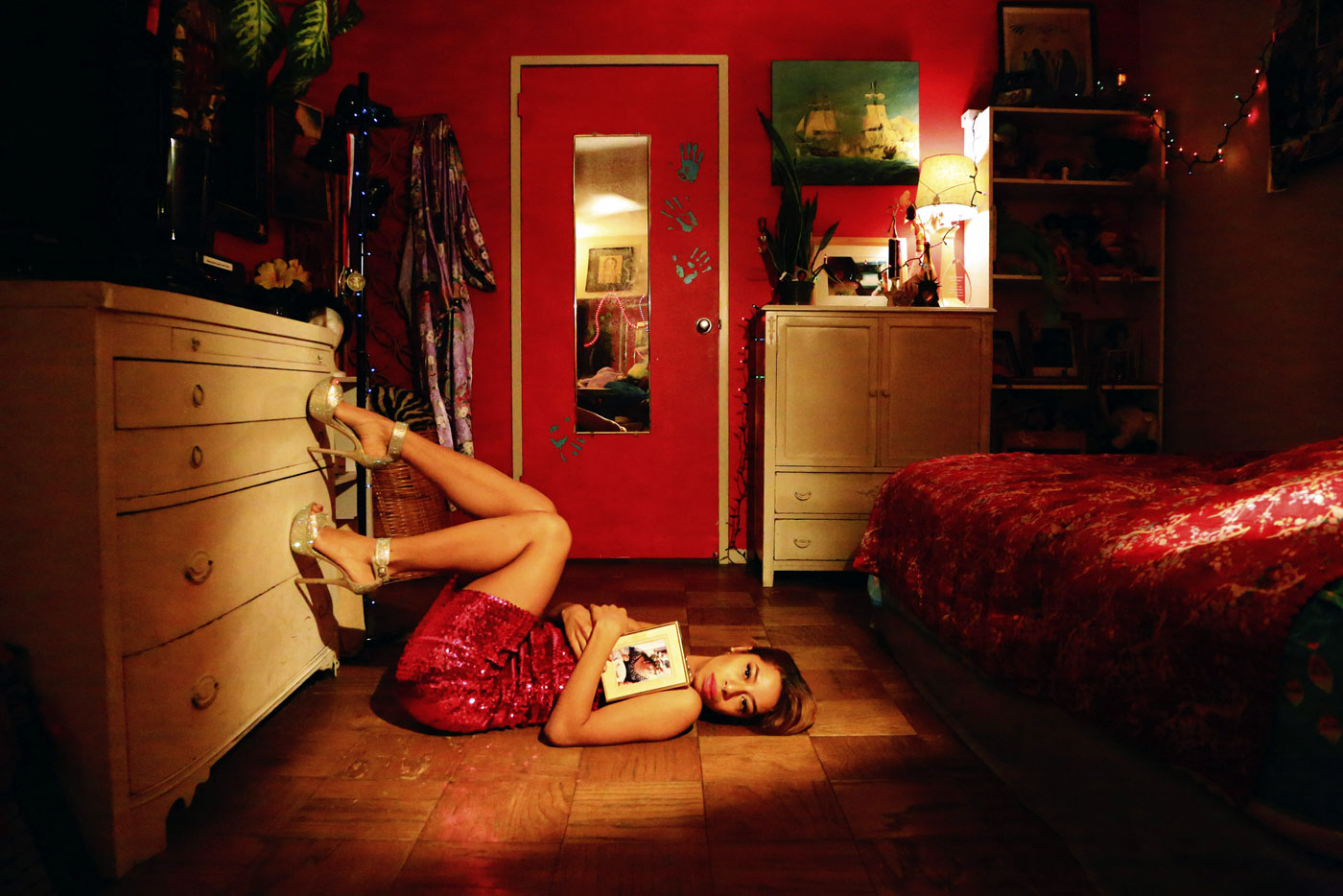
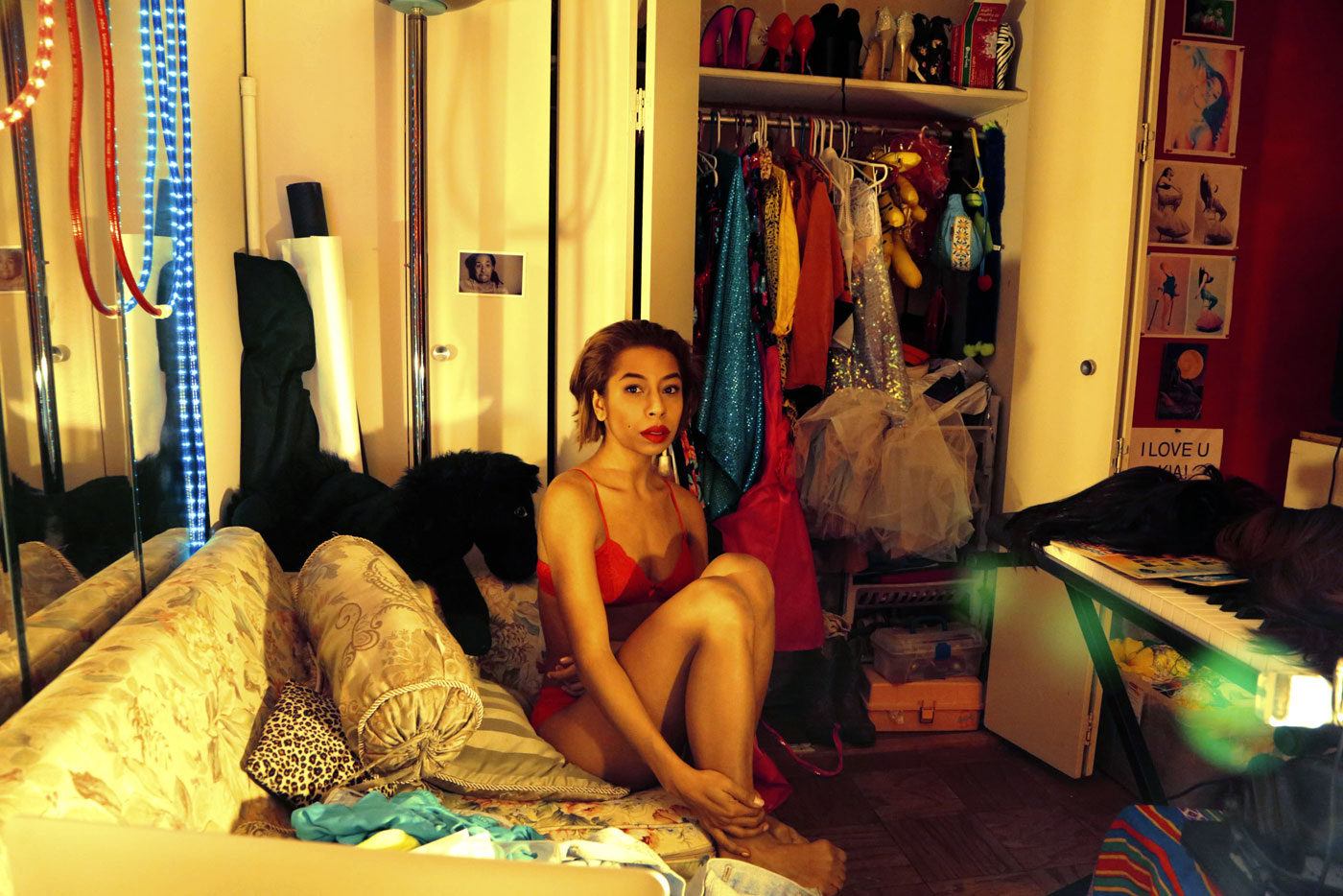
By comparison, some of the contemporary works seem to have become mere graphic symbolism (leaves, milk and flowers) rather than engaging activism. For example, Tino Rodriguez’s Eternal Lovers (2010, below) – while referencing his Mexican heritage through skull imagery from Dia de los Muertos, the Day of the Dead – is not about loss with presence but loss without presence: a febrile graphic activity that is pure decoration. Other works such as Derek Jackson’s Perfect Kiss (2007, below) or LADZ’s Eden #31 (2012, below) enact only the most tenuous link to HIV/AIDS and only when it is spelled out in text. Again, while not denying the pain of the death of her mother, her persecution when growing up or the problems with living with HIV, Kia Labeija’s 24 (Mourning Sickness; Kia and Mommy; In my room) (2014, below) propositions us with a women photographed in deadpan photography style as glamorous mother with vivid pink lipstick or a Beyonce music star in sequin dress and 6 inch heels. Only in the last photograph is there any hint of vulnerability and, funnily enough, it is the only photograph that I care about and engage with.

In all of these works the key word is enact, for these works are performances of gender and sexuality conceptualised for the viewer, where living with HIV/AIDS is shown to us at a distance. Instead of ACTing up, unleashing the power of the oppressed, artists are now acting out in this (supposed) post-death HIV/AIDS climate. Look at me, I can be whoever I want to be (and still have HIV). Nothing wrong with that I hear you say, and you would be completely right… if only the art commenting on this post-death resurrection of the author, was memorable.

While 1,218,400 persons aged 13 years and older are living with HIV infection in the USA and an estimated 47, 352 people were diagnosed with the disease in 2013, people are still dying by the thousands in America (an estimated 13,712 people died in 2012 of an AIDS related disease – source Centers for Disease Control and Prevention website).

This is not pretty pink lipstick and sequin dresses, this is 13 thousand people a year still DYING from this disease.

Just think about that for a while.

Dr Marcus Bunyan


Many thankx to the Tacoma Art Museum, Mark I. Chester and Steven Miller for allowing me to publish the photographs in the posting. Please click on the photographs for a larger version of the image.


ACT UP NY/Gran Fury (active New York, New York, 1987–1995), Let the Record Show… 1987/recreated 2015 from the exhibition 'Art AIDS America' at Tacoma Art Museum, Tacoma, Oct 2015 - Jan 2016


ACT UP NY/Gran Fury (active New York, New York, 1987-1995)
Let the Record Show…
1987/recreated 2015
Mixed media installation, dimensions variable
Courtesy of Gran Fury and the New Museum, New York
Photo courtesy of the artists


In 1987, the New Museum’s curator William Olander invited ACT UP (the AIDS Coalition to Unleash Power) to create a work about AIDS. ACT UP, a diverse, nonpartisan, grassroots organisation, responded with Let the Record Show… providing information about the crisis.

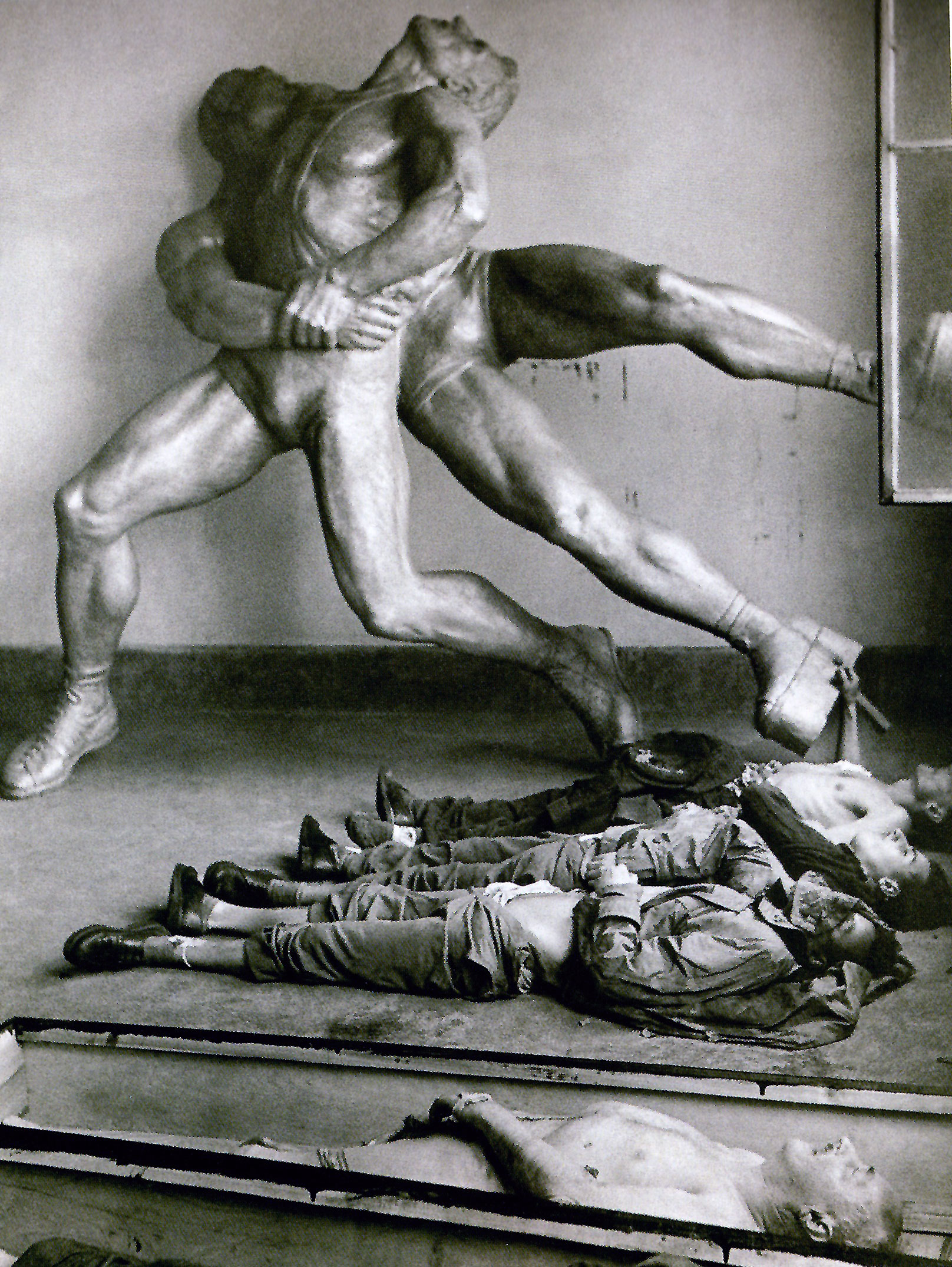
At the time, the only visual presence of AIDS activism was the Silence=Death stickers. Let the Record Show… recreated here in full for the first time, included an LED reader board with statistics about the unfolding medical and political crisis, the neon pink triangle with “Silence=Death,” a photomural from the Nuremberg trials, and photographs of contemporary public figures with their statements about AIDS.

Using the 1986 graphics from the Silence=Death Project, ACT UP appropriated the pink triangle from the badges assigned to gay prisoners in Nazi Germany during World War II. The artists combined this historic symbol of powerlessness along with the photomural of the Nuremberg courtroom to make an explicit comparison between the severity of the AIDS crisis and government inaction and the Holocaust.

The complicated installation asked whether simple silence in a crisis is as culpable as actively encouraging one. The anonymous collective Gran Fury formed as a committee of ACT UP, as a result of Olander’s invitation. Gran Fury continued to make provocative and important works about the AIDS crisis.

For the installation of Let the Record Show… at the New Museum, quotes were cast in concrete under the photograph of the irresponsible speaker:

“The logical outcome of testing is a quarantine of those infected.”
Jesse Helms, U.S. Senator

“It is patriotic to have the AIDS test and be negative.”
Cory Servass, Presidential AIDS Commission

“We used to hate faggots on an emotional basis. Now we have a good reason.”
Anonymous Surgeon

“AIDS is God’s judgment of a society that does not live by His rules.”
Jerry Falwell, Televangelist

“Everyone detected with AIDS should be tattooed in the upper forearm to protect common needle users, and on the buttocks to prevent the victimization of other homosexuals.”
William F. Buckley, Columnist

” …”
Ronald Reagan, President of the United States


ACT UP NY/Gran Fury (active New York, New York, 1987-1995) 'Let the Record Show…' (detail) 1987/recreated 2015


ACT UP NY/Gran Fury (active New York, New York, 1987-1995)
Let the Record Show… (detail)
1987/recreated 2015
Mixed media installation, dimensions variable
Courtesy of Gran Fury and the New Museum, New York
Photo courtesy of the artists


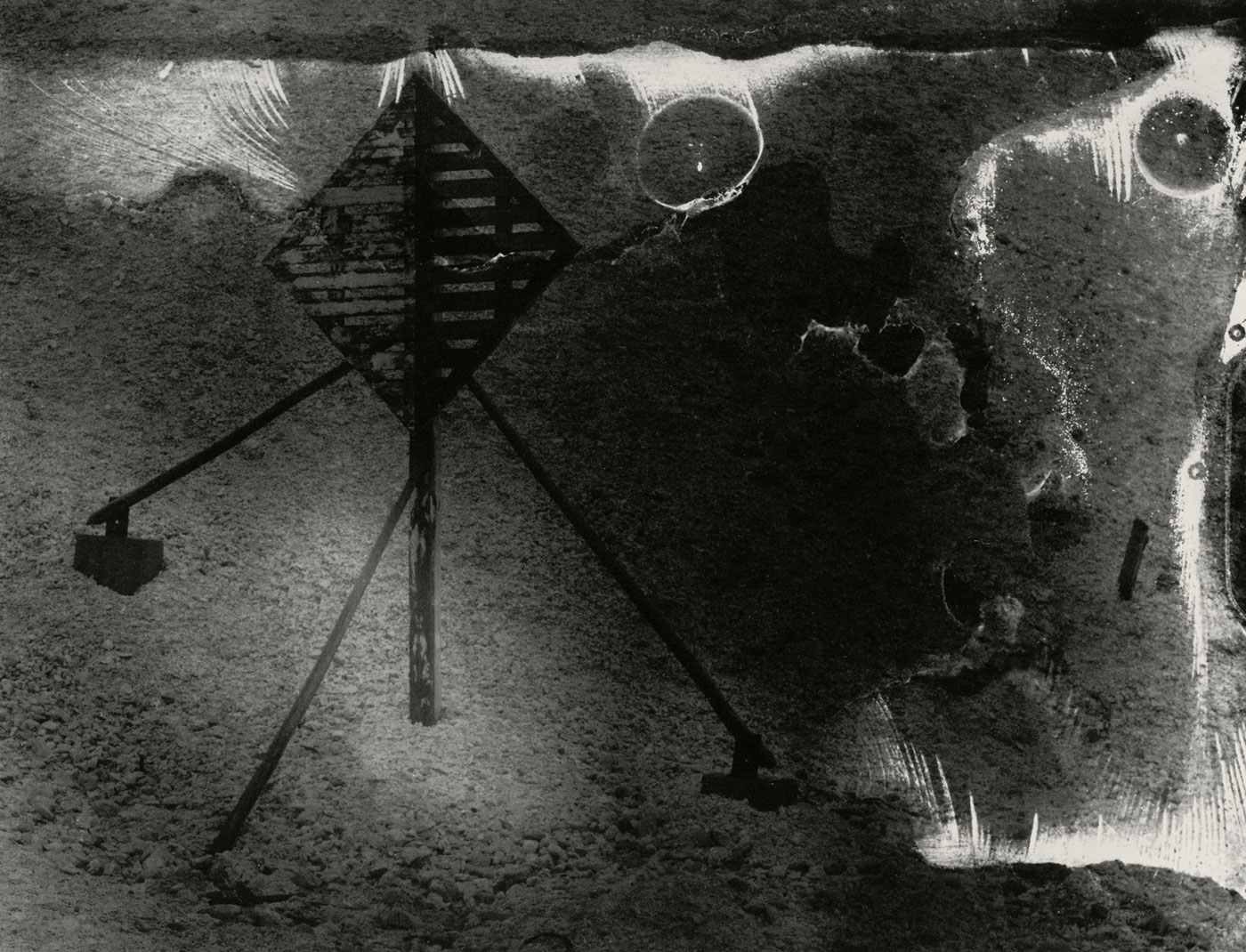
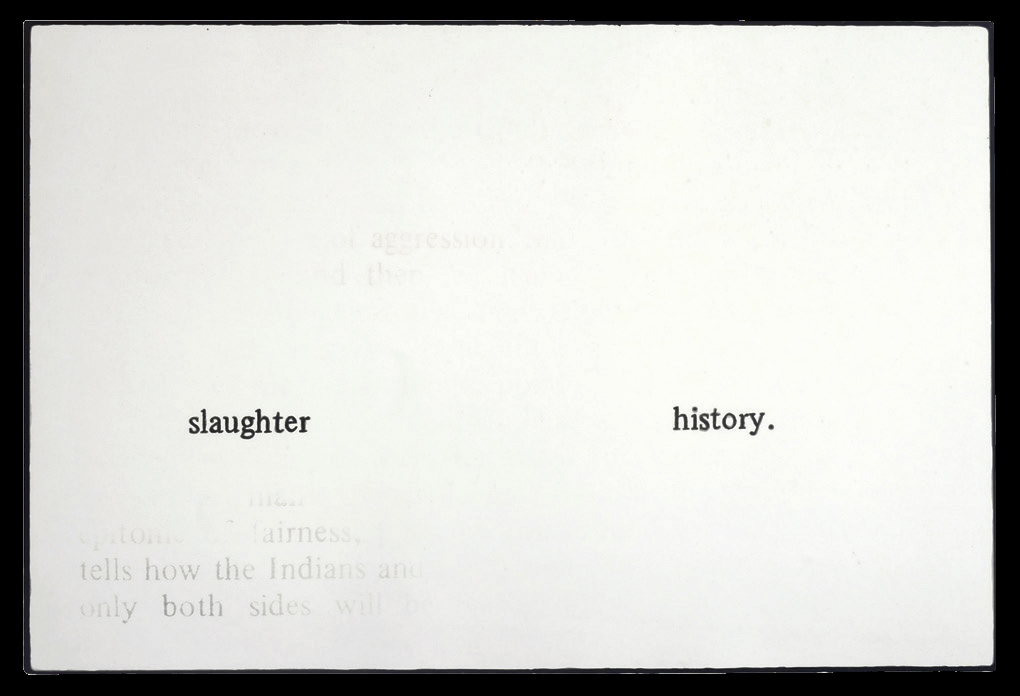
Carrie Yamaoka (American, born Glen Cove, New York, 1957) 'Steal This Book #2' 1991 from the exhibition 'Art AIDS America' at Tacoma Art Museum, Tacoma, Oct 2015 - Jan 2016


Carrie Yamaoka (American, born Glen Cove, New York, 1957)
Steal This Book #2
1991
Unique chemically altered gelatin silver print
Courtesy of the artist


Carrie Yamaoka takes inspiration from Abbie Hoffman’s iconic Steal This Book, a counterculture manual for social revolution. By photographing a page spread and then obliterating all of the words except “slaughter” and “history,” Yamaoka rejects any passive understanding of history. As an activist and artist, Yamaoka will use any means necessary to affect change. Steal This Book #2 may be considered as referring to Yamaoka’s experience as an AIDS activist and her desire to reshape our understanding of our relations with HIV.


Jerome Caja (American, 1958-1995) 'Bozo Fucks Death' 1988


Jerome Caja (American, 1958-1995)
Bozo Fucks Death
1988
Nail polish on plastic tray
Collection of Ed Frank and Sarah Ratchye


One of Jerome Caja’s alter egos was the clown Bozo. Here Caja aggressively turns the tables on death and seeks to gain some control and power over the inevitable, even if only a transgressive, psychological fantasy.


Niki de Saint Phalle (French-American, 1930-2002) 'AIDS, you can't catch it holding hands' 1987


Niki de Saint Phalle (French-American, 1930-2002)
AIDS, you can’t catch it holding hands
1987
Book, 52 pages 8 × 10 inches
The Lapis Press, San Francisco
© 2015 Niki Charitable Art Foundation, All rights reserved / ARS, NY / ADAGP, Paris


Working with collaborator Professor Silvio Barandun, Niki de Saint Phalle wrote and illustrated AIDS: You Can’t Catch It Holding Hands for young adults. Using her characteristically colourful and joyous style, de Saint Phalle offers unusually straightforward information about the transmission of HIV from unprotected sex and unclean needles in intravenous drug use. She also uses the same frank approach to assuring her readers that casual contact from flowers, doorknobs, and toilet seats does not transmit AIDS, notions that were not widely understood in the early years of the AIDS crisis.


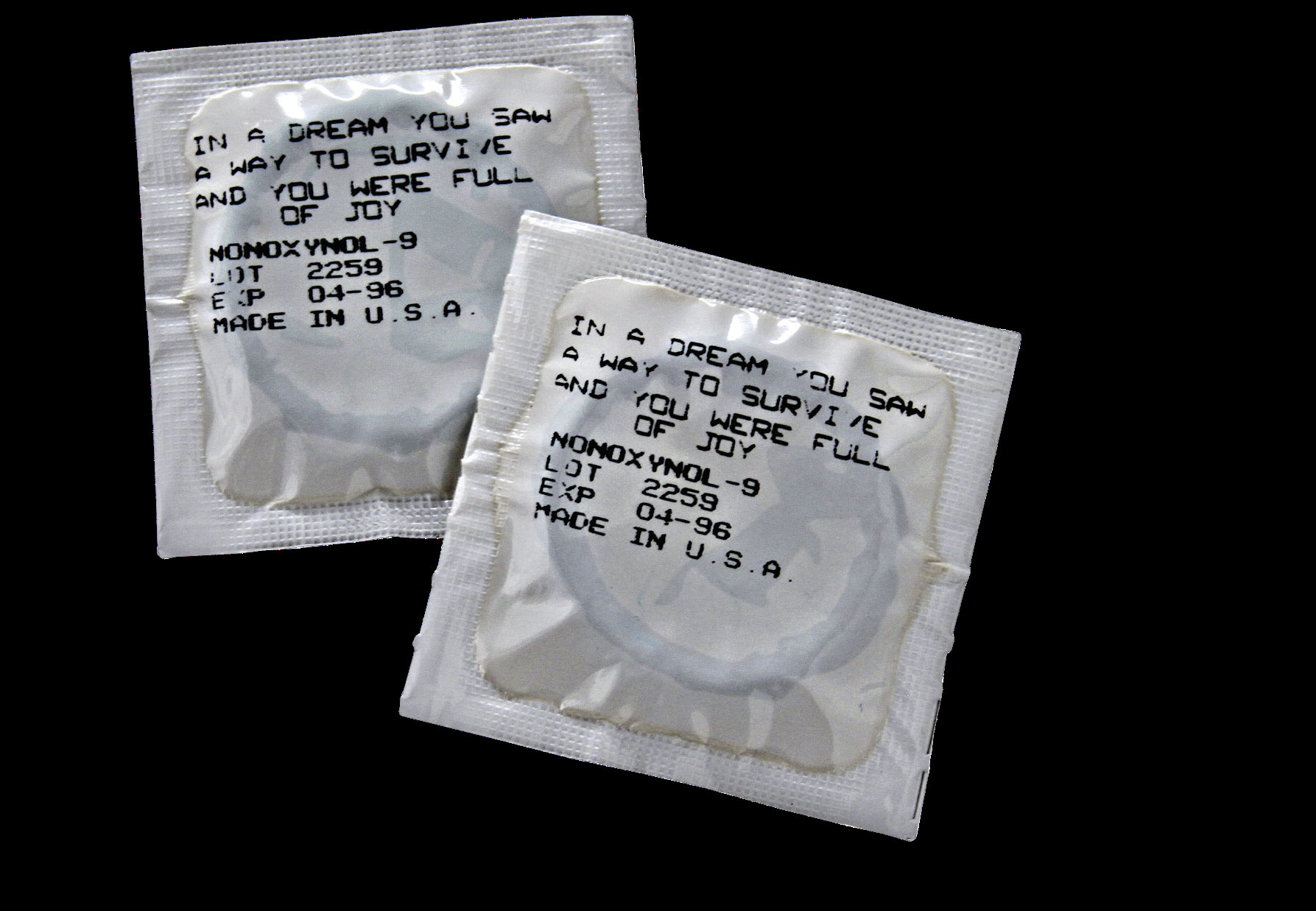
Jenny Holzer (American, born Gallipolis, Ohio, 1950) 'Untitled (In a Dream You Saw a Way To Survive and You Were Full of Joy)' 1983-1985


Jenny Holzer (American, born Gallipolis, Ohio, 1950)
Untitled (In a Dream You Saw a Way To Survive and You Were Full of Joy)
1983-1985
Packaged latex condoms with printed text, each is 2 x 2 inches
Mildred Lane Kemper Art Museum, Washington University in St. Louis, Anonymous gift, 2001


Jenny Holzer (American, born Gallipolis, Ohio, 1950) 'Untitled (Expiring for Love Is Beautiful but Stupid)' 1983-1985


Jenny Holzer (American, born Gallipolis, Ohio, 1950)
Untitled (Expiring for Love Is Beautiful but Stupid)
1983-1985
Packaged latex condoms with printed text, each is 2 x 2 inches
Mildred Lane Kemper Art Museum, Washington University in St. Louis, Anonymous gift, 2001


Art AIDS America aims to abolish the silence about the pervasive presence of HIV / AIDS in American art and open meaningful and respectful dialogues about our experiences with the ongoing epidemic. For too long, we have considered art about AIDS as a tragic, closed chapter in the history of American art. This exhibition demonstrates the deep and continued impact of the AIDS crisis on American art from the early 1980s and continuing to today.

For more than thirty years, artists have actively responded with exquisite sensitivity to HIV / AIDS. They have adopted a broad spectrum of styles and messages from politically activist to quietly mournful art that nonetheless thrums with political content. Through poignant portraits, some artists brought much needed attention to personal suffering and loss from the AIDS crisis. Others employed abstraction and coded imagery to reveal the social and political factors that exacerbated the spread of HIV / AIDS. Artists also widely appropriated various art historical traditions to speak about the devastating impact of the epidemic. Art AIDS America offers an overview of how these various approaches redirected the course of American art from postmodern “art for art’s sake” formulas to art practice that highlights the personal experience and expertise of the artist.

Since the first reports of mysterious illnesses in the early 1980s, HIV and AIDS have touched nearly every American in some way, and operated as an undeniable (though often unacknowledged) force in shaping politics, medicine, and culture. Art AIDS America presents the full spectrum of artistic responses to AIDS, from the politically outspoken to the quietly mournful. HIV and AIDS are not just past-tense problems. As we persist in the struggle with HIV/AIDS, these artworks remind us of humanity’s resilience, responsibility, and history. The legacy of the AIDS crisis and our new relationships with the virus continue to inform contemporary art and American culture.

Text from the Tacoma Art Museum website


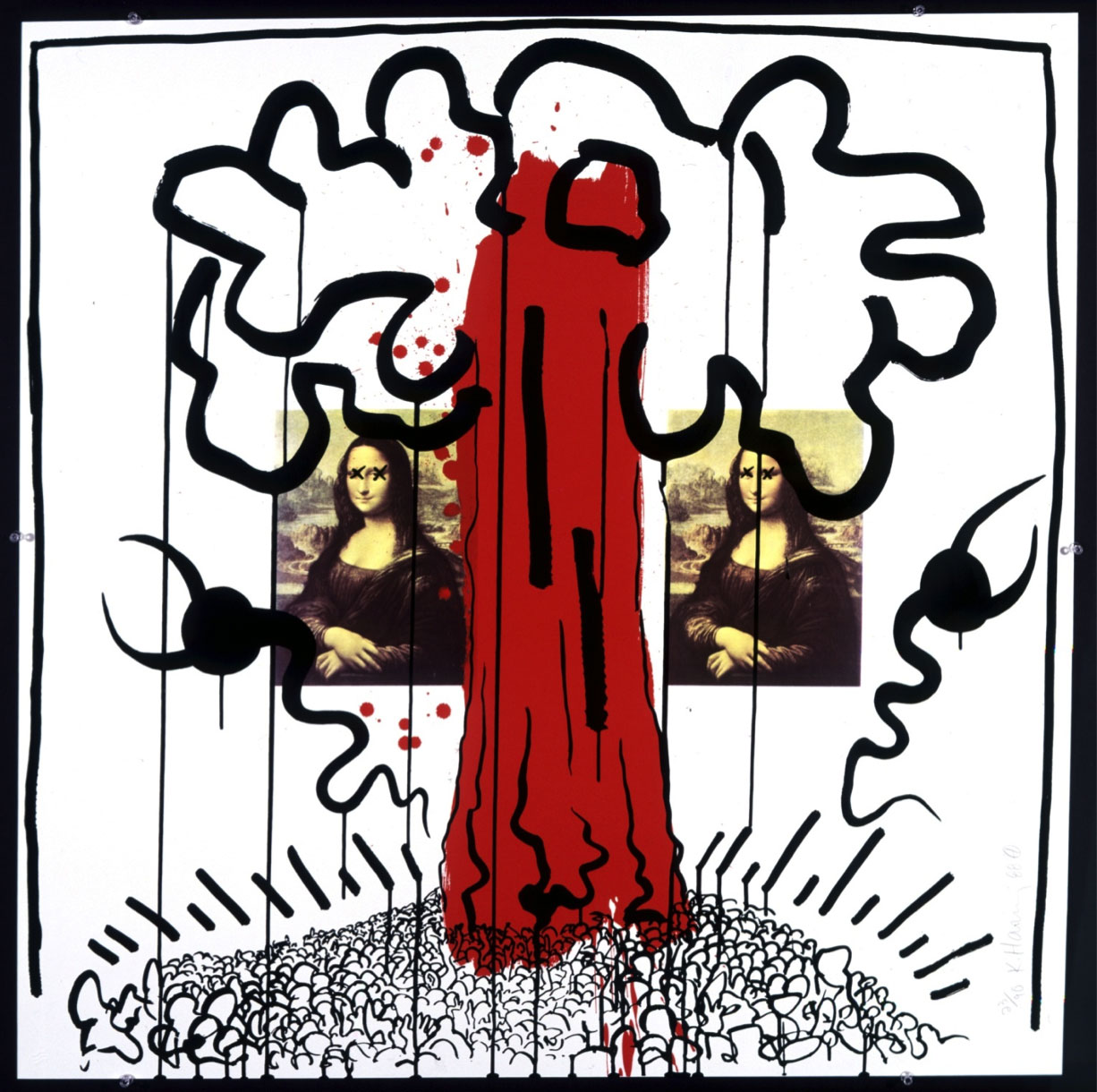
Keith Haring (American, 1958-1990) 'Apocalypse I' 1988


Keith Haring (American, 1958-1990)
Apocalypse I
1988
From the series Apocalypse, 1988
Silkscreen, Edition of 90
Courtesy of the Keith Haring Foundation


In their first collaboration, Keith Haring illustrated William S. Burroughs’ dystopic poem Apocalypse by mixing references to advertising, art history, and Catholic theology. Haring included his “devil sperm,” the black, horned symbol he created to give shape to HIV and its reign of death and terror.

Burroughs introduced the chaos unfolding:

“The final Apocalypse is when every man sees what he sees, feels what he feels, and hears what he hears. The creatures of all your dreams and nightmares are right here, right now, solid as they ever were or ever will be, electric vitality of careening subways faster faster faster stations flash by in a blur.”


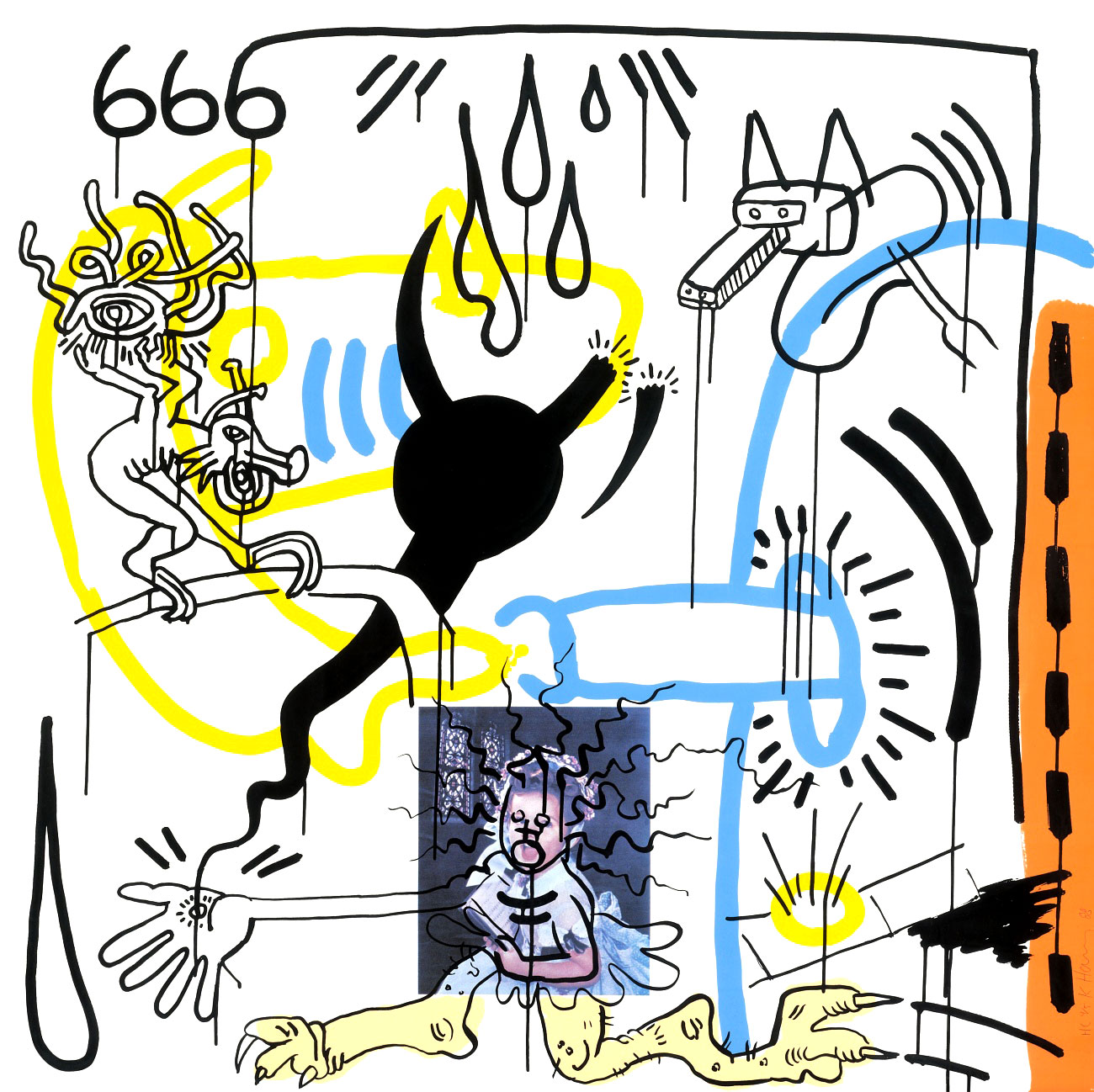
Keith Haring (American, 1958-1990) 'Apocalypse III' 1988


Keith Haring (American, 1958-1990)
Apocalypse III
1988
From the series Apocalypse, 1988
Silkscreen, Edition of 90
Courtesy of the Keith Haring Foundation


Grassroots Activism

Artists provided the early warnings of the AIDS crisis with their artworks deployed at the street level. Posters, stickers, T-shirts and other projects made it impossible to ignore messages about AIDS. These activist artists were informed by earlier precedents of feminist art and artists working on issues of identity politics. Communities coalesced around the calls to action.

The most prominent group to address the AIDS crisis was the anonymous artist collective Gran Fury in New York, a committee of ACT UP (the AIDS Coalition to Unleash Power). The collective used techniques and ideas from advertising, marketing, and the art world to raise awareness and affect political change. Their bold graphic style and refined text continues to influence politically-themed art.

Gran Fury and other activists changed how Americans thought about AIDS. The political and social pressure instigated by their actions and artworks played important roles in changing the approval process for AIDS drugs and treatment protocols. Women’s health issues were brought to the forefront. As a result, American society positively changed their opinions about HIV / AIDS when they had correct information.

Memento Mori

The AIDS crisis compelled contemporary American artists to address death with urgency. Artists witnessed a plague sweep through their communities and wipe out their friends, colleagues, and lovers. They used art to express their rage and terror when AIDS had no effective treatment. Their artwork provided a vitally important way to mourn their losses and share their sorrow.

Artists looked back to European and American artistic traditions of memento mori, Latin for “Remember that you must die,” to share their experiences, feelings, and stories. They adapted symbols like skulls and flowers to depict the fragility and fleeting nature of life.

Artists in this section shifted the intent of memento mori away from concepts of death and the afterlife. They refocused on the preciousness and precariousness of life, without forgetting the political and social realities behind the massive wave of death. Nayland Blake’s clock marks the passing of so many individuals with a call to action. David Wojnarowicz rages against the senseless death of Peter Hujar. Bill Jacobson and Karen Finley give form to the fragility of memory. Latino folk traditions connect the living and the dead in the paintings of Tino Rodriguez and Thomas Woodruff.

Poetic Postmodernism

In the early 1980s, American art was dominated by a new, postmodern theory. It held that meaning belongs not to the artist who made the work but to their audiences who interpret the works. Called “the death of the author,” the theory was named after a 1967 essay by the French postmodernist thinker Roland Barthes.

As AIDS actually caused the death of thousands of authors and artists by the late 1980s, this metaphor became a terrifying reality. At the same time, a powerful Christian conservative movement aggressively politicised AIDS. Using homophobia and fear of the disease, these politicians passed Federal laws that made it illegal to “promote, encourage, or condone homosexual sexual activities or the intravenous use of illegal drugs” in an AIDS awareness and education bill.

The ramifications for artists and art exhibitions were equally prohibitive. Federal laws were passed that made it impossible for museums to receive government support if an exhibition included obscene content, which was understood to mean gay themes among others, including AIDS-specific art. In this climate, artists knew that overt political content would result in censorship. So they developed a new way to smuggle political meaning into art.

In his research for Art AIDS America, Jonathan David Katz named this new approach “poetic postmodernism.” Artists used the postmodern theory “death of the author” to camouflage their own personal, expressive meanings. Many of the works in this exhibition have the same title format, the word “untitled” followed by a more specific description in parentheses such as in “Untitled” (Water), Untitled (Hujar Dead), or Untitled (Corrupt HIV Activism). The first term, “untitled,” signals the prevailing postmodernist idea that all meanings come from the audience. But the phrase inside the parentheses reveals clues to the artist’s associations and intentions. Because recognition of AIDS content was a product of the viewer’s thought and not the artist’s explicit claim, such works could be shown in museums without fear of being censored under the new laws.


Andres Serrano (American, b. 1950) 'Milk/Blood' 1989, printed 2015


Andres Serrano (American, b. 1950)
Milk/Blood
1989, printed 2015
Chromogenic colour print
Exhibition print
Courtesy of the artist


Milk/Blood recall the pure, flat colour of hard edged abstract painters such as Ellsworth Kelly. But the simple saturated colour fields in Serrano’s photograph bear the evocative title Milk / Blood, the two main body fluids that transmit HIV. Serrano appropriates the formal language of modernism for political purposes, a means of potentially slipping AIDS consciousness into a museum context without fear of exclusion or censure. As with HIV infection itself, the photograph underscores how our key sense, vision, is unreliable in the face of AIDS.


Andres Serrano (American, b. 1950) 'Blood and Semen III' 1990


Andres Serrano (American, b. 1950)
Blood and Semen III
1990
Chromogenic colour print, edition 1 of 4
40 × 60 inches
Courtesy of the artist
Photo courtesy of the artist


Like his Milk/Blood in this exhibition, Blood and Semen III also appears to be a rigorously formal composition, this time evoking the gestural appearance of an abstract expressionist painting. Again, the title references two body fluids that transmit HIV. As examples of poetic postmodernism, Serrano activates meaning in Blood and Semen III and Milk / Blood using formal arrangements and references to earlier artistic styles to inform his photographs with personal and potentially political content.


Shimon Attie (American, b. 1957) 'Untitled Memory (projection of Axel H.)' 1998


Shimon Attie (American, b. 1957)
Untitled Memory (projection of Axel H.)
1998
Ektacolor photograph, edition 1 of 3
32 × 38 3/4 inches
Courtesy of the artist and Jack Shainman Gallery, New York
© 2015 Artists Rights Society (ARS), New York / VG Bild-Kunst, Bonn
Photo courtesy of the artist


Shimon Attie (American, b. 1957) 'Untitled Memory (projection of Axel H.)' 1998 (detail)


Shimon Attie (American, b. 1957)
Untitled Memory (projection of Axel H.) (detail)
1998
Ektacolor photograph, edition 1 of 3
32 × 38 3/4 inches
Courtesy of the artist and Jack Shainman Gallery, New York
© 2015 Artists Rights Society (ARS), New York / VG Bild-Kunst, Bonn
Photo courtesy of the artist


After an extensive period working in Europe memorialising the Holocaust, Shimon Attie returned to San Francisco in 1996 and began his series Untitled Memory. Attie projected old photographs of his friends and lovers onto places with special meaning to him, including this room of a former apartment. His photographs of these projections became personal studies of loss and melancholy.


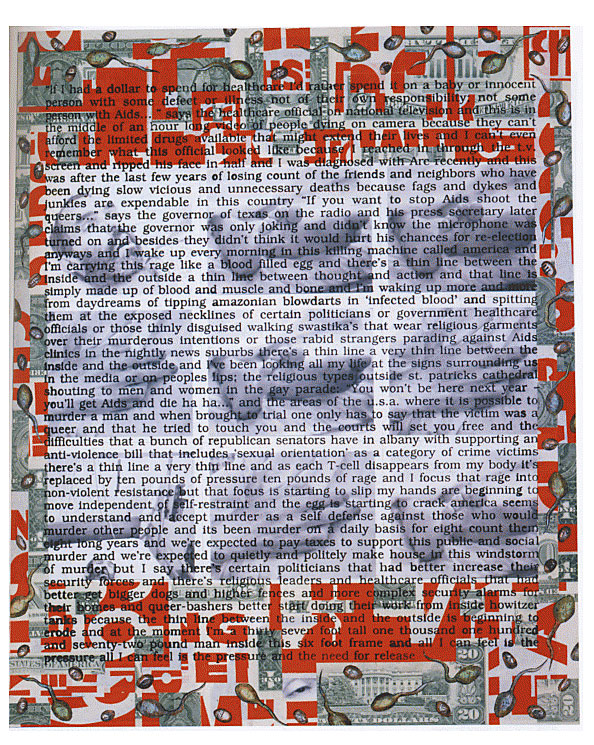
David Wojnarowicz (American, 1954-1992) 'Untitled (Hujar Dead)' 1988-1989


David Wojnarowicz (American, 1954-1992)
Untitled (Hujar Dead)
1988-89
Black and white photograph, acrylic, text and collage on Massonite
Collect of Steven Johnson and Walter Sudol
Courtesy Second Ward Foundation


Wojnarowicz was briefly lovers with and then became a close friend of the famous photographer Peter Hujar, who died of AIDS-related causes in 1987. Untitled (Hujar Dead) incorporates still images from a film by Wojnarowicz of Hujar’s lifeless body on his hospital bed. Wojnarowicz then overprinted the text of one of his famous “rants.” In these politically-charged performances and texts, he laid blame for the AIDS crisis squarely on the conservative right-wing demagogues who politicised the disease and continually spewed homophobic rhetoric which only exacerbated the crisis.


Tino Rodriguez (Mexican-American born Guadalajara, Mexico, b. 1965) 'Eternal Lovers' 2010


Tino Rodriguez (Mexican-American born Guadalajara, Mexico, b. 1965)
Eternal Lovers
2010
Oil on wood
Private collection


Tino Rodriguez (Mexican-American, born Guadalajara, Mexico, b. 1965) 'Eternal Lovers' 2010 (detail)


Tino Rodriguez (Mexican-American, born Guadalajara, Mexico, b. 1965)
Eternal Lovers (detail)
2010
Oil on wood
Private collection


Tino Rodriguez’s Eternal Lovers incorporates aspects of his Mexican heritage, and especially the tradition of skull imagery from Dia de los Muertos, the Day of the Dead. This family-oriented celebration of ancestors brings the living and dead into affectionate proximity. Rodriguez here exuberantly conflates familiar American oppositions such as death and life, growth and decay, and even good and evil. Inherently androgynous, the gender of the skulls remains unknown as does their cause of death. But as in the Dia de los Muertos celebration itself, Rodriguez’s image supplants horror with humour and loss with presence, offering the triumph of love and memory over death in the age of AIDS.


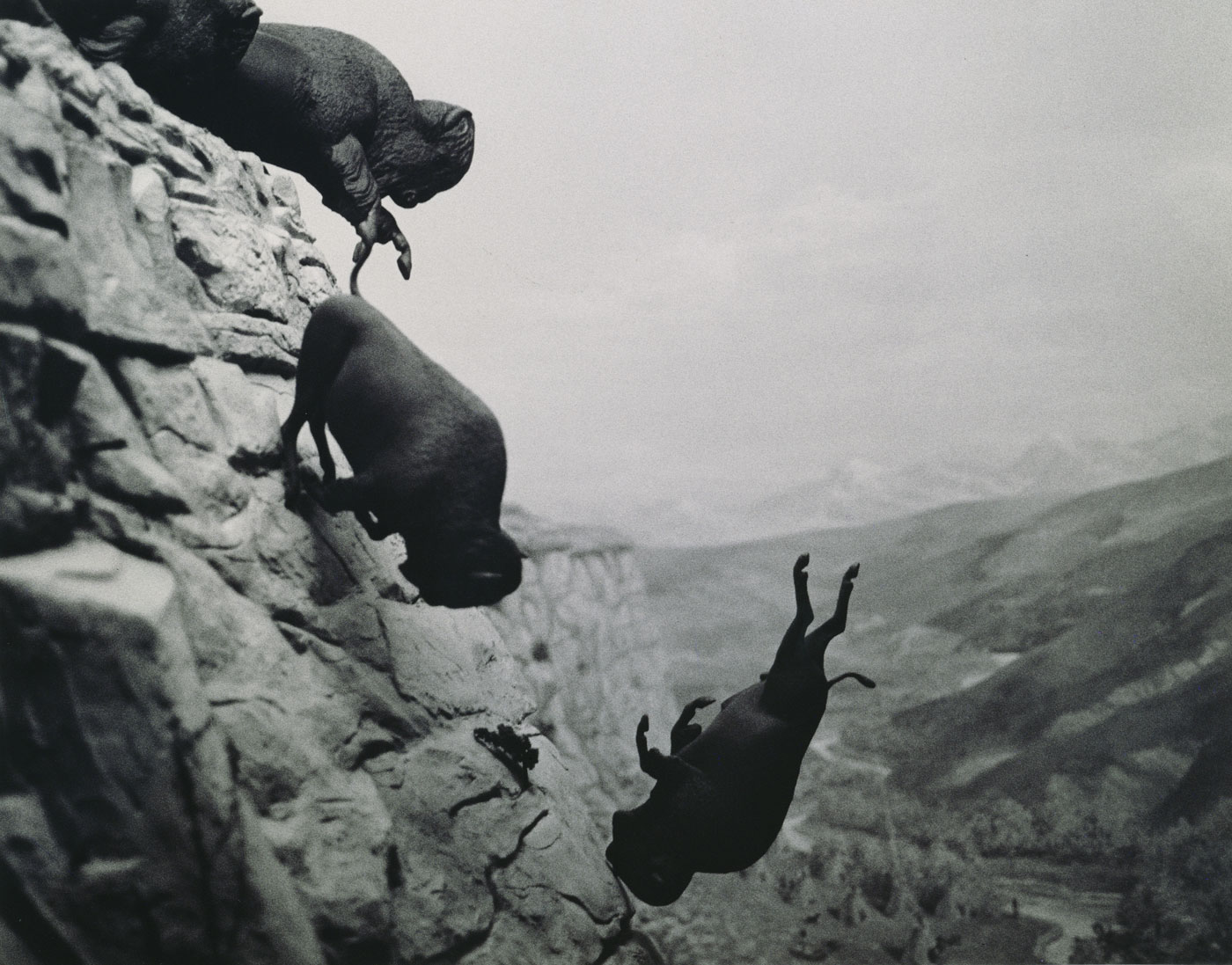
David Wojnarowicz (American, 1954-1992) 'Untitled (Buffalo)' 1988-1989


David Wojnarowicz (American, 1954-1992)
Untitled (Buffalo)
1988-1989
Vintage gelatin silver print, signed on verso
Collection of Michael Sodomick


For Untitled (Buffalo), David Wojnarowicz simply photographed a diorama in a museum in Washington, DC. This image of buffalo being herded off a cliff served as a chilling metaphor of the politics of AIDS in the US in the late 1980s. Rather than an illustration of traditional Native American hunting techniques, Wojnarowicz eloquently expressed his rage, desperation, and helplessness through the great symbol of American identity. His shifting and layering of meaning onto this symbol is a classic example of poetic postmodernism.

One example of how artists hid their message is David Wojnarowicz’s Untitled (Buffalo). It’s a diorama of a buffalo fall, a traditional method of harvesting large numbers of buffalo by chasing herds off cliffs. The buffalo are made from plastic. Wojnarowicz photographed the diorama and cropped it. “This is appropriation,” Hushka said. “He used it as this extraordinarily eloquent cry about the state of American politics at the time.” Katz added, “It’s telling that even an artist of Wojnarowicz’s activist fervour engaged in a metaphor that only cohered in the mind’s eye. You needed to be attentive to what it might be saying to read it. There’s nothing specifically AIDS about it.”

Spiritual Forces

Because of the overwhelming number of deaths, the unspeakable losses, and the constant presence of disease, it should not be surprising that artists also turned to issues of spirituality. Yet, the art history of AIDS often neglects this important aspect. Across the United States, faith communities tended to the spiritual needs of people with AIDS and provided critical services for them. These communities continue to support people living with HIV.

The AIDS crisis exposed deep division within many spiritual traditions. Artists such as Jerome Caja, Robert Gober, and Barbara Kruger expressed discomfort and displeasure in how some religious ideologies oppressed gays and lesbians and worsened the AIDS crisis. Others made inspiring works within long-established traditions like Keith Haring’s altar piece. In other artworks, artists created symbols for the dignity of people suffering from AIDS, ranging from Christian saints and Biblical texts to imagery inspired by Buddhism and healing traditions from India.


Keith Haring (American, 1958-1990) 'Altar Piece' 1990 (cast 1996)


Keith Haring (American, 1958-1990)
Altar Piece
1990 (cast 1996)
Bronze with white gold leaf patina, edition 2 of 9
60 × 81 x 2 inches
Denver Art Museum, Gift of Yoko Ono, 1996.204A-C.
© Keith Haring Foundation
Photo © Denver Art Museum


This altar piece by Keith Haring is the last work the artist completed. He worked on the wax mould while he was hospitalised for AIDS-related illnesses. The triptych format echoes traditional Roman Catholic altar pieces. The image of the crying mother holding an infant speaks to the inconsolable losses from AIDS. The mother’s tears fall on the crowds, seeking solace and mercy from the AIDS epidemic.


Barbara Kruger (American, born Newark, New Jersey, 1945) 'Untitled (It's our pleasure to disgust you)' 1991


Barbara Kruger (American, born Newark, New Jersey, 1945)
Untitled (It’s our pleasure to disgust you)
1991
Photographic silkscreen on vinyl
The Museum of Contemporary Art, Los Angeles, Gift of Eric and Nannette Brill


Despite provocative imagery and text, Barbara Kruger intends no specific meaning to her artworks. Rather, Kruger wants to demonstrate how the reader generates meaning each time the text is read. She activates ambiguity and political charge with the phrase “It’s our pleasure to disgust you.” Kruger underscores the gulf between and image and its possible meanings, an issue brought into high relief in the culture wars promoted by religious conservatives, during the period when this work was made.

The work may be interpreted as evidence that artists like Kruger were deliberately insensitive to cultural norms. Alternatively, it could be read as proof that artworks were deliberately manipulated for political purpose by others. Because AIDS was framed in political terms from its earliest moment, Kruger’s Untitled (It’s our pleasure to disgust you) reflects the complexity and deliberate uses of language about AIDS.


Robert Gober (American, born Wallingford, Connecticut, 1954) 'Drains' 1990


Robert Gober (American, born Wallingford, Connecticut, 1954)
Drains
1990
Cast pewter Edition of 8, with 2 artist’s proofs, artist’s proof 1 of 2
Collection of the artist


Robert Gober’s Drains is meticulously handcrafted to resemble a mass-produced consumer good. Because we think about drains primarily as a tool to remove waste often associated with personal hygiene and cleaning, connections to HIV/AIDS are obvious. By placing the sculpture in an unexpected position on a gallery wall, Gober seeks to generate unanswerable, metaphorical questions about the functions of a drain and the unknown space behind it. The cruciform shape at the back of the drain recalls his childhood and his complicated relationship with Catholicism.


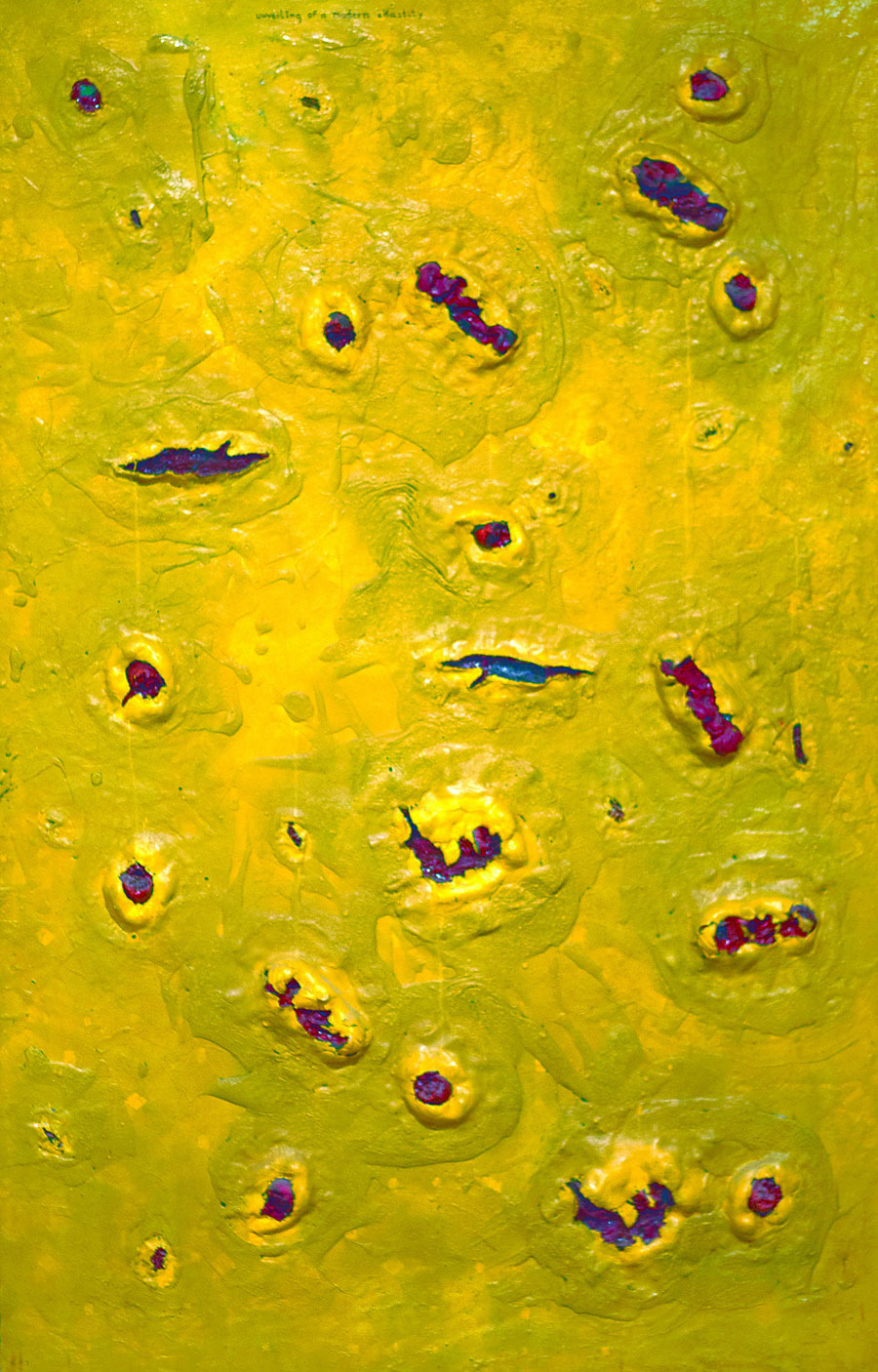
Izhar Patkin (American born Israel, b. 1955) 'Unveiling of a Modern Chastity' 1981


Izhar Patkin (American born Israel, b. 1955)
Unveiling of a Modern Chastity
1981
Rubber paste, latex theatrical wounds, and
printing ink on a stretched linen canvas
Courtesy of the artist


Izhar Patkin painted Unveiling of a Modern Chastity one year before there was any public announcement about a new disease striking formerly healthy young men. This is the earliest work in the exhibition, and, in retrospect, one of the earliest AIDS paintings ever. Troubled by the sight of a group of such young men with similar dark purple skin lesions waiting in his dermatologist’s office, he presciently titled the work to reflect what he felt might be a forthcoming change in sexual culture. The painting’s skin-like surface erupts in what looks like Kaposi’s sarcoma lesions.

Patkin’s heavily textured surface and use of artificial wounds was his effort to destroy minimalism and other traditions of pure abstraction. He wanted to expose the inability of modernist art to contain pressing social and contextual significance.

DID YOU KNOW? The Centers for Disease Control issued its first statement about a cluster of 19 cases of Kaposi’s sarcoma (a rare skin cancer most common in elderly men from southern Italy) and Pneumocystis carinii pneumonia in young, gay men in New York, Los Angeles, and San Francisco in July 1981.


Albert J. Winn (American, 1947-2014) 'Akedah' 1995


Albert J. Winn (American, 1947-2014)
Akedah
1995
Gelatin silver print
171/2 × 21 3/4 inches
Courtesy of Scott R. Portnoff
Photo courtesy of the Estate of Albert J. Winn


In the artist’s own words: “Every month, because of my illness, I need to undergo a blood test. During the process, a tourniquet is bound tightly about my upper arm. At times when I’ve been on a study protocol for an experimental medicine, I’ve had my blood drawn every day. Having my blood drawn has become a ritual in what sometimes seems is a new religious practice, an AIDS ritual.

“Over time, I’ve transformed this ritual in relation to my Judaism. I wonder if like Isaac, I am being sacrificed. This time to science. I pray that an angel will intercede and spare my life. When my arm is bound with a tourniquet and the veins bulge, I am reminded that I am bound to my illness. I look at the rubber strap and see tefillin. Sometimes the impression of the leather straps from the tefillin are still visible on my skin by the time the tourniquet is wrapped around my arm. The binding of the tefillin is a reminder of being bound to my heritage. The straps also make my veins bulge. Except for the needle stick the binding feels the same.”


Art AIDS America at the Tacoma Art Museum

Politics, sex, religion, loss, and beauty – all of the topics that you can’t talk about over dinner but can at a museum – are open for discussion in Art AIDS America, an exhibition that reveals for the first time how the AIDS crisis forever changed American art. Since the first reports of mysterious illnesses in the early 1980s, HIV and AIDS have touched nearly every American in some way, and operated as an undeniable (though often unacknowledged) force in shaping politics, medicine, and culture. Art AIDS America presents the full spectrum of artistic responses to AIDS, from the politically outspoken to the quietly mournful.

Art AIDS America is a story of resilience and beauty revealed through art, and the community that gathered to bring hope and change. While recognising and honouring loss and grief, it refutes the narrative that AIDS is only a tragic tangent in American art, exploring how artists’ responses to the crisis and its legacy continue to inform contemporary American art. These artworks offer a vibrant representation of community, caring, creativity and activism. And, Art AIDS America will serve as a vivid reminder that the crisis is not over; HIV infections are increasing. According to the Centers for Disease Control and Prevention (CDC), more than 1.2 million Americans are living with HIV.

A decade in the making, this exhibition is co-curated by TAM’s Chief Curator, Rock Hushka, and Jonathan D. Katz, PhD, Director, Visual Studies Doctoral Program, University at Buffalo.

“AIDS fundamentally changed American art, remaking its communicative strategies, its market, its emotional pitch and – not least – its political possibilities. But we’ve repressed the role of AIDS in the making of contemporary American culture, as we’ve repressed the role of AIDS in every other aspect of our lives. This exhibition underscores how powerfully a plague that is still with us has changed us,” says Katz. “Art AIDS America creates spaces for mourning and loss, yes, but also for anger and for joy, for political resistance and for humor, for horror, and for eroticism.”

The exhibition assembles 125 significant works in a wide range of media. The artists are diverse, including the internationally acclaimed such as Robert Gober, Felix Gonzalez-Torres, Keith Haring, Jenny Holzer, Annie Leibovitz, Robert Mapplethorpe, and Martin Wong, and those not yet as widely celebrated such as Luis Cruz Azaceta, Chloe Dzubilo, Derek Jackson, Kia Labeija, and Joey Terrill. The works date from 1981 to today, and some, like Catherine Opie’s photographs of the 1986 AIDS / ARC vigil in San Francisco, will be on public view for the first time.

“Art reflects and reacts to social, cultural, and political climates, and in the past 30 years, HIV and AIDS has been a constant presence,” says Hushka. “So many of us recall friends, family, and partners we have lost and the terror of the early years of the crisis, while younger people are just learning this story. We seek to create a deeper understanding of the legacy of HIV / AIDS in contemporary American art, and encourage our visitors to see their experiences in these works.”

Works in the exhibition will generally fall into two categories: art with a clear tie to AIDS, and art that requires the viewer to look beyond the surface to understand its connection to HIV / AIDS. Some artists addressed the AIDS crisis through activist works, community projects, graphics, and direct political statements. For example, the collective ACT UP NY / Gran Fury’s installation Let the Record Show… sears the words of public officials whose actions inflamed the crisis, including the silence of President Ronald Reagan, who would not speak publicly about AIDS until 1987. Other artists use camouflage, coding, misdirection, symbols, or other covert strategies to address the social, political, and physical impacts of HIV. An example is Robert Sherer’s beautifully rendered Sweet Williams, a basket of cut flowers, painted in HIV-negative and HIV-positive blood, about the untimely deaths of so many young men. The exhibition will be organised roughly by works created pre- and post-cocktail (in this case, ‘cocktail’ refers to the combination of drugs and therapies used to manage HIV and prevent the development of AIDS).

“Tacoma Art Museum is a safe space where people are able to address important and challenging issues. We are proud to present Art AIDS America. It is fitting that the exhibition debuts in Tacoma, the city that established the nation’s first government-sanctioned needle exchange program in a proactive approach toward controlling the spread of AIDS,” said Stephanie Stebich, TAM’s Executive Director. “TAM also has the scholarship to support this exhibition through our chief curator Rock Hushka and the exhibition’s co-curator Dr. Jonathan D. Katz, who also co-curated the award-winning Hide/Seek: Difference and Desire in American Portraiture, which we brought to TAM in 2012.”

The Art AIDS America catalogue is a significant component of the exhibition, with 15 contributors, nearly 300 pages, and more than 200 illustrations. It is published in association with the University of Washington Press of Seattle and London and designed by Marquand Books, Seattle. Art AIDS America is organised by TAM in partnership with the Bronx Museum of the Arts and will tour nationally. See it first at TAM, on view October 3, 2015 through January 10, 2016. The exhibition will then travel to Zuckerman Museum of Art, Kennesaw State University, GA; and The Bronx Museum of the Arts, NY.

Press release from the Tacoma Art Museum website


Bill Jacobson (American, b. 1955) 'Interim Portrait #373' 1992


Bill Jacobson (American, b. 1955)
Interim Portrait #373
1992
Chromogenic colour print
24 × 20 inches
Courtesy of the artist
Photo courtesy of the artist


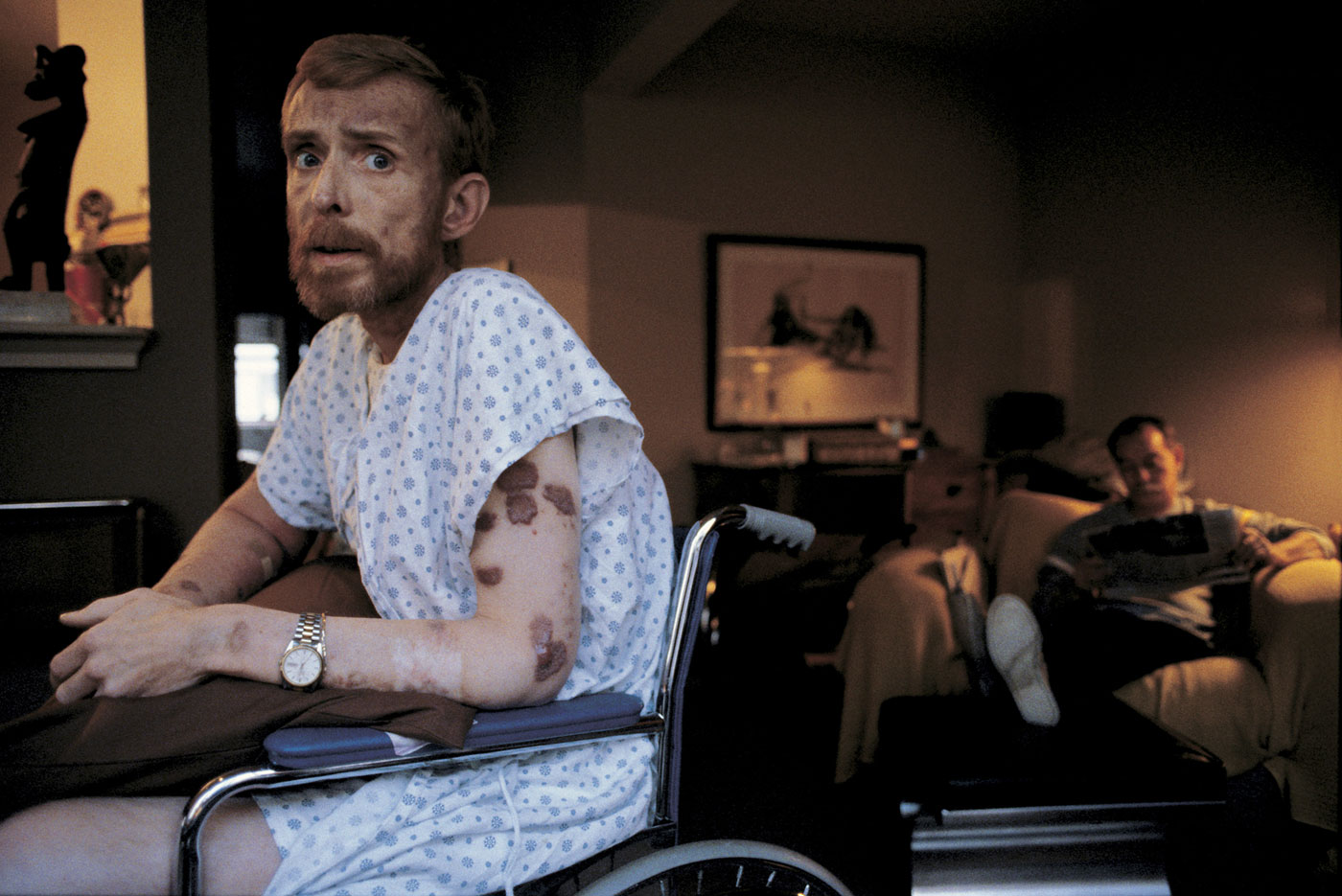
Alon Reininger (American born Tel Aviv, Israel, b. 1947) 'Ken Meeks, PWA' 1985


Alon Reininger (American born Tel Aviv, Israel, b. 1947)
Ken Meeks, PWA
1985
Archival pigment print
Courtesy of Contact Press Images, New York


Mark I. Chester (American, born Milwaukee, Wisconsin, 1950) 'Robert Chesley - ks portraits with harddick & superman spandex, #1–#6' 1989, printed 2015


Mark I. Chester (American, born Milwaukee, Wisconsin, 1950)
Robert Chesley – ks portraits with harddick & superman spandex, #1-#6
from the series Diary of a Thought Criminal
1989, printed 2015
Pigment print
Courtesy of the artist


Mark I. Chester gives us the first portrait of a sexually active person with AIDS. Robert Chesley (1943-1990) was a playwright, theatre critic for the San Francisco Bay Guardian, and music composer. Perhaps his most celebrated play was Jerker, or The Helping Hand: A Pornographic Elegy with Redeeming Social Value and a Hymn to the Queer Men of San Francisco in Twenty Telephone Calls, Many of Them Dirty. At a time when many gay men had come to associate their own sexuality with death, the artist showed Chesley as a vibrant, active person with AIDS, intended as a rebuke to the routine AIDS portraits of mortally ill people. With this series, Chester rewrote the late-1980s codes for representing gay male sexuality from sexlessness and death towards a renewed embrace of life and its pleasure.


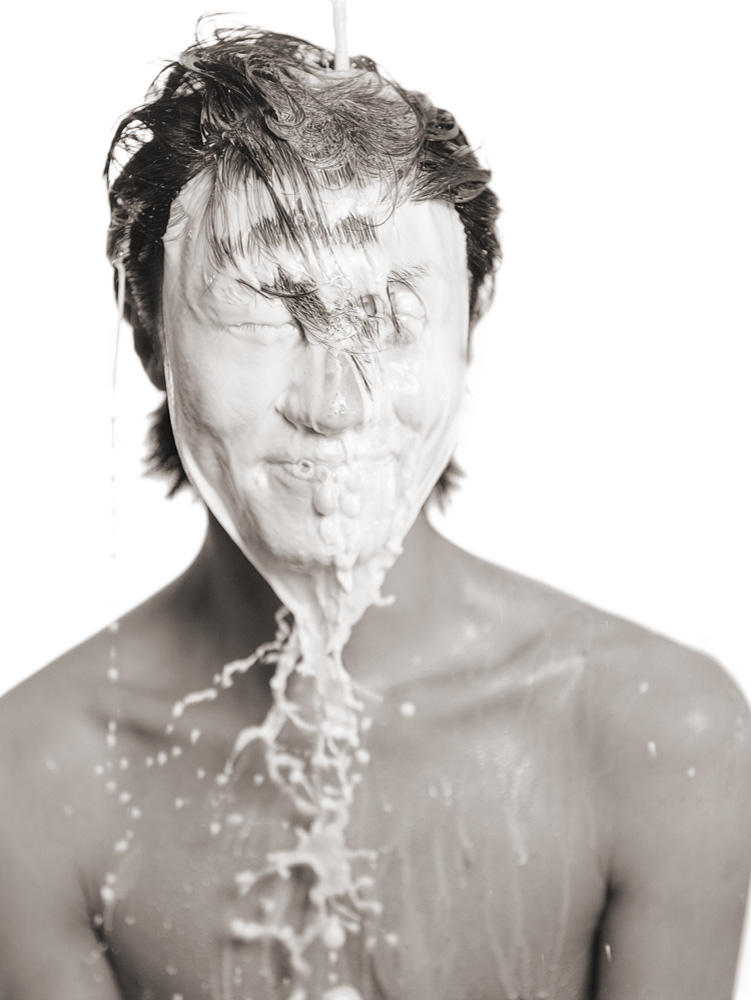
Steven Miller (American, b. 1968) 'Robert' from the series 'Milky' 2004


Steven Miller (American, b. 1968)
Robert from the series Milky
2004
Inkjet print
Edition 2 of 10
Tacoma Art Museum, Museum purchase with funds from Curtis Man


For his series Milky, photographer Steven Miller asked his friends if he could photograph them as he poured milk over their heads. These portraits capture the different reactions to the sensation and convey a sense of discomfort from being drenched by fluids like milk. Miller likens these two aspects to a symbolic infection of HIV. For many gay artists of his generation, HIV looms as a constant presence, and body fluids remain deeply ingrained as transmitters of the virus.


Portraiture

Artists used portraits to directly convey the devastating effects of the crisis on individuals. Even if we do not know the subject, portraits remind us that someone we know was likely affected by AIDS. Because the science about the retrovirus was new and extremely complicated and frightening, such portraits humanised the disease so it could be understood through personal stories.

Early portraits brought attention to the physical symptoms of AIDS such as the deep purple lesions of the skin cancer Kaposi’s sarcoma and the devastating weakness caused by AIDS-related wasting syndrome. Artists soon refocused on portraits of defiant individuals living with HIV. Refusing to show people as victims of an incurable disease, these portraits depicted fighters and survivors.

From pure abstract representations to straightforward photographic likenesses, portraits continue to illuminate how individuals respond to and overcome even the most complex aspects of HIV/AIDS such as stigma, racism, sexism, and poverty.

The Legacy of the AIDS Crisis

HIV is no longer an immediate life-or-death issue facing American artists, but one that quietly and continually persists in intriguing ways. The legacy of the AIDS crisis can be traced either through the motifs and influences of earlier artists or by understanding the psychological trauma and challenges that result from living in a world with HIV.

Artworks made after antiretroviral medicines became available in the mid-1990s beg the questions: If HIV is undetectable in a body and all but invisible in society, why should visibility in art be any different? How do you identify HIV if an artist is unwilling to speak about it but doesn’t live a moment of his or her intimate life without being aware of its near-certain presence?

Artists such as John Arsenault, Kalup Linzy, Patte Loper, and Donald Moffett bring their personal histories as activists and care givers into their artwork. They also use their art to express the discomfort and complexities of living in a world with the constant presence of HIV.

Works of art should be read with empathy and compassion to understand the fullness and richness of the artist’s experience. We need to remind ourselves of the stresses, anxieties, fears, and realities caused by the burden of HIV. To honor these artists’ experiences, we must insist that HIV inform at least part of the meaning of their work. This will ensure an understanding of their art as part of an art history of deep social engagement and connection.


Julie Tolentino (American, b. 1964) 'THE SKY REMAINS THE SAME: Tolentino Archives Ron Athey's Self-Obliteration #1' 2008


Julie Tolentino (American, b. 1964)
THE SKY REMAINS THE SAME: Tolentino Archives Ron Athey’s Self-Obliteration #1
2008
Chromogenic colour print
Edition 1 of 5
Documentation courtesy of Leon Mostovoy
Courtesy of the artist and Commonwealth & Council, Los Angeles


These three photographs capture moments in the archival performance of THE SKY REMAINS THE SAME: Tolentino Archives Ron Athey’s Self-Obliteration #1.

Section 1 (left): The work begins with Athey’s solo performance of Self-Obliteration #1 while Tolentino, from a nearby platform, aims to capture his performance movements and affect (a reading of tones, gestures, and movements) as an archival action.

This work involves a long blond wig pierced onto the scalp with hidden needles. The needles are removed, causing blood to stream and pool onto two panes of glass. Ultimately, these glass pieces are positioned to encase the individual body.

Section 2 (center and right): Tolentino and Athey “repeat” his performance, a true impossibility in the live form – displaying a disrupted mirroring of the other.

Like a low current running throughout the work, THE SKY REMAINS THE SAME‘s tension opens to the spectator’s subjectivity. A range of issues are activated: Athey’s openly HIV positive status; the actions performed on a differently-gendered person of colour; and the intimate act of bleeding. This becomes entangled with Tolentino’s practice, history of activism and advocacy, caregiving and artist-to-artist relations as a living archive.


Catherine Opie (American, b. 1961) 'Ron Athey/The Sick Man (from Deliverance)' 2000


Catherine Opie (American, b. 1961)
Ron Athey/The Sick Man (from Deliverance)
2000
Polaroid
Private collection


This work by Catherine Opie, taken with the world’s largest polaroid camera, was made in collaboration with the performance artist Ron Athey. Athey achieved both fame and censure as an HIV positive performance artist whose work involved physical and psychic trials, along with, on occasion, blood.

Clearly a response to AIDS, the pose of Ron Athey/The Sick Man recalls the traditional iconography of the Pieta, in which the Virgin Mary supports the body of the dead Christ. Athey is held by his performance partner Darryl Carlton (a.k.a. Divinity Fudge), two heavily tattooed men in place of the holy family. The implications of self-sacrifice and transcendence through pain and suffering animate both the original scene and this more contemporary incarnation. Opie situated the figures in a beautiful, richly saturated black space. She offers a contemporary allegory of the excluded sufferer whose exile and death can be laid at the feet of those who consider themselves pious.


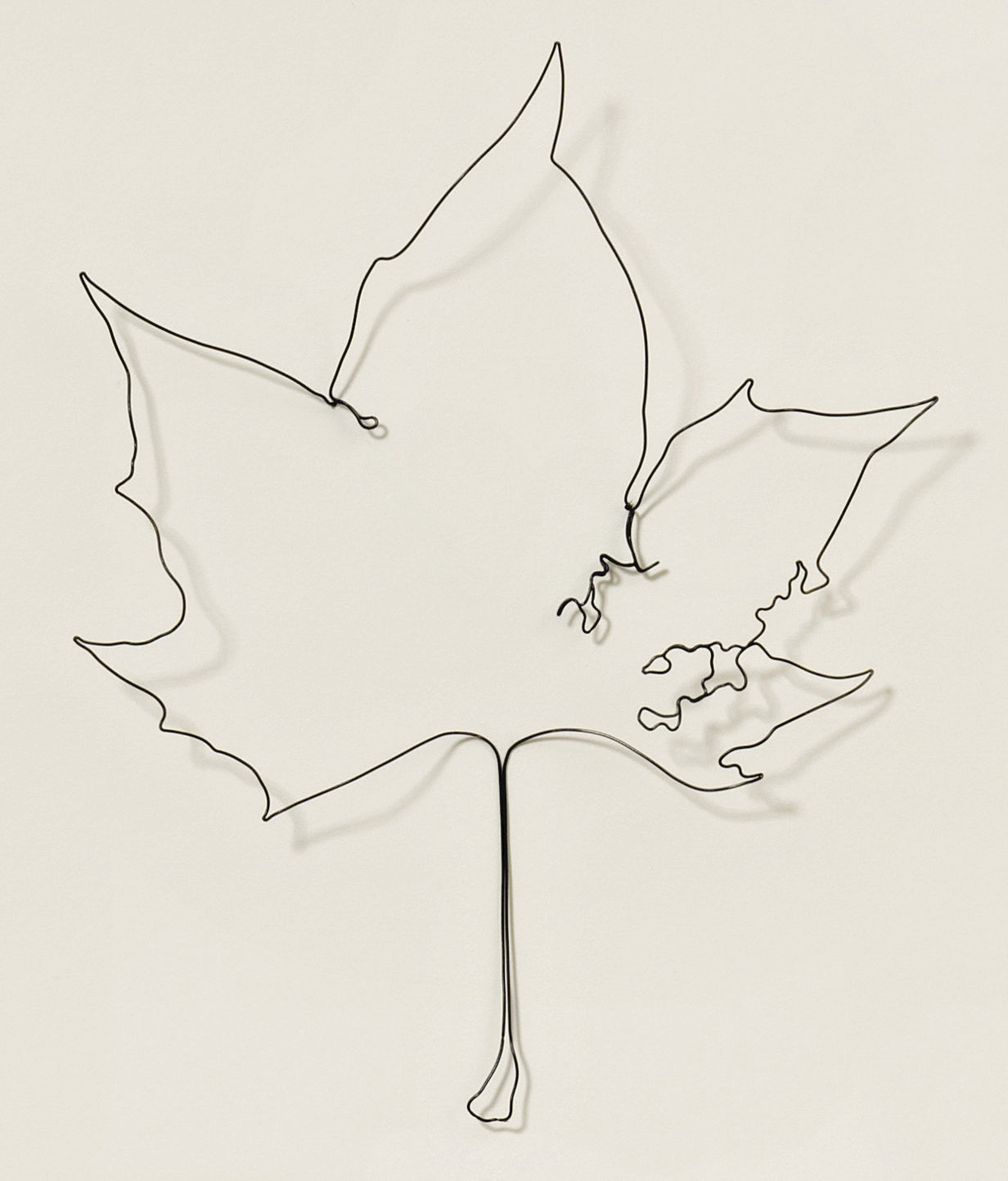
Eric Rhein (American, b. 1961) 'Life Altering Spencer from Leaves' 2013


Eric Rhein (American, b. 1961)
Life Altering Spencer from Leaves
2013
Wire and paper
Addison Gallery of American Art, Phillips Academy, Andover, Massachusetts
Purchased as the gift of Louis Wiley, Jr. (PA 1963) in Memory of Paul Monette (PA 1963) and his partner Roger Horwitz


Eric Rhein began The Leaf Project in 1996 to raise awareness around HIV/AIDS and chose to memorialise his friends who had died of AIDS-related causes. He selected the leaf motif to honour the individuality of each person, while also evoking the countless leaves shed by trees in autumn. Life Altering Spencer honours AIDS activist Spencer Cox (1968-2012), a member of ACT UP, Treatment Action Group, and the Food and Drug Administration’s Anti-Viral Advisory Committee. In this capacity, Cox and others became experts on drug trials and approval, successfully lobbying to hasten the approval time for new HIV medications. Cox and his group thus changed the course of medicine in America – the first non-physicians to do so – and, not coincidentally, these new treatments saved the life of artist Eric Rhein.


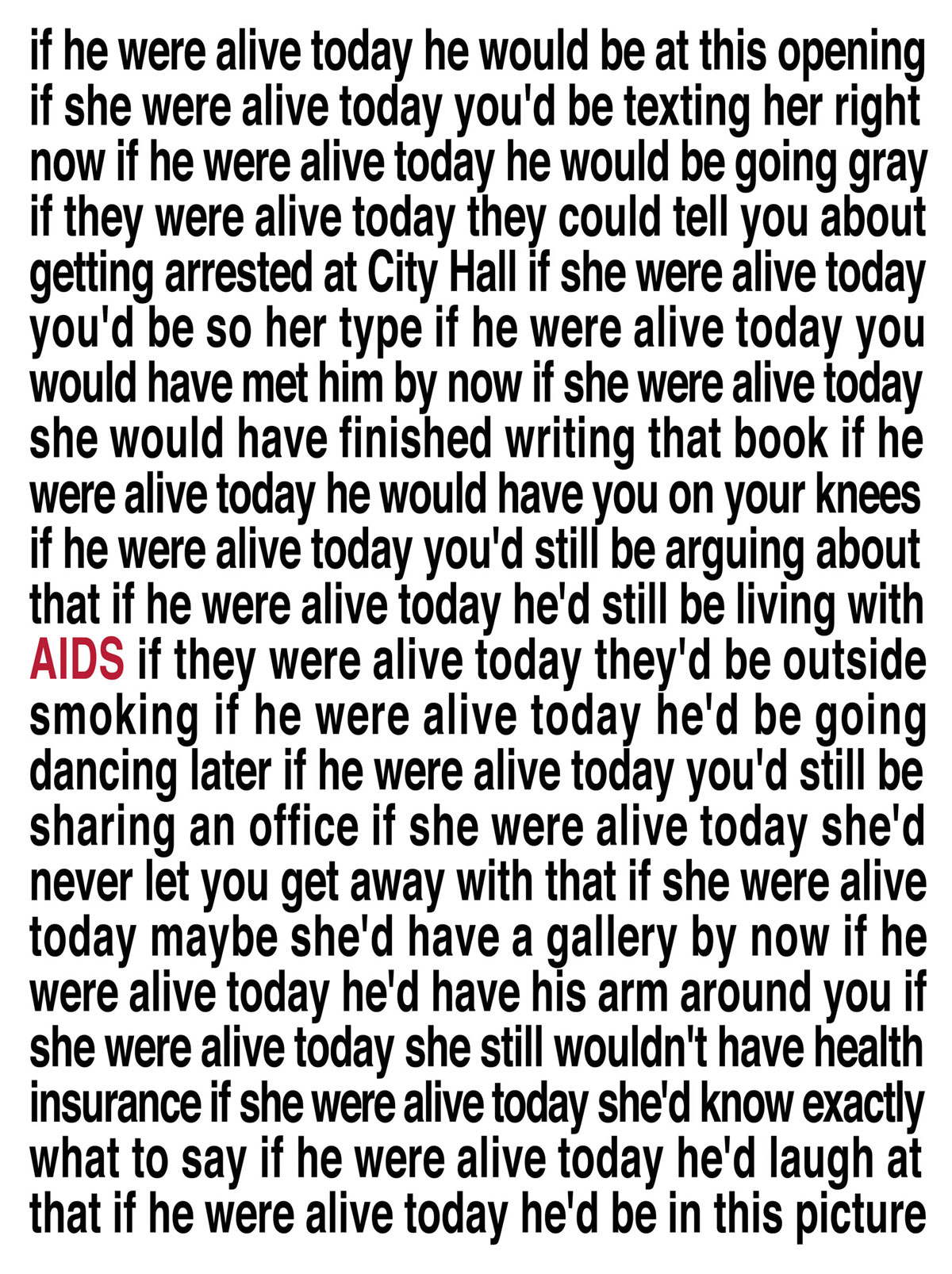
fierce pussy (formed New York, New York, 1991) 'For the Record' 2013


fierce pussy (formed New York, New York, 1991)
For the Record
2013
Two offset prints on newsprint, two panels, installed: 22⅝ x 70 inches
Courtesy of the artists
Photo courtesy of the artists


The collaborative group fierce pussy created this work for the organisation Visual AIDS in New York City. Playing off Gran Fury’s 1987 Let the Record Show… and evoking postmodern text based art, fierce pussy asks that we remember the thousands of people who died of HIV-related causes before antiretroviral drugs became available to control the virus. They insist that we continue the work to end HIV/AIDS despite these new drugs.


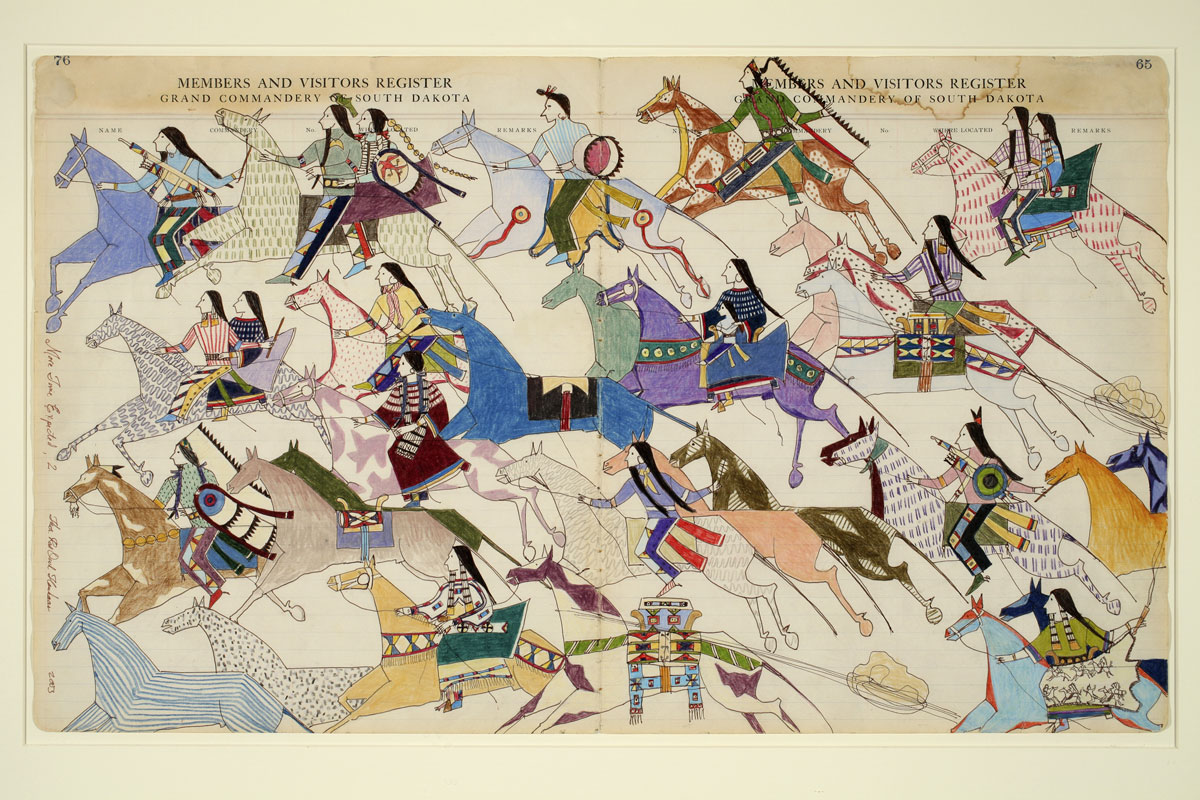
Thomas Haukaas (American, b. 1950) Tribal Affiliation: Sicangu Lakota 'More Time Expected' 2002


Thomas Haukaas (American, b. 1950)
Tribal Affiliation: Sicangu Lakota
More Time Expected
2002
Handmade ink and pencil on antique ledger paper, 161/2 x 271/2 inches
Tacoma Art Museum, Gift of Greg Kucera and Larry Yocom in honour of Rock Hushka, 2008.10
Photo by Richard Nicol
© TAM


Thomas Haukaas (American, b. 1950) Tribal Affiliation: Sicangu Lakota 'More Time Expected' 2002 (detail)


Thomas Haukaas (American, b. 1950)
Tribal Affiliation: Sicangu Lakota
More Time Expected (detail)
2002
Handmade ink and pencil on antique ledger paper, 161/2 x 271/2 inches
Tacoma Art Museum, Gift of Greg Kucera and Larry Yocom in honour of Rock Hushka, 2008.10
Photo by Richard Nicol
© TAM


The horse with no rider at the centre of the composition represents individuals on the reservation who have died of AIDS-related causes. Using the 19th-century tradition of ledger drawing, with a riderless horse as symbolic of a warrior who fell in battle, Haukaas weaves together the complicated issues of stigma surrounding HIV / AIDS and the Native American experience with the disease.


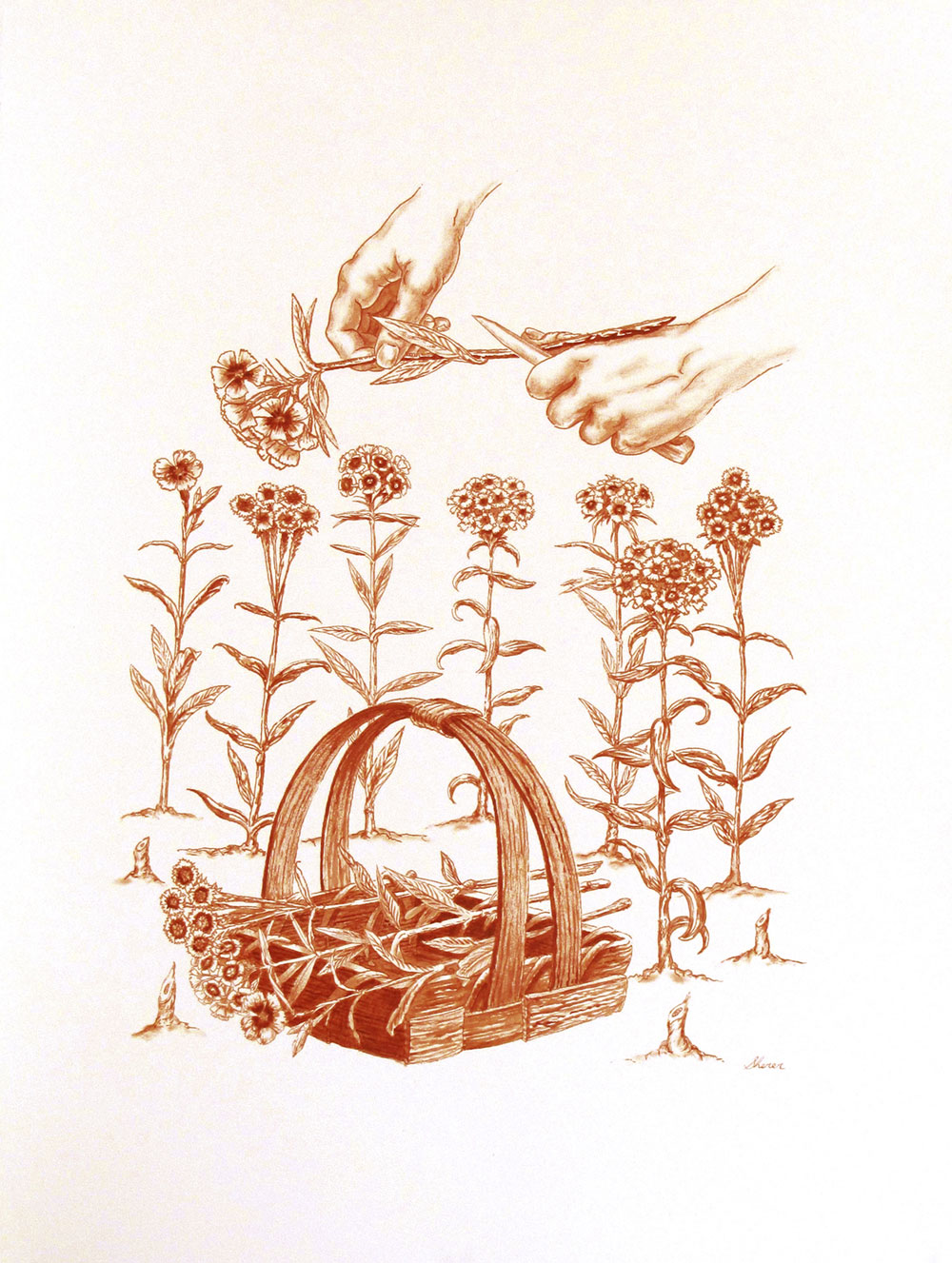
Robert Sherer (American, b. 1957) 'Sweet Williams' 2013


Robert Sherer (American, b. 1957)
Sweet Williams
2013
HIV- and HIV+ blood on paper
Courtesy of the artist


The title Sweet Williams comes from Robert Sherer’s childhood. His grandmother, an avid gardener, often asked him to help gather flowers from her garden and instructed, “Now, honey, cut down the most beautiful ones first.” Upon reflection, Sherer realised that AIDS was deeply correlated to beauty and sexual attraction. He remembers his many handsome friends and acquaintances who died too early – the Williams, the Billys, the Wills, the Willies – memorialising them in an image drawn in HIV negative and positive blood. Of all his colleague friends, two of whom were named William, only Sherer is still alive.


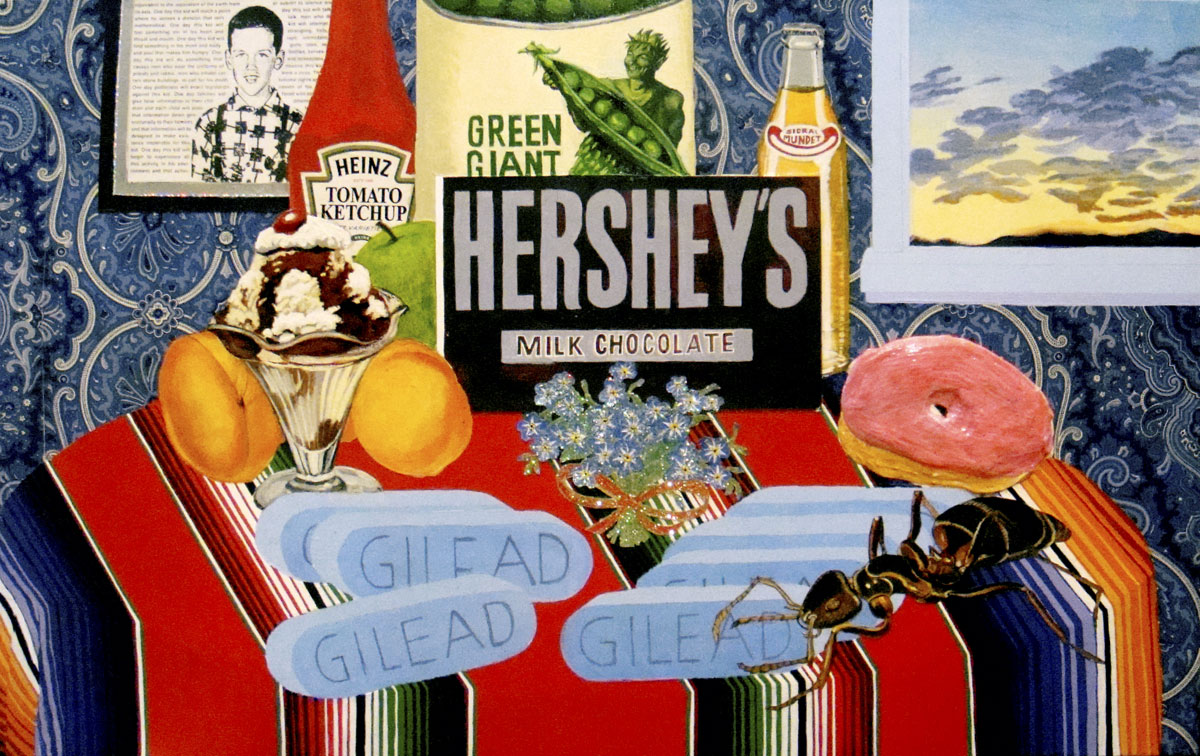
Joey Terrill (American, b. 1955) 'Still-Life with Forget-Me-Nots and One Week's Dose of Truvada' 2012


Joey Terrill (American, b. 1955)
Still-Life with Forget-Me-Nots and One Week’s Dose of Truvada
2012
Mixed media on canvas
Leslie-Lohman Museum of Gay and Lesbian Art, Foundation purchase


Long-time Latino queer rights and AIDS activist Joey Terrill makes paintings that resemble the work of such well-known pop artists as Tom Wesselmann. Departing from Wesselmann’s 1960s pop still-life paintings, Terrill subverts the genre through his many queer references, not least the regular inclusion of the HIV medication Truvada. In these his appropriations of the American dream, Terrill shows himself to be a political activist – a role he has inhabited since the 1970s.

Terrill’s addition of the forget-me-nots at the centre of the composition pays homage to his artistic hero David Wojnarowicz. He also alludes to the daily routine of the antiviral medicine Truvada and pointedly questions why changes in the social and political realms have allowed this to be a normal part of so many people’s lives.


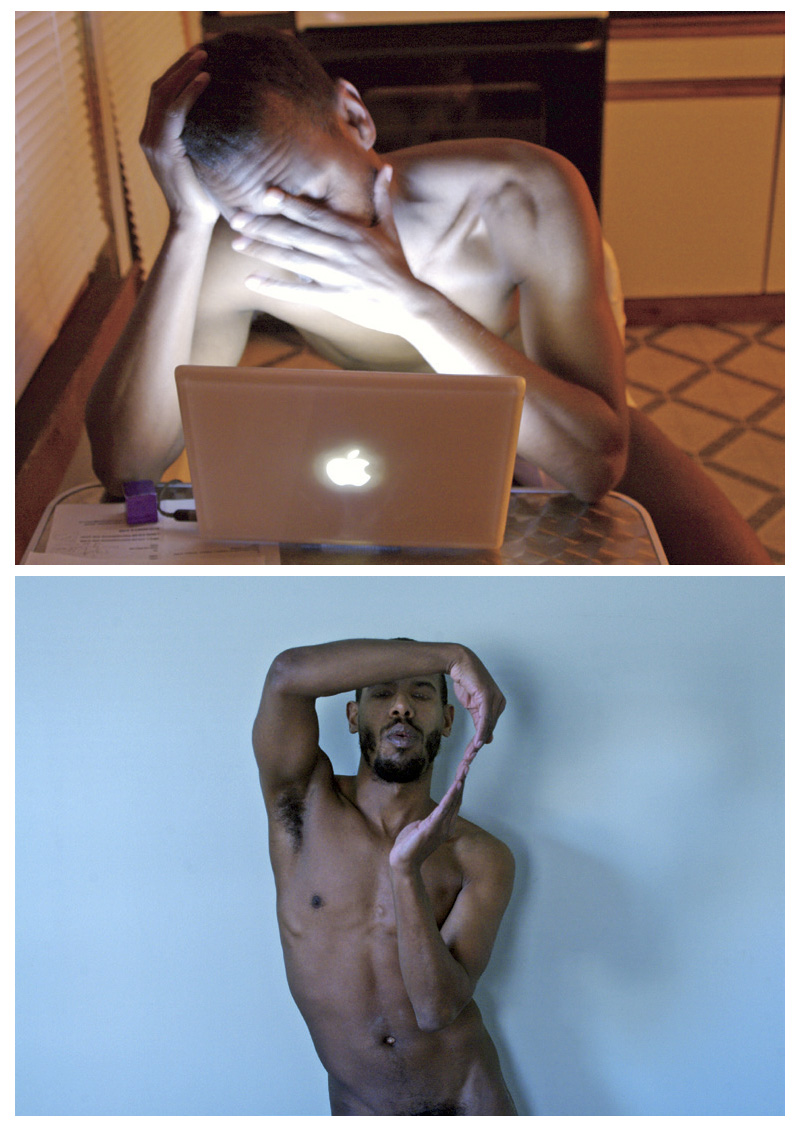
Derek Jackson (American, b. 1972) 'Perfect Kiss' 2007


Derek Jackson (American, b. 1972)
Perfect Kiss
2007
Slideshow with found music and original still imagery
Courtesy of the artist


Derek Jackson enacts a series of “hookups” in which his sexual activity should necessarily raise issues of HIV. Although not explicitly mentioned, HIV is evoked by the lyrics of his soundtrack. Jackson relies on New Order’s 1987 hit Perfect Kiss to equate unsafe sex with a suicide. The lyrics of the chorus plead with a suicidal friend, “I know, you know, you believe in a land of love.” Jackson’s hookups demonstrate how self-esteem, mutual respect, and communication are necessary to avoid becoming HIV positive.


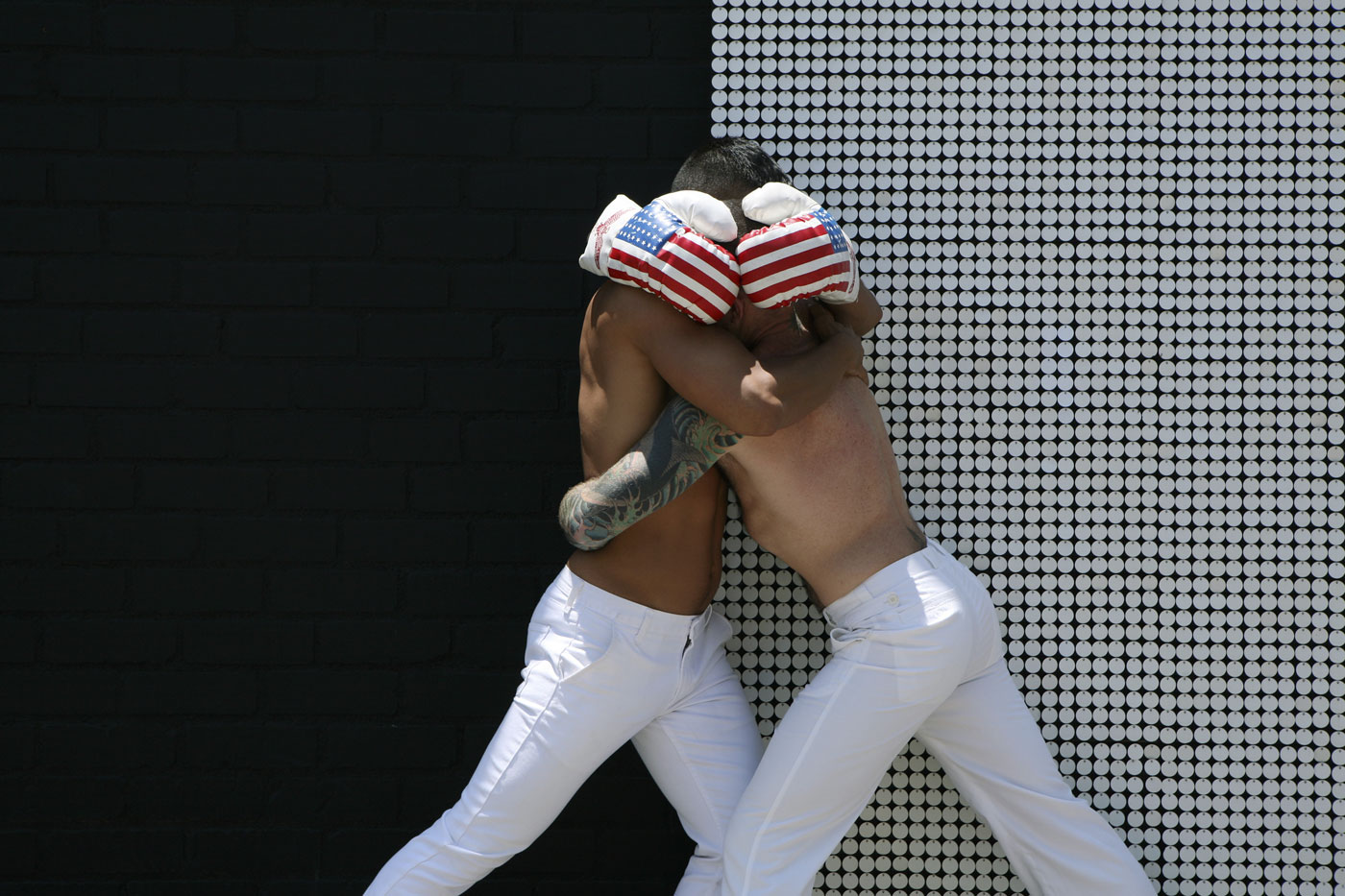
LADZ (John Arsenault and Adrian Gilliland) John Arsenault, Born Haverhill, Massachusetts, 1971 Adrian Gilliland, Born Douglas, Arizona, 1980 'Eden #31' 2012


LADZ (John Arsenault and Adrian Gilliland)
John Arsenault, b. 1971
Adrian Gilliland, b. 1980
Eden #31
2012
Chromogenic colour print
Courtesy of the artists


LADZ coined their name after a humorous autocorrect of “ladies” while texting on their smart phones. The artist group finds virtually abandoned industrial spaces where they enact elaborate scenarios reflecting the complexities of life in Los Angeles. The heightened sexual tension combined with the boxing gloves provides a glimpse into the daily navigation of sexual activity and HIV.


Kalup Linzy (American, born Stuckey, Florida, 1977) 'Lollypop' 2006


Kalup Linzy (American, born Stuckey, Florida, 1977)
Lollypop
2006
Single-channel video
3 minutes, 24 seconds
Collection of Driek and Michael Zirinsky


Kalup Linzy and his friend, artist Shaun Leonardo, lip sync the 1933 Hunter & Jenkins tune. Laden with the sexual innuendo of the song’s lyrics, Linzy attempts to coax treats from Leonardo. The artist playfully raises issues of gender and performance.

Given the high rates of HIV infection of men of colour who have sex with men particularly in urban centres, a viewer should keep in mind that individuals like Linzy continually navigate HIV in all their sexual encounters. Unlike a generation ago, young men and women have come to have a different relationship with HIV and no longer fear the virus as a death sentence. Empathy toward their experiences is key to understanding how they cope and survive.


Deborah Kass (American, b. 1952) 'Still Here' 2007


Deborah Kass (American, b. 1952)
Still Here
2007
Oil and acrylic on canvas
45 × 63 inches
Private collection
© 2015 Deborah Kass / Artists Rights Society (ARS), New York
Photo courtesy of Paul Kasmin Gallery


Deborah Kass painted Still Here as part of a group of paintings called Feel Good Paintings for Feel Bad Times, beginning in 2006. A response to the ongoing foreign wars and domestic political issues after the second election of George W. Bush, Kass underscored the gulf between the literal and metaphorical significance of the phrases she painted. Still Here comes from the Stephen Sondheim musical Follies in which a faded film star recalls how she persevered. The song opens “Good times and bum times, I’ve seen them all, and, my dear, I’m still here.”

The sentiment of the song speaks to the resilience of the many people who lived through the AIDS crisis and those who continue the struggle against the virus and social injustice. Kass’s title may also recall Still/Here, a dance about perseverance, dying, and HIV by the HIV positive choreographer Bill T. Jones.


Kia Labeija (American, b. 1990) '24' 2014

Kia Labeija (American, b. 1990) '24' 2014

Kia Labeija (American, b. 1990) '24' 2014


Kia Labeija (American, b. 1990)
24 (Mourning Sickness; Kia and Mommy; In my room)
2014
Inkjet prints
13 × 19 inches
Courtesy of the artist


Artist and performer Kia Labeija was born HIV positive. She struggled with HIV throughout her childhood, including the side effects of the medications, the stigma associated with the disease, and the death of her mother. In her three photographs titled 24, she celebrates coming to terms with the disease and her new-found role as advocate and spokesperson for AIDS awareness. The title also commemorates her 24th birthday and her home on the 24th floor of a Manhattan apartment building.


Tacoma Art Museum
1701 Pacific Avenue
Tacoma, WA 98402

Opening hours:
Wednesday – Sunday 10am – 5pm

Tacoma Art Museum website

LIKE ART BLART ON FACEBOOK

Back to top

Exhibition: ‘Multitude, Solitude: The Photographs of Dave Heath’ at the Philadelphia Museum of Art

Exhibition dates: 19th September – 20th December, 2015

Curators: Keith F. Davis, Senior Curator of Photography at The Nelson-Atkins Museum of Art and Peter Barberie, The Brodsky Curator of Photographs, Alfred Stieglitz Center, Philadelphia Museum of Art


Dave Heath (American, 1931-2016) 'Kansas City, Missouri, March 1967' from the exhibition 'Multitude, Solitude: The Photographs of Dave Heath' at the Philadelphia Museum of Art, Sept - Dec, 2015


Dave Heath (American, 1931-2016)
Kansas City, Missouri, March 1967
1967 (negative); 1968 (print)
Gelatin silver print
7 1/8 x 10 1/2 inches (18.1 x 26.7cm)
The Nelson-Atkins Museum, Kansas City, Missouri: Gift of the Hall Family Foundation


Following on from the magnificent Francesca Woodman, here we have an artist from a previous period who investigates aspects of alienation, despair, loss and hope. These are of the era:

Post-McCarthyism but still caught in that cataclysm / Henri Cartier-Bresson / Irving Penn / Ansel Adams / Saturday Evening Post / Allen Ginsberg / Beat Generation / emerging counterculture of the 1960s.

It is an Americana (the despairing history, geography and culture of the United States) with an elusive meaning and a aesthetic that seems to be tight … but one that can’t stand to be scratched.

While some of the images are memorable (such as Vengeful Sister, Chicago, 1956) there is not much living, lying underneath. Nothing that reveals itself to me over time, that makes me return to the image again and again, for insight and, possibly, refreshment. A little hope and much sadness.

Dr Marcus Bunyan


Many thankx to the Philadelphia Museum of Art for allowing me to publish the photographs in the posting. Please click on the photographs for a larger version of the image.


“City streets were Heath’s first studio: Philadelphia; Chicago; New York, where he came to prominence; and later Toronto. Isolation is a prevailing theme: Subjects gaze cryptically into the camera, their expressions unreadable. Often they stare beyond the frame, lost in thought. Crowds of individuals populate a single location, but don’t interact; disconnected, in their own worlds.

The dispossessed and alienated are Heath’s subjects, and he wrote his autobiography with their images: children with ragged clothes and dirty faces, stone-faced or crying, hardly ever smiling. A sweet-faced girl with tangled hair and huge light eyes stares out from the cover of Heath’s masterwork A Dialogue with Solitude, as if to say, “Here I am,” and nothing more…

Heath, who had to find his way alone, photographed passengers looking out of car windows and riding in elevated trains, going who knows where? Many photos are of just one person, and even the group shots set one occupant apart. Faces are expressionless, but their eyes are full of sorrow, uncertainty, loneliness, fear. We recognise that look: the one we all have when our public mask falls away and our faces betray the thoughts that wake us in the middle of the night.”


Pamela J.  Forsythe. “Alone together,” on the Broad Street Review website October 18, 2015 [Online] Cited 07/09/2015. No longer available online


Dave Heath (American, 1931-2016) 'Berkeley, California, 1964' from the exhibition 'Multitude, Solitude: The Photographs of Dave Heath' at the Philadelphia Museum of Art, Sept - Dec, 2015


Dave Heath (American, 1931-2016)
Berkeley, California, 1964
1964
Gelatin silver print
4 5/8 x 6 13/16 inches (11.7 x 17.3cm)
The Nelson-Atkins Museum, Kansas City, Missouri: Gift of the Hall Family Foundation


Dave Heath (American, 1931-2016) 'Erin Freed, New York City, 1963'


Dave Heath (American, 1931-2016)
Erin Freed, New York City, 1963
1963
Gelatin silver print
7 5/16 x 8 3/4 inches (18.6 x 22.2cm)
The Nelson-Atkins Museum, Kansas City, Missouri: Gift of the Hall Family Foundation


Dave Heath (American, 1931-2016) 'Carl Dean Kipper, Korea, 1953-54'


Dave Heath (American, 1931-2016)
Carl Dean Kipper, Korea, 1953-54
1953-1954
Gelatin silver print
6 3/4 x 9 3/4 inches (17.1 x 24.8cm)
The Nelson-Atkins Museum of Art, Kansas City, Missouri: Gift of Hallmark Cards, Inc.,


Dave Heath (American, 1931-2016) 'Philadelphia, 1952'


Dave Heath (American, 1931-2016)
Philadelphia, 1952
1952
The Nelson-Atkins Museum, Kansas City, Missouri: Gift of the Hall Family Foundation


Experience Dave Heath’s bittersweet vision of modern life in his powerful photographs of loss and hope.

From a crowd gathered in Central Park to solitary figures lost in thought, Dave Heath’s images conjure feelings of alienation and a desire for human connection. Multitude, Solitude highlights the photographer’s black-and-white pictures of the 1950s and 1960s, an intense period of self-discovery and innovation for the artist. During these pivotal years, Heath developed groundbreaking approaches to narrative and image sequence, producing exquisite individual prints, handmade book maquettes, his poetic masterwork, A Dialogue with Solitude, and multimedia slide presentations. His sensitive explorations of loss, pain, love, and hope reveal Heath to be one of the most original photographers of those decades.

This exhibition is the first comprehensive survey of Heath’s deeply personal early work. Abandoned by both his parents by the age of four, Heath lived in Philadelphia foster homes and in an orphanage until the age of sixteen. The turmoil of his childhood profoundly shaped Heath and his artistic vision. Just before his sixteenth birthday, he encountered a poignant photo-essay about foster care in Life magazine, and became intrigued by photography’s potential to transcend simple reportage. Almost entirely self-taught, Heath channeled his feelings of abandonment into a body of work that underscores the importance and difficulties of human contact and interaction. Multitude, Solitude reaffirms Heath’s status as a key figure in twentieth-century photography and highlights his deeply empathetic sensibility.

About the artist

Born in Philadelphia in 1931, Dave Heath became interested in photography as a teenager. In the following years he trained himself in the craft, taking courses in commercial art, working in a photo-processing lab, and studying paintings at the Philadelphia Museum of Art. While stationed in Korea with the US Army, he photographed his fellow soldiers, creating images that are at once candid and subdued. In 1957 Heath moved to New York City and established himself as a major artistic talent.Heath taught at the Dayton Art Institute, Ohio, and Moore College of Art, Philadelphia, before moving in 1970 to Toronto, where he headed the photography program at Ryerson University for many years. His work is in the collections of leading museums, including The Nelson-Atkins Museum of Art, Kansas City, Missouri; the Philadelphia Museum of Art; the Museum of Modern Art, New York; the Art Institute of Chicago; and the National Gallery of Canada, Ottawa.

Heath’s major monograph, A Dialogue with Solitude, was published in 1965 and reprinted in 2000. His work has been included in important historical studies and surveys, such as Robert M. Doty’s Photography in America (1974); John Szarkowski’s Mirrors and Windows: American Photography Since 1960 (1978); James Borcoman’s Magicians of Light: Photographs from the Collection of the National Gallery of Canada (1993); and Keith F. Davis’s An American Century: From Dry-Plate to Digital (1999).

Text from the Philadelphia Museum of Art website


Dave Heath (American, 1931-2016) 'Drowning Scene, Central Park, New York City, 1957'


Dave Heath (American, 1931-2016)
Drowning Scene, Central Park, New York City, 1957
1957
Gelatin silver print
6 3/8 x 9 9/16 inches (16.2 x 24.3cm)
The Nelson-Atkins Museum, Kansas City, Missouri: Gift of the Hall Family Foundation


Dave Heath (American, 1931-2016) 'Drowning Scene, Central Park, New York City, 1957' (detail)


Dave Heath (American, 1931-2016)
Drowning Scene, Central Park, New York City, 1957 (detail)
1957
Gelatin silver print
6 3/8 x 9 9/16 inches (16.2 x 24.3cm)
The Nelson-Atkins Museum, Kansas City, Missouri: Gift of the Hall Family Foundation


Dave Heath (American, 1931-2016) 'Vengeful Sister, Chicago, 1956'


Dave Heath (American, 1931-2016)
Vengeful Sister, Chicago, 1956
1956
Gelatin silver print
7 3/16 x 8 15/16 inches (18.3 x 22.7cm)
The Nelson-Atkins Museum, Kansas City, Missouri: Gift of the Hall Family Foundation


Dave Heath (American, 1931-2016) '7 Arts Coffee Gallery, New York City, 1959'


Dave Heath (American, 1931-2016)
7 Arts Coffee Gallery, New York City, 1959
1959
Gelatin silver print
7 3/4 x 8 3/4 inches
The Nelson-Atkins Museum, Kansas City, Missouri: Gift of the Hall Family Foundation


Dave Heath (American, 1931-2016) 'New York City, 1958-59'


Dave Heath (American, 1931-2016)
New York City, 1958-59
1958-1959
Gelatin silver print
7 x 8 5/8 inches
The Nelson-Atkins Museum, Kansas City, Missouri: Gift of the Hall Family Foundation


Dave Heath (American, 1931-2016) '5th Avenue at 43rd Street, New York City, 1958'


Dave Heath (American, 1931-2016)
5th Avenue at 43rd Street, New York City, 1958
1958
Gelatin silver print
6 1/2 x 9 3/4 inches
The Nelson-Atkins Museum, Kansas City, Missouri: Gift of the Hall Family Foundation


Dave Heath (American, 1931-2016) 'Santa Barbara, California, 1964'


Dave Heath (American, 1931-2016)
Santa Barbara, California, 1964
1964
Gelatin silver print
5 x 7 9/16 inches (12.7 x 19.2cm)
The Nelson-Atkins Museum, Kansas City, Missouri: Gift of the Hall Family Foundation


Dave Heath, (Canadian born United States, 1931-2016) 'Rochester, New York' 1958


Dave Heath (American, 1931-2016)
Rochester, New York, 1958
1958
Gelatin silver print
6 9/16 x 9 13/16 inches (16.7 x 24.9cm)
The Nelson-Atkins Museum, Kansas City, Missouri: Gift of Hallmark Cards, Inc.,


Dave Heath (American, 1931-2016) 'Washington Square, New York City, 1959-1960'


Dave Heath (American, 1931-2016)
Washington Square, New York City, 1959-1960
1959-1960
Gelatin silver print
7 1/2 x 9 1/4 inches
The Nelson-Atkins Museum, Kansas City, Missouri: Gift of the Hall Family Foundation


Forever the outsider

Heath left Philadelphia to serve in the Korean War, where he photographed fellow soldiers and his impressions of war. Soon after his return, he departed for Chicago, where he worked as a photographer’s assistant. He began to assemble handmade books, grouping photos into themed essays and putting text to the images, establishing the template he would use in A Dialogue with Solitude.

Relocating to New York in 1957, Heath studied with photojournalist W. Eugene Smith, refining his photo essay technique and adopting Smith’s practice of making fine art prints of his work. He took photos with available light, in the street and at favourite haunts like Washington Square Park and Seven Arts Coffee Gallery, mounting the Dialogue exhibition in 1963. In that same year, he won his first Guggenheim.

Accepting life on its own terms

When Dialogue went to print in 1965, Heath employed the same editorial control he had with earlier creations, selecting, sizing, and laying out every photo, dictating typeface and size, and selecting text from famous authors, such as William Butler Yeats, Hermann Hesse, and T.S. Eliot. Only in the preface did he use his own words:

“Pressed from all sides by the rapid pace of technological progress and increased authoritarian control, many people are caught up in an anguish of alienation. Adrift and without sense of purpose, they are compelled to engage in a dialogue with the inmost depths of their being in a search for renewal.” He concludes, “What I have endeavoured to convey in my work is not a sense of futility… but an acceptance… that the pleasures and joys of life are fleeting and rare.”

The final sections convey a few of those pleasurable moments: In two photos entitled Chicago (1956), a small boy stands, head thrown back in exultation, and two boys mug for the camera. In Fifth Avenue, New York City (1960), a father snuggles his baby to his face, looking over the child’s head protectively, and in Barbara Freed and Her Son Sean, New York City (1959), a toddler heads toward a pair of outstretched female hands. Heath selected the final excerpt from Eliot’s “Journey of the Magi”:

All this was a long time ago, I remember,
And I would do it again, but set down
This set down
This: were we led all that way for
Birth or Death?


Pamela J.  Forsythe. “Alone together” on the Broad Street Review website October 18, 2015 [Online] Cited 07/09/2015. No longer available online


Dave Heath (American, 1931-2016) 'Greenwich Village, New York City, 1957'


Dave Heath (American, 1931-2016)
Greenwich Village, New York City, 1957
1957
Gelatin silver print
12 5/8 x 9 9/16 inches (32.1 x 24.3cm)
The Nelson-Atkins Museum, Kansas City, Missouri: Gift of the Hall Family Foundation


Dave Heath (American, 1931-2016) 'New York City, 1962'


Dave Heath (American, 1931-2016)
New York City, 1962
1962
Gelatin silver print
10 13/16 x 7 7/16 inches (27.5 x 18.9cm)
The Nelson-Atkins Museum, Kansas City, Missouri: Gift of the Hall Family Foundation


Dave Heath (American, 1931-2016) 'Chicago, 1956'


Dave Heath (American, 1931-2016)
Chicago, 1956
1956
Gelatin silver print
12 9/16 x 8 9/16 inches (31.9 x 21.7cm)
The Nelson-Atkins Museum, Kansas City, Missouri: Gift of the Hall Family Foundation


Dave Heath (American, 1931-2016) 'Chicago, 1956'


Dave Heath (American, 1931-2016)
Chicago, 1956
1956
Gelatin silver print
9 3/4 x 6 5/8 inches
The Nelson-Atkins Museum, Kansas City, Missouri: Gift of the Hall Family Foundation


Dave Heath (American, 1931-2016) 'Chicago, 1956'


Dave Heath (American, 1931-2016)
Chicago, 1956
1956
Gelatin silver print
10 x 8 inches
The Nelson-Atkins Museum, Kansas City, Missouri: Gift of the Hall Family Foundation


Dave Heath (American, 1931-2016) 'Washington Square, New York City, 1960'


Dave Heath (Canadian, born United States, 1931)
Washington Square, New York City, 1960
1960
Gelatin silver print
12 5/8 x 8 5/8 inches (32.1 x 21.9cm)
The Nelson-Atkins Museum, Kansas City, Missouri: Gift of the Hall Family Foundation


Dave Heath (American, 1931-2016) 'Washington Square, New York City, 1958'


Dave Heath (American, 1931-2016)
Washington Square, New York City, 1958
1958
Gelatin silver print
12 5/8 x 8 3/8 inches (32.1 x 21.3cm)
The Nelson-Atkins Museum, Kansas City, Missouri: Gift of the Hall Family Foundation


Dave Heath (American, 1931-2016) 'Howard Crawford, c. 1953-54'


Dave Heath (American, 1931-2016)
Howard Crawford, c. 1953-54
c. 1953-1954
Gelatin silver print
13 1/2 x 9 1/4 inches
The Nelson-Atkins Museum, Kansas City, Missouri: Gift of the Hall Family Foundation


Philadelphia Museum of Art
26th Street and the Benjamin Franklin Parkway
Philadelphia, PA 19130

Opening hours:
Thursday – Monday: 10am – 5pm
Closed Tuesday and Wednesday

Philadelphia Museum of Art website

LIKE ART BLART ON FACEBOOK

Back to top

Exhibition: ‘Francesca Woodman. On Being an Angel’ at Moderna Museet, Stockholm

Exhibition dates: 5th September, 2015 – 6th December, 2015

Curator: Anna Tellgren


Francesca Woodman (American, 1958-1981) 'On Being an Angel', Providence, Rhode Island, 1976 from the exhibition 'Francesca Woodman. On Being an Angel' at Moderna Museet, Stockholm, Sept - Dec, 2015


Francesca Woodman (American, 1958-1981)
On Being an Angel
Providence, Rhode Island, 1976
Gelatin silver print
© George and Betty Woodman


The artist as chimerical creature

Francesca Woodman (1958-1981) achieved more in eight years of artistic creativity than many artists achieve in a lifetime.

As a viewer you can read whatever you want into her photographs: feminism, surrealism, psychoanalytical theory, avant-garde, sexuality, gender, identity, sadness, happiness, joy. One of Francesca Woodman’s teachers was Aaron Siskind but you can also feel echoes of Diane Arbus, the conceptual, narrative mystery of Duane Michals, the postmodern generation of Cindy Sherman (1977 onwards) and, someone who nobody mentions as an influence, the darkness of Ralph Eugene Meatyard (family members enacting symbolic dramas in masks, often set in abandoned places). Woodman also places masks on or off of her face. Further, “There are similarities in style to surrealistic photography, such as Woodman’s frequent use of mirrors, doubles, shadows, gloves, hands, swans, fish, eels, masks, and sexual symbols. Photographers such as Hans Bellmer, Claude Cahun, and Man Ray spring to mind.”1

Here, I see the influence of Carl Jung in her work, specifically in Jungian psychology, the shadow or “shadow aspect” of the self (traces and silhouettes) which may refer to an unconscious aspect of the personality which the conscious ego does not identify in itself. This shadow aspect may be positive or negative. “Everyone carries a shadow,” Jung wrote, “and the less it is embodied in the individual’s conscious life, the blacker and denser it is.”2 This shadow aspect can be see in the photograph Untitled, Providence, Rhode Island, 1976 (below).

Another element embedded in the work is that of the Mirror stage, which is a concept in the psychoanalytic theory of Jacques Lacan. “The mirror stage is based on the belief that infants recognise themselves in a mirror (literal) or other symbolic contraption which induces apperception (the turning of oneself into an object that can be viewed by the child from outside themselves) from the age of about 15 to 18 months… Lacan believed that the mirror stage represented a permanent structure of subjectivity, or as the paradigm of “Imaginary order”.”3 The basis of the Imaginary order is the formation of the ego in the “mirror stage”. “Since the ego is formed by identifying with the counterpart or specular image, “identification” is an important aspect of the imaginary. The relationship whereby the ego is constituted by identification is a locus of “alienation”, which is another feature of the imaginary, and is fundamentally narcissistic.”4 This imaginary order can be seen in photographs such as Self-deceit #1, Rome, Italy, 1978 (below), where the image and even the title alludes to a form of self-alienation.

Riffing on the “highly influential writings of French philosophers and cultural critics such as Michel Foucault, Roland Barthes, and Julia Kristeva that were just beginning to be made available in translation. Among these thinkers’ central ideas was that identity was not organic and innate, but manufactured and learned through highly refined social constructions of gender, race, sexuality, and citizenship”5, Woodman’s work can also be seen to embody and ennoble these subjective and surrealist constructions (of self).

The artist is a CHIMERICAL CREATURE. Imaginary, visionary. Woodman’s transformations, her interior elements, become part of the wall or the house. She vanishes “from the room, out of the picture, at any given second.” A preoccupation with the body / her own body, and the dichotomy of subject-object, also adds multiple meanings and complexity to Woodman’s work. Her many angel images (and also images of umbrellas – Mary Poppins was released in 1964 when Woodman was growing up) suggest movement and the ability to fly, a fascination that found its ultimate expression when she jumped off a building in lower Manhattan at the age of 22.

We can read of all these things into the image/inary of Francesca Woodman if we want to. But they are not necessary to admire or appreciate her work. All we have to do is look at the photographs themselves; just return to the work. Here was a young artist, a young human being, expressing themselves through photography. She was just going for it and, as Corey Keller (a curator of photography at the San Francisco Museum of Modern Art) has noted, her youth was the source of her potency.

“Art students are drawn to the conviction she brought to her work and, in contrast to the cool slickness of the digital, it embraces tactility and decay in a very sensual and seductive way.” Keller sees Woodman’s youth not as a liability, but as the source of her potency, though she admits the issue of her self-portraits continues to be fraught. “They are certainly an expression of selfhood. She’s not interested in images of women in general, for example, and even when the subject of the photograph is not herself physically, one always has the sense it is about her psychically.””6

While she may not have fully understood the layered nuances of French philosophy and Jungian psychology she INTUITIVELY knew what she was doing and what she wanted to achieve and capture in her work. There are lots of other photographers around the world that work in this same idiom, at art school and as mature artists, but none have that special something that Woodman has, something that one cannot quite put your finger on.

It is … a gap we can see across but cannot map.

Woodman is one of the greats. In her few short years as an artist, she achieved immortality through her images. Her narrative – one of youth and vitality, of self exploration and transformation – is no myth. For she is legend.

Dr Marcus Bunyan


Footnotes

1/ Tellgren, Anna. Francesca Woodman: On Being an Angel (50kb pdf). 2015, pp. 13-14

2/ Shadow (psychology) on the Wikipedia website [Online] Cited 04/12/2015

3/ Mirror stage on the Wikipedia website [Online] Cited 04/12/2015

4/ The Imaginary (psychoanalysis) on the Wikipedia website [Online] Cited 04/12/2015

5/ Eklund, Douglas. “The Pictures Generation,” Heilbrunn Timeline of Art History on The Metropolitan Museum of Art website [Online] Cited 04/12/2015

6/ Corey Keller quoted in Cooke, Rachel. “Searching for the real Francesca Woodman,” on The Guardian website, Sunday 31 August 2014 [Online] Cited 04/12/2015


Many thankx to the Moderna Museet, Stockholm for allowing me to publish the photographs in the posting. Please click on the photographs for a larger version of the image.


Francesca Woodman (American, 1958-1981) 'On Being an Angel #1', Providence, Rhode Island, 1977 from the exhibition 'Francesca Woodman. On Being an Angel' at Moderna Museet, Stockholm, Sept - Dec, 2015


Francesca Woodman (American, 1958-1981)
On Being an Angel #1
Providence, Rhode Island, 1977
Gelatin silver print
© George and Betty Woodman


The American photographer Francesca Woodman (1958-1981) created a body of fascinating photographic works in a few intense years before her premature death. Her oeuvre has been the object of numerous in-depth studies and major exhibitions in recent years, and her photographs have inspired artists all over the world. Francesca Woodman began photographing in her teens and studied at the Rhode Island School of Design from 1975 to 1978. Her output is usually divided into periods, from her early works, her years as a student in Providence, Italy (1977-1978), the Mac Dowell Colony, and, lastly, New York from 1979 until she died. The collection she left behind consists of a few hundred gelatin silver prints, but she also tried other techniques, such as large-format diazotypes, colour photography and video.

Woodman’s photographs explore gender, representation, sexuality and body. Her production includes several self-portraits, using herself and her friends as models. The figures are often placed behind furniture and other interior elements; occasionally, the images are blurred in such a way that their identity is hidden from the viewer. The intimate nature of the subject matter is enhanced by the small formats. Woodman worked in unusual settings such as derelict buildings, using mirrors and glass to evoke surrealist and occasionally claustrophobic moods.

Moderna Museet will present some hundred photographs by Francesca Woodman, with a selection from the series and themes she explored. The exhibition is produced by Moderna Museet in association with Betty and George Woodman and the Estate of Francesca Woodman. Alongside this exhibition, Moderna Museet will present a compilation of photography from the same period from its collection, to show Francesca Woodman in context and expand the perspective on her oeuvre to the public.

Text from the Moderna Museet


Francesca Woodman (American, 1958-1981) From 'Angel' series, Rome, Italy, 1977


Francesca Woodman (American, 1958-1981)
From Angel series
Rome, Italy, 1977
Gelatin silver print
© George and Betty Woodman


Francesca Woodman (American, 1958-1981) From 'Angel' series, Rome, Italy, 1977-1978


Francesca Woodman (American, 1958-1981)
From Angel series
Rome, Italy, 1977-1978
Gelatin silver print
© George and Betty Woodman


Francesca Woodman (American, 1958-1981) 'Charlie the Model # 5', Providence, Rhode Island, 1976-1977


Francesca Woodman (American, 1958-1981)
Charlie the Model #5
Providence, Rhode Island, 1976-1977
Gelatin silver print
© George and Betty Woodman


Francesca Woodman (American, 1958-1981) From 'Eel' series, Venice, Italy, 1978


Francesca Woodman (American, 1958-1981)
From Eel series
Venice, Italy, 1978
Gelatin silver print
© George and Betty Woodman


Francesca Woodman (American, 1958-1981) 'House #4', Providence, Rhode Island, 1976


Francesca Woodman (American, 1958-1981)
House #4
Providence, Rhode Island, 1976
Gelatin silver print
© George and Betty Woodman


Francesca Woodman (American, 1958-1981) From the 'three kinds of melon in four kinds of light' series, Providence, Rhode Island, 1976


Francesca Woodman (American, 1958-1981)
From the three kinds of melon in four kinds of light series
Providence, Rhode Island, 1976
Gelatin silver print
© George and Betty Woodman


The American photographer Francesca Woodman (1958-1981) created a body of fascinating photographic works in a few intense years before her premature death. Her oeuvre has been shown in number of major exhibitions in recent years, and her photographs have inspired artists all over the world.

Woodman’s photographs explore gender, representation, sexuality and body. The intimate nature of the subject matter is enhanced by the small formats. Her production includes several portraits, using herself and her friends as models. The figures are often placed behind furniture and other interior elements; occasionally, the images are blurred and the models hidden from the viewer. Woodman worked in settings such as derelict buildings, using mirrors and glass, evoking surrealist and at times even claustrophobic moods.

Francesca Woodman began photographing in her teens and studied at the Rhode Island School of Design from 1975 to 1978. Her output is usually divided into periods: the early works, her years as a student in Providence, Italy (1977-1978), the Mac Dowell Colony, and, lastly, New York from 1979 until she died. The collection she left behind consists of several hundred gelatin silver prints, but she also tried other techniques, such as large-format diazotypes and video.

Francesca Woodman. On being an angel presents 102 photographs and one video, representing most of the artist’s series and themes. The exhibition is produced by Moderna Museet in association with the Estate of Francesca Woodman. Alongside this exhibition, Moderna Museet presents a compilation of photography from the same period from its collection, to show Francesca Woodman in context and expand the perspective on her oeuvre to the public.

Biography

Francesca Woodman was born into a family of artists in Denver, Colorado, on April 3, 1958. Her mother, Betty, was a sculptor, her father, George, a painter and photographer, and her brother, Charlie, was a video artist.

Italy

The family often traveled to Italy and lived in Florence for a year between 1965 and 1966. Then they returned home to Boulder, Colorado, and Francesca continued her schooling. In 1968 her parents bought a farmhouse outside of Florence in Antella, and there they would spend their summers. Italy and its language, culture, and art history were frequent sources of inspiration for Francesca Woodman.

Providence

Woodman started taking pictures as a teenager and had attended a few art courses before she moved to Providence to study at the Rhode Island School of Design (RISD) in 1975. The college is among the oldest art schools in the United States, and the well-known photographer Aaron Siskind was one of her teachers. While at college, she lived in her studio in an industrial area where many of her pictures from that time were created. Between 1977 and 1978 Francesca Woodman spent a year in Rome as part of the school’s honours program. In the fall of 1978, she earned her BFA and exhibited the series Swan Song (1978) at the graduate show in RISD’s Woods-Gerry Gallery.

New York

Months later, in January 1979, Woodman moved to New York, where she lived at various addresses while looking for work. She spent the summer together with her boyfriend, Benjamin Moore, in Stanwood, Washington. Over the course of the next year, she exhibited her work at a number of smaller galleries and experimented with new techniques such as large format diazotypes, and colour images. She was a fellow at the MacDowell Colony in Peterborough, New Hampshire, in the summer of 1980. There, she worked on a series of images exploring the relationship between nature and her body, among other projects. In early 1981, her artist’s book Some Disordered Interior Geometries was published by Synapse Press in Philadelphia. This was one of seven notebooks (including photographs that were glued in) that she worked with from 1976 onwards. Francesca Woodman took her own life on January 19, 1981.

Previous exhibitions

The first major retrospective of Francesca Woodman’s work was produced in 1986 by Ann Gabhart in collaboration with Rosalind Krauss for the Wellesley College Museum. It then toured a number of museums at American universities. Her first European exhibition was held in 1992 by Shedhalle in Zurich and the Westfälischer Kunstverein in Münster and was shown in the spring of 1993 at The Finnish Museum of Photography, in the Cable Factory in Helsinki. On its way there, it stopped for two months at Kulturhuset in Stockholm. The critic Lars O Ericsson wrote in Dagens Nyheter that the exhibition may have been the most important one to see in the capital at the time. To date, at least fifty separate exhibitions of Woodman’s photography have been held in Europe and the United States.

Photography from the Moderna Museet Collection

In connection to the exhibition with Francesca Woodman, Moderna Museet presents a selection of photographs from the same period from its collection, to show her in context. In Francesca Woodman’s active years in the late 1970s and early 1980s, photography was in a period of transition. Many photographers who had worked with classic black and white photography were experimenting with other forms and were pushing the documentary tradition towards more subjective and surrealist projects.

The United States paved the way in this development, and when many started working more professionally with photography, it was institutionalised. This shift in the field eventually spread to Europe. Major photographic exhibitions were held at The Museum of Modern Art in New York, featuring artists such as Diane Arbus, Robert Frank, and Lee Friedlander, all of whom were influential to many younger photographers.

One of Francesca Woodman’s teachers was Aaron Siskind. His photography is often compared to that of Harry Callahan, since both were active for many years as teachers at the Institute of Design at the Illinois Institute of Technology in Chicago, and later at the Rhode Island School of Design in Providence. Another figure in American post-war photography is Minor White, who also had influence as a teacher. White wrote about and taught methods for understanding and interpreting photographs. New Topographics. Photographs of a Man-Altered Landscape (1975) was a significant exhibition. It was held at the International Museum of Photography at George Eastman House in Rochester and one of the featured artists was Lewis Baltz. Other notable photographers in the new American wave were personalities as diverse as Robert Mapplethorpe, Melissa Shook, and Jerry Uelsmann.

But it was also then, from 1977 forward, that Cindy Sherman started working on her break-out series Untitled Film Stills. Sherman is an artist of the postmodern generation, and it is not known if Woodman had been aware of the so-called Pictures Generation. Duane Michals stood for a more conceptual approach. He was one of the photographers who we know interested Woodman.

Diazotype

In the spring of 1980 Francesca Woodman started working on Blueprint for a Temple, where she was recreating the facade of a Greek temple using models draped in tunics similar to caryatids. The series began with a collection of details from bathrooms in New York, reminiscent of classical motifs. From having worked on a smaller scale, she had now moved on to truly large formats, some several meters in size.

These pictures are often categorised as blueprints, referring to a method of reproduction most frequently used for architectural plans. This is a contact print process on photosensitive paper; white lines on a blue background distinguish the finished product. (Other types of paper produced different background colours.)

The technique Woodman used was diazotype: a dry photographic process on paper coated with diazonium compounds, which are sensitive to blue and UV light and developed by ammonia vapour. Woodman experimented with this technique. She created the largest of these images by hanging a long sheet of photosensitive diazo paper on the wall of a darkroom. A photographic slide was projected onto the paper from a slide projector, often for hours. The paper was then developed in a diazo processor at a company that made commercial reproductions of architectural plans. The result was a set of magnificent works in blue, purple, and sepia tones.

Text from the Moderna Museet, Stockholm website


Francesca Woodman (American, 1958-1981) 'About Being My Model', Providence, Rhode Island, 1976


Francesca Woodman (American, 1958-1981)
About Being My Model
Providence, Rhode Island, 1976
Gelatin silver print
© George and Betty Woodman


Francesca Woodman (American, 1958-1981) 'Spring in Providence # 2', Providence, Rhode Island, 1976


Francesca Woodman (American, 1958-1981)
Spring in Providence #2
Providence, Rhode Island, 1976
Gelatin silver print
© George and Betty Woodman


Francesca Woodman (American, 1958-1981) 'Self-deceit #1', Rome, Italy, 1978


Francesca Woodman (American, 1958-1981)
Self-deceit #1
Rome, Italy, 1978
Gelatin silver print
© George and Betty Woodman


Francesca Woodman (American, 1958-1981) 'Untitled', Providence, Rhode Island, 1975-1978


Francesca Woodman (American, 1958-1981)
Untitled
Providence, Rhode Island, 1975-78
Gelatin silver print
© George and Betty Woodman


Francesca Woodman (American, 1958-1981) 'Untitled', Rome, Italy, 1977-1978


Francesca Woodman (American, 1958-1981)
Untitled
Rome, Italy, 1977-1978
Gelatin silver print
© George and Betty Woodman


Francesca Woodman (American, 1958-1981) 'Untitled', New York, 1979-1980


Francesca Woodman (American, 1958-1981)
Untitled
New York, 1979-1980
Gelatin silver print
© George and Betty Woodman


Francesca Woodman (American, 1958-1981) 'Untitled', Providence, Rhode Island, 1976


Francesca Woodman (American, 1958-1981)
Untitled
Providence, Rhode Island, 1976
Gelatin silver print
© George and Betty Woodman


Francesca Woodman (American, 1958-1981) 'Untitled', New York, 1979-1980


Francesca Woodman (American, 1958-1981)
Untitled
New York, 1979-1980
Gelatin silver print
© George and Betty Woodman


Moderna Museet’s first exhibition this autumn features the American photographer Francesca Woodman, whose oeuvre has been the subject of numerous in-depth studies and major exhibitions in recent years. Her photography has inspired generations of artists and photographers around the world. Woodman has been called a prodigy, and those who met her testify to her as a young woman who was always working and looking for themes and material for her photographs. Examining Francesca Woodman’s aesthetic oeuvre is a challenge and an adventure.

Francesca Woodman’s (1958-1981) photographs explore gender, representation and body. Her aesthetic world reveals surrealist influences, with frequent use of mirrors, doubles, shadows, masks, and sexual symbols, bringing to mind the works of photographers such as Hans Bellmer, Claude Cahun and Man Ray. Woodman’s output includes several portraits using herself and her friends as models. The intimate nature of the subject matter is enhanced by the small formats. Transformation emerges as a theme in many of Woodman’s images, for example in one of her strongest and eeriest series, House from 1976, in which she gradually merges with the walls, the torn wallpaper and the open fireplace.

“Francesca Woodman created a body of fascinating photographic works in a few intense years before her premature death. Her images reference history and the history of photography, but they also reflect their time, while unlocking new interpretations. She is deeply personal, and so her themes become universal. All of this is what On Being an Angel is about,” says curator Anna Tellgren.

Francesca Woodman began photographing in her teens and studied at the Rhode Island School of Design from 1975 to 1978. Her output is usually divided into periods, from her early works, her years as a student in Providence, in Italy (1977-1978), at the MacDowell Colony, and, lastly, in New York from 1979 until she died. Analyses of her work are often linked to her biography and chronology. During her active years, Woodman produced thousands of images and she also tried other techniques such as large-format diazotypes, colour photography and video. Some eight hundred photographs have been preserved. The words, short sentences, or quotations she scrawled on many of her prints have since given those pieces their titles.

The exhibition Francesca Woodman. On Being an Angel is comprised of 102 photographs and one video by Francesca Woodman, and selections from most of her thematic groups and series are represented, including Polka Dots (1976), the From Angel series (1977), Swan Song (1978), Charlie the Model (1976-1977) and her large Caryatid (Study for a Temple Project) (1980). In Woodman’s active years in the late 1970s and early 1980s, photography was in a period of transition. Many photographers who had worked with classic black and white photography were experimenting with other forms, pushing the documentary tradition towards more subjective and surrealist projects. Alongside the exhibition, Moderna Museet will present a selection of photography from the same period from its collection, to show Francesca Woodman in context.

Text from the Moderna Museet


Francesca Woodman (American, 1958-1981) 'Untitled', Providence, Rhode Island, 1976


Francesca Woodman (American, 1958-1981)
Untitled
Providence, Rhode Island, 1976
Gelatin silver print
© George and Betty Woodman


Francesca Woodman (American, 1958-1981) 'Space2', Providence, Rhode Island, 1975-1976


Francesca Woodman (American, 1958-1981)
Space2
Providence, Rhode Island, 1975-1976
Gelatin silver print
© George and Betty Woodman


Francesca Woodman (American, 1958-1981) 'From Space2', Providence, Rhode Island, 1976


Francesca Woodman (American, 1958-1981)
From Space2
Providence, Rhode Island, 1976
Gelatin silver print
© George and Betty Woodman


Francesca Woodman (American, 1958-1981) 'Untitled', Providence, Rhode Island, 1975-1978


Francesca Woodman (American, 1958-1981)
Untitled
Providence, Rhode Island, 1975-1976
Gelatin silver print
© George and Betty Woodman


Francesca Woodman (American, 1958-1981) 'Untitled', New York, 1979-1980


Francesca Woodman (American, 1958-1981)
Untitled
New York, 1979-1980
Gelatin silver print
© George and Betty Woodman


Francesca Woodman (American, 1958-1981) 'Untitled', New York, 1979


Francesca Woodman (American, 1958-1981)
Untitled
New York, 1979
© George and Betty Woodman


Francesca Woodman (American, 1958-1981) 'Untitled', New York, 1979


Francesca Woodman (American, 1958-1981)
Untitled
New York, 1979
© George and Betty Woodman


Francesca Woodman (American, 1958-1981) '(Study for Temple Project)', New York, 1980


Francesca Woodman (American, 1958-1981)
(Study for Temple Project)
New York, 1980
© George and Betty Woodman


Moderna Museet, Stockholm

Moderna Museet is ten minutes away from Kungsträdgården, and twenty minutes from T-Centralen or Gamla Stan. Walk past Grand Hotel and Nationalmuseum on Blasieholmen, opposite the Royal Palace. After crossing the bridge to Skeppsholmen, continue up the hill. The entrance to Moderna Museet and Arkitekturmuseet is on the left-hand side.

Opening hours:
Tuesday – Sunday 10-18
Monday closed

Moderna Museet website

LIKE ART BLART ON FACEBOOK

Back to top

Exhibition: ‘Wayne Gudmundson: Trees of Burgundy’ at Joseph Bellows Gallery, La Jolla, California

Exhibition dates: 7th November – 23rd December, 2015


Wayne Gudmundson (American, b. 1949) 'Saizy, France #13' 2014 from the exhibition 'Wayne Gudmundson: Trees of Burgundy' at Joseph Bellows Gallery, La Jolla, California, Nov - Dec, 2015


Wayne Gudmundson (American, b. 1949)
Saizy, France #13
2014
Gelatin silver print
16 x 20 inches


There is a Cartier Bresson of a group of roadside trees that makes a heart.
There is the photography of Wim Wenders in “Kings of the Road.”
There is Robert Adams and a 19th century European sensibility (eg. Gustave Le Gray) all rolled into one.

The more expansive vistas such as #4 and #14 don’t really work for me, but the darker, more chthonic narratives such as #6-9 are excellent. They need some more “tiny work” – but they are very good.

The prints are 16 x 20 inch gelatin silver prints from a 4 x 5 view camera negative.

Dr Marcus Bunyan


Many thankx to Joseph Bellows Gallery for allowing me to publish the photographs in the posting. Please click on the photographs for a larger version of the image.


Henri Cartier-Bresson (French, 1908-2004) 'Brie, France, June 1968'


Henri Cartier-Bresson (French, 1908-2004)
Brie, France, June 1968
1968
Silver gelatin print


Kings of the Road (German: Im Lauf der Zeit) is a 1976 German road movie directed by Wim Wenders.


Gustave Le Gray (French, 1820-1884) 'Trees along the Pavé de Chailly' 1852


Gustave Le Gray (French, 1820-1884)
Trees along the Pavé de Chailly
1852
Salted paper print from paper negative
9-7/16 x 13 inches


Wayne Gudmundson (American, b. 1949) 'Saizy, France #3' 2014 from the exhibition 'Wayne Gudmundson: Trees of Burgundy' at Joseph Bellows Gallery, La Jolla, California, Nov - Dec, 2015


Wayne Gudmundson (American, b. 1949)
Saizy, France #3
2014
Gelatin silver print
16 x 20 inches


Wayne Gudmundson (American, b. 1949) 'Saizy, France #12' 2014


Wayne Gudmundson (American, b. 1949)
Saizy, France #12
2014
Gelatin silver print
16 x 20 inches


Wayne Gudmundson (American, b. 1949) 'Saizy, France #6' 2014


Wayne Gudmundson (American, b. 1949)
Saizy, France #6
2014
Gelatin silver print
16 x 20 inches


Wayne Gudmundson (American, b. 1949) 'Saizy, France #7' 2014


Wayne Gudmundson (American, b. 1949)
Saizy, France #7
2014
Gelatin silver print
16 x 20 inches


Wayne Gudmundson (American, b. 1949) 'Saizy, France #8' 2014


Wayne Gudmundson (American, b. 1949)
Saizy, France #8
2014
Gelatin silver print
16 x 20 inches


Wayne Gudmundson (American, b. 1949) 'Saizy, France #9' 2014


Wayne Gudmundson (American, b. 1949)
Saizy, France #9
2014
Gelatin silver print
16 x 20 inches


Joseph Bellows Gallery is pleased to announce its upcoming exhibition, Wayne Gudmundson: Trees of Burgundy. This exhibition will open on November 7th and continue through December 23rd, 2015. Accompanying and complementing this solo exhibition will be a group themed show, entitled Regarding Trees. It will feature a remarkable collection of both vintage and contemporary tree images by a selection of the medium’s most celebrated photographers.

In the exhibition Trees of Burgundy, Gudmundson depicts the beauty of the French countryside through observing the tree-lined roads within Saizy, a small farming community in the Burgundy region of France. In his eloquently organised photographs, he shows the viewer how these trees interact with, and in some measure create the landscape to which they belong; a richly layered landscape that suggests the possibility of narrative, real or imagined.

Wayne Gudmundson is a highly regarded photographer whose work has been written about by such luminaries in the field as Robert Adams, Ben Lifson, and Frank Gohlke. His photographs have been featured in numerous books including his 2007 monograph, A Considered View: The Photographs of Wayne Gudmundson.

Serving as a counterpart to Gudmundson’s exhibition, Regarding Trees will comprise a diverse survey of exceptional tree photographs. The exhibition presents vintage and contemporary works that encompass many styles and processes of picture making. It will feature photographs by: Ansel Adams, Edward Weston, Paul Caponigro, John Szarkowski, Barbara Bosworth, Gregory Conniff, Linda Connor, Koichiro Kurita, Ben Nixon, Debbie Fleming Caffery, Rhondal Mckinney, Tom Zetterstrom and others.

Press release from the Joseph Bellows Gallery


Wayne Gudmundson (American, b. 1949) 'Saizy, France #14' 2014


Wayne Gudmundson (American, b. 1949)
Saizy, France #14
2014
Gelatin silver print
16 x 20 inches


Wayne Gudmundson (American, b. 1949) 'Saizy, France #4' 2014


Wayne Gudmundson (American, b. 1949)
Saizy, France #4
2014
Gelatin silver print
16 x 20 inches


Wayne Gudmundson (American, b. 1949) 'Saizy, France #1' 2014


Wayne Gudmundson (American, b. 1949)
Saizy, France #1
2014
Gelatin silver print
16 x 20 inches


Wayne Gudmundson (American, b. 1949) 'Saizy, France #5' 2014


Wayne Gudmundson (American, b. 1949)
Saizy, France #5
2014
Gelatin silver print
16 x 20 inches


Wayne Gudmundson (American, b. 1949) 'Saizy, France #2' 2014


Wayne Gudmundson (American, b. 1949)
Saizy, France #2
2014
Gelatin silver print
16 x 20 inches


Joseph Bellows Gallery
7661 Girrard Avenue
La Jolla, California
Phone: 858 456 5620

Opening hours:
Tuesday – Saturday 11am – 5pm and by appointment

Joseph Bellows Gallery website

LIKE ART BLART ON FACEBOOK

Back to top

Exhibition: ‘Photography – A Victorian Sensation’ at the National Museum of Scotland, Edinburgh

Exhibition dates: 19th June – 22nd November, 2015

Curator: Dr. Alison Morrison-Low, Principal Curator of Science (and Photography) at National Museums Scotland


William Henry Fox Talbot (English, 1800-1877) 'The Open Door' 1844-1846 from the exhibition 'Photography – A Victorian Sensation' at the National Museum of Scotland, Edinburgh, June - Nov, 2015


William Henry Fox Talbot (English, 1800-1877)
The Open Door
1844-1846
Salt print from a calotype negative
Plate VI from the Pencil of Nature, the first book to be illustrated with photographs
© National Museums Scotland


In our contemporary image-saturated, comprehensively mediated way of life it is difficult for us to understand how “sensational” photography would have been in the Victorian era. Imagine never having seen a photograph of a landscape, city or person before. To then be suddenly presented with a image written in light, fixed before the eye of the beholder, would have been a profoundly magical experience for the viewer. Here was a new, progressive reality imaged for all to see. The society of the spectacle as photograph had arrived.

Here was the expansion of scopophilic society, our desire to derive pleasure from looking. That fetishistic desire can never be completely fulfilled, so we have to keep looking again and again, constantly reinforcing the ocular gratification of images. Photographs became shrines to memory. They also became shrines to the memory of desire itself.

Dr Marcus Bunyan


Many thankx to the National Museum of Scotland for allowing me to publish the photographs in the posting. Please click on the photographs for a larger version of the image.


Hill and Adamson


Dr Sara Stevenson, photo historian, talks about the origins of Hill and Adamson’s partnership and their photography skills.


Scottish daguerreotypes


Dr Alison Morrison Low, Principal Curator of Science, National Museums Scotland, talks about daguerreotype portraits in Scotland and the work of Thomas Davidson.


Amateur photographers: Julia Margaret Cameron


Anne Lyden, International Photography Curator, National Galleries of Scotland, talks about photographer Julia Margaret Cameron.


George Washington Wilson


Emeritus Professor Roger Taylor talks about George Washington Wilson’s life and work.


TR Williams


Dr Brian May, CBE, musician and collector of stereo-photography talks about the photography of TR Williams.


William Henry Fox Talbot (English, 1800-1877) 'The Ladder' 1844-1846 from the exhibition 'Photography – A Victorian Sensation' at the National Museum of Scotland, Edinburgh, June - Nov, 2015


William Henry Fox Talbot (English, 1800-1877)
The Ladder
1844-1846
Salt print from a calotype negative
Plate XIV from the Pencil of Nature, the first book to be illustrated with photographs
© National Museums Scotland


Calotype images are not as pin-sharp as daguerreotypes, but they had one great advantage: more than one image could be produced from a single negative. Yet both processes were cumbersome and very expensive. What was needed was a faster, cheaper method to really fuel the fire of Victorian photomania.


Daguerreotype camera, made by A Giroux et Cie, 1839


Giroux et Cie
Daguerreotype camera
1839
© National Museums Scotland


This camera was bought by WHF Talbot in October 1839.


William Henry Fox Talbot (English, 1800-1877) 'Talbot's home-made camera' 1840s


William Henry Fox Talbot (English, 1800-1877)
Talbot’s home-made camera
1840s
© National Museums Scotland


Some of his early equipment appears to have been constructed to his design by the estate carpenter.


William Henry Fox Talbot (English, 1800-1877) 'Talbot's calotype photography equipment' c. 1840


William Henry Fox Talbot (English, 1800-1877)
Talbot’s calotype photography equipment
c. 1840
© National Museums Scotland


Camera, printing frame, small domestic iron and chemical balance.


Platt D Babbitt (American, 1822-1879) 'Niagara Falls from the American side' whole plate daguerreotype c.1855


Platt D Babbitt (American, 1822-1879)
Niagara Falls from the American side
c. 1855
Whole plate daguerreotype
Platt D Babbitt ensconced himself at a leading tourist spot beside Niagara Falls, from 1853
© Howarth-Loomes Collection at National Museums Scotland


Platt D Babbitt (American, 1822-1879) 'Niagara Falls from the American side' c. 1855 (detail)


Platt D Babbitt (American, 1822-1879)
Niagara Falls from the American side (detail)
c. 1855
Whole plate daguerreotype
© Howarth-Loomes Collection at National Museums Scotland


Platt D Babbitt ensconced himself at a leading tourist spot beside Niagara Falls, from 1853.


Ross and Thomson of Edinburgh. 'Unknown little girl sitting on a striped cushion holding a framed portrait of a man, possibly her dead father' 1847-1860


Ross and Thomson of Edinburgh
Unknown little girl sitting on a striped cushion holding a framed portrait of a man, possibly her dead father
1847-1860
Ninth-plate daguerreotype
© Howarth-Loomes Collection at National Museums Scotland


D.O. Hill (Scottish, 1802-1870) and Robert Adamson (Scottish, 1821-1848) 'Mrs Elizabeth (Johnstone) Hall, a Newhaven fishwife, famous for her beauty and self-confidence' 1843-1848


D.O. Hill (Scottish, 1802-1870) and Robert Adamson (Scottish, 1821-1848)
Mrs Elizabeth (Johnstone) Hall, a Newhaven fishwife, famous for her beauty and self-confidence
1843-1848
From an album presented by Hill to the Society of Antiquaries of Scotland in 1850
Salt print from a calotype negative,
© National Museums Scotland


Robert Howlett (British, 1831-1858) 'Isambard Kingdom Brunel Standing Before the Launching Chains of the Great Eastern' November 1857


Robert Howlett (British, 1831-1858)
Isambard Kingdom Brunel Standing Before the Launching Chains of the Great Eastern]
November 1857
Carte-de-visite
Sold by the London Stereoscopic Company
© Howarth-Loomes Collection at National Museums Scotland


Calotype photographs from an album compiled by Dr John Adamson, among the earliest in Scotland


Calotype photographs from an album compiled by Dr John Adamson, among the earliest in Scotland


Photograph burnt in on glass, a group of workmen, Paris 1858


Photograph burnt in on glass, a group of workmen, Paris 1858


A major exhibition at the National Museum of Scotland explores the Victorian craze for photography and examine how it has influenced the way we capture and share images today, when more photographs are taken in two minutes than were taken in the whole of the 19th century. Photography: A Victorian Sensation takes visitors back to the very beginnings of photography in 1839, tracing its evolution from a scientific art practised by a few wealthy individuals to a widely available global phenomenon, practised on an industrial scale.

The exhibition showcases National Museums Scotland’s extensive early photographic collections, including Hill and Adamson’s iconic images of Victorian Edinburgh, and the Howarth-Loomes collection, much of which has never been publicly displayed. Highlights include an early daguerreotype camera once owned by William Henry Fox Talbot; an 1869 photograph of Alfred, Lord Tennyson by Julia Margaret Cameron; a carte-de-visite depicting Queen Victoria and Prince Albert as a middle-class couple and an early daguerreotype of the Niagara Falls. The exhibition covers the period from 1839 to 1900, by which point photography had permeated the whole of society, becoming a global sensation. Images and apparatus illustrate the changing techniques used by photographers and studios during the 19th century, and the ways in which photography became an increasingly accessible part of everyday life.

From the pin-sharp daguerreotype and the more textured calotype process of the early years, to the wet collodion method pioneered in 1851, photography developed as both a science and an art form. Visitors can follow the cross-channel competition between photographic trailblazers Louis Daguerre and William Henry Fox Talbot, enter the world of the 1851 Great Exhibition and snap their own pictures inside the photographer’s studio. They can also discover the fascinating stories of some of the people behind hundreds of Victorian photographs. These range from poignant mementos of loved ones to comical shots and early attempts at image manipulation. Photographs of family members were important mementos for Victorians and on display is jewellery incorporating both images of deceased loved ones and elaborately woven locks of their hair.

Sharing images of loved ones drove the craze for collecting cartes-de-visite. The average middle class Victorian home would have had an album full of images of friends and family members as well as never-before-seen famous faces ranging from royalty to well-known authors and infamous criminals. Such images sold in their hundreds of thousands. Also hugely popular were stereoscopes, relatively affordable devices which allowed people to view 3D photographs of scenes from around the world from the comfort of their own homes. On display are a range of ornate stereoscopes as well as early photographs showing views from countries ranging from Egypt to Australia. The increasing affordability of photographs fuelled the demand for the services of photographic studios, and visitors have the opportunity to get a taste of a Victorian studio by posing for their own pictures. They also have the chance to see typical objects from the photographer’s studio, including a cast iron head rest, used to keep subjects still for a sufficient period of time to capture their image.

Alison Morrison Low, Principal Curator of Science at National Museums Scotland commented: “Just as today we love to document the world around us photographically, so too were the Victorians obsessed with taking and sharing photographs. Photography: A Victorian Sensation will transport visitors back to the 19th century, linking the Victorian craze for photography with the role it plays in everyday life today. The period we’re examining may be beyond living memory, but the people featured in these early images are not so different from us.”

A book, Scottish Photography: The First 30 Years by Sara Stevenson and Alison Morrison-Low has been published by NMSEnterprises Publishing to accompany Photography: A Victorian Sensation.

Text from the National Museum of Scotland website


Taken by a photographer of the London School of Photography, based at Newgate Street and Regent Circus, London. 'Portrait of a horse held by a groom' 1858-1860


Taken by a photographer of the London School of Photography, based at Newgate Street and Regent Circus, London
Portrait of a horse held by a groom
1858-1860
Quarter- plate ambrotype
© Howarth-Loomes Collection at National Museums Scotland


George Washington Wilson (Scottish, 1823-1893) 'Balmoral Castle from the N.W.' 1863


George Washington Wilson (Scottish, 1823-1893)
Balmoral Castle from the N.W.
1863
Stereo albumen prints from a wet collodion negative
© Howarth-Loomes Collection at National Museums Scotland


Staff photographer of the London Stereoscopic and Photographic Company (probably William England). 'The Armstrong Trophy and Naval Court' 1862


Staff photographer of the London Stereoscopic and Photographic Company (probably William England)
The Armstrong Trophy and Naval Court
1862
Stereo albumen prints from a wet collodion negative
From the series of International Exhibition of 1862, No. 133
© Howarth-Loomes Collection at National Museums Scotland


It shows material lent to the exhibition by the Northern Lighthouse Board, Edinburgh, now in the collections of National Museums Scotland.


Mayall, London & Brighton. 'The Queen, gazing at a bust of Prince Albert, together with the Prince and Princess of Wales, married 10 March 1863' 1863


Mayall, London & Brighton
The Queen, gazing at a bust of Prince Albert, together with the Prince and  Princess of Wales, married 10 March 1863
1863
Carte-de-visite
© Howarth-Loomes Collection at National Museums Scotland


Cramb Brothers, of Glasgow. 'Dr E W Pritchard, His Wife, Mother-in-Law and Family' 1865


Cramb Brothers, of Glasgow
Dr E W Pritchard, His Wife, Mother-in-Law and Family
1865
Carte-de-visite
© Howarth-Loomes Collection at National Museums Scotland


Edward William Pritchard (1825-1865) was notorious for poisoning with antimony his wife and mother-in-law, both seen in this family portrait in happier days. He was the last person to be publicly executed in Glasgow.


Cramb Brothers, of Glasgow. 'Dr E W Pritchard' 1865


Cramb Brothers, of Glasgow
Dr E W Pritchard
1865
Carte-de-visite
© Howarth-Loomes Collection at National Museums Scotland


Cramb Brothers advertised this image, Price 1 shilling each. They stated: These Portraits are all Copyright, and bear the Publishers’ Names. Legal Proceedings will be taken against any one offering Pirated Copies for Sale.


Marcus Guttenberg (British born Poland, 1828-1891) 'Portrait group of four unidentified children' 1860s-1870s


Marcus Guttenberg (British born Poland, 1828-1891)
Portrait group of four unidentified children
1860s-1870s
Carte-de-visite
© Howarth-Loomes Collection at National Museums Scotland


Elliot & Fry, 55 Baker Street, Portman Square, London. 'Alfred, Lord Tennyson' 1865-1886


Elliot & Fry, 55 Baker Street, Portman Square, London
Alfred, Lord Tennyson
1865-1886
Carte-de-visite
© Howarth-Loomes Collection at National Museums Scotland


Tennyson (1809-1892) became Poet Laureate in 1850, after the death of William Wordsworth; his poems In Memoriam (1850) and Idylls of the King (1859) were hugely popular during Victorian times, but less so today.


Julia Margaret Cameron (British born India, 1815-1879) 'Alfred Tennyson' 3 June 1870


Julia Margaret Cameron (British born India, 1815-1879)
Alfred Tennyson
3 June 1870
Albumen print from a wet collodion negative
© Howarth-Loomes Collection at National Museums Scotland


Henry Frederick Van Der Weyde, 182 Regent Street, London (English born Holland, 1838-1924) 'Richard Mansfield as Dr Jekyll and Mr Hyde' c. 1888


Henry Frederick Van Der Weyde, 182 Regent Street, London (English born Holland, 1838-1924)
Richard Mansfield as Dr Jekyll and Mr Hyde
c. 1888
© Howarth-Loomes Collection at National Museums Scotland


Mansfield made his name in the title role of R.L. Stevenson’s novella, made into a play and shown in London in 1888.


Henry Frederick Van Der Weyde, 182 Regent Street, London (English born Holland, 1838-1924) 'Richard Mansfield as Dr Jekyll and Mr Hyde' c. 1888 (detail)


Henry Frederick Van Der Weyde, 182 Regent Street, London (English born Holland, 1838-1924)
Richard Mansfield as Dr Jekyll and Mr Hyde (detail)
c. 1888
© Howarth-Loomes Collection at National Museums Scotland


Francis Bedford (English, 1815-1894) 'Lydstep – the Natural Arch' 1860s


Francis Bedford (English, 1815-1894)
Lydstep – the Natural Arch
1860s
Half of a stereoscopic albumen print
From his series South Wales Illustrated
© Howarth-Loomes Collection at National Museums Scotland


Peter Henry Emerson (British, 1856-1936) 'Gathering Water Lilies' 1886


Peter Henry Emerson (British, 1856-1936)
Gathering Water Lilies
1886
Platinum print
© Howarth-Loomes Collection at National Museums Scotland


Peter Henry Emerson (British, 1856-1936) 'Gathering Water Lilies' 1886 (detail)


Peter Henry Emerson (British, 1856-1936)
Gathering Water Lilies (detail)
1886
Platinum print
© Howarth-Loomes Collection at National Museums Scotland


National Museum of Scotland
Chambers Street,
Edinburgh,
EH1 1JF
Phone: 0300 123 6789

Opening hours:
Daily: 10.00 – 17.00
Christmas Day: Closed
Boxing Day: 12.00 – 17.00
New Year’s Day: 12.00 – 17.00

National Museum of Scotland website

LIKE ART BLART ON FACEBOOK

Back to top

Exhibition: ‘Herb Ritts’ at the Museum of Fine Arts, Boston

Exhibition dates: 14th March – 8th November, 2015

Curators: Malcolm Rogers, Director of the Museum of Fine Arts, Boston working with curatorial research associate James Leighton, and other curators including Karen Haas, Anne E. Havinga, and Kristen Gresh


Herb Ritts (American, 1952-2002) 'Stephanie, Cindy, Christy, Tatjana, Naomi, Hollywood' 1989 from the exhibition 'Herb Ritts' at the Museum of Fine Arts, Boston, March - Nov, 2015


Herb Ritts (American, 1952-2002)
Stephanie, Cindy, Christy, Tatjana, Naomi, Hollywood, 1989
1989
Gelatin silver print
Museum of Fine Arts, Boston
Gift of Herb Ritts Foundation
© Herb Ritts Foundation
Photograph © Museum of Fine Arts, Boston


Another artist lost too soon to HIV/AIDS. At least we have these fine classics to remember him by. The portrait of Nelson Mandela is especially powerful – tightly cropped, the photographer portrays a man of immense strength and intensity through the hand and the finger, but above all the single eye which contains ageless wisdom.

Dr Marcus Bunyan


Many thankx to the Museum of Fine Arts Boston for allowing me to publish the photographs in the posting. Please click on the photographs for a larger version of the image.


Herb Ritts (American, 1952-2002) 'Sylvester Stallone and Brigitte Nielsen, Long Island' 1987 from the exhibition 'Herb Ritts' at the Museum of Fine Arts, Boston, March - Nov, 2015


Herb Ritts (American, 1952-2002)
Sylvester Stallone and Brigitte Nielsen, Long Island
1987
Gelatin silver print
Museum of Fine Arts, Boston
Gift of Herb Ritts Foundation in honor of Malcolm Rogers
© Herb Ritts Foundation
Photograph © Museum of Fine Arts, Boston


Herb Ritts (American, 1952-2002) 'Madonna, Tokyo' 1987


Herb Ritts (American, 1952-2002)
Madonna, Tokyo
1987
Gelatin silver print
Museum of Fine Arts, Boston
Gift of Herb Ritts
© Herb Ritts Foundation
Photograph © Museum of Fine Arts, Boston


Herb Ritts (American, 1952-2002) 'Versace Veiled Dress, El Mirage' 1990


Herb Ritts (American, 1952-2002)
Versace Veiled Dress, El Mirage
1990
Gelatin silver print
Museum of Fine Arts, Boston
Gift of Herb Ritts
© Herb Ritts Foundation
Photograph © Museum of Fine Arts, Boston


Herb Ritts (American, 1952-2002) 'Versace Dress, Back View, El Mirage' 1990


Herb Ritts (American, 1952-2002)
Versace Dress, Back View, El Mirage
1990
Gelatin silver print
Museum of Fine Arts, Boston
Gift of Herb Ritts
© Herb Ritts Foundation
Photograph © Museum of Fine Arts, Boston


Herb Ritts (American, 1952-2002) 'Tatjana Veiled Head, Tight View, Joshua Tree' 1988


Herb Ritts (American, 1952-2002)
Tatjana Veiled Head, Tight View, Joshua Tree
1988
Gelatin silver print
Museum of Fine Arts, Boston
Gift of Herb Ritts
© Herb Ritts Foundation
Photograph © Museum of Fine Arts, Boston


Herb Ritts (American, 1952-2002) 'Backflip, Paradise Cove' 1987


Herb Ritts (American, 1952-2002)
Backflip, Paradise Cove
1987
Gelatin silver print
Museum of Fine Arts, Boston
Gift of Herb Ritts Foundation
© Herb Ritts Foundation
Photograph © Museum of Fine Arts, Boston


Herb Ritts (American, 1952-2002) 'Pants (Back View), Los Angeles' 1988


Herb Ritts (American, 1952-2002)
Pants (Back View), Los Angeles
1988
Gelatin silver print
Museum of Fine Arts, Boston
Gift of Herb Ritts Foundation
© Herb Ritts Foundation
Photograph © Museum of Fine Arts, Boston


Herb Ritts (American, 1952-2002) 'Richard Gere, San Bernardino' 1987


Herb Ritts (American, 1952-2002)
Richard Gere, San Bernardino
1978
Gelatin silver print
Museum of Fine Arts, Boston
Gift of Herb Ritts Foundation in honor of Malcolm Rogers
© Herb Ritts Foundation
Photograph © Museum of Fine Arts, Boston


The Museum of Fine Arts, Boston (MFA), flashes back to the ’90s this spring with an evocative exhibition dedicated to the photography of Herb Ritts (1952-2002). Known for his beautifully printed, formally bold and sensual black-and-white images of celebrities and supermodels such as Cindy Crawford and Naomi Campbell, his works often blurred the line between art and commerce. Throughout the ’90s, his photography was inescapable in popular culture – appearing everywhere from magazine covers to music videos and commercials. This exhibition revisits the artist, whose groundbreaking 1996 retrospective at the MFA, Herb Ritts: WORK, remains one of the most highly attended exhibitions in Museum history. Nearly 20 years later, the MFA is taking a second look at his career, which was cut short in 2002 with his death from complications related to AIDS. Along with a selection of music videos and commercials, the exhibition features 52 black-and-white photographs that celebrate the sculpted body and the variable beauty of the human face. Ritts’ expert use of natural light results in dramatic images full of high-contrast lights and darks, as well as softer effects, such as light reflecting off water. Of the works on view, 15 are from a recent gift from the Herb Ritts Foundation – acquired by the MFA in December in honor of Malcolm Rogers, Ann and Graham Gund Director at the MFA. This, and previous gifts from Ritts and the Foundation dating back to 2000, allow the Museum to tell the full story of Ritts’ career, and comprise the largest museum holdings of Ritts photographs in the world (248 in total). The exhibition is on view in the MFA gallery named in honour of a gift from the Ritts Foundation – the Museum’s first dedicated solely to photography – and the adjacent Clementine Brown Gallery…

The exhibition explores every aspect of the photographer’s career, and is divided into two sections: one dedicated to the human body and one dedicated to his photographs of celebrity personalities. His approach to the nude pushed the confines of convention. Ritts captured not only beautiful bodies, but also the environment and elements surrounding his set: the Pacific Ocean, desert landscapes, and mountains. Whether photographing a Versace dress, a basketball star, or interpreting classical sculpture through dried, cracked clay on skin – as in Tony with Black Face, Profile, Los Angeles (1986) – Ritts and his photography embody the era. The predominant aesthetic in Ritts’s images is one of strong lines, bold contours and striking shadows. Today, his work appears in museum exhibitions around the globe.

Preferring to shoot during the golden hours of the day – when the sun is at a low angle – Ritts created works that demonstrate not only an expert use of natural light, but the ability to immortalise the subjects in front of his camera. In addition to photography, he also directed 13 music videos and more than 50 commercials throughout his career.  Exploration of the human figure in its idealised form is a recurring theme in his video work, a selection of which is also included in the exhibition on three video screens. Lent by the Herb Ritts Foundation are videos of Madonna’s Cherish (1989), Chris Isaak’s Wicked Game (1991) and commercials dating from 1990-2002. A special MFA playlist on Spotify allows visitors to listen to music as they explore the gallery, and a case of archival materials includes a marked-up contact sheet and magazine spread that shed light on Ritts’ process.

During his career, Ritts forged strong connections with his subjects, many of whom became close friends. Throughout the exhibition visitors can find quotes from some of his sitters, including Cindy Crawford, who said of the artist: “There was something magical about when you stepped in front of his camera and what happened then. This give-and-take, and that’s what makes it fun. I’ve had the opportunity to work with Helmut Newton to Avedon to Penn but probably the images that are the most timeless of me, most of them, were shot by Herb and are some of my favourite images of myself.”

Crawford appears in one of Ritts’ most famous images, Stephanie, Cindy, Christy, Tatjana, Naomi, Hollywood (1989). Taken at the end of a long day photographing a fashion editorial assignment for Rolling Stone, the image also includes Stephanie Seymour, Tatjana Patitz, Naomi Campbell and Christy Turlington. Ritts also worked with Turlington on a Gianni Versace advertising campaign, which took them to the dry Mojave Desert lakebed known as El Mirage, where the vast open space gave him a sense of creative freedom. He used the gusts of a rising storm to coax a swath of fabric into an arch over the model’s head in Versace Dress, Back View, El Mirage (1990). Ritts’ photographs of celebrities and models appeared on magazine covers including Vanity Fair, Vogue, Interview, Playboy, TIME, Rolling Stone, and Allure.

Ritts had a particular affinity for photographing actors, musicians and cultural icons. The artist that he collaborated with most frequently was Madonna, whose whimsical Madonna, Tokyo (1987) was taken in her hotel when the Who’s That Girl World Tour opened in Japan. Generally, Ritts preferred to capture his subjects in spontaneous, playful moments such as these. “I think that with her, and with other people as well, the big word is trust,” Ritts said. “A person feels they can trust you because they know your reputation and what you’re about. Or they can feel it because over the years a tight relationship develops, as it did with Madonna. You work together and it clicks; you evolve.

Press release from the Museum of Fine Arts Boston website


Herb Ritts (American, 1952-2002) 'Michael Jordan, Chicago' 1993


Herb Ritts (American, 1952-2002)
Michael Jordan, Chicago
1993
Gelatin silver print
Museum of Fine Arts, Boston
Gift of Herb Ritts
© Herb Ritts Foundation
Photograph © Museum of Fine Arts, Boston


Herb Ritts (American, 1952-2002) 'Tony with Black Face, Profile, Los Angeles' 1986


Herb Ritts (American, 1952-2002)
Tony with Black Face, Profile, Los Angeles 
1986
Gelatin silver print
Museum of Fine Arts, Boston
Gift of Herb Ritts
© Herb Ritts Foundation
Photograph © Museum of Fine Arts, Boston


Herb Ritts (American, 1952-2002) 'Claudia Schiffer, Palmdale' 1992


Herb Ritts (American, 1952-2002)
Claudia Schiffer, Palmdale
1992
Gelatin silver print
Museum of Fine Arts, Boston
Gift of Herb Ritts Foundation
© Herb Ritts Foundation
Photograph © Museum of Fine Arts, Boston


Herb Ritts (American, 1952-2002) 'Christy Turlington, Hollywood' 1988


Herb Ritts (American, 1952-2002)
Christy Turlington, Hollywood
1988
Gelatin silver print
Museum of Fine Arts, Boston
Gift of Herb Ritts Foundation
© Herb Ritts Foundation
Photograph © Museum of Fine Arts, Boston


Herb Ritts (American, 1952-2002) 'Mick Jagger, London' 1987


Herb Ritts (American, 1952-2002)
Mick Jagger, London
1987
Gelatin silver print
Museum of Fine Arts, Boston
Gift of Herb Ritts Foundation
© Herb Ritts Foundation
Photograph © Museum of Fine Arts, Boston


Herb Ritts (American, 1952-2002) 'Wrapped Torso, Los Angeles' 1989


Herb Ritts (American, 1952-2002)
Wrapped Torso, Los Angeles 
1989
Platinum print
Museum of Fine Arts, Boston
Gift of Herb Ritts
© Herb Ritts Foundation
Photograph © Museum of Fine Arts, Boston


Herb Ritts (American, 1952-2002) 'Naomi Campbell, Face in Hand, Hollywood' 1990


Herb Ritts (American, 1952-2002)
Naomi Campbell, Face in Hand, Hollywood
1990
Gelatin silver print
Museum of Fine Arts, Boston
Gift of Herb Ritts Foundation in honor of Malcolm Rogers
© Herb Ritts Foundation
Photograph © Museum of Fine Arts, Boston


Herb Ritts (American, 1952-2002) 'Dizzy Gillespie, Paris' 1989


Herb Ritts (American, 1952-2002)
Dizzy Gillespie, Paris 
1989
Gelatin silver print
Museum of Fine Arts, Boston
Gift of Herb Ritts
© Herb Ritts Foundation
Photograph © Museum of Fine Arts, Boston


Herb Ritts (American, 1952-2002) 'Nelson Mandela, Johannesburg' 1994


Herb Ritts (American, 1952-2002)
Nelson Mandela, Johannesburg 
1994
Gelatin silver print
Museum of Fine Arts, Boston
Gift of Herb Ritts Foundation
© Herb Ritts Foundation
Photograph © Museum of Fine Arts, Boston


Herb Ritts (American, 1952-2002) 'Bruce Springsteen (Detail II), New York' 1992


Herb Ritts (American, 1952-2002)
Bruce Springsteen (Detail II), New York 
1992
Gelatin silver print
Museum of Fine Arts, Boston
Gift of Herb Ritts Foundation
© Herb Ritts Foundation
Photograph © Museum of Fine Arts, Boston


Museum of Fine Arts, Boston
Avenue of the Arts
465 Huntington Avenue
Boston, Massachusetts

Opening hours:
Wednesday – Sunday 10am – 5pm

Museum of Fine Arts, Boston website

LIKE ART BLART ON FACEBOOK

Back to top

Exhibition: ‘In Focus: Animalia’ at the J. Paul Getty Museum, Getty Center, Los Angeles

Exhibition dates: 26th May – 18th October, 2015

Curator: Arpad Kovacs, Assistant Curator of Photographs at the J. Paul Getty Museum


Daniel Naudé (South African, b. 1984) 'Africanis 17. Danielskuil, Northern Cape, 25 February 2010' 2010 from the exhibition 'In Focus: Animalia' at the J. Paul Getty Museum, Getty Center, Los Angeles, May - Oct, 2015


Daniel Naudé (South African, b. 1984)
Africanis 17. Danielskuil, Northern Cape, 25 February 2010
2010
Chromogenic print
60 x 60cm (23 5/8 x 23 5/8 in.)
The J. Paul Getty Museum, Los Angeles
© Daniel Naudé


Some of the photographs in this posting are sad, others are just gruesome.

One animal’s in/humanity to many others.

Dr Marcus Bunyan


Many thankx to the J. Paul Getty Museum for allowing me to publish the photographs in the posting. Please click on the photographs for a larger version of the image.


Taryn Simon (American, b. 1975) 'White Tiger (Kenny)' 2007 from the exhibition 'In Focus: Animalia' at the J. Paul Getty Museum, Getty Center, Los Angeles, May - Oct, 2015


Taryn Simon (American, b. 1975)
White Tiger (Kenny), Selective Inbreeding Turpentine Creek Wildlife Refuge and Foundation Eureka Springs, Arkansas
2007
The J. Paul Getty Museum, Los Angeles
© Taryn Simon


In the United States, all living white tigers are the result of selective inbreeding to artificially create the genetic conditions that lead to white fur, ice-blue eyes and a pink nose. Kenny was born to a breeder in Bentonville, Arkansas on February 3, 1999. As a result of inbreeding, Kenny is mentally retarded and has significant physical limitations. Due to his deep-set nose, he has difficulty breathing and closing his jaw, his teeth are severely malformed and he limps from abnormal bone structure in his forearms. The three other tigers in Kenny’s litter are not considered to be quality white tigers as they are yellow-coated, crosseyed, and knock-kneed.


Frank Haes (British, 1832-1916) 'The South African Cheetah (Felis Jubata.)' c. 1865


Frank Haes (British, 1832-1916)
The South African Cheetah (Felis Jubata.)
c. 1865
Albumen silver print
8.2 x 17.2cm (3 1/4 x 6 3/4 in.)
The J. Paul Getty Museum, Los Angeles


Frank Haes (British, 1832-1916) 'The South African Cheetah (Felis Jubata.)' c. 1865 (detail)


Frank Haes (British, 1832-1916)
The South African Cheetah (Felis Jubata.) (detail)
c. 1865
Albumen silver print
8.2 x 17.2cm (3 1/4 x 6 3/4 in.)
The J. Paul Getty Museum, Los Angeles


Frank Haes (British, 1832-1916) 'The Zebra, Burchell's, or Dauw. (Asinus Burchellii.)' c. 1865


Frank Haes (British, 1832-1916)
The Zebra, Burchell’s, or Dauw. (Asinus Burchellii.)
c. 1865
Albumen silver print
8.3 x 17.2cm (3 1/4 x 6 3/4 in.)
The J. Paul Getty Museum, Los Angeles


Frank Haes (British, 1832-1916) 'The Zebra, Burchell's, or Dauw. (Asinus Burchellii.)' c. 1865 (detail)


Frank Haes (British, 1832-1916)
The Zebra, Burchell’s, or Dauw. (Asinus Burchellii.) (detail)
c. 1865
Albumen silver print
8.3 x 17.2cm (3 1/4 x 6 3/4 in.)
The J. Paul Getty Museum, Los Angeles


Frank Haes (British, 1832-1916) 'The Tiger. (Felis Tigris.)' c. 1865


Frank Haes (British, 1832-1916)
The Tiger. (Felis Tigris.)
c. 1865
Albumen silver print
8.2 x 17.1cm (3 1/4 x 6 3/4 in.)
The J. Paul Getty Museum, Los Angeles


Frank Haes (British, 1832-1916) 'The Tiger. (Felis Tigris.)' c. 1865 (detail)


Frank Haes (British, 1832-1916)
The Tiger. (Felis Tigris.) (detail)
c. 1865
Albumen silver print
8.2 x 17.1cm (3 1/4 x 6 3/4 in.)
The J. Paul Getty Museum, Los Angeles


Capt. Horatio Ross (British, 1801-1886) '[Dead stag in a sling]' c. 1850s - 1860s


Capt. Horatio Ross (British, 1801-1886)
[Dead stag in a sling]
c. 1850s – 1860s
Albumen silver print
27.9 x 33.2cm (11 x 13 1/16 in.)
The J. Paul Getty Museum, Los Angeles


Capt. Horatio Ross (British, 1801-1886) '[Dead stag in a sling]' c. 1850s - 1860s (detail)


Capt. Horatio Ross (British, 1801-1886)
[Dead stag in a sling] (detail)
c. 1850s – 1860s
Albumen silver print
27.9 x 33.2cm (11 x 13 1/16 in.)
The J. Paul Getty Museum, Los Angeles


Animals have never been camera shy – almost since the introduction of the medium in 1839, they have appeared in photographs. While early photographs typically depicted animals that were tame, captive, or dead, modern and contemporary artists have delved into the interdependent relationship between man and beast.

Drawn entirely from the J. Paul Getty Museum’s photographs collection, In Focus: Animalia, on view May 26-October 18, 2015 at the Getty Center, illustrates some of the complex relationships between people and animals. From an intimate studio portrait with dog and owner to the calculated cruelty of inbreeding practices, these photographs offer nuanced views of the animal kingdom.

“It is easy to understand why artists choose animals for their subject matter – their lives are profoundly intertwined with our own, often eliciting powerful emotions,” says Timothy Potts, Director of the J. Paul Getty Museum. “Whether seen as beloved pets, kept in zoos, or threatened by human activity, animals continue to fascinate and act as catalysts for artistic creativity. This exhibition highlights the many different ways in which animals as subject matter have served as an endearing theme for photographers throughout history right up to the present day.”

Photographs of pets, working animals, taxidermied game, and exotic beasts in newly opened zoos circulated widely during the second half of the 19th century. Early daguerreotypes required a subject to remain still for several minutes to ensure that the image would not blur, so photographing moving animals posed a problem. In Study of a White Foal (about 1845) the Swiss nobleman and amateur daguerreotypist Jean-Gabriel Eynard (1775-1863), focused the lens of his camera on a foal at rest, a moment when its movements were limited, in order to make a successful picture.

By the early 1850s most major cities in Europe and America could boast studios specialising in daguerreotype photography. Customers sat for portraits in order to preserve their own images, and also commissioned photographs of their family members and loved ones, including pets. In Dog Sitting on a Table (about 1854; artist unknown) an eager dog is photographed sitting on a tasseled pedestal. The slight blurring of the head, indicating movement during exposure, betrays the barely contained energy of this otherwise well-trained animal.

The mid-19th century saw increasing demand for stereoscopic photographs – two nearly identical prints made with a double lens camera that created a three-dimensional image when viewed in a stereoscope viewer. Frank Haes (British, 1832-1916) made a reputation for himself by photographing animals at the London Zoo, much to the delight of those fascinated by hippos, lions, zebras, and other exotic beasts. Eadweard J. Muybridge’s (American, born England, 1830-1904) pioneering work in motion studies are best remembered for his depictions of animals. Devising a system for successively tripping the shutters of up to 24 cameras, Muybridge created the illusion of movement in a galloping horse.

Artists have also relied on animals to convey symbolism and to represent fantastical worlds. A photograph by Alfred Stieglitz (American, 1864-1946) of a harnessed and castrated horse serves as a critical metaphor for American identity in the early 1920s, which Stieglitz viewed as materialist and culturally bankrupt. An elaborately staged photograph by Sandy Skoglund (American, b. 1946) presents a dreamlike atmosphere filled with handmade, larger-than-life sculptures of goldfish that create a scene at once playful and disturbing. Recently-acquired works by Daniel Naudé (South African, b. 1984) depict portraits of wild dogs the photographer found on the arid plains of South Africa. Made from a low vantage point, individual dogs are cast against broad views of the landscape, and the photographs harken back to the equestrian portrait tradition popular during the 17th century. Taryn Simon’s photograph of a caged white tiger (American, b. 1975) demonstrates the oftentimes debilitating results of the inbreeding practices utilised to obtain highly desired traits such as a white coat. This work illuminates the mistakes and failures of human intervention into a territory governed by natural selection.

In Focus: Animalia is on view May 26 – October 18, 2015 at the J. Paul Getty Museum, Getty Center. The exhibition will be accompanied by the publication of Animals in Photographs (Getty Publications) by Arpad Kovacs.

Press release from the J. Paul Getty Museum website


Sandy Skoglund (American, b. 1946) 'Revenge of the Goldfish' 1981


Sandy Skoglund (American, b. 1946)
Revenge of the Goldfish
1981
Color photograph
27 1/2″ x 35″
Individually hand-made ceramic goldfish by the artist, with live models in painted set
The J. Paul Getty Museum, Los Angeles
© 1981 Sandy Skoglund


Like many of her other works, such as Radioactive Cats and Fox Games, the piece is a set composed of props and human models, which Skoglund poses and then photographs. In the piece, a child sits on the edge of a bed while an adult sleeps next to him. The set of the scene is a monochromatic blue, with contrasting bright orange goldfish floating through the room. The goldfish in the piece were sculpted by Skoglund out of terracotta and bring an element of fantasy to an otherwise normal scene. According to Skoglund, “If the fish are eliminated the image shows nothing unusual; just a room with two people in bed.” The piece was first on display at the Saint Louis Art Museum in 1981. Since then, the piece has been in several collections at various museums, including Smith College Museum of Art, Dallas Museum of Art, Akron Art Museum, and Amon Carter Museum of American Art. Smith College Museum of Art also owns the original installation.

Text from the Wikipedia website


Eadweard J. Muybridge (American born England, 1830-1904) 'Running (Galloping)' 1878-1881


Eadweard J. Muybridge (American born England, 1830-1904)
Running (Galloping)
1878-1881
Iron salt process
18.9 x 22.6cm (7 7/16 x 8 7/8 in.)
The J. Paul Getty Museum, Los Angeles


Unknown maker (American) 'Portrait of a Girl with her Deer' c. 1854


Unknown maker (American)
Portrait of a Girl with her Deer
c. 1854
Daguerreotype 1/4 plate
Image: 6.9 x 9cm (2 11/16 x 3 9/16 in.)
Plate: 8.1 x 10.7cm (3 3/16 x 4 3/16 in.)
Mat: 8.2 x 10.6cm (3 3/16 x 4 3/16 in.)
The J. Paul Getty Museum, Los Angeles


Unknown maker (American) 'Portrait of a Girl with her Deer' c. 1854 (detail)


Unknown maker (American)
Portrait of a Girl with her Deer (detail)
c. 1854
Daguerreotype 1/4 plate
Image: 6.9 x 9cm (2 11/16 x 3 9/16 in.)
Plate: 8.1 x 10.7cm (3 3/16 x 4 3/16 in.)
Mat: 8.2 x 10.6cm (3 3/16 x 4 3/16 in.)
The J. Paul Getty Museum, Los Angeles


William Eggleston (American, b. 1939) 'Memphis' Negative 1971; print 1974


William Eggleston (American, b. 1939)
Memphis
Negative 1971; print 1974
Dye imbibition print
32.9 x 47.9cm (12 15/16 x 18 7/8 in.)
The J. Paul Getty Museum, Los Angeles
© Eggleston Artistic Trust


Keith Carter (American, b. 1948) 'Goodbye to a Horse' 1993


Keith Carter (American, b. 1948)
Goodbye to a Horse
1993
Gelatin silver print
39 x 39.2cm (15 3/8 x 15 7/16 in.)
The J. Paul Getty Museum, Los Angeles, Gift of Daniel Greenberg and Susan Steinhauser
© Keith Carter


André Kertész (American born Hungary, 1894-1985) '[Wooden Mouse and Duck]' 1929


André Kertész (American born Hungary, 1894-1985)
[Wooden Mouse and Duck]
1929
Gelatin silver print
20.9 x 16.7cm (8 1/4 x 6 9/16 in.)
The J. Paul Getty Museum, Los Angeles
© Estate of André Kertész


Alfred Stieglitz (American, 1864-1946) 'Spiritual America'
 1923


Alfred Stieglitz (American, 1864-1946)
Spiritual America

1923
Gelatin silver print
The J. Paul Getty Museum, Los Angeles


Unknown maker (American) '[Dog sitting on a table]' c. 1854


Unknown maker (American)
[Dog sitting on a table]
c. 1854
Hand-coloured daguerreotype 1/6 plate
Image: 6.8 x 5.7cm (2 11/16 x 2 1/4 in.)
Mat: 8.3 x 7cm (3 1/4 x 2 3/4 in.)
The J. Paul Getty Museum, Los Angeles


Hiro (American born China, 1930-2021) 'David Webb, Jeweled Toad, New York, 1963' 1963


Hiro (American born China, 1930-2021)
David Webb, Jeweled Toad, New York, 1963
1963
Dye imbibition print
50.2 x 39.1cm (19 3/4 x 15 3/8 in.)
The J. Paul Getty Museum, Los Angeles, Purchased with funds provided by the Photographs Council
© Hiro


Legendary photographer Yasuhiro Wakabayashi, known as “Hiro,” the man whose fashion photography revolutionized the medium as an art form and defined the aesthetic of a generation, died this week at the age of 90.

Though the son of Japanese parents, Hiro was born in Shanghai, China, in 1930, one year before the outbreak of the Sino-Japanese War. He and his family eventually repatriated to Japan in 1946, but it wasn’t long after that he relocated to New York City. There, Hiro became an apprentice to Richard Avedon, whose iconic and exclusively black-and-white photography brought a new facet to fashion photography: stark portraiture that bordered on the surreal and often showed celebrities and other high-profile figures as they were, not gilded by fashion editors.

By 1956, Hiro had become a staff photographer for the fashion magazine Harper’s Bazaar, where he remained until the mid-1970s. He opened his own New York studio in 1958, just months after the untimely death of fashion icon Christian Dior. A decade earlier, Dior had debuted his “New Look,” which was a strikingly architectural approach to fashion that emphasized the female figure by casting it in dresses designed to accentuate a “figure eight,” with pronounced shoulders and hips and a tiny waist. Dior’s simple silhouettes dominated the fashion and art world just as Hiro was coming of age into it.

Hiro, similar to his mentor Avedon, dealt in stark, clean images with elements of the surreal. One collector described his work as a “simple but elegant design with sophisticated technique and striking color.”

“A diamond-and-ruby Harry Winston necklace draped on the hoof of a Black Angus steer. A pyramid of Cartier watches set in a luminous lunar landscape of vivid green and shocking blue. A mysterious woman in the dunes at twilight, floating like a ghost off the ground in a windblown black nightgown,” wrote the New York Times’s Robert D. McFadden in a description of Hiro’s most famous images. His work was more “brilliant and infinitely more beautiful than reality.”

Beyond simply beautiful, Hiro’s photography is known for its precision: light, lines, objects all precisely placed and measured to create works reminiscent of surrealist artists such as Salvador Dali and Renee Magritte. The effect was something phantasmagorical but adamantly, elegantly real.

His life itself was surreal. His father was a Japanese linguist living in Shanghai putatively for the purpose of creating a Japanese-Chinese dictionary. However, the New York Times noted in Hiro’s obituary, his father might have actually been a spy. Following the end of World War II, Hiro and his family returned home to a changed, and occupied, Japan reeling in the aftermath of Hiroshima and Nagasaki. Amid that chaos, Hiro became “fascinated with Jeeps, Red Fox beer cans and other artifacts of American culture.” He collected fashion magazines and saved for a camera, honing his skills until he could travel to the United States, where he worked entry-level jobs until he was able to score the coveted New York apprenticeship with Avedon.

He became an American citizen in 1990.

Hiro eventually became so influential in fashion photography that American Photographer dedicated an issue entirely devoted to Hiro’s work, provocatively asking, “Is this man America’s greatest photographer?”

“Hiro stands as one of the pre-eminent photographers of his adopted country,” the 1982 magazine said. “With the pragmatic brilliance of a Renaissance master, Hiro has changed the way photographs look, and with an endlessly inventive technique has changed the way photographers work.”

Yasuhiro Wakabayashi is survived by his wife, designer Elizabeth Clark, two sons, and several grandchildren, as well as a remarkable body of work that will continue to live on far after.

Emily Zanotti. “Hiro Wakabayashi, 1930-2021,” on the Yahoo News! website August 20, 2021 [Online] Cited 25/12/2022. No longer available online


Soon Tae (Tai) Hong (South Korean, b. 1934) 'Chong Ju' 1970


Soon Tae (Tai) Hong (South Korean, b. 1934)
Chong Ju
1970
Gelatin silver print
24.8 x 20cm (9 3/4 x 7 7/8 in.)
The J. Paul Getty Museum, Los Angeles
© Hong Soon Tae (Tai)


William Wegman (American, b. 1943) 'In the Box/Out of the Box [right]' 1971


William Wegman (American, b. 1943)
In the Box/Out of the Box [right]
1971
Gelatin silver print
35.4 x 27.7cm (13 15/16 x 10 7/8 in.)
The J. Paul Getty Museum, Los Angeles
© William Wegman


William Wegman (American, b. 1943) 'In the Box/Out of the Box [left]' 1971


William Wegman (American, b. 1943)
In the Box/Out of the Box [left]
1971
Gelatin silver print
35.5 x 27.7cm (14 x 10 7/8 in.)
The J. Paul Getty Museum, Los Angeles
© William Wegman


The J. Paul Getty Museum
1200 Getty Center Drive
Los Angeles, California 90049

Opening hours:
Daily 10am – 5pm

The J. Paul Getty Museum website

LIKE ART BLART ON FACEBOOK

Back to top

Exhibition: ‘When we share more than ever’ at Museum für Kunst und Gewerbe Hamburg

Exhibition dates: 19th June – 20th September, 2015

A project for the Triennial of Photography Hamburg 2015

Curators: Dr des. Esther Ruelfs and Teresa Gruber

Invited artists: Laia Abril, Ai Weiwei, Regula Bochsler, Natalie Bookchin, Heman Chong, Aurélien Froment, David Horvitz, Trevor Paglen, Doug Rickard, Taryn Simon, Jens Sundheim, Penelope Umbrico | From the Photography and New Media Collection of the MKG: Fratelli Alinari, Hanns-Jörg Anders, Nobuyoshi Araki, Francis Bedford, Félix Bonfils, Adolphe Braun, Natascha A. Brunswick, Atelier d’Ora / Benda, Minya Diez-Dührkoop, Rudolf Dührkoop, Harold E. Edgerton, Tsuneo Enari, Andreas Feininger, Lotte Genzsch, Johann Hamann, Theodor und Oscar Hofmeister, Thomas Höpker, Lotte Jacobi, Gertrude Käsebier, Kaku Kurita, Atelier Manassé, Hansi Müller-Schorp, Eardweard Muybridge, Arnold Newman, Terry Richardson, Max Scheler, Hildi Schmidt-Heins, Hiromi Tsuchida, Carl Strüwe, Léon Vidal, and more


Doug Rickard (American, b. 1968) '95zLs' 2012 from the exhibition 'When we share more than ever' at Museum für Kunst und Gewerbe Hamburg, June - Sept, 2015


Doug Rickard (American, b. 1968)
95zLs
2012
From the series N.A., 2011-2014
Archival Pigment Print
Courtesy Yossi Milo Gallery, New York
© Doug Rickard


A fascinating exhibition about the processes of archiving and transferring images and the associated interaction, combining historic and contemporary images to illuminate various chapters: “Sharing a Portrait,” “Sharing a Group,” “Sharing Memories,” “Sharing a Product,” “Sharing Lust,” “Sharing Evidence,” “Sharing Knowledge,” “Sharing the World,” “Sharing a Collection,” and “Sharing Photographs”.

“The chapters juxtapose historical and contemporary works in order to illuminate how the use and function of photographic images have changed and which aspects have remained the same despite the digital revolution. The exhibition begins with photography used in the service of people: to record a life, create a sense of community, or share memories. The following chapters deal with applied contexts, such as advertising photographs, erotic photography, photojournalism, scientific photography, and travel photos.”

“Conceived in archive format, the exhibition explores the archive’s possible forms and uses. The featured works from the collection were selected from the MKG’s holdings of some 75,000 photographs to show how different photographic practices have been assimilated over the years. The springboard for our reflections was the question of how the digital era of picture sharing has changed the function of a museum collection of photography, seeing as today digital image collections are just a mouse click away on online archives such as Google Images.”

But it could have been so much more, especially with 75,000 photographs to choose from. Looking at the plan for the exhibition and viewing the checklist would suggest that the small amount of work in each of the ten chapters leaves little room for any of the themes to be investigated in depth. Any one of these chapters would have made an excellent exhibition in its own right. What an opportunity missed for a series of major exhibitions that examined each important theme.

Dr Marcus Bunyan


Many thankx to the Museum für Kunst und Gewerbe Hamburg for allowing me to publish the photographs in the posting. Please click on the photographs for a larger version of the image.

Text in the posting is from the booklet When We Share More Than Ever.

Editors: Sabine Schulze, Esther Ruelfs, Teresa Gruber
Text editors: Esther Ruelfs, Teresa Gruber
Authors: Teresa Gruber (TG), Beate Pittnauer (BP), Esther Ruelfs (ER), Sven Schumacher (SS), Annika Sellmann (AS), Taryn Simon (TS), Johan Simonsen (JS), Emma Stenger (ES) Grafikdesign
Graphic design exhibition and booklet: Studio Mahr
Translation German-English: Jennifer Taylor


Sharing memories

Creating mementoes is one of the central functions of photography. In David Horvitz’s case, it is the mobile phone camera that gives two people a feeling of togetherness. The bond is created through an action. On two different continents, both people stand at the seaside at the same time, recording and sending images of the sunrise and sunset with their iPhones.

Photography connects us with the subject or the person depicted – even beyond the bounds of the time. The photo is an imprint; it transmits to us something that was once really there. Like a fingerprint or a footprint, it remains closely related to what it captures. This special quality of photography predestined it from the start to be a medium of memory. The daguerreotype of a little girl presented in the exhibition is framed by a braid of the child’s hair. The idea of carrying part of a loved one with us and thus generating a special feeling of closeness is reflected in the practice of making friendship or mourning jewellery out of hair – and in the way we treasure portrait photographs as keepsakes of those we love.

Emotional relationships can also be expressed by a certain photographic motif or by the body language of the sitters. The arms of the sisters in the photo by Gertrude Käsebier are closely intertwined, as are the hands of the couple in the daguerreotype by Carl Ferdinand Stelzner. The relationship between photographer and subject may also be the focus of the work. Natascha Brunswick as well as Rudolf Dührkoop and Käsebier use the camera, for example, to capture and hold onto intimate moments with their own families.

Dr des. Esther Ruelfs


David Horvitz (American, b. 1982) 'The Distance of a Day' 2013 from the exhibition 'When we share more than ever' at Museum für Kunst und Gewerbe Hamburg, June - Sept, 2015


David Horvitz (American, b. 1982)
The Distance of a Day
2013
Digital video on two iPhones, 12 min.
Courtesy Chert, Berlin
© David Horvitz


David Horvitz

With artworks in the form of books, photographs, installations, and actions, David Horvitz often explores varying conceptions of time and space, as well as interpersonal relationships and the dissemination of images via the internet. His work The Distance of a Day brings together all of these topics. With reference to the linguistic origin of the word “journey,” which defined the distance a traveler could cover in a day, Horvitz looks for two places located at opposite ends of the globe that are exactly one day apart. While his mother watches the sun set on a beach in his native California, the artist observes the sun rising over a Maldives island. Both document their simultaneous impressions with an iPhone, a device that today serves both for temporal and spatial orientation and which, as a communication medium, enables us to overcome the limits of space and time. Because it is a conceptual part of the performance, the iPhone is also used in the exhibition as a playback device.

Teresa Gruber


Carl Ferdinand Stelzner (German, 1805-1894) 'Unknown couple' 1830-1880


Carl Ferdinand Stelzner (German, 1805-1894)
Unknown couple
1830-1880
Framed daguerrotype
15.2 x 17.2cm
© Museum für Kunst und Gewerbe Hamburg


Carl Ferdinand Stelzner (German, 1805-1894) 'Unknown couple' 1830-1880 (detail)


Carl Ferdinand Stelzner (German, 1805-1894)
Unknown couple (detail)
1830-1880
Framed daguerrotype
15.2 x 17.2cm
© Museum für Kunst und Gewerbe Hamburg


Sharing a portrait

“Maxime carried portraits of actresses in every pocket. He even had one in his cigarette case. From time to time he cleared them all out and moved the ladies into an album (…) which already contained the portraits of Renee’s friends.”

This scene from Émile Zola’s The Kill testifies to the fad that started in the 1860s for mass-produced photographic calling cards, or “cartes de visite.” Contemporaries spoke of “cartomania” – long before anyone could imagine an artist like Ai Weiwei, who has posted 7,142 photographs on his Instagram profile since 2014. With the “invasion of the new calling card pictures,” photography left the private sphere of the middle-class family and fostered new social relationships. The demand for images of celebrities from politics, art, and literature grew as well.

“Galleries of contemporaries” and artist portraits like those produced by Lotte Jacobi and Arnold Newman responded to an avid interest in the physical and physiognomic appearance of well-known people. The photographers tried to capture not only the person’s likeness but also his character, whether inclose-ups that zero in on individual facial expressions or in staged portraits in which the surroundings give clues to the sitter’s personality.

What has changed since then is above all how we handle such images. The photographs that Minya Diez-Dührkoop took of the upper-class daughter Renate Scholz trace her growth and development in pleasingly composed studio portraits. In today’s Internet communities and on smartphones by contrast we encounter the portrait as a profile picture. This signature image, changeable at any time, may be a selfie or selected from a steadily growing pool of snapshots shared among friends.

Dr des. Esther Ruelfs


Ai Weiwei (Chinese, b. 1957) '16 June, 2014'


Ai Weiwei (Chinese, b. 1957)
16 June, 2014
Photo posted on Instagram, (https://instagram.com/aiww/)
Courtesy Ai Weiwei Studio
© Ai Weiwei


Ai Weiwei (Chinese, b. 1957) 'March 9, 2015'


Ai Weiwei (Chinese, b. 1957)
March 9, 2015
Photo posted on Instagram, (https://instagram.com/aiww/)
Courtesy Ai Weiwei Studio
© Ai Weiwei


Ai Weiwei (Chinese, b. 1957) 'January 30, 2015'


Ai Weiwei (Chinese, b. 1957)
January 30, 2015
Photo posted on Instagram, (https://instagram.com/aiww/)
Courtesy Ai Weiwei Studio
© Ai Weiwei


Minya Diez-Dührkoop (German, 1873-1929) 'Portraits of Renate Scholz' 1920-1939


Minya Diez-Dührkoop (German, 1873-1929)
Portraits of Renate Scholz
1920-1939
Silver gelatine prints, various formats
© Museum für Kunst und Gewerbe Hamburg


Minya Diez-Dührkoop (German, 1873-1929) 'Portraits of Renate Scholz' 1920-1939 (detail)


Minya Diez-Dührkoop (German, 1873-1929)
Portrait of Renate Scholz (detail)
1920-1939
Silver gelatine prints, various formats
© Museum für Kunst und Gewerbe Hamburg


Minya Diez-Dührkoop. 'Portraits of Renate Scholz' 1920-1939 (detail)


Minya Diez-Dührkoop (German, 1873-1929)
Portrait of Renate Scholz (detail)
1920-1939
Silver gelatine prints, various formats
© Museum für Kunst und Gewerbe Hamburg


Sharing a group

The photography pioneer William Henry Fox Talbot (1800-1877) notes in his serialised book The Pencil of Nature, published in six parts between 1844 and 1846: “Groups of figures take no longer time to obtain than single figures would require, since the camera depicts them all at once, however numerous they may be.” For groups such as the middle-class family, colleagues in a profession or company, or leisure-time clubs – all of which took on renewed importance in the 19th century – the new technology provided an affordable way to preserve their feeling of community for posterity. The professional photographer was able to stage for the camera a picture designed to convey the self-image of the group. The Hamburg-based photographer Johann Hamann and the Studio Scholz were active around the turn of the 19th century, when the demand for professional group and family portraits reached a high point.

The classic commissioned group portrait still persists today in the form of class photos. These document each individual’s curriculum vitae while serving both as nostalgic souvenirs and as a basis for building a relationship network that can be maintained via websites such as stayfriends.com. On the Internet and especially on Facebook, new types of groups are being generated whose members share specific interests or traits. The artist Natalie Bookchin delves into the phenomenon of the virtual group in her work Mass Ornament, for which she collected amateur videos from YouTube showing people dancing alone and arranged them into an ensemble. She thus examines the possibilities offered by the World Wide Web to bring together crowds of people who are in reality each alone in front of their own screen.

Teresa Gruber


Natalie Bookchin (American, b. 1962) 'Mass Ornament' 2009


Natalie Bookchin (American, b. 1962)
Mass Ornament
2009
Video, 7 Min.
Courtesy of the artist
© Natalie Bookchin


Natalie Bookchin (American, b. 1962) 'Mass Ornament' 2009 (detail)


Natalie Bookchin (American, b. 1962)
Mass Ornament (detail)
2009
Video, 7 Min.
Courtesy of the artist
© Natalie Bookchin


Natalie Bookchin (American, b. 1962) 'Mass Ornament' 2009


Natalie Bookchin (American, b. 1962)
Mass Ornament
2009
Video, 7 Min.
Courtesy of the artist
© Natalie Bookchin


Natalie Bookchin (American, b. 1962) 'Mass Ornament' 2009 (detail)


Natalie Bookchin (American, b. 1962)
Mass Ornament (detail)
2009
Video, 7 Min.
Courtesy of the artist
© Natalie Bookchin


Natalie Bookchin

Natalie Bookchin borrowed the title for her video from the prominent sociologist and film theorist Siegfried Kracauer. In his 1927 essay The Mass Ornament, Kracauer described the American dance troupe known as the Tiller Girls as the embodiment of capitalist production conditions after the First World War. He equated the automaton-like movements of the anonymous, interchangeable dancers with the assembly-line work in the factories. Bookchin’s work can likewise be understood as social commentary. She collects video clips of people dancing in front of webcams set up in their homes, which are posted on YouTube for all the world to see. The montage of such clips into a group choreography with almost synchronous dance moves paints a picture of individuals who share favourite songs, idols, and yearnings.

Instead of using today’s pop songs as soundtrack, Bookchin revives the movie music from Busby Berkeley’s Gold Diggers and Leni Riefenstahl’s Triumph of the Will (both from 1935). She thus generates an alienating effect while also reflecting on both the positive and negative connotations of movement in a group and of mass media.

Teresa Gruber


Johann Hamann (German, 1859-1935) 'The Women’s Department Forms an Artful Pyramid' 1903


Johann Hamann (German, 1859-1935)
The Women’s Department Forms an Artful Pyramid
1903
Albumen print
8.6 x 11.4cm
© Museum für Kunst und Gewerbe Hamburg


Johann Hamann

The Hamburg photographer Johann Hamann opened his first daylight studio in 1889 in Hamburg’s Gängeviertel but is better known for his work outside the studio. By using a magnesium powder flash, he succeeded in portraying individuals and especially groups in a natural environment even in poor lighting conditions. Butchers, cobblers, and gymnasts posed with their props and wearing their specific “uniforms” before his camera. From 1899 to 1906, Hamann produced a complete set of photos of ship captains working for the Hamburg-based shipping line HAPAG, on behalf of which he also photographed the emigration halls on Veddel Island in the Elbe River. His group photographs provide insights into the working life and club activities in the Hanseatic city around the turn of the century, and are often characterised by situational humour.

Teresa Gruber


Sharing knowledge

A droplet whirling off a rotating oil can, the impact of a falling drop of milk, or a bullet in flight are phenomena whose speed makes them imperceptible to the naked eye. With the help of a telescope or microscope, we can look into the distance and observe things that are too far away, or enlarge things that are too small to see, and with the aid of photography these things can then be captured in images that can be shared.

The objects of artist Trevor Paglen’s interest are military spy satellites, which he locates based on information on amateur websites and then captures using elaborate special cameras. His work draws on the aesthetics of scientific photography, inquiring into our faith in the objectivity of such images – a credibility that runs through the entire history of photography.

With the positivist mood pervading the 19th century, photography was associated much more closely with science than with art. Surveying and recording were central functions assigned to the new medium. The photographic work of Eadweard J. Muybrigde, Harold E. Edgerton, and Impulsphysik GmbH Hamburg-Rissen is associated with this applied context.

Already during the 19th century, however, the confidence invested in photography as a medium for capturing reality was being challenged by the exploration of borderline areas verging on the irrational and by metaphysical speculations. Myth and science overlapped here, especially when it came to recording invisible phenomena such as ultraviolet light, heat rays, and X-rays. These trends are evident in Carl Strüwe’s photomicrographs, which in his proclaimed “New Order” combine the aesthetics of scientific photography with esoteric notions of the archetype.

Dr des. Esther Ruelfs


Unknown photographer. Griffith & Griffith (publisher). 'Full Moon' 1850-1900


Unknown photographer
Griffith & Griffith
(publisher)
Full Moon
1850-1900
Albumen print on cardboard
8.8 x 17.8cm
© Museum für Kunst und Gewerbe Hamburg


Unknown photographer. Griffith & Griffith (publisher). 'Full Moon' 1850-1900 (detail)


Unknown photographer
Griffith & Griffith
 (publisher)
Full Moon (detail)
1850-1900
Albumen print on cardboard
8.8 x 17.8cm
© Museum für Kunst und Gewerbe Hamburg


One year after the invention of the daguerreotype in 1839, a photographic image was already made of the moon. The first stereographic photographs were presented by the chemist and amateur astronomer Warren de la Rue in 1858. Stereo images, which enjoyed great popularity in the latter half of the 19th century, consist of two photographs, which display a scene from slightly different perspectives, thus imitating the viewing angle of the human eyes and generating a spatial impression of the subject when viewed through a stereoscope.

Because the moon is too far from the earth to be able to photograph it from two different angles at once, a stereo photograph is only possible by taking into account optical libration, or the apparent “oscillation” of the moon. Due to the earth’s elliptical orbit, the half of the moon visible from earth is not always exactly the same. For a stereo photograph like the one the publisher Griffith & Griffith offered – certainly not as a scientific document – the shots that were combined were taken at an interval of several months.

Teresa Gruber


Trevor Paglen (American, b. 1974) 'MISTY 2/DECOY near Altair (Decoy Stealth Satellite; USA 144db)' 2010


Trevor Paglen (American, b. 1974)
MISTY 2/DECOY near Altair (Decoy Stealth Satellite; USA 144db)
2010
C-Print
101.6 x 127cm
Courtesy Galerie Thomas Zander, Köln
© Trevor Paglen


More pictures are being taken and digitised than ever before, innumerable snapshots pile up on hard disks and in clouds, are shared via the Internet and commented on. But portals such as Facebook and Flickr as well as professional databases only supersede older forms of archiving, transferring material, and interaction. For the Triennial of Photography Hamburg 2015, the Museum für Kunst und Gewerbe Hamburg (MKG) is examining these new collections and forms of usage. The MKG sees the future-oriented motto of the Triennial, “The Day Will Come,” as an opportunity to reflect on the sharing of images, under the title: When We Share More Than Ever. The exhibition shows how today’s rampant exchange of digital photos links in with the history of the analogue medium. In fact, photography has been a means of capturing, storing, and communicating visual impressions ever since its early days in the 19th century. In ten chapters, selected contexts are examined in which collecting and sharing images has played – and still plays – a role. More than 200 historical works from the MKG’s collection are set in counterpoint against twelve contemporary artistic projects. The present-day artists reflect in their works on the ways digital photography is used as well as on the mechanisms and implications of new media. They focus on the Internet as a new picture archive, with collections of images such as Apple Maps or photos on eBay, and on images such as those exchanged via mobile phones. Important aspects are the digital image collection as a research resource and inspiration for contemporary art, and the relevance of the classic analogue collection in relation to today’s often-invoked image overkill.

The exhibition is conceived as a kind of archive in order to explore the archive’s possible forms and uses. The featured works from the collection were selected from the MKG’s holdings of some 75,000 photographs to show how different photographic practices have been assimilated over the years. Rather than being a collection of only art photography, the MKG archive reflects the everyday uses of the medium. It gathers together various photographic applications, whether the scientific photos taken at an institute for impulse physics, the fashion spread created by Terry Richardson for Sisley, or Max Scheler’s report on Liverpool’s club scene for Stern magazine.

The chapters “Sharing a Portrait,” “Sharing a Group,” “Sharing Memories,” “Sharing a Product,” “Sharing Lust,” “Sharing Evidence,” “Sharing Knowledge,” “Sharing the World,” “Sharing a Collection,” and “Sharing Photographs” juxtapose historical and contemporary works in order to illuminate how the use and function of photographic images have changed and which aspects have remained the same despite the digital revolution. The exhibition begins with photography used in the service of people: to record a life, create a sense of community, or share memories. The following chapters deal with applied contexts, such as advertising photographs, erotic photography, photojournalism, scientific photography, and travel photos.

We share memories: While in the old days a manageable number of photographs found their way into albums, which were then taken out and perused on special family occasions, on today’s sharing platforms thousands of images are constantly being shared and “liked” around the clock. The works on view include pictures of Renate Scholz, whose affluent parents had the studio photographer Minya Diez-Dührkoop record each stage of her growth and development for fifteen years in annual portrait sessions. Studio portraits have been replaced today by snapshots, while the family photo album is complemented by the Internet portal Instagram. Ai Weiwei began in 2006 to post his diary photos in a text/image blog, which was taken offline by the Chinese authorities in 2009. Since 2014 he has been publishing daily picture messages on Instagram which are readable across language barriers.

We share the world: Starting in 1860, the Fratelli Alinari produced photographs that brought the art treasures of Italy to living rooms everywhere. As an armchair traveler, the 19th-century burgher could feel like a conqueror of far-off lands. Today, the same kind of cultural appropriation takes place instead on computer screens. Regula Bochsler and Jens Sundheim explore landscapes and cities via webcams and Apple Maps. And instead of traveling like a photojournalist to real-world hotbeds of social ferment, Doug Rickard journeys to the dark reaches of the YouTube universe. He shows us ostensibly private scenes not meant for public consumption – drug abuse, racial and sexual violence. The low-resolution, heavily pixelated stills excerpted from mobile phone videos suggest authenticity and turn us into silent witnesses and voyeurs.

We share knowledge: From its earliest days, photography has been indispensable for storing and sharing the results of scientific research and military expeditions. Trevor Paglen uses powerful precision astronomical telescopes to make “invisible” things visible, for example the American “Misty 2” stealth satellites used for reconnaissance, or a dummy put in place by the military intelligence service. In order to locate these satellites, Paglen actively participates in various networks set up by amateur satellite observers.

We share image collections: Before the invention of Google Image Search, analogue photo collections provided an opportunity to compare images. Museum archive cabinets can be seen as a precursor to today’s digital image databases. The Internet is increasingly taking on the function of a picture library, opening up new possibilities for classification and research. Artists like Taryn Simon investigate image collections to ascertain their ordering systems and their implications. Who controls what images we get to see and which ones vanish in the depths of the archives? Part of this chapter is the project “Sharing Blogs“.

The exhibition is dedicated to the broader question of how the function of a museum collection of photography has changed in the digital era, when vast digital image archives are only a mouse click away thanks to Google Image Search. The exhibits are arranged on a horizontal axis, in keeping with modern notions of how a database is set up. Everything is thus presented on a “neutral” plane, and the visitors are tasked with placing the images in context with the help of a “search aid” in the form of a booklet.”

Press release from Museum für Kunst und Gewerbe Hamburg


Sharing the World

Google Earth and the 3D Flyover feature of the Apple Maps software make the world accessible to all of us through images. The idea of a comprehensive photographic world archive that would be available to the general public began to spread soon after the invention of photography. In parallel with the expansion of the railway network in the mid-19th century, photographic societies were founded in France and the United Kingdom with plans to make, archive, and preserve pictures of cities, cultural heritage, and landscapes. Governments organised expeditions to photograph their dominions, and photographers and companies began specialising in producing picturesque scenes echoing the tradition of painted landscapes and engraved vedutes, developing a successful business model with international sales channels. Views of popular tourist attractions – for example famous buildings in Italy – were offered as an early form of souvenir. At the same time, such pictures allowed the Biedermeier burgher back home in his living room to become an armchair traveler without taking on the exertions and expense of visiting far-off places – just as the Internet surfer is able to do today.

Artistic works such as those by Regula Bochsler confront representations of reality on the World Wide Web that are ostensibly democratic and yet are in fact controlled by corporations. Bochsler has culled subjective images from the liquefied, constantly updated parallel universe and given them a lasting material form.

Teresa Gruber


Jens Sundheim (German, b. 1970) From the series '100100 Views of Mount Fuji' 2008-2010


Jens Sundheim (German, b. 1970)
From the series 100100 Views of Mount Fuji
2008-2010
Digital C-type prints
100 x 130cm
© Jens Sundheim


Regula Bochsler (Swiss, b. 1958) 'Downtown # 1' 2013


Regula Bochsler (Swiss, b. 1958)
Downtown # 1
2013
From the series The Rendering Eye, 2013
Inkjet print
80 x 100cm
© Regula Bochsler
Images based on Apple Maps


Regula Bochsler

For her project The Rendering Eye, the historian Regula Bochsler has been traveling through a virtual parallel universe since 2013 using the 3D flyover feature in Apple Maps. Unlike Google Streetview, Apple Maps gives the viewer a volumetric impression of cities and landscapes. In order to create these views, the mapped zones are scanned from an airplane using several cameras aligned at different angles. With the help of vector graphics as well as actual maps and satellite images, the software then automatically merges the countless overlapping photographs into a realistic view. The program was developed for the purpose of steering military rockets by the Swedish defence company Saab, which sold it to Apple in 2011 for around 240 million dollars. Under the pressure of competition from Google, Apple released its app before some major development bugs could be fixed. In her surreal-looking, carefully composed views of American cities, Bochsler preserves for posterity the image errors ( so-called “glitches”) in the program, which are gradually being corrected and disappearing, as well as the still-visible areas where photographs taken at different times are patched together. The result is an apocalyptic vision of a world of technoid artificiality and absolute control.

Teresa Gruber


Unknown photographer. 'Wissower Klinken, Photochrom Zürich' 1890


Unknown photographer
Wissower Klinken, Photochrom Zürich
1890
Photochromic print
16.5 x 22.2cm
© Museum für Kunst und Gewerbe Hamburg


Trevor Paglen (American, b. 1974) 'Detachment 3, Air Force Flight Test Center #2 Groom Lake, NV/ Distance ~ 26 Miles' 2008


Trevor Paglen (American, b. 1974)
Detachment 3, Air Force Flight Test Center #2 Groom Lake, NV/ Distance ~ 26 Miles
2008
C-Print
101.6 x 127cm
Courtesy Galerie Thomas Zander, Köln
© Trevor Paglen


Sharing evidence

Catastrophes and events are documented today by eyewitnesses at close range and communicated over the Internet. Mobile phone cameras even enable images to be transmitted directly: people involved in the incidents can share their perspective with a wide audience, the poor quality of the pixelated images often being perceived as a guarantee of their authenticity and credibility. The artist Doug Rickard also relies on this effect when he provides inside glimpses of marginal areas of American society on YouTube, assembling them to create picture stories that can be compared to classic photo reportage. By the early 1900s, photographic images were already established as evidence and information material that could be printed in newspapers. During World War II, the suitability of the medium as a means for objective documentation was then fundamentally called into question as photos were exploited for political propaganda purposes. Nevertheless, photojournalism experienced a heyday in the 1960s and 70s, before serious competition in the form of television posed a threat to print media and many magazines discontinued publication. Photographers such as Thomas Hoepker and Max Scheler supplied personal picture essays to Stern magazine in Hamburg that gave readers a look at different countries and told of the destinies of various individuals. With today’s citizen journalism, the evidential value of the photographic image seems to have once again regained its importance.

Teresa Gruber


Hanns-Jörg Anders (German, b. 1942) 'Riots in Northern Ireland' 1969


Hanns-Jörg Anders (German, b. 1942)
Riots in Northern Ireland
1969
Silver gelatine print
25.8 x 38.8cm
© Hanns-Jörg Anders – Red. STERN


Hanns-Jörg Anders (b. 1942) 'Unrests in Northern Ireland (Londonderry)' 1969


Hanns-Jörg Anders (German, b. 1942)
We want peace, Londonderry, Northern Ireland
May 1969
Silver gelatine print
25.8 x 38.8cm
© Hanns-Jörg Anders – Red. STERN


Sharing lust

In 1859, Charles Baudelaire derided the “thousands of greedy eyes” indulging in the shameless enjoyment of “obscene” photographs. He was referring in particular to stereoscopic images, which convey a realistic corporeal impression of piquant subjects when seen through a special optical device. In parallel with the spread of the photographic medium, the sales of erotic and pornographic pictures grew into a lucrative business. European production centres for such material were located around 1900 in the cities of Paris, Vienna, and Budapest. Illegal pictures could be had from vendors operating near train stations or through discreet mail-order. Two daguerreotypes in the Photography and New Media Collection bear witness to the early days of this pictorial tradition.

Starting in the 1910s, the new vogue for magazines and pin-ups coming out of the USA served to democratise and popularise erotic imagery. Studio Manassé in Vienna, for example, supplied numerous magazines with such photographs. While erotic imagery was increasingly co-opted by advertising, a new industry arose: the pornographic film, which increasingly competed with print media. Today, the spread of pornographic imagery on the Internet has taken on immense proportions, while digital technology has led to a boom in the sharing of amateur photos and films, as well as their commercialisation. Laia Abril shows by-products of this online marketing of private sex in her video work Tediousphilia.

Teresa Gruber


William H. Rau (American, 1855-1920) 'An Intruder' 1897


William H. Rau (American, 1855-1920)
An Intruder
1897
Albumen print on cardboard
8.8 x 17.8cm
© Museum für Kunst und Gewerbe Hamburg


Nobuyoshi Araki (Japanese, b. 1940) From the series 'Kimbaku' 1983


Nobuyoshi Araki (Japanese, b. 1940)
From the series Kimbaku
1983
Silver gelatin print
26 x 33.4cm
© Nobuyoshi Araki


Nobuyoshi Araki

Fragmented through artfully knotted ropes, the nude bodies of young women in Nobuyoshi Araki’s photographs are turned into objects of voyeuristic curiosity. Critical opinions in the literature are divided, with some emphasising the pictorial character of the images and others accusing the photographer of a sexist point of view catering to the exotic tastes of the European public. Araki’s photographs have thus set off a discussion on where to draw the line between pornography and art.

Araki’s photos were exhibited in the West for the first time in 1992. The show featured views of Tokyo, still lifes, and female nudes that dealt with love, loss, and sexuality – all intertwined into a very personal narration. From that point forward, the perception of Araki’s images became very selective, and at the latest with Tokyo Lucky Hole (1997) the obscene aspect came to the fore. In the 1980s, the photographer explored the escalating sex and entertainment boom in Tokyo. Araki himself insists on varied applications for his photographs. He displays them in a wide range of exhibition venues, from soup kitchens to museums, and publishes his images in art books as well as in porn magazines, S&M periodicals, and popular calendars. The images in the collection of the MKG were acquired in the mid-1980s, at a time when Araki was still unknown in Europe. The choices made already anticipate the selective perception of his work in the 1990s.

Dr des. Esther Ruelfs


Laia Abril (Spanish, b. 1986) 'Tediousphilia' 2014


Laia Abril (Spanish, b. 1986)
Tediousphilia
2014
Video, c. 4 min.
© Laia Abril/INSTITUTE


Laia Abril

Laia Abril’s series Tediousphilia shows young couples who set up a webcam in their bedroom in order to earn money by giving customers an intimate peek at their ostensibly private sex lives. This online peepshow concept is a phenomenon of the commercialisation of private sex on the internet. Abril is interested in the moments before the sexual act, taking a look behind the scenes, as it were, where the couples succumb to the lethargy of waiting while the camera is already rolling. The title is thus composed of the word tedious and the Greek term philia, indicating a preference or inclination, referring to the embracing of boredom before the impending performance. These “pre-intimate” moments seem almost more real and personal than what we imagine the pseudo-private performances must be like. The images of the waiting lovers illuminate the voyeuristic relationship between audience and performer, between private and public, focusing, as in other works by Abril, on themes such as sexuality, intimacy, and the media representation of human bodies.

Emma Stenger


Sharing products

Since the 1920s, consumer products have been advertised primarily through photographic images. Fuelled by the rapidly developing field of advertising and by advances in printing techniques, advertising photos began to proliferate in newspapers and magazines and on billboards. Advertisers increasingly relied on the suggestive power of the photographic images rather than on text or drawings as before.

Johannes Grubenbecher had his students take pictures of objects of daily use as a way of preparing them for work in the advertising field. The arrangement of object shots demonstrates the form and materiality of the items and reflect the image language of the 1920s, which focused on functionality and faithfulness to materials. By contrast, the commercial photographs by Hildi Schmidt-Heins and Arthur Benda from the 1930s stylise the objects as consumer fetishes. Benda has draped a silk nightgown as though it had just slipped off a woman’s shoulders and onto the floor in order to whet the observer’s desires, which he should then transfer onto the goods.

Today, nothing has changed in the fetishisation of merchandise through professional product photography. New, however, are the non-professional snapshots on consumer-to-consumer platforms such as eBay. Household items that are no longer needed are photographed by the owners themselves for sale to others. Penelope Umbrico uses this imagery in her work. She has collected photographs of tube televisions – an outdated technique – and presents them as a comment on the changes in our use of images brought about by inexpensive and ubiquitous digital photography, making pictures easy to upload to the appropriate platforms.

Dr des. Esther Ruelfs


Hildi Schmidt-Heins (German, b. 1915) 'Gartmann Schokolade' 1937


Hildi Schmidt-Heins (German, b. 1915)
Gartmann Schokolade
1937
Tempera on silver gelatine print
17.3 x 23cm
© Archiv Schmidt Heins


The sandwich boards created by Hildi Schmidt-Heins for the Stuhr Coffee Roastery and the Gartmann Chocolate Factory appeared as still images on Hamburg’s movie screens in 1937. She used open packaging so that potential customers could see the food product inside and also recognise it easily in the store. Her few commissions for advertisements came from her photography lecturer Johannes Grubenbecher during her studies at the Hansa Academy for Visual Arts. Schmidt-Heins focused in her studies on typeface design, attending the class conducted by the graphic designer Hugo Meier-Thur. Her silver gelatin prints with tempera lettering present a method of visual communication that fuses typography with product photography. Later, the photographer dedicated herself to the documentation of workspaces, taking pictures of workshops.

Annika Sellmann


Penelope Umbrico (American, b. 1957) 'Signals Still' 2011


Penelope Umbrico (American, b. 1957)
Signals Still
2011
C-Prints
23 x 30cm
Courtesy Mark Moore Gallery, USA, and XPO Gallery, Paris
© Penelope Umbrico


In her tableau Signals Still, Penelope Umbrico presents a collection of six sets of eleven photographs each of illuminated, imageless screens. The product photos were taken by the owners of the devices in order to provide proof of their working order to potential buyers. Umbrico scours consumer-to-consumer marketplaces like eBay and Craigslist for such images and groups them into individual types. By transforming the intangible pixel images into C-prints on Kodak paper, Umbrico then distances them from their original function as digital communication media. The artist appropriates the found material and imposes on it a shift in meaning. Minimal deviations in the angle of the shot and variations in the forms and colours of the monochromatic snowy light surfaces combine to form a collective template. The promise of modern technology – progress and mass availability – is juxtaposed with its somber flip side of obsolescence and superfluity. Umbrico’s use of contemporary digital media unites the tired flicker of the television screens into a chorus singing the requiem of an era.

Annika Sellmann


Sharing collections

“According to which criteria should a collection be organised? Perhaps by individual lectures, by masters, chronologically, topographically, or by material?” asked the curator Wilhelm Weimar in 1917. His query was prompted by the production of a slide cabinet holding 7,600 slides. His solution was to furnish each image carrier with a numerical code, so that they could be cross-referenced with a card catalogue in which the objects were filed under various keywords. His search aid was an early form of database.

Like this slide collection, the photographic reproductions created by Léon Vidal and Adolphe Braun to record and disseminate art treasures can also be understood as precursors to digital databases. Today, search engines such as Google Images are available to anyone with an Internet connection, presenting with their infinite number of comparison pictures a plethora of new possibilities for ordering and research, and supplanting the function of the photographic collection as image database. Photographs are no longer bound as physical media to a single storage location but have become immaterial and thus available anytime, anywhere. Images that once slumbered in archives, organised by strict criteria for ease of retrieval, become in Aurélien Froment’s film weightless ephemera. A magician moves them through space with a sweep of his hand, just as the modern user swipes his pictures across the digital interface.

Taryn Simon is also interested in such image ordering systems and how the images in them are accessed. By entering identical search terms in various national image search engines in her Image Atlas and then examining the standardised search results, she inquires into what the new archives remember and what they forget.

Dr des. Esther Ruelfs


'Glass diapositives for slide lectures from the archive of the MKG' Nd


Glass diapositives for slide lectures from the archive of the MKG
Nd
© Museum für Kunst und Gewerbe Hamburg


'Glass diapositives for slide lectures from the archive of the MKG' Nd (detail)

'Glass diapositives for slide lectures from the archive of the MKG' Nd (detail)

'Glass diapositives for slide lectures from the archive of the MKG' Nd (detail)


Glass diapositives for slide lectures from the archive of the MKG (detail)
Nd
© Museum für Kunst und Gewerbe Hamburg


In the late 1890s, photography’s triumphant advance also had an impact on the everyday work of the MKG. Under Justus Brinckmann, the museum’s first director, the objects in the collection were regularly recorded for the files with the help of a camera. The self-taught photographer Wilhelm Weimar, initially employed by the museum as a draftsman, thus managed in the course of fifteen years to produce some 1,700 shots of pieces in the collection. The prints were mounted on cardboard and filed according to functional groups. In case of theft or suspected counterfeiting, the object photos also served Brinckmann as evidence hat could be sent by post within a network of museums.

Art history as an academic discipline worked from the outset with photographic reproductions, which made it possible to compare far-flung works and to bring them together in a shared historical context. In his essay Le Musée imaginaire, author André Malraux even makes the claim that the history of art has been tantamount since the 19th century to the “history of the photographable.” The over 7,000 slides the museum has preserved of its own holdings and other objects, together with architectural images and exhibition photographs, were assembled for use in slide presentations, compellingly illustrating this idea of a museum without walls which can be rearranged at will according to prevailing contemporary thinking.

Annika Sellmann


Aurélien Froment (France, b. 1976) 'Théâtre de poche' 2007


Aurélien Froment (France, b. 1976)
Théâtre de poche
2007
with Stéphane Corréas
HD video with sound, c. 12 min.
Courtesy of the artist and Marcelle Alix, Paris
© Aurélien Mole


Aurélien Froment

The work Théâtre de Poche (2007) showcases in a seemingly infinite black space a contemporary form of magic with images. A magician in a trance-like state pushes photographs across an invisible surface like an iPhone user swiping through information on his touch screen. His sweeping motions pass through thin air, like those of a player at a Wii station. Froment thus connects these gestures, obviously influenced by contemporary electronic user interfaces, with a centuries old magic technique. The images, consisting of family photos, playing cards, found film stills, reproductions of non-European art, and arts and crafts items, are rearranged in new juxtapositions. They are resorted, lined up, and rethought, recalling Aby Warburg’s panels for his Mnemosyne Atlas. The artist is interested here in the discrepancy between sign and meaning, exploring how it shifts when the images are placed in new contexts and new, weightless archives.

Dr des. Esther Ruelfs


Sharing photographs

At the end of the 19th century, more and more amateur and professional photographers came together in the major cities of Europe to form groups. They shared the conviction that photography should be seen as an independent artistic medium, and they sought a forum in which to present their works. Magazines such as Camera Work, which was distributed internationally, as well as joint exhibitions, encouraged lively exchanges about stylistic developments and technical procedures while serving to expand and strengthen the network. The Pictorialists saw their pictures not as a mere medium for communicating information or as illustrations: they instead shared the photographs themselves as pictures in their own right, with a focus on their composition and the details of their execution.

The Hofmeister brothers put their artworks into circulation as photo postcards. The artist Heman Chong picks up on this popular tradition of collecting and sharing images by reproducing his numerous photographs as cards, taking recourse to the “old” medium of the postcard to highlight the fact that photographs are today mainly immaterial images shared via the Internet.

Platforms like Instagram and Flickr define themselves as global “photo communities” with millions of users and thousands of uploads per second. Image data is archived there, groups founded, albums curated, and an interactive space created through keywording with tags and comment functions. For the exhibition When We Share More Than Ever, examples of such virtual galleries are presented with commentary on the blog http://sharingmorethanever.tumblr.com/.

Teresa Gruber


Theodor (German, 1868-1943) and Oscar Hofmeister (German, 1871-1937) 'Postcards' 1910s and 1920s


Theodor (German, 1868-1943) and Oscar Hofmeister (German, 1871-1937)
Postcards
1910s and 1920s
Silver gelatine prints
14.8 x 10.6cm
3 Intaglio prints
14 x 8.9cm
© Museum für Kunst und Gewerbe Hamburg


Theodor (German, 1868-1943) and Oscar Hofmeister (German, 1871-1937) 'Postcards' 1910s and 1920s (detail)

Theodor (German, 1868-1943) and Oscar Hofmeister (German, 1871-1937) 'Postcards' 1910s and 1920s (detail)

Theodor (German, 1868-1943) and Oscar Hofmeister (German, 1871-1937) 'Postcards' 1910s and 1920s (detail)

Theodor (German, 1868-1943) and Oscar Hofmeister (German, 1871-1937) 'Postcards' 1910s and 1920s (detail)


Theodor (German, 1868-1943) and Oscar Hofmeister (German, 1871-1937)
Postcards (details)
1910s and 1920s
Silver gelatine prints
14.8 x 10.6cm
3 Intaglio prints
14 x 8.9cm
© Museum für Kunst und Gewerbe Hamburg


Theodor and Oscar Hofmeister

Theodor and Oscar Hofmeister, one a merchant and the other a judicial employee, discovered their passion for photography in the 1890s. Upon viewing international photography exhibitions at the Hamburger Kunsthalle, they became acquainted with the Viennese Pictorialists and were inspired to adopt similarly picturesque imagery coupled with advanced technical implementation. Starting in 1895, they began to exhibit their work and were soon recognised internationally as specialists in the multicolour gum bichromate printing process. Some of their large-format one-off images are found in the collection of the MKG.

A good idea of the brothers’ prodigious productivity and clever marketing is however supplied by their landscape scenes, which Munich publisher Hermann A. Wiechmann reproduced using the rotogravure process. He published these scenes taken on rambles through the countryside, meant to reflect the “characteristic effect” of various parts of the country and hence the “German soul,” in over twenty “homeland books,” combining them with poems by German authors, as well as in portfolios and as “Hofmeister picture postcards.” The Hofmeister brothers themselves amassed an extensive collection of postcards of their own making – addressed in some cases to family members – as well as copies of postcards by other photographers.

Teresa Gruber


Heman Chong (Malaysia, b. 1977) 'God Bless Diana' 2000-2004


Heman Chong (Malaysia, b. 1977)
God Bless Diana
2000-2004
Installation with postcards
© Heman Chong


Heman Chong (Malaysia, b. 1977) 'God Bless Diana' 2000-2004 (detail)


Heman Chong (Malaysia, b. 1977)
God Bless Diana (detail)
2000-2004
Installation with postcards
© Heman Chong


Heman Chong

In his conceptual works, the artist, writer, and curator Heman Chong often deals with social practices and different kinds of archives. The installation God Bless Diana presents 550 postcards as if in a museum shop display. The artist is alluding here to the contemporary flood of commercial and private photographs, inviting the viewer to respond and make his own selections. Chong offers viewers scenes evoking ephemeral traces and grotesque situations he has filtered out of the daily big-city jungle in Beijing, London, New York, and Singapore and captured on analogue 35mm film. In contrast to the data in an Internet image archive, the postcards are actual material objects: for one euro, as symbolic antipode to the exorbitant art market prices, the exhibition visitor can purchase his favourites among these works, take them home with him, and use them to curate his own “show” or as the bearer of a written message, thus sharing them with friends.

Teresa Gruber


Museum für Kunst und Gewerbe Hamburg
Steintorplatz, 20099 Hamburg

Opening hours:
Tuesday to Sunday 10am – 6pm
Thursday 10am – 9pm
Closed Mondays
Museum fur Kunst und Gewerbe Hamburg website

LIKE ART BLART ON FACEBOOK

Back to top

Exhibition: ‘Gordon Parks: Back to Fort Scott’ at the Museum of Fine Arts, Boston

Exhibition dates: 17th January – 13th September, 2015

Curator: Karen Haas, the MFA’s Lane Curator of Photographs, in collaboration with The Gordon Parks Foundation


Gordon Parks (American, 1912-2006) 'Husband and Wife, Sunday Morning, Detroit, Michigan' 1950 from the exhibition 'Gordon Parks: Back to Fort Scott' at the Museum of Fine Arts, Boston, Jan - Sept, 2015


Gordon Parks (American, 1912-2006)
Husband and Wife, Sunday Morning, Detroit, Michigan
1950
Gelatin silver print
Courtesy and © The Gordon Parks Foundation
Courtesy Museum of Fine Arts, Boston


It’s been a really tough time writing the Art Blart recently, as my beloved Apple Pro tower that has served me so well over the years has died and gone to god. I have been making do with a small laptop, but tomorrow I pick up my new 27 inch iMac with Retina screen, to pair with my Eizo Flexscan monitor. I can’t wait!

I have so much admiration for the work of this man. The light, the sensitivity to the social documentary narrative just emanates from these images. You don’t need to say much, it’s all there in front of you. Just look at the proud profile of that old woman, Mrs. Jefferson, Fort Scott, Kansas (1950, below), and you are instantly transported back to the slave fields and southern plantations of the 19th century. No words are necessary. The bony hands, gaunt cheeks and determined stare speak of a life hard lived.

Dr Marcus Bunyan


Many thankx to the Museum of Fine Arts, Boston for allowing me to publish the photographs in the posting. Please click on the photographs for a larger version of the image.


Gordon Parks (American, 1912-2006) 'Untitled, St. Louis, Missouri' 1950 from the exhibition 'Gordon Parks: Back to Fort Scott' at the Museum of Fine Arts, Boston, Jan - Sept, 2015


Gordon Parks (American, 1912-2006)
Untitled, St. Louis, Missouri
1950
Gelatin silver print
Courtesy and © The Gordon Parks Foundation
Courtesy Museum of Fine Arts, Boston


Gordon Parks (American, 1912-2006) 'Tenement Dwellers, Chicago, Illinois' 1950


Gordon Parks (American, 1912-2006)
Tenement Dwellers, Chicago, Illinois
1950
Gelatin silver print
Courtesy and © The Gordon Parks Foundation
Courtesy Museum of Fine Arts, Boston


Gordon Parks (1912-2006), one of the most celebrated African-American photographers of all time, is the subject of a new exhibition of groundbreaking photographs at the Museum of Fine Arts, Boston (MFA). Gordon Parks: Back to Fort Scott (January 17 – September 13, 2015) traces Parks’ return to his hometown of Fort Scott, Kansas and then to other Midwestern cities, to track down and photograph each of his childhood classmates. On view in the MFA’s Art of the Americas Wing, the exhibition’s 42 photographs were from a series originally meant to accompany a Life magazine photo essay – but for reasons unknown, the story was never published. The images depict the realities of life under segregation in 1950 – presenting a rarely seen view of everyday lives of African-American citizens in the years before the Civil Rights movement began in earnest. One of the most personal and captivating of all Parks’ projects, the images, now owned by The Gordon Parks Foundation, represent a rare and little-known group within Parks’ oeuvre. This exhibition, on view in the Robert and Jane Burke Gallery, is accompanied by a publication by Karen Haas, the MFA’s Lane Curator of Photographs, in collaboration with The Gordon Parks Foundation, which includes an introduction by Isabel Wilkerson, Pulitzer-prize winning author of The Warmth of Other Suns: The Epic Story of America’s Great Migration. The book includes previously unpublished photographs as well as archival materials such as contact sheets and a portion of the 1927 yearbook from the segregated school Parks attended as a child.

“These personal and often touching photos offer a glimpse into the life of Gordon Parks and the prejudice that confronted African Americans in the 1940s and 1950s,” said Malcolm Rogers, Ann and Graham Gund Director at the MFA. “We’re grateful to The Gordon Parks Foundation for giving us the opportunity to display these moving works.”

Fort Scott, Kansas was an emotional touchstone for Gordon Parks and a place that he was drawn to over and over again as an adult, even though it held haunting memories of racism and discrimination. Parks was born in Fort Scott in 1912 to a poor tenant farmer family and left home as a teenager after his mother died and he found himself – the youngest of 15 children – suddenly having to make his own way in the world. By 1948, Parks was the first African-American photographer hired full time by Life magazine. One of the rare African-American photojournalists in the field, Parks was frequently given magazine assignments involving social issues that his fellow white photographers were not asked to cover. For an assignment on the impact of school segregation, Parks returned to Fort Scott to revisit early memories of his birthplace – many involving racial discrimination – and to reconnect with childhood friends, all of whom went to the same all-black elementary school that Parks had attended.  He was able to track down all but two members of the Plaza School Class of 1927, although only one was still living in Fort Scott at the time. As he met with fellow classmates, his story quickly shifted its focus to the Great Migration north by African Americans. Over the course of several days Parks visited with his childhood friends – by this time residing in Kansas City; Saint Louis; Columbus, Ohio; Detroit; and Chicago – joining them in their parlours and on their front porches while they recounted their life stories to him. Organised around each of these cities and families, the exhibition features previously unpublished photographs as well as a seven-page draft of Parks’ text for the article.

“With the Back to Fort Scott story, Parks showed – really for the first time – a willingness to mine his own childhood for memories both happy and painful, something he would continue to do in a series of memoirs over the course of his long career” said Haas. “The experience also seems to have inspired him to write The Learning Tree in 1963, his best-selling novel about growing up poor and black in Kansas, that he transformed a few years later into a groundbreaking Hollywood movie – the first by an African American writer-director.”

Parks began his research in Fort Scott, where he found classmate Luella Russell. In addition to photographing Luella with her husband and 16-year-old daughter, Parks took photos of his own family and life around town – finding friends and acquaintances at the local theatre, railway station and pool hall. Parks also visited the local baseball field at Othick Park, where he recorded a group of white spectators seated at one end of the bleachers watching a game, while two African-American girls in summer dresses stand at the other end, in an area loosely designated for the town’s black residents. Parks’ image of the girls at the ballpark, where black and white baseball teams sometimes competed against each other, subtly refers to the separation of the races that marked much of everyday life in Fort Scott.

Fort Scott had not changed dramatically since Parks’ youth. Parks attended the all-black Plaza School through the ninth grade  in 1927, and as he wrote in his draft for Life magazine: “Twenty-four years before I had walked proudly to the centre of the stage and received a diploma. There were twelve of us (six girls and six boys) that night. Our emotions were intermingled with sadness and gaiety. None of us understood why the first years of our education were separated from those of the whites, nor did we bother to ask. The situation existed when we were born. We waded in normal at the tender age of six and swam out maladjusted… nine years later.”

After Fort Scott, Parks discovered three of his classmates in Kansas City and St. Louis – cities that were easily reached by rail and were often the first stops made by African Americans leaving smaller towns. Many left towns like Fort Scott in the hope of finding jobs and better futures for their children in these larger, more industrial cities. When Parks tracked down his classmates, he recorded their jobs and wages – the sort of detail that Life typically included in such pieces, allowing its readers to measure their own lives against a story’s subjects. In Kansas City, classmate Peter Thomason was working as a postal transportation clerk (a position, Parks noted, with a minimum salary of $3,700 a year), while in St. Louis, Parks recorded that classmate Norman Earl Collins was doing quite well, making $1.22 an hour at Union Electric of Missouri. Parks’ sympathetic images of Earl and his daughter, Doris Jean, may have been a conscious effort on Parks’ part to offset contemporary stereotypes of black families as less stable and strong than their white counterparts.

By 1950, Chicago was the de facto capital of African-American life in the US, with more black inhabitants than any other city in America – including three of Parks’ classmates. Parks discovered them residing only a mile or two apart from one another on the city’s South Side. Untitled, Chicago, Illinois (1950), depicts Parks’ classmate Fred Wells and his wife Mary in front of their apartment building in the Washington Park neighbourhood. A number of the photographs in the exhibition repeat the simple compositional device seen here – featuring a classmate and his or her family, framed by the front door of their home. These images highlighted the families’ similarities to, rather than differences from Life‘s readers, who would have found such strong representations of black families at once surprising and reassuring.

In Detroit, Parks traced classmate Pauline Terry to the McDougall-Hunt neighbourhood. In Fort Scott, Pauline had married Bert Collins, who had run a restaurant during much of the 1930s. By 1950, they were settled in Detroit and had five children. Unlike Parks’ other classmates who had migrated north in search of opportunity, Pauline (yearbook ambition: “To be young forever; to be a Mrs.”) now had a large family and no longer worked outside the home. In the course of her conversation with Parks, she emphasised the importance of religion in their lives. Parks’ powerful portrait of the couple walking to Sunday services at the Macedonia Baptist Church, Husband and Wife, Sunday Morning, Detroit, Michigan (1950) reinforces the seriousness of their faith. The cigar-smoking Bert wears a sharp suit and straw boater and carries a well-worn Bible.

Once completed, Parks’ Fort Scott photo essay never appeared in Life. The reason for that remains a mystery, although the US entry into the Korean War that summer had a major impact on the content of its pages for some time. The magazine’s editors did try to resuscitate the story early in April of 1951 only to have it passed over by the news of President Truman’s firing of General Douglas MacArthur. In the end, all that survives, as far as written documentation of the Fort Scott assignment, are Parks’ project notes from his individual visits with his classmates in May and June of 1950; several telegrams sent by Life staffers regarding his friends’ whereabouts before his arrival; fact-checking when the piece was again slated to run in April 1951; and an annotated seven-page draft. Because the photos were never published, and most have never before been on view, the exhibition presents a unique opportunity to explore a body of work that is almost completely unknown to the public.

“The Gordon Parks Foundation is pleased to collaborate with the Museum of Fine Arts, Boston, on this exhibition and publication highlighting a series of very personal, early works by the artist” said Peter W. Kunhardt, Jr., the Foundation’s executive director. “Gordon Parks: Back to Fort Scott allows us a focused look at a single Life magazine story and reveals a fascinating tale of Gordon Parks’ segregated beginnings in rural Kansas and the migration stories of his classmates, many of whom, like him, left in search of better lives for themselves and their families.”

Press release from the Museum of Fine Arts, Boston website


Gordon Parks (American, 1912-2006) 'Untitled, Fort Scott, Kansas' 1950


Gordon Parks (American, 1912-2006)
Untitled, Fort Scott, Kansas
1950
Courtesy and © The Gordon Parks Foundation
Courtesy Museum of Fine Arts, Boston


Gordon Parks (American, 1912-2006) 'Untitled, Fort Scott, Kansas' 1950


Gordon Parks (American, 1912-2006)
Untitled, Fort Scott, Kansas
1950
Courtesy and © The Gordon Parks Foundation
Courtesy Museum of Fine Arts, Boston


Gordon Parks (American, 1912-2006) 'Untitled, Chicago, Illinois' 1950


Gordon Parks (American, 1912-2006)
Untitled, Chicago, Illinois
1950
Courtesy and © The Gordon Parks Foundation
Courtesy Museum of Fine Arts, Boston


Gordon Parks (American, 1912-2006) 'Untitled, Columbus, Ohio' 1950


Gordon Parks (American, 1912-2006)
Untitled, Columbus, Ohio
1950
Courtesy and © The Gordon Parks Foundation
Courtesy Museum of Fine Arts, Boston


The lives of the classmates – six girls and five boys who graduated from the segregated Plaza School in 1927, in what was then a town of 10,000 people – present a miniature snapshot of African-American aspiration and struggle in the years before Brown v. Board of Education or the civil rights movement.

Parks found Emma Jane Wells in Kansas City, Mo., where she sold clothes door-to-door to supplement her husband’s salary at a paper-bag factory. Peter Thomason lived a few blocks away, working for the post office, one of the best jobs available to black men at the time. But others from the class led much more precarious lives. Parks tracked down Mazel Morgan on the South Side of Chicago, in a transient hotel with her husband, who Parks said robbed him at gunpoint after a photo session. Morgan’s middle-school yearbook description had been ebullient (“Tee hee, tee ho, tee hi, ha hum/Jolly, good-natured, full of fun”), but in 1950 she told Parks, “I’ve felt dead so long that I don’t figure suicide is worthwhile anymore.”

The most promising of the classmates, Donald Beatty, lived in an integrated neighbourhood in Columbus, Ohio, where he had a highly desirable job as a supervisor at a state agency and where Parks’s pictures show him – very much in the vernacular of Life magazine’s Eisenhower-era domestic scenes – happy and secure with his wife and toddler son and a brand-new Buick. But notes made by a Life fact-checker just a year later, when the magazine planned once again to run Parks’s article, recorded a tragedy, blithely and with no explanation: “Aside from the death of their son, nothing much has happened to them.”

Lorraine Madway, curator of Wichita State University’s special collections, said of the Fort Scott story: “There are those moments in an archive when you know you’ve found the gold, and this is one of them. It’s a wonderful example of micro-history. It’s not only that there is so much material written at a specific time in people’s lives, but then there are Parks’s reflections on it later.” …

Besides fact-checking notes, Parks’s own notes and a typewritten draft for what might have been his introduction to the photo spread, there is almost no other documentation surrounding the project, for which Parks shot about 30 rolls of 35-millimetre and medium-format film. And so the question of why it was not published might never be answered. In an essay for the show’s catalog, Ms. Haas speculates that it might have been doomed by its very newsworthiness, as national challenges to school segregation began gathering speed and Life waited – in the end too long – for just the right moment…

Parks carried his own psychic wounds from those years, which profoundly shaped his writing and approach to photography. But his feelings were always bittersweet. Though he lived for many years in New York City, he chose to be buried in his hometown, whose African-American population has declined even more markedly than its overall population. In a 1968 poem about his childhood, he wrote that he would miss “this Kansas land that I was leaving,” one of “wide prairies filled with green and cornstalk,” of the “winding sound of crickets rubbing dampness from wings” and “silver September rain.”

Then he added: “Yes, all this I would miss – /along with the fear, hatred and violence/We blacks had suffered upon this beautiful land.”

Extract from Randy Kennedy. “‘A Long Hungry Look’: Forgotten Gordon Parks Photos Document Segregation,” on The New York Times website, December 24, 2014 [Online] Cited 29/08/2015.


Gordon Parks (American, 1912-2006) 'Railway Station Entrance, Fort Scott, Kansas' 1950


Gordon Parks (American, 1912-2006)
Railway Station Entrance, Fort Scott, Kansas
1950
Courtesy and © The Gordon Parks Foundation
Courtesy Museum of Fine Arts, Boston


Gordon Parks (American, 1912-2006) 'Shoes, Fort Scott, Kansas' 1950


Gordon Parks (American, 1912-2006)
Shoes, Fort Scott, Kansas
1950
Courtesy and © The Gordon Parks Foundation
Courtesy Museum of Fine Arts, Boston


Gordon Parks (American, 1912-2006) 'Untitled (Outside the Liberty Theater)' 1950


Gordon Parks (American, 1912-2006)
Untitled (Outside the Liberty Theater)
1950
Courtesy and © The Gordon Parks Foundation
Courtesy Museum of Fine Arts, Boston


Gordon Parks (American, 1912-2006) 'Untitled, Fort Scott, Kansas' 1950


Gordon Parks (American, 1912-2006)
Untitled, Fort Scott, Kansas
1950
Courtesy and © The Gordon Parks Foundation
Courtesy Museum of Fine Arts, Boston


Gordon Parks (American, 1912-2006) 'Uncle James Parks, Fort Scott, Kansas' 1950


Gordon Parks (American, 1912-2006)
Uncle James Parks, Fort Scott, Kansas
1950
Courtesy and © The Gordon Parks Foundation
Courtesy Museum of Fine Arts, Boston


Gordon Parks (American, 1912-2006) 'Mrs. Jefferson, Fort Scott, Kansas' 1950


Gordon Parks (American, 1912-2006)
Mrs. Jefferson, Fort Scott, Kansas
1950
Courtesy and © The Gordon Parks Foundation
Courtesy Museum of Fine Arts, Boston


Museum of Fine Arts, Boston
Avenue of the Arts
465 Huntington Avenue
Boston, Massachusetts

Opening hours:
Wednesday – Monday 10am – 5pm
Closed Tuesdays

Museum of Fine Arts, Boston website

LIKE ART BLART ON FACEBOOK

Back to top

Exhibition: ‘Light, Paper, Process: Revolutionizing Photography’ at the J. Paul Getty Museum, Getty Center, Los Angeles

Exhibition dates: 14th April – 6th September, 2015

Curator: Virginia Heckert, Curator of Photographs at the J. Paul Getty Museum


Man Ray (Emmanuel Radnitsky) (American, 1890-1976) 'Untitled (Smoke)' 1928 from the exhibition 'Light, Paper, Process: Revolutionizing Photography' at the J. Paul Getty Museum, Getty Center, Los Angeles, April - Sept, 2015


Man Ray (Emmanuel Radnitsky) (American, 1890-1976)
Untitled (Smoke)
1928
Gelatin silver print
24.6 x 19.8cm (9 11/16 x 7 13/16 in.)
The J. Paul Getty Museum, Los Angeles
© Man Ray Trust ARS-ADAG


These days, photography can be anything your imagination, concept and process desires…

Whether that makes for interesting / lasting (ie. memorable) / good, (post)photographic outcomes is up to you to decide.

Marcus


Many thankx to the J. Paul Getty Museum for allowing me to publish the photographs in the posting. Please click on the photographs for a larger version of the image.


Chargesheimer (Karl Heinz Hargesheimer) (German, 1924-1971) 'Picturesque' 1949 from the exhibition 'Light, Paper, Process: Revolutionizing Photography' at the J. Paul Getty Museum, Getty Center, Los Angeles, April - Sept, 2015


Chargesheimer (Karl Heinz Hargesheimer) (German, 1924-1971)
Picturesque
1949
Gelatin silver print
49.5 x 39.6cm (19 1/2 x 15 9/16 in.)
The J. Paul Getty Museum, Los Angeles
© Museum Ludwig, Cologne


Henry Holmes Smith (American, 1909-1986) 'Man and Woman' 1976


Henry Holmes Smith (American, 1909-1986)
Man and Woman
1976
Dye imbibition print
33.2 x 26.2cm (13 1/16 x 10 5/16 in.)
The J. Paul Getty Museum, Los Angeles, Gift of the Smith Family Trust
© J. Paul Getty Trust


Edmund Teske (American, 1911-1996) 'Leaves on Glass, Topanga Canyon, California' 1952; print 1960s


Edmund Teske (American, 1911-1996)
Leaves on Glass, Topanga Canyon, California
1952; print 1960s
Gelatin silver duotone solarized print
35.4 x 27.9cm (13 15/16 x 11 in.)
The J. Paul Getty Museum, Los Angeles
© Edmund Teske Archives/Laurence Bump and Nils Vidstrand, 2001


Alison Rossiter (American, b. 1953) 'Gevaert Gevarto 47, exact expiration date unknown, about 1960s, processed 2013 (#37)' 2013


Alison Rossiter (American, b. 1953)
Gevaert Gevarto 47, exact expiration date unknown, about 1960s, processed 2013 (#37)
2013
Four gelatin silver print
Each image: 10.8 x 8.3cm (4 1/4 x 3 1/4 in.)
Courtesy of the artist and Yossi Milo Gallery, New York
© Alison Rossiter


Chris McCaw (American, b. 1971) 'Sunburned GSP #202 (San Francisco Bay)' 2008


Chris McCaw (American, b. 1971)
Sunburned GSP #202 (San Francisco Bay)
2008
Gelatin silver print
37.5 x 47.6cm (14 3/4 x 18 3/4 in.)
Santa Barbara Museum of Art, Museum Purchase
© Chris McCaw


Pierre Cordier (Belgian, b. 1933) 'Chemigram II' 1976


Pierre Cordier (Belgian, b. 1933)
Chemigram II
1976
Gelatin silver print
23.8 x 17.9cm (9 3/8 x 7 1/16 in.)
The J. Paul Getty Museum, Los Angeles
© 2015 Artists Rights Society (ARS), New York / SABAM, Brussels


From its very beginnings in the 19th century, photography has been shaped by the desire of the artist to continually explore and expand its possibilities through experimentation. Taking that spirit of invention and discovery as a point of departure, some artists today have chosen to distill photography to its most essential components of light-sensitivity and the chemical processing of photographic papers, challenging viewers to see the medium anew. Light, Paper, Process: Reinventing Photography, on view at the Getty Center April 14-September 6, 2015, features the work of seven contemporary artists – Alison Rossiter, Marco Breuer, James Welling, Lisa Oppenheim, Chris McCaw, John Chiara, and Matthew Brandt – all of whom have created inventive photographs that reveal aspects of their making (or unmaking).

The artists in the exhibition utilise an extensive array of practices – often achieved through trial and error, accident, or chance – that shift the understanding of photography from a medium that accurately records the world to one that revels in its materiality. Whether they use handmade cameras or none at all, work with expired papers or toxic chemicals, the images remain latent until processed, fixed, or otherwise coaxed from the paper.

“Each of the artists in this exhibition engages in some way with the process by which the photographic medium captures and transmutes light into a two-dimensional image on paper,” says Timothy Potts, director of the J. Paul Getty Museum. “But rather than seeing this process as something to be ‘perfected,’ or even neutralised, they exploit its ability to be manipulated and deconstructed, thus collapsing process and product into a single creative activity. I am particularly pleased that the Getty Museum Photographs Council has provided funds to acquire works by Matthew Brandt, Marco Breuer, John Chiara, and Allison Rossiter for our permanent collection that are included in the exhibition.”

The exhibition begins with an overview of 20th-century practices that were experimental in nature, featuring works by Man Ray, László Moholy-Nagy, Nathan Lerner, Edmund Teske, and others. The renewed interest of artists of this period in techniques such as camera-less photograms, chemigrams, and solarisation serves as inspiration for today’s artists. Each of the subsequent galleries in the Getty Museum’s Center for Photographs will be dedicated to the work of one of the seven featured contemporary artists, and follows a progression from abstract, camera-less works to representative images made with custom-built cameras.

“This exhibition is an excellent opportunity to feature the work of living artists alongside earlier photographs from our permanent collection,” says Virginia Heckert, department head of the Getty Museum’s Department of Photographs and curator of the exhibition. “By focusing on work of a more experimental nature, visitors will be reminded that the exploration of materiality and process has been an important aspect of photography since its inception and continues to motivate and inspire artists working with the medium today.”

Alison Rossiter (American, born 1953) takes a minimalist approach to the materials she uses to create her photographic works. She does not use a camera, film, or light, but instead only uses unprocessed sheets of expired gelatin silver paper and photographic chemicals in the darkroom. Through the simple acts of immersing or dipping a sheet of paper in developer or pouring and pooling developer onto the paper’s surface, she achieves a rich array or results. Some suggest faint impressions of primitive mark-making, others resemble landscapes, and still others call to mind abstract painting of the mid-20th-century.

Working since the early 1990s without a camera or film, Marco Breuer (German, born 1966) subjects light-sensitive paper to various acts that abrade, burn, or scrape away the emulsion layer. Completely nonrepresentational, his “photographs” look like no others; they elicit the hues and textures of rare metals, mineral deposits, or oil spills, and display marks ranging from fine incisions and abrasions to scar-like burns and gashes. His deliberate misuse of black-and-white and photographic papers is the starting point for a negotiation between the paper as recording material, the hand, and the tools employed.

James Welling (American, born 1951) spent the first ten years of his career exploring painting, sculpture, performance art, video art, conceptual art, and installation before he committed to thinking of himself as a photographer. For the past four decades, he has explored photography, from documentary to experimental, with and without a camera, using black-and-white, colour, and Polaroid films and papers, as well as digital files and printing. Since 1995 he has worked increasingly with colour, filters, and camera-less photography. Three bodies of recent work presented in the exhibition include variations on the photogram, chemigram, and printing-out process.

Influenced by her background in structural/materialist filmmaking, Lisa Oppenheim (American, born 1975) is interested in exploring the ways in which a photograph can record both its subject and the process by which it was made. In three bodies of work dating from 2010 to present, she enlists the very entities depicted in the negatives – the sun, the moon, and smoke / fire – in the act of exposing them. Although they sound scientific, the titles of two of these bodies of work, Heliograms and Lunagrams, are made up, combining the name of the camera-less photogram technique and the source of light by which the enlarged negatives have been contact-printed.

Chris McCaw (American, born 1971) establishes an immediate, visceral relationship between his subject, the sun, and his process, which involves loading photographic paper directly into the camera. The photographs in his Sunburn series record the sun’s movement, which literally sears its path into the paper in the form of dots, lines, or arcs, depending on its position, the weather conditions, and the length of the exposure(s). McCaw uses customised cameras outfitted with vintage military lenses pointed directly at the sun to function like a magnifying glass that burns through the emulsion layer and paper base, leaving behind singe marks and solarised passages.

John Chiara’s (American, born 1971) large-scale colour prints convey a hands-on – rather than pristine, mechanised – aesthetic. For the past decade his subjects have been both uninhabited landscapes and the built environment. He works with large custom-built cameras that he loads with colour photographic paper that he then processes himself by pouring chemicals into a six-foot-long section of PVC sewer pipe, sealing the tube, and then rolling it back and forth on the floor. Irregular streaks and drips characterise his prints, as do areas of overexposure and underexposure, flare from light leaks, and unevenly saturated colours.

Matthew Brandt (American, born 1982) has created diverse bodies of work, some of which are realised with photographic means and others that are more tangentially related to photographic images, techniques, or ideas. He may begin with a photograph that he has made with a 4 x 5-inch view camera, a digital camera, or his iPhone, one that he has sourced from archives in public libraries, or one that he has clicked and dragged from Ebay. His fascination with early photographic processes has led him to experiment with salted paper prints, gum bichromate prints, and heliographs, examples of which will be on view. Brandt’s interest in both photographic/visual and the physical/material forms of representation has led him to bring the two together, incorporating physical elements from his subjects into his photographic representations of them.

Light, Paper, Process: Reinventing Photography, is on view April 14-September 6, 2015 at the J. Paul Getty Museum, Getty Center. The exhibition is curated by Virginia Heckert, department head of the Museum’s Department of Photographs. A related publication of the same title will be produced by Getty Publications.

Press release from the J. Paul Getty Museum website


Alison Rossiter (American, b. 1953) 'Haloid Platina, exact expiration date unknown, about 1915, processed 2010' 2010


Alison Rossiter (American, b. 1953)
Haloid Platina, exact expiration date unknown, about 1915, processed 2010
2010
Gelatin silver print
Image (each): 21.6 x 16.5cm (8 1/2 x 6 1/2 in.)
The J. Paul Getty Museum, Los Angeles, Purchased with funds provided by the Photographs Council
© Alison Rossiter


Alison Rossiter (American, b. 1953) 'Fuji gaslight, exact expiration date unknown, about 1920s, processed 2010' 2010


Alison Rossiter (American, b. 1953)
Fuji gaslight, exact expiration date unknown, about 1920s, processed 2010
2010
Gelatin silver print
30.5 x 25.4cm (12 x 10 in.)
The J. Paul Getty Museum, Los Angeles, Purchased with funds provided by the Photographs Council
© Alison Rossiter


Alison Rossiter (American, b. 1953) 'Kilbourn Acme Kruxo, exact expiration date unknown, about 1940s, processed 2013' 2013


Alison Rossiter (American, b. 1953)
Kilbourn Acme Kruxo, exact expiration date unknown, about 1940s, processed 2013
2013
Gelatin silver print
12.7 x 17.8cm (5 x 7 in.)
The J. Paul Getty Museum, Los Angeles, Purchased with funds provided by the Photographs Council
© Alison Rossiter


Marco Breuer (German, b. 1966) 'Untitled (Heat/Gun)' 2001


Marco Breuer (German, b. 1966)
Untitled (Heat/Gun)
2001
Gelatin silver paper, burned
27.9 x 21.6cm (11 x 8 1/2 in.)
The J. Paul Getty Museum, Los Angeles, Purchased with funds provided by the Photographs Council
© Marco Breuer


Marco Breuer (German, b. 1966) 'Untitled (C-62)' 2002


Marco Breuer (German, b. 1966)
Untitled (C-62)
2002
Chromogenic paper, exposed and abraded
35.6 x 27.9cm (14 x 11 in.)
Courtesy of the artist and Yossi Milo Gallery, New York
© Marco Breuer


Marco Breuer (German, b. 1966) 'Spin (C-824)' 2008


Marco Breuer (German, b. 1966)
Spin (C-824)
2008
Chromogenic paper, embossed and scratched
34.6 x 27cm (13 5/8 x 10 5/8 in.)
The J. Paul Getty Museum, Los Angeles, Purchased with funds provided by the Photographs Council
© Marco Breuer


James Welling (American, b. 1951) 'Water' 2009


James Welling (American, b. 1951)
Water
2009
Chromogenic print
60.3 x 50.2cm (23 3/4 x 19 3/4 in.)
Courtesy of the artist and Regen Projects, Los Angeles
© James Welling


James Welling (American, b. 1951) 'Water' 2009


James Welling (American, b. 1951)
Water
2009
Chromogenic print
58.7 x 49.5cm (23 1/8 x 19 1/2 in.)
Courtesy of the artist and Regen Projects, Los Angeles
© James Welling


James Welling (American, b. 1951) 'Chemical' 2013


James Welling (American, b. 1951)
Chemical
2013
Chemigram on chromogenic paper
35.6 x 27.9cm (14 x 11 in.)
Courtesy of the artist and David Zwirner, New York/London
© James Welling


Lisa Oppenheim (American, b. 1975) 'Heliograms July 8, 1876 / October 16, 2011' 2011


Lisa Oppenheim (American, b. 1975)
Heliograms July 8, 1876 / October 16, 2011
2011
Gelatin silver print exposed with sunlight, toned
30 x 27.9cm (11 13/16 x 11 in.)
The J. Paul Getty Museum, Los Angeles
© Lisa Oppenheim


Lisa Oppenheim (American, b. 1975) 'A Handley Page Halifax of No. 4 Group flies over the suburbs of Caen, France, during a major daylight raid to assist the Normandy land battle. 467 aircraft took part in the attack, which was originally intended to have bombed German strongpoints north of Caen, but the bombing area was eventually shifted nearer the city because of the proximity of Allied troops to the original targets. The resulting bombing devastated the northern suburbs, 1944/2012' 2012


Lisa Oppenheim (American, b. 1975)
A Handley Page Halifax of No. 4 Group flies over the suburbs of Caen, France, during a major daylight raid to assist the Normandy land battle. 467 aircraft took part in the attack, which was originally intended to have bombed German strongpoints north of Caen, but the bombing area was eventually shifted nearer the city because of the proximity of Allied troops to the original targets. The resulting bombing devastated the northern suburbs, 1944/2012
2012
Gelatin silver print
Framed (approx.): 71.1 x 86.4 cm (28 x 34 in.)
Overall: Five gelatin silver prints (photograms)
Overall (approx.): 24 × 110″ (61 × 279.4 cm)
The Museum of Modern Art, New York. Fund for the Twenty-First Century
Digital Image © The Museum of Modern Art / Licensed by SCALA / Art Resource, NY
© Lisa Oppenheim


Lisa Oppenheim (American, b. 1975) 'A Handley Page Halifax of No. 4 Group flies over the suburbs of Caen, France, during a major daylight raid to assist the Normandy land battle. 467 aircraft took part in the attack, which was originally intended to have bombed German strongpoints north of' 2012 (detail)


Lisa Oppenheim (American, b. 1975)
A Handley Page Halifax of No. 4 Group flies over the suburbs of Caen, France, during a major daylight raid to assist the Normandy land battle. 467 aircraft took part in the attack, which was originally intended to have bombed German strongpoints north of Caen, but the bombing area was eventually shifted nearer the city because of the proximity of Allied troops to the original targets. The resulting bombing devastated the northern suburbs, 1944/2012 (detail)
2012
Gelatin silver print
Framed (approx.): 71.1 x 86.4 cm (28 x 34 in.)
Overall: Five gelatin silver prints (photograms)
Overall (approx.): 24 × 110″ (61 × 279.4 cm)
The Museum of Modern Art, New York. Fund for the Twenty-First Century
Digital Image © The Museum of Modern Art / Licensed by SCALA / Art Resource, NY
© Lisa Oppenheim


Oppenheim produces experimental films and photograms (photographs made without a camera). In Smoke and related works she uses the techniques of documentary photography to call the premises of the genre into question. She begins with the photo-sharing site Flickr, as a source for images of fire caused by natural or industrial disasters or bombing attacks (such as those over occupied France during World War II), and outputs segments of these pictures to create digital negatives. She then exposes photographic paper through the negatives, using firelight instead of the typical darkroom enlarger as a light source, then develops the photographic paper in solarol, a specially designed developer that creates a solarised effect, reversing lights and darks. The schism between the optical expressiveness of the pictures and the scientism of the captions (which are long, descriptive, and include the date and location of the event), shows that one’s understanding of the world is partial, that photography can only represent the world, and that the documentary genre is ultimately fraught with uncertainty.

Gallery label from New Photography 2013, September 14, 2013 – January 6, 2014, Museum of Modern Art website.


Chris McCaw (American, b.1971) 'Sunburned GSP #609 (San Francisco Bay)' 2012


Chris McCaw (American, b. 1971)
Sunburned GSP #609 (San Francisco Bay)
2012
Gelatin silver paper negatives
76.1 x 101.6cm (30 x 40 in.)
The J. Paul Getty Museum, Los Angeles


Chris McCaw (American, b. 1971) 'Sunburned GSP #555 (San Francisco Bay)' 2012


Chris McCaw (American, b. 1971)
Sunburned GSP #555 (San Francisco Bay)
2012
Gelatin silver paper negative
20.3 x 25.4cm (8 x 10 in.)
Courtesy of Stephen Wirtz Gallery San Francisco
© Chris McCaw


Chris McCaw (American, b. 1971) 'Poly-optic #10' 2012


Chris McCaw (American, b. 1971)
Poly-optic #10
2012
Gelatin silver paper negative
20.3 x 25.4cm (8 x 10 in.)
Collection of Leslie, Judith and Gabrielle Schreyer, Courtesy of Stephen Wirtz Gallery
© Chris McCaw


John Chiara (American, b. 1971) 'Longview at Panorama' 2007


John Chiara (American, b. 1971)
Longview at Panorama
2007
Dye destruction photograph on Ilfochrome paper
50.8 x 40.6cm (20 x 16 in.)
Rose Gallery and Von Lintel Gallery
© John Chiara


John Chiara (American, b. 1971) 'Grandview at Elysian' 2012


John Chiara (American, b. 1971)
Grandview at Elysian
2012
Dye destruction photographs on Ilfochrome paper
Each image: 85.1 x 71.1cm (33 1/2 x 28 in.)
The J. Paul Getty Museum, Los Angeles, Gift of Trish and Jan de Bont
© John Chiara


John Chiara (American, b. 1971) 'Starr King: 30th: Coral' 2013


John Chiara (American, b. 1971)
Starr King: 30th: Coral
2013
Dye destruction photograph on Ilfochrome paper
83.8 x 71.1cm (33 x 28 in.)
Kerstin Morehead
© John Chiara


John Chiara (American, b. 1971) 'Sierra at Edison' 2012


John Chiara (American, b. 1971)
Sierra at Edison
2012
Chromogenic photograph on Kodak Professional Endura Metallic paper
127 x 182.9cm (50 x 72 in.)
The J. Paul Getty Museum, Los Angeles, Purchased with funds provided by the Photographs Council
© John Chiara


Matthew Brandt (American, b. 1982) '00036082-3 "Mathers Department Store, Pasadena, 1971"' 2013


Matthew Brandt (American, b. 1982)
00036082-3 “Mathers Department Store, Pasadena, 1971”
2013
Gum bichromate print with dust from AT&T parking structure level 2
110.5 x 143.5cm (43 1/2 x 56 1/2 in.)
The J. Paul Getty Museum, Los Angeles, Gift of the artist and M+B
© Matthew Brandt, Source image courtesy of the Los Angeles Public Library Photo Collection


Matthew Brandt (American, b. 1982) 'Rainbow Lake, WY A4' Negative 2012; print 2013


Matthew Brandt (American, b. 1982)
Rainbow Lake, WY A4
Negative 2012; print 2013
Chromogenic print, soaked in Rainbow Lake water
76.2 x 101.6cm (30 x 40 in.)
The J. Paul Getty Museum, Los Angeles, Purchased with funds provided by the Photographs Council
© Matthew Brandt


Matthew Brandt (American, b.1982) 'Rainbow Lake, WY A20' Negative 2012; print 2013


Matthew Brandt (American, b. 1982)
Rainbow Lake, WY A20
Negative 2012; print 2013
Chromogenic print, soaked in Rainbow Lake water
76.2 x 101.6cm (30 x 40 in.)
The J. Paul Getty Museum, Los Angeles, Purchased with funds provided by the Photographs Council
© Matthew Brandt


The J. Paul Getty Museum
1200 Getty Center Drive
Los Angeles, California 90049

Opening hours:
Tuesday – Sunday 10am – 5.30pm
Closed Mondays

The J. Paul Getty Museum website

LIKE ART BLART ON FACEBOOK

Back to top