Exhibition: ‘Man Ray: When Objects Dream’ at The Metropolitan Museum of Art, New York

Exhibition dates: 14th September, 2025 – 1st February, 2026

Curators: Stephanie D’Alessandro, Leonard A. Lauder Curator of Modern Art and Senior Research Coordinator in Modern and Contemporary Art at The Met, and Stephen C. Pinson, Curator in the Department of Photographs at The Met, with the assistance of Micayla Bransfield, Research Associate, Modern and Contemporary Art. 


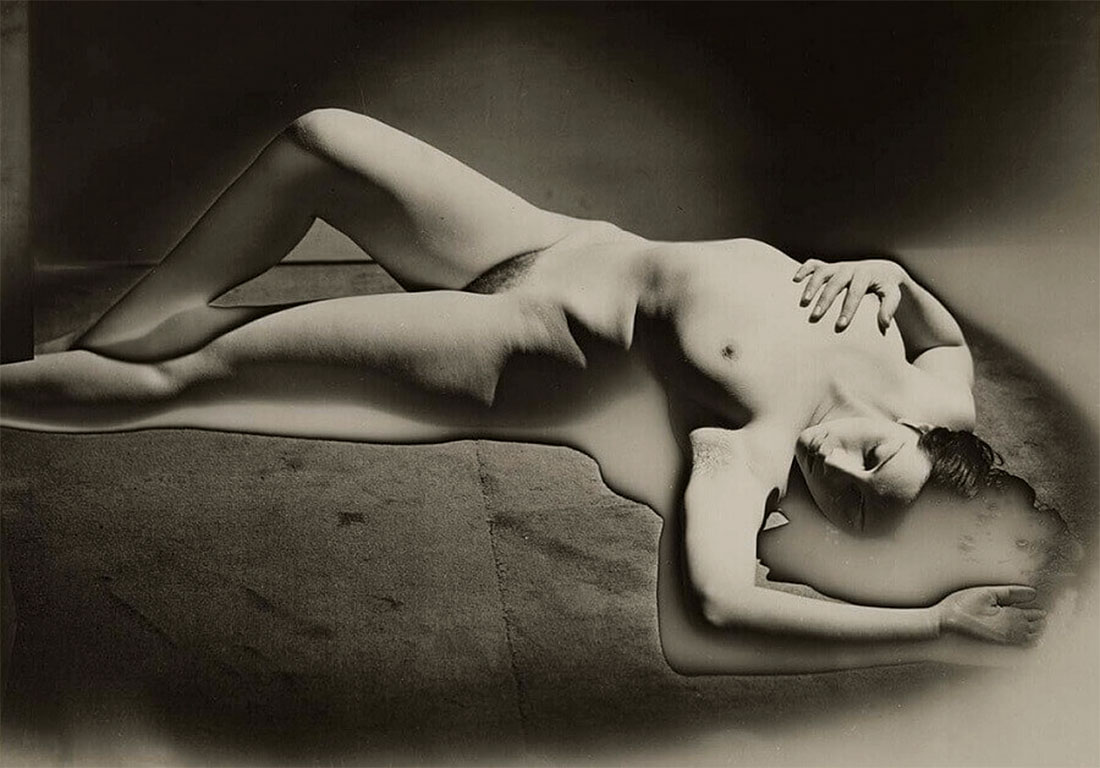
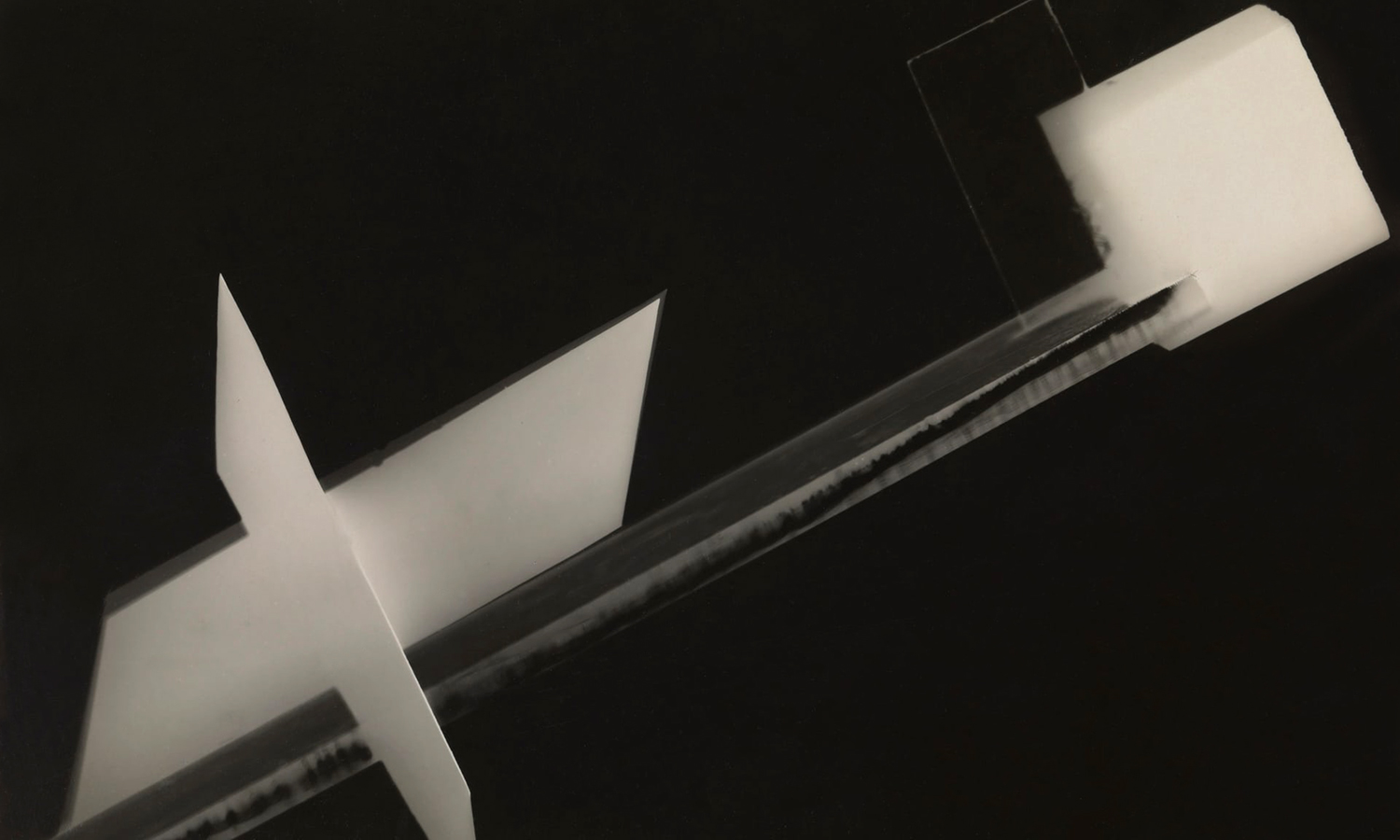
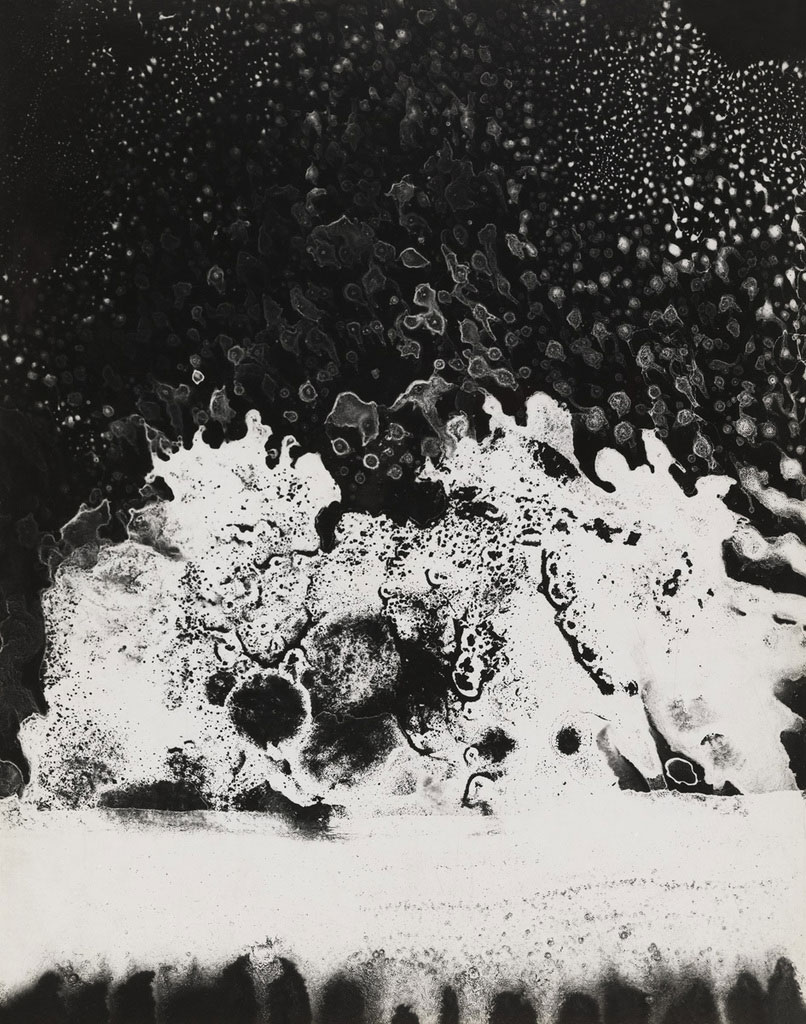
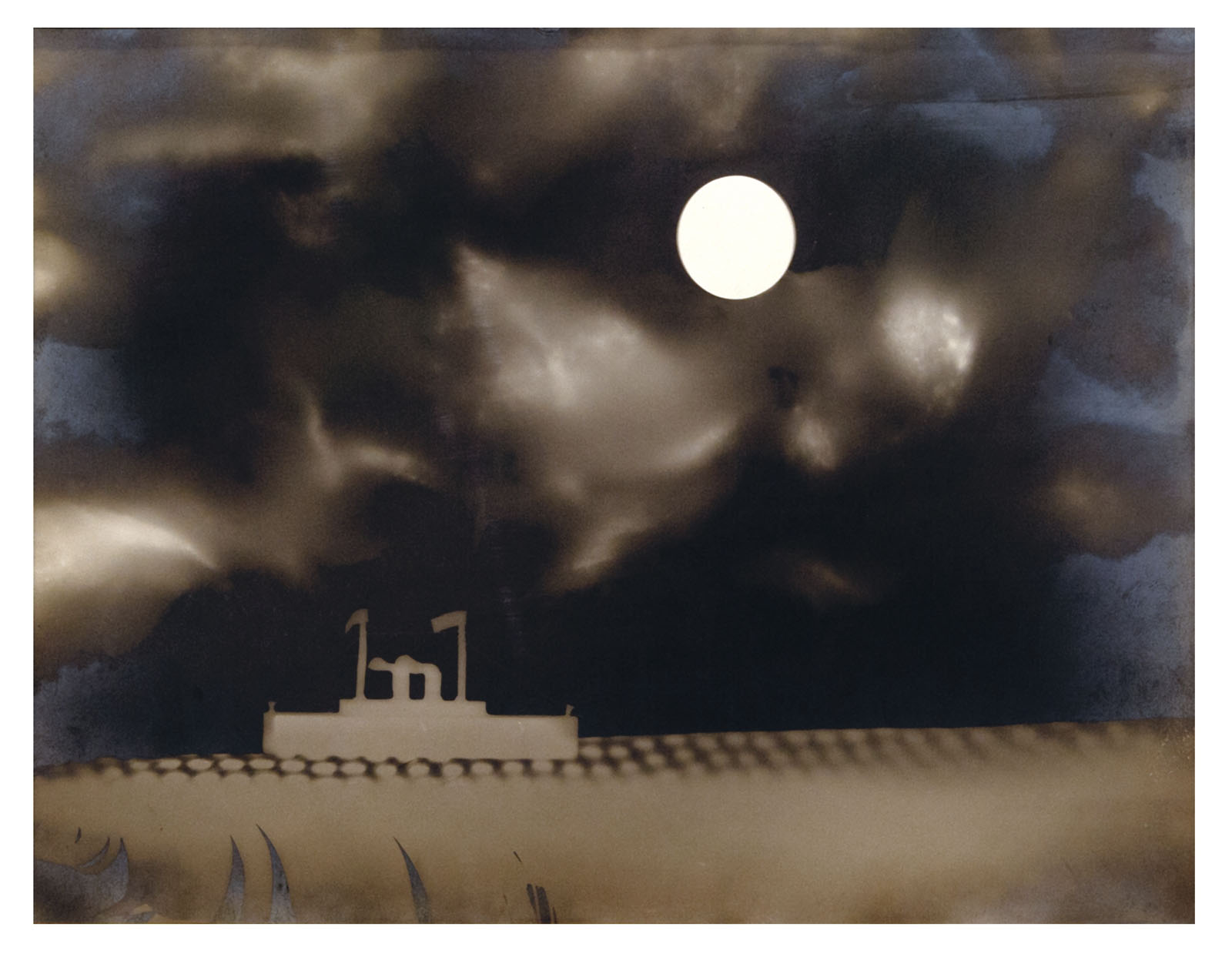
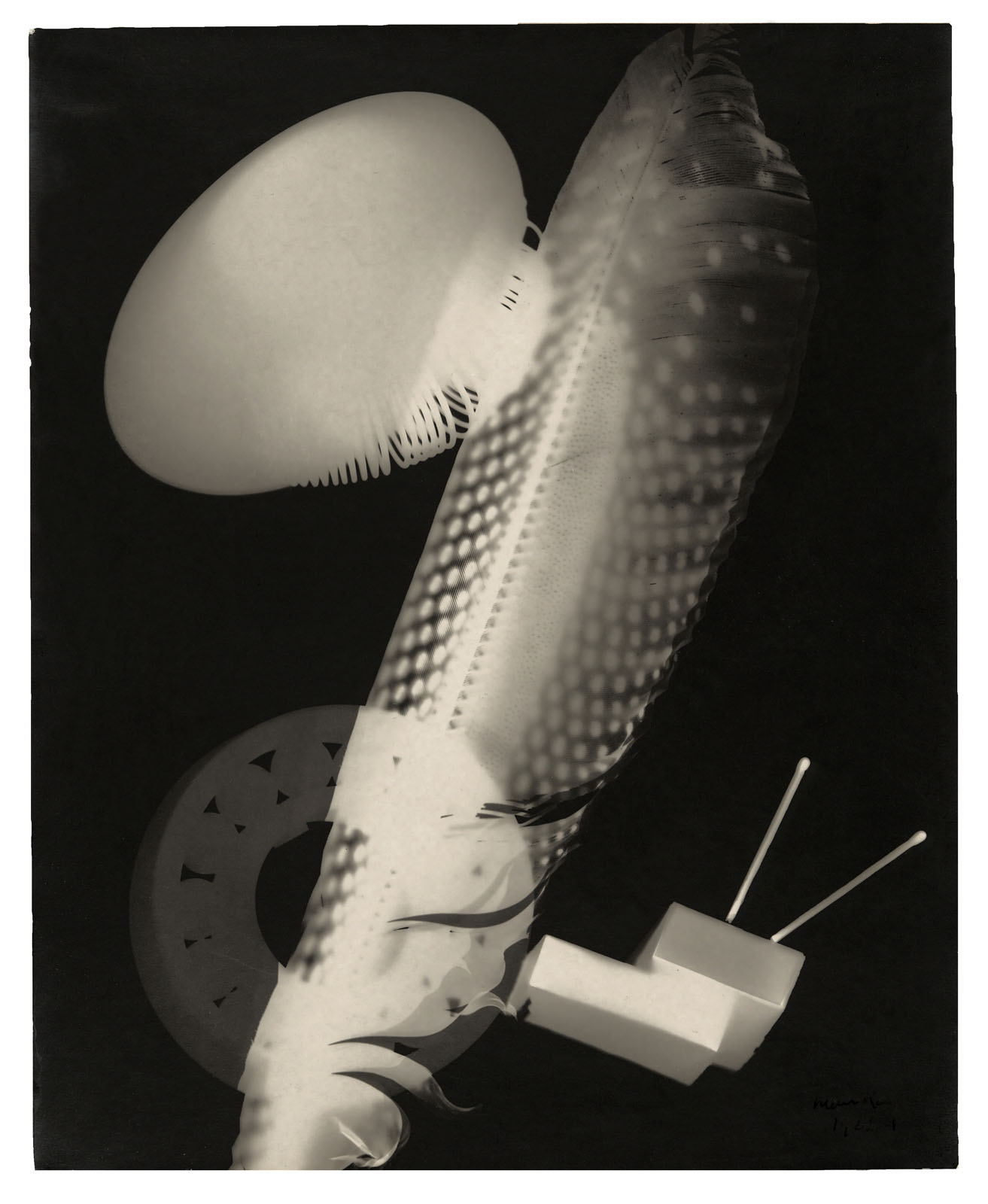
Man Ray (American, 1890-1976) 'Marine' c. 1925


Man Ray (American, 1890-1976) 
Marine 
c. 1925 
Gelatin silver print 
8 3/4 × 11 9/16 in. (22.2 × 29.3cm) 
Private collection; courtesy Galerie 1900-2000, Paris-New York 
© Man Ray 2015 Trust / Artists Rights Society (ARS), NY / ADAGP, Paris 2025 


“Like the undisturbed ashes of an object consumed by flames these images are oxidized residues fixed by light and chemical elements of an experience, an adventure, not an experiment. They are the result of curiosity, inspiration, and these words do not pretend to convey any information.”


Man Ray1


The rayographs

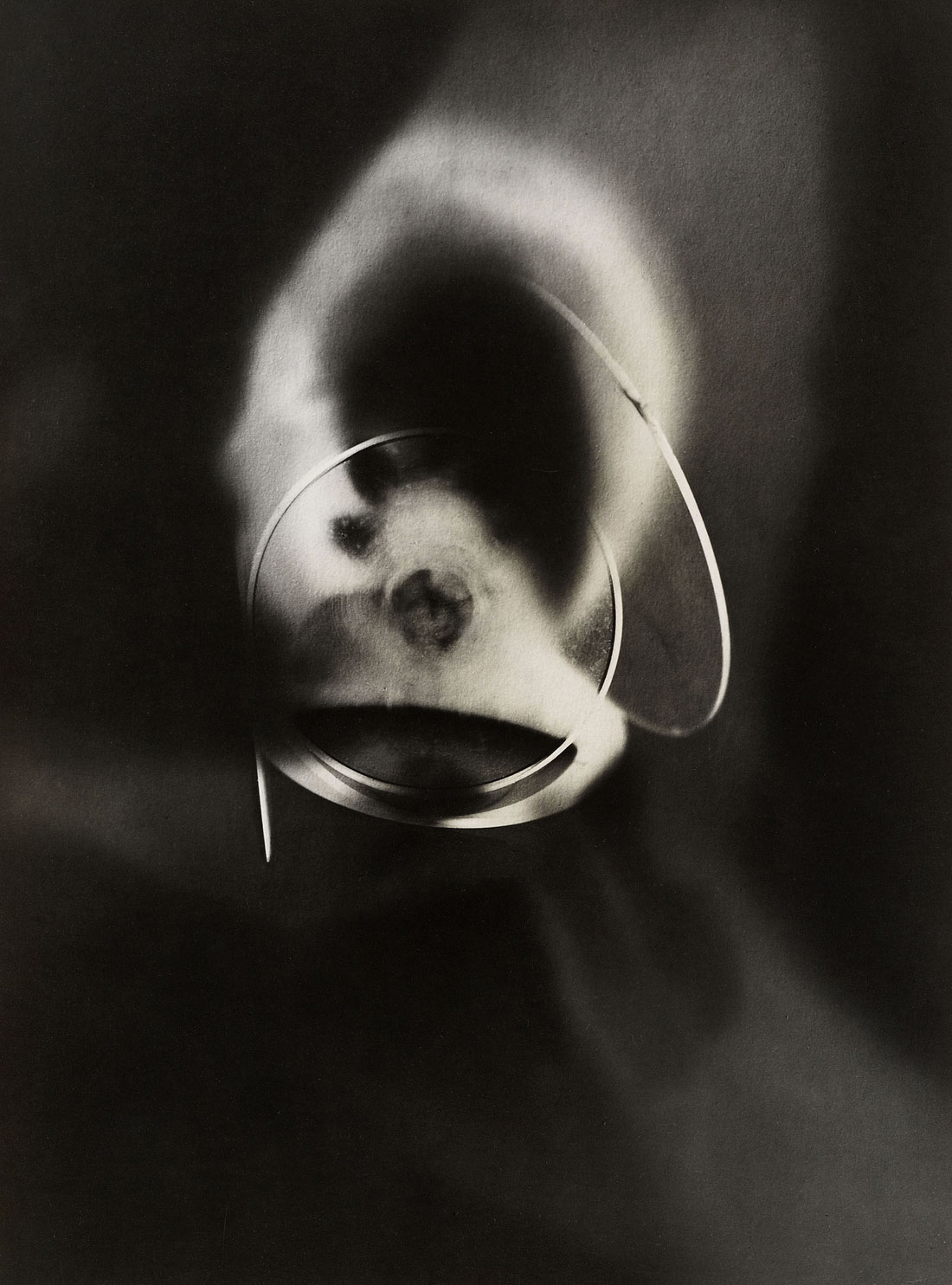
Although not the inventor of the photogram, a photograph made without the use of a camera by placing objects directly onto sensitised photographic paper and then exposing the paper to light, Man Ray’s rayographs have become the most recognisable and famous form that photograms have taken. This is because of their inventiveness, their subliminal connection to the psyche, and the use of “objects from the real world to make ambiguous dreamscapes.”7

It is interesting that Man Ray called his images rayographs, for a graph implies a topographical mapping, a laying out of statistics, whereas Lucia Moholy and László Moholy-Nagy’s photograms imply in the title of their technique the transmission of some form of message, like a telegram. The paradox is that, as the quotation above states, Man Ray always insisted that his rayographs imparted no information at all; perhaps they are only dreams made (un)stable. Contrary to this the other two artists believed that, “photographic images – cameraless and other – should not deal with conventional sentiments or personal feelings but should be concerned with light and form,”8 quite the reverse of the title of their technique.

After his arrival in Paris Man Ray started experimenting in his darkroom and discovered the technique for his rayographs by accident. With the help of his friend the Surrealist poet Tristan Tzara, he published a portfolio of twelve Rayographs in 1922 called Les champs délicieux (The delicious fields). “This title is a reference to ‘Les champs magnétiques’, a collection of writings by André Breton and Philippe Soupault composed from purportedly random thought fragments recorded by the two authors.”9 The rayographs are visual representations of random thought fragments, “photographic equivalents for the Surrealist sensibility that glorified randomness and disjunction.”10

Man Ray, “denied the camera its simplest joy: the ability to capture everything, all the distant details, all the ephemeral lights and shadows of the world”11 but, paradoxically, the rayographs are the most ephemeral of creatures, only being able to be created once, the result not being known until after the photographic paper has been developed. In fact, for Man Ray to create his portfolio Les champs délicieux (The delicious fields), he had to rephotograph the rayographs in order to make multiple copies.12

Man Ray “insisted in nearly every interview that the rayograph was not a photogram in the traditional sense. He did something that a photogram didn’t; he introduced depth into the images,”13 which denied the images their photographic objectivity by depicting an internal landscape rather than an external one.14 What the rayographs do not deny, however, is the subjectivity of the artist, his skill at placing the objects on the photographic paper, expressed in their dream-like nature, both a subjective ephemerality (because they could only be produced once) and an ephemeral subjectivity (because they were expressions of Man Ray’s fantasies, and therefore had little substance).

Through an alchemical process the latent images emerge from the photographic paper, representations of Man Ray’s fantasies as embodied in the ‘presence’ of the objects themselves, in the surface of the paper. Perhaps these objects offer, in Heidegger’s terms, ‘a releasement towards things’,15 “a coexistence between a conscious and unconscious way of perceiving which sustains the mystery of the object confusing the distinction between real time and sensual time, between inside and outside, input and output becoming neither here nor there.”16

Finally, within their depth of field the rayographs can be seen as both dangerous and delicious, for somehow they are both beautiful and unsettling at one and the same time. As Surrealism revels in randomness and chance these images enact the titles of other Man Ray photographs: Danger-Dancer, Anxiety, Dust Raising, Distorted House. The rayographs revel in chance and risk; Man Ray brings his fantasies to the surface, an interior landscape represented externally that can be (re)produced only once – those dangerous delicious fields.

Extract from Marcus Bunyan. “The Delicious Fields: Exploring Man Ray’s ‘Rayographs’ in a Digital Future,” published in The University of Queensland Vanguard magazine ‘Man Ray: Life, Work & Themes’, 2004


Footnotes

1/ Man Ray quoted in Janus (trans. Murtha Baca). Man Ray: The Photographic Image. London: Gordon Fraser, 1980, p. 213

7/ Mark Greenberg (ed.,). In Focus: Man Ray: Photographs from the J. Paul Getty Museum. Los Angeles, The J. Paul Getty Museum, 1998, p. 38

8/ Naomi Rosenblum. A World History of Photography. New York: Abbeville Press, 1997, 394

9/ Greenberg, op. cit., p. 28

10/ Jed Perl (ed.,). Man Ray: Aperture Masters of Photography. New York: Aperture, 1997 pp. 11-12

11/ Perl, op. cit., pp. 5-6

12/ Greenberg, op. cit., p. 28

13/ Greenberg, op. cit., p. 112

14/ Greenberg, op. cit., p. 28

15/ “We stand at once within the realm of that which hides itself from us, and hides itself just in approaching us. That which shows itself and at the same time withdraws is the essential trait of what we call the mystery … Releasement towards things and openness to the mystery belong together. They grant us the possibility of dwelling in the world in a totally different way…”

Martin Heidegger. Discourse on Thinking. New York: Harper & Row, 1966, pp. 55-56 quoted in Mauro Baracco. “Completed Yet Unconcluded: The Poetic Resistance of Some Melbourne Architecture,” in Leon van Schaik (ed.,). Architectural Design Vol. 72. No. 2 (‘Poetics in Architecture’). London: John Wiley and Sons, 2002, 74, Footnote 6.

16/ Marcus Bunyan. Spaces That Matter: Awareness and Entropia in the Imaging of Place (2002) [Online] Cited 07/07/2004.


Many thankx to The Metropolitan Museum of Art for allowing me to publish the photographs in the posting. Please click on the photographs for a larger version of the image.


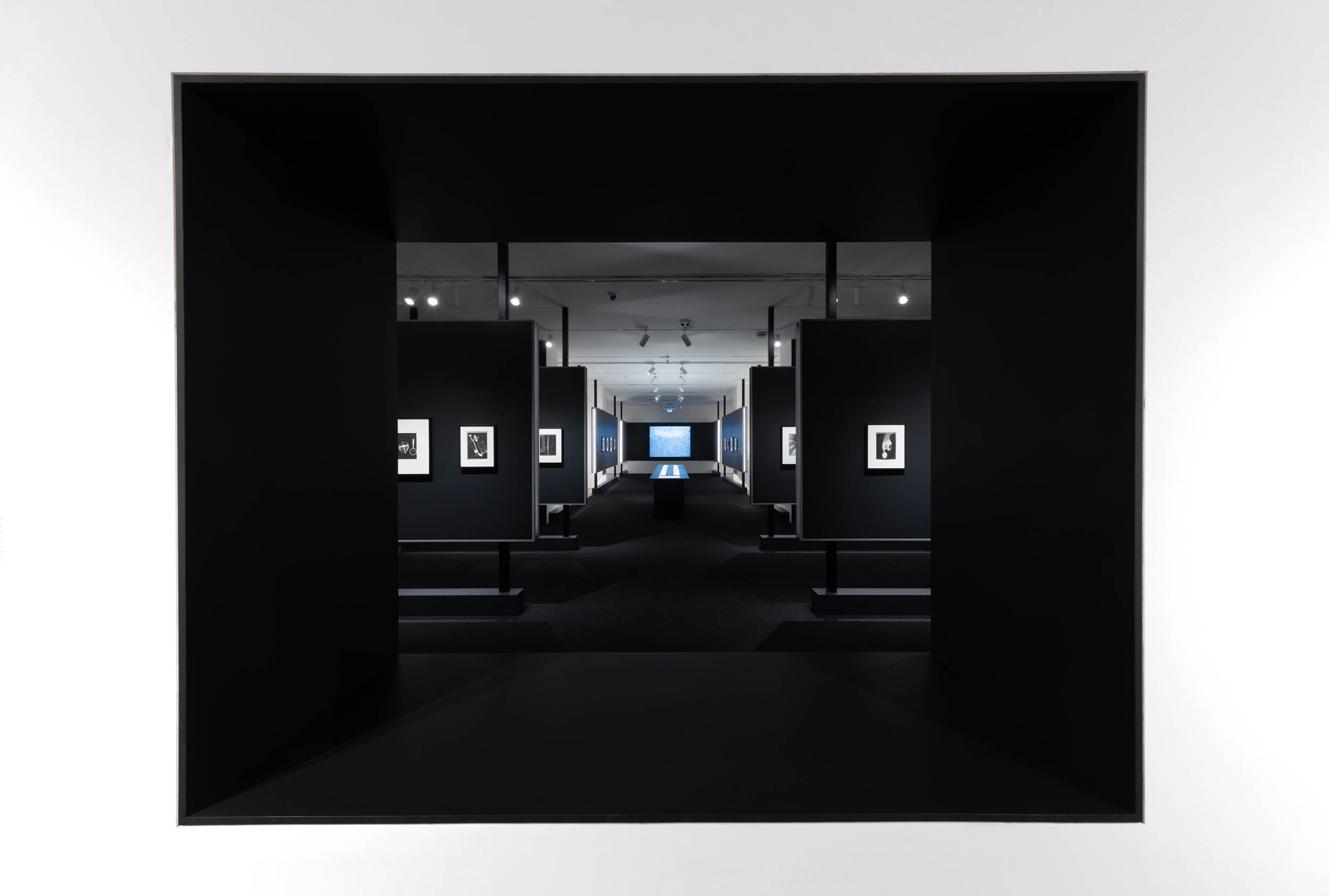
“Stepping into the exhibition Man Ray: When Objects Dream at The Metropolitan Museum of Art feels like entering the bellows of an old camera. Through a rectangular frame cut into the entry, the darkened walls unfold, accordion-like, to reveal a visual feast of the artist’s work, as Man Ray’s earliest film, “Retour à la raison (Return to Reason)” (1923), flickers across the screen opposite. Although the exhibition brings together approximately 160 works from an impressive array of lenders, it reveals itself gradually, taking the viewer through several turns before one can grasp its sheer enormity. When Objects Dream proves, thrillingly, that anyone left feeling jaded from the many, many recent exhibitions surrounding Surrealism’s centennial in 2024 can still see the movement’s key photographer with a fresh set of eyes.”


Julia Curl. “Man Ray Was So Much More Than a Photographer,” on the Hyperallergic website September 16, 2025 [Online] Cited 05/12/2025


“Objects to touch, to eat, to crunch, to apply to the eye, to the skin, to press, to lick, to break, to grind, objects to lie, to flee from, to honor, things cold or hot, feminine or masculine, objects of day or night which absorb through your pores the greater part of our life. … These are the projections surprised in transparence, by the light of tenderness, of objects that dream and talk in their sleep.” 

.
Tristan Tzara, “When Objects Dream,” 1934


“One sheet of paper got into the developing tray – a sheet unexposed that had been mixed with those already exposed under the negatives. … Regretting the waste of paper, I mechanically placed a small glass funnel, the graduate, and the thermometer in the tray on the wetted paper. I turned on the light; before my eyes an image began to form, not quite a simple silhouette of the objects as in a straight photograph, but distorted and refracted by the glass more or less in contact with the paper and standing out against a black background. … I remembered when I was a boy, placing fern leaves in a printing frame with proof paper, exposing it to sunlight, and obtaining a white negative of the leaves. This was the same idea, but with an added three-dimensional quality and tone graduation. I made a few more prints … taking whatever came to hand; my hotel-room key, a handkerchief, some pencils, a brush, a candle, a piece of twine … excitedly, enjoying myself immensely. In the morning I examined the results. … They looked startlingly new and mysterious.”


Man Ray 


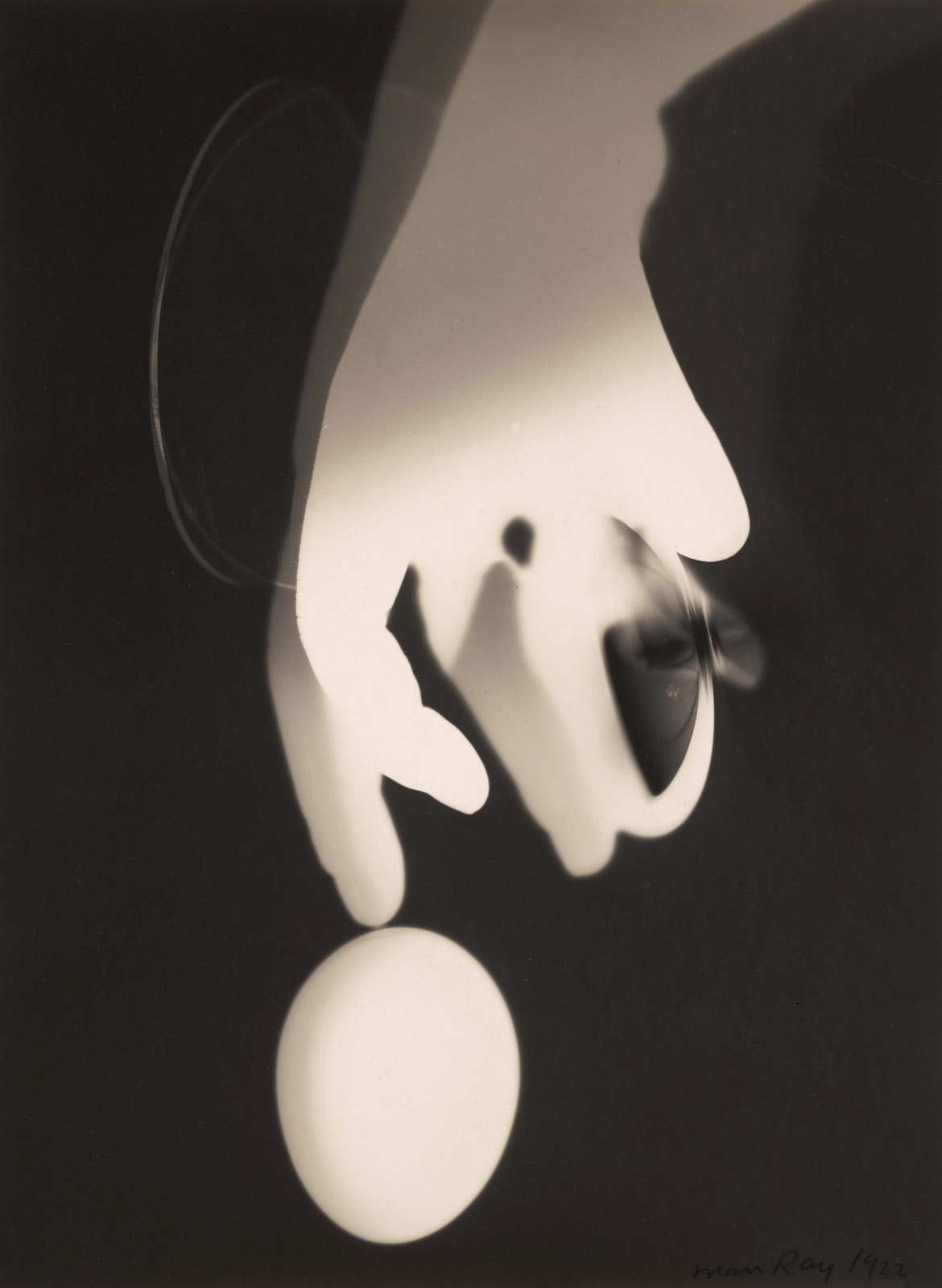
Man Ray (American, 1890-1976) 'Rayograph' 1922


Man Ray (American, 1890-1976) 
Rayograph
1922 
Gelatin silver print 
9 1/2 × 7 in. (24.1 × 17.8cm) 
The Metropolitan Museum of Art, New York, Bluff Collection, Promised Gift of John A. Pritzker 
© Man Ray 2015 Trust / Artists Rights Society (ARS), NY / ADAGP, Paris 2025
Photo by Ben Blackwell 


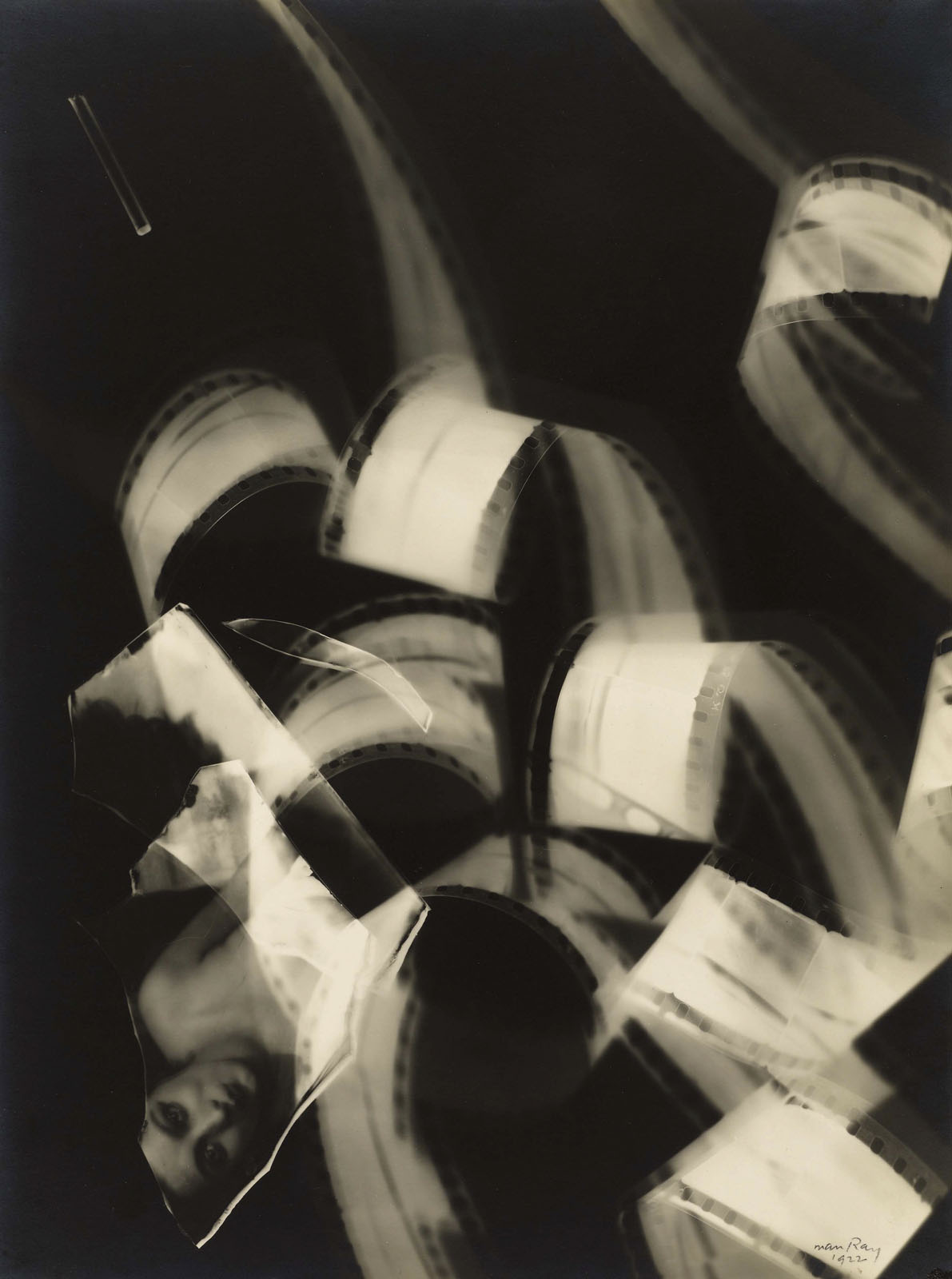
Man Ray (American, 1890-1976) 'Rayograph' 1922


Man Ray (American, 1890-1976) 
Rayograph
1922 
Gelatin silver print 
9 3/8 × 7 in. (23.8 × 17.8cm) 
The J. Paul Getty Museum, Los Angeles
Courtesy The J. Paul Getty Museum, Los Angeles 
© Man Ray 2015 Trust / Artists Rights Society (ARS), NY / ADAGP, Paris 2025


Man Ray (American, 1890-1976) 'Rayograph' 1922


Man Ray (American, 1890-1976) 
Rayograph
1922
Gelatin silver print
9 3/8 x 7 in. (23.8 x 17.8cm)
Private collection
© Man Ray 2015 Trust / Artists Rights Society (ARS), NY / ADAGP, Paris 2025


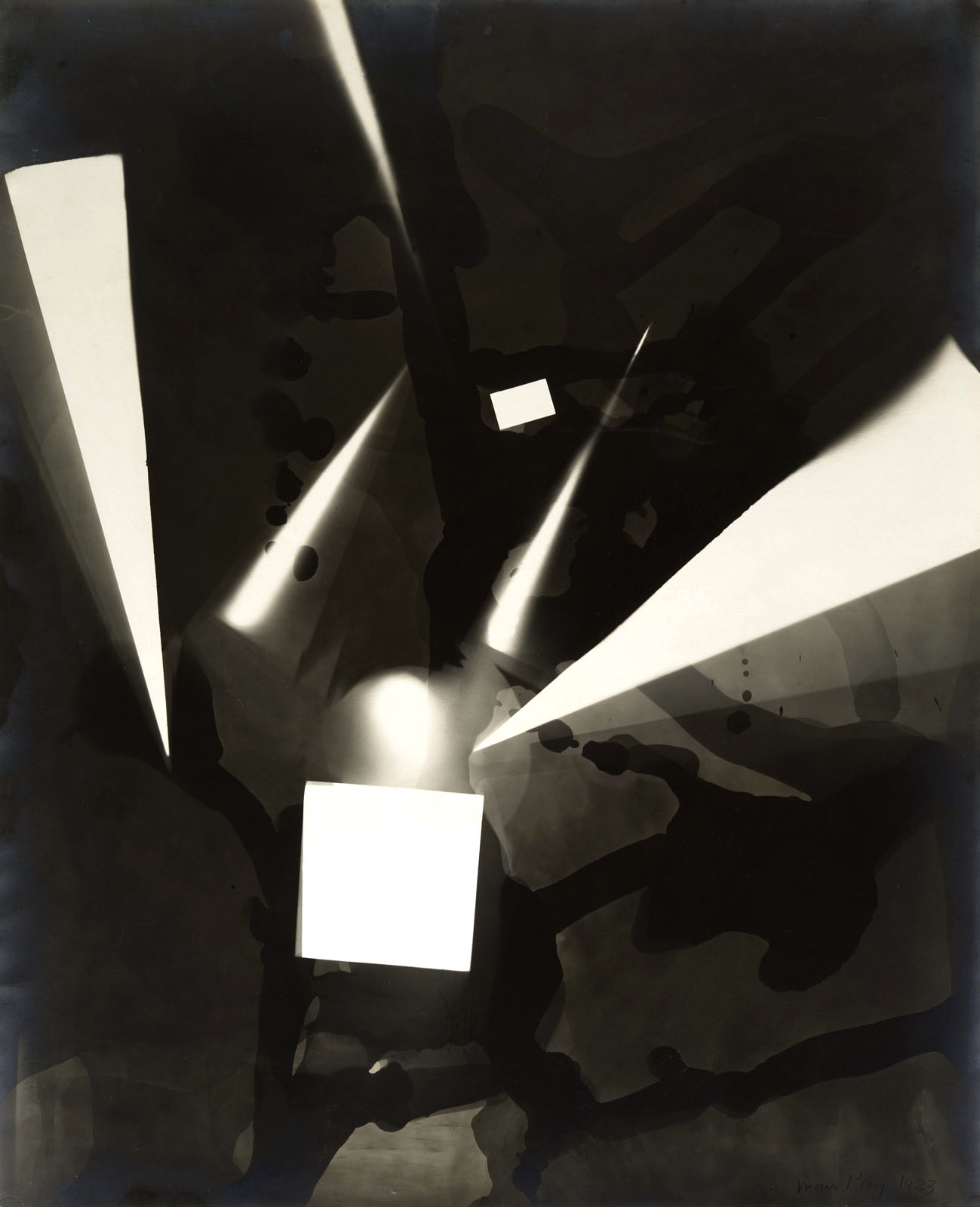
Man Ray (American, 1890-1976) 'Rayograph' 1923


Man Ray (American, 1890-1976) 
Rayograph 
1923 
Gelatin silver print 
11 1/2 × 9 5/16 in. (29.2 × 23.7cm) 
Yale University Art Gallery, New Haven, Gift of the Estate of Katherine S. Dreier 
© Man Ray 2015 Trust / Artists Rights Society (ARS), NY / ADAGP, Paris 2025
Photo: Yale University Art Gallery, Gift of Collection Société Anonyme 


Man Ray (American, 1890-1976) 'Rayograph' 1923-1928


Man Ray (American, 1890-1976) 
Rayograph
1923-1928 
Gelatin silver print 
19 5/16 x 15 11/16 in. (49 x 39.8cm) 
The Metropolitan Museum of Art, New York, Gilman Collection, Purchase, The Horace W. Goldsmith Foundation Gift, through Joyce and Robert Menschel, 2005
Image © The Metropolitan Museum of Art, photo by Mark Morosse 
© Man Ray 2015 Trust / Artists Rights Society (ARS), NY / ADAGP, Paris 2025 


Man Ray (American, 1890-1976) 'Rayography' 1925


Man Ray (American, 1890-1976) 
Rayograph 
1925 
Gelatin silver print 
19 15/16 × 15 13/16 in. (50.6 × 40.2cm) 
MAH Musée d’art et d’histoire, City of Geneva. Purchase, 1968
© Man Ray 2015 Trust / Artists Rights Society (ARS), NY / ADAGP, Paris 2025
Photo © Musée d’art et d’histoire, Ville de Genève, photo by André Longchamp


American artist Man Ray (1890-1976) was a visionary known for his radical experiments that pushed the limits of photography, painting, sculpture, and film. In the winter of 1921, he pioneered the rayograph, a new twist on a technique used to make photographs without a camera. By placing objects on or near a sheet of light-sensitive paper, which he exposed to light and developed, Man Ray turned recognisable subjects into wonderfully mysterious compositions. Introduced in the period between Dada and Surrealism, the rayographs’ transformative, magical qualities led the poet Tristan Tzara to describe them as capturing the moments “when objects dream.”

The exhibition will be the first to situate this signature accomplishment in relation to Man Ray’s larger body of work of the 1910s and 1920s. Drawing from the collections of The Met and more than 50 U.S. and international lenders, the exhibition will feature approximately 60 rayographs and 100 paintings, objects, prints, drawings, films, and photographs – including some of the artist’s most iconic works – to highlight the central role of the rayograph in Man Ray’s boundary-breaking practice.

“Before my eyes an image began to form, not quite a simple silhouette of the objects as in a straight photograph, but distorted and refracted … In the morning I examined the results, pinning a couple of the rayographs – as I decided to call them – on the wall. They looked startlingly new and mysterious.” ~ Man Ray

Text from The Metropolitan Museum of Art website


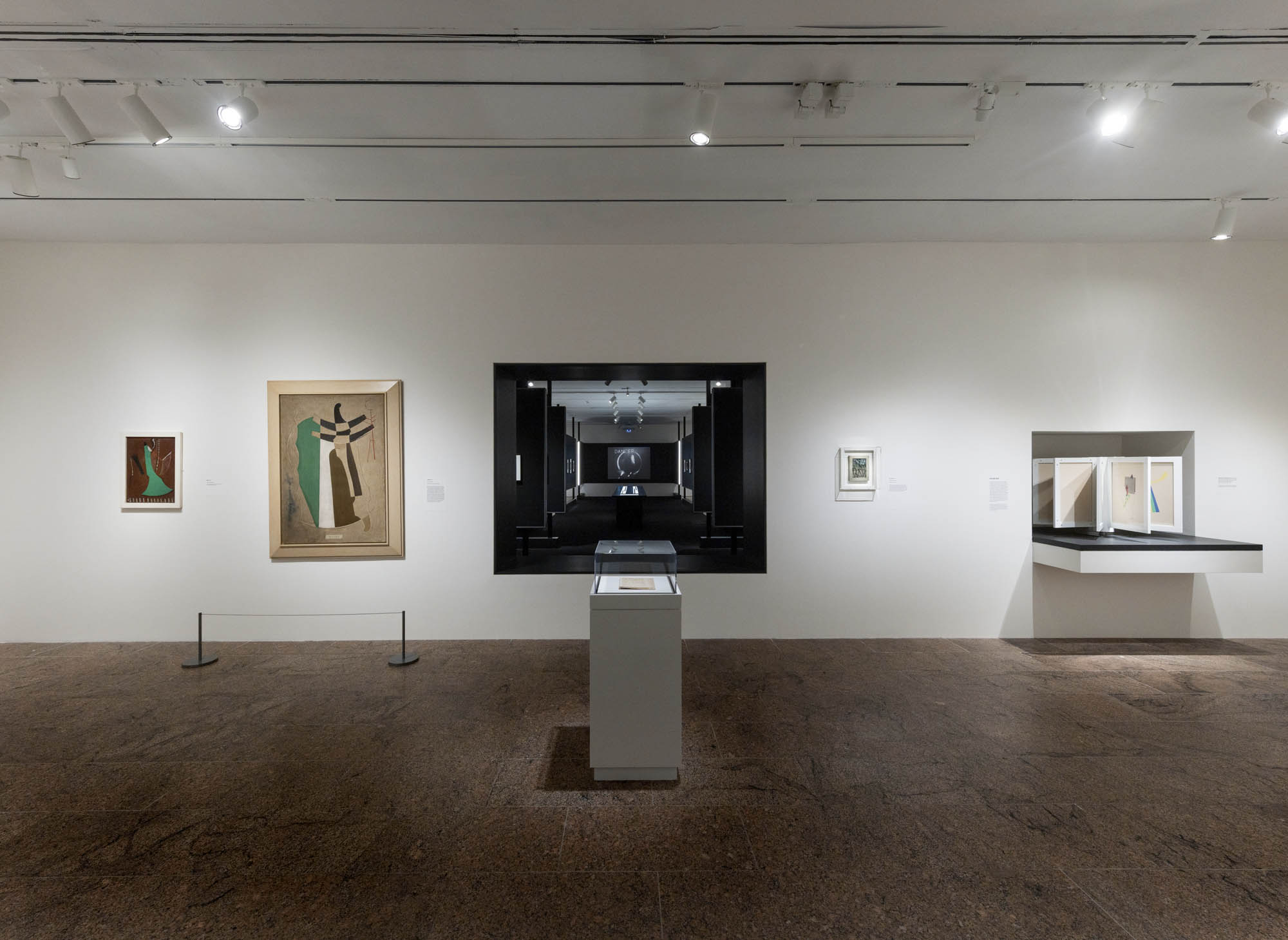
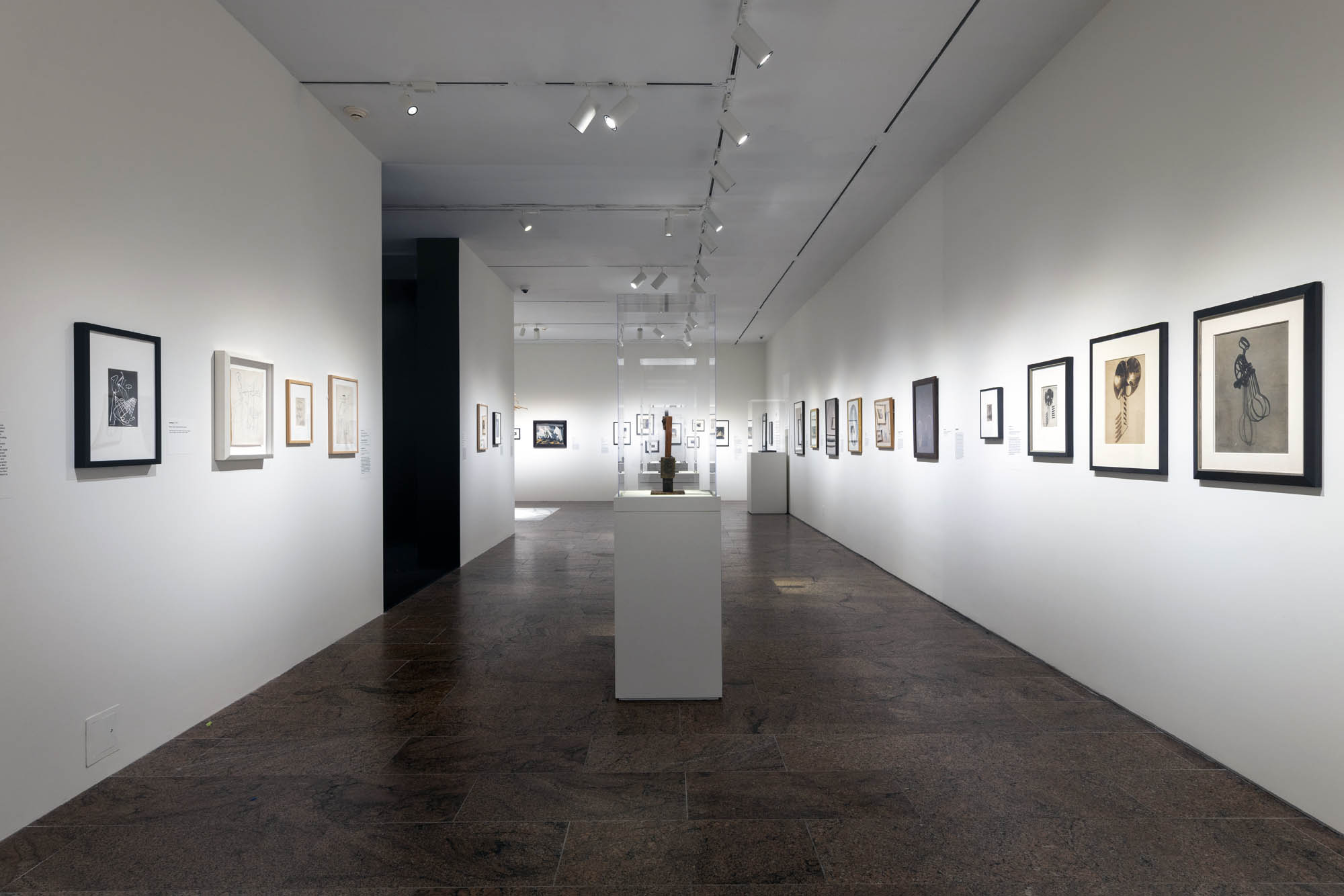
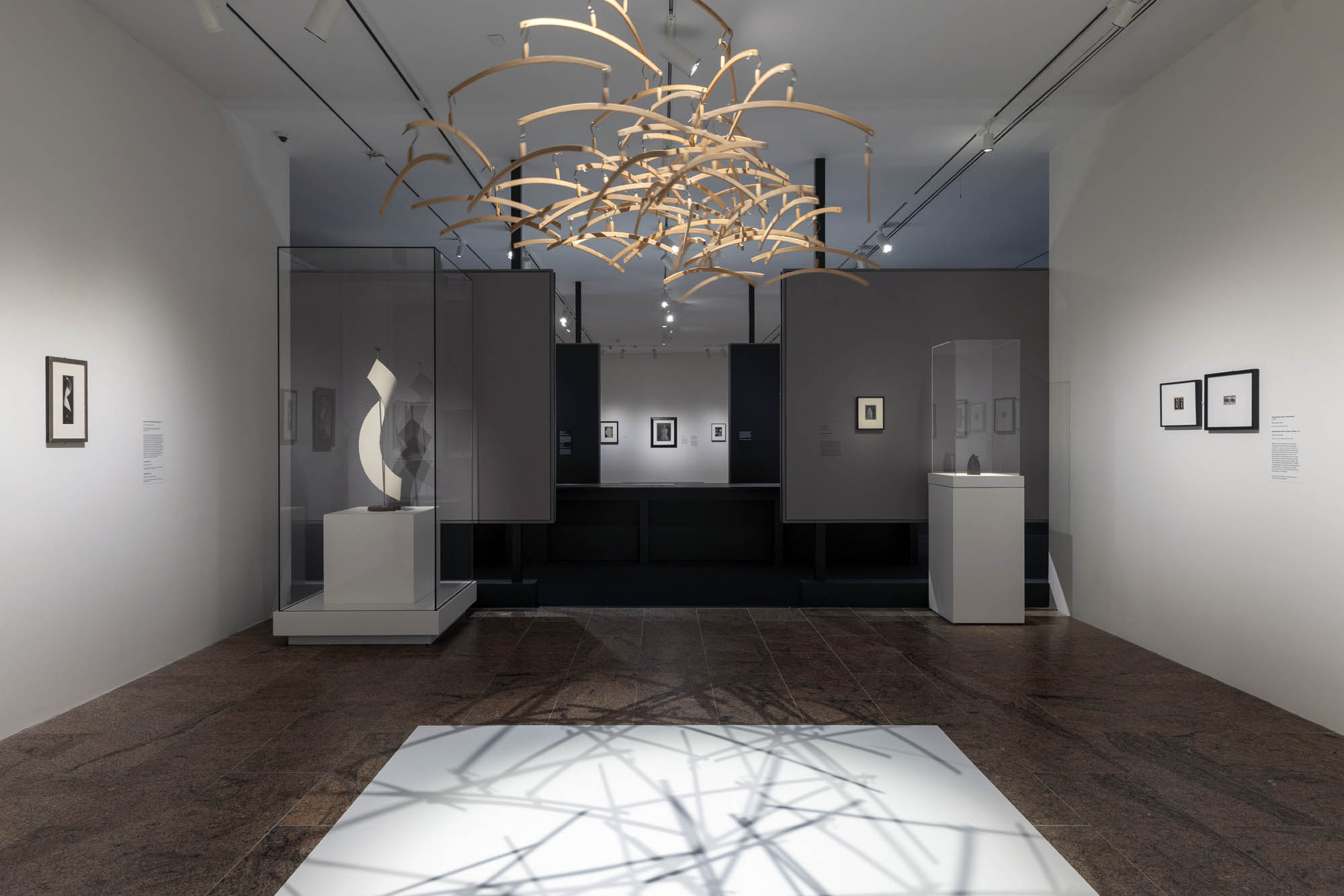
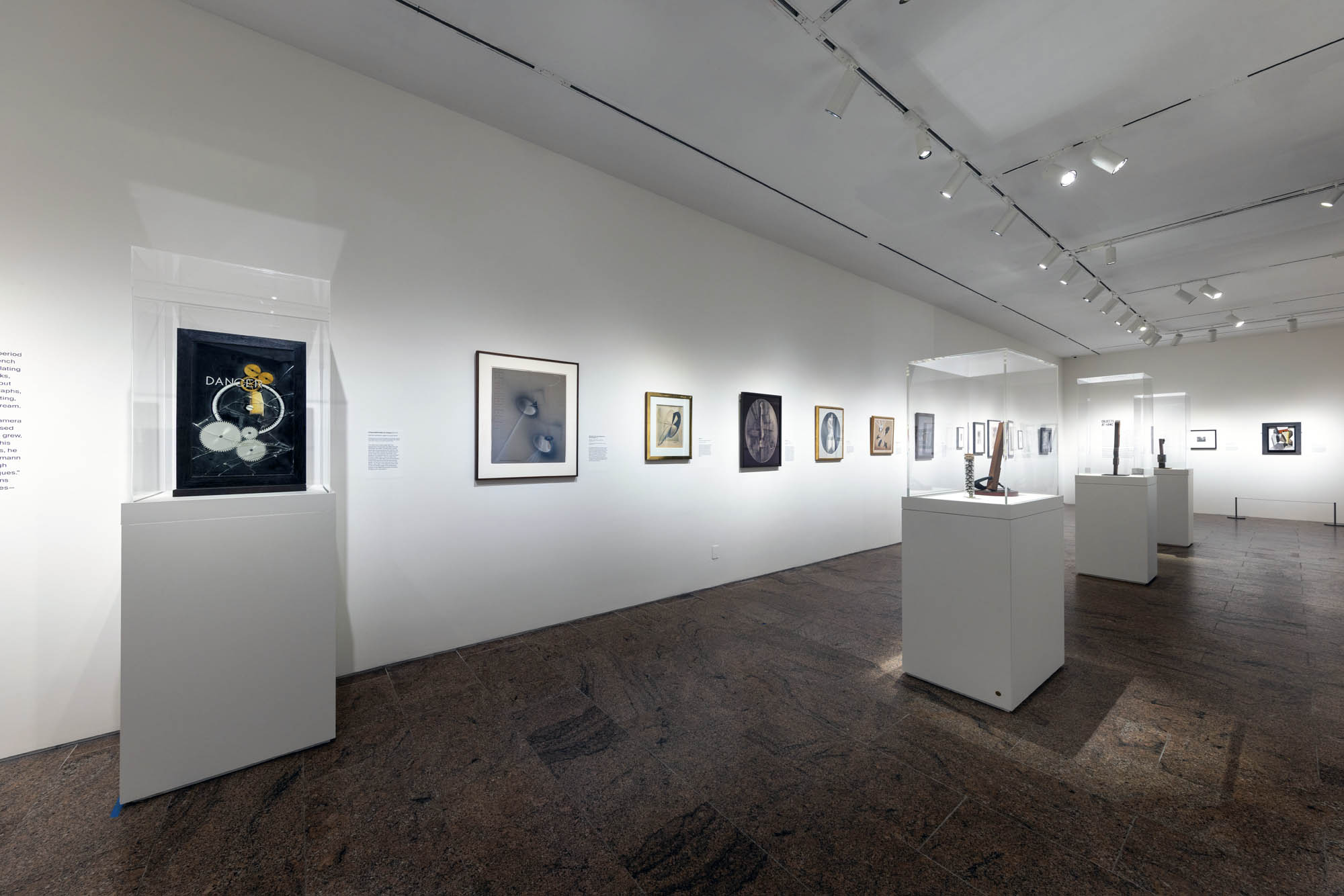
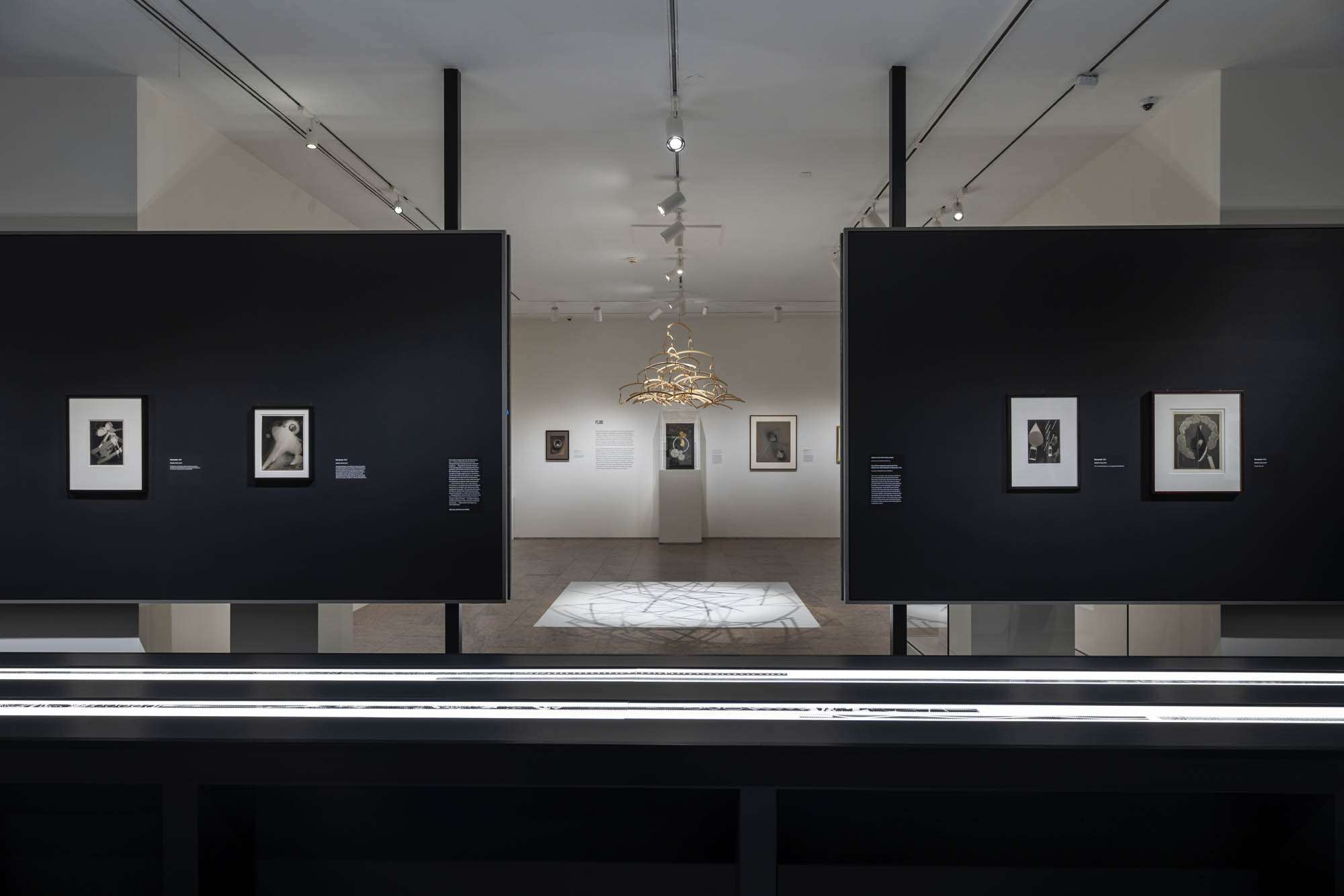
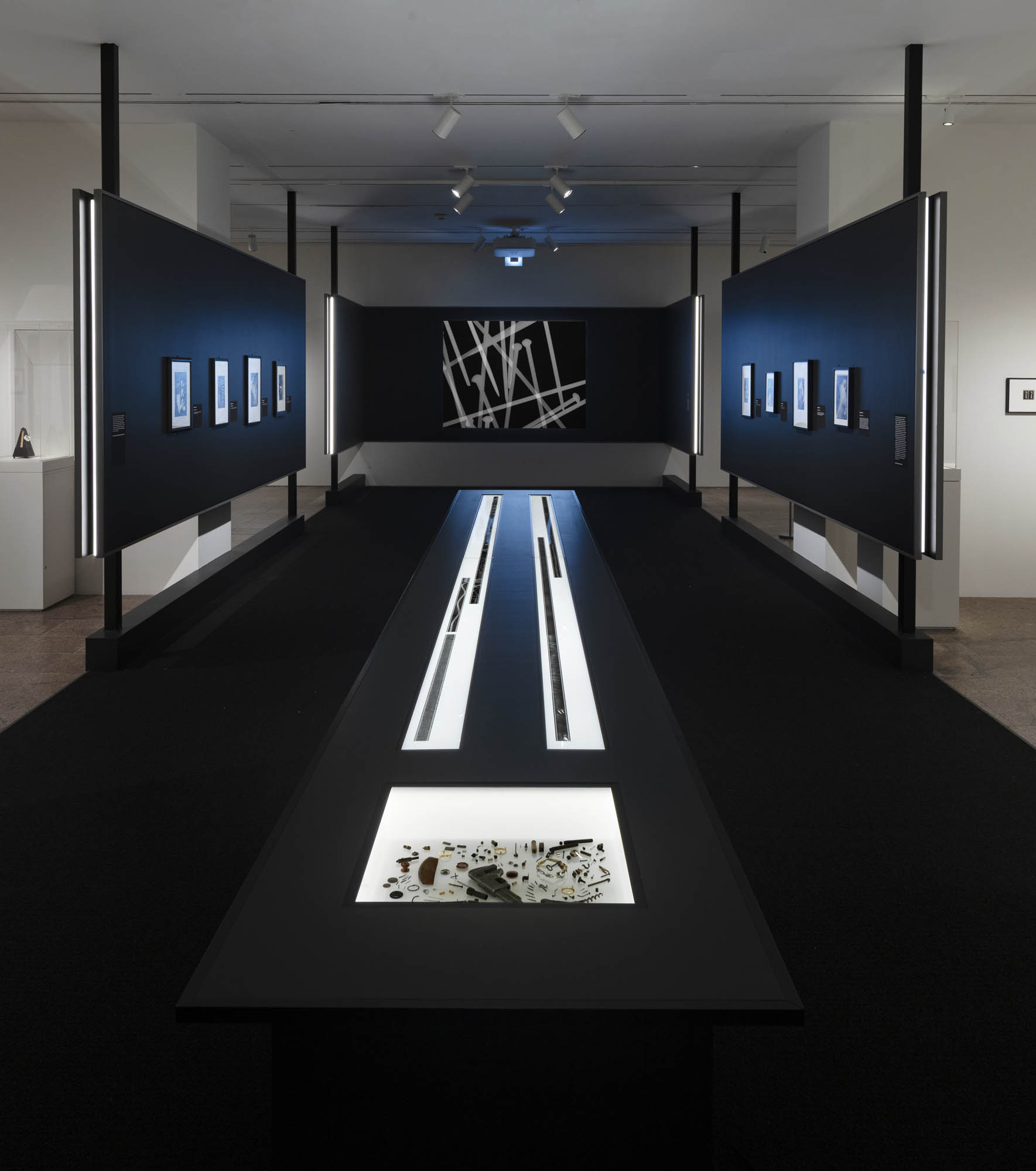
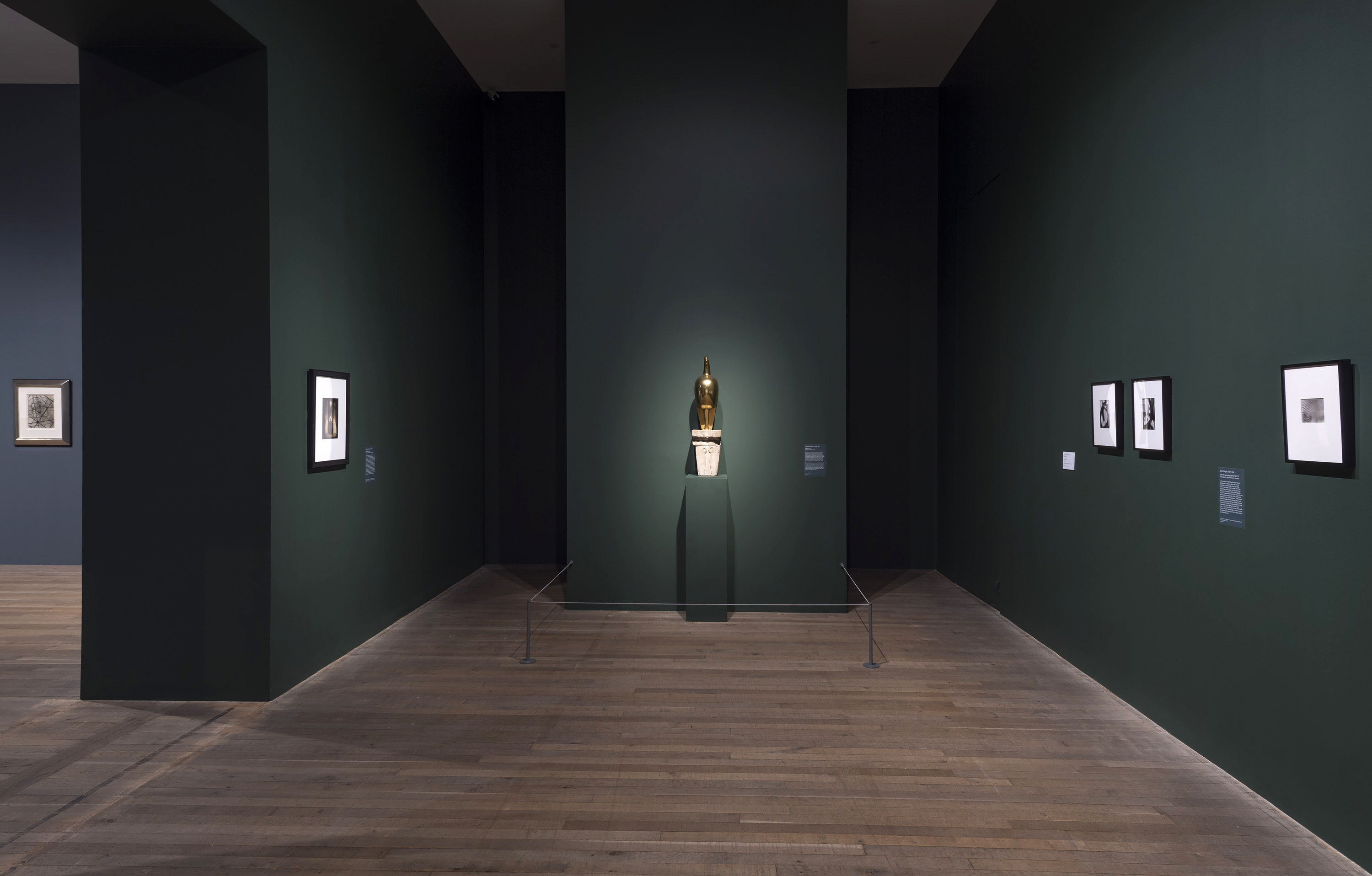
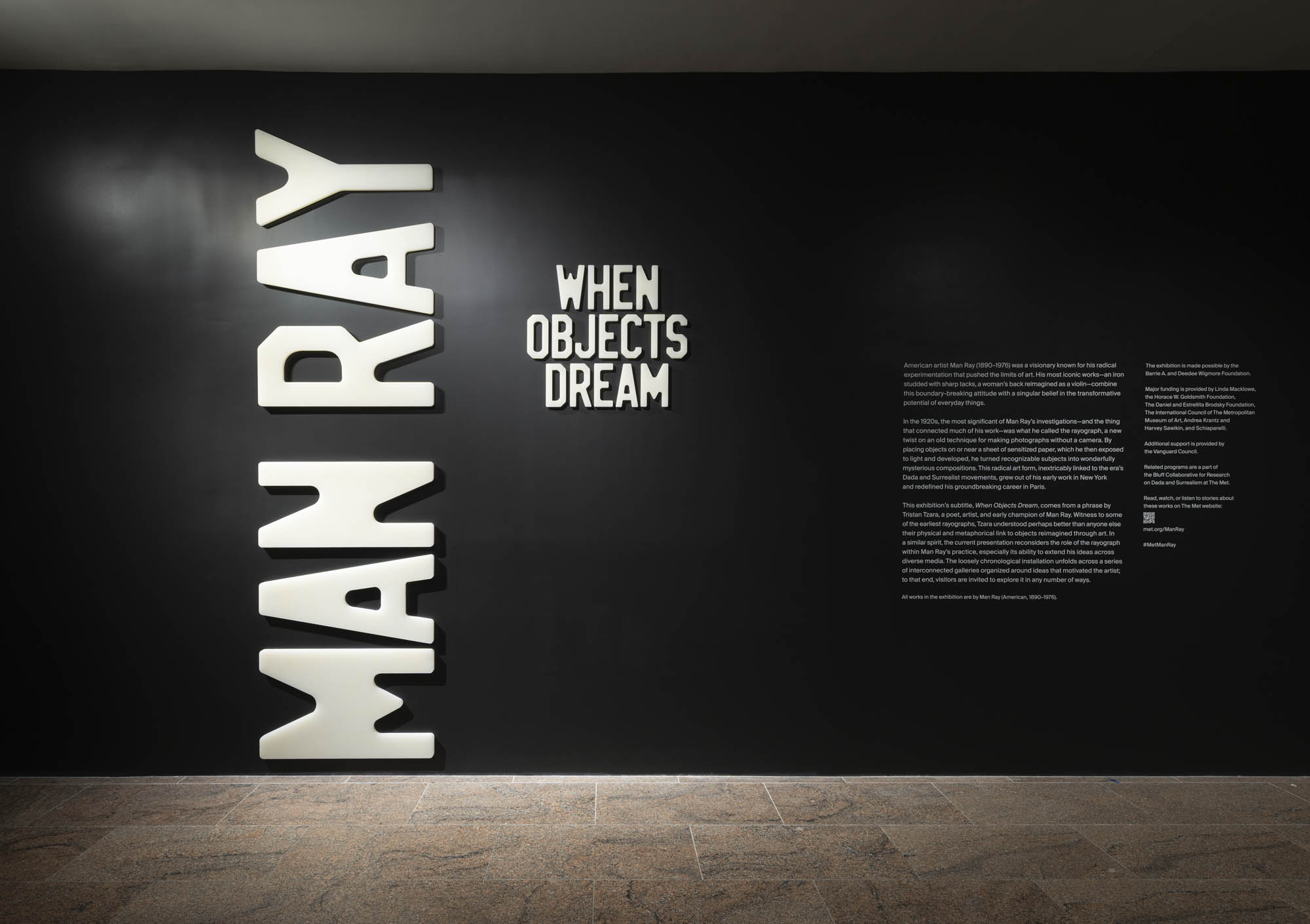
Installation view of the exhibition 'Man Ray: When Objects Dream' at The Metropolitan Museum of Art, New York, September 2025 - February 2026


Installation views of the exhibition Man Ray: When Objects Dream at The Metropolitan Museum of Art, New York, September 2025 – February 2026


Man Ray (American, 1890-1976)
'Torse (Retour à la raison)' (Torso [Return to Reason]) 1923, printed c. 1935


Man Ray (American, 1890-1976)
Torse (Retour à la raison) (Torso [Return to Reason])
1923, printed c. 1935
Gelatin silver print
8 1/4 × 6 3/8 in. (21 × 16.2cm)
Private collection
© Man Ray 2015 Trust / Artists Rights Society (ARS), NY / ADAGP, Paris 2025


In the 1923 silent short of the same title, Man Ray filmed barely discernible scenes of Paris at night along with his own enigmatic photograms and conglomerations of spiraling or gyrating objects. The resulting sequence of near-total abstractions seems devoid of sense or purpose. The “return to reason” in the film comes finally in the form of a woman’s torso – modelled by cabaret personality Kiki de Montparnasse – turning to and fro beside a rain-covered windowpane. Man Ray reproduced the seductive finale, as well as other moments from the film, as photographs, singly and in strips. A still from Man Ray’s film, this particular photograph appeared on its own in the first issue of the key avant-garde journal La Révolution surréaliste, in 1924.

Text from the Art Institute of Chicago website


Le retour à la raison (Return to Reason), Man Ray, 1923


Emak-Bakia (1926) – directed by Man Ray

Emak-Bakia (Basque for Leave me alone) is a 1926 film directed by Man Ray. Subtitled as a cinépoéme, it features many techniques Man Ray used in his still photography (for which he is better known), including rayographs, double exposure, soft focus and ambiguous features.

Emak-Bakia shows elements of fluid mechanical motion in parts, rotating artifacts showing his ideas of everyday objects being extended and rendered useless. Kiki of Montparnasse (Alice Prin) is shown driving a car in a scene through a town. Towards the middle of the film Jacques Rigaut appears dressed in female clothing and make-up. Later in the film a caption appears: “La raison de cette extravagance” (the reason for this extravagance). The film then cuts to a car arriving and a passenger leaving with briefcase entering a building, opening the case revealing men’s shirt collars which he proceeds to tear in half. The collars are then used as a focus for the film, rotating through double exposures.

The film features sculptures by Pablo Picasso, and some of Man Ray’s mathematical objects both still and animated using a stop motion technique.

Originally a silent film, recent copies have been dubbed using music taken from Man Ray’s personal record collection of the time. The musical reconstruction was by Jacques Guillot.

When the film was first exhibited, a man in the audience stood up to complain it was giving him a headache and hurting his eyes. Another man told him to shut up, and they both started to fight. The theatre turned into a frenzy, the fighting ended up out in the street, and the police were called in to stop the riot.

Emak bakia can also mean “give peace” (“emak” is the imperative form of the verb “eman”, which means “give”) in Basque.

Text from the YouTube website


L’étoile de mer, Man Ray, 1928

The film was based on Robert Desnon’s surrealist poem L’Étoile de mer.


The Met Presents First Major Exhibition on Man Ray’s Radical Reinvention of Art through the rayograph 

Featuring 160 rayographs, paintings, objects, prints, drawings, films, and photographs, Man Ray: When Objects Dream highlights the principal place of the rayograph – a type of cameraless photograph – within the context of many of the artist’s most important works 

This exhibition includes thirty-five works by Man Ray which are part of the major promised gift of nearly 200 works of Dada and Surrealist art from Trustee John Pritkzer 

Man Ray: When Objects Dream at The Metropolitan Museum of Art is the first major exhibition to examine the radical experimentation of American artist Man Ray (1890-1976) through one of his most significant bodies of work, the rayograph. Man Ray coined the term rayograph to name his version of the 19th-century technique of making photographs without a camera. He created them by placing objects on or near a sheet of light-sensitive paper, which he then exposed to light and developed. These photograms – as they are also called – appear as reversed silhouettes, or negative versions, of their subjects. They often feature recognisable items that become wonderfully mysterious in the artist’s hands. Their transformative nature led the Dada poet Tristan Tzara to describe rayographs as capturing the moments “when objects dream.” While Man Ray acknowledged the photographic origins of his new works, he did not think of them as strictly bound by medium. Taking Man Ray’s lead, this presentation is the first – more than a century since he introduced the rayograph – to situate this signature accomplishment in relation to his larger artistic output. The exhibition is on view September 14, 2025, through February 1, 2026. 

“As one of the most fascinating and multi-faceted artists in the avant-garde movements of the early 20th century, Man Ray challenged traditional narratives of modernism through his daring experimentation with diverse artistic mediums,” said Max Hollein, The Met’s Marina Kellen French Director and Chief Executive Officer. “Anchored by Man Ray’s innovative and mesmerising rayographs along with new research and discoveries, this exhibition invites visitors to explore his ground-breaking manipulation of objects, light, and media, which profoundly reframed his artistic practice and impacted countless other artists. We’re so thrilled to include thirty-five works by Man Ray in this exhibition as part of John’s incredible promised gift.” 

Drawing from the collections of The Met and more than 50 U.S. and international lenders, the presentation includes more than 60 rayographs, many of which were featured in important publications and exhibitions at the time of their making, and 100 paintings, objects, prints, drawings, collages, films, and photographs to highlight the central role of the rayograph in Man Ray’s boundary-breaking practice. The exhibition marks a collaboration with the recently closed Lens Media Lab, Yale University, under the direction of Paul Messier, and with photography conservators and curators at various lending institutions, to study more than fifty rayographs. 

In the winter of 1921, while working late in his Paris darkroom, Man Ray inadvertently produced a photogram by placing some of his glass equipment on top of an unexposed sheet of photographic paper he found among the prints in his developing tray. As he wrote in his 1963 autobiography, “Before my eyes an image began to form, not quite a simple silhouette of the objects as in a straight photograph, but distorted and refracted … In the morning I examined the results, pinning a couple of the rayographs – as I decided to call them – on the wall. They looked startlingly new and mysterious.” This supposed accident, now the stuff of legend, has obscured the fact that rayographs might be seen as the culmination of Man Ray’s work up to 1921 as well as the frame through which he would redefine his work thereafter. They harnessed his interests in working between dimensions, media, and artistic traditions, fittingly at the moment between Dada and Surrealism, which writer Louis Aragon once called the mouvement flou (flou means “hazy, blurry, or out of focus” in French). 

Unfolding in a series of spaces that intersect with a central, dramatic presentation of rayographs, the exhibition illuminates their connections with Man Ray’s work in other media, including assemblage, painting, photography, and film. In approaching the rayograph in this expansive way, the exhibition also offers a reappraisal of the most productive and creatively significant period of his long career, beginning in New York around 1915 with his ambitious paintings and concluding in Paris in 1929 with his fine-tuning of the solarization process with Lee Miller. A critical factor across the exhibition is the central role of objects for Man Ray’s career, both in the creation of many of the rayographs and in his work more generally.

At its core, Man Ray: When Objects Dream focuses new attention on some of the artist’s most recognised, but little-studied, works, most particularly the rayograph. The exhibition opens with Champs délicieux (Delicious Fields) (1922), a portfolio of 12 rayographs which marks the first time Man Ray presented his photograms to the public. Critics hailed them for putting photography on the same plane as original pictorial works. The presentation concludes with the working copy of Champs délicieux, which the artist canceled and dedicated to his friend, Dada artist Tristan Tzara, in 1959. 

Between these two works, twelve thematic sections of the exhibition explore such concepts as the silhouette, the dream, the body, the object, and the game, which are inspired by Man Ray’s experimentation with the rayograph. Other groupings will focus on specific media and techniques, and the artist’s studio, as well as watershed moments in the artist’s production, such as the years of 1923 and 1929, when Man Ray unexpectedly returned to painting. Three of his newly restored films, Retour à la raison (Return to Reason) (1923), Emak Bakia (1926), and L’étoile de mer (The Starfish) (1928), will be screened within the exhibition. 

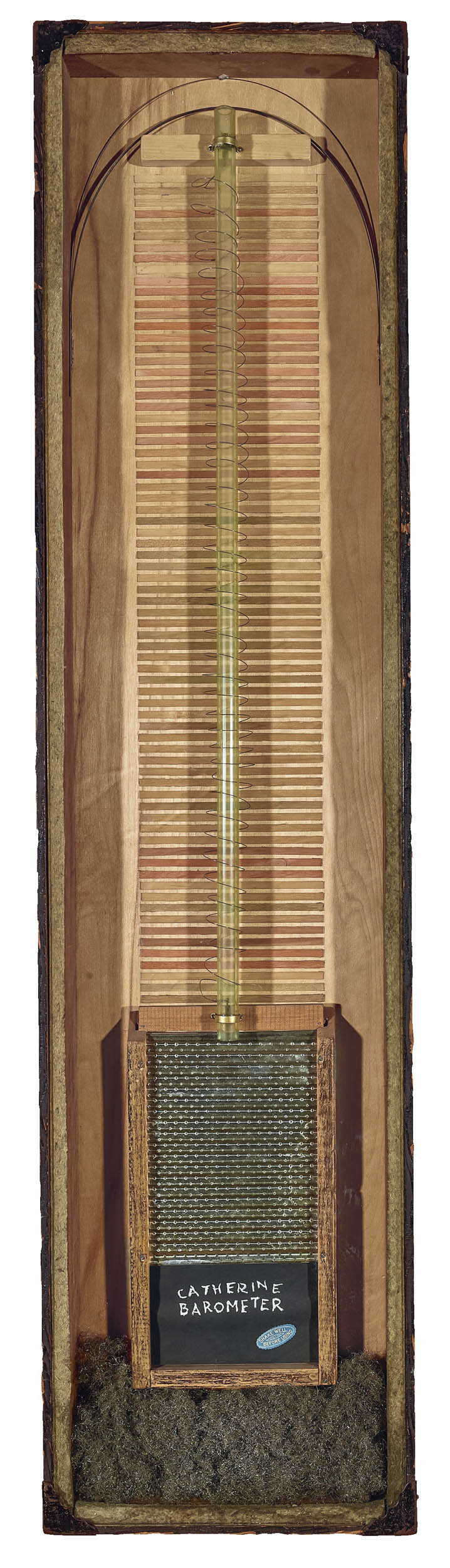
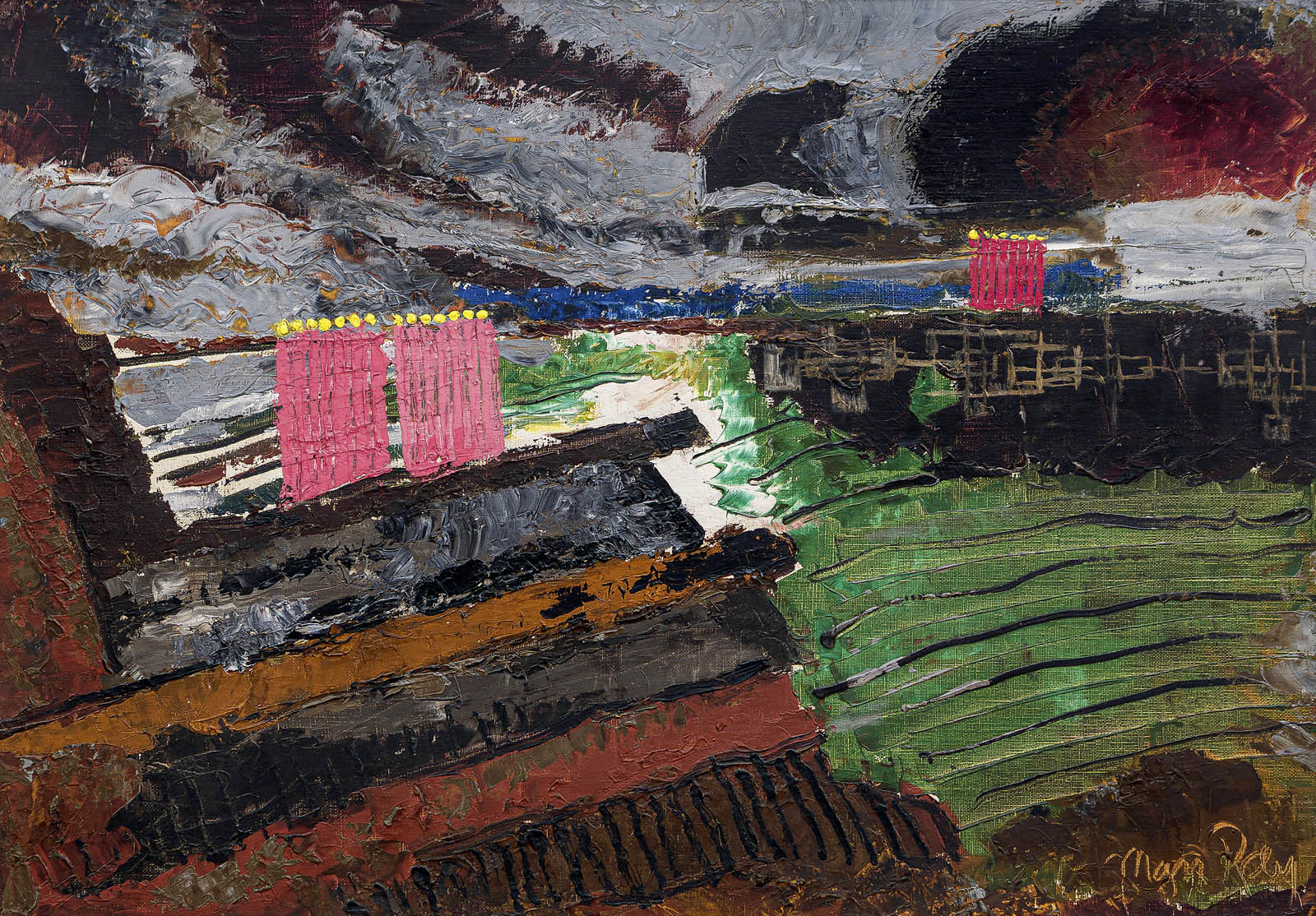
Highlights include such iconic objects like Man Ray’s iron studded with tacks, known as Cadeau (Gift) (1921), and his metronome, Object to be Destroyed (1923), that keeps time with the swinging eye of his companion, the photographer Lee Miller. Celebrated photographs, including his landmark Le violon d’Ingres (1924), in which the torso of the artist and performer Kiki de Montparnasse (Alice Prin) is depicted as a musical instrument, are also featured. The exhibition brings together some of his boldest but most refined experimental works – compositions like Aerograph (1919), a painting made with an airbrush and pigment sprayed through and around items from his studio. For Man Ray, objects could function as metaphors for the body, as demonstrated in works such as Catherine Barometer (1920) and L’homme (Man). Rarely seen paintings in the exhibition, including Paysage suédois (Swedish Landscape) (1926) record the artist’s great experimentation, working paint without a brush and in an almost sculptural way, building up and scraping down the surface that reflects his experiments in the darkroom.

Man Ray: When Objects Dream is curated by Stephanie D’Alessandro, Leonard A. Lauder Curator of Modern Art and Senior Research Coordinator in Modern and Contemporary Art at The Met, and Stephen C. Pinson, Curator in the Department of Photographs at The Met, with the assistance of Micayla Bransfield, Research Associate, Modern and Contemporary Art.
Press release from The Metropolitan Museum of Art


Man Ray (American, 1890-1976) 'La Femme (Woman)' c. 1918-1920


Man Ray (American, 1890-1976) 
La Femme (Woman)
c. 1918-1920
Gelatin silver print
43.7 x 33.5cm (17 3/16 x 13 3/16in.)
Gilman Collection, Gift of The Howard Gilman Foundation, 2005
© 2016 Man Ray Trust/Artists Rights Society (ARS), New York/ADAGP, Paris


Man Ray (American, 1890-1976) 'L'homme (Man)' 1918-1920


Man Ray (American, 1890-1976) 
L’homme (Man
1918-1920 
Gelatin silver print 
19 × 14 1/2 in. (48.3 × 36.8cm) 
The Metropolitan Museum of Art, New York, Bluff Collection, Promised Gift of John A. Pritzker
© Man Ray 2015 Trust / Artists Rights Society (ARS), NY / ADAGP, Paris 2025
Photo credit: Courtesy of The Bluff Collection, photo by Ben Blackwell


Man Ray (American, 1890-1976) 
'Élevage de poussière (Dust Breeding)' 1920


Man Ray (American, 1890-1976) 
Élevage de poussière (Dust Breeding)
1920
Gelatin silver print
2 13/16 × 4 5/16 in. (7.1 × 11 cm)
Private collection
© Man Ray 2015 Trust / Artists Rights Society (ARS), NY / ADAGP, Paris 2025
 

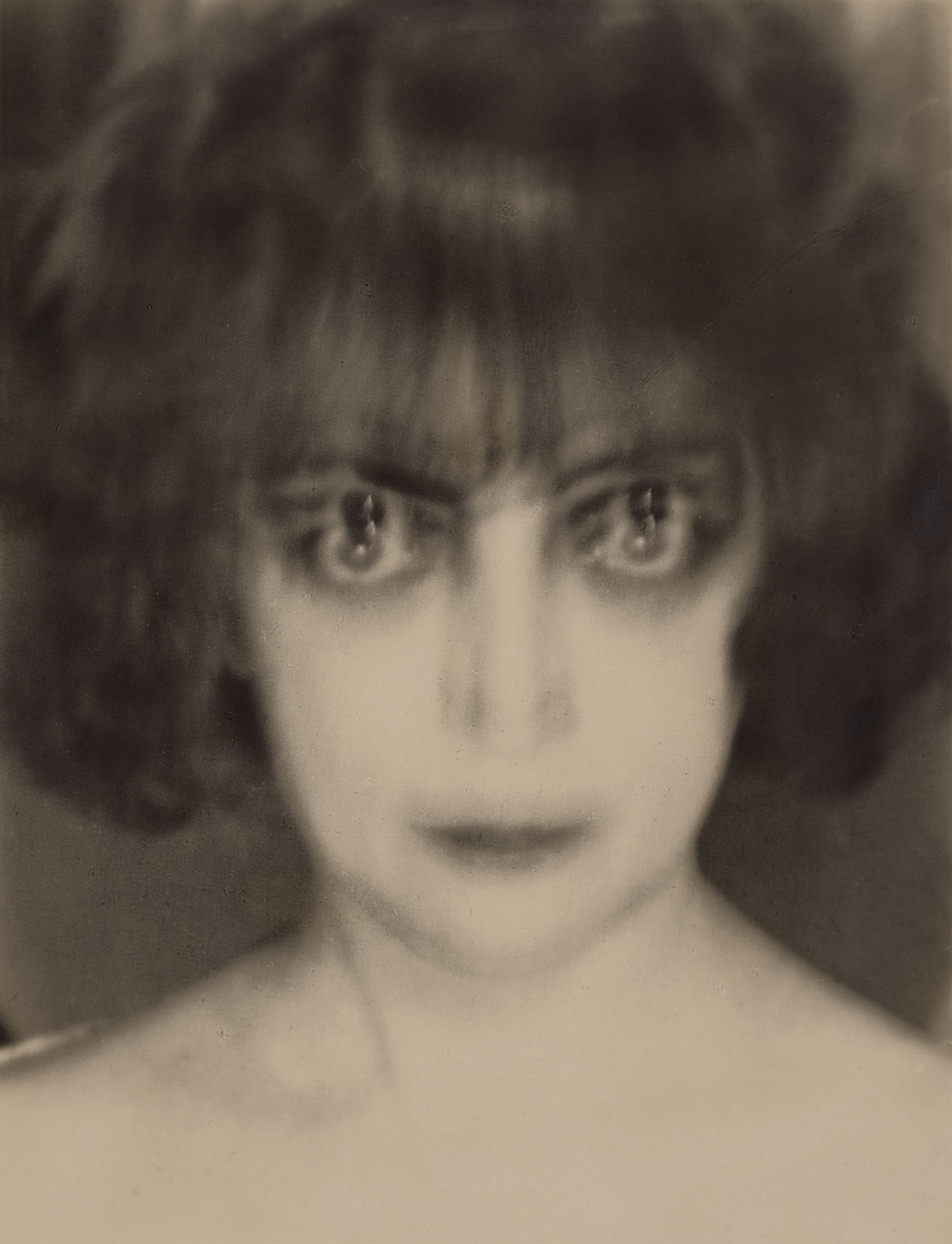
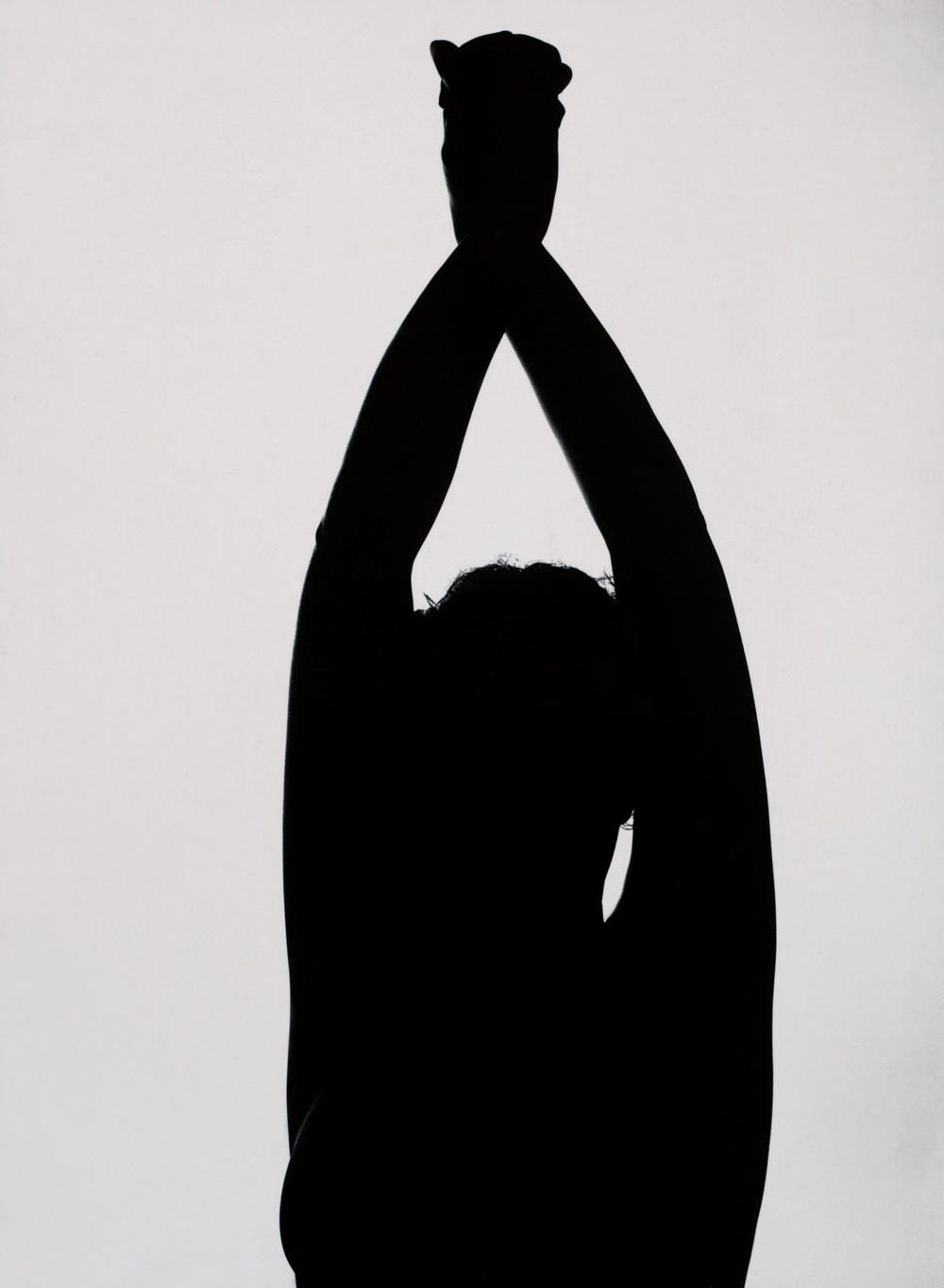
Man Ray (American, 1890-1976) 'Marchesa Luisa Casati' 1922


Man Ray (American, 1890-1976) 
Marchesa Luisa Casati 
1922 
Gelatin silver print 
8 1/2 × 6 9/16 in. (21.6 × 16.7 cm) 
Philadelphia Museum of Art: Gift of Carl Van Vechten
© Man Ray 2015 Trust / Artists Rights Society (ARS), NY / ADAGP, Paris 2025
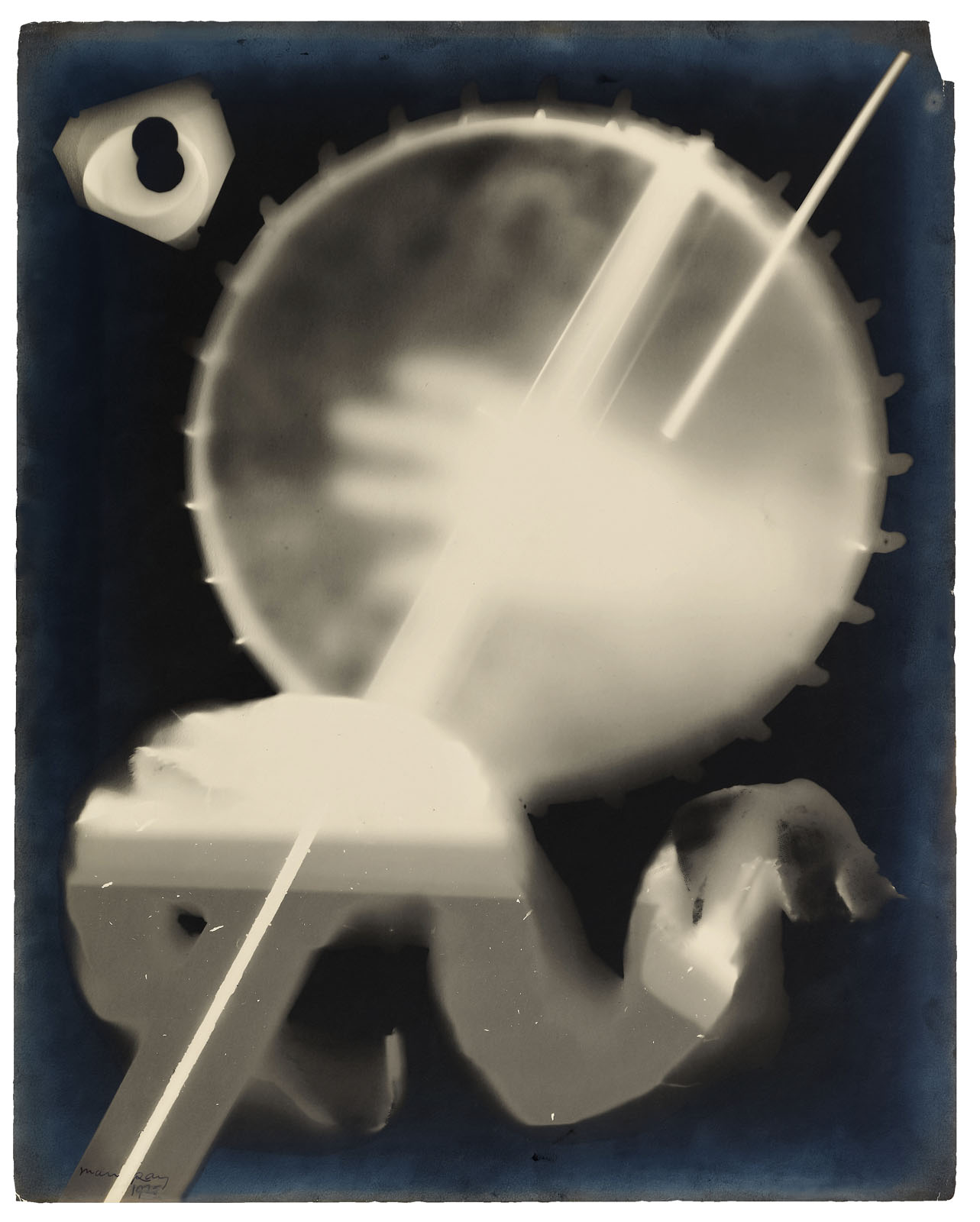
Photo courtesy of the Philadelphia Museum of Art


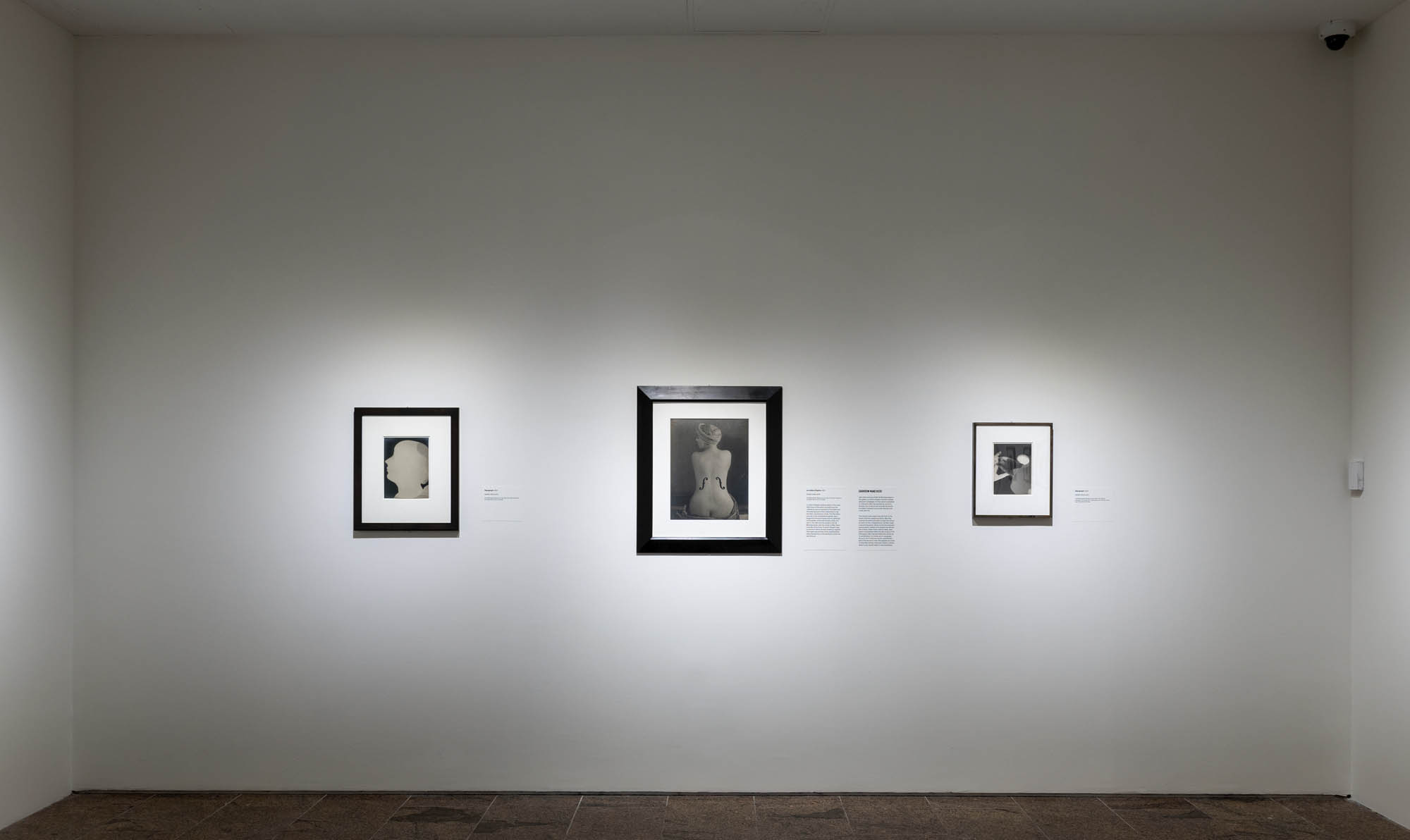
Installation view of the exhibition 'Man Ray: When Objects Dream' at The Metropolitan Museum of Art, New York, September 2025 - February 2026 showing at centre, Man Ray's photograph 'Le violon d'Ingres' 1924


Installation view of the exhibition Man Ray: When Objects Dream at The Metropolitan Museum of Art, New York, September 2025 – February 2026 showing at centre, Man Ray’s photograph Le violon d’Ingres 1924 (below)


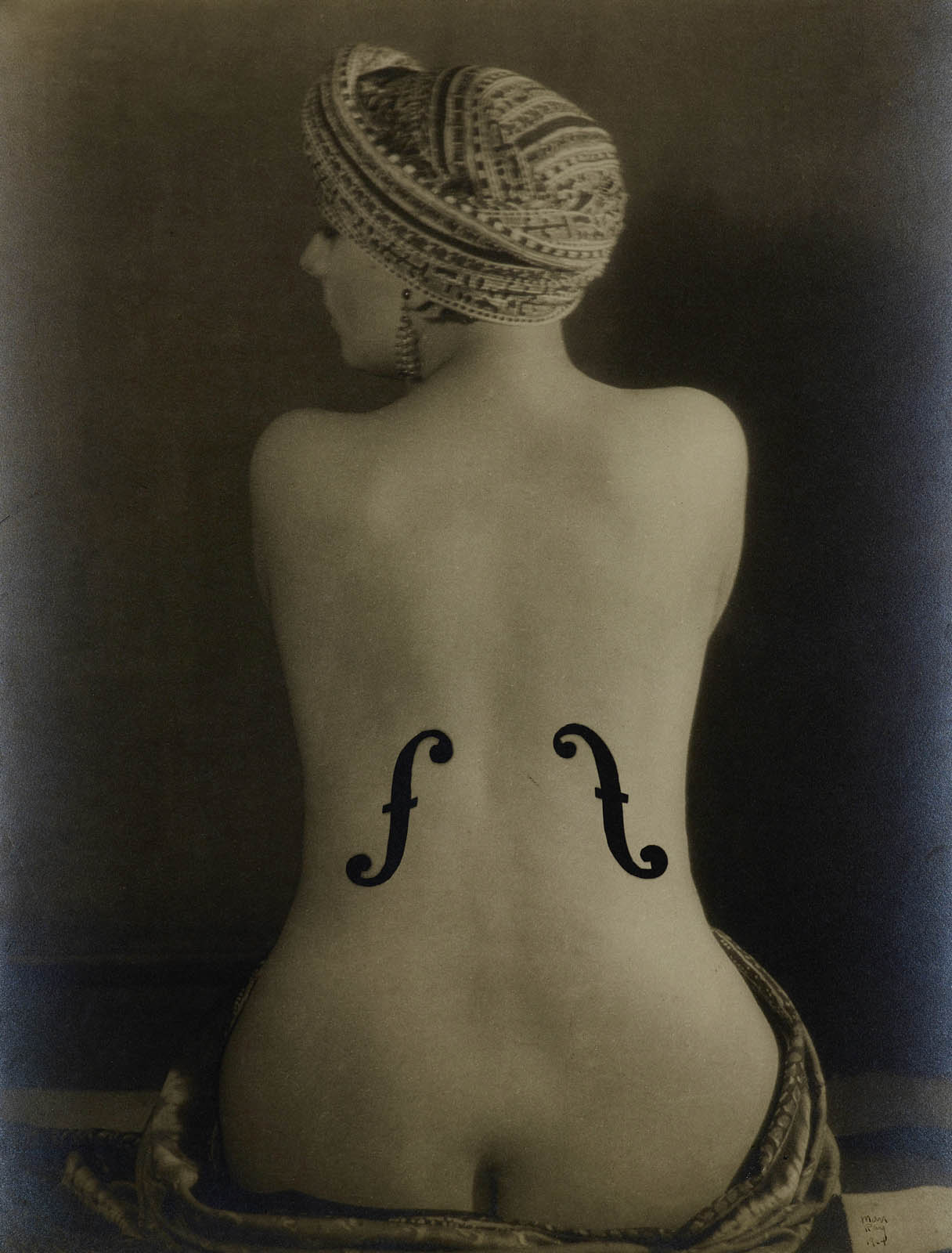
Man Ray (American, 1890-1976) 'Le violon d’Ingres' 1924


Man Ray (American, 1890-1976) 
Le violon d’Ingres
1924 
Gelatin silver print 
19 1/8 × 14 3/4 in. (48.5 × 37.5cm)
The Metropolitan Museum of Art, New York, Bluff Collection, Promised Gift of John A. Pritzker
© Man Ray 2015 Trust / Artists Rights Society (ARS), NY / ADAGP, Paris 2025
Photo by Ian Reeves


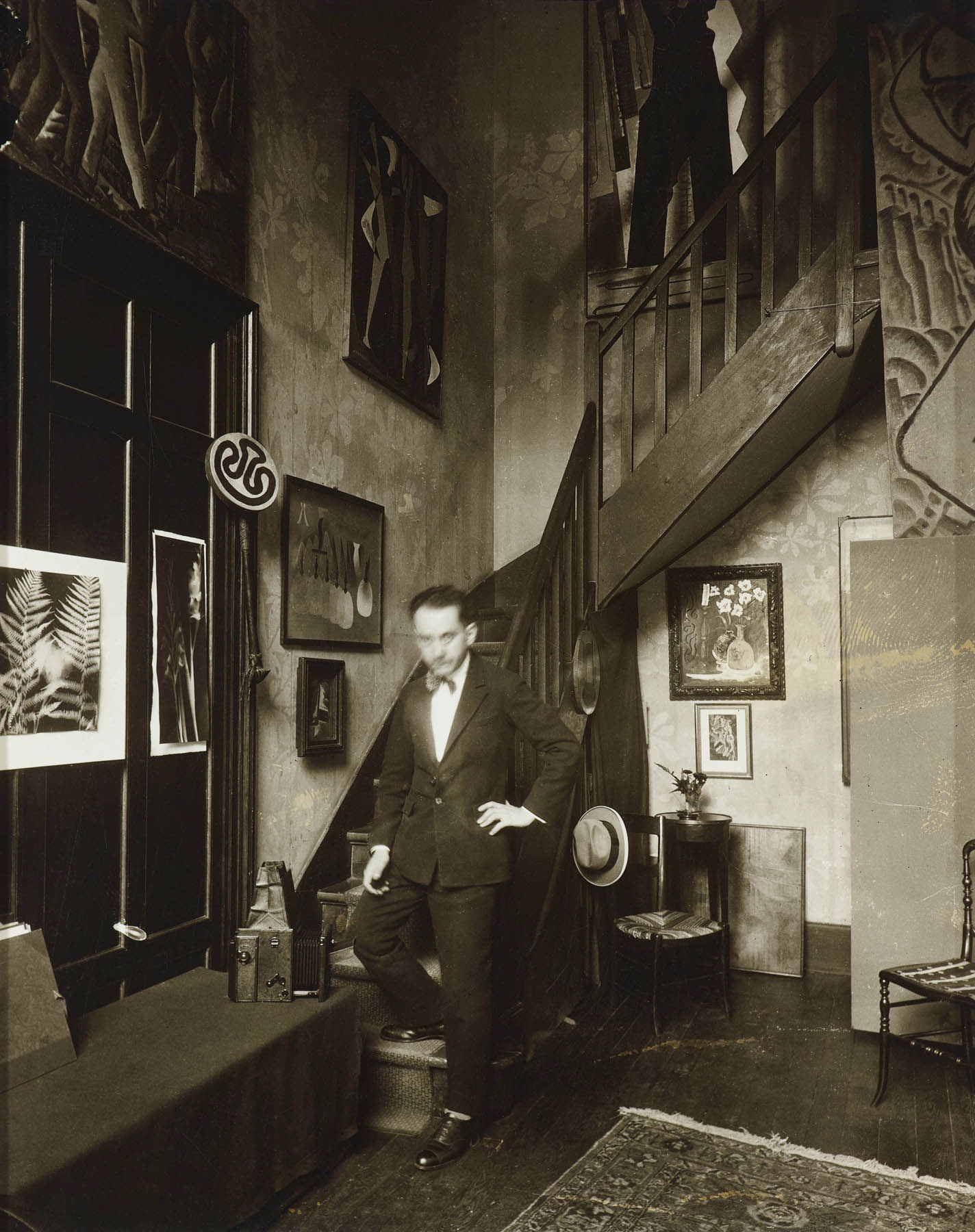
Man Ray (American, 1890-1976) 'Self-Portrait in 31 bis rue Campagne-Premiere Studio' 1925


Man Ray (American, 1890-1976) 
Self-Portrait in 31 bis rue Campagne-Première Studio
1925 
Gelatin silver print 
6 1/8 × 4 1/2 in. (15.6 × 11.4cm) 
The Metropolitan Museum of Art, New York, Bluff Collection, Promised Gift of John A. Pritzker
© Man Ray 2015 Trust / Artists Rights Society (ARS), NY / ADAGP, Paris 2025
Photo by Ian Reeves


Man Ray (American, 1890-1976) 'Noire et blanche' 1926


Man Ray (American, 1890-1976)
Noire et blanche
1926
Gelatin silver print
8 1/16 x 11 11/16 in. (20.5 x 29.7cm)
Private collection
© Man Ray 2015 Trust / Artists Rights Society (ARS), NY / ADAGP, Paris 2025


Man Ray (American, 1890-1976) 'Primat de la matière sur la pensée' (Primacy of Matter over Thought) 1929


Man Ray (American, 1890-1976)
Primat de la matière sur la pensée (Primacy of Matter over Thought)
1929
Gelatin silver print
10 1/2 x 14 7/8 in. (26.7 x 37.8cm)
Private collection, San Francisco
© Man Ray 2015 Trust / Artists Rights Society (ARS), NY / ADAGP, Paris 2025


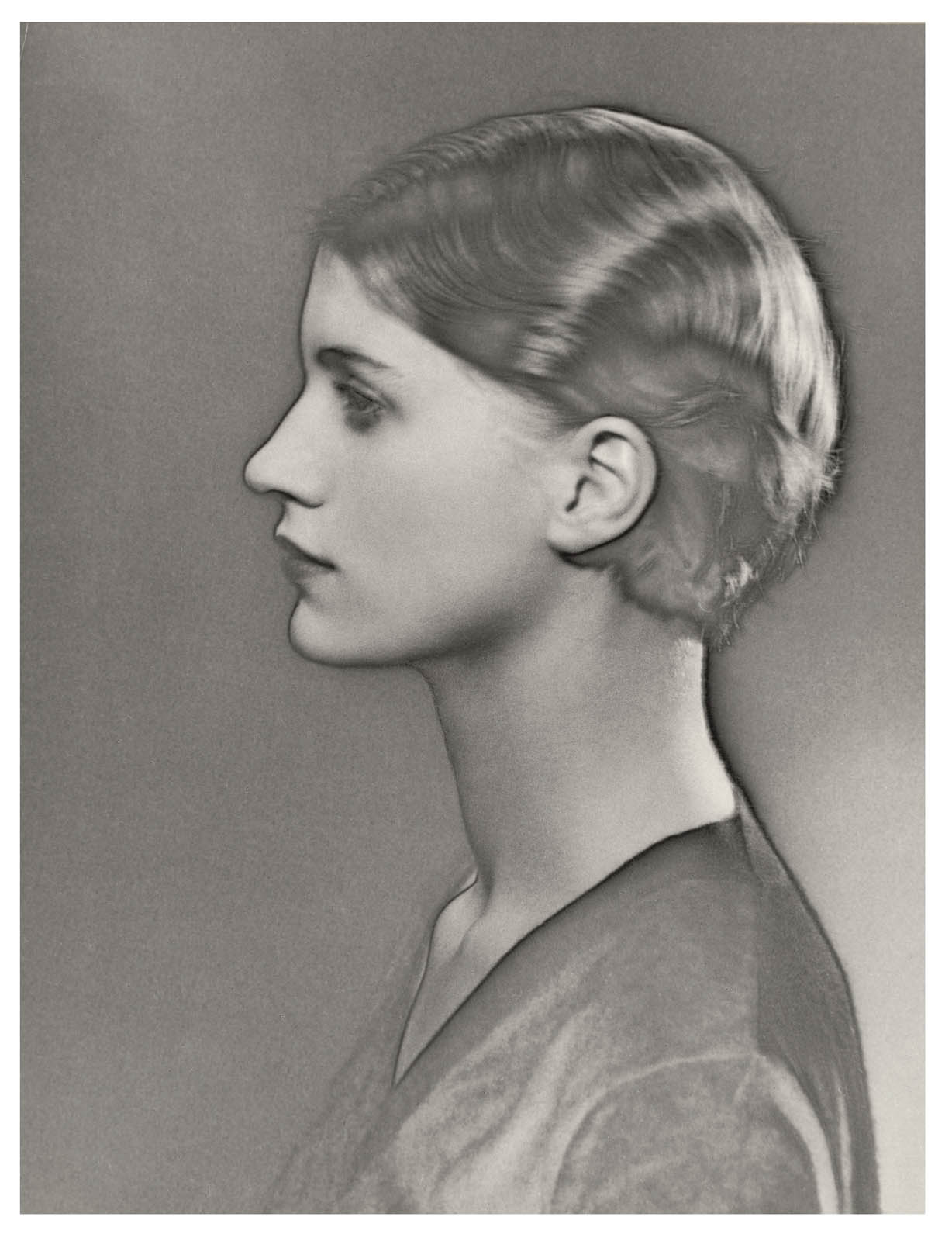
Man Ray (American, 1890-1976) 'Lee Miller' 1929


Man Ray (American, 1890–1976) 
Lee Miller 
1929 
Gelatin silver print 
10 1/2 × 8 1/8 in. (26.7 × 20.6cm) 
The Museum of Modern Art, New York, Gift of James Thrall Soby 
© Man Ray 2015 Trust / Artists Rights Society (ARS), NY / ADAGP, Paris 2025


Man Ray (American, 1890-1976) 'Self-Portrait with Camera' 1930


Man Ray (American, 1890-1976)
Self-Portrait with Camera
1930
Gelatin silver print
4 3/4 x 3 1/2 in. (12.1 x 8.9cm)
The Jewish Museum, New York
Purchase: Photography Acquisitions Committee Fund, Horace W. Goldsmith Fund, and Gift of Judith and Jack Stern
© Man Ray 2015 Trust / Artists Rights Society (ARS), NY / ADAGP, Paris 2025


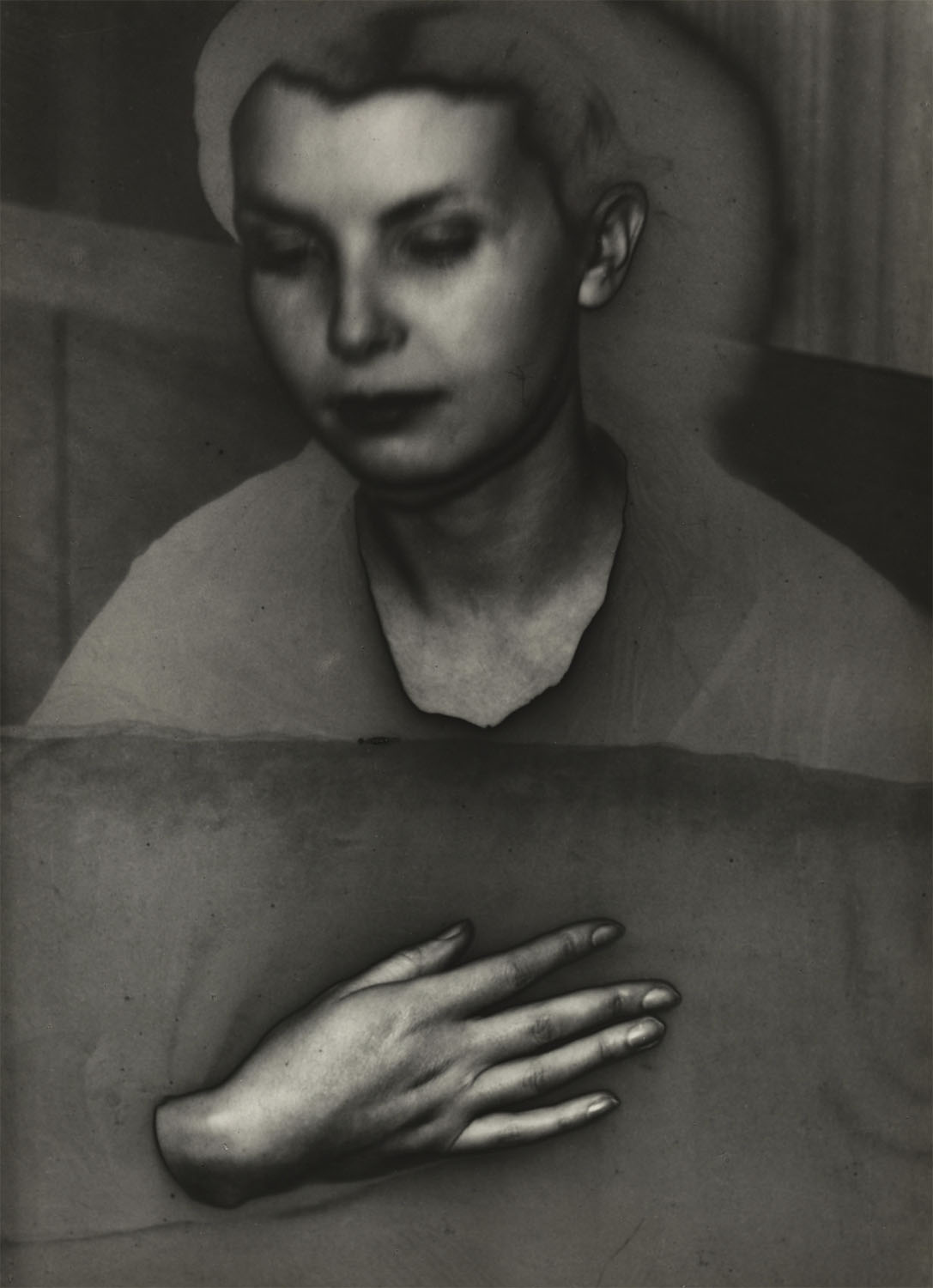
Man Ray (American, 1890-1976) 'Mary Gill' 1930


Man Ray (American, 1890-1976)
Mary Gill
1930
Gelatin silver print
11 1/2 x 8 1/2 in. (29.2 x 21.6cm)
Harvard Art Museums/Fogg Museum, Robert M. Sedgwick II Fund
© Man Ray 2015 Trust / Artists Rights Society (ARS), NY / ADAGP, Paris 2025


Man Ray (American, 1890-1976)
'Untitled (Glass Tears)' c. 1930-1933, printed 1935 or later


Man Ray (American, 1890-1976)
Untitled (Glass Tears)
c. 1930-1933, printed 1935 or later
Gelatin silver print
8 7/8 x 11 1/4 in. (22.5 x 28.6cm)
Private collection
© Man Ray 2015 Trust / Artists Rights Society (ARS), NY / ADAGP, Paris 2025


Man Ray: When Objects Dream

American artist Man Ray (1890-1976) was a visionary known for his radical experimentation that pushed the limits of art. His most iconic works – an iron studded with sharp tacks, a woman’s back reimagined as a violin – combine this boundary-breaking attitude with a singular belief in the transformative potential of everyday things. 

In the 1920s, the most significant of Man Ray’s investigations – and the thing that connected much of his work – was what he called the rayograph, a new twist on an old technique for making photographs without a camera. By placing objects on or near a sheet of sensitised paper, which he then exposed to light and developed, he turned recognisable subjects into wonderfully mysterious compositions. This radical art form, inextricably linked to the era’s Dada and Surrealist movements, grew out of his early work in New York and redefined his groundbreaking career in Paris.

Introduction

This exhibition’s subtitle, When Objects Dream, comes from a phrase by Tristan Tzara, a poet, artist, and early champion of Man Ray. Witness to some of the earliest rayographs, Tzara understood perhaps better than anyone else their physical and metaphorical link to objects reimagined through art. In a similar spirit, the current presentation reconsiders the role of the rayograph within Man Ray’s practice, especially its ability to extend his ideas across diverse media. The loosely chronological installation unfolds across a series of interconnected galleries organized around ideas that motivated the artist; to that end, visitors are invited to explore it in any number of ways.

All works in the exhibition are by Man Ray (American, 1890-1976).

Champs délicieux

In April 1922, readers of a French literary journal discovered a curious announcement for an album titled Champs délicieux (Delicious Fields). Its twelve “original photographs” by Man Ray feature objects from his studio – tongs, a comb, string, a hotel room key – composed in groupings. The images are ordered without clear logic or narrative. Instead, as advertised, they mark a “state of mind,” the artist’s free play, alone at night and without work obligations, in his studio darkroom. 

Man Ray introduced Champs délicieux in the period between two revolutionary movements that arose in the wake of World War I: Dada and Surrealism. Both challenged conventional art and society by upending traditional subjects, techniques, and expectations. Inspired in part by a collection of unconsciously driven, automatic writings by poets André Breton and Philippe Soupault, Man Ray sought to render everyday objects unfamiliar. As early subscriptions attest, the album found an enthusiastic audience who appreciated the language of the rayograph and its ability to open up a new visual world.

A New Art

Before Man Ray first picked up a camera in 1915, he was focused on painting. He set out to stake his claim in the exhilarating avant-garde scene, his interest fueled by cutting-edge exhibitions at Alfred Stieglitz’s gallery, 291, and thrilling examples of Cubism, Expressionism, Fauvism, and Futurism at the modern art presentation known as The Armory Show in 1913. Unexpectedly, photography offered Man Ray a path forward. Noting the way a camera lens could compress and flatten space, he determined to endow art with a similar “concentration of life” while simultaneously freeing it from the burden of illusionism. “The creative force and the expressiveness of painting,” he wrote at the time, “reside materially in the colour and texture of pigment, in the possibilities of form invention and organisation, and in the flat plane on which these elements are brought to play.” He made paintings using palette knives and other tools instead of brushes and employed patterns, cutouts, and collage to create a self-proclaimed “new art of two dimensions.”

Objects At Hand

NOT RESPONSIBLE FOR GOODS LEFT OVER THIRTY DAYS. So reads a sign in a photo, displayed nearby, of Man Ray’s West Eighth Street studio in New York. It was one of several items the artist discovered in the trash heap at his apartment building and brought up to his top-floor space. He considered retooling the sign to read LEFT OVER GOODS NOT RESPONSIBLE FOR THIRTY DAYS but decided it was perfect as is. This act – of elevating junk to art – is a familiar one in histories of the avant-garde, especially for the Dada movement. Art did not have to be painted or modelled or made with traditional materials and tools; it could be found in the everyday world and appreciated for the idea that it introduced, not for its beauty. 

As Man Ray developed his “new art,” he came to see the latent potential of all the objects within his studio. This spurred further investigations that likewise tested the limits of two and three dimensions and blurred the boundaries between media. At the same time, he continued to explore how the camera could be used not only to document his work but to open new perspectives onto ordinary objects and their creative possibilities.

Clichés-verre

While the rayograph is often described as Man Ray’s first experiment with cameraless photography, that moment occurred years earlier. Around 1917 he explored several photographically based techniques, including the cliché-verre, or “glass-plate” print. A nineteenth-century reproductive process that incorporates both photography and printmaking, a cliché-verre is traditionally made by covering a plate of glass with a darkened medium and drawing into it to produce clear lines. When set onto sensitised paper and exposed to a light source, the plate transmits the scratched away areas as dark lines. Man Ray chose to incise directly into the emulsion of an exposed photographic plate, which he then subjected to light again with paper below it to make a contact print. 

Photography

Man Ray first picked up a camera in 1915, to document his art. Through this experience, he discovered that the works acquired new qualities when reproduced in black and white. He made photographic portraits, too, which in Paris would become a dependable source of income. Revelling in the camera’s transformative optical abilities, Man Ray soon used it as a tool to facilitate his self-appointed role as a “marvellous explorer of those aspects that our retinas will never record.” He sought to reveal the creative potential of objects in his studio and in 1918 began a series of photographs using specifically arranged everyday items.

Aerographs

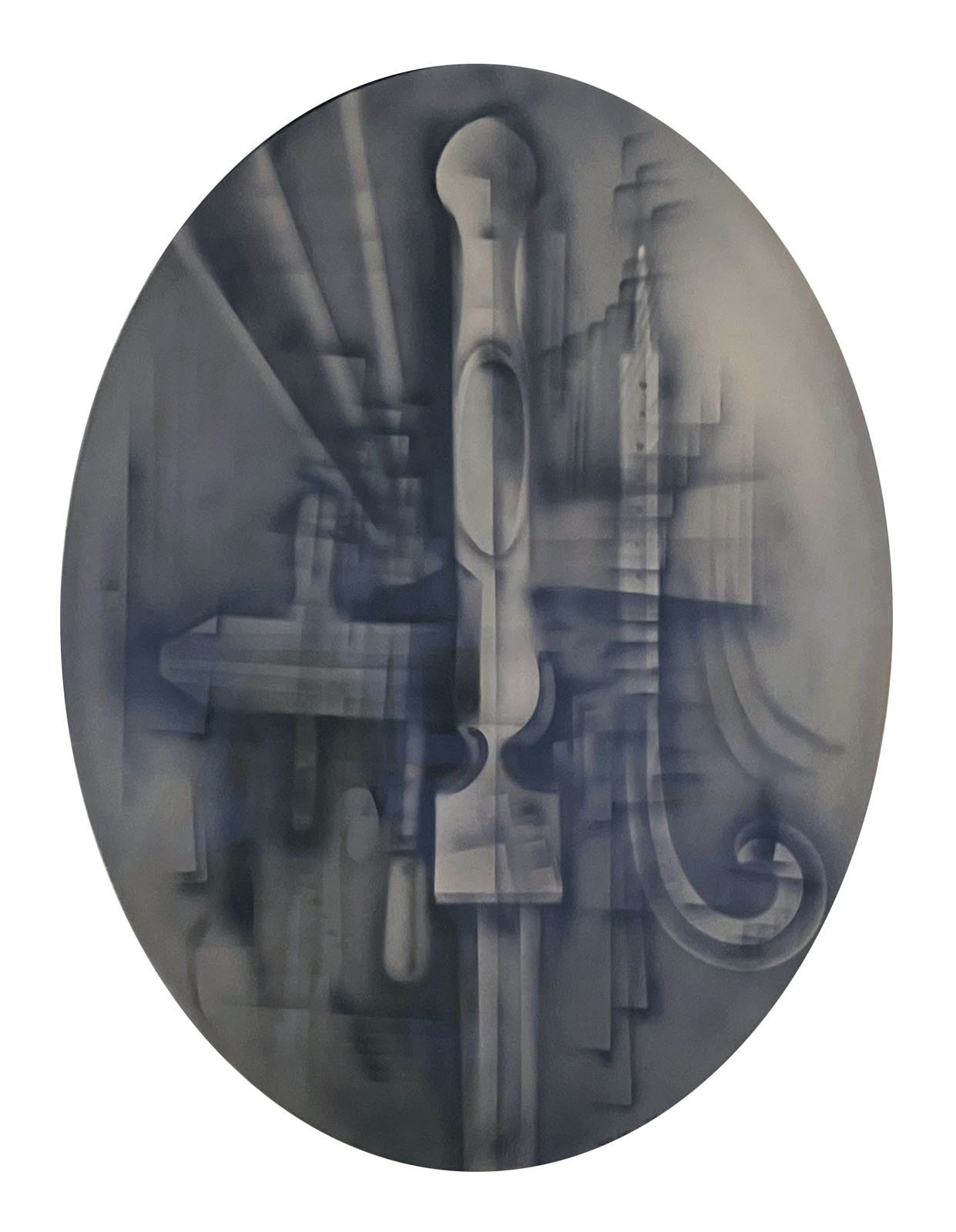
Still grappling with how to paint without a brush, Man Ray found inspiration at his day job working for an advertising agency, where he was introduced to an airbrush. He later brought the equipment back to his attic studio and began to experiment. Using an air compressor, the artist directed pigment through stencils and around masked areas and objects, which he rested on the composition board and repositioned as he worked. “It was thrilling,” he would later recount, “to paint a picture, hardly touching the surface – a purely cerebral act.” These works, which he termed “aerographs” were made, in effect, before they hit the paper. Objects were carved, shaped, and modeled in the air. Voids register as substance, and what we see on the paper is residue fused to the surface. “I tried above all,” Man Ray explained, “to create three-dimensional paintings on two-dimensional surfaces.”

Flou

Man Ray introduced his rayographs during a transitional period between the Dada and Surrealism movements that the French writer Louis Aragon called the mouvement flou – flou translating to “blurry” or “out of focus.” The term also suits these works, which viewers initially deemed curious and captivating but difficult to pin down. Rayographs, as cameraless photographs, exist in an indistinct place between photography and painting, the mechanical and the handmade, documentation and dream. 

During the 1920s Man Ray also explored blurriness in his camera images. Even as technical improvements facilitated increased focus and detail, and the preference for sharp photographs grew, he generally pursued a flattering, soft-focus technique in his growing business of portrait commissions. At other times, he sought more radical effects, which the director Claude Heymann described as “strange, troubling blurs” produced “through distortions, prolonged poses or special focusing techniques.” The anomalies in the resulting photographs are visible signs of the effort and time Man Ray spent to realise the images – even if he later called them unplanned or accidental.

A New Field of Gravity

In his preface introducing the album Champs délicieux (Delicious Fields), Tristan Tzara remarked that rayographs “present to space an image that exceeds it, and the air, with its clenched fists and superior intelligence, seizes it and holds it next to its heart.” Indeed, objects in Man Ray’s images beckon us in but keep us thrillingly at the edge – or put another way, they test our senses of proximity and location. His experiments in New York expanded the bounds of the photograph, object, painting, and installation, and he developed a novel relationship between object and viewer. These works demonstrate in their construction what the French writer Georges Ribemont-Dessaignes would identify in the artist’s rayographs as a “new field of gravity.”

The rayograph

The term rayograph designates Man Ray’s version of a technique for making photographs without a camera: by setting objects on or near sensitised paper and exposing it to light. In his autobiography, the artist described happening upon the process by chance, late one night, while developing prints in his makeshift darkroom. For subjects, he looked no further than the things in his studio. When exposed to a directed flash of light, they appear as reversed silhouettes – but in Man Ray’s hands they also gained new life. The nature of the image depended on the items’ translucency, reflectivity, density, placement, and distance from the sheet, as well as the source and location of the illumination and the number of exposures. Surfaces could cast unexpected reflections or eclipse elements in darkness. Forms might multiply or transform. Sometimes Man Ray’s objects and the space between them acquired an insistent, compressed volume that registered on the paper. The resulting works present what writer Pierre Migennes described as a “metamorphosis of the most vulgar utensils.” Everyday things became wonderfully unfamiliar as Man Ray wielded light in the darkroom like a brush in paint.

As he prepared to launch his rayographs in Champs délicieux, Man Ray also considered how to disseminate them for reproduction in magazines. On November 1, 1922, he wrote to Harold Loeb, editor of Broom: “Each print is an original, no plate or duplicate exists, as the process is manipulated directly on the paper, like a drawing. If you could assure me that the … originals would be safely handled and returned, I shall gladly send them on [to Berlin]. If, however, you cannot guarantee their safe return, I can re-photograph them … which, while not having the intensity and contrast of the originals, would nevertheless reproduce well.” Loeb offered to transport them personally and published these four in Broom the following March.

Man Ray transformed and energised ordinary objects in his rayographs by tapping their powers of translucency or reflectance. Bodies and their proxies, however, remain stubbornly recognisable. Hands reach out, hold things, and interact with objects; heads turn to kiss and drink, even if the action might be staged. The artist’s rayographs tie the body to a kind of specificity that his objects do not experience; this might explain why there are fewer of these works with bodies than without. As Tristan Tzara explained in his appreciation of the rayographs in 1934, Man Ray approached objects in a manner that allowed them to be free “to dream.”

Dangerous Games

Reactions to Man Ray’s cameraless photographs consistently identified them with the realm of play. The first to comment on the rayograph was French poet Jean Cocteau, who wrote in an open letter, “You, my dear Man Ray, will nourish our minds with those dangerous games it craves.” He was soon joined by Tristan Tzara, who likened the rayograph to a “game of chess with the sun.” 

Man Ray had a strong sense of the game as a strategy for producing art. For him, play was a state of readiness to engage. This comes through in the provocative humour of his objects and collages and in the invitation to chance embedded in the rayograph process – the “discovery” of which, he recounted, entailed real amusement. Marcel Duchamp once playfully defined his friend as synonymous with the joy of the game: “MAN RAY, n.m. synon. de joie, jouer, jouir” (joy, to play, to enjoy).

Chemical Paintings

In April 1922, the same month that the Champs délicieux album was announced, Man Ray proudly reported to friends and patrons that he had freed himself “from the sticky medium of paint.” His rayographs claimed a rebellious position aimed at the traditional hierarchy of fine art – and particularly its apex, painting. Critics asserted they had equal status, and New York’s Little Review even called them “chemical paintings.”

Just a year later, however, while his rayograph production remained steady, Man Ray quietly returned to painting. The works here show how his practice had changed. Abstract and relatively small, they were made on commercially available boards, wood, sandpaper, or metal supports. With their overlapping pictorial elements and dramatic contrasts of luminosity and shadow, angled and geometric forms, the compositions emulate aspects of rayographs. Each is a thorough exploration of depth on a flat surface and a bid to make paint reflect its own material reality.

Objects and Bodies

Man Ray’s experience of making rayographs informed his consideration of the human body, which he handled, at times, like an object, devoid of personhood and open for manipulation. Writing about the artist’s portraits and rayographs, André Breton noted that Man Ray considered the bodies of women in his work no different from the objects at hand in his darkroom: 

The very elegant, very beautiful women who expose their tresses night and day to the fierce lights in Man Ray’s studios are certainly not aware that they are taking part in any kind of demonstration. How astonished they would be if I told them that they are participating for exactly the same reasons as a quartz gun, a bunch of keys, hoar-frost or fern!

For Man Ray, a body could function as a kind of concentrated equivalence, like the essence represented by an object. This attitude is visible in some of the most iconic works of his career, in which his presentation of female models such as the artist and performer Kiki de Montparnasse (Alice Prin) also involved darkroom manipulation. While his approach to men’s bodies was notably less sexualised, they too were posed and set up like the objects in his rayographs.

Darkroom Manoeuvres 

Like other pictures of Kiki de Montparnasse in this gallery, Le violon d’Ingres involved multiple darkroom campaigns. For the version published in Littérature, Man Ray worked on a print to sharpen the contours and smooth the forms; he added f-shaped sound holes directly onto it with dark ink. 

The version here, larger than the first, is the result of further experimentation. Man Ray covered the entire print with a mask from which he hand cut two f-shaped forms. He then made a second exposure, which turned the exposed spaces black. Instead of ink shapes that disrupt the surface, these marks read as deep, dark space compressed within the flat surface of the photograph. Man Ray described this version as “a combination of a photo and a rayograph.” As such, the f-holes are eerily – seamlessly – part of the woman’s body. She appears as a kind of dreamlike human-instrument hybrid, a whole object to be visually taken in and possessed.

Dreams

Even before the Surrealist manifesto of 1924 claimed the fertile ground of the unconscious, many poets and artists in Man Ray’s circle focused on dreams. The same group, two years earlier, had followed André Breton’s experiments with hypnosis and trance states. They practiced séances and so‑called sleeping fits, writing down or drawing what came to them in order to reveal hidden desires. The poet Louis Aragon wrote of these slumberous escapades: “Dreams, dreams, dreams, the domain of dreams expands with every step.” 

Apart from photographing the sleep sessions, Man Ray remained an independent supporter of the group, explaining, “It has never been my object to record my dreams, just the determination to realise them.” Even so, Aragon included him in his multipage inventory of dreamers, with a nod to the rayographs: “Man Ray … dreams in his own way with knife rests and salt cellars: he gives meaning to light, which now knows how to speak.” The artist found great support among the Surrealist circle in Paris, whose members acquired his work and included him in exhibitions and publications.

Dream Objects 

Man Ray’s dreamlike rayographs have counterparts in the new kinds of hybrid objects he began to make at the same time. These mysterious works seize upon unexpected transformations: a fragile soap bubble rendered solid; the taut strings on a musical instrument’s neck turned loose and sensuous; or a budding plant metamorphosed into a pudgy hand. 

The strange bundle wrapped with string has long been associated with the power of objects to stir the unconscious. In 1920 Man Ray assembled, photographed, and deconstructed the original object. The Untitled photograph appeared in the first issue of La revolution surréaliste, in 1924, with the text “Surrealism opens the door of the dream to all those for whom night is miserly.” Over the next decade, the image came to embody another phrase popular among the Paris Surrealist group, by the poet Isidore Ducasse: “as beautiful … as the chance encounter of a sewing machine and an umbrella on a dissecting table.” 

“Objects to touch, to eat, to crunch, to apply to the eye, to the skin, to press, to lick, to break, to grind, objects to lie, to flee from, to honor, things cold or hot, feminine or masculine, objects of day or night which absorb through your pores the greater part of our life. … These are the projections surprised in transparence, by the light of tenderness, of objects that dream and talk in their sleep.” (Tristan Tzara, “When Objects Dream,” 1934)

Returns

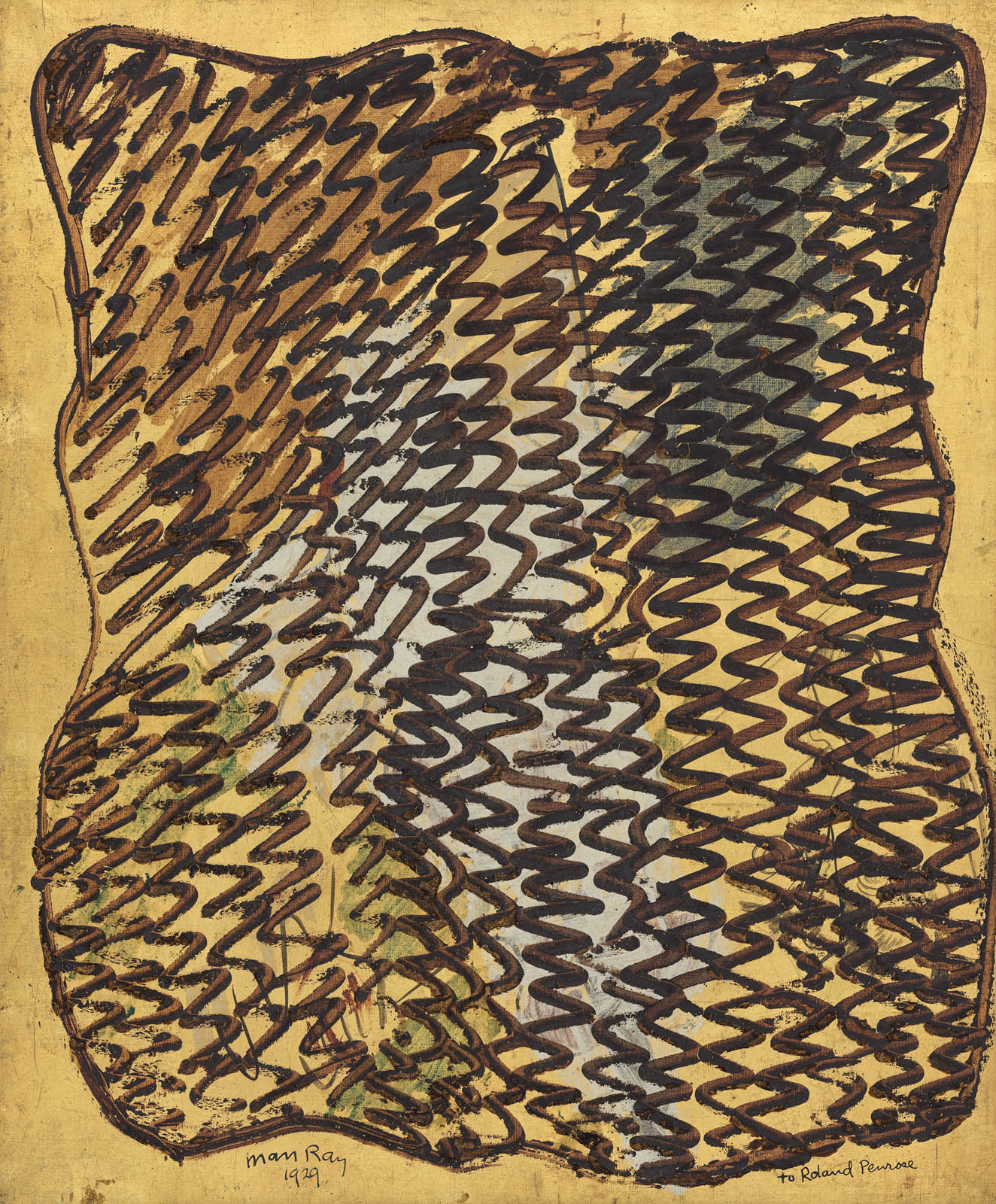
In 1929 Man Ray found himself “longing to touch paint again.” By the fall, he had taken a second Paris studio, near the Luxembourg Gardens, where he painted in the mornings before returning home to oversee photographic portraits and magazine work. In his new compositions, he let paint drip across a canvas from a poured line and squeezed pigment directly from the tube onto a support in a loose, calligraphic manner. Trading on narratives of chance and automatism, he later called these paintings “unpremeditated.” 

Another return accompanied the arrival in Paris of Lee Miller, who became Man Ray’s apprentice in photography and then his personal and professional partner. As a result, he again embraced the camera as his primary tool of photographic experimentation, after years of making rayographs without one. Together, Miller and Man Ray discovered a creative synergy that led to their joint development of the solarization process. The same year signalled the near culmination of Man Ray’s exploration of the rayograph: by some accounts, he made one hundred in 1922, but just one in 1929.

Solarization 

Together with Lee Miller, Man Ray developed a darkroom technique that complemented his return to painting. Like the rayograph, solarization was not entirely new, and both he and Miller claimed that it similarly resulted from an accident. The process involves exposing a negative a second time during development, which causes a reversal of the expected tonalities. Honed by Miller and Man Ray and applied to their portraits and nudes beginning in fall 1929, the process often endowed subjects with subtly glowing black contours that Miller called “halos.” This feature became so well-known – largely through reproductions of the solarized portrait of Miller shown nearby – that a 1932 article called it both “the beacon and despair of experimenters.” Like the drips and skeins in Man Ray’s 1929 paintings, these lines create a friction between the subject and surface of the image – a noted departure from the artist’s earlier approach to the flat plane.

Revisiting Champs délicieux 

Man Ray completed his Champs délicieux project nearly forty years after its debut. A handwritten inscription to Tristan Tzara in the final copy (number 41, displayed here) refers to the sparks set off by their initial exploration of the rayograph; he added an almost identical inscription in his 1922 working copy. This suggests a Dada game between the two artists: the announcement laid out the rules and the inscriptions signified its end. 

As promised in the 1922 first announcement of the album, the last copy features the canceled proofs (a practice meant to show that no further prints can be made from the originals). A canceled print edition is not unusual. In this case, however, a purposeful ambiguity was in play from the beginning of the project – when it was presented as an album of “original photographs” copied from unique rayographs – to the end. Only the negatives used to produce the album were canceled, meaning that the primary rayographs might still exist. Ever the prankster, Man Ray ensured that the game continues.

Text from The Metropolitan Museum of Art


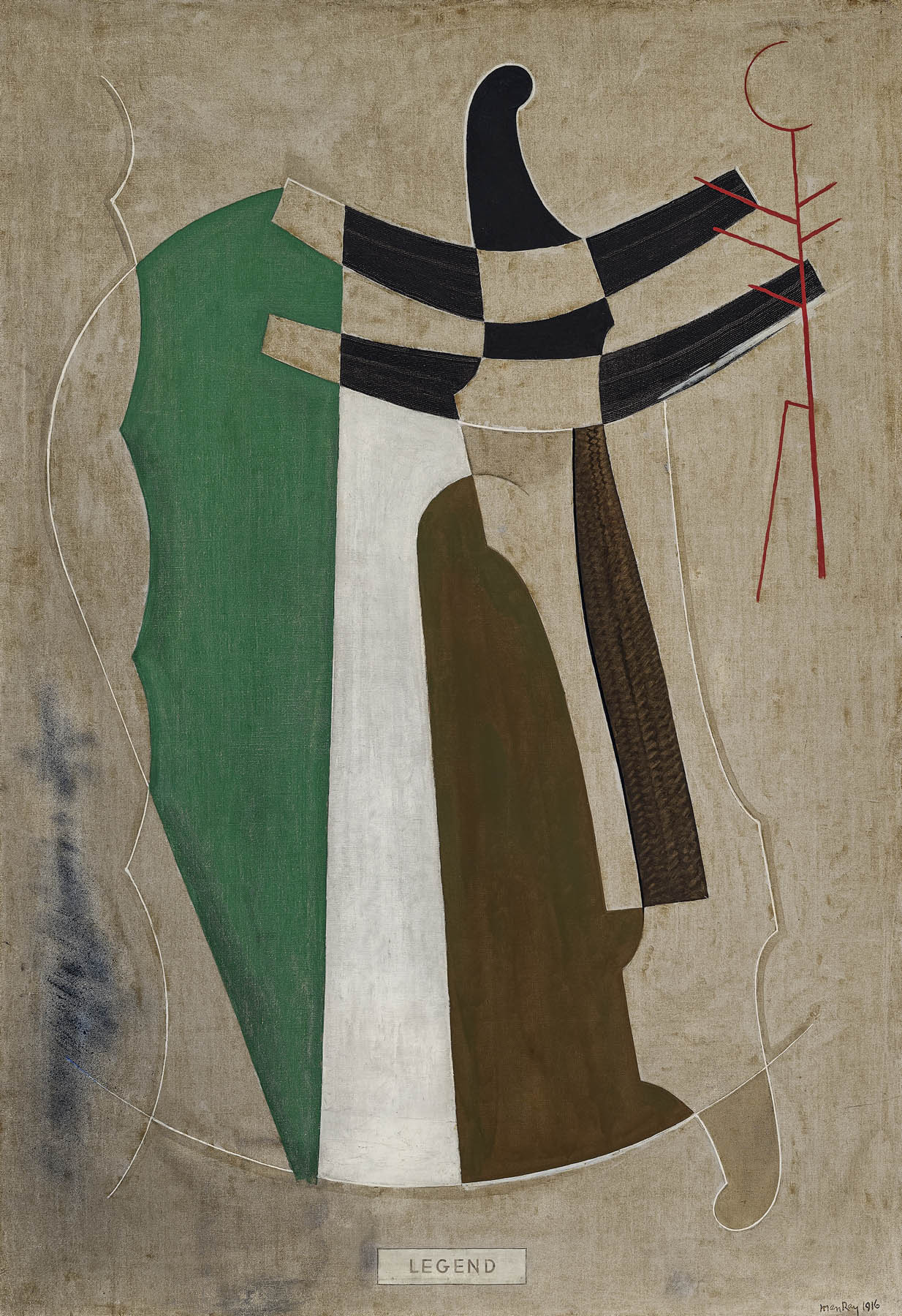
Man Ray (American, 1890-1976) 'Legend' 1916


Man Ray (American, 1890-1976) 
Legend 
1916 
Oil on canvas 
52 × 36 in. (132.1 × 91.4 cm) 
Collection of Deborah and Edward Shein
© Man Ray 2015 Trust / Artists Rights Society (ARS), NY / ADAGP, Paris 2025
Photo by Stephen Petegorsky


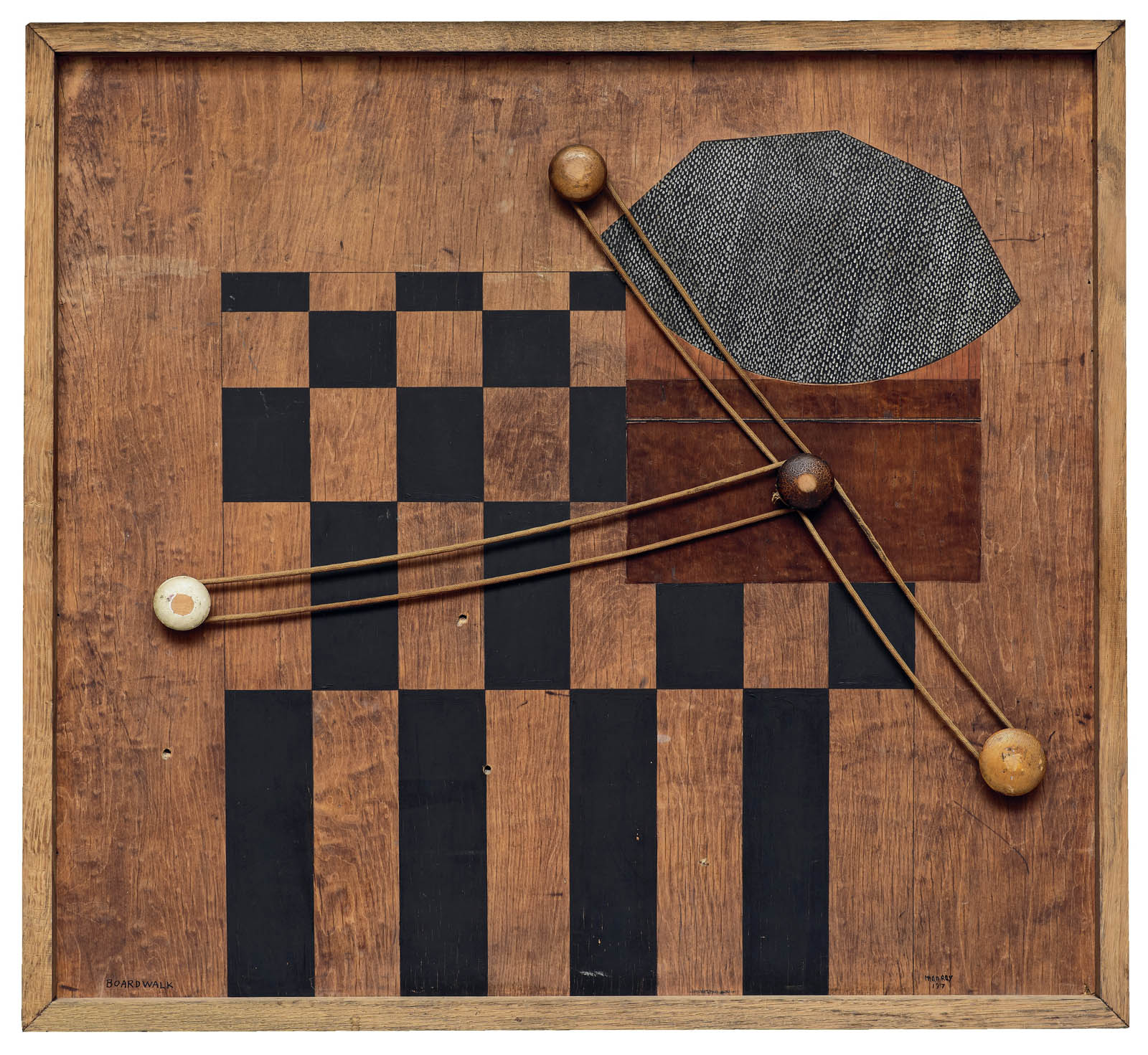
Man Ray (American, 1890-1976) 'Boardwalk' 1917


Man Ray (American, 1890-1976) 
Boardwalk 
1917 
Oil, wood handles, and yarn on wood 
26 9/16 × 29 × 15/16 in. (67.4 × 73.6 × 2.4cm) 
Staatsgalerie Stuttgart, acquired 1973 with Lotto Funds
© Man Ray 2015 Trust / Artists Rights Society (ARS), NY / ADAGP, Paris 2025


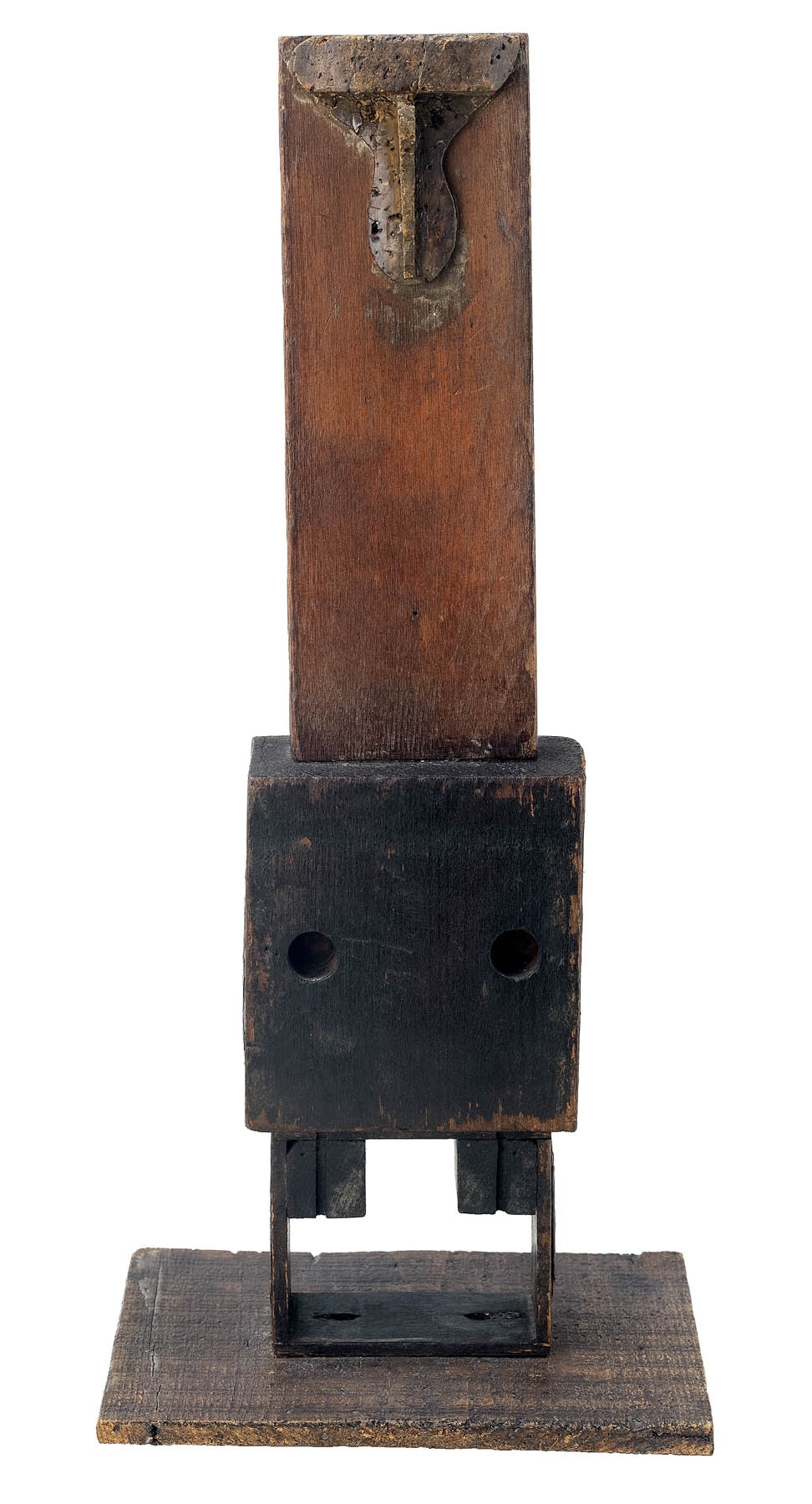
Man Ray (American, 1890-1976) 'By Itself I' 1918


Man Ray (American, 1890-1976) 
By Itself I 
1918 
Wood, iron, and cork 
17 1/4 × 7 11/16 × 7 5/16 in. (43.8 × 19.5 × 18.6cm) 
LWL–Museum für Kunst und Kultur, Münster, Germany 
© Man Ray 2015 Trust / Artists Rights Society (ARS), NY / ADAGP, Paris 2025 


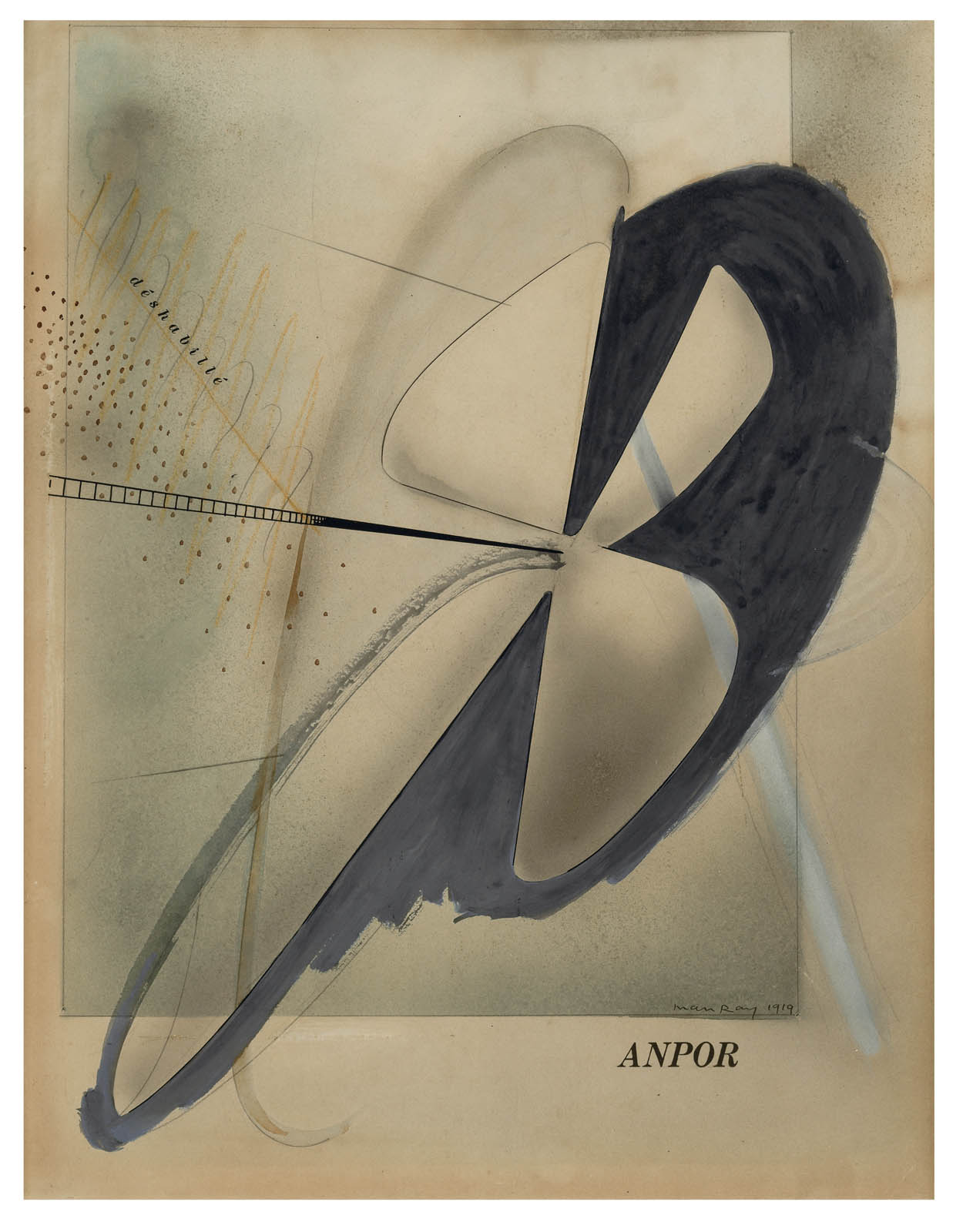
Man Ray (American, 1890-1976) 'ANPOR' 1919


Man Ray (American, 1890-1976) 
ANPOR 
1919 
Gouache, ink, and colored pencils on paper 
15 1/2 × 11 1/2 in. (39.4 × 29.2cm) 
Collection of Gale and Ira Drukier
© Man Ray 2015 Trust / Artists Rights Society (ARS), NY / ADAGP, Paris 2025 
Image © The Metropolitan Museum of Art, photo by Bruce Schwarz


Man Ray (American, 1890-1976) 'Aerograph' 1919


Man Ray (American, 1890-1976)
Aerograph
1919
Gouache on paperboard
26 3/8 x 19 11/16 in. (67 x 50cm)
Staatsgalerie Stuttgart, Graphische Sammlung, acquired 1987
© Man Ray 2015 Trust / Artists Rights Society (ARS), NY / ADAGP, Paris 2025


Man Ray (American, 1890-1976) 'Catherine Barometer' 1920


Man Ray (American, 1890-1976) 
Catherine Barometer 
1920 
Glass, metal, felt, washboard, tube, wire, wood, steel wool, gouache on paper, and paper stamp 
48 1/8 × 12 × 2 1/8 in. (122.2 × 30.5 × 5.4cm) 
The Metropolitan Museum of Art, New York, Bluff Collection, Promised Gift of John A. Pritzker 
Photo courtesy of The Bluff Collection, photo by Ian Reeves


Man Ray (American, 1890-1976) 'Cadeau (Gift)' 1921 reconstructed 1970 (installation view)


Man Ray (American, 1890-1976)
Cadeau (Gift) (installation view)
1921 reconstructed 1970
Iron with brass tacks and wooden base
Overall: 19.0 x 14.9 x 14.9cm; iron & base: 17.9 x 14.9 x 14.9cm; glass cover: 19.0cm (h.)
Photo: © Marcus Bunyan

An example of this art work, not the actual one in the exhibition


Man Ray (American, 1890-1976) 'Paysage suedois' (Swedish Landscape) 1926


Man Ray (American, 1890-1976) 
Paysage suédois (Swedish Landscape
1926 
Oil on canvas 
18 × 25 1/2 in. (45.7 × 64.8 cm) 
The Mayor Gallery, London
© Man Ray 2015 Trust / Artists Rights Society (ARS), NY / ADAGP, Paris 2025
Photo courtesy of The Mayor Gallery, London


Man Ray (American, 1890-1976) 'Torso' 1929


Man Ray (American, 1890-1976) 
Torso 
1929 
Oil and gouache on gold foil paper on canvas 
18 1/16 × 14 15/16 in. (45.9 × 38 cm) 
The Penrose Collection
© Man Ray 2015 Trust / Artists Rights Society (ARS), NY / ADAGP, Paris 2025
Image © The Metropolitan Museum of Art, photo by Mark Morosse 


The Metropolitan Museum of Art
1000 Fifth Avenue at 82nd Street
New York, New York 10028-0198
Phone: 212-535-7710

Opening hours:
Thursday – Tuesday 10am – 5pm
Closed Wednesday

The Metropolitan Museum of Art website
LIKE ART BLART ON FACEBOOK

Back to top

Exhibition: ‘Bauhaus and Photography: On Neues Sehen in Contemporary Art’ at the Museum für Fotografie, Berlin

Exhibition dates: 11th April – 25th August, 2019

PLEASE NOTE: Postings will be limited over the next 2 months as I travel to see photographic prints and exhibitions in Europe: August Sander, Brassai, Kertesz, Josef Sudek, Fortepan and more.


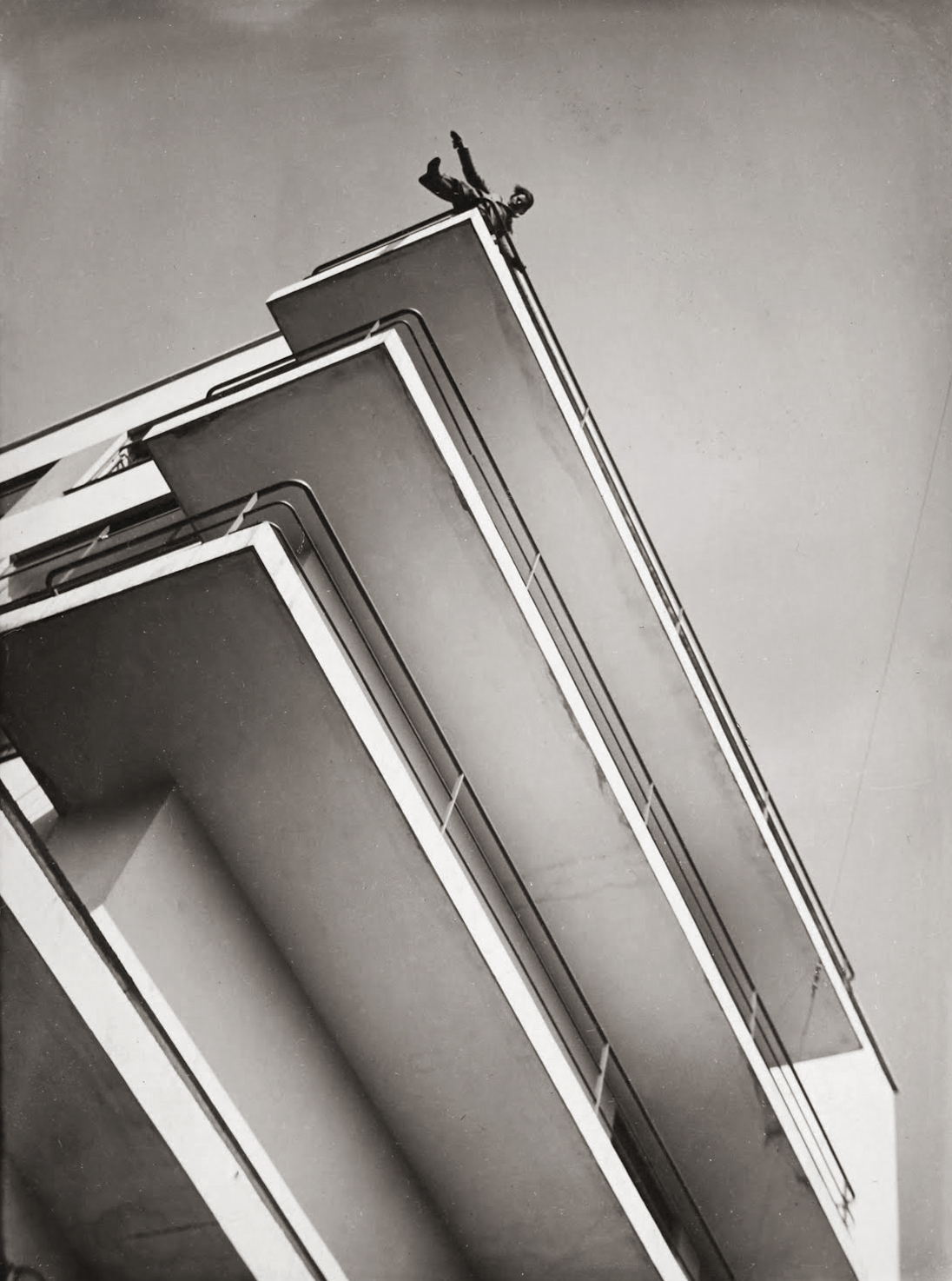
T. Lux Feininger (German-American, 1910-2011) 'Bauhaus Stage Dessau: 'Light Play' by Oskar Schlemmer with the dancer and pantomime Werner Siedhoff' 1927 from the exhibition 'Bauhaus and Photography: On Neues Sehen in Contemporary Art' at the Museum für Fotografie, Berlin, April - August, 2019
 

T. Lux Feininger (German-American, 1910-2011)
Bauhausbühne Dessau: ‘Lichtspiel’ von Oskar Schlemmer mit dem Tänzer und Pantomimen Werner Siedhoff / Bauhaus Stage Dessau: ‘Light Play’ by Oskar Schlemmer with the dancer and pantomime Werner Siedhoff
1928
Gelatin silver print
© Staatliche Museen zu Berlin, Kunstbibliothek
© Estate of T. Lux Feininger


“Im Grunde ist es nichts anderes als die Welt seiner Bilder, die in den Bühnenschöpfungen Schlemmers Gestalt gewinnt. […] Es ist eine künstliche, aber auch eine in hohem Maße künstlerische Welt, die ihren Eindruck auf ein formenempfindliches Auge nicht verfehlen wird.” (Curt Glaser: Schlemmers Bühnenentwürfe, 1932). / “Essentially, it is nothing but the world of his pictures that takes form in Schlemmer’s stage creations. […] It is an artificial, but also to a high degree artistic world which cannot fail to make an impression on an eye that is sensitive to form.” (Curt Glaser: Schlemmer’s Stage Designs, 1932).


A COSMIC posting of all that is good about the Neues Sehen (New Vision) photographic movement (Neues Sehen considered photography to be an autonomous artistic practice with its own laws of composition and lighting, through which the lens of the camera becomes a second eye for looking at the world. This new way of seeing was based on the use of unexpected framings, the search for contrast in form and light, the use of high and low camera angles, etc… Moholy-Nagy, László, (1932) The new vision, from material to architecture. New York: Brewer, Warren & Putnam).

Alien orchids, dizzying perspectives and superlative light shows. Design, film, photo, collage, photogram, reflection, dance, portrait, fragmentation, architecture, beauty.

I’m in love with Florence Henri 🙂

Dr Marcus Bunyan


Many thankx to the Museum of Photography, Berlin for allowing me to publish the photographs in the posting, and to Nick Henderson for the installation photographs. Please click on the photographs for a larger version of the image.


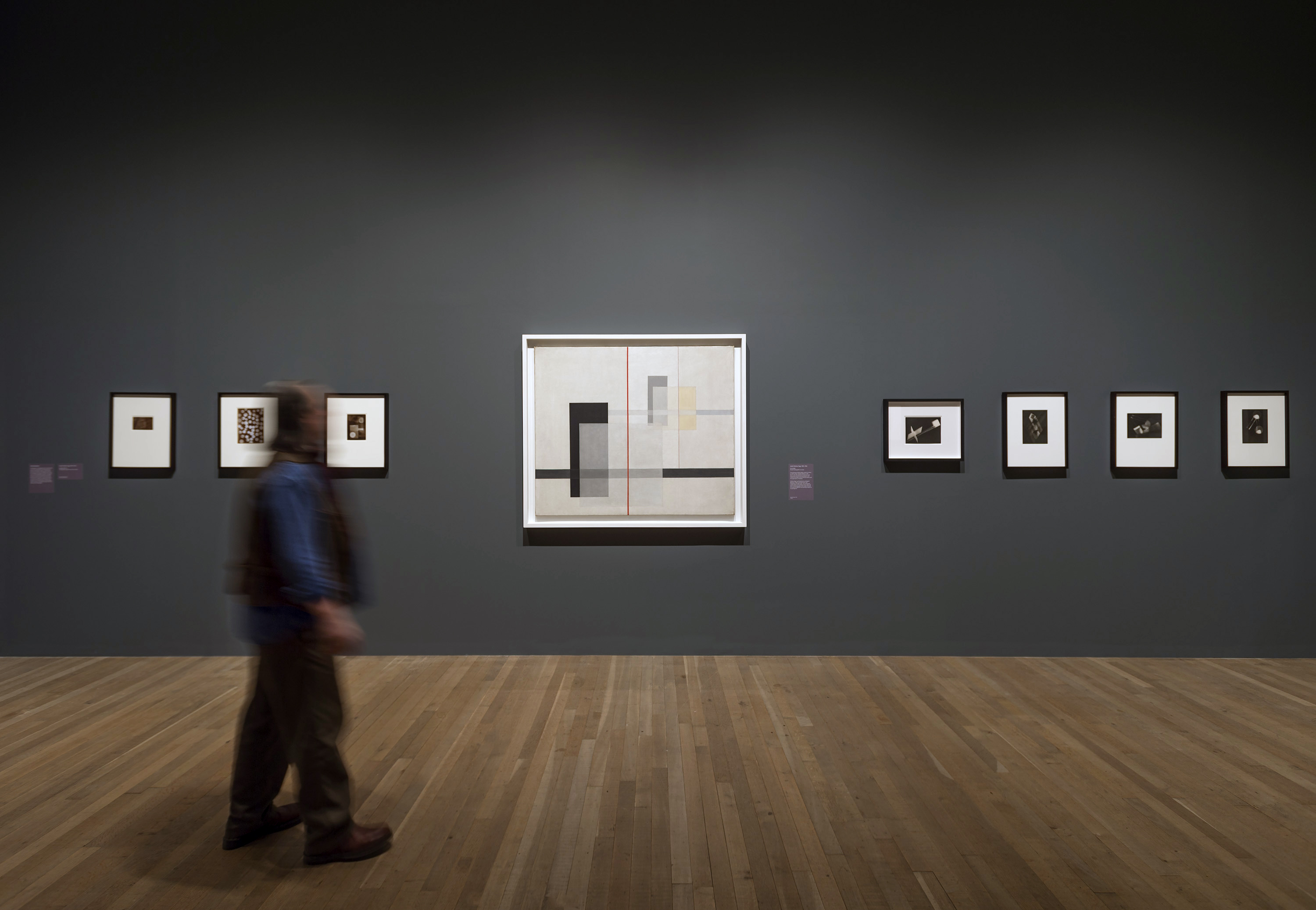
Installation view of the exhibition 'Bauhaus and Photography' at the Museum für Fotografie, Berlin

Installation view of the exhibition 'Bauhaus and Photography' at the Museum für Fotografie, Berlin

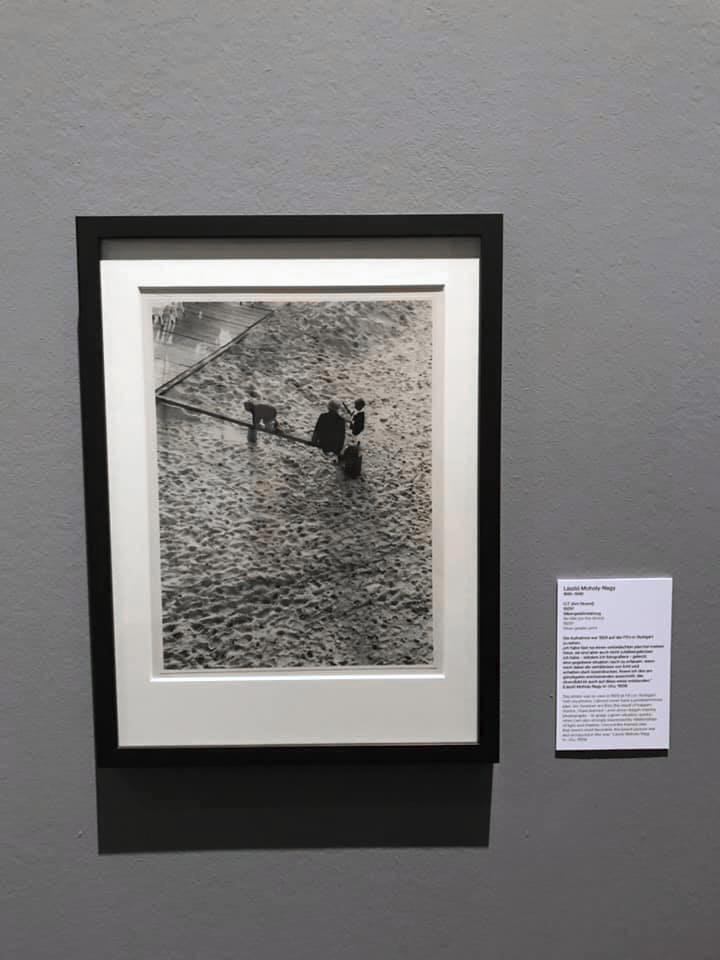
László Moholy-Nagy (Hungarian, 1895-1946) 'No title (on the shore)' c. 1929 (installation view)


László Moholy-Nagy (Hungarian, 1895-1946)
O.T. (Am Strand) / No title (on the shore) (installation view)
c. 1929
Gelatin silver print


Die Aufnahme war 1929 auf der FiFo in Stuttgart zu sehen. “Ich habe fast nie einen vorbedachten plan bei meinen fotos. Sie sind aber auch nicht zufallsergebnisse. Ich habe – seitdem ich fotografiere – gelernt, eine gegebene situation rasch zu erfassen. Wenn mich dabei die verhältnisse von licht und schatten stark beeindrucken, fixiere ich den am günstigsten erscheinenden ausschnitt. Das strandbild ist auch auf diese weise entstanden.” (László Moholy-Nagy in: Uhu, 1929) / This photo was on view in 1929 at FiFo in Stuttgart. “With my photos, I almost never have a predetermined plan. Nor however are they the result of happenstance. I have learned – ever since I began making photographs – to grasp a given situation quickly. When I am also strongly impressed by relationships of light and shadow, I record the framed view that seems most favorable. The beach picture was also produced in this way.” László Moholy-Nagy in: Uhu, 1929)


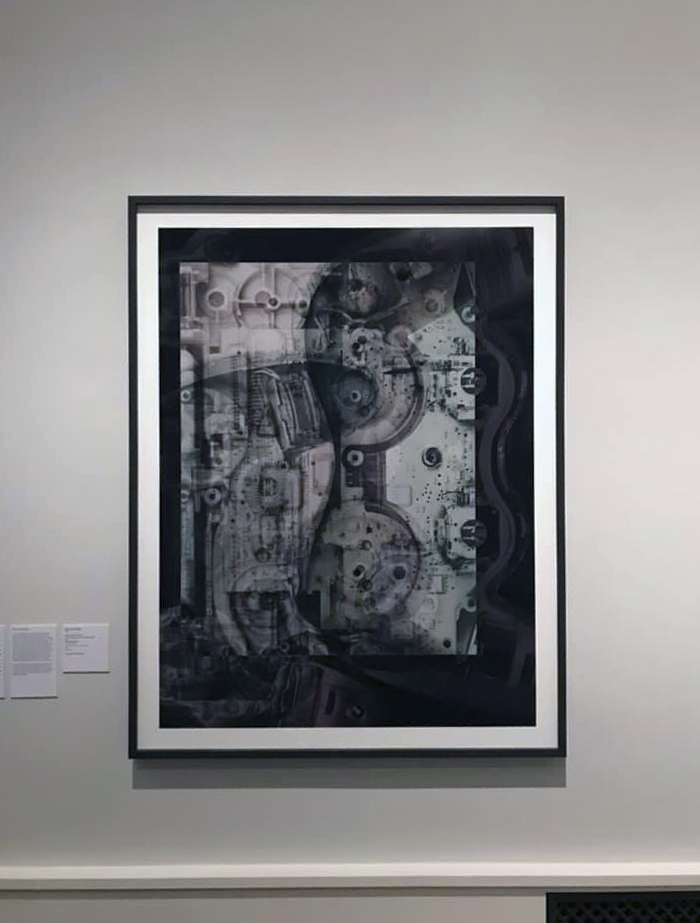
Max de Esteban (Spanish, born 1959) 'TOUCH ME NOT: Fleeing the Presence of Death' 2013


Max de Esteban (Spanish, b. 1959)
TOUCH ME NOT: Fleeing the Presence of Death
2013
Inkjet print
Courtesy of Max de Esteban


In Touch Me Not (2013), Max de Esteban focuses on microelectronic de-vices: CDs, plastic boxes, and electronic circuit boards derived from computers. As data carriers that are X-rayed, the metal surfaces and structures do not reveal any information and refuse to be read.


Catalogue cover from the exhibition 'Bauhaus and Photography' at the Museum für Fotografie, Berlin


Bauhaus and Photography catalogue cover


Installation view of the exhibition 'Bauhaus and Photography' at the Museum für Fotografie, Berlin


Installation views of the exhibition Bauhaus and Photography at the Museum für Fotografie, Berlin


Poster for 'Film und Foto' 1929


International Exhibition of the Deutscher Werkbund Film und Foto (FiFo) at Städtische Ausstellungshallen

Poster for Film und Foto
1929
Offset lithograph
33 x 23 1/8″ (84 x 58.5cm)


Willi Ruge (German, 1892-1961) 'Self-portrait from earthworm perspective' c. 1927 from the exhibition 'Bauhaus and Photography: On Neues Sehen in Contemporary Art' at the Museum für Fotografie, Berlin, April - August, 2019


Willi Ruge (German, 1892-1961)
Selbstbildnis aus der Regenwurm-Perspektive / Self-portrait from earthworm perspective
c. 1927
Gelatin silver print
© Staatliche Museen zu Berlin, Kunstbibliothek
© Erbengemeinschaft Ruge


To mark the centenary of the founding of the Bauhaus, this exhibition opens up a dialogue between contemporary art and the photographic avant-garde of the 1930s.

The Bauhaus is not just a key figure in the history of twentieth-century design and art, but also of photography. How are the innovations that were made then still influencing the evolution of the visual language of today’s photography and contemporary aesthetic concepts? What role does the photographic avant-garde of circa 1930 play for contemporary artists? This exhibition juxtaposes works by artists such as László Moholy-Nagy, Lucia Moholy, Man Ray, Jan Tschichold, Hedda Walther, Florence Henri, Hans Robertson and Erich Consemüller with groups of works by Thomas Ruff, Dominique Teufen, Daniel T. Braun, Wolfgang Tillmans, Doug Fogelson, Max de Esteban, Viviane Sassen, Stephanie Seufert, Kris Scholz, Taiyo Onorato & Nico Krebs, Antje Hanebeck and Douglas Gordon.

The historical reference point of the exhibition is the Werkbund exhibition Film and Photo, which was shown in Stuttgart, Berlin and Zurich, among other locations in 1929/1930. The Berlin leg was put together by the Kunstbibliothek. The Hungarian artist László Moholy-Nagy (1895-1946), who had already made a name for himself with his experimental photographic works, curated one room on the history of photography, and one on the future. The Bauhaus artist was interested in conducting a systematic investigation of Neues Sehen (New Vision) in photography. The historical exhibition, which functioned as a kind of manifesto, intervening in the debates of the time around the position of photography in the hierarchy of art, is reconstructed virtually with over 300 exhibits. Additionally, there will be a recreation of part of the Berlin exhibition. The reconstruction of the original exhibition design will be complemented by numerous vintage prints from the holdings of the Kunstbibliothek and a presentation of films from the 1920s. In combination with photographic works by contemporary artists, the exhibition opens up a dialogue between this historical event and the present moment.

Students from the design department at the Darmstadt University of Applied Sciences and the faculty of design at Nuremberg Tech offer a glimpse into the future, presenting their own forward-looking designs, which also incorporate digital media.

Text from the Museum für Fotografie website [Online] Cited 03/08/2019


David Octavius Hill / Robert Adamson (1802-1870 / 1821-1848) 'Lady Mary Hamilton (Campbell) Ruthven' 1843 from the exhibition 'Bauhaus and Photography: On Neues Sehen in Contemporary Art' at the Museum für Fotografie, Berlin, April - August, 2019


David Octavius Hill / Robert Adamson (Scottish, 1802-1870 / 1821-1848)
Lady Mary Hamilton (Campbell) Ruthven
1843 / Reprint 1890-1900 by James Craig Annan
Pigment print


David Octavius Hill / Robert Adamson (1802-1870 / 1821-1848) 'Newhaven Fisherman'. John Henning and Alex H. Ritchie 1843


David Octavius Hill / Robert Adamson (Scottish, 1802-1870 / 1821-1848)
Newhaven Fisherman. John Henning and Alex H. Ritchie
1843 / Reprint 1890-1900 by James Craig Annan
Oil/bromide transfer print or pigment print


Eugène Atget (French, 1857-1927) 'Shopfront, Quai Bourbon, Paris, France' c. 1900


Eugène Atget (French, 1857-1927)
Au Franc Pinot, quai Bourbon, 1
1902
Aus der Folge / From the series L’Art dans le Vieux Paris
Albumen print


Atget, der sich selbst als Dokumentarfotograf verstand, wurde auf der FiFo als Erneuerer der Fotografie vorgestellt. / Atget, who saw himself as a documentary photographer, was presented at FiFo as a renewer of photography.


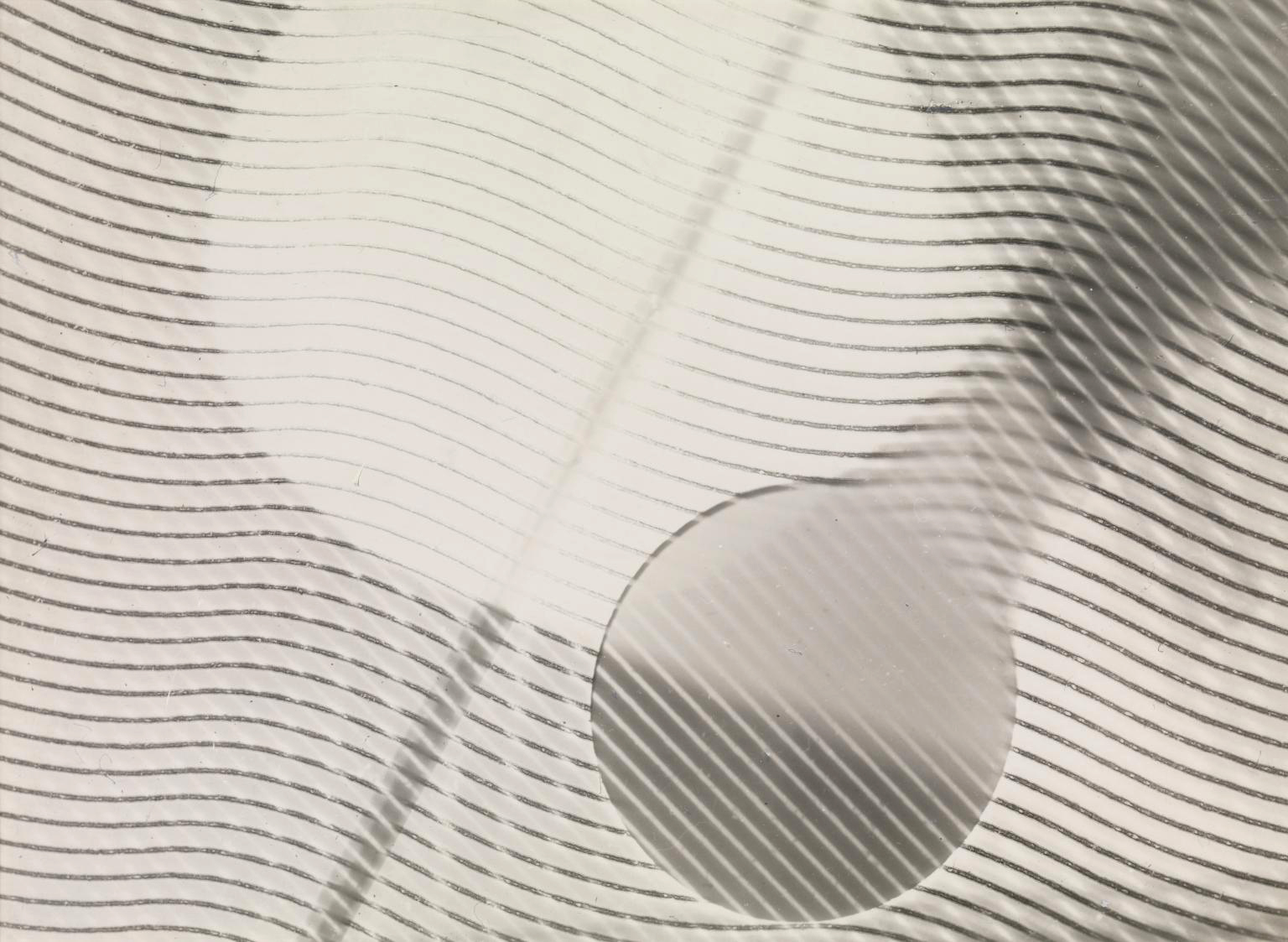
László Moholy-Nagy (Hungarian, 1895-1946) 'Photogram (photogram with Eiffel Tower)' 1925 / 1989


László Moholy-Nagy (Hungarian, 1895-1946)
Fotogramm (Fotogramm mit Eiffelturm) / Photogram (photogram with Eiffel Tower)
1925 / 1989
Reproduction by the artist from the unique specimen, Silver gelatin print
© Staatliche Museen zu Berlin, Kunstbibliothek


Das Fotogramm war 1929 auf der FiFo in Stuttgart und Berlin zu sehen. Die Motivvorlage ist 1929 in Moholy-Nagys Buch von material zu architektur abgebildet: “spielzeug / durch die bewegung erzeugtes, virtuelles volumen – optische auflösung des festen materials […] spielzeuge sind in vielen fällen die zeitgemäßen plastiken. Sie enthalten oft geistreiche übersetzungen technischer ideen, die meist mehr von dem wesen technischer vorgänge vermitteln als gelehrte vorträge.” / The photogram was on view in 1929 at FiFo in Stuttgart and Berlin. The template for this motif is reproduced in Moholy-Nagy’s book from material towards architecture (1929): “toy / through the virtual volumes generated by movement – optical dissolution of the solid material […] toys are in many cases contemporary sculptures. They often contain ingenious translations of technical ideas, most convey more concerning the nature of technical procedures than learned lectures.”


Erich Consemüller (German, 1902-1957) 'Bauhaus Stage Dessau: 'Curtain Play' by Oskar Schlemmer with the dancer and pantomime Werner Siedhoff' 1927


Erich Consemüller (German, 1902-1957)
Bauhausbühne Dessau: ‘Vorhangspiel’ von Oskar Schlemmer mit dem Tänzer und Pantomimen Werner Siedhoff / Bauhaus Stage Dessau: ‘Curtain Play’ by Oskar Schlemmer with the dancer and pantomime Werner Siedhoff
1927
Gelatin silver print
© Staatliche Museen zu Berlin, Kunstbibliothek
© Stephan Consemüller


In 1927, Consemüller was commissioned by Gropius to photographically document Bauhaus’s activities and people. This resulted in the creation of around 300 photographs documenting the school’s work and environment. “Bauhaus Scene,” a frequently reproduced photograph of his, combines three works by Bauhaus artists in one photo. It depicts a woman sitting in Breuer’s Wassily Chair, wearing a theatrical mask made by Oskar Schlemmer and a dress designed by Lis Volger-Beyer [de]. Other notable photographs of his feature Bauhaus architecture, often with figures interposed.

Text from the Wikipedia website


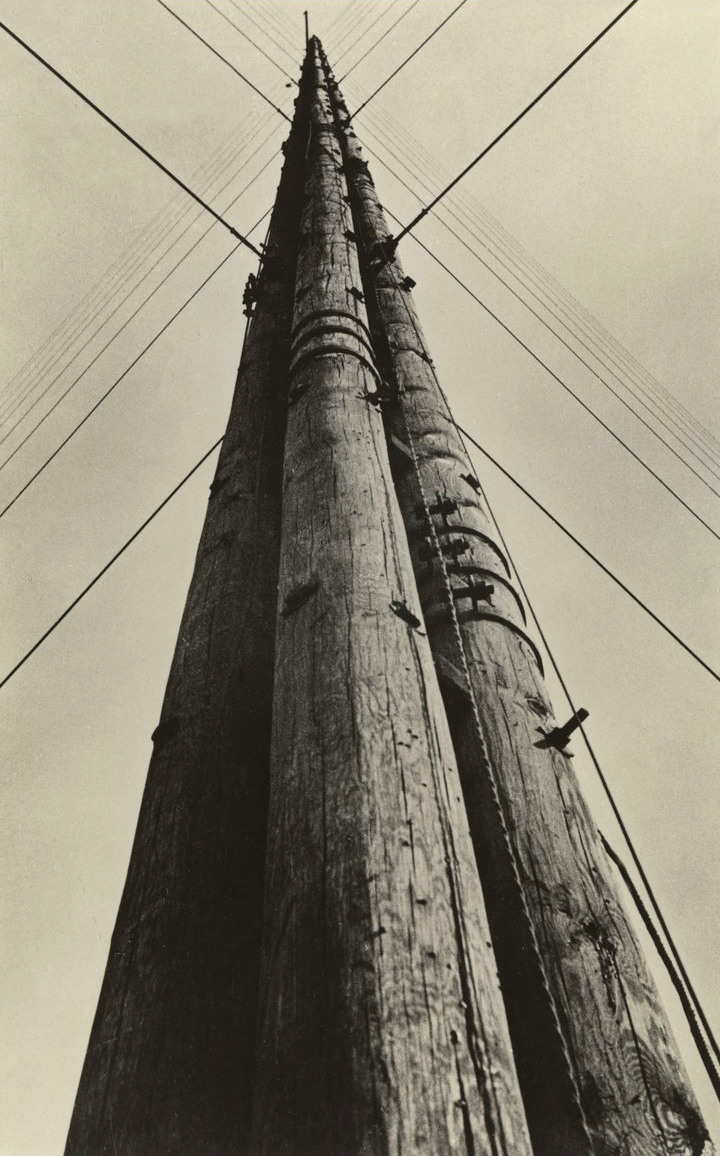
László Moholy-Nagy (Hungarian, 1895-1946) 'Radio Tower Berlin' 1925


László Moholy-Nagy (Hungarian, 1895-1946)
Funkturm Berlin / Radio Tower Berlin
1925
Gelatin silver print


Albert Renger-Patzsch (German, 1897-1966) 'Catasetum tridentatum. Orchidaceae' 1922-1923


Albert Renger-Patzsch (German, 1897-1966)
Catasetum tridentatum. Orchidaceae
1922-1923
Gelatin silver print


“Eines der wundervollsten Fotos, das überhaupt in unserer Zeit entstanden ist, ist die Rengersche Orchideenblüte […]. Hier ist ein fotografischer Bildraum entstanden, der mehr räumlich als plastisch lebendig ist.” (Die Form, 1929) / “One of the most marvellous photographs produced during our time is the orchid blossom by Renger […]. Emerging here is a photographic picture space that is more lively in spatial than in sculptural terms.” (Die Form, 1929)


Albert Renger-Patzsch (German, 1897-1966) 'Bügeleisen für Schuhfabrikation, Faguswerk Alfeld [Shoemakers' irons, Fagus factory, Alfeld]' 1928


Albert Renger-Patzsch (German, 1897-1966)
Bügeleisen für Schuhfabrikation. Fagus-Werk Benscheidt in Alfeld / Flat iron for shoe fabrication. Fagus-Werk Benscheidt in Alfeld
1926
Gelatin silver print


Albert Renger-Patzsch (German, 1897-1966) 'Gebirgsforst im Winter (Fichtenwald im Winter)' [Mountain forest in winter (spruce forest in winter)] 1926


Albert Renger-Patzsch (German, 1897-1966)
Gebirgsforst im Winter / Montane woods in winter
1926
Gelatin silver print


Albert Renger-Patzsch (German, 1897-1966) 'Potter's hands' 1925-1927


Albert Renger-Patzsch (German, 1897-1966)
Töpferhände / Potter’s hands
1925-1927
Gelatin silver print


Aenne Biermann (German, 1898-1933) 'View into a piano' c. 1928


Aenne Biermann (German, 1898-1933)
Einblick in ein Klavier. Scherzo / View into a piano
1928 or earlier
Gelatin silver print


Die Aufnahme war 1929 auf der FiFo in Stuttgart zu sehen. / This photo was on view in 1929 at FiFo in Stuttgart.


Aenne Biermann (1898-1933) 'Finale' before October 1928


Aenne Biermann (German, 1898-1933)
Finale
before October 1928
Gelatin silver print


Die Aufnahme war 1929 auf der FiFo in Stuttgart zu sehen. / This photo was on view in 1929 at FiFo in Stuttgart.


Jan Tschichold (German, 1902-1974) 'Vice of Humanity' 1927


Jan Tschichold (German, 1902-1974)
Laster der Menschheit / Vice of Humanity
1927
Plakat (Raster- und Tiefdruck) / Poster (halftone and intaglio)
© Staatliche Museen zu Berlin, Kunstbibliothek
© Familie Tschichold


Das Plakat war 1929 im Raum 1 der FiFo in Berlin zu sehen. “Zu den elementaren Mitteln neuer Typographie gehört in der heutigen, auf Optik eingestellten Welt auch das exakte Bild: die Photographie.” (Jan Tschichold: Elementare Typographie, 1925). / The poster was shown in 1929 in Room 1 at FiFo in Berlin. “In the contemporary world, with its orientation toward optics, among the elementary resources of the new typography is the exact image: photography.” (Jan Tschichold: Elementary Typography, 1925).


Jan Tschichold (2 April 1902 Leipzig, Germany – 11 August 1974 Locarno, Switzerland) (born as Johannes Tzschichhold, also Iwan Tschichold, Ivan Tschichold) was a calligrapher, typographer and book designer. He played a significant role in the development of graphic design in the 20th century – first, by developing and promoting principles of typographic modernism, and subsequently (and ironically) idealising conservative typographic structures. His direction of the visual identity of Penguin Books in the decade following World War II served as a model for the burgeoning design practice of planning corporate identity programs. He also designed the much-admired typeface Sabon.

Text from the Wikipedia website


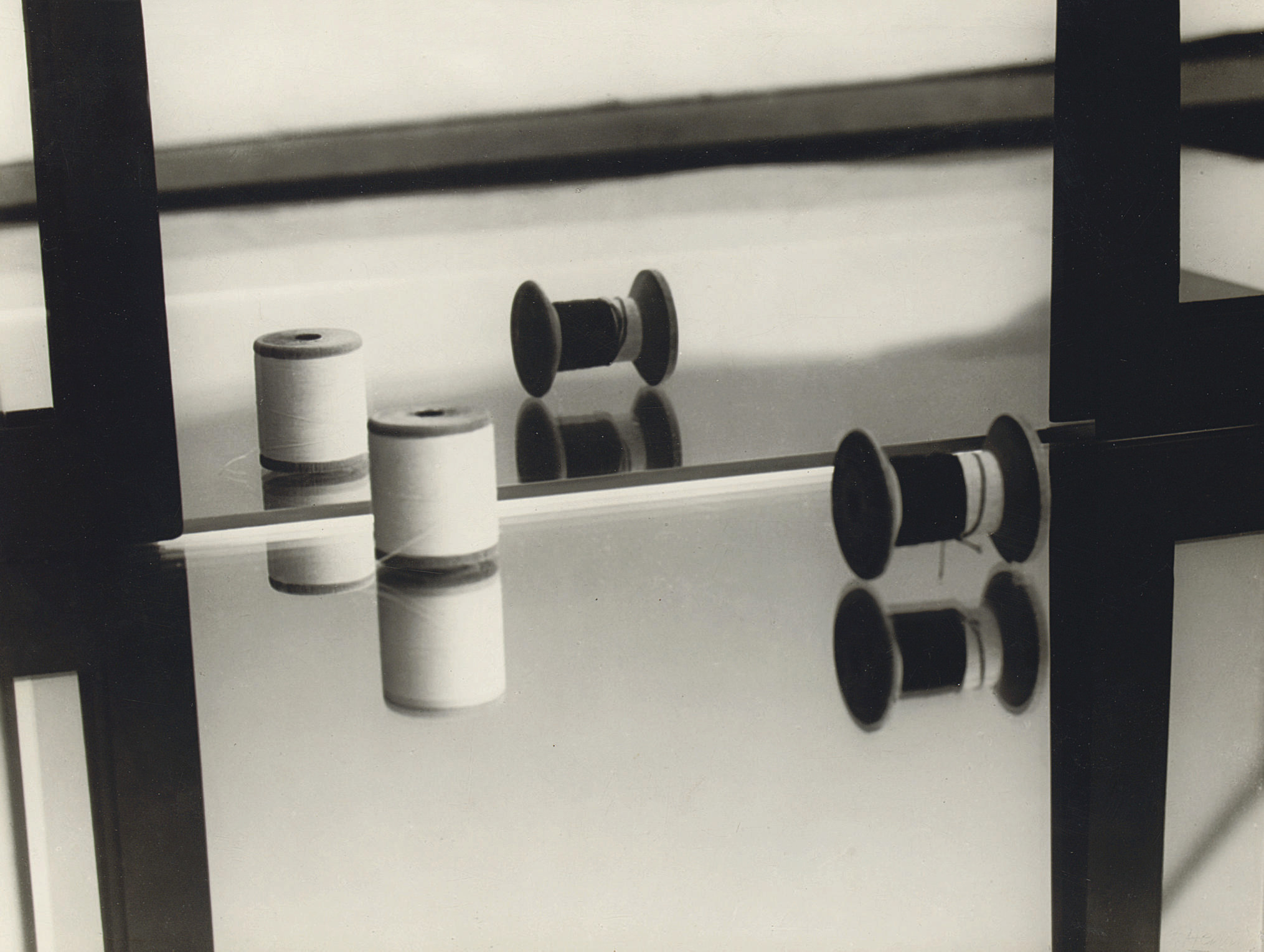
Florence Henri (French, 1893-1982) 'Composition with spools of thread' 1928


Florence Henri (French, 1893-1982)
Komposition mit Garnrollen / Composition with spools of thread
1928
Gelatin silver print
© Florence Henri


Die Aufnahme war 1929 auf der FiFo in Stuttgart zu sehen. / This photo was on view in 1929 at FiFo in Stuttgart.


Max Burchartz (German, 1887-1961) 'Lotte (Eye)' (Lotte [Auge]) 1928


Max Burchartz (German, 1887-1961)
Lotte (Eye) (Lotte [Auge])
1928
Gelatin silver print
11 7/8 x 15 3/4″ (30.2 x 40cm)


Max Burchartz (German, 1887-1961) 'Grete W. (eyes)' c. 1928


Max Burchartz (German, 1887-1961)
Grete W. (Augen) / Grete W. (eyes)
c. 1928
Gelatin silver print


Die Aufnahme war 1929 auf der FiFo in Stuttgart zu sehen. / This photo was on view in 1929 at FiFo in Stuttgart.


Charlotte Rudolph (German, 1896-1983) 'Leap (Gret Palucca)' 1928


Charlotte Rudolph (German, 1896-1983)
Sprung / Leap (Gret Palucca)
1928
Gelatin silver print
On permanent loan from Österreichischen Ludwig-Stiftung für Kunst und Wissenschaft
© Albertina, Vienna


Eine ähnliche Aufnahme der Fotografin Charlotte Rudolph von Palucca bildete László Moholy-Nagy 1925 in dem Buch Malerei Photographie Film ab. / This shot of Palucca by the photographer Charlotte Rudolph was reproduced by László Moholy-Nagy in the book Painting Photography Film in 1925.


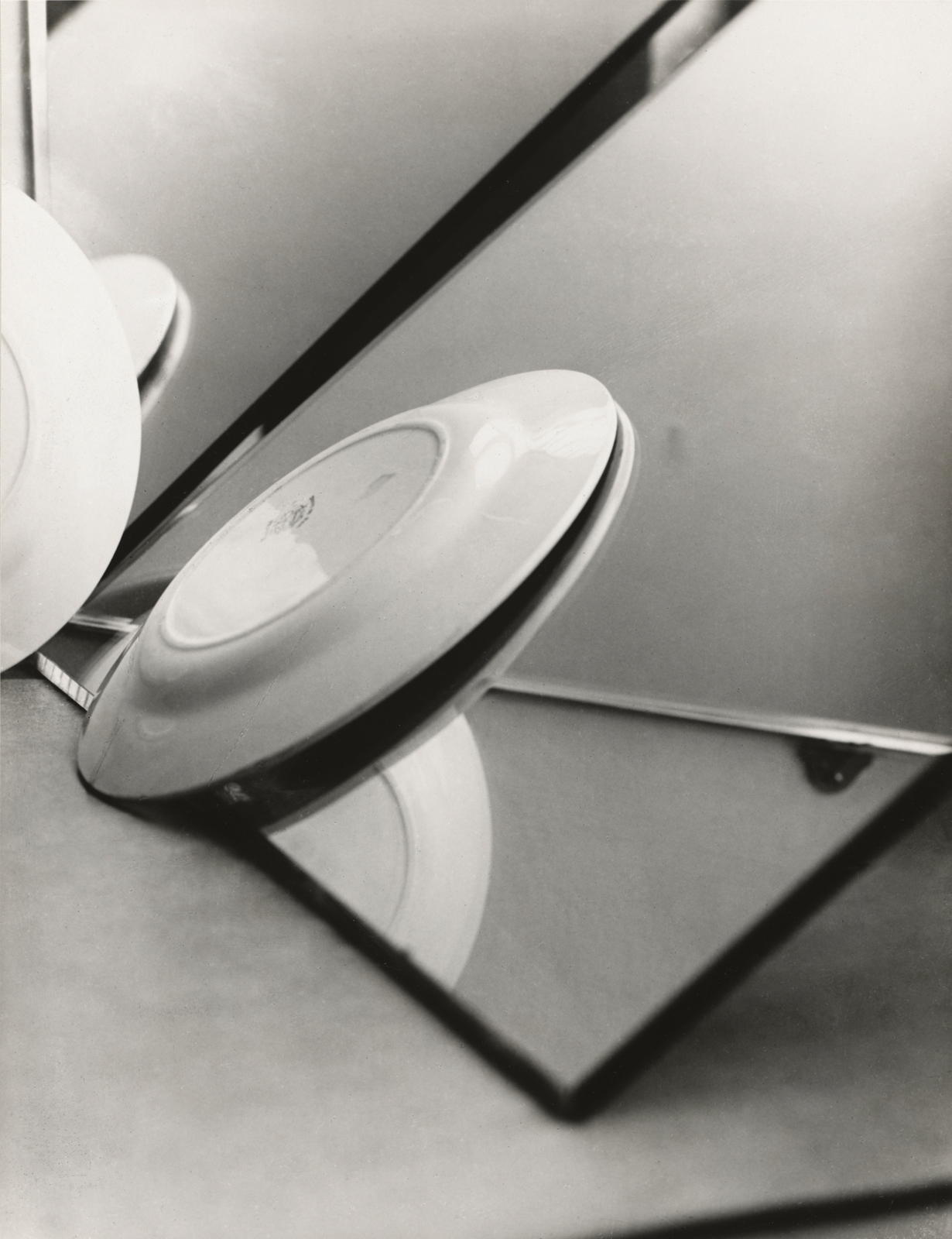
Florence Henri (French, 1893-1982) 'No title (composition with plate and mirror)' 1929 or earlier


Florence Henri (French, 1893-1982)
O.T. (Komposition mit Teller und Spiegel) / No title (composition with plate and mirror)
1929 or earlier
Gelatin silver print
© Staatliche Museen zu Berlin, Kunstbibliothek
© Florence Henri
© Galleria Martini & Ronchetti
Courtesy Archives Florence Henri


Die Aufnahme war 1929 auf der FiFo in Stuttgart zu sehen. / This photo was on view in 1929 at FiFo in Stuttgart.


Florence Henri. 'Fenêtre [Window]' 1929


Florence Henri (French, 1893-1982)
Pariser Fenster / Parisian window
1929 or earlier
Gelatin silver print
© Florence Henri


Die Aufnahme war 1929 auf der FiFo in Stuttgart zu sehen. / This photo was on view in 1929 at FiFo in Stuttgart.


Walter Funkat (German, 1906-2006) 'Glass spheres' 1929


Walter Funkat (German, 1906-2006)
Glaskugeln / Glass spheres
1929
Gelatin silver print
© NRW-Forum


Man Ray (American, 1902-1958) 'Rayograph' 1921-1928


Man Ray (American, 1902-1958)
Rayograph
1921-1928, print 1963
Fotogramm
Gelatin silver print
© Staatliche Museen zu Berlin, Kunstbibliothek
© Man Ray Trust, Paris / VG Bild-Kunst, Bonn 2019


László Moholy-Nagy and the FiFo

László Moholy-Nagy – Bauhaus artist and pioneer of media art – co-curated the legendary exhibition Film und Foto (FiFo) in 1929, which was set up by the Deutscher Werkbund in the exhibition halls on Interimtheaterplatz in Stuttgart. The FiFo, which subsequently travelled to Zurich, Berlin, Gdansk, Vienna, Agram, Munich, Tokyo and Osaka, presented a total of around 200 artists with 1200 works and showed the creations of the international film and photography scene of those years. Moholy-Nagy curated the hall, which reflected the history and present of photography. His artistic perspective on the history of photography and his efforts to provide a comprehensive overview of the contemporary fields of photo-graphic application were fundamental. At the exit of the large hall, Moholy-Nagy suggestively posed the question of the future of photographic development. On the basis of extensive scientific research, the Moholy-Nagy room was virtually reconstructed with approximately 300 exhibits.

The exhibition Film und Foto took its starting point in 1929 in Stuttgart, but was opened only a short time later in the Kunstgewerbemuseum (today: Gropius Bau) in Berlin. In the inner courtyard of the museum, large partition walls were erected to present the numerous photo exhibits. The hanging concept, handed down through three documentary photos, apparently deviated from the Stuttgart hanging. A corner situation, mainly showing photographs by Lucia Moholy and László Moholy-Nagy, was restored in a 1:1 reconstruction. In this way, the curatorial concept of comparative contemplation, as envisioned by Moholy-Nagy, can be re-experienced.

Play with Images

The rooms organised by László Moholy-Nagy at FiFo illustrated the continuity between the formal and optical qualities of photography, as well as the forward-looking influence of technical image media on contemporary culture. Moholy-Nagy’s works were interpretable as exemplifying visual modernism. They comprised close-up portrait fragments, architectural photographs using unconventional perspectives, and playful photo collages. Appearing entirely new at the time were the technical and material qualities of these photographs, as well as the aesthetic principles upon which they functioned. This was true in particular for the boldly configured light spaces of his photograms. These cameraless photographs embodied Moholy-Nagy’s artistic intentions in a very special way, and the medium offered him maximal autonomy in the use of light as a creative resource.

As examples of the photography of the Neue Sehen (New Vision), his works also entered the Kunstbibliothek, which – as the organiser of the Berlin FiFo – also acquired works by other artists from the show. The selection on view here evokes the comparative play with images and with modes of perception and use that was instigated by Moholy-Nagy, while confronting photographs from the 1920s with those from the 19th century. The form of presentation using passe-partouts and frames, prescribed by museum custom, renders the material and formal properties of each individual original print sensuously graspable.

A New Way of Seeing: An Homage to Film und Foto

In the exhibition Film und Foto, the camera emerged as the key to an expanded perception of the world, and as a mediator of new modes of seeing. In conjunction with photographic and cinematic experimentation, the New Objectivity and the New Vision came to epitomise avant-garde production. The central role of film for 20th-century culture was now recognised and manifested for the first time. Today, devices that can produce photographs or filmic scenes depending upon the chosen setting are at our disposal. This medial juxtaposition was conceptualised for the first time at FiFo – not coincidentally in 1929, the year sound film was inaugurated. Questions such as: “What is a photograph?” “What is a cinematic image?” “What is a technically produced image?” were investigated. In the Russian room, El Lissitzky hung photographs in open frames that were reminiscent of filmstrips, and ran excerpts from Soviet films on continuous loops from daylight projectors directly adjacent to them. The presentation of both media in both tandem and on equal terms was realised for the first time here in a modern dispositive. The program The Good Film, assembled by Victor Schamoni, ran at the former Kunstgewerbemuseum, today the GropiusBau, and at other Berlin cinemas, establishing cinema as an art form.

Daniel T. Braun

Daniel T. Braun describes his pictorial work as performative form research. Behind this lies an actionist stubbornness that wrestles unknown facets from the analogue forms of photography. The work group of Rocketograms may serve as an apt example. Following the action forms of action painting, Braun brings light-sensitive colour photographic paper into physical contact with burning pyrotechnics. With the uncommon use of magnesium torches, he refers to undertakings largely forgotten today, which were used for lighting in the early days of photography. In addition, the artefacts created in this way have an emphatically expressive effect. The moment of explosion is inscribed in the unique pieces in a virtually picture-creative way. Referring to Susan Sontag, Braun explicitly directs his goal “not to the creation of harmony, but to the overexpansion of the medium through destructive processes.”

A material-based exploration of light is also reflected in several sculptures, which Daniel T. Braun has transferred into another aspect of being through nuanced lighting and rotations in the studio. In the photographic image, the recorded light traces of the objects develop a strange independence. They seem to elude the observer’s gaze and yet are present in a peculiar way.

Max de Esteban

In the photographic works of Max de Esteban we encounter references critical of civilisation. His digital photo collages are designed as visual textures. They are inscribed with a skepticism based on media theory. He already indicates the vertigo that the works can trigger in their titles: Heads Will Roll is the name of a series of works from 2014. Fragments of perception from the media world are transformed into a visual totality. A spectrum of constructive forms and colour surfaces, as handed down from Modernism, is combined with individual motif elements from the image pool of mass media. In the sense of Zygmunt Bauman, the motifs of Heads Will Roll represent the unredeemed world of a “retrotopia”.

In Touch Me Not (2013), Max de Esteban focuses on microelectronic devices: CDs, plastic boxes, and electronic circuit boards derived from computers. As data carriers that are X-rayed, the metal surfaces and structures do not reveal any information and refuse to be read.

Doug Fogelson

For his series Forms & Records, the American artist Doug Fogelson visited a historically significant site of the New Bauhaus. His analogue black-and-white and colour photographs were taken in the darkroom of the IIT Institute of Design (ID) photography school in Chicago, which was founded by László Moholy-Nagy.

Fogelson’s graphically adept pictorial inventions can be understood as an expression of visual archaeology. He uses architectural models, vinyl singles, film and tape strips from the immediate post-war era as found motifs. In doing so, he refers to concepts of recording, designing, documenting and ephemerality in order to find his way back from a historical distance to the basics of form-finding with light. In addition, Moholy-Nagy’s series also refers to suggestions published in 1922 in his essay “New Plasticism in Music. Possibilities of the Gramophone”. The Bauhaus teacher there implements his ideas on the manipulative use of wax records with the intention of creating new sounds.

Douglas Gordon

In an obsessive way, the video and photographic works of Douglas Gordon wrestle with the receptive parameters of New Vision. His passionate engagement reveals itself in the leitmotif of the eye. For the artist’s book Punishment Exercise in Gothic (2001), the Scottish Turner Prize winner portrays himself in a black-and-white photograph, which shows his bleached portrait in cut. The fragmented cyclopean gaze is directed straight at the viewer and can be interpreted ambiguously. The motif is based on Max Burchartz’s photograph Lotte (eye), a key image of photo-graphic modernism presented in 1929 at the Stuttgart exhibition Film und Foto. In the book, the artist repeats his self-portrait no less than 118 times.

Antje Hanebeck

Antje Hanebeck dedicates her artistic photography to the architecture of post-war Modernism and the present. A moment of the documentary does not apply to her. Instead, she operates with a coarse-grained, tonal black-and-white aesthetic that seems pre-modern in an confounding way. Graphic and photographic elements are subtly intertwined and contrasted with the captured buildings, which retain their strictly constructive character. “Her pictures are picture puzzles, riddles, question marks, which – also – resist any temporal classification” (Hans-Michael Koetzle). This also applies to the large-format work Borough (2008). Hanebeck’s motif refers to photographs taken by László Moholy-Nagy in 1928 on the viewing platform of the Berlin Radio Tower. However, her spectacular downward gaze leads to a new irritation of perception. The irritation can only be resolved by a change of view – a 90 degree turn of the head to the left. Of course, the artist’s intervention is not limited to the formal. “The Borough motif undergoes transformation into a newly created, utopian, urban land-scape through a rotation.” (Ellen Maurer Zilioli).

Behind the poetic name of the work Desert Rose lies the National Museum of Qatar, designed by Jean Nouvel, which is due to open in March 2019. The French star architect develops his representative buildings from various stylistic concepts, including Bauhaus modernist architecture. It is not uncommon for the buildings to be symbolically formulated. In her horizontal-format photographs, Hanebeck exposes a section of the constructive sub-layers of the “desert rose”. She interprets the functional longwall system of the steel pillars as a deeply vital, vibrating fabric.

Taiyo Onorato & Nico Krebs

“The enemy of photography is the convention, the fixed rules, the ‘how to do it’. The rescue of photography takes place through experimentation.” Programmatically, this quotation by László Moholy-Nagy is prefixed in a catalogue on the works of Taiyo Onorato and Nico Krebs. The Swiss artist duo, who have been working together since 2003, is interested in the shifting of photo-technical boundaries, in a productive confusion of the perception of things and their representation. Onorato & Krebs act inventively, ironically and always with analogue means in their image findings. For their work group Color Spins, created in 2012, they have developed their own rotational apparatuses. The dynamic light sculptures, which are captured by colour photography, create a surprising illusionism. With a wink, the figurations recall the famous ensembles that Oskar Schlemmer developed more than a hundred years ago and later performed on the Bauhaus stage in Dessau.

The ephemeral light sculptures of the black-and-white series Ghost from 2012, on the other hand, step in front of the dreary backdrop of a piece of woodland. A disturbing surreality emanates from the appearances. The medium of photography still retains its magical character in the works of Onorato & Krebs.

Thomas Ruff

The phg series by Thomas Ruff is characterised by digital processes. They can be interpreted as an homage. The work phg.05_II, in its spiral form, recites one of László Moholy-Nagy’s most famous photograms from 1922. The three-letter abbreviation, which recalls the name of a file format, refers to a contemporary approach to image generation. The process is completely virtualised. Both the generation of the objects and the simulation of the shadows on the paper take place in an immaterial space.

“With phg, Ruff transfers an analogue technique into virtual space – and at the same time questions all attributes assigned to the photogram, such as immediacy and objectivity, as they were relevant to Moholy-Nagy’s ‘Photography of New Vision'” (Martin Germann). But the phg series can also be thought of in the opposite way. By radically erasing the analogue essence of the photogram, but retaining the terminology of the photograms, Ruff redeems a central doctrine of photography for the digital present. As early as 1928, László Moholy-Nagy brought the doctrine to a formula: “Photography is the shaping of light.”

Viviane Sassen

What is photography? Viviane Sassen understands the imaging process as a peculiar “art of darkening”. Umbra (Latin: “shadow”) is the title of her group of works created in 2014. In it, the Dutch fashion and art photographer explores in a number of variations the effect aspects of semi-transparent colour surfaces placed in desert sceneries. For the three-part work Vlei, Viviane Sassen locates square plates of coloured glass in a hollow. In their form and colour, these plates are reminiscent of the abstract paintings by Bauhaus master Josef Albers. The surfaces of the Umbra series are also partly captured in perspective foreshortening. They, too, assert themselves as an autonomous, colour-shaded picture within the picture. Sassen’s arrangements always retain a slight contradictoriness. Moments of realism and abstraction are equally effective in them.

The artist’s book Umbra from 2015 brings together eleven coloured shadow motifs in the form of a loose-leaf collection. The motifs once again operate with variations of gaze and reflections. Sassen’s artistic oeuvre often contains feminist references to modernist photography. The work Marte #03, for example, is based on Germaine Krull’s experimental self-portraits.

Kris Scholz

In the age of the digital, there can be no question of a demand for ahistoricity, as evoked by the New Vision. This is documented by the series Marks and Traces by Kris Scholz. His large-format colour photographs show worn floors, floor boards, and tabletops from German, Spanish, Moroccan and Chinese studios and art academies. One may initially classify the motifs as pictorial documents. “But just as important is the question of who left these markings and traces. As documents, his pictures ‘fail’ because they hardly provide any information” (Gérard A. Goodrow). The perceptual perspective of the pictures is based on a radically lowered gaze that was already applied by Umbo and László Moholy-Nagy in the 1920s. Scholz also uses stretched linen as a medium for his highly abstract large formats, which, despite their sharpness of detail, are, from a greater distance, perceived as painterly artefacts.

Stefanie Seufert

The works of Stefanie Seufert show an architectural reference. Her sculptures from 2016 are titled Towers. Photographic papers serve as the start-ing point for her experimental exploration. In the darkroom, these papers are edited by elaborate folding and exposure processes. From the respective layers and trace-like superimpositions, a materiality of its own is formulated, which the artist consciously expands into space. “Fragile, strangely monumental and oddly alien to themselves, they arise from a folding of the picture, which now occupies a space, encloses a space and suggests the idea of an (interior) space of the pictures themselves” (Ma-en Lübbke-Tidow). As tower-like artefacts, Seufert’s Towers, which are reminiscent of contemporary high-rise buildings, literally stand in the way of the viewer. Like an ensemble of materialised metaphors, they insist on autonomy that includes both alienation and abstraction.

Dominique Teufen

The artistic works of Dominique Teufen are characterised by an expansive drive of photography towards the genres of sculpture and architecture. Her group of Blitzlicht-Skulpturen (flashlight sculptures) was created in 2013. The setting follows a strict arrangement. Like architectural models, glass structures composed of shapes of cubes, slabs, and pyramids are positioned on the stage of a black plinth or white table. Something theatrical happens on it. The camera flashes. Reflective surfaces reflect the light onto the walls, catch these light forms again and connect the perspectival surfaces and lines to an illusion: the concrete moves into the background, the light as a sculpture enters the room; as soon as the eye suspects it, only the photograph remains as a witness to its existence. Teufen’s tableaus explore border areas. What already is architecture? What is sculpture? What, in turn, is photography?

In an ironic way, a catalogue of questions opens up in Teufen’s installation Selfiepoint from 2016. The expansive work formulates the invitation to shoot a selfie with the smartphone and thus to practice a central iconic gesture of our time. The backdrop of a mountain landscape quickly turns out to be a whimsically composed mountain of paper. It originated solely from the copier. What remains is a creative desire for self-reflection. Selfiepoint reminds us that the snapshot aesthetics of amateur photography have already been tried out by the students at the Bauhaus. At that time, the students were already playfully exploring new ways of presenting individual and group portraits with the 35 mm camera.

Wolfgang Tillmans

To what extent was the Bauhaus politically oriented? With a view to photography, the question still arises today as to the degree to which New Vision can be assigned to an artistic avant-garde of Modernism. Because the latter “aims, beyond the aesthetic, at radical social change […] which hardly applies to the protagonists of the New Vision. They were interested in little more than new perspectives from which they put people and things into the picture” (Timm Starl). The accusation of aestheticism arises. It contradicts the thesis that a reflexive visual process already provides political impulses itself. For the self-conception of contemporary art, however, the integration of political fields of thought and action has gained central importance. Both aspects of the political can be found exemplarily in the work of Wolfgang Tillmans. In June 2016, the artist launched an Anti-Brexit campaign for which he designed a 25-part poster series and called for Great Britain to remain in the EU. Tillmans does not want his project to be understood as an art action. He uses images from his Vertical Landscapes, which is a group of motifs of heavens and horizons. His photo-graphs are used as a form of agitation and placed in a tradition of image propaganda. Think, for example, of the collages by John Heartfield.

An edition realised by Wolfgang Tillmans in 2016 at the invitation of Tate Modern in London acts with a different field of photography. The occasion is the reopening of the Switch House, a brick building apse by Swiss architects Herzog & de Meuron. The sequence of images shows the still empty room areas of the museum on colour photocopies. Even this materiality undermines the auratic charge of the building. In their limited colour spectrum, Tillmans’ pictures produce “patterns and reductions that are literally subtracted from the naturalistic image” (Heinz Schütz). Paradoxically enough, the reproductions are transformed back into unique pieces through alienating colour shifts.


Daniel T. Braun (German, b. 1975) 'Overseer' 2003


Daniel T. Braun (German, b. 1975)
Overseer
2003
Raketogramm / colour photogram
c.170 x 106cm
© VG Bild-Kunst, Bonn 2018


Daniel T. Braun (German, b. 1975) 'Rafael Shafir' 2006


Daniel T. Braun (German, b. 1975)
Rafael Shafir
2006
Raketogramm / colour photogram
c. 260 x 130cm
© VG Bild-Kunst, Bonn 2018


Antje Hanebeck. 'Borough' 2008


Antje Hanebeck (German, b. 1968)
Borough
2008
Textildruck im Spannrahmen
230 x 230cm
© VG Bild-Kunst, Bonn 2018


Taiyo Onorato & Nico Krebs. 'Spin 07 (green brown)' 2012


Taiyo Onorato & Nico Krebs (Swiss, both b. 1979)
Spin 07 (green brown)
2012
Colour print
Courtesy the artists & Sies + Höke, Düsseldorf
© Taiyo Onorato & Nico Krebs


Daniel T. Braun (German, b. 1975) 'SBSVI Nr. 6' 2013


Daniel T. Braun (German, b. 1975)
SBSVI Nr. 6
2013
C-Print analog
110 x 90cm
© VG Bild-Kunst, Bonn 2018


Kris Scholz (German, b. 1952) 'Marks and Traces, Caochangdi 1' 2013


Kris Scholz (German, b. 1952)
Marks and Traces, Caochangdi 1
2013
Fine art print on canvas
200 x 150cm
© VG Bild-Kunst, Bonn 2018


Kris Scholz (German, b. 1952) 'Marks and Traces, Chongqing 5' 2018


Kris Scholz (German, b. 1952)
Marks and Traces, Chongqing 5
2018
Fine art print on canvas
200 x 150cm
© VG Bild-Kunst, Bonn 2018


Dominique Teufen (Swiss, b. 1975) 'Flashlight Sculpture #3' 2013


Dominique Teufen (Swiss, b. 1975)
Flashlight Sculpture #3
2013
Colour print
60 x 90cm
Courtesy Christophe Guye Galerie, Zürich
© Dominique Teufen


Dominique Teufen (Swiss, b. 1975) 'Flash Sculpture # 5' 2013


Dominique Teufen (Swiss, b. 1975)
Flash Sculpture # 5
2013
Colour print
60 x 90cm
Courtesy Christophe Guye Galerie, Zürich
© Dominique Teufen


Doug Fogelson (American, b. 1970) 'Forms and Records No. 11' 2014


Doug Fogelson (American, b. 1970)
Forms and Records No. 11
2014
Fotogramm
Silver gelatin paper
Courtesy Doug Fogelson
© Doug Fogelson


Doug Fogelson (American, b. 1970) 'Forms And Records No 06' 2014


Doug Fogelson (American, b. 1970)
Forms And Records No 6
2014
Photogram, light box
© Doug Fogelson


Doug Fogelson (American, b. 1970) 'Forms And Records No 8' 2014


Doug Fogelson (American, b. 1970)
Forms And Records No 8
2014
Photogram, light box
© Doug Fogelson


Doug Fogelson (American, b. 1970) 'Forms And Records No 13' 2014


Doug Fogelson (American, b. 1970)
Forms And Records No 13
2014
Photogram, light box
© Doug Fogelson


Max de Esteban (Spanish, b. 1959) 'HEADS WILL ROLL: Geographies of Permanent Emergency' 2014


Max de Esteban (Spanish, b. 1959)
HEADS WILL ROLL: Geographies of Permanent Emergency
2014
Inkjet print
Courtesy Max de Esteban
© Max de Esteban


Vivianne Sassen (Dutch, b. 1972) 'Red Vlei' 2014


Vivianne Sassen (Dutch, b. 1972)
Red Vlei
2014
Colour print
Courtesy Vivianne Sassen
© Vivianne Sassen


Viviane Sassen (Dutch, b. 1972) 'Yellow Vlei' 2014


Viviane Sassen (Dutch, b. 1972)
Yellow Vlei
2014
Colour print
Courtesy Vivianne Sassen
© Vivianne Sassen


Daniel T. Braun (German, b. 1975) 'Atmozons & Horizspheres no. 11' c. 2015


Daniel T. Braun (German, b. 1975)
Atmozons & Horizspheres no. 11
c. 2015
Photogram / luminogram on colour film
114 × 80cm
C-Print analog, 2+1 AP
© Daniel T. Braun und VG Bild-Kunst


Daniel T. Braun (German, b. 1975) 'AZ Nr. 6' 2016


Daniel T. Braun (German, b. 1975)
AZ Nr. 6
2016
Photogram on coloUr film / C- Print analog
c. 84 x 120cm
© VG Bild-Kunst, Bonn 2018


Stefanie Seufert (German, b. 1969) 'Towers Option #2, Just Yellow, Atlas Grey, Dark Aubergine' 2016


Stefanie Seufert (German, b. 1969)
Towers Option #2, Just Yellow, Atlas Grey, Dark Aubergine
2016
Fotogramm / Colour paper
Courtesy Stefanie Seufert
© Stefanie Seufert


Antje Hanebeck. 'CaSO4•2 H2O 46' 2018


Antje Hanebeck (German, b. 1968)
CaSO4•2 H2O 46
2018
Pigment print
Courtesy Antje Hanebeck
© VG Bild-Kunst, Bonn 2019


Museum für Fotografie
Jebensstraße 2, 10623 Berlin, Germany
Phone: +49 30 266424242

Opening hours:
Tues – Sunday 11am – 7pm

Museum für Fotografie website

LIKE ART BLART ON FACEBOOK

Back to top

Exhibition: ‘Shape of Light: 100 Years of Photography and Abstract Art’ at Tate Modern, London

Exhibition dates: 2nd May – 14th October, 2018

Curators: Simon Baker, Senior Curator, International Art (Photography) and Shoair Mavlian, Assistant Curator, Tate Modern, with Emmanuelle de l’Ecotais, Curator for Photographs


Pierre Dubreuil (French, 1872-1944) 'Interpretation of Picasso, The Railway' 1911 from the exhibition 'Shape of Light: 100 Years of Photography and Abstract Art' at Tate Modern, London, May - Oct, 2018


Pierre Dubreuil (French, 1872-1944)
Interpretation Picasso, The Railway
1911
Gelatin silver print on paper
238 x 194mm
Centre Pompidou, Paris
Musée National d’Art Moderne / Centre de Création Industrielle
Purchased, 1987


An interesting premise –

“a premise is an assumption that something is true. In logic, an argument requires a set of (at least) two declarative sentences (or “propositions”) known as the premises or premisses along with another declarative sentence (or “proposition”) known as the conclusion” (Wikipedia)

– that the stories (the declarative sentences) of abstract art and abstract photography are intertwined (the conclusion). The two premises and one conclusion forms the basic argumentative structure of the exhibition.

Unfortunately in this exhibition, the abstract art and abstract photographs (declarations), seem to add up to less than the sum of its parts (conclusion).

Why is this so?


The reason these two bedfellows sit so uncomfortably together is that they are of a completely different order, one to the other.

Take painting for example. There is that ultimate linkage between brain, eye and hand as the artist “reaches out” into the unknown, and conjures an abstract representation from his imagination. This has a quality beyond my recognition. The closest that photography gets to this intuition is the cameraless Photogram, as the artist paints with light, from his imagination, onto the paper surface, the physical presence of the print.

Conversely, we grapple with the dual nature of photography, its relation to reality, to the real, and its interpretation of that reality through a physical, mechanical process – light entering a camera (metal, glass, digital chips, plastic film) to be developed in chemicals or on the computer, stored as a physical piece of paper or in binary code – but then we LOOK and FEEL what else a photograph can be. What it is, and what else it can be.

Initially, to take a photograph is to recognise something physical in the world which can then be abstracted. Here is a tree, a Platonic ideal, now here is the bark of the tree, or cracks in dried mud, or Aaron Siskind’s Pleasures and Terrors of Levitation in which, in our imagination, the body is no longer human. This archaeology of photography is a learnt behaviour (from the world, from abstract paintings) where ones learns to turn over the truth to something else, a recognition of something else. Where one digs a clod of earth, inspects it, and then turns it over to see what else it can be.

We can look at something in the world just for what it is and take a photograph of it, but then we can look at the same object for what else it can be (for example, Man Ray’s image Dust Breeding (1920), which is actually dust motes on the top of Duchamp’s Large Glass). Photographers love these possibilities within the physicality of the medium, its processes and outcomes. Photographers love changing scale, perspective, distortion using their intuition to perhaps uncover spiritual truths. Here I are not talking about making doodles – whoopee look what I can make as a photographer! it’s important because I can do it and show it and I said it’s important because I am an artist! the problem with lots of contemporary photography – it is something entirely different. It is the integrity of the emotional and intellectual process.

Not a reaching out through the arm and hand, but an unearthing (a reaching in?) of the possibilities of what else photography can be (other than a recording process). As Stieglitz understood in his Equivalents, and so Minor White espoused through his art and in one of his three canons:

When the image mirrors the man
And the man mirrors the subject
Something might take over


And that revelation is something completely different from the revelation of abstract art.

Dr Marcus Bunyan


Many thankx to the Tate Modern for allowing me to publish the art work in the posting. Please click on the photographs for a larger version of the image.


“Despite its roll call of stellar names, the show’s adrenaline soon slumps. A rhythm sets in, as each gallery offers perhaps a single non photographic work and dozens of medium format black and white abstracts arranged on an allied theme: extreme close ups, engineered structures, worms’ and birds’ eye views, moving light, the human body, urban fabric.

Individually each photograph is quite wonderful, but they echo each other so closely in their authors’ attraction to diagonal arrangements, rich surface textures, dramatic shadows, odd perspectives and close cropping, that the same ‘point’ is being made a dozen times with little to distinguish between the variants. …

By the present day, abstract photography has given in to its already Ouroboros-like tendencies, and swallowed itself whole, offering abstract photographs about the process of photography, and the action of light on its materials. This is a gesture I relished in Wolfgang Tillmans’s show in the same space this time last year, when it was broken up by a plethora of other ideas and perspectives on photography. Here it feels like another level of earnest self-absorption with a century-long backstory.”


Hettie Judah. “By halfway round I actually felt faint,” on the iNews website May 5th 2018 [Online] Cited 14/07/2018. No longer available online


For the first time, Tate Modern tells the intertwined stories of photography and abstract art. The birth of abstract art and the invention of photography were both defining moments in modern visual culture, but these two stories are often told separately.

Shape of Light is the first major exhibition to explore the relationship between the two, spanning the century from the 1910s to the present day. It brings to life the innovation and originality of photographers over this period, and shows how they responded and contributed to the development of abstraction.

Key photographs are brought together from pioneers including Man Ray and Alfred Stieglitz, major contemporary artists such as Barbara Kasten and Thomas Ruff, right up to exciting new work by Antony Cairns, Maya Rochat and Daisuke Yokota, made especially for the exhibition.


Shape of Light | First Look

Tate Curator, Simon Baker, meets Caroline von Courten from leading photography Magazine, Foam. Together they explore the exhibition Shape of Light: 100 Years of Photography and Abstract Art at Tate Modern.


Exhibition Review – Shape of Light: 100 years of Photography and Abstract Art at Tate Modern


Wyndham Lewis (British, 1882-1957) 'Workshop' c. 1914-1915 (installation view)


Wyndham Lewis (British, 1882-1957)
Workshop (installation view)
c. 1914-1915
Tate
Purchased 1974
© Wyndham Lewis and the estate of Mrs G A Wyndham Lewis by kind permission of the Wyndham Lewis Memorial Trust (a registered charity)


Percy Wyndham Lewis (18 November 1882 – 7 March 1957) was a British writer, painter, and critic. He was a co-founder of the Vorticist movement in art and edited BLAST, the literary magazine of the Vorticists.

His novels include Tarr (1918) and The Human Age trilogy, composed of The Childermass (1928), Monstre Gai (1955) and Malign Fiesta (1955). A fourth volume, titled The Trial of Man, was unfinished at the time of his death. He also wrote two autobiographical volumes: Blasting and Bombardiering (1937) and Rude Assignment: A Narrative of my Career Up-to-Date (1950).


Paul Strand (American, 1890-1976) 'Abstraction Bowls, Twin Lakes, Connecticut' 1916 from the exhibition 'Shape of Light: 100 Years of Photography and Abstract Art' at Tate Modern, London, May - Oct, 2018


Paul Strand (American, 1890-1976)
Abstraction Bowls, Twin Lakes, Connecticut
1916
Silver gelatin print


Alvin Langdon Coburn (American, 1882-1966) 'Vortograph' 1917


Alvin Langdon Coburn (American, 1882-1966)
Vortograph
1917
Gelatin silver print on paper
283 x 214mm
Courtesy of the George Eastman Museum NY
© The Universal Order


Installation view of the exhibition 'Shape of Light: 100 Years of Photography and Abstract Art' at Tate Modern, London showing László Moholy-Nagy's 'K VII' at centre


Installation view of the exhibition Shape of Light: 100 Years of Photography and Abstract Art at Tate Modern, London showing László Moholy-Nagy’s K VII at centre
Photo: © Tate / Andrew Dunkley


László Moholy-Nagy (Hungarian, 1895-1946) 'K VII' 1922


László Moholy-Nagy (Hungarian, 1895-1946)
K VII
1922
Oil paint and graphite on canvas
Frame: 1308 x 1512 x 80mm
Tate
Purchased 1961


The ‘K’ in the title of K VII stands for the German word Konstruktion (‘construction’), and the painting’s ordered, geometrical forms are typical of Moholy-Nagy’s technocratic Utopianism. The year after it was painted, he was appointed to teach the one year-preliminary course at the recently founded Bauhaus in Weimar. Moholy-Nagy’s appointment signalled a major shift in the school’s philosophy away from its earlier crafts ethos towards a closer alignment with the demands of modern industry, and a programme of simple design and unadorned functionalism.

Gallery label, April 2012


Man Ray (American, 1890-1976) 'Rayograph' 1922


Man Ray (American, 1890-1976)
Rayograph
1922
Gelatin silver print on paper
Private Collection
© Man Ray Trust/ADAGP, Paris and DACS, London 2018


El Lissitzky (Russian, 1890-1941) 'Proun in Material (Proun 83)' 1924


El Lissitzky (Russian, 1890-1941)
Proun in Material (Proun 83)
1924
Gelatin silver print on paper
140 x 102mm
© Imogen Cunningham Trust. All rights reserved


László Moholy-Nagy (Hungarian, 1895-1946) 'Photogram' c. 1925


László Moholy-Nagy (Hungarian, 1895-1946)
Photogram
c. 1925
Gelatin silver print on paper
Photo: Jack Kirkland Collection, Nottingham


Wassily Kandinsky (Russian, 1866-1944) 'Swinging' 1925


Wassily Kandinsky (Russian, 1866-1944)
Swinging
1925
Oil paint on board
705 x 502mm
Tate


Edward Steichen (American, 1879-1973) 'Bird in Space' [L'Oiseau dans l'espace] 1926


Edward Steichen (American, 1879-1973)
Bird in Space (L’Oiseau dans l’espace)
1926
Gelatin silver print on paper
253 x 202mm
Bequest of Constantin Brancusi, 1957
Centre Pompidou, Paris
Musée National d’Art Moderne / Centre de Création Industrielle


Installation view of the exhibition 'Shape of Light: 100 Years of Photography and Abstract Art' at Tate Modern, London showing at centre, Constantin Brancusi's bronze and stone sculpture 'Maiastra' (1911)


Installation view of the exhibition Shape of Light: 100 Years of Photography and Abstract Art at Tate Modern, London showing at centre, Constantin Brancusi’s bronze and stone sculpture Maiastra (1911)
Photo: © Tate / Andrew Dunkley


Imogen Cunningham (American, 1883-1976) 'Triangles' 1928


Imogen Cunningham (American, 1883-1976)
Triangles
1928, printed 1947-1960
Gelatin silver print on paper
119 x 93mm
Pierre Brahm
© Imogen Cunningham Trust. All rights reserved


Joan Miró (Spanish, 1893-1983) 'Painting' 1927


Joan Miró (Spanish, 1893-1983)
Painting
1927
Tempera and oil paint on canvas
972 x 1302mm
Tate
© Succession Miro/ADAGP, Paris and DACS, London 2018


Man Ray (American, 1890-1976) 'Anatomies' 1930


Man Ray (American, 1890-1976)
Anatomies
1930
Photo: © Man Ray Trust/ADAGP, Paris and DACS, London 2016


Aleksandr Rodchenko (Russian, 1891-1956) 'Radio Station Power' 1929


Aleksandr Rodchenko (Russian, 1891-1956)
Radio Station Power
1929
Gelatin silver print on paper
Lent by Jack Kirkland Collection, Nottingham
© A. Rodchenko and V. Stepanova Archive. DACS, RAO 2018


László Moholy-Nagy (Hungarian, 1895-1946) 'Xanti Schawinsky on the balcony of the Bauhaus' 1929


László Moholy-Nagy (Hungarian, 1895-1946)
Xanti Schawinsky on the balcony of the Bauhaus
1929
Gelatin silver print on paper


Luo Bonian (Chinese, 1911-2002) 'Untitled' 1930s


Luo Bonian (Chinese, 1911-2002)
Untitled
1930s
Gelatin silver print on paper
Courtesy The Three Shadows Photography Art Centre, Beijing
© Luo Bonian


Marta Hoepffner (German, 1912-2000) 'Homage to de Falla' 1937


Marta Hoepffner (German, 1912-2000)
Homage to de Falla
1937
Gelatin silver print on paper
387 x 278mm
Stadtmuseum Hofheim am Taunus
© Estate Marta Hoepffner


Nathan Lerner (American, 1913-1997) 'Light Tapestry' 1939


Nathan Lerner (American, 1913-1997)
Light Tapestry
1939
Gelatin silver print on paper
401 x 504mm
Musée d’Art Moderne de la Ville de Paris
Gift of Mrs Kiyoko Lerner, 2014
Photo: Nathan Lerner/© ARS, NY and DACS, London


Luigi Veronesi (Italian, 1908-1998) 'Construction' 1938


Luigi Veronesi (Italian, 1908-1998)
Construction
1938
Gelatin silver print on paper
286 x 388mm
Tate
Accepted under the Cultural Gifts Scheme by HM Government from Massimo Prelz Oltramonti and allocated to Tate 2015


Luigi Veronesi (Italian, 1908-1998) 'Photo n.145' 1940, printed 1970s


Luigi Veronesi (Italian, 1908-1998)
Photo n.145
1940, printed 1970s
Gelatin silver print on paper
310 x 280mm
Tate
Accepted under the Cultural Gifts Scheme by HM Government from Massimo Prelz Oltramonti and allocated to Tate 2015


Luigi Veronesi (Italian, 1908-1998) 'Photo n.152' 1940, printed 1970s


Luigi Veronesi (Italian, 1908-1998)
Photo n.152
1940, printed 1970s
Gelatin silver print on paper
320 x 298mm
Tate
Accepted under the Cultural Gifts Scheme by HM Government from Massimo Prelz Oltramonti and allocated to Tate 2015


A major new exhibition at Tate Modern will reveal the intertwined stories of photography and abstract art. Shape of Light: 100 Years of Photography and Abstract Art will be the first show of this scale to explore photography in relation to the development of abstraction, from the early experiments of the 1910s to the digital innovations of the 21st century. Featuring over 300 works by more than 100 artists, the exhibition will explore the history of abstract photography side-by-side with iconic paintings and sculptures.

Shape of Light will place moments of radical innovation in photography within the wider context of abstract art, such as Alvin Langdon Coburn’s pioneering ‘vortographs’ from 1917. This relationship between media will be explored through the juxtaposition of works by painters and photographers, such as cubist works by George Braque and Pierre Dubreuil or the abstract expressionism of Jackson Pollock and Otto Steinert’s ‘luminograms’. Abstractions from the human body associated with surrealism will include André Kertesz’s Distorsions, Imogen Cunningham’s Triangles and Bill Brandt’s Baie des Anges, Frances 1958, exhibited together with a major painting by Joan Miró. Elsewhere the focus will be on artists whose practice spans diverse media, such as László Moholy-Nagy and Man Ray.

The exhibition will also acknowledge the impact of MoMA’s landmark photography exhibition of 1960, The Sense of Abstraction. Installation photographs of this pioneering show will be displayed with some of the works originally featured in the exhibition, including important works by Edward Weston, Aaron Siskind and a series by Man Ray that has not been exhibited since the MoMA show, 58 years ago.

The connections between breakthroughs in photography and new techniques in painting will be examined, with rooms devoted to Op Art and Kinetic Art from the 1960s, featuring striking paintings by Bridget Riley and installations of key photographic works from the era by artists including Floris Neussis and Gottfried Jaeger. Rooms will also be dedicated to the minimal and conceptual practices of the 1970s and 80s. The exhibition will culminate in a series of new works by contemporary artists, Tony Cairns, Maya Rochat and Daisuke Yokota, exploring photography and abstraction today.

Shape of Light is curated by Simon Baker, Senior Curator, International Art (Photography) and Shoair Mavlian, Assistant Curator, Tate Modern, with Emmanuelle de l’Ecotais, Curator for Photographs, Musée d’Art Moderne de la Ville de Paris. The exhibition will be accompanied by a fully illustrated catalogue from Tate Publishing and a programme of talks and events in the gallery.

Press release from Tate Modern


Otto Steinert (German, 1915-1978) 'Composition of Forms' 1949


Otto Steinert (German, 1915-1978)
Composition of Forms
1949
Gelatin silver print on paper
290 x 227mm
Jack Kirkland Collection, Nottingham


Guy Bourdin (French, 1928-1991) 'Untitled' 1952


Guy Bourdin (French, 1928-1991)
Untitled
1952
Gelatin silver print on paper
277 x 164mm
Purchased with funds provided by the Photography Acquisitions Committee 2015
© The Guy Bourdin Estate


Guy Bourdin (French, 1928-1991) 'Untitled' 1952


Guy Bourdin (French, 1928-1991)
Untitled
1952
Gelatin silver print on paper
232 x 169mm
Purchased with funds provided by the Photography Acquisitions Committee 2015
© The Guy Bourdin Estate


Guy Bourdin (French, 1928-1991) 'Untitled' c. 1950s


Guy Bourdin (French, 1928-1991)
Untitled
c. 1950s
Gelatin silver print on paper
239 x 179mm
Purchased with funds provided by the Photography Acquisitions Committee 2015
© The Guy Bourdin Estate


Untitled c.1950s is a black and white photograph by the French photographer Guy Bourdin. The entirety of the frame is taken up by a close-up of peeling paint. The paint sections fragment the image into uneven geometric shapes, which are interrupted by a strip of the dark surface beneath that winds from the top to the bottom of the frame. There is little sense of scale or contextual detail, resulting in a near-abstract composition.

Bourdin is best known for his experimental colour fashion photography produced while working for French Vogue between 1955 and 1977. This photograph belongs to an earlier period of experimentation, before he began to use colour and work in fashion. Taken outside the studio, it shows Bourdin’s sensitivity to the natural world and his attempt to transform the everyday into abstract compositions, bridging the gap between surrealism and subjective photography. Bourdin’s early work was heavily influenced by surrealism, as well as by pioneers of photography as a fine art such as Edward Weston, Paul Strand and Bill Brandt. His surrealist aesthetic can be attributed to his close relationship with Man Ray, who wrote the foreword to the catalogue for Bourdin’s first solo exhibition of black and white photographs at Galerie 29, Paris, in 1952.

This and other early works in Tate’s collection (such as Untitled (Sotteville, Normandy) c. 1950s, Tate P81205, and Solange 1957, Tate P81216) are typical of Subjektive Fotografie (‘subjective photography’), a tendency in the medium in the late 1940s and early 1950s. Led by the German photographer and teacher Otto Steinert, who organised three exhibitions under the title Subjektive Fotografie in 1951, 1954 and 1958, the movement advocated artistic self-expression – in the form of the artist’s creative approach to composition, processing and developing – above factual representation. Subjektive Fotografie’s emphasis on, and encouragement of, individual perspectives invited both the photographer and the viewer to interpret and reflect on the world through images. Bourdin’s interest in this can be seen in his early use of texture and abstraction, evident in close-up studies of cracked paint peeling off an external wall or a piece of torn fabric. These still lives were often dark in subject matter and tone, highlighting Bourdin’s interest in surrealist compositions and the intersection between death and sexuality. The works made use of the photographer’s urban environment, with deep black and high contrast printing techniques employed to create a sombre mood.

This approach was also important for Bourdin’s early portraiture, which anticipated his subsequent work in fashion. The subject of his portraits – often Solange Gèze, to whom the artist was married from 1961 until her death in 1971 – is usually framed subtly, rarely appearing in the centre or as the main focus of the image. In these works the figure is secondary, showing how Bourdin let the natural or urban environment frame the subject and integrate the body into its immediate surroundings. Bourdin was meticulous about the creative process from start to finish, sketching out images on paper and then recreating them in the landscape, using the natural environment as a stage set for his work.

Shoair Mavlian
August 2014


Jackson Pollock (American, 1912-1956) 'Number 23' 1948


Jackson Pollock (American, 1912-1956)
Number 23
1948
Enamel on gesso on paper
575 x 784mm
Tate: Presented by the Friends of the Tate Gallery (purchased out of funds provided by Mr and Mrs H.J. Heinz II and H.J. Heinz Co. Ltd) 1960
© ARS, NY and DACS, London 2018


Installation view of the exhibition 'Shape of Light: 100 Years of Photography and Abstract Art' at Tate Modern, London showing  at left Jackson Pollock's 'Number 23' (1948)


Installation view of the exhibition Shape of Light: 100 Years of Photography and Abstract Art at Tate Modern, London showing  at left Jackson Pollock’s Number 23 (1948, above)
Photo: © Tate / Sepharina Neville


Installation view of the exhibition 'Shape of Light: 100 Years of Photography and Abstract Art' at Tate Modern, London showing at top left, Nathan Lerner's 'Light Tapestry'; and at centre right, Otto Steinert's 'Luminogram II' (1952)


Installation view of the exhibition Shape of Light: 100 Years of Photography and Abstract Art at Tate Modern, London showing at top left, Nathan Lerner’s Light Tapestry; and at centre right, Otto Steinert’s Luminogram II (1952, below)
Photo: © Tate / Sepharina Neville


Otto Steinert (German, 1915-1978) 'Luminogram II' 1952


Otto Steinert (German, 1915-1978)
Luminogram II
1952
Gelatin silver print on paper
302 x 401mm
Jack Kirkland Collection Nottingham
© Estate Otto Steinert, Museum Folkwang, Essen


Brett Weston (American, 1911-1993) 'Mud Cracks' 1955


Brett Weston (American, 1911-1993)
Mud Cracks
1955
Silver gelatin print
203 x 254mm
Lent by the Tate Americas Foundation, courtesy of Christian Keesee Collection 2013
© The Brett Weston Archive/CORBIS


Peter Keetman (German, 1916-2005) 'Steel Pipes, Maximilian Smelter' 1958


Peter Keetman (German, 1916-2005)
Steel Pipes, Maximilian Smelter
1958
Gelatin silver print on paper
508 x 427mm
F.C. Gundlach Foundation


Man Ray (American, 1890-1976) 'Unconcerned Photograph' 1959


Man Ray (American, 1890-1976)
Unconcerned Photograph
1959
Museum of Modern Art, New York
© Man Ray Trust/ADAGP, Paris and DACS, London 2018


Jacques Mahé de la Villeglé (French, 1926-2022) 'Jazzmen' 1961


Jacques Mahé de la Villeglé (French, 1926-2022)
Jazzmen
1961
Printed papers on canvas
2170 x 1770mm
Presented by the Friends of the Tate Gallery 2000
© Jacques Mahé de la Villeglé


The Jazzmen is a section of what Jacques Villeglé termed affiches lacérées, posters torn down from the walls of Paris. These particular ones were taken on 10 December 1961. Following his established practice, Villeglé removed the section from a billboard and, having mounted it on canvas, presented it as a work of art. In ‘Des Réalités collectives’ of 1958 (‘Collective Realities’, reprinted in 1960: Les Nouveaux Réalistes, pp. 259-60) he acknowledged that he occasionally tore the surface of the posters himself, although he subsequently restricted interventions to repairs during the mounting process. The large blue and green advertisements for Radinola (at the top right and lower left) provide the main visible surface for The Jazzmen. These establish a compositional unity for the accumulated layers. Overlaid are fragmentary music posters and fly-posters, some dated to September 1961, including the images of the red guitarists that lend the work its title. The artist’s records give the source as rue de Tolbiac, a thoroughfare in the 13th arrondissement in south-east Paris. Villeglé usually uses the street as his title, but has suggested (interview with the author, February 2000) that the title The Jazzmen may have been invented for the work’s inclusion in the exhibition L’Art du jazz (Musée Galliera, Paris 1967).

Villeglé worked together with Raymond Hains (b. 1926) in presenting torn posters as works of art. They collaborated on such works as Ach Alma Manetro, 1949 (Musée nationale d’art moderne, Centre Georges Pompidou, Paris), in which typography dominates the composition. They first showed their affiches lacérées in May 1957 at the Galerie Colette Allendy, Paris, in a joint exhibition named Loi du 29 juillet 1881 ou le lyrisme à la sauvette (The Law of 29 July 1881 or Lyricism through Salvage) in reference to the law forbidding fly-posting. Villeglé sees a social complexity in the developments in the style, typography and subject of the source posters. He also considers the processes of the overlaying and the pealing of the posters by passers-by to be a manifestation of a liberated art of the street. Both aspects are implicitly political. As Villeglé points out, anonymity differentiates the torn posters from the collages of the Cubists or of the German artist Kurt Schwitters. In ‘Des Réalités collectives’ Villeglé wrote: ‘To collages, which originate in the interplay of many possible attitudes, the affiches lacérées, as a spontaneous manifestation, oppose their immediate vivacity’. He saw the results as extending the conceptual basis of Marcel Duchamp’s readymades, whereby an object selected by an artist is declared as art. However, this reduction of the artist’s traditional role brought an end to Villeglé’s collaboration with Hains, who held more orthodox views of creative invention.

In 1960 Villeglé, Hains and François Dufrêne (1930-1982), who also used torn posters, joined the Nouveaux Réalistes group gathered by the critic Pierre Restany (b.1930). Distinguished by the use of very disparate materials and techniques, the Nouveaux Réalistes – who also included Arman (b.1928), Yves Klein (1928-1962) and Jean Tinguely (1925-1991) – were united by what Villeglé has called their ‘distance from the act of painting’ as characterised by the dominant abstraction of the period (interview February 2000). In this way, Klein’s monochrome paintings (see Tate T01513) and Villeglé’s affiches lacérées (lacerated posters) conform to the group’s joint declaration of 27 October 1960: ‘The Nouveaux Réalistes have become aware of their collective singularity. Nouveau Réalisme = new perceptual approaches to reality.’ The Jazzmen, of the following year, embodies Villeglé’s understanding of his ‘singularity’ as a conduit for anonymous public expression.

Matthew Gale
June 2000


Edward Ruscha (American, b. 1937) 'Gilmore Drive-In Theater - 6201 W. Third St.' 1967, printed 2013


Edward Ruscha (American, b. 1937)
Gilmore Drive-In Theater – 6201 W. Third St.
1967, printed 2013
Gelatin silver prints on paper
356 x 279mm
Courtesy Ed Ruscha and Gagosian Gallery
© Ed Ruscha


Installation view of the exhibition 'Shape of Light: 100 Years of Photography and Abstract Art' at Tate Modern, London


Installation view of the exhibition Shape of Light: 100 Years of Photography and Abstract Art at Tate Modern, London
Photo: © Tate / Andrew Dunkley


Installation view of the exhibition 'Shape of Light: 100 Years of Photography and Abstract Art' at Tate Modern, London showing Gregorio Vardanega's 'Circular Chromatic Spaces' 1967


Installation view of the exhibition Shape of Light: 100 Years of Photography and Abstract Art at Tate Modern, London showing Gregorio Vardanega’s Circular Chromatic Spaces 1967. Musée d’Art moderne de la Ville de Paris
Photo: © Tate / Andrew Dunkley


John Divola (American, b. 1949) '74V11' 1974


John Divola (American, b. 1949)
74V11
1974
Silver gelatin print
Jack Kirkland Collection, Nottingham
© John Divola


Barbara Kasten (American, b. 1936) 'Photogenic Painting, Untitled 74/13' (ID187) 1974


Barbara Kasten (American, b. 1936)
Photogenic Painting, Untitled 74/13 (ID187)
1974
Salted paper print
558 x 762mm
Courtesy the artist, Thomas Dane Gallery and Bortolami Gallery, New York
© Barbara Kasten


James Welling (American, b. 1951) 'Untitled' 1986


James Welling (American, b. 1951)
Untitled
1986
C-print on paper
254 x 203mm
Jack Kirkland Collection, Nottingham
© James Welling. Courtesy the artist and David Zwirner, New York/London/Hong Kong and Maureen Paley, London


Installation view of the exhibition 'Shape of Light: 100 Years of Photography and Abstract Art' at Tate Modern, London showing Sigmar Polke's 'Untitled (Uranium Green)' 1992


Installation view of the exhibition Shape of Light: 100 Years of Photography and Abstract Art at Tate Modern, London showing Sigmar Polke’s Untitled (Uranium Green) 1992. Hans Georg Näder © The Estate of Sigmar Polke / VG Bild-Kunst Bonn and DACS London, 2018
Photo: © Tate / Seraphina Neville


Sigmar Polke (German, 1941-1910) 'Untitled (Uranium Green)' 1992


Sigmar Polke (German, 1941-1910)
Untitled (Uranium Green) (detail)
1992
10 Photographs, C-print on paper
Image, each: 610 x 508mm
The Estate of Sigmar Polke / VG Bild-Kunst Bonn 2017
Photo: Adam Reich/The Estate of Sigmar Polke / VG Bild-Kunst Bonn and DACS London, 2018


Daisuke Yokota (Japanese, b. 1983) 'Untitled' 2014


Daisuke Yokota (Japanese, b. 1983)
Untitled
2014
from Abstracts series
© Daisuke Yokota
Courtesy of the artist and Jean-Kenta Gauthier Gallery


Process is at the core of Yokota’s photographs. For his black-and-white work, such as the series Linger or Site/Cloud, Yokota sifts through an archive of more than 10 years of photographs in his Tokyo apartment. When he finds something that speaks to him – a nude figure, a chair, a building, a grove of trees – he makes a digital image of it, develops it, and rephotographs the image up to 15 times, until it becomes increasingly degraded. He develops the film in ways that are intentionally “incorrect,” allowing light to leak in, or singeing the negatives, using boiling water, or acetic acid. The purported subject fades, and shadows, textures, spots and other sorts of visual noise emerge. For his recent colour work, trippy, sensual abstractions, the process is similar, except that it is cameraless; he doesn’t start with a preexisting image. “I wanted to focus on the emulsion, on the different textures, more than on a subject being photographed,” says Yokota.

IN THE STUDIO
Daisuke Yokota
By Jean Dykstra

November – December 2015. No longer available online


Antony Cairns (British, b. 1980) 'LDN5_051' 2017


Antony Cairns (British, b. 1980)
LDN5_051
2017
Courtesy of the artist
© Antony Cairns


Installation view of the exhibition 'Shape of Light: 100 Years of Photography and Abstract Art' at Tate Modern, London showing the installation 'A Rock Is A River', 2018 by the artist Maya Rochat


Installation view of the exhibition Shape of Light: 100 Years of Photography and Abstract Art at Tate Modern, London showing the installation A Rock Is A River, 2018 by the artist Maya Rochat. Courtesy Lily Robert and VITRINE, London | Basel © Maya Rochat
Photo: © Tate / Sepharina Neville


Maya Rochat (German, b. 1985) 'A Rock is a River (META CARROTS)' 2017


Maya Rochat (German, b. 1985)
A Rock is a River (META CARROTS)
2017
Courtesy Lily Robert
© Maya Rochat


Maya Rochat (German, b. 1985) 'A Rock is a River (META RIVER)' 2017


Maya Rochat (German, b. 1985)
A Rock is a River (META RIVER)
2017
Courtesy Lily Robert
© Maya Rochat


Tate Modern
Bankside
London SE1 9TG
United Kingdom

Opening hours:
Daily 10am – 5pm

Tate Modern website

LIKE ART BLART ON FACEBOOK

Back to top

Exhibition: ‘A World of Its Own: Photographic Practices in the Studio’ at the Museum of Modern Art (MoMA), New York Part 2

Exhibition dates: 8th February – 2nd November 2014

The Edward Steichen Photography Galleries, third floor

Curators: Organised by Quentin Bajac, The Joel and Anne Ehrenkranz Chief Curator, with Lucy Gallun, Assistant Curator, Department of Photography


Peter Hujar (American, 1934-1987) 'David Wojnarowicz' 1981


Peter Hujar (American, 1934-1987)
David Wojnarowicz
1981
Gelatin silver print
14 x 14″ (35.6 x 35.6cm)
The Fellows of Photography Fund
Museum of Modern Art Collection


Many thankx to MoMA for allowing me to publish four of the photographs in the posting. The rest of the images were sourced from the Internet in order to give the reader a more comprehensive understanding of what this exhibition is actually about – especially if you are thousands of miles away and have no hope of ever seeing it!

Dr Marcus Bunyan


Please click on the photographs for a larger version of the image.


The exhibition is divided into 6 themes each with its own gallery space:

1/ Surveying the Studio
2/ The Studio as Stage
3/ The Studio as Set
4/ A Neutral Space
5/ Virtual Spaces
6/ The Studio, from Laboratory to Playground


A Neutral Space


Harry Callahan (American, 1912-1999) 'Eleanor' 1948


Harry Callahan (American, 1912-1999)
Eleanor
1948
Gelatin silver print
4 1/2 x 3 1/4″ (11.4 x 8.3cm)
Gift of the artist
Museum of Modern Art Collection


Charles Harry Jones (English, 1866-1959) 'Brussels Sprouts' c. 1900


Charles Harry Jones (English, 1866-1959)
Brussels Sprouts
c. 1900
Gelatin silver printing-out-paper print
6 1/8 × 8 1/16″ (15.5 × 20.5cm)
Acquired through the generosity of Robert B. Menschel
Museum of Modern Art Collection


Charles Harry Jones (1866 – 15 November 1959) was an English gardener and photographer, noted for his still lifes of fruit and vegetables.

The photographs were probably made between 1895 and 1910, and likely while he was employed at Ote Hall. Jones’ work was never exhibited in his lifetime, and was largely unknown even to his family, until the photographic prints were discovered by accident in 1981. Sean Sexton found a suitcase containing hundreds of prints of vegetables, fruits and flowers at Bermondsey antiques market. Other than a very few exceptions, Jones’ photographs exist only in unique examples. None of the glass-plate negatives have been located.

Jones isolated his vegetables, fruits and flowers against neutral dark or light backgrounds, in the manner of formal studio portraits. He used long exposures and small apertures to give depth of field.

Text from the Wikipedia website


Imogen Cunningham (American, 1883-1976) 'Cala Leaves' 1932


Imogen Cunningham (American, 1883-1976)
Cala Leaves
1932
Gelatin silver print
9 9/16 x 7 9/16″ (24.3 x 19.2cm)
Gift of Paul F. Walter
Museum of Modern Art Collection


Karl Blossfeldt (German, 1865-1932) 'Chrysanthemum segetum – Feverfew' before 1928


Karl Blossfeldt (German, 1865-1932)
Chrysanthemum segetum – Feverfew Enlarged 8 Times
Before 1928
Gelatin silver print
11 15/16 × 9 7/16″ (30.4 × 23.9cm)
Thomas Walther Collection. Gift of James Thrall Soby, by exchange
Museum of Modern Art Collection
© 2022 Karl Blossfeldt / Artists Rights Society (ARS), New York


Edward Weston (American, 1886-1958) 'Nude, Mexico' 1925


Edward Weston (American, 1886-1958)
Nude, Mexico
1925
Palladium print
8 3/8 × 7 5/8″ (21.2 × 19.3cm)
Gift of David H. McAlpin
Museum of Modern Art Collection
© 1981 Center for Creative Photography, Arizona Board of Regents


Richard Avedon (American, 1923-2004) 'Carl Hoefert, unemployed blackjack dealer, Reno, Nevada', from the series 'In the American West' August 30, 1983


Richard Avedon (American, 1923-2004)
Carl Hoefert, unemployed blackjack dealer, Reno, Nevada, from the series In the American West
August 30, 1983
Gelatin silver print, printed 1985
47 1/2 x 37 1/2″ (120.6 x 95.2cm)
Gift of the artist
Museum of Modern Art Collection


Peter Hujar (American, 1934-1987) 'Pascal (Paris)' 1980


Peter Hujar (American, 1934-1987)
Pascal (Paris)
1980
Gelatin silver print
14 5/8 x 14 11/16″ (37.1 x 37.3cm)
Gift of David Wojnarowicz
Museum of Modern Art Collection


Valérie Belin (French, b. 1964) 'Untitled' from the series 'Mannequins' 2003


Valérie Belin (French, b. 1964)
Untitled from the series Mannequins
2003
Gelatin silver print
61 x 49″ (154.9 x 124.5cm)
Purchase
Museum of Modern Art Collection


Laurie Simmons (American, b. 1949) Allan McCollum (American, b. 1944) 'Untitled' from the series 'Actual Photos' 1985


Laurie Simmons (American, b. 1949)
Allan McCollum (American, b. 1944)
Untitled from the series Actual Photos
1985
Silver dye bleach print
9 5/16 x 6 5/16″ (23.7 x 16.1cm)
Joel and Anne Ehrenkranz Fund
Museum of Modern Art Collection


Josephine Meckseper (German, b. 1964) 'Blow-Up (Michelli, Knee-Highs)' 2006


Josephine Meckseper (German, b. 1964)
Blow-Up (Michelli, Knee-Highs)
2006
Chromogenic colour print
78 5/8 x 62 5/8″ (199.7 x 159.1cm)
Fund for the Twenty-First Century
Museum of Modern Art Collection


Robert Mapplethorpe (American, 1946-1989) 'Hermes' 1988


Robert Mapplethorpe (American, 1946-1989)
Hermes
1988
Gelatin silver print
19 1/4 × 19 1/4″ (48.9 × 48.9cm)
Gift of Agnes Gund
Museum of Modern Art Collection
© 2022 Robert Mapplethorpe Foundation


Virtual Spaces


Christian Marclay (American and Swiss, b. 1955) 'Allover (Genesis, Travis Tritt, and Others)' 2008


Christian Marclay (American and Swiss, b. 1955)
Allover (Genesis, Travis Tritt, and Others)
2008
Cyanotype
Composition and sheet: 51 1/2 x 97 3/4″ (130.8 x 248.3cm)
Publisher and printer: Graphic studio, University of South Florida, Tampa
Acquired through the generosity of Steven A. and Alexandra M. Cohen
Museum of Modern Art Collection


Luigi Veronesi (Italian, 1908-1998) 'Composition' 1935


Luigi Veronesi (Italian, 1908-1998)
Composition
1935
Gelatin silver print
9 7/16 × 11 1/4″ (24 × 28.6 cm)
Thomas Walther Collection. Gift of Ansel Adams, by exchange
Museum of Modern Art Collection
© 2022 Archivio Luigi Veronesi, Milan


Luigi Veronesi (28 May 1908 – 25 February 1998) was an Italian photographer, painter, scenographer and film director born in Milan.


Thomas Ruff (German, b. 1958) 'phg.06' 2012


Thomas Ruff (German, b. 1958)
phg.06
2012
Chromogenic colour print
100 3/8 x 72 13/16″ (255 x 185cm)
Courtesy David Zwirner, New York/London
Museum of Modern Art Collection


Man Ray (American, 1890-1976) 'Rayograph' 1923


Man Ray (American, 1890-1976)
Rayograph
1923
Gelatin silver print
9 7/16 x 7″ (23.9 x 17.8cm)
Purchase
Museum of Modern Art Collection


György Kepes (American born Hungary, 1906-2001) 'Abstraction – Surface Tension #2' c. 1940


György Kepes (American born Hungary, 1906-2001)
Abstraction – Surface Tension #2
c. 1940
Gelatin silver print
14 x 11 1/8″ (35.6 x 28.3cm)
Gift of the artist
Museum of Modern Art Collection


The Studio, from Laboratory to Playground


Barbara Morgan (American, 1900-1992) 'Pure Energy and Neurotic Man' 1941


Barbara Morgan (American, 1900-1992)
Pure Energy and Neurotic Man
1941
Gelatin silver print, printed 1971
19 1/8 x 15 1/2″ (48.6 x 39.3cm)
Gift of the artist
Museum of Modern Art Collection


Barbara Morgan (American, 1900-1992) 'Cadenza' 1940


Barbara Morgan (American, 1900-1992)
Cadenza
1940
Gelatin silver print, printed 1971
17 7/8 x 15″ (45.4 x 38.2cm)
Gift of the artist
Museum of Modern Art Collection


Berenice Abbott (American, 1898-1991) 'Focusing Water Waves, Massachusetts Institute of Technology' 1958-1961


Berenice Abbott (American, 1898-1991)
Focusing Water Waves, Massachusetts Institute of Technology
1958-1961
Gelatin silver print
6 9/16 x 7 15/16″ (16.7 x 20.1cm)
Gift of Ronald A. Kurtz
Museum of Modern Art Collection


Berenice Abbott (American, 1898-1991) 'Wave Pattern with Glass Plate, Massachusetts Institute of Technology' 1958-1961


Berenice Abbott (American, 1898-1991)
Wave Pattern with Glass Plate, Massachusetts Institute of Technology
1958-1961
Gelatin silver print
6 9/16 x 7 9/16″ (16.7 x 19.2cm)
Gift of Ronald A. Kurtz
Museum of Modern Art Collection


Heinz Hajek-Halke (German, 1898-1983) 'Embrace (Umarmung)' 1947-1951


Heinz Hajek-Halke (German, 1898-1983)
Embrace (Umarmung)
1947-1951
Gelatin silver print
15 5/8 x 11 3/8″ (39.7 x 29.0cm)
Gift of the artist
Museum of Modern Art Collection


Harold Edgerton (American, 1903-1990) 'Lead Falling in a Shot Tower' 1936


Harold Edgerton (American, 1903-1990)
Lead Falling in a Shot Tower
1936
Gelatin silver print
7 9/16 x 9 1/2″ (19.3 x 24.2cm)
Gift of Gus and Arlette Kayafas
Museum of Modern Art Collection


Harold Edgerton (American, 1903-1990) 'Bouncing Ball Bearing' 1962


Harold Edgerton (American, 1903-1990)
Bouncing Ball Bearing
1962
Gelatin silver print
9 9/16 x 7 11/16″ (24.3 x 19.5cm)
Gift of Gus and Arlette Kayafas
Museum of Modern Art Collection


Harold Edgerton (American, 1903-1990) 'This is Coffee' 1933


Harold Edgerton (American, 1903-1990)
This is Coffee
1933
Gelatin silver print
9 7/8 x 12 7/8″ (25.1 x 32.7cm)
Gift of the artist
Museum of Modern Art Collection


Roman Signer (Swiss, b. 1938) 'Sand Curtain (Sandvorhang)' 1983


Roman Signer (Swiss, b. 1938)
Sand Curtain (Sandvorhang)
1983
Super 8 film transferred to video (colour, silent)
Approximately 2 min.
Committee on Media Funds
Museum of Modern Art Collection


Roman Signer (Swiss, b. 1938) 'Sand Stairs (Sandtreppe)' 1975


Roman Signer (Swiss, b. 1938)
Sand Stairs (Sandtreppe)
1975
Super 8 film transferred to video (colour, silent)
Approximately 2 min.
Committee on Media Funds
Museum of Modern Art Collection


Roman Signer (Swiss, b. 1938) 'Rubber Motor (Gummimotor)' 1983


Roman Signer (Swiss, b. 1938)
Rubber Motor (Gummimotor)
1983
Super 8 film transferred to video (colour, silent)
Approximately 2 min.
Committee on Media Funds
Museum of Modern Art Collection


Roman Signer (Swiss, b. 1938) 'Sand Cone (Sandkegel)' 1984


Roman Signer (Swiss, b. 1938)
Sand Cone (Sandkegel)
1984
Super 8 film transferred to video (colour, silent)
Approximately 2 min.
Committee on Media Funds
Museum of Modern Art Collection


Roman Signer (Swiss, b. 1938) 'Sand Pillar (Sandturm)' 1987


Roman Signer (Swiss, b. 1938)
Sand Pillar (Sandturm)
1987
Super 8 film transferred to video (colour, silent)
Approximately 2 min.
Committee on Media Funds
Museum of Modern Art Collection


Roman Signer (Swiss, b. 1938) 'Sand (Sand)' 1988


Roman Signer (Swiss, b. 1938)
Sand (Sand)
1988
Super 8 film transferred to video (colour, silent)
Approximately 2 min.
Committee on Media Funds
Museum of Modern Art Collection


Roman Signer (Swiss, b. 1938) 'Umbrella (Schirm)' 1989


Roman Signer (Swiss, b. 1938)
Umbrella (Schirm)
1989
Super 8 film transferred to video (colour, silent)
Approximately 2 min.
Committee on Media Funds
Museum of Modern Art Collection


Roman Signer (Swiss, b. 1938) 'Barrel (Fass)' 1985


Roman Signer (Swiss, b. 1938)
Barrel (Fass)
1985
Super 8 film transferred to video (colour, silent)
Approximately 2 min.
Committee on Media Funds
Museum of Modern Art Collection


Roman Signer (Swiss, b. 1938) 'Carriage (Wagen)' 1982


Roman Signer (Swiss, b. 1938)
Carriage (Wagen)
1982
Super 8 film transferred to video (colour, silent)
Approximately 2 min.
Committee on Media Funds
Museum of Modern Art Collection


Roman Signer (Swiss, b. 1938) 'Tube (Schlauch)' 1982


Roman Signer (Swiss, b. 1938)
Tube (Schlauch)
1982
Super 8 film transferred to video (colour, silent)
Approximately 2 min.
Committee on Media Funds
Museum of Modern Art Collection


Roman Signer (b. 1938 in Appenzell, Switzerland) is principally a visual artist who works in sculpture, installations photography, and video. Signer’s work has grown out of, and has affinities with both land art and performance art, but they are not typically representative of either category.It is often being described as following the tradition of the Swiss engineer-artist, such as Jean Tinguely and Peter Fischli & David Weiss.

Signer’s “action sculptures” involve setting up, carrying out, and recording “experiments” or events that bear aesthetic results. Day-to-day objects such as umbrellas, tables, boots, containers, hats and bicycles are part of Signer’s working vocabulary. Following carefully planned and strictly executed and documented procedures, the artist enacts and records such acts as explosions, collisions, and the projection of objects through space. Signer advocates ‘controlled destruction, not destruction for its own sake’. Action Kurhaus Weissbad (1992) saw chairs catapulted out of a hotel’s windows; Table (1994) launched a table into the sea on four buckets; Kayak (2000) featured the artist being towed down a road in a canoe. In documenta 8 (1987), he catapulted thousands of sheets of paper into the air to create an ephemeral wall in the room for a brief, but all the more intense moment. As the Swiss representative at the Venice Biennale in 1999, he made 117 steel balls fall from the ceiling on to lumps of clay lying on the ground. Many of his happenings are not for public viewing, and are only documented in photos and film. Video works like Stiefel mit Rakete (Boot with Rocket) are integral to Signer’s performances, capturing the original setup of materials that self-destruct in the process of creating an emotionally and visually compelling event.

Text from Wikipedia website


Kiki Smith (American born Germany, b. 1954) 'My Secret Business' 1993


Kiki Smith (American born Germany, b. 1954)
My Secret Business
1993
Lithograph
23 9/16 x 18 1/8″ (59.8 x 46cm)
Gift of Howard B. Johnson
Museum of Modern Art Collection


Adrian Piper (American, b. 1948) 'Food for the Spirit #2' 1971, printed 1997


Adrian Piper (American, b. 1948)
Food for the Spirit #2
1971, printed 1997
Gelatin silver print
14 9/16 x 15″ (37 x 38.1cm)
The Family of Man Fund
Museum of Modern Art Collection


Adrian Piper (American, b. 1948) 'Food for the Spirit #8' 1971, printed 1997


Adrian Piper (American, b. 1948)
Food for the Spirit #8
1971, printed 1997
Gelatin silver print
14 9/16 x 14 15/16″ (37 x 38cm)
The Family of Man Fund
Museum of Modern Art Collection


Adrian Piper (American, b. 1948) 'Food for the Spirit #14' 1971, printed 1997


Adrian Piper (American, b. 1948)
Food for the Spirit #14
1971, printed 1997
Gelatin silver print
14 9/16 x 15″ (37 x 38.1cm)
The Family of Man Fund
Museum of Modern Art Collection


Harold Edgerton (American, 1903-1990) 'Indian Club Demonstration' 1939


Harold Edgerton (American, 1903-1990)
Indian Club Demonstration
1939
Gelatin silver print
13 x 10″ (33.0 x 26.0cm)
Gift of the artist
Museum of Modern Art Collection


Harold Edgerton (American, 1903-1990) 'Bobby Jones with an Iron' 1938


Harold Edgerton (American, 1903-1990)
Bobby Jones with an Iron
1938
Gelatin silver print
9 5/8 x 11 1/2″ (24.4 x 29.2cm)
Gift of the artist
Museum of Modern Art Collection


John Divola (American, b. 1949) 'Untitled' from the series 'Vandalism' 1974


John Divola (American, b. 1949)
Untitled from the series Vandalism
1974
Gelatin silver print
7 1/16 x 7 1/16″ (18.0 x 18.0cm)
Purchase
Museum of Modern Art Collection


John Divola (American, b. 1949) 'Untitled' from the series 'Vandalism' 1974


John Divola (American, b. 1949)
Untitled from the series Vandalism
1974
Gelatin silver print
7 x 7″ (17.9 x 17.9cm)
Purchase
Museum of Modern Art Collection


Robert Frank (American born Switzerland, 1924-2019) 'Boston' March 20, 1985 (detail)


Robert Frank (American born Switzerland, 1924-2019)
Boston (detail)
March 20, 1985
Colour instant prints (Polaroids) with hand-applied paint and collage
Each 27 3/4 x 22 1/4″ (70.3 x 56.4cm)
Acquired through the generosity of Polaroid Corporation
Museum of Modern Art Collection


Anna Blume (German, 1937-2020) Bernhard Blume (German, 1937-2011) 'Kitchen Frenzy (Küchenkoller)' 1986 (detail)


Anna Blume (German, 1937-2020)
Bernhard Blume (German, 1937-2011)
Kitchen Frenzy (Küchenkoller) (detail)
1986
Gelatin silver prints
Each 66 15/16 x 42 1/2″ (170 x 108cm)
Acquired through the generosity of the Contemporary Arts Council of The Museum of Modern Art
Museum of Modern Art Collection


Anna Blume (née Helming; 21 April 1936 – 18 June 2020) and Bernhard Johannes Blume (8 September 1937 – 1 September 2011) were German art photographers. They created sequences of large black-and-white photos of staged scenes in which they appeared themselves, with objects taking on a “life” of their own. Their works have been shown internationally in exhibitions and museums, including New York’s MoMA. They are regarded as “among the pioneers of staged photography”. …

Anna and Bernhard Blume together created installations, sequences of large photo scenes and, mostly in the 1990s, Polaroids. Both created drawings. They staged and photographed scenes in which they appeared themselves, with objects taking on a “life” of their own. According to the Deutsche Börse Photography Foundation, their process was to create their picture sequences together and complete all related tasks without outside help. That included designing the sets and costumes, developing the negatives, and producing enlargements; at each stage the artwork was refined, polished and painted. Anna said: “Wir malen mit der Kamera, und diese malerische Arbeit findet auch noch im Labor statt.” (We paint with our camera, and this painterly work continues in the lab, too.) The images were produced without the aid of digital manipulation or post-production montages. Taking pictures of a “flying, crashing, and swirling world”, the artists used safety features such as ropes, nets and mattresses.

Text from the Wikipedia website


The Museum of Modern Art
11 West 53 Street
New York, NY 10019
Phone: (212) 708-9400

Opening hours:
10.30am – 5.30pm
Open seven days a week

MoMA website

LIKE ART BLART ON FACEBOOK

Back to top

Exhibition: ‘Flesh and Metal: Body and Machine in Early 20th­-Century Art’ at the Cantor Arts Center at Stanford University

Exhibition dates: 13th November 2013 – 16th March 2014

Featured artists include Margaret Bourke-White, Constantin Brancusi, Giorgio de Chirico, Salvador Dalí, Marcel Duchamp, Germaine Krull, Fernand Léger, Wyndham Lewis, László Moholy-Nagy, Piet Mondrian, Man Ray, Alexander Rodchenko, and Charles Sheeler, among others.


Many thankx to the San Francisco Museum of Modern Art (SFMOMA) and the Cantor Arts Center at Stanford University for allowing me to publish the art work in the posting. Please click on the art work for a larger version of the image.


Man Ray (American, 1890-1976) 'Untitled (Rayograph)' 1922


Man Ray (American, 1890-1976)
Untitled (Rayograph)
1922
Gelatin silver print
11 15/16 x 9 3/8 in. (30.32 x 23.81cm)
Collection SFMOMA, purchase
© Man Ray Trust / Artists Rights Society (ARS), New York / ADAGP, Paris


“I am young, I am twenty years old; yet I know nothing of life but despair, death, fear, and fatuous superficiality cast over an abyss of sorrow. I see how peoples are set against one another, and in silence, unknowingly, foolishly, obediently, innocently slay one another. I see that the keenest brains of the world invent weapons and words to make it yet more refined and enduring. And all men of my age, here and over there, throughout the whole world see these things; all my generation is experiencing these things with me. What would our fathers do if we suddenly stood up and came before them and proffered our account? What do they expect of us if a time ever comes when the war is over? Through the years our business has been killing; – it was our first calling in life. Our knowledge of life is limited to death. What will happen afterwards? And what shall come out of us?”

Erich Maria Remarque. All Quiet on the Western Front, 1929


Germaine Krull (European, 1897-1985) 'Portrait of Joris Ivens, Amsterdam' c. 1928


Germaine Krull (European, 1897-1985)
Portrait of Joris Ivens, Amsterdam
c. 1928
Gelatin silver print
7 3/8 x 6 1/4 in. (18.77 x 15.88cm)
Collection SFMOMA, gift of Simon Lowinsky
© Germaine Krull Estate


Germaine Krull (29 November 1897 – 31 July 1985), was a photographer, political activist, and hotel owner. Her nationality has been categorised as German, Polish, French, and Dutch, but she spent years in Brazil, Republic of the Congo, Thailand, and India. Described as “an especially outspoken example” of a group of early 20th-century female photographers who “could lead lives free from convention”, she is best known for photographically-illustrated books such as her 1928 portfolio Métal...

Having met Dutch filmmaker and communist Joris Ivens in 1923, she moved to Amsterdam in 1925. After Krull returned to Paris in 1926, Ivens and Krull entered into a marriage of convenience between 1927 and 1943 so that Krull could hold a Dutch passport and could have a “veneer of married respectability without sacrificing her autonomy.”

In Paris between 1926 and 1928, Krull became friends with Sonia Delaunay, Robert DelaunayEli LotarAndré MalrauxColetteJean CocteauAndré Gide and others; her commercial work consisted of fashion photography, nudes, and portraits. During this period she published the portfolio Métal (1928) which concerned “the essentially masculine subject of the industrial landscape.” Krull shot the portfolio’s 64 black-and-white photographs in Paris, Marseille, and Holland during approximately the same period as Ivens was creating his film De Brug (“The Bridge”) in Rotterdam, and the two artists may have influenced each other. The portfolio’s subjects range from bridges, buildings and ships to bicycle wheels; it can be read as either a celebration of machines or a criticism of them. Many of the photographs were taken from dramatic angles, and overall the work has been compared to that of László Moholy-Nagy and Alexander Rodchenko. In 1999-2004 the portfolio was selected as one of the most important photobooks in history.

By 1928 Krull was considered one of the best photographers in Paris, along with André Kertész and Man Ray. Between 1928 and 1933, her photographic work consisted primarily of photojournalism, such as her photographs for Vu, a French magazine. Also in the early 1930s, she also made a pioneering study of employment black spots in Britain for Weekly Illustrated (most of her ground-breaking reportage work from this period remains immured in press archives and she has never received the credit which is her due for this work). Her book Études de Nu (“Studies of Nudes”) published in 1930 is still well-known today.

Text from the Wikipedia website


El Lissitzky (Russian, 1890-1941) 'Untitled' c. 1923


El Lissitzky (Russian, 1890-1941)
Untitled
c. 1923
Gelatin silver print
9 1/2 x 7 1/4 in. (24.13 x 18.42cm)
Collection SFMOMA, gift of anonymous donors
© Estate of El Lissitzky / Artists Rights Society (ARS), New York / VG Bild-Kunst, Bonn


Lazar Markovich Lissitzky (November 23, 1890 – December 30, 1941), better known as El Lissitzky, was a Russian artist, designer, photographer, typographer, polemicist and architect. He was an important figure of the Russian avant garde, helping develop suprematism with his mentor, Kazimir Malevich, and designing numerous exhibition displays and propaganda works for the Soviet Union. His work greatly influenced the Bauhaus and constructivist movements, and he experimented with production techniques and stylistic devices that would go on to dominate 20th-century graphic design.

Lissitzky’s entire career was laced with the belief that the artist could be an agent for change, later summarised with his edict, “das zielbewußte Schaffen” (goal-oriented creation). Lissitzky, of Jewish origin, began his career illustrating Yiddish children’s books in an effort to promote Jewish culture in Russia, a country that was undergoing massive change at the time and that had just repealed its antisemitic laws. When only 15 he started teaching; a duty he would stay with for most of his life. Over the years, he taught in a variety of positions, schools, and artistic media, spreading and exchanging ideas. He took this ethic with him when he worked with Malevich in heading the suprematist art groupUNOVIS, when he developed a variant suprematist series of his own, Proun, and further still in 1921, when he took up a job as the Russian cultural ambassador to Weimar Germany, working with and influencing important figures of the Bauhaus and De Stijl movements during his stay. In his remaining years he brought significant innovation and change to typography, exhibition design, photomontage, and book design, producing critically respected works and winning international acclaim for his exhibition design. This continued until his deathbed, where in 1941 he produced one of his last works – a Soviet propaganda poster rallying the people to construct more tanks for the fight against Nazi Germany. In 2014, the heirs of the artist, in collaboration with Van abbemuseum and the leading worldwide scholars, the Lissitzky foundation was established, to preserve the artist’s legacy and prepare a catalogue raisonné of the artists oeuvre.

Text from the Wikipedia website


Alexander Rodchenko (Russian, 1891-1956) 'Pozharnaia lestnitsa' from the series 'Dom na Miasnitskoi' (Fire Escape, from the series House Building on Miasnitskaia Street) 1925


Alexander Rodchenko (Russian, 1891-1956)
Pozharnaia lestnitsa from the series Dom na Miasnitskoi (Fire Escape, from the series House Building on Miasnitskaia Street)
1925
Gelatin silver print
9 x 6 in. (22.86 x 15.24cm)
Collection SFMOMA, Accessions Committee Fund: gift of Frances and John Bowes, Evelyn Haas, Mimi and Peter Haas, Pam and Dick Kramlich, and Judy and John Webb
© Estate of Alexander Rodchenko / RAO, Moscow / VAGA, New York


Raoul Ubac (French, 1910-1985) 'Penthésilée' 1937


Raoul Ubac (French, 1910-1985)
Penthésilée
1937
Gelatin silver print
15 1/2 x 11 1/4 in. (39.37 x 28.58cm)
Collection SFMOMA, gift of Robert Miller
© Artists Rights Society (ARS), New York / ADAGP, Paris


Raoul Ubac (31 August 1910, Cologne – 24 March 1985, Dieudonne, Oise) was a French painter, sculptor, photographer and engraver. Ubac’s mother’s family ran a tannery and his father was a magistrate. In his early years he traveled through some parts of Europe on foot. He originally intended to become a waterways and forestry inspector. His interest in art was aroused when he made his first visit to Paris in 1928 and met several artists, including Otto Freundlich.

After returning to Malmédy he read the Manifeste du Surréalisme (1924) by André Breton. He met that document’s author André Breton and other leading Surrealists in 1930, and dedicated himself to capturing the movement’s dream aesthetic in photography after settling in Paris, attending the first showing of Luis Buñuel’s film L’Age d’or (1931). He attended the Faculté des Lettres of the Sorbonne briefly but soon left to frequent the studios of Montparnasse. About 1933-34 he attended the Ecole des Arts Appliqués for more than a year, studying mainly drawing and photography. In the course of a visit to Austria and the Dalmatian coast in 1933, he visited the island of Hvar where he made some assemblages of stones, which he drew and photographed, for example Dalmatian Stone (1933). Disillusioned with Surrealism, Ubac abandoned photography after the Second World War in favour of painting and sculpture, and died in France in 1985.

Text from various sources


Co-organised by the San Francisco Museum of Modern Art (SFMOMA) and the Cantor Arts Center at Stanford University, Flesh and Metal: Body and Machine in Early 20th­-Century Art presents more than 70 artworks that explore a central dynamic of art making in Europe and the Americas between the 1910s and the early 1950s. On view from November 13, 2013 to March 16, 2014 at the Cantor Arts Center, the exhibition includes a rich group of paintings, sculptures, photographs, drawings, prints, and illustrated books from the collection of SFMOMA. Taken together, the works offer a fresh view of how artists negotiated the terrain between the mechanical and the bodily – two oppositional yet inextricably bound forces – to produce a wide range of imagery responding to the complexity of modern experience.

The exhibition is part of the collaborative museum shows and extensive off-site programming presented by SFMOMA while its building is temporarily closed for expansion construction. From the summer of 2013 to early 2016, SFMOMA is on the go, presenting a dynamic slate of jointly organised and traveling exhibitions, public art displays and site-specific installations, and newly created education programs throughout the Bay Area.

“We are thrilled to pair SFMOMA’s world-class collection with Stanford’s renowned academic resources,” said Connie Wolf, the John and Jill Freidenrich Director of the Cantor Arts Center. “Cantor curators and the distinguished chair of the Department of Art and Art History guided seminars specifically for this exhibition, with students examining art of the period, investigating themes, studying design and display issues, and developing writing skills. The students gained immeasurably by this amazing experience and added new research and fresh perspectives to the artwork and to the exhibition. We are proud of the results and delighted to present a unique and invaluable partnership that will enrich the Stanford community, our museum members, and our visitors.”

SFMOMA’s Curator of Photography Corey Keller concurred: “The opportunity to work with our colleagues at Stanford has been a remarkable experience both in the galleries and in the classroom. We couldn’t be prouder of the exhibition’s unique perspective on a particularly rich area of SFMOMA’s collection that resulted from our collaboration.”

Exhibition overview

The exhibition is organised into four thematic sections dealing with the human figure, the imagination, the urban landscape, and the object, which together reveal a range of artists’ responses to the conditions of modernity. At the beginning of the 20th century, many hailed the machine as a symbol of progress. “Speed” and “efficiency” entered the vocabularies of art movements such as Futurism (in Italy), Purism (in France), Vorticism (in England), and Constructivism (in Russia), all of which adapted the subject matter and formal characteristics of the machine. Factories and labourers were presented positively as emblems of modernity, and mechanisation became synonymous with mobility and the possibility of social improvement. Countering this utopian position were proponents of the Dada and Surrealist movements (based largely in Germany and France), who found mechanical production problematic. For many of these artists who had lived through the chaos and destruction of World War I, the machine was perceived as a threat not only to the body, but to the uniquely human qualities of the mind as well. These artists embraced chance, accident, dream, and desire as new paths to freedom and creativity, in contrast to their counterparts who maintained their faith in an industrially enhanced future.

Though art from the first half of the 20th century is often viewed as representing an opposition between the rational, impersonal world of the machine and the uncontrollable, often troubling realm of the human psyche, the work in this exhibition suggests a more nuanced tension. In fact, artists regularly perceived these polarities in tandem. The codes of the bodily and the industrial coalesce in Fernand Léger’s machine aesthetic, on view in his 1927 painting Two Women on a Blue Backgound and an untitled collage from 1925. For his “rayographs,” Man Ray made use of mass-produced objects, but deployed them in a lyrical and imaginative manner – placing them on photosensitised paper and exposing it to light. Constantin Brancusi’s The Blond Negress (1927) and Jacques Lipchitz’s Draped Woman (1919) update the tradition of the cast bronze figure by introducing impersonal geometries. And even the seemingly formulaic surfaces of Piet Mondrian’s abstract paintings eventually reveal the artist’s sensitive hand.”

Press release from SFMOMA and the Cantor Arts Center


Hans Bellmer (German, 1902-1975) 'La mitrailleuse en état de grâce' (The Machine Gun[neress] in a State of Grace) 1937


Hans Bellmer (German, 1902-1975)
La mitrailleuse en état de grâce (The Machine Gun[neress] in a State of Grace)
1937
Gelatin silver print with oil and watercolour
26 x 26 in. (66.04 x 66.04cm)
Collection SFMOMA, gift of Foto Forum
© Artists Rights Society (ARS), New York / ADAGP, Paris


Hans Bellmer (13 March 1902 – 23 February 1975) was a German artist, best known for the life sized pubescent female dolls he produced in the mid-1930s. Historians of art and photography also consider him a Surrealist photographer.

Bellmer was born in the city of Kattowitz, then part of the German Empire (now Katowice, Poland). Up until 1926, he’d been working as a draftsman for his own advertising company. He initiated his doll project to oppose the fascism of the Nazi Party by declaring that he would make no work that would support the new German state. Represented by mutated forms and unconventional poses, his dolls were directed specifically at the cult of the perfect body then prominent in Germany. Bellmer was influenced in his choice of art form by reading the published letters of Oskar Kokoschka (Der Fetisch, 1925).

Bellmer’s doll project is also said to have been catalysed by a series of events in his personal life. Hans Bellmer takes credit for provoking a physical crisis in his father and brings his own artistic creativity into association with childhood insubordination and resentment toward a severe and humourless paternal authority. Perhaps this is one reason for the nearly universal, unquestioning acceptance in the literature of Bellmer’s promotion of his art as a struggle against his father, the police, and ultimately, fascism and the state. Events of his personal life also including meeting a beautiful teenage cousin in 1932 (and perhaps other unattainable beauties), attending a performance of Jacques Offenbach’s Tales of Hoffmann (in which a man falls tragically in love with an automaton), and receiving a box of his old toys. After these events, he began to actually construct his first dolls. In his works, Bellmer explicitly sexualised the doll as a young girl. The dolls incorporated the principle of “ball joint”, which was inspired by a pair of sixteenth-century articulated wooden dolls in the Kaiser Friedrich Museum.

Bellmer produced the first doll in Berlin in 1933. Long since lost, the assemblage can nevertheless be correctly described thanks to approximately two dozen photographs Bellmer took at the time of its construction. Standing about fifty-six inches tall, the doll consisted of a modelled torso made of flax fibre, glue, and plaster; a mask-like head of the same material with glass eyes and a long, unkempt wig; and a pair of legs made from broomsticks or dowel rods. One of these legs terminated in a wooden, club-like foot; the other was encased in a more naturalistic plaster shell, jointed at the knee and ankle. As the project progressed, Bellmer made a second set of hollow plaster legs, with wooden ball joints for the doll’s hips and knees. There were no arms to the first sculpture, but Bellmer did fashion or find a single wooden hand, which appears among the assortment of doll parts the artist documented in an untitled photograph of 1934, as well as in several photographs of later work.

Bellmer’s 1934 anonymous book, The Doll (Die Puppe), produced and published privately in Germany, contains 10 black-and-white photographs of Bellmer’s first doll arranged in a series of “tableaux vivants” (living pictures). The book was not credited to him, as he worked in isolation, and his photographs remained almost unknown in Germany. Yet Bellmer’s work was eventually declared “degenerate” by the Nazi Party, and he was forced to flee Germany to France in 1938. Bellmer’s work was welcomed in the Parisian art culture of the time, especially the Surrealists around André Breton, because of the references to female beauty and the sexualization of the youthful form. His photographs were published in the Surrealist journal Minotaure, 5 December 1934 under the title “Poupée, variations sur le montage d’une mineure articulée” (The Doll, Variations on the Assemblage of an Articulated Minor).

He aided the French Resistance during the war by making fake passports. He was imprisoned in the Camp des Milles prison at Aix-en-Provence, a brickworks camp for German nationals, from September 1939 until the end of the Phoney War in May 1940. After the war, Bellmer lived the rest of his life in Paris. Bellmer gave up doll-making and spent the following decades creating erotic drawings, etchings, sexually explicit photographs, paintings, and prints of pubescent girls… Of his own work, Bellmer said, “What is at stake here is a totally new unity of form, meaning and feeling: language-images that cannot simply be thought up or written up … They constitute new, multifaceted objects, resembling polyplanes made of mirrors … As if the illogical was relaxation, as if laughter was permitted while thinking, as if error was a way and chance, a proof of eternity.

Text from the Wikipedia website


Salvador Dalí (Spanish, 1904-1989) 'Objet Surréaliste à fonctionnement symbolique - le soulier de Gala' (Surrealist object that functions symbolically - Gala's Shoe) 1932/1975


Salvador Dalí (Spanish, 1904-1989)
Objet Surréaliste à fonctionnement symbolique – le soulier de Gala (Surrealist object that functions symbolically – Gala’s Shoe)
1932/1975
Shoe, marble, photographs, clay, and mixed media
48 x 28 x 14 in. (121.92 x 71.12 x 35.56 cm)
Collection SFMOMA, purchase, by exchange, through a gift of Norah and Norman Stone
© Salvador Dalí, Gala-Salvador Dalí Foundation / Artists Rights Society (ARS), New York


Marcel Jean (French, 1900-1993) 'Le Spectre du Gardenia' (The Specter of the Gardenia) 1936/1972


Marcel Jean (French, 1900-1993)
Le Spectre du Gardenia (The Specter of the Gardenia)
1936/1972
Wool powder over plaster, zippers, celluloid film, and suede over wood
13 1/2 x 7 x 9 in. (34.29 x 17.78 x 22.86 cm)
Collection SFMOMA
Purchase through a gift of Dr. and Mrs. Allan Roos
© Artists Rights Society (ARS), New York / ADAGP, Paris


With zippers for eyes and a filmstrip collar around its neck, this figure composes an anxious portrait, but its tactile surface of black cloth, faded red velvet, and zippers is charged with the eroticism of imagined touch. Jean originally called this work Secret of the Gardenia after an old movie reel he discovered, along with the velvet stand, at a Paris flea market. As the artist later recalled, Surrealism’s leader André Breton “always pressed his friends to center their interest on Surrealist objects,” and “he made a certain number himself.” Chance discoveries like the movie reel and velvet stand that inspired this work provided a trove of uncanny items for Surrealists to include, combine, and transform in their works.

Text from the MoMA website [Online] Cited 01/03/2014


Max Ernst (German, 1891-1976) 'La famille nombreuse' (The Numerous Family) 1926


Max Ernst (German, 1891-1976)
La famille nombreuse (The Numerous Family)
1926
Oil on canvas
32 1/8 x 25 5/8 in. (81.61 x 65.1cm)
Collection SFMOMA, gift of Peggy Guggenheim
© Artists Rights Society (ARS), New York / ADAGP, Paris


Giorgio de Chirico (Italian, 1888-1978) 'Les contrariétés du penseur' (The Vexations of the Thinker) 1915


Giorgio de Chirico (Italian, 1888-1978)
Les contrariétés du penseur (The Vexations of the Thinker)
1915
Oil on canvas
18 1/4 x 15 in. (46.36 x 38.1cm)
Collection SFMOMA, Templeton Crocker Fund purchase
© 2013 Artists Rights Society (ARS), New York / SIAE, Rome


Fernand Léger (French, 1881-1955) 'Deux femmes sur fond bleu' (Two Women on a Blue Background) 1927


Fernand Léger (French, 1881-1955)
Deux femmes sur fond bleu (Two Women on a Blue Background)
1927
Oil on canvas
36 1/2 x 23 5/8 in. (92.71 x 59.94cm)
Collection SFMOMA, fractional gift of Helen and Charles Schwab
© Artists Rights Society (ARS), New York / ADAGP, Paris


Constantin Brancusi (Romanian, 1876-1957) 'La Négresse blonde' (The Blond Negress) 1926


Constantin Brancusi (Romanian, 1876-1957)
La Négresse blonde (The Blond Negress)
1926
Bronze with marble and limestone base
70 3/4 x 10 3/4 x 10 3/4 in. (179.71 x 27.31 x 27.31 cm)
Collection SFMOMA, gift of Agnes E. Meyer and Elise S. Haas
© Artists Rights Society (ARS), New York / ADAGP, Paris


Cantor Arts Center at Stanford University
328 Lomita Drive at Museum Way
Stanford, CA 94305-5060
Phone: 650-723-4177

Opening hours:
Wednesday – Sunday 11am – 5pm
Closed Monday and Tuesday

Cantor Arts Center at Stanford University website

LIKE ART BLART ON FACEBOOK

Back to top