Exhibition: ‘Naoya Hatakeyama: Natural Stories’ at the San Francisco Museum of Modern Art (SFMoMA)

Exhibition dates: 28th July – 4th November 2012


Many thankx to SFMoMA for allowing me to publish the photographs in the posting. Please click on the photographs for a larger version of the image.


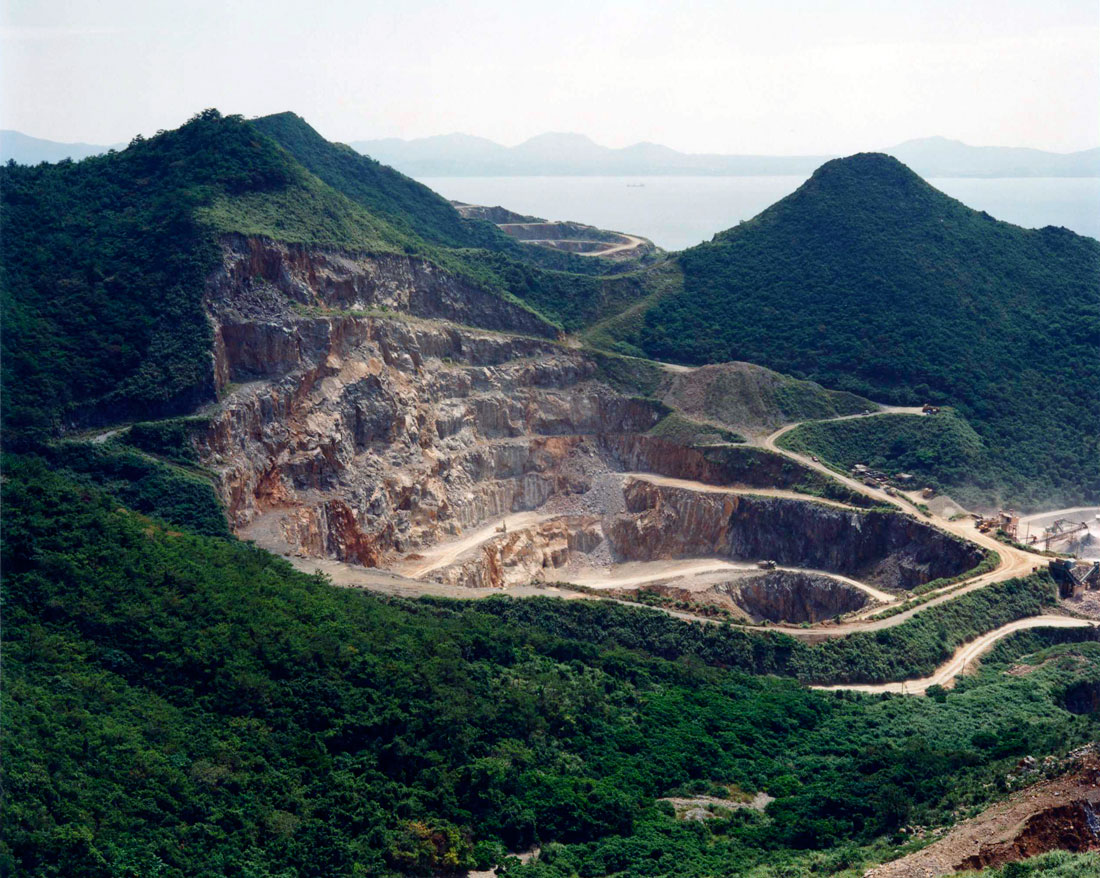
Naoya Hatakeyama (Japan, b. 1958) 'Lime Hills #12801' 1986


Naoya Hatakeyama (Japan, b. 1958)
Lime Hills #12801
1986
Chromogenic print
11 13/16 in. x 14 15/16 in (30 cm x 38cm)
Tokyo Metropolitan Museum of Photograph
© Naoya Hatakeyama, courtesy Taka Ishii Gallery


Naoya Hatakeyama (Japan, b. 1958) 'Lime Hills #12801' 1986 'Lime Hills #22916' 1988


Naoya Hatakeyama (Japan, b. 1958)
Lime Hills #22916
1988
Chromogenic print
11 13/16 in. x 14 15/16 in (30 cm x 38cm)
Tokyo Metropolitan Museum of Photography
© Naoya Hatakeyama, courtesy Taka Ishii Gallery


Naoya Hatakeyama (Japan, b. 1958) 'Lime Hills #23514' 1988


Naoya Hatakeyama (Japan, b. 1958)
Lime Hills #23514
1988
Chromogenic print
11 13/16 in. x 14 15/16 in (30 cm x 38cm)
Tokyo Metropolitan Museum of Photography
© Naoya Hatakeyama, courtesy Taka Ishii Gallery


Naoya Hatakeyama (Japan, b. 1958) 'Lime Hills #27403' 1989


Naoya Hatakeyama (Japan, b. 1958)
Lime Hills #27403
1989
Chromogenic print
11 13/16 in. x 14 15/16 in (30cm x 38cm)
Tokyo Metropolitan Museum of Photography
© Naoya Hatakeyama, courtesy Taka Ishii Gallery


Naoya Hatakeyama (Japan, b. 1958) 'Lime Hills #29211' 1990


Naoya Hatakeyama (Japan, b. 1958)
Lime Hills #29211
1990
Chromogenic print
11 13/16 in. x 14 15/16 in (30 cm x 38cm)
Tokyo Metropolitan Museum of Photography
© Naoya Hatakeyama, courtesy Taka Ishii Gallery


Naoya Hatakeyama (Japan, b. 1958) 'Lime Hills #29214' 1990


Naoya Hatakeyama (Japan, b. 1958)
Lime Hills #29214
1990
Chromogenic print
11 13/16 in. x 14 15/16 in (30cm x 38cm)
Tokyo Metropolitan Museum of Photography
© Naoya Hatakeyama, courtesy Taka Ishii Gallery


Lime Hills (Quarry Series), 1986-1991

Each year nearly two hundred million tons of limestone – virtually the only natural resource in Japan – are cut to produce the cement necessary to build the nation’s many cities, as well as to make additives used in paper, medicine, and food products. Hatakeyama was drawn to this industrial subject from a young age; his first artistic explorations took the form of paintings of the cement factory that he passed each day as a child. For Lime Hills, his earliest photographic series, Hatakeyama returned to the area near his hometown on the northeastern coast of Japan to investigate the nearby limestone quarries and their corresponding factories. Over the next five years he broadened his scope to include mines throughout Japan, from Hokkaido in the north to Okinawa in the south. Reflecting on the physical connection between these sites and civilisation, the artist later noted: “If the concrete buildings and highways that stretch to the horizon are all made from limestone dug from the hills, and if they should all be ground to dust and this vast quantity of calcium carbonate returned to its precise points of origin, why then, with the last spoonful, the ridge lines of the hills would be restored to their original dimensions.”

These small-scale photographs offer visions of the excavated land that at first glance seem idyllic. Often shooting in the golden evening light with a large-format camera, Hatakeyama captured the sculptural contours of the processed earth, infusing it with the luminous glow seen in many Romantic landscape paintings of the nineteenth century. Yet the Romantic tradition, which highlighted the awesome terror of nature, is upended in Hatakeyama’s pictures, which instead uncover unexpected pleasures in the tamed and built environment, ultimately suggesting the artificiality of conventional notions of beauty.

Wall text from the exhibition


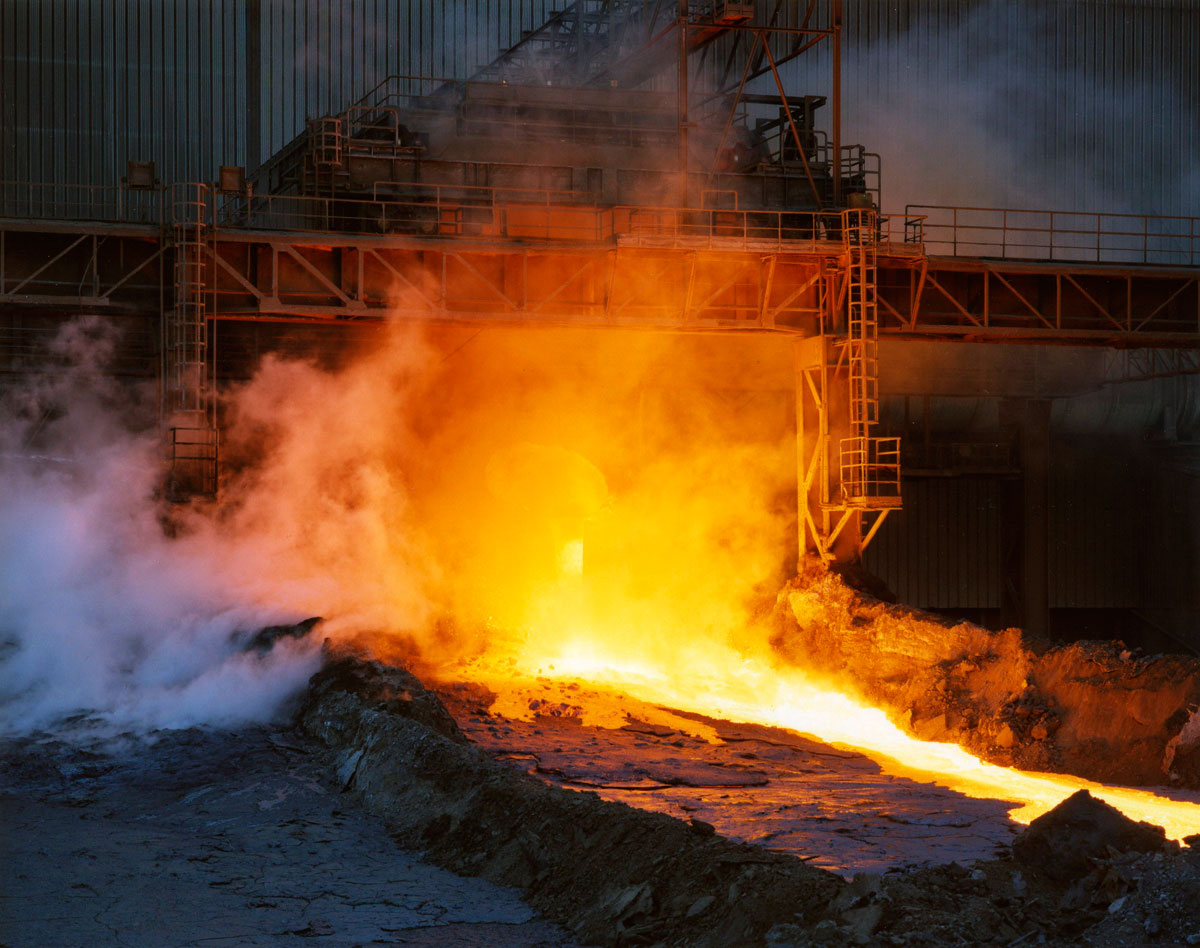
Naoya Hatakeyama (Japan, b. 1958) 'Sollac Méditerranée, Fos-sur-Mer, #06709' 2003


Naoya Hatakeyama (Japan, b. 1958)
Sollac Méditerranée, Fos-sur-Mer, #06709
2003
From the series Atmos
Chromogenic print
27 9/16 in. x 35 7/16 in (70 cm x 90cm)
Courtesy the artist
© Naoya Hatakeyama, courtesy Taka Ishii Gallery


Naoya Hatakeyama (Japan, b. 1958) 'Sollac Méditerranée, Fos-sur-Mer, #06709' 2003


Naoya Hatakeyama (Japan, b. 1958)
Sollac Méditerranée, Fos-sur-Mer, #06709
2003
From the series Atmos
Chromogenic print
27 9/16 in. x 35 7/16 in (70 cm x 90cm)
Courtesy the artist
© Naoya Hatakeyama, courtesy Taka Ishii Gallery


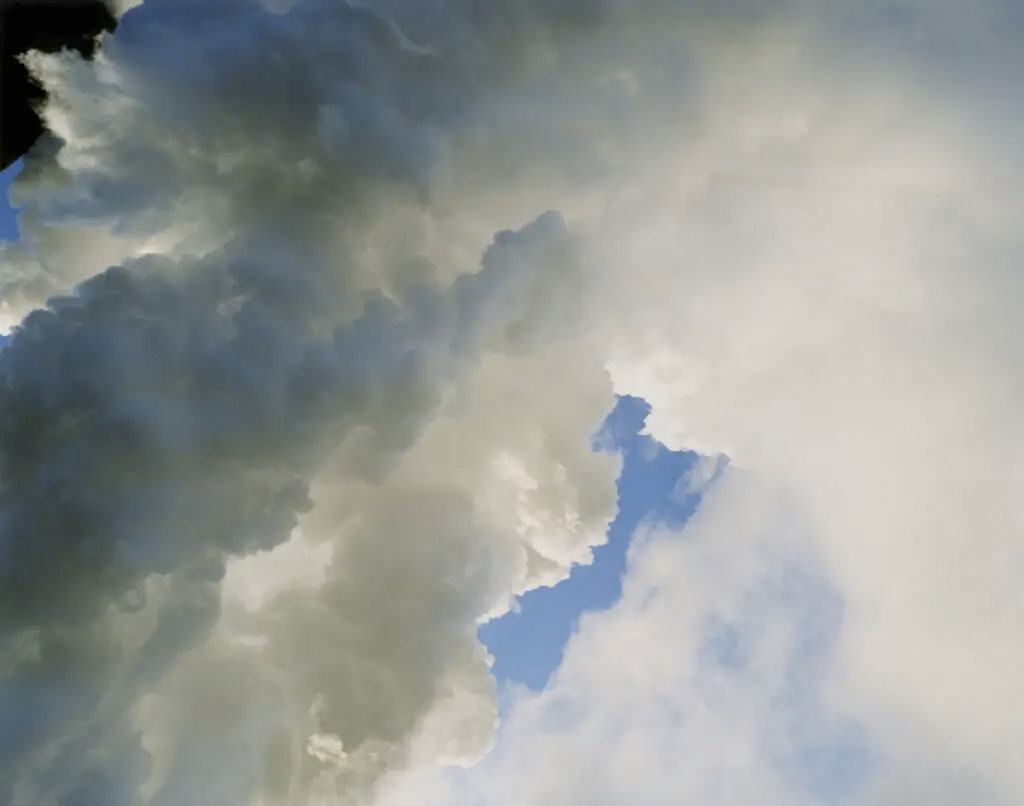
Naoya Hatakeyama (Japan, b. 1958) 'Sollac Méditerranée, Fos-sur-Mer, #12209' 2003


Naoya Hatakeyama (Japan, b. 1958)
Sollac Méditerranée, Fos-sur-Mer, #12209
2003
From the series Atmos
Chromogenic print
27 9/16 in. x 35 7/16 in (70 cm x 90cm)
Courtesy the artist
© Naoya Hatakeyama, courtesy Taka Ishii Gallery


Atmos, 2003

In 2003 Hatakeyama was invited to the Camargue, near Fos-sur-Mer, France, to photograph the landscape surrounding a steel factory located on the eastern edge of the Rhône delta. He worked from two perspectives, shooting on the factory grounds as well as from the surrounding landscape, much of which is conserved as a nature park. His photographs contrast the idyllic serenity of the flat plains where the Rhône river meets the Mediterranean Sea with the dramatic clouds of steam – formed when the coke used in steel making is doused in cool water – that often rise above this terrain.

Upon discovering this impressive phenomenon the artist reflected: “The etymology of ‘atmosphere’ is the ancient Greek words for vapor (atmos) and sphere (sphaira). Once I learned this, the air that filled the Camargue and the steam from the factory seemed to fuse into one before my eyes. It no longer felt strange to see signs of humanity in the sky and the land, or to sense nature in the cloud of steam from the factory. And I began to feel that it would no longer be possible to draw a clear line at the border between nature and the artificial.” Through Hatakeyama’s lens, the factory seems at once tranquil and volatile, surrounded by the golden light, billowing pastel clouds, and thick atmosphere found in many early twentieth-century paintings of industrial sites. Like the Impressionists, who embraced modern life by finding their subjects in new technologies, Hatakeyama presents new landscapes that complicate the conventional boundaries between nature and industry.”

Wall text from the exhibition


From July 28 through November 4, 2012, the San Francisco Museum of Modern Art (SFMOMA) will present the work of one of Japan’s most important contemporary photographers in the exhibition Naoya Hatakeyama: Natural Stories. This will be the artist’s first solo exhibition in a U.S. museum and the first presentation of his work on the West Coast.

Organised by the Tokyo Metropolitan Museum of Photography in association with SFMOMA, the exhibition gathers work spanning Naoya Hatakeyama’s entire career, including more than 100 photographs and two video installations, offering viewers new insight into the artist’s practice and place in the rich history of Japanese photography. The presentation at SFMOMA, the sole U.S. venue for this internationally traveling retrospective, is overseen by Lisa J. Sutcliffe, assistant curator of photography.

Hatakeyama is known for austere and beautiful large-scale color pictures that capture the extraordinary powers routinely deployed to shape nature to our will – and, in the case of his photographs made after the 2011 Tohoku earthquake and tsunami, the equally powerful impact of natural forces on human activities. Whether photographing factories, quarries, mines, or tsunami-swept landscapes, Hatakeyama has developed a thorough and analytical method for observing the ways in which the human and natural worlds have both coexisted and clashed. “For the past 25 years Naoya Hatakeyama has made pictures that focus on the complicated relationship between man and nature,” says Sutcliffe. “Approaching his subjects from diverse perspectives and across time, he redefines the ways in which we visualize the natural world.”

Hatakeyama has long been interested in the relationship between human industry and the natural environment. His early series of photographs of limestone quarries, Lime Hills (1986-91), references the Romantic painterly tradition of the sublime, but links it to the relentless pursuit of raw materials for modern development. After observing that “the quarries and the cities are like negative and positive images of a single photograph,” Hatakeyama began to investigate urban centers built from limestone and concrete. In Underground (1999), he explores the pitch-black depths of Tokyo’s underbelly from the tunnels of the Shibuya River, revealing the ecosystems of the city’s sewer network that often go unseen. Nearly a decade later he returned to the subject, photographing the remnants of decaying limestone quarries underneath Paris in Ciel Tombé (2007).

Several of Hatakeyama’s photographic series capture scenes of destruction with calm precision. Contemplating the abandoned structures surrounding a disused coal mine, Zeche Westfalen I/II Ahlen (2003/2004) includes images of a German factory hall seemingly suspended in midair at the moment of its demolition. For the Blast series (2005), the photographer used a high-speed motor-driven camera to document explosions in an open-cast limestone mine, framing the instant of impact in a series of still photographs. The exhibition will present the U.S. debut of Twenty-Four Blasts (2011), a video installation of his still photographs from Blast that transforms these explosions into a found sculptural event.

Hatakeyama has applied his measured and unsentimental method of observation to landscapes in transition around the world. In the series Atmos (2003), his representations of tranquil French landscapes include steam clouds generated by steelworks. Also made in France, the series Terrils (2009-10) pictures the massive conical hills created by coal mining, documenting landscapes transformed by the human exploitation of natural resources. Considering a different type of human impact on the natural world, Hatakeyama observes the conquest of the Swiss Alps by tourism in Another Mountain (2005), invoking the sublime both through choice of subject matter and through the contrast in scale between man and nature.

The most recent series in the exhibition, Rikuzentakata (2011), records the aftermath of the 2011 Tohoku earthquake and tsunami that devastated northeastern Japan. For Hatakeyama, the disaster struck very close to home: his hometown of Rikuzentakata in Iwate Prefecture was left in ruins, his mother was killed, and the house he grew up in was destroyed. Although these are some of the most personal photographs the artist has ever exhibited, they are remarkably unsentimental, displaying the same clarity and refinement that mark the rest of his work. The video installation Kesengawa (2002-10), named after the river that flows through Rikuzentakata, presents his personal photographs of the area made before the tsunami, creating a poignant dialogue with the 2011 series.

Press release from the SFMOMA website


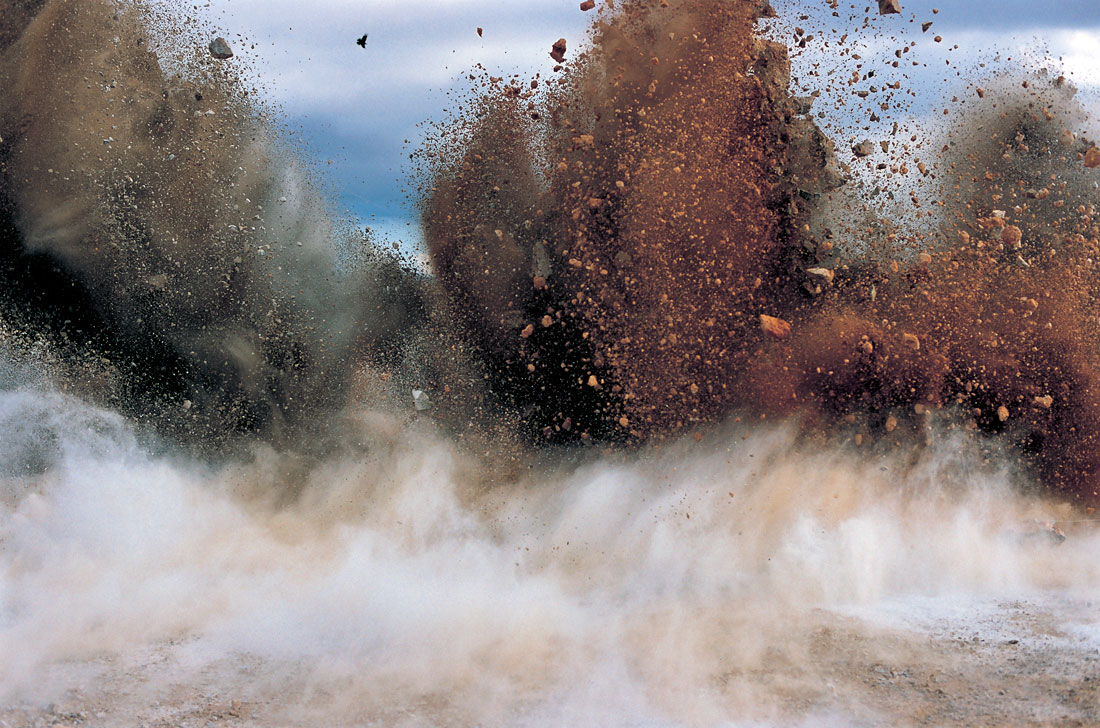
Naoya Hatakeyama (Japan, b. 1958) 'A BIRD/Blast #130' 2006


Naoya Hatakeyama (Japan, b. 1958)
A BIRD/Blast #130
2006
Chromogenic print
8 in. x 10 in (20.32cm x 25.4cm)
Courtesy of Tokyo Metropolitan Museum of Photography and Taka Ishii Gallery
© Naoya Hatakeyama, courtesy Taka Ishii Gallery


Naoya Hatakeyama (Japan, b. 1958) 'A BIRD/Blast #130' 2006


Naoya Hatakeyama (Japan, b. 1958)
A BIRD/Blast #130
2006
#7 from a series of 17 chromogenic prints
8 in. x 10 in (20.32cm x 25.4cm)
San Francisco Museum of Modern Art, promised gift of Kurenboh
© Naoya Hatakeyama, courtesy Taka Ishii Gallery


Naoya Hatakeyama (Japan, b. 1958) 'A BIRD/Blast #130' 2006


Naoya Hatakeyama (Japan, b. 1958)
A BIRD/Blast #130
2006
#15 from a series of 17 chromogenic prints
8 in. x 10 in (20.32cm x 25.4cm)
San Francisco Museum of Modern Art, promised gift of Kurenboh
© Naoya Hatakeyama, courtesy Taka Ishii Gallery


Naoya Hatakeyama (Japan, b. 1958) Still from 'Twenty-Four Blasts' 2011


Naoya Hatakeyama (Japan, b. 1958)
Still from Twenty-Four Blasts
2011
HD video installation from a sequence of 35 mm film
Courtesy the artist
© Naoya Hatakeyama, courtesy Taka Ishii Gallery


Naoya Hatakeyama (Japan, b. 1958) Still from 'Twenty-Four Blasts' 2011


Naoya Hatakeyama (Japan, b. 1958)
Still from Twenty-Four Blasts
2011
HD video installation from a sequence of 35 mm film
Courtesy of Tokyo Metropolitan Museum of Photography and Taka Ishii Gallery
© Naoya Hatakeyama, courtesy Taka Ishii Gallery


Blast, 1995
Zeche Westfalen I/II, Ahlen, 2003-2004

While photographing Japanese quarries and factories for Lime Hills, Hatakeyama became intrigued by the regular explosions designed to free limestone from the cliffs. He was interested in the violence and force of the blasts as well as in the engineers’ deep understanding of the “nature” of the rock. Working with these experts, he was able to calculate exactly how close he could place his remote controlled, motorised camera to the blast to capture the explosion in still frames. The striking large-scale photographs this method produced dramatise the tension between the slow geologic formation of the rocks and the split-second detonation that destroys them. Distilling his study to a series of frozen moments of intense scrutiny, Hatakeyama emphasises the volatile character of the blast, offering a perspective that cannot be seen by the naked eye. In the video projection Twenty-Four Blasts, presented in the next room, these explosions are set to motion, serving as documentation of the mining process while also reflecting an understanding of the blast as a sculptural event.

In Zeche Westfalen I/II, Ahlen, a series taken in Germany, Hatakeyama used a remote-controlled camera shutter to photograph the destruction of the Zeche Westfalen coal plant at the time of detonation. An industrial centre since the mid-nineteenth century, the area is experiencing new development as mines are destroyed to make way for commercial and residential growth. These pictures serve as a record of one such transition, trapping the building as it hovers in midair in the moments just before its destruction. Although photography is often used to capture an image of something before it is gone, these pictures reveal Hatakeyama’s interest in documenting destruction analytically and in real time, as a celebration of the future rather than an elegy to the past.


Naoya Hatakeyama (Japan, b. 1958) 'Ciel Tombé #219'
1991, printed 2011


Naoya Hatakeyama (Japan, b. 1958)
Ciel Tombé #219
1991, printed 2011
chromogenic print
7 7/8 × 3 7/8 in. (20 × 10cm)
Collection SFMOMA
Gift of the Kurenboh Collection
© Naoya Hatakeyama


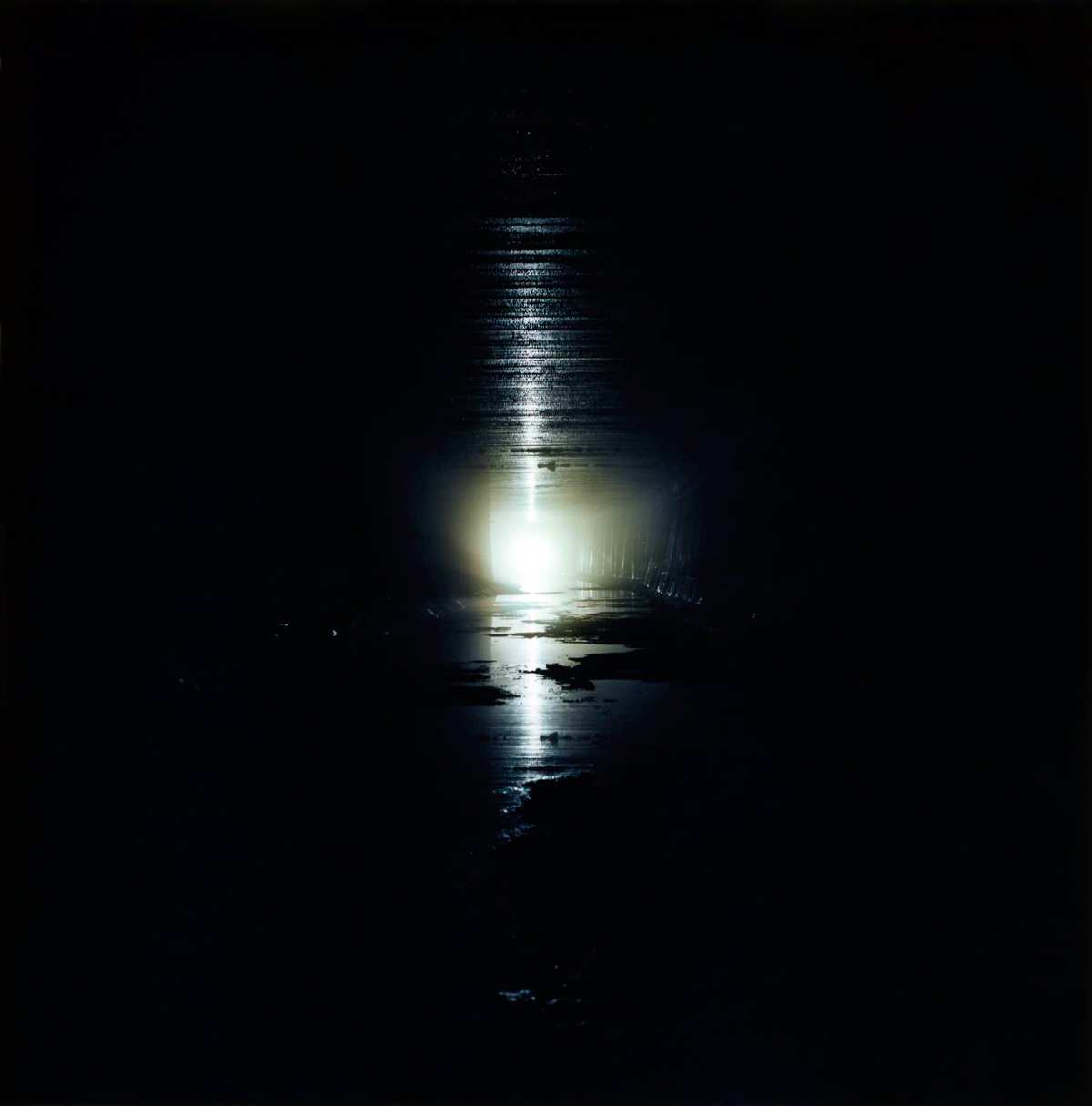
Naoya Hatakeyama (Japan, b. 1958) 'Underground #7109' 1999


Naoya Hatakeyama (Japan, b. 1958)
Underground #7109
1999
Chromogenic print
19 5/16 in. x 19 5/16 in (49 cm x 49cm)
Collection of Michael and Jeanne Klein
© Naoya Hatakeyama, courtesy Taka Ishii Gallery


Naoya Hatakeyama (Japan, b. 1958) 'Underground #6302' 1999


Naoya Hatakeyama (Japan, b. 1958)
Underground #6302
1999
Chromogenic print
19 5/16 in. x 19 5/16 in (49 cm x 49cm)
Collection of Michael and Jeanne Klein
© Naoya Hatakeyama, courtesy Taka Ishii Gallery


Naoya Hatakeyama (Japan, b. 1958) 'Underground #7001' 1999


Naoya Hatakeyama (Japan, b. 1958)
Underground #7001
1999
Chromogenic print
19 5/16 in. x 19 5/16 in (49 cm x 49cm)
Collection of Michael and Jeanne Klein
© Naoya Hatakeyama, courtesy Taka Ishii Gallery


Underground, 1999 / Ciel Tombé, 2007

After photographing the limestone quarries around Japan, Hatakeyama realised that the urban fabric of Tokyo resembles a mirror image of the excavated earth when viewed from above. As he later wrote, “the quarries and the cities are like negative and positive images of a single photograph.” This revelation led him to photograph the city from great heights and, later, to document the tunnels snaking beneath it. The Shibuya River, diverted beneath Tokyo like a sewer, echoes the chambers Hatakeyama observed within the quarries, yet it is shrouded in darkness and mystery. His abstract and often theatrically lit pictures of the underground river, illuminated by a strobe at the centre of each composition, investigate the process of photographing complete darkness.

Long interested in exploring the subterranean landscapes of France, where limestone was quarried in the carrières below Paris beginning in the thirteenth century, Hatakeyama followed his Tokyo pictures with a Parisian series. For Ciel Tombé he photographed the tunnels beneath the Bois de Vincennes, a wooded park to the east of the city. The series title, which translates literally as “fallen sky,” is a term often used to describe the collapsed ceilings in Parisian underground tunnels. The resulting pictures, which share the dramatic lighting of his Shibuya River series, emphasise the fragility of a built environment exposed to the ravages of time. Hatakeyama has remarked that in these tunnels, “the sky has now become an ancient layer of earth permeating below the city [in which] we live.”


Naoya Hatakeyama (Japan, b. 1958) 'Noyelles-sous-Lens, #07729' 2009


Naoya Hatakeyama (Japan, b. 1958)
Noyelles-sous-Lens, #07729
2009
From the series Terrils
Chromogenic print
23 5/8 in. x 29 1/2 in (60 cm x 75cm)
Courtesy the artist
© Naoya Hatakeyama, courtesy Taka Ishii Gallery


Naoya Hatakeyama (Japan, b. 1958) 'Loos-en-Gohelle, #02607' 2009


Naoya Hatakeyama (Japan, b. 1958)
Loos-en-Gohelle, #02607
2009
From the series Terrils
Chromogenic print
23 5/8 in. x 29 1/2 in (60 cm x 75cm)
Courtesy the artist
© Naoya Hatakeyama, courtesy Taka Ishii Gallery


Terrils, 2009-2010

During 2009 and 2010 Hatakeyama was a photographer in residence in the Nord-Pas de Calais, a region in northern France along the Belgian border. A historically contested area often in the path of wars between France and its neighbours, the Nord became a major centre for industry in the nineteenth century due to its wealth of coal mines, steel mills, and textile factories. Today the landscape is marked by terrils, slag heaps composed of waste products from the mining process, which in the context of the region’s current economic troubles serve as monumental reminders of a prosperous industrial past.

Hatakeyama’s photographs explore the terrain from different perspectives, with conical towers of slag looming in nearly every picture. While some of the pictures expose the burnt orange soil just beneath the earth’s surface, others soften the mining site with a wintry, atmospheric haze. By transforming this man-made wasteland to the point that the viewer can no longer determine its contours, Hatakeyama reveals a complex natural environment that incorporates human developments. According to the artist, “history is not simply a list of events, but a human narrative which weaves together time and memory. The interweaving of passing time and the memory of events creates the fabric where History appears as a pattern from which each individual perceives his own personal story.” In these pictures Hatakeyama maps the traces of one such story on the landscape through the conical forms of the mining deposits. These “hills” not only serve as reminders of the ways in which the land has been used but also evoke the long-established cultural role of mountains as mythological symbols.

Wall text from the exhibition


Naoya Hatakeyama (Japan, b. 1958) 'Bern #06201' 2005


Naoya Hatakeyama (Japan, b. 1958)
Bern #06201
2005
Chromogenic print
Courtesy of Tokyo Metropolitan Museum of Photography and Taka Ishii Gallery
© Naoya Hatakeyama, courtesy Taka Ishii Gallery


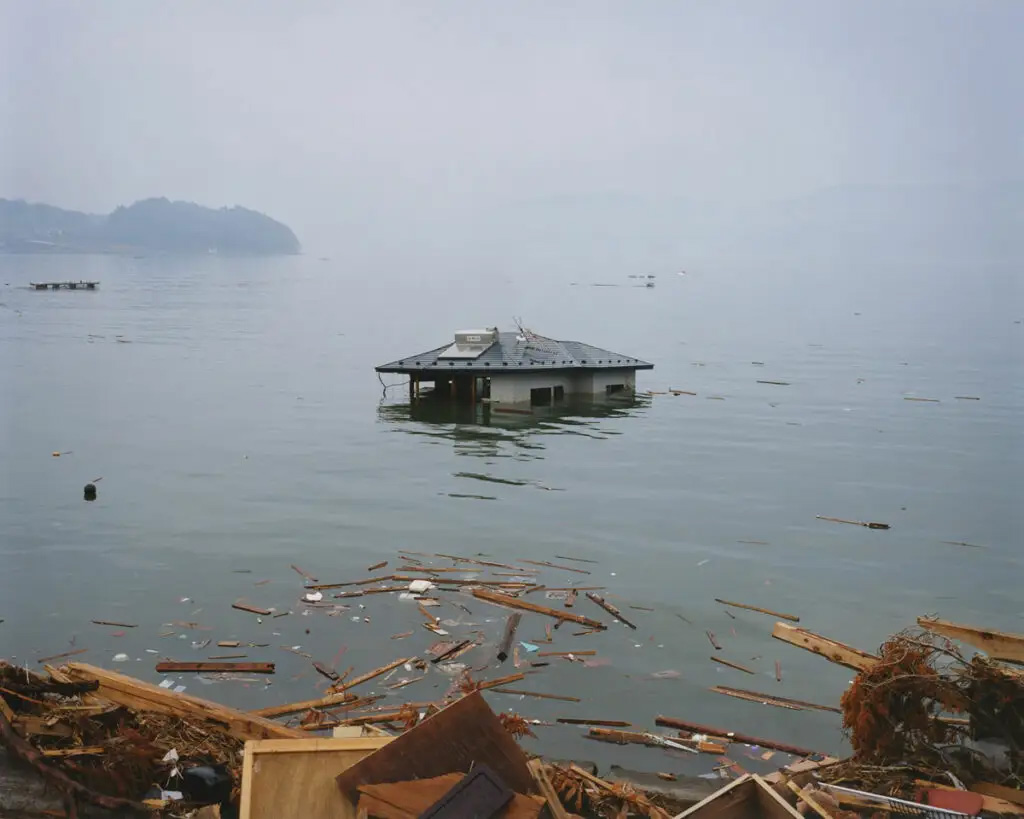
Naoya Hatakeyama (Japan, b. 1958) 'Yoneasaki-cho 2011.5.1' 2011


Naoya Hatakeyama (Japan, b. 1958)
Yoneasaki-cho 2011.5.1
2011
From the series Rikuzentakata
Chromogenic print
8 3/8 in. x 10 3/8 in. (21.2 cm x 26.3cm)
Courtesy the artist and Taka Ishii Gallery, Tokyo
© Naoya Hatakeyama


Naoya Hatakeyama’s series Rikuzentakata (2011) documents the devastating aftermath of the 2011 Tohoku earthquake and tsunami in Japan. Throughout the series of sixty C-prints, Hatakeyama’s photographs depict scenes of torn landscapes and levelled homes, demolished villages and massive piles of detritus pummelled beyond recognition. The images serve as records of disaster, seemingly driven by an intense need to bear witness to collective trauma. Hatakeyama’s photographs, however, emerged from a painful and personal grief: the series focuses on the near-destruction of the artist’s hometown, an event which resulted in both his mother’s death and the deaths of many friends and neighbours. Rikuzentakata bears the ethical weight and responsibility of photojournalism even as its genesis comes out of a deeply felt loss and the ambiguity of survivor’s guilt. Hatakeyama suggests that what’s lost can never be fully recovered, but that with time, those wounds can slowly heal and life can begin again.

Anonymous. “Naoya Hatakeyama, 2011.4.4 Kesen-cho (Rikuzentakata series),” on the Kadist website Nd [Online[ Cited 07/09/2024


Naoya Hatakeyama (Japan, b. 1958) 'Takata-cho 2011.5.2'  2011


Naoya Hatakeyama (Japan, b. 1958)
Takata-cho 2011.5.2 
2011
From the series Rikuzentakata
Chromogenic print
8 3/8 in. x 10 3/8 in. (21.2 cm x 26.3cm)
Courtesy the artist and Taka Ishii Gallery, Tokyo
© Naoya Hatakeyama


San Francisco Museum of Modern Art
151 Third Street
San Francisco, CA 94103

Opening hours:
Friday – Tuesday 10am – 6pm
Wednesday 10am – 5pm
Thursday 10am – 9.30pm

San Francisco Museum of Modern Art website

LIKE ART BLART ON FACEBOOK

Back to top

Exhibition: ‘Rückenfigur’ by David Ashley Kerr at Dear Patti Smith ARI, Fitzroy

Exhibition dates: 17th November – 27th November 2011


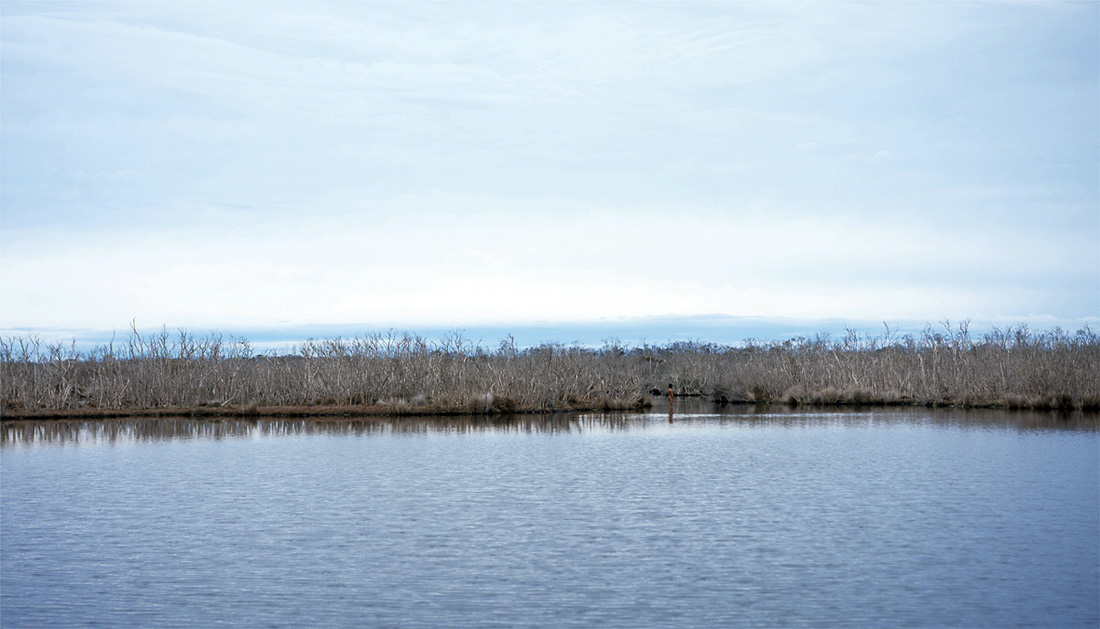
David Ashley Kerr (Australian, b. 1986) 'I hear the River
' 2009


David Ashley Kerr (Australian, b. 1986)
I hear the River

2009
Lightjet photographic print
80 x 140cm


Congratulations to David-Ashley Kerr on his first solo exhibition: the photographs and concept are very interesting.

Marcus


Many thankx to David for allowing me to publish the photographs in the posting. Please click on the photographs to see a larger version of the image.


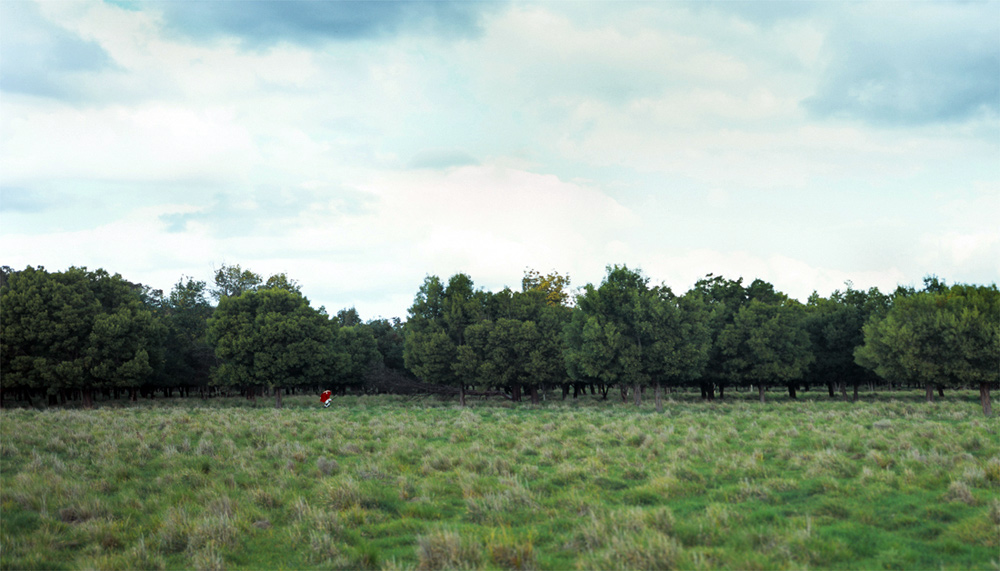
David Ashley Kerr (Australian, b. 1986) 'I hear the Sea' 2010


David Ashley Kerr (Australian, b. 1986)
I hear the Sea
2010
Lightjet photographic print
80 x 140cm


David Ashley Kerr (Australian, b. 1986) 'I hear the Wind' 2010


David Ashley Kerr (Australian, b. 1986)
I hear the Wind
2010
Lightjet photographic print
80 x 140cm


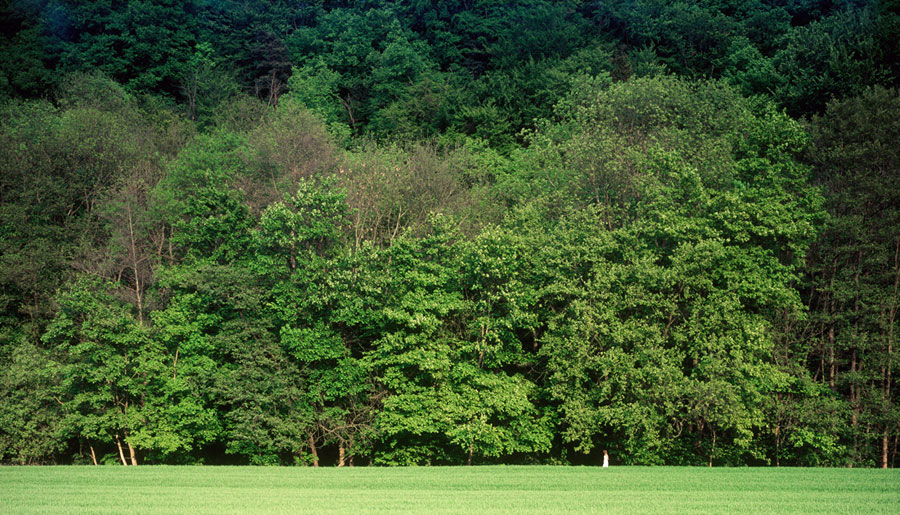
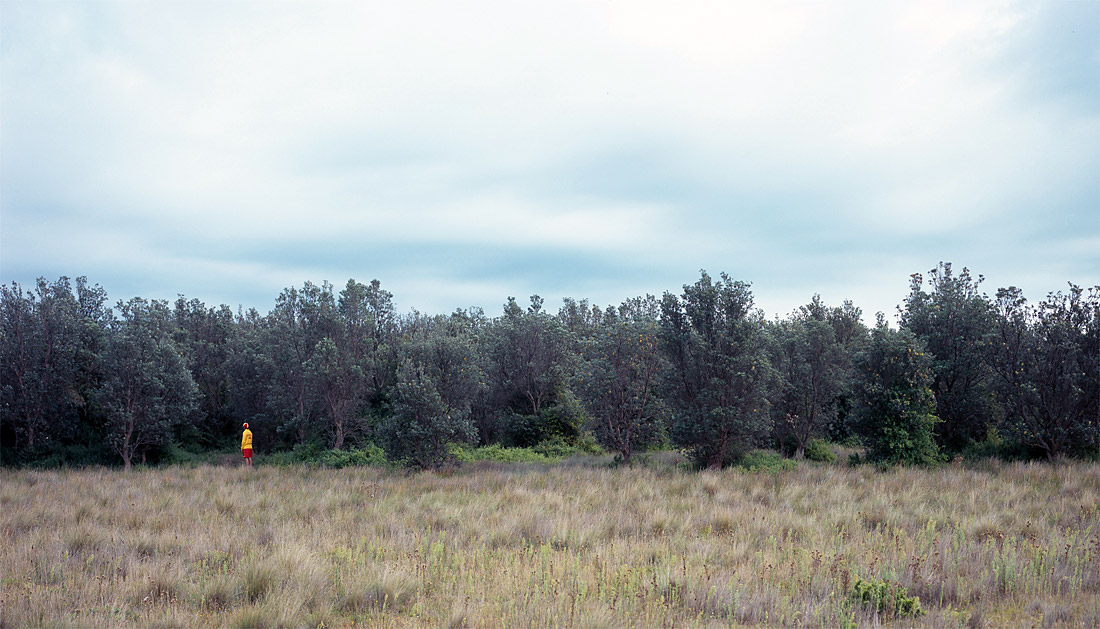
Although rückenfigur is popularly associated with the German romantic painter Caspar David Friedrich, its appearances in art very much pre-date his time. Early forms of it were attributed to Giotto but it became a more substantial style in the 15th century, creeping into the works of painters such as Jan van Eyck and later with Allaert van Everdingen and Jan Luiken.

Often these uses were simply to direct the viewer to behold the landscape in the scene. Friedrich’s approach transfigured this into a different concept, sometimes referred to as “the halted traveller”, where the lonely wanderer has appeared to have been “stopped” by the view of the landscape. This implies to us as a viewer that there is perhaps more to the landscape than we see, but those thoughts may remain unknown to us… privately contained in the mind of the rückenfigur in the scene.

It appears to me that in looking at rückenfigur art, there are two distinct thematic conveyances. The first is the aforementioned “halted traveller” lost in the contemplation of the landscape. In gazing upon the landscape, the rückenfigur is quite separate from the scene being viewed. Although s/he is anonymous and without identity, there is still a distinct identity from that of the landscape.

The second appears, to me at least, to be quite the opposite. Another form of rückenfigur seems to be where the figure(s) are distantly placed deep within the landscape itself. You’ve still got “back figures” in contemplation, but the composition makes them part of the landscape rather than separate. While we still identify with them as a viewer, the identity of the figures are very much subsumed into the grandeur of the landscape, maybe even biblically so.

Text by Christian Were, Melbourne


David Ashley Kerr (Australian, b. 1986) 'I hear Them' 2010


David Ashley Kerr (Australian, b. 1986)
I hear Them
2010
Lightjet photographic print
80 x 140cm


David Ashley Kerr (Australian, b. 1986) 'Territory' 2010


David Ashley Kerr (Australian, b. 1986)
Territory
2010
Lightjet photographic print
80 x 140cm


David Ashley Kerr is a Melbourne based visual artist working with large-format photography. This is his first Australian solo show, a selection of landscape studies completed since 2009 that began as a photographic investigation of the Rückenfigur, or back figure. This visual device is commonly associated with German Romantic painter Caspar David Friedrich. It involves depicting a human figure that does not engage the viewer, introspectively contemplating the natural world or landscape before them.

David Ashley Kerr’s photographic practice is a visual inquiry into the relationship between cultural identity and physical environment, site, or place. He currently investigates the use of a staged lone figure in contemporary landscape photography, attempting a symbolic representation of belonging to ‘place’ in a national context, in relation to both indigenous and non-indigenous Australian ownership and connection to land.

David Ashley Kerr completed a Bachelor of Contemporary Art at Deakin University (2009) and a Master of Fine Art at RMIT University (2010). He is currently undertaking a PhD at Monash University on an Australian Postgraduate Award Scholarship, his research inquiring into place theory through photography, investigating the visual relationship between Australian cultural identity and physical environment.

Text from the Dear Patti Smith website


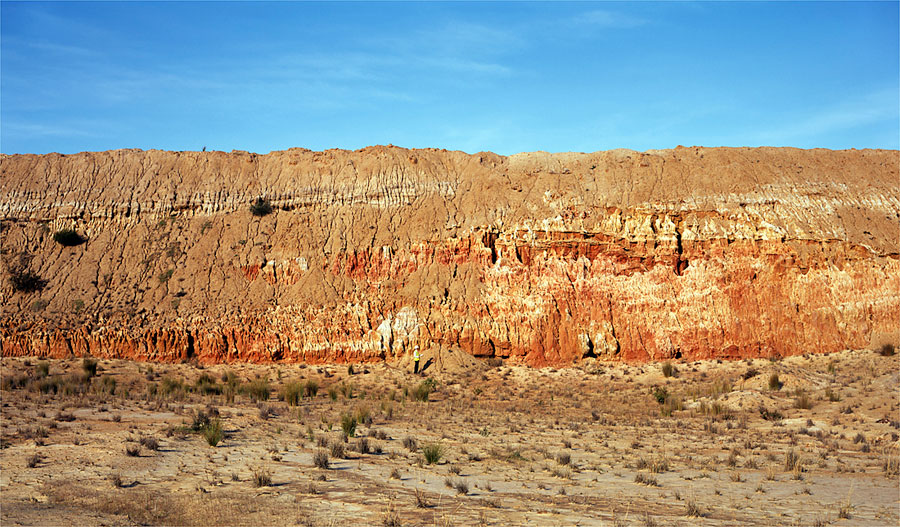
David Ashley Kerr (Australian, b. 1986) 'Ore' 2010


David Ashley Kerr (Australian, b. 1986)
Ore
2010
Lightjet photographic print
80 x 140cm


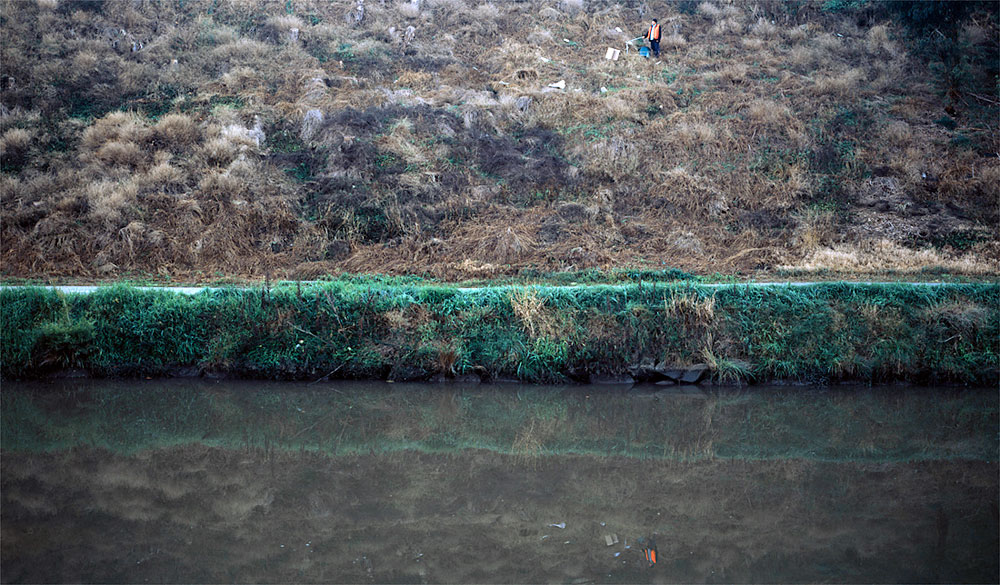
David Ashley Kerr (Australian, b. 1986) 'Trash' 2010


David Ashley Kerr (Australian, b. 1986)
Trash
2010
Lightjet photographic print
80 x 140cm


David Ashley Kerr (Australian, b. 1986) 'Game' 2009


David Ashley Kerr (Australian, b. 1986)
Game
2009
Lightjet photographic print
80 x 140cm


Dear Patti Smith

This gallery has now closed.

David-Ashley Kerr website

LIKE ART BLART ON FACEBOOK

Back to top

Exhibition: ‘Joel Meyerowitz – Aftermath’ at the Miami Art Museum

Exhibition dates: 19th August – 6th November 2011


Joel Meyerowitz (American, b. 1938) 'Searchers in Rubble' 2001


Joel Meyerowitz (American, b. 1938)
Searchers in Rubble
2001
Vintage contact print
Collection Miami Art Museum, gift of Steven E. and Phyllis Gross


And do you know what “the world” is to me? Shall I show it to you in my mirror? This world: a monster of energy, without beginning, without end; a firm, iron magnitude of force that does not grow bigger or smaller, that does not expend itself but only transforms itself; as a whole, of unalterable size, a household without expenses or losses, but likewise without increase or income; enclosed by “nothingness” as by a boundary; not something blurry or wasted, not something endlessly extended, but set in a definite space as a definite force, and not a space that might be “empty” here or there, but rather a force throughout, as a play of forces and waves of forces, at the same time one and many, increasing here and at the same time decreasing there …


Frederick Nietzsche, The Will to Power


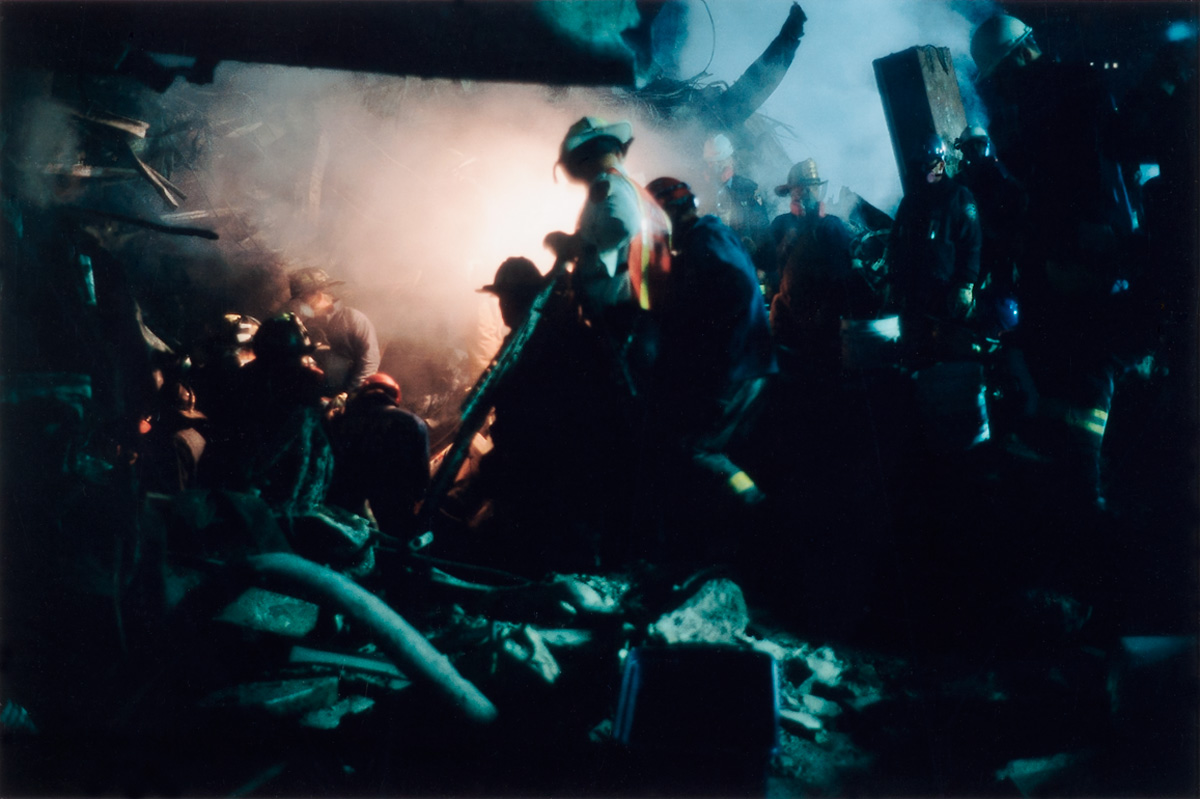
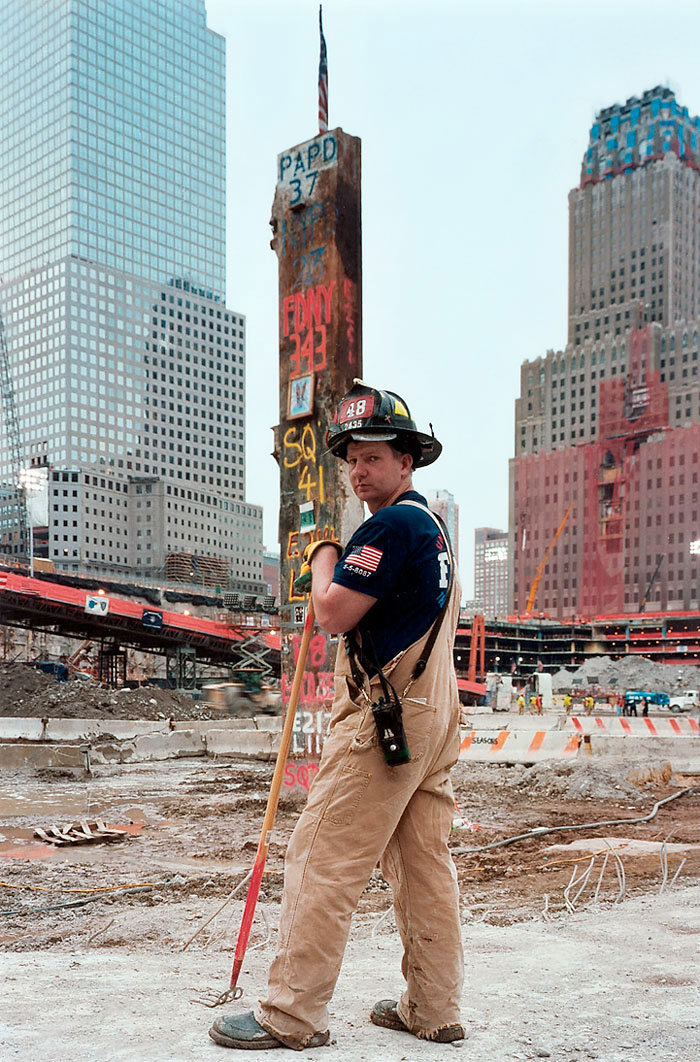
Sadness. And light. Hope. Amidst the inferno. Study the masterpiece Finding More Fireman (below) in the enlarged version and you cannot fail to be moved. It is all there: monumental, intimate, hellish, redemptive – a modern, “disastrous” form of the Rembrandt’s The Night Watch.

Dr Marcus Bunyan


Many thanxk to the Miami Art Museum for allowing me to publish the photographs in the posting. Please click on the photographs for a larger version of the image.


Joel Meyerowitz (American, b. 1938) 'Flower Offering' 2001


Joel Meyerowitz (American, b. 1938)
Flower Offering
2001
Vintage contact print
Collection Miami Art Museum, gift of Steven E. and Phyllis Gross


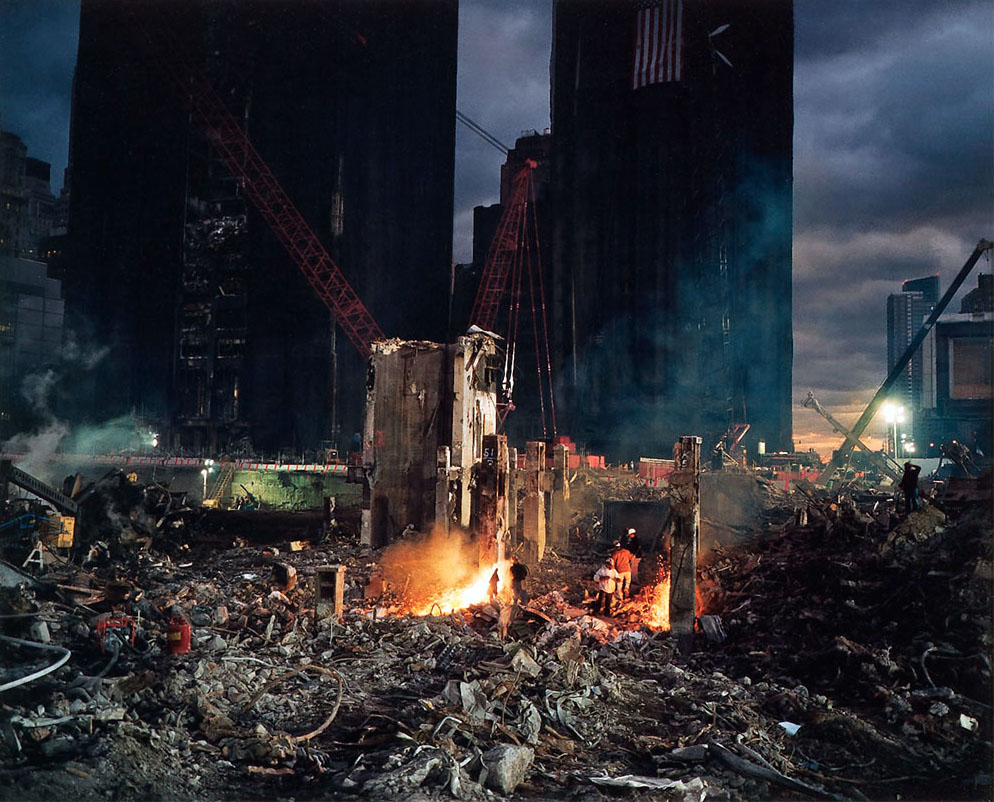
Joel Meyerowitz (American, b. 1938) 'Pit Looking North' 2002


Joel Meyerowitz (American, b. 1938)
Pit Looking North
2002
Vintage contact print
Collection Miami Art Museum, gift of Steven E. and Phyllis Gross


Joel Meyerowitz (American, b. 1938) 'Smoke and Spray' 2001


Joel Meyerowitz (American, b. 1938)
Smoke and Spray
2001
Vintage contact print
Collection Miami Art Museum, gift of Jeffrey Hugh Newman


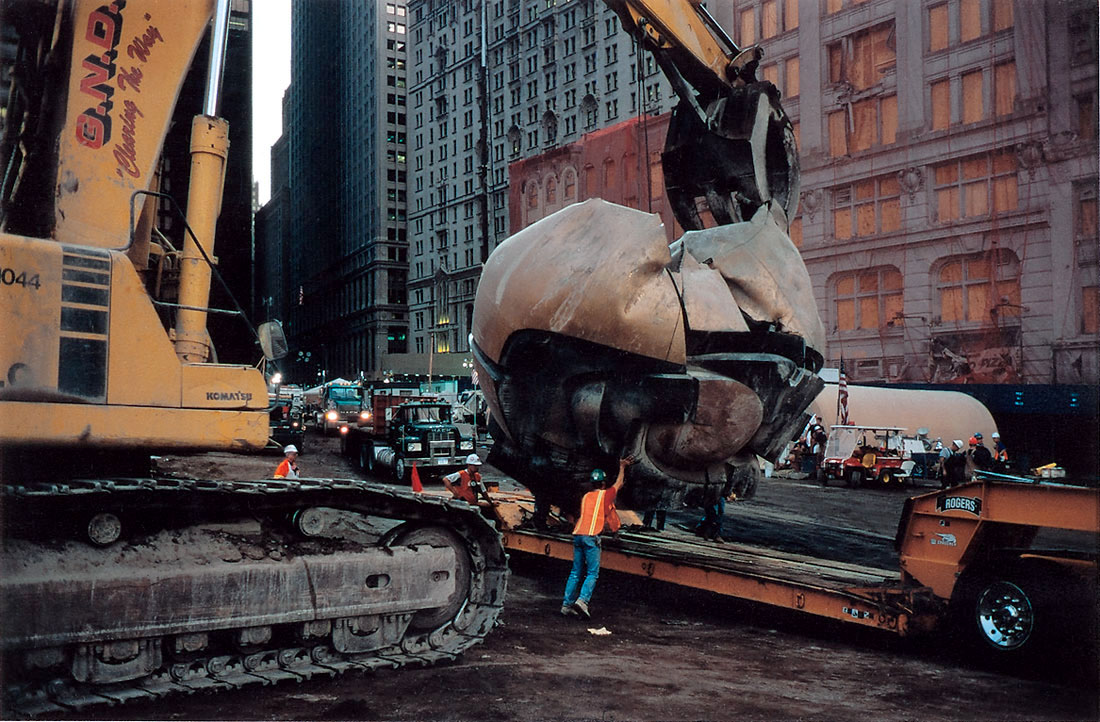
Joel Meyerowitz (American, b. 1938) 'Moving the Monument' 2001


Joel Meyerowitz (American, b. 1938)
Moving the Monument
2001
Vintage contact print
Collection Miami Art Museum, gift of Jeffrey Hugh Newman


Joel Meyerowitz (American, b. 1938) 'Finding More Fireman' 2001


Joel Meyerowitz (American, b. 1938)
Finding More Fireman
2001
Vintage contact print
Collection Miami Art Museum, gift of Charles S. and Elynne B. Zucker


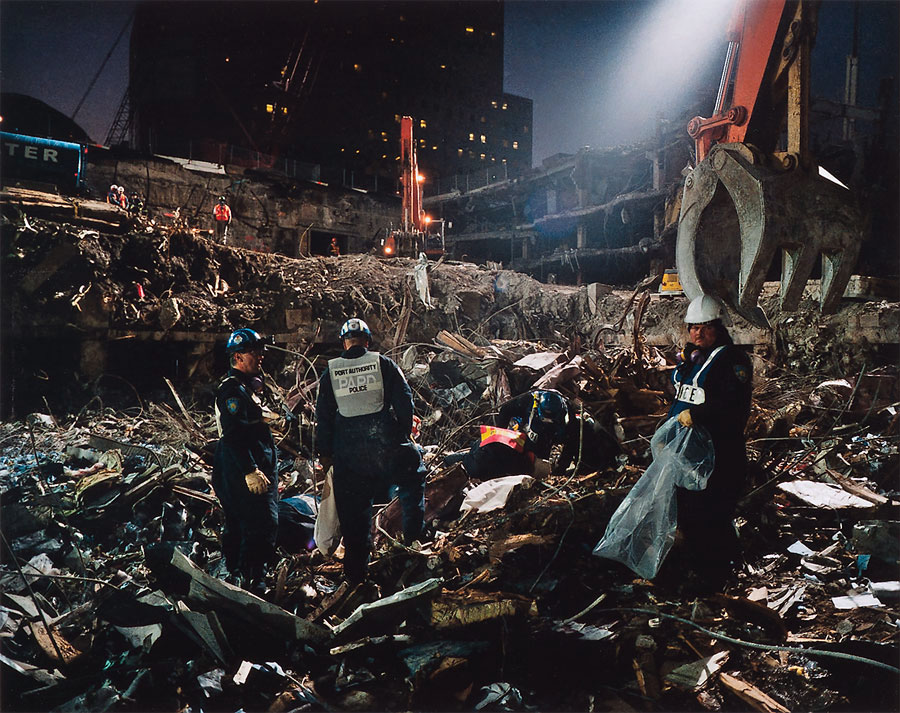
Joel Meyerowitz (American, b. 1938) 'Searchers' 2002


Joel Meyerowitz (American, b. 1938)
Searchers
2002
Vintage contact print
Collection Miami Art Museum, gift of Charles S. and Elynne B. Zucker


Joel Meyerowitz (American, b. 1938) 'Welders in South Tower' 2001


Joel Meyerowitz (American, b. 1938)
Welders in South Tower
2001
Vintage contact print
Collection Miami Art Museum, gift of Charles S. and Elynne B. Zucker


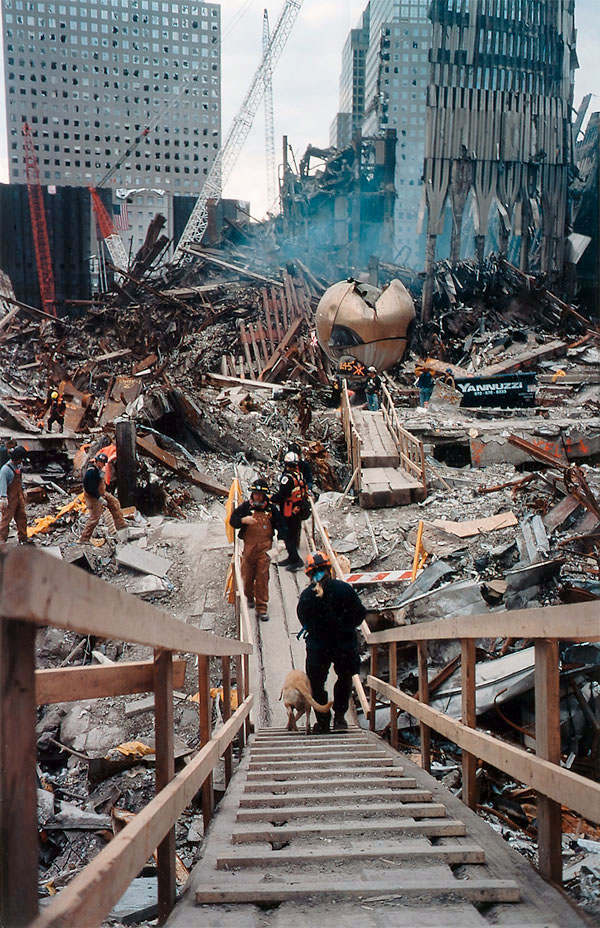
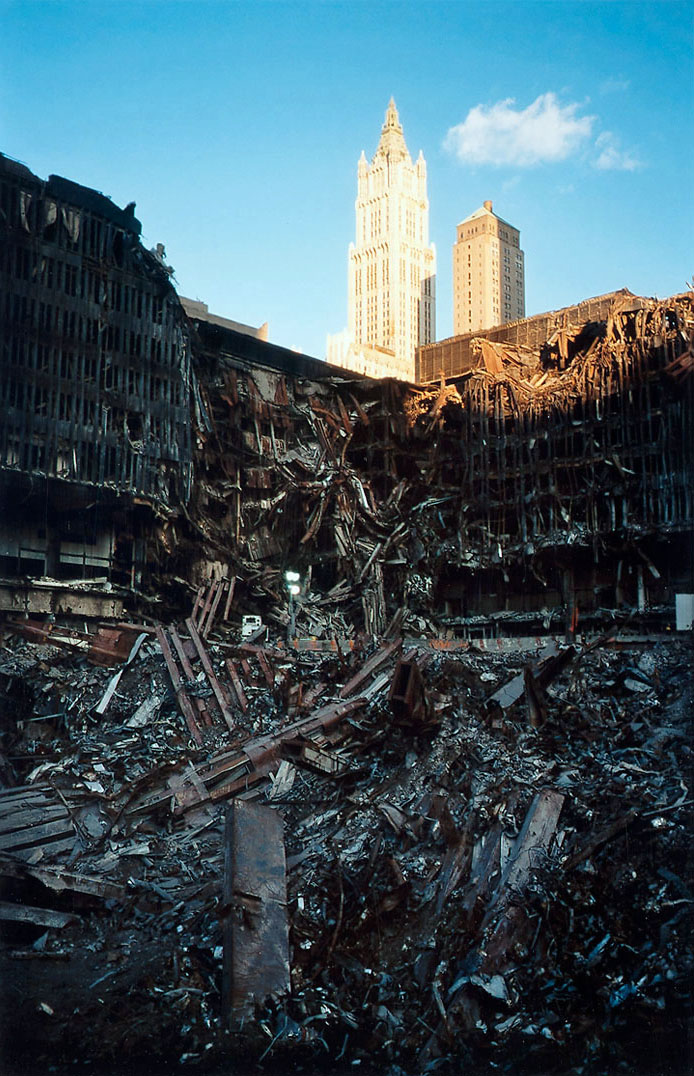
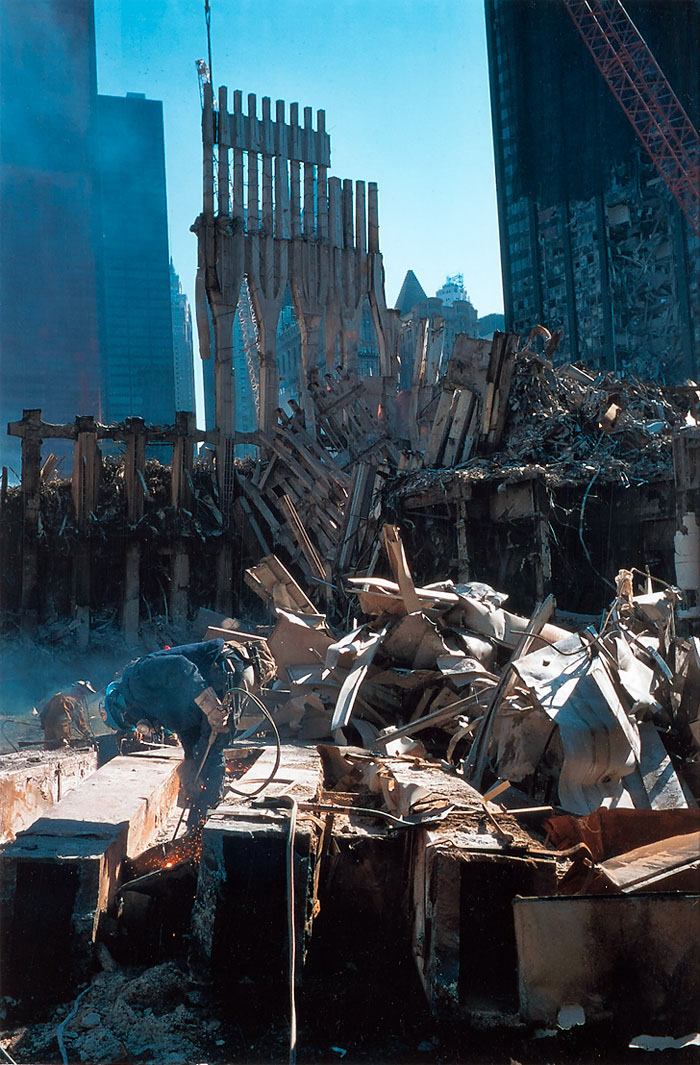
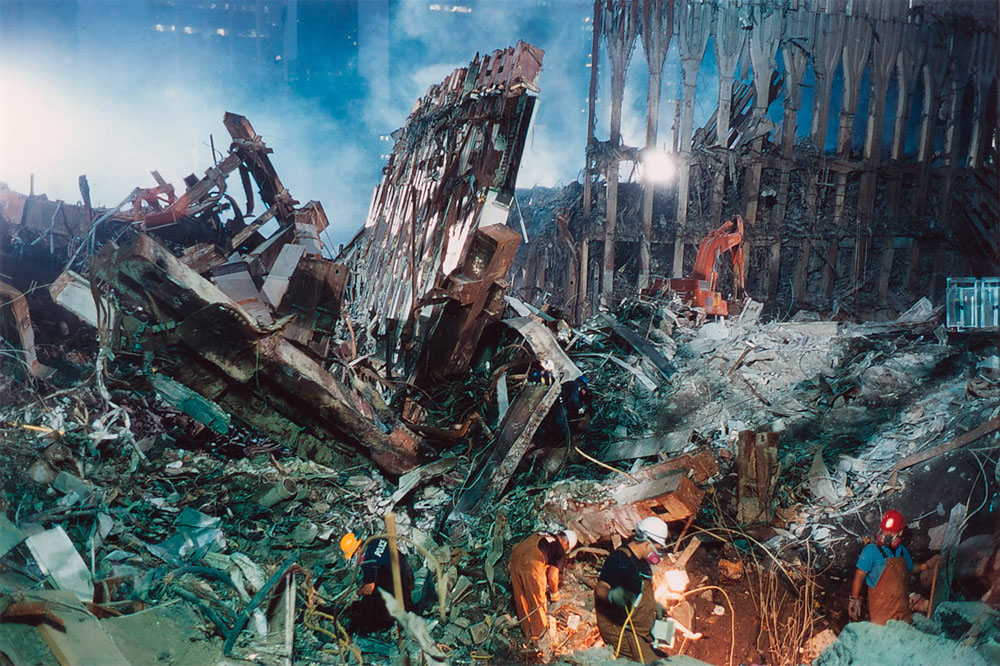
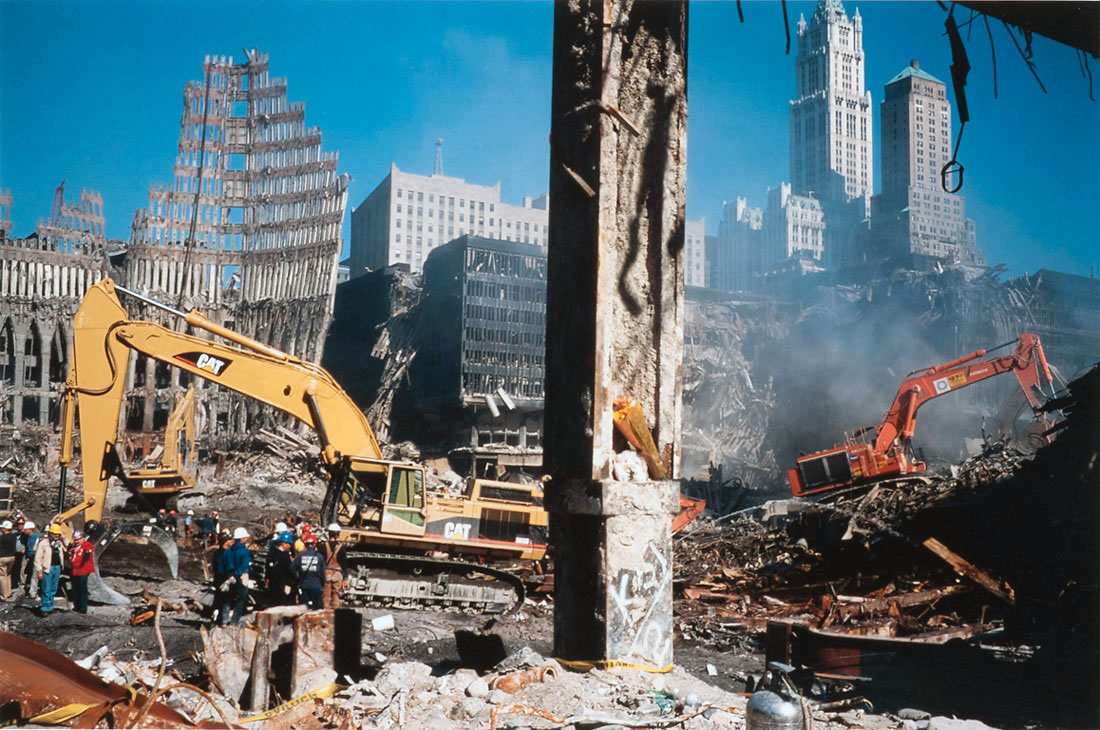
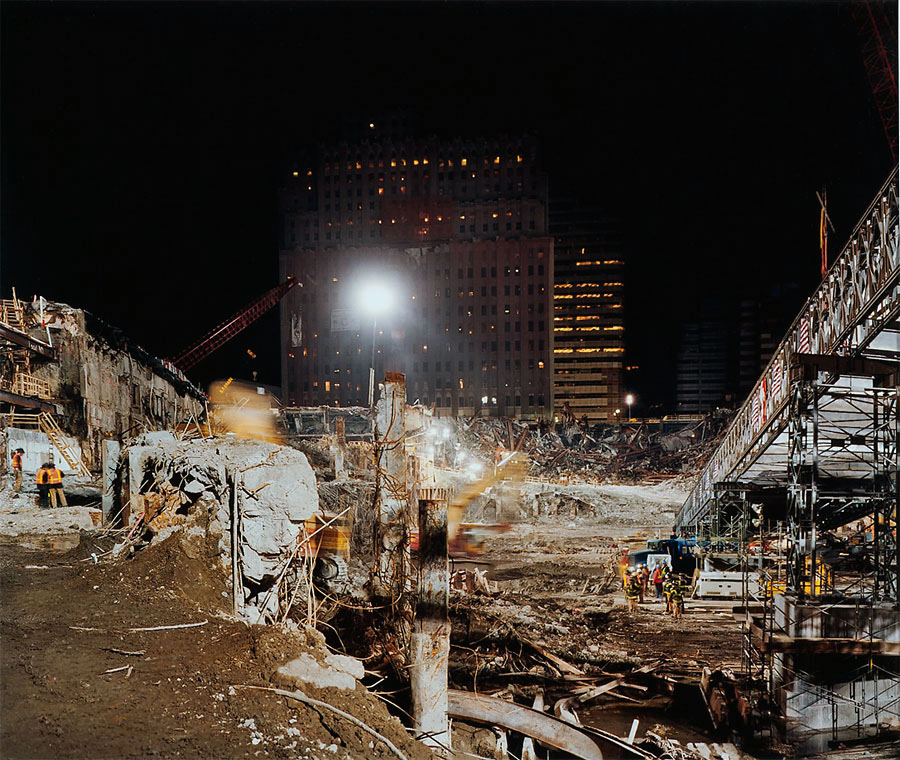
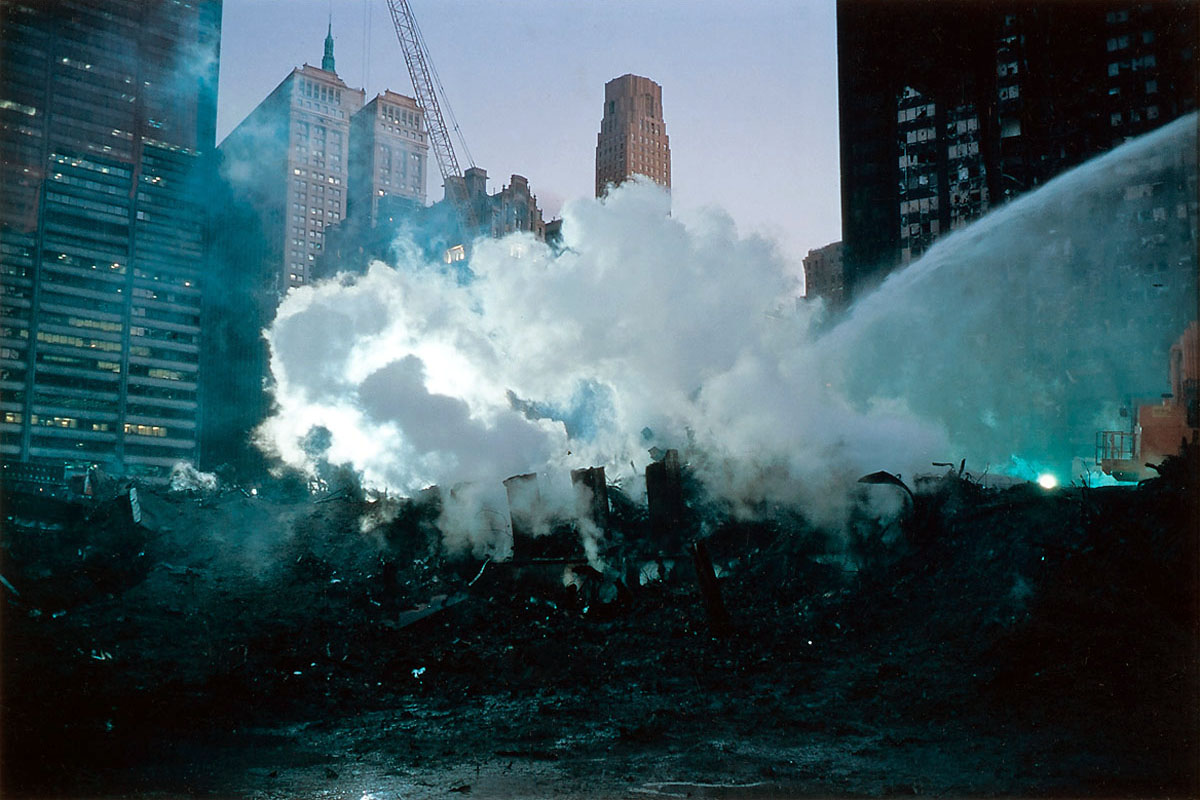
In commemoration of the 10th anniversary of 9/11, Miami Art Museum presents Focus Gallery: Joel Meyerowitz – Aftermath, an exhibition of photographs taken by the only photographer granted right of entry into Ground Zero after the September 11, 2001 attacks on the World Trade Center in New York City. For nine months during the day and night, Meyerowitz photographed “the pile,” as the World Trade Center came to be known, and the over 800 people a day that were working in it. The exhibition consists of 24, recently-donated photographs, presented in the Focus Gallery section of the Museum’s Permanent Collection installation. Admission to Miami Art Museum will be free to all emergency personnel, including police and firefighters, and their guests throughout the exhibition’s run, August 19 – November 6, 2011. A special preview for emergency personnel will be held on Thursday, August 18, 2011, 4-7pm. Author and photography critic Vicki Goldberg will give a lecture entitled “What Remains” on Thursday, September 8, 2011, beginning at 6:30pm.

After September 11, 2001, the Ground Zero site in New York City was classified as a crime scene and only those directly involved in the recovery efforts were allowed inside. The press was prohibited from the site. Influenced by Walker Evans’s and Dorothea Lange’s work for the Farm Security Administration during the Great Depression, Meyerowitz, long recognised as one of the pioneers of colour photography, was convinced that if a photographic record of the unprecedented recovery efforts was not made, “there would be no history.” With the help of sympathetic officials, he managed to become the only photographer granted right of entry into Ground Zero.

“I was making photographs for everyone who didn’t have access to the site,” says Meyerowitz, “I wanted to communicate what it felt like to be in there as well as what it looked like: to show the pile’s incredible intricacy and visceral power. I could provide a window for everyone else who wanted to be there, too, to help, or to grieve, or simply to try to understand what had happened to our city.”

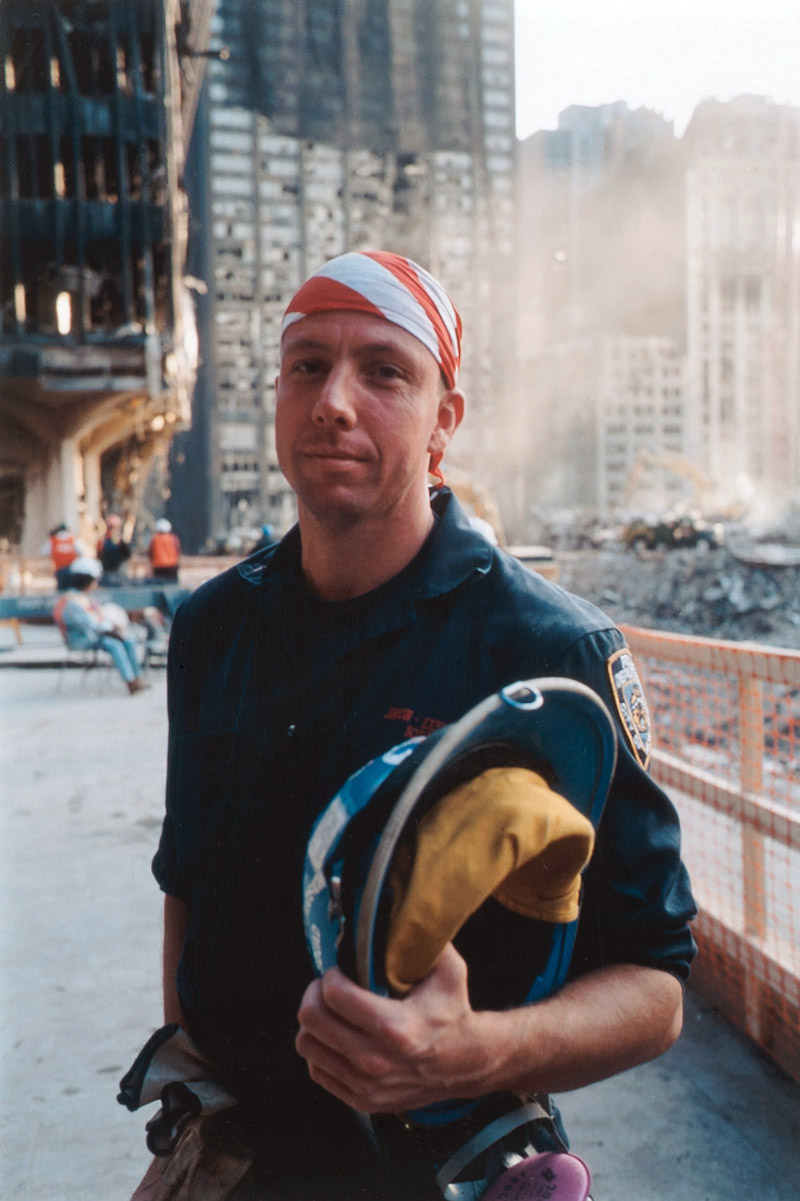
Armed with a large-format wooden camera, Meyerowitz spent nine months photographing the site. In the first few weeks, he was chased off the site repeatedly, but over time, with the help of officials on and off site, the use of forged workers’ passes, and by assuming the “uniform” of hard hat, goggles, respirator, gloves, boots and duct taped pants, Meyerowitz became “woven into the fabric of the site.”

About the experience, Meyerowitz has written, “The nine months I worked at Ground Zero were among the most rewarding of my life. I came in as an outsider, a witness bent on keeping the record, but over time I began to feel a part of the very project I’d been intent on recording… the intense camaraderie I experienced at Ground Zero inspired me, changing both my sense of myself and my sense of responsibility to the world around me. September 11th was a tragedy of almost unfathomable proportions. But living for nine months in the midst of those individuals who faced that tragedy head-on, day after day, and did what they could to set things right, was an immense privilege.”

The photographs in MAM’s collection are from a unique set of contact prints (photographs printed on a 1:1 scale from the negatives) issued by the artist in 2006. As a group, they span the entire nine month period that Meyerowitz was on site, presenting a poignant, condensed view of the clean up effort, including portraits of the workers involved. The set is introduced by a single image of the World Trade Center towers taken by the artist in the 1980s from his apartment window.

The entire set of more than 8,000 photographs taken by Meyerowitz form an archive at the Museum of the City of New York. The Aftermath series was the focus of a 2006 book, Aftermath: World Trade Center Archives published by Phaidon (reissued this year in a special 10th anniversary edition) and an exhibition organised by the US Department of State that traveled worldwide from 2002 to 2005.

Press release from the Miami Art Museum website


Joel Meyerowitz (American, b. 1938) 'Explosion Squad Detective' 2001


Joel Meyerowitz (American, b. 1938)
Explosion Squad Detective
2001
Vintage contact print
Collection Miami Art Museum, gift of Steven E. and Phyllis Gross


Joel Meyerowitz (American, b. 1938) 'Steps Down to Plaza' 2001


Joel Meyerowitz (American, b. 1938)
Steps Down to Plaza
2001
Vintage contact print
Collection Miami Art Museum, gift of Jeffrey Hugh Newman


Joel Meyerowitz (American, b. 1938) 'Fireman at Last Column' 2002


Joel Meyerowitz (American, b. 1938)
Fireman at Last Column
2002
Vintage contact print
Collection Miami Art Museum, gift of Charles S. and Elynne B. Zucker


Joel Meyerowitz (American, b. 1938) 'Building #5 and Woolworth' 2001


Joel Meyerowitz (American, b. 1938)
Building #5 and Woolworth
2001
Vintage contact print
Collection Miami Art Museum, gift of Simon and Bonnie Levin


Joel Meyerowitz (American, b. 1938) 'Welder and Rubble' 2001


Joel Meyerowitz (American, b. 1938)
Welder and Rubble
2001
Vintage contact print
Collection Miami Art Museum, gift of Steven E. and Phyllis Gross


Miami Art Museum
101 W Flagler St., Miami, FL 33130

Opening hours:
Monday 11am – 6pm
Tuesday – Wednesday Closed
Thursday 11am – 9pm
Friday – Sunday 11am – 6pm
Miami Art Museum website

LIKE ART BLART ON FACEBOOK

Back to top

Exhibition: ‘Hans-Christian Schink: Photographs 1980 to 2010’ at MKM Küppersmühle Museum of Modern Art, Duisburg

Exhibition dates:  1st July – 3rd October 2011


Many thankx to MKM Küppersmühle Museum of Modern Art for allowing me to publish the photographs in the posting. Please click on the photographs for a larger version of the image.


Hans-Christian Schink (German, b. 1961) 'St Petersburg (3)' 1989


Hans-Christian Schink (German, b. 1961)
St Petersburg (3)
1989
Series St Petersburg
C-print
© Hans-Christian Schink


Hans-Christian Schink (German, b. 1961) 'Seehausen' 1996


Hans-Christian Schink (German, b. 1961)
Seehausen
1996
Series Walls
C-print
© Hans-Christian Schink


Hans-Christian Schink (German, b. 1961) 'Sanitz' 2003


Hans-Christian Schink (German, b. 1961)
Sanitz
2003
Series Walls
C-print
Hans-Christian Schink
MKM Museum Küppersmühle für Moderne Kunst, Sammlung Ströher
© Hans-Christian Schink


Hans-Christian Schink (German, b. 1961) 'Bärwalde' 1997


Hans-Christian Schink (German, b. 1961)
Bärwalde
1997
C-Print
59 x 68 cm
© Hans-Christian Schink


Hans-Christian Schink (German, b. 1961) 'Plötzetal rest area' 1995-2003


Hans-Christian Schink (German, b. 1961)
Plötzetal rest area
1995-2003
Series Traffic Projects for German Unity
C-Print
© Hans-Christian Schink


Hans-Christian Schink (German, b. 1961) 'A20 - Peenebrücke Jarmen' 2002


Hans-Christian Schink (German, b. 1961)
A20 – Peenebrücke Jarmen
2002
Series Traffic Projects for German Unity
C-Print
Privatsammlung Berlin
© Hans-Christian Schink


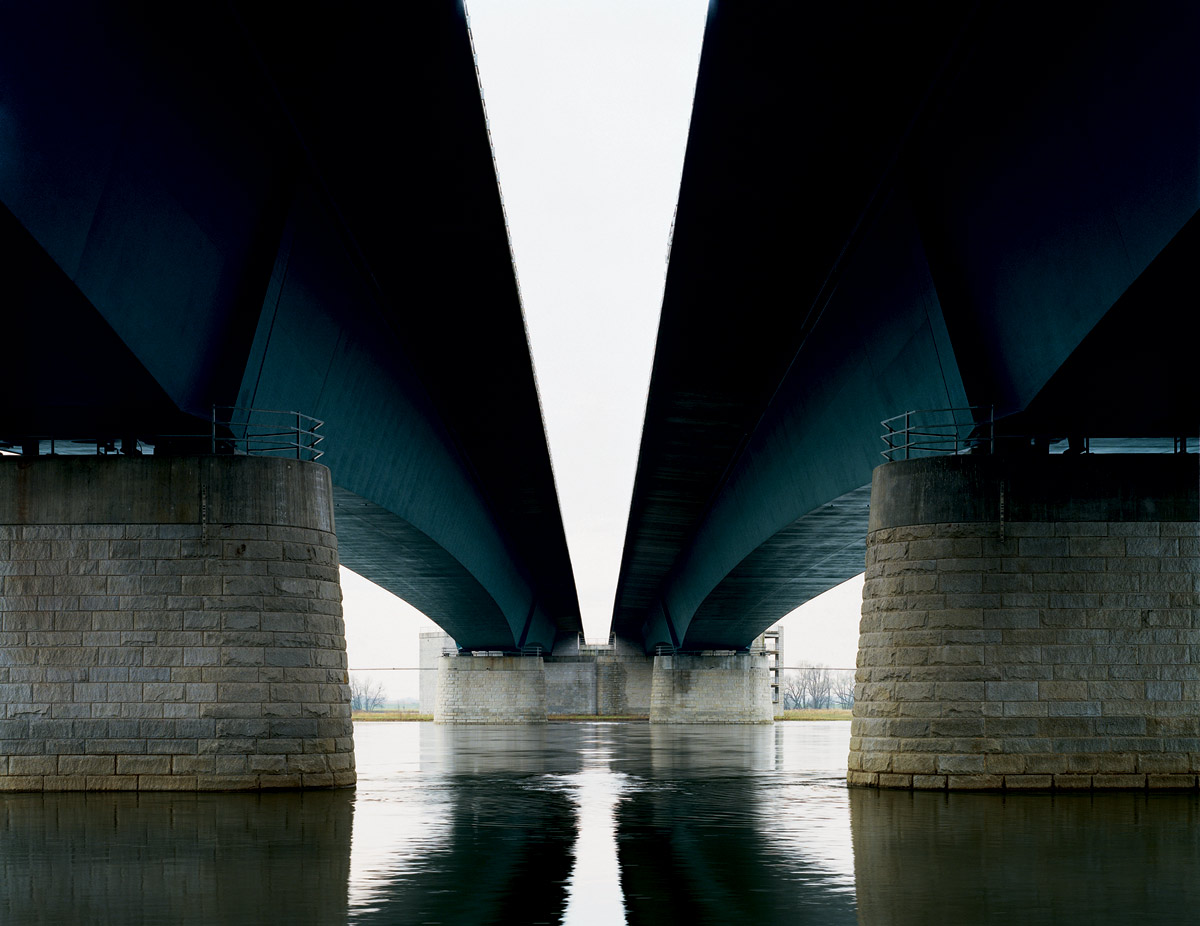
Hans-Christian Schink (German, b. 1961) 'A2 - Elbebrücke bei Magdeburg' 2003


Hans-Christian Schink (German, b. 1961)
A2 – Elbebrücke bei Magdeburg
2003
Serie Traffic Projects for German Unity
C-Print
Klassik Stiftung Weimar, Neues Museum
© Hans-Christian Schink


Hans-Christian Schink (German, b. 1961) 'LA Night #9' 2003


Hans-Christian Schink (German, b. 1961)
LA Night #9
2003
Series LA Night
C-print
Galerie Rothamel Erfurt/Frankfurt a.M.
© Hans-Christian Schink


Hans-Christian Schink (German, b. 1961) 'LA Night #10' 2003


Hans-Christian Schink (German, b. 1961)
LA Night #10
2003
Series LA Night
C-print
Galerie Rothamel Erfurt/Frankfurt a.M.
© Hans-Christian Schink


The best present of my life was most probably the simple role-film camera I received for my seventh birthday”, recalls Hans-Christian Schink, one of Germany’s leading contemporary photographers. The works by the Erfurt-born photographer, who today lives in Leipzig and who regularly travels the globe to create his photo-series, are represented in public and private collections worldwide. His photographs are also on view in the MKM’s presentation of the Ströher Collection since many years.

The MKM is now showing the most comprehensive exhibition to date of works by Hans-Christian Schink whose oeuvre has wielded a crucial impact on German photography. Approximately 100 large-format works afford an illuminating insight into his output until the present day, and impressively chart the development of his own distinct artistic signature.

Schink began his study of photography at the renowned Academy of Visual Arts in Leipzig where he was a master-class student from 1991 to 1993. From the very outset Schink worked with series. A key thrust of his oeuvre is his exploration of the transition between the urban and the rural, nature and culture and architectural intervention in the landscape. He finds his motifs both in his immediate environs, initially in eastern Germany, and also on his carefully planned journeys across the world, from North Korea, via the USA to the Antarctic. A further pre-occupation is the photographic rendering of light phenomena and moods.

For the first time, the MKM is exhibiting a selection of small-format black-white photos from the early1980s, together with the first colour photographs from the artist’s student days. Schink initially focused both on daily scenes in the cities of Leipzig, Erfurt and Halle, and on the abstract visual quality of architectural detail. During his studies he discovered colour photography and began working with a large-format camera, initially in the series Leipziger Bäder (Leipzig Baths, 1988), whose empty, dilapidated interiors bear poignant witness to a by-gone age. Since this time, people in his pictures exist merely as traces of their intervention in the environment.

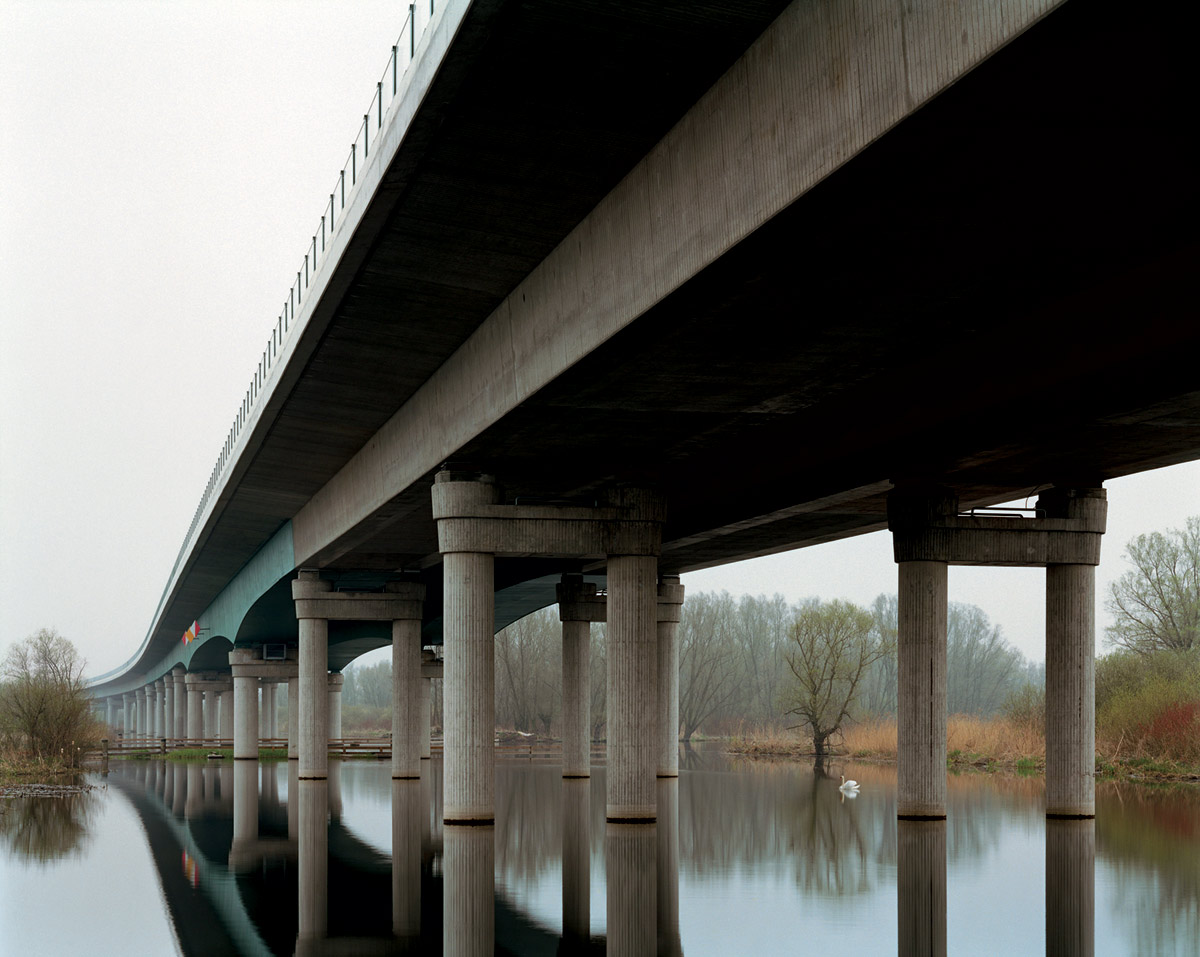
The artist first commanded worldwide attention with the series Verkehrsprojekte Deutsche Einheit (Traffic Projects German Unity, 1995-2003). Here he addressed the radical transformation of the landscape through the expansion of the motorway and rail network in eastern Germany.

The series Wände (Walls, 1995-2003) explored the question of how authentic the representation of reality is. Schink took frontal shots of the prefabricated architecture of unpretentious commercial buildings and melded them into almost abstract colour-fields. Merely the narrow borders adumbrate what we are seeing. To find his motifs, the artist embarks on journeys beyond the confines of Europe, taking him to countries such as Brazil, Japan, Cambodia, North Korea, Peru, the USA or Vietnam. His main objective is not the representation of exotic motifs, but the portrayal of the interface and the dialogue between anthropogenic structures and the natural landscape.

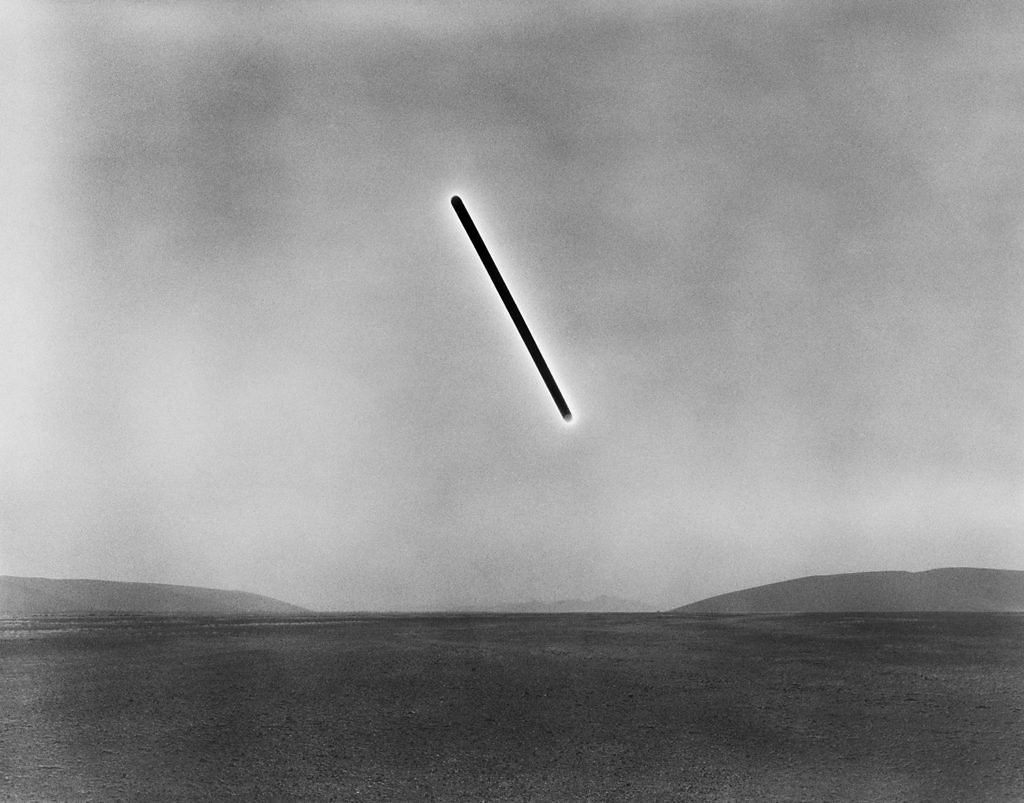
The award-winning series 1h (2002-2010) unites diverse aspects of his oeuvre: the interest in natural phenomena and light situations and his reflection on the possibilities of depicting reality through the medium of photography. Schink photographs the sun at various locations throughout the world, using exposure times of one hour. Together, the over-exposure and light intensity conjure a spectre which cannot be perceived by the human eye and which only becomes visible as a solarisation when captured by analogue photography: a black sunbeam, surrounded by a glowing corona. The resulting images render visible an unreal depiction of reality and confront the viewer with a Nature suspended between imagination and representation.

Press release from the MKM Küppersmühle Museum of Modern Art website


Hans-Christian Schink (German, b. 1961) 'Ba Be (1)' 2005


Hans-Christian Schink (German, b. 1961)
Ba Be (1)
2005
Series Vietnam
C-print
© Hans-Christian Schink


Hans-Christian Schink (German, b. 1961) 'Bach Ma (2A)' 2005


Hans-Christian Schink (German, b. 1961)
Bach Ma (2A)
2005
Series Vietnam
C-print
© Hans-Christian Schink


Hans-Christian Schink (German, b. 1961) 'Ba Be' 2005


Hans-Christian Schink (German, b. 1961)
Ba Be
2005
Series Vietnam
C-print
© Hans-Christian Schink


Hans-Christian Schink (German, b. 1961) '9/17/2006, 8:45 am-9:45 am, N 78°13.370' E 015°40.024' 2006


Hans-Christian Schink (German, b. 1961)
9/17/2006, 8:45 am – 9:45 am, N 78°13.370′ E 015°40.024′
2006
Serie 1h
Gelatin silver print on barite paper
© Hans-Christian Schink
MKM Museum Küppersmühle für Moderne Kunst, Sammlung Ströher


Hans-Christian Schink (German, b. 1961) '4/05/2009, 6:48 am - 7:48 am, S 24°43.399' E 015°28.310'' 2009


Hans-Christian Schink (German, b. 1961)
4/05/2009, 6:48 am – 7:48 am, S 24°43.399′ E 015°28.310′
2009
Serie 1h
Gelatin silver print on barite paper
© Hans-Christian Schink
MKM Museum Küppersmühle für Moderne Kunst, Sammlung Ströher


Hans-Christian Schink (German, b. 1961) '4/10/2009, 4:11 pm - 5:11 pm, S 26°28.034' E 018°16.142'' 2009


Hans-Christian Schink (German, b. 1961)
4/10/2009, 4:11 pm – 5:11 pm, S 26°28.034′ E 018°16.142′
2009
Serie 1h
Gelatin silver print on barite paper
© Hans-Christian Schink
MKM Museum Küppersmühle für Moderne Kunst, Sammlung Ströher


Hans-Christian Schink (German, b. 1961) '2/26/2010, 7:54 am – 8:54 am, S36° 49.622' E 175° 47.340'' 2010


Hans-Christian Schink (German, b. 1961)
2/26/2010, 7:54 am – 8:54 am, S36° 49.622′ E 175° 47.340′
2010
Serie 1h
© Hans-Christian Schink, courtesy Galerie Rothamel Erfurt/Frankfurt a.M. and Kicken Berlin


Hans-Christian Schink (German, b. 1961) 'Antartica 2' 2010


Hans-Christian Schink (German, b. 1961)
Antartica 2
2010
C-print
121 x 145cm


MKM Küppersmühle Museum of Modern Art
Inner Harbour, Duisburg
Philosophenweg 55
D – 47051 Duisburg, Germany

Opening hours:
Wed: 2 – 6pm
Thu – Sun: 11am – 6pm
Public holidays: 11am – 6pm
Mondays and Tuesdays closed

MKM Küppersmühle Museum of Modern Art website

LIKE ART BLART ON FACEBOOK

Back to top

Exhibition: ‘A Revolutionary Project: Cuba from Walker Evans to Now’ at the J. Paul Getty Museum, Los Angeles

Exhibition dates: 17th May – 2nd October 2011


Many thankx to the J. Paul Getty Museum for allowing me to publish the photographs in the posting. Please click on the photographs for a larger version of the image.


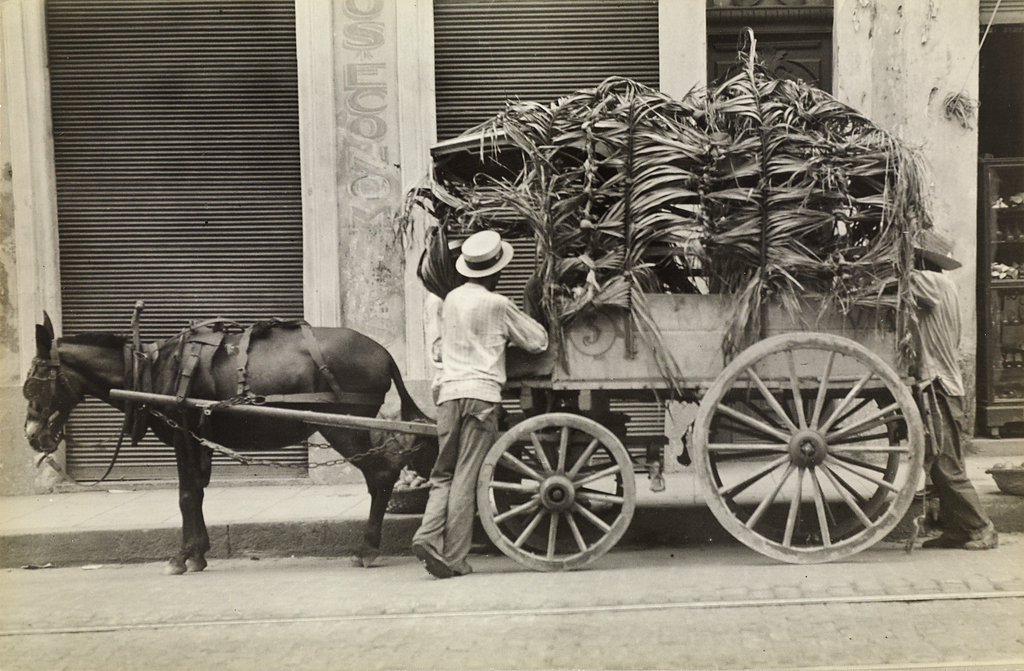
Walker Evans (American, 1903-1975) 'Mule, Wagon and Two Men, Havana' 1933


Walker Evans (American, 1903-1975)
Mule, Wagon and Two Men, Havana
1933
Gelatin silver print
13.8 x 21cm (5 7/16 x 8 1/4 in.)
The J. Paul Getty Museum, Los Angeles
© Walker Evans Archive, The Metropolitan Museum of Art


Walker Evans (American, 1903-1975) 'Spectacle, Capital Steps, Possibly Independence Day' May 20, 1933


Walker Evans (American, 1903-1975)
Spectacle, Capital Steps, Possibly Independence Day
May 20, 1933
Gelatin silver print
19.7 x 25.3cm (7 3/4 x 9 15/16 in.)
The J. Paul Getty Museum, Los Angeles
© Walker Evans Archive, The Metropolitan Museum of Art


Walker Evans (American, 1903-1975) 'Old Havana Housefronts' 1933


Walker Evans (American, 1903-1975)
Old Havana Housefronts
1933
Gelatin silver print
17.6 x 22.7cm (6 15/16 x 8 15/16 in.)
The J. Paul Getty Museum, Los Angeles
© Walker Evans Archive, The Metropolitan Museum of Art


Walker Evans (American, 1903-1975) 'Balcony Spectators' 1933


Walker Evans (American, 1903-1975)
Balcony Spectators
1933
Gelatin silver print
19.8 x 25.2cm (7 13/16 x 9 15/16 in.)
The J. Paul Getty Museum, Los Angeles
© Walker Evans Archive, The Metropolitan Museum of Art


Exhibition Marks First Showing of Getty’s Walker Evan’s Cuban Photographs; Also on view are Cuban Revolutionary Photographs and Contemporary Work by Virginia Beahan, Alex Harris, and Alexey Titarenko

Cuba’s attempt to forge an independent state with an ambitious set of social goals, all the while moored to powerful political and economic interests, has been a source of fascination for nations, intellectuals, and artists alike. On display at the J. Paul Getty Museum, the Getty Center, May 17 – October 2, 2011, A Revolutionary Project: Cuba from Walker Evans to Now, looks at three critical periods in the island nation’s history as witnessed by photographers before, during, and after the country’s 1959 Revolution.

A Revolutionary Project juxtaposes Walker Evans’s 1933 images from the end of the Gerardo Machado dictatorship with views by contemporary foreign photographers Virginia Beahan (American, b. 1946), Alex Harris (American, b. 1949), and Alexey Titarenko (Russian, b. 1962), who have explored Cuba since the withdrawal of Soviet support in the 1990s. A third section bridging these two eras presents pictures by Cuban photographers who participated in the country’s 1959 Revolution, including Alberto Korda, Perfecto Romero, and Osvaldo Salas.

“The Museum’s collection of Walker Evans prints is the largest in the U.S., but until now, we have not shown his photographs of Cuba,” explains Judith Keller, senior curator of photographs. “This exhibition allows us the opportunity to showcase this body of work, alongside newer work in the collection.”

1933: Evans in Havana

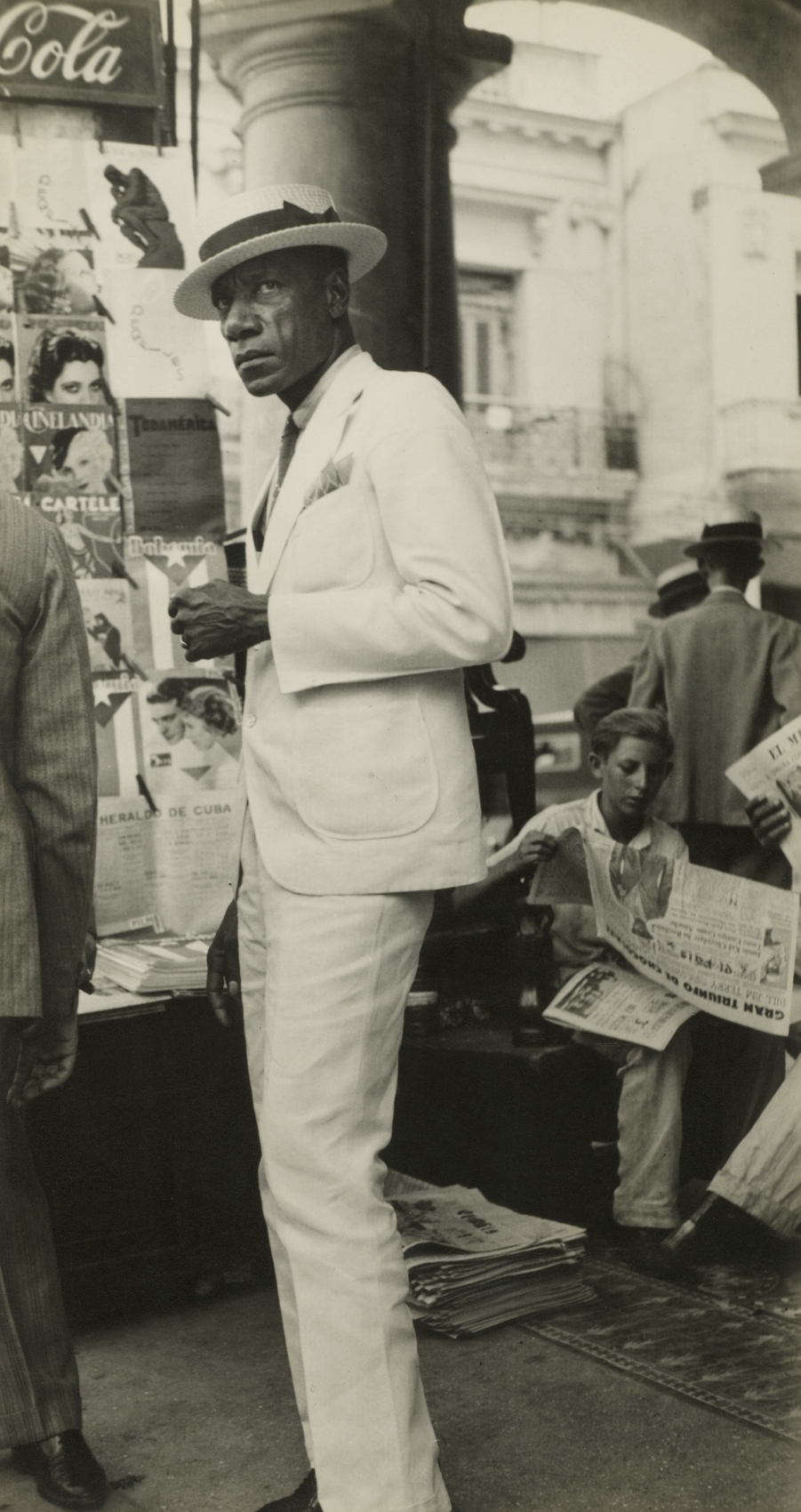
Walker Evans (1903-1975) is one of the photographers most responsible for the way we now imagine American life in the 1930s. His distinctive photographic style, which he declared “transcendent documentary,” was nurtured in New York in the late 1920s and fully formed by his experience in Cuba in 1933. In the spring of that year, Walker Evans was asked by publisher J. B. Lippincott to produce a body of work about Cuba to accompany a book by the radical journalist Carleton Beals (1893-1979). This book, The Crime of Cuba, would be a scathing indictment of the then-current regime of Cuban President Gerardo Machado. Leaving the country less than two months before Machado was forced out of office, Evans was able to capture Cuba at the start of the revolutionary movement but almost 30 years before the 1959 Revolution.

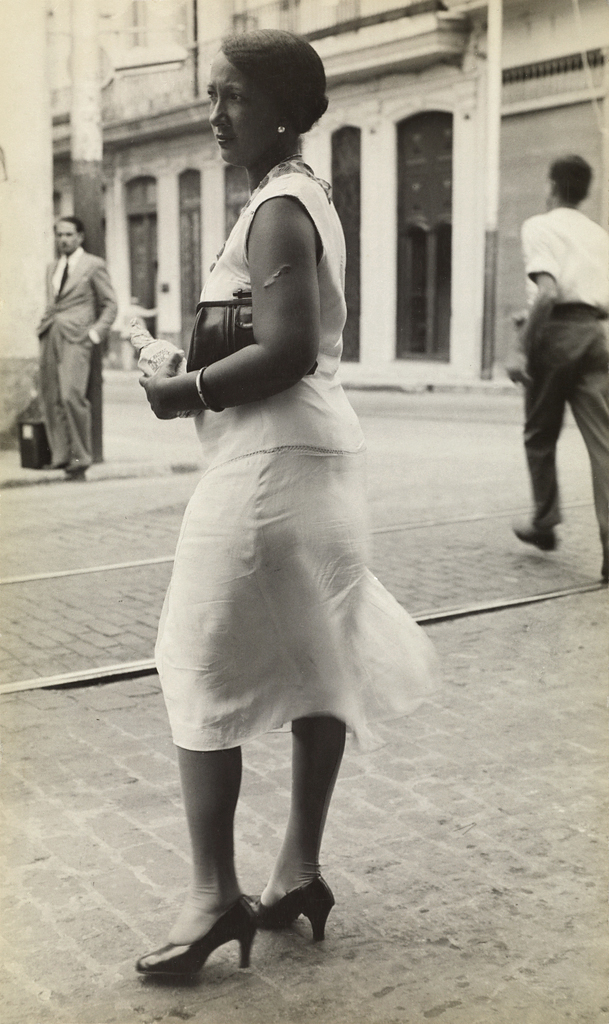
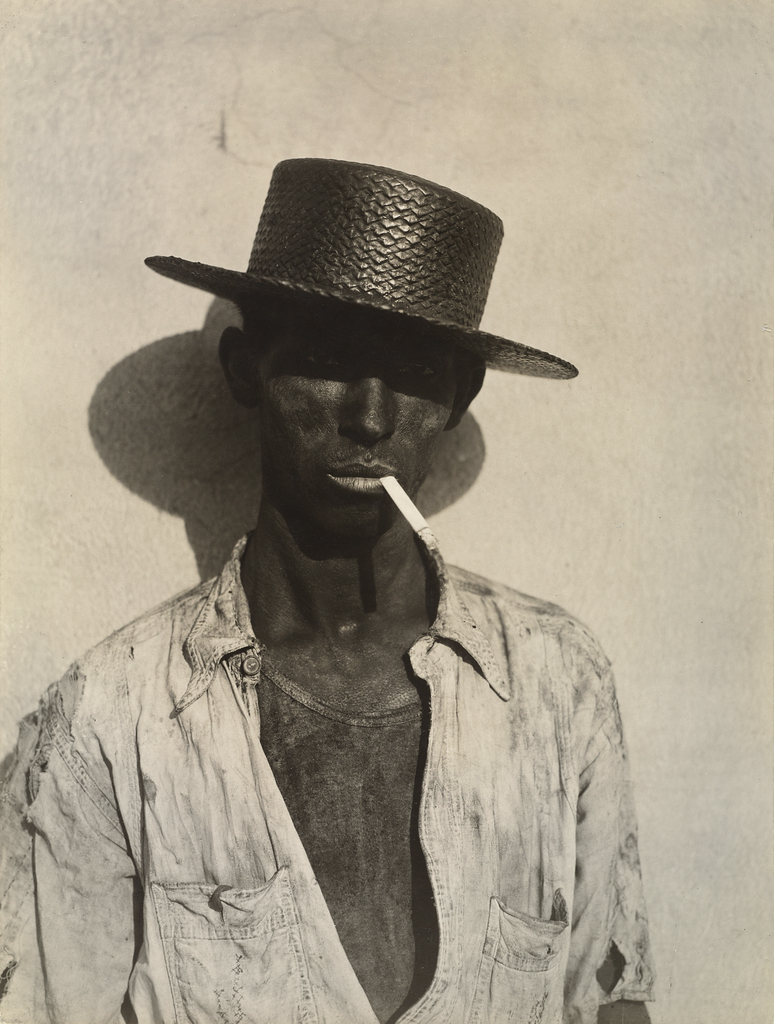
During Evans’s time in Cuba, he made substantial strides in his photographic practice. There he worked with different format cameras, large and small, one more deliberate and descriptive, the other more spontaneous and agile. He created both close-up and wide, inclusive compositions that he could then combine in intense sequences to best communicate his response to the poverty, the ferment, and the beauty of his environment. While in Havana, Evans met the American writer, Ernest Hemingway (1899-1961), whose acclaimed avant-garde work he knew and admired. Hemingway’s terse narrative style, which he was then applying to his own Harry Morgan stories set in Havana and Key West, no doubt influenced Evans’s approach to the subject of Cuba’s current political and economic struggles. Evans’s photographs also reflect the inspiration of French photographer Eugène Atget’s Parisian pictures that Evans critiqued for an arts journal in 1931. The series that comprised Atget’s thorough study of “Old Paris” seem to have provided additional motivation for Evans’s selection of Havana subjects: the signage of urban storefronts, the abundant street offerings of fresh produce, the decorative balconies of old houses, the many studies of archaic horse-drawn wagons and carriages, and the portraits of women, some of whom appear to be prostitutes.

1958-1966: Revolution

Machado’s fall from rule in 1933 resulted in a long power struggle that culminated in the country’s 1959 socialist revolution to overthrow dictator Fulgencio Batista, anchoring Cuba to the Soviet bloc for the next thirty years and defining a relationship with the United States that still exists today. Fidel Castro, Ernesto “Che” Guevara, and their new government harnessed photography as a means of keeping the project of the Revolution at the forefront of Cuba’s collective consciousness. As both genuine records of popular insurrection and propagandistic documents used for political purposes, pictures of the Revolution and its aftermath have shaped how both Cubans and Americans understand the significance of that revolutionary moment. Photographs in the second section of the exhibition are drawn from the work of nine Cuban photographers who participated in recording the political context and triumphs of the emerging state in the years surrounding 1959.

Included in the exhibition is an iconic image of the revolutionary hero Che Guevara by Alberto Korda titled Guerrillero Heroico (March 5, 1960). One of the world’s most reproduced images, it has been adopted for political causes, appearing on countless numbers of t-shirts, banners, and street art around the globe. The print on view in the exhibition is among the earliest versions of the photograph known to exist. Made as a press print, it was used as a source to reproduce the image in media outlets a year after Korda photographed Guevara at a rally in Havana.

Also on display in the exhibition is the well-known revolutionary photograph Patria o Muerte, Cuba (Negative, January 1959; print, 1984) by Osvaldo Salas, one of Cuba’s most important photographers. Salas effectively captures and conveys the populist fervour in Cuba shortly after the movement’s triumph with an image of a patriotic sign framed by a celebratory crowd.

The photographs included in this section of the exhibition are culled from the extensive holdings of Cuban photography assembled by the Austrian collector, Christian Skrein, including a number of recent acquisitions by the Museum.

Since 1991: The Special Period

After Soviet troops began to withdraw from Cuba in September of 1991, the troubled Cuban economy suffered severe internal shortages, and Fidel Castro declared what is known as the “Special Period” (período especial), marked by food rationing, energy conservation, and a decline of public services. In the nearly twenty years since the Soviet withdrawal, Cubans have managed to survive through perseverance, the forging of new political relationships, and the easing of socialist systems. This period of transition, which continues today with the recent transfer of power from Fidel Castro to his brother Raúl, has attracted the attention of photographers from around the world who are interested in exploring the relationship between Cuba’s revolutionary past and its uncertain future. The final section of the exhibition looks specifically at the work of three contemporary photographers with diverse approaches to documenting the island in recent decades: Virginia Beahan, Alex Harris, and Alexey Titarenko.

Virginia Beahan’s work concentrates on the landscape’s relationship to history and culture. In 2001, she began a multiyear project on Cuba, photographing its topography in search of remnants of the island’s diverse past. The work resulted in a publication in 2009 called Cuba: Singing with Bright Tears. Beahan’s Cuba is a land of contradictions, full of disappointments and hope, decay and rejuvenating beauty, simultaneously anchored to the past while looking beyond the present. Born and raised in Leningrad (now Saint Petersburg), Russia, Alexey Titarenko became fascinated with Cuba in 2003, when he made his first trip to Havana. Titarenko’s goal was to represent the soul of the Cuban capital. In the artist’s photographs, the city is shown with little overt reference to its politics. Instead, Titarenko describes the conditions of life in the communist country, depicting people persevering amid varying states of ruin. Venturing out of the tourist zones of Havana into the network of dilapidated avenues beyond the old city walls, his images depict a grey metropolis whose inhabitants congregate on the streets to collect food rations, fix long-outmoded cars, and play baseball.

A former student of Walker Evans, Alex Harris made several trips to Cuba following the collapse of the eastern bloc and the dissolution of the Soviet Union, developing a powerful body of colour work that addresses the country’s cultural fabric during a period of difficult economic circumstances. His photographs focus on portraits of women whose lives are affected by the tourist-fuelled sex trade, landscapes made through the windshields of refurbished 1950s American cars, and monuments to the Cuban national hero José Martí. His study was published in the form of a book, The Idea of Cuba, in 2007. Through these distinct vantage points, Harris probed the country’s propensity for ingenuity as it underwent great transition.

Press release from the J. Paul Getty Museum website


Walker Evans (American, 1903-1975) 'Citizen in Downtown Havana' 1933


Walker Evans (American, 1903-1975)
Citizen in Downtown Havana
1933
Gelatin silver print
22.2 x 11.7cm (8 3/4 x 4 5/8 in.)
The J. Paul Getty Museum, Los Angeles


Walker Evans (American, 1903-1975) 'Woman on the Street, Havana' 1933


Walker Evans (American, 1903-1975)
Woman on the Street, Havana
1933
Gelatin silver print
24.6 x 14.6cm (9 11/16 x 5 3/4 in.)
The J. Paul Getty Museum, Los Angeles
© Walker Evans Archive, The Metropolitan Museum of Art


Walker Evans (American, 1903-1975) 'Woman in a Courtyard' 1933


Walker Evans (American, 1903-1975)
Woman in a Courtyard
1933
Gelatin silver print
25.3 x 16.2cm (9 15/16 x 6 3/8 in.)
The J. Paul Getty Museum, Los Angeles
© Walker Evans Archive, The Metropolitan Museum of Art


Walker Evans (American, 1903-1975) 'Coal Dockworkers, Havana' 1933


Walker Evans (American, 1903-1975)
Coal Dockworkers, Havana
1933
Gelatin silver print
15.6 × 21.1cm (6 1/8 × 8 5/16 in.)
The J. Paul Getty Museum, Los Angeles
© Walker Evans Archive, The Metropolitan Museum of Art


Walker Evans (American, 1903-1975) 'Coal Dockworkers, Havana' 1933


Walker Evans (American, 1903-1975)
Coal Dockworkers, Havana
1933
Gelatin silver print
12.7 × 17.7cm (5 × 6 15/16 in.)
The J. Paul Getty Museum, Los Angeles
© Walker Evans Archive, The Metropolitan Museum of Art


Walker Evans (American, 1903-1975) 'Coal Dockworker, Havana' 1933


Walker Evans (American, 1903-1975)
Coal Dockworker, Havana
1933
Gelatin silver print
9.7 × 13.7cm (3 13/16 × 5 3/8 in.)
The J. Paul Getty Museum, Los Angeles
© Walker Evans Archive, The Metropolitan Museum of Art


Walker Evans (American, 1903-1975) 'Coal Loader, Havana' 1933


Walker Evans (American, 1903-1975)
Coal Loader, Havana
1933
Gelatin silver print
17.1 × 12.2cm (6 3/4 × 4 13/16 in.)
The J. Paul Getty Museum, Los Angeles
© Walker Evans Archive, The Metropolitan Museum of Art


Walker Evans (American, 1903-1975) 'Coal Stevedore, Havana' 1933


Walker Evans (American, 1903-1975)
Coal Stevedore, Havana
1933
Gelatin silver print
20.2 x 15.2cm (7 15/16 x 6 in.)
The J. Paul Getty Museum, Los Angeles
© Walker Evans Archive, The Metropolitan Museum of Art


Walker Evans (American, 1903-1975) 'Stevedore' 1933


Walker Evans (American, 1903-1975)
Stevedore
1933
Gelatin silver print
20.1 x 15.1cm (7 15/16 x 5 15/16 in.)
The J. Paul Getty Museum, Los Angeles
© Walker Evans Archive, The Metropolitan Museum


Walker Evans (American, 1903-1975) 'Negro Child, Havana' 1933


Walker Evans (American, 1903-1975)
Negro Child, Havana
1933
Gelatin silver print
19.5 x 14.8cm (7 11/16 x 5 13/16 in.)
The J. Paul Getty Museum, Los Angeles
© Walker Evans Archive, The Metropolitan Museum


Walker Evans (American, 1903-1975) 'Negro Child, Havana' 1933


Walker Evans (American, 1903-1975)
Negro Child, Havana
1933
Gelatin silver print
19.8 x 13.2cm (7 13/16 × 5 3/16 in.)
The J. Paul Getty Museum, Los Angeles
© Walker Evans Archive, The Metropolitan Museum


The J. Paul Getty Museum
1200 Getty Center Drive
Los Angeles, California 90049

Opening hours:
Tuesday – Friday, Sunday 10am – 5.30pm
Saturday 10am – 8pm
Monday Closed

The J. Paul Getty Museum website
LIKE ART BLART ON FACEBOOK

Back to top

Exhibition: ‘Nicholas Nixon: Family Album’ at Museum of Fine Arts, Boston

Exhibition dates: 28th July, 2010 – 1st May, 2011


Nicholas Nixon (American, born in 1947). 'Bebe, Cambridge' 1980


Nicholas Nixon (American, b. 1947)
Bebe, Cambridge
1980
Gelatin silver contact print
Museum of Fine Arts, Boston. Museum purchase with funds donated by the National Endowment for the Arts and Richard L. Menschel, Bela T. Kalman, Judge and Mrs. Matthew Brown, Mildred S. Lee, and Barbara M. Marshall
© Nicholas Nixon, Courtesy Fraenkel Gallery, San Francisco
Photograph © Museum of Fine Arts, Boston


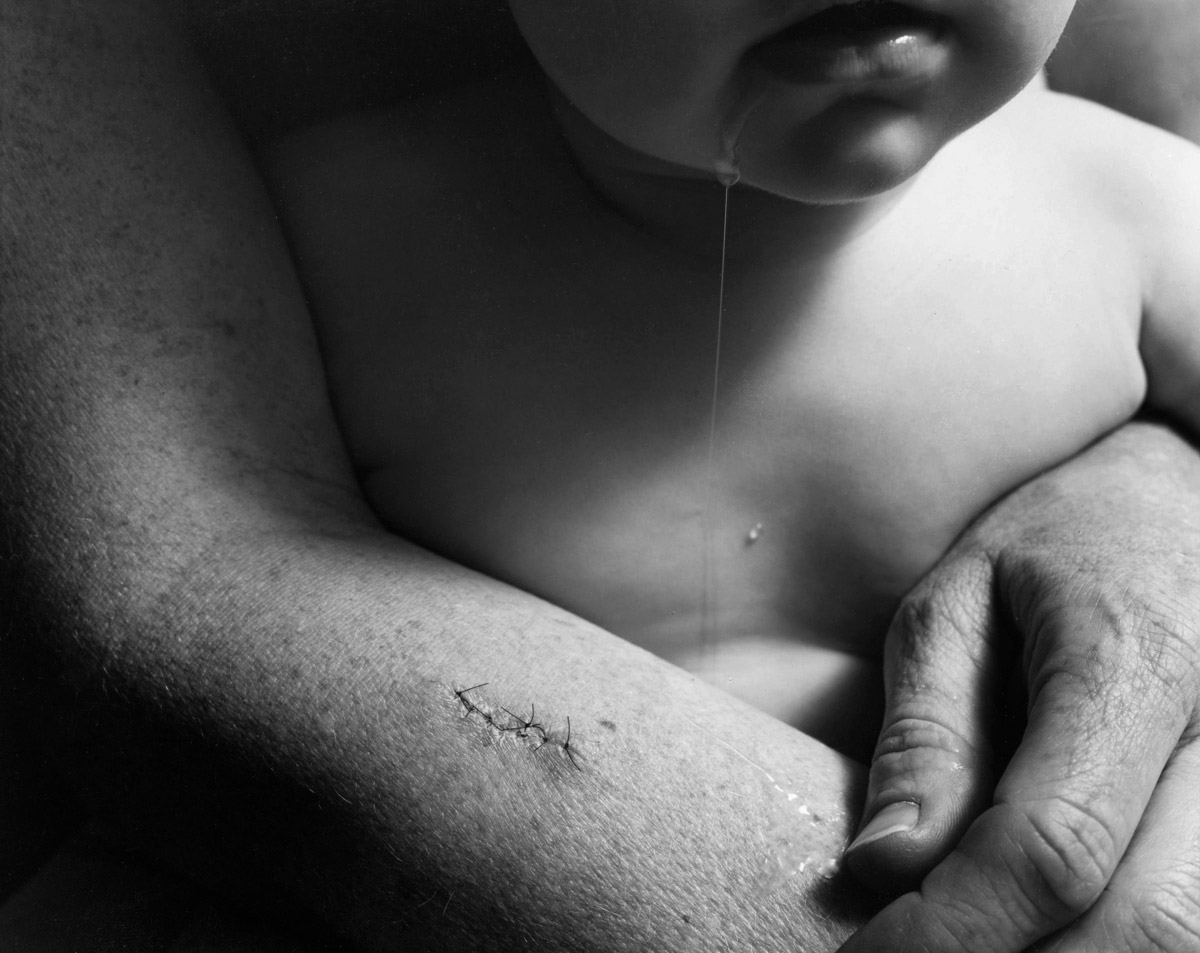
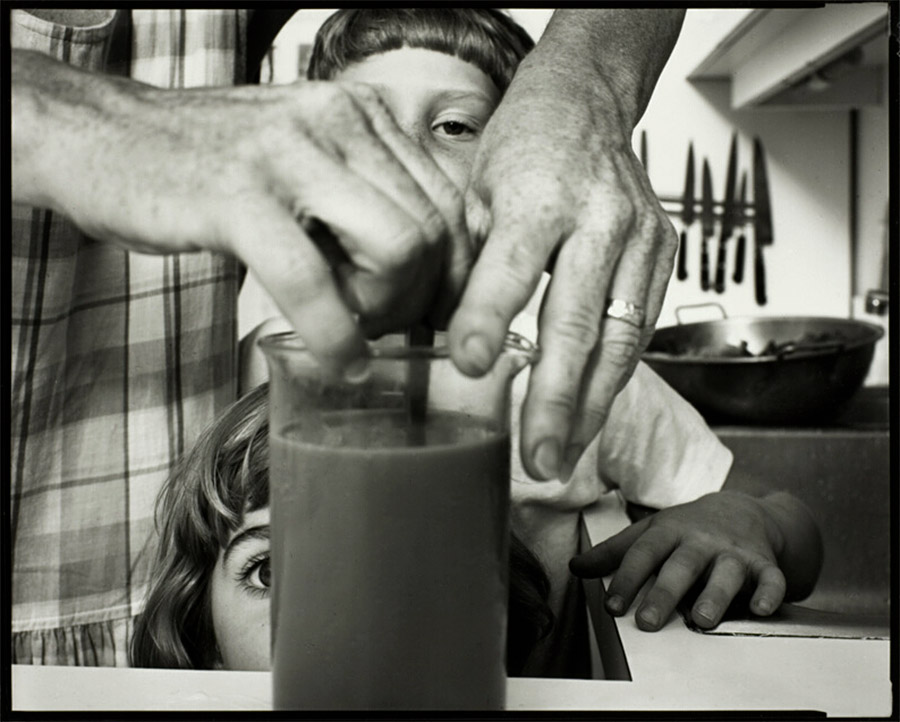
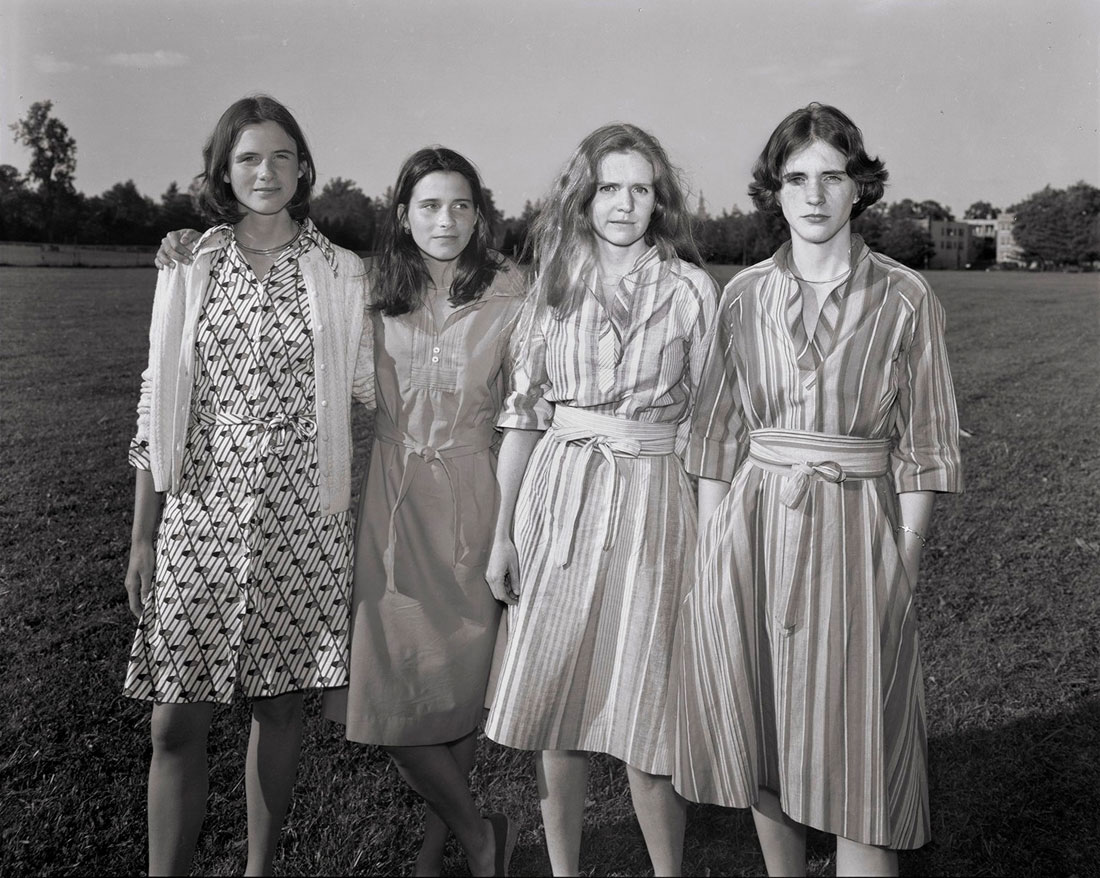
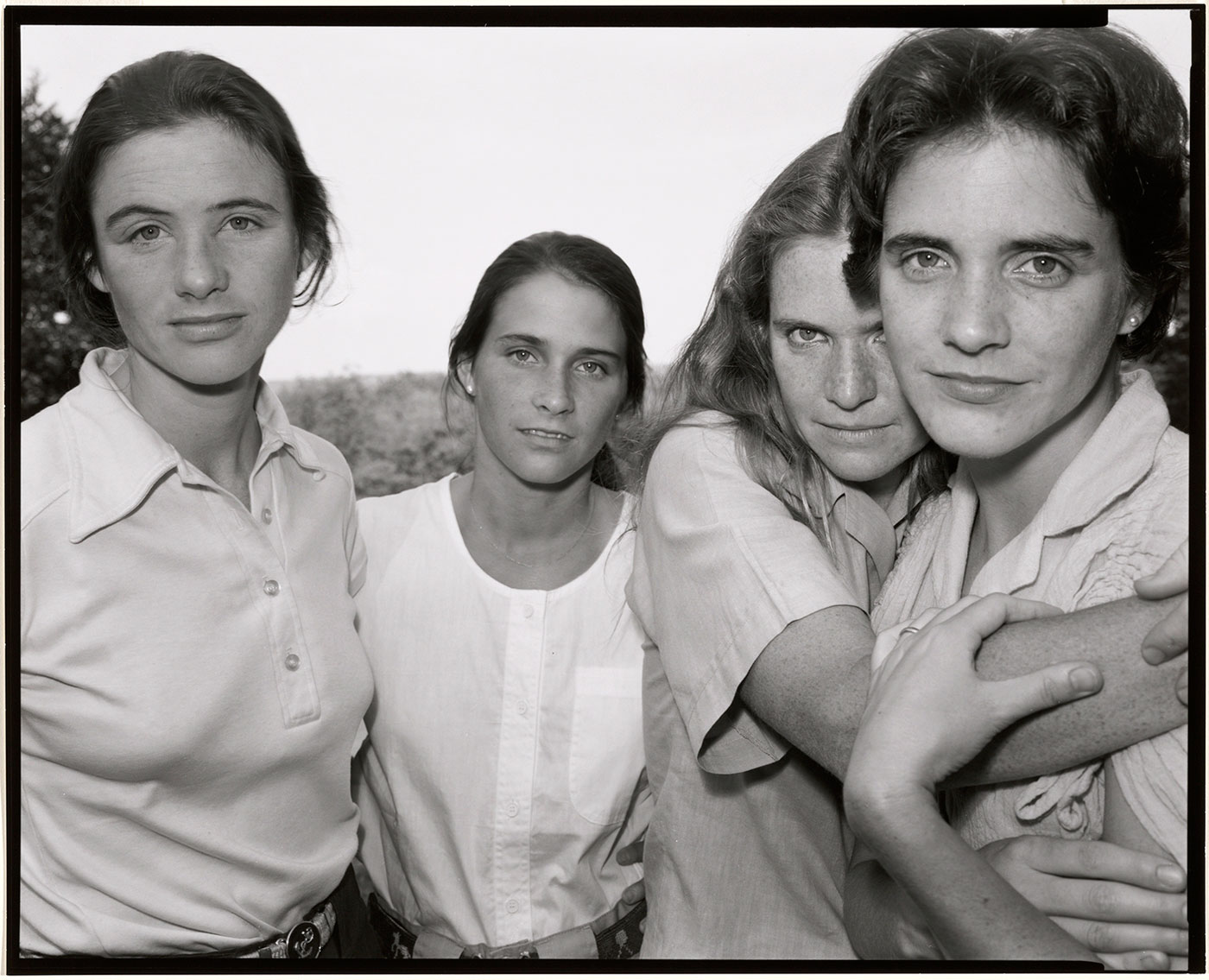
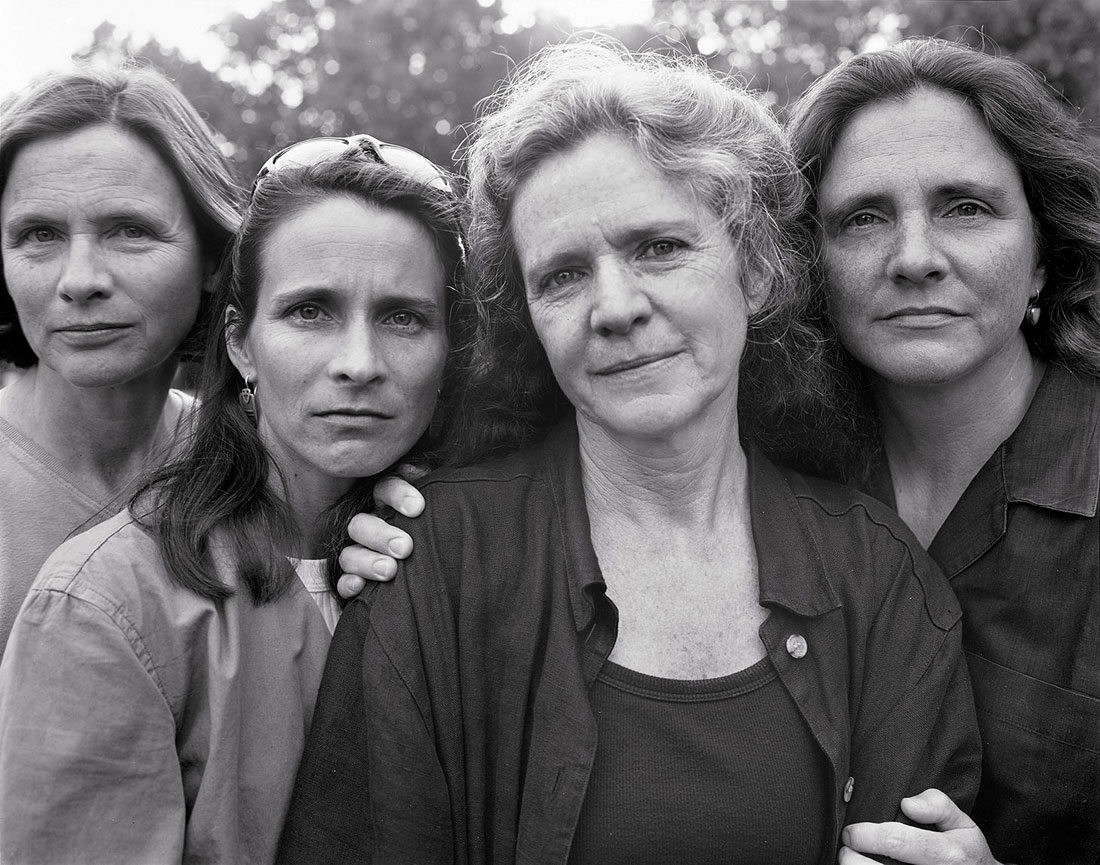
In the history of group photography Nixon’s ongoing series of family portraits The Brown Sisters (1975- ) is the best in the world. Beautifully structured and composed the photographs are nuanced and sensitive to the people portrayed and the passage of time. The subjects project and recede within the image frame, exposing vulnerability, intimacy and strength. Simply breathtaking!

Dr Marcus Bunyan


Many thankx to Amelia Kantrovitz for her help and to the Museum of Fine Arts, Boston for allowing me to publish the photographs in the posting. Please click on the photographs for a larger version of the image.


Nicholas Nixon (American, b. 1947)
'Chestnut Street, Louisville, Kentucky' 1982


Nicholas Nixon (American, b. 1947)
Chestnut Street, Louisville, Kentucky
1982
Gelatin silver print
Gift of the photographer
© Nicholas Nixon, Courtesy Fraenkel Gallery, San Francisco
Photograph © Museum of Fine Arts, Boston


Nicholas Nixon (American, born in 1947). 'Clementine and Bebe, Cambridge' 1985


Nicholas Nixon (American, b. 1947)
Clementine and Bebe, Cambridge
1985
Gelatin silver print
Gift of Nicholas Nixon
© Nicholas Nixon, Courtesy Fraenkel Gallery, San Francisco
Photograph © Museum of Fine Arts, Boston


Nicholas Nixon (American, b. 1947)
'Clementine and Bebe, Cambridge' 1985


Nicholas Nixon (American, b. 1947)
Clementine and Bebe, Cambridge
1985
Gelatin silver print
Gift of Nicholas Nixon
© Nicholas Nixon, Courtesy Fraenkel Gallery, San Francisco
Photograph © Museum of Fine Arts, Boston


Nicholas Nixon (American, b. 1947) 'Cambridge' 1986


Nicholas Nixon (American, b. 1947)
Cambridge
1986
Gelatin silver print
Gift of the photographer
© Nicholas Nixon, Courtesy Fraenkel Gallery, San Francisco
Photograph © Museum of Fine Arts, Boston


Nicholas Nixon (American, b. 1947)
'Clementine and Bebe, Cambridge'
1986


Nicholas Nixon (American, b. 1947)
Clementine and Bebe, Cambridge
1986
Gelatin silver print
20.3 × 25.4cm
Gift of the photographer
© Nicholas Nixon, Courtesy Fraenkel Gallery, San Francisco
Photograph © Museum of Fine Arts, Boston


Nicholas Nixon (American, b. 1947)
'Clementine and Sam' 1990


Nicholas Nixon (American, b. 1947)
Clementine and Sam
1990
Gelatin silver print
Gift of the photographer
© Nicholas Nixon, Courtesy Fraenkel Gallery, San Francisco
Photograph © Museum of Fine Arts, Boston


Themes such as the passage of time and the enduring nature of close family relationships are brought into focus in the exhibition Nicholas Nixon: Family Album at the Museum of Fine Arts, Boston (MFA). The show, on view from July 28, 2010, through May 1, 2011, in the MFA’s Herb Ritts Gallery, features more than 70 black and white portrait photographs by Nicholas Nixon, one of the most celebrated American photographers of this generation. Among them are pictures of Nixon’s wife, Beverly (Bebe) Brown Nixon, and their two children, Clementine and Sam. Nicholas Nixon also includes The Brown Sisters, the ongoing annual series of portraits of Bebe and her sisters taken each summer for the past 35 years. Nixon will take another photograph of the sisters this summer, which will be hung in the gallery during the course of the exhibition.

The promised gift to the MFA of The Brown Sisters series is the impetus for Nicholas Nixon. The group of photographs has been lent to the Museum for the exhibition from the collection of James Krebs, a Distinguished Benefactor of the MFA, and his late wife, Margie. Also included are works by Nixon purchased by the Museum, and a number that were given and lent to the MFA by the artist. Nicholas Nixon is presented with support from the Shelly and Michael Kassen Fund.

“Nicholas Nixon rose to prominence in the mid 1970s for his large-format black-and-white views of Boston and New York. Since then, he has turned almost exclusively to portraiture, and has produced many celebrated series of pictures – of the elderly, people with AIDS, and couples – but his portrayals of his family are particularly evocative and beloved. Nick has been a friend of the MFA for a long time and has generously given the Museum many of his photographs,” said Malcolm Rogers, Ann and Graham Gund Director of the MFA.

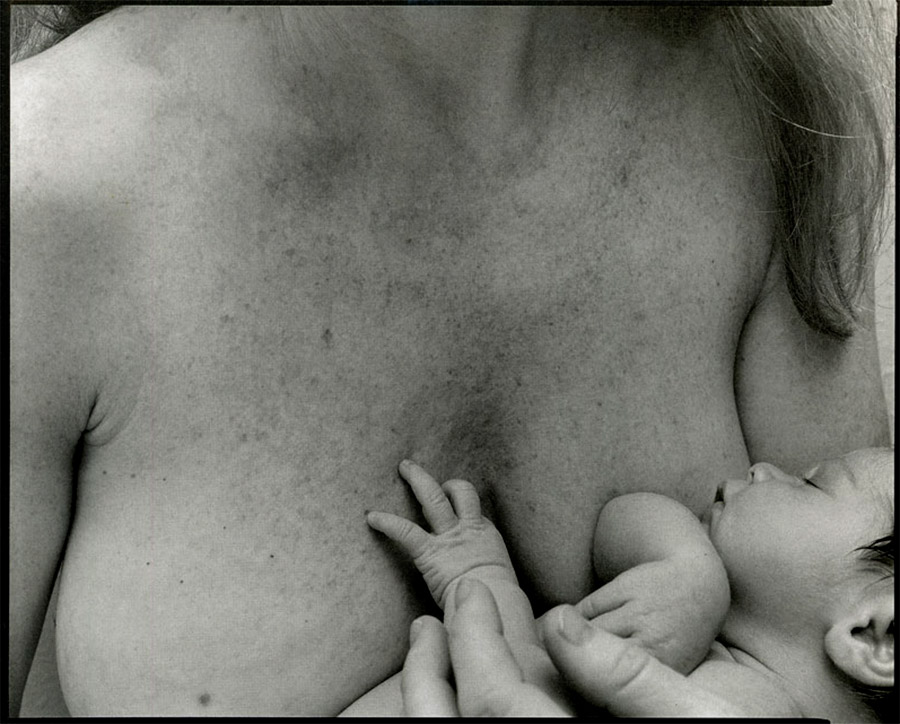
Nicholas Nixon’s photographs of family are both personal in nature and have a universality with which observers can connect. These pictures, a number of which have never been publicly displayed, celebrate the bonds of close family relationships, especially as they grow over time. Included in the exhibition is the luminous image that Nixon took of his wife in the bathtub, Bebe, Cambridge (MFA, Boston, 1980). The beautiful glowing light on her face suggests her interior state, as well as the depth of their long relationship. There are also many photographs in the show that highlight the richness and warmth of daily life with children. In an image from 1985, a cropped view of Bebe pictures her gazing downward, as Clementine’s fist emerges from the bottom of the frame, evoking the power of a new life. A close-up of Clementine’s face made the following year, with her wide eyes gazing upward, captures the toddler’s impression of wonder. The latest photograph of Clementine in the exhibition dates to 2003 and depicts her as a young woman, embracing her mother. Images of Nixon’s son, Sam, are also included, showing him in different stages over the years and in portraits with his sister.

The most recognised images in the exhibition are those that Nixon has taken of the Brown sisters each summer since 1975. The four women – Heather, Mimi, Bebe, and Laurie – always appear in the same order in the portraits, from left to right. These compelling photographs reveal the evolving nature of the sisters’ relationship over time. The serial portraits begin with The Brown Sisters, 1975 (James and Margie Krebs Collection, 1975), which captures them as young women, ranging in age from 15 to 25. With each passing year, observers can note changes in appearance, stance, and demeanour. In several of the portraits, the presence of the photographer is suggested through the shadow of himself and his camera projected across the figures, which makes reference to his role in the family dynamic. The series unfolds in a grid display on the central wall of the Ritts Gallery.

“In his serial pictures of family, Nicholas Nixon explores a classic conundrum in photography: how to suggest the passage of time by means of an instrument that records the instantaneous image. His effort is related to that of several predecessors – Alfred Stieglitz, Edward Weston, Harry Callahan, to name the most important – who, like him, used their wives as subject matter, photographing them over a period of years. What Nixon has added to the discussion – beyond recording facets of appearance, personality, or emphasising formal concerns – is his emphasis on the meaning of family,” said Anne Havinga, the MFA’s Estrellita and Yousuf Karsh Senior Curator of Photographs, who curated the show with Emily Voelker, the MFA’s Estrellita and Yousuf Karsh Assistant Curator of Photographs.

Born in Detroit in 1947, Nixon graduated from the University of Michigan in 1969 with a bachelor’s degree in English, and from the University of New Mexico in 1974 with a Masters of Fine Arts degree. Later that year, he moved to Boston, where he teaches at the Massachusetts College of Art and Design. Nixon is known for his documentary photography, especially city views and portraits rooted in the snapshot tradition. He works primarily in black and white, creating gelatin silver prints with a 8 x 10-inch view camera as did many of the great photographers who influenced him, including Alfred Stieglitz, Edward Weston, and Walker Evans. Working in large format and making contact prints enables him to create images of crisp detail and subtle tone. In recent years, Nixon has also begun to experiment with colour, although the photographs in the exhibition are all black-and-white, for which he is best known. He is the recipient of three National Endowment for the Arts Fellowships and two Guggenheim Fellowships, and, in addition to the MFA, his work is included in numerous museum collections, among them, the Metropolitan Museum of Art and the Los Angeles County Museum of Art.

Press release from the Museum of Fine Arts, Boston website [Online] Cited 26/04/2011 no longer available online


Nicholas Nixon (American, born in 1947). 'The Brown Sisters' 1976


Nicholas Nixon (American, b. 1947)
The Brown Sisters
1976
Gelatin silver print
Promised gift of James and Margie Krebs
Courtesy, Museum of Fine Arts, Boston


Nicholas Nixon (American, born in 1947). 'The Brown Sisters' 1978


Nicholas Nixon (American, b. 1947)
The Brown Sisters
1978
Gelatin silver print
Promised gift of James and Margie Krebs
Courtesy, Museum of Fine Arts, Boston


Nicholas Nixon (American, born in 1947). 'The Brown Sisters' 1980


Nicholas Nixon (American, b. 1947)
The Brown Sisters
1980
Gelatin silver print
Promised gift of James and Margie Krebs
Courtesy, Museum of Fine Arts, Boston


Nicholas Nixon (American, born in 1947). 'The Brown Sisters' 1996


Nicholas Nixon (American, b. 1947)
The Brown Sisters
1996
Gelatin silver print
Promised gift of James and Margie Krebs
Courtesy, Museum of Fine Arts, Boston


Nicholas Nixon (American, born in 1947). 'The Brown Sisters' 1999


Nicholas Nixon (American, b. 1947)
The Brown Sisters
1999
Gelatin silver print
Promised gift of James and Margie Krebs
Courtesy, Museum of Fine Arts, Boston


Museum of Fine Arts, Boston
Avenue of the Arts
465 Huntington Avenue
Avenue of the Arts
Boston, Massachusetts 02115-5523
617-267-9300

Opening hours:
Thursday and Friday 10am – 10pm
Saturday – Monday 10am – 5pm
Closed Tuesday and Wednesday

Museum of Fine Arts, Boston website

LIKE ART BLART ON FACEBOOK

Back to top

Galleries this week and ‘The Lost Diggers’

March 2011


It has been a busy week!

On Tuesday I visited Australian Galleries in Smith Street to view the Drought Photographs by Sidney Nolan. A wonderful experience. Thursday night was the opening of Manstyle at NGV Australia, Federation Square, the new exhibition that “explores the extremes of masculine style and some of the most influential ideas that have pervaded menswear over the past three centuries.” A lively opening with lots of milliners, designers and fashionistas but only a modicum of style from many of the men in attendance.

Friday saw a trip up Flinders Lane to visit Arc One Gallery (review of Navigating Widely by Vanila Netto), Craft Victoria and drop in and say hello to Mary Lou Jelbart, director of fortyfivedownstairs and view the extensive renovations to the office and storage areas. Always good to catch up with Mary Lou. Then onward, battling terrible traffic, to the opening of New11 at the Australian Centre for Contemporary Art (ACCA) where the work was a bit ‘thin’ with a couple of notable exceptions.

Saturday saw a drive to Albert Street, Richmond to catch up with the galleries there – mostly stable exhibitions. Wade Marynowsky’s The Hosts: A Masquerade Of Improvising Automatons at John Buckley Gallery were interesting for 10 minutes or so reminding me of evil, corseted, twirling, marionette Daleks. I then had a chat with the delightful Edwin at Sophie Gannon Gallery and saw the first stages of installation of the upcoming Daniela Federici exhibition that is part of L’Oréal Melbourne Fashion Festival. Looks to be an interesting show.

Dr Marcus Bunyan


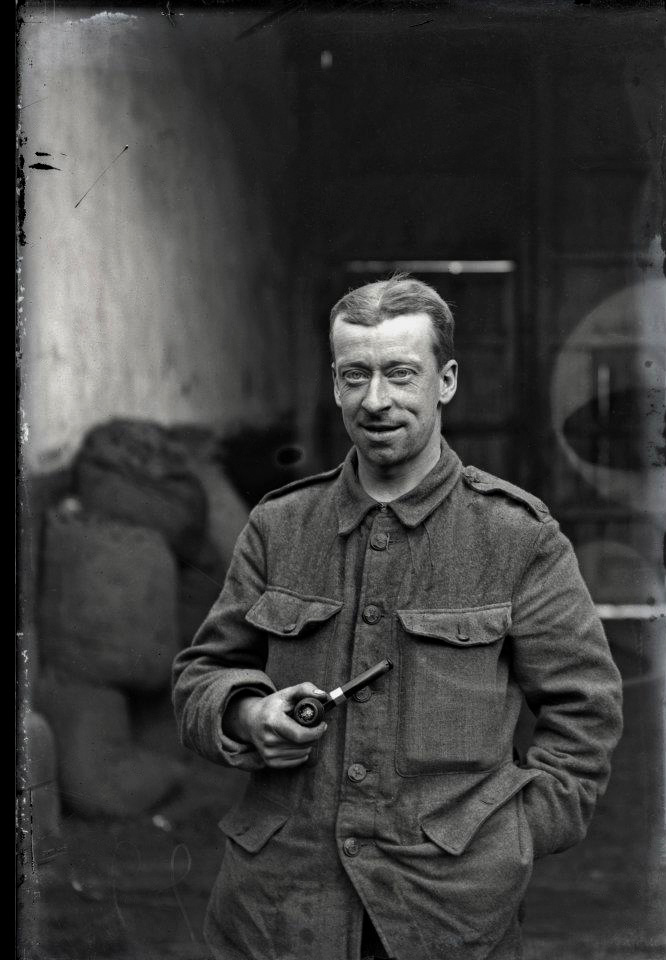
Antoinette or Louis Thuillier. 'No title (unknown Australian soldier wearing sheepskin jerkin)' c. 1916/17


Antoinette or Louis Thuillier
No title (unknown Australian soldier wearing sheepskin jerkin)
c. 1916/17
Glass negative
France

This image is published under fair dealing for the purposes of criticism or review (Commonwealth of Australia Consolidated Acts: Copyright Act 1968 – Sect 41)


This is a truly amazing story – finding these large format glass slides of First World War soldiers in an attic!

The original farmhouse has so much atmosphere. The photographs themselves are funny, poignant, informal, beautifully shot (the photographer, either Antoinette or Louis Thuillier, had a generous eye) and exhibit wonderful camaraderie

To actually find the original backdrop and be standing in the very place where these photographs were taken sends goose bumps up the spine just looking at the video. Imagine actually being there.

Look at the details – the hands, wedding rings, muddied boots, the children clasped by diggers with smokes in their hands, the props (chairs, motorbikes, guns, plant stands), sheepskin jerkins and the signs – We will soon, be, home, All that is left of them, France, 1916-1918.

They were so young, stoic, handsome. They stare out at you across time.

As Barthes and Sontag would say, these photographs haunt you.


View the video of the remarkable story from the link The Lost Diggers.

Look at hundreds of wonderful photographs from the links below:

    The Lost Diggers Facebook page
    Australian and international soldiers – Part 1
    Australian and international soldiers – Part 2
    Australian and international soldiers – Part 3


    Antoinette or Louis Thuillier. 'No title (unknown Australian soldier smoking a pipe)' c. 1916/17


    Antoinette or Louis Thuillier
    No title (unknown Australian soldier smoking a pipe)
    c. 1916/17
    Glass negative
    France


    LIKE ART BLART ON FACEBOOK

    Back to top

    Exhibition: ‘ANALOG: trends in sound and picture’ at The Riflemaker Gallery, London

    Exhibition dates: 10th January – 3rd March 2011


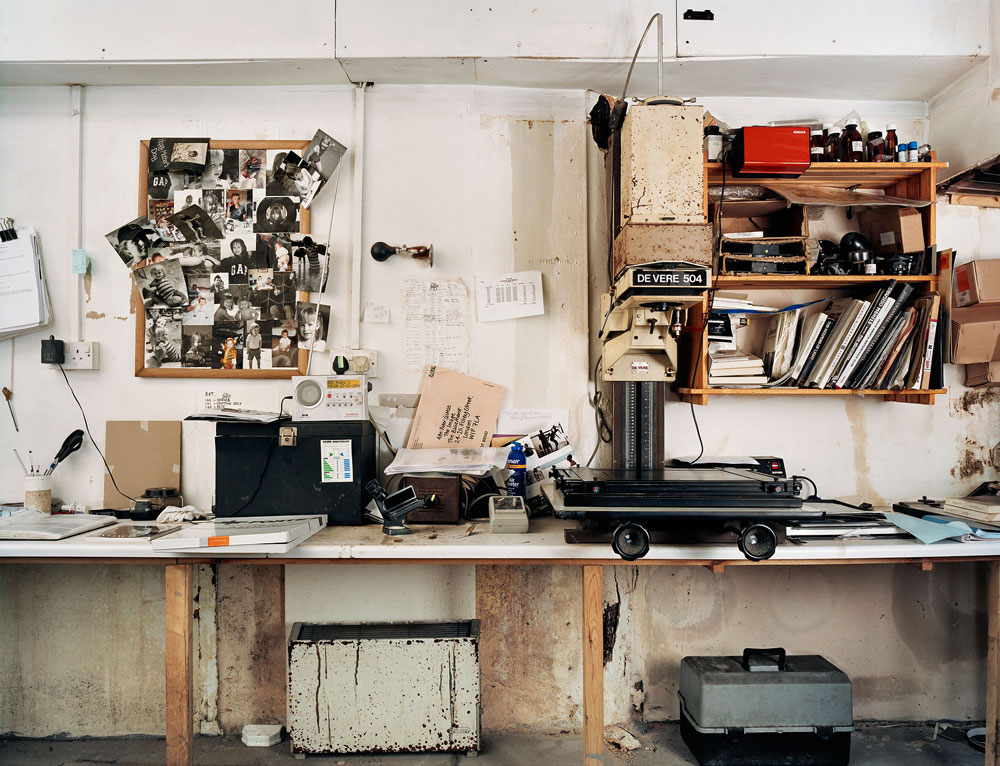
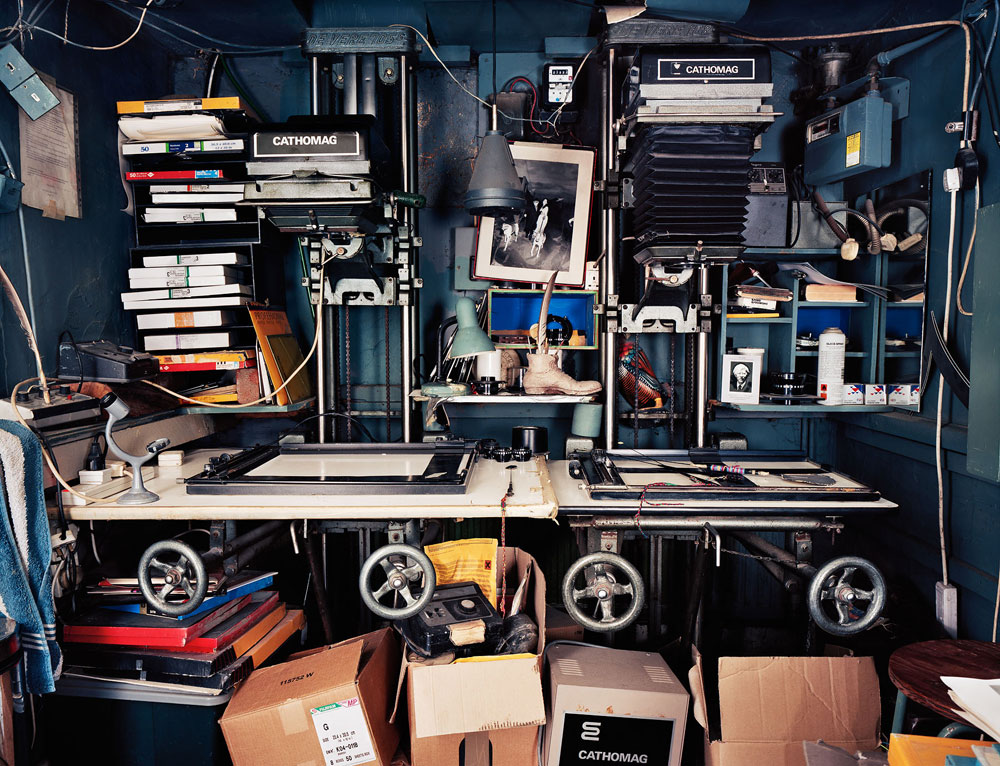
    Richard Nicholson (British, b. 1968) 'Peter Guest darkroom' 2006


    Richard Nicholson (British, b. 1968)
    Peter Guest darkroom
    2006
    Courtesy of the artist and Riflemaker


    I started my life as an artist as a black and white photographer. I spent many hours ensconced in the enveloping black and red safety light of the darkroom, listening to the sound of running water – a nurturing, womb-like environment despite the toxic nature of the chemicals involved. It was magical to see the image appear in the developing tray out of nothing, an alchemical process that never ceased to amaze me, a link to the early days of photography and the wonder that those first images would have generated. At that time the photography course at Phillip Institute (soon to become part of RMIT University) had 3 huge darkrooms; now they have one with only a couple of enlargers.

    Working in those darkrooms did teach you a solid foundation for your art practice: for one thing, the value of developing a working methodology – choosing a good negative that you wanted to print, spending time with it, adjusting the enlarger to obtain optimum size and printing it beautifully – for in a good day I could only print one or possibly two negatives a day. Then there was the process of washing the chemicals out of the paper and drying the prints. The whole process taught you patience, precision and dedication to the task at hand so that the negative revealed in the print something else that might be present, some ‘other’ that photography has the ability to capture if you take time, are aware and receptive to this illumination. These disciplines have held me in good stead during the following years.

    I still love analogue colour and black and white photographs. To me it is like the difference between an LP and a CD. The CD might have it all over the LP in terms of information captured but there is this ineffable feeling about an LP with it’s scratches and pops, it’s atmosphere. The same goes for an analogue print and it is something that you can’t quite put your finger on. I believe that there is still a place for analogue prints in the world – for the magical process, for their beauty, sensitivity and downright inspiration. Long may they live.

    Dr Marcus Bunyan


    Many thankx to The Riflemaker Gallery for allowing me to publish the photographs and text in the posting. Please click on the photographs for a larger version of the image.


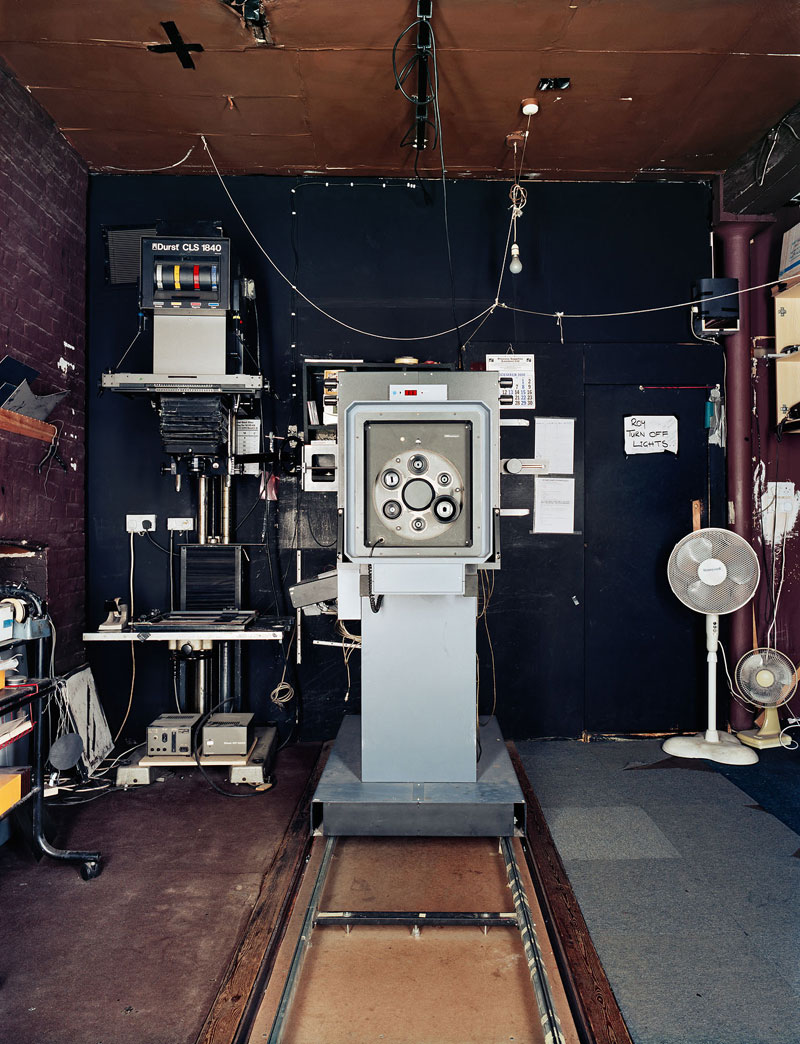
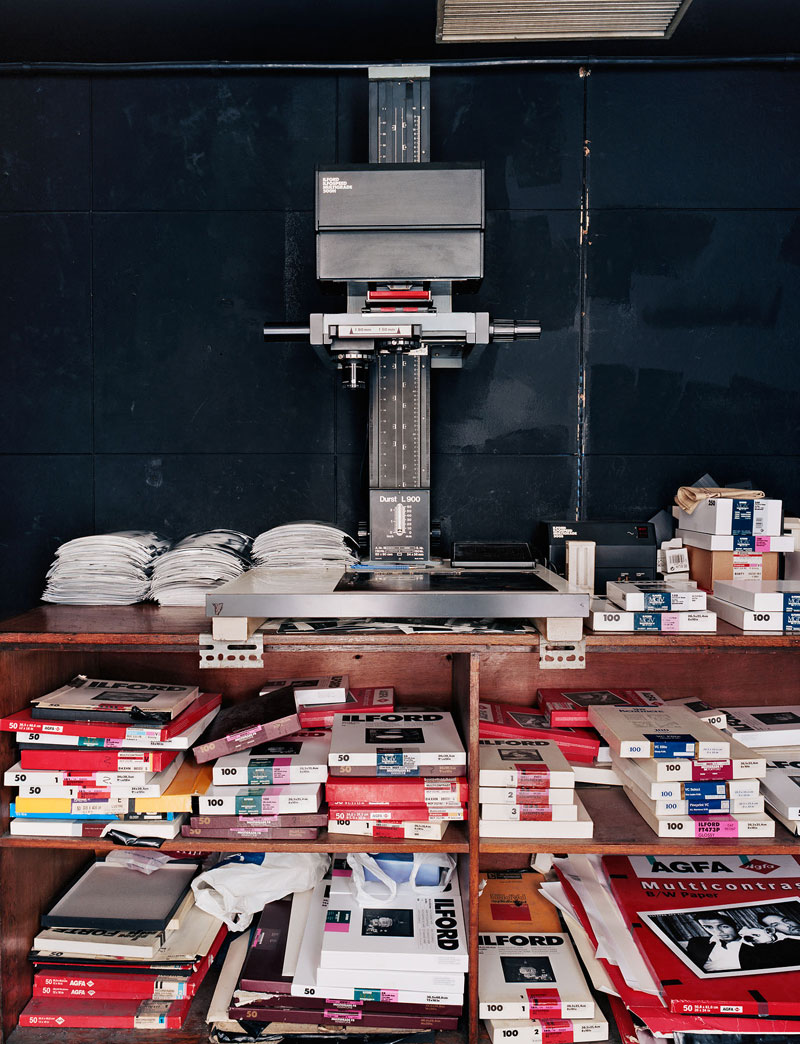
    Richard Nicholson (British, b. 1968) 'Roy Bass darkroom, Michael Dyer Associates, Covent Garden' 2006


    Richard Nicholson (British, b. 1968)
    Roy Bass darkroom, Michael Dyer Associates, Covent Garden
    2006
    Courtesy of the artist and Riflemaker


    The End of Professional Photographic Darkrooms and Music Recording Studios

    The impact of digital technology on print photography and music production is the subject of ANALOG at Riflemaker, Soho from 10 January 2011. The exhibition invites us inside the last of London’s photographic darkrooms as well as taking a visit to a working reel-to-reel music studio, courtesy of an installation by Lewis Durham of the band Kitty, Daisy & Lewis.

    Richard Nicholson. “A Survey of London’s Remaining Professional Darkrooms 2006-2010”

    1979. The year my father constructed a darkroom and introduced me to photography. I was immediately entranced by the printing process and cherished the long hours spent in this dark, private space; standing in the gloom of the red safelight, slowly rocking the print tray, watching the ghost-like image reveal itself through the gently lapping developer solution. As I experimented with the many formulas and techniques detailed in my father’s guidebooks, I often found the most interesting prints were the chemically stained accidents pulled from the bin at the end of a session. The darkroom became a bolt-hole for me; a private space where I could escape from the noise of family life. As I passed through school, university and various jobs, I often sought out a darkroom to escape from the crowd. But as I honed my skills – solarising, masking, bleaching, split-toning, hand-colouring – my prints began to attract public attention.

    2006. I’m working in London as a photographer. I’m still shooting film, but digital is becoming ubiquitous. The photographic manufacturer Durst announces that it will no longer be producing enlargers. Annual sales have dropped from a peak of 107,000 units in 1979 to just a few hundred units in recent years. The darkroom has always been integral to my practice as a photographer. But for how much longer? Once bustling hire darkrooms have become eerily quiet, and London labs are dropping like flies. Joe’s Basement, Primary, Metro Soho, Keishi Colour, Ceta, Team Photographic, Sky – all gone. Polaroid has stopped making instant film and Kodak and Fuji are discontinuing one emulsion after another. The recently introduced Canon 5d camera has persuaded many diehard film photographers that digital is the future, and those who remain unconvinced are facing clients who no longer have the budgets for film, Polaroids, clip-tests, contact-sheets and prints. The darkroom’s days are numbered.

    Against this backdrop, I begin to look at the darkroom in a new light. My enlarger (a handsomely engineered GeM 504) has been an invisible tool, but now it presents itself as a sad and lumpen creature in the face of extinction. With its long neck, heavy head and inviting focus handles, the thing has a human form which elicits sympathy – the surrounding matt black walls add an air of theatricality. Hearing tales of noble machines being unceremoniously dumped in skips when labs close down, I decide to document them before they all disappear.

    I chose to photograph professional darkrooms because they are often shrouded in mystery; hidden behind the tidy glass facade of the lab’s front desk. As a keen printer myself, I was curious to see the workspaces of the master printers; craftsmen who had spent their working lives in darkness. The spaces I discovered were often haphazard and brimming with personal details; coffee cups, CD collections, family snapshots, unpaid invoices, curious knick-knacks brought back by globe-trotting photographers. These human elements transformed what might have been a detached typology of modernist industrial design into something more intimate and nuanced.

    I photographed each darkroom on large format film. Working in total darkness, I carefully painted these normally dingy spaces with a flashgun, seeking to reveal the beauty of the machinery, and shed some light on the clutter stained with the patina of time. Some of the darkrooms were busy, whilst others were neglected (all attention being given to the new inkjet printer in the adjoining corridor). Many of the darkrooms were facing imminent closure. (The one with the slogan pinned to the wall, ‘I want to stay here forever’, was dismantled the day after I photographed it and is currently being converted into luxury apartments.)

    Many of the iconic images of recent decades were crafted in these rooms. Mike Spry’s high contrast lith prints of U2 and Depeche Mode for music photographer Anton Corbijn, Peter Guest’s black and white prints of the Trainspotting cast for portrait photographer Lorenzo Agius, or Brian Dowling’s intricately masked colour prints for fashion photographer Nick Knight. Such commercial work is now routinely carried out in Photoshop and professional printers have had to seek out new avenues for their skills. The art market is perhaps the last bastion for traditional darkroom printing, but even this area is being taken over by digital machines – Lightjet, Lambda, and Chromira printers. But suddenly there is a resurgence of interest in analog processes amongst younger photographers who were brought up on digital. Left cold by the clinical nature of the virtual workspace, they seek depth and authenticity via the chemical ambience of the traditional darkroom. Alternative processes from the early history of photography are being rediscovered, Polaroid instant film has been relaunched, and the craze for poorly engineered Russian and Chinese film cameras (Lomo, Holga, Diana etc) continues unabated.

    I wonder at this enthusiasm. Like many committed film photographers, I experienced a belated epiphany when I finally switched to digital. My darkroom skills were easily transferred to the digital realm, and I soon discovered that Photoshop offered creative printmaking possibilities that far exceeded what I could achieve in the darkroom. Whilst I don’t miss the chemistry of the darkroom – much of it highly toxic – I do miss the aura of the red safelight and the soothing sound of running water. I miss the excited sense of performance when making a complicated print (there’s no ‘undo’ button in the darkroom), and the physicality of dodging and burning – the manual shaping of the light. With film I had a network of contacts across London and felt embedded in the city, whereas with digital I feel disembodied. The history of photography is young and fast moving. The darkroom era was short lived. This collection of images represents its apotheosis.”

    Richard Nicholson, November 2010

    I would like to thank all the printers who kindly allowed me to photograph their darkrooms.

    Nicholson, Richard. “A Survey of London’s Remaining Professional Darkrooms 2006-2010,” in Taylor, Tot (ed.,). ANALOG: trends in sound and picture book. London: Riflemaker, 2011, pp. 17-19. ISBN 978-0-9563571-6-8.


    Richard Nicholson (British, b. 1968) 'Roy Snell darkroom, Earlsfield' 2006


    Richard Nicholson (British, b. 1968)
    Roy Snell darkroom, Earlsfield
    2006
    Courtesy of the artist and Riflemaker


    Richard Nicholson (British, b. 1968) 'Gordon Bishop Associates, Paddington Street' 2006


    Richard Nicholson (British, b. 1968)
    Gordon Bishop Associates, Paddington Street
    2006
    Courtesy of the artist and Riflemaker


    The Riflemaker Gallery
    79 Beak Street, Regent Street,
    London W1

    Opening hours:
    Monday – Friday 10.00am – 6.00pm
    Saturday 12.00pm – 6.00pm

    Riflemaker website

    LIKE ART BLART ON FACEBOOK

    Back to top

    Review: ‘An American Index of the Hidden and Unfamiliar’ by Taryn Simon at the Centre for Contemporary Photography, Fitzroy

    Exhibition dates: 15th October – 12th December 2010


    Taryn Simon (American, b. 1975) 'U.S. Customs and Border Protection, Contraband Room, John F. Kendedy International Airport, Queens, New York' 2005/2007 from the exhibition 'An American Index of the Hidden and Unfamiliar' by Taryn Simon at the Centre for Contemporary Photography, Oct - Dec 2010


    Taryn Simon (American, b. 1975)
    U.S. Customs and Border Protection, Contraband Room, John F. Kendedy International Airport, Queens, New York
    2005/2007
    Chromogenic colour print
    37 1/4 x 44 1/2 inches framed (94.6 x 113cm)
    © 2007 Taryn Simon
    Courtesy Gagosian Gallery/Steidl


    African cane rats infested with maggots, African yams (dioscorea), Andean potatoes, Bangladeshi cucurbit plants, bush meat, cherimoya fruit, curry leaves (murraya), dried orange peels, fresh eggs, giant African snail, impala skull cap, jackfruit seeds, June plum, kola nuts, mango, okra, passion fruit, pig nose, pig mouths, pork, raw poultry (chicken), South American pig head, South American tree tomatoes, South Asian lime infected with citrus canker, sugar cane (poaceae), uncooked meats, unidentified sub tropical plant in soil. All items in the photograph were seized from baggage of passengers arriving in the U.S. at JFK Terminal 4 from abroad over a 48-hour period. All seized items are identified, dissected, and then either ground up or incinerated. JFK processes more international passengers than any other airport in the Unites States.

    Prohibited agricultural items can harbor foreign animal and plant pests and diseases that could damage U.S. crops, livestock, pets, the environment and the economy. Before entering the country, passengers are required to declare fruits, vegetables, plants, seeds, meats, birds, or animal products that they may be carrying. The CBP agriculture specialists determine if items meet U.S. entry requirements. The U.S. requires permits for animals and plants in order to safeguard against highly infectious diseases, such as foot-and-mouth disease and avian influenza.


    This is an exhibition of large format colour photographs by Taryn Simon which features a body of work titled An American Index of the Hidden and Unfamiliar (2006). The work investigates the hidden spaces, places, artefacts and rituals of American cultural warfare (here I mean warfare in the sense of good vs bad, natural vs unnatural (or mutated), safety vs danger, death vs life for example). The photographs are very much like opening a ‘cabinet of curiosities’ where the photographer is attempting to challenge the categorical boundaries of environments and objects, things that are yet to be defined and fixed in place. Some of the photographs work very well in their attempts to categorise, to index; others are far less successful.

    Dan Rule in The Age sees the photographs as “slick, high-definition visuals … photographs [that] defy their gritty, documentarian sensibilities. Capturing an ominous vision of Bush-era America, her expansive series … doesn’t merely unearth a sinister vantage of the nation’s underbelly, but renders it in shocking clarity and detail … it ‘s a fascinating and troubling portrait. However, it’s not so much the subject matter but the luminous, hyper-realistic orientation that gives these images such resonance.”1

    I see things differently. Where Rule sees luminous photographs I see photographs that are very formal and dull, photographs that are rather lifeless and maudlin. Printed on grey pearlised paper (meaning that the base colour of the photographic paper is not white) and placed in pale grey frames, these A3 high definition, large depth of field photographs possess limited photographic insight into the condition of the spaces and objects being photographed. My friend rather cuttingly, but correctly, noted that they were very National Geographic drained of colour (note: the images in this online posting have far more life and colour than the actual prints!).

    This is photography as documentation used to disseminate information, documentation that reinforces the indexical nature of photography (the link between referent and reality) as a form of ‘truth’ – hence the ‘Index’ in the title of the body of work, a taxonomic ordering of reality. Even then some of the photographs have to be validated by text for them to have any meaning. “The visual is processed aesthetically and then redefined by its text” trumpets the wall text. Yes sure, but here the photographs are formalistically visualised, some to very limited effect, and what the text is really doing is semiotically decoding an image that has little meaning (until we are told) through words, words that are about memory, reminders of what we call and know of a thing.

    When the photograph tells us very little in the first place, when we do not have knowledge of a thing and cannot construct memories from the photograph but rely solely on words for meaning this can lead to photographs that are intrinsically and inherently poor. An example of a poor photograph in this series is the image of the captured Great white shark. Another example is the photograph of a decomposing body at the Forensic Anthropology Research Facility (see photograph above). Compare this to Sally Mann’s photograph of the same subject matter: the resonance of Mann’s photograph is powerful, confronting yet ambiguous with an amorphous aura surrounding the body, that of Simon’s almost as though the artist was afraid to really approach the subject; there seems to be an obsequiousness to the subject matter. Hidden is hidden and this photograph is definitely not “transforming the unknown into a seductive and intelligible form” (Wall text).

    Simon’s photographs are not visual enigmas that approach Atget’s The Marvellous in the Everyday, where he experimented with “the variable play between nature and art through minute changes in the camera’s angle, or as functions of the effects of light and time of day.” Nor do they possess that quality that I noted in my review of the work of Carol Jerrems – spaces that make some room for you in front – some room that would allow you to look forward, and maybe even walk into that space. Despite their ‘hidden’ and ‘unfamiliar’ context these photographs are very dull spaces. Simon’s camera angles are by the book. So are most of the photographs. Of course, I understand the revealing of meaning in the photograph by the text and the surprise this entails but this simply does not dismiss the fact that some of these works are just poor. In fact I would say only about 50% of these photographs could stand alone without the validation of the text. Does this matter? Is this important? Yes I think it is, for some of these works are just deadpan photographs of entropic spaces that are only given meaning because the photographer says they are important things to photograph (see my paper Spaces That Matter: Awareness and Entropia in the Imaging of Place, 2002). Even with text some of the photographs still have no resonance.

    When the photographs do work they are astounding. There is delicious irony in the depiction of a Recreational Basketball Court in Cheyenne Mountains Directorate, Chamber D, Colorado Springs, Colorado (2006) a dark, oppressive print of a nuclear bunker with basketball court or the incongruous nature of Death Row, Outdoor Recreational Facility “The Cage” (2006), a barred metal cage situated inside another building for the recreation of death row inmates. Shocking, disorientating. My personal favourite in this human built, human-less world of Simon’s was one of the simplest photographs in the exhibition, a photograph that cuts away the surroundings to picture a labelled flask sitting on a non-descript background. A concise visualisation of a labelled flask given extra meaning when you read the accompanying text: Live HIV, HIV Research Laboratory (2006). Pause for thought. The photographs when understood aesthetically are like snapshots of an alien culture, almost mundane but disturbing. I believe the best photographs in the series combine the presence of the space or object, an understanding of the condition of that space or object without having to read the text. The text then supplements the visual interpretation not overrides it.

    Human beings are secretive, unstable, paranoid creatures that are exclusory and fearful of Others. Fear is palpable in these photographs. Here is evidence of the human need for control (through the surveillance of photography) over conduct – control of contamination, death, disease, threat and Other. We investigate and document something in order to control it, in order that science can control it (think Foucault’s disciplinary systems of the prison and the madhouse). These photographs excavate meaning by bringing the shadow into the light in order to index our existence, to make the hidden less frightening and more controllable.

    Personally, I prefer my world to remain the mutation that is the catastrophe in the pattern / randomness dialectic. I like the chthonic darkness of difference and the rupture of pattern, the dislocation of identity and the challenge of mutation. Even though these photographs address the context of the hidden and unfamiliar there is nothing in the least unusual about them. Here is the paradox of these works: their (ab)normality vs their lack of humanity. The photographs in this exhibition all too easily confirm our prejudices and limit our understanding of difference through their need to document, label, order and exhibit the fear of (in)difference, all the better to control the mutations of disturbance.

    Dr Marcus Bunyan


    1/ Rule, Dan. “Taryn Simon: An American Index of the Hidden and Unfamiliar” in The Age newspaper A2. Melbourne: Saturday, October 23rd 2010


    Many thankx to the Melbourne International Arts Festival, Institute of Modern Art and the Centre for Contemporary Photography for allowing me to publish the photographs in the posting. Please click on the photographs for a larger version of the image. All photographs © 2007 Taryn Simon. Courtesy Gagosian Gallery/Steidl.


    Taryn Simon (American, b. 1975) 'Forensic Anthropology Research Facility, Decomposing Corpse, University of Tennessee, Knoxville, Tennessee' 2003/2007


    Taryn Simon (American, b. 1975)
    Forensic Anthropology Research Facility, Decomposing Corpse, University of Tennessee, Knoxville, Tennessee
    2003/2007
    Chromogenic colour print
    37 1/4 x 44 1/2 inches framed (94.6 x 113cm)
    © 2007 Taryn Simon
    Courtesy Gagosian Gallery/Steidl


    The decomposing body of a young boy is studied by researchers who have re-created a crime scene.

    The Forensic Anthropology Research Facility, popularly known as The Body Farm, is the world’s chief research center for the study of corpse decomposition. Its six-acre plot hosts approximately 75 cadavers in various stage of decomposition. The farm uses physical anthropology (skeletal analysis of human remains) to help solve criminal cases, especially murder cases. Forensic anthropologists work to establish profiles for deceased persons. These profiles can include sex, age, ethnic ancestry, stature, time elapsed since death, and sometimes, the nature of trauma on the bones.


    Sally Mann (American, b. 1951) 'Untitled WR Pa 59' 2001 from the series 'What Remains'


    Sally Mann (American, b. 1951)
    Untitled WR Pa 59
    2001
    From the series What Remains
    © Sally Mann. Courtesy Gagosian Gallery


    Taryn Simon (American, b. 1975) 'White Tiger (Kenny), Selective Inbreeding, Turpentine Creek Wildlife Refuge and Foundation, Eureka Springs, Arkansas' 2006/2007 from the exhibition 'An American Index of the Hidden and Unfamiliar' by Taryn Simon at the Centre for Contemporary Photography, Oct - Dec 2010


    Taryn Simon (American, b. 1975)
    White Tiger (Kenny), Selective Inbreeding, Turpentine Creek Wildlife Refuge and Foundation, Eureka Springs, Arkansas
    2006/2007
    Chromogenic colour print
    37 1/4 x 44 1/2 inches framed (94.6 x 113cm)
    © 2007 Taryn Simon
    Courtesy Gagosian Gallery/Steidl


    In the United States, all living white tigers are the result of selective inbreeding to artificially create the genetic conditions that lead to white fur, ice-blue eyes and a pink nose. Kenny was born to a breeder in Bentonville, Arkansas, on February 3, 1999. As a result of inbreeding, Kenny is mentally retarded and has significant physical limitations. Due to this deep-set nose, he has difficulty breathing and closing his jaw, his teeth are severely malformed and he limps from abnormal bone structure in his forearms. The three other tigers in Kenny’s litter are not considered to be quality white tigers as they are yellow-coated, cross-eyed, and knock-kneed.

    White tigers are extremely rare in their natural habitats in Asia. In the U.S., all living white tigers are the result of selective inbreeding in captivity to artificially create the genetic conditions that lead to white fur, ice-blue eyes and a pink nose. Currently, inbreeding such as father to daughter, brother to sister, mother to son has become commonplace. It produces a white cub less than 25% of the time, with only approximately 3% of those considered “quality.” The three other tigers in Kenny’s litter are not considered to be quality white tigers as they are yellow coated, cross-eyed, and knock-kneed.

    Conservation experts challenge the perception that white tigers are a rare and endangered species. Instead, they state that zoos, breeders, and entertainment acts have over-bred white tigers for financial gain, citing instances where private breeders and zoos have sold “quality” white tigers for over $60,000. The grave health consequences of inbreeding and over-breeding have led to abortions, stillbirths and a high mortality rate among infants. The Species Survival Plan has condemned the practice. In recent years there has been a significant drop in their market value.


    Taryn Simon (American, b. 1975) 'Hymenoplasty, Cosmetic Surgery, P.A., Fort Lauderdale, Florida' 2005/2007 from the exhibition 'An American Index of the Hidden and Unfamiliar' by Taryn Simon at the Centre for Contemporary Photography, Oct - Dec 2010


    Taryn Simon (American, b. 1975)
    Hymenoplasty, Cosmetic Surgery, P.A., Fort Lauderdale, Florida
    2005/2007
    Chromogenic colour print
    37 1/4 x 44 1/2 inches framed (94.6 x 113cm)
    © 2007 Taryn Simon
    Courtesy Gagosian Gallery/Steidl


    The patient in this photograph is 21 years old. She is of Palestinian descent and living in the United States. In order to adhere to cultural and familial expectations regarding her virginity and marriage, she underwent hymenoplasty. Without it she feared she would be rejected by her future husband and bring shame upon her family. She flew in secret to Florida where the operation was performed by Dr. Bernard Stern, a plastic surgeon she located on the internet. The purpose of hymenoplasty is to reconstruct a ruptured hymen, the membrane which partially covers the opening of the vagina. It is an outpatient procedure which takes approximately 30 minutes and can be done under local or intravenous anesthesia. Dr. Stern charges $3,500 for hymenoplasty. He also performs labiaplasty and vaginal rejuvenation.

    The hymen has not been proven to serve any biological function. Some girls are born with an imperforate hymen. Rupture most often occurs during first intercourse, but some girls tear their hymen during sports activities or as a result of injuries. The majority of the time there is a correlation between an intact hymen and a woman’s virginity; many cultures view the tearing of the hymen as a critical symbol of that loss. While similar attempts to alter the hymen predate modern plastic surgery, hymenoplasty is now just one of several vaginal cosmetic surgeries that are growing in popularity worldwide. Dr. Stern charges $3,500 for hymenoplasty. He also performs labiaplasty and vaginal rejuvenation.


    “Inspired by rumours of weapons of mass destruction and secret sites in Iraq, American photographic artist Taryn Simon focuses her lens on the hidden and inaccessible places in her own country.

    An American Index of the Hidden and Unfamiliar (2006) takes the viewer behind closed doors to uncover some extraordinary things inside places usually hidden from the public’s view. Ranging across the realms of science, government, medicine, entertainment, nature, security, and religion, Simon’s photographic subjects include glowing radioactive capsules in an underwater nuclear-waste storage facility, a Braille edition of Playboy, a deathrow prisoners’ exercise yard, an inbred tiger, corpses rotting in a Forensic Research Facility, and a Scientology screening room.

    Shot over four years, mostly with a large-format view camera, the images in this fascinating exhibition are in turn ethereal, foreboding, deadpan and cinematic. In examining what is integral to America’s foundation, mythology and daily functioning, the Index provides a surprising map of the American mindset and creates a vivid portrayal of the contemporary United States.

    Inspired by rumours of WMDs and secret sites in Iraq, Taryn Simon decided to address secret sites in her own country, photographing hidden places and things within America’s borders. Ranging across the realms of science, government, medicine, entertainment, nature, security and religion, her subjects include glowing radioactive capsules, a braille edition of Playboy, a death-row prisoners’ exercise yard, an inbred tiger, a teenage corpse rotting in a forensic research facility, and a Scientology screening room. An American Index of the Hidden and Unfamiliar explores a dialectic of security and paranoia that is distinctly American. Offering a heart-of-darkness tour of Bush-period America, it also reflects on photography’s role in revealing and concealing.

    In his foreword,1 Salman Rushdie writes ‘In a historical period in which so many people are making such great efforts to conceal the truth from the mass of the people, an artist like Taryn Simon is an invaluable counter-force. Democracy needs visibility, accountability, light. It is in the unseen darkness that unsavoury things huddle and grow. Somehow, Simon has persuaded a good few denizens of hidden worlds not to scurry for shelter when the light is switched on, as cockroaches do, and vampires, but to pose proudly for her invading lens, brandishing their tattoos and Confederate flags.

    Simon’s is not the customary aesthetic of reportage – the shaky hand-held camera, the grainy monochrome film stock of the ‘real’. Her subjects… are suffused with light, captured with a bright, hyper-realist, high-definition clarity that gives a kind of star status to these hidden worlds, whose occupants might be thought to be the opposite of stars. In her vision of them, they are dark stars brought into the light. What is not known, rarely seen, possesses a form of occult glamour, and it is that black beauty which she so brightly, and brilliantly, reveals.’

    1/ Salman Rushdie, ‘Foreword’ in Taryn Simon, An American Index of the Hidden and Unfamiliar, Steidl Gottingen, Germany, 2007, p. 7.


    Text from the Melbourne International Art Festival and the Centre for Contemporary Photography websites


    Taryn Simon (American, b. 1975) 'Cryopreservation Unit, Cryonics Institute, Clinton Township, Michigan' 2004/2007


    Taryn Simon (American, b. 1975)
    Cryopreservation Unit, Cryonics Institute, Clinton Township, Michigan
    2004/2007
    Chromogenic colour print
    37 1/4 x 44 1/2 inches framed (94.6 x 113cm)
    © 2007 Taryn Simon
    Courtesy Gagosian Gallery/Steidl


    This cryopreservation unit holds the bodies of Rhea and Elaine Ettinger, the mother and fist wife of cryonics pioneer, Robert Ettinger. Robert, author of The Prospect of Immortality and Man into Superman is still alive. The Cryogenics Institute offers cryostasis (freezing) services for individuals and pets upon death. Cryostasis is practiced with the hope that lives will ultimately be extended through future developments in science, technology, and medicine. When, and if, these developments occur, Institute members hope to awake to an extended life in good health, free from disease or the ageing process. Cryostasis must begin immediately upon legal death. A person or pet is infused with ice-preventive substances and quickly cooled to a temperature where physical decay virtually stops.

    At present, the Cryonics Institute cryopreserves 74 legally dead human patients and 44 legally dead pets. It charges $28,000 for the process if it is planned well in advance of legal death and $35,000 on shorter notice. The cost has not increased since 1976 when the Cryonics Institute was established. The Institute is licensed as a cemetery in the state of Michigan.


    Taryn Simon (American, b. 1975) 'Nuclear Waste Encapsulation and Storage Facility, Chernekov Radiation, Hanford Site, U.S. Department of Energy, Southeastern Washington State' 2005/2007


    Taryn Simon (American, b. 1975)
    Nuclear Waste Encapsulation and Storage Facility, Chernekov Radiation, Hanford Site, U.S. Department of Energy, Southeastern
    Washington State
    2005/2007
    Chromogenic color print
    37 1/4 x 44 1/2 inches framed (94.6 x 113cm)
    © 2007 Taryn Simon
    Courtesy Gagosian Gallery/Steidl


    Submerged in a pool of water at Hanford Site are 1,936 stainless-steel nuclear-waste capsules containing cesium and strontium. Combined, they contain over 120 million curies of radioactivity. It is estimated to be the most curies under one roof in the United States. The blue glow is created by the Cherenkov Effect which describes the electromagnetic radiation emitted when a charged particle, giving off energy, moves faster than light through a transparent medium. The temperatures of the capsules are as high as 330 degrees Fahrenheit. The pool of water serves as a shield against radiation; a human standing one foot from an unshielded capsule would receive a lethal dose of radiation in less than 10 seconds. Hanford is among the most contaminated sites in the United States.

    Hanford is a 586 square mile former plutonium production complex. It was built for the Manhattan Project, the U.S.-led World War II defense effort that developed the first nuclear weapons. Hanford plutonium was used in the atomic bomb dropped on Nagasaki in 1945. For decades afterwards Hanford manufactured nuclear materials for use in bombs. At Hanford there are more than 53 million gallons of radioactive and chemically hazardous liquid waste, 2,300 tons of spent nuclear fuel, nearly 18 metric tons of plutonium-bearing materials and about 80 square miles of contaminated groundwater. It is among the most contaminated sites in the United States.


    Centre for Contemporary Photography
    Level 2, Perry St Building
    Collingwood Yards, Collingwood
    Victoria 3066

    Opening hours:
    Wednesday – Saturday 11am – 5pm

    Centre for Contemporary Photography website

    LIKE ART BLART ON FACEBOOK

    Back to top

    Exhibition: ‘Ball Parks: Jim Dow’s Photographs of Baseball Stadiums’ at The National Gallery of Canada, Ottawa

    Exhibition dates: 4th July – 27th September, 2009


    Jim Dow (American, b. 1942) 'Exhibition Stadium' 1982 from the exhibition 'Ball Parks: Jim Dow's Photographs of Baseball Stadiums' at The National Gallery of Canada, Ottawa, July - Sept, 2009


    Jim Dow (American, b. 1942)
    Exhibition Stadium
    1982
    National Gallery of Canada, Ottawa
    Gift of Benjamin Greenberg, Ottawa, 1988 and 1989


    These feel like religious reliquaries, a triptych form which arises from early Christian art but here a paean to the monumentalisation of sport, architecture, human heroics and grandiosity.

    Apologies that the blog is not wide enough to display these panoramic images at a decent size but you can click on the photographs to see a larger version of the image. I have also displayed each 8″ x 10″ negative sequentially.

    Dr Marcus Bunyan


    Many thankx to The National Gallery of Canada for allowing me to publish the photographs in the posting. Please click on the photographs for a larger version of the image.


    Jim Dow (American, b. 1942) 'Exhibition Stadium' 1982 (detail)

    Jim Dow (American, b. 1942) 'Exhibition Stadium' 1982

    Jim Dow (American, b. 1942) 'Exhibition Stadium' 1982


    Jim Dow (American, b. 1942)
    Exhibition Stadium (individual frames)
    1982
    National Gallery of Canada, Ottawa
    Gift of Benjamin Greenberg, Ottawa, 1988 and 1989


    This installation from the National Gallery’s Collection of Photographs comprises 26 colour panoramic views of empty baseball stadiums across North America, from Exhibition Stadium, the home of the Toronto Blue Jays, and Montréal’s Olympic Stadium to the Houston Astro’s Astrodome. Taken in 1982, Jim Dow, a respected American photographer as well as a sports enthusiast, imparts through these images both a passion for the monumentality of the architecture and its abstract geometry and his love of baseball. The emptiness of the stadiums simultaneously evokes memory and a sense of anticipation.

    Jim Dow’s interest in those places where people enact their everyday rituals, from the barbershop to the baseball park, has guided the path of his photographic career. Dow is concerned with capturing “human ingenuity and spirit” in endangered regional traditions – a barbershop with a heavy patina of town life covering the walls, the opulent time capsule of an old private New York club, the densely packed display of smoking pipes in an English tobacconist shop – all artefacts of a vanishing era.

    Dow earned a B.F.A. and a M.F.A. in graphic design and photography from the Rhode Island School of Design in 1965 and 1968 respectively. An early influence was Walker Evans’s seminal book American Photographs (1938). Dow recalls the appeal of Evans’s “razor sharp, infinitely detailed, small images of town architecture and people. What stood out was a palpable feeling of loss … pictures that seemingly read like paragraphs, even chapters in one long, complex, rich narrative.” Soon after graduate school Dow had the opportunity to work with Evans. He was hired to print his mentor’s photographs for a 1972 Museum of Modern Art retrospective.

    Dow has taught photography at Harvard, Tufts University and the School of the Museum of Fine Arts, Boston, and his work has been widely exhibited. Among his series is Corner Shops of Britain (1995), which features facades of small family-run businesses: vitrine-like shop windows showcase goods from candy jars to jellied eels. Another series, Time Passing (1984-2004), captures North Dakota “folk art” such as rural road signage, hand-painted billboards, and ornate gravestones.

    Dow first gained attention for his panoramic triptychs of baseball stadiums, a project that began with an image he made of Veteran’s Stadium in Philadelphia in 1980. Using an 8 x 10″ camera, he has documented more than two hundred major and minor league parks in the United States and Canada.”

    Text from Artdaily.org website [Online] Cited 17/04/2019


    Jim Dow (American, b. 1942) 'The Kingdome. Seattle Mariners' 1982 from the exhibition 'Ball Parks: Jim Dow's Photographs of Baseball Stadiums' at The National Gallery of Canada, Ottawa, July - Sept, 2009


    Jim Dow (American, b. 1942)
    The Kingdome. Seattle Mariners
    1982
    National Gallery of Canada, Ottawa
    Gift of Benjamin Greenberg, Ottawa, 1988 and 1989


    Jim Dow (American, b. 1942) 'The Kingdome. Seattle Mariners' 1982 (detail)

    Jim Dow (American, b. 1942) 'The Kingdome. Seattle Mariners' 1982

    Jim Dow (American, b. 1942) 'The Kingdome. Seattle Mariners' 1982 (detail)


    Jim Dow (American, b. 1942)
    The Kingdome. Seattle Mariners (individual frames)
    1982
    National Gallery of Canada, Ottawa
    Gift of Benjamin Greenberg, Ottawa, 1988 and 1989


    Jim Dow (American, b. 1942) 'Olympic Stadium, Montreal' 1982


    Jim Dow (American, b. 1942)
    Olympic Stadium, Montreal
    1982
    National Gallery of Canada, Ottawa
    Gift of Benjamin Greenberg, Ottawa, 1988 and 1989


    Jim Dow (American, b. 1942) 'Olympic Stadium, Montreal' 1982 (detail)

    Jim Dow (American, b. 1942) 'Olympic Stadium, Montreal' 1982 (detail)

    Jim Dow (American, b. 1942) 'Olympic Stadium, Montreal' 1982 (detail)


    Jim Dow (American, b. 1942)
    Olympic Stadium, Montreal (individual frames)
    1982
    National Gallery of Canada, Ottawa
    Gift of Benjamin Greenberg, Ottawa, 1988 and 1989


    National Gallery of Canada
    380 Sussex Drive
    P.O. Box 427, Station A
    Ottawa, Ontario
    Canada 
K1N 9N4

    Opening hours:
    Daily 9.30am – 5pm

    National Gallery of Canada website

    LIKE ART BLART ON FACEBOOK

    Back to top