Exhibition: ‘Gordon Parks: Centennial’ at Jenkins Johnson Gallery, San Francisco

Exhibition dates: 21st February – 27th April 2013


Gordon Parks (American, 1912-2006) 'Ondria Tanner and Her Grandmother Window-shopping, Mobile, Alabama' 1956


Gordon Parks (American, 1912-2006)
Ondria Tanner and Her Grandmother Window-shopping, Mobile, Alabama
1956
Edition 19 of 25
Pigment print
14 x 14 inches
Modern print
© The Gordon Parks Foundation


What an admirable photographer Gordon Parks was. It is a joy to see five of his colour photographs in this posting because I have never seen any before. They are glorious, complex compositions that ebb and flow like music whilst at the same time they are also damning indictments of the racially segregated society that was America in the 1950s (and still is today). Bitterness, discrimination and racism have deep roots in any country – just look at contemporary Australia. The little girl looks on in Ondria Tanner and Her Grandmother Window-shopping (1956, above), her left index finger bent upward on the pane of glass as the prettily dressed white, automaton mannequins march on, oblivious to her gaze; Mr. and Mrs. Albert Thornton, Mobile, Alabama  (1956, below) are surrounded by photographs, their pose mimicking that of their parents hanging behind them, while before them on the coffee table (under glass) are other, younger members of their extended family. Past, present and future coalesce in this one poignant image.

“Sensibility” is based on personal impressions of pleasure or pain. The sensibility of Parks photographs is a refined sensitivity based on experience – his experience of the discrimination of human beings toward each other. These hard-wired responses toward such a situation will vary from person to person.

These photographs were his hard-wired response. This was his feeling towards subject matter and that is why these insightful photographs still matter to us today.

Dr Marcus Bunyan


Many thankx to the Jenkins Johnson Gallery for allowing me to publish the photographs in the posting. Please click on the photographs for a larger version of the image.


Gordon Parks is the most important black photographer in the history of photojournalism. Long after the events that he photographed have been forgotten, his images will remain with us, testaments to the genius of his art, transcending time, place and subject matter.


Dr Henry Louis Gates


Gordon Parks (American, 1912-2006) 'At Segregated Drinking Fountain, Mobile, Alabama' 1956


Gordon Parks (American, 1912-2006)
At Segregated Drinking Fountain, Mobile, Alabama
1956
Edition 19 of 25
Pigment print
14 x 14 inches
Modern print
© The Gordon Parks Foundation


Gordon Parks (American, 1912-2006) 'Department Store, Mobile, Alabama' 1956


Gordon Parks (American, 1912-2006)
Department Store, Mobile, Alabama
1956
Edition 20 of 25
Pigment print
14 x 14 inches
Modern print
© The Gordon Parks Foundation


Gordon Parks (American, 1912-2006) 'Mother and Children, Mobile, Alabama' 1956


Gordon Parks (American, 1912-2006)
Mother and Children, Mobile, Alabama
1956
Edition 17 of 25
Pigment print
13 7/8 x 14 inches
Modern print
© The Gordon Parks Foundation


Gordon Parks (American, 1912-2006) 'Mr. and Mrs. Albert Thornton, Mobile, Alabama' 1956


Gordon Parks (American, 1912-2006)
Mr. and Mrs. Albert Thornton, Mobile, Alabama
1956
Edition 17 of 25
Pigment print
14 1/8 x 14 inches
Modern print
© The Gordon Parks Foundation


In celebration of the 100th birthday of Gordon Parks, one of the most influential African American photographers of the 20th century, Jenkins Johnson Gallery in collaboration with The Gordon Parks Foundation presents Gordon Parks: Centennial, on view from February 21 through April 27, 2013. Gordon Parks, an iconic photographer, writer, composer, and filmmaker, would have turned 100 on November 30, 2012. This will be the first solo exhibition for Parks on the West Coast in thirteen years. The exhibition will survey works spanning six decades of the artist’s career starting in 1940. The exhibition consists of more than seventy-five gelatin silver and pigment prints, including selections from Life magazine photo essays: Invisible Man, 1952; Segregation Story, 1956; The Black Panthers, 1970; and Flavio, 1960, about favelas in Brazil. Also included in the exhibition is his reinterpretation of American Gothic and his elegant depictions of artists like Alexander Calder, fashion models, and movie stars.

Noteworthy highlights include groundbreaking prints from the Invisible Man series which unfolds a visual narrative based on Ralph Ellison’s award winning novel. The images capture the essence of social isolation and the struggle of a black man who feels invisible to the outside world. Also on view will be a number of colour prints from Segregation Story, 1956, which are a part of a limited edition portfolio of twelve colour photographs with an essay by Maurice Berger. Newly released, these images were produced from transparencies found in early 2012, discovered in a storage box at The Gordon Parks Foundation. In the late 1960s Life magazine asked Gordon Parks to report on the Oakland, California-based Black Panther Party, including Eldridge Cleaver. Parks’ striking image of Eldridge Cleaver and His Wife, Kathleen, Algiers, Algeria, 1970 depicts Cleaver recovering from gun wounds after being ambushed by the Oakland police as well as an insert of Huey P. Newton, co-founder of the party along with Bobby Seale.

About Gordon Parks

Parks was born into poverty in Fort Scott, Kansas in 1912, the youngest of fifteen children. He worked several odd jobs until he bought a camera at a Pawn Shop in 1937 in Seattle and was hired to photograph fashion at a department store in Minneapolis. In 1942 Parks received a photography fellowship from the Farm Security Administration, succeeding Dorothea Lange among others. While at the F.S.A., Parks created American Gothic, now known as one of his signature images, in which he shows Ella Watson, a cleaning women, holding a mop and broom, standing in front of an American flag. The image makes a poignant commentary on social injustice whilst referencing Grant Wood’s celebrated painting American Gothic which it is also named after. He became a freelance photographer working for Vogue as well as publishing two books, Flash Photography (1947) and Camera Portraits: Techniques and Principles of Documentary Portraiture (1948). In 1948 Parks was hired by Life magazine to do a photographic essay on Harlem gang leader, Red Jackson, which led to a permanent position at Life, where he worked for twenty years. Parks developed his skills as a composer and author and in 1969 he became the first African American to direct a major motion picture, The Learning Tree based on his best selling novel and in 1971 he directed Shaft. A true Renaissance man, Gordon Parks passed away in 2006.

As Philip Brookman, curator of photography and media arts at the Corcoran, states, “Gordon Parks’ art has now changed the way we perceive and remember chronic issues, such as race, poverty, and crime, just as it has influenced our understanding of beauty: of nature, landscape, childhood, fashion, and memory.”

Press release from the Jenkins Johnson Gallery website


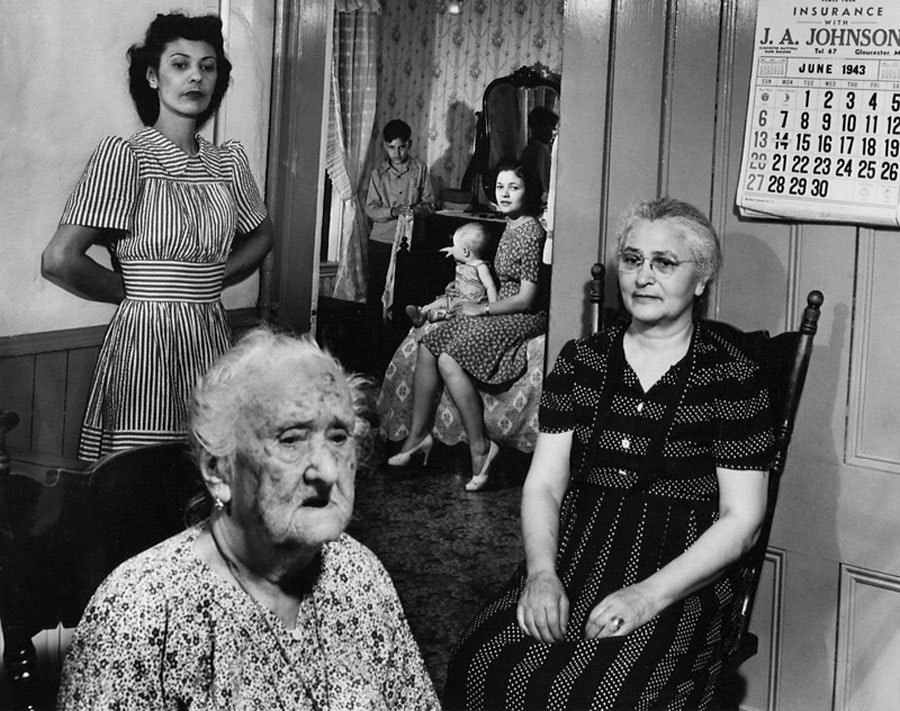
Gordon Parks (American, 1912-2006) 'Mary Machado, Mother of Isabell Lopez, and Family, Gloucester, Massachusetts' 1943


Gordon Parks (American, 1912-2006)
Mary Machado, Mother of Isabell Lopez, and Family, Gloucester, Massachusetts
1943
Gelatin silver print
© The Gordon Parks Foundation


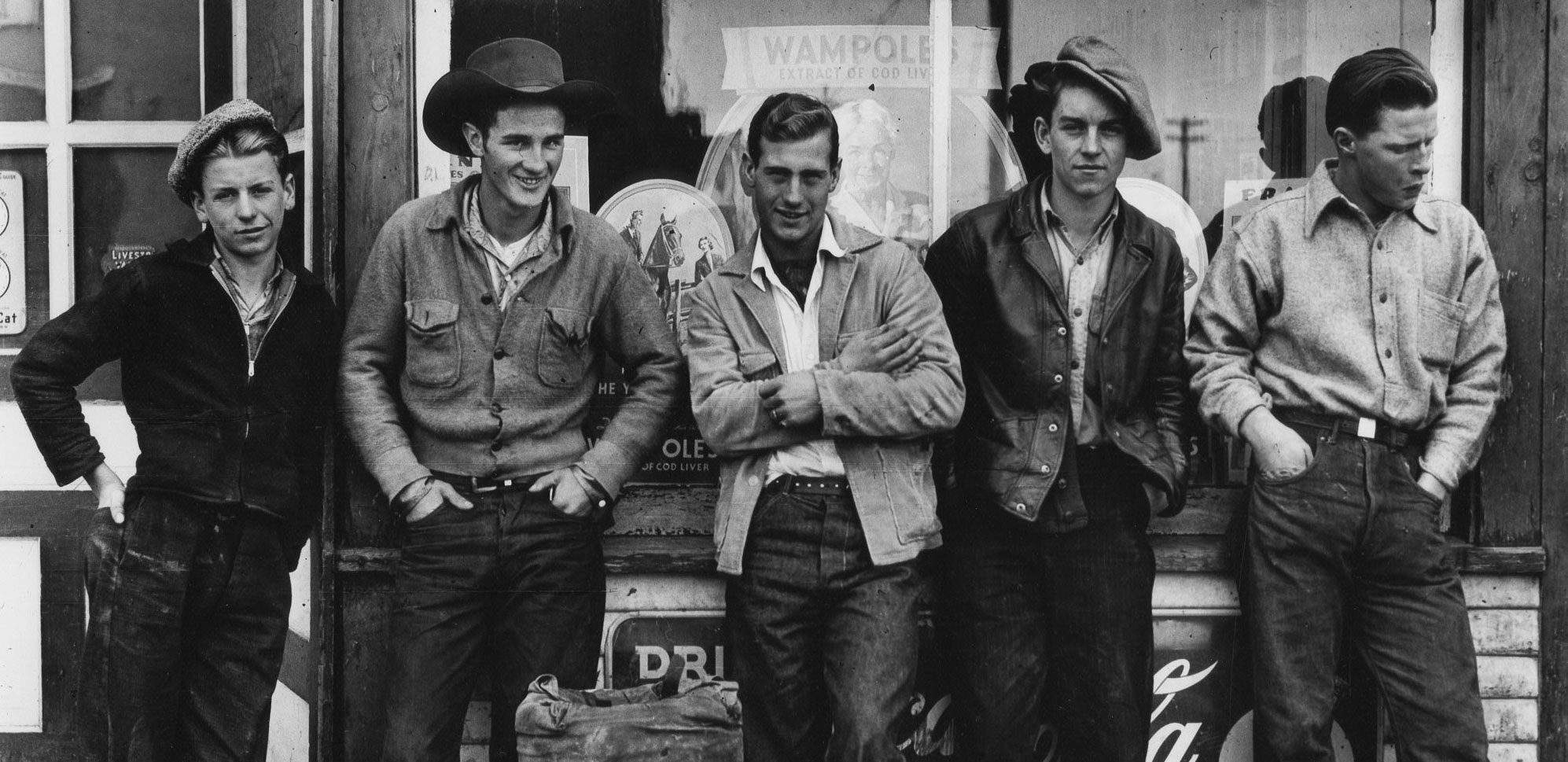
Gordon Parks (American, 1912-2006) 'Drugstore Cowboys, Turner Valley, Canada' 1945


Gordon Parks (American, 1912-2006)
Drugstore Cowboys, Turner Valley, Canada
1945
Gelatin silver print
9 7/8 x 12 7/8 inches
Modern print
© The Gordon Parks Foundation


Gordon Parks (American, 1912-2006) 'Untitled' 1950


Gordon Parks (American, 1912-2006)
Untitled
1950
Gelatin silver print
© The Gordon Parks Foundation


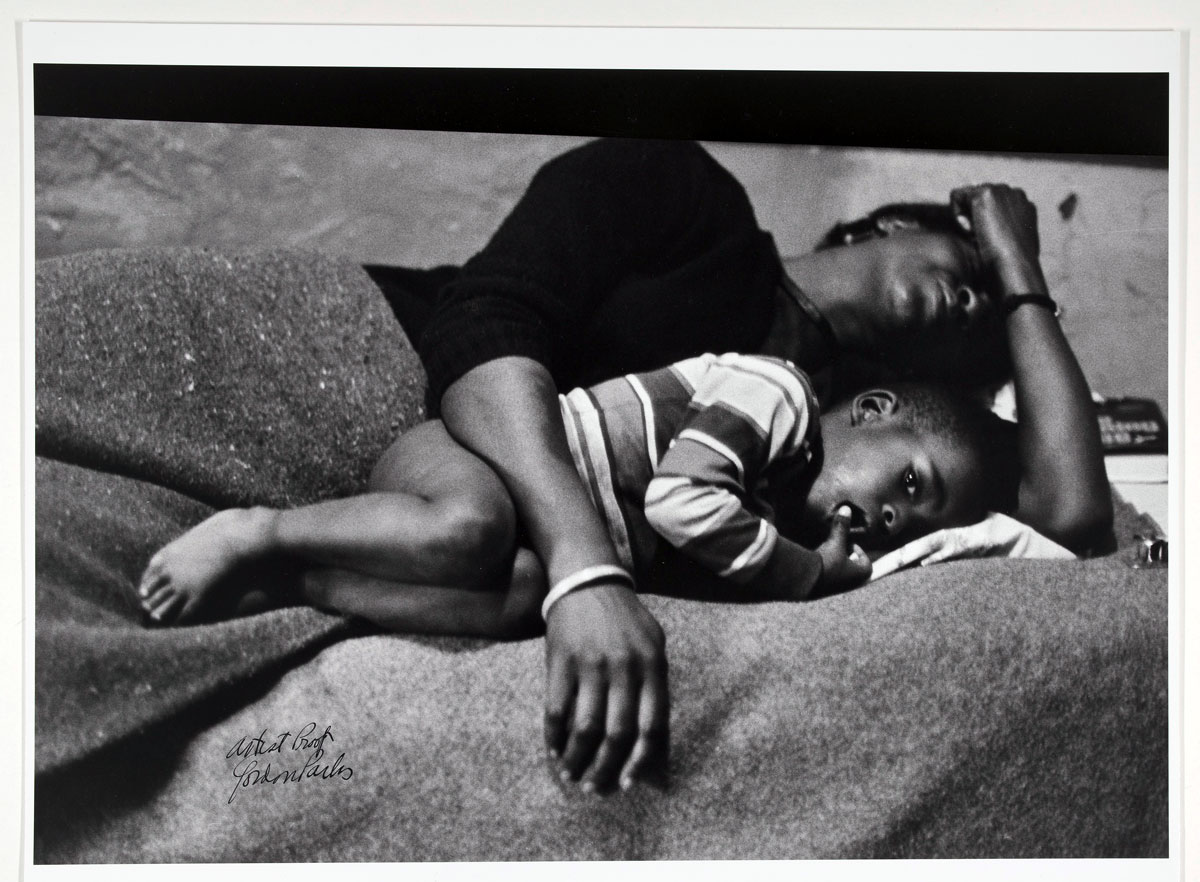
Gordon Parks (American, 1912-2006) 'Tenement Dwellers, Chicago, Illinois' 1950


Gordon Parks (American, 1912-2006)
Tenement Dwellers, Chicago, Illinois
1950
Gelatin silver print
7 x 9 inches
Modern print
© The Gordon Parks Foundation


Gordon Parks (American, 1912-2006) 'Mysticism, Harlem, New York' 1952


Gordon Parks (American, 1912-2006)
Mysticism, Harlem, New York
1952
Gelatin silver print
10 5/8 x 10 3/8 inches
Vintage print
© The Gordon Parks Foundation


Gordon Parks (American, 1912-2006) 'Harlem Neighborhood, Harlem, New York' 1952


Gordon Parks (American, 1912-2006)
Harlem Neighborhood, Harlem, New York
1952
Gelatin silver print
10 3/8 x 13 1/2 inches
Vintage print
© The Gordon Parks Foundation


Gordon Parks (American, 1912-2006) 'The Invisible Man, Harlem, New York' 1952


Gordon Parks (American, 1912-2006)
The Invisible Man, Harlem, New York
1952
Edition 1 of 10
Pigment print
14 1/8 x 14 inches
Modern print
© The Gordon Parks Foundation


Gordon Parks (American, 1912-2006) 'Muhammad Ali' 1966


Gordon Parks (American, 1912-2006)
Muhammad Ali
1966
Gelatin silver print
© The Gordon Parks Foundation


Gordon Parks (American, 1912-2006) 'Ellen's Feet, Harlem, New York' 1967


Gordon Parks (American, 1912-2006)
Ellen’s Feet, Harlem, New York
1967
Gelatin silver print
6 1/4 x 9 3/8 inches
Modern print
© The Gordon Parks Foundation


Gordon Parks (American, 1912-2006) 'Norman Fontenelle, Sr., Harlem, New York' 1967


Gordon Parks (American, 1912-2006)
Norman Fontenelle, Sr., Harlem, New York
1967
Gelatin silver print
13 x 9 1/8 inches
Modern print
© The Gordon Parks Foundation


Gordon Parks (American, 1912-2006) 'Bessie and Little Richard the Morning After She Scalded Her Husband, Harlem, New York, 1968' 1968


Gordon Parks (American, 1912-2006)
Bessie and Little Richard the Morning After She Scalded Her Husband, Harlem, New York, 1968
1968
Gelatin silver print
© The Gordon Parks Foundation


Jenkins Johnson Gallery
1275 Minnesota Street, #200
San Francisco, CA 94107
Phone: 415.677.0770

Opening hours:
Tuesday – Saturday 11am – 5pm

Jenkins Johnson Gallery website

LIKE ART BLART ON FACEBOOK

Back to top

Text: ‘Orality, (n)framing and enactment in the art of Jacqui Stockdale’ in IANN magazine Vol.8, ‘Unfound in Australia’, October 2012

January 2013


Jacqui Stockdale (Australian, b. 1968) 'Negro Returno, Long Gully' 2012


Jacqui Stockdale (Australian, b. 1968)
Negro Returno, Long Gully
2012
Type C Print
100 x 78cm


“What does it mean, to rediscover an unknown continent through the medium of photography in the 21st century? The seven artists that appear in this “Unfound in Australia” issue are well versed in the photographic technique and language familiar to modern art, yet show cultural distinctness that is nothing short of extraordinary. Our readers might experience a sense of shock or alienation from their work, which combines the new with the old. This kind of unsettling feeling may very well be an unconscious reaction to what we consider to be the ‘other.’ It is my hope that our readers will rediscover the power of photography as a chronological and visual language through these works of long under appreciated modern Australian photography.


IANN magazine
Vol.8, “Unfound in Australia,” October 2012 ‘IANN Magazine’ website [Online] Cited 06/01/2013


My text that appears in IANN magazine Vol.8, “Unfound in Australia” (October 2012) on the art of Jacqui Stockdale is a reworking of the review of her exhibition Jacqui Stockdale: The Quiet Wild at Helen Gorie Galerie in April – May 2012. It is a good piece of writing but it is the “lite” version of the text that I wrote. Instead of the “heavy” version fragmenting away on some long forgotten backup hard drive, and for those of you that like a little more conceptual meat on the bone, it is published below.

Other artists featured in the Volume 8 edition of IANN magazine include Marian Drew, Henri Van Noordenburg, Justine Khamara, Magdalena Bors and Christian Thompson.

Dr Marcus Bunyan


Orality, (n)framing and enactment in the art of Jacqui Stockdale

The concept of Orality is important in the art of Australian Jacqui Stockdale for her works are visual tone poems. Portraying identities in flux, her mythological creatures rise above the threshold of visibility to engage our relationship with time and space, to challenge the trace of experience.

Stockdale uses the body not as passive object but as descriptive and rhapsodic theme, the body as pliable flesh acting as a kind of threshold or hinge of experience – between interior and exterior, viewer and photograph, longing and desire. Drawing on personal places and stories, assemblage and performance (the process of painting the models and the outcome of this interaction), Stockdale creates a wonderful melange of archetypal characters that subvert traditional identities and narratives. Her creatures “shape-shift” and frustrate attempts at categorisation and assimilation.

The artist inverts cultural stereotypes (which embody elements of fixity, repetition, and ambivalence) located within the realms of the fetish, the scopic, and the Imaginary in order to dis/place the collective memory of viewers that have been inscribed with a stereotypical collective vernacular. In this process the work elides “fantasy” which Bhabha suggests plays a formative role in colonial exercises of power.1 In Stockdale’s upside-down world (quite appropriate for the “land down under”), “Each new identity is one of inversion; man becomes woman, child becomes adult, animals transform into humans and vice-versa.”2

An example of this inversion can be seen in her latest series of photographs, The Quiet Wild (2012). Here Stockdale unsettles traditional textual readings, the titles of her photographic portraits indecipherable to the uninitiated, a coded language of identity and place. Lagunta, Leeawuleena and Jaara for example, are three Aboriginal names meaning, respectively, Tasmanian Tiger, the name for the land around Cradle Mountain on that island and the name for the Long Gully region around Bendigo, Victoria (Stockdale’s native area); El Gato is the cat and Gondwanan the name for the southernmost of two supercontinents (the other being Laurasia) before the world split apart into the structure that we known today.

Stockdale’s performative tactics and multiple modes of address, her polyvocal subject if you like, may be said to be an effect of intertextuality3: “a conscious recognition and pursuit of an altogether different set of values and historical and cultural trajectories.”4 Undeniably her re-iterations and re-writings of cultural trajectories as ritual performative acts have links to Bakhtin’s idea of the carnivalesque and the carnival paradigm, which accords to certain patterns of play where “the social hierarchies of everyday life… are profaned and overturned by normally suppressed voices and energies.”5

It is through this “play” that the context of the photographs and their relationship to each other and the viewer are “framed.” This device emphasises the aesthetic rather than information and encourages the viewer to think about the relationship between the body, the world of which it is part and the dream-reason of time.6

This intertextual (n)framing (n meaning unspecified number in mathematics) encourages the viewer to explore the inbetween spaces in the meta-narrative, “and by leaps (intuitive leaps, poetic leaps, leaps of faith)”7 encourage escapism. Through the (n)framing of the body and the enactment of multiple selves Stockdale narrativises her mythological creatures, her charged bodies initiating new conditions of Otherness in the mise-en-scène of being. This is why her images are so powerful for her art approaches Otherness using a visual Orality and a theatrical openness that encourages disparate meanings to emerge into consciousness. It is up to us as viewers to seek the multiple, disparate significances of what is concealed in each photograph – in the myth of origin; in something that can’t be explained by man; in the expression of meaning of the things that are beyond us.

Dr Marcus Bunyan
August 2012


Footnotes

1/ “According to Bhabha, stereotypes are located within the realms of the fetish, the scopic, and the Imaginary. He suggests that fantasy plays a formative role in colonial exercises of power. Bhabha describes the mechanism of cultural stereotypes as embodying elements of fixity, repetition, fantasy, and ambivalence, and suggests that if certain types of images are constantly presented in a range of different contexts, they will become imprinted onto the collective memory of viewers and inscribed within a collective vernacular.”
Vercoe, Caroline. Agency and Ambivalence: A Reading of Works by Coco Fusco,” in Fusco, Coco. The Bodies That Were Not Ours. London: Routledge, 2001, p. 240.

2/ Stockdale, Jacqui. Artist statement 2012

3/ Intertextuality “is always an iteration which is also a re-iteration, a re-writing which foregrounds the trace of the various texts it both knowingly and unknowingly places and dis-places.” Intertexuality is how a text is constituted. It fragments singular readings. “The reader’s own previous readings, experiences and position within the cultural formation” also influences these re-inscriptions.”
Keep, Christopher, McLaughlin, Tim and Parmar, Robin. “Intertextuality,” on The Electronic Labyrinth website [Online] Cited 13/11/2011

4/ Fisher, Jean. “Witness for the Prosecution: The Writings of Coco Fusco,” in Fusco, Coco. The Bodies That Were Not Ours. London: Routledge, 2001, pp. 227-228.

5/ Anon. “Carnivalesque,” on the Wikipedia website. [Online] Cited 13/05/2012

6/ Bacon, Julie Louise. “Liquid Archive: On Ambivalence,” in Liquid Archive. Melbourne: Monash University Museum of Art (MUMA), 2012, p. 119

7/ Kirshenblatt-Gimblett, Barbara. “The Museum – A Refuge for Utopian Thought,” in Rüsen, Jörn; Fehr Michael, and Ramsbrock, Annelie (eds.). Die Unruhe der Kultur: Potentiale des Utopischen. Velbrück Wissenschaft, 2004. In German.


Marcus Bunyan writings

LIKE ART BLART ON FACEBOOK

Back to top

Exhibition: ‘America in View: Landscape Photography 1865 to Now’ at the Museum of Art Rhode Island School of Design, Providence

Exhibition dates: 21st September 2012 – 13th January 2013

 

Unknown artist (American). 'Providence Panorama from Grosvenor or Bannigan Building' c. 1900


Unknown artist (American)
Providence Panorama from Grosvenor or Bannigan Building
c. 1900
Six cyanotype prints
RISD Museum: Mary B. Jackson Fund


I hope you enjoy this HUGE posting. There are some rare photographs and little known artists. I have kept the photographs in the sections of the exhibition as explained by the accompanying wall text. Three essays from the catalogue investigating history, landscape and photography can be found as pdfs below, essential reading for anyone interested in the subject (especially the first two essays):

Douglas Nickel. Photography, Perception, and the Landscape 2012 (645kb pdf)
Deborah Bright. Photographing Nature, Seeing Ourselves 2012 (2Mb pdf)
Jan Howard. Landscape as Stage 2012 (775kb pdf)

Dr Marcus Bunyan


Many thankx to  the Museum of Art Rhode Island School of Design for allowing me to publish the text and most of the photographs in the posting (the others I researched myself). Please click on the photographs for a larger version of the image.


“An understanding of landscape theory therefore suggests that not every photograph of land is a landscape, and not every landscape necessarily features the land. The standard definition points to places – places in the world, or places seen in pictures – which take on the quality of a thing. But “landscape” is probably better understood as that set of expectations and beliefs – about both the environment and the conventions of its representation – that we project upon the world. These conventions and expectations are subject to historical change and are culturally specific…”


Douglas Nickel. ‘Photography, Perception, and the Landscape’ 2012 in ‘America in View: Landscape Photography 1865 to Now’ catalogue, p. 26


“Once continental expansion had reached its limits, however, and no existential threats to white settlement remained, American landscape images began to reflect a new criticality – at turns romantic and realistic – that persists to this day. Indeed, for the last century, landscape photography has consistently mirrored Americans’ anxieties about nature, or rather its imminent loss, whether due to industrialisation, pollution, population growth, real estate profiteering, or bioengineering. Alternately portraying nature as a balm for the alienated modern soul or a dystopian fait accompli, modern and postmodern photographic landscapes mark a progressively disquieting understanding of humanity’s relationship to the natural universe.”


Deborah Bright. Photographing Nature, Seeing Ourselves 2012 in America in View: Landscape Photography 1865 to Now catalogue, p. 32
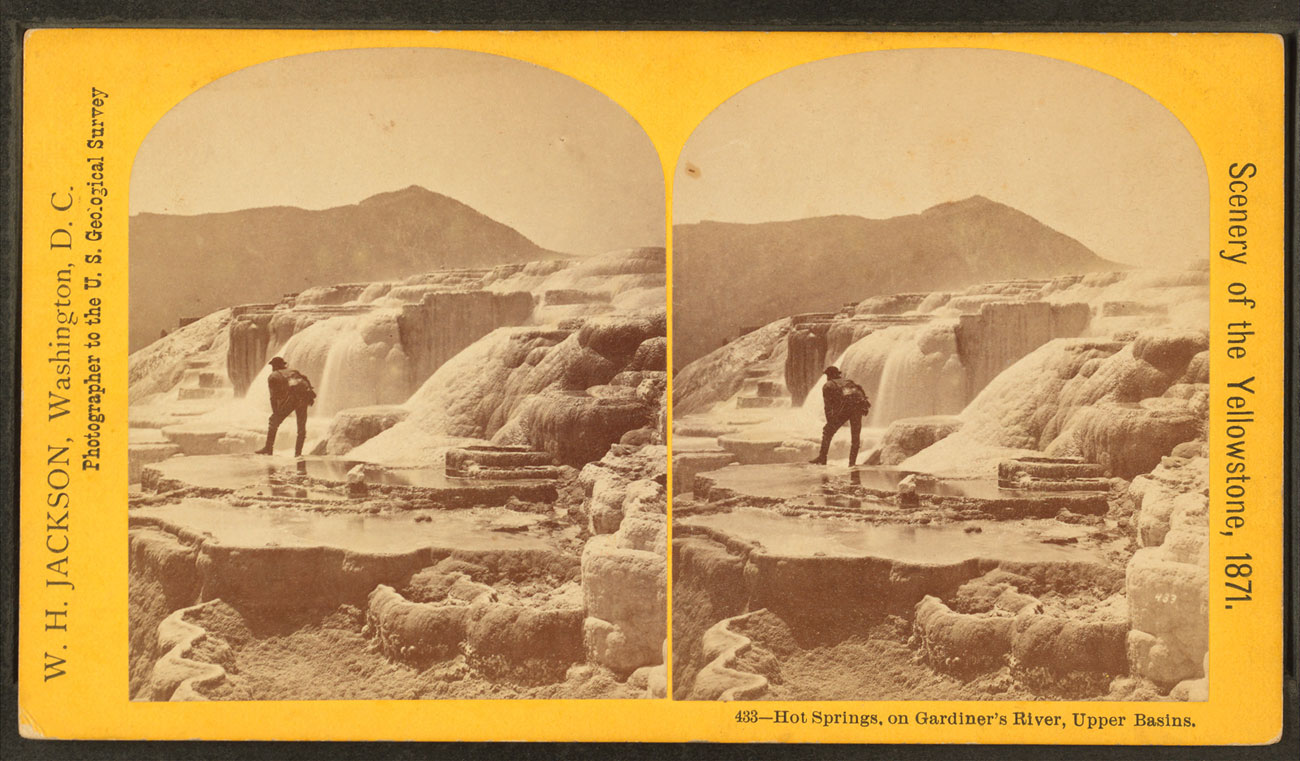


William Henry Jackson (American, 1843-1942) 'Gardiners River Hot Springs, Diana's Baths' 1871


William Henry Jackson (American, 1843-1942)
Gardiners River Hot Springs, Diana’s Baths
1871
From U.S. Geological Survey of the Territories
Albumen print
RISD Museum: Jesse Metcalf Fund


In this photograph William Henry Jackson captures the painter Thomas Moran, who was also part of the 1871 survey team. Shot from slightly below and at a distance, the photograph emphasises the textures of the mineral deposits in the foreground, while Moran’s figure seems dwarfed by the rock formations around him. Jackson often included figures in his photographs to impart a sense of scale. This inclusion of a single figure also heightens the impression that the photograph has captured a moment of discovery, the first contact between intrepid explorers and an uncharted land.
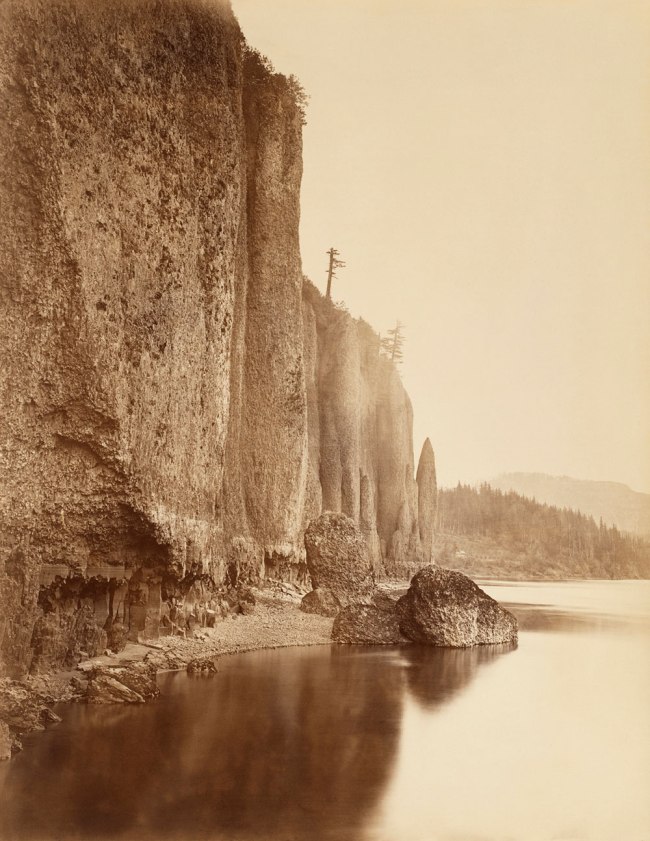
 

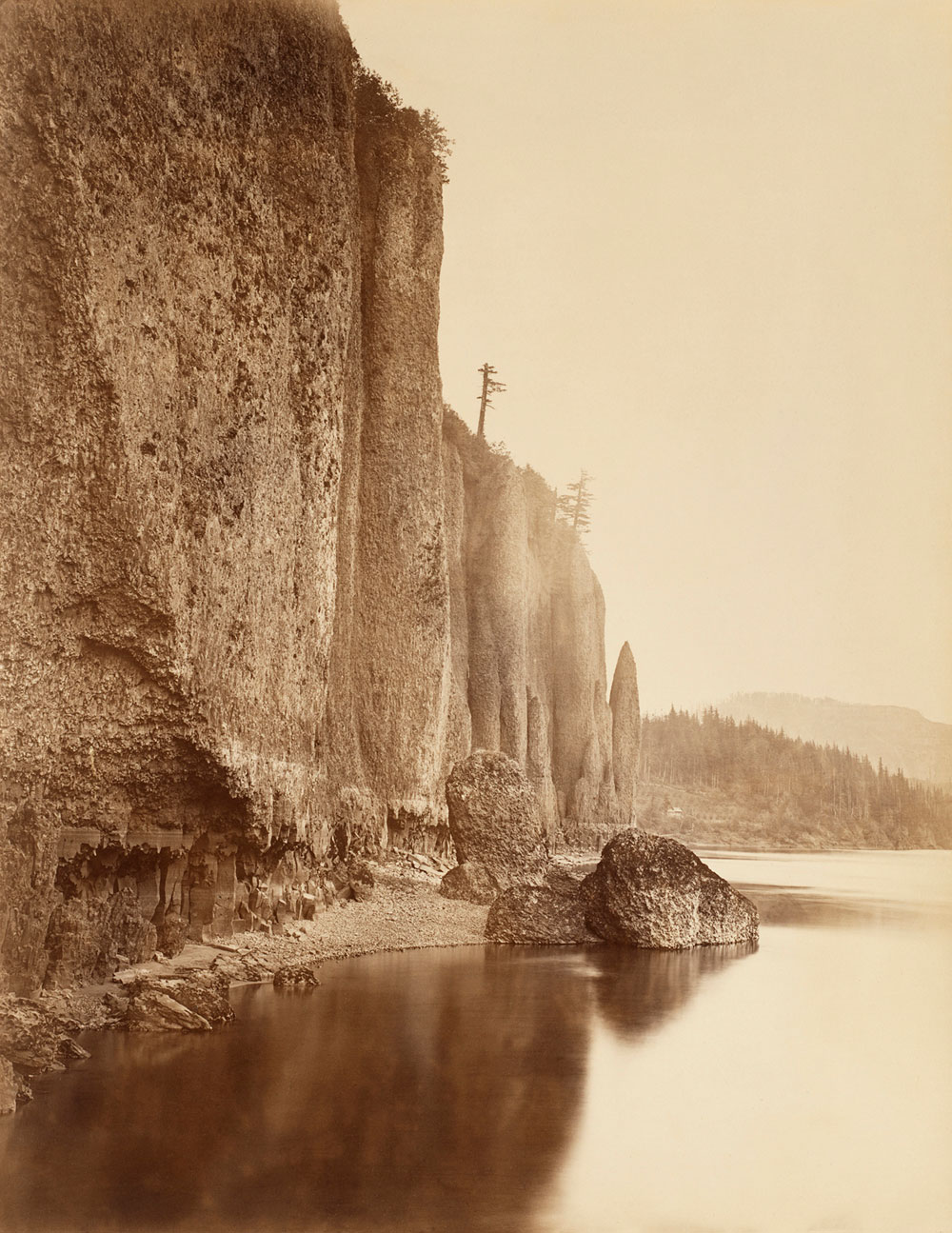
Carleton E. Watkins (American, 1829-1916) 'Cape Horn, Columbia River' 1867


Carleton E. Watkins (American, 1829-1916)
Cape Horn, Columbia River
1867
Helen M. Danforth Acquisition Fund.
Museum of Art Rhode Island School of Design, Providence


Cape Horn, Columbia River exemplifies not only the fine detail characteristic of Carleton Watkins’s images, but also his close attention to pictorial structure. Unlike many of the photographers represented in this gallery, Watkins worked independently of industrial concerns or government sponsorship. To make images that would appeal to an audience more familiar with traditional art forms, Watkins borrowed long-established conventions of landscape paintings, in particular carefully modulated lighting effects and harmonious compositions. Like the painters he emulated, Watkins depicts the West as a romantic wilderness and place of spiritual refuge.
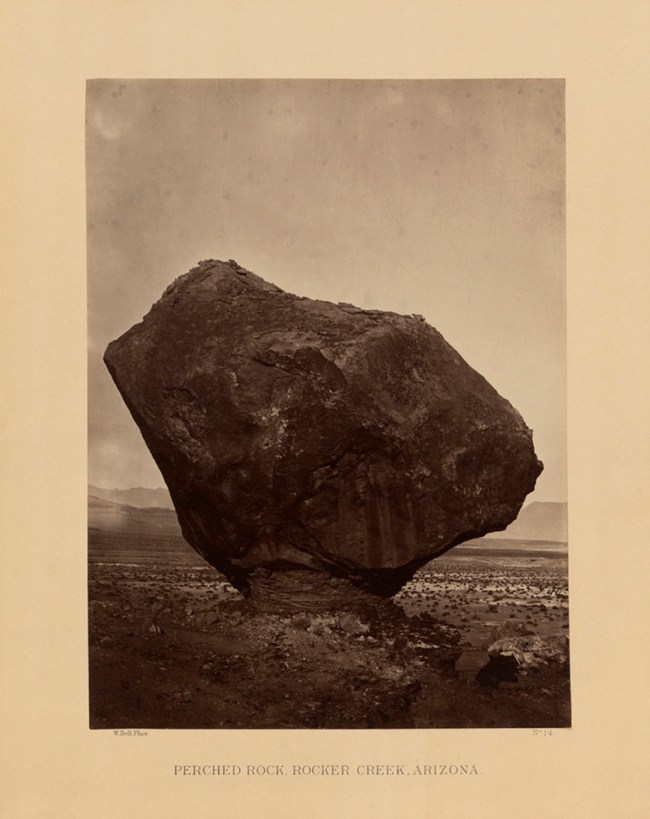
 

William H. Bell (American, 1830-1910) 'Perched Rock, Rocker Creek, Arizona' 1872


William H. Bell (American, 1830-1910)
Perched Rock, Rocker Creek, Arizona
1872
From the album Explorations and Surveys West of the 100th Meridian
Albumen print
Jesse Metcalf Fund. Museum of Art Rhode Island School of Design, Providence


Surveying the Field

At the end of the American Civil War photographers turned their lenses toward both the wild territories of the West and scenic tourist destinations in the newly established national parks. Although these images are now commonly exhibited in art museums, they were not originally considered art objects, nor were the photographers who made them considered artists. Instead, many of the photographers represented here were hired to document the projects of governmental agencies and the progress of federal survey expeditions to the western territories. Others produced images for the growing tourist market or recorded the construction of tracks through the country’s interior for railroad companies. The majority of these images were published in governmental reports and presentation albums.

The albumen prints produced in America through the 1880s were made from glass-plate negatives created by the laborious process of coating glass plates the size of the prints with a thick photosensitive solution called collodion. These plates had to be prepared on-site, exposed, and developed before the collodion dried, so photographers traveled with portable darkrooms. The prints were made later in a studio by placing paper coated with albumen (solution suspended in egg whites) under a glass-plate negative and exposing the paper to sunlight. By contact printing on this glossy surface, the image was recorded in minute detail.


Timothy O'Sullivan (American born Ireland, 1840-1882) 'Water Rhyolites, Near Logan Springs, Nevada' 1871


Timothy O’Sullivan (American born Ireland, 1840-1882)
Water Rhyolites, Near Logan Springs, Nevada
1871
From the album Explorations and Surveys West of the 100th Meridian
Albumen print
RISD Museum: Jesse Metcalf Fund


Timothy O’Sullivan and William H. Bell, official photographers on survey expeditions through Nevada and Arizona from 1871 to 1873, disavowed the traditional conventions of landscape painting in favour of unadorned observation. Spare and anti-picturesque, O’Sullivan’s radical views – depicting the western territories as foreign-looking, even hostile – accorded perfectly with the interests of those invested in seeing these empty territories studied, secured, and settled. One scholar has postulated that O’Sullivan’s photographs were intentionally crafted to look like products of technology – optically precise, printed on glossy albumen papers – a look that stood for industrial progress within a milieu that valued the machine-made over the handmade. In Perched Rock, Rocker Creek, Arizona and Rock Carved by Drifting Sand, Below Fortification Rock, Arizona, the two photographers treat unusual rock formations like specimens, isolating them from the surrounding landscape to be examined and measured.


Luminous Realms

Kodak’s introduction of the handheld camera in 1888 made photography an affordable and popular leisure-time amusement, creating a generation of amateur photographers seemingly overnight. At the same time, photographers with artistic ambitions feared that the mechanical, point-and-shoot approach of the new “button pressers” would jeopardise the medium’s elevation to the status of high art. In response, this group of artists – who called themselves Pictorialists – emphasised the photographer’s expertise and embraced labor-intensive processes to create expressive and impressionistic images. Many favoured platinum prints because of their wide range of tones, soft contrast, and matte surface – qualities of more traditional artistic media such as drawings and etchings. The Pictorialists’ landscape photographs are especially evocative. Rather than capturing a particular place and time, they transformed the landscape into a backdrop for human emotions and actions through visual effects and the inclusion of figures.


Clarence H. White (American, 1871-1925) 'Morning' 1905


Clarence H. White (American, 1871-1925)
Morning
1905
From Camera Work, No. 23, July 1908
Photogravure
RISD Museum: Walter H. Kimball Fund
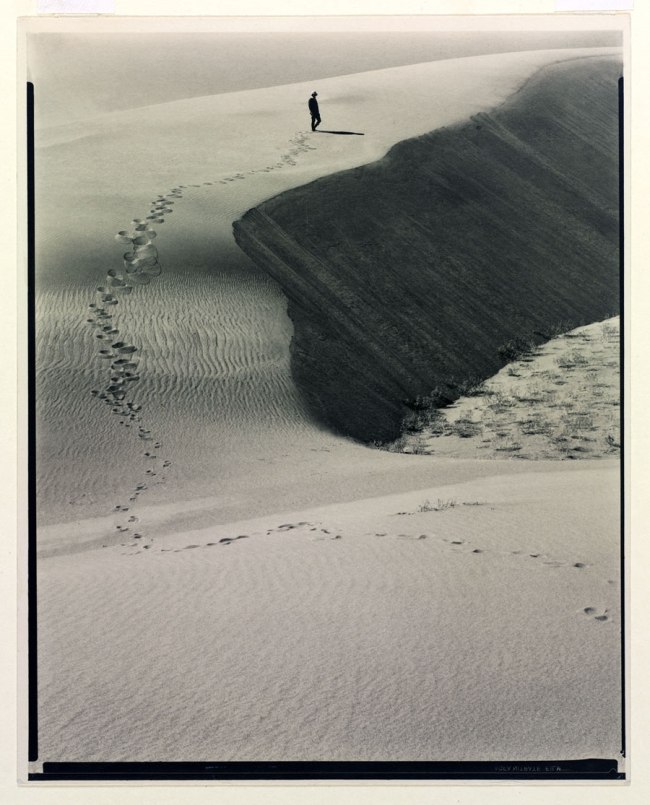
 

Laura Gilpin (American, 1891-1979) 'Footprints in the Sand' 1931


Laura Gilpin (American, 1891-1979)
Footprints in the Sand
1931
Platinum print
RISD Museum: Museum purchase with funds from the National Endowment for the Arts


Laura Gilpin portrays the Colorado sand dunes in the soft-focus style of the Pictorialists, but the reductive forms of her composition are strikingly modern. The sinuous lines of the wind-sculpted dunes are echoed in the subtle patterning of the figure’s footprints. His presence not only provides a sense of scale, but suggests that the human impact on the landscape can be small, fleeting, and beautiful.


Abstracting Nature

In the 1920s, photographers began to question whether Pictorialism was the style best suited to win acceptance for photography as a fine art. On the east coast, Alfred Stieglitz, who had formerly championed Pictorialism, became its most vocal critic. In northern California, a group of photographers who would come to call themselves Group f/64 developed a new style. Opposing the soft focus, painterly approach, the f/64 photographers embraced a hard-edged, sharp-focus machine aesthetic. Optical reality was transformed into surface pattern, rhythm, tone, and line in prints precisely detailed on glossy, gelatin silver papers. Indeed, f/64 refers to the smallest aperture on their large-format cameras, which resulted in sharp focus from foreground to background.

This period revitalised landscape photography, with many photographers looking to views of nature as a place to escape from the problems of urban life. These photographers captured instants of intensified vision that only the camera offered, creating the photograph mentally before it was realised physically. Whether majestic views of dramatic natural features or abstracted details of quiet settings, these images expressed metaphysical, ethical, or personal reflections on humankind’s relationship to nature.
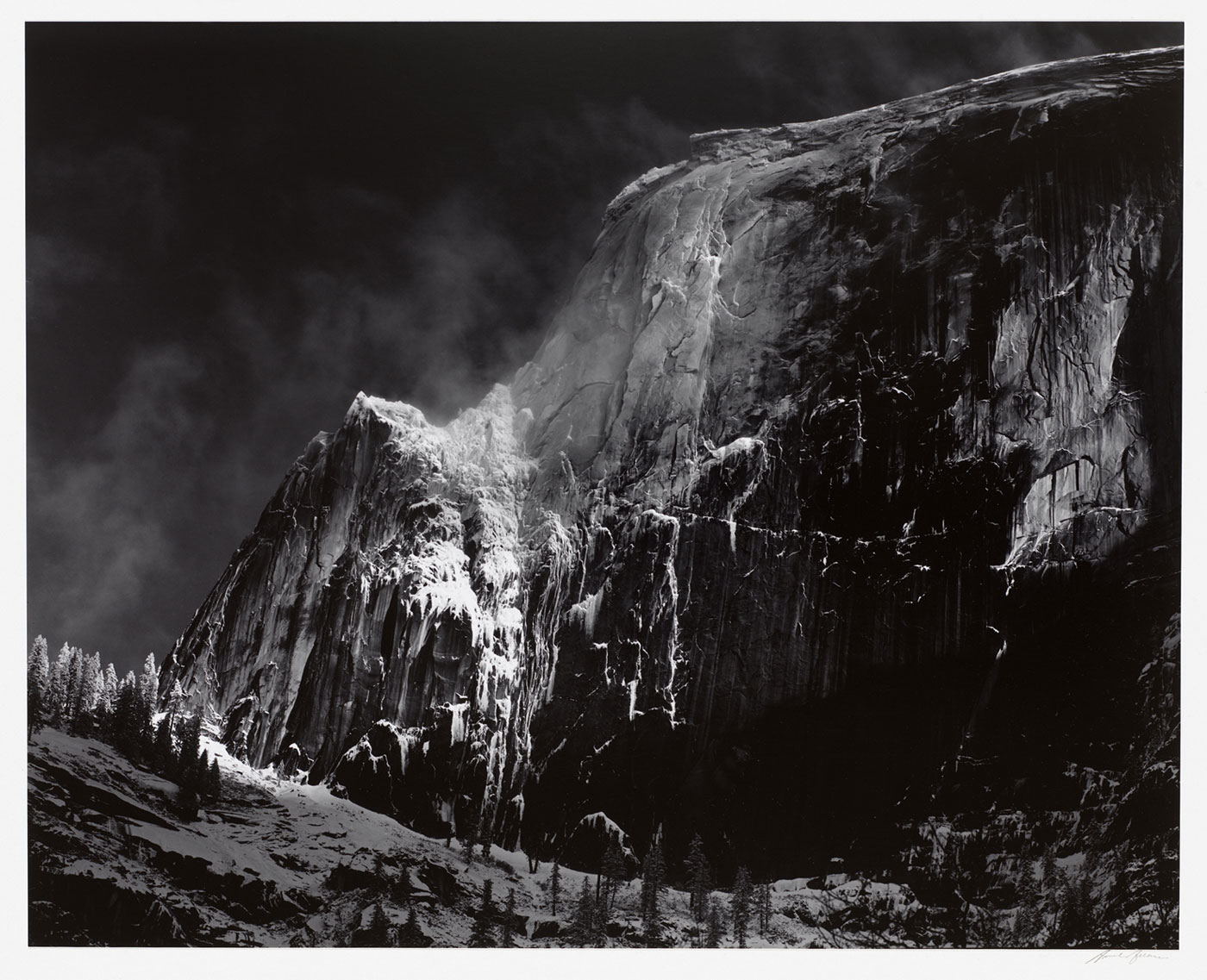
 

Ansel Adams (American, 1902-1984) 'Half Dome, Blowing Snow, Yosemite National Park, California' c. 1955


Ansel Adams (American, 1902-1984)
Half Dome, Blowing Snow, Yosemite National Park, California
ca. 1955 (printed 1970s)
Museum purchase with funds from the National Endowment for the Arts
© 2012 The Ansel Adams Publishing Rights Trust. Museum of Art Rhode Island School of Design, Providence


This photograph depicts the iconic tourist destination of Yosemite as sublime and untouched. By removing any evidence of human impact, Ansel Adams allows us to escape (at least temporarily) from the intrusions of culture. High contrast adds visual drama to an already majestic view, capturing the textures of the rock wall and the light filtering through the blowing snow. Throughout his life, Adams embraced the notion that nature could provide the harried, urbanised citizen of the modern age with a place of spiritual refuge. A long-time member of the Sierra Club, he was a devoted and vocal advocate for wilderness conservation and his photographs were crucial to the conservation effort.
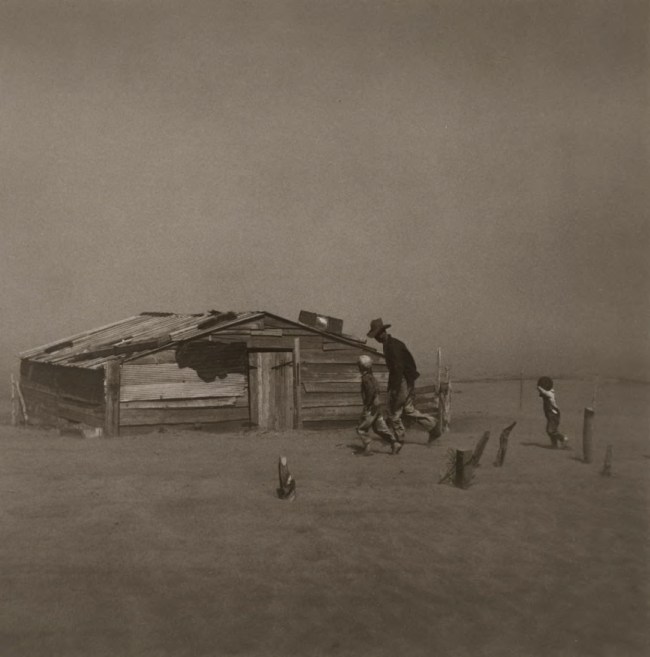
 

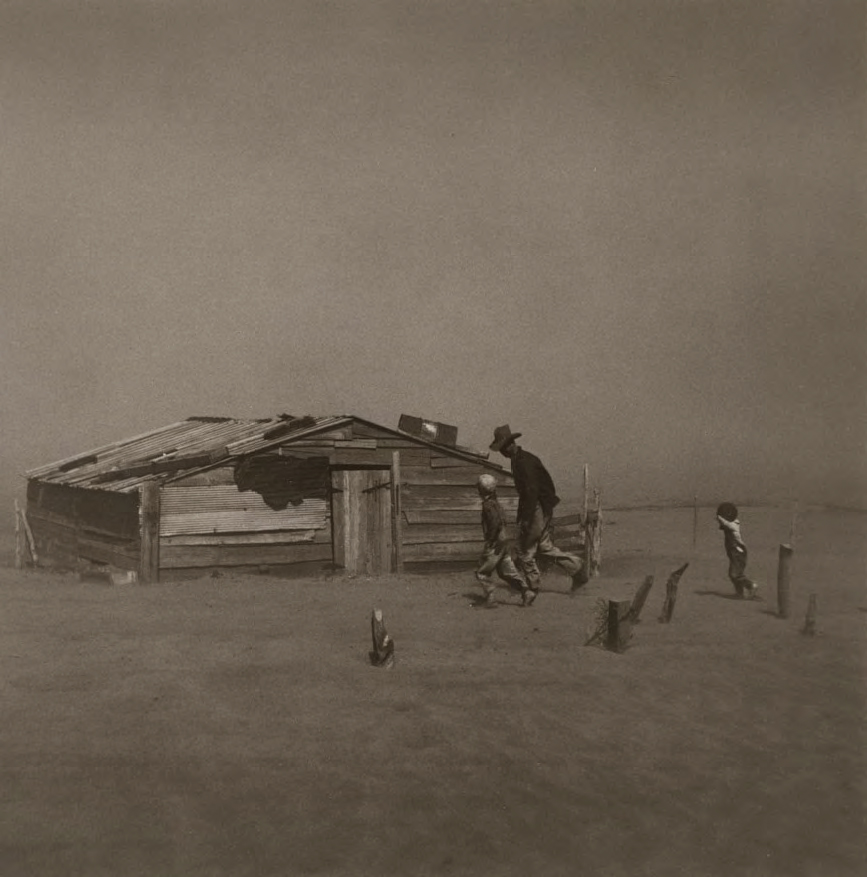
Arthur Rothstein (American, 1915-1985) 'Father and Sons Walking in the Face of a Dust Storm, Cimarron County, Oklahoma' 1936


Arthur Rothstein (American, 1915-1985)
Father and Sons Walking in the Face of a Dust Storm, Cimarron County, Oklahoma
1936
Gelatin silver print
RISD Museum: Gift of Mr. and Mrs. Gilman Angier


In 1936 Arthur Rothstein traveled to the Oklahoma panhandle, the area of the country most affected by drought, wind, and erosion. In his image (above) he captured one of the few families in the area that had not yet abandoned their farm. His portrayal of the farmer and his sons fighting to make their way home through the elements can be read as a larger statement about the struggle between man and nature. Rothstein’s dark, low contrast print further conveys the oppressive atmosphere of the dust storm.
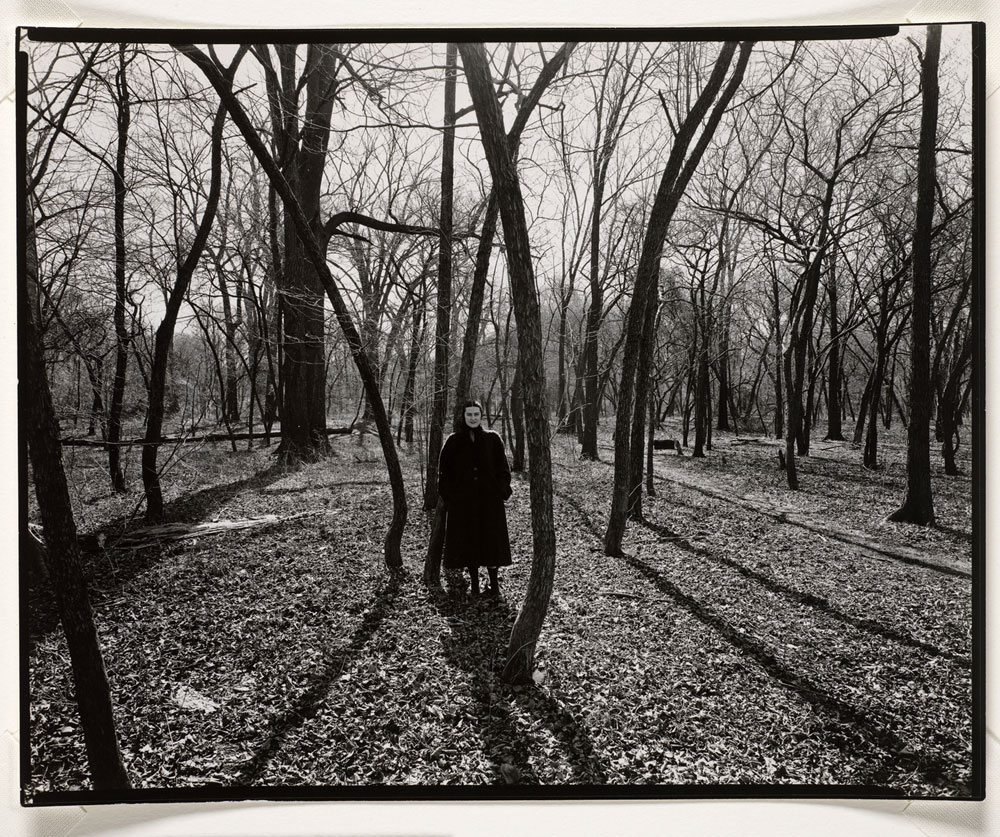
 

Harry Callahan (American, 1912-1999) 'Eleanor, Chicago' c. 1952


Harry Callahan (American, 1912-1999)
Eleanor, Chicago
c. 1952
Gift from Harry Callahan ca. 1953 Wayne Miller
© The Estate of Harry Callahan, courtesy Pace/MacGill Gallery, New York. Museum of Art Rhode Island School of Design, Providence
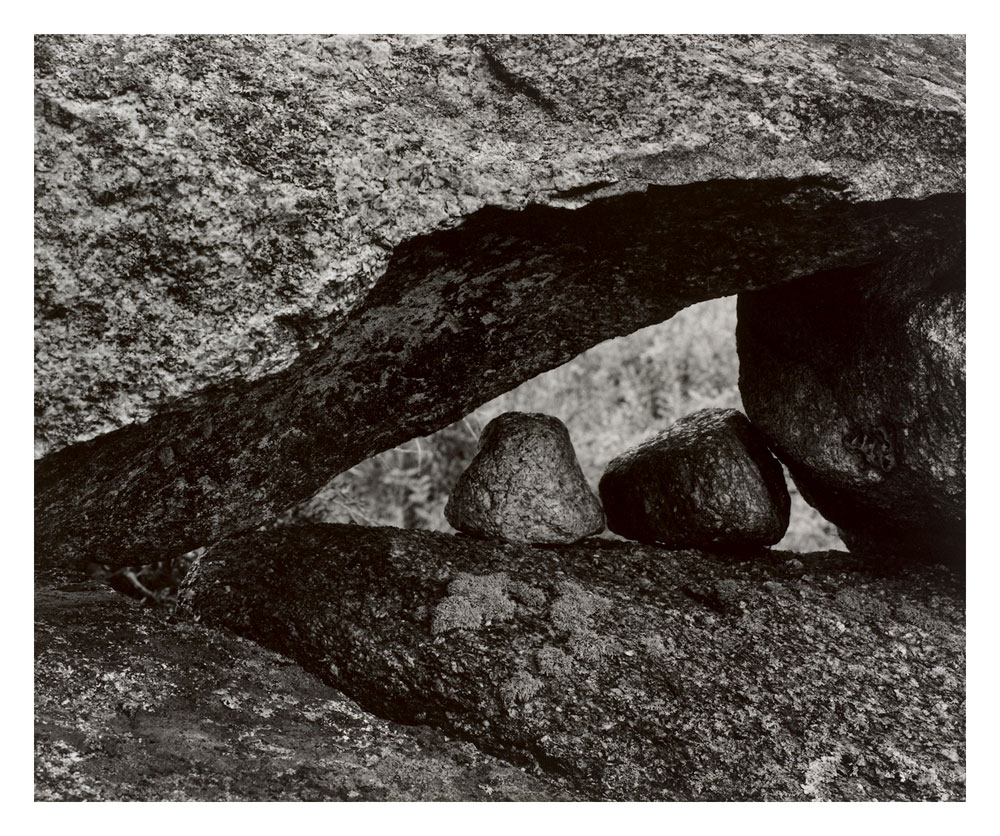
 

Aaron Siskind (American, 1903-1991) 'Martha’s Vineyard, 114B' 1954


Aaron Siskind (American, 1903-1991)
Martha’s Vineyard, 114B
1954
Gift of Mr. Robert B. Menschel. Courtesy Aaron Siskind Foundation
Museum of Art Rhode Island School of Design, Providence


In Martha’s Vineyard 114B, Aaron Siskind focuses on two small rocks nestled in a stone wall. As Siskind explained, he “began to feel the importance of how these rocks hovered over each other, touched each other, pushed against each other.” He likened this contiguity to family relationships, especially that between mother and child. He believed that the pair of rocks pictured in the photograph would – consciously or not – evoke emotions in the viewer, and that these emotions were both deep-seated and universal. In his depiction of the landscape, he found metaphors for what he called “human drama.”
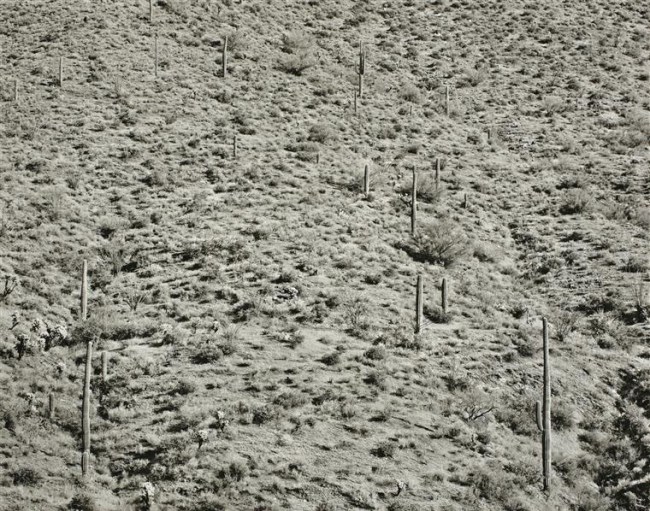
 

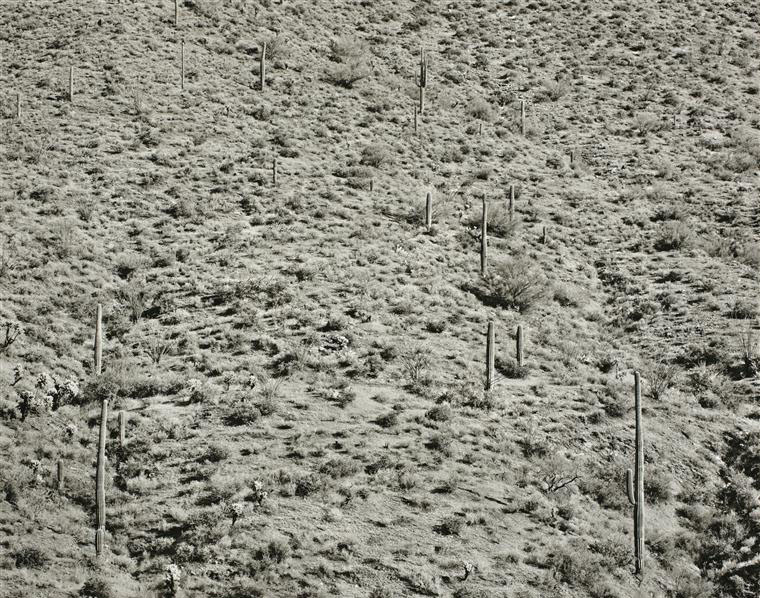
Frederick Sommer (American, 1905-1999) 'Arizona Landscape' 1943


Frederick Sommer (American, 1905-1999)
Arizona Landscape
1943
Gelatin silver print
Promised gift from the collection of Marc Harrison


Frederick Sommer’s photographs of the Arizona desert, made between about 1939 and 1945, omit the horizon line to create an overall field of pattern where scale and orientation are confounded. The vast space of the desert is pulled to the surface of the image, making the work less a landscape and more an independent construction. Sommer intently considered much of his work before executing it. He might study an area of the desert for days before deciding how to take the picture and then spend weeks in the darkroom perfecting the print.
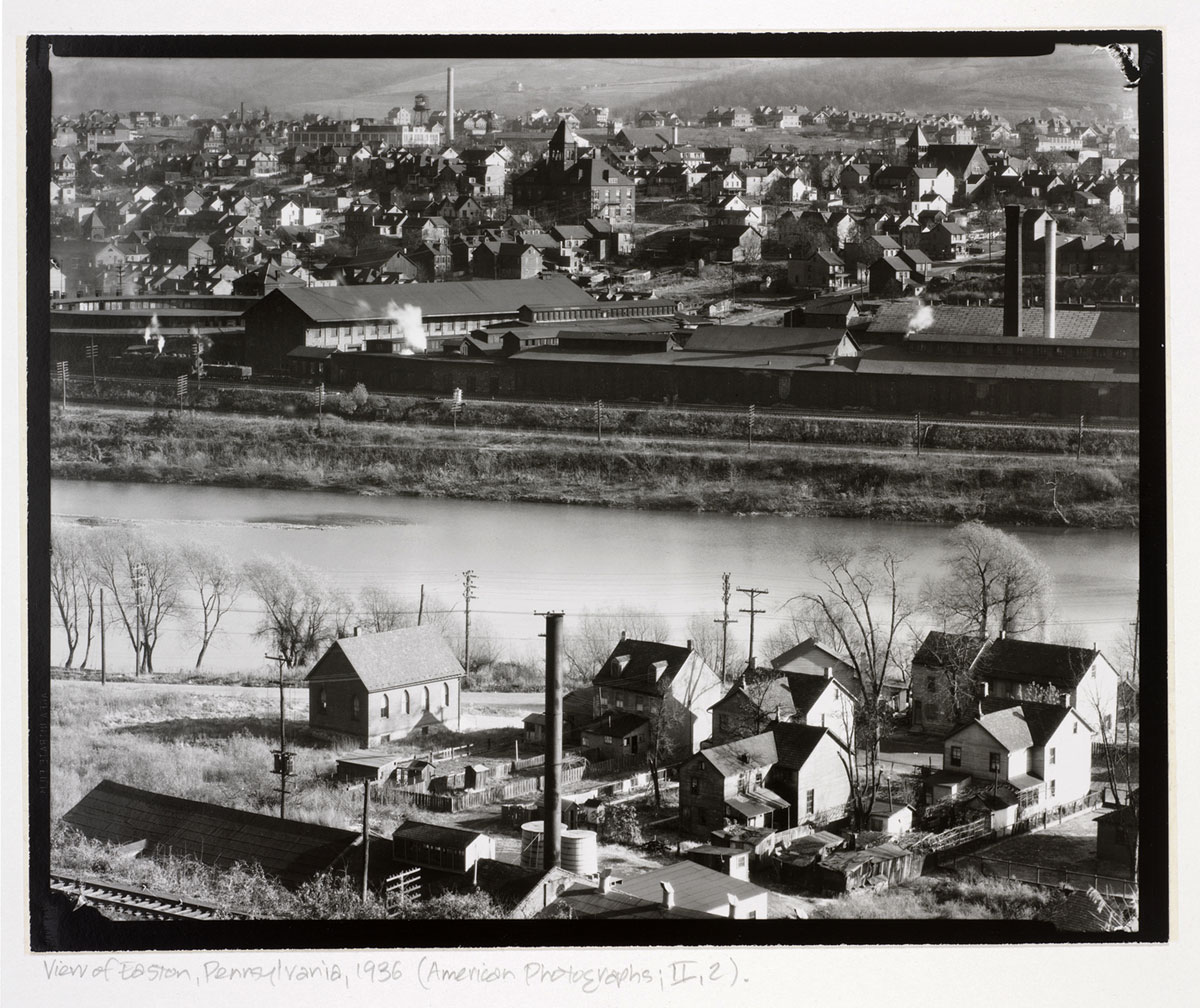
 

Walker Evans (American, 1903-1975) 'View of Easton, Pennsylvania' 1936


Walker Evans (American, 1903-1975)
View of Easton, Pennsylvania
1936
From the portfolio American Photographs II
Gelatin silver print
RISD Museum: Gift of James Dow


By compressing distance and flattening perspective, Walker Evans collapses the two cityscapes of Easton, Pennsylvania, and Phillipsburg, New Jersey, into one plane. Evans’s aesthetically neutral style seems to depict the world without the intervention of the photographer’s point of view. At the same time, he forces the details of every building and smokestack to the surface of the image, making the plight of the cities and their inhabitants – the Depression had crippled the shipping and manufacturing industries that were the lifeblood of both towns – impossible to ignore.
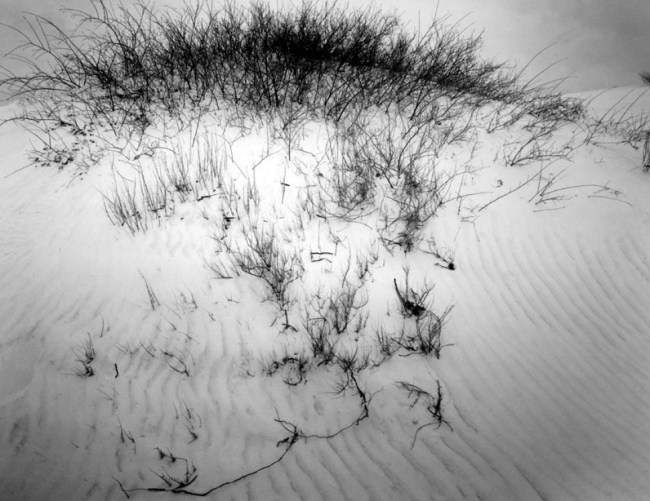
 

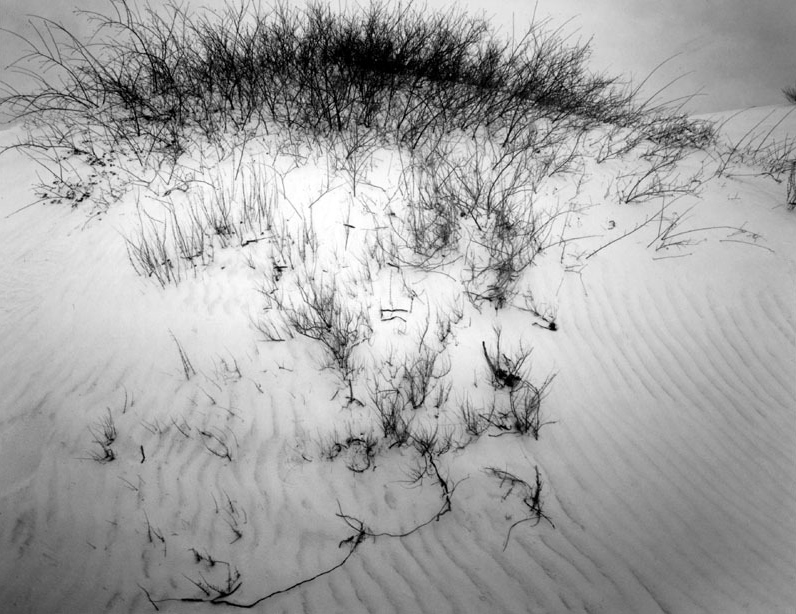
Jack Warren Welpott (American, 1923-2007) 'White Sands' 1977


Jack Warren Welpott (American, 1923-2007)
White Sands
1977
Gelatin silver print
RISD Museum: Gift of Aaron Siskind
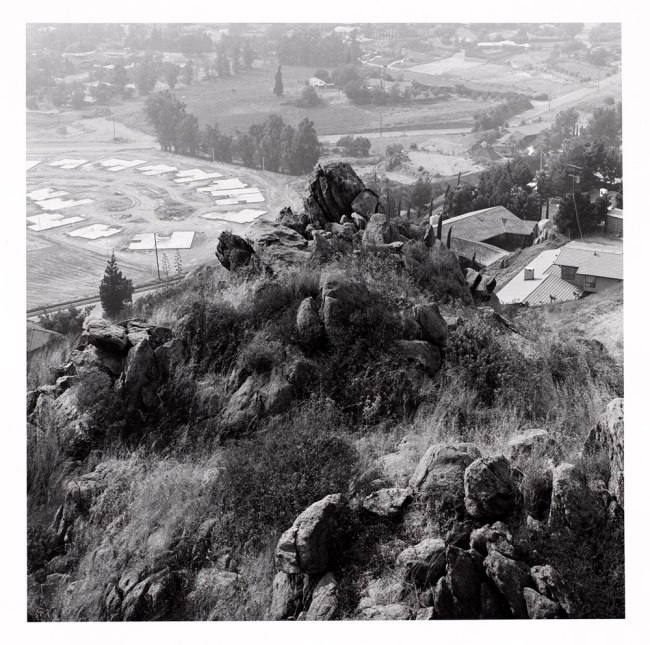
 

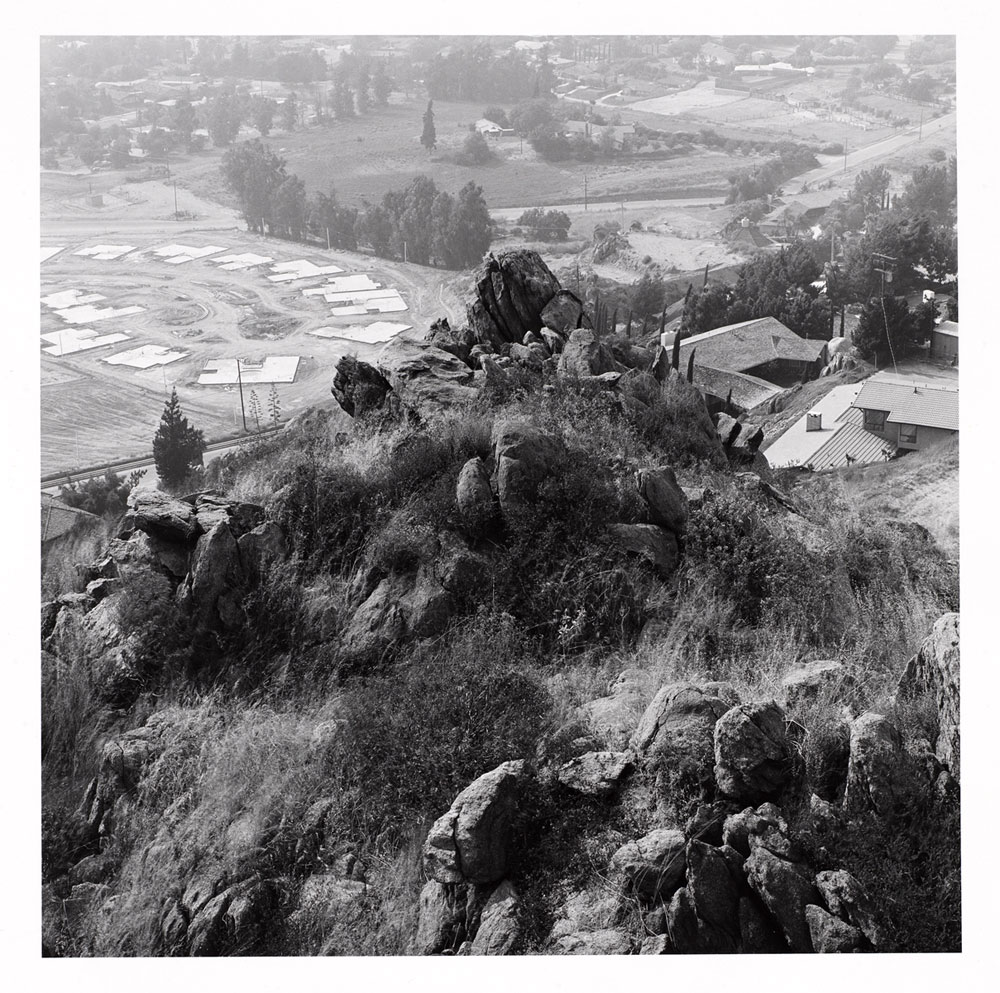
Joe Deal (American, 1947-2010) 'Colton, California' 1978


Joe Deal (American, 1947-2010) (RISD Provost 1999-2005, Faculty 2005-2009)
Colton, California
1978
From the portfolio The Fault Zone 1981
Portfolio of 19 gold-toned gelatin silver prints
Museum Purchase: Georgianna Sayles Aldrich Fund and Gift of James D. and Diane D. Burke
© The Estate of Joe Deal, courtesy Robert Mann Gallery. Museum of Art Rhode Island School of Design, Providence
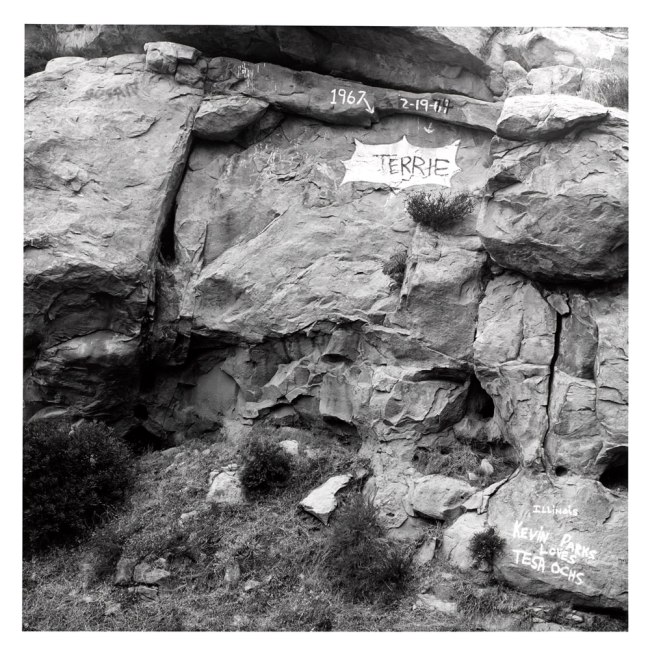
 

Joe Deal (American, 1947-2010) 'Chatsworth, California' 1980


Joe Deal (American, 1947-2010) (RISD Provost 1999-2005, Faculty 2005-2009)
Chatsworth, California
1980
From the portfolio The Fault Zone 1981
Portfolio of 19 gold-toned gelatin silver prints
Museum Purchase: Georgianna Sayles Aldrich Fund and Gift of James D. and Diane D. Burke
© The Estate of Joe Deal, courtesy Robert Mann Gallery. Museum of Art Rhode Island School of Design, Providence


Joe Deal (American, 1947-2010) 'Indio, California' 1978


Joe Deal (American, 1947-2010) (RISD Provost 1999–2005, Faculty 2005-2009)
Indio, California
1978
From The Fault Zone 1981
Portfolio of 19 gold-toned gelatin silver prints
RISD Museum: Museum Purchase: Georgianna Sayles Aldrich Fund and Gift of James D. and Diane D. Burke


Joe Deal (American, 1947-2010) 'Santa Barbara, California' 1978


Joe Deal (American, 1947-2010) (RISD Provost 1999–2005, Faculty 2005-2009)
Santa Barbara, California
1978
From The Fault Zone 1981
Portfolio of 19 gold-toned gelatin silver prints
RISD Museum: Museum Purchase: Georgianna Sayles Aldrich Fund and Gift of James D. and Diane D. Burke


Inspired by conceptual art, Joe Deal generally developed his work in series, choosing a particular location and adhering to a strict visual formula. As in The Fault Zone, his landscapes were typically square in format, viewed from above, lacking a horizon, and empty of people. Edges and divisions in nature and the landscape fascinated him, and the fault lines in California, though invisible on the surface, in many ways define that landscape. Using maps from the Los Angeles County engineering office that indicated where the fault lines were apt to be, Deal looked for sites that would metaphorically suggest volatility. The first image in the series is the only one that was actually taken on the San Andreas Fault; all others symbolically represent the fault lines with torn or disrupted terrain.


Topographic Developments

By the time the landmark exhibition New Topographics: Photographs of a Man-Altered Landscape opened in 1975, the accelerating degradation of the environment had become an inescapable reality. Inverting the Ansel Adams principle of exclusion, the exhibit voiced the belief that the landscape could no longer be portrayed as a refuge from the ills of industrial life: any consideration of the modern environment had to include both wilderness areas and the vacant lot next door.

The New Topographics photographers captured recently constructed tract homes, industrial parks, and highway culture with medium and large format cameras. As aesthetically neutral as real estate snapshots, the photographs showed the facts without offering their opinions about the rapid development they recorded. Seemingly stripped of expressivity, their photographs have the appearance of objective or “topographic” renderings rather than subjective impressions. In emphasising the landscape of the American West and experimenting with anti-Romantic landscape imagery, these photographers looked back to the works of 19th-century survey photographers and to Walker Evans’s documentary style.


Lewis Baltz (American, 1945-2014) 'Model Home, Shadow Mountain' 1977


Lewis Baltz (American, 1945-2014)
Model Home, Shadow Mountain
1977
From the portfolio Nevada
Gift from the Collection of Joe Deal and Betsy Ruppa
© Lewis Baltz. Museum of Art Rhode Island School of Design, Providence


In Nevada, Lewis Baltz alternates unbuilt views with home construction, trailer parks, and roads in a documentation of a rapidly changing landscape in the desert valleys surrounding Reno, an area he once described as “landscape-as-real-estate.” Baltz, like Joe Deal and Harold Jones, whose works are on view in this gallery, developed projects as portfolios, believing that a single photograph cannot capture a complete portrait of a place. In Baltz’s series, a multifaceted, occasionally contradictory image of Nevada emerges through the accumulation of photographs.


Thomas Barrow (American, b. 1938) 'f/t/s Cancellations (Brown) - Field Star' 1975


Thomas Barrow (American, b. 1938)
f/t/s Cancellations (Brown) – Field Star
1975
Gelatin silver print
Gift from the Collection of Joel Deal and Betsy Ruppa
© Thomas Barrow. Museum of Art Rhode Island School of Design, Providence


Barrow scratched through his landscape negatives, calling attention to the materiality of the medium itself and the fact that regardless of how much information is given, reality remains an accumulation of belief, knowledge, and one’s own experience.


Harold Henry Jones (American, b. 1940) 'With Emmet' 1978


Harold Henry Jones (American, b. 1940)
With Emmet
1978
From the portfolio Tucson
Gelatin silver print
Gift of the artist in honour of Joe Deal
© 1986 Harold Jones. Museum of Art Rhode Island School of Design, Providence


Harold Jones moved to Tucson sight unseen in 1974. The Tucson Portfolio documents his first years living in, exploring, and adapting to this unfamiliar landscape. In an accompanying text he relates his initial impressions of the Southwest, a landscape he had only seen in Westerns and “in the background of Roadrunner cartoons.” It was, he writes, “white bright and oven hot. Driving through the spiney leafless plants of the desert gave me the impression of being on an ocean floor – except someone had removed the water. A primordial landscape in a sea of light. Shocking and enchanting, at the same time.”
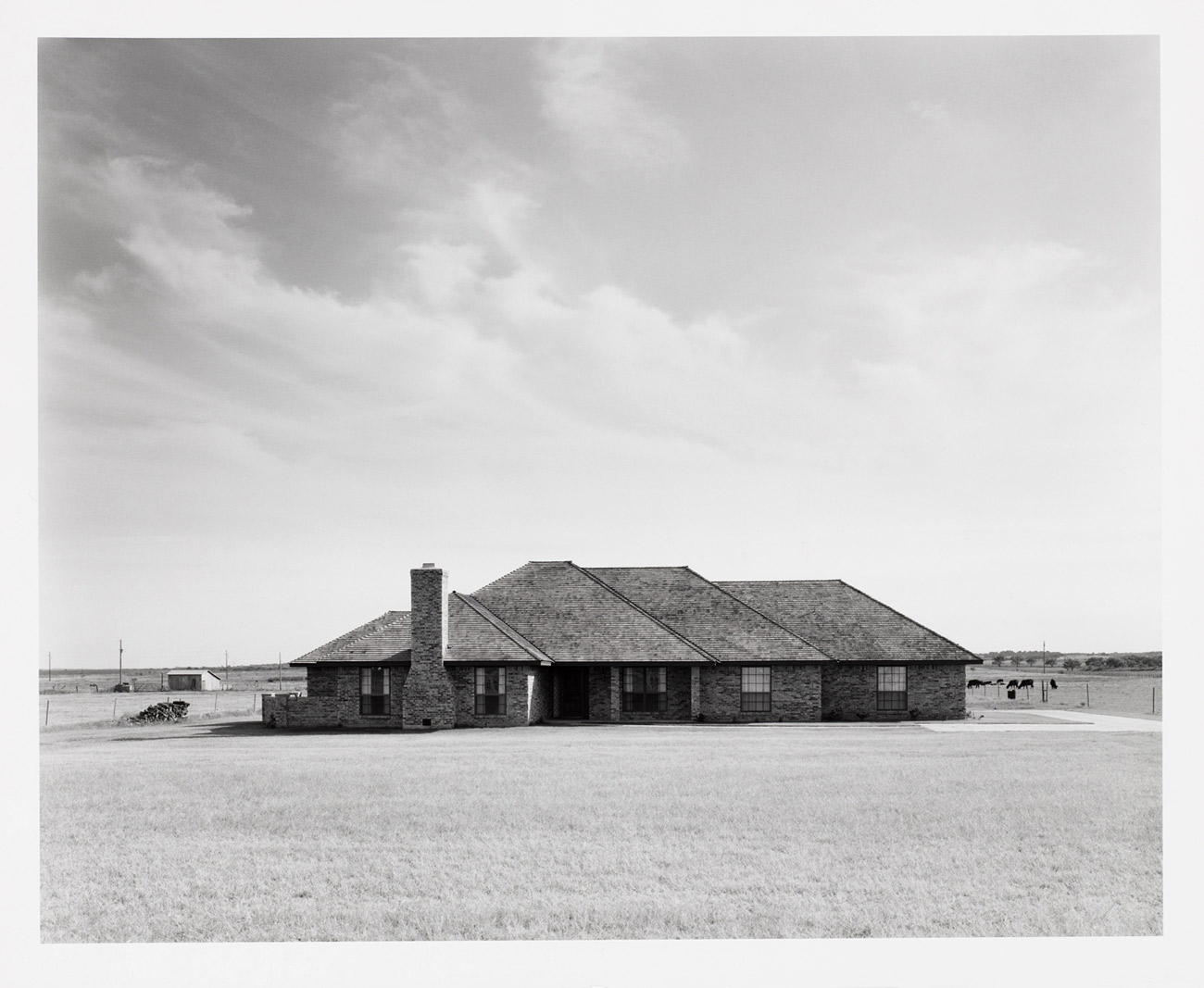
 

Frank Gohlke (American, b. 1942) 'Near Crowley, Texas' 1978


Frank Gohlke (American, b. 1942)
Near Crowley, Texas
1978
Gelatin silver print
RISD Museum: Gift from the Collection of Joe Deal and Betsy Ruppa


Lee Friedlander (American, b. 1934) 'Atlantic City, New Jersey' 1971


Lee Friedlander (American, b. 1934)
Atlantic City, New Jersey
1971
Gelatin silver print
RISD Museum: Museum purchase with funds from the National Endowment for the Arts


Garry Winogrand (American, 1928-1984) 'Utah' 1964


Garry Winogrand (American, 1928-1984)
Utah
1964
From the portfolio Garry Winogrand, 1978
Gelatin silver print
Gelatin silver prints RISD Museum: Gift of Frederick J. Myerson


In the 1960s nature was apt to be viewed from a car window or in a rear-view mirror rather than from a hilltop. The large-format magisterial views of Ansel Adams and Edward Weston were replaced by a 35mm “grab-shot” style that captured the flux and contradictions of modern life with a fresh immediacy. Photographers were among the restless peripatetics crisscrossing the continent on new interstates and side roads, retrieving evidence of the “Americas” they found. The grainy, gritty aesthetic matched the sensations and energy of this environment.


America in View: Landscape Photography 1865 to Now accompanies a major exhibition of that title tracing a history of photographs of the American landscape primarily through the collection of the RISD Museum. The show takes a broad look at the ever-evolving definition of American landscape photography – from seemingly pristine views of nature captured with 19th-century view cameras to images of the decaying contemporary urban streets composed from Google Street View. The RISD Museum’s collection of American landscape photography begins at the end of the Civil War in 1865, when photographers traveled west with government survey teams and railroad companies to record the country’s extraordinary natural features and resources. Ever since, the landscape has remained a compelling subject for photographers who have revealed through their images our nation’s ambition and failings, beauty and degradation, politics and personal stories.

The Museum of Art Rhode Island School of Design announces its major fall exhibition, America in View: Landscape Photography 1865 to Now, a broad panorama of our country’s topographies and correlating narratives that reveals a nation’s ambitions and failings, beauty and loss, politics and personal stories through about 150 photographs spanning nearly 150 years. “The landscape has inspired and challenged artists since the earliest days of our nation,” says Museum Director John W. Smith. “The remarkable works in this exhibition not only capture photography’s evolving relationship with the landscape but also trace the larger narrative of America itself.”

From the earliest images in the show, it is clear how purpose guided style. Carlton Watkins’ 1860s painterly and atmospheric views of the sublime landscape portray the wilderness as a place of spiritual renewal and a refuge from urban problems. In contrast, Timothy O’Sullivan, employed for the government’s geological surveys in the 1870s, made purposefully spare and anti-picturesque images that seemingly provide proof of empty territories needing to be studied, secured, and settled.

In her essay for America in View’s accompanying catalogue, photographer Deborah Bright, chair of the Fine Art Department at Pratt Institute, suggests that some of the historical shifts in environmental consciousness seen in the photographs “illuminate how the works also reflect changing conceptions of landscapes as bearers of cultural meaning.” Ansel Adams, whose mid-20th-century views of nature’s majesty and vastness represent many people’s ideals of American landscape photography, omitted human impact on the land. Widely used by the Sierra Club, his stunning images of untouched wilderness encouraged conservation in the face of an increasingly industrial society.

By the 1970s, artists including the late RISD provost and photography professor Joe Deal saw that the environment entailed both wilderness and the vacant lot next door. Their “New Topographics” imagery depicts recently constructed tract homes, industrial parks, and highway culture – inverting Adams’ exclusion. “‘Landscape’ is probably better understood as that set of expectations and beliefs… we project upon the world,” explains Brown University art historian Douglas Nickel, in the catalogue. “Not every photograph of land is a landscape, and not every landscape necessarily features the land.”

The past 20 years reveal a return to romantic views of the landscape, even in its degraded state, often including figures to create narratives. Justine Kurland’s landscape under an overpass shows a stunning place of fantasy and escape. RISD alumnus Justin Kimball explores fantasies of finding wilderness in public parks – where instead we find others seeking the same.

Press release from the RISD website


Barbara Bosworth (American, b. 1953) 'Niagara Falls' 1986


Barbara Bosworth (American, b. 1953)
Niagara Falls
1986
Gelatin silver print
Private collection
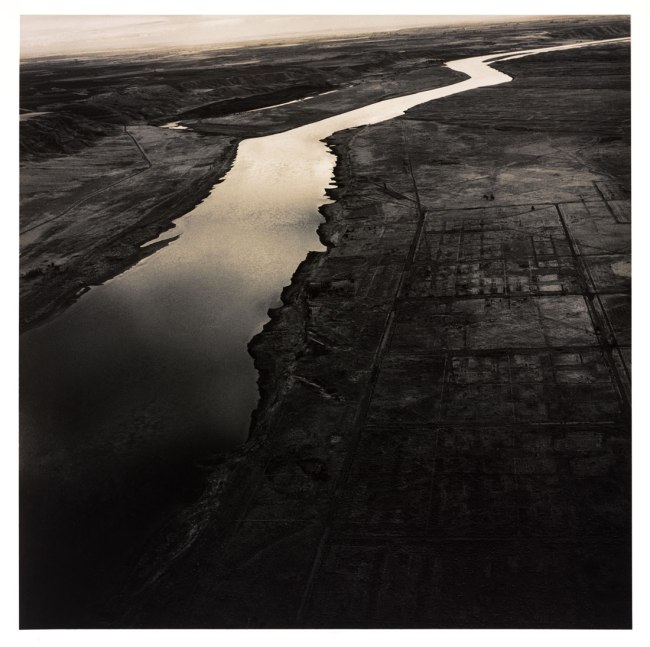
 

Emmet Gowin (American, b. 1941) (RISD MFA 1967) 'Old Hanford City Sites and the Columbia River, Hanford Nuclear Reservation near Richland, Washington' 1986


Emmet Gowin (American, b. 1941) (RISD MFA 1967)
Old Hanford City Sites and the Columbia River, Hanford Nuclear Reservation near Richland, Washington
1986
Toned gelatin silver prints
Promised gift of Dr. and Mrs. William G. Tsiaras
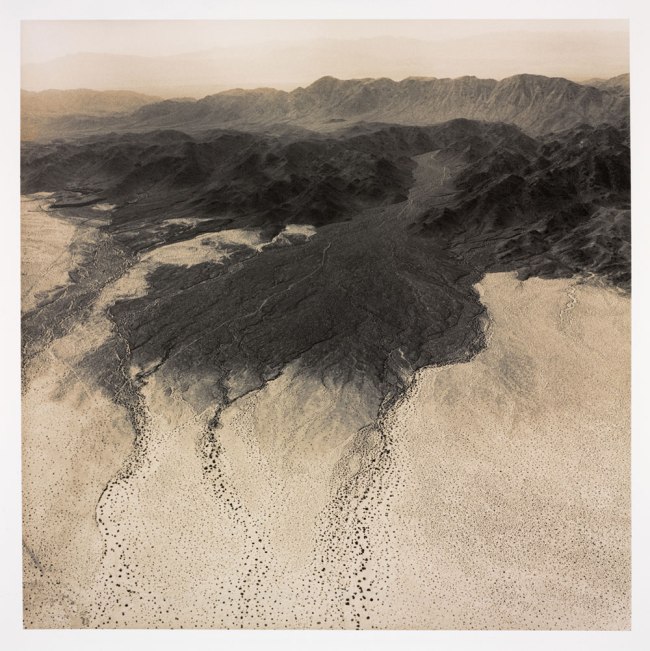
 

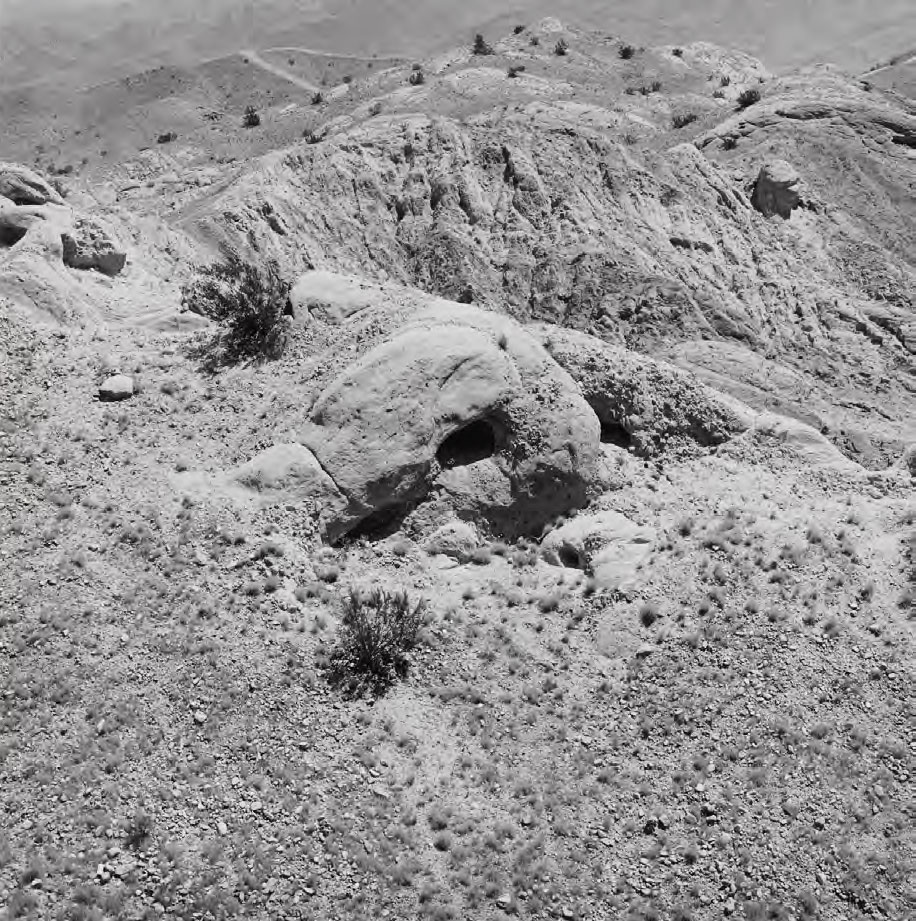
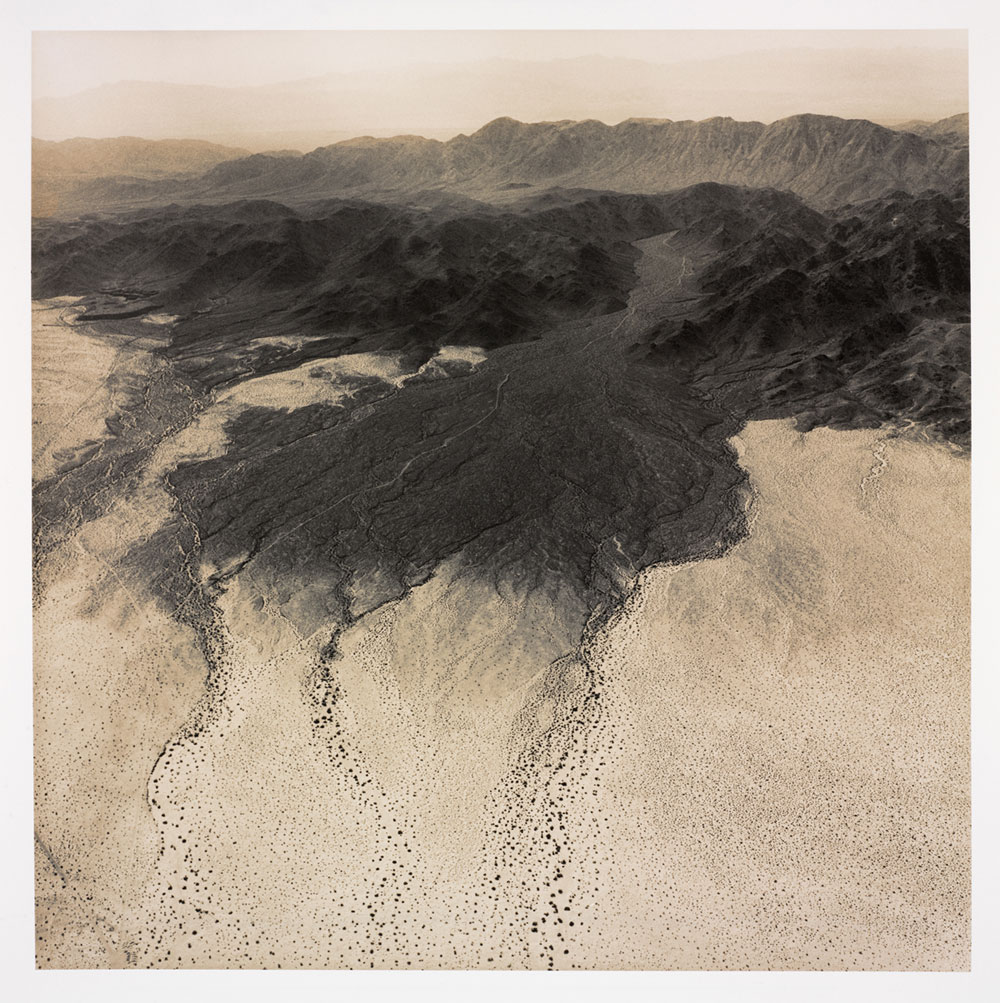
Emmet Gowin (American, b. 1941) 'Alluvial Fan, Natural Drainage near Yuma Proving Ground and the California Arizona Border' 1988


Emmet Gowin (American, b. 1941) (RISD MFA 1967)
Alluvial Fan, Natural Drainage near Yuma Proving Ground and the California Arizona Border
1988
Toned gelatin silver prints
Promised gift of Dr. and Mrs. William G. Tsiaras
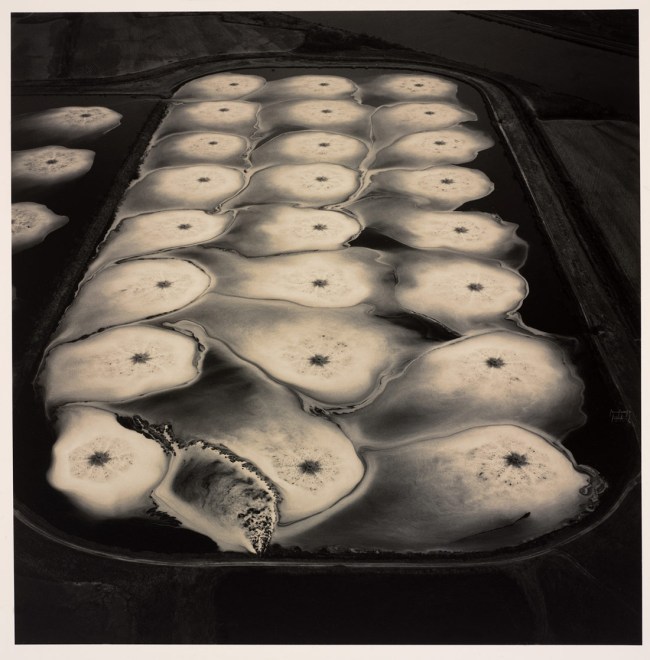
 

Emmet Gowin (American, b. 1941) 'Aeration Pond, Toxic Water Treatment Facility, Pine Bluff, Arkansas' 1989


Emmet Gowin (American, b. 1941) (RISD MFA 1967)
Aeration Pond, Toxic Water Treatment Facility, Pine Bluff, Arkansas
1989
Toned gelatin silver print
RISD Museum: Mary B. Jackson Fund


Emmet Gowin’s carefully constructed prints of strip mining sites, nuclear testing fields, large-scale agriculture, and other scars in the natural landscape seductively draw us in to examine what these lushly patterned and toned images represent. Predating Google Earth, these photographs are shot from the air and provide information about the environment that questions our role as stewards of the planet. A master darkroom printer, Gowin makes images come alive through hand-toning. Each print is transformed from grayscale into hues ranging from warm highlights to cool shadows, emphasising the illusion of three-dimensionality.
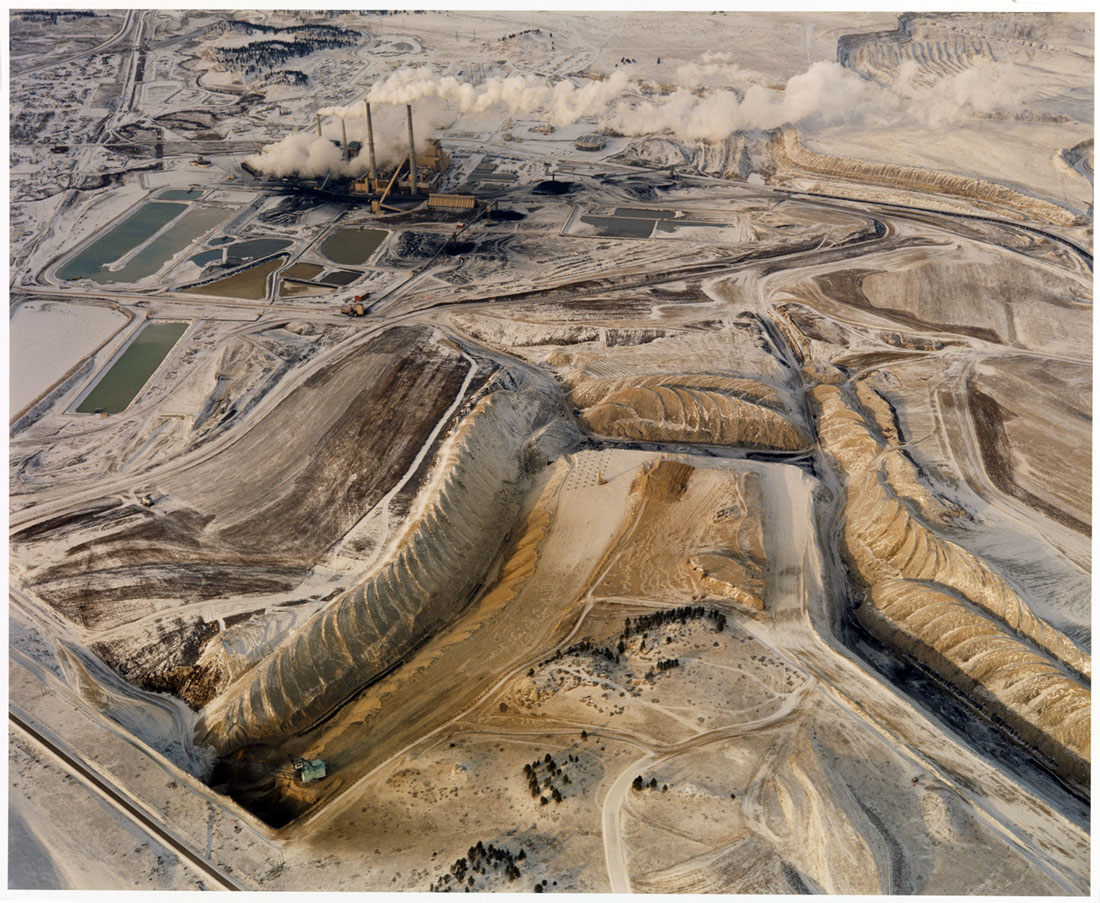
 

David T. Hanson (American, b. 1948) 'Coal Strip Mine, Power Plant and Waste Ponds' 1984


David T. Hanson (American, b. 1948)
Coal Strip Mine, Power Plant and Waste Ponds
1984
Museum Purchase: Gift of the Artist’s Development Fund of the Rhode Island Foundation
© 1984 David T. Hanson, from the book Colstrip, Montana by David T. Hanson (Taverner Press, 2010). Museum of Art Rhode Island School of Design, Providence


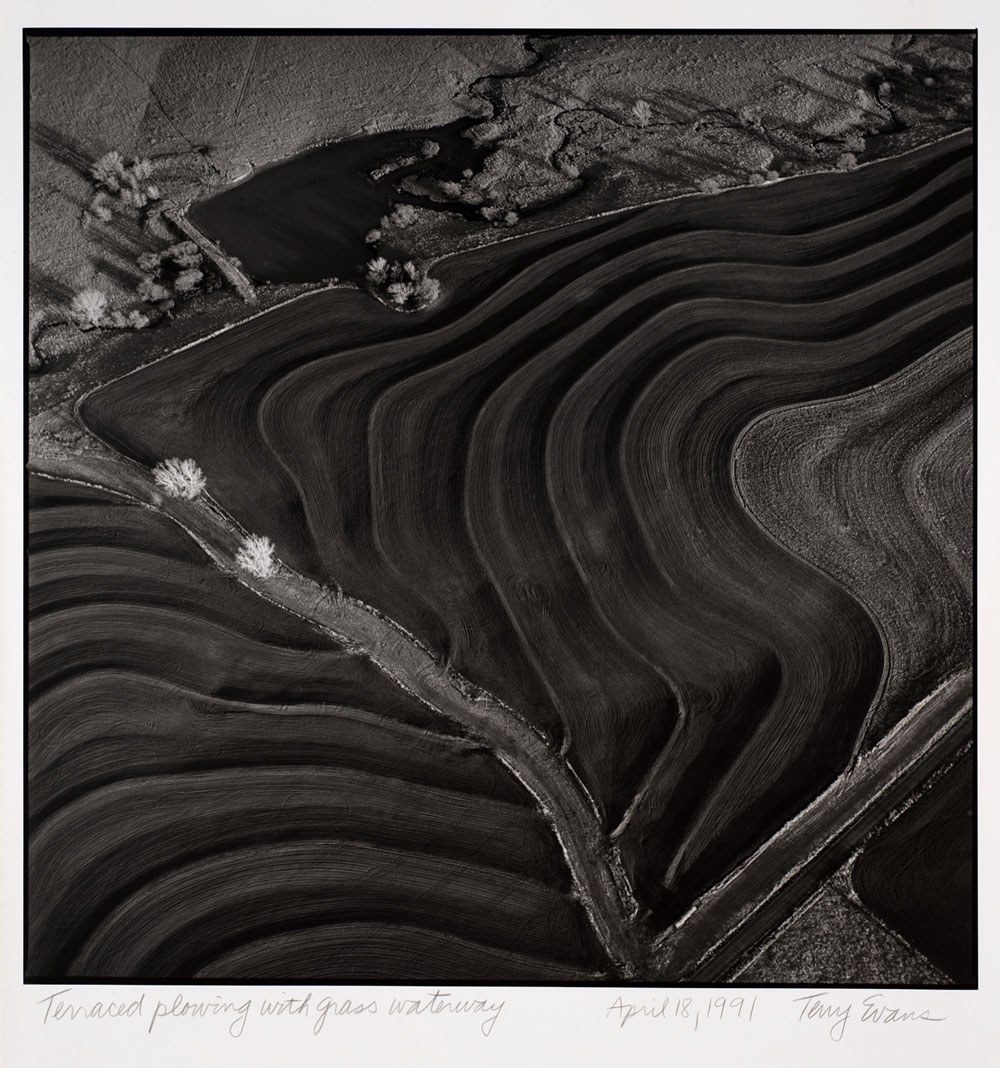
Terry Evans (American, b. 1944) 'Terraced Plowing with a Grass Waterway' 1991


Terry Evans (American, b. 1944)
Terraced Plowing with a Grass Waterway
1991
From the series Inhabited Prairie
Gelatin silver print
RISD Museum: Gift of Jan Howard and Dennis Teepe in honour of Joe Deal


Neither the striking abstract design of the terraced field nor the effectiveness of this type of farming are what interests Terry Evans. She is drawn to the specific place and how the marks on the land, as she has said, “contain contradictions and mysteries that raise questions about how we live on the prairie. All of these places are beautiful to me, perhaps because all land, like the human body, is beautiful.”
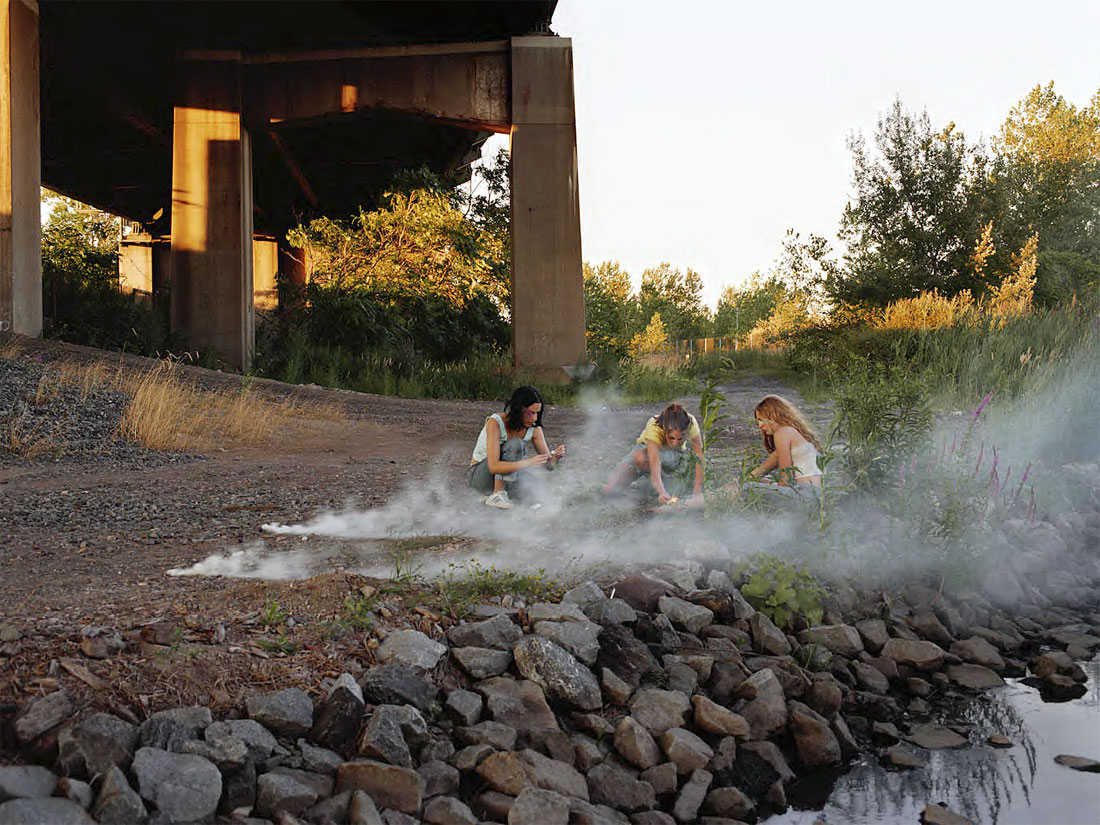
 

Justine Kurland (American, b. 1969) 'Smoke Bombs' 2000


Justine Kurland (American, b. 1969)
Smoke Bombs
2000
From the series Runaway Girls
Colour chromogenic print
RISD Museum: Mary B. Jackson Fund


The neglected space under a New Jersey highway overpass was an ideal spot for three girls to act out Justine Kurland’s fictive story about fugitive teenagers. The figurative grouping recalls pastoral scenes in historical paintings so that the danger of the girls’ pursuit in this dicey no-man’s land is temporarily suspended in the hazy romantic fantasy of escape. The strong light streaming across the scene and the overall beauty of the composition suggests a desire to pursue the sublime even in the most degraded landscapes.


Justin Kimball (American, b. 1961) 'Deep Hole, New Hampshire' 2002


Justin Kimball (American, b. 1961)
Deep Hole, New Hampshire
2002
From the series Where We Find Ourselves
Gift of the artist in honour of Joe Deal
Museum of Art Rhode Island School of Design, Providence


Deep Hole, New Hampshire captures light filtering through the trees as a dozen young men and women distribute themselves among rocky outcroppings, poised for adventure in the water below. The composition recalls the quiet drama of Thomas Eakins’s 19th-century painting of nude swimmers. This reference drew Kimball to the picture as it played out in front of him, along with the palpable sense of elation in the youths’ encounter with the landscape, no matter the deteriorating state of the site due to its heavy use. Kimball’s series Where We Find Ourselves explores the fantasy of finding wilderness in state and national parks, where we only find other people looking for it, too.
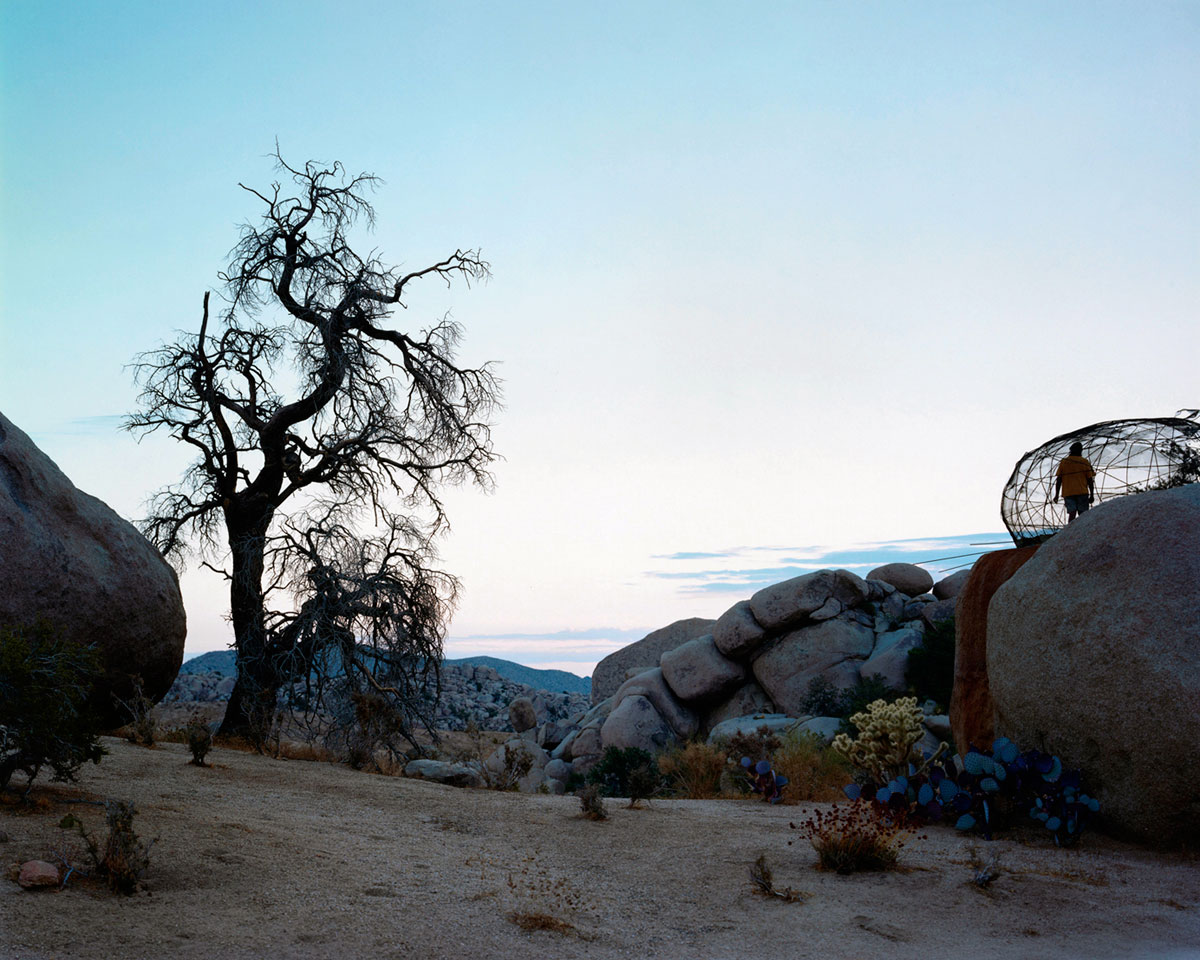
 

Alec Soth (American, b. 1969) '2008_08zl0031' 2008


Alec Soth (American, b. 1969)
2008_08zl0031
2008
Mary Ann Lippitt Acquisition Fund
© Alec Soth
Museum of Art Rhode Island School of Design, Providence


Where We Find Ourselves

Current representations of the American landscape reveal a continually fraught relationship with the environment. Recent landscape photography reflects its history while constructing new notions of what such an image can be. Some artists continue to see the landscape as a place of refuge or spirituality. Others focus on its more disturbing psychological impact, even haunted with battle scars. Some pick up from the 1970s New Topographics approach with a more pointed investigation of environmentalism, documenting and questioning the impact of industry and development on the natural world. Still others have found that with the introduction of the figure the landscape can act as a stage, albeit one charged with political and social resonance.

Notable shifts have also been driven by new processes and techniques. The photographs of the last several decades are predominantly in colour and are much larger than their precedents. While many artists working today use digital technology, their motive is rarely to alter or fabricate imagery but instead to have easier and better control over how these larger images are presented. Surprisingly, many of today’s photographers are using large format cameras very similar to those of the 19th century to create negatives or digital files capable of being enlarged to the scale of contemporary work.
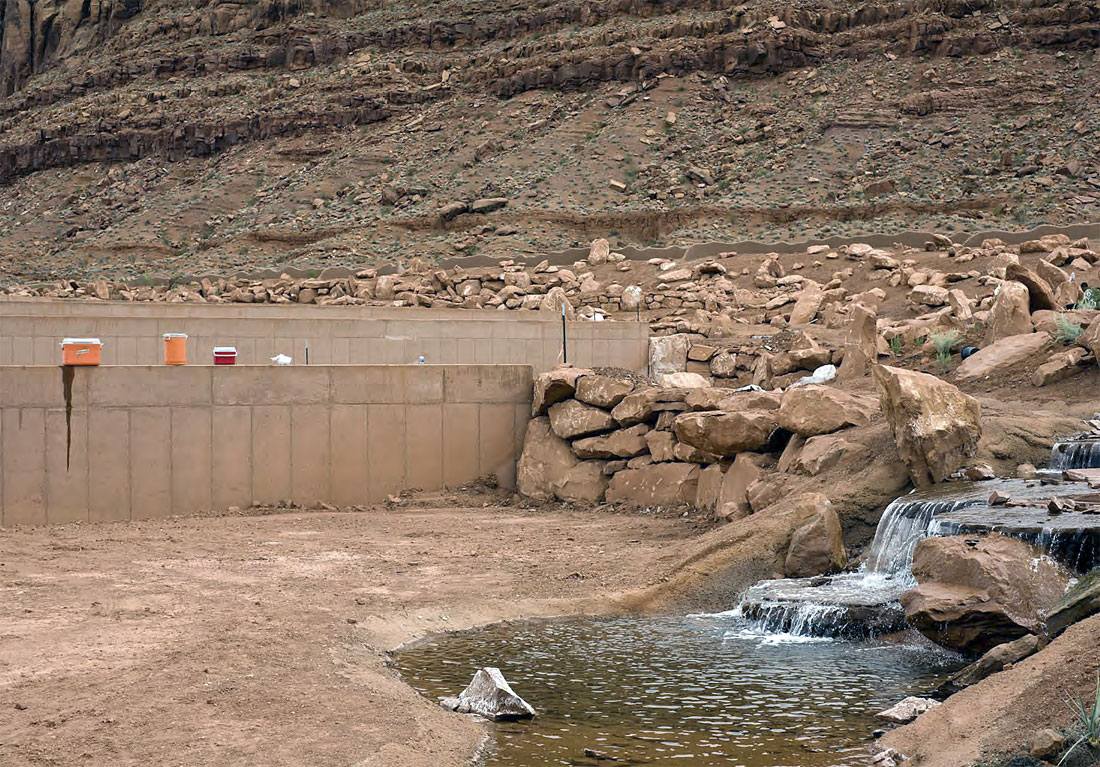
 

Steven B. Smith (American, b. 1963) 'Coolers, Ivins, Utah' 2007


Steven B. Smith (American, b. 1963) (RISD Faculty 1996-present)
Coolers, Ivins, Utah
2007
From the series Irrational Exuberance
Colour inkjet print
RISD Museum: Gift of Heather Smith in honour of Joe Deal


Steven Smith’s subject matter follows in the tradition of the 1970s New Topographic artists. What differentiates Smith’s view of a recently suburbanised desert from his predecessors is the humour with which he captures the extravagant building in this arid place. In this image, from the aptly titled series Irrational Exuberance, fluorescent-coloured coolers, like the red rocks, become part of the landscape, even creating their own waterfall.
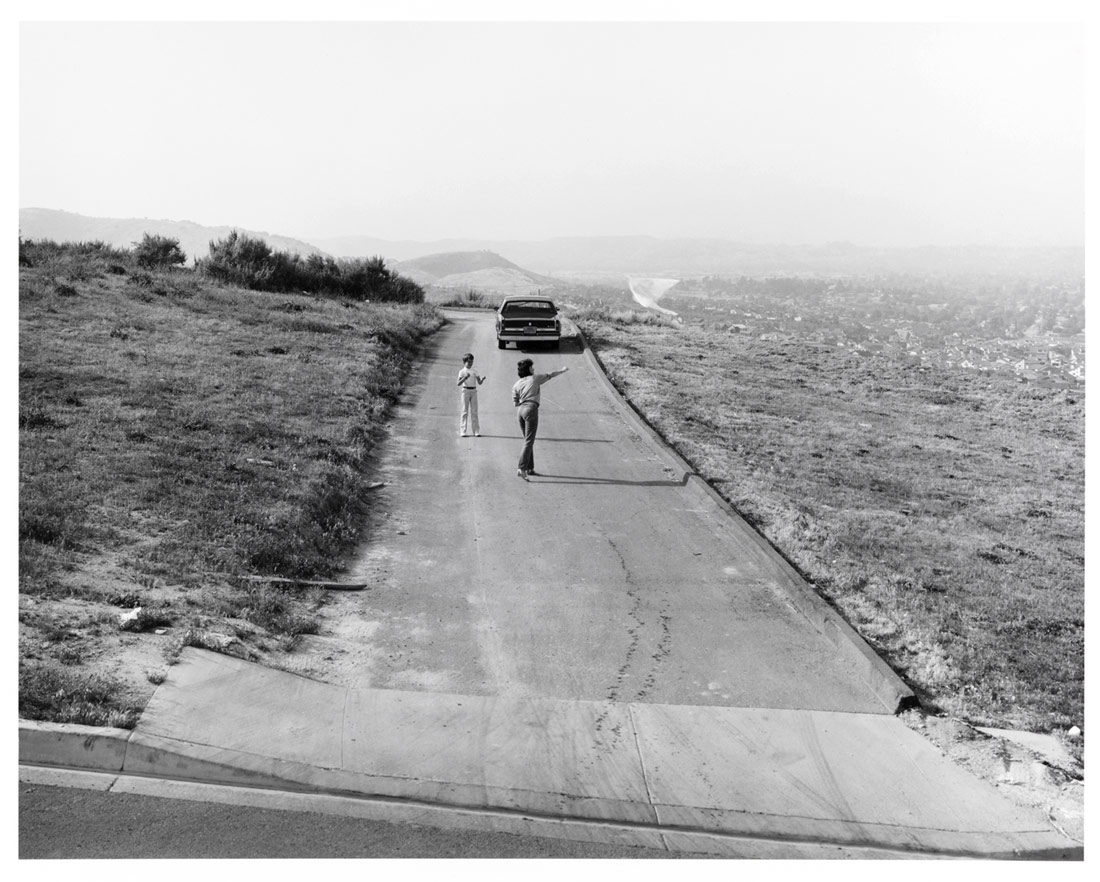
 

Joe Deal (American, 1947-2010) 'Kite, Chino Hills, California' 1984


Joe Deal (American, 1947-2010) (RISD Provost 1999-2005, Faculty 2005-2009)
Kite, Chino Hills, California
1984
From the portfolio Subdividing the Inland Basin
Gift of the artist
© The Estate of Joe Deal, courtesy Robert Mann Gallery. Museum of Art Rhode Island School of Design, Providence


Joe Deal often found his picture at the border between the built and unbuilt landscape. The driveway makes for a convenient spot to fly a kite, surrounded as it is here with a bit of open space remaining in a new development. In the distance to the right the residential growth that will soon cover this piece of land is visible through the atmospheric smog. In the distance to the left are still untouched hills. The inclusion of people – evidence of a rapidly exploding community near the intersection of the Pomona and Orange freeways – marks a shift in Deal’s photography to embracing the landscape as a site for narrative.
 

Uta Barth (German, b. 1958) 'Field #14' 1996


Uta Barth (German, b. 1958)
Field #14
1996
Colour chromogenic print
RISD Museum: Gift of the Buddy Taub Foundation, Jill and Dennis Roach, Directors


Uta Barth radically softens the camera’s focus to remove all signs of historical specificity and to saturate a flat industrial-looking non-place with a dream-like atmosphere. As such she creates a generic landscape as viewed through a heavily fogged window, with an uncanny sense that is deeply familiar.


Henry Wessel (American, b. 1942) 'Night Walk, Los Angeles, No. 28' 1995


Henry Wessel (American, b. 1942)
Night Walk, Los Angeles, No. 28
1995
From the series Night Walk: LA
Gelatin silver print
RISD Museum: Gift of Mark Pollack
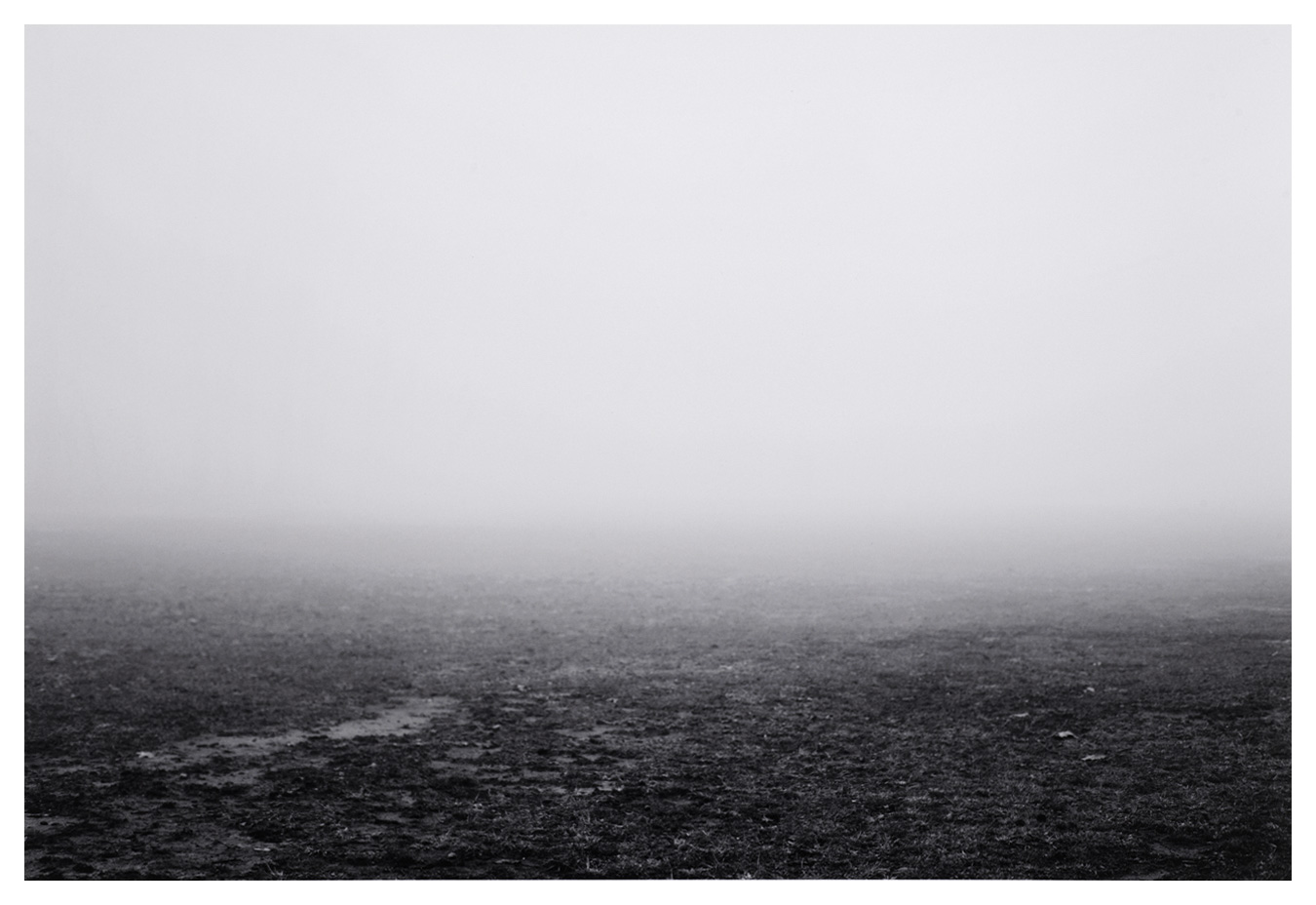
 

Millee Tibbs (American, b. 1976) 'Self-Portrait in the Fog' 2009


Millee Tibbs (American, b. 1976) (RISD MFA 2007)
Self-Portrait in the Fog
2009
From the portfolio Self Portraits
Colour inkjet print
RISD Museum: Gift of the artist in honour of Joe Deal
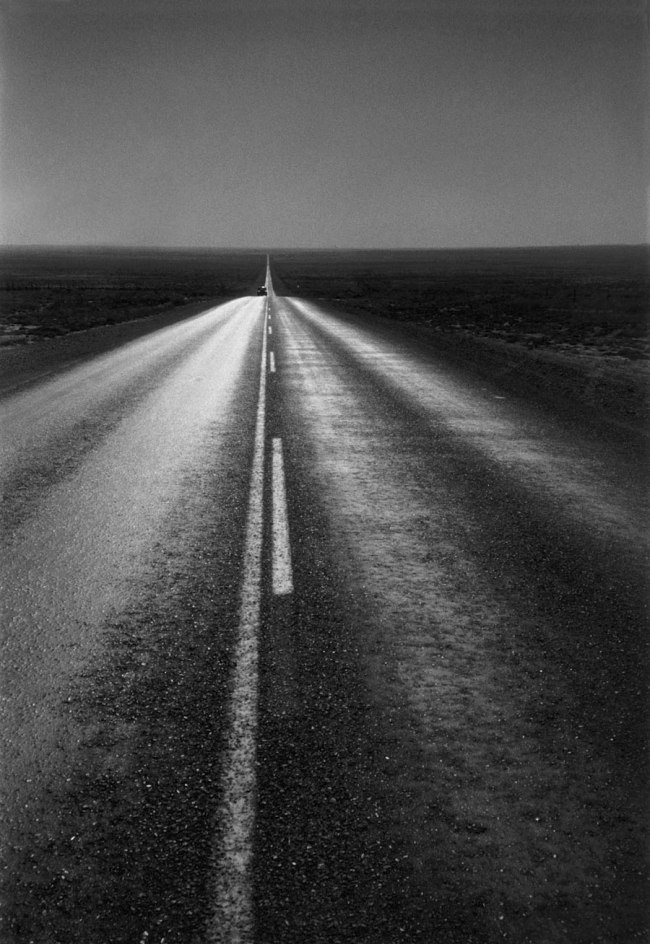
 

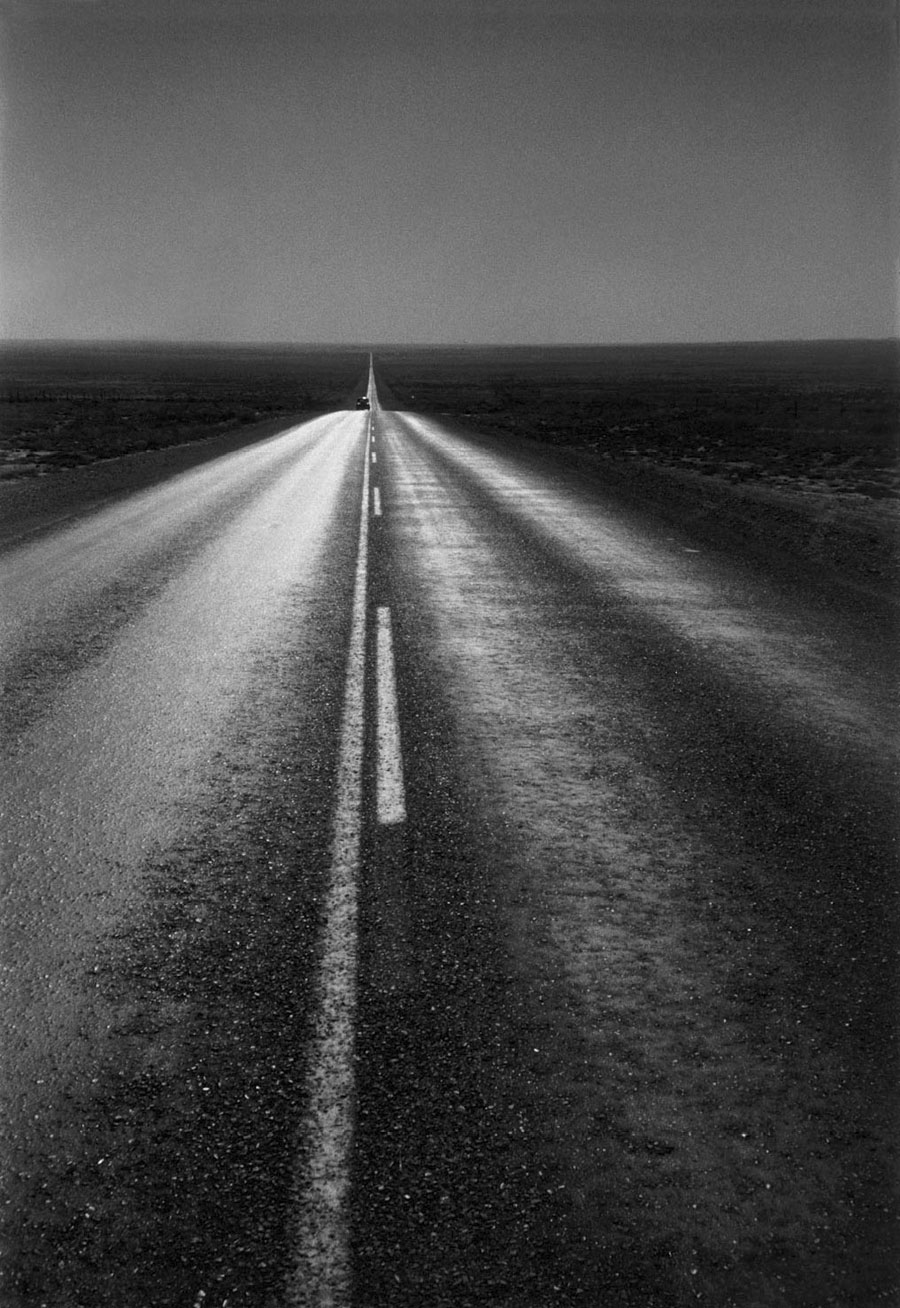
Robert Frank (Swiss, 1924-2019) 'U.S. 285, New Mexico' 1955


Robert Frank (Swiss, 1924-2019)
U.S. 285, New Mexico
1955
Silver gelatin photograph


This slideshow requires JavaScript.


Installation views of America in View: Landscape Photography 1865 to Now at the Museum of Art Rhode Island School of Design, Providence


Museum of Art Rhode Island School of Design (RISD)
224 Benefit Street, Providence, RI 02903
Phone: 401 454-6500

Opening hours:
Tuesdays Wednesdays, Saturdays, Sundays 10am – 5pm
Thursdays – Fridays 12 – 7pm
Closed Mondays

Museum of Art Rhode Island School of Design (RISD) website

LIKE ART BLART ON FACEBOOK

Back to top

Exhibition: ‘Photography & place: Australian landscape photography, 1970s until now’ at the Art Gallery of New South Wales, Sydney

Exhibition dates: 16th March – 29th May 2011


Debra Phillips (Australian, b. 1958) 'Untitled 7 (view from model plane launch area)' 2001


Debra Phillips (Australian, b. 1958)
Untitled 7 (view from model plane launch area)
2001
From the series The world as puzzle
Two Type C photographs
68 x 80cm each
Image courtesy the artist and BREENSPACE, Sydney
© Debra Phillips


Hot on the heels of my reviews of Stormy Weather: Contemporary Landscape Photography at NGV Australia and Sidney Nolan: Drought Photographs at Australian Galleries, Melbourne comes the exhibition Photography & place: Australian landscape photography, 1970s until now at the Art Gallery of New South Wales. An insightful, eloquent text by Vigen Galstyan (Assistant curator, photographs, AGNSW) accompanies the posting.

Dr Marcus Bunyan


Many thankx to Susanne Briggs for her help and to the Art Gallery of New South Wales for allowing me to publish the photographs and the text in the posting. Please click on the photographs for a larger version of the image.


Douglas Holleley (Australia, United States of America, b. 1949) 'Bottle-brush near Sleaford Bay, South Australia' 1979


Douglas Holleley (Australia, United States of America, b. 1949)
Bottle-brush near Sleaford Bay, South Australia
1979
Four SX-70 Polaroid photographs
61 x 76cm
AGNSW collection, purchased 1982
© Douglas Holleley


Australian born and American based photographer Douglas Holleley has experimented with many aberrant photographic techniques over the course of his career. Holleley received a Bachelor of Arts in Psychology in 1971 at Macquarie University before relocating to America to undertake a Master of Fine Arts, studying at the Visual Studies Workshop in Rochester, New York between 1974 and 1976. Founded by Nathan Lyons in 1969 and affiliated with important photographers including Minor White and Frederick Sommers, the Visual Studies Workshop was a bedrock institution that fostered innovative photographic practice from the 1970s onwards. It was here that Holleley received tutelage from Ansel Adams in 1975. His early photographic output includes hand coloured black and white photographs as well as photograms and gridded arrangements of Polaroids. He later began experimenting with digital photography, applying the same principles of the photogram to his experiments with a flatbed scanner.

During the time spent studying photography in America in the 1970s Holleley became interested in Polaroid technology. When he returned to Australia in 1979, before later relocating permanently to America, Holleley commenced an extensive photographic project of documenting the Australian bush with a Polaroid SX-70 camera, effectively becoming one of the first professional practitioners of the medium in the country. The resulting images were presented as a series and published as a book – Visions of Australia – in 1980. Employing a refined formalist vocabulary, Holleley produced photographic mosaics by arranging his Polaroids into gridded compositions.

Dissected, disassembled and then collated within the pictorial frame, the landscape in Holleley’s works becomes slightly unnatural and detached. These works negate linear single point perspective by focusing on the ground and reducing the scene to a formal composite. Here, the expanse of the view and the horizon does not dominate the space of the image. The tessellating images produce a ‘whole’ that is slightly misaligned and unsettled. In some works, the photographer’s shadow is visible. It asserts itself as an ambivalent presence that is not tethered to the scene. This spectral form heightens the sense of disquiet that pervades the images.

Text from the Art Gallery of New South Wales website [Online] Cited 16/01/2020


Ian North (New Zealand, b. 1945) 'Canberra suite no 2' 1980, printed c. 1984


Ian North (New Zealand, b. 1945)
Canberra suite no 2
1980, printed c. 1984
From the series Canberra suite 1980-81
Type C photograph
37 x 45.7cm
AGNSW collection, gift of the artist
© Ian North


Ian North (New Zealand, b. 1945) 'Canberra suite no 7' 1980, printed c. 1984


Ian North (New Zealand, b. 1945)
Canberra suite no 7
1980, printed c. 1984
From the series Canberra suite 1980-81
Type C photograph
37 x 45.7cm
AGNSW collection, gift of the artist
© Ian North


Ian North is an Adjunct Professor of Visual Arts at both the University of Adelaide and the University of South Australia. He is a photographer, painter and writer, and was the founding curator of photography at the National Gallery of Australia 1980-1984. Throughout his career, he has been concerned with the legacy of Australian landscape, the impact of colonial narratives and their established visual conventions and, as a consequence, the politics of representing the subject. …

North’s methodology is concerned with the processes of vision and interaction as they have shaped the landscape. In Canberra Suite North presents an encyclopaedic record of Walter Burley Griffin’s intricately designed city, exploring the spatial interface between nature and humanity. The works are absent of human life – reminiscent of Ed Ruscha’s Twenty-six Gasoline Stations. The emotional ambivalence of the images is reflected in their use of colour, like that of postcards. As one of the first instances of larger format colour art photography in Australia, the images topographically map space as a depersonalised, banal subject. Yet their colour, like that of landscape painting, highlights flora, revealing the number of non-native plants included in Canberra’s design. As such, these artefacts of North’s private wanderings and systemic mode of looking are able to subtly critique colonialism.

Text from the Art Gallery of New South Wales website [Online] Cited 16/01/2020


EARTH SCANS AND BUSH RELEVANCES: Photography & place in Australia, 1970s till now

For many of us, landscape is a noun. A view from the window or the balcony, a strange immaterial ‘thing’ that makes people exclaim in awe, point to in pride, recall nostalgically, pose in front of or be used to bump up real estate prices. If one is an urban dweller, which most Australians are, then the landscape exists essentially as a mirage, something to create in the backyard, occasionally look at on holidays or hang on the walls. However, noted American cultural theorist and art historian W. J. T. Mitchell has proposed that we should think of landscape as a verb: an act of creation on our part that engenders cultural constructs, national identities and shared mythologies.

Photography & place is an exhibition that investigates this process of ‘landscaping’ through the work of 18 Australian photographers between the 1970s and now. Their significant contribution to representation of landscape broke new ground in what has always been a confounding topic. Indeed, as Judy Annear has pointed out in a 2008 essay in Broadsheet magazine, the practice of documenting and interpreting the notion of ‘place’ in Australian photography has been fragmentary in comparison to traditions in America, Europe or New Zealand. This reluctance to focus on the natural environment is perhaps a residue of the ‘terra nullius’ polemic, which shifted the attention of many photographers on the building of colonial Australia. Photography from the mid 19th to the early 20th century by photographers such as Charles Bayliss and Nicholas Caire actively documented the conquest of nature by white settlers, or presented views of untouched wilderness as epitomes of the picturesque: endless waterfalls, lakes, forests in twilights, enigmatic caves and an occasional nymph like creature prancing. Despite Bayliss’ efforts to show the indigenous people on their land, they are, as Helen Ennis observed in her 2007 book Photography and Australia, conspicuous by their absence: the land that we see surrounding them in early Australian photography by the likes of J.W. Lindt is often a mass-produced painted studio backdrop.

The advent of modernism in the 1930s only served to entrench the photographers deeper into the urban space. ‘Place’ is the city and it is here that industry, progress and culture shapes the Australian identity. It is still difficult to dislodge the iconic images of Max Dupain and David Moore as epitomes of Australianness, promulgated as they were through countless renditions in mass media and consumer culture. But as post-modern anxiety started to seep through the patchwork of the Australian dream, it was landscape that many critically informed photographers turned to as a tool for analysis and revision.

A number of factors conflated in the mid 1970s, engendering a radical shift in perspectives. One of the primary forces that began to reshape the approaches to landscape in Australian photography was the awareness of new artistic movements taking place in USA and Europe. The enormously influential exhibition New Topographics: Photographs of a Man-Altered Landscape held in 1975 at the George Eastman House, Rochester, consolidated the spread of minimalist and conceptually informed photography which was avidly embraced by a younger generation of Australian photographers. One can also cite the rise of the Australian greens movement in Tasmania, the increasing awareness of Indigenous cultures and rights and not the least, the phenomenon of university-educated photographers as key milestones during this decade.

Lynn Silverman, Douglas Holleley, Jon Rhodes, Wes Stacey and Marion Marrison were among the practitioners who pointed their lenses out of the city, often exploring the fringes of human settlement and sometimes as in the case of Silverman, Stacey and Holleley, venturing into the desert. The element that collectively stamps their work is the ostensible fragmentation of the landscape. Instead of the holistic, positivist postcard views of Australia, we get something resembling a lunar vista. The palpable sense of alienation in American expatriate Lynn Silverman’s striking Horizons series from 1979 echoes in the disorienting grid-based Polaroid assemblages by Holleley conjuring up a space that appears hostile and to a degree indifferent to our presence. The foreignness of these landscapes is not necessarily a malevolent force as was customary to show in a slate of Australian New Wave films of the 70s and 80s. Rather a much more meditative stance is taken in regards to our relationship to a place which has been claimed without being understood or in many ways respected. Ingeborg Tyssen’s photographs hint at existing presences, forms and phenomena which are full of life and meaning that remain perpetually unresolved to an outsider. The imported paradigms of Western culture can not take root in this environment. One could easily define the landscape photography of this period in Lynn Silverman’s words as “an orienting experience” and a belated attempt at a proper reconnaissance of the land.

The coolly detached outlook that underlines the investigative drive of most of these photographers is magnified by their adoption of serial or multi-panel formats. It was certainly a way to expand and collapse the accepted faculties of the pictorial field, challenging and questioning the accepted notions of photographic ‘truth’. Jon Rhodes demonstrates the inherent power of this simple device in his cinematically sequential Gurkawey, Trial Bay, NT 1974, which transforms a seemingly wild and uninhabitable swamp into a joyful playground of an Aboriginal child.

In some instances the photographic approach is more concerned with elucidating the nature of the photographic image itself and the way it can influence and control our perception. As Arnold Hauser has lucidly described in his groundbreaking Social History of Art, images have always been used to secure and infer political power. As such, the metamorphosis of a visual representation into an iconographic one carries within it an element of danger as images begin to seduce the viewer away from objectivity. Indeed, images of Australia have been the most relentlessly and carefully used signifiers in promoting a (colonial) national consciousness by political, commercial and cultural institutions. In this light, it is not difficult to see the works of Wes Stacey and Ian North as acts of iconoclasm. Stacey’s droll and gently parodic series The road 1973-1975, charts a snapshot journey that goes nowhere. Seemingly random, half-glimpsed shots of empty dirt roads, sunburnt grass mounds and endless highways emanate a sense of rootlessness and displacement, negating any possibility of objectification or identification with the landscape. Instead of epic grandeur and jingoism we get something that is confronting, uncomfortably real and in no way ‘advertisable’.

‘The Real’ is even more startling in Ian North’s subversive Canberra suite 1980-81, where the utopian dream capital has been reduced to banal ‘documents’ of depopulated, custom-made suburbia. The hyperreal concreteness of North’s Canberra gives the city an aura of a De Chiricoesque waking nightmare. In line with the set practices of conceptual photography of the period, North has distilled his images from any sign of formal mediation, forcing the viewer to focus on the raw content. It is through this forensic directness that the strange incongruity of human intervention within the landscape becomes ostensible.

Daniel Palmer has noted that North’s images “are highly prescient of much photography produced by artists in Australia today”. Certainly by the 1980s photographers became more actively engaged in analysing the nature / culture median. Strongly influenced by feminist and post-colonial theory, a number of practitioners used photography as a medium to document ideas rather than objective reality. Anne Ferran and Simryn Gill are particularly notable in this regard. Both artists are concerned with the historical and political dimensions of the locations they chose to photograph, resulting in multi-layered and complex strategies that require more involved intellectual interaction from the audience. Gill’s ‘staged’ photographs relate to us the agency of nature and time upon the cultural environment. Synthesis and amalgamation of outwardly irreconcilable elements – imported plants, Australian bush, cotton shirts – slowly, but surely melt into new, as yet unknown entities in Rampant 1999. The force of inevitable decay is absolute yet imbued with generative power as well. Exploring the constantly shifting certainties of what constitutes a ‘place’ the artist draws the audience into questioning its own role in this transformative process.

Ferran takes a more archaeological position in relation to her subject matter. Her eerie surveys of rather ordinary grass mounds in the series Lost to worlds 2008 become evocative paeans to obliterated lives, once we learn that the mounds are all that remain of the factories where convict women were sent to work. Looking at these shimmering ghost worlds one is reminded of Walter Benjamin’s essay The Ruin where the writer analyses the capacity of ruins to reveal the “philosophical truth content”. It is through this allegorical device that Ferran achieves a degree of rehabilitation for the absent histories she photographs.

History, in its manifold and troubling guises, is directly ‘exposed’ in the landscapes of Ricky Maynard, Michael Riley and Rosemary Laing. As Indigenous photographers, Maynard and Riley have played an important role in translating the cultural and political status of Aboriginal peoples into a ‘language’ that is universally understood. Their work remains firmly rooted in the traditions of contemporary art, yet the heavily symbolical slant shows a more ardent and personal engagement with the Australian landscape. Riley’s expressionistic series flyblown 1998 sums up in a few strategically juxtaposed metaphors the spiritual dimension of the landscape, while simultaneously revealing the diverging connotations of Australia’s fundamentally divided identity. The colonial legacy is shown as one of conquest and domination that clashes with the artist’s engagement with country. Maynard’s Portrait of a distant land 2005, explores the same dichotomy in more site specific terms. After permanently settling in Flinders Island, Maynard decided to return to the portrayal of Tasmanian Aborigines, taking a more collaborative approach. He sees this as a way of bypassing the propensity of the photographic image “to subjugate its subjects”. The resulting series is a profoundly poetic treatment that rises above social documentation to suggest the wider implications of historical change and disclose the ability of people to overcome what the artist has described as victimisation through a deeply compassionate relationship with the land. Ultimately Maynard gives us an edifying testimony to the affirmative power of the landscape as collective memory.

Interest in the political aspects of landscape photography has continued unabated into the 21st century. Yet a more philosophically inclined thread has become evident in the last two decades. No longer is it enough to deconstruct and pull apart ideas about landscape’s relationship to identity and nationhood. What photographers like Bill Henson, David Stephenson, Simone Douglas and Rosemary Laing question is the very possibility (or impossibility) of seeing itself. If positioning oneself in relation to nature seems like a distinct, albeit problematic proposition in the 1970s and 80s, the later works in the exhibition are resolutely ambivalent on the subject.

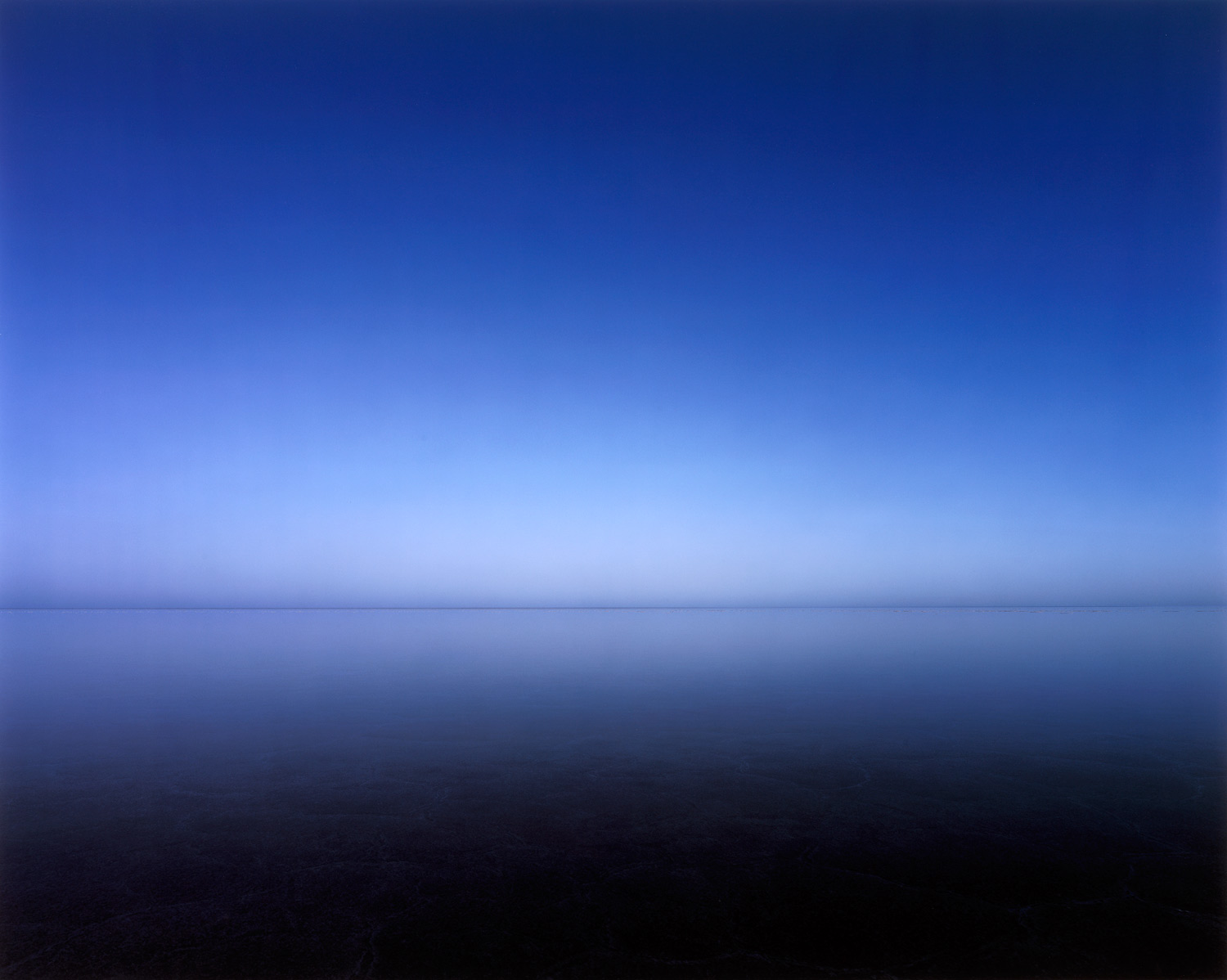
What can one grab onto when faced with the endless expanses of white in Stephenson’s The ice 1992, the terrifying darkness of Henson’s night scenes or the infuriating haze of Douglas’s twilight worlds? Perhaps the only recourse is to dissolve into the beckoning ‘forever’ of the vanishing point in Laing’s To walk on a sea of salt 2004. This void is not a boundary point between nature and culture – it is where culture ends and an entirely new state of consciousness begins: the realm of the sublime and the imagination. As history seems no longer to be trustworthy, ‘place’ can only be constructed as a metaphysical entity. It is a curious turnabout in some ways that echoes some of the early, turn-of-the-century encounters with the Australian landscape by photographers such as John Paine and Norman C. Deck. The sense of fear and awe towards the unfamiliar environment permeates their images, transcending the merely investigative / didactic motives of most colonial photography. What has eventuated from walking into this environment? Subjugation? Destruction? Incomprehension? Indifference? By going back to the point zero of the void and the sublime, contemporary photography negotiates a second attempt at engagement with nature through a renewed and deeper understanding of humanity’s symbiotic relationship with this life-giving force.

Vigen Galstyan
Assistant curator, photographs1


1/ Galstyan, Vigen. “EARTH SCANS AND BUSH RELEVANCES: Photography & place in Australia, 1970s till now,” in Look gallery magazine. Sydney: Art Gallery Society of New South Wales, 2011, pp. 25-29.


Rosemary Laing (Australian, b. 1959) 'After Heysen' 2005


Rosemary Laing (Australian, b. 1959)
After Heysen
2005
Type C photograph
110 x 252cm
On loan from The Australian Club, Melbourne
Image courtesy of the arts & Tolarno Galleries, Melbourne
© Rosemary Laing


Rosemary Laing (Australian, b. 1959) 'to walk on a sea of salt' 2004


Rosemary Laing (Australian, b. 1959)
to walk on a sea of salt
2004
Type C photograph
110 x 226.7cm
Image courtesy of the arts & Tolarno Galleries, Melbourne
© Rosemary Laing


Jon Rhodes (Australian, b. 1947) 'Hobart, Tasmania' 1972-75 from the album 'Australia'


Jon Rhodes (Australian, b. 1947)
Hobart, Tasmania
1972-75
From the album Australia
1 of 53 gelatin silver photographs
11.9 x 17.7cm
Art Gallery of New South Wales, purchased 1980
© Jon Rhodes


Jon Rhodes (Australian, b. 1947) 'Tuncester, New South Wales' 1972-75 from the album 'Australia'


Jon Rhodes (Australian, b. 1947)
Tuncester, New South Wales
1972-75
From the album Australia
1 of 53 gelatin silver photographs
11.9 x 17.7cm
Art Gallery of New South Wales, purchased 1980
© Jon Rhodes


Michael Riley (Australian, 1960-2004) 'Untitled' 1998 from the series 'flyblown'


Michael Riley (Australian, 1960-2004)
Untitled
1998
From the series flyblown
Pigment print
82 x 107.8cm
Art Gallery of New South Wales, Sydney
Anonymous gift to the Aboriginal & Torres Strait Islander and Photography collections 2010
© Michael Riley Estate. Licensed by Viscopy, Sydney


Michael Riley (Australian, 1960-2004) 'Untitled' 1998 from the series 'flyblown'


Michael Riley (Australian, 1960-2004)
Untitled
1998
From the series flyblown
Pigment print
82 x 107.8cm
Art Gallery of New South Wales, Sydney
Anonymous gift to the Aboriginal & Torres Strait Islander and Photography collections 2010
© Michael Riley Estate. Licensed by Viscopy, Sydney


Michael Riley received his first introduction to photography through a workshop at the Tin Sheds Gallery in Sydney, 1982. A Wiradjuri / Kamilaroi man, the artist moved to Sydney from Dubbo in his late teens. He became part of a circle of young Indigenous artists drawn together in the city at that time. A founding member of the Boomalli Aboriginal Artists Co-operative Riley was also a key participant in the first exhibition of Indigenous photographers at the Aboriginal Artists Gallery, Sydney in 1986 (curator Ace Bourke). In 2003 Riley’s work was selected for the Istanbul Biennial, and in 2006 his work was permanently installed at Musée de quai Branly, Paris. A major retrospective toured nationally in 2006-2008.

Riley’s fine art photography began in black and white but he quickly progressed to large-scale colour, a format that also expanded the cinematic qualities of his images, no doubt reflecting the influence film and video were having upon the artist as he worked simultaneously with these media. He produced, for example, the documentaries Blacktracker and Tent boxers for ABC television in the late nineties.

The photographic series flyblown bears a close relationship to the film Empire which Riley created in 1997. Like the film, these photographs give expression to the artist’s concern with the impact of European culture upon that of Australia’s Indigenous population, specifically, as he described it, the ‘sacrifices Aboriginal people made to be Christian’ (Avril Quaill, ‘Marking our times: selected works of art from the Aboriginal and Torres Straight Islander Collection at the National Gallery of Australia’, National Gallery of Australia, Canberra 1996 p. 66).

Christian iconography looms large in the series, as it has across much of Riley’s work. In flyblown, an imposing reflective cross is raised in the sky. Repeated in red, gold and blue its presence is inescapable. A symbol capable of inspiring awe, fear, devotion, Riley also engages with its elegiac qualities so that it functions as memorial marker. Another image depicting a bible floating face down in water conceptualises the missionary deluge, perhaps; submersion and loss through baptism, definitely.

flyblown reverberates with a subtle ominous hum – the quiet tension that precedes a storm. The parched earth beneath a dead galah seems to ache for the rain and water promised in the other images of clouds and dark skies. The nourishment Christianity offered and the inadvertent drowning of traditional culture that often followed is implied.

Visually linking the natural environment with religious symbolism Riley articulates Indigenous spirituality’s connections to country and widens his examination beyond to examine the sustained environmental damage. The negative side effects of pastoralist Australia are indicated by contrasting images of the long grass of cattle pastures with that of drought and wildlife death.

Riley’s success in articulating these issues and complexities, incorporating religious iconography so laden by history and meaning is a testament to his sensitivity and subtlety. Allowing room for ambiguity, Riley provides space for the mixed emotions of the subject and its history.

Text from the Art Gallery of New South Wales website [Online] Cited 16/01/2020


Simryn Gill (Singapore, Malaysia, Australia, b. 1959) 'Untitled' 1999 from the series 'Rampant'


Simryn Gill (Singapore, Malaysia, Australia, b. 1959)
Untitled
1999
From the series Rampant
Gelatin silver photograph
25 x 24cm
AGNSW collection, gift of the artist, 2005
© Simryn Gill


In Rampant, Simryn Gill turned her eye once more on Australia ‘… to see if I could find friends among the local flora’. This series of photographs was shot in sub-tropical northern New South Wales and shows unnerving images of trees and plants dressed up in clothes. In the photographs these ghostly forms are seen lingering in groves of introduced plants such as bamboo, bananas, sugar cane and camphor laurels. The plants are dressed in lungis and sarongs, generic clothing from South and South- East Asia, where many of these plants originate. Rampant is a form of memento mori, a record of the aspirations that saw plants only too successfully introduced into a pristine terrain which was unable to offer any resistance to their feral ways.

French philosopher Gaston Bachelard condenses his complex thinking on creativity and the human imagination into the metaphor of a tree, with its living, evolving growth and the simultaneity of being earth bound and heaven reaching, symbolising both the real and ideal.1 However, what happens when that tree is a camphor laurel, an admirable thing in its native land but out of place and wrecking havoc along the creeks of rural New South Wales?

Many once-useful species are now noxious weeds and over-successful colonisers, despised for their commonness, their success, their over-familiarity, and for being where we feel they should not be. They disrupt the order we would like to impose and remind us of our fallibility when attempting to play god and create our own earthly Edens. The language of natural purity that we use to protect our landscape also resonates with the nationalist rhetoric used to police our borders and to decide who are acceptable new arrivals and who are illegal aliens, often determined through scales of economic and social usefulness.

Text from the Art Gallery of New South Wales website [Online] Cited 16/01/2020


1/ Gaston Bachelard, ‘The totality of the root image’, On poetic imagination and reverie, editor and translator Colette Graudin, Spring Publications, Quebec, 1987, p. 85.


    Anne Ferran (Australian, b. 1949) 'Untitled' 2008 from the series 'Lost to worlds'


    Anne Ferran (Australian, b. 1949)
    Untitled
    2008
    From the series Lost to worlds
    Gelatin silver print
    © Anne Ferran


    Anne Ferran (Australian, b. 1949) 'Untitled' 2008


    Anne Ferran (Australian, b. 1949)
    Untitled
    2008
    From the series Lost to worlds
    Gelatin silver print
    © Anne Ferran


    Wesley Stacey (Australia, b. 1941) 'The road: Outback to the city 3' 1973-1975


    Wesley Stacey (Australia, b. 1941)
    The road: Outback to the city 3
    1973-1975
    Folio 1 from “The Road” a portfolio of 280 photographs
    Fuji Colour machine print
    © Wesley Stacey


    Wesley Stacey (Australia, b. 1941) 'The road: Surfers to Hobart 15' 1973-1975


    Wesley Stacey (Australia, b. 1941)
    The road: Surfers to Hobart 15
    1973-1975
    Folio 16 from “The Road” a portfolio of 280 photographs
    Fuji Colour machine print
    © Wesley Stacey


    Wesley Stacey (Australia, b. 1941) 'The road: Port Hedland / Wittenoon / Roeburne, WA 14' 1973-1975


    Wesley Stacey (Australia, b. 1941)
    The road: Port Hedland/Wittenoon/Roeburne, WA 14
    1973-1975
    Folio 10 from “The Road” a portfolio of 280 photographs
    Fuji Colour machine print
    © Wesley Stacey


    Art Gallery of New South Wales
    Art Gallery Road, The Domain, Sydney NSW 2000, Australia

    Opening hours:
    Open every day 10am – 5pm
    except Christmas Day and Good Friday

    Art Gallery of New South Wales website

    LIKE ART BLART ON FACEBOOK

    Back to top

    Review: ‘Sidney Nolan: Drought Photographs’ at Australian Galleries, Melbourne

    Exhibition dates: 3rd March – 27th March 2011

    Curator: Damian Smith


    Sidney Nolan (Australian, 1917-1992) 'Untitled (desiccated horse carcass sitting up)' 1952


    Sidney Nolan (Australian, 1917-1992)
    Untitled (desiccated horse carcass sitting up)
    1952
    Archival inkjet print
    23 x 23cm


    “In the meantime the landscape presents scenes of desolation which mark the memory of all who see it. Thousands of carcasses are strewn on the baked and cracked plains. There is a brooding air of almost Biblical intensity over millions of acres which bear no trace of surface waters. The dry astringent air extracts every drop of moisture from the grass, leaving it so brittle that it breaks under foot with the tinkling of thin glass.”


    Sidney Nolan. Epic Drought in Australia 1952


    “Peering into the pantry, which held a particular fascination for me, my eye was caught by several jars of preserved fruit that stood on the otherwise empty shelves and by a few dozen diminutive crimson apples on the sill of the window darkened by the yew tree outside. And as I looked on these apples which shone through the half-light … the quite outlandish thought crossed my mind that these things … had all outlasted me …”


    W.G. Sebald. The Rings of Saturn 1988


    This is a superb exhibition of 61 black and white photographs by Sidney Nolan. The photographs were shot using a medium format camera and are printed in square format from the original 1952 negatives. They were taken near the Birdsville Track in Queensland and were commissioned at the time by the Brisbane newspaper The Courier Mail. Although not intended to be studies for the later ‘Drought paintings’ they have become, were the beginning of, can be seen as, preparatory ideas pre sketching and painting.

    There are two proof sets of the Drought Photographs (including the one displayed on the gallery wall) that are printed on a cool-toned Type C photographic paper (analogue to digital to analogue) at about 8″ square. These are the less successful of the prints for the “beauty is in the box.” The more impressive prints are the edition of 10 that is for sale, either as individual prints or as a whole folio, that are printed at approximately 10″ square on a slightly warm-toned Canson Infinity 310 gsm archival inkjet paper (analogue to digital). These are the knockout prints with lots of mid-toned hues – for the warm tone of the paper more closely matches the feel of the dusty Outback. They possess a very “inky” atmosphere and wonderful light. Make sure that you get the gallery staff to show you some of these prints!

    The work itself is a joy to behold. The photographs hang together like a symphony, rising and falling, with shape emphasising aspects of form. The images flow from one to another. The formal composition of the mummified carcasses is exemplary, the resurrected animals (a horse, for example, propped up on a fifth leg) and emaciated corpses like contemporary sculpture. Here I am reminded of some of the work of Henry Moore.

    The handling of the tenuous aspects of human existence in this uniquely Australian landscape is also a joy to behold. Through an intimate understanding of how to tension the space between objects within the frame Nolan’s seemingly simple but complex photographs of the landscape are previsualised by the artist in the mind’s eye before he even puts the camera to his face. Unfortunately I don’t have any photographs to show you of these works but for me they were one of the highlights of the exhibition, rivalling any of the work of the Farm Security Administration (FSA) photographers photographing in the American Dustbowl during the 1930s. Finally, some great Australian landscape photographs!!

    As the curator Damian Smith notes of both strands, “Throughout the series emphasis shifts from detached observation to intimate contemplation – between the forces of the outer landscape to the darkness of the animals’ inner being.”

    I would not say the landscapes are ‘detached observation’. Both forms require intimate contemplation.

     
    Let us investigate the presence of these images further.

    “Barthes mentions the apparently “universal” experiences of birth and death, experiences that, he points out, are in fact always mediated by historical and thus political circumstances. Echoing a famous remark by Bertolt Brecht, he contends that “the failure of photography seems to me to be flagrant in this connection: to reproduce death or birth tells us, literally, nothing.””1

    “To reproduce death or birth tells us, literally, nothing.” Hence, you could argue, through an appeal to nostalgia for a mythology of the Australian bush we are held at the surface of an identity. Drought, desolation, despair, death. But these photographs go beyond the reproduction of death, go beyond mere nostalgia, by pushing the prick of consciousness, Barthes punctum, into a sense of spatial immediacy and temporal anteriority – an experience Barthes “sums up as the “having-been-there” that is the basis of every photograph’s sense of witness.”2

    The new punctum becomes other than the detail – no longer of form but of intensity, of Time: conjuring past, present and future in a single image.3 We, the viewer, bring our own associations to the image, our knowledge of drought in this big land – the knowledge that this drought has happened, it did happen and it will happen again and again and again in the future, probably with more frequency than it does now. The photograph becomes an active, mental representation of the material world. It becomes the world’s ‘essence’.

    The photographs stand for something else, some other state of being, much as this work can be seen as one small aspect of Nolan’s art that stands for the whole – a close examination of a small part of something that represents the whole, like a sail represents a yacht, a metonymic resonance. They tell us something through time, of life and death. As the great author W. G. Sebald eloquently observes in his quotation at the top of this posting these things outlast us – in our imagination.

    Dr Marcus Bunyan

     1/ Batchen, Geoffrey. “Palinode: An Introduction to Photography Degree Zero,” in Batchen, Geoffrey (ed.,). Photography Degree Zero: Reflections on Roland Barthes’s Camera Lucida. Cambridge, MA: MIT Press, 2009, p. 6
    2/ Ibid., pp. 8-9
    3/ Ibid., p. 13


    Many thankx to Ingrid Oosterhuis (General Manager Melbourne) for her help and to Australian Galleries for allowing me to publish the text and the photographs in the posting. Please click on the photographs for a larger version of the image.


    Sidney Nolan (Australian, 1917-1992) 'Untitled (calf carcass in tree)' 1952


    Sidney Nolan (Australian, 1917-1992)
    Untitled (calf carcass in tree)
    1952
    Archival inkjet print
    23 x 23cm


    In 1952 Sidney Nolan was commissioned by the Brisbane newspaper The Courier Mail to travel through far northern Queensland to record his impressions of one of the worst droughts in Australia’s history. Throughout this journey Nolan took numerous black and white photographs using a medium format camera, resulting in a host of startling and memorable images. Focusing on both the macabre spectre of the many animal carcasses strewn across the landscape and on the singular dwellings announcing a tenuous human presence, Nolan created numerous iconic images.

    Having returned to Australia after an extended period traveling in Europe, Nolan commented that the animal carcasses reminded him of the petrified bodies he had seen at Pompeii. Throughout the series emphasis shifts from detached observation to intimate contemplation – between the forces of the outer landscape to the darkness of the animals’ inner being. With their carefully composed compositions the photographs represent a dramatic shift from the artist’s earlier photographic experiments. In place of a prior spontaneity, drought-stricken animal carcases are framed in formally rigorous compositions, the moment seemingly trapped in time.

    For the first time this exhibition includes the complete and unabridged series of Sidney Nolan’s Drought Photographs, including images previously unavailable for public exhibition.

    Damian Smith
    Archivist for the Nolan Estate 1996-1999


    Sidney Nolan (Australian, 1917-1992) 'Untitled (camp bed)' 1952


    Sidney Nolan (Australian, 1917-1992)
    Untitled (camp bed)
    1952
    Archival inkjet print
    23 x 23cm


    Epic Drought in Australia

    Australia has not a very long history, but it is long enough to indicate that she must expect a major drought once every decade. Even so the present drought which the north and west of the continent is enduring, is by far the worst in living memory.

    Rivers which have not been dry for over a century are now beds of hot sand, and even the aborigines can find no parallel in their mythology for a drought of this magnitude.

    To cattle raising areas, failure of the annual monsoonal rains spells near tragedy. Of a total of 11.4 million beef cattle 1.5million have already perished.

    The position is complicated by the lack of a railway connecting the North-centre of Australia with the eastern seaboard. Had such a railway been in existence many thousands of cattle could have been shifted to agistment areas and saved. As it is, the cattle must survive journeys from 500 to 1500 miles on stock routes, and this is generally impossible owing to the weakened positions of the animals. Thus cattle men must face the prospect of watching their herds dwindle until at least the end of the year when there is the probability of early summer storms bringing relief.

    In the meantime the landscape presents scenes of desolation which mark the memory of all who see it. Thousands of carcasses are strewn on the baked and cracked plains. There is a brooding air of almost Biblical intensity over millions of acres which bear no trace of surface waters. The dry astringent air extracts every drop of moisture from the grass, leaving it so brittle that it breaks under foot with the tinkling of thin glass.

    Death takes on a curiously abstract patter under these arid conditions. Carcasses of animals are preserved in strange shapes which have often a kind of beauty, or even grim elegance.

    Over the whole country there is a silence in which men and animals bring forth the qualities necessary for survival. Patience, endurance – and for many Australians, a bitter and salty attitude of irony.

    Sidney Nolan, August 1952

    Text from the Australian Galleries website [Online] Cited 18/03/2011 no longer available online


    Sidney Nolan (Australian, 1917-1992) 'Untitled (cow in tree)' 1952


    Sidney Nolan (Australian, 1917-1992)
    Untitled (cow in tree)
    1952
    Archival inkjet print
    23 x 23cm


    Sidney Nolan (Australian, 1917-1992) 'Untitled (Brian the stockman mounting dead horse)' 1952


    Sidney Nolan (Australian, 1917-1992)
    Untitled (Brian the stockman mounting dead horse)
    1952
    Archival inkjet print
    23 x 23cm


    Australian Galleries is delighted to present this fascinating exhibition of selected photographs by Sidney Nolan curated by Damian Smith, Archivist for the Nolan Estate 1996-1999.

    Smith states in the accompanying exhibition catalogue:

    “In 1952 Sidney Nolan was commissioned by the Brisbane newspaper The Courier Mail to travel through far northern Queensland to record his impressions of one of the worst droughts in Australia’s history. Throughout this journey Nolan took numerous black and white photographs using a medium format camera, resulting in a host of startling and memorable images. Focusing on both the macabre spectre of the many animal carcasses strewn across the landscape and on the singular dwellings announcing a tenuous human presence, Nolan created numerous iconic images. This exhibition includes the complete and unabridged series of Sidney Nolan’s Drought Photographs, including images previously unavailable for public exhibition.”

    In his 1952 essay Epic Drought in Australia Sidney Nolan remarked on the poignancy of the images, noting the following:

    “Death takes on a curiously abstract patter under these arid conditions. Carcasses of animals are preserved in strange shapes which have often a kind of beauty, or even grim elegance.”

    To coincide with the exhibition Drought Photographs, Australian Galleries will be showing a selection of Drought Drawings by Sidney Nolan that include works previously exhibited at the National Gallery of Victoria, in it’s landmark survey of Nolan’s work Desert Drought in 2003.

    Sidney Nolan Drought Photographs
    Curated by Damian Smith

    In 2010 Damian Smith established Words For Art, a consultancy specialising in art writing and curatorial projects.

    Damian has always had a strong interest in Nolan’s work, he was appointed the inaugural archivist for the estate of Sidney Nolan in 1996. Since that time he has curated numerous Nolan exhibitions including a major exhibition, Unmasked: Sidney Nolan and Ned Kelly 1950-1990 for the Heide Museum of Modern Art in 2006.

    Building up to the Heide exhibition, Damian was based at Sidney Nolan’s home ‘The Rodd’ at Herefordshire, a 16th Century manor on the border of England and Wales. During that research period he developed an interest in Nolan’s life-long engagement with photography. He discovered vintage prints of Nolan’s photographs of outback Australia and the devastating drought in far northern Queensland, which were included in the landmark survey Sidney Nolan: Desert and Drought, at the National Gallery of Victoria in 2003. The exhibition included previously unseen photographic images from 1949 to 1952.

    In the NGV exhibition, numerous small-scale contact prints showing Nolan’s ‘Drought animals’ were featured, as were larger black and white prints from the same series. Additional small-scale prints were sourced as well through Nolan’s step-daughter Jinx Nolan. Of note was Nolan’s now famous Untitled (Brian the stockman mounting a dead horse at Wave Hill Station), 1952, a startling image that first featured in the 1961 Thames & Hudson monograph Sidney Nolan, where it appeared titled Desert.

    Having researched and written about these images, Damian recognised that Nolan had spent many hours studying the images, notating them and ultimately using them in the development of his now famous Drought paintings. Nolan offered the photographs to Life Magazine, New York in a bid to bring this extraordinary series to public attention. This bid was unsuccessful.

    After all of the years since these photographs were taken, Damian made the decision to resurrect Nolan’s photographs working closely with Sidney Nolan’s widow Mary Nolan, nee Boyd. The result being this exhibition at Australian Galleries, Melbourne in 2011.

    Keen to preserve the artist’s vision, the photographs have been produced to a scale consistent with the vintage prints and all are printed from the original negatives which were discovered at ‘The Rodd’.

    Text from Australian Galleries Melbourne


    Sidney Nolan (Australian, 1917-1992) 'Untitled (cow carcass and cow skull)' 1952


    Sidney Nolan (Australian, 1917-1992)
    Untitled (cow carcass and cow skull)
    1952
    Archival inkjet print
    23 x 23cm


    Sidney Nolan (Australian, 1917-1992) 'Untitled (cow and calf carcass covered in dirt I)' 1952


    Sidney Nolan (Australian, 1917-1992)
    Untitled (cow and calf carcass covered in dirt I)
    1952
    Archival inkjet print
    23 x 23cm


    Australian Galleries
    35 Derby Street [PO Box 1183]
    Collingwood 3066
    Phone: +61 3 9417 4303

    Opening hours:
    Open 7 days 10am – 6pm

    Australian Galleries website

    LIKE ART BLART ON FACEBOOK

    Back to top

    Review: ‘Rosemary Laing: leak’ at Tolarno Galleries, Melbourne

    Exhibition dates: 26th February – 19th March 2011


    Rosemary Laing (Australian, b. 1959) 'Jim' 2010


    Rosemary Laing (Australian, b. 1959)
    Jim
    2010
    From the series Leak
    C Type photograph
    Large image size 110 x 238cm
    Framed size 127 x 255cm
    Edition of 8


    You have just got to love these!

    A wonderful suite of five panoramic photographs, framed in white, inhabit the beautiful space of Tolarno Galleries, Melbourne. The photographs, different angles of the same bleached bone inverted skeleton of a house that was constructed by five builders in the Australian landscape around Cooma, New South Wales (no Photoshop tricks here!) have a subdued colour palette of misty greys and greens – all except one that has a vibrant blue sky with clouds, a man with his sheep dogs and a flock of sheep. Two of the photographs are framed upside down, one photograph a closer study from the same angle.

    The house on the hill is surrounded by wondrous light gently highlighting the wooden bones of the building embedded into the landscape in a context that is soon to become another suburban housing estate. The skeleton rises up (and falls into the sky) like a foundering ship amongst mysterious gum trees, surrounded by broken stumps and littered branches. The best photograph (top, below) has the effect of the bones being lit up like a giant puzzle.

    Examining ‘the encroachment of suburban development and the socio-economic and environmental pressures on the Australian landscape’ these photographs, named after the characters from Patrick White’s novel The Twyborn Affair, are ecologically aware and politically astute, as well as being fine photographs. The title of the exhibition, leak, perfectly sums up the osmotic nature of the encroachment of human habitation upon the ‘natural’ environment, which is already a mediated landscape due to European farming techniques and clearance of the landscape. But this is not a one way discourse; what do we call the ‘new’ Australian bush? What if the humpy invaded suburbia and pushed back the tide?

    I would love to see different types of houses in different contexts. I want to see more these are so good!

    Dr Marcus Bunyan


    Many thankx to Jan Minchin (Director) and Tolarno Galleries for allowing me to publish the photographs in the posting. Please click on the photographs for a larger version of the image. Both images courtesy of the artist and Tolarno Galleries © Rosemary Laing.


    Rosemary Laing (Australian, b. 1959) 'Prowse' 2010


    Rosemary Laing (Australian, b. 1959)
    Prowse
    2010
    From the series Leak
    C Type photograph
    Large image size 110 x 247cm
    Framed size 127 x 264cm
    Edition of 8


    Rosemary Laing (Australian, b. 1959) 'Aristide' 2010


    Rosemary Laing (Australian, b. 1959)
    Aristide
    2010
    From the series Leak
    C Type photograph
    60 x 122cm
    Edition of 8


    Rosemary Laing (Australian, b. 1959) 'Eddie' 2010


    Rosemary Laing (Australian, b. 1959)
    Eddie
    2010
    From the series Leak
    Type C photograph
    Framed 127.0 x 274.6cm
    Edition of 8


    Tolarno Galleries
    Level 4
    104 Exhibition Street
    Melbourne VIC 3000
    Australia
    Phone: 61 3 9654 6000

    Opening hours:
    Tue – Fri 10am – 5pm
    Sat 1pm – 4pm

    Tolarno Galleries website

    LIKE ART BLART ON FACEBOOK

    Back to top

    Review: ‘Stormy Weather: Contemporary Landscape Photography’ at NGV Australia, Melbourne

    Exhibition dates: 24th September 2010 – 20th March 2011


    Nici Cumpston (Australian / Barkindji, b. 1963) 'Nookamka - Lake Bonney' 2007


    Nici Cumpston (Australian / Barkindji, b. 1963)
    Nookamka – Lake Bonney
    2007
    watercolour and coloured pencils on ink on canvas
    74.2 x 203cm
    National Gallery of Victoria, Melbourne
    Purchased, Victorian Foundation for Living Australian Artists, 2008
    © Nici Cumpston


    “It is this irreversibly modified world, from the polar caps to the equatorial forests, that is all the nature we have.”


    Simon Schama. Landscape and Memory 1


    “The term “landscape” can be ambiguous and is often used to describe a creative interpretation of the land by an artist and the terrain itself. But there is a clear distinction: the land is shaped by natural forces while the artist’s act of framing a piece of external reality involves exerting creative control. The terms of this ‘control’ have be theorised since the Renaissance and, while representations of nature have changed over the centuries, a landscape is essentially a mediated view of nature.”


    Dr Isobel Crombie 2


    “And, finally, what of the vexed, interrelated matter of non-Aboriginal Australians’ sense of belonging? While the Australian historian Manning Clark speculated that European settlers were eternal outsiders who could never know ‘heart’s ease in a foreign land, because … there live foreign ancestral spirits’, it now seems plausible that non-Aboriginal Australians are developing their own form of attachment, not to land as such, but to place. Indeed, it has recently been argued that for contemporary non-Aboriginal Australians, belonging may have no connection with land at all. Perhaps this is one of the reasons why art photographs of the natural landscape have lost their currency and are now far outnumbered by photographs of urban and suburban environments – after all, it is ‘here’ that most Australians live and ‘there’ that the tourist industry beckons them to escape.”


    Helen Ennis. Photography and Australia 3


    This review took a lot of research, reading, thinking and writing, all good stuff – I hope you enjoy it!


    Heavy Weather: Photography and the Australian Land(e)scape

    There is nothing fresh about the work in this exhibition. If feels like all the oxygen has been sucked out of the term ‘landscape’, the land itself gasping for air, for life. What the exhibition does evince is an “undercurrent of disruption and contradiction that suggests that all is not as it may appear” (wall text) – and on this evidence the process of photographing the Australian landscape seems to have become an escape from the land, a fragmented and dislocated scoping, mapping and photographing of mental aspects of the land that have little to do with the landscape itself. Landscape as a site of psychological performance. In this sense, the title Stormy Weather should perhaps have been Heavy Weather for contemporary photographic artists seem to make heavy going of photographing our sense of belonging to land, to place.

    Is it the artists or the curators that seek to name this work ‘landscape photography’ for it is about everything but the landscape – an escape from the land, perhaps even a denial of it’s very existence. I believe it is the framing of landscape and its imaging in terms of another subject matter. While I am not going to critique individual works in the exhibition, what I am interested in is this framing of the work as ‘landscape photography’.


    Since colonial settlement there has been a rich history of photographing the Australian landscape. In the early colonial period the emphasis was on documenting the building of new cities and communities through realist photography and later more picturesque and panoramic vistas of the Australian land as settlers sought comfort in familiar surroundings and a sense of ‘belonging’ to the land (for example day trippers and photographers travelling to the Blue Mountains). Photographers rarely accompanied expeditions into the interior, unlike the exploration and mapping of the land from the East Coast to the West Coast in the United States. Unlike America there has been little tradition of photographing sublime places in Australia because they are not of the same scale as in the USA. It is very difficult to photograph the vast horizon line of the Australian outback and make it sublime. Photographing the landscape then ventured through Pictorialism in the interwar years, Modernism after WWII through to the emergence of art photography in the 1970s (for example see my posting on Dr John Cato), wilderness and tourist photography. An excellent book to begin to understand the history of photography in Australia is Photography and Australia by Helen Ennis (London: Reaktion Books, 2007) that contains the chapter “Land and Landscape.” As Ennis comments in this chapter, “… landscape photography has been the practice of settler Australians and the expression of a settler-colonial culture … The viewpoint in landscape photography has therefore been almost exclusively European”4 although this culture has been changing in recent years with the emergence of Indigenous photographers.

    Ennis observes that contemporary landscape photographers embrace internationalist styles, showing a distaste for totalising nationalist narratives and a rejection of essentialist or absolutist viewpoints, noting that an overarching framework like multiculturalism has lost its currency in favour of transnationalism (which is a social movement grown out of the heightened interconnectivity between people and the loosening of boundaries between countries) that does not disavow colonial inequalities and asymmetrical relations between countries and continents.5 Photographers have developed a “photographic language that allows for the expression of the contradictions inherent in contemporary settler Australians’ relations with the land,”6 whilst offering visual artists a “non-linear, non-didactic way of dealing with the complexities of Australia history and experience, and the relationship between past and present.”7

    This much then is a given. Let us now look at the framing of the work in the exhibition as ‘landscape photography’.


    Simon Schama in his erudite book Landscape and Memory (New York: Vintage, 1996) believes that there can never be a natural or neutral landscape (even the brilliant meadow-floor [at Yosemite] which suggested to its first eulogists a pristine Eden was in fact the result of regular fire-clearances by its Ahwahneechee Indian occupants) and that it is our shaping perception that makes the difference between raw matter and landscape. There was also a recognition that ‘nature’ was neither neutral nor beyond ideology during the 1970s-1980s. Hence there is a double mediation – by both nature and the artist.

    Despite the rejection of essentialist or absolutist viewpoints by contemporary photographers and an acknowledgment of the mediated view by/of nature one can say that there is not a single photograph in this exhibition that is just a ‘landscape’. Even the most sublime photographs in the exhibition, David Stephenson’s (Self-portrait), Reflected moon, Tasmania (1985) is cut up into a grid, or Murray Fredericks Salt photographs (2005, see below) where the photographer has waited agonisingly for weeks for just the right weather conditions to take his photographs which the general public, when visiting Lake Eyre, would have no chance of ever seeing. Through this mediation there seems to have emerged an abrogation or denial of landscape by the artists and curators conceptualisation of it, as though they are performing a particular condition, a style; working out a plan of what to do and say. Is it just a denial or is it an artistic strategy?

    I believe that these are strategies that limit artists, not strategies that enable them. The curators are equally implicated in these strategies by their naming of these works ‘landscapes’. What purpose does this naming serve, in terms of the development of a sense of place, not nation, that people living in Australia seek to have? We can ask the question: Where do you stand in relationship to the landscape both philosophically and geographically?

    After Butler, we can also ask: What forms of cultural myth making are “embedded” in the framing of landscape by the curators, the naming of such work as ‘landscape photography’?


    Rarely is the framing recognised for what it is, when it is the viewer interpreting the interpretation that has been imposed upon us, that limits the visual discourse, producing a view of Australian landscape as fragmented norms enacted through visual narrative frames – that in this case efface the representation of land and place. This conceptual framing of what the work is about limits the grounds for discourse for a frame excludes as much as it corrals. The curators form an interpretative matrix of what is seen (or not seen, or withheld), reinforcing notions of landscape photography, the ‘landscape photography’ “that requires a certain kind of subject that actually institutes that conceptual requirement as part of its description and diagnosis.”8 In other words the description ‘landscape photography’ established by the curators becomes a limiting, self-fulfilling prophecy.

    Personally, I think the problem with a landscape exhibition is that this is virtually an inane topic. Somehow “documentary” works as a topic because it is about a mental discipline. But “landscape” is no longer really a topic – it used to be a topic when landscape painters wanted to show the landscape (!) but does anyone really want to show this today? Even when the landscape painters wanted to show the sublime, the landscape was always treated with deference. No-one thinks of Minor White as a landscape photographer for he was a metaphysical photographer. And that’s what this exhibition needs – another word to give sense to a photographers efforts.

    This is difficult subject matter. While artists may reject essentialist or absolutist viewpoints what has been substituted in their place is a framing, a definition that is post-nature, that undermines any sense of belonging to land, to place. The dissolutive pendulum has swung too far the other way; we look to theory to be inclusive and sometimes stand on our heads to achieve this to our detriment.

    As of this moment we are not at the point where we can look back with some certainty and see that we have reached the beginning of the path of understanding. What I would propose to any artist is a photography that is broadly based, cumulative, offering a layered body of work that builds and refers back to an original body of work, much like the photographs of Robert Adams – photographs that do not make claims but ask questions and hint at a more responsive engagement with the landscape.

    My hope is that a more broadly based view of place and our sense of belonging to the land emerges, one that challenges our contemporary understanding of the landscape, a viewpoint and line of sight that calm our troubled sense of reality. Robert Adams has written eloquently about photography and the art of seeing. Here is a quote from his seminal book Why People Photograph (Aperture Foundation, 1994) that aptly concludes this review.

    “At our best and most fortunate we make pictures because of what stands in front of the camera, to honor what is greater and more interesting than we are. We never accomplish this perfectly, though in return we are given something perfect – a sense of inclusion. Our subject thus redefines us, and is part of the biography by which we want to be known.”9

    Dr Marcus Bunyan


    Many thankx to Jemma Altmeier and the National Gallery of Victoria for allowing me to publish the photographs in the posting. Please click on the photographs for a larger version of the image.

    Addendum

    Further to my argument above there is a session ‘Australian Identity: Australian Bio-diversity and the Landscape of the Imagination’ at the Festival of Ideas, Friday June 17th 2011 at the University of Melbourne where, in the details of the upcoming session, Ian Burn has been quoted about the loss of the landscape:

    Details of the session: ‘The connection between landscape and national identity figures prominently in discussions of Australian experience. Recently the pairing of the two has taken a melancholic turn; artist Ian Burn has remarked that ‘A commitment to representing the landscape has come to be about the “loss” of the landscape’. Has the landscape that once supported the Australian legend disappeared? The landscape is represented not only in art but also through science, law and commerce. Are new landscapes and new identities now being imagined and discovered?’

    Quotation: “The idea of landscape does not just invoke rival institutional discourses, but today attracts wider and more urgent reflections. A commitment to representing the landscape has become about the ‘loss’ of landscape in the twentieth century … that is about its necessity and impossibility at the same time. Seeing a landscape means focusing on a picture, implicating language in our seeing of the landscape.”

    Burn, Ian quoted in Stephen, Ann (ed.,). Artists think: the late works of Ian Burn. Sydney: Power Publications in association with Monash University Gallery, Melbourne, 1996, p. 8.

    Footnotes

    1/ Schama, Simon. Landscape and Memory. New York: Vintage, 1996, p. 7

    2/ Crombie, Isobel. Stormy Weather. Contemporary Landscape Photography (exhibition catalogue). Melbourne: National Gallery of Victoria, 2010, p. 15

    3/ Clark, Manning quoted by Peter Read in “A Haunted Land No Longer? Changing Relationships to a Spiritualised Australia,” in Australian Book Review CCLXV (October 2004) pp. 28-33 in Ennis, Helen. “Land and Landscape,” in Photography and Australia. London: Reaktion Books, 2007, pp. 71-72

    4/ Ennis, Helen. “Land and Landscape,” in Photography and Australia. London: Reaktion Books, 2007, pp. 51-52

    5/ Ennis, Helen. “Land and Landscape,” in Photography and Australia. London: Reaktion Books, 2007, p. 123, p. 133

    6/ Ibid., “Land and Landscape,” pp. 71-72

    7/ Ibid., “Localism and Internationalism,” p. 128

    8/ Butler, Judith. Frames of War: When is Life Grievable? London: Verso, 2010, p. 161

    9/ Adams, Robert. Why People Photograph. New York: Aperture Foundation, 1994, p. 179


    Nici Cumpston (Australian / Barkindji, b. 1963) 'Flooded Gum, Katarapko Creek, Murray River National Park' 2007


    Nici Cumpston (Australian / Barkindji, b. 1963)
    Flooded Gum, Katarapko Creek, Murray River National Park
    2007
    Watercolour and pencil on inkjet print on canvas
    74.5 x 202.5cm
    National Gallery of Victoria, Melbourne
    Purchased, Victorian Foundation for Living Australian Artists, 2008
    © Nici Cumpston


    Stephanie Valentin (Australian, b. 1962) 'Earthbound' 2009


    Stephanie Valentin (Australian, b. 1962)
    Earthbound
    2009
    from the Earthbound series
    inkjet photograph
    70 x 90cm
    National Gallery of Victoria, Melbourne
    Purchased with funds donated by Phillip Ross and Sophia Pavlovski-Ross, 2009
    © Stephanie Valentin


    Harry Nankin (Australian, b. 1953) 'Of Great Western tears / Duet 2' 2006


    Harry Nankin (Australian, b. 1953)
    Of Great Western tears / Duet 2
    2006
    From The rain series 2006-2007
    Gelatin silver photographs
    (a-b) 107.1 x 214.3cm (overall)
    National Gallery of Victoria, Melbourne
    Purchased NGV Foundation, 2007
    © Harry Nankin


    Stephanie Valentin (Australia, b. 1962) 'Rainbook' 2009


    Stephanie Valentin (Australia, b. 1962)
    Rainbook
    2009
    From the earthbound series 2009
    Colour inkjet print
    69.9 x 86.9cm
    National Gallery of Victoria, Melbourne
    Purchased with funds donated by Philip Ross and Sophia Pavlovski-Ross, 2009
    © Stephanie Valentin


    Murray Fredericks (Australia, b. 1970) 'Salt 154' 2005


    Murray Fredericks (Australia, b. 1970)
    Salt 154
    2005
    From the Salt series 2003-
    Colour inkjet print
    119.3 x 149.3cm
    National Gallery of Victoria, Melbourne
    Purchased, Victorian Foundation for Living Australian Artists, 2009
    © Murray Fredericks


    Siri Hayes (Australia, b. 1977) 'Plein air explorers' 2008


    Siri Hayes (Australia, b. 1977)
    Plein air explorers
    2008
    Type C photograph
    104.3 x 134.8cm
    National Gallery of Victoria, Melbourne
    Purchased, Victorian Foundation for Living Australian Artists, 2009
    © Siri Hayes


    The work of the contemporary Australian photographers highlighted in this exhibition comes from a profound engagement with the lived landscape around them. The quiet intensity of their work comes from their close and sustained relationship to particular environments. These photographers may use that lived observation to reveal the layers of history in a landscape; to provoke ecological concerns; as the place for site specific performances; or to use the specific poetics of light to reveal the beauty of a place.  However for all of them, the real world is the starting point for images of particularity.

    Photographers’ interest in the landscape has increased in the last few years. Perhaps as a result of heightened environmental awareness, or an evolution in our engagement with Australian history, practitioners are again turning to the natural world as a site for critical practice and inspiration.

    Drawn from the permanent collection the National Gallery of Victoria, the selected photographers in this exhibition have a particular focus that comes from their active relationship to various environments. The artists displayed here reveal history in a landscape; provoke ecological concerns; use the landscape as a site of performance; or reveal the distinctive beauty of a place.

    Frequently underpinning these works of quiet intensity and considerable beauty is an undercurrent of disruption and contradiction that suggests all is not as it may first appear.

    Text from the National Gallery of Victoria website [Online] Cited 26/02/2011 no longer available online


    Rosemary Laing (Australia, b. 1959) 'weather #9' 2006


    Rosemary Laing (Australia, b. 1959)
    weather #9
    2006
    From the weather series 2006
    Type C photograph
    109.9 x 184.6cm
    National Gallery of Victoria, Melbourne
    Purchased, Victorian Foundation for Living Australian Artists, 2007
    © Rosemary Laing and Tolarno Galleries, Melbourne


    Jill Orr (Australia , b. 1952, lived in the Netherlands 1980-1984) 'Southern Cross to bear and behold - Burning' 2007)


    Jill Orr (Australia , b. 1952, lived in the Netherlands 1980-1984)
    Southern Cross to bear and behold – Burning
    2007
    Colour inkjet print
    65.5 x 134.9cm
    National Gallery of Victoria, Melbourne
    Purchased, Victorian Foundation for Living Australian Artists, 2010
    Photographer: Naomi Herzog for Jill Orr
    © Jill Orr


    The Ian Potter Centre: NGV Australia
    Federation Square

    Corner of Russell and 
Flinders Streets, Melbourne

    Opening hours:
    Open daily 10am – 5pm

    National Gallery of Victoria website

    LIKE ART BLART ON FACEBOOK

    Back to top
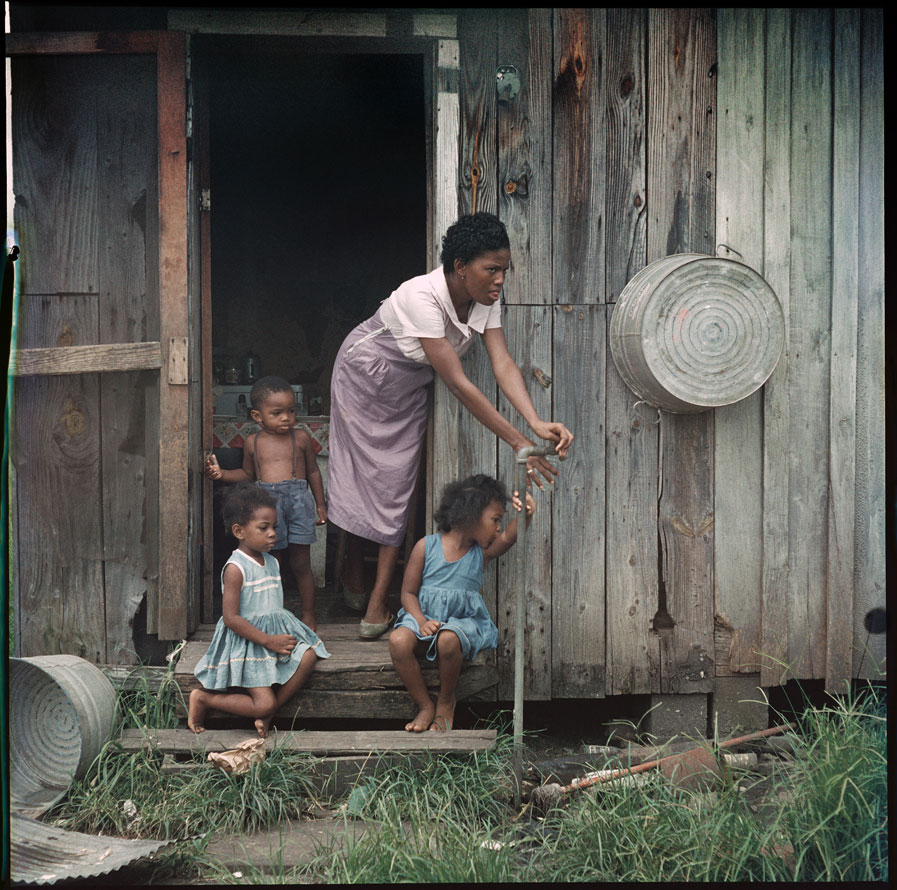
    Exhibition: Scott McFarland photographs at Regen Projects, Los Angeles

    Exhibition dates: 23rd May – 3rd July, 2009


    Scott McFarland (Canadian, b. 1975) 'Fallen Oak Tree' 2008


    Scott McFarland (Canadian, b. 1975)
    Fallen Oak Tree
    2008
    From the series Hampstead
    Inkjet print
    27 x 24 inches (68.6 x 61cm)
    Edition of 5


    Variations on a theme

    Whether McFarland’s photographs are “straight” or composites, there always seems to an unnerving feel to them, a formal frontality that empowers the viewer into trying to unlock the photographs secret, like an enigmatic puzzle. Everything is presented front on, square to the camera, no oblique angles, relying in the straight photographs on the scale of the accumulated blocks of information, and in the composites, in the very unlikely, even theatrical, staging of the people within the mise en scène.

    These are very cinematic photographs, some, literally, with their panoramic aesthetic, others built by assembling their scudding skies and stiff, neatly placed people. Too neatly placed in my opinion but that’s McFarland’s hook, his aesthetic cough which prompts the viewer to question the veracity of the image, its link to the photographs indexical reality. His multiple exposures push the boundaries of truth or dare, hyperreal solutions to a disengaged world. Personally, I prefer his straight photographs which are built on a fabulous eye, a masterful understanding of pictorial space (monumental elements held in balance) and wonderful previsualisation. You don’t need anything more.

    Dr Marcus Bunyan


    Many thankx to Regen Projects for allowing me to publish the photographs in the posting. Please click on the photographs for a larger version of the image.


    Scott McFarland (Canadian, b. 1975) 'The Admiral's House as seen from the Upper Garden at Fenton House' 2006


    Scott McFarland (Canadian, b. 1975)
    The Admiral’s House as seen from the Upper Garden at Fenton House
    2006
    From the series Hampstead
    Inkjet print
    Edition of 5


    “Regen Projects is pleased to announce an exhibition of new work by Canadian artist Scott McFarland. This exhibition will feature new photographs including 3 large panorama works, smaller works from the “Hampstead” series, and introduce the new “Niagara” series.

    Scott McFarland’s photography reconsiders the traditional concept of a photograph as the depiction of a single captured moment in time. Through digital means he is able to manipulate composition, colour, light, space, shape, and form. McFarland’s photographs combine multiple negatives to represent simultaneous temporalities and interweave selected elements into a cohesive whole. Several different moments are packed into what appears to be one densely constructed instant. The photographs are meticulously crafted illusions created within the formal language of documentary photography.

    McFarland’s consideration of photography and the built picture was brought about by the artist’s own understanding of the artificial “nature” found in built environments such as gardens and zoos. Taking the relationship of the constructed space/constructed image one step further, McFarland has photographed a modernist architectural landmark: the Berthold Lubetkin designed penguin pool at the London zoo. Through two very distinct works, McFarland investigates the elliptical structure of the famous penguin pool vis-à-vis the elliptical / arcing motion of his camera rotating on a tripod. One photograph is an objective colour rendering where the camera has been left level while rotating; the other is a larger black and white version where the camera arcs along a non-level plane distorting and altering the curve of the structure from right to left.

    The new square format photographs from McFarland’s “Niagara” series have a rough unfinished quality unlike any photographs he has taken to date. These softer focus images with odd shifts in light and glare are location studies for the large panorama A Horse Drawn Hearse, Queens Royal Tours, 174 Anne, Niagara on the Lake, Ontario (2009, below). This work depicts an old carriage business and its surroundings during the dead of Canadian winter. In this visually captivating work, a black funeral carriage contrasts against the white snow. The acreage, surrounded by newer suburban homes, evokes the question of how long can this structure resist the modern urban pressures it faces. These straight photographs presented alongside his precise digitally mastered compositions illustrate how the photographic process and the history of art and photography have always informed McFarland’s work.

    “Over the last decade, Scott McFarland has produced bodies of work that engage with different aspects of photography … McFarland’s approach is both descriptive and metaphoric … The images, rich in cultural significance, express the complementary workings of conceptual and aesthetic factors all the while holding various characteristics of art and photography in ambiguous relation.”

    Andrea Kunard. Scott McFarland: A Cultivated View, published by the National Gallery of Canada, Ottawa, 2009, p. 12.

    Text from the Regen Projects press release [Online] Cited 16/06/2009. No longer available online.


    Scott McFarland (Canadian, b. 1975) 'A Horse Drawn Hearse, Queens Royal Tours, 174 Anne, Niagara on the Lake, Ontario' 2009


    Scott McFarland (Canadian, b. 1975)
    A Horse Drawn Hearse, Queens Royal Tours, 174 Anne, Niagara on the Lake, Ontario
    2009
    From the series Niagara
    Inkjet print
    59.5 x 124 inches (151.1 x 315cm)
    Edition of 5


    Scott McFarland (Canadian, b. 1975) 'Boathouse with Moonlight' 2002


    Scott McFarland (Canadian, b. 1975)
    Boathouse with Moonlight
    2002
    From the series Boathouse
    Digital C-print
    71 x 91 inches (180 x 231cm)
    Edition of 5, 2 AP


    “Boathouse with Moonlight” is an exploration of the technical advancements afforded by digital photography, created by assembling multiple exposures taken over the space of two hours under the light of a full moon. Unlike traditional photography, this image does not represent one specific moment captured at a particular site; rather, it shows an accumulation of moments that have been manipulated and layered to create a revised version of the boathouse and its surroundings. McFarland’s use of multiple exposures to produce the final image emphasises not only the duration of the photographic act, but also the many facets of the boathouse’s character. This type of building on British Columbia’s “Sunshine Coast” is disappearing with the construction of new, suburban-style retirement housing.

    Text from the National Gallery of Canada website [Online] Cited 02/03/2019


    Scott McFarland (Canadian, b. 1975) 'Gorse and Broom, West Heath, Hampstead' 2006


    Scott McFarland (Canadian, b. 1975)
    Gorse and Broom, West Heath, Hampstead
    2006
    From the series Hampstead
    Inkjet print
    Edition of 5


    Scott McFarland (Canadian, b. 1975) 'Women Drying Laundry on the Gorse, Vale of Health, Hampstead Heath' 2007


    Scott McFarland (Canadian, b. 1975)
    Women Drying Laundry on the Gorse, Vale of Health, Hampstead Heath
    2007
    From the series Hampstead
    Inkjet print
    29 x 45 inches (73.7 x 114.3cm)
    Edition of 5


    Scott McFarland (Canadian, b. 1975) 'Inspecting, Allan O'connor Searches for Botrytis cinerea' 2003


    Scott McFarland (Canadian, b. 1975)
    Inspecting, Allan O’connor Searches for Botrytis cinerea
    2003
    From the series Gardens
    Digital C-print
    40 x 48 inches (102 x 122cm)
    Edition of 7


    Scott McFarland (Canadian, b. 1975) 'Orchard View with the Effects of Seasons (Variation #1)' 2003-2006


    Scott McFarland (Canadian, b. 1975)
    Orchard View with the Effects of Seasons (Variation #1)
    2003-2006
    From the series Gardens
    Digital C-print
    42 x 122 inches (106.7 x 309.9cm)
    Edition of 3


    Scott McFarland (Canadian, b. 1975) 'Empire' 2005


    Scott McFarland (Canadian, b. 1975)
    [Huntington Botanical Gardens in San Marino, Calif]
    2005
    From the series Empire
    Inkjet print


    Scott McFarland (Canadian, b. 1975) 'Echinocactus grusonii' 2006


    Scott McFarland (Canadian, b. 1975)
    Echinocactus grusonii [Huntington Botanical Gardens in San Marino, Calif]
    2006
    From the series Empire
    Inkjet print
    24.5 x 27.5 inches (62 x 70cm)
    Edition of 3
    Private collection/Vancouver Art Gallery


    This picture comes from Empire, a series on desert vegetation shot in the Huntington Botanical Gardens in San Marino, Calif. Henry E. Huntington, an art collector who made his fortune building railroads, founded the garden in 1919.

    “The plantings [of the garden] are dense, and the soil is mostly hidden beneath the thriving vegetation,” writes Grant Arnold in a catalogue essay for the exhibition, “the fullness of the planting continually reminding the visitor of Huntington’s beneficence.” To many gallery visitors, however, these images of lush desert vegetation will simply be appealing to the eye.

    Kevin Chong. “A different way of seeing,” on the CBC News website November 13, 2009 [Online] Cited 02/03/2019


    Scott McFarland (Canadian, b. 1975) 'The Granite Bowl in the Berlin Lust Garden' 2006


    Scott McFarland (Canadian, b. 1975)
    The Granite Bowl in the Berlin Lust Garden
    2006
    Inkjet print
    43 x 62 inches (109.2 x 157.5cm)
    Edition of 5


    At first the photograph appeared to be a simple scene, one of no importance. The two young children, obviously related based on their similar physical features, seemed a bit awkward and posed, but otherwise, I thought it to be a snapshot, much like the one I took of the bowl while in Berlin. Upon learning how McFarland created this and many of his other photographs, I learned how complex of a scene this really is. McFarland uses multiple negatives, often taken over a matter of days, weeks, and even months, and combines them digitally into a seamless print. His interest is in breaking through the concept of a photograph being an image of a single instant in time and space.

    A fuller narrative is created as well. With just one negative, there may only be one or two people depicted. We may just have the dog with his owner half shown, or even only half of the brother-sister group. But by overlapping the various negatives, Mr McFarland manipulates his work into a greater piece. We can now ask ourselves, why are the brother and sister so psychologically distant? Or, who is the small girl with the accordion and where is her mother? Is her mother the woman with the baby carriage? How long has that man been sleeping under the bowl? These are all questions that can be asked together because the negatives are combined that couldn’t be asked if we had just the single frame.

    Jason Hosford. “Scott McFarland’s The Granite Bowl in the Berlin Lust Garten,” on the West L’Art website June 24, 2007 [Online] Cited 02/03/2019


    Scott McFarland (Canadian, b. 1975) 'View of Vale of Health, looking towards Hampstead' 2007


    Scott McFarland (Canadian, b. 1975)
    View of Vale of Health, looking towards Hampstead
    2007
    From the series Hampstead
    Inkjet print
    27 x 42.5 inches (68.6 x 108 cm)
    Edition of 5


    With the stiff figures of a historical painting, Scott McFarland’s View of Vale of Health, Looking Towards Hampstead muddles ideas of what’s real and what’s not.

    From the get-go, painting and photography have been inextricably bound together. The Pictorialists tried to make their photographs look like paintings. The Futurists, in their paintings, mimicked the blurred and segmented movement found in Etienne-Jules Marey’s chronophotographs. The photorealists created paintings whose subject was the photograph itself. And in his large-scale, backlit photo-transparencies, Jeff Wall has alluded to paintings by Nicolas Poussin, Edouard Manet, and Paul Cézanne, among others. The digital age has done nothing to diminish each medium’s obsession with the other.

    This continued entwining of art forms is evident in Scott McFarland’s computer-montaged photographs, on view at the Vancouver Art Gallery. So is the parallel entanglement of nature and culture. Both conditions are conspicuous in his 2006 series, “Hampstead”, inspired by the landscapes of the early-19th-century English painter John Constable. McFarland’s colour photos, shot in various locations around London’s immense Hampstead Heath, pay homage to Constable’s attraction to the same place. They also play variations on that painter’s rendering of multiple versions of the same scene, and on his open-air studies of the changing effects of light and weather. …

    Over the past decade, McFarland’s working methods have changed from straightforward analog photography to the creation of highly manipulated images in which he digitally splices together multiple segments of the same landscape or structure, shot over a period of days, weeks, or even months. In both variations of Orchard View With the Effects of the Seasons, for instance, the blossoms and foliage of spring, summer, and fall are contained within the same seamless panorama.

    The digital assist means that there are no constraints of time, space, or documentary veracity in McFarland’s work: he can build whatever impossible pictures he wants and they will look “real”. At least until they’re closely scrutinised, revealing incongruities of light, shadow, time, and figuration. In this sense, his art challenges our understanding of the nature of the photograph and its relationship with the truth. There’s nothing really new about this project – as long as photography’s been around, it’s been manipulated by its practitioners. Photoshop, however, has added a vast digital dimension to the darkroom antics of earlier photo artists.

    Robin Laurence. “Scott McFarland makes impossible pictures real at the Vancouver Art Gallery,” on the Georgia Straight website October 7th 2009 [Online] Cited 02/03/2019


    Regen Projects
    6750 Santa Monica Boulevard,
    Los Angeles, CA 90038

    Opening hours:
    Tuesday – Saturday 10am – 6pm

    Regen Project website

    Scott McFarland website

    LIKE ART BLART ON FACEBOOK

    Back to top
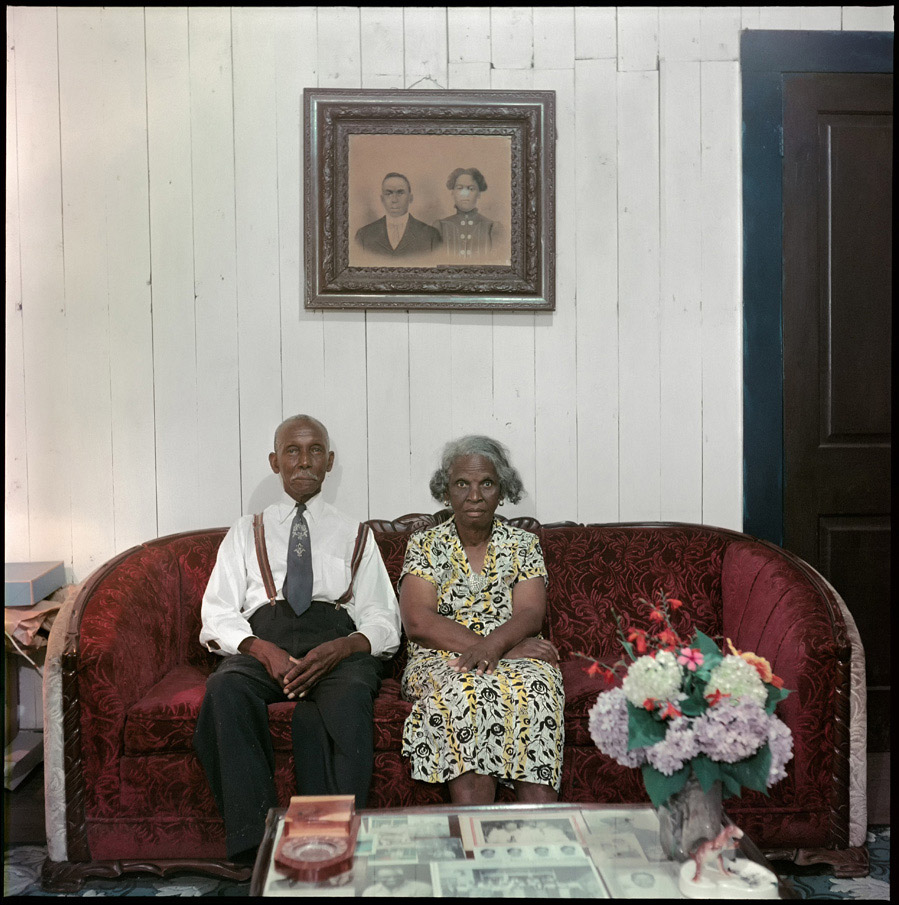
    Opening 1: ‘Faith in a Faithless Land’ photographs by Jill Orr at Jenny Port Gallery, Melbourne

    Exhibition dates: 6th May – 30th May, 2009


    Installation view of Jill Orr exhibition 'Faith in a Faithless Land' at Jenny Port Gallery, Melbourne


    Installation view of Jill Orr exhibition Faith in a Faithless Land at Jenny Port Gallery, Melbourne


    First cab off the rank on a busy night of openings in Melbourne were the self-conscious photographs of Jill Orr presented at Jenny Port Gallery in Richmond, Melbourne (the gallery now in Collingwood). Beautifully hung in the gallery space in white frames the photographs were the least engaging artworks on the night. Their message seemed over determined, the use of reflection to add layering to the human-landscape mis en scene trite. Perhaps the performance itself would have evinced a more authentic, nuanced connection with the viewer vis a vis a response to the overwhelming expanse of nature and the place humans occupy on the thin crust of the earth. These photographs did not make that telluric connection and left me emotionally uninvolved in their pictorial representation.

    Unfortunately I cannot show you any of the photographs because of copyright reasons but thank you to Jenny for allowing me to photograph the installation itself.

    Dr Marcus Bunyan


    Installation view of Jill Orr exhibition 'Faith in a Faithless Land' at Jenny Port Gallery, Melbourne

    Installation view of Jill Orr exhibition 'Faith in a Faithless Land' at Jenny Port Gallery, Melbourne


    Installation views of Jill Orr exhibition Faith in a Faithless Land at Jenny Port Gallery, Melbourne


    Jenny Port Gallery

    This gallery is now closed.

    Jill Orr website

    LIKE ART BLART ON FACEBOOK

    Back to top