Exhibition: ‘Collecting Inspiration: Edward C. Moore at Tiffany & Co.’ at The Metropolitan Museum of Art, New York

Exhibition dates: 9th June – 20th October, 2024


Edo period (1615-1868) 'Group of Inrō' 18th century from the exhibition 'Collecting Inspiration: Edward C. Moore at Tiffany & Co.' at The Metropolitan Museum of Art, New York, June - Oct 2024


Edo period (1615-1868)
Group of Inrō
18th century
Metropolitan Museum of Art, New York
Edward C. Moore Collection, Bequest of Edward C. Moore, 1891
Public domain


Inrō are small, light, tightly nested boxes worn hanging from a man’s obi sash, as a Japanese kimono had no pockets. The term’s literal meaning, “seal basket,” probably refers to an early function, but later they held small amounts of medicine. Once they became fashion items, inrō were carefully selected according to the season or occasion and coordinated with the attached ojime (sliding bead) and netsuke (toggle) as well as with the kimono and obi. Moore and his team surely studied the rich motifs and sophisticated production methods of the inrō he collected.


A change of pace this weekend.

Just because… I love beautiful things; I am a collector of antiques and object d’art; and I have a wonderful standing Tiffany picture frame at home.

Roman glass, Italian Murano glass, Austrian and German glass, Arabic and Persian metalwork, glass and earthenware, Japanese lacquer, wicker, metalware and pottery, Chinese glass and porcelain. All used as inspiration by Edward C. Moore, “the creative force who led Tiffany & Co. to unparalleled originality and success during the second half of the 19th century.”

Enjoy!

Dr Marcus Bunyan


Many thankx to The Metropolitan Museum of Art for allowing me to publish the photographs in the posting. All the text in the posting is from the Metropolitan Museum of Art website. Please click on the photographs for a larger version of the image.


Exhibition Tour – Collecting Inspiration: Edward C. Moore at Tiffany & Co. | Met Exhibitions

Edward C. Moore (1827-1891) – the creative force who led Tiffany & Co. to unparalleled originality and success during the second half of the 19th century – amassed a vast collection of decorative arts of exceptional quality and in various media, from Greek and Roman glass and Japanese baskets to metalwork from the Islamic world. These objects were a source of inspiration for Moore, a noted silversmith in his own right, and the designers he supervised. The exhibition Collecting Inspiration: Edward C. Moore at Tiffany & Co. will feature more than 180 extraordinary examples from Moore’s personal collection, which was donated to the Museum, alongside 70 magnificent silver objects designed and created at Tiffany & Co. under his direction.


Overview

Edward C. Moore (1827-1891) – the creative force who led Tiffany & Co. to unparalleled originality and success during the second half of the 19th century – amassed a vast collection of decorative arts of exceptional quality and in various media, from Greek and Roman glass and Japanese baskets to metalwork from the Islamic world. These objects were a source of inspiration for Moore, a noted silversmith in his own right, and the designers he supervised. The exhibition Collecting Inspiration: Edward C. Moore at Tiffany & Co. will feature more than 180 extraordinary examples from Moore’s personal collection, which was donated to the Museum, alongside 70 magnificent silver objects designed and created at Tiffany & Co. under his direction. Drawn primarily from the holdings of The Met, the display will also include seldom seen examples from a dozen private and public lenders. A defining figure in the history of American silver, Moore played a pivotal role in shaping the legendary Tiffany design aesthetic and the evolution of The Met’s collection.

Text from The Metropolitan Museum of Art website
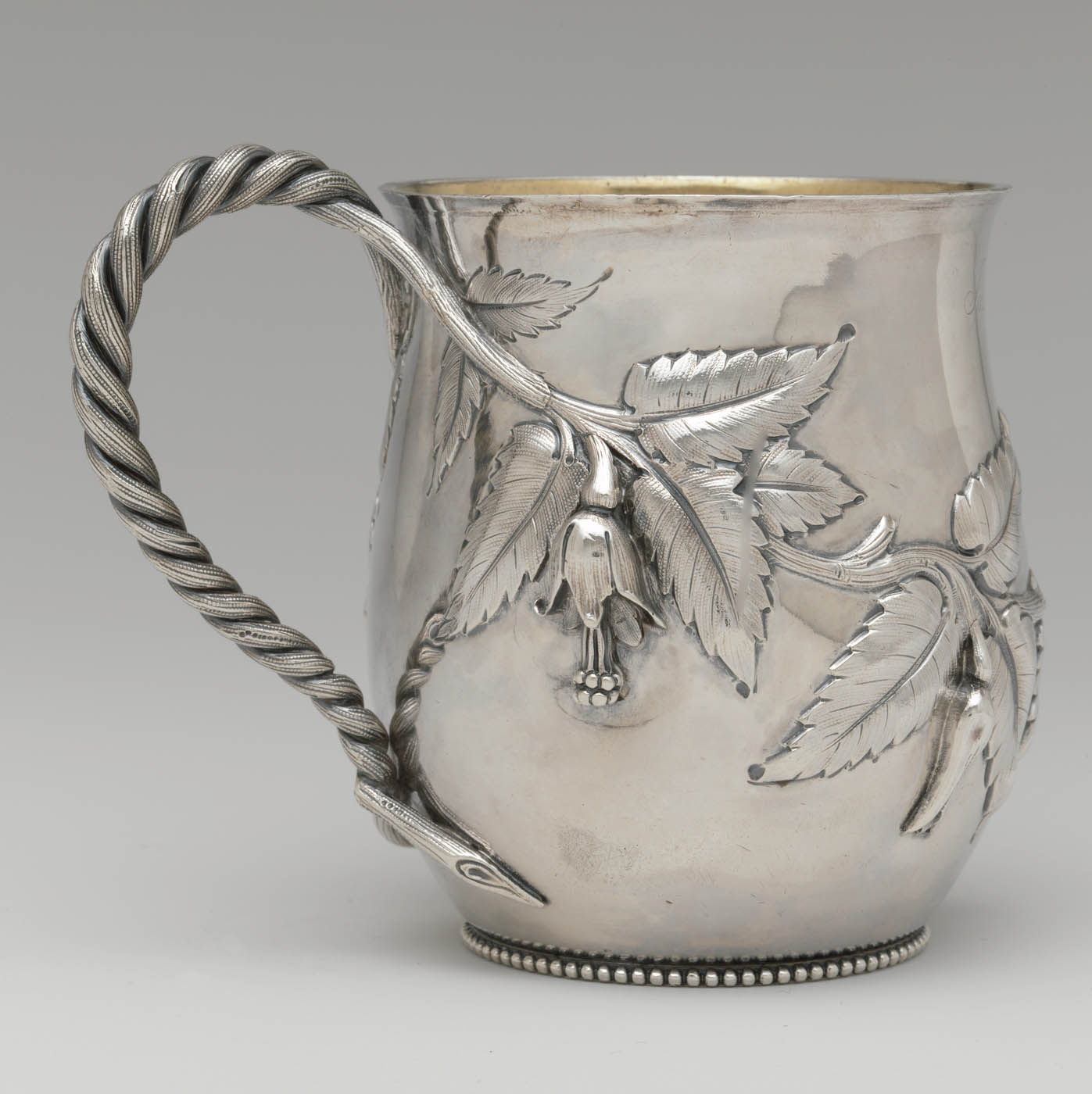
 

Edward C. Moore (American, New York 1827 - 1891 New York) 'Cup' 1853 from the exhibition 'Collecting Inspiration: Edward C. Moore at Tiffany & Co.' at The Metropolitan Museum of Art, New York, June - Oct 2024


Edward C. Moore (American, New York 1827 – 1891 New York)
Cup
1853
Silver and silver-gilt
3 3/4 x 3 1/4 x 4 3/4 in. (9.5 x 8.3 x 12.1cm); 6 oz. 14 dwt. (208.2 g)
Metropolitan Museum of Art, New York
Gift of Jerome B. Dwight, in memory of Charles Noyes de Forest and Henry Wheeler de Forest Jr., 2005
Public domain


This cup is an early example of Moore’s sophisticated design sensibilities and technical skills. While it was first thought to be the work of his father, a recently discovered sketch signed “E. C. M.” confirms the twenty-six-year-old Edward as its designer. Characteristic of his inventive eye and hand are the fluidity of the fuchsia vine and the dynamic play between the high-relief flowers and smooth, undecorated ground, which lend it a compositional coherence and show his understanding of the power of negative space. Engraved as a baby gift for Julia Brasher de Forest, sister of artist Lockwood de Forest, and marked “Moore,” the cup appears to have been a commission he considered a personal project.
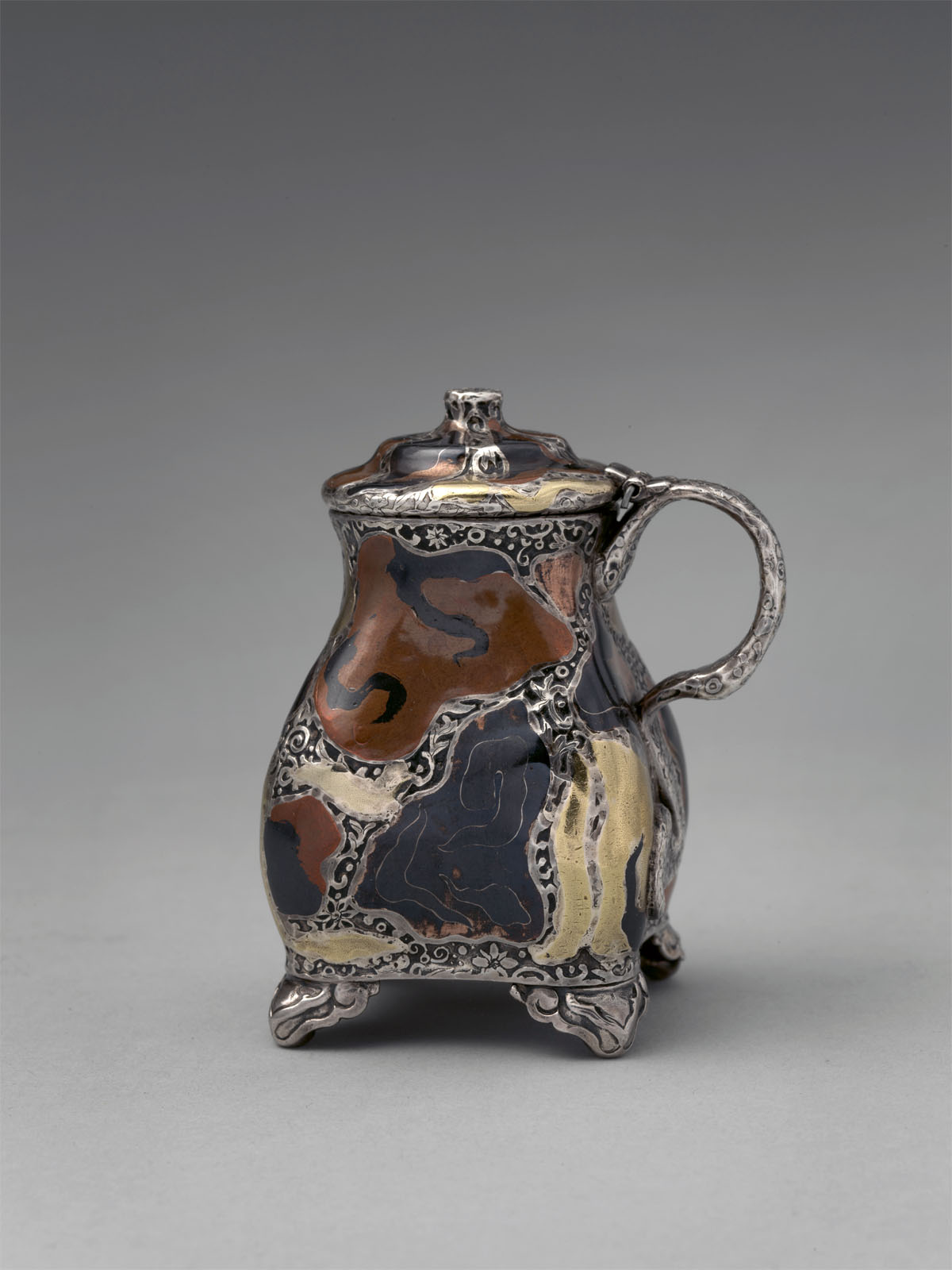
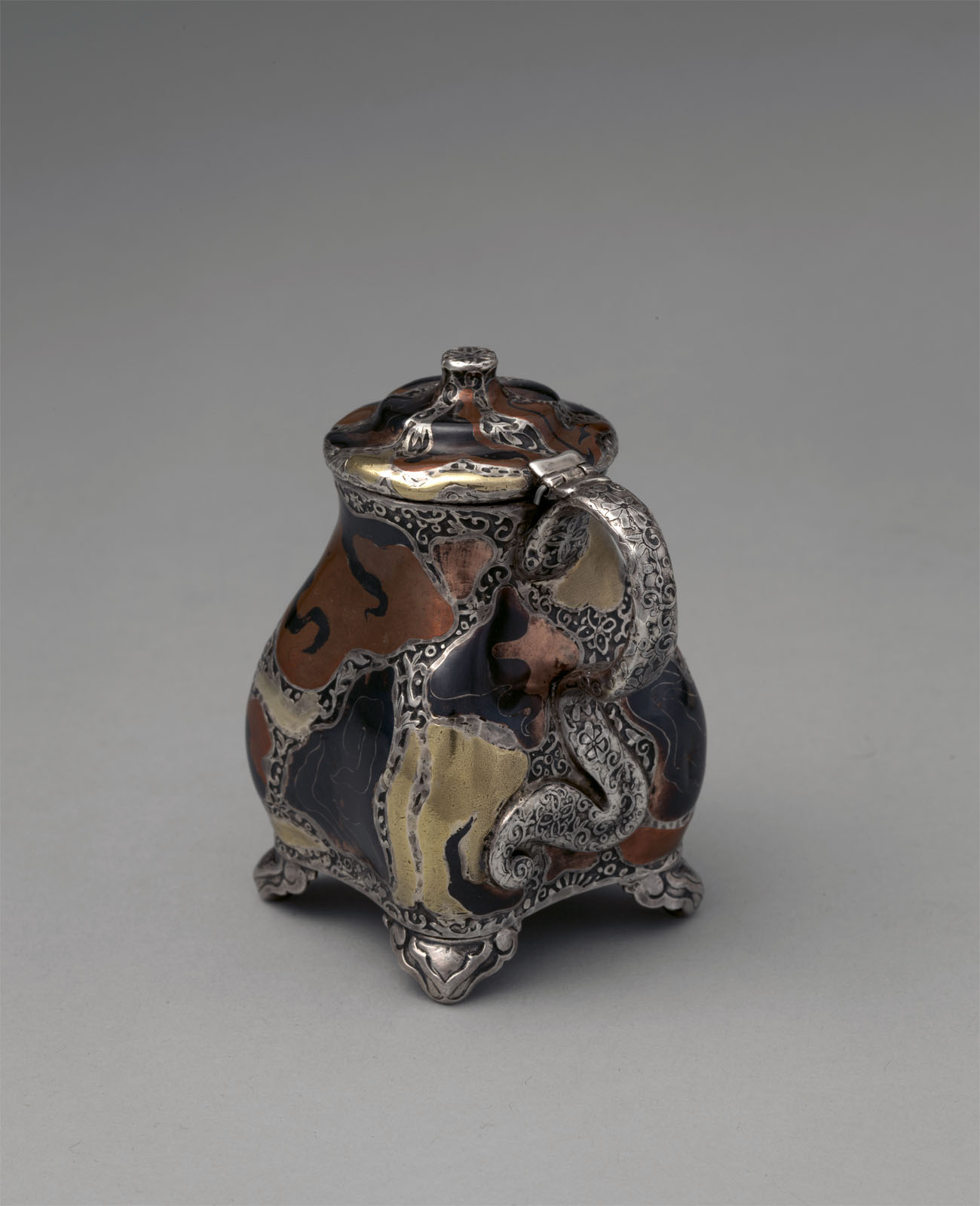
 

Tiffany & Co. (1837-present) 'Mustard Pot' c. 1879

Tiffany & Co. (1837-present) 'Mustard Pot' c. 1879


Tiffany & Co. (1837-present)
Mustard Pot
c. 1879
Silver, copper, gold, patinated copper-gold alloy, patinated copper-platinum-iron alloy, and niello
3 3/16 × 2 1/2 × 2 in. (8.1 × 6.4 × 5.1cm)
Metropolitan Museum of Art, New York
Purchase, Friends of the American Wing Fund and Emma and Jay A. Lewis Gift, 2016
Public domain


Following the opening of Japan to the West in the 1850s and the subsequent display of Japanese art at international expositions, the Japanese taste began to captivate American consumers. In response, designers such as Edward C. Moore at New York’s Tiffany & Co. introduced a range of objects inspired by Japanese art works, including ceramics, metalwork, textiles, prints, lacquerware, and netsuke. The decoration on this mustard pot is particularly unusual and innovative. Its baluster form is completely transformed by the asymmetrical inset panels of mixed metal alloys – one of patinated copper and gold (a direct attempt to imitate Japanese Shakudō), and another of patinated copper, platinum, and iron – enclosed by scrolled “Snake Skin” borders. The mottled, multicoloured surface also evokes the swirling array of colours observed in Moore’s collection of ancient mosaic and core-formed glass. Labeled in the Tiffany & Co. Archives as “Mustard to go with Pepper 5493,” this is one of only six decorated versions produced. The Tiffany Archives also retains the Hammering & Inlaying Design drawings for this particular version (#853), which at a cost of $35 was the most expensive iteration.


Tiffany & Co. (1837-present) 'Cup and saucer' c. 1881


Tiffany & Co. (1837-present)
Cup and saucer
c. 1881
Silver, patinated copper, patinated copper-platinum-iron alloy, and gold
Cup: 2 1/8 × 2 1/2 × 1 7/8 in. (5.4 × 6.4 × 4.8cm)
Saucer: 1/2 × 4 in. (1.3 × 10.2 cm)
Metropolitan Museum of Art, New York
Purchase, Friends of the American Wing Fund and Emma and Jay A. Lewis Gift, 2016
Public domain


This cup and saucer represent a rare aspect of Tiffany & Co.’s production. As early as 1845 Tiffany & Co. was selling items they promoted as “Indian Goods,” including pipes, belts, pouches, moccasins, and “various fancy articles, made of Birch Bark.” Native American imagery and decorative vocabulary also appeared in Tiffany silver designs, particularly in works conceived by Eugene Soligny (1832-1901) and Paulding Farnham (1859-1927), two of the firm’s leading designers. Here the pattern of alternating red and black triangles is reminiscent of Navajo blankets. During the later decades of the nineteenth century, Tiffany & Co. designers drew inspiration from a diverse array of sources. They had access to the vast collection of books and objects from around the world assembled by the head of the silver division, Edward C. Moore. The decorative pattern on this cup and saucer bears striking similarity to a rendering of floor patterns in one of Moore’s books, The Basilica of San Marco in Venice. Whether referencing Navajo blankets, Venetian floors, or both, the cup and saucer are testaments to the fertile environment in which Tiffany & Co. designers and craftsmen created their innovative work.
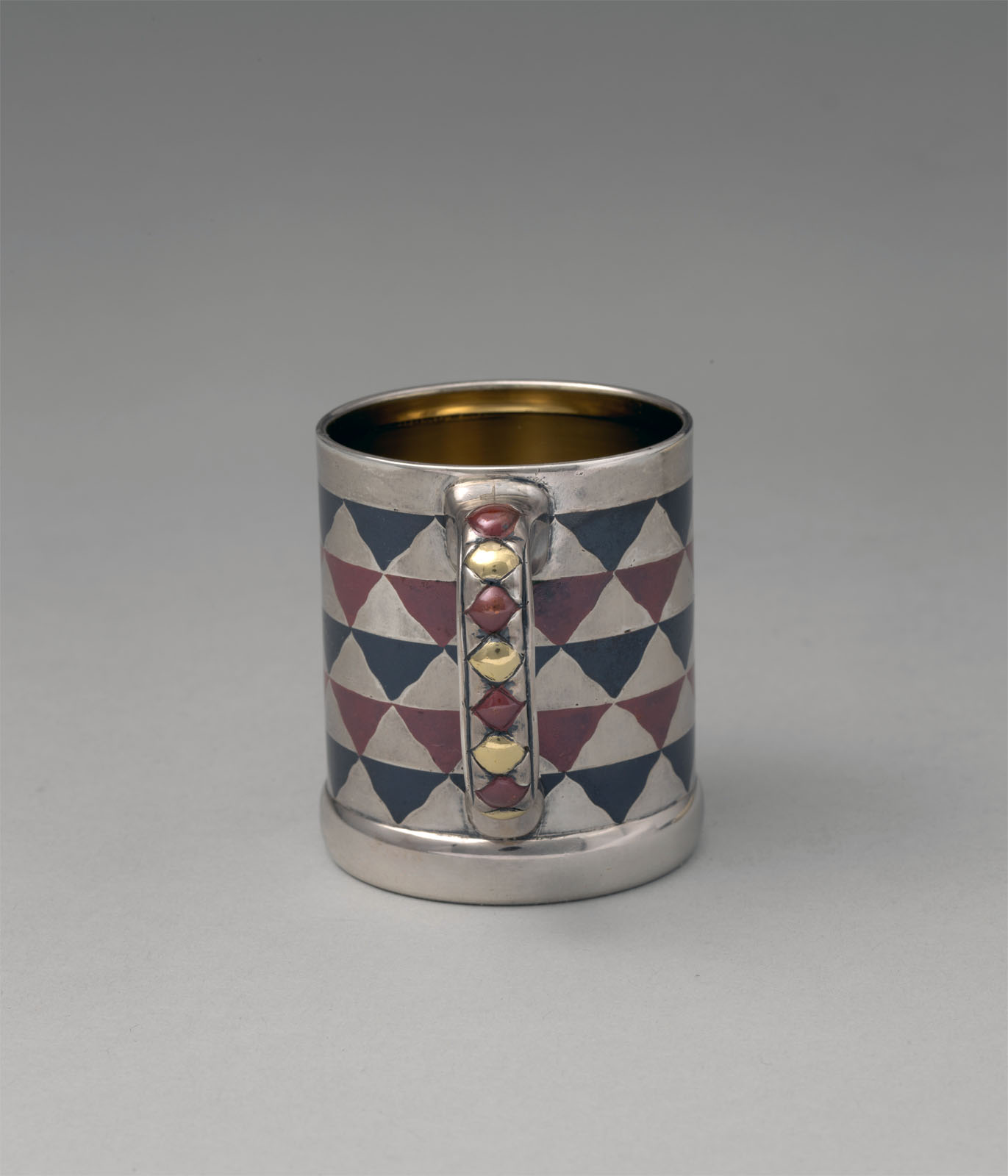
 

Tiffany & Co. (1837-present) 'Cup and saucer' c. 1881


Tiffany & Co. (1837-present)
Cup and saucer
c. 1881
Silver, patinated copper, patinated copper-platinum-iron alloy, and gold
Cup: 2 1/8 × 2 1/2 × 1 7/8 in. (5.4 × 6.4 × 4.8cm)
Saucer: 1/2 × 4 in. (1.3 × 10.2 cm)
Metropolitan Museum of Art, New York
Purchase, Friends of the American Wing Fund and Emma and Jay A. Lewis Gift, 2016
Public domain


Camillo Boito (editor) Ferdinando Ongania (1842-1911) (publisher) 'La Basilica di San Marco in Venezia illustrata nella storia e nell'arte da scrittori veneziani: [volume 3]' 1881


Camillo Boito (editor)
Ferdinando Ongania (1842-1911) (publisher)
La Basilica di San Marco in Venezia illustrata nella storia e nell’arte da scrittori veneziani: [volume 3]
1881
41.3 x 34.1 x 3cm
Metropolitan Museum of Art, New York
Public domain


Moore assembled an extensive library, which includes a rare, lavish fourteen-volume publication on the Basilica of San Marco in Venice. Produced between 1881 and 1888 under the direction of Italian restoration architect and art historian Camillo Boito, it documents in text and chromolithograph illustrations virtually every detail of the centuries-old basilica. The volume on view here is devoted to the mosaic floors. The image replicates multicoloured geometric patterns from borders that frame some of the floors’ rectangular fields. Their variety and rhythmic energy would have resonated with Moore’s aesthetic sensibilities. Figure IX, in the lower right, bears striking similarities to the Tiffany cup and saucer displayed nearby.
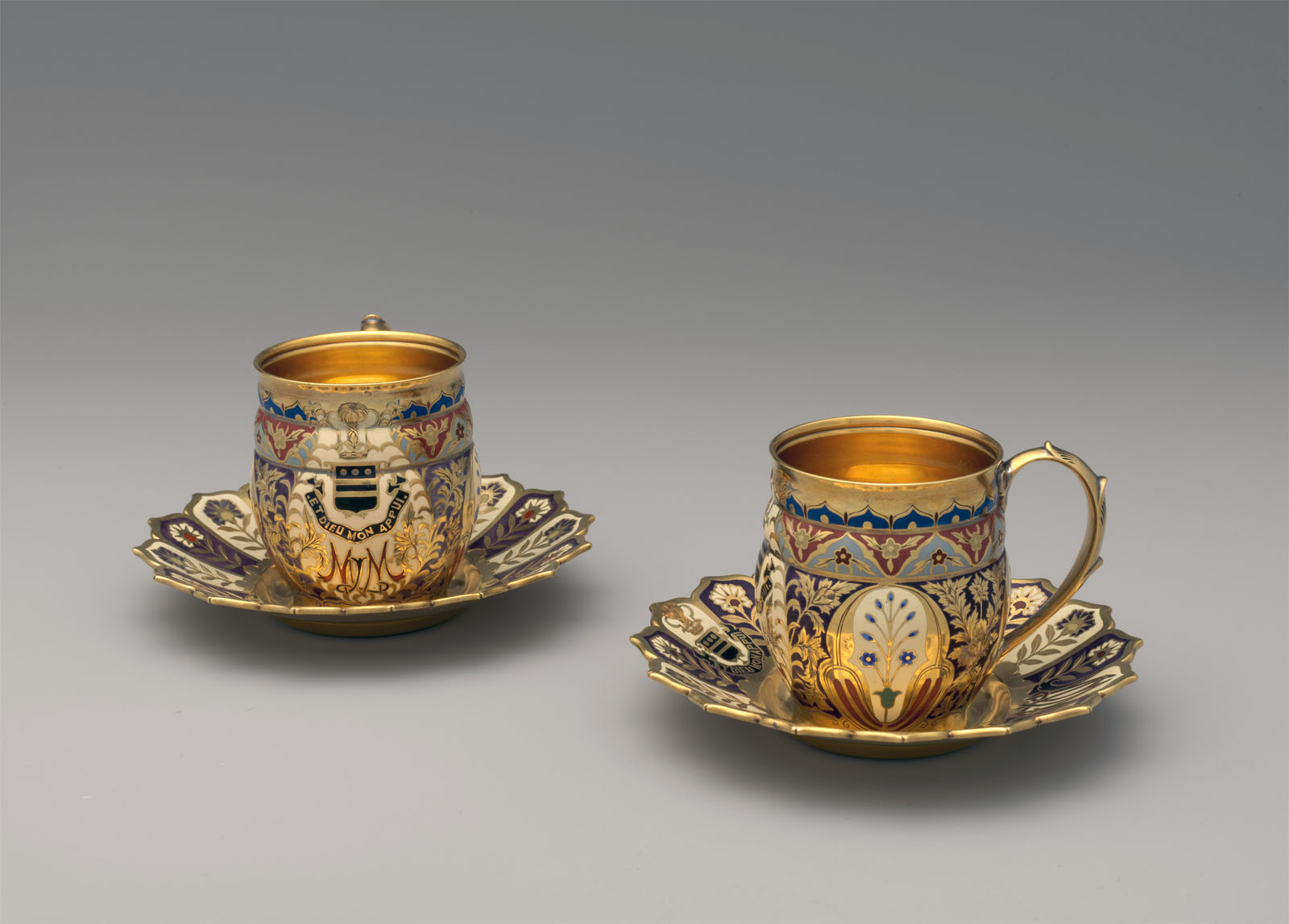
 

Tiffany & Co. (1837-present) 'Two cups and saucers from the Mackay Service' 1878


Tiffany & Co. (1837-present)
Two cups and saucers from the Mackay Service
1878
Silver-gilt and enamel
2 1/4 × 2 × 2 3/4 in. (5.7 × 5.1 × 7cm)
Metropolitan Museum of Art, New York
Purchase, Cranshaw Corporation Gift, 2017
Public domain


These gilded and enamelled cups and saucers are part of one of the most renowned and lavish dinner services ever created in America.

Commissioned in 1877 by John W. (1831-1902) and Marie Louise Hungerford (1843-1928) Mackay, the dinner service for twenty-four consisted of over 1,250 pieces. A poor Irish immigrant with little education, John W. Mackay became one of the wealthiest men in America when he and three partners, James Fair, James Flood, and William O’Brien, struck a silver deposit known as “The Big Bonanza” at Nevada’s Comstock Lode in 1873. During a visit to the mine, Marie Louise asked her husband for a silver dinner service “made by the finest silversmith in the country.” Her husband responded, “You shall have it. I like the notion of eating off silver brought straight from the Comstock.” He proceeded to have a half ton of silver delivered from the mine to Tiffany & Co., where two hundred men worked for almost two years to complete the commission. After being snubbed by New York City society, the Mackays established themselves in Paris. In 1878 the service was sent to be featured in Tiffany’s award-winning display at the Paris Exposition Universelle before being delivered to the Mackay’s home at 9 Rue de Tilsitt near the Arc de Triomphe. In an era of extravagant social affairs, Mrs. Mackay’s dinners and balls were legendary. The Mackay dinner service would have been at the centre of banquets that included royalty, aristocracy, President and Mrs. Ulysses S. Grant, and one of the most prominent celebrities of the day, Buffalo Bill. Identified in firm records as “Indian” in style, the Mackay service reflects the sophisticated and innovative design sensibilities of Edward C. Moore, the head of Tiffany’s silver division, and the team of designers, chasers, and craftsmen who conceived and realised this commission. The exquisite cloisonné enamelled decoration on these cups embodies Gilded Age extravagance and would have offered a dazzling finale to a meal served on a sea of elaborately chased silver wares in an “exotic” Indian and Near Eastern taste.
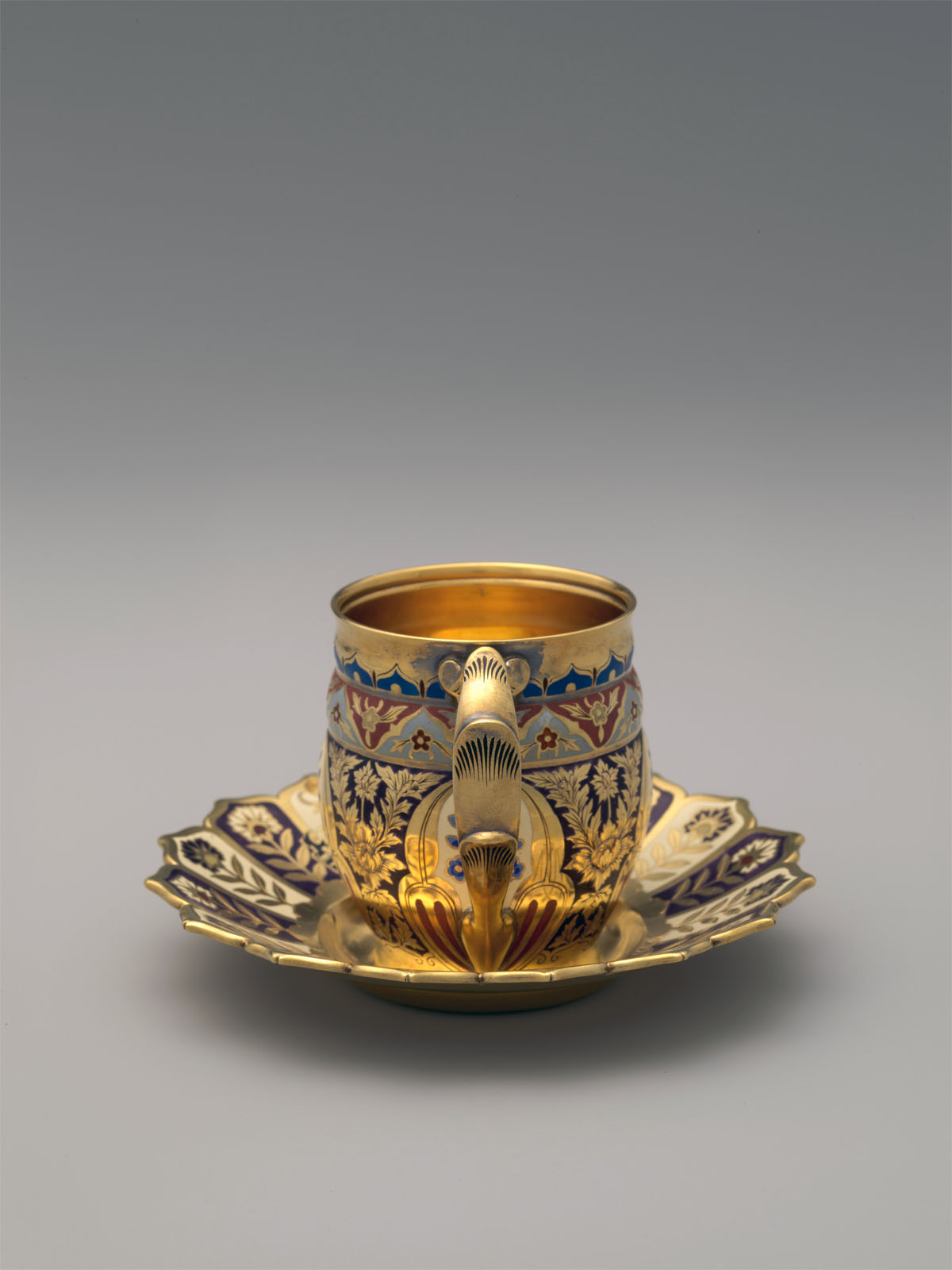
 

Tiffany & Co. (1837-present) 'Two cups and saucers from the Mackay Service' 1878


Tiffany & Co. (1837-present)
Two cups and saucers from the Mackay Service
1878
Silver-gilt and enamel
2 1/4 × 2 × 2 3/4 in. (5.7 × 5.1 × 7cm)
Metropolitan Museum of Art, New York
Purchase, Cranshaw Corporation Gift, 2017
Public domain
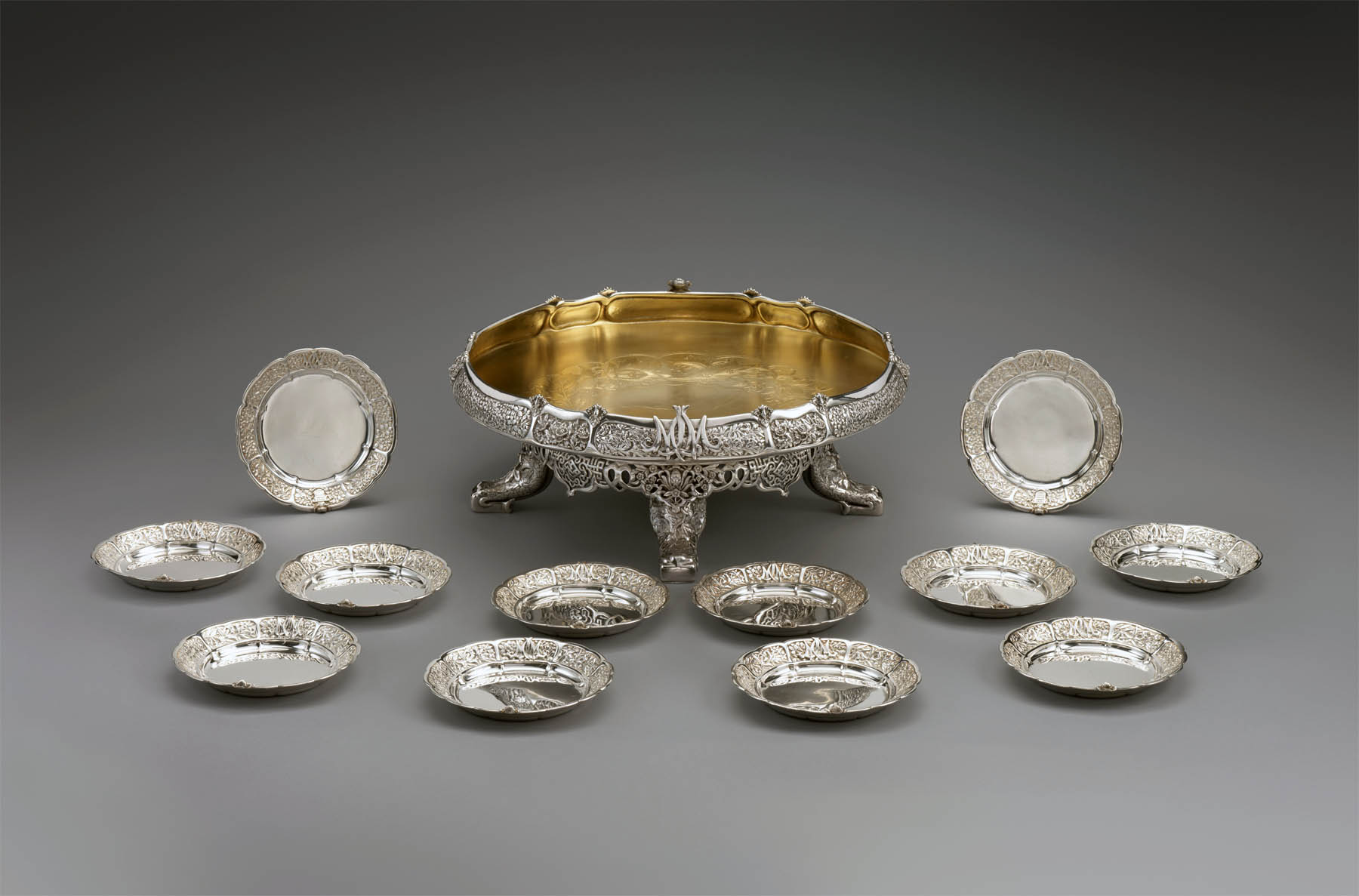
 

Tiffany & Co. (1837-present) 'Ice Cream Dish from Mackay Service' 1878


Tiffany & Co. (1837-present)
Ice Cream Dish from Mackay Service
1878
Silver, silver gilt
6 × 15 3/8 in. (15.2 × 39.1cm)
Metropolitan Museum of Art, New York
Purchase, Anonymous Gift, 2023
Public domain


This silver ice cream dish and accompanying plates are part of one of the most renowned and lavish dinner services ever created in America. Commissioned in 1877 by John W. (1831-1902) and Marie Louise Hungerford (1843-1928) Mackay, the dinner service for twenty-four consisted of over 1,250 pieces.
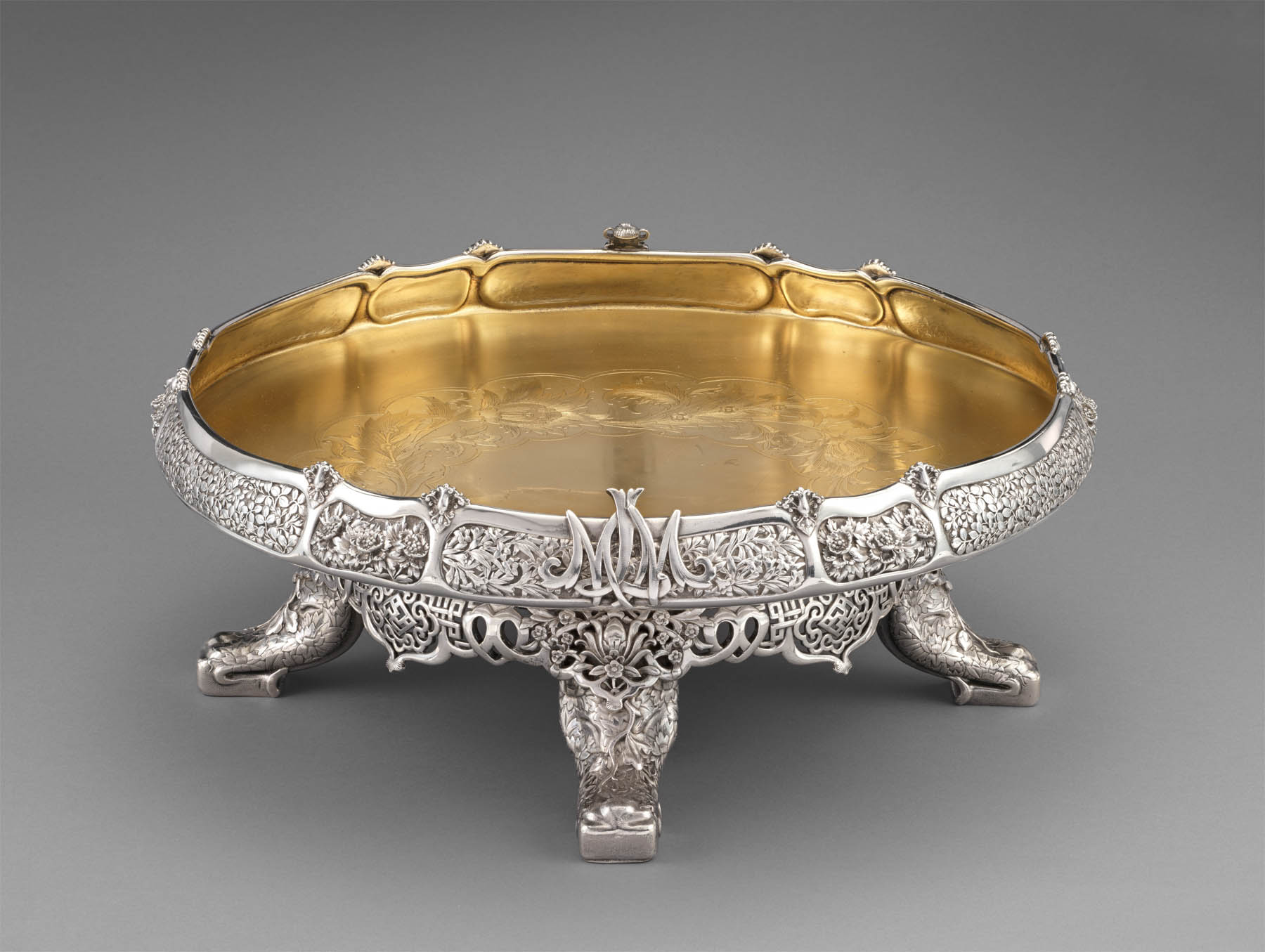
 

Tiffany & Co. (1837-present) 'Ice Cream Dish from Mackay Service' 1878


Tiffany & Co. (1837-present)
Ice Cream Dish from Mackay Service
1878
Silver, silver gilt
6 × 15 3/8 in. (15.2 × 39.1cm)
Metropolitan Museum of Art, New York
Purchase, Anonymous Gift, 2023
Public domain
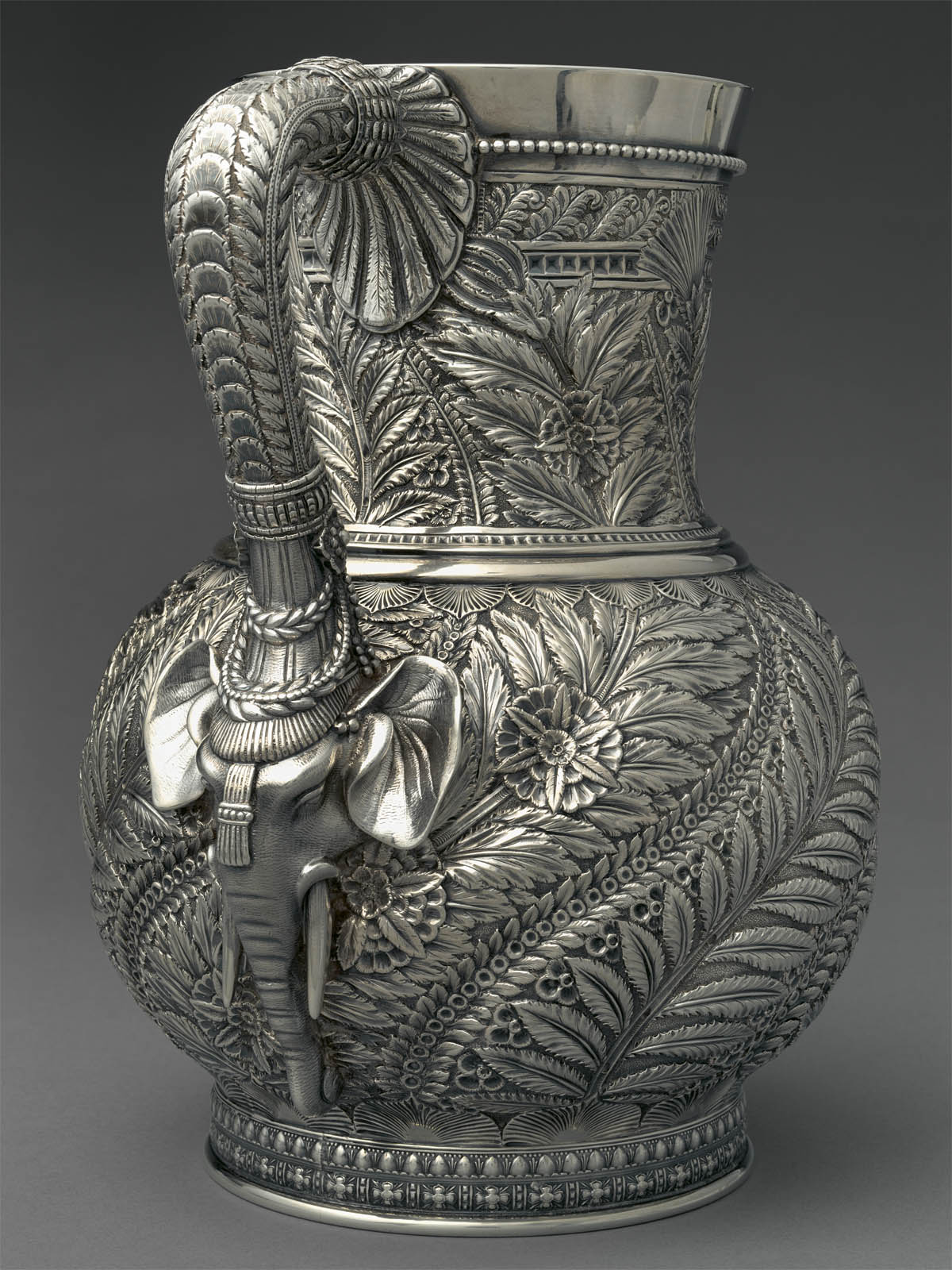
 

Tiffany & Co. (1837-present) 'Pitcher' 1874-1875


Tiffany & Co. (1837-present)
Pitcher
1874-1875
Silver
9 3/8 × 7 × 8 3/8 in. (23.8 × 17.8 × 21.3cm)
Metropolitan Museum of Art, New York
Sansbury-Mills Fund, 2018
Public domain


This pitcher exemplifies the technical virtuosity and creativity that characterised Tiffany & Co.’s finest silver during the 1870s and 1880s. Under the direction of Edward C. Moore (1827-1891), the silver division at Tiffany & Co. produced a diverse array of exquisitely wrought and highly original work. Created in 1874 or 1875, this pitcher is an early example of Tiffany & Co.’s engagement with Near Eastern and Indian works of art. Edward C. Moore was a passionate and discerning collector of metalwork, glass, ceramics, and textiles from the Islamic world and the Indian subcontinent, and these objects had a profound impact on his creative vision and deigns. The elephant head draped with garlands and the surrounding panels of dahlias, lotus flowers, and other exotic vegetation reflect careful study of Indian and Near Eastern sources and attest to the masterful chasing skills of Eugene Soligny (1832-1901). Together with a matching pitcher that was made several years later, this pitcher was presented in 1883 by Julia Rhinelander (d. 1890) to her niece Mary Rhinelander Stewart (1859-1949) on the occasion of her wedding to Frank Spencer Witherbee (1852-1917).

This pitcher is an especially dynamic and successful example of Tiffany’s engagement with works of art from the Islamic world and the Indian subcontinent. The firm produced numerous versions of this form, most of which feature dahlias and other “Persian” motifs like those seen here. The exquisitely rendered details, particularly the elephant head, attest to the skills of Eugene Soligny, one of Tiffany’s most accomplished chasers. They also reflect ideals promoted by the silver workshop supervisor, Charles Grosjean, who urged careful consideration of the relationship between form and decoration: the pitcher’s curves define the swirling panels of ornament, and the scale and shape of the floral motifs have been carefully calibrated to complement and conform to the undulations.


Tiffany & Co. (1837-present) 'Pitcher' 1874-1875 (detail)


Tiffany & Co. (1837-present)
Pitcher (detail)
1874-1875
Silver
9 3/8 × 7 × 8 3/8 in. (23.8 × 17.8 × 21.3cm)
Metropolitan Museum of Art, New York
Sansbury-Mills Fund, 2018
Public domain
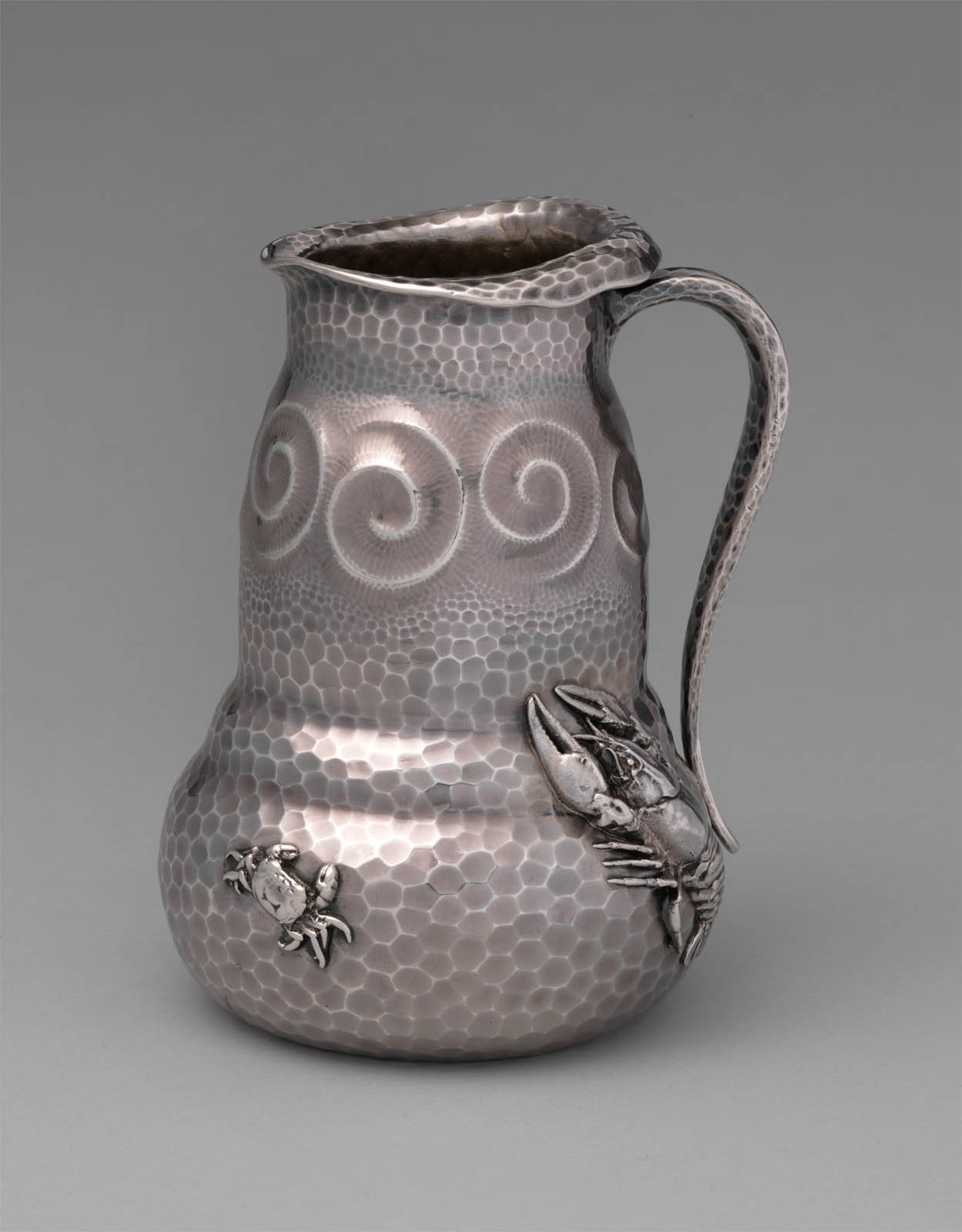
 

Tiffany & Co. (1837-present) Charles Osborne (1847-1920) (designer) 'Pitcher' c. 1880


Tiffany & Co. (1837-present)
Charles Osborne (1847-1920) (designer)
Pitcher
c. 1880
Silver
6 × 4 5/8 × 4 1/4 in. (15.2 × 11.7 × 10.8cm)
Metropolitan Museum of Art, New York
Purchase, Friends of the American Wing Fund and Emma and Jay A. Lewis Gift, 2016
Public domain


Ceramic vessels may have inspired the organic form of this pitcher, which was described in company records as “Pitcher Top thrown over.” Between 1878 and 1889, Tiffany offered variations of it in at least three decorative schemes. The crabs and crayfish scuttling across this version likely owe their lifelike detail to the designers’ careful study of living creatures alongside Japanese objects and books such as Katsushika Hokusai’s Manga. The silversmith Charles Osborne joined Tiffany around the time this pitcher was made, and similar animal forms and spirals appear on many of the designs produced during his collaboration with Moore: see, for example, the chocolate pot on view nearby, which features spirals and identical crayfish castings.

Tiffany & Co. began retailing and producing silver early in its history, quickly establishing itself as the preeminent silversmithing firm in the United States. This pitcher exemplifies the unprecedented innovation and creativity that characterised Tiffany & Co.’s work during the 1870s and 1880s. Under the direction of Edward C. Moore (1827-1891), the silver division at Tiffany & Co. produced a diverse array of exquisitely wrought and highly original silver, which in turn attracted many of the finest craftsmen and designers to the firm. Indeed, Charles Osborne (1847-1920), who is credited with designing this pitcher, left his position as the chief designer at one of Tiffany’s competitors, the Whiting Manufacturing Company, in order to learn from and work with Moore at Tiffany & Co. The silver that resulted from this mentorship and collaboration is among the finest produced during the second half of the nineteenth century.

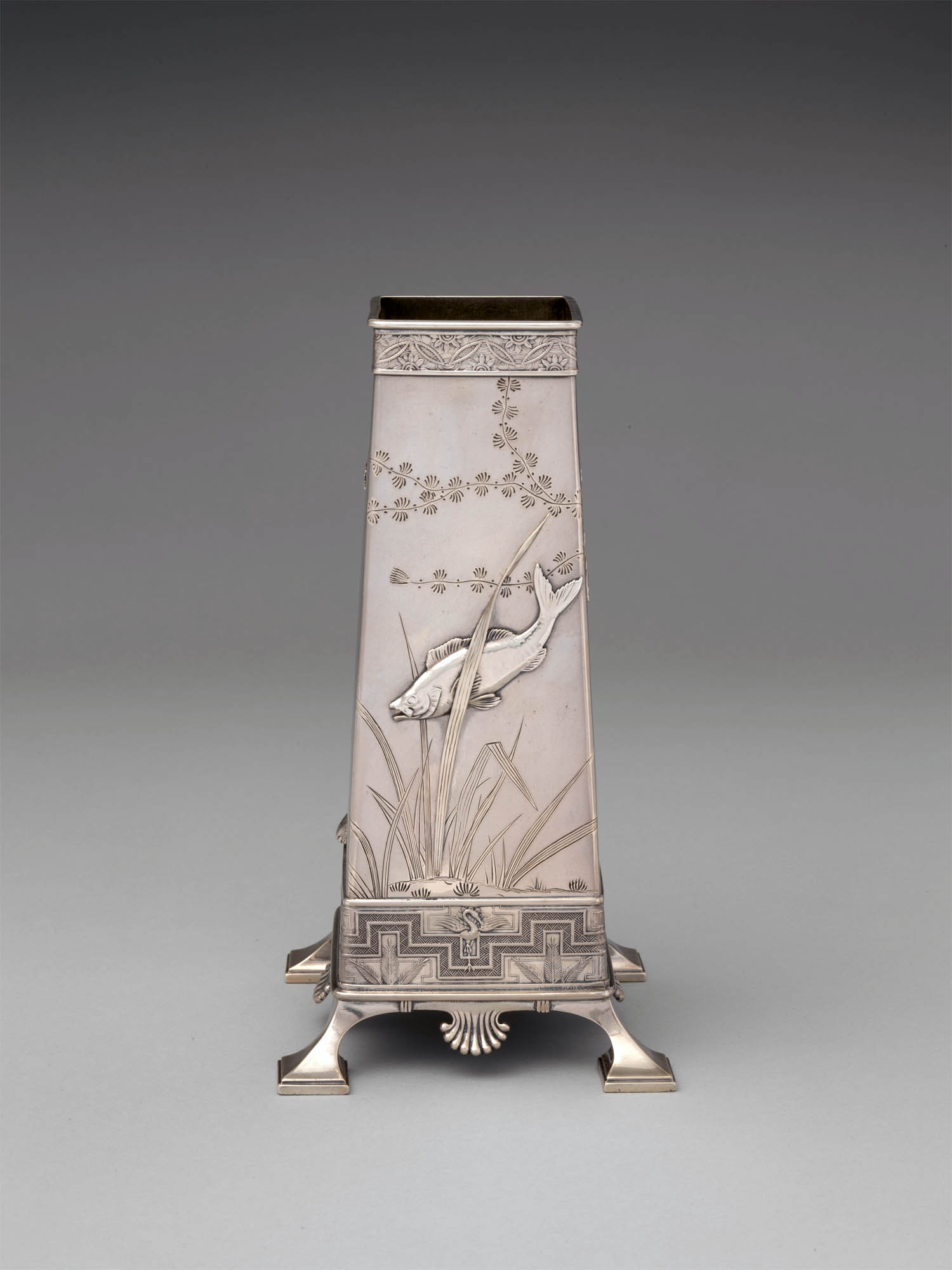
 

Tiffany & Co. (1837-present) 'Vase' 1877

Tiffany & Co. (1837-present) 'Vase' 1877


Tiffany & Co. (1837-present)
Vase
1877
Made in New York, New York, United States
Silver
8 1/8 x 4 1/4 x 4 1/4 in. (20.6 x 10.8 x 10.8cm); 14 oz. 19 dwt. (464.5 g)
Metropolitan Museum of Art, New York
Purchase, Mr. and Mrs. H. O. H. Frelinghuysen Gift, 1982
Public domain


Although largely inspired by Japanese art, this group of objects demonstrates that Tiffany’s designers looked to a variety of sources when creating innovative designs. Manufacturing ledgers describe the creamer and sugar bowl as having “Persian Pierced Handles,” while the splayed feet on the vase mimic those seen on a thirteenth-century Iranian brass casket in Moore’s collection. The firm’s staff also devoted significant time to studying the natural world. The silver workshop supervisor, Charles Grosjean, recorded in his diary that he visited the city’s aquarium and also purchased fish from the Fulton Market, which he then had a colleague sketch. This dedication to close observation resulted in the highly accurate depictions of sunfish, pickerel, and yellow perch on the creamer and sugar bowl and Chinese Brama fish on the vase.

The opening of Japan to the West in the 1850s and subsequent displays of Japanese art at world’s fairs inspired great demand for Japanese-style objects in the United States. Edward C. Moore, the director of Tiffany’s silver department, was an early proponent and collector of Japanese art. The decorative motifs on this vase and their asymmetrical arrangement were clearly inspired by Japanese design. Originally, the vase had a lightly pebbled ground and oxidised accents that emulated Japanese metalwork.


Tiffany & Co. (1837-present) 'Tray' 1879-1880


Tiffany & Co. (1837-present)
Tray
1879-1880
Silver, copper, brass, gold-copper alloy, and copper-platinum-iron alloy
9 1/8 × 7/8 in., 544.3g (23.2 × 2.2cm, 17.5 oz.)
Metropolitan Museum of Art, New York
Rogers Fund, 1966
Public domain


Buoyed by the phenomenal success of their Japanese-inspired wares at the 1878 Paris Exposition, Tiffany continued producing innovative designs featuring experimental mixed-metal techniques. A note on the meticulously annotated design drawing for this tray describes the sun or moon as “inlaid red gold, not coloured,” which according to the firm’s technical manual is a combination of “American Gold” and “Fine Copper.” Analysis of the metals reveals that each detail corresponds precisely with the formulas and techniques specified in the drawing. Moore had a particular penchant for objects depicting frogs. Reportedly frogs were kept in an aquarium at the studio for designers to study, so the one leaping and catching mosquitoes here may have been modelled from life.

This lively scene, featuring a frog leaping from the water to catch a mosquito in its open mouth, was part of a series of objects created by Tiffany & Co. in a distinctive Japanese style. The imagery both engraved and rendered in relief was derived from European print sources depicting the arts of Japan and art objects made in Japan collected by Edward C. Moore, head of the silver division and creative director at Tiffany. For example, the swarm of insects depicted on this tray mirrors a small mosquito printed as a page filler in L’Art Japonais, written by Louis Gonse and published in 1883 in Paris. The copy of this publication held in the Thomas J. Watson Library at the Met was Moore’s personal copy, donated in 1891.

Along with his copy of L’Art Japonais, Moore gave his collection of more than five hundred books and two thousand objects, collected from around the world, to The Metropolitan Museum of Art in 1891. His collection offers ample evidence of his interest in animal imagery, particularly frogs. Indeed, it included many objects depicting frogs and toads, including several small Japanese netsuke. Furthermore, live frogs were kept in the silver studio at Tiffany for designers to study. Rendering this frog from life rather than from a print source likely led to its dynamic pose and sense of movement.

The use of multiple metals and mixed-metal alloys to animate both the frog and rising sun were inspired by Japanese metalwork and Moore’s passion for innovative metalworking techniques and virtuosic craftsmanship. Looking closely at the body of the jumping frog, yellow, pink, and silver coloured metals have been used together to give the appearance of a lifelike, textured amphibian body. XRF (x-ray fluorescence) analysis was used to identify the metals and exact composition of the alloys used on this tray. This analysis, together with Tiffany’s design drawing for this tray and a surviving technical manual – allows for an understanding of what alloys Tiffany used to render certain colours and the shorthand for these mixtures. The rising sun was to be inlaid with “red gold,” determined to be a copper-gold alloy, the frog’s body was to be cast in “Y.M.;” (yellow metal), identified as an alloy of copper and zinc. The designer did not indicate what metal would comprise the pink coloured spots along the frog’s body and legs, but analysis revealed them to be an alloy of copper, platinum, and iron, which is similar to “Metal no, 47,” which the technical manual also describes as Japanese Gold #2 and “Shakado.”
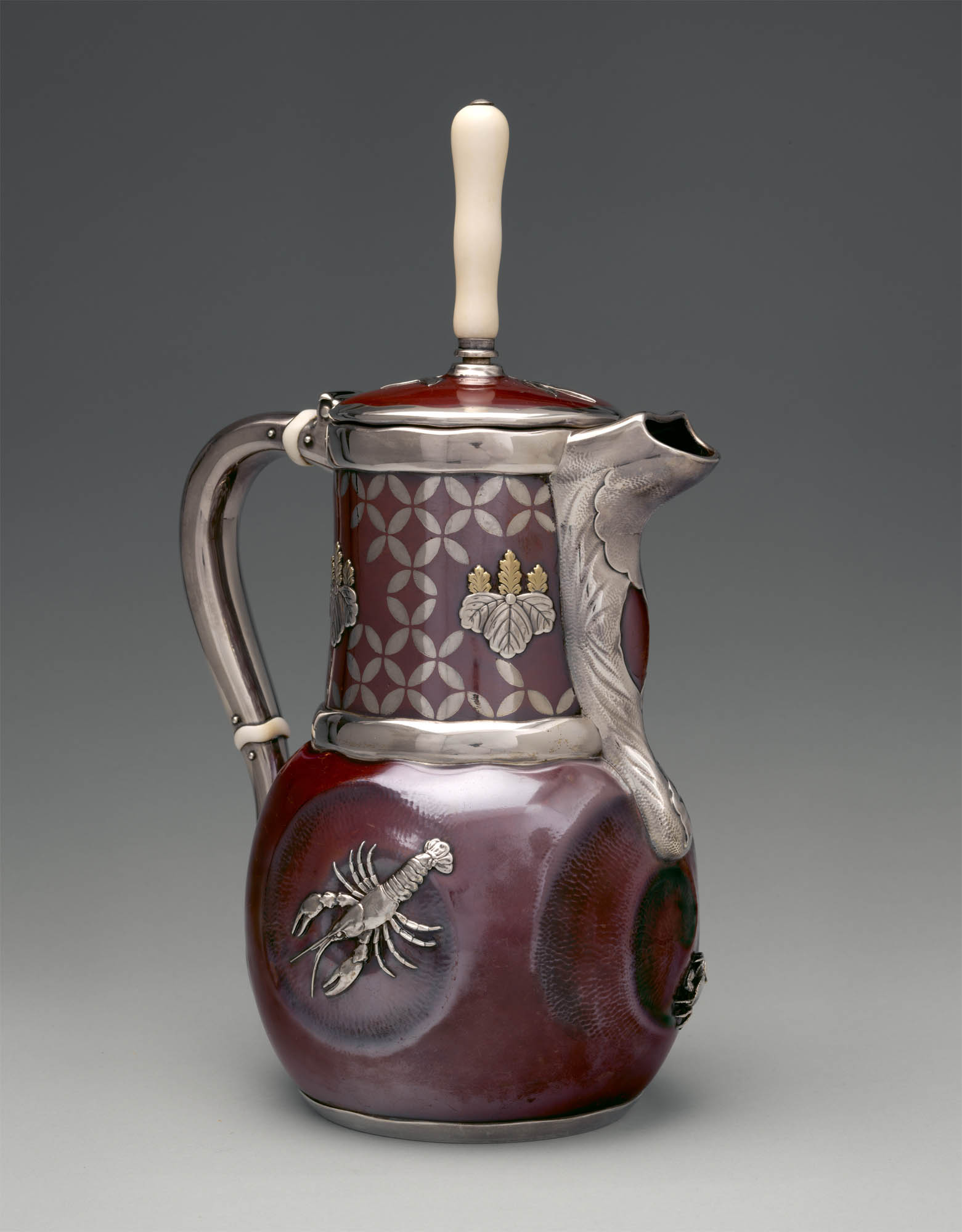
 

Tiffany & Co. (1837-present) Charles Osborne (1847-1920) (designer) 'Chocolate Pot' 1879


Tiffany & Co. (1837-present)
Charles Osborne (1847-1920) (designer)
Chocolate Pot
1879
Silver, patinated copper, gold, and ivory
11 5/8 × 7 × 5 1/2 in. (29.5 × 17.8 × 14cm)
Metropolitan Museum of Art, New York
Purchase, Louis and Virginia Clemente Foundation Inc. and Emma and Jay A. Lewis Gifts, 2017
Public domain


The luminous red surface of this vessel, evoking Asian lacquer and ceramic glazes, established a new paradigm for silverwares. Tiffany records indicate that “Chocolate Pot Big Belly” was offered in two versions, the one seen here and another in silver with copper, gold, and “yellow metal” decoration. With a wholesale cost of $175, the copper version was more than twice as expensive to produce. The firm’s technical manual documents the painstaking experimentation undertaken to achieve red surfaces. References to Japanese sources include the inlaid silver pattern on the neck, which resembles the auspicious shippō pattern, as seen in a seventeenth-century incense box earlier in this exhibition, and the applied silver and gold kirimon (paulownia-tree crest), the emblem of the Japanese government.

This chocolate pot exemplifies the unprecedented innovation and creativity that characterised Tiffany & Co.’s work during the 1870s and 80s. Under the direction of Edward C. Moore (1827-1891), Tiffany’s produced exquisitely wrought and highly original silver, which in turn attracted many of the finest craftsmen and designers to the firm. Indeed, Charles Osborne (1847-1920), who is credited with designing this chocolate pot, left his position as chief designer at one of Tiffany’s competitors, the Whiting Manufacturing Company, in order to learn from and work with Moore at Tiffany’s. The silver that resulted from this mentorship and collaboration is among the finest produced during the second half of the nineteenth century. The spiral motifs accenting the pot’s body together with the masterfully chased leaves wrapping the spout are signatures of Osborne’s work. The lifelike cast ornaments of crawfish and crabs further demonstrate technical virtuosity and inventive aesthetic sensibilities, as does the rich red colour, the result of painstaking experimentation and innovative use of electrolytic technology to achieve new surface tones and effects. Moore and Osborne were inspired by Japanese objects; however, their work is in no way imitative. This striking chocolate pot makes clear why The Connoisseur celebrates Tiffany & Co. in an 1885 article entitled “Artistic Silverware” for having “raised the making of artistic silver to a height never reached to my knowledge by silversmiths in preceding ages.”


Tiffany & Co. (1837-present) 'Vase' 1879


Tiffany & Co. (1837-present)
Vase
1879
Silver, copper, gold, and silver-copper-zinc alloy
11 1/2 × 6 3/8 in. (29.2 × 16.2cm)
Metropolitan Museum of Art, New York
Sansbury-Mills Fund, 2019
Public domain


An accomplished manifestation of Tiffany’s mastery of techniques to redden copper, this bold vase presents an imaginative take on East Asian art and sensibilities. Surviving design drawings reveal that each detail was carefully planned. The seemingly random splatters on the body are all meticulously noted, with an indication that they should be made with fine silver. The trompe-l’oeil effect of cascading liquid spilling over the lip of the vase and down the body references Asian bronzes in Moore’s collection. Charles Grosjean, the workshop supervisor, recorded in his diary, “E. C. M. showed me … a Bronze with ‘drip’ ornament,” which could well be the vase surrounded by waves displayed nearby. Thereafter, Grosjean proudly declared the firm’s designs with drip motifs to be great successes.

This vase exemplifies the creativity and innovation that characterised Tiffany & Co.’s work during the 1870s and 1880s. Under the direction of Edward C. Moore (1827-1891), the silver division at Tiffany & Co. produced a diverse array of exquisitely wrought and highly original work, and this vase is a bold example of their experimentation with novel techniques and Asian-inspired designs. First conceived and created in 1879, this vase was produced both in copper with silver drips, as seen here, and in silver with copper drips. Surviving drawings for the vase reveal that the seemingly random splotches on the red surface and the layered, cascading drips were meticulously planned. Notes on the drawings also specify that the fine gold was to be “inlaid by chasers,” while the copper and green gold ornament was to be “inlaid by battery,” evidence of Tiffany’s progressive engagement with innovative electrolytic processes. Inspired by the colours in Asian ceramics as well as glass and ceramics from the ancient and Islamic worlds that Moore collected and made available to his staff, Tiffany’s craftsmen worked tirelessly to produce coloured surfaces. As one of very few extant examples of Tiffany’s work with red surface treatments and the only significant object currently known that employs drip ornament inspired by Japanese works of art in Moore’s collection (see Japanese bronze vase amid waves), this vase is a rare and important illustration of the firm’s imaginative and technically sophisticated responses to Asian art.
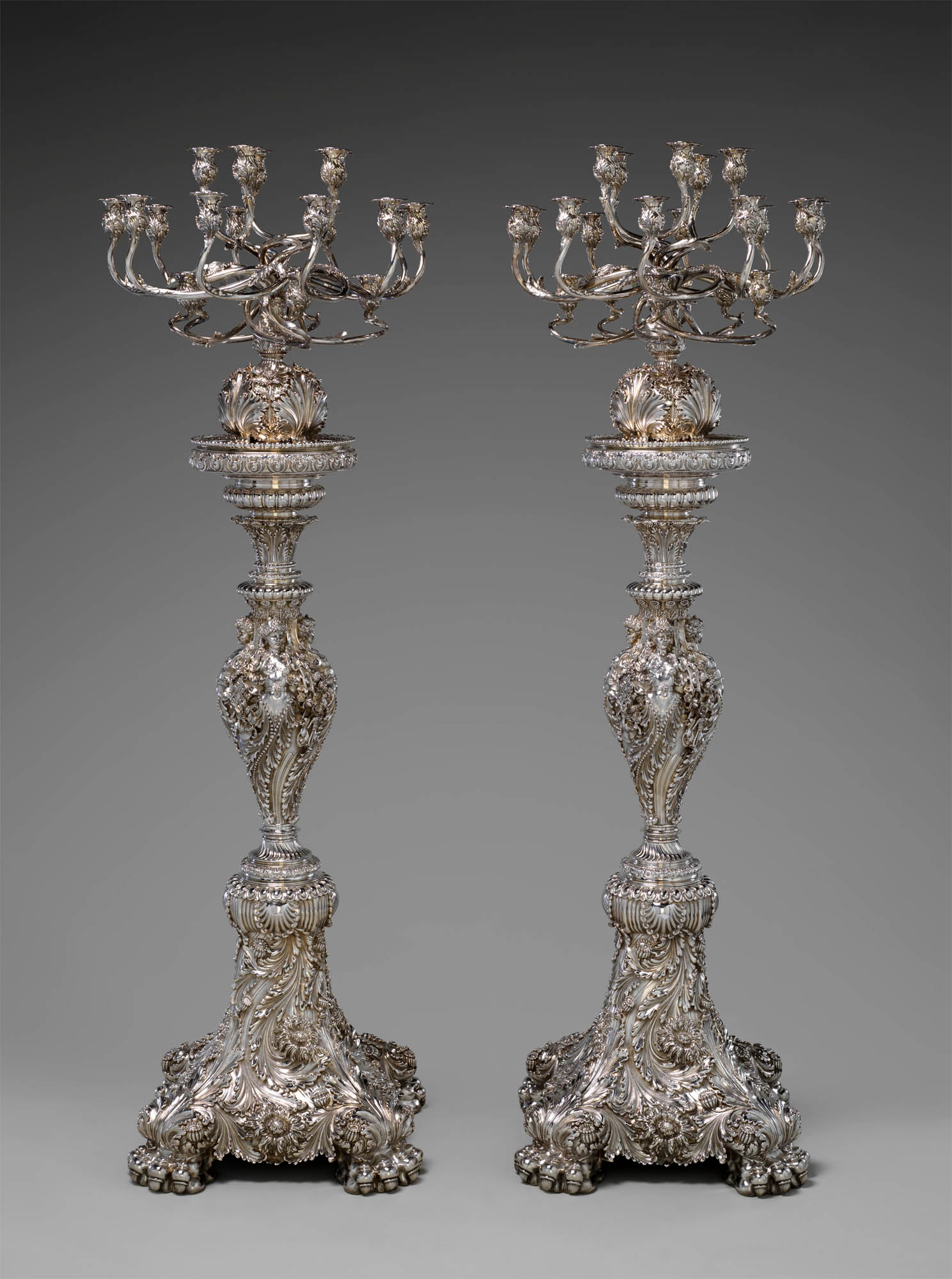
 

Tiffany & Co. (1837–present) 'Pair of Candelabra' 1884


Tiffany & Co. (1837–present)
Pair of Candelabra
1884
Silver
70 1/4 × 22 1/2 in. (178.4 × 57.2cm)
Metropolitan Museum of Art, New York
Purchase, Lila Acheson Wallace Gift, 2024
Public domain


Ideas inspired by the full range of Moore’s collections inform the design of these monumental candelabra. Tiffany records describe the form as “Roman,” and the female figures, paw feet, and baluster-shaped stand all evoke ancient Roman art. Yet the decorative scheme is also manifestly non-Western – the dense floral and vegetal composition enlivening the surface draws on East and West Asian sources as well as close study of natural specimens. Commissioned by Mary J. Morgan, one of Tiffany’s most avid and progressive patrons, these candelabra are the grandest works produced during Moore’s tenure.

These dazzling, monumental candelabra are the most ambitious and virtuosic examples of nineteenth-century American silver known. Created at Tiffany & Co. under the direction of Edward C. Moore (1827-1891), they exemplify the technical and artistic preeminence the firm had achieved by the late nineteenth century. The dynamic decoration that enlivens the almost six-foot high forms incorporates masterfully executed sinuous floral and vegetal ornament, informed by Moore’s extensive collection of works of art from Ancient Greece and Rome, Europe, East Asia, and the Islamic world that Moore’s heirs donated to The Met in 1891. The candelabra were commissioned by one of Tiffany & Co.’s most enthusiastic and progressive patrons, Mary Jane (Sexton) Morgan (1823-1885), wife of railroad, steamship, and iron magnate Charles Morgan (1795-1878). Like Moore, Morgan was an avid collector, and they appear to have been kindred spirits with respect to their passion for Asian art and innovative silver design. Upon her husband’s death, Morgan was reported to have a net worth of over five million dollars, and she set about assembling a significant collection of fine and decorative arts that ranged from paintings by Delacroix to Tiffany silver, European ceramics, and East Asian bronzes, ceramics, lacquerwares, and jades. In an era dominated by men, Morgan was a rare, pioneering collector. The Tiffany silver made for her is among the firm’s most technically and artistically innovative work, suggesting she was a sophisticated connoisseur of silver with an eye for avant-garde designs. Surviving ledger books in the Tiffany & Co. archives indicate 3050 ounces of silver were used to create these candelabra and that the cost associated with producing them was far more than any other works Tiffany had created. After Morgan’s death in 1885, her collection was sold at an auction attended by thousands. At the time, The New York Times reported: “The more the collection is viewed the greater one’s regret that she should have been taken before willing her treasures in a block to some established museum or to one to be established.”
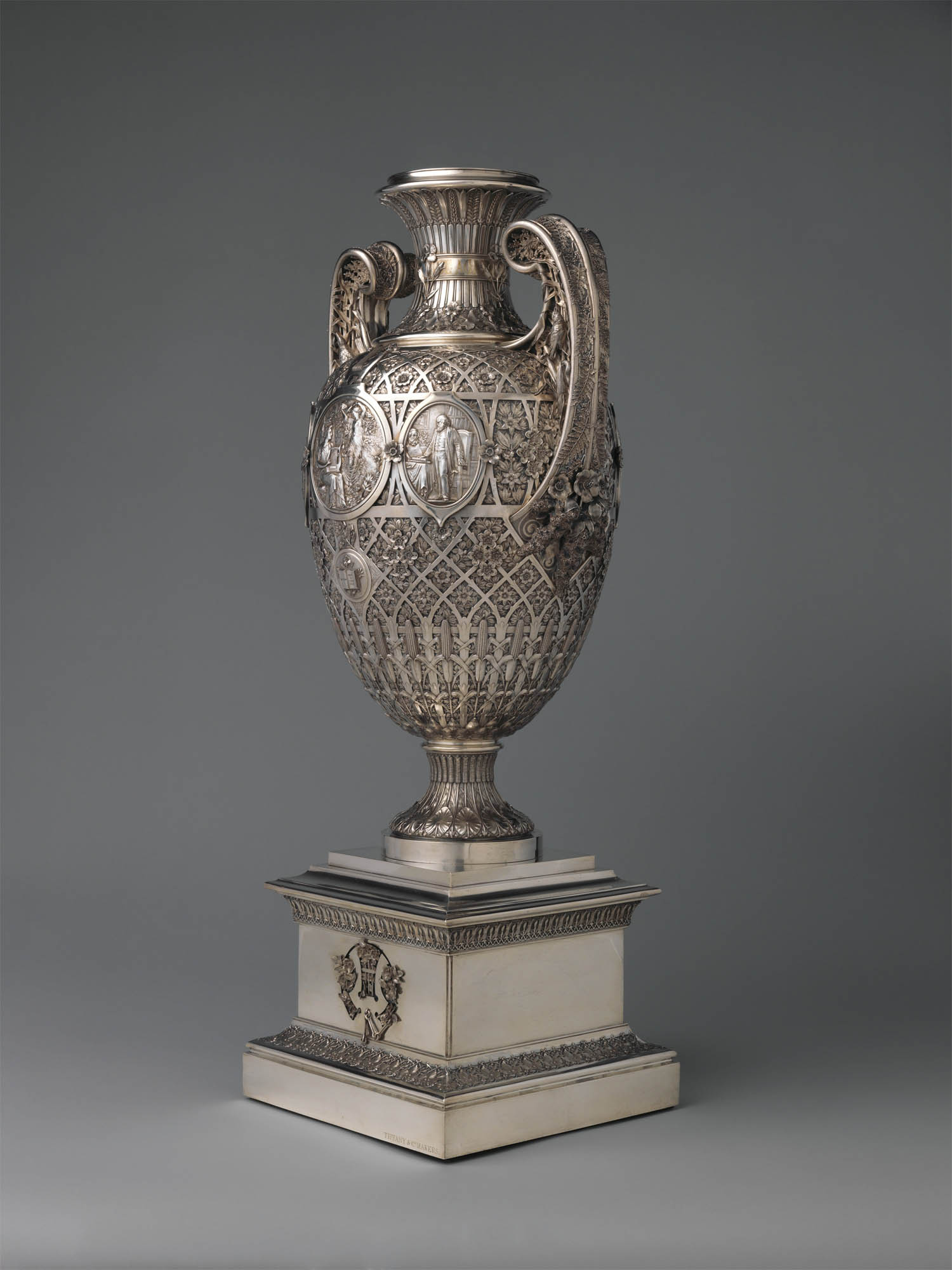
 

Manufactured by Tiffany & Co. (1837-present) Designer: Designed by James Horton Whitehouse (1833-1902) Decorator: Chased by Eugene J. Soligny (1832-1901) Designer: Medallions by Augustus Saint-Gaudens (American, Dublin 1848–1907 Cornish, New Hampshire) 'The Bryant Vase' 1876


Tiffany & Co. (1837-present)
Designer: Designed by James Horton Whitehouse (1833-1902)
Decorator: Chased by Eugene J. Soligny (1832-1901)
Designer: Medallions by Augustus Saint-Gaudens (American, Dublin 1848–1907 Cornish, New Hampshire)
The Bryant Vase
1876
Silver and gold
33 1/2 x 14 x 11 5/16 in. (85.1 x 35.6 x 28.7cm); Diam. 11 5/16 in. (28.7cm); 452 oz. 16 dwt. (14084.2 g)
Metropolitan Museum of Art, New York
Gift of William Cullen Bryant, 1877
Public domain


To honour the poet and newspaper editor William Cullen Bryant (1794-1878) on his eightieth birthday, a group of his friends commissioned “a commemorative Vase of original design and choice workmanship” that would “embody … the lessons of [his] literary and civic career.” Its design, which combines Renaissance Revival sensibilities with those of the Aesthetic movement, consists of a Greek vase form ornamented with symbolic imagery and motifs. The fretwork of American flora covering the body of the vase, including apple branches and blossoms, represents the beauty and wholesome quality of Bryant’s poetry, while the scenes in the oval medallions allude to his life and works. From the moment the commission was announced until well after its completion, the vase was widely publicised and celebrated. After it was presented to Bryant in 1876, Tiffany & Co. displayed it at the Centennial Exhibition in Philadelphia. The following year, the vase was presented to the Metropolitan Museum, making it the first acquisition of American silver to enter the Museum’s collection.
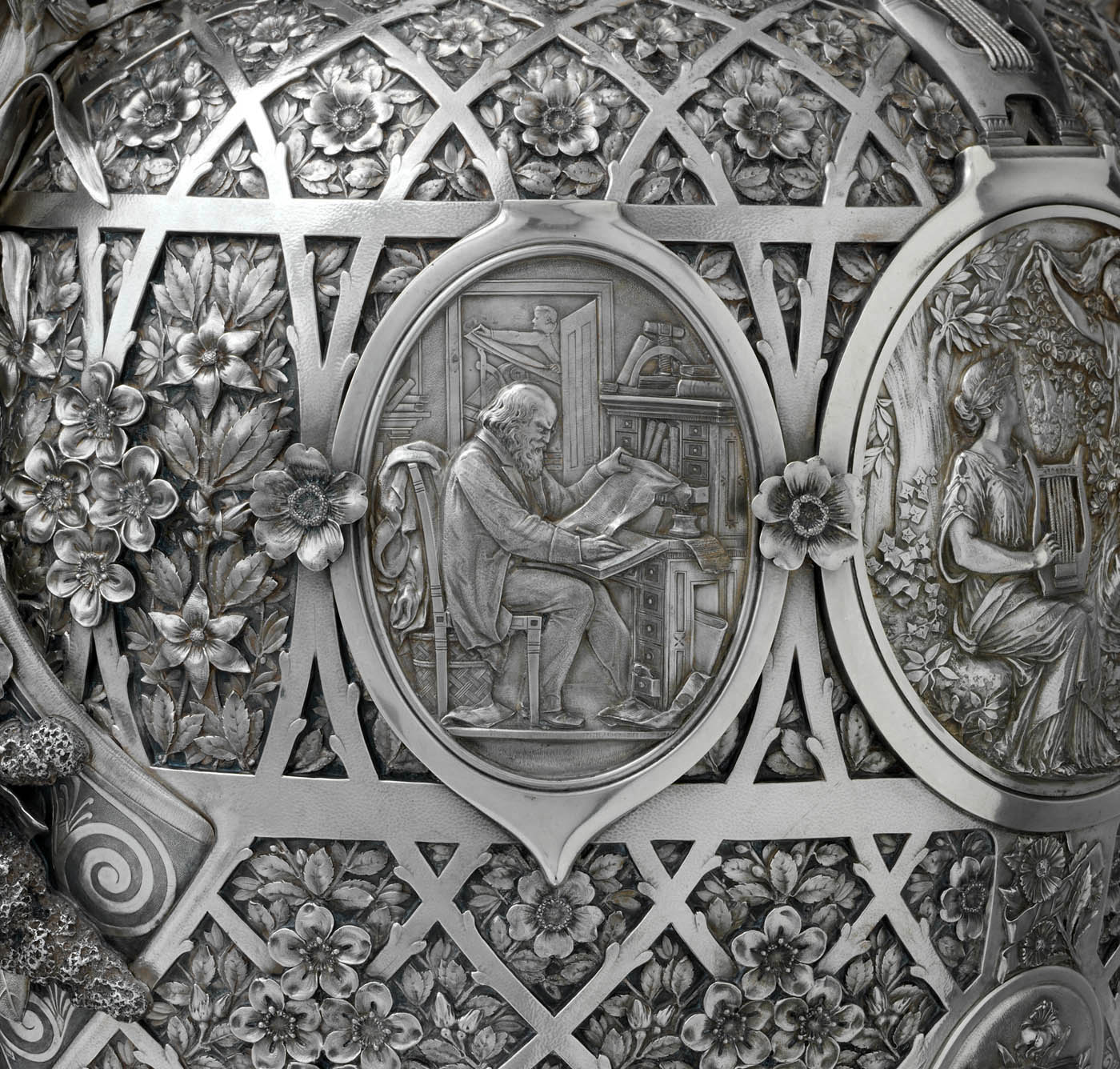
 

Manufactured by Tiffany & Co. (1837-present) Designer: Designed by James Horton Whitehouse (1833-1902) Decorator: Chased by Eugene J. Soligny (1832-1901) Designer: Medallions by Augustus Saint-Gaudens (American, Dublin 1848–1907 Cornish, New Hampshire) 'The Bryant Vase' 1876 (detail)


Manufactured by Tiffany & Co. (1837-present)
Designer: Designed by James Horton Whitehouse (1833-1902)
Decorator: Chased by Eugene J. Soligny (1832-1901)
Designer: Medallions by Augustus Saint-Gaudens (American, Dublin 1848–1907 Cornish, New Hampshire)
The Bryant Vase (detail)
1876
Silver and gold
33 1/2 x 14 x 11 5/16 in. (85.1 x 35.6 x 28.7cm); Diam. 11 5/16 in. (28.7cm); 452 oz. 16 dwt. (14084.2 g)
Metropolitan Museum of Art, New York
Gift of William Cullen Bryant, 1877
Public domain
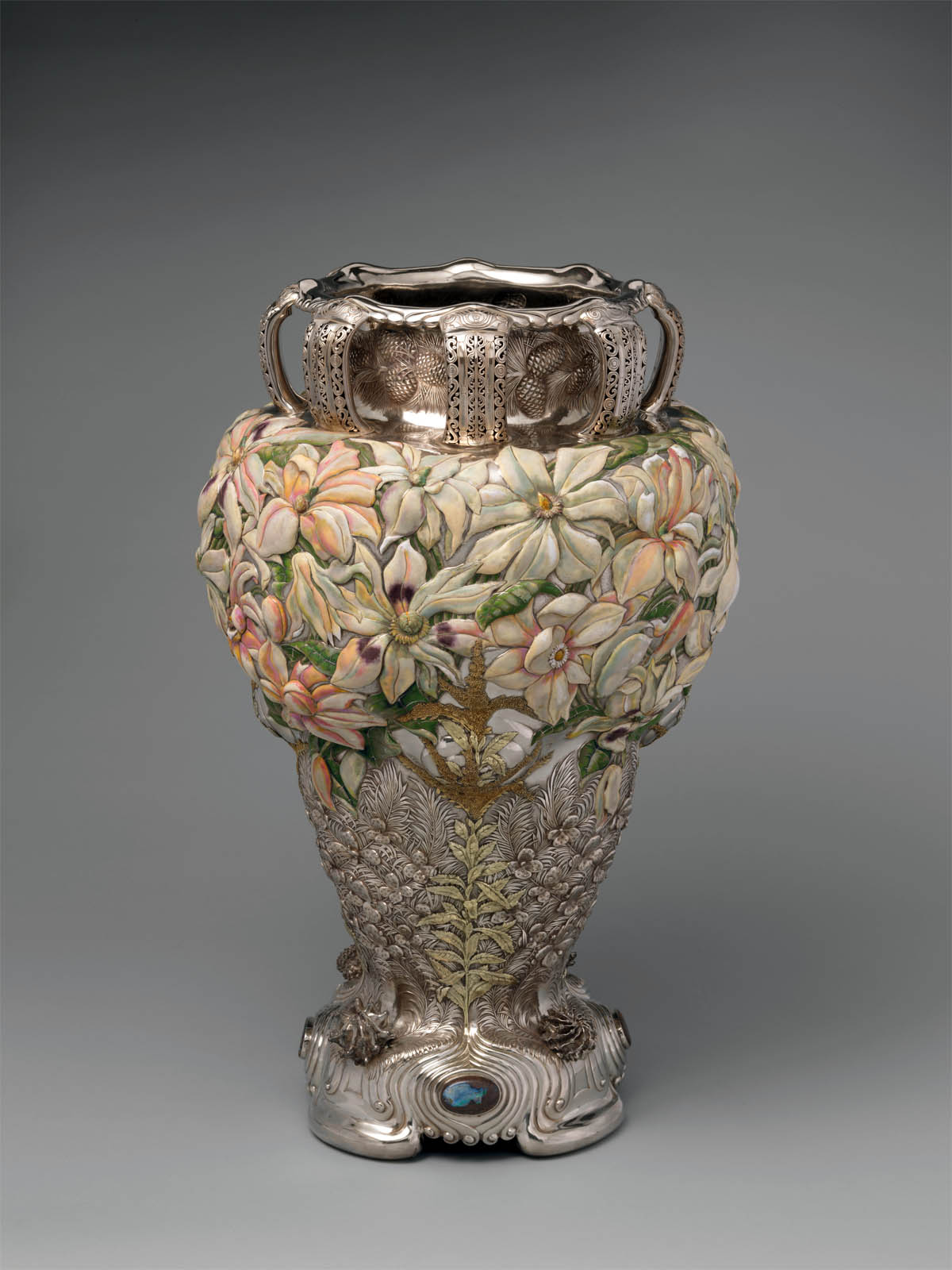
 

Tiffany & Co. (1837-present) (manufacturer) 'The Magnolia Vase' 1893


Tiffany & Co. (1837-present) (manufacturer)
The Magnolia Vase
1893
Silver, enamel, gold, and opals
Overall: 30 7/8 x 19 1/2 in. (78.4 x 49.5cm); 838 oz. 11 dwt. (26081.6 g)
Foot Diameter: 13 1/2 in. (34.3cm)
Metropolitan Museum of Art, New York
Gift of Mrs. Winthrop Atwill, 1899
Public domain


A triumph of enamelling that reflects Moore’s enduring legacy, this commanding vase presided over Tiffany’s celebrated display at the 1893 Chicago World’s Fair. In keeping with the event’s theme, the anniversary of Columbus’s voyage, Tiffany touted the work’s “American” materials and design. Pueblo pottery was cited as inspiration for the shape, and Toltec or Aztec objects for the handles. The decoration references different regions – pinecones and needles symbolise the North and East, magnolias the South and West, and cacti the Southwest, while the ubiquitous goldenrod unifies the composition. The enamelled blossoms captivated visitors, and one critic declared Tiffany’s display “the greatest exhibit in point of artistic beauty and intrinsic value that any individual firm has ever shown.”

The Magnolia Vase was the centrepiece of Tiffany & Co.’s display at the 1893 World’s Columbian Exposition in Chicago – a display Godey’s Magazine described as “the greatest exhibit in point of artistic beauty and intrinsic value, that any individual firm has ever shown.” The design of the vase was a self-conscious expression of national pride. Pueblo pottery inspired the form, while Toltec motifs embellish the handles. The vegetal ornament refers to various regions of the United States: pinecones and needles symbolise the North and East; magnolias, the South and West; and cacti, the Southwest. Representing the country as a whole is the ubiquitous goldenrod, fashioned from gold mined in the United States. The exceptional craftsmanship and innovative techniques manifested in the vase – particularly the naturalism of the enamelled magnolias – were much discussed in the contemporary press. Indeed, the work was heralded by the editor of the New York Sun as “one of the most remarkable specimens of the silversmith … art that has ever been produced anywhere.”


Tiffany & Co. (1837-present) (manufacturer) 'The Magnolia Vase' 1893 (detail)


Tiffany & Co. (1837-present) (manufacturer)
The Magnolia Vase (detail)
1893
Silver, enamel, gold, and opals
Overall: 30 7/8 x 19 1/2 in. (78.4 x 49.5cm); 838 oz. 11 dwt. (26081.6 g)
Foot Diameter: 13 1/2 in. (34.3cm)
Metropolitan Museum of Art, New York
Gift of Mrs. Winthrop Atwill, 1899
Public domain
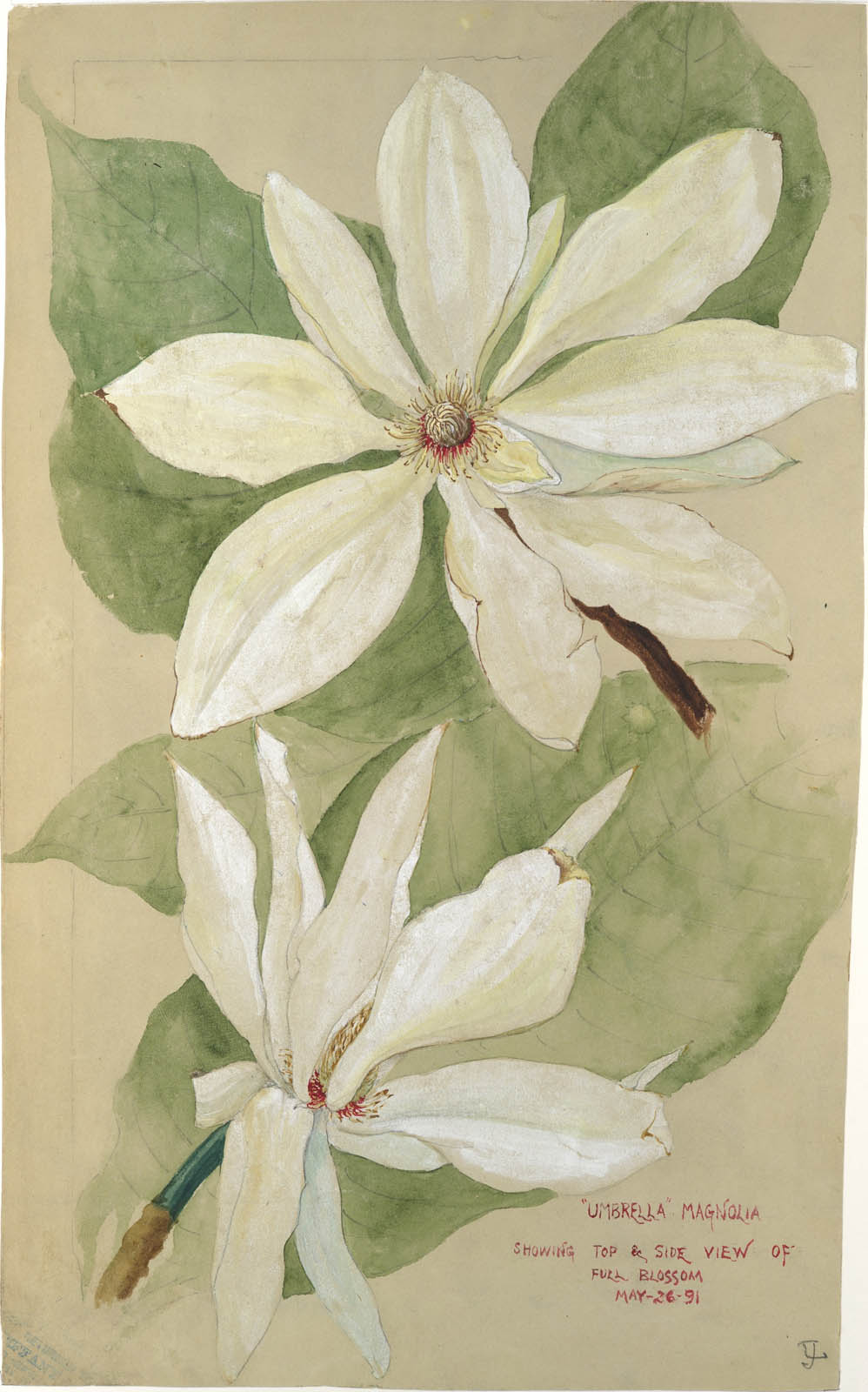
 

Tiffany & Co. (1837-present) John T. Curran (1859-1933) (designer) '"Umbrella" Magnolia' 1891


Tiffany & Co. (1837-present)
John T. Curran (1859-1933) (designer)
“Umbrella” Magnolia
1891
Opaque and transparent watercolour, and graphite on paper
Overall: 13 7/8 x 8 5/8 in. (35.2 x 21.9cm)
Design: 13 7/8 x 8 5/8 in. (35.2 x 21.9cm)
Matted: 19 1/4 x 14 1/4 in. (48.9 x 36.2cm)
Metropolitan Museum of Art, New York
Gift of Tiffany & Co., 1985
Public domain


Introduction

Edward C. Moore was the creative force behind the magnificent and inventive silver produced at Tiffany & Co. during the second half of the nineteenth century. His is a tale of phenomenal artistry, ambition, innovation, and vision. In his drive to study and create beauty, Moore sought inspiration in diverse cultures and geographies. He amassed a vast collection of artworks from ancient Greece and Rome, Asia, Europe, and the Islamic world with the aim of educating and sparking creativity among artists and artisans in the United States, particularly those at Tiffany. He believed American design could be transformed through engagement with historical and international exemplars, and his collection not only revolutionised Tiffany’s silver but also came to influence generations of artists and craftspeople.

Moore’s commitment to education led him to designate that his collection be bequeathed to a museum. Upon his death in 1891, his family donated his more than two thousand objects and five hundred books to The Met so that they would continue to be available to all. The Museum displayed the works together in a dedicated gallery until 1942, after which they were dispersed to specialised departments that had developed in the intervening decades.

This exhibition reunites more than 180 works from Moore’s collection, presenting them alongside Tiffany silver created under his direction. The juxtapositions reveal that Moore and his team engaged with these objects in dynamic ways, producing hybrid designs with experimental techniques that endowed silver with new colours, textures, decorative vocabularies, and aesthetic sensibilities.

Early Years

Throughout his career, Edward C. Moore guided the design and manufacture of silver bearing the Tiffany mark. Trained in his family’s New York City silversmithing shop, he proved to be a gifted designer and silversmith at an early age, and in 1849 he joined his father in the partnership John C. Moore and Son. Two years later, Tiffany, Young & Ellis, the firm that would later become Tiffany & Co., secured an agreement to be the sole retail outlet for Moore silver. Edward soon took charge of the family business and served as Tiffany’s exclusive supplier; later, in 1868, his silver manufactory was transferred to Tiffany & Co. in exchange for cash and shares in the newly incorporated company.

Moore’s position afforded him opportunities to travel and access to social and artistic circles that informed his collecting. His holdings became integral to the training and working methods of Tiffany designers and silversmiths; he set up a design room where a vast array of objects and an extensive library were made available to apprentices and staff. He created a collaborative work environment, and each exquisite piece reflects the contributions of many individuals. Their work soon attracted international attention, receiving awards and accolades at world’s fairs and enjoying avid patronage in the United States and around the globe.

Tiffany silver and Greek and Roman Art

Throughout the nineteenth century, Western collectors were captivated by the art of ancient Greece and Rome. Moore amassed an impressive assemblage of Greek and Roman glass vessels and fragments as well as terracotta vases, jugs, and lamps. Much of the silver produced under his direction reflects classical sources, as seen in the symmetrical forms, figural compositions inspired by black- and red-figure Greek vases, and distinctive decorative vocabulary such as helmets, shields, and stylised plant motifs.

Moore embraced the trend of collecting ancient glass; of the approximately 650 classical objects he left to The Met, 618 of them are glass. Spanning a range of manufacturing techniques from the late sixth century BCE through the sixth century CE, the exceptional collection features core-formed, cast, blown, and mold-blown vessels and fragments. Their lustrous surfaces and rich colours fuelled Moore’s experiments with mixed metal compositions and surface treatments for silver. Although Moore and his team were on the vanguard of looking beyond the canon that had defined Euro-American art for centuries – exploring more progressive and non-Western styles – Greek and Roman art remained foundational for Tiffany designers, and classically inspired silver continued to be a mainstay of the company’s production.

Tiffany silver and European Glass

Moore had a particular passion for glass. While his collection features a broad range of art forms, the modern European works are primarily glass. The selection on view here, drawn from the larger group of 116, conveys Moore’s fascination with the variety of colours and forms that could be realised through different glass working techniques.

Ranging in date from the 1500s to the mid-nineteenth century, Moore’s European glass collection is particularly strong in Venetian and façon de Venise (Venetian style) objects. The revival of the Venetian glass industry in the 1860s aligned with his own interest in invigorating contemporary design and artistic practice. He was clearly drawn to the dynamic hot-working techniques that exploited glass’s molten state to create new forms, integrate colours, and shape energetic decorative details. While some direct parallels in vessel shape and decoration exist between the glass and the silver produced at Tiffany, this part of the collection appears to have offered inspiration on a more abstract, visceral level, encouraging Moore and his designers to transcend silver’s traditionally monochromatic palette with the use of enamels, mixed metals, and tonal surface treatments.

Tiffany silver and Arts of the Islamic World

A pioneering American collector of art from the Islamic world, Moore created designs inspired by Islamic sources from his earliest days at Tiffany. He began acquiring outstanding examples of Islamic ceramics, glass, textiles, jewellery, and metalwork at a time when there was neither a U.S. market for this art nor notable domestic interest in it. His bequest of approximately four hundred works from Islamic lands remains the largest and most comprehensive collection of material of this type to have entered The Met.

This gallery reflects the quality and diversity of the objects he collected, marked by a chronological and geographic scope that ranges from the 1100s to the 1800s and from Spain to the Middle East and India. Sinuous forms, brilliant colours, and interlaced motifs appealed to Moore and reinvigorated Tiffany’s designs with new sensibilities and artistic vocabularies. The mixed-metal wares in Moore’s collection inspired experiments with what Tiffany called “chromatically decorated” silver, inlaid with reddish copper and black niello, while the firm’s success with enamelling techniques recalls the colourful enamelled glassware and Iznik ceramics. Inventive designs identified in company records as “Moresque,” “Persian,” and “Saracenic” brought Tiffany new patrons and critical acclaim.

Tiffany silver and Arts of East Asia

The decorative arts of East Asia captured Moore’s imagination and inspired inventive flights of fancy from Tiffany designers and craftspeople. About eight hundred Japanese works of art that he collected are now at The Met, including metalwork, textiles, lacquerware, ceramics, bamboo basketry, and sword fittings, and he gave an equally varied group of more than one hundred Chinese works. A fashion for Japanese art, or “Japanism,” swept through Europe and the United States following the 1854 opening of several ports in Japan for trade with the West, and many regarded Japanese artistic practices as an exemplar for avant-garde design reform. Guided by his desire to spark creativity and innovation, Moore acquired a range of exceptional objects and relatively inexpensive collectibles from the Edo (1615-1868) and Meiji (1868-1912) periods.

Moore and his team carefully studied materials, techniques, decorative vocabularies, and compositions in East Asian art. The related silver designs incorporate novel methods for creating multicoloured alloys and mixed-metal laminates, as well as fresh combinations of imagery – and they made Tiffany an international sensation. One critic wrote in 1878 that the artists’ study of “Japanese forms and styles … has led not to imitation of those models, but to adaptations that have resulted in the creation of a new order of production.”

Legacy

Moore’s legacy of creativity and innovation endured well beyond his death in 1891, as exemplified by the famed Magnolia Vase. Toward the end of his life, he was deeply engaged in planning for the 1893 Chicago World’s Fair. One of his last designs would be the centrepiece of the Tiffany & Co. exhibit, a grand vase embellished with exquisitely rendered enamelled magnolia blossoms.

A newspaper account heralding the vase and Moore’s role in its design reported, “It is a triumph of the goldsmith’s art to have overcome the difficulty of representing a dull surface by means of enamel.” Moore had long been passionate about perfecting and advancing the art of enamelling, experimenting especially with ways to achieve naturalistic effects with matte enamels. After much trial and error, his staff succeeded in replicating the velvety texture of magnolia petals through the controlled use of fluoric acid fumes. In a remarkable technical feat, they managed to adhere the enamels to an undulating, convex metal surface, while enlivening the design with subtle tonal shifts in the blossoms. Guided by Moore’s protégé and successor John Curran, more than fifteen different craftspeople, including lead enamelist Godfrey Swamby, worked for nearly two years to create a tour de force that fulfilled Moore’s ambitious vision.

Text from The Metropolitan Museum of Art website


Roman. 'Fragments of ancient glass' Late 1st century BCE - early 1st century CE


Roman
Fragments of ancient glass
Late 1st century BCE – early 1st century CE


In addition to collecting intact glass vessels, Moore acquired 410 fragments of ancient glass. These fifteen pieces from cast mosaic bowls display a delightful variety of colours, shapes, and techniques. Moore recognised the differences, though he was more likely enticed by the bright patterns and diverse hues than by their technical features. While many of the pieces are small, almost all were repolished to bring out the vibrant colours and motifs.
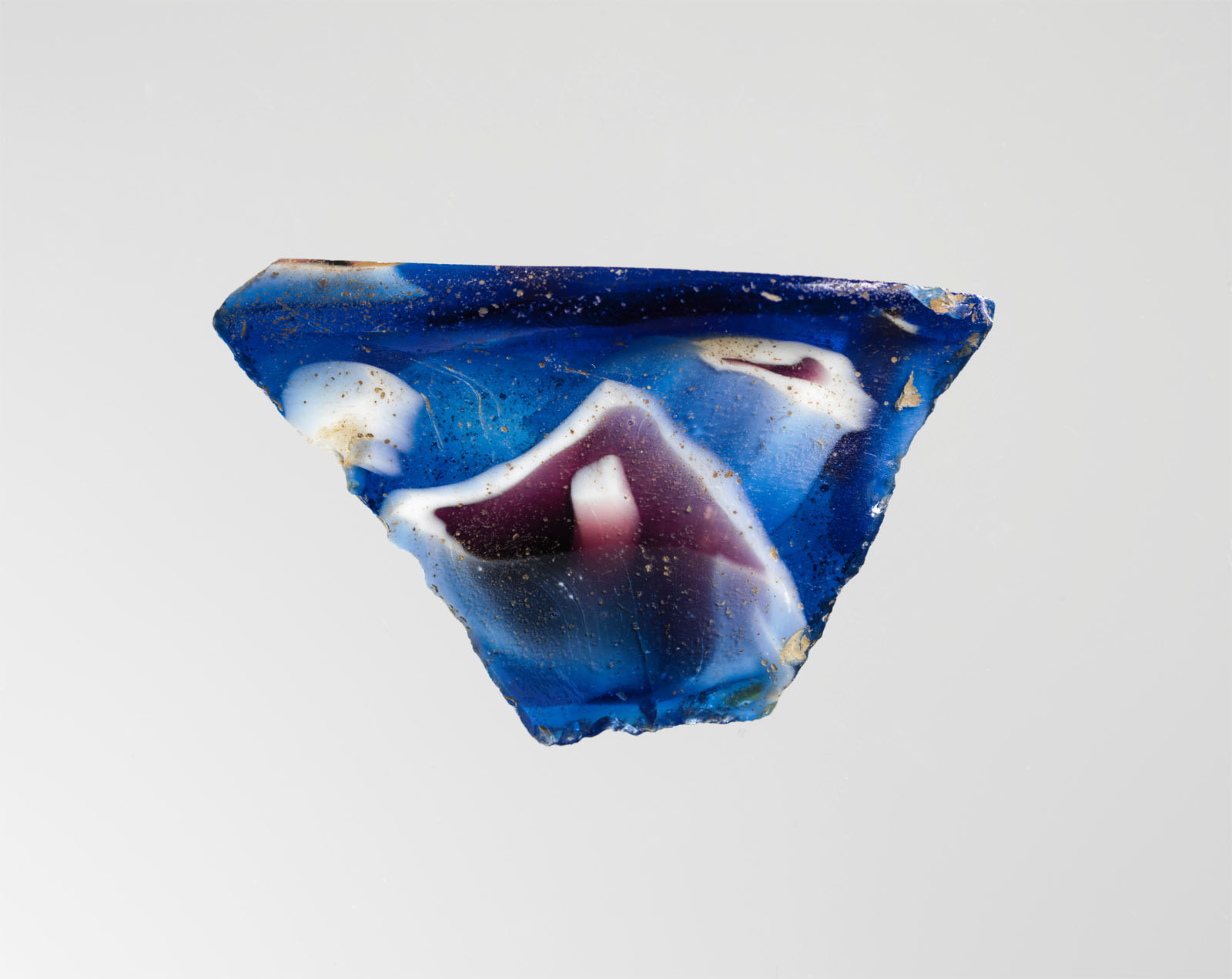
 

'Glass mosaic ribbed bowl fragment' Period: Early Imperial Late 1st century BCE - early 1st century CE


Glass mosaic ribbed bowl fragment
Period: Early Imperial
Late 1st century BCE – early 1st century CE
Culture: Roman
Glass; cast and tooled
1 15/16 x 1 3/16 in. (4.9 x 3cm)
Metropolitan Museum of Art, New York
Edward C. Moore Collection, Bequest of Edward C. Moore, 1891
Public domain


Body fragment. Translucent cobalt blue, purple, and opaque white. Convex curving side tapering downward. Marbled mosaic pattern formed from sections of a single cane in blue ground with irregular white and purple threads and streaks; on exterior, vertical rib, tapering and becoming deeper with rounded outer edge. Polished exterior and edge along rib; pitting of surface bubbles on interior; pitting and dulling on interior; some weathering on jagged edges.
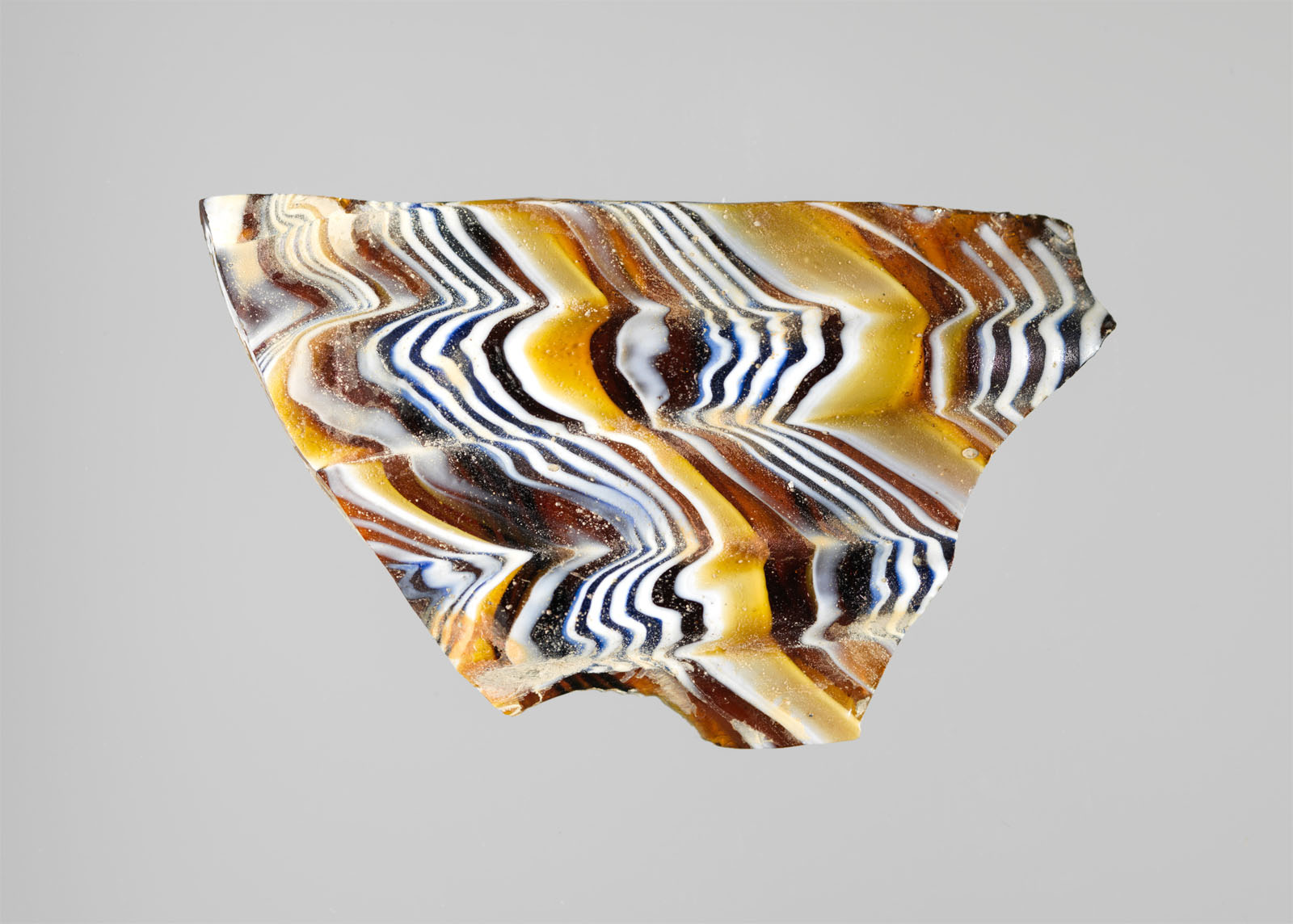
 

'Glass mosaic ribbed bowl fragment' Period: Early Imperial Late 1st century BCE - early 1st century CE


Glass mosaic ribbed bowl fragment
Period: Early Imperial
Late 1st century BCE – early 1st century CE
Culture: Roman
Glass; cast and tooled
2 3/8 x 1 7/16 in. (6.1 x 3.7cm)
Metropolitan Museum of Art, New York
Credit Line: Edward C. Moore Collection, Bequest of Edward C. Moore, 1891
Public domain


Body fragment. Translucent honey brown, cobalt blue, and opaque white. Slightly outsplayed neck; straight side tapering downward and curving in at bottom. Ribbon mosaic pattern formed from sections of a single cane in brown ground with irregular wavy white and blue threads in parallel lines; on exterior, two broad vertical ribs, fairly widely spaced, with flattened tops and rounded outer edges. Polished interior; pitting of surface bubbles on interior; dulling and patches of creamy iridescent weathering on exterior; some weathering and chipping of jagged edges.
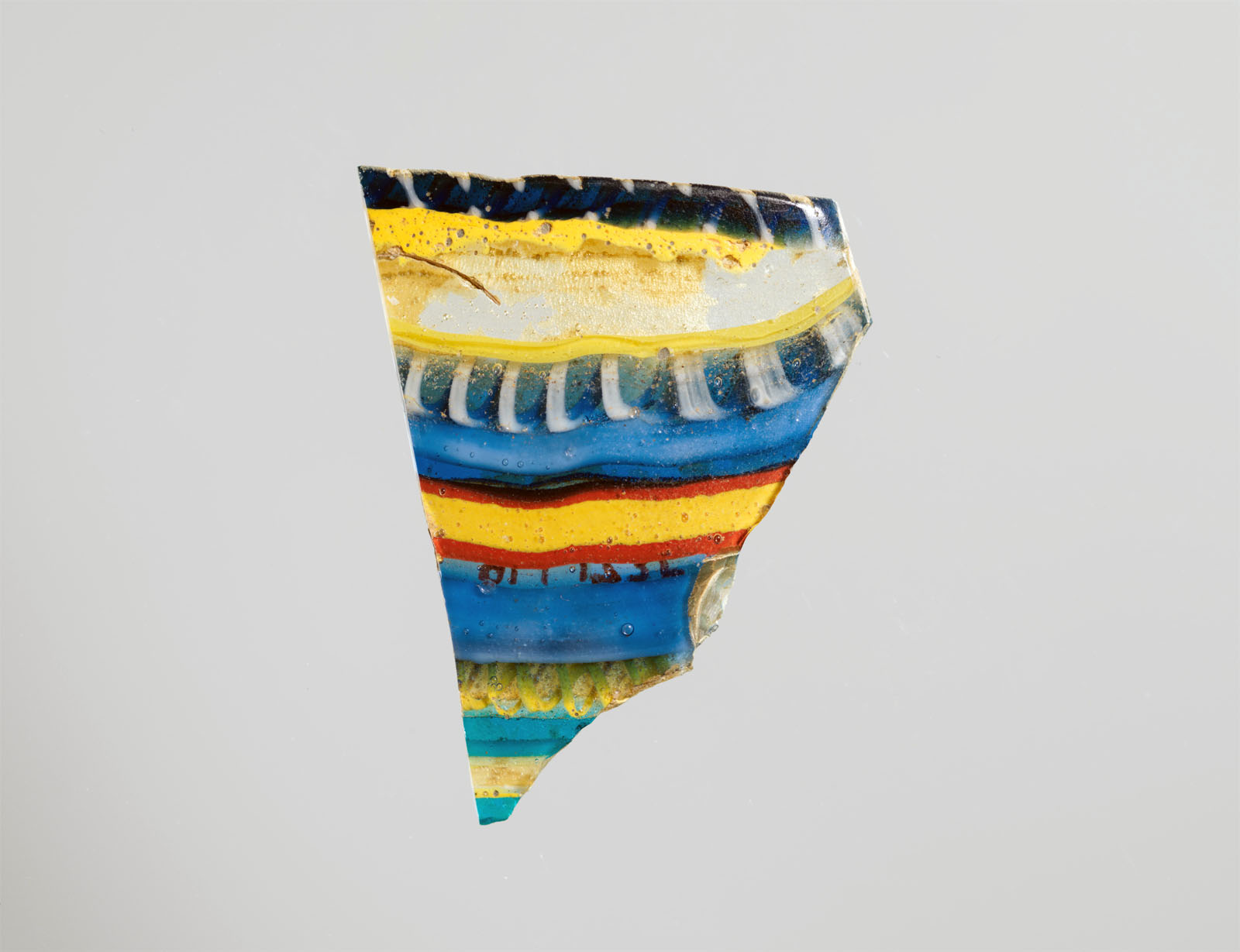
 

'Glass striped mosaic bowl fragment' Period: Early Imperial Late 1st century BCE - early 1st century CE


Glass striped mosaic bowl fragment
Period: Early Imperial
Late 1st century BCE – early 1st century CE
Culture: Roman
Glass; cast
1 9/16 x 1 1/4 in. (4 x 3.2cm)
Metropolitan Museum of Art, New York
Edward C. Moore Collection, Bequest of Edward C. Moore, 1891
Public domain


Rim fragment. Translucent blue, turquoise blue, purple appearing opaque brick red, yellow, and white, with colourless glass. Applied coil rim with rounded, vertical lip; slightly convex side, curving inward at bottom. Rim in blue with white spiral thread; body decorated with bands slanting slightly from top right to bottom left, forming a pattern: yellow, colourless, yellow, blue with single spiral white thread, blue layered with white, blue, red, yellow, red, blue, blue layered with white, colourless with double spiral yellow threads, turquoise, colourless, and turquoise. Pinprick bubbles; exterior polished, with pitting of surface bubbles; creamy weathering on interior and some iridescent weathering on edges.


'Glass mosaic ribbed bowl fragment' Period: Early Imperial Late 1st century BCE - early 1st century CE


Glass mosaic ribbed bowl fragment
Period: Early Imperial
Late 1st century BCE – early 1st century CE
Culture: Roman
Glass; cast and tooled
1 11/16 x 2 3/16 in. (4.2 x 5.5cm)
Metropolitan Museum of Art, New York
Edward C. Moore Collection, Bequest of Edward C. Moore, 1891
Public domain


Body fragment. Translucent cobalt blue, purple, and opaque white. Slightly outsplayed neck; deep, slightly convex curving side, tapering downward. Composite mosaic pattern formed from polygonal sections of a single cane in a blue ground with a circle of white rods around a white circle surrounding a purple ground with a central white rod; on exterior, two broad vertical ribs, fairly widely spaced, with flattened tops and rounded outer edges, tapering downward. Polished interior; pitting of surface bubbles and iridescent weathering in one chip on interior; dulling and iridescent weathering on exterior and jagged edges.
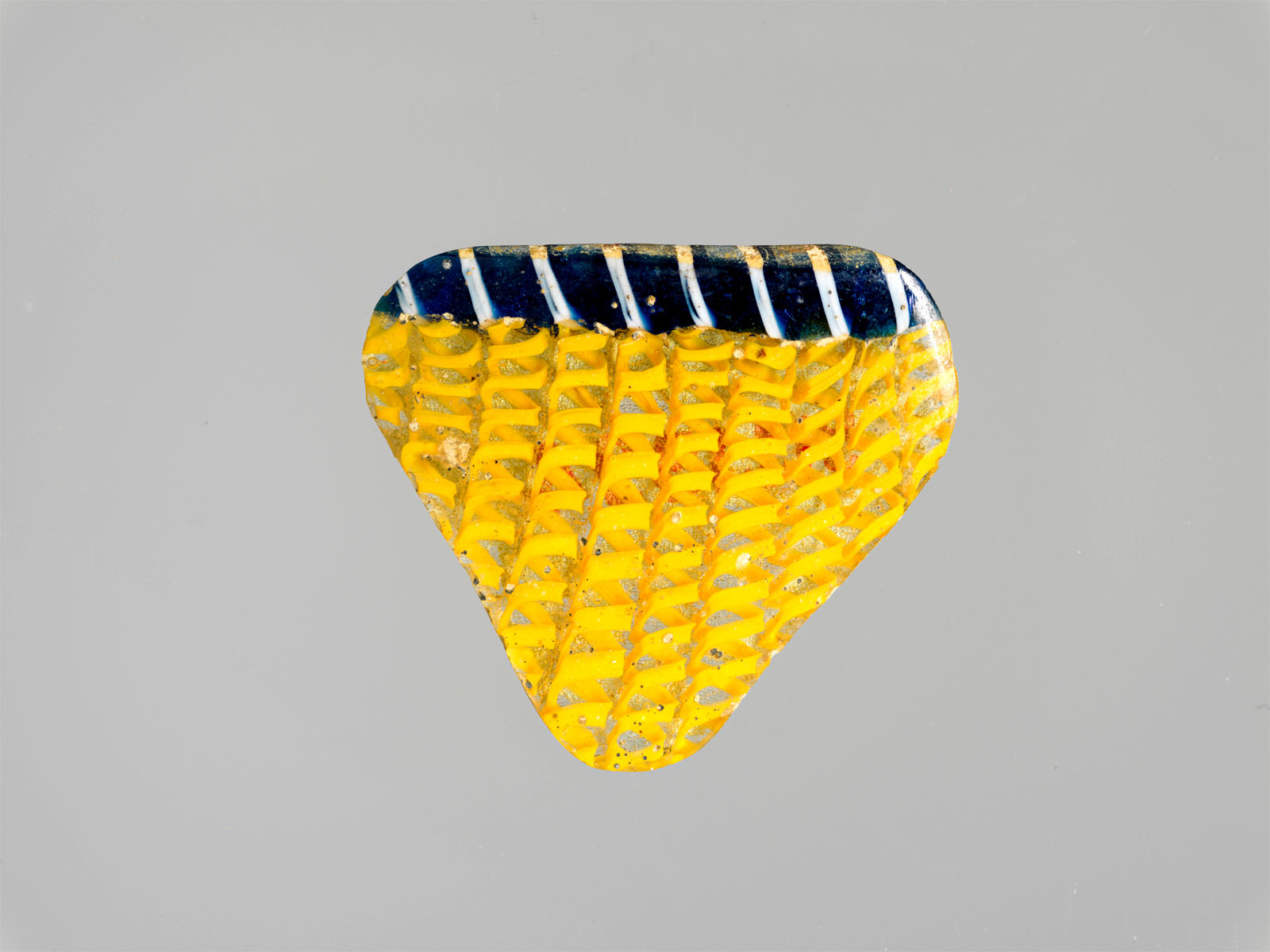
 

'Glass network mosaic fragment' Period: Early Imperial Late 1st century BCE - early 1st century CE


Glass network mosaic fragment
Period: Early Imperial
late 1st century BCE – early 1st century CE
Culture: Roman
Glass; cast
15/16 x 1 1/16 in. (2.4 x 2.7cm)
Metropolitan Museum of Art, New York
Edward C. Moore Collection, Bequest of Edward C. Moore, 1891
Public domain


Rim fragment. Translucent blue, opaque yellow, and colourless. Applied coil rim with vertical rounded lip; slightly tapering side. Rim in blue with white spiral thread; body decorated with ten colourless vertical narrow canes, decorated with double spiral yellow threads. Pinprick bubbles; exterior polished, with slight pitting of surface bubbles; dulling and creamy iridescence weathering on interior; jagged, weathered edges.
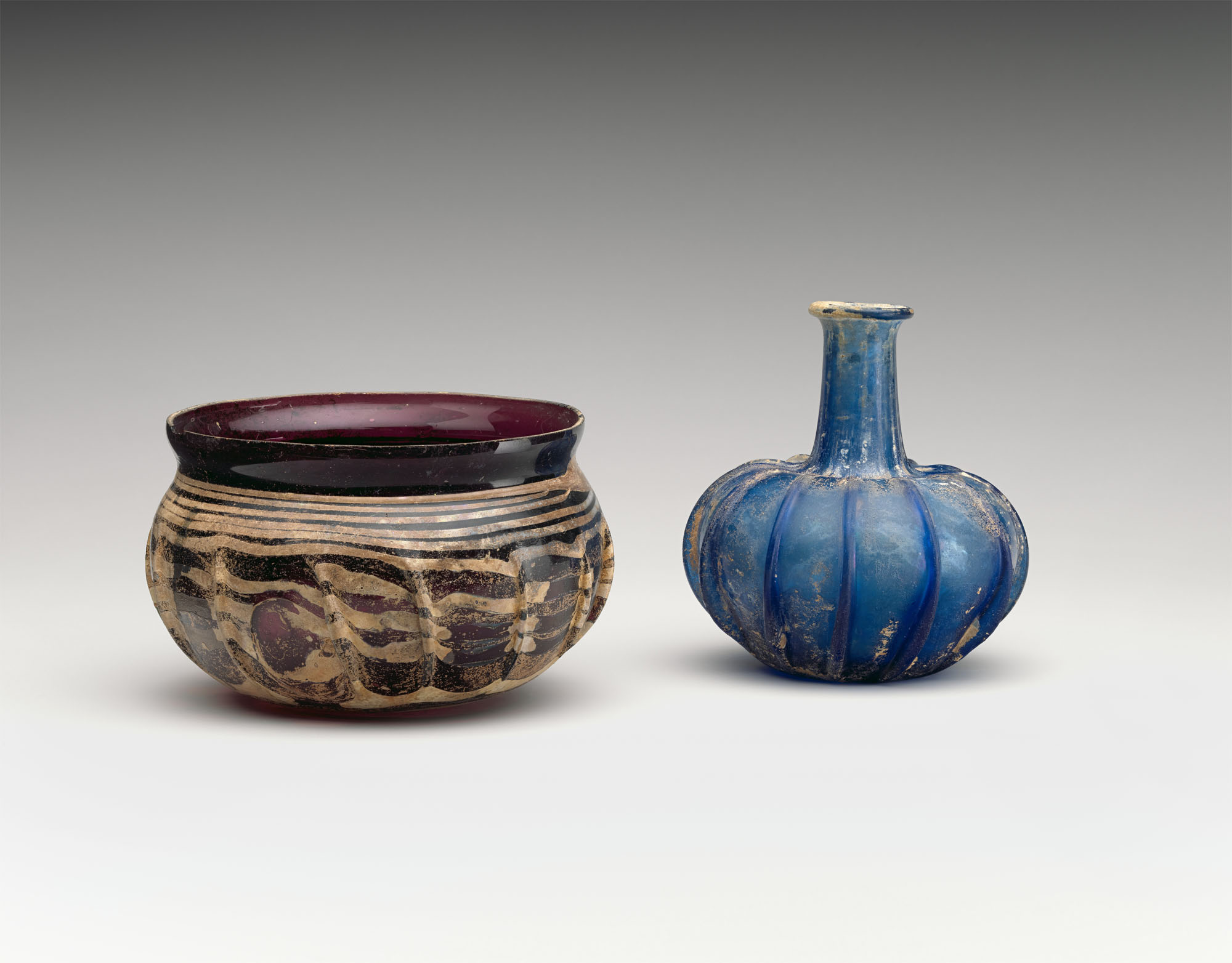
 

'Glass ribbed bowl and Glass ribbed bottle' 1st century CE


Glass ribbed bowl and Glass ribbed bottle
1st century CE
Culture: Roman
Metropolitan Museum of Art, New York
Edward C. Moore Collection, Bequest of Edward C. Moore, 1891
Public domain
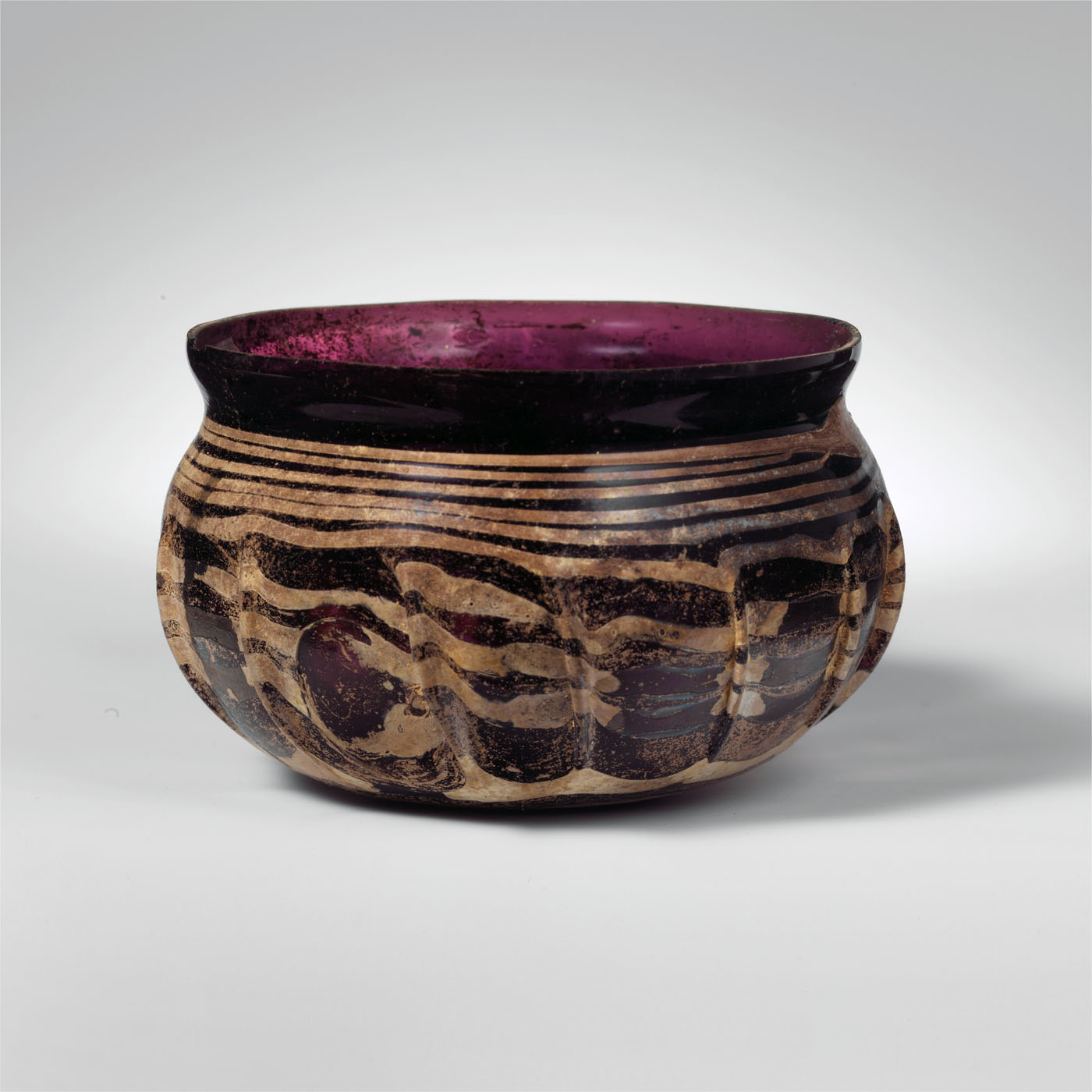
 

'Glass ribbed bowl' Period: Early Imperial Mid-1st century CE


Glass ribbed bowl
Period: Early Imperial
Mid-1st century CE
Culture: Roman
Glass; blown, trailed, and tooled
Height: 2 9/16 in. (6.5cm)
Diameter: 3 5/8 in. (9.2cm)
Metropolitan Museum of Art, New York
Edward C. Moore Collection, Bequest of Edward C. Moore, 1891
Public domain


Translucent deep purple; trail in opaque white. Outsplayed rim, with cracked off and ground lip; short concave neck; broad, globular body curving in to slightly convex and thicker bottom. Thick trail applied on bottom and wound spirally eleven times up side to neck, ending in a large blob; side tooled into fourteen widely-spaced, vertical ribs. Intact, except for one chip in rim, and short sections of trail on body missing through weathering; pinprick bubbles and one glassy inclusion on interior of bottom; some pitting, dulling, and iridescence, with creamy weathering covering most of trail on exterior, little weathering on interior.

Examples of this type of glass bowl are known from many sites across the Roman Empire. Those found in the eastern provinces are generally in pale, almost colourless, transparent glass, but those found in the West are made in rich, deep colours and usually have an opaque white trail decoration.

The ribs on these blown-glass vessels appear on earlier cast-glass versions and were likely added for decorative effect. Ribbed bowls and bottles reveal how shapes and styles of blown glass quickly spread throughout the Roman Empire in the first century CE, as a result of the invention of blowing and demand for glass vessels. The bowl is typical of examples found in Italy and the western provinces, while the rarer bottle has parallels from Cyprus.


'Glass ribbed bottle' Period: Early Imperial 1st century CE


Glass ribbed bottle
Period: Early Imperial
1st century CE
Culture: Roman
Glass; blown and tooled
Height: 3 1/2 in. (8.9cm)
Diameter: 3 1/4 in. (8.3cm)
Metropolitan Museum of Art, New York
Edward C. Moore Collection, Bequest of Edward C. Moore, 1891
Public domain


Translucent blue. Everted rim, folded over and in; cylindrical neck, expanding downwards; pushed-in shoulder; squat, globular body; thick, slightly concave bottom. Twelve, regularly-spaced vertical ribs extending from rim down neck and body, ending above bottom, and forming projecting solid fins on side of body. Intact; pinprick bubbles; pitting, dulling, iridescence, and patches of limy encrustation and brownish weathering.
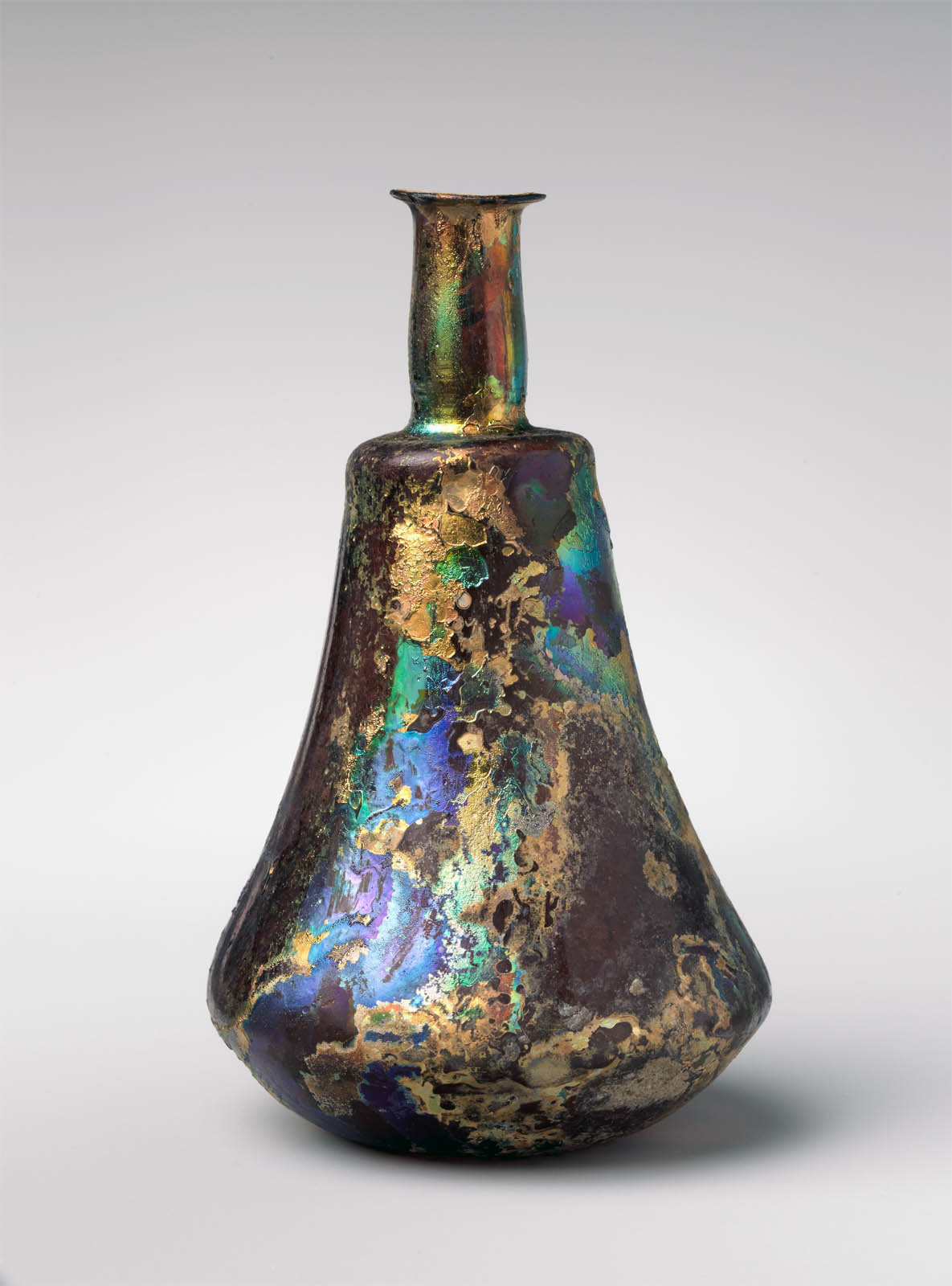
 

'Glass perfume bottle' Period: Early Imperial 1st century CE


Glass perfume bottle
Period: Early Imperial
1st century CE
Culture: Roman
Glass; blown
Height: 4 1/4 in. (10.8cm)
Diameter: 2 1/2 in. (6.4cm)
Metropolitan Museum of Art, New York
Edward C. Moore Collection, Bequest of Edward C. Moore, 1891
Public domain


Translucent purple. Thin, everted rim; slender cylindrical neck, with slightly bulging profile and tooled indent around base; horizontal shoulder, with rounded edge; carinated body, with side to long, upper body tapering downward and lower side curving in sharply; concave bottom. Body intact, but half of rim missing, with weathered edges; some bubbles; severe pitting and brilliant iridescence.

The free-blowing technique developed by the Romans made glass bottles relatively simple and quick to produce. Moore collected some unusual examples of this common type. The brightly striped container, made by fusing together slices of various colours before the bottle was shaped by blowing, resembles cast mosaic glass. The dark iridescent vessel imitates the shape of expensive cast bottles that incorporated gold leaf.
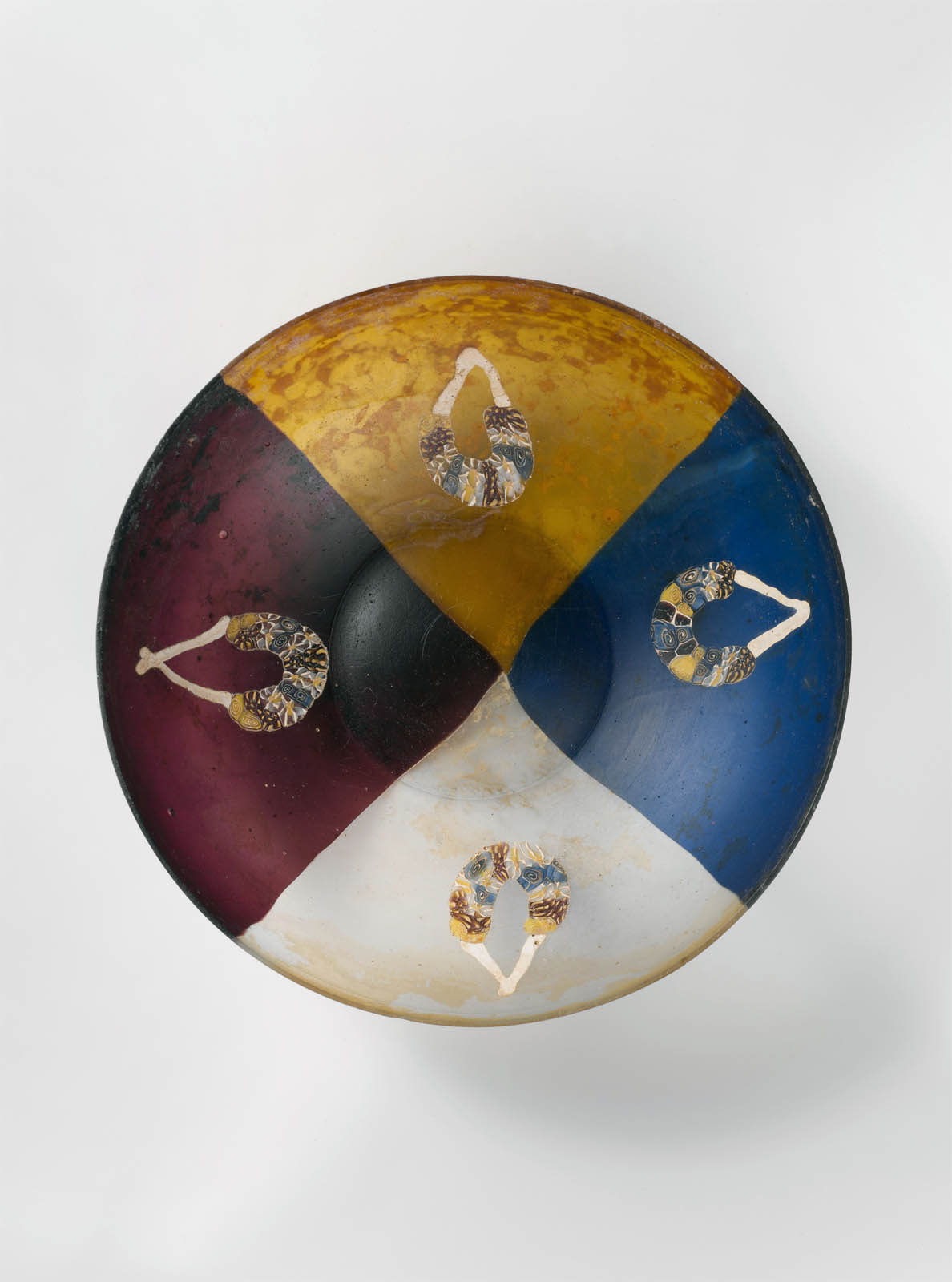
 

'Glass garland bowl' Period: Early Imperial, Augustan Late 1st century BCE


Glass garland bowl
Period: Early Imperial, Augustan
Late 1st century BCE
Culture: Roman
Glass; cast and cut
Height: 1 13/16 in. (4.6cm)
Diameter: 7 1/8 in. (18.1cm)
Metropolitan Museum of Art, New York
Edward C. Moore Collection, Bequest of Edward C. Moore, 1891
Public domain


Colourless, translucent purple, translucent honey yellow, translucent cobalt blue, opaque yellow, and opaque white. Vertical, angular rim; convex curving side, tapering downwards; base ring and concave bottom.

Four large segments of colourless, purple, yellow, and blue, and applied to the interior of the bowl at the centre of each segment a hanging garland, comprising an inverted V-shaped white string above a U-shaped swag made up of a mosaic pattern formed from polgonal or circular sections of four different composite canes: one in a yellow ground with a white spiral, a second in a purple ground with yellow rods, the third in a colourless ground with white lines radiating from a central yellow rod, and the fourth in a blue ground a white spiral. The four different canes are arranged in pairs side by side but the order in which they are placed differs in each swag. On interior, a single narrow horizontal groove below rim.

Intact, except for one small chip in rim; pinprick and larger bubbles; dulling, pitting of surface bubbles, faint iridescence on interior, and creamy iridescent weathering on exterior.

This cast glass bowl is a tour-de-force of ancient glass production. It comprises four separate slices of translucent glass – purple, yellow, blue, and colourless – of roughly equal size that were pressed together in an open casting mold. Each segment was then decorated with an added strip of millefiori glass representing a garland hanging from an opaque white cord. Very few vessels made of large sections or bands of differently coloured glass are known from antiquity, and this bowl is the only example that combines the technique with millefiori decoration. As such it represents the peak of the glass worker’s skill at producing cast vessels.

With its exceptional workmanship and design, this cast bowl is the most important ancient glass vessel in Moore’s collection. Few vessels with large sections of coloured glass survive from antiquity, and this is the only intact example that combines the technique with mosaic-inlay decoration. Four separate pieces of translucent glass – purple, yellow, blue, and colourless – of roughly equal size were pressed together in an open casting mold. Each segment was then embellished with mosaic glass representing a garland hanging from a white cord. Glass canes (rods) of four different colour combinations arranged in pairs form the individual swags. Bowls decorated with garlands have been found in Italy, Cyprus, and Egypt.
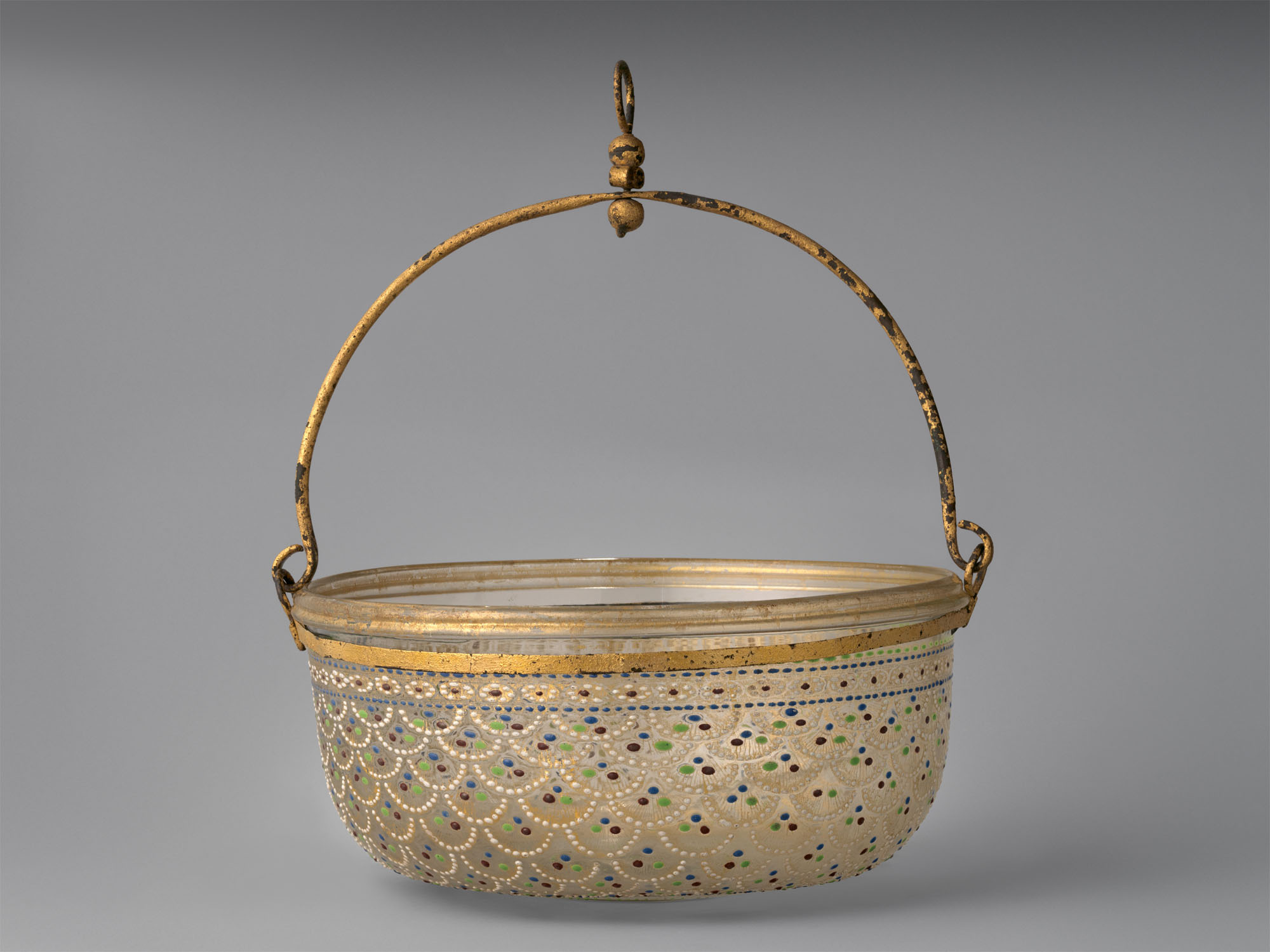
 

'Situla' Early 16th century


Situla
Early 16th century
Culture: Italian, Venice (Murano)
Glass, enamelled and gilt
Dimensions: confirmed, glass bowl only: 3 13/16 × 8 × 8 in. (9.7 × 20.3 × 20.3cm)
Confirmed, as mounted, handle raised: 10 5/16 × 8 3/4 × 8 in. (26.2 × 22.2 × 20.3cm)
Metropolitan Museum of Art, New York
Edward C. Moore Collection, Bequest of Edward C. Moore, 1891
Public domain


Influenced by Islamic craftsmen, Venetian glassblowers began making gilt and enamelled vessels as early as the fifteenth century. The decorative scales on this situla resulted from a multi-step process, which entailed reheating the piece a second time after the vessel was blown. The crudely finished handle is most likely not original.

Moore collected several examples of colourful enamelled glass from both the Islamic and Venetian worlds, seeking decorative inspiration for his silver production. Influenced by craftspeople from Islamic lands, Venetian glassblowers started making gilt and enamelled vessels as early as the fifteenth century. The decoration on this situla is the result of a multistep process, which entailed reheating the piece a second time in the furnace. The crudely finished handle is most likely not original.
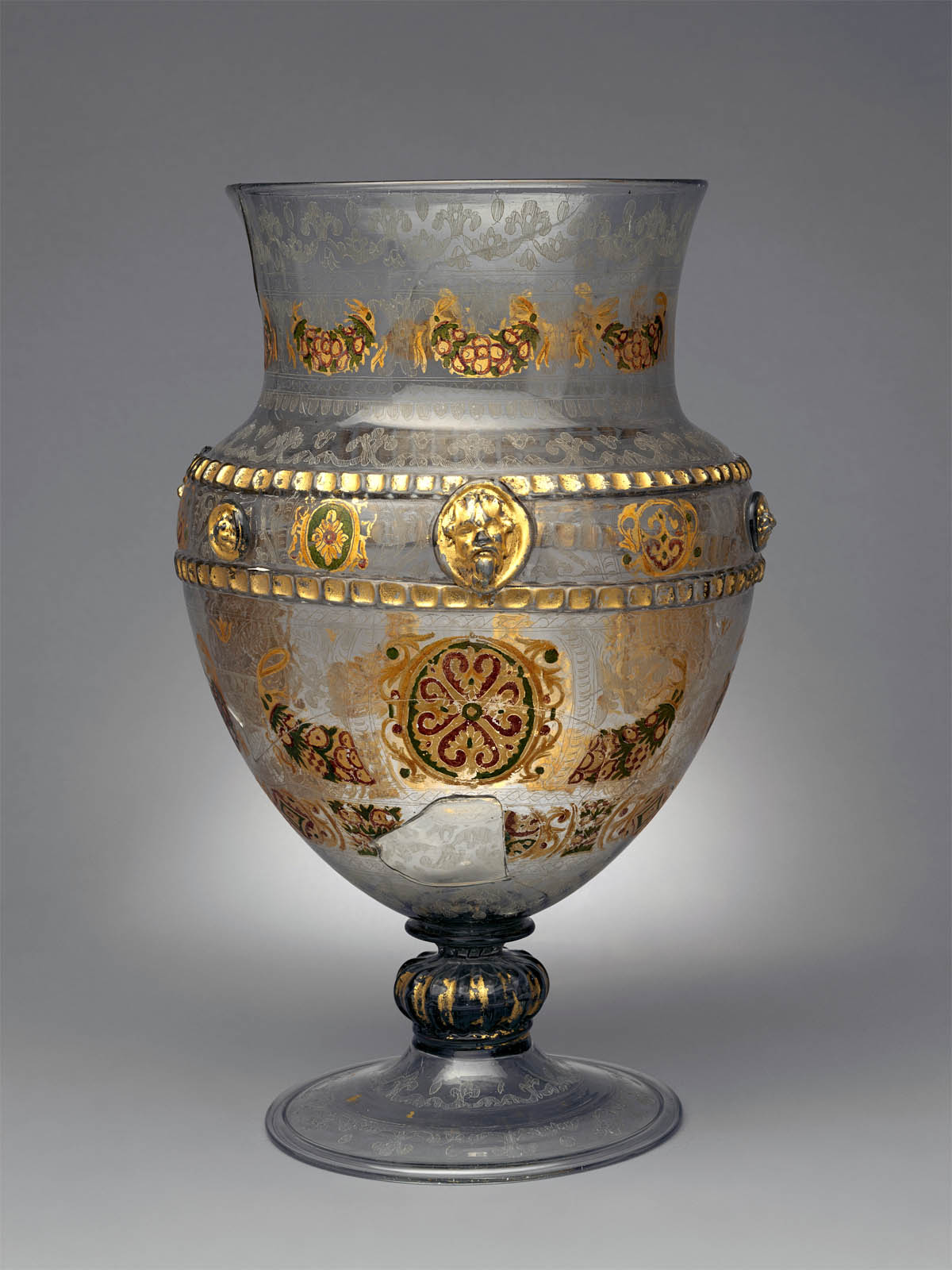
 

'Footed vase (Vasenpokal)' c. 1570-1590


Footed vase (Vasenpokal)
c. 1570-1590
Culture: Austrian, Innsbruck
Glass; blown, applied mold-blown, impressed, and milled decoration, engraved, cold-painted, and gilded
12 3/4 × 8 1/2 in. (32.4 × 21.6cm)
Metropolitan Museum of Art, New York
Edward C. Moore Collection, Bequest of Edward C. Moore, 1891
Public domain


This vase is ambitiously ornamented in the Venetian style with engraved decoration and gold, red, and green cold painting. It also shows key characteristics of pieces from the glassworks that served the Innsbruck court in the late sixteenth century. Archduke Ferdinand II of Austria secured skilled glassworkers and raw materials from Venice, famed for its thin and clear glass known as cristallo. Glass was valued for the technical artistry that transformed humble sand, soda ash, and lime into a nearly weightless, translucent object precious enough to be adorned with gold.

Glassware made outside of Venice but in the same style is known as façon de Venise. This incredibly ambitious Austrian example of a footed vase with engraved decoration and gold, red, and green cold-painting likely came from the Innsbruck court glasshouse of Archduke Ferdinand II. At the time Moore purchased this piece, it had several missing pieces and cracks, which are now restored. The cold-painting is extremely well preserved considering the inherently fragile nature of the technique.


'Tankard' 1716


Tankard
1716
Culture: probably South German
Glass; blown, applied and marvered decoration; pewter mount
7 9/16 × 5 1/2 × 4 5/8 in. (19.2 × 14 × 11.7cm)
Metropolitan Museum of Art, New York
Edward C. Moore Collection, Bequest of Edward C. Moore, 1891
Public domain


The shape of this tankard, with its bulbous bottom and flared foot, is typical of German pewter and stoneware vessels. The lid features a crudely engraved symbol of what appears to be carpenter’s tools, suggesting that the piece served as a guild vessel, possibly for a carpenters’ association. Its charm derives from the striking contrast between the rough-hewn pewter mounts and the calligraphic trails of white glass decorating the transparent purple glass body.
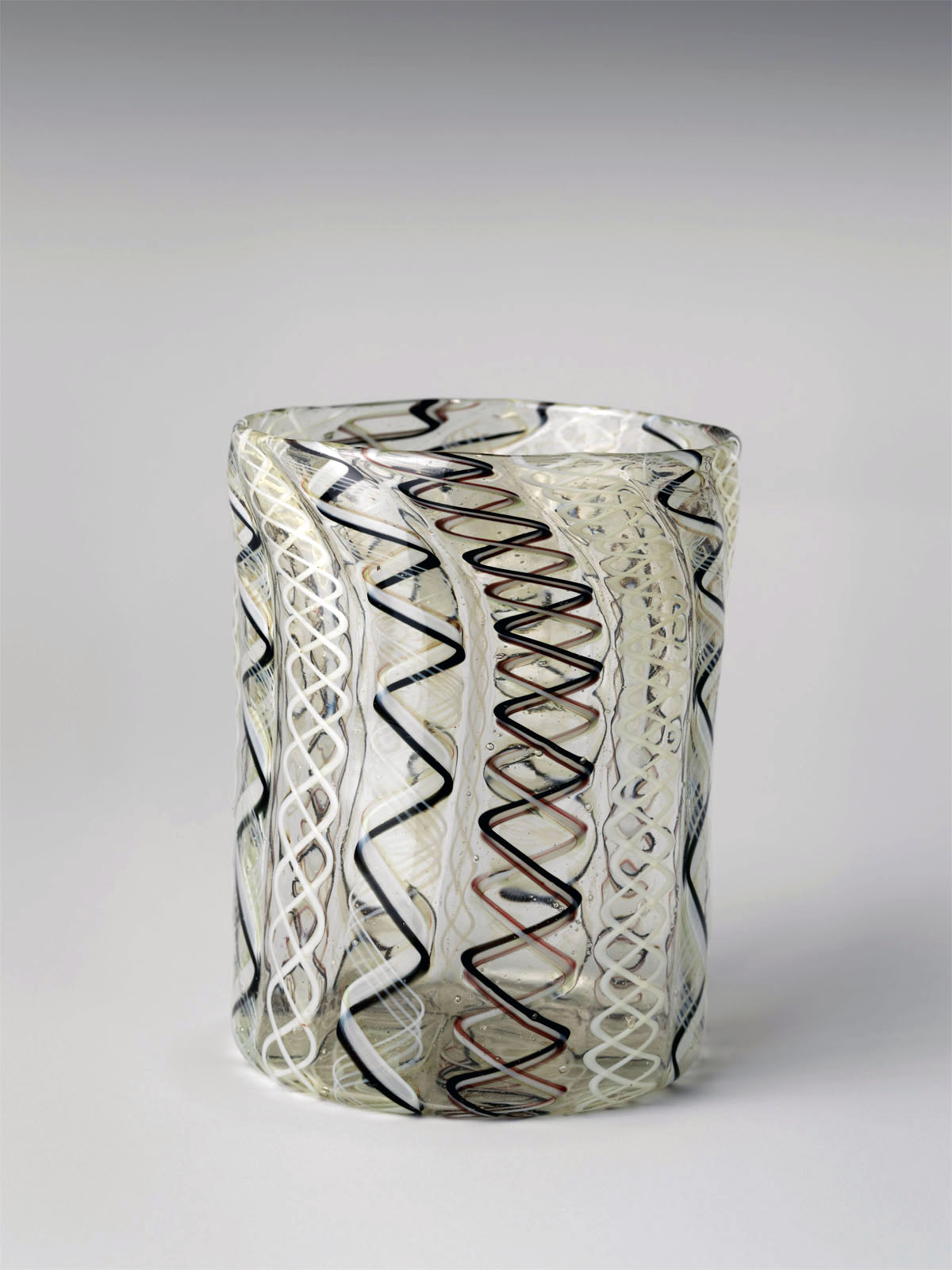
 

'Beaker' Mid-19th century


Beaker
Mid-19th century
Culture: Italian, Venice (Murano)
3 3/8 × 2 5/8 in. (8.6 × 6.7cm)
Metropolitan Museum of Art, New York
Edward C. Moore Collection, Bequest of Edward C. Moore, 1891
Public domain


One of the great Venetian innovations in glassblowing is filigrana. Drawn-out canes of colourless, white, and coloured glass were fused together to create the patterned structure of the vessel. Moore had several examples in his collection. This small beaker of more complex canes with multiple spiralling threads, referred to as filigrana a retorti, was made in Venice.
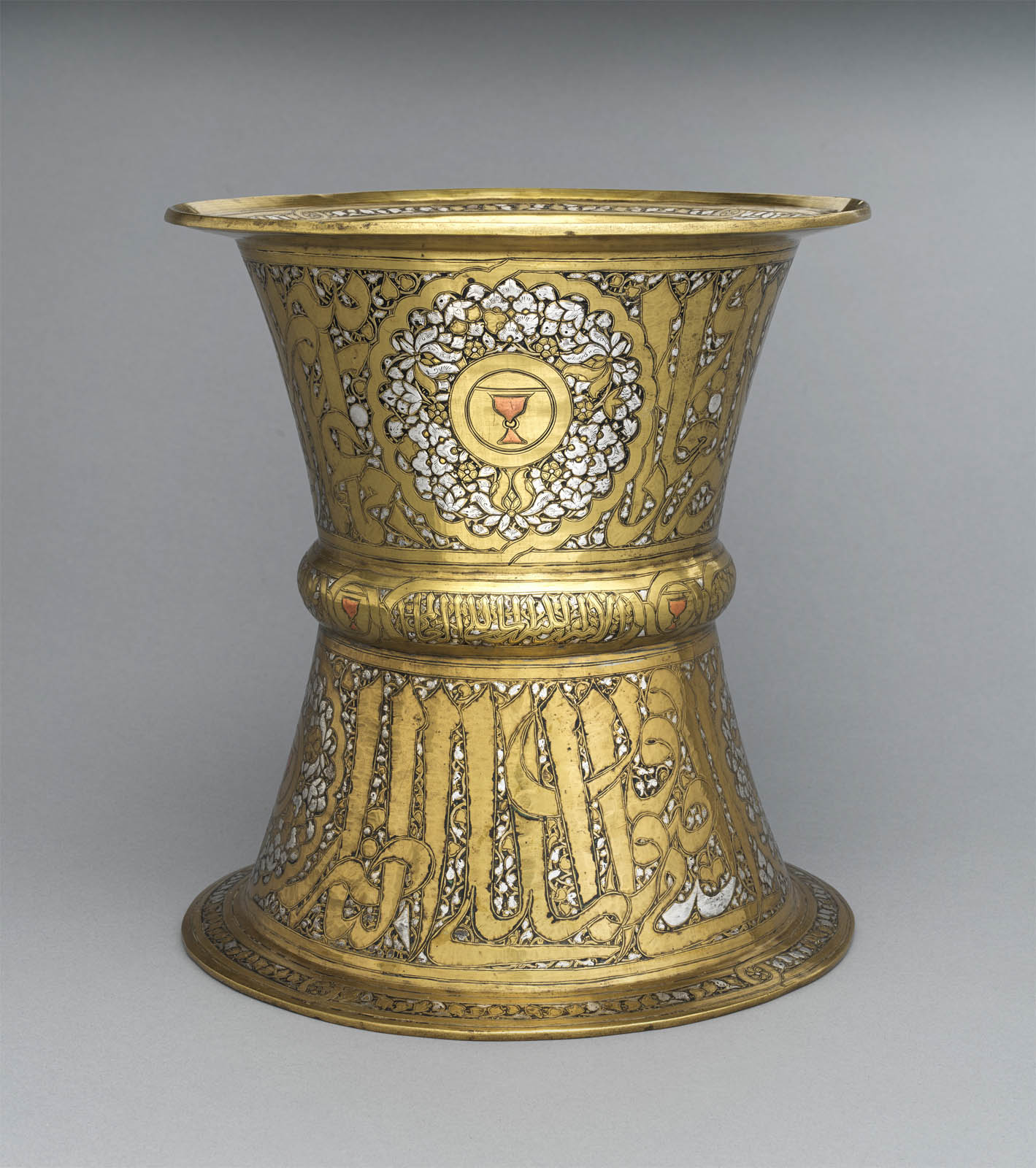
 

'Tray Stand' Mid-14th century (after 1342)


Tray Stand
Mid-14th century (after 1342)
Attributed to Egypt or Syria
Brass; hammered, turned, and chased, inlaid with silver, copper, and black compound
Height: 10 1/4 in. (26 cm)
Diameter: 9 5/8 in. (24.4 cm)
Metropolitan Museum of Art, New York
Edward C. Moore Collection, Bequest of Edward C. Moore, 1891
Public domain


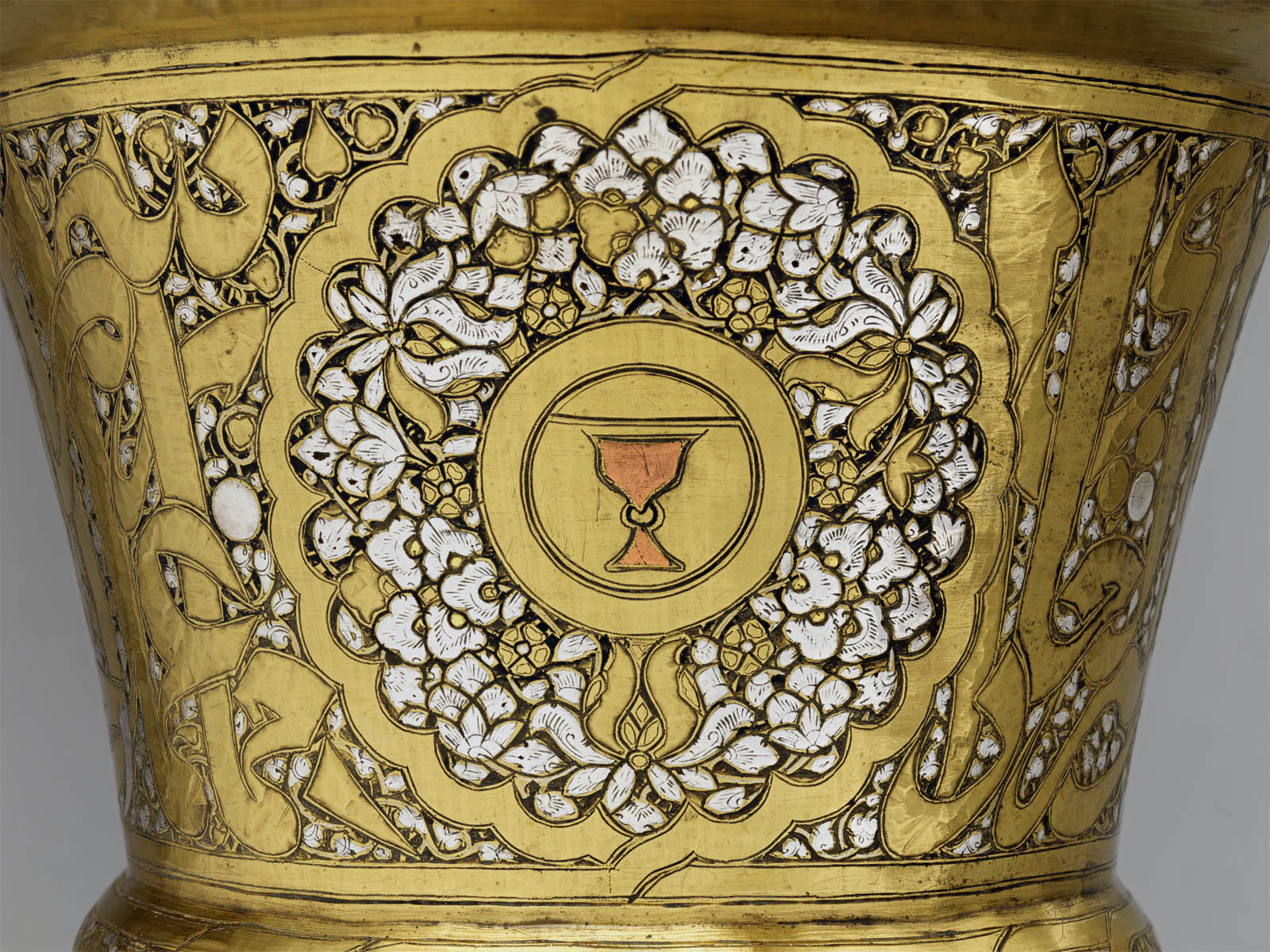
Similar stands were widely employed in the Mamluk period to host large rounded metal trays, on which fruits and other food were displayed.

The cup motif inlaid with copper stands out among the richly decoration of this tray. It was a blazon of the cupbearer, one of the differentiated offices of the court of the Mamluk sultans. The inscription reads Husain, son of Qawsun, who was cupbearer to Muhammad b. Qalawun (al-Malik al-Nasir) (1294-1340/41). Despite having been ousted after the sultan’s death, Qawsun’s prestige must have endured, as his sons continued to use his emblem of the ringed cup set within a divided shield.

This work consists of two truncated cones soldered together with a central ring and a flared foot and rim. It belongs to a group of medieval inlaid brass works from the Islamic world that are commonly identified as tray stands, and which supported circular metal platters that displayed and served food. French collectors introduced treasures like this one to the art market in Paris beginning in the 1860-1870s. Moore was likely drawn to them for the visual effects of the inlaid mixed metalwork.
 

'Tray Stand' Mid-14th century (after 1342) (detail)


Tray Stand (detail)
Mid-14th century (after 1342)
Brass; hammered, turned, and chased, inlaid with silver, copper, and black compound
Height: 10 1/4 in. (26 cm)
Diameter: 9 5/8 in. (24.4 cm)
Metropolitan Museum of Art, New York
Edward C. Moore Collection, Bequest of Edward C. Moore, 1891
Public domain


'Umar ibn al-Hajji Jaldak (maker) 'Ewer with Inscription, Horsemen, and Vegetal Decoration' Dated 623 AH/1226 CE


‘Umar ibn al-Hajji Jaldak (maker)
Ewer with Inscription, Horsemen, and Vegetal Decoration
Dated 623 AH/1226 CE
Brass; inlaid with silver and black compound
Height: 14 1/2 in. (36.8 cm)
Width: 12 1/16 in. (30.6 cm)
Diameter: 8 3/8 in. (21.3 cm)
Metropolitan Museum of Art, New York
Edward C. Moore Collection, Bequest of Edward C. Moore, 1891
Public domain


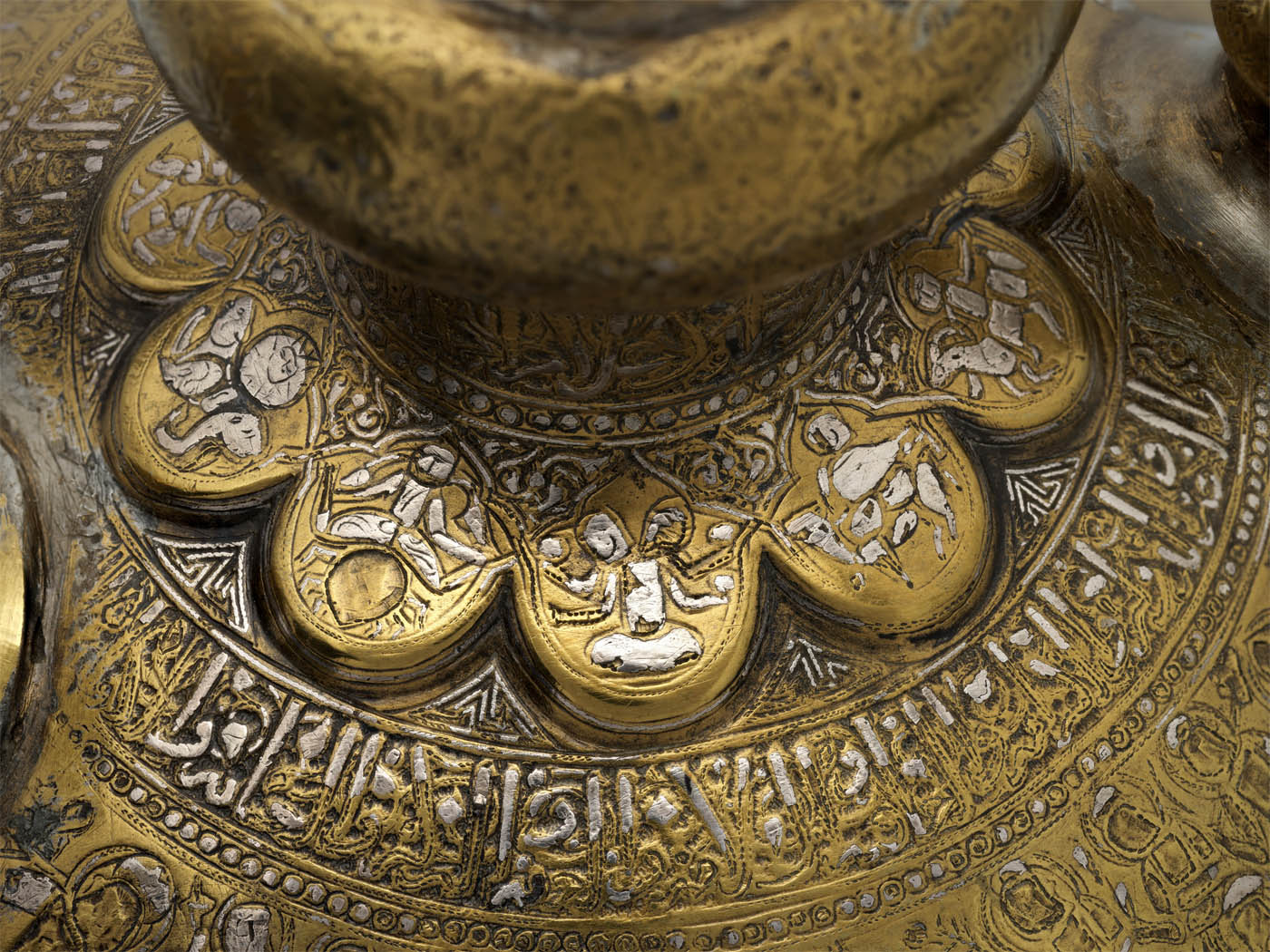
This lavishly decorated object is inscribed around the neck: “Made by ‘Umar ibn al-Hajji Jaldak, the apprentice of Ahmad al-Dhaki al-Naqqash al-Mawsili in the year 623 [1226 A.D.].” Ahmad al-Mawsili, originally from Mosul in Upper Mesopotamia, was a famous metalworker who had a number of pupils.

Moore was particularly interested in lavish works made by mixing and inlaying metals, techniques that artists in the Middle East had developed to a high art centuries earlier for the upper echelons of society. Blending complex geometric and vegetal compositions with fine calligraphy or expressive imagery, they created polychromatic effects comparable to those achieved in painting. The objects here hail from three different Islamic regions around 1100-1400, when the art form flourished.

The ewer is among the earliest dated examples of a prominent school of inlaid metalwork known as “al-Mawsili” (from Mosul) that thrived during the thirteenth and fourteenth centuries, first in Mosul and later in centres such as Cairo and Damascus. Their work often features thin foils of precious metals inlaid on a gleaming brass body. This example includes detailed scenes of the courtly activities of an ideal ruler and interlacing medallions.
 

'Umar ibn al-Hajji Jaldak (maker) 'Ewer with Inscription, Horsemen, and Vegetal Decoration' Dated 623 AH/1226 CE (detail)


‘Umar ibn al-Hajji Jaldak (maker)
Ewer with Inscription, Horsemen, and Vegetal Decoration (detail)
Dated 623 AH/1226 CE
Brass; inlaid with silver and black compound
Height: 14 1/2 in. (36.8 cm)
Width: 12 1/16 in. (30.6 cm)
Diameter: 8 3/8 in. (21.3 cm)
Metropolitan Museum of Art, New York
Edward C. Moore Collection, Bequest of Edward C. Moore, 1891
Public domain
 

'Inscribed Pen Box' Made in early - late 14th century; altered shortly before mid-15th century

'Inscribed Pen Box' Made in early - late 14th century; altered shortly before mid-15th century


Inscribed Pen Box
Made in early – late 14th century; altered shortly before mid-15th century
Probably originally from Northern Iraq or Western Iran. Attributed to Afghanistan, probably Herat
Brass; engraved and inlaid with silver, gold, and black compound
Length: 11 1/2 in. (29.2cm)
Height: 2 3/8 in. (6cm)
Width: 2 1/2 in. (6.4cm)
Metropolitan Museum of Art, New York
Edward C. Moore Collection, Bequest of Edward C. Moore, 1891
Public domain


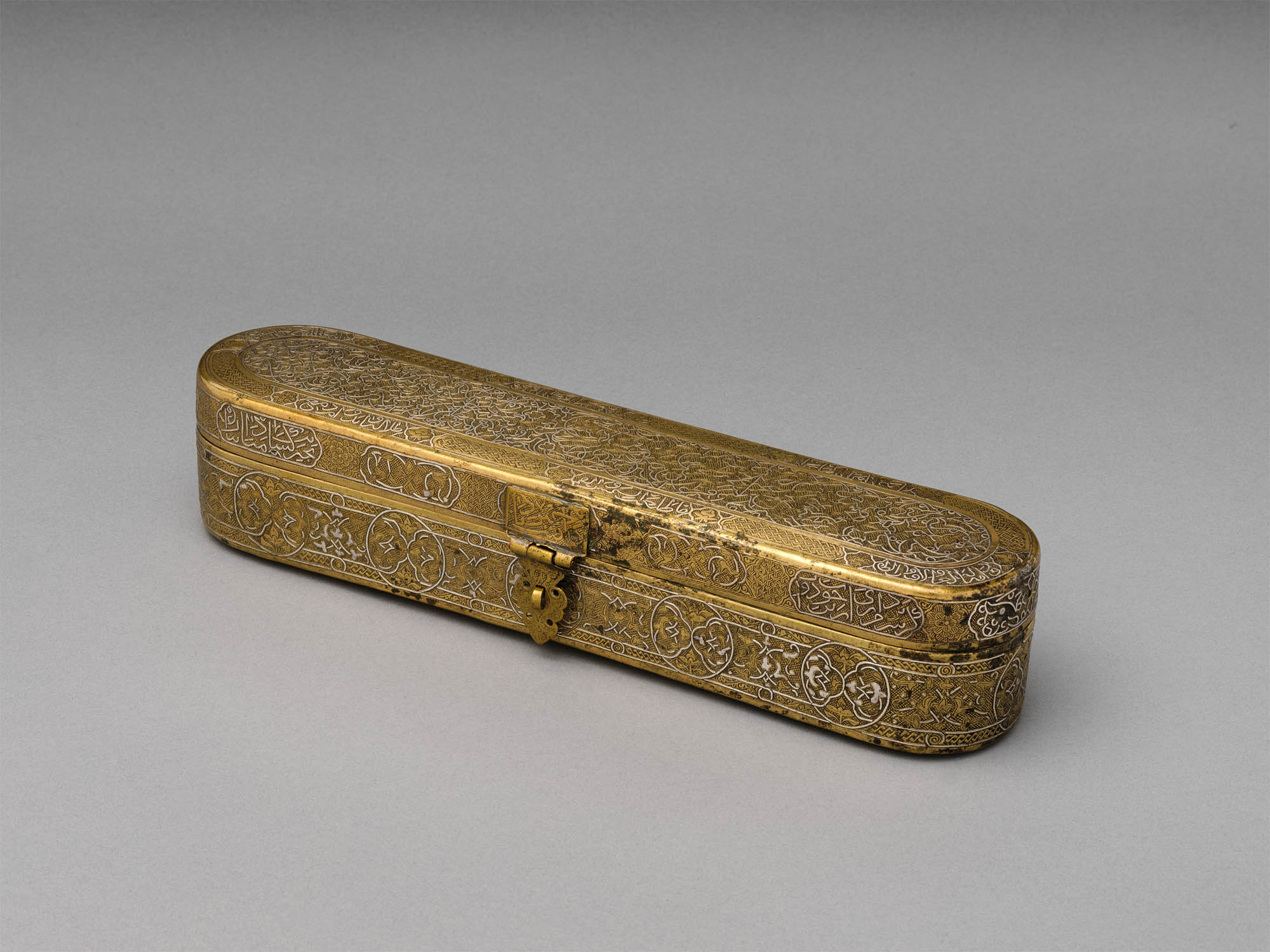
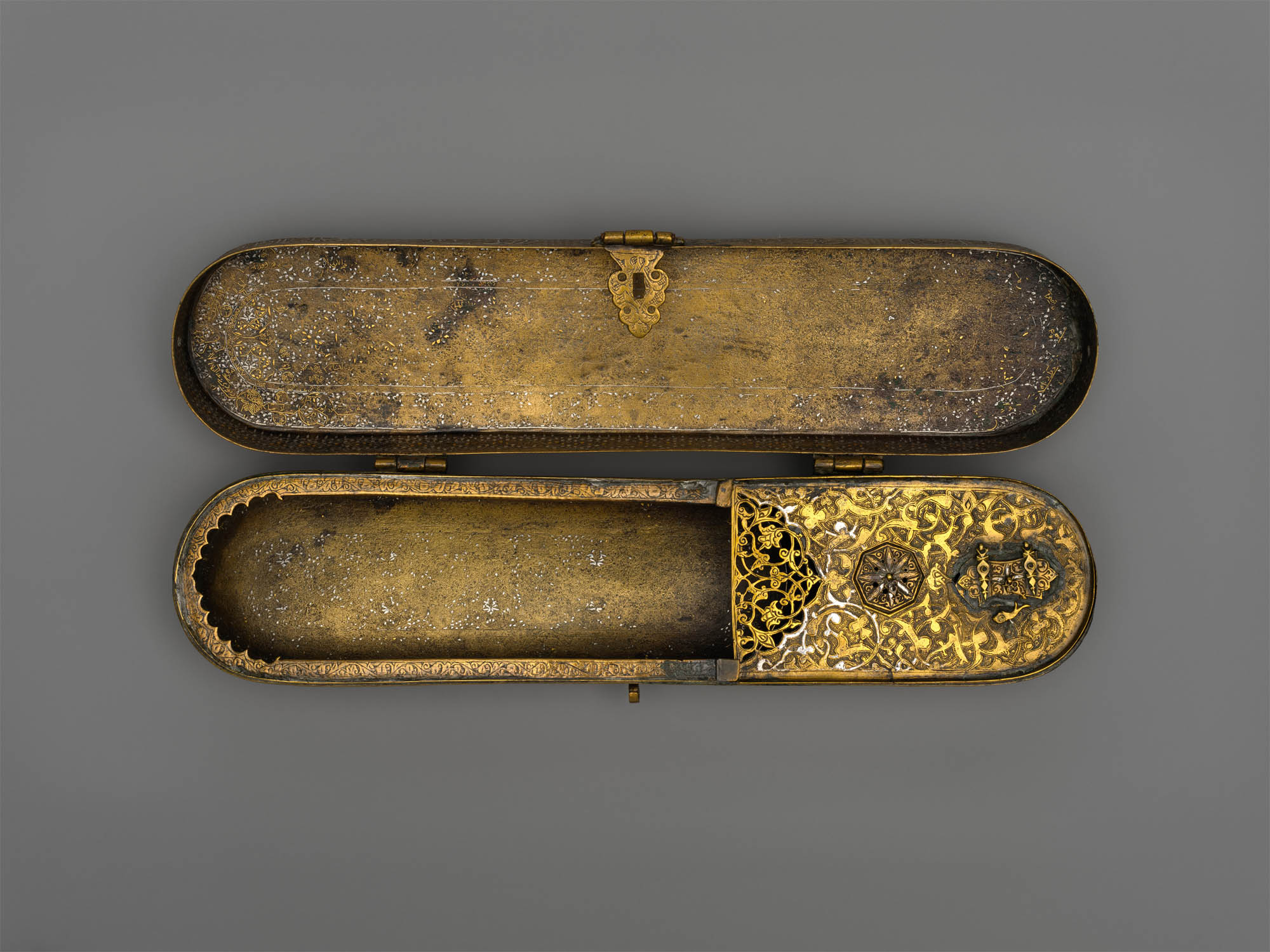
Luxurious writing tools inlaid with precious metals reflected the literary culture of the upper classes from Cairo to Herat, including a respect for the transmission of knowledge. This pen box with its combination of techniques – filigree in relief on the lid and classical inlay on the body – made a fitting acquisition for a collector with a passion for inlaid metal.

This brass pen box was made in the late fourteenth century but significantly altered by the mid-fifteenth century. The interior decoration of a small-scale pattern of roundels with flying birds and running motifs provides a glimpse into the original decoration of the box. After the exterior surface was burnished to remove this original decoration, new patterns, including a series of interlocking medallions and cartouches and incised lotus blossoms, were set against a cross-hatched background. The inkwell and surrounding insert were added at a yet later date. The inscriptions in thuluth and naskh scripts include poetic verses and good wishes to the owner.
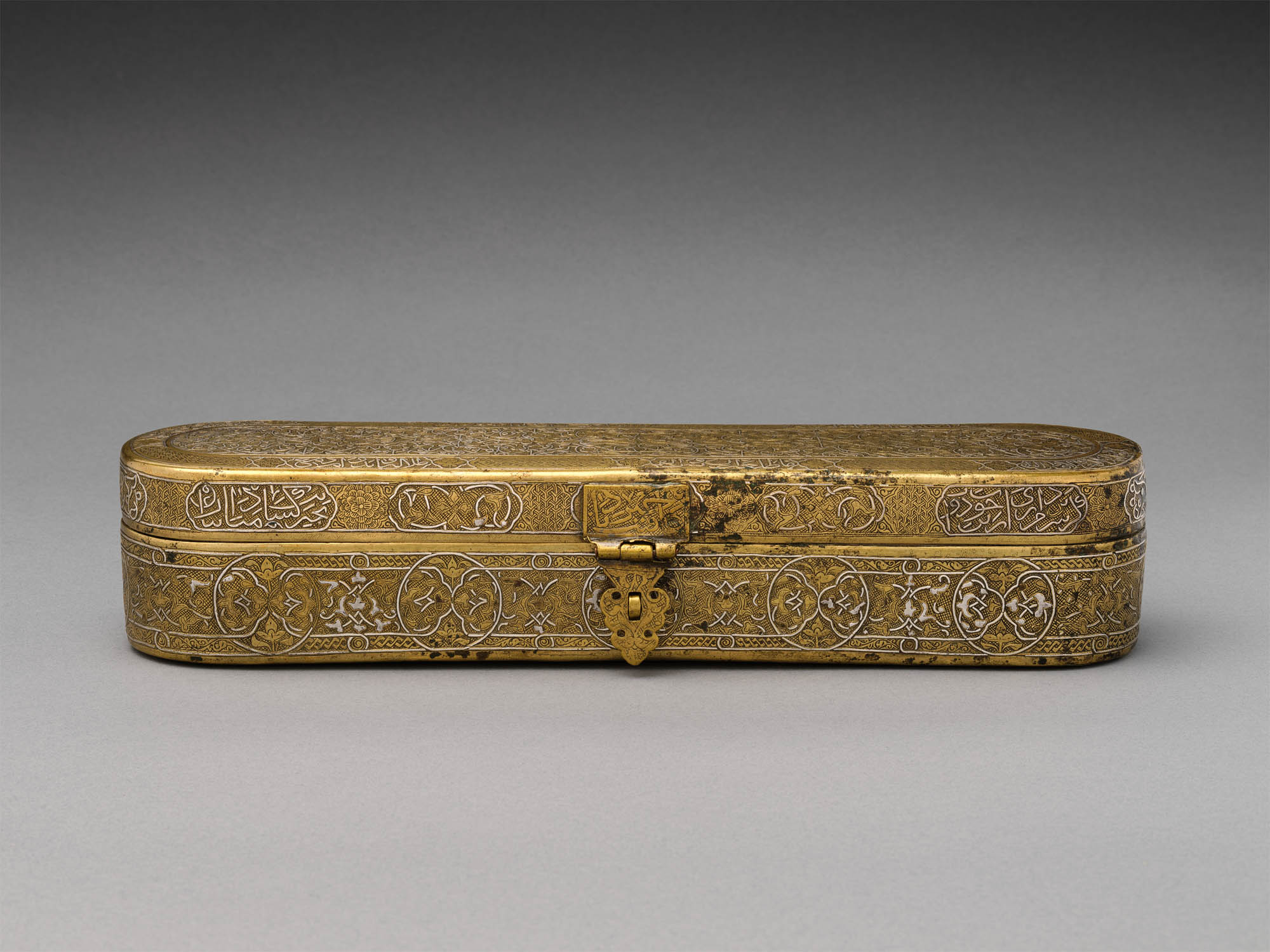
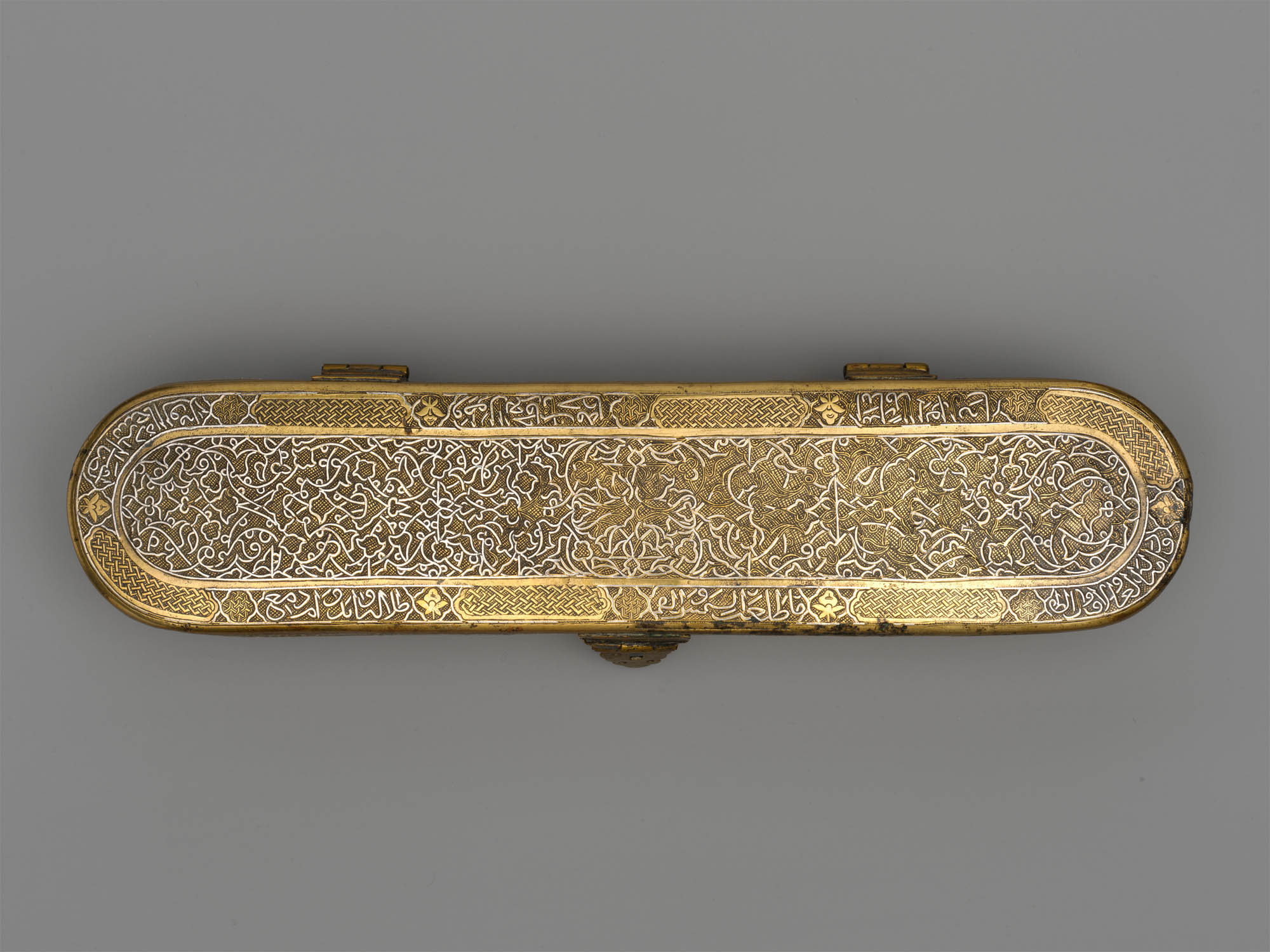
 

'Inscribed Pen Box' Made in early - late 14th century; altered shortly before mid-15th century

'Inscribed Pen Box' Made in early - late 14th century; altered shortly before mid-15th century


Inscribed Pen Box
Made in early – late 14th century; altered shortly before mid-15th century
Probably originally from Northern Iraq or Western Iran. Attributed to Afghanistan, probably Herat
Brass; engraved and inlaid with silver, gold, and black compound
Length: 11 1/2 in. (29.2cm)
Height: 2 3/8 in. (6cm)
Width: 2 1/2 in. (6.4cm)
Metropolitan Museum of Art, New York
Edward C. Moore Collection, Bequest of Edward C. Moore, 1891
Public domain


'Plate with Vegetal Decoration in a Seven-pointed Star' c. 1655-1680


Plate with Vegetal Decoration in a Seven-pointed Star
c. 1655-1680
Made in Iran, Kirman
Stonepaste; polychrome-painted under transparent glaze
H. 2 1/2 in. (6.4 cm)
Diam. 18 1/4 in. (46.4cm)
Metropolitan Museum of Art, New York
Edward C. Moore Collection, Bequest of Edward C. Moore, 1891
Public domain


Moore collected ceramics from Iran, which during the 1870s and 1880s were shipped in great quantities to London, as well as a few pieces from the Ottoman lands (Iznik), Egypt, Syria, and Spain. The large platter from seventeenth-century Kirman, Iran, combines a central star with densely applied Chinese-inspired motifs and colours, features that Moore favoured and incorporated into his own designs.


'Dish' c. 1500


Dish
c. 1500
Spanish, Valencia
Tin-glazed and luster-painted earthenware
Irregular diameter: 3 1/8 × 18 7/8 in. (7.9 × 47.9cm)
Metropolitan Museum of Art, New York
Edward C. Moore Collection, Bequest of Edward C. Moore, 1891
Public domain


Moore clearly appreciated lusterware, with its distinctive shiny metallic surfaces. He owned a number of pieces; this dish and other examples from Spain are among the first works he collected. Braseros typically feature radial designs filled with dense patterns, and often present a heraldic emblem – here, a rising eagle, symbol of power and royalty across the Mediterranean.

Tin-glazed earthenware, of which lusterware is one type, was developed in the Middle East in the ninth and tenth centuries to imitate the porcelains produced in China. The opaque white glaze concealed the clay body, which could range from pale buff to brick red, allowing for brilliant effects created by painting the white surface with metal oxides that fired to a range of colours. This technique, as well as the use of metallic luster – an iridescent, coppery painted glaze – spread throughout the Muslim world, arriving among the potters of Valencia in the thirteenth century. The so-called Hispano-Moresque lusterware, with its fusion of Islamic and Gothic styles and motifs, often in shaped imitating those of metal vessels, was treasured by the elite in Spain during the fifteenth century and exported to the courts of Europe. The Valencian industry declined in the late sixteenth century, as colourful Italian Renaissance maiolica gained in popularity among the fashionable and as Spanish centres were founded to produce versions of its pictorial forms. Adding to this decline was the expulsion from Valencia in 1609 of all the remaining Moriscos (Muslims converted to Christianity), though Christian potters reestablished the industry shortly thereafter.

On the front of the dish, Manises lusterware braseros were decorated with radial designs and filled with dense, regularised vegetal motifs and other patterns, all organised around a central device. On the back, they were also luster-painted, usually with larger-scale designs and often with more exuberance. Puncture holes in the rims indicate that such dishes were sometimes displayed on walls when not in use.
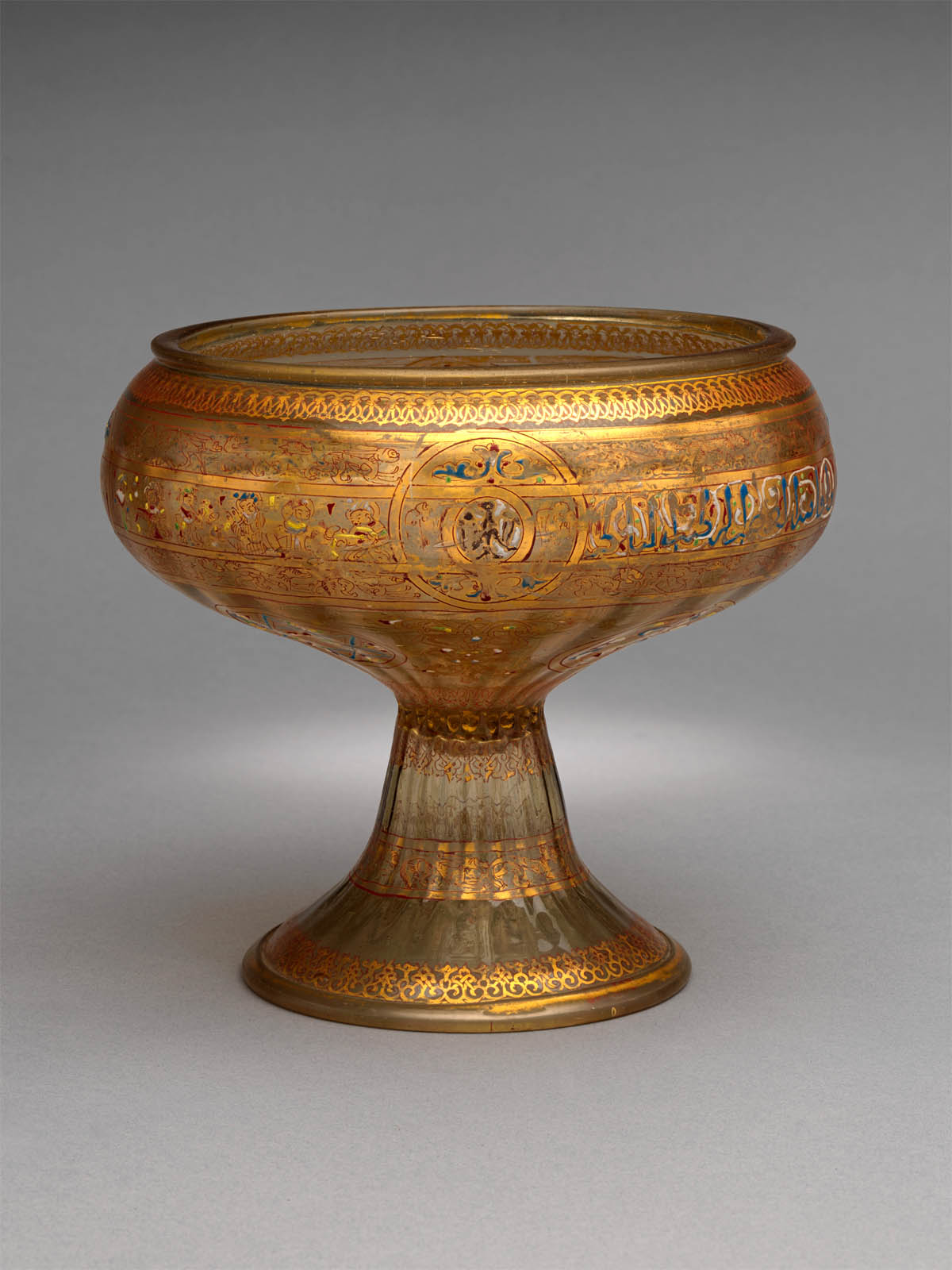
 

'Footed Bowl with Eagle Emblem' Mid-13th century


Footed Bowl with Eagle Emblem
Mid-13th century
Attributed to probably Syria
Glass; dip-moulded, blown, enamelled, and gilded
Height: 7 3/16 in. (18.3cm)
Maximum Diameter: 8 in. (20.3cm)
Diameter of Base: 5 in. (12.7cm)
Metropolitan Museum of Art, New York
Edward C. Moore Collection, Bequest of Edward C. Moore, 1891
Public domain


Along with gilded examples, the most treasured glass objects in the Islamic world were enamelled ones. Developed during the thirteenth and fourteenth centuries in Syria and Egypt under the Ayyubids and Mamluks, they were rediscovered in the 1800s and copied extensively by Western manufactories. When Moore was collecting, this vessel was already celebrated among collectors, dealers, and artists. It was displayed at the 1867 Paris Exposition together with a glass copy by renowned French glassmaker Philippe Joseph Brocard. Moore acquired it from a leading French collector and scholar of Islamic glass, Charles Schefer. After it entered The Met, the bowl was lauded as “the gem of the collection” and “the most beautiful as well as valuable” example of enamelled glass.

Vessels of this characteristic shape, a rounded bowl with a pronounced, tall foot, were sometimes called tazze and were thought to evoke Christian chalices. They became popular in the Islamic eastern Mediterranean during the twelfth and thirteenth centuries, a period of active exchange between the Islamic and Christian worlds. This piece is among the earliest known examples of enamelled glass. Its ornament and iconography is part of the “courtly cycle” referring to the lifestyle of the rulers and elites of medieval Islamic societies from Egypt to Anatolia.

The design features four circular medallions with a bird of prey. While no particular ruler or officer can be associated with the emblem, such birds of prey were common symbols of power, kingship, and to a certain extent, protection in both Muslim and Christian contexts. Flanking the inscription band and on the foot, rows of dogs chasing hares evoke the hunt, while a frieze of seated musicians and feasting figures replaces part of the inscription. Both the hunt and the feast pertain to the courtly cycle and evoke ideals of kingship.


'Footed Bowl with Eagle Emblem' Mid-13th century (detail)


Footed Bowl with Eagle Emblem (detail)
Mid-13th century
Attributed to probably Syria
Glass; dip-moulded, blown, enamelled, and gilded
Height: 7 3/16 in. (18.3cm)
Maximum Diameter: 8 in. (20.3cm)
Diameter of Base: 5 in. (12.7cm)
Metropolitan Museum of Art, New York
Edward C. Moore Collection, Bequest of Edward C. Moore, 1891
Public domain


'Mosque Lamp' 14th century


Mosque Lamp
14th century
Probably from Egypt (Cairo) or Syria
Glass; blown, enamelled, and gilded
Height: 12 1/2 in. (31.8cm)
Maximum Diameter: 8 13/16 in. (22.4cm)
Diameter with handles: 9 1/8 in. (23.2 cm)
Metropolitan Museum of Art, New York
Edward C. Moore Collection, Bequest of Edward C. Moore, 1891
Public domain


Enamelled and gilded glass objects from Syria and Egypt are among the most sophisticated crafts created during the Middle Ages. This example has a characteristic shape that was used for portable lamps from Iran to Egypt. During Mamluk rule, enamelled “mosque lamps” were commissioned for many mosques, madrasas (public schools), tombs, and other buildings in the capital city of Cairo. In the nineteenth century, French individuals established in Cairo introduced treasures like these to the European market. Moore was likely intrigued by the lamp’s colours, sheen, and detailed ornamentation.

One of the conventions of Mamluk mosque lamp decoration was to execute one inscription band in blue and the other in reserve against a blue ground. On this lamp, the neck and foot repeat the phrase al‑’alim (“The Wise”), punctuated by an as yet unassigned emblem, while the body bears a formulaic dedicatory inscription but no name.


'Swan-Neck Bottle (Ashkdan)' Probably 19th century


Swan-Neck Bottle (Ashkdan)
Probably 19th century
Attributed to Iran
Glass; mold-blown, tooled
Height: 15 1/8 in. (38.4 cm)
Maximum Diameter: 4 7/16 in. (11.2cm)
Metropolitan Museum of Art, New York
Edward C. Moore Collection, Bequest of Edward C. Moore, 1891
Public domain


During Moore’s lifetime, European and American collectors were particularly drawn to glass made fairly recently in Iran or by the Ottomans at Beykoz in Istanbul. Moore and other collectors purchased many of these readily available and affordable wares and donated them to European and American museums. Moore’s eagerness to explore new shapes is evident in his later glass holdings. He often collected multiple examples of the same type, such as rosewater sprinklers, in different shapes and colours. Many were available for study at his Prince Street manufactory and a few directly inspired his designs.

The variety of forms and colours featured in this selection show the eclectic approach of Iranian glassmakers and their tendency to look both locally and globally for inspiration. The Qajar vessels’ shapes either follow Iranian metal and ceramic models or echo Venetian glass. For instance, the swan-neck bottle mimics Venetian glass, while the gulabpash and the ewer likely inherited their forms from long-standing design traditions in different media.


'Two Rosewater Sprinklers' Late 18th - 19th century


Two Rosewater Sprinklers
Late 18th – 19th century
Probably from Turkey, Beykoz, Istanbul
Glass; blown
Metropolitan Museum of Art, New York
Edward C. Moore Collection, Bequest of Edward C. Moore, 1891
Public domain
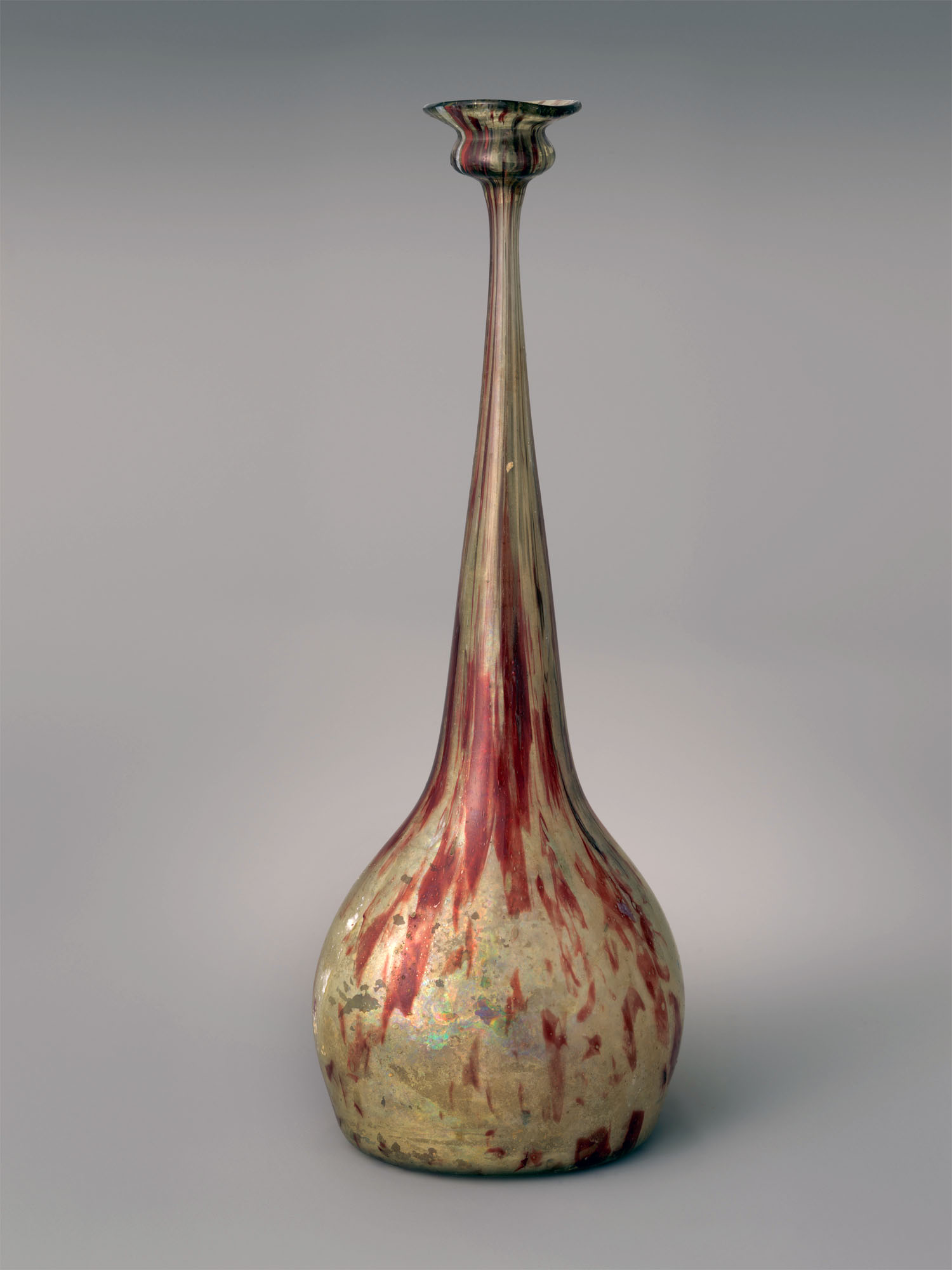
 

'Rosewater Sprinkler' Late 18th - 19th century


Rosewater Sprinkler
Late 18th – 19th century
Probably from Turkey, Beykoz, Istanbul
Glass; blown
Height: 8 3/4 in. (22.2cm)
Width: 3 3/8 in. (8.5cm)
Diameter: 2 3/8 in. (6cm)
Metropolitan Museum of Art, New York
Edward C. Moore Collection, Bequest of Edward C. Moore, 1891
Public domain


This bottle is typical of the objects that were displayed in open niches in reception rooms of Ottoman-period upper-class Syrian homes.

During Moore’s lifetime, European and American collectors were particularly drawn to glass made fairly recently in Iran or by the Ottomans at Beykoz in Istanbul. Moore and other collectors purchased many of these readily available and affordable wares and donated them to European and American museums. Moore’s eagerness to explore new shapes is evident in his later glass holdings. He often collected multiple examples of the same type, such as rosewater sprinklers, in different shapes and colours. Many were available for study at his Prince Street manufactory and a few directly inspired his designs.

These two marbled Ottoman sprinklers reveal Moore’s keen eye for nuances in glassmaking techniques and patterns. In one, a mixture of red and brown opaque glass served as the base material, and the spiral marbling was created as the body was blown and turned into its distinctive onion-like form with cylindrical neck. In the other, a hot gather of greenish iridescent glass was rolled in crushed red glass and then blown into the final shape. This led to the patchy marbled pattern on the body that develops into alternating lines on the elongated neck.


'Rosewater Sprinkler' Late 18th - 19th century


Rosewater Sprinkler
Late 18th – 19th century
Probably from Turkey, Beykoz, Istanbul
Glass; blown
Height: 7 3/16 in. (18.2cm)
Maximum Diameter: in. 2 13/16in. (7.2cm)
Metropolitan Museum of Art, New York
Edward C. Moore Collection, Bequest of Edward C. Moore, 1891
Public domain


'Jar' 14th century


Jar
14th century
Attributed to Syria
Stonepaste; polychrome-painted under transparent glaze
Height: 13 1/4 in. (33.7cm)
Maximum Diameter: 9 1/4 in. (23.5cm)
Metropolitan Museum of Art, New York
Edward C. Moore Collection, Bequest of Edward C. Moore, 1891
Public domain


This pear-shaped jar is characteristic of medieval ceramics from the eastern Mediterranean. The body is dominated by a cursive inscription wishing “Lasting glory, abundant power, and good fortune.” Messages on utilitarian vessels were intended to protect the owner as well as the contents. The blue-and-white colour palette derives from Chinese porcelain, which Mamluk rulers in Egypt and Syria collected for use during festive and ceremonial occasions or for diplomatic gifts. This jar thus reflects the taste of the elite, adjusted for a broader middle-class market.

Underglaze painting in blue and black on a white stonepaste body is characteristic of Mamluk production in Syria. The main decoration on this jar is the large inscription in thuluth: “Lasting glory, increasing prosperity, and good fortune.”


'Vase in the Form of a Double Gourd' Second half of the 17th century


Vase in the Form of a Double Gourd
Second half of the 17th century
Attributed to Iran
Stonepaste; painted under transparent glaze
Height: 5 1/2 in. (14cm)
Diameter: 2 3/4 in. (7cm)
Metropolitan Museum of Art, New York
Edward C. Moore Collection, Bequest of Edward C. Moore, 1891
Public domain


In the seventeenth century, as the Ming dynasty declined in China, Iranian potters in Kirman and Nishapur increased the production of blue-and-white stonepaste ceramics for domestic use and export. Some of these wares closely follow Chinese prototypes, while others, such as this small gourd-shaped vase, show ideas developed by Chinese potters used as a catalyst for distinctive creations. One side of the vase depicts a sketchily drawn walking crane in a Chinese style, while on the other side decorative rock forms, vegetation, and other floating elements follow Iranian tradition. The result resonates with Moore’s diverse collecting interests and the hybrid designs they inspired.


'Bottle' Late 17th century


Bottle
Late 17th century
Made in Iran
Stonepaste; luster-painted on opaque blue glaze, with silver fitting
Height: 11 in. (27.9cm)
Maximum Diameter: 6 1/2 in. (16.5cm)
Metropolitan Museum of Art, New York
Edward C. Moore Collection, Bequest of Edward C. Moore, 1891
Public domain


An invention of the Islamic world, lusterware ceramics have distinctive shiny metallic surfaces that particularly appealed to Moore. An early inventory of the Moore collection suggests that the bottle may have been acquired from the Castellani Collection, evidence of Moore’s engagement with networks of European collectors. To compensate for breakage, a silver mount and lid with embossed decoration and niello were added to this piece at some point. While decorated in an “Islamic” style, the mount was most likely made in the West, in either Europe or North America.

Very few pieces of Iranian lusterware survive from the fifteenth and sixteenth centuries, but this technique was revived in the seventeenth century. During this period, lusterware was produced in a relatively limited range of shapes, including elegant bottles, such as the one here, as well as dishes, bowls, cups, ewers and sand-shakers. This bottle may have been used for wine, and has a molded, pear-shaped body with a long neck, and is covered with a silver fitting and sealed with a silver top.
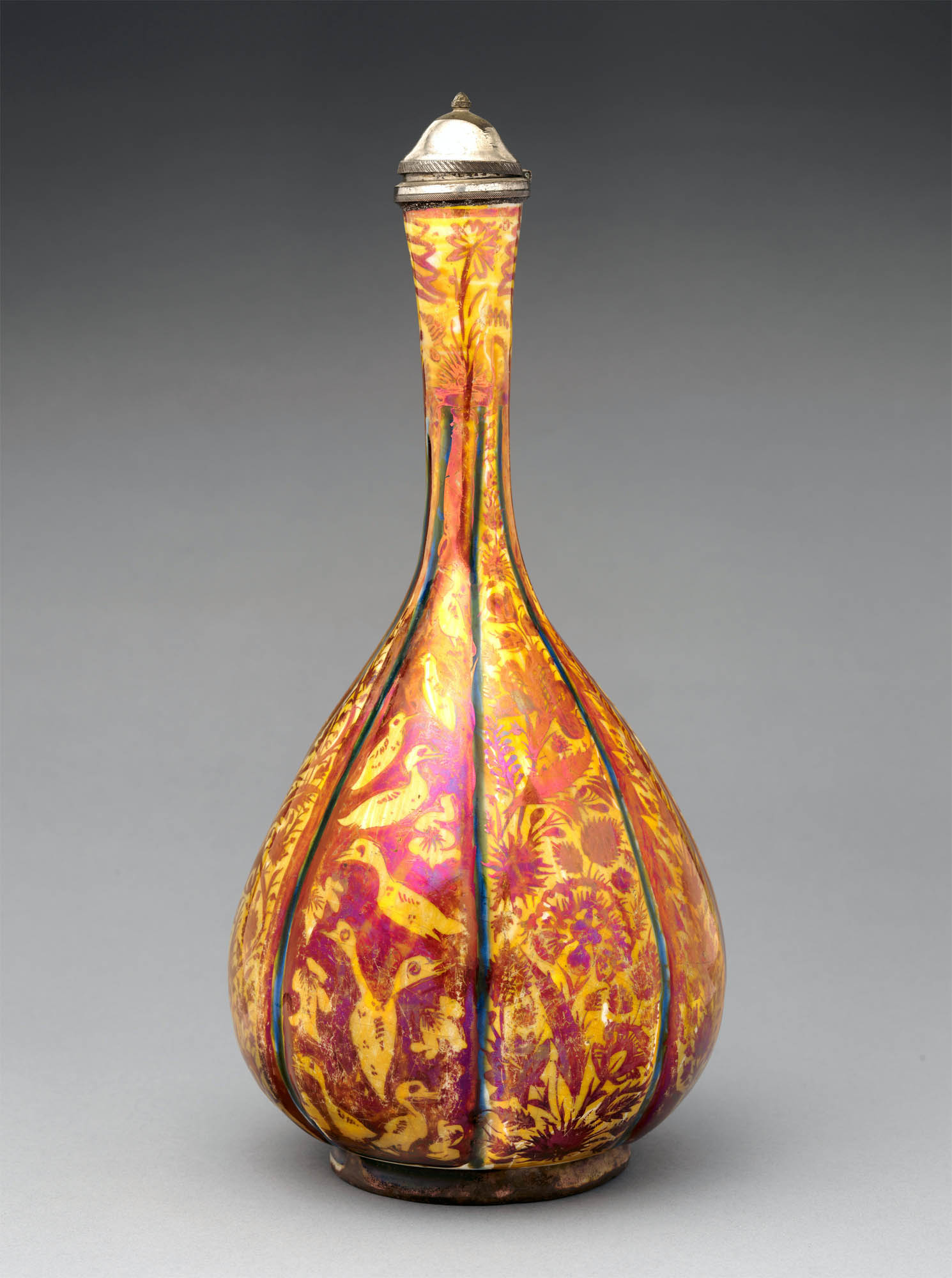
 

'Bottle' Late 17th century


Bottle
Late 17th century
Attributed to Iran
Stonepaste; luster-painted on yellow glaze ground with cobalt blue glaze
Height: 15 in. (38.1cm)
Maximum Diameter: 5 1/4 in. (13.3cm)
Metropolitan Museum of Art, New York
Edward C. Moore Collection, Bequest of Edward C. Moore, 1891
Public domain


This colourful lusterware bottle in yellow, ruby, and blue tones depicts myriad motifs, such as trees, flowering plants growing out of a grassy ground, birds, and lush vegetation with sinuous vines, poppy flowers, and a large iris. The combination of colours, sheen, and dense decoration aligns with Moore’s design sensibilities.
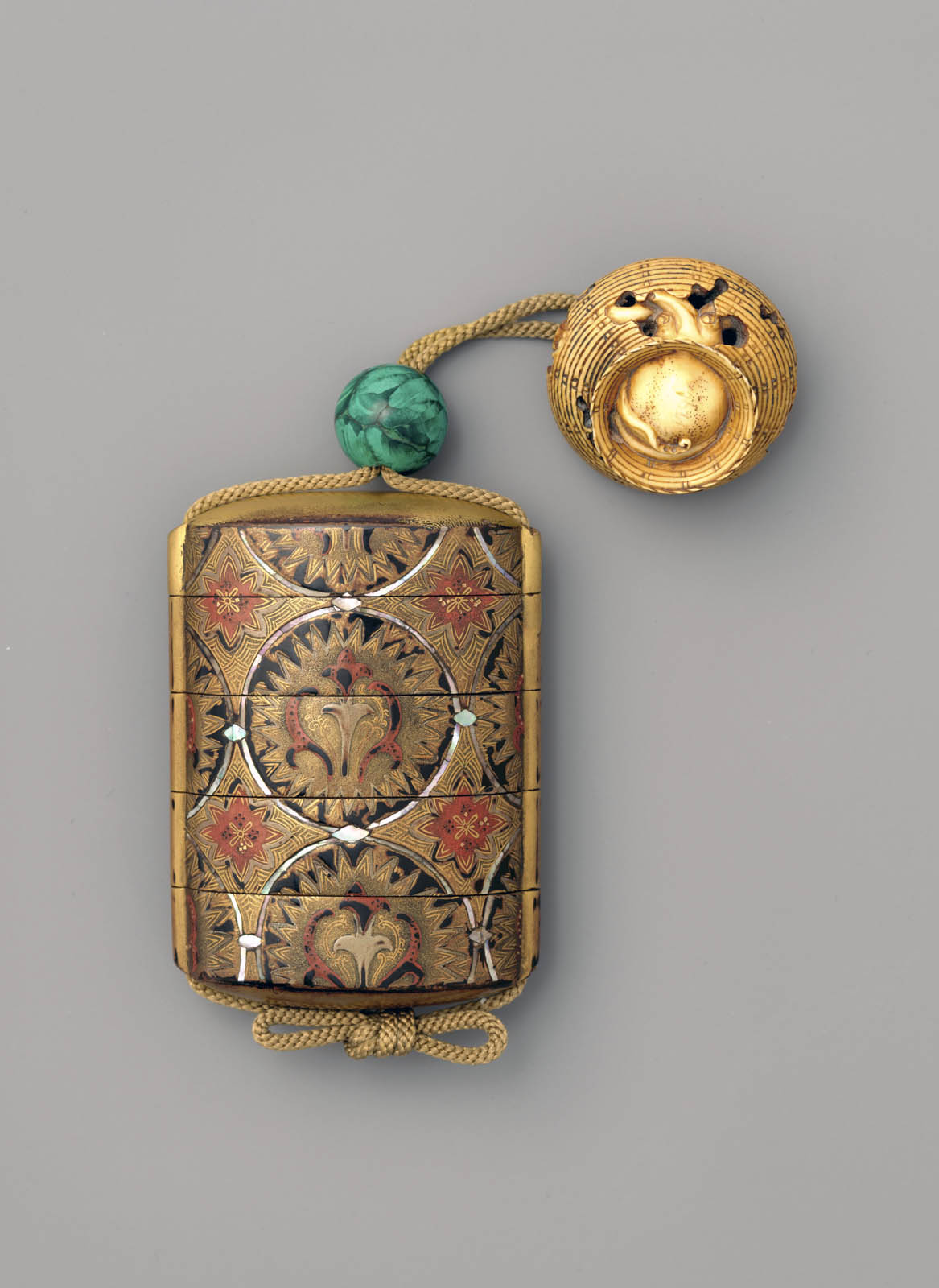
 

Edo period (1615-1868) 'Inrō with Stylised Flower Patterns in Interconnected Roundels' 18th century


Edo period (1615-1868)
Inrō with Stylised Flower Patterns in Interconnected Roundels
18th century
Culture: Japan
Inrō; four cases; lacquered wood with gold, silver, yellow, and red togidashimaki-e, mother-of-pearl inlay on black lacquer ground; ojime: malachite bead; netsuke: openwork (ryūsa); ivory
Height: 2 7/8 in. (7.3cm)
Width: 2 1/16 in. (5.2cm)
Depth: 7/8 in. (2.2cm)
Metropolitan Museum of Art, New York
Edward C. Moore Collection, Bequest of Edward C. Moore, 1891
Public domain


The rare, early example in tortoiseshell was made at the beginning of the Edo period, when inrō were first developed.
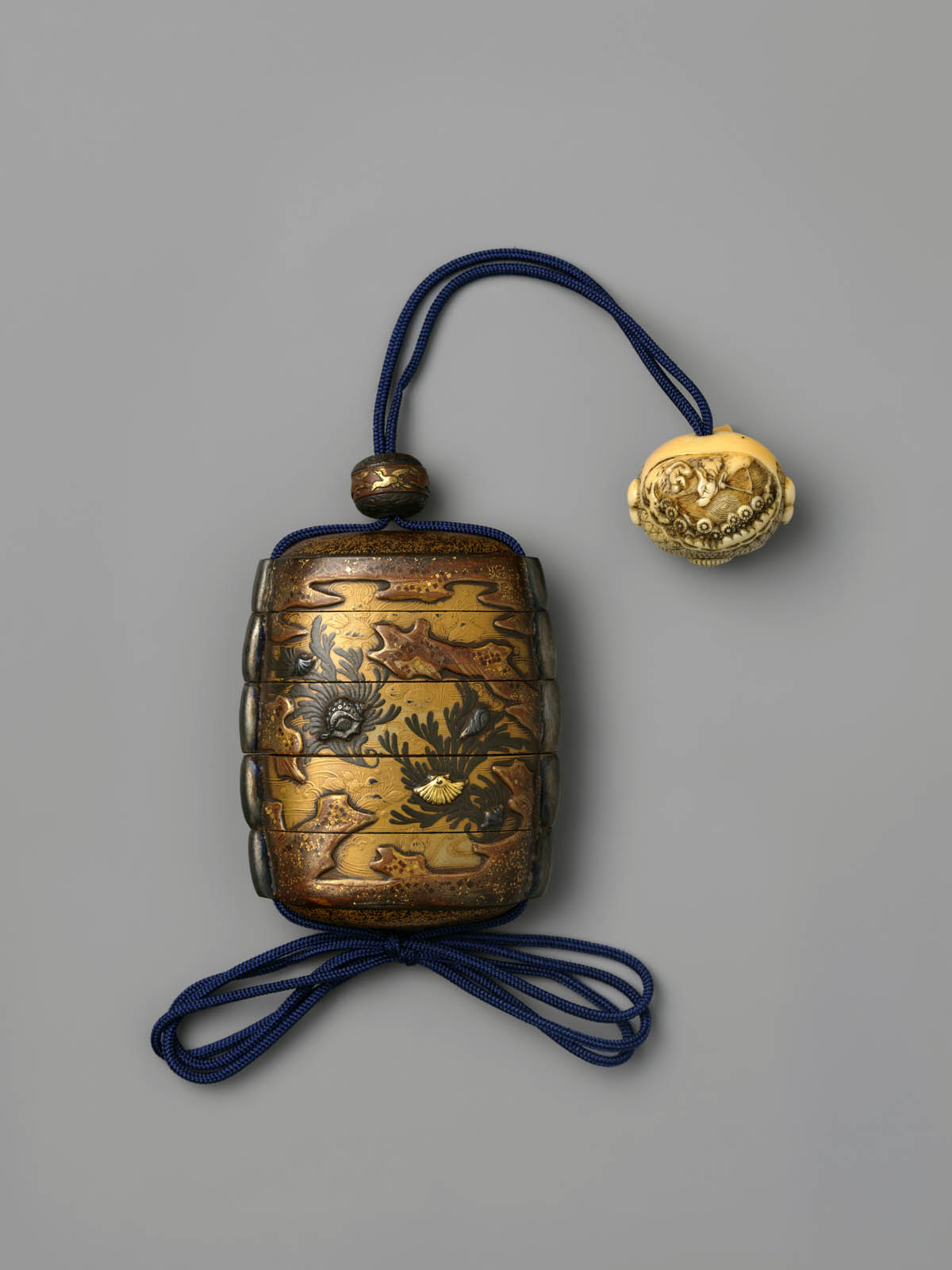
 

Edo period (1615-1868) 'Inrō with Shells and Seaweeds amid Rocks and Waves' 17th-18th century


Edo period (1615-1868)
Inrō with Shells and Seaweeds amid Rocks and Waves
17th-18th century
Culture: Japan
Inrō; four cases; lacquered wood, gold and silver takamaki-e, hiramaki-e, togidashimaki-e, cutout gold foil application, silver inlay on gold ground; metal cord runners; ojime: copper with mixed-metal inlay and gilded details; netsuke: carved ivory
Height: 3 1/16 in. (7.8cm)
Width: 2 1/2 in. (6.3cm)
Depth: 1 in. (2.5cm)
Metropolitan Museum of Art, New York
Edward C. Moore Collection, Bequest of Edward C. Moore, 1891
Public domain
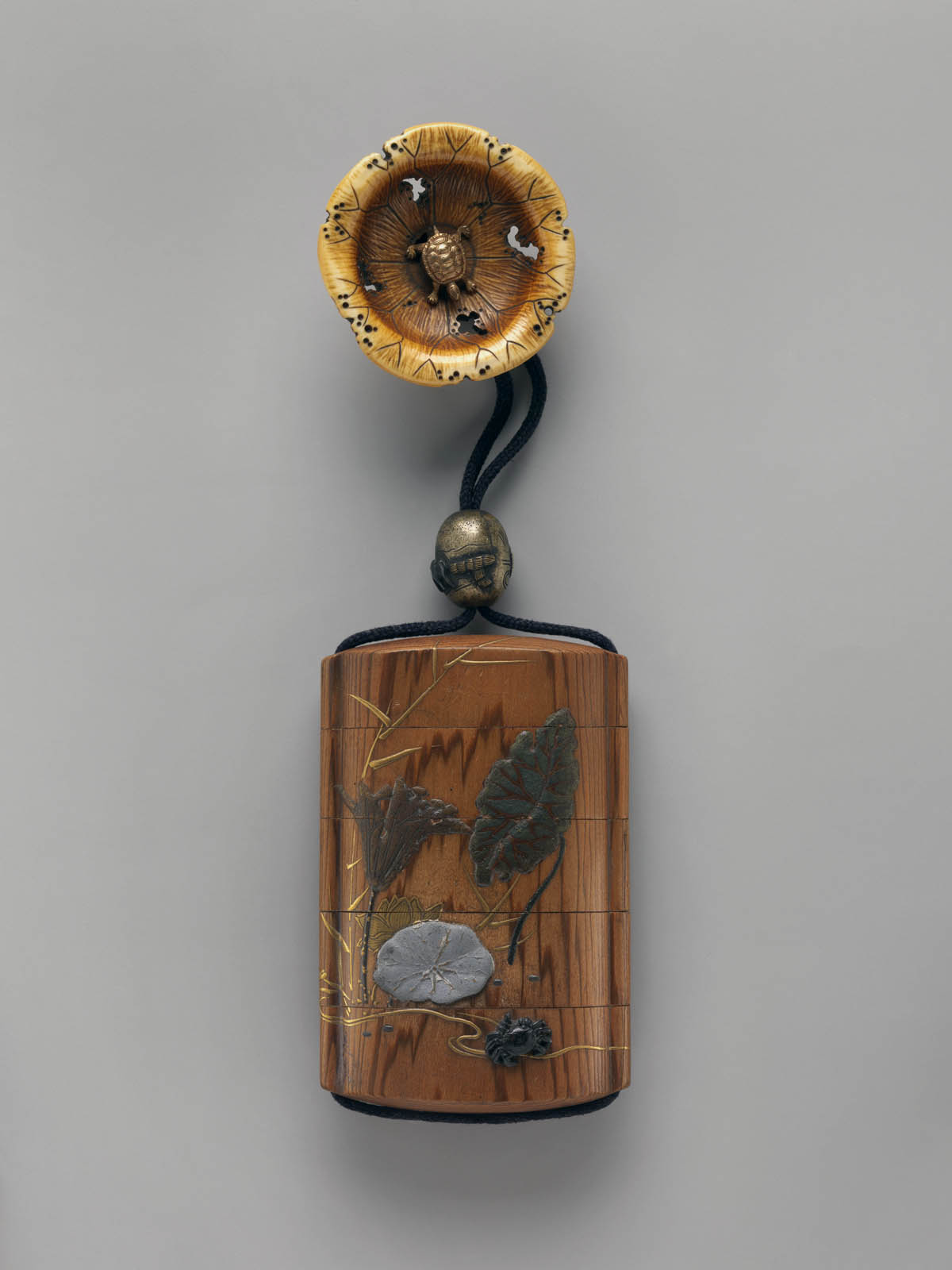
 

Meiji period (1868-1912) 'Inrō with Lotus and Crab (obverse); Lotus and Tadpole (reverse)' Second half 19th century


Meiji period (1868-1912)
Inrō with Lotus and Crab (obverse); Lotus and Tadpole (reverse)
Second half 19th century
Culture: Japan
Inrō; four cases; wood with gold and silver takamaki-e, hiramaki-e, lead, mixed-metal inlay; ojime: tadpoles in a stream; copper alloy with mixed-metal inlays; netsuke: turtle in a lotus leaf; carved ivory with gilded copper
Height: 3 1/16 in. (7.7cm)
Width: 1 15/16 in. (5cm)
Depth: 1 in. (2.5cm)
Metropolitan Museum of Art, New York
Edward C. Moore Collection, Bequest of Edward C. Moore, 1891
Public domain
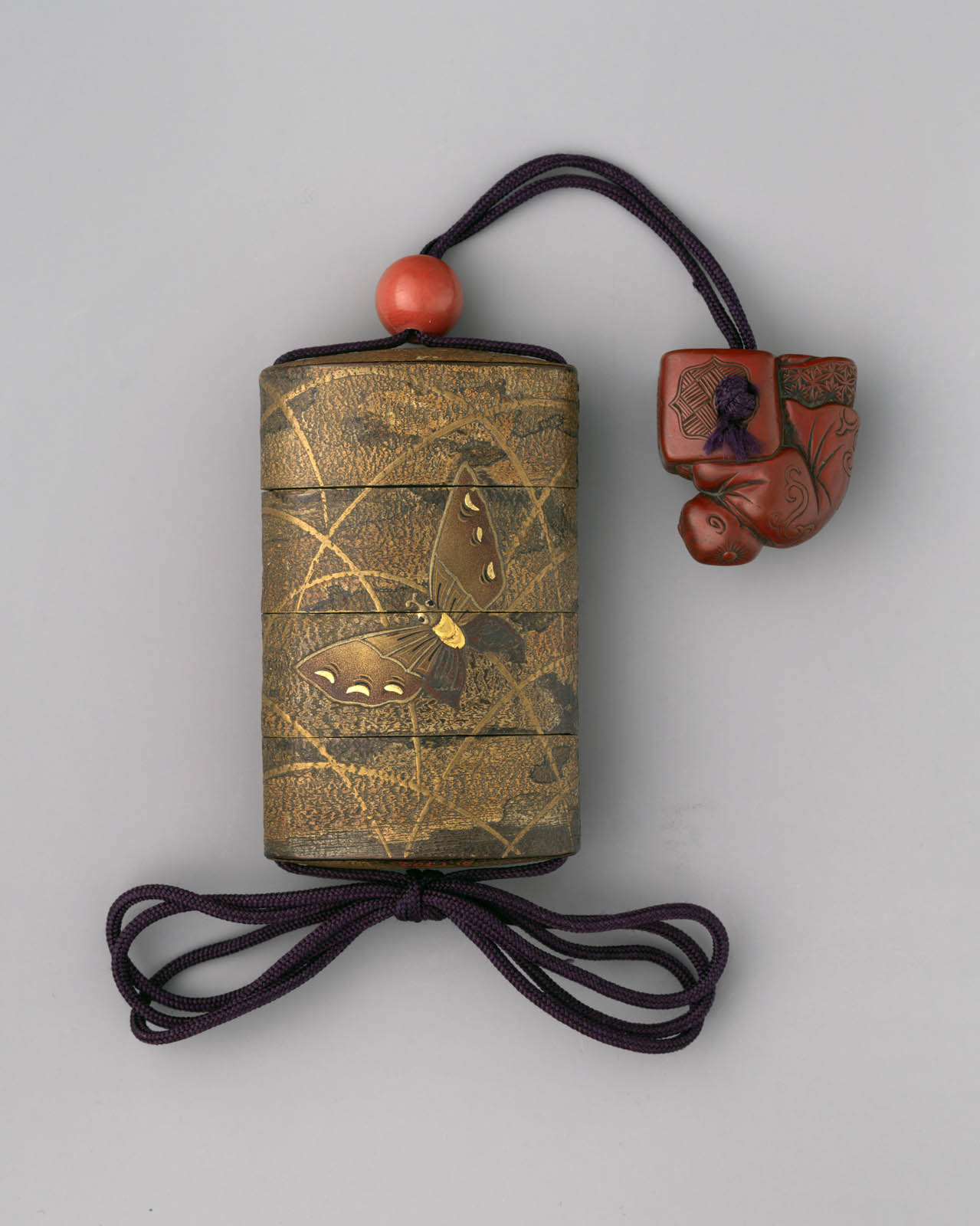
 

Edo period (1615-1868) 'Inrō with Butterflies and Pampas Grass' Mid-19th century


Edo period (1615-1868)
Inrō with Butterflies and Pampas Grass
Mid-19th century
Culture: Japan
Inrō; three cases; lacquered wood with cherry bark, gold and silver hiramaki-e, gold and silver foil application; ojime: semiprecious stone bead; netsuke: Chinese boy (karako) with covered brazier; carved wood with red lacquer
Height: 3 3/16 in. (8.1cm)
Width: 1 15/16 in. (5cm)
Depth: 1 in. (2.5cm)
Metropolitan Museum of Art, New York
Edward C. Moore Collection, Bequest of Edward C. Moore, 1891
Public domain


Some inrō likely served as inspiration for Tiffany design elements: the butterflies here are similar to those populating a colourful silver tray nearby, while the wisteria pattern could have inspired the silver vase embellished with the same motif.


Meiji period (1868-1912) 'Sake Bottle (Tokkuri)' Mid-19th century


Meiji period (1868-1912)
Sake Bottle (Tokkuri)
Mid-19th century
Porcelain with overglaze enamel, gold and silver hiramaki-e (Kyoto ware)
Height: 6 in. (15.2cm)
Diameter: 2 3/4 in. (15.2 × 7cm)
Diameter of rim: 7/8 in. (2.2cm)
Diameter of base: 2 in. (5.1cm)
Metropolitan Museum of Art, New York
Edward C. Moore Collection, Bequest of Edward C. Moore, 1891
Public domain


The small porcelain sake bottle appears to be made of wood covered in lacquer. Its dark brown glaze, mimicking a black lacquer surface, is embellished with a gold and silver “sprinkled picture” (maki-e) bird-and-flower composition. The design may be based on a traditional pattern showing a warbler on a plum tree, an auspicious symbol of the new year that refers to the “First Song of Spring” (Hatsune) chapter of The Tale of Genji. Moore and his team designed a tea and coffee set around 1870-1875, on view nearby, that incorporates a similar composition.


Meiji period (1868-1912) 'Tea Caddy (Natsume)' Second half 19th century


Meiji period (1868-1912)
Tea Caddy (Natsume)
Second half 19th century
Culture: Japan
Stoneware with polychrome overglaze enamels and gold
Height: 3 in. (7.6cm)
Diameter: 3 in. (7.6cm)
Metropolitan Museum of Art, New York
Edward C. Moore Collection, Bequest of Edward C. Moore, 1891
Public domain


The surface of the unusual ceramic tea caddy shows fish and crabs behind a fishing net. The net pattern may have been inspired by lacquer tea caddies. Both the technique and the playful design bear resemblances to compositions by Makuzu Kōzan, one of the master potters of the period. Fish, crabs, and lobsters often appear on Moore’s silverwares. Examples include a creamer and sugar bowl designed in 1876 and a rectangular vase made in 1877 – both featuring a scene with fish and seaweed – and a chocolate pot from 1879 decorated with a lobster.


Meiji period (1868-1912) 'Brush Holder (Fude-zutsu)' Early 1870s


Meiji period (1868-1912)
Brush Holder (Fude-zutsu)
Early 1870s
Culture: Japan
Cast iron with relief inlay in silver, gold and shibuichi
Height: 6 3/4 in. (17.1cm)
Diameter of rim: 3 3/8 in. (8.6cm)
Diameter of foot: 4 in. (10.2cm)
Metropolitan Museum of Art, New York
Edward C. Moore Collection, Bequest of Edward C. Moore, 1891
Public domain


On the patinated cast-iron surface of this vessel, various metal alloys are inlaid in relief to create effects of light and colour. Moonlight seems to glisten on the web executed in shibuichi (an alloy of roughly three parts copper and one part silver) that fans out over the cylindrical form. A spider, in patinated shibuichi, scurries toward the outer edge of the web, where a dragonfly of inlaid copper alloy and silver with gilt copper eyes is caught on the other side. A Tiffany vase displayed nearby closely replicates this decorative scheme. In response to sociocultural changes in the 1870s, Japanese craftspeople began to produce fine ornamental wares like this one with a focus on the Western market.


Edo period (1615–1868) 'Buddhist Altar Cloth (Uchishiki)' First half 19th century


Edo period (1615–1868)
Buddhist Altar Cloth (Uchishiki)
First half 19th century
Culture: Japan
Twill-weave silk with supplementary weft patterning
28 x 27 in. (71.12 x 68.58cm)
Metropolitan Museum of Art, New York
Edward C. Moore Collection, Bequest of Edward C. Moore, 1891
Public domain


The Buddhist altar cloth (uchishiki) serves to cover the tops of tables and altars, especially the one placed in front of the temple’s main icon. This example here is decorated with lotus flowers in a roundel surrounded by large geometric patterns (hakogata) on a dark blue ground. Lotus flowers are revered in Japan for their ability to rise from muddy waters to become beautiful blossoms, and they are commonly associated with purity and the Buddhist achievement of enlightenment.
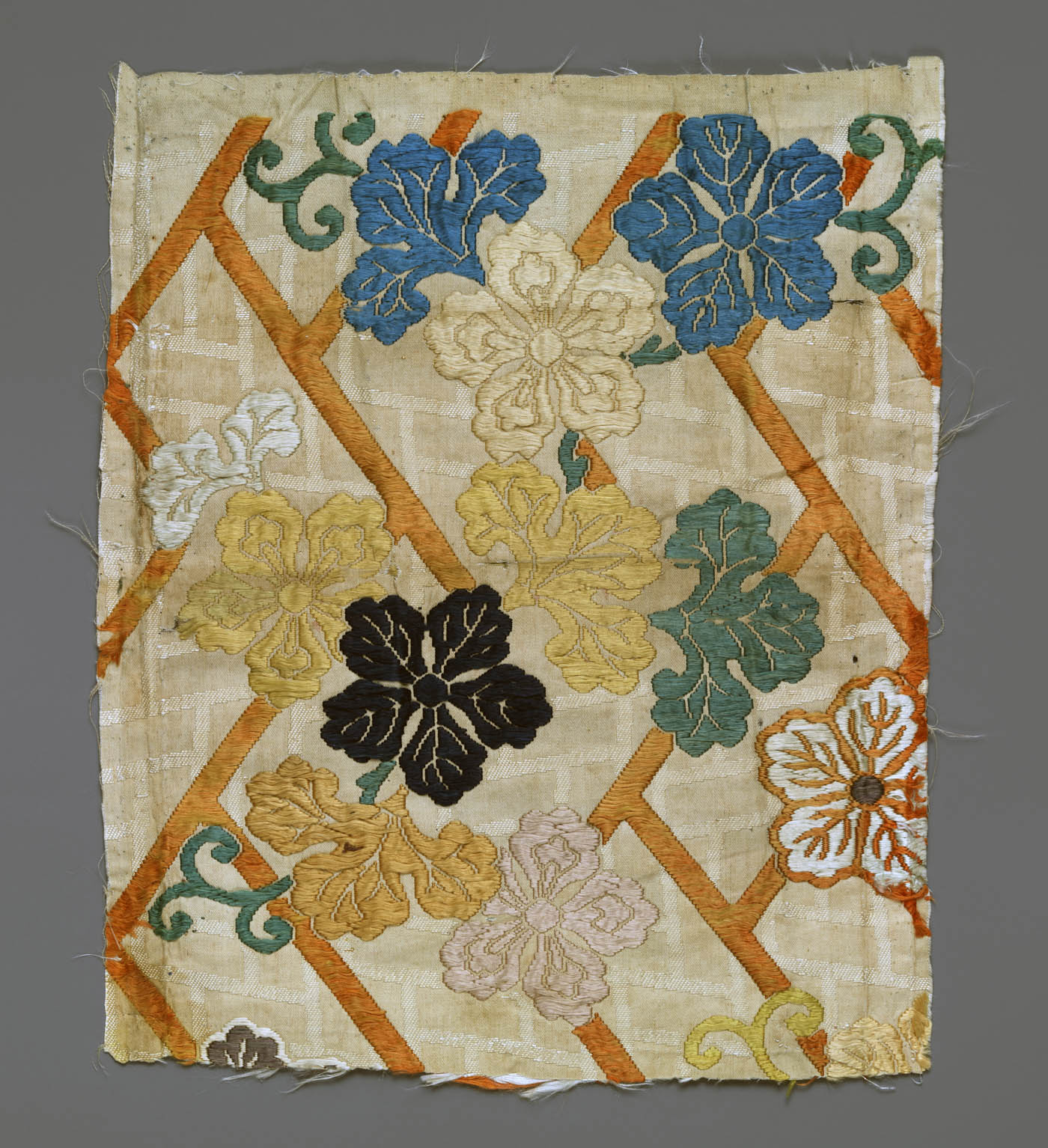
 

Edo period (1615–1868) 'Fragment' 18th century


Edo period (1615–1868)
Fragment
18th century
Culture: Japan
Twill-weave silk with brocading in silk and supplementary weft patterning in silk (karaori)
Dimensions: Overall (a): 12 1/4 x 11 1/4 in. (31.1 x 28.6cm)
Overall (b): 11 x 9 1/4 in. (27.9 x 23.5cm)
Overall (c): 11 x 8 1/4 in. (27.9 x 21cm)
Overall (d): 11 1/2 x 2 1/4 in. (29.2 x 5.7cm)
Overall (f): 31 x 11 in. (78.7 x 27.9cm)
Metropolitan Museum of Art, New York
Edward C. Moore Collection, Bequest of Edward C. Moore, 1891
Public domain


This textile fragment features a pattern with a stylised fence or lattice and moonflowers (yūgao; literally, “evening faces”) of various colours against a white ground. Originally, it may have been part of a Noh theater costume. The moonflower plays a role in chapter 4 of The Tale of Genji, “The Lady of the Evening Faces.” Collecting textile samples as a kind of visual dictionary of motifs and a resource for technical analysis was common among Western collectors in Moore’s era.
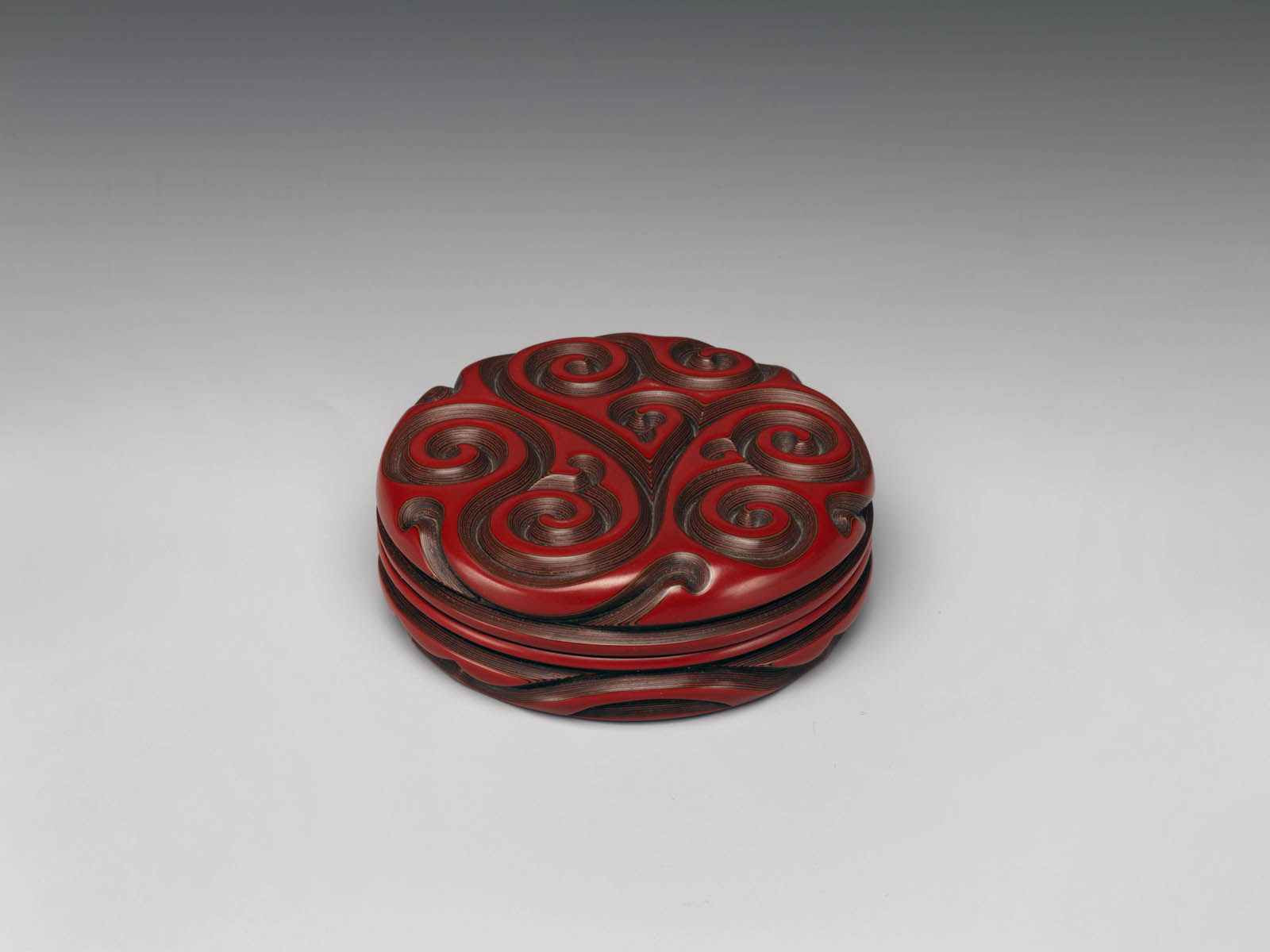
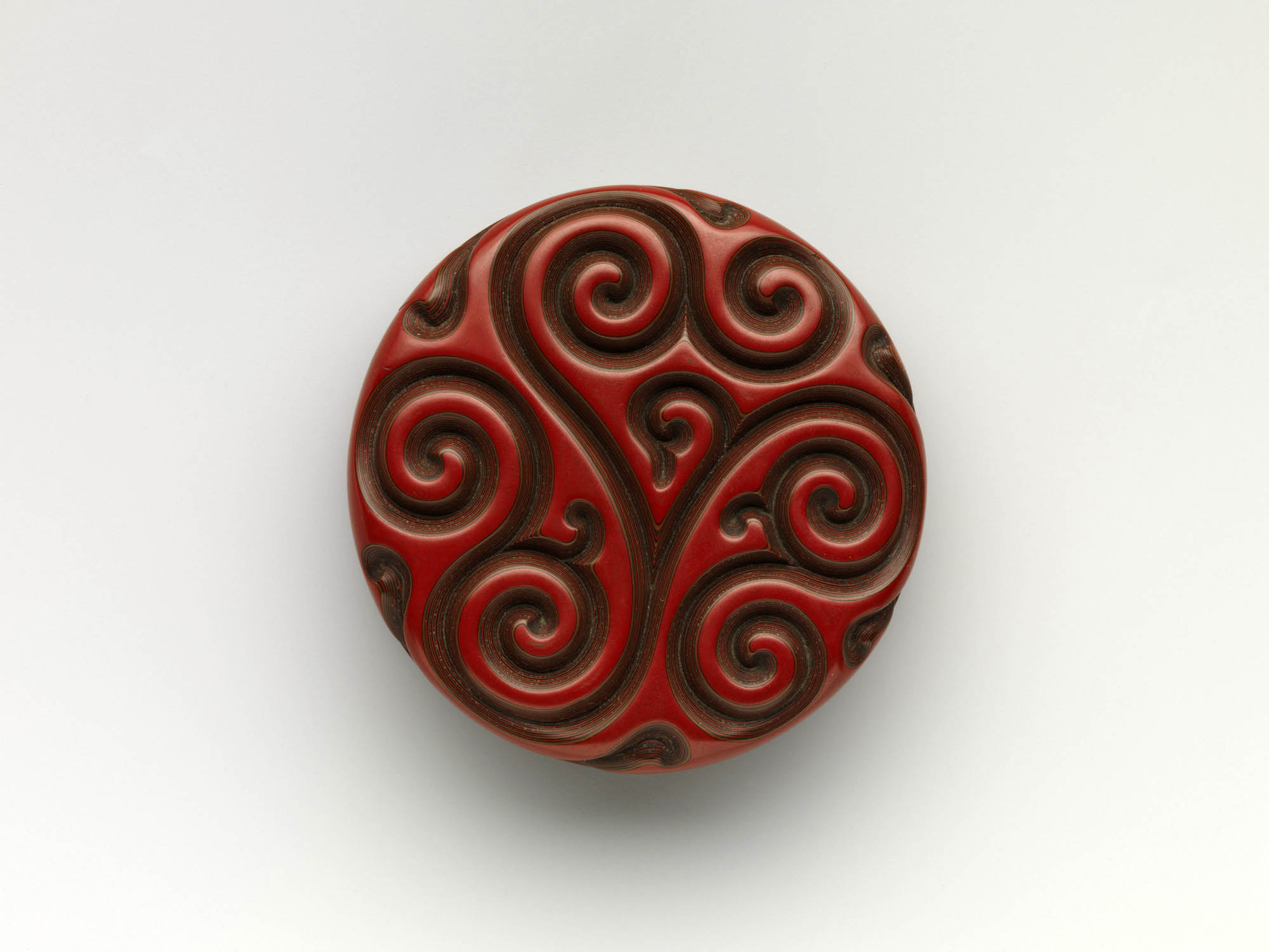
 

Yuan dynasty (1271-1368) 'Incense Box' 14th century

Yuan dynasty (1271-1368) 'Incense Box' 14th century


Yuan dynasty (1271-1368)
Incense Box
14th century
Culture: China
Carved lacquer
Height: 1 1/4 in. (3.2cm)
Diameter: 3 3/8 in. (8.6cm)
Metropolitan Museum of Art, New York
Edward C. Moore Collection, Bequest of Edward C. Moore, 1891
Public domain


This box exemplifies a sophisticated type of Chinese carved lacquer known as tixi, a term referring to the marbled appearance of its layers. The elegant design and skilful carving distinguish the box as the work of a master, and the signature of the fourteenth-century master Yang Mao is incised on the underside. Moore’s small but carefully selected collection of Chinese lacquer reflects the designer’s refined taste for the art form.
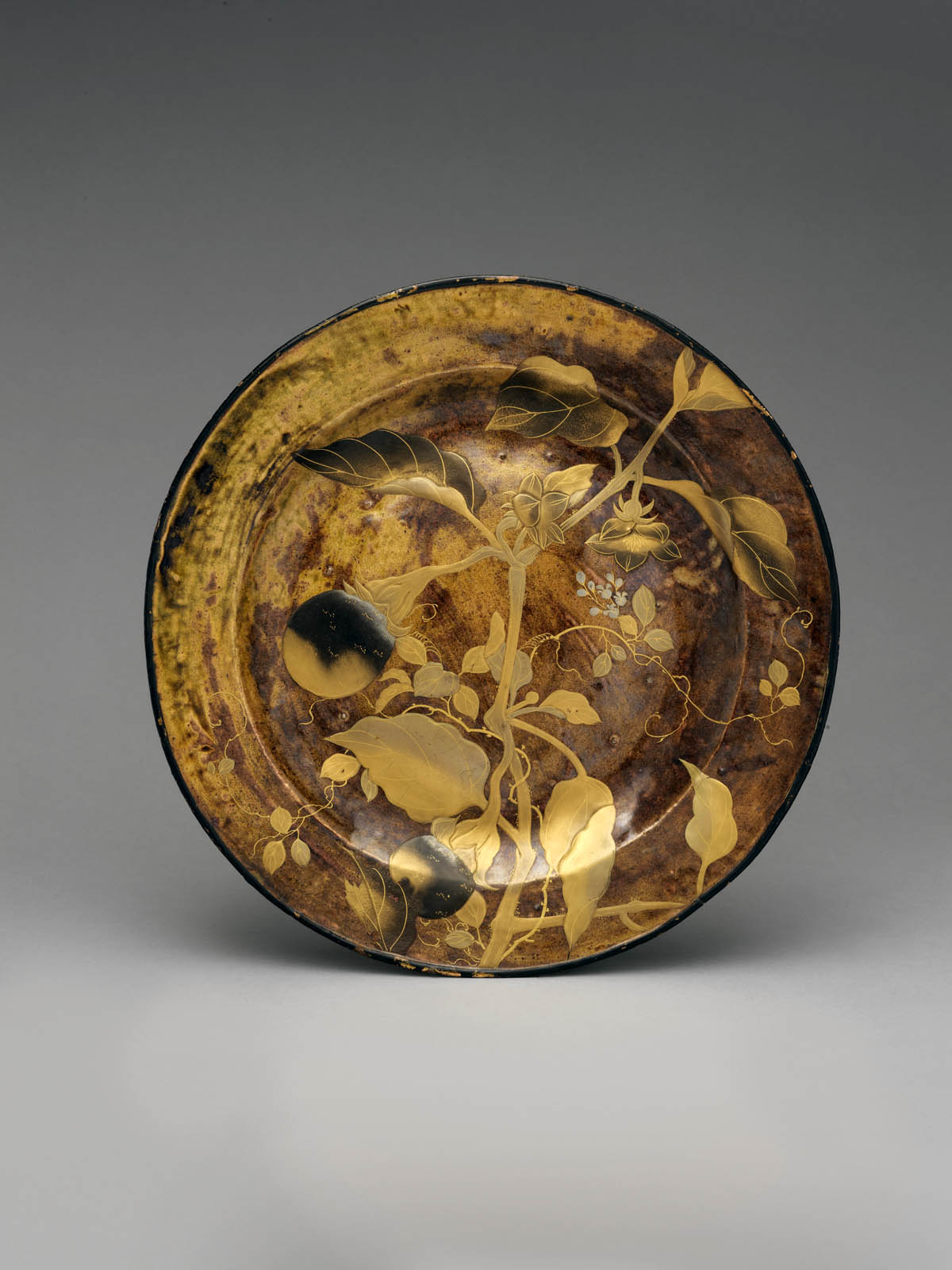
 

Meiji period (1868-1912) 'Plate' Mid-19th century


Meiji period (1868-1912)
Plate
Mid-19th century
Culture: Japan
Copper
Height: 7/8 in. (2.2cm)
Diameter: 12 in. (30.5cm)
Metropolitan Museum of Art, New York
Edward C. Moore Collection, Bequest of Edward C. Moore, 1891
Public domain


During the Edo and Meiji periods, several Japanese artists experimented with trompe l’oeil effects by simulating the appearance of one material with another. This plate’s copper body is covered with enamels to create a rich, shiny surface recalling the texture of ceramics. The eggplant motif is executed in gold and silver maki-e, a lacquer technique. In addition to its unusual combination of materials, the vessel has a shape that resembles that of a Western plate. A similar inquisitiveness and interest in bringing together East and West can also be found in Moore’s methods.
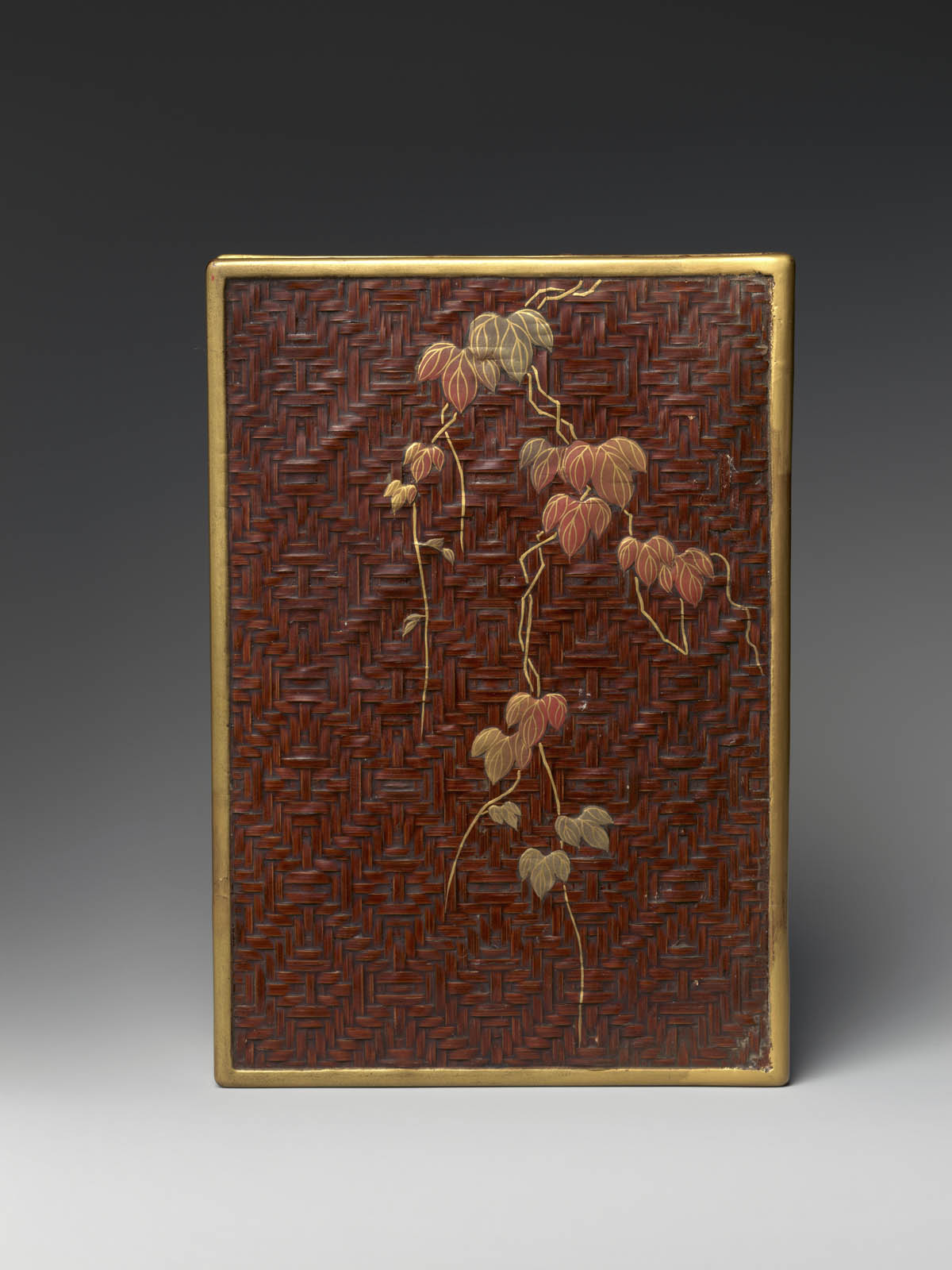
 

Edo (1615-1868) or Meiji period (1868-1912) 'Basketwork Box with Ivy' Mid-19th century


Edo (1615-1868) or Meiji period (1868-1912)
Basketwork Box with Ivy
Mid-19th century
Culture: Japan
Bamboo, and lacquer, with gold and silver hiramaki-e with red lacquer accents
Height: 1 1/2 in. (3.8cm)
Width: 5 1/2 in. (14cm)
Length: 3 7/8 in. (9.8cm)
Metropolitan Museum of Art, New York
Edward C. Moore Collection, Bequest of Edward C. Moore, 1891
Public domain


The lid of this document box features fine strips of bamboo covered in lacquer and then decorated with a stylised autumn ivy vine design. A similar ivy motif appears on a silver Tiffany teapot (combined with a dragonfly) made about 1878; an early inventory suggests that Moore may have acquired this box that year at the Paris Exposition. A box like this is also mentioned in discussions of the colours Tiffany aspired to create in the Conglomerate Vase on view nearby.
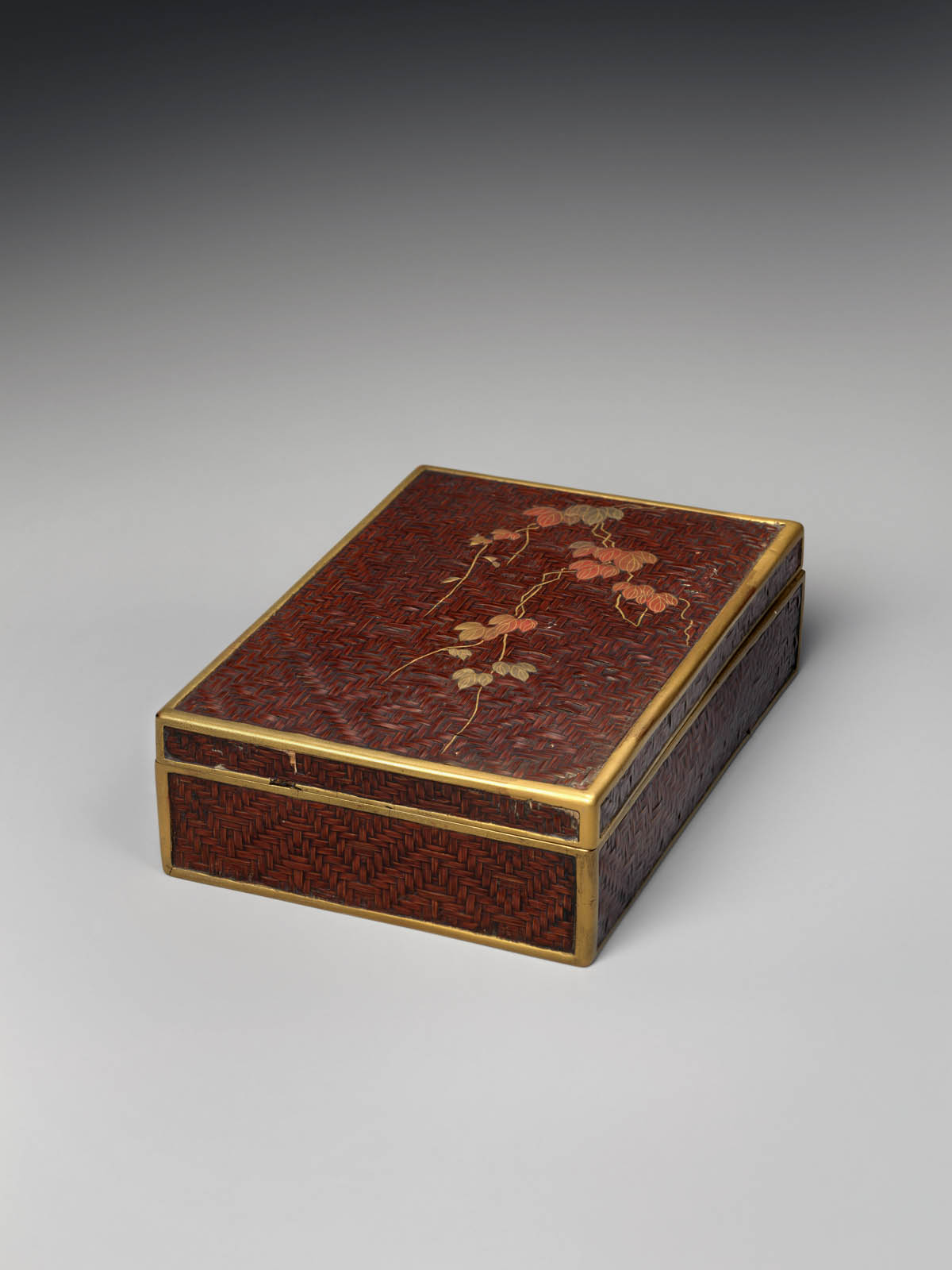
 

Edo (1615-1868) or Meiji period (1868-1912) 'Basketwork Box with Ivy' Mid-19th century


Edo (1615-1868) or Meiji period (1868-1912)
Basketwork Box with Ivy
Mid-19th century
Culture: Japan
Bamboo, and lacquer, with gold and silver hiramaki-e with red lacquer accents
Height: 1 1/2 in. (3.8cm)
Width: 5 1/2 in. (14cm)
Length: 3 7/8 in. (9.8cm)
Metropolitan Museum of Art, New York
Edward C. Moore Collection, Bequest of Edward C. Moore, 1891
Public domain
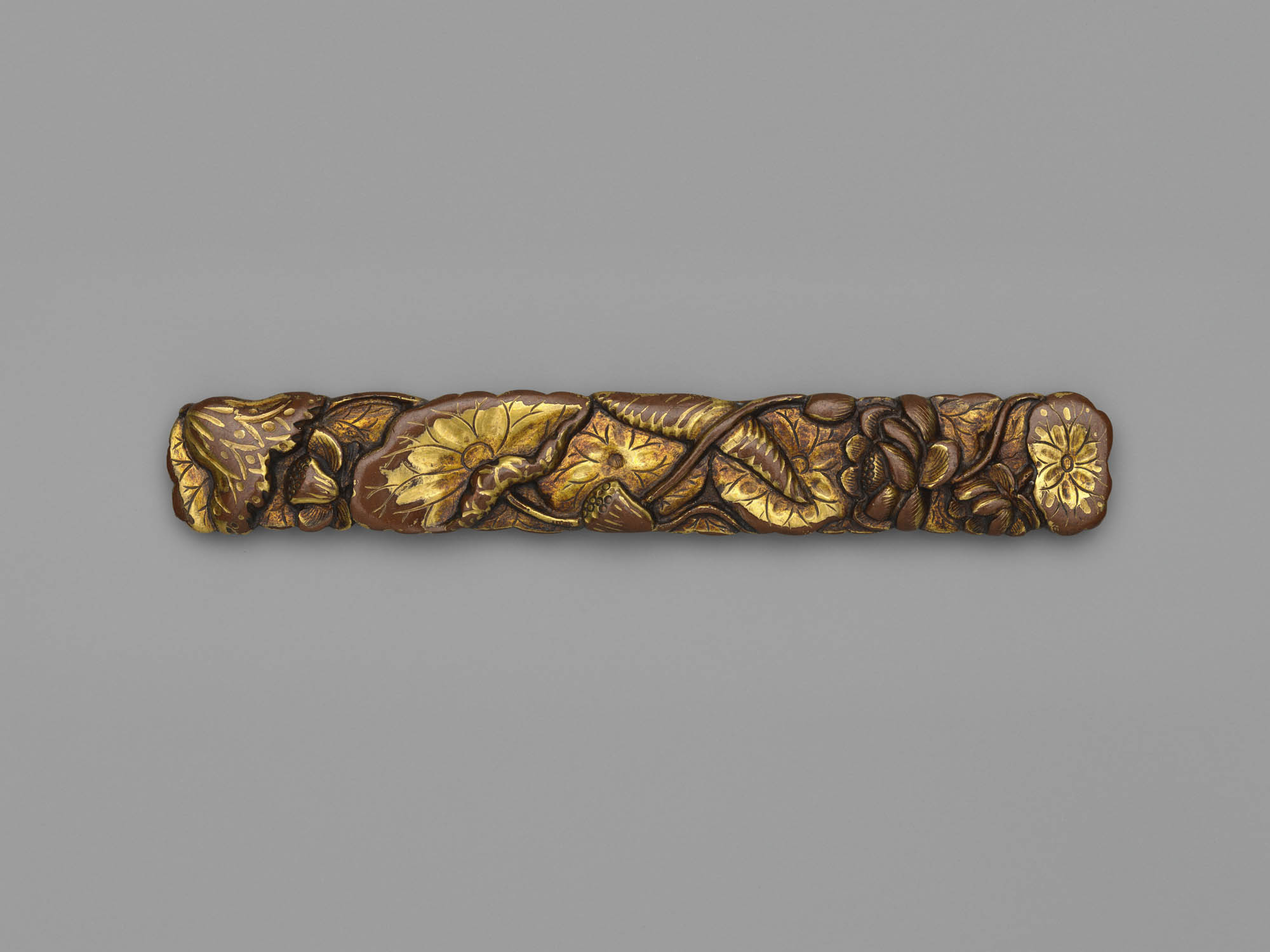
 

'Knife Handle (Kozuka) With Lotus Motif' (蓮図小柄) 19th century


Knife Handle (Kozuka) With Lotus Motif (蓮図小柄)
19th century
Culture: Japanese
Copper, copper-silver alloy (shibuichi), gold
Length: 3 7/8 in. (9.8cm)
Width: 9/16 in. (1.4cm)
Thickness: 1/4 in. (0.6cm); Wt. 1 oz. (28.3 g)
Metropolitan Museum of Art, New York
Edward C. Moore Collection, Bequest of Edward C. Moore, 1891
Public domain


Moore amassed a study collection of nearly 150 Japanese sword fittings along with complete mounts and blades for Tiffany’s designers to consult. A selection of the sword guards (tsuba) and utility knife handles (kozuka) is presented here. Regarded as autonomous works of art, the component parts of Japanese sword mounts were often signed by makers. Embellished with a wide range of decorative techniques, they typically feature representations of the natural world as well as depictions of social customs, scenes from popular stories, and religious symbols. They served as sources of inspiration for many of Tiffany’s Japanesque mixed-metal wares, as seen throughout this gallery.

The upper plate of this kozuka is of copper and carved in high relief, representing lotus, whose leaves and seeds are highlighted in gold. The reverse is of shibuichi, polished, and decorated with file marks (yasurime).

A kozuka is a handle of a by-knife that is part of a sword mounting. It is kept in a slot on the reverse of a katana scabbard, often with a matching kōgai (hairdressing tool).
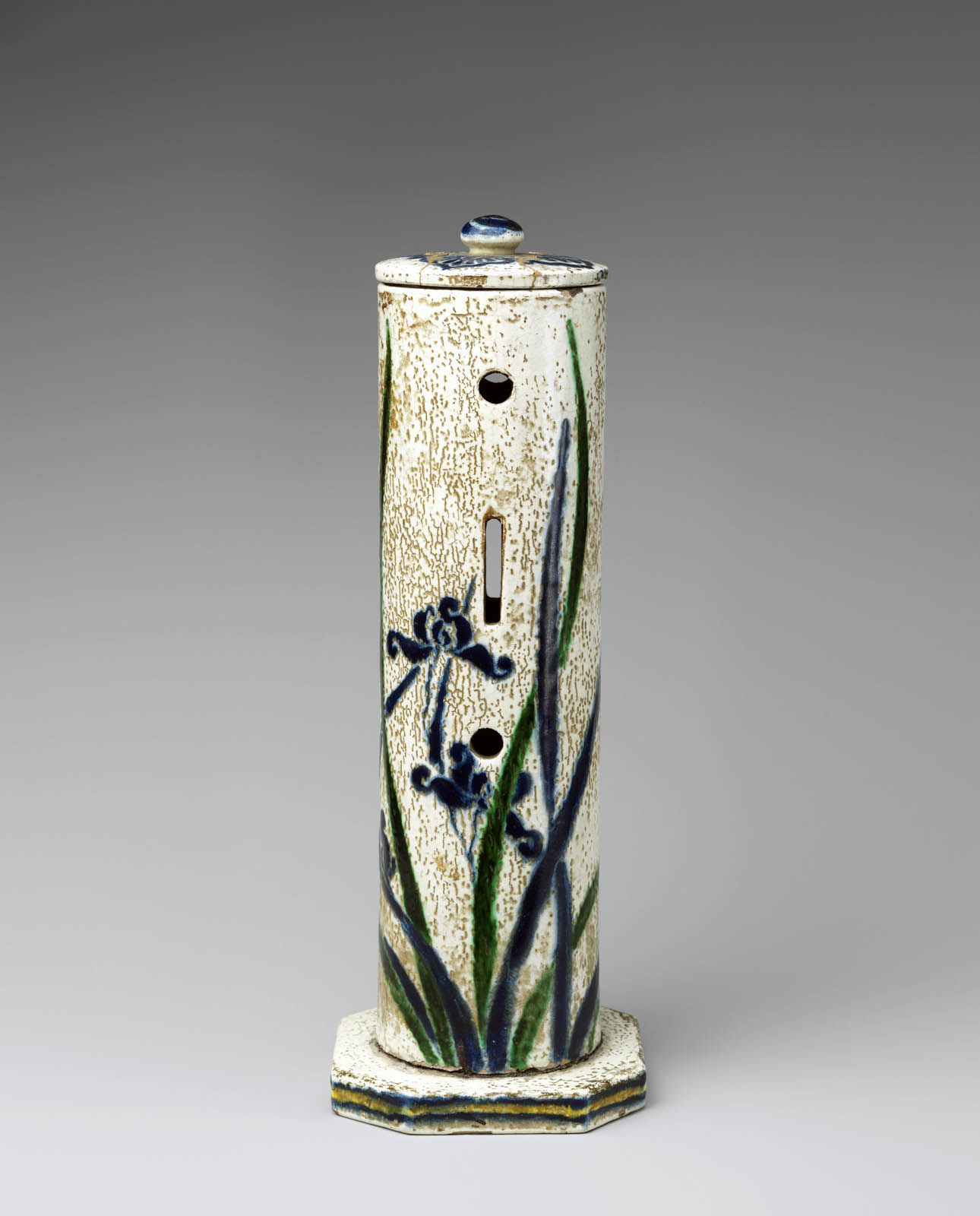
 

Minzan (artist) Edo (1615-1868) or Meiji period (1868-1912) 'Mosquito Smoker (Katori)' First half 19th century


Minzan (artist)
Edo (1615-1868) or Meiji period (1868-1912)
Mosquito Smoker (Katori)
First half 19th century
Culture: Japan
Earthenware with white lead glaze and polychrome overglaze enamels (Sanuki ware)
Height: 11 1/8 in. (28.3cm)
Diameter: 3 in. (7.6cm)
Width of base: 4 1/4 in. (7.6cm)
Metropolitan Museum of Art, New York
Edward C. Moore Collection, Bequest of Edward C. Moore, 1891
Public domain


Mosquito smokers were filled with plant material that was burned and then doused with water to produce insect-repelling smoke. The iris, a symbol of early summer in Japan, also refers to an episode in a famed tenth-century literary work The Tales of Ise. An inscription on the underside indicates that Moore purchased the smoker from his son William, an early dealer of Asian decorative arts.
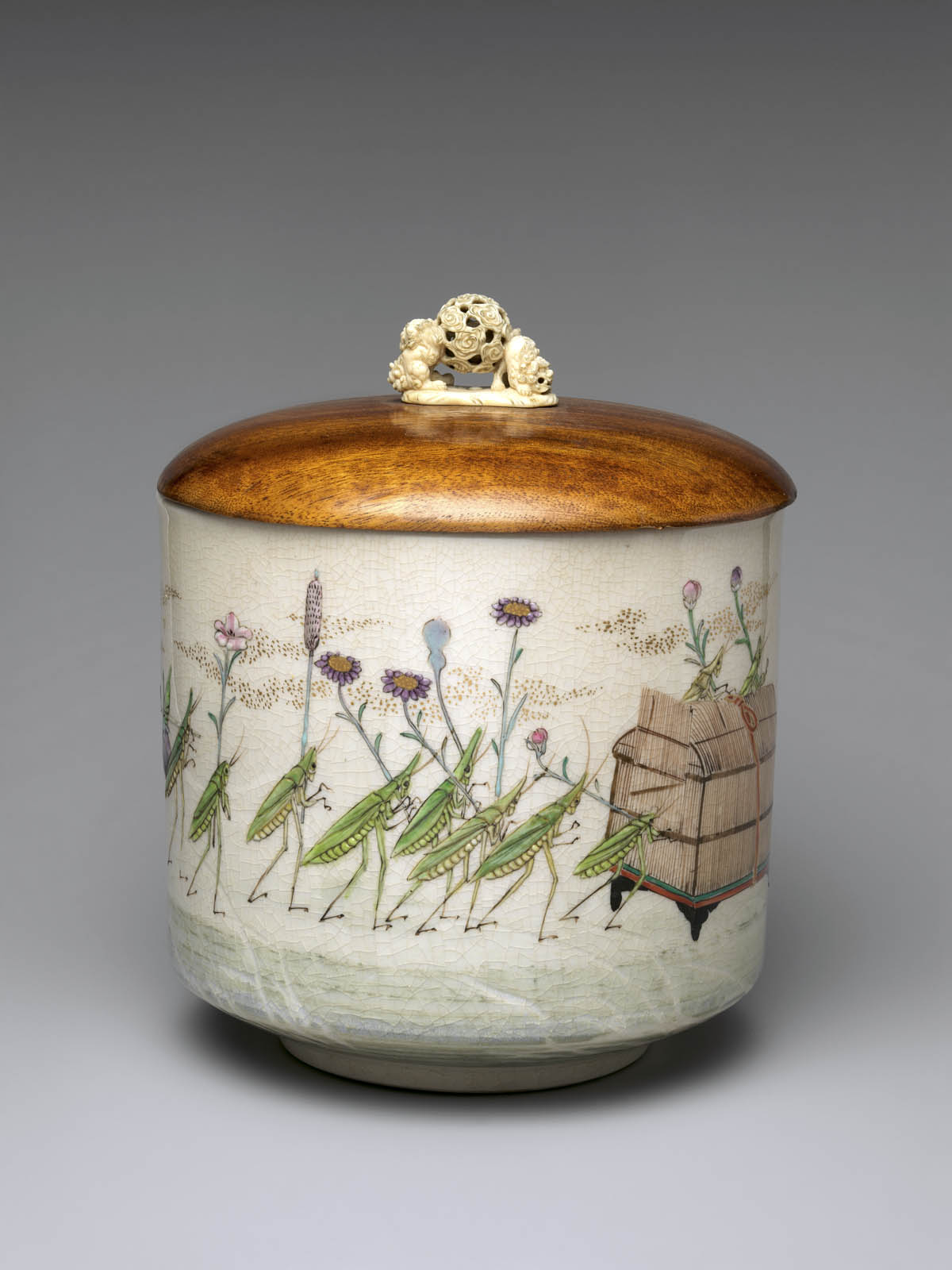
 

Makuzu Kōzan I (Miyagawa Toranosuke) (Japanese, 1842-1916) Meiji period (1868–1912) 'Jar (Mizusashi)' 1870-1880s


Makuzu Kōzan I (Miyagawa Toranosuke) (Japanese, 1842-1916)
Meiji period (1868–1912)
Jar (Mizusashi)
1870-1880s
Culture: Japan
Stoneware with polychrome overglaze enamels and gold, wood lid, ivory knob (Makuzu ware)
Height: 5 5/8 in. (14.3cm)
Diameter: 6 1/4 in. (5.9cm)
Height (with cover and finial): 7 1/2 in. (19.1cm)
Metropolitan Museum of Art, New York
Edward C. Moore Collection, Bequest of Edward C. Moore, 1891
Public domain


A star of the Moore ceramic collection, this freshwater jar features a whimsical composition with a procession of grasshoppers and a few wasps. The grasshoppers, carrying flowers as weapons or insignia, accompany an insect cage that echoes the palanquin of a high-ranking lady in a wedding procession or feudal lord’s procession. Inspired by paintings of the same subject, the theme must have appealed to Moore, who gravitated to anthropomorphic insects and animals. The Makuzu workshop exhibited a wide range of ceramics at the Philadelphia Centennial Exhibition of 1876.
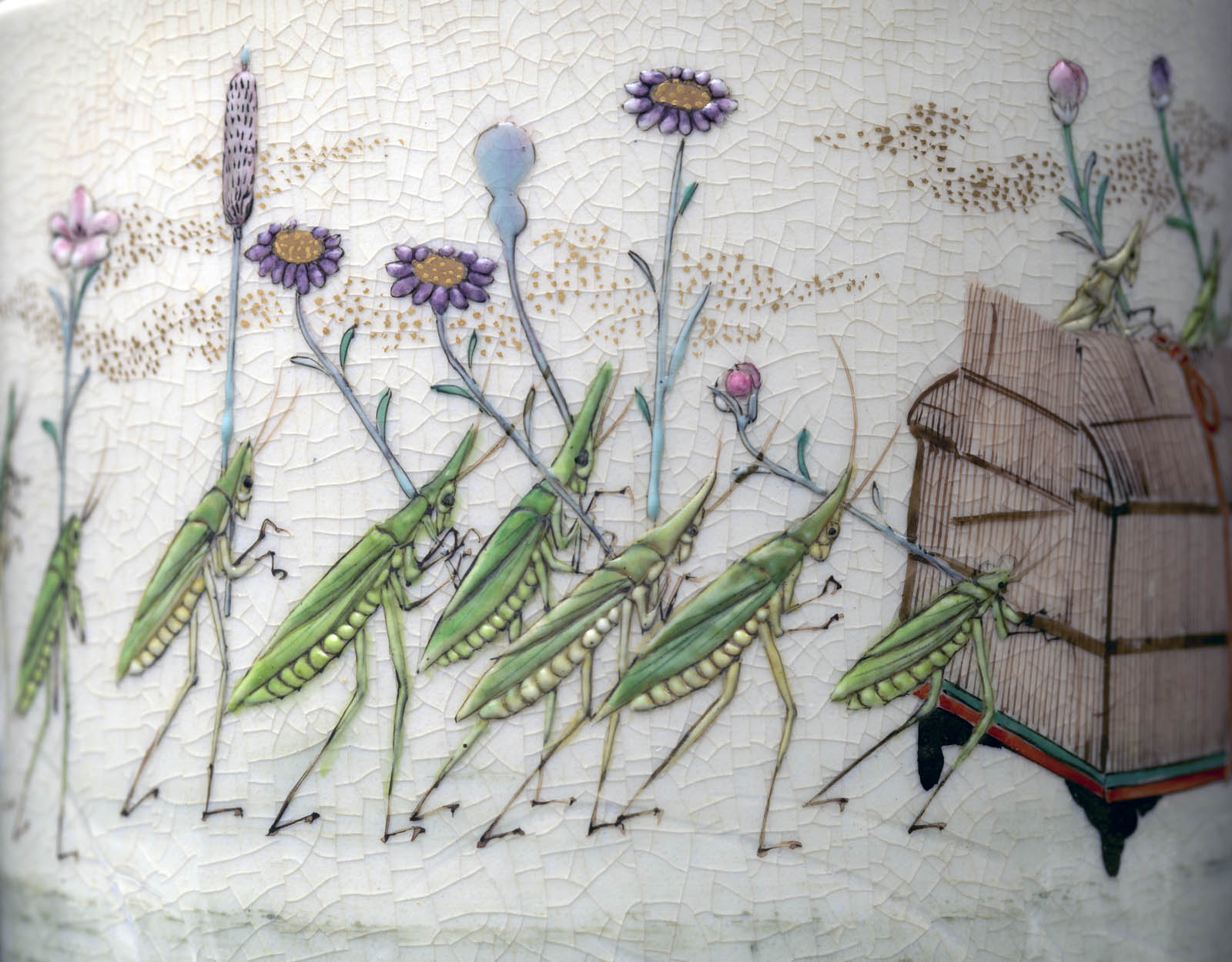
 

Makuzu Kōzan I (Miyagawa Toranosuke) (Japanese, 1842-1916) Meiji period (1868–1912) 'Jar (Mizusashi)' 1870-1880s (detail)


Makuzu Kōzan I (Miyagawa Toranosuke) (Japanese, 1842-1916)
Meiji period (1868–1912)
Jar (Mizusashi) (detail)
1870-1880s
Culture: Japan
Stoneware with polychrome overglaze enamels and gold, wood lid, ivory knob (Makuzu ware)
Height: 5 5/8 in. (14.3cm)
Diameter: 6 1/4 in. (5.9cm)
Height (with cover and finial): 7 1/2 in. (19.1cm)
Metropolitan Museum of Art, New York
Edward C. Moore Collection, Bequest of Edward C. Moore, 1891
Public domain
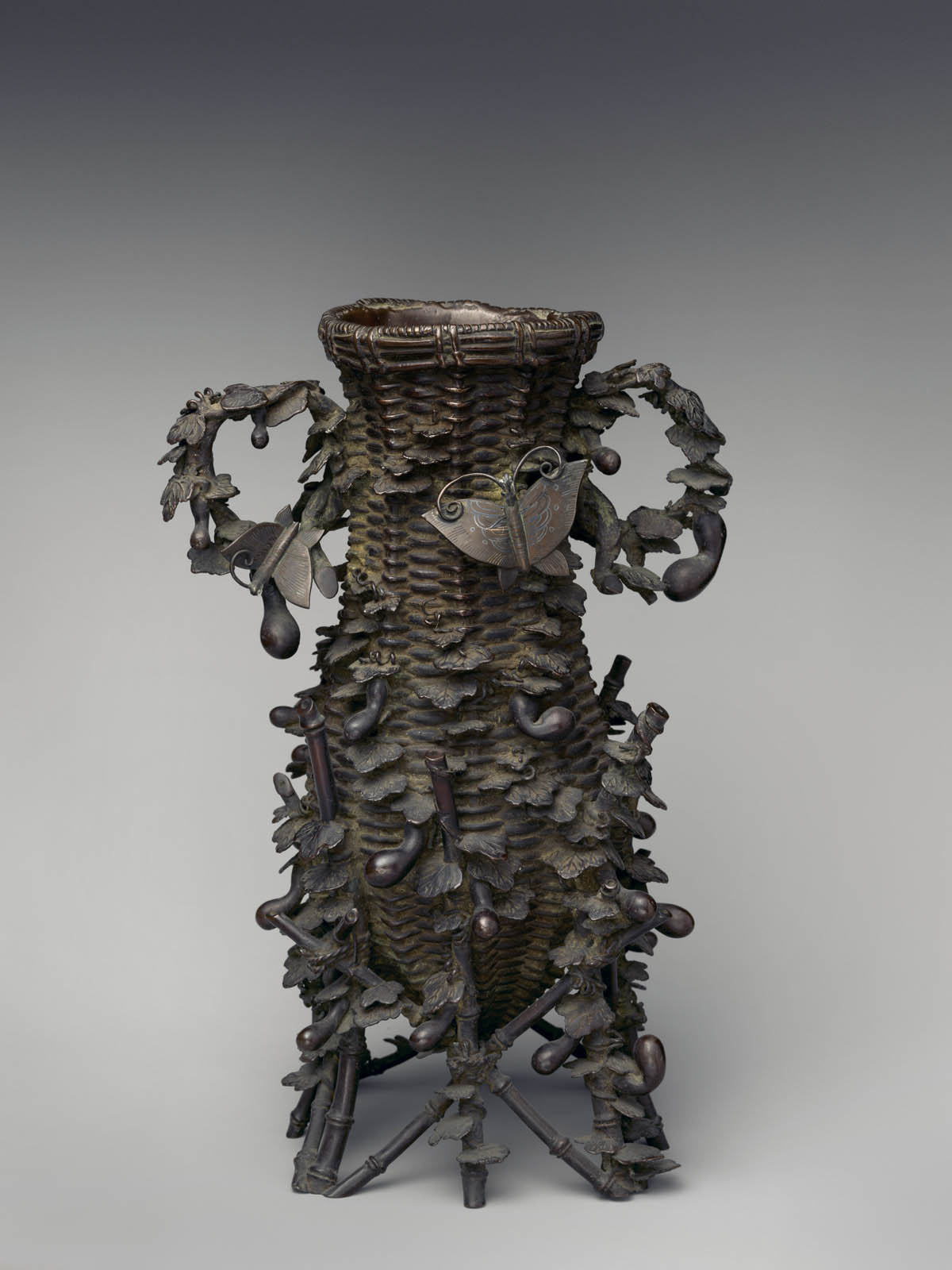
 

Meiji period (1868-1912) 'Vase' Second half 19th century


Meiji period (1868-1912)
Vase
Second half 19th century
Culture: Japan
Copper alloy with inlaid silver and gold
Height: 11 in. (27.9cm)
Width (at handles): 7 1/4 in. (18.4cm)
Depth: 6 in. (15.2cm)
Metropolitan Museum of Art, New York
Edward C. Moore Collection, Bequest of Edward C. Moore, 1891
Public domain


After their goods began to appear at world’s fairs, metal smiths in Japan must have realised that Westerners appreciated not only their traditional, stylised motifs but also their more naturalistic designs. At the same time, decorative patterns of flowers, plants, birds, and insects proved to suit the Victorian taste. The resulting “hybrid” sensibility of the period is well represented by this vase imitating a bamboo basket, decorated with climbing vines and gourds as well as butterflies with fine inlaid patterns.
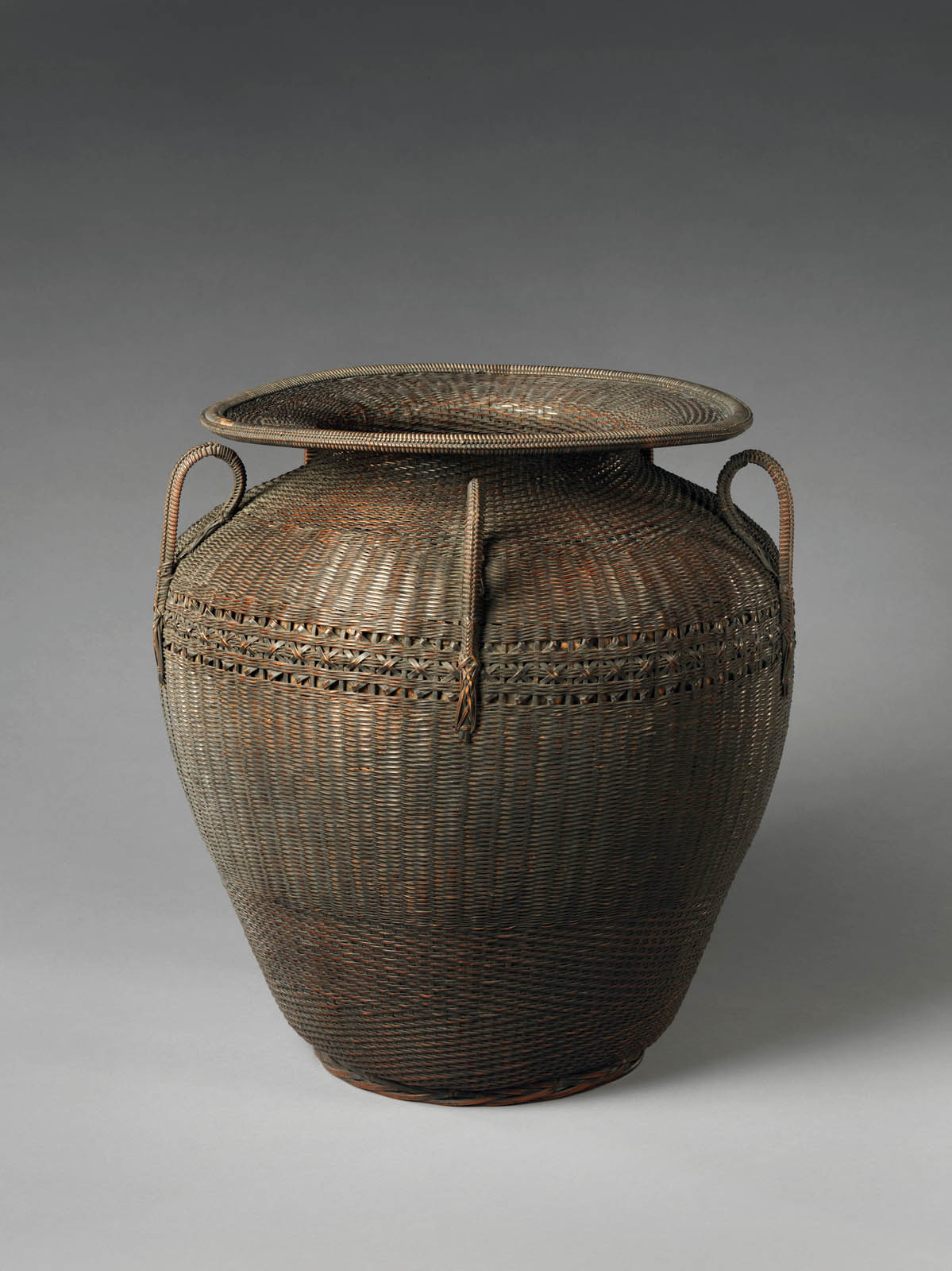
 

Hayakawa Shōkosai I (Japanese, 1815–1897) Meiji period (1868–1912) 'Karamono-Style Flower Basket (Hanakago)' c. 1870s-1880s


Hayakawa Shōkosai I (Japanese, 1815–1897)
Meiji period (1868–1912)
Karamono-Style Flower Basket (Hanakago)
c. 1870s-1880s
Culture: Japan
Timber bamboo and rattan
Height: 19 3/4 in. (50.2cm)
Diameter: 16 in. (40.6cm)
Metropolitan Museum of Art, New York
Edward C. Moore Collection, Bequest of Edward C. Moore, 1891
Public domain


Shōkosai is believed to be the first master basket craftsman to sign his name to his compositions. This would also have verified that his Chinese-inspired (karamono) works were made by a Japanese individual. He concentrated mainly on tea utensils, reflecting the needs of participants in the period’s thriving sencha tea culture. Of the varied bamboo works Moore collected, most were made in the Osaka-Kyoto region around 1870-1890, in the Chinese style, and relate to the sencha tea tradition or ikebana flower arranging.
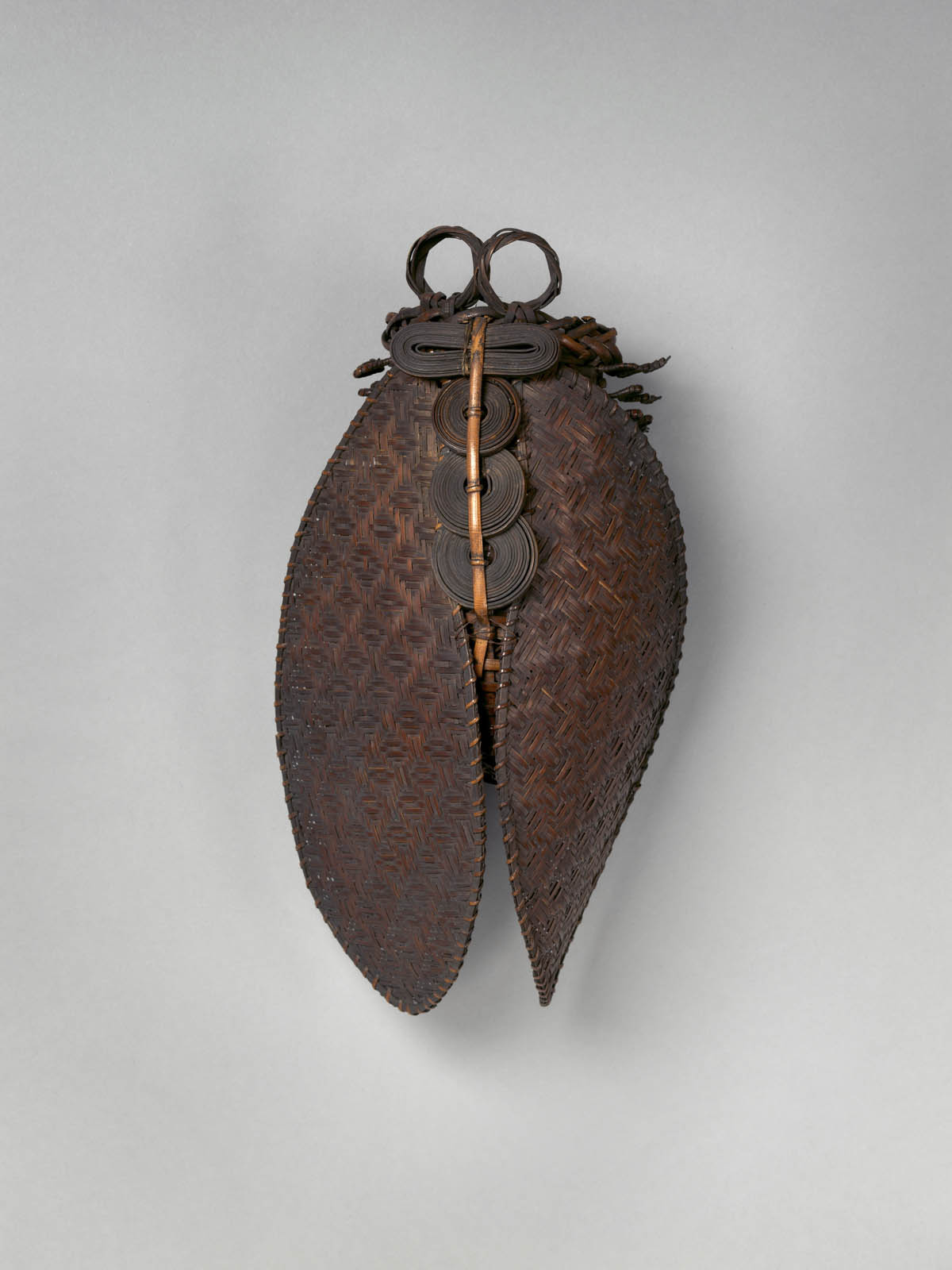
 

Meiji period (1868-1912) 'Flower Basket in the Shape of a Cicada' Mid-19th century


Meiji period (1868-1912)
Flower Basket in the Shape of a Cicada
Mid-19th century
Culture: Japan
Bamboo, rattan
Height: 9 3/4 in. (24.8cm)
Width: 7 1/2 in. (19.1cm)
Metropolitan Museum of Art, New York
Edward C. Moore Collection, Bequest of Edward C. Moore, 1891
Public domain


In Japan, the cicada represents summer. Since, depending on the species, this insect may take as long as seventeen years to develop underground before it emerges as a nymph, it has come to represent concepts such as hope for rebirth and immortality. Displayed on the pillar of the tokonoma (alcove) in the tearoom, this hanging flower basket would recall a cicada on a tree – a summer scene expressing the seasonal setting of the tea gathering.


Qing dynasty (1644-1911), Qianlong mark and period (1736-1795) 'Vase' Mid-18th century


Qing dynasty (1644-1911), Qianlong mark and period (1736-1795)
Vase
Mid-18th century
Culture: China
Glass, blown and ground
Height: 5 3/4 in. (14.6cm)
Diameter: 3 in. (7.6cm)
Diameter of foot: 1 3/4 in. (4.4cm)
Metropolitan Museum of Art, New York
Edward C. Moore Collection, Bequest of Edward C. Moore, 1891
Public domain


Glass works made in the Qing imperial workshops in Beijing reflect both the royal taste for a substance not local to China and the dynamic technical exchange between that country and Europe. Under the direction of Jesuit missionaries, imperial glass production peaked between 1740 and 1760. The sleek octagonal shape and uniform blue tone of this vase exemplify this short but exciting era of Chinese glass production. This vessel enriched Moore’s extensive glass holdings.
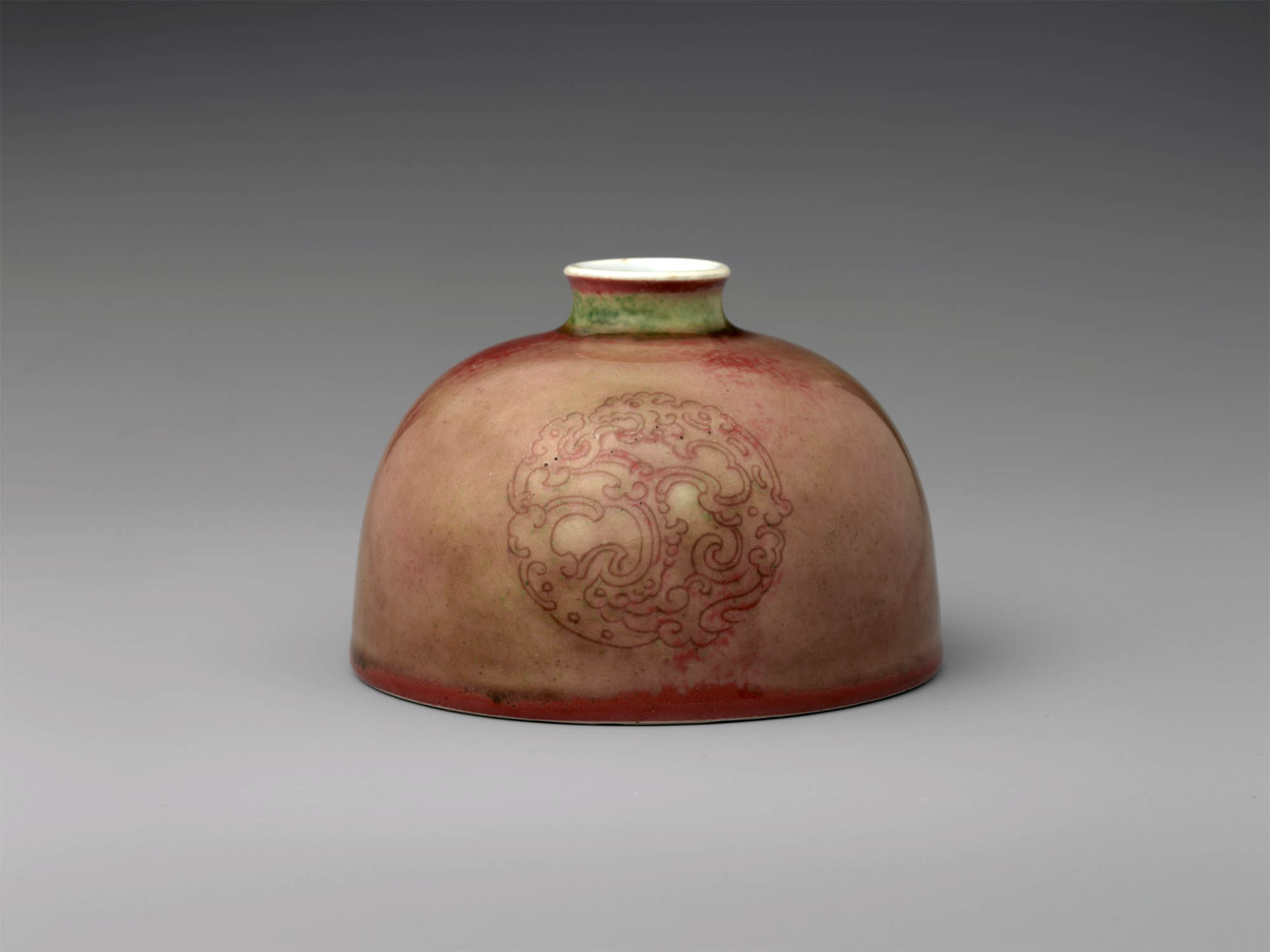
 

Qing dynasty (1644–1911), Kangxi mark and period (1662–1722) 'Water coupe' Late 17th century


Qing dynasty (1644–1911), Kangxi mark and period (1662–1722)
Water coupe
Late 17th century
Culture: China
Porcelain (Jingdezhen ware)
Height: 3 1/4 in. (8.3cm)
Diameter: 5 in. (12.7cm)
Metropolitan Museum of Art, New York
Edward C. Moore Collection, Bequest of Edward C. Moore, 1891
Public domain


The lush, pinkish-red glaze on this writing desk accessory is known as “peach bloom.” Works decorated in this way are arguably the most cherished type of imperial porcelain from the Kangxi period. In addition to being highly prized in China, peach-bloom porcelain enjoyed popularity among collectors in the United States during the late nineteenth and early twentieth centuries. Its presence in Moore’s collection reflects this collecting trend.


The Metropolitan Museum of Art
1000 Fifth Avenue at 82nd Street
New York, New York 10028-0198
Phone: 212-535-7710

Opening hours:
Thursday – Tuesday 10am – 5pm
Closed Wednesday

The Metropolitan Museum of Art website

LIKE ART BLART ON FACEBOOK

Back to top

Exhibition: ‘I-Photo. Japanese Photography 1960-1970 from the Collection’ at Museum der Moderne Salzburg

Exhibition dates: 21st April – 8th July, 2018

Curator: Christiane Kuhlmann, Curator Photography and Media Art; with Andrea Lehner-Hagwood, Curatorial Assistant, Museum der Moderne Salzburg

Works by Nobuyoshi Araki, Masahisa Fukase, Takashi Hanabusa, Jun Jumoji, Daidõ Moriyama, Masaaki Nakagawa, Bishin Jumonji, Shunji Õkura, Issei Suda, Akihide Tamura, Shin Yanagisawa, Yoshihiro Tatsuki


Daidō Moriyama (Japanese, b. 1938) 'Lips from a Poster' 1975 from the exhibition 'I-Photo. Japanese Photography 1960-1970 from the Collection' at Museum der Moderne Salzburg, April - July, 2018


Daidō Moriyama (Japanese, b. 1938)
Lips from a Poster
1975
Gelatin silver print on Baryte paper
Museum der Moderne Salzburg
© Daidō Moriyama


Much as I love the grittiness and stark contrast of Japanese photography of the 1960-70s – its reaction against the pro-American optimism of The Family of Man exhibition that went to Tokyo in the 1950s, its rejection of journalistic illustration, its I-reality that is not a objective record but a personal story, “a poem composed in photography”, its spirit of ennui, a state of dissatisfaction with the status quo – there is also another, less edifying side to Japanese photography of this period.

Basically, it’s a male view of the world, any world, any reality, but always with the “I” at the front of it, the world of the male ego. A world where women are objectified, bound and gagged in pretty gruesome “erotic” sex scenes (not in this posting, but you can Google them online). No matter that the photographer had permission, these photographs are about male power and the male gaze. Nothing more, nothing less. A world where cameras pry on people having anonymous sex in the park in the dark. Let’s call it what it is, it’s misogynistic and voyeuristic.

The obverse of a concern for the sitter, or the landscape, or the object, can be observed (did you see what I did there… obverse / observe), in that there is a concern with the minutiae of life in extremis, rather than an empathy for it. Maybe that is the Japanese culture. Perhaps this microscopic analysis comes about because of the fast pace of their life, their mixture of state, religion, culture and capitalism, their violent history and the submissive place of women within that society (The traditional role of women in Japan has been defined as “three submissions”: young women submit to their fathers; married women submit to their husbands, and elderly women submit to their sons ~ Wikipedia)

There is something I cannot put my finger on about the power of the photograph to capture a dominance over women, the landscape, people, protests – a suppressed violence against the self?

I’m just thinking out loud here…

Dr Marcus Bunyan


Many thankx to the Museum der Moderne Salzburg for allowing me to publish the photographs in the posting. Please click on the photographs for a larger version of the image.


The collections of the Museum der Moderne Salzburg include an outstanding and sizeable ensemble of Japanese photographs from the 1960s and 1970s. These works will be on view for the first time in many years in a series of exhibitions. The opening presentation is dedicated to the depiction of humans and perceptions of postwar Japanese society in transformation. A future second exhibition will focus on images of city and countryside.

In the history of Japanese photography, the idea of the “I-photo” is a kind of photographic adaptation of the literary convention of first-person narrative. The photographic image is conceived and employed as a medium articulating the photographer’s self as well as an instrument with which to scrutinise reality. A pioneer of postwar photography, Masahisa Fukase in the late 1960s created photographic series mixing documentary and fictional elements. His central motifs and models were his wife Yoko and their family. Nobuyoshi Araki, the best-known, most prolific, and probably also most provocative Japanese photography artist, launched his career as a fashion and advertising photographer in 1963. The collection contains highly personal photographic notes by him and his wife Yoko, who died early. Fukase, Araki, and the other Japanese “I-photographers” such as Issei Suda, Shin Yanagisawa, and Daidõ Moriyama regard the “I-photo” as a blend of truth and falsification that can elicit an emotional response and disconcert. The aesthetic of the pictures is characterised by hard black-and-white contrasts and lacerated abstract structures. It signals the artists’ rejection of the tradition of classical art photography while also probing the potentials of the medium itself. The Japanese photography scene is highly controversial; the spectrum of themes ranges from erotic depictions of bodies to political statements.


Exhibition view of 'I-Photo. Japanese Photography 1960-1970 from the Collection' showing at centre, Moriyama's 'Lips from a Poster' (1975)


Daidō Moriyama (Japanese, b. 1938)
Untitled (l. a. r.)
c. 1970
Lips from a Poster
1975
3 gelatin silver prints on Baryte paper
Museum der Moderne Salzburg

Exhibition view of I-Photo. Japanese Photography 1960-1970 from the Collection
© Museum der Moderne Salzburg
Photo: Rainer Iglar


Exhibition view of 'I-Photo. Japanese Photography 1960-1970 from the Collection' showing at right, Moriyama's 'Stray Dog, Misawa' (1971)


Daidō Moriyama (Japanese, b. 1938)
Stray Dog, Misawa (installation view at right)
1971
From the series Hunter
Untitled
c. 1970
9 gelatin silver prints on Baryte paper
Museum der Moderne Salzburg

Exhibition view of I-Photo. Japanese Photography 1960-1970 from the Collection
© Museum der Moderne Salzburg
Photo: Rainer Iglar


Daidō Moriyama (Japanese, b. 1938) 'Stray Dog, Misawa' 1971 from the exhibition 'I-Photo. Japanese Photography 1960-1970 from the Collection' at Museum der Moderne Salzburg, April - July, 2018


Daidō Moriyama (Japanese, b. 1938)
Stray Dog, Misawa
1971
From the series Hunter
Gelatin silver print on Baryte paper
Museum der Moderne Salzburg
© Daidō Moriyama


Daidō Moriyama (Japanese, b. 1938) 'National Highway 1 AT Dawn 1, Asahi-cho, Kuwana City, Mie Prefecture' 1968 from the exhibition 'I-Photo. Japanese Photography 1960-1970 from the Collection' at Museum der Moderne Salzburg, April - July, 2018


Daidō Moriyama (Japanese, b. 1938)
National Highway 1 AT Dawn 1, Asahi-cho, Kuwana City, Mie Prefecture
1968
Gelatin silver print on Baryte paper
6.50 x 9.72 in. (16.5 x 24.7cm)
Museum der Moderne Salzburg
© Daidō Moriyama


Daidō Moriyama (Japanese, b. 1938)

Daidō Moriyama is one of Japan’s leading contemporary photographers. He studied design and photography in Kōbe before moving to Tokyo in 1961 and deciding to focus entirely on photography. After a stint as Eikō Hosoe’s assistant, he went into business for himself as a photographer in 1964.

Like the art critic Kōji Taki and the photographers Yutaka Takanashi, Shōmei Tōmatsu, and Takuma Nakahira, Moriyama was a member of the group around the influential magazine Provoke (1968-1969). Although no more than three issues appeared in print, its importance in the history of the medium in Japan can hardly be overstated. The Provoke Manifesto declared that photography was capable of registering what could not be expressed in words. The visual style of the photographs Provoke would run was to be are-bure-boke, Japanese for “grainy, blurry, and out of focus” – a specification that still aptly describes Moriyama’s photographs; the same style is evident in his work for magazines such as Camera Mainichi, Asahi Journal, and Asahi Camera.

Moriyama’s inexhaustible signature theme is the city of Tokyo, but he has also worked elsewhere. In an interview, he once said: “For me cities are enormous bodies of people’s desire.” He still prowls the streets day after day, taking pictures of appealing or striking sights, never peering into his small compact camera’s viewfinder. Shots of traffic, of pedestrians and shop windows, of posters and details such as lips, eyes, or plants are recurrent motifs. Hard black-and-white contrasts lend his prints a strangely alien and otherworldly allure, but the depictions always remain anecdotal, as though from a dream. Moriyama’s photobooks may accordingly be read as photonovels of a sort. Japan A Photo Theater (1968) was the first book in this vein he published; his oeuvre has now grown to several hundred photobooks.

The Photographic Society of Japan, whose purpose is to promote photography in Japan, elected him its photographer of the year in 1983. In 2012, he received the Infinity Award for Lifetime Achievement of the International Center of Photography, New York, which honours outstanding accomplishments in photography and visual art.


Exhibition view of I-Photo. Japanese Photography 1960-1970 from the Collection showing Masahisa Fukase's 'Untitled' (1971) from the series 'Yoko'


Masahisa Fukase (Japanese, 1934-2012)
Untitled
1971
From the series Yoko
9 gelatin silver prints on Baryte paper (Vintage prints)
Museum der Moderne Salzburg

Exhibition view of I-Photo. Japanese Photography 1960-1970 from the Collection
© Museum der Moderne Salzburg
Photo: Rainer Iglar


Masahisa Fukase (Japanese, 1934-2012) 'Untitled' 1961-1970


Masahisa Fukase (Japanese, 1934-2012)
Untitled
1961-1970
From the series Yoko
Gelatin silver print on Baryte paper
Museum der Moderne Salzburg
© Masahisa Fukase, Courtesy Michael Hoppen Gallery London


Masahisa Fukase (Japanese, 1934-2012)

Masahisa Fukase completed a PhD at the Institute of Photography at Nihon University, Tokyo, in 1956. He worked as a photographer for advertising agencies and various publishing houses until 1968 and then as a freelance photographer until his death in 2012. His work was included in the 1974 group exhibition New Japanese Photography at the Museum of Modern Art, New York, followed by numerous solo and group shows all over the world. In 1976, he received the annual Ina Nobuo Award, which has been given out by the Nikon Salon in Tokyo since 1976. At the 1992 Higashikawa International Photo Festival, his exhibition Karasu (Ravens) earned him a Higashikawa Photography Award in the Special Award category.

In the 1960s, his photography is largely focused on his own life and that of his wife Yoko. She stars in pictures that show her in all sorts of situations in life, private as well as public. Fukase captures Yoko as his bride, in the nude, during sex, or as a tourist in the street. He is also interested in the passage of time and ageing in general. After separating from Yoko, Fukase started photographing ravens as symbols of loneliness and loss. The photobook Karasu (Ravens) became one of the most coveted works of its kind in postwar Japan; it was first reprinted just last year.


Exhibition view of 'I-Photo. Japanese Photography 1960-1970 from the Collection' showing Bishin Jumonji's 'Untitled' (1971)


Bishin Jumonji (Japanese, b. 1947)
Untitled
1971
3 gelatin silver prints on Baryte paper
Museum der Moderne Salzburg

Exhibition view of I-Photo. Japanese Photography 1960-1970 from the Collection
© Museum der Moderne Salzburg
Photo: Rainer Iglar


Bishin Jumonji (Japanese, b. 1947) 'Untitled' 1971


Bishin Jumonji (Japanese, b. 1947)
Untitled
1971
Gelatin silver print on Baryte paper
Museum der Moderne Salzburg
© Bishin Jumonji


Bishin Jumonji (Japanese, b. 1947) 'Untitled' 1971


Bishin Jumonji (Japanese, b. 1947)
Untitled
1971
Gelatin silver print on Baryte paper
Museum der Moderne Salzburg
© Bishin Jumonji


Bishin Jumonji (Japanese, b. 1947)

After studying at the Tokyo College of Photography, Bishin Jumonji became an assistant to the photographer Kishin Shinoyama, who had risen to renown with publications about Kabuki theater, erotic depictions in photography magazines, and work in unusual book formats such as flipbooks. Since 1971, Jumonji has worked both freelance and as an advertising photographer. This was also when he began to take pictures for the series on view, Untitled. Shot around Tokyo, the works portray families, day-trippers, a quartet of rock musicians, dancers, or bodybuilders – in short, representatives of modern Japan. The details are chosen so that the heads and faces do not appear in the prints. This underscores the subjective quality of photography as such while also conveying the anonymity of life in the megalopolis.

Otto Breicha had seen the series as early as 1974, when it was featured in New Japanese Photography, a group exhibition John Szarkowski organised at the MoMA in New York. Breicha decided to include it in Neue Fotografie aus Japan, the follow-up show he mounted in Graz in 1977.

In 1990, Jumonji receives the Domon Ken Award, one of the most important Japanese photography prizes. The work of the honourees is showcased at the Ginza Nikon Salon, Tokyo, and the Domon Ken Museum of Photography, Sakata, the first museum in Japan dedicated to photography. Some of Jumonji’s pictures are published in international magazines including the German newsweekly Stern.


Exhibition view of 'I-Photo. Japanese Photography 1960-1970 from the Collection' showing Akihide Tamura's 'Yokohama', 1966 at left; and 'Yokosuka', 1969 at right, from the series 'Base'


Akihide Tamura (Japanese, b. 1947)
Yokohama, 1966 (l.)
Yokosuka, 1969 (r.)
7 gelatin silver prints on Baryte paper
From the series Base
Museum der Moderne Salzburg

Exhibition view of I-Photo. Japanese Photography 1960-1970 from the Collection
© Museum der Moderne Salzburg
Photo: Rainer Iglar


Akihide Tamura (Japanese, b. 1947) 'Yokohama' 1966


Akihide Tamura (Japanese, b. 1947)
Yokohama
1966
From the series Base
Gelatin silver print on Baryte paper
Museum der Moderne Salzburg
© Akihide Tamura


Akihide Tamura (Japanese, b. 1947)

Akihide Tamura studied at the Tokyo College of Photography and got his degree in 1967. Even before he graduated, the academy’s director, the photography critic Shigemori Koen, recognised his unusual approach. In 1974, the MoMA in New York featured Tamura’s House series in its group exhibition New Japanese Photography and acquired it for the museum’s collection. Taken over the course of a year – from July to July – the pictures show houses in abandoned landscapes. The alternation of day and night and the cycle of the seasons play a prominent part in the series.

Tamura’s life was defined by the wrenching changes Japan underwent after World War II. His work is an astute photographic record of these metamorphoses. For the series Base (1966-1970), he captured landscapes, people, and combat aircraft and other military planes at several American bases south of Tokyo. In retrospect, he wrote: “When I was a photography student, I knew that the military base existed in a territory that had been created due to the tensions between the United States and the Soviet Union and the possibility of a nuclear war. I was shaken by the incredibly beautiful and yet insane fighter jets before my eyes. The contradiction between my fear that the world would vanish in an instant if someone were to push the nuclear button and the exotic and eerie spell the military base cast over me left me perpetually torn.”

The works on view are part of the major cycle Erehwon – the title is the word “nowhere” read backwards – that Tamura worked on between 1967 and 1973. The series combines combat aircraft taking off and hurtling off into the sky, their engines a pair of glowing eyes, with ghostly portraits of children that gradually fade into the dark. The composition reflects the photographer’s mindset, a hard-to-pin-down blend of admiration and fear.


Diverse and controversial, sometimes mysterious and often at odds with stereotypical ideas about Japan: there is much to discover in Japanese photography from the 1960s and 1970s. The Museum der Moderne Salzburg now presents its extensive and singular collection in a two-part exhibition series.

For the first time in many years, the Museum der Moderne Salzburg puts its collection of c. 600 original prints of Japanese photography from the 1960s and 1970s, which was purchased in the museum’s early years, on display. The series of two shows begins with IPhoto. Japanese Photography 1960-1970 from the Collection, which presents works that focus on the depiction of the human being and the changes in postwar Japanese society.

“In this exhibition, my vigorous efforts to undertake a thorough review of our collections are bearing fruit, and so I am especially pleased that we are able to present our holdings of Japanese photography – a sizeable ensemble of outstanding works – which have not been seen by the public in a long time. The show also spotlights a chapter in the history of the museum, which started collecting and conserving photography early on. Otto Breicha, the museum’s first director, personally traveled to Japan to meet many of the artists and select works for the projected exhibition,” Sabine Breitwieser, Director of the Museum der Moderne Salzburg, observes. Curator of Photography and Media Art Christiane Kuhlmann emphasises that “this effort to champion Japanese culture and acquire Japanese art for the nascent collection constitutes a pioneering achievement.” “At the time, the primary media in which Japanese photographers presented their pictures were photobooks and magazines,” Kuhlmann notes, “so that vintage prints in the quality and form at our disposal are now hard or impossible to come by. Breicha’s initiative to build a centre for contemporary photography in Austria was in part motivated by his experiences in Japan.”

In the early 1960s, Japan enters a period of fast-paced economic growth, becoming a leading technology manufacturer. A quarter-century after the end of the war and the nuclear bombs over Hiroshima and Nagasaki, Japan hosts Expo’70, the first world’s fair to be held in an Asian country. Tokyo grows into an enormous megalopolis; construction on an international airport that will connect it to the entire world begins in 1971. These developments mark the definite end of the island nation’s decades-long isolation from the West, bringing rapid changes that affect Japanese society as well. In the 1960s, millions of Japanese citizens rally to protest against educational and land reforms and the security treaty with the former enemy, the United States of America. The Japanese photography scene devises a new and dynamic visual language that reflects the country’s more expansive self-image. Distinctive features include the reflection on perception, the quest for novel ways to express the self, and a revised definition of the photographic medium. Hard black-and-white contrasts and lacerated abstract structures are characteristic of the aesthetic of these pictures.

The idea of the “I-photo” is an adaptation of the term “I-novel,” which designates a genre of first-person narrative fiction in Japanese literature. Conceiving of themselves as authors, the photographers understand the “Iphoto” as the instrument of an exploration of reality. Japan’s photography scene is often highly controversial, with themes ranging from erotic depictions of bodies to political statements. Western observers are bound to find some pictures enigmatic and unsettling; they run counter to how Japan is generally imagined abroad. Yet it was Western art institutions that, in the 1970s, first included Japanese contemporary photography in their programming. Neue Fotografie aus Japan (New Photography from Japan) was the title of the first exhibition in Europe that Otto Breicha mounted in Graz in 1977; with I-Photo. Japanese Photography 1960-1970 from the Collection, the Museum der Moderne Salzburg brings back the exhibits from that historic show, though with different emphases. The presentation includes works by the photographers associated with the magazine Provoke (1968-1969) in which reality seems to be dismantled into its constituent elements, as well as by artists such as Nobuyoshi Araki and Masahisa Fukase who pursued their own highly individual creative agendas. Also on display are pictures by the members of the Kompora group, who sought to render a lucid and accurate portrait of everyday life in a clinical visual idiom.

Press release from Museum der Moderne Salzburg


Exhibition view of 'I-Photo. Japanese Photography 1960-1970 from the Collection'


Exhibition view of I-Photo. Japanese Photography 1960-1970 from the Collection
© Museum der Moderne Salzburg
Photo: Rainer Iglar


Exhibition view of 'I-Photo. Japanese Photography 1960-1970 from the Collection' showing Yoshihiro Tatsuki's 'Untitled' c. 1970


Yoshihiro Tatsuki (Japanese, b. 1937)
Untitled
c. 1970
3 gelatin silver prints on Baryte paper
Museum der Moderne Salzburg

Exhibition view of I-Photo. Japanese Photography 1960-1970 from the Collection
© Museum der Moderne Salzburg
Photo: Rainer Iglar


Yoshihiro Tatsuki (Japanese, b. 1937) 'Untitled' c. 1970


Yoshihiro Tatsuki (Japanese, b. 1937)
Untitled
c. 1970
Gelatin silver print on Baryte paper
Museum der Moderne Salzburg
© Yoshihiro Tatsuki


Yoshihiro Tatsuki (Japanese, b. 1937)

Yoshihiro Tatsuki was born in 1937 in Tokushima, where his family had long run an established portrait studio. He studied at the Tokyo College of Photography (today’s Tokyo Polytechnic University) and graduated in 1958. Initially joining the advertising agency Adcenter in Tokyo as a photographer, Tatsuki went freelance in 1969, working for clients in the advertising, fashion, and publishing industries. In 1965, his series Just Friends and Fallen Angels, which had appeared in the photography magazine Camera Mainichi, earned him the emerging photographer’s award of the association of Japanese photography critics. The works garnered wide attention in Japan. Among his best-known creations are GIRL, EVES, Private Mariko Kaga, Aoi Toki, My America, and Portrait of Family.

Tatsuki has long focused on nude photography, combining traditional Japanese compositional templates with the characteristic poses of Western models. It is hard to tell whether he wants to debunk or cater to the – primarily Western – fantasy of the Geisha as concubine.


Exhibition view of 'I-Photo. Japanese Photography 1960-1970 from the Collection' showing Nobuyoshi Araki's 'Untitled' (1971) from the series 'Sentimental Journey'


Nobuyoshi Araki (Japanese, b. 1940)
Untitled
1971
From the series Sentimental Journey
7 gelatin silver prints on Baryte paper
Museum der Moderne Salzburg

Exhibition view of I-Photo. Japanese Photography 1960-1970 from the Collection
© Museum der Moderne Salzburg
Photo: Rainer Iglar


Nobuyoshi Araki (Japanese, b. 1940) 'Untitled' 1971


Nobuyoshi Araki (Japanese, b. 1940)
Untitled
1971
From the series Sentimental Journey
Gelatin silver print on Baryte paper
Museum der Moderne Salzburg
© Nobuyoshi Araki


Nobuyoshi Araki (Japanese, b. 1940) 'Yoko, my Love' Nd


Nobuyoshi Araki (Japanese, b. 1940)
Yoko, my Love
Nd
Gelatin silver print on Baryte paper (Vintage print)
Museum der Moderne Salzburg
© Nobuyoshi Araki


Nobuyoshi Araki (Japanese, b. 1940)

Nobuyoshi Araki studied photography and film studies at Chiba University from 1959 until 1963. After completing his degree, he joined an advertising agency; in the spare time left by his work as a commercial photographer, he started developing his own photographic ideas.

1970, the artist declared, would be “The First Year of Araki.” Increasingly dissatisfied with the status quo that prevailed in established photography, he launched a variety of creative experiments. The popular photography that dominated the market in Japan at the time, he thought, traded in illusions and dishonesty, and so he proposed to change the situation and create a new kind of photography that would reveal the true face of a society undergoing rapid change.

In 1971, he was married to Yoko. His documentation of their honeymoon was published as the small photobook Sentimental Journey. The travelogue – several pictures from it are in the Museum der Moderne Salzburg’s collection – opens with a portrait of Yoko on the train. The title and this picture are a reference to Doris Day’s 1945 worldwide hit. The series continues with shots of places, sights, and, again and again, pictures of Yoko, in the street, nude, or having sex. As Araki sees it, the book is a new form of reportage about life. Taking photographs and living, to his mind, are synonymous. In a statement accompanying Sentimental Journey, he writes: “The I-novel comes closer to photography.” The title of our exhibition, I-Photo, alludes to this Japanese literary genre, in which the author’s experiences, rendered in as much realistic detail as possible, form the material out of which a fictional story is wrought.

In 1992, Camera Austria, Graz, hosted Araki’s first solo exhibition in Europe. He is famous for his widely debated photographs of erotic bondage, but also for his photobooks, which now number almost six hundred.


Exhibition view of 'I-Photo. Japanese Photography 1960-1970 from the Collection' featuring the work of Nobuyoshi Araki


Exhibition view of I-Photo. Japanese Photography 1960-1970 from the Collection featuring the work of Nobuyoshi Araki
© Museum der Moderne Salzburg
Photo: Rainer Iglar


Exhibition view of 'I-Photo. Japanese Photography 1960-1970 from the Collection'


Exhibition view of I-Photo. Japanese Photography 1960-1970 from the Collection
© Museum der Moderne Salzburg
Photo: Rainer Iglar


Takashi Hanabusa (Japanese, b. 1949) 'Untitled' Nd


Takashi Hanabusa (Japanese, b. 1949)
Untitled
Nd
Gelatin silver print on Baryte paper
Museum der Moderne Salzburg
© Takashi Hanabusa


Takashi Hanabusa (Japanese, b. 1949)

Takashi (Lyu) Hanabusa was born in Osaka in 1949. After graduating from the Kuwasawa Design School, Tokyo, he joined the staff of the publishing house that produced the magazine Nippon Camera. In 1971, he became an assistant to the photographer Yutaka Takanashi, whose well-known series Tôshi-e (Towards the City) surveyed Tokyo as the Japanese began to embrace modern metropolitan life.

Hanabusa’s works build on this influence, documenting the city as a mysterious place defined by jarring contrasts between tradition and modernity, high tech and nature. His photographs are marked by deliberately ambiguous particulars, as when faces are obscured by shadows. The shots are framed so as to render bodies in fragments or bring out details in classic Japanese fabric patterns that European beholders cannot place.

Hanabusa has been a freelance photographer and member of the Japan Professional Photographers Society since 1973.


Masaaki Nakagawa (Japanese, 1943-2005) 'Selfportrait, Against Wall of My Home' Nd


Masaaki Nakagawa (Japanese, 1943-2005)
Selfportrait, Against Wall of My Home
Nd
Gelatin silver print on Baryte paper
Museum der Moderne Salzburg
© Masaaki Nakagawa


Masaaki Nakagawa (Japanese, 1943-2005)

Masaaki Nakagawa completed his studies of Japanese literature at Kōnan University, Kōbe, in 1966. He then worked for various advertising agencies and created fashion shots and reportages for magazines. From 1969 until his death in 2005, he was a freelance photographer in Tokyo and taught at the Kuwasawa Design School.

Otto Breicha described Nakagawa as a storyteller and compared him to the American photographer Duane Michals, whose notion that “things are queer” seems to inform his Japanese colleague’s work as well. Created in series, Nakagawa’s sequences of pictures, rather than aiming for an obvious punch line, appear to move in circles. In the series Self-Portrait against Wall of My Home, the photographer’s shadow looms on the wall, as do things the title identifies as his possessions. Yet the pictures remain vague, almost ghostly, and it is not clear what the focus is on. In this respect, Nakagawa joins the ranks of those conceptual photographers who employ photography as a tool of pictorial analysis, scrutinising the medium’s intrinsic technical-visual potential.

Masaaki Nakagawa was one of the photographers who assisted Otto Breicha during his research in Japan in preparation for the exhibition Neue Fotografie aus Japan.


Issei Suda (Japanese, 1940-2019) 'Untitled' 1975-1976


Issei Suda (Japanese, 1940-2019)
Untitled
1975-1976
From the series Fûshi Kaden
Gelatin silver print on Baryte paper
Museum der Moderne Salzburg
© Issei Suda


Issei Suda (Japanese, 1940-2019)

Issei Suda was trained at the Tokyo College of Photography, from which he graduated in 1962. From 1967 until 1970, he worked as a stage photographer for the avant-garde theater ensemble Tenjō Sajiki, which was led by the writer and filmmaker Shūji Terayama.

In the late 1960s, Suda and others opposed to the style championed by the magazine Provoke founded the group Kompora. The label is a typical Japanese compound, a contraction of the English terms “contemporary” and “photography.” The group’s key point of reference was Contemporary Photographers: Toward a Social Landscape, an exhibition held at the George Eastman House in Rochester, N.Y., in 1966. Their goal was to create lucid and accurate portrayals of everyday life in a clinical visual idiom. Despite the aspiration to cool objectivity, however, some of their pictures strike Western beholders as no less enigmatic and unsettling.

That is certainly the impression one gets from the works we present, a selection from the series Fûshi Kaden (1975-1976), which was published as a photobook – Suda’s first – by Asahi Sonorama in 1978. The series proposes a visual discourse on tradition and modernity. The enormous tension between Japan’s hyper-modern cities and the deep-rooted traditions lingering in rural areas is a theme that preoccupies Suda throughout his life. For Fûshi Kaden, he crisscrossed the country; many pictures were taken at the traditional festivals known as matsuri. The title is difficult to translate. It is a tribute to a theoretical disquisition on Nō theater penned in the early fifteenth century by one of its leading practitioners, the grand master Zeami Motokiyo. Sketching his vision of the beauty and style of drama, the author compares it to a flower that has not yet fully blossomed. But he also examines questions of inward perception and outward expression in theatrical performance. Issei Suda translates this vision into his mode of photography. The figures in his pictures sometimes seem to be involved in some kind of stage action and yet utterly unaware of it, as though only the photographer knew the director’s script.

Suda was a professor at the Osaka University of Arts and received the Domon Ken Award in 1997.


Shin Yanagisawa (Japanese, 1936-2008) 'Untitled' 1972


Shin Yanagisawa (Japanese, 1936-2008)
Untitled
1972
From the series In the Street, Toyama
Gelatin silver print on Baryte paper
Museum der Moderne Salzburg
© Estate of Shin Yanagisawa


Shin Yanagisawa (Japanese, 1936-2008)

Shin Yanagisawa, who was born in Tokyo in 1936, was a member of the eminent generation of Japanese photographers who, in the 1960s and 1970s, saw contemporary life in their country with fresh eyes, discovering themes for photography that still inform how we imagine Japan between tradition and modernity. Yanagisawa studied at the Tokyo College of Photography in Shibuya and then worked as a freelance photographer.

He was interested in the changing face of the landscape and the raw reality of nature as well as the many facets of life in the big city. The series Traces of the City (1965-1970) reflects the worldview of an entire generation; as early as 1979, it was the subject of a solo presentation in Tokyo. Yanagisawa also contributed work to numerous group shows, including the famous 15 Photographers Exhibition at the Tokyo National Museum of Modern Art (1974), which featured work by Daidō Moriyama und Yutaka Takanashi as well.

The shots we present are a selection from the series In the Street (1972) and show a group of dancers and performers in costumes that would seem to fit in seamlessly with our vision of traditional Japanese culture. Upon closer inspection, however, dissonant notes creep in, especially when individuals turn to face the camera directly or a flashlight illuminates the situation. They reveal Yanagisawa’s presence as the photographer or, more properly, author of the picture. He has abandoned the position of the uninvolved observer, and although he is not visible in the picture as such, he becomes an active participant in the action before the camera. This approach may be regarded as characteristic of the principle of I-photography.

After concluding his active career as a photographer, Shin Yanagisawa wrote about various aspects of photography.


Shunji Ōkura (Japanese, 1936-2015) 'Untitled' Nd


Shunji Ōkura (Japanese, 1936-2015)
Untitled
Nd
Gelatin silver print on Baryte paper
Museum der Moderne Salzburg
© Shunji Ōkura


Shunji Ōkura (Japanese, 1936-2015)

A grandson of the Japanese painter Kawai Gyokudō, Shunji Ōkura graduated from Dokkyo High School, Tokyo, in 1956. In 1958, he became an assistant to the photographer Akira Satō while also starting out as a freelance photographer, creating fashion shots for the magazines Fukuso, Wakai Josei, and So-en. Numerous photographs appeared in periodicals such as Camera Mainici, Hanashin No Tokushu, and Sunday Mainichi.

In the photographs in the Museum der Moderne Salzburg’s collection, Ōkura devotes himself to a classic subject of photography: the children’s portrait. These are situation-bound snapshots taken a playground; no posing was involved. It is interesting to note how the photographer embraces the way children see the world. Some parts of the scene are invisible in the low-angle shots or obscured by other objects, while Ōkura’s portraits suggest profound empathy; we feel we get a sense of these children’s fears and anxieties.


Museum der Moderne Salzburg
Mönchsberg 32
5020 Salzburg
Phone: +43 662 842220

Opening hours:
Tuesday – Sunday: 10am – 6pm
Wednesday: 10am – 8pm
Monday: closed

Museum der Moderne Salzburg website

LIKE ART BLART ON FACEBOOK

Back to top

Exhibition: ‘Ken Domon: Master of Japanese Realism’ at the Museo dell’Ara Pacis, Rome

Exhibition dates: 27th May – 18th September, 2016

Curators: Rossella Menegazzo, Professor of East Asian Art History at the University of Milan and Takeshi Fujimori, Japanese photographer and Artistic Director of the Ken Domon Museum of Photography


Ken Domon (Japanese, 1909-1990) 'Allenamento degli allievi del corpo della Marina [Students of the Navy training]' 1936 from the exhibition 'Ken Domon: Master of Japanese Realism' at the Museo dell'Ara Pacis, Rome, May - Sept, 2016


Ken Domon (Japanese, 1909-1990)
Allenamento degli allievi del corpo della Marina [Students of the Navy training]
1936
Yokosuka
535 x 748mm
Ken Domon Museum of Photography


Social Realism

I love most Japanese photography of the post-war period (1950s-1970s) and this artist’s work is no exception. What an absolute master of photography, not just of Japanese photography, he was.

Direct, focused, gritty, unflinching, the work of this initiator of social realist photography lays bare “the direct connection between the camera and the subject” in the most forthright way. While professing that the photographs are “an absolutely non-dramatic snapshot” (just like the Bechers professed that their gridded, ordered photographs were just about form and nothing else), this artist produced quality work that narrates a transcendent story of life in Japan. His images are music, and visions, from the heart of a nation. You only have to look at the photograph Gemella non vedente (1957, below) from the series Hiroshima to understand what I mean. There is just this feeling in your synapses about his pictures, as though you yourself were holding the camera …

In his portrait photographs there is quietness and contemplation; in his other work anger, sadness, joy, humour. A direct connection to reality is at the forefront of his understanding. This connection is miraculously (as in, something that apparently contravenes known laws governing the universe) transformed into other spaces and feelings – the twirling of umbrellas, the lizard on the head, the raised arms and white gloves of the traffic policeman (shot from a crouching position).

While he is not an artist who creates change he certainly documents the results of change in a magnificent way. I love them all.

Dr Marcus Bunyan


Many thankx to the Museo dell’Ara Pacis for allowing me to publish the photographs in the posting. Please click on the photographs for a larger version of the image.


Ken Domon (Japanese, 1909-1990) 'Esercitazioni delle crocerossine' [Red Cross exercises] 1938 from the exhibition 'Ken Domon: Master of Japanese Realism' at the Museo dell'Ara Pacis, Rome, May - Sept, 2016


Ken Domon (Japanese, 1909-1990)
Esercitazioni delle crocerossine [Red Cross exercises]
1938
Azabu, Tokyo
535 x 748mm
Ken Domon Museum of Photography


For the first time ever outside Japan, an exhibition of work by Ken Domon (1909-1990), recognised as a master of realism and one of the most important figures in the history of modern Japanese photography, is being held in Rome at the Museo dell’Ara Pacis. It features about 150 photographs taken in black and white as well as colour between the 1920s and the 1970s, which illustrate the author’s path towards social realism. From the first shots of the period before and during World War II, which display a vision linked to photojournalism and propaganda, through photography of the social sphere, the exhibit follows Ken Domon’s production up to the crucial work documenting the tragedy of Hiroshima, which the photographer undertook as though in response to a call and a humanitarian duty.

Regarded as an absolute master of Japanese photography and initiator of the realistic movement, Ken Domon marked a pivotal chapter in the history of post-war Japanese photography, laying the foundations for contemporary photographic production and remaining a constant point of reference for Japanese enthusiasts. According to Domon, “The fundamental gift of quality work lies in the direct connection between the camera and the subject.” The master’s aim was indeed always to capture a wholly realistic image devoid of drama. Against the background of the renewed spirit of the post-war period, he focused on society in general and everyday life: “I am immersed in the social reality of today but at the same time in the classical culture and traditions of Nara and Kyoto. This twofold involvement has the common denominator of a search for the point at which the two realities are linked to the destinies of people, the anger, sorrow and joy of the Japanese people.”

The realistic photograph, described as “an absolutely non-dramatic snapshot”, therefore plays the leading part in an exhibition thematically laid out to illustrate the master’s vast production, transversally encompassing the whole of Japanese culture. From the early work of a photojournalistic nature and at the service of pre-war propaganda and the cultural promotion of Japan overseas (Photojournalism and Pre-War Propaganda; The Post-War Period: Towards Social Realism) to a focus on recording everyday life and the city’s transformation and westernisation with ever-greater attention to social themes. His social realism is expressed in particular through two series emblematic of this period, namely Hiroshima (1958), regarded by the Nobel laureate Kenzaburō Ōe as the first great modern work of Japan, and The Children of Chikuhō, a series on poverty in the mining villages of southern Japan with a broad range of lively portraits of children encountered in the streets.

This is followed by Portraits, comprising photographs of famous figures in the worlds of art, literature, culture and science such as Yukio Mishima, Jun’ichirō Tanizaki, Tarō Okamoto and Yusaku Kamekura. The final section is devoted to his most important series, Pilgrimage to Ancient Temples, photographs of Buddhist sculptures, buildings and treasures as well as views of landscapes taken on journeys throughout Japan in search of the beauty of the sacred places of the past. Landscapes that conjure up the fascination of cultural diversity and the exotic.

Ken Domon’s work can be described as autobiographical, documentation that is private rather social, always selected on personal criteria that transform the shot into a moment of dialogue with the subject. His vision of the subject, be it a landscape, a sculpture, a person or an object, is a vehicle of the universal beauty seen through the lens, which does not omit the physical characteristics of the form captured. A multifaceted figure whose photography embraces the whole of Japanese culture before and after the war, Ken Domon is also the first photographer to have a personal museum devoted entirely to his vast work in his hometown of Sakata, inaugurated in 2003. Together with friends and other leading figures in the Japanese world of art, he initiated the cultural renewal that enabled Japan to emerge definitively from the defeat in war and led to the contemporary aesthetic that is still a point of reference for the entire world.

The show is part of a vast programme of events that will represent the cultural and technological world of Japan in Italy all through 2016: major exhibitions of art, productions from the great tradition of Noh and puppet theatre (bunraku), concerts, performances of modern and traditional dance, film festivals, exhibits of architecture, design, comics, literature, sport and so much else. The occasion is the celebration of the 150th anniversary of the first treaty of friendship and trade between Italy and Japan, signed on 25 August 1866, which initiated diplomatic relations between the two countries.

Press release from the Museo dell’Ara Pacis


Ken Domon (Japanese, 1909-1990) 'Pesca all'ayu' 1936


Ken Domon (Japanese, 1909-1990)
Pesca all’ayu
1936
Izu, Prefettura di Shizuoka
457 x 560mm
Ken Domon Museum of Photography


Ken Domon. 'Bambini che fanno roteare gli ombrelli [Kids twirling umbrellas]' c. 1937


Ken Domon (Japanese, 1909-1990)
Bambini che fanno roteare gli ombrelli [Kids twirling umbrellas]
c. 1937
Dalla serie Bambini (Kodomotachi)
From the series Children (Kodomotachi)
Ogōchimura
535 x 748mm
Ken Domon Museum of Photography


The pre-war period

From photojournalism to propaganda photography

Domon began to work in photography in 1933 at the age of 24, carrying out the humble duties of an apprentice at Miyauchi Kōtarō’s studio in Ueno. Right from the start he won prizes and began to write for photography magazines and journals, publishing his first photo in Asahi Camera in August 1935. The 10th of October of the same year marked an important turning point in his career. He replied to an advertisement published by the Nippon Kōbō studio in Ginza, which was looking for a photo technician. Founded by Natori Yōnosuke (1910-1962) when he returned from his experience in Berlin at the Berliner Illustrierte Zeitung, the studio spread in Japan for the first time concepts such as editing and reporting and a new system of production based on the collaboration between photographer and graphic designer under the supervision of an art director, which led to the large-scale diffusion of photojournalism.

Domon began his first reportage for the magazine Nippon, published in English in order to promote Japanese culture abroad with a mix of information and propaganda. The first photographic reportage was on the traditional Shichigosan Festival on the occasion of the presentation of children in the Meiji Jingu shrine, realised with his model C Leica. This was followed by services that presented handicrafts, traditions, industrial and military progress and the progressive aspects of Japan, which in the 1930s had become increasingly nationalistic.

The war years and the bunraku puppet theatre

During the years of maximum Japanese expansion in the Pacific, immediately prior to the Second World War, even photography had to comply with the strict rules of military policy. Only few selected professional photographers could obtain photographic materials for assignments deemed to be “essential”, and naturally the “essential” photographic services were subject to the requirements of government propaganda, the Ministry of Foreign Affairs, the International Tourism Agency and the International Cultural Relations Company.

Thus many photographic publications were discontinued, with economic repercussions for photographers. In fact, Domon had difficulty maintaining a family of seven. He also had the added anxiety of the probable arrival of a “red card” that would have called him to arms and probably to the front in a group of photo-reporters. In response to this critical situation, Domon decided to retire from the public scene, dedicating himself to culture, in particular to Buddhist temples and the bunraku puppet theatre.

On the 8th of December, 1941 he was in the backstage of the Yotsubashi Bunraku Theatre in Osaka when he read the special edition of a newspaper announcing the declaration of war to the United States. It was not easy to gain the respect and collaboration of the master puppeteers – national living treasures such as Yoshida Bungorō, Yoshida Eiza and Kiritake Monjūrō – in the key moment of taking the shot with a camera that did not go unnoticed due to its size and long exposure times. However, by 1943 he had shot about 7,000 negatives, which were collected in the book entitled Bunraku published in 1972.


Ken Domon (Japanese, 1909-1990) 'Esercitazioni delle crocerossine [Red Cross exercises]' 1938


Ken Domon (Japanese, 1909-1990)
Esercitazioni delle crocerossine [Red Cross exercises]
1938
Azabu, Tokyo
535 x 748mm
Ken Domon Museum of Photography


Ken Domon (Japanese, 1909-199 'Foto commemorativa della cerimonia di diploma del corpo della Marina' [Commemorative photo of the Marine Corp graduation ceremony] 1944


Ken Domon (Japanese, 1909-1990)
Foto commemorativa della cerimonia di diploma del corpo della Marina [Commemorative photo of the Marine Corp graduation ceremony]
1944
Tsuchiura, Ibaragi
1047 x 747mm
Ken Domon Museum of Photography


Ken Domon (Japanese, 1909-1990) 'Vigile urbano a Ginza 4-chōme' [Traffic policeman in Ginza 4-chōme] 1946


Ken Domon (Japanese, 1909-1990)
Vigile urbano a Ginza 4-chōme [Traffic policeman in Ginza 4-chōme]
1946
Tokyo
457 x 560mm
Ken Domon Museum of Photography


The postwar period

The affirmation of realism in photography

The tragic events related to the Second World War and to the defeat of Japan, marked by the atrocities of the atomic bomb, revealed the great deception of the war propaganda. Defeat led to the collapse of the imperial myth and state Shintoism, which had been the basis of military ideology.

If on the one hand, by the end of the 1940s there had been considerable intellectual rebirth leading to a rapid resumption of the diffusion of magazines, publications, exhibitions and artistic circles, on the other hand there was no language that seemed suitable for expressing such a tragic reality. There was a need to document a society undergoing profound change and in this sense Domon became the promoter of realistic photography, becoming a landmark for amateur photographers. He embraced the western trends that had taken over the city, but also the alleys and the poorest sectors of the population.

The high point of the realist tendency was reached around 1953, thanks to the exhibition, Photography Today: Japan and France, held in 1951 at the National Museum of Modern Art in Tokyo, provided the opportunity to make comparisons with names such as Cartier Bresson, Brassai, Doisneau. Domon’s last word on realism appeared in the magazine Photo Art in 1957 with an article that debated the two fundamental concepts of photography: jijitsu, reality, and shinjitsu, truth.


Ken Domon (Japanese, 1909-1990) 'Pescatrici di perle (ama san)' [Pearl fisherwomen] 1948


Ken Domon (Japanese, 1909-1990)
Pescatrici di perle (ama san) [Pearl fisherwomen]
1948
457 x 559mm
Ken Domon Museum of Photography


Ken Domon (Japanese, 1909-1990) 'Donne a passeggio' [Women walking] 1950


Ken Domon (Japanese, 1909-1990)
Donne a passeggio [Women walking]
1950
Sendai
457 x 560mm
Ken Domon Museum of Photography


Ken Domon (Japanese, 1909-1990) 'L'attrice Yamaguchi Yoshiko' [The actress Yoshiko Yamaguchi] 1952


Ken Domon (Japanese, 1909-1990)
L’attrice Yamaguchi Yoshiko [The actress Yoshiko Yamaguchi]
1952
535 x 748mm
Ken Domon Museum of Photography


Yoshiko Yamaguchi (Japanese, 1920-2014)

Yoshiko Yamaguchi (山口 淑子, Yamaguchi Yoshiko, February 12, 1920 – September 7, 2014) was a Japanese singer, actress, journalist, and politician. Born in China, she made an international career in film in China, Hong Kong, Japan and the United States.

Early in her career, the Manchukuo Film Association concealed her Japanese origin and she went by the Chinese name Li Hsiang-lan (李香蘭), rendered in Japanese as Ri Kōran. This allowed her to represent China in Japanese propaganda movies. After the war, she appeared in Japanese movies under her real name, as well as in several English language movies under the stage name, Shirley Yamaguchi.

After becoming a journalist in the 1950s under the name Yoshiko Ōtaka (大鷹 淑子, Ōtaka Yoshiko), she was elected as a member of the Japanese parliament in 1974, and served for 18 years. After retiring from politics, she served as vice president of the Asian Women’s Fund.

Text from the Wikipedia website


Ken Domon (Japanese, 1909-1990) 'Sit-in studentesco a Tachikawa contro l'ampliamento della base americana' [Student sit-in in Tachikawa against the expansion of US base] 1955


Ken Domon (Japanese, 1909-1990)
Sit-in studentesco a Tachikawa contro l’ampliamento della base americana [Student sit-in in Tachikawa against the expansion of US base]
1955
Tokyo
457 x 560mm
Ken Domon Museum of Photography


Ken Domon (Japanese, 1909-1990) 'Sorelline orfane, Rumie e Sayuri' [Orphan sisters, Rumie and Sayuri] 1959


Ken Domon (Japanese, 1909-1990)
Sorelline orfane, Rumie e Sayuri [Orphan sisters, Rumie and Sayuri]
1959
Dalla serie I bambini di Chikuhō (Chikuhō no kodomotachi)
From the series Children of  Chikuhō
457 x 560mm
Ken Domon Museum of Photography


Children and miners’ villages

Domon adored children. His first services for Nippon were focused on the Shichigosan Festival and then on children fishing in Izu. But in 1952 he began to photographing children all over Japan, capturing the vitality of the streets and of the poorer neighbourhoods in Tokyo, Ginza, Shinbashi, Nagoya and Osaka and in particular in the Kōtō area where he lived. Probably due to the loss of his second child in 1946 in an accident, Domon moved increasingly toward a realist if not a socialist approach, which allowed him to deal with current themes in an indirect way through the innocent eyes of children.

Several books were dedicated to this theme: The Children of Kōtō (Kōtō no kodomotachi), whose publication was stopped by Domon himself, dissatisfied with his work in 1956; The Children of Chikuhō (Chikuhō no kodomotachi), published in January 1960, and its continuation which followed in November, The Father of Little Rumie is Dead (Rumie chan has otōsan ga shinda), which showed the miserable conditions of children in the villages of the mining area on the island of Kyūshū, and in particular the story of two orphan sisters, whose story moved Japan becoming a best seller. Lastly, the collection Children (Kodomotachi), published in 1976 by master of graphics and friend, Yūsaku Kamekura, and published by Nikkor Club, the amateur photographers’ association linked to Nikon and Domon.


Ken Domon (Japanese, 1909-1990) 'Rumie' 1959


Ken Domon (Japanese, 1909-1990)
Rumie
1959
Dalla serie I bambini di Chikuhō (Chikuhō no kodomotachi)
From the series Children of  Chikuhō
457 x 560mm
Ken Domon Museum of Photography


Ken Domon (Japanese, 1909-1990) 'Lucertola [Lizard]' 1955


Ken Domon (Japanese, 1909-1990)
Lucertola [Lizard]
1955
Dalla serie I bambini di Kōtō (Kōtō no kodomotachi)
From the series Children of  Chikuhō
Tokyo
457 x 560mm
Ken Domon Museum of Photography


Ken Domon (Japanese, 1909-1990) 'Pioggerella' [Drizzle] 1952-1954


Ken Domon (Japanese, 1909-1990)
Pioggerella [Drizzle]
1952-1954
Dalla serie Bambini (Kodomotachi)
From the series Children (Kodomotachi)
Atami
457 x 560mm
Ken Domon Museum of Photography


Ken Domon (Japanese, 1909-1990) 'Bagno presso il fiume davanti allo Hiroshima Dome' [Bath at the river in front of the Hiroshima Dome] 1957


Ken Domon (Japanese, 1909-1990)
Bagno presso il fiume davanti allo Hiroshima Dome [Bath at the river in front of the Hiroshima Dome]
1957
From the series Hiroshima
535 x 748mm
Ken Domon Museum of Photography


Hiroshima

Published in March 1958, the year prior to the first brain haemorrhage to strike Domon Ken, the Hiroshima collection presents 180 photographs introduced by a short explanatory essay. The work, completed thirteen years after the dropping of an atomic bomb on Hiroshima and then on Nagasaki, focused the attention of the world once again on the still open but almost forgotten wounds of Hiroshima, with a strong social impact.

The importance of this event in the life of the photographer is also evidenced by Domon’s recording in his notebook in the day and time of his arrival: July 23rd, 1957, 2.40 pm. From then until November he went there six times, for thirty-six days, producing more than 7,800 negatives, of which Hiroshima is only the synthesis. Domon realised that until then he had ignored and been afraid of what Hiroshima had actually meant. With his 35mm camera he revealed the places and people directly and indirectly affected by the atomic bomb, coldly recording with tears in his eyes the material damage, physical injuries, scars, deformations, and the plastic surgery and transplants undergone by the victims of the bomb, dedicating 14 pages at the beginning of the book to the progress made in the field of plastic surgery, which became a real photographic dossier.

The public shock that followed the publication of the dossier made him the object of harsh criticism that, however, failed to undermine his determination to represent reality. In an article published in the magazine Shinchō in 1977 the Nobel Prize winner Ōe Kenzaburō defined Hiroshima as the first work of modern art that dealt with the theme of the atomic bomb, talking about the living instead of the dead.


Ken Domon (Japanese, 1909-1990) 'La morte di Keiji' [The death of Keiji] 1957


Ken Domon (Japanese, 1909-1990)
La morte di Keiji [The death of Keiji]
1957
From the series Hiroshima
457 x 560mm
Ken Domon Museum of Photography


Ken Domon (Japanese, 1909-1990) 'Paziente in ospedale' [Hospital patient] 1957


Ken Domon (Japanese, 1909-1990)
Paziente in ospedale [Hospital patient]
1957
From the series Hiroshima
457 x 560mm
Ken Domon Museum of Photography


Ken Domon (Japanese, 1909-1990) 'Donna in cura per le lesioni da bomba atomica' [Women being treated for injuries from atomic bomb] 1957


Ken Domon (Japanese, 1909-1990)
Donna in cura per le lesioni da bomba atomica [Women being treated for injuries from atomic bomb]
1957
From the series Hiroshima
457 x 560 mm
Ken Domon Museum of Photography


Ken Domon (Japanese, 1909-1990) 'Gemella non vedente' [Blind twin (female)] 1957


Ken Domon (Japanese, 1909-1990)
Gemella non vedente [Blind twin (female)]
1957
From the series Hiroshima
457 x 560mm
Ken Domon Museum of Photography


Ken Domon (Japanese, 1909-1990) 'Autoritratto' [Self-portrait] 1958


Ken Domon (Japanese, 1909-1990)
Autoritratto [Self-portrait]
Published in the November issue of the magazine Sankei Camera
457 x 560mm
Ken Domon Museum of Photography


Portraits (Fūbō)

In 1953 the publication of the Portraits (Fūbō) collection of photographs, which came out in paperback the following year, concluded fifteen years of work dedicated to the portrait that had begun with the first photograph in May 1936 portraying the writer Takeda Rintarō, continuing during the war and until the year in which the collection was published. Domon gathered in a single volume 83 portraits of friends and acquaintances, personalities from the world of entertainment, literature, theatre and politics, stressing in the introduction that they were ” […] people I respect and like and am close to […] The choice of people was surprisingly subjective and random and no claim to any strictly historical or cultural meaning can be made.”

It seems that the initial choice of the faces to be included in the collection was made by Domon with a list written in ink on a sliding door on the second floor of his house in 1948. This list was subjected to the comments and opinions of friends and publishers who went to his house and subsequently underwent substitutions and changes. Through familiar faces and less well-known personalities, Domon bears witness to a crucial era in Japan, one of great writers such as Mishima, Kawabata and Tanizaki, of actors and directors of the caliber of Mifune and Ozu, of great artists who were often his friends and gave rise to a new important artistic trends in the country, such as the sculptor Noguchi, the graph artist Kamekura, the founder of the Ikebana School, Sōgetsu Teshigahara, or painters like Fujita, Umehara, Okamoto. Each picture is accompanied by the name of the subject, their occupation and the date it was taken. There are also short texts describing the relationship between Domon and the person depicted, in addition to the atmosphere created during the shooting.

Sometimes subjects were exasperated by the professional stubbornness of Domon, as is clear in the portrait of Umehara that reveals an air of irritation close to intolerance. Outrightness and instantaneousness, which were always Domon’s objectives, became easier to achieve thanks to technological developments. He passed from a camera assembled for cabinet card portraits – with a dry plate and flash that worked with magnesium powder, used before the war – to a small Leica in the post-war period.


Ken Domon (Japanese, 1909-1990) 'Shiga Naoya' (scrittore/writer) 1951


Ken Domon (Japanese, 1909-1990)
Shiga Naoya (scrittore/writer)
1951
457 x 560mm
Ken Domon Museum of Photography


Naoya Shiga (志賀直哉, Shiga Naoya, February 20, 1883 – October 21, 1971) was a Japanese writer active during the Taishō and Shōwa periods of Japan, whose work was distinguished by its lucid, straightforward style and strong autobiographical overtones.


Ken Domon (Japanese, 1909-1990) 'Shiga Kiyoshi (medico ricercatore/medical researcher)' 1949


Ken Domon (Japanese, 1909-1990)
Shiga Kiyoshi (medico ricercatore/medical researcher)
1949
457 x 560mm
Ken Domon Museum of Photography


Kiyoshi Shiga (志賀 潔, Shiga Kiyoshi, February 7, 1871 – January 25, 1957) was a Japanese physician and bacteriologist. He had a well-rounded education and career that led to many scientific discoveries. In 1897, Shiga was credited with the discovery and identification of the Shigella dysenteriae microorganism which causes dysentery, and the Shiga toxin which is produced by the bacteria. He conducted research on other diseases such as tuberculosis and trypanosomiasis, and made many advancements in bacteriology and immunology.

Text from the Wikipedia website


Ken Domon (Japanese, 1909-1990) 'Takami Jun (scrittore/writer)' 1948


Ken Domon (Japanese, 1909-1990)
Takami Jun (scrittore/writer)
1948
457 x 560mm
Ken Domon Museum of Photography


Jun Takami (Japanese, 1907-1965)

Jun Takami (高見 順, Takami Jun, 30 January 1907 – 17 August 1965) was the pen-name of a Japanese novelist and poet active in Shōwa period Japan. His real name was Takami Yoshio.

Takami was interested in literature from youth, and was particularly attracted to the humanism expressed by the Shirakaba writers. On entering Tokyo Imperial University he joined a leftist student arts group, and contributed to their literary journal (Sayoku Geijutsu). After graduation, he went to work for Columbia Records, and continued his activities as a Marxist writer, as part of the proletarian literature movement.

In 1932, he was arrested with other communists and suspected members of the Japan Communist Party under the Peace Preservation Laws, and was released six months later after being coerced into recanting his leftist ideology. An auto-biographical account of his experience appeared in Kokyu Wasureubeki (“Should Auld Acquaintance Be Forgot”, 1935), which, although considered wordy, was nominated for the first Akutagawa Prize. The theme of ironic self-pity over the weakness that led to his “conversion” and his subsequent intellectual confusion were recurring themes in his future works.

He gained a popular following in the pre-war years with Ikanaru Hoshi no Moto ni (“Under Whatever Star”, 1939-1940)., a story set in the Asakusa entertainment district of Tokyo.

During and immediately after World War II, Takami served as Director of the Investigation Bureau of the Japanese Literature Patriotic Association. After the war, he suffered from poor health, but continued to write poetry from his sickbed.

In 1962, Takami helped establish the Museum of Modern Japanese Literature. In 1964, his poetry collection Shi no Fuchi yori (“From the Abyss of Death”, 1964) won the Noma Prize. The same year, he also published, Takami Jun Nikki, (“The Diaries of Takami Jun”), an extremely detailed account of over 3000 pages, in which he described his experiences during the war and immediately afterwards.

Takami Jun lived in Kamakura, Kanagawa prefecture from 1943 until his death of esophageal cancer. His grave is at the temple of Tōkei-ji in Kamakura.

Text from the Wikipedia website


Ken Domon (Japanese, 1909-1990) 'Kuga Yoshiko (attrice/actress) and Ozu Yasujirō (regista/director)' 1958


Ken Domon (Japanese, 1909-1990)
Kuga Yoshiko (attrice/actress) and Ozu Yasujirō (regista/director)
1958
457 x 560mm
Ken Domon Museum of Photography


Yoshiko Kuga (Japanese, 1931-2024)

Yoshiko Kuga (久我 美子, Kuga Yoshiko, 1931-2024) is a Japanese actress. Kuga was born in Tokyo, Japan. Her father, Michiaki Koga (久我通顕), was a marquis and a member of the House of Peers.

In 1946, while still attending Gakushuin Junior High School, she became an actress for Toho studios. In June 1946, Toho had sponsored a search for “new faces”, choosing Kuga as one of 48 new actresses and actors from 4,000 applicants. In 1947, she made her debut as one of the lead actresses in the omnibus movie Four Love Stories (四つの恋の物語, Yottsu no Koi no Monogatari). She was one of the actors active in the 1948 union strike at Toho studios. In the 1950s, she started working independently and starred in many productions of the Shochiku studios under the direction of Keisuke Kinoshita. Other important directors include Kenji Mizoguchi (The Woman in the Rumor), Yasujirō Ozu (Equinox Flower), and Tadashi Imai (An Inlet of Muddy Water). In 1954, she co-founded the film production company Ninjin Club (Bungei purodakushon ninjin kurabu) with actresses Keiko Kishi and Ineko Arima to enable better working conditions for actors within the studio system. Since the 1970s, she appeared mainly on television and on stage.

Kuga was married to actor Akihiko Hirata from 1961 until his death in 1984.

Text from the Wikipedia website


Yasujirō Ozu (Japanese, 1903-1963)

Yasujirō Ozu (小津 安二郎, Ozu Yasujirō, 12 December 1903 – 12 December 1963) was a Japanese film director and screenwriter. He began his career during the era of silent films, and his last films were made in colour in the early 1960s. Ozu first made a number of short comedies, before turning to more serious themes in the 1930s. The most prominent themes of Ozu’s work are family and marriage, and especially the relationships between generations. His most widely beloved films include Late Spring (1949), Tokyo Story (1953), and An Autumn Afternoon (1962).

Widely regarded as one of the world’s greatest and most influential filmmakers, Ozu’s work has continued to receive acclaim since his death. In the 2012 Sight & Sound poll, Ozu’s Tokyo Story was voted the third-greatest film of all time by critics world-wide. In the same poll, Tokyo Story was voted the greatest film of all time by 358 directors and film-makers world-wide.

Text from the Wikipedia website


Ken Domon (Japanese, 1909-1990) 'Ushi (Bue), dai dodici guardiani (jūnishinshō) del Murōji' [Ushi (Ox), one of the twelve guardians (jūnishinshō) of Muroji] 1941-1943


Ken Domon (Japanese, 1909-1990)
Ushi (Bue), dai dodici guardiani (jūnishinshō) del Murōji [Ushi (Ox), one of the twelve guardians (jūnishinshō) of Muroji]
1941-1943
Murōji, Nara
535 x 748mm
Ken Domon Museum of Photography


Pilgrimage to the ancient temples (Kojijunrei)

Murōji

The Murōji temple, small and immersed in the greenery of the Nara mountains, was for Domon the first stage of a “pilgrimage to the ancient temples”, a sort of journey of the soul that accompanied him throughout his life and from which came the encyclopaedic work Kojijunrei (Pilgrimage to the Ancient Temples). It all began in 1939 with a simple excursion, suggested by friend and art historian Mizusawa Sumio (1905-1975): an experience that changed his life. In the first year alone he returned more than forty times and on many more occasions over the course of the following years.

At first Domon focused his photographic work on buildings, from the five-story pagoda – the smallest in Japan – to the architectural details, focusing on the sculptures inside, but also on the imposing profile of the Miroku Buddha of Ōnodera, excavated on the rocky wall facing the river along the road that leads to Murōji. Later he concentrated on wooden statues (kōninbutsu) of the Heian era (794-1185) inside the temple and starting with wide, overall shots he then moved on to capture the most minute details of the wood, so as to emphasize the folds and hems of the vestments and the gestures of the hands and eyes. His favourite statue was of Buddha Shaka, enthroned Mirokudō, who with his “beautiful and compassionate face” was, he claimed, the “most beautiful man on earth.”

For this particular job he used a basic Konishiroku (now Konika) camera made of wood, especially suitable for cabinet card portraits that he had purchased in 1941, but also an Eyemo with a tripod, often carried by his assistants. Evidence of Domon’s numerous pilgrimages and countless photographs can be found in the 1954 Murōji collection. The expanded, definitive edition of this work, Nyonin Takano Murōji, was published in 1978 and includes photographs taken subsequently with the new post-war techniques.

Around the temples

The thousands of shots that Domon took in 39 temples from 1939 to the seventies made up the Pilgrimage to the Ancient Temples (Kojijunrei), the masterpiece of his career for which, even today, he is known worldwide. It consists of five volumes published over a number of years (the first in 1963, the second in 1965, the third in 1968, the fourth in 1971 and the fifth in 1975) which put together 462 colour pictures and 325 photogravures of temples and statues built between the seventh and the sixteenth century, following a subjective criterion and not expecting such large proportions. It is first and foremost a work that documents the beauty of architecture, sculpture, gardens and landscapes around the temples and shrines selected by Domon. And yet it is also a testimony of the progression of photographic technique in those years, such as the transition to colour film of 1958, and of Domon’s health problems that influenced his choices.

In December 1959 he suffered a brain haemorrhage that paralysed the right part of his body, thus making it impossible to hold the camera, even after a long period of rehabilitation. Therefore, he resolved to use a tripod. He suffered a second haemorrhage on the June 22nd, 1968, which this time confined him to a wheelchair. And even with this umpteenth misfortune he did not stop taking photographs. With the help of assistants and by moving his point of view further down, he continued to work. He had a third haemorrhage in 1979, followed by a long stay in hospital and his death on the September 15th, 1990.


Ken Domon (Japanese, 1909-1990) 'Hitsuji (Pecora), dai dodici guardiani (jūnishinshō) del Murōji' [Hitsuji (Sheep), one of the twelve guardians (jūnishinshō) of Muroji] 1941-1943


Ken Domon (Japanese, 1909-1990)
Hitsuji (Pecora), dai dodici guardiani (jūnishinshō) del Murōji [Hitsuji (Sheep), one of the twelve guardians (jūnishinshō) of Muroji]
1941-1943
Murōji, Nara
535 x 748mm
Ken Domon Museum of Photography


Ken Domon (Japanese, 1909-1990) 'Buddha Shaka ligneo a figura intera presso il Mirokudō del Murōji [Buddha Shaka wooden full-length at the Mirokudō Muroji]' c. 1943


Ken Domon (Japanese, 1909-1990)
Buddha Shaka ligneo a figura intera presso il Mirokudō del Murōji [Buddha Shaka wooden full-length at the Mirokudō Muroji]
c. 1943
Nara
457 x 560mm
Ken Domon Museum of Photography


Ken Domon (Japanese, 1909-1990) 'Ōnodera, campana e ciliegi [Onodera, bell and cherry trees]' 1977


Ken Domon (Japanese, 1909-1990)
Ōnodera, campana e ciliegi [Onodera, bell and cherry trees]
1977
Nara
535 x 748mm
Ken Domon Museum of Photography


Ken Domon (Japanese, 1909-1990) 'Pagoda del Murōji con la neve [Pagoda Muroji with snow]' 1978


Ken Domon (Japanese, 1909-1990)
Pagoda del Murōji con la neve [Pagoda Muroji with snow]
1978
Nara
535 x 748mm
Ken Domon Museum of Photography


Museo dell’Ara Pacis
Lungotevere in Augusta, Rome

Opening hours:
Daily 9.30am – 19.30pm

Museo dell’Ara Pacis website

LIKE ART BLART ON FACEBOOK

Back to top

Exhibition: ‘The Younger Generation: Contemporary Japanese Photography’ at The J. Paul Getty Museum, Getty Centre, Los Angeles

Exhibition dates: 6th October, 2015 – 21st February, 2016

Curator: Amanda Maddox, assistant curator in the Museum’s Department of Photographs


Otsuka Chino (Japanese, b. 1972) ‘1976 and 2005, Kamakura, Japan’ 2005 from the exhibition 'The Younger Generation: Contemporary Japanese Photography' at The J. Paul Getty Museum, Getty Centre, Los Angeles, Oct 2015 - Feb 2016


Otsuka Chino (Japanese, b. 1972)
1976 and 2005, Kamakura, Japan
2005
From the series Imagine Finding Me
Chromogenic print
12.7 x 18.1cm (5 x 7 1/8 in.)
Wilson Centre for Photography
© Otsuka Chino


I’ll leave you to make up your own mind about these works by contemporary Japanese photographers. I particularly like Sawada Tomoko’s OMIAI ♡ (2001, below). The J. Paul Getty Museum recently acquired the series for their collection.

Dr Marcus Bunyan


Many thankx to the J. Paul Getty Museum for allowing me to publish the photographs in the posting. Please click on the photographs for a larger version of the image.


The history of Japanese photography, long dominated by men, experienced a dramatic change at the turn of the 21st century. Challenging the tradition that relegated women to the role of photographic subject, a number of young women photographers rose to prominence during this period by turning their cameras on themselves. The resulting domestic, private scenes and provocative self-portraits changed the landscape of the Japanese art world. The Younger Generation: Contemporary Japanese Photography, on view at the Getty Center October 6, 2015 – February 21, 2016, features works by five contemporary photographers born in Japan who emerged in the 1990s and 2000s: Kawauchi Rinko, Onodera Yuki, Otsuka Chino, Sawada Tomoko, and Shiga Lieko.

“These photographers bring a variety of approaches to their explorations of living in contemporary Japan and how they observe and respond to their country’s deep cultural traditions,” says Timothy Potts, director of the J. Paul Getty Museum. “From quiet morning rituals to scenes of matchmaking and marriage, this body of work provides a rich perspective on Japan’s ongoing examination of its cultural uniqueness and place in the wider world.”

As these younger photographers began to emerge at the end of the 20th century they were often viewed collectively and their work labelled onnanoko shashin, or “girl photographs,” despite their wide-ranging aesthetics and interests. This term, coined by critic Iizawa Kōtarō, was largely perceived as derisive, though some considered it a celebration of these women’s achievements. Countering the idea that “girl photography” could define a generation of practitioners, The Younger Generation showcases the breadth of work made by five mid-career photographers during the past twenty years. Selected images from one series by each of the five photographers will be featured in the exhibition, including recent acquisitions of photographs by Sawada Tomoko and Shiga Lieko made possible by the support of the Getty Museum Photographs Council.


The Photographers


Kawauchi Rinko (Japanese, b. 1972) ‘Untitled’ 2005 from the exhibition 'The Younger Generation: Contemporary Japanese Photography' at The J. Paul Getty Museum, Getty Centre, Los Angeles, Oct 2015 - Feb 2016


Kawauchi Rinko (Japanese, b. 1972)
Untitled
2005
From the series Cui Cui
Chromogenic print
24.5 x 24.5cm (9 5/8 x 9 5/8 in.)
Courtesy of and © Kawauchi Rinko


Kawauchi Rinko (Japanese, b. 1972) ‘Untitled’ 2005 from the exhibition 'The Younger Generation: Contemporary Japanese Photography' at The J. Paul Getty Museum, Getty Centre, Los Angeles, Oct 2015 - Feb 2016


Kawauchi Rinko (Japanese, b. 1972)
Untitled
2005
From the series Cui Cui
Chromogenic print
24.5 x 24.5cm (9 5/8 x 9 5/8 in.)
Courtesy of and © Kawauchi Rinko


Kawauchi Rinko (Japanese, b. 1972) ‘Untitled’ 2005


Kawauchi Rinko (Japanese, b. 1972)
Untitled
2005
From the series Cui Cui
Chromogenic print
24.5 x 24.5cm (9 5/8 x 9 5/8 in.)
Courtesy of and © Kawauchi Rinko


Kawauchi Rinko (Japanese, b. 1972) ‘Untitled’ 2005


Kawauchi Rinko (Japanese, b. 1972)
Untitled
2005
From the series Cui Cui
Chromogenic print
24.5 x 24.5cm (9 5/8 x 9 5/8 in.)
Courtesy of and © Kawauchi Rinko


In 2001, Kawauchi Rinko burst onto the Japanese photography scene with her signature snapshot style of photographing moments of everyday life that frequently escape notice. Using color film and often employing a 6×6 cm Rolleiflex camera, she presents the world around her in quiet, fragmentary scenes, as if suspended in a dreamlike state. In the featured project Cui Cui, named after the French onomatopoeia for the twitter sound made by birds, Kawauchi concentrated on the passage of time as it relates to her family and hometown. Some photographs feature ordinary objects and everyday rituals such as meals and prayer, while other images record significant events that constitute turning points in Kawauchi’s life.


Otsuka Chino (Japanese, b. 1972) ‘1982 and 2005, Paris, France’ 2005


Otsuka Chino (Japanese, b. 1972)
1982 and 2005, Paris, France
2005
From the series Imagine Finding Me
Chromogenic print
9.5 x 14cm (3 3/4 x 5 1/2 in.)
Wilson Centre for Photography
© Otsuka Chino


Otsuka Chino (Japanese, b. 1972) ‘1979 and 2006, Kitakamakura, Japan’ 2006


Otsuka Chino (Japanese, b. 1972)
1979 and 2006, Kitakamakura, Japan
2006
From the series Imagine Finding Me
Chromogenic print
14 x 9.8cm (5 1/2 x 3 7/8 in.)
Wilson Centre for Photography
© Otsuka Chino


Otsuka Chino (Japanese, b. 1972) ‘1980 and 2009, Nagayama, Japan’ 2009


Otsuka Chino (Japanese, b. 1972)
1980 and 2009, Nagayama, Japan
2009
From the series Imagine Finding Me
Chromogenic print
14 x 9.5cm (5 1/2 x 3 3/4 in.)
Wilson Centre for Photography
© Otsuka Chino


Caught between two cultures for much of her life after leaving Japan to study in England at the age of ten, Otsuka Chino draws upon the intersection of her Japanese and British identities for many of her photographic projects. The “double self-portraits” from Otsuka’s series Imagine Finding Me, a selection of which will be featured in The Younger Generation, were motivated by her curiosity about the prospect of speaking with her younger self. With the help of a digital retoucher, Otsuka seamlessly inserts contemporary self-portraits into old photographs of herself from a family photo album. The results combine pictures from different ages and moments in her life. In this context, the photograph acts as a portal to the past, a time machine that allows the artist to become a tourist in her own memory.


Shiga Lieko (Japanese, b. 1980) ‘Rasen Kaigan 21’ 2012


Shiga Lieko (Japanese, b. 1980)
Rasen Kaigan 21
2012
From the series Rasen Kaigan (Spiral Shore)
Chromogenic print
60 x 90cm (23 5/8 x 35 7/16 in.)
The J. Paul Getty Museum, Los Angeles, Purchased with funds provided by the Photographs Council
© Shiga Lieko


Shiga Lieko (Japanese, b. 1980) ‘Rasen Kaigan 39’ 2009


Shiga Lieko (Japanese, b. 1980)
Rasen Kaigan 39
2009
From the series Rasen Kaigan (Spiral Shore)
Chromogenic print
60 x 90cm (23 5/8 x 35 7/16 in.)
The J. Paul Getty Museum, Los Angeles, Purchased with funds provided by the Photographs Council
© Shiga Lieko


Shiga Lieko (Japanese, b. 1980) ‘Portrait of Cultivation’ 2009


Shiga Lieko (Japanese, b. 1980)
Portrait of Cultivation
2009
From the series Rasen Kaigan (Spiral Shore)
Chromogenic print
120 x 180cm (47 1/4 x 70 7/8 in.)
The J. Paul Getty Museum, Los Angeles, Purchased with funds provided by the Photographs Council
© Shiga Lieko


Shiga Lieko (Japanese, b. 1980) ‘Candy Castle’ 2011


Shiga Lieko (Japanese, b. 1980)
Candy Castle
2011
From the series Rasen Kaigan (Spiral Shore)
Chromogenic print
90 x 60cm (35 7/16 x 23 5/8 in.)
The J. Paul Getty Museum, Los Angeles, Purchased with funds provided by the Photographs Council
© Shiga Lieko


Shiga Lieko (Japanese, b. 1980) ‘Mother’s Gentle Hands’ 2009


Shiga Lieko (Japanese, b. 1980)
Mother’s Gentle Hands
2009
From the series Rasen Kaigan (Spiral Shore)
Chromogenic print
90 x 60cm (35 7/16 x 23 5/8 in.)
The J. Paul Getty Museum, Los Angeles, Purchased with funds provided by the Photographs Council
© Shiga Lieko


In her practice, Shiga Lieko works with local communities, immersing herself in them and incorporating their histories and myths into her photographs. In 2008 Shiga moved to the Tōhoku region in northern Japan, a largely rural area known for its association with Japanese folklore. Working out of a small studio in Kitakama, she became the official photographer of the town, documenting local events, festivals, and residents. After much of Kitakama was devastated by the 2011 Tōhoku earthquake and tsunami, Shiga continued to photograph, recording the impact on the land and people. Made between 2008 and 2012, the series Rasen Kaigan (Spiral Shore) showcases the chaos and mysteriousness of this strange place. With a history associated with mythology, natural disaster, and trauma, Kitakama resembles an otherworldly, post-apocalyptic site. Six works from Rasen Kaigan will be on display, including photographs made after the disaster in Tōhoku, during which Shiga was forced to flee her home.”


Onodera Yuki (Japanese, b. 1962) ‘Portrait of Second-hand Clothes No. 1’ 1994


Onodera Yuki (Japanese, b. 1962)
Portrait of Second-hand Clothes No. 1
1994
Gelatin silver print
41.9 x 40.6cm (16 1/2 x 16 in.)
Courtesy of the artist and Yossi Milo Gallery, New York
© Onodera Yuki, Courtesy Yossi Milo Gallery, New York


Onodera Yuki (Japanese, b. 1962) ‘Portrait of Second-hand Clothes No. 42’ 1997


Onodera Yuki (Japanese, b. 1962)
Portrait of Second-hand Clothes No. 52
1997
Gelatin silver print
41.9 x 41.3 cm (16 1/2 x 16 1/4 in.)
Courtesy of the artist and Yossi Milo Gallery, New York
© Onodera Yuki, Courtesy Yossi Milo Gallery, New York


Onodera Yuki (Japanese, b. 1962) ‘Portrait of Second-hand Clothes No. 52’ 1997


Onodera Yuki (Japanese, b. 1962)
Portrait of Second-hand Clothes No. 42
1997
Gelatin silver print
41.9 x 41.3cm (16 1/2 x 16 1/4 in.)
Courtesy of the artist and Yossi Milo Gallery, New York
© Onodera Yuki, Courtesy Yossi Milo Gallery, New York


Onodera Yuki (Japanese, b. 1962) ‘Portrait of Second-hand Clothes No. 8’ 1994


Onodera Yuki (Japanese, b. 1962)
Portrait of Second-hand Clothes No. 8
1994
Gelatin silver print
41.9 x 41.9cm (16 1/2 x 16 1/2 in.)
Courtesy of the artist and Yossi Milo Gallery, New York
© Onodera Yuki, Courtesy Yossi Milo Gallery, New York


Born in Tokyo, but based in France, Onodera Yuki pursued photography after her disenchantment with the fashion industry. Interested in subverting the notion that photography represents the world accurately – the Japanese word for photography, shashin, translates as “to copy reality” – Onodera uses the medium to generate surrealistic images that defy reality. On view in the exhibition will be photographs from her series Portrait of Second-hand Clothes, wherein Onodera repurposes garments she collected from Dispersion, an installation by the artist Christian Boltanski that contained large piles of clothing for visitors to take home and “disperse.” Onodera photographed each piece against an open window in her apartment in Montmartre, and her use of flash enhances the ghostlike quality of the garments.


Sawada Tomoko (Japanese, b. 1977) ‘OMIAI ♡’ 2001


Sawada Tomoko (Japanese, b. 1977)
OMIAI
2001
Chromogenic print
12.2 x 9.7cm (4 13/16 x 3 13/16 in.)
The J. Paul Getty Museum, Los Angeles, Purchased with funds provided by the Photographs Council
© Sawada Tomoko


Sawada Tomoko (Japanese, b. 1977) ‘OMIAI ♡’ 2001


Sawada Tomoko (Japanese, b. 1977)
OMIAI 
2001
Chromogenic print
31.7 x 25.1cm (12 1/2 x 9 7/8 in.)
The J. Paul Getty Museum, Los Angeles, Purchased with funds provided by the Photographs Council
© Sawada Tomoko


Sawada Tomoko (Japanese, b. 1977) ‘OMIAI ♡’ 2001


Sawada Tomoko (Japanese, b. 1977)
OMIAI 
2001
Chromogenic print
46.4 x 36.7cm (18 1/4 x 14 7/16 in.)
The J. Paul Getty Museum, Los Angeles, Purchased with funds provided by the Photographs Council
© Sawada Tomoko


Sawada Tomoko (Japanese, b. 1977) ‘OMIAI ♡’ 2001


Sawada Tomoko (Japanese, b. 1977)
OMIAI 
2001
Chromogenic print
46.4 x 36.7cm (18 1/4 x 14 7/16 in.)
The J. Paul Getty Museum, Los Angeles, Purchased with funds provided by the Photographs Council
© Sawada Tomoko


Sawada Tomoko (Japanese, b. 1977) ‘OMIAI ♡’ 2001


Sawada Tomoko (Japanese, b. 1977)
OMIAI 
2001
Chromogenic print
46.4 x 36.7cm (18 1/4 x 14 7/16 in.)
The J. Paul Getty Museum, Los Angeles, Purchased with funds provided by the Photographs Council
© Sawada Tomoko


Sawada Tomoko (Japanese, b. 1977) ‘OMIAI ♡’ 2001


Sawada Tomoko (Japanese, b. 1977)
OMIAI 
2001
Chromogenic print
46.4 x 36.7cm (18 1/4 x 14 7/16 in.)
The J. Paul Getty Museum, Los Angeles, Purchased with funds provided by the Photographs Council
© Sawada Tomoko


Sawada Tomoko (Japanese, b. 1977) ‘OMIAI ♡’ 2001


Sawada Tomoko (Japanese, b. 1977)
OMIAI 
2001
Chromogenic print
70.6 x 56cm (27 13/16 x 22 1/16 in.)
The J. Paul Getty Museum, Los Angeles, Purchased with funds provided by the Photographs Council
© Sawada Tomoko


Sawada Tomoko (Japanese, b. 1977) ‘OMIAI ♡’ 2001


Sawada Tomoko (Japanese, b. 1977)
OMIAI 
2001
Chromogenic print
70.8 x 56cm (27 13/16 x 22 1/16 in.)
The J. Paul Getty Museum, Los Angeles, Purchased with funds provided by the Photographs Council
© Sawada Tomoko


Sawada Tomoko (Japanese, b. 1977) ‘OMIAI ♡’ 2001


Sawada Tomoko (Japanese, b. 1977)
OMIAI 
2001
Chromogenic print
70.8 x 56cm (27 13/16 x 22 1/16 in.)
The J. Paul Getty Museum, Los Angeles, Purchased with funds provided by the Photographs Council
© Sawada Tomoko


Sawada Tomoko (Japanese, b. 1977) ‘OMIAI ♡’ 2001


Sawada Tomoko (Japanese, b. 1977)
OMIAI 
2001
Chromogenic print
83 x 65.6cm (32 11/16 x 25 13/16 in.)
The J. Paul Getty Museum, Los Angeles, Purchased with funds provided by the Photographs Council
© Sawada Tomoko


Born and raised in Kobe, Japan, Sawada Tomoko has used self-portraiture to explore identity. She transforms into various characters with the help of costumes, wigs, props, makeup, and weight gain, all of which drastically alter her appearance. Her work – a cross between portraiture and performance – plays upon stereotypes and cultural traditions in order to showcase modes of individuality and self-expression. Her project OMIAI♡, recently acquired by the J. Paul Getty Museum, includes thirty self-portraits, each one made in the same photo studio but intended to represent a different kind of woman. These images mimic photographs traditionally produced as part of the Japanese custom of omiai, or a formal meeting that occurs as part of the arranged marriage tradition. This unique set of OMIAI♡ includes vintage frames selected by Sawada to represent how such portraits would traditionally be displayed in the windows of local photo studios in Japan.

“Sawada’s playful, charming self-portraits belie a deeper commentary on her culture,” says Amanda Maddox, assistant curator in the Department of Photographs at the J. Paul Getty Museum and curator of the exhibition. “With OMIAI♡ she reminds us how such traditions still play a significant role in Japanese society.”

Press release from the J. Getty Museum website


The J. Paul Getty Museum
1200 Getty Center Drive
Los Angeles, California 90049

Opening hours:
Daily 10am – 5am

The J. Paul Getty Museum website

LIKE ART BLART ON FACEBOOK

Back to top

Exhibition: ‘Ishiuchi Miyako: Postwar Shadows’ at the J. Paul Getty Museum, Getty Centre, Los Angeles

Exhibition dates: 6th October, 2015 – 21st February, 2016

Curator: Amanda Maddox, assistant curator, Department of Photographs, the J. Paul Getty Museum.


Ishiuchi Miyako (Japanese, b. 1947) ‘Yokosuka Story #98’ 1976-1977 from the exhibition 'Ishiuchi Miyako: Postwar Shadows' at the J. Paul Getty Museum, Getty Centre, Los Angeles, Oct 2015 - Feb 2016


Ishiuchi Miyako (Japanese, b. 1947)
Yokosuka Story #98
1976-1977
Gelatin silver print
45.5 x 55.9cm (17 15/16 x 22 in.)
Collection of Yokohama Museum of Art
© Ishiuchi Miyako
Digital file © Yokohama Museum of Art


This is a compelling body of work from Japanese artist Ishiuchi Miyako. I especially like the work from the 1970s period which is, I feel, stronger than the later work from the 1990s onwards. The 1970s work has a biting quality of observation and pathos that the later work somehow lacks. And, more generally, I have always loved Japanese photography from the 1950-70s for these very qualities.

You have to ask, why you would want to print an intimate object like your mother’s lipstick over a metre tall… other than to buy into the current fashion in contemporary photographic art, which is to print big. The same goes for some of the photographs of clothing in Miyako’s latest series ひろしま/ hiroshima (2007, below).

From a distance they may look fine, but when you get up close the image would just fall apart. No sense of the intimacy and privacy of the object here … except for the small prints, such as ひろしま/ hiroshima #41 (Kawamuki Eiko) (2007, below) which evidence the delicacy of the object as part of life, history and memory.

For me it is the essential quality of the earlier work – the large grain, the desperate looking individuals, the unnoticed corners of existence imagined in contrasty, handmade analogue prints – which really strikes at the emotions. The personal interweaved with the political. The brightness of hope mixed with a heavy dash of desolation.

Dr Marcus Bunyan


Many thankx to the J. Paul Getty Museum for allowing me to publish the photographs in the posting. Please click on the photographs for a larger version of the image. All text from the J. Paul Getty Museum press release.


“In the 1970s Ishiuchi Miyako shocked Japan’s male-dominated photography establishment with Yokosuka Story, a gritty, deeply personal project about the city where she spent her childhood and where the United States established a naval base in 1945. Working prodigiously ever since, Ishiuchi has consistently fused the personal and political in her photographs, interweaving her own identity with the complex history of postwar Japan that emerged from the shadows cast by American occupation.

This exhibition is the first in the United States to survey Ishiuchi’s prolific career and will include photographs, books, and objects from her personal archive. Beginning with Yokosuka Story (1977-78), the show traces her extended investigation of life in postwar Japan and culminates with her current series ひろしま/ hiroshima, on view seventy years after the atomic bombing of Hiroshima.”


Ishiuchi Miyako (Japanese, b. 1947) ‘Yokosuka Story #58’ 1976-1977 from the exhibition 'Ishiuchi Miyako: Postwar Shadows' at the J. Paul Getty Museum, Getty Centre, Los Angeles, Oct 2015 - Feb 2016


Ishiuchi Miyako (Japanese, b. 1947)
Yokosuka Story #58
1976-1977
Gelatin silver print
45.5 x 55.9cm (17 15/16 x 22 in.)
Collection of Yokohama Museum of Art
© Ishiuchi Miyako
Digital file © Yokohama Museum of Art


Ishiuchi Miyako (Japanese, b. 1947) ‘Yokosuka Story #62’ 1976-1977


Ishiuchi Miyako (Japanese, b. 1947)
Yokosuka Story #62
1976-1977
Gelatin silver print
45.5 x 55.8cm (17 15/16 x 22 in.)
Collection of Yokohama Museum of Art
© Ishiuchi Miyako
Digital file © Yokohama Museum of Art


Survey exhibition includes Ishiuchi’s series ひろしま/ hiroshima, presented during the 70th anniversary year of the bombing of Hiroshima

The first major exhibition in the United States and the first comprehensive English-language catalogue on celebrated Japanese photographer Ishiuchi Miyako (born Fujikura Yōko in 1947) will showcase the artist’s prolific, groundbreaking career and offer new scholarship on her personal background, her process, and her place in the history of Japanese photography.

On view at the J. Paul Getty Museum, Getty Center from October 6, 2015 – February 21, 2016, Ishiuchi Miyako: Postwar Shadows will feature more than 120 photographs that represent the evolution of the artist’s career, from her landmark series Yokosuka Story (1976-77) that established her as a photographer to her current project ひろしま/ hiroshima (2007-present) in which she presents images of garments and objects that survived the atomic bombing of Hiroshima.

“About eight years ago, the Getty Museum began a concerted effort to expand our East Asian photography holdings and since that time work by Japanese photographers has become an important part of the collection,” explains Timothy Potts, director of the J. Paul Getty Museum. “As part of this effort, the Museum acquired 37 photographs by Ishiuchi, some of them gifts of the artist, which constitute the largest holdings of her work outside Japan.” Potts adds, “Particularly poignant during this 70th anniversary of the bombing of Hiroshima, and shown for the first time in an American institution, is Ishiuchi’s ひろしま/ hiroshima, a delicate and profound series of images depicting objects affected by the atomic blast.”

Born in Kiryū in the aftermath of World War II, Ishiuchi Miyako spent her formative years in Yokosuka, a Japanese city where the United States established an important naval base in 1945. She studied textile design at Tama Art University in Tokyo in the late 1960s before quitting school prior to graduation and ultimately pursuing photography. In 1975 she exhibited her first photographs under her mother’s maiden name, Ishiuchi Miyako, which she adopted as her own.

For the past forty years Ishiuchi has consistently interwoven the personal with the political in her work. Her longstanding engagement with the subject of postwar Japan, specifically the shadows that American occupation and Americanisation cast over her native country following World War II, serves as the organising principle of the exhibition. Across three interconnected yet distinct phases of her career, Ishiuchi explores the depths of her postwar experience.

Early Career: From Yokosuka Story to Yokosuka Again

Shortly after adopting photography as her means of personal expression, Ishiuchi began to take pictures of Yokosuka, where she and her family lived between 1953 and 1966. The prevalence of American culture there had shocked Ishiuchi as a child. Though it informed her love of pop music and denim jeans, it also caused her to harbour fears of the U.S. naval base and develop a hatred of the city. Armed with a camera and fuelled by painful memories, Ishiuchi returned to Yokosuka in the 1970s to address her fears. The act of photographing old haunts, as well as unfamiliar places, proved to be a catharsis. Using money her father had saved for her wedding, Ishiuchi financed the production of prints, as well as the related publication, Yokosuka Story, which she named after the title of a Japanese pop song.

In 1953 Ishiuchi and her family left their home in Kiryū for Yokosuka, a port city with a large U.S. naval base. Shocked by the prevalence of American culture there, she quickly developed fears of the base, its soldiers, and specific neighbourhoods. Harbouring these anxieties for years, Ishiuchi viewed Yokosuka as “a place that I thought I’d never go back to, a city I wouldn’t want to walk in twice” after leaving in 1966.

But Ishiuchi eventually returned on weekends between October 1976 and March 1977 to photograph the city for her first major project. Filled with emotion and fuelled by hatred and dark memories, Ishiuchi traversed the city on foot and by car, chauffeured by her mother who worked as a driver for the U.S. military. Questioned by police multiple times while making this work, Ishiuchi experienced the danger she sensed during childhood.

Using a darkroom she set up in her parents’ home, Ishiuchi printed the photographs on view here for an exhibition at Nikon Salon in Tokyo in 1977. The work features black borders and heavy grain, which represent memories Ishiuchi “coughed up like black phlegm onto hundreds of stark white developing papers.” With money her father reserved for her wedding, Ishiuchi financed the production of prints, as well as the related publication, Yokosuka Story, named after the title of a Japanese pop song.

“With Yokosuka Story, and ultimately the other series she produced at the beginning of her career, Ishiuchi attempted to transfer her emotions and dark memories into the prints through physical means,” says Amanda Maddox, assistant curator of photographs at the Getty Museum and curator of the exhibition. “By carefully controlling how she processed film, and by intentionally printing the photographs with heavy grain and deep black tones, she injected her feelings into the work. She loved working in the darkroom, in part because the tactile nature of processing film and printing photographs related to her training in textile production.”

Interested in blurring the boundary between documentation and fiction, Ishiuchi tested the limits of this approach in her second major series Apartment. Isolating derelict, cheaply constructed apartments that resembled the cramped one-room apartment that her family occupied in Yokosuka, Ishiuchi photographed ramshackle facades, rooms, and interiors of buildings in Tokyo and Yokohama. Despite criticism of the series from other photographers, Ishiuchi ultimately earned the prestigious Ihei Kimura Memorial Photography Award for her book Apartment.

When Ishiuchi exhibited Yokosuka Story at Nikon Salon in 1977, the chairman of the Salon’s steering committee asked about her next project. Without hesitation, she responded “apartments.” Although she had only photographed a few apartment buildings in Yokosuka, Ishiuchi recognised the potential of this subject. For thirteen years she and her family lived in a cheaply constructed postwar building in Yokosuka, inhabiting a tiny apartment with an earthen floor and communal bathroom.

In 1977 Ishiuchi began to seek out similarly derelict apartments in Tokyo and other cities. With the permission of residents, Ishiuchi photographed rooms and interiors in the buildings, occasionally portraying the occupants. Her images inside these cramped quarters reveal the grim condition of each building – peeling paint, dimly lit hallways, and stained walls “steeped in the odour of people who move about” – and suggest many stories housed within these living spaces.

Ishiuchi wanted the disparate interiors featured in Apartment to feel as though one building contained them. Her desire to create a fictitious place – with different apartments from various locations presented together as one residential complex – met with criticism from traditional documentary photographers, but Ishiuchi ultimately earned the prestigious 4th Kimura Ihei Memorial Photography Award for her book Apartment.

Endless Night, a series that developed as a result of her work on Apartment, features buildings across Japan that formerly functioned as brothels. In 1958 the Japanese government began to enforce an anti-prostitution law, causing many red-light districts to close. Brothels were either abandoned or transformed into inns, hotels, or private accommodations. With memories of walking past a red-light district in Yokosuka on her way to school, Ishiuchi felt a connection to this subject matter and to the women who once inhabited these places, their traces still palpable.

While photographing for Apartment, Ishiuchi sensed something “eerie” inside several buildings. She later discovered that those particular locations had formerly functioned as brothels. In 1958 the Japanese government began to enforce an anti-prostitution law, and as a result many red-light districts closed and some brothels became private accommodations or inns. Growing up in Yokosuka, where she passed through a red-light district on her way to school and where her identity as a woman was shaped by the masculine energy that emanated from the U.S. naval base, Ishiuchi felt particularly drawn to this subject.

Intent on photographing red-light neighbourhoods across Japan, Ishiuchi started in Tokyo and eventually traveled to Sendai and Ishinomaki in northern Japan, as well as to Osaka, Kyoto, and Nara in the Kansai region. Entering these buildings proved an emotional experience for Ishiuchi, which she described as follows: “The space of the entryway froze me, the intruder, in my tracks. Inhaling it, I felt ill, as if I might vomit… Though I had only come to take photographs, all of the women who had once inhabited this room came wafting out from the stains on the walls, the shade under the trees, the shine on the well-tread stairs.”

In 1980 Ishiuchi returned to depict places not represented in Yokosuka Story, targeting locations that terrified her. For this new project she focused on Honchō – the central neighbourhood where the presence of America felt especially concentrated, with the U.S. naval base and EM (Enlisted Men’s) Club located there. For six months Ishiuchi rented an abandoned cabaret on Dobuita Dōri (Gutter Alley). With the help of friends she converted the cabaret into an exhibition space, where she displayed the new work alongside images from Yokosuka Story. She continued to photograph in Yokosuka intermittently until 1990, when the dilapidated EM Club was finally razed. Her final Yokosuka projects, Yokosuka Again, 1980-1990, represents a triumph over the conflicting emotions she possessed toward the city.

Midcareer: On the Body

Following her exhaustive investigation of Yokosuka, Ishiuchi contemplated quitting photography altogether. But as she celebrated her 40th birthday in 1987, she recognised that the traces of time and experience left on her body could inspire new work and spark another phase of her career. For 1·9·4·7, titled after her birth year, she approached friends also born that year and asked to photograph them – specifically their hands and feet. As news of the project spread, Ishiuchi expanded the series to include women she did not know. In intimate, close-up views, Ishiuchi draws attention to the calluses, hangnails, wrinkles, and other imperfections that develop on the skin during a lifetime of activity.

Ultimately Ishiuchi chose to eliminate the facial portraits from the series, enhancing the anonymity of the project, to focus on extremities that are exposed to the world but often overlooked. In intimate, close-up views, she draws attention to the calluses, hangnails, wrinkles, and other imperfections that develop on the body during a lifetime. Ishiuchi includes the occupation of each sitter in captions published in the book 1·9·4·7 but excludes that information in exhibitions. Though the women remain anonymous, their body parts, photographed with great sensitivity, appear very distinct.

Inspired by 1·9·4·7, Ishiuchi developed many projects that focused on the body as subject. Among the most powerful is Scars, a series she began in 1991 that remains a work in progress. As reminders of past trauma and pain, scars evoke memories that the skin retains on its surface. Ishiuchi regards these marks as battle wounds and symbols of victory. She also likens them to photographs, which serve simultaneously as visible markers of history and triggers of personal memory. For each large-scale print, Ishiuchi provides only the year that a wound was inflicted as well as its cause – such as accident, illness, attempted suicide, or war.

In her book Scars (Tokyo: Sokyū-sha, 2005), Ishiuchi explains her interest in this subject as follows: “Scars themselves carry a story. Stories of how each person was very sad, or very hurt, and it is because the memory remained in the form of the scar that the story can be narrated in words.” As reminders of past trauma and pain, scars are memories inscribed onto the body and retained into the present moment. Yet rather than view scars only as blemishes or manifestations of injury, Ishiuchi perceives them as battle wounds and symbols of victory over possible defeat. She likens them to photographs, which also serve simultaneously as visible markers of history and triggers of personal memory.

Scars developed as a sideline interest when Ishiuchi noticed old wounds on some of the men she photographed for a project called Chromosome XY. The stories associated with each scar are distilled in the titles, but Ishiuchi provides only the year that a wound was inflicted and its cause – such as accident, illness, suicide, and war. Photographing scars since 1991, Ishiuchi believes that some kind of wound – healed or open – exists on every body.

Fascinated by the idea that a Polaroid camera operates as a portable, self-contained darkroom, Ishiuchi often shared Polaroid portraits with sitters immediately after they were produced. Her series Body and Air features some of these Polaroids – fragments of the body – grouped together by sitter. One of the people included in Body and Air is Ishiuchi’s mother; though her mother was camera-shy, she found the playful, interactive nature of this particular project appealing. Her acquiescence to serve as a photographic subject ultimately laid the foundation for Ishiuchi’s next major series.

An essential aspect of Ishiuchi’s photographic process involves work that must occur in the darkroom: developing film and printing negatives. The tactile nature of the medium immediately appealed to her, in part because it related to her training in textile design but also because it offered room to express her emotions via the contrast, grain, and texture she controlled in the print. She has noted that “photographs are my creations. I create them, brooding in the darkroom, immersed in chemicals.”

Recent Projects: Life and Death

Shortly before her mother died in 2000, Ishiuchi began to photograph her skin and face. While select photographs from this period can be found in the series Scars and Body and Air, Ishiuchi eventually generated a project specifically about her mother. Spurred by her decision to photograph her mother’s personal effects rather than simply dispose of them, Ishiuchi created the series Mother’s, in which she includes images of old shoes, girdles, and used lipstick once owned by her mother as well as photographs of her mother’s body made in 2010, soon before her death.

Ishiuchi’s mother died in 2000, about one year after Ishiuchi began photographing her. Unsure if she should keep or dispose of her mother’s personal effects, Ishiuchi decided to photograph them. She taped worn chemises and girdles to the sliding glass door in her parents’ home, allowing the sun to backlight the undergarments when photographed. Old shoes, dentures, used lipstick cases, tattered gloves, and other accessories owned by her mother also feature as subjects. Combining these images with the pictures of her mother made before she died, Ishiuchi generated a somber, gentle portrait with the series Mother’s. When exhibiting this work at the Venice Biennale in 2005, Ishiuchi realised that sharing these intimate views of her mother’s life resonated with many visitors, thus transforming the work from a private expression of sorrow into a powerful, universal eulogy.

The shared experience of trauma as a photographic subject registers most poignantly in Ishiuchi’s current series ひろしま/ hiroshima. Ishiuchi first visited Hiroshima when commissioned to photograph there in 2007. She chose as her principal subjects the artefacts devastated by the U.S. atomic bombing of the city, now housed at the Hiroshima Peace Memorial Museum. Aware that Tōmatsu Shōmei, Tsuchida Hiromi, and others had previously photographed some of the same objects, Ishiuchi nevertheless wanted to photograph this material in order to present it from a different, distinctly feminine perspective. (The title of the series ひろしま/ hiroshima intentionally includes the word Hiroshima in Hiragana, a Japanese writing system that women used extensively in previous eras).

The title of the project, ひろしま / hiroshima, includes the word Hiroshima written in Hiragana, a Japanese writing system that women used extensively in previous eras. Images in this series typically feature objects once owned by women, primarily garments that had been in direct contact with their bodies at the time of the bombing. Ishiuchi sometimes speaks to the objects while photographing them and initially used a light box to illuminate fabrics, conjuring the ghostlike auras of the victims – which the artist reinforces by “floating” the photographs on the walls – and alluding to the “artificial sun” of the bomb. But the effects of irradiation – visible in the holes, stains, and frayed edges – are offset by the fashionable textiles, vibrant colours, and intricate, hand-stitched details. Included in the titles are names of individuals who donated each article to the Peace Memorial Museum, further animating the stories these photographs tell.

Ishiuchi Miyako: Postwar Shadows is curated by Amanda Maddox, assistant curator, Department of Photographs, the J. Paul Getty Museum. A fully illustrated scholarly catalogue, with essays by Maddox; Itō Hiromi, poet; and Miryam Sas, professor, University of California, Berkeley, accompanies the exhibition.

Text from the press release; text from “Ishiuchi Miyako: Postwar Shadows,” published online 2015, The J. Paul Getty Museum, Los Angeles Cited 03/02/2016.


Ishiuchi Miyako (Japanese, b. 1947) ‘Yokosuka Story #61’ 1976-1977


Ishiuchi Miyako (Japanese, b. 1947)
Yokosuka Story #61
1976-1977
Gelatin silver print
45 x 55.3cm (17 11/16 x 21 3/4 in.)
Collection of Yokohama Museum of Art
© Ishiuchi Miyako
Digital file © Yokohama Museum of Art


Ishiuchi Miyako (Japanese, b. 1947) ‘Yokosuka Story #34’ 1976-1977


Ishiuchi Miyako (Japanese, b. 1947)
Yokosuka Story #34
1976-1977
Gelatin silver print
45.2 x 55.7cm (17 13/16 x 21 15/16 in.)
Collection of Yokohama Museum of Art
© Ishiuchi Miyako
Digital file © Yokohama Museum of Art


Ishiuchi Miyako (Japanese, b. 1947) ‘Yokosuka Story #64’ 1976-1977


Ishiuchi Miyako (Japanese, b. 1947)
Yokosuka Story #64
1976-1977
Gelatin silver print
45.5 x 55.9cm (17 15/16 x 22 in.)
Collection of Yokohama Museum of Art
© Ishiuchi Miyako
Digital file © Yokohama Museum of Art


Ishiuchi Miyako (Japanese, b. 1947) ‘Yokosuka Story #121’ 1976-1977


Ishiuchi Miyako (Japanese, b. 1947)
Yokosuka Story #121
1976-1977
Gelatin silver print
43.7 x 54cm (17 3/16 x 21 1/4 in.)
Collection of Yokohama Museum of Art
© Ishiuchi Miyako
Digital file © Yokohama Museum of Art


Ishiuchi Miyako (Japanese, b. 1947) ‘Yokosuka Story #73’ 1976-1977


Ishiuchi Miyako (Japanese, b. 1947)
Yokosuka Story #73
1976-1977
Gelatin silver print
43.7 x 53.7cm (17 3/16 x 21 1/8 in.)
Collection of Yokohama Museum of Art
© Ishiuchi Miyako
Digital file © Yokohama Museum of Art


Ishiuchi Miyako (Japanese, b. 1947) 'Apartment #1' 1977-1978


Ishiuchi Miyako (Japanese, b. 1947)
Apartment #1
1977-1978
Gelatin silver print
50.5 x 60.3 x 2.5cm (19 7/8 x 23 3/4 x 1 in.)
The J. Paul Getty Museum, Los Angeles, Gift of Ishiuchi Miyako
Courtesy of and © Ishiuchi Miyako


Ishiuchi Miyako (Japanese, b. 1947) 'Apartment #55' 1977-1978


Ishiuchi Miyako (Japanese, b. 1947)
Apartment #55
1977-1978
Gelatin silver print
50.5 x 62.8cm (19 7/8 x 24 3/4 in.)
The J. Paul Getty Museum, Los Angeles, Gift of Ishiuchi Miyako
© Ishiuchi Miyako


Ishiuchi Miyako (Japanese, b. 1947) 'Apartment #47' 1977-1978


Ishiuchi Miyako (Japanese, b. 1947)
Apartment #47
1977-1978
Gelatin silver print
50 x 60 x 2.5cm (19 11/16 x 23 5/8 x 1 in.)
The J. Paul Getty Museum, Los Angeles, Gift of Ishiuchi Miyako
Courtesy of and © Ishiuchi Miyako


Ishiuchi Miyako (Japanese, b. 1947) 'Apartment #19' 1977-1978


Ishiuchi Miyako (Japanese, b. 1947)
Apartment #19
1977-1978
Gelatin silver print
50 x 60 x 2.5cm (19 11/16 x 23 5/8 x 1 in.)
The J. Paul Getty Museum, Los Angeles, Gift of Ishiuchi Miyako
Courtesy of and © Ishiuchi Miyako


Ishiuchi Miyako (Japanese, b. 1947) 'Apartment #10' 1977-1978


Ishiuchi Miyako (Japanese, b. 1947)
Apartment #10
1977-1978
Gelatin silver print
50 x 60cm (19 11/16 x 23 5/8 in.)
The J. Paul Getty Museum, Los Angeles, Gift of Ishiuchi Miyako
Courtesy of and © Ishiuchi Miyako


Ishiuchi Miyako (Japanese, b. 1947) 'Endless Night #2' 1978-1980


Ishiuchi Miyako (Japanese, b. 1947)
Endless Night #2
1978-1980
Gelatin silver print
78.7 x 106.5cm (31 x 41 15/16 in.)
Courtesy of and © Ishiuchi Miyako


Ishiuchi Miyako (Japanese, b. 1947) 'Endless Night #71' 1978-1980


Ishiuchi Miyako (Japanese, b. 1947)
Endless Night #71
1978-1980
Gelatin silver print
78.7 x 106.5cm (31 x 41 15/16 in.)
Courtesy of and © Ishiuchi Miyako


Ishiuchi Miyako (Japanese, b. 1947) 'Endless Night #98' 1978-1980


Ishiuchi Miyako (Japanese, b. 1947)
Endless Night #98
1978-1980
Gelatin silver print
50 x 63cm (19 11/16 x 24 13/16 in.)
Courtesy of and © Ishiuchi Miyako


Ishiuchi Miyako (Japanese, b. 1947) 'EM Club #28' 1990


Ishiuchi Miyako (Japanese, b. 1947)
EM Club #28
1990
Gelatin silver print
77.2 x 104.8cm (30 3/8 x 41 1/4 in.)
Courtesy of and © Ishiuchi Miyako


Ishiuchi Miyako (Japanese, b. 1947) '1·9·4·7 #61' 1994


Ishiuchi Miyako (Japanese, b. 1947)
1·9·4·7 #61
1994
Gelatin silver print
39.5 x 54.6cm (15 9/16 x 21 1/2 in.)
The J. Paul Getty Museum, Los Angeles
© Ishiuchi Miyako


Ishiuchi Miyako (Japanese, b. 1947) '1·9·4·7 #15' negative 1988-1989; print 1994


Ishiuchi Miyako (Japanese, b. 1947)
1·9·4·7 #15
1988-1989; print 1994
Gelatin silver print
39.4 x 54.5cm (15 1/2 x 21 7/16 in.)
The J. Paul Getty Museum, Los Angeles, Gift of Ishiuchi Miyako
© Ishiuchi Miyako


Ishiuchi Miyako (Japanese, b. 1947) '1·9·4·7 #11' 1988-1989


Ishiuchi Miyako (Japanese, b. 1947)
1·9·4·7 #11
1988-1989
Gelatin silver print
85.7 x 114.2cm (33 3/4 x 44 15/16 x in.)
Collection of the National Museum of Modern Art, Tokyo
© Ishiuchi Miyako


Ishiuchi Miyako (Japanese, b. 1947) '1·9·4·7 #12' 1988-1989


Ishiuchi Miyako (Japanese, b. 1947)
1·9·4·7 #11
1988-1989
Gelatin silver print
85.7 x 114.2cm (33 3/4 x 44 15/16 x in.)
Collection of the National Museum of Modern Art, Tokyo
© Ishiuchi Miyako


Ishiuchi Miyako (Japanese, b. 1947) '1·9·4·7 #49' 1988-1989


Ishiuchi Miyako (Japanese, b. 1947)
1·9·4·7 #49
1988-1989
Gelatin silver print
85.7 x 114.2cm (33 3/4 x 44 15/16 x in.)
Collection of the National Museum of Modern Art, Tokyo
© Ishiuchi Miyako


Ishiuchi Miyako (Japanese, b. 1947) 'Scars #45 (Illness 1955)' 2000


Ishiuchi Miyako (Japanese, b. 1947)
Scars #45 (Illness 1955)
2000
Gelatin silver print
111 x 76.7cm (43 11/16 x 30 3/16 in.)
Courtesy of and © Ishiuchi Miyako


Ishiuchi Miyako (Japanese, b. 1947) 'Scars #27 (Illness 1977)' 1999


Ishiuchi Miyako (Japanese, b. 1947)
Scars #27 (Illness 1977)
1999
Gelatin silver print
160 x 108cm (63 x 42 1/2 in.)
Collection of the National Museum of Modern Art, Tokyo
© Ishiuchi Miyako


Ishiuchi Miyako (Japanese, b. 1947) 'Mother’s #57' 2004


Ishiuchi Miyako (Japanese, b. 1947)
Mother’s #57
2004
Chromogenic print
19.2 x 28.8cm (7 9/16 x 11 5/16 in.)
The J. Paul Getty Museum, Los Angeles
© Ishiuchi Miyako


Ishiuchi Miyako (Japanese, b. 1947) 'Mother’s #35' 2002


Ishiuchi Miyako (Japanese, b. 1947)
Mother’s #35
2002
Chromogenic print
107.5 x 74cm (42 5/16 x 29 1/8 in.)
Courtesy of and © Ishiuchi Miyako


Ishiuchi Miyako (Japanese, b. 1947) 'Mother’s #49' 2002


Ishiuchi Miyako (Japanese, b. 1947)
Mother’s #49
2002
Gelatin silver print
107.5 x 74cm (42 5/16 x 29 1/8 in.)
Courtesy of and © Ishiuchi Miyako


Ishiuchi Miyako (Japanese, b. 1947) 'Mother’s #16' 2001


Ishiuchi Miyako (Japanese, b. 1947)
Mother’s #16
2001
Gelatin silver print
Framed: 107.5 x 74cm (42 5/16 x 29 1/8 in.)
Courtesy of and © Ishiuchi Miyako


Ishiuchi Miyako (Japanese, b. 1947) 'ひろしま/hiroshima #69 (Abe Hatsuko)' 2007


Ishiuchi Miyako (Japanese, b. 1947)
ひろしま/hiroshima #69 (Abe Hatsuko)
2007
Chromogenic print
108 x 74cm (42 1/2 x 29 1/8 in.)
The J. Paul Getty Museum, Los Angeles
© Ishiuchi Miyako


Ishiuchi Miyako (Japanese, b. 1947) 'ひろしま/hiroshima #9 (Ogawa Ritsu)' 2007


Ishiuchi Miyako (Japanese, b. 1947)
ひろしま/hiroshima #9 (Ogawa Ritsu)
2007
Chromogenic print
187 x 120cm (73 5/8 x 47 1/4 in.)
Courtesy of and © Ishiuchi Miyako


Ishiuchi Miyako (Japanese, b. 1947) 'ひろしま/hiroshima #33 (Nishimoto Oyuki)' 2007


Ishiuchi Miyako (Japanese, b. 1947)
ひろしま/hiroshima #33 (Nishimoto Oyuki)
2007
Chromogenic print
108 x 74cm (42 1/2 x 29 1/8 in.)
Courtesy of and © Ishiuchi Miyako


Ishiuchi Miyako (Japanese, b. 1947) 'ひろしま/hiroshima #60 (Abe Hatsuko)' 2007


Ishiuchi Miyako (Japanese, b. 1947)
ひろしま/hiroshima #60 (Abe Hatsuko)
2007
Chromogenic print
33.5 x 23cm (13 3/16 x 9 1/16 in.)
Courtesy of and © Ishiuchi Miyako


Ishiuchi Miyako (Japanese, b. 1947) 'ひろしま/hiroshima #97F (Wada Yasuko)' 2010


Ishiuchi Miyako (Japanese, b. 1947)
ひろしま/hiroshima #97F (Wada Yasuko)
2010
Chromogenic print
108 x 74cm (42 1/2 x 29 1/8 in.)
Courtesy of and © Ishiuchi Miyako


Ishiuchi Miyako (Japanese, b. 1947) 'ひろしま/hiroshima #82 (Uesugi Ayako)' 2007


Ishiuchi Miyako (Japanese, b. 1947)
ひろしま/hiroshima #82 (Uesugi Ayako)
2007
Chromogenic print
23 x 33.5cm (9 1/16 x 13 3/16 in.)
Courtesy of and © Ishiuchi Miyako


Ishiuchi Miyako (Japanese, b. 1947) 'ひろしま/hiroshima #41 (Kawamuki Eiko)' 2007


Ishiuchi Miyako (Japanese, b. 1947)
ひろしま/hiroshima #41 (Kawamuki Eiko)
2007
Chromogenic print
23 x 33.5cm (9 1/16 x 13 3/16 in.)
Courtesy of and © Ishiuchi Miyako


The J. Paul Getty Museum
1200 Getty Center Drive
Los Angeles, California 90049

Opening hours:
Daily 10am – 5pm

The J. Paul Getty Museum website

LIKE ART BLART ON FACEBOOK

Back to top

Exhibition: ‘Bushido: Way of the Samurai’ at NGV International, Melbourne

Exhibition dates: 4th July – 4th November 2014


Japanese 'Saddle and stirrups with crane and turtle design' Edo period 1665 Japan


Japanese
Saddle and stirrups with crane and turtle design
Edo period 1665 Japan
Lacquer on wood (maki-e), gold foil, silver, pigment, plant fibre (cord), dyes, metal, leather, (other materials)
28.2 x 41.0 x 39.0cm (saddle)
Acquired, 1889


This is a most beautiful and refined exhibition. Despite the ferocity of the samurai, their armour is exquisite. The golden screens, the horse trappings, the swords and the pistols are all fabulously detailed. Walking into the darkened exhibition space is like entering another world. A must see exhibition before it closes!

Marcus


Many thankx to the National Gallery of Victoria for allowing me to publish the photographs in the posting. Please click on the photographs for a larger version of the image.


Utagawa Yoshitsuya (Japanese, 1822-1866) 'The death of Kusunoki Masatsura' 19th century


Utagawa Yoshitsuya (Japanese, 1822-1866)
The death of Kusunoki Masatsura
19th century
Colour woodblock (triptych)
(a-c) 35.9 x 74.0cm (image) (overall) (a-c) 36.4 x 74.0cm (sheet) (overall)
National Gallery of Victoria, Melbourne
Purchased, 1993


Utagawa Yoshitsuya (Japanese, 1822-1866) 'The death of Kusunoki Masatsura' 19th century (detail)


Utagawa Yoshitsuya (Japanese, 1822-1866)
The death of Kusunoki Masatsura (detail)
19th century
Colour woodblock (triptych)
(a-c) 35.9 x 74.0cm (image) (overall) (a-c) 36.4 x 74.0cm (sheet) (overall)
National Gallery of Victoria, Melbourne
Purchased, 1993


Felice Beato (Italian-British, 1809-1909) (attributed to) 'No title (Samurai warrior)' 1860s-1870s


Felice Beato (Italian-British, 1809-1909) (attributed to)
No title (Samurai warrior)
1860s-1870s
Albumen silver photograph, colour dyes
24.2 x 19.6cm (image and sheet)
National Gallery of Victoria, Melbourne
Presented through the NGV Foundation by Thomas Dixon, Member, 2001


Baron Raimund von Stillfried (Austrian, 1839-1911) 'No title (Samurai in armour)' c. 1875


Baron Raimund von Stillfried (Austrian, 1839-1911)
No title (Samurai in armour)
c. 1875; (c. 1877-1880) (printed)
Albumen silver photograph, colour dyes
24.4 x 19.6cm (image and sheet)
National Gallery of Victoria, Melbourne
Purchased through the NGV Foundation with the assistance of The Herald & Weekly Times Limited, Fellow, 2001


Exquisite 300-year-old battle armour will bring the epic tales of Japanese history to life in a new exhibition at the National Gallery of Victoria, Bushido: Way of the Samurai, which explores the fascinating world of the samurai; the warriors, rulers and aristocratic elite of Japanese society for more than 800 years.

The exhibition brings together over 200 objects from the NGV and Australian collections including many rediscovered and rarely seen treasures that were acquired by the NGV in the 1880s and 1920s, such as beautifully crafted armour, helmets, lacquered saddles and a full set of horse trappings. An exquisite group of 16th Century matchlock guns – weaponry used on the battlefield which irrevocably changed warfare and the ethics of the samurai in battle – and an elaborate suit of armour that has no record of being exhibited since its acquisition in 1889 will take centre stage in the exhibition.

Wayne Crothers, Curator, Asian Art, NGV said that Japanese armour, swords and guns are celebrated as refined artworks and are appreciated for their unsurpassed craftsmanship and beauty. “Such dramatic and visually foreboding attire worn by a fierce sword wielding warrior thundering into battle on horseback must have created an image of heart stopping ferocity embodying the spirit and the age of the samurai. It is extraordinary that we have these pieces from key historical periods in Japanese history to share today,” Mr Crothers said.

Bushido: Way of the Samurai also includes three golden screens that would adorn the villas and castles of the samurai elite, one of which is a magnificent seven metre panoramic view of the twelfth century battle of Ichinotani, and a group of dramatic woodblock prints depicting stories of legendary samurai and their super human feats of bravery.

The art and culture of the samurai encompasses over 800 years of Japan’s history and creative past. From the twelfth century through to the modernisation of Japan in 1868, the Shogun, or the military elite, ruled the country and lived to a rigorous code of ethics. This military aristocracy aspired to a life of spiritual harmony that not only perfected the art of war, but also embodied an appreciation of the fine arts that established their life as an art form itself. The refined cultural pursuits of the samurai are exhibited in the form of exquisite Noh theatre costumes and dramatic Noh masks, tea ceremony utensils, lacquered personal items, formal clothing and studio photographs from the 1860s-1870s that capture these noble warriors during the closing years of feudal Japan.

“Samurai virtues of honesty, courage, benevolence, respect, self-sacrifice, self-control, duty, and loyalty combined with a cultivated lifestyle established social stability and a legacy of art and culture in Japanese society that continues to this day,” Mr Crothers said.”

Press release from the NGV


Utagawa Yoshiiku (Japanese, 1833-1904) 'Fukushima Masanori, from the Heroic stories of the Taiheiki' Edo period 1867


Utagawa Yoshiiku (Japanese, 1833-1904)
Fukushima Masanori, from the Heroic stories of the Taiheiki
Edo period 1867 Japan
Colour woodblock
25.5 x 19.0cm (image and sheet)
Purchased, NGV Supporters of Asian Art, 2014


Utagawa Yoshiiku (Japanese, 1833-1904) 'Gamō Ujisato from the Heroic stories of the Taiheiki' Edo period 1867 Japan


Utagawa Yoshiiku (Japanese, 1833-1904)
Gamō Ujisato, from the Heroic stories of the Taiheiki
Edo period 1867 Japan
Colour woodblock
25.5 x 19.0cm (image and sheet)
Purchased, NGV Supporters of Asian Art, 2014


Japanese 'Ceremonial helmet with octopus and Genji cart wheel crest' 19th century


Japanese
Ceremonial helmet with octopus and Genji cart wheel crest
19th century
Edo period 1600-15-1868 Japan
Lacquer on (leather) (maki-e), wood, gold, pigment, glass, metal (nails), silk and cotton (thread), (other materials)
28.0 x 35.5 x 38.0cm
Felton Bequest, 1927


Japanese Armour 18th century


Japanese
Armour
18th century
Metal, wood, pigment, lacquer, gold paint, silk, cotton, leather, metal thread
(a-k) 136.0 x 56.0 x 45.0cm (overall) (installation)
National Gallery of Victoria, Melbourne
Gift of Mrs Henry Darlot, 1888


Japanese Armour Edo period


Japanese
Armour
Edo period 1600-15-1868 Japan
Lacquer, leather, metal, silk, cotton, hemp, gold pigment, coloured dyes
144.0 x 71.0 x 53.0cm (overall) (installation)
National Gallery of Victoria, Melbourne
Acquired, 1889


Japanese Armour Edo period (detail)


Japanese
Armour
Edo period 1600-15-1868 Japan
Lacquer, leather, metal, silk, cotton, hemp, gold pigment, coloured dyes
144.0 x 71.0 x 53.0cm (overall) (installation)
National Gallery of Victoria, Melbourne
Acquired, 1889


NGV International
180 St Kilda Road

Opening hours
Open daily 10am – 5pm

National Gallery of Victoria website

LIKE ART BLART ON FACEBOOK

Back to top

Exhibition: ‘Hiroshi Sugimoto. Revolution’ at Museum Brandhorst, Munich

Exhibition dates: 25th October 2012 – 10th February 2013


Installation photograph of 'Hiroshi Sugimoto. Revolution' at Museum Brandhorst, Munich, 2012


Installation photograph of Hiroshi Sugimoto. Revolution at Museum Brandhorst, Munich, 2012
Photo: Haydar Koyupinar
© 2012 Hiroshi Sugimoto


“Water and air. So very commonplace are these substances, they hardly attract 
attention – and yet they vouchsafe our very existence.

The beginnings of life are shrouded in myth: Let there water and air. Living phenomena spontaneously generated from water and air in the presence of light, though that could just as easily suggest random coincidence as a Deity. Let’s just say that there happened to be a planet with water and air in our solar system, and moreover at precisely the right distance from the sun for the temperatures required to coax forth life. While hardly inconceivable that at least one such planet should exist in the vast reaches of universe, we search in vain for another similar example.

Mystery of mysteries, water and air are right there before us in the sea. Every time I view the sea, I feel a calming sense of security, as if visiting my ancestral home; I embark on a voyage of seeing.”

Hiroshi Sugimoto


I have always admired the work of Hiroshi Sugimoto, notably his visually poetic series Seascapes and Theaters. His large format photographs expose time through light in a single frame. Their deeply metaphysical and existential nature may be the ultimate distillation of the constructed form of the photographic landscape. “They are explorations of spiritual and physical boundary as much as an exploration of the phenomenology of the picture plane” (Anon. “Hiroshi Sugimoto – Seascapes,” on the C4 Contemporary Art website no longer available online). Like the movie theatre series (where he captures a whole movie on one single frame of film) the seascapes are about the luminosity of life, the enigmatic existence of body and earth imprinted onto film.

Unfortunately, you can only push an idea so far. Personally I feel this latest series of conceptual twiddles, Revolution (1990 / 2012, publicly displayed here for the first time) fall as flat as a tack. Sugimoto, in his use of the term “revolution”, refers to the “original meaning of the term in the sense of a “suspension” or “overturning of previously accepted laws or practices through new insights or methods.” The reorientation of the referent – of the world, in the world – is supposed to dissipate the Romantic image of the night, unsettling the certainty of the truth of the photograph as a visual record of the world. The photographs’ verisimilitude is supposedly turned on its head, transformed into abstract configurations of light and space through the conceptualisation of the artist. No new narratives are created. In fact the photographs could almost be called post-narrative, essential compositions that emphasise the insular loneliness of modern man’s experiences.

Perhaps they look better in the flesh, or better in a group; perhaps they have more “presence” in reality than they do in reproduction, for this self-styled “revolution” seems to be more a tinkering at the edges of an idea, not a fully realised body of inner work. This is a body of work in/evolution. Sugimoto’s legendary visualisation (his ability to transcend the photographic medium) which is used to create an iconic vision of a timeless state of consciousness, utterly fails him here. You only have to look at the two horizontal landscape photographs at the bottom of the posting to realise that something has not been (un)thought through with the rest of this work. A simple curve of the earth with attendant clouds and horizon line is all you need to suspend the ritual of photographic performance and referentiality. Another lesson from Minor White might have been in order at the time…

Dr Marcus Bunyan


Many thankx to the Museum Brandhorst for allowing me to publish the photographs in the posting. Please click on the photographs for a larger version of the image.


Hiroshi Sugimoto (Japanese, b. 1948) 'Revolution 001' 1990


Hiroshi Sugimoto (Japanese, b. 1948)
Revolution 001
1990
N. Atlantic Ocean, Newfoundland
Gelatin silver print
94 x 47 inches
© 2012 Hiroshi Sugimoto


Hiroshi Sugimoto (Japanese, b. 1948) 'Revolution 002' 1990


Hiroshi Sugimoto (Japanese, b. 1948)
Revolution 002
1990
N. Atlantic Ocean, Newfoundland
Gelatin silver print
94 x 47 inches
© 2012 Hiroshi Sugimoto


Hiroshi Sugimoto (Japanese, b. 1948) 'Revolution 003' 1990


Hiroshi Sugimoto (Japanese, b. 1948)
Revolution 003
1990
N. Atlantic Ocean, Newfoundland
Gelatin silver print
94 x 47 inches
© 2012 Hiroshi Sugimoto


Hiroshi Sugimoto (Japanese, b. 1948) 'Revolution 005' 1990


Hiroshi Sugimoto (Japanese, b. 1948)
Revolution 005
1990
Irish Sea, Isle of Man
Gelatin silver print
94 x 47 inches
© 2012 Hiroshi Sugimoto


Hiroshi Sugimoto (Japanese, b. 1948) 'Revolution 006' 1990


Hiroshi Sugimoto (Japanese, b. 1948)
Revolution 006
1990
Arctic Ocean, North Cape
Gelatin silver print
94 x 47 inches
© 2012 Hiroshi Sugimoto


Hiroshi Sugimoto is one of the best-known photographic artists of our time. His celebrated international reputation is based on his photography, although in recent years he has become engaged with other genres: architecture, furniture, objects, and fashion all play an increasingly important role in his work. It is primarily his photography however, that important museums from all over the world have collected and displayed.

Sugimoto’s unique accomplishments in his genre contradict the medium’s conventional tasks – to record reality as precisely as possible. In Sugimoto’s work, one is confronted with the formal reduction of conceptual images, in which he addresses fundamental questions of space and time, past and present, art and science, imagination and reality. “I was concerned,” noted the artist in 2002, “with revealing an ancient stage of human memory through the medium of photography. Whether it is individual memory or the cultural memory of mankind itself, my work is about returning to the past and remembering where we came from and how we came about.” His pictures, which leave a lasting impression through their beauty and their auratic effect, interweave Japanese traditions with Western ideas. This East-West dialogue remains characteristic of his work today, which is captivating in its exceptional craftsmanship and strong aesthetic presence, and can exercise an almost magical effect on viewers.

Sugimoto has given this suite of works – publicly displayed here for the first time – the title Revolution, but he reveals a radically different understanding of the term in the fifteen large-format works. It is not political or social unrest to which Sugimoto alludes, but rather to the original meaning of the term in the sense of a “suspension” or “overturning” of previously accepted laws or practices through new insights or methods.
 From a technical perspective, the nature of the work is undeniably photographic. But in terms of how they are perceived and understood, these are pictures that would be more readily ascribed to a painterly or conceptual sphere. 
This transgression of medium is characteristic of Sugimoto’s approach, and also applies to Seascapes, the largest distinct corpus of works in his oeuvre. For over thirty years Sugimoto has depicted the sea, always in the same, archetypal way. These works deal with difference within the apparently identical, with morphological visualisation, and an iconic vision of a timeless state of consciousness. Dioramas, Theaters, Chambers of Horrors, Portraits, Architecture, Conceptual Forms, etc. are without doubt very important groups of work, but Seascapes composes the broad and consistent foundation upon which all of the artist’s other series are based.

The point of departure for the fifteen works entitled Revolution is a nocturnal seascape. A 90° clockwise rotation turns the horizons into vertical lines, dissipating the Romantic image of the night. Without changing the pictures’ material substance or subject, any obvious connotations are masked, their certainties denied by the transformation. At the same time, highly original abstract configurations emerge in their place. But it is finally the presence of the aesthetic which Sugimoto so forcefully brings to light in his new work. The process derives from conventional puzzles, but reveals in this case no new narrative moments, leading instead to hermetic compositions reminiscent of the work of American painters such as Barnett Newman.

Text from the Museum Brandhorst website


Hiroshi Sugimoto (Japanese, b. 1948) 'Revolution 008' 1990


Hiroshi Sugimoto (Japanese, b. 1948)
Revolution 008
1990
Caribbean Sea, Yucatan
Gelatin silver print
94 x 47 inches
© 2012 Hiroshi Sugimoto


Hiroshi Sugimoto (Japanese, b. 1948) 'Revolution 009' 1990


Hiroshi Sugimoto (Japanese, b. 1948)
Revolution 009
1990
Caribbean Sea, Yucatan
Gelatin silver print
94 x 47 inches
© 2012 Hiroshi Sugimoto


Hiroshi Sugimoto (Japanese, b. 1948) 'Revolution 011' 1990


Hiroshi Sugimoto (Japanese, b. 1948)
Revolution 011
1990
Red Sea, Safaga
Gelatin silver print
94 x 47 inches
© 2012 Hiroshi Sugimoto


Hiroshi Sugimoto (Japanese, b. 1948) 'Revolution 012' 1990


Hiroshi Sugimoto (Japanese, b. 1948)
Revolution 012
1990
East China Sea, Amakusa
Gelatin silver print
94 x 47 inches
© 2012 Hiroshi Sugimoto


Hiroshi Sugimoto (Japanese, b. 1948) 'Revolution 013' 1990


Hiroshi Sugimoto (Japanese, b. 1948)
Revolution 013
1990
N. Pacific Ocean, Ohkurosaki
Gelatin silver print
94 x 47 inches
© 2012 Hiroshi Sugimoto


Hiroshi Sugimoto (Japanese, b. 1948) 'Landscape 004' 1989


Hiroshi Sugimoto (Japanese, b. 1948)
Landscape 004
1989
Gelatin silver print
47 x 83 inches
© 2012 Hiroshi Sugimoto


Hiroshi Sugimoto (Japanese, b. 1948) 'Landscape 005' 1989


Hiroshi Sugimoto (Japanese, b. 1948)
Landscape 005
1989
Gelatin silver print
47 x 83 inches
© 2012 Hiroshi Sugimoto


Museum Brandhorst
cnr of Theresienstrasse and Türkenstrasse
Munich

Opening hours:
Daily except Monday 10.00 – 18.00
Thursday 10.00 – 20.00

Museum Brandhorst website

LIKE ART BLART ON FACEBOOK

Back to top

Exhibition: ‘William Klein + Daido Moriyama’ at the Tate Modern, London

Exhibition dates: 10th October 2012 – 20th January 2013


William Klein (French born America, 1926-2022) 'Candy Store, New York' 1955


William Klein (French born America, 1926-2022)
Candy Store, New York
1955
Gelatin silver print
© William Klein


More Daido Moriyama photographs can be found on my 2012 posting Fracture: Daido Moriyama at the Los Angeles County Museum of Art (LACMA) and 2009 posting Daido Moriyama: Tokyo Photographs at Philadelphia Museum of Art.

Dr Marcus Bunyan


Many thankx to the Tate Modern for allowing me to publish the photographs in the posting. Please click on the photographs for a larger version of the image.


William Klein (French born America, 1926-2022) 'Pray + Sin, New York' 1954


William Klein (French born America, 1926-2022)
Pray + Sin, New York
1954
Gelatin silver print
© William Klein


Explore modern urban life in New York and Tokyo through the photographs of William Klein and Daido Moriyama. This is the first exhibition to look at the relationship between the work of influential photographer and filmmaker Klein, and that of Moriyama, the most celebrated photographer to emerge from the Japanese Provoke movement of the 1960s.

With work from the 1950s to the present day, the exhibition demonstrates the visual affinity between their urgent, blurred and grainy style of photography and also their shared desire to convey street life and political protest, from anti-war demonstrations and gay pride marches to the effects of globalisation and urban deprivation.

The exhibition also considers the medium and dissemination of photography itself, exploring the central role of the photo-book in avant-garde photography and the pioneering use of graphic design within these publications. As well the issues of Provoke magazine in which Moriyama and his contemporaries showcased their work, the exhibition will include fashion photography from Klein’s work with Vogue and installations relating to his satirical films Mister Freedom and Who Are You Polly Maggoo?

Text from the Tate Modern website


William Klein (French born America, 1926-2022) 'Bikini, Moscow' 1959


William Klein (French born America, 1926-2022)
Bikini, Moscow
1959
Gelatin silver print
© William Klein


William Klein (French born America, 1926-2022) 'Piazza di Spagna, Rome' 1960


William Klein (French born America, 1926-2022)
Piazza di Spagna, Rome
1960
Gelatin silver print
© William Klein


William Klein (French born America, 1926-2022) 'Gun 1, New York' 1955


William Klein (French born America, 1926-2022)
Gun 1, New York
1955
Gelatin silver print
© William Klein


William Klein (French born America, 1926-2022) 'lsa Maxwell's Toy ball, Waldorf Hotel, New York' 1955


William Klein (French born America, 1926-2022)
lsa Maxwell’s Toy ball, Waldorf Hotel, New York
1955
Gelatin silver print
© William Klein


William Klein (French born America, 1926-2022) 'Kiev railway station, Moscow' 1959


William Klein (French born America, 1926-2022)
Kiev railway station, Moscow
1959
Gelatin silver print
© William Klein


William Klein (French born America, 1926-2022) 'School out, Dakar' 1963


William Klein (French born America, 1926-2022)
School out, Dakar
1963
Gelatin silver print
© William Klein


William Klein (French born America, 1926-2022) 'Dance Happening in Ginza, Tokyo' 1961


William Klein (French born America, b. 1928)
Dance Happening in Ginza, Tokyo
1961
Gelatin silver print
© William Klein


William Klein + Daidō Moriyama Exhibition Tate Modern, London

Slideshow of images from the press view at the William Klein / Daido Moriyama Exhibition at Tate Modern, London


Explore modern urban life in New York and Tokyo through the photographs of William Klein and Daido Moriyama. This is the first exhibition to look at the relationship between the work of influential photographer and filmmaker Klein, and that of Moriyama, the most celebrated photographer to emerge from the Japanese Provoke movement of the 1960s. With work from the 1950s to the present day, the exhibition demonstrates the visual affinity between their urgent, blurred and grainy style of photography and also their shared desire to convey street life and political protest, from anti-war demonstrations and gay pride marches to the effects of globalisation and urban deprivation. Taking as its central theme the cities of New York and Tokyo, William Klein + Daido Moriyama explores both artists’ celebrated depictions of modern urban life.

The exhibition is formed of two retrospectives side by side, bringing together over 300 works, including vintage prints, contact sheets, film stills, photographic installations and archival material. The influence of Klein’s seminal 1956 publication Life is Good & Good for You in New York, Trance Witness Revels, as well as his later books Tokyo 1964 and Rome: The City and Its People 1959, is traced through Moriyama’s radical depictions of post-war Tokyo in Sayonara Photography and The Hunter 1972. The juxtaposition of these artists not only demonstrates the visual affinity between their urgent, blurred and grainy style of photography, but also their shared desire to convey street life and political protest, from anti-war demonstrations and student protests to the effects of globalisation and urban deprivation.

This exhibition also considers the medium and dissemination of photography itself, exploring the central role of the photo-book in avant-garde photography and the pioneering use of graphic design within these publications. As well the issues of Provoke magazine in which Moriyama and his contemporaries showcased their work, the exhibition includes fashion photography from Klein’s work with Vogue and installations relating to his satirical films Mister Freedom and Who Are You Polly Maggoo? New ways of presenting photography are also demonstrated by Moriyama’s installation Polaroid/Polaroid 1997, which recreates his studio interior through a meticulous arrangement of Polaroid images.

Press release from the Tate Modern website


'William Klein + Daido Moriyama' exhibition banner


William Klein + Daido Moriyama exhibition banner


Daidō Moriyama (Japanese, b. 1938) 'Misawa' 1971


Daidō Moriyama (Japanese, b. 1938)
Misawa
1971
Gelatin silver print
© Daido Moriyama


Daido Moriyama (Japanese, b. 1938) 'Marine Accident (Premeditated or not 5)' 1969


Daidō Moriyama (Japanese, b. 1938)
Marine Accident (Premeditated or not 5)
1969
Gelatin silver print
© Daido Moriyama


William Klein + Daido Moriyama is the first exhibition to examine the relationship between the work of William Klein (born 1928), one of the twentieth century’s most important photographers and film-makers, and that of Daido Moriyama (born 1938), the most celebrated photographer to emerge from the Japanese Provoke movement. Taking as its central theme the cities of New York and Tokyo, William Klein + Daido Moriyama explores both artists’ celebrated depictions of modern urban life.

The exhibition is formed of two retrospectives side by side, bringing together over 300 works, including vintage prints, contact sheets, film stills, photographic installations and archival material. The influence of Klein’s seminal 1956 publication Life is Good & Good for You in New York, Trance Witness Revels, as well as his later books Tokyo 1964 and Rome: The City and Its People 1959, is traced through Moriyama’s radical depictions of post-war Tokyo in Sayonara Photography and The Hunter 1972. The juxtaposition of these artists not only demonstrates the visual affinity between their urgent, blurred and grainy style of photography, but also their shared desire to convey street life and political protest, from anti-war demonstrations and student protests to the effects of globalisation and urban deprivation.

This exhibition also considers the medium and dissemination of photography itself, exploring the central role of the photo-book in avant-garde photography and the pioneering use of graphic design within these publications. As well the issues of Provoke magazine in which Moriyama and his contemporaries showcased their work, the exhibition includes fashion photography from Klein’s work with Vogue and installations relating to his satirical films Mister Freedom and Who Are You Polly Maggoo? New ways of presenting photography are also demonstrated by Moriyama’s installation Polaroid/Polaroid 1997, which recreates his studio interior through a meticulous arrangement of Polaroid images.

William Klein was born in New York, USA in 1928 and now lives and works in Paris, France. Solo exhibitions of his work have been held at the Centre Pompidou, Paris and the Scottish National Gallery, Edinburgh and he received the Outstanding Contribution to Photography Award at the 2012 Sony World Photography Awards.

Daido Moriyama was born in Osaka, Japan in 1938 and moved to Tokyo in 1961, where he continues to live and work. He was recently given a Lifetime Achievement Award by the International Centre of Photography and his work has been the subject of solo exhibitions at the San Francisco Museum of Modern Art; The Cartier Foundation, Paris; and The National Museum of Art, Osaka.

William Klein + Daido Moriyama is co-curated by Simon Baker, Curator of Photography and International Art, Tate, and Juliet Bingham, Curator, Tate Modern, with Kasia Redzisz, Assistant Curator, Tate Modern. The exhibition is accompanied by new books about both photographers from Tate Publishing. A season of film screenings at Tate Modern is also being held to coincide with the exhibition, showing Klein’s feature films and documentaries.

Press release from the Tate Modern website


Daidō Moriyama (Japanese, b. 1938) 'Memory of Dog 2' 1981


Daidō Moriyama (Japanese, born 1938)
Memory of Dog 2
1981
Gelatin silver print
© Daido Moriyama


Daidō Moriyama (Japanese, b. 1938) 'Tokyo color' 2008-2015


Daidō Moriyama (Japanese, born 1938)
Tokyo color
2008-2015
© Daido Moriyama


Daidō Moriyama (Japanese, b. 1938) 'Tokyo' 2011


Daidō Moriyama (Japanese, b. 1938)
Tokyo
2011
Gelatin silver print
Courtesy Daido Moriyama Photo Foundation
© Daido Moriyama


After reading Jack Kerouac’s classic beat novel On The Road, Moriyama began photographing the roads leading into and out of Japanese towns. Instead of places people live in and feel comfortable with, he portrays cities primarily as destinations to be visited and left behind. The resulting book, Hunter (1972), is described as a “road map of images from all over Japan through a moving car window. Routes and roads are the hunting field for me as a photographer.”

Occasionally he finds beauty – in snowflakes falling, a train speeding past, or the patterning of fishnet tights or perforated steel – but ramping up the contrast of his black and white prints, Moriyama more often portrays the world as a dangerous place engulfed in existential darkness.

In all this chaos, his studio appears like a beacon of calm and stability. Recorded in a grid of polaroid shots, the room is recreated as an installation that offers a rare glimpse of clarity and colour in what can otherwise feel like a miasma – the world as seen through a dark fog.

While Klein undoubtedly influenced Moriyama’s love of grainy, out-of-focus shots taken from odd angles, to pair him with the American tells only half the story. Warhol was equally important as the inspiration behind his Accident series, which includes car crashes, shipping disasters, executions and a health scare linked to overcrowded beaches. Moriyama’s use of found images (the car crashes come from posters), his fascination with serialisation (banks of tins on supermarket shelves) and with juxtaposing unrelated images on a page were also inspired by Warhol. So pairing him with Klein is interesting, but doesn’t do him justice. Moriyama deserves to be seen as a law unto himself, rather than an acolyte of a more familiar western photographer.

Sarah Kent. “William Klein + Daido Moriyama, Tate Modern,” on The Arts Desk website Thursday, 11 October 2012 [Online] Cited 05/09/2022


Daidō Moriyama (Japanese, b. 1938) 'Setagaya-ku, Tokyo, Midnight 1986'


Daidō Moriyama (Japanese, b. 1938)
Setagaya-ku, Tokyo, Midnight
1986
Gelatin silver print
Courtesy Daido Moriyama Photo Foundation
© Daido Moriyama


Daidō Moriyama (Japanese, b. 1938) 'Another Country in New York' 1971


Daidō Moriyama (Japanese, b. 1938)
Another Country in New York
1971
Gelatin silver print
Tokyo Polytechnic University
© Daido Moriyama


Tate Modern
Bankside
London SE1 9TG

Opening hours:
Monday to Sunday 10.00 – 18.00

Tate Modern website

LIKE ART BLART ON FACEBOOK

Back to top

Exhibition: ‘Metamorphosis of Japan after the War: Photography 1945-1964’ at the Berlin Museum of Photography

Exhibition dates: 9th March – 17th June 2012


Eikoh Hosoe (Japanese, 1933-2024) 'Barakei (Ordeal by Roses), No. 16' 1961


Eikoh Hosoe (Japanese, 1933-2024)
Barakei (Ordeal by Roses), No. 16
1961
Gelatin silver print
© Eikoh Hosoe


The joy of the discharged soldier (upon survival); the regimentation of the market place; the inquisitiveness of youth.

The blackness (incineration) of the body; the blackest sun; the memorial of mapping.

Dr Marcus Bunyan


Many thankx to the Berlin Museum of Photography for allowing me to publish the photographs in the posting. Please click on the photographs for a larger version of the image.


Tadahiko Hayashi (Japanese, 1918-1990) 'Discharged soldiers, Shinagawa Station' Tokyo 1946


Tadahiko Hayashi (Japanese, 1918-1990)
Discharged soldiers, Shinagawa Station
Tokyo 1946
Gelatin silver print
© Yoshikatsu Hayashi


Shigeichi Nagano (Japanese, 1925-2019) 'Completing management training at a stock brokerage firm' Tokyo 1961


Shigeichi Nagano (Japanese, 1925-2019)
Completing management training at a stock brokerage firm
Tokyo 1961
Gelatin silver print
© Shigeichi Nagano


Ken Domon (Japanese, 1909-1990) 'Children looking at a picture-card show' Tokyo 1953


Ken Domon (Japanese, 1909-1990)
Children looking at a picture-card show
Tokyo 1953
Gelatin silver print
© Ken Domon Museum of Photography


On August 15th, 1945 the Pacific War came to an end and with it fourteen years of bombings, of deprivation and of great sacrifice for the Japanese people. The collapse of Japanese militaristic rule and the arrival of the US occupation forces thrust the nation into a new and uncertain era. It was in this context that photography took on a central role in the nation’s rediscovery of self and it soon became a vital contributor to Japanese society in the immediate postwar years. Metamorphosis of Japan after the War. Photography 1945-1964 reveals the changing face of life in Japan from the end of the Pacific War in 1945 to the Tokyo Olympic Games in 1964 through photographs by 11 of Japan’s leading post-war photographers. By observing the role of photography in the evolution of post-war Japan, this exhibition shows how photography was able to play a crucial role in the search for the nation’s new identity. The works of these 11 photographers are an extraordinary document of the birth of a new Japan and of a new photographic generation whose dynamism and creativity laid the foundations for modern Japanese photography. The exhibition is divided into 3 thematic sections based around the major periods of the postwar years:

The aftermath of war

With the end of the war magazines and newspapers flourished as years of censorship gave way to an editorial boom. Publications that had been banned during the war resurfaced just as new ones went to press for the first time. Improvements in printing techniques also allowed the mass production and distribution of publications containing photographic reproductions. Photographs played a central role in this information boom, as people sought objectivity in the place of the military propaganda that they had been subjected to for several years. People turned to photography to find the ‘truth’ that they sought. This photographic explosion brought about a profound reflection on the nature of the medium and on its role in society. The public’s demand for objectivity led to the emergence of a powerful social realism movement in the immediate post-war years. The atrocities of the war and the massive physical destruction of the country led photographers to adopt a direct approach and to focus on bearing witness and documenting what they saw around them. Photographers abandoned pictorialism and the propaganda techniques of the wartime years to immerse themselves in reality. Of those photographers who had already been active in the pre-war years including Domon Ken, Hamaya Hiroshi, Kimura Ihee and Hayashi Tadahiko, Domon became the leading proponent of the photo-realism movement. He advocated “the pure snapshot, absolutely unstaged” and urged photographers to “pay attention to the screaming voice of the subject and simply operate the camera exactly according to its indications.” As a regular contributor to Camera magazine, he became very active in the world of amateur photography and encouraged camera club members to follow this realist path.

Tradition versus modernity

Despite its predominance in the immediate post-war years, the social realist movement was not to last. It captured a specific moment in time when the nation needed to take stock of the Pacific War and of its consequences. Photographers increasingly began to view the movement as too rigid and heavily politicised. Hamaya for instance chose to break away and adopted a new approach, both in terms of style and subject, when he began his work on the coast of the Sea of Japan, leading to the series Yukiguni (Snow country) and Ura Nihon (Japan’s Back Coast). In these series Hamaya displayed a more humanist approach than seen in social realism and chose to focus instead on a timeless aspect of Japanese rural society, rather than on the social issues linked directly to the immediate post-war. By the mid 1950s many photographers were turning away from documenting the destruction of the war to focus on the stark contrast between ‘traditional’ Japan and the modernisation of Japanese society associated with the American occupation. The hardships of the 1940s were rapidly replaced with rapid industrialisation and economic growth as Japan was modernised. These changes had a deep impact as Japan’s complex social structures were thrown into upheaval with the country’s economic transformation. Photographers focused not only on capturing the emergence of this new economic and social paradigm in Japan’s cities, but also sought to document those areas of Japan which were less affected by modernisation and offered a window onto the country’s past.

A new Japan

In addition during the second half of the 1950s a new generation of photographers was coming of age. They had grown up during the war but were only beginning to find their photographic eye during the post-war years. From this generation, a new photographic approach referred to as ‘subjective documentary’ was born. In 1959, the most innovative photographers of the time founded the agency Vivo which, despite its short lifespan, was to become a key contributor to the evolution of Japanese photography. With photographers such as Narahara Ikko, Tomatsu Shomei, Kawada Kikuji or Hosoe Eikoh, Vivo put forward the idea that personal experience and interpretation were essential elements in the value of a photographic image. These photographers developed a particular sensibility influenced by ‘traditional’ Japan as well as by the turbulence of postwar reconstruction and the explosion of economic growth. Their photographic eye turned both to the past, to the Japan of their childhood that they saw disappearing, and to the future and the ever-increasing modernisation that was transforming Japanese society. Over 10 years after the atomic bombings, this new generation of photographers also began to engage with the legacy of these events and their future significance, both for Japan and for all of humanity. The series that emerged including Kawada’s Chizu (The Map), Hosoe’s Kamaitachi and Tomatsu’s Nagasaki 11:02, are amongst some of the most powerful statements in twentieth century photography.

Press release from the Berlin Museum of Photography


Takeyoshi Tanuma (Japanese, 1929-2022) 'Dancers resting on the rooftop of the SKD Theatre' Asakusa, Tokyo 1949


Takeyoshi Tanuma (Japanese, 1929-2022)
Dancers resting on the rooftop of the SKD Theatre
Asakusa, Tokyo 1949
Gelatin silver print
© Takeyoshi Tanuma


Ikko Narahara (Japanese, 1931-2020) 'Domains. Garden of Silence, No. 52' Hakodate, Hokkaido 1958


Ikko Narahara (Japanese, 1931-2020)
Domains. Garden of Silence, No. 52
Hakodate, Hokkaido 1958
Gelatin silver print
© Ikko Narahara


Keisuke Katano (Japanese) 'Woman planting rice' 1955


Keisuke Katano (Japanese)
Woman planting rice
1955
Gelatin silver print
© Keisuke Katano


Shomei Tomatsu (Japanese, 1930-2012) 'Fukuejima Island Nagasaki' 1963


Shomei Tomatsu (Japanese, 1930-2012)
Fukuejima Island
Nagasaki 1963
Gelatin silver print
© The Japan Foundation


Kikuji Kawada (Japanese, b. 1933) 'The Map. The A-Bomb Memorial Dome and Ohta River Hiroshima' 1960-65


Kikuji Kawada (Japanese, b. 1933)
The Map. The A-Bomb Memorial Dome and Ohta River
Hiroshima 1960-65
Gelatin silver print
© Kikuji Kawada


Berlin Museum of Photography
Jebensstraße 2
10623 Berlin

Opening hours:
Tuesday – Sunday 11am – 7pm
Closed Mondays

Berlin Museum of Photography website

LIKE ART BLART ON FACEBOOK

Back to top

Essay / review: ‘In camera and in public’ at the Centre for Contemporary Photography, Melbourne

Exhibition dates:  16th September – 23rd October 2011

Curator: Naomi Cass

Artists: ASIO de-classified photos and footage, Denis Beaubois (France/Australia), Luc Delahaye (France), Cherine Fahd (Australia), Percy Grainger (Australia/USA), Bill Henson (Australia), Sonia Leber and David Chesworth (Australia), Walid Raad (Lebanon/USA), Kohei Yoshiyuki (Japan)


Persons Of Interest - ASIO surveillance 1949 -1980. 'Author Frank Hardy in the doorway of the Building Workers Industrial Union, 535 George St, Sydney, August 1955'


Persons Of Interest – ASIO surveillance 1949-1980
Author Frank Hardy in the doorway of the Building Workers Industrial Union, 535 George St, Sydney, August 1955
NAA A9626, 212


Un/aware and in re/pose: the self, the subject and the city

Keywords: surveillance, surveillance photography, the gaze, the camera, photography, stolen images, voyeurism, scopophilia, public/private, disciplinary systems, facework, civil inattention, portrait, social history, persons of interest, the city, the self, subject, awareness, repose, reciprocity, the spectacle, the spectator.


“The paradox is the more we seek to fix our vision of the world and to control it the less sure we are as to who we are and what our place is in the world.”


Marcus Bunyan 2011


“Stare. It is the way to educate your eye, and more. Stare, pry, listen, eavesdrop. Die knowing something. You are not here long.”


Walker Evans


“Texts that testify do not simply report facts but, in different ways, encounter – and make us encounter – strangeness.”


Shoshana Felman and Dori Laub 1


Curated by Naomi Cass as part of the Melbourne Festival, this is a brilliant exhibition at the Centre for Contemporary Photography, Melbourne. The exhibition explores, “the fraught relationship between the camera and the subject: where the image is stolen, candid or where the unspoken contract between photographer and subject is broken in some way – sometimes to make art, sometimes to do something malevolent.”2 It examines the promiscuity of gazes in public/private space specifically looking at surveillance, voyeurism, desire, scopophilia, secret photography and self-reflexivity. It investigates the camera and its moral and physical relationship to the unsuspecting subject. Does the camera see something different if the subject is unaware? Is the viewer complicit in the process as they (repeatedly) stare at the photographs? Are we all implicated in a kind of “mass social surveillance” based on Foucault’s concept of the self-regulating disciplinary society, a society that is watched from a single, panoptic vantage point (that of the omnipresent camera lens) and through the agency of the watchers watching each other?3 More on this later in the writing.

To the left

A selection of photographs from the series The Sleepers by Cherine Fahd, A4 sized black and white photographs of homeless people, asleep on the grass in a park, taken in secret from a sixth floor apartment in Kings Cross, Sydney. Fahd “went to great pains to make sure her subjects were anonymous, unidentifiable, their faces turned away”4 resulting in photographs of corpse-like bodies on contextless backgrounds – wrapped, isolated, entwined, covered in shadow, the bodies disorientated in space and consequently disorientating the gaze of the viewer.

To the right

A selection of photographs from the Crowd Series (1980-82) by Bill Henson. Snapped in secret these black and white journalistic surveillance photographs (‘taken’ in an around Flinders Street railway station in Melbourne) have a brooding intensity and melancholic beauty. Henson uses a flattened perspective that is opposed to the principles of linear perspective in these photographs. Known as The Art of Describing5 and much used in Dutch still life painting of the 17th century to give equal weight to objects within the image plane, here Henson uses the technique to emphasise the mass and jostle of the crowd with their “waiting, solemn and compliant” people.

“When exhibiting the full series, Henson arranges the works into small groupings that create an overall effect of aberrant movement and fragmentation. From within these bustling clusters of images, individual faces emerge like spectres of humanity that will once again dissolve into the crowd … all apparently adrift in the flow of urban life. The people in these images have an anonymity that allows them to represent universal human experiences of alienation, mortality and fatigue.”6


Henson states, “The great beauty in the subject comes, for me, from the haunted space, that unbridgeable gap – which separates the profound intimacy and solitude of our interior world from the ‘other’… The business of how a child’s small hand appearing between two adults at a street crossing can suggest both a vulnerability, great tenderness, and yet also contain within it all of the power that beauty commands, is endlessly fascinating to me.”7 His observation is astute but for me it is the un/awareness of the people in these photographs that are their beauty, their insertion into the crowd but their isolation from the crowd and from themselves. As Maggie Finch observes, it is “that feeling of being both alone and private in a crowd, thus free but also exposed.”8

In the sociologist Erving Goffman’s terms the photographs can be seen as examples of what he calls “civil inattention”9 which is a carefully monitored demonstration of what might be called polite estrangement, the “facework” as we glance at people in the crowd, holding the gaze of the other only briefly, then looking ahead as each passes the other.

“Civil inattention is the most basic type of facework commitment involved in encounters with strangers in circumstances of modernity. It involves not just the use of the face itself, but the subtle employment of bodily posture and positioning which gives off the message “you may trust me to be without hostile intent” – in the street, public buildings, trains or buses, or at ceremonial gatherings, parties, or other assemblies. Civil inattention is TRUST as ‘background noise’ – not as a random collection of sounds, but as carefully restrained and controlled social rhythms. It is characteristic of what Goffman calls “unfocused interaction.””10


This is what I believe Henson’s photographs are about. Not so much the tenderness of the child’s hand but a fear of engagement with the ‘other’. As such they can be seen as image precursors to the absence/presence of contemporary communication and music technologies. How many times do people talk on their mobile phone or listen to iPods in crowds, on trams and trains, physically present but absenting themselves from interaction with other people. Here but not here; here and there. The body is immersed in absent presence, present and not present, conscious and not conscious, aware and yet not aware of the narratives of a ‘recipro/city failure’. A failure to engage with the light of place, the time of exposure and an attentiveness to the city.

As Susan Stewart insightfully observes,

“To walk in the city is to experience the disjuncture of partial vision/partial consciousness … The walkers of the city travel at different speeds, their steps like handwriting of a personal mobility. In the milling of the crowd is the choking of class relations, the interruption of speed, and the machine.”11

On a pedestal

Travelling in the city, in a machine (in this case a subway train) is the subject of the next body of work in the exhibition, represented by the book L’Autre (The Other) by French artist Luc Delahaye.12 Using a hidden camera Delahaye photographs the commuters faces in repose.

“I stole these photographs between ’95 and ’97 in the Paris metro. ‘Stole’ because it is against the law to take them, it’s forbidden. The law states that everyone owns their own image. But our image, this worthless alias of ourselves, is everywhere without us knowing it. How and why can it be said to belong to us? But more importantly, there’s another rule, that non-aggression pact we all subscribe to: the prohibition against looking at others. Apart from the odd illicit glance, you keep staring at the wall. We are very much alone in these public places and there’s violence in this calm acceptance of a closed world.”13


This is another example of Goffman’s civil inattention as Delahaye stares into the distance and feigns absence long enough to get his stolen photograph (much like Walker Evans earlier photographs of people on the New York subway photographed with Evans’s camera concealed inside his overcoat).14 Here the photographs are much closer cropped than Evans’, allowing the viewer no escape from staring at the stolen faces. The faces seen in repose remind me of the composite portraits of criminals and the diseased, Specimens of Composite Portraiture c. 1883 by Sir Francis Galton, remembering that one of the earliest scientific functions of the camera was to document the likenesses of criminals, degenerates and other aberrant beings. We must also remember that, as Geoffrey Batchen suggests, “we are so used to the idea that we are always being watched that we might have turned our whole lives into “a grand, impenetrable pose” because we assume the camera eye is always present.”15

In the physiognomy of these faces the viewer is asked to assess a person’s character or personality from their outer appearance. While the viewer may be complicit in this task we must also remember that the photographer who stole these photographs has also re/posed these faces, choosing which people to secretly photograph and culling images that did not meet his conceptual project. We find no smiling or laughing faces in the book, no context is given (the photographs being tightly cropped on the body and face) and the phatic image, the one that grabs us has been manipulated, reposed and restaged for our edification. While the subject may be unaware of being photographed and their face may be in repose, this repose is as much a cultural construct as if they had known their photograph was being taken.

As John Berger and Jean Mohr write,

“The photographer choses the events he photographs. This choice can be thought of as a cultural construction. The space for this construction is, as it were, cleared by his rejection of what he did not choose to photograph.”16

On the wall in front

Series of images from Persons of Interest: ASIO surveillance photographs 1949-1980 taken in secret to record the state’s purported enemies (ASIO is the Australian Security Intelligence Organisation, Australia’s national security service, which is responsible for the protection of the country and its citizens from espionage, sabotage, acts of foreign interference, politically-motivated violence, attacks on the Australian defence system, and terrorism). The photographs were not taken as art and served a purely utilitarian purpose, that of recording and documenting the conversations and movements of persons of interest to the powers that be. “The camera can’t change the world, but there’s an idea that it can protect us – hence surveillance, which promises to watch over us, and watch out for us, rather than merely watch.”17

According to Haydn Keenan, director of the documentary Persons of Interest “Surveillance secretly records an image of someone so that the recorder so that the recorder can have advantage over the subject. Sometimes it’s political, sometimes social, but the very essence of surveillance is the secret theft of the image.”18 Keenan goes on to identify four types of photographic surveillance:

1/ Photographs taken by ASIO agents who are known to the person of interest. These are particularly disconcerting because they are the kind of intimate photographs that you would see in a family album
2/ ASIO photographer taking photographs in public, at demos and public meetings, always happening to get the person of interest “in the frame” so to speak.
3/ Long lens photographs taken by setting up an observation post and then sitting down and waiting.
4/ Photographs taken by what was called a ‘butterbox’ – a camera concealed in another object like a briefcase.19


There are thousands of these images, photographs of people in the wrong place at the wrong time. The closely cropped black and white photographs have an intimacy and anonymity to them. They build up a mental image of the changing face of what the State saw as threat: Aboriginal land rights, gay rights, women’s liberation, anti-Vietnam demonstrations, youth culture, Communism – and now terrorism. These photographs evince an inherent suspicion about social issues and they had the power to dramatically alter lives (through the loss of work or home, through imprisonment). “Yet what ASIO didn’t realise is that they were constructing an invaluable social history of Australian dissent as they gradually confused subversion with dissent.”20 The eye of the beholder cast a dark shadow but one that would not remain private forever.

Around the corner

The largest series of the exhibition, The Park by Japanese photographer Kohei Yoshiyuki (1971-1979), features twenty-five luscious A3 sized black and white photographs with deep blacks, framed in thin white, wood frames. The photographs were taken in Japanese parks at night where fornicating couples use public space as private space. In most cases the couples were not aware they were being observed by voyeurs and if they were, “with exhibitionist complicity, they fornicate to an audience of peeping Toms.”21 What they were definitely not aware of was that they were being photographed. As Amelia Groom observes, “The levels of complicity, performativity and victimisation of the subjects remains ambiguous.”22

These informal, grainy, infra-red flash photographs, “were first published in 1972 in the popular ‘secret camera’ genre magazine Shukan Shincho and were not initially considered as art photography … however they also sit within a broad tradition of voyeurism in Japanese art.”23 Starting in mid-distance the photographs eventually close right in on the subject matter, tightly composed on the mass of hands going everywhere, the flash over exposing various elements of the infra-red composition. The photographs are most effective when the viewer does not see the object of desire, but is positioned behind the voyeur who is hidden behind the hedge, looking. The viewpoint of the erotic act is denied, is out of shot/sight. We are literally “lined up right behind Yoshiyuki in the chain of voyeurism”24 imbibing the camera’s active, desiring masculine gaze. “Looking at Yoshiyuki’s images induces an uneasiness that has something to do with seeing the seer looking while seeing ourselves being seen looking.”25 The photographs are multiply voyeuristic, implicating the watchers, the photographer and us.26 But they implicate us only as part of a larger cultural signification.

Penny Modra in The Sunday Age M magazine observes of these photographs that, “you are a peeping Tom peeping at peeping Toms peeping at people.”27 I believe it is more than that. The definition of “peeping” is that of stealing a quick glance; to peer through a small aperture or from behind something (peering through a small aperture number is quite an appropriate metaphor since we are dealing with the photographic lens). While this may be true of the act of photography itself it is not true of the process of photography that took place to get the photographer to the point of exposure. Yoshiyuki himself “assembled the story of his association with the park voyeurs and details how the series was shot after spending six months getting to know those observers in the shrubbery.”28 Much as Diane Arbus befriended the subjects in her photographs, Yoshiyuki, rather than having a furtive glance of desire, planned his series using the all seeing narrative eye trained on its target over several months. He positions his subject squarely in his line of sight. And while a voyeur “can be defined as a person who observes without participation, a powerless or passive spectator … a photographer, contemplating a nude or any sexual subject is also a voyeur, but someone with a camera, or the means to distribute a photograph, is not entirely passive or powerless.”29 This power can be seen in the fame that the series has bought the photographer, his infamous series now heralded around the world.

At the centre

Black and white ‘snapshot’ photographs from the series Lust Branch by Percy Grainger, printed between 1933 and 1942, that document his sadomasochistic sexual practices including ‘self beating’ which he believed were intrinsic to his creativity. The envelope containing some of the photographs was marked “Private Matters: Do Not Open Until 10 (ten) Years After My Death.” The archive has the quality of forensic records as it documents, in a quasi-scientific Victorian tradition, evidence of his proclivities, his normalcy. The dark 4″ x 5″ brown-toned photographs show Grainger posing in a domestic setting (in Kansas) with a chair and also show the use of a suspended mirror to document his fustigations. Robert Nelson states that the shock of these images isn’t the flagellantism itself but that we’re looking at it. “The transgression isn’t the perversity but the breach of privacy the composer orchestrated: he lashed himself not only with a whip but a camera.”30 Personally I don’t register this shock as S/M practices have regularly been part of my life. What I find more disquieting is people who try to define what is normal and what should be recorded or not and by whom and who gets to see them.

I vividly remember going to the Minor White archive at Princeton University and seeing photographs of erect penises taken by White (who was gay) and thinking why I hadn’t seen these photographs before. The shock was not of seeing them but the fact that they were still hidden and had never been reproduced. Similarly, at The Kinsey Institute there are colour photographs of 1950s physique magazine body builders having full on sex, never to be seen in public. Also at the Kinsey are erotic photographs by the gay George Platt Lynes, taken for his own pleasure but never exhibited in public.31 Lynes had to resort to sending his erotic work to an early German pornographic magazine to get the photographs published. Taking these photographs is not a breach of privacy but an expression of normalcy, freedom and creativity.

In conclusion

“The idea of a photographic ‘gaze’ relates to a specific way of looking, and being looked at through the camera, and implies a certain psychological relationship of power and control.”32 Foucault’s analysis of the gaze as a means of surveillance, which is predatory and controlling, used to classify and discipline, allows the camera and mirror to be equated as tools of self-reflection and surveillance, where the double (created through self-reflection and surveillance) can be alienated from the self, taken away (like a photograph) for closer examination.33 Victor Burgin in his seminal 1977 essay Looking at photographs “argues that the ‘recording eye’ of the camera sets it apart from the subject at which it looks. The camera creates an ordering device which ‘depicts a scene and the gaze of the spectator, an object and a viewing subject.'”34 The camera’s gaze is not passive, it is active; it imparts its own subjectivity forming a triangular relationship between the object being photographed, camera and photographer. It has its own reality.

In a society where we are living in the age of ubiquitous networked photography35 the borders between public and private are collapsing. The idea that the gazer is able to see but not be seen; in essence, that the looking is anonymous36 is becoming a fallacy. Everything, even the watcher, becomes visible (after an ever shorter time). The separation that takes place between the looker and the looked-at is disappearing; we all know we are being watched even as we watch (and post) ourselves. “The act of seeing and the thing seen, the seer and the spectacle … are [becoming] one.”37

I would suggest that there is no fixed definition of private and public. For example even after people sign out from Facebook the sites they visit are still tracked.38 Anything that you post on Facebook, the music you like – if you just listen to it, Facebook takes it to mean that you approve of it and distributes it too your friends. Similarly with CCTV, ASIO images, mobile phone images, what is thought of as an invasion of privacy is eventually made public through FOI, leaking, teenage girls posting online (Ricky Nixon) etc … As noted earlier someone with a camera, or the means to distribute a photograph, is not entirely passive or powerless.

Even as the photographer “lifts” the object of his attention with his machine, the camera, he “takes” a picture, “and in so doing he makes a claim for that object or that composition, and a claim for his act of seeing in the first place … transposing a particular and emphatically personal point of view”39 and making a claim for the very act of seeing itself. The thing itself (the object photographed) and the way the photographer looks at it cannot be separated. In other words, in constant oscillation, we stand behind but also in front of the metaphorical camera: “I am nothing; I see all.”40

We know that we are being monitored and so we conform; even if no one is there, even if we cannot see the guard (as in Jeremy Bentham’s Panopticon prison) we suspect we are being watched and so self regulate our behaviour. “And yet, our contemporary society … has ironically embraced surveillance … This is most apparent in social media where millions of people regularly upload their most intimate moments via webcam … we happily embrace the mechanisms devised to control us and turn them into a kind of freefall celebration.”41

“It is though the millions of people, artists or not, who produce and publish images of themselves, their friends, surroundings and ideas in a sort of mass social surveillance (while often being tracked by the devices they are using) are implicated … in surveillance as a source of entertainment and personal gratification.”42

Surveillance, sousveillance as the sight of (perverse) resistance.


These contradictory, constantly shifting contemporary information and image flows tends to erode the moral authority of any social order, patriarchal or otherwise, opening up an expanded and abstracted terrain of becoming. Images exceed, incorporate or reverse the values that are presumed to reside within them.43 These phatic images, for that is what they are – targeted images that force you to look and hold your attention – “produce a ‘message-intensification’ within the visual image that accentuates pictorial detail while simultaneously forcing image context and location to recede or disappear. The phatic image is at once technically-mediated, manipulable, intensified and perhaps most importantly for [Paul] Virilio de-localized.”44 This can be observed in bodies of work in this exhibition: most have no image context or defined location while intensifying their message through close-up details. All have been circulated around the world for consumption. Vision is everywhere and nowhere at one and the same time.

The person who gazes is not unfamiliar with the world upon which he looks; he understands the image as seen from without as another would see it, in the midst of the visible.45 No longer is the image seen or considered from a certain spot. That vision is decentred by the networks of signifiers that come to me from the social milieu …

“The viewing subject does not stand at the center of the perceptual horizon, and cannot command the chains and series of signifiers passing across the visual domain. Vision unfolds to the side of, in tangent to, the field of the other. And to that form of seeing Lacan gives a name: seeing on the field of the other, seeing under the Gaze.”46


While the self and environment are under constant surveillance in an attempt to resemble the truth, to re-assemble the referentiality of the image, it is not the breakdown of an already existing web of visuality (the disciplinary gaze of surveillance) but the wilful amending of its intent that opens up new terrains of becoming. In the public city it is the publicity of the image that will continue to thwart the controlling eye. We are all actors in a performative space, transforming the gaze and collapsing its vision into the tactile worlds of virtual reality (Ron Burnett), “engaging with ideas of pose, of masquerade, of performance, of witness and record as they transact across increasingly contingent boundaries of private and public, fact and artifice,”47 to question who we become in the necessarily public register of the photographic – the public register of memory and history.48

Each enframing of reality opens up the possibility of new discourses. The paradox is the more we seek to fix our vision of the world and to control it the less sure we are as to who we are and what our place is in the world. Does the painting emerge from the figure or the figure from the painting?

Does the image/reality emerge from the image …


Dr Marcus Bunyan

Word count: 3,870


Many thank to the CCP and Naomi Cass for allowing me to publish the text and photographs in the posting. Please click on the photographs for a larger version of the image. Text © Centre for Contemporary Photography 2011.


Endnotes

1/ Felman, Shoshana and Laub, Dori. Testimony: Crises of Witnessing in Literature, Psychoanalysis, and History. London: Routledge, 1992, p. 5 quoted in  Fisher, Jean. “Witness for the Prosecution: The Writings of Coco Fusco,” in Fusco, Coco. The Bodies That Were Not Ours. London: Routledge, 2001, pp. 227-228

2/ Stephens, Andrew. “Who’s watching you?” in The Saturday Age. 23rd September 2011 [Online] Cited 14/10/2011

3/ Foucault, Michel. Discipline and Punish: The Birth of the Prison. Translated from the French by Alan Sheridan. New York: Pantheon Books, 1977 cited in McDonald, Helen. “It’s Rude to Stare,” Footnote 9 in Radok, Stephanie (ed.,). Artlink: Art & Surveillance. South Australia: Artlink, Vol. 31, No. 3, 2011, p. 25

4/ Stephens, Op. cit.,

5/ See Alpers, Svetlana. The Art of Describing: Dutch Art in the Seventeenth Century. University Of Chicago Press, 1984

6/ AnonBILL HENSON: early work from the MGA collection. Education Resource. A Monash Gallery of Art Travelling Exhibition [Online] Cited 14/10/2011. No longer available online

7/ Henson, Bill quoted in the exhibition catalogue. First published as a pdf for the exhibition In camera and in public. Curated by Naomi Cass. Centre for Contemporary Photography, 16 September – 23 October 2011

8/ Stephens, Op. cit.,

9/ See  Goffman, E. Behaviour in Public Places. New York: Free Press, 1963

10/ Giddens, Anthony. The Consequences of Modernity. Cambridge: Polity Press, 1991, pp. 82-83

11/ Stewart, Susan. On Longing: Narratives of the Miniature, the Gigantic, the Souvenir, the Collection. Durham: Duke University Press, 1993, p. 2. Prologue

12/ Delahaye, Luc. L’Autre. Phaidon Press, 1999

13/ Delahaye, Luc quoted in the exhibition catalogue. First published as a pdf for the exhibition In camera and in public. Curated by Naomi Cass. Centre for Contemporary Photography, 16 September – 23 October 2011

14/ Morrison, Blake. “Exposed: Voyeurism, Surveillance and the Camera,” on the The Guardian website 22nd May 2011 [Online] Cited 14/10/2011

15/ Stephens, Op. cit.,

16/ Berger, John and Mohr, Jean. Another Way of Telling. New York: Pantheon Books, 1982, pp. 92-93

17/ Morrison, Op. cit.,

18/ Keenan, Haydn. “A Job for the Dogs,” in Radok, Stephanie (ed.,). Artlink: Art & Surveillance. South Australia: Artlink, Vol. 31, No. 3, 2011, p. 18

19/ Ibid.,

20/ Keenan, Haydn quoted in the exhibition catalogue. First published as a pdf for the exhibition In camera and in public. Curated by Naomi Cass. Centre for Contemporary Photography, 16 September – 23 October 2011

21/ Nelson, Robert. “Snapped in the moment – forever,” in The Age newspaper. Wednesday, October 5th 2011, p. 19

22/ Groom, Amelia. “Seeing Darkness,” in Kohei Yoshiyuki: The Park. Institute of Modern Art pamphlet for the exhibition

23/ Cass, Naomi quoted in the exhibition catalogue. First published as a pdf for the exhibition In camera and in public. Curated by Naomi Cass. Centre for Contemporary Photography, 16 September – 23 October 2011

24/  Groom, Op. cit.,

25/ Ibid.,

26/ Goldberg, Vicky. “Voyeurism Exposed,” on Artnet magazine website. 2010 [Online] Cited 14/10/2011

27/ Modra, Penny. The Sunday Age M magazine. September 25th, 2011

28/ Gefter, Philip. “Sex in the Park, and its Sneaky Spectators,” in The New York Times, 23rd September 2007 cited in Lida, Shihoko. “Gaze without Subjectivity: Kohei Yoshiyuki and Yoko Asakai,” Footnote 4 in Radok, Stephanie (ed.,). Artlink: Art & Surveillance. South Australia: Artlink, Vol. 31, No. 3, 2011, p. 28

29/ Goldberg, Op. cit.,

30/ Nelson, Op cit.,

31/ See Bunyan, Marcus, “Thesis Notes II – Research Notes and Papers: Research Notes on the Photographs from the Collection at The Minor White Archive and The Kinsey Insitute,” in Pressing the Flesh: Sex, Body Image and the Gay Male. 2001 [Online] Cited 14/10/2011. No longer available online

32/ Finch, Maggie. Looking at Looking. Melbourne: National Gallery of Victoria, 2011, p. 2

33/ Ibid.,

34/ Burgin, Victor, “Looking at photographs,” in Burgin, Victor (ed.,). Thinking Photography. London: Macmillan Education, 1987, p. 146 quoted in Finch, Maggie. Looking at Looking. Melbourne: National Gallery of Victoria, 2011, p. 3

35/ Palmer, Daniel and Whyte, Jessica. “‘No credible photographic interest’: photographic restrictions and surveillance in a time of terror,” in Philosophy of Photography Vol. 1, No. 2, 2010, p. 182

36/ Mulvey, Laura. “Visual Pleasure and Narrative Cinema.” Film Theory and Criticism: Introductory Readings in Braudy, Leo and Cohen, Marshall (eds.,). New York: Oxford UP, 1999, pp. 833-44 cited in Boen, Ashley. “The Male Pornographic Gaze,” on Boen, Ashley. Cultures of the Camera: The Male Gaze website [Online] Cited 15/10/2011. No longer available online

37/ Parrington, Vernon Louis. Main Currents in American Thought 1927-1930. New York: Harcourt Brace and Co., 1930 quoted in Blinder, Caroline. “”The Transparent Eyeball”: On Emerson and Walker Evans,” Footnote 11 in Mosaic: a Journal for the Interdisciplinary Study of Literature. Winnipeg: Dec 2004. Vol. 37, Iss. 4; pg. 149, 15 pgs

38/ Bloomberg. “Facebook in tracking suit,” in The Age newspaper. Monday, October 3rd 2011, p. 3

39/ Blinder, Caroline. “”The Transparent Eyeball”: On Emerson and Walker Evans,” Footnote 11 in Mosaic: a Journal for the Interdisciplinary Study of Literature. Winnipeg: Dec 2004. Vol. 37, Iss. 4; pg. 149, 15 pgs

40/ Ibid.,

41/ Marsh, Anne. “Surveillance Art: Genre and Political Action,” in Radok, Stephanie (ed.,). Artlink: Art & Surveillance. South Australia: Artlink, Vol. 31, No. 3, 2011, p. 57

42/ King, Natalie and Fraser, Virginia. “People Who Love To Watch,” in Radok, Stephanie (ed.,). Artlink: Art & Surveillance. South Australia: Artlink, Vol. 31, No. 3, 2011, p. 15

43/ Lumby, Catharine. “Nothing Personal: Sex, Gender and Identity in The Media Age,” in Matthews, Jill (ed.,). Sex in Public: Australian Sexual Cultures. St. Leonards: Allen and Unwin, 1997, pp. 14-15

44/ Virilio, Paul. “A topographical amnesia,” in The Vision Machine. London: British Film Institute, 1994 cited in Thumlert, Kurt. Intervisuality, Visual Culture, and Education. [Online] Cited 10/10/2011. No longer available online

45/ Merleau-Ponty, Maurice. Le Visible et l’invisible. Paris: 1964, p. 177 (trans. by Alphonso Lingis, Evanston, 1968, p. 134) quoted in Damisch, Hubert. The Origin of Perspective. (trans. John Goodman). Cambridge, MA.: MIT Press, 1994, pp. 34-35

46/ Foster, Hal (ed.,). Vision and Visuality. Bay Press, Seattle: Dia Art Foundation Discussions in Contemporary Culture, Number 2, 1988, p. 94

47/ French, Blair. “The Things That Bill Sees,” catalogue essay from the exhibition Perfect Strangers. Canberra: Canberra Contemporary Art Space, 2000, np.

48/ Ibid.,


Cherine Fahd (Australian, b. 1974) 'Untitled' from the series 'The Sleepers' 2005-2008


Cherine Fahd (Australian, b. 1974)
Untitled
From the series The Sleepers
2005-2008
Lightjet print
28.5 × 40.2 cm
Courtesy the artist


Cherine Fahd (Australian, b. 1974) 'Untitled' from the series 'The Sleepers' 2005-2008


Cherine Fahd (Australian, b. 1974)
Untitled
From the series The Sleepers
2005-2008
Lightjet print
28.5 × 40.2 cm
Courtesy the artist


In 2003 I began photographing people I didn’t know in the streets of Paris, working in a conventional street photography style. I became a prowler searching for photographic opportunities in the faces and gestures of total strangers, fascinated with capturing private moments within the public realm.

In 2005 I was living on the sixth floor of an apartment in Kings Cross, Sydney, below was a park unadorned by play equipment or even a bench. From my window I could see homeless people asleep on the grass in the middle of the day. What struck me most were their bodies resting in dappled light and gesturing in ways usually saved for private moments. The drape of their clothes and the quality of light reminded me of so many paintings I had seen.

So The Sleepers began. I photographed people asleep in the park with my mini DV camera, which allowed me to zoom in and capture detail but also allowed for a grainy image reminiscent of surveillance footage. In the sleeping posture – curled up or lying flat – people generally covered their faces, ensuring their anonymity. I liked this aspect of the work. Although I was photographing them unawares, I wasn’t really intruding if I couldn’t see their faces. Oddly, I have stopped working in this candid way. I wasn’t sure why at the time. In retrospect I understand that it became too difficult because audiences became obsessed with whether I had permission to photograph people. I never considered asking anyone if I could take their photo. It would have defeated the whole point. People change when they know there is a camera present, better to let them be.

The moral dilemmas engulfing candid photography are not something I am interested in addressing in my work. I would much rather ponder whether their faces, or their bodies, or their gestures are cues to something more mysterious, spiritual and human.

Cherine Fahd 2011 text from the exhibition catalogue


Kohei Yoshiyuki (Japanese, b. 1946) 'Untitled' 1971 From the series 'The Park'


Kohei Yoshiyuki (Japanese, b. 1946)
Untitled
1971
From the series The Park
Gelatin Silver Print
© Kohei Yoshiyuki, Courtesy Yossi Milo Gallery, New York


Kohei Yoshiyuki (Japanese, b. 1946) 'Untitled' 1971 From the series 'The Park'


Kohei Yoshiyuki (Japanese, b. 1946)
Untitled
1971
From the series The Park
Gelatin Silver Print
© Kohei Yoshiyuki, Courtesy Yossi Milo Gallery, New York


Kohei Yoshiyuki’s now infamous documentation of voyeurism features confronting photographs of public space clandestinely used as private space at night: Japanese parks where, in the absence of privacy, young people perform intimate acts while being watched by onlookers.

During the 1970s, young commercial photographer Kohei Yoshiyuki (a pseudonym; his real name remains unknown) frequented Tokyo’s Shinjuku, Yoyogi and Aoyama parks at night with a 35mm camera, infrared film and a flash. Photographed over a decade, the series was exhibited at the Komai Gallery in Tokyo in 1979 where the images were printed life-size and exhibited in the dark while visitors used hand held torches to view the photographs. These prints were subsequently destroyed.1

Images from The Park were first published in 1972 in the popular ‘secret camera’ genre magazine Shukan Shincho and were not initially considered as art photography.2 However, Yoshiyuki’s series also sits within a broad tradition of voyeurism in Japanese art, including eighteenth and nineteenth century erotic ukiyo-e prints and in cinema.

In 1980 Yoshiyuki published a further selection and, in 1989, he wrote about the process of getting to know the park voyeurs. In 2006 Yoshiyuki was included in Martin Parr’s publication The Photobook: A History: Volume 2 as an unknown innovator, prompting Yossi Milo Gallery to track down the reclusive artist and convince him to reprint the remaining negatives for what became a highly successful exhibition in 2007.

Of the relationship between couples and voyeur Yoshiyuki wrote: ‘The couples were not aware of the voyeurs in most cases. The voyeurs try to look at the couple from a distance … then slowly approach toward the couple behind the bushes, and from the blind spots of the couple they try to come as close as possible, and finally peep from a very close distance. But sometimes there are the voyeurs who try to touch … and gradually escalating – then trouble would happen.’3

Naomi Cass text from the exhibition catalogue


1/ Amelia Groom. “Seeing Darkness,” in Kohei Yoshiyuki: The Park exhibition catalogue, IMA, Brisbane, July 2011
2/ Shihoko Iida, “Gaze without subjectivity,” in Artlink: Art and Surveillance, 31: 3, 2011, p. 28
3/ Philip Gefter, “Sex in the Park, and its Sneaky Spectators,” in The New York Times, 23 Sept 2007


Luc Delahaye (French, b. 1962) 'Untitled' from the series 'L'Autre' 1995/1997


Luc Delahaye (French, b. 1962)
Untitled
1995/1997
From the series L’Autre
Courtesy the artist and Galerie Nathalie Obadia


I stole these photographs between ’95 and ’97 in the Paris metro. ‘Stole’ because it is against the law to take them, it’s forbidden. The law states that everyone owns their own image. But our image, this worthless alias of ourselves, is everywhere without us knowing it. How and why can it be said to belong to us? But more importantly, there’s another rule, that non-aggression pact we all subscribe to: the prohibition against looking at others. Apart from the odd illicit glance, you keep staring at the wall. We are very much alone in these public places and there’s violence in this calm acceptance of a closed world.

I am sitting in front of someone to record his image, the form of evidence, but just like him I too stare into the distance and feign absence. I try to be like him. It’s all a sham, a necessary lie lasting long enough to take a picture. If to look is to be free, the same holds true for photographing: I hold my breath and let the shutter go.

Luc Delahaye, from L’Autre, Phaidon Press, London, 1999 text from the exhibition catalogue


Luc Delahaye (French, b. 1962) 'Untitled' from the series 'L'Autre' 1995/1997


Luc Delahaye (French, b. 1962)
Untitled
1995/1997
From the series L’Autre
Courtesy the artist and Galerie Nathalie Obadia


To photograph people is to violate them, by seeing them as they never see themselves, by having knowledge of them that they can never have; it turns people into objects that can be symbolically possessed. Just as a camera is a sublimation of the gun, to photograph someone is a subliminal murder – a soft murder, appropriate to a sad, frightened time.


Susan Sontag On Photography 1977


In camera and in pubic is about the relationship between camera and subject when this is fraught in some way, in particular, where the subject is not aware of being photographed, where the contract between photographer and subject has been broken.

Candid photography has been critical in the development of art and evidential photography, in revealing aspects of our history and society which have been hidden, ignored, lied about or simply abandoned. Candid photography has delivered some of the most widely regarded, potent and treasured images.

However, the camera is merely a technical device and some would even say a dumb device, which can be, and is used for contradictory and malicious ends. Candid photography has also hurt, harmed and destroyed people. There are more images in the world than ever before, and image sharing technologies in the hands of those with subversive, destructive or immature desires. Paradoxically, on one hand there is greater access to unmediated information of all genres through the internet but also a counter move of public disquiet about candid photography. Many well-regarded, indeed renowned photographers will no longer photograph at the beach, by a pubic pool, at a junior sports match, on the street. The context for photography has changed.

This exhibition looks at the physical and moral proximity of camera to subject in both historical and contemporary work by Cherine Fahd, Bill Henson, Luc Delahaye, Sonia Leber and David Chesworth, Kohei Yoshiyuki, Denis Beaubois, Percy Grainger, Walid Raad and declassified ASIO images from the late 1940s to the 1980s.

In viewing In camera… it is sobering to consider where the photographer is positioned, to viscerally experience the proximity of camera to unsuspecting subject because, importantly, the exhibition moves from candid photography taken with the sole intention of making art (Henson, Fahd, Delahaye, Leber and Chesworth, Raad and Yoshiyuki) through to the intention of surveillance. Not surprisingly, on first view, even the declassified ASIO images are compelling and beautiful.

Of the artists, the viewer might well ask, have you obtained permission to photograph? But as we all know the unprepared body and face reveals quite a different story than the figure composed for the camera. It is the non-composed figure which is the lifeblood of much art and photography.

Surveillance is in part the subject of work by Denis Beaubois, Walid Raad and to some extent in Leber and Chesworth’s multi-media work. Certainly Beaubois, Leber and Chesworth consider the role of architectural space and the all-seeing eye of the state and in the latter, the eye of god within the panopticon of the domed cathedral. Walid Raad puts the tedium of surveillance in perspective when his fictional operative repeatedly forgoes his designated work to relish the setting sun.

In camera and in public exploits the form of CCP’s nautilus galleries and reflects the progress of the camera turned towards an unsuspecting subject until Gallery 4 where, in the hand of Percy Grainger, the camera is turned towards himself, in an astonishing series of vintage photographs, possibly created for display in the Grainger Museum. ‘In camera’ and in public, indeed. In 1941 Grainger wrote, “Most museums, most cultural endeavours, suffer from being subjected to too much taste, too much elimination, too much selection, too much specialisation! What we want (in museums and cultural records) is all-sidedness, side lights, crossreferences.”

We all love to stare, to linger, to see what we might have missed, and with advancing technologies, to see what is unavailable to the naked human eye, and here lies the problem. In looking at these images, are we implicated in an act of transgression?”

Text Naomi Cass September 2011 from the exhibition catalogue


Denis Beaubois (Mauritius, b. 1970) 'In the event of Amnesia the city will recall…' 1996-1997


Denis Beaubois (Mauritius, b. 1970)
In the event of Amnesia the city will recall…
1996-1997
DVD
9 mins 30 secs
Courtesy the artist


This work explores the relationship between the individual and the metropolis. Twelve sites were selected around the city of Sydney where surveillance cameras are prominently placed, the locations were mapped out and the stage for this work was created. A daily pilgrimage was made to the sites for a period of three days. No permission was sought for the use of these sites. The performer arrived unannounced and carried out his actions. Upon arrival the performer attempted to engage with the electronic eye. The performer’s actions were directed to the camera, which adopted the role of audience.

The primary audience was the surveillance camera (or those who monitor them). Their willingness to observe is not based upon the longing for entertainment. It stems from a necessity to assess and monitor designated terrain. Imbued with a watchdog consciousness, the primary audience scans the field for suspects, clues and leads. Like many audiences, it assesses the scene and attempts to pre-empt the plot. However this audience is extremely discerning and, ultimately, by assessing and reacting to the event it also adopts the role of performer.

Within this metropolis the walls do not have ears but are equipped with eyes. The city must understand the movements of those who dwell within its domain. To successfully achieve this it must be capable of reading its inhabitants. What can be read can be controlled in theory. Yet the city’s eyes are not content following the narrative provided by its inhabitants. The city weaves its own text within the surface narrative. A paranoid fiction based on foresight.

Denis Beaubois 1997 text from the exhibition catalogue


Denis Beaubois (Mauritius, b. 1970) 'In the event of Amnesia the city will recall…' 1996-1997


Denis Beaubois (Mauritius, b. 1970)
In the event of Amnesia the city will recall…
1996-1997
DVD
9 mins 30 secs
Courtesy the artist


In camera and in public represents a very different approach to this year’s Festival theme of protest and revolution. Taking a look at society through the lens of the state, the street photographer, the artist and the eye of the voyeur, this exhibition curated by Naomi Cass examines the abandonment of the contract between photographer and subject.

Ranging from candid street photography through to surveillance photography, In camera explores the camera and its relationship to the subject, unaware of being photographed. From images taken in public spaces, including a series of striking faces taken on the Paris metro, the exhibition proceeds to the grainy anxiety of declassified ASIO photos from the 1960s.

Kohei Yoshiyuki’s now infamous documentation of voyeurism, The Park (1970-1979), features confronting photographs of public space clandestinely used as private space at night: Japanese parks where, in the absence of privacy, young people perform intimate acts while being watched by onlookers.

At the heart of CCP galleries are Percy Grainger’s extraordinary naked self-portraits from his so-called ‘lust branch’ collection, hand printed by Grainger between 1933 and 1942. Here the camera is turned on himself, in camera.

Cherine Fahd offers frank photographs of daytime sleeping bodies in a Kings Cross park taken from her 6th floor apartment, while Bill Henson captures hauntingly beautiful crowd scenes during the 1980s. Sonia Leber and David Chesworth secretly film from the dome of St Pauls Cathedral, London and Walid Raad impersonates a fictional operative who failing in his surveillance task, repeatedly films the sunset.

Finally, Denis Beaubois, with a playful and performative video, seeks a kind of revenge of the subject, through his attempts to engage with a number of surveillance cameras, inviting the camera to respond to pleas earnestly delivered on cue cards.

Press release from the CCP website


Bill Henson (Australian, b. 1955) 'Untitled 1980/82'


Bill Henson (Australian, b. 1955)
Untitled 1980/82
Gelatin silver chlorobromide print
From a series of 220
57.5 × 53.4cm
Courtesy the artist and Roslyn Oxley9 Gallery, Sydney


Bill Henson (Australian, b. 1955) 'Untitled 1980/82'


Bill Henson (Australian, b. 1955)
Untitled 1980/82
Gelatin silver chlorobromide print
from a series of 220
57.5 × 53.4cm
courtesy the artist and Roslyn Oxley9 Gallery, Sydney


The great beauty in the subject comes, for me, from the haunted space, that unbridgeable gap – which separates the profound intimacy and solitude of our interior world from the ‘other’ and in trying to show, in this case through envisioning the crowd, how an awesome, unassailable, even monumental, beauty and grace might attend the undulating, fluid mass of a wall of people as they move toward you.

It is the contradictory nature of life and the way in which this can be suggested in art which first drew me to photograph crowds – much as this underpins my interest in any art form…

The business of how a child’s small hand appearing between two adults at a street crossing can suggest both a vulnerability, great tenderness, and yet also contain within it all of the power that beauty commands, is endlessly fascinating to me.

Bill Henson 2011 text from the exhibition catalogue


Persons Of Interest - ASIO surveillance 1949-1980 'Writer Frank Hardy, St Kilda, July 1964'


Persons Of Interest – ASIO surveillance 1949-1980
Writer Frank Hardy, St Kilda, July 1964
NAA 9626, 212


Persons Of Interest - ASIO surveillance 1949 -1980. 'Eddie Mabo, CPA district conference, Townsville, September 1965'


Persons Of Interest – ASIO surveillance 1949-1980
Eddie Mabo, CPA district conference, Townsville, September 1965
NAA A9626, 162


Persons Of Interest – ASIO surveillance 1949-1980
Curated by Haydn Keenan
Selected surveillance images from a forthcoming documentary series from Smart Street Films


I discovered these images as part of my research for our documentary series Persons Of Interest which will be screened on SBS early next year. They are part of a massive archive of pictures secretly recorded by the Australian Security Intelligence Organisation (ASIO) from 1949 onwards.

These images are not art. Unlike art these pictures have the power to alter lives dramatically. Be photographed at the wrong place and you’ll find it hard to get a job, when you do you’ll get the sack soon after. Appear in these images and your career will go nowhere without explanation. The eye of the beholder will cast a shadow you will not see until thirty years later when you get access to your file.

The photos create a strange world of frozen youth, high hopes and issues that were seen as subversive then but are now so integrated into the mainstream that they need explanation for Gen Y. ASIO was created to hunt down and eliminate a Soviet spy ring operating in Canberra in the late 1940s. Most of the members of the spy ring were connected with or were members of the Communist Party of Australia. For the next forty years ASIO followed everything the Party did.

The purpose of photographic surveillance is to identify Persons Of Interest in a definitive manner and to record their associations and contacts thereby building a network. Surveillance would occur during demonstrations, May Day marches and at political meetings. It would also occur at specific locations and everyone entering or leaving the location would be recorded. Each person in a photograph with an ASIO file would have an identifying number marked on the image next to them.

I have thousands of these images and what I have noticed is that one builds up a mental image of the changing face of what the State saw as a threat. What starts as the hunt for Communist spies gradually evolves into suspicion about social issues like Aboriginal land rights, youth culture, Women’s Liberation, anti Vietnam, Apartheid – even amateur actors at New Theatre were thoroughly photographed. There’s even a file on the Mother’s Club at Gardenvale Primary School. The absurdity is evident in hindsight. Yet what ASIO didn’t realise is that they were constructing an invaluable social history of Australian dissent as they gradually confused subversion with dissent.

They recorded many people, especially in the 1960s filled with youthful exuberance, high in hope and action. These people were questioning the central values of a society their parents had created. Here they are frozen in the malevolent eye of the security services. Whilst it’s invasive, seedy and incompetent, even they can’t diminish sunlit youth.

Haydn Keenan 2011 text from the exhibition catalogue


Percy Grainger (Australian, 1882-1961) 'Private Matters: Do not open until 10 (ten) years after my death' 1955-1956


Percy Grainger (Australian, 1882-1961)
Private Matters: Do not open until 10 (ten) years after my death
1955-1956
Envelope
25.1 x 32cm
Courtesy the Grainger Museum, The University of Melbourne


Internationally renowned Australian pianist and composer Percy Grainger (1882-1961) built new sounds by modifying old instruments. He built electronic instruments from recycled materials; he built new words, new types of garments and previously unforged links between folk and classical music. He also built the Past-Horde-House, his term for museum, in which he curated his life.

In these photographs, hand printed between 1933 and 1942, Percy Grainer turns the camera on himself (and to a lesser degree his wife Ella) to document his sexual practices, which he believed were intrinsic to his being and his creativity. These works form part of what Grainer called the ‘lust branch’ of his Museum.

Grainger was a sadomasochist and wrote to his partners and friends quite openly about his thoughts on sex, including what he called ‘self beating’. However when in 1956 Sir Eugene Goossens, British composer and Sydney Symphony Orchestra conductor was detained for bringing pornography into the country, and was subsequently destroyed by the scandal, Grainger, like a number of prominent Australian artists, either left the country or outwardly restrained their behaviour. Consequently, Grainger sealed his ‘lust branch’ of the Museum, a selection of books, whips and photographs related to sadomasochistic behaviour in a travelling trunk, and left the instruction: Not to be opened until 10 (ten) years after my death (exhibited). Contained within the accompanying envelope is a kind of manifesto in the form of a letter, the pages of which are carefully bound together by hand, in which he writes, ‘The photographs of myself whipped by myself in Kansas City and the various photographs of my wife whipped by me show that my flagellantism was not make-believe or puerility, but had the element of drasticness in it. Nevertheless my flagellantism was never inhuman or uncontrolled.’

While Grainger was the subject of intense, international media scrutiny, marketing and photography, to document their sadomasochistic practices Grainger had to teach himself photography. The archive he left has the quality of forensic records, consistent with the quasi scientific method he practiced in other aspects of his life. Exhibited is Grainger’s self-printed, hand-made album, Photo-skills Guide in which he makes technical observations, similarly evident in and on other ‘lust branch’ photographs.

Grainger considered his sexual expression integral to all aspects of his life, indeed for Grainger sexuality was inseparable from his renowned life as a pianist and composer. It is probable that the ‘lust branch’ images were designed for display in the Museum, in a more enlightened period. In 1941 Grainger wrote, ‘I have a bottomless hunger for truth … life is innocent, yet full of meaning. Destroy nothing, forget nothing … say all. Trust life, trust mankind. As long as the picture of truth is placed in the right frame (art, science, history) it will offend none.’

Naomi Cass 2011 text from the exhibition catalogue


Centre for Contemporary Photography
Level 2, Perry St Building
Collingwood Yards, Collingwood
Victoria 3066

Opening hours:
Wednesday – Saturday 11am – 5pm

Centre for Contemporary Photography website

LIKE ART BLART ON FACEBOOK

Back to top