Exhibition: ‘Picturing New York: Photographs from the Museum of Modern Art’ at the Art Gallery of Western Australia (AGWA), Perth

Exhibition dates: 26th January – 12th May 2013


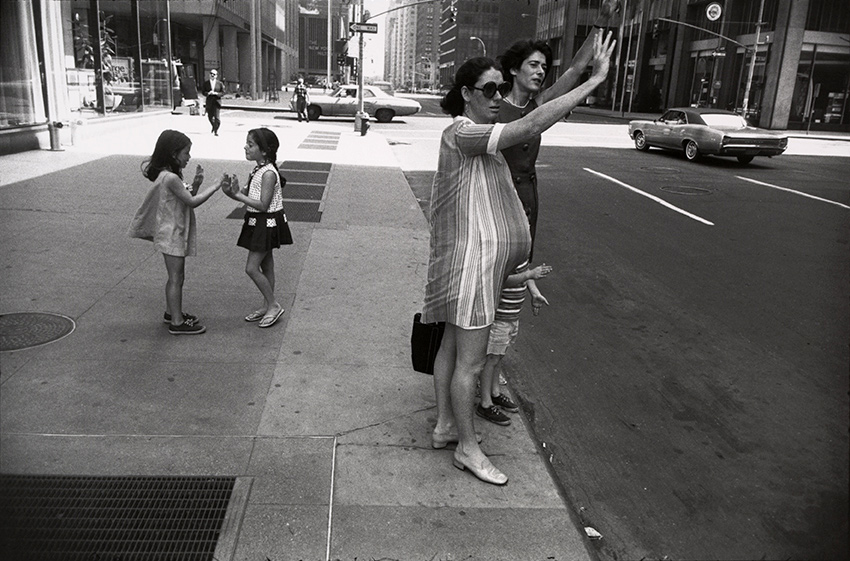
Berenice Abbott (American, 1898-1991) 'Fifth Avenue, nos. 4, 6, 8, Manhattan' March 20, 1936


Berenice Abbott (American, 1898-1991)
Fifth Avenue, nos. 4, 6, 8, Manhattan
March 20, 1936
Gelatin silver print
15 x 19 1/4″ (38.1 x 48.9cm)
The Museum of Modern Art, New York
Thomas Walther Collection
© 2012 Berenice Abbott/Commerce Graphics


A second tranche of images from this touring exhibition of photographs from the MoMA collection, presented at the Art Gallery of Western Australia in Perth. My personal favourites in this posting are the tonal Abbott, mean streets Gedney, luminous Groover and the intimate Burckhardt. There are two photographers I don’t know at all (Gedney and Burckhardt) and one who is very underrated: Peter Hujar.

Dr Marcus Bunyan


Many thankx to the AGWA for allowing me to publish the photographs in the posting. Please click on the photographs for a larger version of the image.


William Gedney (American, 1924-1989) 'Brooklyn' 1966


William Gedney (American, 1924-1989)
Brooklyn
1966
Gelatin silver print
7 9/16 x 11 5/16″ (19.3 x 28.8cm)
The Museum of Modern Art, New York
Gift of the Duke University Rare Book, Manuscript, and Special Collections Library
© 2012 Estate of William Gedney


William Gale Gedney (October 29, 1932 – June 23, 1989) was an American photographer. It wasn’t until after his death that his work gained momentum and his work is now widely recognised… William Gedney died of AIDS in 1989, aged 56, in New York City and is buried in Greenville, New York, a few short miles from his childhood home. He left his photographs and writings to his lifelong friend Lee Friedlander.

Text from the Wikpedia website

See more photographs by William Gedney on the Duke Libraries website and on The Selvedge Yard website


Jan Groover (American, 1943-2012) 'Untitled' 1981


Jan Groover (American, 1943-2012)
Untitled
1981
Platinum/palladium print
7 5/8 x 9 1/2″ (19.4 x 24.2cm)
The Museum of Modern Art, New York
Gift of Howard Stein
© 2012 Jan Groover


“Depicting the iconic New York that captivates the world’s imagination and the idiosyncratic details that define New Yorkers’ sense of home, this exhibition from MoMA’s extraordinary photography collection celebrates the city in all its vitality, ambition and beauty. Made by approximately 90 artists responding to the city as well as professionals on assignment, including Henri Cartier-Bresson, Walker Evans, Lewis Hine, Helen Levitt, Cindy Sherman, Alfred Stieglitz, and Weegee, over 150 works reveal the deeply symbiotic relationship between photography and the ‘city that never sleeps’ – New York. Both an exploration of the life of the city and a documentation of photography’s evolution throughout the twentieth century, Picturing New York celebrates the great and continuing tradition of capturing the grit and glamour of one of the world’s greatest urban centres.

Artists include Berenice Abbott, Diane Arbus, Henri Cartier-Bresson, Walker Evans, Lee Friedlander, Nan Goldin, Helen Levitt, Cindy Sherman, Alfred Stieglitz, Paul Strand, Weegee, and Garry Winogrand, among many others.”

Text from the AGWA website


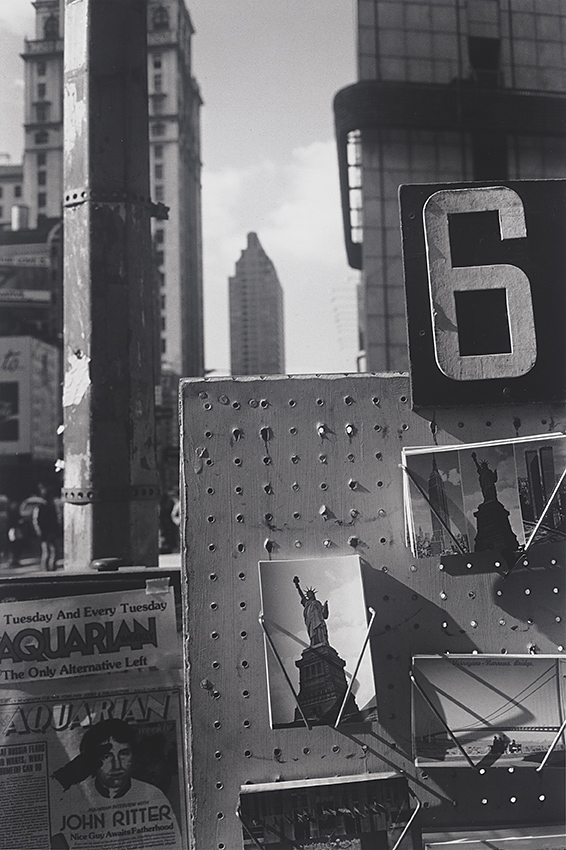
Lisette Model (American born Austria, 1901-1983) 'Times Square' 1940


Lisette Model (American born Austria, 1901-1983)
Times Square
1940
Gelatin silver print
15 9/16 x 19 9/16″ (39.6 x 49.7cm)
The Museum of Modern Art, New York
Gift of the photographer
© 2012 Estate of Lisette Model, courtesy Baudoin Lebon Gallery, Paris and Keitelman Gallery, Brussels


Garry Winogrand (American, 1928-1984) 'New York City' 1968


Garry Winogrand (American, 1928-1984)
New York City
1968
Gelatin silver print
8 7/8 x 13 3/16″ (22.5 x 33.5cm)
The Museum of Modern Art, New York
Purchase and gift of Barbara Schwartz in memory of Eugene M. Schwartz
© The Estate of Garry Winogrand, courtesy Fraenkel Gallery


Henri Cartier-Bresson (French, 1908-2004) 'Near the Hall of Records, New York' 1947


Henri Cartier-Bresson (French, 1908-2004)
Near the Hall of Records, New York
1947
Gelatin silver print
15 5/16 x 22 13/16″ (38.9 x 57.9cm)
The Museum of Modern Art, New York
Gift of the photographer
© 2012 Henri Cartier-Bresson/Magnum, courtesy Foundation HCB, Paris


Rudy Burckhardt (American born Switzerland, 1914-1999) 'A View From Brooklyn I' 1954


Rudy Burckhardt (American born Switzerland, 1914-1999)
A View From Brooklyn I
1954
Gelatin silver print
10 5/16 x 9 3/16″ (26.2 x 23.4cm)
The Museum of Modern Art, New York
Gift of CameraWorks, Inc. and Purchase
© 2012 Rudy Burckhardt / Artists Rights Society (ARS), New York


Rudy Burckhardt (1914, Basel – 1999) was a Swiss-American filmmaker, and photographer, known for his photographs of hand-painted billboards which began to dominate the American landscape in the nineteen-forties and fifties.

Burckhardt discovered photography as a medical student in London. He left medicine to pursue photography in the 1930s. He immigrated to New York City in 1935. Between 1934 and 1939, he traveled to Paris, New York and Haiti making photographs mostly of city streets and experimenting with short 16mm films. While stationed in Trinidad in the Signal Corps from 1941-1944, he filmed the island’s residents. In 1947, he joined the Photo League in New York City. Burckhardt married painter Yvonne Jacquette whom he collaborated with throughout their 40 year marriage. He taught filmmaking and painting at the University of Pennsylvania from 1967 to 1975.

On his 85th birthday, Burckhardt committed suicide by drowning in the lake on his property.

Text from the Wikipedia website


Rudy Burckhardt and Edwin Denby
The Climate of New York
1980


Trailer for Rudy Burckhardt Films from Tibor de Nagy Gallery on Vimeo.


Lee Friedlander (American, b. 1934) 'New York City' 1980


Lee Friedlander (American, b. 1934)
New York City
1980
Gelatin silver print
18 5/8 x 12 3/8″ (47.3 x 31.5cm)
The Museum of Modern Art, New York
The Family of Man Fund
© 2012 Lee Friedlander


Underwood and Underwood (American, active 1880-1934) 'Above Fifth Avenue, Looking North' 1905


Underwood and Underwood (American, active 1880-1934)
Above Fifth Avenue, Looking North
1905
Gelatin silver print
9 1/2 x 7 5/16″ (24.2 x 18.6cm)
The Museum of Modern Art, New York
The New York Times Collection


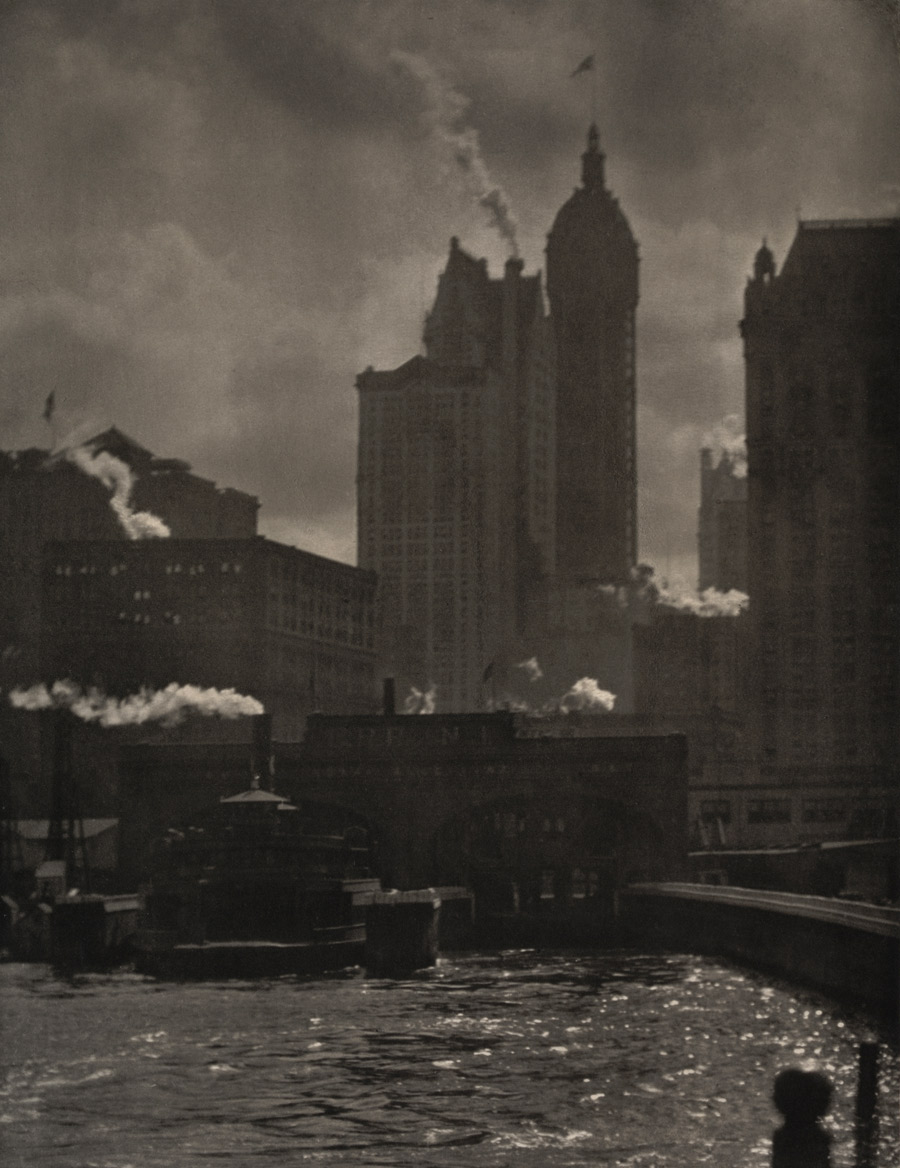
Alfred Stieglitz (American, 1864-1946) 'City of Ambition' 1910


Alfred Stieglitz (American, 1864-1946)
City of Ambition
1910
Photogravure
13 3/8 x 10 1/4″ (34 x 26.1cm)
The Museum of Modern Art, New York
© 2012 Estate of Alfred Stieglitz / Artists Rights Society (ARS), New York


Peter Hujar (American, 1934-1987) 'New York Series #22' 1976


Peter Hujar (American, 1934-1987)
New York Series #22
1976
Gelatin silver print
14 5/8 x 14 3/4″ (37.1 x 37.4cm)
The Museum of Modern Art, New York
Gift of the Estate of Peter Hujar and James Danziger Gallery, New York
© 2012 Peter Hujar Archive


Peter Hujar (October 11, 1934 – November 26, 1987) was an American photographer known for his black and white portraits. Born in Trenton, New Jersey, United States. Hujar later moved to Manhattan to work in the magazine, advertising, and fashion industries. His subjects also consisted of farm animals and nudes. His most famous photograph is Candy Darling on Her Deathbed which was later used by the group Antony and the Johnsons as cover for their album I Am a Bird Now. The one-time lover, friend and mentor of artist David Wojnarowicz, Hujar died of AIDS complications on November 26, 1987, aged 53.

See the more photographs on the Peter Hujar Archive website


Fairchild Aerial Surveys, Inc. 'The Mount Everest of Manhattan: The Silvered Peak of the Chrysler Building' 1930


Fairchild Aerial Surveys, Inc.
The Mount Everest of Manhattan: The Silvered Peak of the Chrysler Building
1930
Gelatin silver print
8 3/4 x 6 13/16″ (22.3 x 17.3cm)
The Museum of Modern Art, New York
The New York Times Collection


Walker Evans (American, 1903-1975) 'Girl in Fulton Street, New York 1929' 1929


Walker Evans (American, 1903-1975)
Girl in Fulton Street, New York 1929
1929
Gelatin silver print
7 1/2 x 4 5/8″ (19.1 x 11.7cm)
The Museum of Modern Art, New York
Gift of the photographer


Lewis W. Hine (American, 1874–1940) 'Italian Family Looking for Lost Baggage, Ellis Island, New York' 1905


Lewis W. Hine (American, 1874-1940)
Italian Family Looking for Lost Baggage, Ellis Island, New York
1905
Gelatin silver print
5 9/16 x 4 5/16″ (14.1 x 10.9cm)
The Museum of Modern Art, New York


Art Gallery of Western Australia
Perth Cultural Centre, James Street Mall, Perth

Opening hours:
Wednesday – Monday 10am – 5pm
Closed Tuesdays

AGWA website

LIKE ART BLART ON FACEBOOK

Back to top

Exhibition: ‘open spaces | secret places: composite works from the collection’ at Museum Der Moderne Salzburg

Exhibition dates: 20th October 2012 – 3rd March 2013


Many thankx to the Museum Der Moderne Salzburg for allowing me to publish the text and photographs in the posting. Please click on the photographs for a larger version of the image.
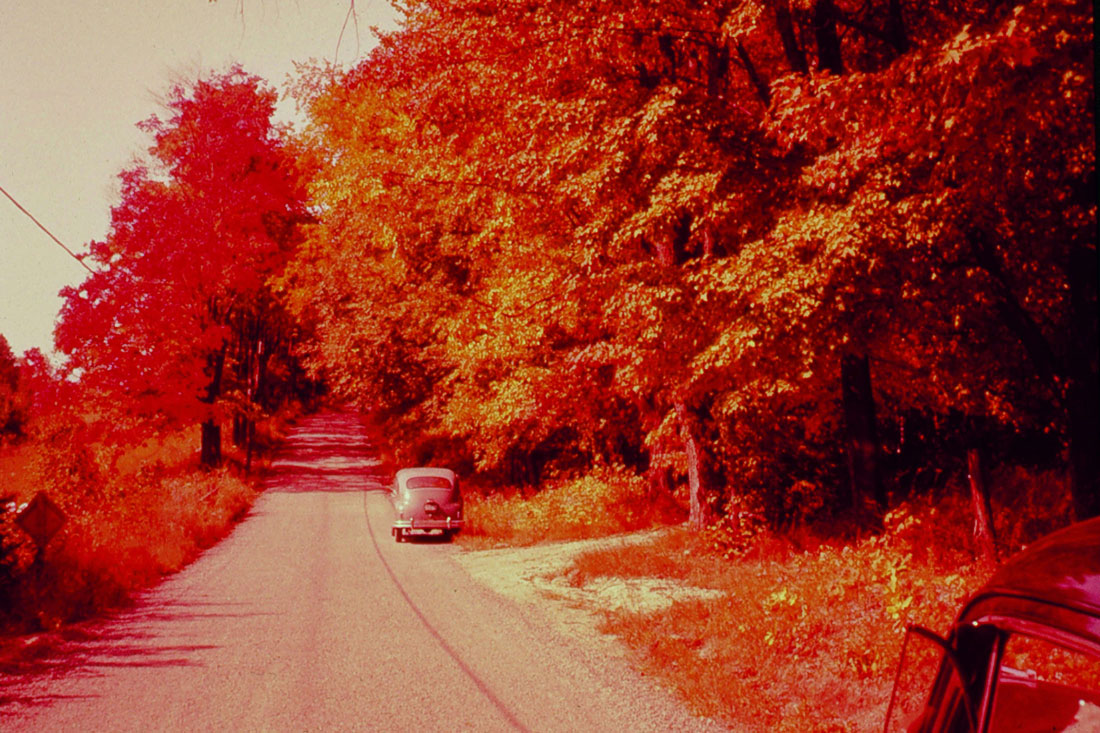
 

Janet Cardiff / George Bures Miller. 'Road Trip' 2004


Janet Cardiff / George Bures Miller
Road Trip
2004
Dia-und Audioinstallation
Fotos: Anton Bures, Ton: Janet Cardiff und George Bures Miller
15 Minuten / Loop
© Janet Cardiff/George Bures Miller / SAMMLUNG VERBUND, Wien
Courtesy the artists, Galerie Barbara Weiss, Berlin


Anthony McCall (British, b. 1946) 'Line Describing a Cone' 1973


Anthony McCall (British, b. 1946)
Line Describing a Cone
1973
16-mm-Film, s/w, ohne Ton; Installation
30 Minuten
© Anthony McCall / SAMMLUNG VERBUND, Wien
Courtesy the artist and Gagosian Gallery, Paris/London
Foto: Hank Graber, © Whitney Museum of American Art, New York


In the exhibition open spaces | secret places, the MUSEUM DER MODERNE SALZBURG is showing artistic positions from 1970 until today from the SAMMLUNG VERBUND. The phenomenons of the perception of spaces and places will be visualised. The first part of the exhibition is dedicated to the medium of photography. Jeff Wall stages mysterious fragments of urban environments in peripheral area. Joachim Koester, Bernd and Hilla Becher, Tom Burr, Teresa Hubbard / Alexander Birchler and David Wojnarowicz explore the fragility of the present in the light of historical changes of space and time. Louise Lawler draws our attention to places where works of art are stored and presented. Janet Cardiff / George Bures Miller stage a journey through memories as an audiovisual space of experience…

The increasing spatialisation of art goes hand in hand with our life style, which has changed considerably in social and cultural terms as a result of new spatial conditions (virtual space, increased mobility). It is this fluctuating presence which seems to make us more acutely aware of our location. In the past we asked other people on the telephone “How are you?”, today we ask “Where are you?

All text from the Museum Der Moderne Salzburg website (including below)
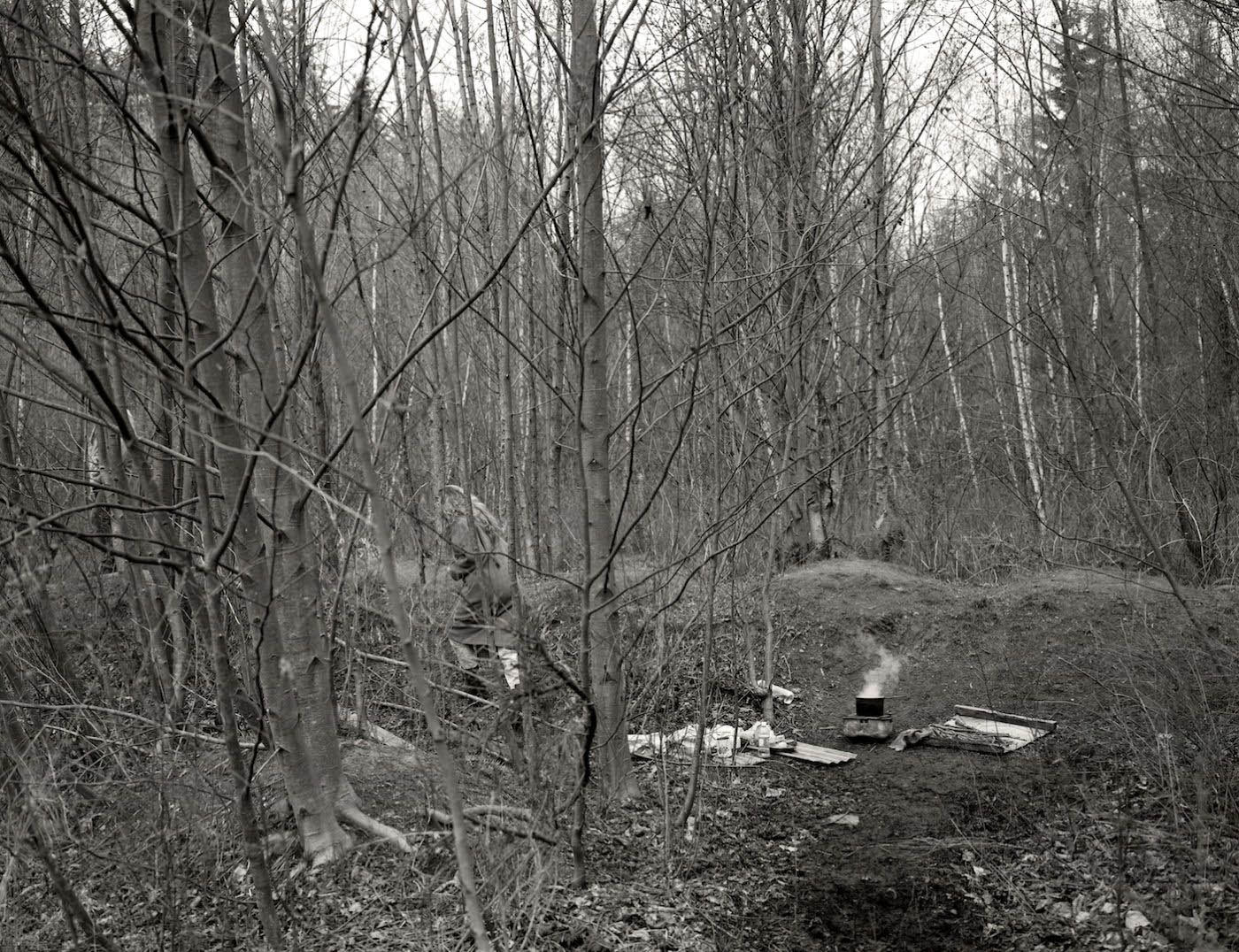
 

Jeff Wall (American, b. 1946) 'Forest' 2001


Jeff Wall (American, b. 1946)
Forest
2001
Jeff Wall / SAMMLUNG VERBUND, Wien
Courtesy Jeff Wall Studio, Vancouver and Marian Goodman Gallery, New York/Paris
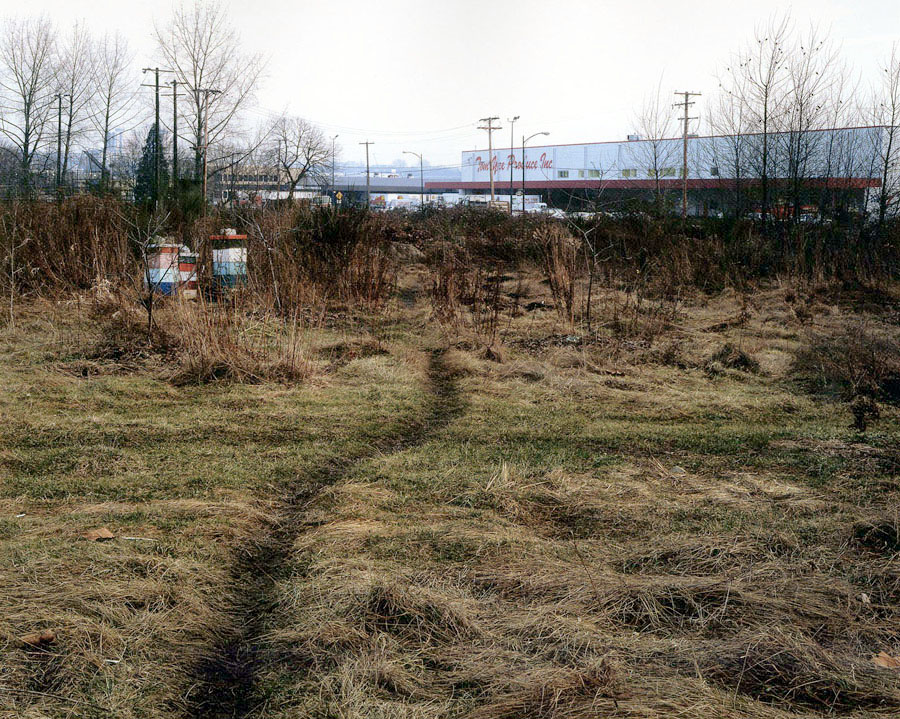
 

Jeff Wall (American, b. 1946) 'The Crooked Path' 1991


Jeff Wall (American, b. 1946)
The Crooked Path
1991
Grossbilddia in Leuchtkasten
Jeff Wall / SAMMLUNG VERBUND, Wien
Courtesy Jeff Wall Studio, Vancouver and Marian Goodman Gallery, New York/Paris


Jeff Wall

Boys Cutting Through a Hedge, 2003
The Crooked Path, 1991
Forest, 2001

For more than thirty years now, Jeff Wall has been best known for his large-format light boxes in which the colours of his giant transparencies are brilliantly illuminated. In the first few decades of his career, he was celebrated as a peintre de la vie moderne [the painter of modern life] – to use Charles Baudelaire’s term – on account of his ability to combine traditional composition with themes of modern life. For the past decade, however, he has produced a number of large format black-and-white photographs that clearly belong in the context of his affinity for traditional documentary photography or straight photography. The group of three photographs in the SAMMLUNG VERBUND shows peripheral, unimportant places, underscoring Wall’s interest in the “unofficial use of places” (Jeff Wall). In Forest two people are claiming a makeshift private territory in a forest. The Crooked Path and Boys Cutting Through a Hedge, meanwhile, show places in which people have to find their way on the other side of conventional topography.
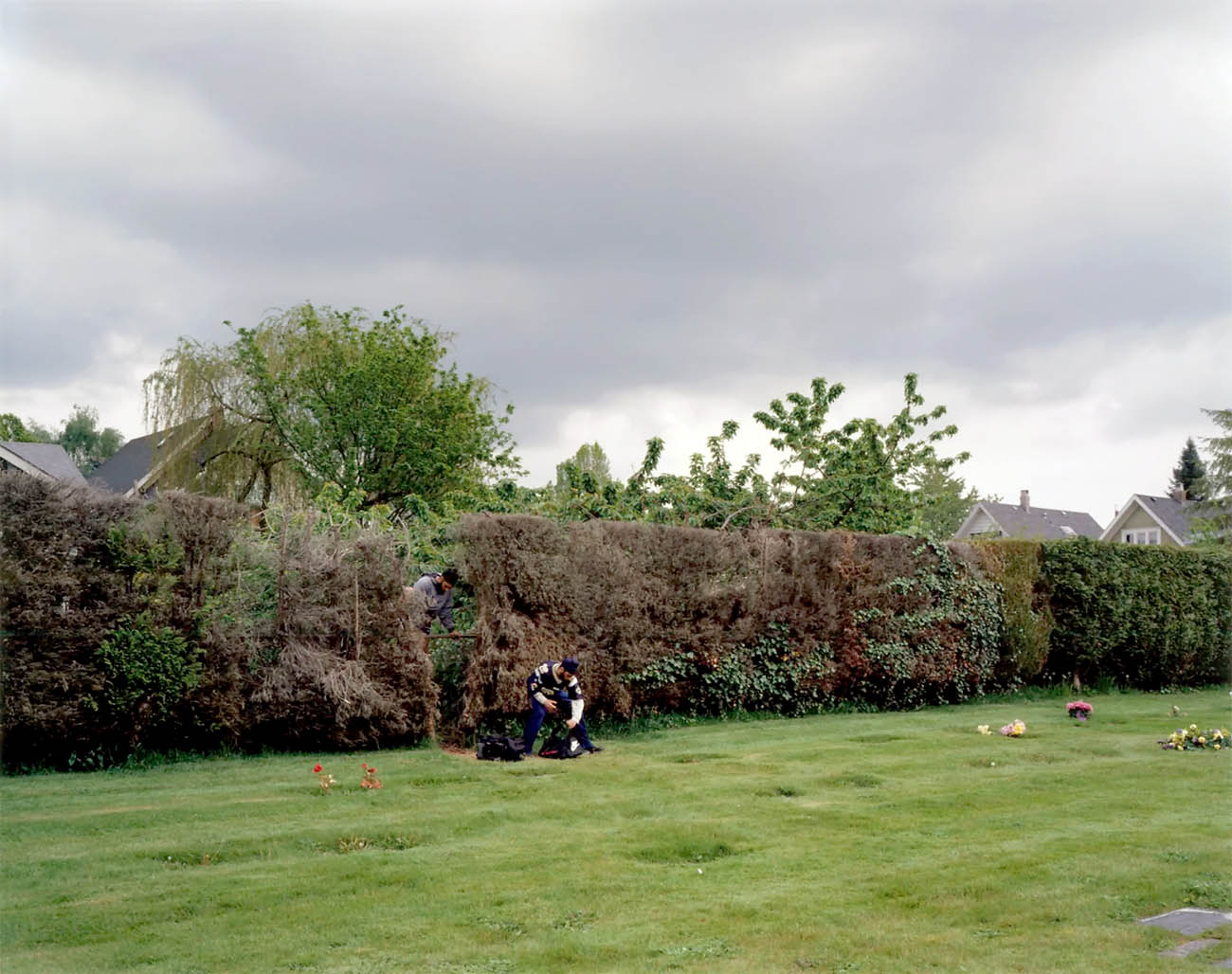
 

Jeff Wall (American, b. 1946) 'Boys Cutting Through a Hedge' 2003


Jeff Wall (American, b. 1946)
Boys Cutting Through a Hedge
2003
Grossbilddia in Leuchtkasten
Jeff Wall / SAMMLUNG VERBUND, Wien
Courtesy Jeff Wall Studio, Vancouver and Marian Goodman Gallery, New York/Paris
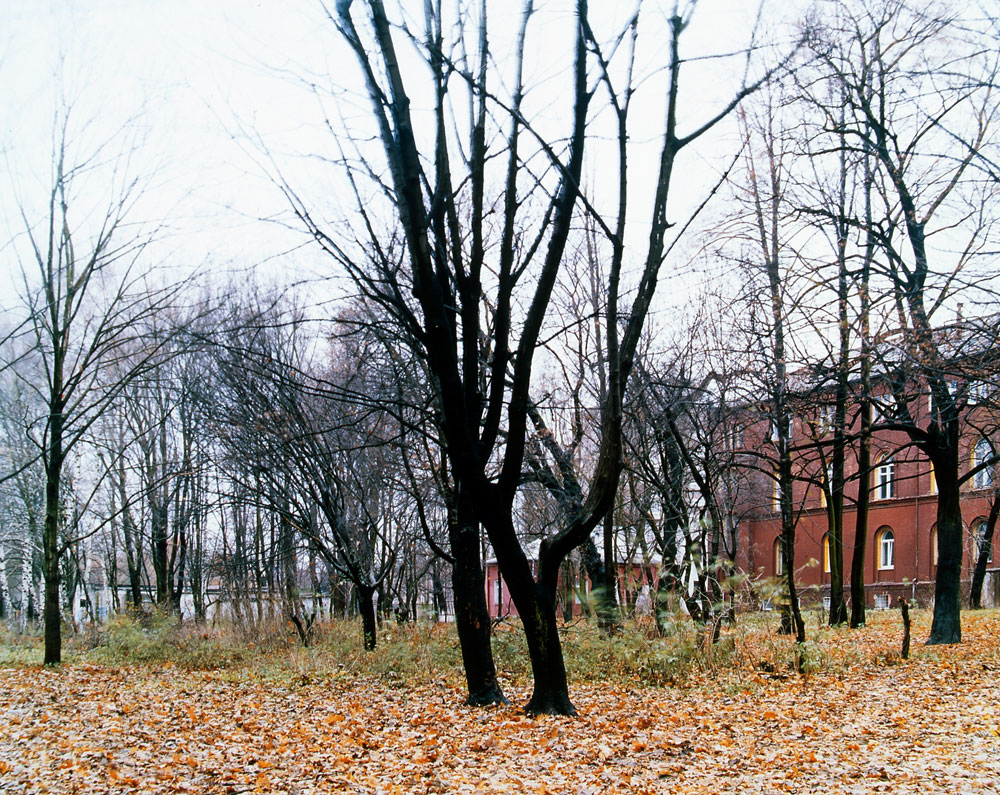
 

Joachim Koester (Danish, b. 1962) 'The Kant Walks' 2003-2004


Joachim Koester (Danish, b. 1962)
The Kant Walks
2003-2004
Aus der 7-teiligen Serie
C-Print
47.5 x 60.3cm
© Joachim Koester / SAMMLUNG VERBUND, Wien
Courtesy the artist and Galerie Jan Mot, Brussels


Joachim Koester

The Kant Walks, 2003-2004
histories, 2003-2005

Historically and philosophically charged places form the prime themes in the photographical work of Danish artist Joachim Koester. The series The Kant Walks follows the great philosopher’s daily and precisely scheduled walks through his hometown Kaliningrad (formerly known as Königsberg), which Kant allegedly never left throughout his life. Drifting through Kaliningrad’s “psychogeography” (Joachim Koester), the artist rediscovers Kant’s walks. His photographs evoke impressions, both from the past and the present, as they visualise overgrown roads, disintegrating concrete buildings, and presumably abandoned and forgotten places.

Likewise, Koester creates a link to the past in histories. Juxtaposing historic, not less than 30 year old photographs – taken by Gordon Matta-Clark or Bernd and Hilla Becher to name just a few – with recently taken shots from the very same location evokes not one, but two “histories”: that of conceptual photography, and that of the places and events depicted.


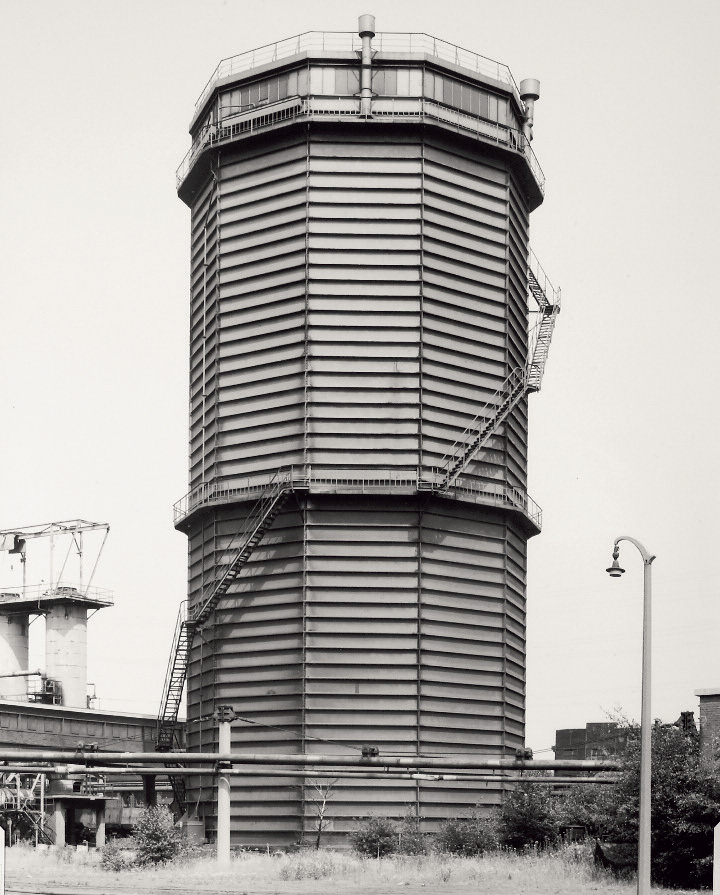
Bernd und Hilla Becher. 'Gasbehälter' 1965-2001


Bernd (German, 1931-2007) und Hilla Becher (German, 1934-2015)
Gasbehälter
1965-2001


Bernd and Hilla Becher

Entwürfe für Typologien, aufgenommen in den 1960er-Jahren, zusammengestellt 1970-1971
Gasbehälter, 1965-2001

Within 20th century art only a few artists have been able to combine their enduring artistic concept with an outstanding history of reception of their own work. The German photographer couple Bernd and Hilla Becher has been working strictly with documentary photography since the 1950s, and thus influences publications, exhibitions and art collections worldwide up to this day and even beyond the death of Bernd Becher in 2007, providing crucial impulses for the theory and history of art.

Ever since they started working together, Bernd and Hilla Becher were creating an inventory of industrial architecture, both in Europe and in the United States. Their black-and-white photographs depict furnaces, water towers, winding towers, factory buildings, cement and lime plants, entire mining sites as well as timbered houses. A sense of objectivity is innate to their approach to documentary photography. Bernd and Hilla Becher avoided any dramatic setting and confidently relied on the formal aesthetics of analog photography. Through strictly standardising the photographic process, the couple created the possibility to categorise their entire work in typologies, adding a whole new and important conceptual level to their oeuvre.


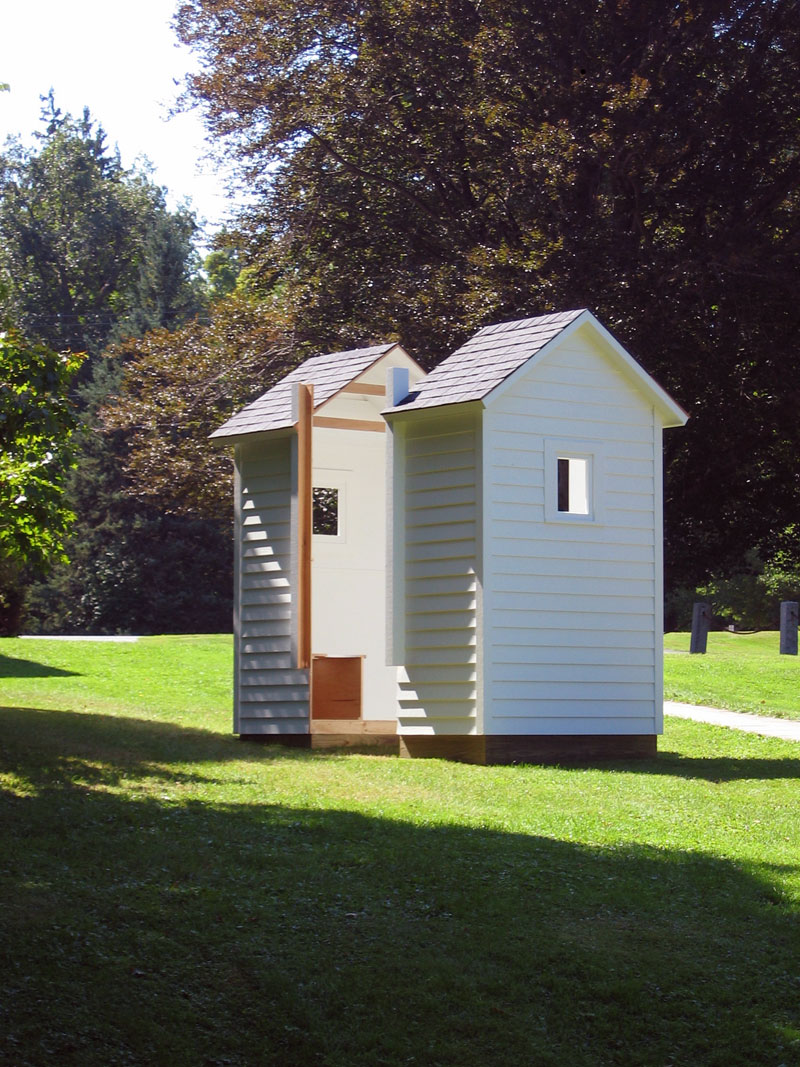
Tom Burr. 'Split' 2005


Tom Burr (American, b. 1963)
Split
2005
Lackiertes Sperrholz, Zedernschindeln, Asphaltschindeln
285 x 248 x 157cm
© Tom Burr / SAMMLUNG VERBUND, Wien
Courtesy the artist and Galerie NEU, Berlin


Tom Burr

Split, 2005
Unearthing the Public Restroom, 1994

Tom Burr addresses a long-obsolete phenomenon. In 2005, he presented a white wooden house cut in two halves, entitled Split, outside on a lawn. Burr’s house is a response to the multiple-seat outhouse from the premodern era. Despite (or perhaps because of) the cramped conditions, he sees in it the symbol of “a lost type of intimacy”, repressed by our western societies from their collective consciousness “in favour of cool, smooth, and clean porcelain surfaces.” Considering Burr’s penchant for referencing selected avant-garde works, what comes to mind in relation to this work is Marcel Duchamp’s urinal Fountaine of 1917 and certainly Matta-Clark’s bisected Splitting house, also shown in the exhibition, as well as Minimal Art. Burr stages Split with aesthetic minimalism – cool, austere, and sober. At the same time, however, he unfolds a strange associative field of uncomfortable conditions: of closeness and intimacy, shame, smell, at times even disgust. The earth toilet was common from ancient times up until the 19th century. Installing a version of it in public space today is intended to have the function of an “alien”, a foreign element. Burr’s earlier photo series Unearthing the Public Restroom of 1994 traces experiences of public access, hygiene, privacy, sexuality, criminality, and surveillance that cluster around, and in fact produce, the history of the public restroom. Crime and sexuality, particularly homosexuality, caused many of these spaces to be shut down. What interests the artist is precisely this state of non-use, of abandonment, and the ghost-like presence.
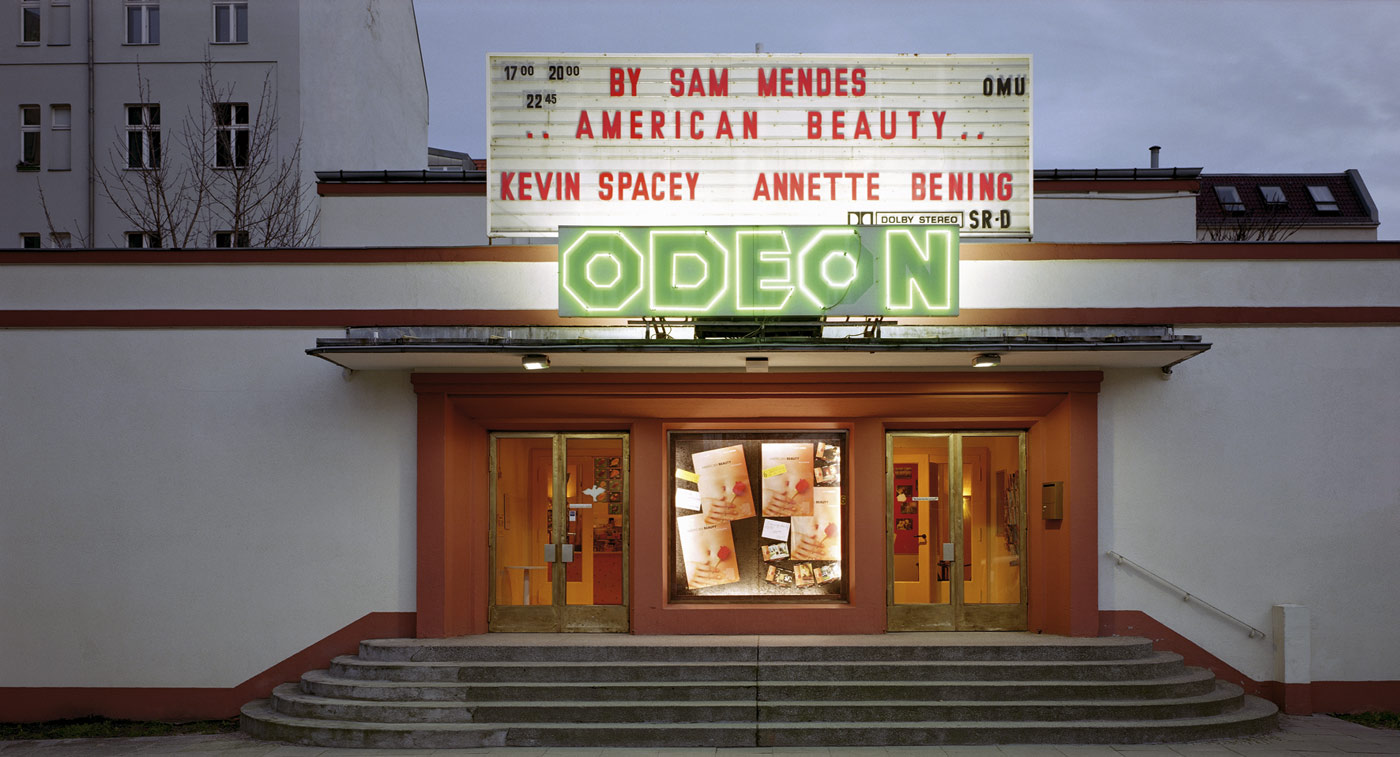
 

Teresa Hubbard / Alexander Birchler. 'Filmstills, Odeon' 2000


Teresa Hubbard / Alexander Birchler
Filmstills, Odeon
2000
Aus der 4-teiligen Serie
C-Print
140 x 259cm
© Teresa Hubbard / Alexander Birchler / SAMMLUNG VERBUND, Wien
Courtesy Teresa Hubbard / Alexander Birchler Studio, Austin, Texas


Teresa Hubbard / Alexander Birchler

Filmstills, 2000
Arsenal, 2000

The photo work Filmstills, created in 2000, marks a crucial step in the oeuvre of Teresa Hubbard and Alexander Birchler. Up to this work, the two Irish-Swiss artists were mainly known for their large-size photo series, such as Falling Down, Holes, or Gregor’s Room which were choreographed down to the smallest detail. Filmstills was the first work done outside the studio and on the spot. Filmstills show movie theatres in Berlin, which have been getting on in years. The Rio was closed some time ago and let go to ruin, whereas the Odeon still tries to maintain its hold against the flood of standardised movieplexes. Both shots are based on the same formal principle. A very narrow detail shows the respective main entrance with the cinema’s name written in big letters. The digital processing of the photographs as well as their sizes make the viewers perceive the cinemas as film stills or clips from a movie. In contrast to filmic illusion, here reality is fictionalised. The series Arsenal delivers melancholic interior views of the deserted premises of an abandoned independent cinema in Berlin, wherein only a female usher is still present.


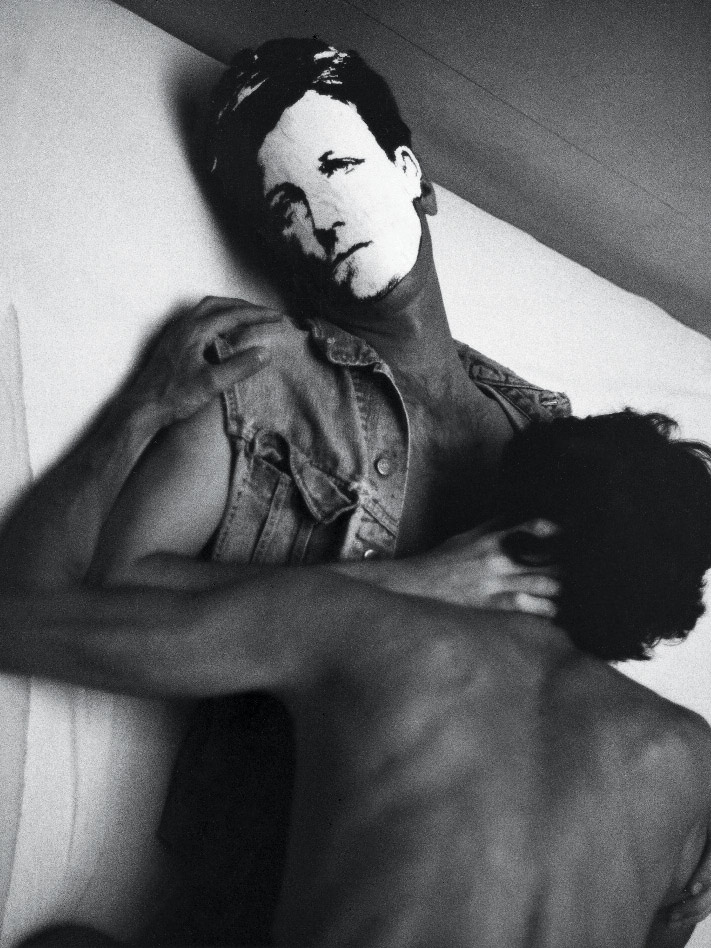
David Wojnarowicz (American, 1954-1992) 'Arthur Rimbaud in New York' 1978-1979 / 2004


David Wojnarowicz (American, 1954-1992)
Arthur Rimbaud in New York
1978-1979 / 2004
Aus der 44-teiligen Serie
Gelatinesilberabzug
32.8 x 24.5cm
© Estate of David Wojnarowicz / SAMMLUNG VERBUND, Wien
Courtesy Estate of P.P.O.W. Gallery, New York and Cabinet Gallery, London


David Wojnarowicz (American, 1954-1992) 'Arthur Rimbaud in New York' 1978-1979 / 2004


David Wojnarowicz (American, 1954-1992)
Arthur Rimbaud in New York
1978-1979 / 2004
Aus der 44-teiligen Serie
Gelatinesilberabzug
32.8 x 24.5cm
© Estate of David Wojnarowicz / SAMMLUNG VERBUND, Wien
Courtesy Estate of P.P.O.W. Gallery, New York and Cabinet Gallery, London


David Wojnarowicz

Arthur Rimbaud in New York, 1978-1979 / 2004

In the summer of 1979, David Wojnarowicz a twenty-four-year-old self-taught artist, borrowed a broken camera to produce a series of black-and-white photographs entitled Arthur Rimbaud in New York.

The Rimbaud series proposes hypothetical scenarios involving the French Symbolist outlaw poet as if he existed a century later, showing Brian Butterick, the friend and temporary lover of the artist, with a mask of Rimbaud. Arthur Rimbaud in New York tracks provocative “locations and movements.” Meatpacking district, subway, piers and Coney Island (off-season) further characterise a generally invisible marginalisation reinforced by abiding unsightliness, tawdriness, and rustication. Desolate Hudson river pier warehouses or anonymous Times Square’s red-light district allude to cavalcades of outsiders whether artists, thieves, queers, young runaways, sex workers, injection drug users, the poor, or homeless. The Rimbaud series would forge links between the artist’s engagement in his own social marginality to that of peers and prior heroes, each one demonstrating the transformative potential of creative response to existential crisis.


Louise Lawler (American, b. 1947) 'CS #204' 1990


Louise Lawler (American, b. 1947)
CS #204
1990
Cibachrom auf Polyester kaschiert
99.1 x 135.9cm
© Louise Lawler / SAMMLUNG VERBUND, Wien
Courtesy the artist and Metro Pictures, New York
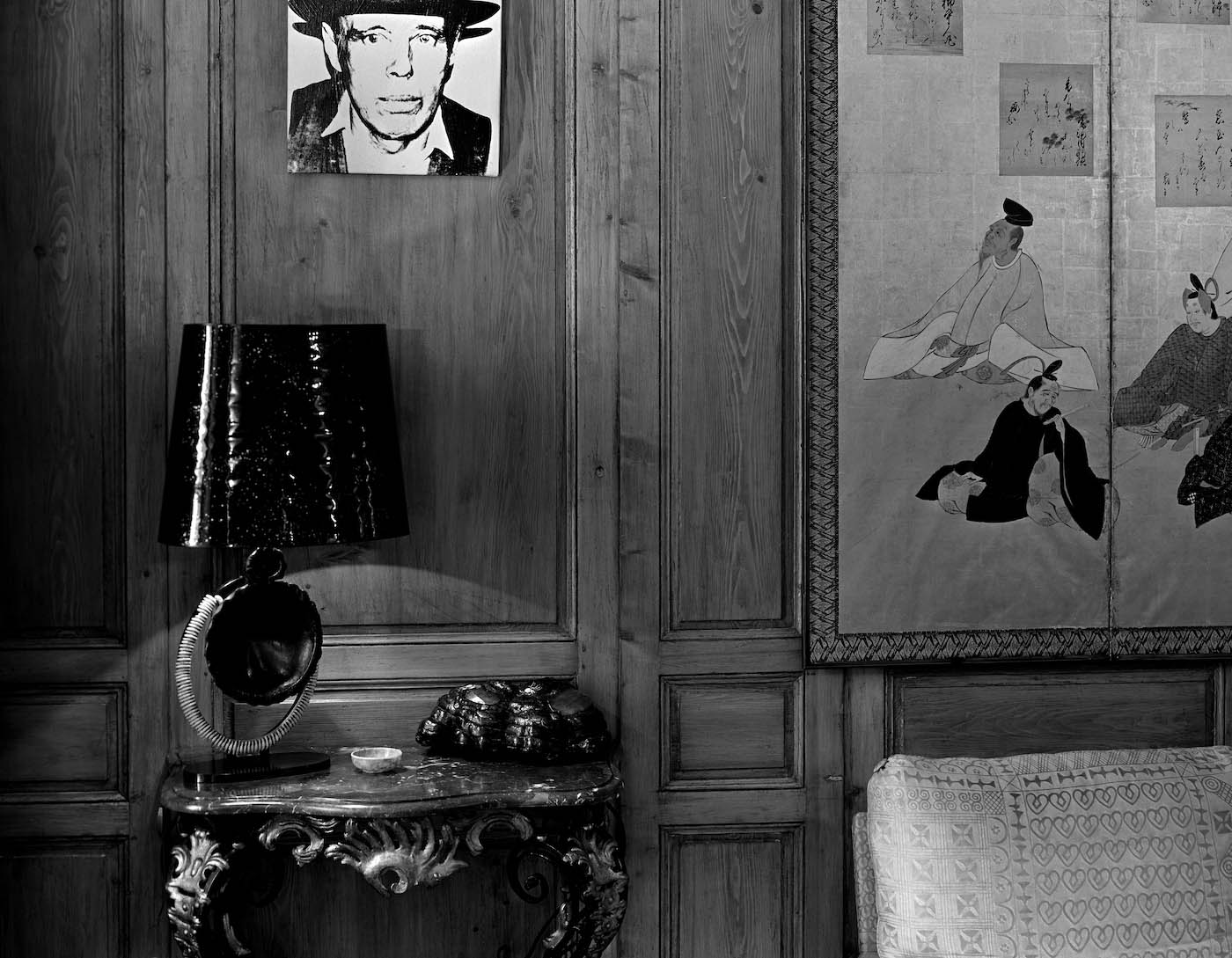
 

Louise Lawler (American, b. 1947) 'It Could Be Black and White' 1994/1996


Louise Lawler (American, b. 1947)
It Could Be Black and White
1994/1996
Gelatin silver print
© Louise Lawler / SAMMLUNG VERBUND, Wien
Courtesy the artist and Metro Pictures, New York
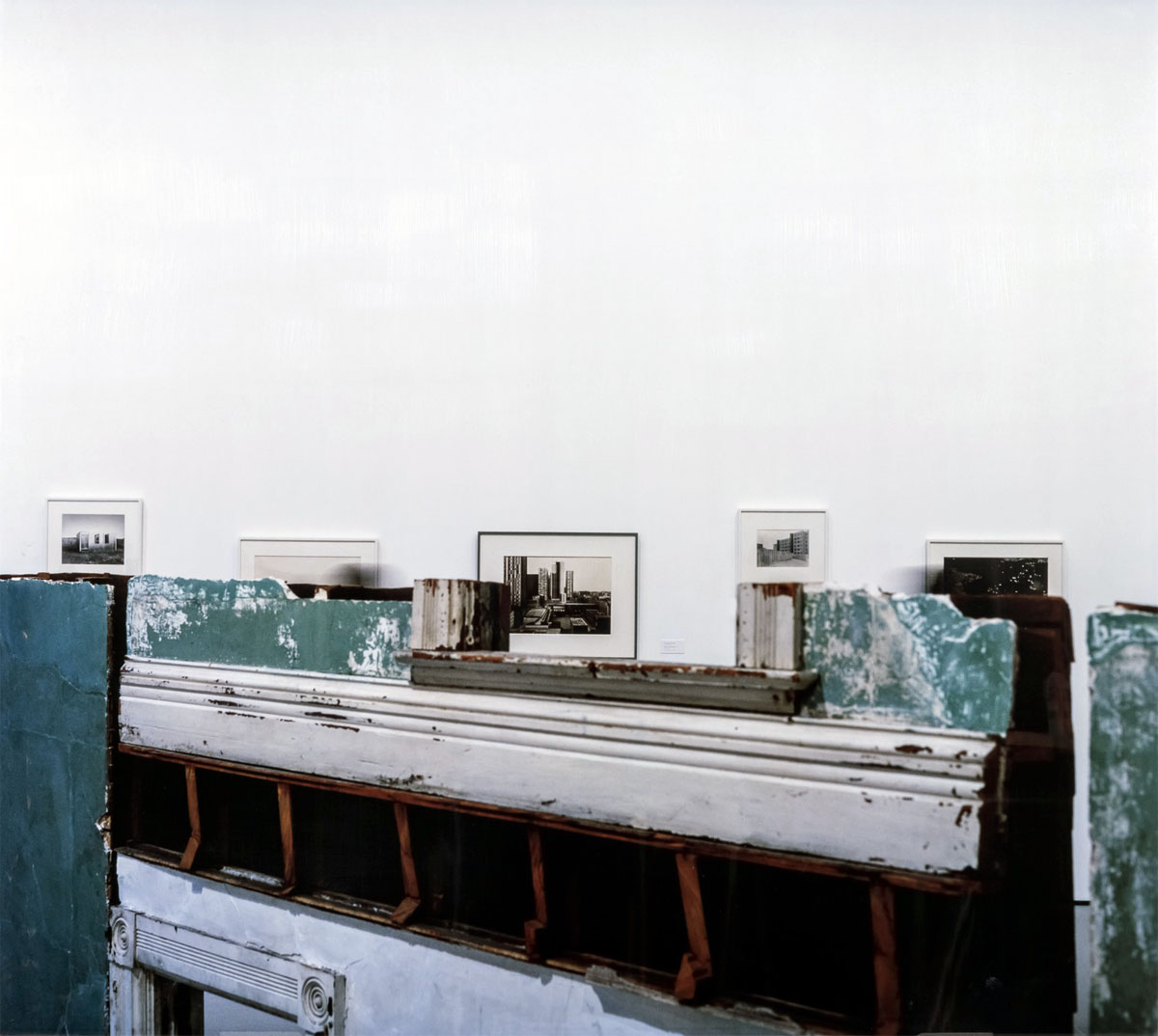
 

Louise Lawler (American, b. 1947) 'Not Yet Titled' 2004-2005


Louise Lawler (American, b. 1947)
Not Yet Titled
2004-2005


Louise Lawler is one of a group of artists associated with the so-called Pictures generation of the 1970s and 1980s. The Pictures generation conceived of the image as a “picture” – that is, as a set of representations that could be found or appropriated, was rarely original or unique, and that contradicted the claims of authenticity upheld by most modern aesthetics. Lawler’s Not Yet Titled belongs to a long series of projects that investigate the afterlife of artworks – what happens to them after they leave the artist’s studio and enter the domain of private homes or public institutions. This photograph captures Gordon Matta-Clark’s “building cut” Bingo (1974) just after it was installed in the contemporary art galleries of the recently renovated Museum of Modern Art in New York in 2004. Only the top of Bingo is visible in the near foreground, as the edges of Matta-Clark’s object alternately frames and obscures smaller black-and-white photographs of buildings by the contemporary artist Thomas Struth mounted on the gallery walls behind. Lawler’s luminous colour photograph demonstrates the ways in which an institution can change the meaning of an object, as it turns Bingo – already transformed from a building part into a sculpture – into an enigmatic framing device that calls into question the relationships between both the artworks and their context.

Exhibition brochure text from the exhibition Focus on Photography: Recent Acquisitions at the Mildred Lane Kemper Art Museum, Washington University in St. Louis, 2010
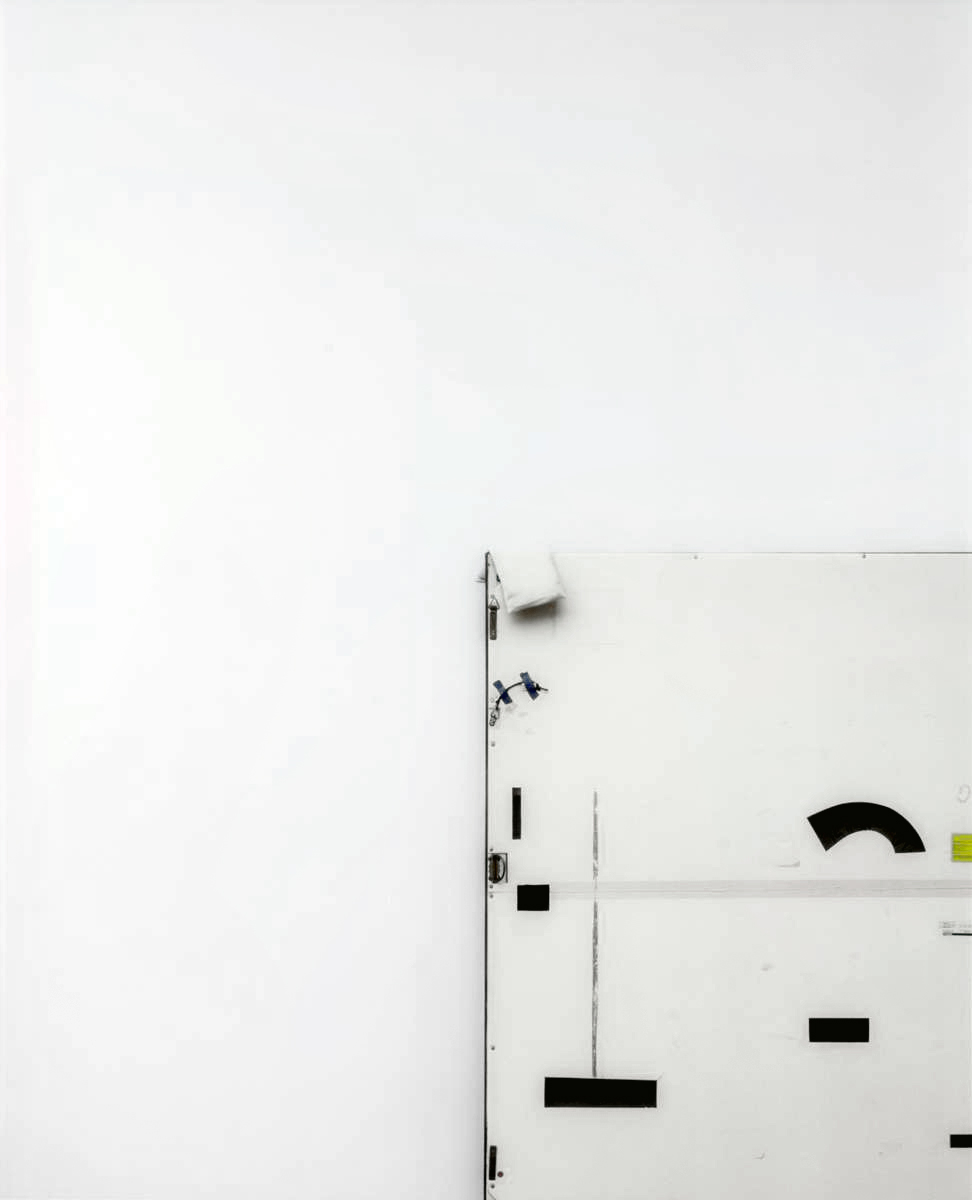
 

Louise Lawler (American, b. 1947) 'Wall Pillow' 2010, printed 2012


Louise Lawler (American, b. 1947)
Wall Pillow
2010, printed 2012
Photograph, dye destruction print on paper
© Louise Lawler / SAMMLUNG VERBUND, Wien
Courtesy the artist and Metro Pictures, New York


Louise Lawler

Not Yet Titled, 2004-2005
Abbau, 2002
Not Yet Titled, 2004-2005
CS # 204, 1990
It Could Be Black and White, 1994-1996
Wall Pillow, 2010/2012


Louise Lawler’s gaze is fixed not on a single, isolated work of art, but rather on the institutional environment in which that particular work is viewed; this, astonishingly, turns out to lend works a completely different meaning. It is the private, semi-public or public context of the gallery or the museum which constantly reshapes, redefines, and refigures a work of art. In principle, Lawler takes pictures of existing situations, in the sense that she does not rearrange the works or make any changes to their position relative to each other. She quite often adopts an off-stage stance to this end, enabling her to view an exhibition from an angle which would normally be closed to visitors.

Wall Pillow, for instance, reveals the verso of a painting, while Abbau shows the absence of art – the two nails and a spotlight shining on a bare wall are all that remains after the work itself has been removed. For what she has done is to sever the magic thread that connects the work per se to the aura it acquires through its hanging. What is evident from Not Yet Titled and CS #204, is that the artist is clearly attracted first and foremost by those works of art which she herself values highly, such as by Gordon Matta-Clark’s façades and Cindy Sherman’s self portraits. Lawler’s photographs focus on the other side of the coin of institutional art presentation. Yet for all her apparent deconstruction, one still has the feeling that she wants to “rescue” these works and in doing so restore their original dignity.
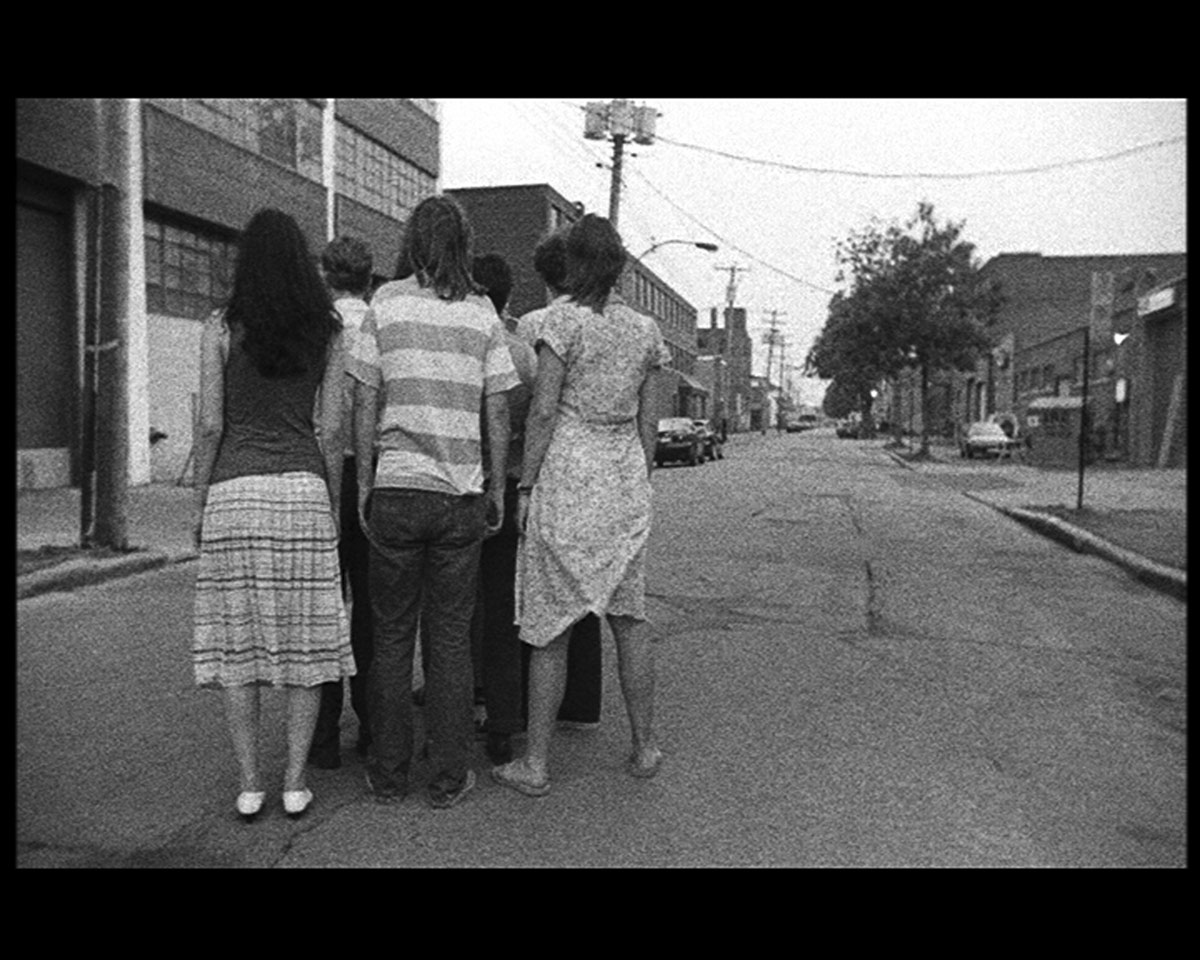
 

Ulla von Brandenburg (German, b. 1974) 'Around' 2005 (still)


Ulla von Brandenburg (German, b. 1974)
Around (still)
2005
16-mm-Film transferiert auf Digibeta PAL, s/w, ohne Ton
2:30 Minuten / Loop
© Ulla von Brandenburg / SAMMLUNG VERBUND, Wien
Courtesy the artist and Produzentengalerie, Hamburg


Ulla von Brandenburg

Around, 2005

The striking presence of female figures in Ulla von Brandenburg’s work suggests an interest in the conflicted role of nineteenth-century women and the continued complexity of the performance of gender roles and attitudes in contemporary society. Our uncertainty about the position of these women, who are frequently presented in a liminal state, and their potential vulnerability, align perfectly with von Brandenburg’s interest in shifting roles and meaning: Though commanding of attention, von Brandenburg’s female figures are often on the verge of hysteria or loss of control – a state of powerlessness that nevertheless enforces their centrality in the action taking place. The artist’s work Around, 2005 best embodies this state of deferral or ambiguity: von Brandenburg filmed a tightly packed group of figures standing in the middle of a street with their backs to the camera. As the camera travels around the group the figures shift their position so that no frontal aspect is ever revealed. A view of their faces is never revealed in this conspirative meeting. Around we go waiting for the glimpse that will reveal, well, what exactly? We are left standing in front of the projection watching this group of performers, each of us struggling to find the “right” position.
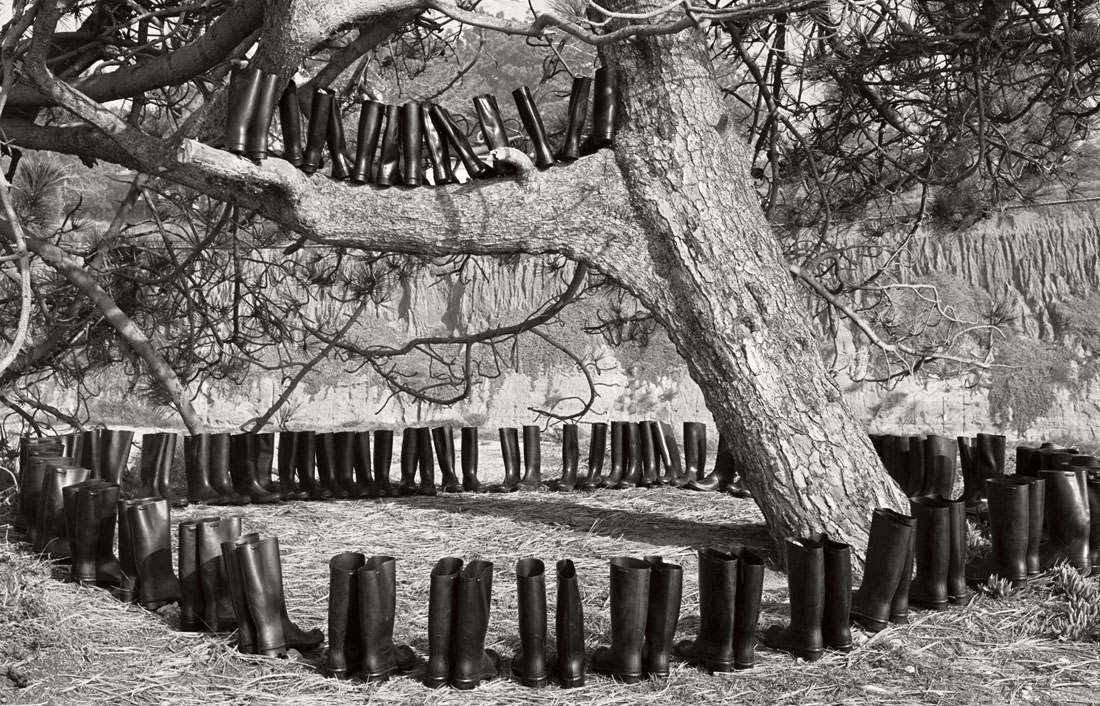
 

Eleanor Antin (American, b. 1935) '100 Boots' 1971-1973


Eleanor Antin (American, b. 1935)
100 Boots
1971-1973
100 Boots in a Field, Route 101, California.
February 9, 1971, 3:30 p.m.
Aus der 51-teiligen Serie, S/W-Postkarte
11.4 x 17.7cm
© Eleanor Antin / SAMMLUNG VERBUND, Wien
Courtesy the artist and Ronald Feldman Fine Arts, New York

.
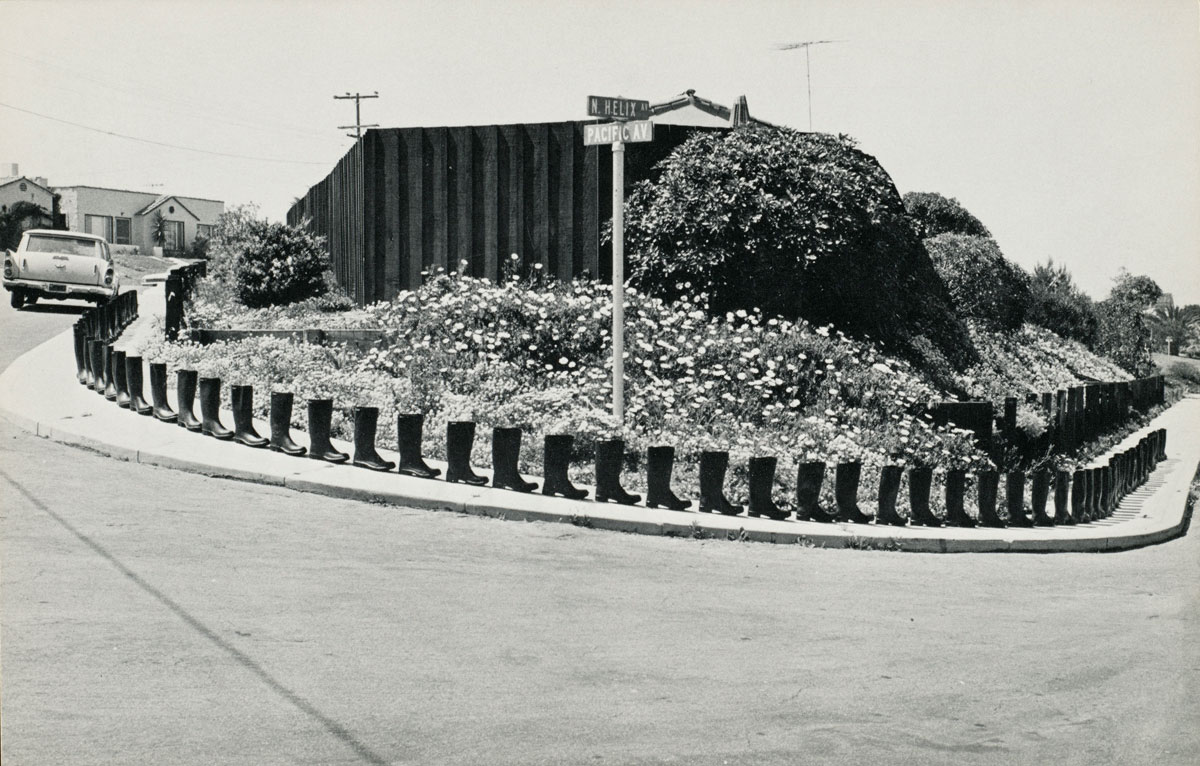
Eleanor Antin (American, b. 1935) '100 Boots' 1971-1973


Eleanor Antin (American, b. 1935)
100 Boots
1971-1973
Aus der 51-teiligen Serie, S/W-Postkarte
Eleanor Antin / SAMMLUNG VERBUND, Wien
Courtesy the artist and Ronald Feldman Fine Arts, New York


Eleonor Antin

100 Boots, 1971-1973

For her 51-piece instalment 100 Boots Eleonor Antin positioned one hundred ordinary black rubber boots on various locations all over Southern California and consequently in New York City. She took photos, printed them on postcards and assembled a mailing list of about a thousand names – mainly artists, writers, critics, galleries, universities and museums – who received the various postcards over a period of two and a half years between 1971 and 1973. The first card, 100 Boots Facing the Sea, was mailed on the Ides of March, 1971, unannounced and without further comment. A few weeks later it was followed by 100 Boots on the Way to Church and three weeks thereafter by the next one.

In a total of 51 photographs, Eleanor Antin documented the travels of the 100 Boots, her so called “hero” – from a beach close to San Diego to a church, to a bank, to the supermarket, trespassing, under the bridge, to a saloon and on their travels eastward. Finally, on May 15th, 1973 100 Boots arrived at the Museum of Modern Art in New York. By this time, 100 Boots had long become an epic visual narrative and a picaresque work of conceptual art.


Ceal Floyer (British, b. 1968) 'On Air' 2009


Ceal Floyer (British, b. 1968)
On Air
2009
Metallbox, Plexiglas, Licht, Kabel
12.6 x 25.6 x 6.2cm
© Ceal Floyer / SAMMLUNG VERBUND, Wien
Courtesy the artist and Esther Schipper, Berlin


Ceal Floyer

On Air, 2009
Me/You (Love Me Tender), 2009

The works of Ceal Floyer are minimalist and restrained. Some visitors will walk past them without even taking note of them. What the artist addresses everyday situations and activities. It is this apparent insignificance that Ceal Floyer refuses to accept, and so the conceptual strategy she pursues is interrogating our modes of perception. For her piece Me/You (Love Me Tender) from 2009, the artist installs two loudspeakers facing each other, from which the words “me” and “you” can be heard. Between them, the silence becomes palpable. The title can be read as the key to the work since it makes clear that what is heard is an excerpt from Elvis Presley’s song “Love Me Tender.” Ceal Floyer condenses love to its very essence here, namely, to the notions of “me” and “you.”

On Air (2009) is a work in which title and material are one and the same. The words “on” and “air” do not usher in the work, they are the work itself. Ceal Floyer uses the red neon letters used by radio and TV stations to signal that a live broadcast is going on and mounts them above the museum’s or gallery’s exit door. As soon as the viewer connects with the recording studio it becomes clear that this is about a shifting of our perception: We see five letters and realise that the real content of this work is what can be heard. All the sounds, voices and talks from outside the museum are put “on air” here, and the museum, the place where we have learnt to contemplate works of art in silence, pauses to listen to everyday life outside the walls of the institution.


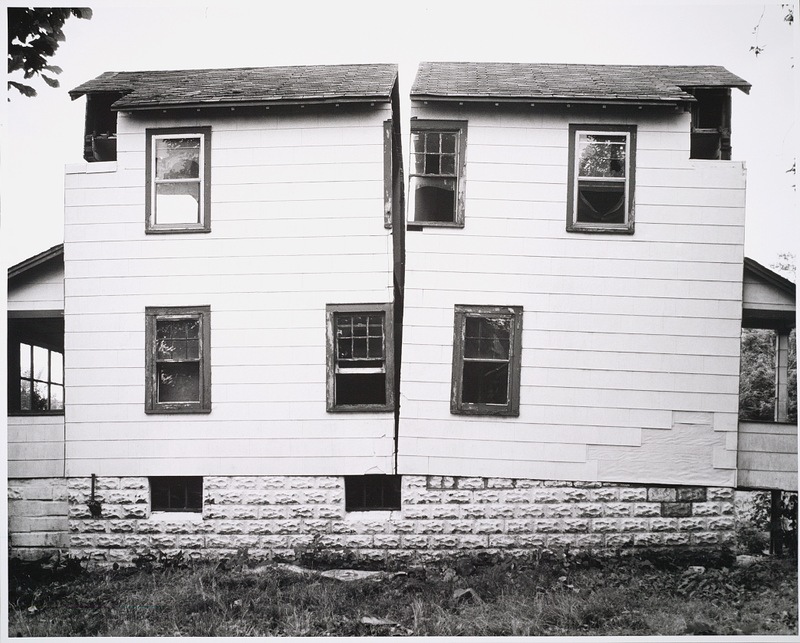
Gordon Matta-Clark (American, 1943-1978) 'Splitting (b)' 1974


Gordon Matta-Clark (American, 1943-1978)
Splitting (b)
1974
Gelatin silver print
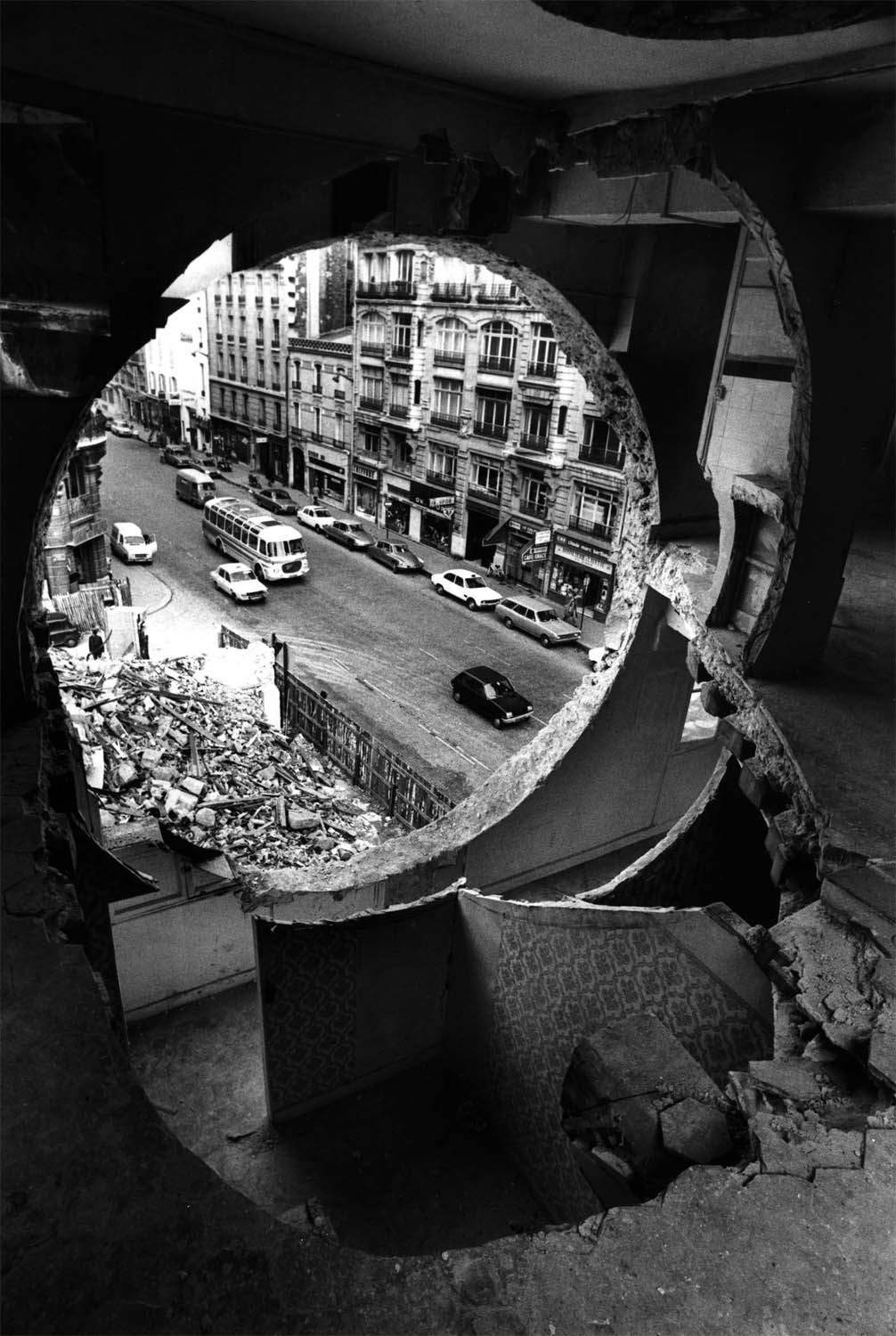
 

Gordon Matta-Clark (American, 1943-1978) 'Conical Intersect' 1975


Gordon Matta-Clark (American, 1943-1978)
Conical Intersect
1975
Gelatin silver print
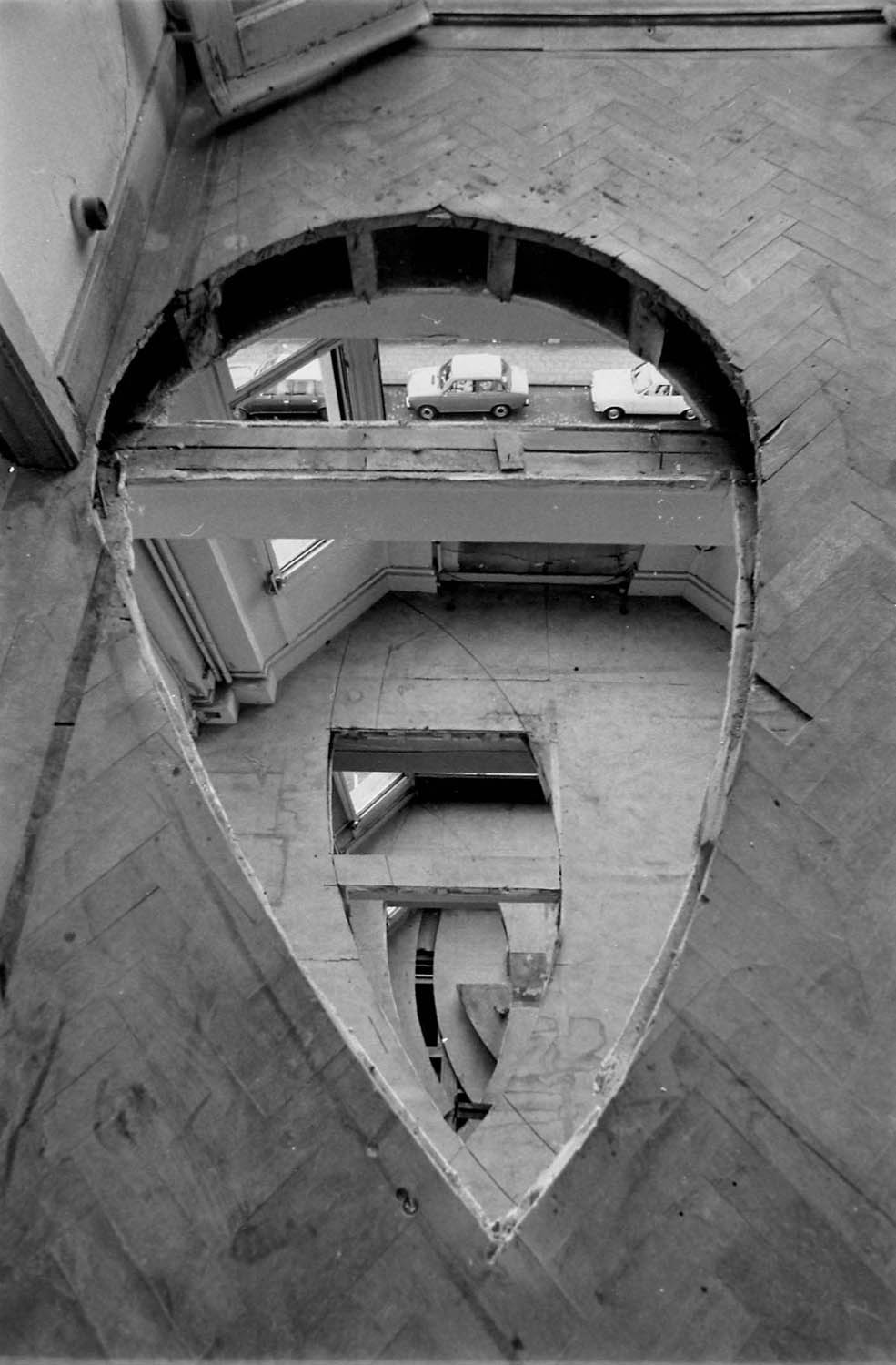
 

Gordon Matta-Clark (American, 1943-1978) 'Office Baroque' 1977/2005


Gordon Matta-Clark (American, 1943-1978)
Office Baroque
1977/2005
Gelatin silver print


Gordon Matta-Clark

Conical Intersect, 1975
Splitting: Exterior, 1974
Office Baroque, 1977/2005
Untitled (Cut Drawing), 1975
Circus No. 14 (from Circus Book), 1978
Artpark, 1974

In spring 1973 Gordon Matta-Clark presented his gallerists Holly and Horace Solomon with an unusual idea. He wanted to saw a house into two halves, and asked them if they knew of anything that might be available. As it happened, Horace Solomon had just the thing. He had bought a house in a speculative real estate deal, and it was soon to be demolished. Matta-Clark was given permission to do what he wanted with it, although it was clear that the work would not last.

Matta-Clark completely cleared the house and, taking a chain-saw and a plumb line, made two parallel incisions into the house. He then cut diagonally through one half of the foundations of house. Next, one half (weighing fifteen tons) of the house started to slope downwards until a split appeared that measured sixty centimeters at the top of the roof. Lastly, Matta-Clark sawed off the four top corners of the house. These were later exhibited as a sculpture entitled Four Corners. The whole project took about four months in total and was demolished shortly after completion. A film, a series of photographs, photomontages, and an artist’s book – all autonomous works of art in their own right – documented the process.


Museum der Moderne Salzburg
Mönchsberg 32
5020 Salzburg
Phone: +43 662 842220

Opening hours:
Tuesday – Sunday 10.00am – 6.00pm
Wednesday 10.00am – 8.00pm
Monday closed

Museum der Moderne website

LIKE ART BLART ON FACEBOOK

Back to top

Text/Exhibition: “George Platt Lynes, Minor White and ‘The Temptation of Saint Anthony Is Mirrors’ ” on the exhibition ‘HIDE/SEEK: Difference and Desire in American Portraiture’ at the Brooklyn Museum, New York

Exhibition dates: 18th November 2011 – 12th February 2012


Minor White (American, 1908-1976) 'Tom Murphy (San Francisco)' 1948


Minor White (American, 1908-1976)
Tom Murphy (San Francisco)
1948
from The Temptation of St Anthony is Mirrors 1948
Gelatin silver print
4 5/8 x 3 5/8 in. (11.7 x 9.2cm)
The Minor White Archive, Princeton University Art Museum Bequest of Minor White, MWA 48-136
© Trustees of Princeton University


“The possibility of using our bodies as a possible source of very numerous pleasures is something that is very important. For instance, if you look at the traditional construction of pleasure, you see that bodily pleasure, or pleasures of the flesh, are always drinking, eating and fucking. And that seems to be the limit of the understanding of our bodies, our pleasures ….

It is very interesting to note, for instance, that for centuries people generally, as well as doctors, psychiatrists, and even liberation movements, have always spoken about desire, and never about pleasure. “We have to liberate our desire,” they say. No! We have to create new pleasure. And then maybe desire will follow.” (My bold)


Michel Foucault 1


George Platt Lynes, Minor White and The Temptation of Saint Anthony Is Mirrors

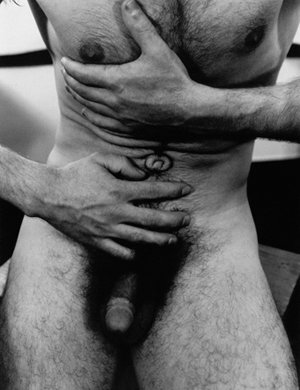
I had the great privilege of visiting The Minor White Archive at Princeton University while I was researching for my PhD. While there I studied the work cards and classic prints of the great photographer, paying particular attention to his photography of the male. What was a great surprise and delight to me were the presence of photographs of explicit sexual acts, men photographed with erections – images that have, to my knowledge, never been published. I don’t think that many people would even know that Minor White took such photographs. Although these images would have never been for public consumption it is still very unusual to find a classical photographer with such a public profile taking photographs of erect penises, especially in the 1940s!

Disturbed by having been in battle in the Second World War and seeing some of his best male friends killed, White’s early photographs of men (in their uniforms) depict the suffering and anguish that the mental and physical stress of war can cause. He was even more upset than most because he was battling his own inner sexual demons at the same time, his shame and disgust at being a homosexual and attracted to men, a difficulty compounded by his religious upbringing. In his photographs White both denied his attraction to men and expressed it. His photographs of the male body are suffused with both sexual mystery and a celebration of his sexuality despite his bouts of guilt. After the war he started to use the normal everyday bodies of his friends to form sequences of photographs, sometimes using the body as a metaphor for the landscape and vice versa. In the above photograph (Tom Murphy, left), based on a religious theme, we see a dismembered hairy body front on, the hands clutching and caressing the body, the lower hand hovering near the exposed genitalia, the upper hand cupping the breast. We see the agony and ecstasy of a homoerotic desire cloaked in a religious theme.

The image comes from the The Temptation of St Anthony is Mirrors (1948), four pages of which can be seen below. While at The Minor White Archive I looked at the only complete, undamaged book in existence. What an experience!

The book has a powerful and intense presence. It was beautifully sequenced as you would expect from Minor White and features photographs of Tom Murphy. There is a series of his hands over the back of a chair in different positions: hanging, curled, splayed, held slightly upwards, and these are paired with photographs of bare feet and turned up jeans, bare feet and rocks, and three other photographs of Tom Murphy. In an excellent paper Cruising and Transcendence in the Photographs of Minor White (Nd. Later published as an online-only feature accompanying Aperture magazine’s Spring 2015 issue, “Queer”), author Kevin Moore observes that the hand-bound volume with images paired on facing pages – “mirrors” to both one another and the artist – is a personal account as well as a meditation on the sins of the flesh.

“Temptation (which was never published or exhibited) begins with a sort of prologue, comprising a single full-length nude of Tom Murphy, White’s student and the model most commonly associated with his work. The pose is similar to those found in the beefcake pictures White was producing at this time: Murphy adopts a classical contrapposto stance and is entirely nude, his pale, wiry body positioned against a dark backdrop. A piece of driftwood at the model’s feet proposes a theme of innocence – man in his natural state. The sequence then moves to pairings of images describing man in his civilised state, featuring several loving close-ups of Murphy’s gesturing hands, a shot of his bare feet, and a single shoulder-length portrait, in which he wears a buttoned shirt and looks intently off to the side. Next, there is an interlude suggesting growing dissolution: an image of Murphy’s feet and a petrified stone is paired with a shot of Murphy in full dress slouched on a mass of rocks and staring vacantly off into the distance. The next pairing (images 9 and 10 below) accelerates the descent into temptation. Here, the pose in a second picture of Murphy’s feet suggests agitation, while a three-quarter length portrait of Murphy, crouched in the bushes and looking back over his shoulder, is as emblematic an image of cruising as White ever produced. The photographs that follow descend further into lust and self-recrimination, conveyed through photographs in which Murphy’s naked body alternates between expressions of pain and pleasure. The sequence ends with a series of beatific nudes (images 27 and 28 below), which express redemption through nonsexual treatments of the body and in the body’s juxtaposition with natural forms – a return to nature.

White may have thought at first that the sequence format would help him transcend the limits of personal biography, that he could use the breadth and fluidity of the sequence to emphasize a universal narrative while exercising control over the potentially explosive and revealing content of individual images. This proved to be overly optimistic, at least in his earliest uses of the form. White’s colleagues, for example, immediately understood Temptation for what it really was: an agonized portrayal of White’s love for his male student.”


Moore goes on to conclude that White obsfucated his sexuality, displacing gay ‘cruising’ “by a universalised mystical searching – sexual longing setting in motion a heroic search” using photography as his medium, and that his photographs became a dreamscape, perhaps even a dream(e)scape: “in which meanings are obscured, not clarified; signs are effaced, not illuminated; beauty is closeted, not set out for all to see. White was attracted to the ambiguity of the dream because it offered cover and protection but also freedom to maneuver. The dream supported the irrational, maintained a sense of mystery, and beautified frustration.”

I have to disagree with Kevin Moore. Anyone who has seen The Temptation of Saint Anthony Is Mirrors in the flesh (so to speak) can feel the absolute presence of these images, their reality, the connection between image and viewer. Maybe White was a Romantic but he was realistically romantic; his images are not dreamscapes, they offer multiple readings and contexts, insights into the human condition. Even though there was anguish and guilt present about his sexuality, channelled through his photography, anyone bold enough to take photographs of erections in 1940 has some ticker. It takes a clear eye and a courageous heart to do this, knowing what was at stake in this era of sexual repression. Beauty is not closeted here, unless I am looking at different images from Kevin Moore. In fact the magic of the photography of Minor White is his ability to modulate space, to modulate bodies so that they are beautiful, ambiguous and mystical whatever their context. Not everything in this world has to be in your face. Like a Glen Gould playing the Goldberg Variations revelation of beauty takes time, concentration and meditation.

Also, an overriding feeling when viewing the images was one of loneliness, sadness and anguish, for the bodies seemed to be observed and not partaken of, to be unavailable both physically and in a strange way, photographically. For a photographer who prided himself on revealing the spirit within, through photography, these are paradoxical photographs, visually accessible and mysteriously (un)revealing, photographs of a strange and wonderful ambivalence. Two great words: obsfucation, ambivalence. Clouded with mixed feelings and emotions, not necessarily anything to do with sexuality. Not everything has to be about sexuality. It is the difference between imbibing Freud or Jung – personally I prefer the more holistic, more inclusive, more spiritual Jung.


And so to the image of George Platt Lynes that I have paired with the nude of Tom Murphy (below).

Platt Lynes was another artist who struggled with is sexuality, but seemingly not to such an extent as Minor White did. GPL worked as a fashion photographer and had his own studio in New York where he photographed dancers, artists and celebrities among others. He undertook a series of mythological photographs on classical themes (which are amazing in composition and feature Surrealist motifs). Privately he photographed male nudes but was reluctant to show them in public for fear of the harm that they could do to his reputation and business with the fashion magazines. Generally his earlier male nude photographs concentrate on the idealised youthful body or ephebe.

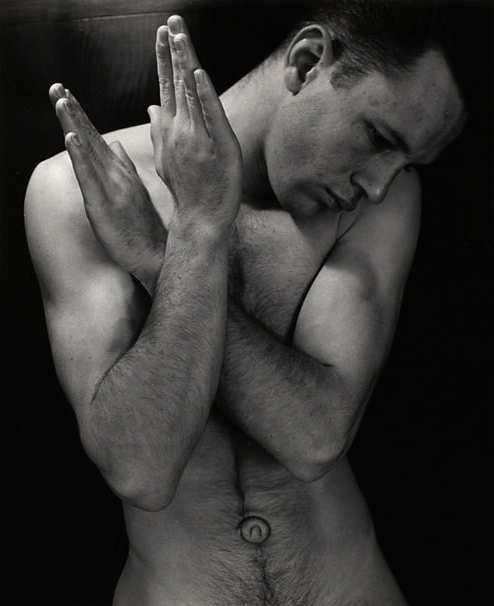
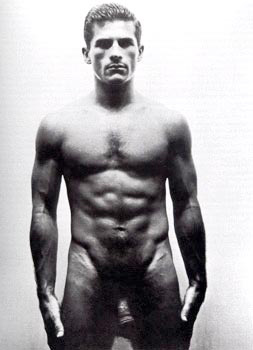
As Lynes became more despondent with his career as a fashion photographer his private photographs of male nudes tended to take on a darker and sharper edge. After a period of residence in Hollywood he returned to New York nearly penniless. His style of photographing the male nude underwent a revision. While the photographs of his European colleagues still relied on the sun drenched bodies of young adolescent males evoking memories of classical beauty and the mythology of Ancient Greece the later nudes of Platt Lynes feature a mixture of youthful ephebes and heavier set bodies which appear to be more sexually knowing. The compositional style of dramatically lit photographs of muscular torsos of older men shot in close up (see photograph below for example) were possibly influenced by a number of things – his time in Hollywood with its images of handsome, swash-buckling movie stars with broad chests and magnificent physiques; the images of bodybuilders by physique photographers that George Platt Lynes visited; the fact that his lover George Tichenor had been killed during WWII; and the knowledge that he was penniless and had cancer. There is, I believe, a certain sadness but much inner strength in his later photographs of the male nude that harnesses the inherent sexual power embedded within their subject matter.

When undertaking research into GPL’s photographs at The Kinsey Institute as part of my PhD I noted that most of the photographs had annotations in code on the back of them giving details of age, sexual proclivities of models and what they are prepared to do and where they were found. This information gives a vital social context to GPL’s nude photographs of men and positions them within the moral and ethical framework of the era in which they were made. The strong image (below) is always quoted as an example of GPL’s more direct way of photographing the male nude in the last years of his life. The male is solid, imposing, lit from above, heavy set, powerful, massive. The eyes are almost totally in shadow. Later photos have more chiaroscuro than earlier work, more use of contrasting light (especially down lit or uplit figures) but are they more direct? Yes. The men look straight into camera.

This monumentality of body and form was matched by a new openness in the representation of sexuality. There are intimate photographs of men in what seem to be post-coital revere, in unmade beds, genitalia showing or face down showing their butts off. Some of the faces in these later photographs remain hidden, as though disclosure of identity would be detrimental for fear of persecution. The photograph above is very ‘in your face’ for the conservative time from which it emerges, remembering it was the era of witch hunts against communists and subversives (including homosexuals). Conversely, this photograph is quite restrained compared to the most striking series of GPL’s photographs that I saw at The Kinsey Institute which involves an exploration the male anal area (a photograph from the 1951 series can be found in the book titled George Platt Lynes: Photographs from The Kinsey Institute). This explicit series features other photographs of the same model – in particular one that depicts the male with his buttocks in the air pulling his arse cheeks apart. After Lynes found out he had cancer he started to send his photographs to the German homoerotic magazine Der Kries under the pseudonym Roberto Rolf, and in the last years of his life he experimented with paper negatives, which made his images of the male body even more grainy and mysterious.

I believe that Lynes understood, intimately, the different physical body types that gay men find desirable and used them in his photographs. He visited Lon of New York (a photographer of beefcake men) in his studio and purchased photographs of bodybuilders for himself, as did the German photographer George Hoyningen-Huene. It is likely that these images of bodybuilders did influence his later compositional style of images of men; it is also possible that he detected the emergence of this iconic male body type as a potent sexual symbol, one that that was becoming more visible and sexually available to gay men.


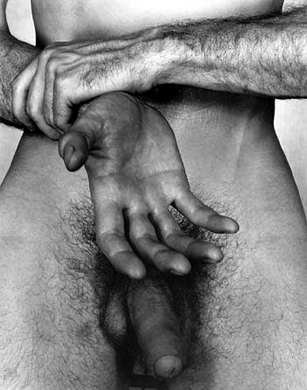
The differences between the White and GPL nudes is instructive. White: introspective, haunted, religious with an unrequited sense of longing – hands clutching self, inward pointing; GPL: more closely cropped, more open, one hand firmly grasping but the other hand open, receptive, presented to the viewer above the available phallic organ. It reminds me for some unknown reason, some quirk of my brain association, of the shell of Botticelli’s Birth of Venus (1486) inverted. There is difference between the two artists – one struggling with his sexuality, being realistically romantic, the other physically doing something about it – posting his photographs to one of the first gay magazines in the world. But both were taking photographs of intimate sexual acts that could never have been published in their lifetimes – that are still are hidden from view today. When, oh when, will someone have the courage to publish this work?

Dr Marcus Bunyan


My notes on Minor White’s photographs and notes on George Platt Lynes photographs from my Phd thesis Pressing the Flesh: Sex, Body Image and the Gay Male (2001) can be found below.


Many thankx to the Brooklyn Museum for allowing me to publish the photographs in the posting. Please click on the photographs for a larger version of the image.

1/ Gallagher, Bob and Wilson, Alexander. “Sex and the Politics of Identity: An Interview with Michel Foucault,” in Thompson, Mark. Gay Spirit: Myth and Meaning. New York: St. Martin’s Press, 1987, p.31.


Research notes on photographs from the Minor White Archive, Princeton University, New Jersey 06/08/1999

Download the Minor White research notes (85kb pdf)

Research at The Kinsey Institute , Bloomington, Indiana 16/08/1999 – 19/08/1999. George Platt Lynes photographs from the Collection at The Kinsey Institute

Download the George Platt Lynes research notes (55kb pdf)


Minor White (American, 1908-1976) 'The Temptation of Saint Anthony Is Mirrors' 1948


(top)
Minor White (American, 1908-1976)
Images 9 and 10 in the bound sequence The Temptation of Saint Anthony Is Mirrors
1948
9.3 x 11.8cm; 11.2 x 9.1cm

(bottom)
Minor White (American, 1908-1976)
Images 27 and 28 in the bound sequence The Temptation of Saint Anthony Is Mirrors
1948. 5.3 x 11.6cm; 10.6 x 8.9cm


 Minor White (American, 1908-1976) 'Tom Murphy (San Francisco)' 1948  George Platt Lynes (American, 1907-1955) 'Untitled' Nd


(left)
Minor White (American, 1908-1976)
Tom Murphy (San Francisco)
1948
from The Temptation of St Anthony is Mirrors 1948
Gelatin silver print
4 5/8 x 3 5/8 in. (11.7 x 9.2 cm)

(right)
George Platt Lynes 
(American, 1907-1955)
Untitled
Nd
Gelatin silver print


George Platt Lynes (American, 1907-1955) 'Untitled (Frontal Male Nude)' Nd (early 1950s)


George Platt Lynes (American, 1907-1955)
Untitled (Frontal Male Nude)
Nd (early 1950s)
Gelatin silver print


Thomas Eakins (American, 1844-1916) 'Walt Whitman' (American, 1818-1892) 1891


Thomas Eakins (American, 1844-1916)
Walt Whitman (American, 1818-1892)
1891
10.3 x 12.2cm
National Portrait Gallery, Smithsonian Institute


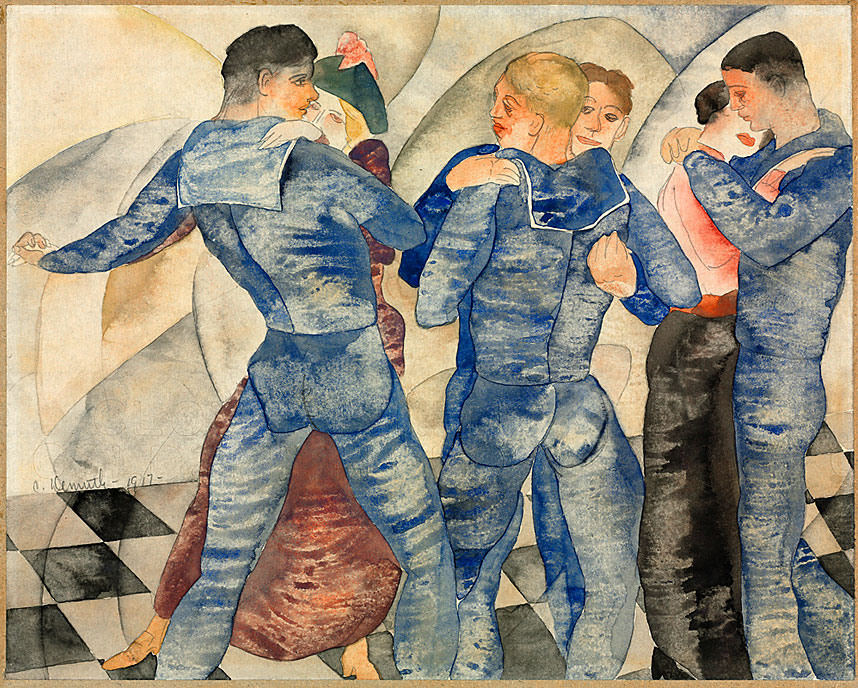
Charles Demuth (American, 1883-1935) 'Dancing Sailors' 1917


Charles Demuth (American, 1883-1935)
Dancing Sailors
1917
Watercolour and pencil on paper
20.3 x 25.4cm
Cleveland Museum of Art, Ohio; Mr and Mrs William H Marlatt Fund


George Wesley Bellows (American, 1882-1925) 'Riverfront No.1' 1915


George Wesley Bellows (American, 1882-1925)
Riverfront No.1
1915
Oil on canvas
115.3 x 160.3cm
Columbus Museum of Art, Ohio: Howald Fund Purchase


Marsden Hartley (American, 1877-1943) 'Eight Bells Folly: Memorial to Hart Crane' 1933


Marsden Hartley (American, 1877-1943)
Eight Bells Folly: Memorial to Hart Crane
1933
Oil on canvas
Gift of Ione and Hudson D. Walker
Frederick R. Weisman Art Museum, University of Minnesota


Harold Hart Crane (July 21, 1899 – April 27, 1932) was an American poet. Finding both inspiration and provocation in the poetry of T. S. Eliot, Crane wrote modernist poetry that is difficult, highly stylised, and very ambitious in its scope. In his most ambitious work, The Bridge, Crane sought to write an epic poem in the vein of The Waste Land that expressed something more sincere and optimistic than the ironic despair that Crane found in Eliot’s poetry. In the years following his suicide at the age of 32, Crane has come to be seen as one of the most influential poets of his generation…

Crane visited Mexico in 1931-32 on a Guggenheim Fellowship and his drinking continued as he suffered from bouts of alternating depression and elation … While on board the steamship SS Orizaba enroute to New York, he was beaten after making sexual advances to a male crew member, seeming to confirm his own idea that one could not be happy as a homosexual. Just before noon on April 27, 1932, Hart Crane jumped overboard into the Gulf of Mexico. Although he had been drinking heavily and left no suicide note, witnesses believed his intentions to be suicidal, as several reported that he exclaimed “Goodbye, everybody!” before throwing himself overboard. (The legend among poets is: He walked to the fantail, took off his coat quietly, and jumped.) His body was never recovered.

Text from the Wikipedia website


Peter Hujar (1937-1987) 'Susan Sontag' (1933-2004) 1975


Peter Hujar (American, 1937-1987)
Susan Sontag (American, 1933-2004)
1975
Gelatin silver print
National Portrait Gallery, Smithsonian Institute
© Estate of Peter Hujar


Keith Haring (American, 1958-1990). 'Unfinished Painting' 1989


Keith Haring (American, 1958-1990)
Unfinished Painting
1989
Acrylic on canvas
100 x 100cm
Courtesy of Katia Perlstein, Brussels, Belgium
© Keith Haring Foundation


David Wojnarowicz (American, 1954-1992) 'A Fire In My Belly' (Film In Progress) (film still), 1986-87


David Wojnarowicz (American, 1954-1992)
A Fire In My Belly (Film In Progress) (film still)
1986-1987
Super 8mm film
black and white & color (transferred to video)
Courtesy of The Estate of David Wojnarowicz and P.P.O.W Gallery, New York and The Fales Library and Special Collection


One day before World AIDS Day, the renown painter, photographer, writer, filmmaker, performance artist and activist David Wojnarowicz, who died in 1992 at the age of 37 from AIDS-related complications, has had one of his most important works, A Fire In My Belly, pulled from The Smithsonian Institution’s National Portrait Gallery’s HIDE / SEEK exhibit because of pressure from conservative politicians and the Catholic League.”


HIDE/SEEK: Difference and Desire in American Portraiture, the first major museum exhibition to explore how gender and sexual identity have shaped the creation of American portraiture, organised by and presented at the National Portrait Gallery last fall, will be on view at the Brooklyn Museum from November 18, 2011, through February 12, 2012. With the cooperation of the National Portrait Gallery, the Brooklyn Museum has reconstituted the exhibition in concert with the Tacoma Art Museum, where it will be on view from March 17 through June 10, 2012.

HIDE/SEEK includes approximately a hundred works in a wide range of media created over the course of one hundred years that reflect a variety of sexual identities and the stories of several generations. Highlighting the influence of gay and lesbian artists, many of whom developed new visual strategies to code and disguise their subjects’ sexual identities as well as their own, HIDE/ SEEK considers such themes as the role of sexual difference in depicting modern Americans, how artists have explored the definition of sexuality and gender, how major themes in modern art – especially abstraction – have been influenced by marginalisation, and how art has reflected society’s changing attitudes.

Announcing the Brooklyn presentation, Museum Director Arnold L. Lehman states, “From the moment I first learned about this extraordinary exhibition in its planning stages, presenting it in Brooklyn has been a priority. It is an important chronicle of a neglected dimension of American art and a brilliant complement and counterpoint to ‘Youth and Beauty: Art of the American Twenties’, a touring exhibition organised by the Brooklyn Museum, also on view this fall.”

In addition to its commentary on a marginalised cultural history, HIDE/ SEEK offers an unprecedented survey of more than a century of American art. Beginning with late nineteenth-century portraits by Thomas Eakins and John Singer Sargent, it includes works from the first half of the 1900s by such masters as Romaine Brooks, George Bellows, Marsden Hartley, and Georgia O’Keeffe; the exhibition continues through the postwar period with works by Jasper Johns, Robert Rauschenberg, Agnes Martin, and Andy Warhol, and concludes with major works by late twentieth-century artists such as Keith Haring, Glenn Ligon, Nan Goldin, Felix Gonzalez-Torres, and Catherine Opie.

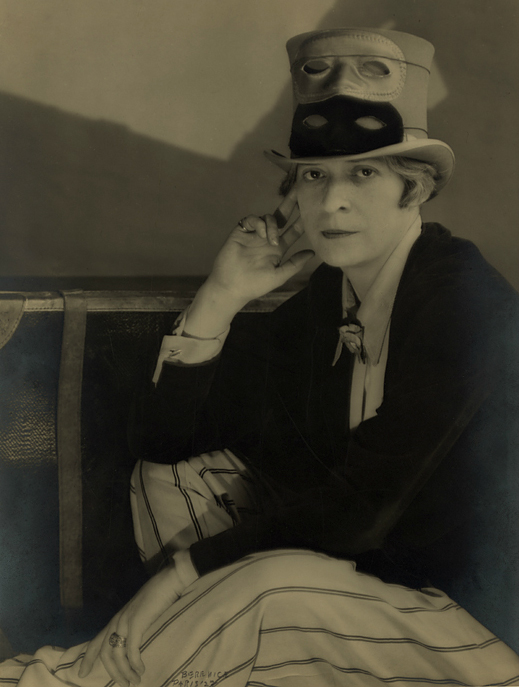
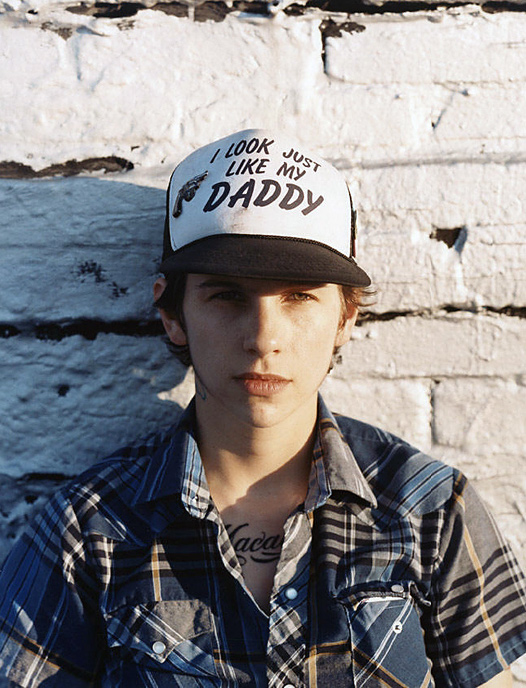
The Brooklyn presentation will feature nearly all of the works included in the National Portrait Gallery exhibition. Among them are rarely seen paintings by Charles Demuth, whose better-known industrialised landscapes are on view in the Brooklyn Museum exhibition Youth and Beauty; a poignant portrait of New Yorker writer Janet Flanner wearing two masks, taken by photographer Bernice Abbott; Andrew Wyeth’s painting of a young neighbour standing nude in a wheat field, much like Botticelli’s Venus emerging from her shell; Robert Mapplethorpe’s photograph riffing on the classic family portrait, in which a leather-clad Brian Ridley is seated on a wingback chair shackled to his whip-wielding partner, Lyle Heeter; and Cass Bird’s photographic portrait of a friend staring out from under a cap emblazoned with the words “I look Just Like My Daddy.” The exhibition will also include David Wojnarowicz’s A Fire in My Belly, an unfinished film the artist created between 1986 and 1987.

Press release from the Brooklyn Museum website


Berenice Abbott (American, 1898-1991) 'Janet Flanner' (1892-1978) 1927


Berenice Abbott (American, 1898-1991)
Janet Flanner (American, 1892-1978)
1927
Photographic print
23 x 17.3cm
Prints and Photographs Division, Library of Congress, Washington, D.C
C Berenice Abbott / Commerce Graphics Ltd., Inc.


Thomas Eakins (American, 1844 -1916) 'Salutat' 1898


Thomas Eakins (American, 1844-1916)
Salutat
1898
Oil on canvas
127.0 x 101.6cm
Addison Gallery of American Art, Phillips Academy, Andover, Massachusetts
Gift of anonymous donor


Walker Evans (American, 1903-1975) 'Lincoln Kirstein' 1930


Walker Evans (American, 1903-1975)
Lincoln Kirstein (American, 1907-1996)
1930
Gelatin silver print
16.1cm x 11.4cm
The Metropolitan Msuem of Art, Ford Motor Company Collection
© Walker Evans Archive, The Metropolitan Museum of Art


Lincoln Edward Kirstein (May 4, 1907 – January 5, 1996) was an American writer, impresario, art connoisseur, philanthropist, and cultural figure in New York City, noted especially as co-founder of the New York City Ballet. He developed and sustained the company with his organising ability and fundraising for more than four decades, serving as the company’s general director from 1946 to 1989. According to the New York Times, he was “an expert in many fields,” organising art exhibits and lecture tours in the same years.


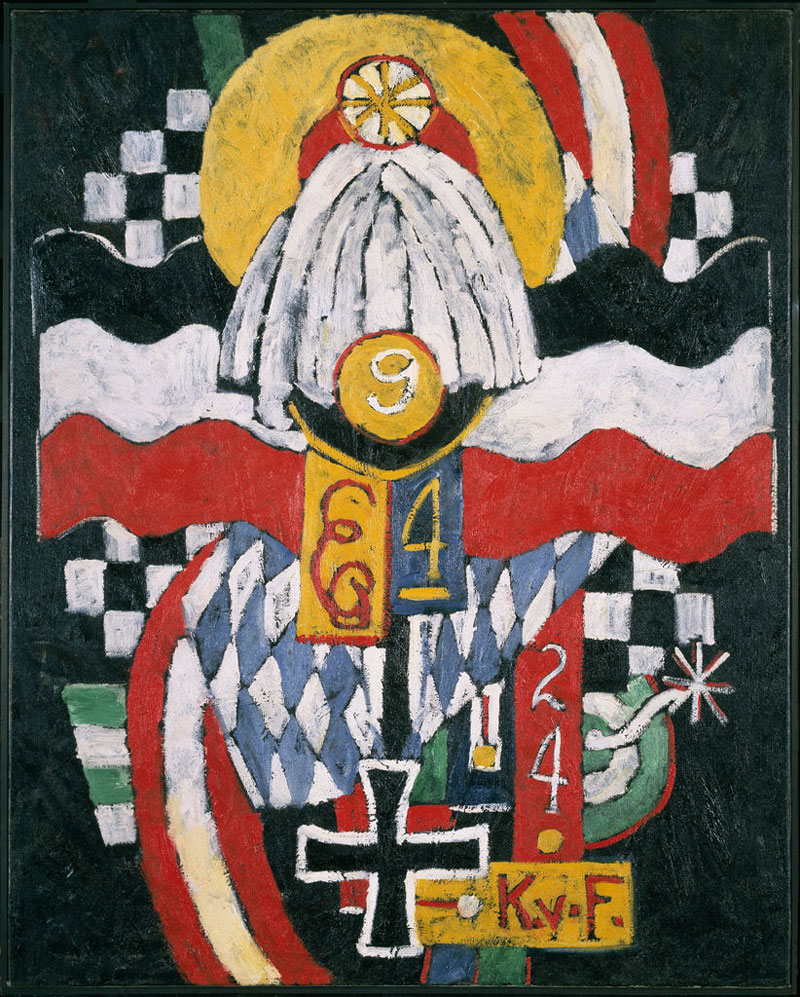
Marsden Hartley (American, 1877-1943) 'Painting No. 47, Berlin' 1915


Marsden Hartley (American, 1877-1943)
Painting No. 47, Berlin
1915
Oil on canvas
39 7/16 x 32 in (100.1 x 81.3cm)
Hirshhorn Museum and Sculpture Garden, Smithsonian Institution, Washington, D.C.
Gift of Joseph H. Hirshhorn, 1972


George Platt Lynes (American, 1907-1955) 'Marsden Hartley' 1942


George Platt Lynes (American, 1907-1955)
Marsden Hartley
1942
Gelatin silver print
23.5 x 19.1cm
Bates College Museum of Art, Lewiston, ME, Marsden Hartley Memorial Collection
© Estate of George Platt Lynes


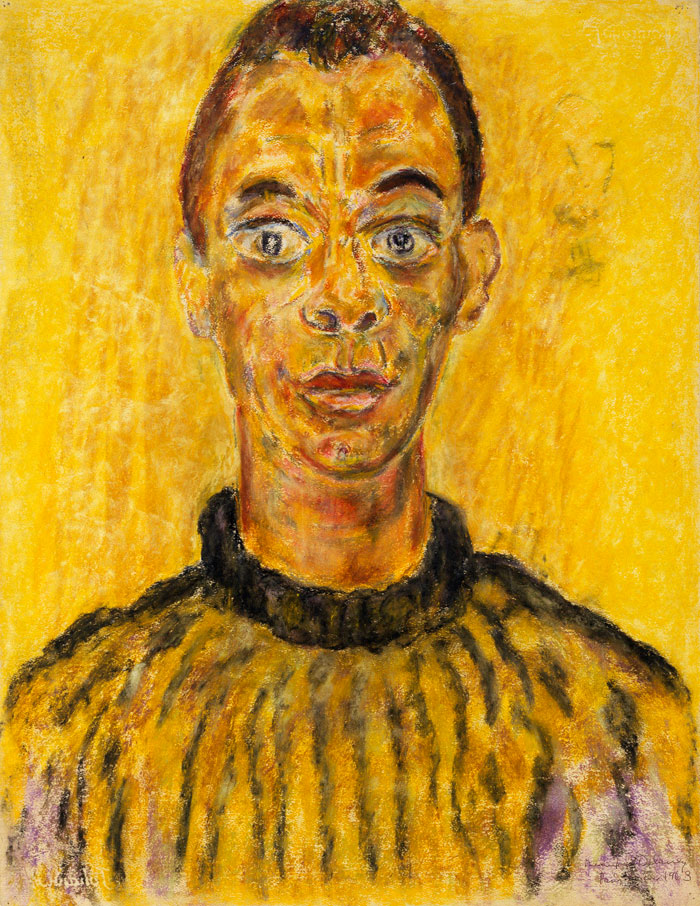
Beauford Delaney (American, 1901-1979) 'James Baldwin' 1963


Beauford Delaney (American, 1901-1979)
James Baldwin
1963
Pastel on paper
64.8 x 49.8cm
National Portrait Gallery, Smithsonian Institution


Cass Bird (American, b. 1974) 'I Look Just Like My Daddy' 2003


Cass Bird (American, b. 1974)
I Look Just Like My Daddy
2003
C-type print
72.6 x 101.6cm
Collection of the artist, New York
© Cass Bird


Brooklyn Museum
200 Eastern Parkway
Brooklyn, NY 11238-6052
Phone: (718) 638-5000

Opening hours:
Wednesday – Sunday 11am – 6pm
Monday and Tuesday closed

Brooklyn Museum website

LIKE ART BLART ON FACEBOOK

Back to top

Exhibition: ‘A Few Frames: Photography and the Contact Sheet’ at Whitney Museum of American Art, New York

Exhibition dates: 25th September, 2009 – 3rd January, 2010


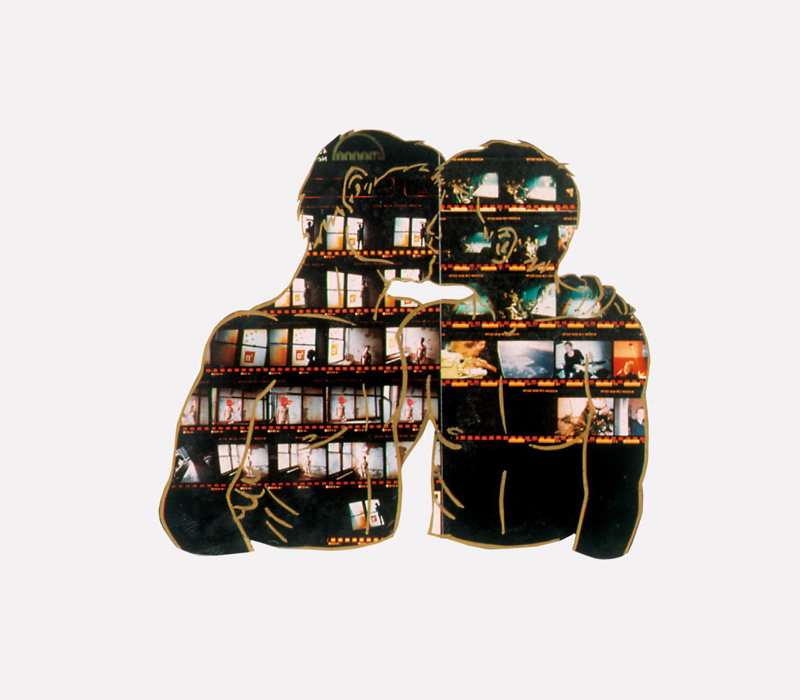
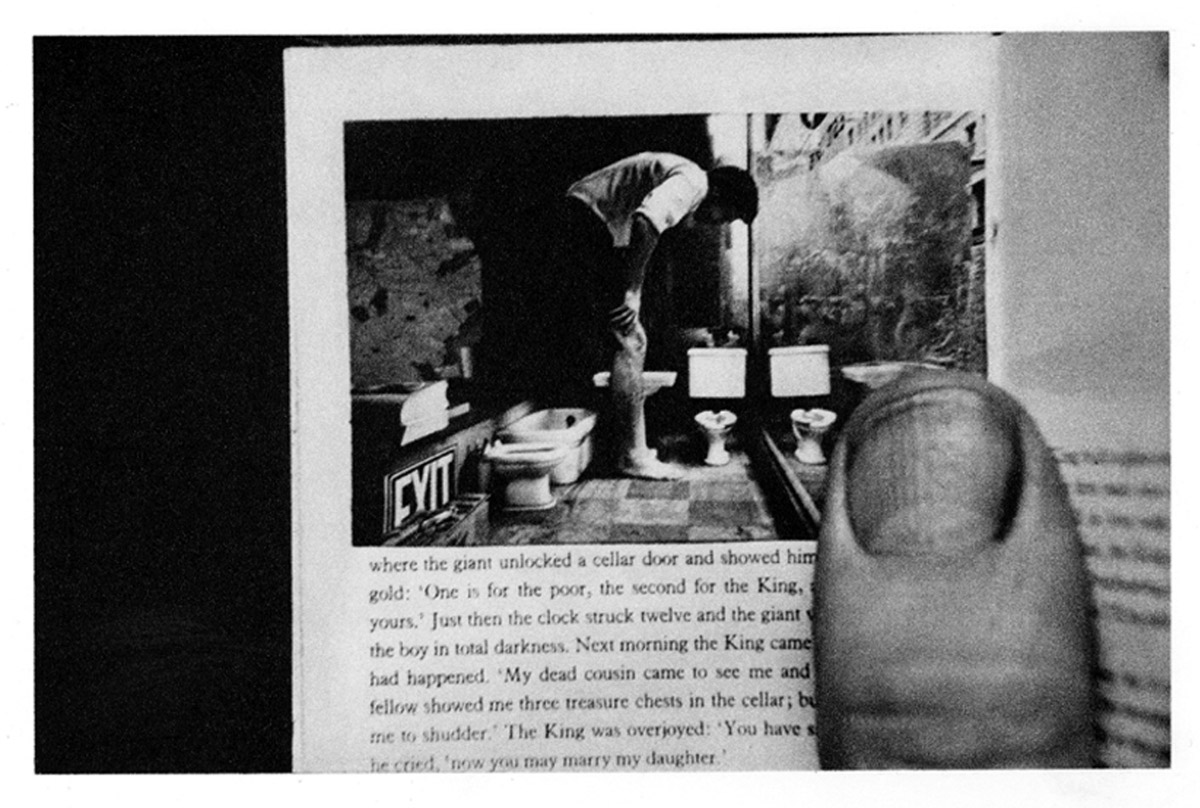
David Wojnarowicz (American, 1954-1992) 'Untitled' 1988


David Wojnarowicz (American, 1954-1992)
Untitled
1988
Synthetic polymer on two chromogenic prints
11 x 13 1/4 in. (27.9 x 33.7cm)
Whitney Museum of American Art, New York
Purchase with funds from the Photography Committee
Courtesy of The Estate of David Wojnarowicz and P.P.O.W. Gallery, New York, NY


I gently massaged more photographs of the work in the exhibition from the Whitney press office after initially only being able to download one press image! Many thankx to the Whitney for supplying more images.

As the press release mentions them by name, presumably there will be some of the Robert Frank contact sheets which you can see at the posting Looking In: Robert Frank’s The Americans and the water towers of Bernd and Hilla Becher two photographs of which can be seen at the posting Notes on a conversation with Mari Funaki.

In case you don’t know the work of artist David Wojnarowicz he was a gay man who died of HIV/AIDS aged 37 in 1992: I believe he was one of the most talented and subversive artists of his generation and his powerful images of identity, sexuality, power and death remain seared in my memory. Unfortunately there are not many good images to be found online but there is an excellent Aperture book, Aperture 137 Fall 1994 (David Wojnarowicz: Brush Fires in the Social Landscape) available from Amazon.

Dr Marcus Bunyan


Many thankx to the Whitney Museum of American Art for allowing me to publish the photographs in the posting. Please click on the photographs in the posting for a larger version of the image.


Rachel Harrison (American, b. 1966) 'Contact Sheet (should home windows...)' 1996


Rachel Harrison (American, b. 1966)
Contact Sheet (should home windows…)
1996
Chromogenic print on fibreboard
20 x 16 in.
Collection of the artist 
courtesy Greene Naftali, New York
© 2009 Rachel Harrison


In this selection of works drawn principally from the Whitney’s permanent collection, the repetitive image of the proof sheet is the leitmotif in a variety of works spanning the range of the museum’s photography collection, including the works of Paul McCarthy, Robert Frank, Ed Ruscha, and Andy Warhol. The exhibition is co-curated by Elisabeth Sussman, Whitney Curator and Sondra Gilman Curator of Photography, and Tina Kukielski, Senior Curatorial Assistant. A Few Frames opens on September 25, 2009 in the Sondra Gilman Gallery and runs through January 3, 2010.

Decisions about which photograph to exhibit or print are frequently the end result of an editing process in which the artist views all of the exposures he or she has made on a contact sheet – a photographic proof showing strips or series of film negatives – and then selects individual frames to print or enlarge. Repetition, seriality, and sequencing – inherited from the contact sheet – are evident in all of the works on view. As co-curator Tina Kukielski notes, “this presentation includes a variety of photographs that build on the formal, thematic, and technical logic of the editing process.”

The exhibition includes photo-based works from sixteen featured artists in the Whitney’s collection. The work of David Wojnarowicz and Paul McCarthy present the contact sheet as a work of art, while those of artists such as Andy Warhol, Harold Edgerton, and Robert Frank play with its repeating forms. Other works call to mind the format of the contact sheet, such as Bernd and Hilla Becher’s typological study of industrial water towers and Silvia Kolbowski’s grid of appropriated images of female fashion models.

Works by contemporary artists such as Rachel Harrison and Collier Schorr in their continued interest in the contact sheet, despite perhaps growing trends toward digital photography, reveal the residual and sustained effects of this process.

Press release from the Whitney Museum of American Art website [Online] Cited 01/11/2009 no longer available online


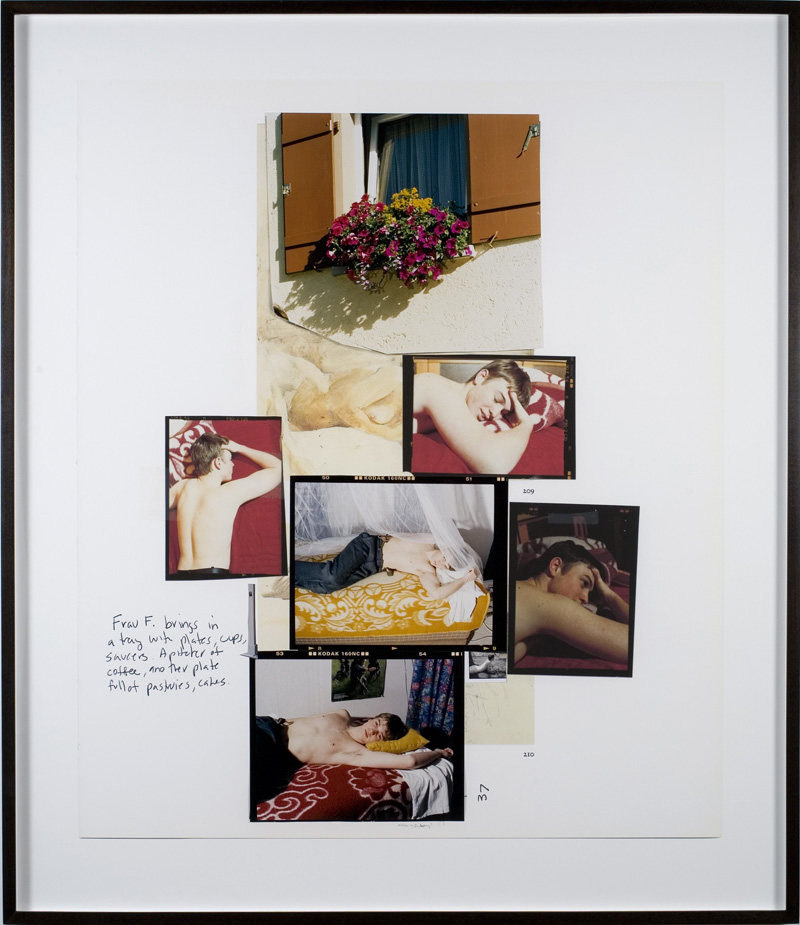
Collier Schorr (American, b. 1963) 'Day Dream (Sky)' 2007


Collier Schorr (American, b. 1963)
Day Dream (Sky)
2007
Collage
48 x 43 in. (121.9 x 109.2cm)
Courtesy 303 Gallery, New York


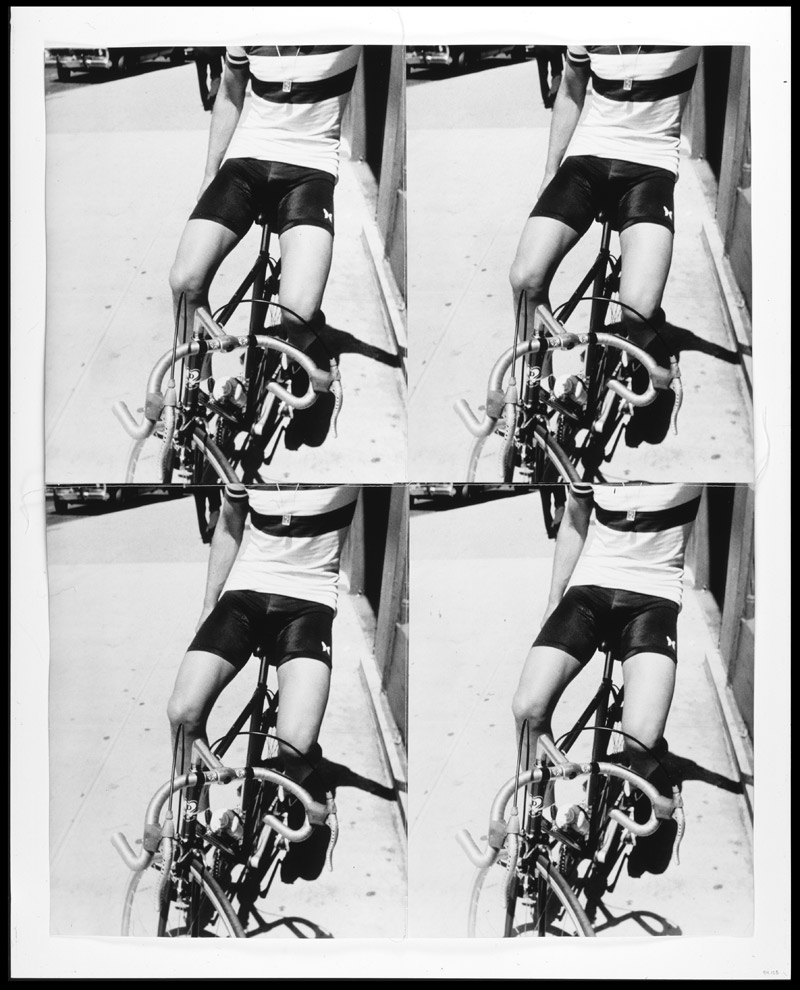
Andy Warhol (American, 1928-1987) 'Untitled (Cyclist)' 
c. 1976


Andy Warhol (American, 1928-1987)
Untitled (Cyclist)
c. 1976
Four gelatin silver prints stitched with thread
27 3/8 x 21 5/8 in. (69.5 x 54.9cm) overall
Unique Whitney Museum of American Art, New York
Gift of The Andy Warhol Foundation for the Visual Arts and purchase with funds from the Photography Committee
© 2009 The Andy Warhol Foundation for the Visual Arts, Inc. /Artists Rights Society (ARS), New York


Ellen Gallagher (American, b. 1965) 'Bouffant Pride' 2003


Ellen Gallagher (American, b. 1965)
Bouffant Pride
2003
Layered photogravure, cut-outs, collage, acrylic, plasticine, and toy eyes
Overall: 13 1/2 × 10 1/2 × 3/16in. (34.3 × 26.7 × 0.5cm)
Sheet: 13 1/2 × 10 1/2in. (34.3 × 26.7cm)
Whitney Museum of American Art, New York; purchase, with funds from the Print Committee


Duane Michals (American, b. 1932) 'Things are Queer' 1973

Duane Michals (American, b. 1932) 'Things are Queer' 1973

Duane Michals (American, b. 1932) 'Things are Queer' 1973

Duane Michals (American, b. 1932) 'Things are Queer' 1973

Duane Michals (American, b. 1932) 'Things are Queer' 1973

Duane Michals (American, b. 1932) 'Things are Queer' 1973

Duane Michals (American, b. 1932) 'Things are Queer' 1973

Duane Michals (American, b. 1932) 'Things are Queer' 1973

Duane Michals (American, b. 1932) 'Things are Queer' 1973


Duane Michals (American, b. 1932)
Things are Queer
1973
Nine silver gelatin prints
Whitney Museum of American Art, New York; gift of David Kezur


Edward Ruscha (American, b. 1937)
'[A Few Palm Trees Contact Sheet]'
1971


Edward Ruscha (American, b. 1937)
[A Few Palm Trees Contact Sheet]
1971
Gelatin silver print, tracing paper and crayon
Sheet: 10 × 8 1/16in. (25.4 × 20.5cm)
Overall (overlay): 9 3/4 × 8 3/16in. (24.8 × 20.8cm)
Whitney Museum of American Art, New York
Purchase, with funds from The Leonard and Evelyn Lauder Foundation, and Diane and Thomas Tuft
© Ed Ruscha


Edward Ruscha (American, b. 1937)
'[A Few Palm Trees Contact Sheet]'
1971


Edward Ruscha (American, b. 1937)
[A Few Palm Trees Contact Sheet]
1971
Gelatin silver print, tracing paper and crayon
Sheet: 10 × 8 1/16in. (25.4 × 20.5cm)
Overall (overlay): 9 3/4 × 8 3/16in. (24.8 × 20.8cm)
Whitney Museum of American Art, New York
Purchase, with funds from The Leonard and Evelyn Lauder Foundation, and Diane and Thomas Tuft
© Ed Ruscha


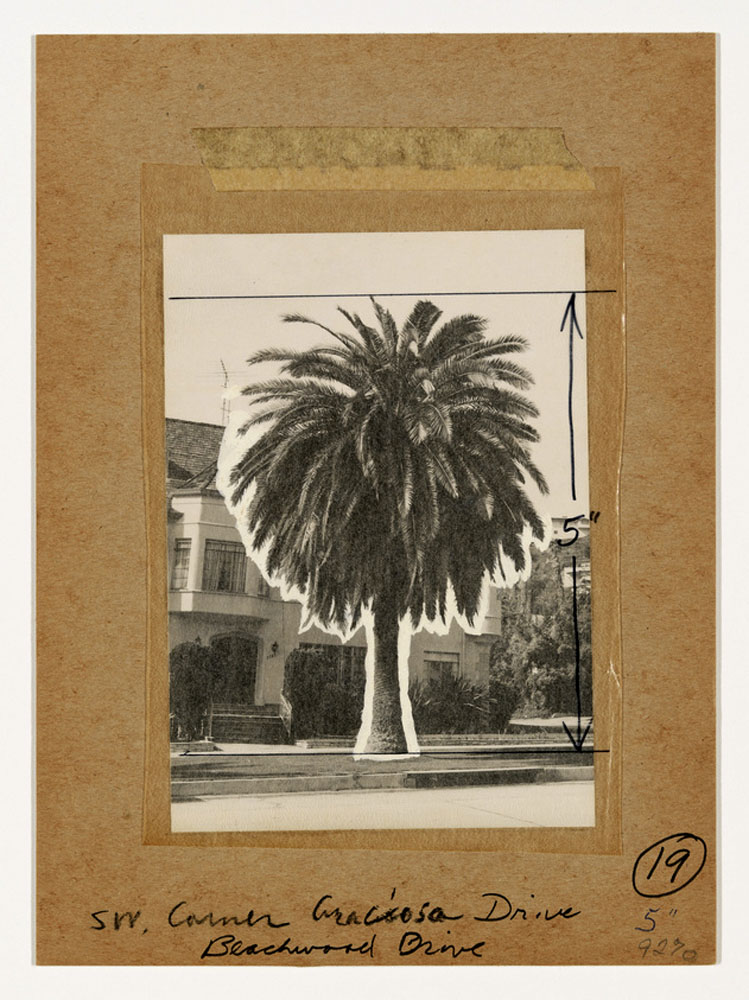
Edward Ruscha (American, b. 1937) 'Mock Up #19 (South West Corner of Graciosa Drive and Beachwood Drive)' 1971
 

Edward Ruscha (American, b. 1937)
Mock Up #19 (South West Corner of Graciosa Drive and Beachwood Drive)
1971
Gelatin silver print, tracing paper, pigment, pencil, and ink on board,
Image: 7 × 5in. (17.8 × 12.7cm)
Overall (overlay): 8 1/8 × 5 1/2in. (20.6 × 14cm)
Mount (board): 11 × 8in. (27.9 × 20.3cm)
Whitney Museum of American Art, New York
Purchase, with funds from The Leonard and Evelyn Lauder Foundation, and Diane and Thomas Tuft
© Ed Ruscha


Robert Frank (Swiss-American, 1924-2019) 'Mabou Winter Footage' 1977


Robert Frank (Swiss-American, 1924-2019)
Mabou Winter Footage
1977
Gelatin silver print
23 11/16 × 14 3/4″ (60.1 × 37.5cm)


Whitney Museum of American Art
945 Madison Avenue at 75th Street
New York, NY 10021
General Information: (212) 570-3600

Opening Hours:
Sunday – Monday, Wednesday – Thursday 10.30am – 6pm
Friday and Saturday 10.30am – 10pm
Closed Tuesday

Whitney Museum of American Art website

LIKE ART BLART ON FACEBOOK

Back to top