Exhibition: ‘Hannah Villiger: Amaze Me’ at Museum Susch, Switzerland

Exhibition dates: 7th January – 2nd July 2023

Curated by Madeleine Schuppli and Yasmin Afschar
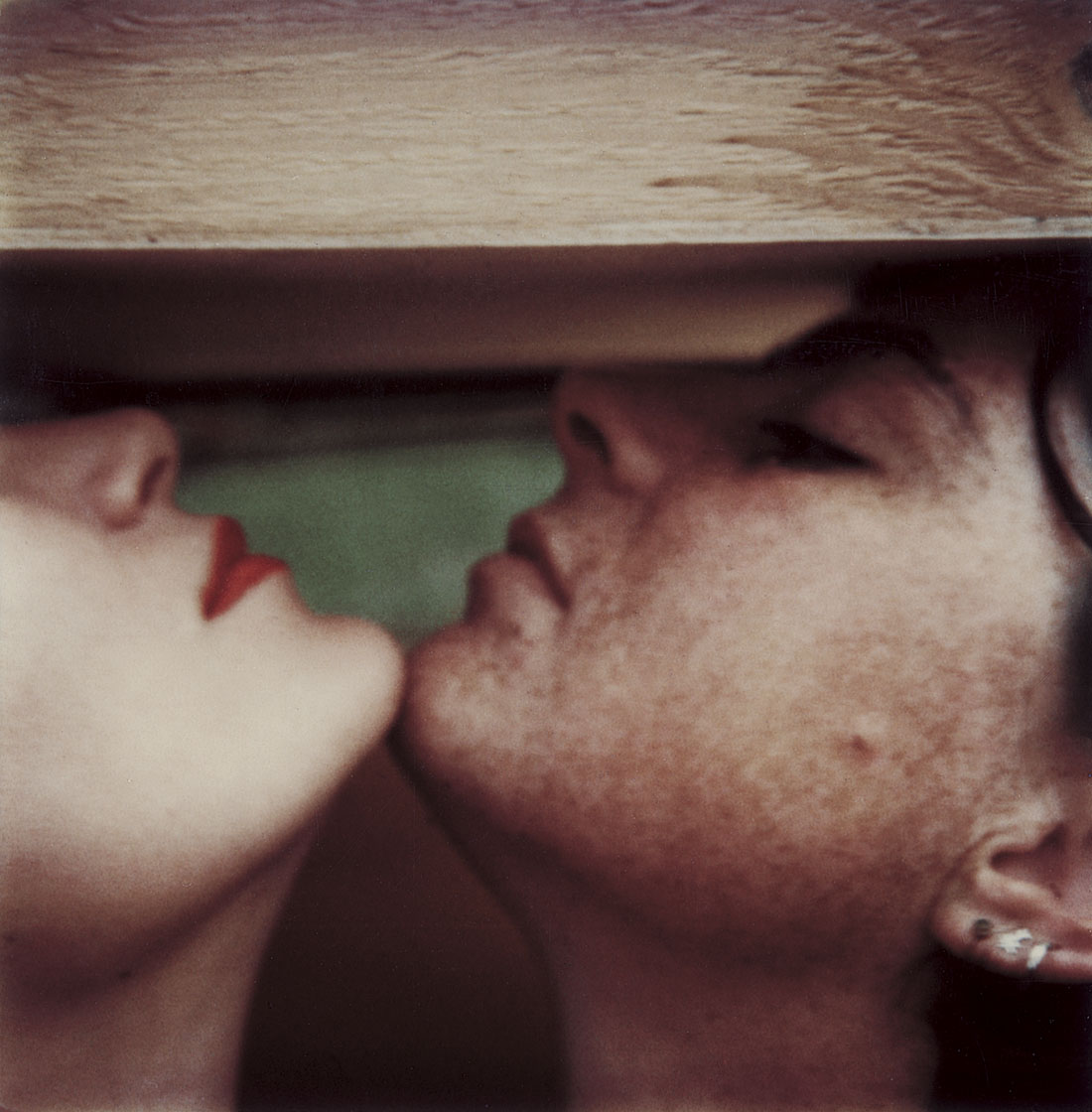
 

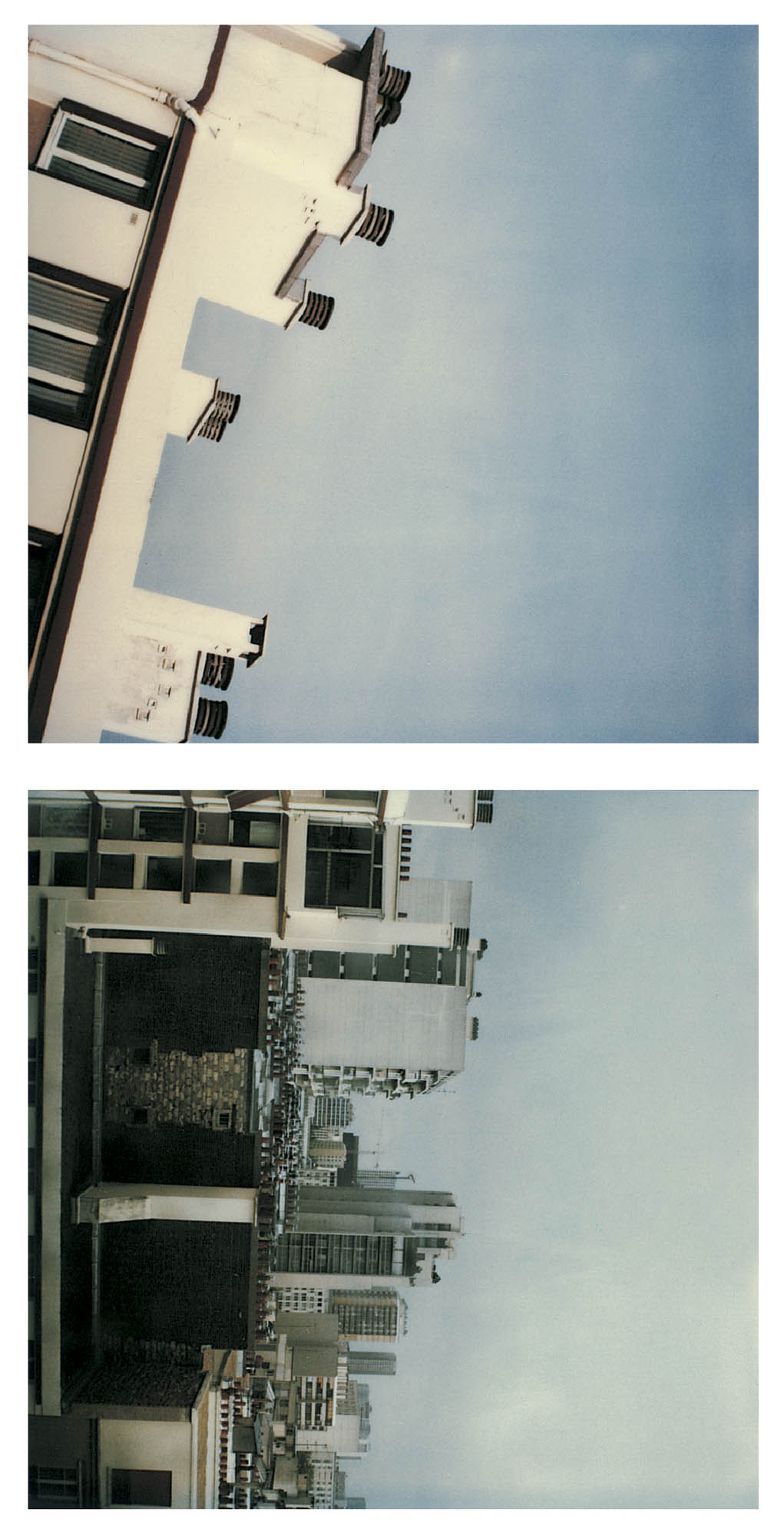
Hannah Villiger (Swiss, 1951-1997) 'Work' 1980 from the exhibition Exhibition: 'Hannah Villiger: Amaze Me' at Museum Susch, Switzerland, Jan - July 2023


Hannah Villiger (Swiss, 1951-1997)
Work
1980
C-print of a polaroid, mounted on aluminium
100 x 100cm
© Foundation The Estate of Hannah Villiger


who am I who I am

I love artists who push the boundaries of seeing / being, body / Self, self / spirit.

Artists who see and feel the world in unique and tantalising – excites the senses or desires of (someone) – ways.

Hannah Villiger is one such artist.

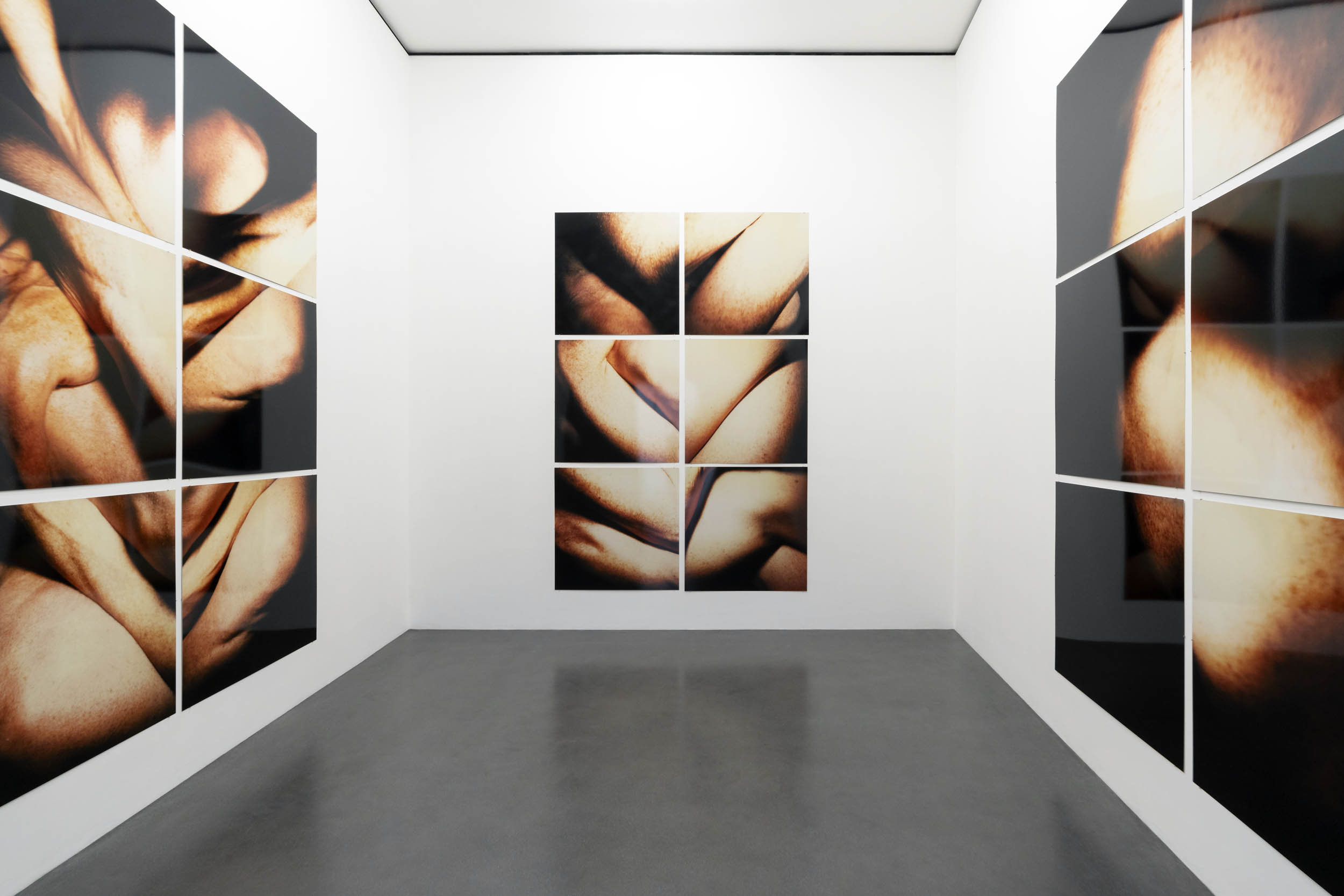
Her fragmentary, space-related assemblages (Works or Blocks) investigate the representation of the female body, “its classification in the media, questions of surface, space and body, and the objectification of the body. In Villiger’s work, the skin – where humans enter a dialogue with their environment – is a setting for highly topical questions of gender and ethnicity, as well as vulnerability and healing. The body was the artist’s primary working material. We encounter it abstracted or deconstructed; it can be human, but also of plant or artificial origin.” (Exhibition text)

But more than that, it is the conceived ‘idea in the mind’ strangeness of Villiger’s out of body gridded experiences… that promote in the viewer an acknowledgement of the physicality, touch, and emotion of actually living and feeling in the human body and beyond. Touch your skin, run your hands over the shape of your mouth, feel your ears, raise your foot, look at your reflection. Marvel at the bodies distortion, energy, spirit. For there is only one you. “I listen to my naked, bare body, the outside of it, the inside of it, traversing it.”

You are unique. An individual, unique, sentient animal. A human – being.

Dr Marcus Bunyan


Many thankx to Museum Susch for allowing me to publish the photographs in the posting. Please click on the photographs for a larger version of the image.


“With my Polaroid camera I listen to my naked, bare body, the outside of it, the inside of it, traversing it. Thus I create images that I can correct immediately.”


Hannah Villiger


“The longest distance between the camera and any body part is between raised arm and my toes. I always trigger the camera myself, sometimes without looking through the viewfinder. I tilt the camera to an angle of 90, 180, 270 degrees. I turn myself – literally – upside down.”


Hannah Villiger. On My Book Envy


Hannah Villiger (1951-1997) was an extraordinary voice in the late 20th-century contemporary art, but her work came to an abrupt end with her untimely death. She became known above all for her photographic works based on the body.

Muzeum Susch is hosting the largest presentation of Hannah Villiger’s oeuvre in fifteen years. Hannah Villiger: Amaze Me offers new perspectives on the work of this important Swiss artist. Villiger’s large-format works based on Polaroid photographs make a lasting contribution to the genre of the self-image within art history. At the same time, her explorations of the body can be discussed against the background of numerous contemporary themes. Her oeuvre spans from the drawings she made in the 1970s to the black-and-white photographs and works with the Polaroid camera that she created from the 1980s onwards. These fragmentary close-ups of her own body, greatly enlarged via an internegative and mounted on aluminium, are presented individually or assembled into space-related ensembles. The results are unlimited possibilities of at times spectacular views of the body. The exhibition expands the view of Villiger to include contemporary themes and issues. The focus is on the representation of the female body, one’s own perspective, as well as that of others, on the human physique, its classification in the media, questions of surface, space and body, and the objectification of the body. In Villiger’s work, the skin – where humans enter a dialogue with their environment – is a setting for highly topical questions of gender and ethnicity, as well as vulnerability and healing. The body was the artist’s primary working material. We encounter it abstracted or deconstructed; it can be human, but also of plant or artificial origin. Although Villiger’s early death brought her oeuvre to an abrupt end, her works point unwaveringly to the present.

Text from the Museum Susch website
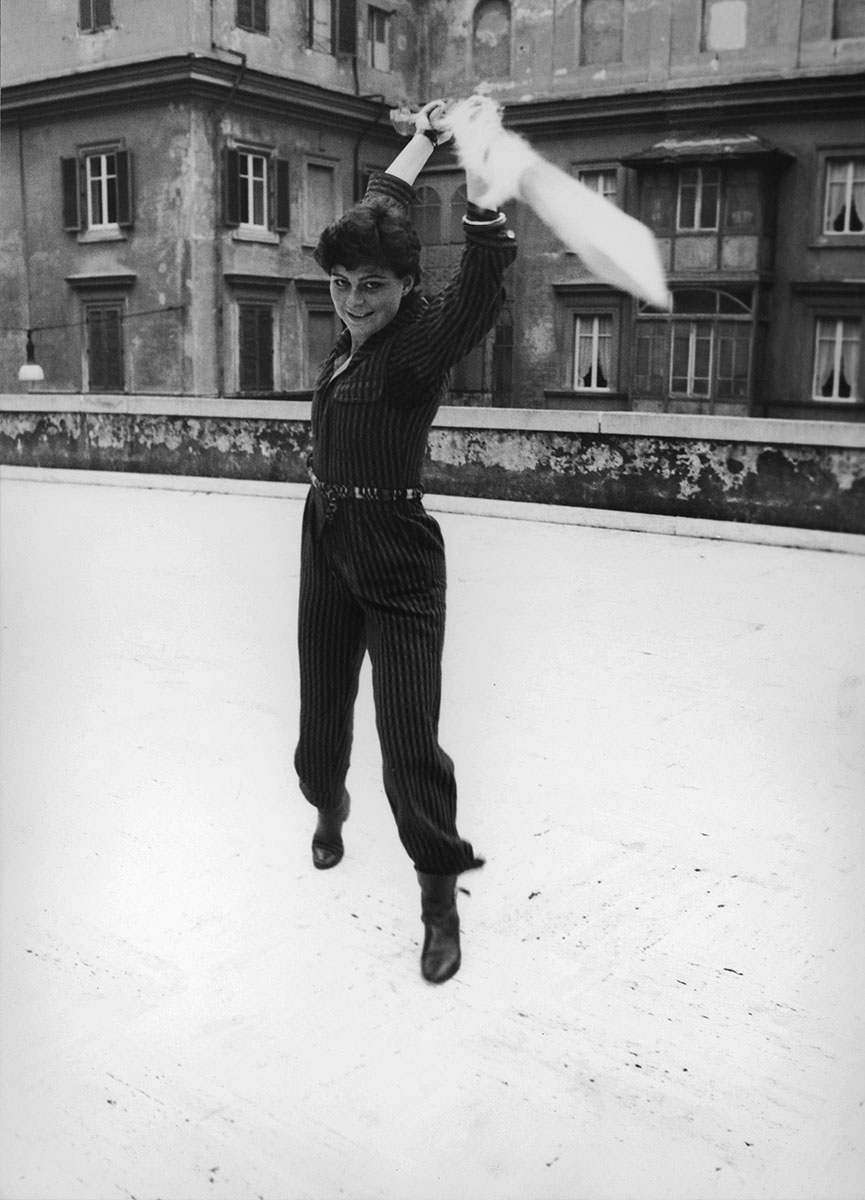
 

Trix Wetter. 'Portrait of Hannah Villiger' 1976, Rome from the exhibition Exhibition: 'Hannah Villiger: Amaze Me' at Museum Susch, Switzerland, Jan - July 2023


Trix Wetter
Portrait of Hannah Villiger
1976, Rome
© Foundation The Estate of Hannah Villiger


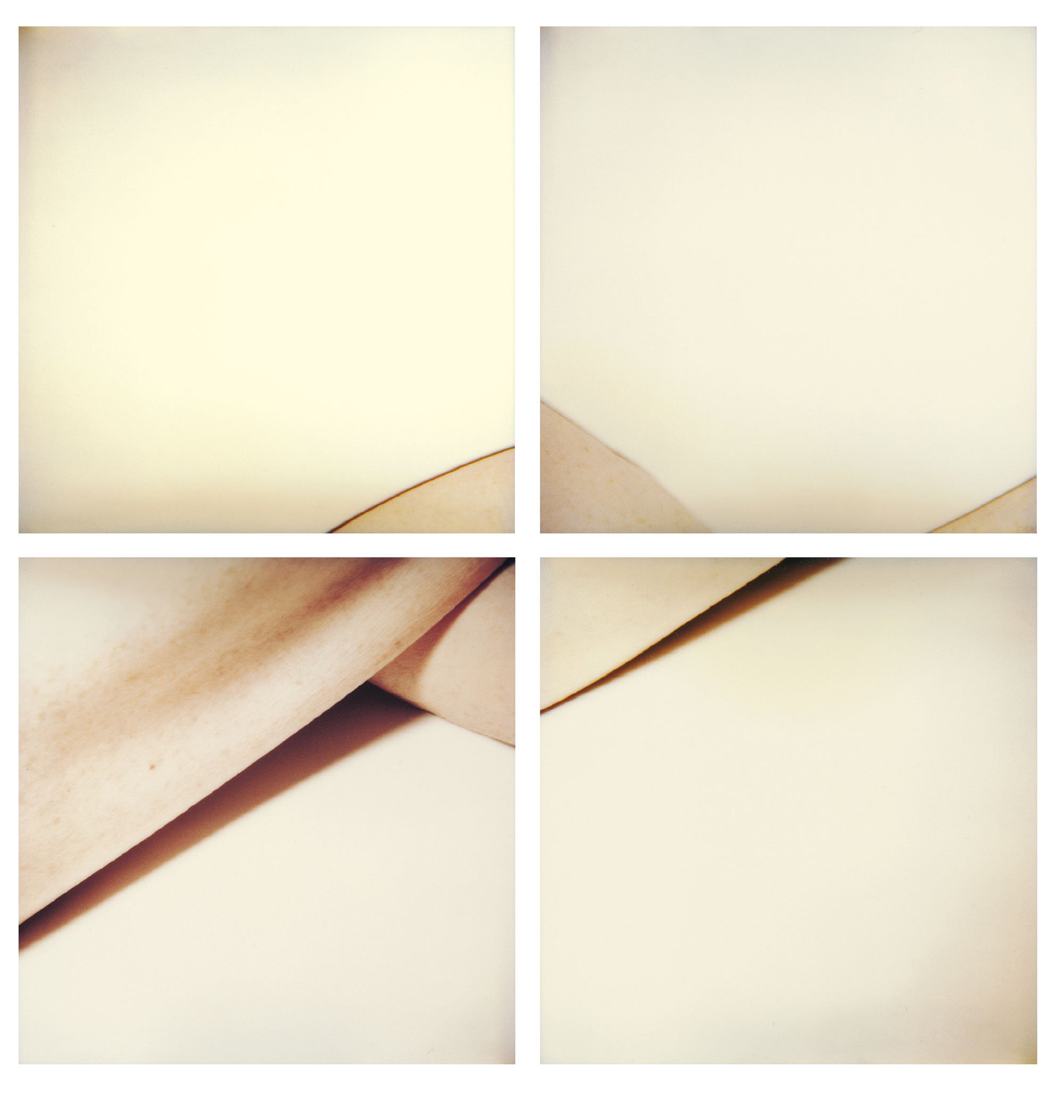
Hannah Villiger (Swiss, 1951-1997) 'Work' 1976 from the exhibition Exhibition: 'Hannah Villiger: Amaze Me' at Museum Susch, Switzerland, Jan - July 2023


Hannah Villiger (Swiss, 1951-1997)
Work
1976
Four black and white photographs
61 x 51cm / 40.5 x 33.5cm each
© Foundation The Estate of Hannah Villiger


Hannah Villiger (Swiss, 1951-1997) 'Work' 1976


Hannah Villiger (Swiss, 1951-1997)
Work
1976
black and white photograph
70 x 100cm
© Foundation The Estate of Hannah Villiger


Hannah Villiger (Swiss, 1951-1997) 'Work' 1976


Hannah Villiger (Swiss, 1951-1997)
Work
1976
68 x 97cm
© Foundation The Estate of Hannah Villiger


Hannah Villiger (Swiss, 1951-1997) 'Work' 1980


Hannah Villiger (Swiss, 1951-1997)
Work
1980
C-print of a polaroid, mounted on aluminium
99.5 x 99.5cm
© Foundation The Estate of Hannah Villiger


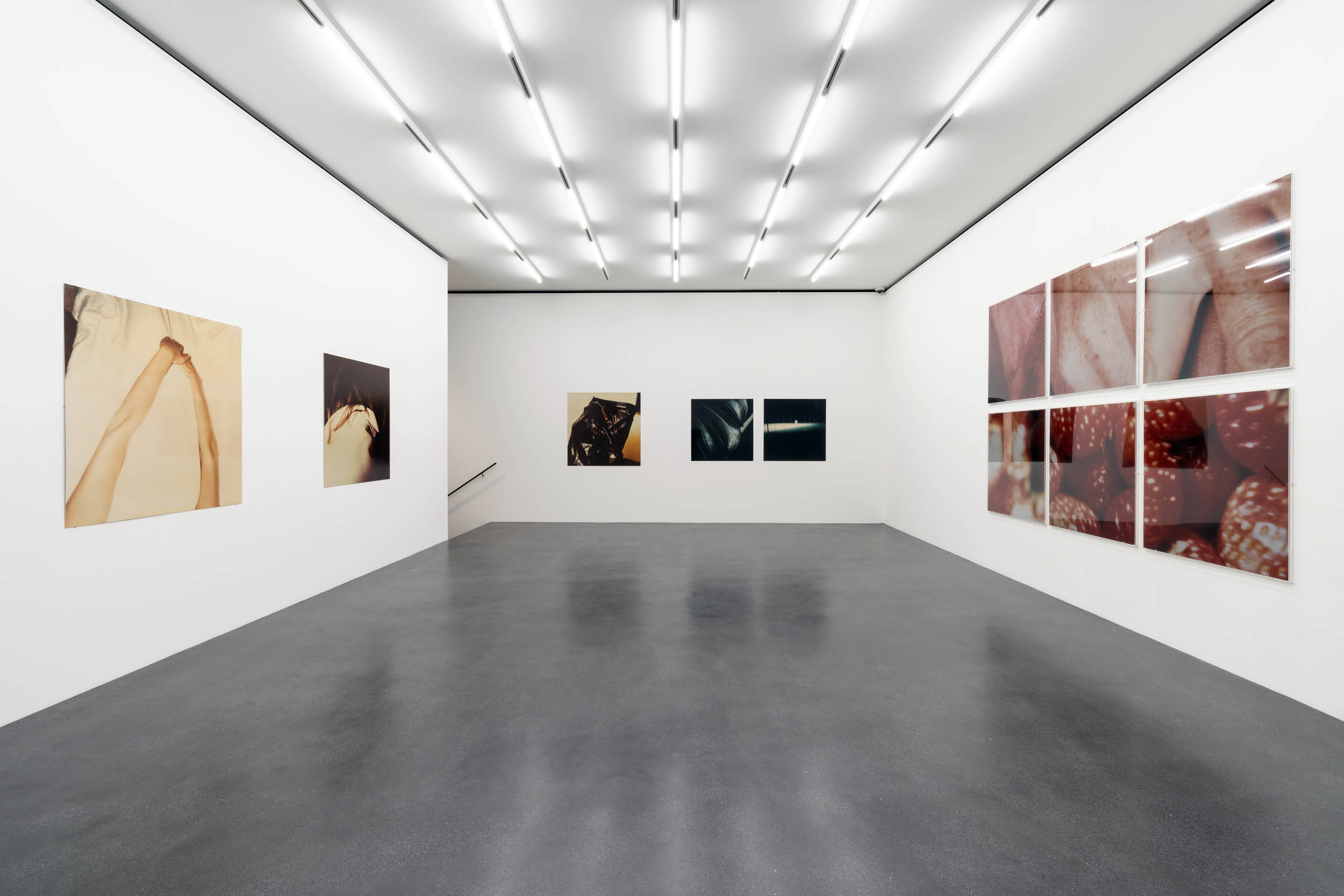
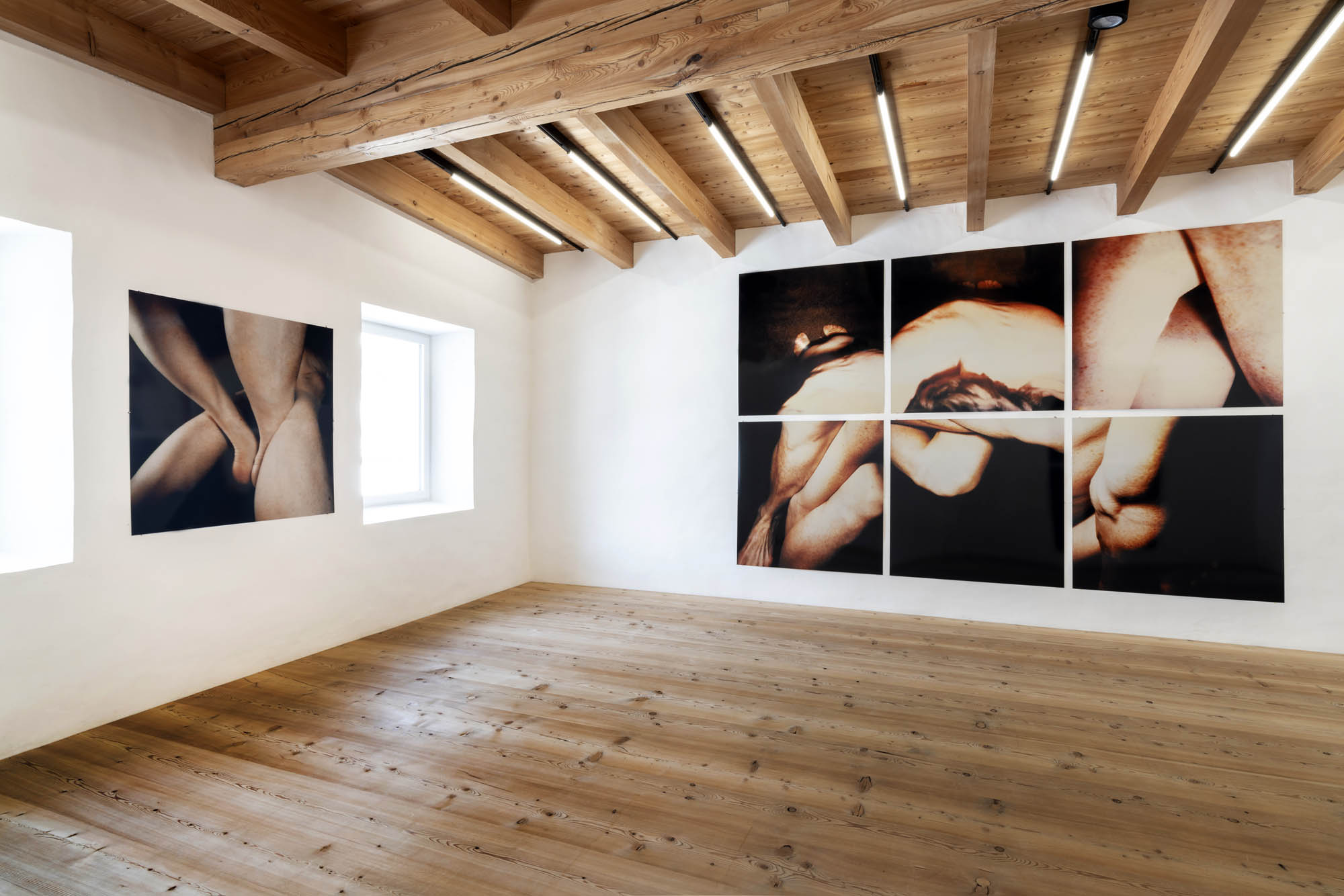
Installation view of 'Hannah Villiger: Amaze Me' at Muzeum Susch showing at left Hannah Villager's 'Block' (1997); and at right, 'Work' (1980-1981)


Installation view of Hannah Villiger: Amaze Me at Muzeum Susch showing at left Hannah Villager’s Block (1997); and at right, Work (1980-1981, below)
Courtesy: © Muzeum Susch / Art Stations Foundation
Photograph: Federico Sette
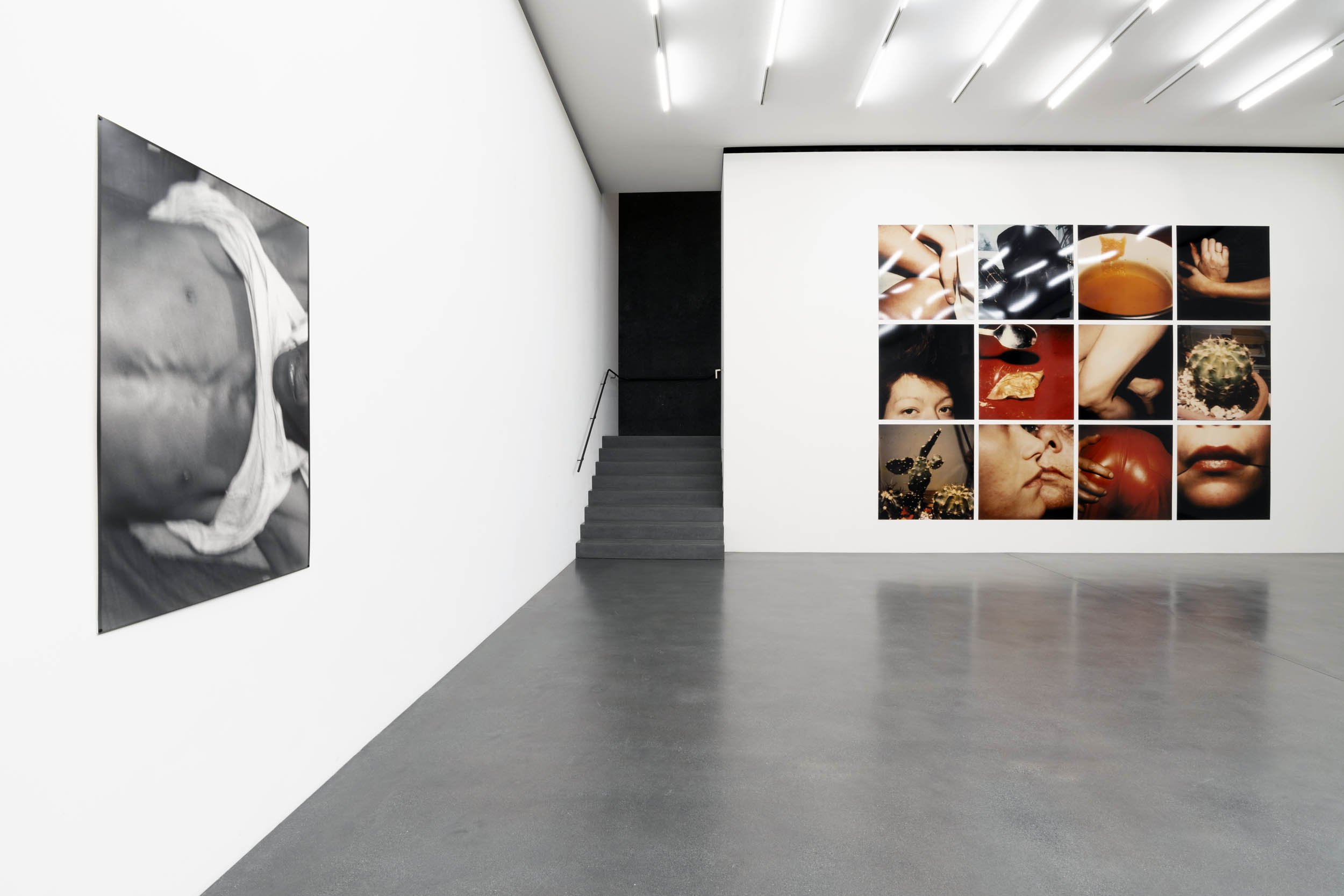
 

Installation view of 'Hannah Villiger: Amaze Me at Muzeum Susch' showing at left Hannah Villiger's 'Work' (1987); and at right, 'Work' (1980-1981)


Installation view of Hannah Villiger: Amaze Me at Muzeum Susch showing at left Hannah Villiger’s Work (1987, below); and at right, Work (1980-1981, below)
Courtesy: © Muzeum Susch / Art Stations Foundation
Photograph: Federico Sette


Hannah Villiger (Swiss, 1951-1997) 'Work' 1987


Hannah Villiger (Swiss, 1951-1997)
Work
1987
Black and white photograph
127.5 x 86.5cm
© Foundation The Estate of Hannah Villiger


Hannah Villiger (Swiss, 1951-1997) 'Work' 1980-1981


Hannah Villiger (Swiss, 1951-1997)
Work
1980-1981
C-prints of polaroids, mounted on aluminium (12 pieces)
355 x 475cm
© Foundation The Estate of Hannah Villiger


Installation view of 'Hannah Villiger: Amaze Me' at Muzeum Susch showing at left Hannah Villiger's 'Work' (1981); and at right, 'Work' (1982)


Installation view of Hannah Villiger: Amaze Me at Muzeum Susch showing at left Hannah Villiger’s Work (1981, below); and at right, Work (1982, below)
Courtesy: © Muzeum Susch / Art Stations Foundation
Photograph: Federico Sette


Hannah Villiger (Swiss, 1951-1997) 'Work' 1981


Hannah Villiger (Swiss, 1951-1997)
Work
1981
Two C-prints of polaroids, mounted on aluminium
Each 38 x 38cm
© Foundation The Estate of Hannah Villiger


Running from 4 January to 2 July 2023, Muzeum Susch presents Hannah Villiger: Amaze Me, a comprehensive survey dedicated to the Swiss artist Hannah Villiger (1951-1997) with contributions from contemporary artists Alexandra Bachzetsis, Lou Masduraud (b. 1990) and Manon Wertenbroek (b. 1991).

The exhibition Hannah Villiger: Amaze Me offers new perspectives on the work of this important Swiss artist. Hannah Villiger’s (1951-1997) large-format works based on Polaroid photographs make a lasting contribution to the genre of the self-image within art history. At the same time, her explorations of the body can be discussed against the background of numerous contemporary themes.

Muzeum Susch is hosting the largest presentation of Hannah Villiger’s work in fifteen years. The exhibition spans her oeuvre, from the drawings she made in the 1970s to the black-and-white photographs and works with the Polaroid camera that she created from the 1980s onwards. These fragmentary close-ups of her own body, greatly enlarged via an internegative and mounted on aluminium, are presented individually or assembled into space-related ensembles. The results are unlimited possibilities of at times spectacular views of the body. On display are vintage prints, existing though often still unknown individual works, as well as so-called blocks, large-format assemblages of up to fifteen square picture panels. Some of these will be shown for the first time in the exhibition in Susch.

The exhibition expands the view of Villiger to include contemporary themes and issues. The focus is on the representation of the female body, one’s own perspective, as well as that of others, on the human physique, its classification in the media, questions of surface, space and body, and the objectification of the body. In Villiger’s work, the skin – where humans enter a dialogue with their environment – is a setting for highly topical questions of gender and ethnicity, as well as vulnerability and healing. The body was the artist’s primary working material. We encounter it abstracted or deconstructed; it can be human, but also of plant or artificial origin. Although Villiger’s early death brought her oeuvre to an abrupt end, her works point unwaveringly to the present.

The undiminished relevance of Villiger’s work is underscored by the inclusion of works by the contemporary artists Alexandra Bachzetsis, Lou Masduraud and Manon Wertenbroek. These younger women artists present thematically related works – distributed throughout the entire exhibition – in dialogue with Villiger and at the same time represent strong contemporary positions. The artists have been selected based on their exploration of similar themes to those of Villiger. Bachzetsis in collaboration with Julia Born presents This Side Up, a video installation of the artist moving in all directions in a confined space, much like the way Villiger writhes, turns and shapes her own body under the eye of her Polaroid camera. Masduraud presents Petrifying basin (kisses with the nymphs), a sculptural installation and small wall objects that playfully and sensually rethink organic life and anchors mythological traditions in the present day. And finally, Wertenbroek presents a selection of objects addressing the boundaries between the skin and surrounding world and reflects on themes such as unveiling and veiling.

On the exhibition and Hannah Villiger, Muzeum Susch’s found Grazyna Kulczyk says, “Female artists are no longer afraid to document their bodies being destructed due to illness or ageing – often the artworks become projects showing chronicles of pain. Observing and recording their own bodies has become a form of manifesto for female artists, reclaiming the subjectivity of the body. Female artists have painted, photographed and sculpted themselves. In this way, the shame of nakedness or imperfection has often become a point of pride. Hannah Villiger, through photographs of her body, become the body’s conscious sculptor.”

The exhibition is accompanied by a monograph on the latest research on Hannah Villiger’s practice and influence. Villiger is often likened to an artist’s artist, which has inspired the editors to invite artists who knew her to contribute texts, including Katja Schenker, Beat Streuli, and Claudia and Julia Müller. The book, part of a series of monographs by Muzeum Susch and Skira, will be published in March 2023.

Hannah Villiger (1951-1997) grew up as the fourth of five children in Cham (CH). After completing her studies at the School of Applied Arts in Lucerne, Villiger spent a period travelling and living between Toronto, Rome, Montefalco and Switzerland until she finally settled in Basel in 1977. In Basel, she produced her first black-and-white photographs as well as wood and Plexiglas objects. In 1980 Villiger fell ill with open tuberculosis and spent a month isolated in the Basel Cantonal Hospital, followed by a stay in a sanatorium in Davos. Despite her poor health, Villiger continued to create and exhibit her work. From 1981 to 1982 she undertook a world road-trip with Susan Wyss, with whom she had been in a relationship since 1975. In the early 1980s, Villiger began to use Polaroid cameras primarily to explore her body, serving as a working material, and increasingly moved away from the classic black-and-white and colour photographs. In 1988 in Paris, she met Mouhamadou Mansour (“Joe”) Kébé, with whom she had a son with in 1991. Between 1992 and 1997, Villiger taught at the Basel School of Art and Design. She died of heart failure in 1997.

Text from the Museum Susch website


Installation view of 'Hannah Villiger: Amaze Me' at Muzeum Susch

Installation view of 'Hannah Villiger: Amaze Me' at Muzeum Susch showing at left in the bottom image, Hannah Villiger's 'Work' (1982); and at right, 'Sculpting' (1983)


Installation views of Hannah Villiger: Amaze Me at Muzeum Susch showing at left in the bottom image, Hannah Villiger’s Work (1982, below); and at right, Sculpting (1983, below)
Courtesy: © Muzeum Susch / Art Stations Foundation
Photograph: Federico Sette
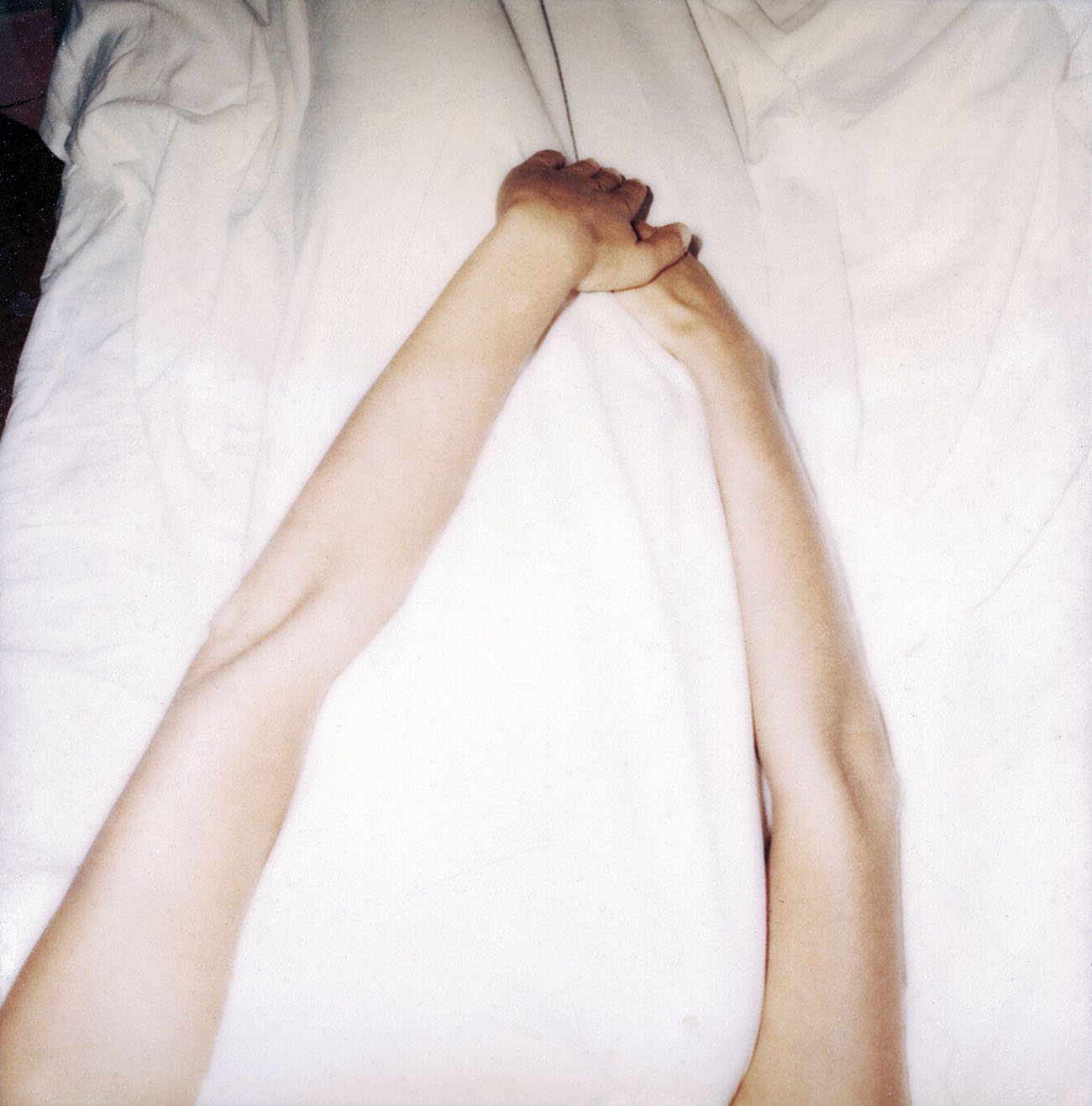
 

Hannah Villiger (Swiss, 1951-1997) 'Work' 1982


Hannah Villiger (Swiss, 1951-1997)
Work
1982
C-print of a polaroid, mounted on aluminium
125 x 123cm
© Foundation The Estate of Hannah Villiger


Hannah Villiger (Swiss, 1951-1997) 'Sculpting' 1983


Hannah Villiger (Swiss, 1951-1997)
Sculpting
1983
Six C-prints of polaroids, mounted on aluminium
222 x 322cm
© Foundation The Estate of Hannah Villiger
Courtesy of Collection Pictet


Installation view of 'Hannah Villiger: Amaze Me' at Muzeum Susch

Installation view of 'Hannah Villiger: Amaze Me' at Muzeum Susch showing in the bottom image at left, 'Sculptural' (1984-1985); at centre, 'Sculptural' (1984-1985); and at right, 'Sculptural' (1984-1985)


Installation views of Hannah Villiger: Amaze Me at Muzeum Susch showing in the bottom image at left, Sculptural (1984-85, below); at centre, Sculptural (1984-85, below); and at right, Sculptural (1984-85, below)
Courtesy: © Muzeum Susch / Art Stations Foundation
Photograph: Federico Sette


Hannah Villiger (Swiss, 1951-1997) 'Sculptural' 1984-1985


Hannah Villiger (Swiss, 1951-1997)
Sculptural
1984-85
C-print of a polaroid, mounted on aluminium
© Foundation The Estate of Hannah Villiger
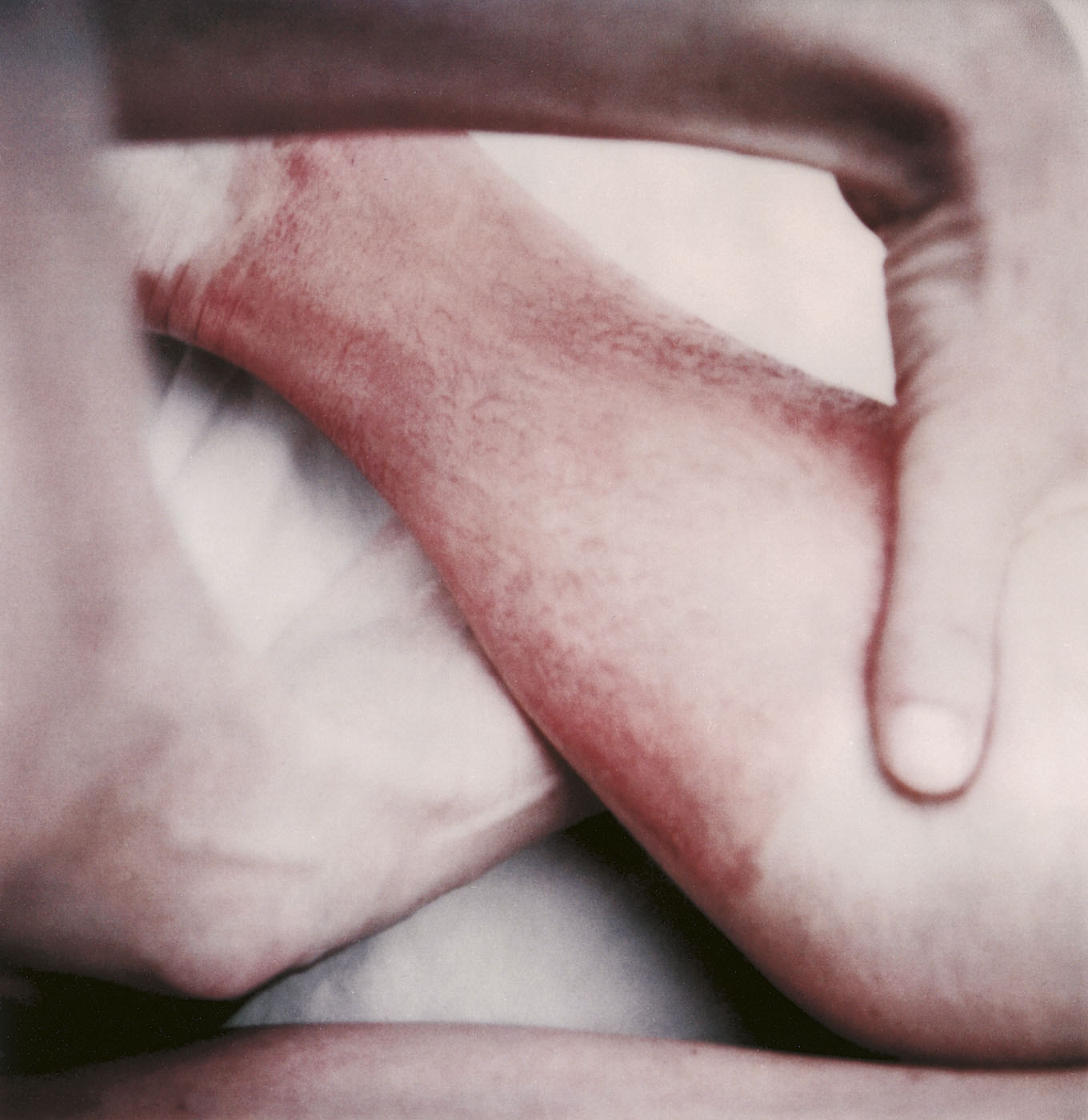
 

Hannah Villiger (Swiss, 1951-1997) 'Sculptural' 1984-1985


Hannah Villiger (Swiss, 1951-1997)
Sculptural
1984-85
C-print of a polaroid, mounted on aluminium
© Foundation The Estate of Hannah Villiger
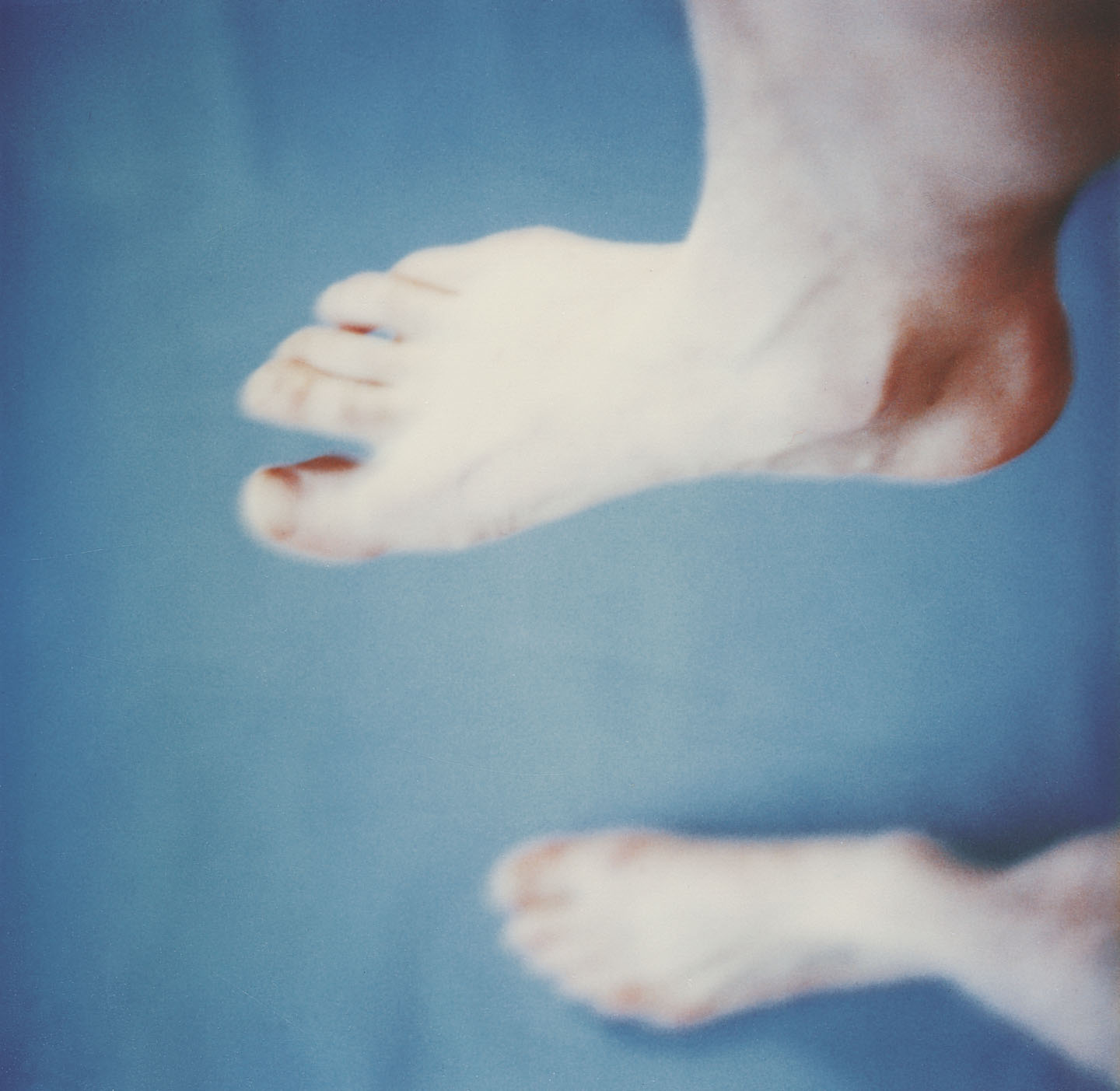
 

Hannah Villiger (Swiss, 1951-1997) 'Sculptural' 1984-1985


Hannah Villiger (Swiss, 1951-1997)
Sculptural
1984-85
C-print of a polaroid, mounted on aluminium
© Foundation The Estate of Hannah Villiger
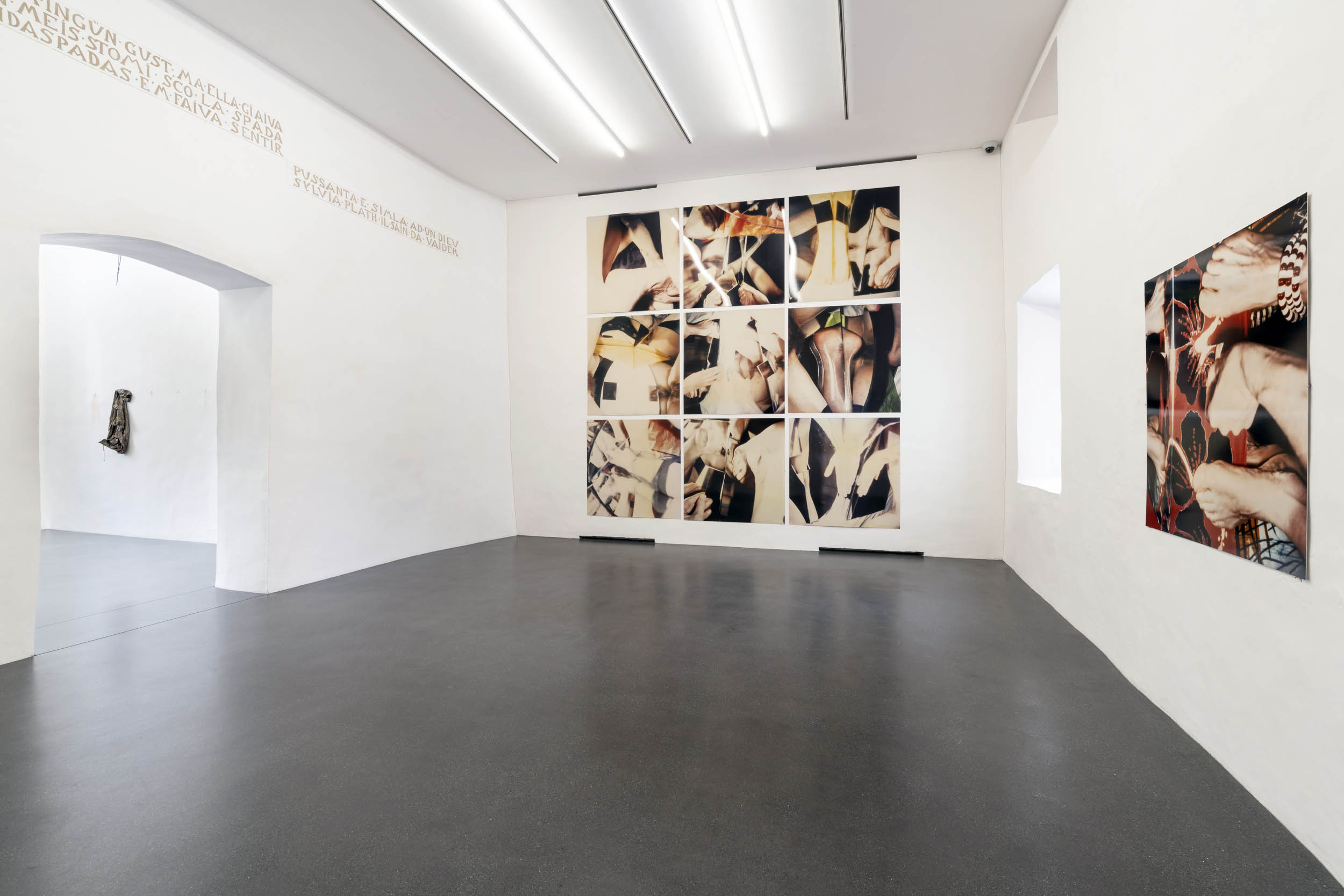
 

Installation view of 'Hannah Villiger: Amaze Me' at Muzeum Susch showing at centre, 'Block XVI' (1989); and at right, 'Sculptural' (1988-1989)


Installation views of Hannah Villiger: Amaze Me at Muzeum Susch showing at centre, Block XVI (1989, below); and at right, Sculptural (1988-89, below)
Courtesy: © Muzeum Susch / Art Stations Foundation
Photograph: Federico Sette


Hannah Villiger (Swiss, 1951-1997) 'Block XVI' 1989


Hannah Villiger (Swiss, 1951-1997)
Block XVI
1989
Nine C-prints of polaroids, mounted on aluminium
© Foundation The Estate of Hannah Villiger
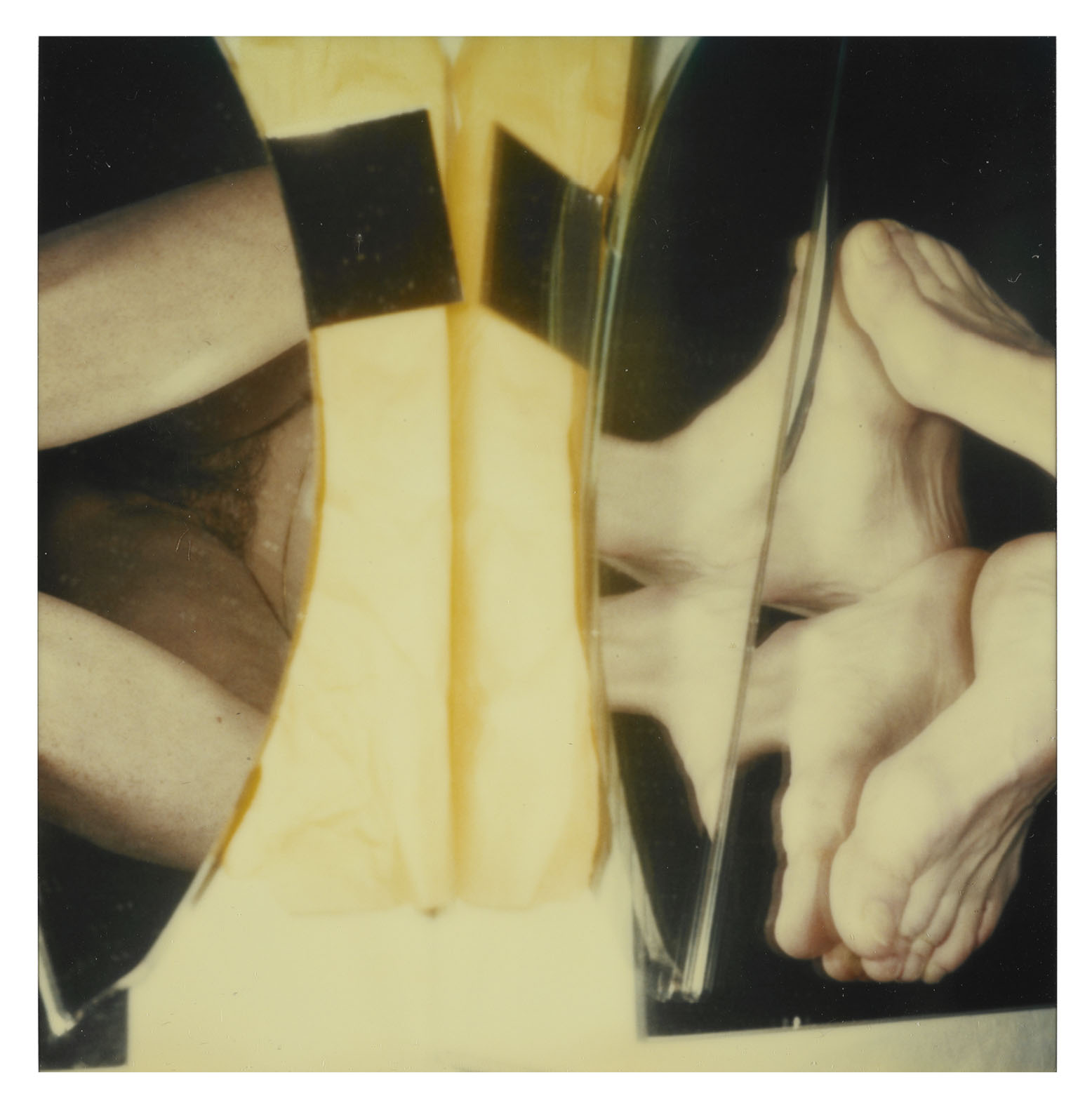
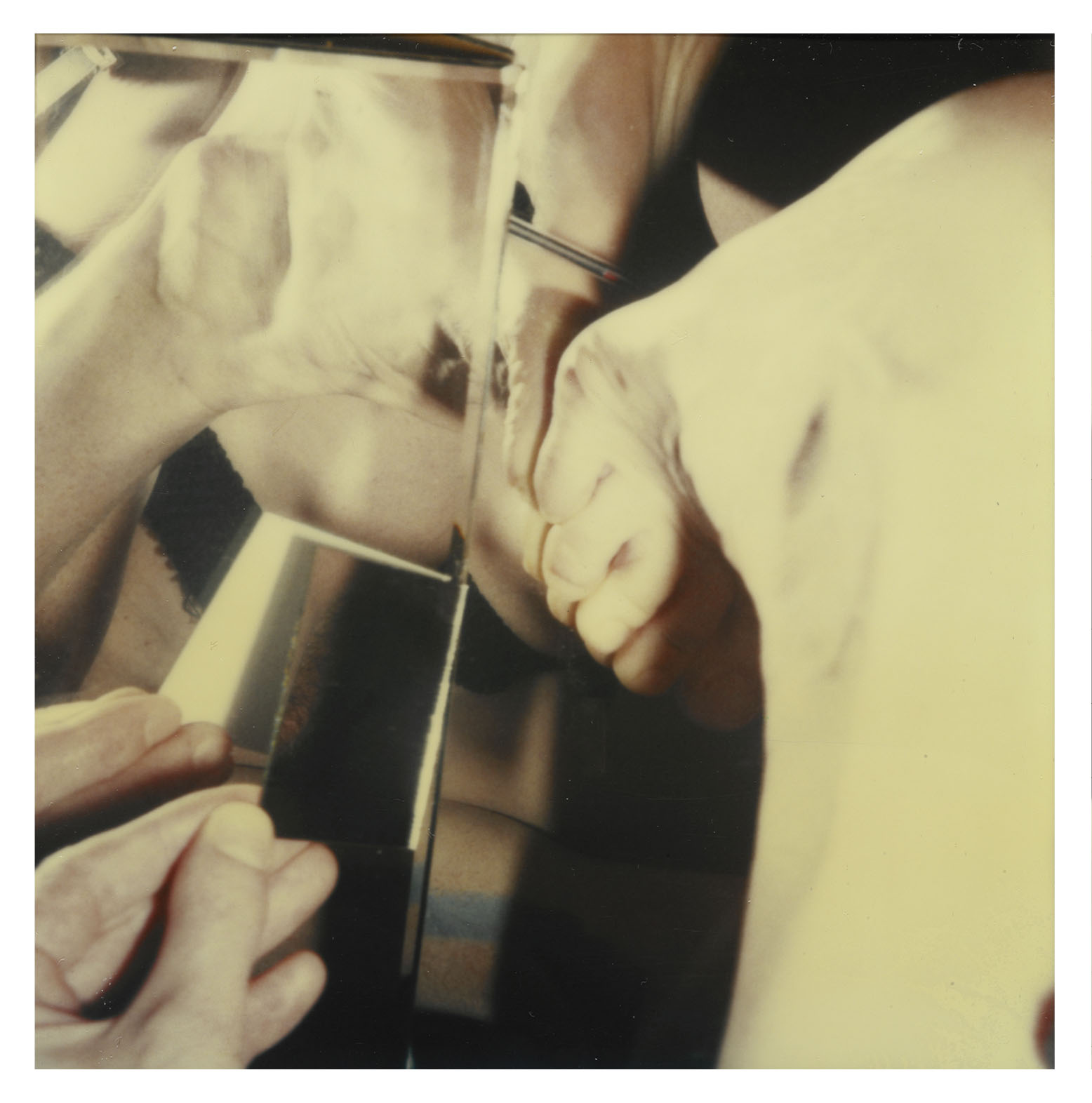
 

Hannah Villiger (Swiss, 1951-1997) 'Block XVI' 1989 (detail)

Hannah Villiger (Swiss, 1951-1997) 'Block XVI' 1989 (detail)

Hannah Villiger (Swiss, 1951-1997) 'Block XVI' 1989 (detail)


Hannah Villiger (Swiss, 1951-1997)
Block XVI (details)
1989
Nine C-prints of polaroids, mounted on aluminium
© Foundation The Estate of Hannah Villiger


Hannah Villiger (Swiss, 1951-1997) 'Sculptural' 1988-1989


Hannah Villiger (Swiss, 1951-1997)
Sculptural
1988-89
C-print of a polaroid, mounted on aluminium
© Foundation The Estate of Hannah Villiger


Hannah Villiger (Swiss, 1951-1997) 'Sculptural' 1988-1989


Hannah Villiger (Swiss, 1951-1997)
Sculptural
1988-89
C-print of a polaroid, mounted on aluminium
© Foundation The Estate of Hannah Villiger


Installation view of 'Hannah Villiger: Amaze Me' at Muzeum Susch

Installation view of 'Hannah Villiger: Amaze Me' at Muzeum Susch


Installation views of Hannah Villiger: Amaze Me at Muzeum Susch
Courtesy: © Muzeum Susch / Art Stations Foundation
Photograph: Federico Sette


Installation view of 'Hannah Villiger: Amaze Me' at Muzeum Susch showing at left 'Block XIII' (1989)


Installation view of Hannah Villiger: Amaze Me at Muzeum Susch showing at left Block XIII (1989, below)
Courtesy: © Muzeum Susch / Art Stations Foundation
Photograph: Federico Sette


Installation view of 'Hannah Villiger: Amaze Me' at Muzeum Susch showing 'Block XIII' (1989)


Installation view of Hannah Villiger: Amaze Me at Muzeum Susch showing Block XIII (1989, below)
Courtesy: © Muzeum Susch / Art Stations Foundation
Photograph: Federico Sette


Hannah Villiger (Swiss, 1951-1997) 'Block XIII' 1989


Hannah Villiger (Swiss, 1951-1997)
Block XIII
1989
Fifteen C-prints of polaroids, mounted on aluminium
© Foundation The Estate of Hannah Villiger
 

Hannah Villiger (Swiss, 1951-1997) 'Block XIII' 1989 (detail)

Hannah Villiger (Swiss, 1951-1997) 'Block XIII' 1989 (detail)

Hannah Villiger (Swiss, 1951-1997) 'Block XIII' 1989 (detail)


Hannah Villiger (Swiss, 1951-1997)
Block XIII (details)
1989
Fifteen C-prints of polaroids, mounted on aluminium
© Foundation The Estate of Hannah Villiger


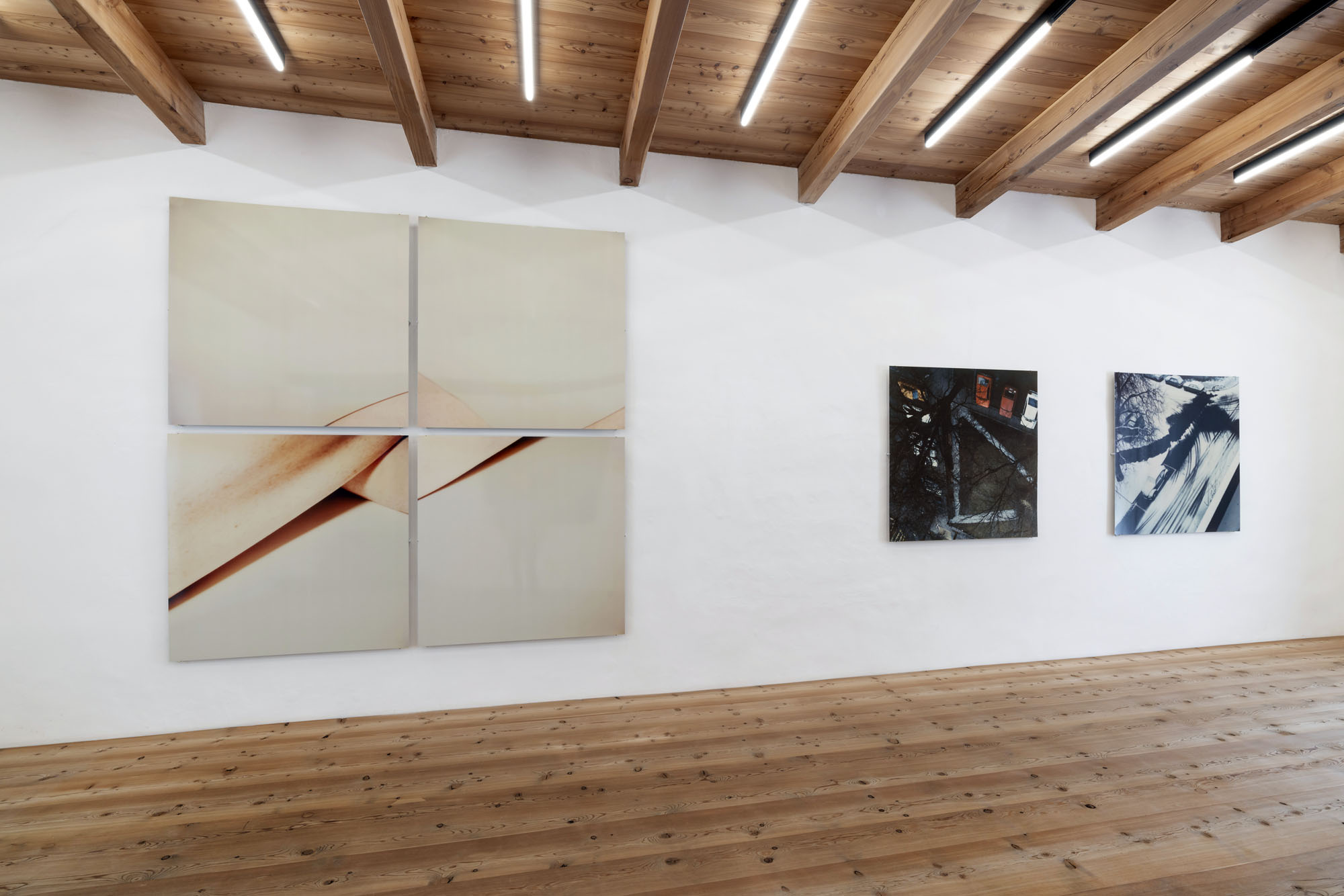
Installation view of 'Hannah Villiger: Amaze Me' at Muzeum Susch showing at left, 'Sculptural' (1990-91); and at right, 'Block XXX' (1993-1994)


Installation view of Hannah Villiger: Amaze Me at Muzeum Susch showing at left, Sculptural (1990-91, below); and at right, Block XXX (1993-1994)
Courtesy: © Muzeum Susch / Art Stations Foundation
Photograph: Federico Sette


Hannah Villiger (Swiss, 1951-1997) 'Sculptural' 1990-1991


Hannah Villiger (Swiss, 1951-1997)
Sculptural
1990-91
C-print of a polaroid, mounted on aluminium
© Foundation The Estate of Hannah Villiger


Hannah Villiger (Swiss, 1951-1997) 'Block XXX' 1993-1994


Hannah Villiger (Swiss, 1951-1997)
Block XXX
1993-94
Six C-prints of polaroids, mounted on aluminium
Jacques Herzog und Pierre de Meuron Kabinett, Basel
© Foundation The Estate of Hannah Villiger


Installation view of 'Hannah Villiger: Amaze Me' at Muzeum Susch showing at left, 'Block XXXV' (1994); and at right, 'Place' (1985)


Installation view of Hannah Villiger: Amaze Me at Muzeum Susch showing at left, Block XXXV (1994, below); and at right, Place (1985, below)
Courtesy: © Muzeum Susch / Art Stations Foundation
Photograph: Federico Sette


Hannah Villiger (Swiss, 1951-1997) 'Block XXXV' 1994


Hannah Villiger (Swiss, 1951-1997)
Block XXXV
1994
Four C-prints of polaroids, mounted on aluminium
© Foundation The Estate of Hannah Villiger


Hannah Villiger (Swiss, 1951-1997) 'Place' 1985


Hannah Villiger (Swiss, 1951-1997)
Place
1985
C-print of a polaroid, mounted on aluminium
© Foundation The Estate of Hannah Villiger


Hannah Villiger (Swiss, 1951-1997) 'Sculptural' 1995


Hannah Villiger (Swiss, 1951-1997)
Sculptural
1995
Six C-prints of polaroids, mounted on aluminium
© Foundation The Estate of Hannah Villiger


Installation view of 'Hannah Villiger: Amaze Me' at Muzeum Susch showing the work 'Block' (1996)


Installation view of Hannah Villiger: Amaze Me at Muzeum Susch showing the work Block (1996, below)
Courtesy: © Muzeum Susch / Art Stations Foundation
Photograph: Federico Sette


Hannah Villiger (Swiss, 1951-1997) 'Block' 1996


Hannah Villiger (Swiss, 1951-1997)
Block
1996
Six C-prints of polaroids, mounted on aluminium
© Foundation The Estate of Hannah Villiger


Hannah Villiger (Swiss, 1951-1997) 'Block' 1997


Hannah Villiger (Swiss, 1951-1997)
Block
1997
Nine C-prints of polaroids, mounted on aluminium
© Foundation The Estate of Hannah Villiger


Hannah Villiger (Swiss, 1951-1997) 'Block' 1997 (detail)

Hannah Villiger (Swiss, 1951-1997) 'Block' 1997 (detail)


Hannah Villiger (Swiss, 1951-1997)
Block (details)
1997
Nine C-prints of polaroids, mounted on aluminium
© Foundation The Estate of Hannah Villiger


Installation view of 'Hannah Villiger: Amaze Me' at Muzeum Susch showing at left, 'City' (1997)


Installation view of Hannah Villiger: Amaze Me at Muzeum Susch showing at left, City (1997, below)
Courtesy: © Muzeum Susch / Art Stations Foundation
Photograph: Federico Sette


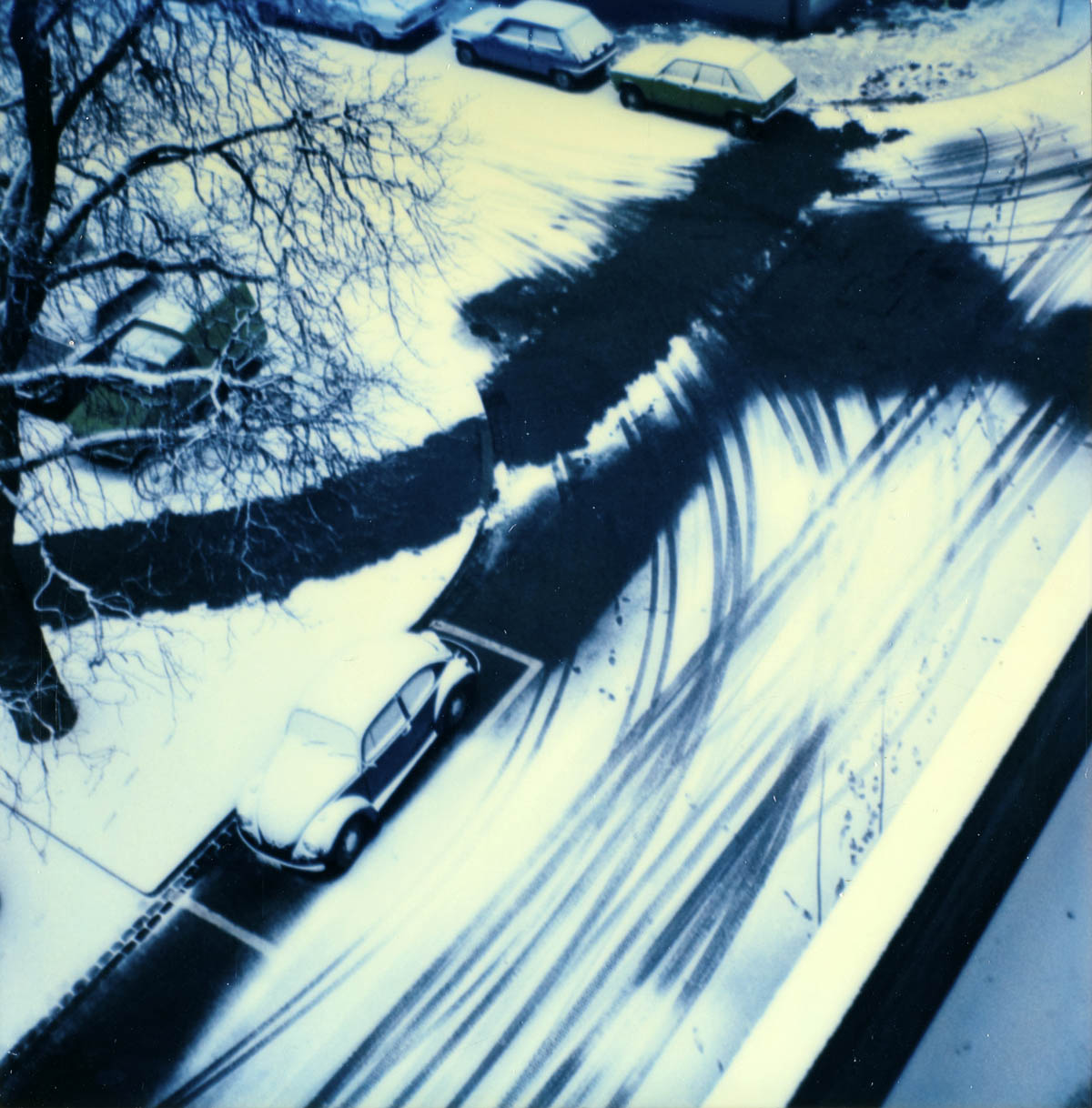
Hannah Villiger (Swiss, 1951-1997) 'City' 1997


Hannah Villiger (Swiss, 1951-1997)
City
1997
Two C-prints of polaroids, mounted on aluminium
© Foundation The Estate of Hannah Villiger


Museum Susch
Surpunt 78
CH – 7542 Susch, Switzerland

Opening hours:
Wednesday: 11.00 – 17.00
Thursday: 11.00 – 17.00
Friday: 11.00 – 17.00
Saturday: 11.00 – 17.00
Sunday: 11.00 – 17.00

Museum Susch website

LIKE ART BLART ON FACEBOOK

Back to top

Exhibition: ‘In Focus: Making A Scene’ at The J. Paul Getty Museum, Los Angeles

Exhibition dates: 30th June – 18th October, 2009


Hill & Adamson (Scottish, active 1843-1848) '[Lane and Peddie as Afghans]' 1843 from the exhibition 'In Focus: Making A Scene' at The J. Paul Getty Museum, Los Angeles, June - Oct, 2009


Hill & Adamson (Scottish, active 1843-1848)
[Lane and Peddie as Afghans]
1843
Salted paper print from a paper negative
20.6 × 14.3cm (8 1/8 × 5 5/8 in.)
The J. Paul Getty Museum


The team of Hill and Adamson initially began making dramatic portrait photographs as studies for one of Hill’s composite paintings. They also produced costume studies, including this scene in which Arabic scholar Mr. Lane and Mr. (Peddie) Redding appear in foreign garb.


What a fabulous selection of photographs to illustrate a fascinating “scene”. I love staged, theatrical, constructed, conceptual, collaged, surreal, imaginary, narrative photography.

Dr Marcus Bunyan


Many thankx to the J. Paul Getty Museum for allowing me to publish the photographs in the posting. Please click on the photographs for a larger version of the image.


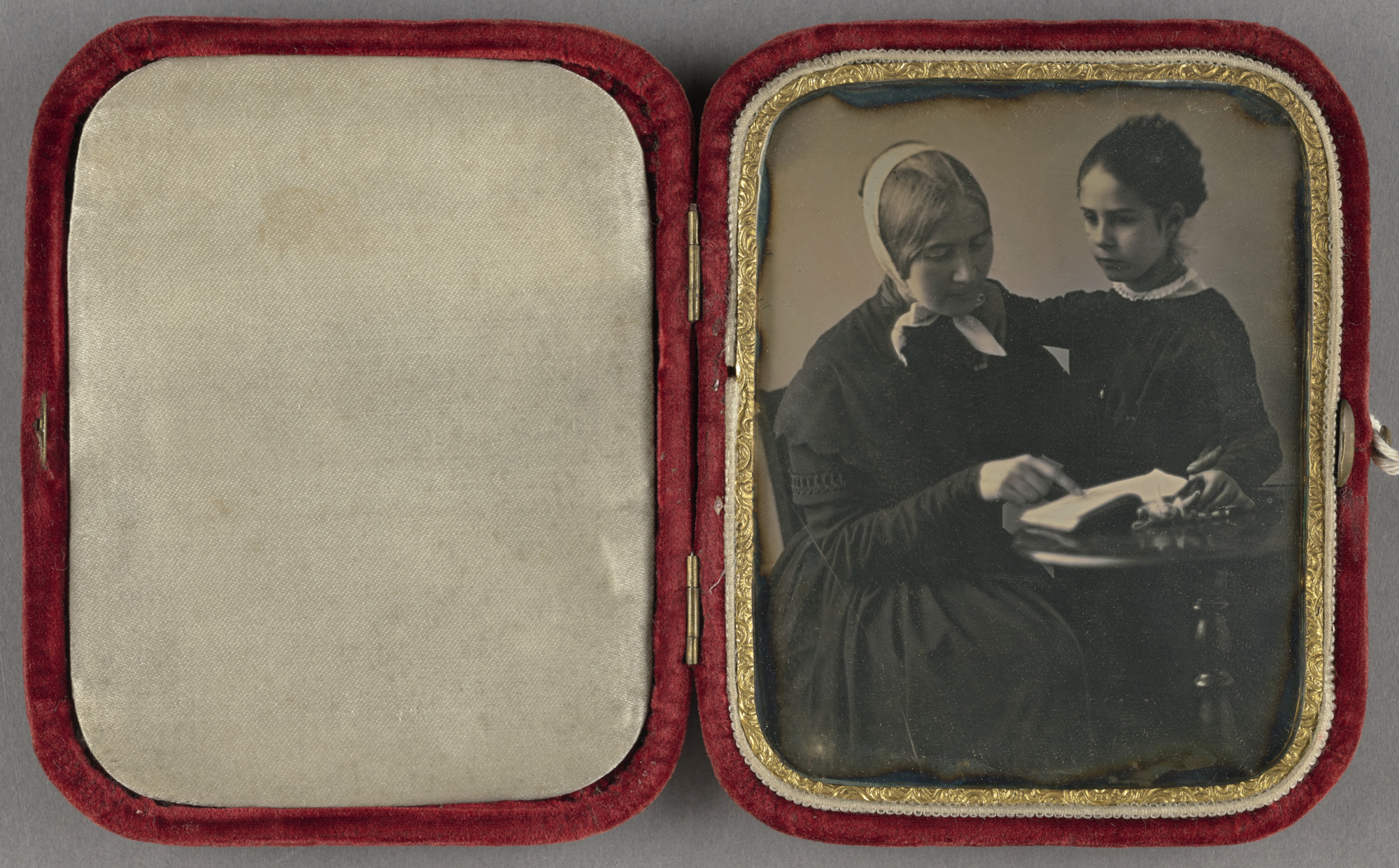
Unknown maker, French. 'Woman Reading to a Girl' c. 1845 from the exhibition 'In Focus: Making A Scene' at The J. Paul Getty Museum, Los Angeles, June - Oct, 2009


Unknown maker, French
Woman Reading to a Girl
c. 1845
Daguerreotype
9.1 × 7.1cm (3 9/16 × 2 13/16 in.)
The J. Paul Getty Museum


Through a skilful manipulation, the light coming from above and behind the figures casts the faces of mother and child in a softly modulated half-shadow. Their close grouping and familiar, intimate gestures evoke tenderness. The reflected light on the woman’s pointing finger and on the glowing white pages of the open book forms a strong visual triangle, drawing the viewer’s eye and serving to integrate and balance the composition.


Oscar Gustave Rejlander (British, born Sweden, 1813-1875) 'The Infant Photography Giving the Painter an Additional Brush' c. 1856 from the exhibition 'In Focus: Making A Scene' at The J. Paul Getty Museum, Los Angeles, June - Oct, 2009


Oscar Gustave Rejlander (British born Sweden, 1813-1875)
The Infant Photography Giving the Painter an Additional Brush
c. 1856
Albumen silver print
6 × 7.1cm (2 3/8 × 2 13/16 in.)
The J. Paul Getty Museum


Oscar Rejlander’s photograph could be read as a metaphor of his own career. The additional “brush” or image-making tool provided by photography to painters was evident from the beginnings of the medium. Many early practitioners arrived at photography from painting, as did Rejlander. Photographs were often thought of and used as sketching tools for painters. Although photographs never managed to signal the death of painting as initially predicted, they did frequently assume the function that drawing had traditionally held in relation to painting.

Compositionally, this is an unusual photograph. Rejlander employs a narrative device from painting: the use of figures, or parts of figures, as allegorical representations for ideas. A very young child represents the infant medium of photography. The Painter appears only as a hand extending into the frame at the upper left, although the traditional arts are also represented by the sculpture reproduction in the lower left corner. The Infant Photography, identified by the camera on which the child supports himself, faces away from the camera, his features totally obscured. The mirror behind the child gives a clear reflection of Rejlander at his camera, making this image.


Roger Fenton (English, 1819-1869) 'Contemplative Odalisque' 1858


Roger Fenton (English, 1819-1869)
Contemplative Odalisque
1858
Albumen silver print
35.9 × 43.8cm (14 1/8 × 17 1/4 in.)
The J. Paul Getty Museum
Gift of Professors Joseph and Elaine Monsen


Three years after traveling in the Crimea, Roger Fenton made a series of Orientalist photographs in his London studio using props gathered during his travels and non-Eastern models. Orientalism refers to just such romanticised depictions of imagined scenes of Muslim culture in the Ottoman Empire and its territories in the Near East and North Africa.

Orientalist scenes were more often fiction than fact. Cultural biases and misunderstandings were laid down on paper or canvas and frequently became the only source of information on the subjects depicted. When a group of these Orientalist photographs was exhibited in 1858, one reviewer described them as “truly representing some phases in the life of this interesting people.”

But not everyone so easily accepted Fenton’s images at face value; a more astute critic called for “the necessity of having real national types as models.” The same model shown here also appears as “Nubian” and “Egyptian” in other photographs by Fenton. This photograph may have originally been exhibited with the title The Reverie. The odalisque, meaning a slave or concubine in a harem, poses upon her sofa. Barefoot, blouse open, her surroundings convey a sensual disarray that conforms to an Orientalising fantasy of the available woman.


Julia Margaret Cameron (British, born India, 1815-1879) 'The Rosebud Garden of Girls' June 1868


Julia Margaret Cameron (British, born India, 1815-1879)
The Rosebud Garden of Girls
June 1868
Album silver print
29.4 × 26.7cm (11 9/16 × 10 1/2 in.)
The J. Paul Getty Museum


As evolutionary science and increasing secularism transformed the way Victorians understood the world, Cameron remained a devout Christian. She photographed influential public figures of her day as well as the women of her household, casting them in allegories of literary and religious subjects. Like her artistic contemporaries, the Pre-Raphaelite painters, who modelled their work on medieval religious and mythological art, Cameron intended her photographs to evince a connection between the spiritual and the natural realms.


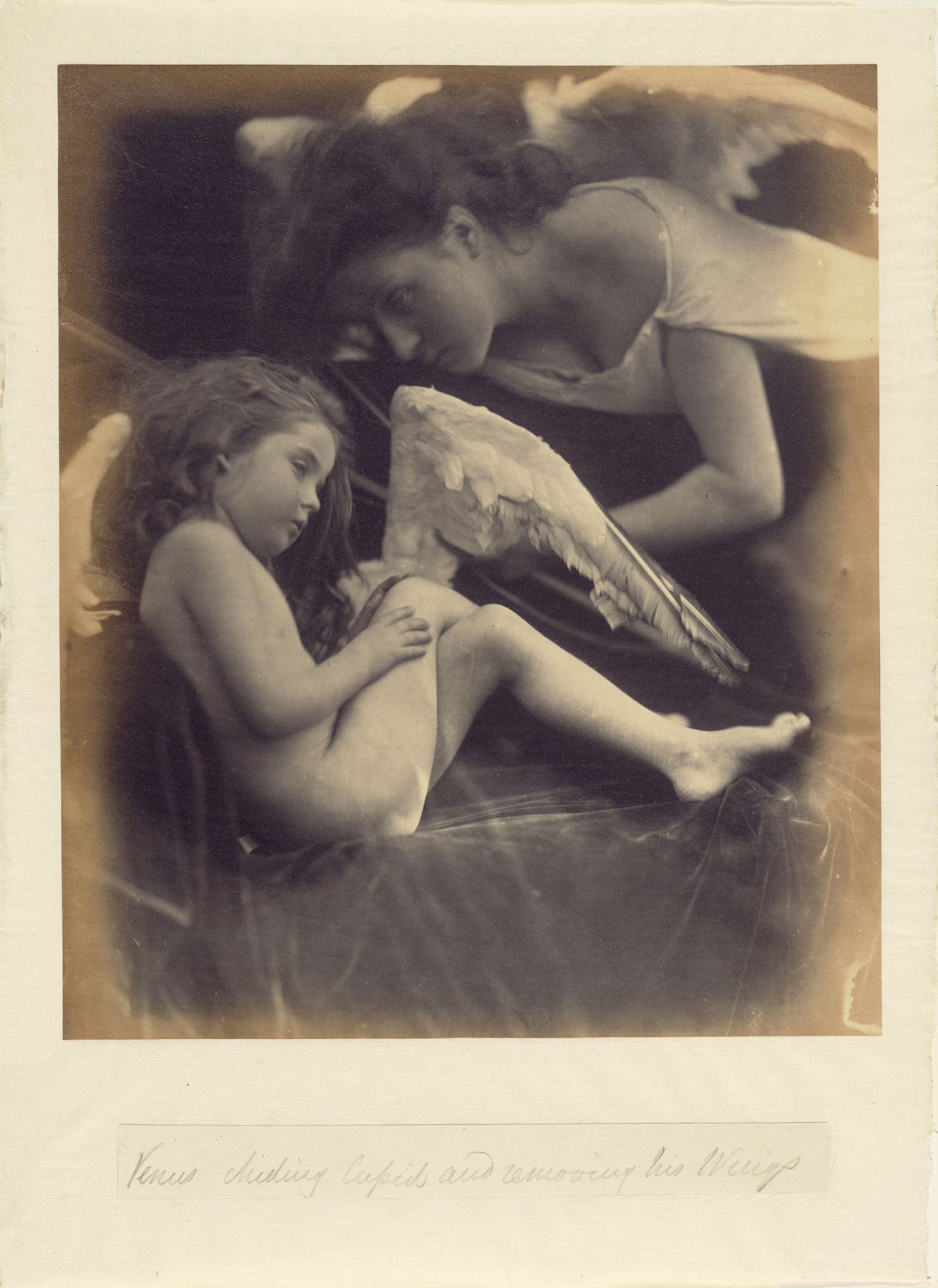
Julia Margaret Cameron (British, born India, 1815-1879) 'Venus Chiding Cupid and Removing His Wings' 1872


Julia Margaret Cameron (British, born India, 1815-1879)
Venus Chiding Cupid and Removing His Wings
1872
Album silver print
32.4 × 27.3cm (12 3/4 × 10 3/4 in.)
The J. Paul Getty Museum


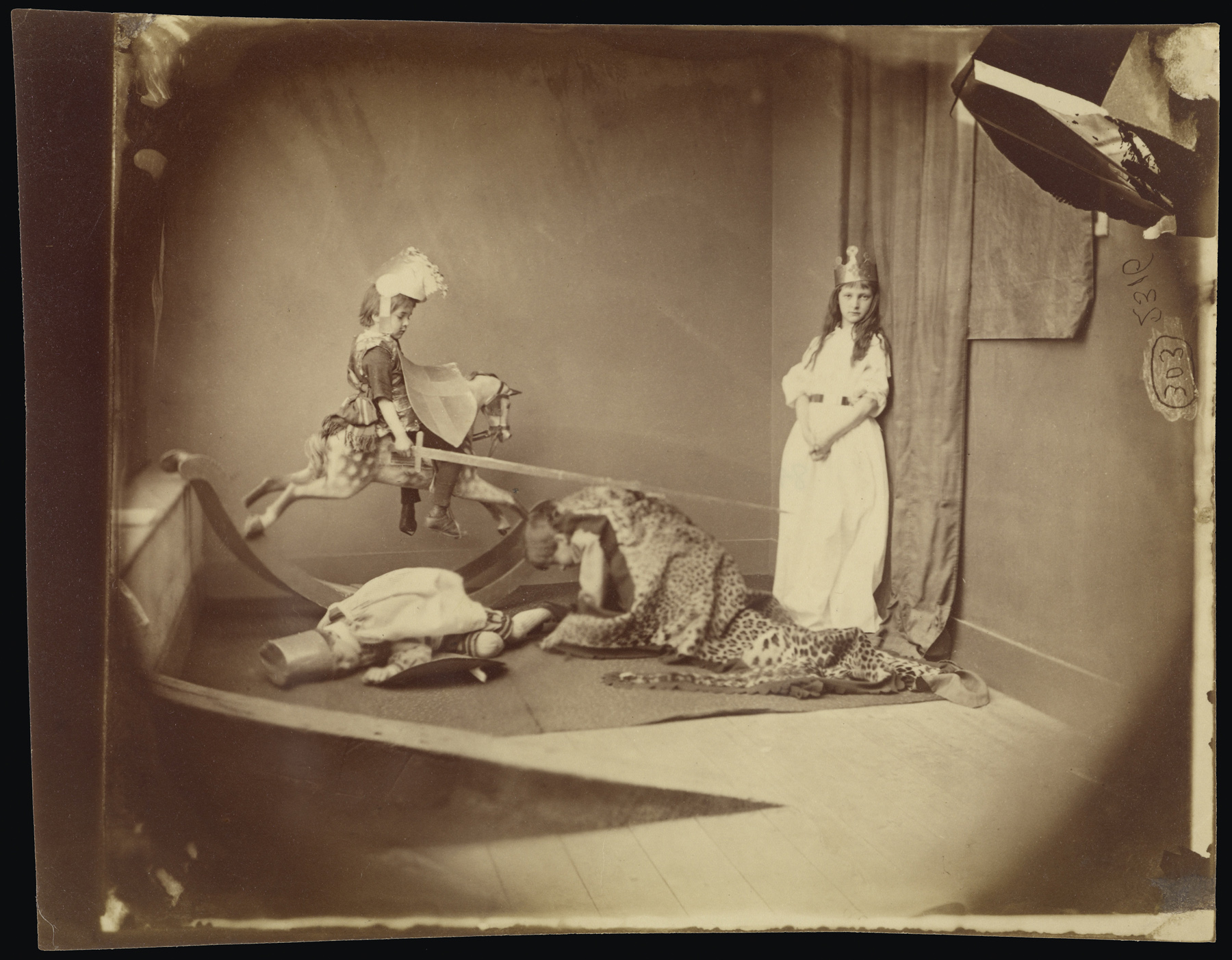
Lewis Carroll (British, 1832-1898) 'Saint George and the Dragon' June 26, 1875


Lewis Carroll (British, 1832-1898)
Saint George and the Dragon
June 26, 1875
Albumen silver print
12.2 × 16.2cm (4 13/16 × 6 3/8 in.)
The J. Paul Getty Museum


Like Alice’s Adventures in Wonderland and his other books, Carroll’s photographs are fantasies starring the children of his friends. In this production, the Kitchin siblings enacted the romantic legend of Saint George, the patron saint of England, who slayed a child-eating dragon before it devoured a princess. George later married the rescued princess and converted her pagan town to Christianity. Using crude stagecraft to reference key plot points, Carroll condensed the entire legend into a single scene in which the princess appears as both damsel in distress and bride.


Baron Wilhelm von Gloeden (German, 1856-1931) 'Untitled [Two Male Youths Holding Palm Fronds]' c. 1885 - 1905


Baron Wilhelm von Gloeden (German, 1856-1931)
Untitled [Two Male Youths Holding Palm Fronds]
c. 1885-1905
Albumen silver print
23.3 × 17.5cm (9 3/16 × 6 7/8 in.)
The J. Paul Getty Museum


Baron Wilhelm von Gloeden (German, 1856-1931) 'L'Offerta' (The Offering) 1902


Baron Wilhelm von Gloeden (German, 1856-1931)
L’Offerta (The Offering)
1902
Albumen silver print
22.4 × 16.8cm (8 13/16 × 6 5/8 in.)
The J. Paul Getty Museum


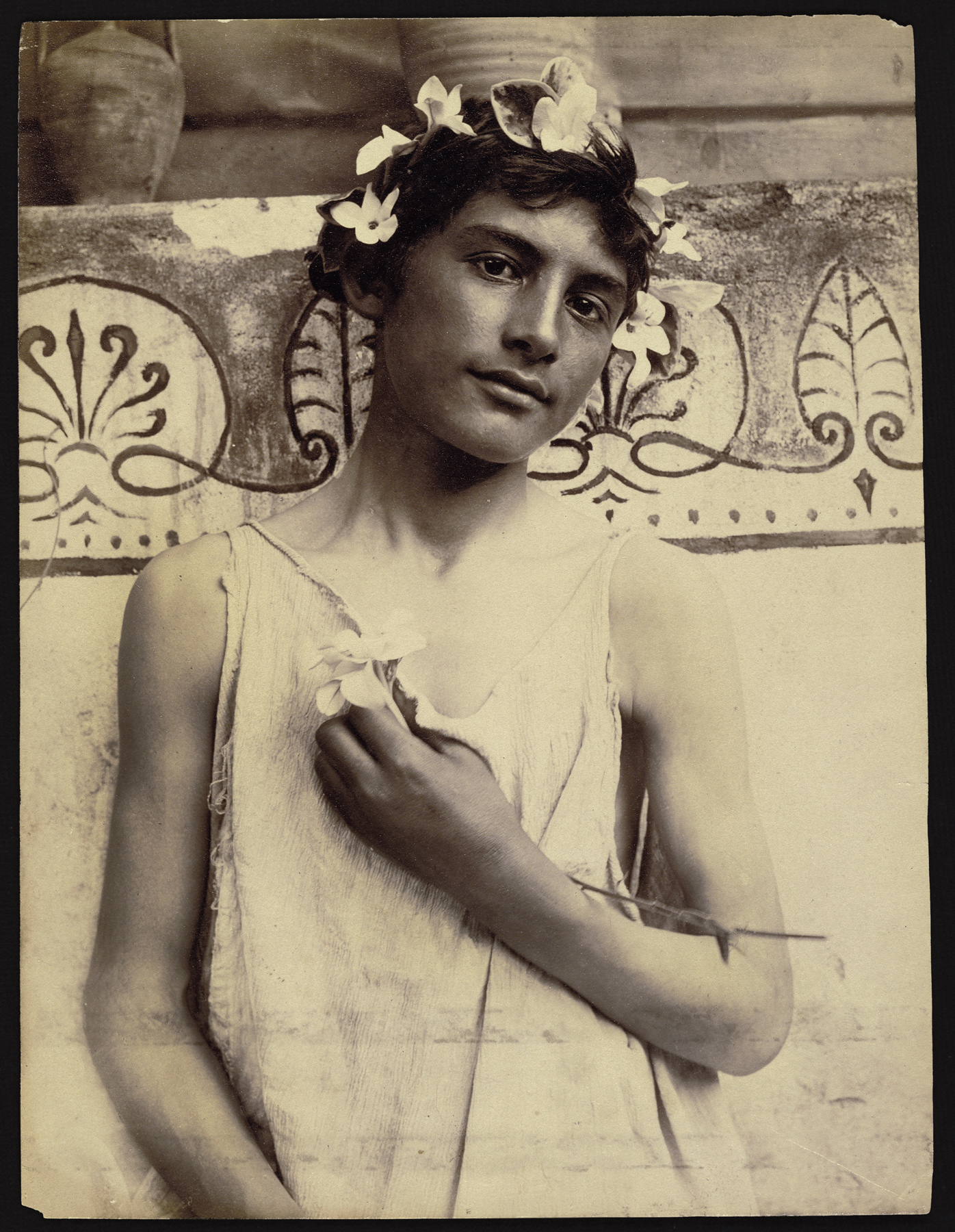
Von Gloeden left Germany and settled in a coastal town in Sicily, where he took up photography. His subjects were young native boys, whom he often photographed nude in classical compositions. Rather than reenact specific historical or literary scenes, von Gloeden mused nostalgically on the ancient Greek and Roman ancestry of his attractive models.


Guido Rey (Italian, 1861-1935) '[The Letter]' 1908


Guido Rey (Italian, 1861-1935)
[The Letter]
1908
Platinum print
21.9 × 17cm (8 5/8 × 6 11/16 in.)
The J. Paul Getty Museum


A deliberate homage to an earlier artistic style that Guido Rey admired, the composition derives from a painting made by Dutch artist Jan Vermeer in the 1600s. In this posed scene, a young suitor bearing flowers approaches a woman seated at her writing desk, with her pen poised in mid-air as she turns to greet him. A leaded glass window opens into her room, providing a natural light source for the photograph’s illumination. The mounted corner clock, decorative jar on the desk, and painting on the wall were Rey’s everyday household items or objects borrowed from friends, carefully chosen for period accuracy. Likewise, a seamstress who lived in the attic of Rey’s home in Turin created the costumes to his specifications.


Photography, although commonly associated with truthfulness, has been used to produce fiction since its introduction in 1839. The acceptance of staging, and the degree of its application, has varied greatly depending on the genre and the historical moment, but it has persisted as an artistic approach. The photographs in this exhibition, drawn exclusively from the J. Paul Getty Museum’s collection, make no pretence about presenting the world as it exists; instead, they are the productions of directors and actors who rely on stagecraft and occasional darkroom trickery to tell stories.
 Spanning photography’s history and expressing a range of sentiments, the images in this exhibition are inspired by art history, literature, religion, and mainstream media.

Like Alice’s Adventures in Wonderland and his other books, Lewis Carroll’s photographs are fantasies starring his friends’ children. In the image below, children enact the mythological story of Saint George, the patron saint of England, slaying a child-eating dragon before it could devour a princess.

Life Imitating Art

Well-represented in this exhibition are tableaux vivants (living pictures), inspired by the popular Victorian parlour game in which costumed participants posed to resemble famous works of art or literary scenes.
The genre paintings of 17th-century Dutch masters Johannes Vermeer and Pieter de Hooch fascinated Guido Rey. Not self-conscious about being slavish to the past, he carefully studied the paintings and then arranged similar tableaux for his camera. His photographs captured equally serene domestic scenes and mimicked the minute architectural details of 17th-century interiors, such as the leaded-glass windowpanes and the checkerboard floor.

Playing Dress Up

The exhibition also includes costume studies of people posing as literary characters and self-portraits of artists pretending to be other people. 

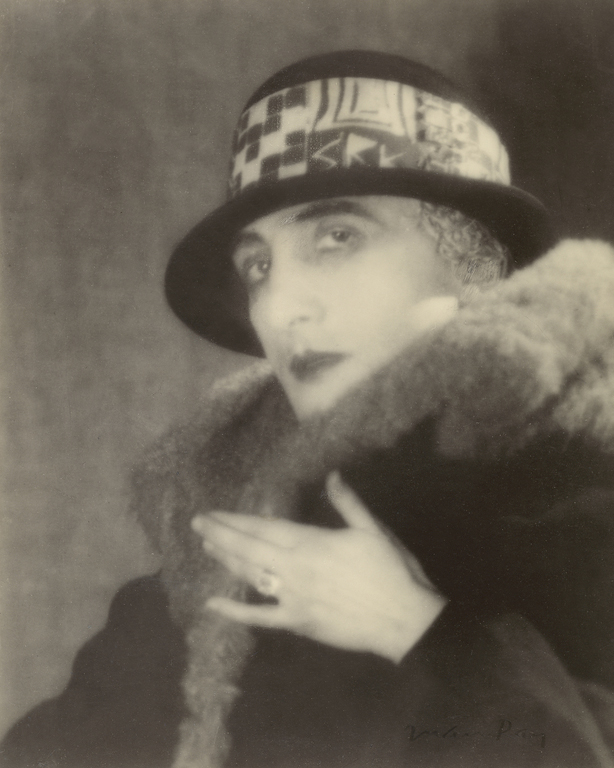
American painter and photographer Man Ray and the French artist Marcel Duchamp met in New York in 1915, and they began a playful, iconoclastic collaboration that resulted in the photograph (above), among others. Influenced by Dadaism, a cultural movement that rejected reason and logic in favour of anarchy and the absurd, their work embraced games of chance, performance, and wordplay. Here an irreverent Duchamp appears in women’s clothing as his alter ego, Rrose Sélavy, a pun on the French pronunciation “Eros, c’est la vie” (Sex, that’s life).

Imaginary Subjects

A number of photographs in the exhibition explore the medium’s capacity to visualise subjects of the imagination by using darkroom trickery to manipulate prints.
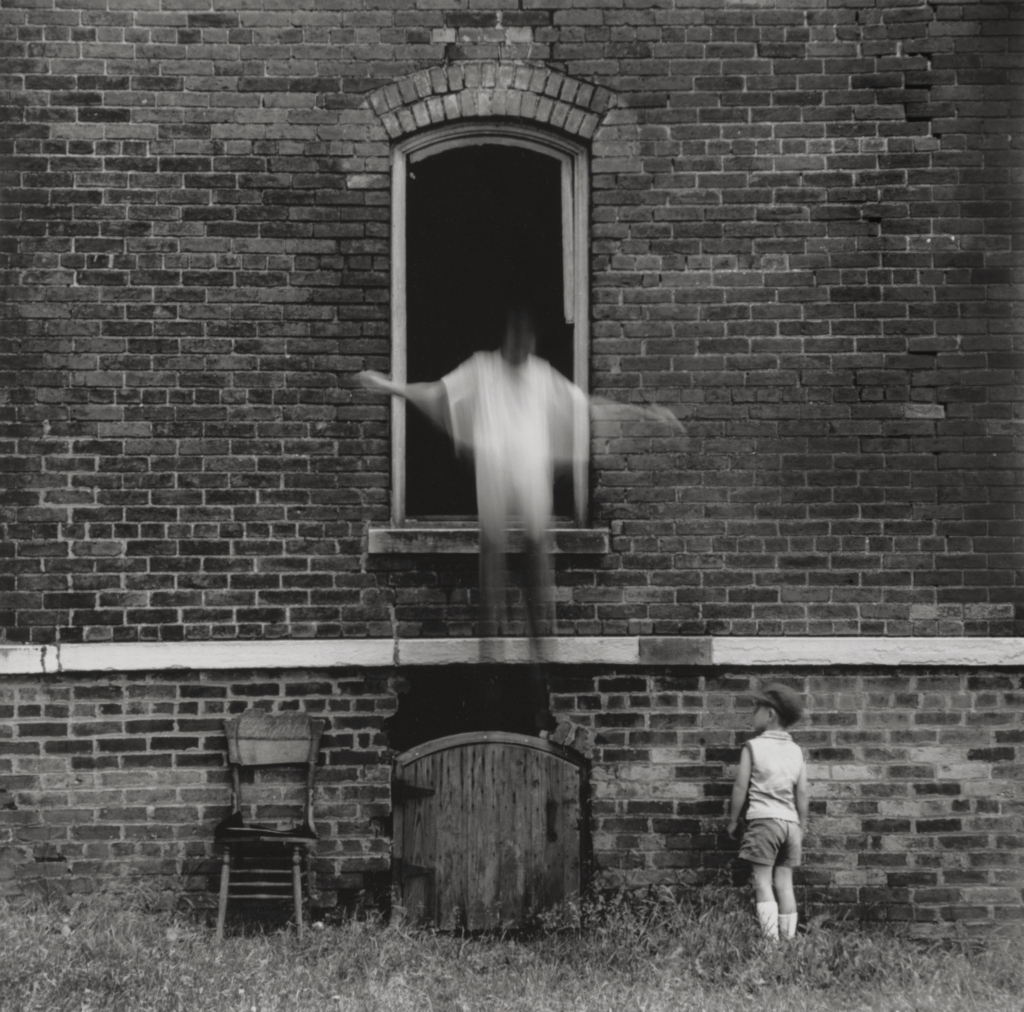
 An optician and family man, Ralph Eugene Meatyard photographed his children, friends, and neighbours enacting dramas in suburban backyards and abandoned buildings near his Lexington, Kentucky, home. He often used experimental techniques, such as multiple exposures and blurred motion. Uncanny details imbue Meatyard’s otherwise ordinary vernacular scenes with the qualities of a dream or supernatural vision.

Theatricality as a Critical Strategy

In recent decades there has been renewed interest in theatricality among contemporary photographers whose highly artificial scenes critique mainstream media and representation.
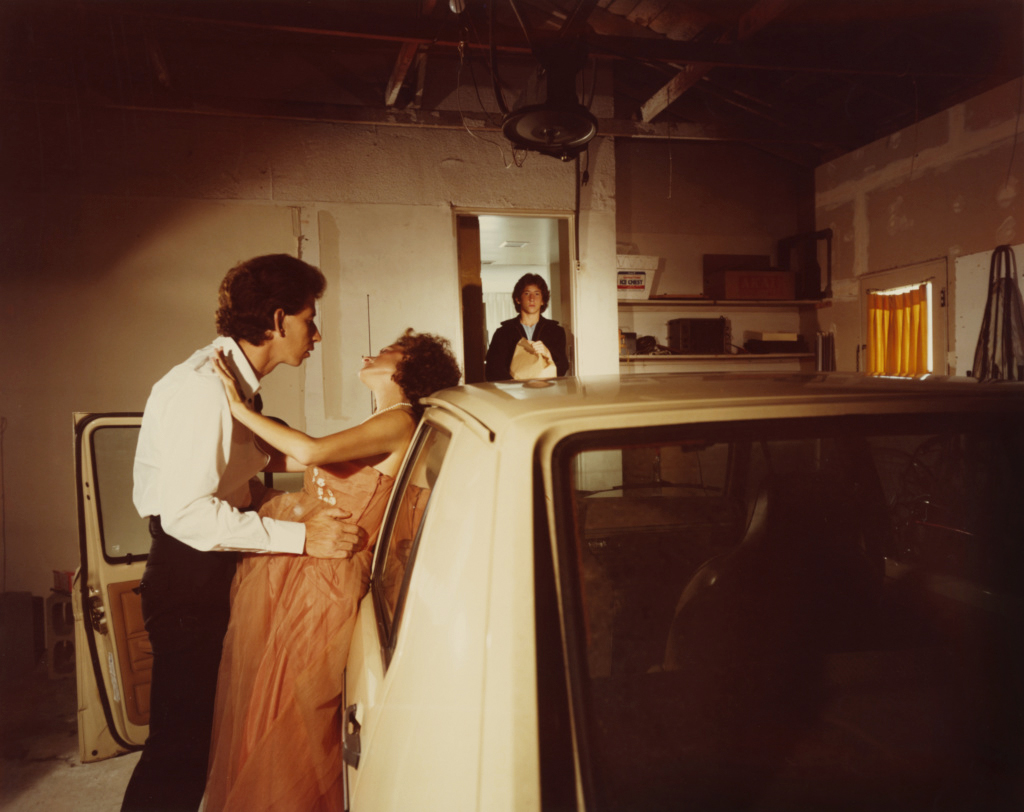
 In her series Family Docudrama Eileen Cowin blurs the boundaries between truth and fiction, and private behaviour and public performance. Drawing equally from family snapshots and soap operas, Cowin presents staged domestic scenes in which she and members of her family, including her identical twin sister, perform as actors. In these ambiguous, open-ended narratives, dramatic moments are exaggerated, and the camera’s glare is ever present.”

Text from The J. Paul Getty Museum website [Online] Cited 16/04/2019


Man Ray (American, 1890-1976) 'Rrose Sélavy (Marcel Duchamp)' 1923


Man Ray (American, 1890-1976)
Rrose Sélavy (Marcel Duchamp)
1923
Gelatin silver print
22.1 × 17.6cm (8 11/16 × 6 15/16 in.)
The J. Paul Getty Museum
© Man Ray Trust ARS-ADAGP


When Man Ray moved to Paris, he was greeted by his friend and artistic compatriot Marcel Duchamp, who introduced him to members of the Dada circle of writers and artists. The two men had collaborated in a number of creative endeavours in New York, including the creation of a female alter-ego for Duchamp named Rrose Sélavy (a pun on the French pronunciation Eros, c’est la vie “Sex, that’s life”). Man Ray photographed Duchamp several times as Rrose Sélavy.


Man Ray (American, 1890-1976) 'Larmes' 1930


Man Ray (American, 1890-1976)
Larmes (Tears)
1930-1932
Gelatin silver print
22.9 × 29.8cm (9 × 11 3/4 in.)
The J. Paul Getty Museum
© Man Ray Trust ARS-ADAGP


Judging from his inclusion of this image in other photographic compositions, Man Ray must have considered Tears one of his most successful photographs. A cropped version of it with a single eye also appears as the first plate in a 1934 book of his photographs.

Like the emotive expression of a silent screen star in a film still, the woman’s plaintive upward glance and mascara-encrusted lashes seem intended to invoke wonder at the cause of her distress. The face belongs to a fashion model who cries tears of glistening, round glass beads; the effect is to aestheticise the sentiment her tears would normally express. Man Ray made this photograph in Paris around the time of his breakup with his lover Lee Miller, and the woman’s false tears may relate to that event in the artist’s life.


Dora Maar (French, 1907-1997) 'Le Simulateur (The Pretender)' 1936


Dora Maar (French, 1907-1997)
Le Simulateur (The Pretender)
1936
Gelatin silver print
26.6 × 21.7cm (10 1/2 × 8 1/2 in.)
The J. Paul Getty Museum
© Dora Maar Estate/Artists Rights Society (ARS), New York/ADAGP, Paris


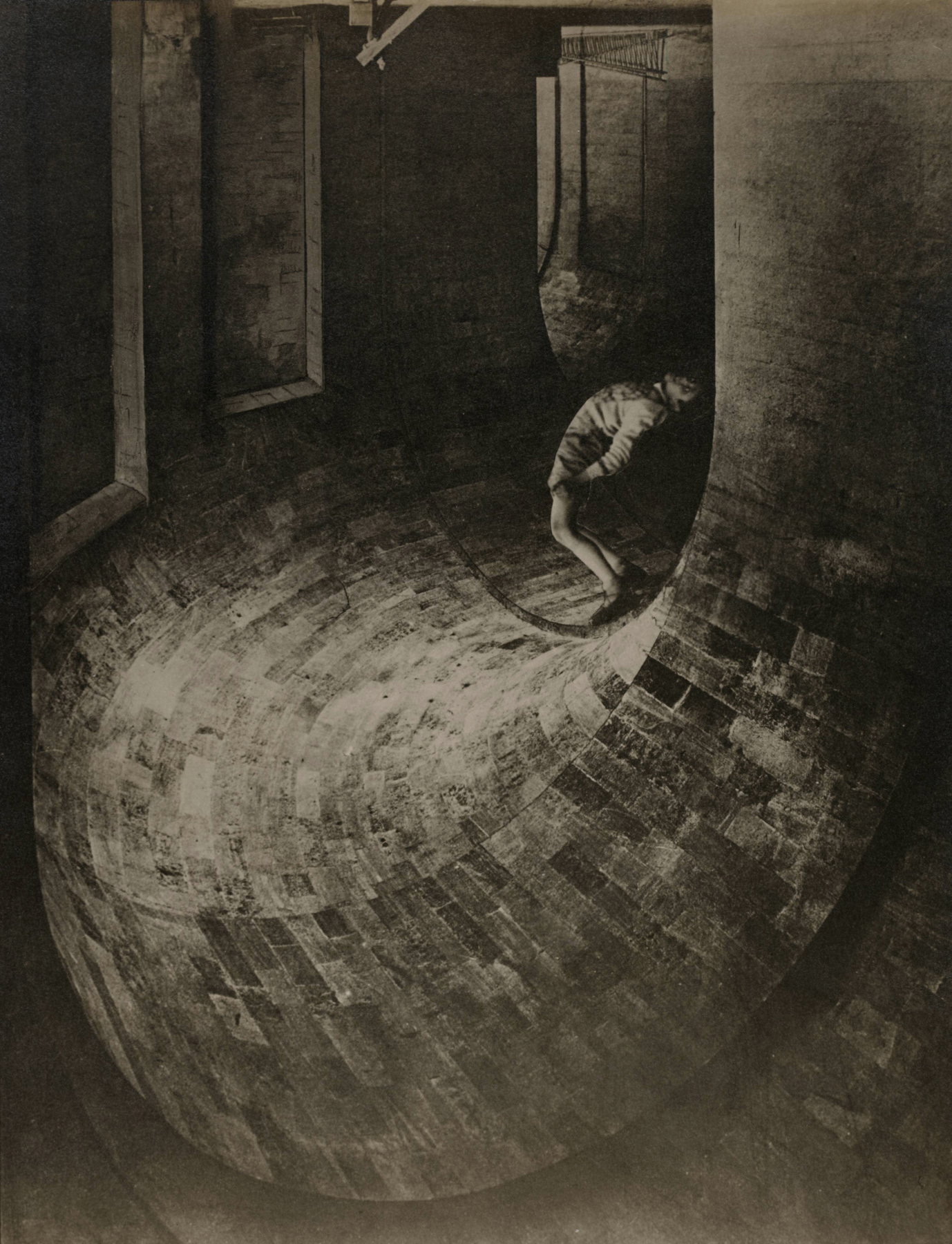
In this picture Dora Maar constructed her own reality by joining together several images and rephotographing them. The seamlessness of the photographic surface makes this construction believable and leaves the viewer wondering about the strange world the figure inhabits. On closer examination, the viewer may notice that the floor is an upside-down ceiling vault, that the bricked-in windows are drawn in by hand, and that the figure was added separately. Despite these discoveries, the picture resists logical interpretation.


Ralph Eugene Meatyard (American, 1925-1972) 'Untitled (Michael and Christopher Meatyard)' 1966


Ralph Eugene Meatyard (American, 1925-1972)
Untitled (Michael and Christopher Meatyard)
1966
Gelatin silver print
16.8 × 17.5cm (6 5/8 × 6 7/8 in.)
The J. Paul Getty Museum
Gift of Christopher Meatyard and Jonathan Greene
© Estate of Ralph Eugene Meatyard


An optician and family man, Meatyard photographed his children, friends, and neighbours enacting dramas in the suburban backyards and abandoned buildings of Lexington, Kentucky. He often used experimental techniques, such as multiple exposures and blurred motion. Uncanny details imbue Meatyard’s otherwise ordinary vernacular scenes with the qualities of a dream or supernatural vision.


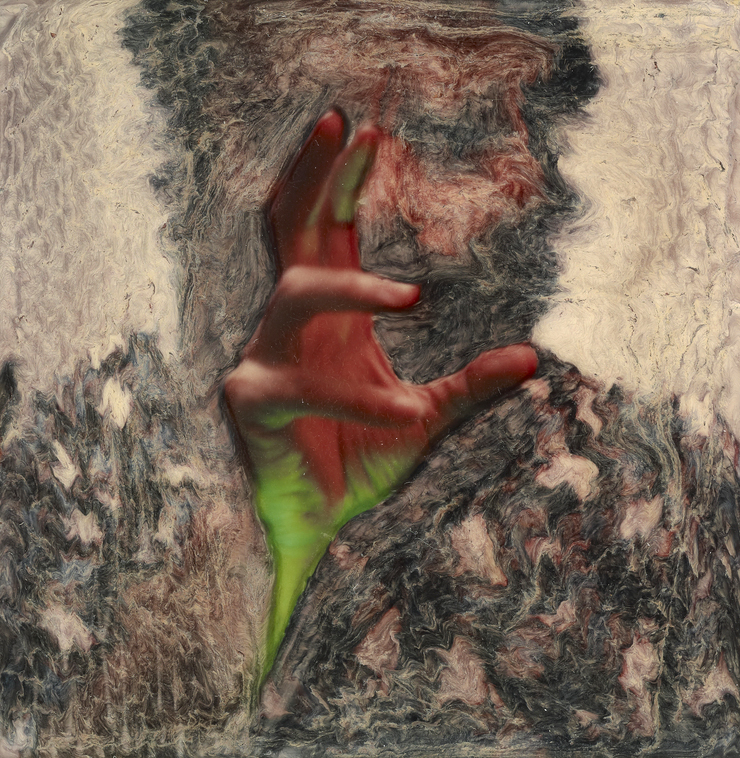
Lucas Samaras (American born Greece, b. 1936) 'Photo-Transformation' November 22, 1973


Lucas Samaras (American born Greece, b. 1936)
Photo-Transformation
November 22, 1973
Polaroid SX-70 dye diffusion print
7.6 × 7.6cm (3 × 3 in.)
The J. Paul Getty Museum
© Lucas Samaras


In this self-portrait, Lucas Samaras reaches out as if trapped in the photograph. In sharp contrast to the indistinct background of his upper body, his crisply defined fingers curl forward, as if he is searching for a way to transcend a two-dimensional world of his own creation. An overriding sense of claustrophobia defines this image, underscored by the small scale of the Polaroid print. Samaras, a hermit-like person, made many Polaroid self-portraits like this in the 1970s as a means of observing himself. The images are open to a wide range of interpretation. Here, Samaras may have tried to convey the sense of isolation he experiences as a reclusive person.


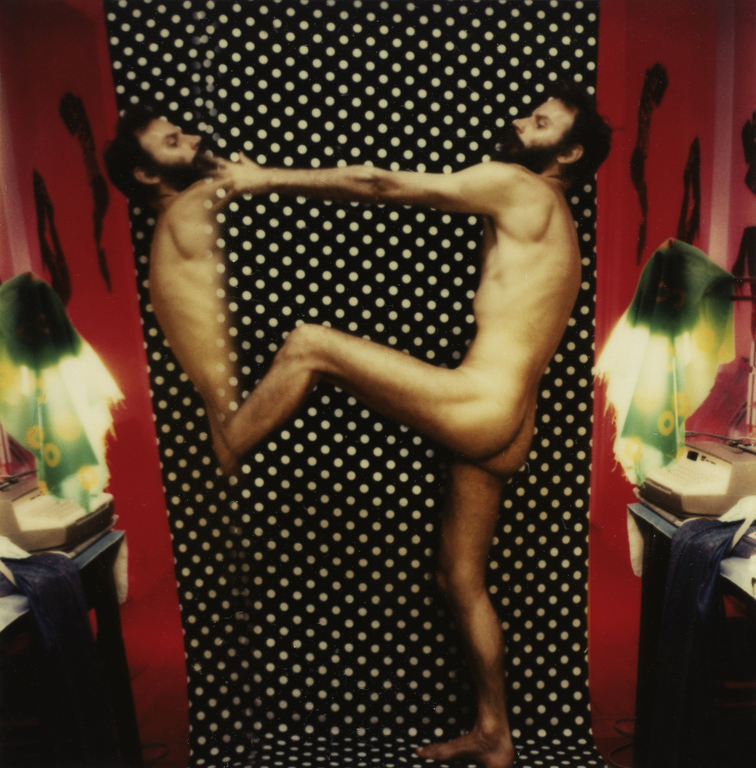
Lucas Samaras (American born Greece, b. 1936) 'Photo-Transformation' September 9, 1976


Lucas Samaras (American born Greece, b. 1936)
Photo-Transformation
September 9, 1976
Polaroid SX-70 dye diffusion print
7.6 × 7.6cm (3 × 3 in.)
The J. Paul Getty Museum
© Lucas Samaras


As if engaging in a tug-of-war with himself, Lucas Samaras confronts and struggles with his own reflection in this self-portrait. The leg-less reflection is incomplete, however, giving the impression of a deformed adversary. A monochromatic polka-dot background and a vibrant green and red border act as a stage for this dramatic struggle.

Samaras’s Photo-Transformations, which he made in the 1970s as a means to examine various facets of himself, could be understood as visual manifestations of internal conflict. They are complex psychological investigations that, according to at least one critic, illustrate one person’s efforts toward spiritual healing.


Lucas Samaras (American, born Greece, 1936) 'Photo-Transformation, 1976'


Lucas Samaras (American born Greece, b. 1936)
Photo-Transformation, 1976
1976
Polaroid SX-70 dye diffusion print
7.6 × 7.6cm (3 × 3 in.)
The J. Paul Getty Museum
© Lucas Samaras


Submerged in narcissism, nothing remains… but “me and myself, I am my own audience, the other, contemplating my existence.”

Made in the 1970s as a means of studying himself, Lucas Samaras’s photographs illustrate the internal struggle that can occur between conflicting aspects of one personality. Bent over a captain’s chair, Samaras rests his head as if he is at the guillotine. Another blurry form hovers above, about to violently attack the submissive figure.

Samaras made his Photo-Transformations, a series of self-portraits, with SX-70 Polaroid film. Still wet, the film’s emulsions could be manipulated to alter the finished image. He used straight pins, rubber erasers, and other simple tools to “draw” into the developing surface. For this portrait, he created a diamond pattern over and around the dominant figure that underscores the frenzy of motion.


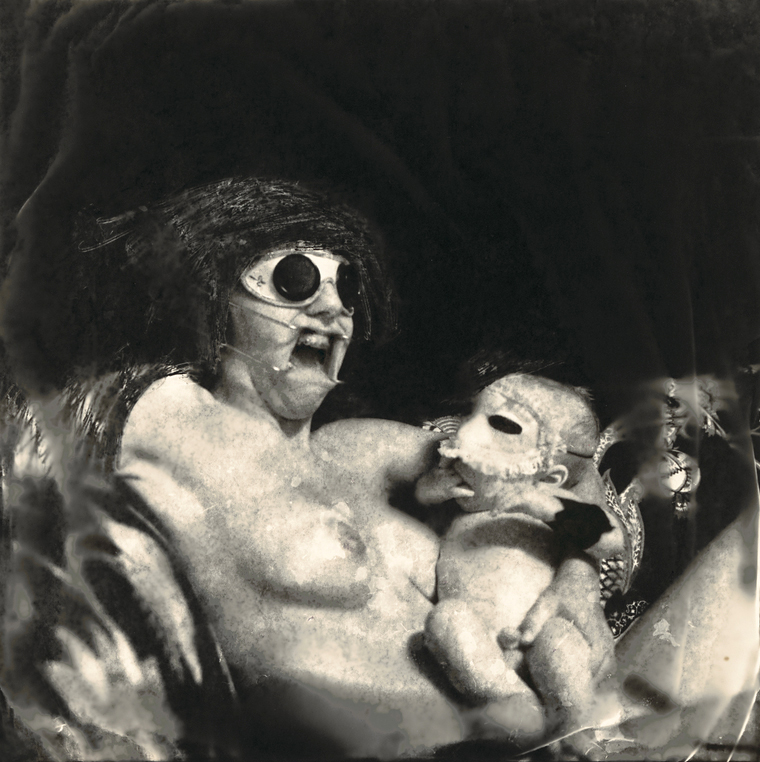
Joel Peter-Witkin (American, born 1939) 'Mother and Child (with Retractor, Screaming)' 1979


Joel Peter-Witkin (American, b. 1939)
Mother and Child (with Retractor, Screaming)
1979
Gelatin silver print
36 × 36cm (14 3/16 × 14 3/16 in.)
The J. Paul Getty Museum
© Joel-Peter Witkin


Eileen Cowin (American, born 1947) 'Untitled' from the series 'Family Docudrama' 1980-1983


Eileen Cowin (American, b. 1947)
Untitled from the series Family Docudrama
1980-1983
Chromogenic print
48.4 × 60.7cm (19 1/16 × 23 7/8 in.)
The J. Paul Getty Museum
Purchased with funds provided by the Photographs Council
© Eileen Cowin


In her series Family Docudrama Cowin blurs the boundaries between truth and fiction, and private behaviour and public performance. Drawing equally from family snapshots and soap operas, she presents staged domestic scenes in which she and members of her family, including her identical twin sister, perform as actors. In these ambiguous, open-ended narratives, dramatic moments are exaggerated and the camera’s glare is ever present.


The J. Paul Getty Museum
1200 Getty Center Drive
Los Angeles, California 90049

Opening hours:
Daily 10am – 5.30pm

The J. Paul Getty Museum website

LIKE ART BLART ON FACEBOOK

Back to top

Exhibition: ‘Walker Evans’ retrospective at Fotomuseum Winterthur, Zurich

Exhibition dates: 30th May – 23rd August, 2009

Curators: Jeff L. Rosenheim and Carlos Gollonet


Walker Evans (American, 1903-1975) 'West Virginia Living Room' 1935 from the exhibition 'Walker Evans' retrospective at Fotomuseum Winterthur, Zurich, May - Aug, 2009


Walker Evans (American, 1903-1975)
West Virginia Living Room
1935
Gelatin silver print
© Walker Evans archive


Many thankx to the Fotomuseum Winterthur for allowing me to publish the photographs in the posting. Please click on the photographs for a larger version of the image.


With this retrospective of the work of Walker Evans (1903-1975) Fotomuseum Winterthur presents one of the twentieth century’s pre-eminent photographers. His lucid and detailed portrayals of American life, especially his images of rural poverty during the Great Depression, made photographic history and went on to influence countless photographers. Walker Evans took an extremely innovative approach, capturing the very essence of the American way of life.

The exhibition, featuring some 120 works (the majority of which are from the most important private collection of Walker Evans’ works) represents every phase of his career: his early street photographs of the 1920s, his poignant documentation of 1930s America and pre-revolutionary Cuba, his landscapes and architectural photography, his subway portraits, storefronts, signage, the later colour Polaroids and more besides. As early as the 1930s, Walker Evans, in a departure from conventional notions of art and style, sought a new direct approach to reality. It is this that makes him a truly modern photographer.

The exhibition was curated by Jeff L. Rosenheim and Carlos Gollonet. Realisation in Winterthur: Urs Stahel. A cooperation with the Fundación MAPFRE, Madrid.

Text from the Fotomuseum Winterthur website


Walker Evans (American, 1903-1975) 'Negro Barbershop Interior, Atlanta' 1936 from the exhibition 'Walker Evans' retrospective at Fotomuseum Winterthur, Zurich, May - Aug, 2009


Walker Evans (American, 1903-1975)
Negro Barbershop Interior, Atlanta
1936
Gelatin silver print
7 7/16 x 9 1/8″ (18.9 x 23.2cm)
© Walker Evans archive


With this major retrospective of the work of Walker Evans (1903-1975) Fotomuseum Winterthur pays homage to one of the twentieth century’s pre-eminent photographers. His insightful and detailed portrayals of American life, especially his images of rural poverty during the Great Depression, made photographic history and went on to influence countless photographers. The 130 works in this retrospective exhibition represent every phase of his career: his early street photographs of the 1920s, his poignant documentation of 1930s America and pre-revolutionary Cuba, his landscapes and architectural photography, his subway portraits, storefronts, signage, and more besides.

On his return from France, where he had tried unsuccessfully to launch a literary career inspired by his love of Flaubert and Baudelaire, Walker Evans turned to photography. From the very start, with his keen eye for street life and the visual freshness of his unexpected slant on what he saw, his work spoke the language of European Modernism. But it was not long before Evans found his true voice – and it was at once profoundly personal and unequivocally American.

Some years before, the direct, undistorted and innovative gaze of Eugène Atget (1857-1927), whose work Evans knew and admired, had quietly paved the way for the split between documentary auteur photography and the purely descriptive photographic tradition. Atget’s unconventional angles, his de-centralised view and his focus on the seemingly trivial all had a major impact on Evans.

Walker Evans’ work is a far remove from what had, until then, been accepted as art photography. He was not interested in superficial beauty, but in a new objectivity. He subscribed to a style that observed undistorted facts and sought to capture things precisely as they were, seemingly without intervention, emotion or idealisation. For the first time in art photography, there were such unusual subjects as a pair of old boots or a subway passenger lost in thought. The artistic quality was based solely on the clarity, intelligence and authenticity of the photographer’s gaze. In this, Walker Evans’ oeuvre represents both a high point and a turning point in the formal and visual evolution of photography.

As the creator of this new, direct style, often referred to as straight photography, which drew upon scenes of sometimes blatant banality and rolled back the boundaries between the ‘important’ and the ‘trivial’, Walker Evans introduced the aesthetics of Modernism into American photography. This seemingly cold detachment spawned a style rich in expressive substance that was not only capable of embracing the lyricism and complexity of the American tradition, but of doing so without a trace of false romanticism, sentimentality or nostalgia. At long last, there was a forward-looking and enduring alternative to the traditional conventions of photography.

Press release from the Fotomuseum Winterthur website [Online] Cited 05/06/2009. No longer available online


Walker Evans (American, 1903-1975) 'Traffic Arrow' between 1973-1974


Walker Evans (American, 1903-1975)
Traffic Arrow
between 1973-1974
Polaroid
7.9 x 7.9cm (3 1/8 x 3 1/8 in.)
© Walker Evans archive


Walker Evans (American, 1903-1975) '[Detail of Stencilled Lettering on Yellow Railroad Car: "DO NOT HUMP"]' September 16, 1974


Walker Evans (American, 1903-1975)
[Detail of Stencilled Lettering on Yellow Railroad Car: “DO NOT HUMP”]
September 16, 1974
Polaroid
7.9 x 7.9cm (3 1/8 x 3 1/8 in.)
© Walker Evans archive


Installation view of the exhibition 'Walker Evans' at Fotomuseum Winterthur, Zurich showing some of his Polaroid photographs


Installation view of the exhibition Walker Evans at Fotomuseum Winterthur, Zurich showing some of his Polaroid photographs


Installation view of the exhibition 'Walker Evans' at Fotomuseum Winterthur, Zurich

Installation view of the exhibition Walker Evans at Fotomuseum Winterthur, Zurich

Installation view of the exhibition Walker Evans at Fotomuseum Winterthur, Zurich

Installation view of the exhibition Walker Evans at Fotomuseum Winterthur, Zurich


Installation views of the exhibition Walker Evans at Fotomuseum Winterthur, Zurich


Walker Evans (1903-1975) 'Penny Picture Display, Savannah' 1936


Walker Evans (American, 1903-1975)
Penny Picture Display, Savannah
1936
Gelatin silver print
© Walker Evans archive


Walker Evans (American, 1903-1975) 'Subway Passengers, New York' 1938


Walker Evans (American, 1903-1975)
Subway Passengers, New York
1938
Gelatin silver print
© Walker Evans archive


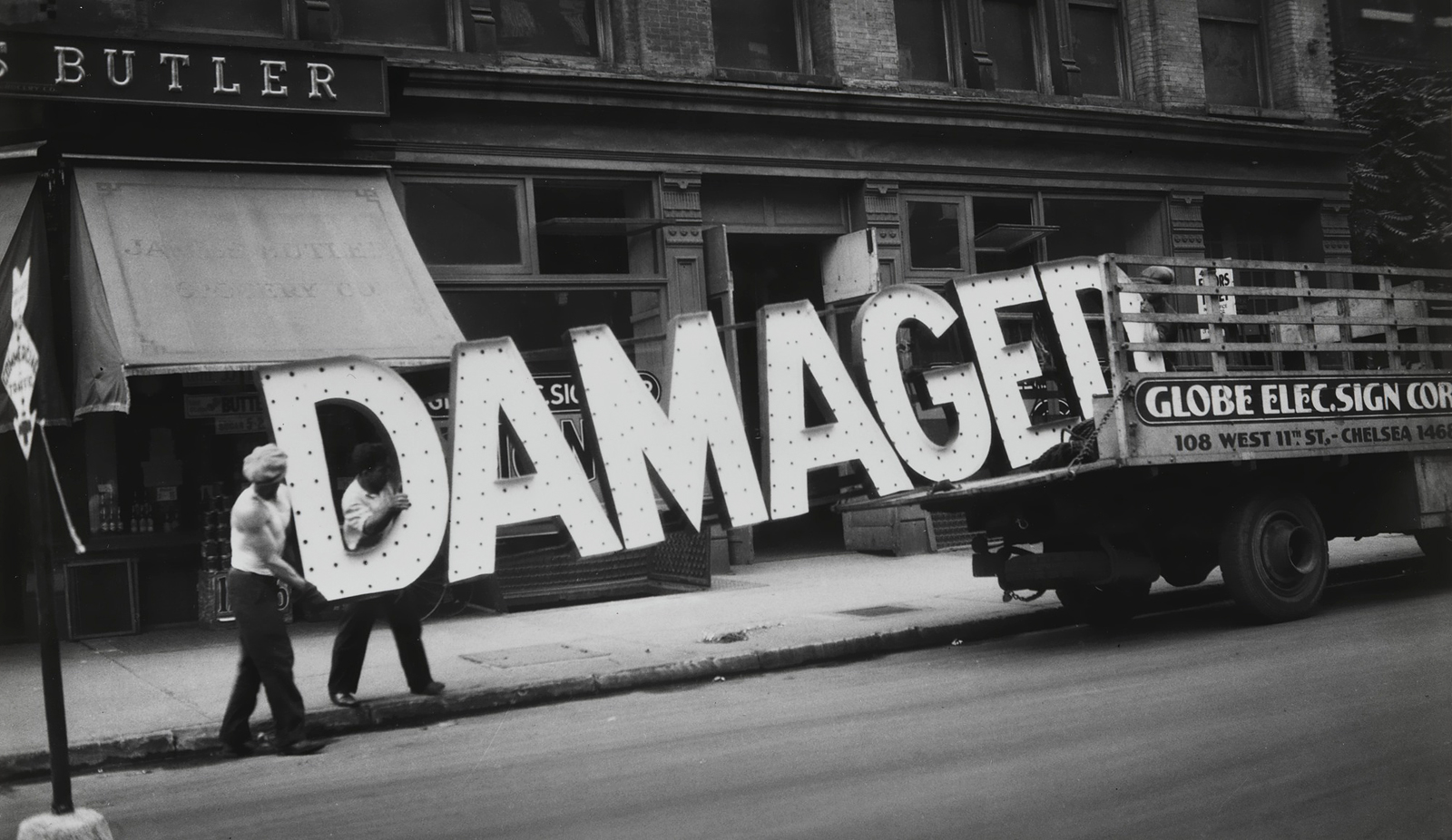
Walker Evans (American, 1903-1975) 'Truck and Sign' 1928-1930


Walker Evans (American, 1903-1975)
Truck and Sign
1928-1930
Gelatin silver print
© Walker Evans archive


Walker Evans (American, 1903-1975) 'Excavation for Lincoln Building, East 42nd Street and Park Avenue' 1929


Walker Evans (American, 1903-1975)
Excavation for Lincoln Building, East 42nd Street and Park Avenue
1929
Gelatin silver print
© Walker Evans archive


Walker Evans (American, 1903-1975) '[Fireplace in Floyd Burrroughs's Bedroom with Bedpost in Foreground, Hale County, Alabama]' 1936


Walker Evans (American, 1903-1975)
[Fireplace in Floyd Burrroughs’s Bedroom with Bedpost in Foreground, Hale County, Alabama]
1936
Gelatin silver print
8 x 10 in.
© Walker Evans archive


Walker Evans (American, 1903-1975) 'Main Street, Saratoga Springs, New York' 1931


Walker Evans (American, 1903-1975)
Main Street, Saratoga Springs, New York
1931
Gelatin silver print
© Walker Evans archive


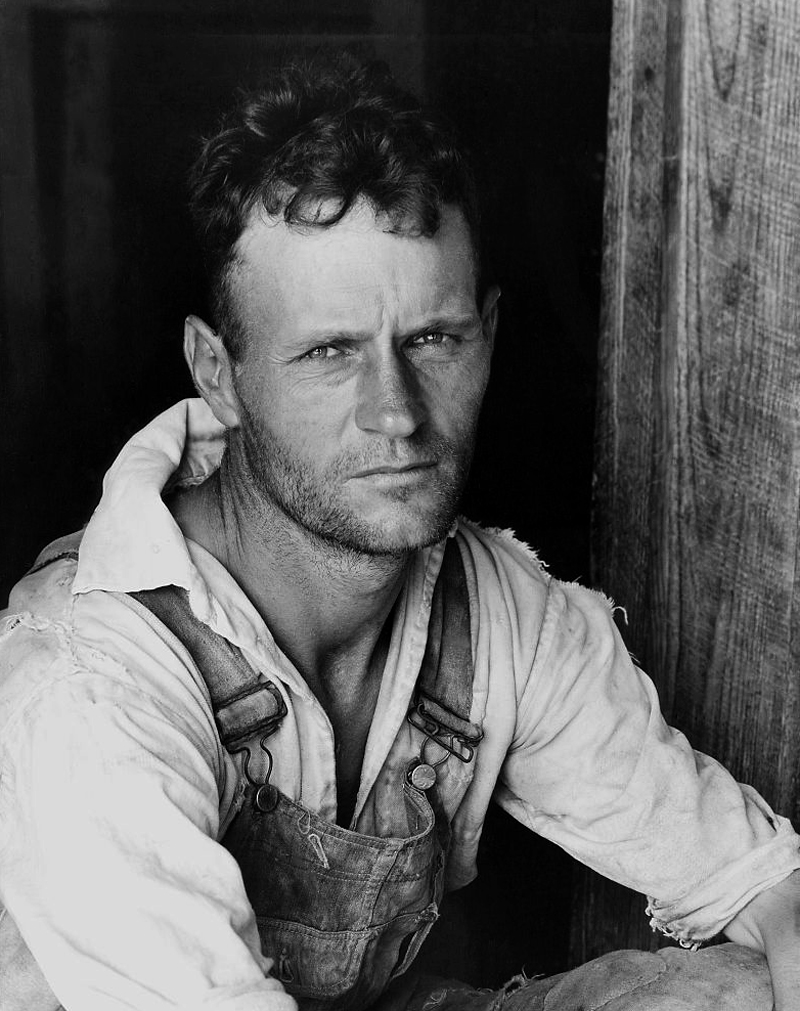
Walker Evans (American, 1903-1975) 'Floyde Burroughs, a cotton sharecropper, Hale County, Alabama' 1936


Walker Evans (American, 1903-1975)
Floyde Burroughs, a cotton sharecropper, Hale County, Alabama
1936
Gelatin silver print
© Walker Evans archive


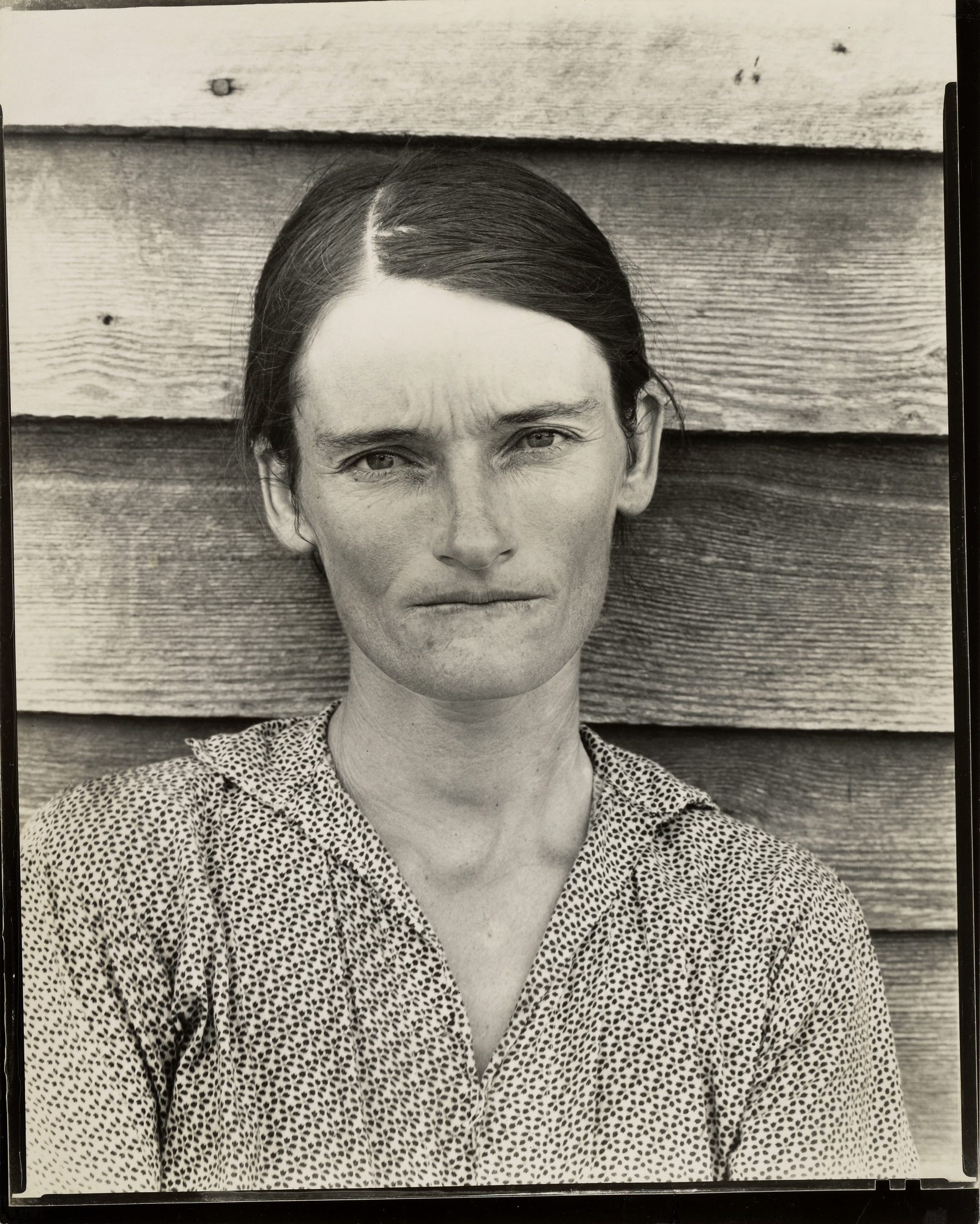
Walker Evans (American, 1903-1975) 'Allie Mae Burroughs, Hale County, Alabama' 1936


Walker Evans (American, 1903-1975)
Allie Mae Burroughs, Hale County, Alabama
1936
Gelatin silver print
© Walker Evans archive


Fotomuseum Winterthur
Grüzenstrasse 44 + 45
CH-8400
Winterthur (Zürich)
Phone: +41 52 234 10 60

Opening hours:
Tuesday – Sunday 11.00 – 18.00
Wednesday 11.00 – 20.00
Monday closed

Fotomuseum Winterthur website

LIKE ART BLART ON FACEBOOK

Back to top