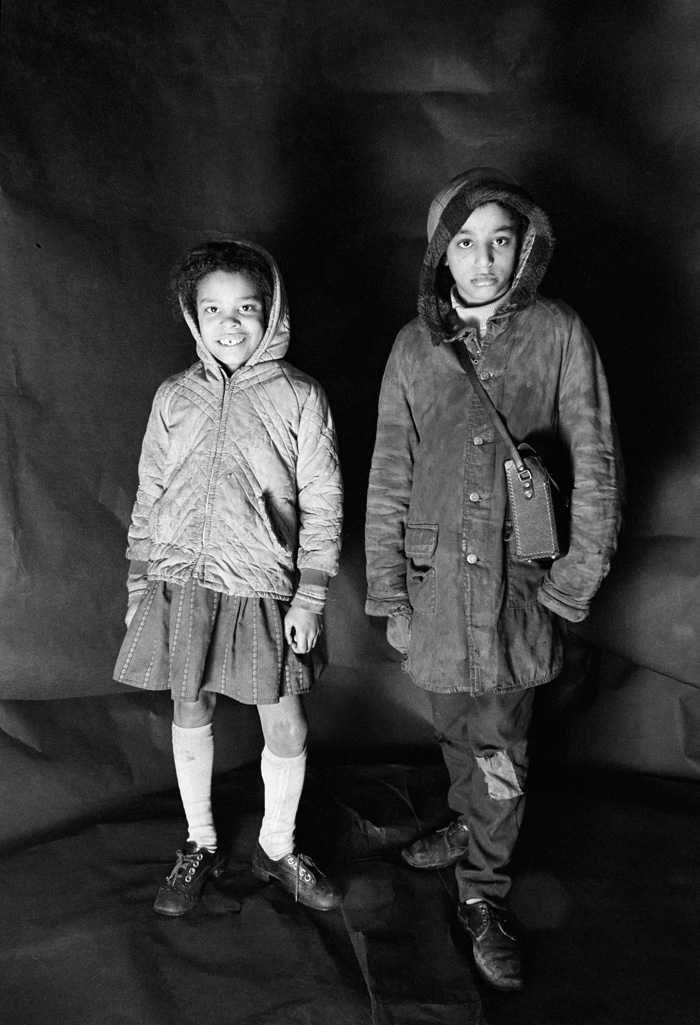
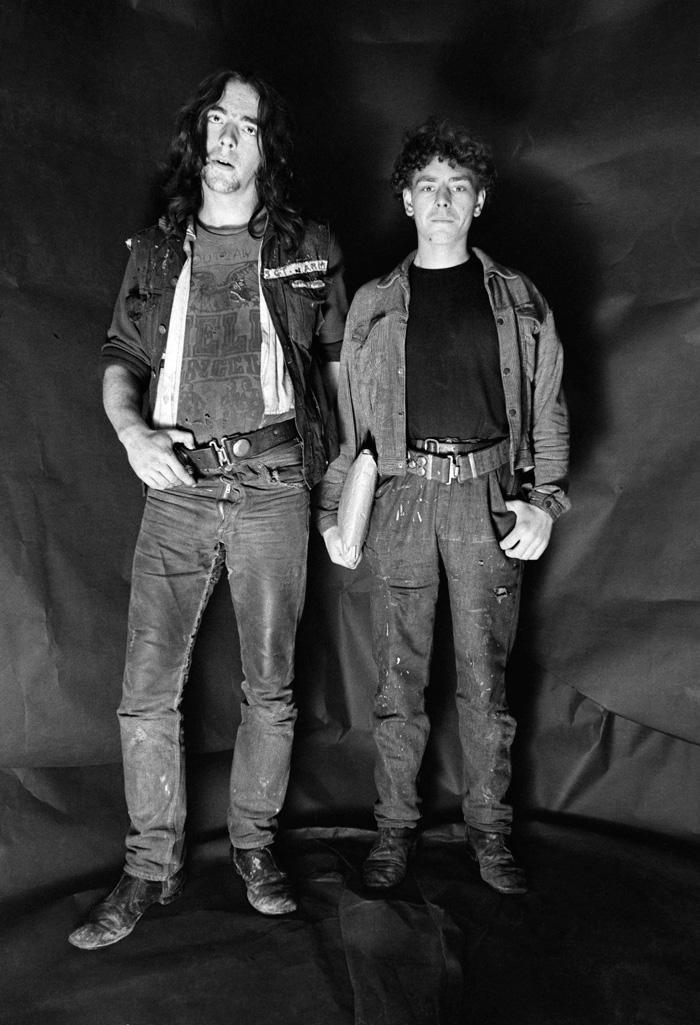
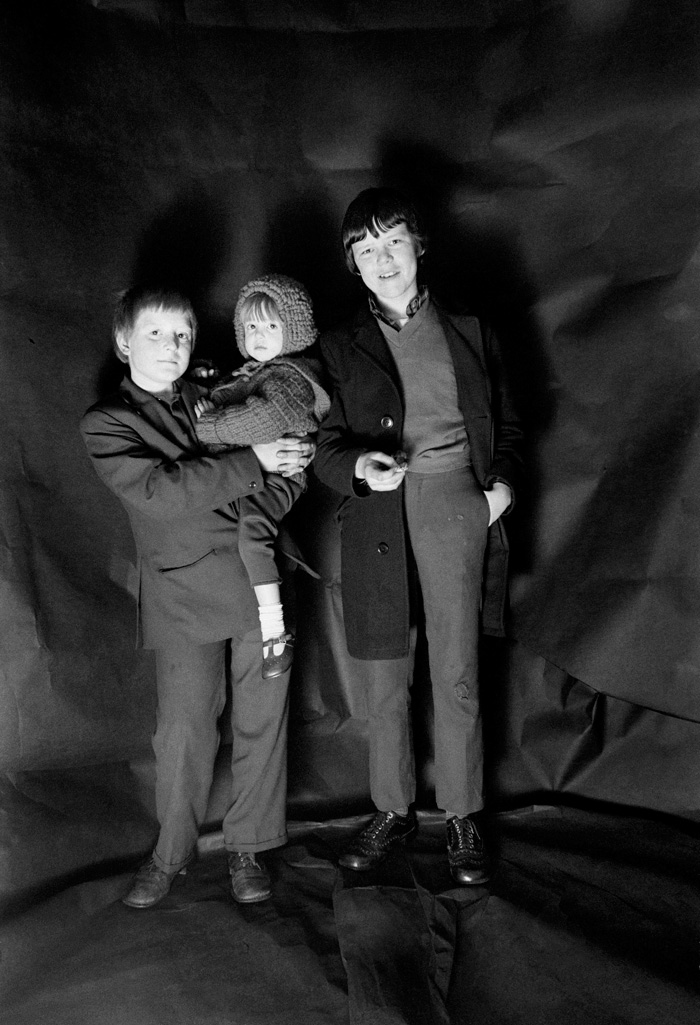
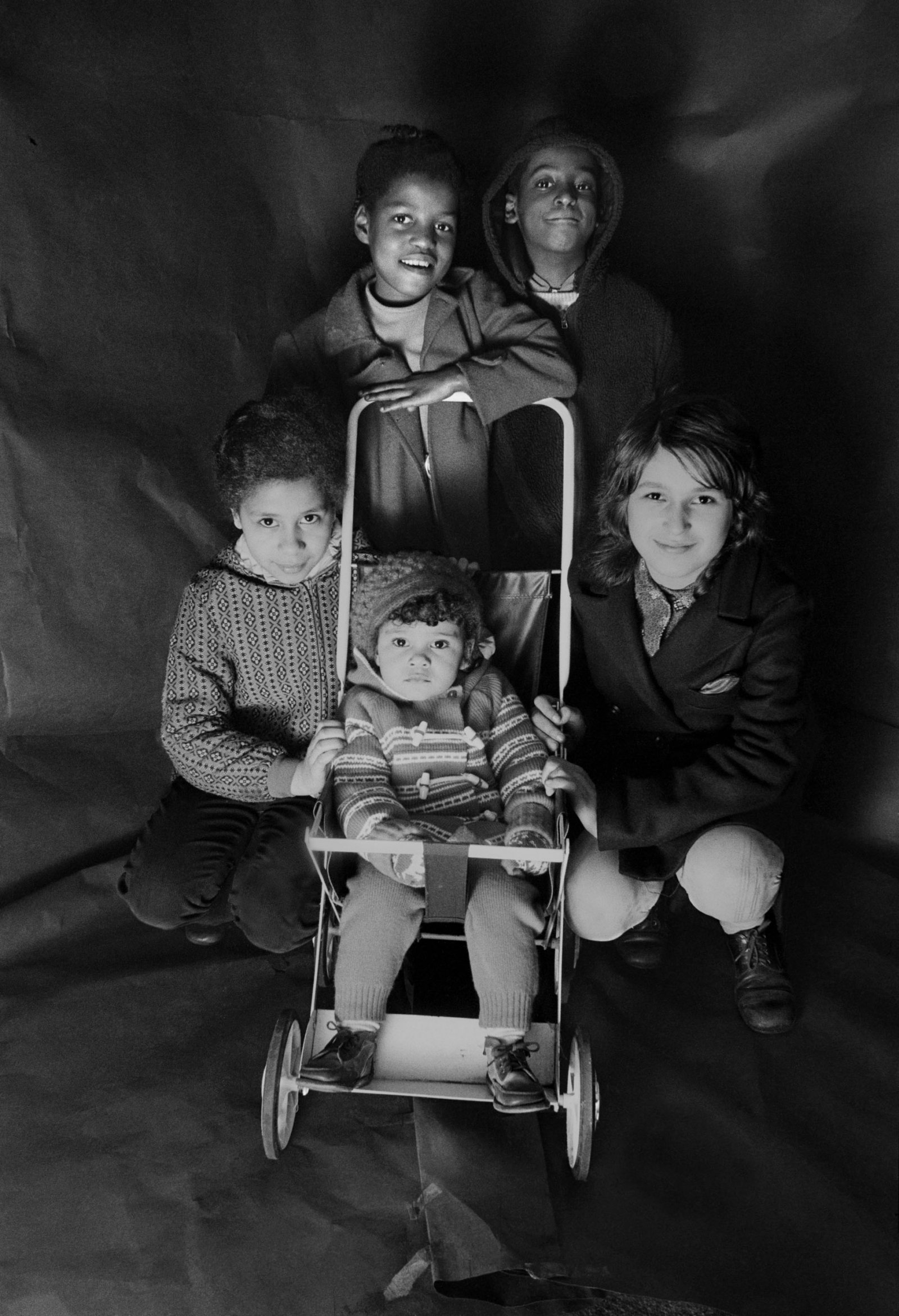
Exhibition: ‘Only in England: Photographs by Tony Ray-Jones and Martin Parr’ at Media Space at Science Museum, London

Exhibition dates: 21st September 2013 – 16th March 2014


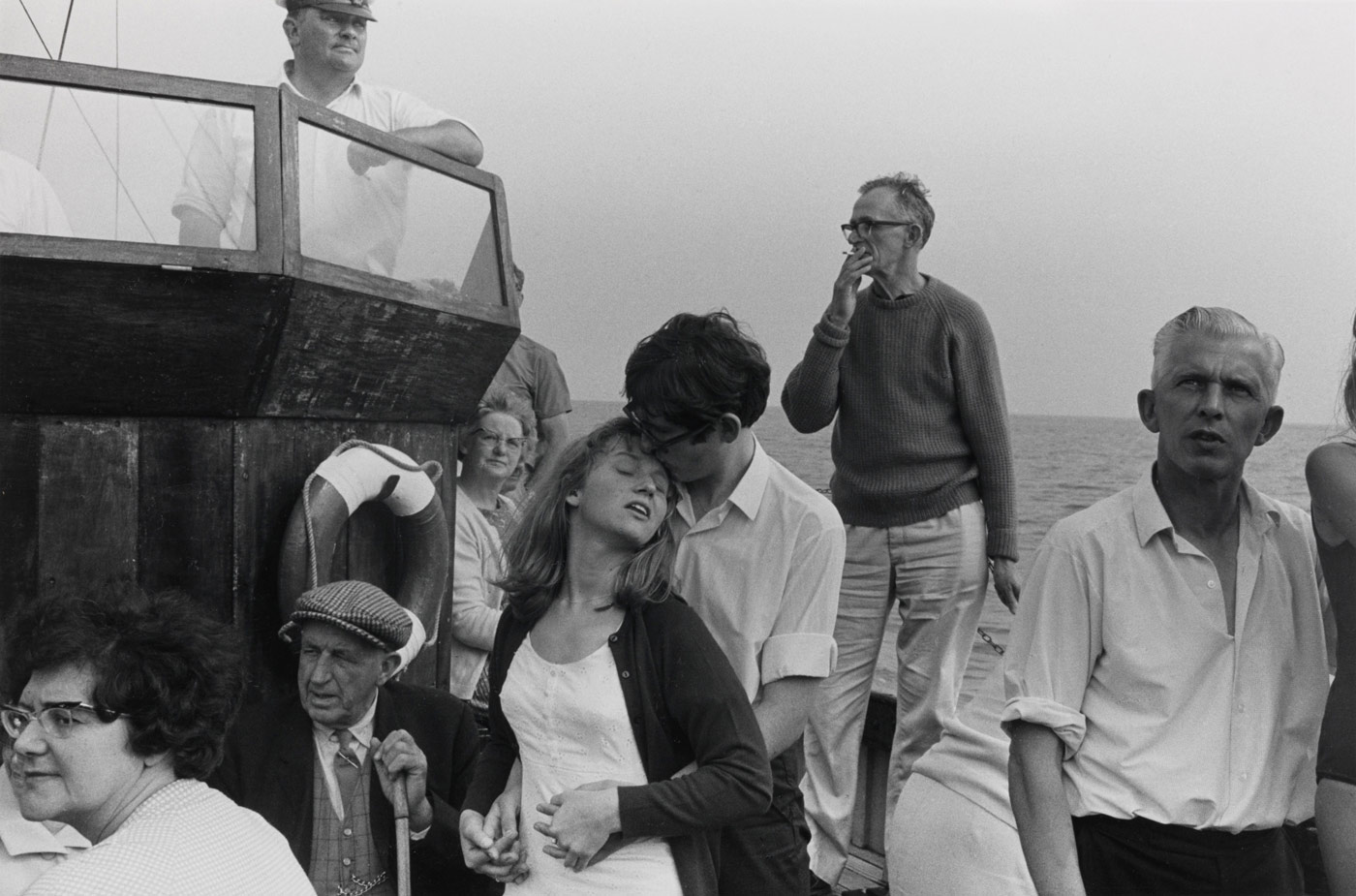
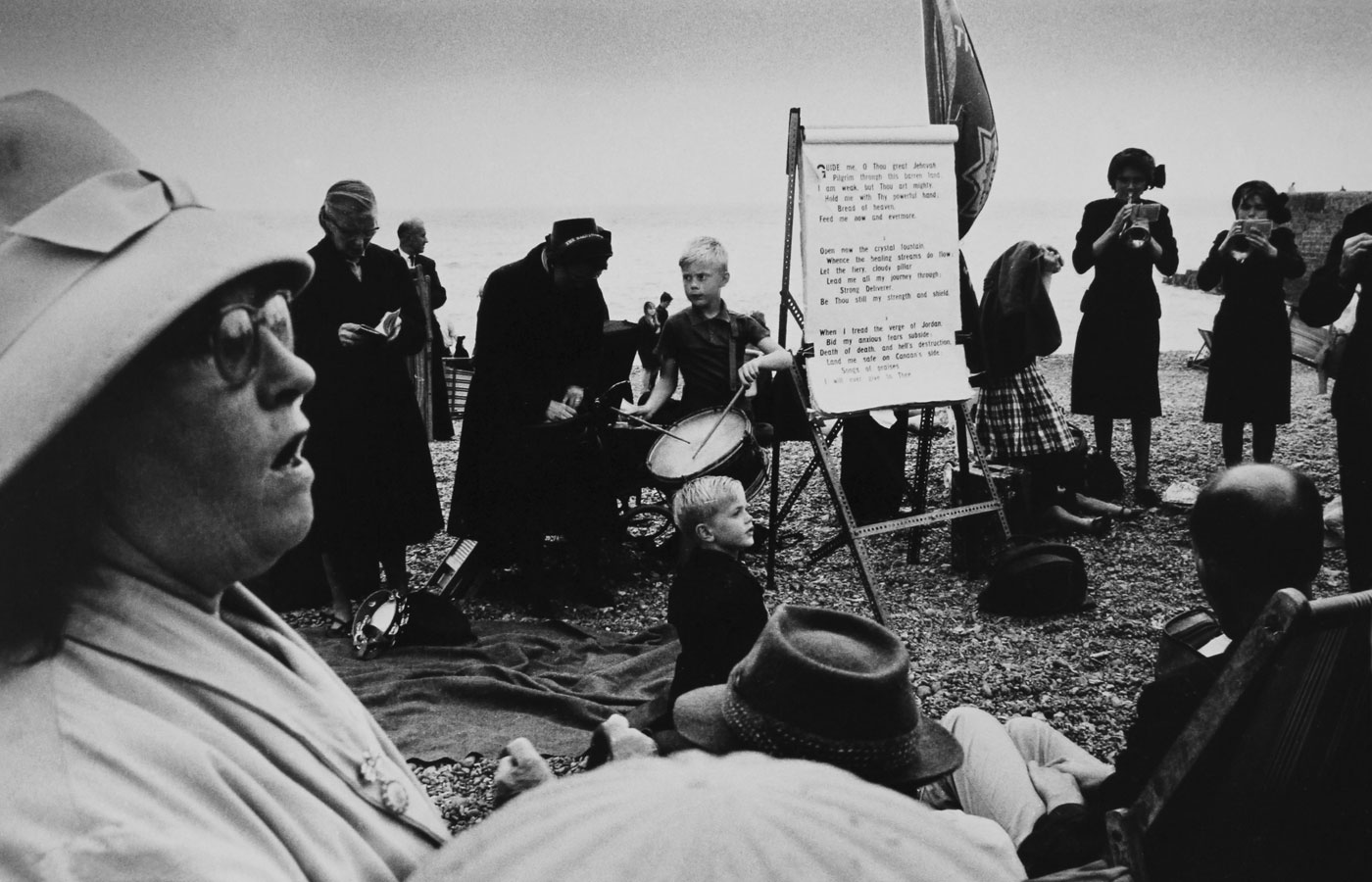
Tony Ray-Jones (English, 1941-1972) 'Beachy Head Tripper Boat, 1967' 1967


Tony Ray-Jones (English, 1941-1972)
Beachy Head Tripper Boat, 1967
1967
© National Media Museum


“Be more aware of composition

Don’t take boring pictures

Get in closer

Watch camera shake

Don’t shoot too much”


Tony Ray-Jones from his diaries


Growing up in the 1960s we used to get taken to Butlins holiday camps (Billy Butlin founded the company, a chain of large holiday camps in the United Kingdom, to provide affordable holidays for ordinary British families). It was a great treat to be away from the farm, to be by the sea, even if the beach was made of stones. Looking back on it now you realise how seedy it was, how working class… but as a kid it was oh, so much fun!

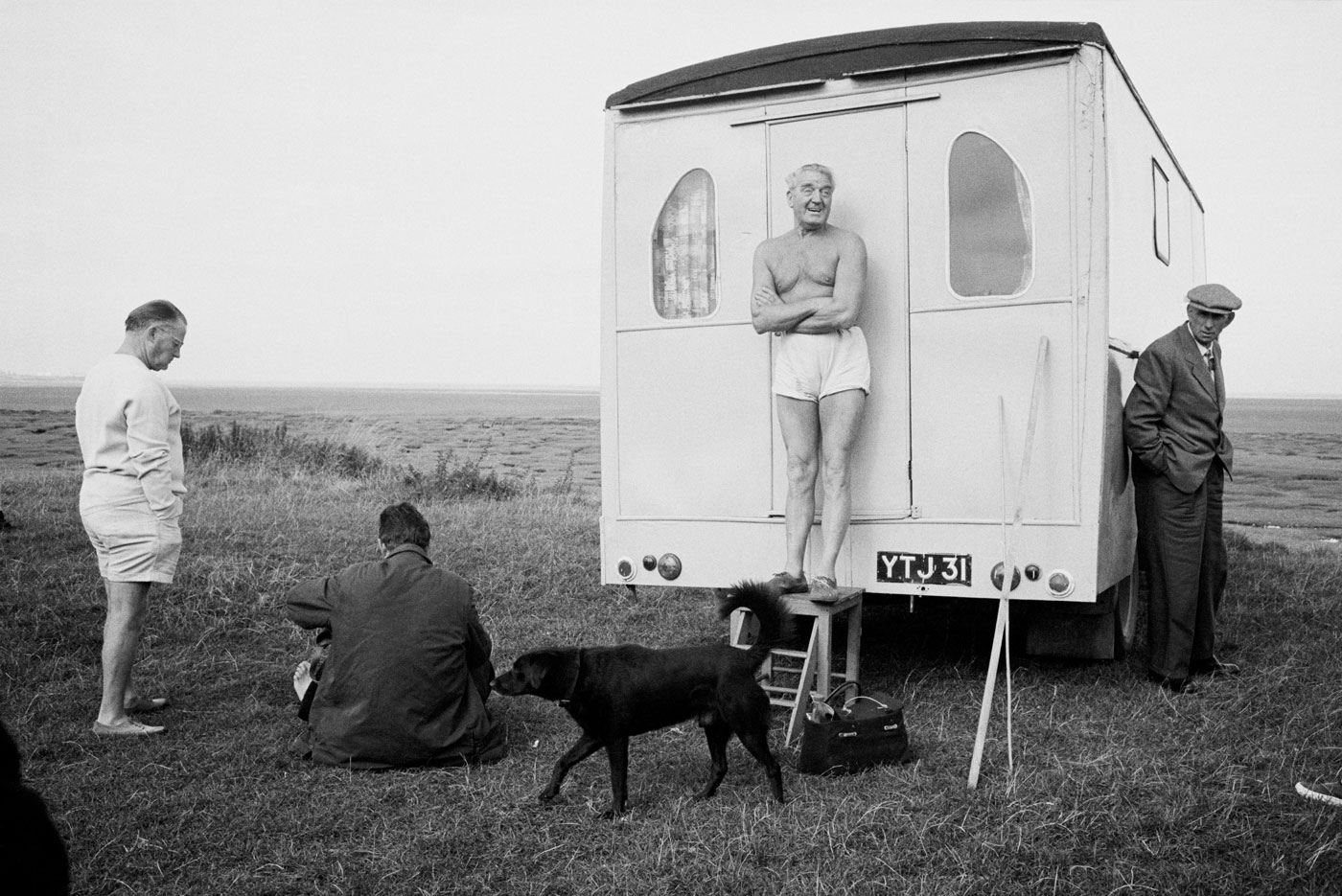
Tony Ray-Jones photographed these environments (mainly the British at play by the sea) and their opposites – afternoon tea taken at Glyndebourne opera festival for example (Glyndebourne, 1967, below) – drawing on the tradition of great British social documentary photography by artists such as Bill Brandt. TRJ even pays homage to Brandt in one of his photographs, Dickens Festival, Broadstairs, c. 1967 (below) which echoes Brandt’s famous photograph Parlourmaid and Under-parlourmaid Ready to Serve Dinner, 1933 by changing “point of view” from up close, personal, oppressive and interior to distance, isolation, leisure/work and exterior.

Through his photographs Ray-Jones adds his own style and humour, using “a new conception of photography as a means of expression, over and above its accepted role as a recorder.” He does it all as an intimate expression of his own personality, his maverick, outsider, non-conformist self. I feel – and that is the key word with his art – that he had a real empathy with his subject matter. There is a twinkle in his eye that becomes embedded in his photographs. There is an honesty, integrity and respect for the people he is photographing, coupled with a wicked sense of humour and the most amazing photographic eye. What an eye he had!

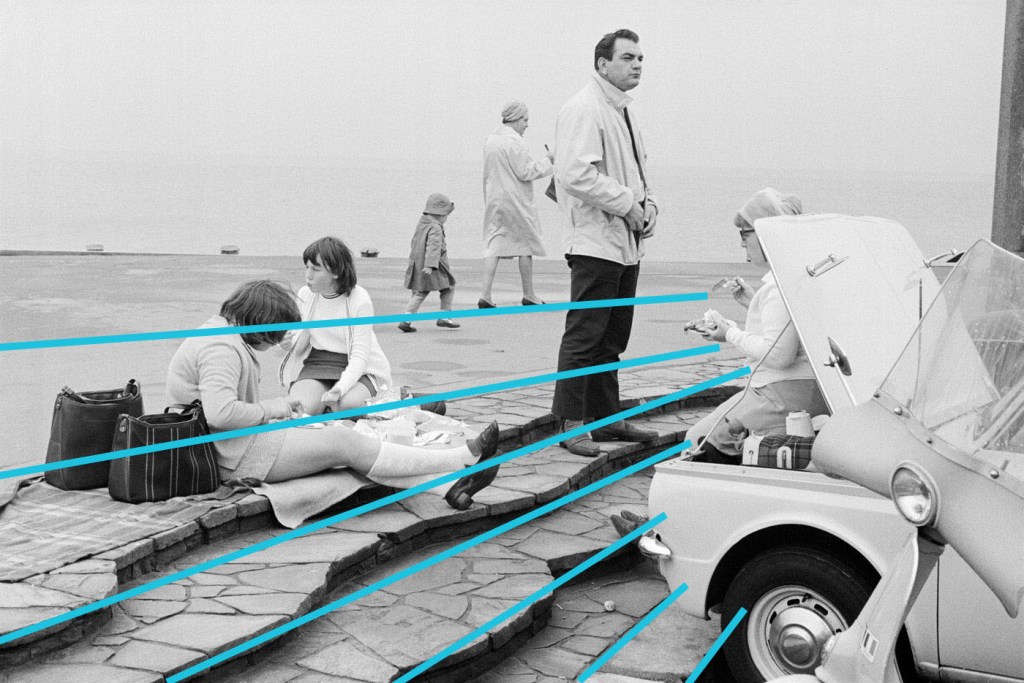
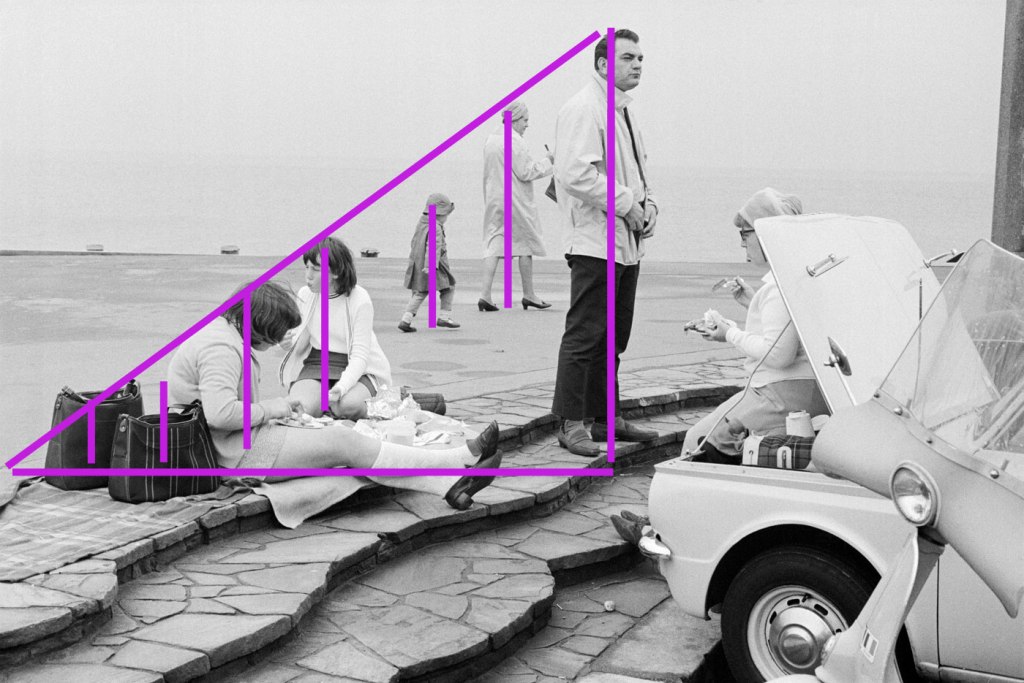
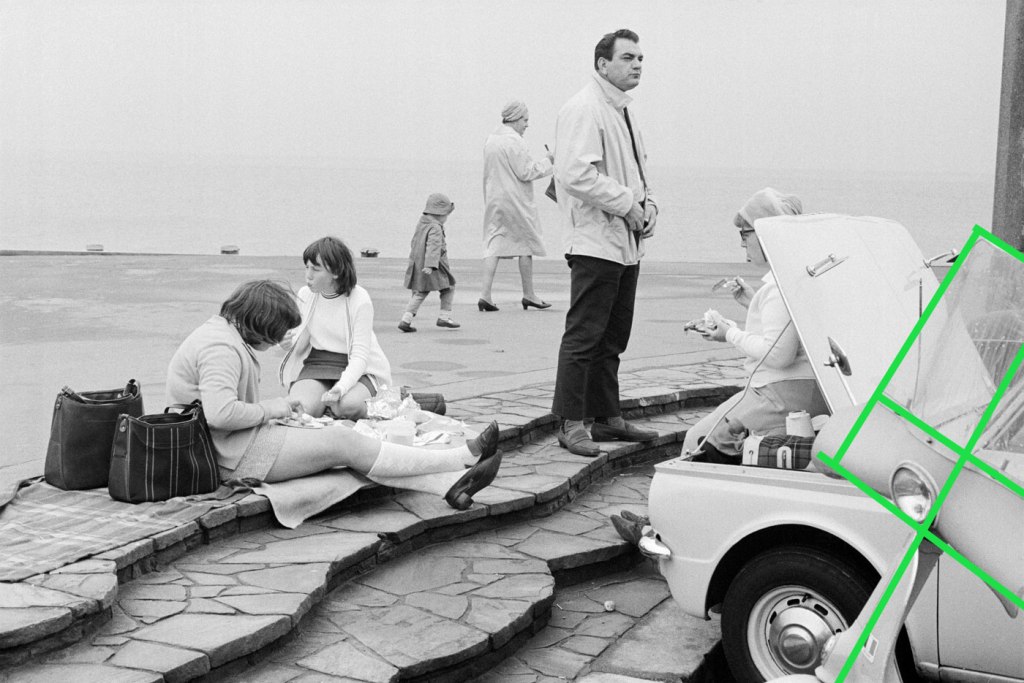
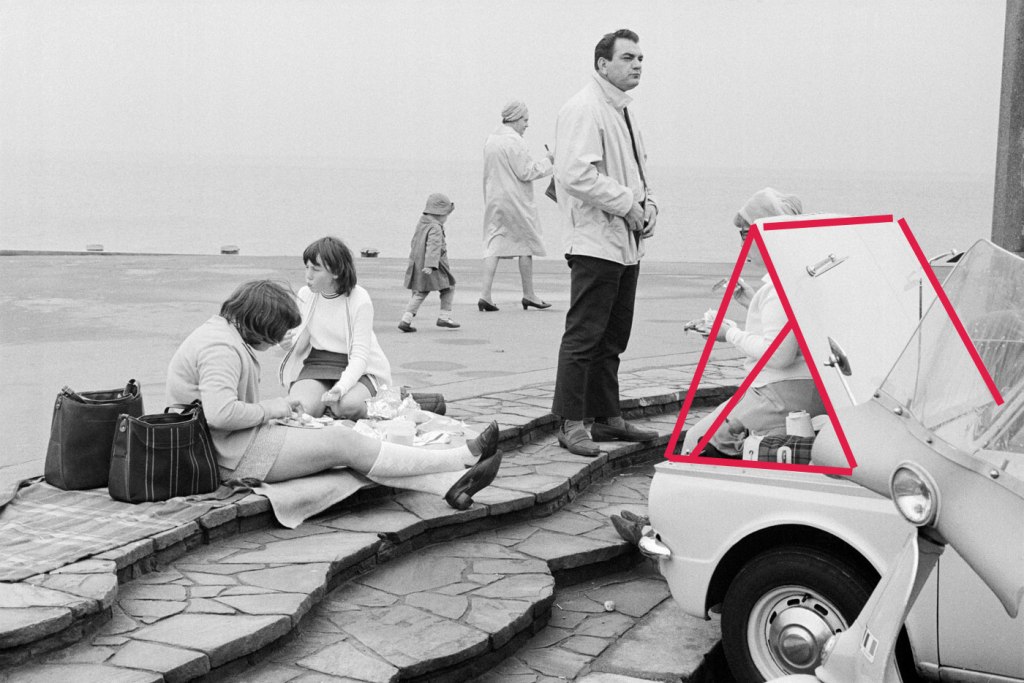
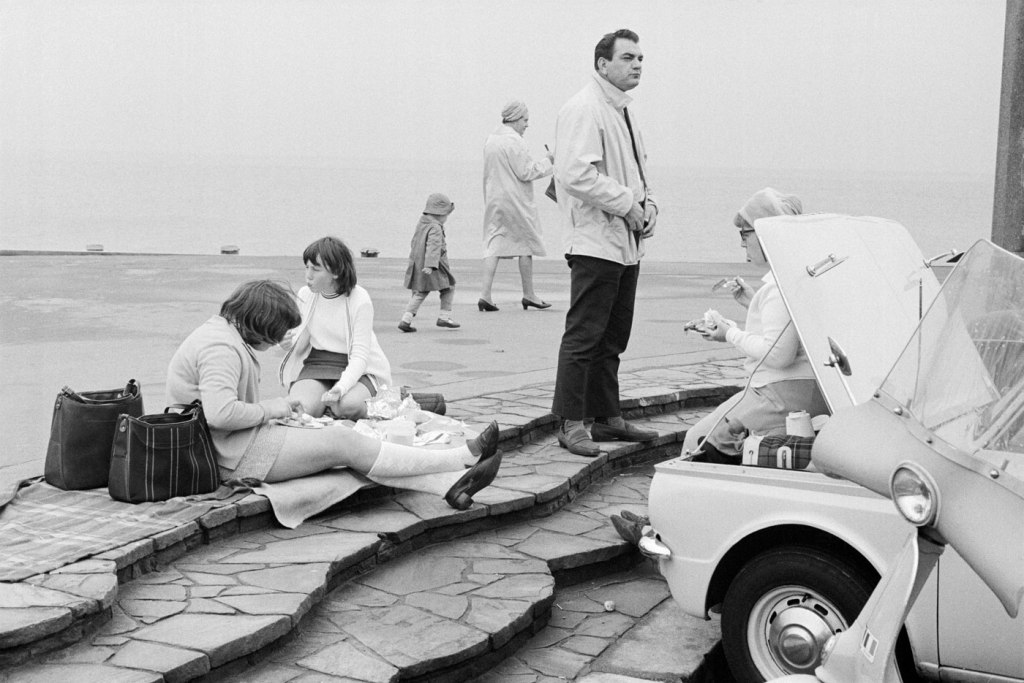
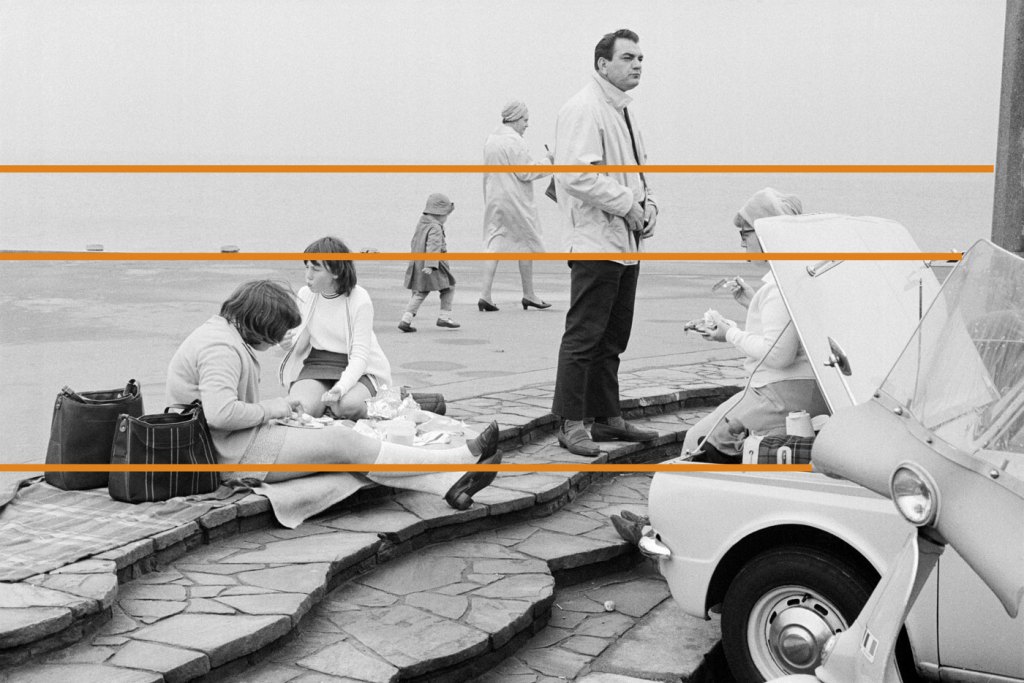
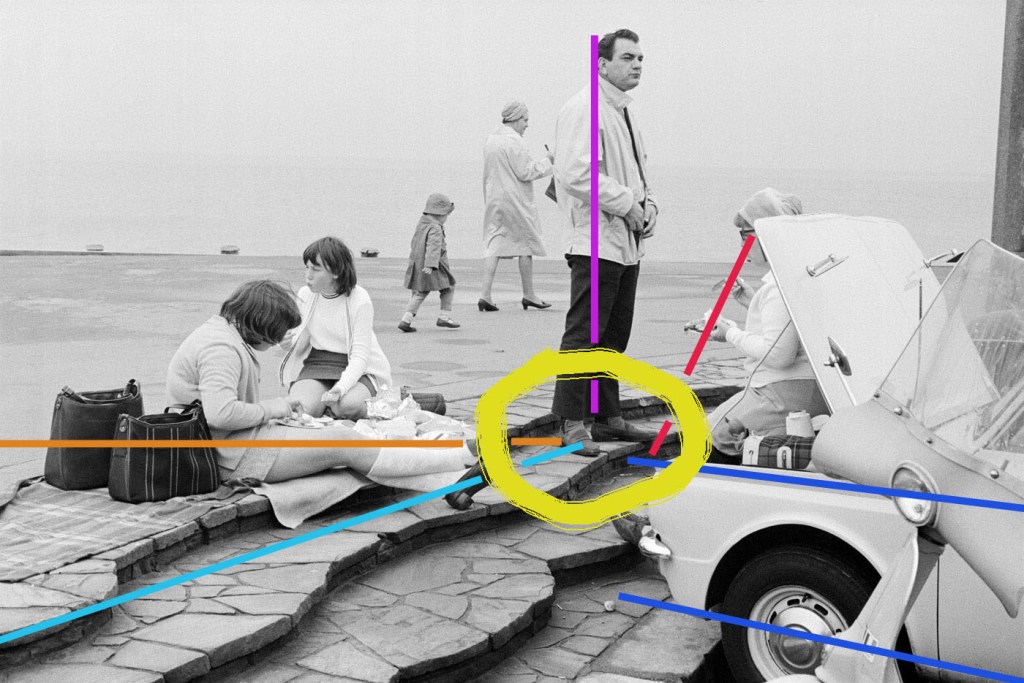
To be able to sum up a scene in a split second, to previsualise (think), intuitively compose, frame and shoot in that twinkle of an eye, and to balance the images as he does is truly the most incredible gift, the quintessential British “decisive moment”. Look at the structural analysis of Location unknown, possibly Worthing (1967-1968, below) that I have presented in a slide show. This will give you a good idea of the visual complexity of Ray-Jones’ images… and yet he makes the sum of all components seem grounded (in this case by the man’s feet) and effortless. Devon Caranicas has observed that TRJ possessed a quick wit and adeptness for reducing a complex narrative into a single frame, the photographed subjects transformed into social actors of supreme stereotypes. The first part is insightful, but social actors of supreme stereotypes? I think not, because these people are not acting, this is their life, their humanity, their time out from the hum-drum of everyday working class life. They do not pose for TRJ, it’s just how they are. Look at the musicality of the first five images in the posting – how the line rises and falls, moves towards you and away from you. Only a great artist can do that, instinctively.

I cannot express to you enough the utmost admiration I have for this man’s art. In my opinion he is one of greatest British photographers that has ever lived (Julia Margaret Cameron, William Henry Fox Talbot, Roger Fenton, Francis Bedford, Frederick H. Evans, Cecil Beaton, Peter Henry Emerson and Herbert Ponting would be but a few others that spring to mind). He photographed British customs and values at a time of change and pictured a real affection for the lives of ordinary working class people. Being one of the them, he will always hold a special place in my heart.

Dr Marcus Bunyan


Many thankx to Media Space at Science Museum for allowing me to publish the photographs in the posting. Please click on the photographs for a larger version of the image.


“Although the entirety of the images from Only in England were shot throughout the politically and socially turbulent late 60’s and early 70’s both artists shy away from depicting the culture clashes that so often visually defined this period. Instead, they each opted to turn their lens onto the quintessential country side, and in doing so, pay homage to a traditional type of English life that was becoming a sort of sub-culture in itself – a way of living that was not yet touched by the encroaching globalisation, or “americanisation,” of the UK.”

Anonymous text on the ART WEDNESDAY website September 26th, 2013 [Online] Cited 05/03/2014. No longer available online


“Ray-Jones printed his black and white pictures small, in a dark register of tonally very dense prints. The National Media Museum has lots of these, and perhaps to devote the cavernous new space only to such small pictures would have been a mistake. Even backed up with a mass of supporting material, including the fascinating pages from Ray-Jones’ diaries, the prints would struggle to fill the space. So only the first section is devoted to about 50 beautiful little Ray-Jones vintage prints. Two whole sections have been added to the exhibition to flesh it out…

[Parr] has unfortunately chosen to print them [Ray-Jones prints] in a way quite alien to anything Ray-Jones ever made: they are printed in Parr’s own way, as larger, paler, more diffuse things in mid-tones that Ray-Jones would never have countenanced. They are printed, inevitably, by digital process…

Sadly, these Ray-Jones by Parr prints add up to an appropriation of the former by the latter: they are Martin Parr pictures taken from Tony-Ray Jones negatives, and it would have been better not to have shown them so. They are fine images, but they should have been seen in some other way: on digital screens, perhaps, or as modern post-cards. Anything to make quite explicit the clear break with Ray-Jones’ own prints. That the images they contain are very fine is not in doubt. But I take leave to question whether they “present a new way of thinking through creative use of the collections”. They are well labelled and for specialists there will be no difficulty in knowing that they are not by Ray-Jones. But for the public I am not so sure. Suddenly two-thirds of the show are in this larger, modern, digitally printed form, either by Parr himself or by Ray-Jones-through-Parr. It looks as if that is the dominant group…”

Extract from Francis Hodgson. “Two Exhibitions of Tony Ray-Jones – Two Ways of Giving Context to Photographs,” on the Photomonitor website, September 2013 Cited 05/03/2014 no longer available online


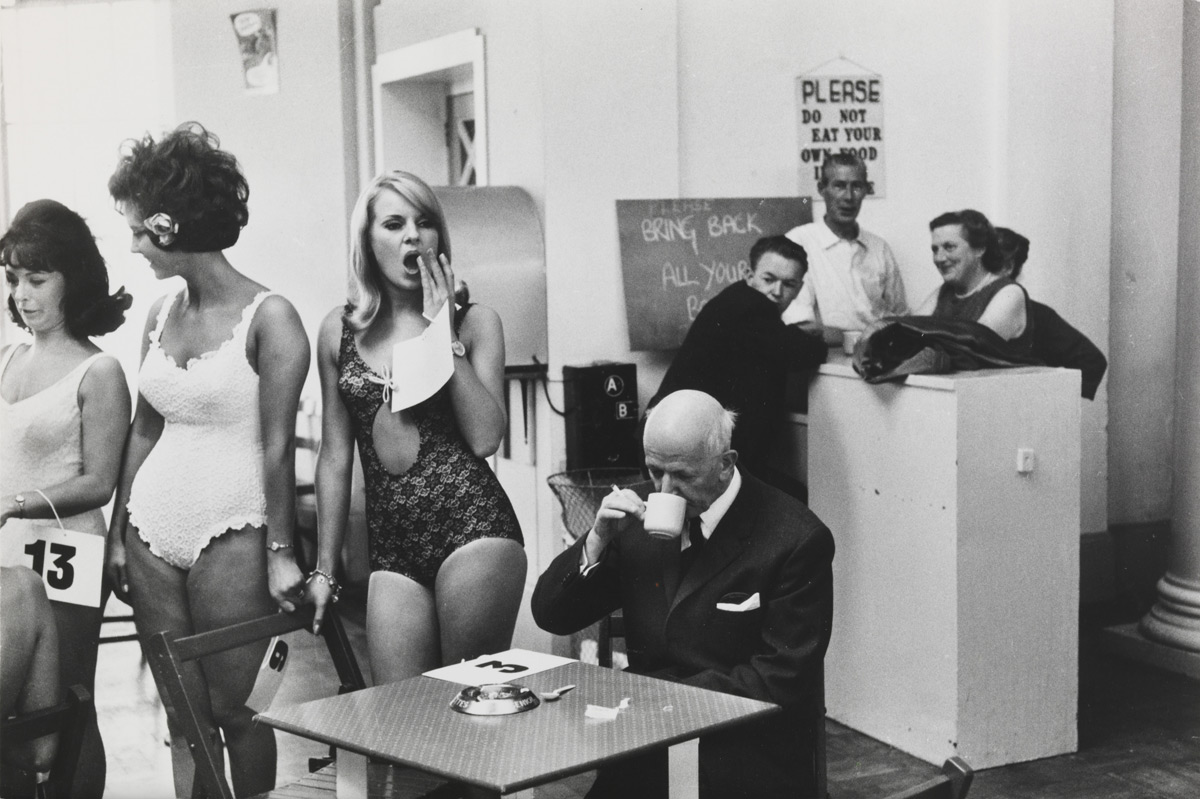
Tony Ray-Jones (English, 1941-1972) 'Beauty contestants, Southport, Merseyside, 1967' 1967


Tony Ray-Jones (English, 1941-1972)
Beauty contestants, Southport, Merseyside, 1967 
1967
© National Media Museum


Tony Ray-Jones (English, 1941-1972) 'Brighton Beach, West Sussex, 1966' 1966


Tony Ray-Jones (English, 1941-1972)
Brighton Beach, West Sussex, 1966
1966
© National Media Museum
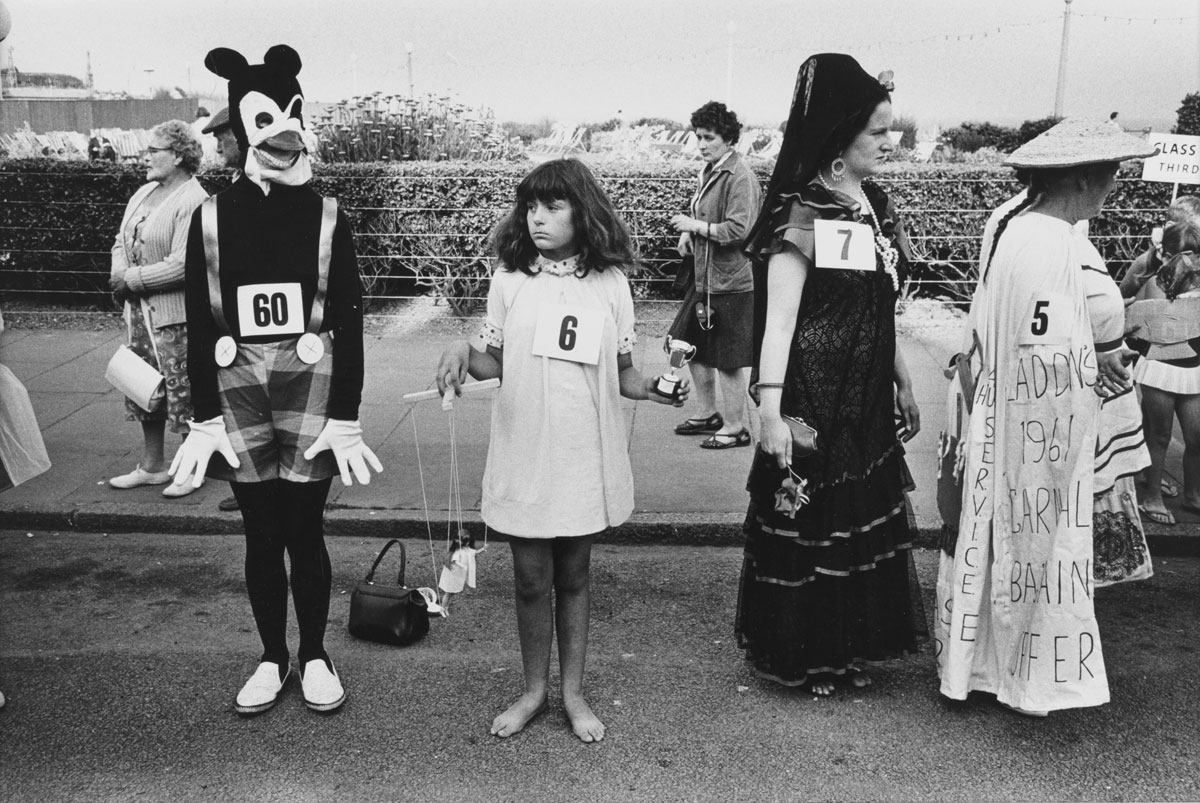
 

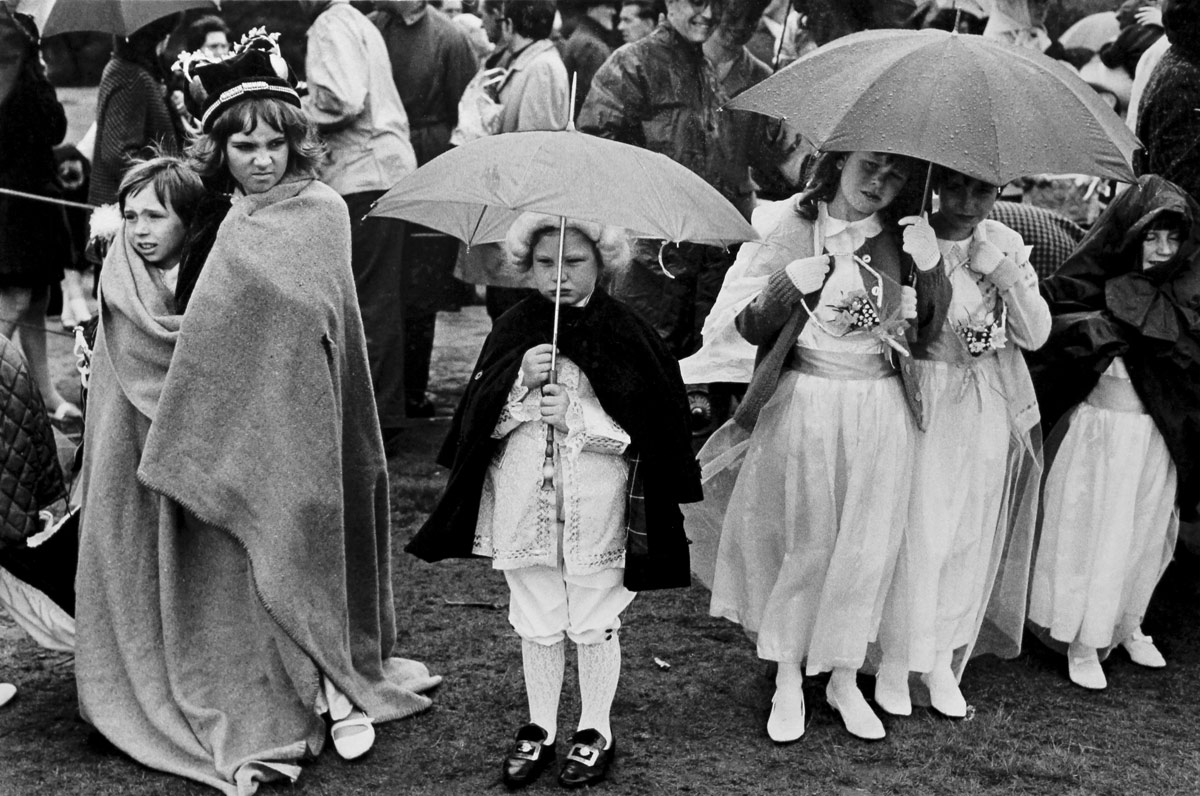
Tony Ray-Jones (English, 1941-1972) 'Eastbourne Carnival, 1967' 1967


Tony Ray-Jones (English, 1941-1972)
Eastbourne Carnival, 1967
1967
© National Media Museum


Tony Ray-Jones (English, 1941-1972) 'Blackpool, 1968' 1968


Tony Ray-Jones (English, 1941-1972)
Blackpool, 1968
1968
© National Media Museum


Tony Ray-Jones (English, 1941-1972) 'Location unknown, possibly Worthing' 1967-1968


Tony Ray-Jones (English, 1941-1972)
Location unknown, possibly Worthing
1967-1968
© National Media Museum
 

This slideshow requires JavaScript.


Tony Ray-Jones Location unknown, possibly Worthing (1967-68) picture analysis by Dr Marcus Bunyan


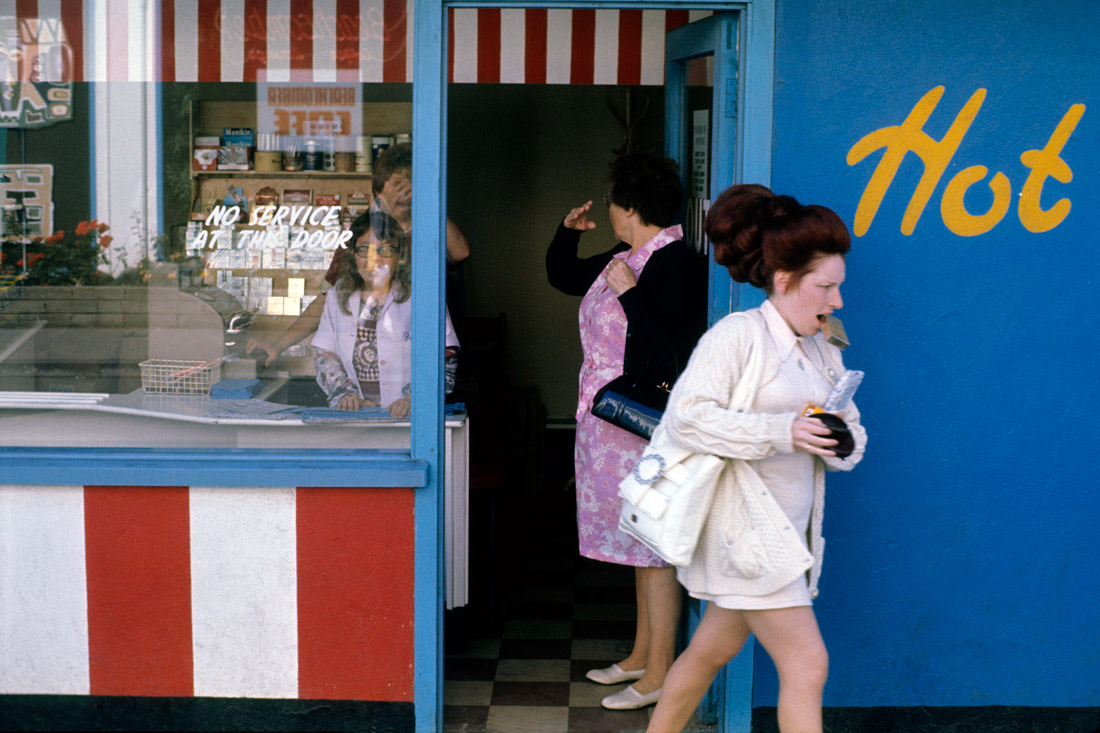
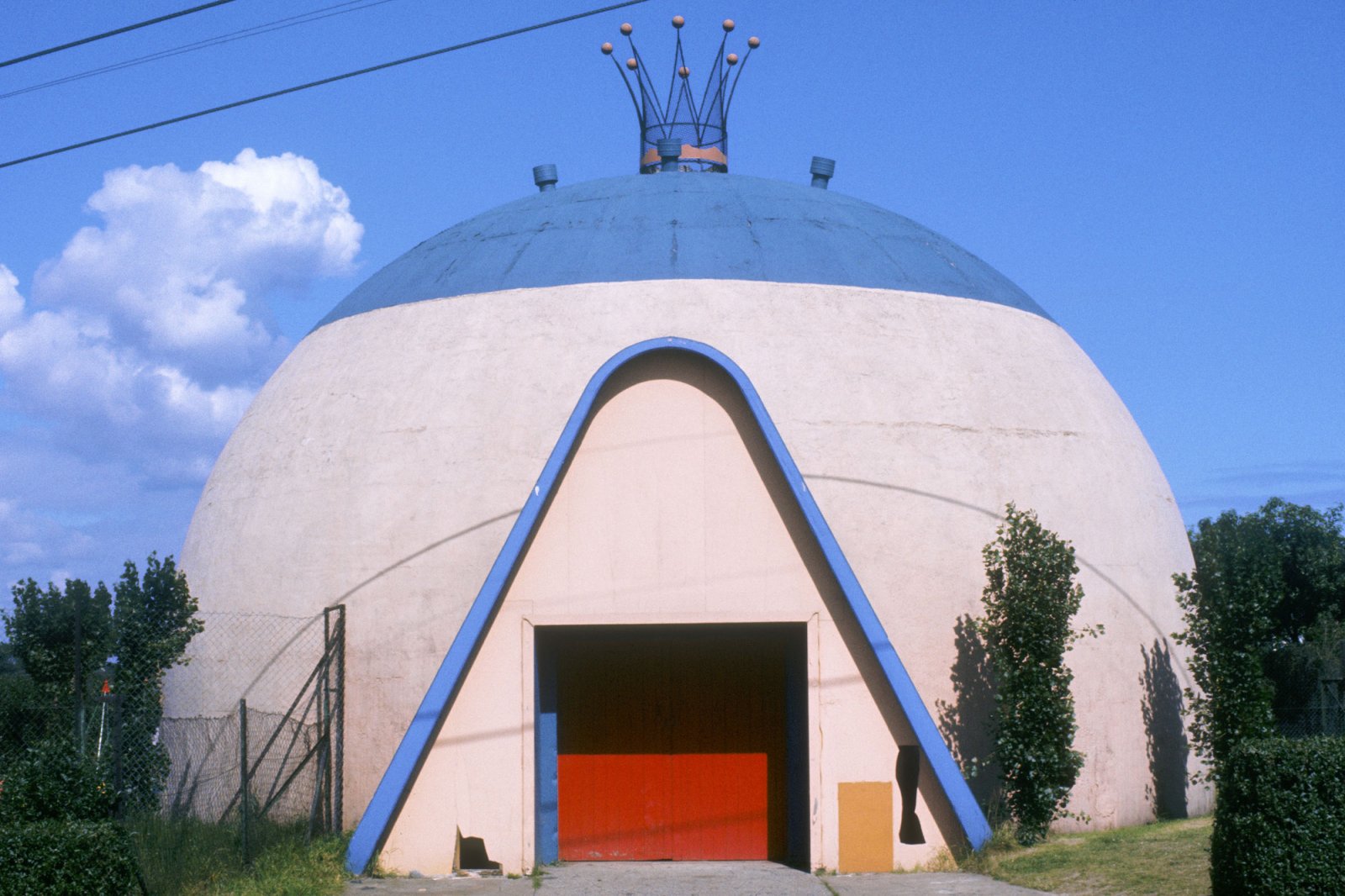
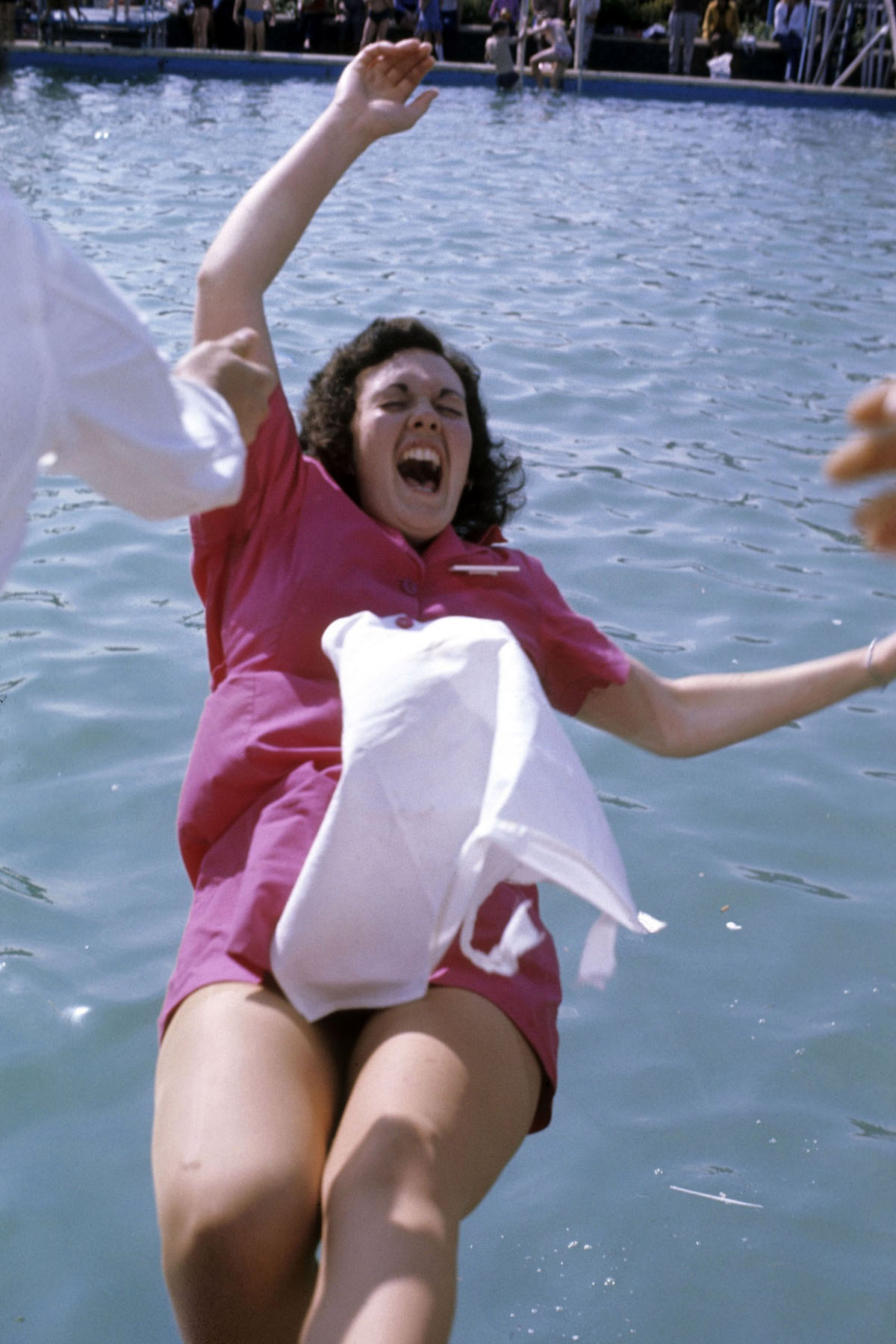
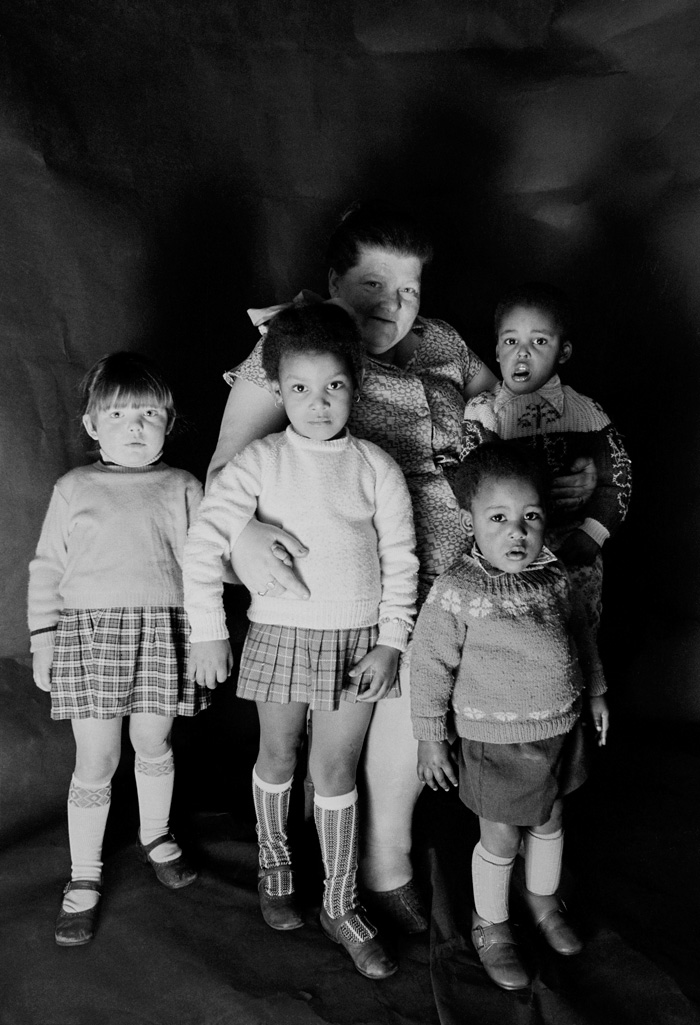
Fascinated by the eccentricities of English social customs, Tony Ray-Jones spent the latter half of the 1960s travelling across England, photographing what he saw as a disappearing way of life. Humorous yet melancholy, these works had a profound influence on photographer Martin Parr, who has now made a new selection including over 50 previously unseen works from the National Media Museum’s Ray-Jones archive. Shown alongside The Non-Conformists, Parr’s rarely seen work from the 1970s, this selection forms a major new exhibition which demonstrates the close relationships between the work of these two important photographers.

The first ever major London exhibition of work by British Photographer, Tony Ray-Jones (1941-1972) will open at Media Space on 21 September 2013. The exhibition will feature over 100 works drawn from the Tony Ray-Jones archive at the National Media Museum alongside 50 rarely seen early black and white photographs, The Non-Conformists, by Martin Parr (1952).

Between 1966 and 1969 Tony Ray-Jones created a body of photographic work documenting English customs and identity. Humorous yet melancholy, these photographs were a departure from anything else being produced at the time. They quickly attracted the attention of the Institute of Contemporary Arts (ICA), London where they were exhibited in 1969. Tragically, in 1972, Ray-Jones died from Leukaemia aged just 30. However, his short but prolific career had a lasting influence on the development of British photography from the 1970s through to the present.

In 1970, Martin Parr, a photography student at Manchester Polytechnic, had been introduced to Ray-Jones. Inspired by him, Parr produced The Non-Conformists, shot in black and white in Hebden Bridge and the surrounding Calder Valley. This project started within two years of Ray-Jones death and demonstrates his legacy and influence.

The exhibition will draw from the Tony Ray-Jones archive, held by the National Media Museum.  Around 50 vintage prints will be on display alongside an equal number of photographs which have never previously been printed. Martin Parr has been invited to select these new works from the 2700 contact sheets and negatives in the archive. Shown alongside these are Parr’s early black and white work, unfamiliar to many, which has only ever previously been exhibited in Hebden Bridge itself and at Camerawork Gallery, London in 1981.

Tony Ray-Jones was born in Somerset in 1941. He studied graphic design at the London School of Printing before leaving the UK in 1961 to study on a scholarship at Yale University in Connecticut, US. He followed this with a year long stay in New York during which he attended classes by the influential art director Alexey Brodovitch, and became friends with photographers Joel Meyerowitz and Garry Winogrand. In 1966 he returned to find a Britain still divided by class and tradition. A Day Off – An English Journal, a collection of photographs he took between 1967-1970 was published posthumously in 1974 and in 2004 the National Media Museum held a major exhibition, A Gentle Madness: The Photographs of Tony Ray-Jones.

Martin Parr was born in Epsom, Surry in 1952. He graduated from Manchester Polytechnic in 1974 and moved to Hebden Bridge in West Yorkshire, where he established the ‘Albert Street Workshop’, a hub for artistic activity in the town. Fascinated by the variety of non-conformist chapels and the communities he encountered in the town he produced The Non-Conformists. In 1984 Parr began to work in colour and his breakthrough publication The Last Resort was published in 1986. A Magnum photographer, Parr is now an internationally renowned photographer, filmmaker, collector and curator, best-known for his highly saturated colour photographs critiquing modern life.

Only in England: Photographs by Tony Ray-Jones and Martin Parr will run at Media Space, Science Museum from 21 September 2013 – 16 March 2014. The exhibition will then be on display at the National Media Museum from 22 March – 29 June 2014. The exhibition is curated by Greg Hobson, curator of Photographs at the National Media Museum, and Martin Parr has been invited to select works from the Tony Ray-Jones archives.

Greg Hobson, curator of Photographs at the National Media Museum says, “The combination of Martin Parr and Tony Ray-Jones’ work will allow the viewer to trace an important trajectory through the history of British photography, and present new ways of thinking about photographic histories through creative use of our collections.” Martin Parr says, “Tony Ray-Jones’ pictures were about England. They had that contrast, that seedy eccentricity, but they showed it in a very subtle way. They have an ambiguity, a visual anarchy. They showed me what was possible.”

The Tony Ray-Jones archive comprises of approximately 700 photographic prints, 1700 negative sheets, 2700 contact sheets, 600 boxes of Ektachrome / Kodachrome transparencies. It also includes ephemera such as notebooks, diary pages, and a maquette of England by the Sea made by Tony Ray-Jones.

Media Space is a collaboration between the Science Museum (London) and the National Media Museum (Bradford). Media Space will showcase the National Photography Collection of the National Media Museum through a series of exhibitions. Alongside this, photographers, artists and the creative industries will respond to the wider collections of the Science Museum Group to explore visual media, technology and science.

Press release from the Science Museum website


Tony Ray-Jones (English, 1941-1972) 'Bacup coconut dancers, 1968' 1968


Tony Ray-Jones (English, 1941-1972)
Bacup coconut dancers, 1968
1968
© National Media Museum


Tony Ray-Jones (English, 1941-1972) 'Bournemouth, 1969' 1969


Tony Ray-Jones (English, 1941-1972)
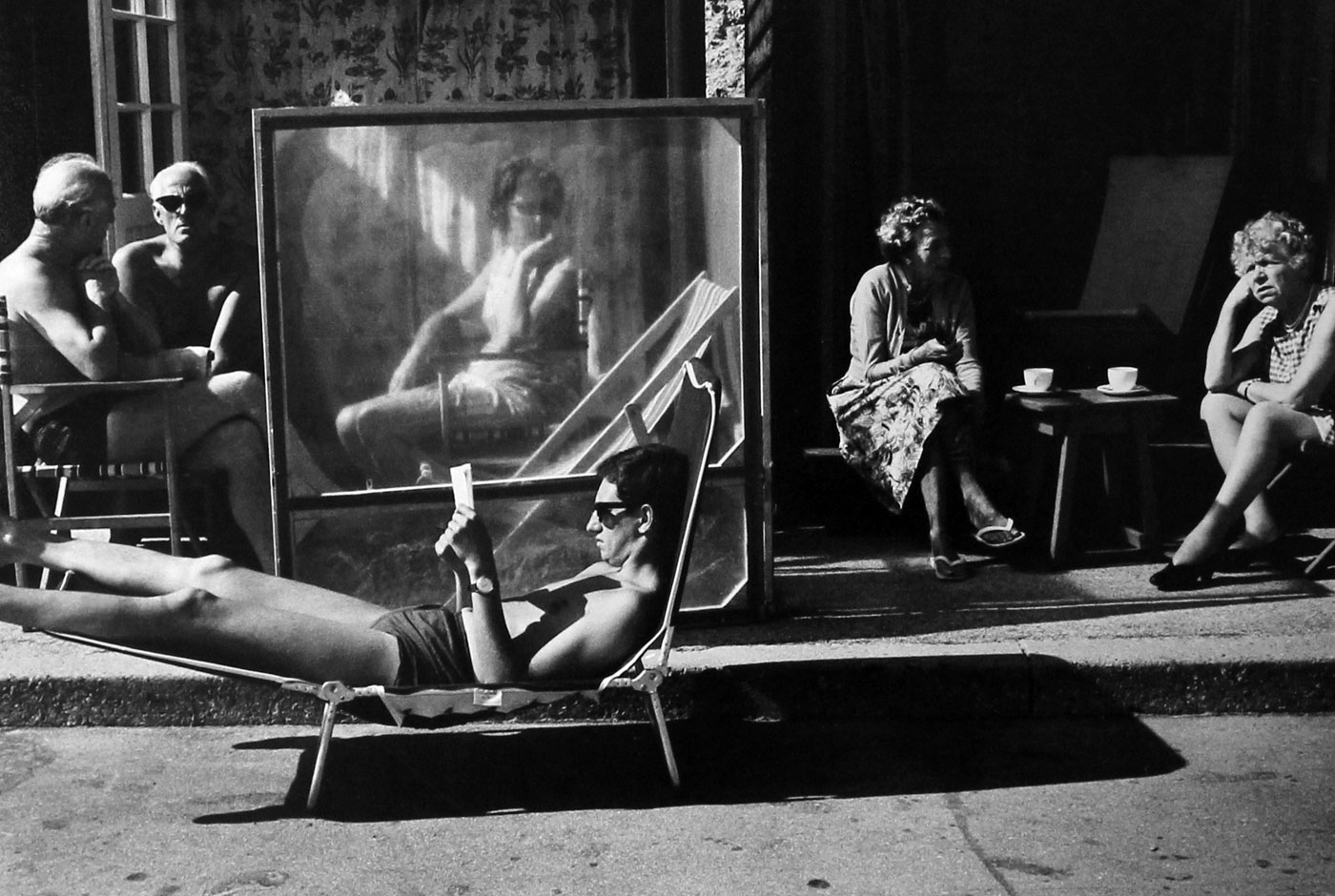
Bournemouth, 1969
1969
Vintage Gelatin Silver Print
16 x 25cm (6 x 10 inches)
© National Media Museum


Tony Ray-Jones (English, 1941-1972) 'Location unknown, possible Morecambe, 1967-68' 1967-1968


Tony Ray-Jones (English, 1941-1972)
Location unknown, possible Morecambe, 1967-68
1967-1968
© National Media Museum
 

Tony Ray-Jones (English, 1941-1972) 'Mablethorpe, 1967' 1967


Tony Ray-Jones (English, 1941-1972)
Mablethorpe, 1967
1967
Vintage Gelatin Silver Print
14 x 21cm (6 x 8 inches)
© National Media Museum
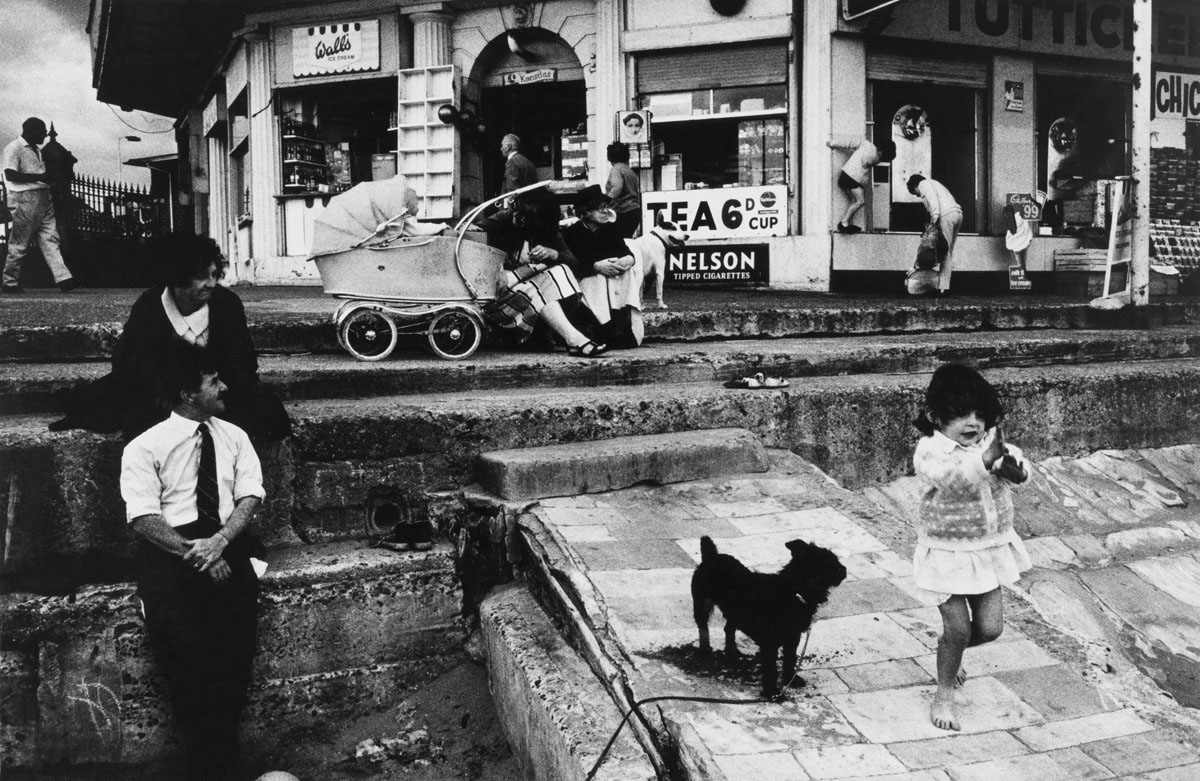
 

Tony Ray-Jones (English, 1941-1972) 'Ramsgate, 1967' 1967


Tony Ray-Jones (English, 1941-1972)
Ramsgate, 1967
1967
© National Media Museum


Tony Ray-Jones (English, 1941-1972) 'Mankinholes Methodist Chapel, Todmorden' 1975


Tony Ray-Jones (English, 1941-1972)
Mankinholes Methodist Chapel, Todmorden
1975
© Martin Parr/ Magnum


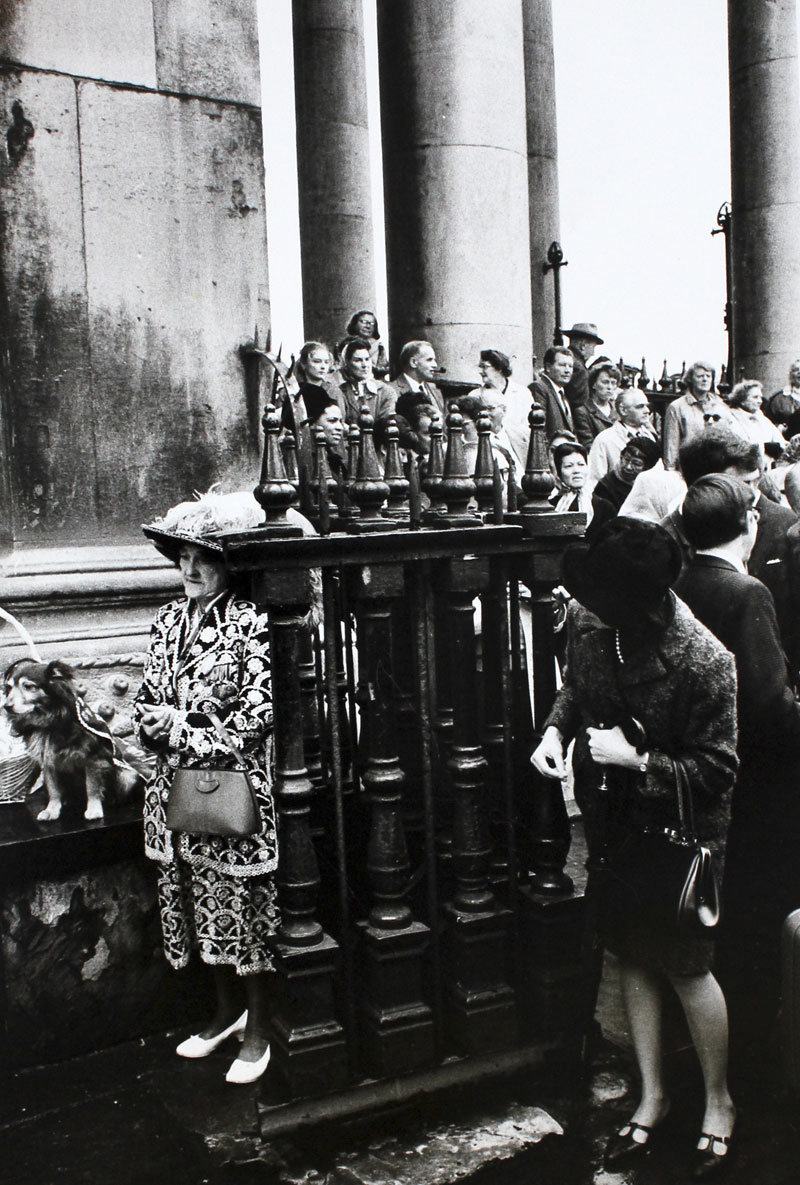
Tony Ray-Jones (English, 1941-1972) 'Cruft's Dog Show, London, 1966' 1966


Tony Ray-Jones (English, 1941-1972)
Cruft’s Dog Show, London, 1966
1966
© National Media Museum


Tony Ray-Jones (English, 1941-1972) 'Dickens Festival, Broadstairs, c. 1967' c. 1967


Tony Ray-Jones (English, 1941-1972)
Dickens Festival, Broadstairs, c. 1967
c. 1967
© National Media Museum
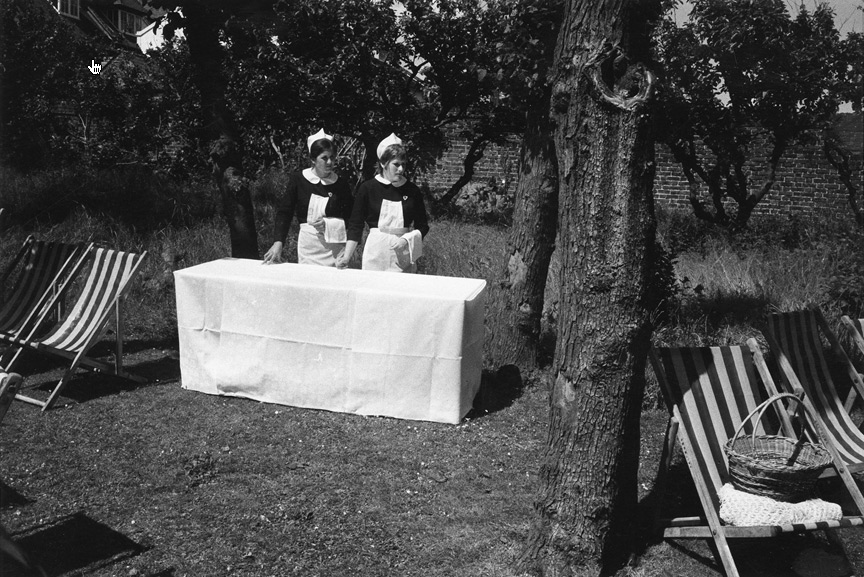
 

Tony Ray-Jones (English, 1941-1972) 'Dickens Festival, Broadstairs, c. 1967' c. 1967


Tony Ray-Jones (English, 1941-1972)
Dickens Festival, Broadstairs, c. 1967
c. 1967
© National Media Museum
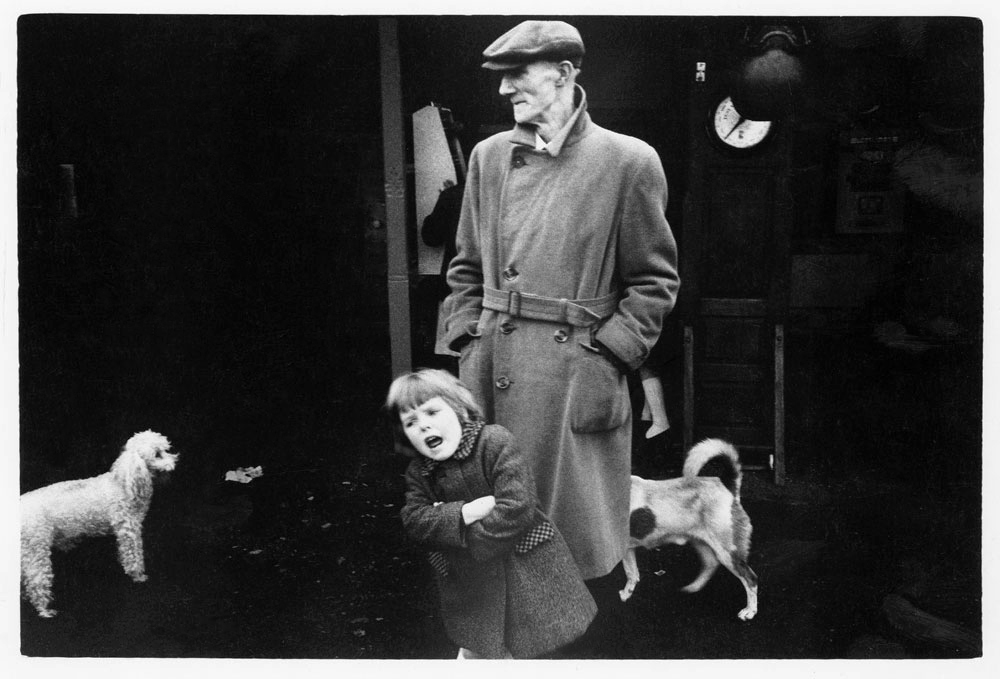
 

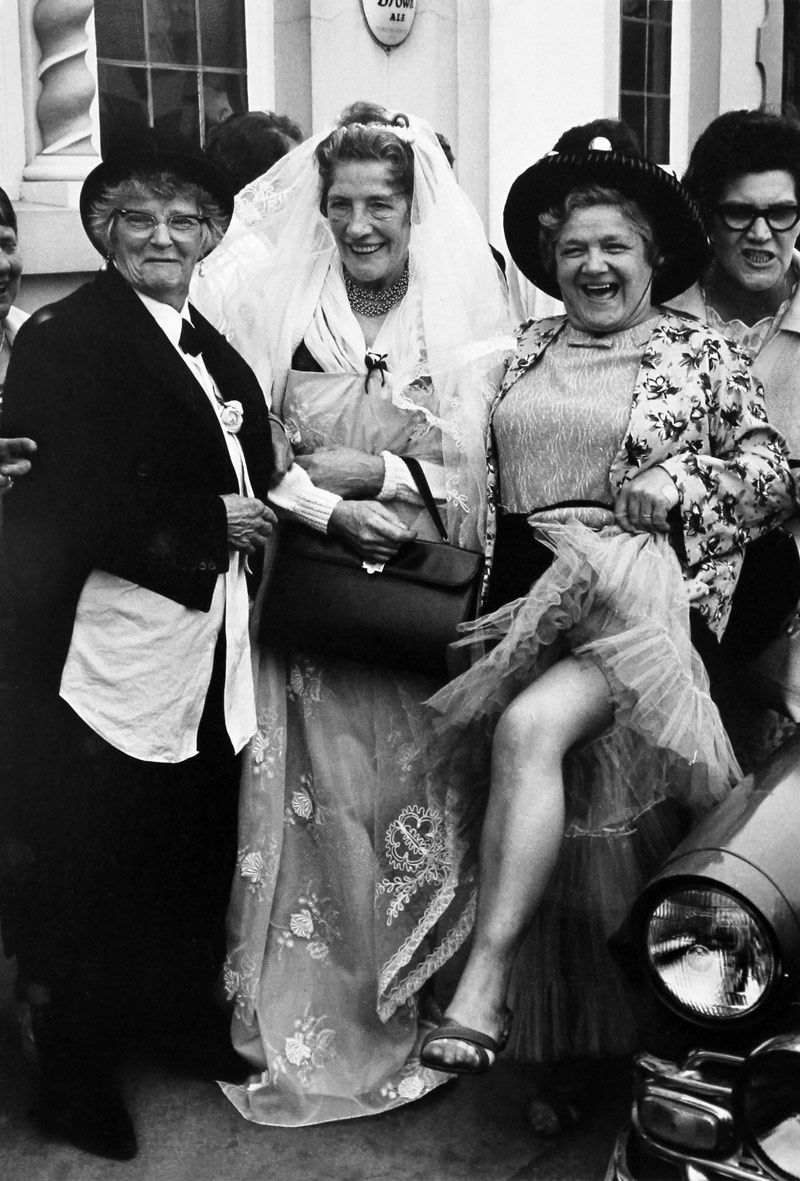
Tony Ray-Jones (English, 1941-1972) 'Wormwood Scrubs Fair, London, 1967' 1967


Tony Ray-Jones (English, 1941-1972)
Wormwood Scrubs Fair, London, 1967
1967
© National Media Museum


Tony Ray-Jones (English, 1941-1972) 'Untitled' 1960s


Tony Ray-Jones (English, 1941-1972)
Untitled
1960s
© National Media Museum


Tony Ray-Jones (English, 1941-1972) 'Trooping the Colour, London, 1967' 1967


Tony Ray-Jones (English, 1941-1972)
Trooping the Colour, London, 1967
1967
© National Media Museum


Tony Ray-Jones (English, 1941-1972) 'Untitled' 1960s


Tony Ray-Jones (English, 1941-1972)
Untitled
1960s
© National Media Museum


Tony Ray-Jones (English, 1941-1972) 'Glyndebourne, 1967' 1967


Tony Ray-Jones (English, 1941-1972)
Glyndebourne, 1967
1967
© National Media Museum
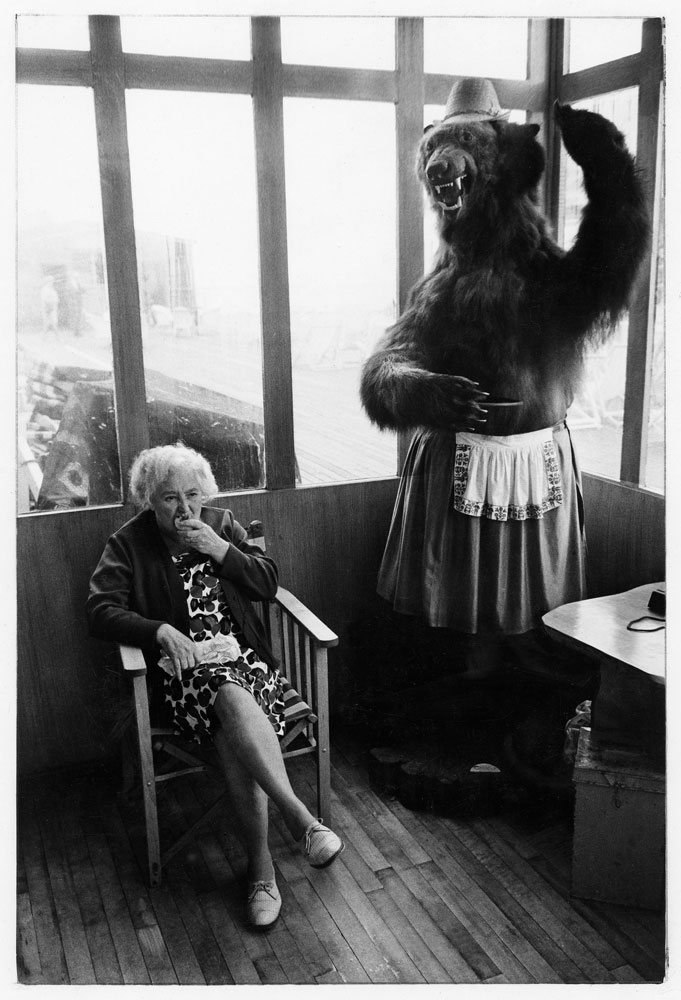
 

Tony Ray-Jones (English, 1941-1972) 'Elderly woman eating pie seated in a pier shelter next to a stuffed bear, 1969' 1969


Tony Ray-Jones (English, 1941-1972)
Elderly woman eating pie seated in a pier shelter next to a stuffed bear, 1969
1969
© National Media Museum


Tony Ray-Jones (English, 1941-1972) 'Blackpool, 1968' 1968


Tony Ray-Jones (English, 1941-1972)
Blackpool, 1968
1968
Vintage Gelatin Silver Print
21 x 14.5cm (8.25 x 5.70 ins)
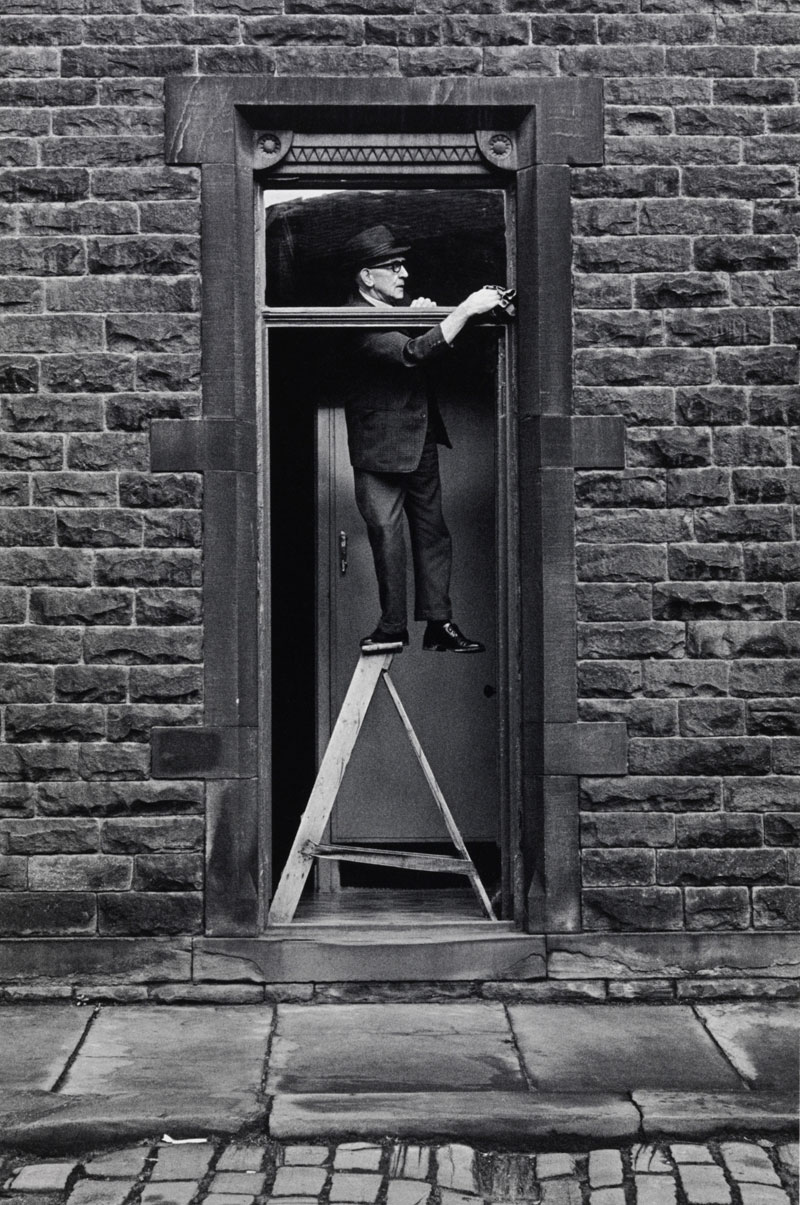
 

Tony Ray-Jones (English, 1941-1972) 'Tom Greenwood cleaning' 1976


Tony Ray-Jones (English, 1941-1972)
Tom Greenwood cleaning
1976
© Martin Parr/ Magnum


Media Space at Science Museum
Exhibition Road, South Kensington,
London SW7 2DD

Opening hours:
Open seven days a week, 10.00 – 18.00
Media Space at Science Museum website

LIKE ART BLART ON FACEBOOK

Back to top

Film: ‘All This Can Happen’

February 2014


Siobhan Davies and David Hinton
Trailer from All This Can Happen
2012


“The highest and the lowest, the most serious and the most hilarious things are to the walker equally beloved, beautiful and valuable…”


Dislocation
Displacement
Discontinuity
Death
Dance
Despair
Documentary

Scene
Seen
Single
Multiple
Surreal
Mundane
Storyline

Sound
Subject
Space

Encounters
Engagements
Negotiations

Time
Memory
Location
Voice
Touch

Walking
Flaneur

Body
Soul

Life itself!


Dr
Marcus Bunyan


Created by Siobhan Davies and filmmaker David Hinton in 2012, All This Can Happen is a film constructed entirely from archive photographs and footage from the earliest days of cinema.

Based on Robert Walser’s novella The Walk (1917), the film follows the footsteps of the protagonist as series of small adventures and chance encounters take the walker from idiosyncratic observations of ordinary events towards a deeper pondering on the comedy, heartbreak and ceaseless variety of life. A flickering dance of intriguing imagery brings to light the possibilities of ordinary movements from the everyday which appear, evolve and freeze before your eyes. Juxtapositions, different speeds and split frame techniques convey the walker’s state of mind as he encounters a world of hilarity, despair and ceaseless variety.


“To walk in the city is to experience the disjuncture of partial vision/partial consciousness. The narrativity of this walking is belied by a simultaneity we know and yet cannot experience. As we turn a corner, our object disappears around the next corner. The sides of the street conspire against us; each attention suppresses a field of possibilities. The discourse of the city is a syncretic discourse, political in its untranslatability. Hence the language of the state elides. Unable to speak all the city’s languages, unable to speak all at once, the state’s language become monumental, the silence of headquarters, the silence of the bank. In this transcendent and anonymous silence is the miming of corporate relations. Between the night workers and the day workers lies the interface of light; in the rotating shift, the disembodiment of lived time. The walkers of the city travel at different speeds, their steps like handwriting of a personal mobility. In the milling of the crowd is the choking of class relations, the interruption of speed, and the machine. Hence the barbarism of police on horses, the sudden terror of the risen animal.”


Stewart, Susan. On Longing: Narratives of the Miniature, the Gigantic, the Souvenir, the Collection. Durham: Duke University Press, 1993, p. 2. Prologue.


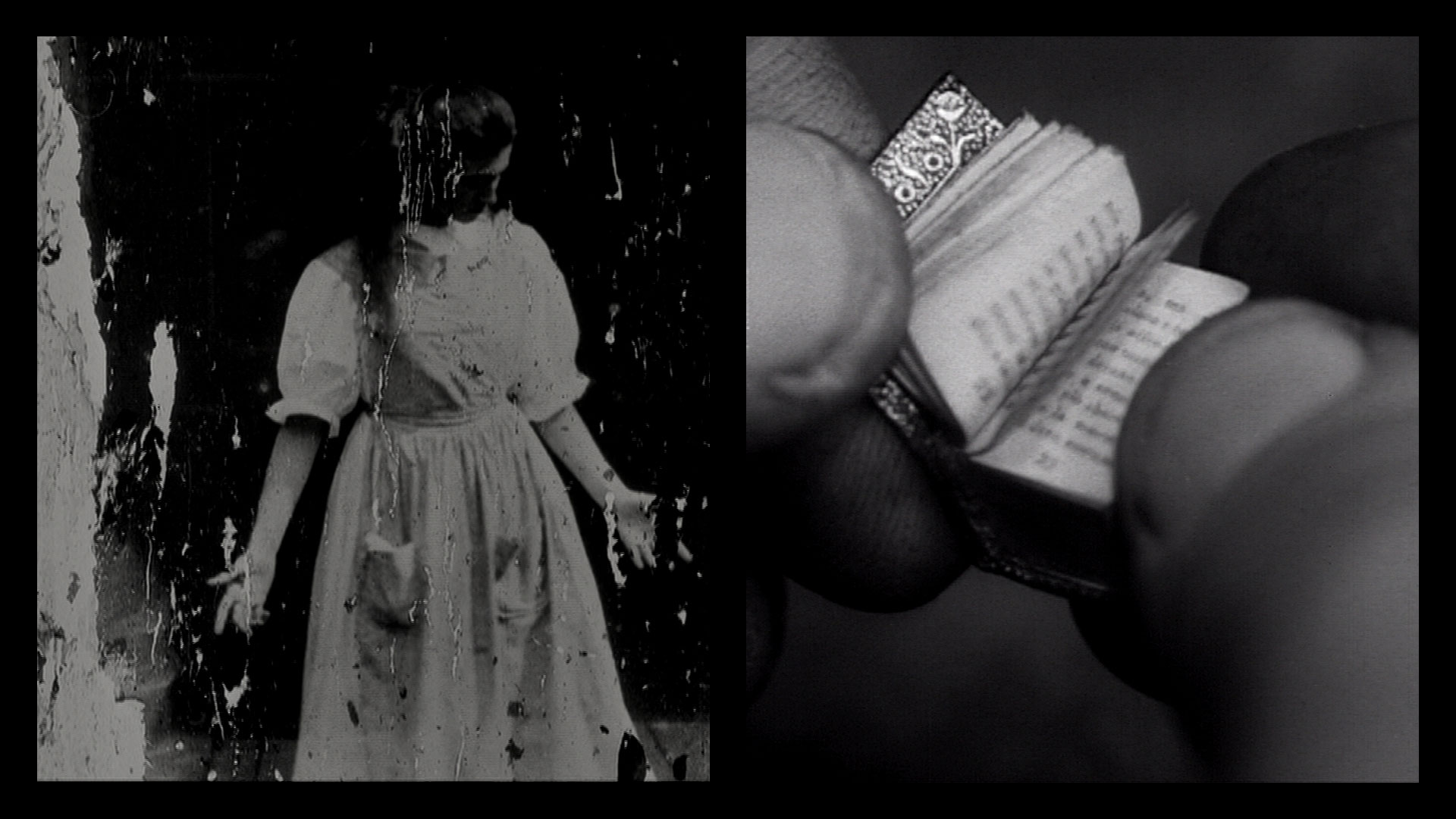
Siobhan Davies and David Hinton. 'Alice in Wonderland' 2012


Siobhan Davies and David Hinton
Alice in Wonderland
2012
Still from All This Can Happen
Courtesy of BFI National Archive


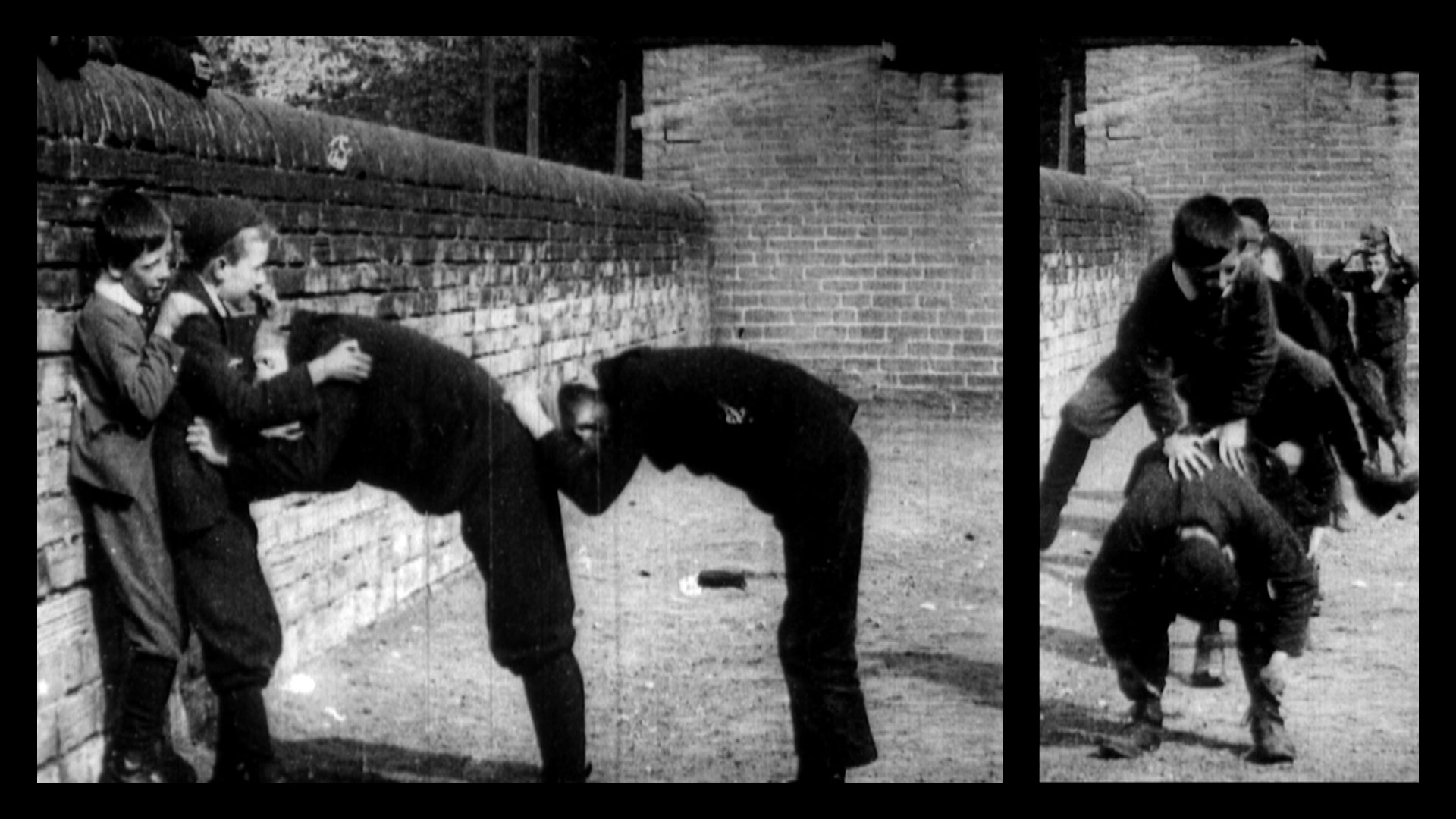
Siobhan Davies and David Hinton. 'Leap Frog' 2012


Siobhan Davies and David Hinton
Leap Frog
2012
Still from All This Can Happen
Courtesy of BFI National Archive


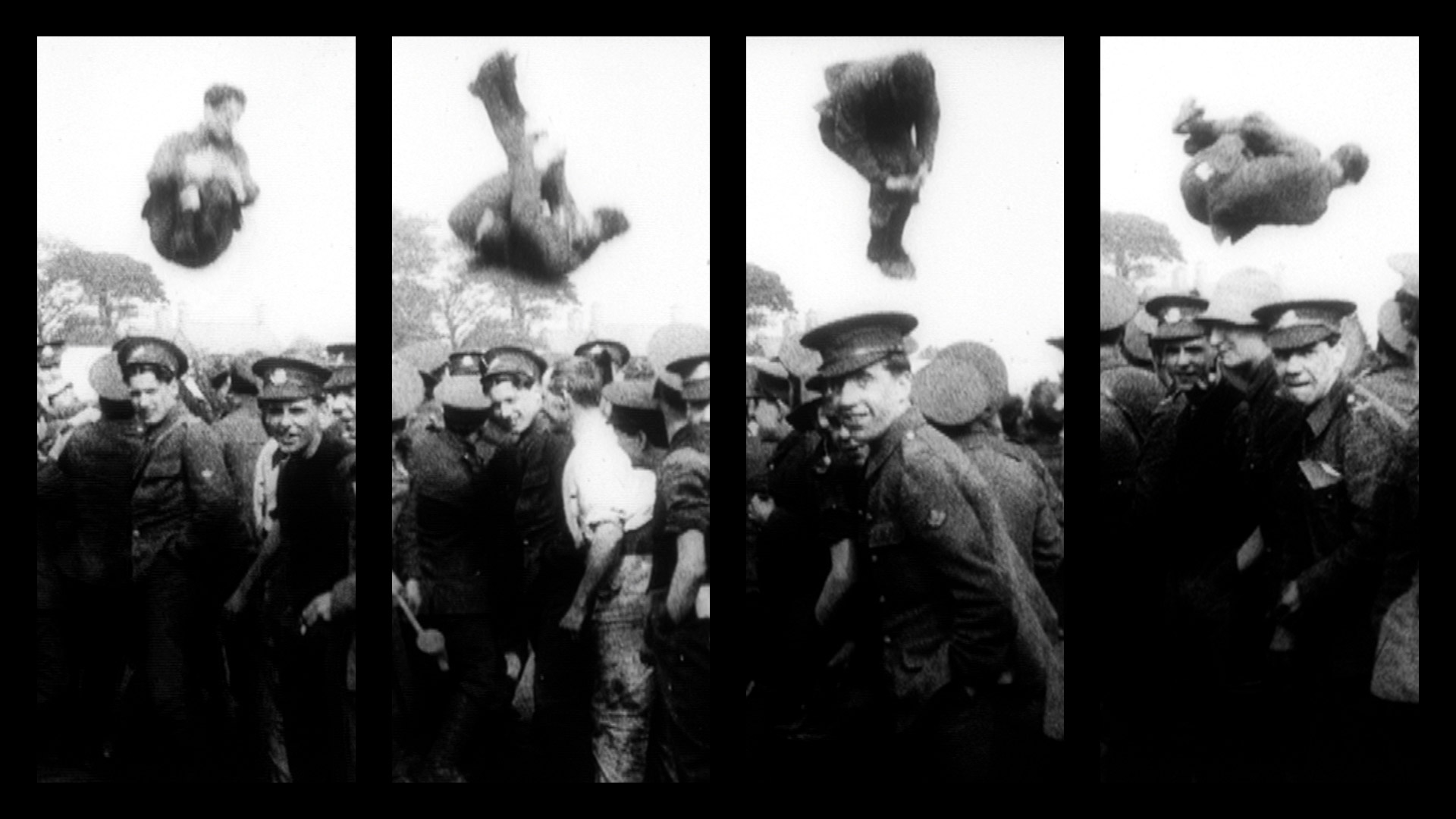
Siobhan Davies and David Hinton. 'Cheshire Territorials' 2012


Siobhan Davies and David Hinton
Cheshire Territorials
2012
Still from All This Can Happen
Courtesy of BFI National Archive


Siobhan Davies and David Hinton. 'Otto the Giant' 2012


Siobhan Davies and David Hinton
Otto the Giant
2012
Still from All This Can Happen
Courtesy of British Pathé


All This Can Happen, a 50-minute film by David Hinton and choreographer Siobhan Davies, opens with images of men who cannot walk. One lies immobile in a hospital bed, his head trembling, eyes vacant with torment. Another, also institutionalised, tries to walk but fails. He falls, scrambles and falls again, his whole body stiff with malfunction.

All this did happen. Every frame of this remarkable film comes from old, mostly black and white archive footage, complete with scratches and fingerprints. It is neither documentary nor constructed reality, but rather a wholly unexpected film adaptation of a short story by Swiss writer Robert Walser (1878-1956), about a man going for a walk.

The story, to which those opening images serve as a prologue, recounts the sights, sounds, encounters and musings of a day’s meandering: children playing in a school, a visit to the tax office, a display of women’s hats, a stroll through a forest, an argument with a tailor. Lovingly voiced by John Heffernan, the narration treats each moment, each thought and perception, with equal consideration, whether it is a gripe about automobiles, a memory of unbearable anguish, the sound of sublime music, or a chat with a dog. “The highest and the lowest, the most serious and the most hilarious things,” he explains, “are to the walker equally beloved, beautiful and valuable…

… the narration establishes a supple continuity, yet though the imagery follows the story devotedly, it has no continuity. It leaps between locations, splices scenes, switches subjects, and roams freely between poetic and literal modes, between the fantastic, the scientific, the surreal and the mundane. It seems able to let the whole world in, and still stay true to a singular storyline.

The imagery is discontinuous in other senses too. The screen is often split into multiple frames so that we notice how highly composed the film is. The frames themselves often freeze fleetingly, arresting the flow of time. Such stops literally give us pause; they let us take a moment. In fact, the whole film could be seen as the encounter between continuity – the story, the voice, time itself – and composition, or indeed choreography: the framing of action, the placement of sound, the arrangement of subjects and space.

But the reason to watch this film is not because it is artful and thoughtful, though it is that. It is because it restores us to our senses, because it touches – gently – both body and soul. To walk, it suggests, is to be in the world. A world that is physical, full of texture and sound and sensation; that is abstract, a matrix of space and time; that is imaginary, teeming with fantasies and terrors, desires, hopes and regrets; that is social, marked by encounters, engagements, negotiations; a world that is human. As a walk of life, All This Can Happen is, quite naturally, also shadowed by death, by not-walking, by not moving in space and time. “Where would I be,” asks the walker, “if I was not here? Here, I have everything. And elsewhere, I would have nothing.” All this it finds equally beloved, beautiful and valuable.

Sanjoy Roy. Excerpt of “Review of All This Can Happen, by Siobhan Davies and David Hinton” on the Aesthetica Magazine Blog website 5 November 2013 [Online] Cited 17/10/2022


Siobhan Davies and David Hinton. 'Miniature Writer' 2012


Siobhan Davies and David Hinton
Miniature Writer
2012
Still from All This Can Happen
Courtesy of British Pathé


Siobhan Davies and David Hinton. 'Hints and Hobbies' 2012


Siobhan Davies and David Hinton
Hints and Hobbies
2012
Still from All This Can Happen
Courtesy of AP Archive  British Movietone


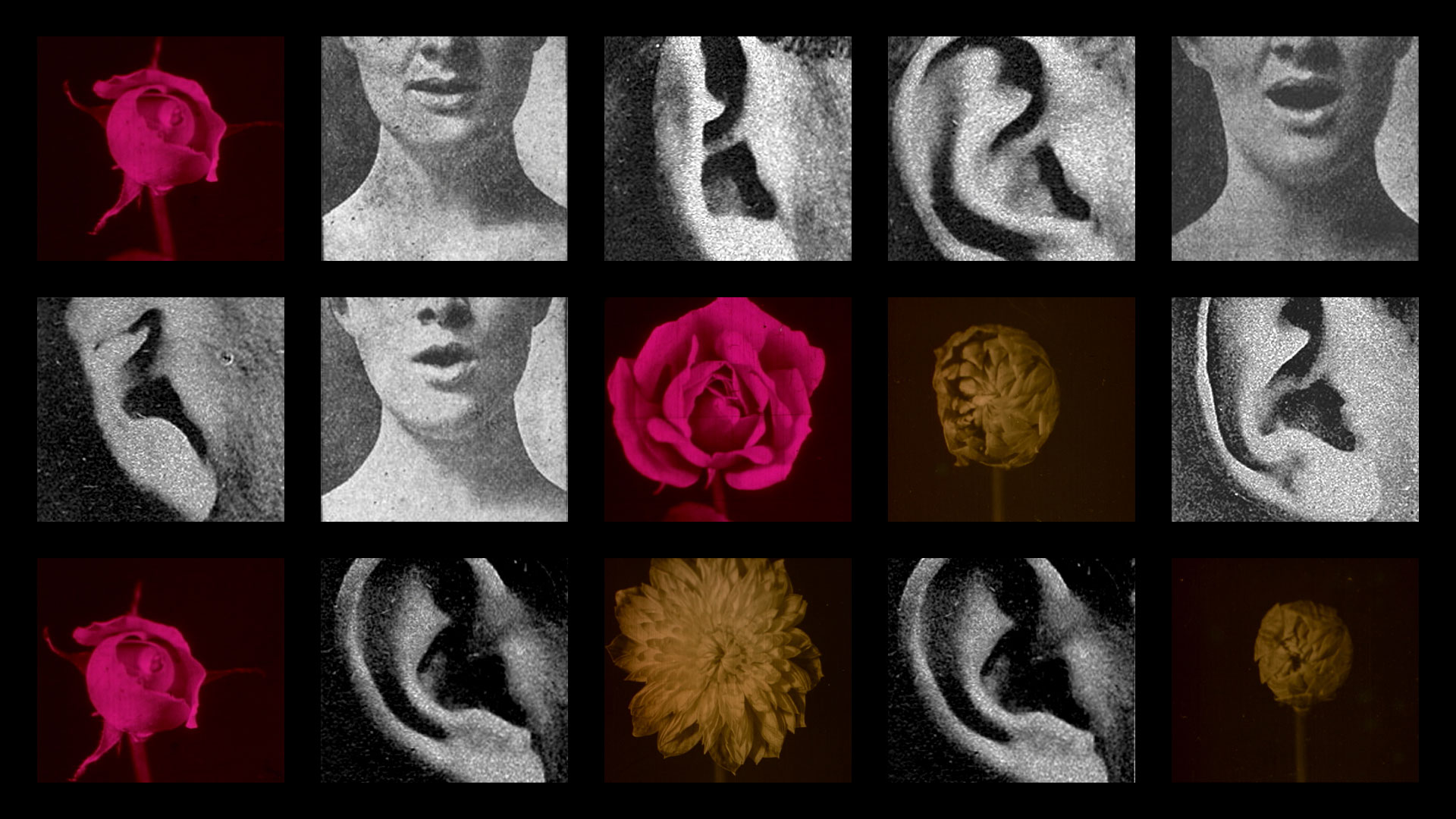
Siobhan Davies and David Hinton. 'Ears' and 'Birth of a Flower' 2012


Siobhan Davies and David Hinton
Ears and Birth of a Flower
2012
Still from All This Can Happen
Courtesy of Wellcome Library, London and AP Archive British Movietone


Siobhan Davies and David Hinton. 'Banff Scotland' and 'I Saw This' 2012


Siobhan Davies and David Hinton
Banff Scotland and I Saw This
2012
Still from All This Can Happen
Courtesy of Library of Congress, Prints & Photographs Division and Yorkshire Film Archive


Siobhan Davies Dance website

LIKE ART BLART ON FACEBOOK

Back to top

Exhibition: ‘Julia Margaret Cameron’ at The Metropolitan Museum of Art, New York

Exhibition dates: 9th August 2013 – 5th January 2014


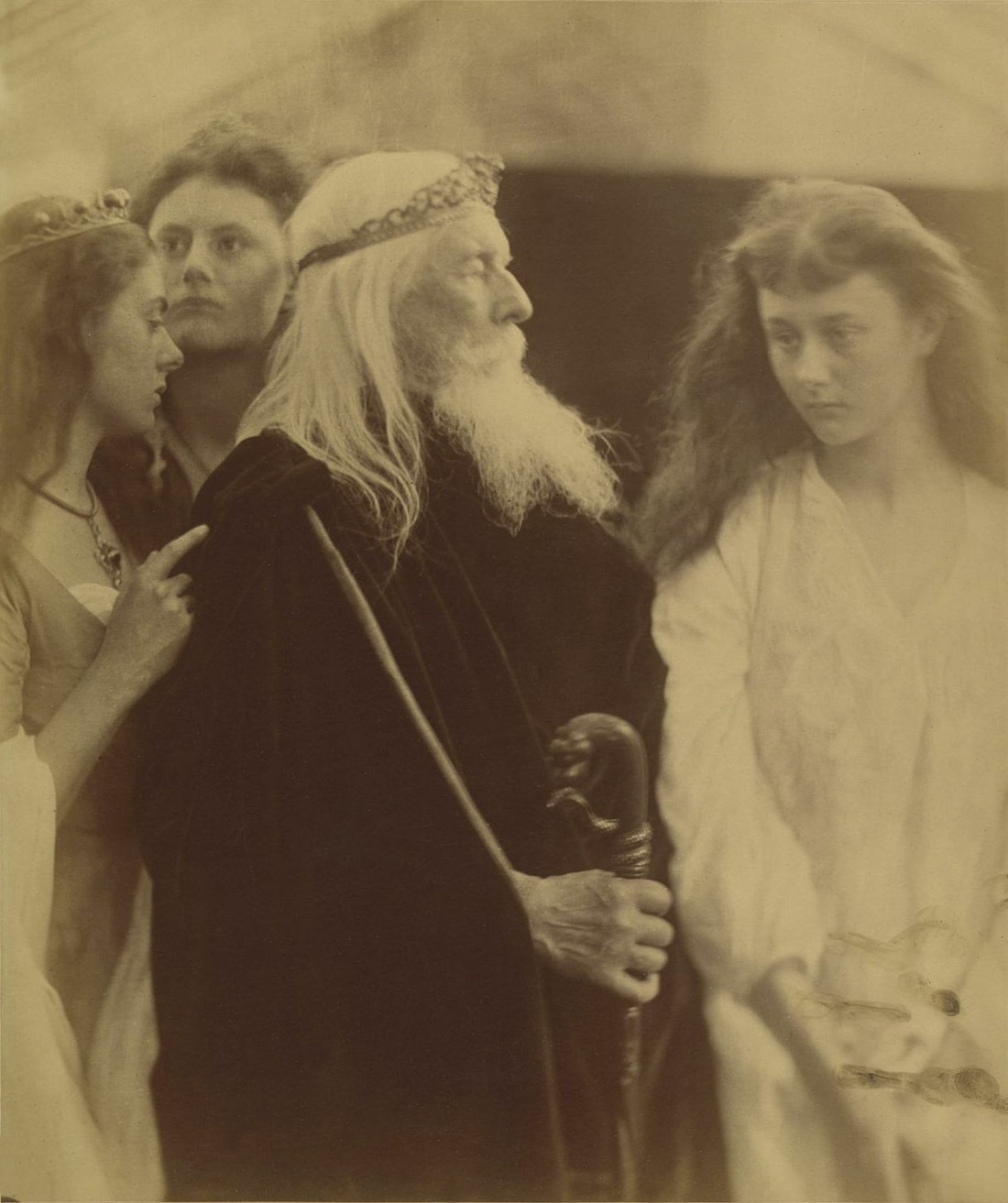
Julia Margaret Cameron (British born India, Calcutta 1815 - 1879 Kalutara, Ceylon) 'King Lear and his Three Daughters' 1872
 

Julia Margaret Cameron (British born India, Calcutta 1815 – 1879 Kalutara, Ceylon)
King Lear and his Three Daughters
1872
Albumen silver print from glass negative
Bequest of Maurice B. Sendak, 2013
The Metropolitan Museum of Art


The three Liddell sisters – Lorina, Elizabeth, and Alice – posed with the photographer’s husband playing the tragically deceived King Lear in one of Cameron’s few Shakespearean compositions. Goneril and Regan whisper false flattery in the ageing king’s ear while the truly devoted but disinherited Cordelia – here unadorned and dressed in white – stands before him, an embodiment of disillusioned innocence.


The first posting of a new year, and finally I get to do a posting on one of the greatest photographers of all time. Nobody has ever taken portraits like JMC before or since. What a unique vision, different from everyone else: “directed light, soft focus, and long exposures that allowed the sitters’ slight movement to register in her pictures, instilling them with a sense of breath and life.”

The portrait of Sir John Herschel (April 1867, below) is one of the most famous portraits in the history of photography. What a magnificent achievement, to capture the spirit of this human being on a glass plate… “Our Julia” as my friend Joyce Evans lovingly calls her. It’s funny how everyone takes her to their heart.

Dr Marcus Bunyan


Many thankx to the The Metropolitan Museum of Art for allowing me to publish the photographs in the posting. Please click on the photographs for a larger version of the image.


Julia Margaret Cameron (British born India, Calcutta 1815 - 1879 Kalutara, Ceylon) 'Sappho' 1865


Julia Margaret Cameron (British born India, Calcutta 1815 – 1879 Kalutara, Ceylon)
Sappho
1865
Albumen silver print from glass negative
The Rubel Collection, Purchase, Jennifer and Joseph Duke and Anonymous Gifts, 1997
The Metropolitan Museum of Art


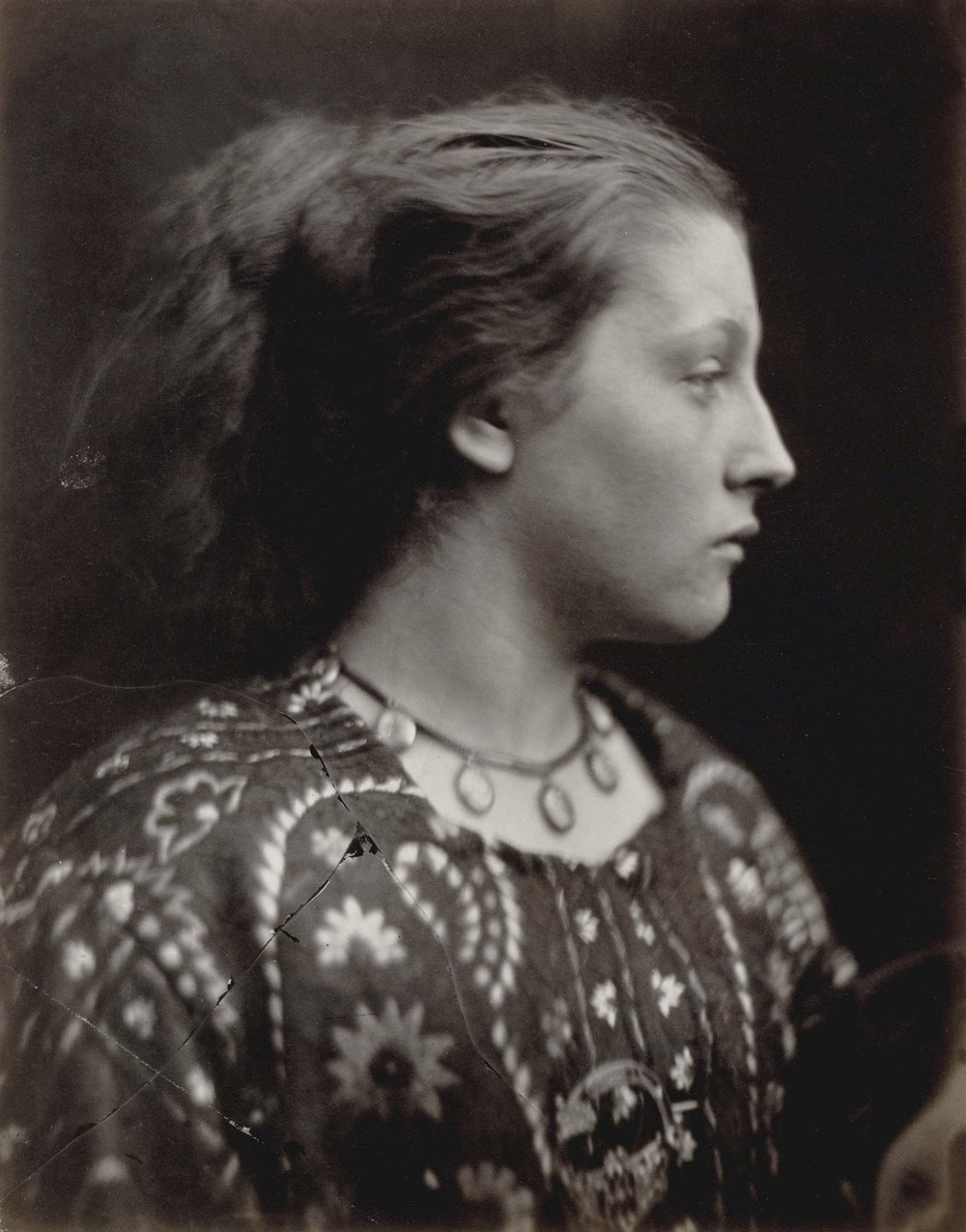
Mary Hillier, a beautiful young house servant at Dimbola, Cameron’s home in Freshwater, was often pressed into photographic service, frequently in the role of the Virgin Mary. She managed to assume her various guises in a remarkably unselfconscious way, projecting both gentleness and strength of character. Hillier is also the model for Cameron’s Sappho, a profile portrait in the Florentine Quattrocento style, perhaps inspired by the chromolithographic reproductions of Italian paintings distributed by the Arundel Society, of which Cameron was a member. The image has great presence, so much so that Cameron decided to print it even though she broke the negative. Precisely what the picture has to do with the Greek poet of Lesbos is unclear, especially since Cameron inscribed another print of the same image Adriana. The titles of two close variants reveal that, by looking left instead of right, Hillier was apparently transformed from Sappho into Dora or, when photographed from one step further back, Clio. Although Cameron often set out to portray a certain ideal, she also titled pictures after the fact, sometimes because the image seemed to embody the character of a certain literary or biblical figure, but sometimes, one suspects, quite simply because there was more of a market for images of the Virgin, Sappho, or Christabel than for portraits of the photographer’s niece or a parlour maid from the Isle of Wight.


Julia Margaret Cameron (British born India, Calcutta 1815 - 1879 Kalutara, Ceylon) 'The Mountain Nymph Sweet Liberty' 1866


Julia Margaret Cameron (British born India, Calcutta 1815 – 1879 Kalutara, Ceylon)
The Mountain Nymph Sweet Liberty
1866
Albumen silver print from glass negative
Harris Brisbane Dick Fund, 1941
The Metropolitan Museum of Art


In Cameron’s The Mountain Nymph Sweet Liberty, Miss Keene, an arresting model about whom we know nothing but her last name, stares directly at the camera (and, by extension, at the viewer), her hair loose and her eyes open wide. Filling the frame, she seems to step out of the picture. The photograph takes its title from John Milton’s poem L’Allegro, a celebration of life’s pleasures:

Come, and trip it as you go
On the light fantastic toe;
And in thy right hand lead with thee
The mountain nymph, sweet Liberty.

Cameron sent the photograph to her friend, the renowned scientist Sir John Herschel, who wrote back, “That head of the ‘Mountain Nymph Sweet liberty’ (a little farouche & égarée [timid and distraught] by the way, as if first let loose & half afraid that it was too good to last) is really a most astonishing piece of high relief. She is absolutely alive and thrusting out her head from the paper into the air. This is your own special style.” Herschel seized upon the photograph’s most striking quality, its startling sense of presence and of psychological connection with the viewer.


Julia Margaret Cameron (British born India, Calcutta 1815 - 1879 Kalutara, Ceylon) 'Zoe, Maid of Athens' 1866


Julia Margaret Cameron (British born India, Calcutta 1815 – 1879 Kalutara, Ceylon)
Zoe, Maid of Athens
1866
Albumen silver print from glass negative
The Rubel Collection, Purchase, Lila Acheson Wallace, Ann Tenenbaum and Thomas H. Lee, and Muriel Kallis Newman Gifts, 1997
The Metropolitan Museum of Art


Here Cameron photographed May Prinsep, her sister’s adopted daughter. By allowing Prinsep’s slight movement and by intentionally softening the focus, Cameron instilled a sense of breath and soul in this living apparition, for the true subject of her photograph was a poetic evocation of love and longing. “Maid of Athens, ere we part, / Give, oh, give me back my heart!” begin the verses composed by Lord Byron as he departed Greece in 1810. In the poem that inspired Cameron, Byron swore “By those tresses unconfined, / Wooed by each Aegean wind; / By those lids whose jetty fringe / Kiss thy soft cheeks’ blooming tinge; / By those wild eyes like the roe, / Zoë mou sas agapo [My life, I love you].”


Julia Margaret Cameron (British born India, Calcutta 1815 - 1879 Kalutara, Ceylon) 'Christabel' 1866


Julia Margaret Cameron (British born India, Calcutta 1815 – 1879 Kalutara, Ceylon)
Christabel
1866
Albumen silver print from glass negative
Harris Brisbane Dick Fund, 1941
The Metropolitan Museum of Art (41.21.26)


“Yea, she doth smile, and she doth weep,
Like a youthful hermitess,
Beauteous in a wilderness.”


Samuel Taylor Coleridge


Coleridge’s unfinished poem “Christabel” (1816) tells the story of a young woman debased by sorcery. A dark poem, full of rolling fog and lesbian innuendo, “Christabel” was the kind of tale that appealed to the Victorian palate – a soup of sexual transgression and moral repair. Cameron rarely made portraits of women; rather, when she photographed them, they appeared as representations of some biblical, mythological, or literary figure. Cameron’s niece, May Prinsep, who would later marry Hallam Tennyson, son of the poet laureate, appears here as the ethereal Christabel before her corruption. Cameron’s long exposure time and distinct soft-focus technique lend the work its idealising gravitas even while, paradoxically, intensifying the realistic presence of the individual before the lens. For all her “high art” aspirations, Cameron was always quick to note that her images were “from life.”


Julia Margaret Cameron (British born India, Calcutta 1815 - 1879 Kalutara, Ceylon) '[Kate Keown]' 1866


Julia Margaret Cameron (British born India, Calcutta 1815 – 1879 Kalutara, Ceylon)
[Kate Keown]
1866
Albumen silver print from glass negative
Gilman Collection, Purchase, Jennifer and Joseph Duke Gift, 2005
The Metropolitan Museum of Art


In spring and summer 1866, having purchased a new, larger camera capable of making twelve-by-fifteen-inch negatives, Cameron produced a series of twelve “life-sized heads,” including this angelic study of tender sorrow somewhat in the style of Botticelli. Throughout her work, poetic truth was valued above photographic truthfulness. She conveyed a sense of life and breath and of honest emotion through careful lighting, her models’ slight movement during long exposures, a shallow depth of field, and softness of focus. “My first successes in my out-of-focus pictures were a fluke,” Cameron wrote. “That is to say, that when focusing and coming to something which, to my eye, was very beautiful, I stopped there instead of screwing on the lens to the more definite focus which all other photographers insist on.” In so doing, she gave the feeling of both flesh and spirit without, in Rejlander’s words, “an exaggerated idea of the bark of the skin.”


Julia Margaret Cameron (British born India, Calcutta 1815 - 1879 Kalutara, Ceylon) 'Mrs. Herbert Duckworth' 1867


Julia Margaret Cameron (British born India, Calcutta 1815 – 1879 Kalutara, Ceylon)
Mrs. Herbert Duckworth
1867
Albumen silver print from glass negative
32.8 x 23.7cm (12 15/16 x 9 5/16 in.)
Gilman Collection, Purchase, Alfred Stieglitz Society Gifts, 2005


This portrait of Julia Jackson, which is usually trimmed to an oval, suggests an antique cameo carved in deep relief. Its success lies partly in its subject’s actual beauty and partly in the way the photographer modelled it to suggest Christian and classical ideals of purity, strength, and grace. The photograph was made the year Julia married Herbert Duckworth. Three years later she was a widow and the mother of three children.

Her second marriage, in 1878, to the great Victorian intellectual Sir Leslie Stephen, produced the painter Vanessa Bell and the writer Virginia Woolf. In her novel To the Lighthouse (1927), Virginia portrayed her mother as the searching, sensitive Mrs. Ramsay, ever suspended in thought. “She bore about with her, she could not help knowing it, the torch of her beauty; she carried it erect into any room that she entered.”


Julia Margaret Cameron (British born India, Calcutta 1815 - 1879 Kalutara, Ceylon) 'Alice Liddell / Pomona' 1872


Julia Margaret Cameron (British born India, Calcutta 1815 – 1879 Kalutara, Ceylon)
Alice Liddell / Pomona
1872
Albumen silver print from glass negative
David Hunter McAlpin Fund, 1963
The Metropolitan Museum of Art


Alice Liddell (1852-1934) – who, as a child, was Lewis Carroll’s muse and frequent photographic model – posed for Cameron a dozen times in August and September 1872. Against a dense background of foliage and bedecked with flowers, the twenty-year-old Liddell was photographed by Cameron as the embodiment of fruitful abundance, Pomona, Roman goddess of gardens and fruit trees.


One of the greatest portraitists in the history of photography, Julia Margaret Cameron (1815-1879) blended an unorthodox technique, a deeply spiritual sensibility, and a Pre-Raphaelite-inflected aesthetic to create a gallery of vivid portraits and a mirror of the Victorian soul. Julia Margaret Cameron, on view at the Metropolitan Museum of Art beginning August 19, 2013, is the first New York City museum exhibition devoted to Cameron’s work in nearly a generation and the first ever at the Met. The showing of 35 works is drawn entirely from the Metropolitan’s rich collection, including major works from the Rubel Collection acquired in 1997 and the Gilman Collection acquired in 2005. The exhibition is made possible by The Hite Foundation, in memory of Sybil Hite.

When she received her first camera in December 1863 as a Christmas gift from her daughter and son-in-law, Cameron was 48, a mother of six, and a deeply religious, well-read, somewhat eccentric friend of many notable Victorian artists, poets, and thinkers. “From the first moment I handled my lens with a tender ardour,” she wrote, “and it has become to me as a living thing, with voice and memory and creative vigour.” Condemned by some contemporaries for sloppy craftsmanship, she purposely avoided the perfect resolution and minute detail that glass negatives permitted, opting instead for carefully directed light, soft focus, and long exposures that allowed the sitters’ slight movement to register in her pictures, instilling them with a sense of breath and life.

The exhibition features masterpieces from each of her three major bodies of work: portraits of men “great thro’ genius” including the poet Alfred, Lord Tennyson, scientist Sir John Herschel, and philosopher Thomas Carlyle; women “great thro’ love” including relatives, neighbours, and household staff, often titled as literary, historical, or biblical subjects; and staged groupings such as her illustrations for Tennyson’s Idylls of the King, her Annunciation in the style of Perugino, or her depiction of King Lear and his daughters. Julia Margaret Cameron is organised by Malcolm Daniel, Senior Curator in the Department of Photographs at The Metropolitan Museum of Art.”

Press release from The Metropolitan Museum of Art website


Julia Margaret Cameron (British born India, Calcutta 1815 - 1879 Kalutara, Ceylon) 'Philip Stanhope Worsley' 1866


Julia Margaret Cameron (British born India, Calcutta 1815 – 1879 Kalutara, Ceylon)
Philip Stanhope Worsley
1866
Albumen silver print from glass negative
Gilman Collection, Purchase, The Horace W. Goldsmith Foundation Gift through Joyce and Robert Menschel, 2005
The Metropolitan Museum of Art


On February 21, 1866, Cameron wrote to Henry Cole, director of the South Kensington Museum, “I have been for 8 weeks nursing poor Philip Worsley on his dying bed… The heart of man cannot conceive a sight more pitiful than the outward evidence of the breaking up of his whole being.” An Oxford-educated poet who translated the Odyssey and part of the Iliad into Spenserian verse, Worsley died of tuberculosis at the age of thirty the following May. Cameron’s portrait, made the year of his death, vividly conveys the intensity of Worsley’s intellectual life and something of its tragedy. To her subject’s hypnotic gravity she added intimations of sacrifice, engulfing the dying poet in dramatic darkness.


Julia Margaret Cameron (British born India, Calcutta 1815 - 1879 Kalutara, Ceylon) 'Alfred, Lord Tennyson' July 4, 1866


Julia Margaret Cameron (British born India, Calcutta 1815 – 1879 Kalutara, Ceylon)
Alfred, Lord Tennyson
July 4, 1866
Albumen silver print from glass negative
The Rubel Collection, Purchase, Lila Acheson Wallace, Michael and Jane Wilson, and Harry Kahn Gifts, 1997
The Metropolitan Museum of Art


When Cameron’s husband retired in 1848 from the Calcutta Council of Education and the Supreme Council of India, they moved to England, settling first in Tunbridge Wells, near Charles’s old friend the poet Henry Taylor, and later in Putney Heath, near the poet laureate Alfred, Lord Tennyson and his wife. For Cameron, these men were not merely friends and neighbours, but also intellectual, spiritual, and artistic advisors. In 1860, while her husband was in Ceylon checking on the family coffee plantations, Cameron visited the Tennysons’ new home at Freshwater on the Isle of Wight and promptly purchased two cottages next door, which she joined together as the new family home. Cameron’s friendship and determination knew no bounds – indeed, her kindness could be overbearing at times. It took three years of pleading before Cameron convinced Tennyson (who jokingly referred to her models as “victims”) to sit for his portrait.


Julia Margaret Cameron (British born India, Calcutta 1815 - 1879 Kalutara, Ceylon) 'Sir John Herschel' April 1867


Julia Margaret Cameron (British born India, Calcutta 1815 – 1879 Kalutara, Ceylon)
Sir John Herschel
April 1867
Albumen silver print from glass negative
The Rubel Collection, Promised Gift of William Rubel
The Metropolitan Museum of Art


No commercial portrait photographer of the period would have portrayed Herschel as Cameron did here, devoid of classical columns, weighty tomes, scientific attributes, and academic poses – the standard vehicles for conveying the high stature and classical learning that one’s sitter possessed (or pretended to possess). To Cameron, Herschel was more than a renowned scientist; he was “as a Teacher and High Priest,” an “illustrious and revered as well as beloved friend” whom she had known for thirty years. Naturally, her image of him would not be a stiff, formal effigy. Instead, she had him wash and tousle his hair to catch the light, draped him in black, brought her camera close to his face, and photographed him emerging from the darkness like a vision of an Old Testament prophet.


Julia Margaret Cameron (British born India, Calcutta 1815 - 1879 Kalutara, Ceylon) 'A Study' 1865-66


Julia Margaret Cameron (British born India, Calcutta 1815 – 1879 Kalutara, Ceylon)
A Study
1865-66
Albumen silver print from glass negative
34.4 x 26.4cm (13 9/16 x 10 3/8 in.)
Bequest of James David Nelson, in memory of Samuel J. Wagstaff Jr., 1990


This image, also titled After Perugino / The Annunciation, is one of more than 130 religiously themed images inspired by Cameron’s deep Christian devotion and her artistic admiration of Italian painting of the early Renaissance. Such photographs adhere to traditional iconography only in the broadest sense. Here, for example, Cameron follows the precedent of paintings of the Annunciation in which the angel Gabriel presents a lily – symbol of purity – to the Virgin Mary. More important, however, Cameron’s sincerity of sentiment imbues her work with an aura of devotion and claims for it a place equal to sacred art of the past.


Julia Margaret Cameron (British born India, Calcutta 1815 - 1879 Kalutara, Ceylon) 'The Parting of Lancelot and Guinevere' 1874


Julia Margaret Cameron (English, 1815-1879)
The Parting of Lancelot and Guinevere
1874
Albumen silver print from glass negative
David Hunter McAlpin Fund, 1952
The Metropolitan Museum of Art


In 1874 Tennyson asked Cameron to make photographic illustrations for a new edition of his Idylls of the Kings, a recasting of the Arthurian legends. Responding that both knew that “it is immortality to me to be bound up with you,” Cameron willingly accepted the assignment. Costuming family and friends, she made some 245 exposures to arrive at the handful she wanted for the book. Ultimately – and predictably – she was unhappy with the way her photographs looked reduced in scale and translated into wood engravings, and she chose to issue a deluxe edition, at her own risk, that included a dozen full size photographic prints in each of two volumes.


The Metropolitan Museum of Art
1000 Fifth Avenue at 82nd Street
New York, New York 10028-0198
Phone: 212-535-7710

Opening hours:
Thursday – Tuesday 10am – 5pm

The Metropolitan Museum of Art website

LIKE ART BLART ON FACEBOOK

Back to top

Exhibition: ‘Another Country: Vintage Photographs of British Life by Tony Ray-Jones’ at James Hyman, London

Exhibition dates: 11th September – 11th October 2013


Tony Ray-Jones (British, 1941-1972) 'Lady's Day' c. 1967


Tony Ray-Jones (British, 1941-1972)
Lady’s Day
c. 1967
Vintage Gelatin Silver Print
12 x 20cm (5 x 8 inches)


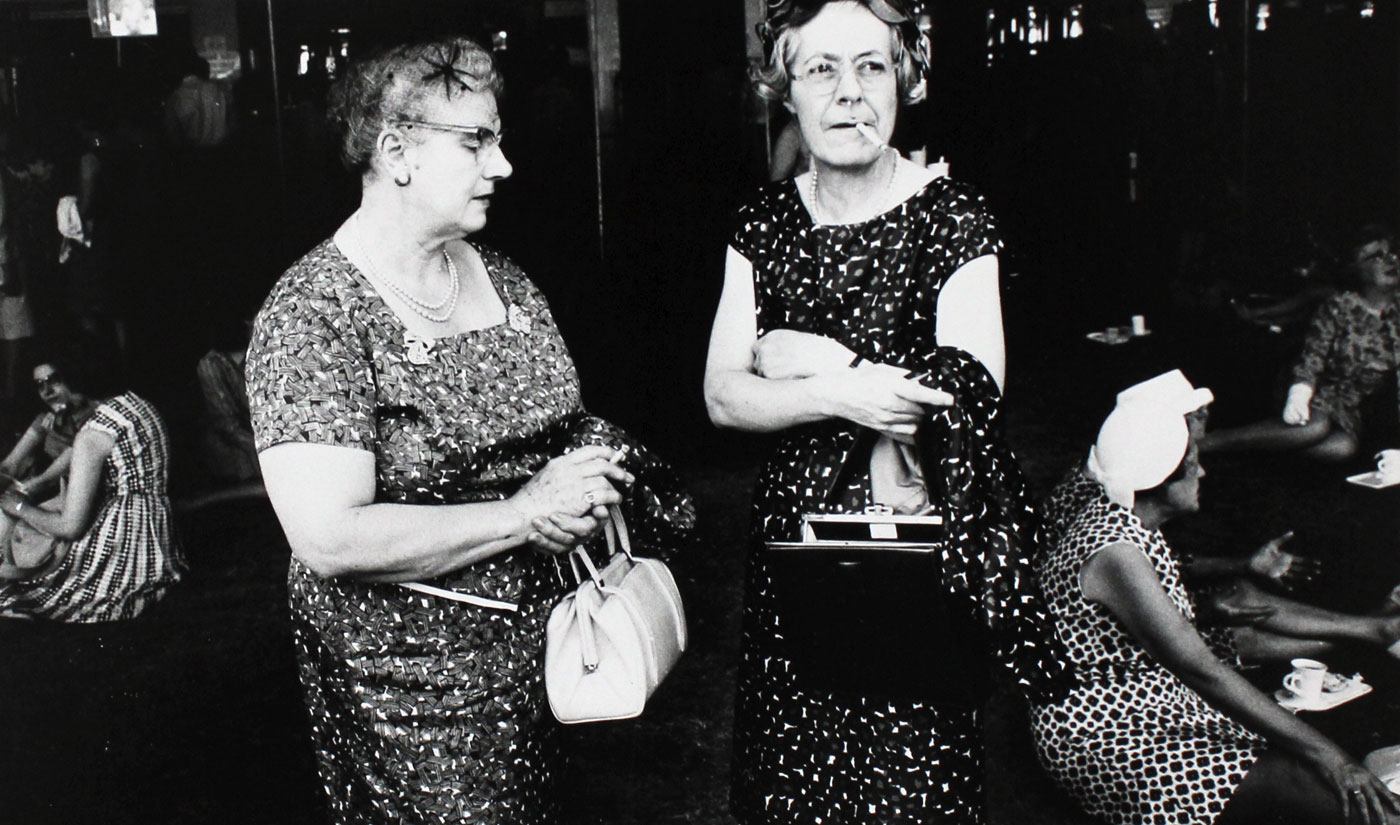
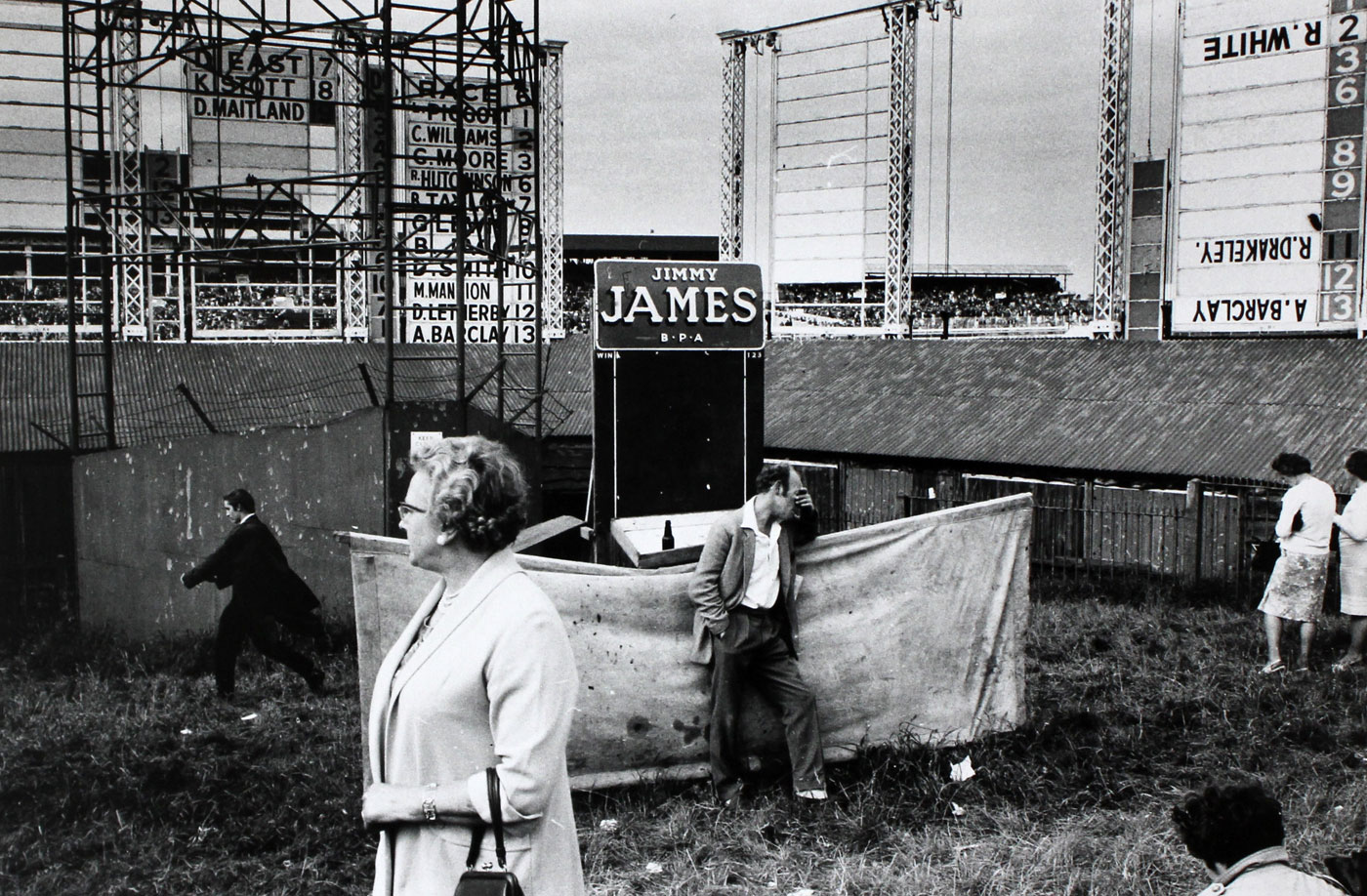
What a loss to the world when this photographer died aged just thirty. His eye was magnificent. He seems to have instinctively known how to capture the quintessential British at work, rest and play in all that societies class-ridden glory – the fag hanging out of the mouth in Lady’s Day (c. 1967) combining beautifully with the aura of the patterned dresses; the isolation of the figures and their stop-frame movement in Day at the Races (c. 1967), a wonderfully balanced composition caught in the moment; and the orchestral ensemble that is the cast of Bacup, Lancashire, 1968 (1968), each figure playing its part in the overall tension of the picture plane: the brothers at right in matching duffle coats, the boy walking forward down the incline with head thrown sideways balanced at rear by another boy with hands in pockets tossing his head into the wind. Magical.

Just to see this image, to visualise it and have the camera ready to capture its “nature”, its undeniable presence for that one split second, then to develop and find this image on a proof sheet, what joy this would have been for the artist. Equally illustrious is the feeling of Bournemouth, 1969 (1969) with the nuanced use of shadow and light, the occlusion of the figure behind the screen with the turn of the head, and the placement of the two white tea cups at right. Ray-Jones wasn’t afraid to place figures in the foreground of his compositions either as can be seen in Brighton Beach, 1967 (1967) to great effect, framing the mise en scène behind.

These photographs take me way back to my childhood in the 1960s in England, going to Butlin’s Clacton-on-Sea and Bournemouth for our family holidays. Even the name says it all: Clacton “on sea” as though they have to remind people visiting that they are actually at the sea. The photographs perfectly capture the mood of the country in this utilitarian era where holidays at a seaside resort were often dour affairs, punctuated by stony beaches, bad weather and regulated activities. The freedom of the 1970s had yet to arrive and us kids went whether we liked it or not: Mablethorpe, 1967 (1967) perfectly epitomises such an environment, with the long days of pleasure / torture stretching off into the distance much as the sea wall in Ray-Jones’ photo.

Dr Marcus Bunyan


Many thankx to James Hyman for allowing me to publish these magnificent photographs. Please click on the photographs for a larger version of the image.


Tony Ray-Jones (British, 1941-1972) 'Day at the Races' c. 1967


Tony Ray-Jones (British, 1941-1972)
Day at the Races
c. 1967
Vintage Gelatin Silver Print
13 x 20cm (5 x 8 inches)


Tony Ray-Jones (British, 1941-1972) 'A Day at Richmond Park' c. 1967


Tony Ray-Jones (British, 1941-1972)
A Day at Richmond Park
c. 1967
Vintage Gelatin Silver Print
17.5 x 25.6cm (7 x 10 inches)


Tony Ray-Jones (British, 1941-1972) 'Chatham May Queen, 1968' 1968


Tony Ray-Jones (British, 1941-1972)
Chatham May Queen, 1968
1968
Vintage Gelatin Silver Print
17.5 x 26.2cm (7 x 10 inches)


Tony Ray-Jones (British, 1941-1972) 'Bacup, Lancashire, 1968' 1968


Tony Ray-Jones (British, 1941-1972)
Bacup, Lancashire, 1968
1968
Vintage Gelatin Silver Print
17.5 x 26.5cm (7 x 10 inches)


James Hyman is delighted to stage an exhibition of rare, vintage photographs by Tony Ray-Jones to coincide with the opening exhibition of the Science Museum Media Space, Only in England, Photographs by Tony Ray-Jones and Martin Parr, in September 2013.

Tony Ray-Jones had a short life. He died in 1972 aged just thirty. But the pictures that he left behind are some of the most powerful British photographs of the twentieth century. His work of the late 1960s and early 1970s documents English culture and identity and brilliantly captures this period in English public life. Inspired by what he learnt in America in the mid-1960s, from photographers such as Lee Friedlander and Joel Meyerowitz, Ray-Jones was keen to make ‘new’ photographs of English life, which did not read simply as documentary, but also as art objects. As he explained in Creative Camera in 1968: “the spirit and the mentality of the English, their habits, and the way they do things, partly through tradition and the nature of their environment and mentality.”

The acclaim that Ray-Jones received after his death, especially from other photographers, testifies to the respect of his elders and his contemporaries. Bill Brandt praised the “very pronounced style all of his own” and lamented that “his death, at such a young age, is a terrible loss to British photography.” Jacques Henri-Lartigue praised Tony Ray-Jones as a “fantaisiste”: “young, free and whimsical with, in addition, a very sound technique and a vision of fire that was full of humour, truth and a sense of poetry” and Paul Strand praised his “remarkable formal organisation” and declared: “I found the photographs of Tony Ray-Jones very outstanding. In them I find that rather rare concurrence when an artist clearly attaining mastery of his medium, also develops a remarkable way of looking at the life around him, with warmth and understanding.”

These tributes are to be found in the most important book of Tony Ray-Jones work, A Day Off. An English Journal, published in 1974. They are included in a beautiful essay in which Ainslie Ellis, one of the photographer’s earliest champions, addresses not only the photographs but also Ray-Jones’s photographic process. Ellis stresses that what mattered to Ray-Jones was not just taking the picture, but also the creative process of deciding which pictures on a contact strip to print, and then making a master-print, from which all subsequent prints would be matched. We are, therefore, delighted that this exhibition should include many of the pictures reproduced in this celebrated book and that it present exclusively vintage prints, which, in a number of identifiable cases, are the actual photographs that Tony Ray-Jones exhibited in his lifetime.

Often playful and sometimes despondent, what Ray-Jones produced was unlike anything which came before, and was the catalyst for a generation of New British Photographers.

Press release from the James Hyman website


Tony Ray-Jones (British, 1941-1972) 'Bournemouth, 1969' 1969


Tony Ray-Jones (British, 1941-1972)
Bournemouth, 1969
1969
Vintage Gelatin Silver Print
16 x 25cm (6 x 10 inches)


Tony Ray-Jones (British, 1941-1972) 'Brighton Beach, 1967' 1967


Tony Ray-Jones (British, 1941-1972)
Brighton Beach, 1967
1967
Vintage Gelatin Silver Print
17.5 x 26.5cm (7 x 10 inches)


Tony Ray-Jones (British, 1941-1972) 'Mablethorpe, 1967' 1967


Tony Ray-Jones (British, 1941-1972)
Mablethorpe, 1967
1967
Vintage Gelatin Silver Print
14 x 21cm (6 x 8 inches)


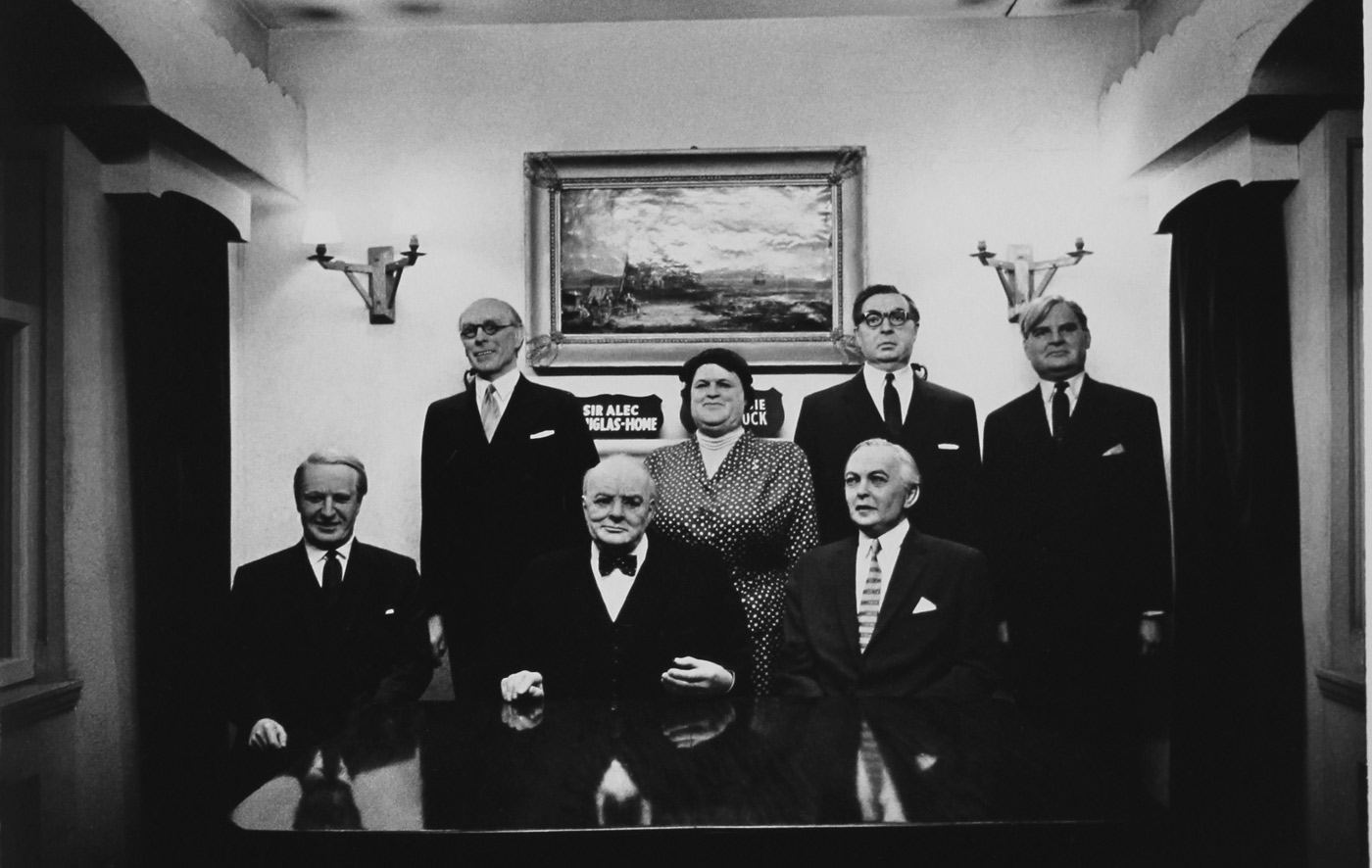
Tony Ray-Jones (British, 1941-1972) 'Waxworks, Eastbourne, 1968' 1968


Tony Ray-Jones (British, 1941-1972)
Waxworks, Eastbourne, 1968
1968
Vintage Gelatin Silver Print
14 x 21cm (6 x 8 inches)


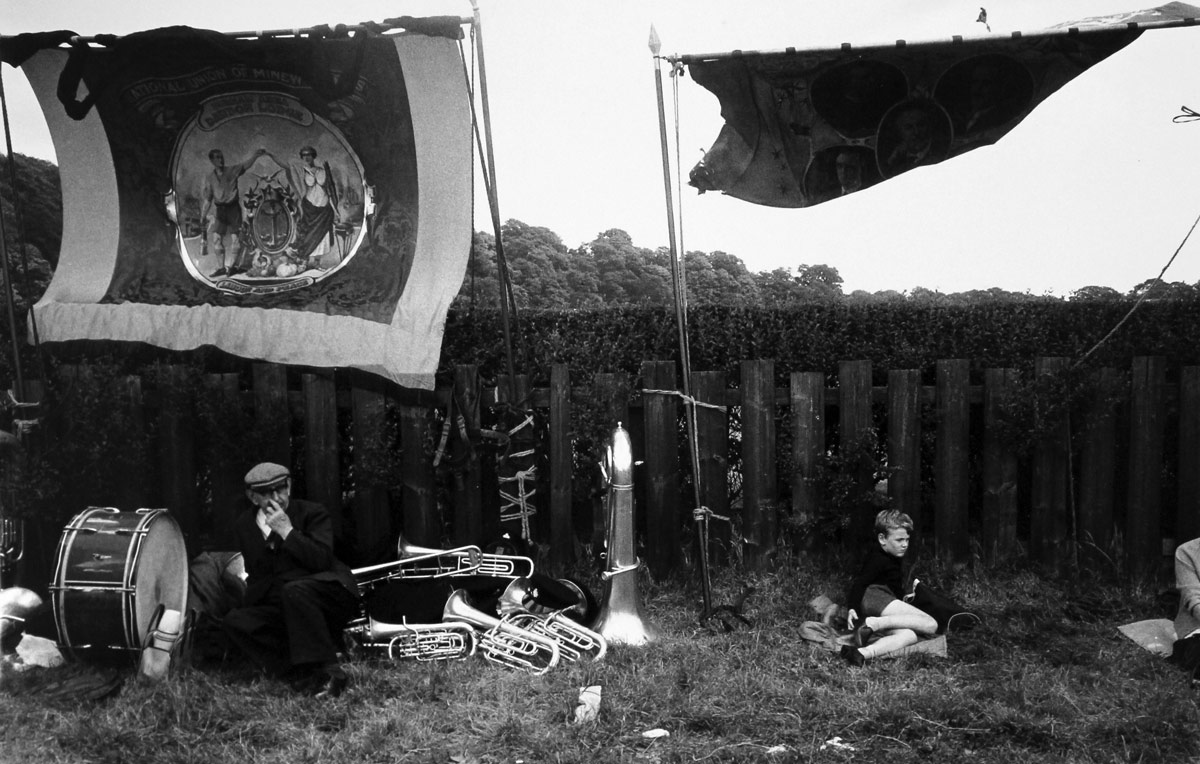
Tony Ray-Jones (British, 1941-1972) 'Durham Miners' Gala' 1969


Tony Ray-Jones (British, 1941-1972)
Durham Miners’ Gala
1969
Vintage Gelatin Silver Print
14 x 22.5cm (6 x 9 inches)


Tony Ray-Jones (British, 1941-1972) 'Sunday Best' c. 1967


Tony Ray-Jones (British, 1941-1972)
Sunday Best
c. 1967
Vintage Gelatin Silver Print
30.5 x 20cm (12 x 8 inches)


Tony Ray-Jones (British, 1941-1972) 'Blackpool, 1968' 1968


Tony Ray-Jones (British, 1941-1972)
Blackpool, 1968
1968
Vintage Gelatin Silver Print
21 x 14.5cm (8.25 x 5.70 ins)


James Hyman Gallery
16 Savile Row
London W1S 3PL
Phone: 020 7494 3857

Opening hours:
By appointment

James Hyman Gallery website

LIKE ART BLART ON FACEBOOK

Back to top

Exhibition: ‘Gilbert & George – London Pictures’ at MKM Museum Küppersmühle für Moderne Kunst, Duisburg

Exhibition dates: 20th March 20 – 30th June 2013


Gilbert & George (Gilbert Prousch) (English born Italy, b. 1943) and (George Passmore) (English, b. 1943) 'Dog' 2011


Gilbert & George (Gilbert Prousch) (English born Italy, b. 1943) and (George Passmore) (English, b. 1943)
Dog
2011
© Gilbert & George / Courtesy of the Artist and White Cube Gallery


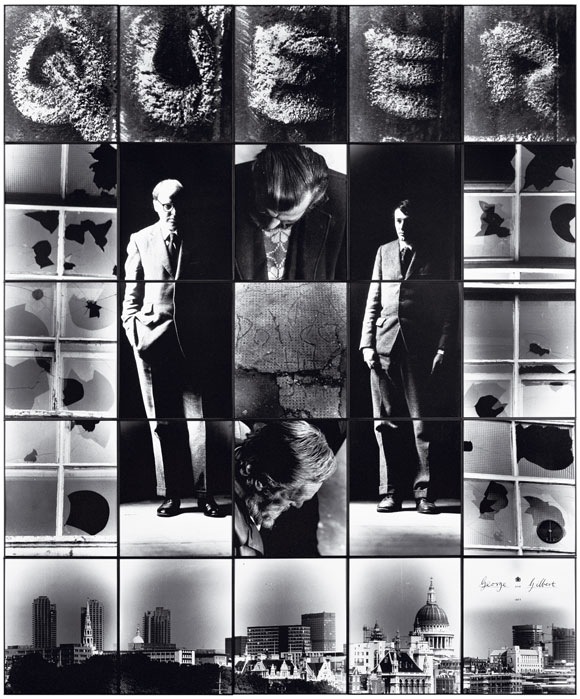
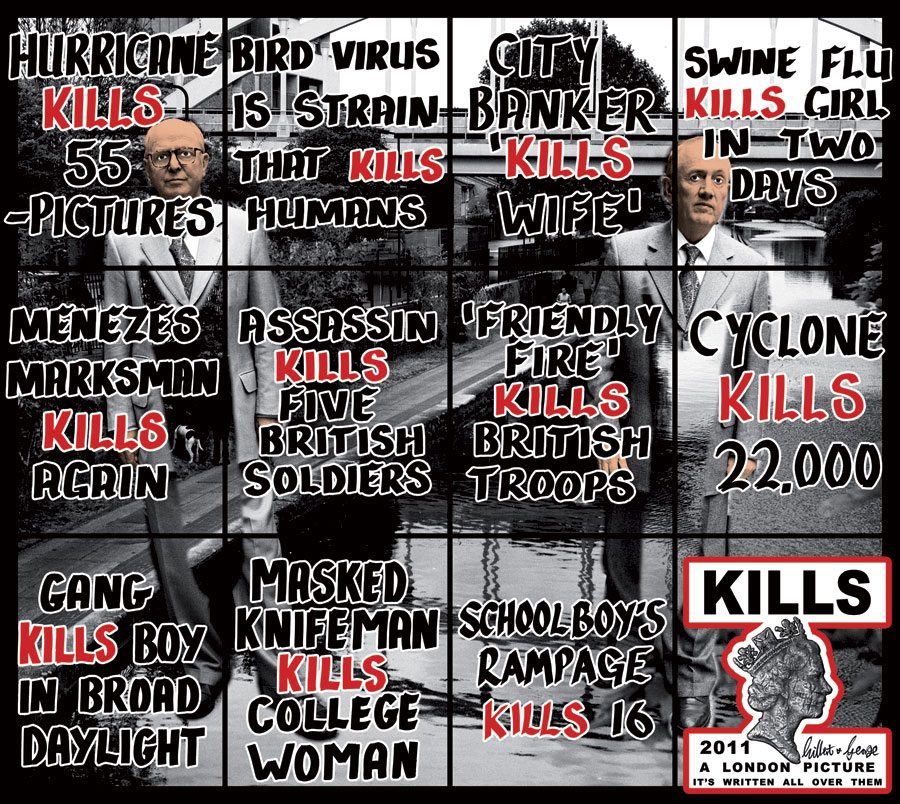
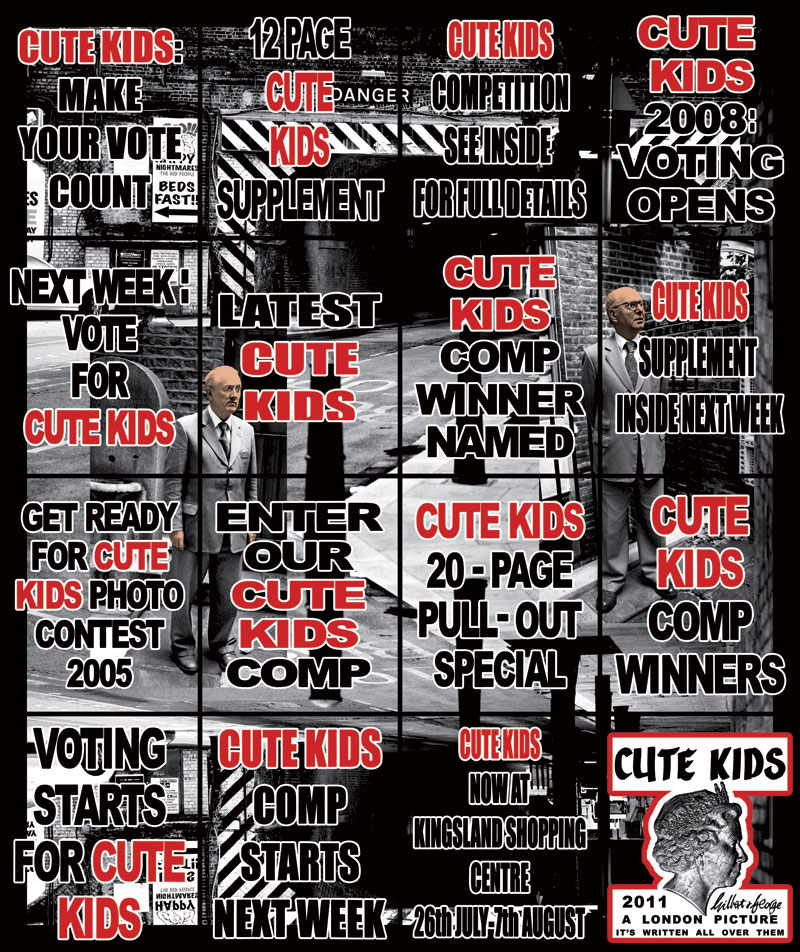
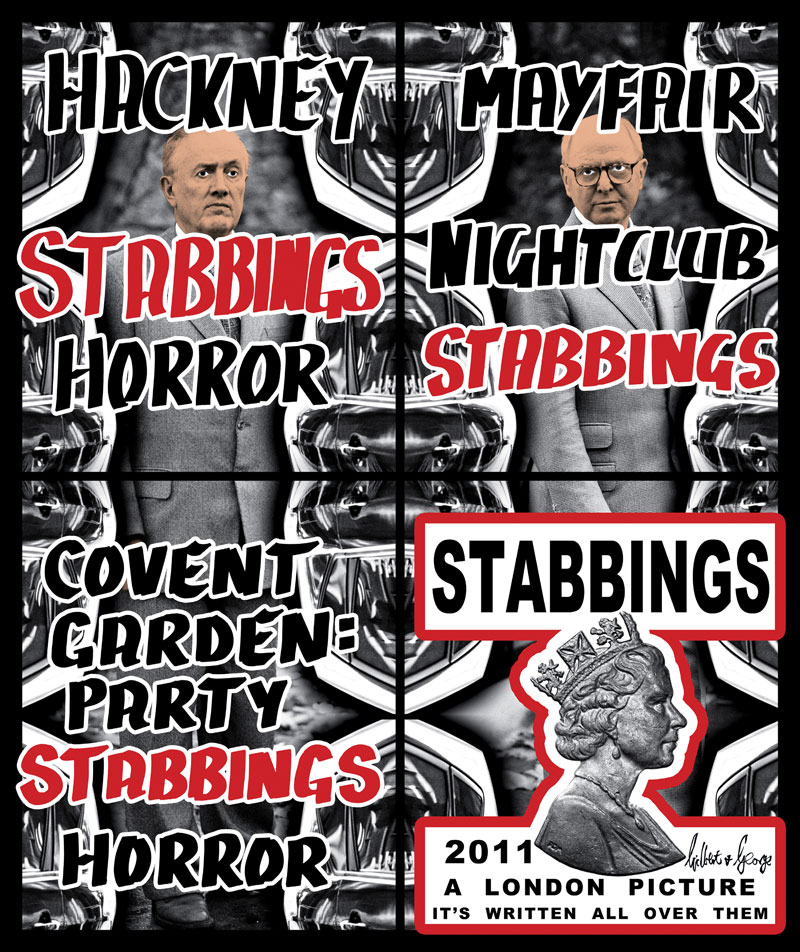
I used to think that Gilbert & George’s work was inventive and relevant, that it had something important to say about contemporary culture. These days I am not so sure. It seems all to easy to rip headlines from the tabloid newspapers. Who cares about dog, death, money, school, cute kids, etc… as commented on by these pulp editions. Gilbert & George seem to have become a pastiche of themselves, cartoon cut-outs hovering in contextless backgrounds with staring eyes and gormless faces. “I am contextless, unhappily spinning in the vacuum of my own indolence,” the work seems to be saying. We already know that we are becoming a society of shortened, fractured words and sentences on mobile phones and in newspaper headlines, of absence/presence where people absent themselves from their surroundings while on mobile devices, we know that already… I don’t think it takes mediocre art to point it out. It’s not very insightful (as Gilbert & George used to be).

I think they need a good boot up the bum to get them back to making work that takes the viewer somewhere, that actually challenges people’s belief systems, not some pulp driven comment on contemporary culture. Take a look at their early work if you don’t believe what I am saying: look at how alive the pictures were, how much vitality and energy they had, and how challenging the work was!

Dr Marcus Bunyan


Many thankx to the Museum Küppersmühle für Moderne Kunst for allowing me to publish the photographs in the posting. Please click on the photographs for a larger version of the image.


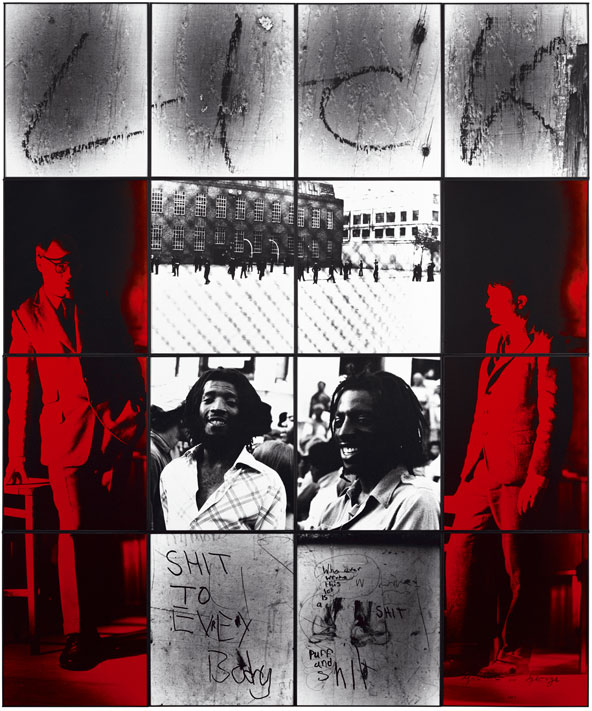
Gilbert & George (Gilbert Prousch) (English born Italy, b. 1943) and (George Passmore) (English, b. 1943) 'Lick' 1977


Gilbert & George (Gilbert Prousch) (English born Italy, b. 1943) and (George Passmore) (English, b. 1943)
Lick
1977


Gilbert & George (Gilbert Prousch) (English born Italy, b. 1943) and (George Passmore) (English, b. 1943) 'Queer' 1977


Gilbert & George (Gilbert Prousch) (English born Italy, b. 1943) and (George Passmore) (English, b. 1943)
Queer
1977


Gilbert & George (Gilbert Prousch) (English born Italy, b. 1943) and (George Passmore) (English, b. 1943) 'Money' 2011


Gilbert & George (Gilbert Prousch) (English born Italy, b. 1943) and (George Passmore) (English, b. 1943)
Money
2011
© Gilbert & George


Gilbert & George (Gilbert Prousch) (English born Italy, b. 1943) and (George Passmore) (English, b. 1943) 'School Straight' 2011


Gilbert & George (Gilbert Prousch) (English born Italy, b. 1943) and (George Passmore) (English, b. 1943)
School Straight
2011
© Gilbert & George / Courtesy of the Artist and White Cube Gallery


Gilbert & George (Gilbert Prousch) (English born Italy, b. 1943) and (George Passmore) (English, b. 1943) 'Death' 2011


Gilbert & George (Gilbert Prousch) (English born Italy, b. 1943) and (George Passmore) (English, b. 1943)
Death
2011
© Gilbert & George


Completed in 2011, “London Pictures” is the title of the cycle created by the London-based artists Gilbert & George, to which the eponymous exhibition in the MKM from March 20, 2013, is dedicated. Taking as their theme the countless newsagent posters collected by the artists themselves over a period of six years, the artists compile a detailed inventory of quotidian human behaviour, which they then submit to their hallmark humanistic gaze, and in so doing, furnish their own perspective on the psycho-social condition of our Western societies. What emerges is an extensive series of images from which the MKM is, for the first time, showcasing 70 individual pictures and affording visitors the opportunity to intensively explore this new phase from the oeuvre of Gilbert & George.

In their “London Pictures” Gilbert & George have collated the newspaper posters, which, not only in London, but across England, garnish the sales stands of the newspaper dealers. Their explicit allusions to the most titillating, violent and bizarre stories of the day are designed to entice potential customers to buy the newspapers. These simple statements of facts promise tales of love and sex, violence and death, wealth and power -themes, which have fascinated humanity since time immemorial, and which expose our endless appetite for sensation, disaster and excess. Gilbert & George have taken 3712 images of these advertising posters, processed the material, arranged it according to themes and fashioned it into 292 carefully-created pictures. Not only are the artists documenting a commonly-used device within the marketing strategies of the Western press, they are also exploring its impact on both the individual and society as a whole, and applying artistic means to articulate their own response to, and perception of, this social phenomenon. “The “London Pictures” should not in the first instance be read as a critique of the media, but perhaps as a critique of ourselves”, explains MKM Director Walter Smerling, adding that: “Gilbert & George borrow the language of the media, place it in a different context and in so doing transform these newspapers posters into a new entity vested with an entirely new content. The careful collation and arrangement of hundreds of headlines (…) forges a platform for reflection which casts the spotlight on to our own complicity, intrigues and problems of existence.”

“The artists of course feature in their pictures: in the background as a pair of quizzical, piercing eyes or as a ubiquitous, immaculately besuited presence, appearing” (…) “as though the artists were psychic manifestations of the city itself, its sense of place and history. The “London Pictures” comprise both a directory of quotidian urban human behaviour – revealing and shocking and violent, in all its sluggish or volatile momentum – and as such the city’s moral portrait: an unflinching audit of modern western society’s relationship to itself, stripped of rhetoric or intellectual disguise.” (Michael Bracewell, author of the catalogue). Yet beyond focussing on the city of London itself, Gilbert & George also cast themselves directly as integral constituents of our society’s media landscape and its psychic condition. Their unrelenting gaze interrogates not only the message of the posters, but is trained at the observer who also becomes an essential part of each and every picture.

Gilbert & George are seeking to portray the “grandeur, mystery and drama” of our Western world. From competitions to find the cutest child to gruesome tales of murder and mayhem – the whole gamut of human experience is represented here and exercises an equally ineluctable fascination on readers in Germany: For as the artists themselves remark, the “London Pictures” and “London Problems” could just as easily be “Duisburg Pictures” and “Duisburg Problems”.

Biography

Gilbert (born in 1943 in St. Martin in Thurn, Italy) studied at the Wolkenstein School of Art in South Tyrol, the Hallein School of Art in Austria, and the Munich Academy of Fine Arts, before attending St. Martin’s School of Art in London. There, in 1967, he met George (born in 1942 in Plymouth, UK), who had previously been a student at Dartington Hall College of Art and Oxford Art School. During the 1960s, Gilbert & George expanded the concept of sculpture by making themselves the materials for their art, as Living Sculptures. They declared everyday activities to be art, and provoked opposition by using faeces, urine and sperm as principal motifs in their picture series. They were awarded the 1986 Turner Prize, exhibited in the British Pavilion at the 2005 Venice Biennale, and has held exhibitions in venues ranging from the Stedelijk Museum in Amsterdam (1971 and 1996) to Guggenheim Museum, New York (1985), Musee d’Art Moderne de la Ville, Paris (1997) and London’s Tate Modern (2007). Other major public exhibitions have been mounted in Russia (1990) and China (1993).

Press release from the MKM Museum Küppersmühle für Moderne Kunst website


Gilbert & George (Gilbert Prousch) (English born Italy, b. 1943) and (George Passmore) (English, b. 1943) 'Kills' 2011


Gilbert & George (Gilbert Prousch) (English born Italy, b. 1943) and (George Passmore) (English, b. 1943)
Kills
2011
© Gilbert & George


Gilbert & George (Gilbert Prousch) (English born Italy, b. 1943) and (George Passmore) (English, b. 1943) 'Woman' 2011


Gilbert & George (Gilbert Prousch) (English born Italy, b. 1943) and (George Passmore) (English, b. 1943)
Woman
2011
© Gilbert & George


Gilbert & George (Gilbert Prousch) (English born Italy, b. 1943) and (George Passmore) (English, b. 1943) 'Cute Kids' 2011


Gilbert & George (Gilbert Prousch) (English born Italy, b. 1943) and (George Passmore) (English, b. 1943)
Cute Kids
2011
© Gilbert & George


Gilbert & George (Gilbert Prousch) (English born Italy, b. 1943) and (George Passmore) (English, b. 1943) 'Stabbings' 2011


Gilbert & George (Gilbert Prousch) (English born Italy, b. 1943) and (George Passmore) (English, b. 1943)
Stabbings
2011
© Gilbert & George


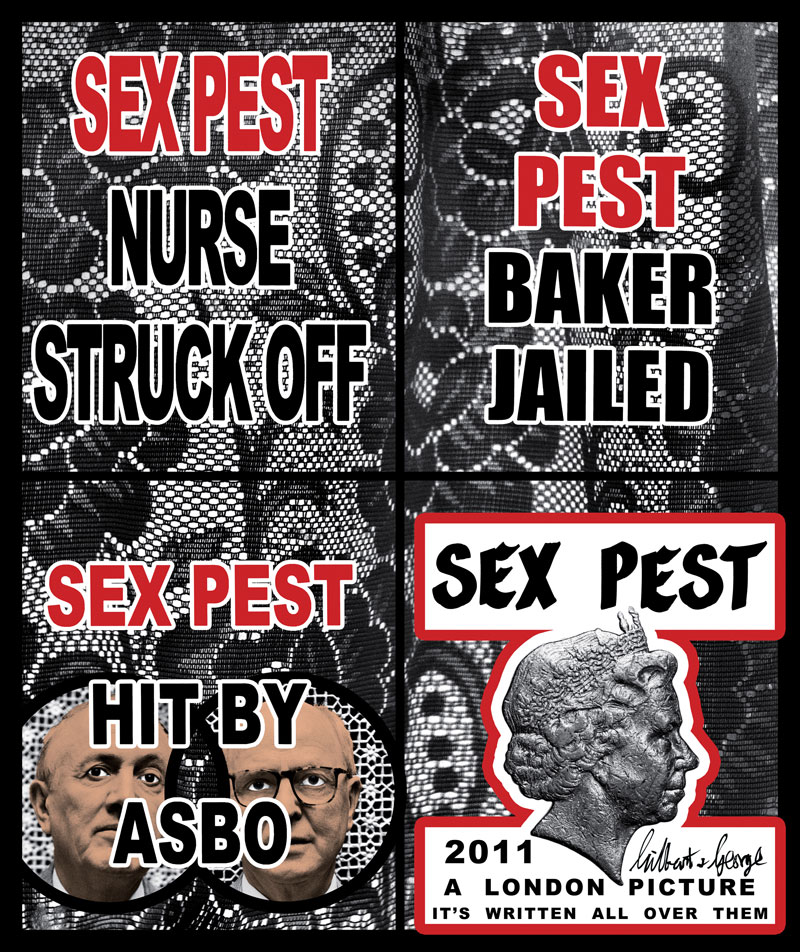
Gilbert & George (Gilbert Prousch) (English born Italy, b. 1943) and (George Passmore) (English, b. 1943) 'Sex Pest' 2011


Gilbert & George (Gilbert Prousch) (English born Italy, b. 1943) and (George Passmore) (English, b. 1943)
Sex Pest
2011
151 x 127 cm
© Gilbert & George / Courtesy Galerie Thaddaeus Ropac Salzburg, Paris


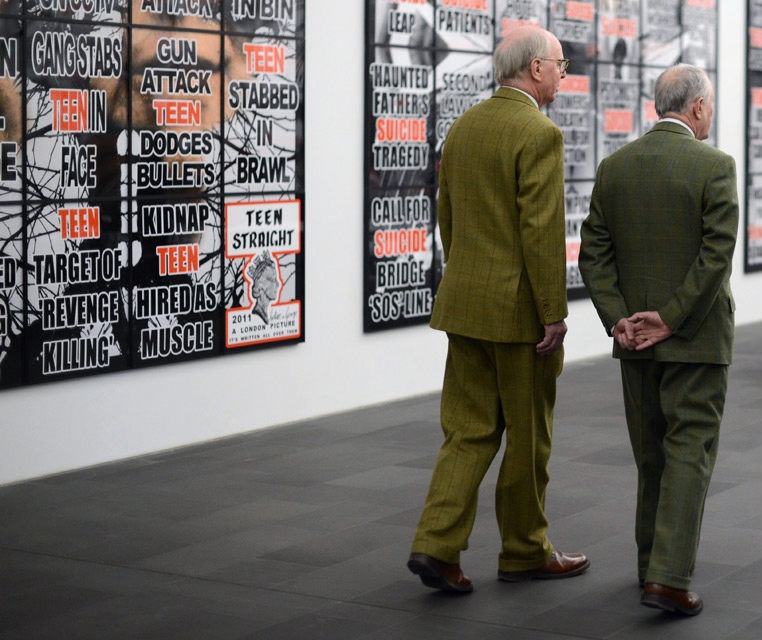
The British artists George Passmore (L) and Gilbert Prousch (R) pass in front of one of their art work 'London Pictures'


The British artists George Passmore (L) and Gilbert Prousch (R) pass in front of one of their art work ‘London Pictures’ as they arrive for a press conference at the museum Kueppersmuehle in Duisburg, western Germany, on March 14, 2013. AFP PHOTO / CAROLINE SEIDEL


MKM Museum Küppersmühle für Moderne Kunst
Philosophenweg 55, 47051 Duisburg
Germany
Phone: +49 (0)203 30 19 48 -10/-11

Opening hours:
Wed 2.00pm – 6.00pm
Thurs – Sun 11.00am – 6.00pm
Bank Holidays 11.00am – 6.00pm
Closed Mondays and Tuesdays

MKM Museum Küppersmühle für Moderne Kunst website

LIKE ART BLART ON FACEBOOK

Back to top

Exhibition: ‘Gillian Wearing’ at Whitechapel Gallery, London

Exhibition dates: 28th March – 17th June 2012

Galleries 1, 8 and Victor Petitgas Gallery


Many thankx to the Whitechapel Gallery for allowing me to publish the photographs in the posting. Please click on the photographs for a larger version of the image.


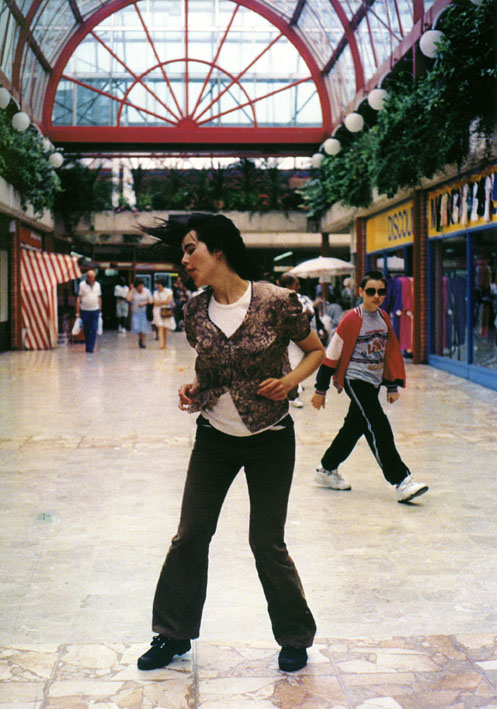
Gillian Wearing (English, b. 1963) 'Dancing in Peckham' 1994


Gillian Wearing (English, b. 1963)
Dancing in Peckham
1994
Colour video with sound
25 minutes
© the artist
Courtesy Maureen Paley, London


Gillian Wearing (English, b. 1963) 'Self Portrait at 17 Years Old' 2003


Gillian Wearing (English, b. 1963)
Self Portrait at 17 Years Old
2003
Framed C-type print
115.5 x 92 cm
© the artist
Courtesy Maureen Paley, London


The films and photographs of British artist Gillian Wearing (b. Birmingham, 1963) explore our public personas and private lives. This Turner Prize winner’s remarkable works draw on fly-on-the-wall documentaries, reality TV and the techniques of theatre, to explore how we present ourselves to the world.

Wearing’s portraits and mini-dramas reveal a paradox, given the chance to dress up, put on a mask or act out a role, the liberation of anonymity allows us to be more truly ourselves.

The exhibition begins with the artist herself, dancing in a shopping mall, blissfully unaware of her bemused audience. The idea of performance continues with works including Wearing’s 1997 masterpiece, 10–16. Adults lip synch the voices and act out the physical tics of seven children in a captivating film which moves from the breathless excitement of a ten year old to the existential angst of an adolescent.

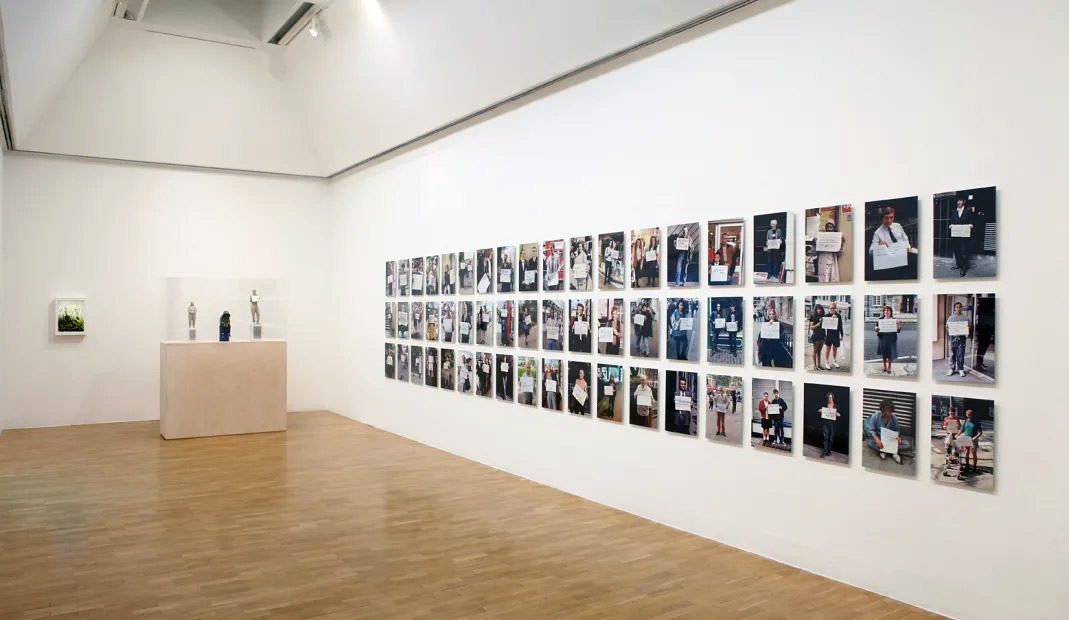
Other highlights include Wearing’s iconic 1992 series, Signs that say what you want them to say, and not Signs that say what someone else wants you to say where strangers are offered paper and pen to communicate their message. In the upper galleries we enter the inner world of subjectivity. An advert – Confess All On Video. Don’t Worry, You Will Be In Disguise. Intrigued? Call Gillian… (1994) attracted a series of disturbing disclosures. Wearing jettisons her own identity to adopt the guise of family members or artists such as Diane Arbus or Andy Warhol, so revealing her own background and influence.

This comprehensive survey, which also premieres new films and sculptures, shows how Wearing is both political – often focusing on the dispossessed or the traumatised – and poetic, finding the extraordinary in us all.

Text from the Whitechapel Gallery website


Curator Introduction to Gillian Wearing

Curator Daniel Hermann introduces the Gillian Wearing exhibition at the Whitechapel Gallery from 28 March – 17 June 2012.


Installation view of the exhibition 'Gillian Wearing' at Whitechapel Gallery, London showing work from her series 'Signs that say what you want them to say and not Signs that say what someone else wants you to say'


Installation view of the exhibition Gillian Wearing at Whitechapel Gallery, London showing work from her series Signs that say what you want them to say and not Signs that say what someone else wants you to say


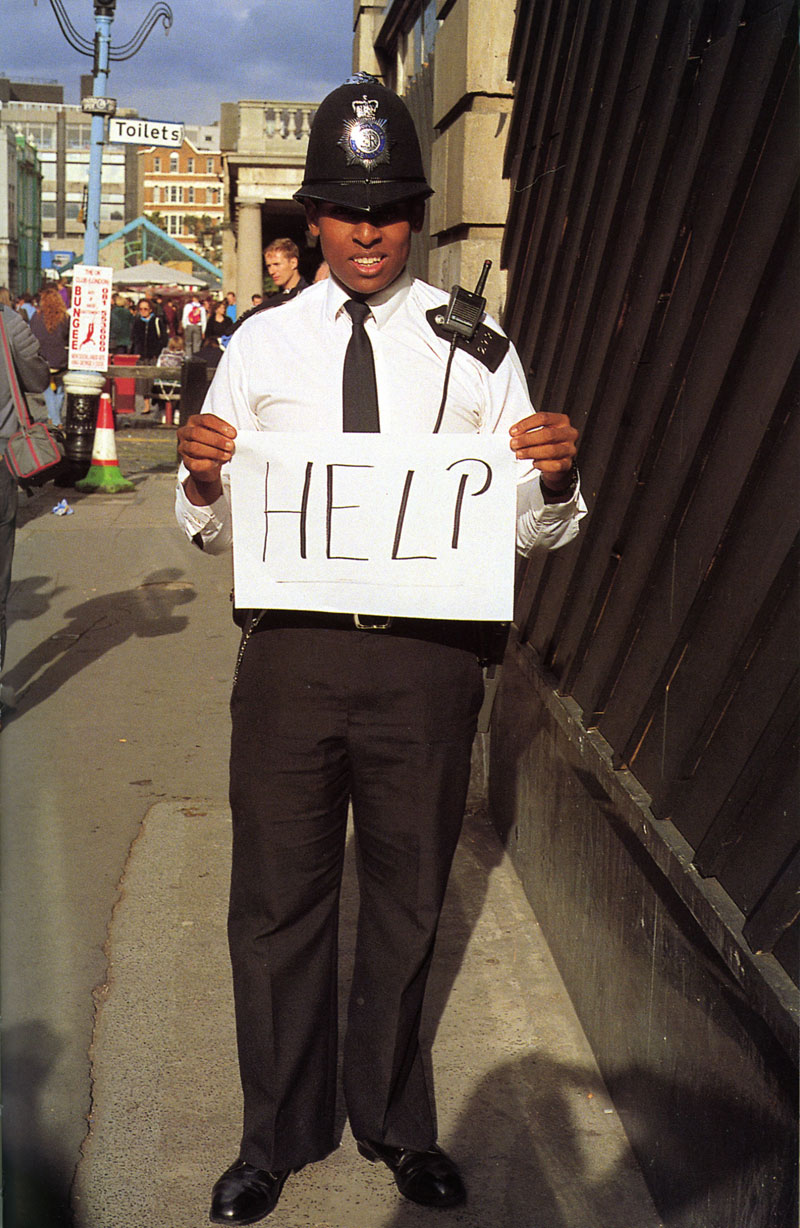
Gillian Wearing (English, b. 1963) 'HELP' 1992-1993


Gillian Wearing (English, b. 1963)
HELP
1992-1993
From the series Signs that say what you want them to say and not Signs that say what someone else wants you to say
C-type print mounted on aluminium
Dimensions variable
© the artist
Courtesy Maureen Paley, London


Gillian Wearing (English, b. 1963) 'I'M DESPERATE' 1992-1993


Gillian Wearing (English, b. 1963)
I’M DESPERATE 
1992-3
From the series Signs that say what you want them to say and not Signs that say what someone else wants you to say
C-type print mounted on aluminium
Dimensions variable
© the artist
Courtesy Maureen Paley, London


Gillian Wearing (English, b. 1963) 'WILL BRITAIN GET THROUGH THIS RECESSION?' 1992-1993


Gillian Wearing (English, b. 1963)
WILL BRITAIN GET THROUGH THIS RECESSION?
1992-3
From the series Signs that say what you want them to say and not Signs that say what someone else wants you to say
C-type print mounted on aluminium
Dimensions variable
© the artist
Courtesy Maureen Paley, London


The Whitechapel Gallery presents the first major international survey of Turner Prize-winning British artist Gillian Wearing’s photographs and films which explore the public and private lives of ordinary people. Fascinated by how people present themselves in front of the camera in fly-on-the-wall documentaries and reality TV, Gillian Wearing explores ideas of personal identity through often masking her subjects and using theatre’s staging techniques.

This major exhibition surveys Wearing’s work from the early photographs Signs that Say What You Want Them to Say and Not Signs that Say What Someone Else Wants You to Say (1992-3) to her latest video Bully (2010) and also includes several new photographs made specially for the Whitechapel Gallery exhibition.

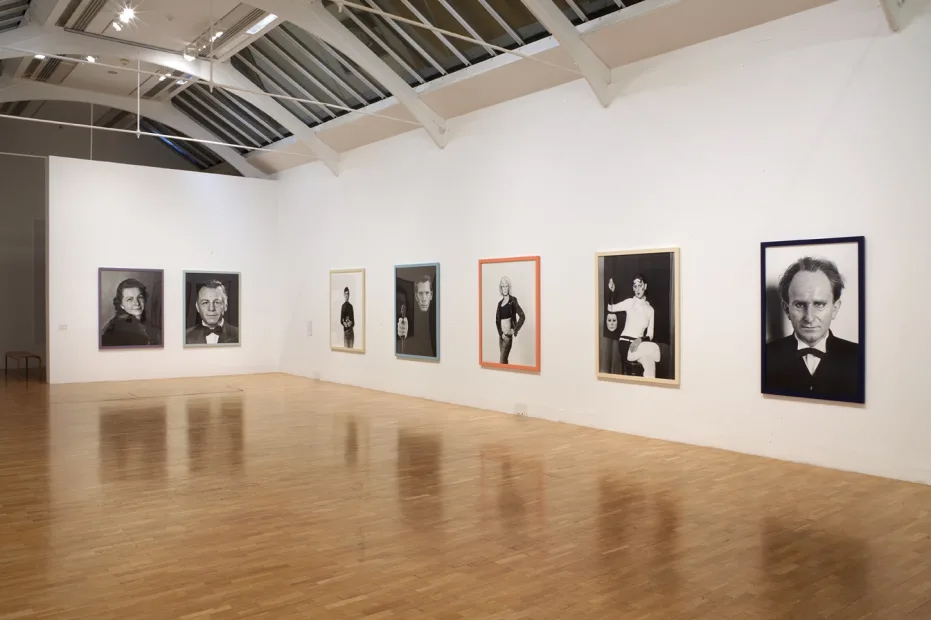
Visitors to the exhibition enter a film set-style installation showcasing photographs and films in ‘front and back stage’ areas. Highlights include a striking photograph of the artist posing as her younger self, Self-Portrait at 17 Years Old (2003), Dancing in Peckham (1994), a film which blurs the boundaries between public space and private expression as Wearing dances in the middle of a shopping mall, and the UK premiere of recent film Bully (2010). New photographic works shown for the first time include two portraits of Wearing as artists August Sander and Claude Cahun as part of her ongoing series of iconic photographers, as well as still lives of flowers, looking back to the rich symbolism of the great age of 17th century Dutch painting.

A gallery is dedicated to Wearing’s well-known photographs giving people the chance to write what they were thinking at that moment, titled Signs that Say What You Want Them to Say and Not Signs that Say What Someone Else Wants You to Say (1992-3). The series includes a city worker holding a sign saying, ‘I’m Desperate’, a policeman holding ‘Help!’ and another person’s sign ‘Will Britain ever get through this recession’.

The exhibition also includes a series of private viewing booths for three confessional videos shown together for the first time and in which Gillian Wearing asked people to describe intensely personal experiences. These include Trauma (2000) where sitters describe childhood traumas while wearing a mask. As well as the powerful videos Secrets and Lies (2000) and Confess All On Video. Don’t Worry, You Will Be In Disguise. Intrigued? Call Gillian… (1994). Alongside these works the video 2 into 1 (1997) sees a mother lip synching the voices of her twin sons and vice versa as they describe their relationship.

Press release from Whitechapel Gallery website


Gillian Wearing: Self Made, 2010 Trailer

Gillian Wearing’s debut feature film introduces a cast of untrained actors to a Method acting teacher. Drawing upon their own experiences, each participant creates and stars in their own mini-film.


Gillian Wearing (English, b. 1963) 'Bully' 2010


Gillian Wearing (English, b. 1963)
Bully
2010
Colour video for projection with sound
7 minutes 55 seconds
© the artist
Courtesy Maureen Paley, London


Installation view of the exhibition 'Gillian Wearing' at Whitechapel Gallery, London showing at left a still from the video '2 into 1' (1997)


Installation view of the exhibition Gillian Wearing at Whitechapel Gallery, London showing at left a still from the video 2 into 1 (1997, below)


Gillian Wearing (English, b. 1963) '2 into 1' 1997


Gillian Wearing (English, b. 1963)
2 into 1
1997
Colour video for monitor with sound
4 minutes 30 seconds
© the artist
Courtesy Maureen Paley, London


Gillian Wearing (English, b. 1963) 'Trauma' 2000


Gillian Wearing (English, b. 1963)
Trauma
2000
Colour video for monitor with sound
30 minutes
© the artist
Courtesy Maureen Paley, London


Gillian Wearing (English, b. 1963) 'Me as Cahun Holding a Mask of My Face' 2012


Gillian Wearing (English, b. 1963)
Me as Cahun Holding a Mask of My Face
2012
Framed bromide print
149 x 120.5 cm
© the artist
Courtesy Maureen Paley, London


Installation view of the exhibition 'Gillian Wearing' at Whitechapel Gallery, London showing work from a series of iconic photographers


Installation view of the exhibition Gillian Wearing at Whitechapel Gallery, London showing work from a series of iconic photographers


Gillian Wearing (English, b. 1963) 'Me as Sander' 2012


Gillian Wearing (English, b. 1963)
Me as Sander
2012
Framed bromide print
149 x 98.8cm
© the artist
Courtesy Maureen Paley, London


Whitechapel Gallery
77 – 82 Whitechapel High Street
London E1 7QX
Phone: + 44 (0) 20 7522 7888

Opening hours:
Tuesday – Sunday 11am – 6pm
Thursdays and Fridays 11am  9pm
Closed Monday

Whitechapel Gallery website

LIKE ART BLART ON FACEBOOK

Back to top

Review: ‘Martin Parr: In Focus’ at Niagara Galleries, Richmond, Melbourne

Exhibition dates: 6th March – 31st March, 2012


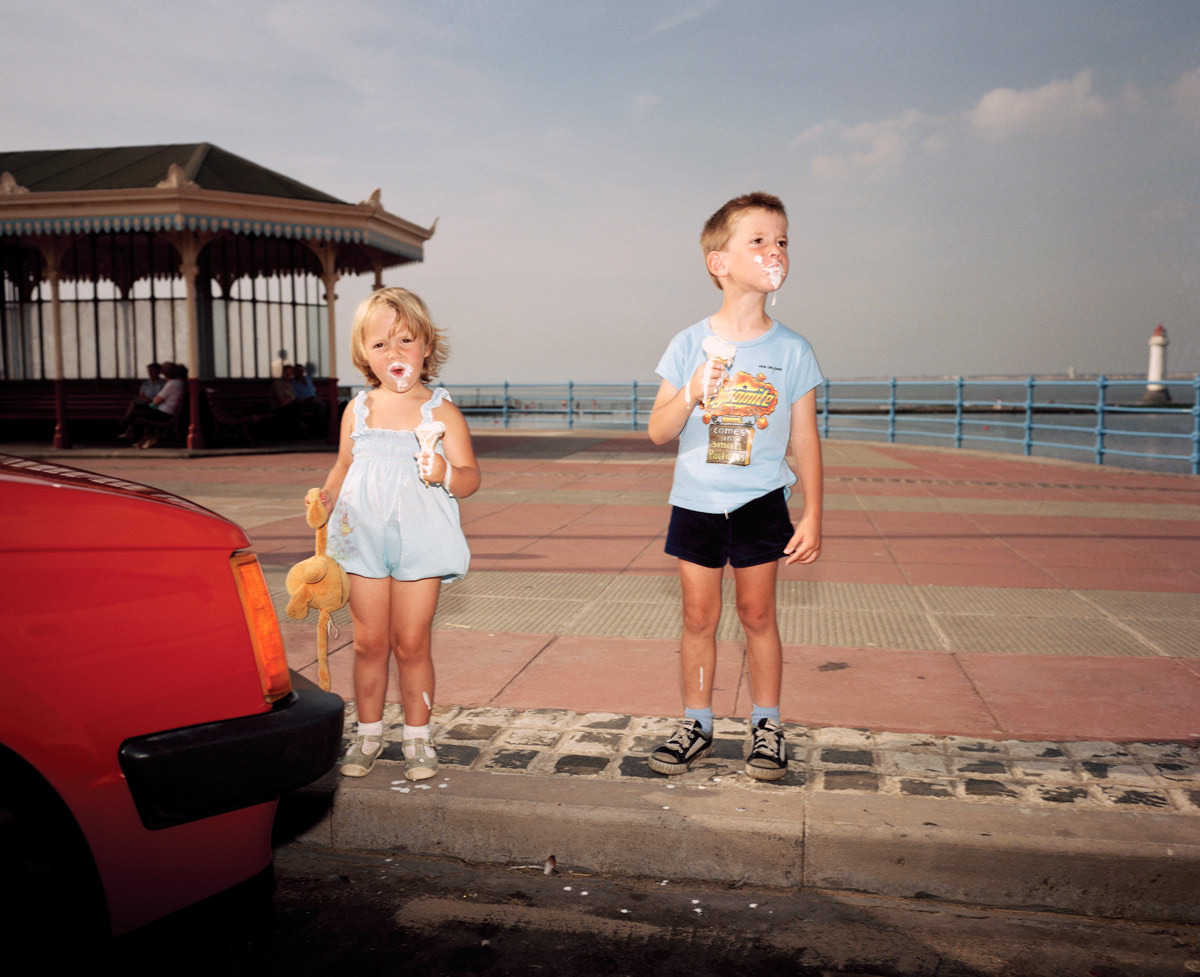
Martin Parr (British, 1952-2025) 'New Brighton, England' from the series 'The Last Resort' 1983-1985


Martin Parr (British, 1952-2025)
New Brighton, England
From the series Last Resort
1983-1985
Pigment print
Edition of 5
102 x 127cm
Image courtesy of the artist and Niagara Galleries, Melbourne


This is a fine exhibition of the work of celebrated English photographer Martin Parr at Niagara Galleries, Richmond, albeit with one proviso. The mainly large colour prints are handsomely displayed in plain white frames within the gallery space and are taken from his well known series: Last Resort, Luxury, New British and British Food. Parr’s work is at its best when he concentrates on the volume of space within the image plane and the details that emerge from such a concentrated visualisation – whether it be the tension points within the image, assemblage of colour, incongruity of dress, messiness of childhood or philistine nature of luxury.

The best photographs have a wonderful frisson about them, a genuine love of and resonance with the things he is imaging. This frisson can be seen in all of the photographs in this posting but most notably in :

~ The incursion of the surreal red colour to left in England. New Brighton (above) and Parr’s masterful use of vertical and horizontal lines within the image. Note the verticality: of the child’s toy, the two children themselves, the pillars of the pavilion and the lighthouse holding the whole image together at right. If this lighthouse were not there the eye would fall out of the image. As it is it is contained, forcing the viewer to look closely at the absurdity of the melting ice cream and the splashes that have fallen on the ground.

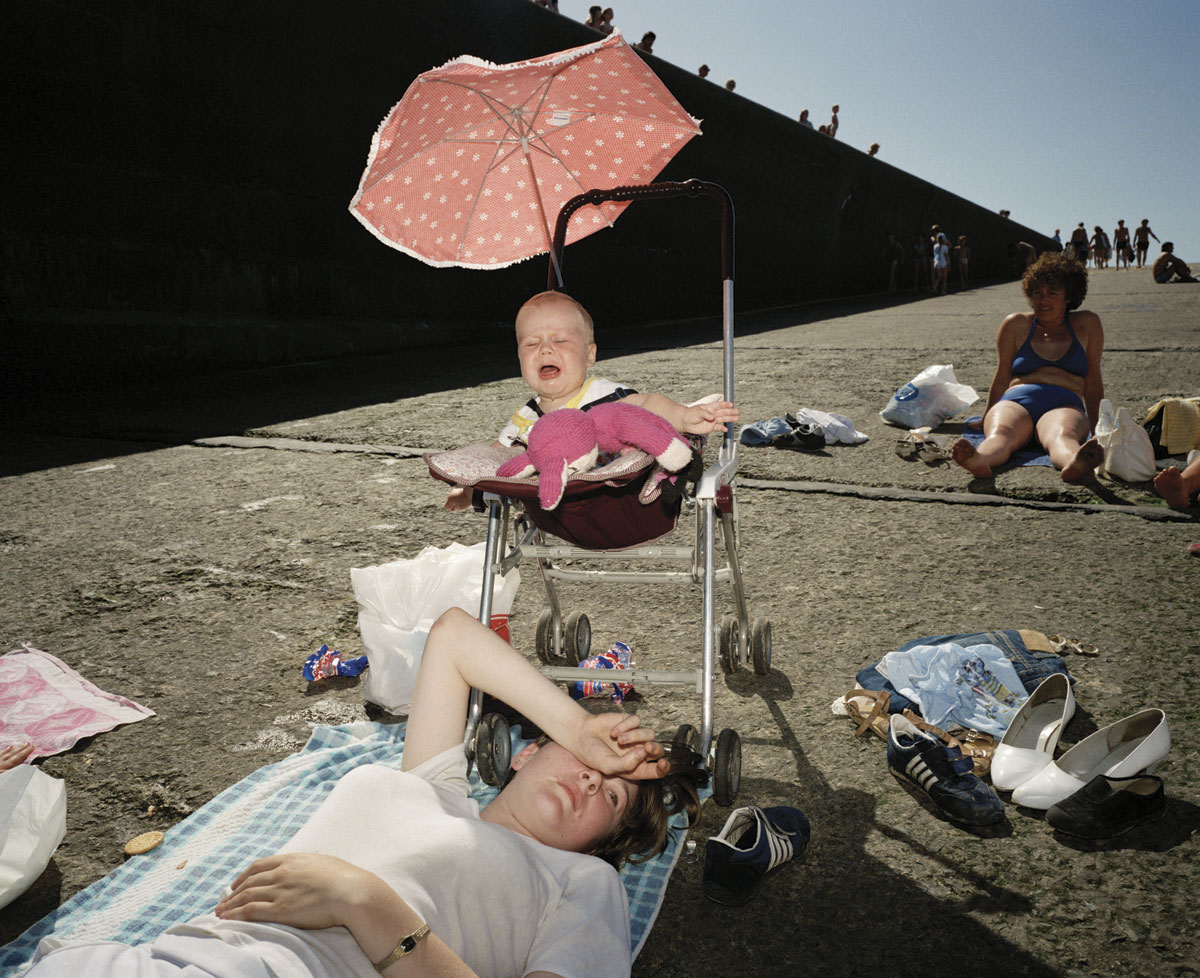
~ The complexity of the photograph England. New Brighton (below) where the eye does not know what to rest upon, constantly jumping from object to object. Do you look at the women on the ground, the shoes to right, the piece of fabric to left, the screaming baby, the sunlit pink umbrella, the women in blue bikini up the ramp, the long elongated shadowed wall with peek-a-boo heads leading to the outlined figures at the vanishing point of image – the top of the ramp. The understanding of light (with the use of flash) and the construction of the image is superlative. Wow!

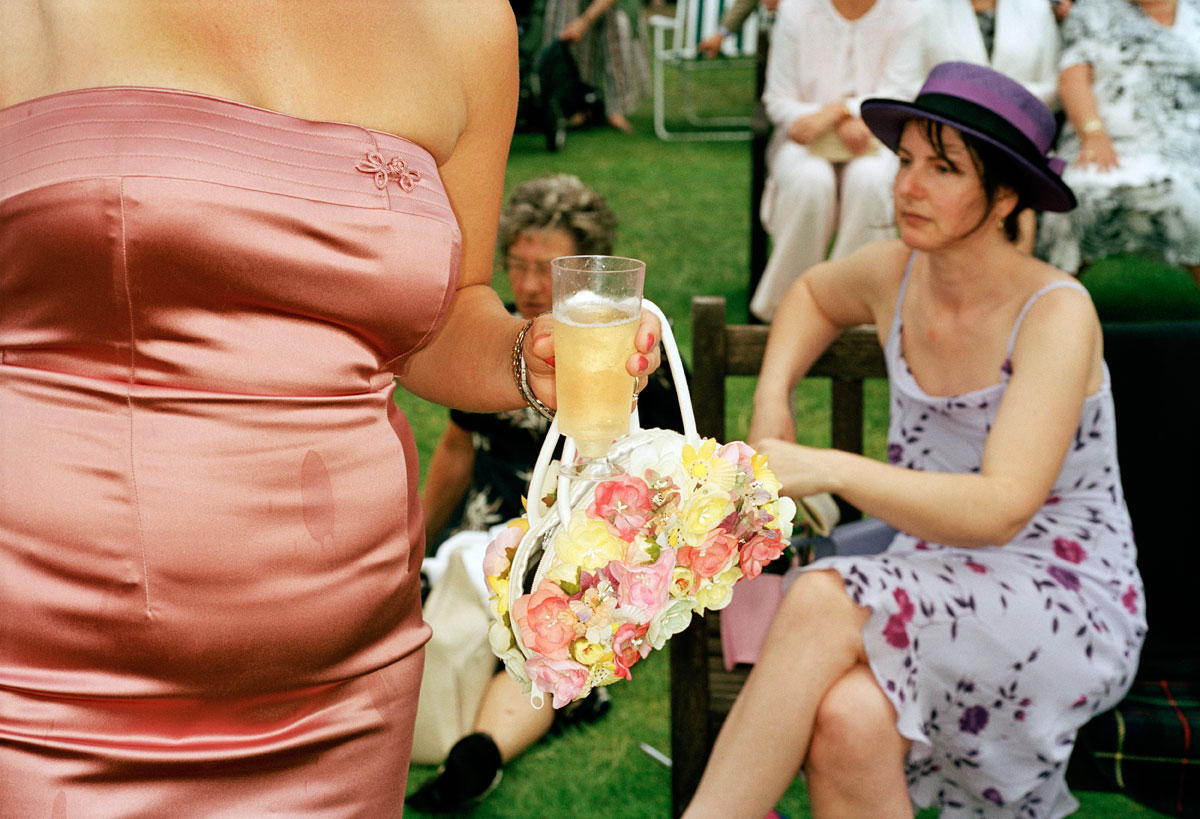
~ The incongruity evidenced in the photograph England, Ascot. 2003: the over tight pink sateen dress with unfortunate stain (which the eye is irrevocably drawn to), applique bow linked through to hideous flower embossed handbag which then contrasts with the seated women behind in hat and purple floral dress. In the large print in the gallery the background is more out of focus than in the small reproduction here, allowing the viewer’s eye an avenue of escape via the grass and deck chair beyond.

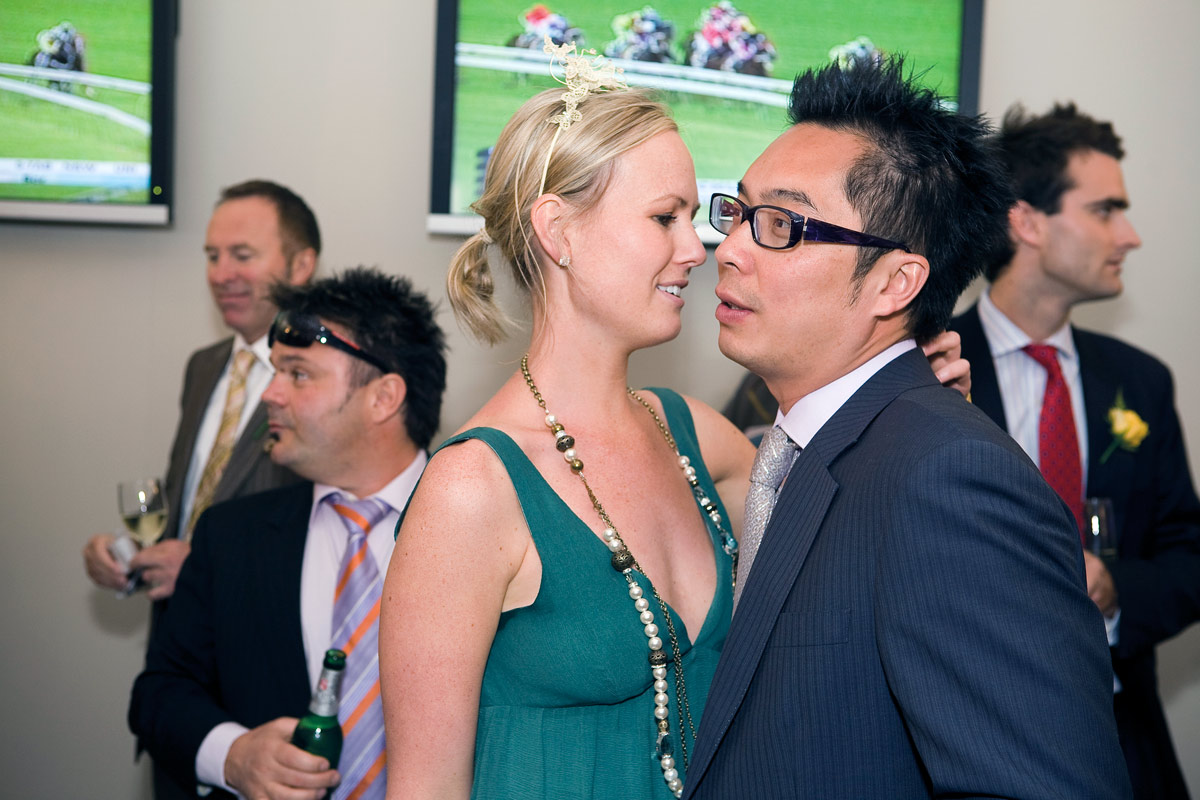
~ The delicious, choreographed mise-en-scène of Australia, The Melbourne Cup. 2008 – the suits, ties and glasses, the teezed hair, the alcohol – where none of the participants is looking at the camera, where only the ladies hand clutches at the back of the man’s shoulder. They look down, they look left, they look right, they look away, they never engage with each other or the viewer. The critical space in this assemblage is the distance between the man and the woman’s noses, that vitally small space of separation that is a synonym for the interactions occurring in the rest of the image. The blindness of Lux’ry, its crassness, its stain.


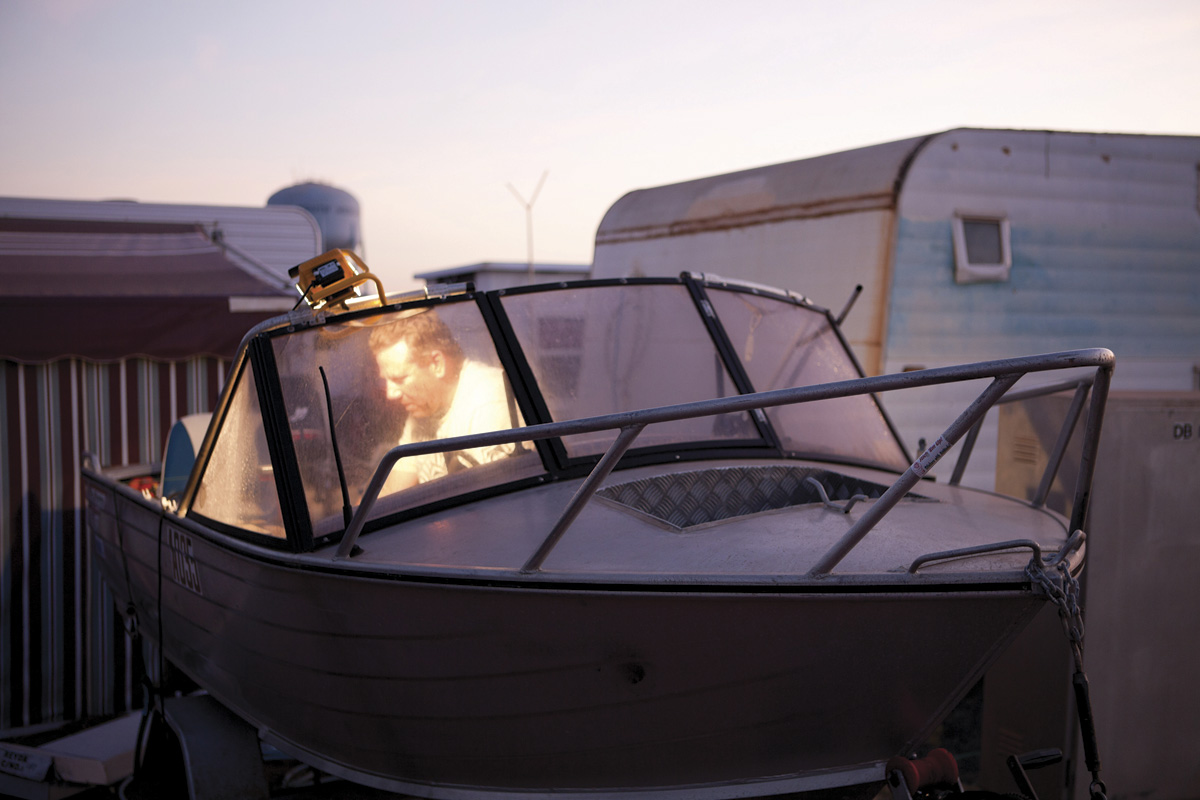
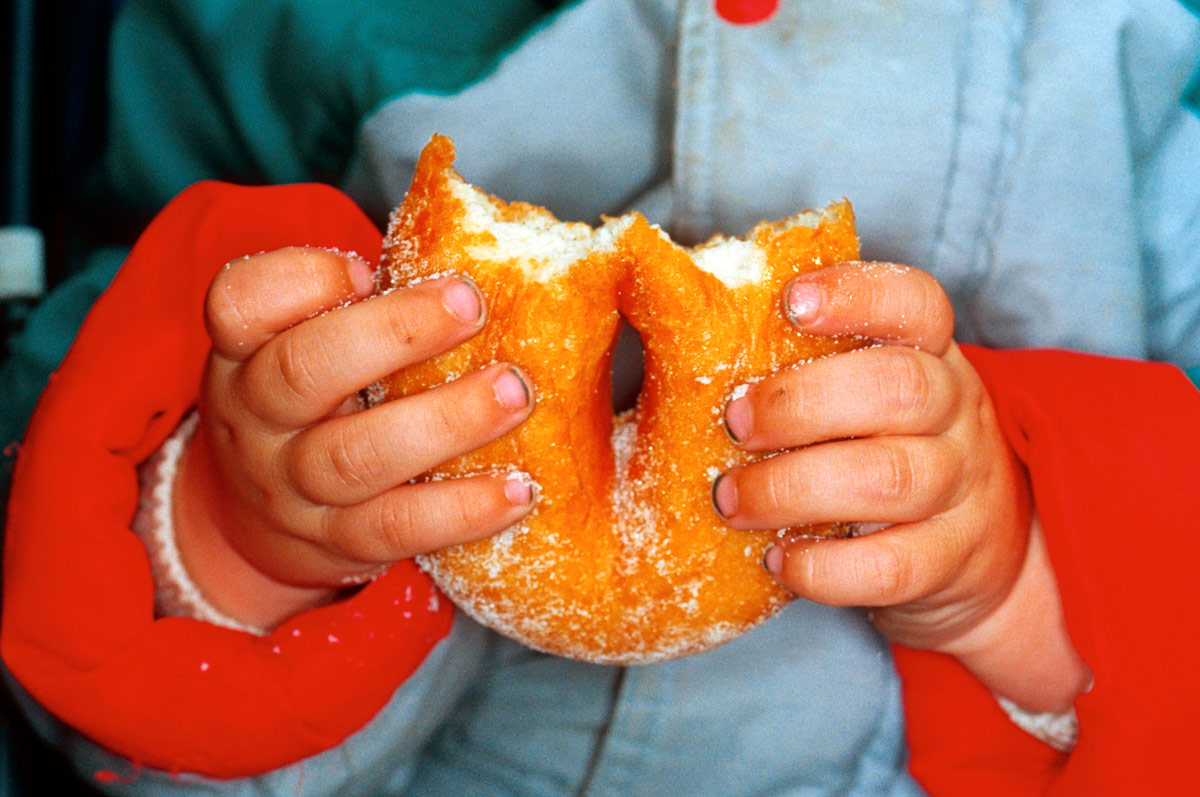
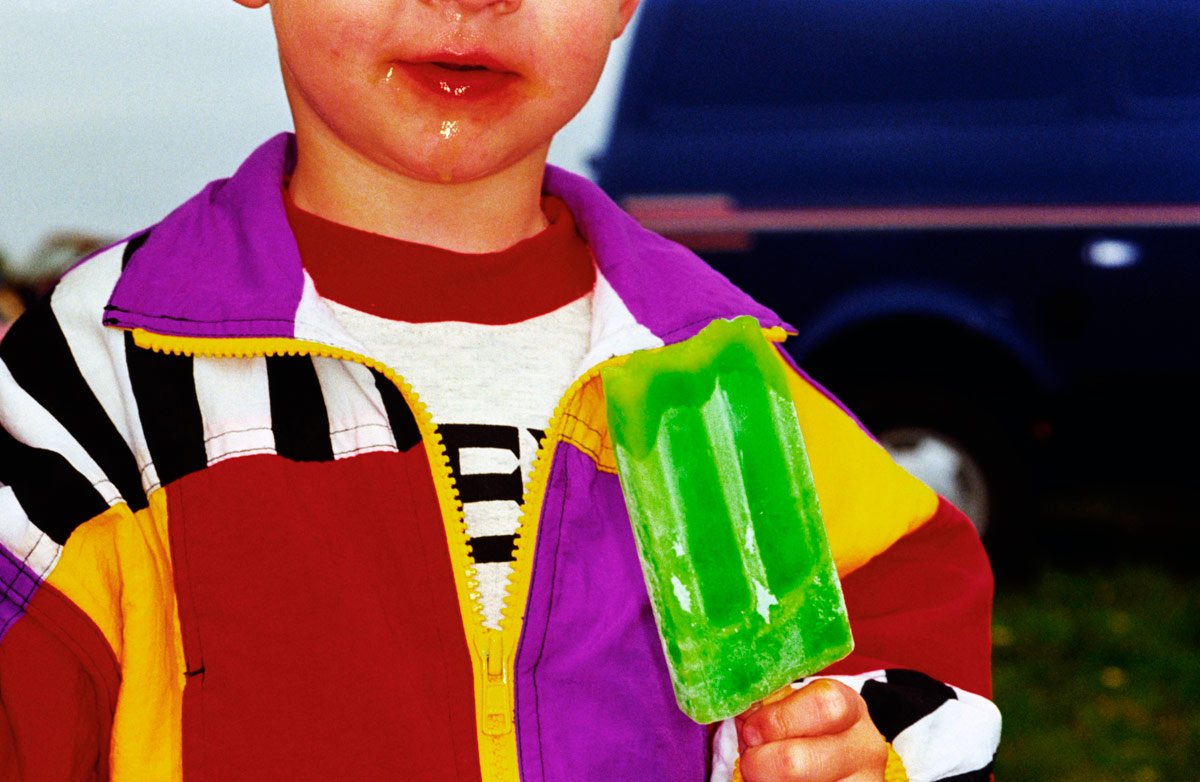
And so it goes. The dirt under the fingernails of the child eating a doughnut, the lurid colours of the popsicle and jacket of the kid with dribble on his face, all fantastic. There are moments of stasis, for example in the contemplative photograph Australia. South Hedland. Blackrock Tourist Park. 2011 (below) taken from Parr’s new series Australia, where Parr has photographed Australian life in three Western Australian port cities, Fremantle, Broome and Port Hedland. See the video at the bottom of the posting and listen to Parr talk about his work.

This is all fine and dandy, dressed up in polka dots and a lurid bow tie, but when the photographs become too reductive, as in the large photograph in the exhibition England. Dorset. West Bay. 1997 (see first column, fourth down) there is really not enough to hang your hat on. This feeling of over simplification, as though the photographer has said to himself “here’s something I have seen that you haven’t recognised, and I think it is important for you to recognise it” – the perceived essentialness of the object – can become a bit strained. I know that these type of images are part of the series about British or Scottish food or about objects from a specific place but do they really have this grand an importance in the scheme of things? This feeling is reinforced in the exhibition, and this is my proviso to show, when the images such as Scotland. Glasgow. Fairy cakes. 1999, England. Blackpool. 1995 (bread and butter on a plate on red check cloth) are presented at A4 size surrounded by heavy white frames. These photographs have to be large to have any chance of working at all and at the small size they fall flat.

The size of a photograph raises interesting questions about the display of contemporary photography. The giant light boxes of Jeff Wall, the huge group portraits of Thomas Struth, the huge portraits of Thomas Ruff, the huge environments of Candida Hofer and the huge panoramas of Andreas Gursky (to name but a few) are all points in case. Would they work at a smaller size? No. They rely on scale and detail, visual impact for their effect: the same with Martin Parr. What is really ‘In Focus’ is the visualisation of the artist, his ability to envisage the final print at this large size. The A4 prints in this exhibition simply do not work at that size, for these photographs.

Think of Ansel Adams’ famous Monolith, The Face of Half Dome, Yosemite National Park, Calif., (circa 1926). Originally printed as a contact 8″ x 10″ from the negative, Adams gradually increased the size of this image till it became a huge print as tall as a man in his later life. The image works at multiple sizes, it spoke to him (and the viewer) at all these sizes: the small contact is intense and gem-like, the larger imitating the monolithic structure of the Face itself. I feel that some large contemporary photographs are quite vacuous at this large size, that there is no reason for them to be at this size. In other words it is not appropriate for the image. Conversely it would seem that artists previsualise for this size in the end print, which is fine, but that the print cannot exist, cannot breathe in the world at a smaller size. Is this a problem? Does this matter? I believe it does, especially when a photograph is displayed at a size that simply doesn’t work. I was always taught to print a photograph at an appropriate size for the image, whatever size(s) that may be (and there can be multiples), as long as it has resonance for that particular image.

As evidenced in this exhibition, if the photograph cannot “work” at the size that it is to be exhibited then it should not be displayed at all – it is a diminution not just of the artists vision but of the resonance of the photograph, in this case going from large to small. In an upcoming posting about the retrospective of the work of American photographer Fransceca Woodman, there is an installation photograph of the exhibition at The Guggenheim, New York (see above). Her vintage prints (seen in the background) – small, intense visions – have been printed at a huge scale (with her permission) and they simply do not work at this floor to ceiling height. They have lost all of their intimacy, which is one of the strengths of her photography. Again, I believe it is a diminution of the artists vision and the integrity of the photograph, this time from small to large. Artists are not always right. The same can be said of the retrospective of Cartier-Bresson that I saw at the National Galleries of Scotland in Edinburgh in 2005. One room out of four had very small, intense vintage prints in brown hues and the other three galleries had large 20″ x 24″ grainy prints with strong contrast that really ruined any response I had to the work as evidenced by the vintage prints. They were almost reproductions, a simulacra of the real thing. I had a feeling that they weren’t even by the artist himself. The same could be said here.

To conclude I would say this is a fine exhibition of large photographs by Martin Parr that would have been even more focused without the small A4 prints. They are joyous paeans to the quirky, incongruous worlds in which we live and circulate. They evidence life itself in all its orthogonal absurdity. I love ’em!

Dr Marcus Bunyan


Many thankx to the artist and Niagara Galleries for allowing me to publish the photographs in the posting. Please click on the photographs for a larger version of the image.


Francesca Woodman installation photograph at The Guggenheim Museum, New York


Francesca Woodman installation photograph at The Guggenheim Museum, New York. Note the small, vintage prints on the far wall.


Martin Parr (British, 1952-2025) 'New Brighton, England' from the series 'The Last Resort' 1983-1985


Martin Parr (British, 1952-2025)
New Brighton, England
From the series The Last Resort
1983-1985
Pigment print
Edition of 5
102 x 127cm
Image courtesy of the artist and Niagara Galleries, Melbourne


Martin Parr (British, 1952-2025) 'Blackrock Tourist Park, South Hedland, Australia, 2011' from the series 'Australia' 2011


Martin Parr (British, 1952-2025)
Blackrock Tourist Park
, South Hedland, Australia, 2011
From the series Australia
2011
Pigment print
Edition of 5
101.6 x 152.4cm
Image courtesy of the artist and Niagara Galleries, Melbourne


Martin Parr (British, 1952-2025) 'Ascot, England, 2003' from the series 'Luxury' 1995-2009


Martin Parr (British, 1952-2025)
Ascot, England, 2003
From the series Luxury
1995-2009
Traditional C-type print
Edition of 5
101.6 x 152.4cm
Image courtesy of the artist and Niagara Galleries, Melbourne


Martin Parr (British, 1952-2025) 'The Melbourne Cup, Australia, 2008' from the series 'Luxury' 1995-2009


Martin Parr (British, 1952-2025)
The Melbourne Cup
, Australia, 2008
From the series Luxury
1995-2009
Pigment print
Edition of 5
101.6 x 152.4cm
Image courtesy of the artist and Niagara Galleries, Melbourne


Martin Parr (British, 1952-2025) 'Ramsgate, England, 1996' from the series 'New British' 1994-1996


Martin Parr (British, 1952-2025)
Ramsgate
, England, 1996
From the series New British
1994-1996
Traditional C-type print
Edition of 5
105.5 x 157.5cm
Image courtesy of the artist and Niagara Galleries, Melbourne


Martin Parr (British, 1952-2025) 'Car boot sale, Bristol, England, 1995' from the series 'British Food' 1994-1995


Martin Parr (British, 1952-2025)
Car boot sale, Bristol, England, 1995
From the series British Food
1994-1995
Traditional C-type print
Edition of 33
18 x 25.5cm
Image courtesy of the artist and Niagara Galleries, Melbourne


No Worries: Martin Parr – FotoFreo 2012

Magnum photographer Martin Parr was asked by FotoFreo Festival Director Bob Hewitt to photograph three Western Australian port cities, Fremantle, Broome and Port Hedland. Photographer David Dare Parker was assigned to document the project, the work titled No Worries.

© David Dare Parker


Niagara Galleries
245 Punt Road
Richmond, Melbourne
Victoria, 3121
Australia
Phone: +61 3 9429 3666

Opening hours:
Wednesday – Saturday 12pm – 5pm

Niagara Galleries website

LIKE ART BLART ON FACEBOOK

Back to top

Exhibition: ‘Daniel Meadows: Early Photographic Works’ at the National Science and Media Museum, Bradford

Exhibition dates: 30th September 2011 – 19th February 2012


Daniel Meadows (British, b. 1952) '25th wedding anniversary party. Farnborough Park, Kent. August 1985'


Daniel Meadows (British, b. 1952)
25th wedding anniversary party. Farnborough Park, Kent. August 1985
From Suburbia, 1984-1987
Gelatin silver print
© Daniel Meadows


In the 1970s, Daniel Meadows was at the forefront of the independent photography movement. His practice is complex, passionate and sometimes deeply autobiographical.

Daniel Meadows’ early work broke with tradition and infused the medium with new energies and ways of seeing. Between 1971 and 1987, he produced an astonishing record of urban society in Britain, working in a uniquely collaborative way through his interviews with – and writing about – his subjects.

Text from the National Science and Media Museum website


Many thankx to the National Media Museum, Bradford for allowing me to publish the photographs in the posting. Please click on the photographs for a larger version of the image. All pictures are copyright © Daniel Meadows except for the June Street, Salford which is copyright © Daniel Meadows and Martin Parr.

Daniel Meadows: Edited Photographs from the 70s and 80s authored by Val Williams


Daniel Meadows (British, b. 1952) and Martin Parr (British, b. 1952) 'Untitled' from 'June Street, Salford', February-April 1973


Daniel Meadows (British, b. 1952) and Martin Parr (British, b. 1952)
Untitled
From June Street, Salford, February – April 1973
Gelatin silver print
© Daniel Meadows and Martin Parr


Daniel Meadows (British, b. 1952) and Martin Parr (British, b. 1952) From the series 'June Street, Salford', photographed in Salford 1973


Daniel Meadows (British, b. 1952) and Martin Parr (British, b. 1952)
From the series June Street, Salford, photographed in Salford
1973
Gelatin silver print
© Daniel Meadows and Martin Parr


Daniel Meadows (British, b. 1952) 'Brighton, Sussex. May 1974' from 'the Free Photographic Omnibus', 1973-1974


Daniel Meadows (British, b. 1952)
Brighton, Sussex. May 1974
From the Free Photographic Omnibus, 1973-1974
Gelatin silver print
© Daniel Meadows


Daniel Meadows (British, b. 1952) 'Barrow-in-Furness, Cumbria'. Left: identified as James O'Connor. Right: David Balderstone. November 1974


Daniel Meadows (British, b. 1952)
Barrow-in-Furness, Cumbria
Left: identified as James O’Connor. Right: David Balderstone
November 1974
From the Free Photographic Omnibus, 1973-1974
Gelatin silver print
© Daniel Meadows


Daniel Meadows (British, b. 1952) From 'the Free Photographic Omnibus' portrait series, photographed in Hulme, Manchester 1974


Daniel Meadows (British, b. 1952)
From the Free Photographic Omnibus portrait series, photographed in Hulme, Manchester
1974
Gelatin silver print
© Daniel Meadows


Daniel Meadows (British, b. 1952) 'The Free Photographic Omnibus' 1974


Daniel Meadows (British, b. 1952)
The Free Photographic Omnibus
1974
From the Free Photographic Omnibus, 1973-1974
© Daniel Meadows


Daniel Meadows (British, b. 1952) From the 'Free Photographic Omnibus' portrait series, photographed in Barrow-in-Furness, Cumbria 1974


Daniel Meadows (British, b. 1952)
From the Free Photographic Omnibus portrait series, photographed in Barrow-in-Furness, Cumbria
1974
Gelatin silver print
© Daniel Meadows


Daniel Meadows (British, b. 1952) From the series 'National Portraits: Now & Then', mother and son Susie and Peter Gatesy, Brighton, Sussex 1974 and London 2000


Daniel Meadows (British, b. 1952)
From the series National Portraits: Now & Then, mother and son Susie and Peter Gatesy, Brighton, Sussex 1974 and London 2000
Gelatin silver print
© Daniel Meadows


Daniel Meadows (British, b. 1952) From the series 'National Portraits: Now & Then', twin brothers Michael (left) and Peter McParland, Barrow-in-Furness, Cumbria, 1974 and 1995


Daniel Meadows (British, b. 1952)
From the series National Portraits: Now & Then, twin brothers Michael (left) and Peter McParland, Barrow-in-Furness, Cumbria, 1974 and 1995
Gelatin silver print
© Daniel Meadows


Daniel Meadows (British, b. 1952) 'Untitled' from 'Butlin's Filey, Yorkshire', July-August 1972


Daniel Meadows (British, b. 1952)
Untitled
From Butlin’s Filey, Yorkshire, July – August 1972
© Daniel Meadows


Daniel Meadows (British, b. 1952) 'The Dome of Fun and Fortune' 1972


Daniel Meadows (British, b. 1952)
The Dome of Fun and Fortune
1972
From the series Butlin’s by the Sea, Filey, Yorkshire
© Daniel Meadows


Daniel Meadows (British, b. 1952) 'Falling' 1972


Daniel Meadows (British, b. 1952)
Falling
1972
From the series Butlin’s by the Sea, Filey, Yorkshire
© Daniel Meadows


The National Science and Media Museum presents the first retrospective of the career of Daniel Meadows – photographer, documentarian, digital storyteller and unofficial co-founder of a uniquely British photography movement. Daniel Meadows was one of a group of photographers who spearheaded the independent photography movement in the early 1970s, breaking with tradition and infusing the medium with new energies and ways of seeing. His practice is complex, passionate and sometimes deeply autobiographical.

Between 1971 and 1987, he produced an astonishing record of urban society in Britain, working in a uniquely collaborative way through his interviews with – and writing about – his subjects. Meadows is a documentarist and an exceptional storyteller. He reveals historic and culturally significant aspects of people’s lives, dating from the 1970s to the present day. This exhibition displays photographic works alongside oral testimonies by some of the people featured in the photographs and Digital Stories.

Meadows’ practice developed at Manchester Polythechnic, where he trained alongside fellow photographers Martin Parr, Brian Griffin, Charlie Meecham and Peter Fraser. Together they spearheaded a new documentary movement intent on establishing an independent method for making and disseminating photographs, outside the existing conventions of commercial practitioners and photojournalists. Meadows’ resulting work displays complexity and passion, and confers a personal and sometimes deeply autobiographical imprint. During his career he has produced an astonishing record of urban British society, working in a uniquely collaborative way, through photography, digital stories and recorded interviews, to capture extraordinary aspects of everyday life.

His career began in 1972, when he opened a photographic studio in a former barber’s shop in the Moss Side area of Manchester. The Shop on Greame Street features residents from the district who posed for a portrait which they then received free of charge. None has been previously exhibited, and a selection will be on public display for the first time from October.

Two further early projects are also included in the exhibition, both undertaken in partnership with Martin Parr. June Street, 1973, is an intimate portrayal of working class households in an area of Salford, which have since been demolished. Butlin’s by the Sea, 1972, presents a fascinating record of the holiday camp in Filey, North Yorkshire, just after the heyday of this style of British resort.

In 1973, Meadows, aged 21, also bought a 25-year-old Leyland PD1 double-decker bus for £360.20. He removed the seats to make space for a darkroom and living quarters and named it the Free Photographic Omnibus. He spent 14 months taking his Greame Street studio philosophy of free portraits on tour around England. Original photographs from the journey appear in the retrospective, along with a selection from a follow-up project in which Meadows sought out his Photobus subjects more than 20 years later to re-photograph them for National Portraits: Now and Then, 1995-2000.

Other notable works displayed include Decline in the Cotton Industry, 1975-1978, Welfare State International, 1976-1983, and Nattering in Paradise, 1984-1987. The gallery will also screen a selection of Meadows’ Digital Storytelling films. Condensing personal stories into two-minute features of approximately 250 heartfelt words and 12 images, he created “multimedia sonnets from the people”, leading American commentator J.D Lasica to call him “one of the icons of the Digital Storytelling movement.”

This exhibition and the accompanying publication is the product of research by Professor Val Williams as part of an ongoing study into British photography of 1970s and 1980s at the University of the Arts London. It is preceded by the research project, The New British Photography, 1968-1981, funded by the Arts and Humanities Research Council.

Together Val Williams and Daniel Meadows have brought to light the photographer’s incredible archive of prints and negatives, along with ephemera and audio recordings. They have unearthed unpublished and sometimes forgotten treasures which add to a remarkable document – a dramatic, moving and empathetic evocation of a recognisable, yet increasingly alien era.

Press release from the National Science and Media Museum website


Daniel Meadows: Early Photographic Work


Daniel Meadows (British, b. 1952) 'Foster mother and children' 1972


Daniel Meadows (British, b. 1952)
Foster mother and children
1972
From the free photographic studio on Greame Street, Moss Side, Manchester, February – April 1972
Gelatin silver print
© Daniel Meadows


Daniel Meadows (British, b. 1952) 'Portrait of Angela Loretta Lindsey, aged 8, with her brother Mark Emanuel Lindsey' 1972


Daniel Meadows (British, b. 1952)
Portrait of Angela Loretta Lindsey, aged 8, with her brother Mark Emanuel Lindsey
1972
From the free photographic studio on Greame Street, Moss Side, Manchester, February – April 1972
Gelatin silver print
© Daniel Meadows


Daniel Meadows (British, b. 1952) 'Hell's Angels' 1972


Daniel Meadows (British, b. 1952)
Hell’s Angels
1972
From the free photographic studio on Greame Street, Moss Side, Manchester, February – April 1972
Gelatin silver print
© Daniel Meadows


Daniel Meadows (British, b. 1952) 'Untitled' 1972


Daniel Meadows (British, b. 1952)
Untitled
1972
From the free photographic studio on Greame Street, Moss Side, Manchester, February – April 1972
Gelatin silver print
© Daniel Meadows


Daniel Meadows (British, b. 1952) From 'The Shop on Greame Street' portrait series, Moss Side, Manchester 1972


Daniel Meadows (British, b. 1952)
From The Shop on Greame Street portrait series, Moss Side, Manchester
1972
Gelatin silver print
© Daniel Meadows


National Science and Media Museum
Bradford,
West Yorkshire,
BD1 1NQ

Opening hours:
Daily 10.00 – 17.00

National Science and Media Museum website

LIKE ART BLART ON FACEBOOK

Back to top

Exhibition: ‘Adam Fuss A Survey of his Work: 1986/2010’ at Huis Marseille Museum for Photography, Amsterdam

Exhibition dates: 11th June – 4th September 2011


Many thankx to the Huis Marseille Museum for allowing me to publish the text and photographs in the posting. Please click on the photographs for a larger version of the image.


Installation view of the exhibition 'Adam Fuss A Survey of his Work: 1986/2010' at Huis Marseille Museum for Photography, Amsterdam showing at right, 'Untitled' (1999) from the series 'My Ghost'


Installation view of the exhibition Adam Fuss A Survey of his Work: 1986/2010 at Huis Marseille Museum for Photography, Amsterdam showing at right, Untitled (1999, below) from the series My Ghost


Adam Fuss (British, b. 1961) From the series 'My Ghost' 1999


Adam Fuss (British, b. 1961)
Untitled
1999
From the series My Ghost
Gelatine silver print photogram
195.3 x 141.3cm
Unique piece
Courtesy Cheim & Read, New York
© Adam Fuss


Installation view of the exhibition 'Adam Fuss A Survey of his Work: 1986/2010' at Huis Marseille Museum for Photography, Amsterdam showing at second right, 'Untitled' (1999) from the series 'My Ghost'


Installation view of the exhibition Adam Fuss A Survey of his Work: 1986/2010 at Huis Marseille Museum for Photography, Amsterdam showing at second right, Untitled (1999, below) from the series My Ghost


Adam Fuss (British, b. 1961) From the series 'My Ghost' 1999


Adam Fuss (British, b. 1961)
Untitled
1999
From the series My Ghost
Platinum print photogram
100.3  x 76.2cm
Unique piece
Courtesy Cheim & Read, New York
© Adam Fuss


Installation view of the exhibition 'Adam Fuss A Survey of his Work: 1986/2010' at Huis Marseille Museum for Photography, Amsterdam showing at left, 'Untitled' (2003)


Installation view of the exhibition Adam Fuss A Survey of his Work: 1986/2010 at Huis Marseille Museum for Photography, Amsterdam showing at left, Untitled (2003, below)


Adam Fuss (British, b. 1961) 'Untitled' 2003 Digital pigment print


Adam Fuss (British, b. 1961)
Untitled
2003
Digital pigment print
182.9 x 111.8cm
Edition 6/7
Courtesy Cheim & Read, New York
© Adam Fuss


Adam Fuss (British, b. 1961) 'Untitled' 1998 Cibachrome photogram


Adam Fuss (British, b. 1961)
Untitled
1998
76.2 x 101.6cm
Private Collection
© Adam Fuss


Adam Fuss (British, b. 1961) 'Invocation' 1992


Adam Fuss (British, b. 1961)
Invocation
1992
Cibachrome photogram
101.6 x 76.2cm
Unique piece
Courtesy Cheim & Read, New York
© Adam Fuss


Distance

What immediately stands out with the work of Adam Fuss is that, both in terms of the chosen subject matter and in his approach to the photographic technique, he has greatly dissociated himself from conventional photography. That which Fuss produces is, in fact, still a photograph; but in order to achieve that, he did rid himself of all the finer luxuries available to users of the medium nowadays. Like a present-day alchemist, Fuss has mastered the medium’s most elementary and primitive forms; he sees just as much potential for creativity in technical knowledge as in the imagination, or the visionary power of the photographer.

His subjects (silhouettes, gossamer christening gowns, rabbits, butterflies, snakes, lace, smoke, drops of water) have also been removed from their natural habitats. In the studio they become so epitomised that they assume the strength and quality of a symbol, or icon, fraught with emotion. Fuss seems, figuratively speaking, to have given wings to his images: they have a weightless and elusive appearance, as though being supernatural in origin and import.

Bipolarity

Though ostensibly sublime, the work’s impact on the viewer is nevertheless one of predominantly earthly beauty. This may be a consequence of the bipolarity that lies at the heart of it. All of Fuss’s endeavours have a twofold focus: on matter and mind, on earth or water and the dynamics of fire or air – in short, on vital forces in relation to space and history. Sometimes, as a true photographic magician, he allows the vital fluids of animals (snakes, rabbits) literally to corrode the silver salts of the light-sensitive photographic emulsions. As though trying to allow the image and its model to share the same source of life.

In his technique as well, Fuss wants to reconcile, to connect, past and present. With this he goes back, through experimentation, to the source. Here and there his printing technique is reminiscent of the zeal and the limitations with which Daguerre and Fox Talbot, the disputed founders of photography, wanted to put their discoveries into practice. In the course of time, he came to master the various old and highly complex processes – that of the daguerreotype, the calotype, the photogram, the platinum print – to a degree that remains unsurpassed. Each of these works is unique, and their technical standard is unparalleled. Fuss’s accomplishments include the making of the world’s largest daguerreotypes. (Both daguerreotypes of the Taj Mahal on display here can be counted among these.)

‘Poetic Genius’

Throughout his work Adam Fuss seeks the very essence of the image; to him that lies particularly at the point where an observation of reality is so intensified that it takes on magical powers, so to speak. His outlook on this comes from the notion of ‘Poetic Genius’ expressed by the British poet, writer, engraver and painter William Blake (1757-1827). It seems that Fuss’s idea of producing daguerreotypes of poems and incorporating them into his work also began with Blake.

In Fuss’s extensive 1998 interview with Mark Haworth Booth (then Curator of Photography at the Victoria & Albert Museum in London) he explained this in relation to his photographs of babies in water, saying that the colour photographs are actually not about an individual, a child. The titles Invocation, Journey, Wish have more to do with emotional, romantic ideas. What the image conveys is a feeling, a sensibility. This is no depiction of a baby in water, even though it may be that as well.

Fuss has an incomparable command of the photogram technique. Since 1988 he has been achieving astonishing results with this. The photogram is produced without a camera – and yields, by definition, a unique print. The physical and lifelike quality of these silhouettes is further heightened by the 1:1 scale on which this technique is based. The previously mentioned photographs of babies in water, from the series Invocation (a continuous series with silhouettes of children) are the earliest photograms shown here. Since 1999 Fuss has been making work which he titles My Ghost. Here the themes relate to memory, loss, but also images of remarkable beauty, such as those of peacock feathers. In this series his magnificent daguerreotypes play a leading role.

Press release from the Huis Marseille Museum


Adam Fuss (British, b. 1961) 'For Allegra' from the series 'My Ghost' 2009 Daguerreotype


Adam Fuss (British, b. 1961)
For Allegra
2009
From the series My Ghost
Daguerreotype
70 x 105cm
Collection Richard Edwards, Aspen, Colorado
© Adam Fuss


Adam Fuss (British, b. 1961) 'Untitled' 1988 Gelatin silver print photogram


Adam Fuss (British, b. 1961)
Untitled
1988
Gelatin silver print photogram
144.8 x 141cm
Unique piece
Collection Robin Katz
© Adam Fuss


Installation view of the exhibition 'Adam Fuss A Survey of his Work: 1986/2010' at Huis Marseille Museum for Photography, Amsterdam showing at left, 'Untitled' (1999) from the series 'My Ghost'; at second left, 'Medusa' (2010); and at right, 'Untitled' (1999) from the series 'My Ghost'


Installation view of the exhibition Adam Fuss A Survey of his Work: 1986/2010 at Huis Marseille Museum for Photography, Amsterdam showing at left, Untitled (1999, below) from the series My Ghost; at second left, Medusa
(2010, below); and at right, Untitled (1999, below) from the series My Ghost


Adam Fuss (British, b. 1961) From the series 'My Ghost' 1997


Adam Fuss (British, b. 1961)
Untitled
1997
From the series My Ghost
Gelatin silver print photogram
160 x 104.1cm
Collection Jan Widlund
© Adam Fuss


Adam Fuss (British, b. 1961) 'Medusa' from the series 'Home and the World' 2010


Adam Fuss (British, b. 1961)
Medusa
2010
From the series Home and the World
Gelatin silver print photogram
240 x 144.1cm
Edition of 9
Unique print
Courtesy Timothy Taylor Gallery, London
© Adam Fuss


Adam Fuss (British, b. 1961) From the series 'My Ghost' 1999


Adam Fuss (British, b. 1961)
Untitled
1999
From the series My Ghost
Gelatine silver print photogram
38 x 75cm
Unique piece
Collection John Cheim
© Adam Fuss


Adam Fuss (British, b. 1961) 'Love' 1993


Adam Fuss (British, b. 1961)
Love
1993
Cibachrome photogram
124.5 x 98.4cm
Unique piece
Courtesy Cheim & Read, New York
© Adam Fuss


Huis Marseille Museum for Photography
Keizersgracht 401
1016 EK Amsterdam

Opening hours:
Daily 10 – 18 hr

Huis Marseille Museum for Photography website

LIKE ART BLART ON FACEBOOK

Back to top

Exhibition: ‘A Ballad of Love and Death: Pre-Raphaelite Photography in Great Britain, 1848-1875’ at the Musée d’Orsay, Paris

Exhibition dates: 8th March – 29th May 2011


Julia Margaret Cameron – you are one of my heroes!


Many thankx to the Musée d’Orsay for allowing me to publish the photographs in the posting. Please click on the photographs for a larger version of the image.


Henry White (British, 1819-1903) 'Ferns and brambles' 1856


Henry White (British, 1819-1903)
Fougères et ronces (Ferns and brambles)
1856
Albumen print
19.1 x 24.1cm
Collection particulière
© Droits réservés


John Ruskin (English, 1819-1900) 'Fribourg' 1859


John Ruskin (English, 1819-1900)
Fribourg
1859
Pencil, ink, watercolour and gouache on paper
22.5 x 28.7cm
London, The British Museum
© The Trustees of The British Museum. All rights reserved


Frederick Crawley, under the direction of John Ruskin (English, 1819-1900) 'Fribourg, Switzerland, Palm Street and Berne Bridge' about 1854 or 1856


Frederick Crawley, under the direction of John Ruskin (English, 1819-1900)
Fribourg, Suisse, Rue de la Palme et Pont de Berne (Fribourg, Switzerland, Palm Street and Berne Bridge)
about 1854 or 1856
Daguerréotype
11.5 x 15.1cm
Angleterre, Courtesy K. and J. Jacobson
© Droits réservés


Roger Fenton (British, 1819-1869) 'Bolton Abbey' 1854


Roger Fenton (British, 1819-1869)
Bolton Abbey, West window
1854
Albumen print
25.1 x 34.5cm
Bradford, National Media Museum
© National Media Museum, Bradford/Science & Society Picture Library


John William Inchbold (English, 1830-1888) 'La Chapelle de Bolton Abbey' 1853


John William Inchbold (English, 1830-1888)
La Chapelle de Bolton Abbey (The Vault of Bolton Abbey)
1853
Oil on canvas
50 x 68.4cm
Northampton, Museum and Art Gallery
© Northampton, Museum and Art Gallery


Henry Peach Robinson (English, 1830-1901) 'Fading Away' 1858


Henry Peach Robinson (English, 1830-1901)
Fading Away
1858
Albumen print
28.8 x 52.1cm
Bradford, The Royal Photographic Society Collection au National Media Museum.
© National Media Museum, Bradford/Science & Society Picture Library


Henry Peach Robinson (English, 1830-1901) 'She Never Told her Love' 1857


Henry Peach Robinson (English, 1830-1901)
She Never Told her Love
1857
Albumen print
18.6 x 23.3cm
Paris, musée d’Orsay
© Musée d’Orsay (dist. RMN)/Patrice Schmidt


Consumed by the passion of unrequited love, a young woman lies suspended in the dark space of her unrealised dreams in Henry Peach Robinson’s illustration of the Shakespearean verse “She never told her love,/ But let concealment, like a worm i’ the bud,/ Feed on her damask cheek” (Twelfth Night II,iv,111-13). Although this picture was exhibited by Robinson as a discrete work, it also served as a study for the central figure in his most famous photograph, Fading Away, of 1858.

Purportedly showing a young consumptive surrounded by family in her final moments, Fading Away was hotly debated for years. On the one hand, Robinson was criticised for the presumed indelicacy of having invaded the death chamber at the most private of moments. On the other, those who recognised the scene as having been staged and who understood that Robinson had created the picture through combination printing (a technique that utilised several negatives to create a single printed image) accused him of dishonestly using a medium whose chief virtue was its truthfulness.

While addressing the moral and literary themes that Robinson believed crucial if photography were to aspire to high art, this picture makes only restrained use of the cloying sentimentality and showy technical artifice that often characterise this artist’s major exhibition pictures. Perhaps intended to facilitate the process of combination printing, the unnaturally black background serves also to envelop the figure in palpable melancholia.

Text from the Metropolitan Museum of Art website [Online] Cited 27/01/2020


Frederick Pickersgill (English, 1820-1900) 'Sunshine and Shade' 1859


Frederick Pickersgill (English, 1820-1900)
Sunshine and Shade
1859
Albumen print
16.4 x 19.4cm
The Royal Photographic Society Collection at the National Media Museum.
© National Media Museum, Bradford/Science & Society Picture Library


The historian and art critic, John Ruskin, had a great influence in Great Britain not only on the Pre-Raphaelite movement created in 1848, but on the development of early photography in the 1850s. The leading Pre-Raphaelite painters, John Everett Millais, Dante Gabriel Rossetti, Holman Hunt and Ford Madox Brown and their followers, wished to change the pictorial conventions laid down by the Royal Academy, and in order to demonstrate the transformations in modern life, invented a radically new idiom marked by bright colours and clarity of detail.

Pre-Raphaelite painters and photographers frequently made similar choices of subjects, and the photographers, particularly Julia Margaret Cameron, David Wilkie Wynfield and Lewis Carroll, were often had close links with the painters.

When painting landscapes, the Pre-Raphaelite artists answered Ruskin’s call, meticulously observing nature in order to capture every nuance of detail. For their part, photographers, such as Roger Fenton, Henry White, William J. Stillman and Colonel Henry Stuart Wortley, experimented with the new process of wet plate collodion negatives that allowed much greater image detail, and achieved similar effects. Although highly impressed at first by the daguerreotype, which enabled the eye to see tiny, overlooked details, Ruskin was nonetheless still very critical of landscape photography, which could not reproduce the colours of nature and in particular of the sky. This failing also gave rise to a major debate amongst photography critics.

In portraiture, there were clear links between the painted portraits of Watts and Cameron’s photographic portraits. By using special lenses and photographing her models in close-up, Cameron, achieved, with a glass negative, exactly the opposite effect to the clear image advocated by Ruskin, and her work was distinctive for the breadth of relief and contour, as well as the compositions evoking Raphael’s paintings, also a source of inspiration for Watts.

The painter Dante Gabriel Rossetti repeatedly drew and painted Jane Morris, a model with whom he was infatuated, and he asked Robert Parsons to produce a series of photographs, under his personal direction, which captured the fascinating presence of the young woman as effectively as his own paintings.

Just like the Pre-Raphaelite painters, Victorian photographers would turn to religious or historical subjects, finding a shared inspiration in the poems of Dante, Shakespeare and possibly Byron, and above all in the Arthurian legend made popular once more by Lord Tennyson, the poet laureate. From a formal point of view, Millais’ Ophelia, one of his most successful paintings, was a source for Henry Peach Robinson’s photograph, The Lady of Shalott, even though it had a different theme.

Finally, Pre-Raphaelite painters and Victorian photographers both liked to present scenes from modern life with a moralising undertone: hence She Never Told Her Love, a photograph by Robinson that was very successful when exhibited at the Crystal Palace in 1858, William Holman Hunt’s painting, Awakening of Conscience, and Rossetti’s Found, a painting depicting a countryman who comes across his former sweetheart, now a prostitute in the city.

In the 1880s, Pre-Raphaelite painting would be transformed, with artists and writers like William Morris, Burne-Jones, Whistler and Oscar Wilde, into a very different movement concerned only with the cult of beauty and rejecting Ruskin’s concept of art as something moral or useful. British photographers, however, inspired by the Pre-Raphaelites would inspire the Pictorialist movement that flourished in the 1890s, encouraged by the writings of Henry Peach Robinson and Peter Henry Emerson, extolling artistic photography.

Press release from the Musée d’Orsay website


James Sinclair 14th Earl of Caithness (Scottish, 1821-1881) 'Weston Avenue, Warwickshire' c. 1860


James Sinclair 14th Earl of Caithness (Scottish, 1821-1881)
Avenue à Weston, Warwickshire (Weston Avenue, Warwickshire)
c. 1860
Albumen print
23 x 18.3cm
New York, Courtesy George Eastman House Rochester
© Courtesy of George Eastman House, International Museum of Photography and Film


Julia Margaret Cameron (British, 1815-1879) 'The sunflower' 1866-1870


Julia Margaret Cameron (British, 1815-1879)
Le tournesol (The sunflower)
1866-1870
Albumen print
35.2 x 24.3cm
Washington, National Gallery of Art, Fond Paul Mellon
© National Gallery of Art, Washington


John Robert Parsons (Irish, 1826-1909), under the direction of Dante Gabriel Rossetti (English, 1828-1882) 'Jane Morris posing in the house of Rossetti' summer 1865


John Robert Parsons (Irish, 1826-1909), under the direction of Dante Gabriel Rossetti (English, 1828-1882)
Jane Morris posant dans la maison de Rossetti (Jane Morris posing in the house of Rossetti)
Summer 1865
Modern print
22.6 x 17.5cm
London, Victoria and Albert Museum
© V&A Images / Victoria and Albert Museum, London


John Robert Parsons (Irish, 1826-1909) 'Jane Morris posing in the garden of the house of Rossetti' summer 1865


John Robert Parsons (Irish, 1826-1909)
Jane Morris posant dans le jardin de la maison de Rossetti (Jane Morris posing in the garden of the house of Rossetti)
Summer 1865
Albumen print
Private collection
© Tim Hurst Photography


Dante Gabriel Rossetti (English, 1828-1882) 'Jane Morris, the blue silk dress' 1868


Dante Gabriel Rossetti (English, 1828-1882)
Jane Morris, the blue silk dress
1868
Oil on canvas
110.5 x 90.2cm
Londres, The Society of Antiquaries
© Kelmscott Manor Collection, by Permission of the Society of Antiquaries of London


Charles Lutwidge Dodgson (Lewis Caroll) (English, 1832-1898) 'Amy Hughes' 1863


Charles Lutwidge Dodgson (Lewis Caroll) (English, 1832-1898)
Amy Hughes
1863
Austin, The University of Texas, Harry Ransom Center, Gernsheim Collection
© Droits réservés


Julia Margaret Cameron (British, 1815-1879) 'Maud' 1875


Julia Margaret Cameron (British, 1815-1879)
Maud
1875
Charcoal print
30 x 25cm
Paris, musée d’Orsay
© Musée d’Orsay (dist. RMN)/Patrice Schmidt


Sir John Everett Millais (British, 1829-1896) 'A Huguenot, on St. Bartholomew's Day Refusing to Shield Himself from Danger by Wearing the Roman Catholic Badge' 1851-1852


Sir John Everett Millais (British, 1829-1896)
A Huguenot, on St. Bartholomew’s Day Refusing to Shield Himself from Danger by Wearing the Roman Catholic Badge
1851-1852
Oil on canvas
91.4 x 62.2cm
Collection Makins
© The Makins Collection/The Bridgeman Art Library


Sir Edward Burne-Jones (British, 1833-1898) 'Princess Sabra (The King's Daughter)' 1865-1866


Sir Edward Burne-Jones (British, 1833-1898)
Princess Sabra (The King’s Daughter)
1865-1866
Oil on canvas
105 x 61cm
Paris, Musée d’Orsay
© Musée d’Orsay (dist. RMN)/Patrice Schmidt


Julia Margaret Cameron  (British, 1815-1879) 'And Enid Sang' 1874


Julia Margaret Cameron  (British, 1815-1879)
And Enid Sang
1874
Print on albumen paper, collodion glass negative, laminated on cardboard
35 x 28cm
Paris, Musée d’Orsay
© Musée d’Orsay (dist. RMN)


Musée d’Orsay
62, rue de Lille
75343 Paris Cedex 07
France

Opening hours:
Tuesday – Sunday 9.30am – 6pm
Thursdays 9.30am – 9.45pm
Closed on Mondays

Musée d’Orsay website

LIKE ART BLART ON FACEBOOK

Back to top