European research tour exhibition: ‘William Blake’ at Tate Britain, London Part 1

Exhibition dates: 11th September, 2019 – 2nd February, 2020
Visited October 2019 posted January 2020

Curators: Martin Myrone, Senior Curator, pre-1800 British Art, and Amy Concannon, Curator, British Art 1790-1850


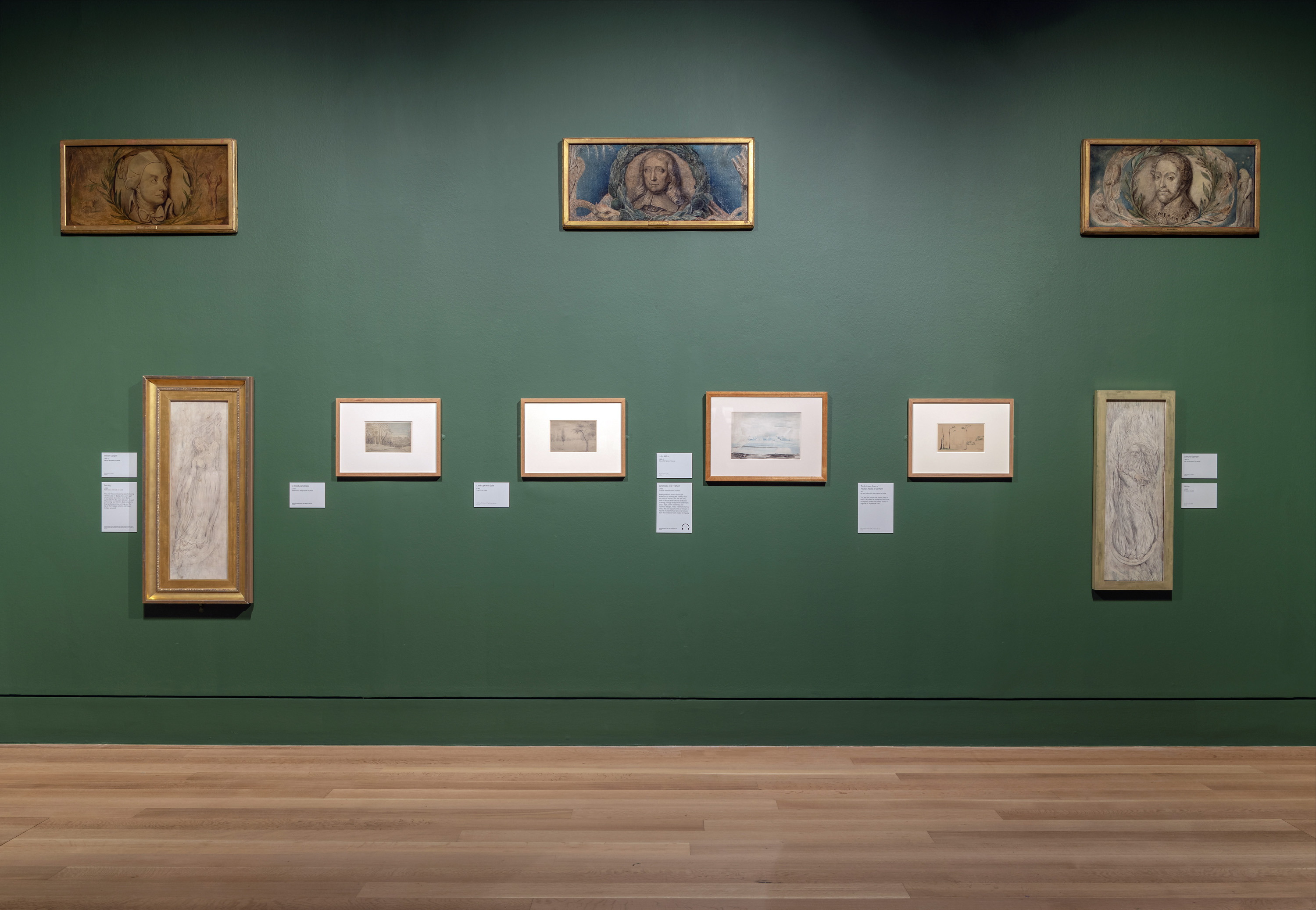
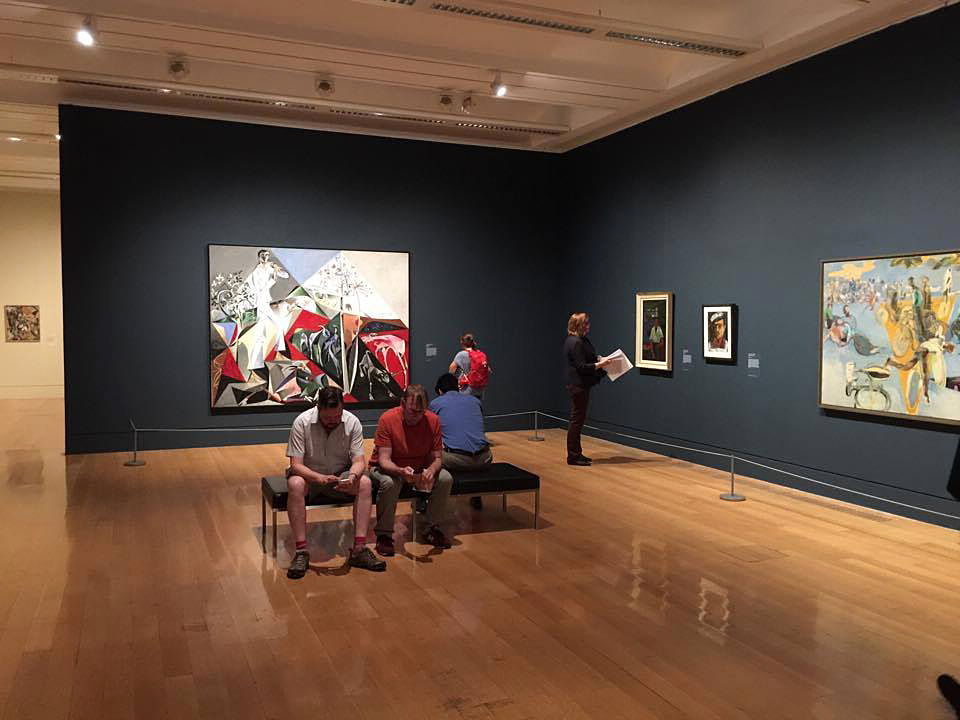
Installation view of the exhibition 'William Blake' at Tate Britain, London Photo: Marcus Bunyan


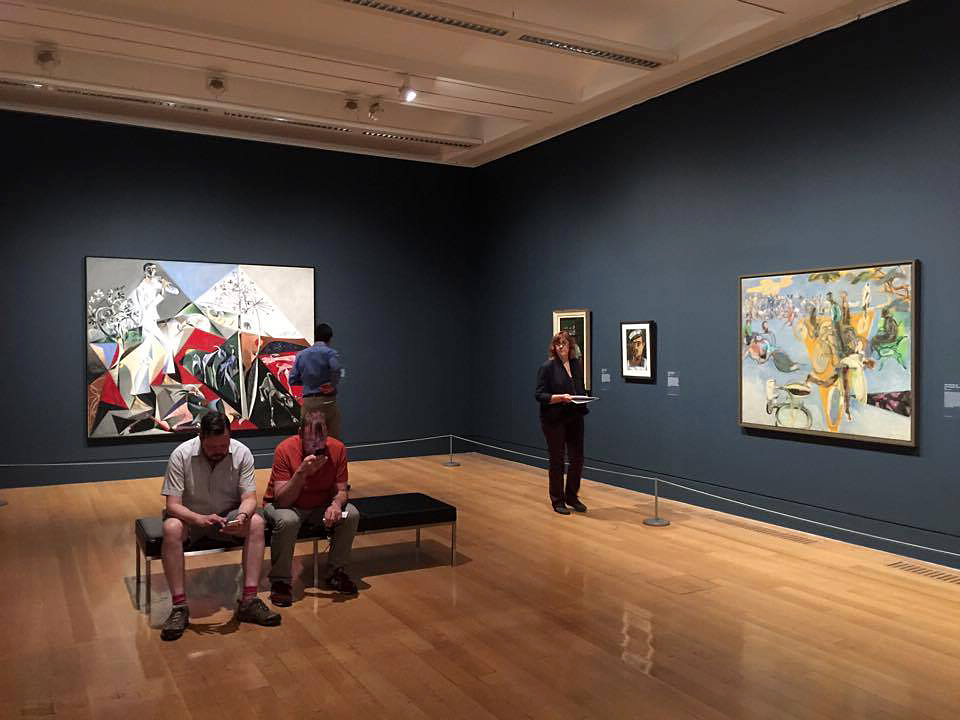
Installation view of the exhibition William Blake at Tate Britain, London
Photo: Marcus Bunyan


This first of two parts of this humongous posting. This exhibition has to be one of the highlights of my (art) life. The techniques, the colours, the forms and the MAGIC of Blake’s compositions brought me to tears.

I will write more on the work in the second part of the posting.

Dr Marcus Bunyan


Many thankx to Tate Britain for allowing me to publish the media images in the posting. All other installation photographs as noted © Dr Marcus Bunyan. Please click on the photographs for a larger version of the image.


“Every page is a window open in Heaven … interwoven designs companion the poems, and gold and yellow tints diffuse themselves over the page like summer clouds. The poems [of Songs of Innocence] are the morning song of Blake’s genius.”


W.B. Yeats


“Blake sang of the ideal world, of the truth of the intellect, and of the divinity of the imagination. … The only writer to have written songs for children with the soul of a child … he holds, in my view, a unique position because he unites intellectual sharpness with mystic sentiment.”


James Joyce
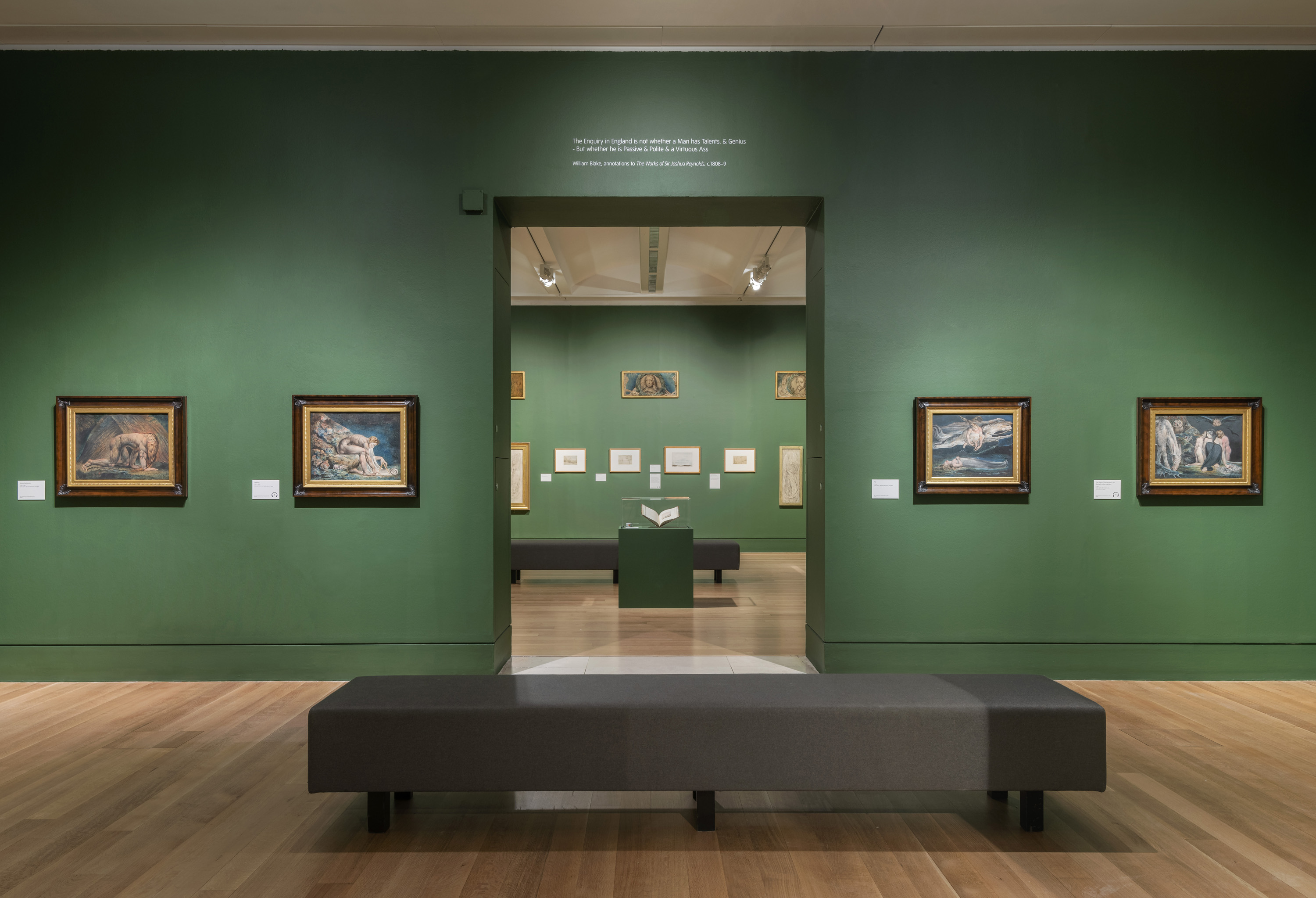


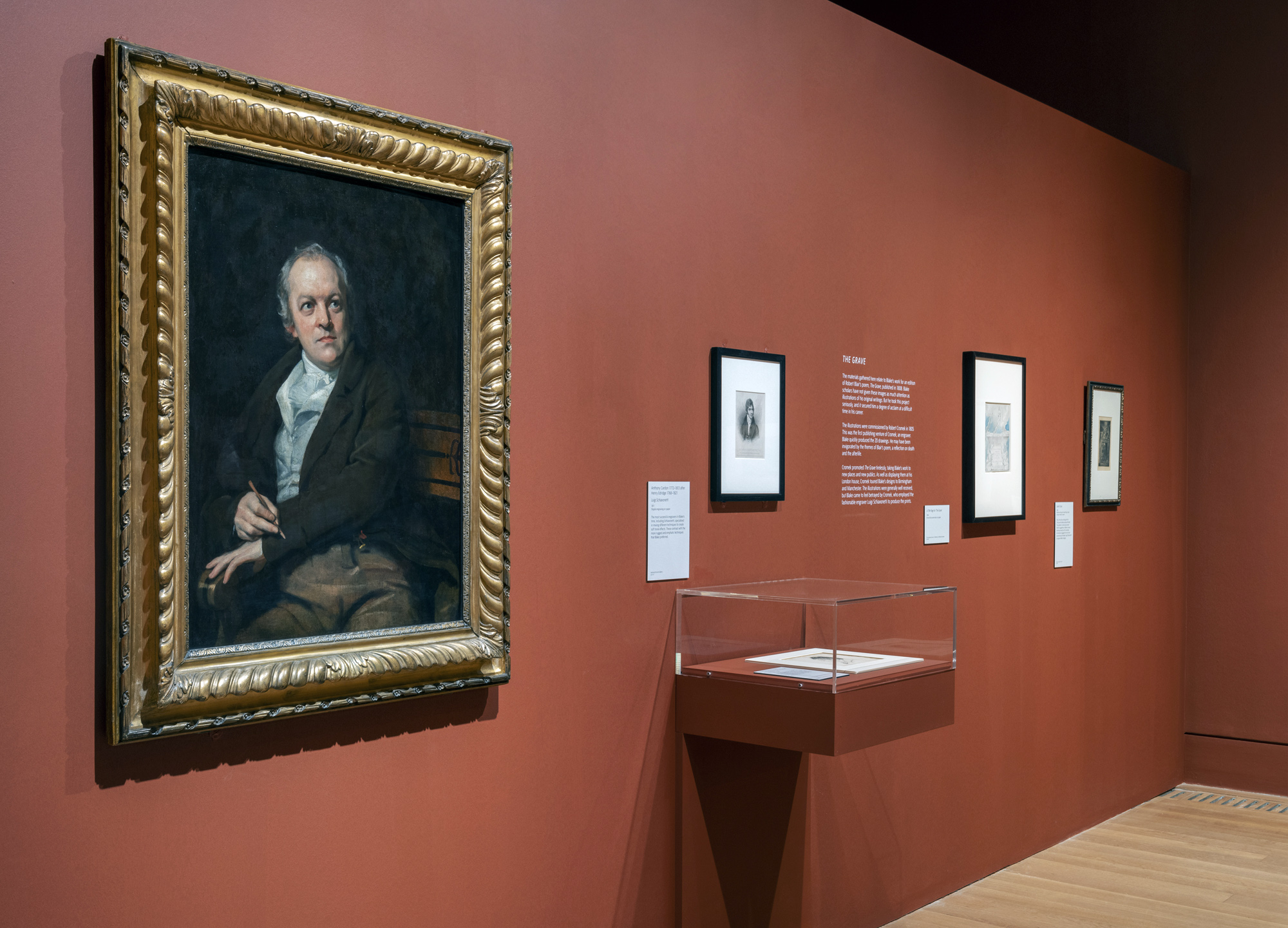
Installation view of the exhibition 'William Blake' at Tate Britain

Installation view of the exhibition 'William Blake' at Tate Britain

Installation view of the exhibition 'William Blake' at Tate Britain

Installation view of the exhibition 'William Blake' at Tate Britain

Installation view of the exhibition 'William Blake' at Tate Britain

Installation view of the exhibition 'William Blake' at Tate Britain

Installation view of the exhibition 'William Blake' at Tate Britain

Installation view of the exhibition 'William Blake' at Tate Britain


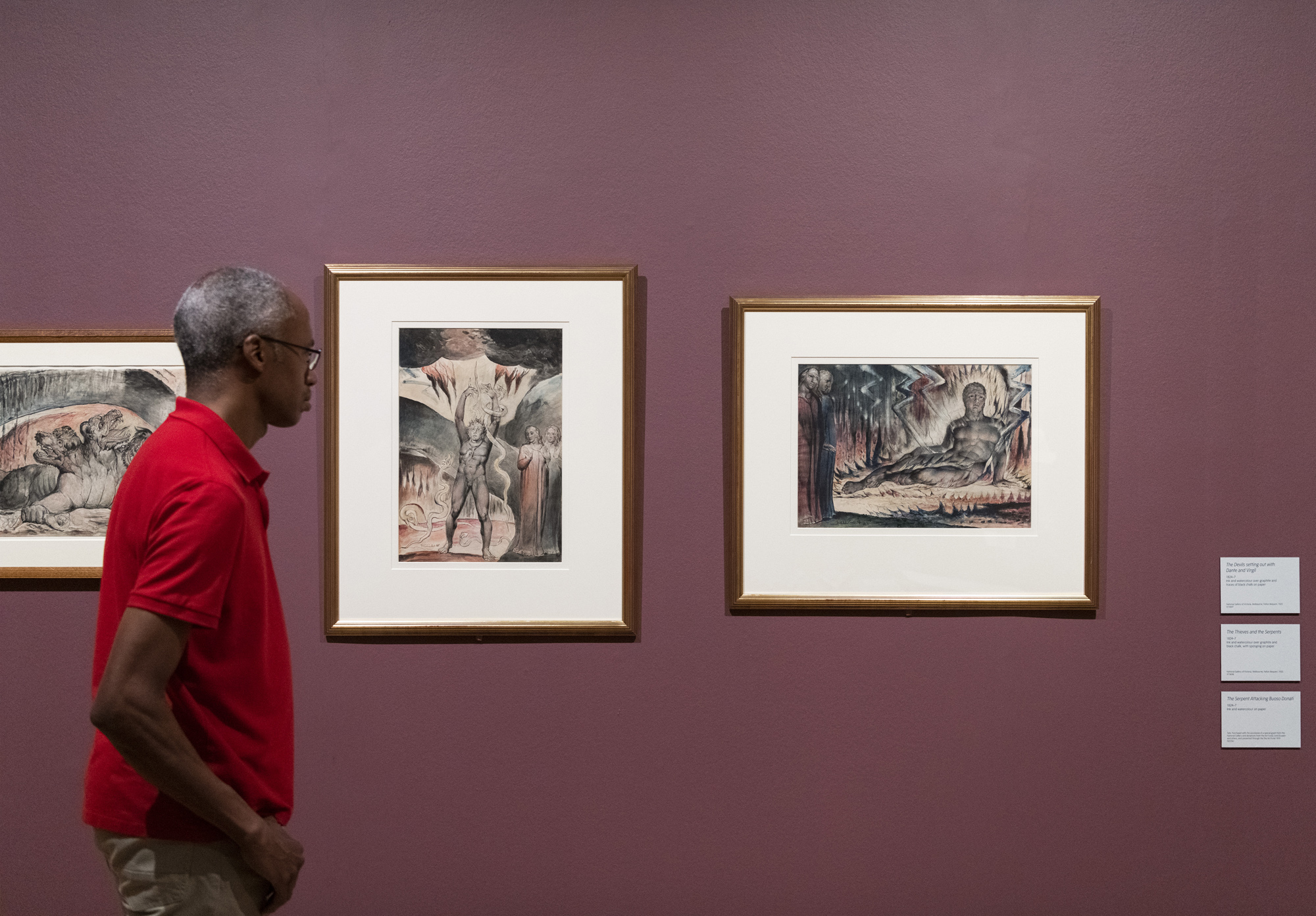
Installation views of the exhibition William Blake at Tate Britain
© Tate
Photos: Seraphina Neville


Tate Britain presents the largest survey of work by William Blake (1757-1827) in the UK for a generation. A visionary painter, printmaker and poet, Blake created some of the most iconic images in the history of British art and has remained an inspiration to artists, musicians, writers and performers worldwide for over two centuries. This ambitious exhibition brings together over 300 remarkable and rarely seen works and rediscovers Blake as a visual artist for the 21st century.

Tate Britain reimagines the artist’s work as he intended it to be experienced. Blake’s art was a product of his tumultuous times, with revolution, war and progressive politics acting as the crucible of his unique imagination, yet he struggled to be understood and appreciated during his life. Now renowned as a poet, Blake also had grand ambitions as a visual artist and envisioned vast frescos that were never realised. For the first time, The Spiritual Form of Nelson Guiding Leviathan c. 1805-1809 and The Spiritual Form of Pitt Guiding Behemoth c. 1805 have been enlarged and projected onto the gallery wall on the huge scale that Blake imagined. The original artworks are displayed nearby in a re-staging of Blake’s ill-fated exhibition of 1809, the artist’s only significant attempt to create a public reputation for himself as a painter. Tate has recreated the domestic room above his family hosiery shop in which the show was held, allowing visitors to encounter the paintings exactly as people did over 200 years ago.

The exhibition also provides a vivid biographical framework in which to consider Blake’s life and work. There is a focus on London, the city in which he was born and lived for most of his life. The burgeoning metropolis was a constant source of inspiration for the artist, offering an environment in which harsh realities and pure imagination were woven together. Blake’s creative freedom was also dependent on the unwavering support of those closest to him: his friends, family and patrons. Tate Britain highlights the vital presence of his wife Catherine Blake who offered both practical assistance and became an unacknowledged hand in the production of the artist’s engravings and illuminated books. The exhibition showcases a series of illustrations to Pilgrim’s Progress 1824-1827 and a copy of the book The Complaint, and the Consolation, or, Night Thoughts 1797, now thought to be coloured by Catherine.

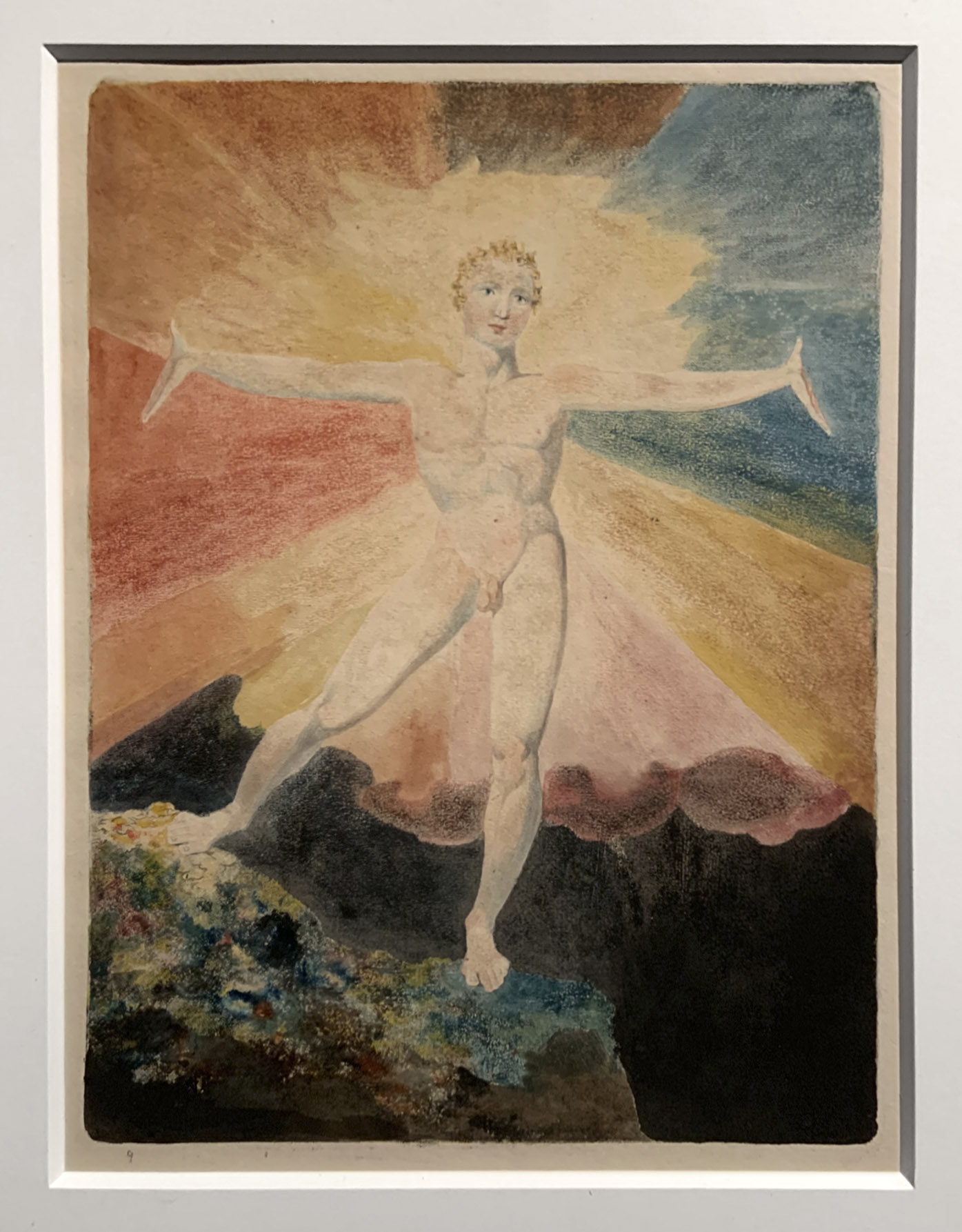
William Blake was a staunch defender of the fundamental role of art in society and the importance of artistic freedom. Shaped by his personal struggles in a period of political terror and oppression, his technical innovation, and his political commitment, these beliefs have inspired the generations that followed and remain pertinent today. Tate Britain’s exhibition opens with Albion Rose c. 1793, an exuberant visualisation of the mythical founding of Britain, created in contrast to the commercialisation, austerity and crass populism of the times. A section of the exhibition is also dedicated to his illuminated books such as Songs of Innocence and of Experience 1794, his central achievement as a radical poet.

Additional highlights include some of Blake’s best-known works including Newton 1795 – c. 1805 and Ghost of a Flea c. 1819-1820. This intricate painting was inspired by a séance-induced vision and is shown alongside a rarely seen preliminary sketch. The exhibition closes with The Ancient of Days 1827, an illustration for an edition of Europe: A Prophecy, completed only days before the artist’s death.

William Blake at Tate Britain is curated by Martin Myrone, Senior Curator, pre-1800 British Art, and Amy Concannon, Curator, British Art 1790-1850. The exhibition is accompanied by a catalogue from Tate Publishing and a programme of talks and events in the gallery.

Text from Tate Britain
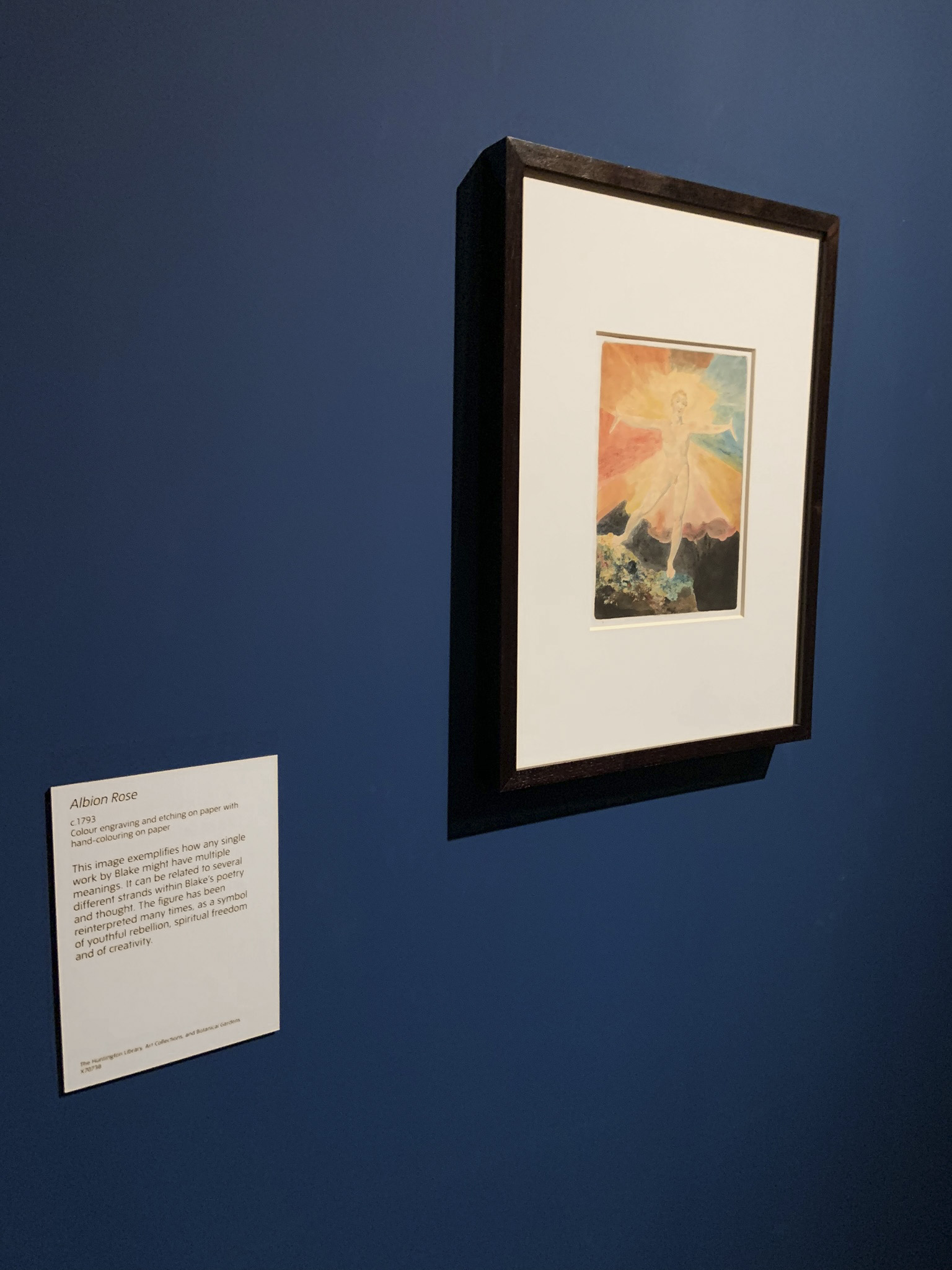
 

William Blake (British, 1757-1827) 'Albion Rose' c. 1793 (installation view)

William Blake (British, 1757-1827) 'Albion Rose' c. 1793 (installation view)

William Blake (British, 1757-1827) 'Albion Rose' c. 1793 (installation view)

William Blake (British, 1757-1827) 'Albion Rose' c. 1793 (installation view detail)


William Blake (British, 1757-1827)
Albion Rose (installation views)
c. 1793
Colour engraving
250 x 211 mm
Courtesy of the Huntington Art Collections
Photos: Marcus Bunyan


This image exemplifies how any single work by Blake might have multiple meanings. It can be related to several different strands within Blake’s poetry and thought. The figure has been reinterpreted many times, as a symbol of youthful rebellion, spiritual freedom and of creativity.

Wall text from the exhibition
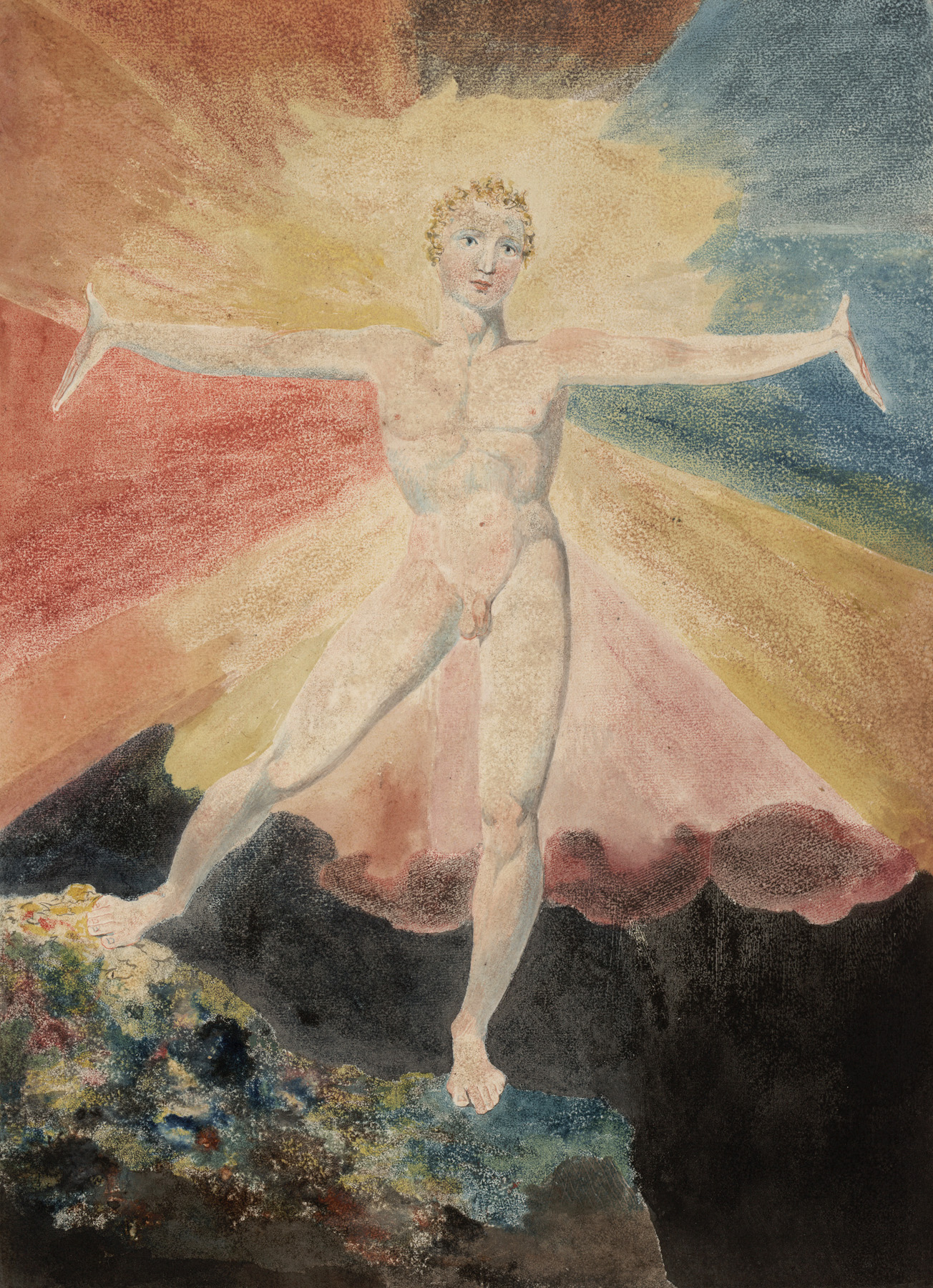
 

William Blake (British, 1757-1827) 'Albion Rose' c. 1793 from the exhibition 'William Blake' at Tate Britain, London, September 2019 - February 2020


William Blake (British, 1757-1827)
Albion Rose
c. 1793
Colour engraving
250 x 211 mm
Courtesy of the Huntington Art Collections


William Blake

The art and poetry of William Blake have influenced generations. He has inspired many creative people, political radicals and independent minds. His images and words are admired around the world for their originality and spirituality.

Blake lived at a time of radical thought, war and global unrest. The British Empire was expanding. New ideas about social justice developed alongside rapid industrialisation. Blake created imaginative images and texts that resonated with this changing world. They drew on his deeply felt religious beliefs and personal struggles.

The exhibition is organised chronologically. It takes us through the ups and downs of Blake’s creative and professional life. The full range of Blake’s work is on display here. His commercial engravings, original prints, his unique ‘illuminated books’ and paintings are all included. These have been drawn from public and private collections from around the world. To preserve these rarely seen objects, the light levels across the exhibition are deliberately low.

Blake’s art and poetry have appealed to many kinds of people, for different reasons. His work has provoked diverse interpretations. This exhibition does not try to explain Blake’s imagery and symbolism in a definitive way.

Instead it considers the reception of his art and how it was experienced by his contemporaries. It sets out the personal and social conditions in which it was made. In doing so we hope to reveal the circumstances that gave Blake the freedom to create such innovative works.

Wall text


Room 1

The art and poetry of William Blake have influenced generations. He has inspired many creative people, political radicals and independent minds. His images and words are admired around the world for their originality and spirituality.

Blake lived at a time of radical thought, war and global unrest. The British Empire was expanding. New ideas about social justice developed alongside rapid industrialisation. Blake created imaginative images and texts that resonated with this changing world. They drew on his deeply felt religious beliefs and personal struggles.

The exhibition is organised chronologically. It takes us through the ups and downs of Blake’s creative and professional life. The full range of Blake’s work is on display here. His commercial engravings, original prints, his unique ‘illuminated books’ and paintings are all included. These have been drawn from public and private collections from around the world. To preserve these rarely seen objects, the light levels across the exhibition are deliberately low.

Blake’s art and poetry have appealed to many kinds of people, for different reasons. His work has provoked diverse interpretations. This exhibition does not try to explain Blake’s imagery and symbolism in a definitive way. Instead it considers the reception of his art and how it was experienced by his contemporaries. It sets out the personal and social conditions in which it was made. In doing so we hope to reveal the circumstances that gave Blake the freedom to create such innovative works.


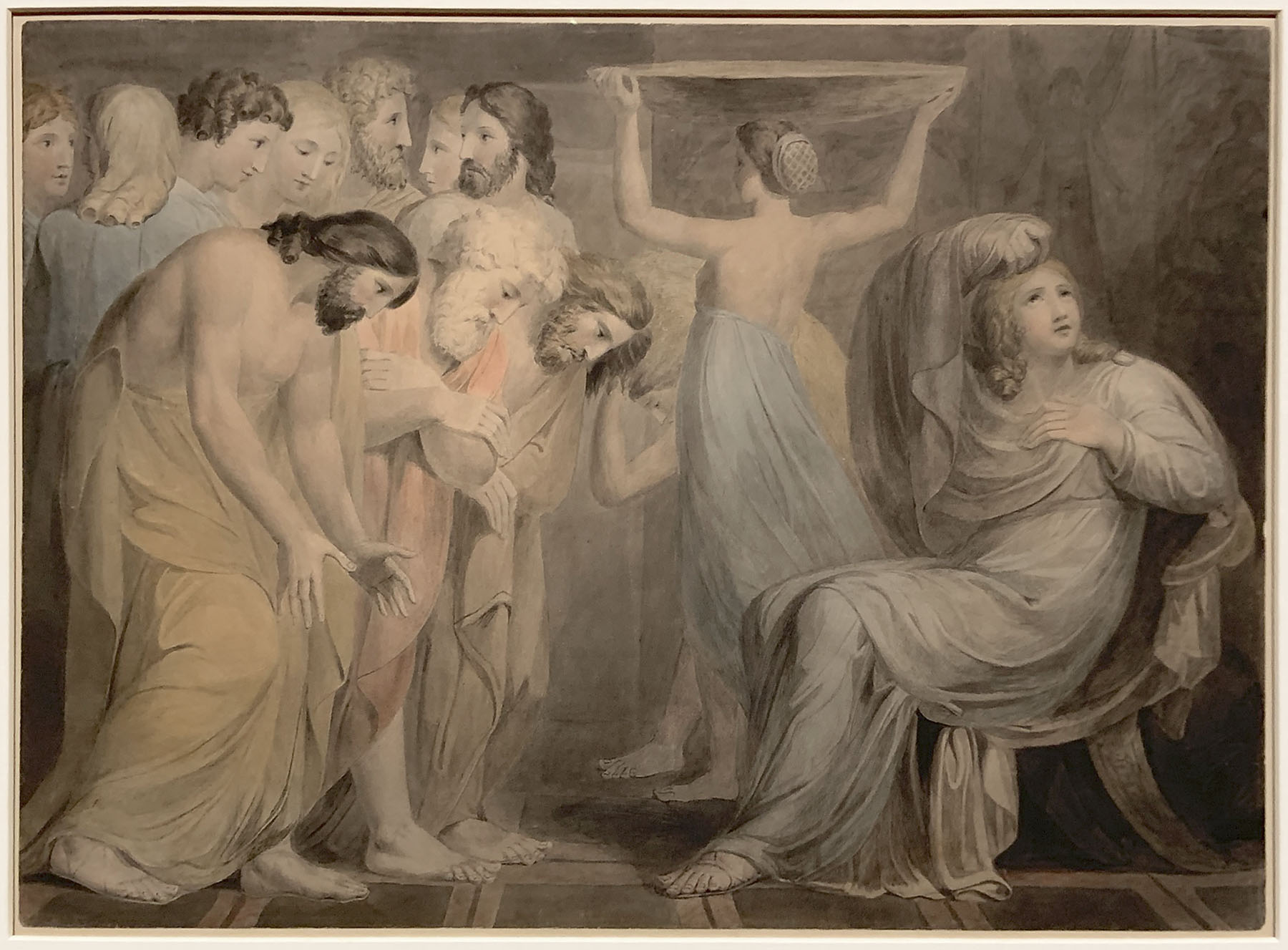
William Blake (British, 1757-1827) 'Joseph Making himself Known to his Brethren' 1784-1785 (installation view)

William Blake (British, 1757-1827) 'Joseph Making himself Known to his Brethren' 1784-1785 (installation view)


William Blake (British, 1757-1827)
Joseph Making himself Known to his Brethren (installation views)
1784-1785
India ink and watercolour over graphite on paper
The Syndics of the Fitzwilliam Museum, University of Cambridge
Photos: Marcus Bunyan


Installation view of the exhibition 'William Blake' at Tate Britain, London showing at left, Blake's 'Joseph's Brethren Bowing down before him' (1784-1785) and at right, 'Joseph Ordering Simeon to be Bound' (1784-1785)


Installation view of the exhibition William Blake at Tate Britain, London showing at left, Blake’s Joseph’s Brethren Bowing down before him (1784-1785) and at right, Joseph Ordering Simeon to be Bound (1784-1785)
Photo: Marcus Bunyan


The story of Joseph

Blake’s bitter view of the contemporary art world has its origins in the disappointments and frustrations he experienced early in his career.

In 1785 Blake exhibited these three watercolour designs showing the biblical story of Joseph. Blake showed them at the annual exhibition at the Royal Academy of Arts, the main showcase for contemporary art.

Students at the Academy were encouraged to depict serious, dramatic subject matter in a classical style. But these exhibitions were filled with more commercial artworks. The exhibition catalogue, also on display here, shows the dominance of portraits, landscapes and light-hearted ‘fancy’ subjects. Being watercolours, Blake’s designs were shown in a separate space where they got less public attention than the oil paintings in the main gallery.

Wall text from the exhibition


William Blake (British, 1757-1827) 'Joseph's Brethren Bowing down before him' 1784-1785 (installation view)

William Blake (British, 1757-1827) 'Joseph's Brethren Bowing down before him' 1784-1785 (installation view)


William Blake (British, 1757-1827)
Joseph’s Brethren Bowing down before him (installation views)
1784-1785
India ink and watercolour over graphite on paper
The Syndics of the Fitzwilliam Museum, University of Cambridge
Photos: Marcus Bunyan
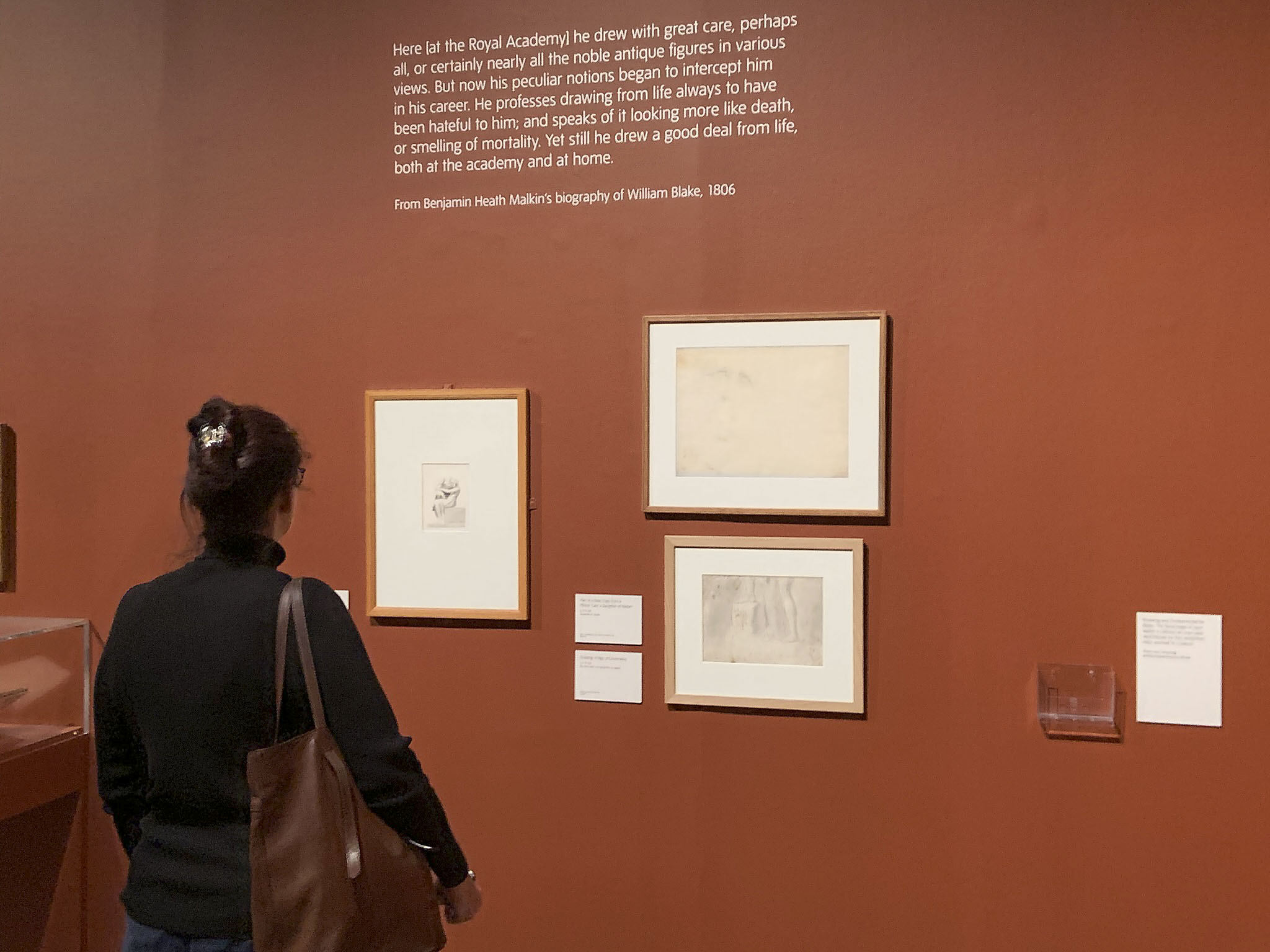
 

Installation view of the exhibition 'William Blake' at Tate Britain, London with at bottom middle, 'Drawing of the legs of Cincinnatus' (c. 1779-1780) Photo: Marcus Bunyan


Installation view of the exhibition William Blake at Tate Britain, London with at bottom middle, Drawing of the legs of Cincinnatus (c. 1779-1780)
Photo: Marcus Bunyan


William Blake wall text


William Blake wall text


William Blake (British, 1757-1827) 'Drawing of the legs of Cincinnatus' c. 1779-1780 (installation view)


William Blake (British, 1757-1827)
Drawing of the legs of Cincinnatus (installation view)
c. 1779-1780
Ink and wash over graphite on paper
Bolton Museum and Archive
Photo: Marcus Bunyan


This intimate and apparently casually-drawn portrait shows Catherine Blake (née Boucher, 1762-1831). William and Catherine were married from 1782 until Blake’s death in 1827. Catherine played a huge part in Blake’s creative and commercial work. She helped him with printing and colouring his works, even finishing some of his drawings. Blake’s extraordinary vision depended on his partnership with Catherine.

Wall text
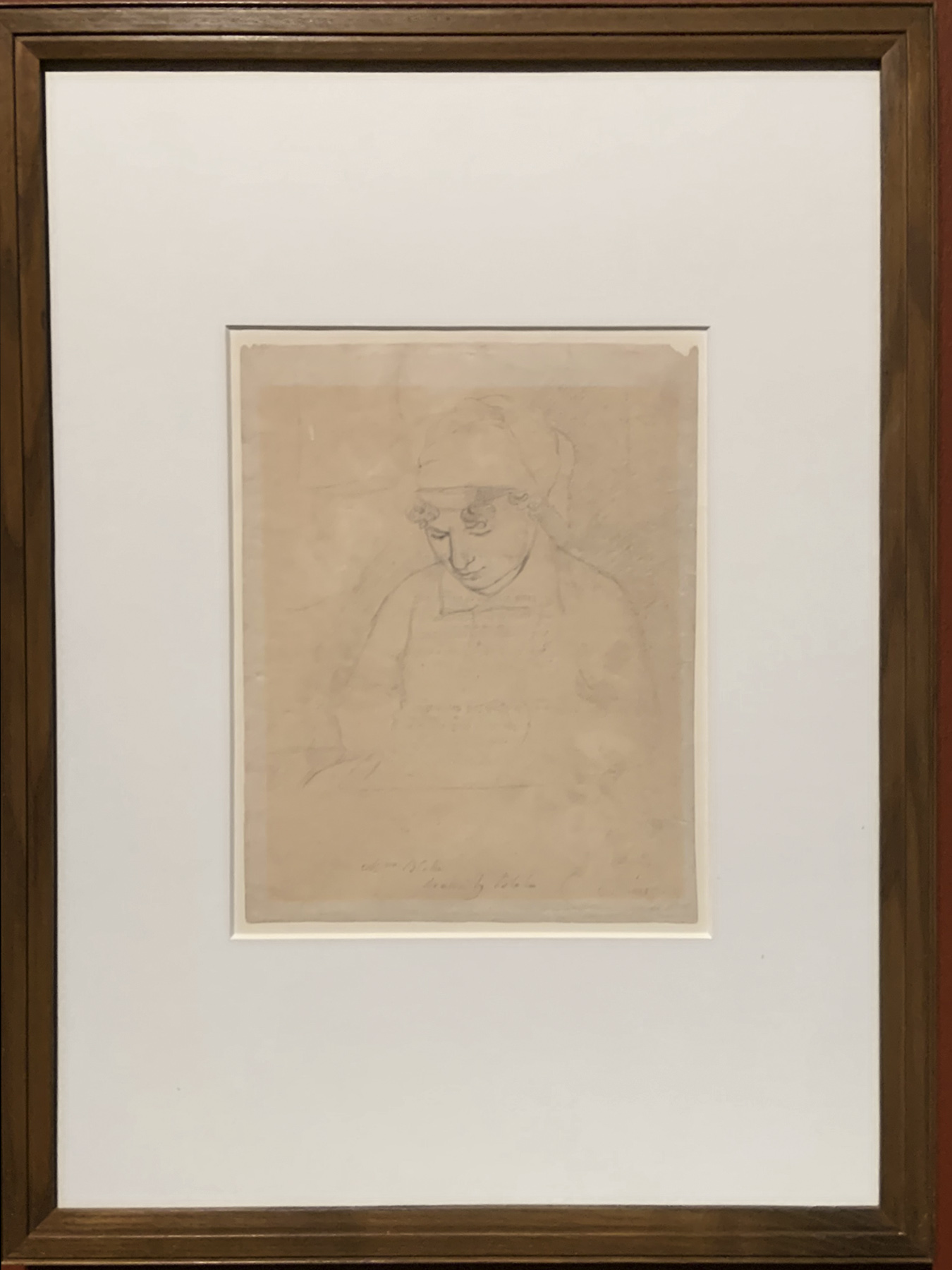
 

William Blake (British, 1757-1827) 'Catherine Blake' 1805 (installation view)


William Blake (British, 1757-1827)
Catherine Blake (installation view)
1805
Graphite on paper
286 x 221 mm
Tate. Bequeathed by Miss Alice G.E. Carthew 1940
Photo: Marcus Bunyan
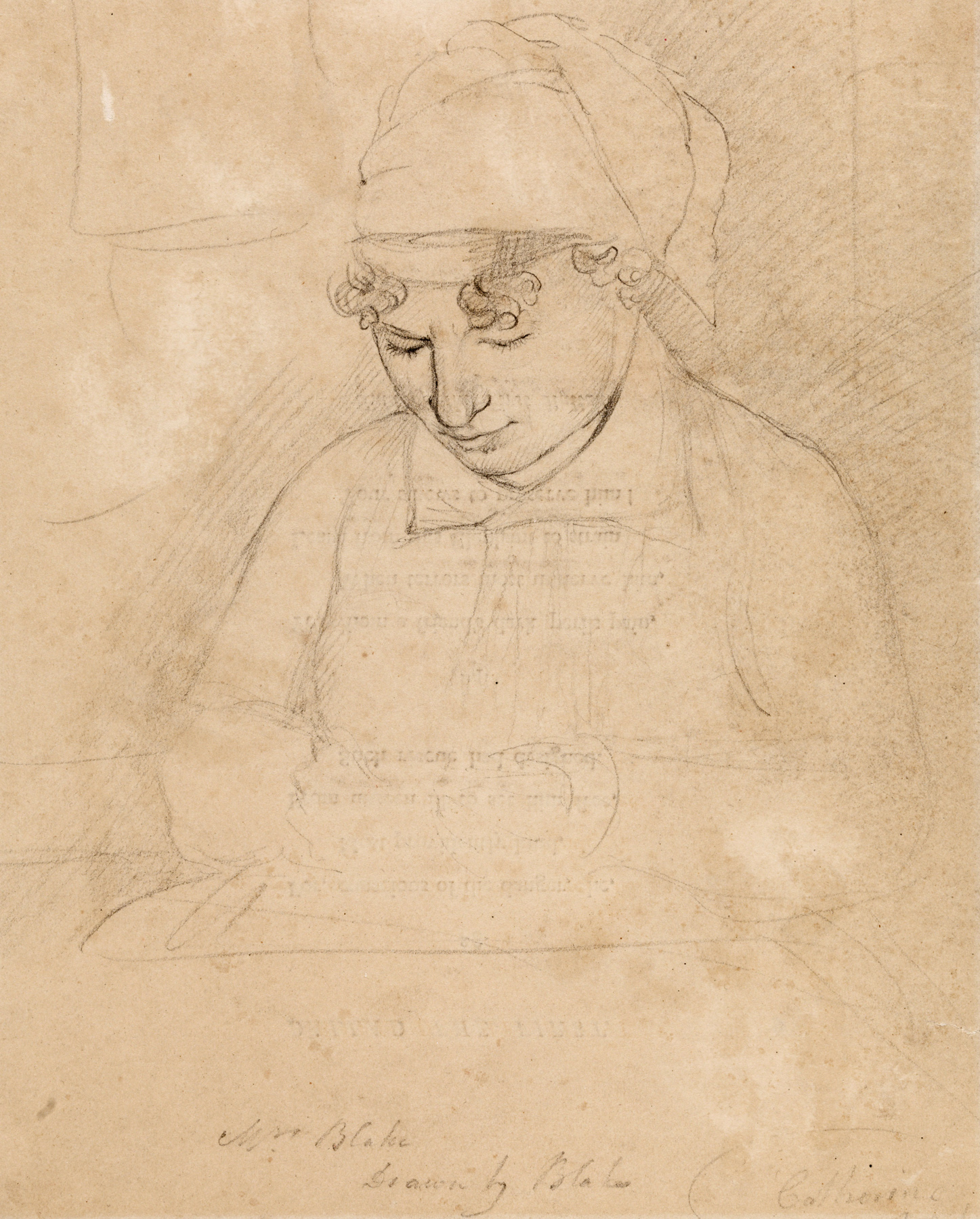
 

William Blake (British, 1757-1827) 'Catherine Blake' 1805  from the exhibition 'William Blake' at Tate Britain, London, September 2019 - February 2020


William Blake (British, 1757-1827)
Catherine Blake
1805
Graphite on paper
286 x 221 mm
Tate. Bequeathed by Miss Alice G.E. Carthew 1940


A portrait of William Blake, thought to be his only self-portrait, will be exhibited in the UK for the first time in a major survey of his work at Tate Britain. In the 200 years since its creation, the detailed pencil drawing only been shown once before and never in the artist’s own country. It offers a unique insight into the visionary painter, printmaker and poet responsible for some of Britain’s best loved artwork and will be displayed alongside a sketch of Blake’s wife Catherine from the same period, highlighting her vital contribution to his life and work.

Created when Blake was around 45 years old, the work is thought to present an idealised likeness. Rather than showing Blake as a painter or engraver, signs of his creative intensity are conveyed in his direct hypnotic gaze. This compelling image was produced after 1802, at a turning-point in Blake’s life. Having lived in Sussex for three years and been falsely accused of treason, Blake returned to his native city of London and was re-establishing himself as an artist. The portrait shows Blake as an isolated and misunderstood figure.

A crucial presence in Blake’s life, Catherine offered both practical assistance and became an unacknowledged hand in the production of his engravings and illuminated books. His visual art and poetry began to develop in original ways only after their marriage in 1782. At the time she was illiterate but learnt to read and write with her husband and became an accomplished printmaker in her own right. Together, these rare examples of Blake’s portraiture highlight the ways in which his extraordinary vision was dependent on the domestic stability of his life with Catherine.

Text from the Tate Britain website


William Blake (British, 1757-1827) 'Portrait of William Blake' c. 1802 (installation view)


William Blake (British, 1757-1827)
Portrait of William Blake (installation view)
c. 1802
Graphite with black, white and grey washes on paper
Collection of Robert N. Essick
Photo: Marcus Bunyan


This is probably a self-portrait drawn by Blake when he was in his 40s. It does not present him in the act of writing or drawing. Instead, the image invites us to see his intense gaze as a sign of his creative force. This perhaps reflects his claim that he saw visions. Blake’s art and personal behaviour divided contemporary opinion. A few friends and supporters accepted him as a genius. Many others considered him eccentric or questioned his mental health.

Wall text from the exhibition
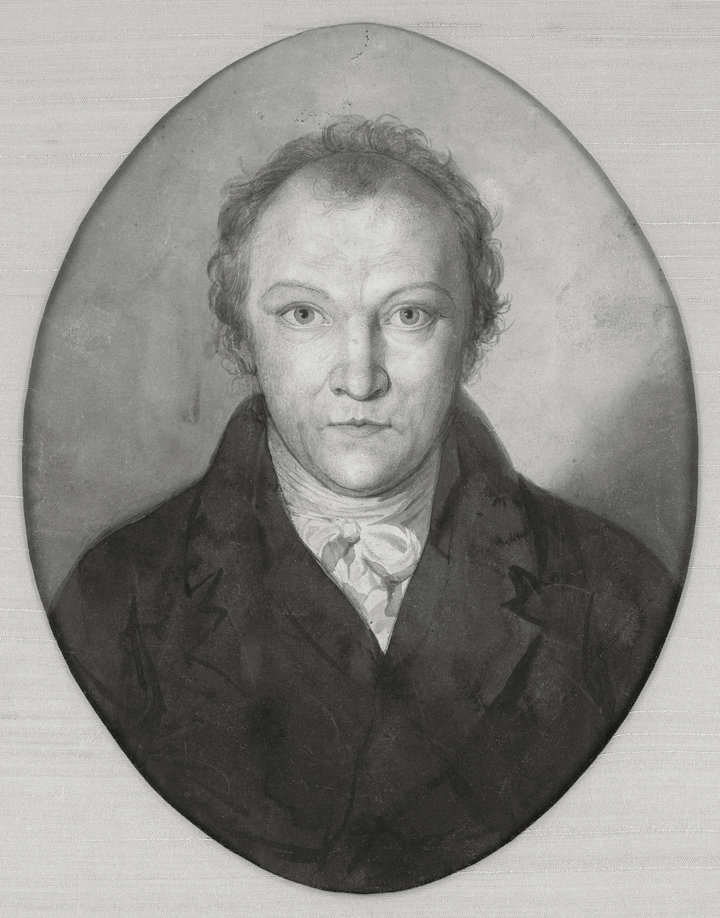
 

William Blake (British, 1757-1827) 'Portrait of William Blake' c. 1802 (installation view)


William Blake (British, 1757-1827)
Portrait of William Blake (installation view)
c. 1802
Graphite with black, white and grey washes on paper
Collection of Robert N. Essick
Photo: Marcus Bunyan


‘Blake be an artist!’

Blake was born in London in 1757, the son of a fairly successful shopkeeper in Broad Street, Soho. Blake wanted to be an artist from an early age. His family indulged his passion. They bought prints and plaster casts for him to copy, paid for drawing lessons and funded his training as an apprentice engraver. In 1779 he enrolled as a student at the Royal Academy of Arts. This gallery explores the art he created in the years that followed. It was during this time that he developed his ambitions as an original artist and poet.

The Royal Academy encouraged its students to imitate the great art of the past. They were expected to copy antique sculptures and look to Renaissance artists like Michelangelo and Raphael for inspiration.

Blake later rejected the more rigid ideas associated with Academic teaching. He sought to create a more personal vision and began to identify with the ‘Gothic’ artists of the medieval past. He felt the Academy was being taken over by portrait painters motivated by self-interest. But he did admire some ambitious and individualistic figures there. These included James Barry and Henry Fuseli. Blake took seriously their ideas about painting great public works full of moral purpose and drama. The conflict between such aims and the realities of a cynical and market-driven art world would be a shaping force in Blake’s creative life.

Wall text from the exhibition


William Blake (British, 1757-1827) 'Academy Study' 1779-1780 (installation view)


William Blake (British, 1757-1827)
Academy Study (installation view)
1779-1780
Graphite on paper
Lent by the British Museum, London
Photo: Marcus Bunyan


Installation view of the exhibition 'William Blake' at Tate Britain, London Photo: Marcus Bunyan


Installation view of the exhibition William Blake at Tate Britain, London
Photo: Marcus Bunyan


Early drawings and watercolours

Blake’s earliest drawings typically used sweeping lines and areas of grey washed ink or watercolour. His figures make grand gestures in bare, even abstract, settings.

His style was based on the innovative art of the 1760s and 1770s, especially the drawings of James Barry, Henry Fuseli, and John Flaxman. They became well known for creating works with strong visual and emotional impact and communicating ideas in a bold way.

Blake’s subjects were often drawn from history, literature and the Bible. This was in keeping with the teaching of the Royal Academy and traditional ideas about ‘high art’. However, Blake’s subject matter from these early years is sometimes unclear. Spiritual forms, ghosts and visions start to appear. This means that the story and meaning of his individual works can be difficult to decipher.

Wall text from the exhibition


Installation view of the exhibition 'William Blake' at Tate Britain, London showing Blake's 'Age Teaching Youth' (c. 1785-1790) Photo: Marcus Bunyan


Installation view of the exhibition William Blake at Tate Britain, London showing Blake’s Age Teaching Youth (c. 1785-1790)
Photo: Marcus Bunyan


William Blake (British, 1757-1827) 'An Allegory of the Bible' c. 1780-1785 (installation view)


William Blake (British, 1757-1827)
An Allegory of the Bible (installation view)
c. 1780-1785
Graphite, ink and watercolour on paper
Tate, Bequeathed by Miss Rachel M. Dyer 1969
Photo: Marcus Bunyan


Blake started using more colours in the mid-1780s. The mysterious subject matter of this design is new as well. The title is not the artist’s own. It was added by later commentators, as is often the case with Blake’s symbolic designs.

Wall text from the exhibition
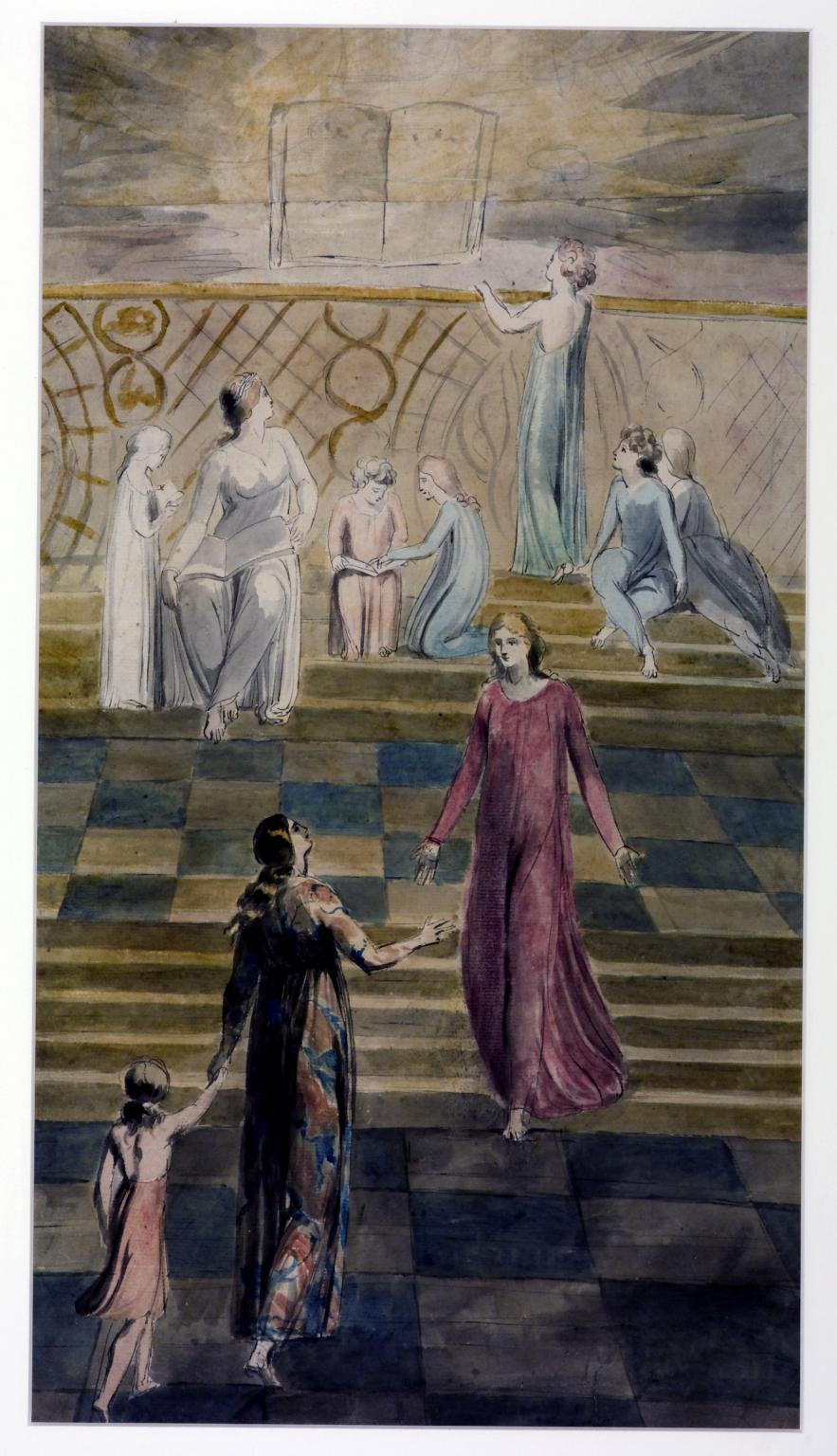
 

William Blake (British, 1757-1827) 'An Allegory of the Bible' c. 1780-1785


William Blake (British, 1757-1827)
An Allegory of the Bible
c. 1780-1785
Graphite, ink and watercolour on paper
Tate, Bequeathed by Miss Rachel M. Dyer 1969


The title of this work is not Blake’s, but its theme seems to be the revelation of knowledge.

Unusually, the foreground and background were both painted initially with a single base colour. The figures and the screen behind those in the background were applied straight onto the white paper. The screen and the lower half of the sky behind it were originally painted a deep rose, with a red lake pigment that is probably brazilwood. This has lost so much colour, except at the edges, that it gives the unintended effect of a flat brown base tone to the whole screen.

Gallery label, September 2004


Installation view of the exhibition 'William Blake' at Tate Britain, London showing Blake's 'The Good Farmer, Probably the Parable of the Wheat and the Tares' (c. 1780-1785) Photo: Marcus Bunyan


Installation view of the exhibition William Blake at Tate Britain, London showing Blake’s The Good Farmer, Probably the Parable of the Wheat and the Tares (c. 1780-1785)
Photo: Marcus Bunyan


This is an illustration of one of Christ’s parables, which appears in several biblical sources.


William Blake (British, 1757-1827) 'The Good Farmer, Probably the Parable of the Wheat and the Tares' c. 1780-1785 (installation view)


William Blake (British, 1757-1827)
The Good Farmer, Probably the Parable of the Wheat and the Tares (installation view)
c. 1780-1785
Ink and watercolour on paper
Tate. Bequeathed by Miss Alice G.E. Carthew 1940
Photo: Marcus Bunyan
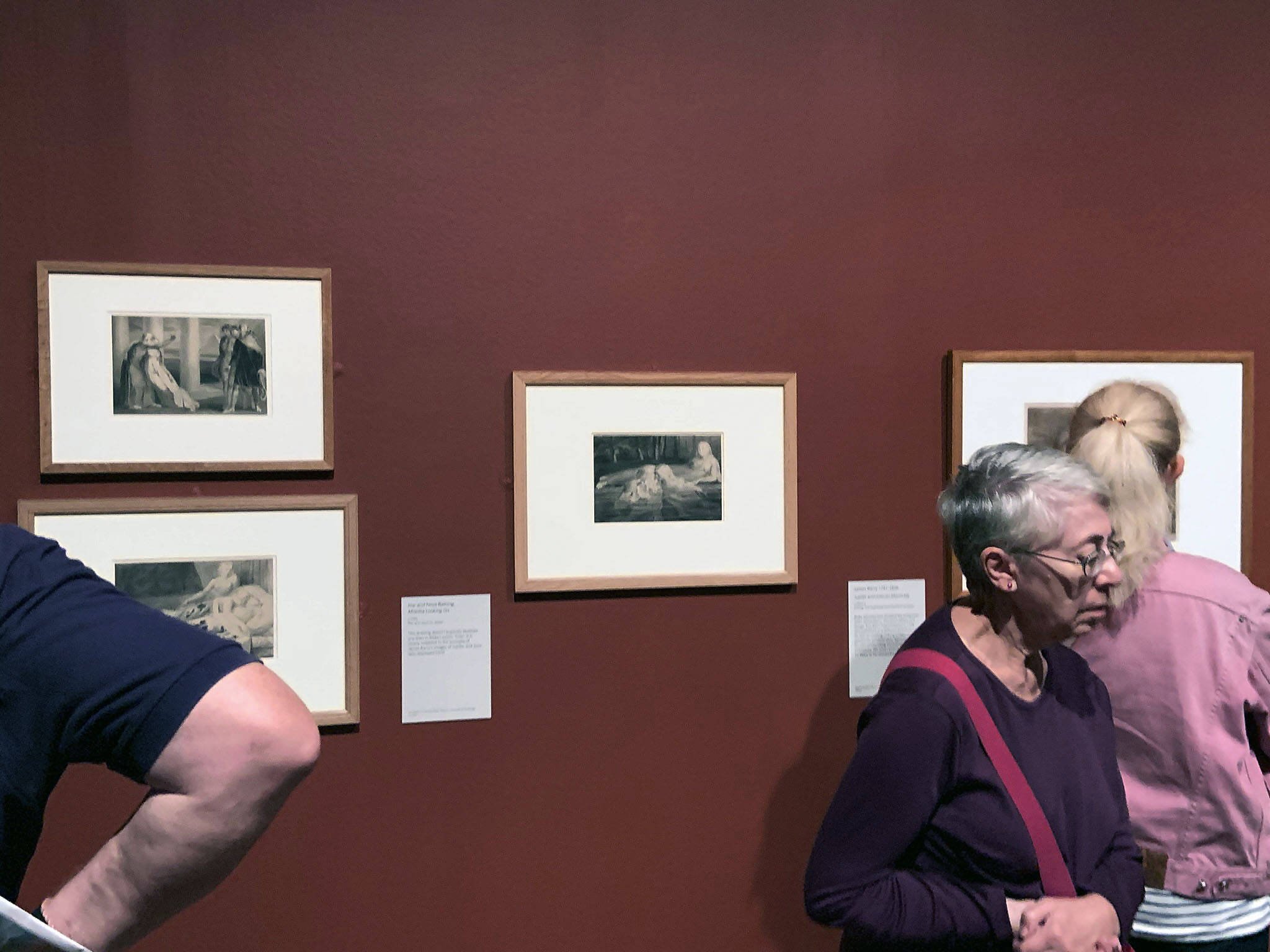
 

Installation view of the exhibition 'William Blake' at Tate Britain, London Photo: Marcus Bunyan

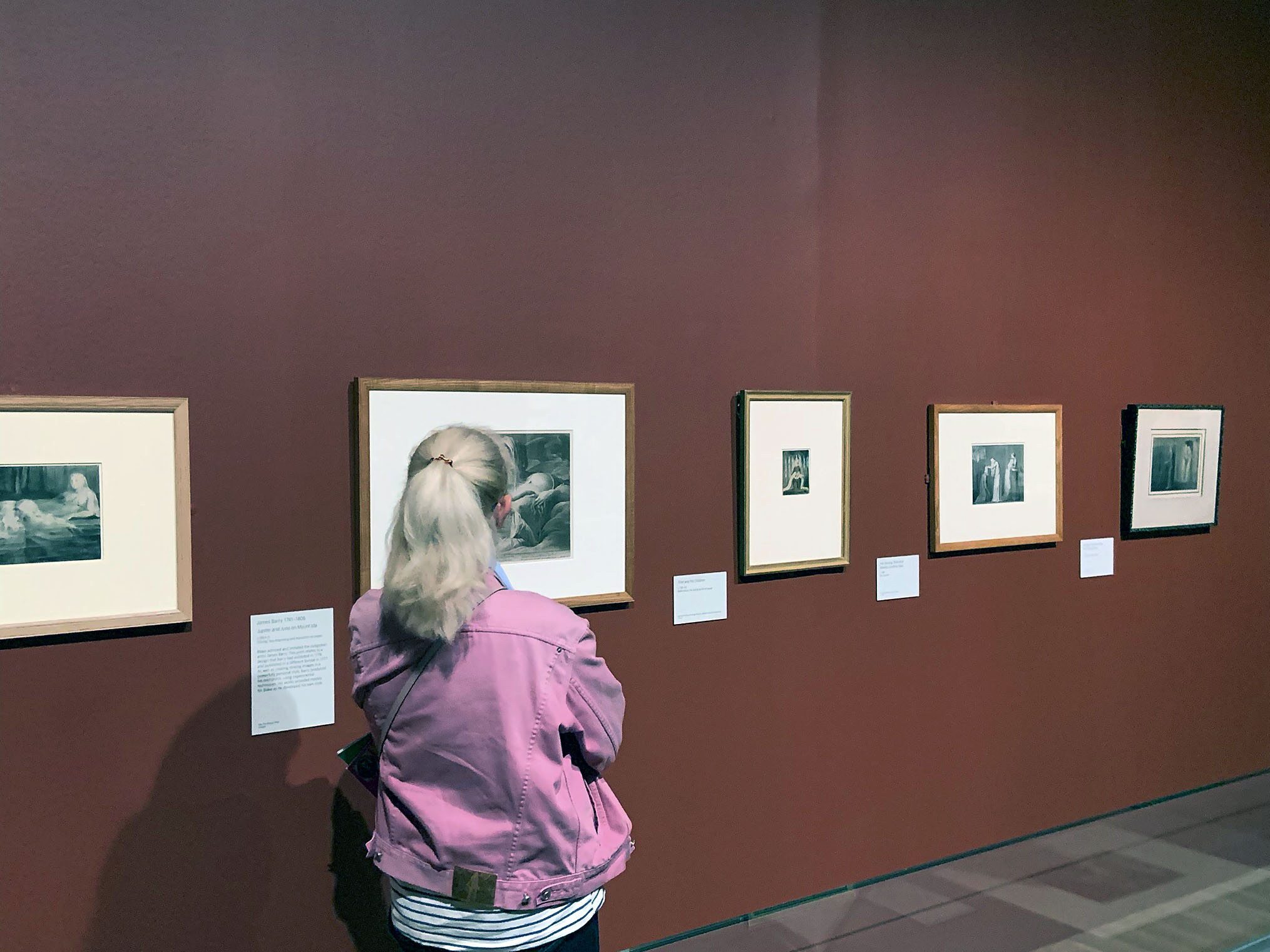
Installation view of the exhibition 'William Blake' at Tate Britain, London Photo: Marcus Bunyan


Installation views of the exhibition William Blake at Tate Britain, London
Photos: Marcus Bunyan


Tiriel

In the late 1780s Blake had established a reputation as a designer and poet among a small circle of friends. He began writing an epic poem, which he also intended to illustrate. It is not clear how Blake would have funded the production of an illustrated edition and it was not published.

Blake’s manuscript and many of the surviving drawings are displayed here. The story combined elements of Greek tragedy and Shakespeare. It also drew on supposedly ancient Gaelic stories (actually composed by the Scottish writer James Macpherson in the 1760s). The narrative concerns a king, now blind, his arguments with his sons and daughters, and his encounter with his elderly parents, Har and Heva. The language is dramatic, with exaggerated imagery suggesting surging emotions, ‘Thunder & fire & pestilence’.

The project represents the culmination of Blake’s early efforts as a painter and poet. It also exposes how his ambitions to combine epic images and texts were frustrated by conventional publishing techniques.

Wall text from the exhibition


Installation view of the exhibition 'William Blake' at Tate Britain, London Photo: Marcus Bunyan
 

Installation view of the exhibition William Blake at Tate Britain, London
Photo: Marcus Bunyan


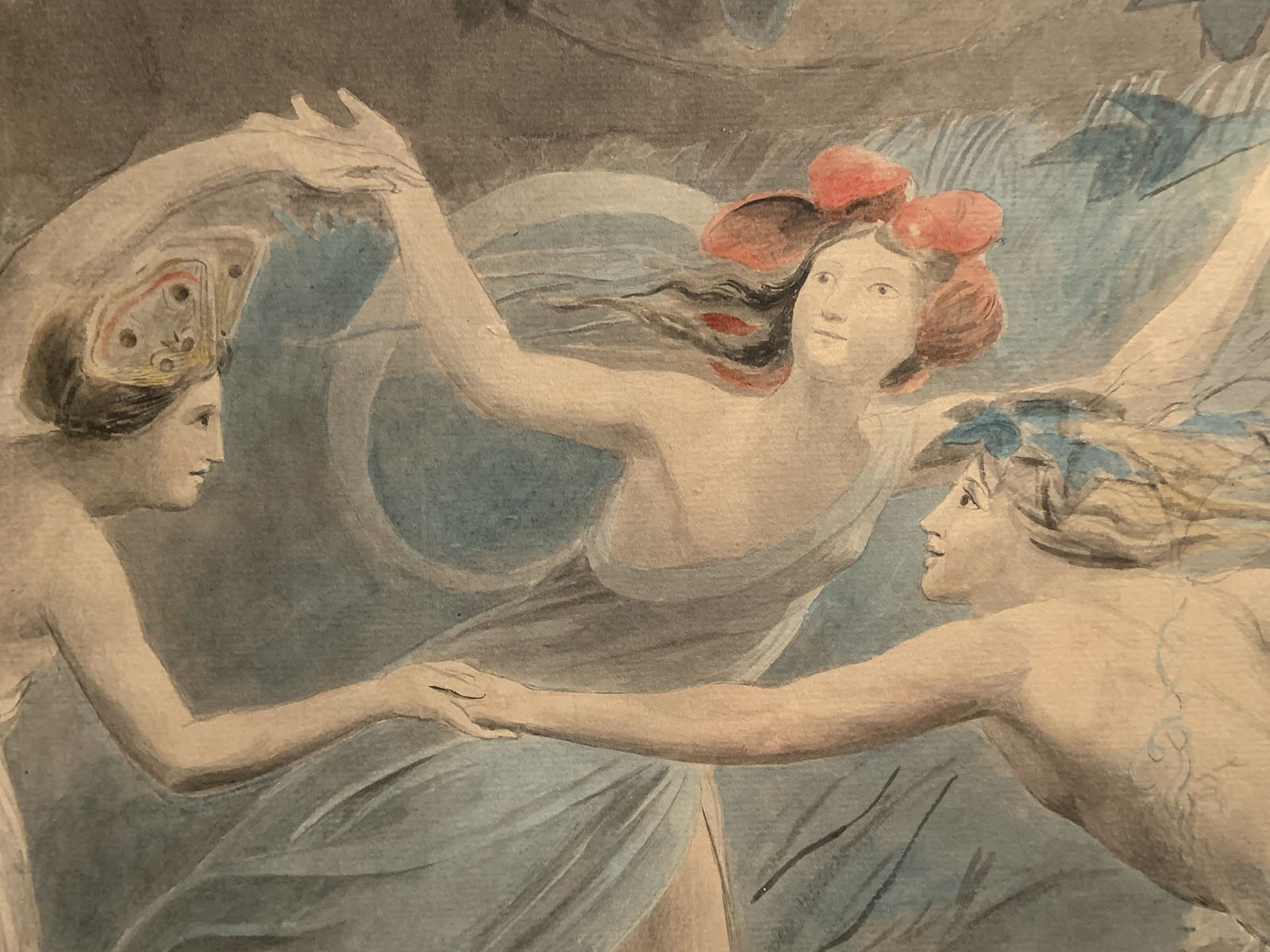
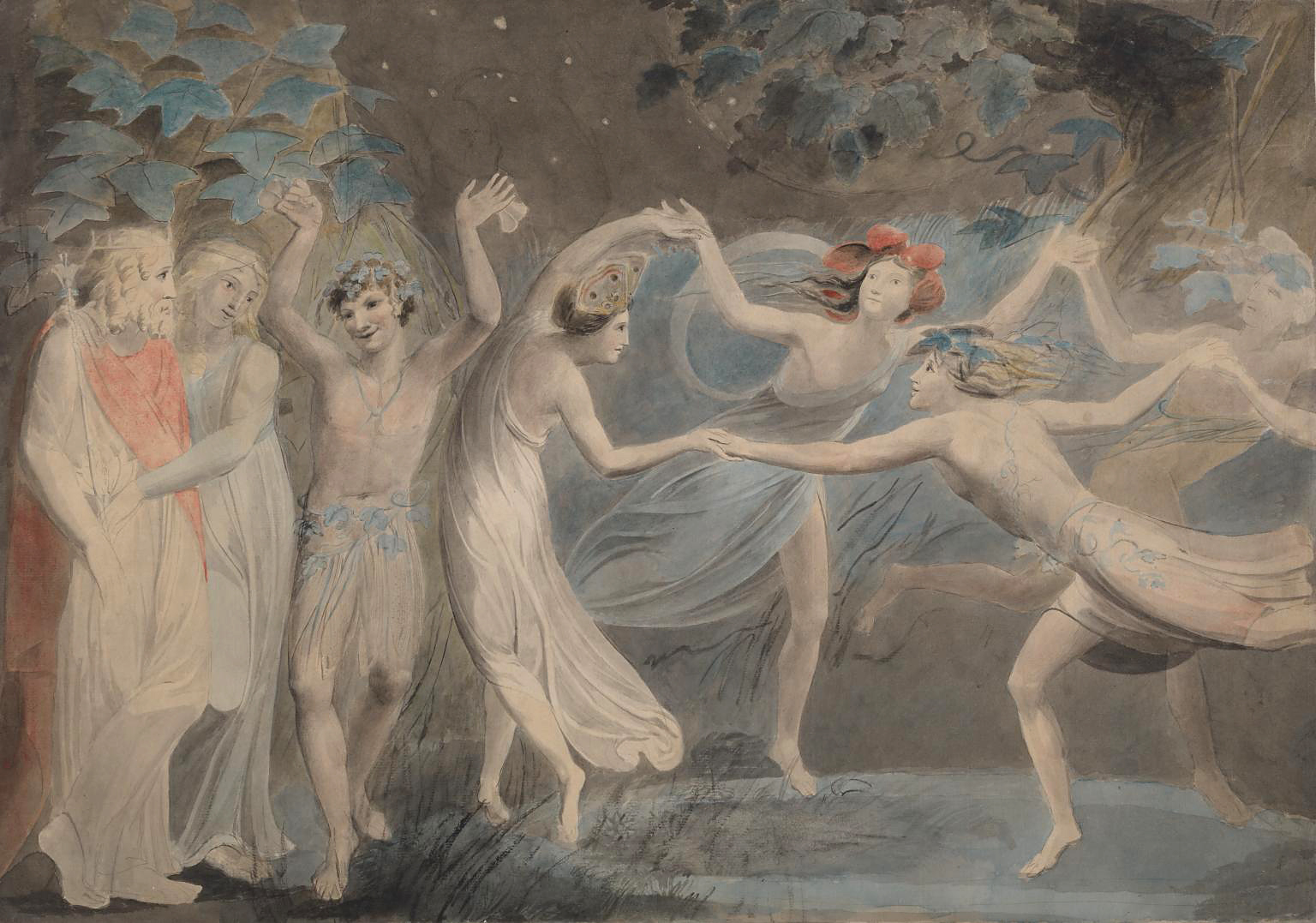
William Blake (British, 1757-1827) 'Oberon, Titania and Puck with Fairies Dancing' c. 1786


William Blake (British, 1757-1827)
Oberon, Titania and Puck with Fairies Dancing
c. 1786
Watercolour and graphite on paper
Support: 475 × 675 mm
Tate. Presented by Alfred A. de Pass in memory of his wife Ethel 1910
Creative Commons CC-BY-NC-ND (3.0 Unported)


The subject is from Shakespeare’s A Midsummer Night’s Dream illustrating Titania’s instruction to her fairy train in the last scene:

Hand in hand, with fairy grace,
Will we sing, and bless this place.

Oberon and Titania, King and Queen of the fairies, are on the left. Puck, the perplexer of mortals, faces us. The fairies Moth and Peaseblossom are easily identifiable.

During the 1780s there was a growing taste for Shakespeare illustrations. Blake had formed a print-publishing partnership in 1784. If the approximate dating of this work is correct, it may represent an attempt by Blake to break into this market.

Supernatural and fantastical subject matter like this enjoyed great popularity in Blake’s time.

Wall text from the exhibition and gallery label, August 2004


William Blake (British, 1757-1827) 'Oberon, Titania and Puck with Fairies Dancing' c. 1786 (installation view detail)

William Blake (British, 1757-1827) 'Oberon, Titania and Puck with Fairies Dancing' c. 1786 (installation view detail)


William Blake (British, 1757-1827)
Oberon, Titania and Puck with Fairies Dancing (installation view details)
c. 1786
Watercolour and graphite on paper
Support: 475 × 675 mm
Tate. Presented by Alfred A. de Pass in memory of his wife Ethel 1910
Photos: Marcus Bunyan


Installation view of the exhibition 'William Blake' at Tate Britain, London

Installation views of the exhibition 'William Blake' at Tate Britain, London


Installation views of the exhibition William Blake at Tate Britain, London
Photos: Marcus Bunyan


William Blake (British, 1757-1827) 'Europe, A Prophecy (Copy E)' 1794 (installation view)

William Blake (British, 1757-1827) 'Europe, A Prophecy (Copy E)' 1794 (installation view)


William Blake (British, 1757-1827)
Europe, A Prophecy (Copy E) (installation views)
1794
Book, 17 plates on 10 leaves
Open to plates 17: Ethinius queen of waters... and 18 Shot from the heights of Enitharrnon
Relief and white-line etching with colour printing and hand colouring
Library of Congress. Lessing J. Rosenwald collection, 1806
Photos: Marcus Bunyan

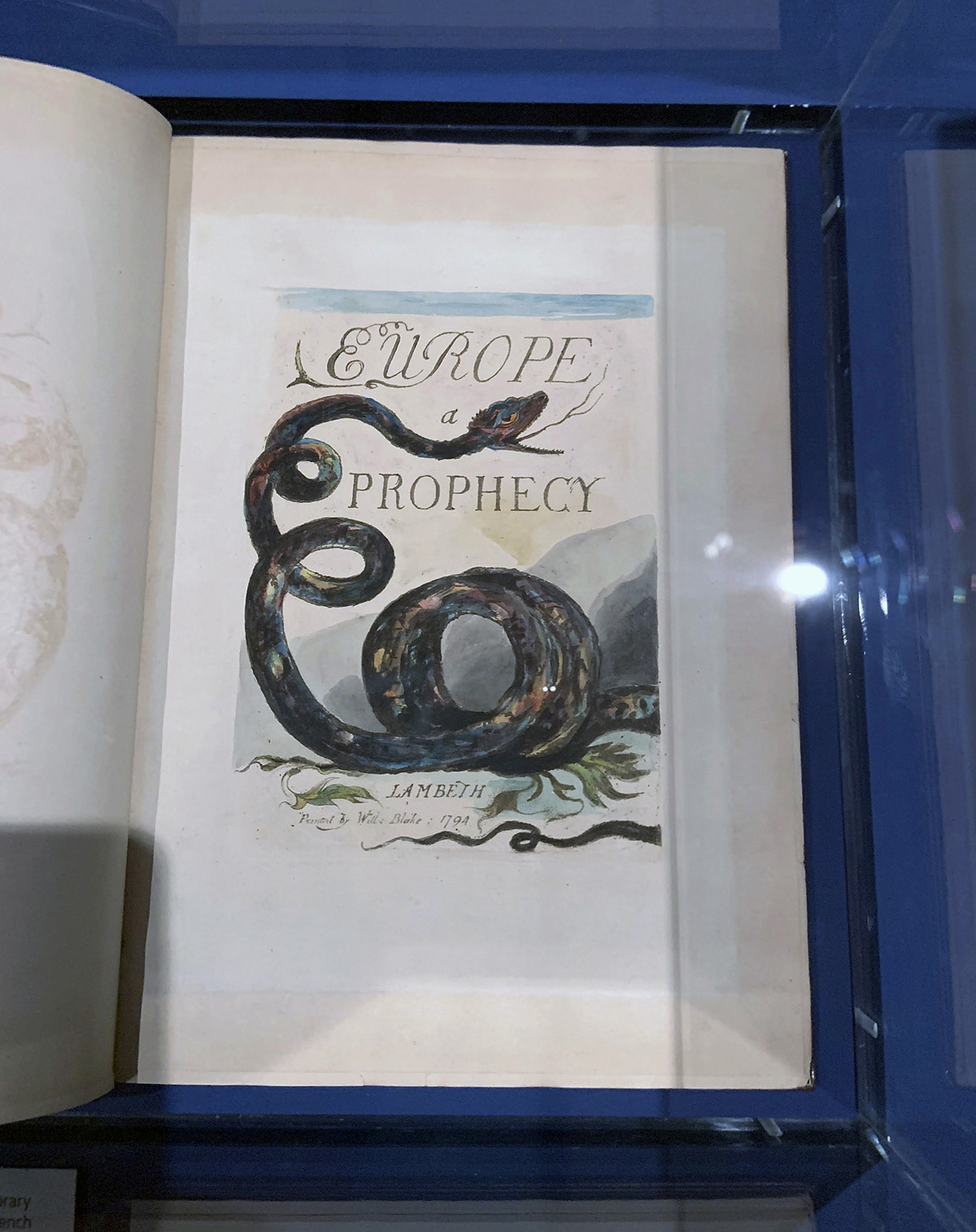
 

William Blake (British, 1757-1827) 'Europe, A Prophecy (Copy A)' 1794 (installation view)

William Blake (British, 1757-1827) 'Europe, A Prophecy (Copy A)' 1794 (installation view)


William Blake (British, 1757-1827)
Europe, A Prophecy (Copy A) (installation views)
1794
Book, 17 plates on 17 leaves
Open to Plate 2, title page
Colour-printed relief etching in dark brown with pen and black ink, oil and watercolour on paper
Photos: Marcus Bunyan


Europe, A Prophecy relates contemporary historical events – specifically the French Revolution – in an epic, symbolic form. As Blake’s biographer Alexander Gilchrist (1828-1861) observed of the book: ‘It is hard to describe poems wherein the dramatis personae are giant shadows, gloomy phantoms; the scene, the realms of space; the time, of such corresponding vastness, that eighteen hundred years pass as a dream’. Catherine Blake is likely to have coloured many of the plates in this copy, including the title page. This copy, may be that bought from Blake by the painter George Romney (1734-1802).

Label text


William Blake (British, 1757-1827) 'First Book of Urizen' pl. 6 1796, printed c. 1818


William Blake (British, 1757-1827)
First Book of Urizen pl. 6 ‘I sought Pleasure & found Pain, Unntennable’
1796, printed c. 1818
Etching with paint, watercolour and ink on paper
Tate. Purchased with funds provided by the Art Fund, Tate Members, Tate Patrons, Tate Fund and individual donors 2009
Creative Commons CC-BY-NC-ND (3.0 Unported)


William Blake (British, 1757-1827) 'The First Book of Urizen (Copy G)' 1794, printed c. 1818 (installation view)

William Blake (British, 1757-1827) 'The First Book of Urizen (Copy G)' 1794, printed c. 1818 (installation view)


William Blake (British, 1757-1827)
The First Book of Urizen (Copy G) (installation views)
1794, printed c. 1818
27 leaves, open to plate number 14
Relief etching printed in yellow brown with watercolour and gold
Library of Congress. Lessing J. Rosenwald collection, 1807
Photos: Marcus Bunyan


During his lifetime, Blake’s books were appreciated by collectors for their visual qualities far more than for their political and literary content. The First Book of Urizen was first printed in 1794. It was already strongly visual. In this new copy, printed in around 1818, Blake has enhanced this full-page image with intense colouring and gold.

Label text
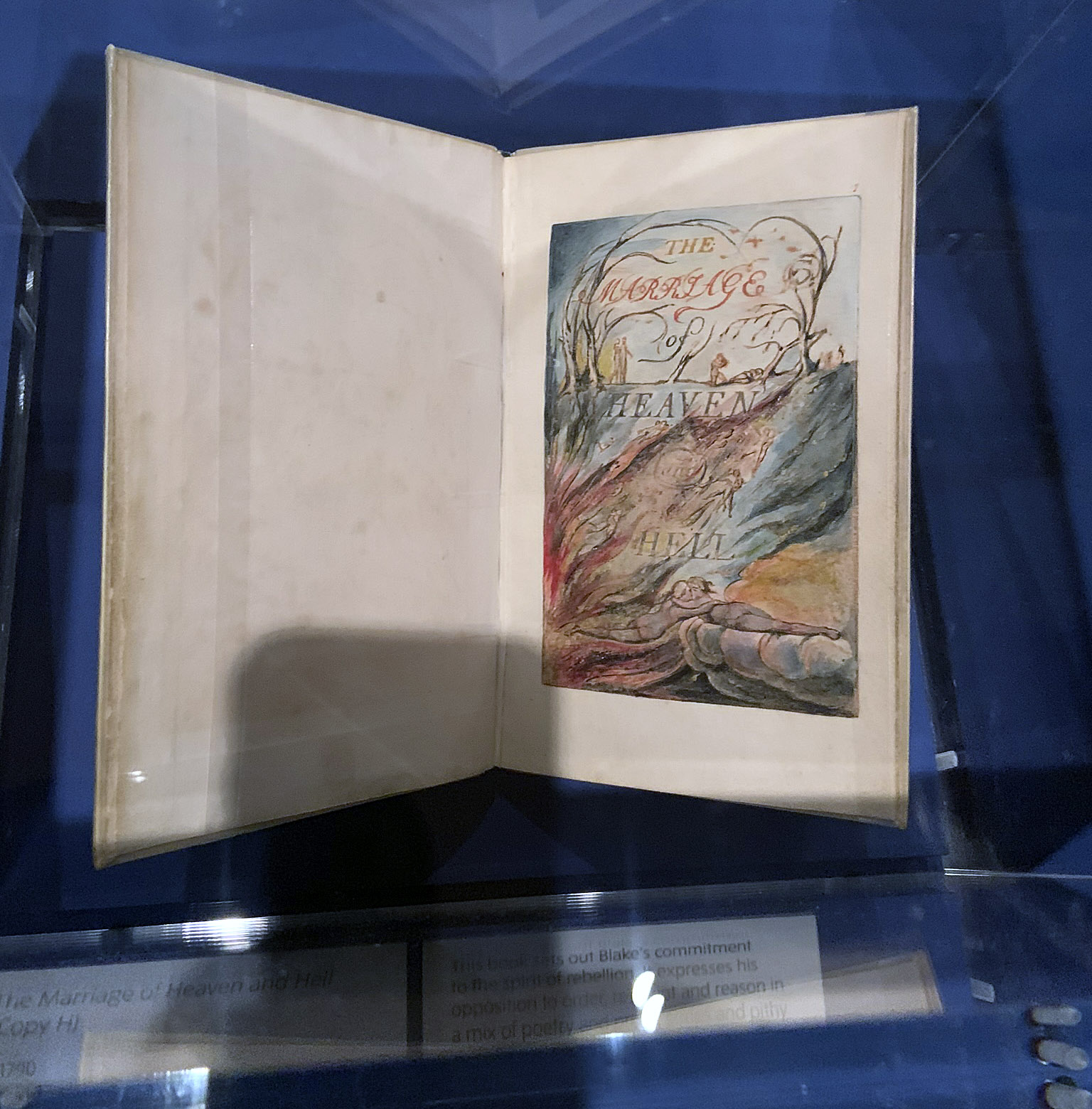
 

William Blake (British, 1757-1827) 'The Marriage of Heaven and Hell (Copy H)' c. 1790 (installation view)


William Blake (British, 1757-1827)
The Marriage of Heaven and Hell (Copy H) (installation view)
c. 1790
Book, 27 plates on 15 leaves
Open to title page
Relief etching with hand-colouring
The Syndics of the Fitzwilliam Museum, University of Cambridge
Photo: Marcus Bunyan
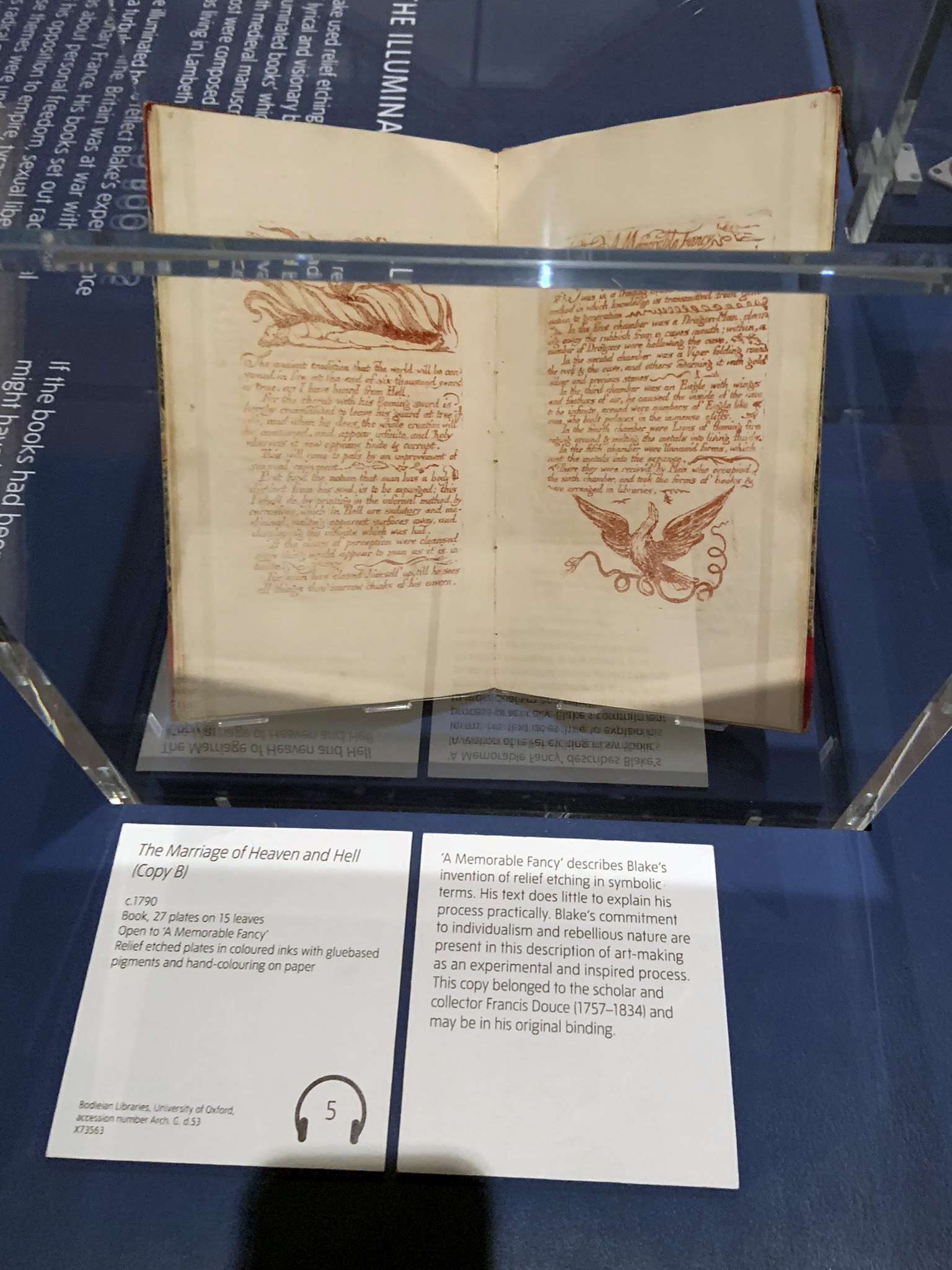
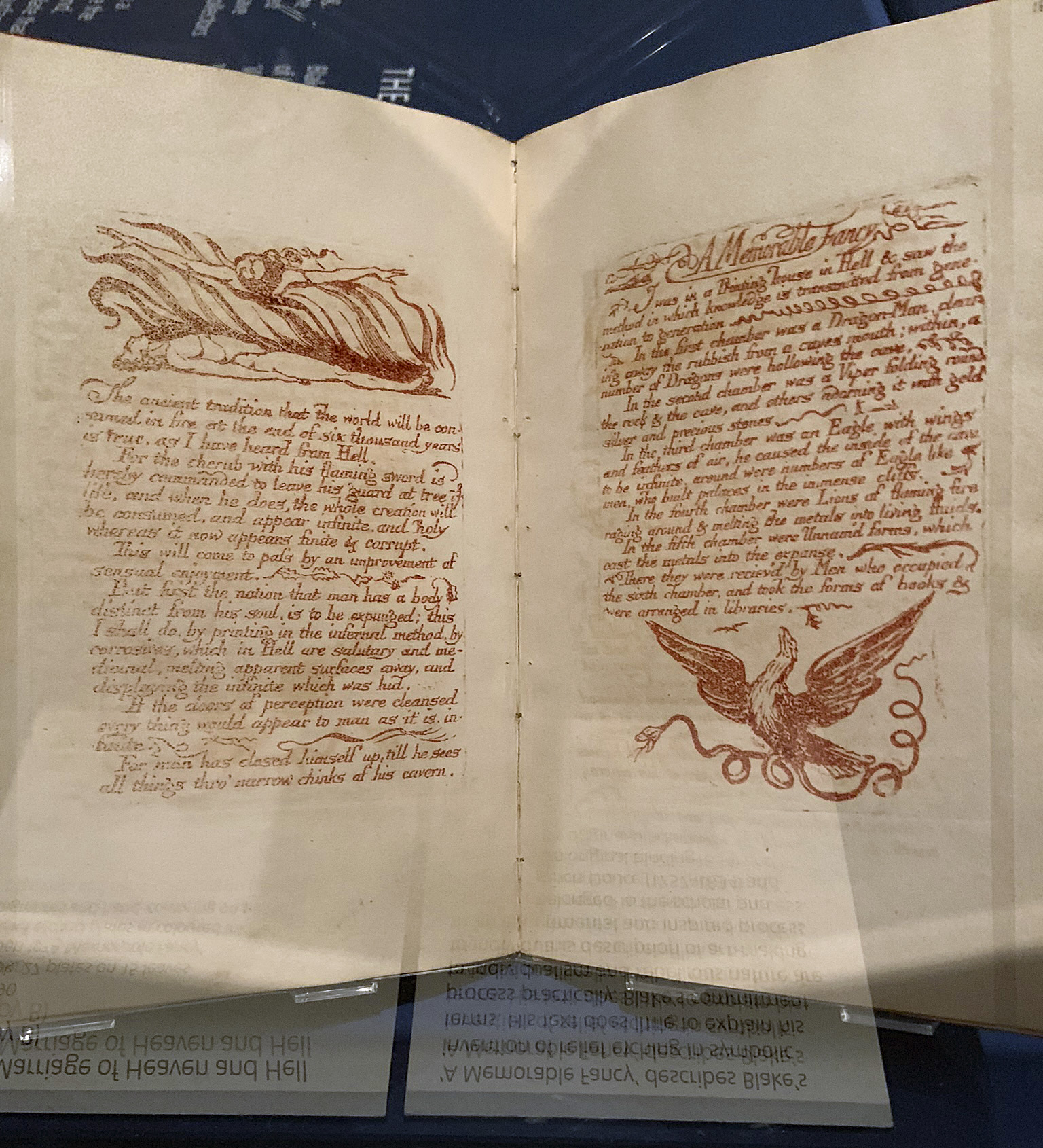
 

William Blake (British, 1757-1827) 'The Marriage of Heaven and Hell (Copy B)' c. 1790 (installation view)

William Blake (British, 1757-1827) 'The Marriage of Heaven and Hell (Copy B)' c. 1790 (installation view)

William Blake label text


William Blake (British, 1757-1827)
The Marriage of Heaven and Hell (Copy B) (installation views)
c. 1790
Book, 27 plates on 15 leaves
Open to A Memorable Fancy
Relief etched plates in coloured inks with glue-based pigments and hand-colouring paper
Bodlieian Libraries, University of Oxford
Photos: Marcus Bunyan


A Memorable Fancy describes Blake’s invention of relief etching in symbolic terms. His text does little to explain his process practically. Blake’s commitment to individualism and rebellious nature are present in this description of art-making as an experimental and inspired process. This copy belonged to the scholar and collector Francis Douce (1757-1834) and may be in his original binding.

Label text


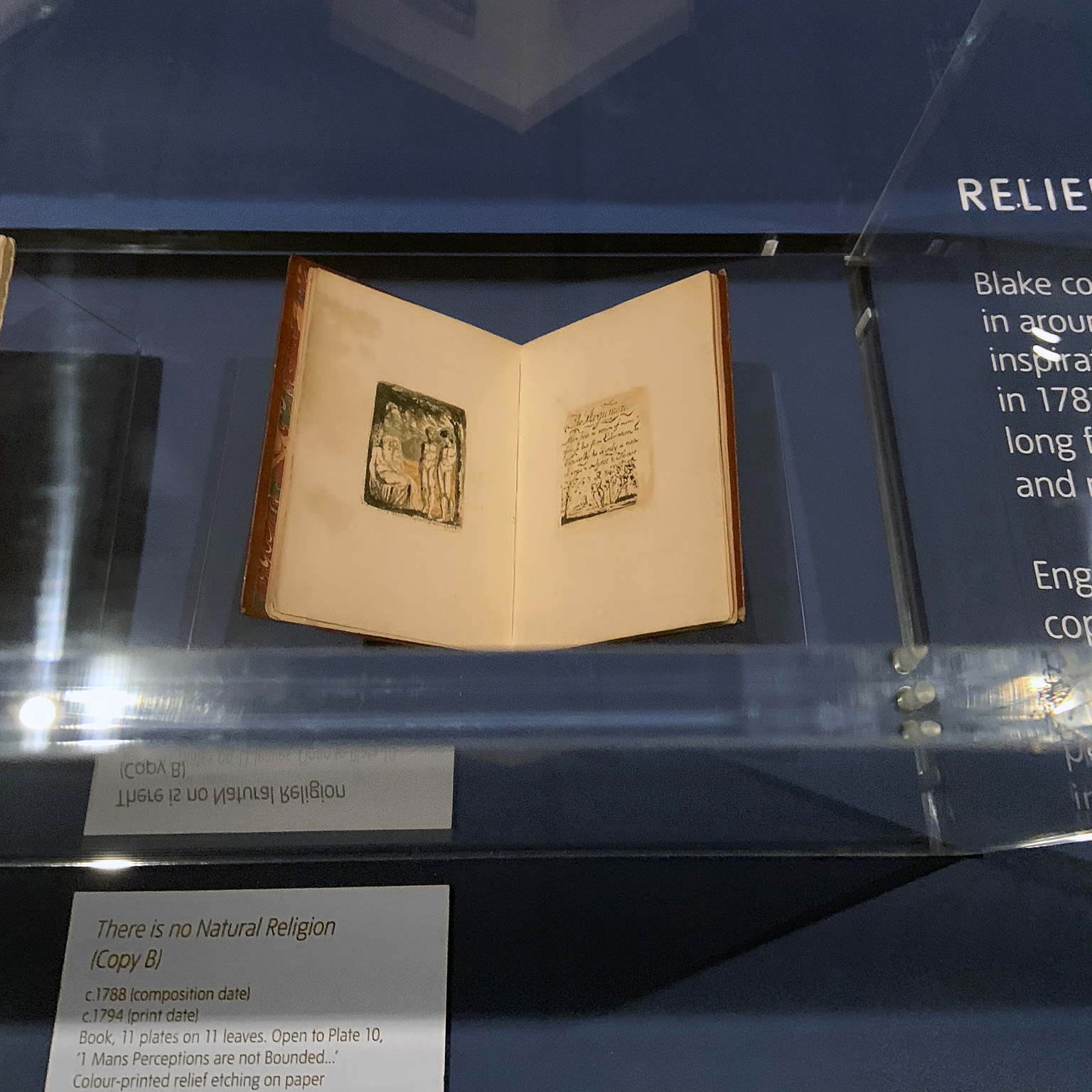
Relief etching

Blake conceived his technique of relief etching in around 1788. He claimed this was under the inspiration of his brother Robert, who had died in 1787. The technical details of his method have long fascinated and frustrated scholars and collectors and remain debated.

Engraving and etching involve making lines in a copper plate which are filled with ink to create the printed image. Relief etching, on the other hand, involves using acid to eat away areas of the plate that you want to leave unprinted. The remaining surfaces are inked and printed. Relief etching allowed Blake to combine hand-written texts and images on a single plate. These were normally entirely separate processes. Blake also experimented in printing with colours, and added pen and ink, watercolour and later on gold to create more dense, painterly images.

Wall text from the exhibition


William Blake (British, 1757-1827) 'Book of Thel (Copy I)' c. 1789 (installation view)


William Blake (British, 1757-1827)
There is no Natural Religion (Copy B) (installation view)
c. 1788 (composition date)
c. 1794 (print date)
Book, 11 plates on 11 leaves
Open to Plate 10. I Mans Perceptions are not Bounded…
Colour-printed relief etching on paper
Yale Center for British Art, Paul Mellon Collection
Photo: Marcus Bunyan


This collection of short philosophical statements was one of Blake’s first experiments in relief etching. This copy, printed in coloured inks, was produced in 1794.

Label text


Room 2

Making prints, making a living


“I curse & bless Engraving alternately because it takes so much time & is so untractable.
tho capable of such beauty & perfection”

~ William Blake


Blake was trained as a reproductive engraver. This exacting craft involved copying an image by cutting fine lines onto a metal plate so that it could be printed and reproduced many times. Blake enjoyed the precision of this work. He gained a good reputation and engraving provided him with an income throughout his life. He was sometimes employed to design as well as engrave illustrations, and for a short period from 1784 ran his own print publishing business with his friend and fellow engraver James Parker.

While Blake admired the uncompromising qualities of older prints, the market favoured more obviously decorative techniques. Blake could adapt his style, but he found the limitations of commercial work frustrating.

Around 1788 Blake invented a new form of printmaking, ‘relief etching’. He described the technique in poetic rather than practical terms so his exact methods remain mysterious. The process allowed Blake to print in colour and combine texts and images. Blake used the technique to create a succession of visionary books. These engaged with the most pressing moral and political questions of the day, including revolution, sexual freedom and the slave trade. Blake’s illuminated books combined poetry and images in experimental ways. His images rarely illustrate the text directly. He also printed some of the images separately without words. Later in life Blake continued to print copies for fellow artists and rare book collectors, adding richer colours and gold to make them more visually enticing.

Wall text from the exhibition


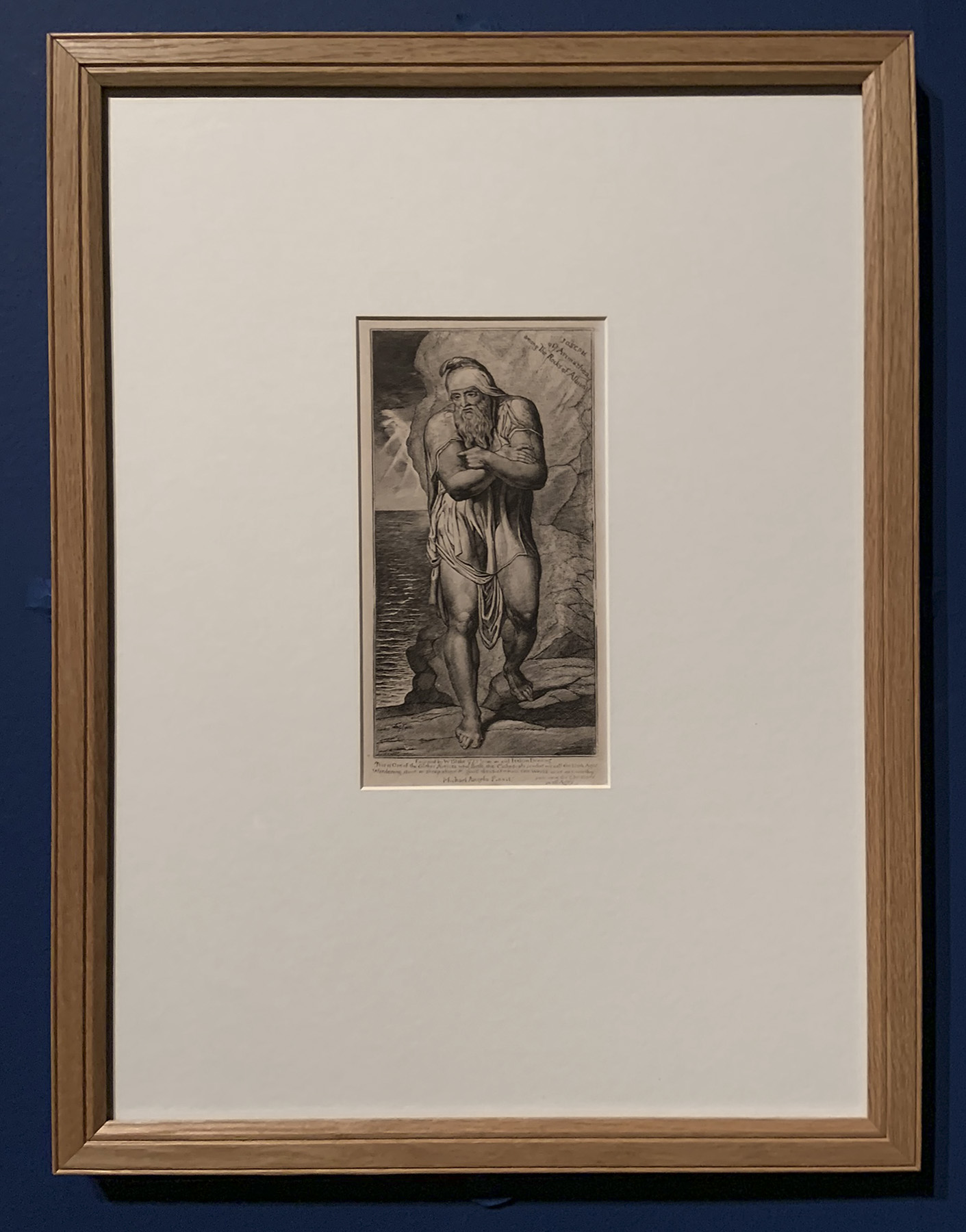
William Blake (British, 1757-1827) 'Joseph of Arimathea among the Rocks of Albion' c. 1810 (installation view)


William Blake (British, 1757-1827)
Joseph of Arimathea among the Rocks of Albion (installation view)
c. 1810
Engraving using carbon ink on paper
The Syndics of the Fitzwilliam Museum, University of Cambridge
Photo: Marcus Bunyan


William Blake (British, 1757-1827) 'Joseph of Arimathea among the Rocks of Albion' c. 1810 (installation view)


William Blake (British, 1757-1827)
Joseph of Arimathea among the Rocks of Albion (installation view)
c. 1810
Engraving using carbon ink on paper
The Syndics of the Fitzwilliam Museum, University of Cambridge
Photo: Marcus Bunyan


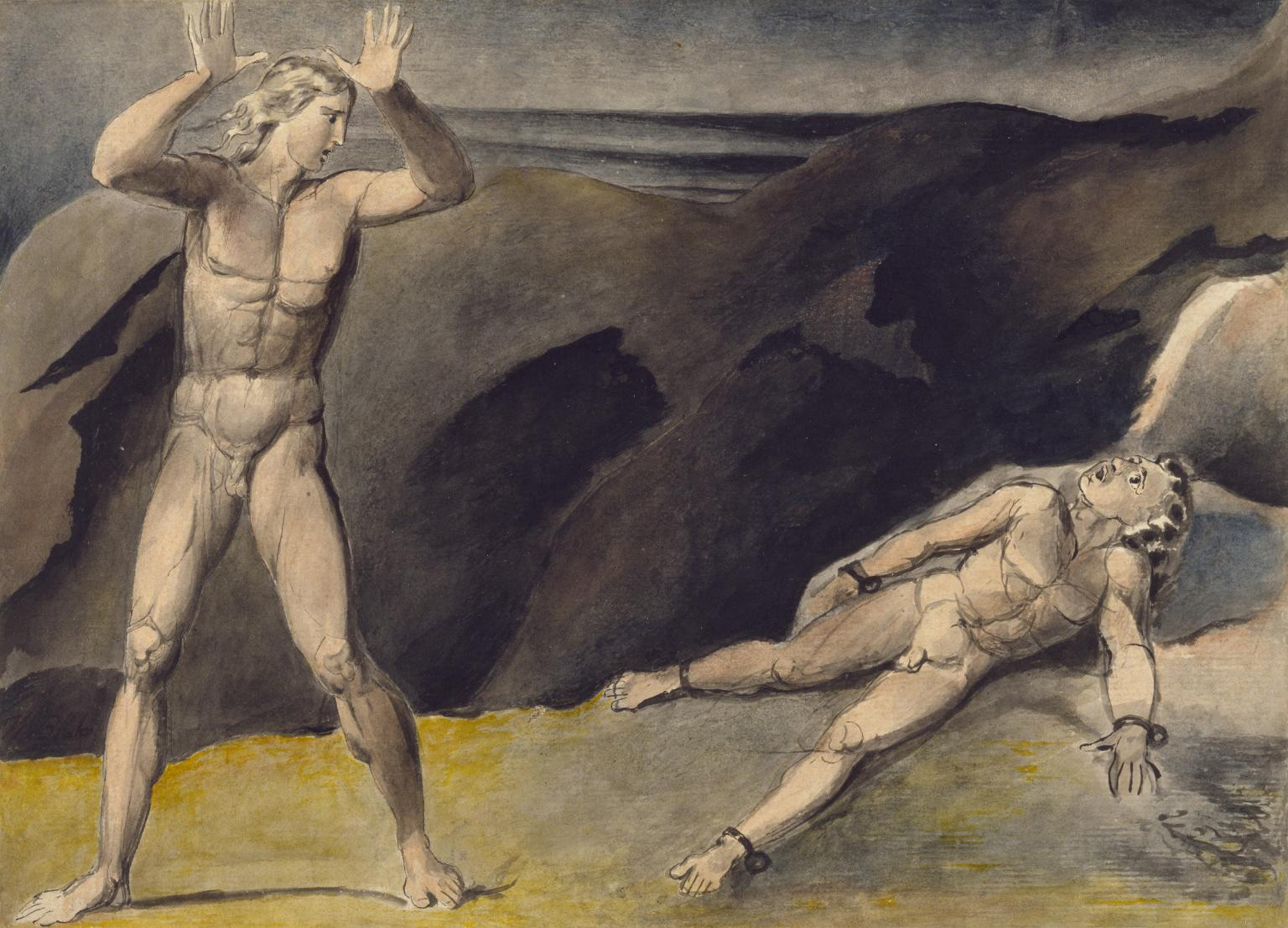
William Blake (British, 1757-1827) 'Los and Orc' c. 1792-1793


William Blake (British, 1757-1827)
Los and Orc
c. 1792-1793
Ink and watercolour on paper
217 × 295 mm
Tate. Presented by Mrs Jane Samuel in memory of her husband 1962
Creative Commons CC-BY-NC-ND (3.0 Unported)


This watercolour represents a turning-point in Blake’s art because it depicts a subject taken from his invented mythology which he used across the illuminated books. The figures appear to be the characters Los, representing imagination, and the chained Orc, the spirit of rebellion.

Wall text from the exhibition
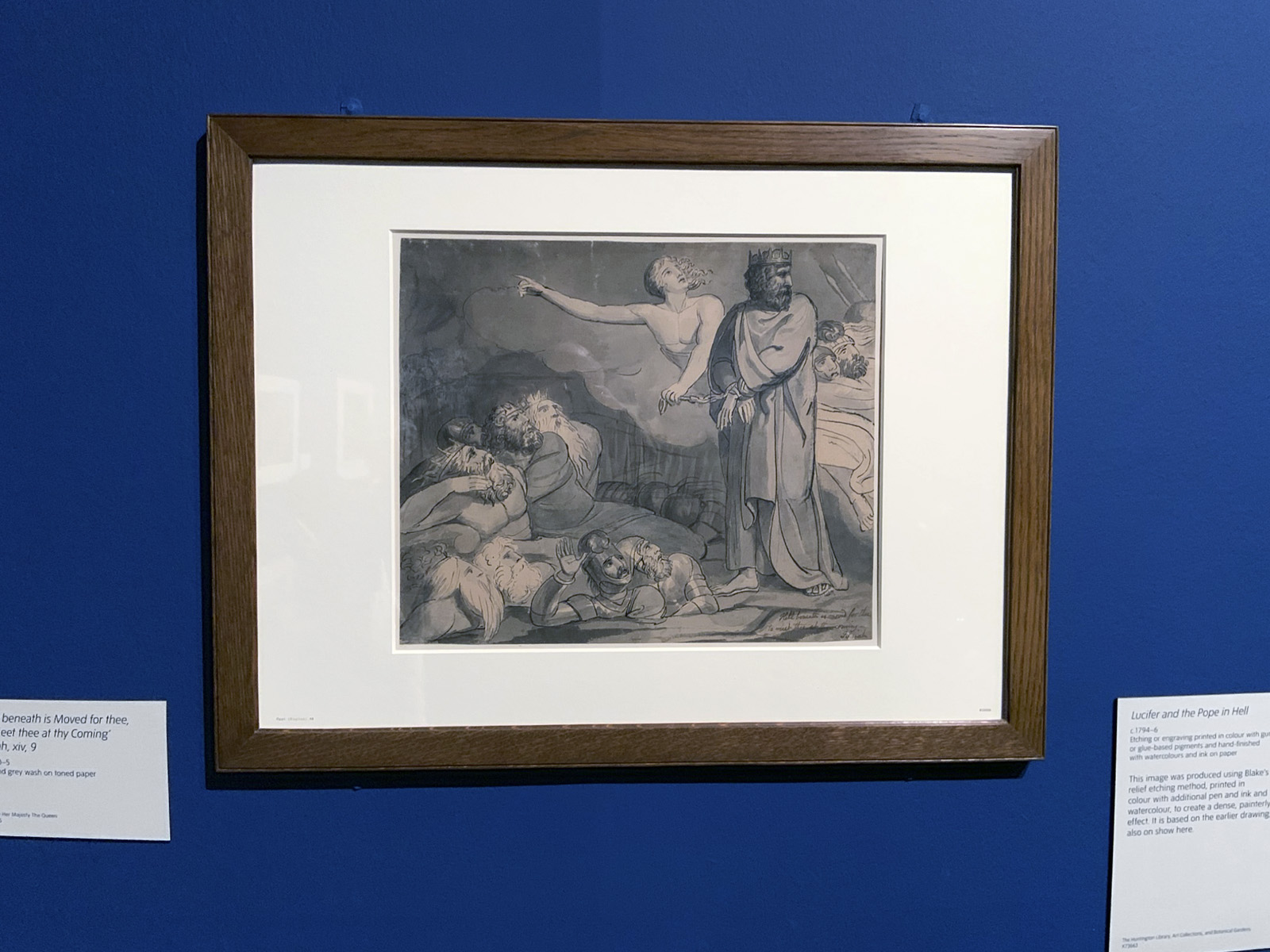
 

William Blake (British, 1757-1827) 'Hell beneath is Moved for thee, to Meet thee at thy Coming Isaiah, xiv, 9' c. 1780-1885 (installation view)


William Blake (British, 1757-1827)
Hell beneath is Moved for thee, to Meet thee at thy Coming (installation view)
Isaiah, xiv, 9
c. 1780-1785
Ink and grey wash on toned paper
Lent by her Majesty The Queen
Photo: Marcus Bunyan
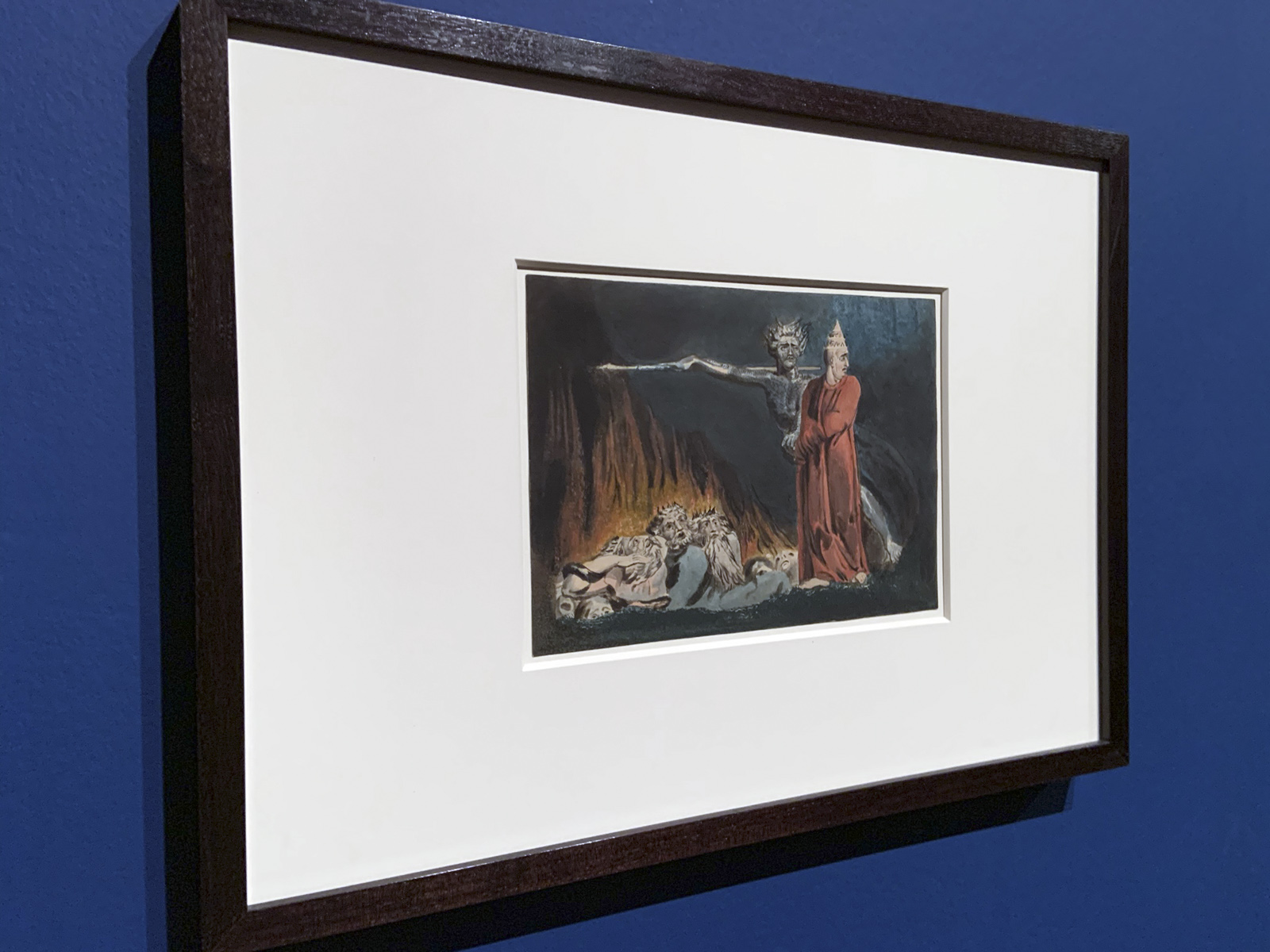
 

William Blake (British, 1757-1827) 'Lucifer and the Pope in Hell' c. 1794-1796 (installation view)


William Blake (British, 1757-1827)
Lucifer and the Pope in Hell (installation view)
c. 1794-1796
Etching or engraving printed in colour with gum or glue-based pigments and hand-finished with watercolours and ink on paper
The Huntington Library, Art Collections, and Botanical Gardens
Photo: Marcus Bunyan


This image was produced using Blake’s relief etching method, printed in colour with additional pen and ink and watercolour, to create a dense, painterly effect. It is based on an earlier drawing.

Wall text from the exhibition
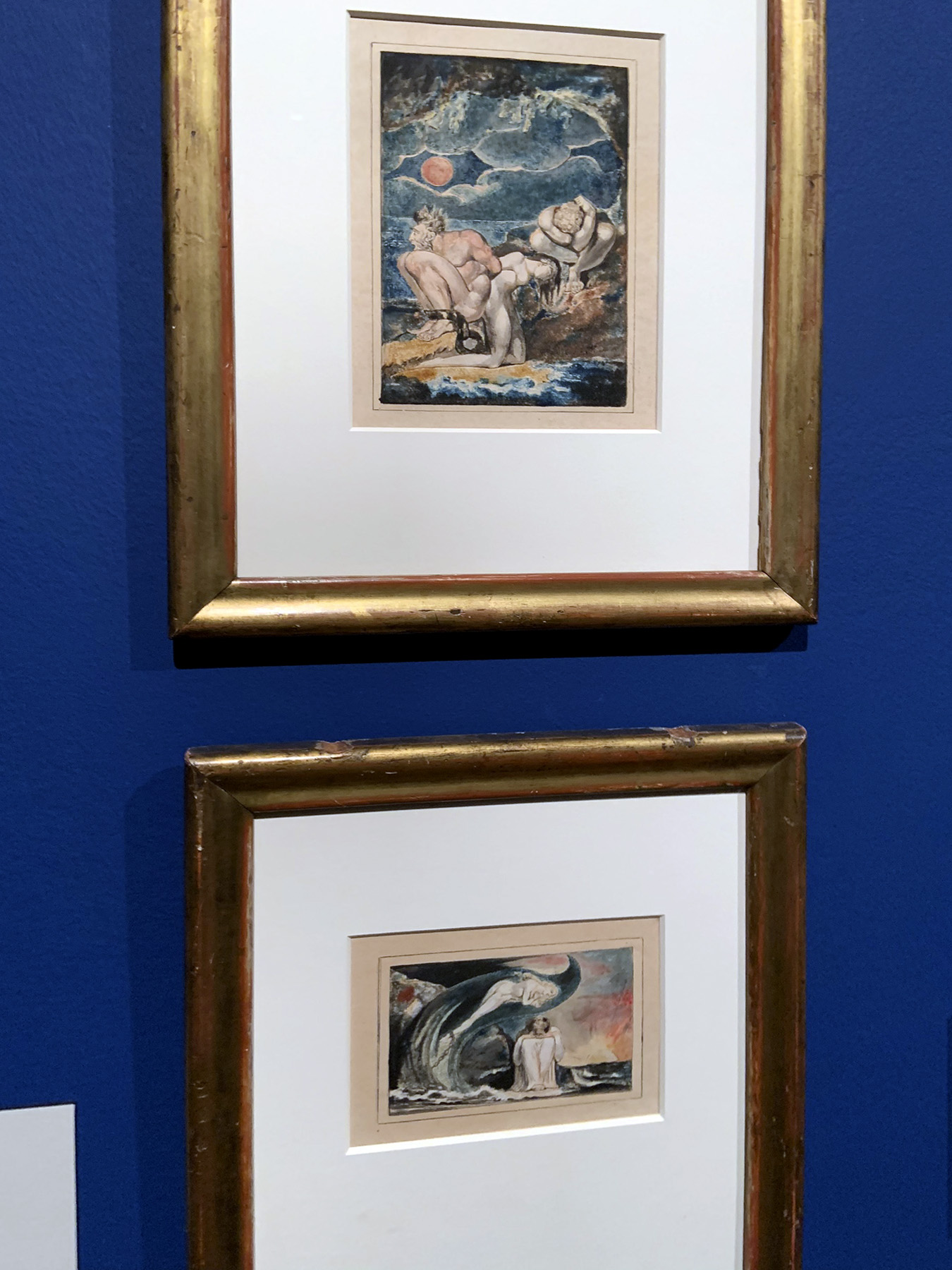
 

Installation view of the exhibition 'William Blake' at Tate Britain showing Frontispiece and Plate 4 to 'Visions of the Daughters of Albion' (installation view) c. 1795


William Blake (British, 1757-1827)
Frontispiece to ‘Visions of the Daughters of Albion’ (installation view)
c. 1795
Relief etching, ink and watercolour on paper
Tate

William Blake (British, 1757-1827)
Plate 4 of ‘Visions of the Daughters of Albion’ (installation view)
c. 1795
Relief etching, ink and watercolour on paper
Tate
Photo: Marcus Bunyan
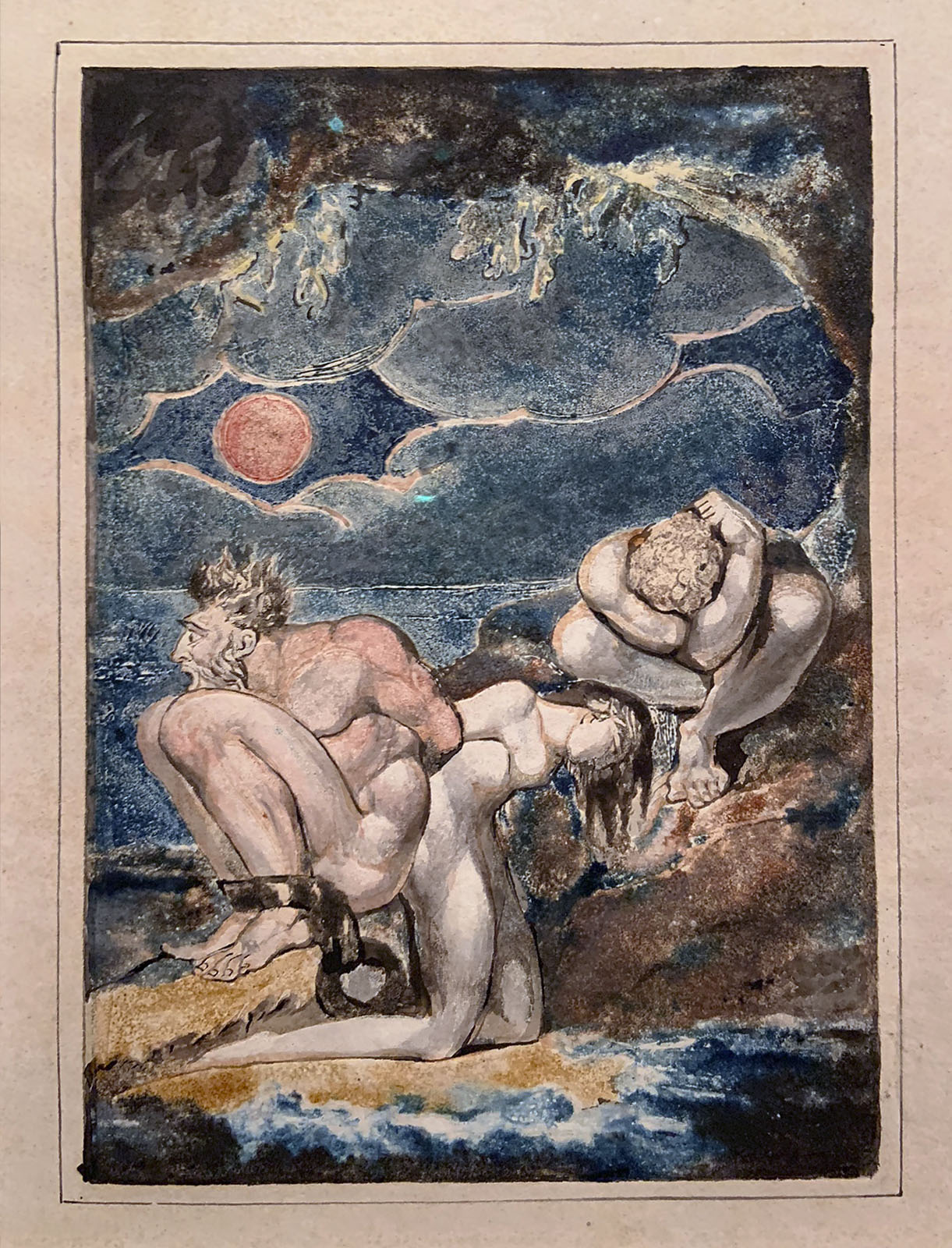
 

William Blake (British, 1757-1827) Frontispiece to 'Visions of the Daughters of Albion' c. 1795 (installation view)


William Blake (British, 1757-1827)
Frontispiece to ‘Visions of the Daughters of Albion’ (installation view)
c. 1795
Relief etching, ink and watercolour on paper
Tate
Photo: Marcus Bunyan


Installation view of the exhibition 'William Blake' at Tate Britain showing Small Book of Designs: Plate 7, 'Of life on his forsaken mountains' (installation view) 1794 and Small Book of Designs: Plate 8, 'dark seascape with figure in water' (installation view) 1794


William Blake (British, 1757-1827)
Small Book of Designs: Plate 7, ‘Of life on his forsaken mountains’ (installation view)
1794
Colour-printed relief etching with hand-colouring, on paper
Lent by the British Museum, London

William Blake (British, 1757-1827)
Small Book of Designs: Plate 8, ‘dark seascape with figure in water’ (installation view)
1794
Colour-printed relief etching with hand-colouring, on paper
Lent by the British Museum, London
Photo: Marcus Bunyan


William Blake (British, 1757-1827) Small Book of Designs: Plate 7, 'Of life on his forsaken mountains' 1794 (installation view)


William Blake (British, 1757-1827)
Small Book of Designs: Plate 7, ‘Of life on his forsaken mountains’ (installation view)
1794
Colour-printed relief etching with hand-colouring, on paper
Lent by the British Museum, London
Photo: Marcus Bunyan


William Blake (British, 1757-1827) 'A Small Book of Designs copy A object 7 The First Book of Urizen plate 23' 1796


William Blake (British, 1757-1827)
A Small Book of Designs copy A object 7 The First Book of Urizen plate 23
1796
Colour-printed relief etching with hand-colouring, on paper
The William Blake Archive, The British Museum
Wikipedia Commons, Public Domain
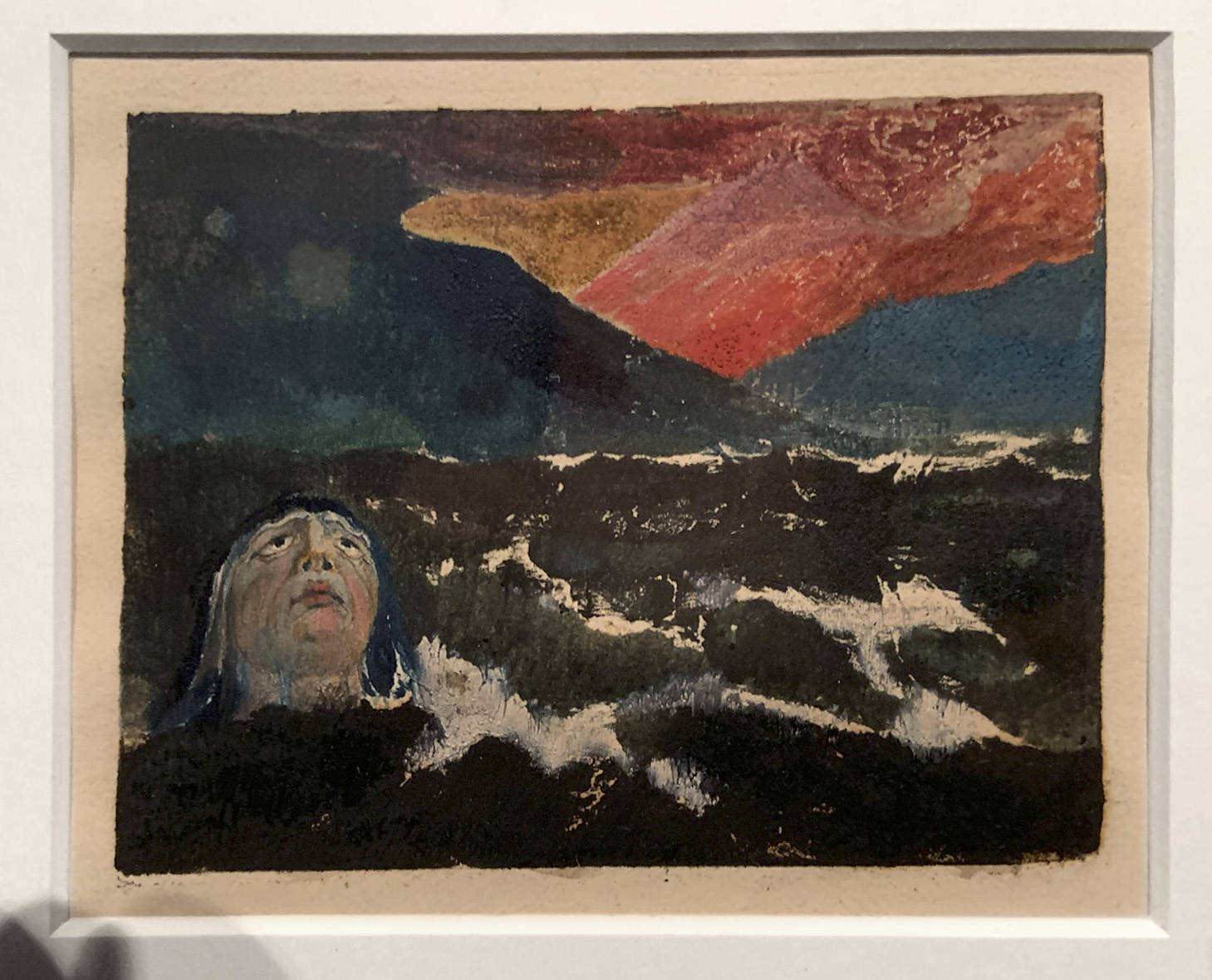
 

William Blake (British, 1757-1827) Small Book of Designs: Plate 8, 'dark seascape with figure in water' 1794 (installation view)


William Blake (British, 1757-1827)
Small Book of Designs: Plate 8, ‘dark seascape with figure in water’ (installation view)
1794
Colour-printed relief etching with hand-colouring, on paper
Lent by the British Museum, London
Photo: Marcus Bunyan
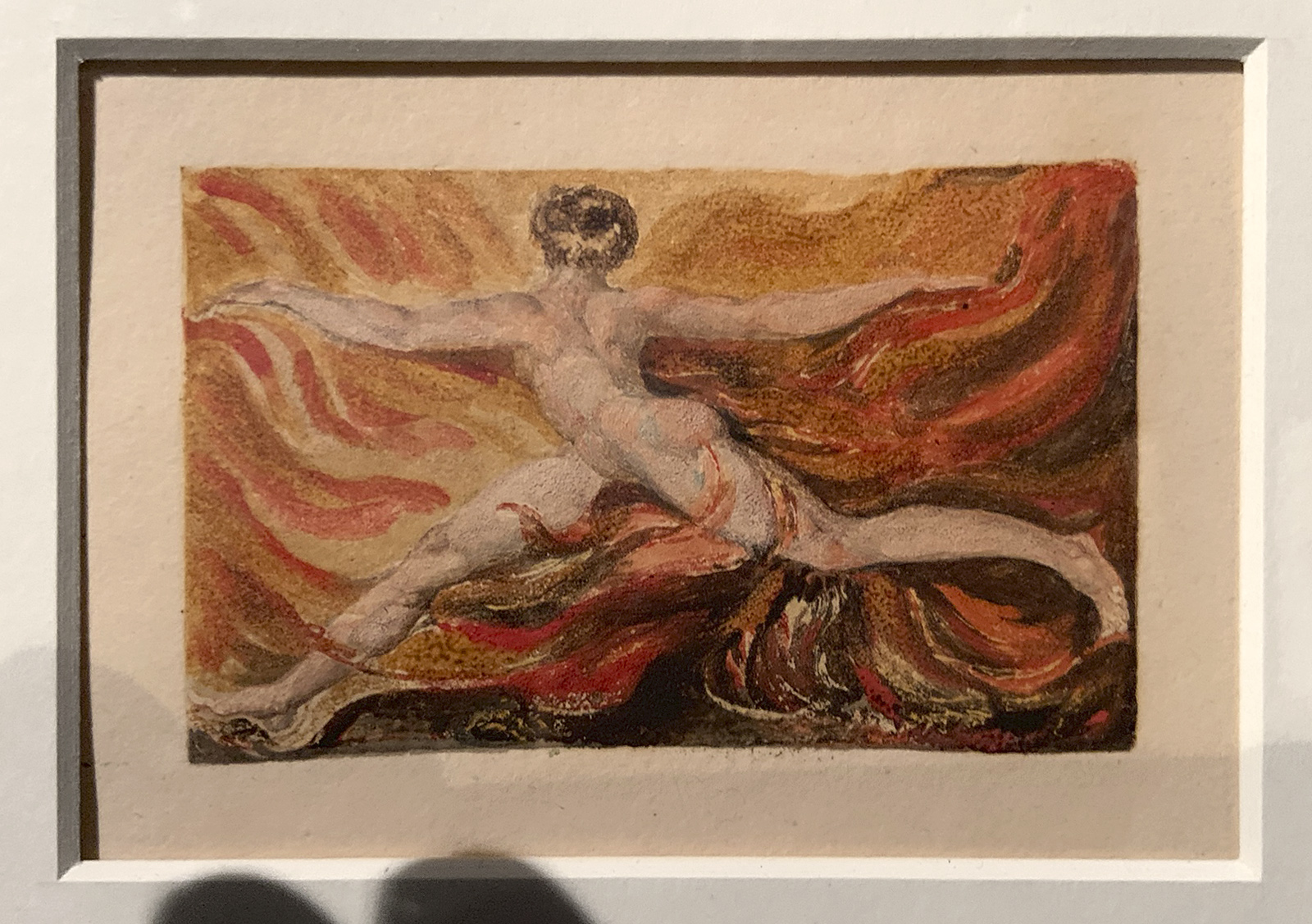
 

William Blake (British, 1757-1827) Small Book of Designs: Plate 9, 'Lo, a shadow of horror' 1794 (installation view)


William Blake (British, 1757-1827)
Small Book of Designs: Plate 9, ‘Lo, a shadow of horror’ (installation view)
1794
Colour-printed relief etching with hand-colouring, on paper
Lent by The British Museum, London
Photo: Marcus Bunyan
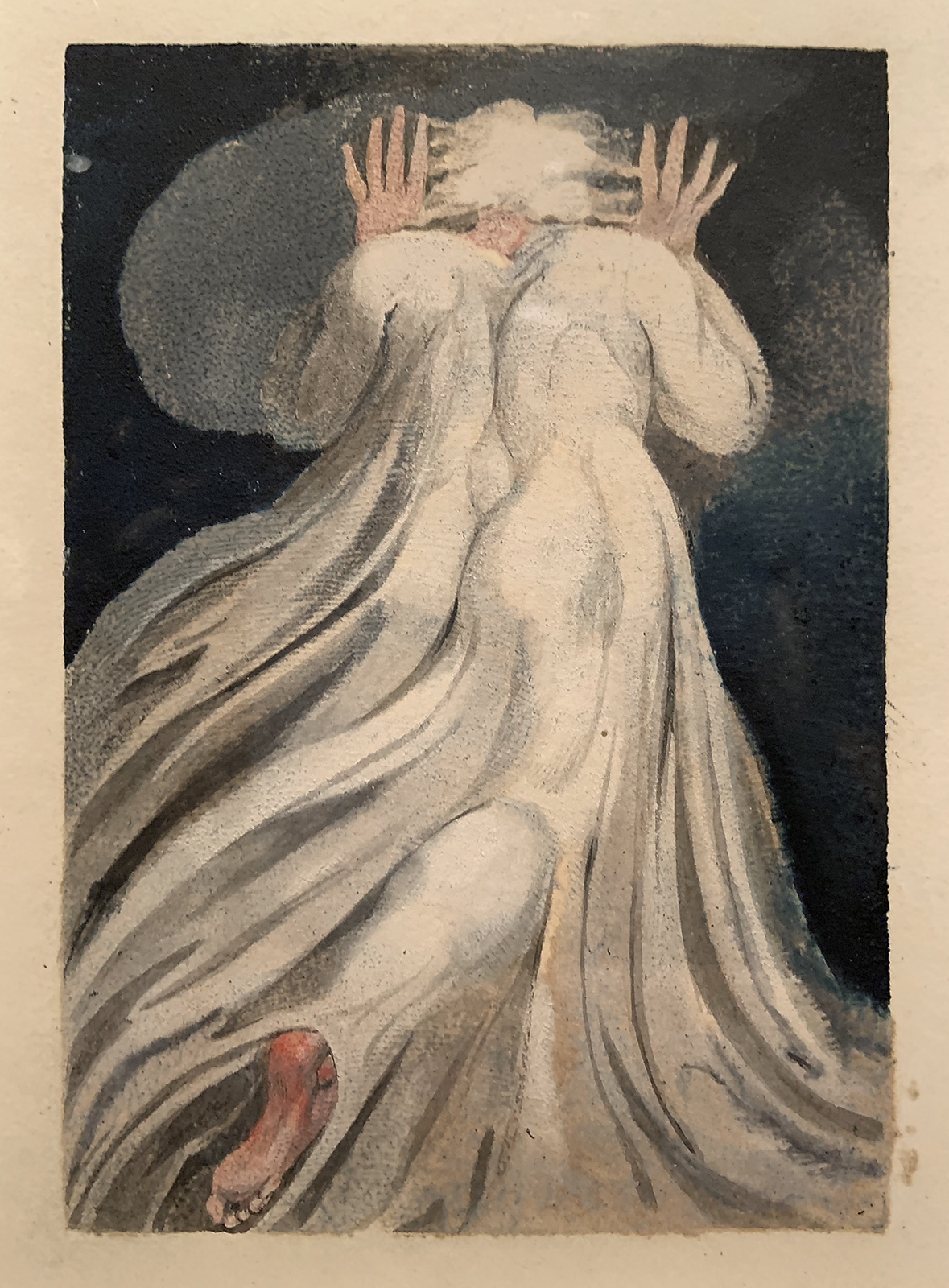
 

William Blake (British, 1757-1827) Small Book of Designs: Plate 11, 'Gowned Male Seen from behind' 1794 (installation view)


William Blake (British, 1757-1827)
Small Book of Designs: Plate 11, ‘Gowned Male Seen from behind’ (installation view)
1794
Colour-printed relief etching with hand-colouring, on paper
Lent by The British Museum, London
Photo: Marcus Bunyan
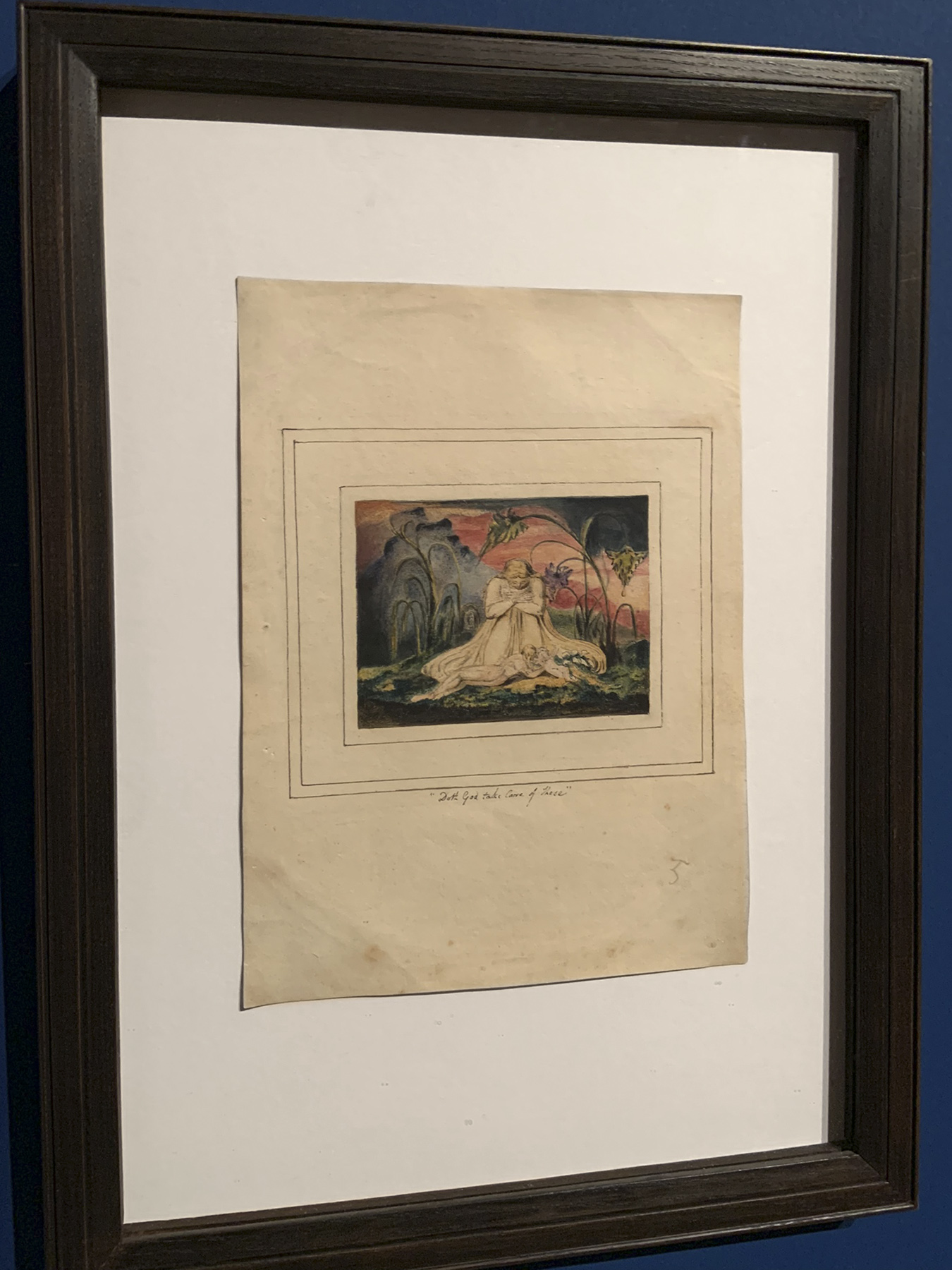
 

William Blake (British, 1757-1827) 'The Book of Thel, Plate 6' 1796, c. 1818 (installation view)

William Blake (British, 1757-1827) 'The Book of Thel, Plate 6' 1796, c. 1818 (installation view)

William Blake (British, 1757-1827) 'The Book of Thel, Plate 6' 1796, c. 1818 (installation view)


William Blake (British, 1757-1827)
The Book of Thel, Plate 6 ‘Doth God take Care of these’ (installation views)
1796, c. 1818
Etching with paint, watercolour and ink on paper
Tate. Purchased with funds provided by the Art Fund, Tate Members,Tate Patrons, Tate Fund and individual donors 2009
Photos: Marcus Bunyan


William Blake (British, 1757-1827) 'Copy A, Plate 7 in 'The First Book of Urizen' 1794 (installation view)


William Blake (British, 1757-1827)
Copy A, Plate 7 in ‘The First Book of Urizen’ (installation view)
1794
Colour relief etching predominantly in black, grey and pink, with hand-colouring, on paper
Lent by The British Museum, London
Photo: Marcus Bunyan
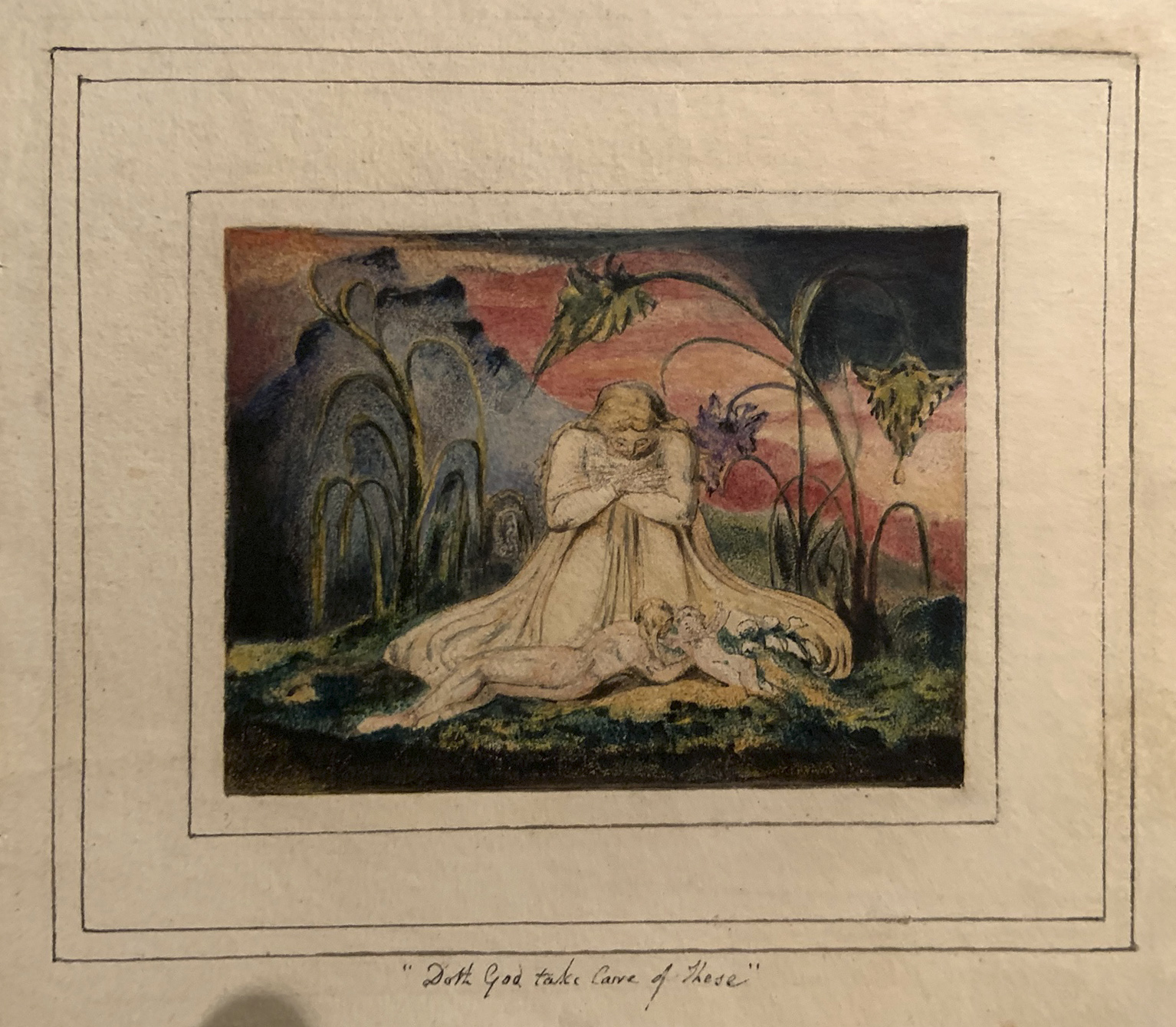
 

William Blake (British, 1757-1827) Copy A, plate 12, Design from 'Preludium' in 'The First Book of Urizen' 1794 (installation view)


William Blake (British, 1757-1827)
Copy A, plate 12, Design from ‘Preludium’ in ‘The First Book of Urizen’ (installation view)
1794
Colour-printed relief etchings with hand-colouring, on paper
Lent by The British Museum, London
Photo: Marcus Bunyan


William Blake (British, 1757-1827) 'First Book of Urizen, Plate 10' 1796, c. 1818 (installation view)

William Blake (British, 1757-1827) 'First Book of Urizen, Plate 10' 1796, c. 1818 (installation view)


William Blake (British, 1757-1827)
First Book of Urizen, Plate 10 ‘Every thing is an attempt, To be Human’ (installation views)
1796, c. 1818
Etching with paint, watercolour and ink on paper
Tate. Purchased with funds provided by the Art Fund, Tate Members, Tate Patrons, Tate Fund and individual donors 2009
Photos: Marcus Bunyan
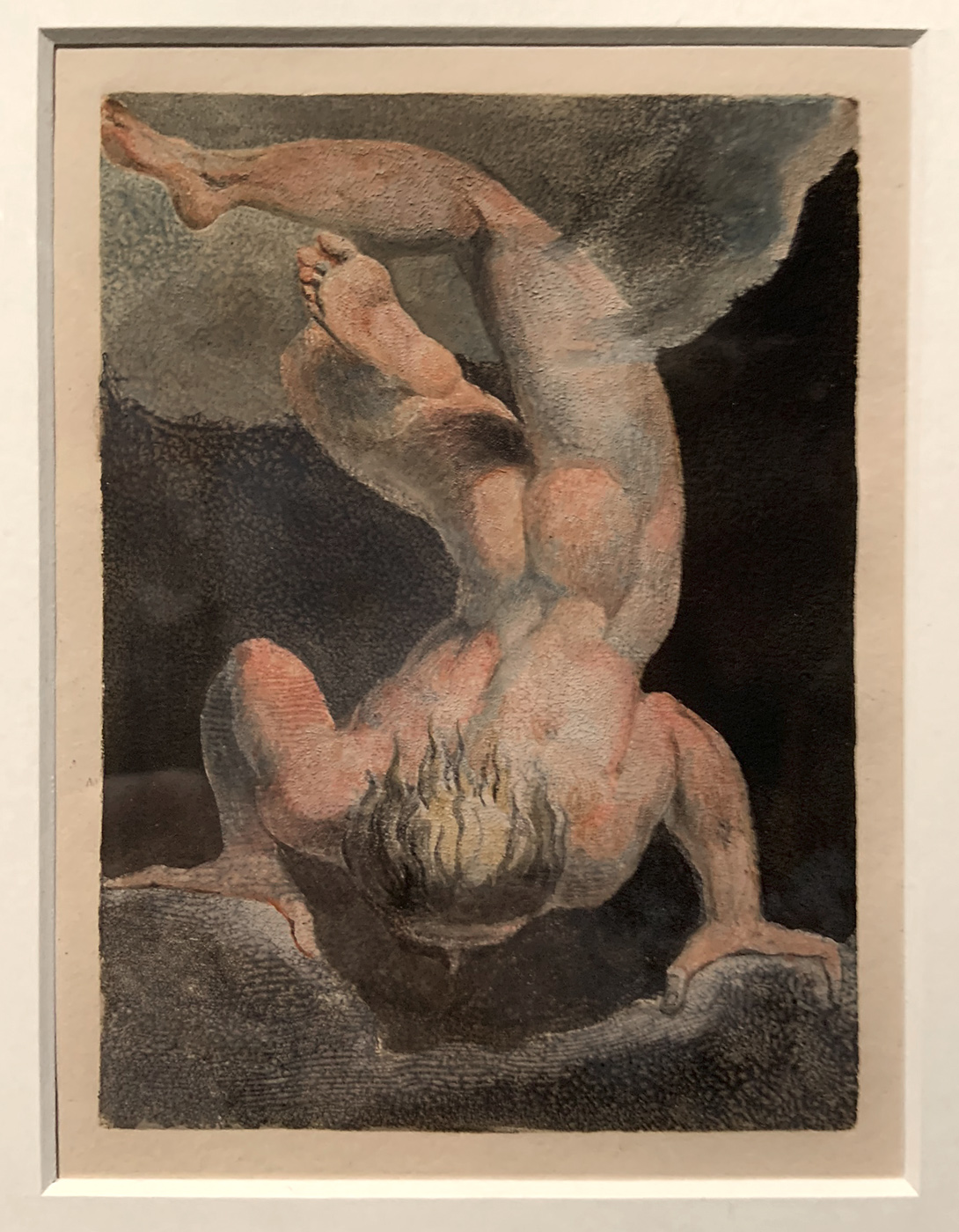


William Blake (British, 1757-1827)
First Book of Urizen, Plate 10 ‘Every thing is an attempt, To be Human’
1796, c. 1818
Etching with paint, watercolour and ink on paper
Tate. Purchased with funds provided by the Art Fund, Tate Members, Tate Patrons, Tate Fund and individual donors 2009
Creative Commons CC-BY-NC-ND (3.0 Unported)


“I was in a Printing house in Hell, & saw the method in which knowledge is transmitted from generation to generation.”


William Blake, ‘The Marriage of Heaven and Hell’ c. 1790


William Blake (British, 1757-1827) 'First Book of Urizen, Plate 15' 1796, c. 1818 (installation view)

William Blake (British, 1757-1827) 'First Book of Urizen, Plate 15' 1796, c. 1818 (installation view)

William Blake (British, 1757-1827) 'First Book of Urizen, Plate 15' 1796, c. 1818 (installation view)


William Blake (British, 1757-1827)
First Book of Urizen, Plate 15 (installation views)
1796, c. 1818
Etching with paint, watercolour and ink on paper
Tate. Purchased with funds provided by the Art Fund, Tate Members, Tate Patrons, Tate Fund and individual donors 2009
Photos: Marcus Bunyan


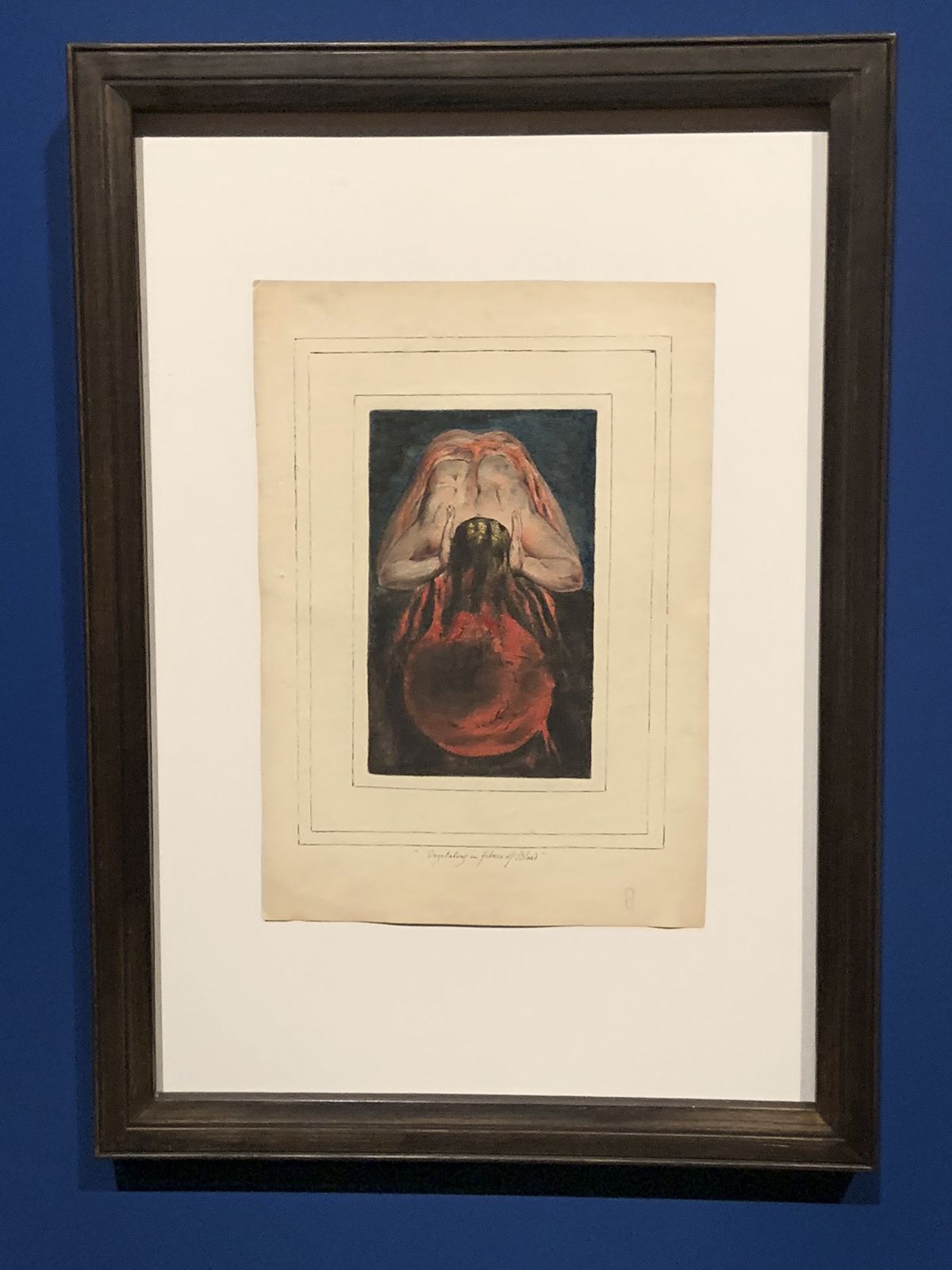
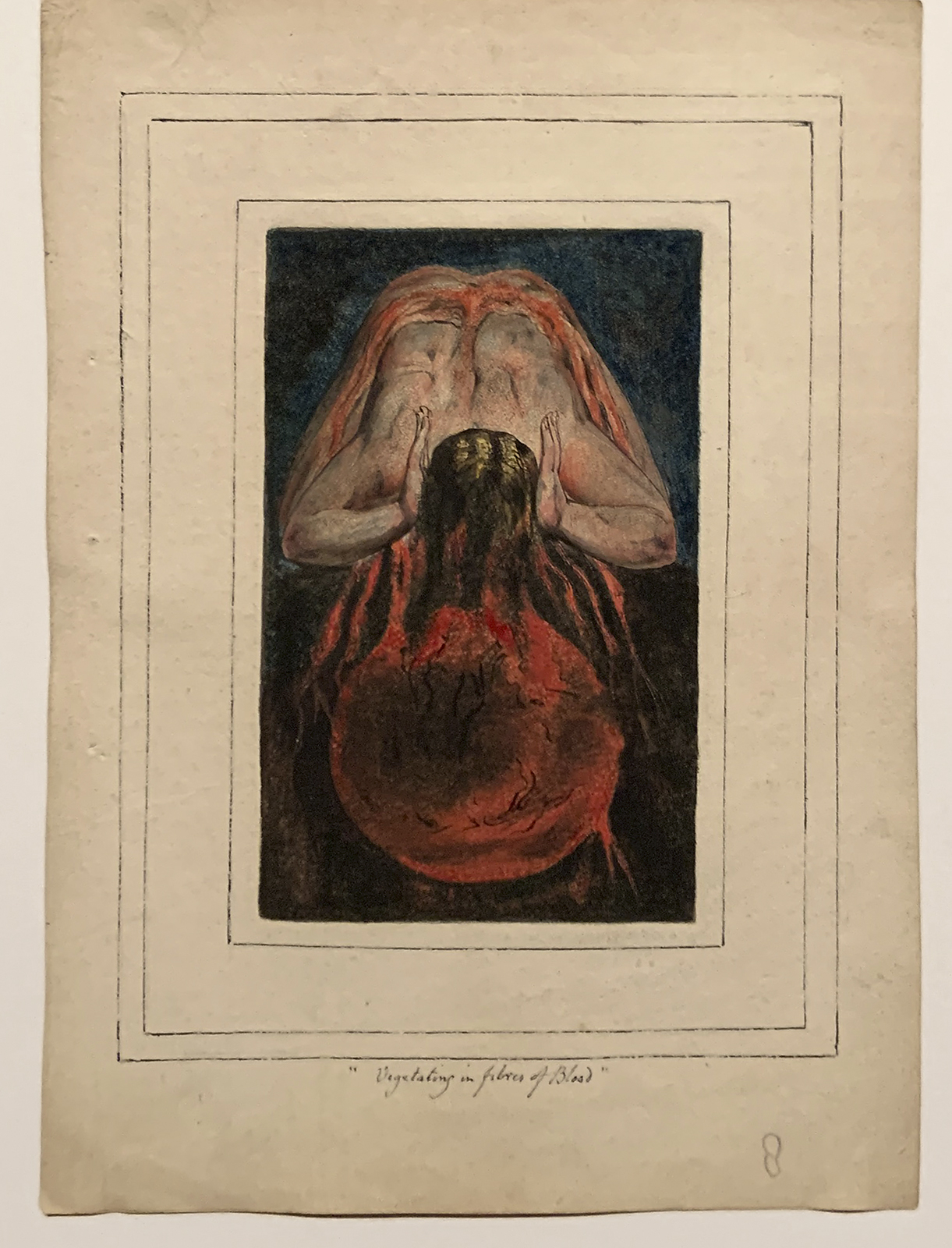
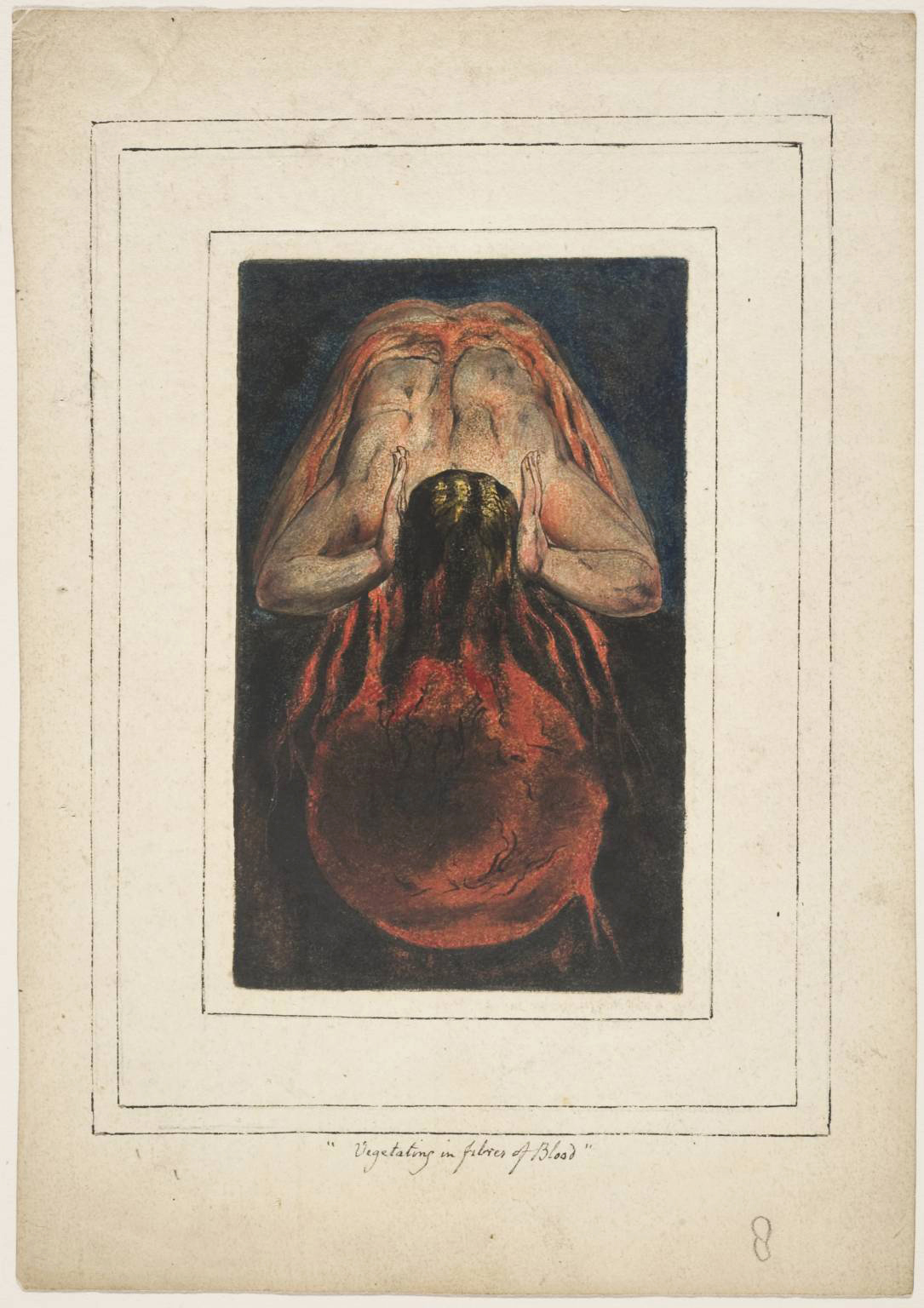
William Blake (British, 1757-1827) 'First Book of Urizen, Plate 15' 1796, c. 1818


William Blake (British, 1757-1827)
First Book of Urizen, Plate 15 ‘Vegetating in fibres of Blood’
1796, c. 1818
Etching with paint, watercolour and ink on paper
Tate. Purchased with funds provided by the Art Fund, Tate Members, Tate Patrons, Tate Fund and individual donors 2009
Creative Commons CC-BY-NC-ND (3.0 Unported)


William Blake (British, 1757-1827) 'First Book of Urizen, Plate 17' 1796, c.1818 (installation view)

William Blake (British, 1757-1827) 'First Book of Urizen, Plate 17' 1796, c.1818 (installation view)

William Blake (British, 1757-1827) 'First Book of Urizen, Plate 17' 1796, c.1818 (installation view)


William Blake (British, 1757-1827)
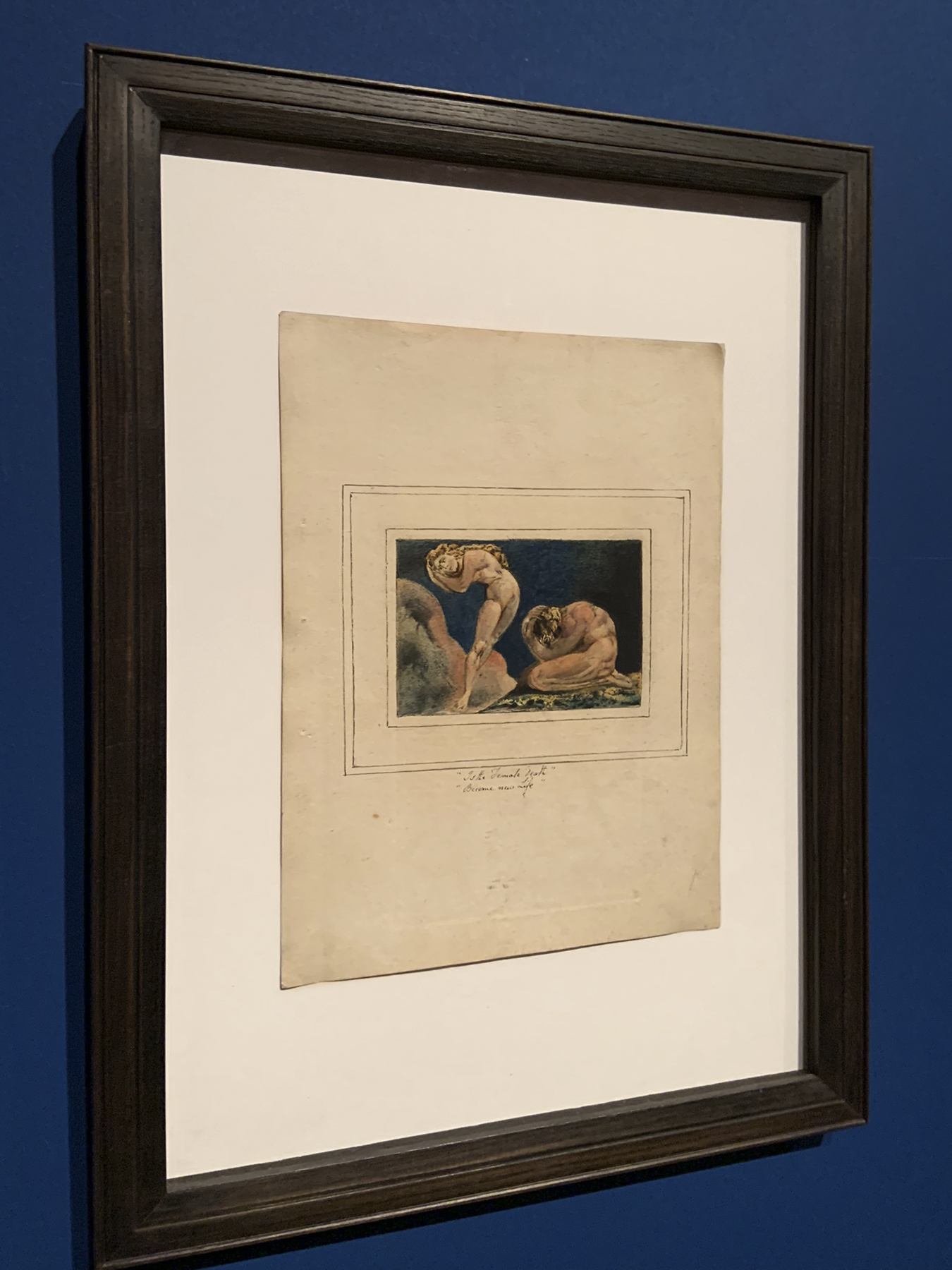
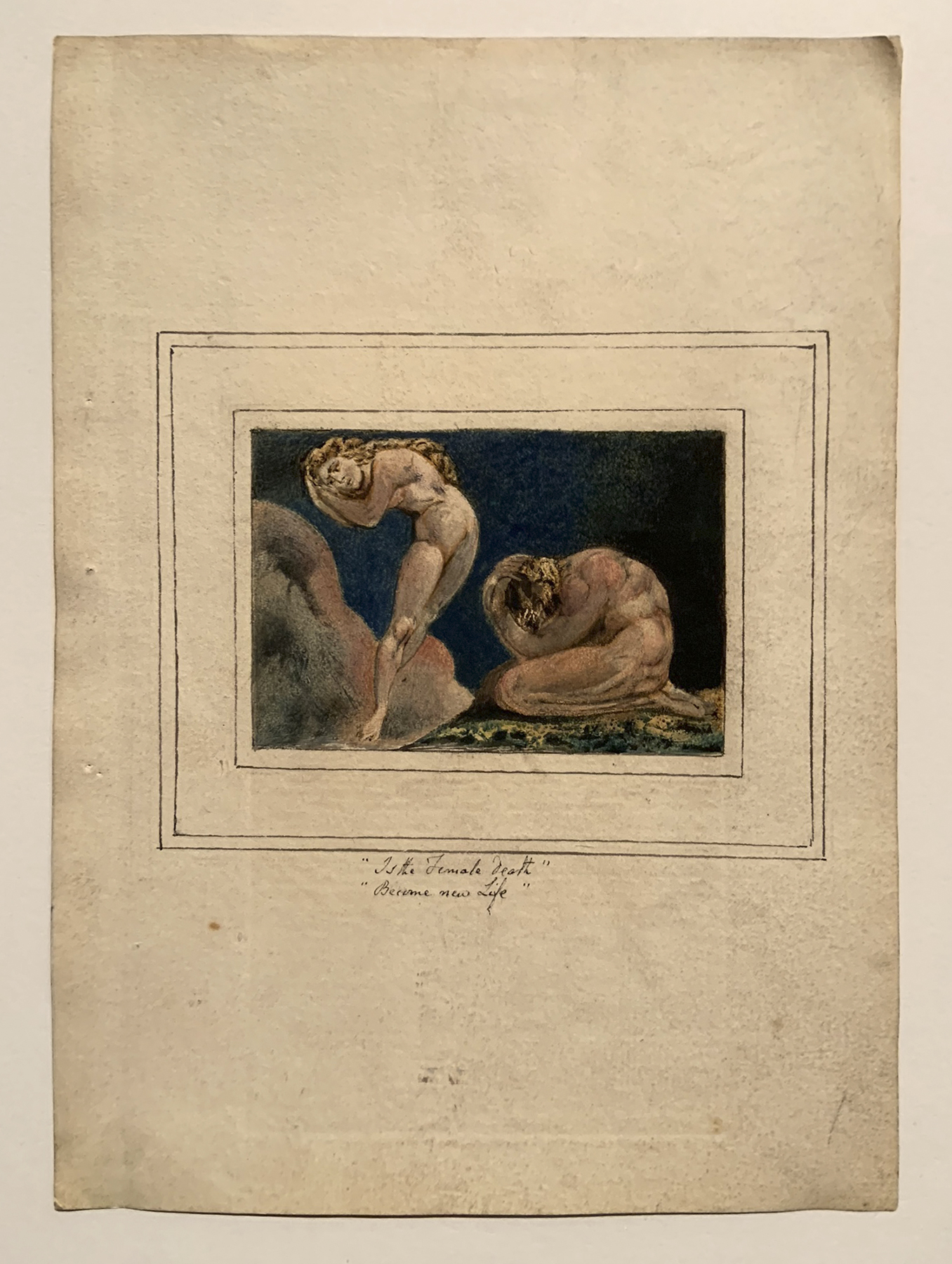
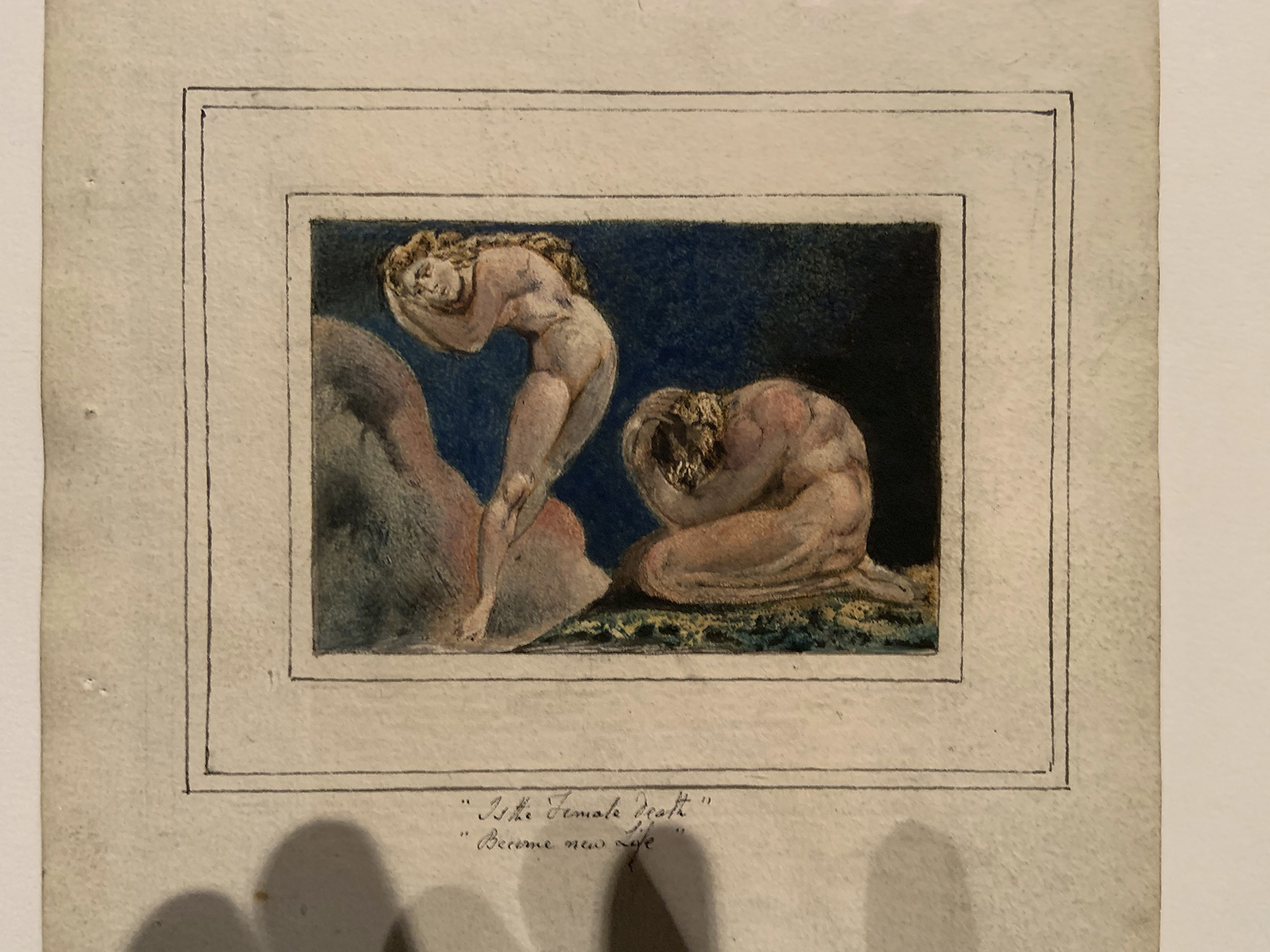
First Book of Urizen, Plate 17 ‘Is the Female Death, Become new Life’ (installation views)
1796, c. 1818
Etching with paint, watercolour and ink on paper
Tate. Purchased with funds provided by the Art Fund, Tate Members, Tate Patrons, Tate Fund and individual donors 2009
Photos: Marcus Bunyan
 

William Blake (British, 1757-1827) 'First Book of Urizen, Plate 17' 1796, c.1818


William Blake (British, 1757-1827)
First Book of Urizen, Plate 17 ‘Is the Female Death, Become new Life’
1796, c. 1818
Etching with paint, watercolour and ink on paper
Tate. Purchased with funds provided by the Art Fund, Tate Members, Tate Patrons, Tate Fund and individual donors 2009
Creative Commons CC-BY-NC-ND (3.0 Unported)
 

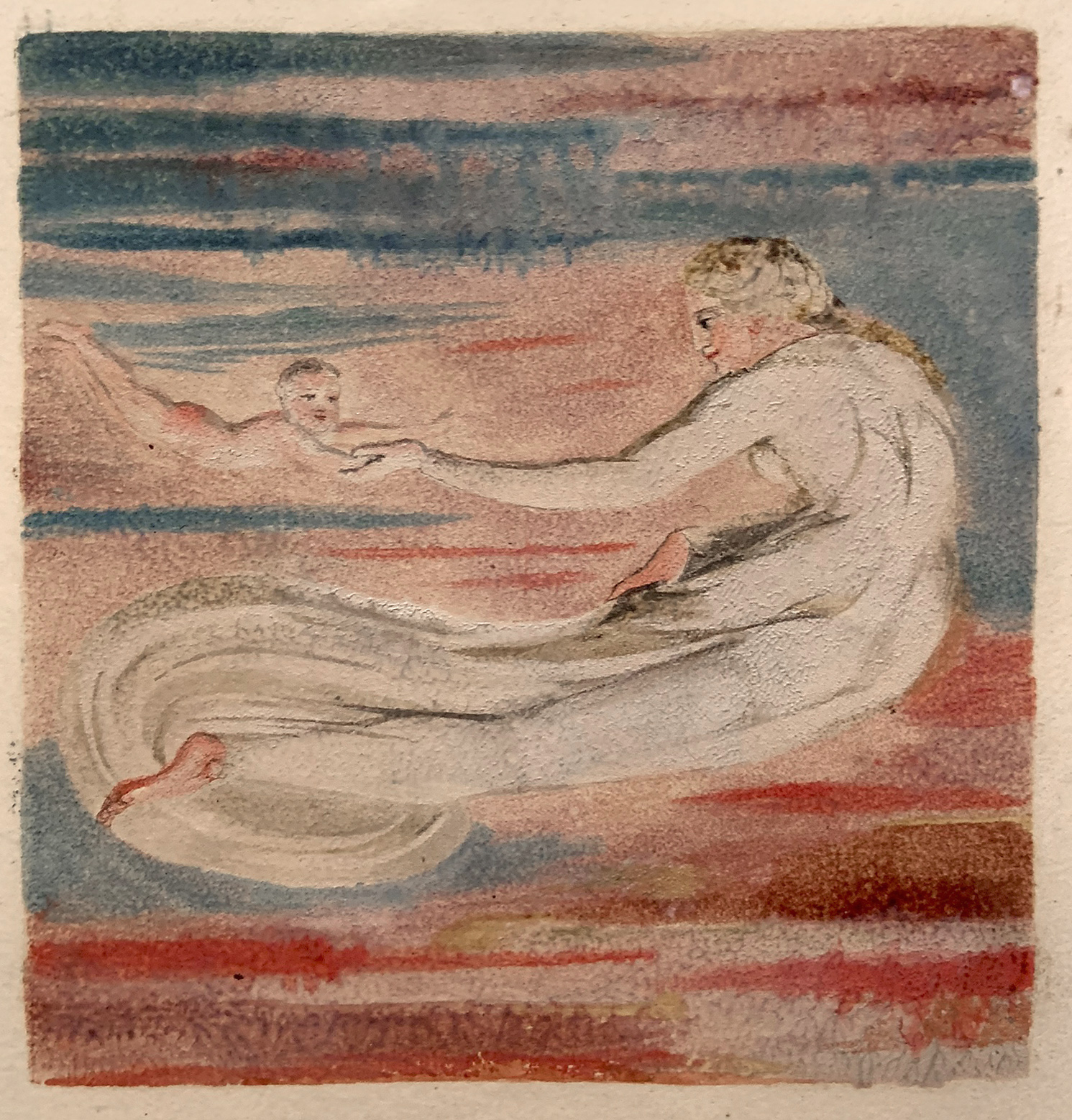
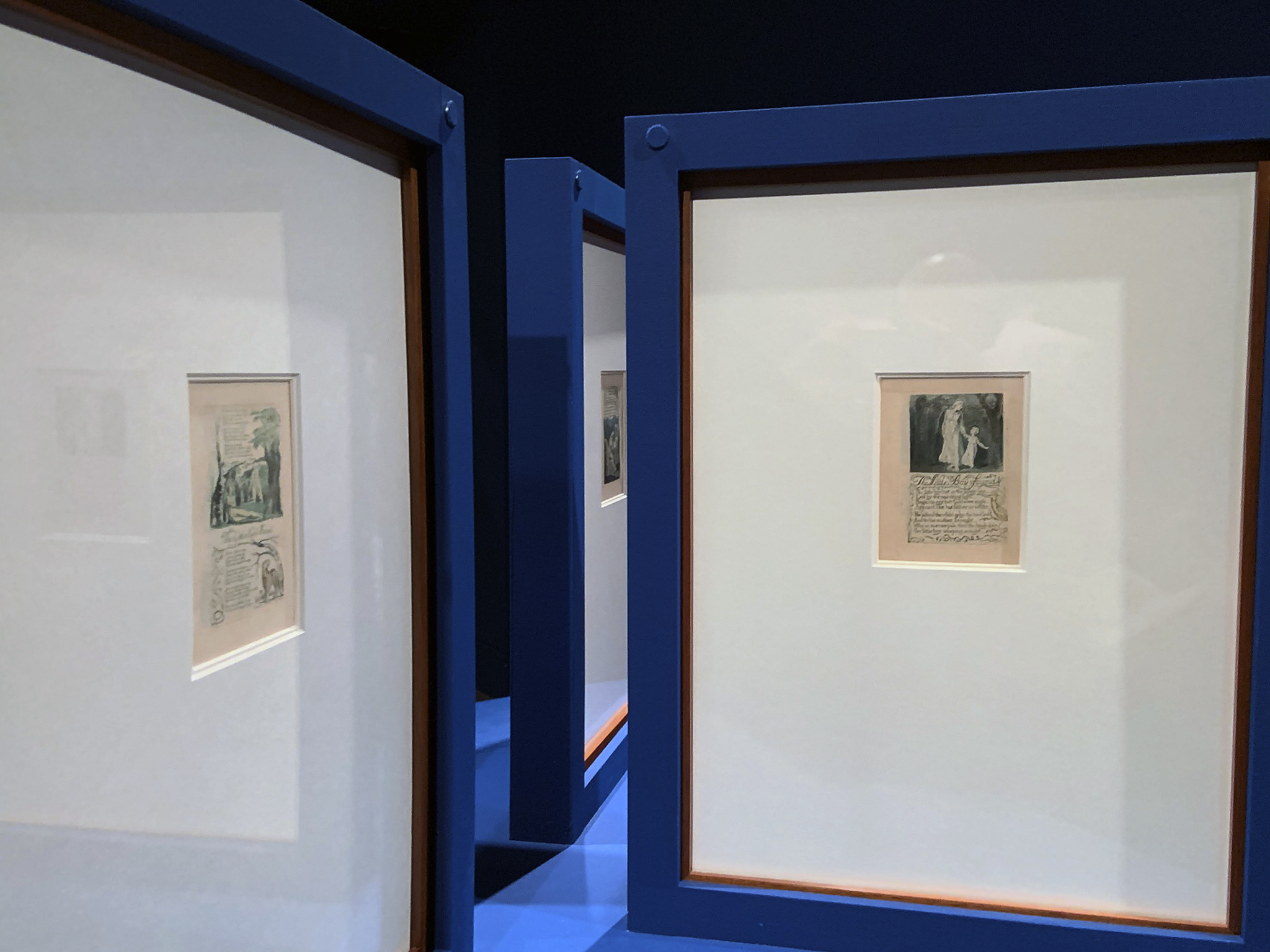
Songs of Innocence and of Experience

Songs of Innocence (1789), Songs of Experience (1793) and the combined Songs of Innocence and of Experience (1794) are the best known of Blake’s illuminated books. He sold more copies of these books than any other (although he probably printed no more than 30 in his lifetime).

The poems deal with themes of childhood and morality, and include striking observations about suffering and social injustice. The visual style is highly decorative. The dense crowding of texts and borders is suggestive of illustrations to children’s books or even embroidered samplers.

Wall text


Installation view of the exhibition 'William Blake' at Tate Britain, London


Installation view of the exhibition William Blake at Tate Britain, London
Photo: Marcus Bunyan


Installation view of the exhibition 'William Blake' at Tate Britain, London

Installation view of the exhibition 'William Blake' at Tate Britain, London


Installation view of the exhibition William Blake at Tate Britain, London
Photo: Marcus Bunyan


William Blake (British, 1757-1827) America, A Prophecy (Copy M) Plate 13, 'Fiery the Angels Rose...' 1793 (installation view)

William Blake (British, 1757-1827) America, A Prophecy (Copy M) Plate 13, 'Fiery the Angels Rose...' 1793 (installation view)


William Blake (British, 1757-1827)
America, A Prophecy (Copy M) Plate 13, ‘Fiery the Angels Rose…’ (installation view)
1793
18 plates on 18 leaves, disbound
Colour-printed relief etching in brown with ink and watercolour on paper
Yale Center for British Art, Paul Mellon Collection
Photo: Marcus Bunyan


The American War of Independence (1775-1783) was the key historical event of Blake’s youth. It shattered the British elite’s assumptions that they could rule over a global, English-speaking empire. For many others, including Blake, it was a heroic overturning of the oppressive old order. Blake’s poem deals with historical events in mythical terms. The central character is Orc, the spirit of revolution, who pursues the ‘shadowy daughter of Urthona’. It was produced at a time when the French Revolution inspired both hope and fear that revolution would spread across Europe.

Wall text


Room 3

Patronage and independence

Throughout his life Blake depended upon the support of family and friends. These included several fellow-artists and amateurs, including John and Ann FlaxmanThomas Stothard and George Cumberland. In the 1790s Blake started selling works to Thomas Butts, a senior civil servant. Butts became his most important patron, eventually owning up to 200 works by the artist. The Rev. Joseph Thomas also commissioned series of watercolours illustrating Milton and Shakespeare. The wealthy poet William Hayley was another important supporter. In 1800-1803 Blake went to work for Hayley, moving with Catherine to Sussex.

The move opened up new connections, with the Rev. John Johnson and Elizabeth Ilive, Countess of Egremont. The support of Flaxman, Butts, Hayley and their friends gave Blake a degree of financial stability. Blake’s patrons were well-off and socially established, much more so than the artist. They admired the artist’s unconventional character and independent spirit. But Blake resented being their employee and the advice they sometimes offered. As a result these relationships often became strained.

Wall text from the exhibition


Edward Young (British, 1683-1765) 'Night Thoughts' 1797 (installation view)


Edward Young (British, 1683-1765)
Night Thoughts (installation view)
1797
Book, 43 plates on 43 leaves
Engravings with hand-colouring
By courtesy of the Trustees of Sir John Soane’s Museum, London
Photo: Marcus Bunyan


Blake produced over 530 watercolours for Edward Young’s long poem on ‘life, death and immortality’. He created bold designs in large margins around each sheet of the printed text. These often give literal form to ideas in the text. Publisher Richard Edwards commissioned Blake, but later abandoned the project and closed down his business. Blake had asked for over £100 for the designs but was paid only £21. He despaired, writing in 1799: ‘I am laid by in a corner as if I did not Exist’. This copy was hand-coloured by Blake or by Catherine Blake.

Label text


William Blake (British, 1757-1827). 'The Christ Child Asleep on the Cross' 1799-1800 (installation view)


William Blake (British, 1757-1827)
The Christ Child Asleep on the Cross (installation view)
1799-1800
Tempera on canvas Lent by the Victoria and Albert Museum, London
Photo: Marcus Bunyan


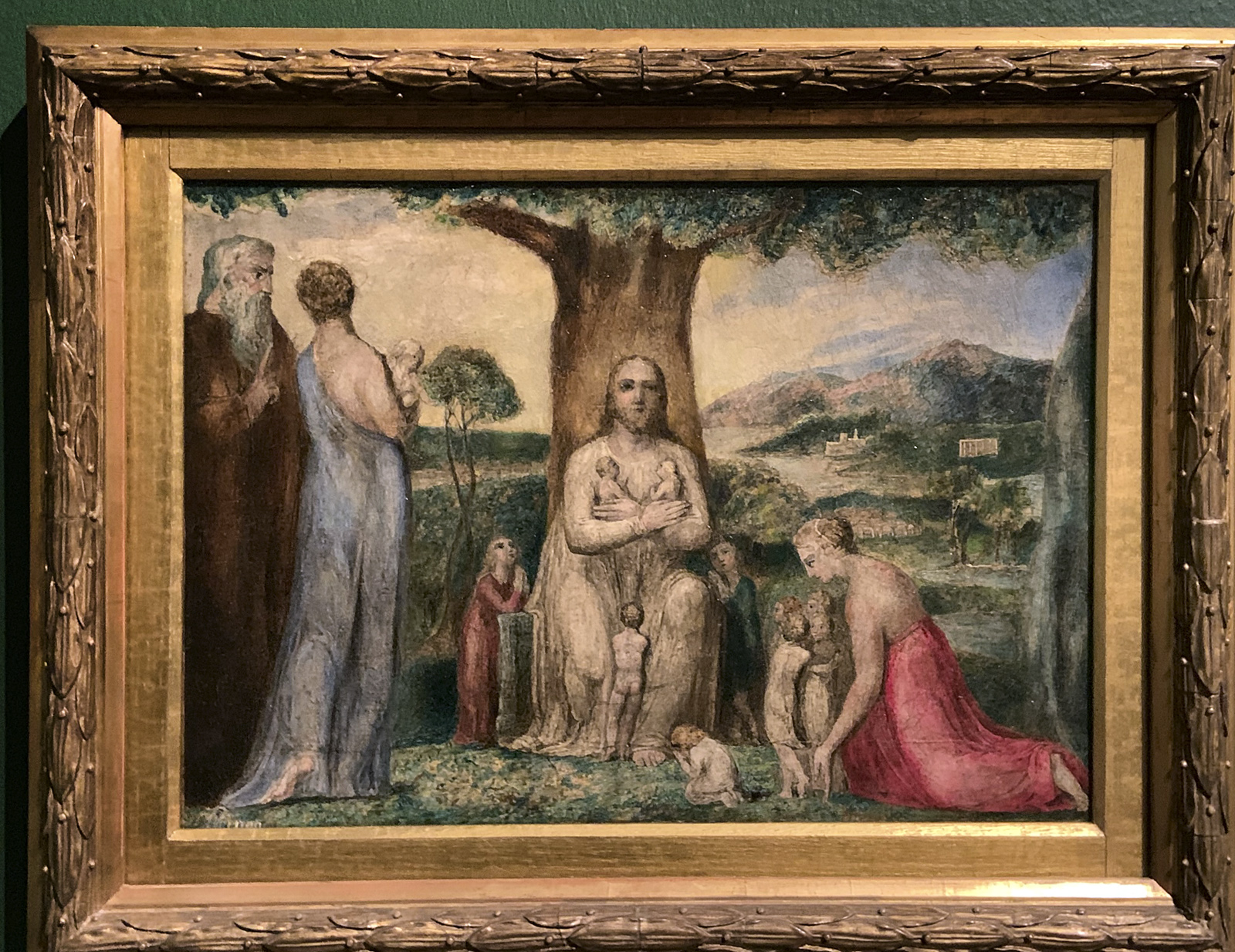
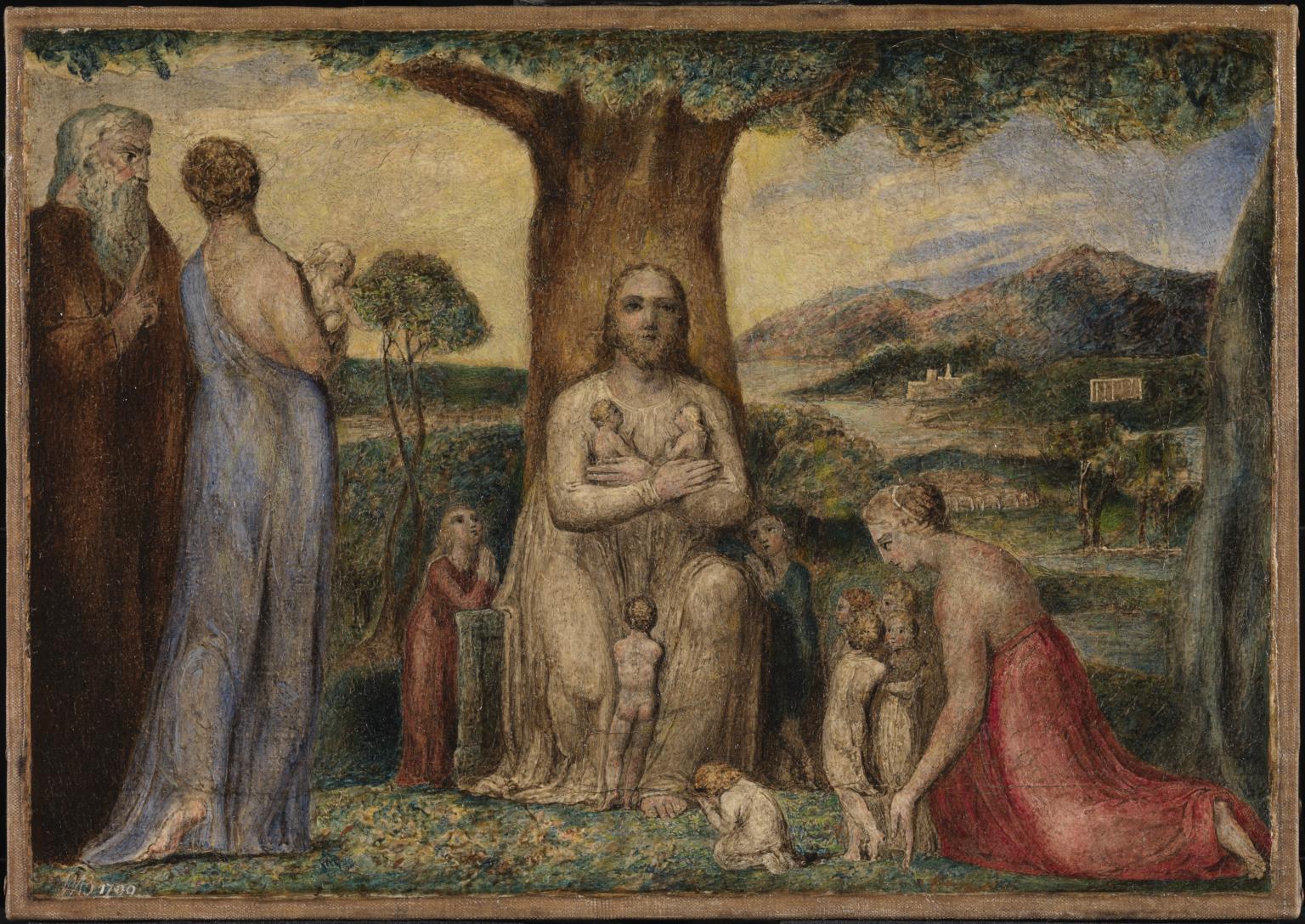
William Blake (British, 1757-1827) 'Christ Blessing the Little Children' 1799 (installation view)

William Blake (British, 1757-1827) 'Christ Blessing the Little Children' 1799 (installation view) 'Christ Blessing the Little Children' 1799 (installation view detail)


William Blake (British, 1757-1827)
Christ Blessing the Little Children (installation views)
1799
Tempera on canvas
Tate. Presented by the executors of W. Graham Robertson through the Art Fund 1949
Photos: Marcus Bunyan


William Blake (British, 1757-1827) 'Christ Blessing the Little Children' 1799


William Blake (British, 1757-1827)
Christ Blessing the Little Children
1799
Tempera on canvas
Tate. Presented by the executors of W. Graham Robertson through the Art Fund 1949
Creative Commons CC-BY-NC-ND (3.0 Unported)
 

This painting is from of a group of fifty illustrations to the Bible commissioned by Blake’s patron, Thomas Butts. Its subject is taken from chapter 10 of St Mark’s Gospel. Christ, seated beneath a spreading tree, blesses children brought to him while he was preaching. To the left is one of his disciples, who tries to send the children away. Christ tells the disciples:

Suffer the little children to come unto me, and forbid them not: for of such is the kingdom of God… Whosoever shall not receive the kingdom of God as a little child, he shall not enter therein.

Gallery label, August 2004


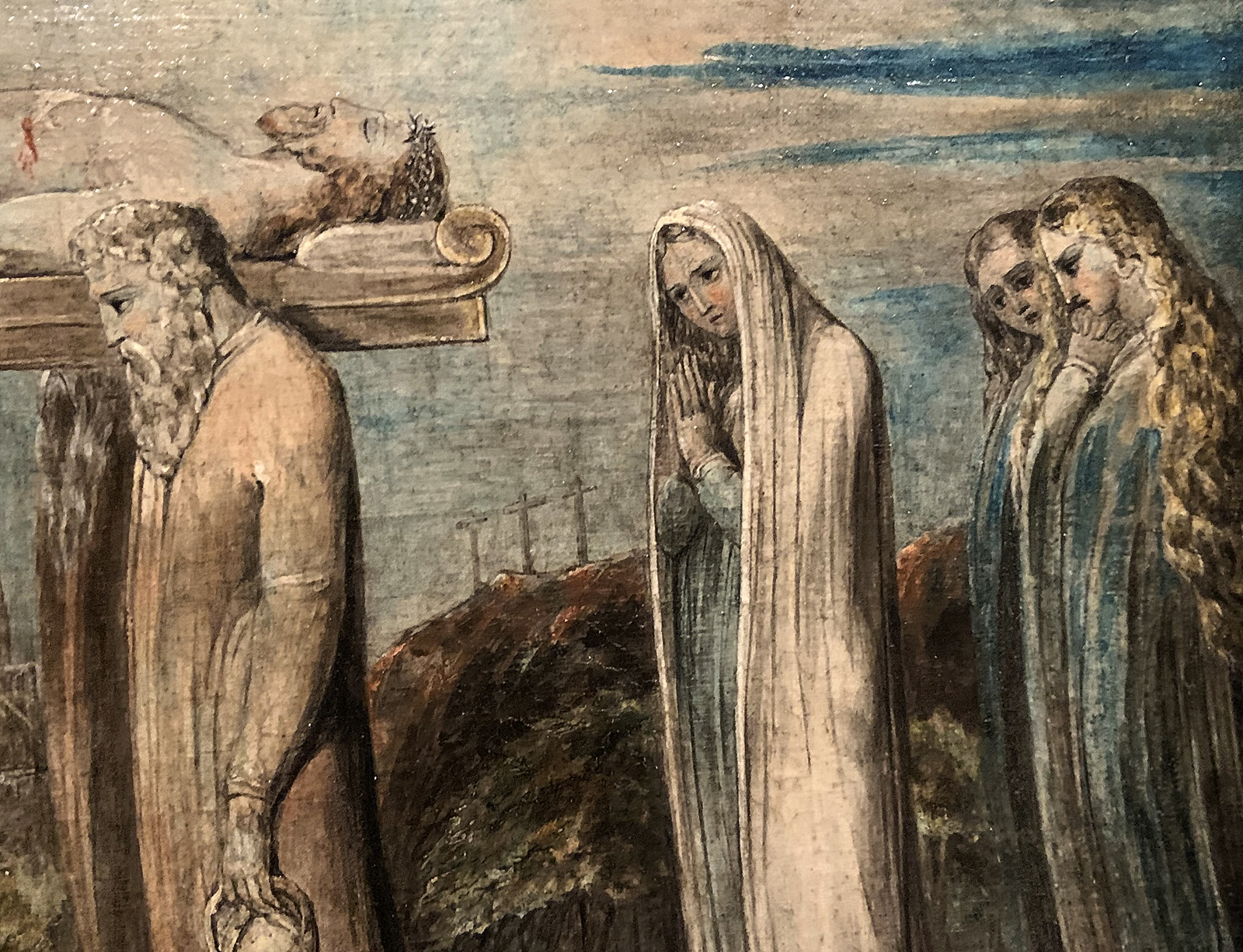
William Blake (British, 1757-1827) 'The Body of Christ Borne to the Tomb' c. 1799-1800 (installation view)

William Blake (British, 1757-1827) 'The Body of Christ Borne to the Tomb' c. 1799-1800 (installation view detail)


William Blake (British, 1757-1827)
The Body of Christ Borne to the Tomb (installation views)
c. 1799-1800
Tempera on canvas mounted onto cardboard
Tate. Presented by Francis T. Palgrave 1884
Photos: Marcus Bunyan


The frame is original and may even have been chosen by Blake.


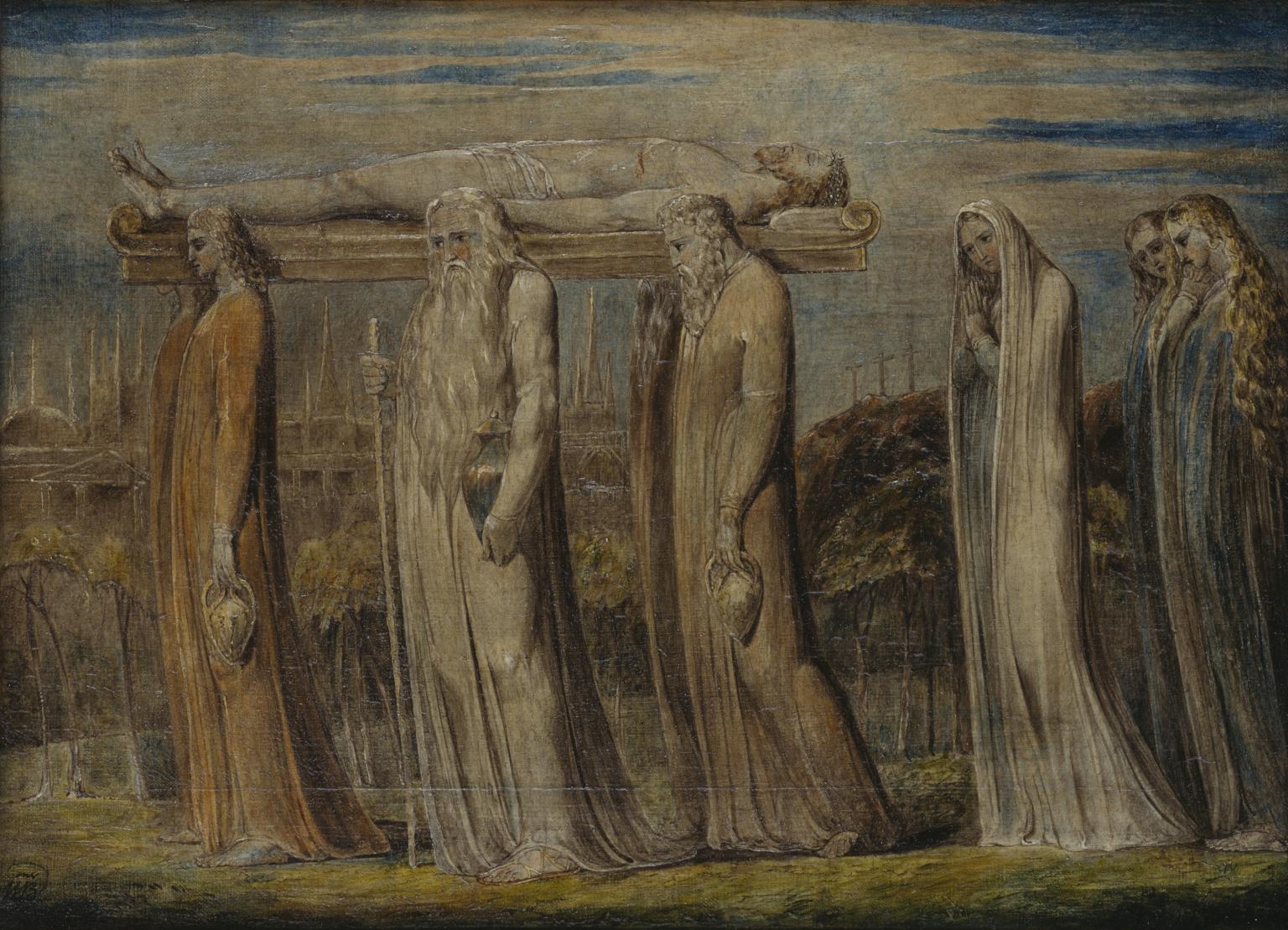
William Blake (British, 1757-1827) 'The Body of Christ Borne to the Tomb' c. 1799-1800


William Blake (British, 1757-1827)
The Body of Christ Borne to the Tomb
c. 1799-1800
Tempera on canvas mounted onto cardboard
Tate. Presented by Francis T. Palgrave 1884
Creative Commons CC-BY-NC-ND (3.0 Unported)


This tempera is very well preserved, mainly because it was painted on thin linen canvas, stuck onto thin cardboard. This is stiff enough to reduce the cracking that develops on flexible canvas. It also made it unnecessary to add the animal glue lining which has spoilt the opaque white effect of Blake’s chalk preparatory layer in many temperas. As a result, Blake’s delicate painted details can still be seen as he intended.

This is the only Blake tempera in this room in a frame dating from the time it was painted. Blake may have chosen the frame design himself.

Gallery label, August 2004


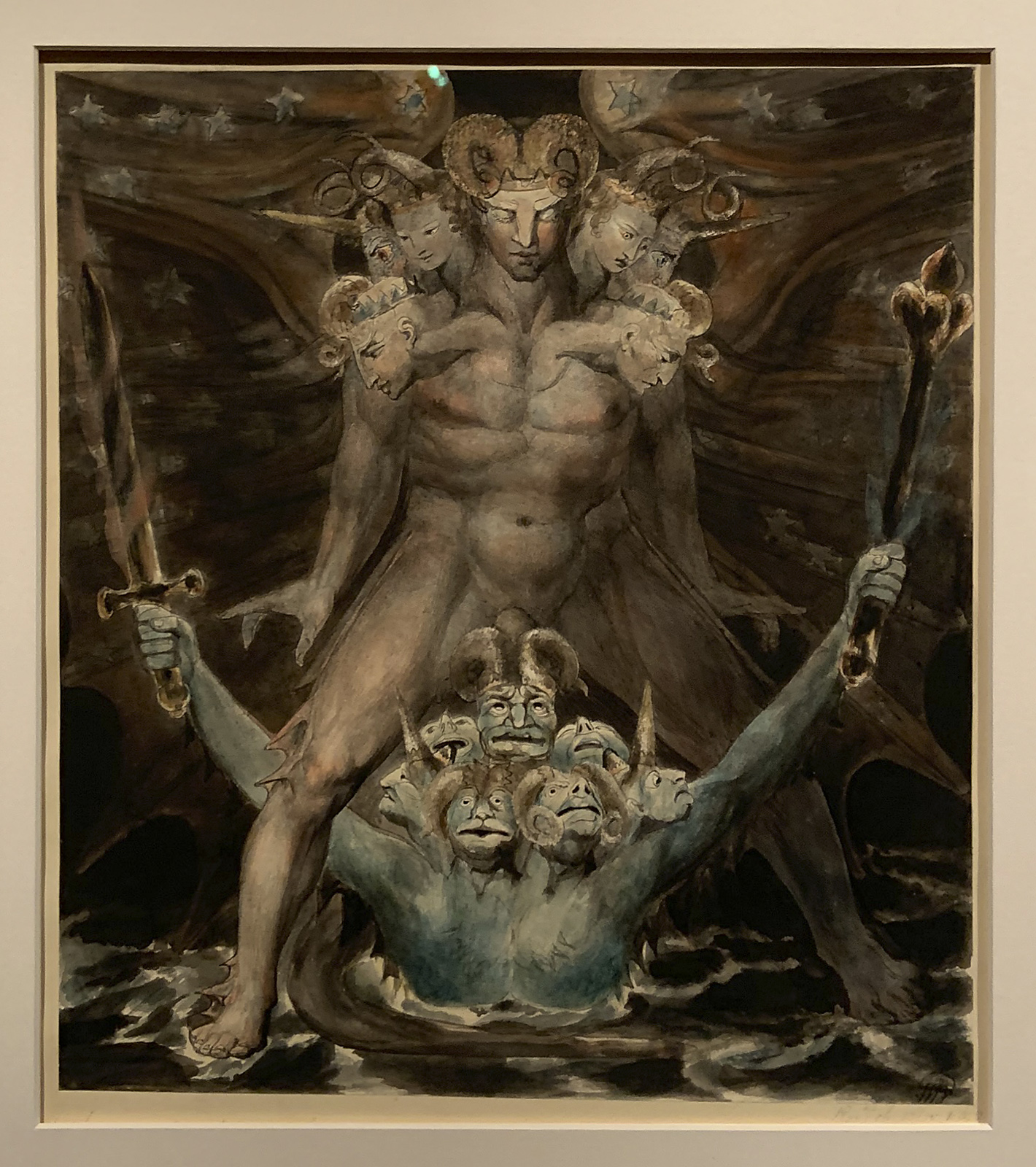
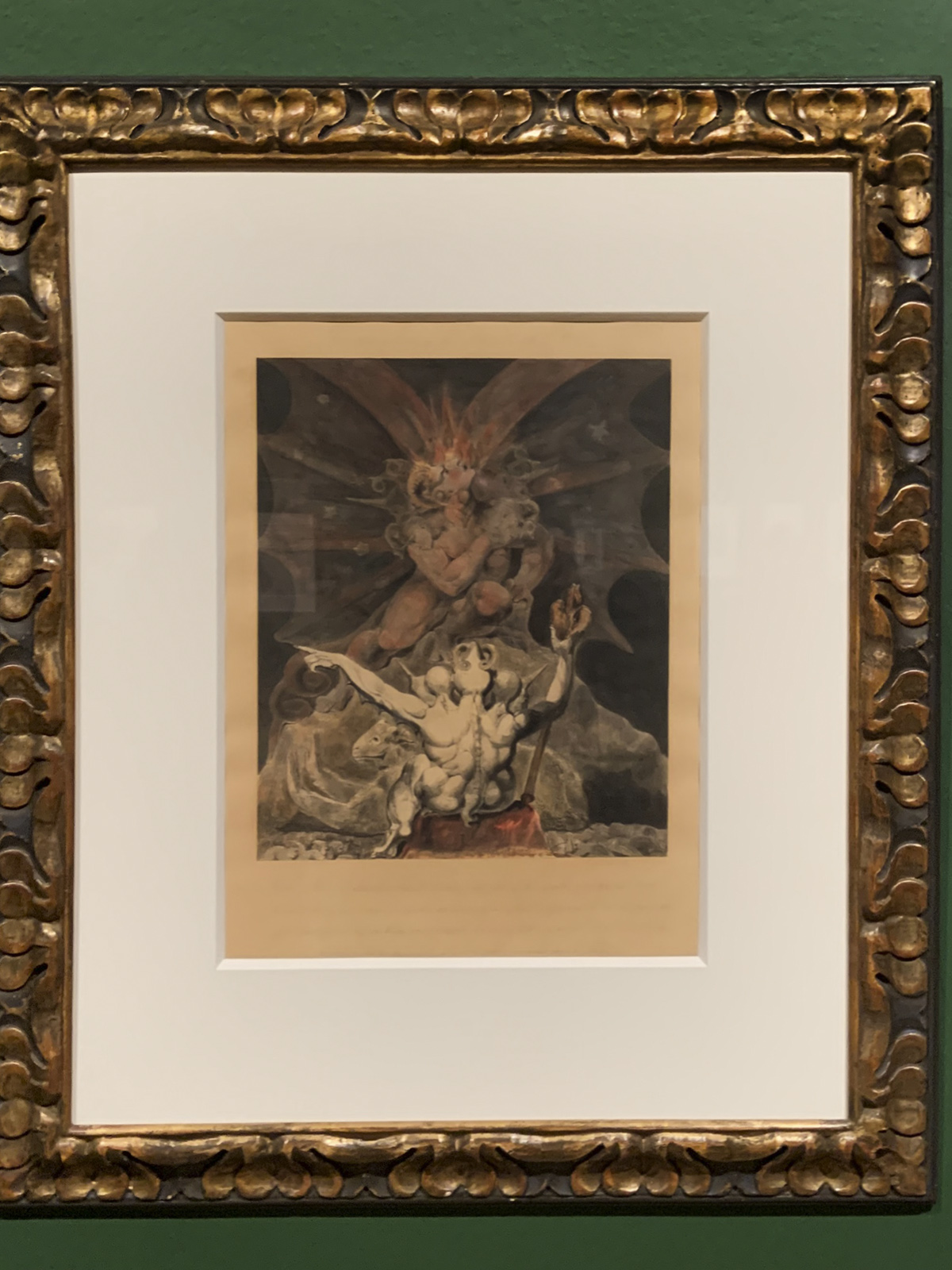
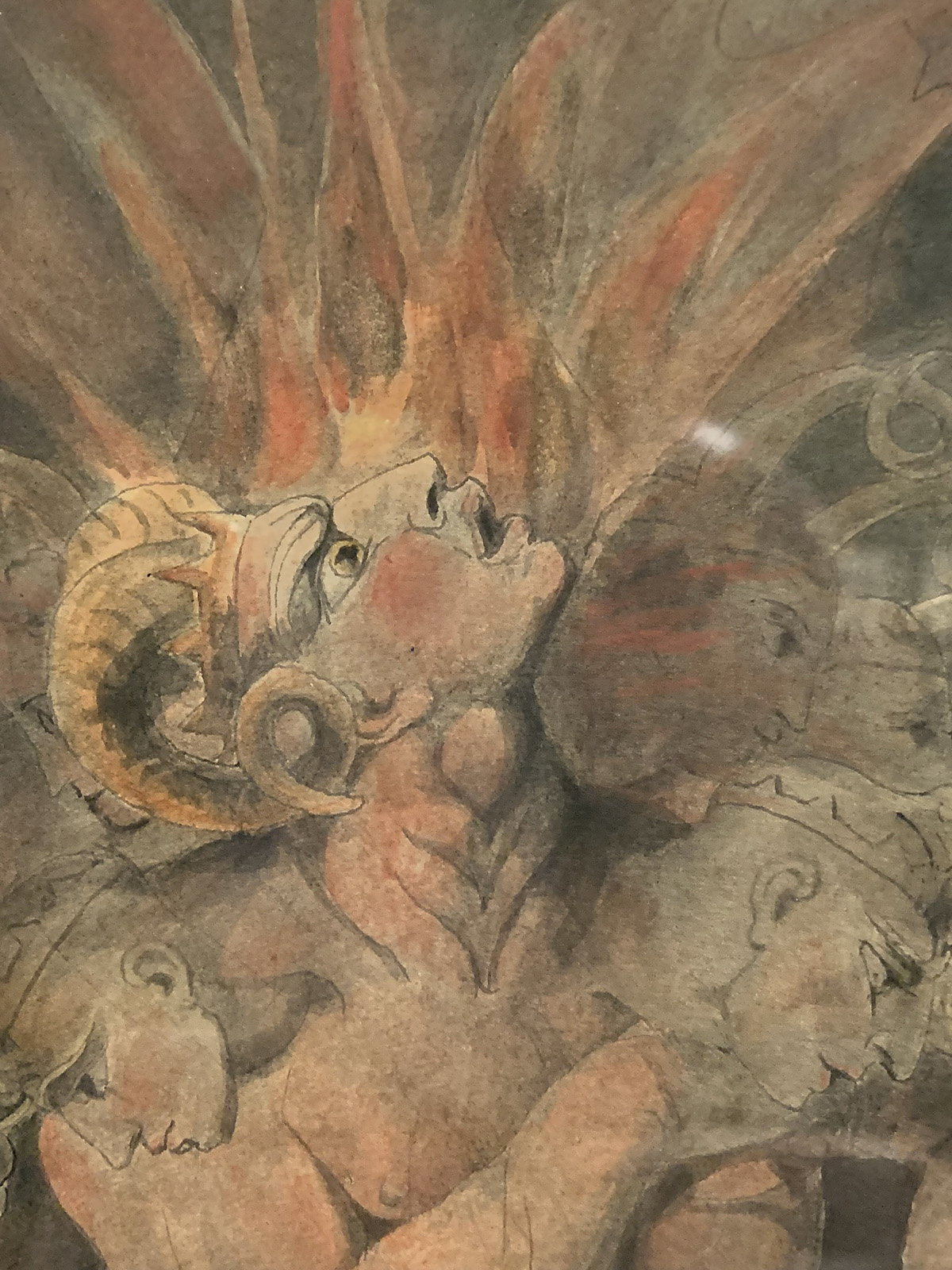
William Blake (British, 1757-1827) 'The Great Red Dragon and the Beast from the Sea' c. 1805 (installation view)

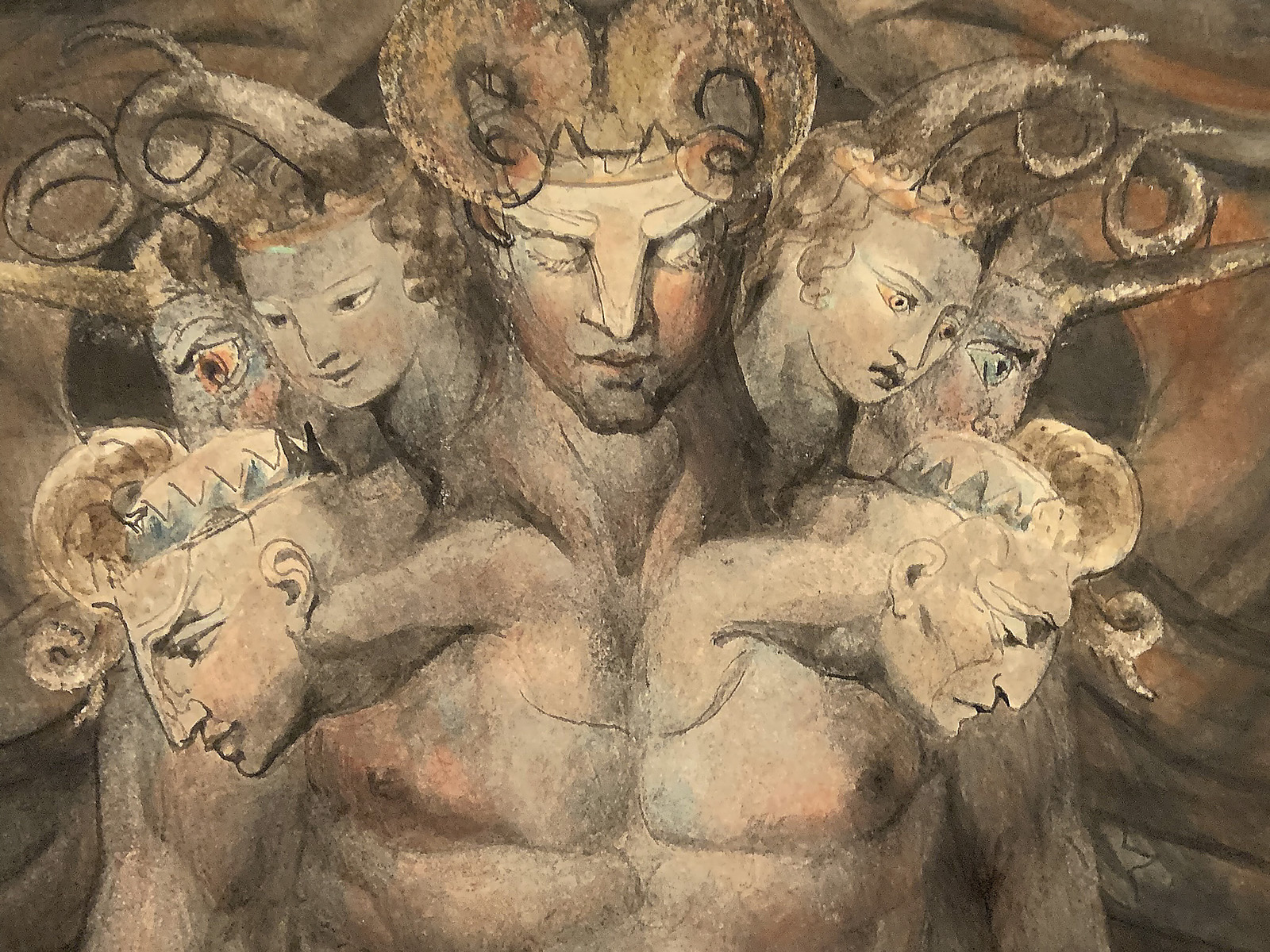
William Blake (British, 1757-1827) 'The Great Red Dragon and the Beast from the Sea' c. 1805 (installation view detail)

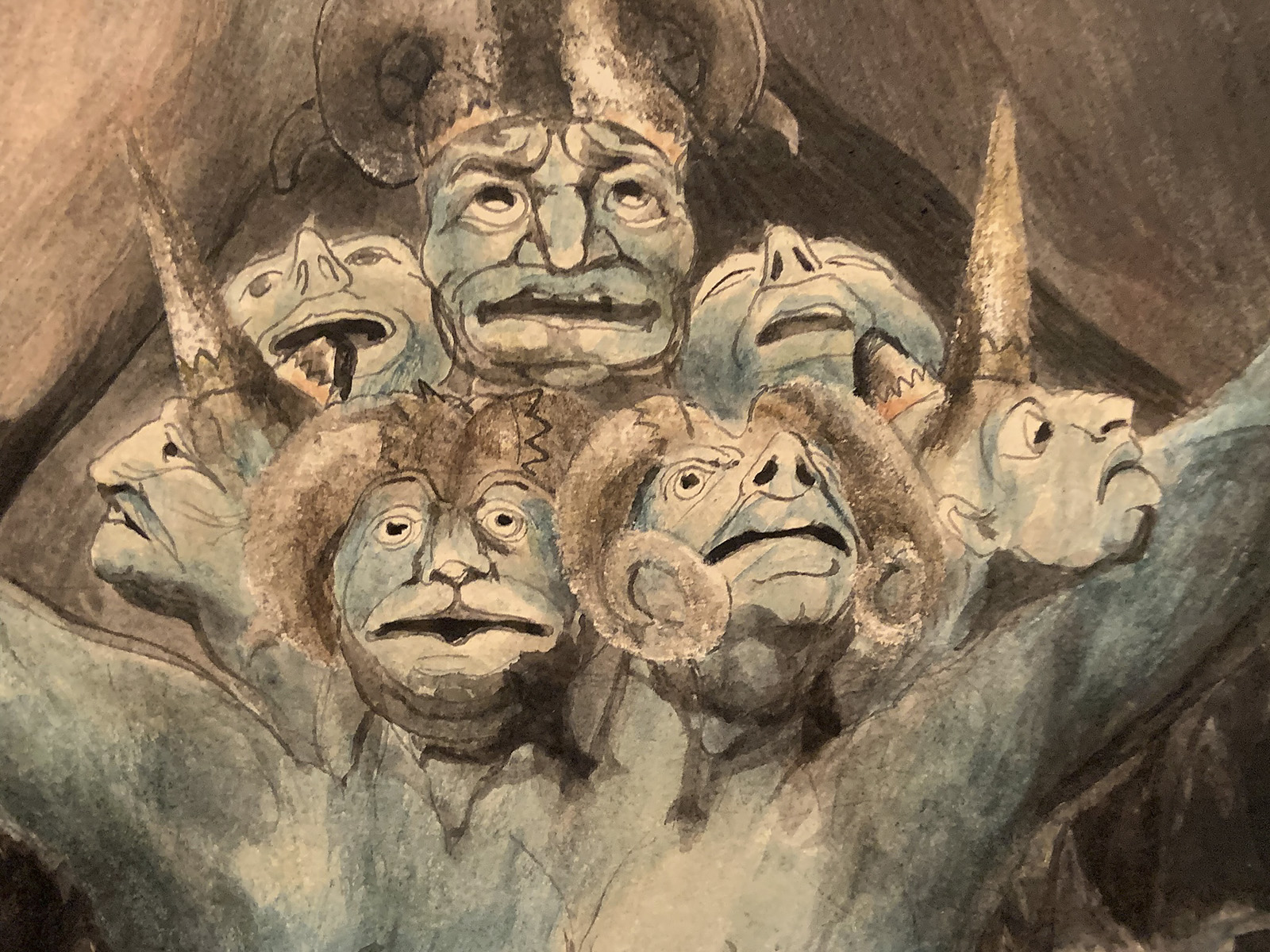
William Blake (British, 1757-1827) 'The Great Red Dragon and the Beast from the Sea' c. 1805 (installation view detail)

William Blake (British, 1757-1827) 'The Great Red Dragon and the Beast from the Sea' c. 1805 (installation view detail)


William Blake (British, 1757-1827)
The Great Red Dragon and the Beast from the Sea (installation views)
c. 1805
Ink with watercolour over graphite on paper
National Gallery of Art, Washington, Rosenwald Collection, 1943
Photos: Marcus Bunyan


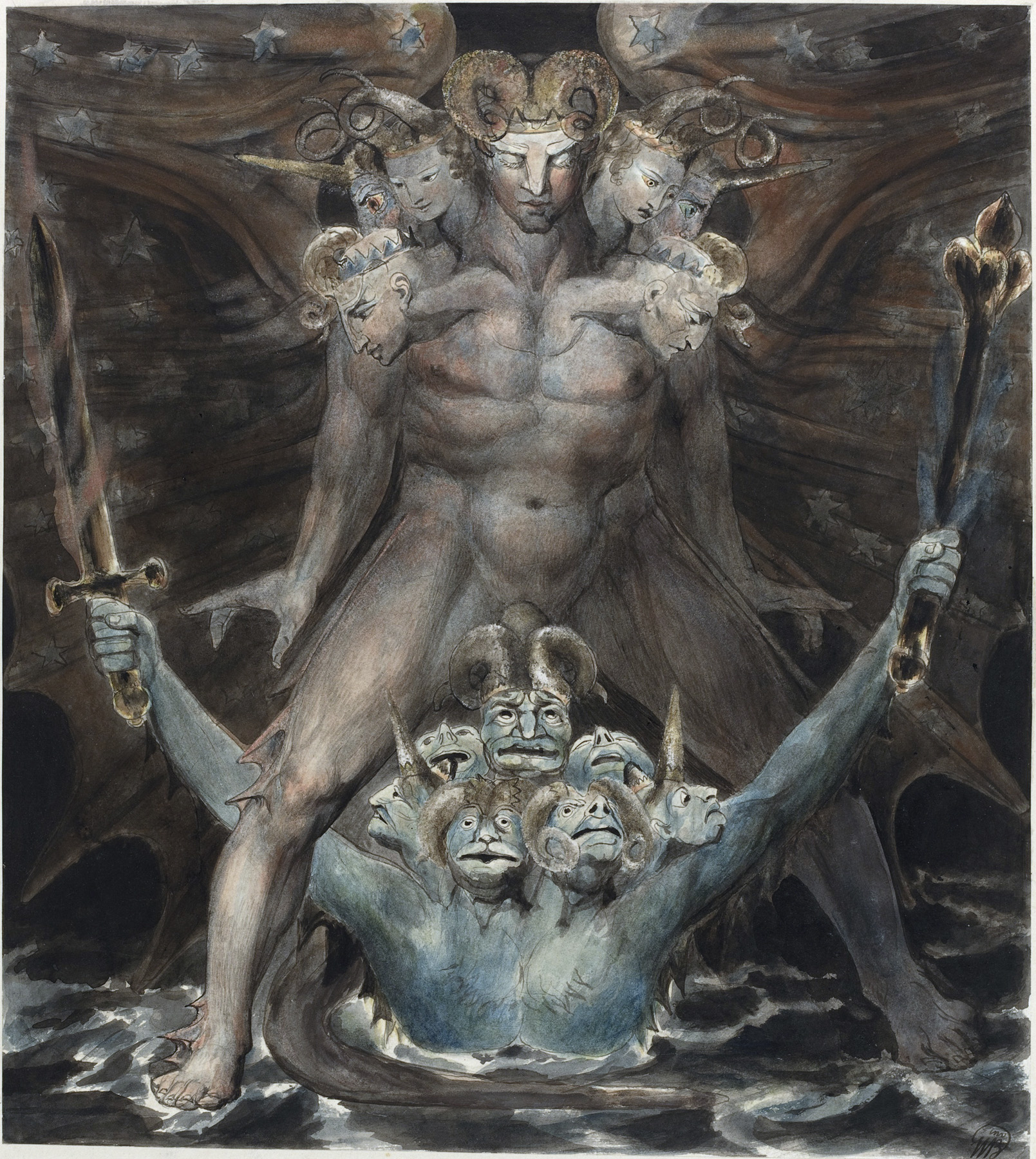
William Blake (British, 1757-1827) 'The Great Red Dragon and the Beast from the Sea' c. 1805


William Blake (British, 1757-1827)
The Great Red Dragon and the Beast from the Sea
c. 1805
Ink with watercolour over graphite on paper
National Gallery of Art, Washington, Rosenwald Collection, 1943
Wikipedia Commons, Public Domain


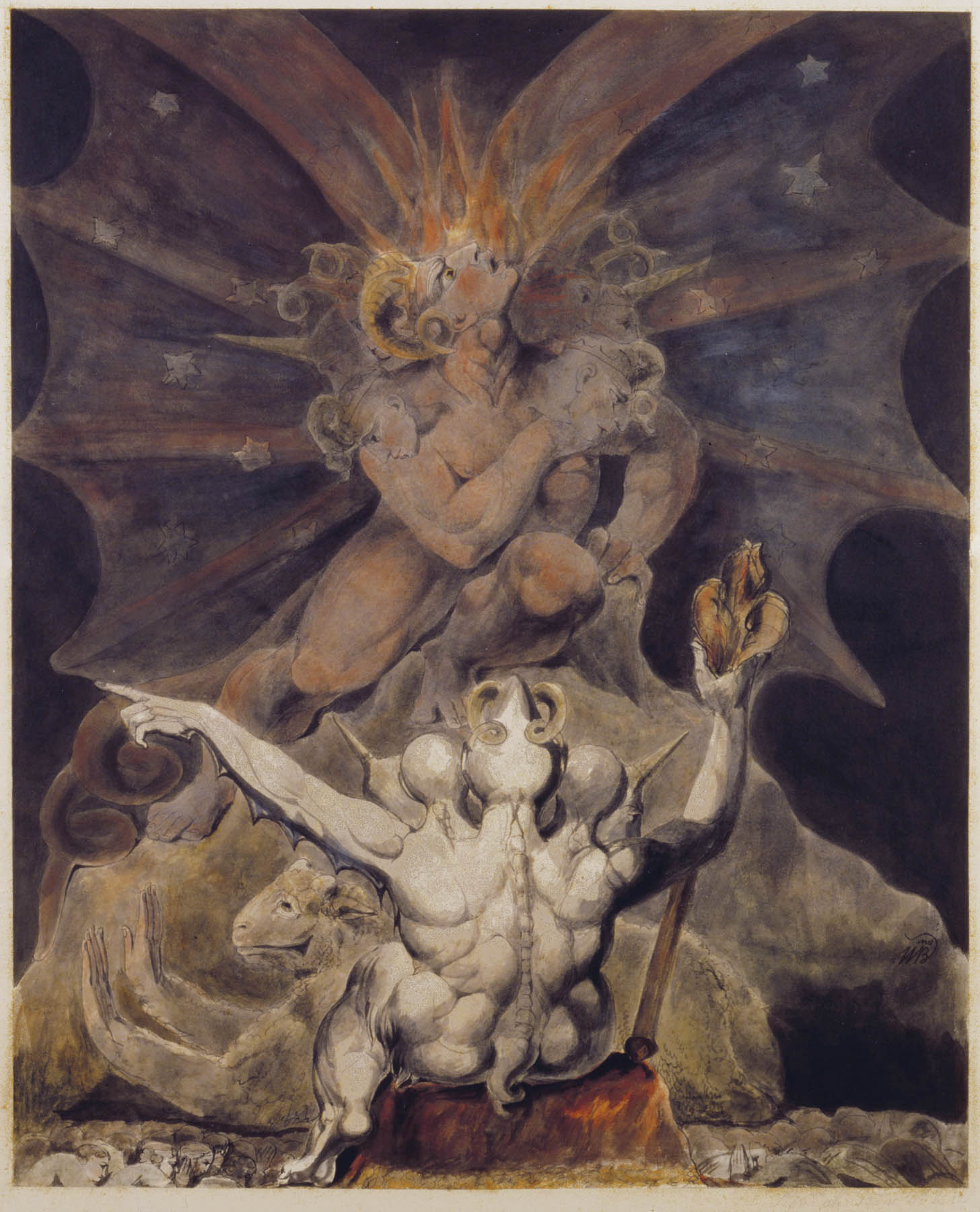
William Blake (British, 1757-1827) The Number of the Beast is 666 c. 1805 (installation view)

William Blake (British, 1757-1827) 'The Number of the Beast is 666' c. 1805 (installation view)

William Blake (British, 1757-1827) The Number of the Beast is 666 c. 1805 (installation view detail)


William Blake (British, 1757-1827)
The Number of the Beast is 666 (installation views)
c. 1805
Ink and watercolour on paper
The Rosenbach, Philadelphia
Photos: Marcus Bunyan


William Blake (British, 1757-1827) 'The Number of the Beast is 666' c. 1805


William Blake (British, 1757-1827)
The Number of the Beast is 666
c. 1805
Ink and watercolour on paper
The Rosenbach, Philadelphia
Wikipedia Commons, Public Domain


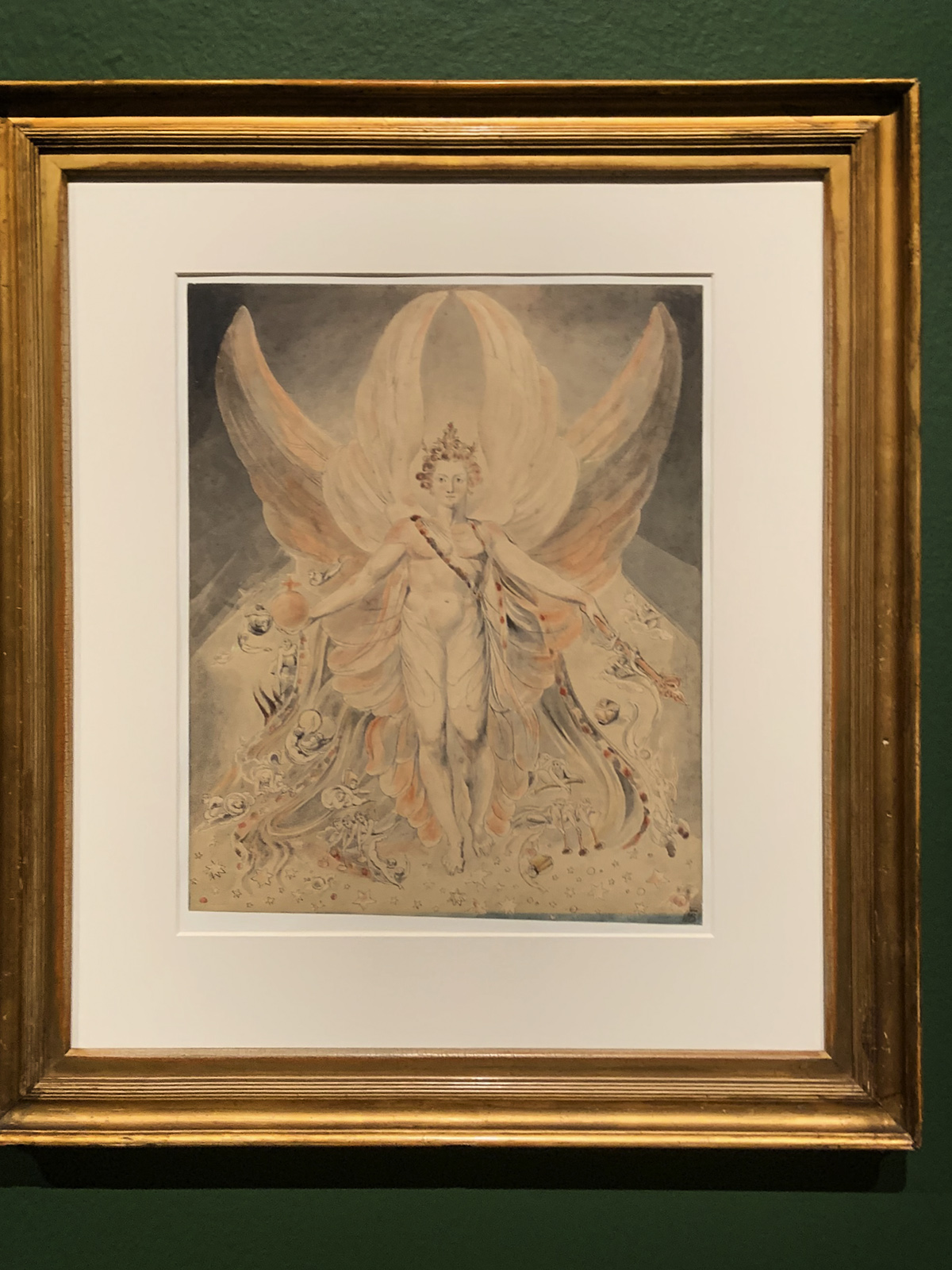
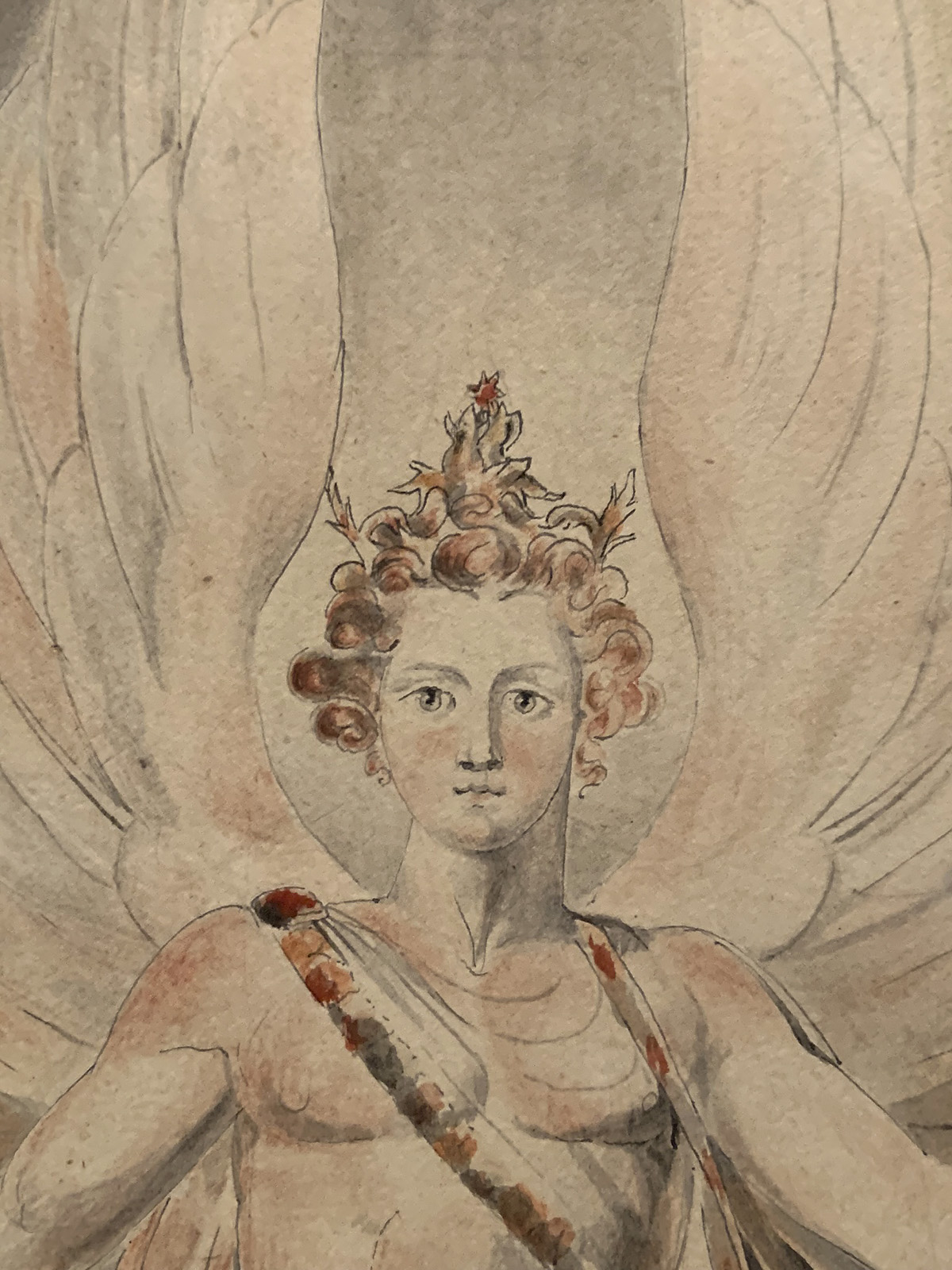
William Blake (British, 1757-1827) Satan in his Original Glory: 'Thou wast Perfect till Iniquity was Found in Thee' c. 1805 (installation view)

William Blake (British, 1757-1827) Satan in his Original Glory: 'Thou wast Perfect till Iniquity was Found in Thee' c. 1805 (installation view)

William Blake (British, 1757-1827) Satan in his Original Glory: 'Thou wast Perfect till Iniquity was Found in Thee' c. 1805 (installation view)

William Blake (British, 1757-1827) Satan in his Original Glory: 'Thou wast Perfect till Iniquity was Found in Thee' c. 1805 (installation view)


William Blake (British, 1757-1827)
Satan in his Original Glory: ‘Thou wast Perfect till Iniquity was Found in Thee’ (installation views)
c. 1805
Ink and watercolour on paper
Tate. Presented by the executors of W. Graham Robertson through the Art Fund 1949
Photos: Marcus Bunyan
 

This watercolour shows how such works have changed over time. There is a strip of much stronger blue colour at the bottom right edge, in an area which had been masked from the light in the past.

This watercolour shows Satan as he once was, a perfect part of God’s creation, before his fall from grace. His orb and sceptre symbolise his role as Prince of this World. It is also an extreme example of the damaging effects of over-exposure to light. The sky was originally an intense blue, now only visible at the lower right edge. The only colours which have survived unaltered are the vermilion red Blake used for the flesh, and red ochre in Satan’s wings. The paper has yellowed considerably. There is no evidence left of any yellow gamboge or pinkish red lakes.

Gallery label, September 2004
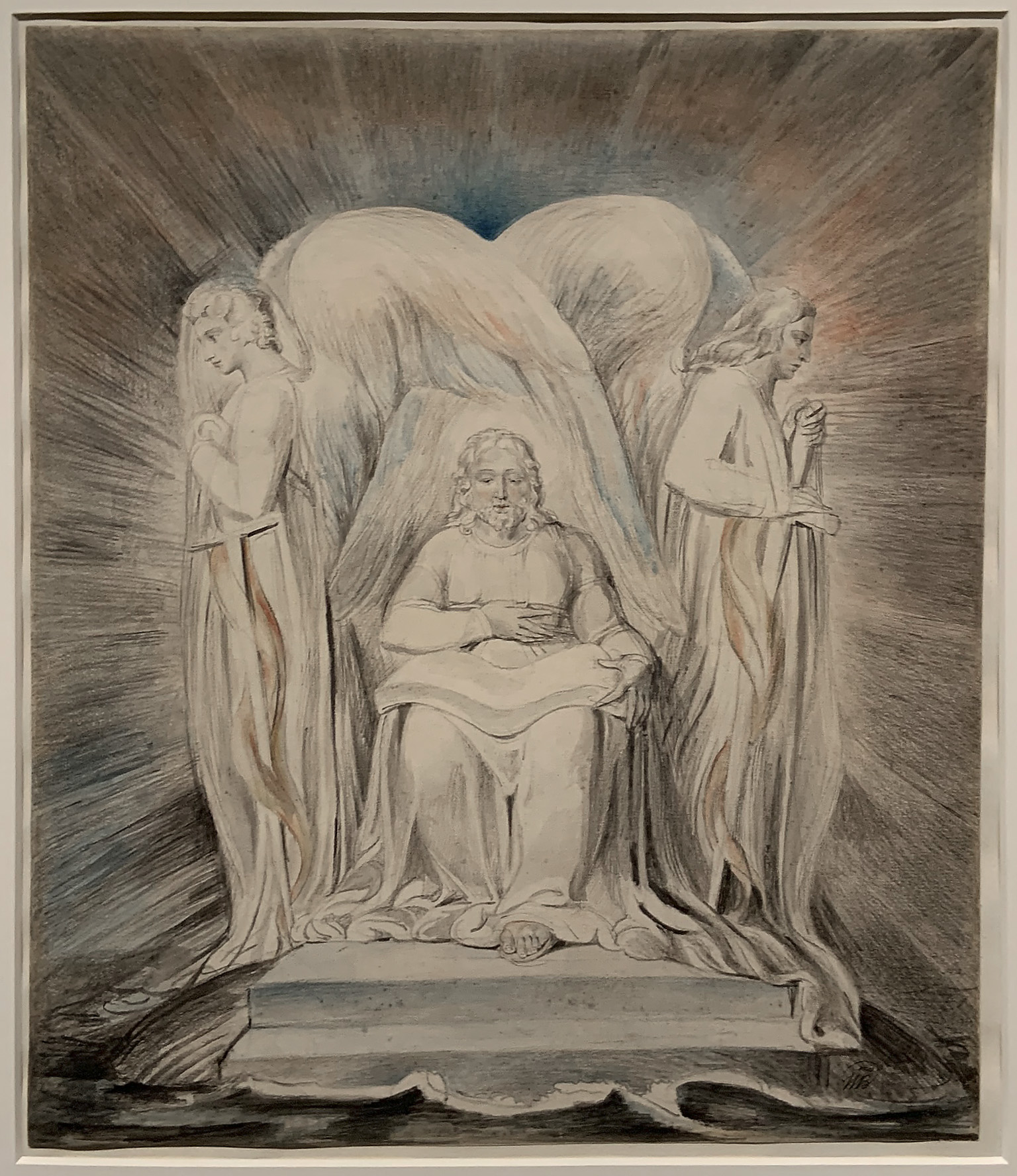
 

William Blake (British, 1757-1827) 'Christ Girding Himself with Strength' c. 1805 (installation view)


William Blake (British, 1757-1827)
Christ Girding Himself with Strength (installation view)
c. 1805
Chalk and watercolour over pencil on paper
280 × 325 mm
Bristol Culture: Bristol Museums & Art Gallery
Photo: Marcus Bunyan


William Blake (British, 1757-1827) 'David Delivered out of Many Waters' c. 1805


William Blake (British, 1757-1827)
David Delivered out of Many Waters
c. 1805
Ink and watercolour on paper
Tate. Presented by George Thomas Saul 1878
Creative Commons CC-BY-NC-ND (3.0 Unported)


This work shows how Blake responded visually to textual sources. It is an illustration to Psalm 18, in which David (at the bottom of the image with his arms stretched wide) calls out to God for salvation from his enemies. Christ appears above, riding upon seven cherubim (angels), not one as in the text. Blake’s gentle, linear style, formal composition and free interpretation of a written source made him attractive to many modern artists. Paul Nash saw Blake as representing a British imaginative tradition.

Gallery label, August 2004
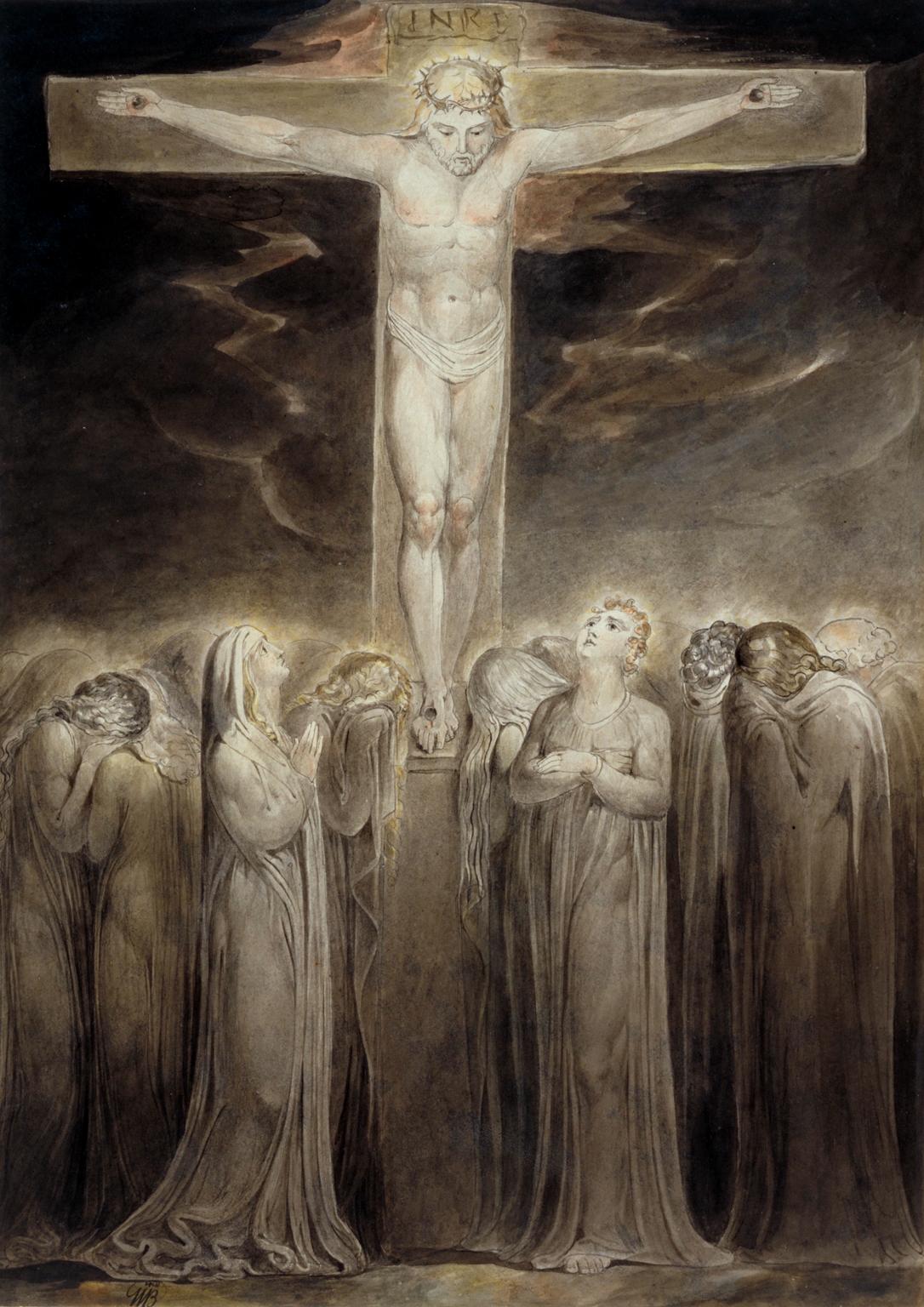
 

William Blake (British, 1757-1827) The Crucifixion: 'Behold Thy Mother' c. 1805


William Blake (British, 1757-1827)
The Crucifixion: ‘Behold Thy Mother’
c. 1805
Ink and watercolour on paper
Tate. Presented by the executors of W. Graham Robertson through the Art Fund 1949
Creative Commons CC-BY-NC-ND (3.0 Unported)


Blake often treated subjects from Jerusalem’s history. Christian thought is centred on Christ’s crucifixion at Calvary outside the city, when he died to redeem mankind. His cross, his resurrection and return to earth three days after his death are central to Stanley Spencer’s Resurrection of the Soldiers altarpiece at Sandham; sketches for this are shown in the display case to your left.

Spencer believed that the soldiers had a ‘perfect understanding’ of the sacrifice they had to make. This suggests that both Blake’s ‘Mental Fight’ to build the Jerusalem of peace in England, and the soldiers’ physical fight are equally valid.

Gallery label, July 2008


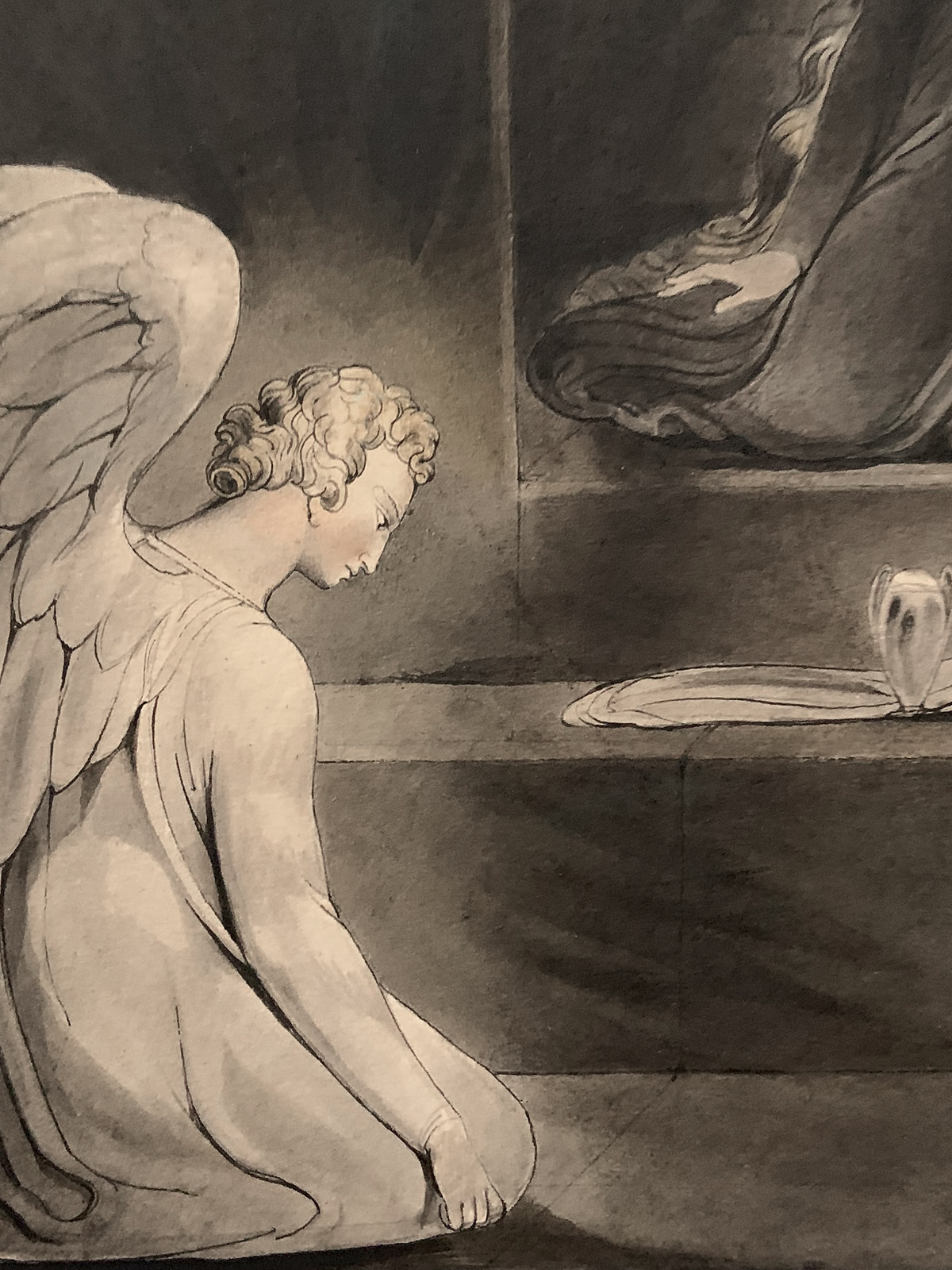
William Blake (British, 1757-1827) 'The Magdalene at the Sepulchre' c. 1805 (installation view)

William Blake (British, 1757-1827) 'The Magdalene at the Sepulchre' c. 1805 (installation view detail)


William Blake (British, 1757-1827)
The Magdalene at the Sepulchre (installation views)
c. 1805
Pen, ink and watercolour on paper
427 × 311 mm
Yale Center for British Art, Paul Mellon Collection
Photos: Marcus Bunyan


William Blake (British, 1757-1827) 'The Angel Rolling away the Stone' c. 1805


William Blake (British, 1757-1827)
The Angel Rolling away the Stone
c. 1805
Watercolour on paper
Victoria and Albert Museum, London, the Morse gift


Two angels in white the one at the head, and the other at the feet / Matw. cn. 28th v. 2nd And below there was a great earthquake, for the angel of the Lord descended from heaven, and came and rolled back the stone from the door. /17.
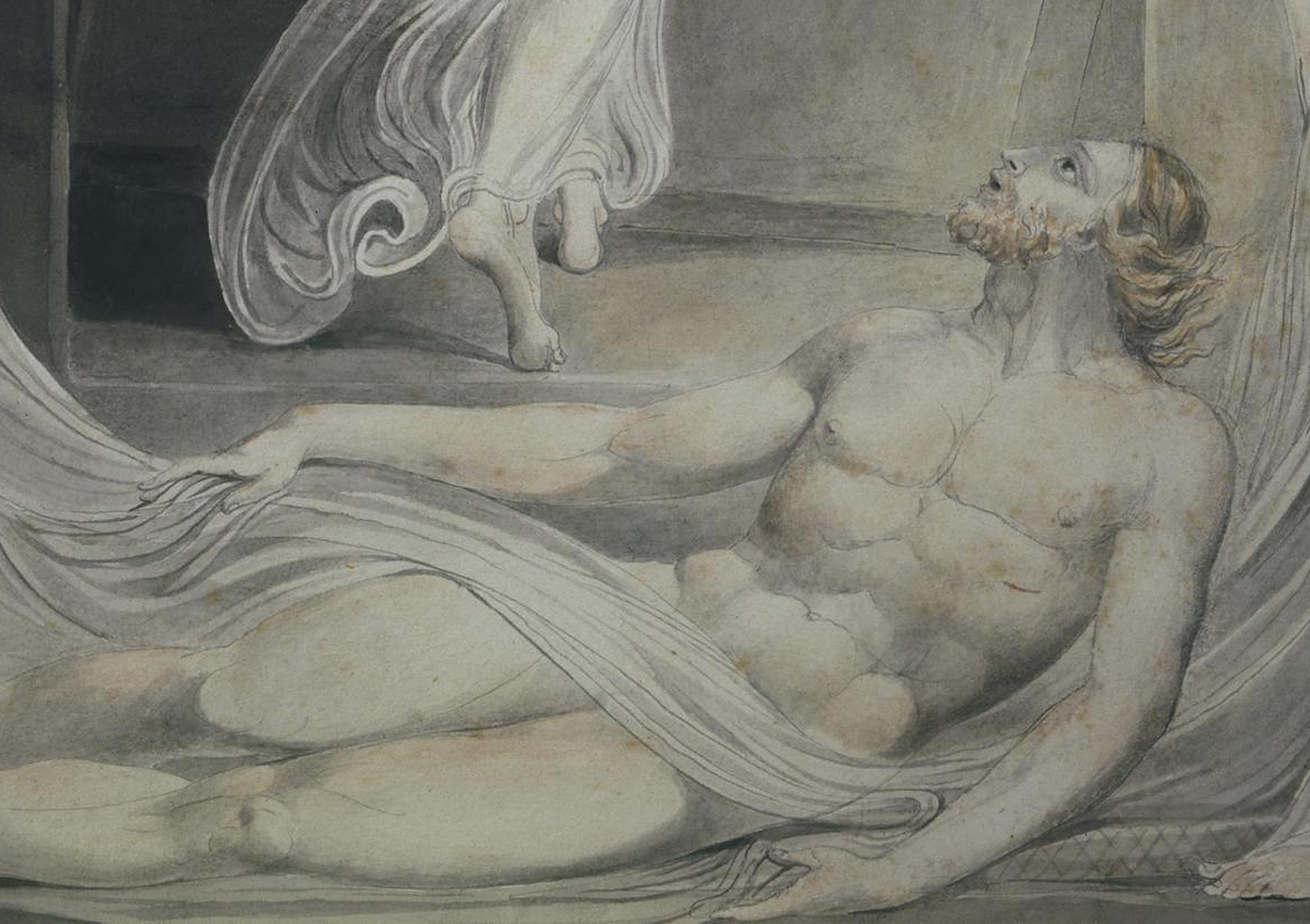
 

William Blake (British, 1757-1827) 'The Angel Rolling away the Stone' c. 1805 (detail)


William Blake (British, 1757-1827)
The Angel Rolling away the Stone (detail)
c. 1805
Watercolour on paper
Victoria and Albert Museum, London, the Morse gift
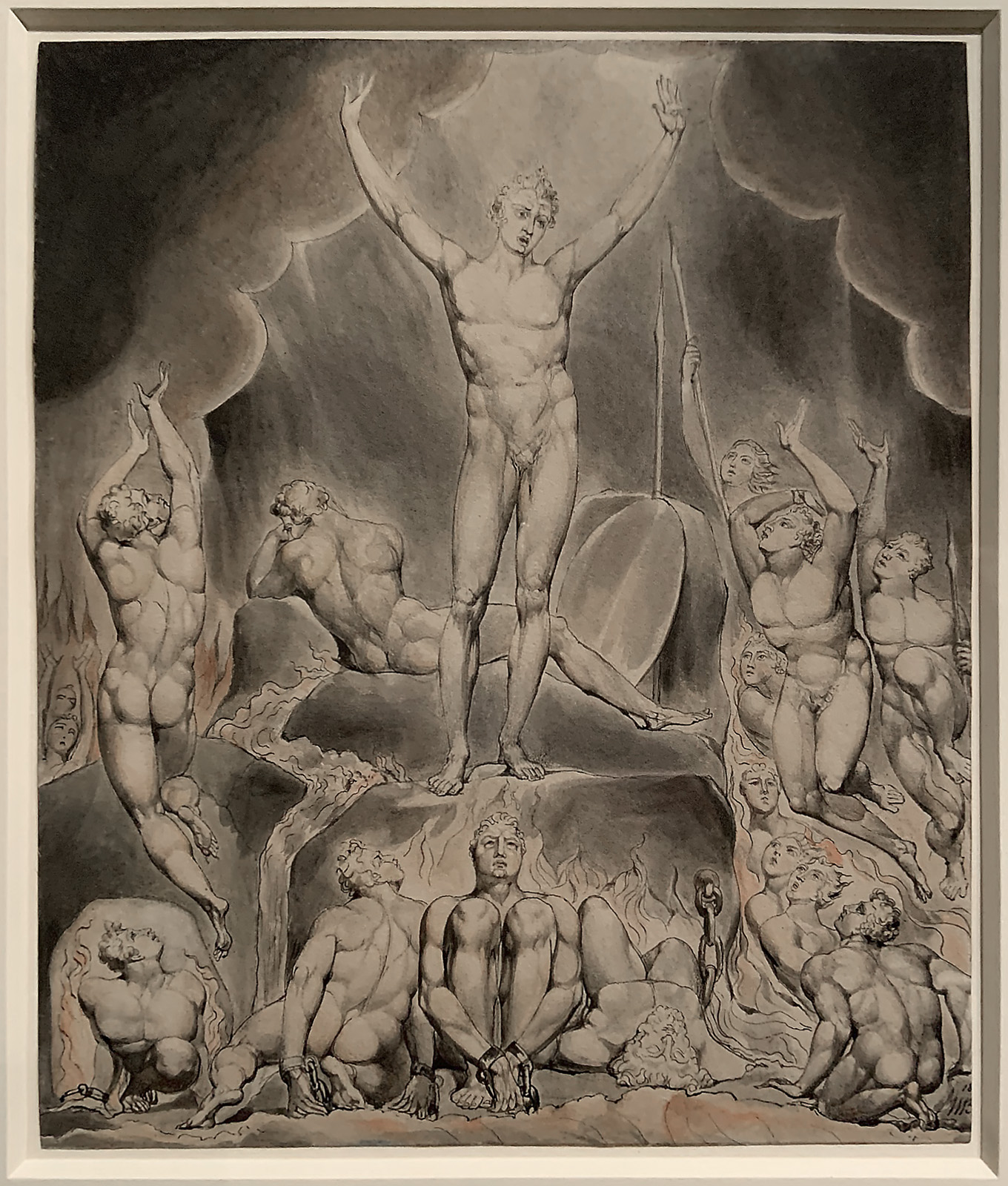
 

William Blake (British, 1757-1827) Illustrations to Milton's 'Paradise Lost' (Thomas set) 1807 (installation view)

William Blake (British, 1757-1827) Illustrations to Milton's 'Paradise Lost' (Thomas set) 1807 (installation view detail)


William Blake (British, 1757-1827)
Illustrations to Milton’s ‘Paradise Lost’ Plate 1: ‘Satan Arousing the Rebel Angels’ (Thomas set) (installation views)
1807
12 designs on 12 sheets
Ink and watercolour on paper
The Huntington Library, Art Collections, and Botanical Gardens
Photos: Marcus Bunyan


John Milton’s epic poem describes Adam and Eve’s banishment from the Garden of Eden. Satan, the rebellious fallen angel, is a major character. Blake made these illustrations for the Rev. Joseph Thomas, following an introduction from Flaxman.

There are three sets: the Thomas set (1807), the Butts set (1808) and the incomplete Linnell set (1822).


The Thomas set

The paintings of the Thomas set are each approximately 10x 8.25 inches. They were commissioned by the Reverend Joseph Thomas at an unrecorded date, sometime before 1807. Although the sheets were trimmed at some time, obliterating the date from several, some still retain the date of 1807, establishing the year of their completion. Thomas’ grandson inherited them from his father, and sold them at Sotheby’s in 1872. By 1876 they were in the collection of Alfred Aspland, who by 1885 took them to Sotheby’s again, dispersing the set among several buyers. Henry Huntington reunited the works in 1914, and today they are still in the collection of the Huntington Library.

Text from the Wikipedia website

Reverend Joseph Thomas

The Rev. Joseph Thomas of Epsom, Surrey, was a clergyman and friend of Flaxman. Flaxman put him and Blake in touch, leading to a series of commissions. Thomas had married an heiress, Millicent Pankhurst. He held no church appointment and was free to pursue his artistic and scholarly interests.

Blake produced several series of watercolours for Thomas illustrating the poetry of the 17th-century writer John Milton, and Shakespeare’s plays. Thomas also purchased a few published works by Blake.

Wall text from the exhibition


William Blake (British, 1757-1827) Illustrations to Milton's 'Paradise Lost' Plate 1: 'Satan Arousing the Rebel Angels' (Thomas set) 1807


William Blake (British, 1757-1827)
Illustrations to Milton’s ‘Paradise Lost’ Plate 1: ‘Satan Arousing the Rebel Angels’ (Thomas set)
1807
12 designs on 12 sheets
Ink and watercolour on paper
The Huntington Library, Art Collections, and Botanical Gardens
Google Art Project, Wikipedia Commons, Public Domain
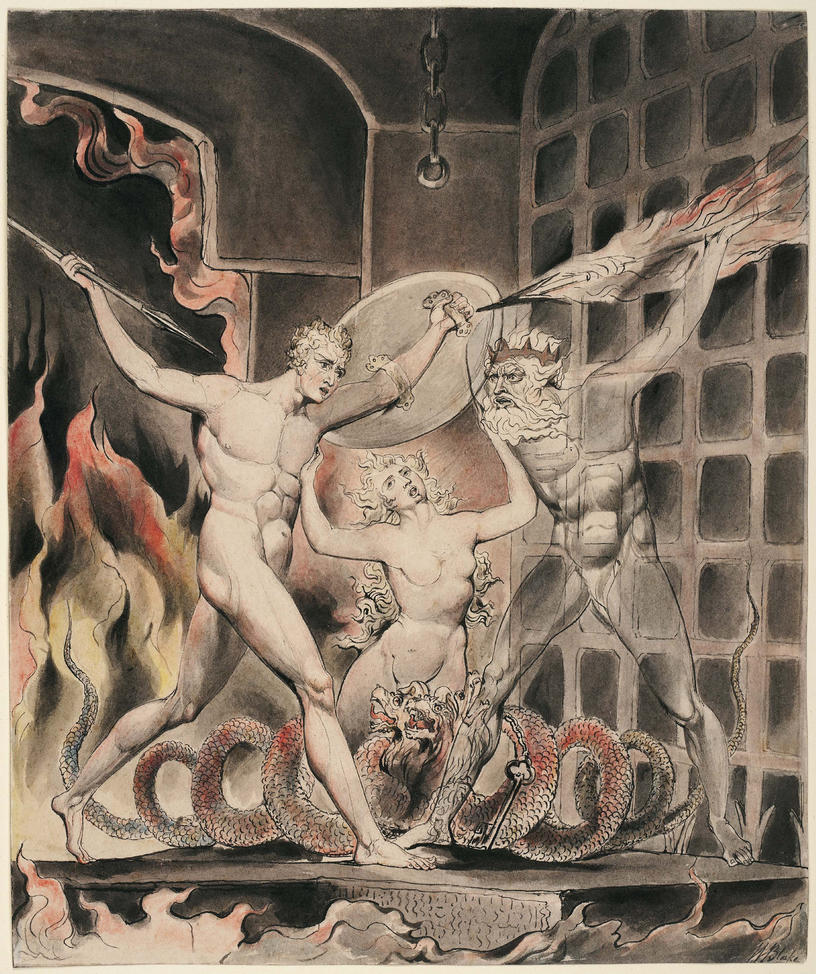
 

William Blake (British, 1757-1827) Illustrations to Milton's 'Paradise Lost' Plate 2: 'Satan, Sin, and Death: Satan Comes to the Gates of Hell' (Thomas set) 1807


William Blake (British, 1757-1827)
Illustrations to Milton’s ‘Paradise Lost’ Plate 2: ‘Satan, Sin, and Death: Satan Comes to the Gates of Hell’ (Thomas set)
1807
12 designs on 12 sheets
Ink and watercolour on paper
The Huntington Library, Art Collections, and Botanical Gardens
Google Art Project, Wikipedia Commons, Public Domain
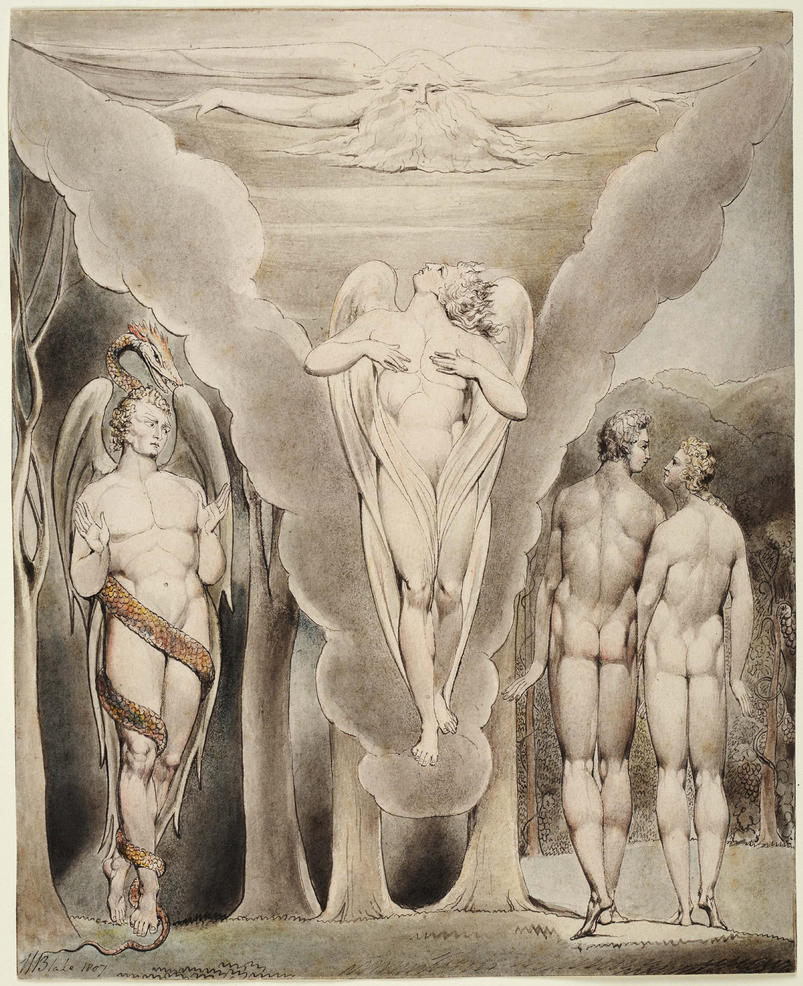
 

William Blake (British, 1757-1827) Illustrations to Milton's 'Paradise Lost' Plate 4: 'Satan Spying on Adam and Eve's Descent into Paradise' (Thomas set) 1807


William Blake (British, 1757-1827)
Illustrations to Milton’s ‘Paradise Lost’ Plate 4: ‘Satan Spying on Adam and Eve’s Descent into Paradise’ (Thomas set)
1807
12 designs on 12 sheets
Ink and watercolour on paper
The Huntington Library, Art Collections, and Botanical Gardens
Google Art Project, Wikipedia Commons, Public Domain


William Blake (British, 1757-1827) Illustrations to Milton's 'Paradise Lost' Plate 7: 'The Rout of the Rebel Angels' (Thomas set) 1807 (installation view)


William Blake (British, 1757-1827)
Illustrations to Milton’s ‘Paradise Lost’ Plate 7: ‘The Rout of the Rebel Angels’ (Thomas set) (installation view)
1807
12 designs on 12 sheets
Ink and watercolour on paper
The Huntington Library, Art Collections, and Botanical Gardens
Photo: Marcus Bunyan


William Blake (British, 1757-1827) Illustrations to Milton's 'Paradise Lost' Plate 7: 'The Rout of the Rebel Angels' (Thomas set) 1807


William Blake (British, 1757-1827)
Illustrations to Milton’s ‘Paradise Lost’ Plate 7: ‘The Rout of the Rebel Angels’ (Thomas set)
1807
12 designs on 12 sheets
Ink and watercolour on paper
The Huntington Library, Art Collections, and Botanical Gardens
Google Art Project, Wikipedia Commons, Public Domain
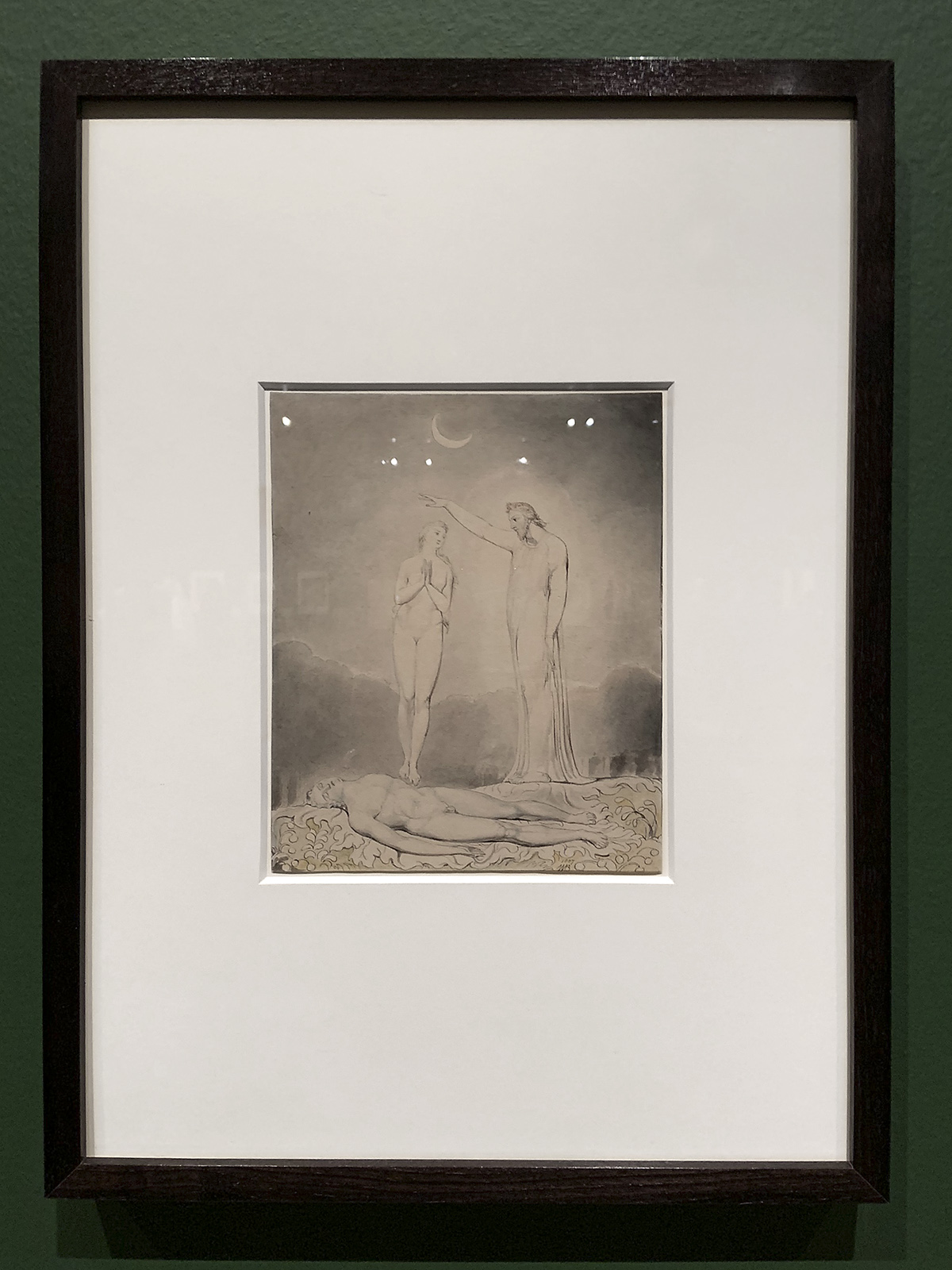
 

William Blake (British, 1757-1827) Illustrations to Milton's 'Paradise Lost' Plate 8: 'The Creation of Eve' (Thomas set) 1807 (installation view)

William Blake (British, 1757-1827) Illustrations to Milton's 'Paradise Lost' Plate 8: 'The Creation of Eve' (Thomas set) 1807 (installation view detail)


William Blake (British, 1757-1827)
Illustrations to Milton’s ‘Paradise Lost’ Plate 8: ‘The Creation of Eve’ (Thomas set) (installation views)
1807
12 designs on 12 sheets
Ink and watercolour on paper
The Huntington Library, Art Collections, and Botanical Gardens
Photos: Marcus Bunyan


William Blake (British, 1757-1827) Illustrations to Milton's 'Paradise Lost' Plate 8: 'The Creation of Eve' (Thomas set) 1807


William Blake (British, 1757-1827)
Illustrations to Milton’s ‘Paradise Lost’ Plate 8: ‘The Creation of Eve’ (Thomas set)
1807
12 designs on 12 sheets
Ink and watercolour on paper
The Huntington Library, Art Collections, and Botanical Gardens
Google Art Project, Wikipedia Commons, Public Domain

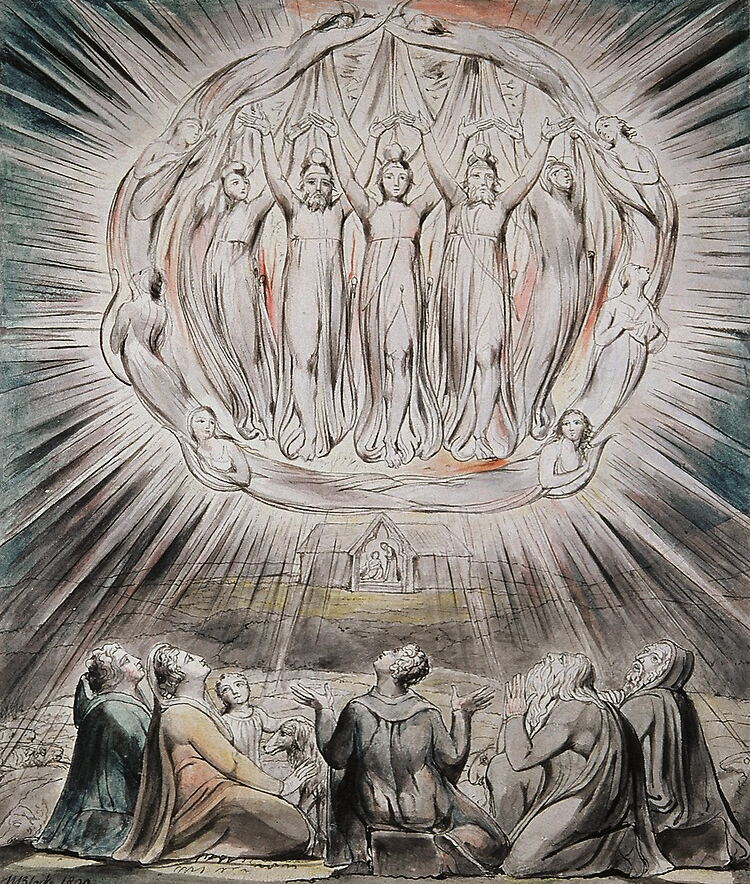
 

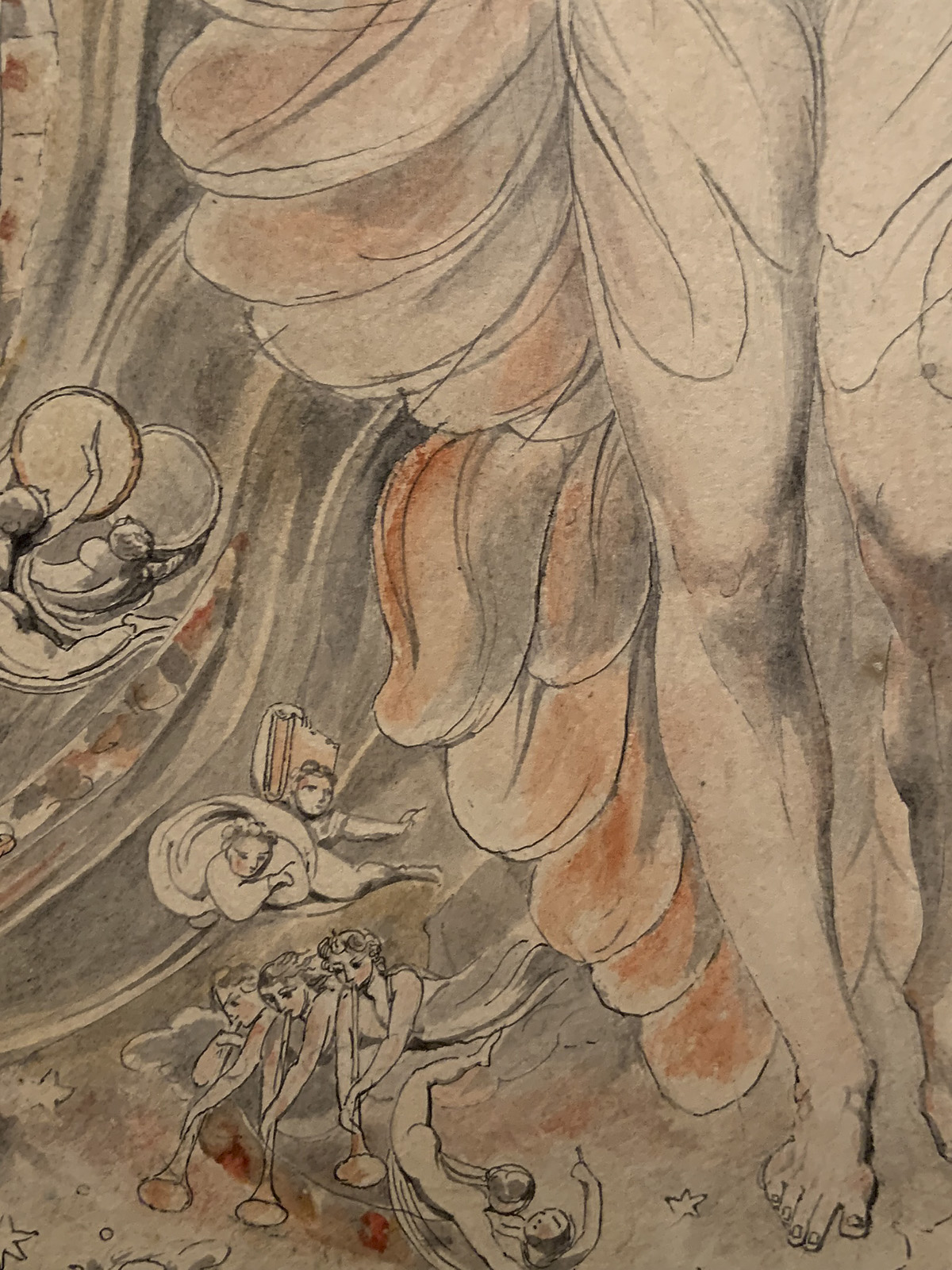
William Blake (British, 1757-1827) Illustrations to Milton's Hymn 'On the Morning of Christ's Nativity' Plate 2: 'The Angels appearing to the Shepherds' 1809 (installation view)

William Blake (British, 1757-1827) Illustrations to Milton's Hymn 'On the Morning of Christ's Nativity' Plate 2: 'The Angels appearing to the Shepherds' 1809 (installation view)


William Blake (British, 1757-1827)
Illustrations to Milton’s Hymn ‘On the Morning of Christ’s Nativity’ Plate 2: ‘The Angels appearing to the Shepherds’ (installation views)
1809
6 designs on 6 sheets
Graphite, ink and watercolour on paper
The Whitworth, The University of Manchester
Photos: Marcus Bunyan


Blake was paid two pounds for each of these six designs by Thomas, twice what he was paid by Butts for the individual Bible watercolours. He made another set of these illustrations for Thomas Butts. Milton’s poem celebrates the birth of Christ, and the retreat of pagan and evil forces.

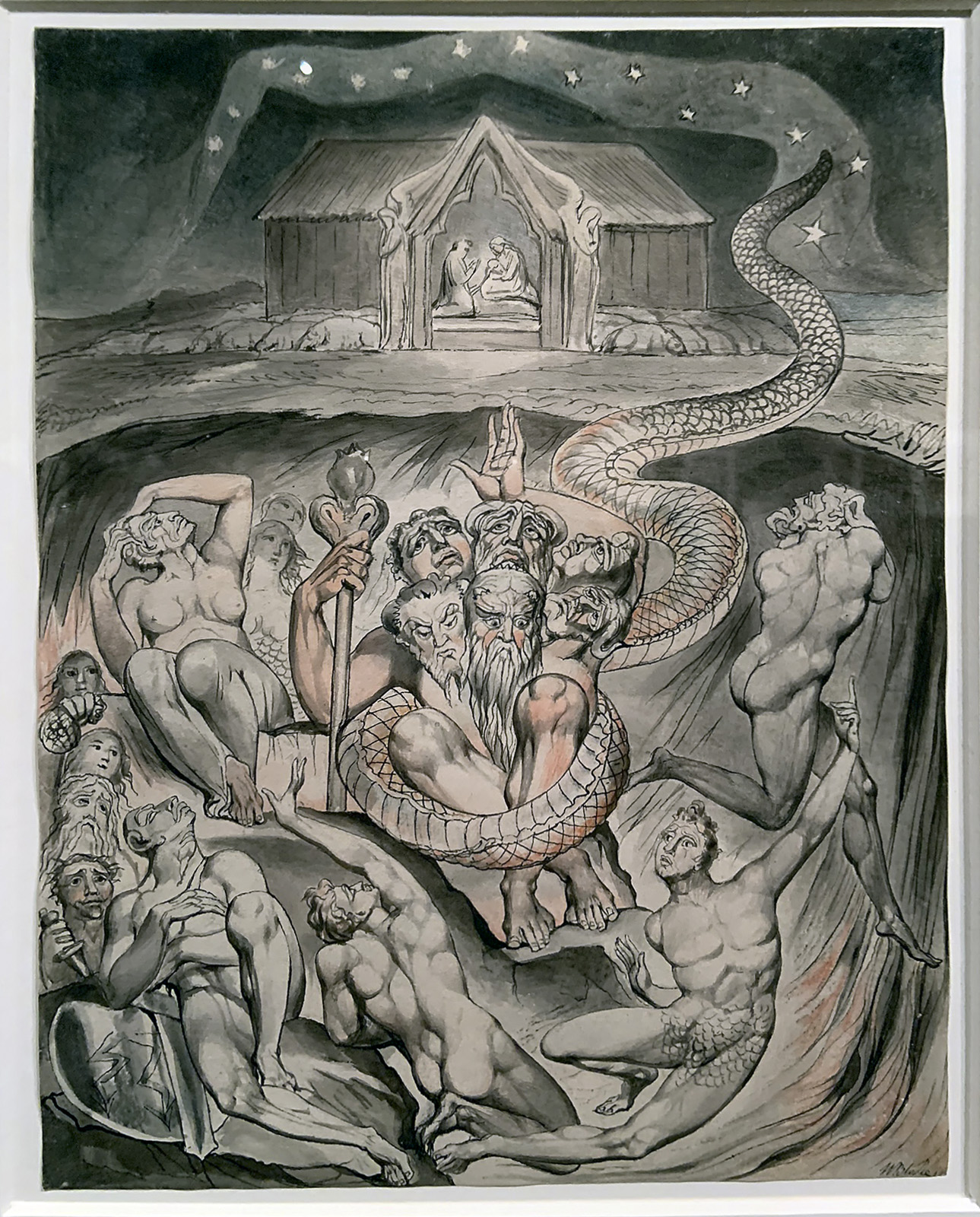
 

William Blake (British, 1757-1827) Illustrations to Milton's Hymn 'On the Morning of Christ's Nativity' Plate 3: 'The Descent of Typhon and the Gods into Hell' 1809 (installation view)

William Blake (British, 1757-1827) Illustrations to Milton's Hymn 'On the Morning of Christ's Nativity' Plate 3: 'The Descent of Typhon and the Gods into Hell' 1809 (installation view)

William Blake (British, 1757-1827) Illustrations to Milton's Hymn 'On the Morning of Christ's Nativity' Plate 3: 'The Descent of Typhon and the Gods into Hell' 1809 (installation view)


William Blake (British, 1757-1827)
Illustrations to Milton’s Hymn ‘On the Morning of Christ’s Nativity’ Plate 3: ‘The Descent of Typhon and the Gods into Hell’ (installation views)
1809
6 designs on 6 sheets
Graphite, ink and watercolour on paper
The Whitworth, The University of Manchester
Photos: Marcus Bunyan


Tate Britain
Millbank, London SW1P 4RG
United Kingdom
Phone: +44 20 7887 8888

Opening hours:
10.00am – 18.00pm daily

Tate Britain website

LIKE ART BLART ON FACEBOOK

Back to top

Photographs: Herbert Ponting Chinese stereocards

June 2019


Herbert Ponting (British, 1870-1935) (photographer) The Universal Photo Art Co (C.H. Graves) (publisher) 'At the barber's, Peking, China' 1902


Herbert Ponting (British, 1870-1935) (photographer)
The Universal Photo Art Co., (C.H. Graves) (publisher)
At the barber’s, Peking, China
c. 1902
Albumen print on card


Fabulous, early Herbert Ponting social documentary stereoviews. I have never seen these before.

The placement of figures and the formal construction of the pictorial plane – strong diagonals and verticals, near to far, vanishing point – make for beautifully balanced, tensioned and dynamic images.

Marcus


Please click on the photographs for a larger version of the image.


Herbert Ponting (British, 1870-1935) (photographer) The Universal Photo Art Co (C.H. Graves) (publisher) 'A Chinese strawberry garden. Proprietor and coolie. China' c. 1902


Herbert Ponting (British, 1870-1935) (photographer)
The Universal Photo Art Co., (C.H. Graves) (publisher)
A Chinese strawberry garden. Proprietor and coolie. China
c. 1902
Albumen print on card


Herbert Ponting (British, 1870-1935) (photographer) The Universal Photo Art Co (C.H. Graves) (publisher) 'En Route to the Great Wall of China. Entrance to the city of Nankow' c. 1902


Herbert Ponting (British, 1870-1935) (photographer)
The Universal Photo Art Co., (C.H. Graves) (publisher)
En Route to the Great Wall of China. Entrance to the city of Nankow
c. 1902
Albumen print on card


Herbert Ponting (British, 1870-1935) (photographer) Underwood & Underwood (publisher) 'Where China's Great Wall begins its 1,250 mile course - from Shan-hai-ewan (N.) to Liao Hsi Mountains' 1904


Herbert Ponting (British, 1870-1935) (photographer)
Underwood & Underwood (publisher)
Where China’s Great Wall begins its 1,250 mile course – from Shan-hai-ewan (N.) to Liao Hsi Mountains
1904
Albumen print on card


Herbert Ponting (British, 1870-1935)

Herbert George Ponting, FRGS (21 March 1870 – 7 February 1935) was a professional photographer. He is best known as the expedition photographer and cinematographer for Robert Falcon Scott’s Terra Nova Expedition to the Ross Sea and South Pole (1910-1913). In this role, he captured some of the most enduring images of the Heroic Age of Antarctic Exploration. …

Early life

Ponting was born in Salisbury, Wiltshire in the south of England, on 21 March 1870. His father was a successful banker, Francis Ponting, and his mother was Mary Sydenham. From the age of eighteen Herbert was employed at a local bank branch in Liverpool, where he stayed for four years. That time was long enough to convince him that he did not wish to follow in the profession of his father, and attracted to stories of the American West, he moved to California where he worked in mining and then bought a fruit ranch in the 1890s. In 1895 he married a California woman, Mary Biddle Elliott; their daughter Mildred, was born in Auburn, California in January 1897.

Ponting sold his fruit farm in 1898 and, with his wife and daughter, returned to Britain to stay with his family. When they returned to the USA he turned his long-standing hobby of photography in his next career. Following a chance meeting with a professional photographer in California, to whom he had given advice about the locality and showed his own photos, he entered his pictures in competitions and won awards; he also sent some of his stereoscopic photographs to companies who published them. His work was also selected for the first San Francisco Salon; at that time he was living in Sausalito, north of San Francisco. He took stereoviews of and reported on the Russo-Japanese war of 1904-1905, and afterwards continued to travel around Asia, working in Burma, Korea, Java, China and India taking stereoviews and working as a freelance photographer for English-speaking periodicals. Improvements in the printing press had made it possible, for the first time, for mass-market magazines to print and publish photographic illustrations.

After spending much of 1901-1906 travelling around photographing in Asia, Ponting returned to Europe, where he continued to take stereoviews (including in Switzerland and Spain) and wrote illustrated articles for magazines including Country Life, the Graphic, the Illustrated London News, Pearson’s, and the Strand Magazine. In the Strand, Ponting’s work appeared side by side with the Sherlock Holmes stories of Arthur Conan Doyle, one of Ponting’s contemporaries.

Ponting expanded his photographs of Japan into a 1910 book, In Lotus-land Japan. He took extensive photographs in Spain. He was elected a Fellow of the Royal Geographical Society (FRGS). His flair for journalism and ability to shape his photographic illustrations into a narrative led to his being signed as expedition photographer aboard the Terra Nova, the first time a professional photographer was included on an Antarctic expedition.

Text from the Wikipedia website


Herbert Ponting (British, 1870-1935) (photographer) The "Perfec" Stereograph. H.C. White Co., (publisher) 'The-Tien-ning-ssu Pagoda, near Peking, China' 1907


Herbert Ponting (British, 1870-1935) (photographer)
The “Perfec” Stereograph. H.C. White Co., (publisher)
The-Tien-ning-ssu Pagoda, near Peking, China
1907
Albumen print on card


Herbert Ponting (British, 1870-1935) (photographer) The "Perfec" Stereograph. H.C. White Co., (publisher) 'Peking, the capital of China, looking east from a balcony of the Drum Tower' 1907


Herbert Ponting (British, 1870-1935) (photographer)
The “Perfec” Stereograph. H.C. White Co., (publisher)
Peking, the capital of China, looking east from a balcony of the Drum Tower
1907
Albumen print on card


William Cooper (British, 1878-1945) 'Drum Tower, Peking' 1910


William Cooper (British, 1878-1945)
Drum Tower, Peking
1910
Gelatin silver print
University of Bristol – Historical Photographs of China
Creative Commons 3.0


Beijing’s Bell and Drum Towers are situated on a small square north of the Forbidden City. The towers, which were used for telling time until 1924, were built in 1272 during the reign of Kublai Khan and were rebuilt after two fires during the Ming and Qing dynasties. The Bell and Drum Towers are quintessential landmarks of historic Beijing.


William Boyd Cooper (1878-1945)

William Boyd Cooper (1878-1945) was born in Belfast, Northern Ireland. Around 1911, he was appointed Professor of Commerce at Peking University, where he lectured in English and French. Cooper joined the North China British Volunteer Corps. On 12 February 1917, he was commissioned as a Second Lieutenant in the Chinese Labour Corps (CLC). He served in France with the CLC and rose to be a captain, relinquishing his Commission in 1919. William Cooper and his family returned from China and settled in Wimbledon, London. The William Cooper Collection is held in Special Collections, University of Bristol Library (Special Collections ref DM2823). 336 images.

Anonymous text. “Cooper, William Collection,” on the Historical Photographs of China website Nd [Online] Cited 04/06/2023


Herbert Ponting (British, 1870-1935) (photographer) The "Perfec" Stereograph. H.C. White Co., (publisher) 'A Tea seller in the streets of Moukden, Manchuria' c. 1906


Herbert Ponting (British, 1870-1935) (photographer)
The “Perfec” Stereograph. H.C. White Co., (publisher)
A Tea seller in the streets of Moukden, Manchuria
c. 1906
Albumen print on card


Herbert Ponting (British, 1870-1935) (photographer) 'A poppy field in Manchuria, natives extracting fluid from which opium is made' c. 1902-1907


Herbert Ponting (British, 1870-1935) (photographer)
The “Perfec” Stereograph. H.C. White Co., (publisher)
A poppy field in Manchuria, natives extracting fluid from which opium is made
c. 1902-1907
Albumen print on card


Herbert Ponting (British, 1870-1935) (photographer) 'The Old Bell Tower in the heart of Mukden, Manchuria' 1905


Herbert Ponting (1870-1935) (photographer)
The “Perfec” Stereograph. H.C. White Co., (publisher)
The Old Bell Tower in the heart of Mukden, Manchuria
1905
Albumen print on card


Herbert Ponting (British, 1870-1935) (photographer) 'Along the Great Wall of China (originally 1700 miles long), looking east up to a watch tower' 1907


Herbert Ponting (British, 1870-1935) (photographer)
The “Perfec” Stereograph. H.C. White Co., (publisher)
Along the Great Wall of China (originally 1700 miles long), looking east up to a watch tower
1907
Albumen print on card


Herbert Ponting (British, 1870-1935) (photographer) 'Scene on Ha-ta-Men St., one of the principal thoroughfares of Peking, China' 1907


Herbert Ponting (British, 1870-1935) (photographer)
The “Perfec” Stereograph. H.C. White Co., (publisher)
Scene on Ha-ta-Men St., one of the principal thoroughfares of Peking, China
1907
Albumen print on card


LIKE ART BLART ON FACEBOOK

Back to top

Exhibition: ‘Oscar Rejlander: Artist Photographer’ at the J. Paul Getty Museum, Getty Center, Los Angeles

Exhibition dates: 12th March – 9th June, 2019

Curators: Lori Pauli, curator of photographs at the National Gallery of Canada, and Karen Hellman, assistant curator of photographs at the J. Paul Getty Museum


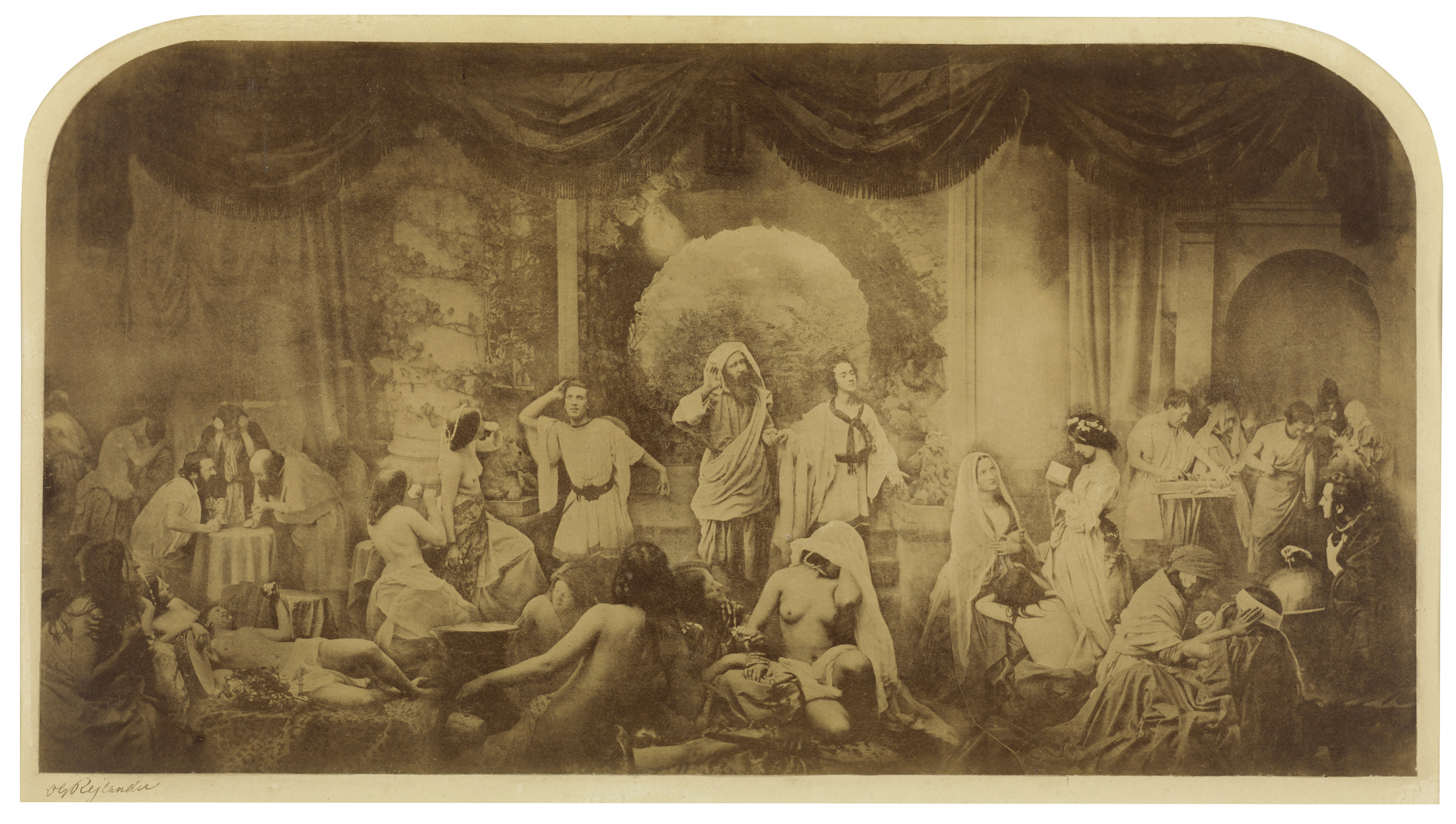
Oscar G. Rejlander (British born Sweden, 1813-1875) 'The Two Ways of Life' 1856-1857 from the exhibition 'Oscar Rejlander: Artist Photographer' at the J. Paul Getty Museum, Getty Center, Los Angeles, March - June, 2019


Oscar G. Rejlander (British born Sweden, 1813-1875)
Two Ways of Life (Hope in Repentance)
1857
Albumen silver print
21.8 x 40.8cm (8 9/16 x 16 1/16 in.)
Moderna Museet, Stockholm


Oscar Rejlander, the father of photography, sets in motion many of the later developments of photographic art.

I could wax lyrical about the light, staging and humour of the images; the allegorical, religious and emotional portraits; the influence of photography on painting; the spontaneous act caught on film (Eh!); the combination printing, precursor to digital manipulation (Two Ways of Life); the costume dramas (The Comb Seller); or the presaging of the work of August Sander (The Juggler). But I won’t.

Instead, I just want you to think about the period in which these photographs were made – that Dickensian era of archetypal humanity, intricate narrative. I want you to feel that these reality pictures are alive and how they transcend the time of their creation through the lyricism of the print.

From the mind of the artist to works of art that stare down that cosmic time shift, from cradle to grave.

Marcus


Many thanks to the J. Paul Getty Museum for allowing me to publish the photographs in the posting. Please click on the photographs for a larger version of the image.


“It is the mind of the artist, and not the nature of his materials which makes his production a work of art.”


Oscar G. Rejlander


Oscar Gustav Rejlander is best known for his work “Two Ways of Life,” a masterpiece for which he used over 32 different negatives. It took him around six weeks to create it and over 3 days to produce a final print.


Oscar G. Rejlander (British born Sweden, 1813-1875) 'The Infant Photography Giving the Painter an Additional Brush' c. 1856 from the exhibition 'Oscar Rejlander: Artist Photographer' at the J. Paul Getty Museum, Getty Center, Los Angeles, March - June, 2019


Oscar G. Rejlander (British born Sweden, 1813-1875)
The Infant Photography Giving the Painter an Additional Brush
c. 1856
Albumen silver print
6 × 7.1cm (2 3/8 × 2 13/16 in.)
Courtesy The J. Paul Getty Museum, Los Angeles


After emigrating from Sweden to England in 1839 and taking up photography in 1852, he became one of the first to recognise photography’s potential as a “handmaid of art” – exemplified by early photographs like “The Infant Photography Giving the Painter an Additional Brush.” This tiny print served to demonstrate how photography could preserve an allegorical scene for a painter’s extended study. It also functioned as a self-portrait and hinted at Rejlander’s hidden ambitions: reflected in the convex mirror, he presents himself as a modern-day Jan van Eyck.

Extract from Dana Ostrander. “The Overlooked Legacy of Oscar Rejlander, Who Elevated Photography to an Art,” on the Hyperallergic website April 2, 2019 [Online] Cited 06/06/2019


Oscar G. Rejlander (British born Sweden, 1813-1875) 'Non Angeli sed Angli (Not Angels but Anglos), after Raphael’s Sistine Madonna' c. 1854-1856


Oscar G. Rejlander (British born Sweden, 1813-1875)
Non Angeli sed Angli (Not Angels but Anglos), after Raphael’s Sistine Madonna
c. 1854-1856
Albumen silver print
20.5 x 26.3cm (8 1/16 x 10 3/8 in.)
Princeton University Art Museum
Museum purchase, David H. McAlpin, Class of 1920, Fund


Oscar G. Rejlander (British born Sweden, 1813-1875) 'Mary Constable and Her Brother' 1866


Oscar G. Rejlander (British born Sweden, 1813-1875)
Mary Constable and Her Brother
1866
Albumen silver print
16.8 x 22.1cm (6 5/8 x 8 11/16 in.)
The Metropolitan Museum of Art, Gilman Collection
Purchase, Harriette and Noel Levine Gift, 2005


Oscar G. Rejlander (British born Sweden, 1813-1875) 'The Bachelor's Dream' c. 1860


Oscar G. Rejlander (British born Sweden, 1813-1875)
The Bachelor’s Dream
c. 1860
Albumen silver print
13.9 x 19.6cm (5 1/2 x 7 11/16 in.)
George Eastman Museum, purchase
Photo: Courtesy of the George Eastman Museum


Oscar G. Rejlander (British born Sweden, 1813-1875) 'Hard Times (The Out of Work Workman's Lament)' 1860


Oscar G. Rejlander (British born Sweden, 1813-1875)
Hard Times (The Out of Work Workman’s Lament)
1860
Albumen silver print
13.8 x 19.7cm (5 7/16 x 7 3/4 in.)
George Eastman Museum, purchase
Photo: Courtesy of the George Eastman Museum


Oscar G. Rejlander (British born Sweden, 1813-1875) 'Head of St. John the Baptist in a Charger' c. 1860


Oscar G. Rejlander (British born Sweden, 1813-1875)
Head of St. John the Baptist in a Charger
c. 1860
Albumen silver print
14.1 x 17.8cm (5 9/16 x 7 in.)
George Eastman Museum, purchase
Photo: Courtesy of the George Eastman Museum


Oscar G. Rejlander (British born Sweden, 1813-1875) 'Study of Hands' 1856


Oscar G. Rejlander (British born Sweden, 1813-1875)
Study of Hands
1856
Albumen silver print
14.8 x 17.6cm (5 13/16 x 6 15/16 in.)
National Gallery of Canada, Ottawa
Purchased 2014


Oscar G. Rejlander (British born Sweden, 1813-1875) 'A "Set To"' 1855


Oscar G. Rejlander (British born Sweden, 1813-1875)
A “Set To”
1855
In “Prince Albert’s Calotype Album,” vol. 2, about 1860
Salted paper print
15 x 21cm (5 7/8 x 8 1/4 in.)
Royal Collection Trust
© Her Majesty Queen Elizabeth II 2019


Oscar G. Rejlander (British, born Sweden, 1813-1875) was one of the 19th century’s greatest innovators in the medium of photography, counting Queen Victoria, Prince Albert, Charles Darwin, Lewis Carroll and Julia Margaret Cameron among his devotees. Nevertheless, the extent of Rejlander’s work and career has often been overlooked. Oscar Rejlander: Artist Photographer, on view March 12 – June 9, 2019 at the J. Paul Getty Museum, Getty Center, Los Angeles, is the first exhibition to explore the prolific career of the artist who became known as “the father of art photography,” and whose bold experimentation with photographic techniques early in the medium’s development and keen understanding of human emotion were ahead of their time.

The exhibition features 150 photographs that demonstrate Rejlander’s remarkable range, from landscapes and portraits to allegories and witty commentaries on contemporary society, alongside a selection of his early paintings, drawings, and prints.

“Rejlander tells us in his writings that ‘It is the mind of the artist, and not the nature of his materials, which makes his production a work of art’,” says Timothy Potts, director of the J. Paul Getty Museum. “While technologies have dramatically changed, some of the fundamental issues that Rejlander grappled with in his photographs still resonate with photographic practice today. His photographs, though made a century and a half ago, are both meticulously of their time and timeless, foreshadowing many later achievements of the medium through to the digital age.”

Oscar G. Rejlander was born in Sweden and moved to England in 1839, working first as a painter before turning to photography in 1852. He made a living as a portrait photographer while experimenting with photographic techniques, most notably combination printing, in which parts of multiple negatives were exposed separately and then printed to form a single picture. Rejlander moved to London in 1862, where his business continued to grow and where his wife, Mary Bull, worked alongside him in his photography studios.

Portraits and Images of Everyday Life

Portraiture, particularly of members of the higher ranks of London society, was Rejlander’s main professional activity and supported his livelihood. Art critics and clients alike admired his skill with lighting as well as the natural and seemingly spontaneous expressions he was able to capture. Rejlander photographed some of the most important figures of the day, including the English scientist Charles Darwin, known for his theory of evolution, and poets Alfred Lord Tennyson and Henry Taylor. He also guided the first photographic efforts of the writer and mathematician Charles Lutwidge Dodgson (known as Lewis Carroll), the creator of Alice’s Adventures in Wonderland, as well as photographer Julia Margaret Cameron.

From the beginning of his career as a photographer, Rejlander was keenly interested in depicting the activities of ordinary people, particularly the middle and lower classes of society. It was through his staged domestic images that he illustrated familial relationships with tenderness and humour, often using models and props to re-create in his studio the scenes he had witnessed in the streets, from young boys who swept up dirt and debris in exchange for tips, to street vendors such as “flower girls” who offered bouquets for sale to passersby. Like a modern street photographer, Rejlander chose his compositions and subjects based on what he saw and heard, realising the final images in the studio.

In 1863 Rejlander constructed a unique iron, wood, and glass “tunnel studio,” where the sitter, positioned in the open, light-filled part of the studio, would look into the darker part of the room where the camera and operator were situated, nearly invisible. The pupils of the sitters’ eyes expanded, allowing for “more depth and expression,” as a writer observed in Photographic News. In addition to this technique, Rejlander often exploited his own unique ability to enact exaggerated emotions to assist his subjects. Charles Darwin illustrated many of Rejlander’s expressive photographs in The Expression of the Emotions in Man and Animals, published in 1872.

Combination Printing and Two Ways of Life

Rejlander holds an important place in the history of photography primarily because of the groundbreaking way he applied the technique of combination printing. On view in the exhibition is the most ambitious example of the artist’s pioneering experimentation, the epic photograph, Two Ways of Life, or Hope in Repentance (1857). It attracted immediate attention upon its exhibition both for its large size and the ambition of its production, which included the combination printing of over 30 separate wet collodion on glass negatives, a process that took more than three days.

The work represents an intricate allegory of two opposing philosophies of life: Vice and Virtue. In the centre of the picture, a wise man guides a younger man to the right, toward a life of virtue – work, study, and religion. To the left, a second young man is tempted by the call of desire, gambling, idleness, and vice. Prince Albert may have worked with Rejlander on the overall conception of the picture, and he and Queen Victoria purchased three versions for their art collection.

Despite this support from the Royal Family, Two Ways of Life divided the photographic community, with professional photographers considering it a technical tour de force, and amateurs seeing it as not only artificial in production but also immoral in its subject. However, it remains one of finest examples of combination printing to come from this period.

Art and Photography

Today, the debate about photography’s status as an art may be obsolete, but the arts community in 19th-century Britain was passionately divided over Rejlander’s chosen medium. Rejlander strongly advocated the view that photography was an independent art, while he was also convinced that a photograph could help artists by providing an effective substitute for working from live models. He was possibly the first to provide artists with visual references for their work in photographs, creating figure studies in a range of poses and costumes, including close-ups of hands, feet, drapery, and even fleeting facial expressions. Although many painters were reluctant to disclose their reliance on photography, several collected Rejlander’s photographs, including George Frederic Watts (English, 1817-1904) and Henri Fantin-Latour (French, 1836-1904).

Paintings also strongly influenced Rejlander’s choice of subjects, leading him not only to imitate the styles of artists but also to re-create the figures found in their compositions. He frequently photographed actors or models posing as a “Madonna,” a “Devotee,” a “Disciple,” or specific Christian figures such as John the Baptist. He may have intended these studies, as well as others showing figures in classical robes, for artists to consult as well.

“What we hope comes through in the exhibition is Rejlander’s humanity and humour, as well as his humble nature, particularly evident in the fact that he often sent his work to exhibitions under the name ‘amateur’,” says Karen Hellman, assistant curator of photographs at the Getty Museum. “His explanation: ‘When I compare what I have done with what I think I ought to do, and some day hope I shall do, I think of myself as only an amateur, after all – that is to say, a beginner’.”

Oscar Rejlander: Artist Photographer, is on view March 12 – June 9, 2019 at J. Paul Getty Museum, Getty Center. The exhibition is curated by Lori Pauli, curator of photographs at the National Gallery of Canada, and Karen Hellman, assistant curator of photographs at the J. Paul Getty Museum.

Press release from the J. Paul Getty Museum


Oscar G. Rejlander (British born Sweden, 1813-1875) 'Mr. Collett's Return' 1841


Oscar G. Rejlander (British born Sweden, 1813-1875)
Mr. Collett’s Return
1841
Black chalk, charcoal and white wash highlights on paper (backed)
92.8 × 74.4cm
The Collection: Art and Archaeology in Lincolnshire (Usher Gallery, Lincoln)


Attributed to Oscar G. Rejlander (British born Sweden, 1813-1875) '[Landscape]' c. 1855


Attributed to Oscar G. Rejlander (British born Sweden, 1813-1875)
[Landscape]
c. 1855
Salted paper print
22.3 × 19.7cm
National Gallery of Canada, Ottawa
Purchased 2014


Oscar G. Rejlander (British born Sweden, 1813-1875) 'The Sailor Boy' 1855, printed 1873


Oscar G. Rejlander (British born Sweden, 1813-1875)
The Sailor Boy
1855, printed 1873
Carbon print
19 x 16cm (7 1/2 x 6 5/16 in.)
Royal Collection Trust
© Her Majesty Queen Elizabeth II 2019


Oscar G. Rejlander (British born Sweden, 1813-1875) 'Ariadne' 1857


Oscar G. Rejlander (British born Sweden, 1813-1875)
Ariadne
1857
Albumen print from a wet collodion negative
Paul Mellon Fund
Courtesy National Gallery of Art, Washington


“I believe photography will make painters better artists and more careful draughtsmen. You may test their figures by photography. In Titian’s Venus and Adonis, Venus has her head turned in a manner that no female could turn it and at the same time shows so much of her back. Her right leg also is too long. I have proved the correctness of this opinion by photography with variously shaped female models.” ~ Oscar G. Rejlander 1863

“He was perhaps the first to market photographic nude studies to artists, and he even used them to test the anatomical accuracy of the Old Masters. His photograph “Ariadne” was created, in part, to expose the unnatural pose and elongated feminine proportions in Titian’s “Venus and Adonis.” Many of Rejlander’s contemporaries came to rely on these nude studies, and the exhibition contains at least three originally owned by the painter Henri Fantin-Latour.”

Extract from Dana Ostrander. “The Overlooked Legacy of Oscar Rejlander, Who Elevated Photography to an Art,” on the Hyperallergic website April 2, 2019 [Online] Cited 06/06/2019


Oscar G. Rejlander (British born Sweden, 1813-1875) 'Madonna and Child with St. John the Baptist' c. 1860


Oscar G. Rejlander (British born Sweden, 1813-1875)
Madonna and Child with St. John the Baptist
c. 1860
Albumen silver print
17.8 × 12.4cm (7 × 4 7/8 in.)
Courtesy The J. Paul Getty Museum, Los Angeles


Oscar G. Rejlander (British born Sweden, 1813-1875) 'Young Lady in a Costume' c. 1860


Oscar G. Rejlander (British born Sweden, 1813-1875)
Young Lady in a Costume
c. 1860
Albumen silver print
Courtesy National Gallery of Canada, Ottawa


Oscar G. Rejlander (British born Sweden, 1813-1875) 'Eh!' negative about 1854-1855; print about 1865


Oscar G. Rejlander (British born Sweden, 1813-1875)
Eh!
negative about 1854-1855; print about 1865
Albumen silver print
8.9 x 5.9cm (3 1/2 x 2 5/16 in.)
The J. Paul Getty Museum, Los Angeles


Oscar G. Rejlander (British born Sweden, 1813-1875) 'The First Negative' 1857


Oscar G. Rejlander (British born Sweden, 1813-1875)
The First Negative
1857
Albumen silver print
29 x 15cm (11 7/16 x 5 7/8 in.)
Musée d’Orsay, Paris Photo
© RMN-Grand Palais / Art Resource, NY / Patrice Schmidt


In “The First Negative,” Rejlander restages Pliny’s account of the origins of painting, boldly suggesting that the act of tracing a shadow is more akin to creating a photographic negative than a painting.


Oscar G. Rejlander (British born Sweden, 1813-1875) 'The Participles, or Grammar for Little Boys: Catching' 1857


Oscar G. Rejlander (British born Sweden, 1813-1875)
The Participles, or Grammar for Little Boys: Catching
1857
Albumen silver print
18.7 x 12.7cm (7 3/8 x 5 in.)
Moderna Museet, Stockholm


Oscar G. Rejlander (British born Sweden, 1813-1875) 'The Participles, or Grammar for Little Boys: Caught' 1857


Oscar G. Rejlander (British born Sweden, 1813-1875)
The Participles, or Grammar for Little Boys: Caught
1857
Albumen silver print
20.3 x 15.7cm (8 x 6 3/16 in.)
The J. Paul Getty Museum, Los Angeles


Oscar G. Rejlander (British born Sweden, 1813-1875) 'Mr. Coleman as Belphegor' c. 1857, printed later


Oscar G. Rejlander (British born Sweden, 1813-1875)
Mr. Coleman as Belphegor
c. 1857, printed later
Platinum print
18.2 x 14.4cm (7 3/16 x 5 11/16 in.)
The Royal Photographic Society Collection at the V&A, acquired with the generous assistance of the Heritage Lottery Fund and Art Fund Image
© Victoria & Albert Museum, London


Oscar G. Rejlander (British born Sweden, 1813-1875) 'Please Give Us a Copper' c. 1866-1868


Oscar G. Rejlander (British born Sweden, 1813-1875)
Please Give Us a Copper
c. 1866-1868
Albumen silver print
17.9 x 12.6cm (7 1/16 x 4 15/16 in.)
Princeton University Art Museum. Museum purchase


A copper is a brown coin of low value made of copper or bronze.


Oscar G. Rejlander (British born Sweden, 1813-1875) 'The Juggler' c. 1865, printed later


Oscar G. Rejlander (British born Sweden, 1813-1875)
The Juggler
c. 1865, printed later
Platinum print
19.5 x 14.6cm (7 11/16 x 5 3/4 in.)
The Royal Photographic Society Collection at the V&A, acquired with the generous assistance of the Heritage Lottery Fund and Art Fund Image
© Victoria and Albert Museum, London


Oscar G. Rejlander (British born Sweden, 1813-1875) 'Enchanted by a Parrot (Mary Rejlander?)' c. 1860


Oscar G. Rejlander (British born Sweden, 1813-1875)
Enchanted by a Parrot (Mary Rejlander?)
c. 1860
Albumen silver print
Image (approx.): 50 x 30cm (19 11/16 x 11 13/16 in.)
William Talbott Hillman Collection
Photo: Hans P. Kraus, Jr., New York


Oscar G. Rejlander (British born Sweden, 1813-1875) 'The Cup that Cheers' c. 1860


Oscar G. Rejlander (British born Sweden, 1813-1875)
The Cup that Cheers
c. 1860
Albumen silver print
19.9 x 15cm (7 13/16 x 5 7/8 in.)
Princeton University Art Museum
Museum purchase, gift of Mr. and Mrs. Max Adler


Oscar G. Rejlander (British born Sweden, 1813-1875) 'Knuckle Bones' 1860


Oscar G. Rejlander (British born Sweden, 1813-1875)
Knuckle Bones
1860
Albumen silver print
15.4 x 12.5cm (6 1/16 x 4 15/16 in.)
George Eastman Museum, purchase
Photo: Courtesy of the George Eastman Museum


Knucklebones

Knucklebones, also known as TaliFivestones, or Jacks, is a game of ancient origin, usually played with five small objects, or ten in the case of jacks. Originally the “knucklebones” (actually the astragalus, a bone in the ankle, or hock) were those of a sheep, which were thrown up and caught in various manners. Modern knucklebones consist of six points, or knobs, projecting from a common base, and are usually made of metal or plastic. The winner is the first player to successfully complete a prescribed series of throws, which, though similar, differ widely in detail. The simplest throw consists in either tossing up one stone, the jack, or bouncing a ball, and picking up one or more stones or knucklebones from the table while it is in the air. This continues until all five stones or knucklebones have been picked up. Another throw consists in tossing up first one stone, then two, then three and so on, and catching them on the back of the hand. Different throws have received distinctive names, such as “riding the elephant”, “peas in the pod”, “horses in the stable”, and “frogs in the well”.

Text from the Wikipedia website


Oscar G. Rejlander (British born Sweden, 1813-1875) '"Father Times" (Where's the Cat?)' c. 1860


Oscar G. Rejlander (British born Sweden, 1813-1875)
“Father Times” (Where’s the Cat?)
c. 1860
Albumen paper print
16.5 x 14.2cm (6 1/2 x 5 9/16 in.)
Wilson Centre for Photography


Oscar G. Rejlander (British born Sweden, 1813-1875) 'Night in Town (Poor Jo, Homeless)' before 1862; print after 1879


Oscar G. Rejlander (British born Sweden, 1813-1875)
Night in Town (Poor Jo, Homeless)
before 1862; print after 1879
Carbon print
20.3 x 15.7cm (8 x 6 3/16 in.)
National Gallery of Canada, Ottawa
Purchased 1993


Oscar G. Rejlander (British born Sweden, 1813-1875) 'Grief (Hidden Her Face, Yet Visible Her Anguish)' 1864


Oscar G. Rejlander (British born Sweden, 1813-1875)
Grief (Hidden Her Face, Yet Visible Her Anguish)
1864
Albumen silver print
19.6 x 14cm (7 11/16 x 5 1/2 in.)
Fine Arts Museums of San Francisco, M. H. de Young Memorial Museum. Gift of John H. Rubel


Oscar G. Rejlander (British born Sweden, 1813-1875) 'The Comb Seller (Oscar and Mary Rejlander)' c. 1860


Oscar G. Rejlander (British born Sweden, 1813-1875)
The Comb Seller (Oscar and Mary Rejlander)
c. 1860
Albumen silver print
20 x 14.9cm (7 7/8 x 5 7/8 in.)
University of New Mexico Art Museum, Albuquerque. Gift of Eleanor and Van Deren Coke


Oscar G. Rejlander (British born Sweden, 1813-1875) 'Lionel Tennyson' c. 1863


Oscar G. Rejlander (British born Sweden, 1813-1875)
Lionel Tennyson
c. 1863
Albumen print from a wet collodion negative
Image (oval): 18.3 x 14.3cm (7 3/16 x 5 5/8 in.)
National Gallery of Art, Washington, Paul Mellon Fund


Oscar G. Rejlander (British born Sweden, 1813-1875) 'Mental Distress (Mother's Darling)' 1871


Oscar G. Rejlander (British born Sweden, 1813-1875)
Mental Distress (Mother’s Darling)
1871
Carbon print of a polychrome drawing from a photograph
54 x 43.2cm (21 1/4 x 17 in.)
The Royal Photographic Society Collection at the V&A, acquired with the generous assistance of the Heritage Lottery Fund and Art Fund Image
© Victoria & Albert Museum, London


Oscar G. Rejlander (British born Sweden, 1813-1875) 'Lewis Carroll (Charles Lutwidge Dodgson)' 1863


Oscar G. Rejlander (British born Sweden, 1813-1875)
Lewis Carroll (Charles Lutwidge Dodgson)
1863
Albumen silver print
8.9 x 5.9cm (3 1/2 x 2 5/16 in.)
The Metropolitan Museum of Art, Gilman Collection
Purchase, Sam Salz Foundation Gift, 2005


Oscar G. Rejlander (British born Sweden, 1813-1875) 'Allegorical Study (Sacred and Profane Love)' c. 1860


Oscar G. Rejlander (British born Sweden, 1813-1875)
Allegorical Study (Sacred and Profane Love)
c. 1860
Albumen paper print
12 x 17.5cm (4 3/4 x 6 7/8 in.)
Wilson Centre for Photography


Oscar G. Rejlander (British born Sweden, 1813-1875) 'Bad Temper' Negative about 1865; print later


Oscar G. Rejlander (British born Sweden, 1813-1875)
Bad Temper
Negative about 1865; print later
Albumen paper print
The Royal Photographic Society Collection at the V&A, acquired with the generous assistance of the Heritage Lottery Fund and Art Fund, Image
© Victoria & Albert Museum, London


Oscar G. Rejlander (British born Sweden, 1813-1875) 'Henry Taylor' 1863


Oscar G. Rejlander (British born Sweden, 1813-1875)
Henry Taylor
1863
Albumen silver print
20.2 x 15cm (7 15/16 x 5 7/8 in.)
Spencer Museum of Art, University of Kansas
Gift of Dr. and Mrs. William D. Paden


Sir Henry Taylor KCMG (18 October 1800 – 27 March 1886) was an English dramatist and poet, Colonial Office official, and man of letters.


Oscar G. Rejlander (British born Sweden, 1813-1875) 'Self-Portrait with Parrot' c. 1865


Oscar G. Rejlander (British born Sweden, 1813-1875)
Self-Portrait with Parrot
c. 1865
In “Album of Photographs by Oscar G. Rejlander,” 1856-72
Albumen silver print
Closed: 37.4 x 27.6 x 0.3cm (14 3/4 x 10 7/8 x 1/8 in.)
Sir Nicholas Mander Collection


The J. Paul Getty Museum
1200 Getty Center Drive
Los Angeles, California 90049

Opening hours:
Daily 10am – 5.30pm
Monday closed

The J. Paul Getty Museum website

LIKE ART BLACK ON FACEBOOK

Back to top

Exhibition: ‘Planes, Trains and Automobiles: Transportation Photographs from the National Galleries of Scotland’ at the Scottish National Portrait Gallery, Edinburgh

Exhibition dates: 2nd June, 2018 – 13th January, 2019


Iain Mackenzie (Scottish, b. 1950) 'Man on the Metro, Glasgow' c. 1980 from the exhibition 'Planes, Trains and Automobiles: Transportation Photographs from the National Galleries of Scotland' at the Scottish National Portrait Gallery, Edinburgh, June 2018 - January 2019


Iain Mackenzie (Scottish, b. 1950)
Man on the Metro, Glasgow
c. 1980
Silver gelatin print
36.5 x 24.6cm
Collection: National Galleries of Scotland
Scottish Arts Council Gift 1997
© Iain Mackenzie


The highlights for me in this posting, and probably in the exhibition if I actually saw it, are the works of Alfred G. Buckham and Iain Mackenzie.

The first, a daredevil, crash-prone pilot who trained as a painter and then became the leading aerial photographer of his day, renowned for his atmospheric shots of the landscape. “Over the years Buckham amassed a vast collection of photographs of skies which he could integrate with a separate landscape photograph to enhance the drama and create a more impressive composition. He also often manipulated his images further by adding hand painted aircraft… which heightens the viewer’s awareness of the dominating power and scale of the natural world.”

These ever so romantic constructions are, in effect, flights of fancy. Buckingham wanted them to be as accurate as possible to ‘the effect that I saw’ through effect – he “collaged or hand-painted the form of a tiny aircraft to enhance the vertiginous effect” and also to enhance the surreal nature of nature. Just imagine the skill needed to combine multiple negatives and then hand-paint aircraft and airships, such as the R100 below, at the correct scale and delicate composition into the photographic image. Impressive not just from a technical perspective (the taking of the photographs; the montaging of the negatives) – but also from an aesthetic, sensual and spiritual perspective of the land and the air, the clouds and the sky. The stuff we breathe and the clouds that we observe everyday.

Speaking of the everyday, the second artist that I admire in this posting for his down to earth photographs of everyday life, is Iain Mackenzie. You can see many more of his photographs than are in this posting on the National Galleries of Scotland website. Notice the isolated figures in the brittle, urban landscape – the large, empty white-washed windows, the large signs, the “weight” of the heavy space that hangs above the grounded figures: The Cabin Restaurant, Shoe Repairs, The Govan Restaurant, Enjoy Your Seafood in Comfort!

The desolate streets of downtown Glasgow where the Shoe Repair Shop man stares straight at the camera, while his sign proclaims ~ Long Life ~ Repair Specialist. I absolutely love this type of photography, it washes over me and refreshes me, it seeps into my bones and lives there. Because I grew up belonging to this “working class”; they are me when I was young. We had no hot water when I was a child, my mother used to boil the kettle on the stove and fill a bath tub on the kitchen floor to bathe us kids, we were that poor. There is a grittiness about these people, resilience and fortitude, charm on occasion, that Mackenzie captures perfectly. Just look at the faces of the people on the Glasgow Metro. It’s a tough life.

Dr Marcus Bunyan


Many thankx to the Scottish National Portrait Gallery for allowing me to publish the photographs in the posting. Please click on the photographs for a larger version of the image.


Planes, Trains & Automobiles is the third in a series of thematic exhibitions exploring the exceptional permanent collection of photography at the National Galleries of Scotland.

Navigating land, sea and air, this exhibition takes a look at the variety of modes of transport used around the world from the 1840s onwards. This is a truly global look at travel, from pedal power to commercial airliners, via cars, horse-drawn carriages, sleighs, buses, and the occasional camel!

Through work by the likes of Alfred G. Buckham, Humphrey Spender and Alfred Stieglitz we examine how photography has been used to chart the technological innovations created by the desire to travel and the impact that transportation has on society. The exhibition shows how transport is part of our everyday lives, from the daily grind of commuting to the pleasure of holidays away.


Evelyn George Carey (British, 1858-1932) 'The Forth Bridge. Two Seated Men Raising a Boy up to Demonstrate the Cantilever Principle' September 17th 1885 from the exhibition 'Planes, Trains and Automobiles: Transportation Photographs from the National Galleries of Scotland' at the Scottish National Portrait Gallery, Edinburgh, June 2018 - January 2019


Evelyn George Carey (British, 1858-1932)
The Forth Bridge. Two Seated Men Raising a Boy up to Demonstrate the Cantilever Principle
September 17th 1885 (print by Michael and Barbara Gray 2007)
Digital inkjet print from negative
46.40 x 58cm
© National Records of Scotland


During the construction of the Forth Bridge, the young engineer Evelyn George Carey was given privileged access to the site in order to make a comprehensive photographic record of the bridge’s development. It was hoped that this visual documentation would restore public confidence in British engineering following the Tay Bridge disaster of 1879. In this photograph Carey uses volunteers, possibly the architects of the bridge Sir John Fowler and Sir Benjamin Baker, to demonstrate the cantilever principle. If you look closely you can see that the boy’s weight is sufficiently supported for his feet to rise off the ground – just as the cantilevers support the central girder of the bridge.


Evelyn George Carey (British, 1858-1932) 'The Forth Bridge. Inchgarvie South Cantilver' September 21st 1889 (print by Michael and Barbara Gray 2007)


Evelyn George Carey (British, 1858-1932)
The Forth Bridge. Inchgarvie South Cantilver
September 21st 1889 (print by Michael and Barbara Gray 2007)
Digital inkjet print from negative
46.40 x 58.00cm
Commissioned 2007
© National Records of Scotland


The building of the Forth Bridge was celebrated in its day as “a triumph of engineering skill to eclipse the Ship Canal which has turned Africa into an island and a work which will reduce the pyramids to mere child’s play”. Following the disastrous collapse of the Tay Bridge in 1879, the engineers, John Fowler and Benjamin Baker, proposed a revolutionary design. The project was observed and controlled through photography. The official photographer was Evelyn George Carey, who was the assistant engineer from 1883-1890. His pictures express the labour, tensions and hazards of the project. Together, his photographs create a sequence, following and examining the course of the construction with a critical eye, and offer an understanding of the later, Modernist fascination with such structures.


Dieter Appelt (German, b. 1935) 'Forth Bridge - Cinema. Metric Space, 2004' 2004


Dieter Appelt (German, b. 1935)
Forth Bridge – Cinema. Metric Space, 2004
2004
312 silver gelatin prints, framed in eight panels
150 x 400cm (individual framed panels: 48 x 150 x 4cm)
Collection: National Galleries of Scotland
Purchased 2006
© Dieter Appelt


It was during a journey through Scotland in 1976 that Appelt first saw the Forth Rail Bridge. It made an immediate impact and he began to imagine a film work based on its construction. He returned to the project in 2002, producing a precisely composed photographic montage of the Rail Bridge comprising 312 separate black and white prints. Appelt then began by making a 35mm film, running the camera along the parallel Road Bridge. For the artist, the piece “emerges like a musical score from the filmic frame”, constructing a formal complexity as intricate as the physical laws that govern the original structure. This work lends an expressive weight both to photography and the conceptualisation of one of Scotland’s iconic monuments.


Dieter Appelt (German, b. 1935)

Dieter Appelt (born Niemegk, 3 March 1935) is a German photographer, painter, sculptor and video artist.

He studied music from 1954 to 1958 in the Mendelssohn Bartholdy Akademie in Leipzig. There, he discovers and develops a strong interest for Impressionism, Fauvism, and Russian constructivism. In 1959, he leaves East Germany and settles in West Berlin to study in the music school of Berlin until 1964. That same year, he decides to study fine art and he takes his first steps in painting, photography, etching, and sculpture. In the 1970s, he makes his appearance on the public stage, with his first exhibition at the Deutsche Oper Berlin in 1974. In 1976 he focuses on visual arts and his career as an artist takes off. Appelt is also known for his works on the mechanics and techniques of photography that he made in the 1980s. In 1990 and 1999, he took part in the Venice Biennale. During this decade, Dieter Appelt exhibited in several major capitals of the world including: Tokyo, New-York, Berlin, Moscow, Budapest, Montreal, and Edinburgh. He lives and works in Berlin.

Text from the Wikipedia website


Eugene Clutterbuck Impey (British born France, 1830-1904) 'Riding Camel with trappings. The figure on foot is a Rajpoot Thakoor' 1858-1865


Eugene Clutterbuck Impey (British born France, 1830-1904)
Riding Camel with trappings. The figure on foot is a Rajpoot Thakoor
1858-1865
Albumen print
15.4 x 20.4cm
Collection: National Galleries of Scotland
Gift of Mrs. Riddell in memory of Peter Fletcher Riddell, 1985


The British Government began to build a photographic record of India in 1855. At first this was a random selection of images of important architectural and archaeological sites, produced by amateur photographers working as government officials and amateurs alike. From the 1860s images of Indian society were also added to this archive. Impey, a government colonial official as well as a skilled photographer, made numerous portraits illustrating characteristic Indian types and activities. This scene of a royal court invokes a sense of a timeless Indian past. Such ‘exotic’ scenes were popular with Victorian Britons.


Unknown photographer. 'Man on a Bicycle' c. 1910


Unknown photographer
Man on a Bicycle
c. 1910
Silver gelatin print
15.30 x 10.80cm
Collection: National Galleries of Scotland
Gift of Mrs. Riddell in memory of Peter Fletcher Riddell 1985


In the late nineteenth century cycling became a popular leisure activity. This was in part due to the introduction of the pneumatic tyre, patented in 1888 by the Ayrshire-born John Dunlop. This made bicycles more reliable and less expensive. Cycling clubs formed across Europe and America and for many women cycling provided unprecedented mobility and freedom. In recent years cycling has seen a resurgence in popularity amongst both sports enthusiasts and commuters.


Alfred Stieglitz (American, 1864-1946) 'The Steerage' 1907


Alfred Stieglitz (American, 1864-1946)
The Steerage
1907
Photogravure
19.5 x 15.7cm
Collection: National Galleries of Scotland
Presented by Mrs Elizabeth Uldall in memory of her sister, Ruth Anderson 1998
© Georgia O’Keeffe Museum / DACS 2017


Stieglitz was sailing to Europe in 1907 and found the company of other first class passengers unbearable. One day as he was trying to avoid them, he walked to the end of his deck and looked down into the part of the ship which accommodated the poor passengers. He perceived the ordinary men and women as flashes of colour dotted in among the geometric shapes of ‘iron machinery’. Moved and fascinated by this sight, he raced to his cabin and returned with his camera to take a picture that to him constituted a step in his ‘own evolution’.


The extraordinary advances in the technology of travel over the past 170 years, and their wide-ranging impact on our lives are the subject of a dramatic and inspiring new exhibition of photographs at the Scottish National Portrait Gallery this summer. Planes, Trains and Automobiles draws upon the outstanding collection of the National Galleries of Scotland to consider the rapid expansion of transportation from the end of the Industrial Revolution to the present day. It features 70 outstanding images, including key images by Alfred G Buckham and Alfred Stieglitz, which demonstrate how the technologies of photography and transport have evolved in tandem, each of them broadening our horizons and radically altering our perception of our ever-shrinking world.

The exhibition includes iconic photographs such as The Steerage, a career-defining image by the American photographer Alfred Stieglitz (1864-1946), made in 1907, while he was travelling to Europe by sea; and Inge Morath’s striking portrait Mrs Eveleigh Nash, The Mall, London (1953). Walking on the first-class deck, Stieglitz looked down into the third-class steerage area below him. Immediately struck by the strength of the composition created by the group of travellers gathered there, he quickly retrieved his camera, and captured the jarring class divide. Celebrated both for its modernist composition and its social commentary, the resulting photograph is one of the most recognisable images in the history of photography. Similarly, Morath (1923-2002), one of the first female photographers to work for renowned photo agency Magnum, used the door frame of an open-topped car to artfully divide her composition, suggesting the social gulf between the wealthy Mrs Nash and her chauffeur.

One of aerial photography’s pioneers was Alfred G. Buckham (1879-1956) who took breath-taking photographs in the skies above Edinburgh. Just as fascinating as his photographs, are Buckham’s dare-devil techniques to capture the perfect shot. He gave this sage advice to budding aerial photographers: ‘It is essential to stand up, not only to make the exposures but to see what is coming along ahead. If one’s right leg is tied to the seat with a scarf or a piece of rope, it is possible to work in perfect security’. Buckham also pioneered early layering of multiple negatives to create the perfect shot giving his photographs an ethereal, otherworldly quality.

The Industrial Revolution led to the rapid expansion of the railways, which had a huge impact on the way that people lived and worked and led to the expansion of many towns and cities. As early as 1845, the railway line in Linlithgow was photographed by David Octavius Hill (1802-1870) and Robert Adamson (1821-1848), who travelled by train to document the main sights of the town.

The Forth Bridge was the longest bridge in the world when it opened in 1890 and it is now widely regarded as a symbol of Scottish innovation and cultural identity. Radical in style, materials and scale, it marked an important milestone in bridge design and construction during the period when railways came to dominate long-distance land travel. Evelyn George Carey (1858-1932), a young engineer working on the construction of the bridge, made an incredible series of photographs as the building work progressed. In one of these photographs Carey records the amusing sight of two men demonstrating the cantilever principle – resulting in the boy sitting at the centre of the ‘bridge’ being lifted into the air. This series of photographs inspired the German contemporary photographer Dieter Appelt (b. 1935) to make Forth Bridge – Cinema. Metric Space – a photographic montage of 312 separate silver gelatine prints which together offer a beautiful, lyrical interpretation of an engineering masterpiece.

Another innovation explored in Planes, Trains and Automobiles is the Victorian phenomenon of the stereograph. Made of two nearly identical scenes, which when viewed together in a special device, create a single three-dimensional image, this new photographic technology essentially mimicked how we see the world. It sparked curiosity and encouraged the public to view images of far-flung places from the comfort of their own home. The natural association between travel and transport meant that modes of transport were one of the most popular themes for stereographs. This exhibition features over 100 stereographs from the National Galleries of Scotland’s collection in a dynamic wall display, alongside digital interpretations.

524 million journeys were made by public transport in Scotland last year and Planes, Trains and Automobiles explores this common form of travel. Photographers have been repeatedly drawn to the theme of commuting, fascinated by its ability to show humanity in movement, following regulated routes to work. Among these are documentary photographers Humphrey Spender (1910-2005) and Larry Herman (b. 1942) who both made work observing Glasgow and Glasweigians on their the daily commute. From photographs of the iconic Forth Bridge to images of commuting, Planes, Trains and Automobiles is a photographic celebration of transportation in all its forms.

“his is the third in a hugely popular series of thematic exhibitions drawn entirely from the outstanding collection of photography held by the National Galleries of Scotland. The carefully selected photographs on display show how technology and transport have impacted on so many aspects of our lives and provided such a rich and thought-provoking focus for outstanding Scottish and international photographers, from very earliest days of the medium to today’s innovators.” ~ Christopher Baker, Director, European and Scottish Art and Portraiture, National Galleries of Scotland

Press release from the Scottish National Portrait Gallery


Alfred G. Buckham (British, 1879-1956) 'R100' c. 1920


Alfred G. Buckham (British, 1879-1956)
R100
c. 1920
Silver gelatin print
38.50 x 46cm
Collection: National Galleries of Scotland
Purchased with the assistance of the Art Fund 2008
© Richard and John Buckham


Buckham was the leading aerial photographer of his day and was renowned for his atmospheric shots of the landscape. He felt that the most spectacular cloud formations and theatrical light could be captured on “stormy days, with bursts of sunshine and occasional showers of rain”. This is an example of one of his shots of an impressive cloud formation. It features the R100 airship, noted for its more oval, aerodynamic shape in comparison to the traditional Zeppelin. The R100 embarked on its maiden flight in 1929 but in 1930 it was deflated and removed from service following the crash of her sister ship, the R101, with the loss of forty-eight lives. Buckham painted the airship into the scene by hand.


Alfred G. Buckham (British, 1879-1956) 'Cloud Turrets' c. 1920


Alfred G. Buckham (British, 1879-1956)
Cloud Turrets
c. 1920
Silver gelatin print
38 x 45.7cm
Collection: National Galleries of Scotland
Purchased with the assistance of the Art Fund 2008
© Richard and John Buckham


This dramatic, and almost surreal photograph, shows the diversity of cloud formations during a fierce thunderstorm. Over the years Buckham amassed a vast collection of photographs of skies which he could integrate with a separate landscape photograph to enhance the drama and create a more impressive composition. He also often manipulated his images further by adding hand painted aircraft, such as in this image, which heightens the viewer’s awareness of the dominating power and scale of the natural world.


Alfred G. Buckham (British, 1879-1956) 'Sunshine, and Showers' c. 1920


Alfred G. Buckham (British, 1879-1956)
Sunshine, and Showers
c. 1920
Silver gelatin print
45.5 x 37.7cm
Collection: National Galleries of Scotland
Purchased with the assistance of the Art Fund 2008
© Richard and John Buckham


This image shows Captain Jordan flying his ‘Black Camel’ biplane at very close proximity to Buckham’s aircraft. Taken over the landscape around Rosyth, this was near to where Buckham crashed for the ninth time in 1918 and sustained serious injuries.


Alfred G. Buckham (British, 1879-1956) 'The Forth Bridge' c. 1920


Alfred G. Buckham (British, 1879-1956)
The Forth Bridge
c. 1920
Silver gelatin print
46 x 38cm
Collection: National Galleries of Scotland
Purchased with the assistance of the Art Fund 2008
© Richard and John Buckham


Over the years he amassed a vast collection of photographs of skies which he integrated with a separate landscape photograph to enhance the drama and create a more impressive composition. This image over the Firth of Forth, encapsulates the romantic fusion of man’s engineering achievements against the dramatic beauty of nature. The three steel arches of the Forth Rail Bridge are mirrored in the three biplanes, which Buckham added later by hand, silhouetted against the spectacular sky.


About Alfred G. Buckham’s art

From the earliest days of manned flight, photographers sought to capture the strange and unfamiliar beauty of the view from above. Whether it was from balloons, airships or later, fixed-wing aircraft, enterprising pioneers overcame formidable technical obstacles to create striking new images of the world below. It was, however, through warfare in the twentieth century that aerial photography came to prominence. Alfred Buckham’s remarkable body of work in the air had its origins in a brief, eventful career with the Royal Navy in the last phase of the First World War, but he was also able to develop a highly personal approach that combined his skills in documentary reconnaissance with an artist’s feeling for mood and atmosphere.

Born in London, Buckham’s first ambition was to become a painter but after seeing an exhibition of work by J.M.W. Turner at the National Gallery he apparently destroyed all his own work. He turned instead to photography and in 1917 was enlisted into the photographic division of the Royal Navy. He was stationed first at Turnhouse near Edinburgh and was later transferred to the Grand Fleet based at Rosyth on the Firth of Forth. On his missions he took two cameras, one for his technical photography for the Navy and the other for personal use. Flying over Scotland he took numerous photographs of cloud formations, hilly landscapes and views of towns, often seeking out extremes of weather to add drama to his subject matter.

Buckham’s aerial view of Edinburgh has become one of the most popular photographs in our collection. The view is taken from the west, with the castle in the foreground and the buildings of the Old Town along the Royal Mile gradually fading into a bank of mist with the rocky silhouette of Arthur’s Seat just visible in the distance. Buckham was always keen to capture strong contrasts of light and dark, often combining the skies and landscapes from separate photographs to achieve a theatrical effect. As he does here, he sometimes collaged or hand-painted the form of a tiny aircraft to enhance the vertiginous effect. Yet accuracy remained a concern; Buckham later professed a particular fondness for his view of Edinburgh, ‘because it presents, so nearly, the effect that I saw’.

In the early days of flight, aerial reconnaissance was a hazardous task. Buckham crashed nine times and in 1919 was discharged out of the Royal Navy as one hundred per cent disabled. However, he continued to practise aerial photography through the 1920s, and in 1931 he travelled to Central and South America to take photographs for an American magazine, a commission that resulted in a remarkable series of views of mountain ranges and snow-rimmed volcanoes. In his journals and in various magazine articles, Buckham conveyed a spirit of adventure and derring-do that is not for the faint-hearted or those with a fear of flying. In an article dating from 1927 he wrote:

“It is not easy to tumble out of an aeroplane, unless you really want to, and on considerably more than a thousand flights I have used a safety belt only once and then it was thrust upon me. I always stand up to make an exposure and, taking the precaution to tie my right leg to the seat, I am free to move about rapidly, and easily, in any desired direction; and loop the loop and indulge in other such delights, with perfect safety.”

This text was originally published in 100 Masterpieces: National Galleries of Scotland, Edinburgh, 2015.


Alfred G. Buckham (British, 1879-1956) 'Aerial view of Edinburgh' c. 1920


Alfred G. Buckham (British, 1879-1956)
Aerial view of Edinburgh
c. 1920
Silver gelatin print
45.80 x 37.8cm
Collection: National Galleries of Scotland
Purchased 1990
© Richard and John Buckham
Photo: Antonia Reeve


Buckham had crashed nine times before he was discharged from the Royal Naval Air Service as a hundred per cent disabled. Continuing to indulge his passion for aerial photography, he wrote that “If one’s right leg is tied to the seat with a scarf or a piece of rope, it is possible to work in perfect security”. Presumably these were the perilous conditions in which the photographer took this dazzling picture of Edinburgh.


Inge Morath (Austrian, 1923-2002) 'Mrs Eveleigh Nash, The Mall, London, 1953' 1953


Inge Morath (Austrian, 1923-2002)
Mrs Eveleigh Nash, The Mall, London, 1953
1953
Silver gelatin print
40.6 x 50.8cm
Collection: National Galleries of Scotland
Purchased 2001
© Inge Morath / Magnum Photos


This is a very elegant composition, with an element of surrealism. It seems to have two perspectives and two vanishing points – the avenue of trees and the little figures on the left inhabit another world from the terrace of the houses on the right. The wealthy Mrs Eveleigh Nash in the foreground is, unexpectedly, shown as a shy woman. The two men in conversation walking by and the distant figures on the left are not so much a background as other lives being lived at the same time.


Sean Hudson (British, 1935-1997) 'New York Subway 1975' 1975


Sean Hudson (British, 1935-1997)
New York Subway 1975
1975
Silver gelatin print
25.4 x 38.4cm
Collection: National Galleries of Scotland
Presented by Robin Gillanders
© Sean Hudson


The New York subway was officially opened in 1904, forty-one years after the London Underground and eight years after the Glasgow Subway. It is now one of the largest underground systems in the world. In this atmospheric photograph, Hudson captures the often claustrophobic experience of travelling underground with hundreds of other people.


Iain Mackenzie (Scottish, b. 1950) 'Ticket Office, Glasgow Metro' 1980s


Iain Mackenzie (Scottish, b. 1950)
Ticket Office, Glasgow Metro
1980s
Silver gelatin print
24.4 x 36.5cm
Collection: National Galleries of Scotland
Scottish Arts Council Gift 1997
© Iain Mackenzie


In the 1980s Mackenzie made a series of photographs depicting life in Glasgow, several of which show Glaswegians navigating the subway on their way to work. The Glasgow Subway opened in 1896, making it one of the world’s first underground systems.


Iain Mackenzie (Scottish, b. 1950) 'Radiator of Vehicle, Glasgow' Nd


Iain Mackenzie (Scottish, b. 1950)
Radiator of Vehicle, Glasgow
Nd
Silver gelatin print
24.8 x 37cm
Collection: National Galleries of Scotland
Scottish Arts Council Gift 1997
© Iain Mackenzie


Ian MacKenzie & the School of Scottish Studies

The internationally renowned archives of the School of Scottish Studies, based at the University of Edinburgh, were established in 1951 for the collection, research, archiving and publication of materials relating to the cultural life and traditions of Scotland. …

The Photographic Archive contains thousands of images from all over Scotland and beyond. Notable collections include work by Werner Kissling in the Hebrides and Galloway and Robert Atkinson’s images of the Western Isles. Ian MacKenzie’s extensive ethnological record, containing both still and video footage of local customs, festivals and working life, resides alongside his portfolio of fine art photography, of which the School of Scottish Studies Archives is custodian.

MacKenzie was born in Inverness and grew up in the distillery village of Tomatin, Strathdearn. He graduated from Napier College and went on to London to obtain a masters degree in photography from the Royal College of Art. Throughout his life, his devotion to the Highlands inspired him to capture the essence of Scottish culture in his artwork, even when travelling abroad. He came to work at the School of Scottish Studies in 1985, where he was curator of the Photographic Archive for nearly twenty-five years. Aside from maintaining the existing collections, he travelled all over Scotland capturing scenes and customs on the edge of extinction.

His photos reflect his belief that there is always room for the appreciation of the important things in life that are so often overlooked. His project ZenBends reflected this philosophy by focusing on the quality of day-to-day life rather than the constant pursuit of a final goal.

The Ian MacKenzie Memorial Fund was established after his passing in 2009 and all proceeds go to the School of Scottish Studies Archives.

Talitha MacKenzie. Broadsheet Issue 22, January 2013 on the Scottish Council on Archives website [Online] Cited 20/06/2018. No longer available online

More Iain Mackenzie photographs


Richard Hough (Scottish born America, 1945-1985) 'Edinburgh Bus Queue' Nd


Richard Hough (Scottish born America, 1945-1985)
Edinburgh Bus Queue
Nd
Silver gelatin print
20.2 x 30cm
Collection: National Galleries of Scotland
Presented by the Scottish Arts Council 1997
© The Estate of the Artist


Richard Hough (Scottish born America, 1945-1985) 'Edinburgh Bus Queue' Nd


Richard Hough (Scottish born America, 1945-1985)
Edinburgh Bus Queue
Nd
Silver gelatin print
20.2 x 30cm
Collection: National Galleries of Scotland
Presented by the Scottish Arts Council 1997
© The Estate of the Artist


David Williams (Scottish, b. 1952) 'Royal Botanic Garden, Edinburgh' 1980


David Williams (Scottish, b. 1952)
Royal Botanic Garden, Edinburgh
1980
Silver gelatin print
Collection: National Galleries of Scotland
Purchased 1997
© David Williams


For many of us, being pushed in a pram is the first mode of transport we will experience. In this carefully composed photograph it appears that the baby is joined in the pram by a statue of the Madonna and Child and an elderly man – prompting us to contemplate the different stages of life. In 1980, when this photograph was taken, Inverleith House in the Royal Botanic Garden was home to the Scottish National Gallery of Modern Art. The collection was moved to its current location on Belford Road in 1984. The sculpture seen in this photograph, La Vierge d’Alsace (The Virgin of Alsace) by Emile-Antoine Bourdelle, can now been found in the grounds of Modern Two.


Tricia Malley (Scottish, b. 1955) and Ross Gillespie (Scottish, b. 1958) 'Brian Souter' 1998


Tricia Malley (Scottish, b. 1955) and Ross Gillespie (Scottish, b. 1958)
Brian Souter
1998
Colour inkjet print
38.3 x 50.8cm
Collection: National Galleries of Scotland, purchased 2009
© Tricia Malley & Ross Gillespie


Sir Brian Souter (born 5 May 1954) is a Scottish businessman and philanthropist. With his sister, Ann Gloag, he founded the Stagecoach Group of bus and rail operators. He also founded the bus and coach operator Megabus, the train operating company South West Trains, his investments company Souter Holdings Ltd and the Souter Charitable Trust. (Wikipedia)


Jeffrey Milstein (American, b. 1944) '49 Jets' 2007


Jeffrey Milstein (American, b. 1944)
49 Jets
2007
Archival pigment print
101.6 x 101.6cm
Collection: National Galleries of Scotland
© Jeffrey Milstein


Jeffrey Milstein is a photographer, architect and pilot. His photographic work reflects both his lifelong passion for flight (he received his pilot’s licence when only seventeen years old) and his love of architecture. Milstein utilises small planes and helicopters to create stunning aerial photographs which display a graphic designer’s eye for geometry and design. In addition to photographing from aircraft Milstein has also produced a body of work in which aircraft are the subject of the photograph. For these Milstein positions himself below the aircraft and photographs them as they pass overhead, preparing to land. In the resulting prints Milstein removes the background to better focus on the colours and design of the aircraft. Milstein’s photographs have been exhibited and published worldwide.


Scottish National Portrait Gallery
1 Queen Street, Edinburgh EH2 1JD
Phone: +44 131 624 6200

Opening hours:
Daily 10am – 5pm

Scottish National Portrait Gallery website

LIKE ART BLART ON FACEBOOK

Back to top

Exhibition: ‘Victorian Giants: The Birth of Art Photography’ at the National Portrait Gallery, London Part 2

Exhibition dates: 1st March – 20th May, 2018

Victorian Giants: The Birth of Art Photography is curated by Phillip Prodger PhD, Head of Photographs at the National Portrait Gallery, London


Poster for the exhibition 'Victorian Giants: The Birth of Art Photography' at the National Portrait Gallery, London


Poster for the catalogue for the exhibition Victorian Giants: The Birth of Art Photography at the National Portrait Gallery, London


Oh Clementina! the light, the stars!

There is enough text in the posting for me not to really have to say anything. It’s all there…

Art, influence, technology;
Classical, formal, diaristic;
Intimacy, mystery, atmospheric;
Motherhood, sexuality, feminist identity, nascent womanhood;
‘Profil perdu’ (French, ‘lost profile’, which refers to a portrait in which the profile cannot be seen), mirror, loss, duplication and replication, illusion, and fetish

… all woven into a performative, psychological, expressive and creative (self) portraiture.

The real stars of the show are most definitely the women… the avant-garde artists of their era.

Dr Marcus Bunyan

View part 1 of the posting


Many thankx to the National Portrait Gallery, London for allowing me to publish the photographs in the posting. Please click on the photographs for a larger version of the image.


“The women are the real stars of this exhibition. Their pictures are bolder and bigger, more imaginative and more daring. They portray people with a raw reality that is not just the result of the collodion method but a powerful, visionary insight.

Hawarden’s pictures of Victorian women have an intimacy that transcends time and a mystery that asserts the autonomy of her subjects. They are feminist, and gothic too, in their eerie atmosphere. In an 1863-4 picture called ‘Photographic Study’, she poses a young woman by a mirror so that we see her twice. The “real” woman is in brooding profile while her reflection is a shadowy full-face image. The effect is spookily absorbing as we become witnesses to her melancholic introspection.

Hawarden’s ultra-sharp yet shadow-rich prints create unresolved stories featuring women free to show who they really are. None of them look happy. All are curiously defiant – these pictures anticipate those of the 1970s US artist Francesca Woodman. As portraits of women created by women, these Victorian photographers’ subversive creations have almost no precedents.

Not that Cameron looked to the handful of earlier women artists as models. She was trying to be a new Rembrandt: her portraits consciously compete with the masterpieces of the baroque age. While the painted portraits of male Victorian artists such as John Everett Millais and George Frederic Watts are period pieces at best, her great 1866 photograph Mountain Nymph, Sweet Liberty (Mrs Keene) with its subtle mix of resolution and suggestiveness brings us face to face with someone whose eyes hold ours and whose mind is as real to us as her tangled hair. There is a sensitivity to the magic of being human in Cameron’s portraits that makes her the greatest British artist of her time. This exhibition puts her in a brilliantly delineated context of experiment and imagination, the first avant-garde artist of the camera.”


Extract from Jonathan Jones. “Victorian Giants: the Birth of Art Photography review – the triumph of the female gaze,” on The Guardian website Friday 2 March 2018 [Online] Cited 14/02/2022


This major exhibition is the first to examine the relationship between four ground-breaking Victorian artists: Julia Margaret Cameron (1815-1879), Lewis Carroll (1832-1898), Lady Clementina Hawarden (1822-1865) and Oscar Rejlander (1813-1875). Drawn from public and private collections internationally, the exhibition features some of the most breath-taking images in photographic history. Influenced by historical painting and frequently associated with the Pre-Raphaelite Brotherhood, the four artists formed a bridge between the art of the past and the art of the future, standing as true giants in Victorian photography.


Clementina Hawarden (British, 1822-1865)

Her life cruelly cut short by pneumonia at the age of forty-two, Clementina Maude, Viscountess Hawarden produced some 800 photographs in her lifetime, nearly all are of her eight children posed in poignant tableaux. She began to photograph on her family’s estate, outside Tipperary, around 1857, later moving to Princes Gardens, London, near Hyde Park. Frequently compared to Cameron, she was much admired by Carroll, and on her death, Rejlander wrote her obituary.

Wall text from the exhibition


“In that vein, the greatest discovery in the exhibition is a thrillingly strange image by Hawarden, to my mind always the most intriguing photographer of the four. Hawarden was a Scottish countess who had ten children. She photographed all of her daughters repeatedly, and there were so many of them it’s hard to keep track. Her photographs, which are often classical in their formal qualities, nevertheless anticipate the diaristic work of the 20th century photographers Sally Mann and Nan Goldin. They often contain more than one girl, and often feature mirrors, so that everything is about multiplication or reflection – an effect that might also be seen as a form of self-portraiture in the mother of so many.”

Gaby Wood. “A jewel-like show of photographs Victorian Giants, National Portrait Gallery, review,” on The Telegraph website 27th February 2018 [Online] Cited 14/02/2022


Her photographic years were brief but prolific. Hawarden produced over eight hundred photographs between 1857 and her sudden death in 1864. During this time she gave birth to three of her eight children. Lady Hawarden’s photographic focus remained on her children. There is only one photograph believed to feature the Viscountess Hawarden, yet it could also be a portrait of her sister Anne Bontine.

A collection of 775 portraits were donated to the Victoria and Albert Museum, London in 1939 by Hawarden’s granddaughter, Clementina Tottenham. The photographs were torn, or cut, from family albums for reasons that are still unclear. This accounts for the torn or trimmed corners which are now considered a hallmark of Hawarden’s work.

Carol Mavor writes extensively about the place of Hawarden’s work in the history of Victorian photography as well as contemporary interpretations of the work. She states, “Hawarden’s pictures raise significant issues of gender, motherhood, and sexuality as they relate to photography’s inherent attachments to loss, duplication and replication, illusion, fetish.” (Mavor, Carol (1999). Becoming: the photographs of Clementina, Viscountess Hawarden (1st ed.). Durham, NC: Duke University Press.)

Text from the Wikipedia website


Clementina Hawarden (British, 1822-1865) 'Photographic Study, 5 Princes Gardens (Clementina Maude)' 1863-1864 from the exhibition 'Victorian Giants: The Birth of Art Photography' at the National Portrait Gallery, London , March - May, 2018


Clementina Hawarden (British, 1822-1865)
Photographic Study, 5 Princes Gardens (Clementina Maude)
1863-1864
from The Photographic Study Series by Clementina, Lady Hawarden
Albumen silver print from glass negative
Given by Lady Clementina Tottenham
© Victoria and Albert Museum, London


“Although her work has often been linked to that of Julia Margaret Cameron, the best known woman photographer of the Victorian epoch, Clementina Hawarden struck out into areas and depicted moods unknown to the art photographers of her age.”

~ Graham Ovenden 1974


This remarkable photograph shows a woman gazing into a mirror, but not at her own reflection. Instead, the picture was carefully arranged so that the woman’s face is seen in profile, while only her reflection looks back out of the mirror. Hawarden excelled at producing ambiguous narrative photographs such as this one, suggesting the rich inner life of the subject, without telling a clear story. The heroes of her pictures are nearly always women, who seem all but trapped in domestic interiors.

Wall text from the exhibition


Clementina Hawarden (British, 1822-1865) 'Photographic Study (Clementina Maude)' early 1860s from the exhibition 'Victorian Giants: The Birth of Art Photography' at the National Portrait Gallery, London , March - May, 2018


Clementina Hawarden (British, 1822-1865)
Photographic Study (Clementina Maude)
early 1860s
Albumen print from wet collodion negative
20.1 x 14.4cm (7 15/16 x 5 11/16 in.)
Gilman Collection, Purchase, Harriette and Noel Levine Gift, 2005
© Metropolitan Museum of Art


Clementina, Lady Hawarden, is a poetic, if elusive, presence among nineteenth-century photographers. As a devoted mother, her life revolved around her eight children. She took up photography in 1857; using her daughters as models, she created a body of work remarkable for its technical brilliance and its original depiction of nascent womanhood. Lady Hawarden showed her work in the 1863 and 1864 exhibitions of the Photographic Society. With the exception of a few rare examples, her photographs remained in the possession of her family until 1939, when the more than eight hundred images were donated to the Victoria and Albert Museum. Only recently have they been the objects of research, publication, and exhibition.

Clementina Maude, her mother’s preferred model, is seen here in a reflective pose against a star-studded wall. The casual placement of the shawl on the table and the girl’s loose hair contribute to the feeling of intimacy. In the airy room time seems to be suspended. The sensuous curves of the table legs, the soft weight of the crushed velvet, and the crispness of the starry wallpaper are enhanced by the skilful handling of the collodion technique. The composition, devoid of Victorian clutter, brings together light, shadow, and compositional elements in a spare and appealing interplay. In contrast to the prevailing fashion of giving literary or sentimental titles to portraits of young women, Lady Hawarden titled her works simply “Photographic Study.”

Text from the Metropolitan Museum of Art website


Clementina Hawarden (British, 1822-1865) 'Photographic Study (Clementina and Isabella Grace Maude)' 1863-1864


Clementina Hawarden (British, 1822-1865)
Photographic Study (Clementina and Isabella Grace Maude)
1863-1864
Albumen print from wet collodion negative
© Victoria and Albert Museum, London


Hawarden frequently dressed up her sitters and arranged them in enigmatic narratives like this one. Although not derived from any known painting, the manner of dress, including the cloak and tricorn hat of the male figure (actually one of Hawarden’s daughters dressed up), suggest an eighteenth century reference.

Wall text from the exhibition


Clementina Hawarden (British, 1822-1865) 'Photographic Study (Florence Elizabeth and Clementina Maude)' 1863-1864


Clementina Hawarden (British, 1822-1865)
Photographic Study (Florence Elizabeth and Clementina Maude)
1863-1864
Albumen print from wet collodion negative
© Victoria and Albert Museum, London


Working from upstairs rooms at 5 Princes Gardens, near to the South Kensington Museum (where both she and Julia Margaret Cameron were frequent visitors), Hawarden used light streaming from large floor to ceiling windows to illuminate her pictures. Her subjects were usually her children, especially her daughters Clementina, Florence, and Isabella Grace, whom she posed in domestic tableaux.

Both Carroll and Rejlander knew and admired Hawarden. On at least one occasion, Rejlander photographed her daughter Isabella Grace; after Hawarden’s death, he also photographed her youngest daughter, Antonia.

Wall text from the exhibition


Clementina Hawarden (British, 1822-1865) Hawarden. 'Isabella Grace and Clementina Maude, 5 Princes Gardens' c. 1863-1864


Clementina Hawarden (British, 1822-1865)
Hawarden Isabella Grace and Clementina Maude, 5 Princes Gardens
c. 1863-1864
Albumen print from wet collodion negative
Given by Lady Clementina Tottenham
© Victoria and Albert Museum, London


Virginia Dodier thinks that this photograph belongs to an ‘Orientalist’ series. Here, Lady Hawarden gives her drawing room a tent-like atmosphere. Such scenes were popularised by the painter J. F. Lewis, and Roger Fenton exhibited his photographic ‘Nubian Series’ in 1859. Dodier writes that the idea of Orientalism allowed European artists to ‘evoke sensuality on the premise of presenting quasi-ethnographical information about the customs of the East’. The idea of the fancy dress or allegorical portrait stems from an earlier tradition in English art. They are found, for example, in the work of the painter Sir Joshua Reynolds (1723-1792).

Text from the Victoria and Albert Museum website


Lady Clementina Hawarden: Themes & Style (extract)

With careful choice of props, clothing, mirrors, balcony, and posture, Hawarden produced exquisite studies of her adolescent daughters. The figures and dress are the main subject, carefully framed in the room, and often in front of the balcony. The city beyond often provides a blurred background.

The writer Carol Mavor in Becoming: The Photographs of Clementina, Viscountess Hawarden suggests that the often provocative poses of Hawarden’s daughters are significant. The Victorians were bothered by the idea of sexuality and adolescence, and in 1861 the Offences Against the Person Act raised the age of consent from 10 to 12. This was also the year in which Hawarden began to make this kind of photograph, though there is no evidence that she was deliberately exploring this controversial topic.

Hawarden liked to use natural light in her studio at her South Kensington home, in a way that was seen at the time as ‘daring’. She placed mirrors to reflect light and used them to explore the idea of ‘the double’, just as other photographers (and occasionally Hawarden herself) used a stereoscopic camera to produce twin prints.

From around 1862 Hawarden concentrated on photographing her daughters in costume tableaux, a popular subject at the time. Costumes from the dressing up box are combined with dresses at the height of fashion to produce beautiful and detailed studies that confound the contemporary with the make-believe.

Text from the Victoria and Albert Museum website [Online] Cited 16/05/2018. No longer available online


Clementina Hawarden (British, 1822-1865) 'Photographic Study (Clementina and Florence Elizabeth Maude)' 1859-1861


Clementina Hawarden (British, 1822-1865)
Photographic Study (Clementina and Florence Elizabeth Maude)
1859-1861
Uncut stereo albumen print


Figure 60 and 61 of the catalogue for the exhibition 'Victorian Giants: The Birth of Art Photography' at the National Portrait Gallery, London


Figure 60 and 61 of the catalogue for the exhibition Victorian Giants: The Birth of Art Photography at the National Portrait Gallery, London


Figure 112 and 113 of the catalogue for the exhibition 'Victorian Giants: The Birth of Art Photography' at the National Portrait Gallery, London


Figure 112 and 113 of the catalogue for the exhibition Victorian Giants: The Birth of Art Photography at the National Portrait Gallery, London


Oscar Rejlander (British born Sweden, 1813-1875)

According to his naturalisation papers, Rejlander was born in Stockholm on October 19, 1813. He was the son of Carl Gustaf Rejlander, a stonemason and Swedish Army Officer. During his youth, his family moved to the Swedish-speaking community in Rauma, Finland (then Russia). In the 1830s, he relocated to England, initially settling in Lincoln, England. In the 1850s he abandoned his original profession as a painter and portrait miniaturist, apparently after seeing how well a photograph captured the fold of a sleeve.

He set up as a portraitist in the industrial Midlands town of Wolverhampton, probably around 1846. In the early 1850s he learned the wet-collodion and waxed-paper processes at great speed with Nicholas Henneman in London, and then changed his business to that of a photography studio. He undertook genre work and portraiture. Rejlander also produced nude studies, mainly for use as studies by painters. There are no known erotic photographs of children by Rejlander. His so-called ‘Charlotte Baker’ photograph is a well-known forgery, produced by convicted child sex offender Graham Ovenden by Ovenden’s friend Howard Grey in the 1970s, rephotographed and printed to look antique by Ovenden. No person by the name Charlotte Baker ever seems to have posed for Rejlander.

Rejlander undertook many experiments to perfect his photography, including combination printing, which he did not invent; however, he created more elaborate and convincing composite photographs than any prior photographer. He had articles feature in the Wolverhampton Chronicle, on 15 November 1854 an article called “Improvement in Calotypes, by Mr. O.G. Rejlander, of Wolverhampton” it suggests that by 1854 he was experimenting with combination printing from several negatives. He was a friend of photographer Charles Lutwidge Dodgson (better known by the nom de plume Lewis Carroll), who collected Rejlander’s work and corresponded with him on technical matters. Rejlander later created one of the best known and most revealing portraits of Dodgson.

Rejlander participated in the Paris Exhibition of 1855. In 1856 he made his best-known allegorical work, The Two Ways of Life. This was a seamlessly montaged combination print made of thirty-two images (akin to the use of Photoshop today, but then far more difficult to achieve) in about six weeks. First exhibited at the Manchester Art Treasures Exhibition of 1857, the work shows a man being lured to paths of vice or virtue by good and bad angels. The image’s partial nudity, which showed real women as they actually appeared and not the idealised forms then common in Victorian art, was deemed ‘indecent’ by some. Rejlander was also accused of using prostitutes as models, although Rejlander categorically denied this and no proof was ever offered. Reservations about the work subsided when Queen Victoria ordered a 10-guinea copy to give to Prince Albert. Victoria and Albert would go on to purchase three copies of the work, all of which are now lost. …

Rejlander moved his studio to Malden Road, London around 1862 and largely abandoned her early experiments with double exposure, photomontage, photographic manipulation and retouching. Instead, he became one of Britain’s leading portraitists, creating pictures with psychological charge. He became a leading expert in photographic techniques, lecturing and publishing widely, and sold work through bookshops and art dealers. He also found subject-matter in London, photographing homeless London street children to produce popular ‘social-protest’ pictures such as “Poor Joe,” also known as “Homeless”. …

Rejlander’s ideas and techniques were taken up by other photographers and this, to some extent, justifies labelling him as the father of art photography.

Text from the Wikipedia website


Oscar Rejlander (British born Sweden, 1813-1875) 'Charles Darwin' 1871


Oscar Rejlander (British born Sweden, 1813-1875)
Charles Darwin
1871
Albumen print
© Moderna Museet, Stockholm


Starting in the late 1860s, Charles Darwin began collecting photographs for use in the research that would eventually become his book The Expression of the Emotions in Man and Animals (1872). Hoping to find authentic photographs, that captured emotional expressions as they actually occurred, he visited print shops and studios in London, and contacted several photographers hoping to commission new pictures. Few, if any, of the photographs he acquired met his ambitious expectations.

In April, 1871, Darwin wrote, ‘I am now rich in photographs, for I have found in London Rejlander, who for years has had a passion for photographing all sorts of chance expressions, exhibited on various occasions … instantaneously.’ Rejlander would go on to become the main contributor of photographs to Darwin’s book.

Wall text from the exhibition


Oscar Rejlander (British born Sweden, 1813-1875) 'The Two Ways of Life' 1856-1857


Oscar Rejlander (British born Sweden, 1813-1875)
The Two Ways of Life
1856-1957
Albumen print, made from approximately 32 separate negatives
Moderna Museet, Stockholm


One of the most famous pictures in photographic history, Rejlander’s Two Ways of Life caused a sensation when it was exhibited at the Manchester Art Treasures exhibition in 1857. To make it, Rejlander combined some thirty-two separate negatives (there were variations between printings, and it is not always clear where negatives begin and end). Some viewers were offended by the nudes, whose bodies appear frank and realistic compared to the ideal fantasies painters were expected to produce. Others objected to its ambition, since Rejlander seemed to be saying that photography could be used to produce pictures just as meaningful, and as artistically composed, as any painting.

To make Two Ways of Life, Rejlander had to arrange the various subjects within it at the right size to maintain visual perspective. This was a challenge, since enlargement and reduction of negatives was not yet possible in the darkroom. The only way he could change the size of something in the negative was to rephotograph it.

This is the finest known print of the photograph, which is also known in a reduced form. The photograph is a parable featuring Rejlander himself, who stands in the middle, listening to ‘good’ and ‘bad’ angels luring him to paths of vice and virtue. Queen Victoria and Prince Albert loved the picture and bought three copies, none of which survive.

Wall text from the exhibition


Oscar Rejlander (British born Sweden, 1813-1875) 'The Evening Sun (Iphigenia)' c. 1860


Oscar Rejlander (British born Sweden, 1813-1875)
The Evening Sun (Iphigenia)
c. 1860
© Gernsheim Collection, Harry Ransom Centre, The University of Texas at Austin


Oscar Rejlander (British born Sweden, 1813-1875) 'The Evening Sun (Iphigenia)' c. 1860


Oscar Rejlander (British born Sweden, 1813-1875)
The Evening Sun (Iphigenia)
c. 1860
© Gernsheim Collection, Harry Ransom Centre, The University of Texas at Austin


Oscar Rejlander (British born Sweden, 1813-1875) 'The Evening Sun (Iphigenia)' c. 1860 (detail)


Oscar Rejlander (British born Sweden, 1813-1875)
The Evening Sun (Iphigenia) (detail)
c. 1860
© Gernsheim Collection, Harry Ransom Centre, The University of Texas at Austin


Iphigenia was a daughter of King Agamemnon who appears in legends about the Trojan War. When her father accidentally offended the goddess Artemis, he was forced to sacrifice Iphigenia to appease the goddess so that she would allow his ships to sail to Troy. She was tricked into going to the town of Aulis under the pretence that she would marry the heroic warrior Achilles. In some versions she was killed, while in others she was rescued by Artemis.

Wall text from the exhibition


Oscar Rejlander (British born Sweden, 1813-1875) 'Ariadne' 1857


Oscar Rejlander (British born Sweden, 1813-1875)
Ariadne
1857
Albumen print from a wet collodion negative


Oscar Rejlander (British born Sweden, 1813-1875) 'Nude female study' c. 1867


Oscar Rejlander (British born Sweden, 1813-1875)
Nude female study
c. 1867
Albumen print
7 3/4 x 5 3/8 in. (196 x 138mm) overall
Given by Stephan Loewentheil, 2017
© National Portrait Gallery, London


Rejlander produced a number of nude studies which he sold to painters for use as studies. He considered these pictures significant because they pointed up errors historically made by painters when depicting human anatomy. Although he was happy for painters to use photographs to improve their paintings, he also saw accuracy of depiction as one of the things that made photography special when compared to other art forms.

Wall text from the exhibition


Oscar Rejlander (British born Sweden, 1813-1875) 'The Virgin in prayer' c. 1857


Oscar Rejlander (British born Sweden, 1813-1875)
The Virgin in prayer (after Sassoferrato)
c. 1857
albumen print
6 7/8 x 5 7/8 in. (174 x 150mm) overall
Purchased with help from the Art Fund, Jane and Michael Wilson and Stephen Barry, 2015
© National Portrait Gallery, London


This photograph is a based on the famous painting The Virgin in Prayer painted by the Italian Baroque painter Sassoferrato 1640-1650, now in the collection of the National Gallery, London. The rise of public art spaces in Britain in the nineteenth century, including the National Gallery (1824), and the National Portrait Gallery (1856), provided inspiration for countless photographers. Rejlander was particularly enthusiastic about restaging famous paintings, often in order to demonstrate mistakes that painters had made in scale and perspective. The process was fun, and the results fuelled the debate about photography’s role among the arts.

Wall text from the exhibition


Oscar Rejlander (British born Sweden, 1813-1875) 'The Virgin in prayer (after Sassoferrato)' c. 1857


Oscar Rejlander (British born Sweden, 1813-1875)
The Virgin in prayer (after Sassoferrato)
c. 1857
Albumen print
7 3/4 x 5 3/4 in. (196 x 146mm) overall
Given by Stephan Loewentheil, 2017
© National Portrait Gallery, London


Oscar Rejlander (British born Sweden, 1813-1875) 'Unknown young woman' 1860-1866


Oscar Rejlander (British born Sweden, 1813-1875)
Unknown young woman
1860-1866
Albumen print
7 3/8 x 5 1/4 in. (188 x 134mm) overall
Purchased with help from the Art Fund, Jane and Michael Wilson and Stephen Barry, 2015
© National Portrait Gallery, London


Oscar Rejlander (British born Sweden, 1813-1875) 'Untitled (unknown sitter, possibly Rejlander's wife, Mary)' c. 1863


Oscar Rejlander (British born Sweden, 1813-1875)
Untitled (unknown sitter, possibly Rejlander’s wife, Mary)
c. 1863
Printed by Julia Margaret Cameron
Albumen print from wet collodion glass negative
Given by Mrs Margaret Southam, 1941
© Victoria and Albert Museum, London


Cameron invited Rejlander to the Isle of Wight in 1863. Before the visit, Rejlander provided her with some of his own negatives, so that she could practise printing. She experimented with some, decorating them with ferns. This picture, which descended through Cameron’s family, was once believed to have been made by her. However, it is now recognised as one of the pictures Cameron printed from a Rejlander negative. The subject is one who frequently appears in Rejlander’s work, and may even have been his wife, Mary.

Wall text from the exhibition


Oscar Rejlander (British born Sweden, 1813-1875) 'Unknown young woman' 1863-1866


Oscar Rejlander (British born Sweden, 1813-1875)
Unknown young woman
1863-1866
Albumen print
8 1/8 x 5 7/8 in. (205 x 149mm) overall
Purchased with help from the Art Fund, Jane and Michael Wilson and Stephen Barry, 2015
© National Portrait Gallery, London


Oscar Rejlander (British born Sweden, 1813-1875) ''Sleep' (Mary Rejlander (née Bull))' c. 1855


Oscar Rejlander (British born Sweden, 1813-1875)
‘Sleep’ (Mary Rejlander (née Bull))
c. 1855
Albumen print
6 1/8 x 6 5/8 in. (156 x 167mm) overall
Purchased with help from the Art Fund, Jane and Michael Wilson and Stephen Barry, 2015
© National Portrait Gallery, London


Oscar Rejlander (British born Sweden, 1813-1875) 'Minnie Constable' 1860-1866


Oscar Rejlander (British born Sweden, 1813-1875)
Minnie Constable
1860-1866
Albumen print
7 1/2 x 5 3/4 in. (192 x 146mm) overall
Purchased with help from the Art Fund, Jane and Michael Wilson and Stephen Barry, 2015
© National Portrait Gallery, London


Oscar Rejlander (British born Sweden, 1813-1875) ''Art must assist Photography' (Putto as Allegory of Painting)' 1856


Oscar Rejlander (British born Sweden, 1813-1875)
‘Art must assist Photography’ (Putto as Allegory of Painting)
1856
Albumen print
4 3/4 x 3 5/8 in. (120 x 93mm) overall
Purchased with help from the Art Fund, Jane and Michael Wilson and Stephen Barry, 2015
© National Portrait Gallery, London


Oscar Rejlander (British born Sweden, 1813-1875) 'Oscar Gustav Rejlander; Mary Rejlander (née Bull)' 1860-1866


Oscar Rejlander (British born Sweden, 1813-1875)
Oscar Gustav Rejlander; Mary Rejlander (née Bull)
1860-1866
Albumen print
8 5/8 x 6 1/4 in. (219 x 158mm) overall
Purchased with help from the Art Fund, Jane and Michael Wilson and Stephen Barry, 2015
© National Portrait Gallery, London


Oscar Rejlander (British born Sweden, 1813-1875) 'Unknown woman' 1860-1866


Oscar Rejlander (British born Sweden, 1813-1875)
Unknown woman
1860-1866
Albumen print
8 x 5 3/4 in. (202 x 147mm) overall
Purchased with help from the Art Fund, Jane and Michael Wilson and Stephen Barry, 2015
© National Portrait Gallery, London


Oscar Rejlander (British born Sweden, 1813-1875) ''A devotee' (Unknown woman)' 1860-1866


Oscar Rejlander (British born Sweden, 1813-1875)
‘A devotee’ (Unknown woman)
1860-1866
Albumen print
8 5/8 x 6 1/4 in. (219 x 158mm) overall
Purchased with help from the Art Fund, Jane and Michael Wilson and Stephen Barry, 2015
© National Portrait Gallery, London


Oscar Rejlander (British born Sweden, 1813-1875) 'Purify my heart' also known as 'The Little Sisters' c. 1862


Oscar Rejlander (British born Sweden, 1813-1875)
Purify my heart also known as The Little Sisters
c. 1862
Albumen print
5 x 4 1/8 in. (127 x 105mm) overall
Given by Stephan Loewentheil, 2017
© National Portrait Gallery, London


This photograph shows two sisters side by side in profile, their hands clasped in prayer. One girl seems almost to be a mirror reflection of the other. Rejlander exhibited versions of this photograph with two different titles. Purify My Heart is a reference to the biblical passage James 4:8: ‘Draw nigh to God, and he will draw nigh to you. Cleanse your hands, ye sinners; and purify your hearts, ye double minded.’ Lewis Carroll admired this photograph and purchased a copy for his personal collection.

Wall text from the exhibition


Oscar Rejlander (British born Sweden, 1813-1875) 'Unknown young woman' 1863-1866


Oscar Rejlander (British born Sweden, 1813-1875)
Unknown young woman
1863-1866
Albumen print
8 1/8 x 5 7/8 in. (205 x 149 mm) overall
Purchased with help from the Art Fund, Jane and Michael Wilson and Stephen Barry, 2015
© National Portrait Gallery, London


National Portrait Gallery
St Martin’s Place
London, WC2H 0HE

Opening hours:
Open daily: 10.30 – 18.00
Friday and Saturday: 10.30 – 21.00

National Portrait Gallery website

LIKE ART BLART ON FACEBOOK

Back to top

Exhibition: ‘Victorian Giants: The Birth of Art Photography’ at the National Portrait Gallery, London Part 1

Exhibition dates: 1st March – 20th May, 2018

Victorian Giants: The Birth of Art Photography is curated by Phillip Prodger PhD, Head of Photographs at the National Portrait Gallery, London


Cover of the catalogue for the exhibition 'Victorian Giants: The Birth of Art Photography' at the National Portrait Gallery, London


Cover of the catalogue for the exhibition Victorian Giants: The Birth of Art Photography at the National Portrait Gallery, London


A two-part bumper posting on this exhibition, Part 1 featuring the work of Lewis Carroll and our Julia… JMC, Julia Margaret Cameron, the most inventive, audacious and talented photographer of the era. In a photographic career spanning eleven years of her life (1864-1875) what Julia achieved in such a short time is incredible.

“Her style was not widely appreciated in her own day: her choice to use a soft focus and to treat photography as an art as well as a science, by manipulating the wet collodion process, caused her works to be viewed as “slovenly”, marred by “mistakes” and bad photography. She found more acceptance among pre-Raphaelite artists than among photographers.” (Wikipedia)

As with any genius (a person who possesses exceptional intellectual or creative power) who goes against the grain, full recognition did not come until later. But when it does arrive, it is undeniable. As soon as you see a JMC photograph… you know it is by her, it could be by no one else. Her “signature” – closely framed portraits and illustrative allegories based on religious and literary works; far-away looks, soft focus and lighting, low depth of field; strong men (“great thro’ genius”) and beautiful, sensual, heroic women (“great thro’ love”) – is her genius.

There is something so magical about how JMC can frame a face, emerging from darkness, side profile, filling the frame, top lit. Soft out of focus hair with one point of focus in the image. Beautiful light. Just the most sensitive capturing of a human being, I don’t know what it is… a glimpse into another world, a ghostly world of the spirit, the soul of the living seen before they are dead.

Love and emotion. Beauty, beautiful, beatified.

Dr Marcus Bunyan

View part 2 of the posting


Many thankx to the National Portrait Gallery, London for allowing me to publish the photographs in the posting. Please click on the photographs for a larger version of the image.


“My aspirations are to ennoble Photography and to secure for it the character and uses of High Art by combining the real & Ideal & sacrificing nothing of Truth by all possible devotion to poetry and beauty.”


Julia Margaret Cameron to Sir John Herschel, 31 December 1864


This major exhibition is the first to examine the relationship between four ground-breaking Victorian artists: Julia Margaret Cameron (1815-1879), Lewis Carroll (1832-1898), Lady Clementina Hawarden (1822-1865) and Oscar Rejlander (1813-1875). Drawn from public and private collections internationally, the exhibition features some of the most breath-taking images in photographic history. Influenced by historical painting and frequently associated with the Pre-Raphaelite Brotherhood, the four artists formed a bridge between the art of the past and the art of the future, standing as true giants in Victorian photography.


Figure 94 and 95 of the catalogue for the exhibition 'Victorian Giants: The Birth of Art Photography' at the National Portrait Gallery, London


Figure 94 and 95 from the catalogue for the exhibition Victorian Giants: The Birth of Art Photography at the National Portrait Gallery, London


Lewis Carroll (English, 1832-1898)

In 1856, Charles Lutwidge Dodgson (Lewis Carroll) took up the new art form of photography under the influence first of his uncle Skeffington Lutwidge, and later of his Oxford friend Reginald Southey. He soon excelled at the art and became a well-known gentleman-photographer, and he seems even to have toyed with the idea of making a living out of it in his very early years.

A study by Roger Taylor and Edward Wakeling exhaustively lists every surviving print, and Taylor calculates that just over half of his surviving work depicts young girls, though about 60% of his original photographic portfolio is now missing. Dodgson also made many studies of men, women, boys, and landscapes; his subjects also include skeletons, dolls, dogs, statues, paintings, and trees. His pictures of children were taken with a parent in attendance and many of the pictures were taken in the Liddell garden because natural sunlight was required for good exposures.

He also found photography to be a useful entrée into higher social circles. During the most productive part of his career, he made portraits of notable sitters such as John Everett MillaisEllen TerryDante Gabriel RossettiJulia Margaret CameronMichael FaradayLord Salisbury, and Alfred, Lord Tennyson.

By the time that Dodgson abruptly ceased photography (1880, over 24 years), he had established his own studio on the roof of Tom Quad, created around 3,000 images, and was an amateur master of the medium, though fewer than 1,000 images have survived time and deliberate destruction. He stopped taking photographs because keeping his studio working was too time-consuming. He used the wet collodion process; commercial photographers who started using the dry-plate process in the 1870s took pictures more quickly.

Text from the Wikipedia website


Lewis Carroll (English, 1832-1898) 'Alice Liddell as 'The Beggar Maid'' Summer 1858 from the exhibition 'Victorian Giants: The Birth of Art Photography' at the National Portrait Gallery, London , March - May, 2018


Lewis Carroll (English, 1832-1898)
Alice Liddell as ‘The Beggar Maid’
also known as King Cophetua’s Bride
Summer 1858
Albumen silver print from glass negative
16.3 x 10.9cm (6 7/16 x 4 5/16in.)
Gilman Collection, Gift of The Howard Gilman Foundation, 2005
© Metropolitan Museum of Art


Known primarily as the author of children’s books, Lewis Carroll was also a lecturer in mathematics at Oxford University and an ordained deacon. He took his first photograph in 1856 and pursued photography obsessively for the next twenty-five years, exhibiting and selling his prints. He stopped taking pictures abruptly in 1880, leaving over three thousand negatives, for the most part portraits of friends, family, clergy, artists, and celebrities. Ill at ease among adults, Carroll preferred the company of children, especially young girls. He had the uncanny ability to inhabit the universe of children as a friendly accomplice, allowing for an extraordinarily trusting rapport with his young sitters and enabling him to charm them into immobility for as long as forty seconds, the minimum time he deemed necessary for a successful exposure. The intensity of the sitters’ gazes brings to Carroll’s photographs a sense of the inner life of children and the seriousness with which they view the world.

Carroll’s famous literary works, “Alice’s Adventures in Wonderland” (1865) and “Through the Looking Glass and What Alice Found There” (1872), were both written for Alice Liddell, the daughter of the dean of Christ Church, Oxford. For Carroll, Alice was more than a favourite model; she was his “ideal child-friend,” and a photograph of her, aged seven, adorned the last page of the manuscript he gave her of “Alice’s Adventures Underground.” The present image of Alice was most likely inspired by “The Beggar Maid,” a poem written by Carroll’s favourite living poet, Alfred, Lord Tennyson, in 1842. If Carroll’s images define childhood as a fragile state of innocent grace threatened by the experience of growing up and the demands of adults, they also reveal to the contemporary viewer the photographer’s erotic imagination. In this provocative portrait of Alice at age seven or eight, posed as a beggar against a neglected garden wall, Carroll arranged the tattered dress to the limits of the permissible, showing as much as possible of her bare chest and limbs, and elicited from her a self-confident, even challenging stance. This outcast beggar will arouse in the passer-by as much lust as pity. Indeed, Alice looks at us with faint suspicion, as if aware that she is being used as an actor in an incomprehensible play. A few years later, a grown-up Alice would pose, with womanly assurance, for Julia Margaret Cameron.

Text from the Metropolitan Museum of Art website


Lewis Carroll (English, 1832-1898) 'Alice Liddell' Summer 1858 from the exhibition 'Victorian Giants: The Birth of Art Photography' at the National Portrait Gallery, London , March - May, 2018


Lewis Carroll (English, 1832-1898)
Alice Liddell
Summer 1858
Wet collodion glass-plate negative
6 x 5 in. (152 x 127mm)
Purchased jointly with the National Science and Media Museum, Bradford, with help from the Art Fund and the National Heritage Memorial Fund, 2002
© National Portrait Gallery, London and the National Media Museum (part of the Science Museum Group, London)


The fourth of ten children and later the inspiration for Alice’s Adventures in Wonderland and its sequel, Through the Looking Glass, Alice Liddell is the most famous of Carroll’s child sitters. Contrary to popular belief, Carroll did not photograph her particularly often, and never photographed her in the nude. Of the 2,600 photographs recorded by Carroll, only twelve solo portraits of Alice are known. By comparison, he made six individual portraits of Alice’s sister, Ina, and forty-five of another favoured sitter, Xie Kitchin (see preceding room).

Wall text from the exhibition


Lewis Carroll (English, 1832-1898) 'Ina Liddell' Summer 1858


Lewis Carroll (English, 1832-1898)
Ina Liddell
Summer 1858
Albumen print
5 7/8 x 5 in. (150 x 126mm) uneven
Purchased jointly with the National Science and Media Museum, Bradford, with help from the Art Fund and the National Heritage Memorial Fund, 2002
© National Portrait Gallery, London and the National Media Museum (part of the Science Museum Group, London)


Lewis Carroll (English, 1832-1898) 'Edith Mary Liddell; Ina Liddell; Alice Liddell Summer' 1858


Lewis Carroll (English, 1832-1898)
Edith Mary Liddell; Ina Liddell; Alice Liddell
Summer 1858
Wet collodion glass plate negative
6 x 7 1/8 in. (154 x 181mm)
Purchased jointly with the National Science and Media Museum, Bradford, with help from the Art Fund and the National Heritage Memorial Fund, 2002
© National Portrait Gallery, London


Lewis Carroll (English, 1832-1898) 'Edith Mary Liddell; Ina Liddell; Alice Liddell Summer' 1858


Lewis Carroll (English, 1832-1898)
Edith Mary Liddell; Ina Liddell; Alice Liddell
Summer 1858
Albumen print
6 1/8 x 6 7/8 in. (156 x 176mm)
Purchased jointly with the National Science and Media Museum, Bradford, with help from the Art Fund and the National Heritage Memorial Fund, 2002
© National Portrait Gallery, London


Lewis Carroll (English, 1832-1898) 'Edith Mary Liddell' Summer 1858


Lewis Carroll (English, 1832-1898)
Edith Mary Liddell
Summer 1858
Albumen print
5 7/8 x 7 in. (148 x 177mm) uneven
Purchased jointly with the National Science and Media Museum, Bradford, with help from the Art Fund and the National Heritage Memorial Fund, 2002
© National Portrait Gallery, London


Lewis Carroll (English, 1832-1898) 'Hallam Tennyson, 2nd Baron Tennyson' 28 September 1857


Lewis Carroll (English, 1832-1898)
Hallam Tennyson, 2nd Baron Tennyson
28 September 1857
Albumen print
5 1/8 x 3 7/8 in. (130 x 99 mm)
Purchased, 1977
© National Portrait Gallery, London


Hallam Tennyson (British, 1852-1928), Alfred Tennyson’s eldest son, was five years old when Carroll photographed him at Monk Coniston Park in the Lake District. Taken while the poet and his family were visiting friends, the portrait shows Hallam standing on a chair, holding what may be a hoop rolling stick. Carroll posed him with his legs crossed – a tricky stance for such a young child to maintain. As an adult, Hallam would marry May Prinsep, Julia Margaret Cameron’s niece. Carroll did make one portrait of Alfred Tennyson during his Lake District trip, but he was determined to make more. In 1864, he visited the Isle of Wight to try to photograph him again, armed with a ‘carpet bag full’ of his photographs to show Cameron and others. He was unable to photograph Tennyson, but Cameron and Carroll staged a ‘mutual exhibition’ in Cameron’s living room. (Wall text)

Hallam Tennyson, 2nd Baron Tennyson, GCMG, PC (11 August 1852 – 2 December 1928) was a British aristocrat who served as the second Governor-General of Australia, in office from 1903 to 1904. He was previously Governor of South Australia from 1899 to 1902.

Tennyson was born in Twickenham, Surrey, and educated at Marlborough College and Trinity College, Cambridge. He was the oldest son of the poet Alfred, Lord Tennyson, and served as his personal secretary and biographer; he succeeded to his father’s title in 1892. Tennyson was made Governor of South Australia in 1899. When Lord Hopetoun resigned the governor-generalship in mid-1902, he was the longest-serving state governor and thus became Administrator of the Government. Tennyson was eventually chosen to be Hopetoun’s permanent replacement, but accepted only a one-year term. He was more popular than his predecessor among the general public, but had a tense relationship with Prime Minister Alfred Deakin and was not offered an extension to his term. Tennyson retired to the Isle of Wight, and spent the rest of his life upholding his father’s legacy.


Lewis Carroll (English, 1832-1898) ''Open your mouth, and shut your eyes' (Edith Mary Liddell; Ina Liddell; Alice Liddell)' July 1860


Lewis Carroll (English, 1832-1898)
‘Open your mouth, and shut your eyes’ (Edith Mary Liddell; Ina Liddell; Alice Liddell)
July 1860
Wet collodion glass plate negative
10 x 8 in. (254 x 203mm)
Purchased jointly with the National Science and Media Museum, Bradford, with help from the Art Fund and the National Heritage Memorial Fund, 2002
© National Portrait Gallery, London


The Liddell family arrived at Christ Church, Oxford in 1856, just as Carroll was beginning to take up photography. He and the family became close friends. Henry Liddell served as Dean of the College throughout Carroll’s career, and initially supported his photographic efforts. In 1863, Carroll and the family broke off relations for unknown reasons. Speculation has included disappointment that Carroll went against the family’s wishes by refusing to court their governess or one of the older Liddell children – Ina has been mentioned as a candidate. Carroll was enormously charmed by the Liddell children, all of whom he photographed, and nearly all of whom made their way into Alice’s Adventures in Wonderland and other, related writings.

Wall text from the exhibition


Lewis Carroll (English, 1832-1898) 'The Rossetti Family' 7 October 1863


Lewis Carroll (English, 1832-1898)
The Rossetti Family
7 October 1863
Albumen print
6 7/8 x 8 3/4 in. (175 x 222mm)
Given by Helen Macgregor, 1978
© National Portrait Gallery, London


Carroll spent months trying to arrange an introduction to Rossetti (1828-1882) so that he could photograph the famous Pre-Raphaelite painter and poet, and his family. This is one of several photographs he made in the garden of Tudor House, 16 Cheyne Walk, Chelsea, during a four-day session in which he photographed the family and some of Rossetti’s artwork, including drawings of his late wife, Elizabeth Siddal.

The relationship between Carroll, Cameron, Hawarden, Rejlander and the Pre-Raphaelites was complex. They had many common friends and associates, and it is believed that several Pre-Raphaelite painters used photographs as studies for their paintings and sculpture. However, all four photographers were attracted to later styles of painting, especially the Spanish and Italian National Portrait Gallery, London Baroque, and the Dutch Golden Age. Led by the cantankerous critic John Ruskin, an associate of Henry Liddell’s at Oxford (Alice Liddell’s father), the Pre-Raphaelites were opposed to such painting, which they considered too literal and mundane.

Wall text from the exhibition


Lewis Carroll (English, 1832-1898) 'Dante Gabriel Rossetti' 7 October 1863


Lewis Carroll (English, 1832-1898)
Dante Gabriel Rossetti
7 October 1863
Albumen print
5 3/4 x 4 3/4 in. (146 x 121mm)
Purchased, 1977
© National Portrait Gallery, London


Gabriel Charles Dante Rossetti (12 May 1828 – 9 April 1882), generally known as Dante Gabriel Rossetti was a British poet, illustrator, painter and translator. He founded the Pre-Raphaelite Brotherhood in 1848 with William Holman Hunt and John Everett Millais. Rossetti was later to be the main inspiration for a second generation of artists and writers influenced by the movement, most notably William Morris and Edward Burne-Jones. His work also influenced the European Symbolists and was a major precursor of the Aesthetic movement.

Rossetti’s art was characterised by its sensuality and its medieval revivalism. His early poetry was influenced by John Keats. His later poetry was characterised by the complex interlinking of thought and feeling, especially in his sonnet sequence, The House of Life. Poetry and image are closely entwined in Rossetti’s work. He frequently wrote sonnets to accompany his pictures, spanning from The Girlhood of Mary Virgin (1849) and Astarte Syriaca (1877), while also creating art to illustrate poems such as Goblin Market by the celebrated poet Christina Rossetti, his sister. Rossetti’s personal life was closely linked to his work, especially his relationships with his models and muses Elizabeth Siddal, Fanny Cornforth and Jane Morris.

Text from the Wikipedia website


Lewis Carroll (English, 1832-1898) 'Benjamin Woodward' Late 1850s


Lewis Carroll (English, 1832-1898)
Benjamin Woodward
Late 1850s
Albumen print
8 x 6 in. (203 x 152mm)
Purchased, 1986
© National Portrait Gallery, London


Irish-born architect Benjamin Woodward (1815-1861) is best known for having designed a number of buildings in Cork, Dublin and Oxford in partnership with Sir Thomas Deane and his son Sir Thomas Newenham Deane. Inspired by the writings of critic John Ruskin, his most important buildings include the museum at Trinity College, Dublin (1853-1857). Through Ruskin, Woodward met Dante Gabriel Rossetti and other Pre-Raphaelite artists, whom Woodward employed in 1857 to decorate his recently completed Oxford Union building.

Wall text from the exhibition


Lewis Carroll (English, 1832-1898) 'John Ruskin' 6 March 1875


Lewis Carroll (English, 1832-1898)
John Ruskin
6 March 1875
Albumen print
3 1/2 x 2 1/4 in. (90 x 58mm) overall
Given by an anonymous donor, 1973
© National Portrait Gallery, London


John Ruskin (8 February 1819 – 20 January 1900) was the leading English art critic of the Victorian era, as well as an art patron, draughtsman, water colourist, a prominent social thinker and philanthropist. He wrote on subjects as varied as geology, architecture, myth, ornithology, literature, education, botany and political economy.

His writing styles and literary forms were equally varied. He penned essays and treatises, poetry and lectures, travel guides and manuals, letters and even a fairy tale. He also made detailed sketches and paintings of rocks, plants, birds, landscapes, and architectural structures and ornamentation. The elaborate style that characterised his earliest writing on art gave way in time to plainer language designed to communicate his ideas more effectively. In all of his writing, he emphasised the connections between nature, art and society.

He was hugely influential in the latter half of the 19th century and up to the First World War. After a period of relative decline, his reputation has steadily improved since the 1960s with the publication of numerous academic studies of his work. Today, his ideas and concerns are widely recognised as having anticipated interest in environmentalism, sustainability and craft.

Text from the Wikipedia website


Lewis Carroll (English, 1832-1898) 'Lewis Carroll' c. 1857


Lewis Carroll (English, 1832-1898)
Lewis Carroll
c. 1857
Albumen print
5 1/2 x 4 5/8 in. (140 x 117mm)
Purchased with help from Kodak Ltd, 1973
© National Portrait Gallery, London


Lewis Carroll took this photograph of himself with the assistance of Ina Liddell, Alice’s older sister. His diary records: ‘Bought some Collodion at Telfer’s […] and spent the morning at the Deanery … Harry was away, but the two dear little girls, Ina and Alice, were with me all the morning. To try the lens, I took a picture of myself, for which Ina took off the cap, and of course considered it all her doing!’

Wall text from the exhibition


Lewis Carroll (English, 1832-1898) 'Alice Liddell' 25 June 1870


Lewis Carroll (English, 1832-1898)
Alice Liddell
25 June 1870
Albumen carte-de-visite
3 1/2 x 2 1/4 in. (91 x 58mm)
Purchased jointly with the National Science and Media Museum, Bradford, with help from the Art Fund and the National Heritage Memorial Fund, 2002
© National Portrait Gallery, London


This is the only portrait of Alice that Carroll is known to have made after the publication of Alice in Wonderland, some seven years earlier. Showing Alice at age eighteen, the innocence of her earlier portraits has now completely drained away, replaced by a severe, inscrutable expression. The moment captured is unusually intimate, with Alice’s head lowered slightly and cocked to one side, looking up at the viewer, and her body slumped in a padded armchair. It is unclear whether Carroll orchestrated this pose, or whether Alice assumed it naturally.

Wall text from the exhibition


The National Portrait Gallery is to stage an exhibition of photographs by four of the most celebrated figures in art photography, including previously unseen works and a notorious photomontage, it was announced today, Tuesday 22 August 2017.

Victorian Giants: The Birth of Art Photography (1 March – 20 May 2018), will combine for the first time ever portraits by Lewis Carroll (1832-1898), Julia Margaret Cameron (1815-1879), Oscar Rejlander (1813-1875) and Lady Clementina Hawarden (1822-1865). The exhibition will be the first to examine the relationship between the four ground-breaking artists. Drawn from public and private collections internationally, it will feature some of the most breath-taking images in photographic history, including many which have not been seen in Britain since they were made.

Victorian Giants: The Birth of Art Photography will be the first exhibition in London to feature the work of Swedish born ‘Father of Photoshop’ Oscar Rejlander since the artist’s death. it will include the finest surviving print of his famous picture Two Ways of Life of 1856-1857, which used his pioneering technique combining several different negatives to create a single final image. Constructed from over 30 separate negatives, Two Ways of Life was so large it had to be printed on two sheets of paper joined together. Seldom-seen original negatives by Lewis Carroll and Rejlander will both be shown, allowing visitors to see ‘behind the scenes’ as they made their pictures.

An album of photographs by Rejlander purchased by the National Portrait Gallery following an export bar in 2015 will also go on display together with other treasures from the Gallery’s world-famous holdings of Rejlander, Cameron and Carroll, which for conservation reasons are rarely on view. The exhibition will also include works by cult hero Clementina Hawarden, a closely associated photographer. This will be the first major showing of her work since the exhibition Lady Hawarden at the V&A in London and the J. Paul Getty Museum in Los Angeles in 1990.

Lewis Carroll’s photographs of Alice Liddell, his muse for Alice in Wonderland, are among the most beloved photographs of the National Portrait Gallery’s Collection. Less well known are the photographs made of Alice years later, showing her a fully grown woman. The exhibition will bring together these works for the first time, as well as Alice Liddell as Beggar Maid on loan from The Metropolitan Museum of Art, New York.

Visitors will be able to see how each photographer approached the same subject, as when Cameron and Rejlander both photographed the poet Alfred, Lord Tennyson and the scientist Charles Darwin, or when Carroll and Cameron both photographed the actress, Ellen Terry. The exhibition will also include the legendary studies of human emotion Rejlander made for Darwin, on loan from the Darwin Archive at Cambridge University.

Victorian Giants: The Birth of Art Photography celebrates four key nineteenth-century figures, exploring their experimental approach to picture-making. Their radical attitudes towards photography have informed artistic practice ever since.

The four created an unlikely alliance. Rejlander was a Swedish émigré with a mysterious past; Cameron was a middle-aged expatriate from colonial Ceylon (now Sri Lanka); Carroll was an Oxford academic and writer of fantasy literature; and Hawarden was landed gentry, the child of a Scottish naval hero and a Spanish beauty, 26 years younger. Yet, Carroll, Cameron and Hawarden all studied under Rejlander briefly, and maintained lasting associations, exchanging ideas about portraiture and narrative. Influenced by historical painting and frequently associated with the Pre-Raphaelite brotherhood, they formed a bridge between the art of the past and the art of the future, standing as true giants in Victorian photography.

Lenders to the exhibition include The Royal Collection, Metropolitan Museum of Art, New York; Ashmolean Museum, Oxford; Moderna Museet, Stockholm; Harry Ransom Center, University of Texas at Austin; Munich Stadtsmuseum; Tate and V & A. Victorian Giants: The Birth of Art Photography will include portraits of sitters such as Charles Darwin, Alice Liddell, Dante Gabriel Rossetti, Thomas Carlyle, George Frederick Watts, Ellen Terry and Alfred, Lord Tennyson.

Dr Nicholas Cullinan, Director, National Portrait Gallery, London, says: ‘The National Portrait Gallery has one of the finest holdings of Victorian photographs in the world. As well as some of the Gallery’s rarely seen treasures, such as the original negative of Lewis Carroll’s portrait of Alice Liddell and images of Alice and her siblings being displayed for the first time, this exhibition will be a rare opportunity to see the works of all four of these highly innovative and influential artists.’

Phillip Prodger, Head of Photographs, National Portrait Gallery, London, and Curator of Victorian Giants: The Birth of Art Photography, says: ‘When people think of Victorian photography, they sometimes think of stiff, fusty portraits of women in crinoline dresses, and men in bowler hats. Victorian Giants is anything but. Here visitors can see the birth of an idea – raw, edgy, experimental – the Victorian avant-garde, not just in photography, but in art writ large. The works of Cameron, Carroll, Hawarden and Rejlander forever changed thinking about photography and its expressive power. These are pictures that inspire and delight. And this is a show that lays bare the unrivalled creative energy, and optimism, that came with the birth of new ways of seeing.’

Press release from the National Portrait Gallery


Figure 25 and 26 of the catalogue for the exhibition 'Victorian Giants: The Birth of Art Photography' at the National Portrait Gallery, London


Figure 25 and 26 from the catalogue for the exhibition Victorian Giants: The Birth of Art Photography at the National Portrait Gallery, London


Julia Margaret Cameron (British, 1815-1879)

In 1863, when Cameron was 48 years old, her daughter gave her a camera as a present, thereby starting her career as a photographer. Within a year, Cameron became a member of the Photographic Societies of London (1864) and Scotland. She remained a member of the Photographic Society, London, until her death. In her photography, Cameron strove to capture beauty. She wrote, “I longed to arrest all the beauty that came before me and at length the longing has been satisfied.” In 1869 she collated and gave what is now known as The Norman Album to her daughter and son-in-law in gratitude for having introduced her to photography. The album was later deemed by the Reviewing Committee on the Export of Works of Art to be of “outstanding aesthetic importance and significance to the study of the history of photography and, in particular, the work of Julia Margaret Cameron – one of the most significant photographers of the 19th century.”

The basic techniques of soft-focus “fancy portraits”, which she later developed, were taught to her by David Wilkie Wynfield. She later wrote that “to my feeling about his beautiful photography I owed all my attempts and indeed consequently all my success”.

Lord Tennyson, her neighbour on the Isle of Wight, often brought friends to see the photographer and her works. At the time, photography was a labour-intensive art that also was highly dependent upon crucial timing. Sometimes Cameron was obsessive about her new occupation, with subjects sitting for countless exposures as she laboriously coated, exposed, and processed each wet plate. The results were unconventional in their intimacy and their use of created blur both through long exposures and leaving the lens intentionally out of focus. This led some of her contemporaries to complain and even ridicule the work, but her friends and family were supportive, and she was one of the most prolific and advanced amateurs of her time. Her enthusiasm for her craft meant that her children and others sometimes tired of her endless photographing, but it also left us with some of the best of records of her children and of the many notable figures of the time who visited her.

During her career, Cameron registered each of her photographs with the copyright office and kept detailed records. Her shrewd business sense is one reason that so many of her works survive today. Another reason that many of Cameron’s portraits are significant is because they are often the only existing photograph of historical figures, becoming an invaluable resource. Many paintings and drawings exist, but, at the time, photography was still a new and challenging medium for someone outside a typical portrait studio.

Text from the Wikipedia website


Julia Margaret Cameron (British, 1815-1879) 'Mary Fisher (Mrs Herbert Fisher)' 1866-1867


Julia Margaret Cameron (British, 1815-1879)
Mary Fisher (Mrs Herbert Fisher)
1866-1867
Albumen print


Julia Margaret Cameron (British, 1815-1879) 'Julia Jackson' 1864


Julia Margaret Cameron (British, 1815-1879)
Julia Jackson
1864
Albumen print


Born in Calcutta, Julia Prinsep Jackson (1846-1895) was the youngest of three daughters of Maria Pattle and the physician John Jackson. Greatly admired by the leading artists of the day, both Edward Burne-Jones and G.F. Watts painted her and she was extensively photographed by her aunt and godmother Julia Margaret Cameron. Julia Jackson’s first husband, Herbert Duckworth, died in 1870 after only three years of marriage. She later married Leslie Stephen, editor of The Dictionary of National Biography. Together they had four children, including the painter Vanessa Bell and the writer Virginia Woolf.

Wall text from the exhibition


Julia Margaret Cameron (British, 1815-1879) 'Mountain Nymph, Sweet Liberty' 1866


Julia Margaret Cameron (British, 1815-1879)
Mountain Nymph, Sweet Liberty
1866
Albumen print
©  Wilson Centre for Photography


Positioned high in the frame against a dark neutral backdrop, with piercing eyes and determined expression, the Mountain Nymph reveals the psychological charge of Cameron’s best portraits. The title derives from John Milton’s poem L’Allegro (published 1645): ‘Come, and trip it as ye go / On the light fantastick toe, / And in thy right hand lead with thee, / The Mountain Nymph, sweet Liberty’. Little is known about the sitter, Mrs Keene. She may have been a professional model as she also sat for the Pre-Raphaelite painter Edward Burne-Jones.

Wall text from the exhibition


Julia Margaret Cameron (British, 1815-1879) 'Virginia Dalrymple' 1868-1870


Julia Margaret Cameron (British, 1815-1879)
Virginia Dalrymple
1868-1870
Gernsheim Collection, Harry Ransom Center, The University of Texas at Austin


Julia Margaret Cameron (British, 1815-1879) 'Marie Stillman (née Spartali)' 1868


Julia Margaret Cameron (British, 1815-1879)
Marie Stillman (née Spartali)
1868
Albumen cabinet card
5 1/4 x 3 7/8 in. (133 x 99mm)
Given by Cordelia Curle (née Fisher), 1959
© National Portrait Gallery, London


Marie Euphrosyne Spartali (Greek: Μαρία Ευφροσύνη Σπαρτάλη), later Stillman (10 March 1844 – 6 March 1927), was a British Pre-Raphaelite painter of Greek descent, arguably the greatest female artist of that movement. During a sixty-year career, she produced over one hundred and fifty works, contributing regularly to exhibitions in Great Britain and the United States.


Julia Margaret Cameron (British, 1815-1879) ''La Madonna Aspettante' (William Frederick Gould; Mary Ann Hillier)' 1865


Julia Margaret Cameron (British, 1815-1879)
‘La Madonna Aspettante’ (William Frederick Gould; Mary Ann Hillier)
1865
Albumen carte-de-visite on gold-edged mount
2 3/4 x 2 1/4 in. (70 x 56mm)
Given by Cordelia Curle (née Fisher), 1959
© National Portrait Gallery, London


Julia Margaret Cameron (British, 1815-1879) ''The Kiss of Peace' (Elizabeth ('Topsy') Keown; Mary Ann Hillier)' 1869


Julia Margaret Cameron (British, 1815-1879)
‘The Kiss of Peace’ (Elizabeth (‘Topsy’) Keown; Mary Ann Hillier)
1869
Albumen print on gold-edged cabinet
5 1/8 x 3 7/8 in. (131 x 99mm) image size
Given by Cordelia Curle (née Fisher), 1959
© National Portrait Gallery, London


Julia Margaret Cameron (British, 1815-1879) 'Daisy Taylor' 1872


Julia Margaret Cameron (British, 1815-1879)
Daisy Taylor
1872
Albumen print
14 3/8 x 9 3/4 in. (364 x 247 mm) image size
Given by Cordelia Curle (née Fisher), 1959
© National Portrait Gallery, London


Julia Margaret Cameron (British, 1815-1879) ''Alethea' (Alice Liddell)' 1872


Julia Margaret Cameron (British, 1815-1879)
‘Alethea’ (Alice Liddell)
1872
Albumen print
12 3/4 x 9 3/8 in. (324 x 237mm) oval
Given by Cordelia Curle (née Fisher), 1959
© National Portrait Gallery, London


Lewis Carroll’s photographs of Alice Liddell are well-known; less familiar are the portraits Julia Margaret Cameron made of her years later, several of which respond directly to Carroll’s pictures. In this photograph, the twenty-year-old Alice is posed in full profile, much as Carroll depicted her in his famous seated portrait of 1858, shown nearby. However, Cameron shows Alice’s long wavy hair cascading in front of and behind her, merging with a background of blooming hydrangeas, the flowering of the plant echoing her coming of age. Cameron named the portrait after the Greek Aletheia, meaning ‘true’ or ‘faithful’.

Wall text from the exhibition


Julia Margaret Cameron (British, 1815-1879) 'Ellen Terry at Age Sixteen' 1864


Julia Margaret Cameron (British, 1815-1879)
Ellen Terry at Age Sixteen
1864
Albumen print


With a stage career that began at the age of nine and spanned sixty-nine years, Ellen Alice Terry (1847-1928) is regarded as one of the greatest actresses of her time. She was particularly celebrated for her naturalistic portrayals. Already an established professional, she married the artist G.F. Watts, thirty years her senior, a week before her seventeenth birthday, the year this photograph was made. Although they separated after less than a year, Watts painted Ellen on several occasions. One such portrait is currently on view in Room 26, on the Gallery’s first floor. Cameron’s idea to use a photograph of a particular subject at a specific time to embody a broad, abstract concept was particularly bold. Many believed that photography was better suited to recording minute detail than communicating universal themes.

Wall text from the exhibition


Dame Alice Ellen Terry, GBE (27 February 1847 – 21 July 1928), known professionally as Ellen Terry, was an English actress who became the leading Shakespearean actress in Britain. Born into a family of actors, Terry began performing as a child, acting in Shakespeare plays in London, and toured throughout the British provinces in her teens. At 16 she married the 46-year-old artist George Frederic Watts, but they separated within a year. She soon returned to the stage but began a relationship with the architect Edward William Godwin and retired from the stage for six years. She resumed acting in 1874 and was immediately acclaimed for her portrayal of roles in Shakespeare and other classics.

In 1878 she joined Henry Irving’s company as his leading lady, and for more than the next two decades she was considered the leading Shakespearean and comic actress in Britain. Two of her most famous roles were Portia in The Merchant of Venice and Beatrice in Much Ado About Nothing. She and Irving also toured with great success in America and Britain.

In 1903 Terry took over management of London’s Imperial Theatre, focusing on the plays of George Bernard Shaw and Henrik Ibsen. The venture was a financial failure, and Terry turned to touring and lecturing. She continued to find success on stage until 1920, while also appearing in films from 1916 to 1922. Her career lasted nearly seven decades.

Text from the Wikipedia website


Julia Margaret Cameron (British, 1815-1879) 'Julia Prinsep Stephen (née Jackson, formerly Mrs Duckworth)' 1867


Julia Margaret Cameron (British, 1815-1879)
Julia Prinsep Stephen (née Jackson, formerly Mrs Duckworth)
1867
Albumen print, oval
13 1/2 x 10 3/8 in. (344 x 263mm)
Given by Cordelia Curle (née Fisher), 1959
© National Portrait Gallery, London


Julia Prinsep Stephen, née Jackson (7 February 1846 – 5 May 1895) was a celebrated English beauty, philanthropist and Pre-Raphaelite model. She was the wife of the agnostic biographer Leslie Stephen and mother of Virginia Woolf and Vanessa Bell, members of the Bloomsbury Group.

Born in India, the family returned to England when Julia Stephen was two years old. She became the favourite model of her aunt, the celebrated photographer, Julia Margaret Cameron, who made over 50 portraits of her. Through another maternal aunt, she became a frequent visitor at Little Holland House, then home to an important literary and artistic circle, and came to the attention of a number of Pre-Raphaelite painters who portrayed her in their work. Married to Herbert Duckworth, a barrister, in 1867 she was soon widowed with three infant children. Devastated, she turned to nursing, philanthropy and agnosticism, and found herself attracted to the writing and life of Leslie Stephen, with whom she shared a mutual friend in Anny Thackeray, his sister-in-law.

After Leslie Stephen’s wife died in 1875 he became close friends with Julia and they married in 1878. Julia and Leslie Stephen had four further children, living at 22 Hyde Park Gate, South Kensington, together with his seven year old handicapped daughter. Many of her seven children and their descendants became notable. In addition to her family duties and modelling, she wrote a book based on her nursing experiences, Notes from Sick Rooms, in 1883. She also wrote children’s stories for her family, eventually published posthumously as Stories for Children and became involved in social justice advocacy. Julia Stephens had firm views on the role of women, namely that their work was of equal value to that of men, but in different spheres, and she opposed the suffrage movement for votes for women. The Stephens entertained many visitors at their London home and their summer residence at St Ives, Cornwall. Eventually the demands on her both at home and outside the home started to take their toll. Julia Stephen died at her home following an episode of influenza in 1895, at the age of 49, when her youngest child was only 11. The writer, Virginia Woolf, provides a number of insights into the domestic life of the Stephens in both her autobiographical and fictional work.

Text from the Wikipedia website


Julia Margaret Cameron (British, 1815-1879) 'Julia Prinsep Stephen (née Jackson, formerly Mrs Duckworth); Gerald Duckworth' August 1872


Julia Margaret Cameron (British, 1815-1879)
Julia Prinsep Stephen (née Jackson, formerly Mrs Duckworth); Gerald Duckworth
August 1872
Albumen print
8 1/2 in. x 12 1/8 in. (216 x 309mm)
Given by Cordelia Curle (née Fisher), 1959
© National Portrait Gallery, London


Julia Margaret Cameron (British, 1815-1879) 'Robert Browning' 1865


Julia Margaret Cameron (British, 1815-1879)
Robert Browning
1865
Albumen print
© Wellcome Collection, London


Cameron had a genius for recognising the expressive potential of chance events in her work. In this incomparable portrait, she allowed the many speck marks that cover this picture, caused by dust or debris settling on the plate after sensitising, to remain as part of the image. As a result, the poet Browning (1812-1889) becomes a transcendent figure, seemingly emerging from a field of stars. Browning developed an early interest in literature and the arts, encouraged by his father who was a clerk for the Bank of England. He refused to pursue a formal career and from 1833, he dedicated himself to writing poems and plays. In 1846 he married the poet Elizabeth Barrett. The couple lived in Italy until Elizabeth’s death in 1861, five years before this picture was taken.

Wall text from the exhibition


Robert Browning (7 May 1812 – 12 December 1889) was an English poet and playwright whose mastery of the dramatic monologue made him one of the foremost Victorian poets. His poems are known for their irony, characterisation, dark humour, social commentary, historical settings, and challenging vocabulary and syntax.

Browning’s early career began promisingly, but was not a success. The long poem Pauline brought him to the attention of Dante Gabriel Rossetti, and was followed by Paracelsus, which was praised by William Wordsworth and Charles Dickens, but in 1840 the difficult Sordello, which was seen as wilfully obscure, brought his poetry into disrepute. His reputation took more than a decade to recover, during which time he moved away from the Shelleyan forms of his early period and developed a more personal style.

In 1846 Browning married the older poet Elizabeth Barrett, who at the time was considerably better known than himself, thus starting one of the most famous literary marriages. They went to live in Italy, a country he called “my university”, and which features frequently in his work. By the time of her death in 1861, he had published the crucial collection Men and Women. The collection Dramatis Personae and the book-length epic poem The Ring and the Book followed, and made him a leading British poet. He continued to write prolifically, but his reputation today rests largely on the poetry he wrote in this middle period.

When Browning died in 1889, he was regarded as a sage and philosopher-poet who through his writing had made contributions to Victorian social and political discourse – as in the poem Caliban upon Setebos, which some critics have seen as a comment on the theory of evolution, which had recently been put forward by Darwin and others. Unusually for a poet, societies for the study of his work were founded while he was still alive. Such Browning Societies remained common in Britain and the United States until the early 20th century.

Text from the Wikipedia website


Julia Margaret Cameron (British, 1815-1879) 'Thomas Carlyle' 1865


Julia Margaret Cameron (British, 1815-1879)
Thomas Carlyle
1865
Albumen print
Lent by Her Majesty The Queen


Cameron portrayed the eminent historian and essayist Thomas Carlyle (1795-1881) completely out of focus – a disembodied, ethereal being, with light playing across his head, face, and beard.

Born in Scotland, Carlyle is considered one of the most important social commentators of his time. His ideas about the role of ‘great men’ in shaping history informed his lecture series and book On Heroes, Hero-Worship and The Heroic in History (1841). Instrumental in the founding of the National Portrait Gallery, he became one of its first Trustees. Carlyle was lifelong friends with Henry Taylor (shown in the next room), to whom Cameron was also close.

Wall text from the exhibition


Julia Margaret Cameron (British, 1815-1879) 'Sir John Frederick William Herschel, 1st Bt' 1867


Julia Margaret Cameron (British, 1815-1879)
Sir John Frederick William Herschel, 1st Bt
1867
Albumen print
13 3/8 x 10 3/8 in. (340 x 264mm)
Purchased, 1982
© Wilson Centre for Photography


Cameron portrayed astronomer and physicist John Frederick William Herschel (1792-1871) as a romantic hero, his wild white hair and shining eyes emerging from darkness. Cameron and Herschel were lifelong friends. They had met in South Africa in 1836, where he was mapping the sky of the southern hemisphere, and where she was recovering from illness. A pioneer in the invention of photography, Herschel was responsible for numerous advancements and is credited with coining the terms ‘negative’, ‘positive’, and ‘photograph’. He introduced Cameron to photography in 1839 and shared the results of his early experiments with her. Rejlander also photographed Herschel, several years previously.

Wall text from the exhibition


Sir John Frederick William Herschel, 1st Baronet KH FRS (7 March 1792 – 11 May 1871) was an English polymath, mathematician, astronomer, chemist, inventor, and experimental photographer, who also did valuable botanical work. He was the son of Mary Baldwin and astronomer William Herschel, nephew of astronomer Caroline Herschel and the father of twelve children.

Herschel originated the use of the Julian day system in astronomy. He named seven moons of Saturn and four moons of Uranus. He made many contributions to the science of photography, and investigated colour blindness and the chemical power of ultraviolet rays; his Preliminary Discourse (1831), which advocated an inductive approach to scientific experiment and theory building, was an important contribution to the philosophy of science.

Text from the Wikipedia website


Julia Margaret Cameron (British, 1815-1879) 'Alfred, Lord Tennyson' 3 June 1869


Julia Margaret Cameron (British, 1815-1879)
Alfred, Lord Tennyson
3 June 1869
Albumen print
11 3/8 x 9 3/4 in. (289 x 248mm)
Purchased, 1974
© National Portrait Gallery, London


Here, Cameron shows the poet emerging out of inky darkness, crowned by wild locks of hair on either side of his head, sporting an abundant beard, and framed by two points of his lapel. She positioned him on high, god-like and looking down, the viewer’s eye fixed at the height of his top button.

Wall text from the exhibition


Julia Margaret Cameron (British, 1815-1879) 'Charles Darwin' 1868-1869


Julia Margaret Cameron (British, 1815-1879)
Charles Darwin
1868-1869
Albumen print
13 x 10 1/8 in. (330 x 256mm)
Purchased, 1974
© National Portrait Gallery, London


In the summer of 1868, Darwin and his family rented a holiday cottage on the Isle of Wight from Cameron’s family. The visit gave Cameron the opportunity to make this famous photograph. Publically, Darwin wrote of this portrait: ‘I like this photograph very much better than any other which has been taken of me.’ Privately, he was less positive, describing it as ‘heavy and unclear’. This particular print once belonged to Virginia Woolf, who was Julia Margaret Cameron’s great niece.

Wall text from the exhibition


National Portrait Gallery
St Martin’s Place
London, WC2H 0HE

Opening hours:
Open daily: 10.30 – 18.00
Friday and Saturday: 10.30 – 21.00

National Portrait Gallery website

LIKE ART BLART ON FACEBOOK

Back to top

Review: ‘Queer British Art 1861-1967’ at Tate Britain, London

Exhibition dates: 5th April – 1st October, 2017

Curators: Clare Barlow, Assistant Curator, Tate Britain with Amy Concannon, Assistant Curator, Tate Britain


Queer British Art book cover


Queer British Art 1861-1967 book cover


Very Pauline

Queer British Art 1861-1967 at Tate Britain examines the “historical reality of same-sex relationships and non-normative sexual identities” from 1861, the year for the end of the death penalty for sodomy in Great Britain, through to 1967 which is when sex between consenting adults in private, obviously male homosexuality is partially decriminalised in England and Wales. The timescale of the exhibition encompasses the beginning of a more considered understanding of gender and sexual identity through to the beginnings of a limited freedom: from repression to liberation.

For a man who came out in London in 1975, only 8 short years after the decriminalisation of homosexuality, this exhibition should have been more engaging than it was. While there were some outstanding art works and artefacts presented in the eight rooms of the exhibition, chronologically laid out in the posting below – such as the prison door from Oscar Wilde’s cell at Reading Gaol, Joe Orton and Kenneth Halliwell’s book covers, the paintings of Henry Scott Tuke and the photography of Angus McBean – there was little of the passion of being gay in evidence in much of the objects, or how they were presented. It all seemed so very academic, and not in a good way. Other than some stunning erotic drawings by Aubrey Beardsley, Duncan Grant and Keith Vaughan (see below) there was little to suggest that being gay had anything to do with sex, the exhibition living up to that very British of axiom’s, “No sex please, we’re British!” The curators may have thought that sex would be a distraction, for it was all ‘very Pauline’.

The exhibition is full of innuendo, supposition, obfuscation, abstinence, hints, traces, clouded desires and supposed longings – in both the art work and the wall texts which accompanied the work. Of course, this is how artists had to hide their sexuality, same-sex desires and relationships during much of this period for fear of ostracisation from society and possible prosecution, but the presentation came across as little more than “au fait”, so much matter of fact. The exhibition was not helped by illuminating texts such as this: “The exact nature of Thomas and Philpot’s relationship is unknown. Many of Philpot’s depictions of Thomas carry a homoerotic charge and some are exoticising. What Thomas felt about his years with Philpot from 1929 to the artist’s death in 1937 is unknown.” Ugh!

You might as well have said nothing, and let the art work speak for itself.

Other commentaries could have done with a more insightful enunciation of the circumstances of the particular artist, in addition to text on the specific art work. A perceptive anointing of their life would have added invaluably to the frisson of the exhibition. For example, I wanted to know why the painter Christopher Wood died at the young age of 29 as well as the specifics of his painting Nude Boy in a Bedroom (1930, below). According to Wikipedia, Wood – bisexual, addicted to opium and painting frenetically in preparation for his Wertheim exhibition in London – became psychotic and jumped under a train at Salisbury railway station. These are the things that you need to know if you are to fully appreciate the gravitas of a life and a person’s relationship to their art, don’t you think?

Further, no pictures were allowed in the gallery spaces. Whereas I could take photographs of the Rachel Whiteread exhibition at the same venue to my heart’s content (even after being confronted by a guard who said I couldn’t, who was then corrected by a colleague with no apology for his attitude to me), I had to play a Machiavellian game of cunning hide and seek with guards and attendants to get the installation photographs of this exhibition. Why was this so? It almost seemed to be a case of the gallery being ashamed of the art they were exhibiting, as though the attitudes of the past towards art that explores same-sex relationships was being replicated by the duplicity of the gallery itself: the art could be seen but not heard, hidden away in the bowls of an academic institution. I also noted that one of 19 collages that Kenneth Halliwell exhibited at the Anno Domino gallery in 1967 (see below) was purchased by the Tate in 2016. Considering “the exhibition was a failure and Halliwell’s professional frustration contributed to the breakdown of his relationship with Orton,” eventuating the murder of the playwright and his own suicide… for some of those very same works to now reside at the Tate is the ultimate irony. I doubt Halliwell would have been laughing in his grave.

The stand out works in this exhibition were by Duncan Grant and Keith Vaughan. Their work explores the strength and beauty of the male form with a vitality of purpose and harmony of composition that was succinct and illuminating for this viewer. Grant’s Bathing (1911, below) ascribes anthropomorphic qualities to distorted figures whose elongated arms, distended chests and exposed buttocks would have been shocking to the people of Belle Epoque Britain. His erotic drawings (below) were the most beautiful, sensitive and sensual art works in the whole exhibition. Vaughan’s simplification of the figuration of the male form into abstract shapes, whilst still retaining the enigma of sensuality, narrative and context, are the triumph of this inverts painting. Their patterning and displacement of time and space onto an intimate other – a copious, coital realm of existence full of feeling, information and matter – were a revelation to me.

While the exhibition enunciates a remarkable range of identities and stories, from the playful to the political and from the erotic to the domestic, it was a deflating experience. I came away thankful that I had seen the work, that the artist’s had been able to express themselves however surreptitiously, but angry that so much of the world still sees LGBTQI people as second class citizens whose art work has to be examined through the prism of sexuality, rather than on the quality of the work itself.

Dr Marcus Bunyan

PS. How you can classify Claude Cahun as a British artist I will never know: she lived on the Channel Islands for a few years, but she was the very epitome of a French artist!


Many thankx to Tate Britain for allowing me to publish the art work in the posting. All installation images are © Dr Marcus Bunyan. Please click on the photographs for a larger version of the image.


“Much more fucking and they’ll be screaming hysterics in next to no time.”


Joe Orton


“For me, to use the word ‘queer’ is a liberation; it was a word that frightened me, but no longer.”


Derek Jarman


“It’s really interesting as to whether or not we should be concerned with the sexuality of an artist when we consider the merits of his artwork, because really what he does behind closed doors – or she does – has nothing to do, or shouldn’t have anything to do with the impact of the artwork as we see it. But what is important is the artist can use that material of their personal life and create a work that is almost a personal diary but visually.”


Estelle Lovatt


Featuring works from 1861-1967 relating to lesbian, gay, bisexual, trans and queer (LGBTQ) identities, the show marks the 50th anniversary of the partial decriminalisation of male homosexuality in England. Queer British Art explores how artists expressed themselves in a time when established assumptions about gender and sexuality were being questioned and transformed.

Deeply personal and intimate works are presented alongside pieces aimed at a wider public, which helped to forge a sense of community when modern terminology of ‘lesbian’, ‘gay’, ‘bisexual’ and ‘trans’ were unrecognised. Together, they reveal a remarkable range of identities and stories, from the playful to the political and from the erotic to the domestic. With paintings, drawings, personal photographs and film from artists such as John Singer Sargent, Dora Carrington, Duncan Grant and David Hockney the diversity of queer British art is celebrated as never before.

Text from the Tate Britain website


100 years of gay art history, from repression to liberation

On the 50th anniversary of the partial decriminalisation of homosexuality in England and Wales, the Tate Britain gallery is launching a major exhibition exploring Queer British Art. The new exhibition showcases 100 years of art and artists from the repression of the Victorian era through to the love and lust of 1960s Soho.


Room 1: Coded Desires

In spite of the Victorian era’s prudish reputation, there are many possible traces of transgressive desire in its art – in Frederic Leighton’s sensuous male nudes, for instance, or Evelyn De Morgan’s depictions of Jane Hales. Simeon Solomon attracted sustained criticisms of ‘unwholesomeness’ or ‘effeminacy’ – terms which suggest disapproval of alternative forms of masculinity as much as same sex desire. Yet other works which might look queer to us passed without comment.

The death penalty for sodomy was abolished in 1861 but it was still punishable with imprisonment. Sex between women was not illegal and society sometimes tolerated such relationships. Yet for most people, there seems to have been little sense that certain sexual practices or forms of gender expression reflected a core aspect of the self. Instead, this was a world of fluid possibilities.

These ambiguities offered scope for artists to produce work that was open to homoerotic interpretation. Queer subcultures developed: new scholarship on same-sex desire in Renaissance Italy and ancient Greece allowed artists to use these civilisations as reference points, while the beautiful youths in Wilhelm von Gloeden’s photographs attracted communities of collectors. As long as there was no public suggestion that artists had acted on their desires, there was much that could be explored and expressed.


Installation view of Room 1 of the exhibition 'Queer British Art' at Tate Britain with Frederic Leighton's 'The Sluggard' (1885, bronze) in the middle of the room

Installation view of Room 1 of the exhibition 'Queer British Art' at Tate Britain with Frederic Leighton's 'The Sluggard' (1885, bronze) in the middle of the room


Installation views of Room 1 of the exhibition Queer British Art at Tate Britain with Frederic Leighton’s The Sluggard (1885, bronze) in the middle of the room
Photos: © Dr Marcus Bunyan


Simeon Solomon (British, 1840-1905) 'Sappho and Erinna in a Garden at Mytilene' 1864 from the exhibition 'Queer British Art 1861-1967' at Tate Britain, London, April - October, 2017


Simeon Solomon (British, 1840-1905)
Sappho and Erinna in a Garden at Mytilene
1864
Watercolour on paper
330 x 381mm
Tate. Purchased 1980


Sappho and Erinna in a Garden at Mytilene is a touching image of female love. The piece is inspired by fragmented poems written by a woman named Sappho in the 4th century BC, in which she pleads that Aphrodite help her in her same-sex relationship. The term ‘lesbian’ derives directly from this poet, as her homeland was the Greek Island of Lesbos. Sappho’s story points to a longer history of same-sex desire. It’s perhaps for this reason that Simeon Solomon, a man who was attracted to men in defiance of the law, painted her. While a depiction of two men kissing would have been completely taboo, this is a passionate depiction of same-sex desire.

Solomon’s own sexual preferences eventually lead to his incarceration. When he was released from prison he was rejected by many of his acquaintances, struggled to find work and soon became homeless; a painful reminder of our repressive past.

Text from the Tate website

This strikingly frank image shows the ancient Greek poet Sappho in a passionate embrace with her fellow poet Erinna. Sappho is associated with the Island of Lesbos and her story gives us the word ‘lesbian’. There was a surge of interest in Sappho’s achievements and desires from the 1840s onwards. Solomon may be responding to his friend Algernon Charles Swinburne’s poem Anactoria which includes Erinna amongst Sappho’s lovers. While female same-sex desire was considered more acceptable than its male equivalent, Solomon’s depiction of Sappho’s fervent kiss and Erinna’s swooning response is unusually explicit and the image was not publicly exhibited.

Wall text from the exhibition


Simeon Solomon (British, 1840-1905) 'The Bride, Bridegroom and Sad Love' 1865 from the exhibition 'Queer British Art 1861-1967' at Tate Britain, London, April - October, 2017


Simeon Solomon (British, 1840-1905)
The Bride, Bridegroom and Sad Love
1865
Ink on paper
Victoria and Albert Museum


This work was inspired by a passage from the Gospel of St John which tells how ‘the friend of the bridegroom… rejoices greatly at the bridegroom’s voice’. In Solomon’s drawing, the friend of the bridegroom has the wings of love but his downcast expression identifies him as ‘sad love’, forever excluded. The positioning of his and the bridegroom’s hands hints at the reason for his grief, implying that that they are former sexual partners. He is forced to look on as his lover enters a heterosexual marriage: a fate shared by many men in same-sex relationships in this period.

Wall text from the exhibition


Simeon Solomon (British, 1840-1905) 'Bacchus' 1867


Simeon Solomon (British, 1840-1905)
Bacchus
1867
Oil paint on paper on canvas
Lent by Birmingham Museums Trust on behalf of Birmingham City Council


The classical god of wine, Bacchus also embodies sexual ambiguity and gender fluidity. While grapes and vine leaves identify the god in Solomon’s painting, Bacchus’s full lips, luxuriant hair and enigmatic gaze hint at his elusive sexuality. When it was exhibited at the Royal Academy in 1867, the critic of The Art Journal thought the figure looked effeminate, commenting ‘Bacchus is a sentimentalist of rather weak constitution; he drinks mead, possibly sugar and water, certainly not wine’. Solomon’s friend, critic Walter Pater wrote a favourable essay about the painting and poet Algernon Charles Swinburne said he found in Solomon and Bacchus alike, ‘the stamp of sorrow; of perplexities unsolved and desires unsatisfied’.

Wall text from the exhibition


Simeon Solomon (British, 1840-1905) 'The Moon and Sleep' 1894


Simeon Solomon (British, 1840-1905)
The Moon and Sleep
1894
Oil paint on canvas
Tate. Presented by Miss Margery Abrahams in memory of Dr Bertram L. Abrahams and Jane Abrahams 1973


Made a few years after Solomon’s arrest and social ostracisation, this painting depicts the love of the moon goddess Selene for Endymion, who, in one version of the myth, is given eternal youth and eternal sleep by Zeus. While it ostensibly depicts a heterosexual pairing, the striking similarity of the profiles of the figures in Solomon’s painting gives them both an air of androgyny. This painting was given to Tate by a descendent of Rachel Simmons, Solomon’s first cousin, who helped to support him after his fall from public favour by regularly buying his works for small sums of money.

Wall text from the exhibition


Photographer unknown. 'John Addington Symonds' (installation view) c. 1850s


Photographer unknown
John Addington Symonds (installation view)
c. 1850s
Photograph, tinted collodion on paper
Photo: © Dr Marcus Bunyan


John Addington Symonds was a writer, critic and an early campaigner for greater tolerance of same-sex desire. This photograph probably dates from Symonds’s time at Oxford University (1858-1863). His studies informed his later essay, A Problem in Greek Ethics 1873, one of the earliest attempts at a history of male same-sex desire. Symonds frankly discussed his desires in his diaries and unpublished writings, which he believed would be ‘useful to society’. However, when his friend Edmund Gosse inherited Symonds’s papers in 1926, he burned them all apart from Symonds’s autobiography. This destruction nauseated Symonds’s granddaughter Janet Vaughan. It was not until 1984 that Symonds’s autobiography was finally published.

Wall text from the exhibition


Sidney Harold Meteyard (English, 1868-1947) 'Hope Comforting Love in Bondage' Exhibited 1901


Sidney Harold Meteyard (English, 1868-1947)
Hope Comforting Love in Bondage
Exhibited 1901
Oil paint on canvas
Lent by Birmingham Museums Trust on behalf of Birmingham City Council


Hope is depicted as a respectably fully-clothed matron, whereas Love’s only costume is his elaborate cloth bindings and the rose briars that are delicately threaded through the feathers of his wings. The flowers and thorns of the roses hint at pleasures and pains combined. Love’s pensive expression and androgynous beauty is reminiscent of the work of Simeon Solomon and, while Hope stretches out her hand to comfort him, his gaze is fixed elsewhere, leaving the object of his affections undefined.

Wall text from the exhibition


Installation view of Frederic Leighton's 'Daedalus and Icarus' 1896 from the exhibition 'Queer British Art' at Tate Britain


Installation view of Frederic Leighton’s Daedalus and Icarus 1896 from the exhibition Queer British Art at Tate Britain
Photo: © Dr Marcus Bunyan


Frederic Leighton (British, 1830-1896) 'Daedalus and Icarus' Exhibited 1869


Frederic Leighton (British, 1830-1896)
Daedalus and Icarus
Exhibited 1869
Oil paint on canvas
Private collection


In a story from the Roman poet Ovid’s Metamorphoses, Daedalus made wings for his son Icarus to escape from Rhodes. Icarus’s golden beauty is here contrasted with his weather-beaten father. When the work was exhibited at the Royal Academy Summer Exhibition in 1869, The Times anxiously remarked that Icarus had the air of ‘a maiden rather than a youth’ and exhibited ‘the soft rounded contour of a feminine breast’. This response may reflect increasing concern amongst educated circles about the pairings of older men and adolescent youths in books such as Plato’s Symposium, as new scholarship explored the eroticism of the original texts.

Wall text from the exhibition


Installation view of Henry Scott Tuke's 'A Bathing Group' 1914 from the exhibition 'Queer British Art' at Tate Britain


Installation view of Henry Scott Tuke’s A Bathing Group 1914 from the exhibition Queer British Art at Tate Britain
Photo: © Dr Marcus Bunyan


Henry Scott Tuke (English, 1858-1929) 'A Bathing Group' 1914


Henry Scott Tuke (English, 1858-1929)
A Bathing Group
1914
Oil paint on canvas
Lent by the Royal Academy of Arts, London


While Henry Scott Tuke used the professional model Nicola Lucciani for this painting, it is similar to his images of Cornish youths in its frank appreciation of the male nude. Lucciani’s torso is illuminated by a shaft of sunlight and he looks towards the second figure, who crouches as if in awe of his godlike beauty. Tuke presented the painting to the Royal Academy on his election as a member. Tuke used professional models when he first moved to Cornwall, but he soon befriended some of the local fishermen and swimmers in Falmouth who modelled for him in many paintings.

Wall text from the exhibition


Henry Scott Tuke (English, 1858-1929) 'The Critics' 1927


Henry Scott Tuke (English, 1858-1929)
The Critics
1927
Oil paint on board
Courtesy of Leamington Spa Art Gallery & Museum (Warwick District Council)


Made just two years before Tuke’s death, The Critics is one of a number of works by Henry Scott Tuke depicting young men bathing off the Cornish coast. There has been much speculation about his relationships with his Cornish models although nothing has been substantiated. It is, however, not difficult to find a homoerotic undercurrent in this painting, as the two men on the shore appraise the swimming technique – and possibly the physique – of the youth in the water. Writer John Addington Symonds was a frequent visitor and he encouraged Tuke in his painting of male nudes in a natural outdoor setting.

Wall text from the exhibition


Room 2: Public Indecency

This room looks at ways in which sexuality and gender identity did – and did not – go public, from the 1880s to the 1920s. Public debate over sexuality and gender identity was stirred up by scandals, campaigns and scientific studies. The trials of Oscar Wilde in 1895 for gross indecency and Radclyffe Hall’s novel The Well of Loneliness in 1928 for supposed obscenity put a spotlight on same-sex desire. In the field of science, the project of classifying sexual practices and forms of gender presentation into distinct identities, which had been begun by German psychiatrists such as Richard von Krafft-Ebing, reached Britain through the work of Havelock Ellis who co-authored his book Sexual Inversion 1896 with John Addington Symonds. However, change was slow, and many people remained unaware of new terminologies and approaches to the self that this new science offered.


Installation view of Henry Bishop's 'Henry Havelock Ellis' from the exhibition 'Queer British Art' at Tate Britain


Installation view of Henry Bishop’s Henry Havelock Ellis from the exhibition Queer British Art at Tate Britain
Photo: © Dr Marcus Bunyan


Henry Bishop (British, 1868-1939) 'Henry Havelock Ellis' 1890s


Henry Bishop (British, 1868-1939)
Henry Havelock Ellis
1890s
Oil paint on canvas
National Portrait Gallery, London. Bequeathed by François Lafitte, 2003


The sexologist Henry Havelock Ellis’s great work Sexual Inversion, co-authored with John Addington Symonds, defined queer sexualities in Britain for a generation. Published in English in 1897, it drew on the experiences of people such as Edward Carpenter (whose portrait hangs nearby). It was effectively banned in Britain after the prosecution of a bookseller, George Bedborough. This informal portrait was probably made around the time of Bedborough’s trial. It depicts Ellis sitting in a deckchair in Henry Bishop’s studio in St Ives. There is some evidence Bishop was attracted to men and Ellis’s non-judgemental attitudes may have encouraged Bishop to make his acquaintance. He became a lifelong friend.

Wall text from the exhibition


Edmund Dulac (British born France, 1882-1953) 'Charles Ricketts and Charles Shannon as Medieval Saints' 1920


Edmund Dulac (British born France, 1882-1953)
Charles Ricketts and Charles Shannon as Medieval Saints
1920
Tempera on linen over board
The Syndics of the Fitzwilliam Museum, University of Cambridge


Oscar Wilde described the home of the artist and designer Charles Ricketts and his lifelong partner the painter Charles Shannon as ‘the one house in London where you will never be bored’. Here, the couple are playfully depicted by their friend Edmund Dulac in the robes of Dominican friars. These robes possibly hint at the permanence of their bond: monastic vows were, after all, intended to mark entry for life into an all-male community. The peacock feather in Rickett’s hand signals their devotion to aestheticism, an art movement dedicated to beauty and ‘art for art’s sake’. By the 1920s, this was an emblem of a previous era.

Wall text from the exhibition


Charles Buchel (British, 1872-1950) 'Radclyffe Hall' 1918 (installation view)


Charles Buchel (British, 1872-1950)
Radclyffe Hall (installation view)
1918
Oil paint on canvas
National Portrait Gallery, London. Bequeathed by Una Elena Vincenzo (née Taylor), Lady Troubridge, 1963
Photo: © Dr Marcus Bunyan


Born ‘Marguerite’ Radclyffe Hall and known as ‘John’ to close friends, Radclyffe Hall was a key figure in provoking debate on female same-sex desire. This portrait was made ten years before Hall found fame as the author of The Well of Loneliness 1928. Despite the pleas of literary figures, including Virginia Woolf, this novel was effectively banned on the grounds of obscenity for its frank depiction of female same-sex desire. It was semi-autobiographical and was influenced by Havelock Ellis’s Sexual Inversion. Hall’s sober jacket, skirt, cravat and monocle in this image reflected contemporary female fashions for a more masculine style of dress. After the trial, Hall’s clothes and cropped hair became associated with lesbianism and this portrait has become a queer icon. It was given to the National Portrait Gallery by Hall’s lover, Una Troubridge.

Wall text from the exhibition


Installation view of Room 2 of the exhibition 'Queer British Art' at Tate Britain with Oscar Wilde's Prison Door c. 1883

Installation view of Room 2 of the exhibition 'Queer British Art' at Tate Britain with Oscar Wilde's Prison Door c. 1883


Installation views of Room 2 of the exhibition Queer British Art at Tate Britain with Oscar Wilde’s Prison Door c. 1883
Photos: © Dr Marcus Bunyan


This is the door of Oscar Wilde’s prison cell at Reading Gaol. Wilde spent three months of his incarceration writing a tortured letter to his lover Lord Alfred Douglas. This was later published as De Profundis (‘from the depths’). Wilde was not allowed to send the letter, although the manuscript was given back to him when he left prison. He told his friend Robert Ross, ‘I know that on the day of my release I will merely be moving from one prison into another, and there are times when the whole world seems to be no larger than my cell, and as full of terror for me’.

Wall text from the exhibition


Robert Goodloe Harper Pennington (American, 1854-1920) 'Oscar Wilde' c. 1881 (installation view)


Robert Goodloe Harper Pennington (American, 1854-1920)
Oscar Wilde (installation view)
c. 1881
William Andrews Clark Memorial Library, Los Angeles, California
Photo: © Dr Marcus Bunyan


The American artist Harper Pennington gave this portrait to Wilde and his wife Constance as a wedding present in 1884. It captures Wilde as a young man aged 27, on the cusp of success and it hung in Wilde’s home in Tite Street, Chelsea, London. While awaiting trial, Wilde was declared bankrupt and all his possessions, including this portrait, were sold at public auction to pay his debts. Few objects from his extensive collection have been traced. This painting was bought by Wilde’s friend Ada Leverson and it was kept in storage. Wilde told a friend that Ada’s husband ‘could not have it in his drawing-room as it was obviously, on account of its subject, demoralising to young men, and possibly to young women of advanced views’.

Wall text from the exhibition


Aubrey Beardsley (English, 1872-1898) 'Enter Herodias' 1893


Aubrey Beardsley (English, 1872-1898)
Enter Herodias from ‘Salome’ by Oscar Wilde
1890s
Photo-process print on paper
Victoria and Albert Museum


Here Herodias, Salome’s mother makes a dramatic entrance, bare-breasted and positioned at the centre of the composition. The grotesque figure on the left plucks at her cloak, his robe barely concealing his giant phallus, while the slender page appears notably unmoved. They seem to epitomise two forms of masculinity: the grotesquely heterosexual and the elegantly ambiguous. Oscar Wilde is satirised as the showman-like jester in the foreground.

Wall text from the exhibition


Cecil Beaton (British, 1904-1980) 'Cecil Beaton and his Friends' 1927


Cecil Beaton (British, 1904-1980)
Cecil Beaton and his Friends
1927
Photograph, bromide print on paper
National Portrait Gallery, London. Accepted in lieu of tax by H.M. Government and allocated to the Gallery, 1991


This photograph was taken at Wilsford Manor in Wiltshire, Stephen Tennant’s childhood home. The party depicted here includes Tennant, artist Rex Whistler, society hostess Zita Jungman and Beaton himself, although their elaborate fancy dress and make-up makes it hard to tell them apart. The poet Siegfried Sassoon, Tennant’s lover at this time, wrote in his diary, ‘It was very amusing, and they were painted up to the eyes, but I didn’t quite like it’.

Wall text from the exhibition


Room 3: Theatrical Types

The use of ‘theatrical’ as a euphemism for queer hints at the rich culture on the late nineteenth and early twentieth century stage. The extent to which audiences were aware of this varied. Music hall male and female ‘impersonation acts’ were wildly popular but were mostly seen as innocent ‘family fun’. In the formal theatre, plays for public production had to be passed by the Lord Chamberlain’s office. While some directors found ways to avoid censorship, there were few positive and explicit depictions of queer lives and experience. Many celebrities who were in same-sex relationships understandably tried to keep their lives from public view, although their desires were often open secrets. Nevertheless, whether as the subject of a moralistic ‘problem’ play or an innuendo in a saucy song, queer perspectives could find public expression on the stage.


Installation view of Room 3 of the exhibition 'Queer British Art' at Tate Britain


Installation view of Room 3 of the exhibition Queer British Art at Tate Britain
Photo: © Dr Marcus Bunyan


Unknown photographer, published by The Philco Publishing Company. 'Hetty King (Winifred Ems)' 1910s


Unknown photographer, published by The Philco Publishing Company
Hetty King (Winifred Ems)
1910s
National Portrait Gallery


Angus McBean (Welsh, 1904-1990)

Angus McBean’s career was forged in the theatre. Success came in 1936 with his photographs of Max Beerbohm’s The Happy Hypocrite 1896, starring Ivor Novello. In a break with convention, McBean’s close-up images were well lit with studio lights and staged as intimate tableaux. Inspired by the International Surrealist exhibitions of 1936 and 1937, he began to make playful ‘surrealised portraits’, which were initially published in The Sketch. These used complex props and staging to create fantastical scenes and to give the illusion of distorted scale.

The images here all depict sitters who were in same-sex relationships. McBean’s own relationships with men led to a police raid on his house and his arrest in 1942 for criminal acts of homosexuality. He was convicted and sentenced to four years in jail but was released in 1944 and quickly reestablished his reputation as a photographer.


Angus McBean (Welsh, 1904-1990) 'Sir Robert Murray Helpmann' 1950


Angus McBean (Welsh, 1904-1990)
Sir Robert Murray Helpmann
1950
Photograph, bromide print on paper
© Estate of Angus McBean / National Portrait Gallery, London


McBean’s portrait of Robert Helpmann, published in The Tatler and Bystander on 28 April 1948, shows him in the role of Hamlet, which he was then playing at Stratford-upon-Avon. The production was designed to be Victorian gothic: an Elsinore of guttering candles and chiaroscuro lighting effects. There is perhaps some suggestion of this in the heavy shadows of McBean’s photograph, while Helpmann’s dramatic make-up emphasises his melancholic expression. The backdrop was created from a blown-up photograph of text from the First Folio of the play. In defiance of the law, Helpmann lived comparatively openly with his partner, the theatre director Michael Benthall. Their relationship lasted from 1938 until Benthall’s death, in 1974.

Wall text from the exhibition


Angus McBean (Welsh, 1904-1990) 'Danny La Rue' 1968


Angus McBean (Welsh, 1904-1990)
Danny La Rue
1968
Photograph, bromide print on paper
National Portrait Gallery, London


Born Danny Carroll, Danny La Rue was one of the greatest stars in female impersonation. La Rue first performed while in the navy during the Second World War and later toured with all male revues such as Forces in Petticoats before becoming a cabaret star. La Rue’s glamorous appearance on stage, captured here, was undercut by the gruff ‘wotcher mates’, with which he opened his set. La Rue preferred the term ‘comic in a frock’ to ‘female impersonator’ and described his act as ‘playing a woman knowing that everyone knows it’s a fella’.

Wall text from the exhibition


Glyn Warren Philpot (British, 1884-1937) 'Glen Byam Shaw as 'Laertes'' 1934-1935


Glyn Warren Philpot (British, 1884-1937)
Glen Byam Shaw as ‘Laertes’
1934-1935
Oil paint on canvas
Kindly lent by the sitter’s grandson, Charles Hart


The actor Glen Byam Shaw is depicted here as Laertes in John Gielgud’s 1934 critically acclaimed production of Hamlet in a costume designed by Motley: Elizabeth Montgomery, Margaret Percy and Sophie Harris. Glyn Philpot cut down the original three-quarter length portrait after it was exhibited at the Royal Academy in 1935. This reduction puts even greater focus on Byam Shaw’s face and heavy stage make-up. While the image is typical of productions of the period, the medium of the portrait removes it from its original theatrical context. Coupled with Byam Shaw’s arch expression, the overriding impression is one of high camp. Byam Shaw had almost certainly been the lover of the poet Siegfried Sassoon (1886-1967) and may have met Philpot through Sassoon.

Wall text from the exhibition


Francis Goodman (English, 1913-1989) 'Oliver Messel' 1945


Francis Goodman (English, 1913-1989)
Oliver Messel
1945
Photograph, silver gelatin print on paper
National Portrait Gallery, London
Bequeathed by the estate of Francis Goodman, 1989


Francis Goodman’s carefully posed photograph depicts Oliver Messel, the foremost British stage designer from the 1920s to the 1950s, surrounded by eclectic props. The producer Charles Cochran recalled how Messel ‘would pull something new out of his pocket – usually something used for domestic work – which he proposed to employ to give the illusion of some other fabric’. Messel was attracted to men and his fascination with dandyish excess, pastiche and artifice has been interpreted as a queer aesthetic.

Wall text from the exhibition


Paul Tanqueray (English, 1905-1991) 'Douglas Byng' 1934


Paul Tanqueray (English, 1905-1991)
Douglas Byng
1934
Photograph, bromide print on paper
National Portrait Gallery. Given by Paul Tanqueray, 1974


Gay performer Douglas Byng gained the title ‘The Highest Priest of Camp’ with songs such as ‘Doris the Goddess of Wind’, ‘I’m a Mummy (An Old Egyptian Queen)’ and ‘Cabaret Boys’, which he performed with Lance Lester. Coward described him as ‘The most refined vulgarity in London, mais quel artiste!’ Byng’s costume in Paul Tanqueray’s photograph was probably the one he wore for his song ‘Wintertime’.

Wall text from the exhibition


Room 4: Bloomsbury and Beyond

The Bloomsbury Group of artists and writers famously ‘lived in squares and loved in triangles’. Dora Carrington had relationships with men and women but loved and was loved by Lytton Strachey, who was attracted to men. Duncan Grant and Vanessa Bell lived together in Charleston Farmhouse in East Sussex. A chosen few of Duncan Grant’s male lovers made visits but Paul Roche was forced to camp on the South Downs as he did not meet with Bell’s approval. Bell’s husband Clive lived apart from her but they remained happily married. While sexual intimacy was valued by the Group, it was not the most important bond tying the members together. Their network was a profoundly queer experiment in modern living founded on radical honesty and mutual support.

Bloomsbury’s matter-of-fact acceptance of same-sex desire was unusual but not unique. The objects in this room show a variety of different perspectives, from the quiet homeliness of Ethel Sands’s Tea with Sickert, to Gluck’s defiant self-portrait. Together, they reveal a generation of artists and sitters exploring, confronting and coming to terms with themselves and their desires.


Installation view of Room 4 of the exhibition 'Queer British Art' at Tate Britain featuring Ethel Walker's 'Decoration: The Excursion of Nausicaa' 1920


Installation view of Room 4 of the exhibition Queer British Art at Tate Britain featuring Ethel Walker’s Decoration: The Excursion of Nausicaa 1920
Photo: © Dr Marcus Bunyan


Ethel Walker (Scottish, 1861-1951) 'Decoration: The Excursion of Nausicaa' 1920


Ethel Walker (Scottish, 1861-1951)
Decoration: The Excursion of Nausicaa
1920
Oil paint on canvas


The composition of this painting reveals Ethel Walker’s fascination with Greco-Roman friezes, as well as the artistic possibilities of the female nude. The painting is inspired by Book IV of Homer’s Odyssey, in which the princess Nausicaa bathes with her maidens. In 1900, Walker became the first woman member of the New English Arts Club, whose select committee reacted to this painting with ‘spontaneous and enthusiastic applause’. There has been some speculation about the nature of Walker’s relationship with painter Clara Christian, with whom she lived and worked in the 1880s, although little evidence survives. This image offers a utopian vision of an all-female community.

Wall text from the exhibition


Installation view of Room 4 of the exhibition 'Queer British Art' at Tate Britain featuring Duncan Grant's 'Bathing' 1911

Installation view of Room 4 of the exhibition 'Queer British Art' at Tate Britain featuring at left, Duncan Grant's 'Bathing' 1911


Installation views of Room 4 of the exhibition Queer British Art at Tate Britain featuring Duncan Grant’s Bathing 1911 (at left in the bottom image)
Photos: © Dr Marcus Bunyan


Duncan Grant (British, 1885-1978) 'Bathing' 1911


Duncan Grant (British, 1885-1978)
Bathing
1911
Oil paint on canvas
2286 x 3061mm
© Tate. Purchased 1931


Bathing was conceived as part of a decorative scheme for the dining room at Borough Polytechnic, and it was Duncan Grant’s first painting to receive widespread public attention. Grant’s design takes inspiration from summers spent around the Serpentine in Hyde Park, which was one of a number of sites associated with London’s queer culture. The painting celebrates the strength and beauty of the male form, and its homoerotic implications were not lost on Grant’s contemporaries: the National Review described the dining room as a ‘nightmare’ which would have a ‘degenerative’ effect on the polytechnic’s working-class students.

Wall text from the exhibition


Duncan Grant (British, 1885-1978) 'Bathers by the Pond' 1920-1921 (installation view)


Duncan Grant (British, 1885-1978)
Bathers by the Pond (installation view)
1920-1921
Oil paint on canvas
Pallant House Gallery, Chichester (Hussey Bequest, Chichester District Council 1985)
Photo: © Dr Marcus Bunyan


This painting shows a scene filled with homoerotic possibilities. The setting is possibly Charleston Farmhouse in East Sussex, where Duncan Grant lived with Vanessa Bell, her children and his lover David (Bunny) Garnett. Grant’s use of dots of colour shows the influences of the pointillist technique pioneered by Georges Seurat. The nude figure in the foreground basks in the sun while the seated figures behind him exchange appreciative glances. Swimming ponds often served as cruising grounds and it is perhaps unsurprising that this work was not exhibited in Grant’s lifetime.

Wall text from the exhibition


Duncan Grant (British, 1885-1978) 'Paul Roche Reclining' c. 1946 (installation view)


Duncan Grant (British, 1885-1978)
Paul Roche Reclining (installation view)
c. 1946
Oil paint on canvas
The Charleston Trust
Photo: © Dr Marcus Bunyan


This painting depicts Duncan Grant’s close friend and possible lover Paul Roche, lying as if asleep. He is depicted against a patterned background reminiscent of colours and fabrics produced by the Omega Workshop, the design collective founded in 1913 by Roger Fry. These soft textures contrast with Roche’s bare torso, which is further emphasised by his briefs, socks and open shirt. Grant and Roche met by chance in July 1946: after making eye contact crossing the road at Piccadilly Circus, the two struck up a conversation. Their friendship lasted until Grant’s death in 1978.

Wall text from the exhibition


Duncan Grant (British, 1885-1978)

Duncan Grant produced erotic works on paper prolifically throughout his life. These objects were created in private and for personal consumption only. Racially diverse figures are presented in various states of sexual play, and Grant’s range of representation moves from explicit passion to tender post-coital repose. Overlapping bodies are depicted in impossible contortions, and the works reveal Grant’s fascination with the artistic possibilities of the male form as well as the importance of harmonious composition. The objects also demonstrate a characteristically witty approach to sexuality, with some copulating figures playfully masquerading as ballet dancers and wrestlers. As his daughter Angelica Garnett recalled, one of Grant’s favourite maxims was to ‘never be ashamed’, and his private erotica offers an unapologetic celebration of gay male sex and love.


Installation view of erotic drawing by Duncan Grant

Installation view of erotic drawing by Duncan Grant


Installation views of erotic drawings by Duncan Grant
Photos: © Dr Marcus Bunyan


Installation view of Ethel Sands' 'Tea with Sickert' c. 1911-1912 from Room 4 of the exhibition Queer 'British Art' at Tate Britain


Installation view of Ethel Sands’ Tea with Sickert c. 1911-1912 from Room 4 of the exhibition Queer British Art at Tate Britain
Photo: © Dr Marcus Bunyan


Ethel Sands (English born America, 1873-1962) 'Tea with Sickert' c. 1911-1912


Ethel Sands (English born America, 1873-1962)
Tea with Sickert
c. 1911-1912
Oil paint on canvas
Tate. Bequeathed by Colonel Christopher Sands 2000, accessioned 2001


The scene of this painting is the sitting room Nan Hudson and Sands’s home. Although it features two figures – the artist Walter Sickert and Hudson – the table is set for afternoon tea for three. The composition of the painting is arranged as if the artist was standing behind Nan, and this perspective highlights their position as a couple. In 1912, the work was exhibited as part of Sands and Hudson’s joint exhibition at the Carfax Gallery and it drew mixed reactions: Westminster Gazette called it ‘a daring picture’ but ‘a somewhat overwhelming indulgence in pure orange vermilion’.

Wall text from the exhibition


Clare Atwood (British, 1866-1962) 'John Gielgud's Room' 1933


Clare Atwood (British, 1866-1962)
John Gielgud’s Room
1933
Oil paint on canvas
Tate. Presented by Mrs E.L. Shute 1937


This picture was painted in Sir John Gielgud’s flat at the time he was playing Richard II in Gordon Daviot’s Richard of Bordeaux at the New Theatre. Rather than emphasising his life in the public eye, this work draws attention to Gieglud’s domestic life. In this way, Clare ‘Tony’ Atwood gently subverts traditional associations of the feminine with private space. Atwood lived in a menage a trois with Gielgud’s second-cousin, Edith (Edy) Craig and the feminist playwright Christopher St John, who had previously lived together as an openly lesbian couple. St John later stated that ‘the bond between Edy and me was strengthened not weakened by Tony’s association with us’.

Wall text from the exhibition


Installation view of Gluck's 'Self-Portrait' 1942 from Room 4 of the exhibition 'Queer British Art' at Tate Britain


Installation view of Gluck’s Self-Portrait 1942 from Room 4 of the exhibition Queer British Art at Tate Britain
Photo: © Dr Marcus Bunyan


Gluck (Hannah Gluckstein) (British, 1895-1978) 'Self-Portrait' 1942


Gluck (Hannah Gluckstein) (British, 1895-1978)
Self-Portrait
1942
Oil paint on canvas
National Portrait Gallery, London
Given by the sitter and artist, ‘Gluck’ (Hannah Gluckstein), 1973


Gluck locks gazes with the viewer in this unflinching self-portrait. Born Hannah Gluckstein, Gluck requested that the name Gluck be reproduced with ‘no prefix, suffix or quotes’. Gluck exhibited to great acclaim at the ‘The Gluck Room’ of The Fine Art Society, where visitors included Queen Mary. This painting was painted in 1942, in a difficult period in Gluck’s relationship with Nesta Obermer, Gluck’s ‘darling wife’. Obermer was frequently away, sometimes with her husband Seymour Obermer. In 1944, their relationship broke down and Gluck went to live with Edith Shackleton Herald. Their relationship lasted until Gluck’s death.

Wall text from the exhibition


Gluck (Hannah Gluckstein) (British, 1895-1978) 'Lilac and Guelder Rose' 1932-1937


Gluck (Hannah Gluckstein) (British, 1895-1978)
Lilac and Guelder Rose
1932-1937
Oil paint on canvas
Manchester Art Gallery


This was one of a number of flower paintings that Gluck made during and immediately after her relationship with society florist and author Constance Spry, who she met in 1932. Spry was a leading figure in cultivating a fashion for white flowers, and often used Gluck’s paintings to illustrate her articles. Many of Spry’s customers also commissioned flower paintings from Gluck. When Lilac and Guelder Rose was exhibited at Gluck’s 1937 exhibition at the Fine Art Society, it was much admired by Lord Villiers, who remarked ‘It’s gorgeous, I feel I could bury my face in it’.

Wall text from the exhibition


Glyn Warren Philpot (British, 1884-1937) 'Henry Thomas' 1934-1935 (installation view)


Glyn Warren Philpot (British, 1884-1937)
Henry Thomas (installation view)
1934-1935
Oil paint on canvas
Pallant House Gallery, Chichester (Bequeathed by Mrs Rosemary Newgas, the neice of the artist 2004)
Photo: © Dr Marcus Bunyan


Henry Thomas was Glyn Philpot’s servant and one of his favourite models. The high-cheekboned angularity of Thomas’s face is echoed in the diagonal lines of the abstracted background, perhaps an allusion to the batik fabric behind. The exact nature of Thomas and Philpot’s relationship is unknown. Many of Philpot’s depictions of Thomas carry a homoerotic charge and some are exoticising. What Thomas felt about his years with Philpot from 1929 to the artist’s death in 1937 is unknown. The words he wrote on Philpot’s funeral wreath, ‘For memory to my dear master as well as my father and brother to me’, hints at the imbalance between them, while also suggesting many complex layers of relationship.

Wall text from the exhibition


Edward Wolfe (British, 1897-1982) 'Portrait of Pat Nelson' 1930s (installation view)


Edward Wolfe (British, 1897-1982)
Portrait of Pat Nelson (installation view)
1930s
Oil paint on canvas
James O’Connor
Photo: © Dr Marcus Bunyan


Patrick Nelson emigrated from Jamaica to North Wales in 1937, before settling in London to study law the following year. While living in Bloomsbury, Nelson worked as an artists’ model and soon became acquainted with Edward Wolfe. Nelson would also meet other prominent gay artists at this time, including his sometime boyfriend and lifelong friend Duncan Grant. Wolfe’s depiction of Nelson against the rich green background is exoticising and his pose invites the viewer to admire his body. Such objectification was typical of many depictions of black men from this time and reflects an uneven power dynamic, although Nelson’s friendship with members of the Bloomsbury group adds a level of complexity to the relationship between artist and sitter.

Wall text from the exhibition


Glyn Warren Philpot (British, 1884-1937) 'Man with a Gun' 1933 (installation view)


Glyn Warren Philpot (British, 1884-1937)
Man with a Gun (installation view)
1933
Oil paint on canvas
The Ashmolean Museum, Oxford. Bequeathed by Jeffrey Daniels, 1986
Photo: © Dr Marcus Bunyan


Glyn Philpot developed a strong reputation as a society portraitist until the 1930s, at which point he began to explore modernist forms, as well as express his sexuality more openly. This work depicts Philpot’s friend Jan Erland, who was the subject of a series of paintings by Philpot on the theme of sports and leisure. Erland is depicted cradling a gun which, he recalled, had been specifically borrowed for the occasion. Erland’s firm grip on the gun’s phallic barrel seems suggestive. Writing to his sister Daisy, Philpot described ‘every moment with this dear Jan’ as filled with ‘inspiration and beauty’.

Wall text from the exhibition


Glyn Warren Philpot (British, 1884-1937) 'Man with a Gun' 1933


Glyn Warren Philpot (British, 1884-1937)
Man with a Gun
1933
Oil paint on canvas
The Ashmolean Museum, Oxford. Bequeathed by Jeffrey Daniels, 1986


Tate Britain today opens the first exhibition dedicated to queer British art. Unveiling material that relates to lesbian, gay, bisexual, trans and queer (LGBTQ+) identities, the show marks the 50th anniversary of the partial decriminalisation of male homosexuality in England and Wales. It presents work from the abolition of the death penalty for sodomy in 1861 to the passing of the Sexual Offences Act in 1967 – a time of seismic shifts in gender and sexuality that found expression in the arts as artists and viewers explored their desires, experiences and sense of self.

Spanning the playful to the political, the explicit to the domestic, Queer British Art 1861-1967 showcases the rich diversity of queer visual art and its role in society. Themes explored in the exhibition include coded desires amongst the Pre-Raphaelites, representations of and by women who defied convention (including Virginia Woolf), and love and lust in sixties Soho. It features works by major artists such as Francis Bacon, Keith Vaughan, Evelyn de Morgan, Gluck, Glyn Philpot, Claude Cahun and Cecil Beaton alongside queer ephemera, personal photographs, film and magazines.

Work from 1861 to 1967 by artists with diverse sexualities and gender identities is showcased, ranging from covert images of same-sex desire such as Simeon Solomon’s Sappho and Erinna in a Garden at Mytilene 1864 through to the open appreciation of queer culture in David Hockney’s Going to be a Queen for Tonight 1960. A highlight of the exhibition is a section focusing on the Bloomsbury set and their contemporaries – an artistic group famous for their bohemian attitude towards sexuality. The room includes intimate paintings of lovers, scenes of the homes artists shared with their partners and large commissions by artists such as Duncan Grant and Ethel Walker.

Many of the works on display were produced in a time when the terms ‘lesbian’, ‘gay’, ‘bisexual’ and ‘trans’ had little public recognition. The exhibition illustrates the ways in which sexuality became publicly defined through the work of sexologists such as Henry Havelock Ellis and campaigners such as Edward Carpenter. It also looks at the high profile trials of Oscar Wilde and Radclyffe Hall. Objects on display include the door from Wilde’s prison cell, Charles Buchel’s portrait of Radclyffe Hall and erotic drawings by Aubrey Beardsley.

In contrast to the bleak outlook from the courtroom prior to 1967, queer culture was embraced by the British public in the form of theatre. From music hall acts to costume design, the theatre provided a forum in which sexuality and gender expression could be openly explored. Striking examples on display include photographs of performers such as Beatrix Lehmann, Berto Pasuka and Robert Helpmann by Angus McBean, who was jailed for his sexuality in 1942, alongside stage designs by Oliver Messel and Edward Burra. Theatrical cards of music hall performers such as Vesta Tilley (whose act as ‘Burlington Bertie’ had a large lesbian following) are featured, as well as a pink wig worn in Jimmy Slater’s act ‘A Perfect Lady’ from the 1920s.

Queer British Art 1861-1967 shows how artists and audiences challenged the established views of sexuality and gender identity between two legal landmarks. Some of the works in the show were intensely personal while others spoke to a wider public, helping to forge a sense of community. Alongside the exhibition is a room showing six films co-commissioned by Tate and Channel 4 Random Acts. Created in response to Queer British Art 1861-1967 and featuring figures in the LGBTQ+ community, including Sir Ian McKellen and Shon Faye, they present personal stories prompted by the themes in the show, and invite visitors to relate their own experiences.

Queer British Art 1861-1967 is curated by Clare Barlow, Assistant Curator, Tate Britain with Amy Concannon, Assistant Curator, Tate Britain. The exhibition is accompanied by a fully illustrated catalogue from Tate Publishing and a programme of talks and events in the gallery.

Press release from Tate Britain


Why is the word ‘queer’ used in the exhibition title?

Queer has a mixed history – from the 19th century onwards it has been used both as a term of abuse and as a term by LGBT people to refer to themselves. Our inspiration for using it came from Derek Jarman who said that it used to frighten him but now ‘for me to use the word queer is a liberation’. More recently, of course, it has become reclaimed as a fluid term for people of different sexualities and gender identities. Historians of sexuality have also argued that it is preferable to other terms for sexualities in the past as these often don’t map onto modern sexual identities. In addition to carrying out audience research, we took advice from Stonewall and other LGBT charities and held focus groups with LGBT people. The advice from all of these sources was overwhelmingly that we should use it. While we tried other titles, no other option captured the full diversity of sexualities and gender identities that are represented in the show.

Text provided by Clare Barlow, curator of Queer British Art.


Installation view of Alvaro Guevara's 'Dame Edith Sitwell' 1916 from Room 5 of the exhibition 'Queer British Art' at Tate Britain


Installation view of Alvaro Guevara’s Dame Edith Sitwell 1916 from Room 5 of the exhibition Queer British Art at Tate Britain
Photo: © Dr Marcus Bunyan


Alvaro Guevara (Chilean, 1894-1951) 'Dame Edith Sitwell' 1916


Alvaro Guevara (Chilean, 1894-1951)
Dame Edith Sitwell
1916
Oil paint on canvas
Tate. Presented by Lord Duveen, Walter Taylor and George Eumorfopoulos through the Art Fund 1920


The poet Edith Sitwell does not seem to have had sexual relationships but was viciously satirised by the artist and writer Wyndham Lewis as a lesbian. Sitwell described the life of the artist as ‘very Pauline’, referring to the letters of St Paul, which may suggest she thought sex would be a distraction. She was close friends with Alvaro Guevara, the artist of this portrait, who had relationships with men and women. Diana Holman Hunt in her 1974 biography of Guevara suggested that Sitwell and Guevara shared a love that was ‘not physical but certainly romantic and spiritual.’ The bright colours reflect the designs of Roger Fry and Vanessa Bell’s Omega Workshops and Sitwell is sitting on a dining chair designed by Fry.

Wall text from the exhibition


Room 5: Defying Conventions

This room shows how artists and writers in the late nineteenth and early twentieth century challenged gender norms. Some, such as Laura Knight, laid claim to traditionally masculine sources of artistic authority by depicting themselves in the act of painting nude female models. Others, such as Vita Sackville-West, had open marriages and same-sex relationships, or, like Claude Cahun, questioned the very concept of gender binaries. This was a period of radical social change. Women took on new roles during the First and Second World Wars, and gained the vote in 1918. Sackville-West worked with the Land Girls. Cahun resisted the Nazis on Jersey and was sentenced to death, imprisoned for a year and only freed by the end of the war. New fashions developed. For women, wearing trousers in public became stylishly avant-garde. Expectations were changing. Public discussion about female same-sex desire offered ways of viewing the self, but it also brought problems. Lives that had previously passed without comment might now be labelled transgressive. But for some, this was a time of liberating possibilities.


Installation view of Room 5 of the exhibition 'Queer British Art' at Tate Britain featuring at left, Laura Knight's 'Self-portrait' 1913; second right, William Strang's 'Lady with a Red Hat' 1918, and at right Alvaro Guevara's 'Dame Edith Sitwell' 1916


Installation view of Room 5 of the exhibition Queer British Art at Tate Britain featuring with at left, Laura Knight’s Self-portrait 1913; second right, William Strang’s Lady with a Red Hat 1918, and at right Alvaro Guevara’s Dame Edith Sitwell 1916
Photo: © Dr Marcus Bunyan


Installation view of William Strang's 'Lady with a Red Hat' 1918 from Room 5 of the exhibition 'Queer British Art' at Tate Britain


Installation view of William Strang’s Lady with a Red Hat 1918 from Room 5 of the exhibition Queer British Art at Tate Britain
Photo: © Dr Marcus Bunyan


William Strang (Scottish, 1859-1921) 'Lady with a Red Hat' 1918


William Strang (Scottish, 1859-1921)
Lady with a Red Hat
1918
Oil paint on canvas
Lent by Glasgow Life (Glasgow Museums) on behalf of Glasgow City Council
Purchased 1919


This portrait is of writer Vita Sackville-West. According to her son, Nigel Nicolson, she attended sittings with her lover Violet Trefusis. Sackville-West adopted a male persona, ‘Julian’, at some points in this relationship, allowing her and Trefusis to pose as a married couple so they could stay together at a boarding-house. Her fashionable dress in this image, however, gives no sign of such androgynous role-playing. The book in Sackville-West’s hand may refer to her book Poems of East and West 1917. At the time this was painted she was writing Challenge, a novel about her relationship with Trefusis, but this was not published until 1974.

Wall text from the exhibition


Laura Knight (English, 1877-1970) 'Self-portrait' 1913


Laura Knight (English, 1877-1970)
Self-portrait
1913
Oil paint on canvas
National Portrait Gallery, London


When this painting was exhibited at the Grosvenor Gallery in 1913, the reviewer Claude Phillips wrote ‘it repels, not by any special inconvenience – for it is harmless enough and with an element of sensuous attraction – but by dullness and something dangerously close to vulgarity’. His strong reaction hints at anxieties over women painting the female nude, which subverted the hierarchy of male artist and female model. When Laura Knight was at art school women were not been allowed to attend life classes. Her sensuous depiction of herself painting Ella Naper, a friend, lays claim to a professional artistic identity. In 1936, Knight was the first woman to become an Academician since its foundation.

Wall text from the exhibition


Dorothy Johnstone (Scottish, 1892-1980) 'Rest Time in the Life Class' 1923


Dorothy Johnstone (Scottish, 1892-1980)
Rest Time in the Life Class
1923
Oil paint on canvas
City Art Centre, City of Edinburgh Museums and Galleries


This image depicts the life-class Johnstone taught for women at Edinburgh College of Art, which Johnstone presents as a space of friendship and collaboration. In the foreground, one woman comments on another’s drawing while in the background, Johnstone depicts herself gesturing towards the canvas. Johnstone had an intense relationship with Cecile Walton and Walton’s husband Eric Robertson, who were also part of the Edinburgh Group of artists. She later married fellow artist David Macbeth Sutherland.

Wall text from the exhibition


Claude Cahun (French, 1894-1954) 'Untitled' 1936

Claude Cahun (French, 1894-1954) 'Untitled' 1936


Claude Cahun (French, 1894-1954)
Untitled
1936
2 photographs, gelatin silver print on paper


These images (to the left and right of I Extend My Arms), from a larger group of photographs, hint at different narrative possibilities for the sexless manikin. In one, the doll seems to take on a feminine air, posed as if delighting in the long hair that trails round its body. The other is less overtly gendered, wearing a hat made from an upright feather and holding aloft a tiny plant. The porcelain dolls’ heads outside the jar in one image are reminiscent of the masks that repeated occur in Cahun’s work and these images seem to hint at the themes of role-playing that Cahun explored in earlier self-portraits.

Wall text from the exhibition


Room 6: Arcadia and Soho

London was a magnet for queer artists. In the 1950s and 1960s, Soho was the epicentre of queer culture, described by Francis Bacon as ‘the sexual gymnasium of the city’. Many of the artists shown in this room were friends, often living in London, sometimes sharing studios. Several were encouraged by the patron and collector Peter Watson, founder of the influential literary magazine Horizon and co-founder of the Institute of Contemporary Arts. Their work was often inspired by travel: to the Mediterranean, to costal Brittany, or to the seedy American bars that inspired works such as Edward Burra’s Izzy Orts.

John Craxton, John Minton and Keith Vaughan have been described as ‘neo-romantics’. Craxton, however, preferred the term ‘Arcadian’, referencing a classical utopian vision of a harmonious wilderness, populated by innocent shepherds. Yet, while it is idealised, depictions of Arcadia still sometimes include references to death and its peace can be disrupted by undercurrents of desire.


Installation view of Christopher Wood's 'Nude Boy in a Bedroom' 1930 from Room 6 of the exhibition 'Queer British Art' at Tate Britain


Installation view of Christopher Wood’s Nude Boy in a Bedroom 1930 from Room 6 of the exhibition Queer British Art at Tate Britain
Photo: © Dr Marcus Bunyan


Christopher Wood (English, 1901-1930) 'Nude Boy in a Bedroom' 1930


Christopher Wood (English, 1901-1930)
Nude Boy in a Bedroom
1930
Oil paint on hardboard laid on plywood
Scottish National Gallery of Modern Art, Edinburgh


Christopher Wood’s Nude Boy in a Bedroom depicts the artist’s friend and sometime lover Francis Rose, in a hotel room in Brittany where they stayed with a group of friends in 1930. The group was later joined by Wood’s mistress, Frosca Munster. According to Rose, the work ‘is a nude painting of me washing at a basin’ in which Wood ‘scattered playing cards on the bed’. The cards are tarot cards and the top card shows the Page of Cups reversed, symbolising anxiety about a deception that will be soon discovered, or referring to someone incapable of making commitments. Wood may have included these cards as an oblique reference to his ongoing relationships with his male lover and female mistress.

Wall text from the exhibition


Edward Burra (English, 1905-1976) 'Soldiers at Rye' 1941


Edward Burra (English, 1905-1976)
Soldiers at Rye
1941
Tate
© Tate. Presented by Studio 1942


Edward Burra based Soldiers at Rye on sketches of troops around his home town of Rye between September and October 1940. His macabre sensibility was informed by his experiences in the Spanish Civil War. In the final stages of painting, he added red and yellow Venetian carnival masks, giving the figures the air of predatory birds – a regular symbol in Burra’s work from the 1930s. Seen from behind, the soldiers’ close-fitting uniforms and bulbous physiques led one critic to comment that they had the ‘bulging husky leathery shape’ of ‘military ruffians’. There is an ominous atmosphere to the painting, conveying a dangerous homoeroticism.

Wall text from the exhibition


John Craxton (English, 1922-2009) 'Head of a Cretan Sailor' 1946


John Craxton (English, 1922-2009)
Head of a Cretan Sailor
1946
Oil paint on board
On loan from the London Borough of Camden Art Collection
© Estate of John Craxton. All rights reserved, DACS 2016
Photo credit: London Borough of Camden


The sitter in this portrait was on national service in the Greek Navy when he first met John Craxton in a taverna in Poros. He caught Craxton’s eye with his performance of the Greek dance the zeibékiko, with ‘splendidly controlled steps, clicking his thumbs and forefingers and circling round and round in his white uniform like a seagull’. Craxton followed him to Crete in 1947, where the sailor was now working as a butcher in Herákleion. The island was a revelation and Craxton returned often, eventually partly settling there in 1960.

Wall text from the exhibition


Installation views of Room 6 of the exhibition 'Queer British Art' at Tate Britain

Installation views of Room 6 of the exhibition 'Queer British Art' at Tate Britain

Installation view of Room 6 of the exhibition 'Queer British Art' at Tate Britain with Robert Medley's 'Summer Eclogue No. 1: Cyclists' 1950 at left, Keith Vaughan's 'Kouros' 1960 second left, Keith Vaughan's 'Three Figures' 1960-1961 second right, and his 'Bather: August 4th 1961' 1961 at right


Installation views of Room 6 of the exhibition Queer British Art at Tate Britain with Robert Medley’s Summer Eclogue No. 1: Cyclists 1950 at left in the bottom image, Keith Vaughan’s Kouros 1960 second left, Keith Vaughan’s Three Figures 1960-1961 second right, and his Bather: August 4th 1961 1961 at right
Photos: © Dr Marcus Bunyan


Robert Medley (English, 1905-1994) 'Summer Eclogue No. 1: Cyclists' 1950


Robert Medley (English, 1905-1994)
Summer Eclogue No. 1: Cyclists
1950
Oil paint on canvas
Tate. Purchased 1992


Exhibited at the Hanover Gallery in February 1950, Robert Medley’s painting of racing cyclists on a summer’s evening in a Gravesend public park underscores his attraction to cross-class sociability. The river esplanade offers a permissible space for observing the muscular bodies and taut limbs of the youths and their admirers. The title refers to Virgil’s Eclogues, in which pastoral tranquillity is disrupted by erotic forces and revolutionary change. Medley wrote in his autobiography that the eclogue theme provided for ‘a more contemporary subject matter’. One of the cyclists was modelled on fellow artist Keith Vaughan’s lover, Ramsay McClure.

Wall text from the exhibition


Installation view of Keith Vaughan's 'Kouros' 1960 from Room 6 of the exhibition 'Queer British Art' at Tate Britain


Installation view of Keith Vaughan’s Kouros 1960 from Room 6 of the exhibition Queer British Art at Tate Britain
Photo: © Dr Marcus Bunyan


Keith Vaughan (British, 1912-1977) 'Kouros' 1960


Keith Vaughan (British, 1912-1977)
Kouros
1960
Oil paint on canvas
Private collection


In a diary entry for 1956, Keith Vaughan wrote of ‘A silver bromide image of Johnny standing naked in my studio, aloof, slightly tense, withdrawn like a Greek Kouros, gazing apprehensively at himself in the mirror, lithe, beautiful… it lies tormenting me on my table’. This was a photograph of Vaughan’s lover Johnny Walsh who is also represented in this painting. A ‘Kouros’ was a free-standing ancient Greek sculpture of a male youth and the image may also have been inspired by a visit Vaughan made to Greece in 1960.

Wall text from the exhibition


Keith Vaughan (British, 1912-1977) 'Three Figures' 1960-1961 (installation view)


Keith Vaughan (British, 1912-1977)
Three Figures (installation view)
1960-1961
Oil paint on board
Photo: © Dr Marcus Bunyan


Three Figures is typical of Keith Vaughan’s approach to group figure painting. The subjects are depicted in indeterminate locations and the lack of details a makes it to impossible to identify them or guess at their social class or profession. The close proximity of the figures in this image and the contrast between the nudity of the man with his back towards us and the other two men might suggest that this is an erotic encounter. Yet the composition remains intentionally enigmatic.

Wall text from the exhibition


Keith Vaughan (British, 1912-1977) 'Bather: August 4th 1961' 1961


Keith Vaughan (British, 1912-1977)
Bather: August 4th 1961
1961
Oil paint on canvas
Tate. Purchased 1962


Keith Vaughan wrote in his journal, ‘The continual use of the male figure…retains always the stain of a homosexual conception… “K.V. paints nude young men”. Perfectly true, but I feel I must hide my head in shame. Inescapable, I suppose – social guilt of the invert’. He wrestled with the competing impulses of figuration and abstraction in his work, describing how: ‘I wanted to go beyond the specific, identifiable image – yet I did not want to do an “abstract” painting. Bather: August 4th 1961 was the first break through. Every attempt up to then had finally resolved itself into another figure painting or an “abstract”.’

Wall text from the exhibition


Keith Vaughan (British, 1912-1977)

In contrast over his concerns whether his desires would be shown in his paintings, Keith Vaughan’s private drawings are explicitly erotic. Across them he depicts a range of different encounters, from sadomasochistic fantasies through to moments of tender intimacy. This is perhaps a hint of these fluctuating desires in his descriptions of relationship with his lover Jonny Walsh, of which Vaughan said, ‘I can move from tenderness to sadism in the same harmonic key’.


Keith Vaughan (British, 1912-1977) 'Drawing of two men kissing' 1958-1973


Keith Vaughan (British, 1912-1977)
Drawing of two men kissing
1958-1973
Tate Archive © DACS, The Estate of Keith Vaughan


Room 7: Public / Private Lives

This room explores the contradictions of queer life in the 1950s and 1960s. Before the partial decriminalisation of sex between men in 1967, the boundaries between public and private were acutely important to couples in same-sex relationships. Joe Orton and Kenneth Halliwell had separate beds in their tiny flat to maintain the pretence that they weren’t a couple. Such caution was justified. Peter Wildeblood, Lord Montagu of Beaulieu and Michael Pitt-Rivers were sent to jail in a case that became a rallying point for calls to change the law, which was increasingly attacked as a ‘blackmailer’s charter’. Lesbianism was not illegal, but women faced prejudice. Avant-garde photographer Barbara Ker-Seymer was thrown out of her room after she left a copy of Radclyffe Hall’s banned book The Well of Loneliness out in plain sight.

Yet despite the threat of exposure, couples lived happily together, community flourished, and a few even became queer celebrities.


Stephen Tennant (British, 1906-1986) 'Lascar, a story of the Maritime Boulevard' Nd


Stephen Tennant (British, 1906-1986)
Lascar, a story of the Maritime Boulevard
Nd
Ink, watercolour and collage on paper
The Viktor Wynd Museum of Curiosities, Fine Art & Natural History, London


In this illustration for Stephen Tennant’s novel Lascar a riotous collage of burly sailors, bright flowers, letters and visiting cards seem to burst forth from the page. Some of Tennant’s initial sketches of sailors were made on visits to the Old Port of Marseilles in the 1930s, but he constantly reworked the illustrations and text, never completing it. In the last two decades of his life, visitors to Wilsford Manor in Wiltshire where Tennant lived in virtual seclusion, found pages of the novel strewn across the decaying interiors.

Wall text from the exhibition


Because We’re Queers

Between 1959 and 1962, couple Joe Orton and Kenneth Halliwell borrowed and stole books from libraries around Islington. They cut out some of the illustrations, which they used to paper the walls of their flat and to create new collaged covers for the books. They then returned the volumes to the shelves of the libraries and waited to watch reactions.

The covers they created are full of jokes and references to queer culture. The addition of wrestling men turns Queen’s Favourite into an innuendo. Acting family the Lunts become kitsch glass figurines, while The Secret of Chimneys is depicted as a pair of giant cats. Others were more explicit: The World of Paul Slickey gains not only a phallic budgerigar but also a cut out shape of an erect penis. The plays of Emlyn Williams are retitled Knickers must fall and Fucked by Monty.

Orton and Halliwell were eventually caught and jailed for six months for ‘malicious damage’, which Orton claimed was ‘because we’re queers’. Prison destroyed Halliwell. While Orton became a successful playwright, Halliwell became an alcoholic. In 1967, he killed Orton and took his own life. Yet while their lives ended in tragedy, the book covers give insight into a playful and subversive relationship.


Joe Orton (British, 1933-1967) and Kenneth Halliwell (British, 1951-1967)‎ 'The Secret Chimneys by Agatha Christie'


Joe Orton (British, 1933-1967) and Kenneth Halliwell (British, 1951-1967)‎
The Secret Chimneys by Agatha Christie
Islington Local History Centre


Joe Orton (British, 1933-1967) and Kenneth Halliwell (British, 1951-1967)‎ 'Queen's Favourite'


Joe Orton (British, 1933-1967) and Kenneth Halliwell (British, 1951-1967)‎
Queen’s Favourite
Islington Local History Centre


Interior of the flat at 25 Noel Rd showing the extent of the collages


Interior of the flat at 25 Noel Rd showing the extent of the collages
Image courtesy of Islington Council


Kenneth Halliwell (British, 1951-1967)‎ 'Untitled' 1967 (installation view)


Kenneth Halliwell (British, 1951-1967)‎
Untitled (installation view)
1967
Printed papers on hardboard
Tate. Purchased 2016
Photo: © Dr Marcus Bunyan


This is one of 19 collages that Halliwell exhibited at the Anno Domino gallery in 1967. Unlike the earlier book-covers, these were made by Halliwell alone, yet they are similarly kaleidoscopic in their use of images. An archeological artefact here sits alongside fashion photography, sea-shells, insects and words from newspapers and magazines. Some of these juxtapositions are playful: ‘Eye’ appears where an eye would be. Others are more obscure and the phrases ‘Blackmail’ and ‘dirty word’ perhaps hint at oppression. The exhibition was a failure and Halliwell’s professional frustration contributed to the breakdown of his relationship with Orton, who was now established as a playwright.

Wall text from the exhibition


George Elam. 'Joe Orton in Islington, London' 1967


George Elam
Joe Orton in Islington, London
1967
George Elam/Daily Mail/REX


Angus McBean (Welsh, 1904-1990) 'Quentin Crisp' 1941


Angus McBean (Welsh, 1904-1990)
Quentin Crisp
1941
Photograph, bromide print on paper
National Portrait Gallery, London


Angus McBean met the writer and raconteur Quentin Crisp while walking in the blackout in 1941 and the two became lovers. McBean later said of Crisp, ‘He was really one of the most beautiful people I have ever photographed. It was a completely androgynous beauty and under different circumstances it would have been difficult to know what sex he was’. This ambiguity is captured in McBean’s photograph, which is posed to emphasise Crisp’s long lashes, glossy lips and elaborate ring, the position of which is suggestive of an earring. Crisp’s refusal to conform to traditional masculine appearance was courageous and unswerving.

Wall text from the exhibition


John Deakin (English, 1912-1972) 'Colin' c. 1950s (installation view)


John Deakin (English, 1912-1972)
Colin (installation view)
c. 1950s
Photograph, gelatin silver print on paper
John Deakin Archive / James Moores Collection
Photo: © Dr Marcus Bunyan


We don’t know anything about the sitter in this portrait. Deakin’s friend Bruce Bernard, who catalogued John Deakin’s negatives, likely gave it the label ‘Colin’, perhaps from memory, perhaps from an original sleeve note by Deakin. It is therefore not clear whether it depicts a drag performance or whether the glamorous outfit reflects the sitter’s true identity. It is, however, shot in a domestic setting rather than on the stage, leaving open the possibility that it depicts the sitter’s lived experience.

Wall text from the exhibition


John Deakin (English, 1912-1972)

John Deakin seems almost to embody queer Soho of the 1950s. A close friend and drinking companion of Francis Bacon, his portrait photographs include many artists, actors, poets and celebrities. His style was often startlingly unflattering, capturing his sitters as they truly were. He said of his work, ‘Being fatally drawn to the human race, what I want to do when I take a photograph is make a revelation about it. So my sitters turn into my victims’. Deakin admitted to a drink problem which led to a chequered career and was twice sacked from Vogue. After his death, many of his photographic negatives were found in a box under his bed and were saved by his friend, writer and picture editor Bruce Bernard.


John Deakin (Englsih, 1912-1972) 'The Two Roberts Asleep - Colquhoun and MacBryde' c. 1953


John Deakin (Englsih, 1912-1972)
The Two Roberts Asleep – Colquhoun and MacBryde
c. 1953
Photograph, gelatin silver print on paper
John Deakin Archive / James Moores Collection


Robert Colquhoun and Robert MacBryde are here shown asleep on each other shoulders in a moment of tender intimacy. They had met on their first day at Glasgow School of Art and became lovers and lifelong partners. This photograph was probably taken at Tilty Mill, the home of the writer Elizabeth Smart, who invited Colquhoun and MacBryde to live with her and her partner the poet George Barker, when they’d been evicted from their studio in London. They spent the next four years there, combining painting with helping to raise Smart and Barker’s four children. The edges of the image show evidence of fire damage from some forgotten occasion.

Wall text from the exhibition


Barbara Ker-Seymer (British, 1905-1993)

Barbara Ker-Seymer was a photographer active in the interwar years. After studying at the Chelsea School of Art, she worked for the society portrait photographer Olivia Wyndham. When Wyndham moved to New York to be with her lover, the African-American actress Edna Lloyd-Thomas, Ker-Seymer was left in charge of her studio. She established her own studio on New Bond Street in 1931, and began a successful career as a fashion photographer for Harper’s Bazaar. She pursued relationships with both men and women, and was associated with the queer subculture known as the Bright Young Things. After the Second World War, she ceased to work as a photographer, opening a laundrette in 1951. Her papers, in Tate Archive, are full of playful images of her friends.


Barbara Ker-Seymer (British, 1905-1993) 'Photograph album' Nd (installation view)


Barbara Ker-Seymer (British, 1905-1993)
Photograph album (installation view)
Nd
Tate Archive
Photo: © Dr Marcus Bunyan


This creatively arranged spread in one of Ker-Seymer’s photograph albums shows images of a number of her friends, including Marty Mann, an American who was for a time Ker-Seymer’s business partner and lover. Mann’s drinking was increasingly a problem and their relationship floundered. She later became an important advocate for the newly formed ‘Alcoholics Anonymous’.

Wall text from the exhibition


Room 8: Francis Bacon and David Hockney

The most fearless depictions of male same-sex desire in the years before 1967 are in the work of Francis Bacon and David Hockney. Bacon told how as a teenager his parents threw him out of their home for trying on his mother’s underwear. He gravitated to London, where he began his visceral exploration of the human figure. Hockney arrived in London in 1959 to study at the Royal College of Art. He was deeply impressed by Bacon’s 1960 exhibition at the Marlborough Gallery, commenting ‘you can smell the balls’, but his own style was more playful, experimenting with abstraction and graffiti.

Hockney and Bacon both drew heavily on the visual culture that surrounded them, from well-established artistic sources such as Eadweard Muybridge’s innovative photographs of wrestlers to cheap bodybuilding magazines. They were not alone in spotting the homoerotic potential of this material – artists such as Christopher Wood had already used the trope of wrestlers to hint at queer intimacy. Yet Hockney and Bacon went further, fearlessly stripping away ambiguities.

Their work was controversial. Bacon’s 1955 exhibition at the Institute of Contemporary Arts was investigated by the police for obscenity while Hockney once described his early paintings as ‘homosexual propaganda’. They both continued to push the boundaries of what could be depicted in art, breaking new ground.


Francis Bacon (British, 1909-1992) 'Two Figures in a Landscape' 1956 (installation view)


Francis Bacon (British, 1909-1992)
Two Figures in a Landscape (installation view)
1956
Oil paint on canvas
Lent by Birmingham Museums Trust on behalf of Birmingham City Council
Photo: © Dr Marcus Bunyan


Two Figures in a Landscape combines the homoerotic themes of the ‘crouching nude’ and ‘figures in the grass’ that Francis Bacon explored in multiple paintings throughout the 1950s. He was inspired by Eadweard Muybridge’s photographs of wrestlers and athletes, along with Michelangelo’s drawings and sculpture. Bacon adapted these to explore his homosexuality with varying degrees of ambiguity. He later explained ‘Michelangelo and Muybridge are mixed up in my mind together’ and ‘I manipulate the Muybridge bodies into the form of the bodies I have known’.

Wall text from the exhibition


Francis Bacon (British, 1909-1992) 'Seated Figure' 1961


Francis Bacon (British, 1909-1992)
Seated Figure
1961
Tate. Presented by J. Sainsbury Ltd 1961
© Estate of Francis Bacon


This image probably depicts Francis Bacon’s former lover Peter Lacy. Bacon was a masochist and Lacy once told him ‘you could live in a corner of my cottage on straw. You could sleep and shit there’. Lacy’s suit and the inclusion of domestic details such as the exotic rug and chair contrast with the tempestuous abstract backdrop, giving the image an air of suppressed violence. Bacon spoke of his treatment of sitters in his portraits as an ‘injury’ and once said ‘I hate a homely atmosphere… I want to isolate the image and take it away from the interior and the home’.

Wall text from the exhibition


Installation view of David Hockney's 'Life Painting for a Diploma' 1962 from Room 8 of the exhibition 'Queer British Art' at Tate Britain


Installation view of David Hockney’s Life Painting for a Diploma 1962 from Room 8 of the exhibition Queer British Art at Tate Britain
Photo: © Dr Marcus Bunyan


David Hockney (British, b. 1937) 'Life Painting for a Diploma' 1962


David Hockney (British, b. 1937)
Life Painting for a Diploma
1962
Oil paint, charcoal and collage on canvas
Yageo Foundation Collection, Taiwan


Life Painting for a Diploma formed part of David Hockney’s final submission at the Royal College of Art. The hanging skeleton displays Hockney’s skills as a draftsman but it is the well-toned bodybuilder who catches the viewer’s attention. Hockney’s gay American friend Mark Berger introduced him to ‘beefcake’ magazines such as Physique Pictorial. Here, the stereotypical model and inscription PHYSIQUE references this material. Hockney claimed he painted this image to satisfy the RCA’s requirement that students produce a number of life-drawings. The work’s title and its contrast between the arid skeleton and lively model (clearly not painted from life) subtly mocks his instructors.

Wall text from the exhibition


David Hockney (British, b. 1937) 'Going to be a Queen for Tonight' 1960


David Hockney (British, b. 1937)
Going to be a Queen for Tonight
1960
Oil paint on canvas
Royal College of Art


The words ‘queer’ and ‘queen’, both terms for gay men at this time, are scrawled across the surface of this image. Hockney was fascinated with the graffiti in the public toilets at Earls Court Underground station. Here, messages about opportunities for casual sex were mixed with other slogans. The title playfully hints at these possibilities – ‘queen’ but only for the night. It was one of a number of paintings made by Hockney at the Royal College Of Art which reference queer urban life. Hockney described his early works as ‘a kind of mixture of Alan Davie cum Jackson Pollock cum Roger Hilton’.

Wall text from the exhibition


Keith Vaughan (British, 1912-1977) 'Wrestlers' 1965 (installation view)


Keith Vaughan (British, 1912-1977)
Wrestlers (installation view)
1965
Watercolour and ink on paper
York Museums Trust (York Art Gallery)
Gifted through the Contemporary Art Society, as a bequest from Dr Ronald Lande, in memory of his life partner Walter Urech, 2012
Photo: © Dr Marcus Bunyan


Physique Photography In Britain

British Physique photography flourished after the Second World War. Body-building magazines such as Health and Strength or Man’s World could be purchased quite innocently in newsagents. For many gay men, however, these publications were an important first step towards finding a community.

Bodybuilding shots, wrestlers and ‘art studies’ offered a pretext for gay photographers such as Vince, Basil Clavery (alias ‘Royale’ and ‘Hussar’), Lon of London and John Barrington to produce homoerotic imagery. Their work often included references to classical civilisation, an established shorthand for queer culture. Some dropped the pretence of bodybuilding altogether and sold more explicit material directly to a burgeoning private market.

This was a risky business: selling or sending such images through the post could land both photographer and purchaser in jail. Yet for many gay men, the easy availability of physique imagery gave reassurance that they were not alone. Somebody out there understood and shared their desires.


Installation view of physique album pages from Room 8 of the exhibition 'Queer British Art' at Tate Britain

Installation view of physique album pages from Room 8 of the exhibition 'Queer British Art' at Tate Britain


Installation views of physique album pages from Room 8 of the exhibition Queer British Art at Tate Britain
Photo: © Dr Marcus Bunyan


Tate Britain
Millbank, London SW1P 4RG
United Kingdom
Phone: +44 20 7887 8888

Opening hours:
10.00am – 18.00pm daily

Tate Britain website

LIKE ART BLART ON FACEBOOK

Back to top

Exhibition: ‘Gillian Wearing and Claude Cahun: Behind the mask, another mask’ at the National Portrait Gallery, London

Exhibition dates: 9th March – 29th May, 2017

Curator: Sarah Howgate, Senior Curator of Contemporary Portraits at the National Portrait Gallery, London


Claude Cahun (French, 1894-1954) 'Autoportrait' 1929 from the exhibition 'Gillian Wearing and Claude Cahun: Behind the mask, another mask' at the National Portrait Gallery, London, March - May, 2017


Claude Cahun (French, 1894-1954)
Self-portrait (reflected image in mirror with chequered jacket)
1927
Silver gelatin print


“… the life of spirit is not the life that shrinks from death and keeps itself untouched by devastation, but rather the life that endures it and maintains itself in it. It wins its truth only when, in utter dismemberment, it finds itself. It is this power, not as something positive, which closes its eyes to the negative as when we say of something that it is nothing or is false, and then having done with it, turn away and pass on to something else; on the contrary, spirit is this power only by looking the negative in the face, and tarrying with it. This tarrying with the negative is the magical power that converts it into being.”


George Wilhelm Frederich Hegel, 1807. Phenomenology of Spirit, Preface (trans. A. V. Miller 1977), Oxford: Oxford University Press, p. 10


This is an interesting pairing for an exhibition but the connection between the artists is unconvincing. This is because Wearing and Cahun are talking to different aspects of the self.

Wearing’s self-portraits, her mask-querades, her shielded multiple personalities, talk to a “postmodern meditation on the slipperiness of the self” in which there is little evidence of the existence of any “real” person. Wearing wears her identities in a series of dress-ups, performances where only the eyes of the original protagonist are visible. These identities evidence Jung’s shadow aspect, “an unconscious aspect of the personality which the conscious ego does not identify in itself.” Rather than an assimilation of the shadow aspect into the self followed by an ascent (enantiodromia), Wearing’s images seem to be mired in a state of melancholia, a “confrontation with the shadow which produces at first a dead balance, a stand-still that hampers moral decisions and makes convictions ineffective… tenebrositas, chaos, melancholia.” This is not a confrontation that leads anywhere interesting, by looking the negative in the face and tarrying with it. These split personalities rise little above caricature, an imitation of a person in which certain striking characteristics are over emphasised, such as in Wearing’s portraits of her as Andy Warhol or Robert Mapplethorpe. To me, the photograph of Wearing as Mapplethorpe is a travesty of the pain that artist was feeling as he neared the end of his life, dying from HIV/AIDS.

Cahun’s self-portraits contain all the depth of feeling and emotion that Wearing’s can never contain. Here, identity and gender is played out through performance and masquerade in a constructive way, a deep, probing interrogation of the self in front of the camera. While Cahun engages with Surrealist ideas – wearing masks and costumes and changing her appearance, often challenging traditional notions of gender representation – she does so in a direct and powerful way. As Laura Cumming observes, “She is not trying to become someone else, not trying to escape [as Wearing is]. Cahun is always and emphatically herself. Dressed as a man, she never appears masculine, nor like a woman in drag. Dressed as a woman, she never looks feminine. She is what we refer to as non-binary* these days, though Cahun called it something else: “Neuter is the only gender that always suits me.””

*Those with nonbinary genders can feel that they: Have an androgynous (both masculine and feminine) gender identity, such as androgyne. Have an identity between male and female, such as intergender. Have a neutral or unrecognised gender identity, such as agender, neutrois, or most xenogenders.*

Cahun had a gift for the indelible image but more than that, she possesses the propensity for humility and openness in these portraits, as though she is opening her soul for interrogation, even as she explores what it is to be Cahun, what it is to be human. This is a human being in full control of the balance between the ego and the self, of dream-state and reality. The photographs, little shown in Cahun’s lifetime, are her process of coming to terms with the external world, on the one hand, and with one’s own unique psychological characteristics on the other. They are her adaption** to the world.

**“The constant flow of life again and again demands fresh adaptation. Adaptation is never achieved once and for all.” (Carl Jung. “The Transcendent Function,” CW 8, par. 143.)**


Claude Cahun is person I would have really liked to have met. Affiliated with the French Surrealist movement, living with her partner the artist and stage designer Marcel Moore, the two women left Paris for the Isles of Scilly and were then imprisoned in Nazi-occupied Jersey during the Second World War as a result of their roles in the French Resistance.

“Fervently against war, the two worked extensively in producing anti-German fliers. Many were snippets from English-to-German translations of BBC reports on the Nazis’ crimes and insolence, which were pasted together to create rhythmic poems and harsh criticism. The couple then dressed up and attended many German military events in Jersey, strategically placing them in soldier’s pockets, on their chairs, etc. Also, they inconspicuously crumpled up and threw their fliers into cars and windows. In many ways, Cahun and Malherbe’s [Marcel Moore] resistance efforts were not only political but artistic actions, using their creative talents to manipulate and undermine the authority which they despised. In many ways, Cahun’s life’s work was focused on undermining a certain authority, however her specific resistance fighting targeted a physically dangerous threat. In 1944 she was arrested and sentenced to death, but the sentence was never carried out. However, Cahun’s health never recovered from her treatment in jail, and she died in 1954.” (Wikipedia)

Undermining a certain authority … while ennobling her own identity and being. Love and respect.

Dr Marcus Bunyan


Many thankx to the National Portrait Gallery, London for allowing me to publish the photographs in the posting. Please click on the photographs for a larger version of the image. For more information please see the blog entry by  Louise Downie. “Claude Cahun: Freedom Fighter” on the National Portrait Gallery Blog 09 May 2017.


“Under this mask, another mask. I will never finish removing all these faces.”


Claude Cahun, 1930


This exhibition brings together for the first time the work of French artist Claude Cahun and British contemporary artist Gillian Wearing. Although they were born almost seventy years apart and came from different backgrounds, remarkable parallels can be drawn between the two artists. Both of them share a fascination with the self-portrait and use the self-image, through the medium of photography, to explore themes around identity and gender, which is often played out through masquerade and performance.


Claude Cahun (French, 1894-1954) 'Autoportrait' 1928 from the exhibition 'Gillian Wearing and Claude Cahun: Behind the mask, another mask' at the National Portrait Gallery, London, March - May, 2017


Claude Cahun (French, 1894-1954)
Autoportrait
1928
Gelatin silver print
13.9 x 9cm
Jersey Heritage Collection
© Jersey Heritage


“Once seen, never forgotten: Cahun had a gift for the indelible image. Even when the signals are jammed, and the meaning deliberately baffled, her vision always holds strong. This is partly convenienced by the artist’s exceptional looks. Her long, thin face, with its shaved eyebrows, large eyes and linear nose, takes paint like a canvas. She converts herself into a harpy, a lunatic or a doll with equal ease. In one self-portrait, she even holds her own bare face like a mask…

Peering into these monochrome images, so delicate and small, the viewer might inevitably wonder which is the real Cahun: the woman in the aviator goggles, the pensive Buddhist, the young man in a white silk scarf? But this is not the right question. She is not trying to become someone else, not trying to escape. Cahun is always and emphatically herself.

Dressed as a man, she never appears masculine, nor like a woman in drag. Dressed as a woman, she never looks feminine. She is what we refer to as non-binary these days, though Cahun called it something else: “Neuter is the only gender that always suits me.” …

There is little evidence that she ever displayed these photographs, which were forgotten for decades after her death. It seems that her partner was generally behind the lens, but we know almost nothing about how they were made. Of her lifelong project, Cahun wrote: “Under this mask, another mask. I will never finish removing all these faces.”

Commentators have taken this to mean that she thought of herself as a series of multiple personalities, and the double exposures, shadows and reflections in her work all seem to undermine the idea of a singular self. Yet Cahun is formidably and unmistakably Cahun, her force of personality registering every time in that utterly penetrating look. Far from some postmodern meditation on the slipperiness of the self, her images are completely direct. They acknowledge the sufferings of a double life and are deepened by them every time; and yet they rejoice in that life too.”

Laura Cumming. “Gillian Wearing and Claude Cahun: Behind the Mask, Another Mask – review,” on The Observer website Sunday 12 March 2017 [Online] Cited 17/12/2021


Gillian Wearing and Claude Cahun: Behind the mask, another mask

This exhibition brings together for the first time the work of French artist Claude Cahun and British contemporary artist Gillian Wearing. Although they were born almost seventy years apart and came from different backgrounds, remarkable parallels can be drawn between the two artists. Both of them share a fascination with the self-portrait and use the self-image, through the medium of photography, to explore themes around identity and gender, which is often played out through masquerade and performance.


Claude Cahun (French, 1894-1954) in collaboration with Marcel Moore (French, 1892-1972) 'Aveux non avenus frontispiece' 1929-1930


Claude Cahun (French, 1894-1954) in collaboration with Marcel Moore (French, 1892-1972)
Aveux non avenus frontispiece
1929-1930
Photomontage
Silver gelatin print
Jersey Heritage Collections
© Jersey Heritage


“Cahun appears in enigmatic guises, playing out different personas using masks and mirrors, and featuring androgynous shaven or close-cropped hair – as can be seen in the multiple views of her in the lower left-hand side of this collage. The image also includes symbols made up by the women to represent themselves – the eye for Moore, the artist, and the mouth for Cahun, the writer and actor. Whereas the majority of Surrealists were men, in whose images women appear as eroticised objects, Cahun’s androgynous self-portraits explore female identity as constructed, multifaceted, and ultimately as having a nihilistic absence at the core.”

Ron Radford (ed), Collection highlights: National Gallery of Australia, National Gallery of Australia, Canberra, 2008


Claude Cahun (French, 1894-1954) 'Self-portrait (as a dandy, head and shoulders)' 1921-1922


Claude Cahun (French, 1894-1954)
Self-portrait (as a dandy, head and shoulders)
1921-1922
Silver gelatin print
The Museum of Modern Art, New York
Thomas Walther Collection
Digital image, The Museum of Modern Art, New York / Scala, Florence


Claude Cahun (French, 1894-1954) 'Studies for a keepsake' c. 1925


Claude Cahun (French, 1894-1954)
Studies for a keepsake
c. 1925
Silver gelatin prints
Musée d’Art moderne de la Ville de Paris
© Musée d’Art moderne / Roger-Viollet


Claude Cahun (French, 1894-1954) 'Study for a keepsake' c. 1925


Claude Cahun (French, 1894-1954)
Study for a keepsake
c. 1925
Silver gelatin print
Musée d’Art moderne de la Ville de Paris
© Musée d’Art moderne / Roger-Viollet


Claude Cahun (French, 1894-1954) 'I am in training don't kiss me' c. 1927


Claude Cahun (French, 1894-1954)
I am in training don’t kiss me
c. 1927
Silver gelatin print
117mm x 89mm (whole)
Jersey Heritage Collections
© Jersey Heritage


Totor (progenitor of Tintin) and Popol are two comic characters by the Belgian cartoonist Hergé. Castor and Pollux are the twin stars; Pollux and Helen were the children of Zeus and Leda, while Castor and Clytemnestra were the children of Leda and Tyndareus.


Claude Cahun (French, 1894-1954) 'Self-portrait (kneeling, naked, with mask)' c. 1928


Claude Cahun (French, 1894-1954)
Self-portrait (kneeling, naked, with mask)
c. 1928
Silver gelatin print
116mm x  83mm
Jersey Heritage Collections
© Jersey Heritage


Claude Cahun (French, 1894-1954) 'Self-portrait (full length masked figure in cloak with masks)' 1928


Claude Cahun (French, 1894-1954)
Self-portrait (full length masked figure in cloak with masks)
1928
Silver gelatin print
109 x 82mm
Jersey Heritage Collections
© Jersey Heritage


Claude Cahun (French, 1894-1954) 'Self-portrait' 1929


Claude Cahun (French, 1894-1954)
Self-portrait
1929
Silver gelatin print


Claude Cahun (French, 1894-1954) 'Je tends les bras (I extend my arms)' c. 1932


Claude Cahun (French, 1894-1954)
Je tends les bras (I extend my arms)
c. 1932
Silver gelatin print
Jersey Heritage Collections
© Jersey Heritage


Claude Cahun (French, 1894-1954) 'Self-portrait (in cupboard)' c. 1932


Claude Cahun (French, 1894-1954)
Self-portrait (in cupboard)
c. 1932
Silver gelatin print
Jersey Heritage Collections
© Jersey Heritage


Gillian Wearing and Claude Cahun: Behind the mask, another mask (9 March – 29 May 2017) draws together over 100 works by French artist Claude Cahun (1894-1954) and British contemporary artist Gillian Wearing (b.1963). While they were born 70 years apart, they share similar themes of gender, identity, masquerade and performance.

Cahun, along with her contemporaries André Breton and Man Ray, was affiliated with the French Surrealist movement although her work was rarely exhibited during her lifetime. Together with her partner, the artist and stage designer Marcel Moore, the two women left Paris and were then imprisoned in Nazi-occupied Jersey during the Second World War as a result of their roles in the French Resistance. In her photographs she is depicted wearing masks and costumes and engaging with Surrealist ideas. She also changes her appearance by shaving her hair and wearing wigs, often challenging traditional notions of gender representation.

Gillian Wearing studied at Goldsmiths University, winning the Turner Prize in 1997. She has exhibited extensively in the United Kingdom and internationally, including solo exhibitions at the Whitechapel Gallery and Serpentine Gallery, whilst overseas, recent retrospectives include IVAM Valencia and K20 Dusseldorf. Wearing’s photographic self-portraits incorporate painstaking recreations of her as others in an intriguing and sometimes unsettling range of guises such as where she becomes her immediate family members using prosthetic masks.

Despite their different backgrounds, obvious and remarkable parallels can be drawn between the artists whose fascination with identity and gender is played out through performance and masquerade. Wearing has referenced Cahun overtly in the past: Me as Cahun holding a mask of my face is a reconstruction of Cahun’s self-portrait Don’t kiss me I’m in training of 1927, and forms the starting point of this exhibition, the title of which (Behind the mask, another mask) adapts a quotation from Claude Cahun’s Surrealist writings.

Dr Nicholas Cullinan, Director, National Portrait Gallery, London, says: ‘This inspired, timely and poignant exhibition pairs the works of Gillian Wearing and Claude Cahun. These pioneering artists, although separated by several decades, address similarly compelling themes around gender, identity, masquerade, performance and the idea of the self, issues that are ever more relevant to the present day.’

Sarah Howgate, Curator, Gillian Wearing and Claude Cahun: Behind the mask, another mask, says: ‘It seems particularly fitting that at the National Portrait Gallery on International Women’s Day we are bringing together for the first time Claude Cahun’s intriguing and complex explorations of identity with the equally challenging and provocative self-images of Gillian Wearing.’

Gillian Wearing and Claude Cahun: Behind the mask, another mask is curated by Sarah Howgate, Senior Curator of Contemporary Portraits at the National Portrait Gallery, London.


Claude Cahun (French, 1894-1954) 'Self-portrait as a young girl' 1914


Claude Cahun (French, 1894-1954)
Self-portrait as a young girl
1914
Silver gelatin print
Jersey Heritage Collections
© Jersey Heritage


Claude Cahun (French, 1894-1954) 'Self-portrait as a young girl' 1914


Claude Cahun (French, 1894-1954)
Self-portrait as a young girl
1914
Silver gelatin print
Jersey Heritage Collections
© Jersey Heritage


Claude Cahun (French, 1894-1954) 'Self-portrait (shaved head, material draped across body)' 1920


Claude Cahun (French, 1894-1954)
Self-portrait (shaved head, material draped across body)
1920
Silver gelatin print
115 x 89mm


Claude Cahun (French, 1894-1954) 'Autoportrait' 1927


Claude Cahun (French, 1894-1954)
Autoportrait
1927
Silver gelatin print


Claude Cahun (French, 1894-1954) 'Self-Portrait' 1927


Claude Cahun (French, 1894-1954)
Self-Portrait
1927
Silver gelatin print


Claude Cahun (French, 1894-1954) 'Que me veux tu?' 1929


Claude Cahun (French, 1894-1954)
Que me veux tu? (What do you want from me?)
1929
Gelatin silver print
18 x 23cm (7 1/16 x 9 1/16 ins)
Musée d’Art Moderne de la Ville de Paris


Claude Cahun (French, 1894-1954) 'Self-portrait' 1929


Claude Cahun (French, 1894-1954)
Self-portrait
1929
Gelatin silver print


Claude Cahun (French, 1894-1954) 'Autoportrait' 1939


Claude Cahun (French, 1894-1954)
Autoportrait
1939
Gelatin silver print
10 x 8cm
Jersey Heritage Collection
© Jersey Heritage


Claude Cahun (French, 1894-1954) 'Self-portrait (with Nazi badge between her teeth)' 1945


Claude Cahun (French, 1894-1954)
Self-portrait (with Nazi badge between her teeth)
1945
Photograph – Courtesy of the artist


Ten things you need to know about this extraordinary artist

1. Her real name was Lucy Schwob.
She was born 25 October 1894 in Nantes, daughter of newspaper owner Maurice Schwob and Victorine Marie Courbebaisse; her uncle was the Symbolist writer Marcel Schwob. Subjected to anti-Semitic acts following the Dreyfus Affair, she was removed to a boarding school in Surrey, where she studied for two years.

2. Cahun’s lover was also her stepsister.
In 1909, she met her lifelong partner and collaborator Suzanne Malherbe while studying in Nantes, in what she described as a ‘thunderbolt encounter’. Eight years later, Cahun’s father married Suzanne’s widowed mother.

3. The couple adopted gender-neutral names.
Schwob first used the name Claude Cahun in the semi-biographical text ‘Les Jeux uraniens’, Cahun being a surname from her father’s side. Malherbe changed her name to Marcel Moore and the pair moved to Paris in 1914, where they began their artistic collaborations and Cahun studied literature and philosophy at the Sorbonne.

4. Cahun was one of the few female Surrealists.
In 1932 she was introduced to André Breton, who called her ‘one of the most curious spirits of our time’. Four years later, Cahun participated in the Surrealist exhibition at the Galerie Charles Ratton, Paris, and visited the International Surrealist Exhibition at the New Burlington Galleries, London. Whereas in the works of male Surrealists women often appear as eroticised objects, Cahun’s self-portraits explore female identity as constructed and multifaceted.

5. She was first and foremost a writer.
Now best known for her striking self-portraits, Cahun saw herself primarily as a writer. In 1930 she published Aveux non avenus (translated into English as Disavowals or Cancelled Confessions), an ‘anti-memoir’ including ten photomontages created in collaboration with Moore.

6. In 1937 the couple swapped Paris for Jersey.
Cahun and Moore moved to La Rocquaise, a house in St Brelade’s Bay, Jersey, where they led a secluded life. The couple reverted to their given names, Lucy Schwob and Suzanne Malherbe, and were known by the islanders as ‘les mesdames’.

7. They were actively involved in the resistance against Nazi Occupation.
When the Germans invaded Jersey in 1940 they decided to stay and produced counter-propaganda tracts. In July 1944 they were found out, arrested, stood trial, and were, briefly, sentenced to death (though these sentences were commuted). The couple were imprisoned in separate cells for almost a year before Liberation in May 1945.

8. In 1951 Cahun received the Medal of French Gratitude for her acts of resistance during the Second World War. Suffering increasingly from ill health, she died in 1954 at the age of sixty. Moore died eighteen years later, in 1972.

9. She remained forgotten for half a century
Following her move to Jersey, Cahun slipped from critical attention. After the death of Marcel Moore, much of Cahun’s work was put up for auction and acquired by collector John Wakeham, who then sold it to the Jersey Heritage Trust in 1995. The publication in 1992 of the definitive biography by Francois Leperlier, Claude Cahun: l’ecart et la metamorphose, and subsequent exhibition, Claude Cahun: Photographe, at the Musee d’Art Moderne de la Ville de Paris in 1995 encouraged a growing interest in the artist’s work. It was during this time that Gillian Wearing discovered Claude Cahun.

10. She was an artist ahead of her time
Wearing speaks of a ‘camaraderie’ between her and Cahun but she is not the only contemporary artist to have been influenced by her work. Cahun has a dedicated following among artists and art historians working from postmodern, feminist and queer theoretical perspectives; the American art critic Hal Foster described Cahun as ‘a Cindy Sherman avant la lettre’.


Gillian Wearing (English, b. 1963) 'Self-portrait as my brother Richard Wearing' 2003 from the exhibition 'Gillian Wearing and Claude Cahun: Behind the mask, another mask' at the National Portrait Gallery, London, March - May, 2017


Gillian Wearing (English, b. 1963)
Self-portrait as my brother Richard Wearing
2003
Heather Podesta Collection
Courtesy Maureen Paley, London; Regen Projects, Los Angeles; Tanya Bonakdar Gallery, New York
© Gillian Wearing


Gillian Wearing (English, b. 1963) 'Me as Mapplethorpe' 2009


Gillian Wearing (English, b. 1963)
Me as Mapplethorpe
2009
Courtesy Maureen Paley, London, Regen Projects, Los Angeles and Tanya Bonakdar Gallery, New York
© Gillian Wearing


Gillian Wearing (English, b. 1963) 'Me as Warhol in Drag with Scar' 2010


Gillian Wearing (English, b. 1963)
Me as Warhol in Drag with Scar
2010
Courtesy Maureen Paley, London, Regen Projects, Los Angeles and Tanya Bonakdar Gallery, New York
© Gillian Wearing


Gillian Wearing (English, b. 1963) 'Me as Diane Arbus' 2008-2010


Gillian Wearing (English, b. 1963)
Me as Diane Arbus
2008-2010
Courtesy Maureen Paley, London, Regen Projects, Los Angeles and Tanya Bonakdar Gallery, New York
© Gillian Wearing


Gillian Wearing (English, b. 1963) 'Me as Cahun holding a mask of my face' 2012


Gillian Wearing (English, b. 1963)
Me as Cahun holding a mask of my face
2012
Courtesy Maureen Paley, London; Regen Projects, Los Angeles; Tanya Bonakdar Gallery, New York
© Gillian Wearing


Gillian Wearing (English, b. 1963) 'Self-portrait of me now in a mask' 2011


Gillian Wearing (English, b. 1963)
Self-portrait of me now in a mask
2011
Collection of Mario Testino
Courtesy Maureen Paley, London; Regen Projects, Los Angeles; Tanya Bonakdar Gallery, New York
© Gillian Wearing


Gillian Wearing (English, b. 1963) 'Me as mask' 2013


Gillian Wearing (English, b. 1963)
Me as mask
2013
Private collection, courtesy Cecilia Dan Fine Art
Courtesy Maureen Paley, London; Regen Projects, Los Angeles; Tanya Bonakdar Gallery, New York
© Gillian Wearing


Gillian Wearing (English, b. 1963) 'At Claude Cahun's grave' 2015


Gillian Wearing (English, b. 1963)
At Claude Cahun’s grave
2015
Courtesy Maureen Paley, London
© Gillian Wearing


National Portrait Gallery
St Martin’s Place
London, WC2H 0HE

Opening hours:
Open daily: 10.30 – 18.00​
Friday and Saturday: 10.30 – 21.00

National Portrait Gallery website

LIKE ART BLART ON FACEBOOK

Back to top

Exhibition: ‘David Hockney: Current’ at NGV International, Melbourne

Exhibition dates: 11th November, 2016 – 13th March, 2017


David Hockney (English, b. 1937) "Untitled" 2009 iPad Drawing from the exhibition 'David Hockney: Current' at NGV International, Melbourne, Nov 2016 - March 2017


David Hockney (English, b. 1937)
Untitled, 91
2009
iPhone drawing
Collection of the artist
© David Hockney


Drawing inside the line

What Hockney does not do in his recent work, is draw inside the line.* By this I mean he fails to invest each line with feeling and empathy. For Hockney, the line is only a means to an end, for his art is basically reductive: how little can I get away with to impart my message.

The Yosemite paintings riff off Ansel Adams photographs; the 82 portraits & 1 still life (2013-2016, below) are some of the most dire portraits I have seen in a long time; and the paintings within paintings (or videos with split screens), develop his earlier Polaroid photography work with multiple perspectives making up one image, to little benefit. He even self quotes in A bigger card players (2015, below) with a painting of his earlier photographic work in the background.

Recently there were 553 Likes on one posting on the NGV Facebook page – it’s marvellous, fabulous, love the colours, just brilliant – and not a critical word to be heard. You could call this a kind of popular hysteria. But there has been little professional buzz around the exhibition.

For the viewer there is the invitation to reimagine, to see the world in different ways. But am I convinced? Not at all. I’ve seen the exhibition twice and have been totally underwhelmed both times. It’s just a contemporary version of Etch A Sketch – iPad art for the noughties.

Further, there seems to be little feeling about the whole enterprise. It’s as though he couldn’t push the art out fast enough, just like taking selfies on an iPhone and uploading them to Instagram. And this interchange between computer and eye, where the paintings look like computer aided anythings – is just rubbish.

I’ll leave you with a long but important text by Max Raphael quoted in John Berger’s Landscapes (below). Here Raphael articulates the concept of pictorial space and denotes the importance of an intensity of figuration. For Raphael, originality of constitution is NOT the urge to be different from others (iPad paintings etc…), it is the grasping of the origin of things: the roots of both ourselves and things. While suggestive form is a form of shorthand for the artist to convey the contents and feelings within himself to the viewer as Raphael notes, the artist must act upon the whole man, i.e. he must make the viewer live in the work’s own mode of reality.

This is something that Hockney never gets inside and never achieves. In the end the work is just appearance and illusion or, as someone said to me recently, smoke and mirrors.

Dr Marcus Bunyan


Many thankx to the NGV for allowing me to publish the media images in this posting (first section of the posting).

All other images © David Hockney, Dr Marcus Bunyan and the National Gallery of Victoria. Not to be reproduced without permission.


David Hockney (English, b. 1937) "Untitled, 22 January 2011" iPad Drawing from the exhibition 'David Hockney: Current' at NGV International, Melbourne, Nov 2016 - March 2017


David Hockney (English, b. 1937)
Untitled, 655
2011
iPad drawing
Collection of the artist
© David Hockney


What are the methods of figuration?

1/ The structuring of space.
2/ The rendering of forms within that space effective.

The structuring of space has nothing to do with perspective: it’s tasks are to dislocate space so that it ceases to be static (the simplest example is that of the forward-coming relaxed leg in standing Greek figures) and to divide space into quanta so that we become conscious of its divisibility, and thus cease to be creatures of its continuity (for example, the receding planes parallel to the picture surface in late Cezannes). “To create pictorial space is to penetrate not only into the depths of the picture but also into the depths of our intellectual system of co-ordinates (which matches that of the world). Depth of space is depth of essence or else it is nothing but appearance and illusion.”

“The distinction between actual form and effective form is as follows: Actual form is descriptive; effective form is suggestive, i.e. through it the artist, instead of trying to convey the contents and feelings to the viewer by fully describing them, provides him only with as many clues as he needs to produce these contents and feelings within himself. To achieve this the artist must act not upon individual sense organs but upon the whole man, i.e. he must make the viewer live in the work’s own mode of reality.”

What does figuration, with this special material (see above), achieve?

“Intensity of figuration is not display of the artist’s strength; not vitality, which animates the outer world with the personal energies of the creative artist; not logical or emotional consistency, with which a limited problem is thought through or felt through to its ultimate consequences. What it does denote is the degree to which the very essence of art has been realised: the undoing of the world of things, the construction of the world of values, and hence the constitution of a new world. The originality of this constitution provides us with a general criterion by which we can measure intensity of figuration. Originality of constitution is not the urge to be different from others, to produce something entirely new; it is … the grasping of the origin: the roots of both ourselves and things.”

Max Raphael quoted in John Berger. “Revolutionary Undoing: On Max Raphael’s The Demands of Art,” John Berger. Landscapes. London and New York: Verso, 2016, pp. 50-51.


* “A line, an area of tone, is important not really because it records what you have seen, but because of what it will lead you on to see. Following up its logic in order to check its accuracy, you find confirmation or denial in the object itself or in your memory of it. Each confirmation or denial brings you closer to the object, until finally you are, as it were, inside it: the contours you have drawn no longer marking the edge of what you have seen, but the edge of what you have become.”

John Berger. “The Basis of All Painting and Sculpture is Drawing,” in John Berger. Landscapes. London and New York: Verso, 2016, p. 27.


David Hockney (English, b. 1937) "Self Portrait, 25 March 2012, No. 3" iPad Drawing © David Hockney


David Hockney (English, b. 1937)
Self Portrait, 25 March 2012, No. 3 (1236)
iPad drawing
Collection of the artist
© David Hockney


David Hockney (English, b. 1937) "Self Portrait, 20 March 2012" iPad Drawing


David Hockney (English, b. 1937)
Self-portrait, 20 March 2012 (1219)
iPad drawing
Collection of the artist
© David Hockney


David Hockney (English, b. 1937) "Self Portrait, 21 March 2012" iPad Drawing


David Hockney (English, b. 1937)
Self-portrait, 21 March 2012 (1223)
iPad drawing
Collection of the artist
© David Hockney


David Hockney (English, b. 1937) "Self Portrait, 25 March 2012, No. 2" iPad Drawing


David Hockney (English, b. 1937)
Self-portrait, 25 March 2012, No. 2 (1233)
iPad drawing
Collection of the artist
© David Hockney


David Hockney (English, b. 1937) 'Bigger trees near Warter or/ou Peinture sur le motif pour le nouvel age post-photographique' 2007


David Hockney (English, b. 1937)
Bigger trees near Warter or/ou Peinture sur le motif pour le nouvel age post-photographique
2007
Oil on 50 canvases
459 x 1225cm (overall)
Tate, London
Presented by the artist 2008 (T12887)
© David Hockney
Photo credit: Richard Schmidt


David Hockney (English, b. 1937) "Yosemite I, October 16th 2011"


David Hockney (English, b. 1937)
Yosemite I, October 16th 2011 (1059)
iPad drawing printed on four sheets of paper (39 x 35″ each) mounted on four sheets of Dibond
Edition of 12
77 3/4 x 69 3/4″ overall
Collection of the artist
© David Hockney
Photo credit: Richard Schmidt


David Hockney (English, b. 1937) "Yosemite I, October 16th 2011" "The Arrival of Spring in Woldgate, East Yorkshire in 2011 (twenty eleven) - 31 May, No. 1" iPad drawing


David Hockney (English, b. 1937)
The Arrival of Spring in Woldgate, East Yorkshire in 2011 (twenty eleven) – 31 May, No. 1
iPad drawing printed on six sheets of paper (46 1/2 x 35″ each), mounted on four sheets of Dibond
Edition of 10
290.8 x 218.4cm (overall)
© David Hockney
Photo credit: Richard Schmidt


David Hockney (English, b. 1937) "The Arrival of Spring in Woldgate, East Yorkshire in 2011 (twenty eleven) - 29 January" iPad drawing


David Hockney (English, b. 1937)
The Arrival of Spring in Woldgate, East Yorkshire in 2011 (twenty eleven) – 29 January
iPad drawing printed on four sheets of paper (46 1/2 x 35″ each), mounted on four sheets of Dibond
Edition of 10
290.8 x 218.4cm (overall)
© David Hockney
Photo credit: Richard Schmidt


David Hockney (English, b. 1937) "Barry Humphries, 26-28 March" 2015 Acrylic on canvas 48 x 36"


David Hockney (English, b. 1937)
Barry Humphries, 26-28 March
2015
Acrylic on canvas
48 x 36″
© David Hockney
Photo credit: Richard Schmidt


David Hockney (English, b. 1937) 'The group XI, 7-11 July 2014'


David Hockney (English, b. 1937)
The group XI, 7-11 July 2014
Acrylic on canvas
122 x 183cm
Collection of the artist
© David Hockney
Photo credit: Richard Schmidt


David Hockney (English, b. 1937) '4 blue stools' 2014


David Hockney (English, b. 1937)
4 blue stools
2014
Photographic drawing printed on paper, mounted on Dibond
edition 5 of 25
170.3 x 175.9cm (image)
Collection David Hockney Foundation
© David Hockney
Photo credit: Richard Schmidt


David Hockney (English, b. 1937) 'A bigger card players' 2015


David Hockney (English, b. 1937)
A bigger card players
2015
Photographic drawing printed on paper mounted on aluminium
edition 1 of 12
177.2 x 177.2cm
Collection David Hockney Foundation
© David Hockney
Photo credit: Richard Schmidt


David Hockney (English, b. 1937) 'The jugglers' 2012


David Hockney (English, b. 1937)
The jugglers
2012
18 digital videos synchronised and presented on 18 55-inch screens to comprise a single artwork
22 min
205.7 x 728.0cm (overall)
Collection of the artist
© David Hockney


The National Gallery of Victoria presents a major solo exhibition of one of the most influential artists of the past century, David Hockney: Current, open until 13 March 2017 at NGV International. The exhibition, curated by the NGV in collaboration with David Hockney and his studio, features more than 1200 works from the past decade of the artist’s career – some new and most never-before-seen in Australia – including paintings, digital drawings, photography and video works.

Exhibition highlights include hundreds of extraordinary and sometimes animated, iPad digital drawings of still life compositions, self-portraits and large-scale landscapes including scenes of Yosemite National Park. Another highlight is The four seasons, Woldgate Woods (Spring 2011, Summer 2010, Autumn 2010, Winter 2010), a breath-taking and immersive video work showcasing the changing landscape of Hockney’s native Yorkshire, each season comprised of nine high-definition screens. A dedicated 60-metre long gallery lined with more than 80 recently painted acrylic portrait paintings of the artist’s family, friends and notable subjects including artists John Baldessari and Barry Humphries is also a major highlight.

Arguably Britain’s greatest living contemporary artist, David Hockney, 79, today works prolifically as a painter, also experimenting and mastering new technologies, producing thousands of drawings and works created on iPhone, iPad and in video. The artist will create a number of new works for the exhibition including an immersive room installation, which will be exhibited for the first time at the NGV.

Tony Ellwood, Director, NGV said: ‘It is a privilege to collaborate with David Hockney, one of the world’s most celebrated and truly innovative artists, to develop this exhibition which features dynamic new works and highlights of his oeuvre from the past decade. His recent use of cutting-edge technology will provide an engaging experience for visitors and reveal the mastery and skill behind his ever-evolving practice.’

Minister for Creative Industries Martin Foley said: ‘Presenting the work of the illustrious artist David Hockney is yet another coup for the NGV and presents an unprecedented opportunity for Victorians and all visitors to the state to experience the work of one of the world’s greatest living artists. It will no doubt be another must-see event on Victoria’s cultural calendar this summer.’

Other highlights of the exhibition include Bigger Trees Near Warter, Hockney’s largest painting comprised of 50 oil on canvas panels, and the centrepiece of Hockney’s hugely popular exhibition A Bigger Picture at the Royal Academy, London and now owned by the Tate. Transforming the gallery, the three remaining walls of this space will display 1:1 digital versions of the same work and it will be the first time that this major work has been exhibited in Australia.

Hockney’s continued investigation into multi-point perspective will be represented by The Jugglers, an 18-screen, 22-minute video that depicts the artist in a room of jugglers, injecting Hockney’s signature playfulness into the exhibition. Again utilising technology to reveal a study in perspective, Hockney’s Seven Yorkshire Landscapes is a 12-minute multi-viewpoint video displayed on 18 tiled, 55-inch monitors which will monumentally showcase the extraordinary landscape.

Press release from the National Gallery of Victoria


David Hockney (English, b. 1937) 'iPad drawings' 2010-2016 (installation view)

David Hockney (English, b. 1937) 'iPad drawings' 2010-2016 (installation view)

David Hockney (English, b. 1937) 'iPad drawings' 2010-2016 (installation view)

David Hockney (English, b. 1937) 'iPad drawings' 2010-2016 (installation view)

David Hockney (English, b. 1937) 'iPad drawings' 2010-2016 (installation view)


David Hockney (English, b. 1937)
iPad drawings (installation views)
2010-2016
iPad drawings, animations
Collection of the artist
Photos: © David Hockney, Dr Marcus Bunyan and the National Gallery of Victoria


The largest change in Hockney’s drawing technique at this time came with the artist’s adoption of the iPad. The surface of the iPad is much larger than the iPhone’s and is more in keeping with the scale of a traditional sketchbook. Soon after adopting the new device Hockney began drawing with a stylus rather than his finger. This was a significant development because it allowed him to continue his approach to drawing, developed throughout his career, on the new device.


David Hockney (English, b. 1937). 'Bigger trees near Warter or/ou Peinture sur le motif pour le nouvel age post-photographique' 2007 (installation view)

David Hockney (English, b. 1937). 'Bigger trees near Warter or/ou Peinture sur le motif pour le nouvel age post-photographique' 2007 (installation view)

David Hockney (English, b. 1937). 'Bigger trees near Warter or/ou Peinture sur le motif pour le nouvel age post-photographique' 2007 (installation view)

David Hockney (English, b. 1937). 'Bigger trees near Warter or/ou Peinture sur le motif pour le nouvel age post-photographique' 2007 (installation view)

David Hockney (English, b. 1937). 'Bigger trees near Warter or/ou Peinture sur le motif pour le nouvel age post-photographique' 2007 (installation view)


David Hockney (English, b. 1937)
Bigger trees near Warter or/ou Peinture sur le motif pour le nouvel age post-photographique (installation views)
2007
Oil on 50 canvases
459 x 1225cm (overall)
Tate, London
Photos: © David Hockney, Dr Marcus Bunyan and the National Gallery of Victoria


The approach taken by Hockney in making this enormous work was technically innovative and complex. Working closely with his assistant Jean-Pierre Gonçalves de Lima (J-P), Hockney first painted each canvas on site, and at the end of every day’s work J-P digitally documented the progress made. Prints were then created from the digital images, making it possible to compare and contrast multiple canvases and check the progress of the overall picture at the location. In this presentation the painting is flanked by three versions printed from digital documentation of the canvases.


David Hockney (English, b. 1937) 'The Arrival of Spring in Woldgate, East Yorkshire in 2011 (twenty eleven) - 4 May' (installation view)

David Hockney (English, b. 1937) 'The Arrival of Spring in Woldgate, East Yorkshire in 2011 (twenty eleven) - 4 May' (installation view)


David Hockney (English, b. 1937)
The Arrival of Spring in Woldgate, East Yorkshire in 2011 (twenty eleven) – 4 May (installation views)
iPad drawing printed on six sheets of paper (46 1/2 x 35″ each), mounted on four sheets of Dibond
Photos: © David Hockney, Dr Marcus Bunyan and the National Gallery of Victoria


David Hockney (English, b. 1937) 'The Arrival of Spring in Woldgate, East Yorkshire in 2011 (twenty eleven)' (various) (installation view)

David Hockney (English, b. 1937) 'The Arrival of Spring in Woldgate, East Yorkshire in 2011 (twenty eleven)' (various) (installation view)

David Hockney (English, b. 1937) 'The Arrival of Spring in Woldgate, East Yorkshire in 2011 (twenty eleven)' (various) (installation view)

David Hockney (English, b. 1937) 'The Arrival of Spring in Woldgate, East Yorkshire in 2011 (twenty eleven)' (various) (installation view)


David Hockney (English, b. 1937)
The Arrival of Spring in Woldgate, East Yorkshire in 2011 (twenty eleven) (installation views)
iPad drawings and animations
Collection of the artist
Photos: © David Hockney, Dr Marcus Bunyan and the National Gallery of Victoria


The full suite of iPad drawings from the series The arrival of spring in Woldgate, East Yorkshire in 2011 (twenty eleven) are presented here on monitors as final works and as animations showing each stroke of their creation.


Exhibition highlights and themes

iPhone and iPad Drawings

Hockney has a large pocket inside every suit he owns – it used to contain a sketchbook, now it holds an iPad. A hallmark of Hockney’s career has been constant experimentation with new technologies. Since the 1970s, Hockney has made art using Polaroid photography, colour photocopying, the fax machine, computers, high-definition multi-screen video and, in recent years, iPhones and iPads. These drawings also give charming insight into Hockney’s domestic life in Yorkshire, depicting slippers, bedclothes, pots of teas and flowers.

Bigger Trees Near Warter

Hockney grew up in Yorkshire in the city of Bradford; however, he left the district around age twenty – first for London, then briefly for Paris, before moving to Los Angeles. In 2004, Hockney returned to Yorkshire and set up a residence in the countryside. There, Hockney took much inspiration from the intensity of the seasons in Yorkshire. After living in California with its strong even light and mild temperature, Yorkshire offered intensely changing seasons and constantly modulating light.

Bigger Trees Near Warter is David Hockney’s largest painting and comprises fifty smaller canvases that combine to make one giant work. The work transports the viewer to the Yorkshire countryside in wintertime and surrounds them in a thicket of deciduous trees, their bare winter branches in a tangle above the viewer’s head. Bigger Trees is arguably the largest work ever painted en plein air and was mapped using computers and digital photography.

The Arrival of Spring

Prior to 2004, David Hockney was not considered to be a landscape painter; however, a return to his childhood home of Yorkshire inspired a profound artistic response to the local countryside. Hockney’s close attention to the changing seasons and moods of Yorkshire is reminiscent of Monet at Giverny, Cézanne at Aix-en-Provence, Corot at the Forest of Fontainebleau and Constable at Suffolk.

The digital drawings in the series The arrival of spring in Woldgate are bursting with the energy of springtime: trees full of blossom, luxurious pastures, and colourful flowers returning to life after the hiatus of winter.

Yosemite

Hockney’s digital drawings of Yosemite National Park in California, an area famous for its ancient sequoia trees and immense granite cliffs, highlight the artist’s interest in pictorial space. If The Arrival of Spring images featured relatively crowded, cloistered landscapes, the Yosemite series explores expansive vistas of mountains and towering trees.

The digital canvas on an iPad or iPhone is endlessly expandable, allowing Hockney to zoom in to add infinitely more detail, and then zoom back out to view the whole, expansive composition.

82 Portraits & 1 Still Life

This monumental portrait series started with a portrait of Hockney’s studio manager, J-P Gonçalves de Lima. In 2013, Hockney and his studio team suffered a tragedy when 23-year-old studio assistant, Dominic Elliot, unexpectedly died. The loss of this young talented man, who had worked with Hockney for a number of years, plunged the close-knit studio community into a profound grief and Hockney ceased making work. Hockney’s art-making hiatus ended with the cathartic creation of the portrait of J-P, who Hockney observed with his head in his hands – a pose that encapsulated their shared grief.

The other portraits depict Hockney’s close friends and family, including Australia’s own Barry Humphries, architect Frank Gehry and artist John Baldessari. Sitters posed for Hockney for twenty hours across three days, a strenuous feat for both sitter and the artist. When a sitter was unable to attend one day, Hockney turned to his stocks of fruit and vegetables. The whole series consequently has the charming title 82 portraits & 1 still life.

Photographic Drawings

The world premiere, large-scale wallpaper work titled 4 blue stools is a digitally constructed image of David Hockney’s studio in the Hollywood Hills and features various friends and studio assistants. Referred to as a ‘photographic drawing’ by the artist, the work is a constructed image in which different photographs are digitally sutured together to create one reality. The people, the chairs, the paintings are photographed separately and from different angles and then joined together to create one single, disorientating composition that challenges the conventions of photography.

The Jugglers

This multi-screened video work depicts a room of jugglers who were filmed using eighteen synched video cameras, each set to a slightly different zoom. The overall resulting image is disjointed and prompts the viewer to look more carefully at the scene. The work challenges the notion of single point perspective by offering multiple perspectives that aim to replicate some of the complexity of a human being’s lived experience in time and space.

A Bigger Card Players

A Bigger Card Players is a single image that further highlights Hockney’s continued interest in perspective and space. On first look, this image appears as a relatively commonplace photograph of men playing cards; however, on closer inspection, Hockney’s playful disorientation of space and perspective becomes more apparent.

The four Seasons, Woodgate Woods

Presented on four large panels, each comprising nine high definition screens, The four seasons, Woldgate Woods (Spring 2011, Summer 2010, Autumn 2010, Winter 2010) is an immersive video work that surrounds the spectator in the changing seasons of the Yorkshire landscape. Each film was shot using nine cameras, shooting simultaneously. The cameras were attached to a rig that moved slowly through the landscape. Like The Jugglers, each camera was set to a slightly different zoom and captures a different perspective of the same landscape and offers the viewer a new way of seeing the world around them.

Text from the NGV media kit


David Hockney (English, b. 1937) '82 portraits & 1 still life' 2013-2016 (installation view)

David Hockney (English, b. 1937) '82 portraits & 1 still life' 2013-2016 (installation view)

David Hockney (English, b. 1937) '82 portraits & 1 still life' 2013-2016 (installation view)

David Hockney (English, b. 1937) '82 portraits & 1 still life' 2013-2016 (installation view)


David Hockney (English, b. 1937)
82 portraits & 1 still life (installation views)
2013-2016
Acrylic on canvas
Collection of the artist
Photos: © David Hockney, Dr Marcus Bunyan and the National Gallery of Victoria


82 portraits & 1 still life is a major series of acrylic on canvas paintings created between 2013 and 2016. Each of the works was painted by Hockney while standing, in direct visual relationship to his subject, over a three day period. The works are shown here chronologically, beginning with the portrait to the left of J-P. The paintings depict many people connected with Hockney’s daily life, and others he invited to sit for him. When viewed together, uninterrupted – as they are here for the first time – the works also capture Hockney’s unwavering artistic drive.


David Hockney (English, b. 1937) 'Augustus and Perry Barringer, 16th, 17th June 2014' (installation view)


David Hockney (English, b. 1937)
Augustus and Perry Barringer, 16th, 17th June 2014 (installation view)
Acrylic on canvas
Collection of the artist
Photo: © David Hockney, Dr Marcus Bunyan and the National Gallery of Victoria


David Hockney (English, b. 1937) '82 portraits & 1 still life' 2013-2016 (installation view)


David Hockney (English, b. 1937)
Frank Gehry, 24th, 25th February 2016 and Edith Devaney, 11th, 12th, 13th February 2016 (installation view)
2013-2016
Acrylic on canvas
Collection of the artist
Photo: © David Hockney, Dr Marcus Bunyan and the National Gallery of Victoria


Edith Devaney is a contemporary art curator at the Royal Academy of Arts, London, where she curated the recent Hockney exhibition 82 Portraits & 1 Still Life. She contributed the text ‘Where do I end and they begin?’ to the David Hockney: Current exhibition publication, in which she observes: ‘The process is a very physical one for Hockney and he exhibits great mobility, continually moving forwards and backwards to look at the canvas close up and then from a few feet back … Throughout this process the level of concentration and intensity is unabated; it is clear that any exhaustion is balanced by the sheer joy of creation’.


David Hockney (English, b. 1937) 'Julie Green, 11th, 12th, 13th January 2015' and 'Doris Velasco, 5th, 6th January 2015' 2013-2016 (installation view)


David Hockney (English, b. 1937)
Julie Green, 11th, 12th, 13th January 2015 and Doris Velasco, 5th, 6th January 2015 (installation view)
2013-2016
Acrylic on canvas
Collection of the artist
Photo: © David Hockney, Dr Marcus Bunyan and the National Gallery of Victoria


David Hockney (English, b. 1937) 'Yosemite I, October 5th 2011' (detail)


David Hockney (English, b. 1937)
Yosemite I, October 5th 2011 (detail)
iPad drawing printed on six sheets of paper mounted on six sheets of Dibond
Collection of the artist
Photo: © David Hockney, Dr Marcus Bunyan and the National Gallery of Victoria


David Hockney (English, b. 1937) 'Yosemite II, October 16th 2011' (detail)


David Hockney (English, b. 1937)
Yosemite II, October 16th 2011 (detail)
iPad drawing printed on six sheets of paper mounted on six sheets of Dibond
Collection of the artist
Photo: © David Hockney, Dr Marcus Bunyan and the National Gallery of Victoria


David Hockney (English, b. 1937) 'Yosemite III, October 5th 2011' (detail)


David Hockney (English, b. 1937)
Yosemite III, October 5th 2011 (detail)
iPad drawing printed on six sheets of paper mounted on six sheets of Dibond
Collection of the artist
Photo: © David Hockney, Dr Marcus Bunyan and the National Gallery of Victoria


David Hockney (English, b. 1937) 'Yosemite' series 2011 (installation view)

David Hockney (English 1937- ) 'Yosemite' series (installation view) 2011


David Hockney (English, b. 1937)
Yosemite series (installation views)
2011
iPad drawings
Collection of the artist
Photos: © David Hockney, Dr Marcus Bunyan and the National Gallery of Victoria


The body of work shown in this gallery depicts Yosemite National Park in California, United States, captured on location by Hockney on an iPad in same way he created the Arrival of Spring series. The change of light in these works is clearly different to that in the Arrival of Spring – more intense, harsher – and the scale of the landscapes more colossal than the winding roads of the Woldgate Woods works. The grand scale of these prints and the bank of monitors imparts some of the humbling experience of standing before the ancient sequoia trees and granite cliffs of Yosemite.


David Hockney (English, b. 1937) 'The chairs' and 'four blue stools' 2014 (installation view)


David Hockney (English, b. 1937)
The chairs (installation view)
2014
Photographic drawing printed on self-adhesive paper

4 blue stools (installation view)
2014
Photographic drawing printed on self-adhesive paper

Collection of the artist
Photo: © David Hockney, Dr Marcus Bunyan and the National Gallery of Victoria


David Hockney (English, b. 1937) '4 blue stools' 2014 (installation view)


David Hockney (English, b. 1937)
4 blue stools (installation view)
2014
Photographic drawing mounted on Dibond
edition of 25
Collection David Hockney Foundation
Photo: © David Hockney, Dr Marcus Bunyan and the National Gallery of Victoria


David Hockney (English, b. 1937) 'The group XI, 7-11 July 2014' (installation view)


David Hockney (English, b. 1937)
The group XI, 7-11 July 2014 (installation view)
Acrylic on canvas
122.0 x 183.0cm
Collection of the artist
Photo: © David Hockney, Dr Marcus Bunyan and the National Gallery of Victoria


David Hockney (English, b. 1937 ) 'The chairs' 2014 (installation view)


David Hockney (English, b. 1937)
The chairs (installation view)
2014
Photographic drawing mounted on Dibond
edition of 25
Collection David Hockney Foundation
Photo: © David Hockney, Dr Marcus Bunyan and the National Gallery of Victoria


David Hockney (English, b. 1937) 'The group VII, 20-27 May 2014' (installation view)


David Hockney (English, b. 1937)
The group VII, 20-27 May 2014 (installation view)
Acrylic on canvas
Collection of the artist
Photo: © David Hockney, Dr Marcus Bunyan and the National Gallery of Victoria


Extracts from David Hockney’s The jugglers (2012)


NGV International
180 St Kilda Road

Opening hours for exhibition
10am – 5pm daily

National Gallery of Victoria website

LIKE ART BLART ON FACEBOOK

Back to top

Exhibitions: ‘Beyond Eden: Polixeni Papapetrou’ / ‘Dutch masters of light: Hendrik Kerstens & Erwin Olaf’ / ‘Glamour stakes: Martin Parr’ at Monash Gallery of Art, Melbourne

Exhibition dates: 22nd October – 4th December, 2016


Installation view of 'Beyond Eden: Polixeni Papapetrou' at Monash Gallery of Art, Melbourne featuring three images from the series 'It's all about me' (2016)


Installation view of Beyond Eden: Polixeni Papapetrou at Monash Gallery of Art, Melbourne, featuring three images from the series It’s all about me (2016)
Photo: © Marcus Bunyan, the artist and the Monash Gallery of Art


There was hardly standing room at the opening of Beyond Eden: Polixeni Papapetrou at Monash Gallery of Art, Melbourne. As for car parking, I had to park the car on the grass out the back of the gallery it was so full. Inside, it was great to see Poli and the appreciative crowd really enjoyed her work.

It was the usual fair from the exhibition Glamour stakes: Martin Parr, a whirl of movement, colour, intensity – in the frenetic construction of the picture plane; in the feverish nature of encounter between camera and subject – and obnoxious detail in photographs from the series Luxury (2003-2009). Low depth of field, flash photography, fabulous hats, and vibrant colours feature in images that ‘document leisure and consumption and highlight the unintentional, awkward and often ugly sides of beauty, fashion and wealth’. Sadly, after a time it all becomes a bit too predictable and repetitive.

The pick of the bunch in the exhibition Dutch masters of light: Hendrik Kerstens & Erwin Olaf was the work of Hendrik Kerstens. Simple, elegant portrait compositions that feature, and subvert, the aesthetics of 17th-century Dutch master paintings. I love the humour and disruption in the a/historical account, “the différance [which] simultaneously contains within its neo-graphism the activities of differing and deferring, a distancing acted out temporally as well as spatially.” (Geoffrey Batchen)

Dr Marcus Bunyan


Many thankx to Monash Gallery of Art for allowing me to publish the photographs in the posting. Please click on the photographs for a larger version of the image.


Installation view of 'Beyond Eden: Polixeni Papapetrou' at Monash Gallery of Art, Melbourne featuring three images from the series 'It's all about me' (2016)


Installation view of Beyond Eden: Polixeni Papapetrou at Monash Gallery of Art, Melbourne, featuring three images from the series It’s all about me (2016)
Photo: © Marcus Bunyan, the artist and the Monash Gallery of Art


Polixeni Papapetrou (Australian, 1960-2018) 'It's all about me' 2016 (installation view)


Polixeni Papapetrou (Australian, 1960-2018)
It’s all about me (installation view)
2016
From the series It’s all about me
Pigment ink-jet print
Collection of the artist
Photo: © Marcus Bunyan, the artist and the Monash Gallery of Art


Polixeni Papapetrou (Australian, 1960-2018) 'Ask me again when I'm drunk' (installation view) 2016 from the series 'It's all about me' 2016


Polixeni Papapetrou (Australian, 1960-2018)
Ask me again when I’m drunk (installation view)
2016
From the series It’s all about me
Pigment ink-jet print
Collection of the artist
Photo: © Marcus Bunyan, the artist and the Monash Gallery of Art


It’s all about me comprises five photographs of the artist’s daughter wearing doll-like masks and sporting a series of T-shirts bearing sassy slogans. As in much of Papapetrou’s work, the aesthetic of role-playing is used to suggest an awkward relationship between social appearances and an authentic self. These works specifically explore the complex world that contemporary teenage live in and the way identities are created and manipulated through fashion, social media and the internet. In this respect, the gauche quality of the photographs reflects the awkward self-importance of teenagers reaching for adulthood.


Installation view of 'Beyond Eden: Polixeni Papapetrou' at Monash Gallery of Art, Melbourne featuring photographs from the series 'Eden' (2016)

Installation view of 'Beyond Eden: Polixeni Papapetrou' at Monash Gallery of Art, Melbourne featuring photographs from the series 'Eden' (2016)

Installation view of 'Beyond Eden: Polixeni Papapetrou' at Monash Gallery of Art, Melbourne featuring photographs from the series 'Eden' (2016)

Installation view of 'Beyond Eden: Polixeni Papapetrou' at Monash Gallery of Art, Melbourne featuring photographs from the series 'Eden' (2016)

Installation view of 'Beyond Eden: Polixeni Papapetrou' at Monash Gallery of Art, Melbourne featuring photographs from the series 'Eden' (2016)

Installation view of 'Beyond Eden: Polixeni Papapetrou' at Monash Gallery of Art, Melbourne featuring photographs from the series 'Eden' (2016)


Installation views of Beyond Eden: Polixeni Papapetrou at Monash Gallery of Art, Melbourne, featuring photographs from the series Eden (2016)
Photos: © Marcus Bunyan, the artist and the Monash Gallery of Art


Polixeni Papapetrou (seated) surrounded by friends, family and well wishers at the opening of her exhibition 'Beyond Eden: Polixeni Papapetrou' at Monash Gallery of Art, Melbourne


Polixeni Papapetrou (seated) surrounded by friends, family and well wishers at the opening of her exhibition Beyond Eden: Polixeni Papapetrou at Monash Gallery of Art, Melbourne
Photo: © Marcus Bunyan, the artist and the Monash Gallery of Art


Beyond Eden: Polixeni Papapetrou

Polixeni Papapetrou is a Melbourne-based photographic artist. She first began taking photographs in the 1980s, creating documentary-style portraits of drag queens, body builders and Elvis fans. Soon after the birth of her first child, Papapetrou’s artistic practice began to focus on projects that employed her children, Olympia and Solomon, as models. She is now known nationally and internationally for her staged images that show her children dressed in costumes and masks while performing in front of real and imaginary backgrounds.

This exhibition brings together three recent bodies of work by Papapetrou: Lost psyche (2014), It’s all about me (2016) and Eden (2016). Each of these studio-based series explores themes that have been central to Papapetrou’s practice for the past 30 years. In particular, they highlight her long-term interest in social identity being elaborated through the processes of role-playing and performance.

It is important to note that Papapetrou composes her photographs using a range of historical and contemporary references, thereby embedding these staged performances in a network of competing forces. As a result, there is often a purposefully awkward style to the images, which suggests that identity is continually being inherited, negotiated and perpetuated through the history of representation.

As with much of Papapetrou’s work, the series included in this exhibition either partly or wholly feature the artist’s children, who are now in their late teenage years. By photographing her children and at the same time concealing their identities, Papapetrou is able to create portraits that are grounded in her personal experience of parenting but reflect on more universal themes of childhood innocence and the transience of life.

Text from the Monash Gallery of Art website


Polixeni Papapetrou (Australian, 1960-2018) 'Flora' 2016


Polixeni Papapetrou (Australian, 1960-2018)
Flora
2016
From the series Eden
Pigment print
127.3 x 85cm
Courtesy of the artist and STILLS Gallery, Sydney


In Roman mythology, Flora (Latin: Flōra) was a Sabine-derived goddess of flowers and of the season of spring – a symbol for nature and flowers (especially the may-flower). While she was otherwise a relatively minor figure in Roman mythology, being one among several fertility goddesses, her association with the spring gave her particular importance at the coming of springtime, as did her role as goddess of youth. Her name is derived from the Latin word “flos” which means “flower”. In modern English, “Flora” also means the plants of a particular region or period.


Polixeni Papapetrou (Australian, 1960-2018) 'Blinded' from 'Eden', 2016


Polixeni Papapetrou (Australian, 1960-2018)
Blinded
2016
From the series Eden
Pigment print
127.3 x 85cm
Courtesy of the artist and STILLS Gallery, Sydney


Polixeni Papapetrou (Australian, 1960-2018) 'Eden' 2016


Polixeni Papapetrou (Australian, 1960-2018)
Eden
2016
From the series Eden
Pigment print
127.3 x 85cm
Courtesy of the artist and STILLS Gallery, Sydney


Installation view of 'Dutch masters of light: Hendrik Kerstens and Erwin Olaf' at Monash Gallery of Art, Melbourne, featuring photographs Irwin Olaf's 'Keyhole' series (2012)


Installation view of Dutch masters of light: Hendrik Kerstens and Erwin Olaf at Monash Gallery of Art, Melbourne, featuring photographs Irwin Olaf’s Keyhole series
Photo: © Marcus Bunyan, the artist and the Monash Gallery of Art


Installation view of 'Dutch masters of light: Hendrik Kerstens and Erwin Olaf' at Monash Gallery of Art, Melbourne featuring at left, Irwin Olaf's 'Keyhole 7' (2012); and at right, 'Keyhole 12' (2012)


Installation view of Dutch masters of light: Hendrik Kerstens and Erwin Olaf at Monash Gallery of Art, Melbourne featuring at left, Irwin Olaf’s Keyhole 7 (2012); and at right, Keyhole 12 (2012)
Photo: © Marcus Bunyan, the artist and the Monash Gallery of Art


Erwin Olaf (Netherlands, 1959-2023) 'Keyhole 3' 2011


Erwin Olaf (Netherlands, 1959-2023)
Keyhole 3
2011
From the Keyhole series
Chromogenic print
62.5 x 50.0cm
Courtesy of the artist


Installation view of 'Dutch masters of light: Hendrik Kerstens and Erwin Olaf' at Monash Gallery of Art, Melbourne featuring the work of Hendrik Kerstens


Installation view of Dutch masters of light: Hendrik Kerstens and Erwin Olaf at Monash Gallery of Art, Melbourne featuring the work of Hendrik Kerstens
Photo: © Marcus Bunyan, the artist and the Monash Gallery of Art


Hendrik Kerstens (Dutch, b. 1956) 'Bathing cap' 1992


Hendrik Kerstens (Dutch, b. 1956)
Bathing cap
1992
Ink-jet print 62.5 x 50.0cm
Courtesy of the artist


Installation view of 'Dutch masters of light: Hendrik Kerstens and Erwin Olaf' at Monash Gallery of Art, Melbourne featuring the work of Hendrik Kerstens with at left, 'Re rabbit IV' (2009); and in centre, 'Doilly' (2011)


Installation view of Dutch masters of light: Hendrik Kerstens and Erwin Olaf at Monash Gallery of Art, Melbourne featuring the work of Hendrik Kerstens with at left, Re rabbit IV (2009); and in centre, Doilly (2011)
Photo: © Marcus Bunyan, the artist and the Monash Gallery of Art


Installation view of 'Dutch masters of light: Hendrik Kerstens and Erwin Olaf' at Monash Gallery of Art, Melbourne featuring the work of Hendrik Kerstens with at left, 'Bag' (2007); and at right, 'Paper roll' (2008)


Installation view of Dutch masters of light: Hendrik Kerstens and Erwin Olaf at Monash Gallery of Art, Melbourne featuring the work of Hendrik Kerstens with at left, Bag (2007); and at right, Paper roll (2008)
Photo: © Marcus Bunyan, the artist and the Monash Gallery of Art


Installation view of 'Dutch masters of light: Hendrik Kerstens and Erwin Olaf' at Monash Gallery of Art, Melbourne featuring the work of Hendrik Kerstens with at left, 'Naturel' (1999); and at right, 'Wet' (2002)


Installation view of Dutch masters of light: Hendrik Kerstens and Erwin Olaf at Monash Gallery of Art, Melbourne featuring the work of Hendrik Kerstens with at left, Naturel (1999); and at right, Wet (2002)
Photo: © Marcus Bunyan, the artist and the Monash Gallery of Art


Hendrik Kerstens (Dutch, b. 1956) 'Re rabbit IV' 2009 (installation view)


Hendrik Kerstens (Dutch, b. 1956)
Re rabbit IV (installation view)
2009
Ink-jet print
62.5 x 50.0cm
Collection of the artist
Photo: © Marcus Bunyan, the artist and the Monash Gallery of Art


Dutch masters of light: Hendrik Kerstens and Erwin Olaf

This exhibition features work by the internationally acclaimed Dutch photographers, Hendrik Kerstens and Erwin Olaf. These photographers both create images that reflect an interest in paintings by Dutch Masters such as Rembrandt (1606-1669) and Vermeer (1632-1675). This is particularly evident in their manipulation of light and shade and also in their poetic use of everyday subject matter. Drawing on aesthetics of the past while also incorporating aspects of the present, these photographers create emotionally charged portraits that draw attention to the liminal nature of contemporary life.

Hendrik Kerstens took up photography in 1995 and has since been creating portraits of his daughter, Paula. His photographs began as documents and reflections on the fleeting nature of childhood. He later introduced the aesthetics of 17th-century Dutch master paintings to his portraits, creating a dialogue between painting and photography and between the past and the present.

Erwin Olaf is a multidisciplinary artist who is best known for his highly polished staged photographs that draw on his experiences of everyday life. His refined style and meticulous technique relate his background as a commercial photographer; and his use of light is inspired by painting. The subjects of his Keyhole series turn their gaze away from the camera in a way that evokes feelings of shame and humility.

Dutch masters of light: Hendrik Kerstens and Erwin Olaf is part of a series of events that mark the 400th anniversary of the first Dutch contact with Western Australia. On 25 October 1616, Dirk Hartog made landfall with his ship the Eendracht at Dirk Hartog Island, in the Shark Bay area.

Text from the Monash Gallery of Art website


Hendrik Kerstens (Dutch, b. 1956) 'Bag' 2007


Hendrik Kerstens (Dutch, b. 1956)
Bag
2007
Ink-jet print
62.5 x 50.0cm
Collection of the artist


Hendrik Kerstens (Dutch, b. 1956) 'Cosy' 2012


Hendrik Kerstens (Dutch, b. 1956)
Cosy
2012
Ink-jet print
62.5 x 50.0cm
Collection of the artist


Martin Parr (British, 1952-2025) 'Australia, Melbourne' 2006 (installation view)


Martin Parr (British, 1952-2025)
Australia, Melbourne (installation view)
2006
From the series Luxury
Pigment ink-jet print
50.8 x 76.2cm
Photo: © Marcus Bunyan, the artist and the Monash Gallery of Art


Martin Parr (British, 1952-2025) 'Australia, Melbourne' 2008


Martin Parr (British, 1952-2025)
Australia, Melbourne
2008
From the series Luxury
Pigment ink-jet print
50.8 x 76.2cm
Courtesy of the artist and Niagara Galleries (Melbourne)


Installation view of 'Glamour stakes: Martin Parr' at Monash Gallery of Art, Melbourne with work from the series 'Luxury'


Installation view of Glamour stakes: Martin Parr at Monash Gallery of Art, Melbourne with work from the series Luxury
Photo: © Marcus Bunyan, the artist and the Monash Gallery of Art


Installation view of 'Glamour stakes: Martin Parr' at Monash Gallery of Art, Melbourne with work from the series 'Luxury'

Installation view of 'Glamour stakes: Martin Parr' at Monash Gallery of Art, Melbourne with work from the series 'Luxury'

Installation view of 'Glamour stakes: Martin Parr' at Monash Gallery of Art, Melbourne with work from the series 'Luxury'

Installation view of 'Glamour stakes: Martin Parr' at Monash Gallery of Art, Melbourne with work from the series 'Luxury'


Installation views of Glamour stakes: Martin Parr at Monash Gallery of Art, Melbourne with work from the series Luxury: Australia, Melbourne 2008
Photos: © Marcus Bunyan, the artist and the Monash Gallery of Art


Glamour stakes: Martin Parr

Martin Parr was born in Surrey in the United Kingdom in 1952. He studied photography at Manchester Polytechnic from 1970-73 and held his first exhibition the following year. He has since developed an international reputation as a photographer, filmmaker and curator and has been a full member of Magnum Photos since 1994.

Parr is known for his satirical social documentary photography. Focusing on particular aspects of contemporary consumer culture, he produces images that are a combination of the mundane and the bizarre. He uses the language of commercial photography, creating an aesthetic that is bright, colourful and seductive. However, his images often inspire viewers to cringe or laugh.

Glamour stakes: Martin Parr shows a selection of works from Parr’s Luxury series. This series is comprised of images taken predominantly between 2003 and 2009 in multiple destinations around the world. While creating Luxury, Parr photographed what he describes as ‘situations where people are comfortable showing off their wealth’, such as art fairs, car shows and horse races. The series is indicative of Parr’s practice in that the images document leisure and consumption and highlight the unintentional, awkward and often ugly sides of beauty, fashion and wealth.

The images in this series are not only documents but also critical and humorous reflections on contemporary society. By turning his camera to the world of luxury, Parr invites viewers to consider the sustainability of a culture that constantly demands the latest styles in fashion and the newest luxury items. This exhibition focuses specifically on Parr’s images of horse-racing events, particularly those taken in Melbourne in 2008.

Text from the Monash Gallery of Art website


Martin Parr (British, 1952-2025) 'Australia, Melbourne' 2008


Martin Parr (British, 1952-2025)
Australia, Melbourne
2008
From the series Luxury
Pigment ink-jet print
50.8 x 76.2cm
Courtesy of the artist and Niagara Galleries (Melbourne)


Martin Parr (British, 1952-2025) 'Australia, Melbourne' 2008


Martin Parr (British, 1952-2025)
Australia, Melbourne
2008
From the series Luxury
Pigment ink-jet print
50.8 x 76.2cm
Courtesy of the artist and Niagara Galleries (Melbourne)


Martin Parr (British, 1952-2025) 'Australia, Melbourne' 2008


Martin Parr (British, 1952-2025)
Australia, Melbourne
2008
From the series Luxury
Pigment ink-jet print
50.8 x 76.2cm
Courtesy of the artist and Niagara Galleries (Melbourne)


Martin Parr (British, 1952-2025) 'Australia, Melbourne' 2008


Martin Parr (British, 1952-2025)
Australia, Melbourne
2008
From the series Luxury
Pigment ink-jet print
50.8 x 76.2cm
Courtesy of the artist and Niagara Galleries (Melbourne)


Martin Parr (British, 1952-2025) 'Australia, Melbourne' 2008


Martin Parr (British, 1952-2025)
Australia, Melbourne
2008
From the series Luxury
Pigment ink-jet print
50.8 x 76.2cm
Courtesy of the artist and Niagara Galleries (Melbourne)


Installation view of 'Glamour stakes: Martin Parr' at Monash Gallery of Art, Melbourne with work from the series 'Luxury': showing at right, 'South Africa, Durban' 2003

Installation view of 'Glamour stakes: Martin Parr' at Monash Gallery of Art, Melbourne with work from the series 'Luxury': at right, 'South Africa, Durban' 2003


Installation views of Glamour stakes: Martin Parr at Monash Gallery of Art, Melbourne with work from the series Luxury: at right, South Africa, Durban 2003
Photo: © Marcus Bunyan, the artist and the Monash Gallery of Art


Martin Parr (British, 1952-2025) 'South Africa, Durban' 2005


Martin Parr (British, 1952-2025)
South Africa, Durban
2005
From the series Luxury
Pigment ink-jet print
101.6 x 152.4cm
Courtesy of the artist and Niagara Galleries (Melbourne)


Martin Parr (British, 1952-2025) 'England, Ascot' 2003


Martin Parr (British, 1952-2025)
England, Ascot
2003
From the series Luxury
Pigment ink-jet print
101.6 x 152.4cm
Courtesy of the artist and Niagara Galleries (Melbourne)


Monash Gallery of Art
860 Ferntree Gully Road, Wheelers Hill
Victoria 3150 Australia
Phone: + 61 3 8544 0500

Opening hours:
Tue – Fri: 10am – 5pm
Sat – Sun: 10pm – 4pm
Mon/public holidays: closed

Monash Gallery of Art website

LIKE ART BLART ON FACEBOOK

Back to top