Exhibition: ‘Josef Albers: Innovation and Inspiration’ at the Hirshhorn Museum, Washington, D.C.

Exhibition dates: 13th February – 11th April, 2010


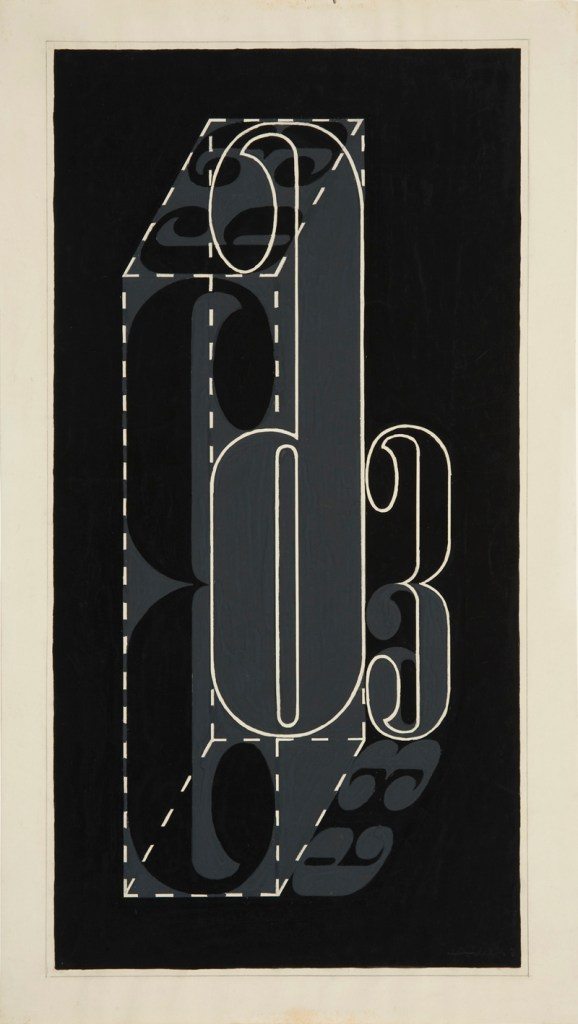
Josef Albers (German, 1888-1976) '6 and 3' 1931 from the exhibition 'Josef Albers: Innovation and Inspiration' at the Hirshhorn Museum, Washington, D.C., February - April, 2010


Josef Albers (German, 1888-1976)
6 and 3
1931


One of my favourite artists – what a genius!

His exploration of colour and form is exquisite, sensitive and very moving – despite his belief that colours have no inherent emotional associations.

Marcus


Many thankx to the Hirshhorn Museum for allowing me to publish the images in the posting. Please click on the photographs for a larger version of the image.


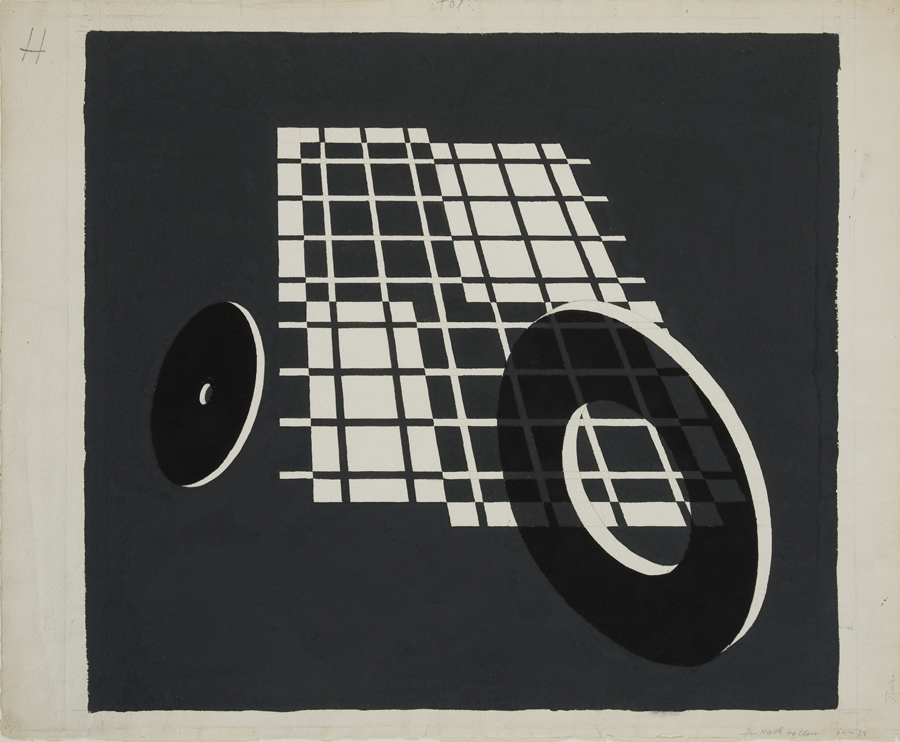
Josef Albers (German, 1888-1976) 'Rolling After' 1925-1928 from the exhibition 'Josef Albers: Innovation and Inspiration' at the Hirshhorn Museum, Washington, D.C., February - April, 2010


Josef Albers (German, 1888-1976)
Rolling After
1925-28


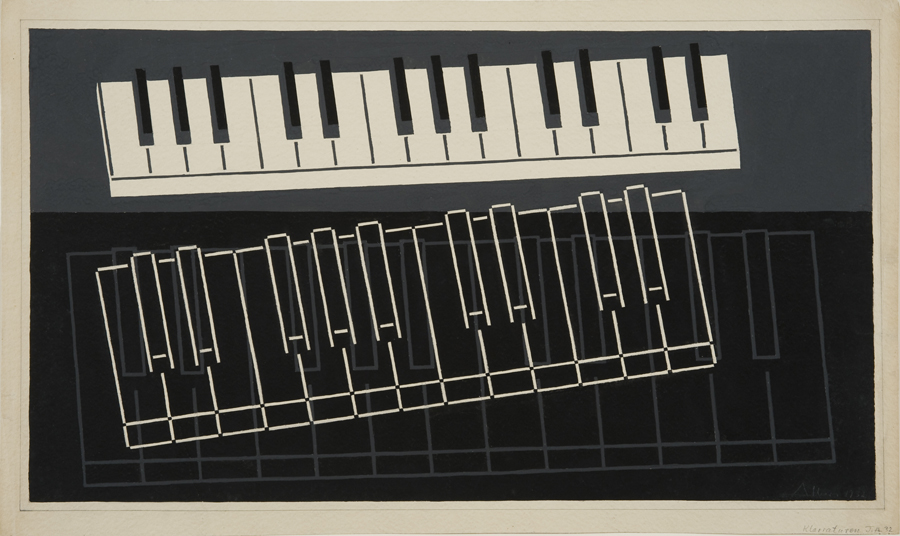
Josef Albers (German, 1888-1976) 'Piano Keys' 1932 from the exhibition 'Josef Albers: Innovation and Inspiration' at the Hirshhorn Museum, Washington, D.C., February - April, 2010


Josef Albers (German, 1888-1976)
Piano Keys
1932


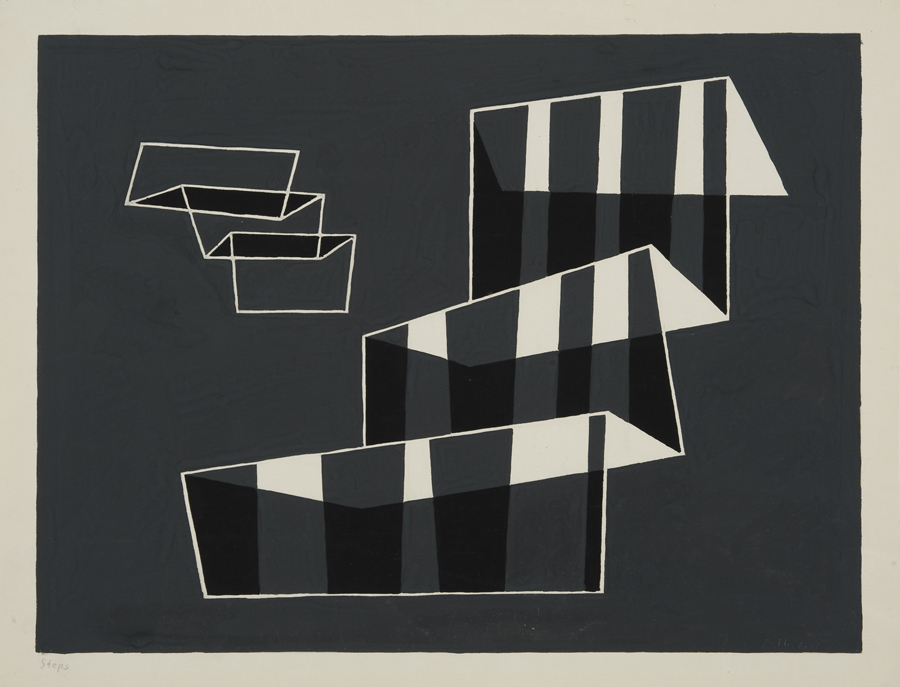
Josef Albers (German, 1888-1976) 'Steps' 1932 from the exhibition 'Josef Albers: Innovation and Inspiration' at the Hirshhorn Museum, Washington, D.C., February - April, 2010


Josef Albers (German, 1888-1976)
Steps
1932


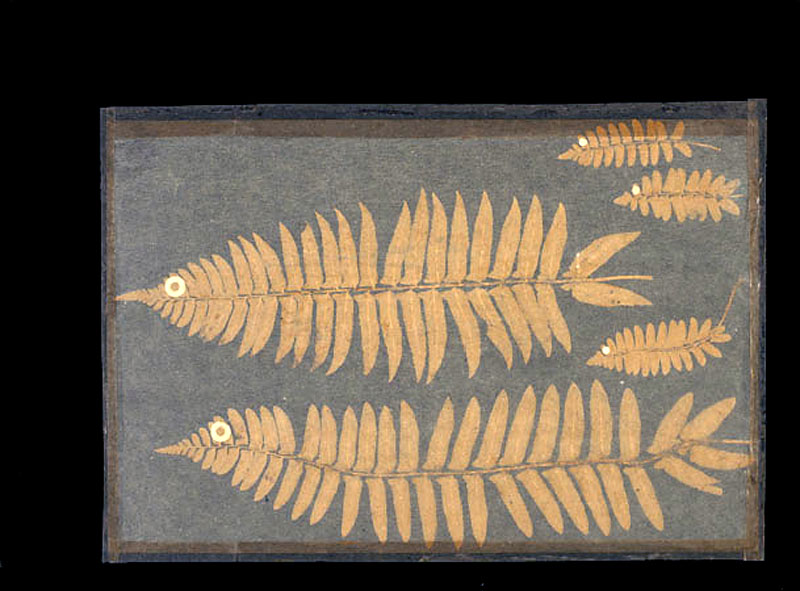
Josef Albers (German, 1888-1976) 'Untitled (Leaf Study)' c. 1940


Josef Albers  (German, 1888-1976)
Untitled (Leaf Study)
c. 1940


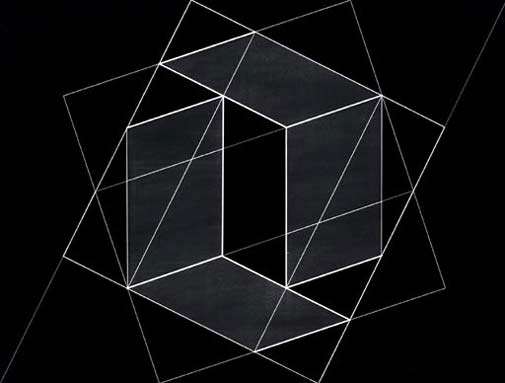
Josef Albers (German, 1888-1976) 'Structural Constellation, Transformation of a Scheme No.12' 1950


Josef Albers (German, 1888-1976)
Structural Constellation, Transformation of a Scheme No.12
1950
Machine engraving on black vinylite mounted on board


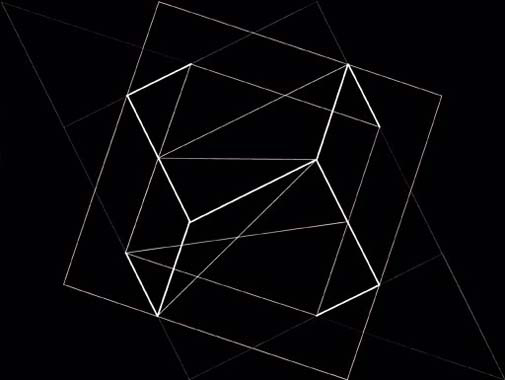
Josef Albers (German, 1888-1976) 'Structural Constellation, Transformation of a Scheme No.23' 1951


Josef Albers (German, 1888-1976)
Structural Constellation, Transformation of a Scheme No.23
1951
Machine engraving on black vinylite mounted on board


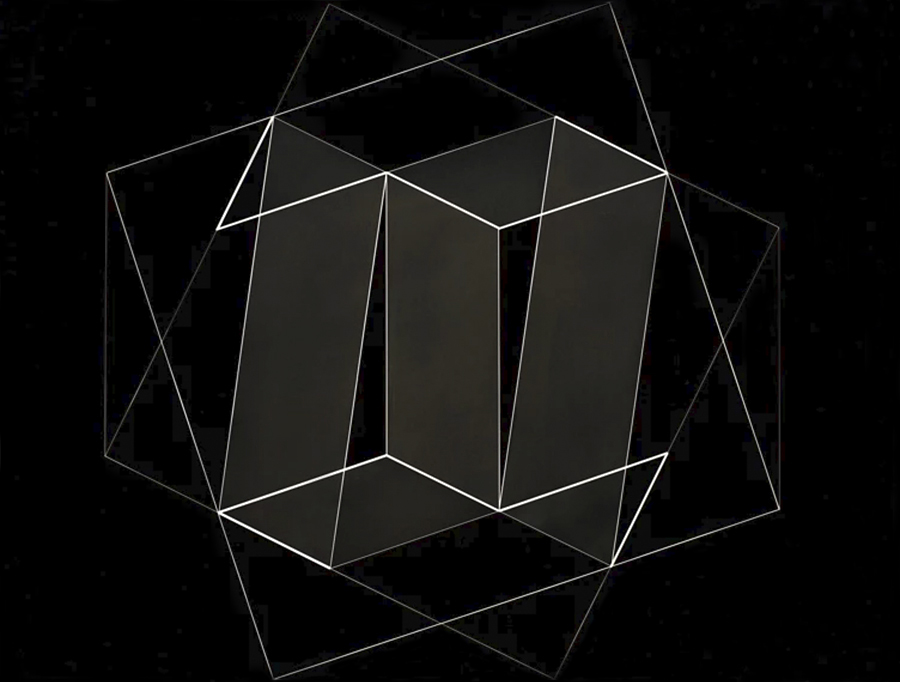
Josef Albers (German, 1888-1976) 'Structural Constellation, Transformation of a Scheme No.10' 1950-1951


Josef Albers (German, 1888-1976)
Structural Constellation, Transformation of a Scheme No.10
1950-51
Machine engraving on black vinylite mounted on board


Exhibition Illustrates Albers’ Sphere of Influence

The Hirshhorn possesses one of the world’s largest and most comprehensive collections of work by Josef Albers (b. Bottrop, Germany, 1888; d. New Haven, Connecticut, 1976). “Josef Albers: Innovation and Inspiration” presents nearly 70 works spanning the artist’s 55-year career, many on view for the first time. Supplementing pieces from the museum’s holdings are key objects on loan from the Josef and Anni Albers Foundation. Organised by senior curator Valerie Fletcher, the exhibition also includes documentary photographs and examples of Albers’ teaching aids, and concludes with a display of works by artists who knew, worked with, studied under or openly admired Albers. The exhibition opens on February 11 and runs through April 11, 2010.

Josef Albers: Innovation and Inspiration encompasses the artist’s distinguished career from 1917 to 1973. The exhibition begins with four early self-portrait prints dating from the years of World War I, followed by a group of boldly abstract compositions from Albers’ tenure at Germany’s revolutionary Bauhaus, where he taught alongside such remarkable modernists as Wassily Kandinsky, Paul Klee, László Moholy-Nagy, Walter Gropius and Mies van der Rohe. Albers participated in the school’s utopian aspiration to improve modern life through manufacturing and design-ideas that resonated throughout Albers’ career. The Hirshhorn’s show includes a series of black-and-white designs intended for mass production in glass, such as “6 and 3” (1931, see above), and an illuminated display of eight glass panels, in which the artist modernised and transformed the medieval tradition of stained-glass windows, best characterised by “Fugue (B)” (1925-1928).

Following the Nazi party’s rise to power, the Bauhaus was forced to close in 1933. Albers fled to the United States, where he was recruited to head the art program at the new Black Mountain College in North Carolina. There, Albers introduced a modified Bauhaus curriculum and hired vanguard modernists as teachers. He enthusiastically taught his students how art could be made from virtually any material, which he demonstrated in some of his own works, such as three “Leaf Study” collages (c. 1940, see above). Albers continued to advocate the clear structures of geometric abstraction, still mostly in black, white and primary colours, but was open to different stylistic approaches. He also briefly adopted the biomorphic forms associated with surrealism, as seen in the work “Proto-Form (B)” (1938).

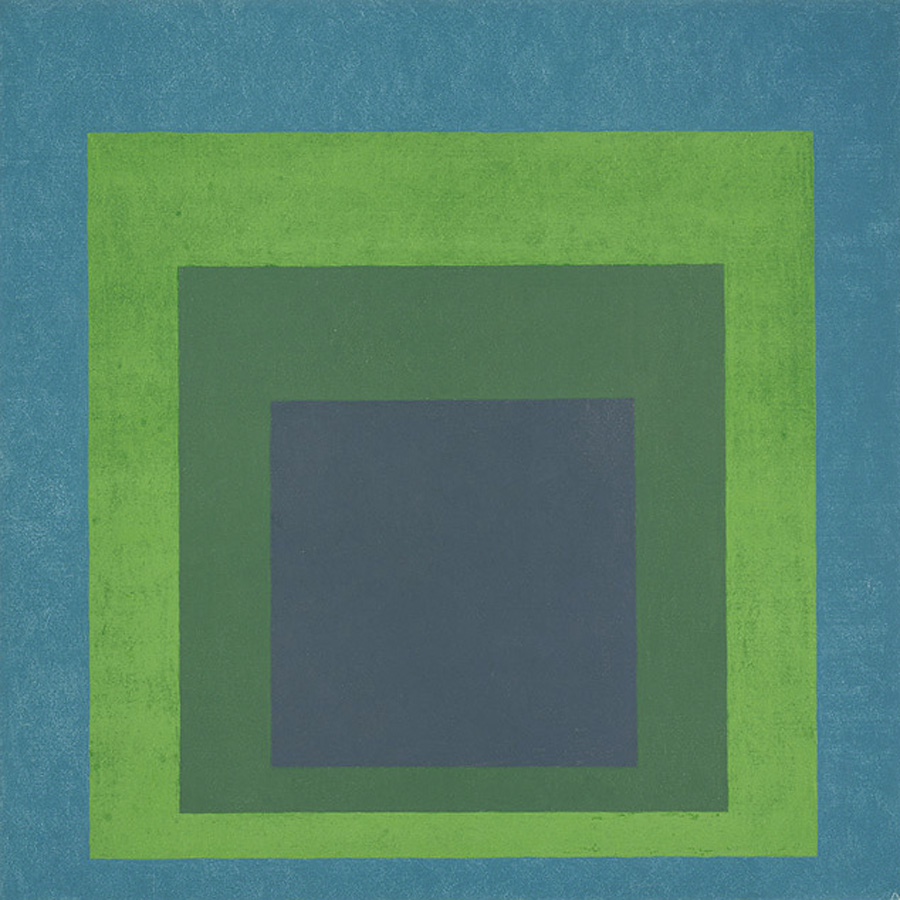
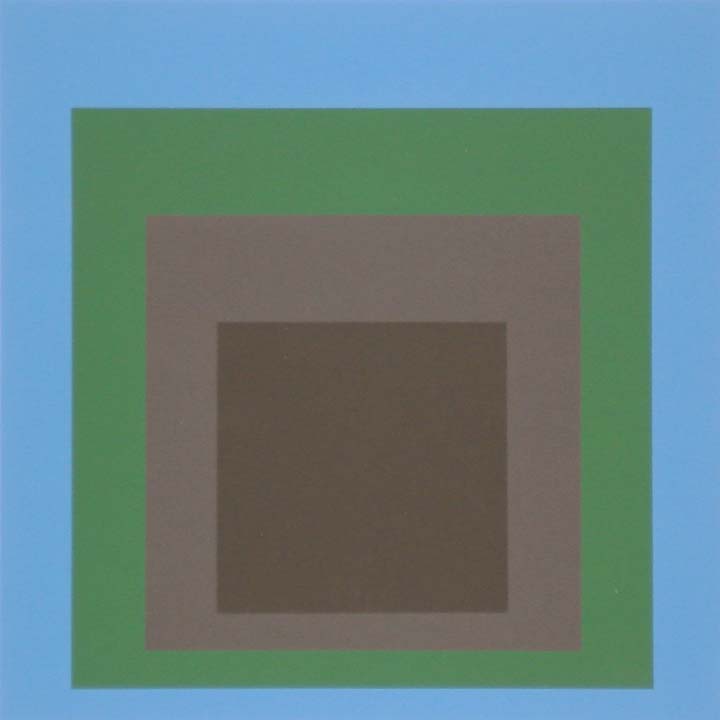
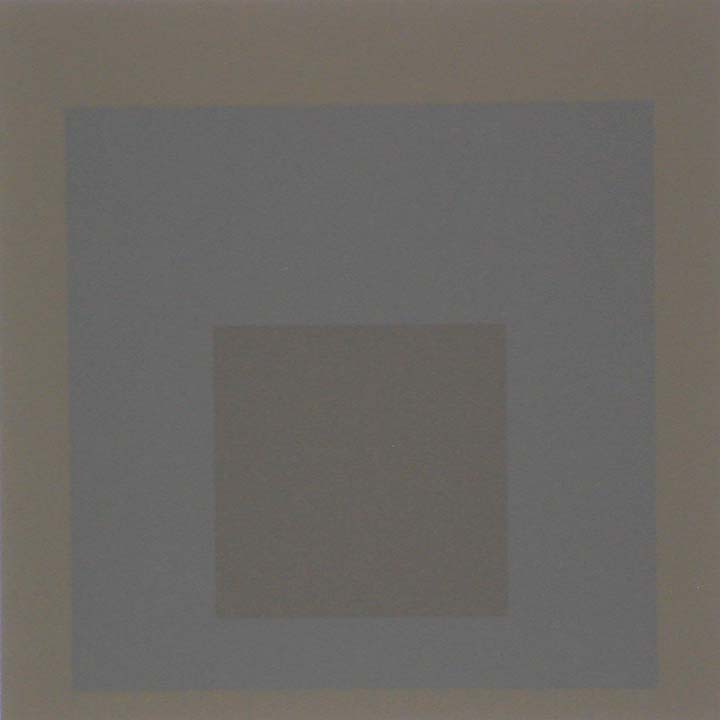
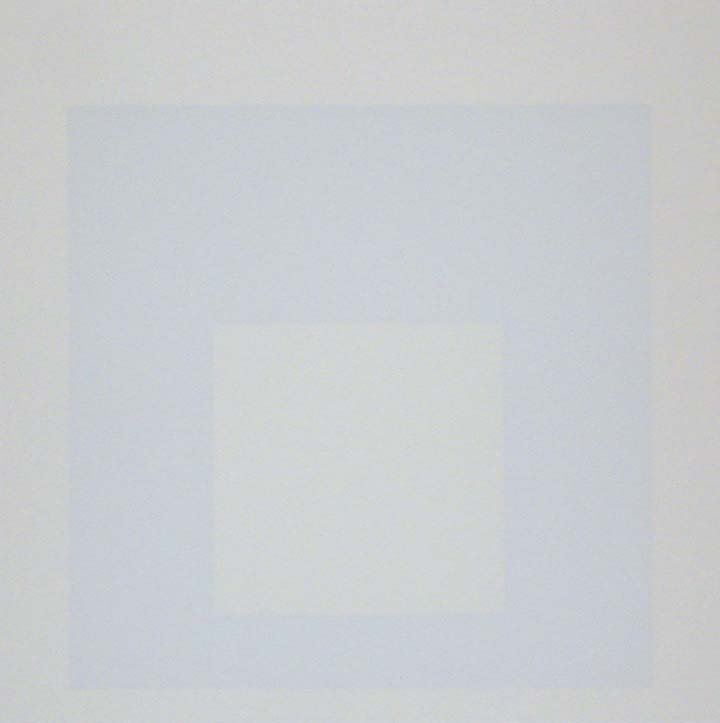
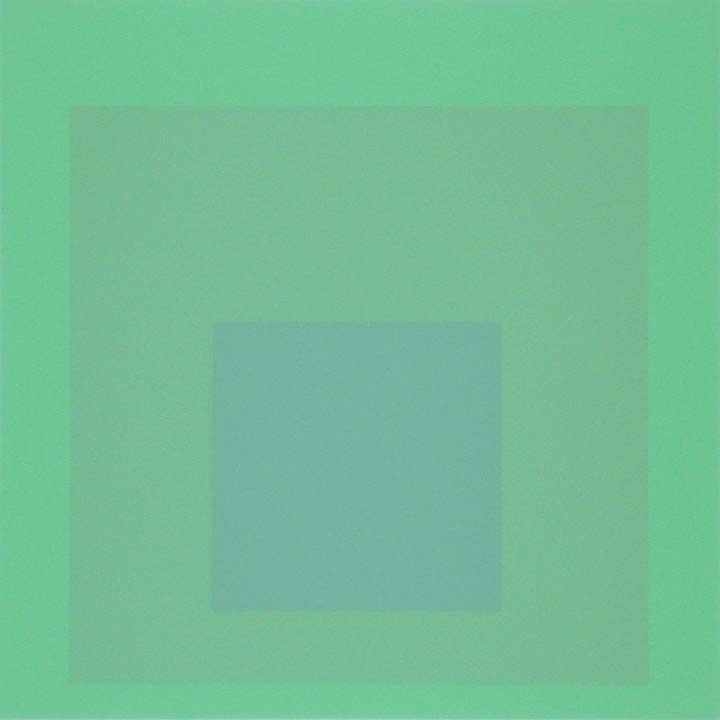
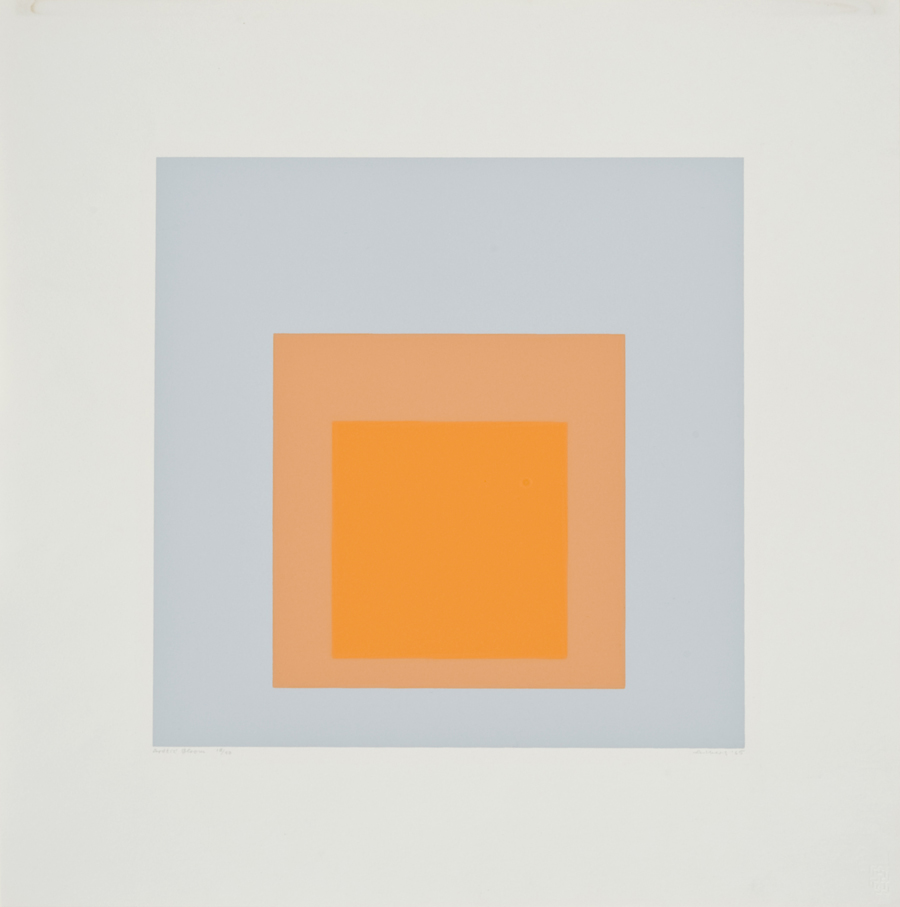
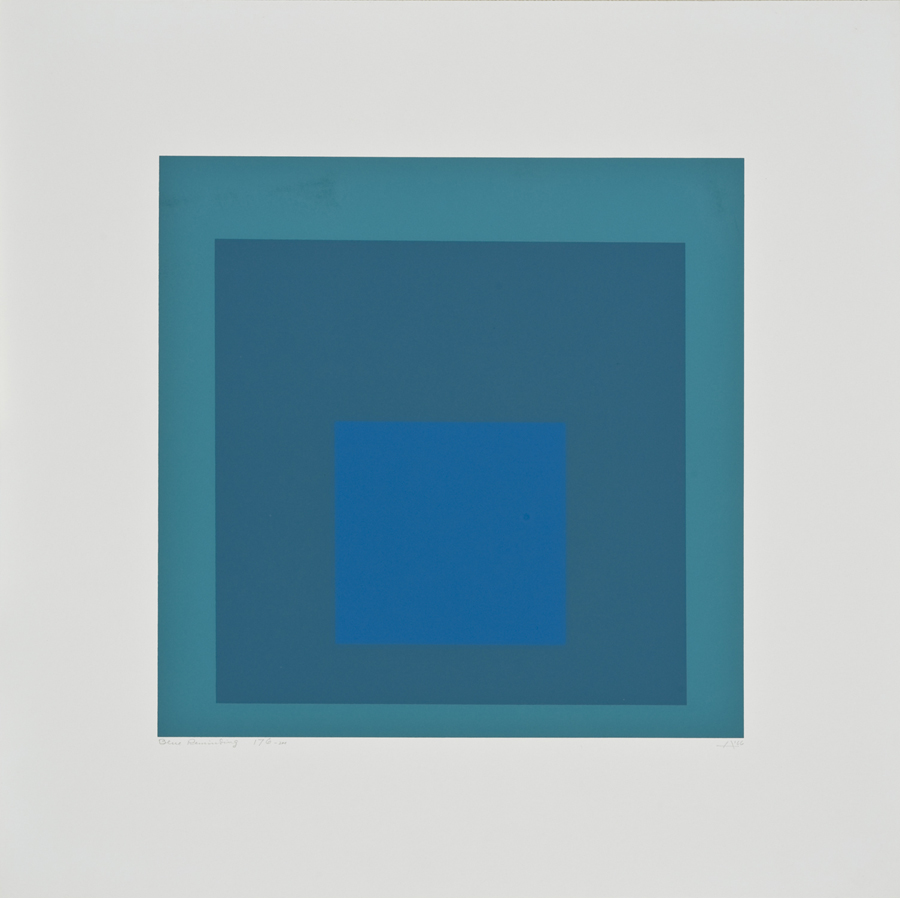
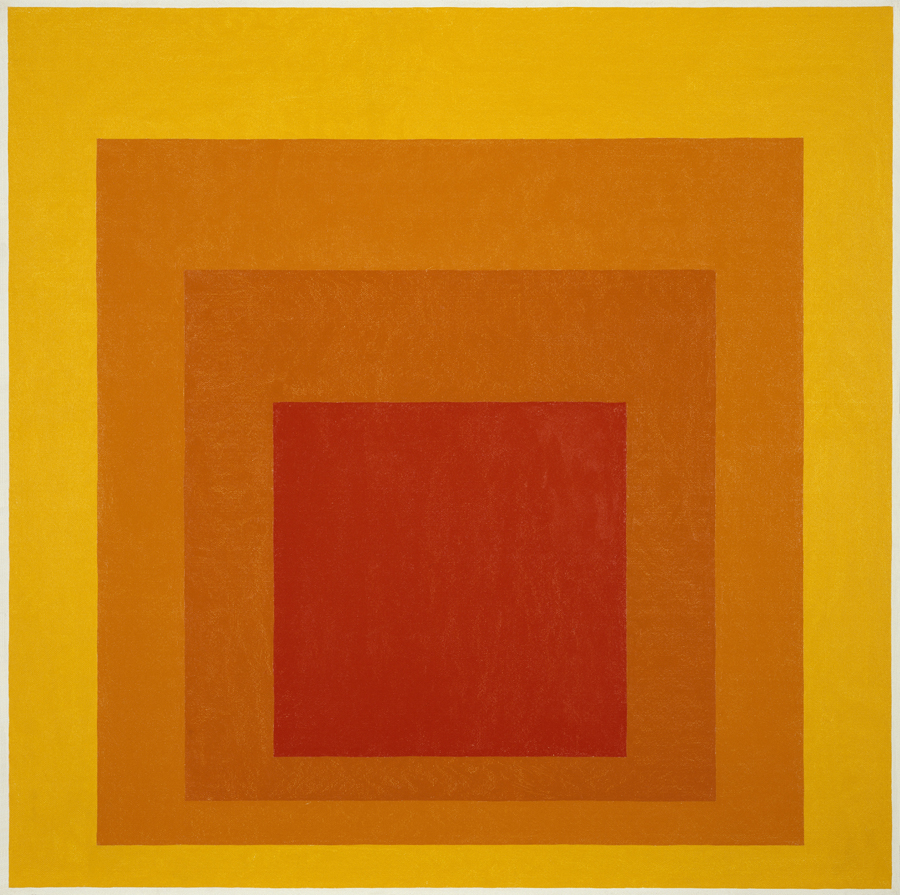
In 1949, at the age of 62, Albers became chairman of the art school at Yale University, with a mandate to transform it from a conservative academic program to a proponent of modern concepts and applications. Believing firmly that colours have no inherent emotional associations, he meticulously explored their nuances and combinations in his work. He eventually limited the shape and number of his forms, which resulted in a standardised format that he called “Homage to the Square,” for which he is best known. Two dozen “Homage to the Square” compositions fill the central gallery in the exhibition, inviting viewers to examine the subtle complexities of their perceptions. The vivid yellow-orange-reds of “Glow” (1966, see below) startle the eye, while the pale grays of “Nacre” (1965, see below) suggest cool neutrality. These images create optical illusions, challenging viewers’ visual acuity. This series concludes with the artist’s vivid red-print duo, “In Honor of the Hirshhorn Museum,” on view for the first time since the museum opened in 1974.

In addition, this exhibition includes examples from Albers’ “Structural Constellation” series of reliefs (1954-1964, see above), which anticipated op art with their linear patterns. The reliefs’ commonplace material-laminated plastic-also fulfils the utopian goal of making art affordable to everyone. The two largest paintings on view, both titled “Variant” (1973), were donated by the artist’s wife and foundation in 1979.

Albers remained active and influential until his death in 1976, and many of his pedagogical innovations have become standard methodology in art schools across the country. His explorations of abstract form and colour also inspired and stimulated generations of artists and designers. Shortly after his arrival in America, he became a co-founder of the American Abstract Artists group and participated in exhibitions across the country, from New York to Michigan and beyond. The Hirshhorn’s exhibition ends with an array of works by colleagues, students and admirers, among them: weavings by the artist’s wife, Anni Albers; abstract constructions by Burgoyne Diller; streamlined images of labor by Jacob Lawrence; a large op art painting by Richard Anuskiewicz; textured creations by Eva Hesse and Robert Rauschenberg; and a minimalist stacked wall sculpture by Donald Judd.”

Press release from The Hirshhorn Museum website [Online] Cited 01/04/2010 no longer available online


Josef Albers (German, 1888-1976) 'Homage to the Square - Soft Spoken' 1969


Josef Albers (German, 1888-1976)
Homage to the Square – Soft Spoken
1969


Josef Albers (German, 1888-1976) 'Homage to the Square - Porta Negra' 1965


Josef Albers (German, 1888-1976)
Homage to the Square – Porta Negra
1965


Josef Albers (German, 1888-1976) 'Homage to the Square - Profundo' 1965


Josef Albers (German, 1888-1976)
Homage to the Square – Profundo
1965


Josef Albers (German, 1888-1976) 'Homage to the Square - Nacre' 1965


Josef Albers (German, 1888-1976)
Homage to the Square – Nacre
1965


Josef Albers (German, 1888-1976) 'Homage to the Square. Soft Edge - Hard Edge' 1965


Josef Albers (German, 1888-1976)
Homage to the Square. Soft Edge – Hard Edge
1965


Josef Albers (German, 1888-1976) 'Homage to the Square - Arctic Bloom' 1965


Josef Albers (German, 1888-1976)
Homage to the Square – Arctic Bloom
1965


Josef Albers (German, 1888-1976) 'Homage to the Square - Blue Reminding' 1966


Josef Albers (German, 1888-1976)
Homage to the Square – Blue Reminding
1966


Josef Albers (German, 1888-1976) 'Homage to the Square - Glow' 1966


Josef Albers (German, 1888-1976)
Homage to the Square – Glow
1966


The Hirshhorn Museum and Sculpture Garden

The Hirshhorn is located on the National Mall at the corner of 7th Street and Independence Avenue SW, Washington D.C.

Opening hours:
Open daily 10am – 5.30pm

The Hirshhorn Museum website

LIKE ART BLART ON FACEBOOK

Back to top

Review: ‘Pondlurking’ by Tom Moore at Helen Gory Galerie, Prahran, Melbourne

Exhibition dates: 10th March – 3rd April, 2010


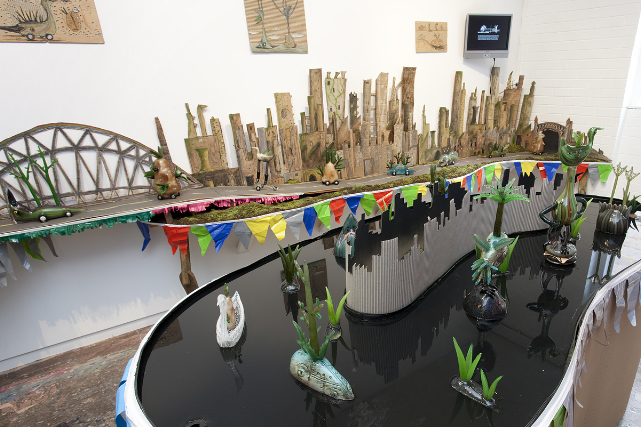
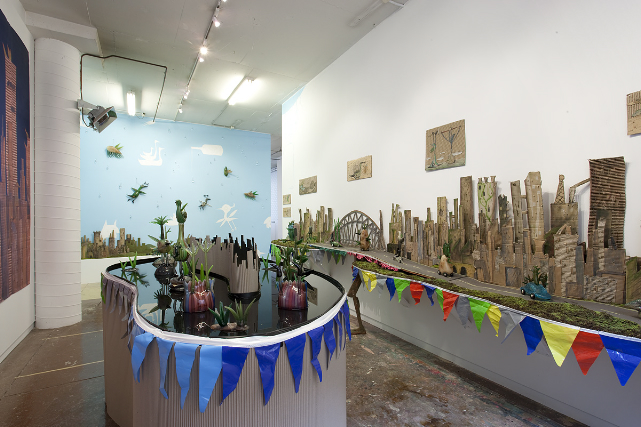
Tom Moore 'Pondlurking' installation photographs at Helen Gory Galerie, Prahran


Tom Moore Pondlurking installation photographs at Helen Gory Galerie, Prahran
Photo: Marcus Bunyan


My apologies to readers for the paucity of reviews of exhibitions in Melbourne recently. It is not that I haven’t been circulating around town to lots of exhibitions, far from it. The fact is that nothing has really rocked my boat, including my visit to a disappointing New 010 exhibition at ACCA, an exhibition redeemed only by the marvellous magnetic levitations of Susan Jacobs installation titled Being under no illusion (2010). Compared to the wealth of interesting work in New 09, work that still resides in my consciousness, the art in the current exhibition seems bland, the work ultimately and easily forgettable (a case of conceptual constipation?). Even though the exhibition lauds the collaboration between artists, designers, curators, architects, trades people and the kitchen sink in the production of the work, nothing substantive or lasting emerges.

No such problem exists with the exhibition Pondlurking by Tom Moore at Helen Gory Galerie in Prahran. Wow, this show is good!

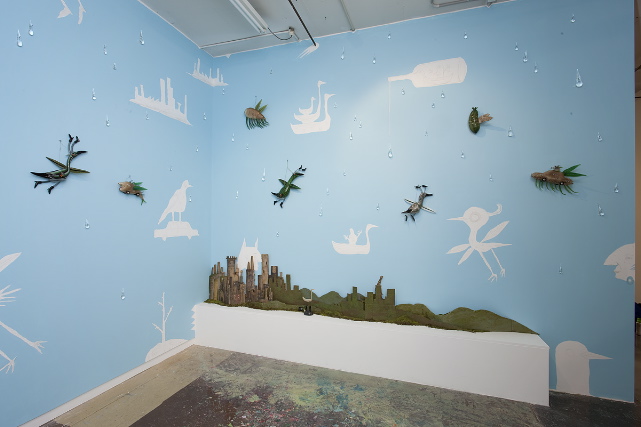
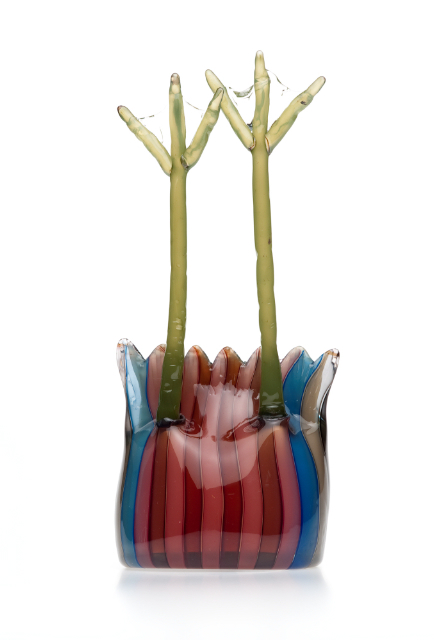
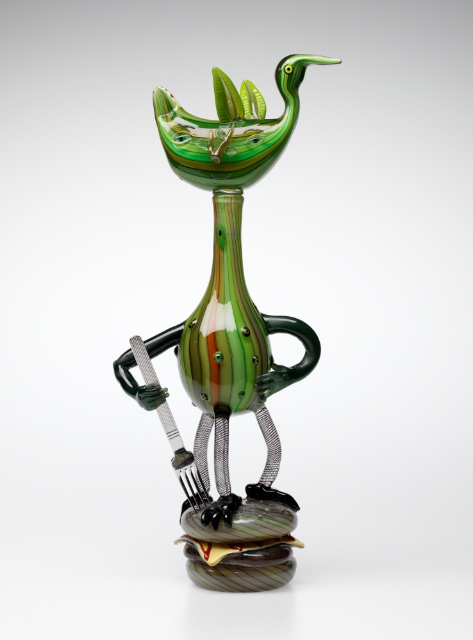
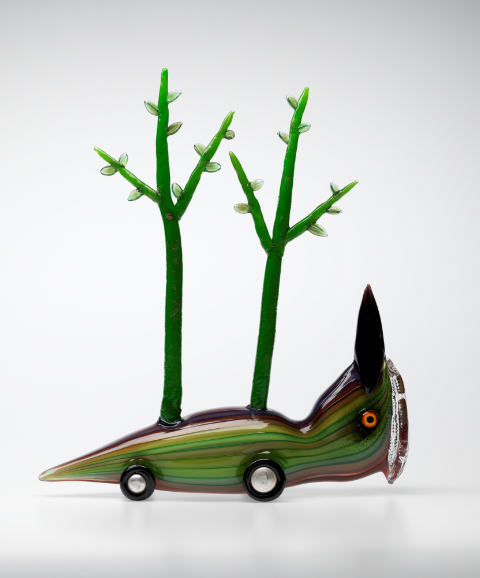
It produced in me an elation, a sense of exalted happiness, a smile on my dial that was with me the rest of the day. The installation features elegantly naive cardboard cityscape dioramas teeming with wondrous, whimsical mythological animals that traverse pond and undulating road. This bestiary of animals, minerals and vegetables (bestiaries were made popular in the Middle Ages in illustrated volumes that described various animals, birds and even rocks) is totally delightful. In the text Moving Right Along the curator Julie Ewington notes connections in Moore’s work to the Garden of Earthly Delights by Hieronymus Bosch, the porcelain monkey orchestras of Miessen, parti-coloured hose of Medieval costume, the animals from Dr Suess’s books for children and Venetian glass figurines to name but a few. Another curator Geoffrey Edwards notes Moore’s accomplished technical skill in glass making, his use of lattice and trellis work in the figures themselves, namely the use of vetro a fili (broadly spaced) and vetro a retorti (twisted spiral) glass cane patterns.

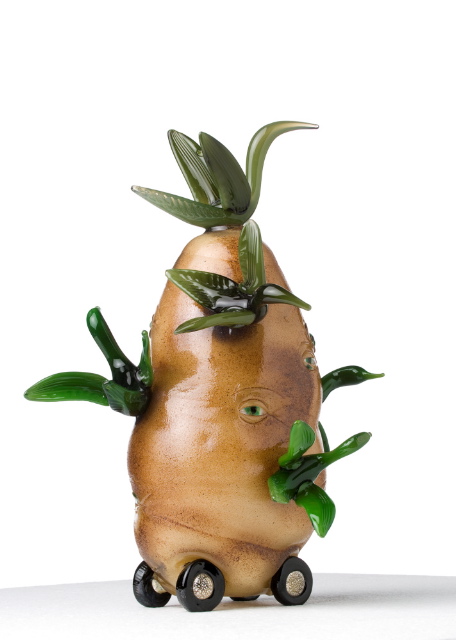
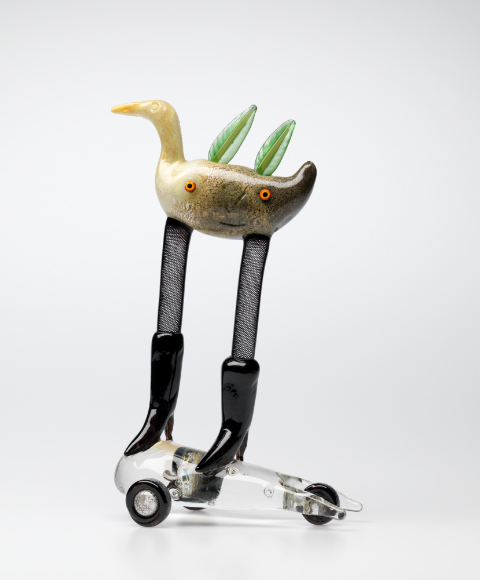
While all of this is true what really stands out is the presence of these objects, their joyousness. The technical and conceptual never get in the way of good art. The Surrealist imagining of a new world order (the destruction of traditional taxonomies) takes place while balanced on one foot (see the installation image at the top of the page). The morphogenesis of these creatures, as they build one upon another, turns the world upside down (as in Web Feet Duck Bum below). Multi-eyed potato cars, ducks with eyes wearing high heeled boots and three-legged devouring creatures segue from one state, condition, situation or element to another in a fluid condition of becoming. This morphogenesis is aided and abetted by the inherent fluidity of the glass medium itself skilfully used by Moore in the construction of his creatures. While the photographs below isolate the creatures within a contextless environment it is when the creatures are placed within the constructed environment so skilfully created by Moore that they come alive.

The interconnectedness of this fantastical world (the intertextual relationship of earth, water, air, life) seeks to break down the binaries of existence – good / bad, normal / mutation, presence / absence – until something else (e)merges. Through their metamorphosed presence in a carnivalesque world that is both weird and the wonderful, Moore’s creatures invite us to look at ourselves and our landscape more kindly, more openly and with a greater generosity of spirit.

Not to be missed!

Dr Marcus Bunyan


Many thankx to Nicola Stein and Helen Gory Galerie for allowing me to use the images below in the posting. All installation photographs © Marcus Bunyan


Tom Moore 'Pondlurking' installation photographs at Helen Gory Galerie, Prahran

Tom Moore 'Pondlurking' installation photographs at Helen Gory Galerie, Prahran

Tom Moore 'Pondlurking' installation photographs at Helen Gory Galerie, Prahran


Tom Moore Pondlurking installation photographs at Helen Gory Galerie, Prahran
Photos: Marcus Bunyan


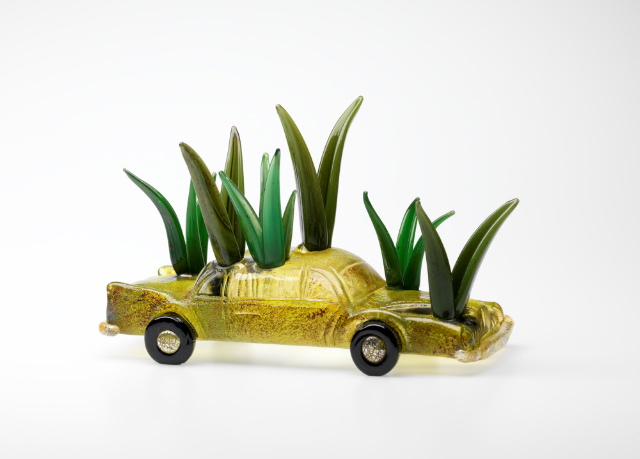
Tom Moore (Australian) 'Stylish Car' 2008 from the exhibition 'Pondlurking' by Tom Moore at Helen Gory Galerie, Prahran, Melbourne, March - April, 2010


Tom Moore (Australian)
Stylish Car
2008


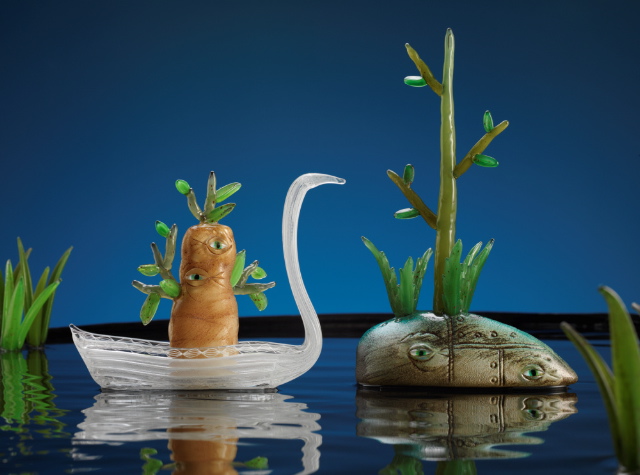
Tom Moore (Australian) 'Birdboat with passenger with a vengeance' (left) and 'Robot Island' (right) 2010 and 2009 from the exhibition 'Pondlurking' by Tom Moore at Helen Gory Galerie, Prahran, Melbourne, March - April, 2010


Tom Moore (Australian)
Birdboat with passenger with a vengeance (left) and Robot Island (right)
2010 and 2009


A candy striped fish pokes its head up, all lipstick-pink kissable lips as a voyaging duck sprouts tree-masts and becomes duck-ship-island captained by a lone gherkin boy. Delinquent birds rampage while a crested birdcar peacefully unfurls sweet green shoots. A cardboard city burns and there’s something odd lurking in the pond, metallic and curiously tuberous, it regards it all with a wary eye.

There’s a whole world at play here. Growing, flying and always moving, this isn’t ours turned upside down but something other, a unique universe bound together with a logic entirely its own. Tubers take to the air, birds grow wheels and everything overflows with energy, pushing out green tendrils toward each other.

Tom Moore’s gloriously appealing glass creatures spring from his own fantastical imagination and the rich seabeds of the mythical, imaginary and grotesque. From mediaeval bestiaries with their camel leopards and manticores, to misericord creatures through Lear and Seuss to Moore’s reimagining of an Colonial Australian epergne as a verdantly plumed robot bird with resplendent palm tree, his creatures reuse, recycle and recombine in their never ending metamorphoses.

There’s an irrepressible joyousness in these creatures constant flux as they burst the boundaries of animal / vegetable / mineral and do away with taxonomies and rationality, reinventing themselves in happy disregard of all humanity’s rules.

While lurking seems antithetical to all this busy-ness, to skylarking fatbirds and peripatetic potatoes, the will to knowledge at the core of all lurking is what propels this endless becoming. This insatiable urge to simply find out is the engine of this prolific universe. As duck becomes island and man becomes bird, Moore’s creatures ask an eternal ‘what if?’ and an insouciant ‘why not?’

This transformative energy inheres in the material itself, in the mutable and alchemical nature of glass, in the fusing and melding of forms as light is captured within and bounces off lustrous surfaces. As glass flows through its changeable states, like water, like rain, so do Moore’s folk transform and evolve.

It’s this continuous moving through forms that hints at other meanings. Sharing forms, being made as it were, of each other and sharing an essential nature, each creature reaches out to every other in a net of relations in an intricately connected universe. These deep bonds, seen in their loving regard for each other speak of the delicate structures and balance of ecosystems and an absolutely necessary attention to and care for the world.

For there are no humans here and it seems that it’s this carelessness, this lack of attention to the fragile connections between the world and its creatures that’s the reason. The cities burn and cars rightfully become compost.

This riotous parade has pulled the artist too into their exuberant tumble. Becoming man-bird and greeting the day with a drumming bird song he is the harbinger perhaps of a new order, one bright green and sparkling.

Jemima Kemp, 2010

Press release from the Helen Gory Galerie website [Online] 20/03/2010 no longer available online


Tom Moore (Australian) 'Web Feet Duck Bum' 2009 from the exhibition 'Pondlurking' by Tom Moore at Helen Gory Galerie, Prahran, Melbourne, March - April, 2010


Tom Moore (Australian)
Web Feet Duck Bum
2009


Tom Moore (Australian) 'Tasty Eyes With Five Friends' 2007


Tom Moore (Australian)
Tasty Eyes With Five Friends
2007


Tom Moore (Australian) 'Snarsenvorg the Devourer' 2008


Tom Moore (Australian)
Snarsenvorg the Devourer
2008


Tom Moore (Australian) 'Segway' 2009


Tom Moore (Australian)
Segway
2009


Tom Moore (Australian) 'Tree-Feet, Dollbird' 2008


Tom Moore (Australian)
Tree-Feet, Dollbird
2008


Helen Gory Galerie

This gallery is now closed

Tom Moore website

LIKE ART BLART ON FACEBOOK

Back to top

Exhibition: ‘Georgia O’Keeffe: Abstraction’ at The Phillips Collection, Washington D.C.

Exhibition dates: 6th February – 9th May 2010


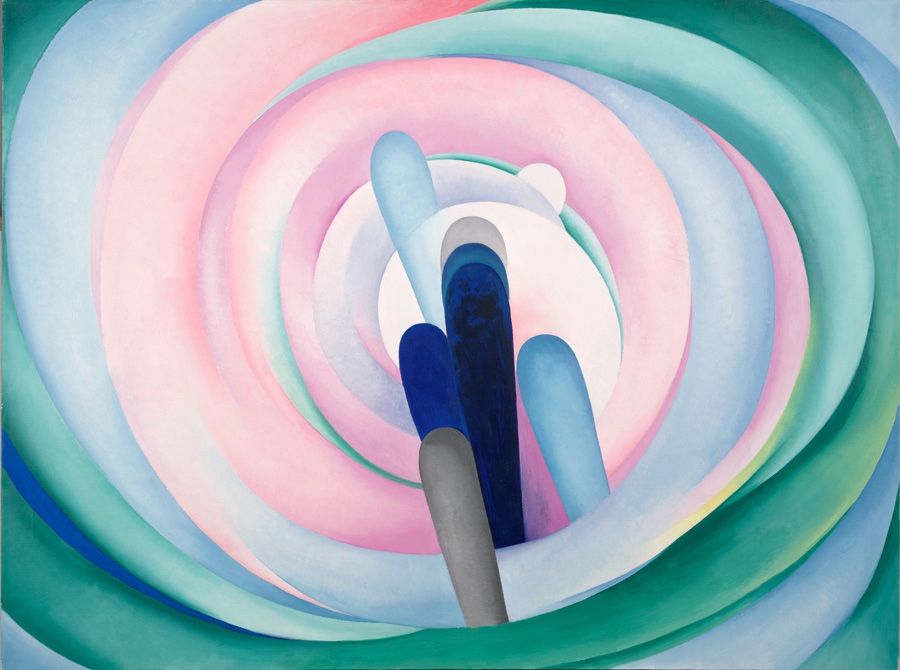
Georgia O'Keeffe (American, 1887-1986) 'Grey Blue & Black - Pink Circle' 1929 from the exhibition 'Georgia O'Keeffe: Abstraction' at The Phillips Collection, Washington D.C., February - May, 2010


Georgia O’Keeffe (American, 1887-1986)
Grey Blue & Black – Pink Circle
1929
Oil on canvas
36 x 48 in. (91.4 x 121.9cm)
Dallas Museum of Art
Gift of The Georgia O’Keeffe Foundation


Many thankx to Shira Pinsker and The Phillips Collection for allowing me to reproduce the images in the posting. Please click on the photographs for a larger version of the image.

For an excellent analysis of the convergences between Georgia O’Keeffe and Ansel Adams see Geneva Anderson’s review Masters of the Southwest: Georgia O’Keeffe and Ansel Adams Natural Affinities.

Dr Marcus Bunyan


“It is surprising to me to see how many people separate the objective from the abstract. Objective painting is not good painting unless it is good in the abstract sense. A hill or tree cannot make a good painting just because it is a hill or a tree. It is lines and colours put together so that they say something. For me that is the very basis of painting. The abstraction is often the most definite form for the intangible thing in myself that I can only clarify in paint.”

“I long ago came to the conclusion that even if I could put down accurately the thing that I saw and enjoyed, it would not give the observer the kind of feeling it gave me. I had to create an equivalent for what I felt about what I was looking at – not copy it.”


Georgia O’Keeffe, 1976


Georgia O'Keeffe (American, 1887-1986) 'Flower Abstraction' 1924 from the exhibition 'Georgia O'Keeffe: Abstraction' at The Phillips Collection, Washington D.C., February - May, 2010


Georgia O’Keeffe (American, 1887-1986)
Flower Abstraction
1924
Oil on canvas
48 x 30 in.
Whitney Museum of American Art, New York.
50th Anniversary Gift of Sandra Payson
© Georgia O’Keeffe Museum/Artist Rights Society (ARS), New York


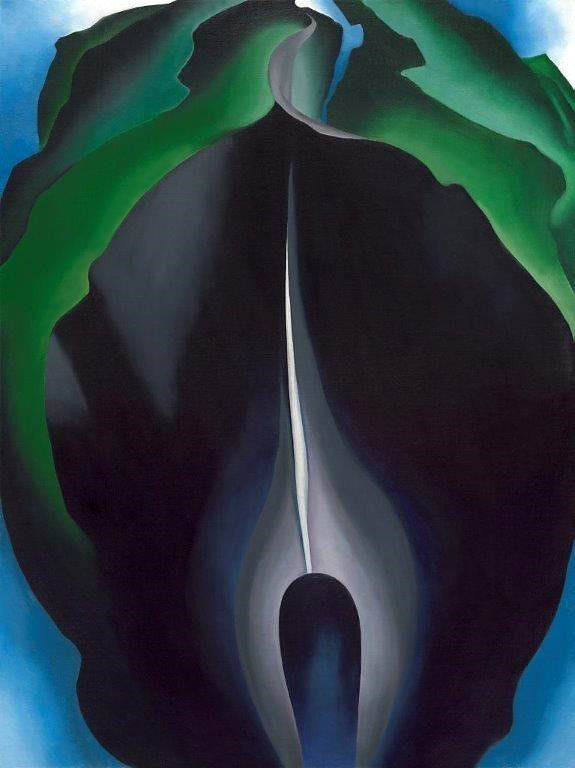
Georgia O'Keeffe (American, 1887-1986) 'Jack-in-the-Pulpit No. IV' 1930 from the exhibition 'Georgia O'Keeffe: Abstraction' at The Phillips Collection, Washington D.C., February - May, 2010


Georgia O’Keeffe (American, 1887-1986)
Jack-in-the-Pulpit No. IV
1930
Oil on canvas
40 x 30 in.
National Gallery of Art, Washington, D.C. Alfred Stieglitz Collection, Bequest of Georgia O’Keeffe
Image courtesy of the Board of Trustees, National Gallery of Art, Washington


Georgia O’Keeffe (1887-1986) is fixed in the public imagination as a painter of places and things. She has long been recognised for her still lifes of flowers, leaves, animal bones and shells, her images of Manhattan skyscrapers, and her Lake George and New Mexico landscapes. Yet it was with abstraction that O’Keeffe entered the art world and first became celebrated as an artist. In the spring of 1916, she burst onto the New York art scene with a group of abstract charcoal drawings that were among the most radical works produced in the United States in the early twentieth century. As she expanded her repertoire in the years that followed to include watercolour and oil, she retained the fluid space and dynamic, organic motifs of these early charcoals.

Abstraction dominated O’Keeffe’s output in the early part of her career and remained a fundamental language for her thereafter. Some of her abstractions have no recognisable source in the natural world; others distill visible reality into elemental, simplified forms. For O’Keeffe, abstraction offered a way to portray what she called the “unknown” – intense thoughts and feelings she could not express in words and did not rationally understand. Her abstractions recorded an array of emotions and responses to people and places. At the heart of her practice was an affinity for the flux and sinuous rhythms of nature. Through swelling forms and sumptuous colour, O’Keeffe depicted the experience of being in nature – so enveloped by its sublime mystery and beauty that awareness of all else is suspended.

Wall text from the exhibition


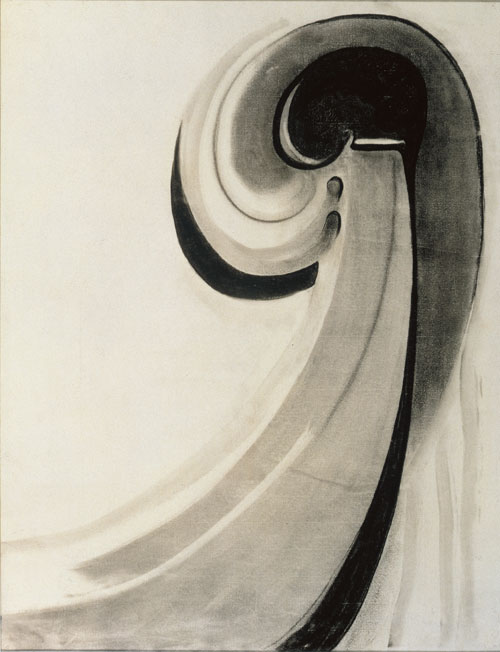
Georgia O'Keeffe (American, 1887-1986) 'Early Abstraction' 1915


Georgia O’Keeffe (American, 1887-1986)
Early Abstraction
1915
Charcoal on paper
24 x 18 5/8 in. (61 x 47.3cm)
Milwaukee Art Museum
Gift of Jane Bradley Pettit Foundation and The Georgia O’Keeffe Foundation
Photography by Malcolm Varon
© Milwaukee Art Museum


Georgia O'Keeffe (American, 1887-1986) 'Blue II' 1916


Georgia O’Keeffe (American, 1887-1986)
Blue II
1916
Watercolour on paper
27 7/8 x 22 1/4 in. (70.8 x 56.5cm)
Georgia O’Keeffe Museum, Santa Fe, New Mexico
Gift, The Burnett Foundation
© Georgia O’Keeffe Museum/Artist Rights Society (ARS), New York


Georgia O'Keeffe (American, 1887-1986) 'Untitled (Abstraction/Portrait of Paul Strand)' 1917


Georgia O’Keeffe (American, 1887-1986)
Untitled (Abstraction/Portrait of Paul Strand)
1917
Watercolour on paper
12 x 8 7/8 in. (30.5 x 22.5cm)
Georgia O’Keeffe Museum, Santa Fe, New Mexico
Gift, The Burnett Foundation
© Georgia O’Keeffe Museum/Artist Rights Society (ARS), New York


The artistic achievement of Georgia O’Keeffe is examined from a fresh perspective in Georgia O’Keeffe: Abstraction, a landmark exhibition debuting this winter at The Phillips Collection. While O’Keeffe (1887-1986) has long been recognised as one of the central figures in 20th-century art, the radical abstract work she created throughout her long career has remained less well-known than her representational art. By surveying her abstractions, Georgia O’Keeffe: Abstraction repositions O’Keeffe as one of America’s first and most daring abstract artists. The exhibition, one of the largest of O’Keeffe’s work ever assembled, goes on view February 6 – May 9, 2010.

Including more than 125 paintings, drawings, watercolours, and sculptures by O’Keeffe as well as selected examples of Alfred Stieglitz’s famous photographic portrait series of O’Keeffe, the exhibition has been many years in the making.

While it is true that O’Keeffe has entered the public imagination as a painter of sensual, feminine subjects, she is nevertheless viewed first and foremost as a painter of places and things. When one thinks of her work it is usually of her magnified images of open flowers and her iconic depictions of animal bones, her Lake George landscapes, her images of stark New Mexican cliffs, and her still lifes of fruit, leaves, shells, rocks, and bones. Even O’Keeffe’s canvasses of architecture, from the skyscrapers of Manhattan to the adobe structures of Abiquiu, come to mind more readily than the numerous works – made throughout her career – that she termed abstract.

This exhibition is the first to examine O’Keeffe’s achievement as an abstract artist. In 1915, O’Keeffe leaped into the forefront of American modernism with a group of abstract charcoal drawings that were among the most radical creations produced in the United States at that time. A year later, she added colour to her repertoire; by 1918, she was expressing the union of abstract form and colour in paint. First exhibited in 1923, O’Keeffe’s psychologically charged, brilliantly coloured abstract oils garnered immediate critical and public acclaim. For the next decade, abstraction would dominate her attention. Even after 1930, when O’Keeffe’s focus turned increasingly to representational subjects, she never abandoned abstraction, which remained the guiding principle of her art. She returned to abstraction in the mid 1940s with a new, planar vocabulary that provided a precedent for a younger generation of abstractionists.

Abstraction and representation for O’Keeffe were neither binary nor oppositional. She moved freely from one to the other, cognisant that all art is rooted in an underlying abstract formal invention. For O’Keeffe, abstraction offered a way to communicate ineffable thoughts and sensations. As she said in 1976, “The abstraction is often the most definite form for the intangible thing in myself that I can only clarify in paint.” Through her personal language of abstraction, she sought to give visual form (as she confided in a 1916 letter to Alfred Stieglitz) to “things I feel and want to say – [but] havent [sic] words for.” Abstraction allowed her to express intangible experience – be it a quality of light, colour, sound, or response to a person or place. As O’Keeffe defined it in 1923, her goal as a painter was to “make the unknown – known. By unknown I mean the thing that means so much to the person that he wants to put it down – clarify something he feels but does not clearly understand.”

This exhibition and catalogue chronicle the trajectory of O’Keeffe’s career as an abstract artist and examine the forces impacting the changes in her subject matter and style. From the beginning of her career, she was, as critic Henry McBride remarked, “a newspaper personality.” Interpretations of her art were shaped almost exclusively by Alfred Stieglitz, artist, charismatic impresario, dealer, editor, and O’Keeffe’s eventual husband, who presented her work from 1916 to 1946 at the groundbreaking galleries “291”, the Anderson Galleries, the Intimate Gallery, and An American Place. Stieglitz’s public and private statements about O’Keeffe’s early abstractions and the photographs he took of her, partially clothed or nude, led critics to interpret her work – to her great dismay – as Freudian-tinged, psychological expressions of her sexuality.

Cognisant of the public’s lack of sympathy for abstraction and seeking to direct the critics away from sexualised readings of her work, O’Keeffe self-consciously began to introduce more recognisable images into her repertoire in the mid-1920s. As she wrote to the writer Sherwood Anderson in 1924, “I suppose the reason I got down to an effort to be objective is that I didn’t like the interpretations of my other things [abstractions].” O’Keeffe’s increasing shift to representational subjects, coupled with Stieglitz’s penchant for favouring the exhibition of new, previously unseen work, meant that O’Keeffe’s abstractions rarely figured in the exhibitions Stieglitz mounted of her work after 1930, with the result that her first forays into abstraction virtually disappeared from public view.”

Text from the Phillips Collection website [Online] Cited 15/03/2010 no longer available online


Georgia O'Keeffe (American, 1887-1986) 'Music, Pink and Blue No. 2' 1918


Georgia O’Keeffe (American, 1887-1986)
Music, Pink and Blue No. 2
1918
Oil on canvas, 35 x 29 1/8 in. (88.9 x 74cm)
Whitney Museum of American Art, New York
Gift of Emily Fisher Landau in honour of Tom Armstrong
© Georgia O’Keeffe Museum/Artist Rights Society (ARS), New York
Photograph by Sheldan C. Collins


Georgia O'Keeffe (American, 1887-1986) 'Series I - No. 3' 1918


Georgia O’Keeffe (American, 1887-1986)
Series I – No. 3
1918
Oil on board
20 x 16 in. (50.8 x 40.6cm)
Milwaukee Art Museum
Gift of Jane Bradley Pettit Foundation and The Georgia O’Keeffe Foundation
Photography by Larry Sanders
© Milwaukee Art Museum


Georgia O'Keeffe (American, 1887-1986) 'Series I, No. 4' 1918


Georgia O’Keeffe (American, 1887-1986)
Series I, No. 4
1918
Oil on canvas
20 x 16 in. (50.8 x 40.6cm)
Städtische Galerie im Lenbachhaus, Munich
Gift of The Georgia O’Keeffe Foundation


Georgia O'Keeffe (American, 1887-1986) 'Abstraction White Rose' 1927


Georgia O’Keeffe (American, 1887-1986)
Abstraction White Rose
1927
Oil on canvas
36 x 30 in. (91.4 x 76.2cm)
Georgia O’Keeffe Museum, Santa Fe, New Mexico
Gift, The Burnett Foundation and The Georgia O’Keeffe Foundation
© Georgia O’Keeffe Museum/Artist Rights Society (ARS), New York


Georgia O'Keeffe (American, 1887-1986) 'Black Place II' 1944


Georgia O’Keeffe (American, 1887-1986)
Black Place II
1944
Oil on canvas
36 x 40 in. (91.4 x 101.6cm)
Georgia O’Keeffe Museum, Santa Fe, New Mexico
Gift, The Burnett Foundation
© 1987, Private Collection


The Phillips Collection
1600 21st Street, NW, Washington, D.C., near the corner of 21st and Q Streets, NW

Opening hours:
Tuesday – Sunday 11am – 6pm

Phillips Collection website

LIKE ART BLART ON FACEBOOK

Back to top

Three Openings Wednesday 3rd March 2010

March 2010

Camilla Tadich: Slabalong and Mark Hislop: Drawing at Sophie Gannon Gallery; Simon Obarzanek at Karen Woodbury Gallery; Kent Wilson Higher Breeds and Alice Wormald Wayside and Hedgerow at Shifted


Camilla Tadich: Slabalong and Mark Hislop: Drawing at Sophie Gannon Gallery, 2 Albert Street, Richmond
March 2nd – March 27th 2010
Sophie Gannon Gallery website

Simon Obarzanek at Karen Woodbury Gallery, 4 Albert Street, Richmond
March 3rd – March 27th 2010
This gallery is now closed

Kent Wilson Higher Breeds and Alice Wormald Wayside and Hedgerow at Shifted, Level 1, 15 Albert Street, Richmond
This gallery is now closed

All photos by Marcus Bunyan


Sophie Gannon Gallery opening


Sophie Gannon Gallery opening
Photo: Marcus Bunyan


Sophie Gannon Gallery opening - Mark Hislop 'Drawing'

Sophie Gannon Gallery opening - Mark Hislop 'Drawing'

Sophie Gannon Gallery opening - Mark Hislop 'Drawing'


Sophie Gannon Gallery opening – Mark Hislop Drawing
Photos: Marcus Bunyan


Camilla Tadich (Australian, b. 1982) 'Bordertown' 2010


Camilla Tadich (Australian, b. 1982)
Bordertown
2010
Photo: Marcus Bunyan


Sophie Gannon Gallery opening - Camila Tadich 'Slabalong'


Sophie Gannon Gallery opening – Camila Tadich Slabalong
Photo: Marcus Bunyan


Karen Woodbury Gallery opening – Simon Obarzanek


Karen Woodbury Gallery opening – Simon Obarzanek
Photo: Marcus Bunyan


Simon’s photographs come from observing the physical movements of people pushing through the space around them in a city. He senses a universal language through movement and is drawn to this rather than their faces, as he normally is.

He noted that the “strained movements against gravity struck me with force… When I see a person creating a shape with their body in the street I do not sense the individual but a part, a piece of a larger performance. Each individual connects with others to create a visual language. I did not want faces to interrupt this larger work.”

Simon collects the movements on his camera, as photographic sketches, then he rephotographs the movement using friends and family as models. Removed from the busy streets, dislocated, his subject is isolated and framed against a dark background. Some twist away from the camera, or stagger against an unseen wind, sheltering their face from rain that is not falling. Simon does not show their faces, which emphasises the movement and makes the figures anonymous. These photographs are theatrical and mysterious, emphasising the loneliness and alienation that can be encountered living in a big city.

Text from the Turner Galleries website [Online] Cited 28/06/2019


Karen Woodbury Gallery – Simon Obarzanek opening, the artist standing centre in the grey t-shirt


Karen Woodbury Gallery – Simon Obarzanek opening, the artist standing centre in the grey t-shirt
Photo: Marcus Bunyan


Karen Woodbury Gallery - Simon Obarzanek opening

Simon Obarzanek (Israel, lives and works Melbourne, b. 1968) 'Untitled movement No.2 No.7' 2010


Simon Obarzanek (Israel, lives and works Melbourne, b. 1968)
Untitled movement No.2 No.7
2010
C-Type hand print
100 x 120cm
Photos: Marcus Bunyan


Shifted opening - Kent Wilson 'Higher Breeds'

Shifted opening - Kent Wilson 'Higher Breeds'


Shifted opening – Kent Wilson Higher Breeds
Photos: Marcus Bunyan


Kent Wilson (Australian) Image from the 'HoneySucker' series 2009  (detail)


Kent Wilson (Australian)
Image from the HoneySucker series (detail)
2009
Photo: Marcus Bunyan


Shifted opening - Alice Wormald 'Wayside & Hedgerow'

Shifted opening - Alice Wormald 'Wayside & Hedgerow'


Shifted opening – Alice Wormald Wayside & Hedgerow
Photos: Marcus Bunyan


LIKE ART BLART ON FACEBOOK

Back to top

Review: ‘Ricky Swallow: The Bricoleur’ at The Ian Potter Centre, NGV Australia, Melbourne

Exhibition dates: 16th October, 2009 – 28th February, 2010


Ricky Swallow (born Australia 1974, lived in England 2003-06, United States 2006- ) 'Salad days' c. 2005 from the exhibition Review: 'Ricky Swallow: The Bricoleur' at The Ian Potter Centre, NGV Australia, Melbourne, October, 2009 - February, 2010


Ricky Swallow (born Australia 1974, lived in England 2003-2006, United States 2006- )
Salad days
c. 2005
Jelutong (Dyera costulata), maple (Acer sp.)
102.0 x 102.0 x 23.8cm
National Gallery of Victoria, Melbourne
Purchased with funds from the Victorian Foundation for Living Australian Artists, 2005
© Ricky Swallow
Photo: Andy Keate courtesy Darren Knight Gallery, Sydney


“Curiosity is a vice that has been stigmatized in turn by Christianity, by philosophy and even by a certain conception of science. Curiosity, futility. I like the word however. To me it suggests something all together different: it evokes concern; it evokes the care one takes for what exists or could exist; an acute sense of the real which, however, never becomes fixed; a readiness to find our surroundings strange and singular; a certain restlessness in ridding ourselves of our familiarities and looking at things otherwise; a passion for seizing what is happening now and what is passing away; a lack of respect for traditional hierarchies of the important and the essential.”


Michel Foucault 1


“Swallow is at his best when he’s exploring ways to communicate through the innate qualities of materials … This is always going to be more affecting than glib post-modernism, but he just can’t help himself sometimes. So my deep dislike for portentous and ironic titles bristled up immediately here. ‘Salad Days’ and ‘Killing Time’ are only two of the jokey puns, the problem is that art that simply supports two meanings isn’t very smart or complex. There’s no room for subtext. Irony is not the complex and neutral form that ambiguity is. It doesn’t invite engagement or interpretation. Art ought to aspire to infinite meanings, or maybe even only one. Irony doesn’t make for good art, when irony is the defense mechanism against meaning, masking an anxiety about sincerity.”


John Matthews 2


Let’s cut through the hyperbole. This is not the best exhibition since sliced bread (“the NGV highlight of 1609, 2009 and possibly 2109 too” says Penny Modra in The Age) and while it contains a few strong individual pieces this is not even a particularly good exhibition by Ricky Swallow at NGV Australia.

Featuring bronzes, watercolours and sculptures made from 2004-2009 that are sparingly laid out in the gallery space this exhibition comes as close to the National Gallery of Victoria holding a commercial show as you will find. Using forms such as human skeletons, skulls, balloons encrusted with barnacles, dead animals and pseudo death masks that address issues of materials and memory, time and space, discontinuity and death, Swallow’s sculptures are finely made. The craftsmanship is superb, the attention to detail magnificent and there is a feeling of almost obsessional perfectionism to the pieces. This much is given – the time and care taken over the construction, the hand of the maker, the presentation of specimen as momento mori is undeniable.

After seeing the exhibition three times the standout pieces for me are a life size dead sparrow cast in bronze (with the ironic title Flying on the ground is wrong 2006) – belly up, prostrate, feet curled under – that is delicate and poignant; Caravan (2008), barnacle encrusted bronze balloons that play with the ephemerality of life and form – a sculpture that is generous of energy and spirit, quiet yet powerful; Bowman’s record (2008), found objects of paper archery targets cast in bronze, the readymade solidified, the marks on paper made ambiguous hieroglyph of non-decaying matter, paper / bronze pierced by truth = I shot this, I was here (sometime); and Fig.1 (2008), a baby’s skull encased in a paper bag made of carved wood – the delicacy of surfaces, folds, the wooden paper collapsing into the skull itself creating the wonderful haunting presence of this piece. In these sculptures the work transcends the material state to engage the viewer in a conversation with the eternal beyond.

Swallow seeks to evidence the creation of meaning through the humblest of objects where the object’s fundamental beauty relies on the passing of time for its very existence. In the above work he succeeds. In other work throughout the exhibition he fails.

There seems to be a spare, international aesthetic at work (much like the aesthetic of the Ron Mueck exhibition at NGV International on St. Kilda Road). The art is so kewl that you can’t touch it, a dude-ish ‘Californication’ having descended on Swallow’s work that puts an emotional distance between viewer and object. No chthonic nature here, no dirt under the fingernails, no blood on the hands – instead an Apollonian kewlness, all surface and show, that invites reflection on life as discontinuous condition through perfect forms that seem twee and kitsch.

In Tusk (2007) two bronze skeletal arms hold hands in an undying bond but the sculpture simply fails to engage (the theme was brilliantly addressed by Louise Bourgeois in the first and only Melbourne Arts Biennale in 1999 with her carving in granite of two clasped hands); in History of Holding (2007) the icon of the Woodstock festival designed in 1969 is carved into a log of wood placed horizontally on the floor while  a hand holding a peeled lemon (symbolising the passing of time in the still life genre) is carved from another log of wood placed vertically. One appreciates the craftmanship of the carving but the sentiments are too saccharin, the surfaces too shallow – the allegorical layering that Swallow seeks stymied by the objects iconic form. A friend of mine insightfully observed about the exhibition: “Enough of the blond wood thing – it’s so Space Furniture!”

As John Matthews opines in the above quotation from his review of the exhibition there seems to be a lack of sincerity and authenticity of feeling in much of Swallow’s work. Irony as evidenced in the two major pieces titled Salad Days (2005) and Killing Time (2003-2004) leaves little room for the layering of meaning: “Irony is not the complex and neutral form that ambiguity is. It doesn’t invite engagement or interpretation.” Well said.

Killing Time in particular adds nothing to the vernacular of Vanitas paintings of the 17th century, adds nothing to the mother tongue of contemporary concerns about the rape of the seas, fails to update the allegories of the futility of pleasure and the inevitability of death – in fact the allegories in Swallow’s sculpture, the way he tries to twist our conception of the real, seem to have lost the power to remind us of our doom. The dead wooden fish just stare back at us with doleful, hollow eyes. The stilted iconography has no layering; it does not destroy hierarchies but builds them up.

In his early work Swallow was full of curiosity, challenging the norms of culture and creation. I always remember his wonderful series of dioramas at the Melbourne Biennale that featured old record players and animated scenes (see the photograph of Rooftop shoot out with chimpanzee (1999) below). Wow they were hot, they were fun, they made you think and challenge how you viewed the world! As Foucault notes in his excellent quotation at the top of the posting, curiosity promotes “an acute sense of the real which, however, never becomes fixed; a readiness to find our surroundings strange and singular; a certain restlessness in ridding ourselves of our familiarities and looking at things otherwise; a passion for seizing what is happening now and what is passing away; a lack of respect for traditional hierarchies of the important and the essential.”

While Swallow’s ‘diverse gestures of memorialisation’ still address the fundamental concerns of Foucault’s quotation his work seems to have become fixed in an Apollonian desire for perfection. He has forgotten how his early work challenged traditional hierarchies of existence; now, even as he twists and turns around a central axis, the conceptualisation of life, memory and death, his familiarity has become facsimile (a bricoleur is a master of nothing, a tinkerer fiddling at the edges). His lack of respect has become sublimated (“to divert the expression of (an instinctual desire or impulse) from its unacceptable form to one that is considered more socially or culturally acceptable”), his tongue in cheek has become firmly fixed, his sculptures just hanging around not looking at things otherwise.

Dr Marcus Bunyan


1/ Foucault, Michel. “The Masked Philosopher” in Politics, philosophy, culture: interviews and other writings, 1977-1984. London: Routledge, 1988, p. 328

2/ Matthews, John. “On Ricky Swallow @ NGV” on ArtKritique [Online] Cited 02/02/2010


    Ricky Swallow (born Australia 1974, lived in England 2003-06, United States 2006- ) 'Rooftop shoot out with chimpanzee' 1999


    Ricky Swallow (born Australia 1974, lived in England 2003-06, United States 2006- )
    Rooftop shoot out with chimpanzee
    1999
    From the series Even the odd orbit
    Cardboard, wood, plastic model figures and portable record player
    53.0 h x 33.0 w x 30.0 d cm
    Collection of the National Gallery of Australia
    Gift of Peter Fay 2001

    Please note: This art work is not in the exhibition


    Ricky Swallow (born Australia 1974, lived in England 2003-06, United States 2006- ) 'Tusk' 2007 (detail) from the exhibition Review: 'Ricky Swallow: The Bricoleur' at The Ian Potter Centre, NGV Australia, Melbourne, October, 2009 - February, 2010


    Ricky Swallow (born Australia 1974, lived in England 2003-06, United States 2006- )
    Tusk (detail)
    2007
    Patinated bronze, brass
    Edition of 3 plus 1 Artist’s Proof
    50 x 105 x 6cm
    National Gallery of Australia, Canberra Gift of the Prescott Family Foundation, 2008


    Ricky Swallow (born Australia 1974, lived in England 2003-06, United States 2006- ) 'The Man from Encinitas' 2009 from the exhibition Review: 'Ricky Swallow: The Bricoleur' at The Ian Potter Centre, NGV Australia, Melbourne, October, 2009 - February, 2010


    Ricky Swallow (born Australia 1974, lived in England 2003-06, United States 2006- )
    The Man from Encinitas
    2009
    Plaster, onyx, steel


    Ricky Swallow’s sculptures address fundamental issues that lie at the core of who we are. Things have lives. We are our things. We are things. When all is said and done it is our things – our material possessions – that outlive us. Anyone who has lost a family member or close friend knows this: what we have before us once that person is gone are the possessions that formed a life. Just as we are defined and represented by the things that we collect over time, we are ultimately objects ourselves. When we are dead and decomposed what remains are our bones, another type of object. And then there is social science. Archaeology, a subfield of anthropology, is entirely based on piecing together narratives of human relations based on material culture, that is, objects both whole and fragmentary. It may seem obvious but it is worth stressing here that our understanding of cultures from the distant past, those that originated before the advent of writing, is entirely based on the study of objects and skeletal remains. Swallow’s art addresses these basic yet enduring notions and reminds us of our deep symbiotic relationship to the stuff of daily life.

    Like the bricoleur put into popular usage by anthropologist Claude Levi-Strauss in his seminal book The Savage Mind, Ricky Swallow creates works of art often based on objects from his immediate surroundings. His method, however, is more of a second order bricolage: his sculptures are not assemblages of found objects, but rather elegantly crafted things. Handcarved from wood or plaster or cast in bronze, these humble objects are transformed into memorials to both the quotidian and the passage of time.

    Still life

    The still life has been an important touchstone throughout Swallow’s recent practice as it is an inspired vehicle for the exploration of how meaning is generated by objects. Several sculptures in the exhibition reference the still-life tradition in which Swallow updates and personalises this time-honoured genre, in particular the vanitas paintings of 17th century Holland. Vanitas still lifes, through an assortment of objects that had recognisable symbolism to a 17th-century viewer, functioned as allegories on the futility of pleasure and the inevitably of death. Swallow’s embrace of still life convention, however, is non-didactic, secular and open-ended. Swallow is not obsessed by death. On the contrary, his focus on objects is about salvaging them from the dust bin of history and honouring their continued resonance in his life.

    Killing time
    , 2003-2004, and Salad days, 2005, depict animals that Swallow and his family either found or caught when he was young and best highlight how the artist reclaims the still life genre to explore personal narrative. Killing time, which depicts a bounty of fish and crustaceans spread across a table modelled after the Swallow family kitchen table of the artist’s youth, is rife with autobiographical association. It not only references an object from Swallow’s past, but also the profession of his father, a fisherman, and the fact that Swallow was raised by the sea. Salad days is another autobiographical work depicting a range of animals such as birds, a rabbit, mice and a fox skull. Like many boys growing up in rural environments, Swallow recalls shooting magpies, encountering nesting birds in his garage or discovering dead lizards or trapping live ones in an attempt to keep them as pets.

    While not an overt still life, History of holding, 2007, suggests the genre in its fragmentary depiction of a musical instrument and the appearance of a lemon with falling rind. The hand holding / presenting a peeled lemon as the rind winds around the wrist in bracelet-like fashion is based on a cast of Swallow’s own hand, insinuating himself into this antiquated tradition. It is as if Swallow is announcing to us his deep interest in the temporality of objects through the presentation of the peeled lemon, which symbolises the passing of time and also appears in Killing time. The second component of History of holding is a sculptural interpretation of the Woodstock music festival icon designed by Arthur Skolnick in 1969, which still circulates today. History of holding, then, also references music, a leitmotif in Swallow’s art that appears both within the work itself, and also through Swallow’s use of titles.

    Body fragments

    Tusk, 2007 among several other works in the exhibition, explores the theme of body as fragment. Much has been discussed about Swallow’s use of the skeleton as a form rich in meaning within both the traditions of art history as well as popular culture (references range from the Medieval dance macabre and the memento mori of the still life tradition to the skeleton in rock music and skateboard art iconography). Tusk represents two skeletal arms with the hands clasped together in eternal union. A poignant work, Tusk is a meditation on permanence: the permanence of the human body even after death; the permanence of the union between two people, related in the fusion of the hands into that timeless symbol of love, the heart.

    Watercolours: atmospheric presentations, mummies, music, homage

    Swallow calls his watercolours “atmospheric presentations,” in contradistinction to his obviously more physical sculptures, and he sees them as respites from the intensity of labour and time invested in the sculptural work. They also permit experimentation in ways that sculpture simply does not allow. One nation underground, 2007, is a collection of images based on rock / folk musicians, several who had associations to 1960s Southern California, Swallow’s current home. Most of the subjects Swallow has illustrated in this work are now deceased; several experienced wide recognition only after their deaths. Like many of his sculptures, this group of watercolours tenderly painted with an air of nostalgia has the sensibility of a memorial – or as Swallow has called it “a modest monument”. The title of the work is based on a record album by another under-heralded rock band from the 1960s, Pearls Before Swine, and is a prime example of Swallow’s belief in the importance of titles to the viewing experience as clues or layers of meaning. In this case, the title hints at the quasi-cult status of the musicians and singers depicted. The featured musicians are Chris Bell (Big Star), Karen Dalton (a folk singer), Tim Buckley (legendary singer whose style spanned several genres and father to the late Jeff Buckley), Denny Doherty (The Mamas & the Papas ), Judee Sill (folk singer), Brian Jones (Rolling Stones), Arthur Lee (Love), John Phillips (The Mamas & the Papas ), Skip Spence (Jefferson Airplane and Moby Grape) and Phil Ochs (folk singer).

    Text from the NGV website


    Ricky Swallow (born Australia 1974, lived in England 2003-06, United States 2006- ) 'Killing Time' 2003-2004 from the exhibition Review: 'Ricky Swallow: The Bricoleur' at The Ian Potter Centre, NGV Australia, Melbourne, October, 2009 - February, 2010


    Ricky Swallow (born Australia 1974, lived in England 2003-2006, United States 2006- )
    Killing Time
    2003-04
    Laminated Jelutong, maple
    108.0 x 184.0 x 118.0cm (irreg.)
    Art Gallery of New South Wales
    Rudy Komon Memorial Fund and the Contemporary Collection Benefactors 2004
    © Ricky Swallow. Courtesy Darren Knight Gallery, Sydney


    Killing time, 2003-2004, and Salad days, 2005, depict animals that Swallow and his family either found or caught when he was young and best highlight how the artist reclaims the still life genre to explore personal narrative. Killing time, which depicts a bounty of fish and crustaceans spread across a table modelled after the Swallow family kitchen table of the artist’s youth, is rife with autobiographical association. It not only references an object from Swallow’s past, but also the profession of his father, a fisherman, and the fact that Swallow was raised by the sea. Salad days is another autobiographical work depicting a range of animals such as birds, a rabbit, mice and a fox skull. Like many boys growing up in rural environments, Swallow recalls shooting magpies, encountering nesting birds in his garage or discovering dead lizards or trapping live ones in an attempt to keep them as pets.

    Text from the National Gallery of Victoria


    Ricky Swallow (born Australia 1974, lived in England 2003-06, United States 2006- ) 'Killing Time' 2003-2004 (detail) from the exhibition Review: 'Ricky Swallow: The Bricoleur' at The Ian Potter Centre, NGV Australia, Melbourne, October, 2009 - February, 2010


    Ricky Swallow (born Australia 1974, lived in England 2003-2006, United States 2006- )
    Killing Time (detail)
    2003-04
    Laminated Jelutong, maple
    108.0 x 184.0 x 118.0cm (irreg.)
    Art Gallery of New South Wales
    Rudy Komon Memorial Fund and the Contemporary Collection Benefactors 2004
    © Ricky Swallow. Courtesy Darren Knight Gallery, Sydney


    “I’ve always been interested in how an object can be remembered and how that memory can be sustained and directed sculpturally, pulling things in and out of time, passing objects through the studio as a kind of filter returning them as new forms.”

    Ricky Swallow in Goth: Reality of the Departed World. Yokohama: Yokohama Museum of Art, 2007


    A new exhibition featuring the work of internationally renowned Australian artist Ricky Swallow will open at The Ian Potter Centre: NGV Australia on 16 October 2009.

    Ricky Swallow: The Bricoleur is the artist’s first major exhibition in Australia since 2006. This exhibition will feature several of the artist’s well‐known intricately detailed, carved wooden sculptures as well as a range of new sculptural works in wood, bronze and plaster. The exhibition will also showcase two large groups of watercolours, an aspect of Swallow’s practice that is not as well known as his trademark works.

    Salad days (2005) and Killing time (2003‐2004), which were featured in the 2005 Venice Biennale and are considered Swallow icons, will strike a familiar chord with Melbourne audiences.

    Sculptures completed over the past year include bronze balloons on which bronze barnacles seamlessly cling (Caravan, 2008); a series of cast bronze archery targets (Bowman’s Record, 2008) that look like desecrated minimalist paintings; and carved wooden sculpture of a human skull inside what looks like a paper bag.

    A highlight of the show will be Swallow’s watercolour, One Nation Underground (2007), recently acquired by the NGV. The work presents a collection of images based on 1960s musicians including Tim Buckley, Denny Doherty, Brian Jones and John Phillips.

    Alex Baker, Senior Curator, Contemporary Art, NGV said the works in this exhibition explore the themes of life and death, time and its passing, mortality and immortality.

    “Swallow’s art investigates how memory is distilled within the objects of daily life. His work addresses the fundamental issues that lie at the core of who we are, reminding us of our deep symbiotic relationship to the stuff of everyday life.”

    “The exhibition’s title The Bricoleur refers to the kind of activities performed by a handyman or tinkerer, someone who makes creative use of whatever might be at hand. The Bricoleur is also the title of one of the sculptures in the exhibition, which depicts a forlorn houseplant with a sneaker wedged between its branches,” said Dr Baker.

    Gerard Vaughan, Director, NGV, said this exhibition reinforces the NGV’s commitment to exhibiting and collecting world‐class contemporary art.

    “The NGV has enjoyed a long and successful relationship with Ricky Swallow, exhibiting and acquiring a number of his works over the years. His detailed and exquisitely crafted replicas of commonplace objects never fail to inspire visitors to the Gallery.”

    Ricky Swallow was born in Victoria in 1974 and currently lives and works in Los Angeles, California. His career has enjoyed a meteoric rise since winning the NGV’s prestigious Contempora5 art prize in 1999. Since then, Swallow has exhibited in the UK, Europe and the United States, and represented Australia at
    the 2005 Venice Biennale.

    Press release from the NGV


    Ricky Swallow (born Australia 1974, lived in England 2003-2006, United States 2006- ) 'A sad but very discreet recollection of beloved things and beloved beings' 2005 (detail)


    Ricky Swallow (born Australia 1974, lived in England 2003-2006, United States 2006- )
    A sad but very discreet recollection of beloved things and beloved beings (detail)
    2005
    Watercolour
    (1-10) 35.0 x 28.0cm (each)
    Private collection
    © Ricky Swallow
    Photo: courtesy Stuart Shave/Modern Art, London


    Ricky Swallow (born Australia 1974, lived in England 2003-06, United States 2006- ) 'Bowman’s record' 2008 (detail)


    Ricky Swallow (born Australia 1974, lived in England 2003-2006, United States 2006- )
    Bowman’s record (detail)
    2008
    Bronze
    46.0 x 33.0 x 2.5cm
    Collection of the artist, Los Angeles
    © Ricky Swallow
    Photo: Robert Wedemeyer courtesy Stuart Shave/Modern Art, London


    Ricky Swallow (born Australia 1974, lived in England 2003-2006, United States 2006- ) 'The Bricoleur' 2006 (detail)


    Ricky Swallow (born Australia 1974, lived in England 2003-2006, United States 2006- )
    The Bricoleur (detail)
    2006
    Jelutong (Dyera costulata)
    122 x 25 x 25cm
    Private collection


    The Ian Potter Centre: NGV Australia Federation Square
    Corner of Russell and 
Flinders Streets, Melbourne

    Opening hours:
    Open daily 10am-5pm

    National Gallery of Victoria website

    LIKE ART BLART ON FACEBOOK

    Back to top

    Exhibition: ‘In the Darkroom: Photographic Processes before the Digital Age’ at the National Gallery of Art, Washington, D.C.

    Exhibition dates: 25th October, 2009 – 14th March, 2010


    William Henry Fox Talbot (British, 1800-1877) 'Lace' 1839-1844 from the exhibition 'In the Darkroom: Photographic Processes before the Digital Age' at the National Gallery of Art, Washington, D.C., October 2009 - March, 2010


    William Henry Fox Talbot (British, 1800-1877)
    Lace
    1839-1844
    Photogenic drawing (salted paper print)
    Sheet (trimmed to image): 17.1 x 22cm (6 3/4 x 8 11/16 in.)
    Support: 24.8 x 31.1cm (9 3/4 x 12 1/4 in.)
    National Gallery of Art, Washington
    Patrons’ Permanent Fund
    Public domain


    Many thankx to Kate Afanasyeva and the National Gallery of Art for allowing me to reproduce the photographs from the exhibition below. Please click on the photographs for a larger version of the image.

    Dr Marcus Bunyan


    Anna Atkins (British, 1799-1871) 'Ferns, Specimen of Cyanotype' 1840s from the exhibition 'In the Darkroom: Photographic Processes before the Digital Age' at the National Gallery of Art, Washington, D.C., October 2009 - March, 2010


    Anna Atkins (British, 1799-1871)
    Ferns, Specimen of Cyanotype
    1840s
    cyanotype
    National Gallery of Art, Washington
    R.K. Mellon Family Foundation Fund


    Albert Sands Southworth and Josiah Johnson Hawes. 'The Letter' c. 1850  from the exhibition 'In the Darkroom: Photographic Processes before the Digital Age' at the National Gallery of Art, Washington, D.C., October 2009 - March, 2010


    Albert Sands Southworth and Josiah Johnson Hawes
    The Letter
    c. 1850
    daguerreotype
    National Gallery of Art, Washington
    Patrons’ Permanent Fund


    Southworth and Hawes’ aspirations for their portraits went far beyond those of the average photographer of their day. Whereas most daguerreotypists, simply concerned with rendering a likeness, used stock poses, painted backdrops, and even head restraints to firmly fix their subjects, Southworth and Hawes were celebrated not just for their technical expertise, but also for their penetrating studies, innovative style, and creative use of natural light. They sought to elevate their subjects “far beyond common nature” and embody their “genius and spirit of poetry,” as Southworth wrote in 1871. “What is to be done is obliged to be done quickly. The whole character of the sitter is to be read at first sight; the whole likeness, as it shall appear when finished, is to be seen at first, in each and all its details, and in their unity and combination.”2

    Among Southworth and Hawes’ most accomplished studies, The Letter is exceptional in its composition and mood. Most American daguerreotype portraits made in the 1840s and 1850s were frontal, bust-length studies of single figures who rarely show any kind of facial expression because of the often long exposure times. The Letter, however, is a highly evocative study. With its carefully constructed composition and tight pyramidal structure, it presents two thoughtful young women contemplating a letter. Through their posture and expression, these women seem to gain not only physical support from each other, but also emotional strength. Although the identity of the women is unknown, as is the content of the letter, this large and distinguished daguerreotype reflects Southworth and Hawes’ aspiration to capture “the life, the feeling, the mind, and the soul” of their subjects.3

    (Text by Sarah Greenough, published in the National Gallery of Art exhibition catalogue, Art for the Nation, 2000)

    Text from the National Gallery of Art website


    Charles Nègre (French, 1820-1880)
'Saint John the Evangelist, Chartres Cathedral' c. 1854


    Charles Nègre (French, 1820-1880)
    Saint John the Evangelist, Chartres Cathedral
    c. 1854
    Salted paper print from a paper negative
    National Gallery of Art, Washington
    Eugene L. and Marie-Louise Garbaty Fund, Pepita Milmore Memorial Fund and New Century Fund
    Public domain


    In 1851 the French government’s Commission des Monuments Historiques selected five photographers to document architectural treasures throughout the country. Nègre was not included, perhaps because he was a member of the opposition party, but he took it upon himself to photograph extensively in Marseilles, Arles, Avignon, and Aix-en-Provence in the early 1850s, and in 1854 he made many photographs of Chartres Cathedral.

    Nègre applied his growing understanding of light, shadow, line, and form in Saint John the Evangelist, Chartres Cathedral, and the photograph beautifully illustrates his willingness to sacrifice “a few details,” as he wrote, to capture “an imposing effect.” In addition, unlike photographers associated with the Commission des Monuments Historiques, who were asked to provide general studies of a building’s façade, Nègre was free to explore more unusual views. The statue of Saint John the Evangelist is situated high in the north spire of Chartres, several feet above a nearby balcony. Although difficult to see and even harder for Nègre to record (he most likely perched his camera on a platform), the view in his photograph succinctly captured what he called the cathedral’s “real character” and “preserved the poetic charm that surrounded it.”

    Text from the National Gallery of Art website


    Unknown photographer (American 19th Century) 'George E. Lane, Jr.' c. 1855


    Unknown photographer (American 19th Century)
    George E. Lane, Jr.
    c. 1855
    Ambrotype
    National Gallery of Art, Washington
    Gift of Kathleen, Melissa, and Pamela Stegeman
    Public domain


    Étienne Carjat (French, 1828-1906)
'Charles Baudelaire' 1861, printed 1877


    Étienne Carjat (French, 1828-1906)
    Charles Baudelaire
    1861, printed 1877
    Woodburytype
    National Gallery of Art, Washington
    Gift of Jacob Kainen
    Public domain


    William James Stillman (American, 1828-1901) 'The Acropolis of Athens'
1869/1870


    William James Stillman (American, 1828-1901)
    The Acropolis of Athens
    1869/1870
    Carbon print
    National Gallery of Art, Washington
    Horace W. Goldsmith Foundation through Robert and Joyce Menschel


    J.G. Ellinwood (American, 1844-1924) 'Portrait of a Woman' c. 1870


    J.G. Ellinwood (American, 1844-1924)
    Portrait of a Woman
    c. 1870
    Tintype, hand-coloured
    National Gallery of Art, Washington
    Mary and Dan Solomon Fund


    Clarence White (American, 1871-1925) 'Mrs. White - In the Studio' 1907


    Clarence White (American, 1871-1925)
    Mrs. White – In the Studio
    1907
    platinum print
    National Gallery of Art, Washington
    Horace W. Goldsmith Foundation through Robert and Joyce Menschel and R.K. Mellon Family Foundation Fund


    Karl Struss (American, 1886-1981) 'Columbia University, Night' 1910


    Karl Struss (American, 1886-1981)
    Columbia University, Night
    1910
    Gum dichromate over platinum print
    Image: 24.1 × 19.9cm (9 1/2 × 7 13/16 in.)
    National Gallery of Art, Washington
    Horace W. Goldsmith Foundation through Robert and Joyce Menschel


    Laura Gilpin (American, 1891-1979) 'Ghost Rock, Colorado Springs' 1919


    Laura Gilpin (American, 1891-1979)
    Ghost Rock, Colorado Springs
    1919
    Platinum print
    24.2 x 19.1cm (9 1/2 x 7 1/2 in.)
    National Gallery of Art, Washington
    Marvin Breckinridge Patterson Fund
    © 1979 Amon Carter Museum, Fort Worth, Texas


    László Moholy-Nagy (Hungarian, 1895-1946) 'Untitled (Positive)' c. 1922-1924


    László Moholy-Nagy (Hungarian, 1895-1946)
    Untitled (Positive)
    c. 1922-1924
    gelatin silver print
    National Gallery of Art, Washington
    Gift of The Circle of the National Gallery of Art


    László Moholy-Nagy (Hungarian, 1895-1946) 'Untitled' c. 1922-1924


    László Moholy-Nagy (Hungarian, 1895-1946)
    Untitled
    c. 1922-1924
    gelatin silver print
    National Gallery of Art, Washington
    New Century Fund


    Eugène Atget (French, 1857-1927)
'Magasin, Avenue des Gobelins' 1925


    Eugène Atget (French, 1857-1927)
    Magasin, Avenue des Gobelins
    1925
    gelatin silver print, printed-out
    National Gallery of Art, Washington
    Patrons’ Permanent Fund
    Public domain


    Aleksandr Rodchenko (Russian, 1891-1956) 'Pioneer with a Bugle' 1930


    Aleksandr Rodchenko (Russian, 1891-1956)
    Pioneer with a Bugle
    1930
    Gelatin silver print
    National Gallery of Art, Washington
    Patrons’ Permanent Fund


    Sid Grossman (American, 1913-1955) 'San Gennaro Festival, New York City' 1948


    Sid Grossman (American, 1913-1955)
    San Gennaro Festival, New York City
    1948
    gelatin silver print
    National Gallery of Art, Washington
    Anonymous Gift


    Saul Leiter (American, 1923-2013) 'Snow' 1960


    Saul Leiter (American, 1923-2013)
    Snow
    1960, printed 2005
    Chromogenic colour print
    National Gallery of Art, Washington
    Gift of Saul Leiter


    Diane Arbus (American, 1923-1971) 'A young man in curlers at home on West 20th Street, N.Y.C. 1966' 1966


    Diane Arbus (American, 1923-1971)
    A Young Man in Curlers at Home on West 20th Street, N.Y.C., 1966
    1966
    Gelatin silver print
    National Gallery of Art, Washington
    Gift of the Collectors Committee


    The extraordinary range and complexity of the photographic process is explored, from the origins of the medium in the 1840s up to the advent of digital photography at the end of the 20th century, in a comprehensive exhibition and its accompanying guidebook at the National Gallery of Art, Washington. On view in the West Building, from October 25, 2009 through March 14, 2010, In the Darkroom: Photographic Processes Before the Digital Age chronicles the major technological developments in the 170-year history of photography and presents the virtuosity of the medium’s practitioners. Drawn from the Gallery’s permanent collection are some 90 photographs – ranging from William Henry Fox Talbot’s images of the 1840s to Andy Warhol’s Polaroid prints of the 1980s.

    “In the Darkroom and the accompanying guidebook provide a valuable overview of the medium as well as an introduction to the most commonly used photographic processes from its earliest days,” said Earl A. Powell III, director, National Gallery of Art.

    In the Darkroom

    Organised chronologically, the exhibition opens with Lace (1839-1844), a photogenic drawing by William Henry Fox Talbot. Made without the aid of a camera, the image was produced by placing a swath of lace onto a sheet of sensitised paper and then exposing it to light to yield a tonally reversed image.

    Talbot’s greatest achievement – the invention of the first negative-positive photographic process – is also celebrated in this section with paper negatives by Charles Nègre and Baron Louis-Adolphe Humbert de Molard as well as salted paper prints made from paper negatives by Nègre, partners David Octavius Hill and Robert Adamson, and others.

    The daguerreotype, the first publicly introduced photographic process and the most popular form of photography during the medium’s first decade, is represented by a selection of British and American works, including an exquisite large-plate work by the American photographers Albert Sands Southworth and Josiah Johnson Hawes (see photograph above). By the mid-1850s, the daguerreotype’s popularity was eclipsed by two new processes, the ambrotype and the tintype. These portable photographs on glass or metal were relatively inexpensive to produce and were especially popular for portraiture.

    The year 1851 marked a turning point in photographic history with the introduction of the collodion negative on glass and the albumen print process. Most often paired together, this negative-print combination yielded lustrous prints with a subtle gradation of tones from dark to light and became the most common form of photography in the 19th century, seen here in works by Julia Margaret Cameron, Roger Fenton, and Gustave Le Gray.

    Near the turn of the 20th century, a number of new, complex print processes emerged, such as platinum and palladium, gum dichromate, and bromoil. Often requiring significant manipulation by the hand of the artist, these processes were favoured by photographers such as Gertrude Käsebier, Alfred Stieglitz, and Edward Weston.

    One of the most significant developments of the late 19th century was the introduction of gelatin into photographic processes, which led to the invention of the film negative and the gelatin silver print. These became the standard for 20th-century black-and-white photography. A chronological selection of gelatin silver prints, including a contact print made by André Kertész in 1912; a grainy, blurred image of Little Italy’s San Gennaro festival at night by Sid Grossman from 1948 (see photograph above); and a coolly precise industrial landscape by Frank Gohlke from 1975, reveals how the introduction of the film negative and changes in the gelatin silver print process profoundly shaped the direction of modern photography. This section also explores the development of ink-based, photomechanical processes such as photogravure, Woodburytype, and halftone that enabled the large-scale, high-quality reproduction of photographs in books and magazines.

    The final section of the exhibition explores the rise of colour photography in the 20th century. Although the introduction of chromogenic colour processes made colour photography commercially viable by the 1930s, it was not widely employed by artists until the 1970s. The exhibition celebrates the pioneers of colour photography, including Harry Callahan and William Eggleston, who made exceptional work using the complicated dye transfer process. The exhibition also explores the range of processes developed by the Polaroid Corporation that provided instant gratification to the user, from Andy Warhol’s small SX-70 prints to the large-scale Polaroid prints represented by the work of contemporary photographer David Levinthal.

    Press release from the National Gallery of Art website [Online] Cited 15/02/2010 no longer available online


    Roger Fenton (British, 1819-1869) 'The Cloisters, Tintern Abbey' 1854  from the exhibition 'In the Darkroom: Photographic Processes before the Digital Age' at the National Gallery of Art, Washington, D.C., October 2009 - March, 2010


    Roger Fenton (British, 1819-1869)
    The Cloisters, Tintern Abbey
    1854
    Salted paper print from a collodion negative
    18.3 x 22.1cm (7 3/16 x 8 11/16 in.)
    National Gallery of Art, Washington
    Horace W. Goldsmith Foundation through Robert and Joyce Menschel
    Public domain


    Although Roger Fenton’s photographic career lasted for only 11 years, he exerted a profound influence on the medium. Trained as a lawyer, he began to paint in the early 1840s, studying in Paris with Michel-Martin Drölling and later in London with Charles Lucy. But in 1851 he took up photography and produced a distinguished and varied body of work. He was a pivotal figure in the formation of the Photographic Society (later known as the Royal Photographic Society), garnering support from Queen Victoria and Prince Albert. He is best known for his 1855 photographs made during the Crimean War, among the first to document war. But he also made ambitious studies of English cathedrals, country houses, and landscapes as well as portraits of the royal family, a series of still lifes, and studies of figures in Asian costume.

    When Fenton first began to make photographs, he generally posed figures in a fairly stiff, even anecdotal manner. But in 1854 he began to use figures to create a sense of tension at once intriguing and compelling. The Cloisters, Tintern Abbey shows this more dynamic approach. Fenton placed people in three groups, not interacting with one another but engaging in silent and solitary dialogue with their decaying surroundings. Tintern Abbey had, of course, inspired many artists and poets to reflect on both “the life of things” – as William Wordsworth wrote in his 1798 poem, “Lines Composed a Few Miles above Tintern Abbey” – and on the transitory nature of life itself.

    Text from the National Gallery of Art website


    Charles Nègre (French, 1820-1880)
'Cathédrale de Chartres - Portique du Midi XIIe Siècle (Chartres Cathedral, South Portal, 12th Century)' c. 1854, printed c. 1857


    Charles Nègre (French, 1820-1880)
    Cathédrale de Chartres – Portique du Midi XIIe Siècle (Chartres Cathedral, South Portal, 12th Century)
    c. 1854, printed c. 1857
    photogravure
    National Gallery of Art, Washington
    William and Sarah Walton Fund


    Roger Fenton (British, 1819-1869)
'Fruit and Flowers' 1860


    Roger Fenton (British, 1819-1869)
    Fruit and Flowers
    1860
    Albumen print from a collodion negative
    National Gallery of Art, Washington
    Paul Mellon Fund
    public domain


    In the summer of 1860 Fenton made his most deliberate and exacting photographs to date: a series of still lifes. Although the subject obviously had its roots in painting, his densely packed compositions are far removed from the renditions of everyday life by the Dutch masters. Instead, Fenton extravagantly piled luscious fruits and intricately patterned flowers on top of one another and pushed them to the front of his composition so that they seem almost ready to tumble out of the photograph into the viewer’s space. It is that very immediacy – the precarious composition, the lush sensuousness of the objects, and our knowledge of their imminent decay – that makes these photographs so striking.

    Text from the National Gallery of Art website


    Gustave Le Gray (French, 1820-1884) 'Cavalry Maneuvers behind barrier, Camp de Châlons' 1857


    Gustave Le Gray (French, 1820-1884)
    Cavalry Maneuvers behind barrier, Camp de Châlons
    1857
    Albumen silver print from glass negative
    National Gallery of Art, Washington


    Platt D. Babbitt (American, 1822-1879) 'Niagara Falls' c. 1860


    Platt D. Babbitt (American, 1822-1879)
    Niagara Falls
    c. 1860
    Ambrotype
    National Gallery of Art, Washington
    Vital Projects Fund


    Alfred Stieglitz (American, 1864-1946) 'The Terminal' 1893


    Alfred Stieglitz (American, 1864-1946)
    The Terminal
    1893, printed 1920s/1930s
    Gelatin silver print
    National Gallery of Art, Washington
    Alfred Stieglitz Collection


    Aaron Siskind (American, 1903-1991) 'Martha's Vineyard 108' 1954


    Aaron Siskind (American, 1903-1991)
    Martha’s Vineyard 108
    1954
    Gelatin silver print
    National Gallery of Art, Washington
    Diana and Mallory Walker Fund


    Dave Heath (Canadian, born United States, 1931-2016) 'Hastings-on-Hudson, New York' 1963


    Dave Heath (Canadian, born United States, 1931-2016)
    Hastings-on-Hudson, New York
    1963
    Gelatin silver print
    National Gallery of Art, Washington
    Gift of Howard Greenberg


    William Eggleston (American, b. 1939) 'Untitled (Car in Parking Lot)' 1973


    William Eggleston (American, b. 1939)
    Untitled (Car in Parking Lot)
    1973
    Dye imbibition print
    National Gallery of Art, Washington
    Anonymous Gift


    Harry Callahan (American, 1912-1999) 'Providence' 1977


    Harry Callahan (American, 1912-1999)
    Providence
    1977
    Dye transfer print


    Robert Adams (American, b. 1937) 'Summer Nights #2 (Longmont, Colorado)' 1979


    Robert Adams (American, b. 1937)
    Summer Nights #2 (Longmont, Colorado)
    1979
    Gelatin silver print
    National Gallery of Art, Washington
    Gift of Mary and David Robinson


    Richard Misrach (American, b. 1949)
'Dead Fish, Salton Sea, California' 1983, printed 1997


    Richard Misrach (American, b. 1949)
    Dead Fish, Salton Sea, California
    1983, printed 1997
    Chromogenic colour print
    National Gallery of Art, Washington
    Anonymous Gift


    Mark Klett (American, b. 1952) 'Under the Dark Cloth, Monument Valley, May 27' 1989


    Mark Klett (American, b. 1952)
    Under the Dark Cloth, Monument Valley, May 27
    1989
    Gelatin silver print from Polaroid instant film negative
    National Gallery of Art, Washington
    Gift of the Collectors Committee


    Edward Burtynsky (Canadian, b. 1955) 'Shipbreaking #10, Chittagong, Bangladesh' 2000, printed 2001


    Edward Burtynsky (Canadian, b. 1955)
    Shipbreaking #10, Chittagong, Bangladesh
    2000, printed 2001
    Chromogenic colour print
    National Gallery of Art, Washington
    Fund for Living Photographers


    The National Gallery of Art, Washington, DC

    The National Gallery of Art, located on the National Mall between 3rd and 7th Streets at Constitution Avenue NW.

    Opening hours:
    Daily 10.00am – 5.00pm

    National Gallery of Art website

    LIKE ART BLART ON FACEBOOK

    Back to top

    Exhibition: ‘Picturing New York: Photographs from The Museum of Modern Art’ at the Irish Museum of Modern Art, Dublin

    Exhibition dates: 25th November, 2009 – 7th February, 2010


    Many thankx to Monica Cullinane and the Irish Museum of Modern Art for allowing me the reproduce photographs from the exhibition. Please click on the photographs for a larger version of the image.

    Marcus


    Times Wide World Photos (American, active 1919-1941) 'Mr. and Mrs. Joe Louis Out for a Stroll' September 25, 1935 from the exhibition 'Picturing New York: Photographs from The Museum of Modern Art' at the Irish Museum of Modern Art, Dublin, November 2009 - February 2010


    Times Wide World Photos (American, active 1919-1941)
    Mr. and Mrs. Joe Louis Out for a Stroll
    September 25, 1935
    Gelatin silver print
    8 3/4 x 6 5/8″ (22.2 x 16.8cm)
    The Museum of Modern Art, New York. The New York Times Collection


    Cindy Sherman (American, b. 1954) 'Untitled Film Still #21' 1978 from the exhibition 'Picturing New York: Photographs from The Museum of Modern Art' at the Irish Museum of Modern Art, Dublin, November 2009 - February 2010


    Cindy Sherman (American, b. 1954)
    Untitled Film Still #21
    1978
    Gelatin silver print
    7 1/2 x 9 1/2″ (19.1 x 24.1cm)
    The Museum of Modern Art, New York
    Horace W. Goldsmith Fund through Robert B. Menschel


    Each of Sherman’s sixty-nine Untitled Film Stills (1977-1980), presents a female heroine from a movie we feel we must have seen. Here, she is the pert young career girl in a trim new suit on her first day in the big city. Among the others are the luscious librarian (#13), the chic starlet at her seaside hideaway (#7), the ingenue setting out on life’s journey (#48), and the tough but vulnerable film noir idol (#54). To make the pictures, Sherman herself played all of the roles or, more precisely, played all of the actresses playing all of the roles. In other words, the series is a fiction about a fiction, a deft encapsulation of the image of femininity that, through the movies, took hold of the collective imagination in postwar America – the period of Sherman’s youth, and the crucible of our contemporary culture.
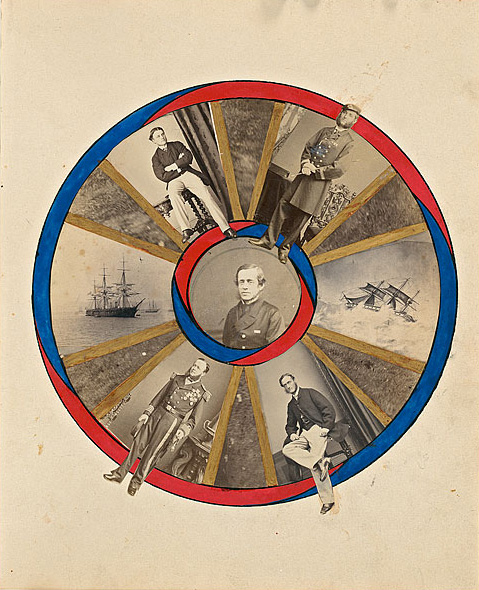
    In fact, only a handful of the Untitled Film Stills are modelled directly on particular roles in actual movies, let alone on individual stills of the sort that the studios distribute to publicise their films. All the others are inventive allusions to generic types, and so our sure sense of recognition is all the more telling. It tells us that, knowingly or not, we have absorbed the movie culture that Sherman invites us to examine as a powerful force in our lives.

    Publication excerpt from The Museum of Modern Art, MoMA Highlights, New York: The Museum of Modern Art, revised 2004, originally published 1999, p. 295.


    Helen Levitt (American, 1913-2009) 'New York' 1982 from the exhibition 'Picturing New York: Photographs from The Museum of Modern Art' at the Irish Museum of Modern Art, Dublin, November 2009 - February 2010


    Helen Levitt (American, 1913-2009)
    New York
    1982
    Gelatin silver print
    9 9/16 x 6 7/16″ (24.3 x 16.4cm)
    The Museum of Modern Art, New York
    Gift of Marvin Hoshino in memory of Ben Maddow
    © 2009 The Estate of Helen Levitt, courtesy Fraenkel Gallery, San Francisco


    Louis Stettner (American, born 1922) 'Manhattan from the Promenade, Brooklyn, New York' 1954


    Louis Stettner (American, 1922-2016)
    Manhattan from the Promenade, Brooklyn, New York
    1954
    Gelatin silver print
    12 1/4 x 18 1/4″ (31.1 x 46.4cm)
    The Museum of Modern Art, New York. Gift of the photographer in memory of his brother, David Stettner
    © 2009 Louis Stettner, courtesy Bonni Benrubi Gallery, New York


    Diane Arbus (American, 1923-1971) 'Woman with Veil on Fifth Avenue, N.Y.C' 1968


    Diane Arbus (American, 1923-1971)
    Woman with Veil on Fifth Avenue, N.Y.C.
    1968
    Gelatin silver print
    The Museum of Modern Art, New York


    An exhibition of 145 masterworks from the photographic collection of The Museum of Modern Art (MoMA) in New York , celebrating the architecture and life of that unique city from the 1880s to the present day, opens to the public at the Irish Museum of Modern Art on Wednesday, November 25, 2009. “Picturing New York” draws on one of the most important collections of modern and contemporary photography in the world to celebrate the long tradition of photographing New York, a tradition that continues to frame and influence our perception of the city to this day. Presenting the work of some 40 photographers including such influential figures as Berenice Abbott, Diane Arbus, Garry Winogrand, Lisette Model, Alfred Stieglitz and Cindy Sherman, the exhibition features both the city and its inhabitants, from its vast, overwhelming architecture to the extraordinary diversity of its people.

    The exhibition reflects photographers’ ongoing fascination with New York, a city whose vitality, energy, dynamism and sheer beauty have also inspired innumerable artists, writers, filmmakers and composers. New York’s unique architecture is explored, from elegant skyscrapers to small shop fronts; likewise the life of its citizens, from anonymous pedestrians to celebrities and politicians. The city’s characteristic optimism is caught time and again in these images, even in those taken in difficult times. Together, they present a fascinating history of the city over more than a century, from Jacob Riis’s 1888 view of bandits on the Lower East Side to Michael Wesely’s images taken during the recent expansion at MoMA.

    The photographs reveal New York as a city of contrasts and extremes through images of towering buildings and tenements, party-goers and street-dwellers, hurried groups and solitary individuals. “Picturing New York” suggests the symbiosis between the city’s progression from past to present and the evolution of photography as a medium and as an art form. Additionally, these photographs of New York contribute significantly to the notion that the photograph, as a work of art, is capable of constructing a sense of place and a sense of self.

    “I am thrilled that ‘Picturing New York’ will be presented in Dublin – a city whose vitality, grit, and vibrant artistic community resonates with that of New York ,” said Sarah Meister, Curator in MoMA’s Department of Photography, who organised the exhibition. “In addition, the layout and scale of the galleries at IMMA will allow this story – of New York and photography becoming modern together throughout the twentieth century – to unfold as if chapter by chapter.”

    Press release from the Irish Museum of Modern Art website [Online] Cited 26/01/2010. No longer available online


    Jacob Riis (Danish-American, 1849-1914) 'Bandit's Roost at 59½ Mulberry Street' 1888


    Jacob Riis (Danish-American, 1849-1914)
    Bandit’s Roost at 59½ Mulberry Street
    1888
    Gelatin silver print, printed 1958
    19 3/16 x 15 1/2″ (48.7 x 39.4cm)
    The Museum of Modern Art, New York
    Gift of the Museum of the City of New York


    Late 19th-century New York City was a magnet for the world’s immigrants, and the vast majority of them found not streets paved with gold but nearly subhuman squalor. While polite society turned a blind eye, brave reporters like the Danish-born Jacob Riis documented this shame of the Gilded Age. Riis did this by venturing into the city’s most ominous neighbourhoods with his blinding magnesium flash powder lights, capturing the casual crime, grinding poverty and frightful overcrowding. Most famous of these was Riis’ image of a Lower East Side street gang, which conveys the danger that lurked around every bend. Such work became the basis of his revelatory book How the Other Half Lives, which forced Americans to confront what they had long ignored and galvanised reformers like the young New York politician Theodore Roosevelt, who wrote to the photographer, “I have read your book, and I have come to help.” Riis’ work was instrumental in bringing about New York State’s landmark Tenement House Act of 1901, which improved conditions for the poor.

    Anonymous. “Bandit’s Roost, 59½ Mulberry Street,” on the Time 100 Photos website [Online] Cited 09/06/2019 no longer available online


    Paul Strand (American, 1890-1976) 'Wall Street, New York' 1915


    Paul Strand (American, 1890-1976)
    Wall Street
    1915
    Gelatin silver print
    The Museum of Modern Art, New York


    Lewis W. Hine (American, 1874-1940) 'Welders on the Empire State Building' c. 1930


    Lewis W. Hine (American, 1874-1940)
    Welders on the Empire State Building
    c. 1930
    Gelatin silver print
    10 5/8 x 13 5/8″ (27 x 34.6cm)
    The Museum of Modern Art, New York. Committee on Photography Fund


    Dan Weiner (American, 1919-1959)
'New Year's Eve, Times Square' 1951


    Dan Weiner (American, 1919-1959)
    New Year’s Eve, Times Square
    1951
    Gelatin silver print
    9 1/4 x 13 3/16″ (23.5 x 33.5cm)
    The Museum of Modern Art, New York. Gift of Sandra Weiner
    © 2009 Estate of Dan Weiner


    Bruce Davidson (American, b. 1933) 'Untitled' from the 'Brooklyn Gang' series 1959


    Bruce Davidson (American, b. 1933)
    Untitled from the Brooklyn Band series
    1959
    Gelatin silver print
    6 3/4 x 10″ (17.1 x 25.4cm)
    The Museum of Modern Art, New York. Purchase
    © 2019 Magnum Photos, Inc. and Bruce Davidson


    Weegee (Arthur Fellig) (American born Austria, 1899-1968) 'Coney Island' 1940


    Weegee (Arthur Fellig) (American born Austria, 1899-1968)
    Coney Island
    c. 1939
    Gelatin silver print
    10 5/16 x 13 11/16″ (26.2 x 34.8cm)
    The Museum of Modern Art, New York. Anonymous gift


    Unknown photographer. 'Brooklyn Bridge' c. 1914


    Unknown photographer (American)
    Brooklyn Bridge
    c. 1914
    Gelatin silver print
    7 5/8 x 9 9/16″ (19.4 x 24.3cm)
    The Museum of Modern Art, New York, The New York Times Collection


    Ted Croner (American, 1922-2005) 'Central Park South' 1947-1948


    Ted Croner (American, 1922-2005)
    Central Park South
    1947-1948
    Gelatin silver print
    The Museum of Modern Art, New York


    Walker Evans (American, 1903-1975)
'Girl in Fulton Street, New York' 1929
    Screenshot


    Walker Evans (American, 1903-1975)
    Girl in Fulton Street, New York
    1929
    Gelatin silver print
    7 5/16 × 4 5/8″ (18.6 × 11.7cm)
    Museum of Modern Art
    Gift of the artist


    Bernice Abbott (American, 1898-1991) 'Night View, New York City' 1932


    Bernice Abbott (American, 1898-1991)
    Night View, New York City
    1932
    Gelatin silver print
    The Museum of Modern Art, New York


    Lee Friedlander (American, b. 1934)
'New York City' 1980


    Lee Friedlander (American, b. 1934)
    New York City
    1980
    Gelatin silver print
    The Museum of Modern Art, New York


    Irish Museum of Modern Art/Áras Nua-Ealaíne na hÉireann
    Royal Hospital
 Military Road
    Kilmainham
    Dublin 8
    Ireland
    Phone: +353-1-612 9900

    Opening hours:
    Tuesday, Thursday – Saturday: 10.00am – 5.30pm
    Wednesday: 11.30am – 5.30pm
    Sundays and Bank Holidays: 12pm – 5.30pm

    Irish Museum of Modern Art website

    LIKE ART BLACK ON FACEBOOK

    Back to top

    Exhibition: ‘Paste Up’ by Barbara Kruger at Sprüth Magers London

    Exhibition dates: 21st November, 2009 – 23rd January, 2010


    Many thankx to Sprüth Magers London for allowing me to publish the photographs in the posting. Please click on the photographs for a larger version of the image.


    Barbara Kruger (American, b. 1945) 'Untitled (Money can buy you love)' 1983 from the exhibition Exhibition: 'Paste Up' by Barbara Kruger at Sprüth Magers London, Nov 2009 - Jan 2010


    Barbara Kruger (American, b. 1945)
    Untitled (Money can buy you love)
    1983
    Collage
    19.5 x 17.5cm
    Courtesy of the artist and Sprüth Magers London Berlin


    Barbara Kruger (American, b. 1945) 'Untitled (Your misery loves company)' 1985 from the exhibition Exhibition: 'Paste Up' by Barbara Kruger at Sprüth Magers London, Nov 2009 - Jan 2010


    Barbara Kruger (American, b. 1945)
    Untitled (Your misery loves company)
    1985
    Collage
    18 x 17.3cm
    Courtesy of the artist and Sprüth Magers London Berlin


    Barbara Kruger (American, b. 1945) 'Untitled (Our prices are insane!)' 1987 from the exhibition Exhibition: 'Paste Up' by Barbara Kruger at Sprüth Magers London, Nov 2009 - Jan 2010


    Barbara Kruger (American, b. 1945)
    Untitled (Our prices are insane!)
    1987
    Collage
    Courtesy of the artist and Sprüth Magers London Berlin


    Barbara Kruger (American, b. 1945) 'Untitled (We will no longer be seen and not heard)' 1985


    Barbara Kruger (American, b. 1945)
    Untitled (We will no longer be seen and not heard)
    1985
    17.8 x 18.5cm
    Courtesy of the artist and Sprüth Magers London Berlin


    Sprüth Magers London is delighted to present a survey of early work by acclaimed American artist Barbara Kruger. Using contrasting layers of text and image, Kruger’s work has for almost three decades probed the nature of a media-saturated society in late capitalism, and the significance of highly evolved cultures of consumerism and mass politics to the experience and making of social identities. In addition to offering acute, indeed often piquant cultural insights, Kruger’s work also presents a serious conceptual exploration into the relationship between language and image, and their dynamics as collaborators and antagonists in the bearing of meaning. The artist’s unique blend of conceptual sophistication and wry social commentary has made Kruger one of the most respected and admired artists of her generation, and this timely reappraisal of her early practice reveals the ingenuity and precision of her craft.

    The early monochrome pre-digital works assembled in the exhibition, known professionally as ‘paste ups’, reveal the influence of the artist’s experience as a magazine editorial designer during her early career. These small scale works, the largest of which is 11 x 13 inches, are composed of altered found images, and texts either culled from the media or invented by the artist. A negative of each work was then produced and used to make enlarged versions of these initial ‘paste ups’. The influence of Kruger’s magazine publishing training extends far beyond technique however. The linguistic and typographic conventions of consumer culture, and an understanding of the inherent potential of a single image, are appropriated and subverted by Kruger, as the artist explores the power of the soundbite and the slogan, and the method and impact of ‘direct address’ on the consumer/viewer.

    Although Kruger’s practice is embedded in the visual and political culture of mass media and advertising, the work moves beyond simple appropriation and the ironic meditation on consumerism which animated earlier movements such as Pop art. The emblazoned slogans are often slightly yet meaningfully adjusted clichés of common parlance and the commercial world, and are overlaid on contrasting images which range from the grotesque to the banal. The juxtaposition of pictorial and linguistic modes of communication on the same plane thereby begs conceptual questions of human understanding, and the means by which messages are transmitted and distorted, recognised and received.

    Barbara Kruger was born in Newark, New Jersey in 1945. She currently lives in both Los Angeles, California and New York and teaches at the University of California, Los Angeles. She has been the subject of many one-person exhibitions, including a comprehensive retrospective at the Museum of Contemporary Art in Los Angeles in 1999, which travelled to The Whitney Museum of American Art, New York in 2000. More recently, she has exhibited large-scale installations at the Moderna Museet in Stockholm, Tramway in Glasgow, Scotland, the Australian Centre for Contemporary Art in Melbourne, Australia, and at BCAM at the Los Angeles County Museum of Art, among others. She was honoured with the “Golden Lion” award for Lifetime Achievement at the Venice Biennale in 2005.

    Press release from the Sprüth Magers London website [Online] Cited 25/05/2019 no longer available online


    Barbara Kruger (American, b. 1945)
'Untitled (We won't be our own best enemy)' 1986


    Barbara Kruger (American, b. 1945)
    Untitled (We won’t be our own best enemy)
    1986
    Collage
    18 x 22cm
    Courtesy of the artist and Sprüth Magers London Berlin


    Barbara Kruger (American, b. 1945) 'Untitled (Surveillance is their busywork)' 1988


    Barbara Kruger (American, b. 1945)
    Untitled (Surveillance is their busywork)
    1988
    Collage
    11.1 x 22cm
    Courtesy of the artist and Sprüth Magers London Berlin


    Barbara Kruger (American, b. 1945) 'Untitled (You are a very special person)' 1995


    Barbara Kruger (American, b. 1945)
    Untitled (You are a very special person)
    1995
    Collage (colour)
    13.6 x 19.1cm
    Courtesy of the artist and Sprüth Magers London Berlin


    Barbara Kruger (American, b. 1945) 'Don't be a jerk' 1984


    Barbara Kruger (American, b. 1945)
    Don’t be a jerk
    1984
    Screenprint on vinyl
    250 x 388.5cm
    Courtesy of the artist and Sprüth Magers London Berlin


    Sprüth Magers London
    7A Grafton Street,
    London, W1S 4EJ
    Phone: +44 (0)20 7408 1613

    Opening hours:
    Tuesday – Saturday 10am – 6pm

    Sprüth Magers website

    LIKE ART BLART ON FACEBOOK

    Back to top

    Review: ‘Cubism & Australian Art’ at Heide Museum of Modern Art, Bulleen

    Exhibition dates: 24th November, 2009 – 8th April, 2010


    Jean Appleton (Australian, 1911-2003) 'Painting IX' 1937 from the exhibition 'Cubism & Australian Art' at Heide Museum of Modern Art, Nov 2009 - April 2010


    Jean Appleton (Australian, 1911-2003)
    Painting IX
    1937
    Whitworth/Bruce Collection


    Perfect summer fare out at Heide at the moment – relax with a lunch at the new Cafe Vue followed by some vibrantly fresh art in the galleries. In a nicely paced exhibition, Cubism & Australian Art takes you on a journey from the 1920s to the present day, the art revealing itself as you move through the galleries.

    There are too many individual works to critique but some thoughts and ideas do stand out.


    Cezanne’s use of passage (A French term (pronounced “pahsazh”) for a painting technique characterised by small, intersecting planes of patch-like brushwork that blend together to create an image), the transition between adjacent shapes, where solid forms are fused with the surrounding space was an important starting point for the beginnings of Cubism. Simultaneity – movement, space and the dynamism of modern life – was matched to Cubism’s new forms of pictorial organisation. The geometries of the Section d’Or (or the Gold Mean), that magical ratio found in all forms, also sounds an important note as it flows through the rhythmic movement and the sensations of temporal reality.
    In the work from the 1920s/30s presented in the exhibition the palette of most of the works is subdued, the form of circles and geometrics. There are some beautiful paintings by one of my favourite Australian artists Roy de Maistre and others by Eric Wilson, Sam Atyeo and Jean Appleton (see image above). The feeling of these works is quiet and intense.

    Following

    There are some evocative works from the 1940s/50s including Godfrey Miller’s Still Life with Musical Instruments (1958, below), Graham King’s Industrial Landscape (1959) and Ralph Balson’s Constructive painting (1951). The Charcoal Burner (1959) by Fred Williams (see image below) is the Australian landscape seen through Cubist eyes, surface and space perfectly commingled in reserved palette, delineated planes. Grace Crowley’s Abstract Painting (1947, see image below) is a symphony of colour, plane and form that I would willingly take home any day of the week!

    Now

    It is the contemporary work that is of most interest in this exhibition. Spatio-temporal reality is distorted as artists push the boundaries of dimensionality. The parameters of reality are blurred and extended through the use of multiple viewpoints and lines of sight. Fresh and spatially aware (like an in joke because everyone recognises the fragmented ‘nature’ of contemporary existence) we have the sublime Milky Way (1995, see image below) by Rosalie Gascoigne and for me the two standout pieces in the exhibition, Bicycles (2007, below) by James Angus and Static No.9 (a small section of something larger) (2005, below) by Daniel Crooks.
    Though difficult to see in the photograph of the work (below), Bicycles fuses three bicycles into one. “A photo finish made actual, a series of frames at the conclusion of a race transferred permanently into three dimensions.” You look and then look again: three frames into one, three tyres into one, three stands into one, three chains the only singular – like a freeze frame of a motor drive on a camera

    Snap
    Snap
    Snap

    or the slight difference of the two images of a Victorian stereoscope made triumvirate (the 3D world of Avatar comes to mind). Static, the bicycle can never work, is redundant, but paradoxically moves at the same time.

    Even more mesmerising is the video work Static No.9 (a small section of something larger) by Daniel Crooks. Unfortunately I cannot show you the video but a still from the video can be seen below as well as a link to a trailer of the work. Imagine this animated like swirling DNA (in actual fact it is people walking across an intersection at different distances and speeds to the camera – and then sections taken out of the video and layered). Swirling striations through time and space fragment identity so that people almost become code, the sound track the distorted beep beep beep of the buzzer at the crossing. I could have sat there for hours watching the performance as it crackles with energy and flow – with my oohs and aahs! The effect is magical, beautiful, hypnotic.

    A great summer show – fresh, alive and well worth the journey if only to see that static in all its forms has never looked so good.

    Dr Marcus Bunyan


    Many thankx to the Heide Museum of Modern Art for allowing me to publish the art work in the posting. Please click on the photographs for a larger version of the image.


    Cubism and Abstract Art


    Alfred Barr’s Cubism diagram – original cover of Cubism and Abstract Art, Museum of Modern Art, New York, exhibition catalogue, 1936


    Ralph Balson (Australian, 1890-1964) 'Painting no. 17' 1941 from the exhibition 'Cubism & Australian Art' at Heide Museum of Modern Art, Nov 2009 - April 2010


    Ralph Balson (Australian, 1890-1964)
    Painting no. 17
    1941
    Oil and metallic paint on cardboard
    91.7 x 64.8cm
    Hassall Collection


    By 1941 Ralph Balson had abandoned the figure for a completely abstract style. He announced this breakthrough in a solo exhibition at the Fine Art Galleries at Anthony Hordern and Sons in Sydney with paintings that evolved in part out of Albert Gleizes’s style of Cubism: uninflected surfaces, essential forms, respect for the two-dimensionality of the picture surface and the sense of a search for a deeper, universal truth.

    Though at the time unusual for Australian art, such developments were concurrent with advancements in abstraction in the UK and US. This new mode of painting was to preoccupy Balson and Crowley, and to a lesser extent Frank Hinder, for the rest of the decade.

    Balson’s ‘constructive’ pictures became sophisticated and intricate, characterised by Constructive painting (1945), with its overlapping translucent planes and array of discs, squares and rectilinear shapes in an animated state of flux, and perhaps culminating in Constructive painting (1951). This work has a different kind of luminosity, as if the picture has an inner light. As Balson himself said of such images, they are ‘abstract from the surface, but more truly real with life’.

    Heide Education Resource p. 15.


    Dorrit Black (Australian, 1891-1951) 'The bridge' 1930


    Dorrit Black (Australian, 1891-1951)
    The bridge
    1930
    Oil on canvas on board
    60 x 81cm
    Art Gallery of South Australia, Adelaide
    Bequest of Dorrit Black, 1951


    Roy de Maistre (Australian, 1894-1968) 'The football match' 1938


    Roy de Maistre (Australian, 1894-1968)
    The football match
    1938
    Oil on canvas
    71.5 x 92cm
    The Janet Holmes à Court Collection


    Eric Wilson (Australian, 1911-1946) 'Theme for a mural' 1941


    Eric Wilson (Australian, 1911-1946)
    Theme for a mural
    1941
    Oil on plywood on corrugated iron
    53.2 x 106.8cm
    National Gallery of Victoria, purchased 1958


    Sidney Nolan (Australian, 1917-1992) 'Rimbaud royalty' 1942


    Sidney Nolan (Australian, 1917-1992)
    Rimbaud royalty
    1942
    Synthetic polymer paint on composition board
    59.5 x 90cm
    Heide Museum of Modern Art
    Bequest of John and Sunday Reed


    Ralph Balson (Australian born England, 1890-1964; worked in Australia 1913-1964) 'Constructive painting' 1948


    Ralph Balson (Australian born England, 1890-1964; worked in Australia 1913-1964)
    Constructive painting
    1948
    Oil on cardboard
    106.8 × 71.0cm
    National Gallery of Victoria, Melbourne
    Bequest of Grace Crowley, 1981
    © Ralph Balson Estate


    Grahame King (Australian 1915-2008) 'Industrial Landscape' 1960


    Grahame King (Australian 1915-2008)
    Industrial Landscape
    1960
    Oil on board
    91.00 x 122.00cm
    Charles Nodrum Gallery


    Daniel Crooks (New Zealand, b. 1973) 'Portrait #2' (Chris) 2007


    Daniel Crooks (New Zealand, b. 1973)
    Portrait #2 (Chris)
    2007
    Lambda photographic print
    102 cm x 102cm
    Heide Museum of Modern Art
    Purchased with funds from the Robert Salzer Foundation 2012


    “With these portraits I’m attempting to make large detailed images of people in their own surroundings, images of people very much in and of their time that are both intriguing and beautiful. As with a lot of my work the portraits also seek to render the experience of time in a more tangible material form, blurring the line between still and moving images and looking to new post-camera models of spatiotemporal representation.”

    Daniel Crooks


    Portrait #2 (Chris) forms part of Daniel Crooks’s Scanlines, a series of moving image works and prints made using digital collage techniques. This involves digitally slicing images then reassembling them sequentially, across the screen or picture plane, to create rhythmic and spatial effects through which Crooks seeks to explore ideas and themes related to our understandings of time and motion.


    Elizabeth Gower (Australian, b. 1952) 'City Series' 1982-1984


    Elizabeth Gower (Australian, b. 1952)
    City Series
    1982-1984
    Acrylic on paper
    © Courtesy the artist and Sutton Gallery, Melbourne and Milani Gallery, Brisbane


    Elizabeth Gower (Australian, b. 1952) 'Transient' 1979


    Elizabeth Gower (Australian, b. 1952)
    Transient
    1979
    Synthetic, polymer paint and resin on rice paper, newsprint and garment patterns
    © Courtesy the artist and Sutton Gallery, Melbourne and Milani Gallery, Brisbane


    Elizabeth Gower found a new relevance for Cubism in her abstract series Shaped works (1978-1984) … Cubist collage combined with feminist ideas to inspire her use of everyday materials such as newsprint and garment patterns. Transparent rice paper adds a delicacy and lightness to the work. The dynamic overlap of flat planes and juxtaposition of contrasting shapes, textures and patterns relates directly to the legacy of Synthetic Cubism. The work of Sonia Delaunay was also a particular inspiration for Gower.

    Heide Education Resource p. 23.


    Melinda Harper (Australian, b. 1965) 'Untitled' 2000


    Melinda Harper (Australian, b. 1965)
    Untitled
    2000
    Oil on canvas
    183.0 × 152.3cm
    National Gallery of Victoria, Melbourne
    Presented through the NGV Foundation by Robert Gould, Founder Benefactor, 2004
    © Melinda Harper/Licensed by Copyright Agency, Australia


    Cubism & Australian Art, one of the most ambitious and extensive exhibitions Heide has undertaken, shows the impact of the revolutionary and transformative movement of Cubism on Australian art from the early twentieth century to the present day. It uncovers a little-known yet compelling history through works by over eighty artists, including key examples of international Cubism drawn from Australian collections – by André Lhote, Albert Gleizes, Fernand Léger, Alexander Archipenko, Ben Nicholson and others – and nine decades of Australian modern and contemporary art that demonstrate a local evolution of cubist ideas.
    The exhibition documents the earliest incorporation of cubist principles in Australian art practice in the 1920s, when artists such as Grace Crowley and Anne Dangar, who studied overseas under leading cubist artists, began to transform their art in accordance with late cubist thinking. It examines the influence of Cubism on artists associated with the George Bell School in Melbourne and the Crowley-Fizelle School in Sydney; and on those who participated in the cubist movement abroad including James Cant and John Power.

    While its distortions and unconventional perspectives served individual styles such as the expressionism of Albert Tucker or the experimental landscapes of Sidney Nolan and Fred Williams, Cubism’s most enduring influence on postwar Australian art has been in abstraction. This exhibition traces its reverberations in 1950s abstract art by Roger Kemp, Robert Klippel and Ron Robertson-Swann and others, through to works by younger artists such as Stephen Bram, Gemma Smith and Justin Andrews.

    Cubism’s formal and conceptual innovations and its investigations into the representation of time, space and motion have continuing relevance for artists today, who variously adapt, develop, quote and critique aspects of cubist practice. In this exhibition, Cubism’s shifting, multi-perspectival view of reality takes on new form in moving-image works by John Dunkley-Smith and Daniel Crooks, in paintings by Melinda Harper and sculptures by James Angus. The use of found objects and recycled materials by Madonna Staunton, Rosalie Gascoigne and Masato Takasaka extends ideas originating in cubist sculpture and collage. Other artists are critical of Cubism, bringing Indigenous and non-european perspectives to bear on its modernist history, particularly its appropriation of so-called ‘primitive art’.

    Text from the Heide Museum of Modern Art website [Online] Cited 10/01/2010 no longer available online


    Grace Crowley (Australian, 1890-1979) 'Abstract painting' 1947


    Grace Crowley (Australian, 1890-1979)
    Abstract painting
    1947
    Oil on board
    63.2 x 79.0cm
    Private Collection, Sydney


    Godfrey Miller (New Zealand, 1893-1964; worked in England 1933-39, Australia 1939-64) 'Still Life with Musical Instruments' 1958


    Godfrey Miller (New Zealand, 1893-1964; worked in England 1933-1939, Australia 1939-1964)
    Still Life with Musical Instruments
    1958
    Pen and ink and oil on canvas
    65.5 × 83.0cm
    National Gallery of Victoria, Melbourne
    Felton Bequest, 1963
    © National Gallery of Victoria


    Introduction

    Cubism & Australian Art considers the impact of the revolutionary and transformative movement of Cubism on Australian art from the early twentieth century to the present day. Cubism was a movement that changed fundamentally the course of twentieth-century art, and its innovations – the shattering of the traditional mimetic relationship between art and reality and investigations into the representation of time, space and motion – have continuing relevance for artists today. Works by over eighty artists, including key examples of international Cubism drawn from Australian collections, are displayed in the exhibition.

    The exhibition examines not only the period contemporaneous with Cubism’s influence within Europe, but also the decades from then until the present day, when its reverberations continue to be felt. In the first part of the century, Cubism appeared through a series of encounters and dialogues between individuals and groups resulting in a range of fascinating adaptations, translations and versions alongside other more programmatic or prescriptive adoptions of cubist ideas. The exhibition traces the first manifestations of Cubism in Australian art in the 1920s, when artists studying overseas under leading cubist artists began to transform their art in accordance with such approaches. It examines the transmission of cubist thinking and its influence on artists associated with the George Bell School in Melbourne and the Crowley-Fizelle School in Sydney. By the 1940s, artists working within the canon of modernism elaborated on Cubism as part of their evolutionary process, and following World War II Cubism’s reverberations were being felt as its ideas were revisited by artists working with abstraction.

    In the postwar years and through to the 1960s, the influence of Cubism became more diffuse, but remained significant. In painting, cubist ideas provided an underlying point of reference in the development of abstract pictorial structures, though they merged with other ideas current at the time, relating in the 1950s, for example, to colour, form, musicality and the metaphysical. For many artists during this decade, Cubism provided the geometric basis from which to seek an inner meaning beneath surface appearances, to explore the spiritual dimension of painting and to understand modernism.

    The shift from a Cubist derived abstraction in Australia in the 1950s to a mild reaction against Cubism in the Colour field and hard-edged painting of the mid to latter 1960s reflected a new recognition of New York as the centre of the avant-garde. Cubism’s shallow pictorial space, use of trompe l’oeil and fragmentation of parts continued to inform the work of certain individuals who adapted them in ways relevant to the new abstraction. Cubist ideas and precepts also found some resonance in an emphasis on the flatness of the canvas, particularly as articulated in the formalist criticism of Clement Greenberg.

    The influence of Cubism on Australian art from 1980s to 2000s is subtle, varied and diffuse as contemporary artists variously quote, adapt, develop and critique aspects of cubist practice. Cubism’s decentred, shifting, multi-perspectival view of reality takes on new form, in moving-image works and installations, as well as being further developed in painting and sculpture. Post-cubist collage is used both as a method of constructing artworks – paintings, sculptures, assemblages – and as an intellectual strategy, that of the postmodern bricoleur. Several artists imagine alternative cubist histories and lineages, revisiting cubist art from an Indigenous or non-European perspective and drawing out the implications of its primitivism. Others pay homage to local versions of Cubism, or look through its lens at art from elsewhere.

    Heide Education Resource p. 3.


    Fred Williams (Australian, 1927-1982) 'The Charcoal Burner' 1959


    Fred Williams (Australian, 1927-1982)
    The Charcoal Burner
    1959
    Oil on composition board
    86.3 × 91.4cm
    National Gallery of Victoria, Melbourne, purchased 1960
    © Estate of Fred Williams


    Cubism played a fundamental role in Fred Williams’s pictorial rethinking of the Australian landscape and through him, Cubism has affected the way Australians view their natural surroundings.

    Patrick McCaughey writes in the catalogue for this exhibition:

    The charcoal burner, with its reserved palette and briskly delineated planes, is one of his most accomplished essays in seeing the Australian landscape through cubist eyes. Already looking for the ‘bones’ of the landscape, Williams was drawn to the early phase of Cubism, as it gave structure to the unspectacular landscape – the bush in the Dandenongs; the coastal plain around the You Yangs.

    Just as Braque in his cubist landscapes of 1908-1909 eschewed ‘view’ painting and disdained the picturesque, so Williams in turn generalised the landscape, constructing it and rendering it taut, modern and vivid. In his landscapes Braque made the important pictorial discovery of passage, fusing solid forms with the surrounding space. Williams exploits this innovation in The charcoal burner, where surface and space are perfectly commingled.

    Heide Education Resource p. 1.


    Robert Rooney (Australian, 1937-2017) 'After Colonial Cubism' 1993


    Robert Rooney (Australian, 1937-2017)
    After Colonial Cubism
    1993
    Synthetic polymer paint on canvas
    122 x 198.3cm
    Heide Museum of Modern Art
    Purchased through the Heide Foundation with the assistance of the Heide Foundation Collectors’ Group and the Robert Salzer Fund 2008. Courtesy of the artist


    Robert Rooney’s painting After Colonial Cubism (1993) shows a vibrant streetscape rendered in deliberate and self-conscious cubist style that declares itself to be a second-hand quotation of Cubism, rather than an example of the original style. The streetscape has not been drawn from life but is a faithfully scaled-up version of a much earlier gouache sketch Buildings (1953) that Rooney did as a young student in Melbourne. The sketchbook page is indicated in the painting by the vertical bands on either side of the image which effectively serve as quotation marks.

    In highlighting the second-hand nature of the image in his painting, Rooney more broadly comments on the dispersal of cubist ideas from Paris, Cubism’s place of origin, to more local contexts such as Australia. The painting carries with it the artist’s memories of his student days, of learning about Cubism through magazines and books. Rooney remembers visiting exhibitions of cubist works by Australian artists and being fascinated by how these ideas were translated locally. Further meaning in the work derives from its title which refers to the painting Colonial Cubism 1954, by Stuart Davis, an American artist whose cubist works are a further instance of the dispersal of the style to localities outside of France.

    Heide Education Resource p. 29.


    Rosalie Gascoigne (Australian, born New Zealand 1917-1999) 'Milky Way' 1995 (detail)


    Rosalie Gascoigne (Australian, born New Zealand 1917-1999)
    Milky Way (detail)
    1995
    Mixed media


    Rosalie Gascoigne is renowned for her sculptural assemblages of great clarity, simplicity and poetic power. Using natural or manufactured objects, sourced from collecting forays, that evoke the lyrical beauty of the Monaro region of New South Wales, her work radically reformulated the ways in which the Australian landscape is perceived. …

    “My country is the eastern seaboard. Lake George and the Highlands. Land that is clean scoured by the sun and frost. The record is on the roadside grass. I love to roam around, to look and hear … I look for things that have been somewhere, done something. Second hand materials aren’t deliberate; they have had sun and wind on them. Simple things. From simplicity you get profundity. The weathered grey look of the country gives me a great emotional upsurge. I am not making pictures, I make feelings.”

    Rosalie Gascoigne

    Extract from Anonymous. “Biography (Roaslie Gascoigne),” on the Art Gallery of New South Wales website [Online] Cited 21/05/2019


    Daniel Crooks (New Zealand, b. 1973) 'Static No.9 (a small section of something larger)' 2005


    Daniel Crooks (New Zealand, b. 1973)
    Static No.9 (a small section of something larger) (still)
    2005
    Single channel digital video, colour, sound
    Duration: 00:13:29 min, aspect ratio: 16:9

    View a preview of the work: Static No.9 (a small section of something larger) from Daniel Crooks.


    James Angus (Australian, b. 1970) 'Bicycles' 2007


    James Angus (Australian, b. 1970)
    Bicycles
    2007
    Chromed steel, aluminium, polyeurethane, enamel paint


    “An object which is entirely solid yet blurry; a sculpture-in-motion that vibrates between plural and singular.” ~ James Angus

    For this handcrafted sculpture, Angus melded the frames of three bicycles into one, creating a kind of platonic ideal of bike design which resolves slight differences in thickness of truss, angles of frame and fork, shape of saddle and handlebar position into an ideal form – one that seems to shift between the plural and the singular. Traces of all three bikes inhabit this final rendition, with its tripled wheel spokes and chain drive, contoured saddle and ridged handlebars.

    Hovering between three sets of dimensions and proportions, the sculpture presents a visual experience akin to looking at lenticular imagery or to a stereoscopic gaze, in which two sets of slightly disparate visual information are resolved into the one three-dimensional image. These subtle differences, inhabiting the one object, speak of the slight variations between not only bikes but individual riders, for whom the bike is an extension of their body shape, size and movement. In keeping with his other works, which have distorted, shifted and played with elements of design from architecture to automobiles, Angus disrupts our expectations of an everyday object. By making us look again he reminds us that a bicycle, like a racing car, is a moving sculpture.

    Text from the Museum of Contemporary Art website [Online] Cited 21 May 2019


    Justin Andrews (Australian, b. 1973) 'Acid yellow 3' 2008


    Justin Andrews (Australian, b. 1973)
    Acid yellow 3
    2008
    Acrylic and enamel on composition board
    75 x 60cm
    Courtesy of the artist and Charles Nodrum Gallery, Melbourne


    Masato Takasaka (Australian, b. 1977) 'Return to forever (productopia)' 2009


    Masato Takasaka (Australian, b. 1977)
    Return to forever (productopia)
    2009
    Cardboard, wood, plastic, mdf, acrylic, paint, paper, soft-drink cans, tape and discarded product packaging installation
    Dimensions variable
    Courtesy of the artist


    Heide Museum of Modern Art
    7 Templestowe Road,
    Bulleen, Victoria 3105

    Opening hours:
    (Heide II & Heide III)
    Tuesday – Sunday, Public holidays 10am – 5pm

    Heide Museum of Art website

    LIKE ART BLART ON FACEBOOK

    Back to top

    Review: ‘Simryn Gill: Inland’ at the Centre for Contemporary Photography, Fitzroy

    Exhibition dates: 9th October – 13th December, 2009


    Simryn Gill (Australian born Singapore, b. 1959) 'Untitled' 1995 from the exhibition 'Simryn Gill: Inland' at the Centre for Contemporary Photography, Fitzroy, Oct - Dec, 2009


    Simryn Gill (Australian born Singapore, 1959)
    Untitled
    1995
    From the series Rampant
    7 gelatin silver photographs
    28.0 x 26.0cm Courtesy the artist and Breenspace, Sydney
    © Simryn Gill


    This is a strange survey exhibition of photographs by Malaysian-born Australian artist Simryn Gill at the Centre for Contemporary Photography, Melbourne – photographs that form distinctive bodies of work that support the artist’s other conversations in art but do not form the main backbone to her practice. Perhaps this is part of the problem and part of the beauty of the work. While the work investigates the concepts of presence and absence, space, place and identity and the cultural inhabitation of nature there is a feeling that this is the work of an artist not used to putting images together in a sequence or body of work, not connecting the dots between ideas and image. Intrinsically there is nothing wrong with the conceptual ideas behind the photographs or the individual photographs themselves. The photographs don’t strike one as particularly memorable and they fail to mark the mind of the viewer in their multitudinous framings of reality.
    In the series Forest (1996-1998, see photograph above and below) a selective vision of nature is invaded by cultural texts, torn pages of books mimicking natural forms such as roots, flowers and variegated leaves. The ‘natural’ context is inhabited by the cultural con-text to form a double inhabitation – “this strange hybrid nature before the paper rots away, suggestive of how nature is culturally inscribed and the futility of this attempt at containment.”1

    This is a nice idea but the photographs fail to hold the attention of the viewer mainly because of the inability of the viewer to read the text that has been grafted onto the natural forms. I literally needed more from the work to hang my hat on and this is how I felt about much of this work presented here. This feeling persists with another series Vegetation (1999, see photographs below). Mundane landscapes are inhabited by faceless human beings, their absence/presence marking the landscape while at the same time nature marks them. A good idea that needed to be pushed much further.

    The main body of work in the exhibition is the series Dalam (2001, see photographs below), a 258 strong series of colour photographs presented in the gallery space in gridded formation (Dalam, in Malay, can mean ‘inside’, ‘interior’ or ‘deep’). Featuring a photographic record of the interior of numerous Malaysian homes these clinical yet someone hobby-like photographs record the minutiae of domestica – the intimacy of the interior balanced by a sense of isolation and loneliness through the absence of human presence. Here, “the living room may be seen here as a cultural and social mask for its inhabitants. It’s the space into which others are welcomed on our own terms and onto which we project a portrayal of ourselves.”3 Although the work asks us “to rethink our concepts of spaces and domesticity in relation to various aspects such as socio-cultural identities, history and memory,” as presented in the gallery space the viewer is initially overwhelmed by the number, colour and construction of the interiors.

    Personally I found that in the mundanity / individuality of the repetition I soon lost interest in looking intimately at the work. The photographs lack a certain spark, a certain clarity of vision in the actual taking of the images. None of the wonderful angles and intelligence of camera positioning of Eugene Atget here and maybe this is the point – the stifling ‘personality’ and banality of human habitation echoed in the photographs – but I would have rather have looked at a single monumentally intimate, magical image by Candida Hofer than all of these photographs put together!

    Unfortunately in this survey exhibition there is only one photograph from what I regard as Simryn Gill’s best body of work, A small town at the turn of the century (1999-2000, see photograph below). Perhaps this was an oversight as this series would seem to bind the others more holistically together. Photographs of this excellent series can be viewed on the Roslyn Oxley9 Gallery website and their presence in this exhibition would have certainly raised the bar in terms of the artist’s vision of nature, place and identity. The square colour format, the interior/exterior of the environments and naturalness of the photographs and their the fruitful bodies really have an eloquent power that most of the work at the Centre for Contemporary Photography seems to lack. Other than the last body of work, Inland (2009, see photograph below) that is.
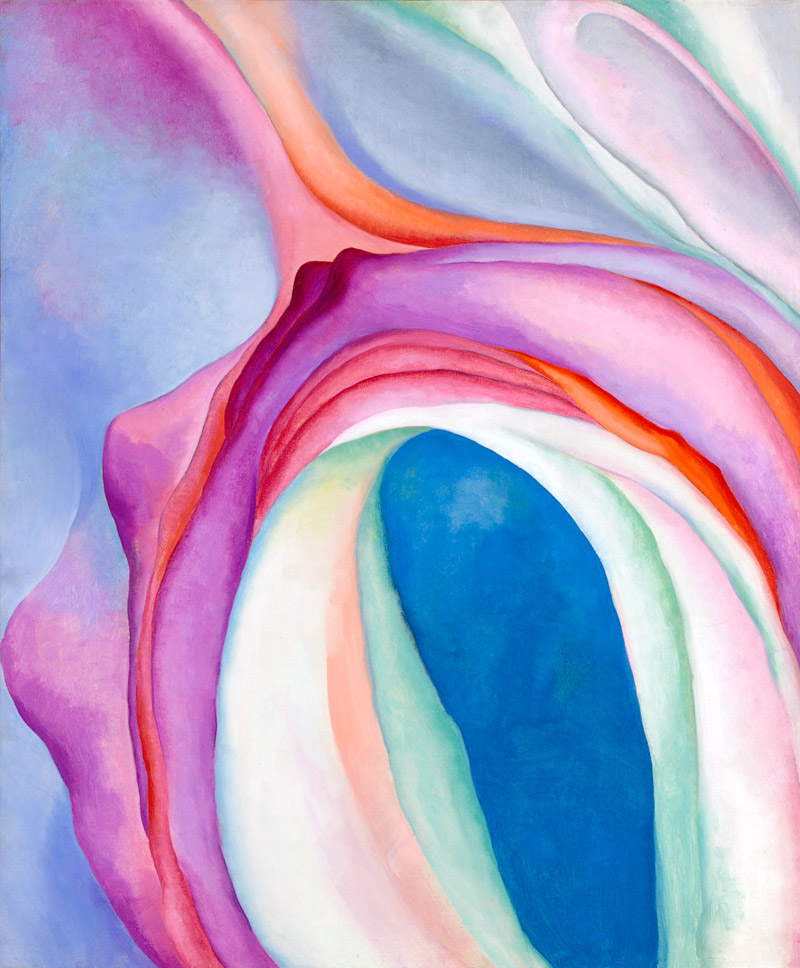
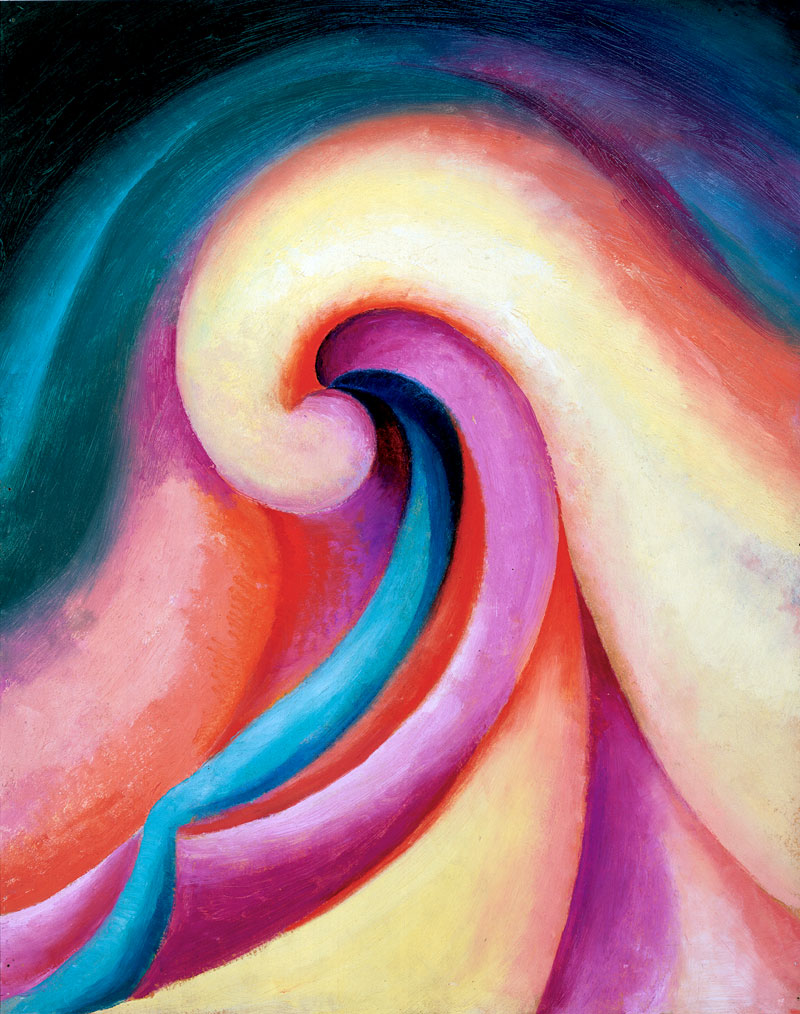
    In the smallest most intimate space at the CCP are some of the most intimate images of Australian place that you will ever see. Spread out on a table in small stacks of jewel-like black and white and Cibachrome images the viewer is asked to done white gloves (ah, the delicious irony of white hands on the Australian land!) to view the empty interiors, landscapes and (hands holding) rocks of the interior. These are beautifully seen and resolved images. The rocks are most poignant.

    Gill digs beneath the surface of this thing called Australian-ness and exposes not the vast horizons, decorous landscapes or rugged people (as Naomi Cass states below) but small intimacies of space and place, identity and memory. In the ability to shuffle the deck of cards, to reorder the photographs to make their own narrative the viewer becomes as much the author of the story being told as the artist herself – an open-ended intertextual narrative guided by the artist that investigates the very root of what it is to be Australian on a personal level. I enjoyed this reordering, this subjective experience very much.

    Dr Marcus Bunyan


    Many thankx to the CCP for allowing me to publish the photographs in the posting. Please click on the photographs for a larger version of the image.


    1/ Anonymous. “Simryn Gill: Selected Work,” on the Indepth Arts News website [Online] Cited 12/05/2019

    2/ Gill, Simryn. “May 2006,” in Off the Edge, Merdeka 50 years issue no. 33, September 2007, p. 83

    3/ Day, Kate. “After Image: Photography at the Fruit Market Gallery,” on Culture 24 website. [Online] Cited 6th December 2009 no longer available online


      Simryn Gill (Australian born Singapore, b. 1959) 'Forest #5' 1998 from the exhibition 'Simryn Gill: Inland' at the Centre for Contemporary Photography, Fitzroy, Oct - Dec, 2009


      Simryn Gill (Australian born Singapore, 1959)
      Forest #5
      1998
      From the series Forest
      16 gelatin silver photographs
      © Simryn Gill


      Rampant (1999)

      “Both populating and haunting the patches of now feral vegetation evoking a sense of foreign/alien source that has been strained, even lost in the act of transplantation. It also parodies the fear of rampant occupation that historically imbues aspects of Australian to Northern neighbours.”10

      In Rampant Gill photographed outbursts of introduced plant species in the Australian landscape such as bamboo and sugar cane, which now grow wild and uncontrolled in subtropical northern New South Wales. Again Gill incorporates performative elements, interacting with nature through ‘dressing’ the plants in garments such as lungis and sarongs which were worn by immigrant workers who harvested these crops. Gill explores of the connections between botany, geography and the idea of plants as ‘humanised’ entities – seen in these strange single or groups of ‘figures’ appearing displaced within the Australian landscape.

      Text from the education resource for the exhibition Simryn Gill: Inland at the Centre for Contemporary Photography, Fitzroy [Online] Cited 12/05/2019


      Simryn Gill (Australian born Singapore, b. 1959) 'Forest #13' 1998 from the exhibition 'Simryn Gill: Inland' at the Centre for Contemporary Photography, Fitzroy, Oct - Dec, 2009


      Simryn Gill (Australian born Singapore, 1959)
      Forest #13
      1998
      From the series Forest
      16 gelatin silver photographs
      © Simryn Gill


      Simryn Gill (Australian born Singapore, b. 1959) 'Untitled' from the 'Forest' series 1996 from the exhibition 'Simryn Gill: Inland' at the Centre for Contemporary Photography, Fitzroy, Oct - Dec, 2009


      Simryn Gill (Australian born Singapore, 1959)
      Untitled
      1996
      From the series Forest
      16 gelatin silver photographs
      © Simryn Gill


      Forest (1996-1998)

      Upon close inspection, this series of large scale black and white photographs of lush tropical plants reveal strips of paper and fragments of text which are embedded into tree trunks, covering leaf surfaces, transforming into aerial mangrove roots, weaving their way up walls and mimicking banana flowers.

      The artist states: “I decided I needed to echo my situation in my art activities, and started making small interventions in the very rare wild places around where we lived, like gardens of unoccupied houses, roadside growths of tapioca and yam”.7

      Returning from Australia to Singapore with her family, Gill went into overgrown gardens and open spaces she was familiar with to construct these site interventions, armed with glue and a range of books – some given to her by friends, others sourced from garage sales – including the colonial texts of Charles Darwin’s The Origin of Species and Daniel Defoe’s Robinson Crusoe, and an Indonesian version of the Hindu tale Ramayana. These works were explorations by Gill into her personal sense of place and history, as an outsider in Singapore. Works in the same series were created in other similar environments in countries such as Malaysia. Although they originate from specific locations, they can be read as anywhere in the tropics.

      The process of entering these ‘little bits of jungle’ to construct these works was referred to by Gill as her ‘guerrilla activities’,8 and were temporary site specific interventions which she sought to document.

      Her friend and fashion photographer Nicholas Leong, chose the camera and film which required long exposure, suiting Gill’s requirements to create large, dense flat tonal images. Together they documented the works before the paper was to rot away and return nature. This introduced Gill to analogue photography and its slow processing, which she values and continues to use.

      Text from the education resource for the exhibition Simryn Gill: Inland at the Centre for Contemporary Photography, Fitzroy [Online] Cited 12/05/2019


      Simryn Gill (Australian born Singapore, b. 1959) 'Untitled' from the 'Forest' series 1996


      Simryn Gill (Australian born Singapore, 1959)
      Untitled
      1996
      From the series Forest
      16 gelatin silver photographs
      © Simryn Gill


      Simryn Gill (Australian born Singapore, b. 1959) 'Vegetation #1' 1999


      Simryn Gill (Australian born Singapore, 1959)
      Vegetation #1
      1999
      From the series Vegetation
      5 gelatin silver photographs
      © Simryn Gill


      … In these works which were begun at a residency at Artpace in Texas, Gill begins the process of masking and disguising, of naturalising human figures into the landscape (in this case herself) through obscuring their heads with fruit and vegetation, that was to be so important in her later bodies of work such as A small town at the turn of the century.

      Curator Sharmini Pereira has written: “In this series of photographs, her self-portrait dominates but only as a stream of disguises involving plants in various geographic locations; tumbleweed and aloe in Texas, mangrove and black boy in Australia, and bird’s nest fern in Singapore. The images bear an uncanny resemblance to a sequence of B-movie stills, where vengeful alien-plant-people threaten to over run the planet. Many Hollywood films have of course played out such narratives as a projection of Cold War anxieties fearful about the threat of Communist contamination. But if Vegetation represents the future through some fear located in the past, it does so through a mimetic representation of the present… Vegetation parodies the camera’s framing of today’s culture contact.

      Beyond their still pathos, the enchanting appeal of these photographs lies in their somersaulting between the mythical moment of first contact and its reversal, which the mimetic moment of secondary contact ushers forth. The artist, “unrecognisable” in her jeans and desert boots and wearing her new plant hairstyle, lampoons the power of mimicry as a means of being both alien and indigenous at one and the same time. In as much as Vegetation offers us the chance to poke fun at the natives, it is also an image of the new 21st-century native – able to deliver the laughs rather than be controlled by them. It is here that we observe the breadth of relief that resides in the welcome opportunity to view imitation as a way of moving beyond the imitated…”

      in “Simryn Gill – Selected Work”, AGNSW, 2002

      Text from the Art Gallery of New South Wales website [Online] Cited 12/05/2019


      Simryn Gill (Australian born Singapore, b. 1959) 'Vegetation #5' 1999


      Simryn Gill (Australian born Singapore, 1959)
      Vegetation #5
      1999
      From the Vegetation series
      5 gelatin silver photographs
      © Simryn Gill


      Vegetation (1999)

      “Nature becomes just another clichéd signifier of place and of localness, which one may adopt while passing through a ‘strange’ place, or migrating to a new place, or indeed as a cover for invasion.”9

      In these small framed photographs, Gill is now the subject within the natural environment. The series was started in San Antonia, Texas in 1999 and was part of a two-month residency during which time she produced a new body of work. Gill was wondering if – in this mimicry of nature – she actually could ‘disappear into the landscape’. On field trips she collected a range of desert plant matter, including aloe and tumble weed and took this back to the studio to construct headdresses. Again, using Nicholas Leong as the photographer, Gill then went back to the location to shoot the series. She continued to work on the series in Singapore using the mangrove and in Australia, the grass tree occasionally referred to as a ‘black boy’. The series is closely related to A small town at the turn of the century in its playfulness and parody of ethnographic portraits.

      Text from the education resource for the exhibition Simryn Gill: Inland at the Centre for Contemporary Photography, Fitzroy [Online] Cited 12/05/2019


      Simryn Gill (Australian born Singapore, b. 1959) 'Vegetation #3' 1999


      Simryn Gill (Australian born Singapore, 1959)
      Vegetation #3
      1999
      From the Vegetation series
      5 gelatin silver photographs
      © Simryn Gill


      Simryn Gill: Inland is a survey of photography and takes place in a photography gallery. It is important to declare at the outset, that while photography forms a significant and wondrous part of her practice, Simryn Gill does not consider herself a photographer; “For me, the taking of photographs is another tool in my bag of strategies, in that awkward pursuit of coherence we sometimes call art.”2 Simryn Gill: Inland embraces this conundrum as an entry point for considering Gill’s photography, and how photography might function more broadly as a way of engaging with the world.

      Seven major series wind almost chronologically through the gallery – in this first survey of Gill’s photography – following a path, quite literally, from outside to inside, from found in nature to found in culture and back. Commencing with three series located outdoors, Forest (1996-1998), Rampant (1999) and Vegetation (1999), the survey moves to Gill’s sweeping interior series Dalam (2001). On the cusp of outside and inside is Power station (2004), which makes a curious and visceral analogy between the interior of her childhood home in Port Dickson, Malaysia and the interior of an adjacent power station. Like a medieval Book of Hours, the hand-sized concertina work Distance (2003-2009) is an attempt by Gill to convey the interior of her home in Marrickville, Sydney to someone residing outside Australia.

      Gill’s most recent work Inland (2009), commissioned for this survey and photographed during a road trip from northern New South Wales to South Australia and across the bight to Western Australia, is at the heart of the exhibition. Gill’s only moving image work, Vessel (2004), commissioned for SBS Television, closes the exhibition’s journey with the almost imperceptible passage of a small fishing vessel across the horizon. To ground the exhibition, or perhaps to oversee our journey, one image is selected from Gill’s highly regarded series, A small town at the turn of the century (1999-2000).

      Seeking an understanding of the politics of place informs her recent series. Inland confounds what is normally expected from photographs of Australia’s interior and eschews decorous landscapes, vast horizons or smiling rugged people, for modest interiors of homes. Indeed there are no people present, only the houses they have inhabited as evidence of their subjectivity.

      Inland consists in piles of small jewel-like Cibachrome and black and white prints sitting on a table for viewers to peruse, heightening the provisional nature of its description, leaving open-ended the question of what can be known through photographic representation.

      Naomi Cass,
 Exhibition Curator and Director 
Centre for Contemporary Photography

      Press release from the Centre for Contemporary Photography website [Online] Cited 01/12/2009 no longer available online


      Simryn Gill (Australian born Singapore, b. 1959) 'Dalam No. 226' 2001


      Simryn Gill (Australian born Singapore, 1959)
      Dalam No. 226
      2001
      From the series Dalam
      Chromogenic print
      9 1/4 in. x 9 1/4 in. (23.5 cm x 23.5cm)
      © Simryn Gill


      Dalam (2001)

      Dalam (Malay for ‘deep’, or ‘within’) is a suite of 260 photographic images, the result of Malaysian artist Simryn Gill’s sojourn across her home country over an eight-week period. She went up to the homes of complete strangers and asked to photograph their living spaces. Dalam is an expansive yet uncannily intimate survey of Malaysia at the turn of the century, a mélange of disparate ethnicities, religions, ideologies and allegiances. The title itself alludes to the depiction of interior spaces as signifiers of the individual lives that inhabit and activate them, but, even more importantly, it suggests an exploration of the social fabric of contemporary Malaysia. As the artist observes: “In conceiving the work I had wondered what the ‘inside’ of a place might look like. Do lots of people held together by geography add up to the idea of a nation or single unified group?” Dalam questions what historian Benedict Anderson famously dubbed “the imagined community”, or the various divergent structures that shape the modern nation-state.

      Text from the Singapore Art Museum website [Online] Cited 12/05/2019


      Dalam (Malay for deep; inside; interior), is a series of two hundred and sixty colour photographs arranged in grid formation on the gallery walls.

      “Gill deliberately began Dalam with the intention to document the living rooms of residents of the Malay peninsula, and her focus in each photograph is to capture the sense of place conveyed by the living room of the occupants.”11

      Accompanied by a close friend, Gill took these over an eight-week period as they travelled across the Malaysian Peninsula. In towns mainly outside the city regions she knocked on the doors of strangers and asked if she could enter their houses to photograph their living rooms. Surprisingly, almost everyone agreed, and the resulting series gives a fascinating insight into the character of the Malaysian Peninsula, made up of a broad mix of people from diverse cultural backgrounds. Gill was again exploring her conflicting experience of being both insider and outsider; raised in Malaysia but also having lived outside for a very long time.

      Text from the education resource for the exhibition Simryn Gill: Inland at the Centre for Contemporary Photography, Fitzroy [Online] Cited 12/05/2019


      Simryn Gill (Australian born Singapore, b. 1959) 'Dalam No. 162' 2001


      Simryn Gill (Australian born Singapore, 1959)
      Dalam No. 162
      2001
      From the series Dalam
      Chromogenic print
      9 1/4 in. x 9 1/4 in. (23.5 cm x 23.5cm)
      © Simryn Gill


      Simryn Gill (Australian born Singapore, b. 1959) 'Dalam #39' 2001


      Simryn Gill (Australian born Singapore, 1959)
      Dalam #39
      2001
      From the series Dalam
      Chromogenic print
      9 1/4 in. x 9 1/4 in. (23.5 cm x 23.5cm)
      © Simryn Gill


      How We Are in the World: The Photography of Simryn Gill

      Simryn Gill: Inland is a survey of photography and takes place in a photography gallery. It is important to declare at the outset, that while photography forms a significant and wondrous part of her practice, Simryn Gill does not consider herself a photographer; “For me, the taking of photographs is another tool in my bag of strategies, in that awkward pursuit of coherence we sometimes call art”.1 Simryn Gill: Inland embraces this conundrum as an entry point for considering Gill’s photography, and how photography might function more broadly as a way of engaging with the world.

      Seven major series wind almost chronologically through the gallery – in this first survey of Gill’s photography – following a path, quite literally, from outside to inside, from found in nature to found in culture and back. Commencing with three series located outdoors, Forest (1996-1998), Rampant (1999) and Vegetation (1999), the survey moves to Gill’s sweeping interior series Dalam (2001). On the cusp of outside and inside is Power station (2004), which makes a curious and visceral analogy between the interior of her childhood home in Port Dickson, Malaysia and the interior of an adjacent power station. Like a medieval Book of Hours, the hand-sized concertina work Distance (2003-2008) is an attempt by Gill to convey the interior of her home in Marrickville, Sydney to someone residing outside Australia. Gill’s most recent work Inland (2009), commissioned for this survey and photographed during a road trip from northern New South Wales to South Australia and across the bight to Western Australia, is at the heart of the exhibition. Gill’s only moving image work, Vessel (2004), screened on SBS Television, closes the exhibition’s journey with the almost imperceptible passage of a small fishing vessel across the horizon. To ground the exhibition, or perhaps to oversee our journey, one image is selected from Gill’s highly regarded series, A small town at the turn of the century (1999-2000).

      Gill’s photography takes place within a broader practice that curator Russell Storer describes as “… subjecting found objects, books, local materials and sites – each of which carry specific meanings and histories – to a range of processes including photographing, collecting, erasing, casting, tearing, arranging, stitching, rubbing, wrapping and engraving”.2 Gill takes humble things in the world and shifts them; rearranges them with seemingly endless patience, craft and grace, to communicate something about how the object has come into being. This is not a matter of changing context to appreciate formal qualities as might a connoisseur, but rather a quest for understanding place.

      Always evident in the found object is some kind of story that, as Gill gathers the item, is folded into the meaning of her work. The constituent parts of her installations – be they items found on the shore or collected from around her studios in Port Dickson or Sydney, or indeed a particular site Gill photographs – are gathered for their ability to evoke a history. Movement across the globe, of people and vegetation, both enforced and deliberate, if not the subject of her work is certainly a link. While not a unique story, resettlement is part of Gill’s individual and familial history. Her parents originally moved from India to Malaya prompted by the range of human predicaments, from political and economic upheaval, through to adventure and marriage. The displacement of objects echoes the journeys of people.

      Naomi Cass Exhibition Curator and Director Centre for Contemporary Photography, extract from catalogue essay [Online] Cited 12/05/2019


      Simryn Gill (Australian born Singapore, b. 1959) 'A small town at the turn of the century #5' 1999-2000


      Simryn Gill (Australian born Singapore, 1959)
      A small town at the turn of the century #5
      1999-2000
      Type C photograph
      From a series of 40
      91.5 x 91.5cm
      Private collection, Sydney
      © Simryn Gill


      A small town at the turn of the century 1999-2000 is a series of 40 type C photographs taken by Gill in the town the artist grew up in. The documentation of the people and place of ones past could be highly nostalgic. Added to this is the moment at which Gill chose to document – the turn of the 20th into the 21st century. Such references to time and memory, the past and the present are potent but Gill has covered each of her subjects’ heads with tropical fruit. Rather than being absurd or ironical the head coverings move the images away from being portraits and into the broader realm of context. The context however is not necessarily as revealing as the viewer might wish. There are numerous variations on dress, interiors, exteriors, pose, and accoutrements that suggest activities (whether work or play). While it is usually clear that the environment is tropical (because of the fruit and foliage) the images provoke a complex set of reactions to the possible messages. Faceless, Gill’s subjects are ciphers constructed by external objects, presented with affection.

      Text from the Art Gallery of New South Wales website [Online] Cited 12/05/2019


      Simryn Gill (Australian born Singapore, b. 1959) 'Distance' 2003-2008

      Simryn Gill (Australian born Singapore, b. 1959) 'Distance' 2003-2008

      Simryn Gill (Australian born Singapore, b. 1959) 'Distance' 2003-2008


      Simryn Gill (Australian born Singapore, 1959)
      Distance
      2003-2008
      Artist book
      Installation views, Centre for Contemporary Photography


      Distance (2003-2008)

      Distance, an artist’s book of small colour photographs is produced as a hand-sized concertina work in an edition of just five. This beautiful work is “like a medieval Book of Hours”12 and is displayed in an elegant museum-like cabinet with a protective perspex covering. Distance was produced after many conversations Gill had with friends and family overseas and is an attempt to show them what her home is like. She took one hundred and thirty photographs, using a medium format camera, of everything in the interior of her home in Marrickville, Sydney; however the results seemed to fail in producing a truthful representation of her home, as Gill says, “the final result is almost like an incoherence, it’s too close, there is too much information”.13. Naomi Cass wrote with reference to this, ‘While Distance fails to communicate the gestalt of home, it is remarkable in its details and beauty’.14

      Text from the education resource for the exhibition Simryn Gill: Inland at the Centre for Contemporary Photography, Fitzroy [Online] Cited 12/05/2019


      Simryn Gill (Australian born Singapore, 1959) 'Inland' 2009


      Simryn Gill (Australian born Singapore, 1959)
      Inland
      2009
      Cibachrome and silver gelatin photographs
      Photographs (quantity variable)
      13 x 13cm (each)


      Inland (2009)

      “Through an extraordinary ability to engage with strangers, Gill and her fellow traveller Mary Maguire photographed the living rooms of eighty homes ranging in geographical location, socio-economic and cultural background.”15

      Inland (2009) is a new series, which was commissioned for this exhibition. Using the same process to produce Dalam, Gill photographed this series on a road trip; however this time in Australia, from northern New South Wales to South Australia and across the bight to Western Australia. The photographs include views of the horizon, skyscapes, interior still life compositions and close ups of stones collected by Gill during her travels. Inland is at the heart of the exhibition and the mode of presentation differs to all other series in the exhibition, as these precious handmade small scale colour and black and white images are assembled on a table in piles for the visitor to examine, with white gloves.

      Text from the education resource for the exhibition Simryn Gill: Inland at the Centre for Contemporary Photography, Fitzroy [Online] Cited 12/05/2019


      Centre for Contemporary Photography
      Level 2, Perry St Building
      Collingwood Yards, Collingwood
      Victoria 3066

      Opening hours:
      Wednesday – Saturday 11am – 5pm

      Centre for Contemporary Photography website

      LIKE ART BLART ON FACEBOOK

      Back to top