Review: ‘William Yang: Seeing and Being Seen’ at the Queensland Art Gallery | Gallery of Modern Art (GOMA), Brisbane

Exhibition dates: 27th March – 22nd August, 2021

Curator: Rosie Hays, Associate Curator, Australian Cinémathèque, QAGOMA


William Yang (Australia b. 1943) 'Golden Summer' 1987/2016 from the exhibition 'William Yang: Seeing and Being Seen' at the Queensland Art Gallery | Gallery of Modern Art (GOMA), Brisbane, March - August, 2021


William Yang (Australia b. 1943)
Golden Summer
1987/2016
Inkjet print, gold leaf on Innova Softex paper
40 x 30cm
© William Yang
Courtesy: The artist


William Yang (Australia b. 1943) ''Allan' from the monologue 'Sadness'' 1992 from the exhibition 'William Yang: Seeing and Being Seen' at the Queensland Art Gallery | Gallery of Modern Art (GOMA), Brisbane, March - August, 2021


William Yang (Australia b. 1943)
‘Allan’ from the monologue ‘Sadness’
1992
© William Yang
Courtesy: The artist


The Family of Yang

Let me tell you a story… a story made up of many smaller tales, told to me by a chronicler, diarist, writer, performance artist and filmmaker; socio-documentary photographer and historian; master of oral history and storytelling – Chinese-Australian artist William Yang.

Voluminous amounts of text have been written about Yang’s art practice and for this reason I only offer here a brief precis of his fifty year career as an artist. Indeed, it is impossible to cover such an expansive career in performance, film, text and photographs in one posting. After the precis I offer some thoughts and insights into Yang’s work.

Yang was born in 1943 into a family of Chinese immigrants in Far North Queensland. After moving to Brisbane in the mid-1960s to study architecture, he journeyed to Sydney in 1969 where he helped produce plays. Yang picked up a camera and started taking photographs of his friends, celebrities, parties and the gay scene in Sydney, Australia in the early-mid 1970s. His first exhibition Sydneyphiles at the Australian Centre for Contemporary Photography in 1977 set him on his way. Personal reflections were written directly on the mounts around his photographs something that he was to adapt further, inscribing his stories directly on the photographs in later bodies of work (“an oral tradition of storytelling transferred to the physical medium of the photograph”). In 1989, Yang began performing monologues with slide projections in theatres, integrating his skills as a writer and a visual artist.

As can be heard in the exhibition curator Rosie Hays’ video talk below, Yang’s first period was as a social life photographer / commercial photographer, earning a living selling his photographs to gay newspapers; his second period encompassed investigations into marginalised communities: queer community, Australian-Chinese community, Indigenous communities and telling alternative histories of Australia including the history of his Chinese-Australian heritage; and in the third period, Yang’s work has become more reflective, interested in ordinary things, interested in the life of the human embodied in the landscape.

.
As a documentary photographer and performance artist, Yang’s work has examined numerous linked themes. The artist investigates the intimate connections between dystopian and utopian worlds – for example, between the body racked by AIDS and the body beautiful (see above), or between the racism of his childhood and the acceptance of his Chinese heritage – as he probes the paradoxes of existence, those parallels streams of life and death, where one person looks death in the eye and the other doesn’t even know it exists… in that moment. And then proposes a reconciliation between past and present, personal and private, between the margins and the centre. Through his personal stories he exposes himself in the act of making his art, transcending his life in art. Ego drops away and he becomes entirely his own person, entirely himself, when he performs in his inimitable, self-deprecating style.

I have a suspicion, and I could be entirely wrong here, that at heart the young Yang was a very shy and insecure person. From personal experience I know that many introverts hide their shyness through extrovert behaviour, wanting to belong, wanting to be in with the in crowd, to be the life of the party. Yang was always there at any event opening or party, never without a camera, always ready to capture what life put before him because he wanted to belong. Then, to his great credit, instead of getting caught in a rut as many artists do repeating the same thing over and over again, he had the intelligence, will and creativity to push himself further, to take those next steps in his development as an artist and human being… to take those steps that descend, in metaphor, to the centre of the earth, to the centre of his existence. He was on that golden path of self discovery, another step in the evolution of himself. He wanted to know how he, and others, fitted into the great scheme of life. As a chronicler of moments, a chronicler of history, he speaks aloud the thoughts of his own becoming.

While photography is about capturing a moment and being a vehicle for storytelling, it is so much more than that. It can be about the relationship between the photographer and the subject and how that relationship evolves from a personal engagement to a universal engagement. It is the artist’s view of the world through the camera lens turned from a personal story into a universal story to which any human being can relate. Here we have empathy and humanity, diversity and racism, voyeurism and performance, public and private, bigotry and poofdom, decadence and death. The artist tells those stories, where personal is universal.

Yang is an national treasure, a living legend. People relate to William Yang. They reveal themselves to him because they feel comfortable in his presence, comfortable in his spirit and energy. He draws people to him, he is a sage – from the Latin sapere ‘be wise’ – who loves documenting people and their interactions with each other and with himself. He draws people into his orbit… and creates magical stories and intimate photographs about human existence. There is an undeniable virtu to the person and his work. All the subjects of his art are his family. Whether a celebration of life, an investigation into community, in joy and in sadness, we are all, always, part of the Family of Yang.

Dr Marcus Bunyan

Many thankx to the Queensland Art Gallery | Gallery of Modern Art (GOMA) for allowing me to publish the photographs in the posting. Please click on the photographs for a larger version of the image.


Queensland-born, Sydney-based photographer William Yang’s significant contribution to Australian photography spans five decades. Known for his reflective and joyous depictions of Australia’s LGBTIQ+ scene in the late 70s and 80s through to the present. Yang’s photography is informed by the cultural and political pressures of growing up as a gay man from a Chinese immigrant family in north Queensland.

This exhibition is a major survey of Yang’s work, which traces his career from documentary photography through to explorations of cultural and sexual identities and his depictions of landscape. Yang integrates a photographic practice with writing, video and performance. The exhibition includes Yang’s prolific social portraiture which features prominent creative identities from theatre, film, art and literature such as Patrick White, Brett Whiteley and Cate Blanchett, his revelatory insights into the LGBTIQ+ community, and insightful images of the Australian landscape.

Seeing and Being Seen also includes early social photographs of Sydney’s arts scene as well as the artist’s long exploration of his family and childhood experience in North Queensland which interrogate and celebrate his Chinese-Australian identity, Yang’s identity as a Chinese-Australian, a gay man and artist informs his marginalised experience.

While the stories and images included in the exhibition are quite specific to Yang’s life, the emotions underpinning them are instantly recognisable and acutely relatable. There is confession and courage in his storytelling – his most well-known works are often deeply personal and represent the means by which he reckons with his past, his relationships, and his experience outside the mainstream.

Text from the QAGOMA website


“Yang’s generation is not life as reported in the newspapers but ‘as I saw it’: a personal account summed up as a litany of parties, of innocence lost and worldliness gained, a continuum of his search for contact and meaning. Like his contemporaries Rennie Ellis or Michael Rosen, William Yang is a social photographer, a recorder of life. His strength lies in creating a living testament, and his medium’s strength is that it is necessarily shared. He offers no moral tale, nor any notion of karma to underscore the events: just the three basic but vital stories – birth, love and death.”


Michael Desmond, Senior Curator, National Portrait Gallery, Canberra


“For me, seeing William’s images of men, swaddled in their desire, affection and easy love for one another, continues to disentangle something that’s been knotted up inside me for as long as I can remember. Asian men occupy a very specific idea in the Australian imagination – of being non-sexual, and therefore, undesirable – that we all inevitably internalise. The raw, unashamed sensuality of William’s imagery – of his unabashed desire for the men he captures, and the framing of Asian male beauty itself – is such a potent corrective. His images remind us that desire isn’t anything to be ashamed of, and that Asian men are desirable too.”


Benjamin Law. ‘Bearing witness in the church of William Yang’ 2021


“I was a photographer, which means that I was a voyeur.”


William Yang


“It was difficult to make ends meet as a playwright, so I became a photographer as a way of making money. I was attracted to the glamorous world. I wanted to be a part of it. One way of doing this, I thought, was to be a fashion photographer but i was terrible at it – I couldn’t cover up the flaws. I was better at covering parties and events.”


William Yang, 1993


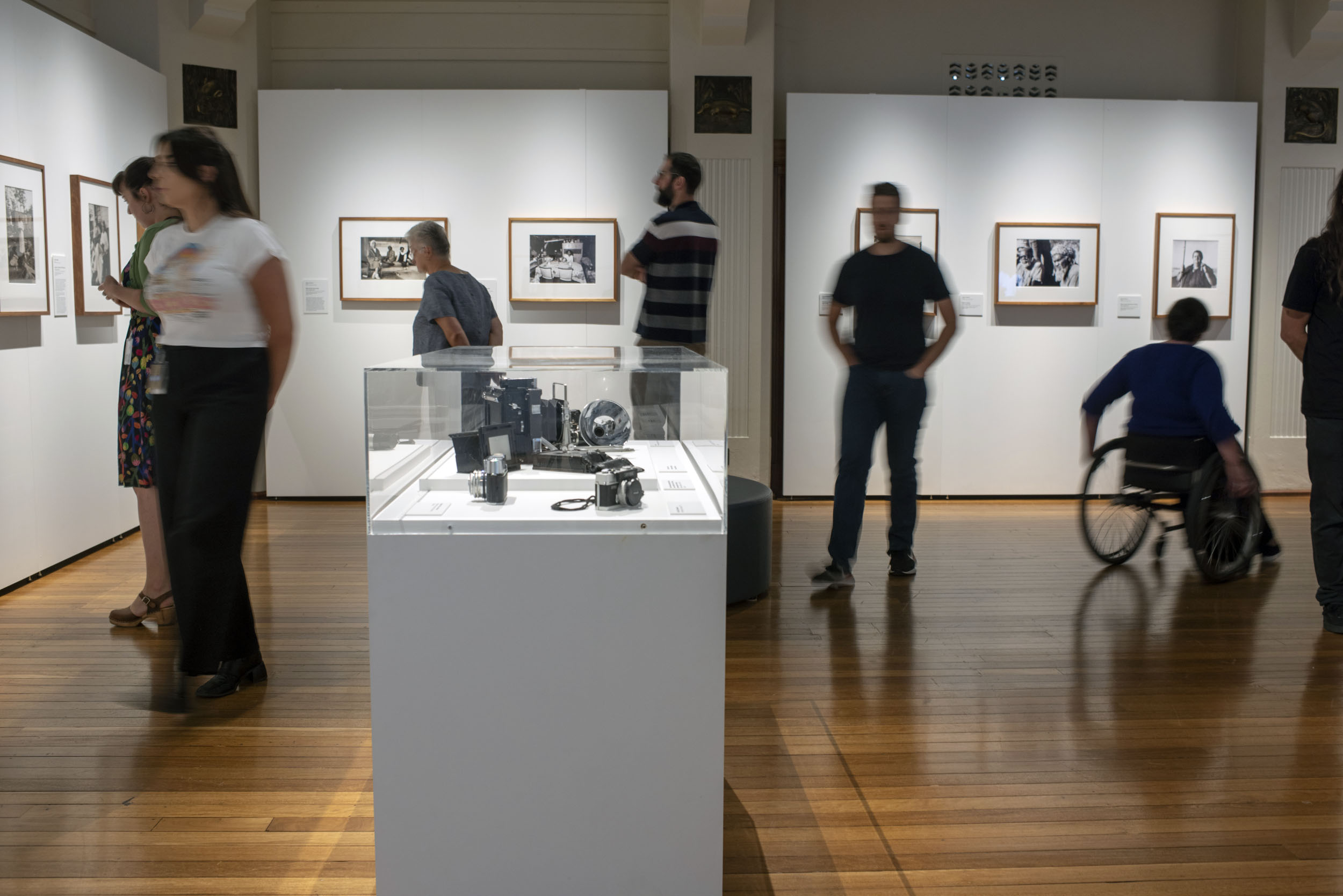
Installation view of the exhibition 'William Yang: Seeing and Being Seen' at the Queensland Art Gallery | Gallery of Modern Art (GOMA) showing at left, 'Stand Palm Beach' (1981); at middle, 'The Pool at Bondi #3' (1987); and at right, 'Golden Summer' (1987/2016)


Installation view of the exhibition William Yang: Seeing and Being Seen at the Queensland Art Gallery | Gallery of Modern Art (GOMA) showing at left, Stand Palm Beach (1981); at middle, The Pool at Bondi #3 (1987); and at right, Golden Summer (1987/2016, above)


William Yang (Australia b. 1943) 'Tamarama Lifesavers' 1981


William Yang (Australia b. 1943)
Tamarama Lifesavers
1981
Inkjet print on Hahnemühle Fine Art Pearl
39 x 70cm
© William Yang
Courtesy: The artist


William Yang: Seeing and Being Seen / Exhibition walk-through


William Yang (Australia b. 1943) 'Life Lines #3 – Self portrait #2 (1947)' 1947/2008


William Yang (Australia b. 1943)
Life Lines #3 – Self portrait #2 (1947)
1947/2008
Photographer: Unknown
Inkjet print on Innova Softex paper, ed. 2/30
100 x 70cm
Collection of The University of Queensland, purchased 2010
Photo: Carl Warner Reproduced courtesy of the artist and Andrew Baker Art Dealer, Brisbane


William Yang (Australia b. 1943) 'Alter ego' 2001


William Yang (Australia b. 1943)
Alter ego
2001
Digital inkjet print on rag paper
68 x 88cm
© William Yang
Courtesy: The artist


Installation view of the exhibition 'William Yang: Seeing and Being Seen' at the Queensland Art Gallery | Gallery of Modern Art (GOMA)


Installation view of the exhibition William Yang: Seeing and Being Seen at the Queensland Art Gallery | Gallery of Modern Art (GOMA) showing the artist standing in front of his photograph Life Lines #11 – William in scholar’s costume (1984) (1984/2009, below)


William Yang (Australia b. 1943) 'Life Lines #11 – William in scholar's costume (1984)' 1984/2009


William Yang (Australia b. 1943)
Life Lines #11 – William in scholar’s costume (1984)
1984/2009
Inkjet print on Innova Softex paper, ed. 1/20
94.6 x 61.6cm
Collection of The University of Queensland, purchased 2010
Photo: Carl Warner Reproduced courtesy of the artist and Andrew Baker Art Dealer, Brisbane


William Yang (Australia b. 1943) 'Self Portrait #5' 2008


William Yang (Australia b. 1943)
Self Portrait #5
2008
Inkjet print on Innova Softex paper
42 x 65cm
© William Yang
Courtesy: The artist


An exhibition of more than 250 works by Australian photographer and performance artist William Yang opens at the Queensland Art Gallery from tomorrow until 22 August, 2021. William Yang: Seeing and Being Seen spans the artist’s five-decade career and is the first major survey of his work to be presented by an Australian state gallery.

Queensland Art Gallery | Gallery of Modern Art Director Chris Saines said Seeing and Being Seen referred to the artist’s view of the world through the camera lens. ‘Yang captures people across all walks of life, including celebrity artists, alongside photographic explorations that throw light onto subcultures and marginalised groups, and he does not turn away from unsettling narratives or uncomfortable truths,’ Mr Saines said. ‘We are thrilled to be presenting this major exhibition encompassing every aspect of Yang’s practice and highlighting his life-long fascination with people and storytelling. We are also premiering his major new performance ‘In Search of Home’ at GOMA.’

Minister for the Arts Leeanne Enoch said QAGOMA continued to take a leading role in showcasing Queensland-born artists, such as William Yang.

‘William Yang is a noted writer, performer and visual artist with an international profile and this exhibition is an important survey of his work, celebrating inclusivity and diversity,’ Minister Enoch said. ‘The Queensland Government’s support for QAGOMA helps ensure the Gallery will continue its legacy of celebrating Queensland artists and sharing works that tell our stories.’

The exhibition includes Yang’s prolific social portraiture which features prominent creative identities from theatre, film, art and literature such as Patrick White, Brett Whiteley and Cate Blanchett, his revelatory insights into the LGBTIQ+ community, and insightful images of the Australian landscape. Seeing and Being Seen also includes early social photographs of Sydney’s arts scene as well as the artist’s long exploration of his family and childhood experience in North Queensland which interrogate and celebrate his Chinese-Australian identity.

Rosie Hays, Associate Curator, Australian Cinémathèque, QAGOMA and curator of Seeing and Being Seen said Yang’s identity as a Chinese-Australian, a gay man and artist informs his marginalised experience.

‘While the stories and images included in the exhibition are quite specific to William’s life, the emotions underpinning them are instantly recognisable and acutely relatable,’ Ms Hays said. ‘There is confession and courage in William’s storytelling. His most well-known works are often deeply personal and represent the means by which he reckons with his past, his relationships, and his experience outside the mainstream.’

Born in North Queensland in 1943, Yang grew up with little knowledge of his Chinese heritage. Even though his parents were second-generation Chinese-Australian, Cantonese was not spoken at home. After coming to Brisbane in the mid-1960s to study architecture at the University of Queensland, he moved to Sydney in 1969, and has lived and worked there ever since.

A major hard-cover publication accompanying the exhibition features essays by William Yang, curator Rosie Hays, Professor Susan Best and Benjamin Law.

Press release from the GOMA website


William Yang: Seeing and Being Seen / Illustrated Curator’s Talk

Exhibition curator Rosie Hays (Associate Curator, Australian Cinémathèque, QAGOMA) traces William Yang’s reflective and joyous career, delving deeper into the artworks and themes addressed in Seeing and Being Seen.


Artist William Yang’s slideshow performance with stories and eyewitness images from Sydney’s thrilling and turbulent gay scene from the 1970s until now.

Yang is one of Australia’s greatest storytellers, a prolific photographer and a performer of monologues with slide projections. His stories describe the experience of coming to terms with his identity as a gay Chinese Australian. Yang’s work presents a rich and celebratory visual record of this journey, from Gay Liberation in the seventies, to the emergence of the Mardi Gras and a gay subculture in the eighties, to AIDS in the nineties.


William Yang. Families and Fictions: Contemporary Photography from the Collection: Artist Talk, Queensland Art Gallery, 2005


William Yang (Australia b. 1943) '"Mother Standing" Brisbane' 1981


William Yang (Australia b. 1943)
“Mother Standing” Brisbane
1981
Gelatin silver photographs, ed. 2/10
51.3 x 61.1cm
Queensland Art Gallery Foundation Grant purchased 2004
Collection: Queensland Art Gallery | Gallery of Modern Art
© William Yang


William Yang (Australia b. 1943) '"Mother Standing" Brisbane' 1981


William Yang (Australia b. 1943)
“Mother Standing” Brisbane (detail)
1981
Gelatin silver photographs, ed. 2/10
51.3 x 61.1cm
Queensland Art Gallery Foundation Grant purchased 2004
Collection: Queensland Art Gallery | Gallery of Modern Art
© William Yang


Installation view of the exhibition 'William Yang: Seeing and Being Seen' at the Queensland Art Gallery | Gallery of Modern Art (GOMA) showing photographs for Yang's 'About my mother' portfolio


Installation view of the exhibition William Yang: Seeing and Being Seen at the Queensland Art Gallery | Gallery of Modern Art (GOMA) showing photographs for Yang’s ‘About my mother’ portfolio


William Yang (Australia b. 1943) 'Mother. Graceville. 1989' 1989


William Yang (Australia b. 1943)
Mother. Graceville. 1989
1989
From ‘About my mother’ portfolio 2003
Gelatin silver photograph ed. 2/10
51.3 x 61.1cm
Queensland Art Gallery Foundation Grant purchased 2004
Collection: Queensland Art Gallery│Gallery of Modern Art
© William Yang


Installation view of the exhibition 'William Yang: Seeing and Being Seen' at the Queensland Art Gallery | Gallery of Modern Art (GOMA) showing 'Dawn, Central Australia #3'

Installation view of the exhibition 'William Yang: Seeing and Being Seen' at the Queensland Art Gallery | Gallery of Modern Art (GOMA)

Installation view of the exhibition 'William Yang: Seeing and Being Seen' at the Queensland Art Gallery | Gallery of Modern Art (GOMA) showing at centre top, Doris Fish (1988)


Installation views of the exhibition William Yang: Seeing and Being Seen at the Queensland Art Gallery | Gallery of Modern Art (GOMA) showing in the top image, Dawn, Central Australia #3; and in the bottom image at centre top, Doris Fish (1988, below)


William Yang. 'Doris Fish' 1988


William Yang (Australia b. 1943)
Doris Fish
1988
© William Yang
Courtesy: The artist


William Yang (Australia b. 1943) 'The morning after' 1976


William Yang (Australia b. 1943)
The morning after
1976
Gelatin silver print
© William Yang
Courtesy: The artist


Morning sun raking through a window gently lights William Yang’s photograph of sleeping bodies and cast-off clothing, portraying ‘the morning after’ with the intimacy of the dawn. Yang photographed Sydney’s social scene of the 1970s and 80s, capturing wild times at discos, nightclubs and parties. Yang also captured the revellers at rest, photographing the supine forms of his naked lovers, night-clubbers passed out on city pavements and benches, and friends sharing makeshift beds on lounge-room floors.

Yang’s first solo exhibition in 1977, Sydneyphiles, was a frank depiction of the Sydney party scene and the emerging gay community. In their unposed realism, his photographs avoid any air of glamour, focusing instead on the unguarded moment and the spontaneous interactions between friends. The scrupulous honesty of his black-and-white documentary style is offset by his poignant and affectionate portrayals of those people and places familiar to him. His photographs are taken from the position of a participant in the worlds they depict, collectively describing the experience of coming to terms with his identity as a gay Chinese Australian. Yang’s visual stories are infused with a gently wry tone, mixing self-deprecating humour with insightful reflections on cultural identity. Here Yang has created images of the aftermath of intimate encounters, apparent in crumpled sheets and the shapes of sleeping bodies.

Text from the Museum of Contemporary Art, Sydney website


William Yang. 'Synthetic Diamonds at Paddington Town Hall' 1977


William Yang (Australia b. 1943)
Synthetic Diamonds at Paddington Town Hall
1977
© William Yang
Courtesy: The artist


William Yang (Australia b. 1943) 'Alpha' late 1960s


William Yang (Australia b. 1943)
Alpha
late 1960s
Gelatin silver photograph with fibre-tipped pen on fibre-based paper, ed. 6/10
26.7 x 40.2cm
Collection: The University of Queensland purchased 2001
© William Yang


William Yang (Australia b. 1943) 'Ben Law. Arncliffe' 2016/2020


William Yang (Australia b. 1943)
Ben Law. Arncliffe
2016/2020
Inkjet print on Ilford Galerie Smooth Cotton Rag
30 x 50cm
© William Yang
Courtesy: The artist


William Yang (Australia b. 1943) 'The Story of Joe' 1979/2020


William Yang (Australia b. 1943)
The Story of Joe
1979/2020
Inkjet print on Ilford Galerie Smooth Cotton Rag; single-channel video
Print: 40 x 60cm
Video: 16:9, 3:50 minutes, colour, sound; installed dimensions variable
Writer/Performer: William Yang; Director/Producer: Ben Latham Jones
Co-Director/ Co-Producer: Sophie Georgiou
Camera Operator/Editor: Dean Lever; Auslan
Consultant: Sue Jo Wright
Technical Assistant: Jack Okeby
© William Yang
Courtesy: The artist


William Yang. 'Bondi Beach' 1970s


William Yang (Australia b. 1943)
Bondi Beach
1970s
© William Yang
Courtesy: The artist


William Yang. 'Splashproof #1' 1994


William Yang (Australia b. 1943)
Splashproof #1
1994
© William Yang
Courtesy: The artist


William Yang, like many of his fellow Australian photographers, cannot help but be fascinated with the beach. In 1969, Yang left Brisbane for the bright lights of Sydney, and he fell in love with the city. At a distance from his family and Queensland’s conservatism, Sydney provided an opportunity for reinvention.

It was here that he combined his two photographic passions – landscape and people. Yang embraced the bleached allure of the city’s eastern beaches and took many iconic photographs of Bondi, Tamarama and Clovelly. …

Yang’s beach images present a refreshingly different framing of the typical Australian beach scene. The usual shots of bronzed female bodies or recreational pursuits take a backseat. Instead, Yang takes immense joy in the male figure, and his works represent a desirous male gaze on desirable male bodies.

The beach captured Yang’s eye from early in his career. At the time he started exploring the beach in his new Sydney home, Yang was also a jobbing social photographer, capturing celebrities and the ‘beautiful people’ behind the scenes at A-list parties for magazines. His approach to this work was in the photo-journalist style of capturing the unguarded moment.

Of his passion for taking images of the beach, Yang is a romantic at heart and has said:

“There’s an impulse in me that makes me go for the runny make-up, the unguarded moment, the Freudian slip. I mean I could photograph the plastic bags in the water, the rolls of fat, but the beach brings out the romantic in me. I’m overwhelmed by the beauty of it – the space, the surf, the sand and all that flesh. I’ve never gotten beyond the obvious.”

Rosie Hays. “William Yang: The Beach,” on the QAGOMA website 17 June, 2021 [Online] Cited 10/08/2021


William Yang (Australia b. 1943) 'Great Wave off Clovelly' 2005/2016


William Yang (Australia b. 1943)
Great Wave off Clovelly
2005/2016
Inkjet print on Hahnemühle Fine Art Pearl
40 x 40cm
© William Yang
Courtesy: The artist


William Yang. 'Lifesaver Double' 1987/2017


William Yang (Born 1943, Mareeba, Qld Lives and works Sydney, NSW)
Lifesaver Double
1987/2017
Digital print
© William Yang
Courtesy: The artist


William Yang (Australia b. 1943) 'Lifesavers #3' 1987


William Yang (Australia b. 1943)
Lifesavers #3
1987
Inkjet print on Hahnemühle Fie Art Metallic Pearl
32 x 49.5cm
© William Yang
Courtesy: The artist


“A prolific documentary photographer, storyteller and performer, William Yang creates works that tell an intimate, autobiographical story. Yang draws on his extensive archive of images, memories and sensual experiences, showing the unique atmosphere of freedom that prevailed on Sydney beaches in the 70s, 80s and 90s. Taken around Bondi and Tamarama, Yang has captured the joy of an era and the beauty of the elements with humour and generosity. More than reminiscence or exposé, Yang’s images reveal sensitive connections and insightful reflections about cultural identity.”


Text from the ‘Under The Sun’ exhibition 2017


William Yang 'Checking Out Bondi' 1981/2017


William Yang (Australia b. 1943)
Checking Out Bondi
1981/2017
Digital print
© William Yang
Courtesy: The artist


The Power of Being Seen

William Yang’s work, intimate and considered, draws on the artist’s own lived experience. Yang’s personal stories inform his spoken-word performances and photography, and he often scribes these stories directly onto his photographic prints. Drawn to people, Yang’s work reveals unsettling narratives in his own life, in the lives of his subjects, and in society. Adept at uncovering the unvarnished beauty and hidden foibles of our lives, storytelling is intrinsic to his practice. The artist spoke with exhibition curator Rosie Hays.

Rosie Hays: Are there stories you feel must be told? What draws you to the stories you tell from your own life?

William Yang: I [was] brought up as an assimilated Australian. Neither my brother, Alan, or my sister, Frances, or I learned to speak Chinese. Partly because my father’s clan was the Hakka, so he spoke Hakka, whereas my mother’s clan was the See Yap, and she spoke Cantonese, so English was their common language and that was what we spoke at home. My mother could have taught us Cantonese as it was generally left up to her to do that sort of thing, but she never did. She thought being Chinese was a complete liability and wanted us to be more Australian than the Australians. So, the Chinese part of me was completely denied and unacknowledged until I was in my mid-30s and I became Taoist. It was through my engagement with Chinese philosophy that I embraced my Chinese heritage. People at the time called me Born Again Chinese, and that’s not a bad description as there was a certain zealousness to the process, but now I see it as a liberation from racial suppression, and I prefer to say I came out as a Chinese.


William Yang (Australia b. 1943) 'Chinese New Year Party Year of the Rabbit' 1999


William Yang (Australia b. 1943)
Chinese New Year Party Year of the Rabbit
1999
Gelatin silver print
51 x 61.5cm
© William Yang
Courtesy: The artist


My first big success was my show ‘Sydneyphiles’ at the Australian Centre for Photography in 1977. It was mainly about my social life in Sydney, with portraits of people I had met. Besides my own set of artistic types (I knew Brett Whiteley, Martin Sharp, Jenny Kee and Linda Jackson), I brushed with celebrities on the social rounds working for magazines. The exhibition caused a sensation. I knew then that people were my subject. I found that they wanted to see themselves on the gallery walls, they wanted representation. A compromising photo might cause annoyance, but it was better than being left out. There has always been an appetite for celebrities, well, that was to be expected. A vicarious interest in celebrity life still fuels the media. But I showed many photos of the emerging gay community as well. Australian photos of this type had not been shown in institutions before and it got a mixed reaction. Some said that these works shouldn’t be shown at a public institution, but mostly the pictures were accepted, especially by the gay community. A few were angry with me for outing them, but mostly I was hailed as a hero and was metaphorically given the keys to Oxford Street. I sensed that the mood of the gay community at the time was this: throughout history our community has been invisible. These photos may not be pretty, but we recognise them, and we accept them. We want our stories told.


William Yang (Australia b. 1943) 'Four film directors' 1981


William Yang (Australia b. 1943)
Four film directors
1981
Inkjet print on solid substrate Kapaplast
53 x 80cm
© William Yang
Courtesy: The artist


William Yang (Australia b. 1943) 'Brett Whiteley, Martin Sharp, Wirian' 1982


William Yang (Australia b. 1943)
Brett Whiteley, Martin Sharp, Wirian
1982
Inkjet print on solid substrate Kapaplast
© William Yang
Courtesy: The artist


William Yang (Australia b. 1943) 'Party at the Whiteleys', Lavender Bay' 1982


William Yang (Australia b. 1943)
Party at the Whiteleys’, Lavender Bay
1982
Inkjet print on solid substrate Kapaplast
65 x 110cm
© William Yang
Courtesy: The artist


Installation view of the exhibition 'William Yang: Seeing and Being Seen' at the Queensland Art Gallery | Gallery of Modern Art (GOMA) showing at centre right, 'Brett Whiteley, Lavender Bay, Sydney' (1975); and directly below this, 'Cate Blanchett: The star in her dressing room. After "Hedda Gabler." Wharf Theatre. Sydney' (2004)


Installation view of the exhibition William Yang: Seeing and Being Seen at the Queensland Art Gallery | Gallery of Modern Art (GOMA) showing at centre right, Brett Whiteley, Lavender Bay, Sydney (1975, below); and directly below this, Cate Blanchett: The star in her dressing room. After “Hedda Gabler.” Wharf Theatre. Sydney (2004, below)


William Yang (Australia b. 1943) 'Brett Whiteley, Lavender Bay, Sydney' 1975


William Yang (Australia b. 1943)
Brett Whiteley, Lavender Bay, Sydney
1975
© William Yang
Courtesy: The artist


William Yang (Australia b. 1943) 'Cate Blanchett: The star in her dressing room. After "Hedda Gabler." Wharf Theatre. Sydney' 2004


William Yang (Australia b. 1943)
Cate Blanchett: The star in her dressing room. After “Hedda Gabler.” Wharf Theatre. Sydney
2004
Inkjet print on solid substrate Kapaplast
54 x 80cm
© William Yang
Courtesy: The artist


These days I don’t take as many photographs. I’m sorting through my collection, trying to get it into some sort of order, and trying to digitise the negatives and the colour transparencies […]. I don’t want to be a photographer who dies leaving a pile of mouldy negatives for someone else to sort out […]. Every time I look through my collection, I am surprised because I have largely forgotten what happened in the past. Photography is a major aid to memory and the photographer a witness to the past. A photograph captures a moment in time. You don’t have to do anything special for this to happen, just press the shutter. There is something in the nature of the camera to freeze these moments in time, and there is something in the nature of the world to change and move on, so these moments never occur again.

In the early 1980s I started to do slide projection. It started off as a way to show my colour photography. At the time the colour printing process, Cibachrome, was expensive, and projection was a cheaper way showing my colour images. In 1980 in Adelaide, I met Ian de Gruchy, who did slide projection as his main art form. I was interested in his dissolve unit – a device using two projectors where the projected images dissolved into each other. Music was used, usually minimal music, and the result was known as an audio-visual. When one projects slides, as in a living room slide show, there is a tendency to talk with the slides, explaining them, and I started to do that. I worked with audio-visuals for seven years during the 80s until I had nine photographic essays, or short stories, to string together into a one man show. It was called ‘The Face of Buddha’ and I presented it at the Downstairs Belvoir Street Theatre in 1989. I lost money on that show, but still consider it a success. Everyone liked the form, story-telling with images and music.


William Yang (Australia b. 1943) "William Yang performing Sadness" Sydney 1992


William Yang (Australia b. 1943)
“William Yang performing Sadness”
Sydney 1992
Photo: Peter Elfes (from ‘About my mother’ portfolio 2003)
Gelatin silver photograph, ed. 2/10 / 51.3 x 61.1cm
Purchased 2004
Queensland Art Gallery Foundation Grant
Collection: Queensland Art Gallery | Gallery of Modern Art
© William Yang


William Yang (Australia b. 1943) 'Production still from Sadness' 1999


William Yang (Australia b. 1943)
Production still from Sadness
1999
Director: Tony Ayres
Image courtesy: National Film and Sound Archive, Australia and William Yang


William Yang (Australia b. 1943) ''Allan' from the monologue 'Sadness'' 1992


William Yang (Australia b. 1943)
‘Allan’ from the monologue ‘Sadness’
1992
© William Yang
Courtesy: The artist


“Allan was a landmark for Yang and for Australian documentary photography. The combination of simple, unadorned portrait photos and diaristic, handwritten commentary made each viewer feel intimately acquainted with the subject. The step-by-step progress towards death puts us on the alert for every passing emotion in Allan’s face – he is sad, stoical, cheerful, grim, frivolous and heroic by turns. At the end of his life he has become an empty husk. It’s a devastating slice of reality smuggled into an art gallery, a piece that stops viewers in their tracks every time it’s shown.”


Extract from John McDonald. “Devastating and intimate: the landmark photos that stop viewers in their tracks,” on the Sydney Morning Herald website April 1, 2021 [Online] Cited 09/08/2021


William Yang (Australia b. 1943) ''Allan' from the monologue 'Sadness'' 1992


William Yang (Australia b. 1943)
‘Allan’ from the monologue ‘Sadness’
1992
© William Yang
Courtesy: The artist


The most popular story was called ‘About My Mother’. I told the story about my mother’s family, how they came to Australia in the 1880s from Guang Dong province in China. My mother’s sister, my Aunt Bessie, married a rich landowner, William Fang Yuen, who was murdered by the white manager on his cane farm at Marilyan in north Queensland in 1922. I got an Australia Council grant to do my third performance piece, ‘Sadness’, in 1992. There were two themes: the first involved the AIDS pandemic in Sydney where many gay men, some of them my friends, were dying; and the second was a trip I took to north Queensland to talk to my relatives about William Fang Yuen’s murder. The two themes formed a powerful story about death and legacy. It was an immediate hit and toured Australia and the world. International entrepreneurs wanted my performance pieces, which they considered unique, not my exhibitions, so I kept doing more performance pieces and they became my main artistic expression.


William Yang (Australia b. 1943) 'William in Cane Fields' 2008


William Yang (Australia b. 1943)
William in Cane Fields
2008
From ‘My uncle’s murder’ portfolio 2008
Inkjet print on Innova Softex paper
59 x 91cm
© William Yang
Photograph: Jenni Carter
Courtesy: The artist


William Yang (Australia b. 1943) 'Self Portrait, Listening' 2017


William Yang (Australia b. 1943)
Self Portrait, Listening
2017
Inkjet print on Ilford Galerie Smooth Cotton Rag
38 x 60cm
© William Yang
Courtesy: The artist


The performance pieces changed my photographic practice. Before the 1990s, I made my living from freelance work. I would do whatever jobs people would pay me money to do. Then I found I could make a living doing my performance pieces, so I didn’t have to work for other people. I was able to channel all my energy into my own work and I became more productive. My performance pieces were about stories and I realised that many of my photos had stories behind them. I started writing the text directly onto the photo with a pen. My first series was about men with whom I had had encounters. All those photos had good stories. I have continued to do written works, as I call them, and the pictures with my handwriting have become the signifier of my work. Now I often choose images because they have a story.

Rosie Hays: Do you ever feel you’re telling other people’s stories, or are they your stories that happen to intersect with other people?

William Yang: When I ran out of my own stories, I wanted to tell an Aboriginal story because I felt the Chinese and the Aboriginal people had something in common: both had suffered under British colonialism. In my commissioned piece ‘Shadows’, I tried to tell an Aboriginal story about a community in Enngonia in north-western New South Wales, and it was successful in that I made myself part of the story, but I felt a little uncomfortable telling their story. Later I found someone, Noeline Briggs-Smith, who could tell her own story, and we did a story-telling duet on stage [called] ‘Meeting at Moree’, where we told alternating chapters of our stories on stage. She […] had a much stronger story than me. She had suffered more and worse injustices than I had, but there were interesting intersections in our stories.

Rosie Hays: Something we highlight in the exhibition is your connection to landscape. How would you describe your relationship to nature / the landscape, and has it changed over time?

William Yang: Most photographers have a go at nature. Everyone has photographed a sunset. I had my first serious encounter with photographing nature when I was recovering from a bad case of hepatitis at Frogs Hollow, Maleny, in 1979. I felt fragile from the illness and taking photos made me feel I could still do things. Looking at the photos now, the pictures are a beginner’s view. That’s the thing about nature: it’s been done a billion times before, and it’s difficult [to] escape cliché, but I had to start somewhere and I got a few good ones.

When I became Taoist, I took on a whole new philosophy. I came to appreciate nature, in the form of landscape, as a source and a driving force behind everything that exists. It was constantly changing and renewing itself. Everything about nature was beautiful because it was essentially always itself. I found I could apply a concept of beauty to nature, at least compared to the human nature I was photographing at the time. Later I began to see nature as a titanic struggle for survival […].

I came to realise that the landscape which moved me the most was the country around Dimbulah in north Queensland (on the Atherton Tableland), where I had grown up. It was part of my identity, part of my idea of home. I had absorbed it, it had imprinted itself upon me, and, although I did not realise it at the time – this was before I had articulated an artistic consciousness – it was there in my consciousness and I could draw upon it. So, in the early 90s, I made several trips up to Dimbulah, checking out the country that I remembered from my childhood. Nothing quite fitted my memories, but perhaps that’s a thing about childhood and memory. Nevertheless, I photographed a series on a medium format camera, trying to recapture memories. Now I enjoy returning to Dimbulah and seeing the landscape. It still triggers off emotions, but I feel they have become more distant. This text is from my print William at Thornborough, 2006:

“I have left these places and I have changed. These places still hold me but I move around these hills like a ghost. It is the motherland which formed and nourished me, from where I came, but to which I can never return.”


William Yang (Australia b. 1943) 'Climbing Huang Shan' 2005


William Yang (Australia b. 1943)
Climbing Huang Shan
2005
Inkjet print on Innova Softex paper
41 x 48cm
© William Yang
Courtesy: The artist


Installation view of the exhibition 'William Yang: Seeing and Being Seen' at the Queensland Art Gallery | Gallery of Modern Art (GOMA) showing 'Return to the place of childhood. Dimbulah' (2016)


Installation view of the exhibition William Yang: Seeing and Being Seen at the Queensland Art Gallery | Gallery of Modern Art (GOMA) showing Return to the place of childhood. Dimbulah (2016, below)


William Yang (Australia b. 1943) 'Boranup Karri Forest #1' 2018


William Yang (Australia b. 1943)
Boranup Karri Forest #1
2018
Inkjet print on Ilford Galerie Smooth Cotton Rag
50 x 150cm
© William Yang
Courtesy: The artist


William Yang (Australia b. 1943) 'Return to the place of childhood. Dimbulah' 2016


William Yang (Australia b. 1943)
Return to the place of childhood. Dimbulah
2016
Inkjet print on Ilford Galerie Smooth Cotton Rag
50 x 150cm
© William Yang
Courtesy: The artist


Installation view of the exhibition 'William Yang: Seeing and Being Seen' at the Queensland Art Gallery | Gallery of Modern Art (GOMA)

Installation view of the exhibition 'William Yang: Seeing and Being Seen' at the Queensland Art Gallery | Gallery of Modern Art (GOMA) showing at lower left, 'Boranup Karri Forest #1' (2018)


Installation views of the exhibition William Yang: Seeing and Being Seen at the Queensland Art Gallery | Gallery of Modern Art (GOMA) showing at lower left, Boranup Karri Forest #1 (2018, above)


William Yang (Australia b. 1943) 'Earth Below, Heaven Above' 2020 (still)


William Yang (Australia b. 1943)
Earth Below, Heaven Above (still)
2020
Two-channel video, 16:9, 5:36 minutes, colour, sound
Editor: Jack Okeby
© William Yang
Courtesy: The artist


Rosie Hays: What are your aspirations as an artist? What is the aim for your work in the larger sense?

William Yang: Two of my most important realisations were, firstly, that I was not white but Chinese, and secondly, that I was not straight, but gay. I probably realised these at an early age, but it took me a long time to articulate the condition and to come to terms with it. Personally, I suffered more pain being a closeted gay than being Chinese. These are both big themes in my work. When I started including gay work in my exhibitions, some photographers told me it [was] a phase I was going through and I’d be better off dealing with universal issues. They were right, in a way, because by continuing to deal with marginalised issues, my audience base is much smaller. I would probably have made more money sticking with celebrity lives and continuing the status quo, but it is important for me to talk about being gay and to talk about racial difference, even if they are commercially unpopular subjects. Nowadays, there is more acceptance of being gay here in Australia, and likewise, there is more awareness of racial difference, but in the wider world this is not always the case. It is a cause worth pursuing, and documentary photography with a personal story thrown in is a good way of doing it. I want to acknowledge the activists around the world that have made social change happen.

I want my work to embrace my life. I’ve managed to live to a mature age – I was fortunate not to die young as many of my colleagues did during the AIDS pandemic. One lives a life, and I am not the same person as I was when I was younger. Then I had more energy, had more opinions, some of them obnoxious – in short, I had many of the traits of a young person that old people like to complain about. But one learns from life, and I have lived to this age and can see there is a shape to one’s life. It has to do with the things you believe in and the choices you make (I always knew being an artist would be a hard road), it is shaped by external forces beyond your control, and it is also shaped by luck. Still, I consider my life a fortunate one.

I think I like stories because they are about people and the world. They somehow embrace humanity. I would like my art to convey feelings, emotions, what it is like to be a sentient human: experiencing joy, laughter and sadness, to realise we are vulnerable, that we have our failings, we do bad things, but we are capable of forgiveness, kindness and love.

Rosie Hays is Associate Curator, Australian Cinémathèque, QAGOMA She spoke with the artist in 2020.

This is an edited excerpt of the original interview, which appears in the exhibition publication William Yang: Seeing and Being Seen, available at the QAGOMA Store


William Yang. 'Deposition. Innisfail Court House. 1922' 1990


William Yang (Australia b. 1943)
Deposition. Innisfail Court House. 1922
1990
From ‘About my mother’ portfolio 2003
Gelatin silver photograph on paper
51.3 x 61.1cm (comp.)
Queensland Art Gallery Foundation Grant
Collection: Queensland Art Gallery | Gallery of Modern Art purchased 2004
© William Yang


William Yang (Australia b. 1943) 'Self portrait #1' 1992, printed 2013


William Yang (Australia b. 1943)
Self portrait #1
1992, printed 2013
Inkjet print on paper
87 x 119cm (comp.)
Gallery of Modern Art Foundation Grant
Collection: Queensland Art Gallery | Gallery of Modern Art purchase 2013
© William Yang


William Yang Self portrait #1 / A Director’s Perspective

Join QAGOMA Director Chris Saines CNZM as he discusses William Yang’s Self portrait #1 1992 (printed 2013)


William Yang’s work, intimate and considered, draws on the artist’s own lived experience. Yang’s personal stories inform his spoken-word performances and photography, and he often scribes these stories directly onto his photographic prints. Drawn to people, Yang’s work reveals unsettling narratives in his own life, in the lives of his subjects, and in society. Adept at uncovering the unvarnished beauty and hidden foibles of our lives, storytelling is intrinsic to his practice.


Self Portrait #1

Yang’s unflinching photographic gaze draws from the documentary tradition. Since the 1980s, Yang has displayed an unyielding persistence in unearthing stories that society, or even his subjects, might prefer to remain hidden. His instinct and passion is to present the whole, flawed story, not just the glossy surface.

With stories such as his uncle’s murder, Yang courts his family’s disapproval by airing hidden family stories, balancing potential indiscretions with the importance of telling real stories that reveal experiences or communities often left out of public discourse.

In the mid 1980s, Yang met Yensoon Tsai, a young Taiwanese woman who would become a close friend. Tsai taught Yang the tenets of the Chinese philosophy of Taoism, which led him to explore his Chinese-Australian identity.

Throughout the late 1980s and 90s in Australia, multicultural stories emerged across various art forms. Yang was part of this wave of artists rejecting a suppression of their cultural histories, and who instead wanted to highlight and celebrate diversity. Yang travelled throughout regional and urban Australia documenting the lives of Chinese-Australians, and the landscapes reflecting the legacy of the Chinese in Australia, such as religious shrines and mining sites.

Self Portrait #1 is a landscape work (in the way Yang talks about landscape which is often rooted in people and place and memory) as much as it a portrait work. Capturing the landscape is part of Yang’s somewhat diaristic approach to processing his social and physical environment.

When Yang returns to the Queensland landscape from his childhood, he characterises it as a site to escape from. He needed to escape from racist school bullying, constrictive family expectations, and the dread that his sexuality may be met with disapproval. Yang revisits his childhood home regularly, and some of his most potent performances and photographs come from connecting family and place. The series ‘My Uncle’s Murder’ – and its recounting of an injustice borne of racism dating from 1922 – resulted from such a trip. In his later works, he makes an uneasy peace with these past experiences that are embedded in the landscape of his youth.

Rosie Hays. “William Yang’s work reveals unsettling narratives in his own life,” on the QAGOMA website 4 October, 2020 [Online] Cited 10/08/2021


William Yang (Australia b. 1943) 'Waiting for the Parade to Start' 2019


William Yang (Australia b. 1943)
Waiting for the Parade to Start
2019
Inkjet print on solid substrate Kapaplast
56.5 x 85cm
© William Yang
Courtesy: The artist


William Yang (Australia b. 1943) 'Jac Vidgen and Akira Isogawa, Sweatbox Party' 1989


William Yang (Australia b. 1943)
Jac Vidgen and Akira Isogawa, Sweatbox Party
1989
Inkjet print on solid substrate Kapaplast
© William Yang
Courtesy: The artist


William Yang (Australia b. 1943) 'Patrick White #1, living room, Martin Road' 1988


William Yang (Australia b. 1943)
Patrick White #1, living room, Martin Road
1988
Gelatin silver photograph, ed. 2/10
45.6 x 36.4cm
Queensland Art Gallery Foundation Grant purchased 1998
Collection: Queensland Art Gallery | Gallery of Modern Art


William Yang (Australia b. 1943) 'My Generation (Brett Whiteley)' 1975 (detail)


William Yang (Australia b. 1943)
My Generation (Brett Whiteley) (detail)
1975
© William Yang
Courtesy: The artist


My Generation

Queensland-born, Sydney-based artist William Yang describes a moment in Sydney when a number of creative groups came together to generate an artistic wave that swept across Australian society.

The intersections of the tight literary circle of Nobel award winner Patrick White and his partner, Manoly Lascaris, with the theatrical circle, their friends Jim Sharman and actress Kate Fitzpatrick. Fitzpatrick, in turn, models frocks in the exuberant fashion parades organised by designers Linda Jackson and Jenny Kee, while artists Peter Tully and David McDiarmid extend the tongue-in-cheek Australiana of the two fashionistas’ outfits with witty accessories. Their parades and parties at retail outlet Flamingo Park, a magnet for influential people in business, politics and the arts, determined the look of the 1970s and early 1980s. Tully and McDiarmid used their bravura visuals to jump start the Gay and Lesbian Mardi Gras, giving the event its unique and unforgettable style. The pair lived out a parallel lifestyle that might epitomise the Australian story of gay liberation, with its heady rush unfolding into aching tragedy.

Golden couple Brett and Wendy Whiteley enjoyed the creative atmosphere of the swinging ’60s and the plunge into a riotous world of sex, drugs and rock’n’roll. Yang shows Brett painting, smoking and partying with the beautiful people, and his eventual deterioration as heroin took a fearful hold. The early death of their beautiful daughter, Arkie, was another aspect of this fated family history. Linda Jackson and Jenny Kee eventually split; Kee takes Danton Hughes, the son of Robert Hughes, as a lover; Danton suicides; Kee takes up Buddhism. Yang portrays lives that unfold, flower or wither: lives lived.

Yang’s generation is not life as reported in the newspapers but ‘as I saw it’: a personal account summed up as a litany of parties, of innocence lost and worldliness gained, a continuum of his search for contact and meaning. Like his contemporaries Rennie Ellis or Michael Rosen, William Yang is a social photographer, a recorder of life. His strength lies in creating a living testament, and his medium’s strength is that it is necessarily shared. He offers no moral tale, nor any notion of karma to underscore the events: just the three basic but vital stories – birth, love and death.

Extract from Michael Desmond. “William Yang: My Generation,” in Artlines 1-2009 in “William Yang: Portraits,” on the QAGOMA website 22 September, 2017 [Online] Cited 10/08/2021.


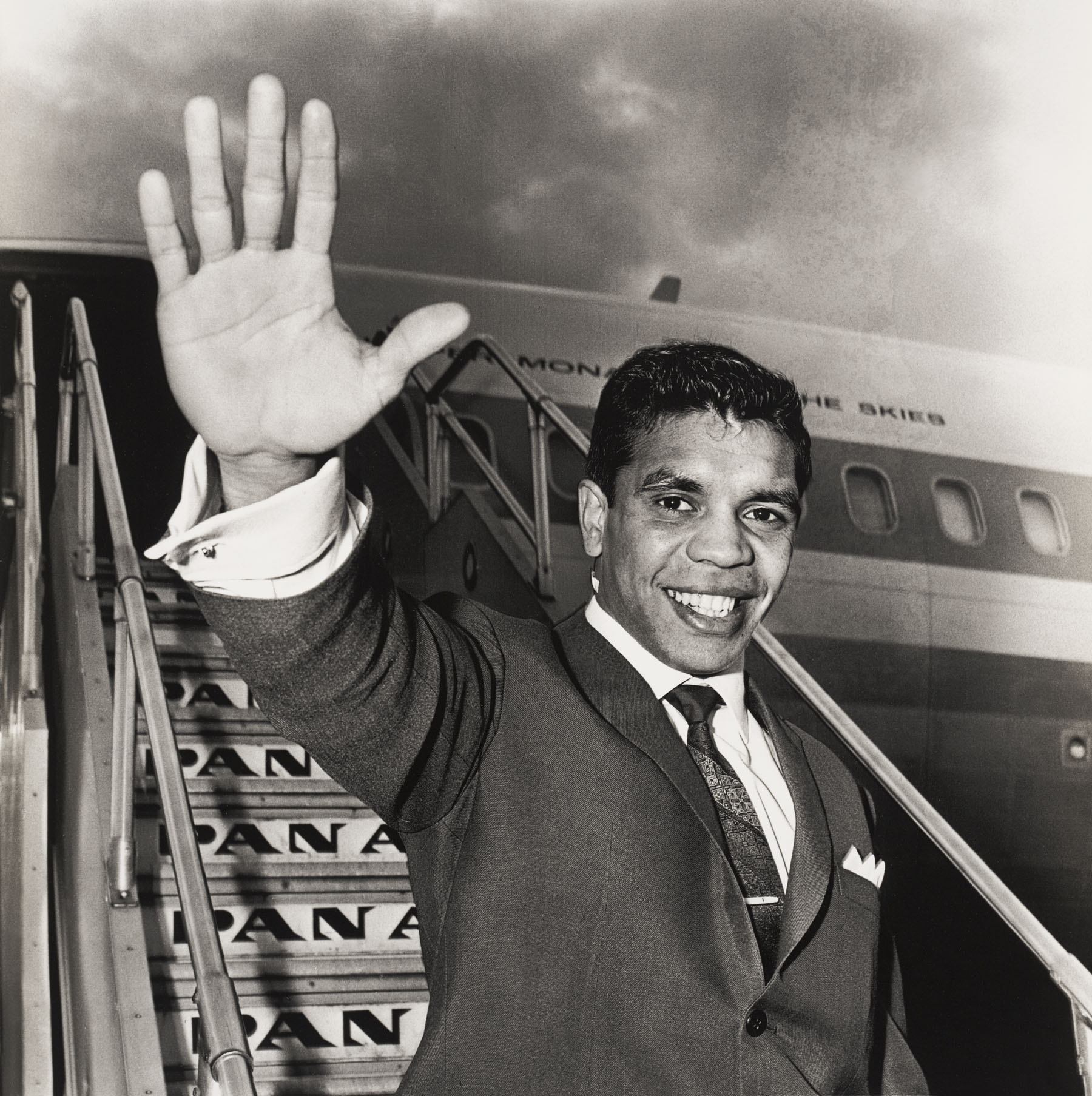
William Yang (Australia b. 1943) 'David Gulpilil' 1978


William Yang (Australia b. 1943)
David Gulpilil
1978
Inkjet print on solid substrate Kapaplast
© William Yang
Courtesy: The artist


William Yang (Australia b. 1943) 'Linda Jackson and Jenny Kee' 1979


William Yang (Australia b. 1943)
Linda Jackson and Jenny Kee
1979
Inkjet print on solid substrate Kapaplast
© William Yang
Courtesy: The artist


William Yang (Australia b. 1943) 'Richard Neville and Bob Geldof at Wirian' 1980


William Yang (Australia b. 1943)
Richard Neville and Bob Geldof at Wirian
1980
Inkjet print on solid substrate Kapaplast
© William Yang
Courtesy: The artist


In order to make a living as a photographer, Yang began his career taking candid shots of ‘beautiful people’ at parties and events for the social pages of newspapers and magazines. Yang rubbed shoulders with celebrities, artists and performers, and discovered that the camera was an entry pass to an exclusive backstage world populated by kindred spirits, with whom he formed close bonds.

Yang’s prolific social portraiture includes some of the most prominent people in Australian theatre, film, art and literature, with more than a few international cameos. A much-loved and trusted figure who is embedded into Sydney’s social fabric, Yang’s images are taken with the razzle-dazzle of celebrity, but little of its conceit.

Within the show is a salon hang ‘social wall’ which long predates Instagram. The selection of faces is reflective of Yang’s friendships and his abiding passion for the arts – they embody both the glamour of celebrity and provide behind-the-scenes insights into the lives of artists from a range of backgrounds. With a camera around his neck, Yang came to understand that he could ask his subjects a series of personal questions, and they would reveal more of themselves than they would during the course of casual conversation.

Representing only a fraction of Yang’s social photography, these images capture the almost compulsive nature of his passion for recording people and places. His gift for eliciting the essence of his subjects through portraiture – whether candid or posed – has been apparent his entire career.

Rosie Hays. “William Yang: Celebrity and Portraiture,” on the QAGOMA website 7 May, 2021 [Online] Cited 10/08/2021.


William Yang (Australia b. 1943) 'Rainbow Angel Wings' 2003


William Yang (Australia b. 1943)
Rainbow Angel Wings
2003
Inkjet print on solid substrate Kapaplast
27 x 40cm
© William Yang
Courtesy: The artist


William Yang (Australia b. 1943) 'Marriage Equality, Mardi Gras' 2013


William Yang (Australia b. 1943)
Marriage Equality, Mardi Gras
2013
© William Yang
Courtesy: The artist


Queensland Art Gallery | Gallery of Modern Art (GOMA)
Stanley Place, South Brisbane
Queensland 4101, Australia
Phone: +61 (0)7 3840 7303

Opening hours:
Daily 10.00am – 5.00pm

Queensland Art Gallery | Gallery of Modern Art (GOMA) website

LIKE ART BLART ON FACEBOOK

Back to top

Review: ‘An-My Lê: On Contested Terrain’ at the Amon Carter Museum of American Art, Fort Worth, Texas

Exhibition dates: 18th April – 8th August, 2021


An-My Lê (Vietnamese-American, b. 1960) 'Untitled, Hanoi' 1995 from the exhibition 'An-My Lê: On Contested Terrain' at the Amon Carter Museum of American Art, Fort Worth, Texas, April - August, 2021


An-My Lê (Vietnamese-American, b. 1960)
Untitled, Hanoi
1995
From the series Viêt Nam (1994-1998)
Gelatin silver print
Courtesy of the artist and Marian Goodman Gallery, New York, Paris, and London
© An-My Lê


“In their essential nature men do not change. The great and noble, the Masters of Life, will be great and noble to the end of time, and to contemplate them and their deeds inspires us to endeavour to emulate them. Learn whom a man venerates, and you can come to judge his character. Like is assimilated unto like. The mind approaches that which it continually contemplates, and kindred inevitably follow.”


Alvin Langdon


Disguising power as virtue or, the Inner Landscape of Beauty

One of the great assets of VR, especially in times of lockdown, is that you can view an exhibition from a distance. Such is the case with this strong exhibition by Vietnamese-American photographer An-My Lê at the Amon Carter Museum of American Art, Fort Worth, Texas. It gives the viewer the ability to come to grips with an artists work displayed as a whole, to contemplate the myriad threads that run through the five bodies of work that are presented in the exhibition.

While there are no remarkable “hero” shots contained within the body of Lê’s work, collectively the photographs from each series build a serious interrogation into the contested terrains of colonialism, war, the military, racism and protest. As we know with life nothing is ever black and white, and through her classically inspired photographs Lê probes the interweaving of existence, desire, possession and control in the landscape, in the landscape of life. As assistant curator Kirsten Gaylord observes, “Her photographs consider questions that we are all thinking about now: What does it mean to be an American citizen? How does our country’s history shape our contemporary lives? What should be the role of the U.S. in the world?” These are complex issues which Lê addresses with intelligence and rigorous conceptualisation, fully aware of the paradoxes that exist within her inquiry.

My favourite series are the more personal and engaging, the more empathetic and feeling of the works – the first and the last, Viêt Nam (1994-98) and Silent General (2015-ongoing). In Viêt Nam, Lê returns to her homeland of Vietnam after almost 20 years with her large format camera. The resulting meditation on homeland evidenced in beautiful, perfectly formed photographs are moving and touching, poetic reveries on lost innocence, regained? In Silent General, Lê again again puts more of her self on the line, her photographs confronting the “issues of our time that are rooted in our history, from the fate of Confederate monuments to immigration debates around agricultural labourers.”

I am ambivalent about the other series in the exhibition, which while beautiful have a slightly chilly aura.

In the series Small Wars (1999-2002), Lê photographs Vietnam War reenactors in North Carolina and Virginia with the utmost sense of “authenticity” creating images that “explore the legacy and mythology of the Vietnam War for contemporary Americans.” In 29 Palms (2003-04) she photographs troops training in an American landscape similar to the one they would soon be deployed to in Iraq. In Events Ashore (2005-14) the artist photographs the crews of U.S. naval vessels around the world exploring the global reach of the American military, its diplomatic, humanitarian, military, and political activities.

In Small Wars and 29 Palms, Lê pictures a simulacra of war, simulations of a war already past (and lost), and a war yet to run its course, which would ultimately lead to the withdrawal of US forces. Her work blurs the boundaries between photojournalism and reality / fiction.

The photograph Ambush I (1999-2002, below) from Small Wars is eerily similar to Henri Huet’s photograph of Life magazine photographer Larry Burrows struggling through elephant grass in 1970 (below) with the difference that Burrows is helping to evacuate a wounded soldier, and that Huet, Burrows and two other photojournalists would be killed when their helicopter was shot down over Laos later in February 1971. Similarly, Lê’s photographs Mechanized Assault (2003-2004) shows a pristine landscape foregrounded with immaculate tanks and personnel carriers in the American landscape… when in reality, American Marines photograph the burnt remains of Iraqi T-55 Main Battle Tanks amongst a non-descript landscape of shell holes and mundane buildings (16 April 2003, below). Further, while not a simulation, the very stillness and chillness of Events Ashore – the physical and metaphorical distance of the photographer from the subject, from the reason of the existence of the military – make the photographs in that series seem almost an apologia for the military.

In a quotation, Lê states that, “… I am not categorically against war. I was more interested in drawing people into my work, to think about the issues that envelop war – representations of war, landscape and terrain in war. When I’m working with the military, I still think of myself as a landscape photographer. My main goal is to try to photograph landscape in such a way that it suggests a universal history, a personal history, a history of culture.”

I understand what the photographer is attempting, but in one sense I remain unconvinced about the success of the mission.

Simply put, the raison d’etre for the military – despite all protestations to the contrary, despite all the good works they otherwise undertake – is “to engage in combat, should it be required to do so by the national defence policy, and to win. This represents an organisational goal of any military, and the primary focus for military thought through military history.” (Wikipedia) In terms of military doctrine,1 we note that in the history of the United States of America, the country has been at war 225 out of 243 years since 1776. America is a militarised society where the military prosecutes war on its own terms, disguising power as virtue. In terms of the prosecution of war, the country seems to be manifestly belligerent.

The outcome of any war is death. Sure, the soldiers might be there for economic or social reasons, they may experience fear and exhilaration, boredom and dreams, brotherhood and purpose, travel and education… but ultimately the military is a fighting and killing machine. “Young soldiers in combat inevitably confront killing. They take life away from others, and in so doing breach one of the most fundamental moral values of their society, often with long-term consequences.” Listening to an American veteran from the battle of Caens after the D-Day landings in 1944 recently in a documentary, he observed that all war is, is death – dead German soldiers, dead American soldiers, dead civilians. The reality (not a simulation or a reenactment) of Henri Huet’s photograph of dead soldiers, Bodies of US paratroopers lie near a command post during the battle of An Ninh (1965, below) is shocking and unimpeachable.

Soldiers kill. Human beings, civilian and military, die.

And then the military doesn’t want you to know about that. They cover it up. In World War 1, the British stopped posting lists of the missing and dead in the newspapers because there were so many of them. And in the Iraq war, the American military didn’t want photographs of American coffins in the back of a transport plane published because it would upset the families and the public. Even the metadata (hidden text data) written by the military contained in a public domain image of destroyed Iraqi tanks (see below) in 2003 states, “Operation IRAQI FREEDOM is the multinational coalition effort to liberate the Iraqi people, eliminate Iraq’s weapons of mass destruction and end the regime of Saddam Hussein.” Outright lies and deception … the invasion was illegal under international law as it violated the UN Charter, there were no weapons of mass destruction found, and no link between Saddam Hussein and al-Qaeda. The Iraq War caused at least one hundred thousand civilian deaths, as well as tens of thousands of military deaths.

Everyone is involved in the construction of the world. You can be informed or not. You have choices. Human beings have a choice to go into the military, or not. The problem is that human beings in power, in control (at the top of the military for example) inspire others to endeavour to emulate them. As Alvin Langdon observes, “Like is assimilated unto like. The mind approaches that which it continually contemplates, and kindred inevitably follow.”

Now, in another sense I believe that Lê achieves her aim, to suggest a universal history, a personal history, and a history of culture embodied in the landscape, suggestions that possibly sweep away landscapes of control.

As the Irish poet and philosopher John O’Donohue observed, “Even in landscapes of control you can be swept off your feet by sheer beauty.” Landscapes of control cannot stand before the power of beauty embodied in the landscape and in Lê’s photographs the memory of the landscape, its music, embeds itself in the photograph. Through the power of beauty, the Inner Landscape of Beauty (one that is metaphorical as much as physical, in the mind as much as it is externally verbalised), the photographs of An-My Lê subversively undermine the control of the military over the land: its occupation and colonisation of it, its wars to control it, and its very “uniform” presence in it. Look again at the photograph Mechanized Assault (2003-2004, below) and now it is the distance of the photographer from the subject – the infinite sublime as I call it – that upends the punitive intentions of the military and overwhelms their puny vehicles. It’s an earth, spirit and mind thing.

In the viewers recognition of the beauty of this land(e)scape, we acknowledge our own virtue and assert our desire to be free. Free from restrictive control. Free from oppression. Free from war. The military, police “force” and government are and always will be, afraid of the infinite within us…

Dr Marcus Bunyan

Word count: 1,540


Footnotes

1/ “Development of military doctrine is perhaps the more important of all capability development activities, because it determines how military forces are used in conflicts, the concepts and methods used by the command to employ appropriately military skilled, armed and equipped personnel in achievement of the tangible goals and objectives of the war, campaign, battle, engagement, and action.” (Wikipedia)


Many thankx to the Amon Carter Museum of American Art for allowing me to publish the art work in the posting. Please click on the photographs for a larger version of the image.


Henri Huet (French, 1927-1971) / AP 'Bodies of US paratroopers lie near a command post during the battle of An Ninh' 18 September 1965 from the exhibition 'An-My Lê: On Contested Terrain' at the Amon Carter Museum of American Art, Fort Worth, Texas, April - August, 2021


Henri Huet (French, 1927-1971)/AP
Bodies of US paratroopers lie near a command post during the battle of An Ninh
18 September 1965


The paratroopers, of the 1st Brigade, 101st Airborne Division, were hit by heavy fire from guerrillas that began as soon as the first elements of the unit landed. The dead and wounded were later evacuated to An Khe, where the 101st was based. The battle was one of the first of the war between major units of US forces and the Vietcong.


An-My Lê: On Contested Terrain is the first comprehensive survey of the work of Vietnamese-American photographer An-My Lê. Featuring photographs from a selection of the artist’s five major bodies of work, the nationally touring exhibition considers the celebrated photographer’s nearly 25-year career exploring the edges of war and recording these landscapes of conflict in beautiful, classically composed photographs.

Born in Saigon in the midst of the Vietnam War, Lê was evacuated with her family by the U.S. military. She has spent decades considering the complexity of American history and conflict, from war reenactments to the removal of Confederate monuments. This timely exhibition explores politically-charged topics through Lê’s subtle, evocative images that avoid the sensationalism often seen in newspapers and movies. Sweeping views that emphasise the size and breadth of the theatre of war display the artist’s technical strengths in the classical landscape tradition, which she uses to compose beautiful images that draw the viewer into deeper consideration of complex themes of history and power.


” …as a photographer, I’m interested in looking at and representing the real world, and interpreting it in ways that allow me to learn from it and enlighten the issues I am trying to understand. I feel entirely comfortable using photographs with simple titles and explanatory texts. And I feel comfortable with the fact that some people may interpret a photograph differently from others. My photographs are visually complicated and carry complex messages because of the way I pack the information into the frame and structure the picture. People need to spend time with the work in order to piece together all the information. But of course the reading is subjective. I like that. I like that it could be contradictory, that it could be full of surprises, that it could be confusing. I see a fragile construct between the objective and subjective.

Ultimately, the picture is there to incite someone to think about the issues at stake, rather than say explicitly how I myself feel about the American military. Some of my work could be understood as being supportive of the military. You could look at some pictures and think: wow, those young Americans are so heroic! Or you could see in the same image a reflection of American imperialism: look at the American guy standing there, trying to teach the locals how to do it the American way! There are so many possible interpretations. Sometimes the US military comes in and does help people. For example, after the earthquake in Haiti, the military was able to accomplish what no one else could. It was there with supplies in a matter of hours. But there’s a fine line between coming to help and invading, and it has to do with physical and economic presence and the ways in which Americans occupy the land. So the work is about those tensions.

I think it goes back to my own conflicted perceptions of the US military and what it did to Vietnam. At the end of the war, it was the Americans who could help us escape from the approach of communism. Everyone tried to scale the walls of the American Embassy, not the French Embassy. So it’s about all those conflicted things.”


An-My Lê quoted in Andrew Maerkle. “Fires on the Plain,” on the ART-iT website 28/07/2015 [Online] Cited 26/07/2021.


“Living through the Vietnam War as a child and immigrating to the United States as a teenager, An-My Lê’s life has been indelibly marked by international conflict. For over two decades, her work as a photographer has engaged the unseen facets within the theater of war. With her large-format camera in tow, she has immersed herself in the Appalachian forest with Vietnam War reenactors, and traveled aboard U.S. aircraft carriers around the globe. Lê identifies as a landscape photographer, a perspective that grounds her subtle, impactful images of American interventionism within a larger history of violence.”


Sara Christoph. “An-My Lê with Sara Christoph,” on the Brooklyn Rail website February 2015 [Online] Cited 26/07/2021.


Photographer An-My Lê: 2012 MacArthur Fellow | MacArthur Foundation | October 2012

Meet An-My Lê and learn about how she came to photography, her work with the U.S. military, and her 19th-century-style camera.

Photographer An-My Lê was named a MacArthur Fellow in 2012. The Fellowship is a $500,000, no-strings-attached grant for individuals who have shown exceptional creativity in their work and the promise to do more.


An-My Lê: Landscapes of war | July 2018

Find out more about An-My Lê’s series Small Wars (1992-2002), and Lê’s experiences photographing Vietnam war reenactors.

Photographer An-My Lê, who grew up in Saigon during the Vietnam War, describes her series Small Wars (1999-2002) and 29 Palms (2003-2004). She discusses how contemporary landscape photography can be used to present more than just scenery; it can illuminate culture, architecture, and social and political issues that citizens are concerned with today.


Installation view of the exhibition 'An-My Lê: On Contested Terrain' at the Amon Carter Museum of American Art


Installation view of the exhibition An-My Lê: On Contested Terrain at the Amon Carter Museum of American Art


An-My Lê (Vietnamese-American, b. 1960) 'Untitled, Mekong Delta' 1994


An-My Lê (Vietnamese-American, b. 1960)
Untitled, Mekong Delta
1994
Gelatin silver print
© An-My Lê


Viêt Nam (1994-1998)

In 1994, Lê returned to her home country for the first time since being evacuated as a teenager in 1975, arriving shortly after relations between the U.S. and Vietnam were normalised. She brought her camera with her, hoping to untangle the reality of her childhood memories from what she had seen over the years in movies and the news. She started the project in her mother’s birthplace, Hanoi, which she had never visited before, and returned to Vietnam three more times, spending about a month there on each trip. Using a large-format camera and shooting from an elevated perspective, Lê portrayed the landscape as a backdrop for human activity – particularly war and conflict – throughout history and into the present. Her series began with images of traditional, rural landscape she recalled from her childhood but eventually evolved into a photographic meditation on the fog of war and its tendency to scramble perceptions. Other images include scenes from urban and modern-day Vietnam unlike anything she had seen represented in the U.S. In this series Lê refined her working methods and began engaging with themes that remain cornerstones of her practice today.

Wall text from the exhibition


An-My Lê (Vietnamese-American, b. 1960) 'Untitled, Mekong Delta' 1994


An-My Lê (Vietnamese-American, b. 1960)
Untitled, Mekong Delta
1994
Gelatin silver print
© An-My Lê


This was the first photograph Lê made in Vietnam after almost twenty years away. It reflects her directorial style: Unlike a photojournalist, who strives to record events without intervening, Lê instructed the members of this farming family to stand still and look at the camera. The movement of their livestock and the surrounding foliage in the wind creates blur – perhaps a nod to the quickening pace of modern life in Vietnam.


An-My Lê (Vietnamese-American, b. 1960) 'Untitled, Ho Chi Minh City' 1995


An-My Lê (Vietnamese-American, b. 1960)
Untitled, Ho Chi Minh City
1995
Gelatin silver print
© An-My Lê


An-My Lê (Vietnamese-American, b. 1960) 'Untitled, Thanh Hoa' 1998


An-My Lê (Vietnamese-American, b. 1960)
Untitled, Thanh Hoa
1998
Gelatin silver print
© An-My Lê


Linnaeus Tripe (British, 1822-1902) 'Between Chittumputty and Teramboor: Elephant Rock, End View, January-February 1858' 1858


Linnaeus Tripe (British, 1822-1902)
Between Chittumputty and Teramboor: Elephant Rock, End View, January-February 1858
1858


Linnaeus Tripe (British, 1822-1902)

Linnaeus Tripe (1822-1902) was a British pioneer of photography, best known for his photographs of India and Burma taken in the 1850s.

Linnaeus Tripe was born in Plymouth Dock (now Devonport), Devon, to Mary (1786-1842) and Cornelius (1785-1860). He was the ninth of twelve children. He joined the East India Company army in 1838, and in 1840, became a lieutenant based in the south of India. He returned to England in 1850, on a leave that was extended due to ill health until 1854. During this time he began to experiment with photography, and joined the Photographic Society of London in 1853. He returned to Bangalore, India, as a captain in June 1854. In December of that year he made his first photographs of India. In February of the following year he took part in the Madras Exhibition of Raw Products, Arts, and Manufactures of Southern India, displaying 68 photographs of previously unphotographed temples. The jury declared these photographs the “Best series of photographic views on paper.”

Text from the Wikipedia website


Hippolyte Arnoux (French, (active c. 1860 - c. 1890) and Emile Gsell (French, 1838-1879) 'Pagoda des Supplices, Hanoi' 1880


Hippolyte Arnoux (French, (active c. 1860 – c. 1890) and Emile Gsell (French, 1838-1879)
Pagoda des Supplices, Hanoi
1880
From “The trip from Egypt to Indochina” (Voyage de l’ Egypte à l’ Indochine)


An-My Lê (Vietnamese-American, b. 1960) 'Untitled, But Thap' 1996


An-My Lê (Vietnamese-American, b. 1960)
Untitled, But Thap
1996
Gelatin silver print
© An-My Lê


“In graduate school, I was nudged to draw from my personal experience. This was in 1992, before Bill Clinton lifted the economic embargo against Vietnam, so it was not easy to travel there. Having escaped Vietnam in 1975 without our family albums, I pored through the photography catalogs in the libraries at Yale for references to Vietnam. I was shocked to find devastating images of war, and also patronising ethnographic photographs taken by European photographers during the colonial period, but nothing else. When I was finally able to travel there a few years later, I made a series of black-and-white photographs, mostly landscapes, that were intended to fill in the gaps that existed between the war documentation and the ethnographic archive.”


An-My Lê, 2021. Conversation with Viet Thanh Nguyen, The New York Review of Books


“For me, the landscape has always been the constant in my work. I work with scale as a way to give context to human endeavours, military endeavours, and the history of power. In the end, Vietnam has endured many battles and gone through so many changes. The Chinese invasion, the Japanese occupation, the colonialism of the French, the Indochina War, the Americans – the constancy was always the landscape. And people change, cultures change over time, but there is something about the land. Even as our world modernises, there is a certain consistency, a certain authenticity.”


An-My Lê quoted in Sara Christoph. “An-My Lê with Sara Christoph,” on the Brooklyn Rail website February 2015 [Online] Cited 26/07/2021.


“When I first made the pictures in Vietnam, I was not ready to deal with the war. Being able to go back to Vietnam was a way to reconnect with a homeland, or with the idea of what a homeland is and with the idea of going home. When you live in exile, things like smells and memories and stories from childhood all take on such importance. So, this was an opportunity to reconnect with the real thing, and to be confronted with contemporary Vietnam. It’s not the way it was twenty years ago, or the way it’s described in folktales my grandmother and mother used to tell me, or even in stories from my mother’s own childhood in the North. So, I really looked for things that suggested a certain way of life – agrarian life – things that connect you to the land. Unfortunately, pictures don’t smell; but if I could do that, they would be about smells as well.”


An-My Lê quoted in “Vietnam: An-My Lê,” on the Art21 website Nd [Online] Cited 26/07/2021


An-My Lê (Vietnamese-American, b. 1960) 'Untitled, Son Tay' 1998


An-My Lê (Vietnamese-American, b. 1960)
Untitled, Son Tay
1998
Gelatin silver print
© An-My Lê


“People always say that it is so bizarre how these men reenact the Vietnam War, and go to so much trouble to do so! But then, you think about Steven Spielberg or even Kathryn Bigelow, and in a way, their work is a kind of reenactment pushed to the extreme. And no one has any issues with that! Just because it is a movie and there are millions of dollars involved, it is entertainment. And then you look to the military. All the training, practice drills, etc. They use the same language of reenactment. ‘Today, our scenario is…'”


An-My Lê, 2015

Read the poem “A Brief History of Reënactment” by Vietnamese-American poet Hai-Dang Phan that was inspired by Lê’s series ‘Small Wars’.


“I feared for my safety on my first trip to Virginia, because I didn’t know the reenactors or their motivations. They called themselves ‘living historians.’ They grew up collecting badges and they knew everything about war histories, and this was a way for them to live out some of these fantasies. […]

It was so interesting to see the way who played what was economically replicated in real life. The kids who had more money would play the Americans because the American gear was more expensive, and they also tended to be less fit. They were always up on the hill sleeping on air mattresses and eating C-rations. And then us, the North Vietnamese Army or Viet Cong, we were down sleeping on the ground or in hammocks. We were always hiking up and ambushing them.”


An-My Lê, 2019 conversation with Viet Thanh Nguyen in the catalogue for “An-My Lê: On Contested Terrain.”


An-My Lê (Vietnamese-American, b. 1960) 'Viet Cong Camp' 1999-2002


An-My Lê (Vietnamese-American, b. 1960)
Viet Cong Camp
1999-2002
From the series Small Wars (1999-2002)
Gelatin silver print
© An-My Lê


Small Wars (1999-2002)

While researching the Vietnam War for her work, Lê discovered small groups of Vietnam War reenactors based in Virginia and North Carolina who were primarily civilians with little or no military experience. The organisers agreed to let her photograph if she also participated, and over the course of three summers she attended and photographed four or five reenactments, which became her series Small Wars. Even though Lê is from South Vietnam and had little firsthand knowledge of the North, she was often enlisted to play the role of North Vietnamese soldier or Viet Cong rebel. The other reenactors appreciated the “authenticity” she brought to the scenes, in part because it made their own experience feel more realistic. Lê’s participation became a way for her to understand personal histories and associations the reenactors brought with them to their performances, and it helped her better imagine what it might have been like for the North Vietnamese soldiers who fought in the war. Matching the reenactors’ commitment to authenticity, and underscoring her control of the scenes occurring in front of her camera, Lê consulted a military expert to restage certain moments and ensure that every detail, from the uniforms to the equipment, was as historically accurate as possible.


An-My Lê (Vietnamese-American, b. 1960) 'Stars and Stripes' 1999-2002


An-My Lê (Vietnamese-American, b. 1960)
Stars and Stripes
1999-2002
From the series Small Wars (1999-2002)
Gelatin silver print
© An-My Lê


An-My Lê (Vietnamese-American, b. 1960) 'Sniper I' 1999-2002


An-My Lê (Vietnamese-American, b. 1960)
Sniper I
1999-2002
From the series Small Wars (1999-2002)
Gelatin silver print
© An-My Lê


Henri Huet (French, 1927-1971) / AP ''Life' magazine photographer Larry Burrows (far left) struggles through elephant grass and the rotor wash of an American evacuation helicopter as he helps GIs carry a wounded soldier on a stretcher from the jungle to the chopper in Mimot, Cambodia' 4 May 1970


Henri Huet (French, 1927-1971) / AP
‘Life’ magazine photographer Larry Burrows (far left) struggles through elephant grass and the rotor wash of an American evacuation helicopter as he helps GIs carry a wounded soldier on a stretcher from the jungle to the chopper in Mimot, Cambodia
4 May 1970


Life magazine photographer Larry Burrows (far left) struggles through elephant grass and the rotor wash of an American evacuation helicopter as he helps GIs carry a wounded soldier on a stretcher from the jungle to the chopper in Mimot, Cambodia on 4 May 1970. The evacuation came during the US incursion into Cambodia. Burrows was killed on 10 February 1971, along with the photographer who took this picture, Henri Huet, and two other photojournalists – Kent Potter of UPI and Keisaburo Shimamoto of Newsweek – when their helicopter was shot down over Laos.


An-My Lê (Vietnamese-American, b. 1960) 'Ambush I' 1999-2002


An-My Lê (Vietnamese-American, b. 1960)
Ambush I
1999-2002
From the series Small Wars (1999-2002)
Gelatin silver print
© An-My Lê


An-My Lê (Vietnamese-American, b. 1960) 'Rescue' 1999-2002


An-My Lê (Vietnamese-American, b. 1960)
Rescue
1999-2002
From the series Small Wars (1999-2002)
Gelatin silver print
Courtesy of the artist and Marian Goodman Gallery, New York, Paris, and London
© An-My Lê


The Vietnam War reenactors Lê photographed were committed to creating “authentic” scenarios. This meant that every element, from their uniforms to their weapons and even their encampments, was meticulously researched and either purchased from approved sources or carefully fabricated. To further heighten the realism of their scenes, the reenactors gained access to Fort Story, a Joint Expeditionary Base in Virginia Beach that has been used as a training site for amphibious combat exercises since the end of World War II. A Vietnam-era jet that is grounded there became the site of a crash reenactment.


An-My Lê (Vietnamese-American, b. 1960) 'Colonel Greenwood' 2003-2004


An-My Lê (Vietnamese-American, b. 1960)
Colonel Greenwood
2003-2004
Gelatin silver print
Collection of the Museum of Contemporary Photography at Columbia College, Chicago, Gift of Lannan Foundation, Santa Fe, NM
Courtesy of the artist and Marian Goodman Gallery, New York, Paris, and London
© An-My Lê


“I came to understand a lot about life in the military through conversations with the marines. At that point, I had never quite understood why someone would join the military. I thought people join because they want to fight, because they want to shoot guns, because they want to combat evil forces. But I realised that some join for economic reasons: just to get a job. Some want to travel. Some see it as a way to get out of difficult circumstances: Some were orphans who grew up in tough foster homes and felt the military gave them an opportunity to escape. So I gradually came to understand the human component, the redemptive aspect of this complicated equation.”


An-My Lê in Andrew Maerkle. “Fires on the Plain,” on the ART-iT website 28/07/2015 [Online] Cited 26/07/2021.


From War Reenactors to the Removal of Confederate Monuments, An-My Lê: On Contested Terrain Spotlights Politically Charged Work that Resonates Today

The Amon Carter Museum of American Art (the Carter) will present the first comprehensive survey of the work of Vietnamese-American photographer An-My Lê (b. 1960), on view April 18 through August 8, 2021. Featuring photographs from a selection of the artist’s five major bodies of work, the nationally touring An-My Lê: On Contested Terrain draws connections across Lê’s career and provides unprecedented insight into her subtle, evocative images that draw on the classical landscape tradition to explore the complexity of American history and conflict.

Celebrated photographer Lê has spent nearly 25 years exploring the edges of war and recording these landscapes of conflict in beautiful, classically composed photographs. Born in Saigon in the midst of the Vietnam War, Lê vividly remembers the sights, sounds, and smells of growing up in a war zone. She and her family were eventually evacuated by the U.S. military in 1975. It would take another 20 years for Lê to return to her homeland, this time with a large-format camera in tow.

“We are proud to bring An-My Lê: On Contested Terrain to our North Texas community,” said Andrew J. Walker, Executive Director. “Lê’s photographs bring history into conversation with the present, confronting head-on, complicated questions that remain relevant today. It feels especially important that we are spotlighting her work during our anniversary year, as it draws on the traditions reflected in our historical photography collection and underlines our 60-year commitment to exhibiting the best American photographers at the Carter.”

Lê follows in the tradition of nineteenth-century photographers like Timothy O’Sullivan and Mathew Brady, whose images of the Civil War brought the realities of combat to everyday Americans. Crafting sweeping views that emphasise the size and breadth of the theatre of war, Lê captures the complexity of conflict and the full scope of military life, avoiding the sensationalism often seen in newspapers and movies. On Contested Terrain highlights the artist’s technical strengths, used to compose beautiful images that draw the viewer into deeper consideration of complex themes of history and power.

The exhibition presents selections from five of Lê’s major series:

Viêt Nam (1994-1998)

Almost 20 years after her family was evacuated, Lê returned to Vietnam with her large-format camera. The resulting series is a meditation on her homeland, addressing both her memories of it and the country’s reality decades later. It depicts the landscape as a backdrop for human history, a theme Lê would return to again and again.

Small Wars (1999-2002)

Back in the United States, Lê photographed Vietnam War reenactors in North Carolina and Virginia, often participating as a North Vietnamese soldier or Viet Cong rebel. Working with the reenactors, many of whom had not fought in the war, to achieve “authenticity” whenever possible, Lê made images that explore the legacy and mythology of the Vietnam War for contemporary Americans.

29 Palms (2003-2004)

Unable to secure credentials to embed on the front lines of the Iraq War, Lê traveled to a California military base to photograph troops training in a landscape similar to the environment in which they would soon be deployed. In addition to the desert training exercises, Lê photographed the debriefings and downtime that filled the soldiers’ days.

Events Ashore (2005-2014)

This series, the artist’s first foray into colour photography, was created over nine years that Lê spent photographing the crews of U.S. naval vessels around the world. An extensive exploration of the global reach of the American military, Events Ashore includes scenes of everyday life on an aircraft carrier alongside diplomatic, humanitarian, military, and political activities.

Silent General (2015-ongoing)

In her current series, Lê grapples with the legacy of America’s Civil War and responds to the complexities of the current socio-political moment. Her poetic photographs of polarised landscapes confront issues of our time that are rooted in our history, from the fate of Confederate monuments to immigration debates around agricultural labourers.


“An-My Lê has spent decades investigating conflicted terrains, both physical and metaphorical” stated Kristen Gaylord, Assistant Curator of Photographs. “Her photographs consider questions that we are all thinking about now: What does it mean to be an American citizen? How does our country’s history shape our contemporary lives? What should be the role of the U.S. in the world? These questions are especially salient for the City of Fort Worth, which includes a major defence contractor, the first Joint Reserve Base in the country, and residents and refugees from around the world, including Vietnam, Somalia, Guatemala, and Afghanistan. The generosity and incisiveness of Lê’s vision are a model for how we can navigate these complexities together.”

An-My Lê: On Contested Terrain is organised by Carnegie Museum of Art, Pittsburgh. Major support for this exhibition is provided by Lannan Foundation and the William Talbott Hillman Foundation. Additional support is generously provided by the Virginia Kaufman Fund, the Henry John Simonds Foundation, the Phillip and Edith Leonian Foundation, the E. Rhodes and Leona B. Carpenter Foundation, Jennifer and Karl Salatka, and the Virginia S. Warner Foundation. Generous support for the exhibition catalogue has been provided by Marian Goodman Gallery. The exhibition debuted at Carnegie Museum of Art in March 2020 and is on view there through January 18, 2021. Following the presentation at the Carter, the exhibition will travel to the Milwaukee Art Museum in fall 2021. An-My Lê: On Contested Terrain is included in the museum’s free admission. The exhibition is accompanied by a fully illustrated catalogue featuring many images never-before-published.

About An-My Lê

An-My Lê was born in Saigon in 1960. She and her family fled Vietnam in 1975, living for a short period of time in Paris, France, before settling in the United States as a political refugee. Lê received her BAS (1981) and MS (1985) degrees in biology from Stanford University and an MFA from Yale University in 1993. While Lê is represented in many major museum collections including the Museum of Modern Art, New York; Metropolitan Museum of Art, New York; Los Angeles County Museum of Art; and the Dallas Museum of Art – An-My Lê: On Contested Terrain is the first survey of her work in an American museum. Currently, a professor of photography at Bard, Lê has received many awards, including the MacArthur Foundation Fellow (2012), the Tiffany Comfort Foundation Fellowship (2010), the National Science Foundation Antarctic Artists and Writers Program Award (2007), and the John Simon Guggenheim Memorial Foundation Fellowship (1997). Her work has been exhibited at museums and galleries across the world, including the Baltimore Museum of Art; Dia Beacon, Beacon, New York; San Francisco Museum of Modern Art; MoMA PS1, New York; and more, and her photography was featured in the 2017 Whitney Biennial.

Press release from the Amon Carter Museum of American Art


An-My Lê (Vietnamese-American, b. 1960) 'Night Operations VII' 2003-2004


An-My Lê (Vietnamese-American, b. 1960)
Night Operations VII
2003-2004
From the series 29 Palms (2003-2004)
Gelatin silver print, 2018
Collection of the Museum of Contemporary Photography at Columbia College Chicago
© An-My Lê


“Twentynine Palms was the first extended period of time I spent in an unpopulated landscape. That was where I first started to think about this idea of the sublime. You see this extraordinary, open land, and you understand how insignificant we are. The most powerful experience I had happened during a night exercise in the middle of the desert. It was completely dark. We were at least a two-hour drive from the camp, and then the whole sky lit up. It was the most extraordinary fireworks I have ever seen – 20 minutes of jets dropping bombs, howitzers firing, and tracers in the air. […] You could feel the tremors in your heart. It was a rush of life power, but at the same time, it was devastating. The kind of destruction that this exercise entails is a destruction that is all our own doing.”


An-My Lê, 2015


29 Palms (2003-2004)

For her series 29 Palms, Lê turned to real soldiers acting out possible scenarios for a war that was still developing. Unable to secure credentials to embed on the front lines of the Iraq War (2003-2011), she instead sought access to the Marine Corps Air Ground Combat Center, also known as Twentynine Palms, outside Joshua Tree National Park in California – a base that was also used by Marines preparing for the Vietnam War decades earlier. Military command had determined that the arid, mountainous landscape was a good approximation to parts of Afghanistan and Iraq, where these soldiers would eventually de deployed. At Twentynine Palms, Lê focused her camera on field exercises, from special ops tactical training to sweeping views of tanks rolling across the desert. Some of the photographs are indistinguishable from images of actual war, while in others the artificiality of the scenario is obvious. She also captured moments that don’t appear in military promotional materials: troops whose attention is drifting during debriefings, huddled together to avoid the hot sun, and smoking and chatting during downtime.

At Twentynine Palms, entire buildings were given over to re-creations of Iraqi towns for security and stabilisation exercises, and cadets were conscripted to role play as Iraqi police. Three images in this gallery show the exercises as well as the facilities, which have been sprayed with anti-USA and pro-Saddam graffiti meant to impart a sense of realism. Simplistic phrases like “Good Saddam” and “Down USA” could never encapsulate an Iraqi’s complicated feelings about the war. Those sentiments, coupled with fake Arabic graffiti, leave a viewer wondering how well the military is preparing these troops who are about to be dropped into a completely foreign country on the other side of the globe.


An-My Lê: “29 Palms” | Art21 “Extended Play” | February 2011

“I just wanted to approach the idea of war in a more complicated and more challenging way” says artist An-My Lê, whose photographic series and film “29 Palms” (2003-2004) explore the training exercises and desert landscape near Joshua Tree National Park as a staging ground for the conflicts in Iraq and Afghanistan.

An-My Lê’s photographs and films examine the impact, consequences, and representation of war, framing a tension between the natural landscape and its violent transformation into battlefields. Suspended between the formal traditions of documentary and staged photography, Lê’s work explores the disjunction between wars as historical events and the ubiquitous representation of war in contemporary entertainment, politics, and collective consciousness.


An-My Lê (Vietnamese-American, b. 1960) 'Security and Stabilization Operations, Iraqi Police' 2003-2004


An-My Lê (Vietnamese-American, b. 1960)
Security and Stabilization Operations, Iraqi Police
2003-2004
From the series 29 Palms (2003-2004)
Gelatin silver print, 2018
Collection of the Museum of Contemporary Photography at Columbia College Chicago, Museum Purchase
© An-My Lê


An-My Lê (Vietnamese-American, b. 1960) 'Security and Stabilization Operations, Graffiti' 2003-2004


An-My Lê (Vietnamese-American, b. 1960)
Security and Stabilization Operations, Graffiti
2003-2004
From the series 29 Palms (2003-2004)
Gelatin silver print
© An-My Lê


MSGT Howard J. Farrell, US Marine Corps. 'T-54s, T-55s, Type 59s or Type 69s at Diwaniyah, Iraq' 16 April 2003


MSGT Howard J. Farrell, US Marine Corps
T-54s, T-55s, Type 59s or Type 69s at Diwaniyah, Iraq
16 April 2003
Public domain


The destroyed remains of Iraqi T-55 Main Battle Tanks (MBT) litter an Iraqi military complex West of Diwaniyah, near Al Qadisiyah, Iraq during Operation Iraqi Freedom. Visible on the picture are also two ARVs (the upper one is a Chinese-made Type 653 while the lower one is a Polish-made WZT-2). The tank in the bottom of the picture is a Type 69 as evidenced by the fender-mounted headlights.


An-My Lê (Vietnamese-American, b. 1960) 'Mechanized Assault' 2003-2004


An-My Lê (Vietnamese-American, b. 1960)
Mechanized Assault
2003-2004
Gelatin silver print
© An-My Lê


“The kind of work that I make is not the standard political work. It’s not agitprop. You would think, because I’ve seen so much devastation and lived through a war, that I should make something that’s outwardly antiwar. But I am not categorically against war. I was more interested in drawing people into my work, to think about the issues that envelop war – representations of war, landscape and terrain in war. When I’m working with the military, I still think of myself as a landscape photographer. My main goal is to try to photograph landscape in such a way that it suggests a universal history, a personal history, a history of culture.”


An-My Lê quoted in “War and Aesthetics: An-My Lê,” on the Art21 website Nd [Online] Cited 26/07/2021


“I love the way things are drawn in black and white but it was evident to me Events Ashore needed to be in color. It was at first a technical issue. I found the [black-and-white] palette restrictive. I was frustrated not being able to distinguish colder from warmer gray. [Black and white] is about a removal of the information provided by color, which is interesting in itself. Only the essential is retained, and this forces the imagination to go into overdrive to compensate. As I was exploring this huge global enterprise that is the U.S. Navy, I wanted to describe my experience in details and overwhelm the viewer with information. Bringing color back was crucial.”


An-My Lê quoted in Jon Feinstein. “An-My Lê: The Landscape of Conflict,” on the Daylight website 10th February 2017 [Online] Cited 26/07/2021


Events Ashore (2005-2014)

Lê’s time at Twentynine Palms let to friendships with military personnel that facilitated her next series, titled Events Ashore. She was invited to join a Marine Expeditionary Unit on an aircraft carrier and over the next nine years spent weeks at a time visiting twenty different countries aboard U.S. naval vessels travelling the world, from Antartica to Greenland. Events Ashore was Lê’s first foray into colour photography, made in part because her standard black-and-white film could not capture the subtle differences in the tonalities of ships, sky and water that filled the views from aircraft carriers, amphibious assault ships, and nuclear-powered submarines.

In this series intimate scenes of life aboard an aircraft carrier are interspersed with coverage of less-known military outreach efforts, like tutoring individuals for an English proficiency exam, and landmark geopolitical moments including the first U.S. naval exchange with Vietnam since the Vietnam War (1955-1975). Lê attempts to fathom the full scope fo the navy’s activities around the world. The result is an extensive exploration of the environmental, financial, human, and political costs of military intervention.


“I [am] interested in many aspects of the military endeavour, from humanitarian missions in Africa and Asia and strategic trainings and engagements in the North Arabian Gulf and Indian Ocean to scientific missions in the Arctic and Antarctic. This work is as much about my perspective and personal history as a political refugee from Vietnam as it is about the vast geopolitical forces and conflicts that shape these landscapes. It is also about how the U.S. military is seen around the world, and how it represents our country. A polarising subject in popular imagination, the U.S. military has inspired fear, patriotism, debate, and suspicion. My goal has been to give a visual analog to that complex topic, to address issues of power and fragility. […] My intention is to stir up thought but not dictate a message. It is not a call to action so much as a call for perspective.”


An-My Lê, 2014 from the exhibition catalogue


An-My Lê (Vietnamese-American, b. 1960) 'Earthquake Relief, Marine Corps Weapons Company Beach Landing Site, Haiti' 2010


An-My Lê (Vietnamese-American, b. 1960)
Earthquake Relief, Marine Corps Weapons Company Beach Landing Site, Haiti
2010
From the series Events Ashore
Inkjet print
© An-My Lê


An-My Lê (Vietnamese-American, b. 1960) 'Portrait Studio, USS Ronald Reagan, North Arabian Gulf' 2009


An-My Lê (Vietnamese-American, b. 1960)
Portrait Studio, USS Ronald Reagan, North Arabian Gulf
2009
From the series Events Ashore
Inkjet print
© An-My Lê


An-My Lê (Vietnamese-American, b. 1960) 'US Naval Hospital Ship Mercy, Vietnam' 2009


An-My Lê (Vietnamese-American, b. 1960)
US Naval Hospital Ship Mercy, Vietnam
2009
From the series Events Ashore
Inkjet print
© An-My Lê


Lê has said that her ultimate subject in Events Ashore was scale, and the ocean is one of the only environments vast enough to dwarf the massive ships of the U.S. Navy. USNS Mercy is the lead ship of a class of hospital ships that are the third largest ship class in the navy, although in this image it seems small. Hospital ships carry only defensive weapons, and it is a war crime to attack them. Last spring, Mercy was sent to Los Angeles to provide relief to local hospitals dealing with COVID-19 cases. A train engineer deliberately ran a train off the tracks in an attempt to crash into it, saying he was suspicious of Mercy and did not believe “the ship is what they say it’s for.”

Wall text from the exhibition


An-My Lê (Vietnamese-American, b. 1960) 'Manning the rail, the U.S.S. Tortuga, Java Sea' 2010


An-My Lê (Vietnamese-American, b. 1960)
Manning the rail, the U.S.S. Tortuga, Java Sea
2010
From the series Events Ashore
Inkjet print
Courtesy of the artist and Marian Goodman Gallery, New York, Paris, and London
© An-My Lê


An-My Lê (Vietnamese-American, b. 1960) 'Fresh Water Wash-Down of Super Structure, USS Ronald Reagan, North Arabian Gulf' 2009


An-My Lê (Vietnamese-American, b. 1960)
Fresh Water Wash-Down of Super Structure, USS Ronald Reagan, North Arabian Gulf
2009
From the series Events Ashore
Inkjet print
© An-My Lê


An-My Lê (Vietnamese-American, b. 1960) 'Damage Control Training, USS Nashville, Dakar, Senegal' 2009


An-My Lê (Vietnamese-American, b. 1960)
Damage Control Training, USS Nashville, Dakar, Senegal
2009
From the series Events Ashore
Inkjet print
© An-My Lê


An-My Lê (Vietnamese-American, b. 1960) 'Ship Divers, USS New Hampshire, Arctic Seas' 2011


An-My Lê (Vietnamese-American, b. 1960)
Ship Divers, USS New Hampshire, Arctic Seas
2011
Inkjet print
Courtesy of the artist and Marian Goodman Gallery, New York, Paris, and London
© An-My Lê


“[Walt] Whitman epitomises the acknowledgment that art offers the most inclusive and accurate method for addressing an experience. Whitman’s work resisted easy categorisation – it was neither journalism nor poetry. It allowed him to explore his curiosity about himself and the world in a way that always inspired complex responses. In a way, a photographer’s independence is what defines their identity as an artist. If your work doesn’t serve a story, document an event, or promote a product, then it must be art. But, in another sense, a photography artist is usually excited by the risk of their work not being considered art at all. When you decide to look at a polarising subject that plenty of non-artists are also working with – like a newsworthy event – then you are begging a question: ‘Are you doing anything better as an artist? Might you be doing something worse?'”


An-My Lê quoted in Tom Seymour. “An-My Lê: Landscape is not a narrow category – it is a source of surprise,” on The Art Newspaper website 13th August 2020 [Online] Cited 26/07/2021


Silent General (2015-ongoing)

Lê’s current project examines the contemporary state of affairs in the united States through the lens of history. It takes its title from Walt Whitman’s tribute to Ulysses S. Grant in Specimen Days (1882), an autobiographical account of Whitman’s time tending to wounded Union and Confederate soldiers during the Civil War (1861-65), another fractured moment in the countries history. Her arrangement of these photographs in groups, or what she calls “fragments,” is an homage to the literary structure of Specimen Days and a poetic way of sequencing the pictures.

Lê made her first photographs for the series in 2015, when the news was dominated by Donald Trump’s candidacy for president and public controversy over monuments commemorating the Confederacy. Since then, Lê has photographed politically polarised landscapes from Louisiana to New York, California to Texas, and down into Mexico. The images in Silent General address much-debated issues including citizenship, immigration, labour rights, land access, and racism, and often trace them back to their historical roots.

Wall text from the exhibition


Confederate Memorials in Texas


Confederate Memorials in Texas

The photographs in this gallery address significant and contested issues facing our country, including the presence of Confederate monuments and markers throughout the United States.

Should these memorials remain, or should they be removed? While some believe that removing them erases history, others think that they were created to assert dominance over Black people.

There are over 150 Confederate memorials in Texas, most of which were created in two eras: first, the 1900 to the mid-1930s, as Jim Crow laws were passed and the Ku Klux Klan resurged; and second, the 1950s and 1960s, during the civil rights movement and coinciding with the centennial of the Civil War.

What, if anything, surprises you about Confederate monuments and markers in Texas?

Information on this map was gathered from the Southern Poverty Law Center, the Texas Historical Commission, “The Texas Tribune,” and various private databases.

Wall text from the exhibition


An-My Lê (Vietnamese-American, b. 1960) 'Fragment I: General P. G. T. Beauregard Monument, New Orleans' 2016


An-My Lê (Vietnamese-American, b. 1960)
Fragment I: General P. G. T. Beauregard Monument, New Orleans
2016
Inkjet print
© An-My Lê


Pierre Gustave Toutant-Beauregard was a well-known Confederate general who conveyed racist views about Black people before, during, and immediately after the Civil War. But he was adamantly against the federalist Reconstruction policies of the postwar period and became part of a group that advocated for Black suffrage and equal rights as a way of uniting Southern interests against them. A statue of him as a Confederate general was unveiled at the main entrance of New Orleans’ City Park in 1915. One hundred years later, it was one of four memorials related to the Confederacy that the New Orleans City Council voted to remove, although the removal took over a year and a half.


An-My Lê (Vietnamese-American, b. 1960) 'Fragment VI: General Robert E. Lee and P.G.T. Beauregard Monuments, Homeland Security Storage, New Orleans' 2017


An-My Lê (Vietnamese-American, b. 1960)
Fragment VI: General Robert E. Lee and P.G.T. Beauregard Monuments, Homeland Security Storage, New Orleans
2017
Inkjet print
© An-My Lê


“We should start with the paradoxical ideas about photography and truth, journalism, and the issue that a photograph is an evidence of something. In film for example, if you talk about documentary films, or feature films, or fictional films, there is never any issue with which is which, but somehow for photography when people see a photograph, they think it is showing the truth. But we know that all photographs are fictional. This creates a kind of dichotomy, but I think artists such as myself like to take advantage of this misunderstanding. I do straddle that, but my pictures are not photojournalism. They do not attest to anything except perhaps of my interest in the world, and what I bring in terms of my baggage and personal biography to it.”


An-My Lê quoted in Cleo Roberts. “Complicated Truths: Interview with An-My Lê,” on the ArtAsiaPacific website Feb 24, 2020 [Online] Cited 26/07/2021


An-My Lê (Vietnamese-American, b. 1960) 'Fragment VII: Film Set (Free State of Jones), Firing Lesson, Chicot State Park, Louisiana' 2016


An-My Lê (Vietnamese-American, b. 1960)
Fragment VII: Film Set (Free State of Jones), Firing Lesson, Chicot State Park, Louisiana
2016
Inkjet print
© An-My Lê


“Protest is a commitment to clarity, urgency, and spontaneity. The slogans and chants only work if they can be shared and invested with belief. I used to shy away from explicit language, political or otherwise, as a subject for my work because I feared I would neither document nor reveal anything that wasn’t already there or already stated. Recently I’ve come to the conclusion that the language of protest and resistance is not complete without a response… It invites and demands a response. So, with these photographs, I’ve tried to present protest and public address as intimate and integral gestures, within time and place, that hopefully push back at the more predictable images and commentaries we expect.”


An-My Lê quoted in Fi Churchman. “‘We Will Dance Again’: Photographer An-My Lê on Reconnecting with New York in Lockdown,” on the ArtReview website 23 September 2020 [Online] Cited 26/07/2021


An-My Lê (Vietnamese-American, b. 1960) 'Fragment VII: High School Students Protesting Gun Violence, Washington Square Park, New York' 2018


An-My Lê (Vietnamese-American, b. 1960)
Fragment VII: High School Students Protesting Gun Violence, Washington Square Park, New York
2018
Inkjet print
© An-My Lê


An-My Lê (Vietnamese-American, b. 1960) 'November 5, Sugar Cane Field, Houma, Louisiana' 2016


An-My Lê (Vietnamese-American, b. 1960)
November 5, Sugar Cane Field, Houma, Louisiana
2016
Inkjet print
© An-My Lê


An-My Lê (Vietnamese-American, b. 1960) 'November 10, Workers, Venice, Louisiana' 2016


An-My Lê (Vietnamese-American, b. 1960)
November 10, Workers, Venice, Louisiana
2016
Inkjet print
© An-My Lê


Monsen Photography Lecture: An-My Lê | March 2021

The annual Monsen Photography Lecture brings key makers and thinkers in photographic practice to the Henry Art Gallery. Named after Drs. Elaine & Joseph Monsen, the series is designed to further knowledge about and appreciation for the art of photography.

The Henry welcomed An-My Lê as the 2018 Monsen Photography Lecture speaker. Lê is renowned for creating images that raise questions about the representations and effects of war, and for leveraging photographic techniques to challenge understandings of what is fictional or historical. Her work “Small Wars (Ambush I)”, (1999-2002) was included in the Henry’s exhibition, “The Time. The Place: Contemporary Art from the Collection.”


Amon Carter Museum of American Art
3501 Camp Bowie Boulevard
Fort Worth, TX 76107-2695

Opening hours:
Tuesday, Wednesday, Friday, Saturday:
 10am – 5pm
Thursday: 10am – 8pm
Sunday: 12am – 5pm
Closed Mondays and major holidays

Amon Carter Museum of American Art website

LIKE ART BLART ON FACEBOOK

Back to top

Exhibition: ‘Barbara Hepworth: Art & Life’ at the Hepworth Wakefield, Wakefield, West Yorkshire

Exhibition dates: 21st May 2021 – 27th February, 2022

 Curator: Eleanor Clayton


Barbara Hepworth (English, 1903-1975) 'Pierced Hemisphere' 1937 from the exhibition 'Barbara Hepworth: Art & Life' at the Hepworth Wakefield, Wakefield, West Yorkshire, May 2021 - Feb 2022


Barbara Hepworth (English, 1903-1975)
Pierced Hemisphere
1937
White marble
The Hepworth Wakefield (Wakefield Permanent Art Collection)
Barbara Hepworth © Bowness
Photo: Norman Taylor


As a bit of a break from photography, something very special this weekend especially for me. I adore this artist’s work.

Solid / voids
space / forms
still / movements
pierced / circles
memory / landscapes
music / curves
Spirit / leaps!


Dr Marcus Bunyan


Many thankx to the Hepworth Wakefield for allowing me to publish the photographs in the posting. Please click on the photographs for a larger version of the image.


“The relationship between humans and landscape played a key role in Hepworth’s creative development. In 1949, she settled down in St Ives, Cornwall, where she stayed until her death. The harmony of the sea, earth and rocks in this remote part of England had a significant impact on her.”


“Barbara Hepworth is one of the most important artists of the 20th century, with a unique artistic vision that demands to be looked at in-depth. This exhibition will shine a light on Hepworth’s wide-ranging interests and how they infused her art practice. Deeply spiritual and passionately engaged with political, social and technological debates in the 20th century, Hepworth was obsessed with how the physical encounter with sculpture could impact the viewer and alter their perception of the world.”


Eleanor Clayton, Curator


“Hole turned out to be spelt with a W as well as an H. Holes were not gaps, they were connections. Hepworth made the hole into a connection between different expressions of form, and she made space into his own form.”


Jeannette Winterson


“I rarely draw what I see –
I draw what I feel in my body”


Barbara Hepworth


Installation image of 'Barbara Hepworth: Art & Life' at the Hepworth Wakefield

Installation image of 'Barbara Hepworth: Art & Life' at the Hepworth Wakefield showing in the bottom image at right Single Form (September) (BH 312) in figured walnut, and a photograph at left of Single Form (1964) displayed near the pool in front of the United Nations Secretariat Building


Installation images of Barbara Hepworth: Art & Life at the Hepworth Wakefield showing in the bottom image at right Single Form (September) (BH 312) in figured walnut, and a photograph at left of Single Form (1964) displayed near the pool in front of the United Nations Secretariat Building.
Photos: Nick Singleton


Barbara Hepworth (English, 1903-1975) 'Single Form (Chun Quoit)' 1961 from the exhibition 'Barbara Hepworth: Art & Life' at the Hepworth Wakefield, Wakefield, West Yorkshire, May 2021 - Feb 2022


Barbara Hepworth (English, 1903-1975)
Single Form (Chun Quoit)
1961
Plaster, painted brown
© Bowness, Hepworth Estate
Photo: Mark Heathcote


Barbara Hepworth working on the armature of 'Single Form' in the Palais de Danse, St Ives 1961


Barbara Hepworth working on the armature of Single Form in the Palais de Danse, St Ives
1961
© Bowness
Photo: Studio St Ives


Barbara Hepworth with the plaster prototype for the United Nations 'Single Form' at the Morris Singer foundry, London May 1963


Barbara Hepworth with the plaster prototype for the United Nations Single Form at the Morris Singer foundry, London
May 1963
Photo: Morgan-Wells
Barbara Hepworth © Bowness


'Barbara Hepworth: Art & Life' poster


Barbara Hepworth: Art & Life poster


Installation image of 'Barbara Hepworth: Art & Life' at the Hepworth Wakefield

Installation image of 'Barbara Hepworth: Art & Life' at the Hepworth Wakefield

Installation image of 'Barbara Hepworth: Art & Life' at the Hepworth Wakefield

Installation image of 'Barbara Hepworth: Art & Life' at the Hepworth Wakefield


Installation images of Barbara Hepworth: Art & Life at the Hepworth Wakefield.
Photos: Nick Singleton


Barbara Hepworth (English, 1903-1975) 'Kneeling Figure' 1932


Barbara Hepworth (English, 1903-1975)
Kneeling Figure
1932
Rosewood
Purchased with aid from the Wakefield Permanent Art Fund (Friends of Wakefield Art Galleries and Museums), V&A Purchase Grant Fund and Wakefield Girls’ High School, 1944
© Bowness, Hepworth Estate
Photo: Jerry Hardman-Jones


Installation image of 'Barbara Hepworth: Art & Life' at the Hepworth Wakefield

Installation image of 'Barbara Hepworth: Art & Life' at the Hepworth Wakefield

Installation image of 'Barbara Hepworth: Art & Life' at the Hepworth Wakefield showing in the image at centre, 'Spring' (1966)


Installation images of Barbara Hepworth: Art & Life at the Hepworth Wakefield showing in the bottom image at centre, Spring (1966)
Photos: Nick Singleton


Barbara Hepworth (English, 1903-1975) 'Spring' 1966


Barbara Hepworth (English, 1903-1975)
Spring
1966
© Bowness, Hepworth Estate
Photo: Jerry Hardman


Installation image of 'Barbara Hepworth: Art & Life' at the Hepworth Wakefield showing at second left 'Winged Figure' (1961-62), and second right 'Rock Form (Porthcurno)' (1964)


Installation images of Barbara Hepworth: Art & Life at the Hepworth Wakefield showing at second left Winged Figure (1961-62 below), and second right Rock Form (Porthcurno) (1964, below)


Barbara Hepworth (English, 1903-1975) 'Winged Figure' 1961-1962


Barbara Hepworth (English, 1903-1975)
Winged Figure
1961-1962
© Bowness, Hepworth Estate
Photo: Jonty Wilde


Barbara Hepworth (English, 1903-1975) 'Rock Form (Porthcurno)' 1964


Barbara Hepworth (English, 1903-1975)
Rock Form (Porthcurno)
1964
Plaster, painted green on the outside and blue/grey on the interior
© Bowness, Hepworth Estate
Photo: Jonty Wilde


To mark The Hepworth Wakefield‘s 10th anniversary, the Yorkshire-based gallery opened the most expansive exhibition of Barbara Hepworth’s work in the UK since the artist’s death in 1975.

The exhibition presents an in-depth view of the Wakefield-born artist’s life, interests, work and legacy. It displays some of Hepworth’s most celebrated sculptures including the modern abstract carving that launched her career in the 1920s and 1930s, her iconic strung sculptures of the 1940s and 1950s, and large scale bronze and carved sculptures from later in her career. Key loans from national public collections are being shown alongside works from private collections that have not been on public display since the 1970s, as well as rarely seen drawings, paintings and fabric designs. It reveals how Hepworth’s wide sphere of interests comprising music, dance, science, space exploration, politics and religion, as well as events in her personal life, influenced her work.

Contemporary artists Tacita Dean and Veronica Ryan have been commissioned to create new works which are being presented within the exhibition. Each artist explores themes and ideas that interested Hepworth and that continue to resonate with their own work. Artworks by Bridget Riley from the 1960s are also being presented in dialogue with Hepworth’s work from the same period.

To coincide with the exhibition, The Hepworth Wakefield’s curator Eleanor Clayton has written a major new biography on the artist, published by Thames & Hudson. Eleanor Clayton said: ‘Barbara Hepworth is one of the most important artists of the 20th century, with a unique artistic vision that demands to be looked at in depth. This exhibition will shine a light on Hepworth’s wide-ranging interests and how they infused her art practice. Deeply spiritual and passionately engaged with political, social and technological debates in the 20th century, Hepworth was obsessed with how the physical encounter with sculpture could impact the viewer and alter their perception of the world.’

Simon Wallis, Director of The Hepworth Wakefield, said: ‘Lockdown continues to be an ongoing challenge for us all, so I’m delighted we’ll be celebrating, post-lockdown, our 10th anniversary with an in-depth exploration of the art and life of Barbara Hepworth, Wakefield’s most famous daughter. With this major exhibition and new book, we’ll continue to build on the legacy and influence of a key pioneer of modern sculpture. Hepworth is a daily inspiration for us at the gallery and we look forward to sharing some of her greatest work with a wide new audience.’

The exhibition in detail

The exhibition opens with an introduction to Barbara Hepworth’s work, showing the three sculptural forms she returned to repeatedly throughout her career using a variety of different materials. A detailed look at Hepworth’s childhood in Yorkshire through archive material and photographs includes some of the artist’s earliest- known paintings, carvings and life drawings as she began to explore movement and the human form. A proponent of direct carving, Hepworth combined an acute sensitivity to the organic materials of wood and stone with the development of a radical new abstract language of form.

Hepworth’s determination to break free from accepted tradition was enhanced by travelling to Paris in 1932 where she visited the studios of many of the leading European avant-garde artists including Jean Arp, Constantin Brancusi and Pablo Picasso. A large section looks at Hepworth’s development of abstraction in the 1930s including Three Forms (1935) created shortly after she gave birth to triplets, an event she felt invigorated her work towards a bolder language of geometric form. One of the few examples in existence of Hepworth’s first coloured stringed sculptures in plaster, made during World War Two, is being shown alongside the many drawings she created during this period when sculptural materials were scarce. She described these drawings as ‘my sculptures born in the disguise of two dimensions.’

The exhibition reveals the artist’s creative process, drawing on new research from the recently established Hepworth Research Network (HRN), in collaboration with the Universities of York and Huddersfield, into the ways material factors shaped Hepworth’s sculptures and how they related to her broader conceptual and aesthetic concerns. This includes how starting bronze casting in the 1950s enabled Hepworth to create new forms and how, later in life, she experimented with new materials such as lead crystal and aluminium. On display is The Hepworth Wakefield’s unique collection of 44 surviving prototypes in plaster, aluminium and wood, many of which show the marks of Hepworth’s own hand and tools. These are being shown with a specially commissioned intervention by artist Veronica Ryan, the first artist to undertake a residency in Hepworth’s old studio in St Ives, where the prototypes once stood.

Hepworth’s broader interests – such as music, dance, theatre, politics, Greek mythology, and science – influenced her sculptures throughout her life. In the immediate post-war period she became fascinated with the interaction between figures – both in groups in her studio and observed around her, and also in a series of ‘Hospital drawings’, capturing surgeons at work in the early days of the National Health Service. These paintings and drawings capture her belief in the importance of unifying mental and physical existence – the ‘proper coordination between hand and spirit in our daily life’, to create a productive and positive society.

In 1951 Hepworth met composer Priaulx Rainier, and subsequently made several works inspired by the parallels between musical form and abstract sculpture. This coincided with her first theatrical design, for the 1951 production of Electra at The Old Vic. Archive photographs are being displayed together with Apollo (1951), a metal sculpture that formed part of the stage set, along with costume and set designs for the 1955 opera by Michael Tippett, A Midsummer Marriage, staged in 1955 at the Royal Opera House. This section of the exhibition also explores Hepworth’s passion for dance, and how she captured movement with gestural paintings and sculptures such as Forms in Movement (Galliard) (1956) and Curved Form (Pavan) (1956).

During the 1960s, Hepworth was a key cultural figure. She staged major exhibitions, presented work in experimental ways, made large-scale sculptures and explored colour in the patination of bronzes or painted surfaces of her carving. She played an active role in both local and international politics, campaigned for nuclear disarmament and supported pacifist causes. Her political values were encapsulated in the monumental Single Form, commissioned for the United Nations in 1964, of which she declared, ‘The United Nations is our conscience. If it succeeds it is our success. If it fails it is our failure.’ Rare footage of Hepworth’s speaking at the unveiling of this work as been included in the exhibition.

A group of works have been brought together to reveal the influence of the decade of space exploration on Hepworth, from Disc with Strings (Moon) (1969), made the year Neil Armstrong landed on the moon, to Four Hemispheres, inspired by the Telstar satellite. Hepworth noted at the end of the decade, ‘Man’s discovery of flight has radically altered the shape of our sculpture, just as it has altered our thinking.’

The final section of the exhibition looks at Hepworth’s last years, featuring her experiments with new materials and techniques, which incorporate bold colours and luminescent surfaces, while consistently seeking to use abstract form to express universal human experiences.

Barbara Hepworth is one of the most important artists of the twentieth century, and her organic sculptures have come to exemplify three-dimensional modernist art. Published at a time of increasing interest in her work, this biography moves beyond the traditional narratives of modernism to provide comprehensive insight into Hepworth’s remarkable life, work, and legacy.

Press release from the Hepworth Wakefield website


'Barbara Hepworth growing up' c. 1919


Barbara Hepworth growing up
c. 1919
Courtesy Bowness


Barbara Hepworth (English, 1903-1975) 'Mother and Child' 1934


Barbara Hepworth (English, 1903-1975)
Mother and Child
1934
Pink Ancaster stone
Purchased by Wakefield Corporation in 1951
Barbara Hepworth © Bowness


Barbara Hepworth (English, 1903-1975) 'Three Forms' 1935


Barbara Hepworth (English, 1903-1975)
Three Forms
1935
Serravezza marble on marble base
210 × 532 × 343mm, 23 kg
Tate. Presented by Mr and Mrs J.R. Marcus Brumwell 1964
On loan to The Hepworth Wakefield
Barbara Hepworth © Bowness


In 1934 Barbara Hepworth’s abstraction based on the human figure gave way to an art of pure form. With such works as Three Forms she reduced her sculpture to the most simple shapes and eradicated almost all colour. She said later that she was ‘absorbed in the relationships in space, in size and texture and weight, as well as the tensions between forms’. While the three elements are slightly imperfect in shape, their sizes and the spaces between them are precisely proportional to each other. This reflects her concern with the craft of hand-carving and with harmonious arrangement of form.

Gallery label, September 2004

Text from the Tate website


Barbara Hepworth (English, 1903-1975) 'Reconstruction' 1947


Barbara Hepworth (English, 1903-1975)
Reconstruction
1947
© Bowness, Hepworth Estate / Arts Council Collection, Southbank Centre, London
Courtesy of the Hepworth Wakefield


Barbara Hepworth at work on 'Contrapuntal Forms' by floodlight 25 October 1950


Barbara Hepworth at work on Contrapuntal Forms by floodlight
25 October 1950
Official Festival photograph
National Archives © Bowness


Barbara Hepworth. 'Turning Forms' at the Festival of Britain 1951


Barbara Hepworth – Turning Forms at the Festival of Britain
1951
© Bowness
Photo: Anthony Panting


A richly illustrated biography on the life and work of Barbara Hepworth, one of the twentieth century’s most inspiring artists and a pioneer of modernist sculpture.

Barbara Hepworth is one of the most important artists of the twentieth century, and her organic sculptures have come to exemplify three-dimensional modernist art. Published at a time of increasing interest in her work, this biography moves beyond the traditional narratives of modernism to provide comprehensive insight into Hepworth’s remarkable life, work, and legacy.

In her lifetime, Hepworth was reproached for single-mindedness, with critics and commentators framing her work and demeanour as “cool and restrained.” Moreover, most exhibitions of her work in the twentieth century focused on Hepworth’s modernist abstract sculpture of the 1930s and its relation to her male contemporaries, leaving vast swathes of work overlooked, such as her largest and most significant public commission, the sculpture outside the UN building in New York.

This fully illustrated biography reflects Hepworth’s multifaceted and interdisciplinary approach, shedding new light on her interests in music, dance, poetry, contemporary politics, science, and technology. Author Eleanor Clayton uncovers Hepworth’s engagement with these fields through friends and networks and examines how they show up in Hepworth’s artistic practice, and how the artist synthesised seemingly conflicting disciplines and ideas into one coherent and inspirational philosophy of art and life.


Installation view of Barbara Hepworth, 'Orpheus' 1956


Installation view of Barbara Hepworth, Orpheus
1956
Photographed at The Hepworth Wakefield, March 2020
Photo: Lewis Ronald


Barbara Hepworth (English, 1903-1975) 'Forms In Movement (Galliard)' 1956


Barbara Hepworth (English, 1903-1975)
Forms In Movement (Galliard)
1956
Copper
89cm


Barbara Hepworth (English, 1903-1975) 'Curved Forms (Pavan)' 1956


Barbara Hepworth (English, 1903-1975)
Curved Forms (Pavan)
1956
Impregnated plaster, painted, on an aluminium armature
52 x 80 x 48.5cm
Presented by the artist’s daughters, Rachel Kidd and Sarah Bowness, through the Trustees of the Barbara Hepworth Estate and the Art Fund
Barbara Hepworth © Bowness
Photo: Mark Heathcote


Barbara Hepworth (English, 1903-1975) 'Totem' 1960-1962


Barbara Hepworth (English, 1903-1975)
Totem
1960-1962
Wakefield Permanent Art Collection
Barbara Hepworth © Bowness
Photo: Jerry Hardman-Jones


Val Wilmer. 'Barbara Hepworth in the Palais de la Danse studio, St Ives, at work on the wood carving 'Hollow Form with White Interior'' 1963


Val Wilmer
Barbara Hepworth in the Palais de la Danse studio, St Ives, at work on the wood carving ‘Hollow Form with White Interior’
1963
© Bowness, Hepworth Estate


Barbara Hepworth at work on the plaster for 'Oval Form (Trezion)' 1963


Barbara Hepworth at work on the plaster for Oval Form (Trezion)
1963
© Bowness
Photo: Val Wilmer Barbara Hepworth


Barbara Hepworth with the Gift plaster of 'Figure for Landscape' and a bronze cast of 'Figure (Archaean)' November 1964


Barbara Hepworth with the Gift plaster of Figure for Landscape and a bronze cast of Figure (Archaean)
November 1964
Barbara Hepworth © Bowness
Photo: Lucien Myers


Barbara Hepworth (English, 1903-1975) 'Genesis III' 1966


Barbara Hepworth (English, 1903-1975)
Genesis III
1966
Barbara Hepworth © Bowness
Photo: Jerry Hardman-Jones


Barbara Hepworth (English, 1903-1975) 'Disc with Strings (Moon)' 1969


Barbara Hepworth (English, 1903-1975)
Disc with Strings (Moon)
1969


Fifteen years before Hepworth (1903-1975) made Disc with Strings (Moon), the author William Golding wrote these words:

“Somewhere over the darkened curve of the world the sun and moon were pulling; and the film of water on the earth planet was held, bulging slightly on one side while the solid core turned. The great wave of the tide moved further along the island and the water lifted.”


Though Golding was not writing about the British Isles, his words suggest the kind of large-scale, god-like perspective of earth which mid-century artists like himself and Hepworth were capable of. Disc with Strings (Moon) carries an undertow of planet-sized thinking, and the work is concerned not with reference to human life but, rather, with the fluid, open-ended life of the universe. …

When Disc with Strings (Moon) is viewed from the front, the two halves of the concave disc have subtly different colour values. Though the brushed aluminium surface is uniform all over the work, a viewer perceives two different values because the two halves of the sculpture reflect light differently. While the forward-facing half of the disc reflects the light directly into the viewer’s eye, the other canted half reflects light away and therefore appears comparatively darker. When viewed from the other side, the colour values of the two halves are reversed.

The introduction of string into the sculpture contributes further to this subtle interplay of visual effects. Speaking to the critic Herbert Read in 1952, Hepworth said that “[t]he strings were the tension I felt between myself and the sea, the wind or the hills.” In short, they were a metaphor for her deeply personal response to the elements of nature. In Disc with Strings (Moon), they also seem to register the rippling of waves, passing over the surface of the moon when it appears reflected in the sea.

Anonymous. “InSight No. XII,” on the Piano Nobile website May 13, 2020 [Online] Cited 12/07/2021.


Barbara Hepworth (English, 1903-1975) 'Four Hemispheres' 1970


Barbara Hepworth (English, 1903-1975)
Four Hemispheres
1970
Glass lead crystal


Barbara Hepworth (English, 1903-1975) 'Sun Setting, The Aegean Suite' 1971


Barbara Hepworth (English, 1903-1975)
Sun Setting, The Aegean Suite
1971
Lithograph on paper
The Hepworth Wakefield (Wakefield Permanent Art Collection)
Barbara Hepworth © Bowness


Barbara Hepworth (English, 1903-1975) 'Cone and Sphere' 1973


Barbara Hepworth (English, 1903-1975)
Cone and Sphere
1973
White marble
Hepworth Estate, on long loan to The Hepworth Wakefield (Wakefield Permanent Art Collection)
Barbara Hepworth © Bowness
Photo: Mark Heathcote


'Barbara Hepworth: Art & Life' catalogue cover


Barbara Hepworth: Art & Life catalogue cover


The Hepworth Wakefield
Gallery Walk, Wakefield
West Yorkshire, WF1 5AW
Phone: +44 (0)1924 247360

Opening hours:
Tuesday – Sunday 10am – 5pm
The Hepworth Wakefield website

LIKE ART BLART ON FACEBOOK

Back to top

Exhibition: ‘Safe/Haven: Gay Life in 1950s Cherry Grove’ at the New-York Historical Society, Manhattan, New York

Exhibition dates: 14th May – 11th October, 2021

Curators: Brian Clark, Susan Kravitz, and Parker Sargent for the Cherry Grove Archives Collection and coordinated at New-York Historical by Rebecca Klassen, associate curator of material culture


'Weekend Guest at Hot House' 1958 from the exhibition 'Safe/Haven: Gay Life in 1950s Cherry Grove' at the New-York Historical Society, Manhattan, New York, May - Oct, 2021


Weekend Guest at Hot House
1958
Cherry Grove Archives Collection, Gift of Harold Seeley


During the 1950s, Cherry Grove provided gay individuals a much-needed escape from the homophobia and the legal and social persecution that many experienced in the era of McCarthyism following World War II. Homosexuals faced physical assault, verbal attacks, family rejection, loss of employment, imprisonment, and even involuntary psychiatric hospitalisation. In the Grove, they could openly socialise and experience a joyful and rare freedom of sexual expression.


I seem to be on a roll at the moment with a series of exhibitions that this archive loves to highlight: human beings who picture, capture, depict, image, or photograph the subversive, marginalised, disenfranchised, hidden ‘Other’ in society – as an act of resistance against living lives of conformity, against the prejudices of patriarchy and religion, and against the oppression of bigotry and discrimination.

This exhibition is no exception.

In the 1950s, in an era of “passing” – where queer people had to pass themselves off as something else, something they were not, in order to keep a job or secure a roof over their heads – it is refreshing to see these candid, vernacular, performative photographs of, admittedly, privileged white gays playing, camping it up and having fun with their liberation and identity construction. Having fun in their lives.

Acknowledgement must be made that this party life on Fire Island in the 1950s was only for the white, middle-upper classes. Black, Hispanic, Latino and poor white gay trash need not apply. But that does not mean that these photographs are any less valuable in documenting queer resistance to the status quo.

Dr Marcus Bunyan


Many thankx to New-York Historical Society for allowing me to publish the photographs in the posting. Please click on the photographs for a larger version of the image.


Curator Confidential: Safe/Haven: Gay Life in 1950s Cherry Grove

During weekends and summers in the pre-Stonewall era, gay men and women, including many New Yorkers, traveled to the secluded beach town of Cherry Grove on Fire Island where they found opportunities for sexual exploration and self-expression – behaviour that was both stigmatised and criminalised in the straight world. Together with creative figures like Truman Capote, W.H. Auden, Carson McCullers, and Patricia Highsmith, these visitors to the Grove took pleasure in the costumed parties, theatrical events, and liberated atmosphere that this gay sanctuary provided.

On view outdoors in New-York Historical’s rear courtyard, this exhibition explores the gay and lesbian community that flourished during the 1950s in Cherry Grove through some 70 enlarged photographs and additional ephemera from the unique holdings of the Cherry Grove Archives Collection.

Curated by Brian Clark, Susan Kravitz, and Parker Sargent for the Cherry Grove Archives Collection and coordinated at New-York Historical by Rebecca Klassen, associate curator of material culture.


'One Hundred Club Party' 1949  from the exhibition 'Safe/Haven: Gay Life in 1950s Cherry Grove' at the New-York Historical Society, Manhattan, New York, May - Oct, 2021


One Hundred Club Party
1949
Cherry Grove Archives Collection, Gift of Harold Seeley


During the 1950s, campy costume parties were held every summer weekend. Attendees, straight and gay, showed off flamboyant outfits that would have otherwise been considered a violation of New York laws prohibiting risqué attire and cross-dressing.


'Outside of Bea Greer's Home, Bea's Brunch' 1951


Outside of Bea Greer’s Home, Bea’s Brunch
1951
Cherry Grove Archives Collection, Gift of Harold Seeley


Cocktails, sunbathing, sex, and parties were the norm during summer weekends. Gay men and women found opportunities to socialise out in the open, whether on the beach or on the decks of Grove houses.


'Parasol Party' 1951


Parasol Party
1951
Cherry Grove Archives Collection, Gift of Harold Seeley


Under the guise of dressing up, many men and women were able to play with gender norms at these fabulous cocktail parties, thereby challenging society’s expectations of “proper” behaviour.


'Patricia Fitzgerald and Kay Guinness, Cherry Grove Beach' September 1952


Patricia Fitzgerald and Kay Guinness, Cherry Grove Beach
September 1952
Cherry Grove Archives Collection, Gift of Gay Nathan and Julie Paradise


Kay Guinness (right) was an iconic Cherry Grove figure. Independently wealthy and closeted, she had affairs with women while also being married three different times to men. She flew small airplanes, had her own motorboat, and loved to be part of fashionable society. In the 1950s, Guinness was arrested in Cherry Grove for nude sunbathing on the beach. Her cottage was named No Man’s Land.


The New-York Historical Society presents Safe/Haven: Gay Life in 1950s Cherry Grove, an intimate look at one of the first gay beach towns in the United States, on view in New-York Historical’s rear courtyard May 14 – October 11, 2021. The outdoor exhibition explores mid-20th-century gay life in Fire Island’s remote hamlet of Cherry Grove, located on the barrier island south of Long Island, through some 70 enlarged photographs and additional ephemera from the holdings of the Cherry Grove Archives Collection – which works to collect and archive the community’s rich and colourful history.

“Cherry Grove on Fire Island became a weekend and summer destination for gay men and women in the pre-Stonewall era of the 1950s and 1960s,” said Dr. Louise Mirrer, president and CEO of New-York Historical. “At a time when they faced homophobia and persecution, the residents of Cherry Grove found a sanctuary where they could socialise and express themselves freely. We are proud to partner with the Cherry Grove Archives Collection to display these joyful images.”

“The Cherry Grove Archives Collection is honoured to exhibit our 1950s Cherry Grove photographs and ephemera at the New-York Historical Society,” said Susan Kravitz, on behalf of the Cherry Grove Archives Collection. “As you walk around this exhibition, we hope you will become aware of the joyous freedom of expression that LGBTQ people demonstrate in so many of these photographs, remembering that pre-Stonewall 1950s was a time when persecution and prosecution ruled the lives of homosexuals in mainland America. Yet the 1950s was a richly creative historical period in Cherry Grove when gay and straight people worked and played together, whether in theatrical productions, costumed cocktail parties, annual balls, or a range of community-sponsored events.”

Safe/Haven: Gay Life in 1950s Cherry Grove is presented in conjunction with the Cherry Grove Archives Collection. Curated by Brian Clark, Susan Kravitz, and Parker Sargent for the Cherry Grove Archives Collection, it’s coordinated at New-York Historical by Rebecca Klassen, associate curator of material culture. Throughout the exhibition, visitors can hear personal, recorded accounts from members of the Cherry Grove community about their experiences and memories; the audio will be accessible to visitors through their cell phones.

At Cherry Grove, gay men and women could socialise out in the open, whether on the beach or on the decks of Grove houses. In the evenings, many gathered at local restaurants or at Duffy’s Hotel bar, where they could enjoy same-sex dancing late at night. Photographs in the exhibition depict scenes of summer events, including theatre performances, an annual regatta, art shows, beach baseball, and an end-of-season costume ball.

Writers, artists, dancers, theatre people, and Hollywood celebrities had been drawn to the Grove since the 1930s. Gay people became the majority of the population during the 1950s and joined with local straight families to work in community organisations. Visitors to the Grove took pleasure in the costumed parties, theatrical events, and liberated atmosphere that this gay sanctuary provided. A sense of togetherness could be felt at campy Cherry Grove costume parties where attendees, straight and gay, showed off flamboyant outfits that would have otherwise been considered a violation of New York laws prohibiting risqué attire and cross-dressing. Under the guise of dressing up, many men and women were able to play with gender norms at these fabulous cocktail parties, thereby challenging society’s expectations of “proper” behaviour. The images on view showcase the abundant creativity in the ebullient social scene. Many Grove house parties were fundraisers for organisations such as the Cherry Grove Fire Department; the Arts Project of Cherry Grove, which organised theatrical productions; the Dune Fund, which preserved the beach dunes; and the Doctor’s House, which provided community medical services.

With more and more gay people arriving in the 1950s, long-standing local residents attempted to reinstate “decent” behaviour, and police raids became common through the 1960s. Men in particular risked being arrested, jailed, and exposed by name in local newspapers. Headlines from the Suffolk County News – “Five Arrested in Cherry Grove Raid” (August 23, 1957) and “Fifteen Seized in Cherry Grove Raid” (August 9, 1962) – on display in the exhibition document these risks.

Safe/Haven also highlights the creative atmosphere appreciated by cultural figures, gay and straight, in Cherry Grove. Writers who rented or visited there included Christopher Isherwood, Patricia Highsmith, and Tennessee Williams. Truman Capote, the novelist, playwright, and journalist whose flamboyant lifestyle contributed to his social celebrity, stayed at Carrington House just outside of the Grove in 1957, where he wrote parts of the novella Breakfast at Tiffany’s. In one of the photographs displayed in the exhibition, Marty Mann – a pioneering member of Alcoholics Anonymous who founded the National Council on Alcoholism – is pictured with novelist, poet, and playwright Carson McCullers, who wrote the bestselling novel The Heart Is a Lonely Hunter. Both women frequented Cherry Grove in the summer.

The final section of the exhibition explores the changing community of Cherry Grove in more recent decades. In the 1960s, following developments in the civil rights movement, Cherry Grove became more welcoming to Black and Latino gay people, reflected in photographs from that time. Working-class gay women began spending more time in the Grove in the 1960s, a change from the groups of mostly affluent and financially successful women who were there in the 1940s and 1950s. During the 1980s, the AIDS crisis devastated Cherry Grove. Both lesbians and gay men in the Grove took care of many of their male friends who were dying from the disease. Later on, middle-class lesbians had the financial ability to buy houses that had once belonged to these men, preserving the Grove as a gay community.

Press release from the New-York Historical Society


'Ed Burke in Ethel Merman's Mermaid Costume, One Hundred Club Party' 1949


Ed Burke in Ethel Merman’s Mermaid Costume, One Hundred Club Party
1949
Cherry Grove Archives Collection, Gift of Harold Seeley


Many Grove house parties were also fundraisers for organisations such as the Cherry Grove Fire Department; the Arts Project of Cherry Grove, which organised theatrical productions; the Dune Fund, which preserved the beach dunes; and the Doctor’s House, which provided community medical services. For the One Hundred Club Party, an early fundraiser for the Arts Project, organisers asked attendees to donate $100 to join the festivities.


'Two Women Getting Sun' 1951


Two Women Getting Sun
1951
Cherry Grove Archives Collection, Gift of Harold Seeley


'Patricia Fitzgerald, Kay Guinness, Mary Ronin, and Bea Greer, Duffy's Hotel' c. 1950


Patricia Fitzgerald, Kay Guinness, Mary Ronin, and Bea Greer, Duffy’s Hotel
c. 1950
Cherry Grove Archives Collection, Gift of Gay Nathan and Julie Paradise


Long summer days on the beach, gay-themed theatre productions, weekend house parties, sitting together in local bars and restaurants, community fundraisers – all these were spaces where gay people and their straight neighbours could form social connections and share experiences that were not possible off-island.


'Men on the Beach' c. 1950


Men on the Beach
c. 1950
Cherry Grove Archives Collection, Gift of Paul Jablonski


Same-sex relationships were openly expressed and nurtured within this supportive and relatively safe Fire Island community. Men and women who came to 1950s Cherry Grove were free to explore their same-sex attractions, to develop positive gay identities, and to enjoy gay social support networks.


'Diaper Party, II' 1951


Diaper Party, II
1951
Cherry Grove Archives Collection, Gift of Harold Seeley


House members hosting a party would often send out creative invitations with tongue-in-cheek humour.


'End of Season APCG Ball, Community House, Woman with Headdress' September 1954


End of Season APCG Ball, Community House, Woman with Headdress
September 1954
Cherry Grove Archives Collection, Gift of Harold Seeley


Beginning in the late 1940s, community members in late September ended the season by going to “the Ball.” Some spent the entire summer designing and sewing the outfits they would wear. This tradition continues today. In addition to cocktails, food, and a campy costume contest, attendees were able to dance with same-sex partners within the safety of the Community House.


'Young Man Posing for Polaroid' 1959


Young Man Posing for Polaroid
1959
Cherry Grove Archives Collection, Gift of Don Steeple


Taking photos in Cherry Grove was complicated. People wanted to capture their history but also did not want to be identified, fearing retribution if discovered. The instant Polaroid camera, invented in 1948, produced small-sized photos in a minute but required processing on the spot. Simple cameras models like the 127 Brownie or the Argus C3 were most likely used to take snapshots in 1950s Cherry Grove.


'Hot House' 1958


Hot House
1958
Cherry Grove Archives Collection, Gift of Harold Seeley


Cherry Grove homeowners and renters have a long-standing tradition of naming their homes. These names, like Hot House, often have a charm that reflects the character of the community.


'DJ Beast and Candy Stevens, Ice Palace' c. 1980


DJ Beast and Candy Stevens, Ice Palace
c. 1980
Cherry Grove Archives Collection, Gift of Valerie Perez and Evelyn Danko


During the 1980s, the AIDS crisis devastated Cherry Grove. Gay men, women, and trans people of all races, religions, and economic status joined together to care for their male friends who were dying from this disease.


New-York Historical Society
170 Central Park West
at Richard Gilder Way (77th Street)
New York, NY 10024
Phone: (212) 873-3400

Opening hours:
Monday CLOSED
Tuesday – Thursday 11am – 5pm
Friday 11am – 8pm
Saturday – Sunday 11am – 5pm

New-York Historical Society website

LIKE ART BLART ON FACEBOOK

Back to top

Exhibition: ‘Mary Ellen Mark: Girlhood’ at the National Museum of Women in the Arts, Washington

Exhibition dates: 3rd March – 8th August, 2021


Mary Ellen Mark (American, 1940-2015) 'Tashara and Tanesha Reese, Twins Days Festival, Twinsburg, Ohio' 1998 (printed later) from the exhibition 'Mary Ellen Mark: Girlhood' at the National Museum of Women in the Arts, Washington, March - August, 2021


Mary Ellen Mark (American, 1940-2015)
Tashara and Tanesha Reese, Twins Days Festival, Twinsburg, Ohio
1998 (printed later)
Gelatin silver print
20 x 24 in.
National Museum of Women in the Arts, Gift of Robert and Kathi Steinke; Photo by Lee Stalsworth
© Mary Ellen Mark / The Mary Ellen Mark Foundation


I have always liked Mary Ellen Mark’s work.

Photographing subjects living outside of mainstream society, there is something of the spirit of Diane Arbus present in her photographs (see Tashara and Tanesha Reese, Twins Days Festival, Twinsburg, Ohio 1998, above) but pushed further, photographed with more sensitivity and compassion for subject matter.

As a photographer Mark blends into the background leaving her subjects to speak for themselves. Intimate moments, abandoned youths, institutionalised patients and child prostitutes are all documented with a sensitive eye. She does not judge.

Her work is not about developing novels ways of representation. As an artist it is not always about being “fashionable” or “contemporary” or coming up with new ways to represent things. With her subjects comfortable in her presence and before her lens, she records what she sees. She lets her subjects tell their own stories.

Sumeja Tulic states that the photograph Falkland Road, Mumbai, India (1978, below) “leaves one uncomfortable at the sight of girls and women performing their sexuality before her lens.” I don’t feel uncomfortable, do you?

I understand the circumstances of the photograph, I feel sadness that this is happening, I feel anger that this girl has to sell her body to men to survive. I feel the injustice of the world. I want there to be fairness and equity in the world not men controlling women… and I feel the empathy of the photographer towards her subject.

“I don’t like to photograph children as children,” Mark said. “I like to see them as adults, as who they really are. I’m always looking for the side of who they might become.”

Through her vision we might be able to access some of the many paths that life may take: from teen runaway to sex worker, to drug addict, to mother of ten.

Unbounded steps on the precious path of life.

Dr Marcus Bunyan


Many thankx to the National Museum of Women in the Arts for allowing me to publish the photographs in the posting. Please click on the photographs for a larger version of the image.


Mary Ellen Mark (American, 1940-2015) 'Emine Dressed Up for Republic Day. Trabzon, Turkey' Nd from the exhibition 'Mary Ellen Mark: Girlhood' at the National Museum of Women in the Arts, Washington, March - August, 2021


Mary Ellen Mark (American, 1940-2015)
Emine Dressed Up for Republic Day. Trabzon, Turkey
Nd
Gelatin silver print
© Mary Ellen Mark/The Mary Ellen Mark Foundation


In 1965, Mark was awarded a Fulbright Scholarship to photograph in Turkey. She took this portrait in the courtyard of Emine’s home. Mark gave minimal direction, encouraging the girl to pose herself. With a hand on her hip, Emine mimics an older teen, but her unbuckled, dirt-stained shoes and hair loosening from its bow reveal markers of childhood. Calling this “the first strong photograph I made,” Mark captured a young girl’s eagerness to grow up.


Mary Ellen Mark (American, 1940-2015) 'Women and Children in a Doorway, Mexico' 1965


Mary Ellen Mark (American, 1940-2015)
Women and Children in a Doorway, Mexico
1965
Vintage gelatin silver print
11 x 14 in.
National Museum of Women in the Arts, Gift of Jill and Jeffrey Stern
© Mary Ellen Mark / The Mary Ellen Mark Foundation
Photo by Lee Stalsworth


Mary Ellen Mark (American, 1940-2015) 'Laurie in the Bathtub, Ward 81, Oregon State Hospital, Salem, Oregon' 1976 (printed later)


Mary Ellen Mark (American, 1940-2015)
Laurie in the Bathtub, Ward 81, Oregon State Hospital, Salem, Oregon
1976 (printed later)
Gelatin silver print
20 x 24 in.
National Museum of Women in the Arts, Gift of Susan and Earl Cohen
© Mary Ellen Mark / The Mary Ellen Mark Foundation
Photo by Lee Stalsworth


In 1975, Mark visited the hospital in which Milos Forman’s film One Flew Over the Cuckoo’s Next (1975) was being shot, on assignment for The Pennsylvania Gazette. The living conditions inside Women’s Ward 81 greatly affected Mark, and she returned a year later, living inside the facility for 36 days. During this time, she made a body of work about the institutionalised patients. The exhibition includes one of these photographs: a girl, Laurie, submerged in a bathtub [featured image]. Her hair rests on the bathtub’s rim, and her eyes gaze out at Mark. The photograph excludes the institutional surroundings, transforming the frame into a scene of deceptive domesticity.

Text from Sumeja Tulic. “Mary Ellen Mark’s distinct depictions of girlhood reflect the diverse realities of that word,” on the 1854 website March 2021 [Online] Cited 03/04/2021.


Mark approached her subjects with sensitivity and compassion. While photographing on the set of the film One Flew Over the Cuckoo’s Nest (1975), shot at the Oregon State Hospital, Mark encountered young women living in a high-security ward for patients considered dangerous to themselves or others. Interested in getting to know the residents, Mark gained temporary permission to live in an adjacent ward. Laurie’s open expression in this portrait reveals little of the institutional environment, as Mark strove to capture the women’s inner selves beyond their diagnoses.


Mary Ellen Mark (American, 1940-2015) 'Girl Jumping over a Wall, Central Park. New York City' Nd


Mary Ellen Mark (American, 1940-2015)
Girl Jumping over a Wall, Central Park. New York City
Nd
Gelatin silver print
© Mary Ellen Mark / The Mary Ellen Mark Foundation


Mary Ellen Mark (American, 1940-2015) 'Falkland Road, Mumbai, India' 1978


Mary Ellen Mark (American, 1940-2015)
Falkland Road, Mumbai, India
1978
Dye transfer print
20 x 24 in.
National Museum of Women in the Arts, Gift of Jean Rossall
© Mary Ellen Mark / The Mary Ellen Mark Foundation


Mark was not always successful in challenging stereotypes or developing novel ways of representation. An image depicting a woman applying lipstick to the lips of a girl sitting on a bed in a dimly-lit room is a jarring example of this. There is synchronicity between the unbuttoned buttons on the girl’s dress and her slightly open mouth. Mark’s caption states that she made the photograph in a brothel, where villagers brought the girl after her husband left her. The image is part of Falkland Road (1981), a book about sex workers in Bombay, India. Although Mark invested deeply in making the series, the work leaves one uncomfortable at the sight of girls and women performing their sexuality before her lens.

Text from Sumeja Tulic. “Mary Ellen Mark’s distinct depictions of girlhood reflect the diverse realities of that word,” on the 1854 website March 2021 [Online] Cited 03/04/2021.


Mark spent three months photographing the brothels that line Falkland Road in Mumbai, India. Though she typically worked in black and white, for this project she used colour film. The vibrant saturation of the jewel-toned walls, curtains, and clothing heightens the intensity of this somber scene in which a teenage sex worker is made up for a client. Mark portrayed each of her subjects with dignity and empathy. Her photographs called international attention to the injustices faced by these overlooked young women.


Mary Ellen Mark (American, 1940-2015) 'Jeanette and Victor, Brooklyn, New York' 1979 (printed later)


Mary Ellen Mark (American, 1940-2015)
Jeanette and Victor, Brooklyn, New York
1979 (printed later)
Gelatin silver print
16 x 20 in.
National Museum of Women in the Arts, Gift of Shaun Lucas
© Mary Ellen Mark / The Mary Ellen Mark Foundation
Photo by Lee Stalsworth


This portrait of Jeanette and her boyfriend, Victor, captures the tenderness of young love. Mark met fifteen-year-old Jeanette when she was five months pregnant. Several times a week for the remainder of the teen’s pregnancy, Mark visited and photographed the couple and their families in Brooklyn, eventually documenting the birth of their daughter. “Photographing Jeanette was a great learning experience for me,” Mark said. “I learned that you can capture more intimate moments by blending into the background.”


Mary Ellen Mark (American, 1940-2015) 'Runaway Girls on Pike Street, Seattle, Washington' 1983


Mary Ellen Mark (American, 1940-2015)
Runaway Girls on Pike Street, Seattle, Washington
1983
Vintage gelatin silver print
16 x 20 in.
National Museum of Women in the Arts, Gift of Robert and Kathi Steinke
© Mary Ellen Mark / The Mary Ellen Mark Foundation


In 1983, Mark traveled to Seattle to document runaway and abandoned youths living on the streets for Life magazine. That assignment became the basis for Streetwise, a photographic series and film documenting the challenges, complexities, and occasional joys in the lives of these children and teenagers. Many of the youths Mark photographed in Seattle fled violent homes or were forced to the streets by poverty. In this image, two girls rest against a graffitied wall on Pike Street, a popular gathering place for the city’s homeless youth.


An icon of modern photography, Mary Ellen Mark (American, 1940-2015) created compassionate and candid portraits of subjects living outside of mainstream society. From street children in Seattle to circus performers in India, Mark captured the lives and stories of individuals with empathy, humour, and candour. Through the lens of her camera, she cut through social and societal barriers to champion overlooked communities in the United States, India, Mexico, the former Soviet Union, and other countries.

Mary Ellen Mark: Girlhood examines Mark’s depictions of girls and young women living in a variety of circumstances around the globe. While Mark photographed people from all walks of life, she was particularly interested in children. “I don’t like to photograph children as children,” Mark said. “I like to see them as adults, as who they really are. I’m always looking for the side of who they might become.”

Made possible by a recent donation from the Photography Buyers Syndicate of more than 160 Mary Ellen Mark works, this presentation includes approximately 30 photographs that span the artist’s 50-year career – from her earliest work in Turkey in the 1960s to images taken on Polaroid film in the early 2000s. Mary Ellen Mark: Girlhood highlights some of the artist’s best-known series, including “Prom,” “Streetwise,” and “Twins,” offering viewers an intriguing glimpse into the artist’s wondrous and uncanny vision of girlhood.

Text from the National Museum of Women in the Arts website


Mary Ellen Mark (American, 1940-2015) 'Classroom, Kiev, Ukraine' 1987 (printed later)


Mary Ellen Mark (American, 1940-2015)
Classroom, Kiev, Ukraine
1987 (printed later)
Gelatin silver print
16 x 20 in.
National Museum of Women in the Arts, Gift of Robert and Kathi Steinke
© Mary Ellen Mark / The Mary Ellen Mark Foundation


Mary Ellen Mark (American, 1940-2015) 'Lakeisha, South Dallas' 1988 (printed later)


Mary Ellen Mark (American, 1940-2015)
Lakeisha, South Dallas
1988 (printed later)
Gelatin silver print
20 x 16 in.
National Museum of Women in the Arts, Gift of Robert and Kathi Steinke
© Mary Ellen Mark / The Mary Ellen Mark Foundation
Photo by Lee Stalsworth


Mary Ellen Mark (American, 1940-2015) 'Child Acrobat with Two Children in Peacock Costumes, Great Royal Circus, Himmatnagar, India' 1989 (printed later)


Mary Ellen Mark (American, 1940-2015)
Child Acrobat with Two Children in Peacock Costumes, Great Royal Circus, Himmatnagar, India
1989 (printed later)
Gelatin silver print
16 x 20 in.
National Museum of Women in the Arts, Gift of Jill and Jeffrey Stern
© Mary Ellen Mark / The Mary Ellen Mark Foundation


In 1968, during her first visit to India, Mark encountered the Indian circus. Her photographs of the events hint at strange and wondrous sights – including this fantastically costumed trio – but focus on the performers in their down time. Mark said, “I wanted to document the lives of the people when they weren’t performing… If I had photographed from the audience’s point of view, I would have just been a spectator.”


Mary Ellen Mark (American, 1940-2015) 'Batman and Little Barbies at the Toys "R" Us Holiday Parade, New York' 2002 (printed later)


Mary Ellen Mark (American, 1940-2015)
Batman and Little Barbies at the Toys “R” Us Holiday Parade, New York
2002 (printed later)
Gelatin silver print
20 x 16 in.
National Museum of Women in the Arts, Gift of Susan and Earl Cohen
© Mary Ellen Mark / The Mary Ellen Mark Foundation
Photo by Lee Stalsworth


Mary Ellen Mark (American, 1940-2015) 'Idesha and Mikayla Preston, 8 Years Old, Idesha Older by 10 Minutes, Twinsburg, Ohio' 2002


Mary Ellen Mark (American, 1940-2015)
Idesha and Mikayla Preston, 8 Years Old, Idesha Older by 10 Minutes, Twinsburg, Ohio
2002
Polaroid
28 1/4 x 22 in.
National Museum of Women in the Arts, Gift of Susan and Earl Cohen
© Mary Ellen Mark / The Mary Ellen Mark Foundation


Mary Ellen Mark (American, 1940-2015) 'Ursula Phillips and Gregg Whitlock Jr., Malcolm X Shabazz Prom' 2006


Mary Ellen Mark (American, 1940-2015)
Ursula Phillips and Gregg Whitlock Jr., Malcolm X Shabazz Prom
2006
Polaroid
28 1/4 x 22 in.
National Museum of Women in the Arts, Gift of Frieder K. Hofmann
© Mary Ellen Mark / The Mary Ellen Mark Foundation


Mary Ellen Mark (American, 1940-2015) 'Lucas Nathan and Grace Bush-Vineberg, Palisades Charter High School Prom, Los Angeles, California' 2008


Mary Ellen Mark (American, 1940-2015)
Lucas Nathan and Grace Bush-Vineberg, Palisades Charter High School Prom, Los Angeles, California
2008
Polaroid
28 1/4 x 22 in.
National Museum of Women in the Arts, Gift of Robert and Kathi Steinke
© Mary Ellen Mark / The Mary Ellen Mark Foundation


From 2006 to 2009, Mark traveled the United States documenting high school proms. A rite of passage for American teens, the prom symbolises an impending transition to adulthood. Mark’s subjects exhibit a range of reactions; some pose seriously with their dates, while others affect more playful mannerisms. Mark used a six-foot-high, 240-pound Polaroid 20 x 24 Land Camera for these portraits. As with the smaller, more familiar Polaroid instant cameras, each shot produces just one unique print with no negative.


Mary Ellen Mark (American, 1940-2015) 'J'Lisa Looks Through the Blinds, Streetwise Revisited' Nd


Mary Ellen Mark (American, 1940-2015)
J’Lisa Looks Through the Blinds, Streetwise Revisited
Nd
Gelatin silver print
© Mary Ellen Mark / The Mary Ellen Mark Foundation


The exhibition also includes one photograph, which Mark took the year before her death. In J’Lisa Looks Through the Blinds (2014), a child gazes through broken window blinds. The subject is the daughter of Erin Blackwell, better known as, Tiny. Mark first photographed Tiny in 1983 while working on her most influential body of work, Streetwise. When Mark met Tiny, she was a teen sex worker. By the end of Mark’s life, Tiny was a mother of 10 children and a recovered drug addict. Streetwise also became a film in 1984, documenting runaway children living on the streets of Seattle.

Text from Sumeja Tulic. “Mary Ellen Mark’s distinct depictions of girlhood reflect the diverse realities of that word,” on the 1854 website March 2021 [Online] Cited 03/04/2021.


Mark often took personal interest in those she met and photographed, and in some instances she formed lasting connections with her subjects. Mark’s involvement with Erin Blackwell (nicknamed “Tiny”) began in 1983 while filming the Streetwise (1984) documentary, when the girl was just thirteen. Over the next thirty-two years, Mark documented Tiny’s transition from teen runaway to sex worker, to drug addict, to mother of ten. In this image, Tiny’s daughter J’Lisa peers out of a window, her expression brimming with anticipation and skepticism.


National Museum of Women in the Arts
1250 New York Ave., NW
Washington, DC 20005

Opening hours:
Exhibition hours
Monday – Saturday 10am – 5pm
Sunday 12 – 5pm
National Museum of Women in the Arts website

LIKE ART BLART ON FACEBOOK

Back to top

Photo album: ‘John “Jack” Riverstone Faviell (1892-1960), 1922-1933’ Part 1

July 2021

Warning: Aboriginal and Torres Strait Islander readers should be aware that this posting contains images and names of people who may have since passed away.


John "Jack" Riverstone Faviell (1892-1960), 1922-1933 photo album front cover


John “Jack” Riverstone Faviell 1922-1933 photo album front cover


Discovered in an op shop (charity shop in America), this is the most historically important and exciting Australian photo album that I have ever found.

Belonging to John “Jack” Riverston Faviell, a senior New South Wales public accountant and featuring his photographs, the album ranges across the spectrum of Australian life and culture from the East to the West of the continent in the years 1922-1933. A list of locations and topics can be seen below.

I undertake a fuller analysis of the album in Part 2 of the posting in an essay titled Golden splendour: privilege, ceremony and racism in 1920s-1930s Australia (2023), the second part of the posting containing previously unpublished photographs of the opening of the Sydney Harbour Bridge.

In this posting there are some important photographs of “Aboriginal Types, along the Trans-Australian Railway” and “Australian Desert Blacks.” The Indigenous Australians had come to trade boomerangs and spears in return for money and clothing. According to the excellent book Bitter Fruit: Australian photographs to 1963 by Michael Graham-Stewart and Francis McWhannell, after the completion of the continental railway in 1917,

“The Railway provided a source of income for Aboriginal people, much to the ire of the Chief Protector  of Aborigines in Western Australia, A. O. Neville, to whom the slightest hint of autonomy was anathema. There was some begging (Neville was convinced that children were being ‘bred’ for the purpose), but also a system of charging for photographs. Boomerang and spear demonstrations were given, and artefacts were souvenired.

The most important stop on the line was Ooldea. This was situated six kilometres south of Ooldea Soak, one of the few places in the region with permanent water. The site had long been of great ceremonial and social significance for Aboriginal people, a fact attested by the profusion of stone artefacts in the area… It was a junction of migratory routes, a centre for exchange, and a refuge in times of drought.”1


As Episode 1 of the series ‘Australia in Colour’ states of similar home movie images, “these photographs offer an unfiltered glimpse into a world seldom seen.”2

Other fascinating images in this posting include the grave of bushranger John Dunn; the Macquarie Watchtower in La Perouse; the goldfields and mines of Kalgoorlie and “Boulder City” in Western Australia; the oldest inhabitant of Geraldton, W.A.; Fremantle prison; and pearling in Shark’s Bay, W.A. including two photographs – one of the dilapidated “White’s Cemetery” with single cross and bones and the other a “Grave in the Niggers Cemetery” with nothing but a mound of earth and some dead branches. Other photographs offer casual racism as a matter of course in their titles.

Dr Marcus Bunyan

PS. This album is now in the State Library of New South Wales collection, given its importance in documenting through photographs regional NSW, Indigenous Australians and the opening of the Sydney Harbour Bridge. See Part 2 of the posting for these previously unseen images of the opening of the bridge.


Footnotes

1/ Michael Graham-Stewart and Francis McWhannell. Bitter Fruit: Australian photographs to 1963. Michael Graham-Stewart, 2017, p. 66.

2/ Episode 1 Season 1: “Outpost Of Empire”: This episode charts the story of the nation from 1897 to 1929 as agriculture transforms the land. ‘Australia in Colour’ is the history of Australia told via a unique collection of cinematic moments brought to life for the first time in stunning colour. It tells the story of how Australia came to be the nation it is today. Narrated by Hugo Weaving, it’s a reflection on our nation’s character, its attitudes, its politics, and its struggle to value its Indigenous and multicultural past. ‘Australia in Colour’ gives us a chance to relive history from a fresh perspective.


Grateful thankx to Douglas Stewart Fine Books for their research help with this photo album. Please click on the photographs for a larger version of the image.


“Biscuits and cake and fruit were thrown to them from the train windows, while their boomerangs and native weapons, and their importance in the landscape as subjects for photography, brought many a shilling and sixpence for them to spend.”


Daisy Bates, The Passing of the Aborigines quoted in Bitter Fruit: Australian photographs to 1963.1


“John “Jack” Riverston Faviell, was a senior NSW public accountant. Originally from Colinroobie, near Narrandera in NSW, he married Melanie Audrey Pickburn (daughter of Judge Pickburn) in a society wedding at St James’ Church, Sydney, in February 1925. He built no. 20 Yarranabbe Rd, Darling Point as their first married home but he divorced Audrey in October 1930. He would later remarry in 1934, as would Audrey.”


Jon Dickson. Douglas Stewart Fine Books


Locations

Blue Mountains, NSW (1922)
Leura Falls, NSW (1922)
Weeping Rock, Wentworth Falls, NSW (1922)
Tarana Picnic Races, NSW (1922)
Doona, Breeza, NSW (1922)
Avoca, NSW (1922)
Newcastle Races, NSW (1923)
Belmont / Belmont Regatta, NSW (1923)
Hawkesbury, NSW (1923)
Frenches Forest, NSW (1923)
“Foxlow” Station, Bungedore, NSW (1923)
Sydney, NSW (Customs House, National Art Gallery, Mitchell Library, Darlinghurst Courthouse) (1923)
Muswellbrook Picnic Races, NSW (1923)
Maitland / Maitland Cup Meeting, NSW (1923)
Breeza, NSW (1923)
Wiseman’s Ferry, NSW (1923)
Moss Vale / Sutton Forest Church, NSW (1923)
Frensham, NSW (1923)
La Perouse, NSW (Historical Society Excursion) (1923)
Old Customs Watch Tower, La Perouse (1923)
The Old Illawarra Road, NSW (1923)
Yarcowie, SA (1923)
Trans-Australian Railway (Port Augusta to Kalgoorlie) (1923)
Karonie, WA (1923)
Kalgoorlie, WA (1923)
Boulder City, WA (1923)
Fremantle, WA (1923)
Geraldton, WA (1923)
Shark’s Bay, WA (1923)
Henry Freycinet Estuary, WA (1923)
Tamala Station, WA (1923)
Perth, WA (1923)
Adelaide, SA (Torrens River) (1923)
“Redbank,” Scone, NSW (1924)
Muswellbrook Picnic Races, NSW (1924)
“Craigieburn,” Bowral, NSW (1924)
The Dudley Cup at Kensington, NSW (1924)
Camden Grammar School, NSW (1924)
Liverpool Church, NSW (1924)
Landsdowne Bridge, NSW (1924)
Jenolan Caves, NSW (1924)
Avon Dam, NSW (1924)Herald Office, Pitt Street, NSW (1924)
Camping, Cronulla, NSW (1925)
Roseville, NSW (1926)
Whale Beach, NSW (1927)
Visit of the Duke and Duchess of York, Macquarie Street, NSW (1927)
20, Yarranabbe Rd., Darling Point, NSW (1926)
Canberra, ACT (1927)
Jenolan Caves, NSW (Lady Dorothy Hope-Morley) (1927)
Ellen’s Isle, Loch Katrine, Scotland (1925)
Sydney Harbour Bridge, NSW (1931-32)
“Springfield,” Byng, Near Orange, NSW (1932)
Lucknow, near Orange, NSW (1933)
Hawkesbury, NSW (1933)
Bathurst, NSW (1933)
“Millambri, ” Canowindra, NSW (1933)
Melbourne, VIC (1933)


Topics

Men
Pastoralism and grazing
Horses / country horse racing
Sheep and shearing
Cows
Mill / logging
Pine plantation
Bush
Bores and dams
Cathedral / churches
Tennis
Golf
Cars (Ford, Pan-American, Essex, Oldsmobile, early Hupmobile, Chrysler 70)
Buses
Bank, post office
Pastoral Play
Monuments
Rock carvings
Houses
Cemetery / tombstones
John Dunn, executed 1866
South Australian Railways / locomotives
S.A. constable and Adelaide cop
Indigenous Australians (Aboriginal types, along the Trans-Australian Railway)
Australian Desert Blacks
Gold mine / gold panning
Mining (Boulder and Perseverance Mines)
Convict gaol
Oldest inhabitant (Henry Desmond)
Hotels
Beach and sea, surf girls
Mother of pearl
Dates
Afghan / camels
Yachting, sailing / boats
Guano
Fred Adams, Boss-Pearler
Stations and station hands
Rowing
Dredging
Polo
Rugby
Caves
Guns
Nobility and royalty
Camping, picnics
Tennis
House building / old houses
Parliament House
Prime Ministers residence
Bridges and bridge building
Federal and state governors
The world’s first auto-gyro plane (1909-1912)
The Southern Cross
Pioneers
Mounted police
First house in Byng
Rabbiting
Glamour
Social status / socialite
Family
Women and children
Sydney Harbour Bridge opening
Carillon (bells)
Myers and Bourke Street, Melbourne


"Blue Mountains, N.S.W," January 1922 in John "Jack" Riverstone Faviell 1922-1933 photo album


“Blue Mountains, N.S.W,” January, 1922 in John “Jack” Riverstone Faviell 1922-1933 photo album


"Blue Mountains, N.S.W," January 1922 in John "Jack" Riverstone Faviell 1922-1933 photo album


“Blue Mountains, N.S.W,” January, 1922 in John “Jack” Riverstone Faviell 1922-1933 photo album


"Blue Mountains, N.S.W," January 1922 in John "Jack" Riverstone Faviell 1922-1933 photo album


“Blue Mountains, N.S.W,” January, 1922 in John “Jack” Riverstone Faviell 1922-1933 photo album


Blue Mountains

The Blue Mountains are a mountainous region and a mountain range located in New South Wales, Australia. The region borders on Sydney’s metropolitan area, its foothills starting about 50 kilometres (31 mi) west of centre of the state capital, close to the major suburb of Penrith. The public’s understanding of the extent of the Blue Mountains is varied, as it forms only part of an extensive mountainous area associated with the Great Dividing Range. Officially the Blue Mountains region is bounded by the Nepean and Hawkesbury rivers in the east, the Coxs River and Lake Burragorang to the west and south, and the Wolgan and Colo rivers to the north. Geologically, it is situated in the central parts of the Sydney Basin. …

The Blue Mountains have been inhabited for millennia by the Gundungurra people, now represented by the Gundungurra Tribal Council Aboriginal Corporation based in Katoomba, and, in the lower Blue Mountains, by the Darug people, now represented by the Darug Tribal Aboriginal Corporation…

Examples of Aboriginal habitation can be found in many places. In the Red Hands Cave, a rock shelter near Glenbrook, the walls contain hand stencils from adults and children. On the southern side of Queen Elizabeth Drive, at Wentworth Falls, a rocky knoll has a large number of grinding grooves created by rubbing stone implements on the rock to shape and sharpen them. There are also carved images of animal tracks and an occupation cave. The site is known as Kings Tableland Aboriginal Site and dates back 22,000 years.

Text from the Wikipedia website

You’ll find the locality of Kanimbla Valley in New South Wales about 90km west-northwest of Sydney. At about 677m above sea level, Kanimbla Valley is one of the higher localities in New South Wales.


"Tarana Picnic Races," January 1922 in John "Jack" Riverstone Faviell 1922-1933 photo album


“Tarana Picnic Races,” January, 1922 in John “Jack” Riverstone Faviell 1922-1933 photo album


Tarana

Tarana is a small town in the Central West of New South Wales, Australia in the City of Lithgow.


"Doona, Breeza," October 1922 in John "Jack" Riverstone Faviell 1922-1933 photo album


“Doona, Breeza,” October, 1922 in John “Jack” Riverstone Faviell 1922-1933 photo album


J. Pickering – John Pickering, grazier of Breeza, Upper Hunter Valley, killed by a log he was loading onto a wagon in February 1924.
B.B. Capper – Capper family of Rossmer Homestead at Breeza, Upper Hunter Valley.
Doona Station and Breeza Station owned by the Clift family.

Information from Douglas Stewart Fine Books


"Doona, Breeza," October 1922 in John "Jack" Riverstone Faviell 1922-1933 photo album


“Doona, Breeza,” October, 1922 in John “Jack” Riverstone Faviell 1922-1933 photo album


Breeza

Breeza is a small village located about 45 kilometres south east of Gunnedah on the Kamilaroi Highway. The aboriginal name for Breeza means “one hill”.

The village overlooks the rich fertile Liverpool Plains and this diverse farming area produces many and varied crops throughout the year. When in season, the fields of sunflowers, sorghum, canola, wheat and cotton provide a picturesque vista across the sweeping plains.

Breeza was settled in 1848 by Andrew Lang. Old folk say that Bushranger Ben Hall was born at Breeza, he was in fact born near Maitland, but his father, Ben Hall Snr worked on Breeza Station at one time. A mural ‘Ben Hall’s Wall’ stands in the heart of Breeza to commemorate Ben Hall’s final years set against “those wild colonial days” of yesteryear.

Text from the australias.guide website [Online] Cited 18/10/2019


"Avoca," Xmas, 1922 in John "Jack" Riverstone Faviell 1922-1933 photo album


“Avoca,” Xmas, 1922 in John “Jack” Riverstone Faviell 1922-1933 photo album


Avoca Beach

Avoca Beach is a coastal suburb of the Central Coast region of New South Wales, Australia, about 95 kilometres (59 mi) north of Sydney. Avoca Beach is primarily a residential suburb but also a popular tourist destination. Terrigal is a major coastal suburb of the Central Coast region of New South Wales, Australia, located 12 kilometres (7 mi) east of Gosford on the Pacific Ocean. (Text from the Wikipedia website)


"Newcastle Races," New Year, 1923 in John "Jack" Riverstone Faviell 1922-1933 photo album


“Newcastle Races,” New Year, 1923 in John “Jack” Riverstone Faviell 1922-1933 photo album


Located in the heart of Newcastle on the picturesque Hunter Coast only two hours drive north of Sydney is Newcastle Racecourse. In operation for over 100 years, the Newcastle Racecourse is the largest provincial club in NSW.


"Belmont," New Year, 1923 in John "Jack" Riverstone Faviell 1922-1933 photo album


“Belmont,” New Year, 1923 in John “Jack” Riverstone Faviell 1922-1933 photo album


Belmont, on Lake Macquarie near Newcastle, NSW.


"Saddington's Ford," New Year, 1923 in John "Jack" Riverstone Faviell 1922-1933 photo album


“Saddington’s Ford,” New Year, 1923 in John “Jack” Riverstone Faviell 1922-1933 photo album


"Belmont," 1923 in John "Jack" Riverstone Faviell 1922-1933 photo album


“Belmont,” 1923 in John “Jack” Riverstone Faviell 1922-1933 photo album


John C Reid and Mark C Reid

The Reid brothers John C Reid and Mark C Reid were nephews of Sir George Houstoun Reid, 4th Prime Minister of Australia and former Premier of New South Wales prior to Federation. On Friday 14 January, 1898 the Reid boys were at the train station to welcome their uncle the Premier to Newcastle.

Roger Steel, Historian, Belmont

O.E. Friend (died 1942)

O.E. Friend was a very wealthy man and was Director of the Commercial Banking Company of Sydney with a keen interest in pastoral pursuits, investments, etc., Perhaps Faviell worked for Friend or was a close confidante, which would explain all the shots of pastoral locations (Friend’s interests).

Information from Douglas Stewart Fine Books

Obituary

MR. O. E. FRIEND DIES IN SYDNEY

Mr O. E. Friend, 60, died today. He was a director of the Permanent Trustee Company, the Commercial Banking Company of Sydney, Pitt, Son, and Badgery, the United Insurance, and Howard Smith companies, and several other business organisations. Mr. Friend was keenly interested in pastoral pursuits. He was chairman of directors of Retreat Station Ltd., Queensland, and was formerly president of the Royal Historical Society.

The Courier-Mail, Brisbane, Qld., Tue 26 May, 1942, Page 4 on the Trove website [Online] Cited 05/11/2019


"Belmont Regatta," 1.1.23 in John "Jack" Riverstone Faviell 1922-1933 photo album


“Belmont Regatta,” 1.1.23 in John “Jack” Riverstone Faviell 1922-1933 photo album


Belmont Regatta

I am researching the local history of Belmont, NSW and in particular the history of the Belmont Sailing Club. The Belmont Sailing Club was formed at a meeting on 13th May 1922 and it held its first race on 7th October 1922.

Whilst an annual regatta had been held on Belmont Bay for some decades, the Belmont Regatta held on 1st January 1923 is the first run under the auspices of the newly formed Belmont Sailing Club. The photo in the album would be the earliest photograph of 16ft skiffs sailing on Belmont Bay.

Interestingly, John C. Reid, living in Weeroona on the shores of Lake Macquarie was the sailing club’s first patron, having been involved previously with the Belmont regattas as well as the regattas held on Newcastle Harbour. He was also a benefactor providing trophies for the club and had a high profile having formerly been the Mayor of Newcastle and the French Consul for Newcastle, there to assist French sailors. He played a significant role following the wreck of the ship Adolphe (1904, see below) in Newcastle Harbour. His younger brother Mark Christian Reid was the sailing club’s first President. Both of these men lived truly amazing lives.

Is there any possibility of getting a high resolution scan of a few of these photographs?  In particular the photo of the 1923 Belmont Regatta is priceless.

The skiffs in the club then used numbers on their sails instead of ensigns like other 16ft skiff clubs. Its hard to see, but it looks like the leading skiff has the number one on the sail, making it the skiff named ‘Clift’ (No numbers are visible on the sails just splotches – Marcus). That name Clift is significant in Belmont as you can see from your photo album. The Clifts were wealthy graziers from Breeza who would holiday at Belmont in their 17 room home.

Roger Steel, Historian, Belmont

Email to Marcus Bunyan 07/07/2021


This slide depicts the wreck of the 'Adolphe' as photographed on 30 September 1904. You can also see the mast of the shipwreck Regent Murray in this photo. University of Newcastle Library's Cultural Collections


This slide depicts the wreck of the Adolphe as photographed on 30 September 1904. You can also see the mast of the shipwreck Regent Murray in this photo.
University of Newcastle Library’s Cultural Collections


Adolphe

The Adolphe was a sailing ship that was wrecked at the mouth of the Hunter River in New South Wales, Australia, in 1904. The ship is now the most prominent of several wrecks on what is now the Stockton breakwall, which protects Newcastle harbour. The rescue of the ship’s crew has gone down in local maritime history as one of the most remarkable in local waters.

On 30 September 1904, the Adolphe was being towed through the entrance of Newcastle harbour by the tugs Hero and Victoria after an 85-day voyage in ballast from Antwerp under the command of Captain Lucas. Heavy seas prevented the tugs from holding her, and after the tug hawser parted she was swept first on to the wreck of the Colonist, then battered by waves that forced her on top of other submerged wrecks on what was then called the Oyster Bank. The lifeboat hurried to the scene and within two hours all 32 of the crew had been taken off. The northern breakwater of the entrance to the port of Newcastle was extended after the loss of the Adolphe. The French consul made an official visit to Newcastle to recognise the efforts of the lifeboat crew.

Text from the Wikipedia website


"Fun at The Lake," 17/19 February, 1923 in John "Jack" Riverstone Faviell 1922-1933 photo album


“Fun at The Lake,” 17/19 February, 1923 in John “Jack” Riverstone Faviell 1922-1933 photo album


"O.E.F. (O.E. Friend) & B.B.C. (Basil Cappers)," 17/19 February, 1923 in John "Jack" Riverstone Faviell 1922-1933 photo album


“O.E.F. (O.E. Friend) & B.B.C. (Basil Cappers),” 17/19 February, 1923 in John “Jack” Riverstone Faviell 1922-1933 photo album


"The Basil Cappers' departure for England," 9 March, 1923 in John "Jack" Riverstone Faviell 1922-1933 photo album


“The Basil Cappers’ departure for England,” 9 March, 1923 in John “Jack” Riverstone Faviell 1922-1933 photo album


"Untitled," 1923 in John "Jack" Riverstone Faviell 1922-1933 photo album


“Untitled,” 1923 in John “Jack” Riverstone Faviell 1922-1933 photo album


"Pan-American, 6666," 1923 in John "Jack" Riverstone Faviell 1922-1933 photo album


“Pan-American, 6666,” 1923 in John “Jack” Riverstone Faviell 1922-1933 photo album


"The Hawkesbury from the train," 1923 in John "Jack" Riverstone Faviell 1922-1933 photo album


“The Hawkesbury from the train,” 1923 in John “Jack” Riverstone Faviell 1922-1933 photo album


"Foxlow," 3/5 March, 1923 in John "Jack" Riverstone Faviell 1922-1933 photo album


“Foxlow,” 3/5 March, 1923 in John “Jack” Riverstone Faviell 1922-1933 photo album


"Foxlow," March, 1923 in John "Jack" Riverstone Faviell 1922-1933 photo album


“Foxlow,” March, 1923 in John “Jack” Riverstone Faviell 1922-1933 photo album


"Foxlow," 3/5 March, 1923 in John "Jack" Riverstone Faviell 1922-1933 photo album


“Foxlow,” 3/5 March, 1923 in John “Jack” Riverstone Faviell 1922-1933 photo album


"Foxlow Station, Bungendore," 3/5 March, 1923 in John "Jack" Riverstone Faviell 1922-1933 photo album


“Foxlow Station, Bungendore,” 3/5 March, 1923 in John “Jack” Riverstone Faviell 1922-1933 photo album


"Foxlow," 3/5 March, 1923 in John "Jack" Riverstone Faviell 1922-1933 photo album


“Foxlow,” 3/5 March, 1923 in John “Jack” Riverstone Faviell 1922-1933 photo album


Foxlow

Bungendore property “Foxlow” has more than 7500 hectares of land. It was purchased by F.B.S Falkiner (the son of F.S. Falkiner) in 1920.

Before the Falkiner family ownership, “Foxlow” had been in the hands of the Osborne family, and previously the Rutledge family; they had a short ownership of two years after purchasing it from John Hosking, in the 1860s. Hosking himself was the first mayor of Sydney, and had given the property its name, after his wife, Martha Foxlow Terry.

Mr Falkiner said “Foxlow” was one of the first farms to be taken up in the Molonglo Valley.

The property was profiled in The Land‘s country homes series in 1976, which detailed the property’s history extending back to an original grant in 1839 to Thomas Wood.

It is not known exactly when Hosking himself purchased the property, but his ownership lasted until 1868 when it was purchased by Thomas Rutledge, and then later George Osborne, who had owned the property for 50 years before the Falkiner family ownership.

Nick Heydon. “Historic ‘Foxlow’ offering,” on The Land website 26 April 2014 [Online] Cited 28/10/2019

Foxlow sold for $15 million in 2015.


"Mr Friend examining the old bell," March, 1923 in John "Jack" Riverstone Faviell 1922-1933 photo album


“Mr Friend examining the old bell,” March, 1923 in John “Jack” Riverstone Faviell 1922-1933 photo album


"Sydney," 1923 in John "Jack" Riverstone Faviell 1922-1933 photo album


“Sydney,” 1923 in John “Jack” Riverstone Faviell 1922-1933 photo album


"Customs House," Sydney, 1923 in John "Jack" Riverstone Faviell 1922-1933 photo album


“Customs House,” Sydney, 1923 in John “Jack” Riverstone Faviell 1922-1933 photo album


Customs House, Sydney

Customs House, Sydney is a heritage-listed museum space, visitor attraction, commercial building and performance space located in the Circular Quay area at 45 Alfred Street, in the Sydney central business district, in the City of Sydney local government area of New South Wales, Australia. The building served as a customs house prior to Federation and then as the head office of New South Wales operations of the Government of Australia agency Department of Trade and Customs (and its successors) until 1988. The customs function relocated to a new site in 1990. The initial designs were by Mortimer Lewis and it was built during 1845 by under the administration of Governor Sir George Gipps.

Text from the Wikipedia website


"National Art Gallery," Sydney, 1923 in John "Jack" Riverstone Faviell 1922-1933 photo album


“National Art Gallery,” Sydney, 1923 in John “Jack” Riverstone Faviell 1922-1933 photo album


"Upper Hunter Amateur Race Club Meeting... (Muswellbrook Picnic Races)" 15/16 May, 1923 in John "Jack" Riverstone Faviell 1922-1933 photo album


“Upper Hunter Amateur Race Club Meeting… (Muswellbrook Picnic Races)” 15/16 May, 1923 in John “Jack” Riverstone Faviell 1922-1933 photo album


Muswellbrook

Muswellbrook is a town in the Upper Hunter Region of New South Wales, Australia, about 243 km (151 mi) north of Sydney and 127 km (79 mi) north-west of Newcastle. Geologically, Muswellbrook is situated in the northern parts of the Sydney basin, bordering the New England region. The area is predominantly known for coal mining and horse breeding, but has also developed a reputation for gourmet food and wine production.

Text from the Wikipedia website


"Upper Hunter Amateur Race Club Meeting... (Muswellbrook Picnic Races)" 15/16 May, 1923 in John "Jack" Riverstone Faviell 1922-1933 photo album


“Upper Hunter Amateur Race Club Meeting… (Muswellbrook Picnic Races)” 15/16 May, 1923 in John “Jack” Riverstone Faviell 1922-1933 photo album


"The Button's Essex," May, 1923 in John "Jack" Riverstone Faviell 1922-1933 photo album


“The Button’s Essex,” May, 1923 in John “Jack” Riverstone Faviell 1922-1933 photo album


"Muswellbrook Picnic Races," 15/16 May, 1923 in John "Jack" Riverstone Faviell 1922-1933 photo album


“Muswellbrook Picnic Races,” 15/16 May, 1923 in John “Jack” Riverstone Faviell 1922-1933 photo album


"Muswellbrook Picnic Races," 15/16 May, 1923 in John "Jack" Riverstone Faviell 1922-1933 photo album


“Muswellbrook Picnic Races,” 15/16 May, 1923 in John “Jack” Riverstone Faviell 1922-1933 photo album


"Belmont," 23/25 June, 1923 in John "Jack" Riverstone Faviell 1922-1933 photo album


“Belmont,” 23/25 June, 1923 in John “Jack” Riverstone Faviell 1922-1933 photo album


Belmont Soldier's Memorial Hall and Belmont School of Arts


Three women standing in front of Belmont Soldier’s Memorial Hall (middle) and Belmont School of Arts (right) in John “Jack” Riverstone Faviell 1922-1933 photo album


Belmont Soldier’s Memorial Hall and Belmont School of Arts

My interest in the photo of the women in front of the Belmont Soldier’s Memorial Hall (opened 1921) (above) is also in the hope of seeing what is written on the building beside it (it says Belmont Literary Institute – more commonly known as the Belmont School of Arts, opened 1914). If it is the School of Arts, this suggests the building may have been moved at some stage. I’m very curious as I believed the School of Arts was close by in an adjoining street.

Roger Steel, Historian, Belmont

Belmont

Belmont is a suburb in the Hunter Region of New South Wales, Australia, located 20 kilometres (12 mi) from Newcastle’s central business district on the eastern side of Lake Macquarie and is part of the City of Lake Macquarie. Belmont is situated on a sandy peninsula formed by the Tasman Sea on the east and Lake Macquarie.


""Weroona", Belmont," 23/25 June, 1923 in John "Jack" Riverstone Faviell 1922-1933 photo album


“”Weroona”, Belmont,” 23/25 June, 1923 in John “Jack” Riverstone Faviell 1922-1933 photo album


3 women at Weeroona in John "Jack" Riverstone Faviell 1922-1933 photo album


3 women at Weeroona in John “Jack” Riverstone Faviell 1922-1933 photo album


Weeroona and the Reid’s

If we look carefully at the photograph of the 3 women at Weeroona with the lake in the back ground (above), you can see the old stone ferry jetty. It was in a state of disrepair in 1923 and Mark C Reid, having been a former Alderman on Newcastle Council and a very prominent business man, was lobbying Lake Macquarie Shire Council to have the jetty repaired. Note this jetty became the club house of Lake Macquarie Yacht Club in the early 1930’s, built at the end of the pier, and still in the same location to this day. I’ve attached an old postcard (below) which shows a view of the yacht club from the Weeroona boatshed.

Some of the information from the Wikipedia page is not correct (below). John C Reid didn’t live in Weeroona during his retirement as he died relatively young and Mark C Reid took over his brother’s position as manager of John Reid Limited and as French Consul following his brother’s unexpected death. The Crippled Children’s Association did purchase Weeroona in about 1950 following Mark C Reid’s death however based on my memory, Weeroona would have been demolished much later than 1979.

Roger Steel, Historian, Belmont

John Christian Reid

John Christian Reid, JP (1873 – 20 March 1932) was a New South Wales businessman, yachtsman and alderman, who served several terms as Mayor of Newcastle… In retirement, Reid lived with his family at his residence, “Weroona”, in Belmont, which later became the holiday home for the NSW Crippled Children’s Association and was demolished in 1979.

Text from the Wikipedia website


The Reid's water-front, Lake Macquarie in John "Jack" Riverstone Faviell 1922-1933 photo album


The Reid’s water-front, Lake Macquarie in John “Jack” Riverstone Faviell 1922-1933 photo album


'Belmont, Near Newcastle' 1950s? Postcard


Belmont, Near Newcastle
1950s?
Postcard
Colour lithograph


"Maitland," 25 August, 1923 in John "Jack" Riverstone Faviell 1922-1933 photo album


“Maitland,” 25 August, 1923 in John “Jack” Riverstone Faviell 1922-1933 photo album


Maitland

Maitland is a city in the Lower Hunter Valley of New South Wales, Australia and the seat of Maitland City Council, situated on the Hunter River approximately 166 kilometres (103 mi) by road north of Sydney and 35 km (22 mi) north-west of Newcastle. It is on the New England Highway about 17 km (11 mi) from its start at Hexham.


"Dr Kennedy's house, East Maitland," August, 1923 in John "Jack" Riverstone Faviell 1922-1933 photo album


“Dr Kennedy’s house, East Maitland,” August, 1923 in John “Jack” Riverstone Faviell 1922-1933 photo album


"Maitland Cup Meeting," Spring, 1923 in John "Jack" Riverstone Faviell 1922-1933 photo album


“Maitland Cup Meeting,” Spring, 1923 in John “Jack” Riverstone Faviell 1922-1933 photo album


"Finish of The Cup," Spring, 1923 in John "Jack" Riverstone Faviell 1922-1933 photo album


“Finish of The Cup,” Spring, 1923 in John “Jack” Riverstone Faviell 1922-1933 photo album


"Breeza (Doona Cyprus Pine Venture)," 13th September, 1923 in John "Jack" Riverstone Faviell 1922-1933 photo album


“Breeza (Doona Cyprus Pine Venture),” 13th September, 1923 in John “Jack” Riverstone Faviell 1922-1933 photo album


""Karua" household," September, 1923 in John "Jack" Riverstone Faviell 1922-1933 photo album


“”Karua” household,” September, 1923 in John “Jack” Riverstone Faviell 1922-1933 photo album


"Breeza," 13th September, 1923 in John "Jack" Riverstone Faviell 1922-1933 photo album


“Breeza,” 13th September, 1923 in John “Jack” Riverstone Faviell 1922-1933 photo album


John Pickering was killed by a log, 1924. Cyprus Pine venture was an investment project that Friend and Faviell were working on with Pickering and Capper?

Information from Douglas Stewart Fine Books


Breeza

Breeza is a locality in New South Wales, Australia. It is about 43 kilometres south of Gunnedah, in the Liverpool Plains agricultural region. The area around Breeza in particular is called the “Breeza Plains”. The name “Breeza” may be derived from an Aboriginal word meaning “one hill”.


"The team in the bush," Breeza, September 1923 in John "Jack" Riverstone Faviell 1922-1933 photo album


“The team in the bush,” Breeza, September 1923 in John “Jack” Riverstone Faviell 1922-1933 photo album


"Breeza," 13th September, 1923 in John "Jack" Riverstone Faviell 1922-1933 photo album


“Breeza,” 13th September, 1923 in John “Jack” Riverstone Faviell 1922-1933 photo album


"Wiseman's Ferry," 25 November, 1923 in John "Jack" Riverstone Faviell 1922-1933 photo album


“Wiseman’s Ferry,” 25 November, 1923 in John “Jack” Riverstone Faviell 1922-1933 photo album


Wisemans Ferry

Wisemans Ferry is a town in the state of New South Wales, Australia, located 75 kilometres north north-west of the Sydney central business district in the local government areas of Hornsby Shire, The Hills Shire, City of Hawkesbury and Central Coast Council. The town is a tourist spot with picnic and barbecue facilities. As well as a rich convict and colonial heritage in the area, the Dharug National Park and Yengo National Park are close by.

The town was originally called Lower Portland Headland, but the name was eventually changed to Wisemans Ferry, named after Solomon Wiseman, a former convict (1778-1838), who received a land grant in the area from Governor Macquarie in 1817. Wiseman established a ferry service on the Hawkesbury River in 1827 for the transport of produce and provisions to the convicts building the Great North Road and was known to many as King of the Hawkesbury.

Text from the Wikipedia website


"Moss Vale," 8/9 December, 1923 in John "Jack" Riverstone Faviell 1922-1933 photo album


“Moss Vale,” 8/9 December, 1923 in John “Jack” Riverstone Faviell 1922-1933 photo album


Moss Vale

Moss Vale is a town in the Southern Highlands of New South Wales, Australia, in the Wingecarribee Shire. At the 2016 census, it has a population of 8,579 and is sited on the Illawarra Highway, which connects to Wollongong and the Illawarra coast via Macquarie Pass.


"Frensham Pastoral Play," 8th December 1923 in John "Jack" Riverstone Faviell 1922-1933 photo album


“Frensham Pastoral Play,” 8th December 1923 in John “Jack” Riverstone Faviell 1922-1933 photo album


Frensham School

Frensham School is an independent non-denominational comprehensive single-sex early learning, primary, and secondary day and boarding school for girls, located at Mittagong, south of Sydney, in the Southern Highlands region of New South Wales, Australia.


"La Perouse (Historical Society Excursion)," 17 November, 1923 in John "Jack" Riverstone Faviell 1922-1933 photo album


“La Perouse (Historical Society Excursion),” 17 November, 1923 in John “Jack” Riverstone Faviell 1922-1933 photo album


Captain J. H. Watson, Royal Historical Society

O.E. Friend was President of the Royal Historical Society. Faviell was evidently also a member and visited La Perouse on a RHS excursion, with O.E. Friend. Friend disappears from the album after this time. Did Friend and Faviell part ways?

Information from Douglas Stewart Fine Books


La Perouse

La Perouse is a suburb in south-eastern Sydney, in the state of New South Wales, Australia. The suburb of La Perouse is located about 14 kilometres southeast of the Sydney central business district, in the City of Randwick.


"La Perouse (Historical Society Excursion)," 17 November, 1923 in John "Jack" Riverstone Faviell 1922-1933 photo album


“La Perouse (Historical Society Excursion),” 17 November, 1923 in John “Jack” Riverstone Faviell 1922-1933 photo album


"John Dunn. Executed, 19.3.1866," 17 November, 1923 in John "Jack" Riverstone Faviell 1922-1933 photo album


“John Dunn. Executed, 19.3.1866,” 17 November, 1923 in John “Jack” Riverstone Faviell 1922-1933 photo album


John Dunn

John Dunn (14 December 1846 – 19 March 1866) was an Australian bushranger. He was born at Murrumburrah near Yass in New South Wales. He was 19 years old when he was hanged in Darlinghurst Gaol. He was buried in the former Devonshire Street Cemetery in Sydney.


"Old Customs Watch Tower, La Perouse," 17 November, 1923 in John "Jack" Riverstone Faviell 1922-1933 photo album


“Old Customs Watch Tower, La Perouse,” 17 November, 1923 in John “Jack” Riverstone Faviell 1922-1933 photo album


Macquarie Watchtower

The Macquarie Watchtower is the earliest known surviving, sandstone tower building in Australia, the oldest surviving building on Botany Bay, and has long been recognised as a picturesque landmark on the headland, particularly popular for wedding photographs. The c. 1820 Macquarie Watchtower is thought to have been commissioned by Governor Macquarie. Not only is it the oldest surviving watchtower in Australia but it is the only known tower specifically constructed for colonial border protection and the prevention of smuggling.


"The old Illawarra Road," in John "Jack" Riverstone Faviell 1922-1933 photo album


“The old Illawarra Road,” 1923 in John “Jack” Riverstone Faviell 1922-1933 photo album


"Vera Capper and the children," in John "Jack" Riverstone Faviell 1922-1933 photo album


“Vera Capper and the children,” 1923 in John “Jack” Riverstone Faviell 1922-1933 photo album


"South Australian Railways," in John "Jack" Riverstone Faviell 1922-1933 photo album


“South Australian Railways,” 1923 in John “Jack” Riverstone Faviell 1922-1933 photo album


South Australian Railways

South Australian Railways (SAR) was the statutory corporation through which the Government of South Australia built and operated railways in South Australia from 1854 until March 1978, when its non-urban railways were incorporated into Australian National, and its Adelaide urban lines were transferred to the State Transport Authority.


"Terowie to Pt. Augusta, 120 ml," c. 1923 in John "Jack" Riverstone Faviell 1922-1933 photo album


“Terowie to Pt. Augusta, 120 ml.,” 1923 in John “Jack” Riverstone Faviell 1922-1933 photo album


"S.A. Constable," 1923 in John "Jack" Riverstone Faviell 1922-1933 photo album


“S.A. Constable,” 1923 in John “Jack” Riverstone Faviell 1922-1933 photo album


"Trans-Australian Railway (Port August to Kalgoorlie, 1051 miles)," 1923 John "Jack" Riverstone Faviell 1922-1933 photo album


“Trans-Australian Railway (Port August to Kalgoorlie, 1051 miles),” 1923 in John “Jack” Riverstone Faviell 1922-1933 photo album


Trans-Australian Railway

The Trans-Australian Railway crosses the Nullarbor Plain of Australia from Port Augusta in South Australia to Kalgoorlie in Western Australia. It includes a 478-kilometre (297 mi) stretch of dead-straight track, the world’s longest, between the 797 km (495 mi) post west of Ooldea and the 1,275 km (792 mi) post west of Loongana.

The line forms an important freight route between Western Australia and the eastern states. Currently two passenger services also use the line, the Indian Pacific for its entire length and The Ghan between Port Augusta and Tarcoola. Earlier passenger services on the route were known as the Great Western Express.

Text from the Wikipedia website


"Aboriginal Types, along the Trans-Australian Railway," 1923 in John "Jack" Riverstone Faviell 1922-1933 photo album


“Aboriginal Types, along the Trans-Australian Railway,” 1923 in John “Jack” Riverstone Faviell 1922-1933 photo album


"At Ooldea, S.A." 1923 in John "Jack" Riverstone Faviell 1922-1933 photo album


“At Ooldea, S.A.,” 1923 in John “Jack” Riverstone Faviell 1922-1933 photo album


"At Barton, S.A.," 1923 in John "Jack" Riverstone Faviell 1922-1933 photo album


“At Barton, S.A.,” 1923 in John “Jack” Riverstone Faviell 1922-1933 photo album


"Ooldea," 1923 in John "Jack" Riverstone Faviell 1922-1933 photo album


“Ooldea,” 1923 in John “Jack” Riverstone Faviell 1922-1933 photo album


Ooldea

Ooldea is a tiny settlement in South Australia. It is on the eastern edge of the Nullarbor Plain, 863 km (536 mi) west of Port Augusta on the Trans-Australian Railway. Ooldea is 143 km (89 mi) from the bitumen Eyre Highway.


"At Ooldea," 1923 in John "Jack" Riverstone Faviell 1922-1933 photo album


“At Ooldea,” 1923 in John “Jack” Riverstone Faviell 1922-1933 photo album


"Australian Desert Blacks," 1923 in John "Jack" Riverstone Faviell 1922-1933 photo album


“Australian Desert Blacks,” 1923 in John “Jack” Riverstone Faviell 1922-1933 photo album


"Untitled," 1923 in John "Jack" Riverstone Faviell 1922-1933 photo album


“Untitled,” 1923 in John “Jack” Riverstone Faviell 1922-1933 photo album


"Kalgoorlie," 1923 in John "Jack" Riverstone Faviell 1922-1933 photo album


“Kalgoorlie,” 1923 in John “Jack” Riverstone Faviell 1922-1933 photo album


Kalgoorlie-Boulder

Kalgoorlie-Boulder, known colloquially as just Kalgoorlie, is a city in the Goldfields-Esperance region of Western Australia, located 595 km (370 mi) east-northeast of Perth at the end of the Great Eastern Highway. The city was founded in 1889 by the amalgamation of the towns of Kalgoorlie and Boulder, which developed in 1893 during the Coolgardie gold rush, on Western Australia’s “Golden Mile”. It is also the ultimate destination of the Goldfields Water Supply Scheme and the Golden Pipeline Heritage Trail.

Text from the Wikipedia website


"Where gold was first found, by Hannan. 15 Jan., 1893," 1923 in John "Jack" Riverstone Faviell 1922-1933 photo album


“Where gold was first found, by Hannan. 15 Jan., 1893,” 1923 in John “Jack” Riverstone Faviell 1922-1933 photo album


"Boulder City," 1923 in John "Jack" Riverstone Faviell 1922-1933 photo album


“Boulder City,” 1923 in John “Jack” Riverstone Faviell 1922-1933 photo album


Boulder

Boulder is a suburb in the Western Australian Goldfields 595 kilometres (370 mi) east of Perth and bordering onto the town of Kalgoorlie in the Eastern Goldfields region.


"Perseverence Mine," 1923 in John "Jack" Riverstone Faviell 1922-1933 photo album


“Perseverence Mine,” 1923 in John “Jack” Riverstone Faviell 1922-1933 photo album


Perseverance Gold Mine, Golden Mile Mines, Kalgoorlie-Boulder, Kalgoorlie-Boulder Shire, Western Australia, Australia

The lease was spoken as the richest 24 acre block on the Golden Mile in 1901. Ten shafts were on the lease, but the two most important was Main Shaft (700feet 1901) in the centre of the block accessing the Perseverance Lode, and No6 Shaft (600 feet 1901) near the southern boundary on the Consols Lode. Measurements are in imperial in keeping with the historic references. Lake View Consols was to its north, South Kalgurli to its south, Associated to its east, and Great Boulder Proprietary to its west.

The general manager of the mine was Ralph Nicholls who arrived in July 1899, about three years after the mine opened. He was in for a torrid time later. A new mill was constructed shortly after to process the sulphide ore, while remaining oxidised ore was taken to Hannan’s Public Crushing Company, which the mine owned. All ore was processed at a new mill constructed on the lease in 1910.

Around 1900 a series of scandals hit the Golden Mile mines. From 1896-1900 they had mined incredibly rich ore loads, but as these became exhausted, lower (but still very profitable) gold grades became the norm. Several of the mines had over estimated the potential gold which could be extracted, leading to wild fluctuations in share prices. Employees of the companies were accused of what we would now call insider trading of shares they owned.

Around 1903, the Boulder Perseverance Mine was the latest to be caught in the scandal. The outcry finally forced the Government’s hand which launched a Royal Commission. Delivering its report in 1904, it was scathing of the company.

Text from “Perseverance Gold Mine (Boulder Perseverance Mine),” on the mindat.org website [Online] Cited 29/10/2019


"Boulder Mine," 1923 in John "Jack" Riverstone Faviell 1922-1933 photo album


“Boulder Mine,” 1923 in John “Jack” Riverstone Faviell 1922-1933 photo album


Great Boulder Gold Mine, Golden Mile Mines, Kalgoorlie-Boulder, Kalgoorlie-Boulder Shire, Western Australia, Australia

The Great Boulder Mine was the first large scale mine on the Golden Mile, and considered the largest and richest on the field.

The town of Boulder (as in Kalgoorlie-Boulder) was named after the mine.

Visitors to the underground workings in the early part of the Twentieth Century wrote in amazement at seeing ore shoots loaded with fine grained gold. One writer wrote the battery was barely keeping up with gold being processed from the access tunnels, let alone the ore shoots. In 1929 the mine had extracted the most gold of any location in Western Australia. In 1940 it was noted as the second largest producer to that point in Australia.

The discovery of gold at Hannans, just north of the Golden Mile, led to the greatest gold-rush in Australia’s history. After only a couple of years of frenzied activity, by thousands of individual miners, the alluvial gold had been exhausted.

British speculators successfully floated the Great Boulder and Lakeview Mines in 1895 to access the rich underground reefs. The Great Boulder Gold Mines Limited was formed at this time, until it ceased as a company in 1972. …

Between 1895-1931 over four million tonnes of ore was processed for almost the same amount in ounces of gold. Dividends amounted to 3524% of the initial capital invested. The company had produced 15 million pounds of gold monetary wise, and 7.5 million pounds in profits.

Text from “Great Boulder Gold Mine,” on the mindat.org website [Online] Cited 29/10/2019


"Fremantle," 1923 in John "Jack" Riverstone Faviell 1922-1933 photo album


“Fremantle,” 1923 in John “Jack” Riverstone Faviell 1922-1933 photo album


"Interior Courtyard, Old Gaol," Fremantle, 1923 in John "Jack" Riverstone Faviell 1922-1933 photo album


“Interior Courtyard, Old Gaol,” Fremantle, 1923 in John “Jack” Riverstone Faviell 1922-1933 photo album


Fremantle Prison

Fremantle Prison, sometimes referred to as Fremantle Gaol or Fremantle Jail, is a former Australian prison and World Heritage Site in Fremantle, Western Australia. The six-hectare (15-acre) site includes the prison cellblocks, gatehouse, perimeter walls, cottages, and tunnels. It was initially used for convicts transported from Britain, but was transferred to the colonial government in 1886 for use for locally-sentenced prisoners. Royal Commissions were held in 1898 and 1911, and instigated some reform to the prison system, but significant changes did not begin until the 1960s.

Text from the Wikipedia website


"Geraldton, W.A.," in John "Jack" Riverstone Faviell 1922-1933 photo album


“Geraldton, W.A.,” in John “Jack” Riverstone Faviell 1922-1933 photo album


Geraldton

Geraldton is a coastal city in the Mid West region of the Australian state of Western Australia, 424 kilometres (263 mi) north of the state capital, Perth.


"Oldest Inhabitant (Henry Desmond.)," Geraldton, W.A. 1923 in John "Jack" Riverstone Faviell 1922-1933 photo album


“Oldest Inhabitant (Henry Desmond.),” Geraldton, W.A. 1923 in John “Jack” Riverstone Faviell 1922-1933 photo album


"Shark's Bay, W.A.," 1923 in John "Jack" Riverstone Faviell 1922-1933 photo album


“Shark’s Bay, W.A.,” 1923 in John “Jack” Riverstone Faviell 1922-1933 photo album


Pearling interests? Investments? in Western Australia (Information from Douglas Stewart Fine Books)


Shark Bay

Shark Bay is a World Heritage Site in the Gascoyne region of Western Australia. The 23,000-square-kilometre (8,900 sq mi) area is located approximately 800 kilometres (500 mi) north of Perth, on the westernmost point of the Australian continent.


"The only street (Entirely paved of Mother of Pearl)," 1923 in John "Jack" Riverstone Faviell 1922-1933 photo album


“The only street (Entirely paved of Mother of Pearl),” 1923 in John “Jack” Riverstone Faviell 1922-1933 photo album


"Shark's Bay," 1923 in John "Jack" Riverstone Faviell 1922-1933 photo album


“Shark’s Bay,” 1923 in John “Jack” Riverstone Faviell 1922-1933 photo album


"White's Cemetery," 1923 in John "Jack" Riverstone Faviell 1922-1933 photo album


“White’s Cemetery,” Shark’s Bay, 1923 in John “Jack” Riverstone Faviell 1922-1933 photo album


"Grave in Nigger's Cemetery," Shark's Bay, 1923 in John "Jack" Riverstone Faviell 1922-1933 photo album


“Grave in Nigger’s Cemetery,” Shark’s Bay, 1923 in John “Jack” Riverstone Faviell 1922-1933 photo album


"Shark's Bay," 1923 in John "Jack" Riverstone Faviell 1922-1933 photo album


“Shark’s Bay,” 1923 in John “Jack” Riverstone Faviell 1922-1933 photo album


Gin

Gin is the term for an Aboriginal woman. It is racist, the derogatory saying most people would be familiar with is “looks like a gin’s camp”, meaning they think the place is dirty/untidy.


"Shark's Bay," 1923 in John "Jack" Riverstone Faviell 1922-1933 photo album


“Shark’s Bay,” 1923 in John “Jack” Riverstone Faviell 1922-1933 photo album


"All Mother-of-Pearl," 1923 in John "Jack" Riverstone Faviell 1922-1933 photo album


“All Mother-of-Pearl,” 1923 in John “Jack” Riverstone Faviell 1922-1933 photo album


State Library of New South Wales website

LIKE ART BLACK ON FACEBOOK

Back to top

Exhibition: ‘Friedrich Seidenstücker – Life in the City: Photographs from the 1920s to 1940s’ at the Käthe Kollwitz Museum, Cologne

Exhibition dates: 21st May – 15th August, 2021


Friedrich Seidenstücker (German, 1882-1966) 'Family tandem' 1947 from the exhibition 'Friedrich Seidenstücker – Life in the City: Photographs from the 1920s to 1940s' at the Käthe Kollwitz Museum, Cologne, May - Aug, 2021


Friedrich Seidenstücker (German, 1882-1966)
Family tandem
1947
© Stiftung Ann und Jürgen Wilde, Bayerische Staatsgemäldesammlungen, München


Recognising small diversions

A photographer I knew nothing about. Now I do.

The museum supplied me with 15 media images – hardly enough to give an overview of a life’s work – so I have supplemented them with more images, the best I could find, to give a broader idea of this artist’s work. Unfortunately, there are hardly any large photographs of his nudes or his important photographs of the destruction of Berlin directly after the war online.

An anonymous text on the The Wall Street Journal website (see below) observes that Seidenstücker’s pre- and post war photographs of Berlin “can seem a bit like moral disengagement when one recalls that the era saw the Nazis’ rise, World War II and the dismembering of Berlin itself… Even his shots of postwar rubble work hard to avoid the abyss. Kids and picnickers make the best of the ruins, napping amid the broken bricks or heaping them into playful piles.”

This is hardly true from the photographs I have seen. With a twinkle in his eye and a delicious sense of humour, Seidenstücker documents the mass and form of “the hardships and travail, but also of the longings, the small diversions, and the pleasures of life in the city.” Here is hard work and exhaustion, happiness and poverty, beauty and the ungainly. Impoverished Jewish women gather while coal porters trudge… and in the small photographs of his postwar ‘ruins’ work that I have viewed, hardly a picnicker can be observed.

Seidenstücker was a ‘Momentknipser’ (capturer of the moment) who “documents people in the social fabric of the modern metropolis with an attentive eye and keen intuition”. Which poses the question… does every photograph have to be political? Does every photograph have to be reinterpreted many years later for hidden ‘manifestations of will’ in which the artist knowingly or unknowingly made decisions about what, and who, to photograph?

Or can a photograph exist not only in the moment it was taken, but in the extension of that moment into present and future time just as it is? Can we simply accept that the artist captured what he was interested in through a process of Purpose – Aim – Goal – Valuation – Motivation – Intention, in “empathy, that is, the capacity to enter, so to speak, into the skin of others, and by means of intuitive imagination, become aware of the effects our words and acts may produce.”

Photographs are declarative, they make information known. To take a photograph of the world is not to image in reduction, in simplification – everything is political – for this act in itself is a form of interpretive fascism. Thus, we cannot prescribe a way for them to be interpreted much as we cannot prescribe a way for them to be taken.

As he strolls through the city Seidenstücker’s considered urges to action (the taking of photographs) arrive in the form of superconscious “illuminations” of everyday life. Through his intuitions and inspirations he records ostensibly incidental events and occurrences. These incidental events and occurrences, these puddle jumpers, can only be seen if the mind and will of the excursionist (those that run) are attuned and receptive, are empathetic to the wor(l)ds of others.

Dr Marcus Bunyan


Many thankx to the Käthe Kollwitz Museum for allowing me to publish the photographs in the posting. Please click on the photographs for a larger version of the image.


Friedrich Seidenstücker (German, 1882-1966) 'Stettiner Bahnhof railway station' 1930 from the exhibition 'Friedrich Seidenstücker – Life in the City: Photographs from the 1920s to 1940s' at the Käthe Kollwitz Museum, Cologne, May - Aug, 2021


Friedrich Seidenstücker (German, 1882-1966)
Stettiner Bahnhof railway station
1930
© Stiftung Ann und Jürgen Wilde, Bayerische Staatsgemäldesammlungen, München


“Friedrich Seidenstücker (1882-1966) is the flaneur among Berlin photographers. As a 22 year-old trained mechanical engineer, he came to the German capital where he worked as an airplane constructor with Zeppelin AG in Potsdam during the First World War. He cultivated his eye for detail in another regard as well, as a precise chronicler with the camera. At 32, he began another course of studies in sculpture, but always kept turning back to his other passion, photography, which he finally made a profession in 1930 upon signing a contract with Ullstein publishing. From then on, he worked for magazines such as Der Querschnitt (The Profile), Illustrierte Zeitung (Illustrated Newspaper), UHU, Die Neue Linie (The New Line), Die Dame (The Lady) and Die Woche (The Weekly). Above all, Seidenstücker became famous for his awareness of every day life, pictures from the Berliner zoo and nude photographs. Similar to Herbert List in Munich, Richard Peter in Dresden or Hermann Claasen in Cologne, he strikingly documented the post-war ruins of Berlin. What interested him overridingly was the unspectacular, the charm of the second glance.”

Dr Boris von Brauchitsch. “Friedrich Seidenstücker,” on the Lumas website [Online] Cited 20/06/2021


“Friedrich Seidenstücker (1882-1966) didn’t sell his first photograph until he was 46. Trained as a sculptor, he never lost his eye for mass and form. His photographs of Berlin daily life during the 1920s, ’30s and ’40s freeze passersby in poses either accidentally graceful or, more frequently, droll and ungainly. In Shine (1925), four women clamber out of a swimming pool; the title refers to the wet gleam of the fabric on their behinds… Seidenstücker relished confounding man and beast, as in the image of a curious rhino peering at a seemingly captive zookeeper. On a trip to Copenhagen, he snapped a man whose splay-footed waddle evokes nothing so much as a penguin – indeed, he is dragging a box of fish down the sidewalk. But the irony on display … can seem a bit like moral disengagement when one recalls that the era saw the Nazis’ rise, World War II and the dismembering of Berlin itself. ‘This entire period did not agree with me’ was Seidenstücker’s understated explanation – though during the war he sustained a Jewish friend with gifts of food. Even his shots of postwar rubble work hard to avoid the abyss. Kids and picnickers make the best of the ruins, napping amid the broken bricks or heaping them into playful piles.”

Anonymous. “Photo-Op: Zoo View,” on The Wall Street Journal website [Online] Cited 20/06/2021


Friedrich Seidenstücker (1882-1966) is one of the most important chroniclers of everyday life in Berlin during the Weimar Republic. His atmospheric photographs, mostly taken on his strolls through the city, tell of ostensibly incidental events and occurrences: of Sunday fun and everyday work, of children playing in the street and the goings-on at railway stations and in the zoo. Seidenstücker shows – often from a humorous perspective – the people and life in the metropolis. At the same time, his photographs make the hardships of big-city existence visible and, in the background, repeatedly allow the contrasts of social reality in the interwar years to shine through.

The exhibition featuring 100 works from the Ann and Jürgen Wilde Foundation, Bavarian State Painting Collections, Munich, invites you to follow Friedrich Seidenstücker on his walks through Berlin 100 years ago.

The art of the moment

With few exceptions, the ‘Momentknipser’ (capturer of the moment), as he called himself, found his motifs outside on the street. As visual metaphors, his famous photographs of ‘Pfützenspringerinnen’ (puddle-leapers) represent metropolitan modernity and urban life. With a portable camera and a light-sensitive lens, he instinctively documented many other scenes and figures – including small tradesmen such as porters, coachmen, and travelling salesmen, as well as nannies, rubbish collection workers, and newspaper vendors – in their daily activities, but also while waiting or resting.

“I am an excursionist / I’m a day tripper

Seidenstücker characterised himself thusly and set out to accompany his models to the Wannsee beach or to see the cherry blossoms in Werder. His favourite place, however, was the Berlin Zoological Garden. In his photographs taken here, it is not only the enthusiasm of the zoo visitors that becomes visible – occasionally, the observer and the observed seem to reverse their roles: Are the animals also interested in the people?

Seidenstücker’s photographs from the 1920s to the ’40s are images of everyday life, early street photography that documents people in the social fabric of the modern metropolis with an attentive eye and keen intuition. With a twinkle in his eye, he created images that give us today an idea of the hardships and travail, but also of the longings, the small diversions, and the pleasures of life in the city.

The exhibition was organised in special cooperation and with the scientific support of the Ann and Jürgen Wilde Foundation, Bavarian State Painting Collections, Munich.

Press release from Käthe Kollwitz Museum translated from the German by Google Translate


Friedrich Seidenstücker (German, 1882-1966) 'Puddle jumpers' 1925


Friedrich Seidenstücker (German, 1882-1966)
Puddle jumpers
1925
© Stiftung Ann und Jürgen Wilde, Bayerische Staatsgemälde, München


Friedrich Seidenstücker (German, 1882-1966) 'Children in the city' 1928


Friedrich Seidenstücker (German, 1882-1966)
Children in the city
1928
© Stiftung Ann und Jürgen Wilde, Bayerische Staatsgemäldesammlungen, München


Friedrich Seidenstücker (German, 1882-1966) 'Dog painter' 1928


Friedrich Seidenstücker (German, 1882-1966)
Dog painter
1928
© Stiftung Ann und Jürgen Wilde, Bayerische Staatsgemäldesammlungen, München


Friedrich Seidenstücker (German, 1882-1966) 'Encounters in the zoo' 1926


Friedrich Seidenstücker (German, 1882-1966)
Encounters in the zoo
1926
© Stiftung Ann und Jürgen Wilde, Bayerische Staatsgemäldesammlungen, München


Friedrich Seidenstücker (German, 1882-1966) 'Lastenträger' (Load carrier) 1928


Friedrich Seidenstücker (German, 1882-1966)
Lastenträger (Load carrier)
1928
© Stiftung Ann und Jürgen Wilde, Bayerische Staatsgemäldesammlungen, München


Friedrich Seidenstücker (German, 1882-1966) 'Hotel servant' 1930


Friedrich Seidenstücker (German, 1882-1966)
Hotel servant
1930
© Stiftung Ann und Jürgen Wilde, Bayerische Staatsgemäldesammlungen, München


Friedrich Seidenstücker (German, 1882-1966) 'Potsdamer Platz' After 1931


Friedrich Seidenstücker (German, 1882-1966)
Potsdamer Platz
After 1931
© Stiftung Ann und Jürgen Wilde,
Bayerische Staatsgemäldesammlungen, München


Friedrich Seidenstücker (German, 1882-1966) 'Celebrities snapped, Berlin Zoological Garden' 1930


Friedrich Seidenstücker (German, 1882-1966)
Celebrities snapped, Berlin Zoological Garden
1930
© Stiftung Ann und Jürgen Wilde, Bayerische Staatsgemäldesammlungen, München


Friedrich Seidenstücker (German, 1882-1966) 'Photo school' 1920-1930s


Friedrich Seidenstücker (German, 1882-1966)
Photo school, amateur photographers, Berlin
1920-1930s
© Stiftung Ann und Jürgen Wilde, Bayerische Staatsgemäldesammlungen, München


Friedrich Seidenstücker (German, 1882-1966) 'Berlin Nord im Wedding' 1923


Friedrich Seidenstücker (German, 1882-1966)
Berlin Nord im Wedding
1923
© Stiftung Ann und Jürgen Wilde, Bayerische Staatsgemäldesammlungen, München


Friedrich Seidenstücker (German, 1882-1966) 'Zebras' 1920-1930s


Friedrich Seidenstücker (German, 1882-1966)
Zebras
1920-1930s
© Stiftung Ann und Jürgen Wilde, Bayerische Staatsgemäldesammlungen, München


Friedrich Seidenstücker (German, 1882-1966) 'In his father's trousers' c. 1950


Friedrich Seidenstücker (German, 1882-1966)
In his father’s trousers
c. 1950
© Stiftung Ann und Jürgen Wilde, Bayerische Staatsgemäldesammlungen, München


Friedrich Seidenstücker (German, 1882-1966) 'Self-portrait with camera' c. 1925


Friedrich Seidenstücker (German, 1882-1966)
Self-portrait with camera
c. 1925
© Archiv Ann und


Seidenstücker poster for the special exhibition


Poster for the special exhibition
Design: Michael Krupp
Motif: Friedrich Seidenstücker, family tandem, 1947
© Ann and Jürgen Wilde Foundation, Bayerische Staatsgemäldesammlungen, Munich


More photographs


Friedrich Seidenstücker (German, 1882-1966) 'Untitled (Sch)' 1930


Friedrich Seidenstücker (German, 1882-1966)
Untitled (Sch)
1930


Friedrich Seidenstücker. 'Untitled' c. 1930


Friedrich Seidenstücker (1882-1966)
Untitled
c. 1930
Vintage print
6 15/16 x 5 1/16 in. (17.6 x 12.9cm)
Galerie Berinson, Berlin
Photo: Galerie Berinson, Berlin


Friedrich Seidenstücker (1882-1966) is noted for his atmospheric photographs of everyday life in Berlin during the Weimar Republic. Thanks to his compassionate studies of animals, he has an almost legendary reputation among animal and zoo lovers, and his haunting pictures of Berlin in ruins are a precious source of material for historians. His images seem to be spontaneous, sympathetic examples of the kind of photography that excels at capturing the moment. They are free of any exaggeration or extravagance, and display a sense of humour rarely found in photography. His work is buoyed by a fundamental optimism, yet it does not ignore the harshness, poverty, and suffering that prevailed at that time.


Friedrich Seidenstücker (German, 1882-1966) 'Potsdamer Bahnhof, Berlin' 1932


Friedrich Seidenstücker (German, 1882-1966)
Potsdamer Bahnhof, Berlin
1932


Friedrich Seidenstücker (German, 1882-1966) 'Alexanderplatz, Berlin' 1928


Friedrich Seidenstücker (German, 1882-1966)
Alexanderplatz, Berlin
1928


Friedrich Seidenstücker (1882-1966) 'Two walruses emerging from water' 1925-1935


Friedrich Seidenstücker (German, 1882-1966)
Two walruses emerging from water
1925-1935


Friedrich Seidenstücker (1882-1966) 'Polar bear, Berlin Zoo' 1929


Friedrich Seidenstücker (German, 1882-1966)
Polar bear, Berlin Zoo
1929


Polar bear perspective: who is actually behind bars here? Photographer Seidenstücker often seemed to have been closer to animals than to humans – this is the impression made by many of his photographs, such as those from 1929 at the Berlin Zoo.


Friedrich Seidenstücker (1882-1966) 'Pelican, Berlin Zoo' 1928


Friedrich Seidenstücker (German, 1882-1966)
Pelican, Berlin Zoo
1928


Friedrich Seidenstücker (1882-1966) 'Berlin Zoo' 1933


Friedrich Seidenstücker (German, 1882-1966)
Berlin Zoo
1933


Friedrich Seidenstücker (1882-1966) 'Berlin Zoo' 1936


Friedrich Seidenstücker (German, 1882-1966)
Berlin Zoo
1936


Friedrich Seidenstücker (1882-1966) 'Curious goat' 1920s-1930s


Friedrich Seidenstücker (German, 1882-1966)
Curious goat
1920s-1930s


Friedrich Seidenstücker (1882-1966) 'Monday morning, Oberbaumbrücke, Berlin' 1930


Friedrich Seidenstücker (German, 1882-1966)
Monday morning, Oberbaumbrücke, Berlin
1930


Friedrich Seidenstücker (1882-1966) 'Posing javelin thrower' 1932-1938


Friedrich Seidenstücker (German, 1882-1966)
Posing javelin thrower
1932-1938


Friedrich Seidenstücker (1882-1966) 'Berlin' 1925


Friedrich Seidenstücker (German, 1882-1966)
Berlin
1925


Friedrich Seidenstücker (1882-1966) 'Kleines Mädchen malt mit Kreide auf den Straßenasphalt' (Little girl paints with chalk on the asphalt road) 1925-1930


Friedrich Seidenstücker (German, 1882-1966)
Kleines Mädchen malt mit Kreide auf den Straßenasphalt (Little girl paints with chalk on the asphalt road)
1925-1930


Friedrich Seidenstücker (1882-1966) 'Elderly couple in Berlin' 1929


Friedrich Seidenstücker (German, 1882-1966)
Elderly couple in Berlin
1929


Friedrich Seidenstücker (1882-1966) 'At the Waterpump' 1927


Friedrich Seidenstücker (German, 1882-1966)
At the Waterpump
1927


Friedrich Seidenstücker (1882-1966) 'Woman Jumping Puddle, Berlin' 1925


Friedrich Seidenstücker (German, 1882-1966)
Woman Jumping Puddle, Berlin
1925


Friedrich Seidenstücker (1882-1966) 'Puddle Jumper' 1925


Friedrich Seidenstücker (German, 1882-1966)
Puddle Jumper
1925


Friedrich Seidenstücker (1882-1966) 'Puddle Jumpers' 1930


Friedrich Seidenstücker (German, 1882-1966)
Puddle Jumpers
1930


Friedrich Seidenstücker (1882-1966) 'Faschingsfigur' (Carnival figure) 1925


Friedrich Seidenstücker (German, 1882-1966)
Faschingsfigur (Carnival figure)
1925


Friedrich Seidenstücker (1882-1966) 'The front stairs are scrubbed' 1928


Friedrich Seidenstücker (German, 1882-1966)
The front stairs are scrubbed
1928


Friedrich Seidenstücker (1882-1966) 'Vor dem Bäckerladen' 1929


Friedrich Seidenstücker (German, 1882-1966)
Vor dem Bäckerladen
1929


Friedrich Seidenstücker (1882-1966) 'Ice cream after school' 1931


Friedrich Seidenstücker (German, 1882-1966)
Ice cream after school
1931


Friedrich Seidenstücker (1882-1966) 'Verarmte Jüdinnnen in de Grenadierstraße' (Impoverished Jewish women in de Grenadierstrasse) c. 1930


Friedrich Seidenstücker (German, 1882-1966)
Verarmte Jüdinnnen in de Grenadierstraße (Impoverished Jewish women in de Grenadierstrasse)
c. 1930


Friedrich Seidenstücker (1882-1966) 'Konzentration vor dem Abschuß des Pfeils' (Concentration before the arrow is fired) 1932


Friedrich Seidenstücker (German, 1882-1966)
Konzentration vor dem Abschuß des Pfeils (Concentration before the arrow is fired)
1932


Friedrich Seidenstücker (1882-1966) 'Stove-fitter' 1930-1935


Friedrich Seidenstücker (German, 1882-1966)
Stove-fitter
1930-1935


Friedrich Seidenstücker (1882-1966) 'Coal porter' 1930


Friedrich Seidenstücker (German, 1882-1966)
Coal porter
1930


Friedrich Seidenstücker (1882-1966) 'Next to Wertheim' c. 1935


Friedrich Seidenstücker (German, 1882-1966)
Next to Wertheim
c. 1935


Friedrich Seidenstücker (1882-1966) 'Jungfernbrücke an der Friedrichsgracht' (Maiden Bridge on the Friedrichsgracht) 1946


Friedrich Seidenstücker (German, 1882-1966)
Jungfernbrücke an der Friedrichsgracht (Maiden Bridge on the Friedrichsgracht)
1946


Friedrich Seidenstücker (1882-1966) 'Ein rollstuhlfahrer passiert die ruine des stadtschlosses' (A wheelchair user passes the ruins of the city palace) 1947


Friedrich Seidenstücker (1882-1966)
Ein rollstuhlfahrer passiert die ruine des stadtschlosses (A wheelchair user passes the ruins of the city palace)
1947


The Hohenzollern residence, located in the eastern sector, bore the legend, “remove war criminals from all positions!!!”


Friedrich Seidenstücker (1882-1966) 'Untitled (Bismarck)' 1946


Friedrich Seidenstücker (German, 1882-1966)
Untitled (Bismark)
1946


Friedrich Seidenstücker (1882-1966) 'The Twins, Hilde und Helga Fischer' 1948


Friedrich Seidenstücker (1882-1966)
The Twins, Hilde und Helga Fischer
1948


Friedrich Seidenstücker (1882-1966) 'Aufstieg der Begabten, Berlin' (Rise of the gifted, Berlin) 1950


Friedrich Seidenstücker (German, 1882-1966)
Aufstieg der Begabten, Berlin (Rise of the gifted, Berlin)
1950


Friedrich Seidenstücker (German, 1882-1966) 'Pachyderms: Zoo visitors at the elephant enclosure in Berlin' 1950


Friedrich Seidenstücker (German, 1882-1966)
Pachyderms: Zoo visitors at the elephant enclosure in Berlin
1950


Friedrich Seidenstücker (German, 1882-1966) 'Autumn in the Zoo, African Rhinoceros' c. 1955


Friedrich Seidenstücker (German, 1882-1966)
Autumn in the Zoo, African Rhinoceros
c. 1955


Friedrich Seidenstücker (1882-1966) 'Nude' Nd


Friedrich Seidenstücker (German, 1882-1966)
Nude
Nd


Friedrich Seidenstücker (German, 1882-1966) 'Untitled (Self-portrait with dove)' 1952


Friedrich Seidenstücker (German, 1882-1966)
Untitled (Self-portrait with dove)
1952


Käthe Kollwitz Museum Köln
Neumarkt 18-24 / Neumarkt Passage
50667 Köln
Phone: +49 (0)221 227 2899
Phone: +49 (0)221 227 2602

Opening hours:
Tuesday – Sunday 11am – 6pm

Käthe Kollwitz Museum Cologne website

LIKE ART BLART ON FACEBOOK

Back to top

Exhibition: ‘The Human Cost: America’s Drug Plague’ at the Bronx Documentary Center, New York

Exhibition dates: 5th June – 5th July, 2021

Curators: Michael Kamber and Cynthia Rivera

Artists: James Nachtwey; Jeffrey Stockbridge; Mark Trent

*PLEASE NOTE: THIS POSTING CONTAINS PHOTOGRAPHS OF DRUG USE – IF YOU DO NOT LIKE PLEASE DO NOT LOOK, FAIR WARNING HAS BEEN GIVEN*


James Nachtwey (American, b. 1943) 'A woman, who goes by Jen, struggling to inject herself in the freezing cold in Boston on Jan. 14. 2018' 2018 from the exhibition Exhibition: 'The Human Cost: America's Drug Plague' at the Bronx Documentary Center, New York, June - July, 2021


James Nachtwey (American, b. 1943)
A woman, who goes by Jen, struggling to inject herself in the freezing cold in Boston on Jan. 14. 2018
2018
James Nachtwey for TIME 


Nature ∞ nurture

Last year, over 81,000 men, women and children were lost to drug overdoses in America. Visualise that number of people if you can… nearly 4/5ths capacity of the Melbourne Cricket Ground (MCG) in Australia.

According to medical doctors (see quotation below), the causes of addiction “may involve an interaction of environmental effects – for example, stress, the social context of initial opiate use, and psychological conditioning – and a genetic predisposition in the form of brain pathways that were abnormal even before the first dose of opioid was taken.” So both nature and nurture.

Through experience, I understand both strands that lead to possible addiction: a genetic, psychological illness within family members coupled with the need for escape, the need for pleasure, peer group activity and the desire to loose oneself from the world. Luckily, I do not have a personality that easily becomes addicted, but the possibility within people is always there, no matter their background or social position in the world. While the photo stories in this posting concentrate on human beings from lower socio-economic backgrounds, addiction can affect anyone at anytime. Again through experience, I know that lots of high performing professional people suffer from chronic addiction but keep the fact well hidden from the community.

Addiction occurs when dependence interferes with daily life… when independence, that much searched for freedom from outside control or support (you don’t need or accept help, resources, or care from others), morphs into ‘in dependence’ – where the independence of the self, in addiction, opposes the autonomy of the self (meaning that you have free will and that you can stand behind your actions and their values while still exchanging support and care with others). In autonomy, no one is forcing you to do something you disagree with; in addiction, ‘in dependence’, those actions can no longer be justified. These are just my thoughts… but they can be seen to be linked to Self-Determination Theory (STD). “The interplay between the extrinsic forces acting on persons and the intrinsic motives and needs inherent in human nature is the territory of Self-Determination Theory.” Nature and nurture.

The word addicted (adjective) arises in the “mid 16th century: from the obsolete adjective addict ‘bound or devoted (to someone’), from Latin addict- ‘assigned’, from the verb addicere, from ad- ‘to’ + dicere ‘say’.” Its use has diminished from the 18th century until now. Conversely, the word addiction (noun) comes from the same root, but was unknown until 1900 with the use of the word skyrocketing since the 1950s onwards (with a particular spike in the use of the word in the 1960-70s, the era of free love). Perhaps this says a lot about the pressure of living in a high intensity, 24 hour world, a world where the gods of capitalism can write off 81,000 people in a year, in one country, without the blink of an eye.

What all three photo stories in this posting have ad- ‘to’ + dicere ‘say’ is this: every human being has a story worth listening to.

By embedding themselves in the communities they were photographing (instead of being “snatch and grab” photojournalists), all three photographers give their participants an opportunity to have their voice heard. To tell their stories in their own words and have those stories told with dignity and respect, through images and text. (I have linked all three segments to the full stories online).

As Jeffrey Stockbridge comments, “Everyone’s wading through problems that are unique to them, and I think it’s important to tell these stories… Hearing people discuss their past in their own words is something that you can’t ignore. It’s very powerful. I want the general public to forget what they thought they knew about prostitution, drug addiction, homelessness and poverty, and just listen to an actual person explain what they’ve been through. It’s important to remember that life is unpredictable!” James Natchwey observes, “Photography can cut through abstractions and rhetoric to help us understand complex issues on a human level.”

This is the crux of the matter: photography helps us understand these complex issues on a human level.

Every human being is a life, has a life, and is valuable as such. Every story, every breath, every death is connected to Mother Earth. In their indifference, what capitalism and society do to others, we do to ourselves.

Dr Marcus Bunyan


Many thankx to the Bronx Documentary Center for allowing me to publish the photographs in the posting. Please click on the photographs for a larger version of the image.


“Brain abnormalities resulting from chronic use of heroin, oxycodone, and other morphine-derived drugs are underlying causes of opioid dependence (the need to keep taking drugs to avoid a withdrawal syndrome) and addiction (intense drug craving and compulsive use). The abnormalities that produce dependence, well understood by science, appear to resolve after detoxification, within days or weeks after opioid use stops. The abnormalities that produce addiction, however, are more wide-ranging, complex, and long-lasting. They may involve an interaction of environmental effects – for example, stress, the social context of initial opiate use, and psychological conditioning – and a genetic predisposition in the form of brain pathways that were abnormal even before the first dose of opioid was taken. Such abnormalities can produce craving that leads to relapse months or years after the individual is no longer opioid dependent.”


Thomas R. Kosten, M.D. and Tony P. George, M.D. “The Neurobiology of Opioid Dependence: Implications for Treatment,” in Science & Practice Perspectives. 2002 Jul; 1(1), pp. 13-20.


“Photography can cut through abstractions and rhetoric to help us understand complex issues on a human level. Never is photography more essential than in moments of crisis. To witness people suffering is difficult. To make a photograph of that suffering is even harder. The challenge is to remain open to very powerful emotions and, rather than shutting down, channel them into the images. It is crucial to see with a sense of compassion and to comprehend that just because people are suffering does not mean they lack dignity.”


James Natchwey


James Nachtwey (American, b. 1943) 'Holly, detoxing in the Montgomery County Jail in Dayton, Ohio, on July 3, 2017' 2017 from the exhibition Exhibition: 'The Human Cost: America's Drug Plague' at the Bronx Documentary Center, New York, June - July, 2021


James Nachtwey (American, b. 1943)
Holly, detoxing in the Montgomery County Jail in Dayton, Ohio, on July 3, 2017
2017
© Photograph by James Nachtwey for TIME


Last year, America lost 81,000 men, women and children to drug overdoses. Driven primarily by the opioid crisis – and abetted by the pill-pushing of pharmaceutical companies – millions of individuals and countless families were devastated by addiction.

The war on drugs has failed: from sea to shining sea, fentanyl, heroin, K2, crystal meth, cocaine and other drugs are available in nearly every town and city. Drug-related violence has endangered many of our streets, including Courtlandt Avenue, home to the Bronx Documentary Center.

After decades of ever changing anti-drug strategies, we are still left with familiar and yet unanswered questions: how to stop the overdoses; how to keep our youth from addiction; how to stop drug-related violence; how to offer humanitarian treatment.

The Bronx Documentary Center’s upcoming photo exhibition, The Human Cost: America’s Drug Plague, explores these issues and portrays the human toll of America’s drug scourge. The deeply personal stories told here – of losing children, families and freedom – provide a stark but compassionate look at a very complex dynamic.

James Nachtwey, the dean of American conflict photographers, reports with visual journalist and editor, Paul Moakley, from New Hampshire, Ohio, Boston, San Francisco and beyond. Jeffrey Stockbridge documents Philadelphia’s Kensington neighbourhood over the course of 6 years. And Mark Trent follows a tight-knit group of friends in West Virginia through cycles of substance abuse and tragic death. The BDC hopes this exhibition will lead to productive discussions about an intractable American problem.

Exhibition curated by Michael Kamber and Cynthia Rivera.

Press release from the Bronx Documentary Center


James Nachtwey (American, b. 1943) 'Dorothy Onikute, 33, a deputy sheriff with the Rio Arriba County sheriff's office, responding to an overdose call on Feb. 4, on the side of the road in Alcalde, N.M.' Nd


James Nachtwey (American, b. 1943)
Dorothy Onikute, 33, a deputy sheriff with the Rio Arriba County sheriff’s office, responding to an overdose call on Feb. 4, on the side of the road in Alcalde, N.M.
Nd
© Photograph by James Nachtwey for TIME


‘This sort of thing happens so often, it’s sad to say it’s on to the next once they are out of our care.’

~ Dorothy Onikute


The Opioid Diaries – James Nachtwey and Paul Moakley

The opioid crisis is the worst addiction epidemic in American history. Drug overdoses kill more than 64,000 people per year, and the nation’s life expectancy has fallen for two years in a row. But there is a key part of the story that statistics can’t tell. In 2017, for over the course of a year, photographer James Nachtwey set out to document the opioid crisis in America through the people on its front lines. Alongside TIME‘s deputy director of photography, Paul Moakley, the pair traveled the country gathering stories from users, families, first responders and others at the heart of the epidemic. Here, Nachtwey’s images are paired with quotes from Moakley’s interviews, which have been edited. The voices are a mix of people in the photos and others who are connected to them. The Opioid Diaries is a visual record of a national emergency – and it demands our urgent attention.

Text from the Bronx Documentary Center website

The full text and more images from the series can be found on the TIME website


James Nachtwey (American, b. 1943) 'Chad Colwell, 32, being revived by EMS workers after overdosing in his truck in Miamisburg, Ohio, on July 4, 2017. He says this, his fourth overdose, led him to seek treatment' 2017


James Nachtwey (American, b. 1943)
Chad Colwell, 32, being revived by EMS workers after overdosing in his truck in Miamisburg, Ohio, on July 4, 2017. He says this, his fourth overdose, led him to seek treatment
2017
© Photograph by James Nachtwey for TIME


‘Heroin grabs ahold of you, and it won’t let go. It turned me into somebody I never thought I would be.’

~ Chad Colwell


James Nachtwey (American, b. 1943) 'Billy, 31, right, preparing to use drugs in Boston on Jan. 14' Nd


James Nachtwey (American, b. 1943)
Billy, 31, right, preparing to use drugs in Boston on Jan. 14
Nd
© Photograph by James Nachtwey for TIME


James Nachtwey (American, b. 1943) 'Cheryl Schmidtchen, 67, being consoled at the funeral for her granddaughter Michaela Gingras in Manchester, N.H., on September 17th, 2017. Gingras, a heroin user, was 24' 2017


James Nachtwey (American, b. 1943)
Cheryl Schmidtchen, 67, being consoled at the funeral for her granddaughter Michaela Gingras in Manchester, N.H., on September 17th, 2017. Gingras, a heroin user, was 24
2017
© Photograph by James Nachtwey for TIME


‘After Michaela died, I saw it clear as day. They’re not only destroying themselves, they’re destroying us.’

~ Cheryl Schmidtchen


What I Saw

James Natchwey

Like most people, I’d heard about the opioid epidemic. It was especially hard to get my mind around a statistic from 2016: almost as many deaths from drug overdoses as in all of America’s recent wars combined. But numbers are an abstraction. I had no idea what it looked like on the ground. The only way to make real sense of it, I told my editors, was to see what happens to individual human beings, one by one.

Photography can cut through abstractions and rhetoric to help us understand complex issues on a human level. Never is photography more essential than in moments of crisis. To witness people suffering is difficult. To make a photograph of that suffering is even harder. The challenge is to remain open to very powerful emotions and, rather than shutting down, channel them into the images. It is crucial to see with a sense of compassion and to comprehend that just because people are suffering does not mean they lack dignity.

Over the past 35 years, my work as a photojournalist has taken me to other countries to document wars, uprisings, natural disasters and global health crises. In revisiting my own country I discovered a national nightmare. But the people living through it aren’t deviants. They are ordinary citizens, our neighbours, our family members. I don’t think I met one user whom I would consider to be a bad person. No one wants to be an addict.

I also saw signs of hope, particularly from the people who are dealing with the crisis at the street level. Some of them are former users who have lifted themselves up and are using their experience to help others. They are refusing to allow our country to be defined by this problem. Instead, they are helping us define ourselves by finding solutions. We must join them.

James Natchwey


Jeffrey Stockbridge (American, b. 1982) 'Bobby' 2010


Jeffrey Stockbridge (American, b. 1982)
Bobby
2010
© Jeffrey Stockbridge


Kensington Blues – Jeffrey Stockbridge

Kensington Blues by Jeffrey Stockbridge is a decade-long documentary project about the opioid crisis in Philadelphia, Pennsylvania. Featuring large-format photography, audio interviews, journal entries and video Stockbridge utilises a combination of styles and formats to humanise those suffering from addiction.

“During the 19th century the neighbourhood of Kensington in North Philadelphia was a strong working-class district, a national leader of the textile industry and home to a diverse population of immigrants. Like many rust belt cities, industrial restructuring of the mid twentieth century led to a sharp economic decline including high unemployment and a significant population loss.

Today, half of Kensington residents live at or below the poverty line. The neighbourhood has become an epicentre of the opioid crisis and is infamous for open air drug use, prostitution and violent crime. With the roaring El train overhead, Kensington Avenue (the major business corridor in the neighbourhood) is in a state of perpetual hustle. Heroin, Fentanyl, K-2, Crystal, Crack, Xanax, Subs – just about any drug that exists in the modern world is bought and sold in Kensington. Women, some as young as twenty years old, and others who’ve been working the Avenue for decades, populate the neighbourhood in great numbers. Prostitution has become a social norm. Drug users sell clean packaged needles for a dollar a piece – five needles equals a bag of dope.

Working with a large-format film camera, I chose a slow photographic process in order to literally slow down the rapid speed of life as it happens along the Ave. The focus of my photographic work is portraiture. I want to tap into the state of mind of those who are struggling to survive their addiction. Together my subjects and I have entered into a collaboration of sorts. Through audio recordings, journal entries and video, we are working to highlight the voices of those with lived experience. This work would not be possible without their trust and guidance. By sharing the intimate details of their plight, those I photograph are taking a stand to effectively humanise addiction and challenge the stigma that all drug addicts are morally corrupt. As the opioid crisis has taught us, addiction can happen to anyone.”

Text from the Bronx Documentary Center website


Jeffrey Stockbridge (American, b. 1982) 'Jamie' 2012


Jeffrey Stockbridge (American, b. 1982)
Jamie
2012
© Jeffrey Stockbridge


Jeffrey Stockbridge (American, b. 1982) 'Carol' 2010


Jeffrey Stockbridge (American, b. 1982)
Carol
2010
© Jeffrey Stockbridge


LC: Drug addicts, prostitutes and the homeless are often seen as “the other” in our society. Your photos show a different side of this – a side that people can relate to and empathise with. Can you say more?

JS: There are a million different reasons why people become homeless to begin with. You dehumanise people by lumping them into the lowest common denominator. By looking down on them and saying, “You’re all homeless because you couldn’t get your lives together” – that doesn’t help anybody. Everyone’s wading through problems that are unique to them, and I think it’s important to tell these stories. Alongside the photographs I feature a short bio or quotes; sometimes I’ll also incorporate diary entries written by my subjects, and I’ve recorded audio interviews that I post on my Kensington Blues blog.

Hearing people discuss their past in their own words is something that you can’t ignore. It’s very powerful. I want the general public to forget what they thought they knew about prostitution, drug addiction, homelessness and poverty, and just listen to an actual person explain what they’ve been through. It’s important to remember that life is unpredictable! I could end up on Kensington Avenue if certain circumstances occurred – anybody could.

LC: The images are “still” and considered. They communicate a feeling of respect and consent. You don’t seem to shoot from the hip or take the “fearless flashgun” approach like many street photographers. Can you talk about your process?

JS: I shoot with a 4 x 5 view camera. For these photographs to work, there has to be consent! My subjects have to hold still – if they move an inch forward or an inch back, they’ll be out of focus. It’s a slow-moving, old-looking camera, so it’s automatically a topic of conversation. People look at it and think, “Woah, what is that?” But it has certain limitations – you can’t photograph quickly. It takes time. I have to set it up, I have to focus, use the dark cloth, take a meter reading … It’s at least five minutes until I’m ready to go. Meanwhile, my subject has to stand around waiting. So consent is fairly important!

I’m not looking at the back of an LCP screen when I shoot; I’m in the moment. I’m connecting entirely with my subject, not just communicating with a computer. The camera is a trusted friend that’s standing there by my side. In the Kensington project it really grounded me in the neighbourhood. I think it put people at ease, because they knew I wasn’t going to take a photo and run off – I was stuck with a tripod and a big heavy camera!

Jeffrey Stockbridge, interviewed by Francesca Cronan. “Kensington Blues,” on the LensCulture website 2016 [Online] Cited 03/06/2021.

The full text and more images from the series can be found on the LensCulture website.


Jeffrey Stockbridge (American, b. 1982) 'Kevin' 2011


Jeffrey Stockbridge (American, b. 1982)
Kevin
2011
© Jeffrey Stockbridge


Surviving Kensington: behind the photos of ‘Kensington Blues’

What used to be a proud blue-collar neighbourhood in Philadelphia is now a deteriorating haven for drugs, crime, and prostitution. Kensington is famous for the place to get your fix; and for the place you end up stuck when you’ve let your vices get the best of you.

For the last five years, Philly-based photographer Jeffrey Stockbridge has been taking intimate portraits of current residents (‘survivors’) in Kensington. But the stories he finds here aren’t just about Philly: Jeffrey’s photographs and raw interviews show a side of the desperation, hopelessness, and broken dreams that plague America’s addicts across the country.

Through a walk with Jeffrey on the Avenue, we get a glimpse of what it’s like to survive on Kensington.


Jeffrey Stockbridge (American, b. 1982) 'Krysta' 2009


Jeffrey Stockbridge (American, b. 1982)
Krysta
2009
© Jeffrey Stockbridge


Mark E. Trent (American) 'Allie in traffic after losing a close friend in her recovery group to an overdose' Nd


Mark E. Trent (American)
Allie in traffic after losing a close friend in her recovery group to an overdose
Nd
© Mark E. Trent


Despair, Love and Loss – Mark E. Trent

None of us knew what was happening or how destructive this would be. We began seeing more and more overdoses and suicides in our community. The details were scarce and the stigma that came with drug abuse masked the early deaths until it was so common it didn’t phase us anymore; the word pillhead began being used to describe those people on drugs. This was long before it touched nearly everyone in West Virginia and across the country.

With the help of friends I travelled to interview small time dealers, addicts and local law enforcement in an attempt to understand the scope of it all. I never did. This body of work started taking shape when I was at a softball game with a long time friend. Her name is Allie. I told her what I was trying to do and she said “Stick with me and I will show you what’s going on.”

From there it was a matter of seeing what was right in front of me. I documented Allie and her friends and lovers as they struggled in active addiction and slowly lost themselves and each other. This group of women let me into their lives behind closed doors and gave me access to make this work possible. They didn’t have to. They are the reason this work exists. They were star basketball players, young mothers, and individuals that held jobs and had real dreams. One day a knee injury supplied the prescription opiate that led to the addiction that spread through their group of friends and community.

My goal with this project was longevity. I wanted to follow it through until the end. My hope is that these photographs will tell a story about a small group of individuals that suffered through a crisis few saw coming. Today Allie is six years sober. Peakay is working toward sobriety with medical assisted treatments. Barbie died of an overdose in her bed alongside her lover Kim. Jessie tells me she is “going good,” but to be honest I never know the truth with her.

Text from the Bronx Documentary Center website


Mark E. Trent (American) 'Allie freebasing a prescription opioid' Nd


Mark E. Trent (American)
Allie freebasing a prescription opioid
Nd
© Mark E. Trent


There were times whenever I was really strung out and I didn’t realise how bad I was. What you always say is, ‘Well at least I’m not doing it to anyone else. At least I’m not hurting anyone. I’m just hurting myself. I’m not sticking needles in anyone else. It’s just me.’ But I didn’t realise how much I’d hurt my family, and my mom.

I don’t know how many people died in the house I was living in, I can’t even – three off the top of my head, because of drugs, overdoses.

But it just didn’t, it just didn’t hit me that way, I didn’t think – I wasn’t ready to see it that way I think. I feel like I had to go through everything I went through to be where I am.


Mark E. Trent (American) 'Jessie injecting Barbie with morphine' Nd


Mark E. Trent (American)
Jessie injecting Barbie with morphine
Nd
© Mark E. Trent


Barbie really was like my big sister.

She told me a year before she died she had to go to the doctor for something. They couldn’t find a vein and she had to make them put it in her neck. And they asked about the scarring on her neck.

They asked her, ‘Do you shoot in your neck? Jesus.’ And she was like, ‘Yeah.’ And they were like, ‘You’re going to be dead in a year anyway.’ But I sort of didn’t believe it. Barbie really was invincible.


Mark E. Trent (American) 'Cooking pills for injection next to dinner' Nd


Mark E. Trent (American)
Cooking pills for injection next to dinner
Nd
© Mark E. Trent


Mark E. Trent (American) 'Allie crying, facing jail time and missing Barbie who died of an overdose, after a long night of using' Nd


Mark E. Trent (American)
Allie crying, facing jail time and missing Barbie who died of an overdose, after a long night of using
Nd
© Mark E. Trent


Sometimes I thought it was fine; other times I thought, ‘How did I get here? What did I do?’ I was supposed to be somebody. I was supposed to do something great with my life. I was supposed to go places. I wanted to travel. I wanted to play basketball. I wanted to be all these things.

And instead I was living in a house with no electricity, crying in the bathroom because I can’t find a vein, miserable. Absolutely miserable.

It took me getting sober and being sober for a while to look back and be like, ‘That was all really low, man. That was all really low.’

“Allie Rambo tells her story below in her own words” in ‘Despair, Love and Loss: A Journey Inside West Virginia’s Opioid Crisis’ on the NY Times website Dec. 13, 2018 [Online] Cited 03/06/2021

The full text and more images from the series can be found on the NY Times website


Mark E. Trent (American) 'Allie and Regina catching snowflakes after a close friend's funeral' Nd


Mark E. Trent (American)
Allie and Regina catching snowflakes after a close friend’s funeral
Nd
© Mark E. Trent


Bronx Documentary Center Annex Gallery
364 E 151st St, Bronx, NY 10455

Opening hours:
Wednesday – Friday 3 – 7pm
Saturday – Sunday 12 – 5pm
Bronx Documentary Center website

LIKE ART BLART ON FACEBOOK

Back to top

Exhibition: ‘Herbert List: Italia’ at Galerie Karsten Greve, Cologne

Exhibition dates: 20th May – 31st July, 2021


Herbert List (German, 1903-1975) 'Orco, Sacro Bosco – Garden of Pier Francesco Orsini, Bomarzo, (Lazio), Italy' 1952 from the exhibition 'Herbert List: Italia' at Galerie Karsten Greve, Cologne, May - July, 2021
 

Herbert List (German, 1903-1975)
Orco, Sacro Bosco – Garden of Pier Francesco Orsini, Bomarzo, (Lazio), Italy
1952
Vintage gelatin silver print
30.4 x 24cm
© Herbert List Estate, Hamburg, Germany
Courtesy Galerie Karsten Greve, Cologne Paris St. Moritz


Every kind of pleasure

I feel that Herbert List is a very underrated photographer.

While celebrated socialites and fashion, architectural and urban(e) photographers in their day, the fame of List (together with his compatriots George Hoyningen-Huene and Horst P. Horst) has largely waned.
Is this because of the photographs aesthetic beauty and classical forms, their austerity and stillness, or their allusion to Romantic realism? Or is it because all three are gay and their homoerotic photographs of youthful masculinity still possess a residual stigma that clings to photographs of young men?

Whatever the reason this is a great pity for they are, all, superb photographers.

In his Self-Portrait in a Mirror, Rome, Italy (1955, below), List can be seen as an illusionist.

With seeming simplicity but utmost dexterity, List constructs magical spaces within the image plane – enchanted openings into other worlds that are actually present in the here and now: The Enchanted – At the Villa Magica, Rome Italy (1949, below); Painter in the Forum Romanum, Rome, Italy (1949, below).

His photographs play (there is the critical word) with how the camera pictures the reality of life on earth.

At a fundamental level of existence, this is magic (realism)1 played out on a global scale that investigates the fabric and structure of existence itself.

As a song I love titled “Dreams” by the group Nuages reflects:


“… and you understand black implies white

self implies other

life implies death

you can feel yourself

not as a stranger in the world

not as something here on probation

not as something that has arrived here by fluke

but you can begin to feel your own existence as absolutely fundamental

what you are basically

deep deep down

far far in

is simply the fabric and structure of existence itself.


Dr Marcus Bunyan


1/ The existence of fantastic elements in the real world provides the basis for magical realism. Writers do not invent new worlds, but rather, they reveal the magical in the existing world, as was done by Gabriel García Márquez, who wrote the seminal work One Hundred Years of Solitude. In the world of magical realism, the supernatural realm blends with the natural, familiar world. List’s style of fotografia metafisica, which pictured dream states and fantastic imagery, is related to magic realism.


Many thankx to Galerie Karsten Greve for allowing me to publish the photographs in the posting. Please click on the photographs for a larger version of the image.


“The lens is not objective. Otherwise photography would be useless as an artistic medium.”


Herbert List. “Photografie als künstlerisches Ausdrucksmittel,” in List, H. (1985). Herbert List. München: Christian Verlag., p. 36.


Herbert List (German, 1903-1975) 'Boys Playing Soccer, Naples, Italy' 1950 from the exhibition 'Herbert List: Italia' at Galerie Karsten Greve, Cologne, May - July, 2021


Herbert List (German, 1903-1975)
Boys Playing Soccer, Naples, Italy
1950
Vintage gelatin silver print
23 x 29.5cm
© Herbert List Estate, Hamburg, Germany
Courtesy Galerie Karsten Greve, Cologne Paris St. Moritz


Herbert List (German, 1903-1975) 'Painter in the Forum Romanum, Rome, Italy' 1949


Herbert List (German, 1903-1975)
Painter in the Forum Romanum, Rome, Italy
1949
Vintage gelatin silver print
29.1 x 22.4cm
© Herbert List Estate, Hamburg, Germany
Courtesy Galerie Karsten Greve, Cologne Paris St. Moritz


Herbert List (German, 1903-1975) 'Ottavio Russo – The Vagabond, Naples, Italy' 1961


Herbert List (German, 1903-1975)
Ottavio Russo – The Vagabond, Naples, Italy
1961
Vintage gelatin silver print
29 x 22cm
© Herbert List Estate, Hamburg, Germany
Courtesy Galerie Karsten Greve, Cologne Paris St. Moritz


Installation view of the exhibition 'Herbert List Italia' at Galerie Karsten Greve, Cologne


Installation view of the exhibition Herbert List: Italia at Galerie Karsten Greve, Cologne showing at right, Fight in Trastevere (1953)


Herbert List (German, 1903-1975) 'Fight in Trastevere, Trastevere, Rome, Italy' 1953


Herbert List (German, 1903-1975)
Fight in Trastevere, Trastevere, Rome, Italy
1953
Vintage gelatin silver print
29.3 x 23.2cm


Galerie Karsten Greve is presenting an exhibition dedicated to one of the major photographers of the 20th century: Herbert List Italia. This is a debut for Herbert List at Karsten Greve’s Cologne gallery space. Photo essays, photo reports, and portraits from the artist’s estate are on show, including around 80 vintage gelatin silver prints, based on photographs taken during Herbert List’s stays in Italy between 1934 and 1961. As much a bon vivant and educational traveler as an artist, professional photographer, and a collector of 16th to 18th-century Italian Old Master drawings, Herbert List felt closely connected to Italy.

Born in Hamburg in 1903, the son of Felix List of coffee importers List & Heineken, Herbert List started an apprenticeship with a Heidelberg coffee wholesaler in 1921 while studying art history and literature at Heidelberg University, attending lectures, for instance, given by Friedrich Gundolf, a professor of German philology, Goethe scholar, and member of the George circle. His encounter with photographer Andreas Feininger, who introduced him to the reflex camera (Rolleiflex), inspired Herbert List to take up photography in 1930. Influenced by Surrealism and the Bauhaus, he began shooting still life and portraits. In 1936, he emigrated to London and Paris; most of the time between 1937 and 1941, he spent in Greece. In 1941, to avoid internment, he fled to Munich where the American military government eventually admitted him as a photo reporter after he had been forbidden to officially publish or work in Germany. Being drafted into the Wehrmacht, the German armed forces, in 1944, he served in Norway until the end of the war. In 1946, he took photos of the ruins in bombed-out Munich. He became art editor of Heute magazine. In 1952, he joined Magnum, the international photographic cooperative, in Paris and traveled Italy. He completed several book projects. From the mid-1960s, he devoted himself almost entirely to his collection of Italian Old Master drawings. Herbert List died in Munich in 1975.

The artist’s estate, formerly in the care of Max Scheler from 1975 to 2003, is currently managed by Peer-Olaf Richter in Hamburg. Since Herbert List’s first solo exhibition in Paris in 1937, his oeuvre has been shown in numerous international exhibitions and published in internationally renowned magazines. His works are held in notable public collections, including the Metropolitan Museum of Art in New York, the Museum of Fine Art, Boston, Kunsthaus Zürich, the Photography Museum (now Photography Collection) at Münchner Stadtmuseum, Munich, the Museum für Kunst und Gewerbe Hamburg, Museum Ludwig in Cologne, and the Musée Picasso in Paris.

In the 1930s, creating works of homoerotic sensuality in line with classical aesthetics, Herbert List took photographs of vigorous boys worshiping the sun on the beaches and coasts of Liguria, and on the islands of Capri and Ischia. He dealt with age, loneliness, and death in a 1938 picture essay about Casa Verdi, the old age residence and final destination for many singers and musicians at La Scala in Milan. List’s photographs taken in the catacombs of Palermo’s Capuchin monastery (Le Catacombe dei Cappuccini) with skeletons wrapped in robes whose bizarre facial expressions gain an uncanny presence thanks to close vision and lighting effects, date from 1939. Another grotesque photographic essay shows the monster monuments overgrown with moss and leaves in the Sacro Bosco of Bomarzo (province of Viterbo, Lazio), which is used as a pasture and playground. In the jaws of Orcus, the personified throat of hell, stands a shepherd boy trying to survey his flock of grazing sheep. The ingenious gardens designed by architects Pirro Ligorio and Giacomo Barozzi da Vignola on behalf of the Roman condottiero and patron of the arts Pier Francesco (called Vicinio) Orsini between 1552 and 1585 are unique and full of puzzles.

Herbert List uncovers, and, at the same time, ironically comments on, the monumental character of architecture in Rome, the Eternal city, by juxtaposing it with people or animals: the giant marble hand of the Colossus of Emperor Constantine points its index finger towards Heaven behind a monk’s head; a cat poses under a monumental head of Jupiter. In 1952, the camera artist first used a 35 mm camera (Leica) with a telephoto lens to candidly capture events on the piazza in the Trastevere district for his View from a Window series. For a photo report about Naples, Herbert List went on photographic forays through the city starting in 1957. His sympathy was with the local residents: fishermen, traders, craftsmen, seamstresses, and laundresses, but also nuns and priests, idlers and singers, and, in particular, with the street urchins. A native of Naples, director and actor Vittorio De Sica interviewed the people List portrayed. Their collaboration resulted in Napoli, an illustrated book published in 1962; featuring photographs of authentic everyday occurrences and quotations from the people shown, it provides an overall picture of the southern Italian metropolis interspersed with social criticism.

As a specialty of Herbert List’s photography, the exhibition presents vintage gelatin silver prints of portraits of contemporary artists, writers, and intellectuals from List’s circle of acquaintances, including Giorgio de Chirico and Giorgio Morandi, Anna Magnani, Wystan H. Auden, Pier Paolo Pasolini and Benedetto Croce, to name just a few of these character studies that are considered among the outstanding achievements of 20th century portrait photography.

Accompanying the exhibition, a publication on Herbert List published by Galerie Karsten Greve is available: HERBERT LIST Italia, text: Matthias Harder, Galerie Karsten Greve, Paris, 2020, 12.00 euros.

Text from the Galerie Karsten Greve website


Installation view of the exhibition 'Herbert List Italia' at Galerie Karsten Greve, Cologne

Installation view of the exhibition 'Herbert List Italia' at Galerie Karsten Greve, Cologne

Installation view of the exhibition 'Herbert List Italia' at Galerie Karsten Greve, Cologne

Installation view of the exhibition 'Herbert List Italia' at Galerie Karsten Greve, Cologne

Installation view of the exhibition 'Herbert List Italia' at Galerie Karsten Greve, Cologne

Installation view of the exhibition 'Herbert List Italia' at Galerie Karsten Greve, Cologne

Installation view of the exhibition 'Herbert List Italia' at Galerie Karsten Greve, Cologne

Installation view of the exhibition 'Herbert List Italia' at Galerie Karsten Greve, Cologne

Installation view of the exhibition 'Herbert List Italia' at Galerie Karsten Greve, Cologne

Installation view of the exhibition 'Herbert List Italia' at Galerie Karsten Greve, Cologne

Installation view of the exhibition 'Herbert List Italia' at Galerie Karsten Greve, Cologne


Installation views of the exhibition Herbert List: Italia at Galerie Karsten Greve, Cologne


Born in Hamburg in 1903, the son of Felix List of coffee importers List & Heineken, Herbert List started an apprenticeship with a Heidelberg coffee wholesaler in 1921 while studying art history and literature at Heidelberg University, attending lectures, for instance, given by Friedrich Gundolf, a professor of German philology, Goethe scholar, and member of the George circle. His encounter with photographer Andreas Feininger, who introduced him to the reflex camera (Rolleiflex), inspired Herbert List to take up photography in 1930. Influenced by Surrealism and the Bauhaus, he began shooting still life and portraits. In 1936, he emigrated to London and Paris; most of the time between 1937 and 1941, he spent in Greece. In 1941, to avoid internment, he fled to Munich where the American military government eventually admitted him as a photo reporter after he had been forbidden to officially publish or work in Germany. Being drafted into the Wehrmacht, the German armed forces, in 1944, he served in Norway until the end of the war. After his return to Germany, the American military government eventually admitted him as a photo reporter after he had been forbidden to officially publish or work in Germany.  He became art editor of Heute magazine. In 1952, he joined Magnum, the international photographic cooperative, in Paris and traveled Italy. He completed several book projects. From the mid-1960s, he devoted himself almost entirely to his collection of Italian Old Master drawings. Herbert List died in Munich in 1975.

The artist’s estate, formerly in the care of Max Scheler from 1975 to 2003, is currently managed by Peer-Olaf Richter in Hamburg. Since Herbert List’s first solo exhibition in Paris in 1937, his oeuvre has been shown in numerous international exhibitions and published in internationally renowned magazines. His works are held in notable public collections, including the Metropolitan Museum of Art in New York, the Museum of Fine Art, Boston, Kunsthaus Zürich, the Photography Museum (now Photography Collection) at Münchner Stadtmuseum, Munich, the Museum für Kunst und Gewerbe Hamburg, Museum Ludwig in Cologne, and the Musée Picasso in Paris.

In the 1930s, creating works of homoerotic sensuality in line with classical aesthetics, Herbert List took photographs of vigorous boys worshiping the sun on the beaches and coasts of Liguria, and on the islands of Capri and Ischia. He dealt with age, loneliness, and death in a 1938 picture essay about Casa Verdi, the old-age residence and final destination for many singers and musicians at La Scala in Milan. List’s photographs taken in the catacombs of Palermo’s Capuchin monastery (Le Catacombe dei Cappuccini) with skeletons wrapped in robes whose bizarre facial expressions gain an uncanny presence thanks to close vision and lighting effects, date from 1939. Another grotesque photographic essay shows the monster monuments overgrown with moss and leaves in the Sacro Bosco of Bomarzo (province of Viterbo, Lazio), which is used as a pasture and playground. In the jaws of Orcus, the personified throat of hell, stands a shepherd boy trying to survey his flock of grazing sheep. The ingenious gardens designed by architects Pirro Ligorio and Giacomo Barozzi da Vignola on behalf of the Roman condottiero and patron of the arts Pier Francesco (called Vicinio) Orsini between 1552 and 1585 are unique and full of puzzles.

Herbert List uncovers, and, at the same time, ironically comments on, the monumental character of architecture in Rome, the Eternal city, by juxtaposing it with people or animals: the giant marble hand of the Colossus of Emperor Constantine points its index finger towards Heaven behind a monk’s head; a cat poses under a monumental head of Jupiter. In 1952, the camera artist first used a 35 mm camera (Leica) with a telephoto lens to candidly capture events on the piazza in the Trastevere district for his View from a Window series. For a photo report about Naples, Herbert List went on photographic forays through the city starting in 1957. His sympathy was with the local residents: fishermen, traders, craftsmen, seamstresses, and laundresses, but also nuns and priests, idlers and singers, and, in particular, with the street urchins. A native of Naples, director and actor Vittorio De Sica interviewed the people List portrayed. Their collaboration resulted in Napoli, an illustrated book published in 1962; featuring photographs of authentic everyday occurrences and quotations from the people shown, it provides an overall picture of the southern Italian metropolis interspersed with social criticism.

As a specialty of Herbert List’s photography, the exhibition presents vintage gelatin silver prints of portraits of contemporary artists, writers, and intellectuals from List’s circle of acquaintances, including Giorgio de Chirico and Giorgio Morandi, Anna Magnani, Wystan H. Auden, Pier Paolo Pasolini and Benedetto Croce, to name just a few of these character studies that are considered among the outstanding achievements of 20th century portrait photography.

Text from the Galerie Karsten Greve website


Installation view of the exhibition 'Herbert List: Italia' at Galerie Karsten Greve, Cologne showing at right, 'Italian Painter Giorgio de Chirico #4' (1951)


Installation view of the exhibition Herbert List: Italia at Galerie Karsten Greve, Cologne showing at right, Italian Painter Giorgio de Chirico #4 (1951)


Herbert List (German, 1903-1975) 'Italian Painter Giorgio de Chirico #4, Rome, Italy' 1951


Herbert List (German, 1903-1975)
Italian Painter Giorgio de Chirico #4, Rome, Italy
1951
Vintage gelatin silver print
30 x 22 .7cm
© Herbert List Estate, Hamburg, Germany
Courtesy Galerie Karsten Greve, Cologne Paris St. Moritz


Italian Painter Giorgio di Chirico in his Atelier and Home at Piazza di Spagna


Herbert List (German, 1903-1975) 'Girls playing in a Passageway, Naples, Italy' 1959


Herbert List (German, 1903-1975)
Girls playing in a Passageway, Naples, Italy
1959
Vintage gelatin silver print
28.9 x 21.6cm
© Herbert List Estate, Hamburg, Germany
Courtesy Galerie Karsten Greve, Cologne Paris St. Moritz


Installation view of the exhibition Herbert List: Italia at Galerie Karsten Greve, Cologne showing at left, 'The Enchanted – At the Villa Magica' (1949)


Installation view of the exhibition Herbert List: Italia at Galerie Karsten Greve, Cologne showing at left, The Enchanted – At the Villa Magica (1949)


Herbert List (German, 1903-1975) 'The Enchanted – At the Villa Magica, Rome Italy' 1949


Herbert List (German, 1903-1975)
The Enchanted – At the Villa Magica, Rome Italy
1949
Vintage gelatin silver print
29.4 x 23.8cm
© Herbert List Estate, Hamburg, Germany
Courtesy Galerie Karsten Greve, Cologne Paris St. Moritz


Herbert List (German, 1903-1975) 'View from a window: Little Garibaldi – Boy with Italian flag, Rome, Trastevere, Italy' 1953


Herbert List (German, 1903-1975)
View from a window: Little Garibaldi – Boy with Italian flag, Rome, Trastevere, Italy
1953
Vintage gelatin silver print
22.5 x 29cm
© Herbert List Estate, Hamburg, Germany
Courtesy Galerie Karsten Greve, Cologne Paris St. Moritz


Herbert List (German, 1903-1975) 'Finger of God - Capuchin Monk in front of a fragment of the Statua Colossale di Costantino, Italy, Rome' 1949


Herbert List (German, 1903-1975)
Finger of God – Capuchin Monk in front of a fragment of the Statua Colossale di Costantino, Italy, Rome
1949
Vintage gelatin silver print
28.8 x 22.2cm
© Herbert List Estate, Hamburg, Germany
Courtesy Galerie Karsten Greve, Cologne Paris St. Moritz


Herbert List (German, 1903-1975) 'Balloons at the Trevi Fountain, Rome, Italy' 1950


Herbert List (German, 1903-1975)
Balloons at the Trevi Fountain, Rome, Italy
1950
Vintage gelatin silver print
28.9 x 23.7cm
© Herbert List Estate, Hamburg, Germany
Courtesy Galerie Karsten Greve, Cologne Paris St. Moritz


Herbert List (German, 1903-1975) 'Conversation on a Rose' 1950


Herbert List (German, 1903-1975)
Conversation on a Rose
1950
Vintage gelatin silver print
Image: 23 x 29.6cm
Frame: 37.4 x 45.4 x 2.8cm
© Herbert List Estate, Hamburg, Germany
Courtesy Galerie Karsten Greve, Cologne Paris St. Moritz


Herbert List (German, 1903-1975) 'Togliatti Poster, Rome Trastevere, Italy' 1953


Herbert List (German, 1903-1975)
Togliatti Poster, Rome Trastevere, Italy
1953
Vintage gelatin silver print
Image: 21.3 x 29cm
Frame: 37.4 x 45.4 x 2.8cm
© Herbert List Estate, Hamburg, Germany
Courtesy Galerie Karsten Greve, Cologne Paris St. Moritz


Herbert List (German, 1903-1975) 'View from the Window: Shadows of Houses, Rome Trastevere, Italy' 1953


Herbert List (German, 1903-1975)
View from the Window: Shadows of Houses, Rome Trastevere, Italy
1953
Vintage gelatin silver print
Image: 25.3 x 18.3cm
Frame: 39.4 x 34.4 x 2.8cm
© Herbert List Estate, Hamburg, Germany
Courtesy Galerie Karsten Greve, Cologne Paris St. Moritz


Herbert List (German, 1903-1975) 'Self-Portrait in a Mirror, Rome, Italy' 1955


Herbert List (German, 1903-1975)
Self-Portrait in a Mirror, Rome, Italy
1955
Vintage gelatin silver print
15.9 x 21.6cm
© Herbert List Estate, Hamburg, Germany
Courtesy Galerie Karsten Greve, Cologne Paris St. Moritz


Galerie Karsten Greve
Drususgasse 1-5
50667 Cologne
Germany
Phone: +49 (0)221 257 10 12

Opening hours:
Tuesday – Friday 10am – 6.30pm
Saturday 10am – 6pm

Galerie Karsten Greve website

LIKE ART BLART ON FACEBOOK

Back to top

Photographs: ‘The “Green Ticket” roundup – first roundup of Jews in France during World War II’, Memorial de la Shoah, Paris

May 2021


Harry Croner (German, 1903-1992) 'Untitled [Japy Gymnasium: the arrested men are parked in the stands upstairs]' May 14, 1941 from 'The "Green Ticket" roundup – first roundup of Jews in France during World War II', Memorial de la Shoah, Paris


Harry Croner (German, 1903-1992)
Untitled [Japy Gymnasium: the arrested men are parked in the stands upstairs]
May 14, 1941


Japy Gymnasium: the arrested men are parked in the stands upstairs. The centre of the gymnasium is emptied. Only police officers circulate. The first stage of the roundup has already taken place: the summoned Jews have entered the mousetrap. We see for the first time the interior of Japy and the hundreds of Jewish men crowded together.


Death, duplicity and dishonour

Recently discovered at a Normandy flea market, these photographs by German photographer Harry Croner are taken from 5 contact sheets of 35mm negatives (probably taken on a Leica or similar). These documentary photographs are efficient, well seen, silent and in light of subsequent events… eloquent and emotional. They depict the first roundup of French Jews in Paris on May 14, 1941 at the Japy Gymnasium and a day later at the internment camps into which they were placed.

Lured to several places across the city in a pre-planned trap, Jews were “summoned to town halls across the city for what was billed as routine registration. Instead, the 3,747 men who showed up were arrested by the French authorities… As far as the Japy gymnasium is concerned, 1,061 Jews are summoned at 7.00 am; 800 respond to the summons. When they arrive, they are checked and detained inside the gymnasium. The person accompanying them is asked to go to their home and return with a suitcase containing their personal belongings.”

Today, we know that these images are probably the last photographs of these men alive that were ever taken. They were held in the internment camps for a year before being deported to the Auschwitz-Birkenau death camp. A year later during the “during the Vel’ d’Hiv’ Roundup of July 16 and 17, 1942, it is the families’ turn to be arrested and detained in these same camps before their deportation to the Auschwitz-Birkenau camp”

In collusion with and at the behest of their Nazi overlords, this was not the French government’s finest hour.

The roundup – overseen by the Germans, supervised by government officials (through the General Commissariat for Jewish Affairs, created by the Vichy State in March 1941 and run by fascist and anti-Semite Louis Darquier de Pellepoix, Commissioner-General for Jewish Affairs), enforced by the French police – was undertaken with alacrity, complicity and a ruthless efficiency.


The ironic aspect of these photographs is that Harry Croner, the German Army photographer, was soon after kicked out of the German Army after it was discovered that his father was Jewish. “In 1940 Croner was drafted and came to the Western Front as a war correspondent, but was then dismissed as “unfit for military service” because of his Jewish father. Back in Berlin, he worked in his shop for a while. In 1944, Croner was sent to a labour camp and in March 1945 was taken prisoner by the Americans, from which he was not released until April 1946.” So Croner ended up in the very place, a concentration camp, which he depicted so efficiently a few years earlier.

The head of the museum’s photography department Lior Lalieu-Smadja has wondered whether this knowledge of his Jewish father made Croner capture these Jewish men in a more humane light than other propaganda photographs of the same event. In an emotional sense I would say “yes” to this question, but in a technical sense, I do not think so. I don’t think the knowledge of his heritage would have influenced the aesthetic and pictorial construction of the images. In the photographs we can observe a wonderful balance within the picture frame – the use of strong intersectional points, the use of diagonals (the angle of the buses in Arrested men leave the gymnasium by bus for Austerlitz station), the use of near to far, the massing of bodies in crowd scenes, the use of flash, evidence of the decisive moment (Arrested men leave the gymnasium by bus for Austerlitz station) as the gendarme and the man turn to look at the camera coupled with the attitude of the man’s leg as he kisses his partner goodbye, and the use of the punctum in the image… the couple sitting on the stairs at top right in Inside the Japy Gymnasium, Paris XI, place of arrest of foreign Jews on May 14, 1941; the boy with his hands in his pockets in Japy gymnasium: some men still arrive carrying their summons; and the women staring out of the window of the Boutique à Louer at far right in Arrested men leave the gymnasium by bus for Austerlitz station, reminiscent of the ghostly faces of men pictured by Eugène Atget staring out of the windows of Parisian bars and cafés.

But above all these are now, today, emotional photographs, ultimately a memorialisation of the soon to be dead, photographs of people that we know are soon to be dead. They are gut wrenching in their simplicity, heart wrenching in their emotional power – the anguish of the women, that last kiss, the stoicism and calm of the men – as we trace the journey of the condemned. We can literally follow the route of one unknown man (see the first three images below) to his known fate.

A final thought enters my head… would Croner have still been in the German Army for the rest of the war, part of the Nazi war machine, if it was not discovered that his father was Jewish? Would he have hidden that fact in order to survive while at the same time serving the fascists even as they killed his own kind? The paradox of this seemingly absurd and contradictory proposition, might have been undeniable.

Dr Marcus Bunyan


All photographs digitally cleaned and balanced by Dr Marcus Bunyan. Many thankx to the Memorial de la Shoah for allowing me to publish the photographs in the posting. Please click on the photographs for a larger version of the image.


“Pure evil operates tidily, silently and seems so stylish.”


Jane Silberman


“The French gendarmes had licence to slap, beat, kick, whip, or insult any prisoner who broke the [Drancy] camp rules, but since these rules were never published it meant that they could ill-treat whomever they wanted whenever they wanted – and, with one or two honourable exceptions, this is just what they did. In 1942, when there were female and male prisoners in the camp, the French commandant of the camp, Marcelin Vieux, was seen whipping a woman for being too slow to move away from the middle of the yard. Another inmate remembered Vieux punching inmates and beating them with his truncheon. He also vividly recalled his two violently anti-Semitic French subordinates, who never went on patrol without their truncheons at the ready. Dr. Falkenstein, another prisoner, saw one of these men hit a four-year-old girl so hard that he knocked her unconscious.”


David Drake. ‘Paris at War: 1939-1944’. Harvard University Press, 2015, p. 209.


5 contact sheets were recently discovered by the Shoah Memorial, retracing photo after photo of the fate of the Jews summoned by the “green ticket round-up”, the context of the raid, the German and French sponsors and especially the families excluded until now from the known propaganda photos of this roundup. While the press echoed it at the time, the official images were intended to be dehumanising and humiliating for these foreign Jews. The emotion and the dismay of these families, shown in these photos, are a rare illustration of the Shoah in France.


Harry Croner (German, 1903-1992) 'Untitled [Japy Gymnasium: the arrested men peer outside the upper windows of the gymnasium]' May 14, 1941 (detail) from 'The "Green Ticket" roundup – first roundup of Jews in France during World War II', Memorial de la Shoah, Paris


Harry Croner (German, 1903-1992)
Untitled [Japy Gymnasium: the arrested men peer outside the upper windows of the gymnasium] (detail)
May 14, 1941


Harry Croner (German, 1903-1992) 'Untitled [Men boarding a train at Austerlitz station for the Loiret camps]' May 14, 1941 (detail)


Harry Croner (German, 1903-1992)
Untitled [Men boarding a train at Austerlitz station for the Loiret camps] (detail)
May 14, 1941


Harry Croner (German, 1903-1992) 'Untitled [Theodor Dannecker oversees the transfer of the rounded up Jews to the Austerlitz station]' May 14, 1941 (detail)


Harry Croner (German, 1903-1992)
Untitled [Theodor Dannecker oversees the transfer of the rounded up Jews to the Austerlitz station] (detail)
May 14, 1941


Never-before-seen photos going on display in Paris this week shine a light on a dark moment in France’s role in rounding up Jews to send to Nazi death camps during World War II. The “green ticket round-up” was first carried out in Paris on May 14 and 15, 1941, with more than 6,000 foreign-born Jews summoned to town halls across the city for what was billed as routine registration. Instead, the 3,747 men who showed up were arrested by the French authorities and shipped to camps south of Paris. Thousands more were rounded up in the following months.

They were held there for a year before being deported to the Auschwitz death camp.

By chance, a stash of 98 photos from the first green ticket round-up, taken by a German soldier on propaganda duty, were recently discovered by the Memorial de la Shoah, the Holocaust Museum of Paris.

Most were taken at the Japy sports hall in the city’s 11th arrondissement, where close to 1,000 were arrested, and where the photos are being put on display from Friday, exactly 80 years on. One shows SS officer Theodor Dannecker, who was in charge of implementing the “Final Solution” in France, alongside French police commissioner Francois Bard in the hall. Others show couples embracing outside, unaware that they would never see each other again.

“These photos are important because we see the opposite of Nazi propaganda that tried to depict these people as sub-human ‘parasites’,” said Lior Lalieu-Smadja, who heads the museum’s photography department. Was that a deliberate move by the photographer? “One has to wonder,” said Lalieu-Smadja, not least because the photographer was identified as Harry Croner, who was soon after kicked out of the German army after it was discovered that his father was Jewish.

The photos were bought years ago by an antiques dealer in Normandy who had found them at a flea market. He pulled them out of storage recently and contacted the museum, who informed him they were the only known pictures from the infamous round-up. Little else is known about the photos’ journey.

“The only thing we know for certain is that once they were taken, they were sent directly to Berlin. The photographer himself could not keep them, which makes this discovery even more incredible,” said Lalieu-Smadja.

Press release from the Memorial de la Shoah website


Harry Croner (German, 1903-1992) 'Untitled [Inside the Japy Gymnasium, Paris XI, place of arrest of foreign Jews on May 14, 1941]' May 14, 1941


Harry Croner (German, 1903-1992)
Untitled [Inside the Japy Gymnasium, Paris XI, place of arrest of foreign Jews on May 14, 1941] [with Theodor Dannecker at third right]
May 14, 1941


A German delegation with SS Theodor Dannecker, responsible for Jewish affairs in France, and French led by the prefect of police François Bard, comes to inspect the operation.


Harry Croner (German, 1903-1992) 'Untitled [Japy gymnasium: relatives, often wives and their children, are asked to separate from the summoned men]' May 14, 1941


Harry Croner (German, 1903-1992)
Untitled [Japy gymnasium: relatives, often wives and their children, are asked to separate from the summoned men]
May 14, 1941


Japy gymnasium: relatives, often wives and their children, are asked to separate from the summoned men. They are asked to come back with some things for 2 to 3 days. The reasons given are the same: “examination of the situation”.


Harry Croner (German, 1903-1992) 'Untitled [Japy gymnasium: relatives, often wives and their children, are asked to separate from the summoned men]' May 14, 1941 (detail)


Harry Croner (German, 1903-1992)
Untitled [Japy gymnasium: relatives, often wives and their children, are asked to separate from the summoned men] (detail)
May 14, 1941


Harry Croner (German, 1903-1992) 'Untitled [Japy gymnasium: some men still arrive carrying their summons]' May 14, 1941


Harry Croner (German, 1903-1992)
Untitled [Japy gymnasium: some men still arrive carrying their summons]
May 14, 1941


Japy gymnasium: some men still arrive carrying their summons and are received by the police who guard the entrance to the gymnasium. Women with children arrive with suitcases and packages. The following scenes show them standing in line and waiting their turn to hand over the suitcases.


Harry Croner (German, 1903-1992) 'Untitled [Japy gymnasium: some men still arrive carrying their summons]' May 14, 1941 (detail)


Harry Croner (German, 1903-1992)
Untitled [Japy gymnasium: some men still arrive carrying their summons] (detail)
May 14, 1941


Harry Croner (German, 1903-1992) 'Untitled [Japy gymnasium: families waiting to hand over the suitcases to their loved ones]' May 14, 1941


Harry Croner (German, 1903-1992)
Untitled [Japy gymnasium: families waiting to hand over the suitcases to their loved ones]
May 14, 1941


Green Ticket roundup: The Shoah Memorial discovers a previously unpublished photo-reportage

The Shoah Memorial announces the recent acquisition of five contact sheets, totalling 98 photographs. This as yet unreleased photo-reportage accurately details every step of the first mass arrest of Jews in Paris by the French police forces on the orders of the German authorities 80 years ago, on May 14, 1941.

The discovery in detail

The Shoah Memorial has purchased five contact sheets – documenting the location of the roundup known as the “Green Ticket” on May 14, 1941 – from two specialised collectors. The contact sheets acquired by the Memorial, numbered 182 to 187 (contact sheet 185 is missing), represent 98 photographs. The photographer’s five rolls of film provide a reality that differs greatly from the photos released by the collaborationist press alone. For the first time, the location of the arrests as well as the protagonists of the roundup are captured from multiple angles. Dehumanised until then by propaganda and even completely erased from reportages, the families of the detainees are shown during their emotional farewells, before the very eyes of onlookers and neighbours. The most important element of this discovery, which is indispensable to history and to the duty of remembrance, allows us to follow the trajectory of these rounded-up men, from their arrival at the Japy gymnasium – the site of the trap, in Paris – up to their internment in the camps of the Loiret.

What the photographs reveal

The 98 photographs printed on contact sheets give a chronological, step-by-step run-down of the roundup.

1/ The first images show the protagonists of the roundup engaged in a discussion inside the Japy gymnasium. The two German and French sponsors are perfectly recognisable:
– Théodor Dannecker (1913-1945), who represents Eichmann in France and heads Section IV J of the Gestapo, in charge of Jewish affairs
– Admiral François Bard (1889-1944), the recently appointed Prefect of the Paris Police

2/ The Japy photo series: the arrested men are confined to the upper floor bleachers. The first stage of the roundup has already taken place: the Jews who have been summoned have entered the trap. These as yet unreleased photos show the interior of Japy and the hundreds of Jewish men crowded together, as well as those accompanying them, often their wives

3/ The exterior of Japy: men are still arriving carrying their summons and are received by the police officers at the entrance to the gymnasium. They bid farewell to their families while a line of women and children is formed. They wait to hand over clothes to their loved ones

4/ The neighbourhood is closed off. Neighbours are at their windows. Families are pushed to the back of the street and wait to hear from their loved one. They have anguished faces. The police blocks the street, then evacuates it

5/ Men of all ages who have been arrested come out one by one, watched over by police officers and carrying their belongings, board buses parked just outside the gymnasium, rue Japy

6/ The arrival at the Paris-Austerlitz railway station through the rear entrance to the station

7/ At Pithiviers, a previously unpublished view of the black hangar – of which there were no images until now – during the internment of the Jews, which will subsequently serve as the registration centre for the Vel’ d’Hiv’ detainees and for deportations

The “Green Ticket” roundup: first roundup of Jews in France during World War II

The “Green Ticket” Roundup is the first mass arrest of Jews in Paris, and it takes place on Wednesday May 14, 1941. These unsuspecting men, mainly foreigners from Eastern Europe are summoned on Wednesday morning by the Police Prefecture with a “green ticket” for a “status review” and asked to be accompanied by a relative or friend.

The men, most of them family men who were army volunteers at the beginning of the war and therefore fought for France, expect a verification of their status. Fleeing antisemitism and persecutions in their countries of origin – Poland, USSR, Romania, Czechoslovakia – and believing that they will find refuge in the land of freedom, they are arrested chiefly because they are Jewish and foreigners.

Several assembly points are indicated on the “green tickets”: the Caserne Napoléon (in the 4th arrondissement), the Caserne des Minimes (in the 3rd arrondissement), 52 rue Edouard Pailleron (in the 19th arrondissement), 33 rue de la Grange-aux-belles (in the 10th arrondissement) and the Japy gymnasium (in the 11th arrondissement) as well as other centres in the arrondissement police stations and Paris suburbs.

As far as the Japy gymnasium is concerned, 1,061 Jews are summoned at 7.00 am; 800 respond to the summons. When they arrive, they are checked and detained inside the gymnasium. The person accompanying them is asked to go to their home and return with a suitcase containing their personal belongings.

After that, the 3,700 arrested Jews are taken to the Paris-Austerlitz railway station in special buses, under the supervision of French police officers, and interned in the Pithiviers and Beaune-la-Rolande camps (in the Loiret). They spend more than a year there before being deported directly to the Auschwitz-Birkenau camp by Convoy #4 on June 25, 1942, #5 on June 28, 1942 and #6 on July 17, 1942. During the Vel’ d’Hiv’ Roundup of July 16 and 17, 1942, it is the families’ turn to be arrested and detained in these same camps before their deportation to the Auschwitz-Birkenau camp between July and September 1942.

Propoganda photographs

As of the Armistice on June 25, 1940, the press is muzzled in France by the German occupier, and press photography is placed under censorship control. The Propaganda Kompanie (PK), set up within the Wehrmacht, is made up of photographers, cameramen, radio and press reporters, who are equipped with high-performance photographic material. This unit, under the direct control of Germany’s Minister of Propaganda, Joseph Goebbels, is in charge of documenting the historic dimension of the military effort and producing propaganda reports for foreign countries, for the press and for domestic agencies.

The Shoah Memorial

The Shoah Memorial, Europe’s largest archives center dedicated to the history of the Shoah, is a place of remembrance, of education and of transmission on the history of the genocide of the Jews during World War II in Europe. Today it incorporates five sites: the Shoah Memorial in Paris and the Shoah Memorial in Drancy, the Lieu de mémoire du Chambon-sur-Lignon (Haute-Loire), the CERCIL Musée – Mémorial des Enfants du Vel d’Hiv (Loiret), and the Centre culturel Jules Isaac de Clermont-Ferrand (Puy-de-Dôme).

Opened to the public on January 27, 2005 in the historic Marais district, the Paris site provides multiple spaces and an awareness program catering to all audiences: a permanent exhibition on the Holocaust and the history of the Jews in France during World War II; a temporary exhibition space; an auditorium programming screenings and symposia; The Wall of Names on which the names of 76,000 Jewish men, women and children deported from France between 1942 and 1944 as part of the “Final Solution” are engraved; the documentation center (50 million archive materials and 1,500 sound archives, 350,000 photographs, 3,900 drawings and objects, 12,000 posters and postcards, 30,000 cinema documents, 14,500 movie titles including 2,500 testimonials, and 80,000 books) and its reading room; educational spaces where children’s workshops and activities for classrooms and teachers take place; a specialty bookstore.

Better understanding the history of the Holocaust is also aimed at preventing the return of hatred and all forms of intolerance today. The Memorial has also been working for more than a decade on education programs focusing on other genocides of the 20th century, such as the genocide of the Tutsis in Rwanda, or the Armenian genocide.

Press release from the Shoah Memorial


Harry Croner (German, 1903-1992) 'Untitled [Japy Gymnasium: the arrested men peer outside the upper windows of the gymnasium]' May 14, 1941


Harry Croner (German, 1903-1992)
Untitled [Japy Gymnasium: men arrested awaiting their fate in the mousetrap that the Japy gymnasium has become]
May 14, 1941


Harry Croner (German, 1903-1992) 'Untitled [Japy Gymnasium: men arrested awaiting their fate in the mousetrap that the Japy gymnasium has become]' May 14, 1941 (detail)


Harry Croner (German, 1903-1992)
Untitled [Japy Gymnasium: men arrested awaiting their fate in the mousetrap that the Japy gymnasium has become] (detail)
May 14, 1941


Harry Croner (German, 1903-1992) 'Untitled [The inhabitants of the district discover the fate of their now captive neighbours]' May 14, 1941


Harry Croner (German, 1903-1992)
Untitled [The inhabitants of the district discover the fate of their now captive neighbours]
May 14, 1941


The inhabitants of the district discover the fate of their now captive neighbours and the unusual emotion that reigns around the Japy gymnasium.


Harry Croner (German, 1903-1992) 'Untitled [The inhabitants of the district discover the fate of their now captive neighbours]' May 14, 1941 (detail)


Harry Croner (German, 1903-1992)
Untitled [The inhabitants of the district discover the fate of their now captive neighbours] (detail)
May 14, 1941


Harry Croner (German, 1903-1992)

West Berlin stage: Harry Croner’s photographs from four decades

For 40 years, press photographer Harry Croner (German, 1903-1992) accompanied life in Halbstadt with his camera: the reconstruction and creation of new landmarks, large and small events, celebrities from culture and politics, especially what happened on the city’s stages. His acquaintance with many artists living and visiting Berlin made it possible for him to take impressive snapshots and portraits. Croner’s photographic work, which is being presented for the first time with this selection, is the chronicle of an era and at the same time an homage to a small island of world politics, which was above all one thing, the big stage for culture.

Late career as a photographer

Harry Croner was born on March 16, 1903 in Berlin. From 1920 to 1922 he completed a commercial apprenticeship, worked for various automobile companies as an advertising manager and finally as a travel representative for Bayerische Motorenwerke. When he set up his own photo business in Berlin-Wilmersdorf in 1933, he probably already had a career as a photographer in mind. In addition to selling cameras and accessories, he also took portraits. In 1940 Croner was drafted and came to the Western Front as a war correspondent, but was then dismissed as “unfit for military service” because of his Jewish father. Back in Berlin, he worked in his shop for a while. In 1944, Croner was sent to a labour camp and in March 1945 was taken prisoner by the Americans, from which he was not released until April 1946.

The estate

With the support of the Prussian Sea Trade Foundation, the extensive archive (around 100,000 black and white photographs and over 1.3 million negatives) was acquired in February 1989. A representative part of the estate was digitised in 2013, supported by the Digitalization Service of the State of Berlin. accessible online.

Text from the Stiftung Stadtmuseum Berlin website [Online] Cited 20/05/2021 translated from the German by Google Translate


Harry Croner (German, 1903-1992) 'Untitled [Arrested men leave the gymnasium by bus for Austerlitz station]' May 14, 1941


Harry Croner (German, 1903-1992)
Untitled [Arrested men leave the gymnasium by bus for Austerlitz station]
May 14, 1941


After a few hours, the men left the scene under police custody and had to board requisitioned buses for transfer to the Austerlitz station.


Harry Croner (German, 1903-1992) 'Untitled [Arrested men leave the gymnasium by bus for Austerlitz station]' May 14, 1941


Harry Croner (German, 1903-1992)
Untitled [Arrested men leave the gymnasium by bus for Austerlitz station]
May 14, 1941


Harry Croner (German, 1903-1992) 'Untitled [Arrested men leave the gymnasium by bus for Austerlitz station]' May 14, 1941 (detail)


Harry Croner (German, 1903-1992)
Untitled [Arrested men leave the gymnasium by bus for Austerlitz station] (detail)
May 14, 1941


Harry Croner (German, 1903-1992) 'Untitled [Arrested men leave the gymnasium by bus for Austerlitz station]' May 14, 1941


Harry Croner (German, 1903-1992)
Untitled [Arrested men leave the gymnasium by bus for Austerlitz station]
May 14, 1941


Harry Croner (German, 1903-1992) 'Untitled [Arrested men leave the gymnasium by bus for Austerlitz station]' May 14, 1941 (detail)


Harry Croner (German, 1903-1992)
Untitled [Arrested men leave the gymnasium by bus for Austerlitz station] (detail)
May 14, 1941


Harry Croner (German, 1903-1992) 'Untitled [Men boarding a train at Austerlitz station for the Loiret camps]' May 14, 1941


Harry Croner (German, 1903-1992)
Untitled [Men boarding a train at Austerlitz station for the Loiret camps]
May 14, 1941


Harry Croner (German, 1903-1992) 'Untitled [Men boarding a train at Austerlitz station for the Loiret camps]' May 14, 1941 (detail)


Harry Croner (German, 1903-1992)
Untitled [Men boarding a train at Austerlitz station for the Loiret camps] (detail)
May 14, 1941


The 3,710 men arrested in Paris at the various summons were transferred to the Austerlitz station to be interned in the Pithiviers and Beaune-la-Rolande camps. Four convoys of passenger wagons are formed, two convoys with 2140 men to the camp of Beaune-la-Rolande and two convoys with 1570 men to that of Pithiviers. These convoys arrive on the afternoon of May 14.


Harry Croner (German, 1903-1992) 'Untitled [Theodor Dannecker oversees the transfer of the rounded up Jews to the Austerlitz station]' May 14, 1941


Harry Croner (German, 1903-1992)
Untitled [Theodor Dannecker oversees the transfer of the rounded up Jews to the Austerlitz station]
May 14, 1941


Theodor Dannecker oversees the transfer of the rounded up Jews to the Austerlitz station. His presence in the photos in this roundup shows that he followed and supervised the entire roundup.


Theodor Dannecker (German, 1913-1945)

Theodor Dannecker (German, 27 March 1913 – 10 December 1945) was an SS-captain (Hauptsturmführer), and an associate of Adolf Eichmann. As a specialist on Nazi anti-Jewish policies (Judenberater), he was one of those who orchestrated the Final Solution in several countries during the World War II genocide of European Jews in what became known as the Holocaust … In December 1945, Dannecker was arrested by the United States Army, and, on 10 December, he committed suicide in Bad Tölz. …

From September 1940 until July 1942, Dannecker was leader of the Judenreferat at the SD office in Paris, where he ordered and oversaw round ups by French Police. More than 13,000 Jews were deported to Auschwitz concentration camp where most died in the Final Solution. …

Dannecker developed under Eichmann into one of the SS’s most ruthless and experienced experts on the “Jewish Question”, and his involvement in the genocide of European Jewry was one of primary responsibility. A passage from a 1942 report by Dannecker illustrates how the “Jewish Question” was handled in France:

“Subject: Points for the discussion with the French State Secretary for Police, Bousquet… The recent operation for arresting stateless Jews in Paris has yielded only about 8,000 adults and about 4,000 children. But trains for the deportation of 40,000 Jews, for the moment, have been put in readiness by the Reich Ministry of Transport. Since the deportation of the children is not possible for the time being, the number of Jews ready for removal is quite insufficient. A further Jewish operation must therefore be started immediately. For this purpose Jews of Belgian and Dutch nationality may be taken into consideration, in addition to the former German, Austrian, Czech, Polish and Russian Jews who have so far been considered as being stateless. It must be expected, however, that this category will not yield sufficient numbers, and thus the French have no choice but to include those Jews who were naturalised in France after 1927, or even after 1919.”1

Text from the Wikipedia website

1/ “Eichmann trial – The District Court Sessions”. Nizkor Project. 9 May 1961. Retrieved 23 December 2013


Harry Croner (German, 1903-1992) 'Untitled [Theodor Dannecker oversees the transfer of the rounded up Jews to the Austerlitz station]' May 14, 1941 (detail)


Harry Croner (German, 1903-1992)
Untitled [Theodor Dannecker oversees the transfer of the rounded up Jews to the Austerlitz station] (detail)
May 14, 1941


Harry Croner (German, 1903-1992) 'Untitled [Theodor Dannecker oversees the transfer of the rounded up Jews to the Austerlitz station]' May 14, 1941 (detail)


Harry Croner (German, 1903-1992)
Untitled [Theodor Dannecker oversees the transfer of the rounded up Jews to the Austerlitz station] (detail)
May 14, 1941


Harry Croner (German, 1903-1992) 'Untitled [The photos were taken the day after the raid at the Pithiviers and Beaune-la Rolande camps]' May 15, 1941


Harry Croner (German, 1903-1992)
Untitled [The photos were taken the day after the raid at the Pithiviers and Beaune-la Rolande camps]
May 15, 1941


The photos were taken the day after the raid at the Pithiviers and Beaune-la Rolande camps. The men had to settle in cold and unsanitary barracks under construction. The straw that will serve as mattresses in the bedsteads is still outside the barracks.


Harry Croner (German, 1903-1992) 'Untitled [The day after the raid, the men arrested at the Pithiviers camp]' May 15, 1941


Harry Croner (German, 1903-1992)
Untitled [The day after the raid, the men arrested at the Pithiviers camp]
May 15, 1941


Harry Croner (German, 1903-1992) 'Untitled [The day after the raid, the men arrested at the Pithiviers camp]' May 15, 1941 (detail)


Harry Croner (German, 1903-1992)
Untitled [The day after the raid, the men arrested at the Pithiviers camp] (detail)
May 15, 1941


Harry Croner (German, 1903-1992) 'Untitled [Green Ticket Roundup, the next day at the Pithiviers camp. The black hut can be seen where the Vel d'Hiv raids will be recorded in 1942]' May 15, 1941


Harry Croner (German, 1903-1992)
Untitled [Green Ticket Roundup, the next day at the Pithiviers camp. The black hut can be seen where the Vel d’Hiv raids will be recorded in 1942]
May 15, 1941


Harry Croner (German, 1903-1992) 'Untitled [The day after the roundup of the Billet Vert, a French gendarme posted on a watchtower in the Beaune-la-Rolande camp]' May 15, 1941


Harry Croner (German, 1903-1992)
Untitled [The day after the roundup of the Billet Vert, a French gendarme posted on a watchtower in the Beaune-la-Rolande camp]
May 15, 1941


The gendarme to the left of the photo, posted in a watchtower, monitoring the Beaune-la-Rolande camp, is the emblematic photo from the film Nuit et Brouillard, censored when it was released in 1955.


Nuit Et Brouillard (Night and Fog)
Alain Resnais
1955


Holocaust, Hebrew Sho’ah, Yiddish and Hebrew Ḥurban (“Destruction”), the systematic state-sponsored killing of six million Jewish men, women, and children and millions of others by Nazi Germany and its collaborators during World War II. The Germans called this “the final solution to the Jewish question.” The word Holocaust is derived from the Greek holokauston, a translation of the Hebrew word ‘olah, meaning a burnt sacrifice offered whole to God. This word was chosen because in the ultimate manifestation of the Nazi killing program – the extermination camps – the bodies of the victims were consumed whole in crematoria and open fires.


Memorial de la Shoah
17, rue Geoffroy l’Asnier
75004 Paris
Phone: + 33 (0)1 42 77 44 72

Opening hours:
Sunday – Friday 10am – 6pm

Memorial de la Shoah website

LIKE ART BLART ON FACEBOOK

Back to top