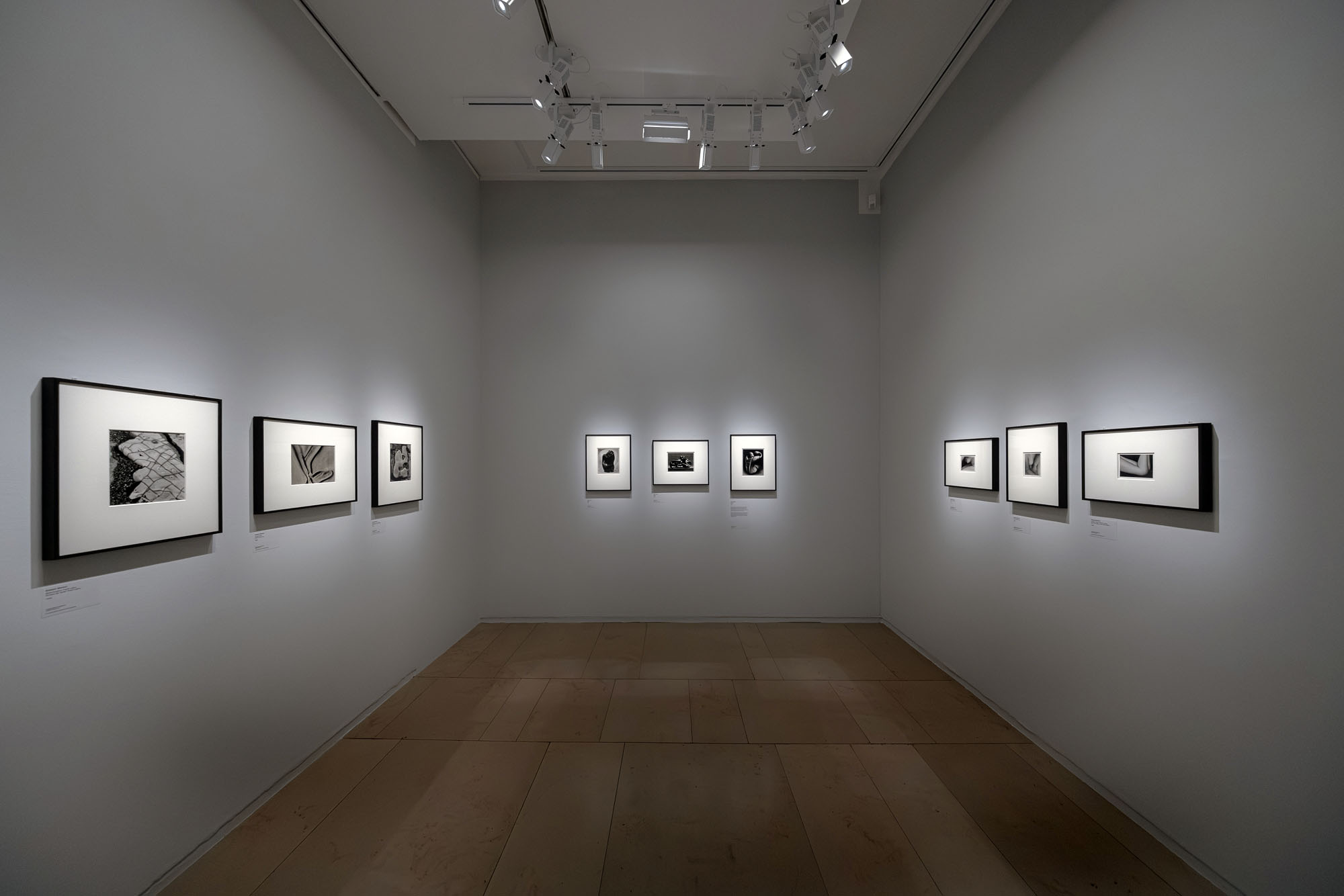
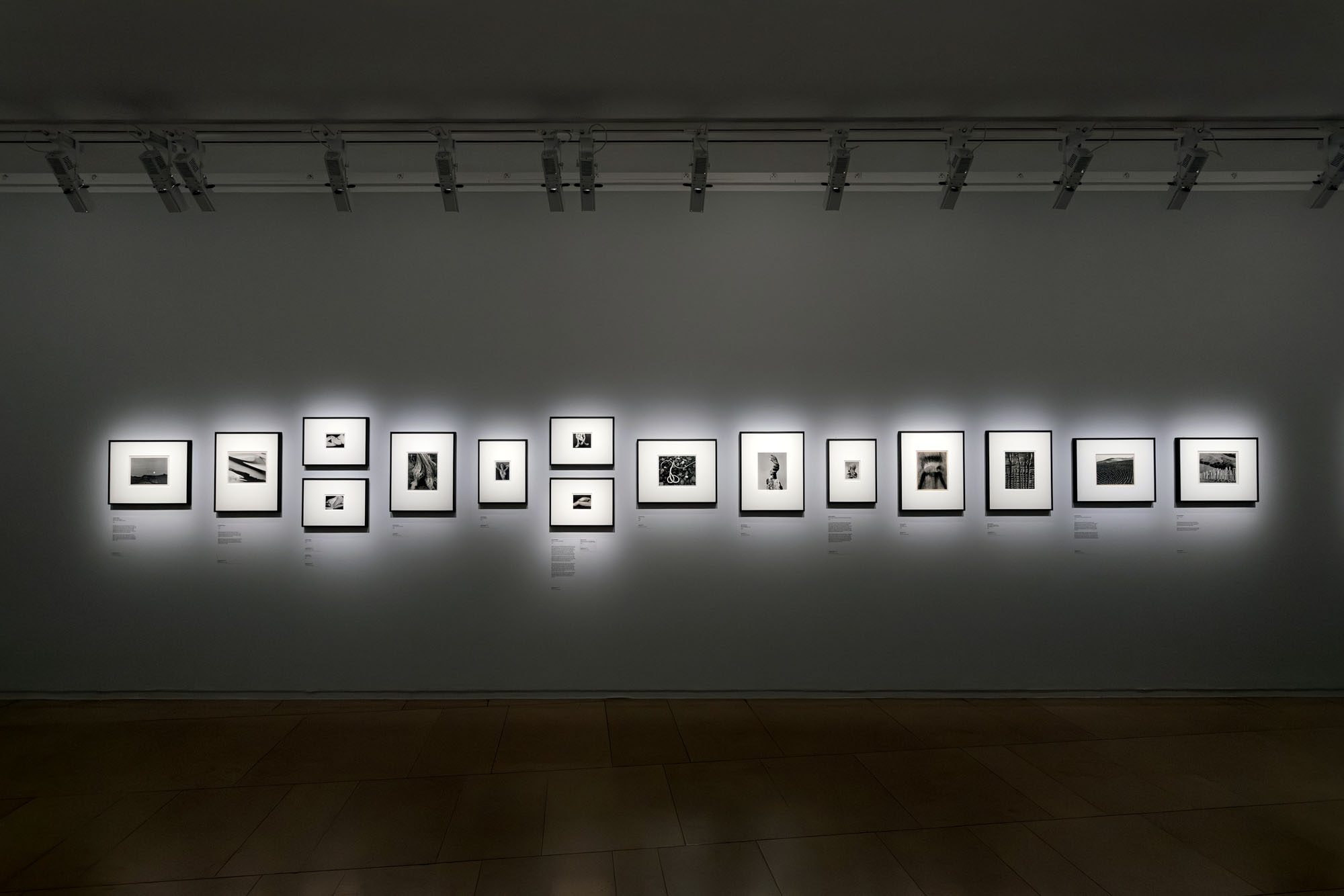
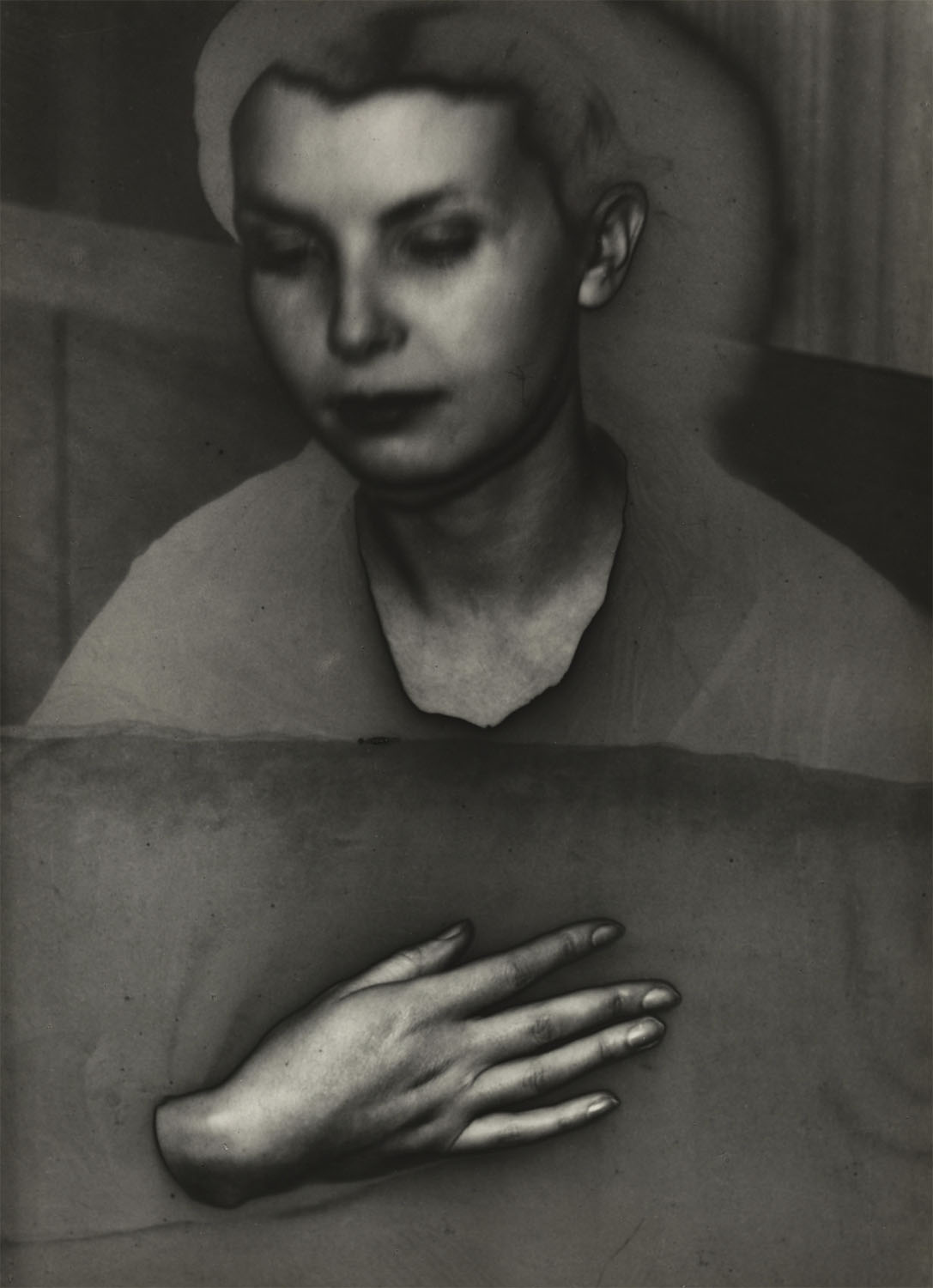
Exhibition: ‘Man Ray: When Objects Dream’ at The Metropolitan Museum of Art, New York

Exhibition dates: 14th September, 2025 – 1st February, 2026

Curators: Stephanie D’Alessandro, Leonard A. Lauder Curator of Modern Art and Senior Research Coordinator in Modern and Contemporary Art at The Met, and Stephen C. Pinson, Curator in the Department of Photographs at The Met, with the assistance of Micayla Bransfield, Research Associate, Modern and Contemporary Art. 


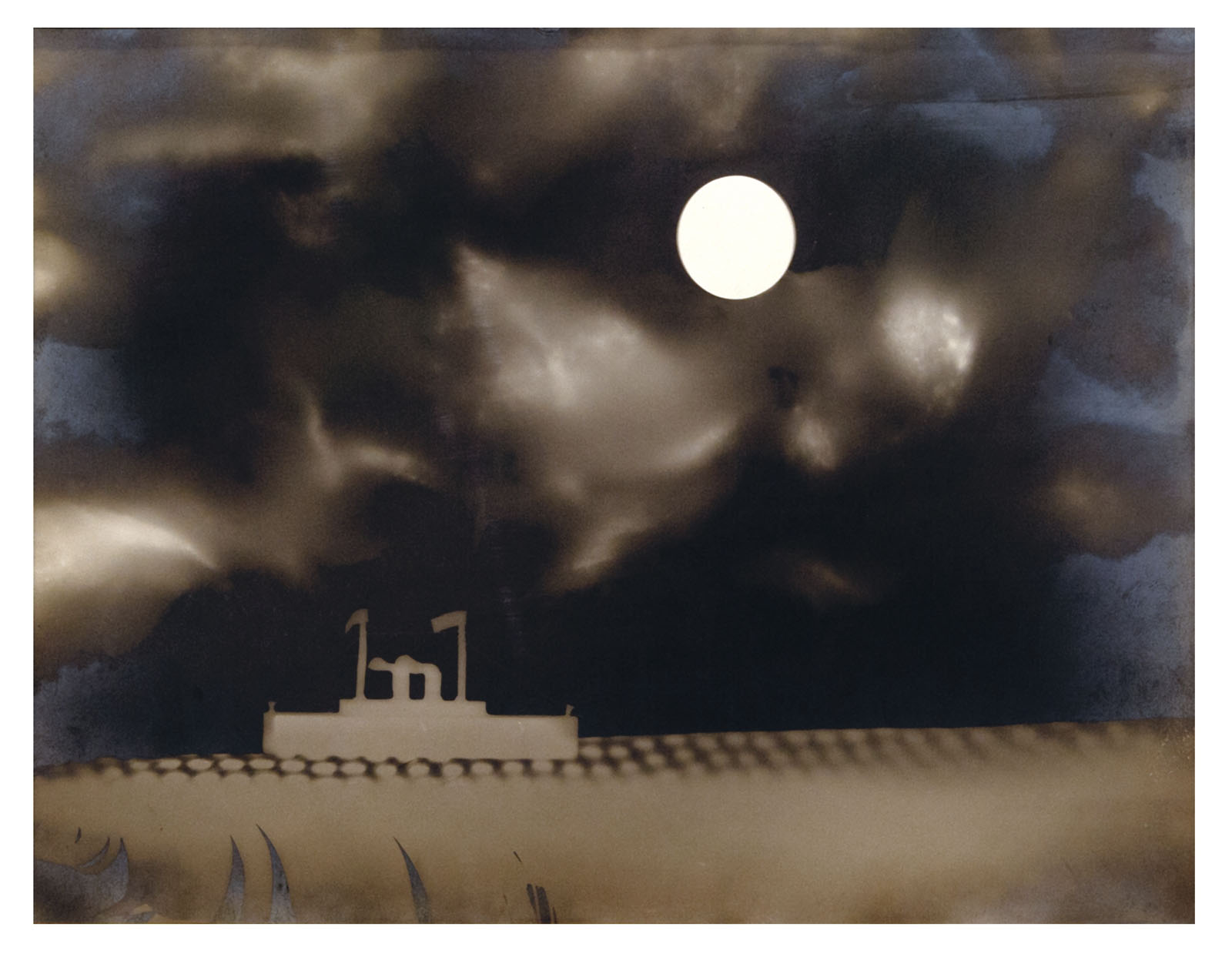
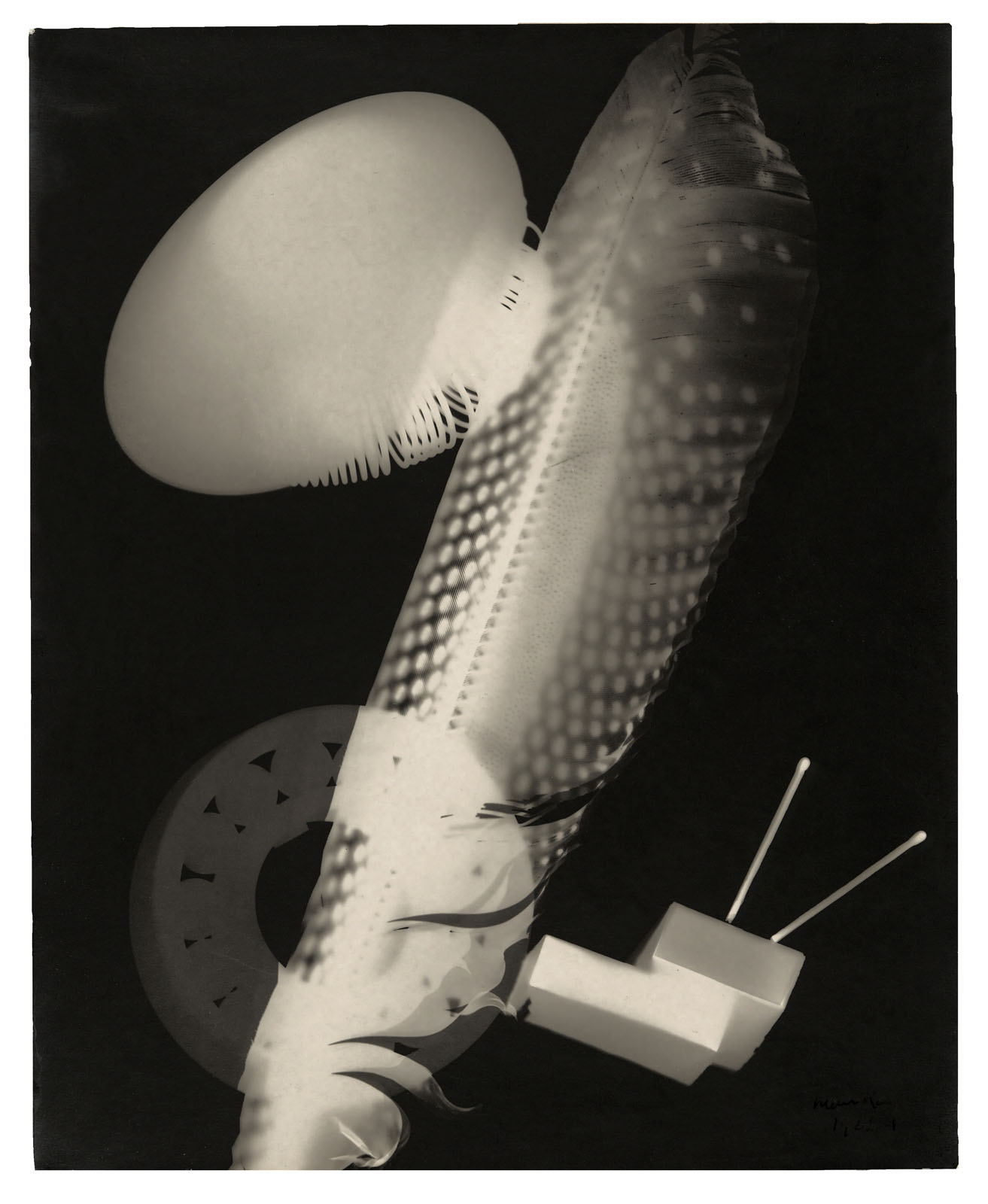
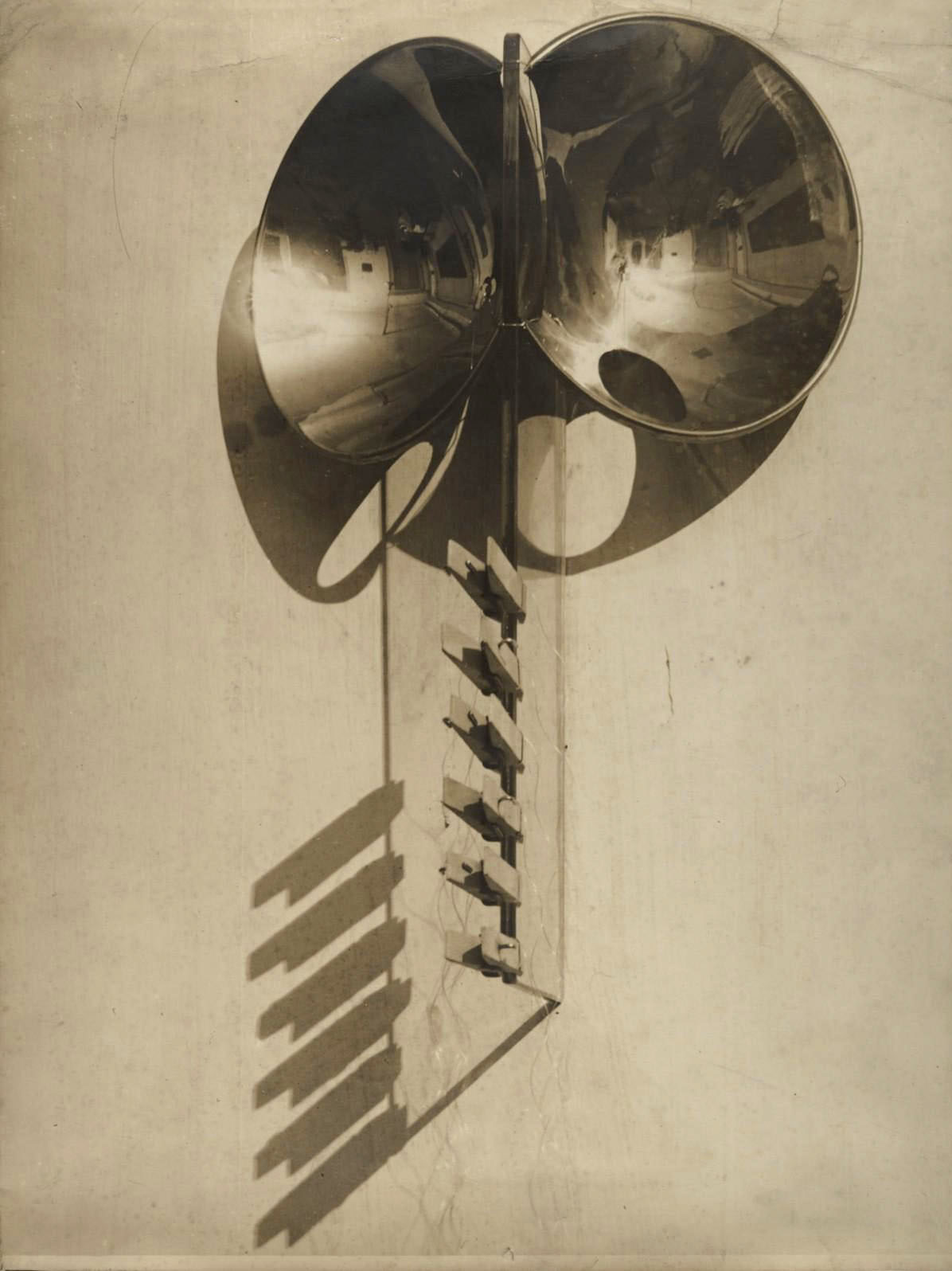
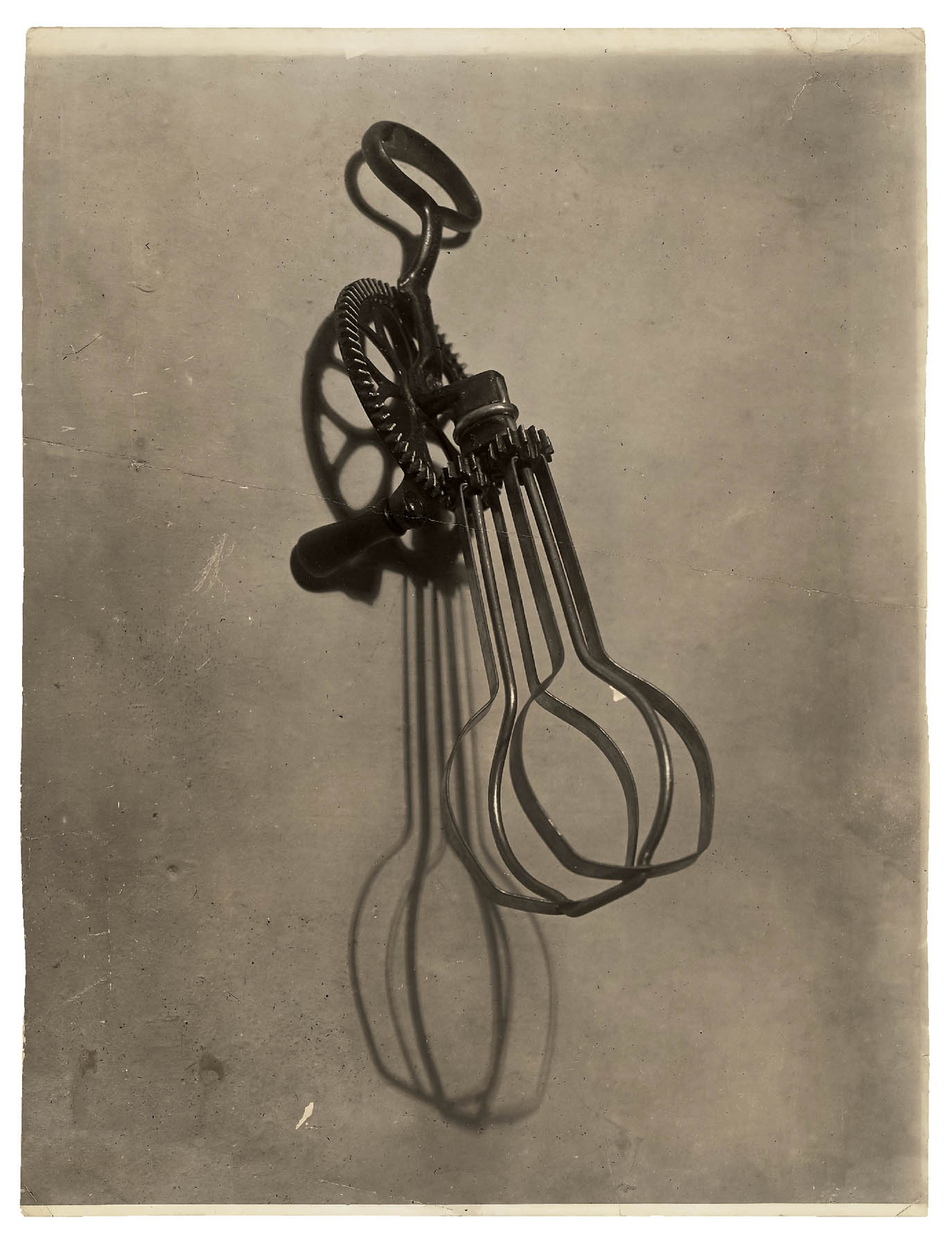
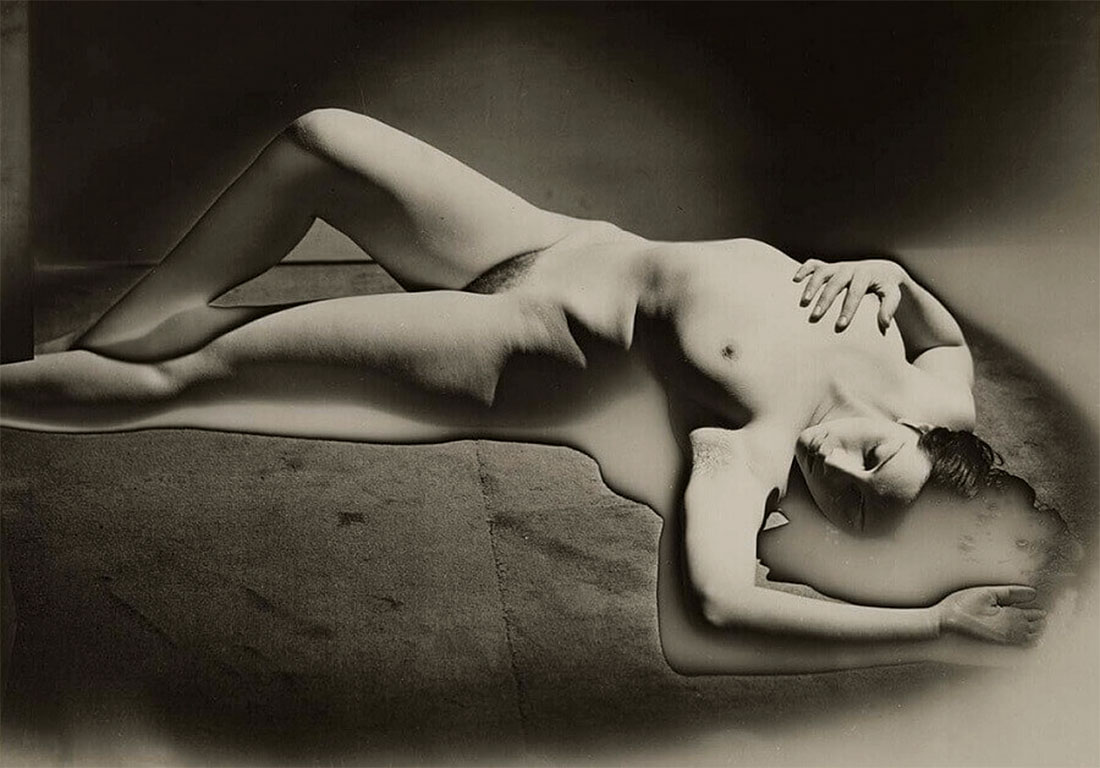
Man Ray (American, 1890-1976) 'Marine' c. 1925


Man Ray (American, 1890-1976) 
Marine 
c. 1925 
Gelatin silver print 
8 3/4 × 11 9/16 in. (22.2 × 29.3cm) 
Private collection; courtesy Galerie 1900-2000, Paris-New York 
© Man Ray 2015 Trust / Artists Rights Society (ARS), NY / ADAGP, Paris 2025 


“Like the undisturbed ashes of an object consumed by flames these images are oxidized residues fixed by light and chemical elements of an experience, an adventure, not an experiment. They are the result of curiosity, inspiration, and these words do not pretend to convey any information.”


Man Ray1


The rayographs

Although not the inventor of the photogram, a photograph made without the use of a camera by placing objects directly onto sensitised photographic paper and then exposing the paper to light, Man Ray’s rayographs have become the most recognisable and famous form that photograms have taken. This is because of their inventiveness, their subliminal connection to the psyche, and the use of “objects from the real world to make ambiguous dreamscapes.”7

It is interesting that Man Ray called his images rayographs, for a graph implies a topographical mapping, a laying out of statistics, whereas Lucia Moholy and László Moholy-Nagy’s photograms imply in the title of their technique the transmission of some form of message, like a telegram. The paradox is that, as the quotation above states, Man Ray always insisted that his rayographs imparted no information at all; perhaps they are only dreams made (un)stable. Contrary to this the other two artists believed that, “photographic images – cameraless and other – should not deal with conventional sentiments or personal feelings but should be concerned with light and form,”8 quite the reverse of the title of their technique.

After his arrival in Paris Man Ray started experimenting in his darkroom and discovered the technique for his rayographs by accident. With the help of his friend the Surrealist poet Tristan Tzara, he published a portfolio of twelve Rayographs in 1922 called Les champs délicieux (The delicious fields). “This title is a reference to ‘Les champs magnétiques’, a collection of writings by André Breton and Philippe Soupault composed from purportedly random thought fragments recorded by the two authors.”9 The rayographs are visual representations of random thought fragments, “photographic equivalents for the Surrealist sensibility that glorified randomness and disjunction.”10

Man Ray, “denied the camera its simplest joy: the ability to capture everything, all the distant details, all the ephemeral lights and shadows of the world”11 but, paradoxically, the rayographs are the most ephemeral of creatures, only being able to be created once, the result not being known until after the photographic paper has been developed. In fact, for Man Ray to create his portfolio Les champs délicieux (The delicious fields), he had to rephotograph the rayographs in order to make multiple copies.12

Man Ray “insisted in nearly every interview that the rayograph was not a photogram in the traditional sense. He did something that a photogram didn’t; he introduced depth into the images,”13 which denied the images their photographic objectivity by depicting an internal landscape rather than an external one.14 What the rayographs do not deny, however, is the subjectivity of the artist, his skill at placing the objects on the photographic paper, expressed in their dream-like nature, both a subjective ephemerality (because they could only be produced once) and an ephemeral subjectivity (because they were expressions of Man Ray’s fantasies, and therefore had little substance).

Through an alchemical process the latent images emerge from the photographic paper, representations of Man Ray’s fantasies as embodied in the ‘presence’ of the objects themselves, in the surface of the paper. Perhaps these objects offer, in Heidegger’s terms, ‘a releasement towards things’,15 “a coexistence between a conscious and unconscious way of perceiving which sustains the mystery of the object confusing the distinction between real time and sensual time, between inside and outside, input and output becoming neither here nor there.”16

Finally, within their depth of field the rayographs can be seen as both dangerous and delicious, for somehow they are both beautiful and unsettling at one and the same time. As Surrealism revels in randomness and chance these images enact the titles of other Man Ray photographs: Danger-Dancer, Anxiety, Dust Raising, Distorted House. The rayographs revel in chance and risk; Man Ray brings his fantasies to the surface, an interior landscape represented externally that can be (re)produced only once – those dangerous delicious fields.

Extract from Marcus Bunyan. “The Delicious Fields: Exploring Man Ray’s ‘Rayographs’ in a Digital Future,” published in The University of Queensland Vanguard magazine ‘Man Ray: Life, Work & Themes’, 2004


Footnotes

1/ Man Ray quoted in Janus (trans. Murtha Baca). Man Ray: The Photographic Image. London: Gordon Fraser, 1980, p. 213

7/ Mark Greenberg (ed.,). In Focus: Man Ray: Photographs from the J. Paul Getty Museum. Los Angeles, The J. Paul Getty Museum, 1998, p. 38

8/ Naomi Rosenblum. A World History of Photography. New York: Abbeville Press, 1997, 394

9/ Greenberg, op. cit., p. 28

10/ Jed Perl (ed.,). Man Ray: Aperture Masters of Photography. New York: Aperture, 1997 pp. 11-12

11/ Perl, op. cit., pp. 5-6

12/ Greenberg, op. cit., p. 28

13/ Greenberg, op. cit., p. 112

14/ Greenberg, op. cit., p. 28

15/ “We stand at once within the realm of that which hides itself from us, and hides itself just in approaching us. That which shows itself and at the same time withdraws is the essential trait of what we call the mystery … Releasement towards things and openness to the mystery belong together. They grant us the possibility of dwelling in the world in a totally different way…”

Martin Heidegger. Discourse on Thinking. New York: Harper & Row, 1966, pp. 55-56 quoted in Mauro Baracco. “Completed Yet Unconcluded: The Poetic Resistance of Some Melbourne Architecture,” in Leon van Schaik (ed.,). Architectural Design Vol. 72. No. 2 (‘Poetics in Architecture’). London: John Wiley and Sons, 2002, 74, Footnote 6.

16/ Marcus Bunyan. Spaces That Matter: Awareness and Entropia in the Imaging of Place (2002) [Online] Cited 07/07/2004.


Many thankx to The Metropolitan Museum of Art for allowing me to publish the photographs in the posting. Please click on the photographs for a larger version of the image.


“Stepping into the exhibition Man Ray: When Objects Dream at The Metropolitan Museum of Art feels like entering the bellows of an old camera. Through a rectangular frame cut into the entry, the darkened walls unfold, accordion-like, to reveal a visual feast of the artist’s work, as Man Ray’s earliest film, “Retour à la raison (Return to Reason)” (1923), flickers across the screen opposite. Although the exhibition brings together approximately 160 works from an impressive array of lenders, it reveals itself gradually, taking the viewer through several turns before one can grasp its sheer enormity. When Objects Dream proves, thrillingly, that anyone left feeling jaded from the many, many recent exhibitions surrounding Surrealism’s centennial in 2024 can still see the movement’s key photographer with a fresh set of eyes.”


Julia Curl. “Man Ray Was So Much More Than a Photographer,” on the Hyperallergic website September 16, 2025 [Online] Cited 05/12/2025


“Objects to touch, to eat, to crunch, to apply to the eye, to the skin, to press, to lick, to break, to grind, objects to lie, to flee from, to honor, things cold or hot, feminine or masculine, objects of day or night which absorb through your pores the greater part of our life. … These are the projections surprised in transparence, by the light of tenderness, of objects that dream and talk in their sleep.” 

.
Tristan Tzara, “When Objects Dream,” 1934


“One sheet of paper got into the developing tray – a sheet unexposed that had been mixed with those already exposed under the negatives. … Regretting the waste of paper, I mechanically placed a small glass funnel, the graduate, and the thermometer in the tray on the wetted paper. I turned on the light; before my eyes an image began to form, not quite a simple silhouette of the objects as in a straight photograph, but distorted and refracted by the glass more or less in contact with the paper and standing out against a black background. … I remembered when I was a boy, placing fern leaves in a printing frame with proof paper, exposing it to sunlight, and obtaining a white negative of the leaves. This was the same idea, but with an added three-dimensional quality and tone graduation. I made a few more prints … taking whatever came to hand; my hotel-room key, a handkerchief, some pencils, a brush, a candle, a piece of twine … excitedly, enjoying myself immensely. In the morning I examined the results. … They looked startlingly new and mysterious.”


Man Ray 


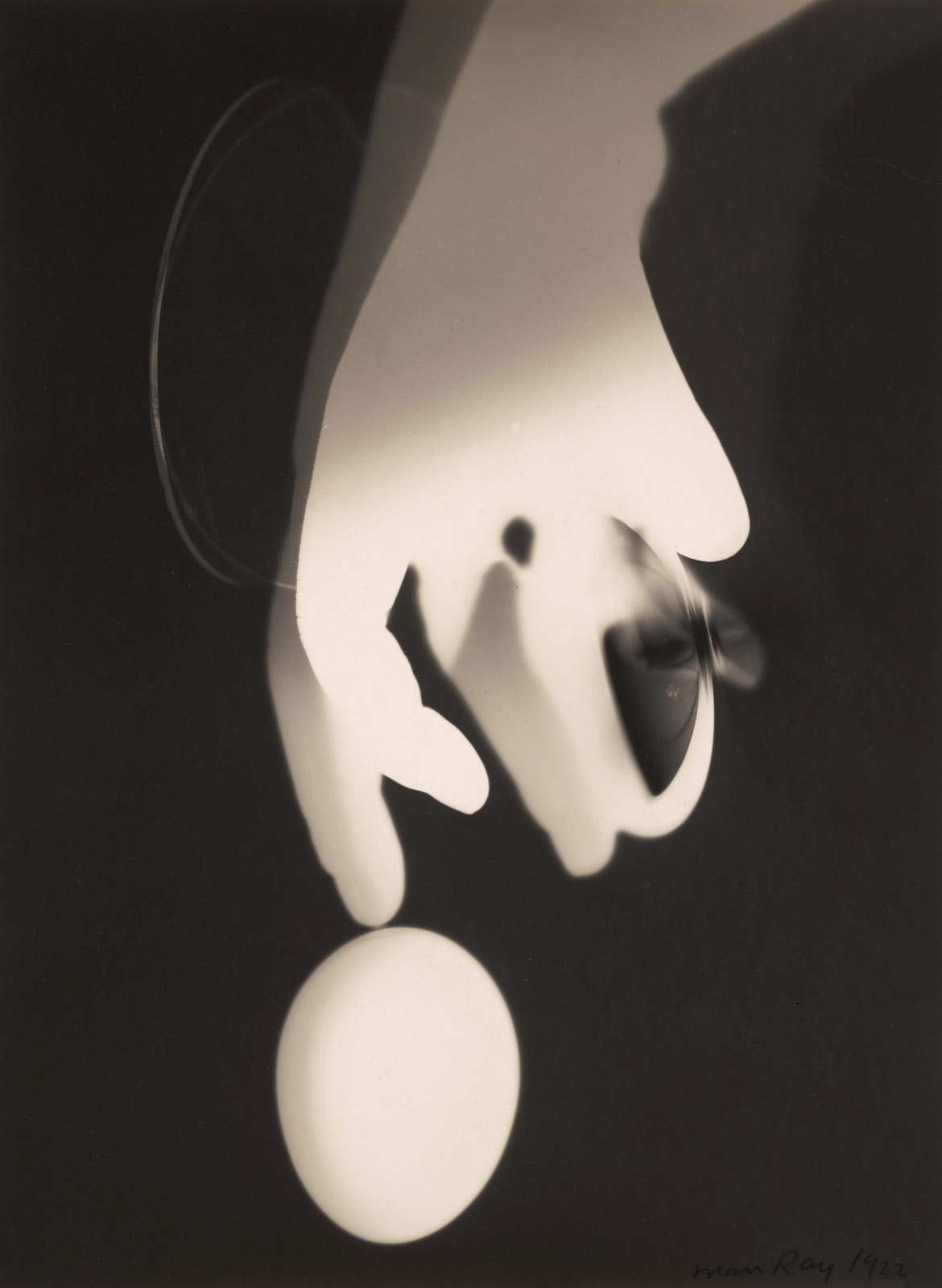
Man Ray (American, 1890-1976) 'Rayograph' 1922


Man Ray (American, 1890-1976) 
Rayograph
1922 
Gelatin silver print 
9 1/2 × 7 in. (24.1 × 17.8cm) 
The Metropolitan Museum of Art, New York, Bluff Collection, Promised Gift of John A. Pritzker 
© Man Ray 2015 Trust / Artists Rights Society (ARS), NY / ADAGP, Paris 2025
Photo by Ben Blackwell 


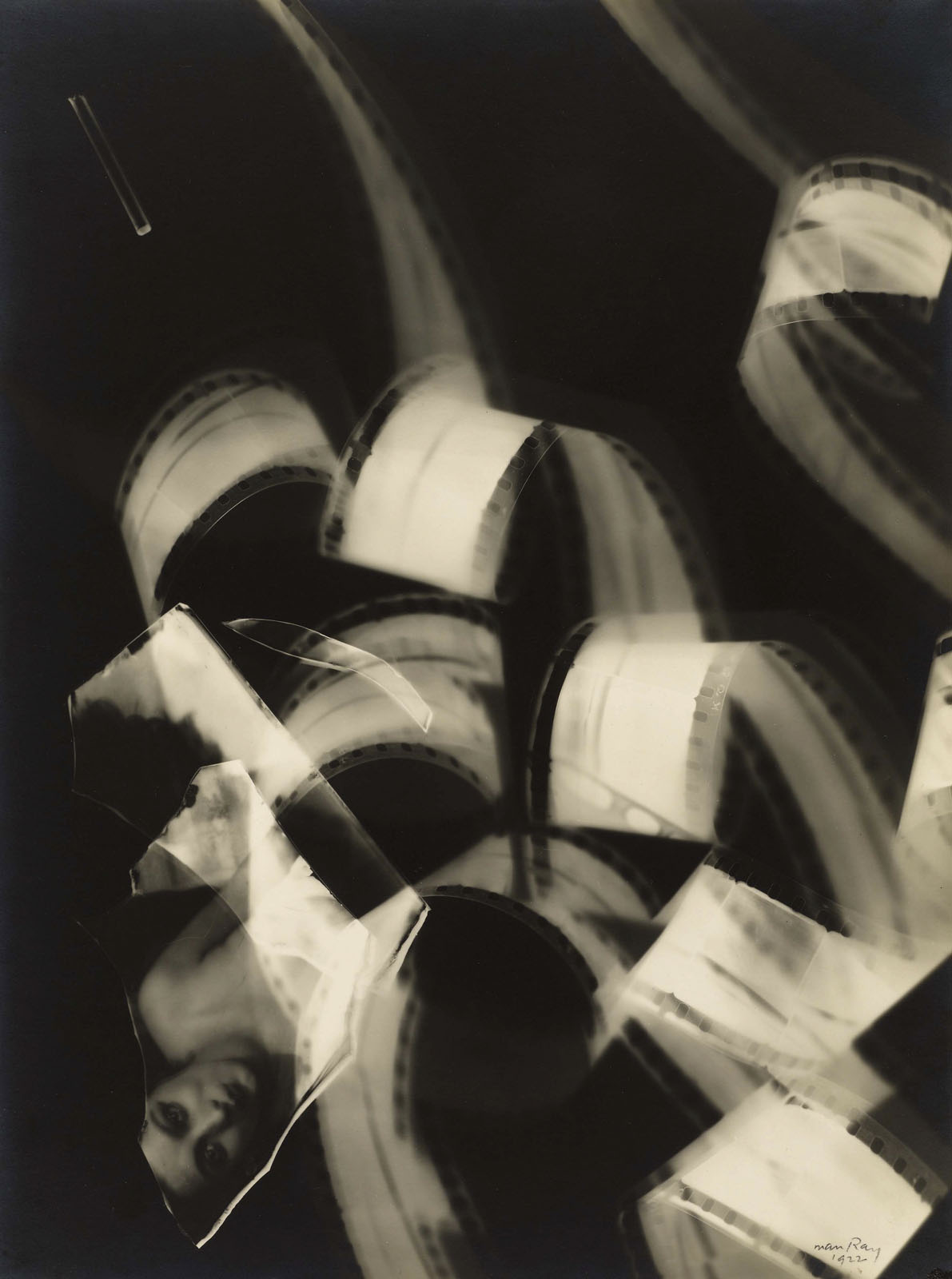
Man Ray (American, 1890-1976) 'Rayograph' 1922


Man Ray (American, 1890-1976) 
Rayograph
1922 
Gelatin silver print 
9 3/8 × 7 in. (23.8 × 17.8cm) 
The J. Paul Getty Museum, Los Angeles
Courtesy The J. Paul Getty Museum, Los Angeles 
© Man Ray 2015 Trust / Artists Rights Society (ARS), NY / ADAGP, Paris 2025


Man Ray (American, 1890-1976) 'Rayograph' 1922


Man Ray (American, 1890-1976) 
Rayograph
1922
Gelatin silver print
9 3/8 x 7 in. (23.8 x 17.8cm)
Private collection
© Man Ray 2015 Trust / Artists Rights Society (ARS), NY / ADAGP, Paris 2025


Man Ray (American, 1890-1976) 'Rayograph' 1923


Man Ray (American, 1890-1976) 
Rayograph 
1923 
Gelatin silver print 
11 1/2 × 9 5/16 in. (29.2 × 23.7cm) 
Yale University Art Gallery, New Haven, Gift of the Estate of Katherine S. Dreier 
© Man Ray 2015 Trust / Artists Rights Society (ARS), NY / ADAGP, Paris 2025
Photo: Yale University Art Gallery, Gift of Collection Société Anonyme 


Man Ray (American, 1890-1976) 'Rayograph' 1923-1928


Man Ray (American, 1890-1976) 
Rayograph
1923-1928 
Gelatin silver print 
19 5/16 x 15 11/16 in. (49 x 39.8cm) 
The Metropolitan Museum of Art, New York, Gilman Collection, Purchase, The Horace W. Goldsmith Foundation Gift, through Joyce and Robert Menschel, 2005
Image © The Metropolitan Museum of Art, photo by Mark Morosse 
© Man Ray 2015 Trust / Artists Rights Society (ARS), NY / ADAGP, Paris 2025 


Man Ray (American, 1890-1976) 'Rayography' 1925


Man Ray (American, 1890-1976) 
Rayograph 
1925 
Gelatin silver print 
19 15/16 × 15 13/16 in. (50.6 × 40.2cm) 
MAH Musée d’art et d’histoire, City of Geneva. Purchase, 1968
© Man Ray 2015 Trust / Artists Rights Society (ARS), NY / ADAGP, Paris 2025
Photo © Musée d’art et d’histoire, Ville de Genève, photo by André Longchamp


American artist Man Ray (1890-1976) was a visionary known for his radical experiments that pushed the limits of photography, painting, sculpture, and film. In the winter of 1921, he pioneered the rayograph, a new twist on a technique used to make photographs without a camera. By placing objects on or near a sheet of light-sensitive paper, which he exposed to light and developed, Man Ray turned recognisable subjects into wonderfully mysterious compositions. Introduced in the period between Dada and Surrealism, the rayographs’ transformative, magical qualities led the poet Tristan Tzara to describe them as capturing the moments “when objects dream.”

The exhibition will be the first to situate this signature accomplishment in relation to Man Ray’s larger body of work of the 1910s and 1920s. Drawing from the collections of The Met and more than 50 U.S. and international lenders, the exhibition will feature approximately 60 rayographs and 100 paintings, objects, prints, drawings, films, and photographs – including some of the artist’s most iconic works – to highlight the central role of the rayograph in Man Ray’s boundary-breaking practice.

“Before my eyes an image began to form, not quite a simple silhouette of the objects as in a straight photograph, but distorted and refracted … In the morning I examined the results, pinning a couple of the rayographs – as I decided to call them – on the wall. They looked startlingly new and mysterious.” ~ Man Ray

Text from The Metropolitan Museum of Art website


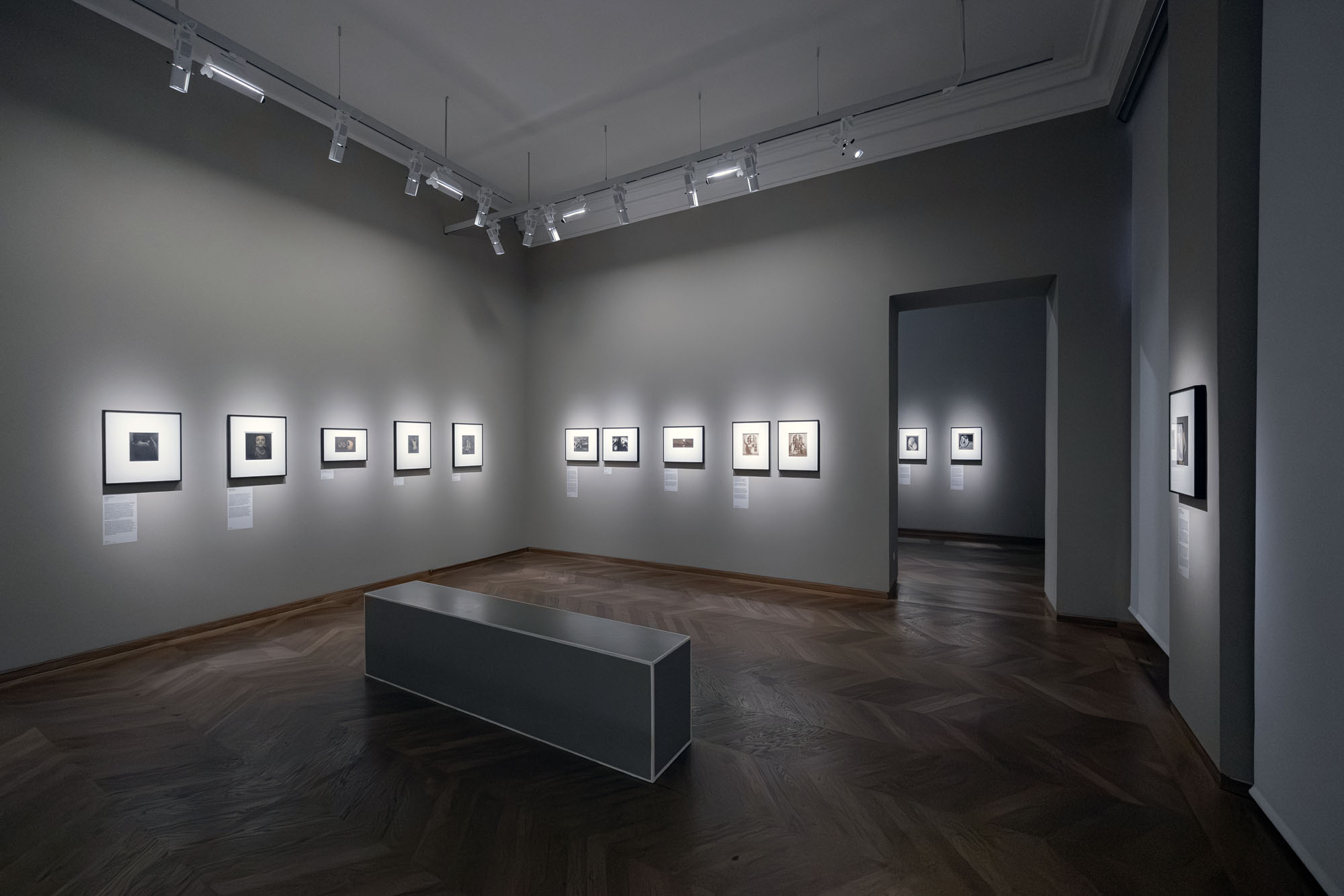
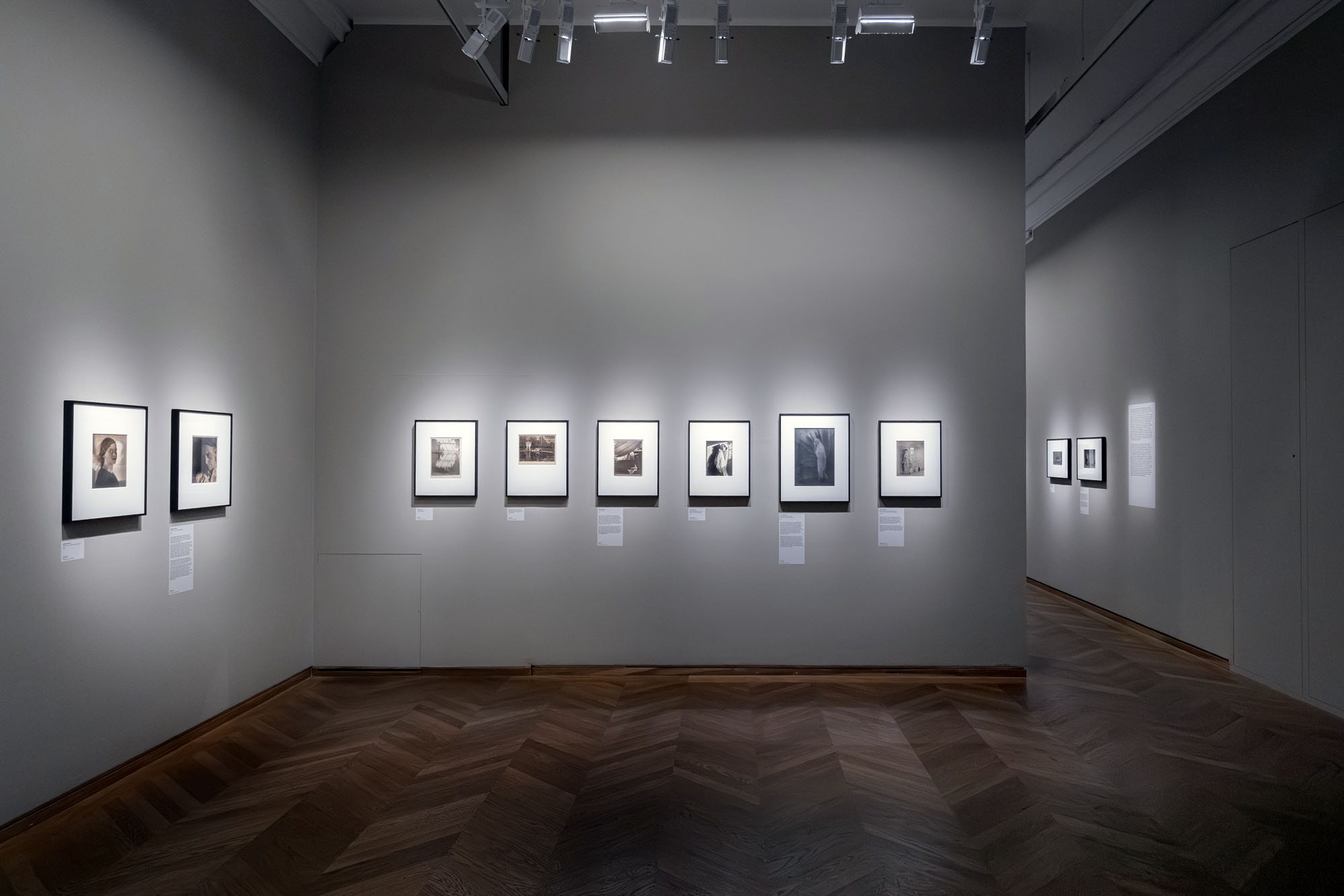
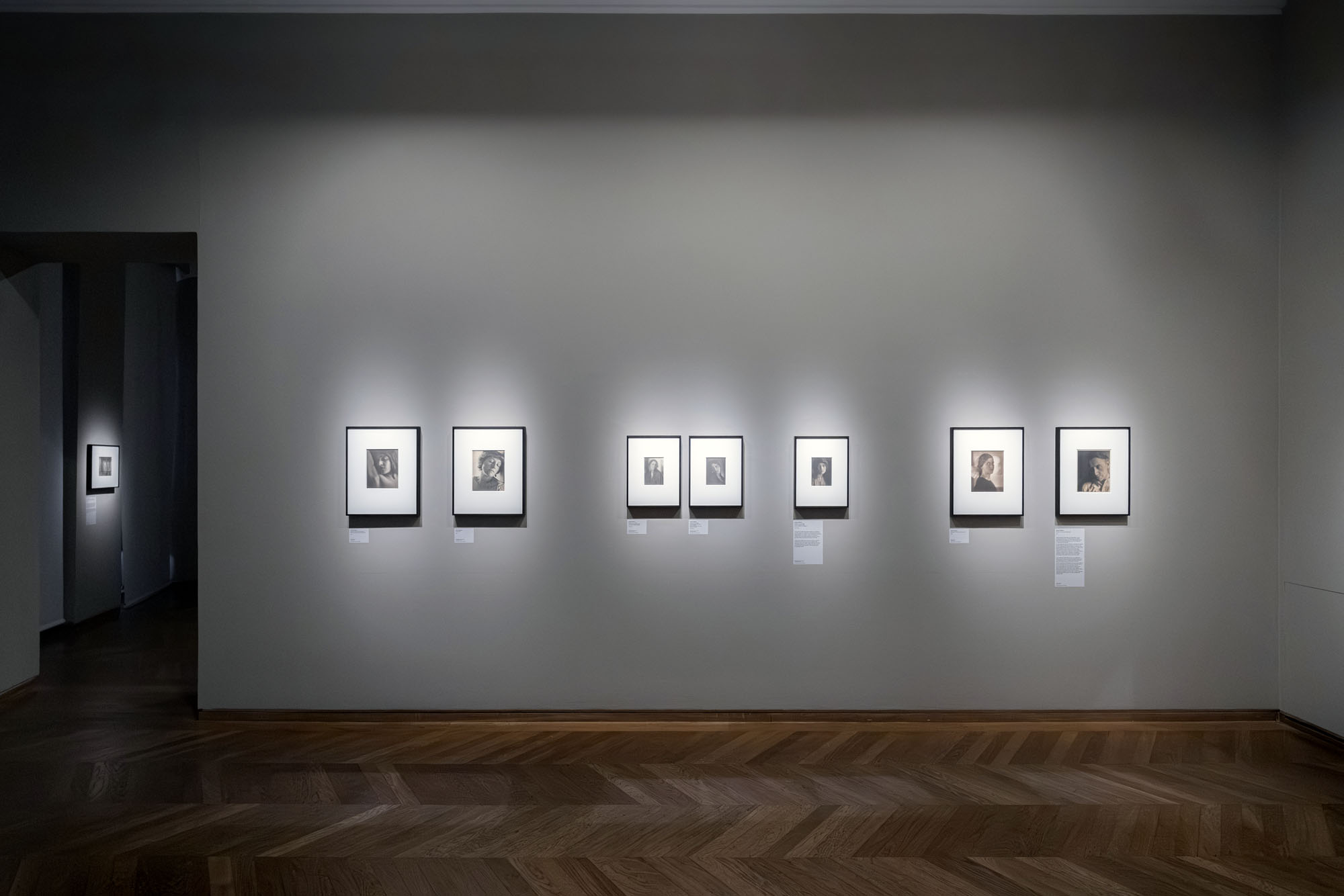
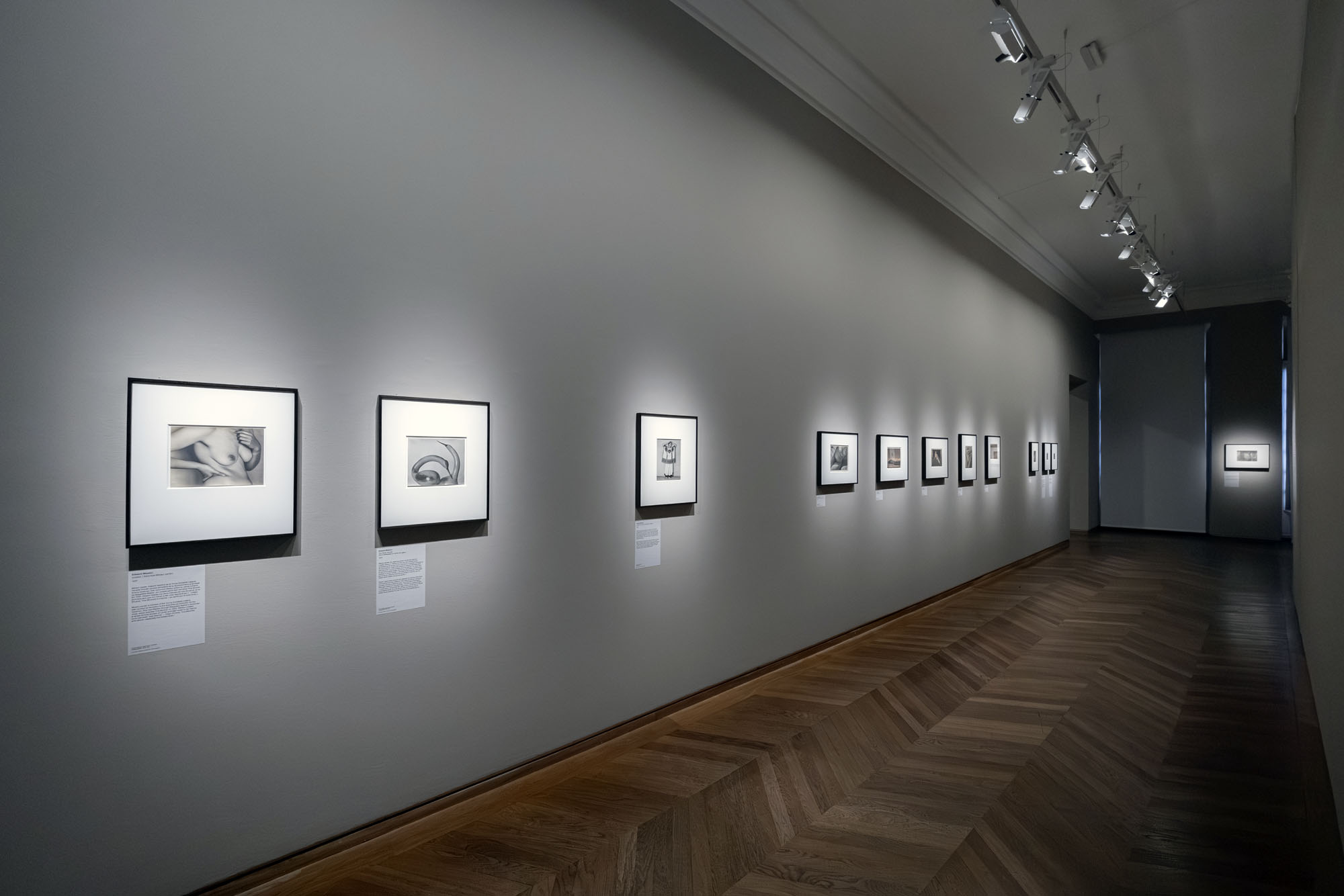
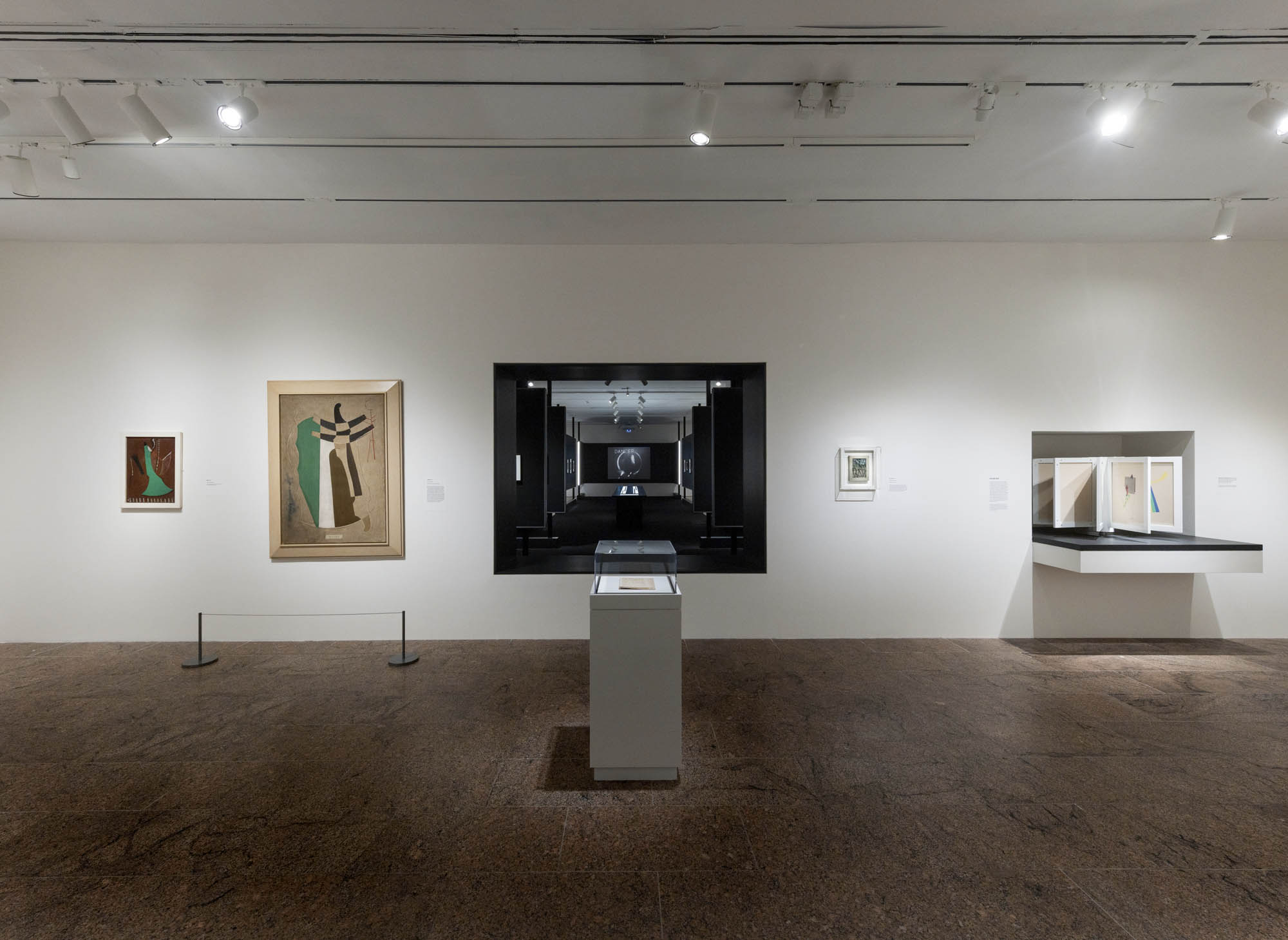
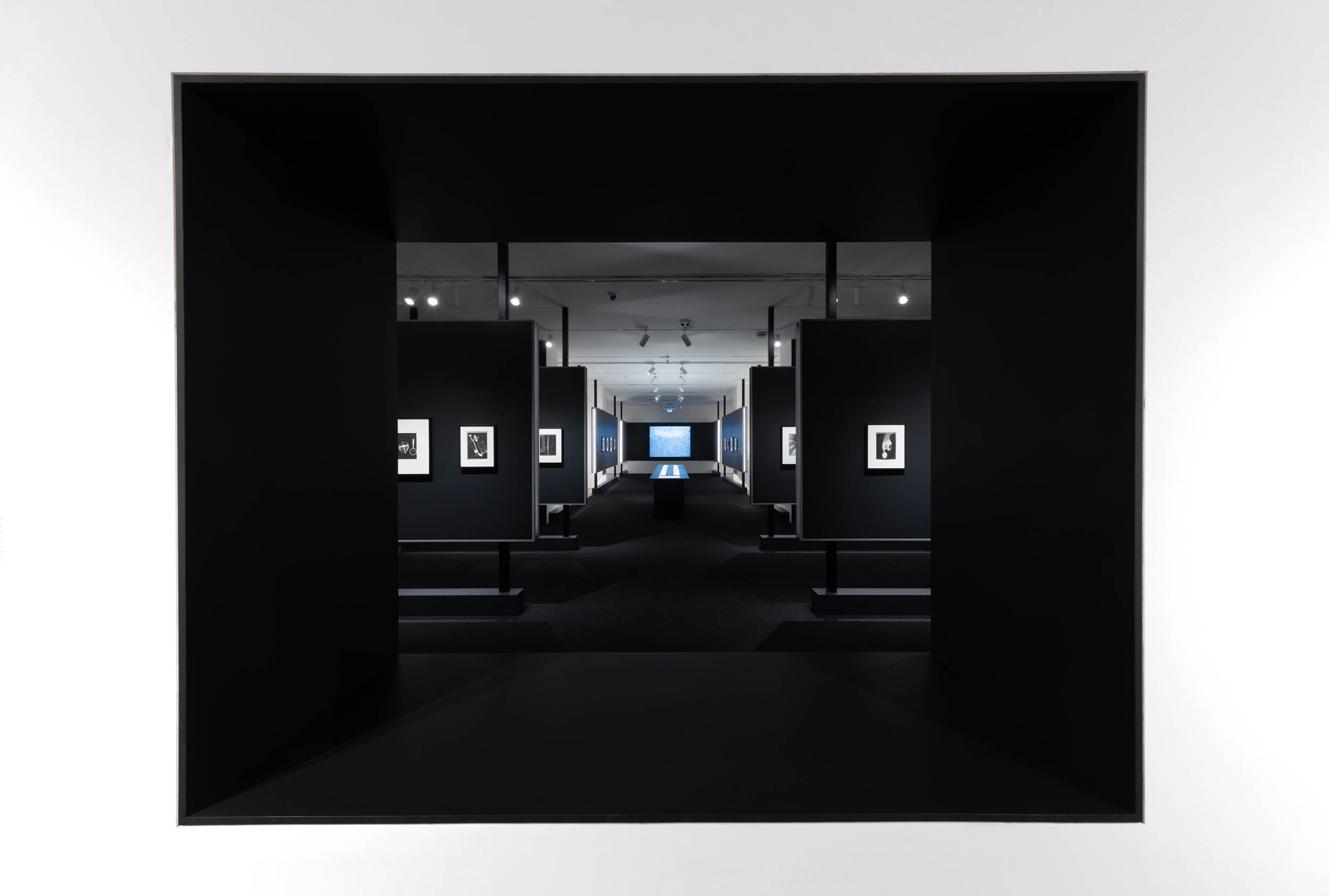
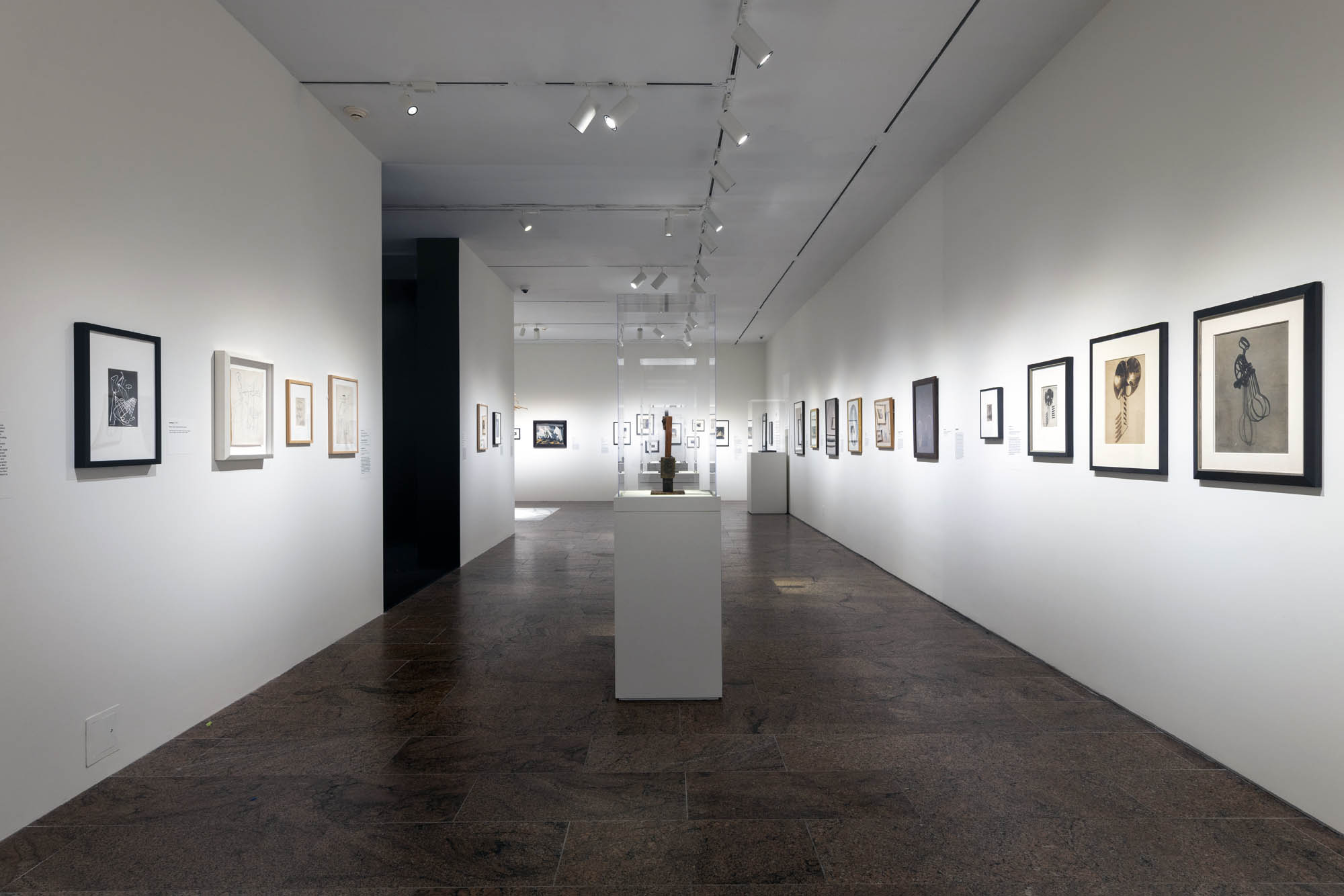
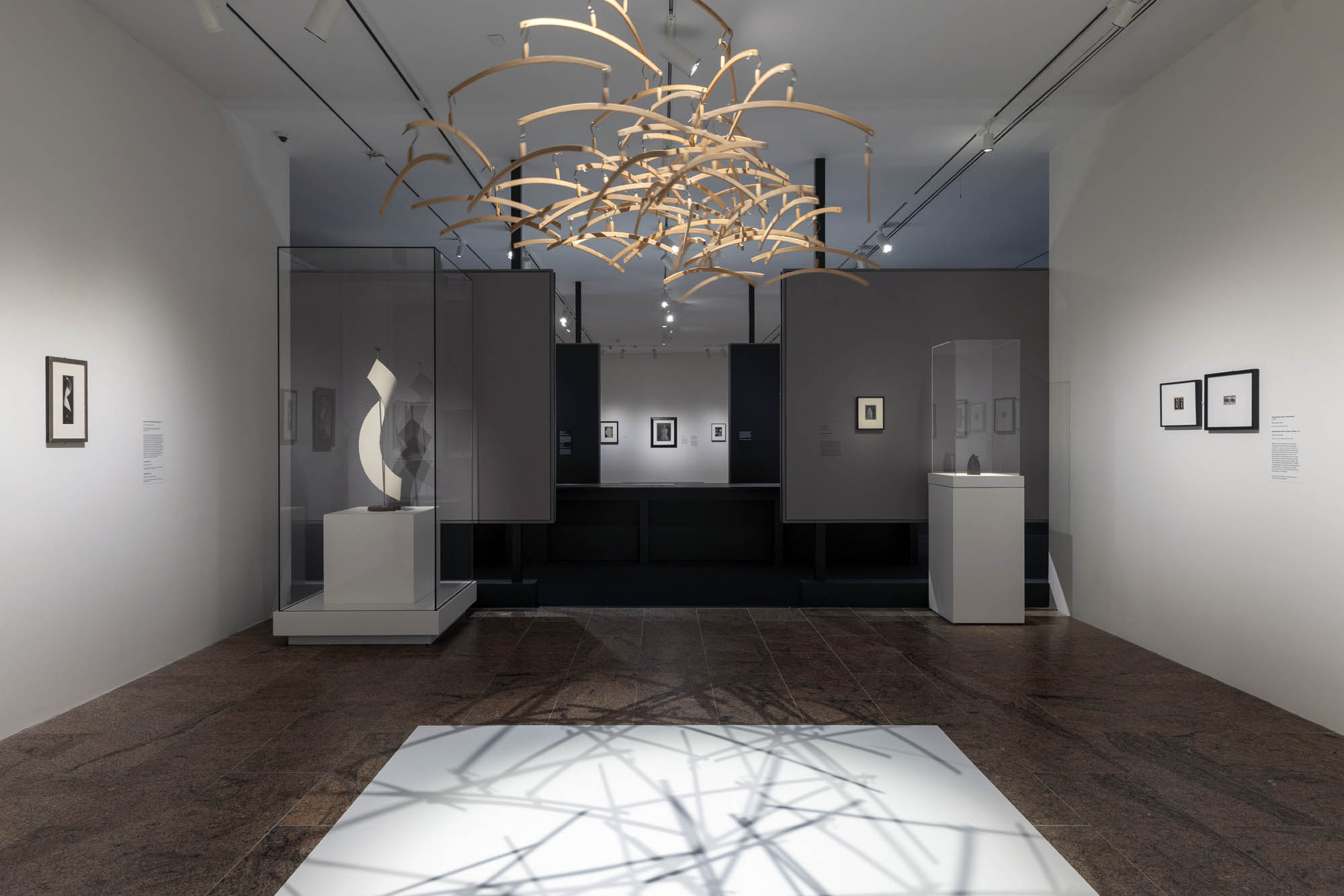
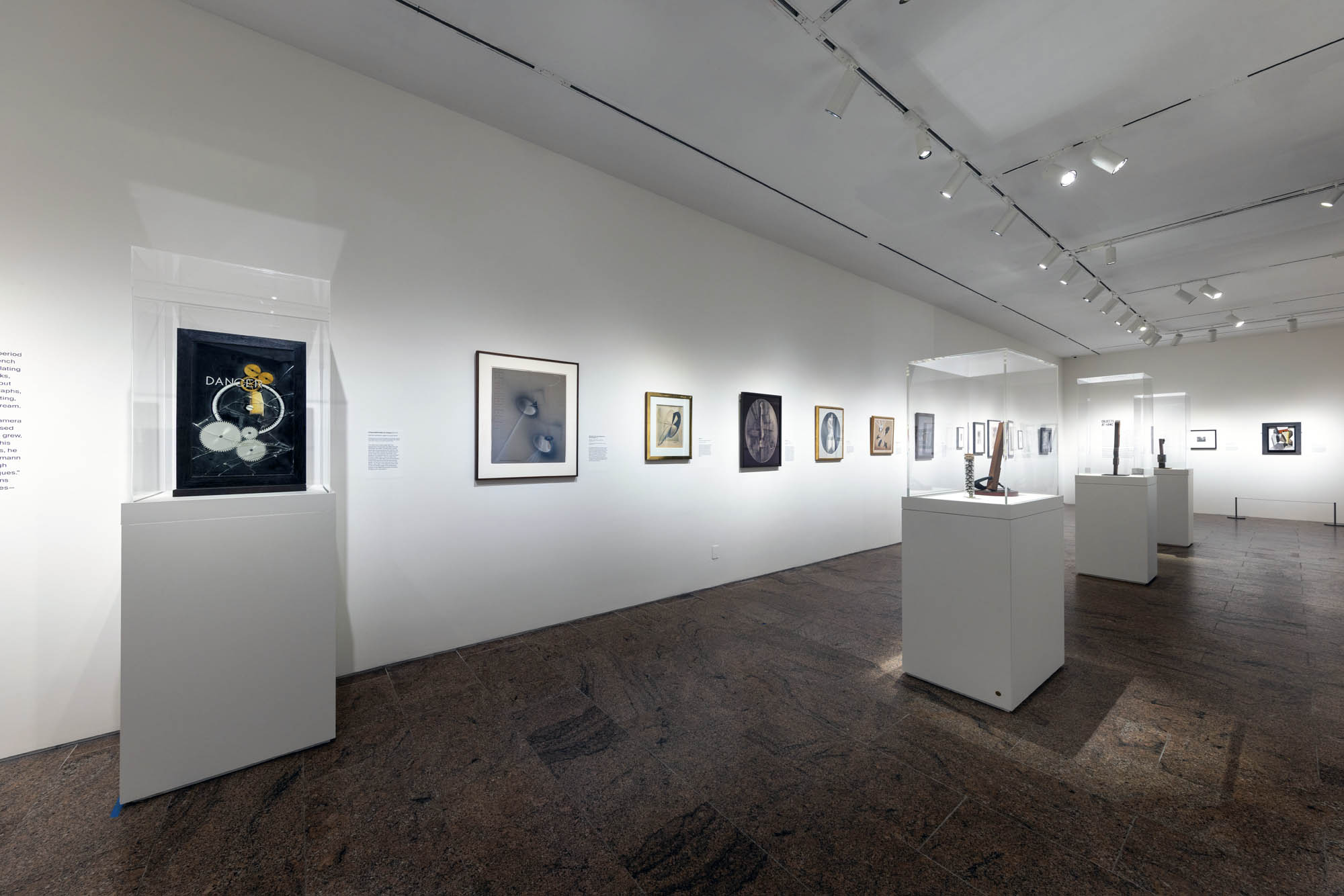
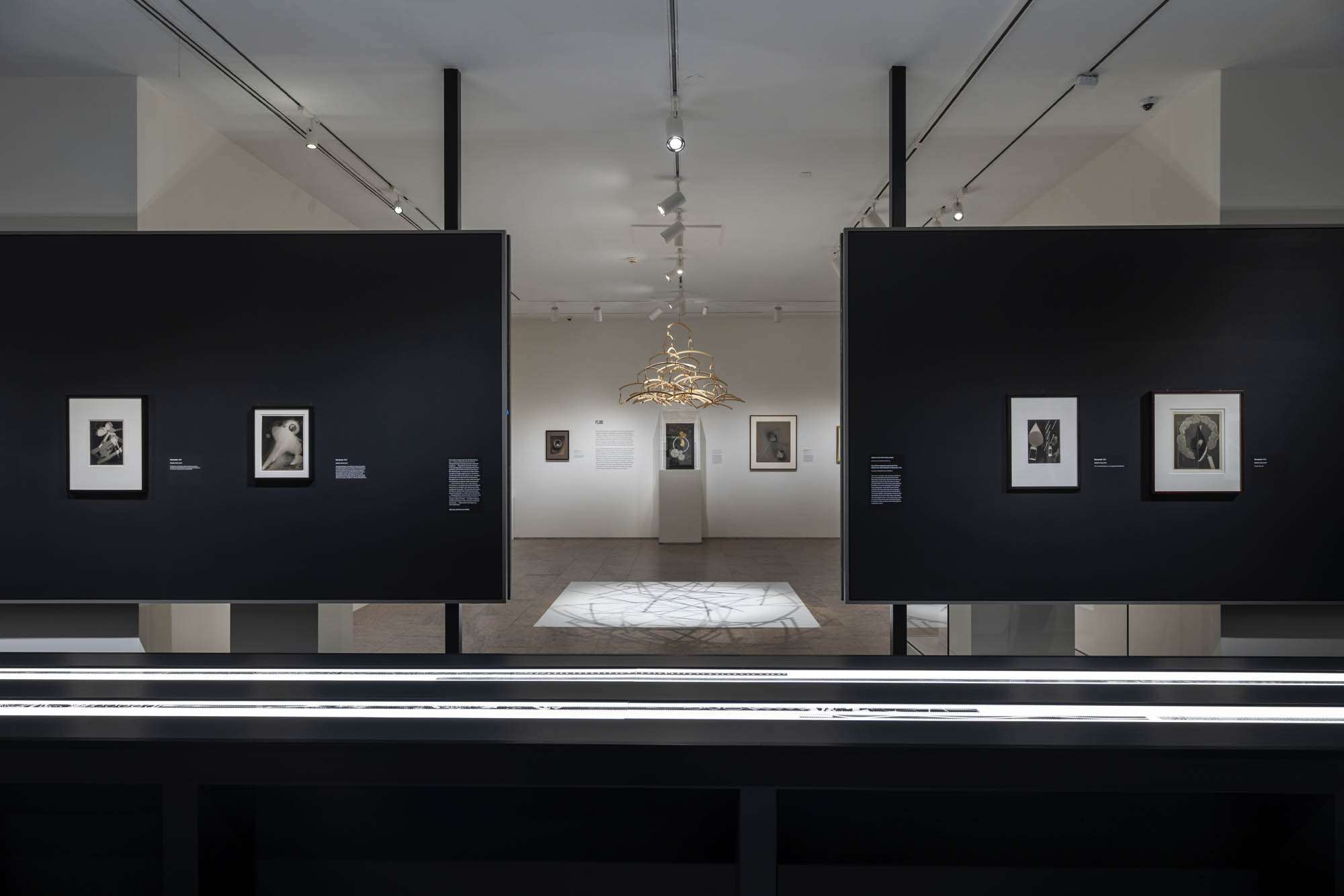
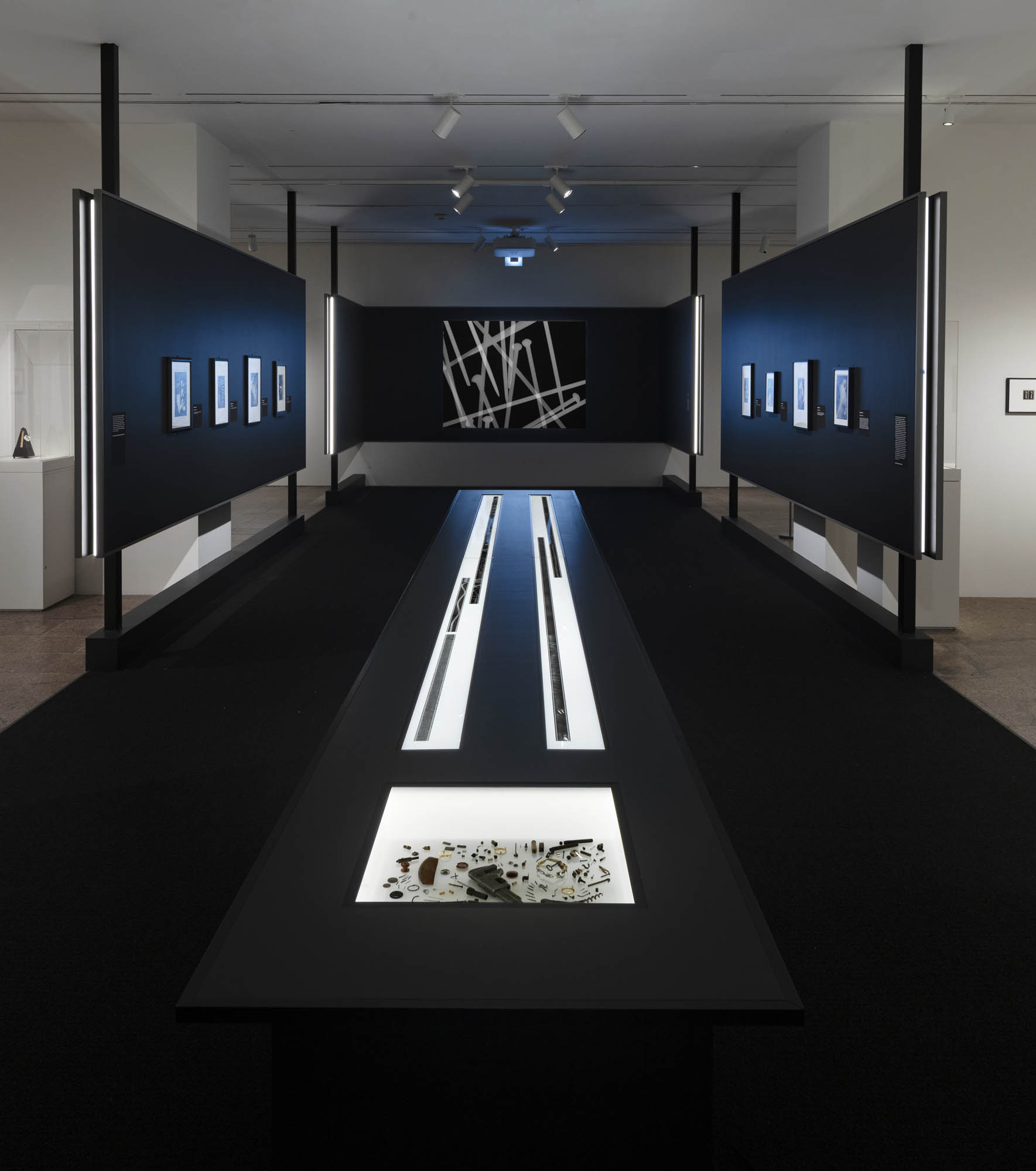
Installation view of the exhibition 'Man Ray: When Objects Dream' at The Metropolitan Museum of Art, New York, September 2025 - February 2026


Installation views of the exhibition Man Ray: When Objects Dream at The Metropolitan Museum of Art, New York, September 2025 – February 2026


Man Ray (American, 1890-1976)
'Torse (Retour à la raison)' (Torso [Return to Reason]) 1923, printed c. 1935


Man Ray (American, 1890-1976)
Torse (Retour à la raison) (Torso [Return to Reason])
1923, printed c. 1935
Gelatin silver print
8 1/4 × 6 3/8 in. (21 × 16.2cm)
Private collection
© Man Ray 2015 Trust / Artists Rights Society (ARS), NY / ADAGP, Paris 2025


In the 1923 silent short of the same title, Man Ray filmed barely discernible scenes of Paris at night along with his own enigmatic photograms and conglomerations of spiraling or gyrating objects. The resulting sequence of near-total abstractions seems devoid of sense or purpose. The “return to reason” in the film comes finally in the form of a woman’s torso – modelled by cabaret personality Kiki de Montparnasse – turning to and fro beside a rain-covered windowpane. Man Ray reproduced the seductive finale, as well as other moments from the film, as photographs, singly and in strips. A still from Man Ray’s film, this particular photograph appeared on its own in the first issue of the key avant-garde journal La Révolution surréaliste, in 1924.

Text from the Art Institute of Chicago website


Le retour à la raison (Return to Reason), Man Ray, 1923


Emak-Bakia (1926) – directed by Man Ray

Emak-Bakia (Basque for Leave me alone) is a 1926 film directed by Man Ray. Subtitled as a cinépoéme, it features many techniques Man Ray used in his still photography (for which he is better known), including rayographs, double exposure, soft focus and ambiguous features.

Emak-Bakia shows elements of fluid mechanical motion in parts, rotating artifacts showing his ideas of everyday objects being extended and rendered useless. Kiki of Montparnasse (Alice Prin) is shown driving a car in a scene through a town. Towards the middle of the film Jacques Rigaut appears dressed in female clothing and make-up. Later in the film a caption appears: “La raison de cette extravagance” (the reason for this extravagance). The film then cuts to a car arriving and a passenger leaving with briefcase entering a building, opening the case revealing men’s shirt collars which he proceeds to tear in half. The collars are then used as a focus for the film, rotating through double exposures.

The film features sculptures by Pablo Picasso, and some of Man Ray’s mathematical objects both still and animated using a stop motion technique.

Originally a silent film, recent copies have been dubbed using music taken from Man Ray’s personal record collection of the time. The musical reconstruction was by Jacques Guillot.

When the film was first exhibited, a man in the audience stood up to complain it was giving him a headache and hurting his eyes. Another man told him to shut up, and they both started to fight. The theatre turned into a frenzy, the fighting ended up out in the street, and the police were called in to stop the riot.

Emak bakia can also mean “give peace” (“emak” is the imperative form of the verb “eman”, which means “give”) in Basque.

Text from the YouTube website


L’étoile de mer, Man Ray, 1928

The film was based on Robert Desnon’s surrealist poem L’Étoile de mer.


The Met Presents First Major Exhibition on Man Ray’s Radical Reinvention of Art through the rayograph 

Featuring 160 rayographs, paintings, objects, prints, drawings, films, and photographs, Man Ray: When Objects Dream highlights the principal place of the rayograph – a type of cameraless photograph – within the context of many of the artist’s most important works 

This exhibition includes thirty-five works by Man Ray which are part of the major promised gift of nearly 200 works of Dada and Surrealist art from Trustee John Pritkzer 

Man Ray: When Objects Dream at The Metropolitan Museum of Art is the first major exhibition to examine the radical experimentation of American artist Man Ray (1890-1976) through one of his most significant bodies of work, the rayograph. Man Ray coined the term rayograph to name his version of the 19th-century technique of making photographs without a camera. He created them by placing objects on or near a sheet of light-sensitive paper, which he then exposed to light and developed. These photograms – as they are also called – appear as reversed silhouettes, or negative versions, of their subjects. They often feature recognisable items that become wonderfully mysterious in the artist’s hands. Their transformative nature led the Dada poet Tristan Tzara to describe rayographs as capturing the moments “when objects dream.” While Man Ray acknowledged the photographic origins of his new works, he did not think of them as strictly bound by medium. Taking Man Ray’s lead, this presentation is the first – more than a century since he introduced the rayograph – to situate this signature accomplishment in relation to his larger artistic output. The exhibition is on view September 14, 2025, through February 1, 2026. 

“As one of the most fascinating and multi-faceted artists in the avant-garde movements of the early 20th century, Man Ray challenged traditional narratives of modernism through his daring experimentation with diverse artistic mediums,” said Max Hollein, The Met’s Marina Kellen French Director and Chief Executive Officer. “Anchored by Man Ray’s innovative and mesmerising rayographs along with new research and discoveries, this exhibition invites visitors to explore his ground-breaking manipulation of objects, light, and media, which profoundly reframed his artistic practice and impacted countless other artists. We’re so thrilled to include thirty-five works by Man Ray in this exhibition as part of John’s incredible promised gift.” 

Drawing from the collections of The Met and more than 50 U.S. and international lenders, the presentation includes more than 60 rayographs, many of which were featured in important publications and exhibitions at the time of their making, and 100 paintings, objects, prints, drawings, collages, films, and photographs to highlight the central role of the rayograph in Man Ray’s boundary-breaking practice. The exhibition marks a collaboration with the recently closed Lens Media Lab, Yale University, under the direction of Paul Messier, and with photography conservators and curators at various lending institutions, to study more than fifty rayographs. 

In the winter of 1921, while working late in his Paris darkroom, Man Ray inadvertently produced a photogram by placing some of his glass equipment on top of an unexposed sheet of photographic paper he found among the prints in his developing tray. As he wrote in his 1963 autobiography, “Before my eyes an image began to form, not quite a simple silhouette of the objects as in a straight photograph, but distorted and refracted … In the morning I examined the results, pinning a couple of the rayographs – as I decided to call them – on the wall. They looked startlingly new and mysterious.” This supposed accident, now the stuff of legend, has obscured the fact that rayographs might be seen as the culmination of Man Ray’s work up to 1921 as well as the frame through which he would redefine his work thereafter. They harnessed his interests in working between dimensions, media, and artistic traditions, fittingly at the moment between Dada and Surrealism, which writer Louis Aragon once called the mouvement flou (flou means “hazy, blurry, or out of focus” in French). 

Unfolding in a series of spaces that intersect with a central, dramatic presentation of rayographs, the exhibition illuminates their connections with Man Ray’s work in other media, including assemblage, painting, photography, and film. In approaching the rayograph in this expansive way, the exhibition also offers a reappraisal of the most productive and creatively significant period of his long career, beginning in New York around 1915 with his ambitious paintings and concluding in Paris in 1929 with his fine-tuning of the solarization process with Lee Miller. A critical factor across the exhibition is the central role of objects for Man Ray’s career, both in the creation of many of the rayographs and in his work more generally.

At its core, Man Ray: When Objects Dream focuses new attention on some of the artist’s most recognised, but little-studied, works, most particularly the rayograph. The exhibition opens with Champs délicieux (Delicious Fields) (1922), a portfolio of 12 rayographs which marks the first time Man Ray presented his photograms to the public. Critics hailed them for putting photography on the same plane as original pictorial works. The presentation concludes with the working copy of Champs délicieux, which the artist canceled and dedicated to his friend, Dada artist Tristan Tzara, in 1959. 

Between these two works, twelve thematic sections of the exhibition explore such concepts as the silhouette, the dream, the body, the object, and the game, which are inspired by Man Ray’s experimentation with the rayograph. Other groupings will focus on specific media and techniques, and the artist’s studio, as well as watershed moments in the artist’s production, such as the years of 1923 and 1929, when Man Ray unexpectedly returned to painting. Three of his newly restored films, Retour à la raison (Return to Reason) (1923), Emak Bakia (1926), and L’étoile de mer (The Starfish) (1928), will be screened within the exhibition. 

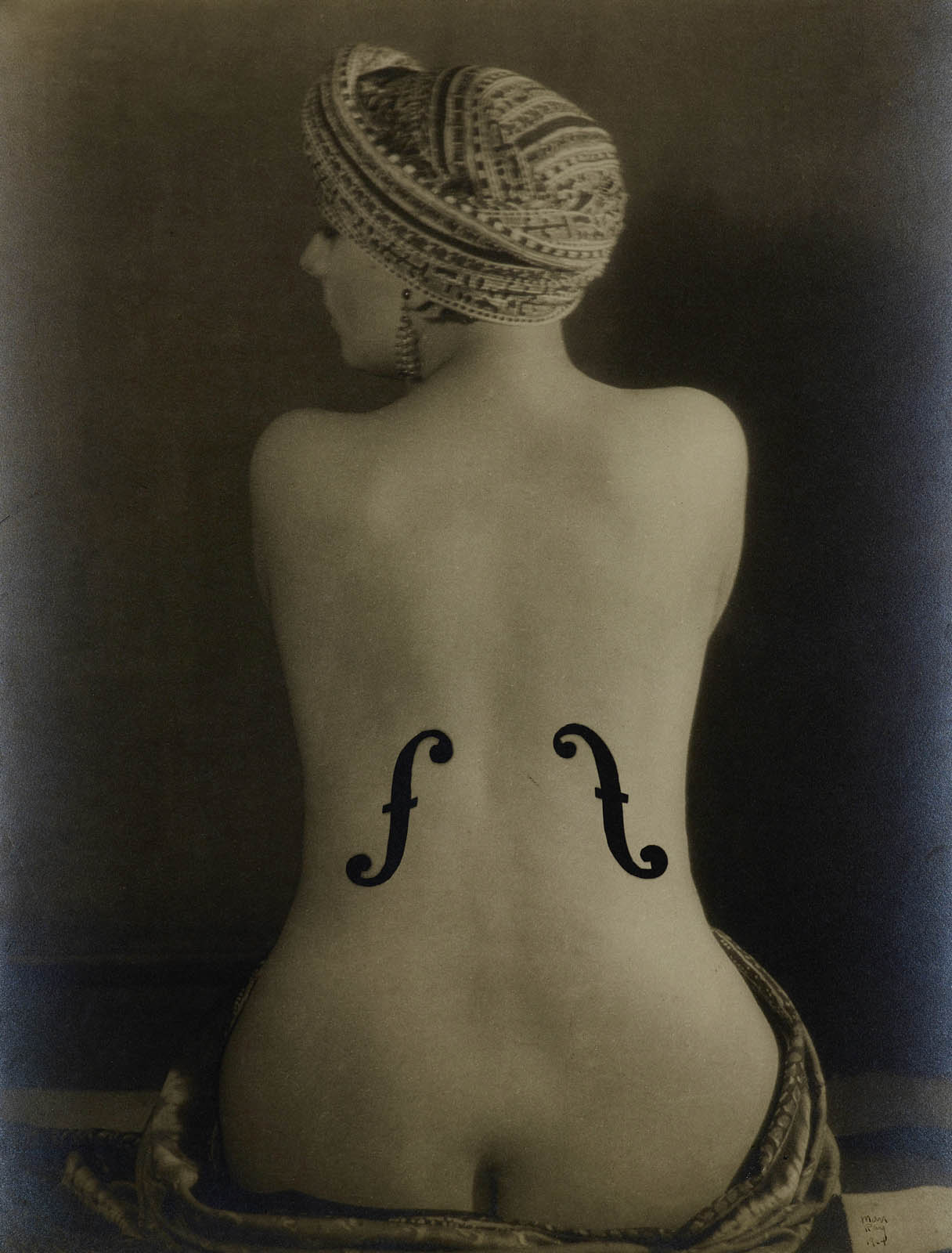
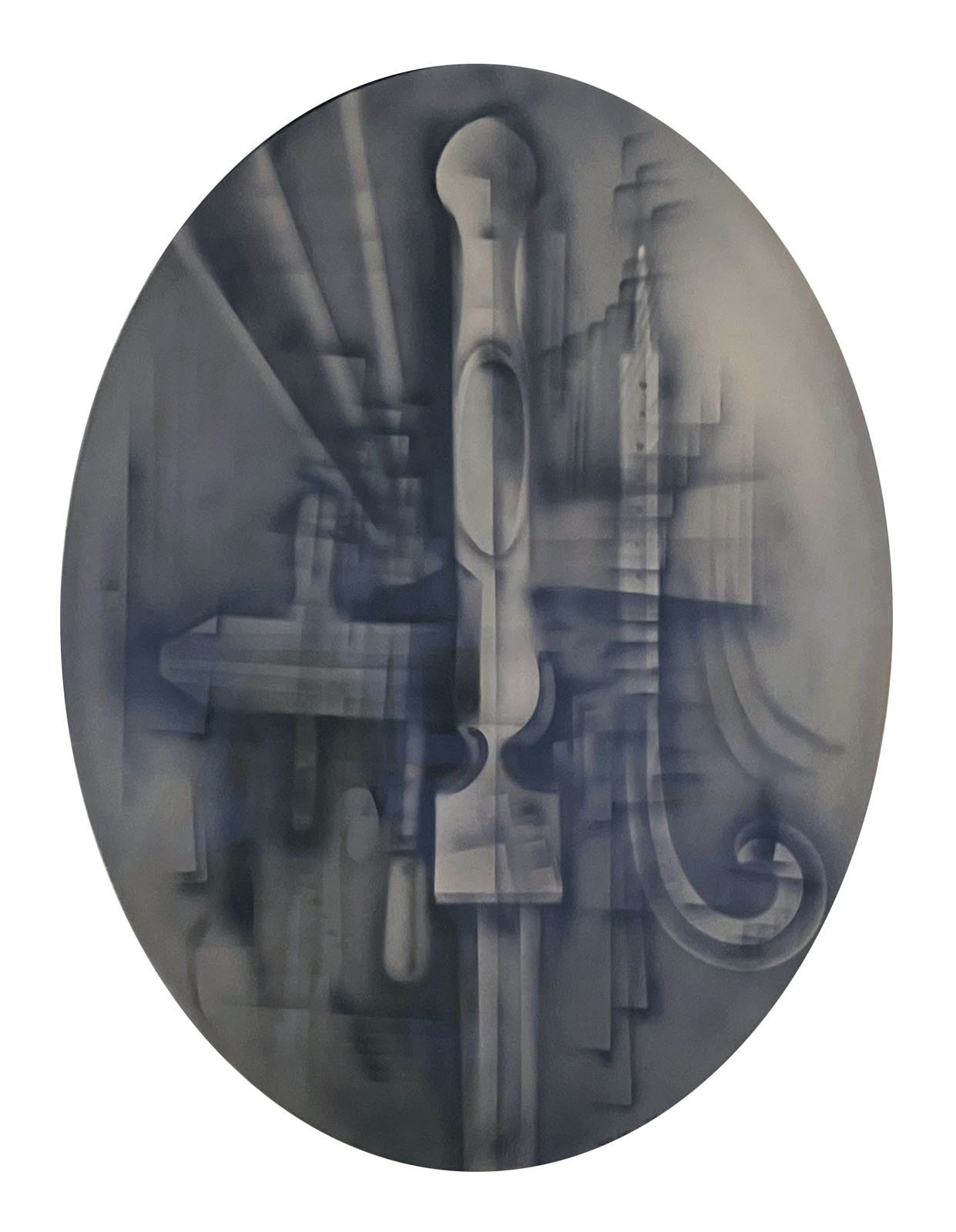
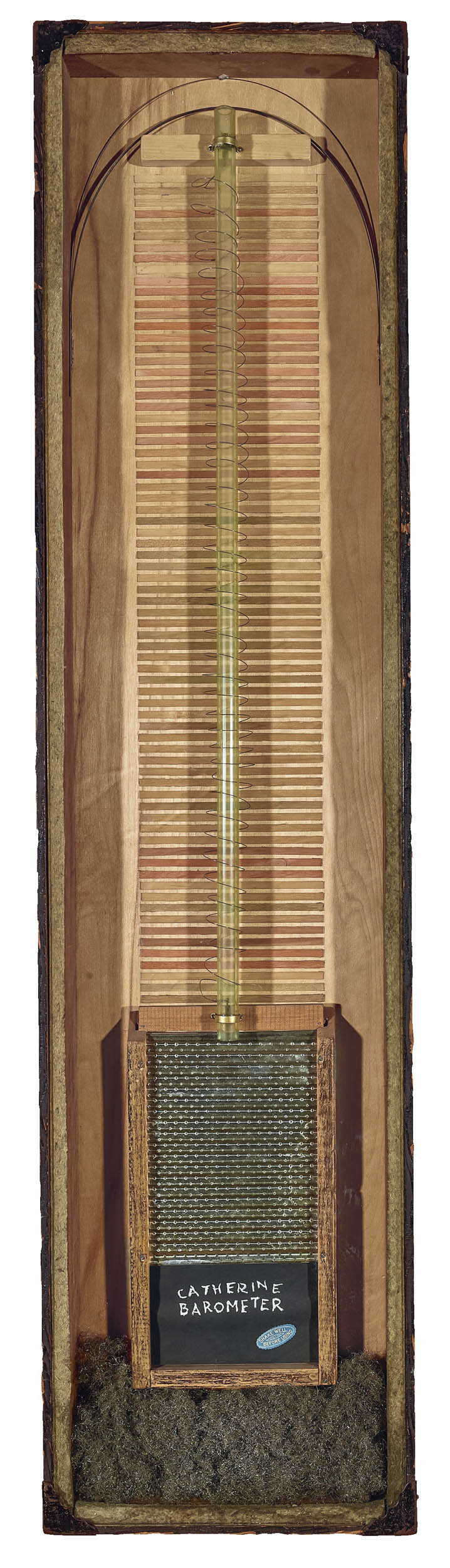
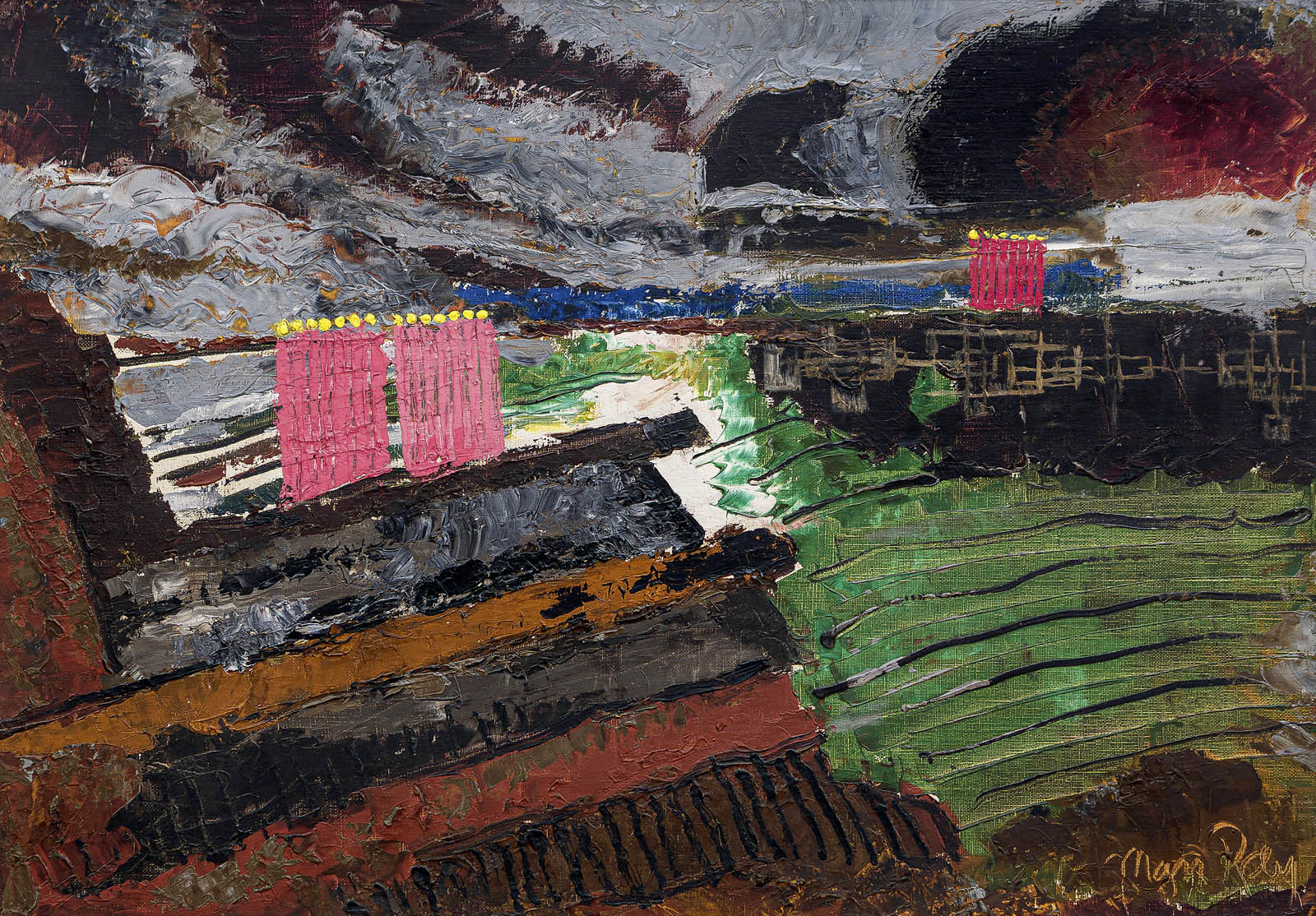
Highlights include such iconic objects like Man Ray’s iron studded with tacks, known as Cadeau (Gift) (1921), and his metronome, Object to be Destroyed (1923), that keeps time with the swinging eye of his companion, the photographer Lee Miller. Celebrated photographs, including his landmark Le violon d’Ingres (1924), in which the torso of the artist and performer Kiki de Montparnasse (Alice Prin) is depicted as a musical instrument, are also featured. The exhibition brings together some of his boldest but most refined experimental works – compositions like Aerograph (1919), a painting made with an airbrush and pigment sprayed through and around items from his studio. For Man Ray, objects could function as metaphors for the body, as demonstrated in works such as Catherine Barometer (1920) and L’homme (Man). Rarely seen paintings in the exhibition, including Paysage suédois (Swedish Landscape) (1926) record the artist’s great experimentation, working paint without a brush and in an almost sculptural way, building up and scraping down the surface that reflects his experiments in the darkroom.

Man Ray: When Objects Dream is curated by Stephanie D’Alessandro, Leonard A. Lauder Curator of Modern Art and Senior Research Coordinator in Modern and Contemporary Art at The Met, and Stephen C. Pinson, Curator in the Department of Photographs at The Met, with the assistance of Micayla Bransfield, Research Associate, Modern and Contemporary Art.

Press release from The Metropolitan Museum of Art


Man Ray (American, 1890-1976) 'La Femme (Woman)' c. 1918-1920


Man Ray (American, 1890-1976) 
La Femme (Woman)
c. 1918-1920
Gelatin silver print
43.7 x 33.5cm (17 3/16 x 13 3/16in.)
Gilman Collection, Gift of The Howard Gilman Foundation, 2005
© 2016 Man Ray Trust/Artists Rights Society (ARS), New York/ADAGP, Paris


Man Ray (American, 1890-1976) 'L'homme (Man)' 1918-1920


Man Ray (American, 1890-1976) 
L’homme (Man
1918-1920 
Gelatin silver print 
19 × 14 1/2 in. (48.3 × 36.8cm) 
The Metropolitan Museum of Art, New York, Bluff Collection, Promised Gift of John A. Pritzker
© Man Ray 2015 Trust / Artists Rights Society (ARS), NY / ADAGP, Paris 2025
Photo credit: Courtesy of The Bluff Collection, photo by Ben Blackwell


Man Ray (American, 1890-1976) 
'Élevage de poussière (Dust Breeding)' 1920


Man Ray (American, 1890-1976) 
Élevage de poussière (Dust Breeding)
1920
Gelatin silver print
2 13/16 × 4 5/16 in. (7.1 × 11 cm)
Private collection
© Man Ray 2015 Trust / Artists Rights Society (ARS), NY / ADAGP, Paris 2025


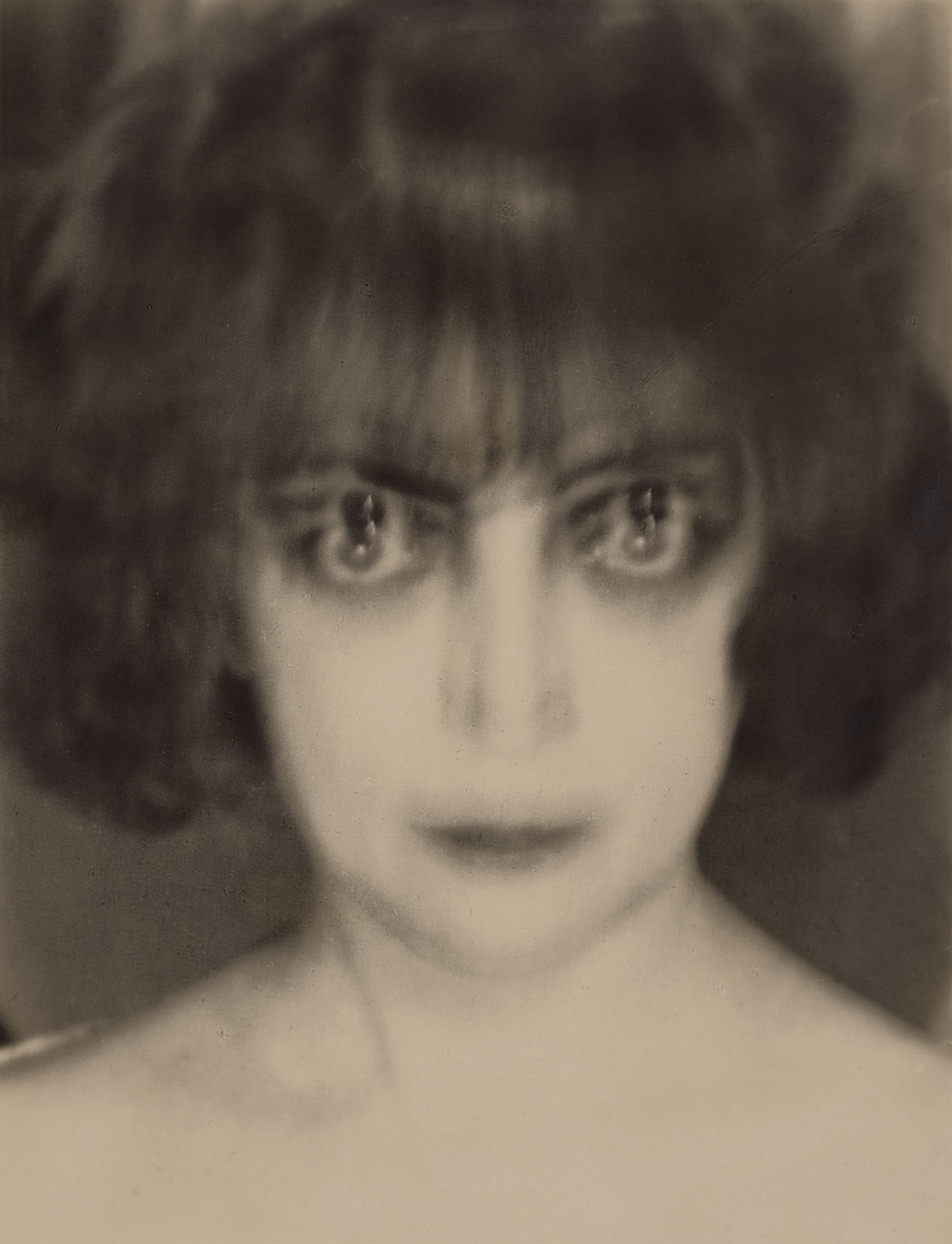
Man Ray (American, 1890-1976) 'Marchesa Luisa Casati' 1922


Man Ray (American, 1890-1976) 
Marchesa Luisa Casati 
1922 
Gelatin silver print 
8 1/2 × 6 9/16 in. (21.6 × 16.7 cm) 
Philadelphia Museum of Art: Gift of Carl Van Vechten
© Man Ray 2015 Trust / Artists Rights Society (ARS), NY / ADAGP, Paris 2025
Photo courtesy of the Philadelphia Museum of Art


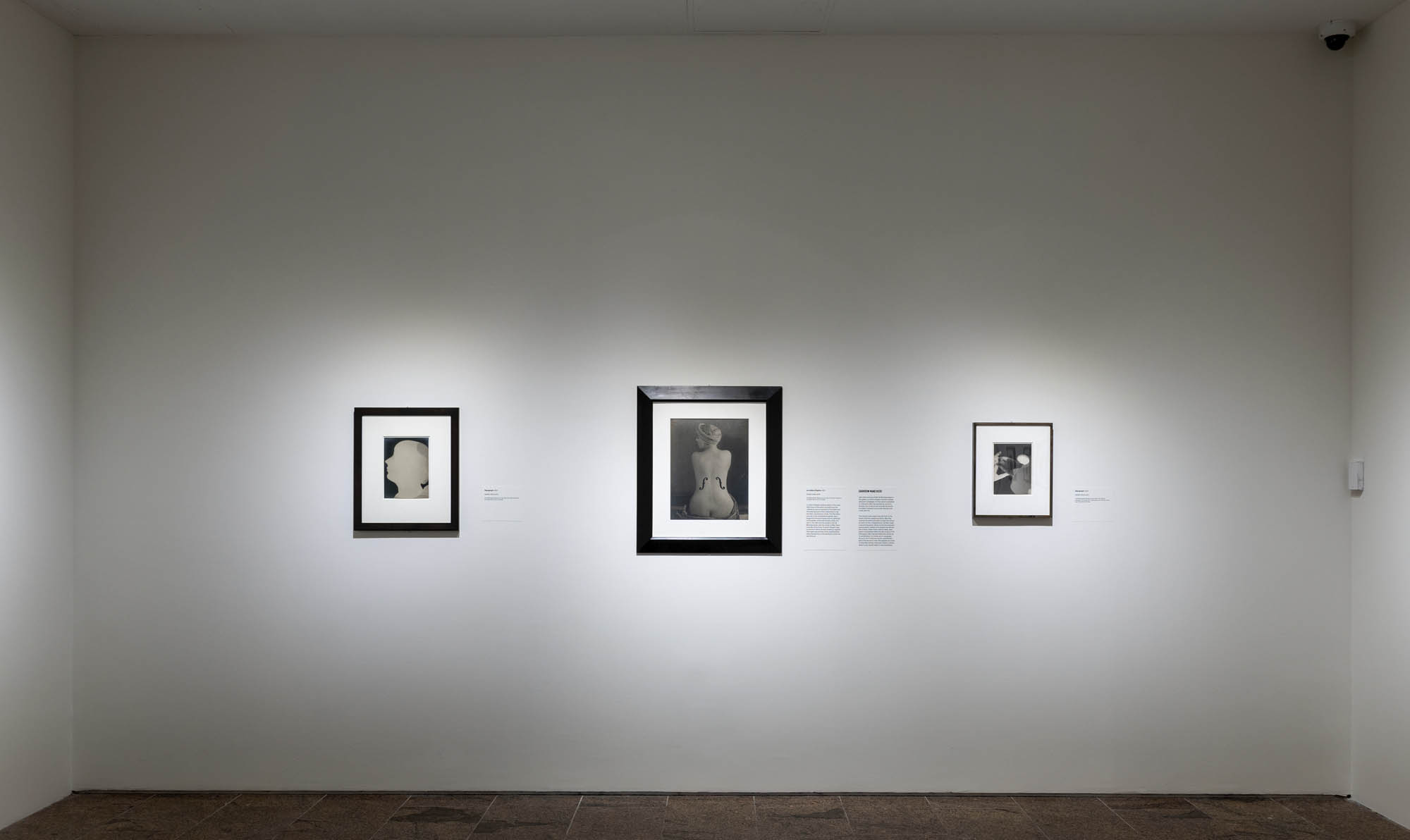
Installation view of the exhibition 'Man Ray: When Objects Dream' at The Metropolitan Museum of Art, New York, September 2025 - February 2026 showing at centre, Man Ray's photograph 'Le violon d'Ingres' 1924


Installation view of the exhibition Man Ray: When Objects Dream at The Metropolitan Museum of Art, New York, September 2025 – February 2026 showing at centre, Man Ray’s photograph Le violon d’Ingres 1924 (below)


Man Ray (American, 1890-1976) 'Le violon d’Ingres' 1924


Man Ray (American, 1890-1976) 
Le violon d’Ingres
1924 
Gelatin silver print 
19 1/8 × 14 3/4 in. (48.5 × 37.5cm)
The Metropolitan Museum of Art, New York, Bluff Collection, Promised Gift of John A. Pritzker
© Man Ray 2015 Trust / Artists Rights Society (ARS), NY / ADAGP, Paris 2025
Photo by Ian Reeves


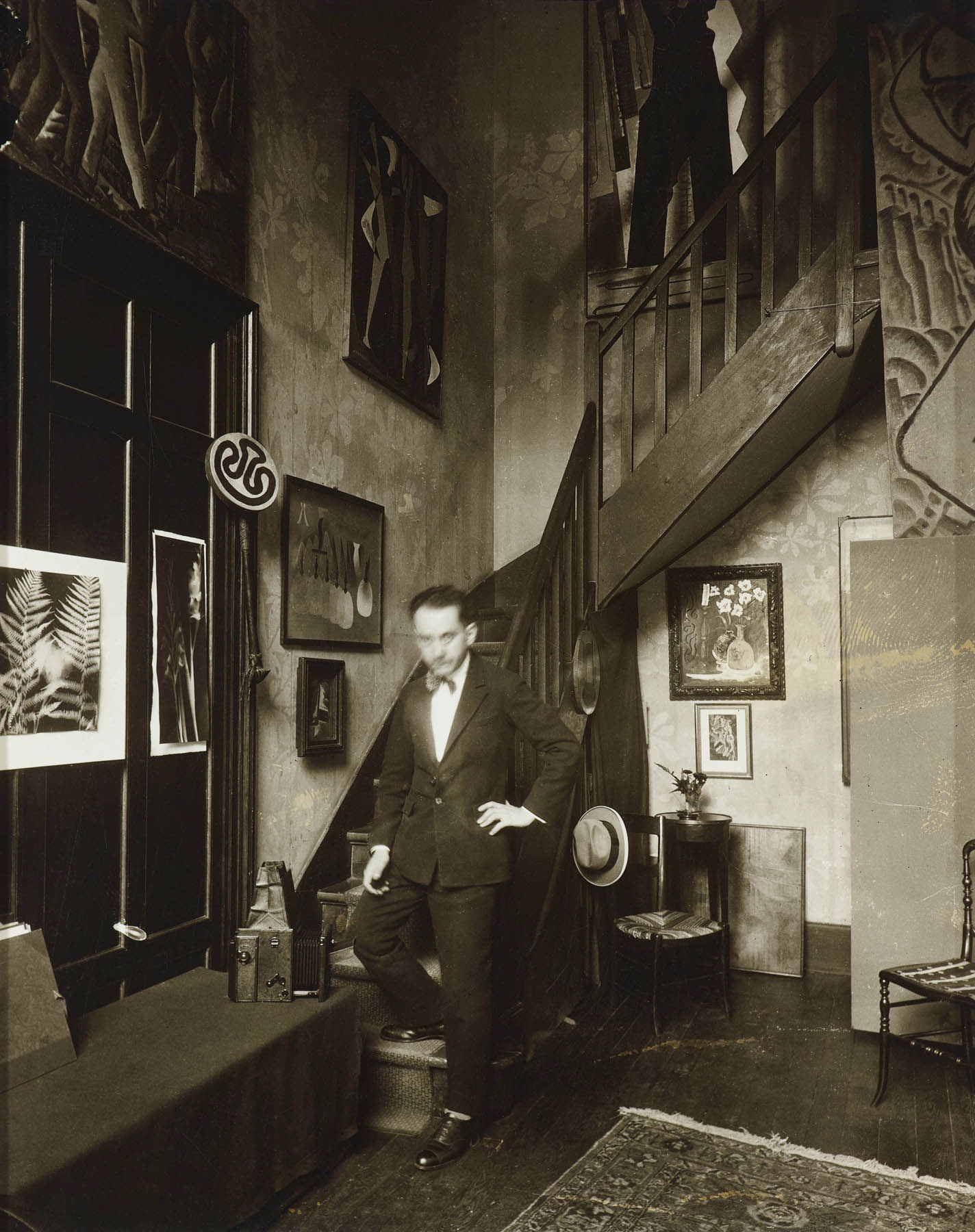
Man Ray (American, 1890-1976) 'Self-Portrait in 31 bis rue Campagne-Premiere Studio' 1925


Man Ray (American, 1890-1976) 
Self-Portrait in 31 bis rue Campagne-Première Studio
1925 
Gelatin silver print 
6 1/8 × 4 1/2 in. (15.6 × 11.4cm) 
The Metropolitan Museum of Art, New York, Bluff Collection, Promised Gift of John A. Pritzker
© Man Ray 2015 Trust / Artists Rights Society (ARS), NY / ADAGP, Paris 2025
Photo by Ian Reeves


Man Ray (American, 1890-1976) 'Noire et blanche' 1926


Man Ray (American, 1890-1976)
Noire et blanche
1926
Gelatin silver print
8 1/16 x 11 11/16 in. (20.5 x 29.7cm)
Private collection
© Man Ray 2015 Trust / Artists Rights Society (ARS), NY / ADAGP, Paris 2025


Man Ray (American, 1890-1976) 'Primat de la matière sur la pensée' (Primacy of Matter over Thought) 1929


Man Ray (American, 1890-1976)
Primat de la matière sur la pensée (Primacy of Matter over Thought)
1929
Gelatin silver print
10 1/2 x 14 7/8 in. (26.7 x 37.8cm)
Private collection, San Francisco
© Man Ray 2015 Trust / Artists Rights Society (ARS), NY / ADAGP, Paris 2025


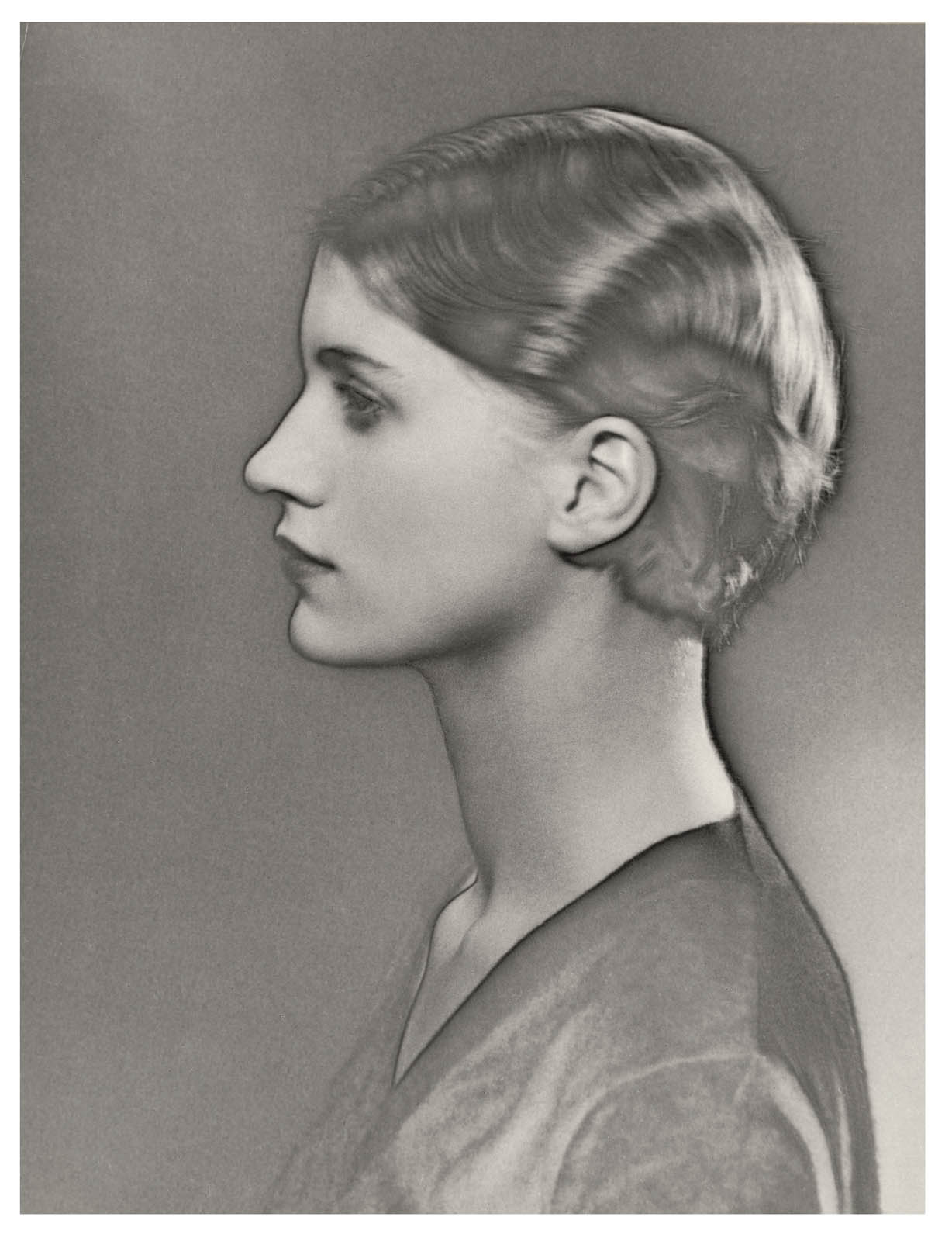
Man Ray (American, 1890-1976) 'Lee Miller' 1929


Man Ray (American, 1890–1976) 
Lee Miller 
1929 
Gelatin silver print 
10 1/2 × 8 1/8 in. (26.7 × 20.6cm) 
The Museum of Modern Art, New York, Gift of James Thrall Soby 
© Man Ray 2015 Trust / Artists Rights Society (ARS), NY / ADAGP, Paris 2025


Man Ray (American, 1890-1976) 'Self-Portrait with Camera' 1930


Man Ray (American, 1890-1976)
Self-Portrait with Camera
1930
Gelatin silver print
4 3/4 x 3 1/2 in. (12.1 x 8.9cm)
The Jewish Museum, New York
Purchase: Photography Acquisitions Committee Fund, Horace W. Goldsmith Fund, and Gift of Judith and Jack Stern
© Man Ray 2015 Trust / Artists Rights Society (ARS), NY / ADAGP, Paris 2025


Man Ray (American, 1890-1976) 'Mary Gill' 1930


Man Ray (American, 1890-1976)
Mary Gill
1930
Gelatin silver print
11 1/2 x 8 1/2 in. (29.2 x 21.6cm)
Harvard Art Museums/Fogg Museum, Robert M. Sedgwick II Fund
© Man Ray 2015 Trust / Artists Rights Society (ARS), NY / ADAGP, Paris 2025


Man Ray (American, 1890-1976)
'Untitled (Glass Tears)' c. 1930-1933, printed 1935 or later


Man Ray (American, 1890-1976)
Untitled (Glass Tears)
c. 1930-1933, printed 1935 or later
Gelatin silver print
8 7/8 x 11 1/4 in. (22.5 x 28.6cm)
Private collection
© Man Ray 2015 Trust / Artists Rights Society (ARS), NY / ADAGP, Paris 2025


Man Ray: When Objects Dream

American artist Man Ray (1890-1976) was a visionary known for his radical experimentation that pushed the limits of art. His most iconic works – an iron studded with sharp tacks, a woman’s back reimagined as a violin – combine this boundary-breaking attitude with a singular belief in the transformative potential of everyday things. 

In the 1920s, the most significant of Man Ray’s investigations – and the thing that connected much of his work – was what he called the rayograph, a new twist on an old technique for making photographs without a camera. By placing objects on or near a sheet of sensitised paper, which he then exposed to light and developed, he turned recognisable subjects into wonderfully mysterious compositions. This radical art form, inextricably linked to the era’s Dada and Surrealist movements, grew out of his early work in New York and redefined his groundbreaking career in Paris.

Introduction

This exhibition’s subtitle, When Objects Dream, comes from a phrase by Tristan Tzara, a poet, artist, and early champion of Man Ray. Witness to some of the earliest rayographs, Tzara understood perhaps better than anyone else their physical and metaphorical link to objects reimagined through art. In a similar spirit, the current presentation reconsiders the role of the rayograph within Man Ray’s practice, especially its ability to extend his ideas across diverse media. The loosely chronological installation unfolds across a series of interconnected galleries organized around ideas that motivated the artist; to that end, visitors are invited to explore it in any number of ways.

All works in the exhibition are by Man Ray (American, 1890-1976).

Champs délicieux

In April 1922, readers of a French literary journal discovered a curious announcement for an album titled Champs délicieux (Delicious Fields). Its twelve “original photographs” by Man Ray feature objects from his studio – tongs, a comb, string, a hotel room key – composed in groupings. The images are ordered without clear logic or narrative. Instead, as advertised, they mark a “state of mind,” the artist’s free play, alone at night and without work obligations, in his studio darkroom. 

Man Ray introduced Champs délicieux in the period between two revolutionary movements that arose in the wake of World War I: Dada and Surrealism. Both challenged conventional art and society by upending traditional subjects, techniques, and expectations. Inspired in part by a collection of unconsciously driven, automatic writings by poets André Breton and Philippe Soupault, Man Ray sought to render everyday objects unfamiliar. As early subscriptions attest, the album found an enthusiastic audience who appreciated the language of the rayograph and its ability to open up a new visual world.

A New Art

Before Man Ray first picked up a camera in 1915, he was focused on painting. He set out to stake his claim in the exhilarating avant-garde scene, his interest fueled by cutting-edge exhibitions at Alfred Stieglitz’s gallery, 291, and thrilling examples of Cubism, Expressionism, Fauvism, and Futurism at the modern art presentation known as The Armory Show in 1913. Unexpectedly, photography offered Man Ray a path forward. Noting the way a camera lens could compress and flatten space, he determined to endow art with a similar “concentration of life” while simultaneously freeing it from the burden of illusionism. “The creative force and the expressiveness of painting,” he wrote at the time, “reside materially in the colour and texture of pigment, in the possibilities of form invention and organisation, and in the flat plane on which these elements are brought to play.” He made paintings using palette knives and other tools instead of brushes and employed patterns, cutouts, and collage to create a self-proclaimed “new art of two dimensions.”

Objects At Hand

NOT RESPONSIBLE FOR GOODS LEFT OVER THIRTY DAYS. So reads a sign in a photo, displayed nearby, of Man Ray’s West Eighth Street studio in New York. It was one of several items the artist discovered in the trash heap at his apartment building and brought up to his top-floor space. He considered retooling the sign to read LEFT OVER GOODS NOT RESPONSIBLE FOR THIRTY DAYS but decided it was perfect as is. This act – of elevating junk to art – is a familiar one in histories of the avant-garde, especially for the Dada movement. Art did not have to be painted or modelled or made with traditional materials and tools; it could be found in the everyday world and appreciated for the idea that it introduced, not for its beauty. 

As Man Ray developed his “new art,” he came to see the latent potential of all the objects within his studio. This spurred further investigations that likewise tested the limits of two and three dimensions and blurred the boundaries between media. At the same time, he continued to explore how the camera could be used not only to document his work but to open new perspectives onto ordinary objects and their creative possibilities.

Clichés-verre

While the rayograph is often described as Man Ray’s first experiment with cameraless photography, that moment occurred years earlier. Around 1917 he explored several photographically based techniques, including the cliché-verre, or “glass-plate” print. A nineteenth-century reproductive process that incorporates both photography and printmaking, a cliché-verre is traditionally made by covering a plate of glass with a darkened medium and drawing into it to produce clear lines. When set onto sensitised paper and exposed to a light source, the plate transmits the scratched away areas as dark lines. Man Ray chose to incise directly into the emulsion of an exposed photographic plate, which he then subjected to light again with paper below it to make a contact print. 

Photography

Man Ray first picked up a camera in 1915, to document his art. Through this experience, he discovered that the works acquired new qualities when reproduced in black and white. He made photographic portraits, too, which in Paris would become a dependable source of income. Revelling in the camera’s transformative optical abilities, Man Ray soon used it as a tool to facilitate his self-appointed role as a “marvellous explorer of those aspects that our retinas will never record.” He sought to reveal the creative potential of objects in his studio and in 1918 began a series of photographs using specifically arranged everyday items.

Aerographs

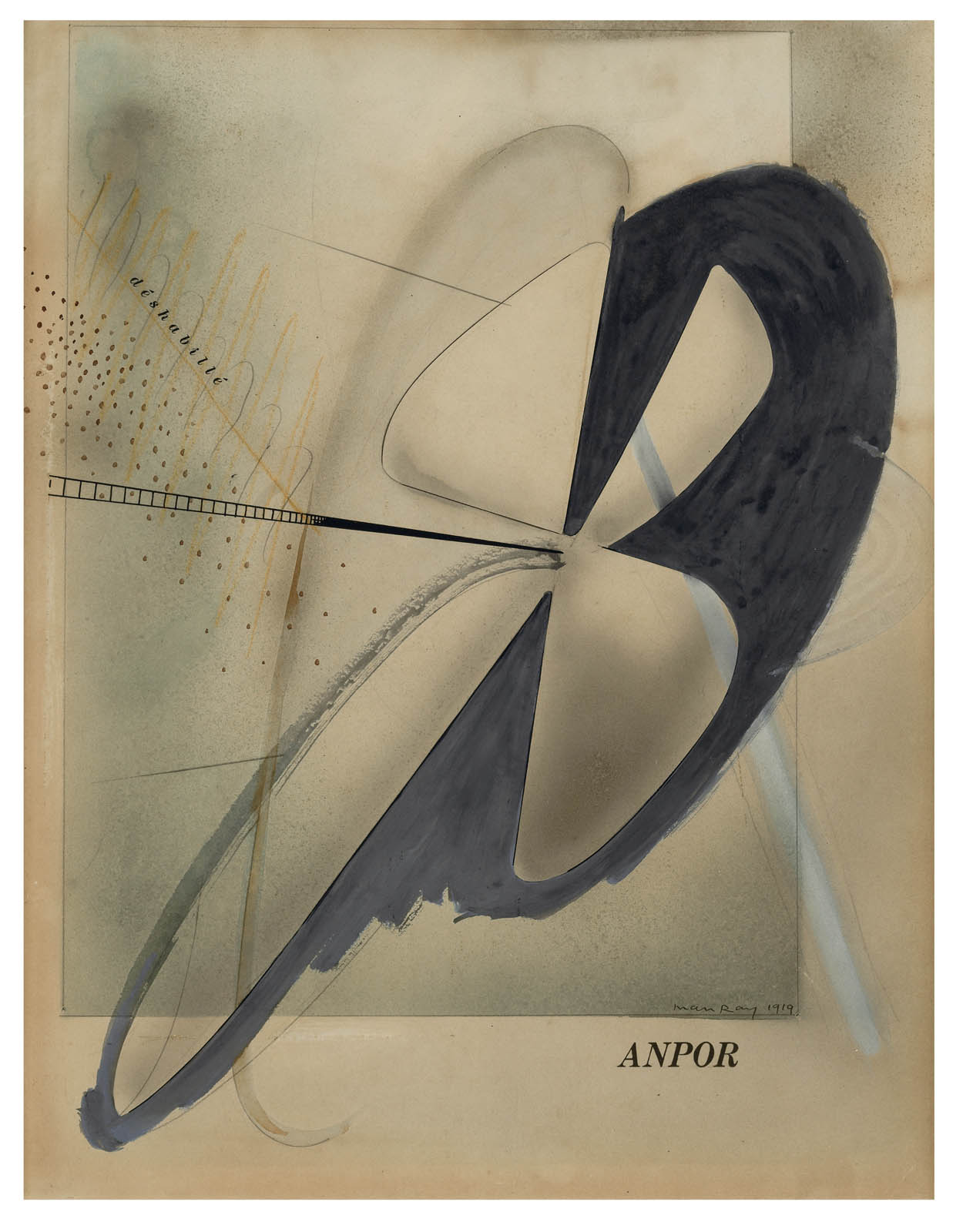
Still grappling with how to paint without a brush, Man Ray found inspiration at his day job working for an advertising agency, where he was introduced to an airbrush. He later brought the equipment back to his attic studio and began to experiment. Using an air compressor, the artist directed pigment through stencils and around masked areas and objects, which he rested on the composition board and repositioned as he worked. “It was thrilling,” he would later recount, “to paint a picture, hardly touching the surface – a purely cerebral act.” These works, which he termed “aerographs” were made, in effect, before they hit the paper. Objects were carved, shaped, and modeled in the air. Voids register as substance, and what we see on the paper is residue fused to the surface. “I tried above all,” Man Ray explained, “to create three-dimensional paintings on two-dimensional surfaces.”

Flou

Man Ray introduced his rayographs during a transitional period between the Dada and Surrealism movements that the French writer Louis Aragon called the mouvement flou – flou translating to “blurry” or “out of focus.” The term also suits these works, which viewers initially deemed curious and captivating but difficult to pin down. Rayographs, as cameraless photographs, exist in an indistinct place between photography and painting, the mechanical and the handmade, documentation and dream. 

During the 1920s Man Ray also explored blurriness in his camera images. Even as technical improvements facilitated increased focus and detail, and the preference for sharp photographs grew, he generally pursued a flattering, soft-focus technique in his growing business of portrait commissions. At other times, he sought more radical effects, which the director Claude Heymann described as “strange, troubling blurs” produced “through distortions, prolonged poses or special focusing techniques.” The anomalies in the resulting photographs are visible signs of the effort and time Man Ray spent to realise the images – even if he later called them unplanned or accidental.

A New Field of Gravity

In his preface introducing the album Champs délicieux (Delicious Fields), Tristan Tzara remarked that rayographs “present to space an image that exceeds it, and the air, with its clenched fists and superior intelligence, seizes it and holds it next to its heart.” Indeed, objects in Man Ray’s images beckon us in but keep us thrillingly at the edge – or put another way, they test our senses of proximity and location. His experiments in New York expanded the bounds of the photograph, object, painting, and installation, and he developed a novel relationship between object and viewer. These works demonstrate in their construction what the French writer Georges Ribemont-Dessaignes would identify in the artist’s rayographs as a “new field of gravity.”

The rayograph

The term rayograph designates Man Ray’s version of a technique for making photographs without a camera: by setting objects on or near sensitised paper and exposing it to light. In his autobiography, the artist described happening upon the process by chance, late one night, while developing prints in his makeshift darkroom. For subjects, he looked no further than the things in his studio. When exposed to a directed flash of light, they appear as reversed silhouettes – but in Man Ray’s hands they also gained new life. The nature of the image depended on the items’ translucency, reflectivity, density, placement, and distance from the sheet, as well as the source and location of the illumination and the number of exposures. Surfaces could cast unexpected reflections or eclipse elements in darkness. Forms might multiply or transform. Sometimes Man Ray’s objects and the space between them acquired an insistent, compressed volume that registered on the paper. The resulting works present what writer Pierre Migennes described as a “metamorphosis of the most vulgar utensils.” Everyday things became wonderfully unfamiliar as Man Ray wielded light in the darkroom like a brush in paint.

As he prepared to launch his rayographs in Champs délicieux, Man Ray also considered how to disseminate them for reproduction in magazines. On November 1, 1922, he wrote to Harold Loeb, editor of Broom: “Each print is an original, no plate or duplicate exists, as the process is manipulated directly on the paper, like a drawing. If you could assure me that the … originals would be safely handled and returned, I shall gladly send them on [to Berlin]. If, however, you cannot guarantee their safe return, I can re-photograph them … which, while not having the intensity and contrast of the originals, would nevertheless reproduce well.” Loeb offered to transport them personally and published these four in Broom the following March.

Man Ray transformed and energised ordinary objects in his rayographs by tapping their powers of translucency or reflectance. Bodies and their proxies, however, remain stubbornly recognisable. Hands reach out, hold things, and interact with objects; heads turn to kiss and drink, even if the action might be staged. The artist’s rayographs tie the body to a kind of specificity that his objects do not experience; this might explain why there are fewer of these works with bodies than without. As Tristan Tzara explained in his appreciation of the rayographs in 1934, Man Ray approached objects in a manner that allowed them to be free “to dream.”

Dangerous Games

Reactions to Man Ray’s cameraless photographs consistently identified them with the realm of play. The first to comment on the rayograph was French poet Jean Cocteau, who wrote in an open letter, “You, my dear Man Ray, will nourish our minds with those dangerous games it craves.” He was soon joined by Tristan Tzara, who likened the rayograph to a “game of chess with the sun.” 

Man Ray had a strong sense of the game as a strategy for producing art. For him, play was a state of readiness to engage. This comes through in the provocative humour of his objects and collages and in the invitation to chance embedded in the rayograph process – the “discovery” of which, he recounted, entailed real amusement. Marcel Duchamp once playfully defined his friend as synonymous with the joy of the game: “MAN RAY, n.m. synon. de joie, jouer, jouir” (joy, to play, to enjoy).

Chemical Paintings

In April 1922, the same month that the Champs délicieux album was announced, Man Ray proudly reported to friends and patrons that he had freed himself “from the sticky medium of paint.” His rayographs claimed a rebellious position aimed at the traditional hierarchy of fine art – and particularly its apex, painting. Critics asserted they had equal status, and New York’s Little Review even called them “chemical paintings.”

Just a year later, however, while his rayograph production remained steady, Man Ray quietly returned to painting. The works here show how his practice had changed. Abstract and relatively small, they were made on commercially available boards, wood, sandpaper, or metal supports. With their overlapping pictorial elements and dramatic contrasts of luminosity and shadow, angled and geometric forms, the compositions emulate aspects of rayographs. Each is a thorough exploration of depth on a flat surface and a bid to make paint reflect its own material reality.

Objects and Bodies

Man Ray’s experience of making rayographs informed his consideration of the human body, which he handled, at times, like an object, devoid of personhood and open for manipulation. Writing about the artist’s portraits and rayographs, André Breton noted that Man Ray considered the bodies of women in his work no different from the objects at hand in his darkroom: 

The very elegant, very beautiful women who expose their tresses night and day to the fierce lights in Man Ray’s studios are certainly not aware that they are taking part in any kind of demonstration. How astonished they would be if I told them that they are participating for exactly the same reasons as a quartz gun, a bunch of keys, hoar-frost or fern!

For Man Ray, a body could function as a kind of concentrated equivalence, like the essence represented by an object. This attitude is visible in some of the most iconic works of his career, in which his presentation of female models such as the artist and performer Kiki de Montparnasse (Alice Prin) also involved darkroom manipulation. While his approach to men’s bodies was notably less sexualised, they too were posed and set up like the objects in his rayographs.

Darkroom Manoeuvres 

Like other pictures of Kiki de Montparnasse in this gallery, Le violon d’Ingres involved multiple darkroom campaigns. For the version published in Littérature, Man Ray worked on a print to sharpen the contours and smooth the forms; he added f-shaped sound holes directly onto it with dark ink. 

The version here, larger than the first, is the result of further experimentation. Man Ray covered the entire print with a mask from which he hand cut two f-shaped forms. He then made a second exposure, which turned the exposed spaces black. Instead of ink shapes that disrupt the surface, these marks read as deep, dark space compressed within the flat surface of the photograph. Man Ray described this version as “a combination of a photo and a rayograph.” As such, the f-holes are eerily – seamlessly – part of the woman’s body. She appears as a kind of dreamlike human-instrument hybrid, a whole object to be visually taken in and possessed.

Dreams

Even before the Surrealist manifesto of 1924 claimed the fertile ground of the unconscious, many poets and artists in Man Ray’s circle focused on dreams. The same group, two years earlier, had followed André Breton’s experiments with hypnosis and trance states. They practiced séances and so‑called sleeping fits, writing down or drawing what came to them in order to reveal hidden desires. The poet Louis Aragon wrote of these slumberous escapades: “Dreams, dreams, dreams, the domain of dreams expands with every step.” 

Apart from photographing the sleep sessions, Man Ray remained an independent supporter of the group, explaining, “It has never been my object to record my dreams, just the determination to realise them.” Even so, Aragon included him in his multipage inventory of dreamers, with a nod to the rayographs: “Man Ray … dreams in his own way with knife rests and salt cellars: he gives meaning to light, which now knows how to speak.” The artist found great support among the Surrealist circle in Paris, whose members acquired his work and included him in exhibitions and publications.

Dream Objects 

Man Ray’s dreamlike rayographs have counterparts in the new kinds of hybrid objects he began to make at the same time. These mysterious works seize upon unexpected transformations: a fragile soap bubble rendered solid; the taut strings on a musical instrument’s neck turned loose and sensuous; or a budding plant metamorphosed into a pudgy hand. 

The strange bundle wrapped with string has long been associated with the power of objects to stir the unconscious. In 1920 Man Ray assembled, photographed, and deconstructed the original object. The Untitled photograph appeared in the first issue of La revolution surréaliste, in 1924, with the text “Surrealism opens the door of the dream to all those for whom night is miserly.” Over the next decade, the image came to embody another phrase popular among the Paris Surrealist group, by the poet Isidore Ducasse: “as beautiful … as the chance encounter of a sewing machine and an umbrella on a dissecting table.” 

“Objects to touch, to eat, to crunch, to apply to the eye, to the skin, to press, to lick, to break, to grind, objects to lie, to flee from, to honor, things cold or hot, feminine or masculine, objects of day or night which absorb through your pores the greater part of our life. … These are the projections surprised in transparence, by the light of tenderness, of objects that dream and talk in their sleep.” (Tristan Tzara, “When Objects Dream,” 1934)

Returns

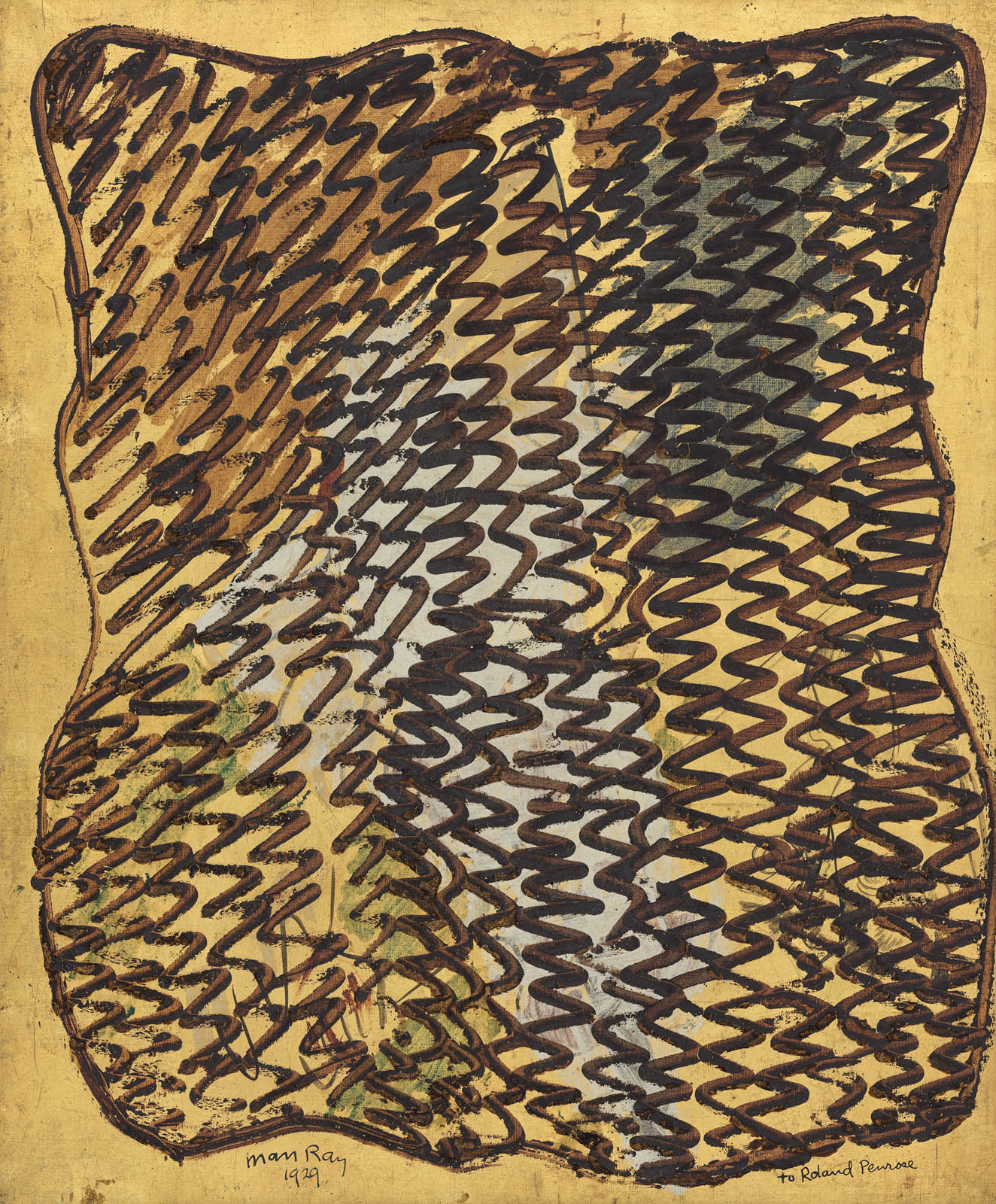
In 1929 Man Ray found himself “longing to touch paint again.” By the fall, he had taken a second Paris studio, near the Luxembourg Gardens, where he painted in the mornings before returning home to oversee photographic portraits and magazine work. In his new compositions, he let paint drip across a canvas from a poured line and squeezed pigment directly from the tube onto a support in a loose, calligraphic manner. Trading on narratives of chance and automatism, he later called these paintings “unpremeditated.” 

Another return accompanied the arrival in Paris of Lee Miller, who became Man Ray’s apprentice in photography and then his personal and professional partner. As a result, he again embraced the camera as his primary tool of photographic experimentation, after years of making rayographs without one. Together, Miller and Man Ray discovered a creative synergy that led to their joint development of the solarization process. The same year signalled the near culmination of Man Ray’s exploration of the rayograph: by some accounts, he made one hundred in 1922, but just one in 1929.

Solarization 

Together with Lee Miller, Man Ray developed a darkroom technique that complemented his return to painting. Like the rayograph, solarization was not entirely new, and both he and Miller claimed that it similarly resulted from an accident. The process involves exposing a negative a second time during development, which causes a reversal of the expected tonalities. Honed by Miller and Man Ray and applied to their portraits and nudes beginning in fall 1929, the process often endowed subjects with subtly glowing black contours that Miller called “halos.” This feature became so well-known – largely through reproductions of the solarized portrait of Miller shown nearby – that a 1932 article called it both “the beacon and despair of experimenters.” Like the drips and skeins in Man Ray’s 1929 paintings, these lines create a friction between the subject and surface of the image – a noted departure from the artist’s earlier approach to the flat plane.

Revisiting Champs délicieux 

Man Ray completed his Champs délicieux project nearly forty years after its debut. A handwritten inscription to Tristan Tzara in the final copy (number 41, displayed here) refers to the sparks set off by their initial exploration of the rayograph; he added an almost identical inscription in his 1922 working copy. This suggests a Dada game between the two artists: the announcement laid out the rules and the inscriptions signified its end. 

As promised in the 1922 first announcement of the album, the last copy features the canceled proofs (a practice meant to show that no further prints can be made from the originals). A canceled print edition is not unusual. In this case, however, a purposeful ambiguity was in play from the beginning of the project – when it was presented as an album of “original photographs” copied from unique rayographs – to the end. Only the negatives used to produce the album were canceled, meaning that the primary rayographs might still exist. Ever the prankster, Man Ray ensured that the game continues.

Text from The Metropolitan Museum of Art


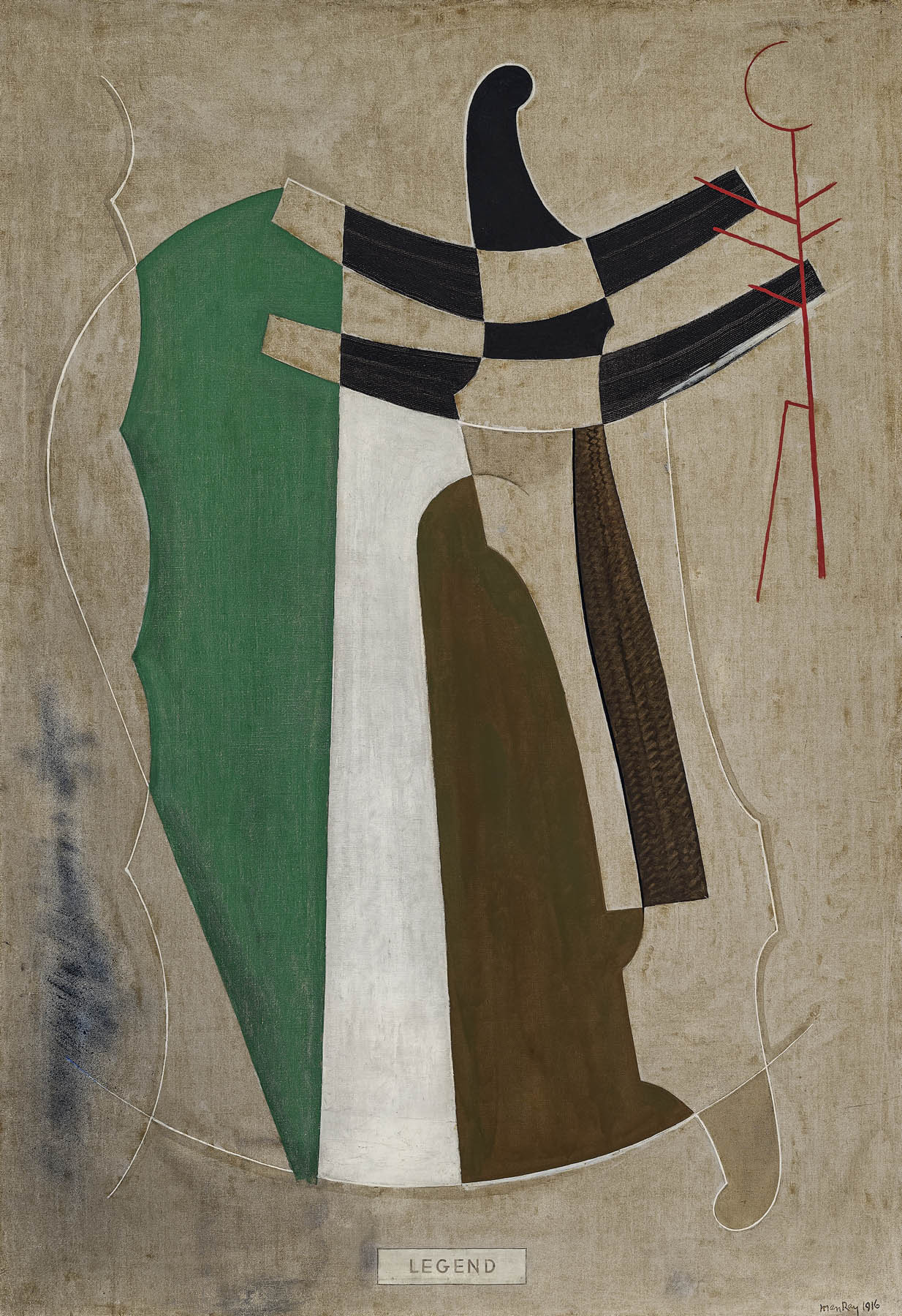
Man Ray (American, 1890-1976) 'Legend' 1916


Man Ray (American, 1890-1976) 
Legend 
1916 
Oil on canvas 
52 × 36 in. (132.1 × 91.4 cm) 
Collection of Deborah and Edward Shein
© Man Ray 2015 Trust / Artists Rights Society (ARS), NY / ADAGP, Paris 2025
Photo by Stephen Petegorsky


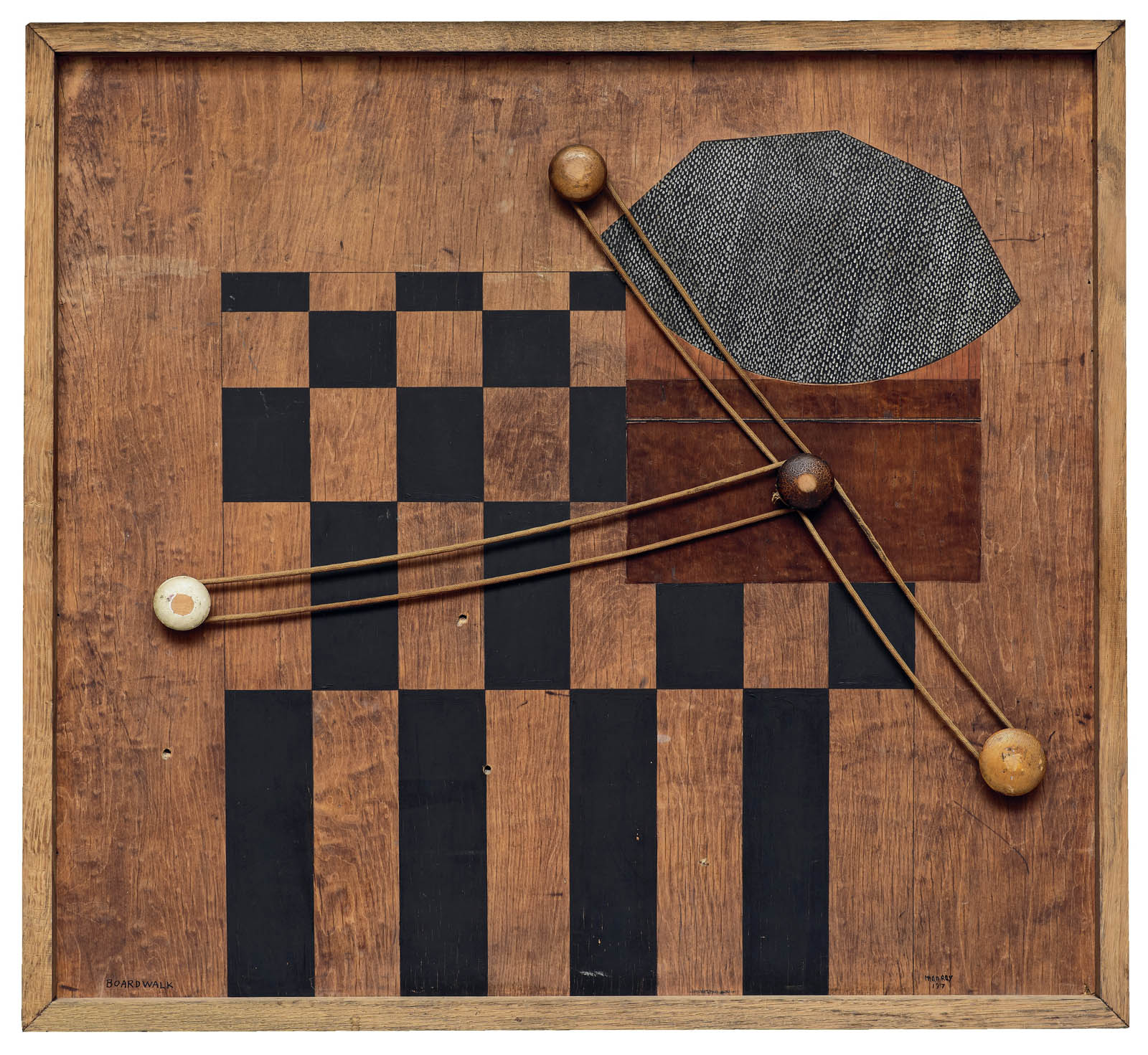
Man Ray (American, 1890-1976) 'Boardwalk' 1917


Man Ray (American, 1890-1976) 
Boardwalk 
1917 
Oil, wood handles, and yarn on wood 
26 9/16 × 29 × 15/16 in. (67.4 × 73.6 × 2.4cm) 
Staatsgalerie Stuttgart, acquired 1973 with Lotto Funds
© Man Ray 2015 Trust / Artists Rights Society (ARS), NY / ADAGP, Paris 2025


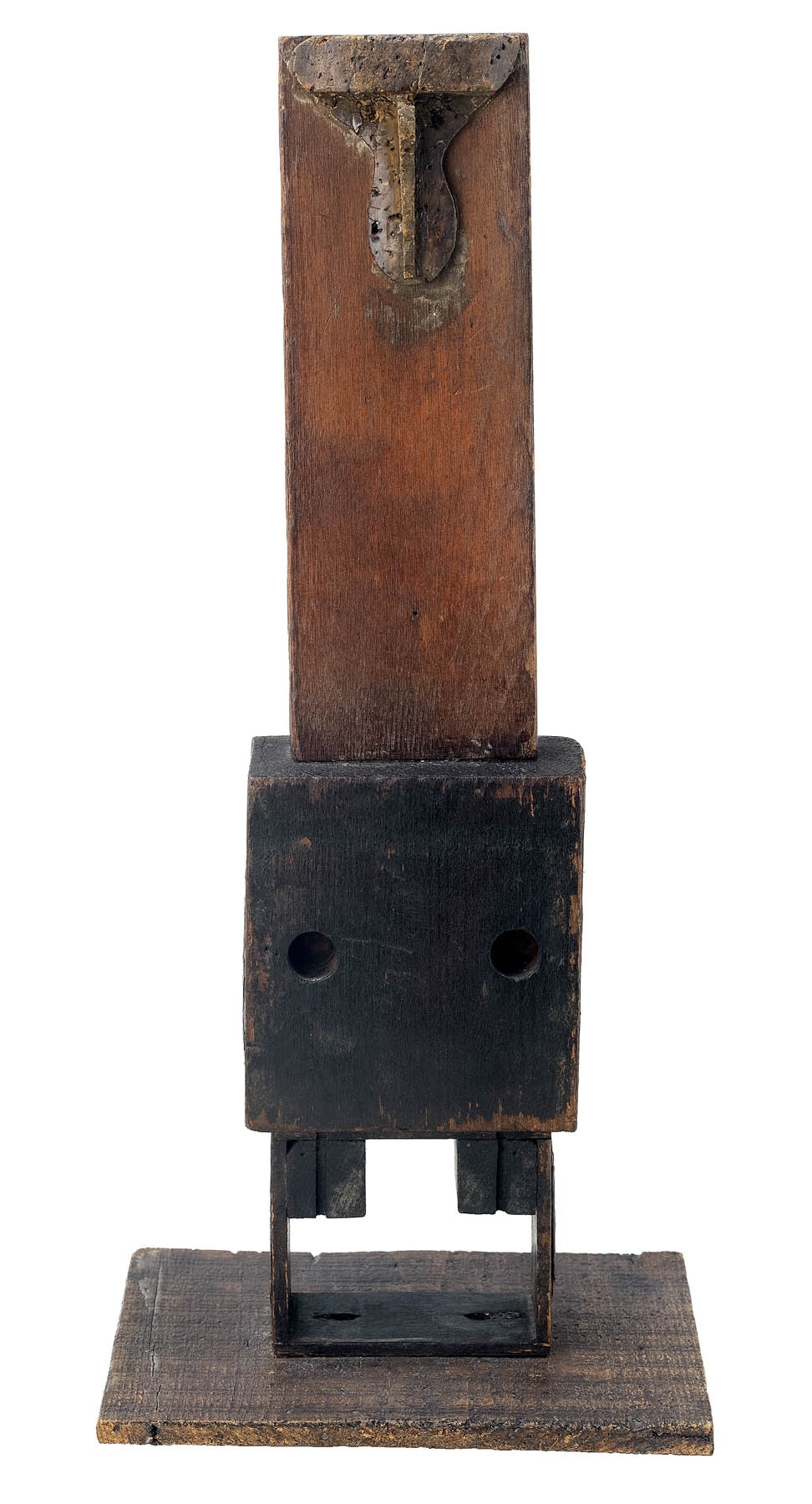
Man Ray (American, 1890-1976) 'By Itself I' 1918


Man Ray (American, 1890-1976) 
By Itself I 
1918 
Wood, iron, and cork 
17 1/4 × 7 11/16 × 7 5/16 in. (43.8 × 19.5 × 18.6cm) 
LWL–Museum für Kunst und Kultur, Münster, Germany 
© Man Ray 2015 Trust / Artists Rights Society (ARS), NY / ADAGP, Paris 2025 


Man Ray (American, 1890-1976) 'ANPOR' 1919


Man Ray (American, 1890-1976) 
ANPOR 
1919 
Gouache, ink, and colored pencils on paper 
15 1/2 × 11 1/2 in. (39.4 × 29.2cm) 
Collection of Gale and Ira Drukier
© Man Ray 2015 Trust / Artists Rights Society (ARS), NY / ADAGP, Paris 2025 
Image © The Metropolitan Museum of Art, photo by Bruce Schwarz


Man Ray (American, 1890-1976) 'Aerograph' 1919


Man Ray (American, 1890-1976)
Aerograph
1919
Gouache on paperboard
26 3/8 x 19 11/16 in. (67 x 50cm)
Staatsgalerie Stuttgart, Graphische Sammlung, acquired 1987
© Man Ray 2015 Trust / Artists Rights Society (ARS), NY / ADAGP, Paris 2025


Man Ray (American, 1890-1976) 'Catherine Barometer' 1920


Man Ray (American, 1890-1976) 
Catherine Barometer 
1920 
Glass, metal, felt, washboard, tube, wire, wood, steel wool, gouache on paper, and paper stamp 
48 1/8 × 12 × 2 1/8 in. (122.2 × 30.5 × 5.4cm) 
The Metropolitan Museum of Art, New York, Bluff Collection, Promised Gift of John A. Pritzker 
Photo courtesy of The Bluff Collection, photo by Ian Reeves


Man Ray (American, 1890-1976) 'Cadeau (Gift)' 1921 reconstructed 1970 (installation view)


Man Ray (American, 1890-1976)
Cadeau (Gift) (installation view)
1921 reconstructed 1970
Iron with brass tacks and wooden base
Overall: 19.0 x 14.9 x 14.9cm; iron & base: 17.9 x 14.9 x 14.9cm; glass cover: 19.0cm (h.)
Photo: © Marcus Bunyan

An example of this art work, not the actual one in the exhibition


Man Ray (American, 1890-1976) 'Paysage suedois' (Swedish Landscape) 1926


Man Ray (American, 1890-1976) 
Paysage suédois (Swedish Landscape
1926 
Oil on canvas 
18 × 25 1/2 in. (45.7 × 64.8 cm) 
The Mayor Gallery, London
© Man Ray 2015 Trust / Artists Rights Society (ARS), NY / ADAGP, Paris 2025
Photo courtesy of The Mayor Gallery, London


Man Ray (American, 1890-1976) 'Torso' 1929


Man Ray (American, 1890-1976) 
Torso 
1929 
Oil and gouache on gold foil paper on canvas 
18 1/16 × 14 15/16 in. (45.9 × 38 cm) 
The Penrose Collection
© Man Ray 2015 Trust / Artists Rights Society (ARS), NY / ADAGP, Paris 2025
Image © The Metropolitan Museum of Art, photo by Mark Morosse 


The Metropolitan Museum of Art
1000 Fifth Avenue at 82nd Street
New York, New York 10028-0198
Phone: 212-535-7710

Opening hours:
Thursday – Tuesday 10am – 5pm
Closed Wednesday

The Metropolitan Museum of Art website

LIKE ART BLART ON FACEBOOK

Back to top

Exhibition: ‘Richard Avedon ‘In the American West’ 1979-1984′ at the Fondation Henri Cartier-Bresson, Paris

Exhibition dates: 30th April – 12th October, 2025

Curator: Clément Chéroux, Director, Fondation Henri Cartier-Bresson


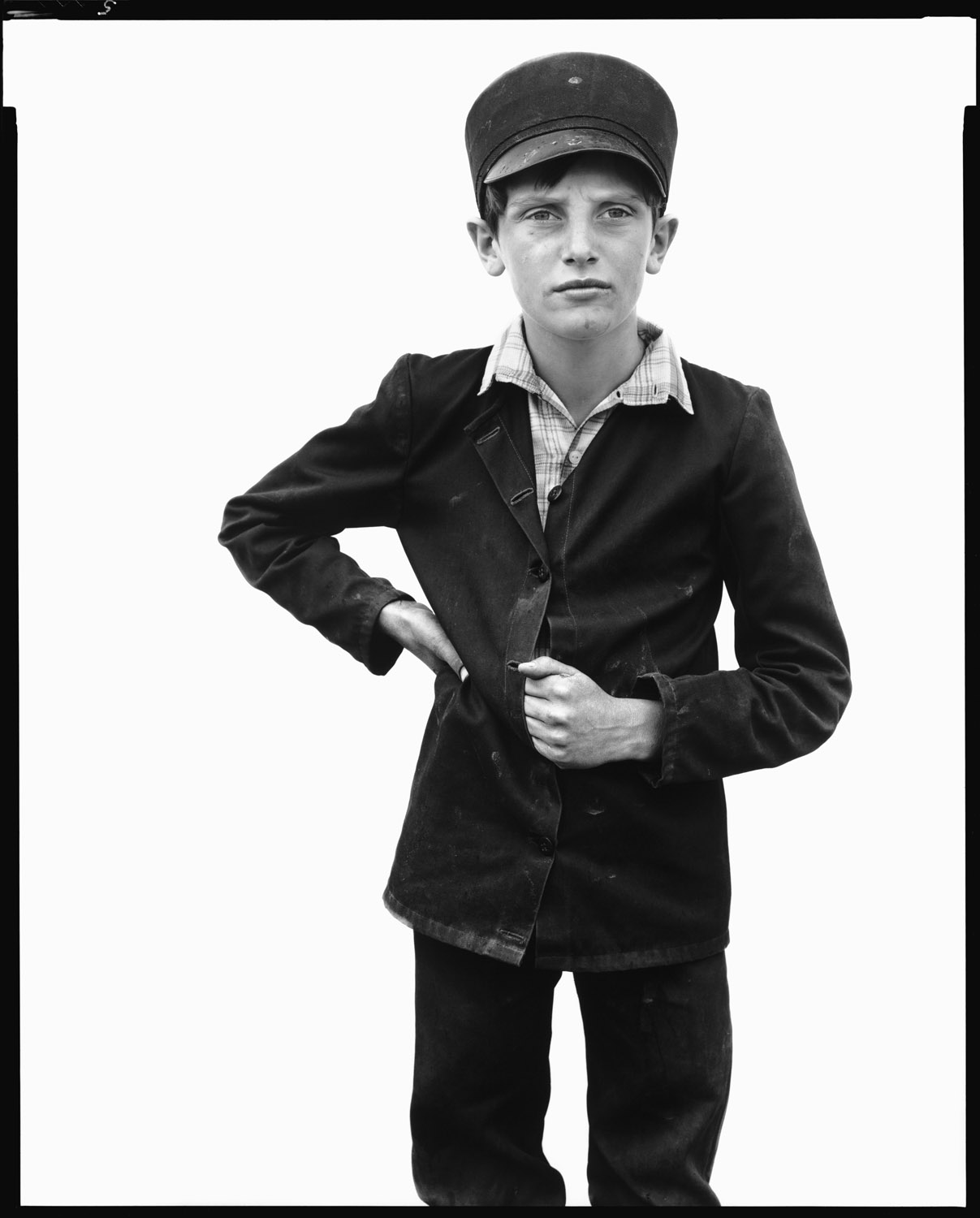
Richard Avedon (American, 1923-2004) 'Sandra Bennett, twelve year old, Rocky Ford, Colorado, August 23, 1980' 1980


Richard Avedon (American, 1923-2004)
Sandra Bennett, twelve year old, Rocky Ford, Colorado, August 23, 1980
1980
Gelatin silver print
© The Richard Avedon Foundation


Myths of the American West

This is a magnificent exhibition of the 103 photographs that form American photographer Richard Avedon’s series and subsequent book of the same name, In The American West 1984.

“Avedon spent the next six years, from 1979 to 1984, traveling to 189 towns in 17 states – Arizona, California, Colorado, Idaho, Iowa, Kansas, Montana, Nebraska, Nevada, New Mexico, North Dakota, Oklahoma, Oregon, South Dakota, Texas, Utah, and Wyoming – and even up into Canada. He conducted 752 sittings, exposing 17,000 sheets of film through his large-format view camera.”1

“For five years, Avedon photographed miners, drovers, showmen, vendors, and vagabonds, alone or in small groups, in front of his view camera against a white background that enhanced their features, postures, and expressions. He thus created a striking portrait of this region and its residents, a departure from traditional representations and glorifications of the myth of the American West.”2

Using relatively small reference prints (40 x 50cm) not originally intended for exhibition made by the photographer at the time to produce the prints for his book, the hanging of this exhibition “on the line”, “follows the book, from the first to the last image… The blank pages are represented on the wall by a gap equivalent to the width of a frame, like a half-space. We have thus reproduced the rhythm of someone leafing through the book. We can see through this that Richard Avedon and Marvin Israel (1924-1984), artistic director, have constructed the rhythm of these images in a very precise manner”3, one which follows “the dynamics of the photograph on the page, and the inter-relationships, scaling and sequencing of groups of photographs.”


Breaking with the code of social documentary photography, Avedon brings to this project all his undoubted skill as a New York fashion photographer, reassigned to the artistic sphere: clarity of purpose, simplicity of representation, aesthetic beauty, clinical detail and contextless backgrounds.

While there is a long history of the use of plain backgrounds in portrait photography dating back to the infancy of the medium, Avedon was one of the first to employ such a technique in contemporary (I’d like to say postmodern) photo-portraits, where the subject is disassociated from their location, job, culture and is posed by the director of the theatrical show.

Over the five years of the project, Avedon worked closely with his subjects, often advertising for people to be photographed, street-casting his sitters, paying them for their time and providing prints of the resultant photographs. He or one of his assistants “took a Polaroid photograph of each of the models intended to pose. Clément Chéroux (curator of the exhibition) notes that, “Comparing these polaroids with Avedon’s portraits shows his ability to transcend the appearance of his models.”4

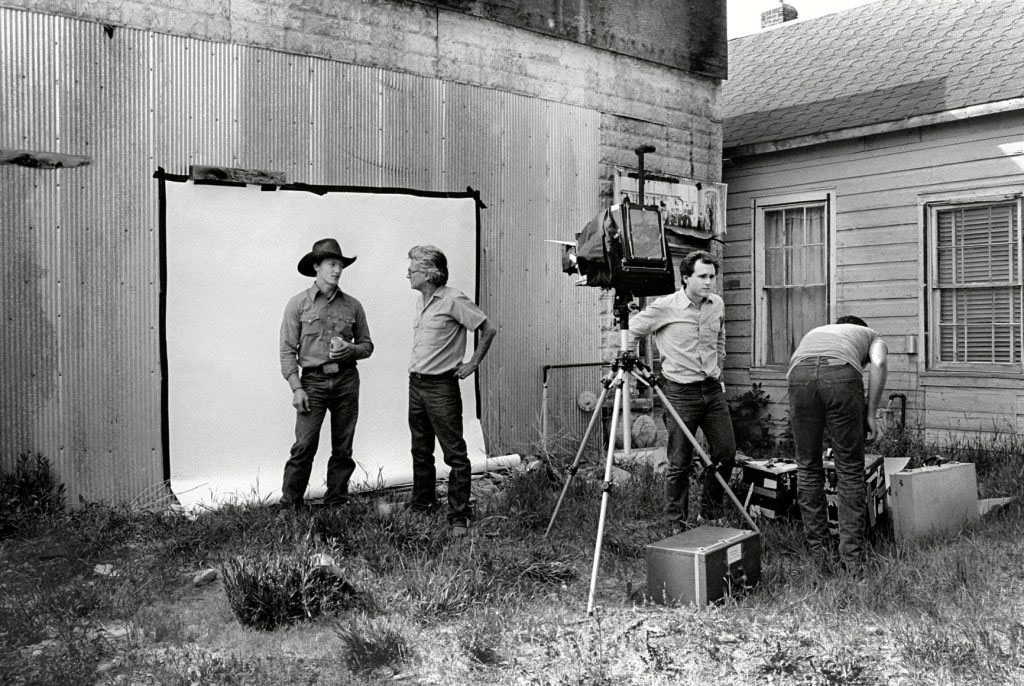
During the photographic sessions Avedon shot not from behind his camera but to the side, like the director of a play in rehearsal, front of stage. “He had a strong connection with his subjects, mimicking their position, and asking them to respond to a very small gesture by showing himself moving in one direction or another, and I think a lot of the work is in this relationship that he was establishing with the subject. Photographic literature usually focuses on the framing, the composition, but for me, this kind of interaction he was able to develop with the subject is where the work is, where he’s transforming the people that he met into a Richard Avedon photograph.”5

“A conductor of his own composition, Richard Avedon was able to weave an unparalleled fusional relationship with his models, while implacably directing them through his gaze, gestures or voice.”6

Thus, through his imagination, his direction and his creative experience Avedon conjured a subjective view of the American West every bit as much as myth as those cowboys in John Wayne movies, a kind of counter-mythology undercutting the eulogising of the American West, but a staged, fabricated, youthful, desolate, mysterious mythology none the less – a series which captures the ethos of the era (global recession, disease, dis/ease) counter to the one hoped for, “representing a sad, unsmiling America, which does not correspond to the one dreamed of.”7

Think that damned foreigner Robert Frank and his book The Americans, pointing the bone at the belly of the United States of America, holding a mirror up to their reflection8 and they certainly not liking what they saw. Indeed Avedon, while American and respectful of his subjects, could be seen as an interloper from New York exposing through his photographs the underbelly of this vast country colonised through divine providence and Manifest Destiny.

Avedon, while undercutting the myth of the American West through his storytelling, doesn’t seek to document, exploit or misrepresent his subjects, but to subjectively present them as on a theatrical set devoid of scenery – where their very appearance becomes scene / seen. As he himself said, “My concern is… the human predicament; only what I consider the human predicament may simply be my own.”

“Richard Avedon showed his own America, those we do not see, those we pass by without pausing, those who do the work, those who make America work.”9


Neither the series nor the exhibition are without fault, however.

While I believe that Avedon’s exceptional magnum opus In The American West has become one of the truly iconic photographic portrait series of the 20th century it can also be seen as problematic, not in the photographic sense, but in the sense that the photographs did not reflect the diverse reality of the West’s population. While the series may be Avedon’s subjective mythologising of the American West some people, myself included, find the lack of representation of Black Americans, Asian Americans and other ethnicities that have been integral to the development of the American West a point of contention. Are they not those that also do the work, those who also make America work, as much as those Avedon chose to photograph? Indeed there is a “significant demographic blind spot” in the whole series…

The other blind spot is the inability of commentators such as myself to publish some of the preparatory Polaroids that Avedon and his assistants took before posing his subjects. I asked the Fondation Henri Cartier-Bresson for some of the Polaroids to illustrate this posting and they said that none were available. Since the exhibition promotes the presence of these unpublished documents and the curator Clément Chéroux notes their importance for their ability to compare them with Avedon’s finished portraits, showing “his ability to transcend the appearance of his models,” they become vital to understanding Avedon’s creative process … and it would have been great to see the visualisation of his subjects from beginning to end.

Examples of these Polaroids are rare online but some can be seen in the article “Before And After: Polaroids then Magic from Richard Avedon, In the American West,” on the Flashbak website June 9, 2025.

Finally, in the juxtaposition of Polaroid and finished portrait we can begin to perceive the magical transformation and artistry and humanism of the man, Avedon, as he visualises his ode to the American West, composing his subjects so that they engage with the viewer directly from the photographic frame – the dynamics of the photographs creating iconic images of memorable characters, collectively constructing the rhythm of these images (from dark to light, from sublime to industrial) into an unforgettable sequence of photographs.

Bravo Richard Avedon!

Dr Marcus Bunyan

Word count: 1,254


1/ Text from the Amon Carter Museum of American Art website [Online] Cited 10/10/2025

2/ Text from the YouTube website translated from the French by Google Translate [Online] Cited 23/09/2025

3/ Nathalie Dassa. “Richard Avedon: The Living Forces of the American West,” on the Blind Magazine website, May 12, 2025 [Online] Cited 22/09/2025

4/ Karen Strike. “Before And After: Polaroids then Magic from Richard Avedon, In the American West,” on the Flashbak website June 9, 2025 [Online] Cited 10/10/2025

5/ Clément Chéroux quoted in Christina Cacouris. “Richard Avedon’s Rugged American West Comes to Paris,” on the Aperture website, June 26, 2025 [Online] Cited 23/09/2025

6/ Justine Grosset. “Richard Avedon, In the American West,” on the Phototrend website May 5, 2025 [Online] Cited 10/10/2025

7/ Nathalie Dassa, op.cit.,

8/ Holding a mirror up to their reflection, i.e. to hold something up to scrutiny, to reveal an unpleasant truth, or to show something for what it truly is, often with the intent of providing insight or understanding.

9/ Nathalie Dassa, op.cit.,


Many thankx to the Fondation Henri Cartier-Bresson for allowing me to publish the photographs in the posting. Please click on the photographs for a larger version of the image.


“I don’t think the West in these portraits is any more accurate than John Wayne’s West.”


Richard Avedon at the exhibition opening in 1985


“Avedon’s most compelling photographs are about performance – his performance as well as his subjects’ – and depend on the engagement of their personalities. For this reason it is difficult to separate the photographer from the man. Indeed it is partly owing to the ineluctable presence of Avedon’s own psychology that his portraits transcend the mainstream of cultural history.”


Anonymous. “Body of Evidence,” on the Frieze website, 06 March 1994 [Online] Cited 23/09/2025


“Listen carefully to the stories of others and they may tell us something of ourselves. The story of any person exists first in the mind of its teller, perpetually renewing itself as, like smoke in wind, it is constantly shaped and reshaped in the flux of daily life. Narratives constructed from various facts, memories and rumours are added to, subtracted from, come together and fall apart in a continuous reassembling of experience and imagination. The human mind is a place where fact meets fiction, where reality and fantasy mingle easily and endlessly with fabrication, half-truths and invention. As they say, looking at something is no guarantee you will actually see it.”


Glenn Busch from A Man Holds A Fish 2024


Richard Avedon – In the American West

To mark the 40th anniversary of Richard Avedon’s iconic work, In The American West, the Fondation Henri Cartier-Bresson presents, from April 30 to October 12, 2025, in collaboration with the Richard Avedon Foundation, an exceptional exhibition entirely dedicated to this iconic series.

Between 1979 and 1984, at the request of the Amon Carter Museum of American Art in Fort Worth, Texas, Richard Avedon traveled the American West and photographed more than 1,000 of its inhabitants. For five years, Avedon photographed miners, drovers, showmen, vendors, and vagabonds, alone or in small groups, in front of his view camera against a white background that enhanced their features, postures, and expressions.

He thus created a striking portrait of this region and its residents, a departure from traditional representations and glorifications of the myth of the American West. The sheer power of the 103 works that make up the final series and the book of the same name make In The American West a pivotal moment in Avedon’s work and a major milestone in the history of photographic portraiture.

The exhibition presented at the Fondation Henri Cartier-Bresson from April 30 to October 12, 2025, displays for the very first time in Europe all the images that appear in the original work, accompanied by previously unpublished documents.

Text from the YouTube website translated from the French by Google Translate [Online] Cited 23/09/2025


Richard Avedon photographing for 'In The American West'


Richard Avedon photographing for In The American West


“We have some testimonies about the way that Avedon was working, and we know that he was not behind his camera, he was standing next to it. He had a strong connection with his subjects, mimicking their position, and asking them to respond to a very small gesture by showing himself moving in one direction or another, and I think a lot of the work is in this relationship that he was establishing with the subject. Photographic literature usually focuses on the framing, the composition, but for me, this kind of interaction he was able to develop with the subject is where the work is, where he’s transforming the people that he met into a Richard Avedon photograph.”

Clément Chéroux quoted in Christina Cacouris. “Richard Avedon’s Rugged American West Comes to Paris,” on the Aperture website, June 26, 2025 [Online] Cited 23/09/2025


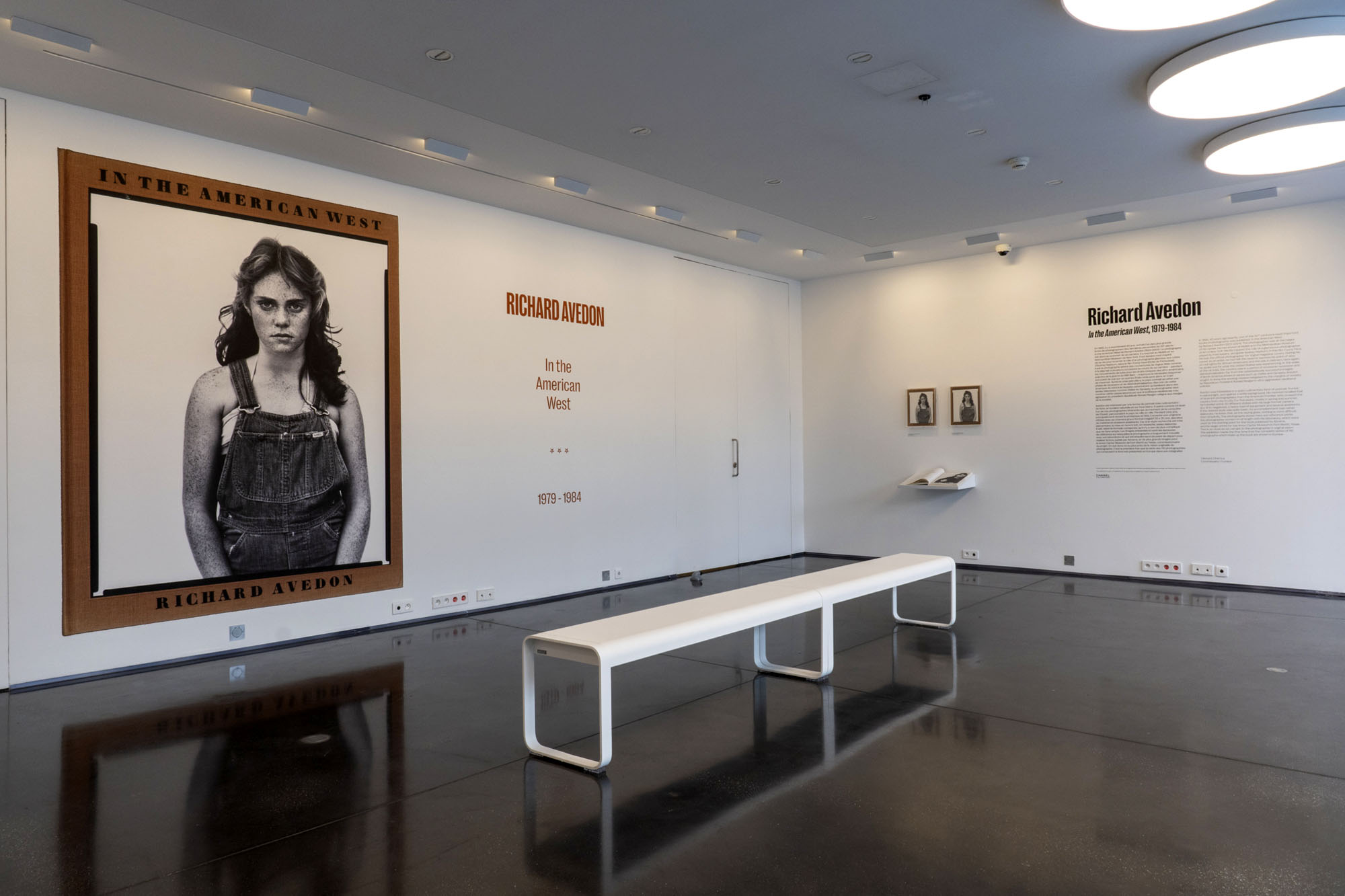
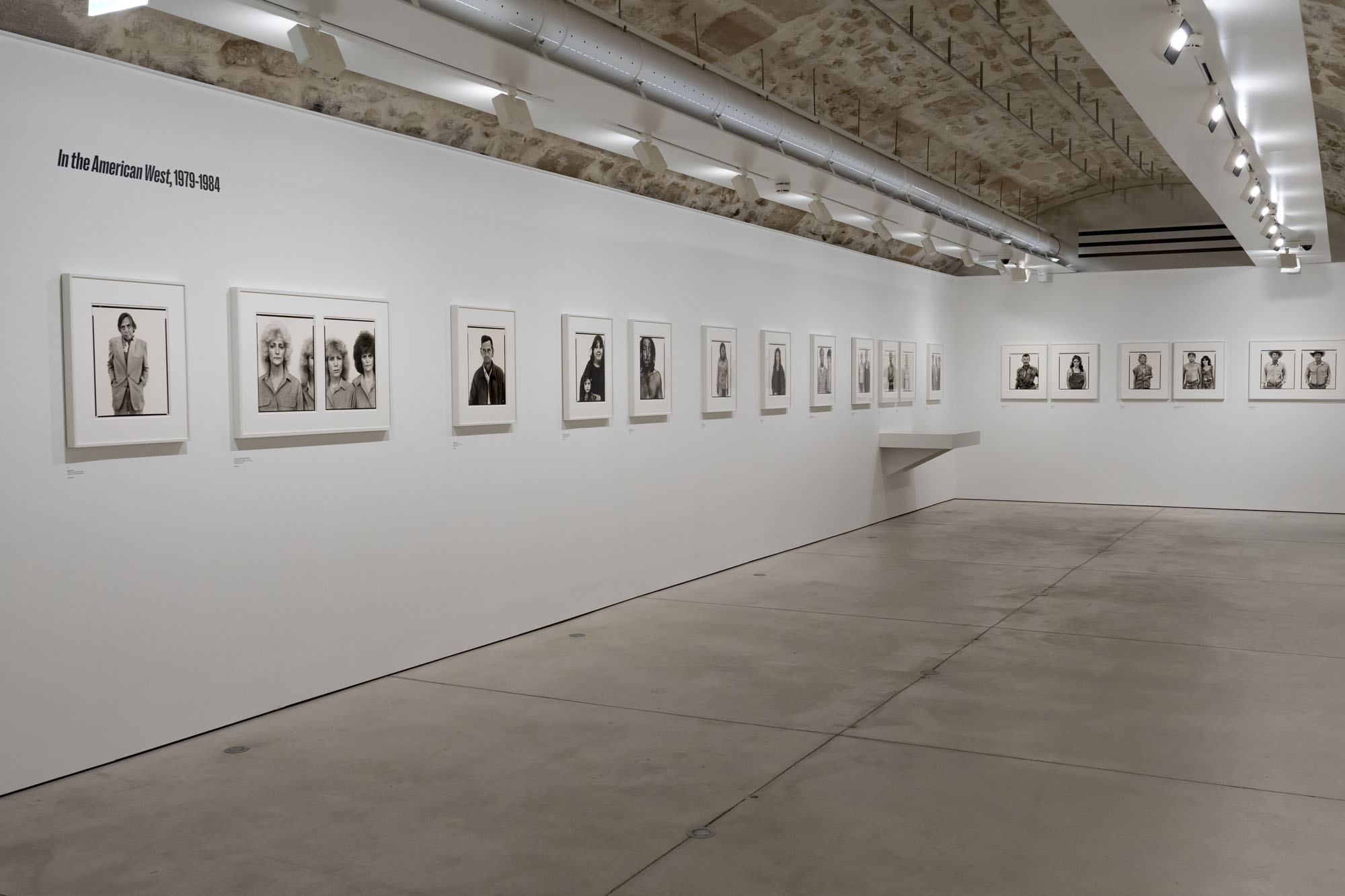
Installation view of the exhibition Richard Avedon 'In the American West' at the Fondation Henri Cartier-Bresson, Paris, April - October 2025


Installation view of the exhibition Richard Avedon ‘In the American West‘ at the Fondation Henri Cartier-Bresson, Paris, April – October 2025


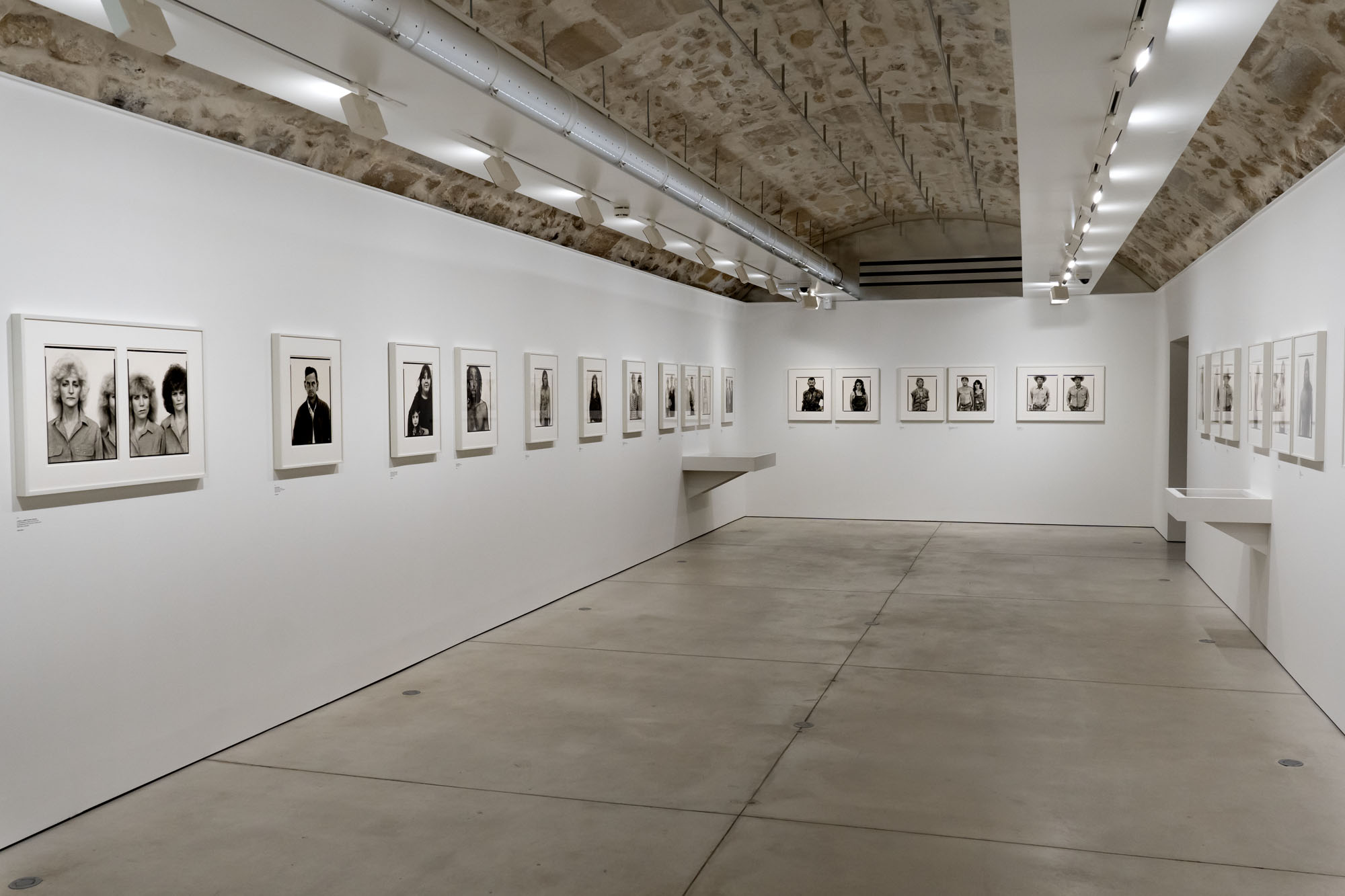
“The hanging follows the book, from the first to the last image,” explains Clément Chéroux. “The blank pages are represented on the wall by a gap equivalent to the width of a frame, like a half-space. We have thus reproduced the rhythm of someone leafing through the book. We can see through this that Richard Avedon and Marvin Israel (1924-1984), artistic director, have constructed the rhythm of these images in a very precise manner.”

Nathalie Dassa. “Richard Avedon: The Living Forces of the American West,” on the Blind Magazine website, May 12, 2025 [Online] Cited 22/09/2025


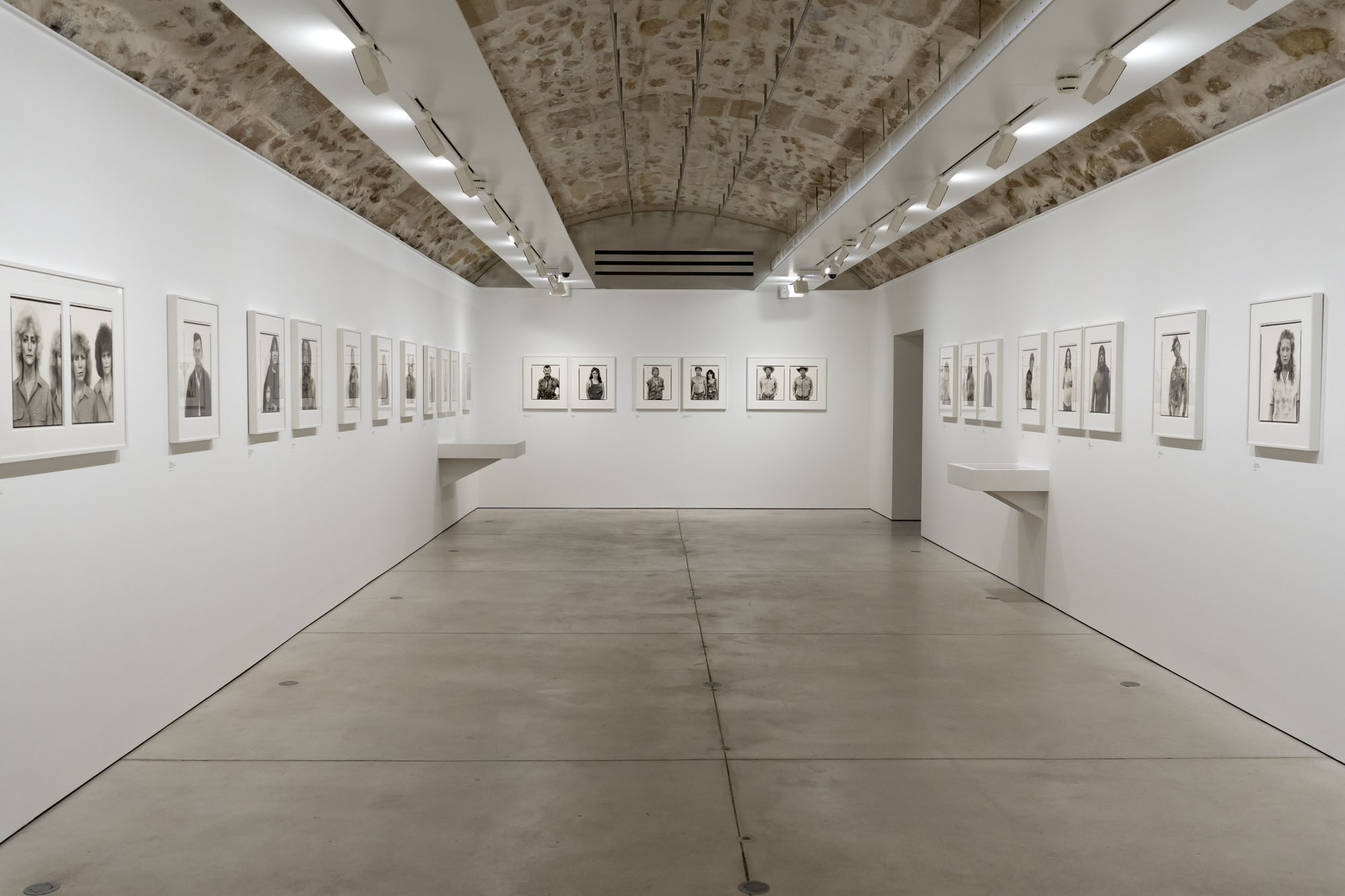
“Here, the works are displayed throughout the building in classic fashion – in a single line – and in unusually small formats (40 × 50 centimetres). “These are the reference prints, made by the photographer at the time, to produce the prints for his book and the enlargements shown in his exhibitions,” explained Clément Chéroux, the foundation’s director. These prints were not intended for exhibition, but nonetheless their remarkable quality allows the public − for the first time in Europe − to discover this exceptional work in its entirety.”

Claire Guillot. “Richard Avedon’s photographs of the American West at Paris’s Fondation Henri Cartier-Bresson,” on the Le Monde website, August 13, 2025 [Online] Cited 23/09/2025


Installation view of the exhibition Richard Avedon 'In the American West' at the Fondation Henri Cartier-Bresson, Paris, April - October 2025


Installation views of the exhibition Richard Avedon ‘In the American West‘ at the Fondation Henri Cartier-Bresson, Paris, April – October 2025


To mark the 40th anniversary of Richard Avedon’s iconic work In the American West, the Fondation Henri Cartier-Bresson, in collaboration with the Richard Avedon Foundation, presents an exclusive exhibition focused on this emblematic series. 

Between 1979 and 1984, commissioned by the Amon Carter Museum of American Art in Fort Worth, Texas, Richard Avedon traveled across the American West to photograph over 1,000 of its inhabitants. For five years, Avedon photographed miners, herdsmen, showmen, salesmen and transient people, amongst others with rich histories, alone or in small groups, before his camera, against a white background that enhanced their features, postures and expressions, for a striking portrait of the territory and its residents, in stark contrast to traditional depictions and glorifications of the legend of the American West. The force of the 103 works that compose the book makes In the American West a pivotal event in Avedon’s career, and a milestone in the history of photographic portraits. 

For the first time in Europe, the exhibition at the Fondation Henri Cartier-Bresson presents the whole series of images included in the original publication, while also showcasing the stages of its production and reception. The exhibition includes a full selection of engravers prints, which served as reference materials for both the exhibition and the 1985 book, as well as previously unpublished documents, such as preparatory Polaroids, test prints annotated by the photographer, and correspondence between the artist and his models. 

To mark this anniversary, Abrams, the book’s original publisher, is reissuing the long out-of-print book.

Richard Avedon short biography

Richard Avedon was born to parents of Russian Jewish heritage in New York City. As a boy, he learned photography, joining the YMHA Camera Club at the age of twelve. Avedon joined the armed forces in 1942 during World War II, serving as Photographer’s Mate Second Class in the Merchant Marine. Making identification portraits of the crewmen with his Rolleiflex twin lens camera – a gift from his father – Avedon advanced his technical knowledge of the medium and began to develop a dynamic style. After two years of service he left the Merchant Marine to work as a photographer, making fashion images and studying with art director Alexey Brodovitch at the Design Laboratory of the New School for Social Research. 

In 1945, Avedon set up his own studio and worked as a freelance photographer for various magazines. He quickly became the preeminent photographer used by Harper’s Bazaar.

From the beginning, Avedon made portraits for editorial publication as well: in the pages of Harper’s Bazaar, in Theater Arts, and in Life and Look magazines. From the outset, he was fascinated by photography’s capacity for suggesting the personality and evoking the life of his subjects. Only rarely did he idealize people; instead, he presented the face as a kind of landscape, with total clarity. 

Avedon continued to make portraiture and fashion photography for magazine publications throughout his career. After parting ways with Harper’s Bazaar in 1965, he began a long-term relationship with Vogue that continued through 1988. In later years, he established formidable creative partnerships with the French publication Egoiste, and with The New Yorker. In the pages of these periodicals, Avedon reinvigorated his formalist style, investing his imagery with dynamism and theatricality. In addition, he supported his studio by making innovative advertising work for print and broadcast – defining the look of brands like Calvin Klein, Versace, and Revlon. 

As his reputation grew and his signature aesthetic evolved, Avedon remained dedicated to extended portraiture projects as a means for exploring cultural, political, and personal concerns. In 1963-1964, he examined the civil rights movement in the American South. During the Vietnam War, he photographed students, countercultural artists and activists, and victims of the war, both in the United States and in Vietnam. In 1976, on a commission for Rolling Stone magazine, he produced The Family, a composite portrait of the American power elite at the time of the country’s Bicentennial election. 

In 1985, Avedon created his magnum opus – In the American West. He portrayed members of the working class: butchers, coal miners, convicts, and waitresses, all photographed with precisionist detail, using the large format camera and plain white backdrop characteristic of his mature style. Despite their apparent minimalism and objectivism, however, Avedon emphasised that these portraits were not to be regarded as simple records of people; rather, he said, “the moment an emotion or a fact is transformed into a photograph it is no longer a fact but an opinion.”

Publication

Richard Avedon’s acclaimed work In the American West was first published in 1985 by American publishing house Abrams. For its 40th anniversary, Abrams is republishing the work in its original format.

Text from the Fondation Henri Cartier-Bresson


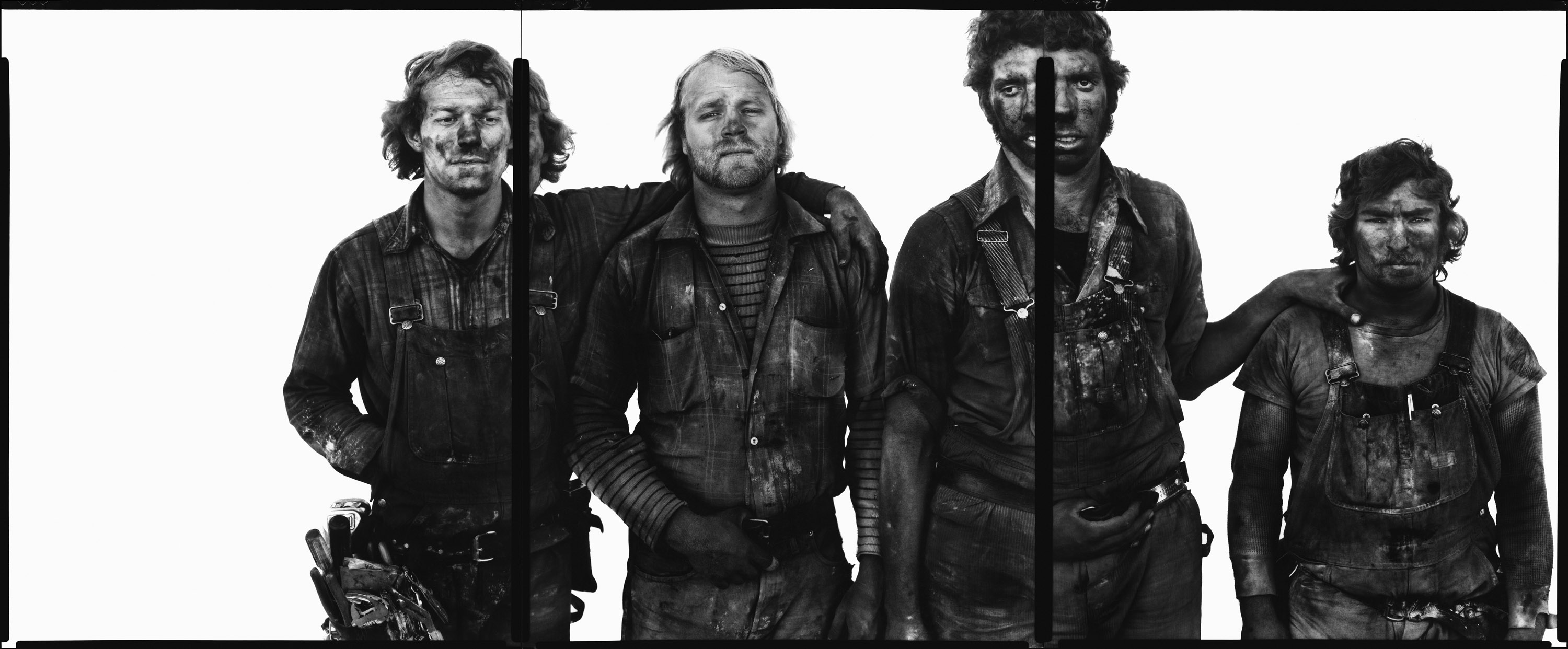
Richard Avedon (American, 1923-2004)
'Roger Tims, Jim Duncan, Leonard Markley, Don Belak, coal miners, Reliance, Wyoming, August 29, 1979' 1979


Richard Avedon (American, 1923-2004)
Roger Tims, Jim Duncan, Leonard Markley, Don Belak, coal miners, Reliance, Wyoming, August 29, 1979
1979
Gelatin silver print
© The Richard Avedon Foundation


“This was the beginning of his emblematic project “In the American West” that took him across 17 US states, where he photographed nearly 1,000 people from 1979 to 1984 and revealed a poor, hardworking America, far removed from the clichés and the myth of the glorious American West. He carried out this series with neither sociological intent nor a concern for objectivity. “This is a fictional West,” he said. “I don’t think the West of these portraits is any more conclusive than the West of John Wayne.””

Claire Guillot. “Richard Avedon’s photographs of the American West at Paris’s Fondation Henri Cartier-Bresson,” on the Le Monde website, August 13, 2025 [Online] Cited 23/09/2025


Richard Avedon (American, 1923-2004) 'Ronald Fischer, beekeeper, Davis, California, May 9, 1981' 1981


Richard Avedon (American, 1923-2004)
Ronald Fischer, beekeeper, Davis, California, May 9, 1981
1981
Gelatin silver print
© The Richard Avedon Foundation


“He needed to create disjunctions,” says Clément Chéroux. “The beekeeper remains a great image of the 20th century. After placing an ad, he chose this man suffering from alopecia, who no longer had any hair, no eyebrows. He took him to an entomologist who covered him with queen pheromones to attract bees. Through this staging, he wanted to make the audience understand that nothing is more complex than simplicity.”

Nathalie Dassa. “Richard Avedon: The Living Forces of the American West,” on the Blind Magazine website, May 12, 2025 [Online] Cited 22/09/2025


“The subjective part of the project is clear. And most of the photographs were from encounters where he photographed people he met as they were. He also stated very clearly that a few photographs were set up, and the photograph of the Bee Man is a good example of that. He first published an advertisement in the American Bee Journal to find the type of person he was interested in – we have the advertisement in the exhibition, we found the original magazine where it was published. So, he looked for that person and made some drawings in preparation for the shoot. He clearly had a dream of a specific image that he wanted to realize. And he made clear that he wanted to have this photograph to show the subjective part of the project, that it was not exclusively a documentary project. I think the Bee Man shows us that there isn’t truth on one side and fiction on the other. It’s much more complex.” …

“Just before the Bee Man, we have the coal miners, these very strong dark images and then suddenly you have the white body of Ronald Fisher with all these little bees. We wanted to respect this in the exhibition, the sense that it was not just a collection of twentieth-century photographs of Americans, but it was a group of images, a full sentence.”

Clément Chéroux quoted in Christina Cacouris. “Richard Avedon’s Rugged American West Comes to Paris,” on the Aperture website, June 26, 2025 [Online] Cited 23/09/2025


Richard Avedon (American, 1923-2004) 'David Beason, shipping clerk, Denver, Colorado, July 25, 1981' 1981


Richard Avedon (American, 1923-2004)
David Beason, shipping clerk, Denver, Colorado, July 25, 1981
1981
Gelatin silver print
© The Richard Avedon Foundation


“The year after [Glenn Busch’s] Working Men was published came fashion photographer Richard Avedon‘s In the American West (New York: Abrams, 1985), the consistent theme of which, as Richard Bolton in Afterimage argues,  sees “human experience as manifested in [no]thing but style,” a quality, less sombre, but equally arch, exoticising and stereotyping that is found also in the Small Trades studio series of 1950-51 by Irving Penn.”

James McArdle. “October 8: Prosopography,” on the On This Date In Photography website 08/10/2025 [Online] Cited 08/10/2025


Richard Avedon (American, 1923-2004)
'Jesse Kleinsasser, pig man, Hutterite Colony, Harlowton, Montana, June 23, 1983' 1983


Richard Avedon (American, 1923-2004)
Jesse Kleinsasser, pig man, Hutterite Colony, Harlowton, Montana, June 23, 1983
1983
Gelatin silver print
© The Richard Avedon Foundation


Richard Avedon (American, 1923-2004)
'Ruby Mercer, publicist, Frontier Days, Cheyenne, Wyoming, July 31, 1982' 1982


Richard Avedon (American, 1923-2004)
Ruby Mercer, publicist, Frontier Days, Cheyenne, Wyoming, July 31, 1982
1982
Gelatin silver print
© The Richard Avedon Foundation


“Avedon was aware of the subjectivity of what he presents. He was also very familiar with art history and pictorial references, such as those of Rembrandt. He made carcasses of sheep and cattle appear like hallucinations among the workers. His photography is therefore no more objective than that of John Wayne’s westerns. And that is what he had been criticised for: representing a sad, unsmiling America, which does not correspond to the one dreamed of. These are the people that Walker Evans and the traveling photographers sought out during the conquest of the West. He demonstrated this paradox. And this is the term Roland Barthes uses for him: the paradox of all great art. Richard Avedon showed his own America, those we do not see, those we pass by without pausing, those who do the work, those who make America work.”

Nathalie Dassa. “Richard Avedon: The Living Forces of the American West,” on the Blind Magazine website, May 12, 2025 [Online] Cited 22/09/2025


Richard Avedon (American, 1923-2004)
'Petra Alvarado, factory worker, on her birthday, El Paso, Texas, April 22, 1982' 1982


Richard Avedon (American, 1923-2004)
Petra Alvarado, factory worker, on her birthday, El Paso, Texas, April 22, 1982
1982
Gelatin silver print
© The Richard Avedon Foundation


Richard Avedon (American, 1923-2004)
'Boyd Fortin, thirteen year old rattlesnake skinner, Sweetwater, Texas, March 10, 1979' 1979


Richard Avedon (American, 1923-2004)
Boyd Fortin, thirteen year old rattlesnake skinner, Sweetwater, Texas, March 10, 1979 
1979
Gelatin silver print
© The Richard Avedon Foundation


Avedon took this portrait in 1979 in Texas during the annual snake hunt in the small town of Sweetwater.


The portraits from In the American West may not be romantic images – no pomp and circumstance – but they are dignified. Coal miners, cotton farmers, and cowboys stand tall and proud. Avedon worked quickly, street-casting his subjects alongside his assistant Laura Wilson, setting up white paper backdrops and shooting instinctively. Post-production was another matter entirely: Chéroux’s exhibition showcases the meticulous care that went into each print, with Avedon’s instructions for dodging and burning scrawled across pictures.

Christina Cacouris. “Richard Avedon’s Rugged American West Comes to Paris,” on the Aperture website, June 26, 2025 [Online] Cited 23/09/2025


Richard Avedon (American, 1923-2004) 'Richard Garber, drifter, Interstate 15, Provo, Utah, August 20, 1980' 1980


Richard Avedon (American, 1923-2004)
Richard Garber, drifter, Interstate 15, Provo, Utah, August 20, 1980
1980
Gelatin silver print
© The Richard Avedon Foundation


Richard Avedon (American, 1923-2004) 'Blue Cloud Wright, slaughterhouse worker, Omaha, Nebraska, August 10, 1979' 1979


Richard Avedon (American, 1923-2004)
Blue Cloud Wright, slaughterhouse worker, Omaha, Nebraska, August 10, 1979
1979
Gelatin silver print
© The Richard Avedon Foundation


Cover of Richard Avedon's book 'In The American West'


Cover of Richard Avedon’s book In The American West


Fondation Henri Cartier-Bresson
79 rue des Archives
75003 Paris

Opening hours:
Tuesday – Sunday
11am – 7pm
Closed on Mondays

Fondation Henri Cartier-Bresson website

LIKE ART BLART ON FACEBOOK

Back to top

Exhibition: ‘Still Performing: Costume, Gesture, and Expression in 19th Century European Photography’ at the Nelson-Atkins Museum of Art, Kansas City

Exhibition dates: 24th August, 2024 – 12th January, 2025


Victor Plumier (Belgian, 1820-1878) 'Lady in Costume' About 1850 from the exhibition 'Still Performing: Costume, Gesture, and Expression in 19th Century European Photography' at the Nelson-Atkins Museum of Art, Kansas City


Victor Plumier (Belgian, 1820-1878)
Lady in Costume
About 1850
Daguerreotype, half plate
5 1/2 × 4 1/2 inches
The Nelson-Atkins Museum of Art
Gift of the Hall Family Foundation


Past present

Magnificent photographs that bring past presence into present consciousness.

Costume. variedly, the term “costume,” indicating clothing exclusively from the eighteenth century onward, can be traced back to the Latin consuetudo, meaning “custom” or “usage.”

Gesture. late Middle English: from medieval Latin gestura, from Latin gerere ‘bear, wield, perform’. The original sense was ‘bearing, deportment’, hence ‘the use of posture and bodily movements for effect in oratory’.

Expression. the action of making known one’s thoughts or feelings. a look on someone’s face that conveys a particular emotion. late Middle English: from Latin expressio(n- ), from exprimere ‘press out, express’.


The emotions and the sentiments, the gestures and the expressions.

The actor and the stage, the photographer and the sitter.

The staged photograph and the tableaux vivant.

The Self and the Other.


Today, something happens when we look at these photographs. Today, the social spaces, gestures and expressions in these photographs are not fixed, monological re-presentations or presences. Our experience of the photographs enables them to be seen as nodes within a network caught up in a system of social and cultural references, whose unity is variable and relative.1

Thus,

” …in my reading (of the photograph), I relied upon a number of semiological systems, each one being a social / cultural construct: the sign language of clothes, of facial expressions, of bodily gestures, of social manner, etc. Such semiological systems do indeed exist and are continually being used in the making and reading of images. Nevertheless the sum total of these systems cannot exhaust, does not begin to cover, all that can be read in appearances.”2

The intertextuality of images.

Dr Marcus Bunyan


1/ Roland Barthes. “From Work to Text” and Michel Foucault. The Order of Things: An Archeology of the Human Sciences in Kurt Thumlert. Intervisuality, Visual Culture, and Education. [Online] Cited 10/08/2006. No longer available online

2/ John Berger and Jean Mohr. Another Way of Telling. New York: Pantheon Books, 1982, p. 112


Many thankx to the Nelson-Atkins Museum for allowing me to publish the photographs in the posting. Please click on the photographs for a larger version of the image.


“There is no perfection, no infinite completeness. But always, there is a way to move toward being whole. The capital letter, the Self is a wholeness that does not and will never exist. It is a direction that I move toward no matter the meanders of my feet.”


Kendrick VanZant


Camille Dolard (French, 1810-1884) 'Self-portrait as ailing man' c. 1843-1845


Camille Dolard (French, 1810-1884)
Self-portrait as ailing man
c. 1843-1845
Daguerreotype
Plate (whole): 8 1/2 × 6 1/2 inches (21.59 × 16.51cm)
Mat: 10 3/8 × 8 3/8 inches (26.37 × 21.29cm)
The Nelson-Atkins Museum of Art
Gift of the Hall Family Foundation


French painter Camille Dolard briefly embraced photography in the 1840s as an innovative creative tool. This daguerreotype, and the one in the next case, are from a group of three theatrical self-portraits created by Dolard in his studio. Here, the artist performs for the camera, posing with props and costumes as a patient in the care of his attentive wife. In the other plate, he uses a similarly theatrical approach, depicting himself smoking a hookah (a water pipe used to smoke tobacco) while lounging on a patterned rug.

Text from the Nelson-Atkins Museum website


Jean-Pierre Thierry (French, 1810-1870) 'Two ladies reading a letter' c. 1845


Jean-Pierre Thierry (French, 1810-1870)
Two ladies reading a letter
c. 1845
Daguerreotype
Plate (quarter): 4 1/4 × 3 1/4 inches (10.8 × 8.26 cm)
Mat: 6 1/16 × 5 1/8 inches (15.39 × 13.03 cm)
The Nelson-Atkins Museum of Art
Gift of the Hall Family Foundation


Philibert Perraud (French, 1815 - after 1863) 'Deux femmes se recueillent sur la tombe d'une etre cher ...' (Two women at the grave of a loved one) c. 1845


Philibert Perraud (French, 1815 – after 1863)
Deux femmes se recueillent sur la tombe d’une etre cher … (Two women at the grave of a loved one)
c. 1845
Daguerreotype
Plate (quarter): 4 1/4 × 3 1/4 inches (10.8 × 8.26cm)
 Mount: 5 1/8 × 4 1/8 inches (13.02 × 10.48cm)
The Nelson-Atkins Museum of Art
Gift of the Hall Family Foundation


Unknown photographer. 'Actor in Costume' c. 1850 from the exhibition 'Still Performing: Costume, Gesture, and Expression in 19th Century European Photography' at the Nelson-Atkins Museum of Art, Kansas City


Unknown photographer
Actor in Costume
c. 1850
Daguerreotype
Plate (three-quarter): 6 × 4 1/2 inches (15.24 × 11.43 cm)
Case (open): 8 1/8 × 13 1/4 × 3/8 inches (20.64 × 33.66 × 0.95 cm)
Case (closed): 8 1/8 × 6 5/8 × 5/8 inches (20.64 × 16.83 × 1.59 cm)
The Nelson-Atkins Museum of Art
Gift of the Hall Family Foundation


Though the pose and expression in this photograph are stiff, the extensive hand-colouring enlivens the portrait, drawing attention to the fine details in the actor’s costume. Sitting for a daguerreotype portrait in the 1850s required patience and a certain degree of stamina. Photographic exposure times – which varied according to plate sensitivity and studio lighting – typically ranged from three to 30 seconds. Studio props, such as chairs and head braces, were used to help sitters remain as motionless as possible for the duration of the exposure.

Text from the Nelson-Atkins Museum website


Giacomo Caneva (Italian, 1813-1865) 'Two Pifferari' c. 1850s


Giacomo Caneva (Italian, 1813-1865)
Two Pifferari
c. 1850s
Salt print
Image: 8 3/8 × 5 11/16 inches (21.27 × 14.45cm)
Sheet: 11 3/16 × 5 11/16 inches (28.42 × 14.45cm)
The Nelson-Atkins Museum of Art
Gift of the Hall Family Foundation


Nothing summed up picturesque modern Italy as well as the Pifferari; described by Hector Berlioz (1803-1869) in 1832: ‘These are strolling musicians who, towards Christmas, come down from the mountains in groups of four or five, armed with bagpipes and ‘pifferi’ (a sort of oboe), to play in homage before statues of the Madonna. They are generally dressed in large brown woollen coats and the pointed hats that brigands sport, and their whole appearance is instinct with a kind of mystic savagery that is most striking’. He admits that close to the music is ‘overpoweringly loud, but at a certain distance the effect of this strange ensemble of instruments is haunting and few are unmoved by it’.

Text from the Royal Collection Trust website


José Maria Blanco (Spanish, active c. 1850) 'Man with mandolin' 1851 from the exhibition 'Still Performing: Costume, Gesture, and Expression in 19th Century European Photography' at the Nelson-Atkins Museum of Art, Kansas City


José Maria Blanco (Spanish, active c. 1850)
Man with mandolin
1851
Daguerreotype
Plate (quarter): 4 × 3 1/4 inches (10.16 × 8.26cm)
Mat: 5 5/8 × 4 7/8 inches (14.29 × 12.38cm)
The Nelson-Atkins Museum of Art
Gift of the Hall Family Foundation


Julien Vallou de Villeneuve (French, 1795-1866) 'Portrait of Edouard Brindeau' 1853


Julien Vallou de Villeneuve (French, 1795-1866)
Portrait of Edouard Brindeau
1853
Salt print
6 1/4 × 4 5/8 inches
The Nelson-Atkins Museum of Art
Gift of the Hall Family Foundation


Julien Vallou de Villeneuve (French, 1795-1866) 'Portrait of Jean-Baptiste Provost, in the role of the emperor Claude in the play Valeria' 1853


Julien Vallou de Villeneuve (French, 1795-1866)
Portrait of Jean-Baptiste Provost, in the role of the emperor Claude in the play Valeria
1853
Portraits of Actors from the Comédie Française
Salt print
Image and sheet: 6 7/16 × 4 1/8 inches (16.35 × 10.48cm)
The Nelson-Atkins Museum of Art
Gift of the Hall Family Foundation


Charles Nègre (French, 1820-1880) 'Two Small Savoyards' c. 1853 from the exhibition 'Still Performing: Costume, Gesture, and Expression in 19th Century European Photography' at the Nelson-Atkins Museum of Art, Kansas City


Charles Nègre (French, 1820-1880)
Two Small Savoyards
c. 1853
Albumen print
Image and sheet: 7 × 5 3/16 inches (17.78 × 13.12cm)
Mount: 17 × 15 inches (43.18 × 38.1cm)
The Nelson-Atkins Museum of Art
Gift of the Hall Family Foundation


Charles Nègre refers to the threadbare young men in this photograph as “Savoyards” (originating from the Savoy region of France). Impoverished, migrant Savoyards have appeared in European art since the 1700s, and Nègre’s title could be shorthand for a certain type of person seen in the streets of Paris, regardless of the two boys’ actual place of origin. A painter and a photographer, Nègre practiced the two mediums side-by-side. Like other artists of his time, he ascribed nobility to the poor, seeking to convey their “truth, warmth, and life.”

Text from the Nelson-Atkins Museum website


Alban-Adrien Tournachon (French , 1825-1903) and Nadar [Gaspard Félix Tournachon] (French, 1820-1910) 'Pierrot Yawning' 1854 from the exhibition 'Still Performing: Costume, Gesture, and Expression in 19th Century European Photography' at the Nelson-Atkins Museum of Art, Kansas City


Alban-Adrien Tournachon (French , 1825-1903) and Nadar [Gaspard Félix Tournachon] (French, 1820-1910)
Pierrot Yawning
1854
Salt print
11 1/4 × 8 1/2 inches
The Nelson-Atkins Museum of Art
Gift of the Hall Family Foundation


Auguste Belloc (French, 1805 -1873) 'Une étude de nu de deux femmes' c. 1855


Auguste Belloc (French, 1805 -1873)
Une étude de nu de deux femmes
c. 1855
Salt print
Image and sheet: 8 5/16 × 6 1/8 inches (21.11 × 15.56cm)
The Nelson-Atkins Museum of Art
Gift of the Hall Family Foundation


A masterful printer, Auguste Belloc created nudes that surpassed the typical erotic fare found in Parisian markets. In this scene, Belloc strategically positions the models and surrounding drapery to make the photograph appear more artistic than pornographic. Though nude paintings, drawings, and sculptures were immensely common, at this time photography was treated far more harshly by censors. In October 1860, the French government seized some 5,000 of Belloc’s photographs, declaring them obscene, and by 1868 he had abandoned his photographic studio.

Text from the Nelson-Atkins Museum website


Guillaume-Benjamin-Amand Duchenne de Boulogne (French, 1806-1875) and Alban-Adrien Tournachon (French, 1825-1903) 'The Muscles of Weeping and Whimpering' About 1855-1857


Guillaume-Benjamin-Amand Duchenne de Boulogne (French, 1806-1875) and Alban-Adrien Tournachon (French, 1825-1903)
The Muscles of Weeping and Whimpering
About 1855-1857
Albumen print
9 1/16 × 6 15/16 inches
The Nelson-Atkins Museum of Art
Gift of the Hall Family Foundation


Facial expressions and their corresponding emotions have been studied by artists for centuries. In the 1850s, Dr. Guillaume-Benjamin-Amand Duchenne de Boulogne used photography to document the facial expressions produced by localised electric shock. Working in partnership with photographer Adrien Alban Tournachon, Duchenne felt these photographs truthfully recorded his experiments and that “none shall doubt the facts presented here.” Praising photography for its accurate rendering of the subject’s deep wrinkles, he wrote, “the distribution of light is in perfect harmony with the passions represented by these expressive lines. Thus, the face depicting the dark, concentric passions – aggression, wickedness, suffering, pain, dread, torture mixed with fear – gain an uncommon amount of energy.”

Text from the Nelson-Atkins Museum website


Guillaume-Benjamin-Amand Duchenne de Boulogne (French, 1806-1875) and Alban-Adrien Tournachon (French, 1825-1903) 'The Muscle of Pain' c. 1854-1857


Guillaume-Benjamin-Amand Duchenne de Boulogne (French, 1806-1875) and Alban-Adrien Tournachon (French, 1825-1903)
The Muscle of Pain
c. 1854-1857
Figure 27, plate 63 from The Mechanism of Human Facial Expression
Albumen print
Image and sheet: 9 1/16 × 6 5/8 inches (23.01 × 16.84cm)
Mount: 16 1/16 × 10 13/16 inches (40.79 × 27.51cm)
The Nelson-Atkins Museum of Art
Gift of the Hall Family Foundation


In this uncanny double portrait, the physiologist Dr. Guillaume-Benjamin-Amand Duchenne de Boulogne holds a mechanical device to the face of a 52-year-old, Italian-born woman believed to have been institutionalised in a Parisian asylum. Duchenne asserted that localised electric shock could force facial muscles to “contract to speak the language of the emotions and the sentiments.” “Armed with electrodes,” he wrote, “one would be able, like nature herself, to paint the expressive lines of the emotions of the soul on the face of man.”

Text from the Nelson-Atkins Museum website


Roger Fenton (English, 1819-1869) 'Self-portrait as a Zouave' 1855


Roger Fenton (English, 1819-1869)
Self-portrait as a Zouave
1855
Salt print:
Image and sheet: 7 13/16 × 6 7/16 inches (19.84 × 16.35cm)
Mount: 22 1/8 × 16 1/8 inches (56.2 × 40.96cm)
The Nelson-Atkins Museum of Art
Gift of the Hall Family Foundation


Cocking a rifle and smoking a pipe, with alcohol by his side, Roger Fenton poses for his camera with bravado. Wearing the distinctive baggy uniform of a Zouave (skilled infantry soldiers from the French army in Algeria), Fenton fashions himself as a hardened, glowering soldier, though he never fought in any war. Fenton did, however, photograph the Crimean War (1853-1856) from a great distance. The war brought together an alliance of soldiers from England, Croatia, Algeria, Turkey, Egypt, and France whom Fenton encountered while photographing the conflict.

Text from the Nelson-Atkins Museum website


Marcel Gustave Laverdet (French, 1816-1886) 'Masks from the album Selection of Ancient Terra Cotta from the Collection of M. Le Vicomte H. de Janzé' 1857


Marcel Gustave Laverdet (French, 1816-1886)
Masks from the album Selection of Ancient Terra Cotta from the Collection of M. Le Vicomte H. de Janzé
1857
Photolithograph
8 15/16 × 14 9/16 inches
The Nelson-Atkins Museum of Art
Gift of the Hall Family Foundation


Charles Nègre (French, 1820-1880) 'Self-portrait' About 1855-1860


Charles Nègre (French, 1820-1880)
Self-portrait
About 1855-1860
Salt print
7 5/8 × 5 7/16 inches
The Nelson-Atkins Museum of Art
Gift of the Hall Family Foundation


Early photography is ripe with creative fictions. Actors, children, aristocrats, models, artists, psychiatric patients, maids, and all manner of the working class posed in front of cameras and were transformed into figures from history, literature, the Bible, or into an idealised version of themselves. Still Performing: Costume, Gesture, and Expression in 19th Century European Photography, which opens at The Nelson-Atkins Museum of Art in Kansas City Aug. 24, celebrates the unique and compelling ways 19th century European photographers used the medium to explore and document performance, transforming the photographer’s studio into a theatrical stage. The exhibition runs through Jan. 12, 2025.

“The subjects in this exhibition were highly influenced by popular entertainment – live theatre, tableaux vivant, and dioramas – as well as tastes and trends in painting, drawing, and sculpture,” said Julián Zugazagoitia, Director & CEO of the Nelson-Atkins. “These works were made in a time of anxiety about photography’s relationships to the fine arts and reflect a close intermingling between the worlds of the ‘high’ and the ‘low’.”

Visiting a photographer’s studio in Europe in the mid to late 1800s was like going behind the scenes of a theatrical production. Props, backdrops, costumes, curtains, and controlled lighting converted otherwise ordinary portrait sessions into staged productions. Whether working in their homes or commercial studios, photographers cast themselves, friends, actors, models, and strangers in their photographs, transforming them into all types of characters, from young pickpockets to ancient Greek gods.

“These portraits are so fascinating, and I think our guests are going to be amazed at the rich creative complexity found in European photography’s first 50 years,” said Marijana Rayl, Assistant Curator, Photography.

Deliberately made, not casually taken, these staged photographs are often the result of collaborative efforts between photographer and sitter, such as with a series of portraits of Virginia Oldoini, the Countess of Castiglione. A prodigious narcissist, or perhaps just ahead of her time, the countess collaborated with the photographer Pierre-Louis Pierson to produce hundreds of portraits, directing every aspect of the picture-making process. Included in Still Performing is a very rare, hand-coloured portrait of the countess.

The resulting photographs are an outstanding array of complex and compelling fictions showcasing the medium’s early creative potential.

Press release from the Nelson-Atkins Museum


Oscar Gustav Rejlander (English born Sweden, 1813-1875) 'Drawing Water from a Well (O.G. Rejlander and model)' c. 1858


Oscar Gustav Rejlander (English born Sweden, 1813-1875)
Drawing Water from a Well (O.G. Rejlander and model)
c. 1858
Salt print
Image and sheet: 7 15/16 × 6 1/2 inches (20.16 × 16.51cm)
Mount: 14 1/16 × 11 5/16 inches (35.72 × 28.73cm)
The Nelson-Atkins Museum of Art
Gift of the Hall Family Foundation


Oscar Rejlander occasionally cast himself in staged photographs like this one, which was made to appear like a candid image of ordinary people going about their daily lives. Here he poses, turned away from the camera, as though he is helping a peasant woman retrieve water from a well. These kinds of genre scenes were immensely popular in the 1800s across painting, drawing, printmaking, and photography. Rejlander passionately advocated for photography to be treated as a fine art, believing that it must emulate painting.

Text from the Nelson-Atkins Museum website


Camille Silvy (French, 1834-1910) 'Actress Rosa Csillag in the Role of Orpheus' 1860


Camille Silvy (French, 1834-1910)
Actress Rosa Csillag in the Role of Orpheus
1860
Albumen print
9 3/16 × 7 5/8 inches
The Nelson-Atkins Museum of Art
Gift of the Hall Family Foundation


Pierre-Louis Pierson (French, 1822-1913) 'The Countess de Castiglione' 1860s


Pierre-Louis Pierson (French, 1822-1913)
The Countess de Castiglione
1860s
Gelatin silver print (printed about 1930)
10 15/16 x 14 1/8 inches
The Nelson-Atkins Museum of Art
Gift of the Hall Family Foundation


Pierre-Louis Pierson (French, 1822-1913) 'The Countess de Castiglione' 1860s


Pierre-Louis Pierson (French, 1822-1913)
The Countess de Castiglione
1860s
Gelatin silver print (printed about 1930)
Image: 14 3/16 x 11 inches (36.04 x 27.94cm)
Sheet: 14 3/16 x 11 inches (36.04 x 27.94cm)
The Nelson-Atkins Museum of Art
Gift of the Hall Family Foundation


Pierre-Louis Pierson (French, 1822-1913) 'Bal en Costume, Royaume de Belgique' c. 1860


Pierre-Louis Pierson (French, 1822-1913)
Bal en Costume, Royaume de Belgique
c. 1860
Salt print
Image and sheet: 11 1/2 × 8 3/4 inches (29.21 × 22.23cm)
The Nelson-Atkins Museum of Art
Gift of the Hall Family Foundation


Lady Clementina Hawarden (English, born Scotland, 1822-1865) 'Clementina Maude and Isabella Grace' c. 1863


Lady Clementina Hawarden (English, born Scotland, 1822-1865)
Clementina Maude and Isabella Grace
c. 1863
Albumen print
Image and sheet: 9 13/16 × 9 11/16 inches (24.97 × 24.61cm)
The Nelson-Atkins Museum of Art
Gift of the Hall Family Foundation


Julia Margaret Cameron (English, born India, 1815-1879) 'Sappho (Mary Hillier)' 1865


Julia Margaret Cameron (English, born India, 1815-1879)
Sappho (Mary Hillier)
1865
Albumen print
Image and sheet: 12 15/16 × 10 1/8 inches (32.86 × 25.72cm)
Mount: 20 13/16 × 16 13/16 inches (52.86 × 42.7cm)
The Nelson-Atkins Museum of Art
Gift of the Hall Family Foundation


Giorgio Sommer (Italian born Germany, 1834-1914) 'The Pickpocket' About 1865


Giorgio Sommer (Italian born Germany, 1834-1914)
The Pickpocket
About 1865
Albumen print
9 3/8 × 7 5/8 inches
The Nelson-Atkins Museum of Art
Gift of the Hall Family Foundation


Gaudenzio Marconi (French born Switzerland, 1842-1885) 'Male nude for artist' c. 1870


Gaudenzio Marconi (French born Switzerland, 1842-1885)
Male nude for artist
c. 1870
Albumen print
Image and sheet: 8 5/8 × 6 3/8 inches (21.91 × 16.19cm)
Mount: 12 9/16 × 9 3/4 inches (31.91 × 24.77cm)
The Nelson-Atkins Museum of Art
Gift of the Hall Family Foundation


Julia Margaret Cameron (English born India, 1815-1879) 'Sir Galahad and the Pale Nun' 1874


Julia Margaret Cameron (English born India, 1815-1879)
Sir Galahad and the Pale Nun
1874
Albumen print
13 7/16 × 10 1/2 inches
The Nelson-Atkins Museum of Art
Gift of the Hall Family Foundation


Giraudon's Artist (French, active c. 1875) 'Woman with bundle of twigs' c. 1875-1880


Giraudon’s Artist (French, active c. 1875)
Woman with bundle of twigs
c. 1875-1880
Albumen print
Image and sheet: 6 5/8 × 4 11/16 inches (16.83 × 11.91cm)
The Nelson-Atkins Museum of Art
Gift of the Hall Family Foundation


Pierre-Louis Pierson (French, 1822-1913) 'Portrait of the Countess of Castiglione from Série des Roses' 1895


Pierre-Louis Pierson (French, 1822-1913)
Portrait of the Countess of Castiglione from Série des Roses
1895
Albumen cabinet card
Image and sheet: 5 15/16 × 3 15/16 inches (15.06 × 9.98cm)
Mount: 6 3/8 × 4 1/4 inches (16.21 × 10.8cm)
The Nelson-Atkins Museum of Art
Gift of the Hall Family Foundation


The Countess of Castiglione became reclusive with age, rumored to only leave her home at night, hidden behind veils. Social chroniclers of the time claimed that she removed all mirrors from her home to avoid her appearance; however, this portrait seems to contradict her alleged displeasure. Taken toward the end of her life, the countess admires her reflection in the mirror, donning a youthful blond wig elaborately decorated with roses.

Text from the Nelson-Atkins Museum website


The Nelson-Atkins Museum of Art
4525 Oak Street
Kansas City, MO 64111

Opening hours:
Thursday – Monday 10am – 5pm
Closed Tuesdays and Wednesdays

The Nelson-Atkins Museum of Art website

LIKE ART BLART ON FACEBOOK

Back to top

Photos: ‘Album Horace Vernet’

November 2024


'Album Horace Vernet' front cover


Album Horace Vernet front cover
30 cartes des visite
16cm high x 11cm wide x 3.5cm deep


I purchased this small photo album from an op shop (charity shop) in Melbourne, Australia.

It features 29 carte de visite by the French firm Goupil & Cie of the paintings of the French history painter Horace Vernet (1789-1863) – painter of battles, portraits, and Orientalist and modern national subjects.

“The Universal Exposition of 1855, at which he was represented by twenty-four paintings, crowned his popular and official success. His reputation among artists and critics, on the other hand, was not uncontested. Baudelaire scathingly referred to him as “un militaire qui fait de la peinture,” and while his painstaking factuality and the sheer magnitude of his production commanded respect, the prosy shallowness of his realism, his stylistic banality, and the stridency of his chauvinism were early noted and contributed to the eventual neglect of his work. At the time of his death in 1863, Vernet, a member of thirty academies, was nevertheless France’s most famous artist, admired and imitated throughout Europe and deeply imbedded in popular culture.”1

The only photograph not by Goupil & Cie in the whole album is the second photograph in the album, a portrait of the painter by Bingham (Robert Jefferson Bingham, English 1825-1870). The photograph can be dated to between 1861 when Bingham’s photographic studio in Paris was at Rue de la Rochefoucauld and 1863 when Vernet died. This also helps date the compilation of the whole album.

Dr Marcus Bunyan

1/ Anonymous. “Horace Vernet,” on the National Gallery of Art website Nd [Online] Cited 13/10/2024

Please click on the photographs for a larger version of the image.

PLEASE NOTE: the photographs appear in the posting in the order they appear in the album.


Goupil & Cie (photographer), Paris 19, Boulevard Montmartre. London, La Haye, Berlin, New York. 'After a painting by Horace Vernet (French, 1789-1863) The Studio of Horace Vernet (Interieur d un Atelier) 1824' c. 1860-1863

Goupil & Cie (photographer), Paris 19, Boulevard Montmartre. London, La Haye, Berlin, New York. 'After a painting by Horace Vernet (French, 1789-1863) The Studio of Horace Vernet (Interieur d un Atelier) 1824' c. 1860-1863

Goupil & Cie (photographer), Paris 19, Boulevard Montmartre. London, La Haye, Berlin, New York. 'After a painting by Horace Vernet (French, 1789-1863) The Studio of Horace Vernet (Interieur d un Atelier) 1824' c. 1860-1863


Goupil & Cie (photographer), Paris 19, Boulevard Montmartre
London, La Haye, Berlin, New York
After a painting by Horace Vernet (French, 1789-1863) The Studio of Horace Vernet (Interieur d un Atelier) 1824
c. 1860-1863
Carte de visite


Goupil & Cie was at Boulevard Montmartre between the 1850s-1880s


Bingham (photographer) Robert Jefferson Bingham (English, 1825-1870) Photographie De S.M. La Reine D’Angleterre. Medaille de 1ere Classe 1855. 58 Rue de Larochefoucualt, Paris. 'Portrait of Horace Vernet (French, 1789-1863)' 1861-1863

Bingham (photographer) Robert Jefferson Bingham (English, 1825-1870) Photographie De S.M. La Reine D'Angleterre. Medaille de 1ere Classe 1855. 58 Rue de Larochefoucualt, Paris. 'Portrait of Horace Vernet (French, 1789-1863)' 1861-1863


Bingham (photographer) Robert Jefferson Bingham (English, 1825-1870)
Photographie De S.M. La Reine D’Angleterre
Medaille de 1ere Classe 1855
58 Rue de Larochefoucualt, Paris
Portrait of Horace Vernet (French, 1789-1863)
1861-1863
Carte de visite


Operated at Rue de la Rochefoucauld, 58 from 1861 until 1870.


Born in 1825 near Leicester in England, Bingham had a background in chemistry. He was particularly interested in photographic processes, and published a treatise on this subject in 1848. He later became the first writer to outline the possible use of collodion in photographs and the self-proclaimed ‘Inventeur du procédé collodion’. Bingham first exhibited his photographs of landscapes and of copies of paintings in London at The Great Exhibition in 1851. In 1859 he established a photographic portrait studio in Paris, which thrived throughout the 1860s and continued under his name even after his death in Brussels in 1870.

Text from the National Portrait Gallery website


Bingham also made photographs of the Exposition Universelle of 1855 in Paris. His ability to take some 2500 photographs at relatively high speeds on this occasion encouraged other photographers to use the collodion process for their work as well, helping it become the most popular method from 1855 until about 1880. Henry Cole sent him at the same time to the Louvre to photograph the masterpieces of the museum collection. At some point in 1851 1855, or 1859, Bingham moved to Paris to work there as a photographer, at first together with the American Warren T. Thompson until Thompson returned to England in 1856. Bingham not only worked at the 1855 Exposition, but also displayed his own life-size portraits, for which he won a Medal First Class. Due to a lack of commercial success, however, he soon stopped producing these huge photographs and stuck to more standard formats.

His work at the Louvre inspired him to make photographic portraiture a commercial enterprise, and in 1857 he opened his new atelier in the Nouvelle Athènes quarter of Paris, one of the hotspots of artistic activity at the time. He became friends with many artists, photographing them and their works, and started on a new project, a photographic collection of the works of the recently deceased painter Paul Delaroche. Published in 1858, it was the first photographic catalogue raisonné. It was followed over the next few years by similar works about other artists, including one in 1860 on Ary Scheffer and another one with photographs of the major works of the 1860 Salon. Smaller works with only a handful of photographs were produced for particular collections and for the Napoleon Museum in Amiens.

Anonymous. “Robert Jefferson Bingham,” on the Wikipedia website


Goupil & Cie (photographer), Paris 19, Boulevard Montmartre. London, La Haye, Berlin, New York. 'After a painting by Horace Vernet (French, 1789-1863) Battle near Vitebsk 1812' c. 1860-1863

Goupil & Cie (photographer), Paris 19, Boulevard Montmartre. London, La Haye, Berlin, New York. 'After a painting by Horace Vernet (French, 1789-1863) Battle near Vitebsk 1812' c. 1860-1863

Goupil & Cie (photographer), Paris 19, Boulevard Montmartre. London, La Haye, Berlin, New York. 'After a painting by Horace Vernet (French, 1789-1863) Battle near Vitebsk 1812' c. 1860-1863


Goupil & Cie (photographer), Paris 19, Boulevard Montmartre
London, La Haye, Berlin, New York
After a painting by Horace Vernet (French, 1789-1863) Battle near Vitebsk 1812
c. 1860-1863
Carte de visite


Goupil & Cie (photographer), Paris 19, Boulevard Montmartre. London, La Haye, Berlin, New York. 'After a painting by Horace Vernet (French, 1789-1863) Napoleon Bonaparte leading his troops over the bridge of Arcole 1826' c. 1860-1863

Goupil & Cie (photographer), Paris 19, Boulevard Montmartre. London, La Haye, Berlin, New York. 'After a painting by Horace Vernet (French, 1789-1863) Napoleon Bonaparte leading his troops over the bridge of Arcole 1826' c. 1860-1863

Goupil & Cie (photographer), Paris 19, Boulevard Montmartre. London, La Haye, Berlin, New York. 'After a painting by Horace Vernet (French, 1789-1863) Napoleon Bonaparte leading his troops over the bridge of Arcole 1826' c. 1860-1863


Goupil & Cie (photographer), Paris 19, Boulevard Montmartre
London, La Haye, Berlin, New York
After a painting by Horace Vernet (French, 1789-1863) Napoleon Bonaparte leading his troops over the bridge of Arcole 1826
c. 1860-1863
Carte de visite


Goupil & Cie (photographer), Paris 19, Boulevard Montmartre. London, La Haye, Berlin, New York. 'After a painting by Horace Vernet (French, 1789-1863) La Barrière de Clichy. Défense de Paris, March 30, 1814' c. 1860-1863

Goupil & Cie (photographer), Paris 19, Boulevard Montmartre. London, La Haye, Berlin, New York. 'After a painting by Horace Vernet (French, 1789-1863) La Barrière de Clichy. Défense de Paris, March 30, 1814' c. 1860-1863

Goupil & Cie (photographer), Paris 19, Boulevard Montmartre. London, La Haye, Berlin, New York. 'After a painting by Horace Vernet (French, 1789-1863) La Barrière de Clichy. Défense de Paris, March 30, 1814' c. 1860-1863


Goupil & Cie (photographer), Paris 19, Boulevard Montmartre
London, La Haye, Berlin, New York
After a painting by Horace Vernet (French, 1789-1863) La Barrière de Clichy. Défense de Paris, March 30, 1814
c. 1860-1863
Carte de visite


Goupil & Cie (photographer), Paris 19, Boulevard Montmartre. London, La Haye, Berlin, New York. 'After a painting by Horace Vernet (French, 1789-1863) Napoleon reviewing the Guard in the place du Carrousel, c. 1841-1842' c. 1860-1863

Goupil & Cie (photographer), Paris 19, Boulevard Montmartre. London, La Haye, Berlin, New York. 'After a painting by Horace Vernet (French, 1789-1863) Napoleon reviewing the Guard in the place du Carrousel, c. 1841-1842' c. 1860-1863


Goupil & Cie (photographer), Paris 19, Boulevard Montmartre
London, La Haye, Berlin, New York
After a painting by Horace Vernet (French, 1789-1863) Napoleon reviewing the Guard in the place du Carrousel, c. 1841-1842
c. 1860-1863
Carte de visite


Goupil & Cie (photographer), Paris 19, Boulevard Montmartre. London, La Haye, Berlin, New York. 'After a painting by Horace Vernet (French, 1789-1863) Napoleon bids farewell to his Guard at Fontainebleau on 20 April 1814 (1824)' c. 1860-1863

Goupil & Cie (photographer), Paris 19, Boulevard Montmartre. London, La Haye, Berlin, New York. 'After a painting by Horace Vernet (French, 1789-1863) Napoleon bids farewell to his Guard at Fontainebleau on 20 April 1814 (1824)' c. 1860-1863

Goupil & Cie (photographer), Paris 19, Boulevard Montmartre. London, La Haye, Berlin, New York. 'After a painting by Horace Vernet (French, 1789-1863) Napoleon bids farewell to his Guard at Fontainebleau on 20 April 1814 (1824)' c. 1860-1863


Goupil & Cie (photographer), Paris 19, Boulevard Montmartre
London, La Haye, Berlin, New York
After a painting by Horace Vernet (French, 1789-1863) Napoleon bids farewell to his Guard at Fontainebleau on 20 April 1814 (1824)
c. 1860-1863
Carte de visite


Goupil & Cie (photographer), Paris 19, Boulevard Montmartre. London, La Haye, Berlin, New York. 'After a painting by Horace Vernet (French, 1789-1863) The Lion Hunt 1836' c. 1860-1863

Goupil & Cie (photographer), Paris 19, Boulevard Montmartre. London, La Haye, Berlin, New York. 'After a painting by Horace Vernet (French, 1789-1863) The Lion Hunt 1836' c. 1860-1863

Goupil & Cie (photographer), Paris 19, Boulevard Montmartre. London, La Haye, Berlin, New York. 'After a painting by Horace Vernet (French, 1789-1863) The Lion Hunt 1836' c. 1860-1863


Goupil & Cie (photographer), Paris 19, Boulevard Montmartre
London, La Haye, Berlin, New York
After a painting by Horace Vernet (French, 1789-1863) The Lion Hunt 1836
c. 1860-1863
Carte de visite


Goupil & Cie (photographer), Paris 19, Boulevard Montmartre. London, La Haye, Berlin, New York. 'After a painting by Horace Vernet (French, 1789–1863) Chasse Aux Sangliers dans la Plaine de Sahara (Wild Boar Hunting in the Sahara Plain) 1838' c. 1860-1863

Goupil & Cie (photographer), Paris 19, Boulevard Montmartre. London, La Haye, Berlin, New York. 'After a painting by Horace Vernet (French, 1789–1863) Chasse Aux Sangliers dans la Plaine de Sahara (Wild Boar Hunting in the Sahara Plain) 1838' c. 1860-1863

Goupil & Cie (photographer), Paris 19, Boulevard Montmartre. London, La Haye, Berlin, New York. 'After a painting by Horace Vernet (French, 1789–1863) Chasse Aux Sangliers dans la Plaine de Sahara (Wild Boar Hunting in the Sahara Plain) 1838' c. 1860-1863


Goupil & Cie (photographer), Paris 19, Boulevard Montmartre
London, La Haye, Berlin, New York
After a painting by Horace Vernet (French, 1789–1863) Chasse Aux Sangliers dans la Plaine de Sahara (Wild Boar Hunting in the Sahara Plain) 1838
c. 1860-1863


Goupil & Cie (photographer), Paris 19, Boulevard Montmartre. London, La Haye, Berlin, New York. 'After a painting by Horace Vernet (French, 1789–1863) Unknown title Nd' c. 1860-1863

Goupil & Cie (photographer), Paris 19, Boulevard Montmartre. London, La Haye, Berlin, New York. 'After a painting by Horace Vernet (French, 1789-1863) Unknown title Nd' c. 1860-1863


Goupil & Cie (photographer), Paris 19, Boulevard Montmartre
London, La Haye, Berlin, New York
After a painting by Horace Vernet (French, 1789-1863) Unknown title Nd
c. 1860-1863
Carte de visite


Goupil & Cie (photographer), Paris 19, Boulevard Montmartre. London, La Haye, Berlin, New York. 'After a painting by Horace Vernet (French, 1789–1863) Le Giaour, vainqueur d'Hassan (The Giaour conquers Hassan) c. 1827' c. 1860-1863

Goupil & Cie (photographer), Paris 19, Boulevard Montmartre. London, La Haye, Berlin, New York. 'After a painting by Horace Vernet (French, 1789–1863) Le Giaour, vainqueur d'Hassan (The Giaour conquers Hassan) c. 1827' c. 1860-1863


Goupil & Cie (photographer), Paris 19, Boulevard Montmartre
London, La Haye, Berlin, New York
After a painting by Horace Vernet (French, 1789–1863) Le Giaour, vainqueur d’Hassan (The Giaour conquers Hassan) c. 1827
c. 1860-1863
Carte de visite


Horace Vernet (French, 1789-1863) 'Le Giaour, vainqueur d'Hassan' c. 1827


Horace Vernet (French, 1789-1863)
Le Giaour, vainqueur d’Hassan
c. 1827
Oil on canvas
25 5/8 x 21 in. (65 x 54cm)
Public domain


Goupil & Cie (photographer), Paris 19, Boulevard Montmartre. London, La Haye, Berlin, New York. 'After a painting by Horace Vernet (French, 1789-1863) Cavalier arabe, dit aussi 'La Retraite' (Arabian horseman, also called 'The Retreat’) 1839' c. 1860-1863

Goupil & Cie (photographer), Paris 19, Boulevard Montmartre. London, La Haye, Berlin, New York. 'After a painting by Horace Vernet (French, 1789-1863) Cavalier arabe, dit aussi 'La Retraite' (Arabian horseman, also called 'The Retreat’) 1839' c. 1860-1863


Goupil & Cie (photographer), Paris 19, Boulevard Montmartre
London, La Haye, Berlin, New York
After a painting by Horace Vernet (French, 1789-1863) Cavalier arabe, dit aussi ‘La Retraite’ (Arabian horseman, also called ‘The Retreat’) 1839
c. 1860-1863
Carte de visite


Horace Vernet (French, 1789-1863) 'Cavalier arabe, dit aussi 'La Retraite'' 1839


Horace Vernet (French, 1789-1863)
Cavalier arabe, dit aussi ‘La Retraite’
1839
Oil on panel
40.8 x 33.5cm (16 x 13 1/4 in.)
Purchased or commissioned by Baron Jean-Conrad Hottinguer (1803-1866) and paid by him to Vernet in 1840; then collection of Baroness Hottinguer, in 1874
Public domain


Goupil & Cie (photographer), Paris 19, Boulevard Montmartre. London, La Haye, Berlin, New York. 'After a painting by Horace Vernet (French, 1789-1863) Louis-Philippe, accompagné de ses fils, sortant à cheval du château de Versailles (King Louis-Philippe escorted by his sons leaving Versailles on June 10, 1837) 1846' c. 1860-1863

Goupil & Cie (photographer), Paris 19, Boulevard Montmartre. London, La Haye, Berlin, New York. 'After a painting by Horace Vernet (French, 1789-1863) Louis-Philippe, accompagné de ses fils, sortant à cheval du château de Versailles (King Louis-Philippe escorted by his sons leaving Versailles on June 10, 1837) 1846' c. 1860-1863

Goupil & Cie (photographer), Paris 19, Boulevard Montmartre. London, La Haye, Berlin, New York. 'After a painting by Horace Vernet (French, 1789-1863) Louis-Philippe, accompagné de ses fils, sortant à cheval du château de Versailles (King Louis-Philippe escorted by his sons leaving Versailles on June 10, 1837) 1846' c. 1860-1863


Goupil & Cie (photographer), Paris 19, Boulevard Montmartre
London, La Haye, Berlin, New York
After a painting by Horace Vernet (French, 1789-1863) Louis-Philippe, accompagné de ses fils, sortant à cheval du château de Versailles (King Louis-Philippe escorted by his sons leaving Versailles on June 10, 1837) 1846
c. 1860-1863
Carte de visit


Horace Vernet (French, 1789-1863) 'Louis-Philippe, accompagné de ses fils, sortant à cheval du château de Versailles (King Louis-Philippe escorted by his sons leaving Versailles on June 10, 1837)' 1846


Horace Vernet (French, 1789–1863)
Louis-Philippe, accompagné de ses fils, sortant à cheval du château de Versailles (King Louis-Philippe escorted by his sons leaving Versailles on June 10, 1837)
1846
Oil on canvas
Height: 368cm
Width: 397.5cm
Musée national du Château de Versailles
Public domain


Goupil & Cie (photographer), Paris 19, Boulevard Montmartre. London, La Haye, Berlin, New York. 'After a painting by Horace Vernet (French, 1789-1863) Judith and Holofernes 1829' c. 1860-1863

Goupil & Cie (photographer), Paris 19, Boulevard Montmartre. London, La Haye, Berlin, New York. 'After a painting by Horace Vernet (French, 1789-1863) Judith and Holofernes 1829' c. 1860-1863


Goupil & Cie (photographer), Paris 19, Boulevard Montmartre
London, La Haye, Berlin, New York
After a painting by Horace Vernet (French, 1789-1863) Judith and Holofernes 1829
c. 1860-1863
Carte de visite


Goupil & Cie (photographer), Paris 19, Boulevard Montmartre. London, La Haye, Berlin, New York. 'After a painting by Horace Vernet (French, 1789-1863) Judith with the head of Holofernes Nd' c. 1860-1863

Goupil & Cie (photographer), Paris 19, Boulevard Montmartre. London, La Haye, Berlin, New York. 'After a painting by Horace Vernet (French, 1789-1863) Judith with the head of Holofernes Nd' c. 1860-1863


Goupil & Cie (photographer), Paris 19, Boulevard Montmartre
London, La Haye, Berlin, New York
After a painting by Horace Vernet (French, 1789-1863) Judith with the head of Holofernes Nd
c. 1860-1863
Carte de visite


Goupil & Cie (photographer), Paris 19, Boulevard Montmartre. London, La Haye, Berlin, New York. 'After a painting by Horace Vernet (French, 1789-1863) Rebecca and Eleazar at the well (1835, now lost)' c. 1860-1863

Goupil & Cie (photographer), Paris 19, Boulevard Montmartre. London, La Haye, Berlin, New York. 'After a painting by Horace Vernet (French, 1789-1863) Rebecca and Eleazar at the well (1835, now lost)' c. 1860-1863


Goupil & Cie (photographer), Paris 19, Boulevard Montmartre
London, La Haye, Berlin, New York
After a painting by Horace Vernet (French, 1789-1863) Rebecca and Eleazar at the well (1835, now lost)
c. 1860-1863
Carte de visite


Goupil & Cie (photographer), Paris 19, Boulevard Montmartre. London, La Haye, Berlin, New York. 'After a painting by Horace Vernet (French, 1789-1863) Pie VIII porté dans la basilique de Saint-Pierre à Rome (Pius VIII brought to the Basilica of Saint Peter in Rome) 1829' c. 1860-1863

Goupil & Cie (photographer), Paris 19, Boulevard Montmartre. London, La Haye, Berlin, New York. 'After a painting by Horace Vernet (French, 1789-1863) Pie VIII porté dans la basilique de Saint-Pierre à Rome (Pius VIII brought to the Basilica of Saint Peter in Rome) 1829' c. 1860-1863


Goupil & Cie (photographer), Paris 19, Boulevard Montmartre
London, La Haye, Berlin, New York
After a painting by Horace Vernet (French, 1789-1863) Pie VIII porté dans la basilique de Saint-Pierre à Rome (Pius VIII brought to the Basilica of Saint Peter in Rome) 1829
c. 1860-1863
Carte de visite


Horace Vernet (French, 1789-1863) 'Pie VIII porté dans la basilique de Saint-Pierre à Rome (Pius VIII brought to the Basilica of Saint Peter in Rome)' 1829


Horace Vernet (French, 1789-1863)
Pie VIII porté dans la basilique de Saint-Pierre à Rome (Pius VIII brought to the Basilica of Saint Peter in Rome)
1829
Oil on canvas
Height: 385cm (12.6 ft)
Width: 329cm (10.7 ft)
Museum of the History of France
Public domain


Goupil & Cie (photographer), Paris 19, Boulevard Montmartre. London, La Haye, Berlin, New York. 'After a painting by Horace Vernet (French, 1789-1863) Repudiation Of Hagar 1837' c. 1860-1863

Goupil & Cie (photographer), Paris 19, Boulevard Montmartre. London, La Haye, Berlin, New York. 'After a painting by Horace Vernet (French, 1789-1863) Repudiation Of Hagar 1837' c. 1860-1863


Goupil & Cie (photographer), Paris 19, Boulevard Montmartre
London, La Haye, Berlin, New York
After a painting by Horace Vernet (French, 1789-1863) Repudiation Of Hagar 1837
c. 1860-1863
Carte de visite


Goupil & Cie (photographer), Paris 19, Boulevard Montmartre. London, La Haye, Berlin, New York. 'After a painting by Horace Vernet (French, 1789-1863) Le Marché d'esclaves (Slave market) 1836' c. 1860-1863

Goupil & Cie (photographer), Paris 19, Boulevard Montmartre. London, La Haye, Berlin, New York. 'After a painting by Horace Vernet (French, 1789-1863) Le Marché d'esclaves (Slave market) 1836' c. 1860-1863


Goupil & Cie (photographer), Paris 19, Boulevard Montmartre
London, La Haye, Berlin, New York
After a painting by Horace Vernet (French, 1789-1863) Le Marché d’esclaves (Slave market) 1836
c. 1860-1863
Carte de visite


Horace Vernet (French, 1789-1863) 'Le Marché d'esclaves (Slave market)' 1836


Horace Vernet (French, 1789-1863)
Le Marché d’esclaves (Slave market)
1836
Oil on canvas
Height: 65cm (25.5 in)
Width: 54cm (21.2 in)
Alte Nationalgalerie
Public domain


Goupil & Cie (photographer), Paris 19, Boulevard Montmartre. London, La Haye, Berlin, New York. 'After a painting by Horace Vernet (French, 1789-1863) An Algerian Lady Hawking 1839' c. 1860-1863

Goupil & Cie (photographer), Paris 19, Boulevard Montmartre. London, La Haye, Berlin, New York. 'After a painting by Horace Vernet (French, 1789-1863) An Algerian Lady Hawking 1839' c. 1860-1863


Goupil & Cie (photographer), Paris 19, Boulevard Montmartre
London, La Haye, Berlin, New York
After a painting by Horace Vernet (French, 1789-1863) An Algerian Lady Hawking 1839
c. 1860-1863
Carte de visite


Goupil & Cie (photographer), Paris 19, Boulevard Montmartre. London, La Haye, Berlin, New York. 'After a painting by Horace Vernet (French, 1789-1863) Châtelaine partant pour la chasse (Chatelaine leaving for the hunt) 1840' c. 1860-1863

Goupil & Cie (photographer), Paris 19, Boulevard Montmartre. London, La Haye, Berlin, New York. 'After a painting by Horace Vernet (French, 1789-1863) Châtelaine partant pour la chasse (Chatelaine leaving for the hunt) 1840' c. 1860-1863


Goupil & Cie (photographer), Paris 19, Boulevard Montmartre
London, La Haye, Berlin, New York
After a painting by Horace Vernet (French, 1789-1863) Châtelaine partant pour la chasse (Chatelaine leaving for the hunt) 1840
c. 1860-1863
Carte de visite


Goupil & Cie (photographer), Paris 19, Boulevard Montmartre. London, La Haye, Berlin, New York. 'After a painting by Horace Vernet (French, 1789-1863) Bonaparte after the Battle of Bassano 1848' c. 1860-1863

Goupil & Cie (photographer), Paris 19, Boulevard Montmartre. London, La Haye, Berlin, New York. 'After a painting by Horace Vernet (French, 1789-1863) Bonaparte after the Battle of Bassano 1848' c. 1860-1863


Goupil & Cie (photographer), Paris 19, Boulevard Montmartre
London, La Haye, Berlin, New York
After a painting by Horace Vernet (French, 1789-1863) Bonaparte after the Battle of Bassano 1848
c. 1860-1863
Carte de visite


Goupil & Cie (photographer), Paris 19, Boulevard Montmartre. London, La Haye, Berlin, New York. 'After a painting by Horace Vernet (French, 1789-1863) The Arab Tale-teller 1833' c. 1860-1863

Goupil & Cie (photographer), Paris 19, Boulevard Montmartre. London, La Haye, Berlin, New York. 'After a painting by Horace Vernet (French, 1789-1863) The Arab Tale-teller 1833' c. 1860-1863

Goupil & Cie (photographer), Paris 19, Boulevard Montmartre. London, La Haye, Berlin, New York. 'After a painting by Horace Vernet (French, 1789-1863) The Arab Tale-teller 1833' c. 1860-1863


Goupil & Cie (photographer), Paris 19, Boulevard Montmartre
London, La Haye, Berlin, New York
After a painting by Horace Vernet (French, 1789-1863) The Arab Tale-teller 1833
c. 1860-1863
Carte de visite


Goupil & Cie (photographer), Paris 19, Boulevard Montmartre. London, La Haye, Berlin, New York. 'After a painting by Horace Vernet (French, 1789-1863) Joseph's Coat 1853' c. 1860-1863

Goupil & Cie (photographer), Paris 19, Boulevard Montmartre. London, La Haye, Berlin, New York. 'After a painting by Horace Vernet (French, 1789-1863) Joseph's Coat 1853' c. 1860-1863


Goupil & Cie (photographer), Paris 19, Boulevard Montmartre
London, La Haye, Berlin, New York
After a painting by Horace Vernet (French, 1789-1863) Joseph’s Coat 1853
c. 1860-1863
Carte de visite


Goupil & Cie (photographer), Paris 19, Boulevard Montmartre. London, La Haye, Berlin, New York. 'After a painting by Horace Vernet (French, 1789-1863) Première messe en Kabylie (First mass in Kabylie) 1854' c. 1860-1863

Goupil & Cie (photographer), Paris 19, Boulevard Montmartre. London, La Haye, Berlin, New York. 'After a painting by Horace Vernet (French, 1789-1863) Première messe en Kabylie (First mass in Kabylie) 1854' c. 1860-1863


Goupil & Cie (photographer), Paris 19, Boulevard Montmartre
London, La Haye, Berlin, New York
After a painting by Horace Vernet (French, 1789-1863) Première messe en Kabylie (First mass in Kabylie) 1854
c. 1860-1863
Carte de visite


Horace Vernet (French, 1789-1863) 'Première messe en Kabylie (First mass in Kabylie)' 1854


Horace Vernet (French, 1789-1863)
Première messe en Kabylie (First mass in Kabylie)
1854
Oil on canvas
Cantonal Museum of Fine Arts
Public domain


Goupil & Cie (photographer), Paris 19, Boulevard Montmartre. London, La Haye, Berlin, New York. 'After a painting by Horace Vernet (French, 1789-1863) Daniel dans la fosse aux lions (Daniel in the Lions' Den) 1857' c. 1860-1863

Goupil & Cie (photographer), Paris 19, Boulevard Montmartre. London, La Haye, Berlin, New York. 'After a painting by Horace Vernet (French, 1789-1863) Daniel dans la fosse aux lions (Daniel in the Lions' Den) 1857' c. 1860-1863


Goupil & Cie (photographer), Paris 19, Boulevard Montmartre
London, La Haye, Berlin, New York
After a painting by Horace Vernet (French, 1789-1863) Daniel dans la fosse aux lions (Daniel in the Lions’ Den) 1857
c. 1860-1863
Carte de visite


Goupil & Cie (photographer), Paris 19, Boulevard Montmartre. London, La Haye, Berlin, New York. 'After a painting by Horace Vernet (French, 1789-1863) Mountain Hunters Nd' c. 1860-1863

Goupil & Cie (photographer), Paris 19, Boulevard Montmartre. London, La Haye, Berlin, New York. 'After a painting by Horace Vernet (French, 1789-1863) Mountain Hunters Nd' c. 1860-1863


Goupil & Cie (photographer), Paris 19, Boulevard Montmartre
London, La Haye, Berlin, New York
After a painting by Horace Vernet (French, 1789-1863) Mountain Hunters Nd
c. 1860-1863
Carte de visite


Goupil & Cie (photographer), Paris 19, Boulevard Montmartre. London, La Haye, Berlin, New York. 'After a painting by Horace Vernet (French, 1789-1863) Le Zouave trappiste (The Trappist Zouave) 1856' c. 1860-1863

Goupil & Cie (photographer), Paris 19, Boulevard Montmartre. London, La Haye, Berlin, New York. 'After a painting by Horace Vernet (French, 1789-1863) Le Zouave trappiste (The Trappist Zouave) 1856' c. 1860-1863


Goupil & Cie (photographer), Paris 19, Boulevard Montmartre
London, La Haye, Berlin, New York
After a painting by Horace Vernet (French, 1789-1863) Le Zouave trappiste (The Trappist Zouave) 1856
c. 1860-1863
Carte de visite


Goupil & Cie (photographer), Paris 19, Boulevard Montmartre. London, La Haye, Berlin, New York. 'After a painting by Horace Vernet (French, 1789-1863) Zouaves at the Malakoff 1856' c. 1860-1863

Goupil & Cie (photographer), Paris 19, Boulevard Montmartre. London, La Haye, Berlin, New York. 'After a painting by Horace Vernet (French, 1789-1863) Zouaves at the Malakoff 1856' c. 1860-1863


Goupil & Cie (photographer), Paris 19, Boulevard Montmartre
London, La Haye, Berlin, New York
After a painting by Horace Vernet (French, 1789-1863) Zouaves at the Malakoff 1856
c. 1860-1863
Carte de visite


Horace Vernet (French, 1789-1863) 'Zouaves at the Malakoff' 1856


Horace Vernet (French, 1789-1863)
Zouaves at the Malakoff
1856
Oil on canvas
Height: 39.7cm (15.6 in)
Width: 33.9cm (13.3 in)
Royal Collection
Public domain


Goupil & Cie (photographer), Paris 19, Boulevard Montmartre. London, La Haye, Berlin, New York. 'After a painting by Horace Vernet (French, 1789-1863) The scene of war 1861' c. 1860-1863

Goupil & Cie (photographer), Paris 19, Boulevard Montmartre. London, La Haye, Berlin, New York. 'After a painting by Horace Vernet (French, 1789-1863) The scene of war 1861' c. 1860-1863

Goupil & Cie (photographer), Paris 19, Boulevard Montmartre. London, La Haye, Berlin, New York. 'After a painting by Horace Vernet (French, 1789-1863) The scene of war 1861' c. 1860-1863


Goupil & Cie (photographer), Paris 19, Boulevard Montmartre
London, La Haye, Berlin, New York
After a painting by Horace Vernet (French, 1789-1863) The scene of war 1861
c. 1860-1863
Carte de visite


'Album Horace Vernet' back cover


Album Horace Vernet back cover
30 cartes des visite
16cm high x 11cm wide x 3.5cm deep


LIKE ART BLART ON FACEBOOK

Back to top

Exhibition: ‘Álbum de salón y alcoba (The Bedroom and Dressing Room Album). Instalación de David Trullo’ at Museo Nacional de Artes Decorativas, Madrid

Exhibition dates: 24th April – 22nd September, 2024


Kaulak (Antonio Cánovas del Castillo y Vallejo) (Spanish, 1862-1933) 'Studio portrait' 1921-1922


Kaulak (Antonio Cánovas del Castillo y Vallejo) (Spanish, 1862-1933)
Studio portrait
1921-1922
Photographic positive
Museo Nacional de Artes Decorativas, Madrid


Kaulak (22 December 1862 – 13 September 1933), was a Spanish photographer, art critic, editor and amateur painter. His uncle was prime minister Antonio Cánovas del Castillo, assassinated in 1897 by an anarchist, hence his use of a pseudonym; the meaning of which is unexplained, although the word appears to be of Basque origin.


What fabulousesness!

An archive of ‘galant photography’ and other art works illustrating the intimate public and private scenes of a couple in Spain in the 1920s-1930s which builds a memory, a narrative. The exhibition combines photographs and documentation of the most varied kinds, with elements of the daily life of its time.

“… above all [the exhibition] makes us reflect on our own archives: what we keep and what we discard, what we hide and what we reveal, how we build and invent our own history, how we want to be remembered and what we leave to those who come after us.”

The appreciation and enjoyment of difference pictured through photography and art, telling a story otherwise long forgotten.

I have added appropriate bibliographic text where possible.

Dr Marcus Bunyan


Many thankx to the Museo Nacional de Artes Decorativas for allowing me to publish the photographs in the posting. Please click on the photographs for a larger version of the image.


Anonymous photographer. 'Portrait' c. 1935


Anonymous photographer
Portrait
c. 1935
Photographic positive
Museo Nacional de Artes Decorativas, Madrid


The Museo Nacional de Artes Decorativas (MNAD) in Madrid, a state museum of the Ministry of Culture of Spain, joins the PHotoESPAÑA 2024 festival with the opening of Álbum de salón y alcoba. Una instalación de David Trullo, which can be visited free of charge until September 22.

From a forgotten collection that contained public -or living room- photographs and private -or bedroom- scenes of a couple in the 20s and 30s of the last century, the visual artist David Trullo has made this exhibition. The installation is “the result of opening an unnoticed time capsule and putting it in context with pieces from the museum and other collections to explore the limits of intimacy, leading the viewer to surpass them.”

In addition to putting a “rediscovered treasure” into context, the installation offers a review of how photographic documentation is exhibited and interpreted. It also proposes to reflect “on our own archives: what we keep and what we discard, what we hide and what we reveal, how we construct and invent our own history, how we want to be remembered and what we leave to those who come after us.”

The installation is, in itself, an album that captures the intimacy and public life of the 1920s and 1930s, combining the most varied photographs and documentation with elements of the everyday life of her time. It includes pieces and archives from several private collections, the Museo Sorolla, the Muséu del Pueblo d’Asturies, the Museo Nacional del Teatro de Almagro, the Asociación para la Enseñanza de la Mujer-Fundación Fernando de Castro and the Museo de Historia de Madrid, among others.

Between “the living room” and “the bedroom” a route is traced that goes from the preservation of intimate albums – among which a positive by Kaulak stands out, – through the first advances in amateur photography, to the ‘galant photography’, more or less erotic, and other genres of popular culture that include among its protagonists Tórtola Valencia, Sara Montiel, Conchita Piquer or the queer copla singer Miguel de Molina.

Text from the Museo Nacional de Artes Decorativas website


'Advertising design for 'Florido y Cía'' (Florido and Co.) c. 1930


Advertising design for ‘Florido y Cía’ (Florido and Co.)
c. 1930
Watercolour on paper
Museo Nacional de Artes Decorativas, Madrid


Anonymous photographer. 'Miguel de Molina' 1937


Anonymous photographer
Miguel de Molina
1937
Photographic positive
Colección Pedro Víllora


Miguel Frías de Molina (Málaga, April 10, 1908 – Buenos Aires, March 4, 1993), known artistically as Miguel de Molina, was a Spanish singer of copla. Tortured, expelled from Spain and later persecuted by the Franco dictatorship for being a “faggot and a red”, he settled in Argentina in 1946, invited by Eva Perón.

He had an unmistakable personal style combining cabaret, flamenco dancing, deep vocal emotionalism, spectacular costumes and a narcissistic stage persona that made him extremely popular with audiences. His gay identity was openly acknowledged with a sense of humour that was very close to what today would be recognised as ‘low camp.’ Between 1936 and 1942 Molina spent most of the Spanish Civil War on Republican ground. This together with his homosexuality and sympathies for the Left had disastrous consequences for his career. He left Spain for Argentina, where he was hugely successful. But life in exile was not easy and the Argentinean government soon threatened him with expulsion. Molina credited the direct intervention of Eva Perón with helping him stay in the country and continue his career. Unfortunately his overt support for the Perón government made him a despised figure once the Peróns were driven from power. The rampant homophobia of the changed political climate and the cultural shift that accompanied it proved detrimental to his mental and emotional health, prompting him to withdraw from artistic life in 1960. While many personalities who were faced with persecution under Francoism were being rediscovered in the 1980s, Molina, by then bitter and withdrawn, languished in obscurity. It was not until two films that celebrated his life were released a decade later that his uniquely stylised performances and colourful life would finally be celebrated.

Anonymous. “Miguel de Molina – Nominee,” on The Legacy Project website Nd [Online] Cited 21/08/2024


Anonymous maker. 'Fan' c. 1925


Anonymous maker
Fan

c. 1925
Lacquered wood and painted and corrugated paper
Museo Nacional de Artes Decorativas, Madrid
Photo: Masú del Amo


Bruno Zach (Austrian born Ukraine, 1891-1935) (designer) 'Figure of a woman with a fur coat' c. 1920


Bruno Zach (Austrian born Ukraine, 1891-1935) (designer)
Figure of a woman with a fur coat
c. 1920
Cast bronze
Museo Nacional de Artes Decorativas, Madrid
Photo: Fabián Álvarez


Bruno Zach (6 May 1891 – 20 February 1935) was an Austrian art deco sculptor of Ukrainian birth who worked in the early-to-mid 20th century. His output included a wide repertoire of genre subjects, however he is best known for his erotic sculptures of young women.


'Muchas Gracias' (Thank You) Magazine, Year VII - No. 344' September 13, 1930


Muchas Gracias (Thank You) Magazine, Year VII – No. 344
September 13, 1930
Museo Nacional de Artes Decorativas, Madrid


Translated text at the bottom of the magazine:

Thank you very much
For this rascal
We want to tell this little bitch that it fits her well. But we stumbled upon the fit.


Oswald Haerdtl (Austrian, 1899-1959) 'Cocktail set' 1924


Oswald Haerdtl (Austrian, 1899-1959)
Cocktail set
1924
mouth-blown glass
Museo Nacional de Artes Decorativas, Madrid
Photo: Lucía Morate


Oswald Haerdtl was an important Austrian architect, designer, and architecture teacher.

He studied under Kolo Moser and Oskar Strnad at the Wiener Kunstgewerbeschule, and entered Josef Hoffmann’s master class in 1922, soon becoming his assistant. From 1935 to 1959, he was head of the architecture department. His teaching, architectural projects, and international connections, to Italy and France in particular, made him a lasting influence on post-war Modernism in Vienna, bringing a sense of lightness and elegance into the design vocabulary.

Text from the J & L Lobmeyr website


Ramón Peinador Checa (Spanish, 1897-1964) Advertising design for 'Perfumes Oriente' 1925


Ramón Peinador Checa (Spanish, 1897-1964)
Advertising design for ‘Perfumes Oriente’
1925
Wash on paper
Museo Nacional de Artes Decorativas, Madrid
Photo: Javier Rodríguez Barrera


Ramón Peinador Checa (Madrid, December 25, 1897 – Mexico City, May 26, 1964) was a Spanish painter, draftsman, engraver, illustrator, designer and decorator who, exiled in Mexico, became a naturalised citizen of that country.


Photography lies and deceives us. What the camera shows us is staged, either by us or by the eye of the person who creates the images. What we commonly call a “photographic archive” is nothing more than a fragmented collection transformed over the years, with which a memory, a narrative, is built.

From a forgotten collection containing public photographs -or from the living room- and private scenes -or from the bedroom- of a couple in the twenties and thirties of the last century, the visual artist David Trullo proposes this installation.

It is the result of opening an unnoticed time capsule and putting it in context with the pieces of the twentieth century that put an end to the monopoly of the professional photographer. Cameras and processes are simplified and photography is becoming an essential accessory for any occasion, and not only for amateurs, including the female sector: the Kodak Petite from 1926 is promoted as a camera ‘for smart and modern girls’.

In addition to putting a rediscovered treasure into context, the installation proposes a review of the way photographic documentation is displayed and interpreted, but above all it makes us reflect on our own archives: what we keep and what we discard, what we hide and what we reveal, how we build and invent our own history, how we want to be remembered and what we leave to those who come after us.

During this period, Madrid reinvented itself and became as cosmopolitan as other European cities, although it was the bourgeois and aristocratic elites who truly enjoyed it. A surprising and varied sexual atmosphere also emerged, along with new ways of understanding bodies, identities and relationships that were reflected in publications, advertising and photography, with the so-called ‘galant photography’ flourishing within it.

The National Museum of Decorative Arts joins PHotoESPAÑA 2024 with David Trullo’s installation ‘Album of living room and bedroom’

~ With a selection of images from the public and the private, the visual artist discovers a photographic capsule that time has preserved to be reread from the present day

~ The tour includes everything from photographic positives by Kaulak to portraits of Sara Montiel, Conchita Piquer or the queer copla singer Miguel de Molina

The National Museum of Decorative Arts (MNAD), a state museum of the Ministry of Culture, is joining the PHotoESPAÑA 2024 festival with the inauguration of ‘Album of living room and bedroom. Installation by David Trullo’, which can be visited free of charge until September 22.

From a forgotten collection containing public photographs  – or from the living room –  and private scenes  – or from the bedroom – of a couple in the 1920s and 1930s, the visual artist David Trullo has created this proposal. The installation is “the result of opening an unnoticed time capsule and putting it in context with the pieces from the museum and from other collections to explore the limits of intimacy, leading the viewer to surpass them.”

In addition to putting a “rediscovered treasure” into context, the installation offers a review of the way of exhibiting and interpreting photographic documentation. It also suggests reflecting “on our own archives: what we keep and what we discard, what we hide and what we reveal, how we build and invent our own history, how we want to be remembered and what we leave to those who come after us.”
From living room to bedroom

The installation is, in itself, an album that captures the intimacy and public life of the 1920s and 1930s, combining photographs and documentation of the most varied kinds, with elements of the daily life of its time. It features pieces and archives from various private collections, from the Sorolla Museum, the Muséu del Pueblo d’Asturies, the Museo Nacional del Teatro de Almagro, the Asociación para la Enseñanza de la Mujer-Fundación Fernando de Castro or the Museo de Historia de Madrid, among others. Between “the living room” and “the bedroom” there is a journey that goes from the conservation of intimate albums – among which a positive by Kaulak stands out – through the first advances in photography for amateurs, to reaching ‘galant photography’, more or less erotic, and other genres of popular culture that include among their protagonists Tórtola Valencia, Sara Montiel, Conchita Piquer or the queer copla singer Miguel de Molina.

Text from the National Museum of Decorative Arts exhibition press dossier


Antonio Peyró (Spanish, 1882-1954) 'The Baticola (Elena Plá Toda)' 1934


Antonio Peyró (Spanish, 1882-1954)
The Baticola (Elena Plá Toda)
1934
Glazed ceramic
Museo Nacional de Artes Decorativas, Madrid
Photo: Masú del Amo


Antonio Peyró Mezquita was a Spanish ceramist.


''Reciprocal pleasure', cover by Josep Renau Berenguer' 1933


‘Reciprocal pleasure’, cover by Josep Renau Berenguer
1933
Museo Nacional de Artes Decorativas, Madrid
Photo: Masú del Amo


Josep Renau Berenguer (Spanish, 1907-1982) was an artist and communist revolutionary, notable for his propaganda work during the Spanish Civil War. Among his production, he is remarkable for his art deco period, his political propaganda during the Spanish Civil War, the photo murals of the Spanish Pavilion in the International Exhibition of 1937 in Paris, a series of photomontages titled Fata Morgana or The American Way of Life, and murals and paintings made in Mexico, such as Tropic, dated in 1945.

Text from the Wikipedia website


Louis Majorelle (French, 1859-1926) (designer) 'Sofa' 1901-1926


Louis Majorelle (French, 1859-1926) (designer)
Sofa
1901-1926
Silk velvet
Museo Nacional de Artes Decorativas, Madrid
Photo: Lucía Morate


Louis-Jean-Sylvestre Majorelle, usually known simply as Louis Majorelle, (26 September 1859 – 15 January 1926) was a French decorator and furniture designer who manufactured his own designs, in the French tradition of the ébéniste. He was one of the outstanding designers of furniture in the Art Nouveau style, and after 1901 formally served as one of the vice-presidents of the École de Nancy.

Louis Majorelle is one of those who contributed the most to the transformation of furniture. Thanks to posterity, we recognise today a piece of furniture from him as we recognise a piece of furniture from André Charles Boulle and Charles Cressent, the french Prince regent’s favourite artists. During the early 18th century, Cressent replaced the magnificence of ebony and tortoiseshell associated with tin and copper by the softer harmonies of foreign woods. Like him, Louis Majorelle dressed the elegant structure of Art Nouveau furniture with exotic wood inlays.

Text from the Wikipedia website


Álvaro Retana (Spanish born Philippines, 1890-1970) 'Figure for Celia Gámez' c. 1920


Álvaro Retana (Spanish born Philippines, 1890-1970)
Figure for Celia Gámez
c. 1920
Ink and graphite on paper
Colección Pedro Víllora


Álvaro Retana Ramírez de Arellano (Batangas, Philippines, August 26, 1890 – Torrejón de Ardoz, Madrid, February 10, 1970) was a writer, journalist, cartoonist, fashion designer, musician, libertine and Spanish couplet lyricist.

Celia Gámez Carrasco (August 25, 1905 – December 10, 1992) was an Argentinian film actress, and one of the icons of the Golden Age of Spanish theatre. She was more commonly known in Franco’s Spain, particularly in her later years, as La Protegida.


Vitín Cortezo (Spanish, 1908-1978) 'Figure for Celia Gámez' 1939


Vitín Cortezo (Spanish, 1908-1978)
Figure for Celia Gámez
1939
Mixed technique on paper
Colección Pedro Víllora


Víctor María Cortezo Martínez-Junquera, also known as Vitín Cortezo (Madrid, June 10, 1908 – March 2, 1978) was a Spanish painter, illustrator, costume designer and set designer.


Anonymous maker. 'Bloomers and cotton slip with silk knit stockings' c. 1930


Anonymous maker
Bloomers and cotton slip with silk knit stockings
c. 1930
Museo Nacional de Artes Decorativas, Madrid
Photo: Fabián Álvarez


Karl Klaus and Franz Staudigl 'Figure (Serapis Wahliss series)' 1913-1914


Karl Klaus and Franz Staudigl
Figure (Serapis Wahliss series)
1913-1914
Painted and glazed ceramic
Museo Nacional de Artes Decorativas, Madrid
Photo: Fabián Álvarez


Karl Klaus (Austrian, 1889-1925) was a student of Josef Hoffmann. The figure was designed for Serapis-Wahliss, a noted Viennese retailer and manufacturer of porcelain. Franz Staudigl was an Austrian painter born 1885 – died 1944.


Anonymous photographer. 'Concha Piquer' 1927


Anonymous photographer
Concha Piquer
1927
Photographic positive
Museo Nacional del Teatro, Almagro


María de la Concepción Piquer López (13 December 1906 – 12 December 1990), better known as Concha Piquer (and sometimes billed as Conchita Piquer), was a Spanish singer and actress. She was known for her work in the copla form, and she performed her own interpretations of some of the key pieces in the Spanish song tradition, mostly works of the mid-20th century trio of composers Antonio Quintero, Rafael de León y Manuel Quiroga.


Anonymous maker. 'Perfume bottles' 1850-1900


Anonymous maker
Perfume bottles
1850-1900
Engraved and gilded silver and blown glass
Museo Nacional de Artes Decorativas. Madrid
Photo: Fabián Álvarez


Anonymous maker / Paul Koruna, Paris (no dates) (photographer). 'Promotional poster for 'Rosalío'' Nd


Anonymous maker
Paul Koruna, Paris
(no dates) (photographer)
Promotional poster for ‘Rosalío’
Nd
Montage of photographic positives
Colección Ramón Gato


Anonymous maker / Paul Koruna, Paris (no dates) (photographer). 'Promotional poster for 'Rosalío'' Nd. 'Promotional poster for 'Rosalío'' Nd (detail)

Anonymous maker / Paul Koruna, Paris (no dates) (photographer). 'Promotional poster for 'Rosalío'' Nd. 'Promotional poster for 'Rosalío'' Nd (detail)

Anonymous maker / Paul Koruna, Paris (no dates) (photographer). 'Promotional poster for 'Rosalío'' Nd. 'Promotional poster for 'Rosalío'' Nd (detail)

Anonymous maker / Paul Koruna, Paris (no dates) (photographer). 'Promotional poster for 'Rosalío'' Nd. 'Promotional poster for 'Rosalío'' Nd (detail)


Anonymous maker
Paul Koruna, Paris (no dates) (photographer)
Promotional poster for ‘Rosalío’ (details)
Nd
Montage of photographic positives
Colección Ramón Gato


Anonymous maker. 'Manila shawl' 1876-1925


Anonymous maker
Manila shawl
1876-1925
Embroidered silk
Museo Nacional de Artes Decorativas, Madrid
Photos: Javier Rodríguez Barrera


National Museum of Decorative Arts
c/ Montalbán, 12. Madrid

Opening hours
Tuesday – Saturday: 9.30am – 3.00pm
Sundays and holidays: 10.00am – 3.00pm
Afternoons (Thursday): 5.00pm – 8.00pm

National Museum of Decorative Arts website

LIKE ART BLART ON FACEBOOK

Back to top

Exhibition: ‘Hippolyte Bayard: A Persistent Pioneer’ at the J. Paul Getty Museum, Los Angeles

Exhibition dates: 9th April – 7th July 2024


Hippolyte Bayard (French, 1801-1887) William Henry Fox Talbot (English, 1800-1877) Samuel Buckle (British, 1808-1860) Nicolaas Henneman (British, 1813-1893) Reverend Calvert Jones (British, 1804-1877) David Kinnebrook (English, 1819-1865) M.H. Nevil Story-Maskelyne (British, 1823-1911) Unknown maker. 'Cover of Dessins photographiques sur Papier. Recueil No. 2. [The "Bayard Album"]' 1839-1855


Hippolyte Bayard (French, 1801-1887) William Henry Fox Talbot (English, 1800-1877) Samuel Buckle (British, 1808-1860) Nicolaas Henneman (British, 1813-1893) Reverend Calvert Jones (British, 1804-1877) David Kinnebrook (English, 1819-1865) M.H. Nevil Story-Maskelyne (British, 1823-1911) Unknown maker
Cover of Dessins photographiques sur Papier. Recueil No. 2. [The “Bayard Album”]
1839-1855
The J. Paul Getty Museum, Los Angeles
Public domain


Shock of the new

At the moment the archive is going through a veritable feast of wonderful exhibitions on 19th century photography, this exhibition at the Getty a companion to last week’s posting on the exhibition Nineteenth-Century Photography Now also at the J. Paul Getty Museum. What a delight!

This posting on the important photographer and inventor Hippolyte Bayard (French, 1801-1887) – one of the pioneers of photography who was finally acknowledged as such during his lifetime and received due recognition – offers the visitor the opportunity to view fragile photographs from the Getty’s treasured Bayard album, one of the first photographic albums ever created, before the leaves of the album are reassembled after restoration.

“The album includes 145 of Bayard’s experiments with different photographic processes on paper, primarily salted paper prints from paper negatives from about 1839 to the late 1840s… Bayard divided the album into four sections: still lifes, portraits, urban and rural landscapes, and an assortment of miscellaneous images. The inclusion of twenty-two photographs by British photographers, including William Henry Fox Talbot, provides evidence of Bayard’s interactions with his fellow pioneers across the English Channel. …

Inscriptions found on the Getty album pages and versos of its photographs support the theory that the artist himself – or someone with firsthand knowledge of the chemicals he used – compiled this volume. Thus, this treasure offers intriguing insights into Bayard’s practice, aesthetic choices, and strategies for presenting himself through the order and arrangement of the photographs.”1

The full album and layout can be viewed on the Getty’s website.

What I find delightful about this “album of experiments” – other than Bayard’s perceptive, inquisitive self-portraits and delicate, atmospheric cyanotype and salted paper print photograms – is the colour (including hand coloured), size and placement of the photographic prints on the pages of the album. Sometimes gridded, sometimes singular in grand isolation, sometimes asymmetrical with empty pages between images, the album seems to flow allow like a river… only for the viewer then to have to change orientation, as vertical images on one page are then abutted next to a page of images that need to be viewed in a horizontal format but turning the album through 90 degrees.

It’s as if the compiler of the album, probably Bayard himself, applied this prick of consciousness to the viewing of the album, to stop the viewer skimming over the images but forcing them to be attentive, to be aware, of the progression of the story that the artist was telling, to be aware of a certain “disposition” in the viewer in order to – a/ disrupt the tendency of something to act in a certain manner under given circumstances and b/ impinge on a person’s inherent quality of mind and character. To offer a new dispensation on reality.

In other words, the artist challenges the viewer as to how photographs are read and interpreted through changes to the perception and point of view said “reader”. I don’t think I have ever seen such an early photo book that proposes such a daring reorientation of consciousness as does this album.

New technologies, new aesthetics, new dispositions.

The shock of the new.

Dr Marcus Bunyan


1/ Carolyn Peter, J. Paul Getty Museum, Department of Photographs, 2024


Many thankx to the J. Paul Getty Museum for allowing me to publish the photographs in the posting. Please click on the photographs for a larger version of the image.


Parisian bureaucrat by day and tireless inventor after hours, Hippolyte Bayard (French, 1801-1887) was one of the most important, if lesser-known, pioneers of photography. During his thirty-year career, he invented the direct positive process and several other photographic techniques on paper. This exhibition presents an extraordinarily rare opportunity to view some of Bayard’s highly fragile photographs dating from the 1840s – the first decade of the new medium. The exhibition journeys back to the 19th century to unveil a collection of Bayard’s delicately crafted photographs, offering an extraordinarily rare glimpse into his unique processes, subjects, and persistent curiosity. He brought an artistic sensitivity into capturing the first staged self-portraits and set precedents for photography as we know it today. It highlights Getty’s treasured Bayard album, one of the first photographic albums ever created.

This exhibition is presented in English and Spanish.

Text from the J. Paul Getty Museum website


Hippolyte Bayard (French, 1801-1887) William Henry Fox Talbot (English, 1800-1877) Samuel Buckle (British, 1808-1860) Nicolaas Henneman (British, 1813-1893) Reverend Calvert Jones (British, 1804-1877) David Kinnebrook (English, 1819-1865) M.H. Nevil Story-Maskelyne (British, 1823-1911) Unknown maker. 'Title page of Dessins photographiques sur Papier. Recueil No. 2. [The "Bayard Album"] with Hippolyte Bayard 's [Self-Portrait in the Garden] June 1845' 1839-1855


Hippolyte Bayard (French, 1801-1887) William Henry Fox Talbot (English, 1800-1877) Samuel Buckle (British, 1808-1860) Nicolaas Henneman (British, 1813-1893) Reverend Calvert Jones (British, 1804-1877) David Kinnebrook (English, 1819-1865) M.H. Nevil Story-Maskelyne (British, 1823-1911) Unknown maker
Title page of Dessins photographiques sur Papier. Recueil No. 2. [The “Bayard Album”] with Hippolyte Bayard’s [Self-Portrait in the Garden] June 1845
1839-1855
The J. Paul Getty Museum, Los Angeles
Public domain

Text above the photograph: Bromure d’argent vapeurs de Mercure (Silver bromide Mercury vapors)


Hippolyte Bayard’s self-portrait at his garden gate [Self-Portrait in the Garden] introduces the contents of this 184-page album, one of the earliest photographic albums ever created…

Titled Dessins photographiques sur Papier. Receuil No. 2 [Photographic Drawings on Paper. Collection No. 2], the album includes 145 of Bayard’s experiments with different photographic processes on paper, primarily salted paper prints from paper negatives from about 1839 to the late 1840s. Twenty-two photographs by six of his British peers are also interspersed through the album. With its green-and-black marbled covers, it is similar in style to the other known album devoted to Bayard – Album d’essais [Album of Experiments] – owned by the Société française de photographie (SFP) in Paris. Inscriptions found on the Getty album pages and versos of its photographs support the theory that the artist himself – or someone with firsthand knowledge of the chemicals he used – compiled this volume. Thus, this treasure offers intriguing insights into Bayard’s practice, aesthetic choices, and strategies for presenting himself through the order and arrangement of the photographs.

Bayard divided the album into four sections: still lifes, portraits, urban and rural landscapes, and an assortment of miscellaneous images. The inclusion of twenty-two photographs by British photographers, including William Henry Fox Talbot, provides evidence of Bayard’s interactions with his fellow pioneers across the English Channel.

This album has passed through several owners over its 180-plus year life. While gaps still exist, we have traced much of its provenance, or history of ownership. Working back in time, the Getty Museum purchased the album in 1984 from the American collector Arnold Crane (1932-2014) as part of its foundational photography collection. Crane had acquired it in 1970 from Alain Brieux (1922-1985), a Parisian book dealer. By the early 1950s, the album was in the possession of the commune of Breteuil-sur-Noye, Bayard’s hometown, or its mayor, François Monnet (1890-1970). A member of Bayard’s extended family may have given or sold the album to Breteuil. Moving further back into the nineteenth century, Bayard’s family likely chose to keep the album at the time of his death in 1887. We believe that Bayard possessed the album from its creation until he passed away.

Over time different individuals have added inscriptions, numbering systems, correspondence, a biography, and a souvenir from a 1959-1960 exhibition on Bayard in Essen, Germany. At the top left corner of pages, an early inventory system notes the page number, the number of images on the page, and total number of photographs in the album up to that point. Numbers under each photograph represent a second system. At the bottom of the pages, Getty Museum staff and Crane each assigned an accession number to identify the album within their collections. Note that Getty numbers begin with “84.XO.968.” and Crane numbers with “A58.”.

With each change of hands, the album has adopted new meanings. It started as an artist’s notebook and portfolio. Upon Bayard’s death it became a family memento and then a symbol of a commune’s pride. Later in the twentieth century, it shifted from an antiquarian book dealer’s curious commodity to a collector’s treasure. Today it is a museum object valued for what it tells us about processes, subject matter, and sophisticated lines of communication between photographers during the earliest years of photography.

Carolyn Peter, J. Paul Getty Museum, Department of Photographs, 2024

For more information see:

~ Hellman, Karen and Carolyn Peter, eds. Hippolyte Bayard and the Invention of Photography. Los Angeles: J. Paul Getty Museum, 2024.
~ Peter, Carolyn. “The Many Lives of the Getty Bayard Album.” Getty Research Journal 15 (2022): 67-86.


Hippolyte Bayard (French, 1801-1887) William Henry Fox Talbot (English, 1800-1877) Samuel Buckle (British, 1808-1860) Nicolaas Henneman (British, 1813-1893) Reverend Calvert Jones (British, 1804-1877) David Kinnebrook (English, 1819-1865) M.H. Nevil Story-Maskelyne (British, 1823-1911) Unknown maker. 'Dessins photographiques sur Papier. Recueil No. 2. [The "Bayard Album"]' 1839-1855 showing at top left Hippolyte Bayard's '[Three Feathers]' about 1842-1843


Hippolyte Bayard (French, 1801-1887) William Henry Fox Talbot (English, 1800-1877) Samuel Buckle (British, 1808-1860) Nicolaas Henneman (British, 1813-1893) Reverend Calvert Jones (British, 1804-1877) David Kinnebrook (English, 1819-1865) M.H. Nevil Story-Maskelyne (British, 1823-1911) Unknown maker
Dessins photographiques sur Papier. Recueil No. 2. [The “Bayard Album”] showing at top left Hippolyte Bayard’s [Three Feathers] About 1842-1843 
1839-1855
The J. Paul Getty Museum, Los Angeles
Public domain


Hippolyte Bayard (French, 1801-1887) '[Three Feathers]' About 1842-1843


Hippolyte Bayard (French, 1801-1887)
[Three Feathers]
About 1842-1843
Part of Dessins photographiques sur Papier. Recueil No. 2. [The “Bayard Album”] 1839-1855
Cyanotype
13.8 x 11.1cm (5 7/16 x 4 3/8 in.)
The J. Paul Getty Museum, Los Angeles
Public domain


Hippolyte Bayard (French, 1801-1887) William Henry Fox Talbot (English, 1800-1877) Samuel Buckle (British, 1808-1860) Nicolaas Henneman (British, 1813-1893) Reverend Calvert Jones (British, 1804-1877) David Kinnebrook (English, 1819-1865) M.H. Nevil Story-Maskelyne (British, 1823-1911) Unknown maker. 'Dessins photographiques sur Papier. Recueil No. 2. [The "Bayard Album"]' 1839-1855 showing at top right, Hippolyte Bayard's 'Arrangement of Flowers' about 1839-1843


Hippolyte Bayard (French, 1801-1887) William Henry Fox Talbot (English, 1800-1877) Samuel Buckle (British, 1808-1860) Nicolaas Henneman (British, 1813-1893) Reverend Calvert Jones (British, 1804-1877) David Kinnebrook (English, 1819-1865) M.H. Nevil Story-Maskelyne (British, 1823-1911) Unknown maker
Dessins photographiques sur Papier. Recueil No. 2. [The “Bayard Album”] showing at top right, Hippolyte Bayard’s Arrangement of Flowers about 1839-1843
1839-1855
The J. Paul Getty Museum, Los Angeles
Public domain


Hippolyte Bayard (French, 1801-1887) 'Arrangement of Flowers' About 1839-1843


Hippolyte Bayard (French, 1801-1887)
Arrangement of Flowers
About 1839-1843
Part of Dessins photographiques sur Papier. Recueil No. 2. [The “Bayard Album”] 1839-1855
Salted paper print
17.5 × 21.3cm (6 7/8 × 8 3/8 in.)
The J. Paul Getty Museum, Los Angeles
Public domain


Hippolyte Bayard (French, 1801-1887) William Henry Fox Talbot (English, 1800-1877) Samuel Buckle (British, 1808-1860) Nicolaas Henneman (British, 1813-1893) Reverend Calvert Jones (British, 1804-1877) David Kinnebrook (English, 1819-1865) M.H. Nevil Story-Maskelyne (British, 1823-1911) Unknown maker. 'Dessins photographiques sur Papier. Recueil No. 2. [The "Bayard Album"] showing at bottom right, Hippolyte Bayard's [Portrait of a Man] 1843-1845' 1839-1855


Hippolyte Bayard (French, 1801-1887) William Henry Fox Talbot (English, 1800-1877) Samuel Buckle (British, 1808-1860) Nicolaas Henneman (British, 1813-1893) Reverend Calvert Jones (British, 1804-1877) David Kinnebrook (English, 1819-1865) M.H. Nevil Story-Maskelyne (British, 1823-1911) Unknown maker
Dessins photographiques sur Papier. Recueil No. 2. [The “Bayard Album”] showing at bottom right, Hippolyte Bayard’s [Portrait of a Man] 1843-1845
1839-1855
The J. Paul Getty Museum, Los Angeles
Public domain


Hippolyte Bayard (French, 1801-1887) '[Portrait of a Man]' 1843-1845


Hippolyte Bayard (French, 1801-1887)
[Portrait of a Man]
1843-1845
Part of Dessins photographiques sur Papier. Recueil No. 2. [The “Bayard Album”] 1839-1855
Salted paper print
Image: 15.3 × 11.6 cm (6 × 4 9/16 in.)
Sheet: 15.7 × 12 cm (6 3/16 × 4 3/4 in.)
The J. Paul Getty Museum, Los Angeles
Public domain


Hippolyte Bayard (French, 1801-1887) '[In Bayard's Studio]' About 1845


Hippolyte Bayard (French, 1801-1887)
[In Bayard’s Studio]
About 1845
Part of Dessins photographiques sur Papier. Recueil No. 2. [The “Bayard Album”] 1839-1855
Salted paper print
23.5 × 17.5cm (9 1/4 × 6 7/8 in.)
The J. Paul Getty Museum, Los Angeles
Public domain


Hippolyte Bayard is one of the earliest photographers to explore self-portraiture using a camera. The Getty Museum’s collection includes seven of Bayard’s self-portraits (see 84.XO.968.1, 84.XO.968.166, 84.XO.968.20).* While Bayard is not present in this image, it too can be considered a self-portrait of sorts as it offers the viewer a window onto his artistic world. The seemingly casual composition shows a make-shift photographic studio with wood doors leaning up against a brick wall to form the principal back wall. The floor is rough; it isn’t clear whether it is made of tile, wood, or simply dirt. Bayard featured the tools of his trade – glass bottles filled with chemicals, a beaker, a funnel, a dark canvas backdrop, and a light curtain or coverlet as well as some of his favourite subjects – three plaster casts and a porcelain vase. The Société française de photographie (SFP) collection in Paris has two versions of this image; one of them is hand-coloured. The overpainting with watercolour heightens the various patterns and adds colours that the photographic process was unable to capture.

Many of these same props can be found in a number of Bayard’s photographs. The vase with its elaborate floral design as well as the small figure with arms extended, the coverlet, backdrop, and bench are integral parts of Bayard’s most famous self-portrait, Le Noyé [The Drowned Man], now housed at the SFP.

*Four of the Getty’s Bayard self-portraits are part of a portfolio printed in 1965 by M. Gassmann and Son from Bayard’s original negatives that are housed in the SFP collection. (See: 84.XO.1166.1, 84.XO.1166.2, 84.XO.1166.8, and 84.XO.1166.25).

Carolyn Peter. J. Paul Getty Museum, Department of Photographs
2019


Hippolyte Bayard (French, 1801-1887) William Henry Fox Talbot (English, 1800-1877) Samuel Buckle (British, 1808-1860) Nicolaas Henneman (British, 1813-1893) Reverend Calvert Jones (British, 1804-1877) David Kinnebrook (English, 1819-1865) M.H. Nevil Story-Maskelyne (British, 1823-1911) Unknown maker. 'Dessins photographiques sur Papier. Recueil No. 2. [The "Bayard Album"] showing at bottom right, Hippolyte Bayard's [Galerie de la Madeleine with Scaffolding, Place de la Madeleine] 1843' 1839-1855


Hippolyte Bayard (French, 1801-1887) William Henry Fox Talbot (English, 1800-1877) Samuel Buckle (British, 1808-1860) Nicolaas Henneman (British, 1813-1893) Reverend Calvert Jones (British, 1804-1877) David Kinnebrook (English, 1819-1865) M.H. Nevil Story-Maskelyne (British, 1823-1911) Unknown maker
Dessins photographiques sur Papier. Recueil No. 2. [The “Bayard Album”] showing at bottom right, Hippolyte Bayard’s [Galerie de la Madeleine with Scaffolding, Place de la Madeleine] 1843
1839-1855
The J. Paul Getty Museum, Los Angeles
Public domain


Hippolyte Bayard (French, 1801-1887) '[Galerie de la Madeleine with Scaffolding, Place de la Madeleine]' 1843


Hippolyte Bayard (French, 1801-1887)
[Galerie de la Madeleine with Scaffolding, Place de la Madeleine]
1843
Part of Dessins photographiques sur Papier. Recueil No. 2. [The “Bayard Album”] 1839-1855
Salted paper print
Image: 16.5 × 22cm (6 1/2 × 8 11/16 in.)
Sheet: 16.8 × 22.3cm (6 5/8 × 8 3/4 in.)
The J. Paul Getty Museum, Los Angeles
Public domain


Hippolyte Bayard (French, 1801-1887) William Henry Fox Talbot (English, 1800-1877) Samuel Buckle (British, 1808-1860) Nicolaas Henneman (British, 1813-1893) Reverend Calvert Jones (British, 1804-1877) David Kinnebrook (English, 1819-1865) M.H. Nevil Story-Maskelyne (British, 1823-1911) Unknown maker. 'Dessins photographiques sur Papier. Recueil No. 2. [The "Bayard Album"] showing at top right, Hippolyte Bayard's [Rue des Batignolles] about 1845' 1839-1855


Hippolyte Bayard (French, 1801-1887) William Henry Fox Talbot (English, 1800-1877) Samuel Buckle (British, 1808-1860) Nicolaas Henneman (British, 1813-1893) Reverend Calvert Jones (British, 1804-1877) David Kinnebrook (English, 1819-1865) M.H. Nevil Story-Maskelyne (British, 1823-1911) Unknown maker
Dessins photographiques sur Papier. Recueil No. 2. [The “Bayard Album”] showing at top right, Hippolyte Bayard’s [Rue des Batignolles] about 1845
1839-1855
The J. Paul Getty Museum, Los Angeles
Public domain


Hippolyte Bayard (French, 1801-1887) '[Rue des Batignolles]' about 1845


Hippolyte Bayard (French, 1801-1887)
[Rue des Batignolles]
About 1845
Part of Dessins photographiques sur Papier. Recueil No. 2. [The “Bayard Album”] 1839-1855
Salted paper print
15.4 x 11 cm (6 1/16 x 4 5/16 in.)
The J. Paul Getty Museum, Los Angeles
Public domain


Hippolyte Bayard (French, 1801-1887) '[Bitch in profile]' about 1865


Hippolyte Bayard (French, 1801-1887)
[Bitch in profile]
About 1865
Part of Dessins photographiques sur Papier. Recueil No. 2. [The “Bayard Album”] 1839-1855
Albumen silver print
Mount: 10 x 6.1cm (3 15/16 x 2 3/8 in.)
J. Paul Getty Museum, Los Angeles
Public domain


Hippolyte Bayard (French, 1801-1887) '[Unidentified woman standing, leaning against a credenza]' about 1861


Hippolyte Bayard (French, 1801-1887)
[Unidentified woman standing, leaning against a credenza]
About 1861
Albumen silver print
Mount: 10.4 x 6.1 cm (4 1/8 * 2 3/8 in.)
The J. Paul Getty Museum, Los Angeles
Public domain


Hippolyte Bayard (French, 1801-1887) William Henry Fox Talbot (English, 1800-1877) Samuel Buckle (British, 1808-1860) Nicolaas Henneman (British, 1813-1893) Reverend Calvert Jones (British, 1804-1877) David Kinnebrook (English, 1819-1865) M.H. Nevil Story-Maskelyne (British, 1823-1911) Unknown maker. 'Dessins photographiques sur Papier. Recueil No. 2. [The "Bayard Album"]' 1839-1855


Hippolyte Bayard (French, 1801-1887) William Henry Fox Talbot (English, 1800-1877) Samuel Buckle (British, 1808-1860) Nicolaas Henneman (British, 1813-1893) Reverend Calvert Jones (British, 1804-1877) David Kinnebrook (English, 1819-1865) M.H. Nevil Story-Maskelyne (British, 1823-1911) Unknown maker
Dessins photographiques sur Papier. Recueil No. 2. [The “Bayard Album”]
1839-1855
The J. Paul Getty Museum, Los Angeles
Public domain


Hippolyte Bayard (French, 1801-1887) '[Two Men and a Girl in a Garden]' About 1847


Hippolyte Bayard (French, 1801-1887)
[Two Men and a Girl in a Garden]
About 1847
Part of Dessins photographiques sur Papier. Recueil No. 2. [The “Bayard Album”] 1839-1855
Albumenised salted paper print
12.9 x 15.6cm (5 1/16 x 6 1/8 in.)
The J. Paul Getty Museum, Los Angeles
Public domain


Hippolyte Bayard

Frenchman Hippolyte Bayard was one of the earliest experimenters in photography, though few will recognise his name today. While working as a civil servant in the Ministry of Finance in the late 1830s and early 1840s, he devoted much of his free time to inventing processes that captured and fixed images from nature on paper using a basic camera, chemicals, and light. The announcement of the inventions of his fellow countryman Louis-Jacques Mandé Daguerre’s daguerreotype on January 7, 1839, and Englishman William Henry Fox Talbot’s photogenic drawing soon after greatly diminished opportunities for recognition of Bayard’s contributions. He was most likely persuaded by François Arago, the head of the French Academy of Sciences, to keep quiet about his own distinct process until after the announcement of Daguerre’s process and subsequent celebration in August of 1839.

Bayard nonetheless continued his investigations and submitted letters detailing three photographic recipes to the Academy of Sciences. Though he exhibited examples of his work in what has been recognised as the first public exhibition of photography in July 1839 and presented his direct positive process at the Academy of Fine Arts in November of 1839, where it was lauded as an important tool for artists, he remained in the shadows of Daguerre and Talbot.

Bayard is best known today for his 1840 self-portrait as a drowned man, to which he added text protesting the lack of recognition for his invention. The humorous, yet biting text read:

The corpse of the gentleman you see here…. is that of Monsieur Bayard, inventor of the process that you have just seen…. As far as I know this ingenious and indefatigable experimenter has been occupied for about three years with perfecting his discovery…. The Government, who gave much to Monsieur Daguerre, has said it can do nothing for Monsieur Bayard, and the poor wretch has drowned himself. Oh! The precariousness of human affairs! …


In reality, of the three inventors, it was Bayard who actively continued to photograph the longest. He was a founding member in the 1850s of the Société héliographique and its successor, the Société française de photographie. He kept up with the latest developments in the world of photography and integrated new processes into his practice. He was one of only five photographers selected to be part of the Missions héliographiques in 1851, charged with the task of documenting France’s historic architecture for the Commission des Monuments historiques. He exhibited regularly in the universal expositions and, in the 1860s after his retirement from the Ministry of Finance, opened a photographic portrait studio in Paris with Charles Albert d’Arnoux, known as Bertall (1820-1882). During his lifetime, Bayard was described as the “Grandfather of Photography” by several commentators. The Légion d’honneur (still considered today the highest order of military and civil decoration in France) awarded him the first level of merit – Chevalier – in 1863. In the late 1860s he left Paris and moved to Nemours near his lifelong friend, the actor and painter Edmond Geffroy (1804-1895). Bayard died there in 1887.

Text from the J. Paul Getty Museum website


Hippolyte Bayard (French, 1801-1887) '[Self-Portrait in the Garden]' 1847


Hippolyte Bayard (French, 1801-1887)
[Self-Portrait in the Garden]
1847
Salted paper print
Image: 16.5 × 12.3cm (6 1/2 × 4 13/16 in.)
Sheet: 17.1 × 12.5cm (6 3/4 × 4 15/16 in.)
The J. Paul Getty Museum, Los Angeles
Public domain


By October 1840, a little over a year after several competing photographic processes had been made public, Hippolyte Bayard began staging elaborate self-portraits in his garden and other locations. His best known, Le Noyé [The Drowned Man], was made on October 18, 1840 (three variants are now part of the collection of the Société française de photographie in Paris).

The Getty Museum’s collection includes six other self-portraits by Bayard in addition to this 1847 Self-portrait in the Garden (See: 84.XO.968.1, 84.XO.968.166).* In five of the seven self-portraits, he placed himself in garden settings. This was, in part, a practical decision since natural light was required to make photographs at the time. However, his choice of setting also reflects his passion for plants. He came from a family of gardeners – his maternal grandfather worked in the extensive grounds of the abbey in Breteuil, the village where Bayard grew up. His father, a justice of the peace, was a passionate amateur gardener who grew peaches in an orchard attached to the family home. The garden(s) featured in Bayard’s self-portraits may indeed be part of the family property in Breteuil or his own home in Batignolles – an area that was just on the outskirts of Paris.

The setting becomes an integral aspect of these portraits; Bayard, the man, merges with his environment. In this particular image, he is surrounded by vegetation and is seated in a wooden chair whose arms and legs resemble vine branches. The lower portion of his legs merges into the darkened lower foreground as if he too is rooted in the earth and has sprouted from it. He shares the foreground with a tall leafy plant that bursts into blossoms at the top. The artist’s choice of clothing, including his cravat, brimmed cap, as well as his direct gaze, all combine to convey a sense of confidence.

Another image found mounted on a separate page in the same album in which this one appears offers a slightly more distant view of almost all the same elements. Bayard is no longer part of the composition, which instead features a watering can and an extra pot (See 84.XO.968.85). Perhaps this photograph was a study in preparation for this self-portrait.

*Four of the Getty’s Bayard self-portraits are part of a portfolio printed in 1965 by M. Gassmann and Son from Bayard’s original negatives that are housed in the SFP collection. (See: 84.XO.1166.1, 84.XO.1166.2, 84.XO.1166.8, and 84.XO.1166.25).

Carolyn Peter, J. Paul Getty Museum, Department of Photograph
2019


Hippolyte Bayard (French, 1801-1887) '[Self-Portrait in the Garden]' June 1845


Hippolyte Bayard (French, 1801-1887)
[Self-Portrait in the Garden]
June 1845
Hand-coloured
Salted paper print
12 1/4 × 9 13/16 in.
The J. Paul Getty Museum, Los Angeles
Public domain


The 19th-Century Selfie Pioneer

Before Instagram influencers, there was Hippolyte Bayard

More than 160 years before smartphones and selfie sticks allowed even the most inexperienced shutterbug to snap a photo of themselves, Hippolyte Bayard was turning his camera on himself.

The year was 1840. Several competing photographic processes had just been made public for the first time the year before, effectively introducing the medium of photography to the world. Bayard, a bureaucrat who worked at the Ministry of Finance in Paris and took pictures on weekends or his lunch hour, was one of the first photographers to practice the art of the self-portrait. Examples of these are on view in the new Getty Center exhibition Hippolyte Bayard: A Persistent Pioneer.

With himself as the subject, Bayard could experiment with new photographic processes, set a scene, and pose in front of the camera, creating images that represented his hobbies, frustrations, and achievements. Sound familiar?

“The earliest photographers wanted to capture people in photographs. Bayard was one of the first to actually succeed,” says Carolyn Peter, the exhibition’s co-curator. He also demonstrated that photography was a new art form. “The public was so taken by the realistic depictions of the world in photography, but he was saying that you can also make things up. You can stage things.”

Bayard in the Garden

Self-portraits were an appealing solution in those early days of photography largely because taking a picture required a long, labor-intensive process, explains Peter. Photographers had to set their cameras in front of their (motionless) subjects for anywhere between 20 minutes and three hours – a daunting ask for any human being – to expose the sensitised surface (metal, paper, or glass) to enough light to create the image.

“He probably didn’t want to subject others to this endurance test, but he still wanted to try and work on his photography techniques. Gradually, the amount of time it took to make a photo shortened, maybe down to around 10 minutes, and finally down to seconds,” Peter said.

In a series of self-portraits from the 1840s, Bayard posed himself in his or his family’s gardens, among plants and tools, emphasising his passion for horticulture. The outdoor setting was a necessity as it offered plenty of natural light. He adopted several different configurations of items and positions in each portrait. Notice how in one image (above left) he hid his feet behind greenery, as if he were planted in the earth.

“Today artists, along with the rest of us, still try a lot of different positions and poses with slight variations when we are making self-portraits,” Peter says.


Hippolyte Bayard (French, 1801-1887) '[Self-Portrait in the Garden]' About 1845-1849


Hippolyte Bayard (French, 1801-1887)
[Self-Portrait in the Garden]
About 1845-1849
Salted paper print
Image: 15.9 × 12.7 cm (6 1/4 × 5 in.)
Sheet: 16.3 × 13.1 cm (6 7/16 × 5 3/16 in.)
The J. Paul Getty Museum, Los Angeles
Public domain


Bayard as Dramatist

Perhaps Bayard’s best-known photo is his Drowned Man (1840), in which he slumps over, partially covered by a sheet, eyes closed, as if he had perished. Bayard created three versions of the image, changing the pose and props in each one, and eventually added this over-the-top lament to the back of the final version:

“The corpse of the gentleman that you see here… is that of M. Bayard, inventor of the process you have just seen…. To my knowledge, for about three years this ingenious and indefatigable researcher has been working to perfect his invention…. The Government, which has given so much to M. Daguerre, said it could do nothing for M. Bayard, and the unfortunate man drowned himself. Oh! The precariousness of human affairs!”


Clearly, Bayard had a few frustrations about his position in the photography world and about how little respect he felt he had been given in comparison to fellow photographer Louis Daguerre. This self-portrait allowed him to express his woes in a humorous and, yes, dramatic way, perhaps inspired by his connections to the theater.

“One of his very best friends from childhood on was Edmond Geffroy, a famous actor, so Bayard hung out with actors and theater people as well as fine artists and writers,” Peter says. “He had this connection to theatricality and theater. He attended a lot of plays. So I think that influenced him.”

A Special Effects Pioneer

In the 1860s, Bayard opened a portrait studio where customers could pay to have their pictures taken. Exposure times had been dramatically reduced, making it significantly easier for ordinary folks to sit for photographs. Bayard continued to experiment, using himself as a subject. Here he combined two negatives to make it look as though he is having a conversation with himself (or an imaginary identical twin?). This is 100 years before The Parent Trap was released!

“He’s just got this sense of humour and this desire to keep playing around,” says Peter.

A Self-Portrait of Pride

Bayard might have felt profoundly under acknowledged for his work in the 1840s, but it turns out he just needed to wait a little to get his due. In 1863 he was awarded the cross of the French Legion of Honor, a prestigious award bestowed in recognition of his contributions to photography. He took the portrait above while wearing the badge, showing off what must have been one of his proudest achievements. Bayard retired from photography soon after.

Bayard’s selfies are now more than 160 years old, but selfie-takers of today seem to be (unconsciously) following the same principles Bayard experimented with. He was one of the first to show that photography could represent not just the literal world but also how you wanted to present yourself. While selfies may appear to be a new phenomenon spawned by the reverse-camera button on smartphones, selfie aficionados should pay proper homage to Bayard for pioneering this art form.

“Today, selfies often include humour. Photographers invest a lot of strategic thought into how they want to present themselves. Selfies are performative and create something that isn’t fully realistic. Bayard was also conscious of the power of photography to visually imagine other worlds and invent different versions of himself.”

Erin Migdol. “The 19th-Century Selfie Pioneer,” on the J. Paul Getty Museum website Apr 09, 2024 [Online] Cited 12/04/2024


The J. Paul Getty Museum
1200 Getty Center Drive
Los Angeles, California 90049

Opening hours:
Daily 10am – 5pm

The J. Paul Getty Museum website

LIKE ART BLART ON FACEBOOK

Back to top

Exhibition: ‘Photography: Real & Imagined’ at The Ian Potter Centre: NGV Australia, Melbourne Part 1

Exhibition dates: 13th October 2023 – 4th February 2024

Warning: Aboriginal and Torres Strait Islander readers should be aware that this posting contains images and names of people who may have since passed away.
 

O. G. Rejlander (British born Sweden, 1813-1875) No title (The Virgin in prayer) c. 1858-1860


O. G. Rejlander (British born Sweden, 1813-1875)
No title (The Virgin in prayer)
c. 1858-1860
Albumen silver photograph
20.2 × 15.4cm irreg. (image and sheet)
National Gallery of Victoria, Melbourne
Purchased, 2002
Public domain


This is an ambitious, complex but flawed exhibition of photographic works from the NGV Collection. Further comment in Part 2 of the posting…

Dr Marcus Bunyan


Many thankx to the NGV for allowing me to publish the media images in the posting. Other photographs in the posting are public domain. All installation images are by Marcus Bunyan.


Photography: Real and Imagined examines two perspectives on photography; photography grounded in the real world, as a record, a document, a reflection of the world around us; and photography as the product of imagination, storytelling and illusion. On occasion, photography operates in both realms of the real and the imagined.

Highlighting major photographic works from the NGV Collection, including recent acquisitions on display for the very first time, Photography: Real and Imagined examines the complex, engaging and sometimes contradictory nature, of all things photographic. The NGV’s largest survey of the photography collection, the exhibition includes more than 300 works by Australian and international photographers and artists working with photo-media from the nineteenth, twentieth and twenty-first centuries.

Text from the NGV website
 

Installation view of the entrance to the exhibition 'Photography: Real & Imagined' at The Ian Potter Centre: NGV Australia, Melbourne


Installation view of the entrance to the exhibition Photography: Real & Imagined at The Ian Potter Centre: NGV Australia, Melbourne with introduction wall text to the right
Photo: Marcus Bunyan


Introduction

Photography was once described by writer and critic Lucy Lippard as having ‘a toe in the chilly waters of verisimilitude’. Photographs, Lippard posits, may be a close – rather than exact – reflection of truth. This proposition raises a raft of questions. Is reality so uncomfortable that we only engage with it partially, or out of necessity? Can a photograph show the truth, and if it does, whose truth is it showing – the photographer’s, the subject’s or the viewer’s? If truth is the end game, what does this mean for creative practice and other types of photography? The suggestion that photography is only partially, and somewhat uncomfortably, engaged with the notion of truth highlights the complexity encountered when trying to nearly encapsulate any selection of photographs.

Through works from the NGV Collection, Photography: Real and Imagined teases out connections between iconic and lesser known photographs, putting them in a dialogue with one another that both explores and transcends the time in which they were made. It dos not set out to be a history of photography, but historical context does inform the content, leading to nuanced discussions of past and present, real and imagined.

Introductory wall text from the exhibition


Installation view of the exhibition 'Photography: Real & Imagined' at The Ian Potter Centre: NGV Australia, Melbourne showing at right, Mike and Doug Starn's 'Invictus' (1992)


Installation view of the exhibition Photography: Real & Imagined at The Ian Potter Centre: NGV Australia, Melbourne showing at right, Mike and Doug Starn’s Invictus (1992); and at left works by John Kauffmann, Norman Deck and Edward Steichen (see below)
Photo: Marcus Bunyan


The sun was the light source that enabled the earliest photographs to be made in the 1830s. More than 150 years later the sun is the subject of this photographic sculpture by Mike and Doug Starn that embraces the possibilities of light and its potential effects on photography, in terms of both producing an image and as a force contributing to its irreparable damage. In the centre of their installation, the circular form of a sun seems to pulse and leach out of the layers of exposed orthographic film, which is stretched and layered across steel beams and held with pipe clamps and tape.

Wall text from the exhibition
 

Installation view of the exhibition 'Photography: Real & Imagined' at The Ian Potter Centre: NGV Australia, Melbourne


Installation view of the exhibition Photography: Real & Imagined at The Ian Potter Centre: NGV Australia, Melbourne showing at top left, John Kauffmann’s The Cloud (c. 1905, below); at bottom left, Kauffmann’s The grey veil c. 1919; at top right, Norman Deck’s Sunset, Parramatta River (1909); and a bottom right, Edward Steichen’s Moonrise (1904)
Photo: Marcus Bunyan
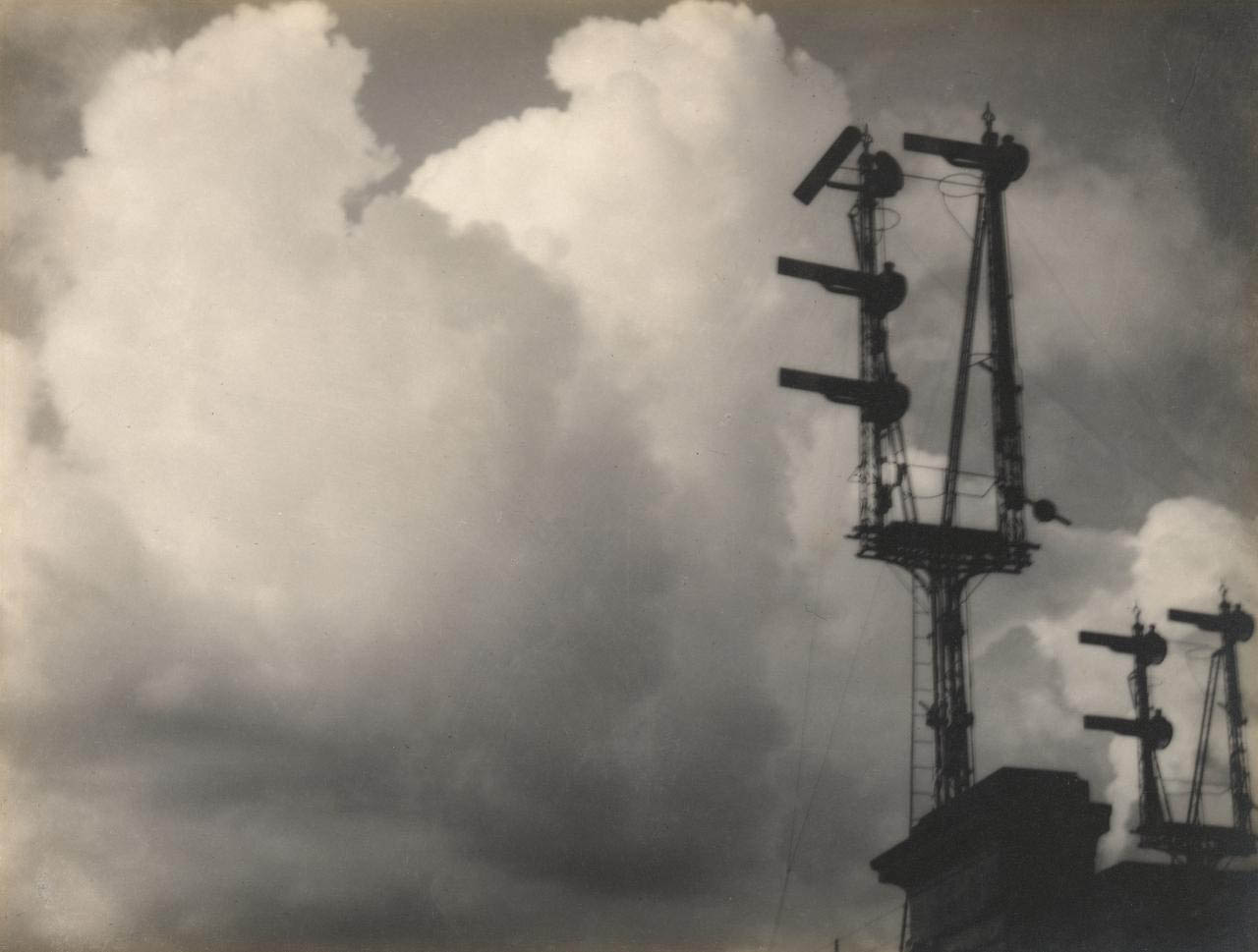
 

John Kauffmann (Australian, 1864-1942) 'The cloud' c. 1905


John Kauffmann (Australian, 1864-1942)
The cloud
c. 1905
Gelatin silver photograph
28.2 × 37.2cm
National Gallery of Victoria, Melbourne
Gift of Mr John Bilney, 1976
Public domain


John Kauffmann (Australian, 1864–1942) 'The grey veil' c. 1919


John Kauffmann (Australian, 1864-1942)
The grey veil
c. 1919
Gelatin silver photograph
National Gallery of Victoria, Melbourne
Purchased through The Art Foundation of Victoria with the assistance of the Herald & Weekly Times Limited, Fellow, 1990
Public domain


The Yarra River, the Princes Bridge and the Melbourne city skyline beyond shimmer in this photograph by John Kauffmann. And yet, they are not the image’s subject. Using a highly refined Pictorialist treatment, a reduced tonal range and luminous mid tones, the artist has manipulated light to the extent that the feeling and atmospheric qualities become the focus of the image – it is the impression that is paramount. With the choice of title, too, the photograph moves away from a specific documentation of place or time.

Wall text from the exhibition


Norman Deck (Australian 1882-1980) 'Sunset, Parramatta River' 1909


Norman Deck (Australian 1882-1980)
Sunset, Parramatta River
1909
Gelatin silver photograph
30.5 × 24.9cm
National Gallery of Victoria, Melbourne
Gift of Joyce Evans, 1993
Public domain
 

Installation view of the exhibition 'Photography: Real & Imagined' at The Ian Potter Centre: NGV Australia, Melbourne showing at centre, David Thomas' 'The Movement of Colour (White), Taking a Monochrome for a Walk (London)' (2010-2011)


Installation view of the exhibition Photography: Real & Imagined at The Ian Potter Centre: NGV Australia, Melbourne showing at centre, David Thomas’ The Movement of Colour (White), Taking a Monochrome for a Walk (London) (2010-2011), with at right works by David Noonan, Hiroshi Sugimoto, László Moholy-Nagy and Susan Fereday (see below)
Photo: Marcus Bunyan
 

David Thomas (British, b. 1951, Australia 1958- ) 'The Movement of Colour (White), Taking a Monochrome for a Walk (London)' 2010-2011 (installation view)


David Thomas (British, b. 1951, Australia 1958- )
The Movement of Colour (White), Taking a Monochrome for a Walk (London) (installation view)
2010-2011
National Gallery of Victoria, Melbourne
Gift of an anonymous donor through the Australian Government’s Cultural Gifts Program 2015
Photo: Marcus Bunyan


“It was made during a residency at the Centre for Drawing Research at Wimbledon School of Art University of the Arts London… and plays on Paul Klee’s definition of drawing as taking a line for a walk on a page… this is taking a monochrome for a walk in the world where the monochrome becomes a key for seeing other colours… an interval in the world. It also suggests the ideas of movement in time and feelings of impermanence.”

~ David Thomas
 

Installation view of the exhibition 'Photography: Real & Imagined' at The Ian Potter Centre: NGV Australia, Melbourne showing works by David Noonan, Hiroshi Sugimoto, Laslo Moholy-Nagy and Susan Fereday


Installation view of the exhibition Photography: Real & Imagined at The Ian Potter Centre: NGV Australia, Melbourne showing at top right, David Noonan’s Untitled (1992); at bottom left, Hiroshi Sugimoto’s Winnetka Drive-In, Paramount (1993); at top right, László Moholy-Nagy’s Fotogram, 1925 (1925); and at bottom right, Susan Fereday’s Untitled (2001)
Photo: Marcus Bunyan


Light and time are both the means and subject of Hiroshi Sugimoto’s Drive-In Theaters series. To produce the images, the artist directs his camera at the movie screen. Once the film starts, Sugimoto opens the lens shutter of his large-format camera and shuts it the moment the movie ends. The result is a visual condensation of the moving images and projected light of the film for its duration into a vivid, hovering rectangle of virtually pulsating light and, in the case of this drive-in cinema, the surrounding human-made and astronomical light, too.

Wall text from the exhibition
 

Installation view of the exhibition 'Photography: Real & Imagined' at The Ian Potter Centre: NGV Australia, Melbourne showing David Noonan's 'Untitled' (1992)


Installation view of the exhibition Photography: Real & Imagined at The Ian Potter Centre: NGV Australia, Melbourne showing David Noonan’s Untitled (1992)
Photo: Marcus Bunyan


László Moholy-Nagy (Hungarian 1895-1946, Germany 1920-1934, England 1935-1937, United States 1937-1946) 'Fotogram, 1925' 1925


László Moholy-Nagy (Hungarian 1895-1946, Germany 1920-1934, England 1935-1937, United States 1937-1946)
Fotogram, 1925
1925
Gelatin silver photograph
National Gallery of Victoria, Melbourne
Presented by the National Gallery Society of Victoria, 1985
Public domain


From 1922 to 1943 László Moholy-Nagy experimented extensively with the photogram process – he was passionate about the optical effects and inherent properties of these camera-less images freed from a purely representational mode. In this work a pale shape, an organic swathe, streams across a page while curved shapes dance at the base. A halo above emits small geometric patterns. The work is a celebration of abstraction of the image – of the effects of playing with light, objects and photographic paper in a darkroom.

Wall text from the exhibition


Installation view of the exhibition Photography: Real & Imagined at The Ian Potter Centre: NGV Australia, Melbourne showing at left, Barbara Kasten's Composition 8T (2018); and at right, Lydia Wegner's Purple square (2017)


Installation view of the exhibition Photography: Real & Imagined at The Ian Potter Centre: NGV Australia, Melbourne showing at left, Barbara Kasten’s Composition 8T (2018, below); and at right, Lydia Wegner’s Purple square (2017, below)
Photo: Marcus Bunyan
 

Barbara Kasten (American, b. 1936) 'Composition 8T' 2018


Barbara Kasten (American, b. 1936)
Composition 8T
2018
Digital type C print
160.0 x 121.9cm (image and sheet)
ed. 1/1
National Gallery of Victoria, Melbourne
Purchased NGV Foundation, 2018
© Barbara Kasten, courtesy Kadel Willborn, Düsseldorf


This photograph from Barbara Kasten’s Collisions/Compositions series continues her practice of creating architectural spaces in the studio using a range of materials, such as plexiglas and mirrors, which she lights and photographs at close range. Influenced by Constructivism and the teachings of the Bauhaus, specifically the work of László Moholy-Nagy, Kasten has experimented with the parameters of abstract photography for around five decades. She has written of her ongoing fascination with light in the creation and conceptual development of her photographs, saying, ‘The interdependency of shadow and light is the essence of photographic exploration and an inescapable part of the photographic process’.

Wall text from the exhibition


Installation view of the exhibition Photography: Real & Imagined at The Ian Potter Centre: NGV Australia, Melbourne showing Lydia Wegner's 'Purple square' (2017)


Installation view of the exhibition Photography: Real & Imagined at The Ian Potter Centre: NGV Australia, Melbourne showing Lydia Wegner’s Purple square (2017)
Photo: Marcus Bunyan


Installation view of the exhibition 'Photography: Real & Imagined' at The Ian Potter Centre: NGV Australia, Melbourne showing at left, Todd McMillan's 'Equivalent VIII' (2014); and at right, Sue Pedley's 'Sound of lotus 1' (2000)


Installation view of the exhibition Photography: Real & Imagined at The Ian Potter Centre: NGV Australia, Melbourne showing at left, Todd McMillan’s Equivalent VIII (2014); and at right, Sue Pedley’s Sound of lotus 1 (2000)
Photo: Marcus Bunyan


Installation view of the exhibition 'Photography: Real & Imagined' at The Ian Potter Centre: NGV Australia, Melbourne


Installation view of the exhibition Photography: Real & Imagined at The Ian Potter Centre: NGV Australia, Melbourne showing at back left, Thomas Ruff’s Portrait (V. Liebermann D) (1999); and at back second left, Ruff’s Portrait (A. Koschkarow) (2000)
Photo: Marcus Bunyan
 

Installation view of the exhibition Photography: Real & Imagined at The Ian Potter Centre: NGV Australia, Melbourne showing at left, Thomas Ruff’s 'Portrait (V. Liebermann D)' (1999); and at right, Ruff's 'Portrait (A. Koschkarow)' (2000)


Installation view of the exhibition Photography: Real & Imagined at The Ian Potter Centre: NGV Australia, Melbourne showing at left, Thomas Ruff’s Portrait (V. Liebermann D) (1999); and at right, Ruff’s Portrait (A. Koschkarow) (2000)
Photo: Marcus Bunyan


The earnest gazes of the man and woman in these two monumental photographs by Thomas Ruff are so calm and serene that they bely the intense experience of viewing their enlarged faces. Applying a standardised approach – similar to a generic passport photograph – these portraits have a timeless quality that invites you to attempt to ‘read’ their faces and to search for clues as to the inner state of the person. Ruff, however, lets nothing slip. The faces are known to the artist but remain anonymous to the viewer.

Wall text from the exhibition


Installation view of the exhibition 'Photography: Real & Imagined' at The Ian Potter Centre: NGV Australia, Melbourne showing Robert Rooney's 'AM-PM: 2 Dec 1973-28 Feb 1974' (1973-1974) (detail)


Installation view of the exhibition Photography: Real & Imagined at The Ian Potter Centre: NGV Australia, Melbourne showing Robert Rooney’s AM-PM: 2 Dec 1973-28 Feb 1974 (1973-1974) (detail)
Photo: Marcus Bunyan


Featuring some of the most iconic photographs ever created alongside contemporary approaches to the photographic medium, Photography: Real & Imagined is the largest survey of the NGV’s Photography collection in the institution’s history and features more than 270 photographs by Australian and international practitioners.

Four years in the making, this landmark exhibition features photographs from across the 200-year period since the invention of photography in the 19th century, including work by leading international photographers including Man Ray, Cindy Sherman, Wolfgang Tillmans, Gilbert & George and Nan Goldin, alongside Australian photographers Max Dupain, Olive Cotton, Mervyn Bishop, Polly Borland, Destiny Deacon and Darren Sylvester.

Through twenty-one thematic sections, this large-scale exhibition explores the proposition that a photograph can be grounded in the real world, recording, documenting and reflecting the world around us; or be the product of imagination, storytelling and illusion; and on occasion operate in both realms. The thematic sections explore subject matter such as light, place and environment, consumption, conflict, community, and death.

Exhibition highlights include Mervyn Bishop’s important photograph of former Prime Minister of Australia, Gough Whitlam, pouring sand into the open palm of Gurindji Elder Vincent Lingiari. The 1975 image captures the historic meeting between these two figures where Lingiari received the crown lease of his ancestral lands. Also on display is Joe Rosenthal’s World War II photograph Raising the flag on Iwo Jima, 1945, in which American marines raise their country’s flag over the Japanese Island. Both Bishop and Rosenthal’s photographs were staged, or re-constructed for better pictorial effect, illustrating the fluid space between the real and imagined.

The exhibition also presents fashion and advertising photography, including key examples by Lilian Bassman, Athol Smith, Horst P. Horst and Dora Maar. These images showcase a world of designer fashion and high-end products, which set a standard in advertising that continues today. Ilse Bing’s Surrealist inspired photograph commissioned by Elsa Schiaparelli to launch her new perfume Salut in 1934 is a highlight of the exhibition.

Highlighting an area of focused collecting for the NGV, the exhibition recognises the work of women practicing in the early 20th century, including Barbara Morgan whose acclaimed photo montage City shell, 1938, shows an unexpected view of the then recently completed Empire State Building.

Through to the current day, Photography: Real & Imagined presents contemporary photographers of the 21st century including Zanele Muholi, Richard Mosse and Alex Prager. Highlights include Cindy Sherman’s celebrated self-portrait in the guise of Renaissance aristocrat. Also on display will be the oldest photographic work in the NGV Collection, an early 19th century portrait by Englishman William Henry Fox Talbot, one of the inventors of the medium, as well as examples of daguerreotypes, unique images on silver plated copper sheets that are amongst the earliest forms of photography.

The exhibition is accompanied by a major publication – the most ambitious book published on the NGV Photography Collection, generously supported by the Bowness Family Foundation. The publication comprises essays from NGV Senior Curator of Photography, Susan van Wyk, Susan Bright and David Campany; alongside texts by Curator of Photography, Maggie Finch and external authors from Australia, Europe, North America and Southeast Asia.

Regular introductory talks for students are held on weekdays during term times, and free drop-by guided tours each Thursday and Sunday at 10.30am during the exhibition period.

Tony Ellwood AM, Director, NGV, said: ‘This exhibition celebrates the collections and achievements of the NGV’s photography department, which has presented more than 180 exhibitions in its 55-year history. The exhibition is a testament to the strength of the NGV Collection, with so many key examples of the history of photography represented, from the earliest examples from the 19th century, through to contemporary images being produced right now in the twenty-first century. We are grateful for the support of the many donors and philanthropists, such as the Bowness Family Foundation, who have helped to grow and strengthen the NGV’s photography collection.’

Press release from the NGV


Installation view of the exhibition 'Photography: Real & Imagined' at The Ian Potter Centre: NGV Australia, Melbourne at top left, O. G. Rejlander's 'The Virgin in prayer' (c. 1858-1860); at bottom left, Henry Peach Robinson's 'Elaine watching the shield of Lancelot' (1859); at centre, Ruth Hollick's 'Thought' (1921); and at right Cindy Sherman's 'Untitled' (1988) from the 'History Portraits' series (1988-1990)


Installation view of the exhibition Photography: Real & Imagined at The Ian Potter Centre: NGV Australia, Melbourne at top left, O. G. Rejlander’s The Virgin in prayer (c. 1858-1860, below); at bottom left, Henry Peach Robinson’s Elaine watching the shield of Lancelot (1859); at centre, Ruth Hollick’s Thought (1921); and at right Cindy Sherman’s Untitled (1988) from the History Portraits series 1988-1990
Photo: Marcus Bunyan


Describing the complex conundrum presented by Cindy Sherman in this photograph, photographer and curator Patrick Pound once wrote: ‘Fake chested and with a face like a mask, here Cindy Sherman is costumed to the max. She stares out like a disapproving Renaissance figure who has just walked off set from a Peter Greenaway extravaganza. Here we have a photographer looking like a painting that walked out of a film. Sherman’s photographs speak of the fragilities of the visage in an image-saturated world where information and construction slip into foreplay. In Sherman’s photographic world gender and identity is a compilation album. There is a toughness to the excess that is all her own’.

Wall text from the exhibition
 

Installation view of the exhibition Photography: Real & Imagined at The Ian Potter Centre: NGV Australia, Melbourne showing O. G. Rejlander's 'The Virgin in prayer' (c. 1858-1860)


Installation view of the exhibition Photography: Real & Imagined at The Ian Potter Centre: NGV Australia, Melbourne showing O. G. Rejlander’s The Virgin in prayer (c. 1858-1860, below)
Photo: Marcus Bunyan
 

Henry Peach Robinson (English, 1830-1901) 'Elaine watching the shield of Lancelot' 1859


Henry Peach Robinson (English, 1830-1901)
Elaine watching the shield of Lancelot
1859
Albumen silver photograph
24.3 × 19.3cm (image and sheet)
National Gallery of Victoria, Melbourne
Purchased from Admission Funds, 1988
Public domain


In the 1850s Henry Peach Robinson was renowned for producing elaborately staged narrative images based on scenes from popular literary sources. He was particularly interested in Arthurian legends and drew upon these stories as inspiration for some of his most admired photographs. Elaine watching the shield of Lancelot is based on Alfred Tennyson’s version of the story of Lancelot and Elaine. Peach Robinson has recreated the scene in which the lovelorn Elaine gazes dreamily at the shield of Lancelot. She is shown as a woman who has shunned reason and propriety and abandoned herself to the intensity of her emotions, making this photograph both a tragic love story and a cautionary narrative.

Wall text from the exhibition
 

Ruth Hollick (Australian, 1883-1977) 'Thought' 1921


Ruth Hollick (Australian, 1883-1977)
Thought
1921
Gelatin silver photograph
37.4 × 25.3cm
National Gallery of Victoria, Melbourne
Presented through The Art Foundation of Victoria by Mrs Lucy Crosbie Morrison, Member, 1993
Public domain


Installation view of the exhibition 'Photography: Real & Imagined' at The Ian Potter Centre: NGV Australia, Melbourne


Installation view of the exhibition Photography: Real & Imagined at The Ian Potter Centre: NGV Australia, Melbourne
Photo: Marcus Bunyan
 

Installation view of the exhibition 'Photography: Real & Imagined' at The Ian Potter Centre: NGV Australia, Melbourne


Installation view of the exhibition Photography: Real & Imagined at The Ian Potter Centre: NGV Australia, Melbourne showing Bernd and Hilla Becher’s Coal tipple, Goodspring, Pennsylvania 1975 from the Artists and Photographs folio 1975
Photo: Marcus Bunyan


In 1959, German-born artists Bernd and Hilla Becher began travelling throughout Europe to create photographic typologies of vanishing industrial architecture (a practice they continued for more than four decades). While predominantly documenting German structures and landscapes, they occasionally worked overseas. This image, four views of a coal tipple, was taken on their first trip to North America in the mid 1970s. The Bechers constructed a system for comparing structures: photographed from a consistent angle, with virtually identical lighting conditions, printed at the same size and often displayed in grids.

Wall text from the exhibition
 

Edward Ruscha (American, b. 1937) 'Twentysix Gasoline Stations' 1963, published 1967 (installation view)

Edward Ruscha (American, b. 1937) 'Twentysix Gasoline Stations' 1963, published 1967 (installation view)


Edward Ruscha (American, b. 1937)
Twentysix Gasoline Stations (installation view)
1963, published 1967
Artist’s book: photo-offset lithograph and printed text, 48 pages, printed cover, glued binding
National Gallery of Victoria, Melbourne
Gift of Robert Rooney through the Australian Government’s Cultural Gifts Program, 2009
Photos: Marcus Bunyan


With the first publication of Twentysix Gasoline Stations, and his subsequent artist books, Edward Ruscha’s work was influential in initiating the widespread interest in photographic book publishing that continues today. Ruscha’s use of photographs as a means of recording – a seemingly unemotional, detached cataloguing of the world – and simply as a ‘device to complete the idea’ influenced the interest in serial imaging adopted by many conceptual artists. Ruscha’s use of the book format was also crucial, providing a transportable way of presenting art in varied contexts that existed as a type of ‘map’ to be read and interpreted, with the subject matter becoming less important than the documentation as a whole.

Wall text from the exhibition
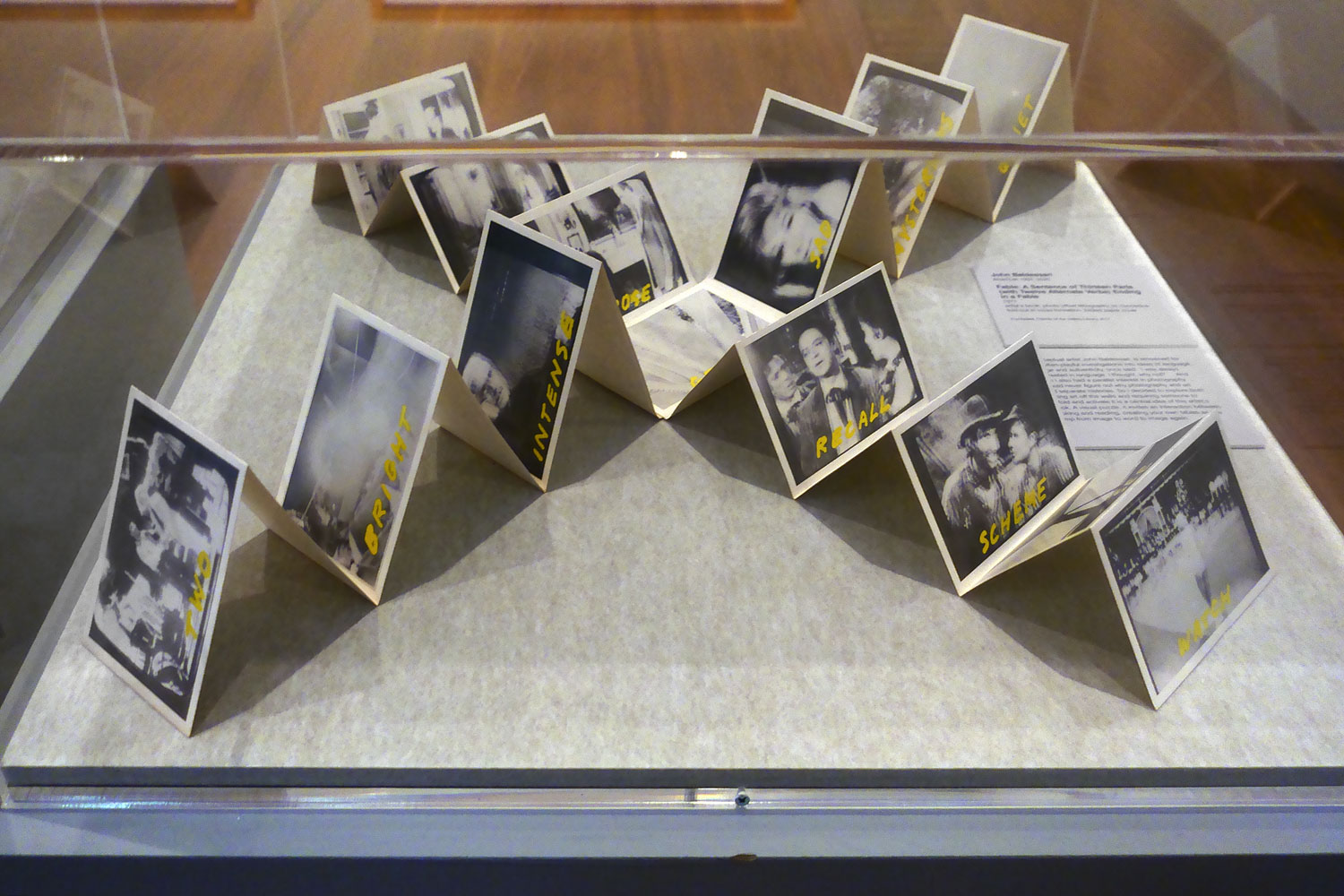
 

John Baldessari (American 1931-2020) ‘Fable: A Sentence of Thirteen Parts (with Twelve Alternate Verbs) Ending in a Fable’ 1977 (installation view)

John Baldessari (American 1931-2020) ‘Fable: A Sentence of Thirteen Parts (with Twelve Alternate Verbs) Ending in a Fable’ 1977 (installation view)


John Baldessari (American 1931-2020)
Fable: A Sentence of Thirteen Parts (with Twelve Alternate Verbs) Ending in a Fable (installation views)
1977
Artist’s book: photo-offset lithography on concertina fold-out in cross formation, folded paper cover
9.8 × 14.0 × 1.8cm (closed) 70.0 × 126.5cm approx. (overall, opened)
National Gallery of Victoria, Melbourne
Purchased, Friends of the Gallery Library, 2017
Photos: Marcus Bunyan


Conceptual artist John Baldessari, is renowned for his often-playful investigations into ideas of language, image and authenticity, once said: ‘I was always interested in language. I thought, why not? … And then I also had a parallel interest in photography … I could never figure out why photography and art had separate histories. So I decided to explore both’. Taking art off the walls and requiring someone to unfold and activate it is a central idea of this artist’s book. A visual puzzle, it invites an interaction between looking and reading, creating your own fables as you jump from image to word to image again.

Wall text from the exhibition
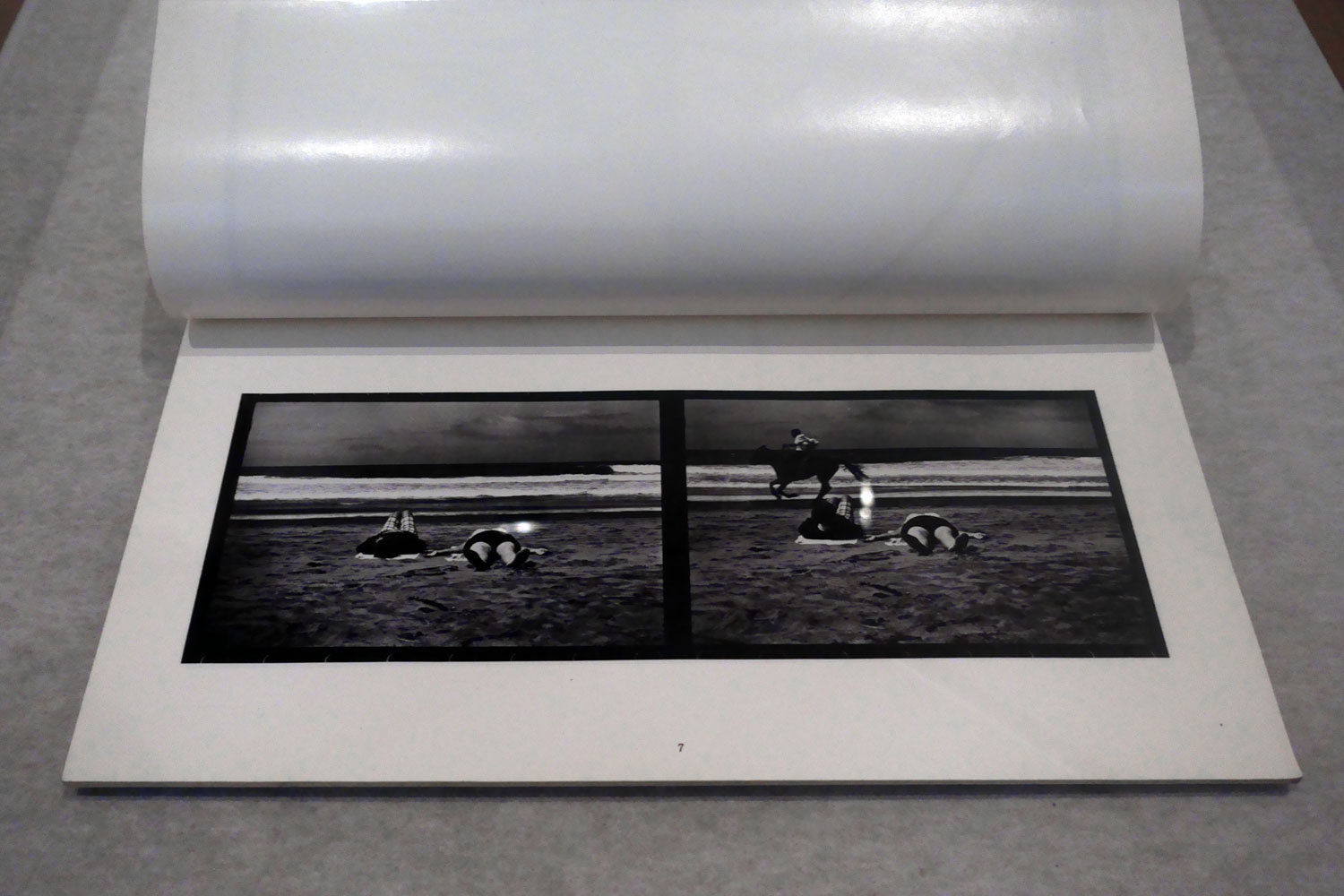
 

Eve Sonneman (American, b. 1946) 'Real time' 1968-1974 (installation view)

Eve Sonneman (American, b. 1946) 'Real time' 1968-1974 (installation view)


Eve Sonneman (American, b. 1946)
Real time (installation view)
1968-1974, published 1976
Artist’s book: photo-offset lithograph and printed text, 46 folios, printed paper cover, glued binding
National Gallery of Victoria, Melbourne
Purchased NGV Supporters of Photography, 2021
Photos: Marcus Bunyan


Eve Sonneman’s photobook Real time includes paired photographs, each separated by a black line border. The diptychs allow for the occurrence of movement and gestures and changes between the artist’s camera clicks. The ordered presentation, however, takes the images away from a straight documentary reading and to a consideration of their ‘objectness’. After first showing the photographs at MoMA, New York, then photography curator, John Szarkowski, set up a mentorship for Sonneman with the photographer Diane Arbus. As Sonneman recalled: ‘[Arbus] loved my pictures and we got along great. For two years she helped me edit’. Sonneman then published the images through the newly established Printed Matter in New York in 1976.

Wall text from the exhibition


Installation view of the exhibition 'Photography: Real & Imagined' at The Ian Potter Centre: NGV Australia, Melbourne showing at top left, Carol Jerrems and Virginia Fraser's book 'A Book About Australian Women' (1974);  at top centre, Nan Goldin's book 'The Ballad of Sexual Dependency' (1986); and at bottom left, Tracey Emin's 'Exploration of the Soul' (1994) 


Installation view of the exhibition Photography: Real & Imagined at The Ian Potter Centre: NGV Australia, Melbourne showing at top left, Carol Jerrems and Virginia Fraser’s book A Book About Australian Women (published 1974);  at top centre, Nan Goldin’s book The Ballad of Sexual Dependency (published 1986); and at bottom left, Tracey Emin’s Exploration of the Soul (published 1994)
Photo: Marcus Bunyan


Installation view of the exhibition 'Photography: Real & Imagined' at The Ian Potter Centre: NGV Australia, Melbourne showing at bottom left, Harold Cazneaux's book 'The Bridge Book' (published 1930); and at top right, Lee Friedlander's 'The American Monument' (published 1976)


Installation view of the exhibition Photography: Real & Imagined at The Ian Potter Centre: NGV Australia, Melbourne showing at bottom left, Harold Cazneaux’s book The Bridge Book (published 1930); and at top right, Lee Friedlander’s book The American Monument (published 1976)
Photo: Marcus Bunyan


Lee Friedlander (American, b. 1934) 'The American Monument' Published by The Eakins Press Foundation, New York, 1976 (installation view)


Lee Friedlander (American, b. 1934)
The American Monument (installation view)
Published by The Eakins Press Foundation, New York, 1976
Half-tone plate
Shaw Research Library, National Gallery of Victoria
Photo: Marcus Bunyan


Berenice Abbott (American 1898-1991, worked in France 1921-1929) 'Changing New York' Published by E. P. Dutton & Co, New York, 1939 (installation view)


Berenice Abbott (American 1898-1991, worked in France 1921-1929)
Changing New York (installation view)
Published by E. P. Dutton & Co, New York, 1939
Half-tone plate and letterpress text
National Gallery of Victoria, Melbourne
Purchased NGV Foundation, 2022
Photo: Marcus Bunyan


Installation view of the exhibition 'Photography: Real & Imagined' at The Ian Potter Centre: NGV Australia, Melbourne showing at top left, Man Ray's book 'Photographs by Man Ray Paris 1920-1934' (published 1934); at bottom left, Claude Cahun and Marcel Moore's book 'Aveux non Avenus' (Disavowals or Cancelled Confessions) (published 1930); at top right, Bill Brandt's book 'Perspective of Nudes' (published 1961); and at bottom right, Germaine Krull's book 'Nude studies' (Études de nu) (published 1930)


Installation view of the exhibition Photography: Real & Imagined at The Ian Potter Centre: NGV Australia, Melbourne showing at top left, Man Ray’s book Photographs by Man Ray Paris 1920-1934 (published 1934); at bottom left, Claude Cahun and Marcel Moore’s book Aveux non Avenus (Disavowals or Cancelled Confessions) (published 1930); at top right, Bill Brandt’s book Perspective of Nudes (published 1961); and at bottom right, Germaine Krull’s book Nude studies (Études de nu) (published 1930)
Photo: Marcus Bunyan


Photographs today are often viewed in galleries in frames, hung on walls. Many photographs, however, were originally created for display in combination with text and graphic design; to be laid out on a page and reproduced in different formats; to be held, worn on the body, published, and shared.

With recognition of these expanded histories of photography, and the contemporary resurgence in publishing, this exhibition includes artist books, magazines and photobooks that use the photographic image in print, publishing and design. These two cases include examples that show the influence of Surrealism, the New Objectivity and Constructivist graphic design in dynamic modern publications.

Artist and author Martin Parr has described the photobook as the ‘supreme platform’ for photographers to share the work with a broad audience. The 1920s to the 1970s were arguably the most important period for the publication of photobooks. These two cases include examples that show the influence of modernist, humanist and documentary photography traditions in innovative publications from this time. These include exhibition catalogues, examples of first edition books, publications published in larger un-editioned print runs and coveted collectable limited-edition books and portfolios.

Wall text from the exhibition


Installation view of the exhibition 'Photography: Real & Imagined' at The Ian Potter Centre: NGV Australia, Melbourne showing Man Ray’s book 'Photographs by Man Ray Paris 1920-1934' published 1934


Installation view of the exhibition Photography: Real & Imagined at The Ian Potter Centre: NGV Australia, Melbourne showing Man Ray’s book Photographs by Man Ray Paris 1920-1934 (published 1934) with at right, Man Ray’s Anatomies (1930, below)
Photo: Marcus Bunyan


Man Ray (1890-1976) 'Anatomies' 1930


Man Ray (Emmanuel Radnitzky) (American, 1890-1976)
Anatomies
1930
Gelatin silver photograph

Please note: this photograph is not in the exhibition
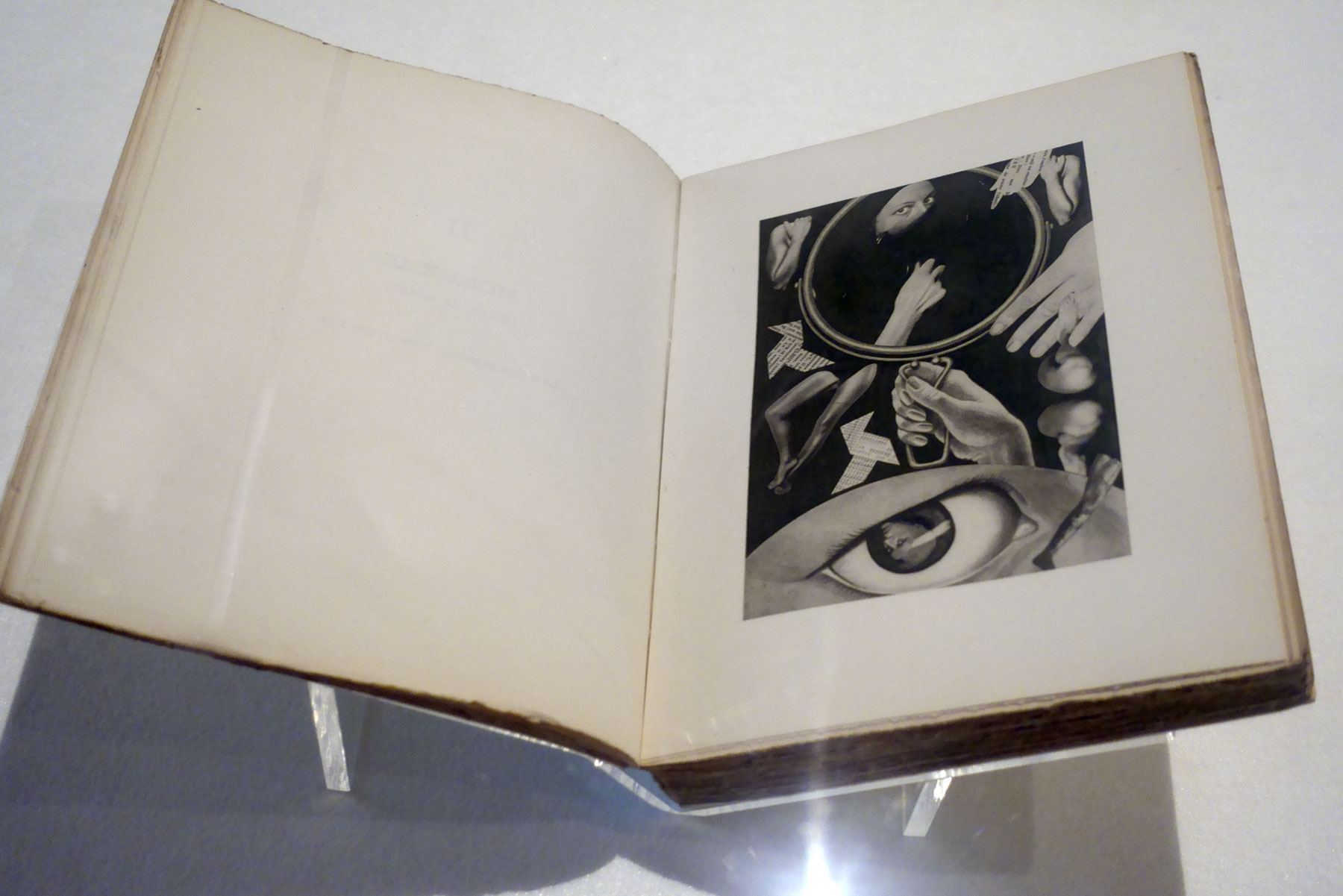
 

Claude Cahun (French, 1894-1954) Marcel Moore (French, 1892-1972) 'Aveux non Avenus' (Disavowals or Cancelled Confessions) Published by Éditions du Carrefour, Paris, 1930 (installation view)

Claude Cahun (French, 1894-1954) Marcel Moore (French, 1892-1972) 'Aveux non Avenus' (Disavowals or Cancelled Confessions) Published by Éditions du Carrefour, Paris, 1930 (installation view)


Claude Cahun (French, 1894-1954) Marcel Moore (French, 1892-1972)
Aveux non Avenus (Disavowals or Cancelled Confessions) (installation view)
Published by Éditions du Carrefour, Paris, 1930
Illustrated book: photogravure, letterpress text, 237 pages, 10 leaves of plates, paper cover, stitched binding
National Gallery of Victoria, Melbourne
Shaw Research Library, acquired through the Friends of the Gallery Library endowment, 2017
Photos: Marcus Bunyan


Aveux non Avenus, by the celebrated poet, writer, sculptor and photographer Claude Cahun, was published in 1930 by Éditions du Carrefour, Paris, in an edition of five hundred. The book comprises a series of texts in French: poems, literary aphorisms, recollections of dream sequences and philosophical thoughts, ideas and meanderings. Pierre Mac Orlan, a French novelist who wrote the preface to the book, described Mademoiselle Claude Cahun’s text as ‘de poèmes-essais et d’essais-poèmes’, or ‘poem-essays and essay-poems’, and said that overall ‘the book is virtually entirely dedicated to the word adventure’

The alliterative title presents a conundrum for English translation – ‘aveux’ meaning ‘avowals’ or ‘confessions’, and ‘non avenus’ meaning ‘voided’ – and is variously translated as Disavowals, Denials, and Unavowed confessions, among other things. Curator Jennifer Mundy has written that the title suggests ‘an affirmative expression immediately followed by some form of negation or retraction’.

Ambiguities around the title aside, there is a strong visual aspect to the book too. The texts are each demarcated with a complex and fantastical photogravure created by Cahun’s partner, Marcel Moore. These photogravure (where an image from the negative of a photograph is etched into a metal plate, similar to printmaking) are collages made up of photographic images of, and by, Cahun. Throughout the book, graphic devices of stars, eyes and lips are also used to separate sections of text. Aveux non Avenus, which has been described as an anti-realist or surrealist-autobiography of the multi-disciplinary Cahun, exists as a potential critique of the autobiography format altogether, is wonderfully irreducible.

Maggie Finch and Isobel Crombie. “Claude Cahun,” in the 2019 July/August edition of NGV Magazine on the NGV website 9th April 2020 [Online] Cited 28/01/2024


Claude Cahun (French, 1894-1954) and Marcel Moore (French, 1892-1972) 'Untitled' 1930


Claude Cahun (French, 1894-1954) and Marcel Moore (French, 1892-1972)
Untitled
1930
In Aveux non avenus 1930
published by Éditions du Carrefour, Paris
illustrated book: heliographs
National Gallery of Victoria, Melbourne
Shaw Research Library, acquired through the Friends of the Gallery Library endowment, 2017
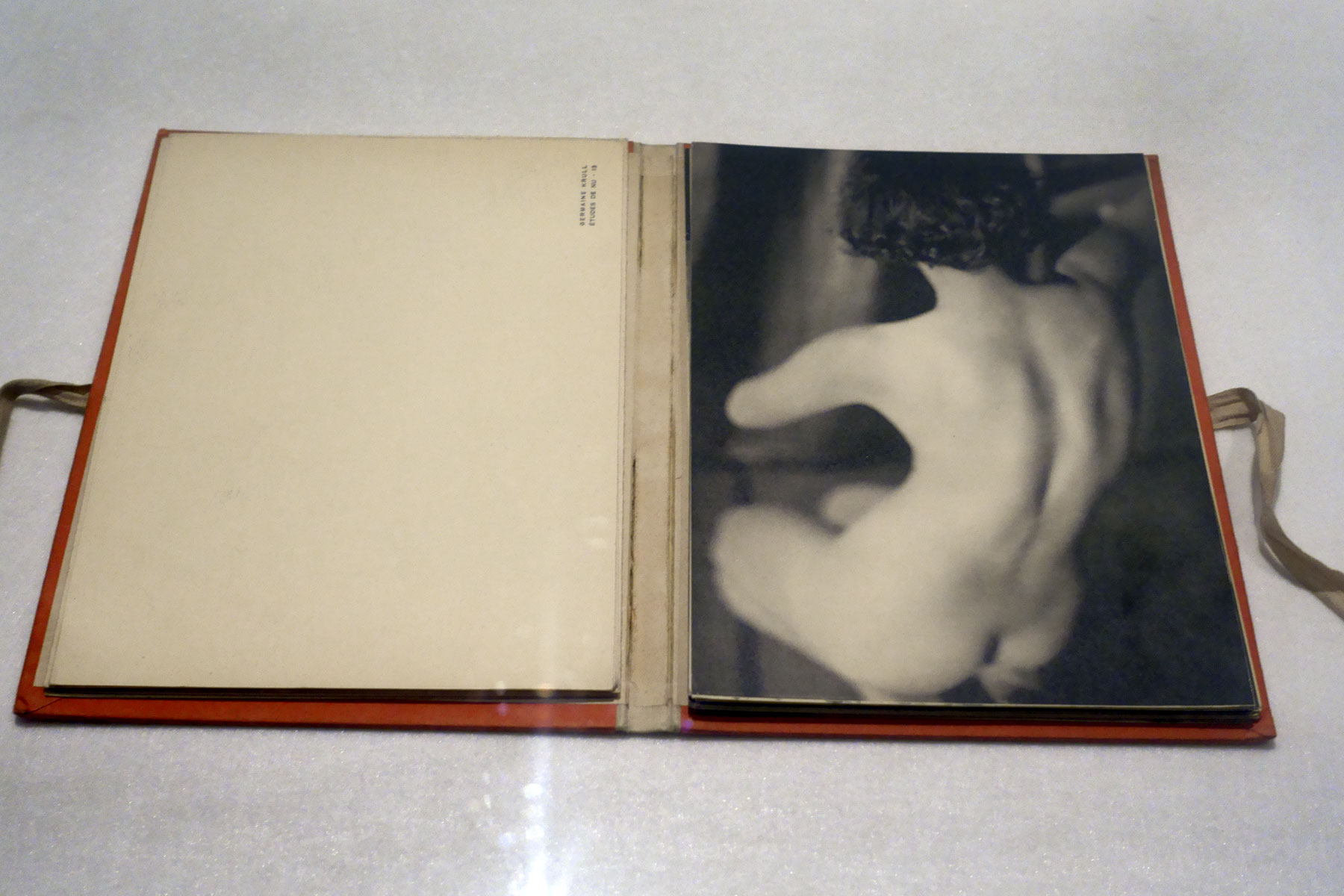
 

Germaine Krull (German, 1897-1985) 'Nude Studies' (Études de Nu) Published by Librarie des arts décoratifs, Paris, 1930 (installation view)


Germaine Krull (German, 1897-1985)
Nude Studies (Études de Nu) (installation view)
Published by Librarie des arts décoratifs, Paris, 1930
24 photogravures, letterpress on paper, white cloth-backed orange paper-covered board portfolio with ribbons
National Gallery of Victoria
Purchased, NGV Foundation, 2022
Photo: Marcus Bunyan


Bill Brandt (English born Germany, 1904-1983) 'Perspective of Nudes' Published Bodley Head, London, 1961 (installation view)


Bill Brandt (English born Germany, 1904-1983)
Perspective of Nudes (installation view)
Published Bodley Head, London, 1961
Half-tone plate
Shaw Research Library, National Gallery of Victoria
Photo: Marcus Bunyan
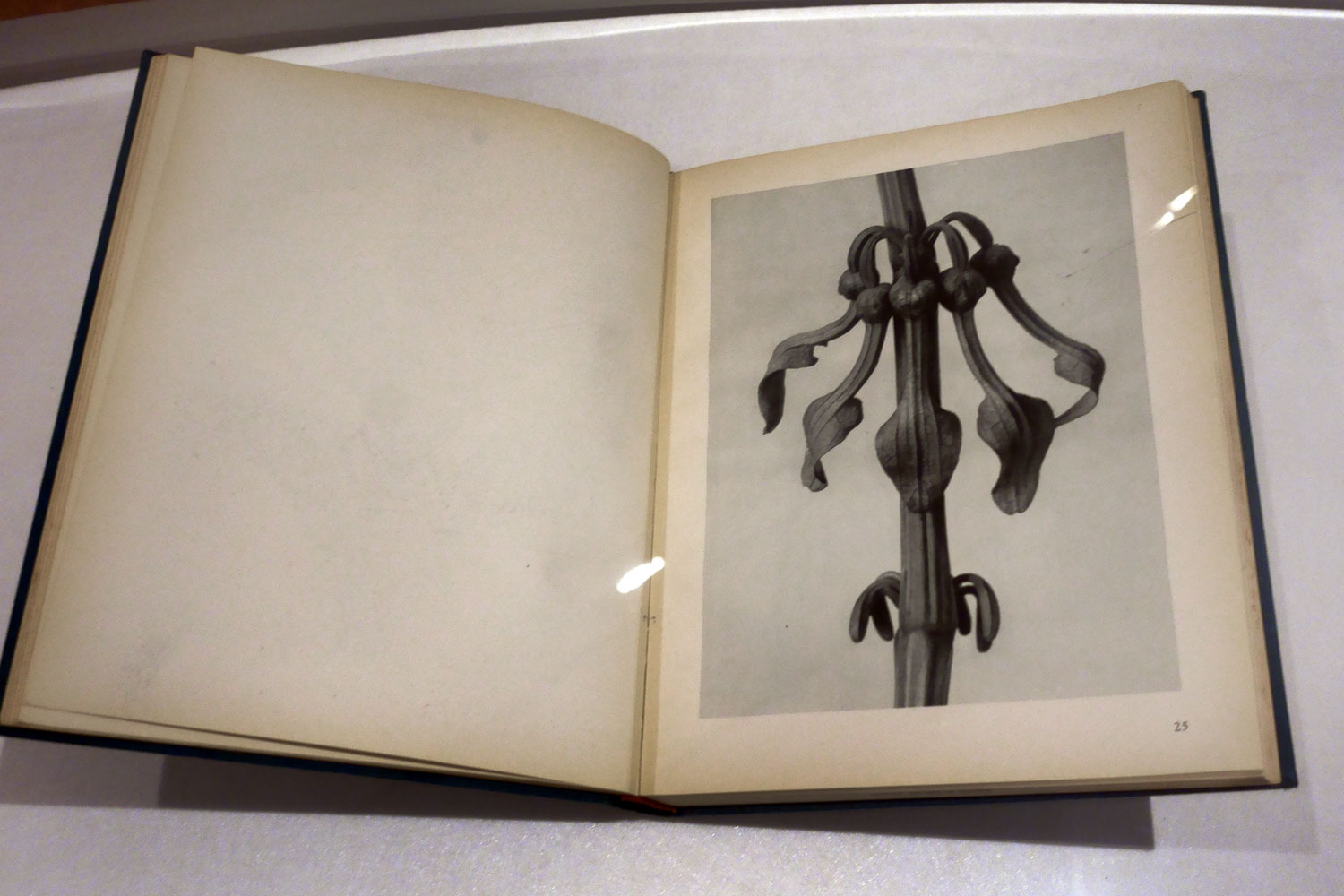
 

Karl Blossfeldt (German, 1865-1932) 'Art Forms in Nature: Examples from the Plant World Photographed Direct from Nature' Published by A. Zwemmer, London, 1929 (installation view)


Karl Blossfeldt (German, 1865-1932)
Art Forms in Nature: Examples from the Plant World Photographed Direct from Nature (installation view)
Published by A. Zwemmer, London, 1929
Half-tone plate
Shaw Research Library, National Gallery of Victoria
Photo: Marcus Bunyan


Karel Teige typographer (Czechoslovakia 1900-1951) Karel Paspa photographer (Czechoslovakia 1862-1936) 'ABECEDA (Alphabet)' Published by J. Otto, Prague, 1926 (installation view)


Karel Teige typographer (Czechoslovakia 1900-1951)
Karel Paspa photographer (Czechoslovakia 1862-1936)
ABECEDA (Alphabet) (installation view)
Published by J. Otto, Prague, 1926
Photomontage
National Gallery of Victoria
Shaw Research Library, acquired through the Friends of the Gallery Library endowment, 2017
Photo: Marcus Bunyan


Aleksandr Rodchenko (Russian, 1891-1958) Varvara Stepanova (Russian, 1894-1958) 'USSR in Construction, no. 12 (Parachute issue)' (URSS en Construction) 1935


Aleksandr Rodchenko (Russian, 1891-1958) and Varvara Stepanova (Russian, 1894-1958)
USSR in Construction, no. 12 (Parachute issue) (URSS en Construction) (installation view)
1935
Illustrated journal: colour rotogravure, 22 pages with fold-out inserts, lithographic cover
National Gallery of Victoria
Purchased, NGV Supporters of Prints and Drawings, 2019
Photo: Marcus Bunyan


Installation view of the exhibition 'Photography: Real & Imagined' at The Ian Potter Centre: NGV Australia, Melbourne showing at top left, Eliza Hutchinson's 'No. 9' (2010); at bottom left, Ewa Narkiewicz's 'Copper flax #4' (1999); at centre top, Harry Nankin's 'The first wave: fragment 2' (1996); at centre bottom, Peter Peryer's 'Seeing' (1989); and at right, Aaron Siskind's 'New York' (1950)


Installation view of the exhibition Photography: Real & Imagined at The Ian Potter Centre: NGV Australia, Melbourne showing at top left, Eliza Hutchinson’s No. 9 (2010); at bottom left, Ewa Narkiewicz’s Copper flax #4 (1999); at centre top, Harry Nankin’s The first wave: fragment 2 (1996); at centre bottom, Peter Peryer’s Seeing (1989); and at right, Aaron Siskind’s New York (1950)
Photo: Marcus Bunyan


In much the same way that tactile writing systems such as braille are impenetrable to those with vision, a photograph printed in two dimensions can be incomprehensible for people with vision impairment. Each system presents a conversion – of letters, texts and illustration – into raised dots on a page; of visible wavelengths of light into an image on a light-sensitive surface. Each relies on an irreversible alteration of the surface. Seeing, the title of this Peter Peryer photograph, infers an action – seeing something. Yet the conversion into a photographic image draws attention to the impenetrability of both acts.

Wall text from the exhibition


Installation view of the exhibition 'Photography: Real & Imagined' at The Ian Potter Centre: NGV Australia, Melbourne showing at left, Gregory Crewdson's 'Untitled' (1999) from the Twilight series (1998-2002); at centre, Malerie Marder's 'Untitled' (2001); and at right, Anne Zahalka's 'Sunday, 2:09pm' (1995) 


Installation view of the exhibition Photography: Real & Imagined at The Ian Potter Centre: NGV Australia, Melbourne showing at left, Gregory Crewdson’s Untitled (1999) from the Twilight series (1998-2002); at centre, Malerie Marder’s Untitled (2001); and at right, Anne Zahalka’s Sunday, 2:09pm (1995)
Photo: Marcus Bunyan
 

Gregory Crewdson (American, b. 1962) 'Untitled' 1999 (installation view)


Gregory Crewdson (American, b. 1962)
Untitled (installation view)
1999
From the Twilight series 1998-2002
Type C photograph
121.9 × 152.4cm
National Gallery of Victoria, Melbourne
Kaiser Bequest, 2000
Photo: Marcus Bunyan


Anne Zahalka (Australian, b. 1957) 'Sunday, 2:09pm' 1995, printed 2019 (installation view)


Anne Zahalka (Australian, b. 1957)
Sunday, 2:09pm
1995, printed 2019
From the Open House series 1995
Colour cibachrome transparency, light box
121.7 × 161.4cm
National Gallery of Victoria, Melbourne
Purchased, Victorian Foundation for Living Australian Artists, 2019
Photo: Marcus Bunyan
 

Installation view of the exhibition 'Photography: Real & Imagined' at The Ian Potter Centre: NGV Australia, Melbourne showing at left, Polly Borland's 'Untitled' (2018); and at right, Anne Zahalka's 'Sunday, 2:09pm' (1995)


Installation view of the exhibition Photography: Real & Imagined at The Ian Potter Centre: NGV Australia, Melbourne showing at left, Polly Borland’s Untitled (2018); and at right, Anne Zahalka’s Sunday, 2:09pm (1995)
Photo: Marcus Bunyan
 

Installation view of the exhibition 'Photography: Real & Imagined' at The Ian Potter Centre: NGV Australia, Melbourne showing at rear from left to right, Gregory Crewdson's 'Untitled' (1999) from the 'Twilight' series (1998-2002); at second left, Malerie Marder's 'Untitled' (2001); and centre, Anne Zahalka's 'Sunday, 2:09pm' (1995); and at right, Alex Prager's 'Crowd #11 (Cedar and Broad Street)' (2013)


Installation view of the exhibition Photography: Real & Imagined at The Ian Potter Centre: NGV Australia, Melbourne showing at rear from left to right, Gregory Crewdson’s Untitled (1999) from the Twilight series (1998-2002); at second left, Malerie Marder’s Untitled (2001); and centre, Anne Zahalka’s Sunday, 2:09pm (1995); and at right, Alex Prager’s Crowd #11 (Cedar and Broad Street) (2013, below)
Photo: Marcus Bunyan


Installation view of the exhibition Photography: Real & Imagined at The Ian Potter Centre: NGV Australia, Melbourne showing Alex Prager's 'Crowd #11 (Cedar and Broad Street)' (2013)


Installation view of the exhibition Photography: Real & Imagined at The Ian Potter Centre: NGV Australia, Melbourne showing Alex Prager’s Crowd #11 (Cedar and Broad Street) (2013, below)
Photos: Marcus Bunyan


Alex Prager (American, b. 1979) 'Crowd #11 (Cedar and Broad Street)' 2013


Alex Prager (American, b. 1979)
Crowd #11 (Cedar and Broad Street)
2013
Inkjet print
149.7 × 142.0cm (image and sheet)
National Gallery of Victoria, Melbourne
Bowness Family Fund for Contemporary Photography, 2014


Alex Prager’s staged photographs openly reference the aesthetics of mid-twentieth century American cinema, fashion photography and the photographs of Cindy Sherman. Her images resemble film stills and are packed with emotion and human melodrama. Working with actors, directing their placement and interaction to create a hyperreal dramatisation of crowd behaviour, Prager’s narrative tableaux pair the banal and fantastic, the everyday and the theatrical, real life and cinematic representation. In this image we have a bird’s eye view of a mass of people crossing the road. We can see the patterns of movement, contact and avoidance and a suggestion of the narrative possibilities of the interacting crowd.

Wall text from the exhibition


Installation view of the exhibition 'Photography: Real & Imagined' at The Ian Potter Centre: NGV Australia, Melbourne showing at second right, Pat Brassington's 'Rosa' (2014); and at right, Yvonne Todd's 'Werta' (2005)


Installation view of the exhibition Photography: Real & Imagined at The Ian Potter Centre: NGV Australia, Melbourne showing at second right, Pat Brassington’s Rosa (2014); and at right, Yvonne Todd’s Werta (2005)
Photo: Marcus Bunyan
 

Zoë Croggon (Australian, b. 1989) 'Fonteyn' 2012 (installation view)


Zoë Croggon (Australian, b. 1989)
Fonteyn (installation view)
2012
Digital type C print
102.8 × 99.9cm
Purchased with funds arranged by Loti Smorgon for Contemporary Australian Photography, 2013
Photo: Marcus Bunyan
 

Installation view of the exhibition 'Photography: Real & Imagined' at The Ian Potter Centre: NGV Australia, Melbourne showing Loretta Lux's 'The Drummer' (2004)


Installation view of the exhibition Photography: Real & Imagined at The Ian Potter Centre: NGV Australia, Melbourne showing Loretta Lux’s The Drummer (2004, below)
Photo: Marcus Bunyan
 

Loretta Lux (German, b. 1969) 'The drummer' 2004


Loretta Lux (German, b. 1969)
The drummer
2004
Cibachrome photograph
45.0 x 37.7cm
National Gallery of Victoria, Melbourne
Purchased, NGV Foundation, 2006
© Loretta Lux. VG Bild-Kunst/Copyright Agency, 2023


Loretta Lux is known for her eerie, hyperreal photographs of children. The luminous pallor of the boy’s skin and the subtle tonal range throughout the photograph is achieved through Lux’s delicate use of digital manipulation to reduce the palette in her image. Lux’s history as a painter informs photographs such as this, which seem to owe as much of a debt to Old Master paintings as modern technology. Her skilful combination of photographic reality and painterly effect gives the image a profoundly disconcerting quality that is reminiscent of the fantastical (and disturbing) character of Oskar, the little drummer boy, in the Günter Grass novel The Tin Drum (1959).

Wall text from the exhibition


Installation view of the exhibition 'Photography: Real & Imagined' at The Ian Potter Centre: NGV Australia, Melbourne showing at bottom left, Raoul Ubac's 'Penthésilée' (c. 1938, below); at top centre, André Kertész's Satiric Dancer, Paris (1926, below); and at right, Max Dupain's 'Impassioned clay' (1936, below)


Installation view of the exhibition Photography: Real & Imagined at The Ian Potter Centre: NGV Australia, Melbourne showing at bottom left, Raoul Ubac’s Penthésilée (c. 1938, below); at top centre, André Kertész’s Satiric Dancer, Paris (1926, below); and at right, Max Dupain’s Impassioned clay (1936, below)
Photo: Marcus Bunyan


Raoul Ubac (Belgian, 1909-1985) 'Penthésilée' c. 1938


Raoul Ubac (Belgian, 1909-1985)
Penthésilée
c. 1938
Gelatin silver photograph
31.0 × 41.5cm
National Gallery of Victoria, Melbourne
Purchased NGV Foundation, 2013


From the mid 1930s onwards Surrealist photographer Raoul Ubac experimented with collage, photomontage and solarisation. These processes disrupted the surface of his photographs, enabling him to create new and fantastic realities and introducing an element of chance into his image making. Penthésilée is from his most important series of photographs. The image is based on the story of Penthesilea, queen of the Amazons, who was killed by Achilles while fighting alongside the Trojans. To represent this mythic battle Ubac created this complex photomontage by cutting up, collaging, rephotographing and solarising photographs of nude female figures. The resulting image has an uncanny sense of movement suggesting the height of battle.

Wall text from the exhibition
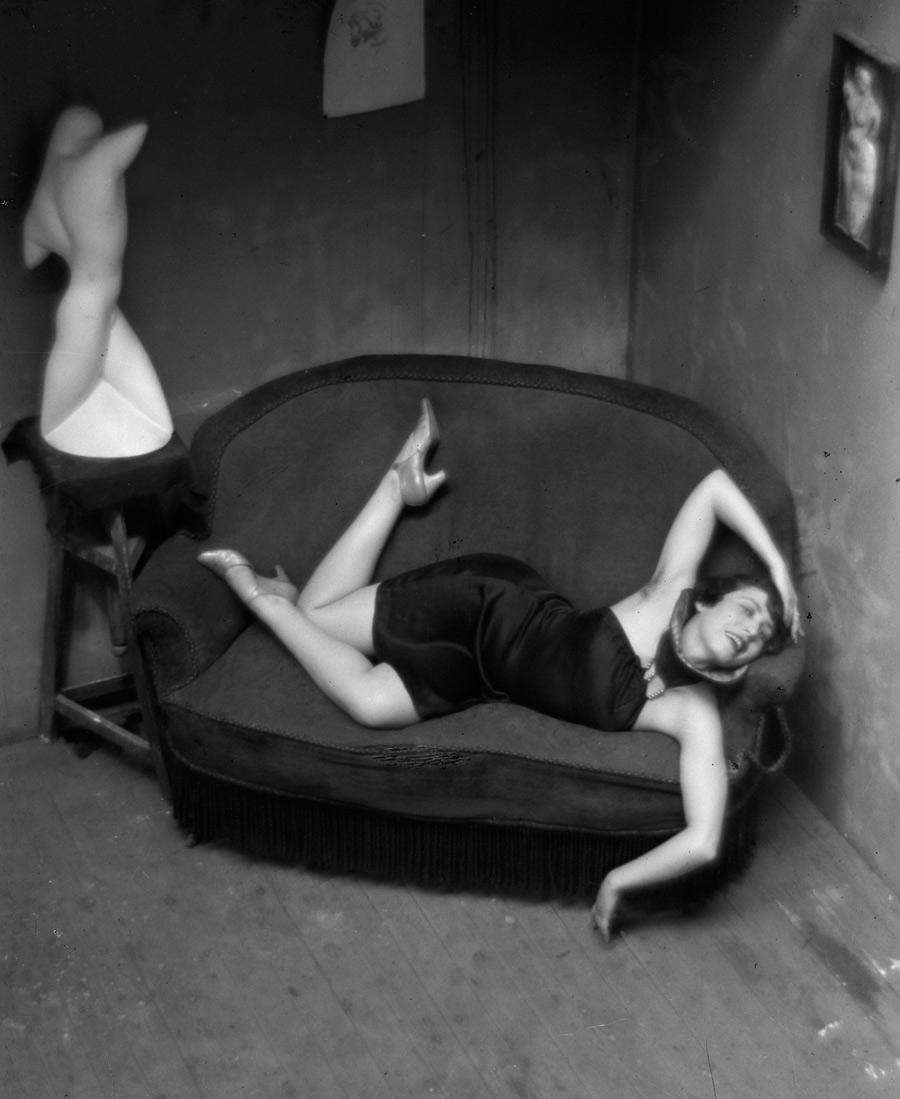
 

André Kertész. 'Satiric Dancer' 1926


André Kertész (Hungarian 1894-1985, France 1925-1936, United States 1936-1985)
Satiric Dancer, Paris
1926, printed c. 1972
Gelatin silver photograph
Purchased, 1973


Installation view of the exhibition 'Photography: Real & Imagined' at The Ian Potter Centre: NGV Australia, Melbourne showing Max Dupain's 'Impassioned clay' (1936)


Installation view of the exhibition Photography: Real & Imagined at The Ian Potter Centre: NGV Australia, Melbourne showing Max Dupain’s Impassioned clay (1936, below)
Photo: Marcus Bunyan


Max Dupain (Australian 1911-1992) 'Impassioned clay' 1936


Max Dupain (Australian 1911-1992)
Impassioned clay
1936
Gelatin silver photograph
50.4 × 36.7cm irreg.
National Gallery of Victoria, Melbourne
William Kimpton Bequest, 2016
Public domain


Installation view of the exhibition 'Photography: Real & Imagined' at The Ian Potter Centre: NGV Australia, Melbourne showing at left, Pat Brassington's 'Rosa' (2014); and at right, Yvonne Todd's 'Werta' (2005)


Installation view of the exhibition Photography: Real & Imagined at The Ian Potter Centre: NGV Australia, Melbourne showing at left, Pat Brassington’s Rosa (2014); and at right, Yvonne Todd’s Werta (2005)
Photo: Marcus Bunyan


Yvonne Todd selects her subjects, most often young women, from ‘call outs’ seeking certain types, people encountered on the street, or modelling agencies where she invariably chooses those with little or no industry experience. In her studio Todd uses costumes, heavy make-up and wigs to style her models. Costuming is an important aspect of Todd’s practice; her interest lies in in what she describes as, ‘the way they carry character and narrative connotations’. Todd’s finished photographs are heavily reworked using Photoshop so that they appear obviously artificial. This overt use of artifice shifts her images from simply being nostalgic recreations to being strangely familiar and undeniably creepy.

Wall text from the exhibition


Installation view of the exhibition 'Photography: Real & Imagined' at The Ian Potter Centre: NGV Australia, Melbourne showing at back left, Robyn Stacey's 'Nothing to see here' (2019) and at back centre, Polly Borland's 'Untitled' (2018)


Installation view of the exhibition Photography: Real & Imagined at The Ian Potter Centre: NGV Australia, Melbourne showing at back left, Robyn Stacey’s Nothing to see here (2019) and at back centre, Polly Borland’s Untitled (2018)
Photo: Marcus Bunyan


Robyn Stacey (Australian, b. 1952) 'Nothing to see here' 2019


Robyn Stacey (Australian, b. 1952)
Nothing to see here
2019
From the Nothing to See Here series 2019
Lenticular image
155.5 × 119cm
National Gallery of Victoria, Melbourne
Purchased, Victorian Foundation for Living Australian Artists, 2020


This large-scale lenticular photograph shows the face of a woman projected onto a curtain. The curtain suggests a hidden cinema screen; however, Robyn Stacey’s curtains cannot be pulled back. From one viewpoint a beautiful face with eyes softly closed as if in sleep appears, but as you move past the image you can only see the curtain. The curtain becomes what the artist described as ‘a membrane between reality and allegory’ and acts as the screen as the portrait appears and disappears.

Wall text from the exhibition
 

Installation view of the exhibition 'Photography: Real & Imagined' at The Ian Potter Centre: NGV Australia, Melbourne showing Polly Borland's lenticular photograph 'Untitled' (2018)

Installation view of the exhibition 'Photography: Real & Imagined' at The Ian Potter Centre: NGV Australia, Melbourne showing Polly Borland's lenticular photograph 'Untitled' (2018)

Installation view of the exhibition 'Photography: Real & Imagined' at The Ian Potter Centre: NGV Australia, Melbourne showing Polly Borland's lenticular photograph 'Untitled' (2018)


Installation views of the exhibition Photography: Real & Imagined at The Ian Potter Centre: NGV Australia, Melbourne showing Polly Borland’s lenticular photograph Untitled (2018) from the MORPH series
Photos: Marcus Bunyan
 

Polly Borland (Australia, b. 1959) 'Untitled' 2018


Polly Borland (Australia, b. 1959)
Untitled
2018
From MORPH series 2018
Inkjet print on rice paper on lenticular cardboard
216.0 × 172.7 × 13.0cm
National Gallery of Victoria, Melbourne
Purchased, Victorian Foundation for Living Australian Artists, 2019
© Polly Borland
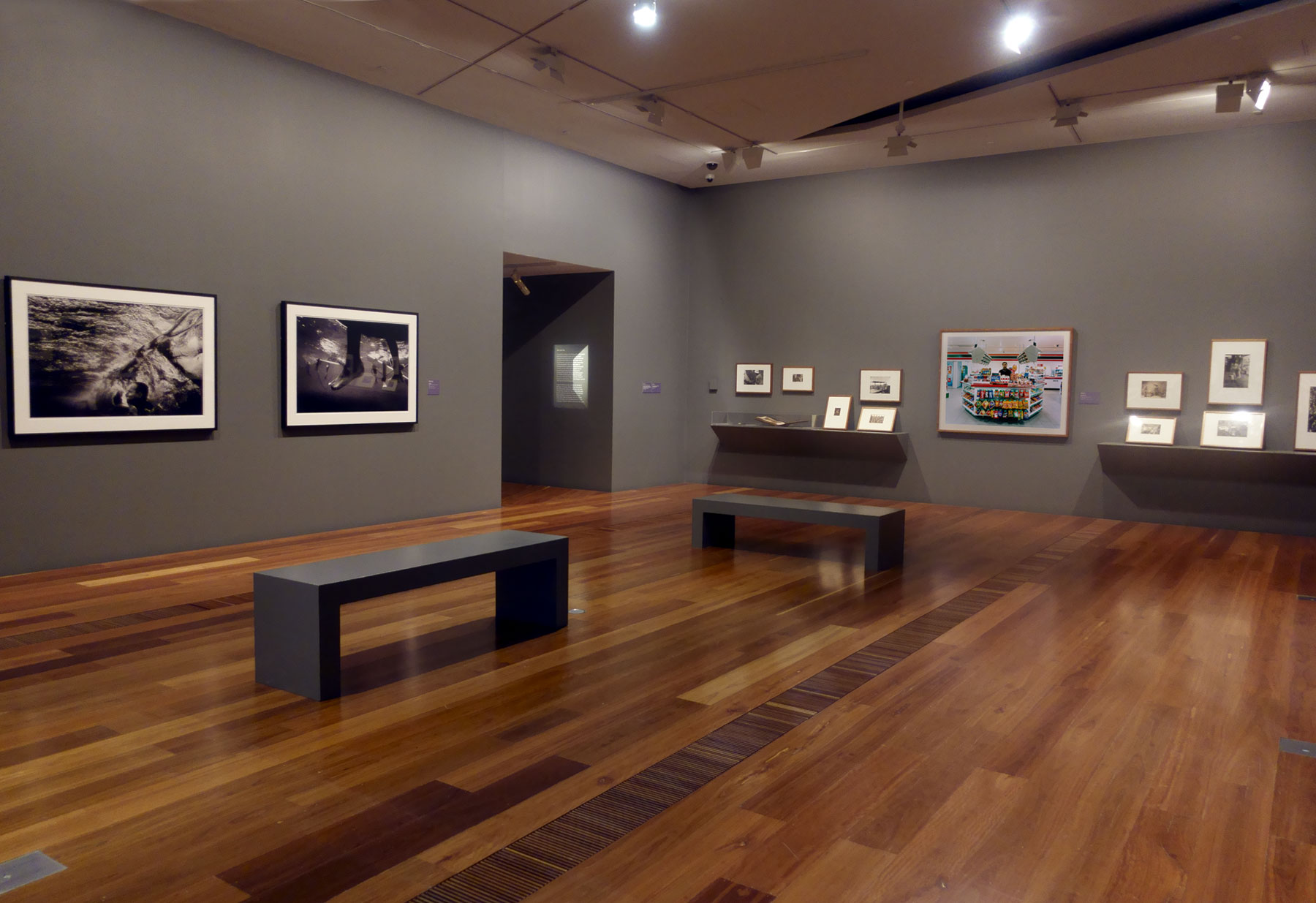
 

Installation view of the exhibition Photography: Real & Imagined at The Ian Potter Centre: NGV Australia, Melbourne showing at left, Narelle Autio's two photographs 'Untitled' from 'The Seventh Wave' series (1999-2000); and at right, Selina Ou's 'Convenience' (2001)


Installation view of the exhibition Photography: Real & Imagined at The Ian Potter Centre: NGV Australia, Melbourne showing at left, Narelle Autio’s two photographs Untitled from The Seventh Wave series (1999-2000); and at centre right, Selina Ou’s Convenience (2001)
Photo: Marcus Bunyan


Installation view of the exhibition Photography: Real & Imagined at The Ian Potter Centre: NGV Australia, Melbourne showing Narelle Autio's two photographs 'Untitled' from 'The Seventh Wave' series (1999-2000)


Installation view of the exhibition Photography: Real & Imagined at The Ian Potter Centre: NGV Australia, Melbourne showing Narelle Autio’s two photographs Untitled from The Seventh Wave series (1999-2000)
Photo: Marcus Bunyan


Narelle Autio (Australian, b. 1969) 'Untitled' 2000 (installation view)


Narelle Autio (Australian, b. 1969)
Untitled (installation view)
2000
From The Seventh Wave series 1999-2000
Gelatin silver photograph
90.0 × 134.1cm
National Gallery of Victoria, Melbourne
Purchased with funds arranged by Loti Smorgon for Contemporary Australian Photography, 2001
Photo: Marcus Bunyan


Installation view of the exhibition Photography: Real & Imagined at The Ian Potter Centre: NGV Australia, Melbourne showing at back centre, Selina Ou’s Convenience (2001); and at right, Rosemary Laing’s welcome to Australia (2004)
Photo: Marcus Bunyan
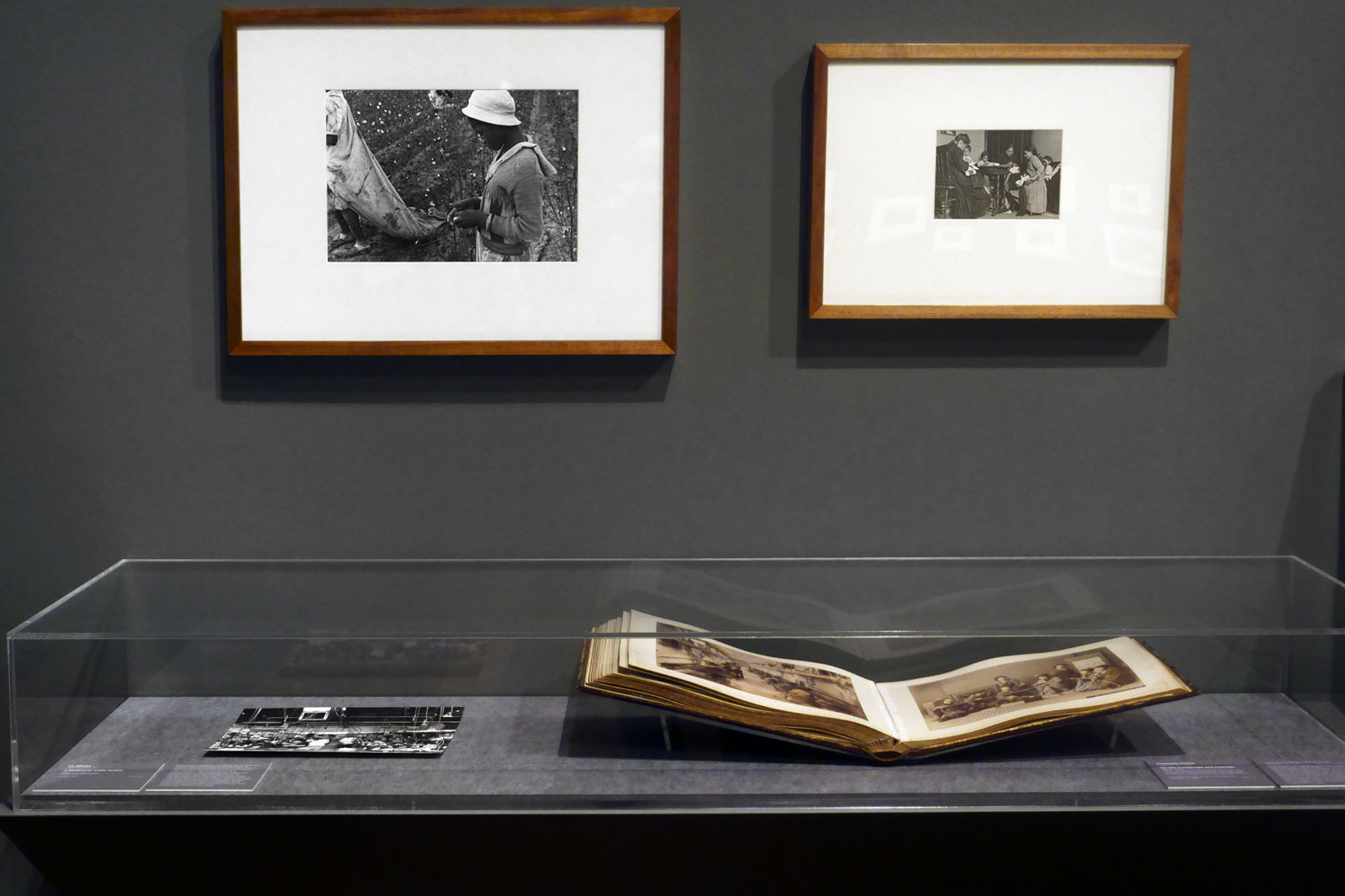
 

Installation view of the exhibition 'Photography: Real & Imagined' at The Ian Potter Centre: NGV Australia, Melbourne showing at back left, Ben Shahn's 'Young cotton picker, Pulaski County, Arkansas. Schools for coloured children do not open until January 1st so as not to interfere with cotton picking' 1935; and back right, Lewis Hine's 'Finishing garments, 10 Hanover Ave., Boston, Massachusetts' 1912; and at right in the cabinet, Kusakabe Kimbei's album '(Landscape and portraits)' (1880s-1910s) 


Installation view of the exhibition Photography: Real & Imagined at The Ian Potter Centre: NGV Australia, Melbourne showing at back left, Ben Shahn’s Young cotton picker, Pulaski County, Arkansas. Schools for coloured children do not open until January 1st so as not to interfere with cotton picking 1935; and back right, Lewis Hine’s Finishing garments, 10 Hanover Ave., Boston, Massachusetts 1912; and at right in the cabinet, Kusakabe Kimbei’s album (Landscape and portraits) (1880s-1910s)
Photo: Marcus Bunyan


Ben Shahn (Lithuanian 1898-1969, United States c. 1925-1969) 'Young cotton picker, Pulaski County, Arkansas. Schools for coloured children do not open until January 1st so as not to interfere with cotton picking' 1935, printed c. 1975 (installation view)


Ben Shahn (Lithuanian 1898-1969, United States c. 1925-1969)
Young cotton picker, Pulaski County, Arkansas. Schools for coloured children do not open until January 1st so as not to interfere with cotton picking (installation view)
1935, printed c. 1975
Gelatin silver photograph
21.7 × 32.8cm
National Gallery of Victoria, Melbourne
Purchased, 1975
Photo: Marcus Bunyan
 

Lewis Hine (American, 1874-1940) 'Finishing garments, 10 Hanover Ave., Boston, Massachusetts' 1912


Lewis Hine (American, 1874-1940)
Finishing garments, 10 Hanover Ave., Boston, Massachusetts
1912
Gelatin silver photograph
11.4 × 16.4cm
National Gallery of Victoria, Melbourne
Purchased, 1980
Public domain


Installation view of the exhibition Photography: Real & Imagined at The Ian Potter Centre: NGV Australia, Melbourne showing Kusakabe Kimbei's album '(Landscape and portraits)' (1880s-1910s) 


Installation view of the exhibition Photography: Real & Imagined at The Ian Potter Centre: NGV Australia, Melbourne showing Kusakabe Kimbei’s album (Landscape and portraits) (1880s-1910s)
Photo: Marcus Bunyan
 

Installation view of the exhibition 'Photography: Real & Imagined' at The Ian Potter Centre: NGV Australia, Melbourne showing  at left, John Thomson's 'The crawlers' (1876-1877, below); at top right, Heather George's 'Stockyards, stockmen in distance. Wave Hill Station, Northern Territory' (1952); and at bottom right, Fred Kruger's 'Group of Aborigines in hop gardens, Coranderrk' (1876, below)


Installation view of the exhibition Photography: Real & Imagined at The Ian Potter Centre: NGV Australia, Melbourne showing  at left, John Thomson’s The crawlers (1876-1877, below); at top right, Heather George’s Stockyards, stockmen in distance. Wave Hill Station, Northern Territory (1952); and at bottom right, Fred Kruger’s Group of Aborigines in hop gardens, Coranderrk (1876, below)
Photo: Marcus Bunyan
 

Installation view of the exhibition 'Photography: Real & Imagined' at The Ian Potter Centre: NGV Australia, Melbourne showing John Thomson's 'The crawlers' (1876-1877)


Installation view of the exhibition Photography: Real & Imagined at The Ian Potter Centre: NGV Australia, Melbourne showing John Thomson’s The crawlers (1876-1877, below)
Photo: Marcus Bunyan


John Thomson (Scottish 1837-1921) 'The crawlers' 1876-1877


John Thomson (Scottish 1837-1921)
The crawlers
1876-1877
From the Street Life in London series 1877
Woodbury type
11.5 × 8.7cm (image and sheet)
National Gallery of Victoria, Melbourne
Felton Bequest, 1977
Public Domain
 

Heather George (Australian 1907-1983) 'Stockyards, stockmen in distance. Wave Hill Station, Northern Territory' 1952, printed 1978 (installation view)


Heather George (Australian 1907-1983)
Stockyards, stockmen in distance. Wave Hill Station, Northern Territory (installation view)
1952, printed 1978
From the Northern Territory series 1952
Gelatin silver photograph
Purchased, 1980
Photo: Marcus Bunyan


In 1952 the Australian magazine Walkabout included a series of images made by photojournalist Heather George at Wave Hill Station in the Northern Territory. The vast pastoral lease on the lands of the dispossessed Gurindji people would later become famous as a turning point in the recognition of land rights for Australia’s First Nations peoples, but when George visited, it was a place of entrenched, officially sanctioned discrimination. In George’s photograph, the Gurindji stockmen appear overshadowed by the stockyards in the foreground, perhaps reflecting the attitude of pastoralists who, having been granted leases, took advantage of people living on Country, exploiting them as an unpaid workforce.

Wall text from the exhibition


Fred Kruger (German 1831-1888, Australia 1860-1888) 'Group of Aborigines in hop gardens, Coranderrk' 1876


Fred Kruger (German 1831-1888, Australia 1860-1888)
Group of Aborigines in hop gardens, Coranderrk
1876
Albumen silver photograph
13.3 × 20.2cm
National Gallery of Victoria, Melbourne
Gift of Mrs Beryl M. Curl, 1979
Public domain


In 1876 Fred Kruger was commissioned to produce two series of photographs at Coranderrk, a settlement and working farm established to rehouse dispossessed people of the Kulin Nation. One of the many subjects he photographed was the productive farmland and the activities of the community working the land. Kruger’s photograph shows a multigenerational group of people in the lush Arcadian setting of the hop garden, but what it obscures is the reality of exploitation and poverty that afflicted First Nations people in this place. Kruger’s photographs met a brief to promote the so-called ‘civilising’ work of colonial authorities but in doing so represented a largely imagined reality and created an effective form of propaganda.

Wall text from the exhibition
 

Selina Ou (Australian, b. 1977) 'Convenience' 2001 (installation view)


Selina Ou (Australian, b. 1977)
Convenience (installation view)
2001
From the Serving You Better series 2001
Type C photograph
National Gallery of Victoria, Melbourne
Purchased with funds arranged by Loti Smorgon for Contemporary Australian Photography, 2005
Photo: Marcus Bunyan


Installation view of the exhibition 'Photography: Real & Imagined' at The Ian Potter Centre: NGV Australia, Melbourne showing at top left, Kusakabe Kimbei's 'Vegetable peddler' (1880s, below); at bottom left, David Wadelton's 'Richmond hairdresser' (1979, below); at top centre, Rennie Ellis' 'Between strips, Kings Cross' (1970-1971, below); at bottom centre, Brassai's 'Washing up in a brothel, Rue Quincampoix (La Toilette, rue Quincampoix (Bidet))' (1932, below); and at right, Wolfgang Sievers' 'Shiftchange at Kelly and Lewis engineering works, Springvale, Melbourne' (1949, below)


Installation view of the exhibition Photography: Real & Imagined at The Ian Potter Centre: NGV Australia, Melbourne showing at top left, Kusakabe Kimbei’s Vegetable peddler (1880s, below); at bottom left, David Wadelton’s Richmond hairdresser (1979, below); at top centre, Rennie Ellis’ Between strips, Kings Cross (1970-1971, below); at bottom centre, Brassai’s Washing up in a brothel, Rue Quincampoix (La Toilette, rue Quincampoix (Bidet)) (1932, below); and at right, Wolfgang Sievers’ Shiftchange at Kelly and Lewis engineering works, Springvale, Melbourne (1949, below)
Photo: Marcus Bunyan
 

Kusakabe Kimbei (Japanese, 1841-1934) 'Vegetable peddler' 1880s


Kusakabe Kimbei (Japanese, 1841-1934)
Vegetable peddler
1880s
Albumen silver photograph, colour dyes
20.6 × 26.3cm (image and sheet)
National Gallery of Victoria, Melbourne
Gerstl Bequest, 2000
Public domain


Japanese photographer Kusakabe Kimbei established his studio in 1881, making photographs for the domestic and tourist markets. Most of the photographs in this elaborate album are conventional, staged domestic scenes; picturesque views of popular tourist attractions; and street scenes. This image, however, stands alone in the album as an unusual view of contemporary life. Despite the women weavers wearing traditional dress and working hand-operated looms, the factory in which they are working is lit by electric lights and they are supervised by men wearing European-style dress. Unlike its companion works in Kimbei’s album, this photograph speaks to the industrialisation that was part of the Meiji-era modernisation in Japan.

Wall text from the exhibition


Kusakabe Kimbei (Japanese, 1841-1934)

Kusakabe Kimbei (日下部 金兵衛; 1841-1934) was a Japanese photographer. He usually went by his given name, Kimbei, because his clientele, mostly non-Japanese-speaking foreign residents and visitors, found it easier to pronounce than his family name

Kusakabe Kimbei worked with Felice Beato and Baron Raimund von Stillfried as a photographic colourist and assistant. In 1881, Kimbei opened his own workshop in Yokohama, in the Benten-dōri quarter. From 1889, the studio operated in the Honmachi quarter. By 1893, his was one of the leading Japanese studios supplying art to Western customers. Many of the photographs in the studio’s catalogue featured depictions of Japanese women, which were popular with tourists of the time.  Kimbei preferred to portray female subjects in a traditional bijinga style, and hired geisha to pose for the photographs. Many of his albums are mounted in accordion fashion.

Around 1885, Kimbei acquired the negatives of Felice Beato and of Stillfried, as well as those of Uchida Kuichi. Kusakabe also acquired some of Ueno Hikoma’s negatives of Nagasaki. Kimbei retired as a photographer in 1914.

Text from the Wikipedia website
 

Installation view of the exhibition Photography: Real & Imagined at The Ian Potter Centre: NGV Australia, Melbourne showing David Wadelton's 'Richmond hairdresser' (1979) (installation view)


Installation view of the exhibition Photography: Real & Imagined at The Ian Potter Centre: NGV Australia, Melbourne showing David Wadelton’s Richmond hairdresser (1979, below)
Photo: Marcus Bunyan
 

David Wadelton (Australian, b. 1955) 'Richmond hairdresser' 1979


David Wadelton (Australian, b. 1955)
Richmond hairdresser
1979
Gelatin silver photograph
13.4 × 20.2cm
National Gallery of Victoria, Melbourne
Gift of David Wadelton through the Australian Government’s Cultural Gifts Program, 2015
© David Wadelton
 

Rennie Ellis (Australian, 1940-2003) 'Between strips, Kings Cross' 1970-1971


Rennie Ellis (Australian, 1940-2003)
Between strips, Kings Cross
1970-1971; 2000 {printed}
from the Kings Cross series 1971
gelatin silver photograph
37.1 x 24.1 cm (image) 40.3 x 30.4 cm (sheet)
National Gallery of Victoria, Melbourne
Purchased, 2005
© Rennie Ellis Photographic Archive


Installation view of the exhibition 'Photography: Real & Imagined' at The Ian Potter Centre: NGV Australia, Melbourne showing Brassaï's 'Washing up in a brothel, Rue Quincampoix (La Toilette, rue Quincampoix (Bidet))' (1932)


Installation view of the exhibition Photography: Real & Imagined at The Ian Potter Centre: NGV Australia, Melbourne showing Brassaï’s Washing up in a brothel, Rue Quincampoix (La Toilette, rue Quincampoix (Bidet)) (1932, below)
Photo: Marcus Bunyan
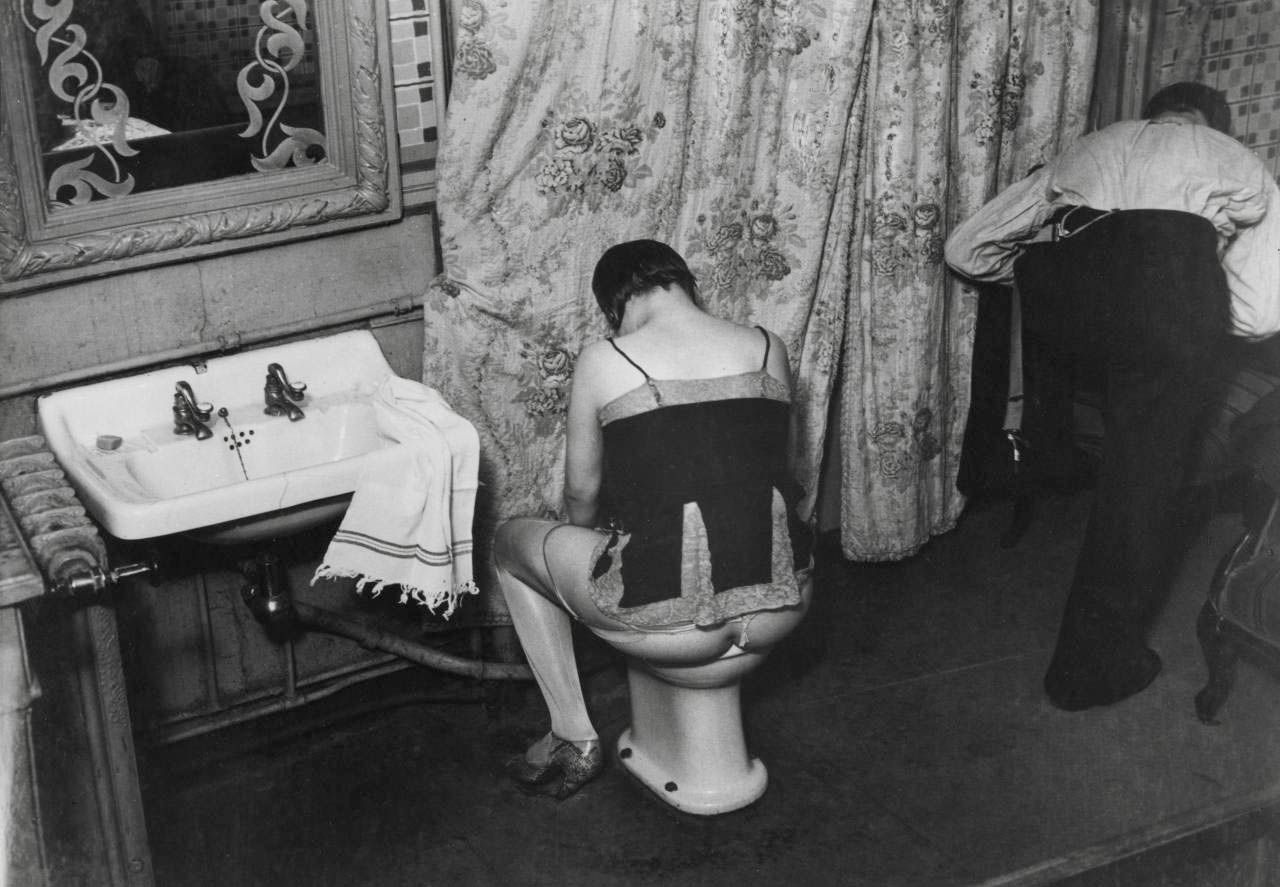
 

Brassaï (Hungarian-French, 1899-1984) 'Washing up in a brothel, Rue Quincampoix' (La Toilette, rue Quincampoix (Bidet)) 1932; printed c. 1979


Brassaï (Hungarian-French, 1899-1984)
Washing up in a brothel, Rue Quincampoix
(La Toilette, rue Quincampoix (Bidet))
1932; printed c. 1979
from The secret of Paris in the 30s series 1931–1935
Gelatin silver photograph
20.5 × 29.2cm (image and sheet)
National Gallery of Victoria, Melbourne
Purchased, 1980
Public Domain


In the 1930s Brassaï became well-known for his photographs of the nightlife of Paris, but it was the sex workers, along with other characters of the city’s underbelly, who excited his imagination. Reflecting on this time, he wrote, ‘Rightly or wrongly, I felt at that time that this underground world represented Paris at its least cosmopolitan, at its most alive, its most authentic, that in these colourful faces of its underworld there had been preserved, from age to age, almost without alteration, the folklore of its remote past’. This photograph presents a matter-of-fact view – there is nothing exotic or erotic about the woman washing herself as her client ties his shoes and prepares to leave.

Wall text from the exhibition
 

Installation view of the exhibition Photography: Real & Imagined at The Ian Potter Centre: NGV Australia, Melbourne showing Wolfgang Sievers' 'Shiftchange at Kelly and Lewis engineering works, Springvale, Melbourne' (1949)


Installation view of the exhibition Photography: Real & Imagined at The Ian Potter Centre: NGV Australia, Melbourne showing Wolfgang Sievers’ Shiftchange at Kelly and Lewis engineering works, Springvale, Melbourne (1949, below)
Photo: Marcus Bunyan


Wolfgang Sievers (Australian born Germany, 1913-2007) 'Shiftchange at Kelly and Lewis engineering works, Springvale, Melbourne' 1949; printed 1986


Wolfgang Sievers (Australian born Germany, 1913-2007)
Shiftchange at Kelly and Lewis engineering works, Springvale, Melbourne
1949; printed 1986
Gelatin silver photograph
49.4 × 40.5cm
National Gallery of Victoria, Melbourne
Purchased, 1986
© National Library of Australia


Wolfgang Sievers arrived in Australia in 1938, bringing photographic equipment, rigorous training in modernist photography, a firmly held belief in the union of art and industry, left-leaning political views, and the self-declared desire to ‘assist this country through my knowledge as thanks for the freedom I can enjoy here’. The human face of industrial Australia is captured in Sievers’s celebrated photograph of the change of shift at a Melbourne engineering works, showing a sea of men and women surging into work. The upturned, smiling faces of the masses speaking to Sievers’s firmly held belief in the dignity of work.

Wall text from the exhibition


Rosemary Laing (Australian, 1959-2024) 'welcome to Australia' 2004 (installation view)


Rosemary Laing (Australian, 1959-2024)
welcome to Australia (installation view)
2004
Type C photograph
110.8 × 224.4cm
National Gallery of Victoria, Melbourne
Purchased with funds from the Victorian Foundation for Living Australian Artists, 2005
Photo: Marcus Bunyan


This photograph by Rosemary Laing makes an obviously ironic statement, as curator Kyla MacFarlane notes: ‘The title and compositional beauty of this photograph … purposefully jar against its subject matter – the remote Woomera Immigration Detention and Processing Centre in South Australia. Photographing the site while the sun sits low in the sky, Laing observes the Centre’s mechanisms of containment and surveillance – a violent presence on the red dirt and gravel road, and sun-tinged, cloudless sky of its remote location’. The photograph’s formal emptiness reflects the lack of freedom imposed on those seeking asylum and the loss of their civil liberties once detained.

Wall text from the exhibition
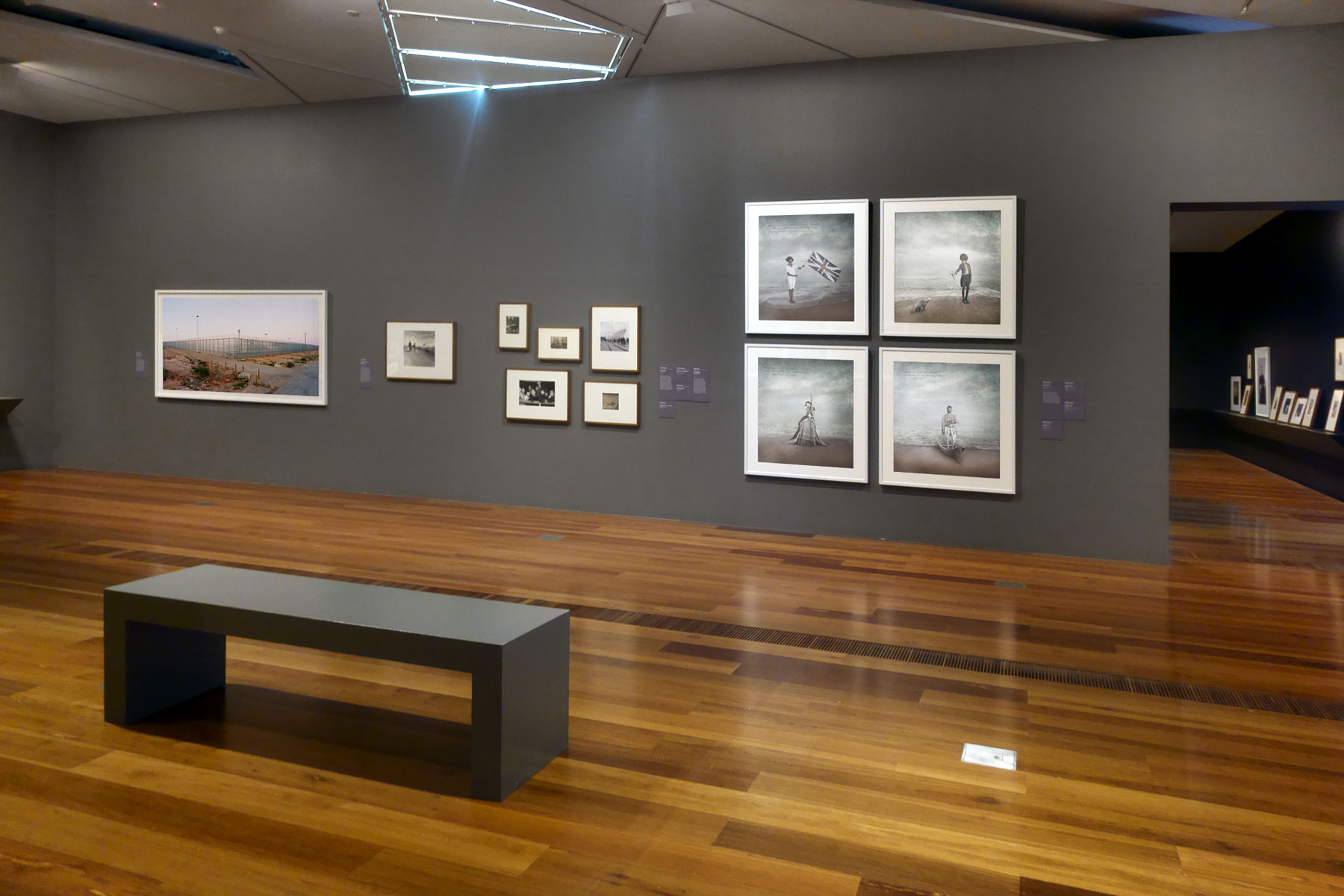
 

Installation view of the exhibition 'Photography: Real & Imagined' at The Ian Potter Centre: NGV Australia, Melbourne showing at left, Rosemary Laing's 'welcome to Australia' (2004, above); and at right, four photographs from Michael Cook's 'Civilised' series (2012)


Installation view of the exhibition Photography: Real & Imagined at The Ian Potter Centre: NGV Australia, Melbourne showing at left, Rosemary Laing’s welcome to Australia (2004, above); and at right, four photographs from Michael Cook’s Civilised series (2012)
Photo: Marcus Bunyan


Installation view of the exhibition 'Photography: Real & Imagined' at The Ian Potter Centre: NGV Australia, Melbourne showing Dorothea Lange's 'Towards Los Angeles, California' (1936)


Installation view of the exhibition Photography: Real & Imagined at The Ian Potter Centre: NGV Australia, Melbourne showing Dorothea Lange’s Towards Los Angeles, California (1936, below)
Photo: Marcus Bunyan
 

Dorothea Lange (United States 1895-1965) 'Towards Los Angeles, California' 1936, printed c. 1975


Dorothea Lange (United States 1895-1965)
Towards Los Angeles, California
1936; c. 1975 {printed}
Gelatin silver photograph
39.6 x 39.1cm
National Gallery of Victoria, Melbourne
Purchased, 1975


In this photograph Dorothea Lange has ironically juxtaposed the aspiration of clean, comfortable train travel with the exhausting reality of the unemployed traversing America in search of work in the 1930s. Renowned for making photographs that combine empathy and clear-eyed observation, Lange also believed that photographs and text should be presented together to amplify the messages carried in both mediums. She understood that captions ‘fortified’ her photographs and that they should ‘not only (carry) factual information, but also add clues to attitudes, relationships and meanings’. Although it doesn’t have a caption, the opportunistic combination of image and text in this image highlights the gulf between the haves and have nots.

Wall text from the exhibition


Installation view of the exhibition 'Photography: Real & Imagined' at The Ian Potter Centre: NGV Australia, Melbourne showing at top left, Alfred Stiegliz's 'The steerage' (1907); at bottom left, David Moore's 'Migrants arriving in Sydney' (1966); at centre, Charles Nettleton's 'Hobsons Bay railway pier' (1870s); at top right, Maggie Diaz's 'The Canberra, Port Melbourne' (1961-1967); and at bottom right, Paul Haviland's 'Passing steamer' (1910)


Installation view of the exhibition Photography: Real & Imagined at The Ian Potter Centre: NGV Australia, Melbourne showing at top left, Alfred Stiegliz’s The steerage (1907, below); at bottom left, David Moore’s Migrants arriving in Sydney (1966, below); at centre, Charles Nettleton’s Hobsons Bay railway pier (1870s, below); at top right, Maggie Diaz’s The Canberra, Port Melbourne (1961-1967); and at bottom right, Paul Haviland’s Passing steamer (1910)
Photo: Marcus Bunyan


Alfred Stiegitz (American, 1864-1946) 'The Steerage' 1907


Alfred Stieglitz (American 1864-1946, Germany 1881-1990)
The steerage
1907, printed 1911
Photogravure
National Gallery of Victoria, Melbourne
Purchased, 1979
Public domain


Alfred Stieglitz was a pioneering photographer, publisher and gallery director. The steerage, arguably his most important photograph, is regarded as his first great modernist work. The composition, with its compressed space, apparent lack of horizon and striking diagonal lines, is suggestive of avant-garde painting of the time. Showing the densely packed lower decks of the of the transatlantic steamer Kaiser Wilhelm II, Stieglitz’s oblique reference to the return movement of unsuccessful immigrants to America offers an insight into the social outcomes and complexities of mass global migration in the early twentieth century.

Wall text from the exhibition
 

David Moore (Australia, 1927-2003) 'Migrants arriving in Sydney' 1966


David Moore (Australia, 1927-2003)
Migrants arriving in Sydney
1966
Gelatin silver photograph
26.7 × 40.4cm
National Gallery of Victoria, Melbourne
Purchased, 1991
© Estate of David Moore


David Moore was Australia’s pre-eminent photojournalist of the 1960s. His work was regularly seen in leading local and international magazines. Moore’s Migrants arriving in Sydney, was commissioned and published by National Geographic in 1966. This now iconic image shows the climactic moment when a ship carrying migrants to Australia docks at Sydney harbour. The tightly framed photograph reveals a range of emotions on the faces of a group of people about to disembark and begin a new life. “We must do more than record the sensational, the bizarre, and the tragic. The lens of the camera must probe, with absolute sincerity, deep into the lives of ordinary men and women and show how we work and play.” David Moore, 1953

Text from the National Gallery of Victoria website

THIS IS NOT CORRECT NGV!

In 2015, Judy Annear [Head of Photography at the Art Gallery of New South Wales] said of this famous photograph: “It’s great to consider that it’s not actually what it seems.” Years after the photo was published, it emerged that four of the passengers in it were not migrants but Sydneysiders returning home from holiday.
 

Charles Nettleton (English 1825-1902, Australia 1854-1902) 'Hobsons Bay railway pier' 1870s


Charles Nettleton (English 1825-1902, Australia 1854-1902)
Hobsons Bay railway pier
1870s
Albumen silver photograph
12.8 × 19.2cm
National Gallery of Victoria, Melbourne
Purchased, 1992
Public domain


Maggie Diaz (American, 1925-2016, Australia 1961-2016) 'The Canberra, Port Melbourne' 1961-1967, printed 2014


Maggie Diaz (American, 1925-2016, Australia 1961-2016)
The Canberra, Port Melbourne
1961-1967, printed 2014
Pigment print
National Gallery of Victoria, Melbourne
Purchased, Victorian Foundation for Living Australian Artists, 2015


As a young woman, Maggie Diaz had been fascinated by the work of French photographer Henri Cartier-Bresson. Her photographs are a ‘slice of life’ offering similar insights into the everyday experiences of people wherever she encountered them. The ship she photographed at Melbourne’s Station Pier in the 1960s was The Canberra, the largest of the passenger ships sailing between Britain and Australia at that time. Often bringing British migrants on assisted passages, the ship also held personal significance for Diaz: as a migrant from the United States, she travelled one-way from the US to Australia on The Canberra’s maiden voyage in 1961.

Wall text from the exhibition


Installation view of the exhibition 'Photography: Real & Imagined' at The Ian Potter Centre: NGV Australia, Melbourne showing four photographs from Michael Cook's 'Civilised' series (2012)


Installation view of the exhibition Photography: Real & Imagined at The Ian Potter Centre: NGV Australia, Melbourne showing four photographs from Michael Cook’s Civilised series (2012)
Photo: Marcus Bunyan


Michael Cook (Australian / Bidjara, b. 1968) 'Civilised #11' 2012


Michael Cook (Australian / Bidjara, b. 1968)
Civilised #11
2012
From the Civilised series 2012
Inkjet print
100.0 x 87.5cm
ed. 3/8
National Gallery of Victoria, Melbourne
Purchased NGV Foundation, 2013
© Michael Cook and Michael Reid Sydney + Berlin


Bidjara artist Michael Cook poses a question in his Civilised series: ‘What makes a person civilised?’ In these photographs he represents the ways Europeans – English, French, Portuguese and Spanish colonists – responded to First Nations people when they arrived on these shores. The artist asserts that his Civilised series ‘suggests how different history might have been if those Europeans had realised that the Aborigines were indeed civilised’.

Wall text from the exhibition


Installation view of the exhibition 'Photography: Real & Imagined' at The Ian Potter Centre: NGV Australia, Melbourne showing at right, Narelle Autio's two photographs 'Untitled' from 'The Seventh Wave' series (1999-2000)


Installation view of the exhibition Photography: Real & Imagined at The Ian Potter Centre: NGV Australia, Melbourne showing at right, Narelle Autio’s two photographs Untitled from The Seventh Wave series (1999-2000)
Photo: Marcus Bunyan
 

Installation view of the exhibition 'Photography: Real & Imagined' at The Ian Potter Centre: NGV Australia, Melbourne showing at third left bottom, Henri Cartier-Bresson's 'Sunday on the banks of the Marne' (1938, below); at fourth left top, Gabriel de Rumine’s 'Caryatid porch of Erechtheum, Acropolis, Athens' (1859, below); at fourth left bottom, Lee Friedlander's 'Mount Rushmore' (1969, below); at centre top, John Williams' 'Clovelly Beach, Sydney' (1969, below); at top right, Eugène Atget's 'The roller coaster, Invalides funfair (Montagnes russes, fête des Invalides)' (1898, below); and at bottom right, Roger Scott's 'Ghost train, Sydney Royal Easter Show' (1972? 1975? below)


Installation view of the exhibition Photography: Real & Imagined at The Ian Potter Centre: NGV Australia, Melbourne showing at third left bottom, Henri Cartier-Bresson’s Sunday on the banks of the Marne (1938, below); at fourth left top, Gabriel de Rumine’s Caryatid porch of Erechtheum, Acropolis, Athens (1859, below); at fourth left bottom, Lee Friedlander’s Mount Rushmore (1969, below); at centre top, John Williams’ Clovelly Beach, Sydney (1969, below); at top right, Eugène Atget’s The roller coaster, Invalides funfair (Montagnes russes, fête des Invalides) (1898, below); and at bottom right, Roger Scott’s Ghost train, Sydney Royal Easter Show (1972? 1975? below)
Photo: Marcus Bunyan


Installation view of the exhibition 'Photography: Real & Imagined' at The Ian Potter Centre: NGV Australia, Melbourne showing David Goldblatt's 'The playing fields of Tladi, Soweto, Johannesburg, August 1972'


Installation view of the exhibition Photography: Real & Imagined at The Ian Potter Centre: NGV Australia, Melbourne showing David Goldblatt’s The playing fields of Tladi, Soweto, Johannesburg, August 1972
Photo: Marcus Bunyan


Harold Cazneaux (Australian born New Zealand, 1878-1953) 'Fairy Lane steps' 1910


Harold Cazneaux (Australian born New Zealand, 1878-1953)
Fairy Lane steps
1910
Bromoil print
24.8 × 18.5cm
National Gallery of Victoria, Melbourne
Purchased, 1979
© The Cazneaux family


Harold Cazneaux was one of the most important and influential Australian photographers of the early twentieth century. He had a great love of the natural world but early in his career also found a rich subject in the inner-city streets of Sydney. Cazneaux made photographs that appear lively and spontaneous, although given the limitations of the equipment at the time they are almost certain to have been staged to a degree. His charming studies of children at play in city streets transformed the bleak, impoverished urban environments of inner-city Sydney into a wonderful playground.

Wall text from the exhibition


Installation view of the exhibition 'Photography: Real & Imagined' at The Ian Potter Centre: NGV Australia, Melbourne showing Helen Levitt's 'New York (Boys fighting on a pediment)' c. 1940


Installation view of the exhibition Photography: Real & Imagined at The Ian Potter Centre: NGV Australia, Melbourne showing Helen Levitt’s New York (Boys fighting on a pediment) c. 1940
Photo: Marcus Bunyan
 

Helen Levitt (American, 1913-2009) 'New York (Boys fighting on a pediment)' c. 1940


Helen Levitt (American, 1913-2009)
New York (Boys fighting on a pediment)
c. 1940
Gelatin silver print
31.8 × 21.1cm
National Gallery of Victoria, Melbourne
Bowness Family Fund for Photography, 2022
Public domain
 

Francis Bedford (attributed to) (English, 1815-1894) 'Fairy Glen, Betws-y-Coed' (Ffos Noddyn, Betws-y-Coed) c. 1860


Francis Bedford (attributed to) (English, 1815-1894)
Fairy Glen, Betws-y-Coed
(Ffos Noddyn, Betws-y-Coed)
c. 1860
from the No title (Stephen Thompson album) (1859 – c. 1868)
Albumen silver photograph
13.7 × 17.8cm (image and sheet)
National Gallery of Victoria, Melbourne
Purchased from Admission Funds, 1988
Public domain
 

Henri Cartier-Bresson (French, 1908-2004) 'Sunday on the banks of the Marne, Juvisy, France' 1938


Henri Cartier-Bresson (French, 1908-2004)
Sunday on the banks of the Marne, Juvisy, France
1938; (1990s) {printed}
Gelatin silver photograph
29.1 x 43.9 cm (image)
National Gallery of Victoria, Melbourne
Purchased NGV Foundation, 2015
2015.566
© Fondation Henri Cartier-Bresson/Magnum Photos


In 1938 Henri Cartier-Bresson photographed a group of people picnicking on the banks of the river Marne. It is a celebratory image showing a quintessential aspect of everyday life in France: long Sunday lunches. But it also reveals something of the revolutionary politics of the period and their profound influence on Cartier-Bresson in the 1930s. In 1938 the left-wing Popular Front swept into power in France and the newly elected government mandated two weeks paid leave for all workers. At the time, Cartier-Bresson worked for the Paris-based communist press and was commissioned by Regards magazine to photograph an extended series that looked at the social impact of this initiative.

Wall text from the exhibition
 

Gabriel de Rumine (European, 1841-1871) 'No title (Caryatid porch of Erechtheum, Acropolis, Athens)' 1859


Gabriel de Rumine (European, 1841-1871)
No title (Caryatid porch of Erechtheum, Acropolis, Athens)
1859
Albumen silver photograph
25.7 × 35.8cm irreg. (image and sheet)
National Gallery of Victoria, Melbourne
Presented by the National Gallery Women’s Association, 1995
Public domain


Installation view of the exhibition 'Photography: Real & Imagined' at The Ian Potter Centre: NGV Australia, Melbourne showing Lee Friedlander's 'Mount Rushmore' (1969)


Installation view of the exhibition Photography: Real & Imagined at The Ian Potter Centre: NGV Australia, Melbourne showing Lee Friedlander’s Mount Rushmore (1969, below)
Photo: Marcus Bunyan


Lee Friedlander (United States, b.  1934) 'Mount Rushmore' 1969, printed c. 1977


Lee Friedlander (United States, b.  1934)
Mount Rushmore
1969; printed c. 1977
Gelatin silver print
18.3 × 27.5cm
National Gallery of Victoria, Melbourne
Purchased, 1977
© Lee Friedlander, courtesy Fraenkel Gallery, San Francisco and Luhring Augustine, New York

 

Installation view of the exhibition 'Photography: Real & Imagined' at The Ian Potter Centre: NGV Australia, Melbourne showing John Williams' 'Clovelly Beach, Sydney' (1969)

Installation view of the exhibition 'Photography: Real & Imagined' at The Ian Potter Centre: NGV Australia, Melbourne showing John Williams' 'Clovelly Beach, Sydney' (1969)


Installation views of the exhibition Photography: Real & Imagined at The Ian Potter Centre: NGV Australia, Melbourne showing John Williams’ Clovelly Beach, Sydney (1969, below)
Photos: Marcus Bunyan
 

John Williams (1933- 2016) 'Clovelly Beach' 1964


John Williams (Australian, 1933-2016)
Clovelly Beach, Sydney
1969; printed 1988
Gelatin silver photograph
25.6 × 25.4cm
National Gallery of Victoria, Melbourne
Purchased, 1989
© John Williams
 

Eugène Atget (French, 1857-1927) 'The roller coaster, Invalides funfair (Montagnes russes, fête des Invalides)' 1898


Eugène Atget (French, 1857-1927)
The roller coaster, Invalides funfair (Montagnes russes, fête des Invalides)
1898
From the Festivals and Fairs series in the Art in Old Paris series 1898-1927
Albumen silver photograph
National Gallery of Victoria, Melbourne
Gift of Patrick Pound through the Australian Government’s Cultural Gifts Program, 2020
Public domain


Roger Scott. 'Ghost train, Sydney Royal Easter Show' 1972? 1975?


Roger Scott (Australian, b. 1944)
Ghost train, Sydney Royal Easter Show
1972? 1975?
Gelatin silver print
30.4 × 45.6cm
National Gallery of Victoria, Melbourne
Gift of Mr James Mollison, 1994
© Roger Scott


The Ian Potter Centre: NGV Australia
Federation Square
Corner of Russell and 
Flinders Streets, Melbourne

Opening hours:
Daily 10am – 5pm

National Gallery of Victoria website

LIKE ART BLART ON FACEBOOK

Back to top

Vale Elliott Erwitt (1928-2023)

December 2023


Elliott Erwitt (American born France, 1928-2023) 'New York City' 1955 from Vale Elliott Erwitt (1928-2023)


Elliott Erwitt (American born France, 1928-2023)
New York City
1955
Gelatin silver print


The essence of what happens

Elliott Erwitt’s “art of observation” is a gift of the eye and the mind, where the artist must be truly aware of the world around them in order to capture the mosaic of reality.

Look at the photograph Jackie Kennedy, Arlington, Virginia (1963, below). Observe the split second that particular look of despair was present on Jackie’s face. And there was Erwitt fully aware, in the moment, with his gift of the eye and the mind – and he knew, he absolutely knew that was the moment to take the photograph.

As with much of his work it is the subtle cadences within the image that create their emotional power and magic: sadness, happiness, whimsy, comedy, anger, loneliness, joy – all captured through the reality of the visual language of the image, fully acknowledged in the heart and the mind of the viewer when they imbibe (absorb the ideas) of their spirit.

Dr Marcus Bunyan

Please click on the photographs for a larger version of the image.


“The work I care about is terribly simple … I observe, I try to entertain, but above all I want pictures that are emotion.”


Elliott Erwitt. Personal Exposures. W. W. Norton & Company, 1988


“You either see, or you don’t see.”

“You can take a picture of the most wonderful situation and it’s lifeless, nothing comes through… Then you can take a picture of nothing, of someone scratching his nose, and it turns out to be a great picture.”

“The whole point of taking pictures is so that you don’t have to explain things with words. To me, photography is an art of observation. It’s about finding something interesting in an ordinary place… I’ve found it has little to do with the things you see and everything to do with the way you see them.”

“All the technique in the world doesn’t compensate for the inability to notice.”


Elliott Erwitt


Elliott Erwitt (American born France, 1928-2023) 'Pasadena, California, USA' Nd from Vale Elliott Erwitt (1928-2023)


Elliott Erwitt (American born France, 1928-2023)
Pasadena, California, USA
Nd
Gelatin silver print


Elliott Erwitt (American born France, 1928-2023) 'USA. California. Berkeley' 1956 from Vale Elliott Erwitt (1928-2023)


Elliott Erwitt (American born France, 1928-2023)
USA. California. Berkeley
1956
Gelatin silver print


Photographers with a comic outlook on life seldom win the acclaim granted to exalters of nature or chroniclers of war and squalor. Elliott Erwitt, who died at 95 on Wednesday at his home in Manhattan, was an exception.

For more than six decades he used his camera to tell visual jokes, finding material wherever he strolled. His sharp eye for silly, sometimes telling conjunctions – a dog lying on its back in a cemetery, a glowing Coca-Cola machine amid a public display of missiles in Alabama, a mangy potted plant in a tacky Miami Beach ballroom – earned him constant assignments as well as the affection of a public that shared his sweet, Chaplin-esque sense of the absurd.

Richard B. Woodward. “Elliott Erwitt, Whose Photos Are Famous, and Often Funny, Dies at 95,” on The New York Times website Nov. 30, 2023 [Online] Cited 03/12/2023


Elliott Erwitt (American born France, 1928-2023) 'USA. New York, New York' 1953 from Vale Elliott Erwitt (1928-2023)


Elliott Erwitt (American born France, 1928-2023)
USA. New York, New York
1953
Gelatin silver print


Elliott Erwitt (American born France, 1928-2023) 'Felix, Gladys and Rover (New York, USA)' New York City, 1974


Elliott Erwitt (American born France, 1928-2023)
Felix, Gladys and Rover (New York, USA)
New York City, 1974
Gelatin silver print


Elliott Erwitt (American born France, 1928-2023) 'Moscow, USSR' 1959


Elliott Erwitt (American born France, 1928-2023)
Moscow, USSR
1959
Gelatin silver print


Elliott Erwitt (American born France, 1928-2023) 'Jackie Kennedy, Arlington, Virginia' 1963. © Elliott Erwitt/MAGNUM PHOTOS


Elliott Erwitt (American born France, 1928-2023)
Jackie Kennedy, Arlington, Virginia
1963
Gelatin silver print


Elliott Erwitt (American born France, 1928-2023) 'Wilmington, North Carolina' 1950


Elliott Erwitt (American born France, 1928-2023)
Wilmington, North Carolina
1950
Gelatin silver print


Elliott Erwitt (American born France, 1928-2023) 'Paris, France' 1989


Elliott Erwitt (American born France, 1928-2023)
Paris, France
1989
Gelatin silver print


Elliott Erwitt (American born France, 1928-2023) 'USA. New York City' 1988


Elliott Erwitt (American born France, 1928-2023)
USA. New York City
1988
Gelatin silver print


Elliott Erwitt (American born France, 1928-2023) 'Pittsburgh, USA' 1950


Elliott Erwitt (American born France, 1928-2023)
Pittsburgh, USA
1950
Gelatin silver print


Elliott Erwitt (American born France, 1928-2023) 'Brazil. Buzios' 1990


Elliott Erwitt (American born France, 1928-2023)
Brazil. Buzios
1990
Gelatin silver print


Elliott Erwitt (American born France, 1928-2023) 'Guanajuato, Mexico' 1957


Elliott Erwitt (American born France, 1928-2023)
Guanajuato, Mexico
1957
Gelatin silver print


Elliott Erwitt (American born France, 1928-2023) 'France, Paris, Lucienne Van Kan' 1952


Elliott Erwitt (American born France, 1928-2023)
France, Paris, Lucienne Van Kan
1952
Gelatin silver print


Elliott Erwitt (American born France, 1928-2023) 'Fort Dix, USA' 1951


Elliott Erwitt (American born France, 1928-2023)
Fort Dix, USA
1951
Gelatin silver print


Elliott Erwitt (American born France, 1928-2023) 'Bakersfield, USA' 1983


Elliott Erwitt (American born France, 1928-2023)
Bakersfield, USA
1983
Gelatin silver print


Elliott Erwitt (American born France, 1928-2023) 'Bal, Paris, France' 1967


Elliott Erwitt (American born France, 1928-2023)
Bal, Paris, France
1967
Gelatin silver print


Elliott Erwitt (American born France, 1928-2023) 'Spain, Valencia' 1952


Elliott Erwitt (American born France, 1928-2023)
Spain, Valencia
1952
Gelatin silver print


Elliott Erwitt (American born France, 1928-2023) 'Huntsville, Alabama' 1974


Elliott Erwitt (American born France, 1928-2023)
Huntsville, Alabama
1974
Gelatin silver print


LIKE ART BLART ON FACEBOOK

Back to top
Photographs: Eugène Atget (French, 1857-1927)

November 2023


Eugène Atget (French, 1857-1927) 'Rue Saint-Médard, 5e arrondissement' 1899-1900


Eugène Atget (French, 1857-1927)
Rue Saint-Médard, 5e arrondissement
1899-1900
Albumen print


I am devastated at news of the loss of my very close friend and photographer Ian Lobb today.

An intelligent, compassionate, creative and spiritual man who was a guiding light during the last 33 years of my life.

He said of Atget, “You always have a sense of feeling self surprised at where his camera is.”

Atget was always an inspiration to us both.

Bless him for his wise counsel all these years.

A tribute will appear at a later time.

Dr Marcus Bunyan


Please click on the photographs for a larger version of the image.


Again

Why are the waves,
Coming straight at me?
Fold upon fold
Waves in wind –
And why is the wind
Becoming my breath,
And my breath, the wind?

So now you
Beautiful friend
Breathe my friend
Jump the wave,
Jump up, laughing
The sun right above you,
Here on the coast
Among waves and trees.

Enter your home
Like a nest
Beautiful friend,
Dear friend,
Read till you sleep –
Your breath on the pages
That tell of the road and
On that road where you meet
Those twilight lit:
One, two,
Then three   again.

Ian Lobb


“His prints are direct and emotionally clean records of a rare and subtle perception, and represent perhaps the earliest expression of true photographic art.”


Ansel Adams


“There is nothing I could ask for better than to roll myself between sheets of Atgets, each new one I find (and there are thousands) is a revelation.”


Julien Levy


“In looking at the work of Eugène Atget, a new world is opened up in the world of creative expression.”


Berenice Abbott


Eugène Atget (French, 1857-1927) 'Soleil' c. 1896


Eugène Atget (French, 1857-1927)
Soleil
c. 1896


Eugène Atget (French, 1857-1927) 'Fontaine Jarente – impasse Jarente' 1898


Eugène Atget (French, 1857-1927)
Fontaine Jarente – impasse Jarente (Fountain Jarente – Jarente dead end)
1898
Albumen print


Eugène Atget (French, 1857-1927) 'Fontaine Minerve, Institut' 1899


Eugène Atget (French, 1857-1927)
Fontaine Minerve, Institut (Minerva Fountain, Institute)
1899
Albumen print


Eugène Atget (French, 1857-1927) 'Hôtel de la Comtess de Verrue, rue du Regard' 1899


Eugène Atget (French, 1857-1927)
Hôtel de la Comtess de Verrue, rue du Regard
1899
Albumen print


Eugène Atget (French, 1857-1927) 'Avenue de l'Observatoire' 1899-1900


Eugène Atget (French, 1857-1927)
Avenue de l’Observatoire
1899-1900
Albumen print


Eugène Atget (French, 1857-1927) 'Hôtel de Gouffier, rue de Varenne 56' 1899-1900


Eugène Atget (French, 1857-1927)
Hôtel de Gouffier, rue de Varenne 56
1899-1900
Albumen print


Eugène Atget (French, 1857-1927) 'Cactus [Nice]' before 1900


Eugène Atget (French, 1857-1927)
Cactus [Nice]
Before 1900
Albumen print


Eugène Atget (French, 1857-1927) 'Cour, rue Saint-Jacques 346, disparu, 5e arrondissement' 1900


Eugène Atget (French, 1857-1927)
Cour, rue Saint-Jacques 346, disparu, 5e arrondissement (Court, rue Saint-Jacques 346)
1900
Albumen print


Eugène Atget (French, 1857-1927) 'Hôtel d'Argouges de Lyon, rue Séguier 16' 1900


Eugène Atget (French, 1857-1927)
Hôtel d’Argouges de Lyon, rue Séguier 16
1900
Albumen print


Eugène Atget (French, 1857-1927) 'Presbytère de Saint-Sulpice, rue de Vaugirard 50' 1900


Eugène Atget (French, 1857-1927)
Presbytère de Saint-Sulpice, rue de Vaugirard 50 (Presbytery of Saint-Sulpice)
1900
Albumen print


Eugène Atget (French, 1857-1927) 'Marché aux fleurs' c. 1900s


Eugène Atget (French, 1857-1927)
Marché aux fleurs (Flower market)
c. 1900s
Albumen print


Eugène Atget (French, 1857-1927) 'Cours d'Honneur, Versailles' 1901


Eugène Atget (French, 1857-1927)
Cours d’Honneur, Versailles (Gentilly – old castle, Versailles)
1901
Albumen print


Eugène Atget (French, 1857-1927) 'Gentilly – ancien château' 1901


Eugène Atget (French, 1857-1927)
Gentilly – ancien château
1901
Albumen print


Eugène Atget (French, 1857-1927) 'Hôtel Beauffremont, rue de Grenelle 87' 1901


Eugène Atget (French, 1857-1927)
Hôtel Beauffremont, rue de Grenelle 87
1901
Albumen print


Eugène Atget (French, 1857-1927) 'Hôtel du Maréchal de Tallard, rue des Archives 78' 1901-1902


Eugène Atget (French, 1857-1927)
Hôtel du Maréchal de Tallard, rue des Archives 78
1901-1902
Albumen print


Eugène Atget (French, 1857-1927) 'Grand Trianon Le Buffet' 1902


Eugène Atget (French, 1857-1927)
Grand Trianon Le Buffet
1902
Albumen print


Eugène Atget (French, 1857-1927) 'La Vénus accroupie, par Coysevox (Versailles)' 1902


Eugène Atget (French, 1857-1927)
La Vénus accroupie, par Coysevox (Versailles) (The Crouching Venus, by Coysevox, (Versailles))
1902
Albumen print


Eugène Atget (French, 1857-1927) 'Versailles – l'Orangerie' 1903


Eugène Atget (French, 1857-1927)
Versailles – l’Orangerie
1903
Albumen print


Eugène Atget (French, 1857-1927) 'Oratoire Marie de Médicis, Petit Luxembourg' 1903


Eugène Atget (French, 1857-1927)
Oratoire Marie de Médicis, Petit Luxembourg (Marie de Medici Oratory)
1903
Albumen print


Eugène Atget (French, 1857-1927) 'Fontaine du Marché Saint-Honoré' 1903


Eugène Atget (French, 1857-1927)
Fontaine du Marché Saint-Honoré (Saint-Honoré Market Fountain)
1903
Albumen print


Atget used a view camera with a bellows placed on a tripod, typical of the second half of the 19th century. He worked with 18 × 24 cm negative glass plates, oriented to obtain either a vertical or horizontal photograph. A tilt-shift technique was used to make perspective corrections. This resulted in vignetting (a circular shadow around the edges of the image), a phenomenon seen in a number of Atget’s photographs.

Atget always used gelatin-silver negative glass plates, 1.5mm thick. The plate was held in the camera in a wooden frame by clips that left characteristic marks on many of the prints. A long exposure time resulted in numerous blurs caused by the presence of moving people or objects. Atget developed the negatives himself and wrote the negative number directly onto the gelatin with a pointed stiletto.

Atget made all of his own photographic prints using a technique in which light-sensitive paper, in contact with the glass negative, was printed-out in natural light (never developed). The printing-out process proceeded until Atget determined that the image had the proper density. The photograph was then washed, gold toned, fixed and washed again. Atget’s prints are never black-and-white; their tone varies from deep sepia to violet-brown. Atget was capable of producing high-quality prints but there is great variation in these today depending on his printing and toning techniques and the way his photographs were preserved and exhibited. He never enlarged his photographs.


Atget’s paper

Atget used three types of paper:

Albumen

The light-sensitive emulsion was formed by silver chloride introduced into an albumen binder (beaten egg whites). The majority of Atget’s prints were on albumen paper. He turned to other processes after the First World War, when such paper could no longer be found on the market.

Matt albumen

After the war Atget used another kind of industrially produced printing-out paper with a matt surface.

Aristotype

Atget chose a commercially manufactured printing-out paper made with gelatin. Aesthetically similar to albumen prints, although thicker and with a glossier surface, the process was the same for toning and printing. Some of these prints have yellow stains from sulphuration due to poor processing of the image (such as the use of an exhausted fixing bath or insufficient washing).

Anonymous. “Atget’s technique,” on the Art Gallery of New South Wales website Nd [Online] Cited 03/10/2023


Eugène Atget (French, 1857-1927) 'Fontaine, rue Geoffrey Saint-Hilaire' 1905


Eugène Atget (French, 1857-1927)
Fontaine, rue Geoffrey Saint-Hilaire
1905
Albumen print


Eugène Atget (French, 1857-1927) 'Grand Trianon (escalier)' 1905


Eugène Atget (French, 1857-1927)
Grand Trianon (escalier) (Grand Trianon (staircase))
1905
Albumen print


Eugène Atget (French, 1857-1927) 'Saint-Severin – rue Saint Séverin' 1905-1906


Eugène Atget (French, 1857-1927)
Saint-Severin – rue Saint Séverin
1905-1906
Albumen print


Eugène Atget (French, 1857-1927) 'Grand Trianon – le Buffet' 1906


Eugène Atget (French, 1857-1927)
Grand Trianon – le Buffet
1906
Albumen print


Eugène Atget (French, 1857-1927) 'Maison, rue Saint-Romain [Rouen]' 1907


Eugène Atget (French, 1857-1927)
Maison, rue Saint-Romain [Rouen]
1907
Albumen print


Eugène Atget (French, 1857-1927) 'Nantes – fontaine et Mairie' 1907


Eugène Atget (French, 1857-1927)
Nantes – fontaine et Mairie (Nantes – fountain and town hall)
1907
Albumen print


Eugène Atget (French, 1857-1927) 'Tuileries – Coureuse par Coustou' 1907


Eugène Atget (French, 1857-1927)
Tuileries – Coureuse par Coustou (Tuileries – Runner by Coustou)
1907
Albumen print


Eugène Atget (French, 1857-1927) 'Hôtel d'Imbercourt, 15 rue de l'Universite' 1909


Eugène Atget (French, 1857-1927)
Hôtel d’Imbercourt, 15 rue de l’Universite
1909
Albumen print


Eugène Atget (French, 1857-1927) 'Folie Thoinard, 9 rue Coq-Héron' 1909


Eugène Atget (French, 1857-1927)
Folie Thoinard, 9 rue Coq-Héron
1909
Albumen print


Eugène Atget (French, 1857-1927) 'Façade Saint-Lazare, faubourg Saint-Denis 107' 1909


Eugène Atget (French, 1857-1927)
Façade Saint-Lazare, faubourg Saint-Denis 107
1909
Albumen print


Eugène Atget (French, 1857-1927) 'Hôtel de Vendôme, rue Béranger 3' 1909


Eugène Atget (French, 1857-1927)
Hôtel de Vendôme, rue Béranger 3
1909
Albumen print


Eugène Atget (French, 1857-1927) 'Pommiers [et blés]' 1910 or earlier


Eugène Atget (French, 1857-1927)
Pommiers [et blés] (Apple trees [and wheat])
1910 or earlier
Albumen print


Eugène Atget (French, 1857-1927) 'Sapin ([Petit] Trianon)' 1910 or earlier


Eugène Atget (French, 1857-1927)
Sapin ([Petit] Trianon)
1910 or earlier
Albumen print


Eugène Atget (French, 1857-1927) 'Colonne Moris (Place Saint Sulpice)' 1910


Eugène Atget (French, 1857-1927)
Colonne Moris (Place Saint Sulpice) (Morris Column (Place Saint Sulpice))
1910
Albumen print


Eugène Atget (French, 1857-1927) 'Hôtel de Canhillac, place des Vosges 14' 1911-1912


Eugène Atget (French, 1857-1927)
Hôtel de Canhillac, place des Vosges 14
1911-1912
Albumen print


Eugène Atget (French, 1857-1927) 'Fontaine, faubourg Saint-Martin' 1912


Eugène Atget (French, 1857-1927)
Fontaine, faubourg Saint-Martin (Fountain, Saint-Martin suburb)
1912
Albumen print


Eugène Atget (French, 1857-1927) 'Balcon, [15] rue du Petit Pont' 1913


Eugène Atget (French, 1857-1927)
Balcon, [15] rue du Petit Pont
1913
Albumen print


Eugène Atget (French, 1857-1927) 'Pavilion du Hanovre, boulevard des Capucines 33' 1913


Eugène Atget (French, 1857-1927)
Pavilion du Hanovre, boulevard des Capucines 33
1913
Albumen print


Eugène Atget (French, 1857-1927) 'Fête du Trône' 1914


Eugène Atget (French, 1857-1927)
Fête du Trône
1914
Albumen print


“My excitement at seeing these few photographs would not let me rest. Who was this man? I learned that Atget lived up the street from where I worked – at 17 bis rue Campagne Premiere, and that his prints were for sale. Perhaps I could own some. I wanted to see more, and lost no time in seeking him out. I mounted the four flights to his fifth floor apartment. On the door was a modest handmade sign, “Documents pour Artistes”. He ushered me into a room approximately fifteen feet long, the ordinary room of a small apartment, sparsely and simply furnished. Atget, slightly stooped, impressed me as being tired, sad, remote, appealing. He was not talkative. He did not try to “sell” anything. He showed me some albums, which he had made himself, and I selected as many prints as I could afford to pay for from my meager wages as a photographer’s assistant. I returned many times, and we became more friendly.” Several years passed and Berenice Abbott became a portrait photographer. “By that time I had become a portrait photographer on my own, and I persuaded Atget to come to my studio at 44 rue du Bac to sit for his portrait. To my surprise he arrived in a handsome overcoat. I had always seen him in his patched work clothes. It would have been desirable to photograph him in these too, since they were exquisitely photogenic, but time is a fickle unpredictable master and did not permit another sitting. After developing the portraits she took the images to show Atget. Abbott missed the sign and made one more flight of stairs to find the concierge.” She asked about Atget and was shocked to hear that he had died. “Youth is little equipped to accept or even anticipate the fact of death. And I had just finished his portraits.” Inquiring about his collection of photographs, she found that they had been left to Andre Calmette. It took months of correspondence and convincing, but she eventually acquired Atget’s entire collection. Abbott also wrote a book about Atget and published many of his prints. Many critics have attacked Atget’s work, saying Atget was merely a disappointed painter or actor, and a little ashamed of his medium. Claims have been made that Atget did not really know what he was doing, that reflections in his shop front windows were accidents which he did not even see. Berenice Abbott fiercely defended Atget and his work. Goethe had said, “there is no variety of Art that should be looked upon lightly. Each has delights which great talent can bring to fulfillment.” If Atget had not had this talent he would have been just another record producer of the travel guide variety – tourist fare. I believe the photographer’s eye develops to a more intense awareness than other people’s, as a dancer develops his muscles and limbs, and a musician his ear. The photographer’s act is to see the outside world precisely, with intelligence as well as sensuous insight. This act of seeing sharpens the eye to an unprecedented acuteness. He often sees swiftly an entire scene that most people would pass unnoticed. Capturing the city of Paris and its people was the photographic art of Atget. How one becomes a photographer, well-schooled or self-taught, does not matter. Ultimately, it is the test of time. As with many of the world’s great photographer’s, their images are timeless and still have the appeal as when first developed. Not only did Atget document a city; he also captured its essence.

Lori Oden. “Eugène Atget,” on the International Photography Hall of Fame and Museum website Nd [Online] Cited 03/10/2023


 Eugène Atget (French, 1857-1927) 'Plessis Piquet [Entrée pittoresque, Châtillon]' 1921


Eugène Atget (French, 1857-1927)
Plessis Piquet [Entrée pittoresque, Châtillon]
1921
Albumen print


Eugène Atget (French, 1857-1927) 'Porte, avenue de Paris (Versailles)' 1922


Eugène Atget (French, 1857-1927)
Porte, avenue de Paris (Versailles)
1922
Albumen print


Eugène Atget (French, 1857-1927) 'Fontaine Jarente, rue Jarente' 1922


Eugène Atget (French, 1857-1927)
Fontaine Jarente, rue Jarente
1922
Albumen print


Eugène Atget (French, 1857-1927) 'Coin, rue Norvins et des Saules' 1925


Eugène Atget (French, 1857-1927)
Coin, rue Norvins et des Saules (Corner, rue Norvins et des Saules)
1925
Albumen print


Eugène Atget (French, 1857-1927) 'Parc de Sceaux' 1925


Eugène Atget (French, 1857-1927)
Parc de Sceaux
1925
Albumen print


Eugène Atget (French, 1857-1927) 'Moulin Rouge [86 boulevard de Clichy]' 1926


Eugène Atget (French, 1857-1927)
Moulin Rouge [86 boulevard de Clichy]
1926
Albumen print


Eugène Atget (French, 1857-1927) 'Rue Lanneau' 1925


Eugène Atget (French, 1857-1927)
Rue Lanneau
1925
Albumen print


Eugène Atget (French, 1857-1927) 'Passage Moret, ruelle des Gobelins' 1926


Eugène Atget (French, 1857-1927)
Passage Moret, ruelle des Gobelins
1926
Albumen print


Eugène Atget (French, 1857-1927) 'Rue des Gobelins' 1926


Eugène Atget (French, 1857-1927)
Rue des Gobelins
1926
Albumen print


Eugène Atget (French, 1857-1927) 'Rue des Prêtres Saint-Séverin, au fond rue Boutebrie' 1926


Eugène Atget (French, 1857-1927)
Rue des Prêtres Saint-Séverin, au fond rue Boutebrie
1926
Albumen print


Eugène Atget (French, 1857-1927) 'Saint-Médard' 1926


Eugène Atget (French, 1857-1927)
Saint-Médard
1926
Albumen print


Eugène Atget (French, 1857-1927) 'Square Notre-Dame' 1926


Eugène Atget (French, 1857-1927)
Square Notre-Dame
1926
Albumen print


Eugène Atget (French, 1857-1927) 'Ruelle des Reculettes, Gobelins' 1926


Eugène Atget (French, 1857-1927)
Ruelle des Reculettes, Gobelins
1926
Albumen print


Eugène Atget (French, 1857-1927) 'Saint-Cloud [19h matin, mars 1926]' 1926


Eugène Atget (French, 1857-1927)
Saint-Cloud [19h matin, mars 1926]
1926
Albumen print


LIKE ART BLART ON FACEBOOK

Back to top
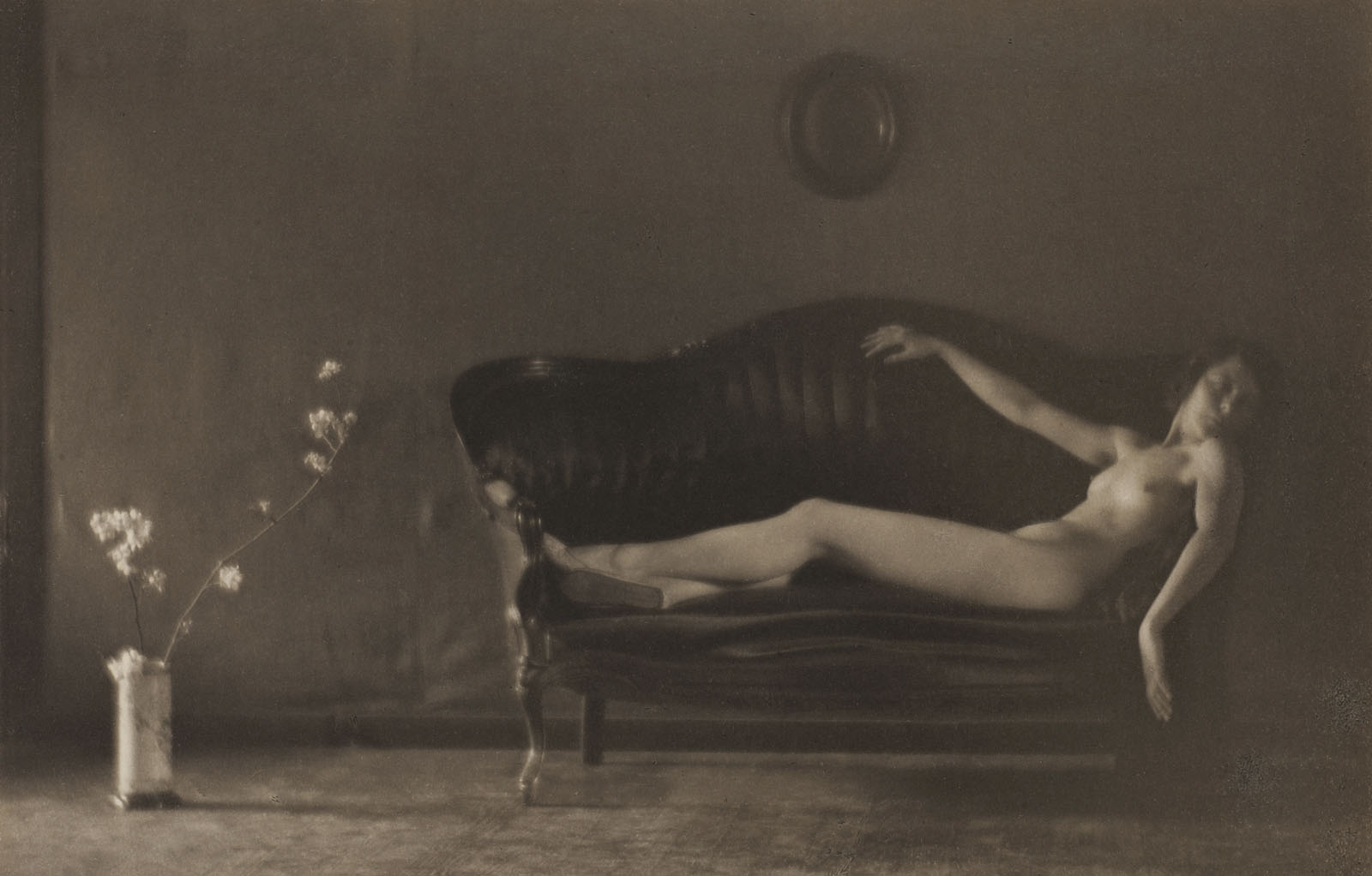
Exhibition: ‘Berenice Abbott’s New York Album, 1929’ at the Metropolitan Museum of Art, New York

Exhibition dates: 2nd March – 4th September 2023


Walker Evans (American, 1903-1975) [Berenice Abbott] 1929-1930 from the exhibition 'Berenice Abbott's New York Album, 1929' at the Metropolitan Museum of Art, New York, March - Sept 2023


Walker Evans (American, 1903-1975)
[Berenice Abbott]
1929-1930
Gelatin silver print
16.9 x 11.8cm (6 5/8 x 4 5/8 in.)
Metropolitan Museum of Art
Purchase, The Horace W. Goldsmith Foundation Gift, through Joyce and Robert Menschel, 1997
© Walker Evans Archive, The Metropolitan Museum of Art


Abbott appraises the camera with cool assurance in this portrait, made just after her return from Paris to New York. Her gamine-short hair and bare face affect a chic nonchalance that intrigued Evans. Describing her to a friend after their first meeting, he wrote: “You would like Berenice Abbott, with her hair brushed forward and her woozy eyes.” Her work likewise impressed the young photographer, then finding his footing in the field. Evans’s picture betrays admiration for his new acquaintance, whose burgeoning career offered a model for his own.


American visionary

What a wonderful photographer Berenice Abbott developed into and what a debt of gratitude we owe her for saving the archive of French photographer Eugène Atget whose photographs initially influenced her urban(e) style.

“Abbott felt the changing city [New York] needed an equivalent to the French photographer Eugène Atget (1857-1927), who had documented Paris during a critical period of transition in the late 19th and early 20th centuries with what Abbott called “the shock of realism unadorned.””

It is interesting to analyse Abbott’s New York photographs in relation to Atget. In photographs such as the grouping on Album Page 9: Fulton Street Fish Market and Lower East Side, Manhattan (1929, below) there is an almost symbiotic relationship between Atget’s photographs of street Petits Métiers (trades and professions) and those of Abbott. “The subjects were not sensational, but nevertheless shocking in their very familiarity,” she said of seeing Atget’s photographs in Man Ray’s studio in 1926. Similarly, we can recognise in Abbott’s grouping in Album Page: City Hall Park and Brooklyn Bridge Vicinity, Manhattan (1929, below) and Pingpank Barbershop, 413 Bleecker Street, Manhattan (1938, below) an affinity with Atget’s photographs of architectural details of door handles and the front of shops.

A step away from Atget’s aesthetic are Abbott’s photographs such as Brooklyn Bridge, With Pier 21, Pennsylvania R.R. (1937, below), West Street (1936, below) and Henry Street from Market, Looking West, Manhattan (1935, below) where the foreground of each photograph mimics Atget’s photographs of Old Paris whilst the soaring background of skyscrapers and bridges is all modernist New York, the near / far of the picture plane becoming old / new. Abbott chronicled “the changing aspect of the world’s great metropolis. … Its hurrying tempo, its congested streets, the past jostling the present.”

Still further away from Atget’s aesthetic are Abbott’s photographs grouped in Album Page 1: Financial District, Broadway and Wall Street Vicinity, Manhattan (1929, below) where the artist uses with the chiaroscuro (the treatment of light and shade) within the canyons of skyscraper New York – and modernist almost constructivist photographs such as Canyon, Broadway and Exchange Place (1936, below) and Manhattan Bridge, Looking Up (1936, below) where the artist plays with pictorial perspective by pointing her camera skywards.

Finally, there are Abbott’s photographs that bear no relation to those of Atget, where Abbott as an artist has stepped out of the older artist’s shadow and developed her own artistic signature. Those wonderfully abstract and enigmatic photographs at lower left and right in Album Page 5: Pier 17, South Street Seaport, Manhattan push the boundaries of 1930s photographic language. In other glorious photographs such as The El at Columbus and Broadway (1929, below) and The El, 2nd and 3rd Avenue Lines, Bowery and Division Street, Manhattan (1936, below) Abbott captured the random disorder of urban activity with a focused intensity of vision that produces magical images… and by that I mean, images that transport you into other spaces, other states of being. Her dadaist poet Tristan Tzara put it this way: “We leave with those leaving arrive with those arriving / leave with those arriving arrive when the others leave.”

Dr Marcus Bunyan


Many thankx to the Metropolitan Museum of Art for allowing me to publish the photographs in the posting. Please click on the photographs for a larger version of the image.


In January 1929, after eight years in Europe, the American photographer Berenice Abbott (1898-1991) boarded an ocean liner to New York City for what was meant to be a short visit. Upon arrival, she found the city transformed and ripe with photographic potential. “When I saw New York again, and stood in the dirty slush, I felt that here was the thing I had been wanting to do all my life,” she recalled. With a handheld camera, Abbott traversed the city, photographing its skyscrapers, bridges, elevated trains, and neighbourhood street life. She pasted these “tiny photographic notes” into a standard black-page album, arranging them by subject and locale.

Consisting of 266 small black-and-white prints arranged on thirty-two pages, Abbott’s New York album marks a key turning point in her career – from her portrait work in Paris to the urban documentation that culminated in her federally funded project, Changing New York (1935-1939). Berenice Abbott’s New York Album, 1929 presents a selection of unbound pages from this unique album, shedding new light on the creative process of one of the great photographic artists of the twentieth century. For context, the exhibition also features views of Paris by Eugène Atget (French, 1857-1927), whose extensive photographic archive Abbott purchased and publicised; views of New York City by her contemporaries Walker Evans, Paul Grotz, and Margaret Bourke-White; and photographs from Changing New York. The exhibition is made possible by The Robert Mapplethorpe Foundation, Inc.

Text from the Metropolitan Museum of Art website


MAP


This map charts some of the locations across Manhattan that Berenice Abbott photographed in her New York Album (1929). As the album bears almost no notations, identifying the exact sites depicted in the photographs had to be done through visual recognition of streets, buildings, and other urban landmarks.

Some of the iconic places Abbott photographed, such as the main branch of the New York Public Library and Trinity Church on Wall Street, haven’t changed much since 1929. Others, such as the city’s four elevated train lines and Harlem’s famed Lafayette Theater, have vanished completely. Several sites have gone through multiple transformations within the past century. The National Winter Garden Theater on Houston Street and Second Avenue opened in 1912 as a cinema and vaudeville theatre. By the time Abbott photographed it in 1929, it had been converted to a burlesque house; today, it’s a Whole Foods. The map is an invitation to explore Abbott’s photographs beyond the confines of the Museum’s galleries, and, like the artist herself, to cherish New York as a vibrant metropolis that is, and always has been, defined by change.

For their invaluable help with the historical research, The Met is grateful to the Jones Family Research Collective: former Manhattan Borough Historian Celedonia “Cal” Jones; his daughter, Diane Jones Randall; and his son, Kenneth Jones. Explore Abbott’s 1929 images of New York here with images of each album page.


Berenice Abbott (American, 1898-1991) 'Eugène Atget' 1927


Berenice Abbott (American, 1898-1991)
Eugène Atget
1927
Gelatin silver print
4 3/8 × 3 5/16 in. (11.1 × 8.4cm)
Metropolitan Museum of Art
Gift of Maria Morris Hambourg, in honour of John Szarkowski, 2020
© Berenice Abbott / Commerce Graphics Ltd. Inc.


Born in Ohio, Berenice Abbott moved to Paris and in 1923 became Man Ray’s darkroom assistant. In 1927 she made this photograph of Atget, the renowned documentarian of the streets of Paris and an unwitting hero of the surrealists; when she returned to his apartment to deliver a print of her portrait, Abbott learned of the elderly artist’s death. The unfortunate circumstance put in motion a process that led to Abbott’s purchase of Atget’s archive of five thousand photographs and one thousand negatives, the first (1930) monograph on Atget (edited by Abbott), and the collection’s eventual acquisition by MoMA in 1968.

In the spring of 1927, Abbott invited Atget to sit for a portrait in her Paris studio. She made only three exposures that day: a standing pose, a frontal view, and this profile view. Unfortunately, Atget never saw the photographs. When Abbott arrived at his apartment a few months later to deliver the proofs, she found that the elderly photographer had died suddenly. This portrait was used as the frontispiece in the first book devoted to his work, Atget, Photographe de Paris (1930), displayed in the case nearby.


Berenice Abbott (American, 1898-1991) 'James Joyce' 1926 from the exhibition 'Berenice Abbott's New York Album, 1929' at the Metropolitan Museum of Art, New York, March - Sept 2023


Berenice Abbott (American, 1898-1991)
James Joyce
1926
Gelatin silver print
23.3 x 17.4cm (9 3/16 x 6 7/8in.)
Metropolitan Museum of Art
Gilman Collection, Purchase, Ann Tenenbaum and Thomas H. Lee Gift, 2005
© Berenice Abbott / Commerce Graphics Ltd. Inc.


Berenice Abbott opened a photographic portrait studio in Paris in 1926 after having worked for three years as an assistant to Man Ray, whom she had met in New York. Although her Paris portraits are indebted stylistically to Man Ray’s, she brought to them a sympathetic eye that was very much her own. Her portraits of women are notable for their empathic understanding of her subjects, but she reached a depth of expression in her photographs of James Joyce (1882-1941). Abbott photographed Joyce on two occasions, the first in 1926 at his home, the second in 1928 at her studio, as was her more customary practice. In spite of Abbott’s annotation on the back of the print, this portrait belongs to the earlier session, when Joyce was photographed both with and without the patch over his eye, worn because of his sadly degenerating sight. For this particular exposure Joyce removed the patch and held it, with his glasses, in his right hand; his forehead still bears the diagonal impression of the ribbon. This intimate portrait, with its softly diffused lighting, suggests the complex, introverted character of Joyce’s imagination. It is with good reason that Abbott’s are considered the definitive portraits of the author of “Ulysses” and “Finnegan’s Wake.”


Berenice Abbott (American, 1898-1991) 'Djuna Barnes' 1925 from the exhibition 'Berenice Abbott's New York Album, 1929' at the Metropolitan Museum of Art, New York, March - Sept 2023


Berenice Abbott (American, 1898-1991)
Djuna Barnes
1925
Gelatin silver print
22.6 x 17.1cm (8 7/8 x 6 3/4 in.)
Purchase, Joyce and Robert Menschel Gift, 1987


Abbott lived with the American writer Djuna Barnes when she moved from Ohio to Greenwich Village in 1918, and the two women remained friends, and occasional romantic rivals, throughout their lives. In this portrait, made in Man Ray’s Paris studio, Barnes is elegantly attired and addresses the camera with a smouldering gaze above a slight smile. A decade later, Barnes would publish Nightwood (1936), a classic of lesbian fiction inspired by her tormented affair with the American artist Thelma Wood (1901-1970), who also had a brief relationship with Abbott.


Berenice Abbott (American, 1898-1991) 'Buddy Gilmore, Paris' 1926-1927 from the exhibition 'Berenice Abbott's New York Album, 1929' at the Metropolitan Museum of Art, New York, March - Sept 2023


Berenice Abbott (American, 1898-1991)
Buddy Gilmore, Paris
1926-1927
Gelatin silver print
23.1 x 17.2cm (9 1/8 x 6 3/4 in.)
Purchase
Gift of the Polaroid Corporation and matching funds from the National Endowment for the Arts, 1981


Gilmore was an American jazz drummer known for his acrobatic dexterity and energetic solos. After seeing him perform at Zelli’s, a nightclub in Paris, Abbott invited him to her studio to pose for this action portrait with his drum set. “I was simply crazy about his playing,” she recalled.


Berenice Abbott (American, 1898-1991) 'Fifth Avenue, Nos. 4, 6, 8, Manhattan' March 20, 1936 from the exhibition 'Berenice Abbott's New York Album, 1929' at the Metropolitan Museum of Art, New York, March - Sept 2023


Berenice Abbott (American, 1898-1991)
Fifth Avenue, Nos. 4, 6, 8
1936
Gelatin silver print
19.2 x 24.4cm (7 9/16 x 9 5/8 in.)
Metropolitan Museum of Art
Ford Motor Company Collection, Gift of Ford Motor Company and John C. Waddell, 1987
© Berenice Abbott / Commerce Graphics Ltd. Inc.


In 1929, after eight years in Paris, Abbott returned to America, bringing with her an immense collection of photographs by Eugène Atget and the ideas of European modernist photographers. Her first pictures of New York show the modernist influence in the sharply angled viewpoints and tendency toward abstraction. By the mid-1930s, however, Atget emerged as the stronger influence, as Abbott’s style became more straightforward and documentary.

In 1935 Abbott embarked on a series documenting New York funded by the Federal Art Project, and during the next four years she made hundreds of images of the city’s monuments and architecture. Ninety-seven of these, including “Fifth Avenue, Nos. 4, 6, 8,” were published in “Changing New York” (1939). The caption for this picture informs us that “No. 8 was once the home of the art collection which formed a part of the original Metropolitan Museum of Art.” It was built in 1856 for John Taylor Johnston, president of the Central Railroad of New Jersey. A leading collector of American art, Johnston was a founder of The Met and was elected its first president in 1870.

The New York Album

Abbott sailed for New York in January 1929, hoping to find an American publisher for a proposed book of Atget’s photographs and to promote her own portrait work. She brought with her a new handheld Curt Bentzin camera, thinking she might make some views of the city to sell to publishers in Europe. Inspired by the towering skyscrapers that had reshaped the American metropolis in the 1920s, Abbott pointed her camera up, down, and at skewed angles, creating dynamic compositions with sharp contrasts of light and shadow. She wandered all over Manhattan, photographing storefronts in Harlem, construction sites in midtown, and street vendors and tenement buildings in Chinatown and on the Lower East Side. She paid special attention to the city’s transportation infrastructure: bridges, elevated train lines, railroad terminals, ships docked on the waterfront.

Without access to a darkroom, Abbott had her negatives processed and printed at local drug stores and commercial labs. She pasted the little prints onto the pages of a standard photo album, creating a kind of sketchbook of subjects and themes. When The Met acquired it between 1978 and 1984, the album had already been disbound. Abbott reconstructed the sequence of the first eleven pages displayed here for a publication in 2013; the order of the remaining pages is unknown.

Changing New York

Abbott’s New York album laid the groundwork for her ambitious documentary project Changing New York (1935-1939). Comprising more than 300 negatives and a wealth of research, the project was funded by the Federal Art Project of the Works Progress Administration, a government program dedicated to supporting unemployed artists during the Great Depression. Aided by a team of researchers, field assistants, and darkroom technicians, Abbott chronicled “the changing aspect of the world’s great metropolis. … Its hurrying tempo, its congested streets, the past jostling the present.” She returned to many of the locations she visited in 1929, but the new photographs, made with a large-format view camera like the one Atget used, are more straightforward and less influenced by the jazzy, sharp-angled style of European modernism. The project culminated in a book, published in 1939, featuring ninety-seven photographs with captions by Abbott’s companion, the art critic Elizabeth McCausland. The photographs were widely exhibited and complete sets of the final images were distributed to high schools, libraries, and other public institutions throughout the New York area.


Berenice Abbott (American, 1898-1991) [Album Page 1: Financial District, Broadway and Wall Street Vicinity, Manhattan] 1929


Berenice Abbott (American, 1898-1991)
[Album Page 1: Financial District, Broadway and Wall Street Vicinity, Manhattan]
1929
Gelatin silver prints
Images: approx. 2 1/4 × 3 1/4 in. (5.7 × 8.2cm), and the reverse
Album Page: 10 × 13 in. (25.4 × 33cm), irregular
Metropolitan Museum of Art
© Berenice Abbott / Commerce Graphics Ltd. Inc.
Gift of Emanuel Gerard, 1984


Berenice Abbott (American, 1898-1991) [Album Page 1: Financial District, Broadway and Wall Street Vicinity, Manhattan] 1929 (detail)


Berenice Abbott (American, 1898-1991)
[Album Page 1: Financial District, Broadway and Wall Street Vicinity, Manhattan] (detail)
1929
Gelatin silver prints
Images: approx. 2 1/4 × 3 1/4 in. (5.7 × 8.2cm), and the reverse
Album Page: 10 × 13 in. (25.4 × 33cm), irregular
Metropolitan Museum of Art
© Berenice Abbott / Commerce Graphics Ltd. Inc.
Gift of Emanuel Gerard, 1984


Berenice Abbott (American, 1898-1991) 'Page from New York Album' 1929-1930 (detail)

Berenice Abbott (American, 1898-1991) 'Page from New York Album' 1929-1930 (detail)

Berenice Abbott (American, 1898-1991) 'Page from New York Album' 1929-1930 (detail)

Berenice Abbott (American, 1898-1991) 'Page from New York Album' 1929-1930 (detail)

Berenice Abbott (American, 1898-1991) 'Page from New York Album' 1929-1930 (detail)


Berenice Abbott (American, 1898-1991)
[Album Page 1: Financial District, Broadway and Wall Street Vicinity, Manhattan] (details)
1929
Gelatin silver prints
Images: approx. 2 1/4 × 3 1/4 in. (5.7 × 8.2cm), and the reverse
Album Page: 10 × 13 in. (25.4 × 33cm), irregular
Metropolitan Museum of Art
© Berenice Abbott / Commerce Graphics Ltd. Inc.
Gift of Emanuel Gerard, 1984


If you were an American artist or writer in the 1920s, Paris was where you wanted to be. Springfield, Ohio-born photographer Berenice Abbott (1898-1991) arrived there in 1921 by way of New York, and by early 1929 she had managed to establish herself in the French capital’s flourishing interwar avant-garde scene – first working as an assistant to Man Ray and later taking her own celebrated portraits of luminaries such as James Joyce and Djuna Barnes. She even changed the spelling of her name from “Bernice” to the more Gallic “Berenice.”

Yet somehow this magnet for culturally minded expatriates lost its hold on Abbott the moment she set foot in Lower Manhattan – on a messy January day, no less – at the beginning of what was supposed to be a short trip back to the United States. She had lived in New York once, just eight years before, but in her absence the city had been scaled up: new skyscrapers were rising, the population was exploding, and every block, it seemed, was abuzz with commerce and construction. (The market crash of October 1929 was still many months away). Suddenly, Paris was passe. “When I saw New York again, and stood in the dirty slush,” she later recalled, “I felt that here was the thing I had been wanting to do all my life.”

“Berenice Abbott’s New York Album, 1929,” a small but inspiring show at the Metropolitan Museum, channels the exhilaration Abbott felt upon arriving in the city. The exhibition’s focus is a disbound scrapbook with seven to nine photographs per page, all taken over the course of that year, as Abbott paced the streets (and piers, bridges and train platforms) with a hand-held camera and a compulsion to capture New York’s unruly, cutthroat modernity.

With its 32 pages of small contact prints processed at drugstores and commercial labs (or as Abbott called them, “tiny photographic notes”), the album can be seen as a rough draft of her well-known Works Progress Administration project of the 1930s, “Changing New York.” (Several examples from this later series are in the Met show, including a disconcertingly ethereal view of Seventh Avenue taken from the top of a 46-story building in the garment district.) But Abbott’s “New York Album” is a fascinating artwork in its own right, an adrenalized and ambitious alignment of artist and subject.
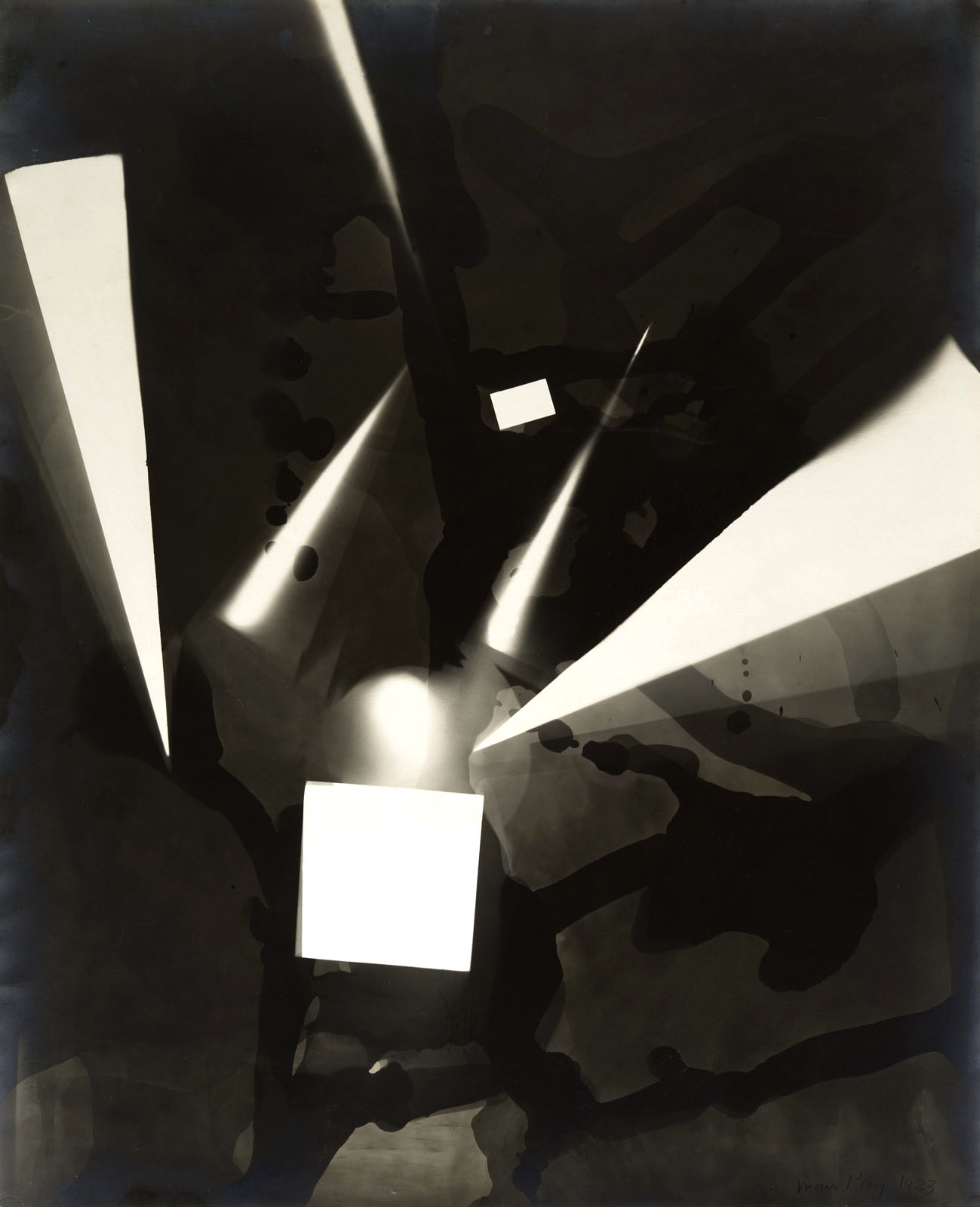
Abbott felt the changing city needed an equivalent to the French photographer Eugène Atget (1857-1927), who had documented Paris during a critical period of transition in the late 19th and early 20th centuries with what Abbott called “the shock of realism unadorned.” She had come to New York as part of an impassioned effort to promote Atget’s oeuvre, one that included purchasing the photographer’s archive after his death and making her own prints from his glass-plate negatives; in the “New York Album” she goes further, becoming, in effect, his heir.

The Met’s exhibition incorporates several Atget photographs from the museum’s collection, including one that Abbott was known to admire; it shows an early automobile garage in the Fifth Arrondissement, with a Renault parked in a cobblestoned courtyard. A similar appreciation for the collision of the newfangled with the outmoded can be seen throughout Abbott’s “New York Album,” in shots of skyscrapers looming over rows of tenements and, in one more subtle and almost surreal case, an overhead view of an equine statue photographed from the Ninth Avenue El.

Although the album is not strictly organized by location, it has a distinct cartography. Abbott gravitated to certain neighborhoods that, for her, showed the face of the new city emerging. Many of them were in lower Manhattan; multiple pages are devoted to the Lower East Side, where she was drawn to storefronts and their simultaneously poetic and transactional signage, and the Financial District, where she often pointed her camera skyward to exaggerate the intimidating height of new corporate towers.

Unlike peers such as Walker Evans, she did not take much of an interest in the human subject – or, at least, in individuals. To her, the city was a human construction and humanity was implicit in every part of it. “You’re photographing people when you’re photographing a city,” she explained in a documentary film about her life. “You don’t have to have a person in it.”

As Abbott’s biographer has noted, she was influenced by the French literary movement of Unanimism, which emphasized collective consciousness and expression. You can sense this especially in her shots of the city’s elevated train system, which revel in the formal modernism of all that interlaced steel and cast iron without losing sight of its function of moving millions of people.

As an extension of the exhibition, the Met has created a helpful digital map that identifies some of the subjects in Abbott’s album and updates them with present-day photographs (a collaboration between the Met curator of photography who organized the exhibition, Mia Fineman, and the Jones Family Research Collective, led by the Manhattan borough historian emeritus, Celedonia Jones, until his death last April). It reveals, for example, that the site of a burlesque theater on Houston Street photographed by Abbott is now a Whole Foods.

Visitors to the exhibition can spend a lot of time testing their own knowledge of the city’s geography, but the pleasures of the show have more to do with the drive and dynamism behind the pictures. “Berenice Abbott’s New York Album, 1929” takes us back to an invigorating moment in the history of the metropolis, captured on the fly by an emergent modern artist.

During her upbringing in Ohio, Abbott had planned to be a journalist – she attended Ohio State University’s School of Journalism before turning to art – and it’s clear from her photography that she never lost that instinct for wanting to be where the story was. In those early months of 1929 she recognized that New York was the big story; looking at her “New York Album” gives us hope that it could be again.

Karen Rosenberg. “Berenice Abbott Captured Manhattan in the Throes of Heady Change,” on the New York Times website August 16, 2023 [Online] Cited 21/08/2023


Unanimism

Unanimism (French: Unanimisme) is a movement in French literature begun by Jules Romains in the early 1900s, with his first book, La vie unanime, published in 1904. It can be dated to a sudden conception Romains had in October 1903 of a ‘communal spirit’ or joint ‘psychic life’ in groups of people. It is based on ideas of collective consciousness and collective emotion, and on crowd behaviour, where members of a group do or think something simultaneously. Unanimism is about an artistic merger with these group phenomena, which transcend the consciousness of the individual. Harry Bergholz writes that “grossly generalising, one might describe its aim as the art of the psychology of human groups”. Because of this collective emphasis, common themes of unanimist writing include politics and friendship.

Text from the Wikipedia website


Berenice Abbott (American, 1898-1991) [Album Page: Madison Square Park, Third Avenue and Ninth Avenue Elevated Train Lines, Manhattan] 1929


Berenice Abbott (American, 1898-1991)
[Album Page: Madison Square Park, Third Avenue and Ninth Avenue Elevated Train Lines, Manhattan]
1929
Gelatin silver prints
Images: 5.3 x 7.8cm (2 1/16 x 3 1/16 in.)
Sheet: 6.4 x 8.7cm (2 1/2 x 3 7/16 in.)
Album Page: 25.4 x 30.3cm (10 x 11 15/16in.)
Metropolitan Museum of Art
© Berenice Abbott / Commerce Graphics Ltd. Inc.
Gift of Emanuel Gerard, 1978


In 1921 Ohio-native Abbott left New York to study in Paris. Returning to the city in 1929, she found it transformed and ripe with photographic potential. Following the model of the French photographer Eugène Atget, whose street views of Paris she admired, Abbott ventured around New York photographing seemingly incidental, but often profound, scenes that captured the city’s changing character. This page of small-scale photographs is one example of many of similar album pages in the Metropolitan’s collection. Assembled by Abbott, the album from which they derive comprised a kind of photographer’s sketchbook for subjects and themes.


Berenice Abbott (American, 1898-1991) [Album Page: City Hall Park and Brooklyn Bridge Vicinity, Manhattan] 1929


Berenice Abbott (American, 1898-1991)
[Album Page: City Hall Park and Brooklyn Bridge Vicinity, Manhattan]
1929
Gelatin silver print
Album Page: 25.4 x 33.2 cm (10 x 13 1/16 in.), irregular
Metropolitan Museum of Art
© Berenice Abbott / Commerce Graphics Ltd. Inc.
Gift of Emanuel Gerard, 1981


Berenice Abbott (American, 1898-1991) [Album Page 5: Pier 17, South Street Seaport, Manhattan] 1929


Berenice Abbott (American, 1898-1991)
[Album Page 5: Pier 17, South Street Seaport, Manhattan]
1929
Gelatin silver prints
Images: approx. 5.6 x 8.2cm (2 1/4 x 3 1/4 in.), and the reverse
Album Page: 25.3 x 30.5cm (9 15/16 x 12 in.), irregular
Metropolitan Museum of Art
© Berenice Abbott / Commerce Graphics Ltd. Inc.
Gift of Emanuel Gerard, 1982


Berenice Abbott (American, 1898-1991) [Album Page 9: Fulton Street Fish Market and Lower East Side, Manhattan] 1929


Berenice Abbott (American, 1898-1991)
[Album Page 9: Fulton Street Fish Market and Lower East Side, Manhattan]
1929
Gelatin silver print
Images: approx. 5.6 x 8.2cm (2 1/4 x 3 1/4 in.), and the reverse
Album Page: 25.3 x 30.5 cm (9 15/16 x 12 in.), irregular
Metropolitan Museum of Art
© Berenice Abbott / Commerce Graphics Ltd. Inc.
Gift of Emanuel Gerard, 1981


Berenice Abbott (American, 1898-1991) [Sumner Healy Antique Shop, 942 3rd Avenue near 57th Street, Manhattan] 1930s, printed 1936


Berenice Abbott (American, 1898-1991)
[Sumner Healy Antique Shop, 942 3rd Avenue near 57th Street, Manhattan]
1930s, printed 1936
Gelatin silver print
8 1/8 × 9 15/16 in. (20.6 × 25.2cm)
Metropolitan Museum of Art
Gift of Phyllis D. Massar, 1971
© Berenice Abbott / Commerce Graphics Ltd. Inc.


In 1935 Abbott embarked on a series of photographs documenting New York City. Funded by the Federal Art Project, during the next four years she made hundreds of images of the city’s monuments and architecture, including this one of Sumner Healey’s shop. Attracted to the “extraordinary montage of antiques” – anchored by a ten-foot-tall figurehead of Mars from an eighteenth-century battleship – Abbott also captured the owner’s cat, seemingly trapped on either side by the decorative dogs flanking the store’s entrance. Healey died soon after Abbott made this photograph, and the shop closed two years later.


Berenice Abbott (American, 1898-1991) 'Pingpank Barbershop, 413 Bleecker Street, Manhattan' 1938


Berenice Abbott (American, 1898-1991)
Pingpank Barbershop, 413 Bleecker Street, Manhattan
1938
Gelatin silver print
24.5 × 19.7cm (9 5/8 × 7 3/4 in.)
Twentieth Century Photography Fund, 2013


With its subtle interplay of reflection and interior, this slightly oblique view of a barbershop window reveals the influence of Atget’s photographs of Parisian storefronts. When Abbott made this image, August Pingpank was eighty-seven and was said to be the oldest barber in New York City. He lamented to Federal Art Project researchers that he would soon have to retire due to the invention of the safety razor: “It’s different now with men shaving themselves every morning at home.”


Berenice Abbott’s New York Album, 1929 presents selections from a unique unbound album of photographs of New York City created by American photographer Berenice Abbott (1898-1991), shedding light on the creative process of one of the great artists of the 20th century. Consisting of 266 small black-and-white prints arranged on 32 pages, the album is a kind of photographic sketchbook that offers a rare glimpse of an artist’s mind at work. In addition to some 25 framed album pages, the exhibition features photographs from The Met collection of Paris streets by Eugène Atget, whose archive Abbott purchased and promoted; views of New York by her contemporaries Walker Evans and Margaret Bourke-White; and selections from Abbott’s grand documentary project, Changing New York (1935-1939).

“Berenice Abbott’s groundbreaking work in photography continues to inspire and captivate audiences today, nearly a century after she first began documenting the world around her,” said Max Hollein, Marina Kellen French Director of The Met. “Abbott’s insightful and powerful images provide a window into the New York of the past, while also reminding us of the city’s enduring vitality and resilience.”

Born in Ohio, Abbott moved to New York City in 1918 and to Paris in 1921. She learned photography as a darkroom assistant in Man Ray’s studio and soon established herself as a prominent portraitist of the Parisian avant-garde. Through Man Ray, Abbott met the ageing French photographer Eugène Atget, whose documentation of Paris and its environs struck her as a model of modern photographic art. Following Atget’s sudden death in 1927, she purchased his archive of some 8,000 prints and 1,500 glass negatives and set about promoting his work through exhibitions and publications.

In January 1929, after eight years in Europe, Abbott boarded an ocean liner to New York City for what was intended to be a short visit. Upon arrival, she found the city transformed and ripe with photographic potential. “When I saw New York again, and stood in the dirty slush, I felt that here was the thing I had been wanting to do all my life,” she recalled. Inspired by Atget, Abbott traversed the city with a handheld camera, photographing its skyscrapers, storefronts, bridges, elevated trains, and neighbourhood street life. She pasted these “notes” into a standard black-page album, arranging them by subject and locale. As the immediate precursor to her 1930s WPA project, Changing New York, Abbott’s New York album marks a key moment of transition in her career: from Europe to America and from studio portraiture to urban documentation. The exhibition will be accompanied by an online feature that identifies, for the first time, the locations of many of the photographs in the album.

Berenice Abbott’s New York Album, 1929 is organised by Mia Fineman, Curator in the Department of Photographs, with assistance from Virginia McBride, Research Assistant in the Department of Photographs, both at The Met.

Press release from the Metropolitan Museum of Art


Berenice Abbott (American, 1898-1991) 'The El at Columbus and Broadway' 1929


Berenice Abbott (American, 1898-1991)
The El at Columbus and Broadway
1929
15.0 x 20.3cm (5 15/16 x 8 in.)
Metropolitan Museum of Art
Ford Motor Company Collection, Gift of Ford Motor Company and John C. Waddell, 1987
© Berenice Abbott / Commerce Graphics Ltd. Inc.


Following her eight years of expatriate life in Paris, Abbott saw New York with European eyes. In this view, made shortly after her return, she captured the random disorder of urban activity as handily as her friend the dadaist poet Tristan Tzara, who put it this way: “We leave with those leaving arrive with those arriving / leave with those arriving arrive when the others leave.”


Berenice Abbott (American, 1898-1991) [The El, 2nd and 3rd Avenue Lines, Bowery and Division Street, Manhattan] 1936


Berenice Abbott (American, 1898-1991)
[The El, 2nd and 3rd Avenue Lines, Bowery and Division Street, Manhattan]
1936
Gelatin silver print
Image: 9 11/16 × 7 5/8 in. (24.6 × 19.3cm)
Sheet: 9 7/8 × 7 15/16 in. (25.1 × 20.1cm)
Metropolitan Museum of Art
© Berenice Abbott / Commerce Graphics Ltd. Inc.
Gift of Phyllis D. Massar, 1971


Manhattan’s elevated (El) train lines fascinated Abbott when she first photographed the city in 1929. Seven years later, she used her large-format camera to capture this shadowed vista beneath the El in Chinatown. “I was right in the middle of the street on a little island,” she recalled. “This was one of the occasions when it was downright dangerous to document New York, with traffic whizzing by on both sides, but it was very important to get in exactly the right position to make the photograph work.”


Berenice Abbott (American, 1898-1991) [Manhattan Bridge] 1936


Berenice Abbott (American, 1898-1991)
[Manhattan Bridge]
1936
Gelatin silver print
Metropolitan Museum of Art
Gift of Phyllis D. Massar, 1971
© Berenice Abbott / Commerce Graphics Ltd. Inc.


The Brooklyn Bridge was New York’s first and most famous, but Abbott favoured the all-steel Manhattan Bridge, completed in 1909. She made this photograph on the southern pedestrian walkway; the vibrations of the suspension bridge required a fast shutter speed to avoid blur. “I seem to veer toward waterfronts,” she later said. “As Melville wrote in Moby Dick, the heart of a port city is around its waterfront, and by nature I seem to head right there. Perhaps I should have been a sailor – boats and bridges have always fascinated me.”


Berenice Abbott (American, 1898-1991) [Seventh Avenue Looking South from Thirty-fifth Street, New York] 1935


Berenice Abbott (American, 1898-1991)
[Seventh Avenue Looking South from Thirty-fifth Street, New York]
1935
Gelatin silver print
Metropolitan Museum of Art
Gift of Phyllis D. Massar, 1971
© Berenice Abbott / Commerce Graphics Ltd. Inc.


Abbott made this overhead view of skyscrapers in the garment district from atop the forty-six-story Nelson Tower on Seventh Avenue. The roof of the original Pennsylvania Station, demolished in 1962, can be seen in the lower right corner.
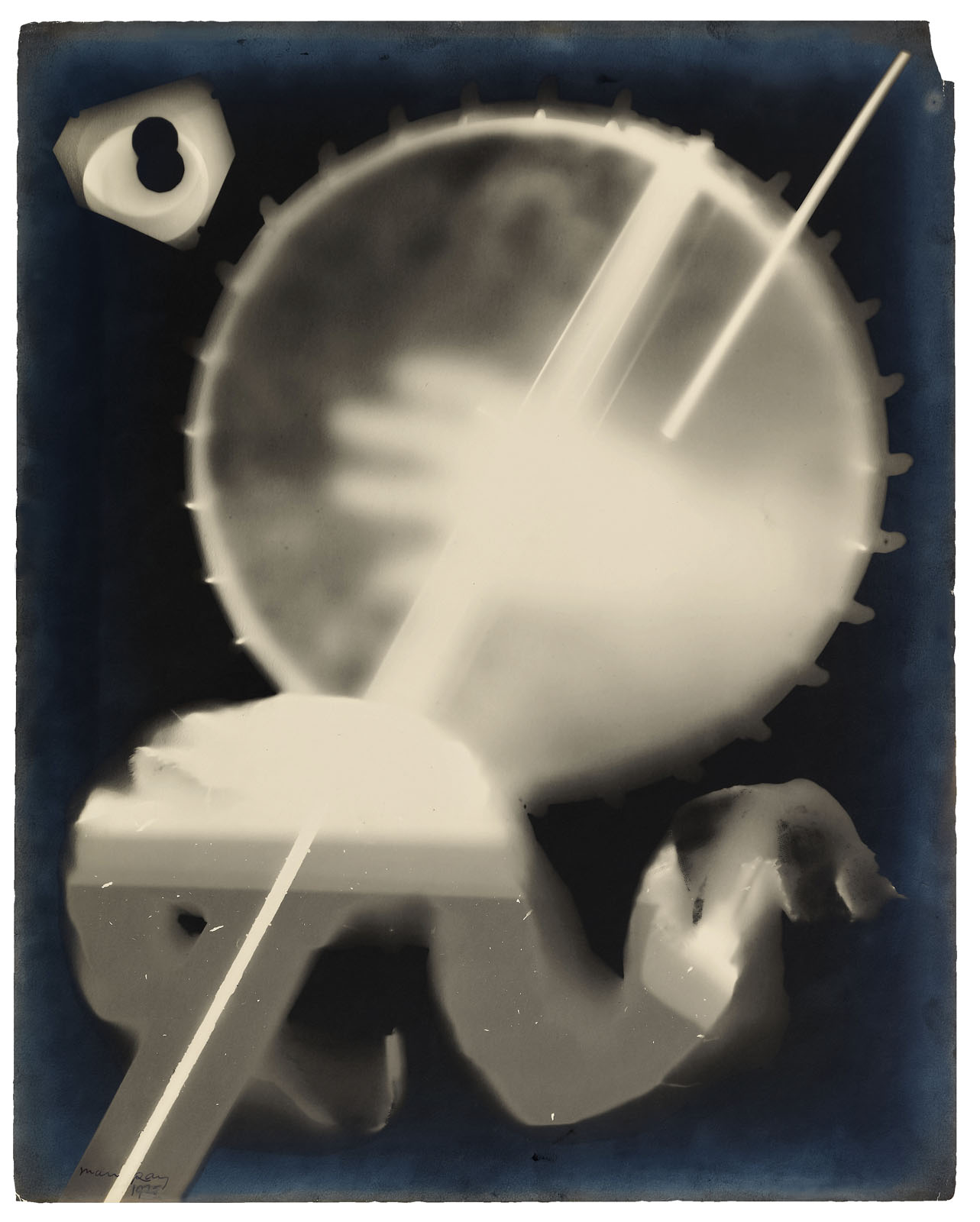
 

Berenice Abbott (American, 1898-1991) 'Canyon, Broadway and Exchange Place' 1936


Berenice Abbott (American, 1898-1991)
Canyon, Broadway and Exchange Place
1936
Gelatin silver print
23.8 x 19.3cm (9 3/8 x 7 5/8 in.)
Metropolitan Museum of Art
Gift of Joyce and Robert Menschel, 1991
© Berenice Abbott / Commerce Graphics Ltd. Inc.


Berenice Abbott (American, 1898-1991) 'Manhattan Bridge, Looking Up' 1936


Berenice Abbott (American, 1898-1991)
Manhattan Bridge, Looking Up
1936
Gelatin silver print
24.5 x 19.4cm (9 5/8 x 7 5/8 in.)
Metropolitan Museum of Art
Gift of Phyllis D. Massar, 1971
© Berenice Abbott / Commerce Graphics Ltd. Inc.


Berenice Abbott (American, 1898-1991) 'Brooklyn Bridge, With Pier 21, Pennsylvania R.R.' 1937


Berenice Abbott (American, 1898-1991)
Brooklyn Bridge, With Pier 21, Pennsylvania R.R.
1937
Gelatin silver print
19.4 x 24.4cm (7 5/8 x 9 5/8 in.)
Metropolitan Museum of Art
Gift of Joyce and Robert Menschel, 1991
© Berenice Abbott / Commerce Graphics Ltd. Inc.


Berenice Abbott (American, 1898-1991) 'West Street' 1936


Berenice Abbott (American, 1898-1991)
West Street
1936
Gelatin silver print
19.1 x 24cm (7 1/2 x 9 7/16 in. )
Metropolitan Museum of Art
Gift of Jane and Mark Ciabattari, 2000
© Berenice Abbott / Commerce Graphics Ltd. Inc.


Berenice Abbott (American, 1898-1991) 'Henry Street from Market, Looking West, Manhattan' 1935


Berenice Abbott (American, 1898-1991)
Henry Street from Market, Looking West, Manhattan
1935
Gelatin silver print
19.2 x 24.2cm (7 9/16 x 9 1/2 in.)
Metropolitan Museum of Art
Gift of Joyce F. Menschel, 2012
© Berenice Abbott / Commerce Graphics Ltd. Inc.


Berenice Abbott (American, 1898-1991) 'Automat, 977 Eighth Avenue, Manhattan' 1936


Berenice Abbott (American, 1898-1991)
Automat, 977 Eighth Avenue, Manhattan
1936
Gelatin silver print
Image: 19.4 x 24.6cm (7 5/8 x 9 11/16 in.)
Sheet: 22 x 25.3cm (8 11/16 x 9 15/16 in.)
Metropolitan Museum of Art
Gift of Joyce F. Menschel, 2011
© Berenice Abbott / Commerce Graphics Ltd. Inc.


During the Depression, Horn & Hardart’s chain of “waiterless restaurants” served as many as eight hundred thousand freshly prepared meals a day to customers in New York and Philadelphia. With its clean lines, polished chrome details, and mechanical efficiency, the Automat struck Abbott as “an extremely American artefact.” New York’s first Automat opened in Times Square in 1912, but Abbott chose to document the branch at Columbus Circle, popular as a nighttime gathering spot for musicians and cabaret patrons.


Eugène Atget (French, 1857-1927)


Eugène Atget (French, 1857-1927) Printer: Berenice Abbott (American, 1898-1991) 'Street Musicians' 1898-1999, printed 1956


Eugène Atget (French, 1857-1927)
Printer: Berenice Abbott (American, 1898-1991)
Street Musicians
1898-1999, printed 1956
Title page from the portfolio 20 Photographs by Eugène Atget (1856-1927), 1956
Published by Berenice Abbott, New York Gelatin silver print from glass negatives David Hunter McAlpin Fund, 1956


In 1956 Abbott produced a portfolio of twenty new prints from Atget’s glass-plate negatives and offered it by subscription to museums, libraries, and private collectors. This photograph of an organ grinder and exuberant female singer belongs to a series of photographs devoted to the rapidly vanishing street trades, or petits métiers, of Paris.


Eugène Atget (French, 1857-1927) [Atget's Work Room with Contact Printing Frames] c. 1910


Eugène Atget (French, 1857-1927)
[Atget’s Work Room with Contact Printing Frames]
c. 1910
Albumen silver print from glass negative
20.9 x 17.3cm (8 1/4 x 6 13/16 in.)
Metropolitan Museum of Art
Purchase, The Horace W. Goldsmith Foundation Gift, through Joyce and Robert Menschel, 1990


This straightforward study by Atget of his own work room offers a rare glimpse of the inner sanctum of an auteur éditeur, as he described his profession. On the table are the wooden frames the photographer used to contact print his glass negatives; at right are several bins of negatives stacked vertically; below the table are his chemical trays; on the shelves above are stacks of paper albums – a shelf label reads escaliers et grilles (staircases and grills). Atget used these homemade albums to organise his vast picture collection from which he sold views of old Paris to clients.


Eugène Atget (French, 1857-1927) '15, rue Maître-Albert' 1912


Eugène Atget (French, 1857-1927)
15, rue Maître-Albert
1912
Gelatin silver print from glass negative
23.2 x 17.6 cm (9 1/8 x 6 15/16 in.)
Metropolitan Museum of Art
Rogers Fund, 1991
Creative Commons CC0 1.0


Eloquent testimony to Atget’s keen regard for the expressions of common folk, this photograph was part of a self-assigned survey of storefronts and commercial signs. Atget ennobled the little grocery with its modest façade and rudimentary display (covered for lunch hour against the midday heat) and framed it simply, thus withdrawing it from the predictable realm of the picturesque.


Eugène Atget (French, 1857-1927) 'Courtyard, 7 Rue de Valence, 5th arr.' June 1922


Eugène Atget (French, 1857-1927)
Courtyard, 7 Rue de Valence, 5th arr.
1922
Gelatin silver print from glass negative
Image: 17.2 x 22.7cm (6 3/4 x 8 15/16 in.)
Mount: 36.7 x 28.7cm (14 7/16 x 11 5/16 in.)
Metropolitan Museum of Art
Gilman Collection, Purchase, Ann Tenenbaum and Thomas H. Lee Gift, 2005


Atget found his vocation in photography in 1897, at the age of forty, after having been a merchant seaman, an itinerant actor, and a painter. He became obsessed with making what he termed “documents” of Paris and its environs, and with compiling a visual compendium of the architecture, landscape, and artefacts that distinguish French culture and its history. By the end of his life, Atget had amassed an archive of over 8,000 negatives that he had organised into such categories as Parisian Interiors, Petits Métiers (trades and professions), and Vehicles in Paris.

The subject of this photograph is an early automobile garage occupying a timeworn courtyard near the intersection of rue Mouffetard and rue Monge in the fifth arrondissement. Although Atget’s interest was primarily in the texture of old Paris – not the city’s new promenades and modern monuments – he did make a few studies of automobiles, signs of modern times, beginning in 1922. Beside a pair of motorcycles rests an early-model Renault touring car, probably dating from 1908. It, too, may be a relic: its four-cylinder engine lies beside it.


Eugène Atget (French, 1857-1927) Printer: Berenice Abbott (American, 1898-1991) 'Fête du Trône' 1925, printed c. 1929


Eugène Atget (French, 1857-1927)
Printer: Berenice Abbott (American, 1898-1991)
Fête du Trône
1925, printed c. 1929
Matte gelatin silver print from glass negative
23.4 x 17cm (9 3/16 x 6 11/16 in.)
Metropolitan Museum of Art
Purchase, The Horace W. Goldsmith Foundation Gift, through Joyce and Robert Menschel, 1999


Abbott made new contact prints from Atget’s glass-plate negatives, experimenting with various photographic papers and processes to try to approximate the clarity and detail of Atget’s own prints. Sometime early in 1930, Walker Evans visited Abbott’s studio in New York’s Hotel des Artistes, where she stored her vast Atget archive. Deeply affected by the French photographer’s work, Evans left that day with four of Abbott’s Atget prints: this one, Boutique, Marché aux Halles (displayed to the right), and two others. Although Atget’s work was never exhibited during his lifetime, his soulful documentation of Paris had a profound impact on both Abbott and Evans, and contributed to the emergence of a documentary style in twentieth-century American art photography.

Learning from Atget

When Abbott met Eugène Atget in 1926, he had been photographing Paris for thirty years. Working with a large wooden-view camera, Atget made what he modestly called “documents” of the city, compiling a vast visual archive of Parisian streets, courtyards, gardens, shop windows, architectural details, apartment interiors, and tradespeople. Atget’s studio was on the same street in Montparnasse as that of Man Ray, who purchased several dozen of his photographs, publishing four of them in the journal La Révolution surréaliste. Abbott was instantly captivated by Atget’s photographs when she encountered them in Man Ray’s studio. “Their impact was immediate and tremendous,” she recalled. “There was a sudden flash of recognition – the shock of realism unadorned. The subjects were not sensational, but nevertheless shocking in their very familiarity.” In 1927 Abbott persuaded Atget to sit for a portrait in her own studio on the rue du Bac. Months later, following his sudden death at age seventy, she purchased his archive of some 8,000 prints and 1,500 glass negatives and set about promoting his work through exhibitions, publications, and sales of the prints, a selection of which are on display here. When she moved to New York in 1929, Abbott brought the archive with her, and eventually sold it to the Museum of Modern Art in 1968.
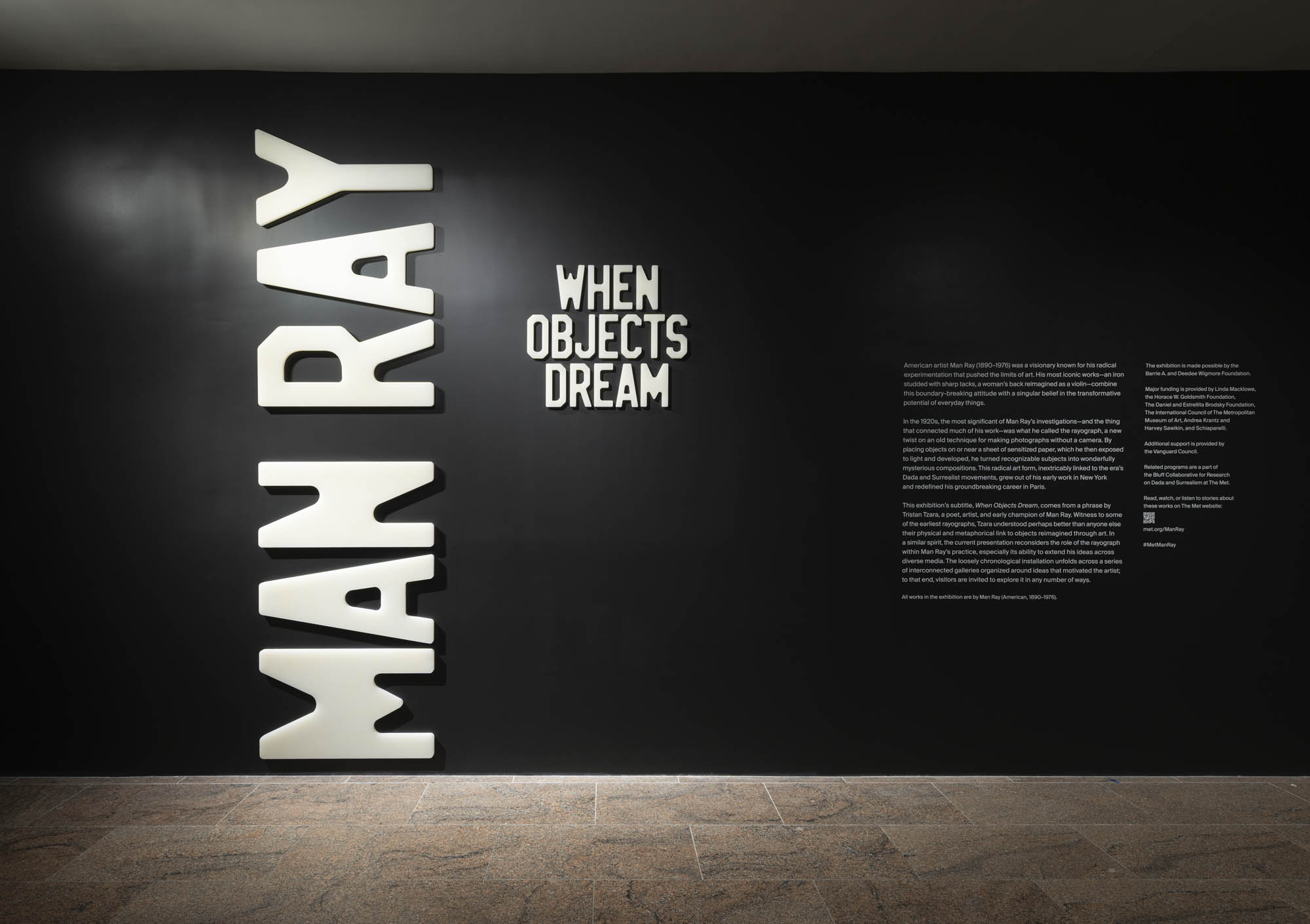
 

Eugène Atget (French, 1857-1927) Printer: Berenice Abbott (American, 1898-1991) 'Boutique, Marché aux Halles, Paris' 1925, printed c. 1929
 

Eugène Atget (French, 1857-1927)
Printer: Berenice Abbott (American, 1898-1991)
Boutique, Marché aux Halles, Paris
1925, printed c. 1929
Matte gelatin silver print from glass negative
23.1 x 17cm (9 1/8 x 6 11/16 in. )
Metropolitan Museum of Art
Purchase, The Horace W. Goldsmith Foundation Gift, through Joyce and Robert Menschel, 1999
Creative Commons CC0 1.0


Eugène Atget (French, 1857-1927) 'Rue Laplace and Rue Valette, Paris' 1926


Eugène Atget (French, 1857-1927)
Rue Laplace and Rue Valette, Paris
1926
Gelatin silver print from glass negative
Image: 22 x 17.6cm (8 11/16 x 6 15/16 in.)
Metropolitan Museum of Art
The Elisha Whittelsey Collection, The Elisha Whittelsey Fund, by exchange, 1970
Creative Commons CC0 1.0


Eugène Atget (French, 1857–1927) 'Avenue des Gobelins' 1927


Eugène Atget (French, 1857-1927)
Avenue des Gobelins
1927
Gelatin silver print from glass negative
36.8 x 28.6cm (14 1/2 x 11 1/4 in.)
Metropolitan Museum of Art
Purchase, Rogers Fund, and Joyce and Robert Menschel and Harriette and Noel Levine Gifts, 1994


In this headless mannequin, clothed in a simple white uniform, Atget recognised a modern version of the commedia dell’arte clown Gilles, depicted by the eighteenth-century painter Jean Antoine Watteau, for example. It was for the type of transforming vision seen in this picture, which is among the very last in Atget’s lifelong exploration of Paris, that the artist’s work was so enthusiastically embraced by the Surrealists.


The Metropolitan Museum of Art
1000 Fifth Avenue at 82nd Street
New York, New York 10028-0198
Phone: 212-535-7710

Opening hours:
Thursday – Tuesday 10am – 5pm
Closed Wednesday

The Metropolitan Museum of Art website

LIKE ART BLART ON FACEBOOK

Back to top