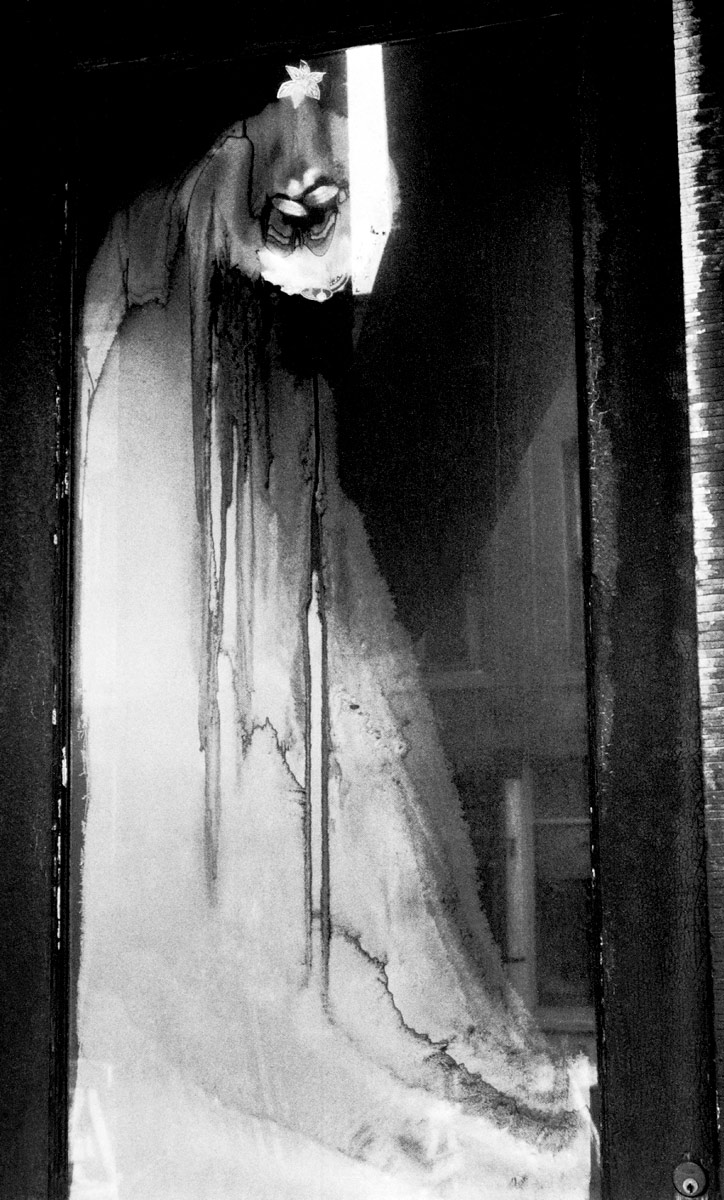
Review: ‘Vestige II’ Melissa Powell and ‘Darkness by Day’ Shannon McGrath at Anita Traverso Gallery, Richmond, Melbourne

Exhibition dates: 5th February – 23rd February 2013


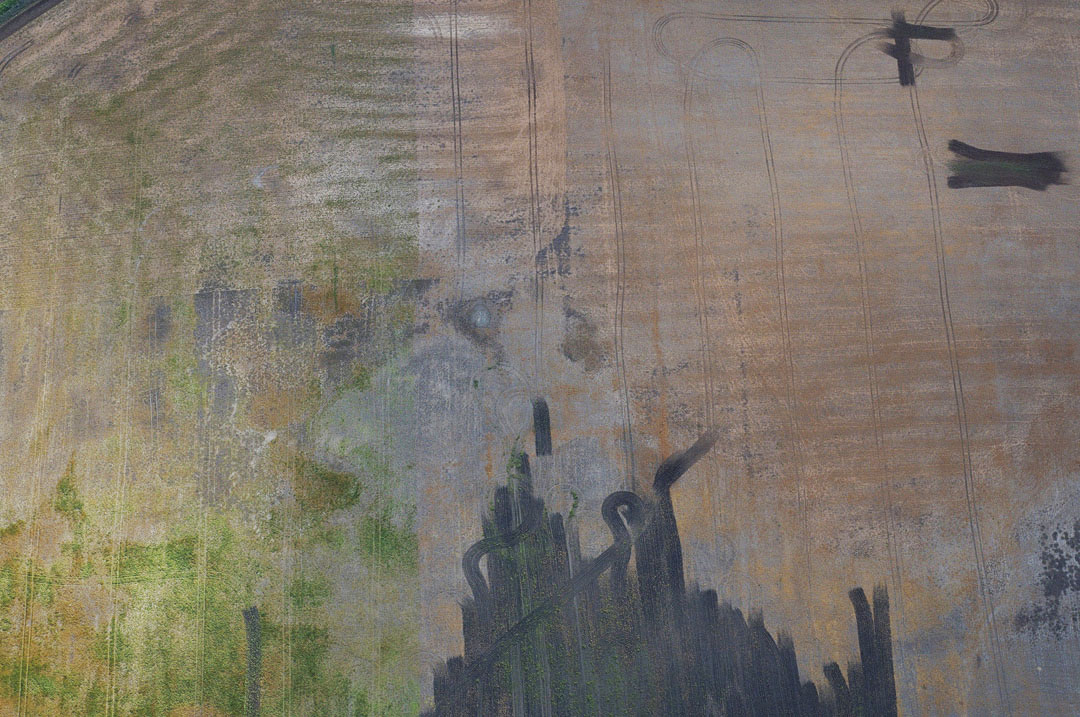
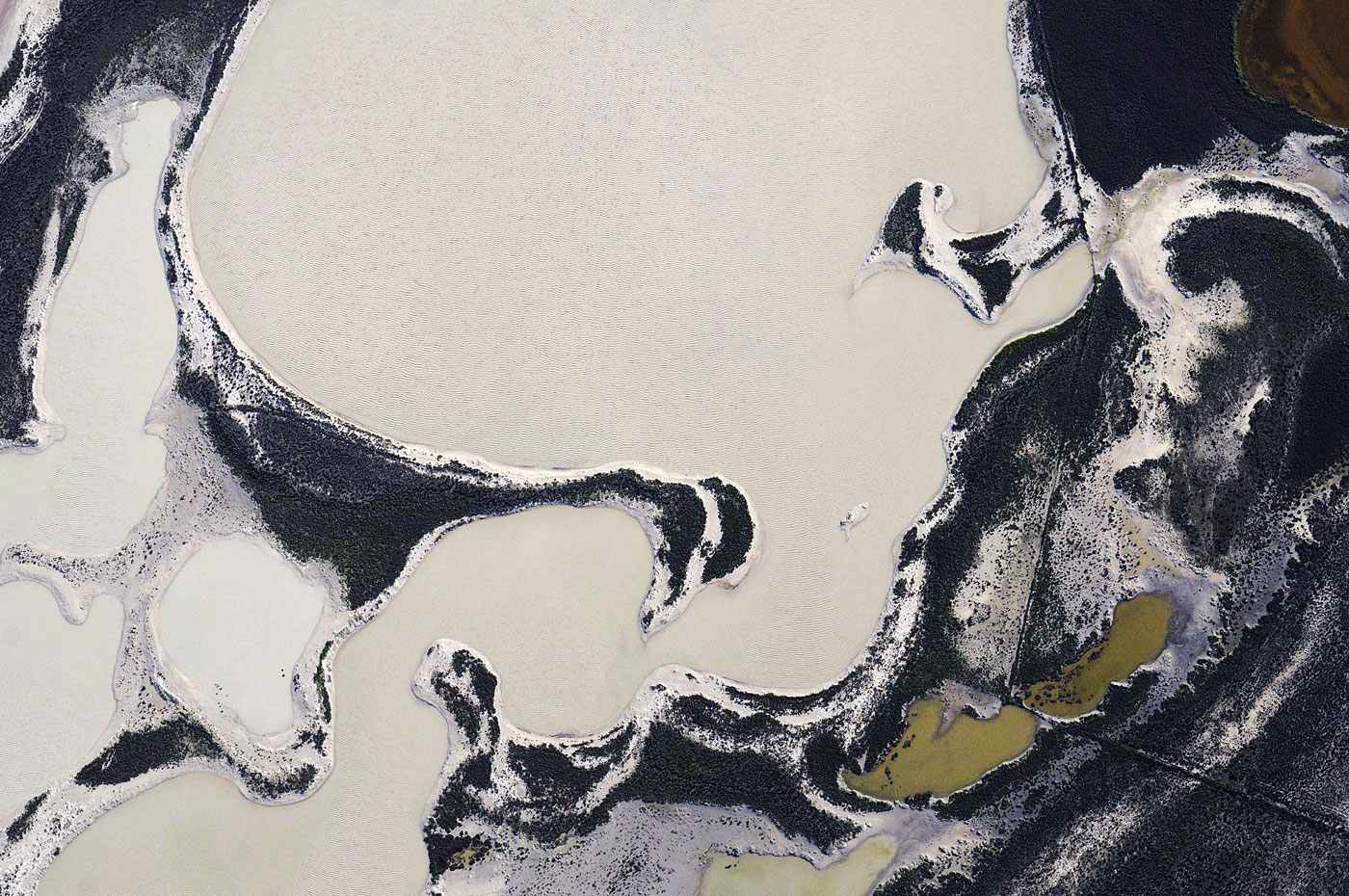
Melissa Powell (Australian) 'Painterly Divide No.1' 2012


Melissa Powell (Australian)
Painterly Divide No.1
2012
Pigment ink on cotton rag
50.5 x 70.6cm
edn. 1/9


ves·tige  
/ˈvestij/

Noun
1/ A trace of something that is disappearing or no longer exists
2/ The smallest amount (used to emphasise the absence of something): “without a vestige of sympathy”
3/ Biology an organ or part of an organism that is a small nonfunctioning remnant of a functional organ in an ancestor
a trace suggesting that something was once present or felt or otherwise important; “the footprints of an earlier civilisation”

via French from Latin ves·tigium footprint, track


Two solid exhibitions of photography are on display at Anita Traverso in Richmond, a gallery that is showing more photography these days, to excellent affect.

Natimuk based photographer Melissa Powell documents the seasonal changes of the Wimmera environment through the use of aerial photography. She brings her skills as a forensic photographer to bear when capturing our mark on the landscape. Her photographs (full frame and never cropped), are as sharp as a tack, like the crystallisation of a thought – the surgical gaze of the artist balanced by a lyrical, abstract poetry. Powell renders (and that is the appropriate word) natural phenomena in their direct relation to humanity, pointing her camera at patterns of cropping, the patchiness of the earth and its sandy, infertile soil. She sees the world clearly and tells the story in a plain, almost scientific way… but this utopian vision of the world is balanced by a feeling in the viewer, a feeling of drifting and floating above the earth, inhabiting a liminal space, as in a daydream.

Powell’s is an expression of the land, presented in a particular way as she remembers experiencing it. For example, look at Painterly Divide No.1, (2012, below) and notice the perfect confluence of yin and yang broken by the single mutation of the furrow midway up in the centre of the image (enlarge the image to see it better!). Disorder plays off order in the mind of the viewer in an absolutely sublime way. Sure, a few things need work in the exhibition, like the framing and naming of the works, but this all comes with time and experience. What Powell evidences in her photographs is a wonderfully strong aesthetic producing some of the best aerial photography I have ever seen. Her traces, footprints and tracks are vestigial structures that links us back to our ancestors, photographs as passionate representation of the land, done with strength and depth of soul.


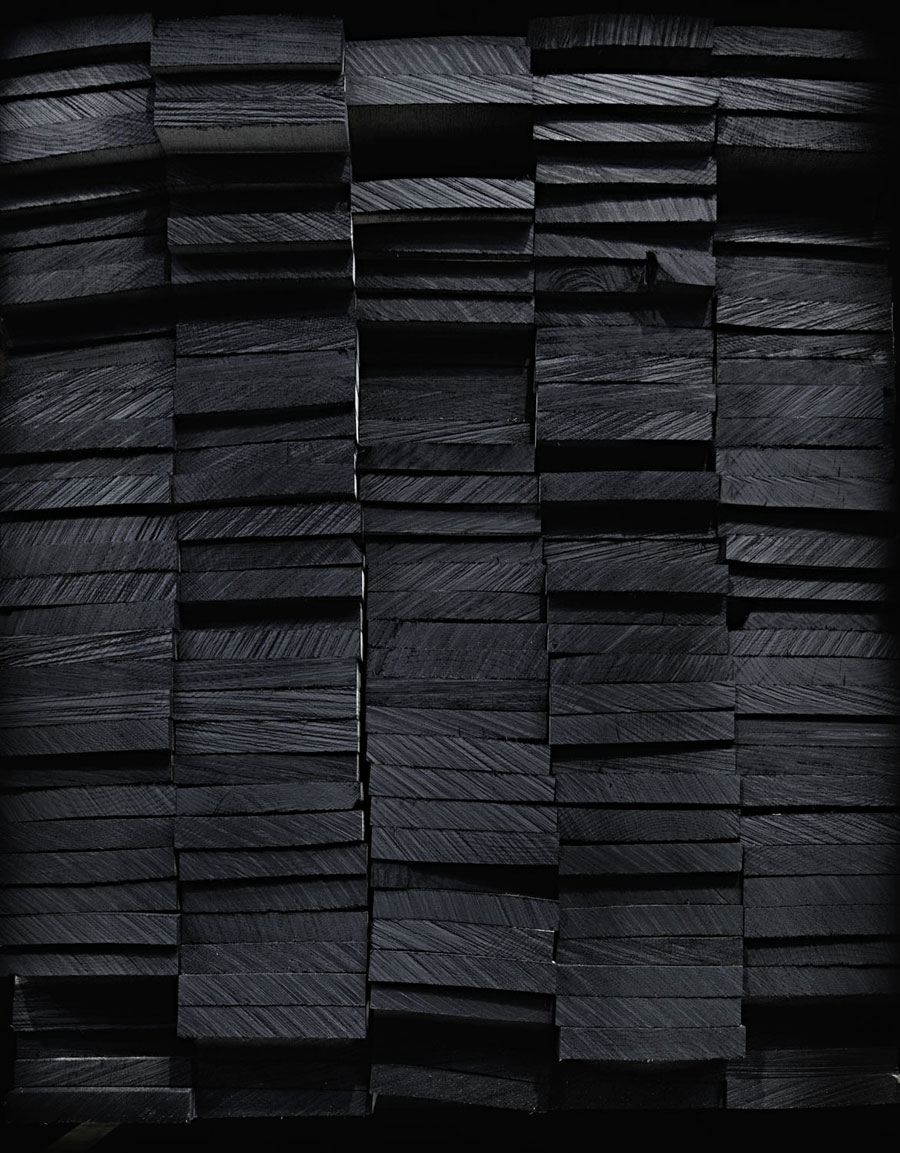
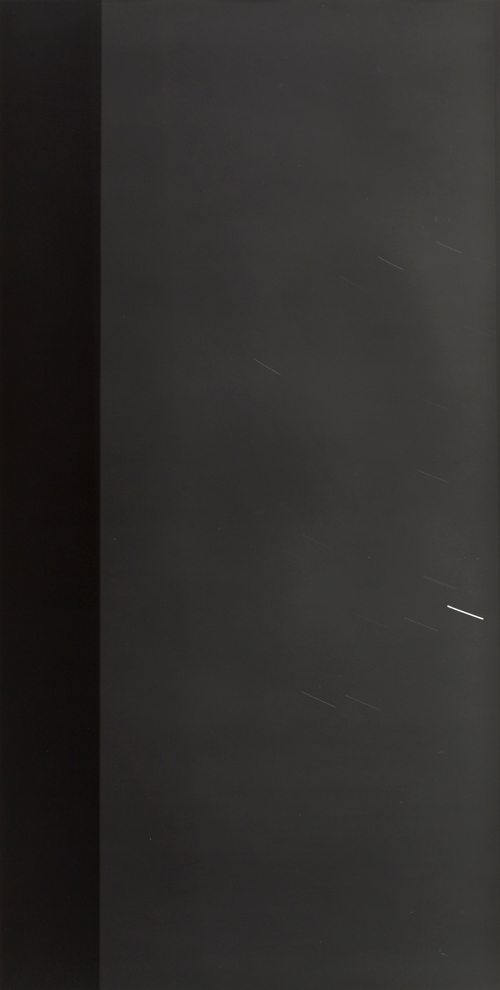
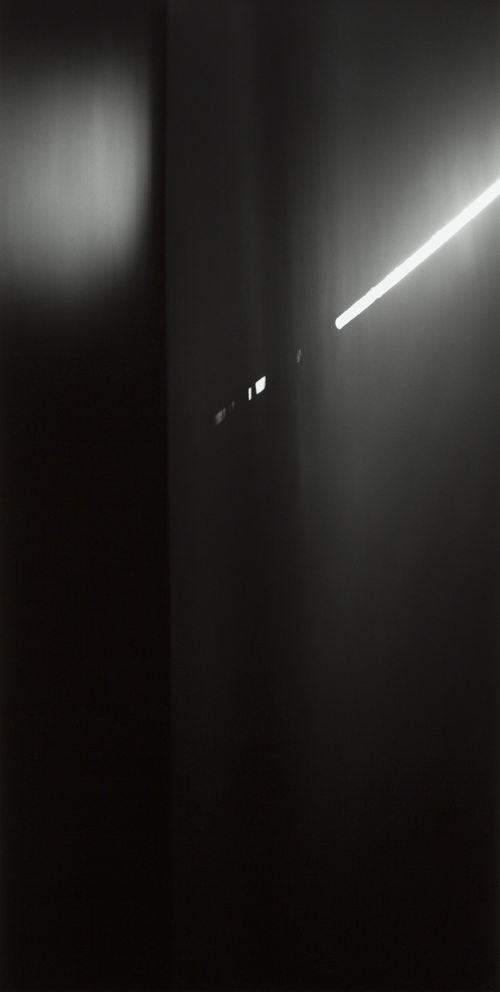
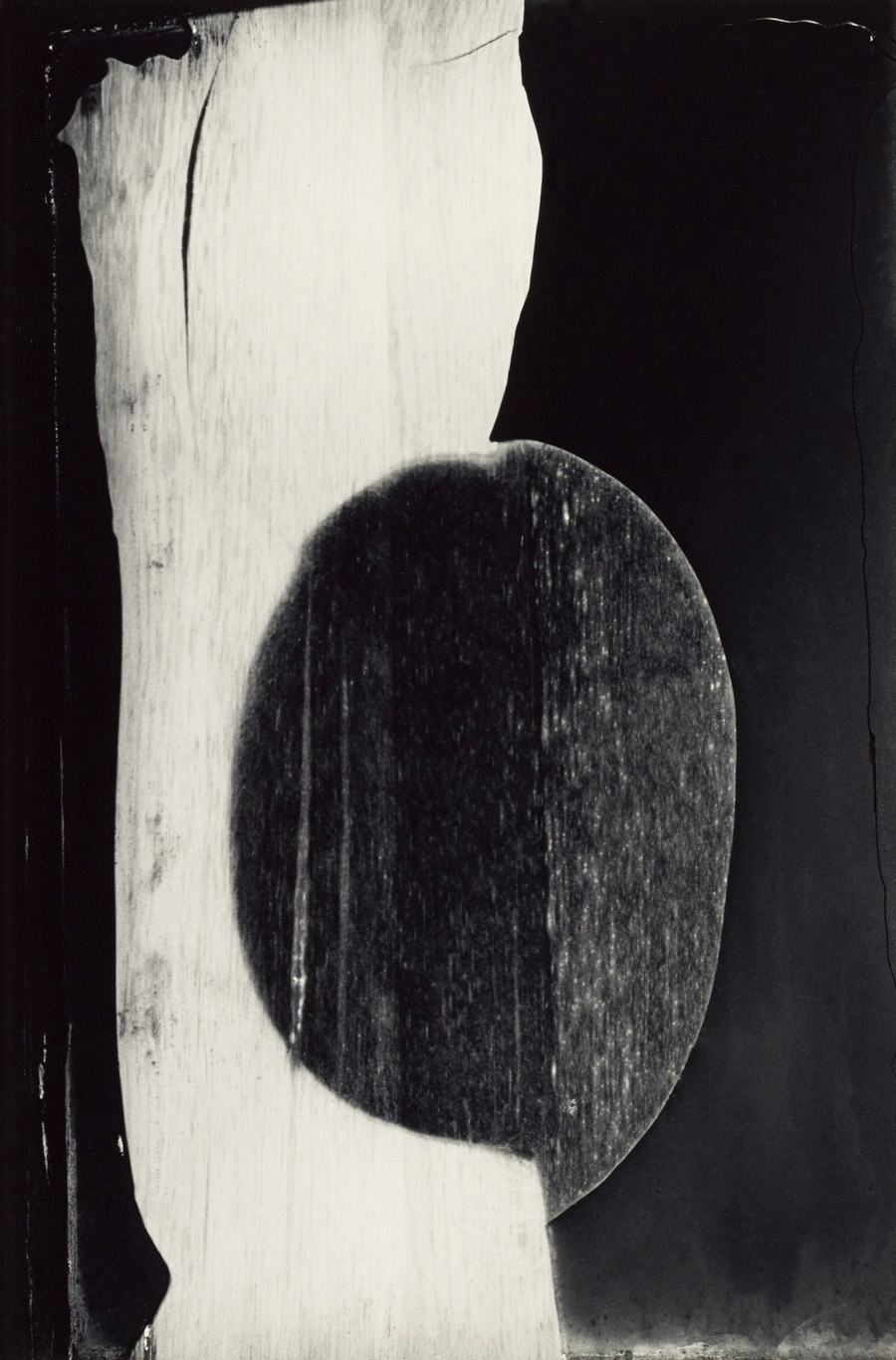
In the back gallery Shannon McGrath, an established architecture photographer, images stacks of wood that “are considered for both their aesthetic values and formal compositional qualities such as patterning and seriality.” The suite of five very large, unmounted black photographs printed on matt Silver Rag paper are stunning, much darker and of more luminance than seen in reproduction here (there are also two other photographs using an electric blue colour that simply did not work for me). Using a minimal composition of the thing itself (and what it can become), the photographer imbues a romantic, visual sensibility into her subject matter. The matt blacks are like velvet and the spaces that open up within the image magical. These things “breathe” like a black Rothko painting, or the plastic black of a Rembrandt.

McGrath’s photographs are “impressionistic inventories of landscapes and entropic architectural structures that connote psychologically, emotionally, and viscerally.” (Anon. “Cyprien Gaillard: The Crystal World,” on the MOMA website [Online] 12/02/2013). The object of her attention – the planks of wood – have a temporality that is characterised by repetition and predictability. The viewer tries to articulate difference through looking but that looking reduces differences to similarities unless we look very closely, are very attentive to the condition of looking. Enlarge any of the dark images below and really look at the cut ends of the wood, their inflection. What is hidden within (or beneath, for the photograph is also a physical object) the flat surface of the image are the nuances of language – the physicality of the print, the punctum of white, the band saw cuts that inhabit the end of days. There is a slippage between language and referent which makes McGrath’s photographs a beautiful deviation and productive possibility of language, one that encourages the vital movement of the subversive sign.

My only concern is “where to next?” What other surfaces which are hidden, which slowly reveal aspects and possibilities, subtleties and complexities will the photographer engage with? Excitingly, I want to see more from both photographers as they combine the ordinary and the poetic in a field of revolutionary possibilities.

Dr Marcus Bunyan


Many thankx to Anita Traverso Gallery for allowing me to publish the photographs in the posting. Please click on the photographs for a larger version of the image.


Melissa Powell (Australian) 'Traces of Time' 2012


Melissa Powell (Australian)
Traces of Time
2012
Pigment ink on cotton rag
50.5 x 76cm
edn. 1/9


“Centered on documentation of the Wimmera region, Melissa Powell’s images are depicted from an aerial perspective that allows her to capture the theatre and sublimity of a landscape that is consistently eroded and replenished by both the cycles of nature, the progression of time and the agricultural impact of man.”


Anna Briers, independent art curator and writer


Melissa Powell (Australian) 'Camouflage No.2' 2012


Melissa Powell (Australian)
Camouflage No.2
2012
Pigment ink on cotton rag
50.5 x 70.6cm
edn. 1/9


Melissa Powell (Australian) 'Droughtbreaker' 2011


Melissa Powell (Australian)
Droughtbreaker
2011
Pigment ink on cotton rag
50.5 x 70.6cm
edn. 8/12


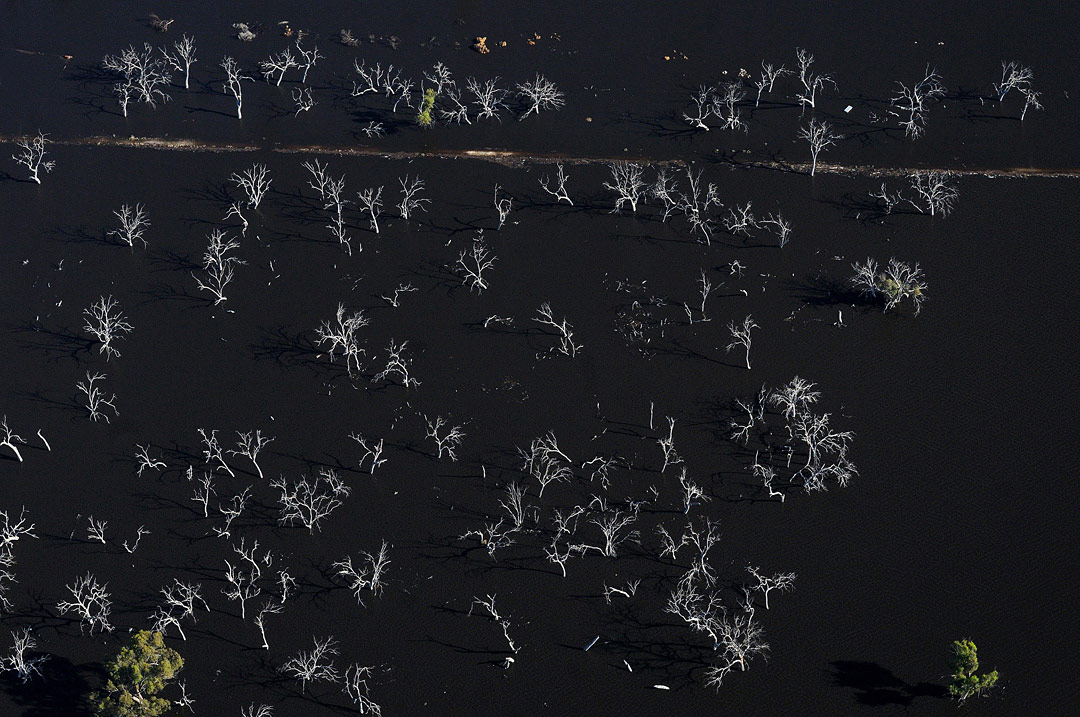
Melissa Powell (Australian) 'Salt Lake No.1' 2011


Melissa Powell (Australian)
Salt Lake No.1
2011
Pigment ink on cotton rag
50.5 x 70.6cm
edn. 8/9


A forensic photographer in her former life, Melissa Powell’s new direction as an aerial photographer was endorsed by her winning first prize for aerial photography at the 2012 International Photography Awards, New York, USA. Vestige II, Powell’s debut exhibition at Anita Traverso Gallery, surveys an amalgam of three photographic series drawn from the artist’s oeuvre – Grounded, Flooded and Dry.

Centred on documentation of the Wimmera region, Powell’s images are depicted from an aerial perspective that allows her to capture the theatre and sublimity of a landscape that is consistently eroded and replenished by the cycles of nature, the progression of time and the agricultural impact of man. Shaped by droughts and bushfires, vast desertous landscapes extend into the horizon. Serpentine rivers and floodplains alternately nourish and fertilise, lacerate and scar. Fecund pastures are contained and demarcated by the rigid geometries of manmade fences and irrigation systems. These vestiges award us a sense of the indelible link between the microcosm and the macrocosm, while enabling us to perceive the constantly shifting narratives of this great southern land.

By contrast Shannon McGrath, an established architecture photographer, aspires to capture the unique spatial dynamics of a building whilst transposing a distillation of the architect’s intention into a two dimensional image. In this photographic series McGrath examines the raw building material of wood in the same way she would approach the documentation of architecture. Photographed on site at the Britton Timber sawmill, the stacks of wood are considered for both their aesthetic values and formal compositional qualities such as patterning and seriality. Simultaneously though, they are envisaged as a core resource imbued with potentiality; their future incarnation, that of the architect’s vision, lying dormant and yet to manifest.

Press release from the Anita Traverso Gallery website


Shannon McGrath (Australian) 'Mark 01' 2012


Shannon McGrath (Australian)
Mark 01
2012
From the series Darkness by Day
Pigment print to cotton rag paper
100 x 128cm


Shannon McGrath (Australian) 'Mark 02' 2012


Shannon McGrath (Australian)
Mark 02
2012
From the series Darkness by Day
Pigment print to cotton rag paper
100 x 128cm


“These stacks of saw-mill timber were shot in broad daylight without any artificial lighting, in situ and without any intervention in their arrangement. I was drawn to the dark element in them that survives this ‘glare’ yet reveals it in other ways – how the light naturally hits the objects and remains in an interplay with the darkness and shadows of the grain, the individual and beautiful markings the blade has left on the natural material, and the extrusions and hollows of the layering of the wood. This gave the show its title. Even in the jewel-like, cobalt image, there is this dynamic. This is a theme that runs through my creative photography: surfaces which are hidden, which slowly reveal aspects and possibilities, subtleties and complexities. I considered wood as an essential building material so I approached the stacks of timber and photographed it with the same sensitivity as architecture.”


Artist statement


Shannon McGrath (Australian) 'Mark 07' 2012


Shannon McGrath (Australian)
Mark 07
2012
From the series Darkness by Day
Pigment print to cotton rag paper
100 x 128cm


Shannon McGrath (Australian) 'Mark 08' 2012


Shannon McGrath (Australian)
Mark 08
2012
From the series Darkness by Day
Pigment print to cotton rag paper
100 x 128cm


Anita Traverso Gallery
PO Box 7001, Hawthorn North,
Melbourne, Victoria, Australia 3122

Anita Traverso Gallery website

LIKE ART BLART ON FACEBOOK

Back to top

Exhibition: ‘Hiroshi Sugimoto. Revolution’ at Museum Brandhorst, Munich

Exhibition dates: 25th October 2012 – 10th February 2013


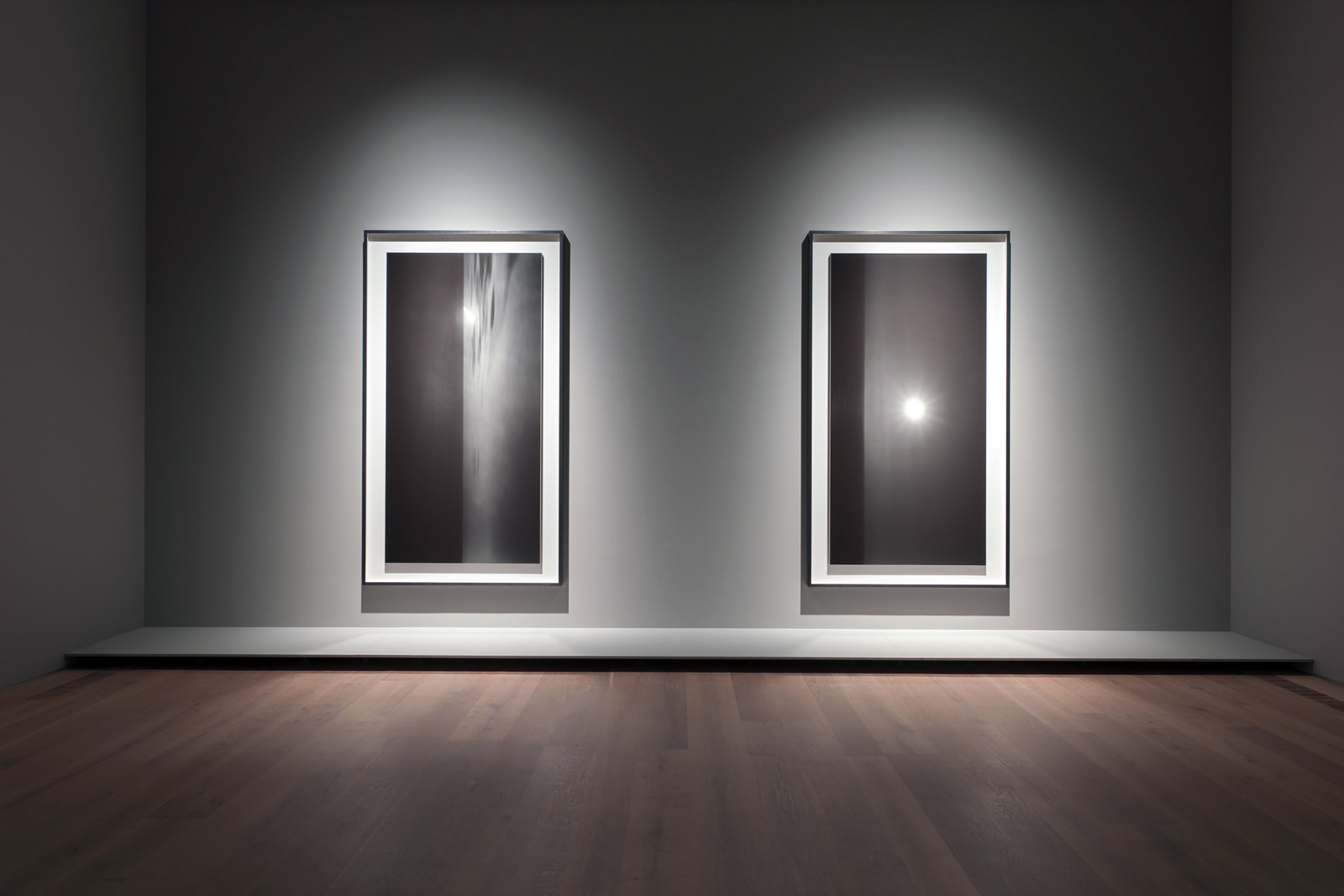
Installation photograph of 'Hiroshi Sugimoto. Revolution' at Museum Brandhorst, Munich, 2012


Installation photograph of Hiroshi Sugimoto. Revolution at Museum Brandhorst, Munich, 2012
Photo: Haydar Koyupinar
© 2012 Hiroshi Sugimoto


“Water and air. So very commonplace are these substances, they hardly attract 
attention – and yet they vouchsafe our very existence.

The beginnings of life are shrouded in myth: Let there water and air. Living phenomena spontaneously generated from water and air in the presence of light, though that could just as easily suggest random coincidence as a Deity. Let’s just say that there happened to be a planet with water and air in our solar system, and moreover at precisely the right distance from the sun for the temperatures required to coax forth life. While hardly inconceivable that at least one such planet should exist in the vast reaches of universe, we search in vain for another similar example.

Mystery of mysteries, water and air are right there before us in the sea. Every time I view the sea, I feel a calming sense of security, as if visiting my ancestral home; I embark on a voyage of seeing.”

Hiroshi Sugimoto


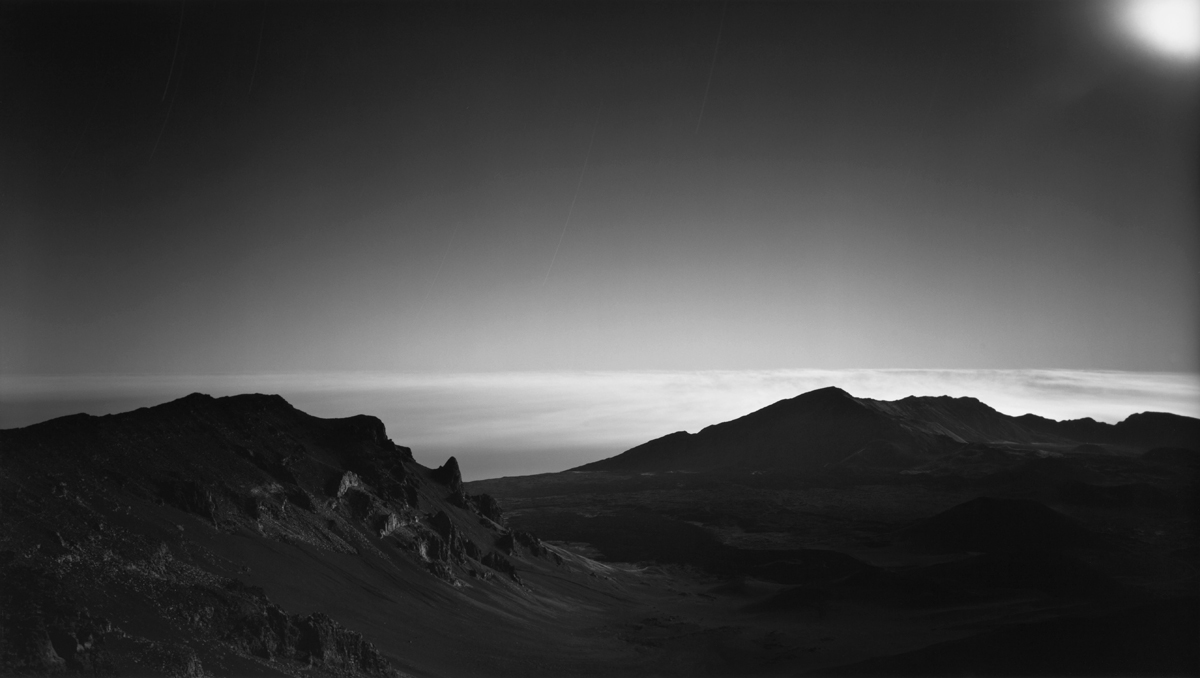
I have always admired the work of Hiroshi Sugimoto, notably his visually poetic series Seascapes and Theaters. His large format photographs expose time through light in a single frame. Their deeply metaphysical and existential nature may be the ultimate distillation of the constructed form of the photographic landscape. “They are explorations of spiritual and physical boundary as much as an exploration of the phenomenology of the picture plane” (Anon. “Hiroshi Sugimoto – Seascapes,” on the C4 Contemporary Art website no longer available online). Like the movie theatre series (where he captures a whole movie on one single frame of film) the seascapes are about the luminosity of life, the enigmatic existence of body and earth imprinted onto film.

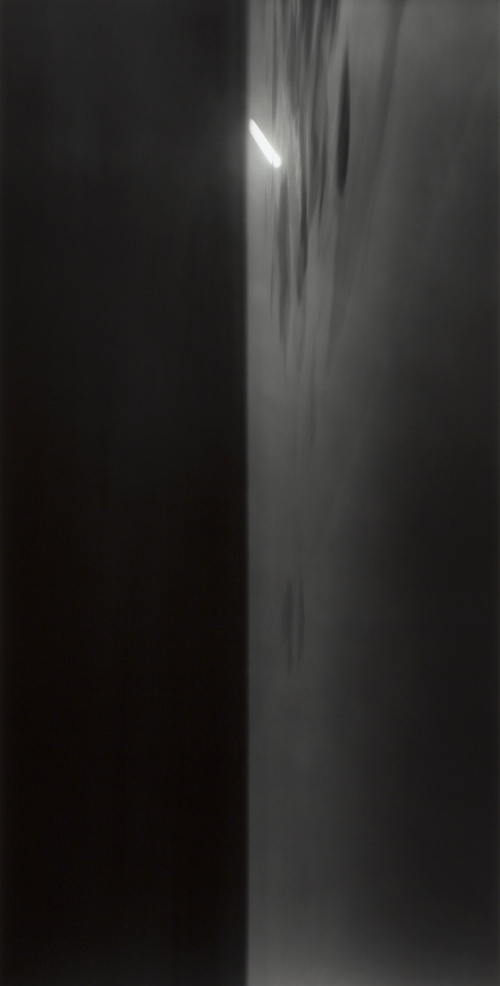
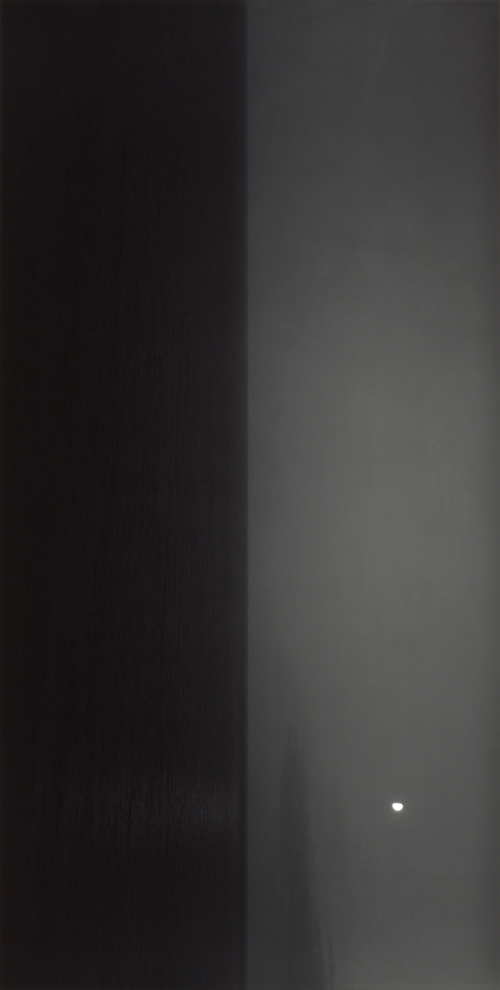
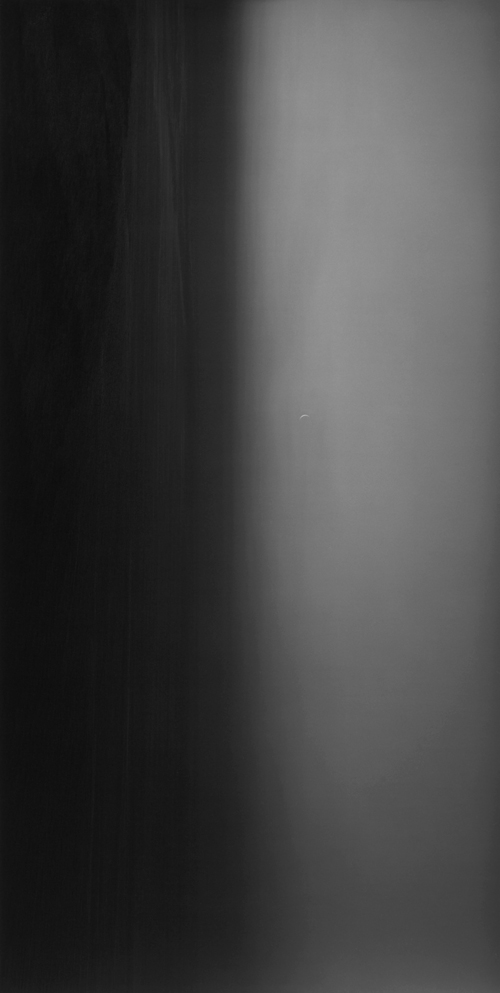
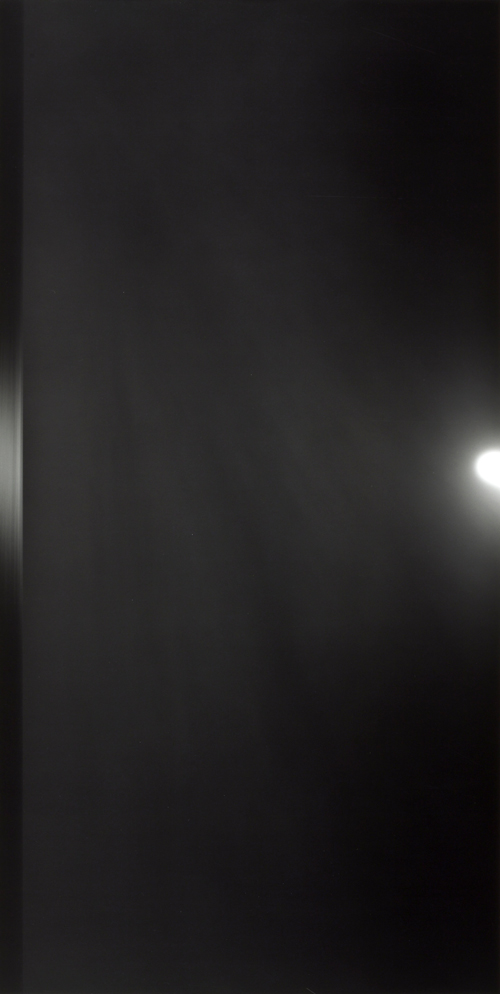
Unfortunately, you can only push an idea so far. Personally I feel this latest series of conceptual twiddles, Revolution (1990 / 2012, publicly displayed here for the first time) fall as flat as a tack. Sugimoto, in his use of the term “revolution”, refers to the “original meaning of the term in the sense of a “suspension” or “overturning of previously accepted laws or practices through new insights or methods.” The reorientation of the referent – of the world, in the world – is supposed to dissipate the Romantic image of the night, unsettling the certainty of the truth of the photograph as a visual record of the world. The photographs’ verisimilitude is supposedly turned on its head, transformed into abstract configurations of light and space through the conceptualisation of the artist. No new narratives are created. In fact the photographs could almost be called post-narrative, essential compositions that emphasise the insular loneliness of modern man’s experiences.

Perhaps they look better in the flesh, or better in a group; perhaps they have more “presence” in reality than they do in reproduction, for this self-styled “revolution” seems to be more a tinkering at the edges of an idea, not a fully realised body of inner work. This is a body of work in/evolution. Sugimoto’s legendary visualisation (his ability to transcend the photographic medium) which is used to create an iconic vision of a timeless state of consciousness, utterly fails him here. You only have to look at the two horizontal landscape photographs at the bottom of the posting to realise that something has not been (un)thought through with the rest of this work. A simple curve of the earth with attendant clouds and horizon line is all you need to suspend the ritual of photographic performance and referentiality. Another lesson from Minor White might have been in order at the time…

Dr Marcus Bunyan


Many thankx to the Museum Brandhorst for allowing me to publish the photographs in the posting. Please click on the photographs for a larger version of the image.


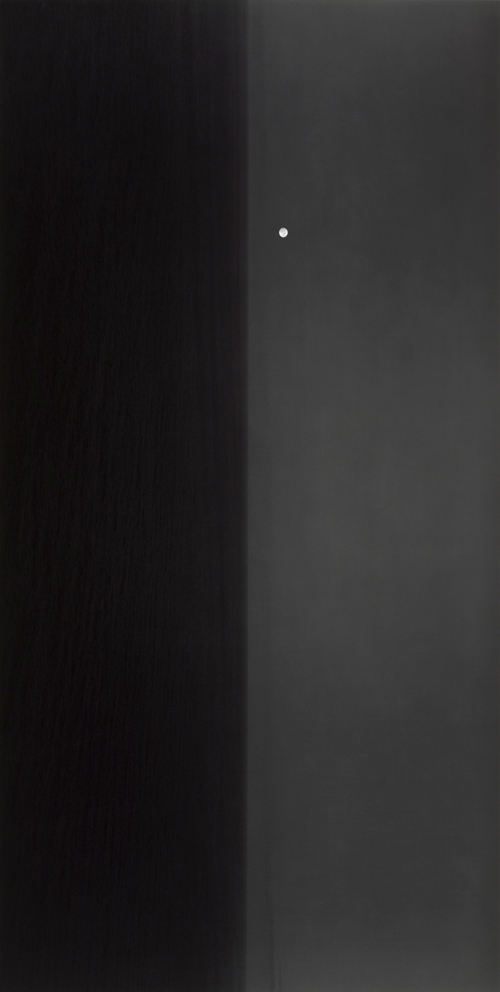
Hiroshi Sugimoto (Japanese, b. 1948) 'Revolution 001' 1990


Hiroshi Sugimoto (Japanese, b. 1948)
Revolution 001
1990
N. Atlantic Ocean, Newfoundland
Gelatin silver print
94 x 47 inches
© 2012 Hiroshi Sugimoto


Hiroshi Sugimoto (Japanese, b. 1948) 'Revolution 002' 1990


Hiroshi Sugimoto (Japanese, b. 1948)
Revolution 002
1990
N. Atlantic Ocean, Newfoundland
Gelatin silver print
94 x 47 inches
© 2012 Hiroshi Sugimoto


Hiroshi Sugimoto (Japanese, b. 1948) 'Revolution 003' 1990


Hiroshi Sugimoto (Japanese, b. 1948)
Revolution 003
1990
N. Atlantic Ocean, Newfoundland
Gelatin silver print
94 x 47 inches
© 2012 Hiroshi Sugimoto


Hiroshi Sugimoto (Japanese, b. 1948) 'Revolution 005' 1990


Hiroshi Sugimoto (Japanese, b. 1948)
Revolution 005
1990
Irish Sea, Isle of Man
Gelatin silver print
94 x 47 inches
© 2012 Hiroshi Sugimoto


Hiroshi Sugimoto (Japanese, b. 1948) 'Revolution 006' 1990


Hiroshi Sugimoto (Japanese, b. 1948)
Revolution 006
1990
Arctic Ocean, North Cape
Gelatin silver print
94 x 47 inches
© 2012 Hiroshi Sugimoto


Hiroshi Sugimoto is one of the best-known photographic artists of our time. His celebrated international reputation is based on his photography, although in recent years he has become engaged with other genres: architecture, furniture, objects, and fashion all play an increasingly important role in his work. It is primarily his photography however, that important museums from all over the world have collected and displayed.

Sugimoto’s unique accomplishments in his genre contradict the medium’s conventional tasks – to record reality as precisely as possible. In Sugimoto’s work, one is confronted with the formal reduction of conceptual images, in which he addresses fundamental questions of space and time, past and present, art and science, imagination and reality. “I was concerned,” noted the artist in 2002, “with revealing an ancient stage of human memory through the medium of photography. Whether it is individual memory or the cultural memory of mankind itself, my work is about returning to the past and remembering where we came from and how we came about.” His pictures, which leave a lasting impression through their beauty and their auratic effect, interweave Japanese traditions with Western ideas. This East-West dialogue remains characteristic of his work today, which is captivating in its exceptional craftsmanship and strong aesthetic presence, and can exercise an almost magical effect on viewers.

Sugimoto has given this suite of works – publicly displayed here for the first time – the title Revolution, but he reveals a radically different understanding of the term in the fifteen large-format works. It is not political or social unrest to which Sugimoto alludes, but rather to the original meaning of the term in the sense of a “suspension” or “overturning” of previously accepted laws or practices through new insights or methods.
 From a technical perspective, the nature of the work is undeniably photographic. But in terms of how they are perceived and understood, these are pictures that would be more readily ascribed to a painterly or conceptual sphere. 
This transgression of medium is characteristic of Sugimoto’s approach, and also applies to Seascapes, the largest distinct corpus of works in his oeuvre. For over thirty years Sugimoto has depicted the sea, always in the same, archetypal way. These works deal with difference within the apparently identical, with morphological visualisation, and an iconic vision of a timeless state of consciousness. Dioramas, Theaters, Chambers of Horrors, Portraits, Architecture, Conceptual Forms, etc. are without doubt very important groups of work, but Seascapes composes the broad and consistent foundation upon which all of the artist’s other series are based.

The point of departure for the fifteen works entitled Revolution is a nocturnal seascape. A 90° clockwise rotation turns the horizons into vertical lines, dissipating the Romantic image of the night. Without changing the pictures’ material substance or subject, any obvious connotations are masked, their certainties denied by the transformation. At the same time, highly original abstract configurations emerge in their place. But it is finally the presence of the aesthetic which Sugimoto so forcefully brings to light in his new work. The process derives from conventional puzzles, but reveals in this case no new narrative moments, leading instead to hermetic compositions reminiscent of the work of American painters such as Barnett Newman.

Text from the Museum Brandhorst website


Hiroshi Sugimoto (Japanese, b. 1948) 'Revolution 008' 1990


Hiroshi Sugimoto (Japanese, b. 1948)
Revolution 008
1990
Caribbean Sea, Yucatan
Gelatin silver print
94 x 47 inches
© 2012 Hiroshi Sugimoto


Hiroshi Sugimoto (Japanese, b. 1948) 'Revolution 009' 1990


Hiroshi Sugimoto (Japanese, b. 1948)
Revolution 009
1990
Caribbean Sea, Yucatan
Gelatin silver print
94 x 47 inches
© 2012 Hiroshi Sugimoto


Hiroshi Sugimoto (Japanese, b. 1948) 'Revolution 011' 1990


Hiroshi Sugimoto (Japanese, b. 1948)
Revolution 011
1990
Red Sea, Safaga
Gelatin silver print
94 x 47 inches
© 2012 Hiroshi Sugimoto


Hiroshi Sugimoto (Japanese, b. 1948) 'Revolution 012' 1990


Hiroshi Sugimoto (Japanese, b. 1948)
Revolution 012
1990
East China Sea, Amakusa
Gelatin silver print
94 x 47 inches
© 2012 Hiroshi Sugimoto


Hiroshi Sugimoto (Japanese, b. 1948) 'Revolution 013' 1990


Hiroshi Sugimoto (Japanese, b. 1948)
Revolution 013
1990
N. Pacific Ocean, Ohkurosaki
Gelatin silver print
94 x 47 inches
© 2012 Hiroshi Sugimoto


Hiroshi Sugimoto (Japanese, b. 1948) 'Landscape 004' 1989


Hiroshi Sugimoto (Japanese, b. 1948)
Landscape 004
1989
Gelatin silver print
47 x 83 inches
© 2012 Hiroshi Sugimoto


Hiroshi Sugimoto (Japanese, b. 1948) 'Landscape 005' 1989


Hiroshi Sugimoto (Japanese, b. 1948)
Landscape 005
1989
Gelatin silver print
47 x 83 inches
© 2012 Hiroshi Sugimoto


Museum Brandhorst
cnr of Theresienstrasse and Türkenstrasse
Munich

Opening hours:
Daily except Monday 10.00 – 18.00
Thursday 10.00 – 20.00

Museum Brandhorst website

LIKE ART BLART ON FACEBOOK

Back to top

Review: ‘Terraria’ by Darron Davies at Edmund Pearce Gallery, Melbourne

Exhibition dates: 16th January – 9th February 2013


Darron Davies (Australian) 'Atmosphere' 2012


Darron Davies (Australian)
Atmosphere
2012
Archival Pigment Print on Photo Rag
80 x 80cm
Edition of 6


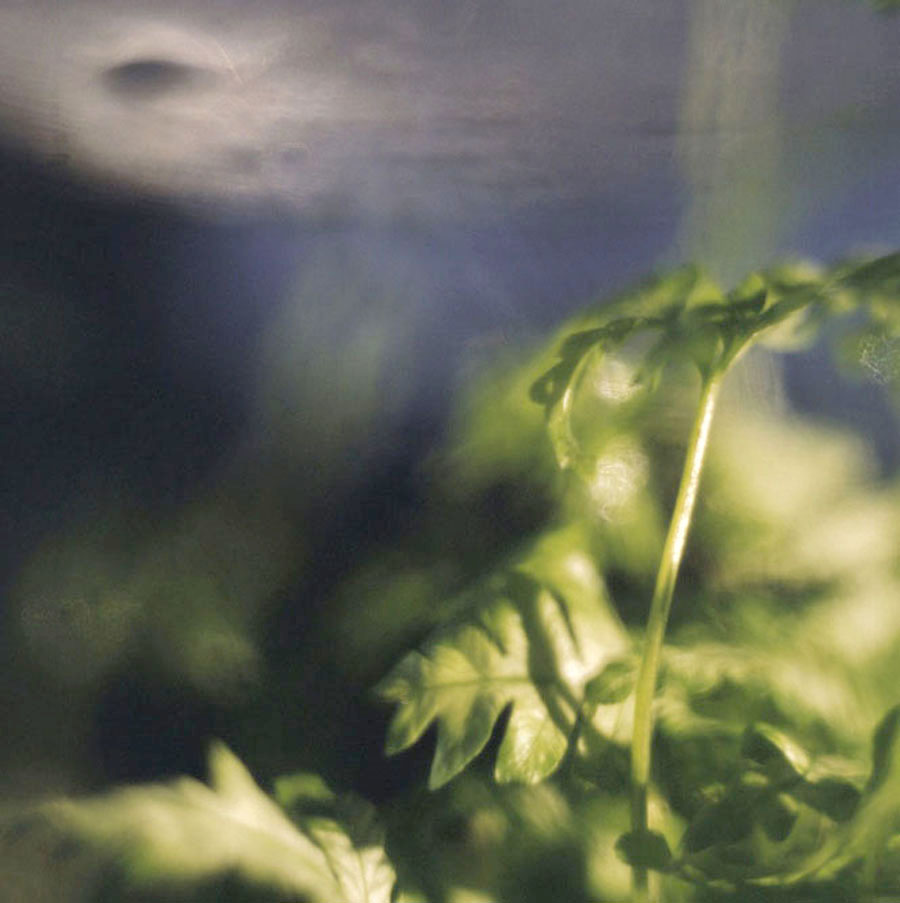
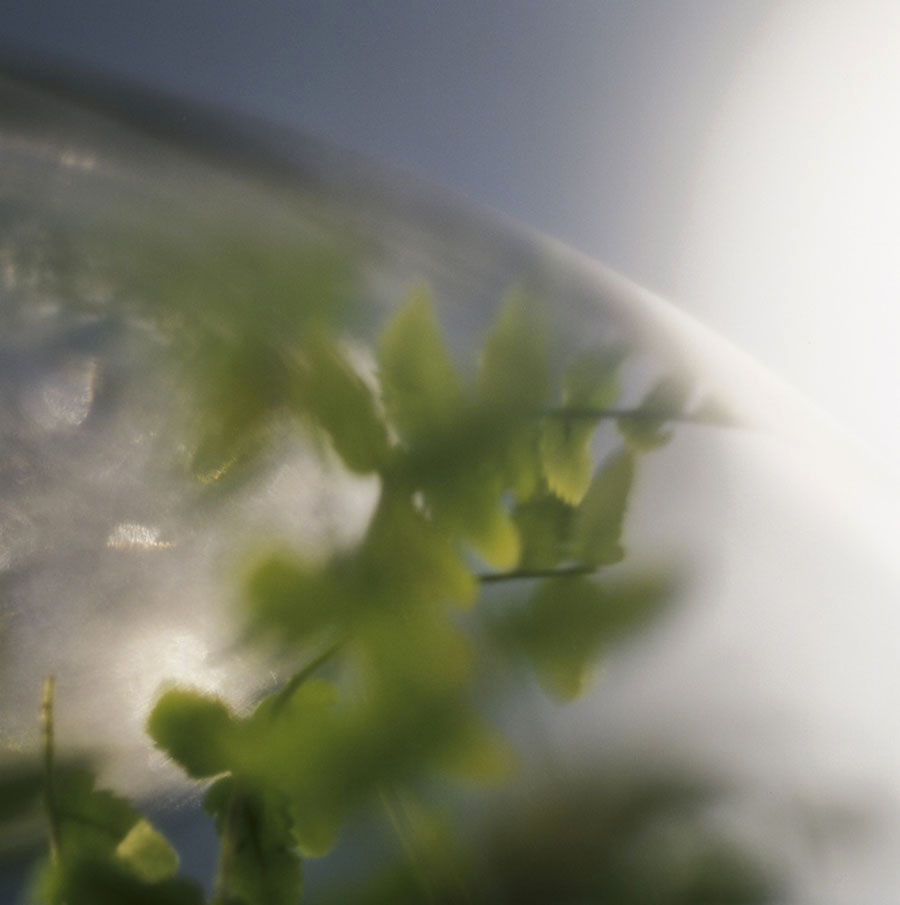
This is the first “magical” exhibition of photography that I have seen in Melbourne this year. Comprising just seven moderately large Archival Pigment Print on Photo Rag images mounted in white frames, this exhibition swept me off my feet. The photographs are beautiful, subtle, nuanced evocations to the fragility and enduring nature of life. The photographs move (shimmer almost) one to another, with slight changes in the colour green balanced with abstract splashes of light and pigment reminiscent of an abstract expressionist painting (I particularly like the splash of red in The Red Shard, 2102, below). These are beautifully seen works, that require 1) a good idea, 2) an aware and enquiring mind, 3) an understanding and receptive eye, and 4) a relationship to the ineffable that allows visions such as these to be breathed into existence. As Minor White would say,


Three Canons

Be still with yourself
Until the object of your attention
Affirms your presence


Let the Subject generate its own Composition


When the image mirrors the man
And the man mirrors the subject
Something might take over


A sense of day/dreaming is possible when looking at these images. Interior/exterior, size/scale, ego/self are not fixed but fluid, like the condensation that runs down the inside of these environments (much like blood circulates our body). This allows the viewer’s mind to roam at will, to ponder the mysteries of our short, improbable, joyous life. The poetic titles add to this introspective reflection. I came away from viewing these magical, self sustaining vessels with an incredibly happy glow, more aware of my own body and its relationship to the world than before I had entered Darron Davies enveloping, terrarium world.

Dr Marcus Bunyan


Many thankx to Edmund Pearce Gallery for allowing me to publish the photographs in the posting. Please click on the photographs for a larger version of the image.


Darron Davies (Australian) 'Day’s Reach' 2012


Darron Davies (Australian)
Day’s Reach
2012
Archival Pigment Print on Photo Rag
80 x 80cm
Edition of 6


Darron Davies (Australian) 'Encased' 2012


Darron Davies (Australian)
Encased
2012
Archival Pigment Print on Photo Rag
80 x 80cm
Edition of 6


Terraria


I step into your small world
Your secret world
Each a planet of green

Fragile edges holding
the lived
and living

Peering into your glass
your mirror
I see the shards of light
Drawing in
and
Stretching out

You are another
In atmosphere
In moss
In fear


Terraria is a photographic project exploring the magical, abstract and metaphoric world of terrariums – an increasingly popular form of enclosed and small scale eco-system designed for showcasing plants.

Ultimately, Terraria is also about the fragility of life – terrariums as self contained vessels, enduring, magical – like the human body or our planet – yet somewhat mysterious. These vessels are self sustaining with no watering needed. They are independent and endure quietly. This project would not have been possible without support from Lisa Rothwell from Lu Lu Blooms.

Artist statement


Darron Davies (Australian) 'Heaven’s Door' 2012


Darron Davies (Australian)
Heaven’s Door
2012
Archival Pigment Print on Photo Rag
80 x 80cm
Edition of 6


Darron Davies (Australian) 'The Second Dream' 2012


Darron Davies (Australian)
The Second Dream
2012
Archival Pigment Print on Photo Rag
80 x 80cm
Edition of 6


Darron Davies (Australian) 'The Light Play' 2012


Darron Davies (Australian)
The Light Play
2012
Archival Pigment Print on Photo Rag
80 x 80cm
Edition of 6


Darron Davies (Australian) 'The Red Shard' 2012


Darron Davies (Australian)
The Red Shard
2012
Archival Pigment Print on Photo Rag
80 x 80cm
Edition of 6


Darron Davies (Australian) 'From the Window of My Atelier' 1940


Josef Sudek (Czechoslovakian, 1896-1976)
From the Window of My Atelier
1940
Gelatin silver print


Edmund Pearce Gallery

This gallery is no longer open.

Darron Davies website

LIKE ART BLART ON FACEBOOK

Back to top

Exhibition: ‘Flatlands: photography and everyday space’ at the Art Gallery of New South Wales (AGNSW), Sydney

Exhibition dates: 13th September 2012 – 3rd February 2013


David Moore (Australia, 1927-2003) 'Light pattern, camera in motion' c. 1948, printed 1997


David Moore (Australia, 1927-2003)
Light pattern, camera in motion
c. 1948, printed 1997
Gelatin silver photograph
50.7 x 40.3cm
Art Gallery of New South Wales, Sydney
Gift of Karen, Lisa, Michael and Matthew Moore, 2004


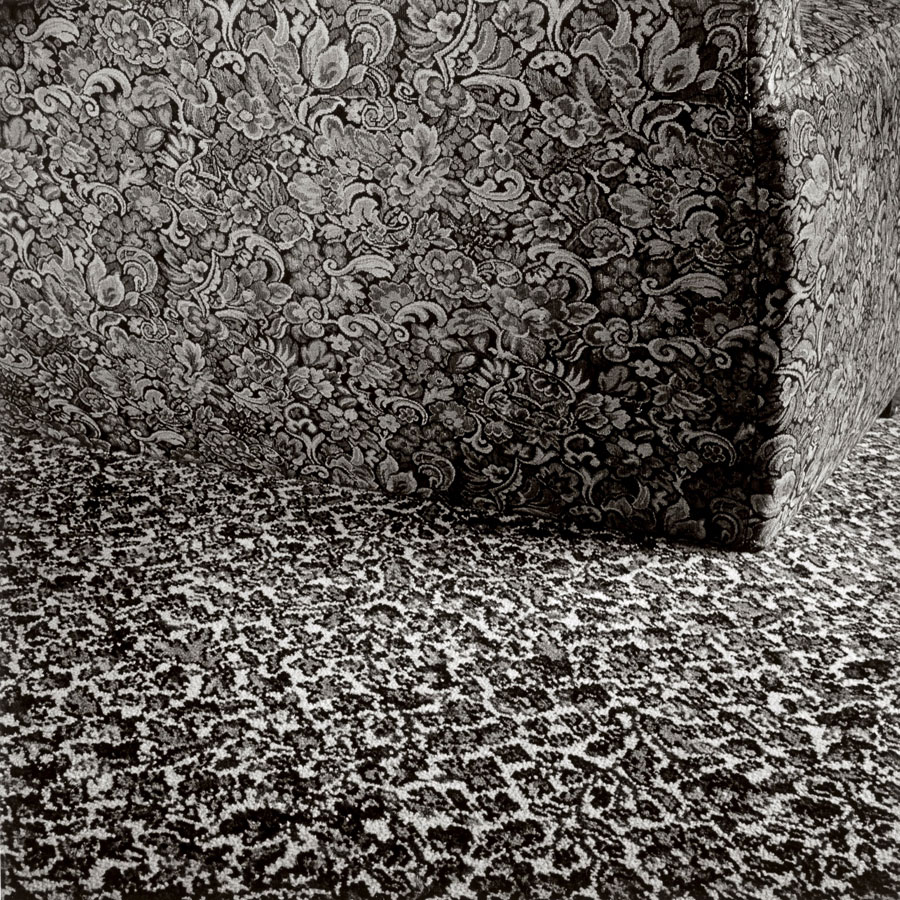
This posting contains one of my favourite early works by Fiona Hall, Leura, New South Wales (1974, below) which is redolent of all the themes that would be expressed in the later work – an alien landscape that examines “the relationship between humankind and nature and the symbolic role of the [fecund] garden in western iconography.” In her work the “nature” of things (plants, money, videotape, plumbing fittings, birds nests, etc…) are re/classified, re/ordered and re/labelled.

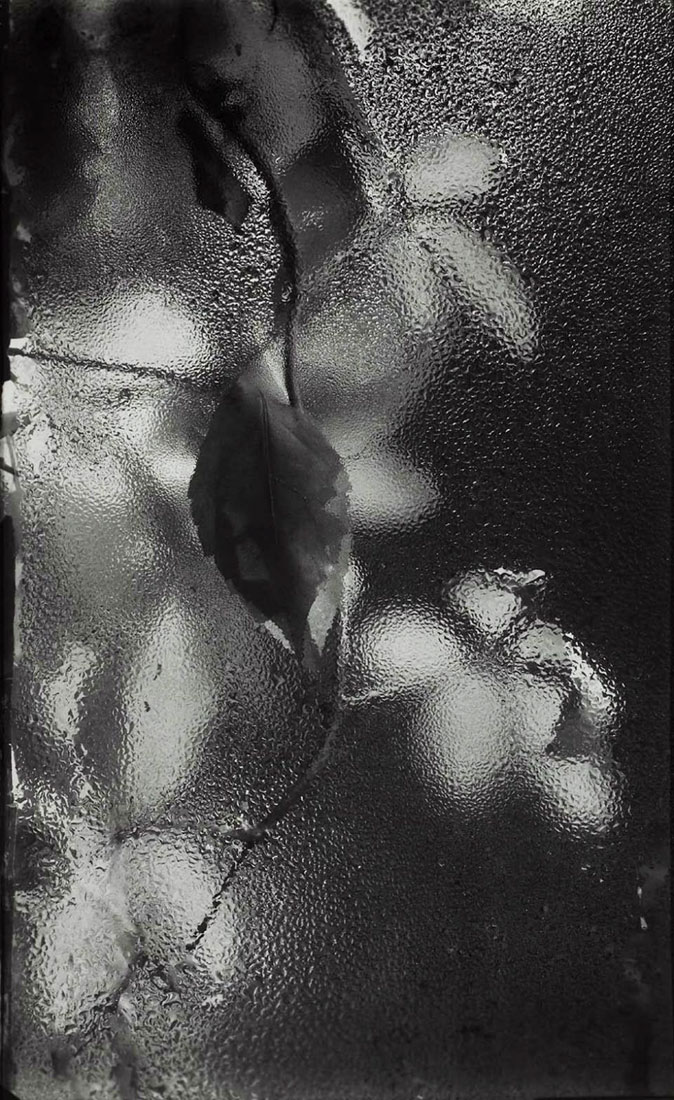
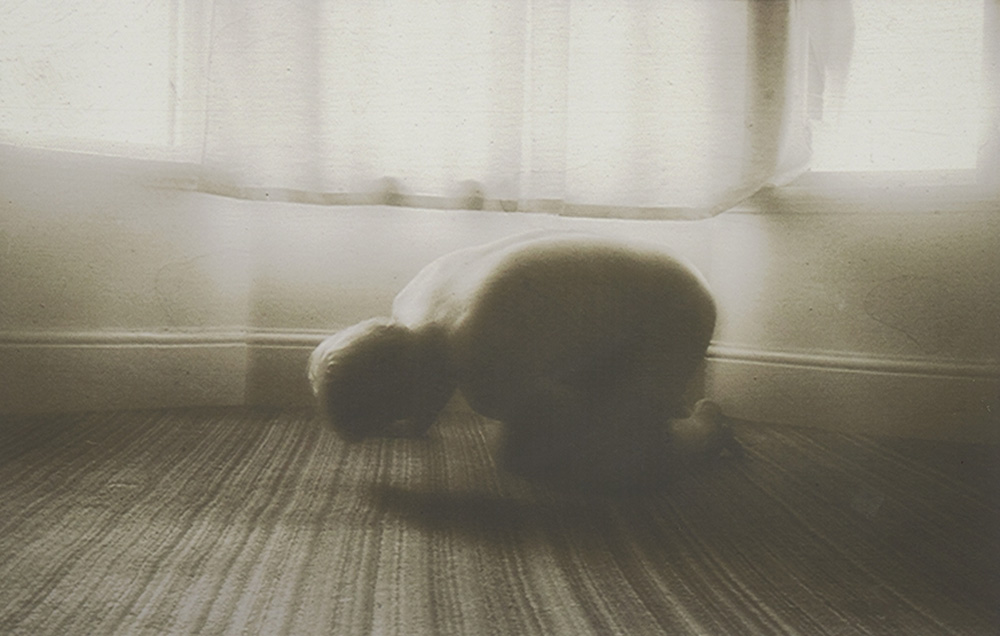
Another stunning photograph in this posting is Minor White’s Windowsill daydreaming (1958, below). It is one of my favourite images of all time: because of the power of observation (to be able to recognise, capture and present such a manifestation!); because of the images formal beauty; and because of its metaphysical nature – a poetry full of esoteric allusions, one that addresses a very profound subject matter that is usually beyond ordinary knowledge or understanding. This alien presence, like the structure of an atom, is something that lives beyond the edges of our consciousness, some presence that hovers there, that we can feel and know yet can never see. Is it our shadow, our anima or animus? This is one of those rare photographs that will always haunt me.

Dr Marcus Bunyan


Many thankx to the Art Gallery of New South Wales for allowing me to publish the photographs in the posting. Please click on the photographs for a larger version of the image. All text accompanying photographs © Art Gallery of New South Wales Photography Collection Handbook, 2007.


Olive Cotton (Australia, 1911-2003) 'By my window' 1930


Olive Cotton (Australia, 1911-2003)
By my window
1930
Gelatin silver photograph
20.3 x 15.1cm
Art Gallery of New South Wales, Sydney
Purchased with funds provided by the Photography Collection Benefactors’ Program 2006


Keast Burke (Australian born New Zealand, 1896-1974) 'Untitled' 1930s


Keast Burke (Australian born New Zealand, 1896-1974)
Untitled
1930s
Gelatin silver print
23.1 x 23.1cm
Art Gallery of New South Wales, Sydney
Purchased with funds provided by the Photography Collection Benefactors’ Program 2003

Formwork for Sydney Harbour Bridge


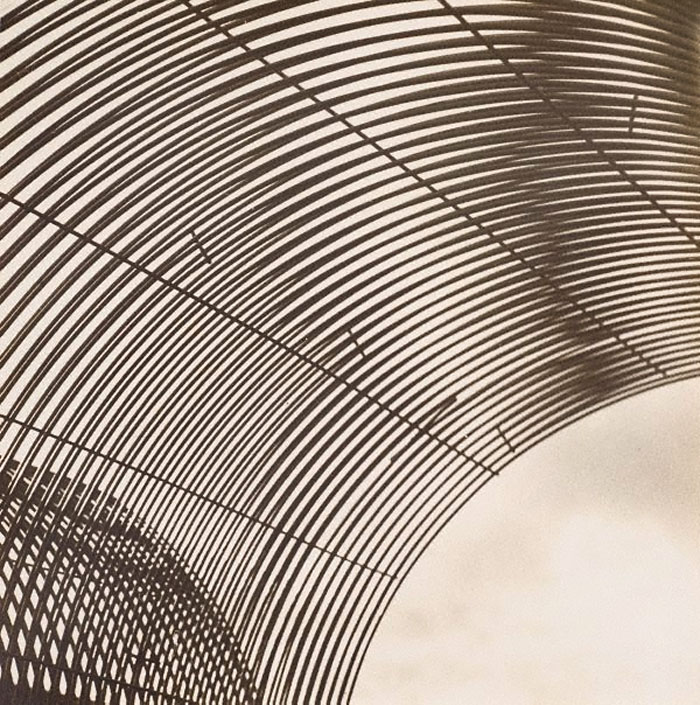
Australasian Photo-Review’s cover of 15 March 1932 by Burke was the first which could be described as typically modernist with its dynamic photograph of the structures of Sydney Harbour Bridge. In December 1932 Burke had written:

The New Photography is the kind which seeks to shatter that blissful state of peace with photographs of an entirely different kind. It demands that photography shall be purely objective, shall photograph anything and everything – snap repetition and pattern wherever it is to be found.


That same year he published the Harbour Bridge photographs in a volume entitled Achievement: a collection of unusual studies of the Sydney Harbour Bridge, Sydney: Mick Simmons Ltd. His second modernist AP-R cover was for 14 January 1933 featuring a diver and diving board photographed in a similar style, emphasising form and structure and indistinguishable from images of divers and athletes being photographed by the Modernists of Europe and the USA.

Keast Burke’s determination to assimilate the new style into his work can be seen in the tug of war between the painterliness of pictorialism, in his warm-toned prints, and the boldness and geometricism of Modernism.

James McArdle. “January 16: Man,” on the On This Date In Photography website 16/01/2017 [Online] Cited 27/07/2024


Cecil Bostock (Australia, 1884-1939) 'Phenomena' c. 1938


Cecil Bostock (Australia, 1884-1939)
Phenomena
c. 1938
Gelatin silver photograph
26.3 x 30.5cm
Art Gallery of New South Wales, Sydney
Gift of Max Dupain 1980


Bostock remains an enigmatic personality in Australian pictorial and early modernist photography. This is at least in part due to his body of work being scattered on his death in 1939 as it was auctioned to cover his debts. Fortunately Phenomena was left to his former assistant Max Dupain who had worked with him from 1930 to 1933.

Phenomena was one of 11 photographs Bostock exhibited with the Contemporary Camera Groupe and it was placed in the window at David Jones along with other photographs such as Plum blossom 1937 by Olive Cotton and Mechanisation of art by Laurence Le Guay. Phenomena is a wonderful modernist work with its plays of light and dark and disorienting shapes and curving lines. It is impossible to tell exactly how the shapes are made or where the light is coming from, nor what the objects are. It could easily be exhibited upside down where the viewer could be looking down on objects arranged on a flat surface. Phenomena is a tribute to Bostock’s restless, inventive and exacting abilities.


Fiona Hall (Australia, b. 1953) 'Leura, New South Wales' 1974


Fiona Hall (Australia, b. 1953)
Leura, New South Wales
1974
Gelatin silver photograph
27.8cm x 27.8cm
Art Gallery of New South Wales, Sydney
Purchased 1981
© Fiona Hall


The rich tones and fine detail of Leura, New South Wales were made possible by Hall’s use of a large-format nineteenth-century view camera. The antiquated technology, once used by colonial photographers to document nature and the taming of the Australian landscape, here records instead the verdant foliage of a floral-patterned couch and carpet. Made at the beginning of Hall’s career, it demonstrates her burgeoning interest in the representation of nature. The relationship between humankind and nature and the symbolic role of the garden in western iconography has since been a recurrent theme in her work, which ranges across photography, sculpture and installation. Leura… differs from Hall’s other photographs in that it documents a “found” object. Hall’s later works, such as The Antipodean suite 1981 and her large-format polaroids of 1985, are of her own constructions and sculptures. Her Paradisus terrestris series 1989-1990, 1996, 1999, of aluminium repousse sculptures takes the garden of Eden as its subject and treats it as an Enlightenment florilegium, wherein nature is classified, ordered and labelled. This kind of botanical transcription, like photography, was the process through which the alien Australian landscape was ‘naturalised’ by its colonists – a process which Hall wryly comments on in this acutely observed encounter within a domestic interior.


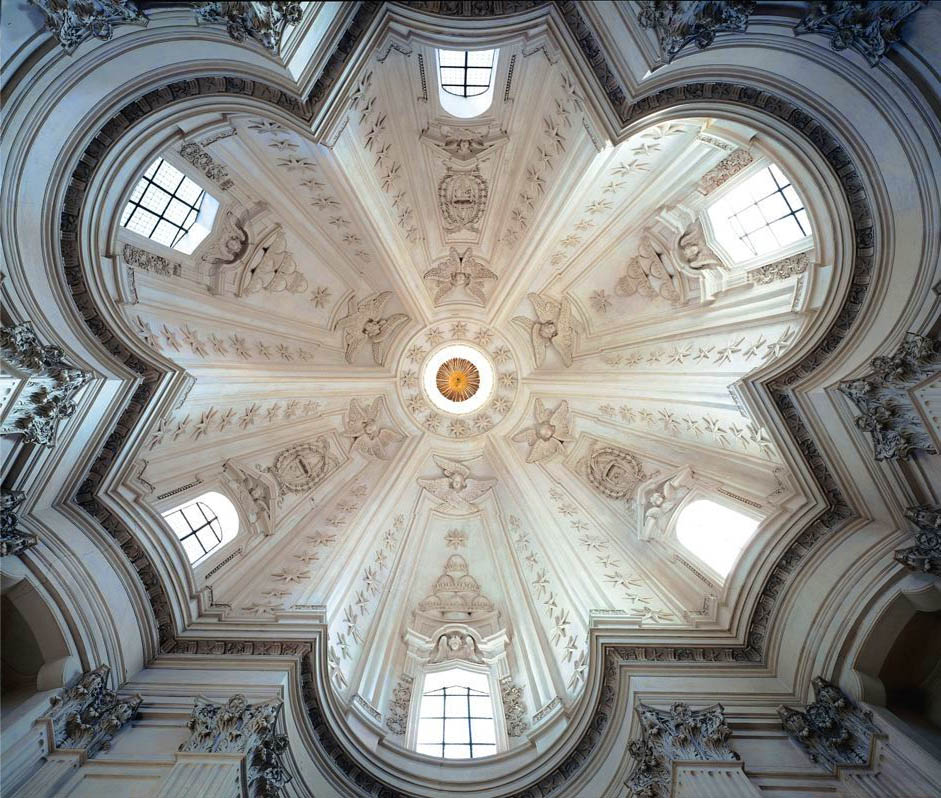
David Stephenson (USA/Australia, b. 1955) 'Sant'ivo alla Sapienza 1645-50 Rome, Italy' 1997


David Stephenson (USA/Australia, b. 1955)
Sant’ivo alla Sapienza 1645-50 Rome, Italy
1997
From the series Domes 1993-2005
Type C photograph
55 × 55cm
Art Gallery of New South Wales, Sydney
Purchased with funds provided by Joanna Capon and the Photography Collection Benefactors Program 2002
© David Stephenson


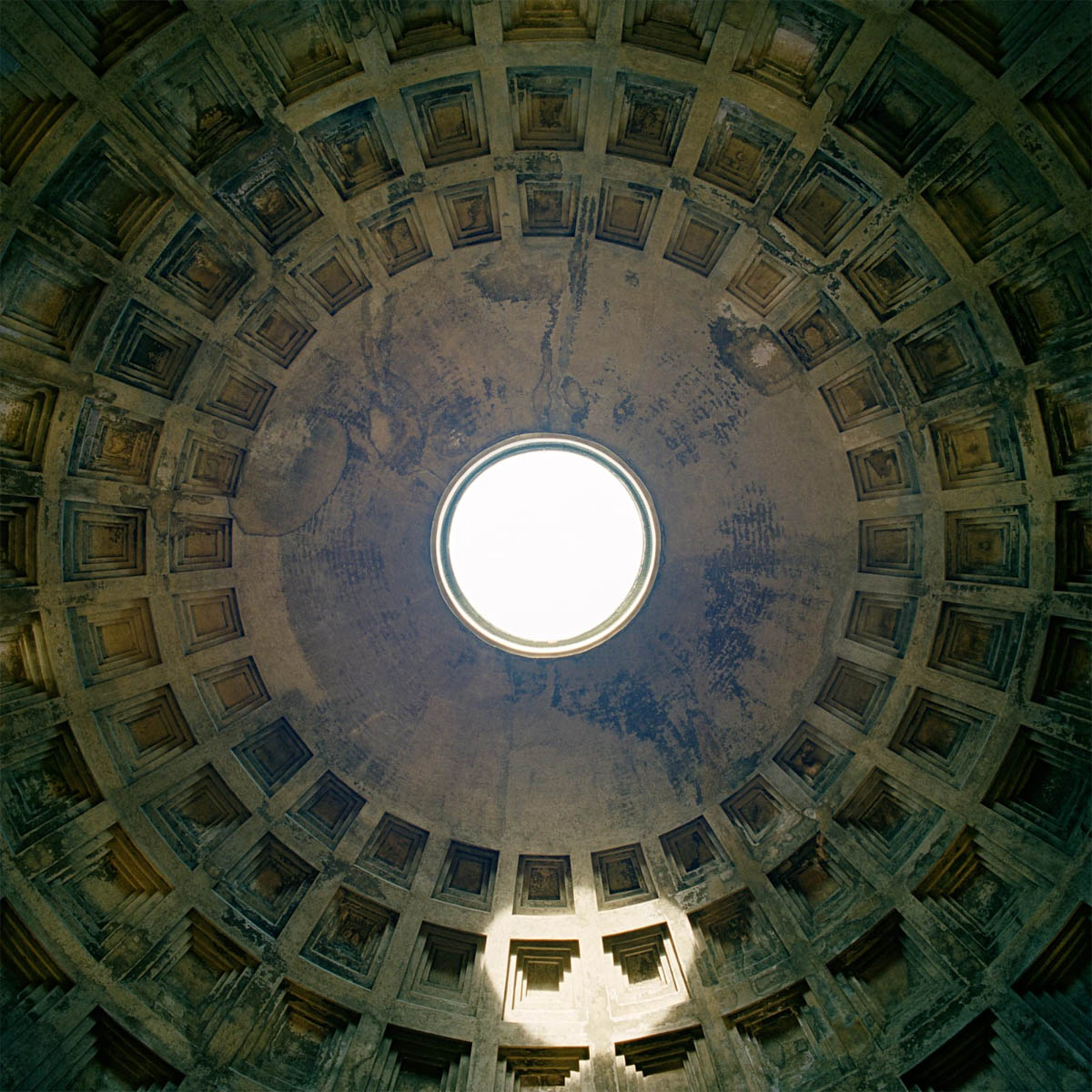
With poetic symmetry the Domes series considers analogous ideas. It is a body of work which has been ongoing since 1993 and now numbers several hundred images of domes in countries including Italy, Spain, Portugal, Turkey, England, Germany and Russia. The typological character of the series reveals the shifting history in architectural design, geometry and space across cultures and time, demonstrating how humankind has continually sought meaning by building ornate structures which reference a sacred realm.2 Stephenson photographs the oculus – the eye in the centre of each cupola. Regardless of religion, time or place, this entry to the heavens – each with unique architectural and decorative surround – is presented as an immaculate and enduring image. Placed together, the photographs impart the infinite variations of a single obsession, while also charting the passage of history, and time immemorial.

2. Hammond, V. 2005, “The dome in European architecture,” in Stephenson, D. 2005, Visions of heaven: the dome in European architecture, Princeton Architectural Press, New York p. 190.

© Art Gallery of New South Wales Photography Collection Handbook, 2007


David Stephenson (USA/Australia, b. 1955)
'Cathedral of the Assumption, Kremlin 1475-79, Moscow, Russia' 2000


David Stephenson (USA/Australia, b. 1955)
Cathedral of the Assumption, Kremlin 1475-79, Moscow, Russia
2000
Type C photograph
55 x 55cm
Art Gallery of New South Wales, Sydney
Purchased with funds provided by Graham and Mary Bierman, Josef and Jeanne Lebovic 2002
© David Stephenson


David Stephenson (USA/Australia, b. 1955) 'Pantheon c. 117-138, Rome, Italy' 1997, printed 2002


David Stephenson (USA/Australia, b. 1955)
Pantheon c. 117-138, Rome, Italy
1997, printed 2002
Type C photograph
55 x 55cm
Art Gallery of New South Wales, Sydney
Purchased with funds provided by Graham and Mary Bierman, Josef and Jeanne Lebovic 2002
© David Stephenson


Pat Brassington (Australian, b. 1942) 'In marble halls #1' 2003


Pat Brassington (Australian, b. 1942)
In marble halls #1
2003
From the series In marble halls
Pigment print
90 x 140cm
Art Gallery of New South Wales, Sydney
Gift of the artist 2009
© Pat Brassington


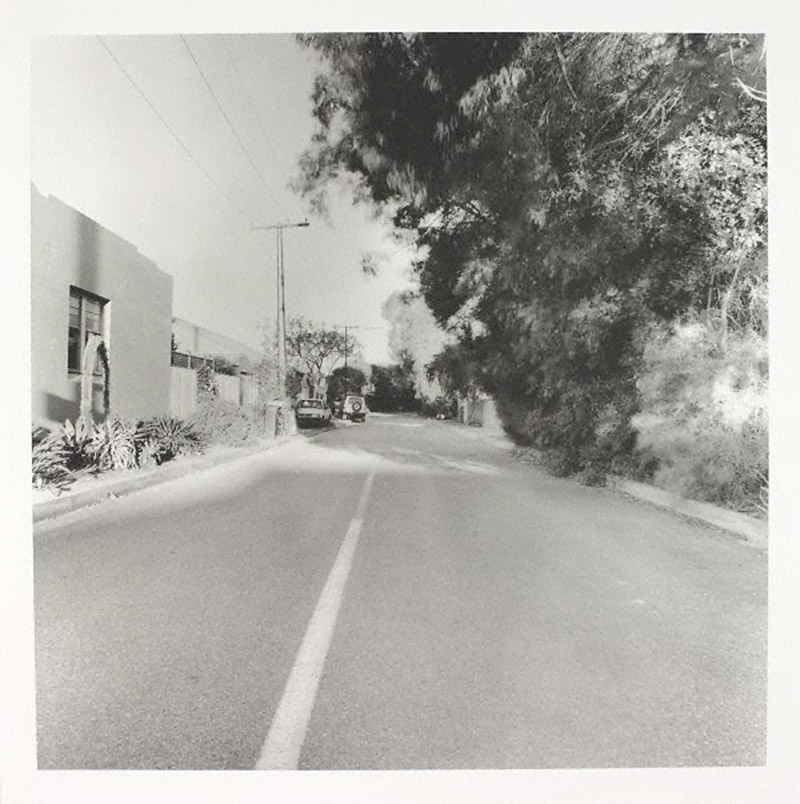
Simryn Gill (Singapore/Malaysia/Australia, b. 1959) From 'A long time between drinks' 2005


Simryn Gill (Singapore/Malaysia/Australia, b. 1959)
From A long time between drinks
2005
Portfolio of 13 offset prints
29.8cm x 29.7cm
Art Gallery of New South Wales, Sydney
© Simryn Gill


Among Simryn Gill’s multi-disciplinary explorations of identity and belonging, investigations of suburban locations carry a particular resonance due to their often autobiographical nature. A long time between drinks 2009 is an intensely focused look at suburban Adelaide which was the artist’s first experience of Australia when she arrived in 1987 from Kuala Lumpur, and the city where she first exhibited. Gill returned to Adelaide in 2005 to revisit this early point of contact, producing an evocative series of 13 images.

The photographs impart an ostensible sense of alienation and isolation that corresponds to the artist’s position as an outsider looking in. Gill’s viewpoint of these empty streets that seem to lead nowhere is forensic and detached. But surprisingly, as repetitious compositions and details culminate across the photographs, the prosaic subject matter becomes increasingly surreal, abstract and even poetic.

As Sambrani Chaitanya has stated, “Gill’s work is an investigation of the limits of categorisation,”1 and this group of works, just as in Gill’s examination of Marrickville (where she now lives) in May 2006, emphasises the difficulty of defining an idea of place through mere description. Memory, time and pure invention are required to fill in the gaps. The eerie, yet evocative environment in these photographic prints is further enhanced by their presentation in a square box emulating those of sets of vinyl LP recordings.

1/ Sambrani, C. “Other realties, someone else’s fictions: the tangled art of Simryn Gill,” [Online], Art and Australia Vol. 42, No. 2, Summer 2004, p. 220.


Simryn Gill (Singapore/Malaysia/Australia, b. 1959) From 'A long time between drinks' 2005


Simryn Gill (Singapore/Malaysia/Australia, b. 1959)
From A long time between drinks
2005
Portfolio of 13 offset prints
29.8cm x 29.7cm
Art Gallery of New South Wales, Sydney
© Simryn Gill


A new exhibition, Flatlands: photography and everyday space, examines photography’s role in transforming the way we perceive, organise and imagine the world. The 39 works by 23 Australian and international artists included in the exhibition have been drawn from the Gallery’s permanent collection of 20th century and contemporary photography.

Definitions of space have always depended on the scientific, social and cultural aspects of the human experience. At its birth in the 19th century, photography’s monocular vision was seen as the ultimate tool for representation and classification. Elusive phenomena such as distance, depth and emptiness seemed within grasp. Yet, limited to freezing single moments or viewpoints in time, the photograph’s ability to objectively represent the world was under question by the turn of the 20th century. Technological advancements, such as faster exposure times transformed the potential of the medium to not only show things that escaped the eye but new ways of seeing them as well.

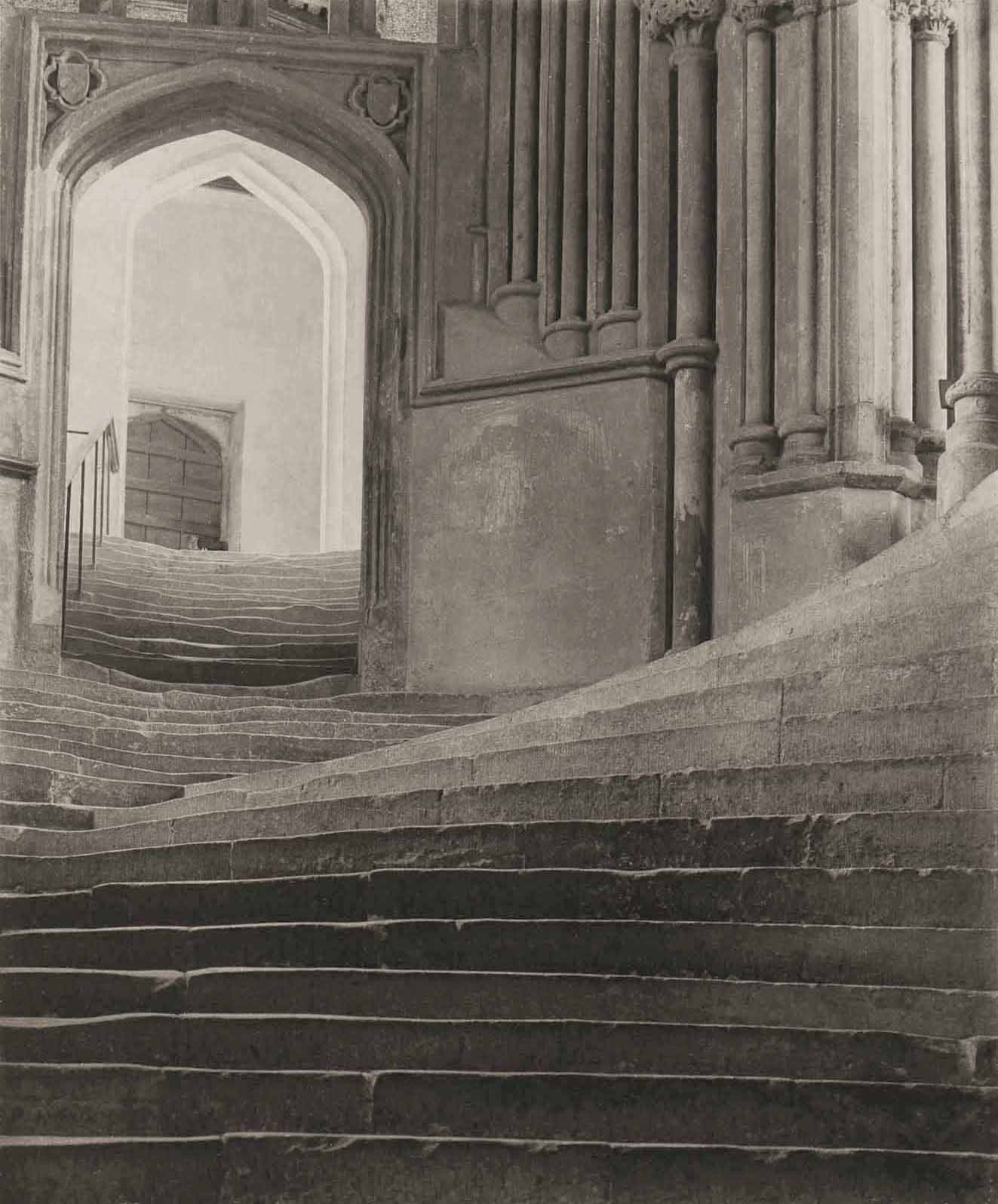
Embracing partiality and ambivalence, modernist photography sought to capture the fragments, details and blurred boundaries in the expanses we call personal space. What the photograph began to reveal were dimensions which German cultural theorist Walter Benjamin described in 1931 as the ‘optical unconscious’ of reality. The works of photographers such as Melvin Vaniman, Frederick Evans, Harold Cazneaux, William Buckle, Franz Roh, Olive Cotton, David Moore, Josef Sudek, Minor White and Robert Rauschenberg explore the intangible in spaces which define our physical and spiritual relationship with reality. Windows, doorways, ceilings, staircases – these mundane and ordinary passageways suddenly acquire a centrality and metaphysical depth normally denied to them.

The edges between sacred and profane, public and private, natural and artificial, real and dreamed environments became further entangled in the subjective visions of late 20th century and contemporary photographic work. For Daido Moriyama, Fiona Hall, Pat Brassington, Simryn Gill, Christine Godden, Geoff Kleem, Leonie Reisberg, Ingeborg Tyssen, David Stephenson and Justine Varga, space is seen to be a product of the perception of the individual. Photographs are able to reveal realms outside of the scientific – that is those created by emotion, memory and desire.

As Fiona Hall commented in 1996, “our belief might be maintained, for at least as long as the image can hold our attention, in the possibility of inhabiting a world as illusory as the two-dimensional one of the photograph.” Collectively, these images destabilise naturalised certainties while activating the imaginary dimension and the unsettling, albeit poetic potential of photography to impact and alter our view of the world.

Press release from the AGNSW website


Frederick H. Evans (British, 1853-1943) 'A Sea of Steps - Stairs to Chapter House - Wells Cathedral' 1903


Frederick H. Evans (England, 1853-1945)
A sea of steps
1903
Platinotype photograph
23.6 x 19.2cm
Art Gallery of New South Wales, Sydney
Gift of the Sydney Camera Circle 1977


Minor White (America, 1908-1976) 'Christmas ornament, Batavia, New York, January 1958' 1958


Minor White (America, 1908-1976)
Christmas ornament, Batavia, New York, January 1958
1958
From the portfolio Sound of one hand 1960-1965
Gelatin silver photograph mounted on card
Art Gallery of New South Wales, Sydney
Gift of Patsy Asch 2005
Reproduction with permission of the Minor White Archive
© Princeton University Art Museum


Minor White. 'Windowsill daydreaming' 1958


Minor White (America, 1908-1976)
Windowsill daydreaming
Rochester, New York, July 1958
From the portfolio Sound of one hand 1960-1965
Art Gallery of New South Wales, Sydney
Reproduction with permission of the Minor White Archive
© Princeton University Museum of Art


Informed by the esoteric arts, eastern religion and philosophy, Minor White’s belief in the spiritual qualities of photography made him an intensely personal and enigmatic teacher, editor and curator. White’s initial experience with photography was through his botanical studies at the University of Minnesota where he learned to develop and print photomicrography images, a view of life that he saw as akin to modern art forms. White advocated Stieglitz’s concept of ‘Equivalence’ in which form directly communicated mood and meaning, that ‘darkness and light, objects and spaces, carry spiritual as well as material meanings’.1 White disseminated his photographic theories through the influential quarterly journal Aperture, which he edited and co-founded with his contemporaries Ansel Adams, Dorothea Lange, Beaumont Newhall and others.

Like Stieglitz, White also worked in sequences that through abstraction, expression and metaphor emphasised his mystical interpretation of the visual world. The sequences allow for a dialogue to continue through and in-between the images, engaging the viewer in a visual poem rather than any strict or formal narrative. The series, Sound of one hand, exemplifies White’s study of Zen and esoteric philosophies, reflecting his meditation of the Zen koan from which he saw rather than heard any sound. The first of the series, Metal ornament, Pultneyville, New York, October 1957 presents an abstracted form that is both sensual and elusive, slipping in and out of ocular register. The ambiguous graduated tones and reflected light pull the eye into the centre of the image before vicariously dragging it back. This broken semi-elliptical shape is mirrored in Windowsill daydreaming, Rochester, New York, July 1958 as the gently moving curtains play with the light and shadows of White’s flat, creating abstracted organic forms. Abstracted forms of nature were of great interest to White as can be seen in the rest of the series that capture the frosted window of his flat with its crystallised ice, condensation and glimpses of the outside world.

1/ Rice, S. 1998, “Beyond reality,” in Frizot, M. (ed.,). A new history of photography, Könemann, Cologne pp. 669-673


Minor White (America, 1908-1976) 'Burned mirror, Rochester, New York, June 1959' 1959


Minor White (America, 1908-1976)
Burned mirror, Rochester, New York, June 1959
1959
From the portfolio Sound of one hand 1960-1965
Gelatin silver photograph mounted on card
32.2 x 21.2cm
Art Gallery of New South Wales, Sydney
Gift of Patsy Asch 2005
Reproduction with permission of the Minor White Archive
© Princeton University Museum of Art


Olive Cotton (Australia, 1911-2003) 'Skeleton Leaf' 1964


Olive Cotton (Australia, 1911-2003)
Skeleton Leaf
1964
Gelatin silver photograph
24.7 × 19.6cm
Art Gallery of New South Wales, Sydney
Purchased with funds provided by the Photography Collection Benefactors’ Program 2006
© artist’s estate


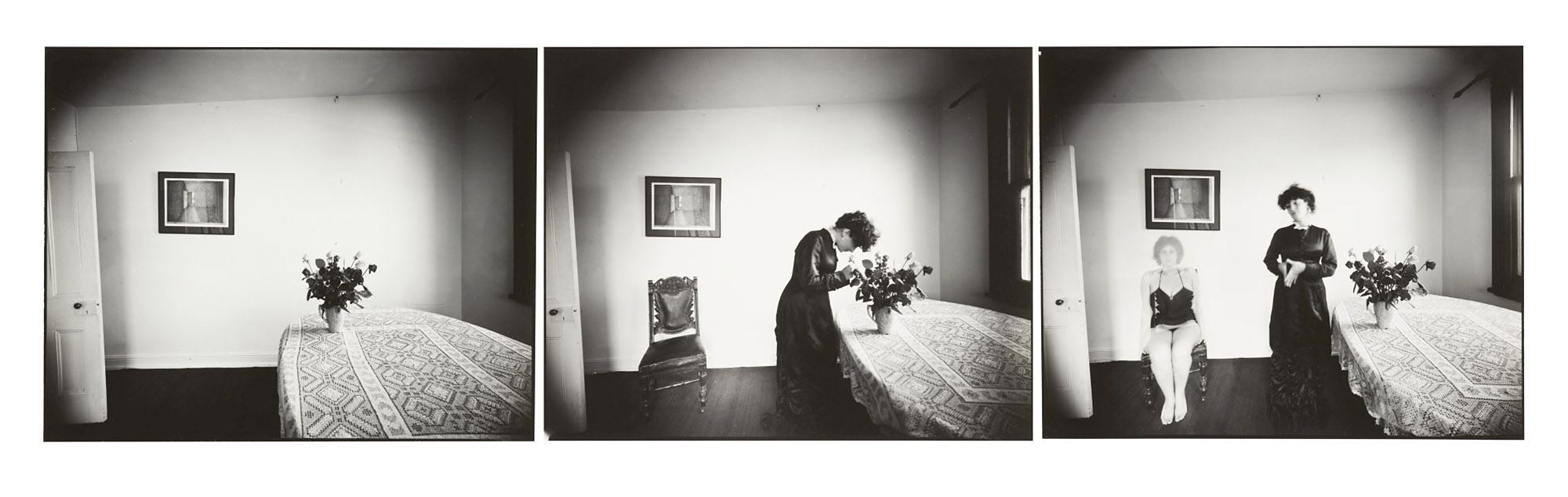
Leonie Reisberg (Australian, b. 1955) 'Fragments from the bizarre theatre of my life' 1980


Leonie Reisberg (Australian, b. 1955)
Fragments from the bizarre theatre of my life
1980
3 gelatin silver photograph
a – empty room, 19.6 x 24.4cm
b – room with woman, 19.7 x 24.5cm
c – room with woman and ghost, 19.7 x 24.4cm
Art Gallery of New South Wales, Sydney
Purchased 1981
© Leonie Reisberg


Deeply personal, Leonie Reisberg’s photographs delve into the ambiguities of intimate space. Like many women photographers of the 1970s-80s, such as Fiona Hall, Micky Allan, Robyn Stacey and Kate Breakey, Reisberg was interested in pushing the boundaries of the medium through techniques such as hand-painting, double exposure and collage.


Art Gallery of New South Wales
Art Gallery Road, The Domain
Sydney NSW 2000, Australia

Opening hours:
Open every day 10am – 5pm
except Christmas Day and Good Friday

Art Gallery of New South Wales website

LIKE ART BLART ON FACEBOOK

Back to top

Exhibition: ‘WAR/PHOTOGRAPHY: Images of Armed Conflict and Its Aftermath’ at the Museum of Fine Arts, Houston – Posting Part 4

Exhibition dates: 11th November 2012 – 3rd February 2013
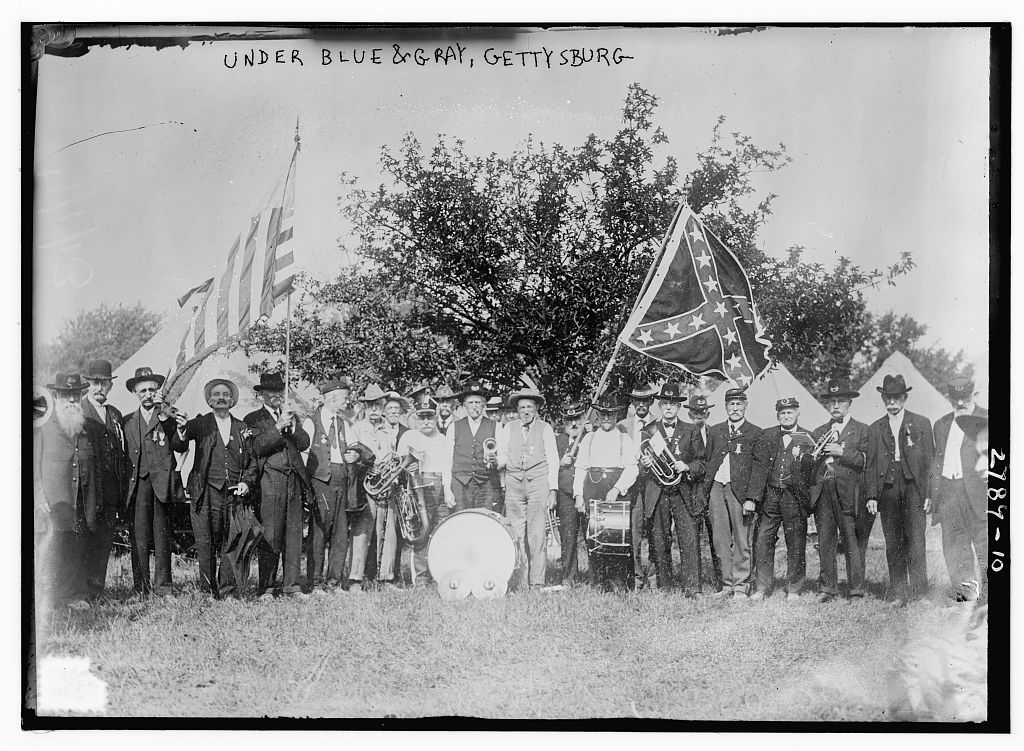
 

Anonymous photographer. 'Under blue & gray – Gettysburg' July 1913


Anonymous photographer
Under blue & gray – Gettysburg
July 1913
Photo shows the Gettysburg Reunion (the Great Reunion) of July 1913, which commemorated the 50th anniversary of the Battle of Gettysburg
Library of Congress Prints and Photographs Division Washington, D.C.


Part 4 of the biggest posting on one exhibition that I have ever undertaken on Art Blart!

As befits the gravity of the subject matter this posting is so humongous that I have had to split it into 4 separate postings. This is how to research and stage a contemporary photography exhibition that fully explores its theme. The curators reviewed more than one million photographs in 17 countries, locating pictures in archives, military libraries, museums, private collections, historical societies and news agencies; in the personal files of photographers and service personnel; and at two annual photojournalism festivals producing an exhibition that features 26 sections (an inspired and thoughtful selection) that includes nearly 500 objects that illuminate all aspects of WAR / PHOTOGRAPHY.

I have spent hours researching and finding photographs on the Internet to support the posting. It has been a great learning experience and my admiration for photographers of all types has increased. I have discovered the photographs and stories of new image makers that I did not know and some enlightenment along the way. I despise war, I detest the state and the military that propagate it and I surely hate the power, the money and the ethics of big business that support such a disciplinarian structure for their own ends. I hope you meditate on the images in this monster posting, an exhibition on a subject matter that should be consigned to the history books of human evolution.

**Please be aware that there are graphic photographs in all of these postings.** Part 1Part 2Part 3

Dr Marcus Bunyan


Many thankx to the Museum of Fine Arts, Houston for allowing me to publish some of the photographs in the posting. Please click on the photographs for a larger version of the image.


Memorials

25. Photographs in the “Memorials” section range from the tomb of an unknown World War I soldier in England, by Horace Nicholls; and a landscape of black German crosses throughout a World War II burial site, by Bertrand Carrière; to an anonymous photograph of a reunion scene in Gettysburg of the opposing sides in the Civil War; and Joel Sternfeld’s picture of a woman and her daughter at the Vietnam Veterans Memorial in Washington, DC, in 1986. (8 images)


Horace Nicholls (English, 1867-1941) 'The Unknown Warrior at Westminster Abbey, London, November 1920' 1920


Horace Nicholls (English, 1867-1941)
The Unknown Warrior at Westminster Abbey, London, November 1920
1920
Silver gelatin print
© IWM (Q 31514)


In order to commemorate the many soldiers with no known grave, it was decided to bury an ‘Unknown Warrior’ with all due ceremony in Westminster Abbey on Armistice Day in 1920. The photograph shows the coffin resting on a cloth in the nave of Westminster Abbey before the ceremony at the Cenotaph and its final burial.
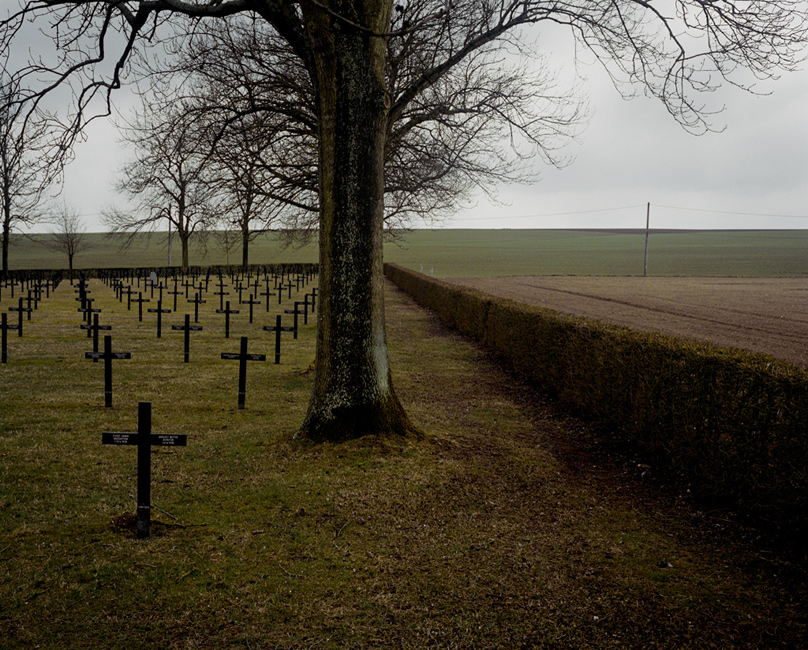
 

Bertrand Carrière (Canadian, b. 1957) 'Untitled' 2005-2009


Bertrand Carrière (Canadian, b. 1957)
Untitled
2005-2009
From the series Lieux Mêmes [Same Places]


Joel Sternfeld (American, b. 1944) 'Vietnam Veterans Memorial, Washington, D.C.,' May 1986


Joel Sternfeld (American, b. 1944)
Vietnam Veterans Memorial, Washington, D.C.,
May 1986
Chromogenic print, ed. #1/25 (printed October 1986)
The Museum of Fine Arts, Houston, the Target Collection of American Photography, gift of the artist
© 1986 Joel Sternfeld


Remembrance

26. The last gallery in the exhibition is “Remembrance.” Most of these images were taken by artists seeking to come to terms with a conflict after fighting had ceased. Included are Richard Avedon’s picture of a Vietnamese napalm victim; a survivor of a machete attack in a Rwandan death camp, by James Nachtwey; a 1986 portrait of a hero who rescued Jews during the Holocaust, by Houston native Gay Block; and Suzanne Opton’s 2004 portrait of a soldier who survived the Iraq War and returned to the United States to work as a police officer, only to be murdered on duty by a fellow veteran. The final wall features photographs by Simon Norfolk of sunrises at the five D-Day beaches in 2004. The only reference to war is the title of the series: The Normandy Beaches: We Are Making a New World(33 images)


Richard Avedon (American, 1923-2004) 'Napalm Victim #1, Saigon, South Vietnam, April 29, 1971' 1971


Richard Avedon (American, 1923-2004)
Napalm Victim #1, Saigon, South Vietnam, April 29, 1971
1971
Silver gelatin print
© Richard Avedon


Gay Block (American, b.1942) 'Zofia Baniecka, Poland' 1986


Gay Block (American, b. 1942)
Zofia Baniecka, Poland
1986
From the series Rescuers: Portraits of Moral Courage in the Holocaust, a record of non-Jewish citizens from European countries who risked their lives helping to hide Jews from the Nazis
Chromogenic print, printed 1994
Courtesy of Museum of Fine Arts, Houston, gift of Clinton T. Wilour in honour of Eve France


Zofia Baniecka (born 1917 in Warsaw – 1993) was a Polish member of the Resistance during World War II. In addition to relaying guns and other materials to resistance fighters, Baniecka and her mother rescued over 50 Jews in their home between 1941 and 1944.
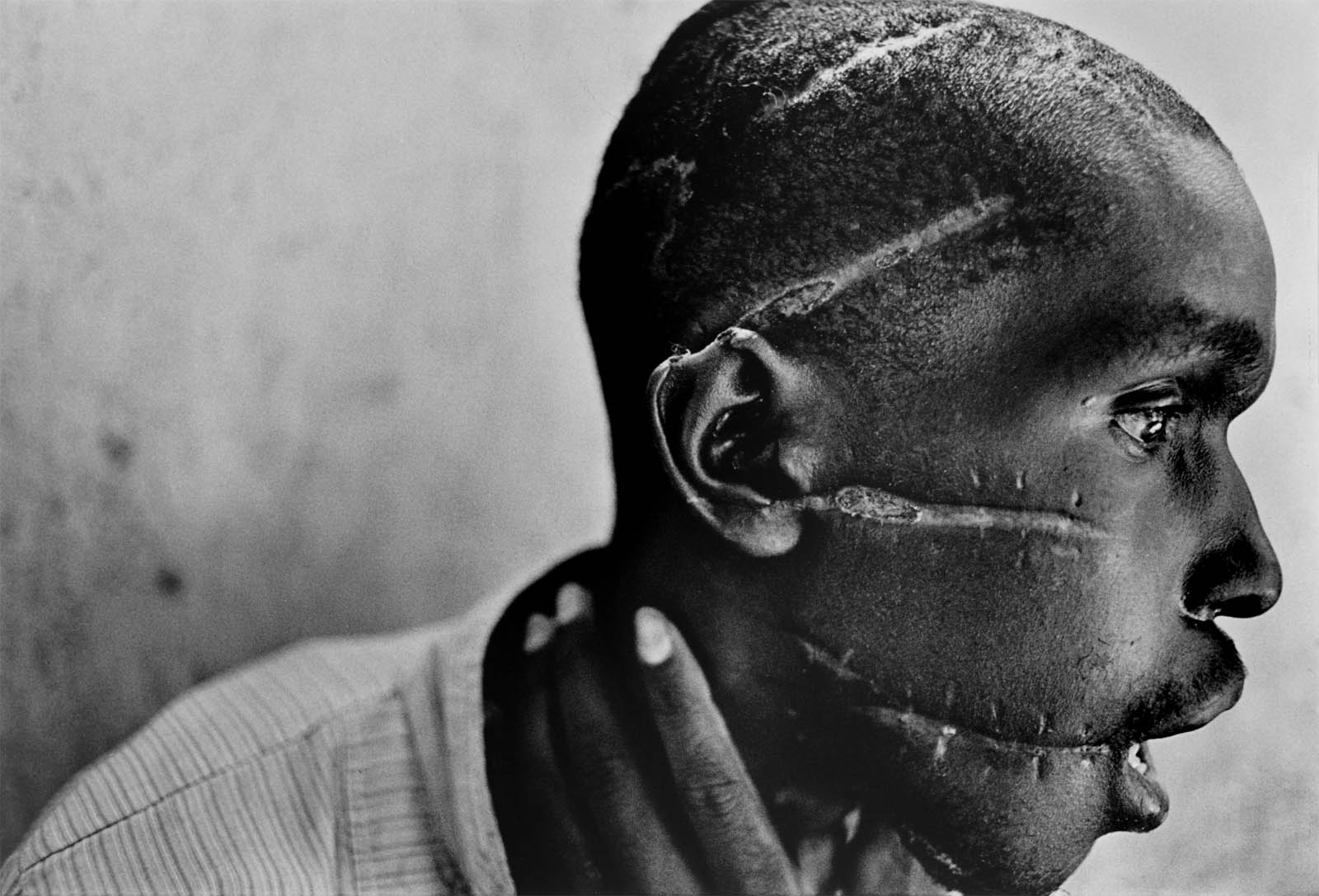
 

James Nachtwey (American, b. 1948) 'A Hutu man who did not support the genocide had been imprisoned in the concentration camp, was starved and attacked with machetes. He managed to survive after he was freed and was placed in the care of the Red Cross, Rwanda, 1994' 1994


James Nachtwey (American, b. 1948)
A Hutu man who did not support the genocide had been imprisoned in the concentration camp, was starved and attacked with machetes. He managed to survive after he was freed and was placed in the care of the Red Cross, Rwanda, 1994
1994
Silver gelatin print
© James Nachtwey / TIME

World Press Photo of the Year, prize singles


A Hutu man at a Red Cross hospital in Nyanza, Rwanda. His face was mutilated by the Hutu ‘Interahamwe’ militia, who suspected him of sympathising with the Tutsi rebels.

Liberated from a nearby Hutu camp, where mainly Tutsis were incarcerated, starved, beaten, and killed, this man did not support the genocide and was thus subjected to the same treatment. Starved and attacked with machetes, he had managed to survive, though he was unable to speak and could barely walk or swallow when this photo was made.

Jibran Abbasi. “Mutilated By The Hutu ‘Interahamwe’ by James Nachtwey,” on the Business Recorder website April 5, 2017 [Online] Cited 27/07/2024
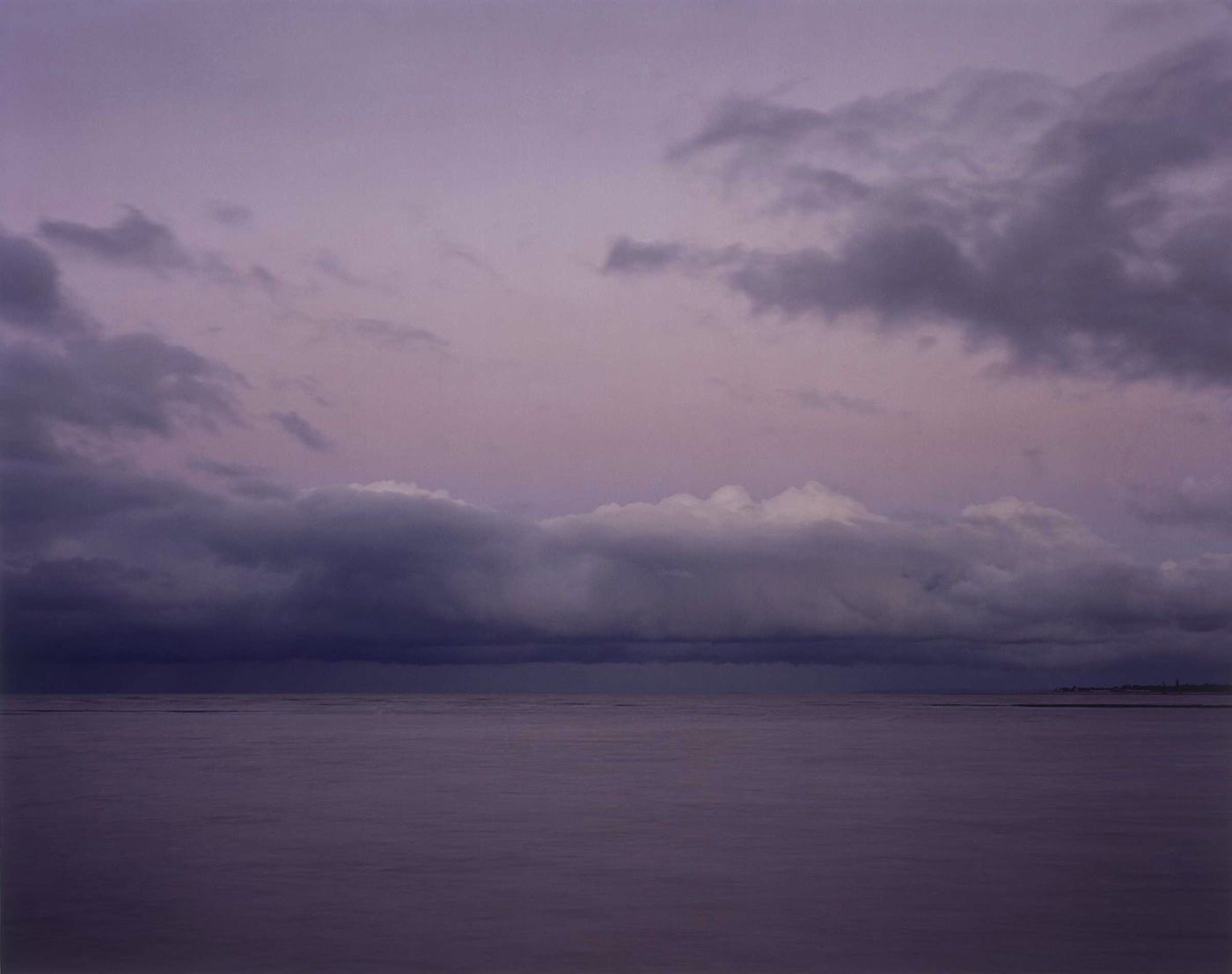
 

Simon Norfolk (British, b. Nigeria, 1963) 'Sword Beach' 2004


Simon Norfolk (British born Nigeria, b. 1963)
Sword Beach
2004
From the series The Normandy Beaches: We Are Making a New World
Chromogenic print, ed. #1/10 (printed 2006)
The Museum of Fine Arts, Houston
Gift of Bari and David Fishel, Brooke and Dan Feather and Hayley Herzstein in honor of Max Herzstein and a partial gift of the artist and Gallery Luisotti, Santa Monica
© Simon Norfolk / Gallery Luisotti


WAR/PHOTOGRAPHY Extended Info


Other photographs from the exhibition


Alexander Gardner (1821-1882) 'Scouts and Guides to the Army of the Potomac, Berlin, MD, October, 1862' October 1862 (detail)


Alexander Gardner (American, 1821-1882)
Scouts and Guides to the Army of the Potomac, Berlin, MD, October, 1862
October 1862
Albumen silver print
Photograph by Alexander Gardner, from “Incidents of the War. Guide to the Army of the Potomac,” from Gardner’s Photographic Sketch Book of the War, Washington
Records of the War Department General and Special Staffs, Record Group 165, National Archives Still Picture Branch, College Park, Maryland
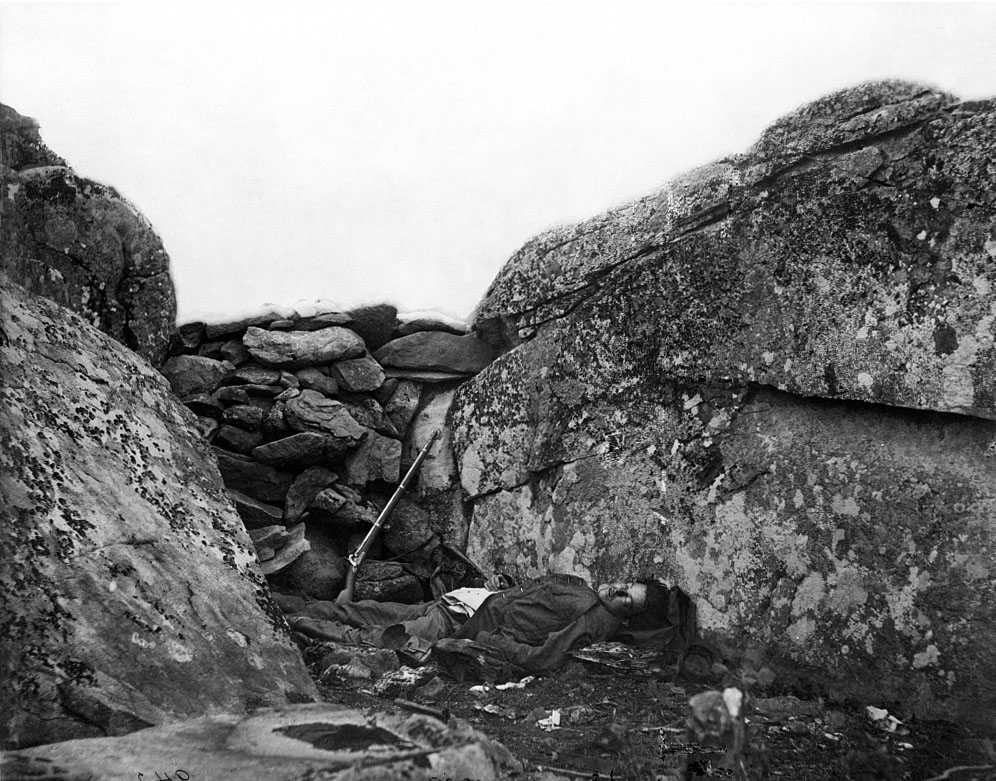
 

Alexander Gardner (American, 1821-1882) ‘The Home of a Rebel Sharpshooter, Gettysburg, Pennsylvania’. Albumen paper print


Alexander Gardner (American, 1821-1882)
The Home of a Rebel Sharpshooter / Dead Confederate soldier in the devil’s den, Gettysburg, Pennsylvania
July 1863
Albumen paper print copied from glass, wet collodion negative
Library of Congress, Prints and Photographs Division
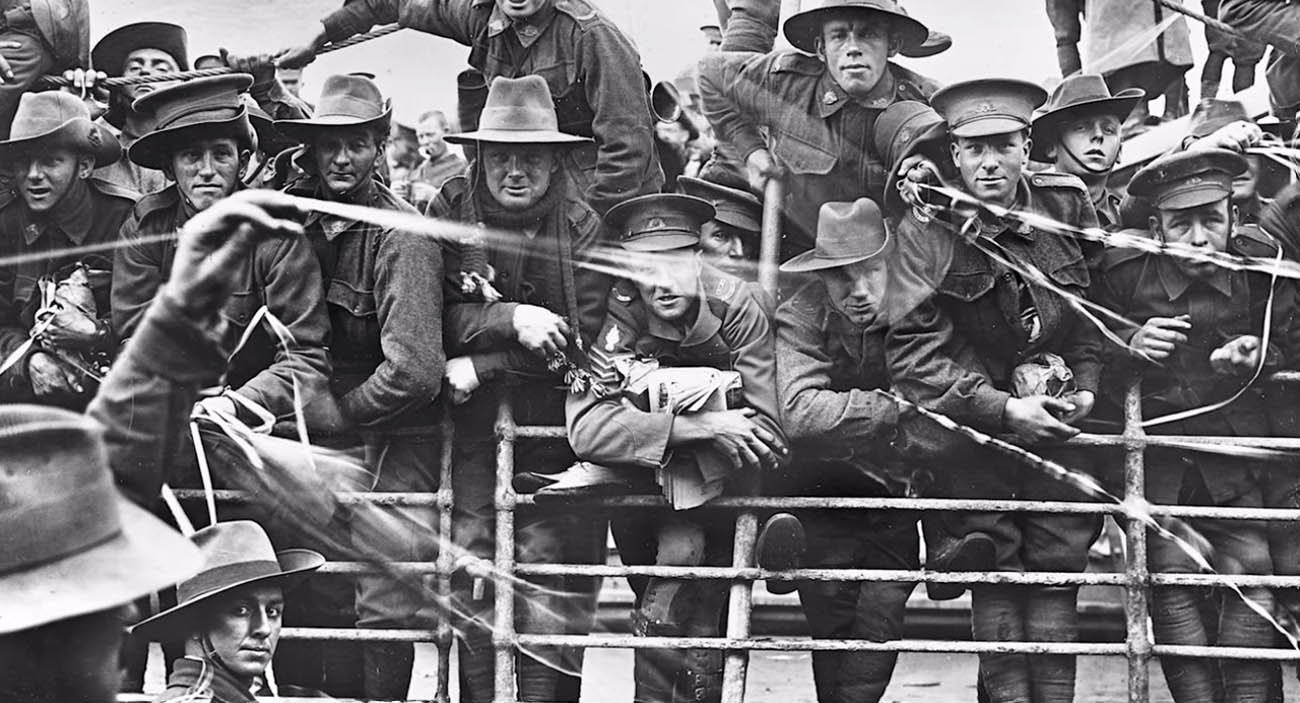
 

Josiah Barnes (Australian, 1858-1921) 'Embarkation of HMAT Ajana, Melbourne, July 8, 1916' 1916


Josiah Barnes (Australian, 1858-1921)
Embarkation of HMAT Ajana, Melbourne, July 8, 1916
1916
Gelatin silver print from original glass half-plate negative (printed 2012)
On loan from the Australian War Memorial
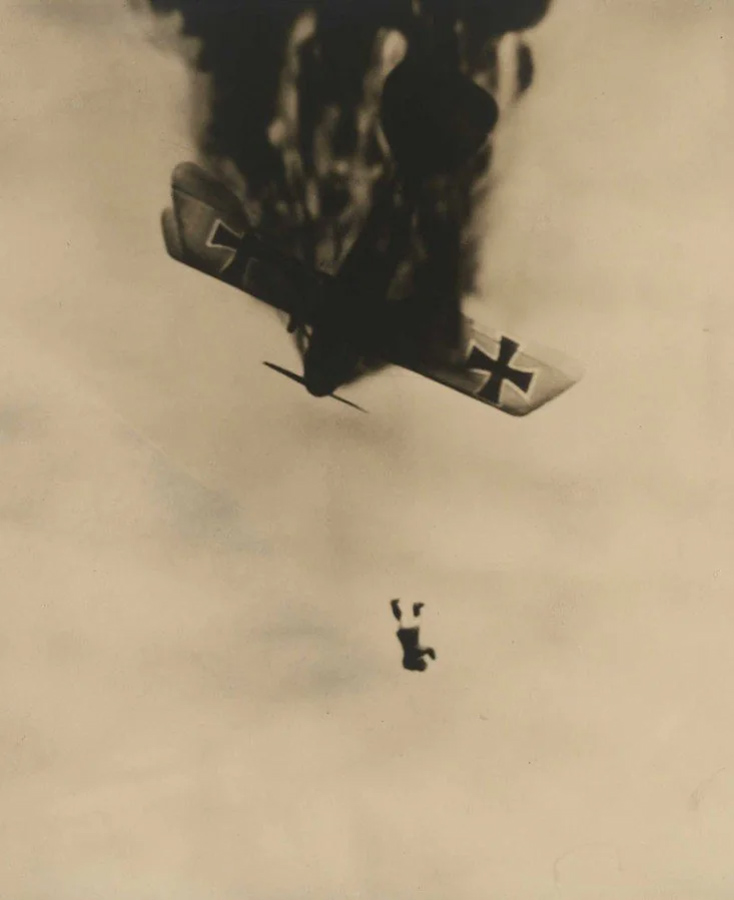
 

Wesley D. Archer (American, d. 1952) 'Just as he left the burning plane' 1933


Wesley D. Archer (American, d. 1952)
Just as he left the burning plane
1933
From the publication Death in the Air: The War Diary and Photographs of a Flying Corps Pilot


The typewritten script of a First World War pilot’s diary with a large number of photographs was submitted to the publishers William Heinemann and published by them in 1933. Heinemann stated on the book’s jacket that the diary contained no names, dates, or anything that could reveal the identity of the writer or the squadron in which he served. The publishers understood that the diarist was killed in action in 1918 and that it was in deference to the wishes of those who were close to him that his diary should be published.

So remarkable were the photographs that their veracity was immediately questioned, but no proof of their authenticity or otherwise could be ascertained. It was not until 1983 that a collection of documents, photographs and artifacts was presented to the Smithsonian’s National Air and Space Museum. Some of the photographs were recognized as being those of the mystery diarist and the truth was soon revealed.

The author was Wesley Archer, an American with Canadian parents who served with the RFC in the First World War, and the photographs and diary had been faked.

Text from the Google Books website

For more information on the faked photographs see the article “How dramatic images of WWI dogfights in the skies of Europe were FAKED by a conman who was just looking to make some money”.


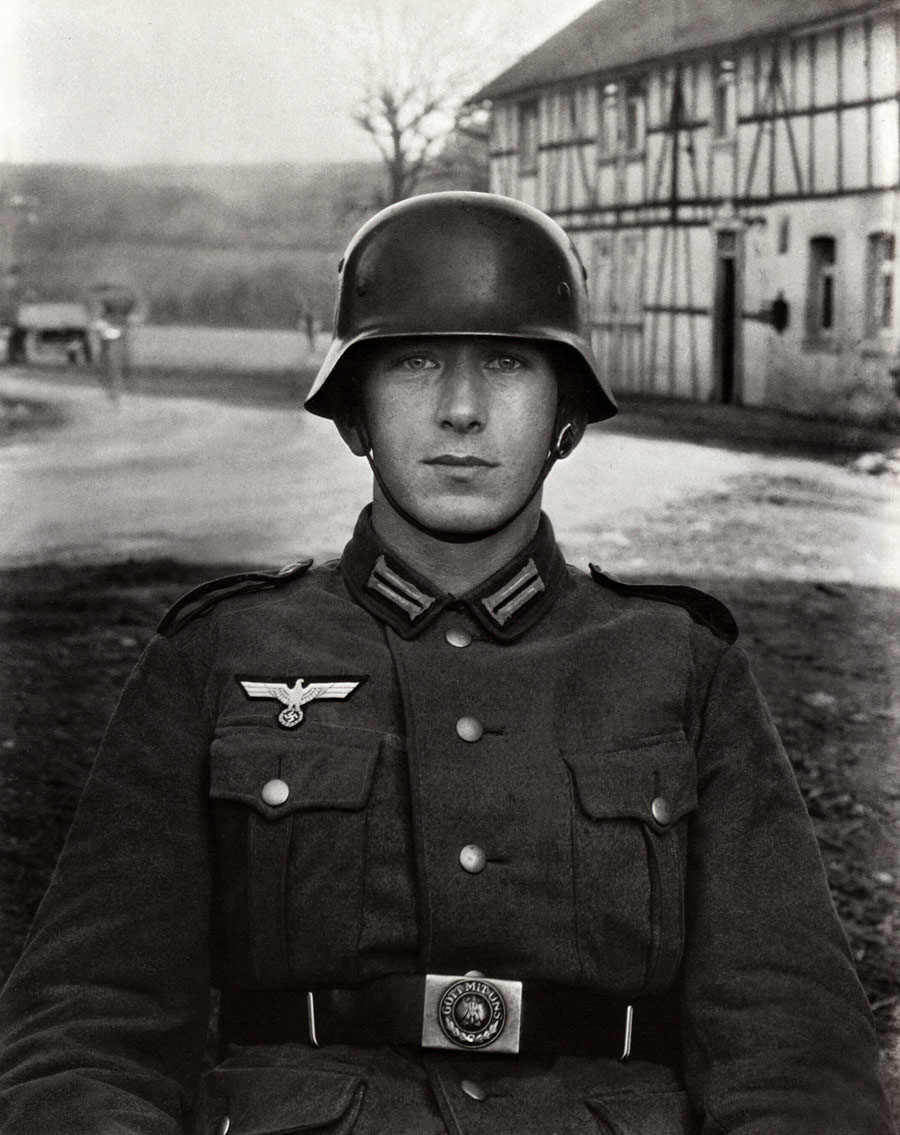
August Sander (German, 1876-1964) 'Soldier' c. 1940


August Sander (German, 1876-1964)
Soldier
c. 1940
Gelatin silver print, printed by Gunther Sander, 1960s
The Museum of Fine Arts, Houston
Gift of John S. and Nancy Nolan Parsley in honour of the 65th birthday of Anne Wilkes Tucker
© Die Photographische Sammlung/SK StiftungKultur – August Sander Archiv, Cologne; DACS, London 2012
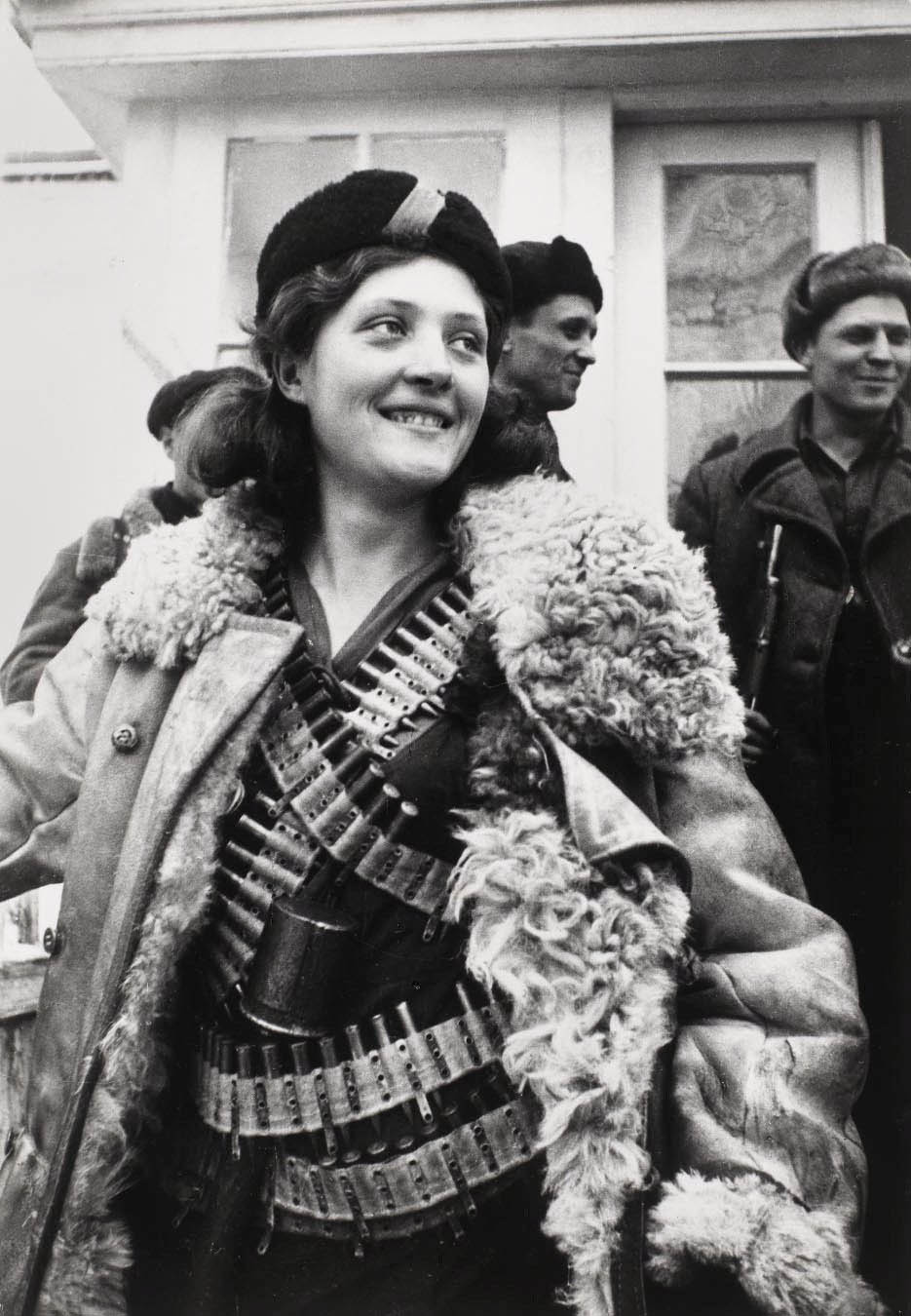
 

Arkady Shaikhet (Soviet, 1898-1959) 'Partisan Girl' 1942


Arkady Shaikhet (Soviet, 1898-1959)
Partisan Girl
1942
Gelatin silver print
Gift of Marion Mundy
© Arkady Shaikhet Estate, Moscow
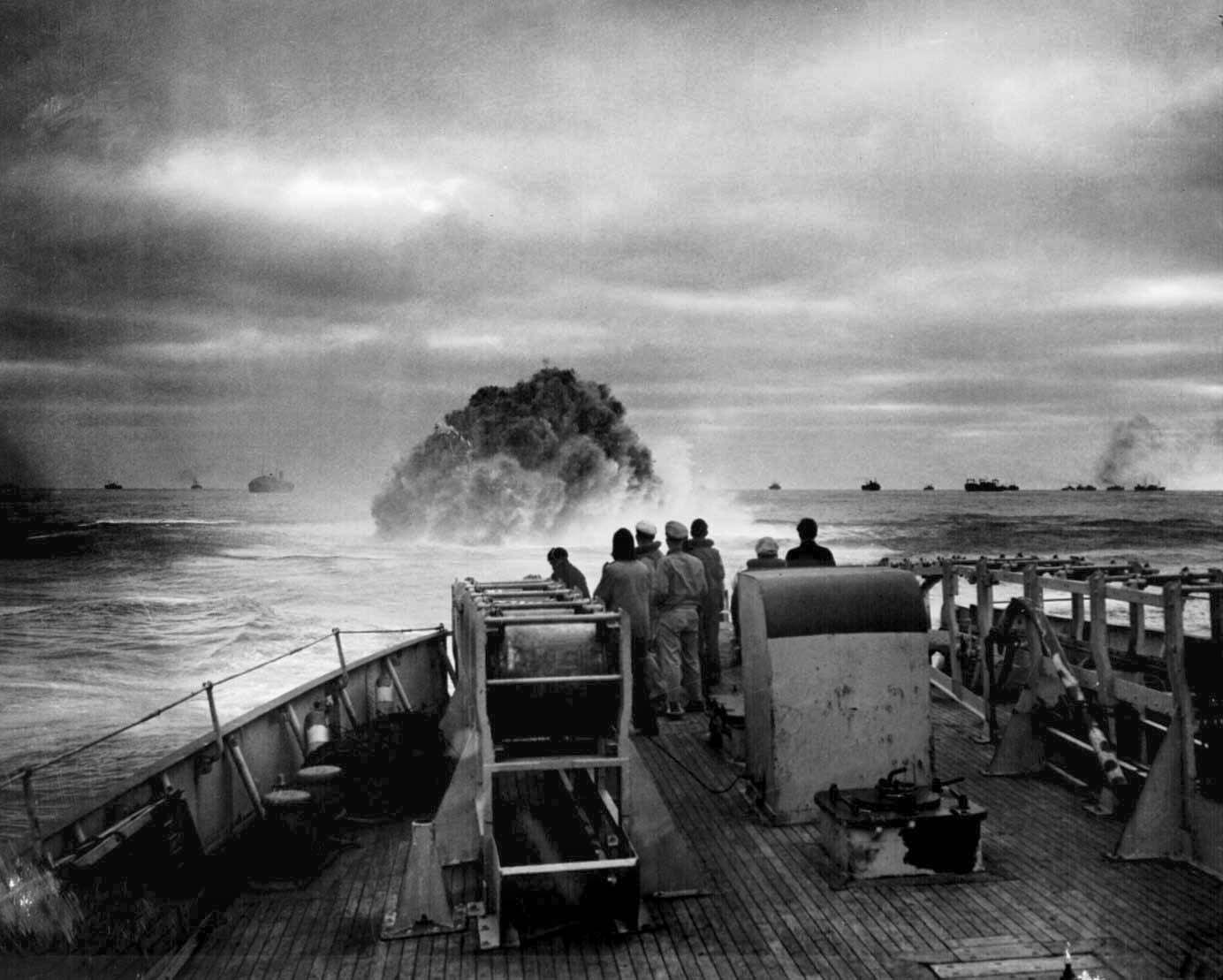
 

Anonymous photographer / U.S. Department of Defense. 'US Coast Guard crew of cutter Spencer watched as a depth charge exploded near U-175, North Atlantic, 500nm WSW of Ireland, 17 Apr 1943'


Anonymous photographer
U.S. Department of Defense
US Coast Guard crew of cutter Spencer watched as a depth charge exploded near U-175, North Atlantic, 500nm WSW of Ireland, 17 Apr 1943
17 April 1943
Public domain


W. Eugene Smith (American, 1918-1978) 'Wounded, dying infant found by American soldier in Saipan Mountains' June 1944


W. Eugene Smith (American, 1918-1978)
Wounded, dying infant found by American soldier in Saipan Mountains
June 1944
Gelatin silver print
© W. Eugene Smith
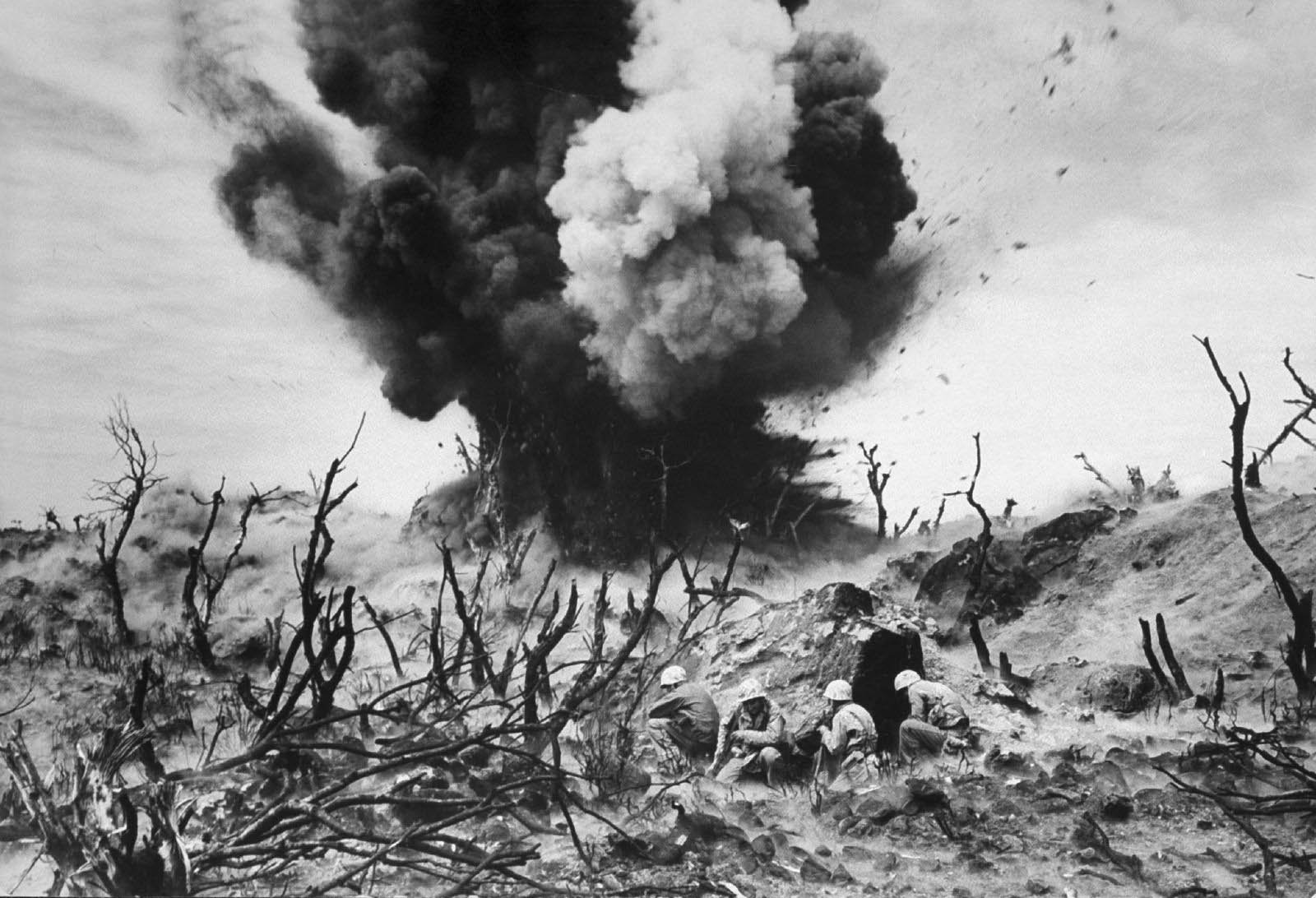
 

W. Eugene Smith (American, 1918-1978) 'World War II. The Pacific Campaign. The Battle of Iwo Jima (Japanese island). US Marine demolition team blasting out a cave on Hill 382. Iwo Jima. February, 1945' 1945


W. Eugene Smith (American, 1918-1978)
World War II. The Pacific Campaign. The Battle of Iwo Jima (Japanese island). US Marine demolition team blasting out a cave on Hill 382. Iwo Jima. February, 1945
1945
Gelatin silver print
© W. Eugene Smith
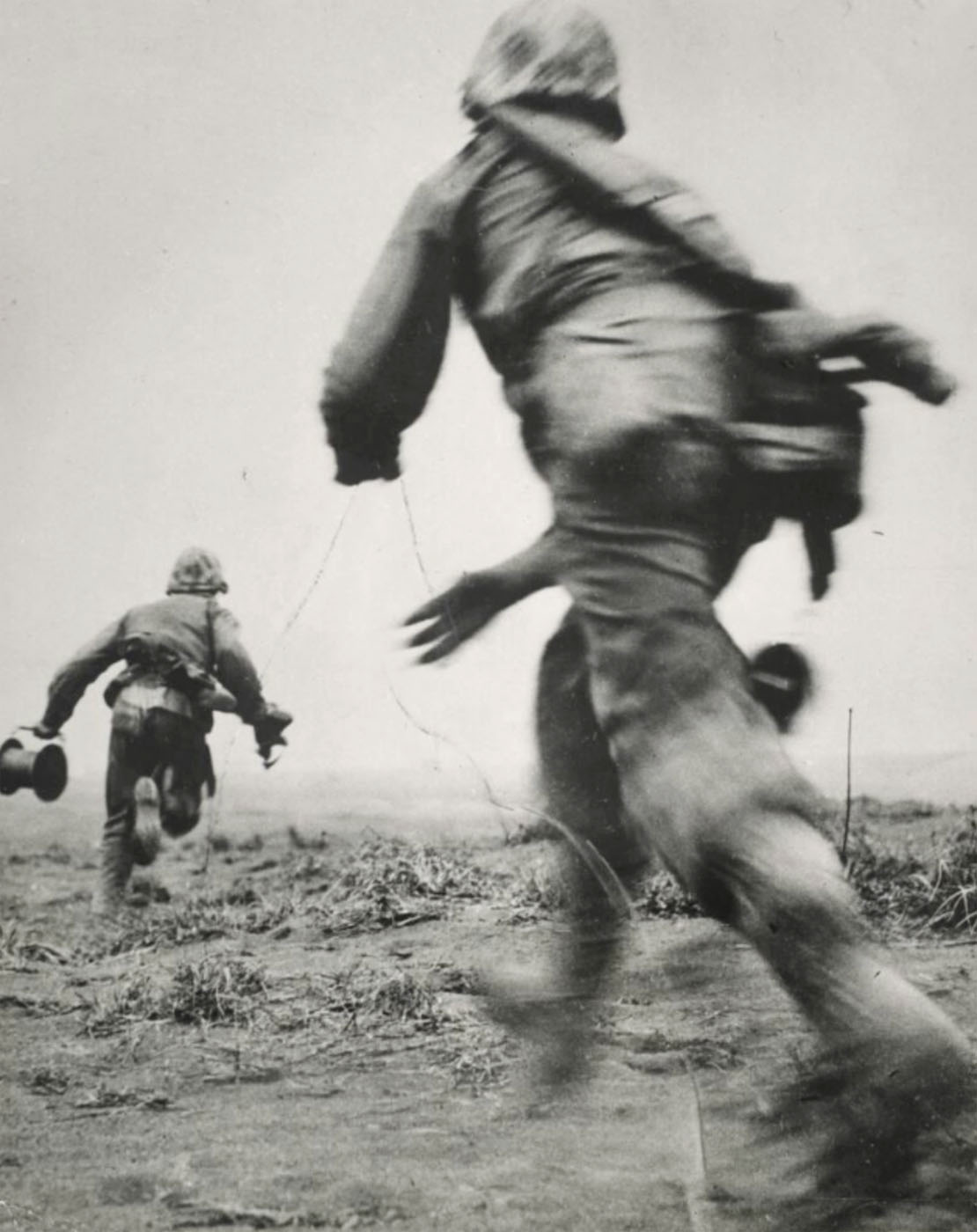
 

Joseph Schwartz (American, 1913–2013) 'Hold the Phone - Two Marine wiremen on Iwo Jima race across an open field, under heavy enemy fire to establish field telephone contact with the front lines' February 19, 1945, printed early 1950s


Joseph Schwartz (American, 1913–2013)
Hold the Phone – Two Marine wiremen on Iwo Jima race across an open field, under heavy enemy fire to establish field telephone contact with the front lines
February 19, 1945, printed early 1950s
Gelatin silver print mounted on board
18 13/16 × 14 15/16 in. (47.8 × 37.9cm)
The Museum of Fine Arts, Houston
Museum purchase funded by Knox Nunnally at “One Great Night in November, 2009,” in honor of Houston trial lawyer Joe Reynolds, a U.S. Marine who fought on Iwo Jima
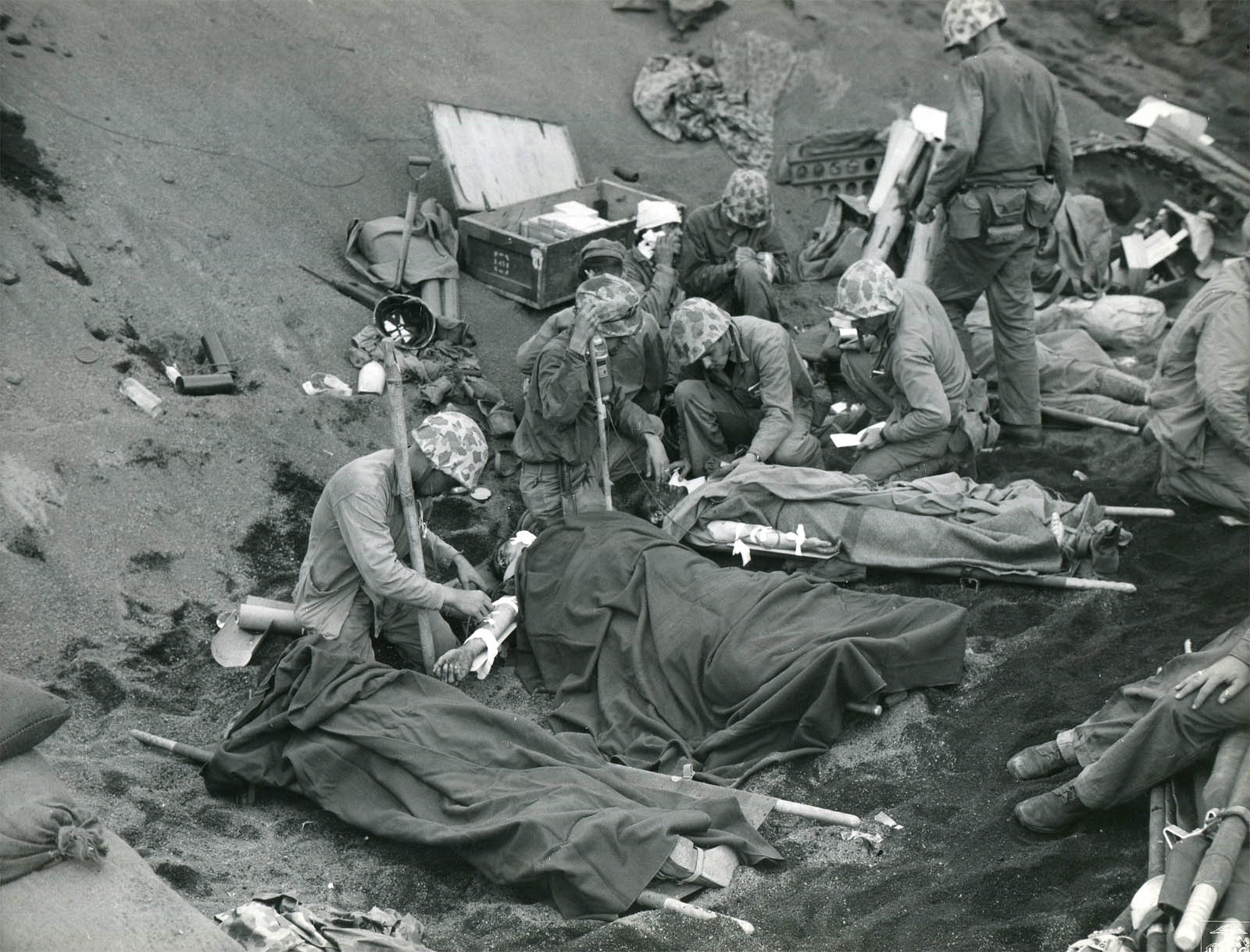
 

Anonymous photographer. U.S. Department of Defense / USMC Official Photograph 'PLASMA WARD – Navy doctors and corpsmen administer to wounded Marines at an aid station established in a gully on Iwo Jima. The high casualty rate in this operation required the use of gallons of plasma and whole blood sent by air from the West Coast' 1945


Anonymous photographer
U.S. Department of Defense / USMC Official Photograph
PLASMA WARD – Navy doctors and corpsmen administer to wounded Marines at an aid station established in a gully on Iwo Jima. The high casualty rate in this operation required the use of gallons of plasma and whole blood sent by air from the West Coast
1945
Gelatin silver print
Creative Commons Attribution 2.0 Generic
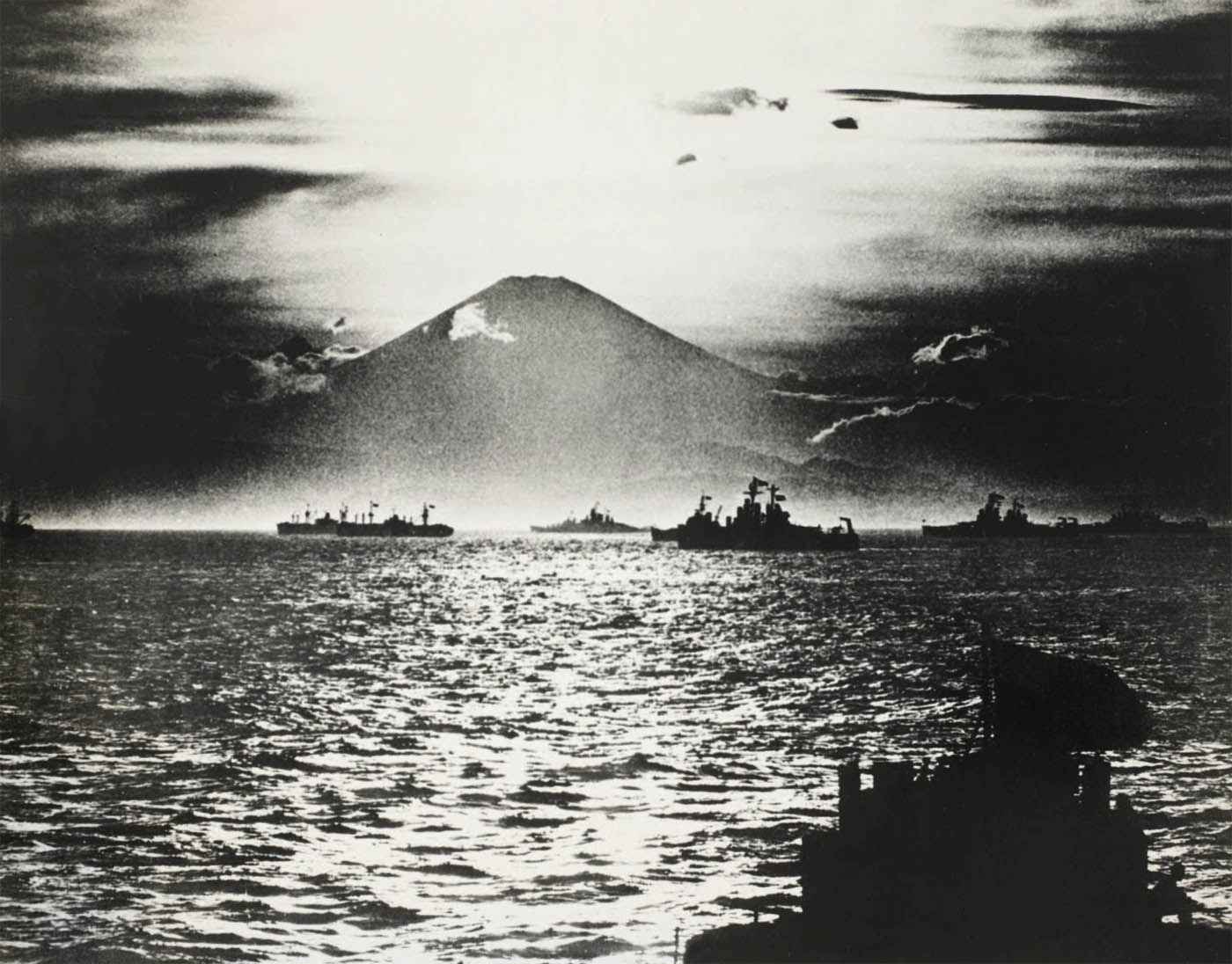
 

U.S. Navy Photographic Team. 'U.S. and British Warships Anchored in Sagami Wan, Outside of Tokyo Bay, Japan, on the Day the Allied Ships Entered Japanese Waters' 27th August 1945


U.S. Navy Photographic Team
U.S. and British Warships Anchored in Sagami Wan, Outside of Tokyo Bay, Japan, on the Day the Allied Ships Entered Japanese Waters
27th August 1945
Gelatin silver print
The Museum of Fine Arts, Houston, museum purchase funded by Laura and Tony Visage in honor and memory of William A. Visage and his fellow soldiers in Battery “E” of the 2nd Battalion, 131st Field Artillery, U.S. Army Air Corps
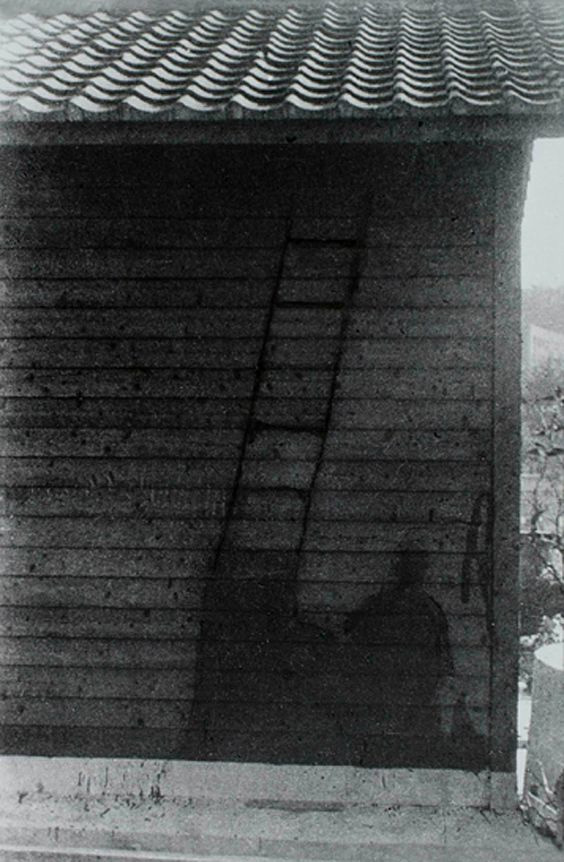
 

Matsumoto Eiichi (Japanese, 1915-2004) 'Shadow of a soldier remaining on the wooden wall of the Nagasaki military headquarters (Minami-Yamate machi, 4.5km from Ground Zero)' 1945


Matsumoto Eiichi (Japanese, 1915-2004)
Shadow of a soldier remaining on the wooden wall of the Nagasaki military headquarters (Minami-Yamate machi, 4.5km from Ground Zero)
1945
Gelatin silver print
Collection of the Tokyo Metropolitan Museum of Photography
© Matsumoto Eiichi
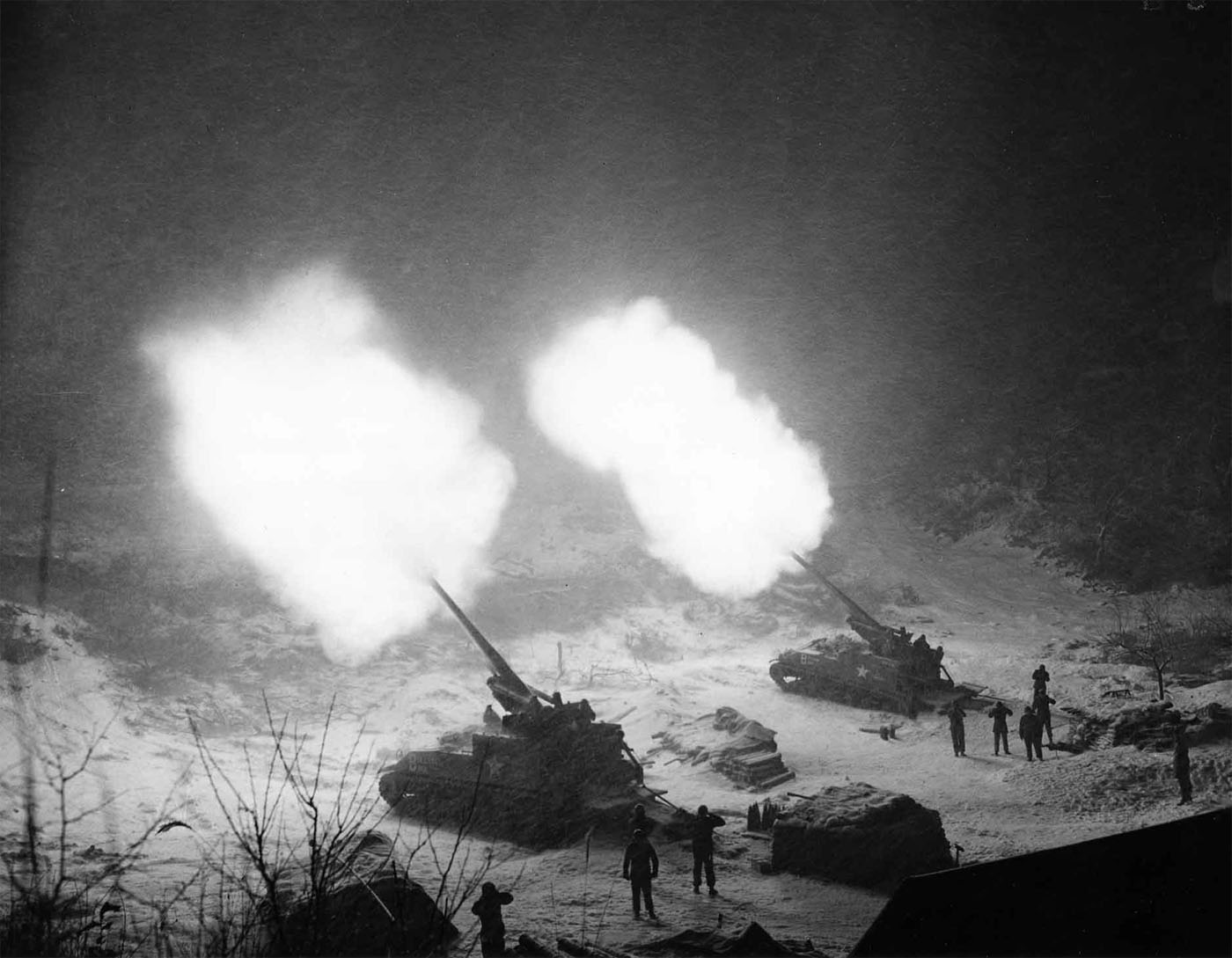
 

Unknown photographer. 'A pair of M-40 155mm Gun Motor Carriages of Battery B, 937th Field Artillery Battalion, providing fire support to U.S. Army 25th Infantry Division, Munema, Korea' 26 November 1951


Unknown photographer
A pair of M-40 155mm Gun Motor Carriages of Battery B, 937th Field Artillery Battalion, providing fire support to U.S. Army 25th Infantry Division, Munema, Korea
26 November 1951
Gelatin silver print
U.S. Department of Defense


Cathy LeRoy (French, 1944-2006) 'Corpsman In Anguish' 1967


Cathy LeRoy (French, 1944-2006)
Corpsman In Anguish
1967
Gelatin silver print


Her pictures from Vietnam were stunning. Her photos from Battle of Hill 881 evoked “ghosts of Iwo Jima and Pork Chop Hill,” Time magazine wrote in May 1967. Her photos of corpsman Vernon Wike during the battle was a triptych of an all-too-familiar scene: in the first, Wike has two hands on his friend’s chest, trying to staunch the wound; in the second, he tries to find a heartbeat; in the third frame, “Corpsman In Anguish”, he realised the man is dead.

LeRoy herself came very close to death two weeks later. Her Nikon barely stopped a piece of mortar shrapnel that ripped open her chest. She said that she thought the last words she would ever hear were, “I think she’s dead, sarge.” During the Tet offensive in 1968, LeRoy was briefly captured by the North Vietnamese during the battle for Hue. LeRoy’s photos of her captivity later made the cover of Life, ‘A Remarkable Day in Hue: the Enemy Lets Me Take His Picture’. She was the first person to take photos of North Vietnamese Army Regulars behind their lines.

Anonymous. “Corpsman In Anguish | Cathy LeRoy,” on the Iconic Photos website January 13, 2014 [Online] Cited 27/07/2024


A licensed parachutist, Leroy jumped with the U.S. 173rd Airborne Brigade into combat during Operation Junction City in February of 1967. It was in this action, the battle for Hill 881, that Leroy photographed U.S. Navy Corpsman Vernon Wike as he rushed to the aid of a fallen comrade. “Corpsman in anguish” is the third frame of a series that Leroy shot, capturing the unimaginable grief of war. Later, in an interview for the documentary “The Hill Fights”, Wike recounted the moment that Leroy photographed.

“I know there was chaos going on around me, but there was no sound,” she says. “… I knew he didn’t have a chance, but I still got p—–d off when he died.” Leroy describes the aftermath as the corpsman “lost in this nightmare landscape” grabbed the fallen marine’s M16 and charged a Viet bunker alone in a hail of obscenities. The fallen marine was a man called “Rock”, a New Yorker from Puerto Rico. Earlier that day he had told Wike that he only had 60 days left “in country” – his deployment in Vietnam.

Anonymous. “Giving War a Face: Catherine Leroy,” on the Dismal Nitch website September 04, 2020 [Online] Cited 27/07/2024
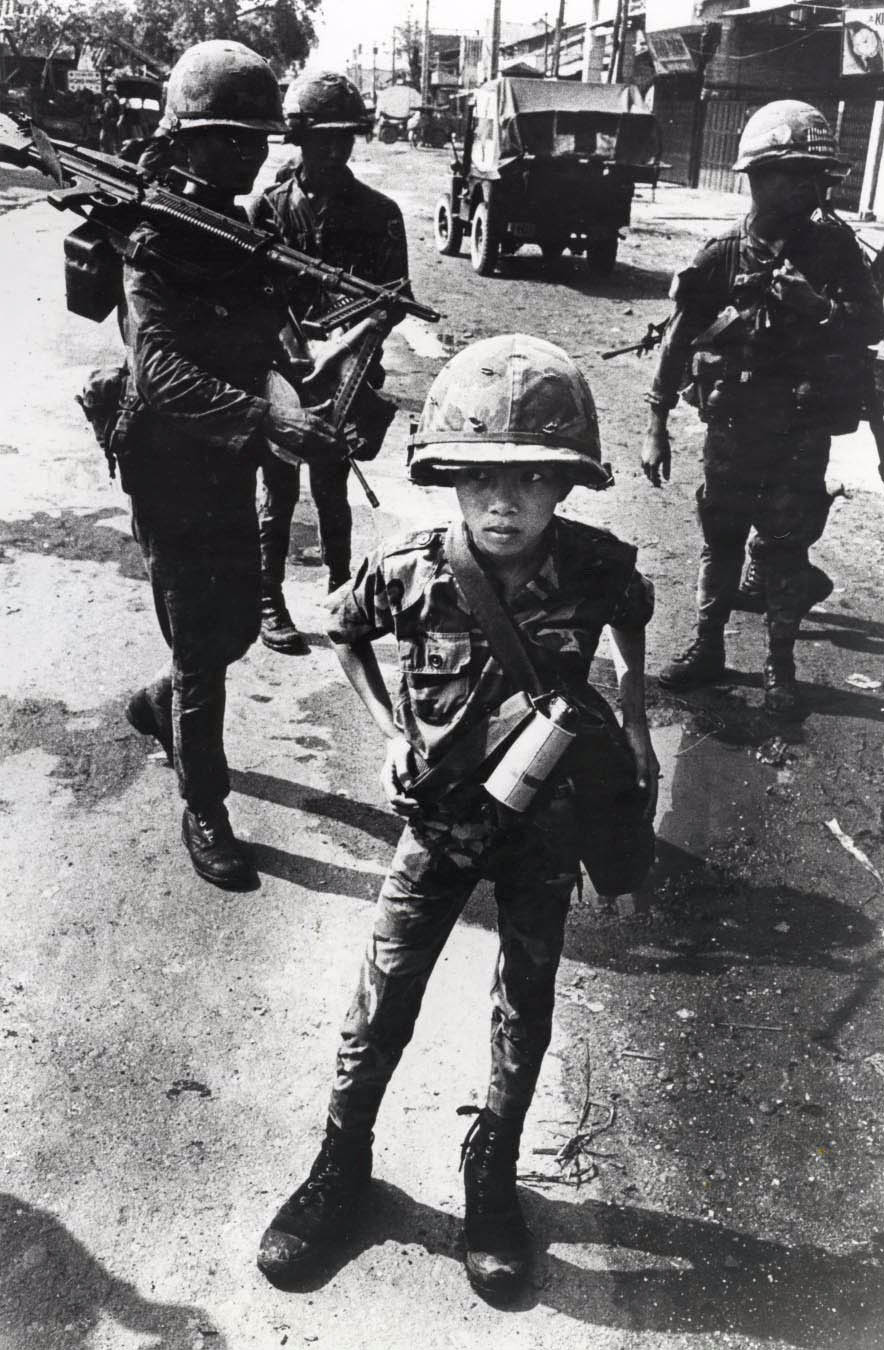
 

Arkady Shaikhet (Soviet, 1898-1959) 'Partisan Girl' 1942


Philip Jones Griffiths (Welsh, 1936-2008)
​Called “Little Tiger” for killing two “Viet Cong women cadre” – his mother and teacher, it was rumored, Vietnam​
1968
Gelatin silver print
The Philip Jones Griffiths Foundation, courtesy of Howard Greenberg Gallery
© Philip Jones Griffiths / Magnum Photos
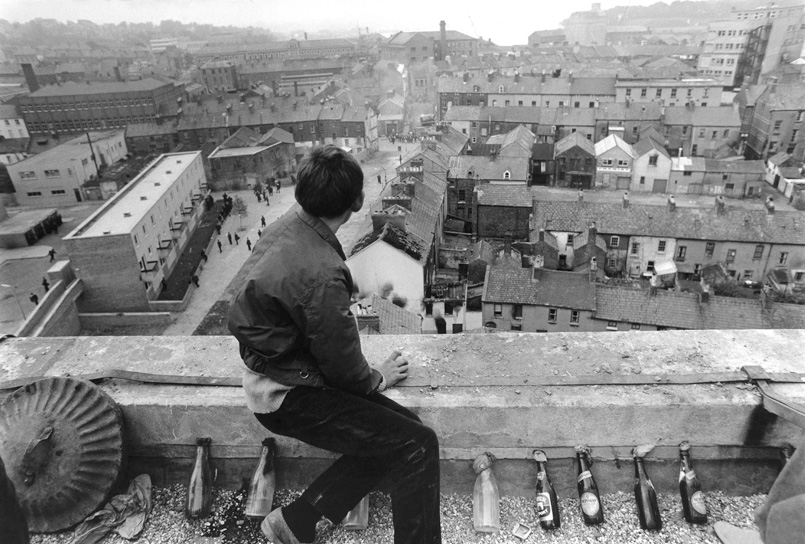
 

Gilles Caron (French, 1939-1970) 'Young Catholic demonstrator on Londonderry Wall, Northern Ireland' 1969


Gilles Caron (French, 1939-1970)
Young Catholic demonstrator on Londonderry Wall, Northern Ireland
1969
Gelatin silver print
Courtesy of Foundation Gilles Caron and Contact Press Images
© Gilles Caron
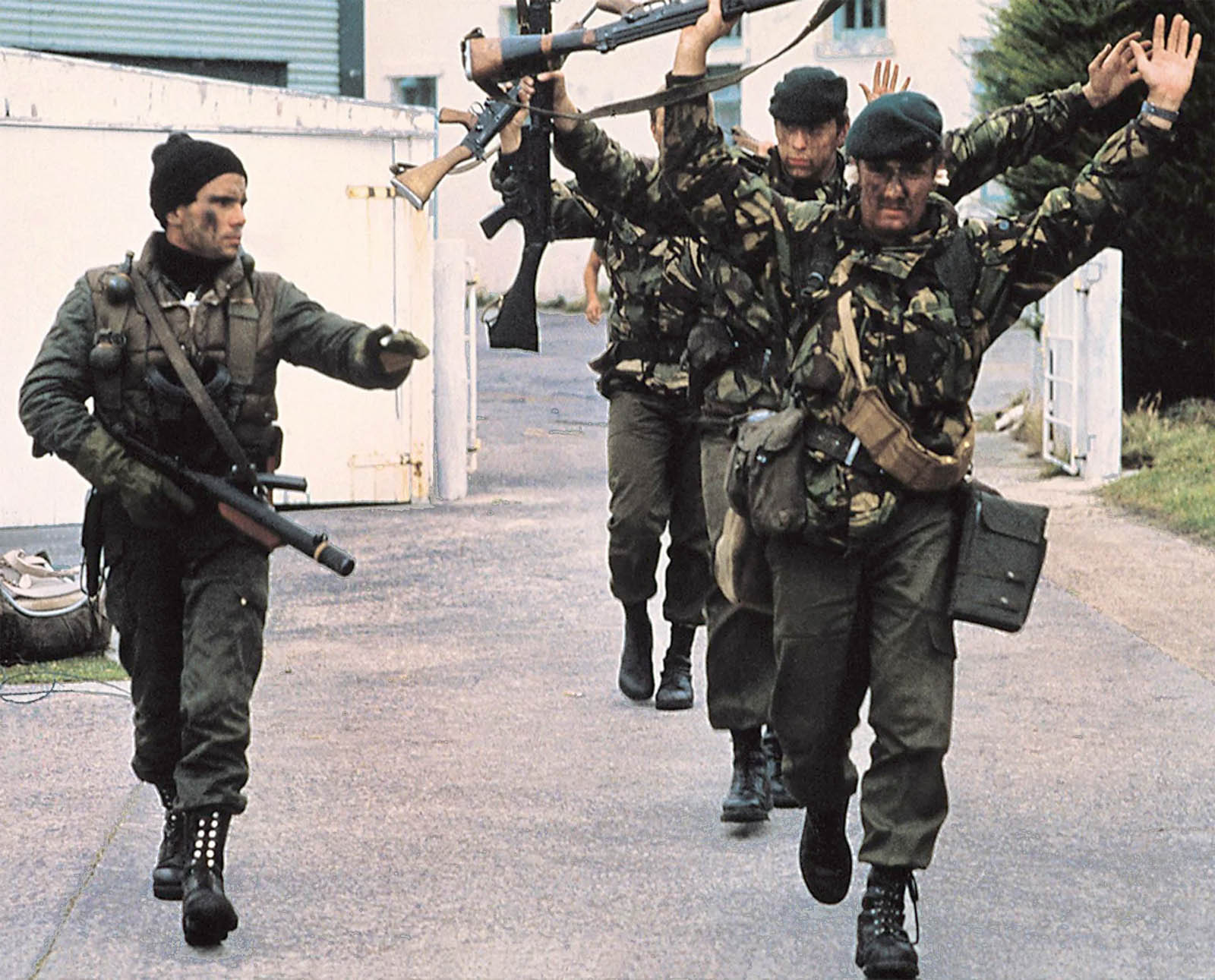
 

Rafael Wollmann (Argentinian, b. 1958) 'British Marines surrender to Argentinean troops in Malvinas/Falklands' April 2, 1982, printed 2012


Rafael Wollmann (Argentinian, b. 1958)
British Marines surrender to Argentinean troops in Malvinas/Falklands
April 2, 1982, printed 2012
Inkjet print
15 7/8 × 20 in. (40.4 × 50.8cm)
The Museum of Fine Arts, Houston
Gift of Rafael Wollmann
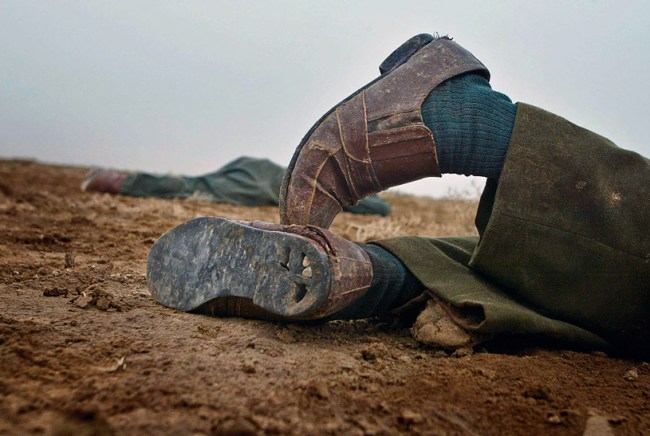
 

David Leeson (American, b. 1957) 'Death of a Soldier, Iraq' March 24, 2003


David Leeson (American, b. 1957)
Death of a Soldier, Iraq
March 24, 2003
Inkjet print, printed 2012
Courtesy of the artist


Ziv Koren (Israeli, b. 1970) 'A sniper’s-eye view of Rafah, in the Southern Gaza strip, during an Israeli military sweep' 2006


Ziv Koren (Israeli, b. 1970)
A sniper’s-eye view of Rafah, in the Southern Gaza strip, during an Israeli military sweep
2006
Inkjet print, printed 2012
© Ziv Koren/Polaris Images
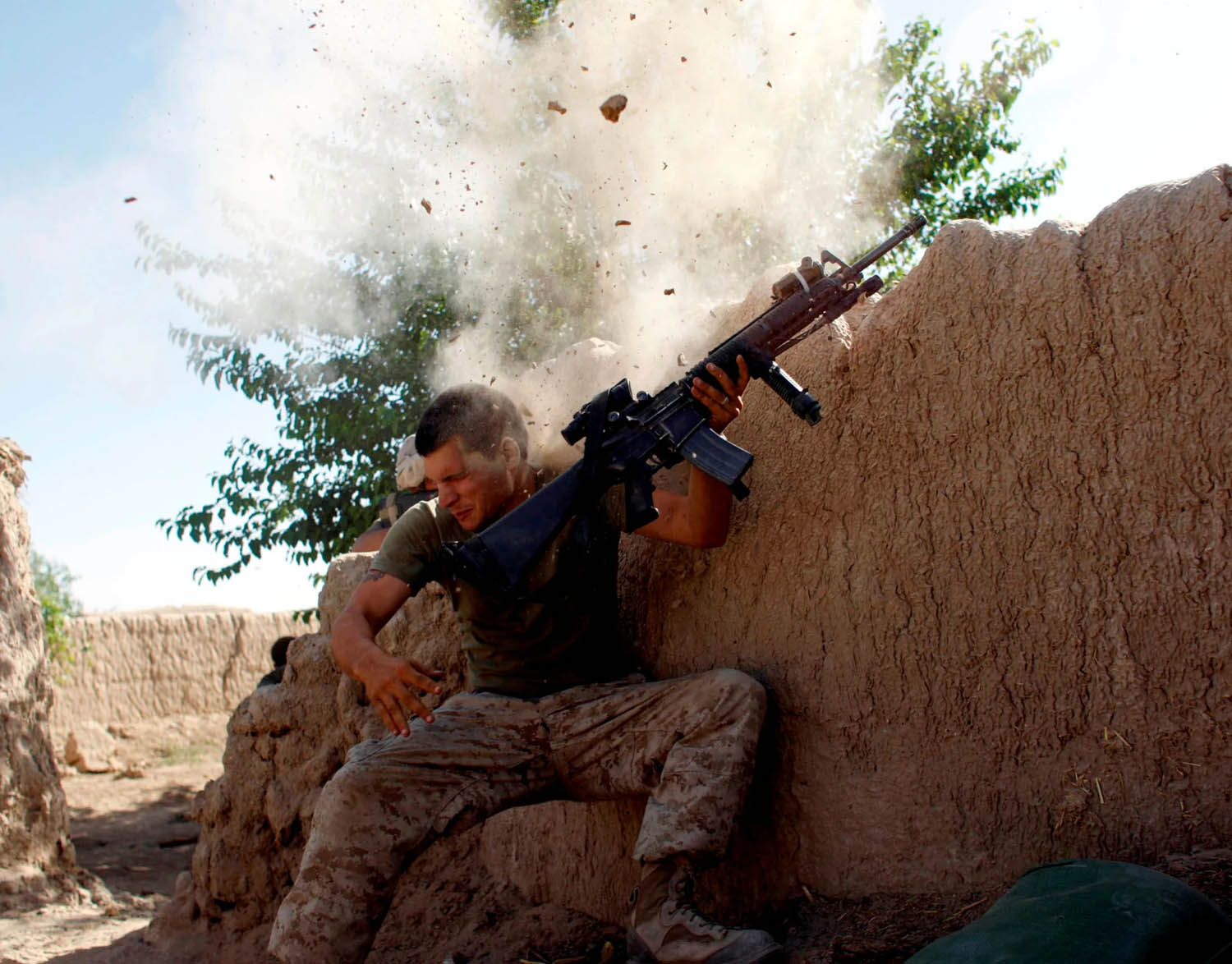
 

Goran Tomasevic (Serbian, b. 1959) /Reuters. 'SHOOTING. Sgt. William Olas Bee, a US Marine from the 24th Marine Expeditionary Unit, has a close call after Taliban fighters opened fire near Garmser in Helmand Province of Afghanistan May 18, 2008. The Marine was not injured.' 2008


Goran Tomasevic (Serbian, b. 1959) /Reuters
SHOOTING. Sgt. William Olas Bee, a US Marine from the 24th Marine Expeditionary Unit, has a close call after Taliban fighters opened fire near Garmser in Helmand Province of Afghanistan May 18, 2008. The Marine was not injured.
2008


Tomašević began photographing the war that followed the breakup of Yugoslavia from 1991 for daily newspaper Politika. In 1996 he joined the world’s largest news agency, Reuters, covering the simmering political tensions in Kosovo and the anti-Milošević demonstrations in his hometown of Belgrade since mid-1990s. During three-month NATO bombing of Yugoslavia in 1999, Tomašević was the only photographer working for foreign press to spend the duration of the conflict in Kosovo.

Tomašević moved to Jerusalem in 2002, covering the second Palestinian intifada. During the U.S. led invasions of Iraq in 2003, his picture of a U.S. Marine watching the toppling of a Saddam Hussein statue became one of the most memorable images of the war. He often returned to Iraq as sectarian violence escalated and regularly photographed America’s other war in Afghanistan. His sequence of photographs of U.S. Marine Sergeant Bee narrowly escaping Taliban bullets became an iconic image in U.S. war history.

Tomašević moved to Cairo in 2006 and was at the heart of Reuters’ coverage of the Arab Springs. In Libya, his image of a fireball that spewed up after an air strike on pro-Gaddafi fighters became an iconic image of the Libyan war, gracing the front pages of more than 100 newspapers around the globe. He stayed in Cairo until 2012. His raw pictures of rebel fighters battling pro-Assad forces among the ruins of Aleppo and Damascus during the Syrian Civil War have won international acclaim, as did his coverage of the bloody siege on a Nairobi shopping mall in Kenya. Tomašević worked for Reuters until 2022.

Text from the Wikipedia website


Museum of Fine Arts, Houston
1001 Bissonnet Street
Houston, TX 77005

Opening hours:
Wednesday 11am – 5pm
Thursday 11am – 9pm
Friday 11am – 6pm
Saturday 11am – 6pm
Sunday 12.30pm – 6pm
Closed Monday and Tuesday, except Monday holidays
Closed Thanksgiving Day and Christmas Day

Museum of Fine Arts, Boston website

LIKE ART BLART ON FACEBOOK

Back to top

Exhibition: ‘nude men: from 1800 to the present day’ at the Leopold Museum, Vienna

Exhibition dates: 19th October 2012 – 4th March 2013

Curators: Tobias G. Natter and Elisabeth Leopold

Warning: this posting contains art work of naked male bodies.


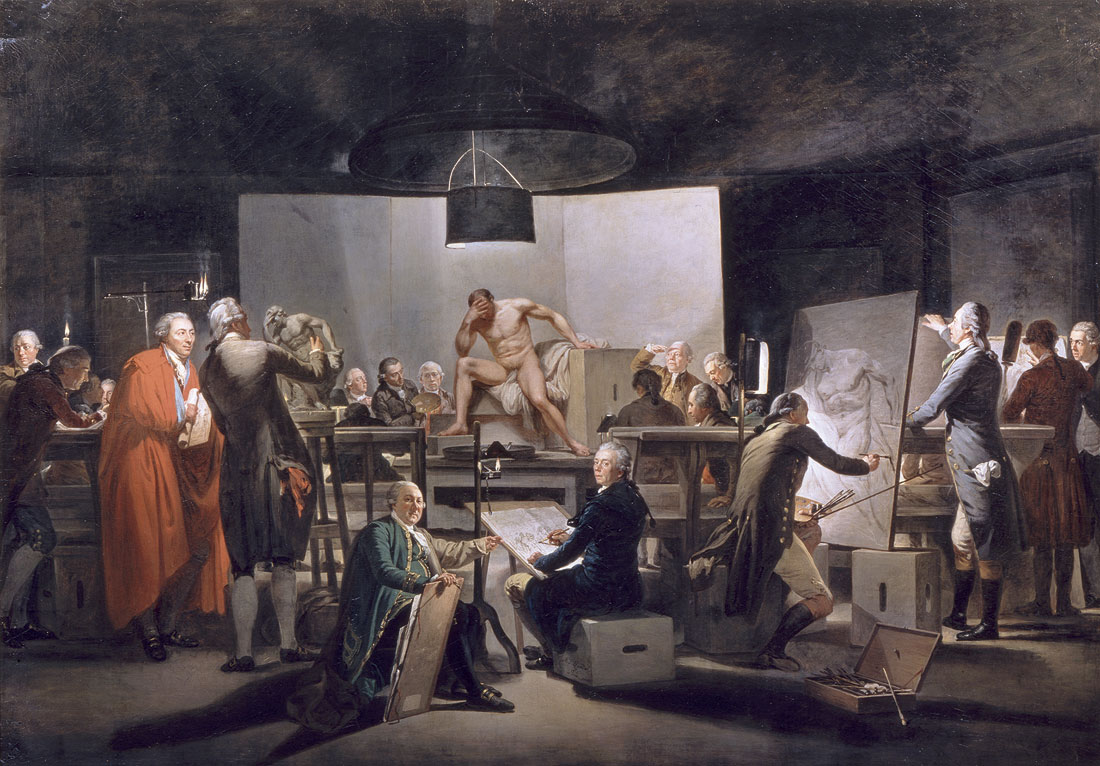
Martin Ferdinand Quadal (Moravian-Austrian, 1736-1811) 'Nude Life Class at the Vienna Art Academy in the St.-Anna-Gebäude' 1787


Martin Ferdinand Quadal (Moravian-Austrian, 1736-1811)
Nude Life Class at the Vienna Art Academy in the St.-Anna-Gebäude
1787
© Paintings Gallery of the Academy of Fine Arts Vienna


“When we stop and think about it, we all are naked underneath our clothes.”


(Heinrich Heine, Travel Pictures, 1826)


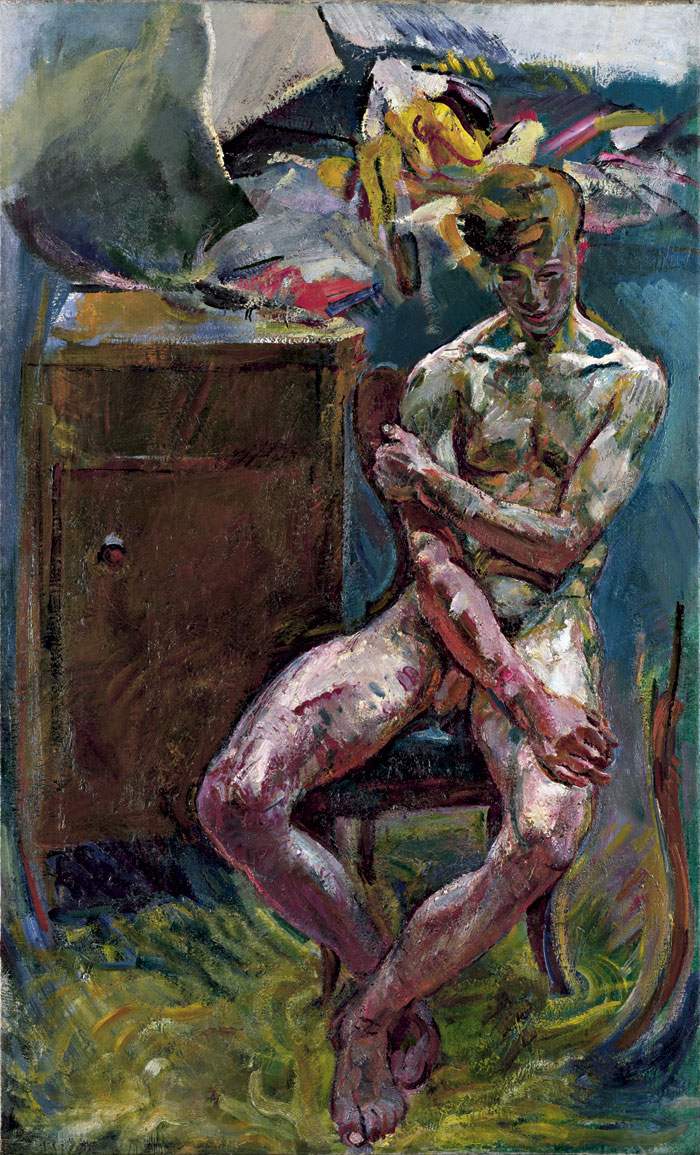
A great posting. I used to have a print of Querelle by Andy Warhol on my wall when I was at university in London aged 17 years old – that and We Two Boys Together Clinging by David Hockney. My favourite in this posting is the painting Seated Youth (morning) by Austrian expressionist painter Anton Kolig. Such vivacity, life and colour, perhaps a post-coital glow (was he straight, bisexual, gay? who cares, it is a magnificent painting).

There is very little information on Kolig on the web. Upon recommendation by Gustav Klimt and Carl Moll Kolig received a 1912 scholarship for a stay in Paris, where Kolig studied modern painting at the Louvre. He enlisted in the First World War in 1916 and survived, continuing to work in paint, tapestries and mosaic during the postwar years and the 1920s. He received two offers for professorships in Prague and Stuttgart, he opted for the Württemberg Academy in Stuttgart, where he trained a number of important painters. In addition, his work was also shown internationally at numerous exhibitions.

He was persecuted by the Nazis and his art destroyed because it was thought to be “degenerate” art. Kolig, who was essentially apolitical, remained until the fall of 1943 in Stuttgart, where he felt less and less well, however, and eventually returned to Nötsch. On 17 December 1944 Kolig was buried with his family in a bomb attack and seriously injured. Much of his work was destroyed there. He died in 1950.

Dr Marcus Bunyan


Many thankx for the Leopold Museum, Vienna for allowing me to publish the text and photographs in the posting. Please click on the photographs for a larger version of the image.


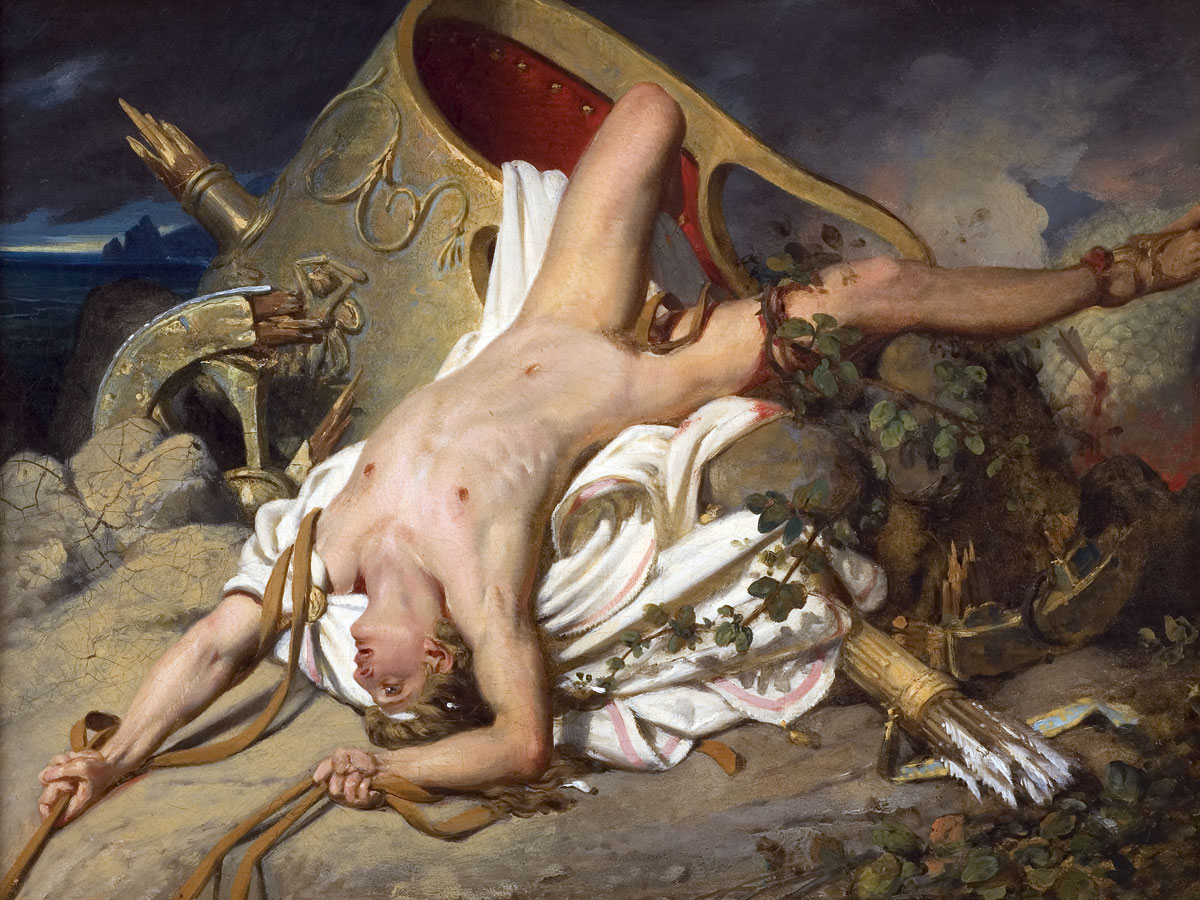
Joseph-Désiré Court (French, 1797-1865) 'Death of Hippolytus' 1825


Joseph-Désiré Court (French, 1797-1865)
Death of Hippolytus
1825
© Musée Fabre de Montpellier Agglomération


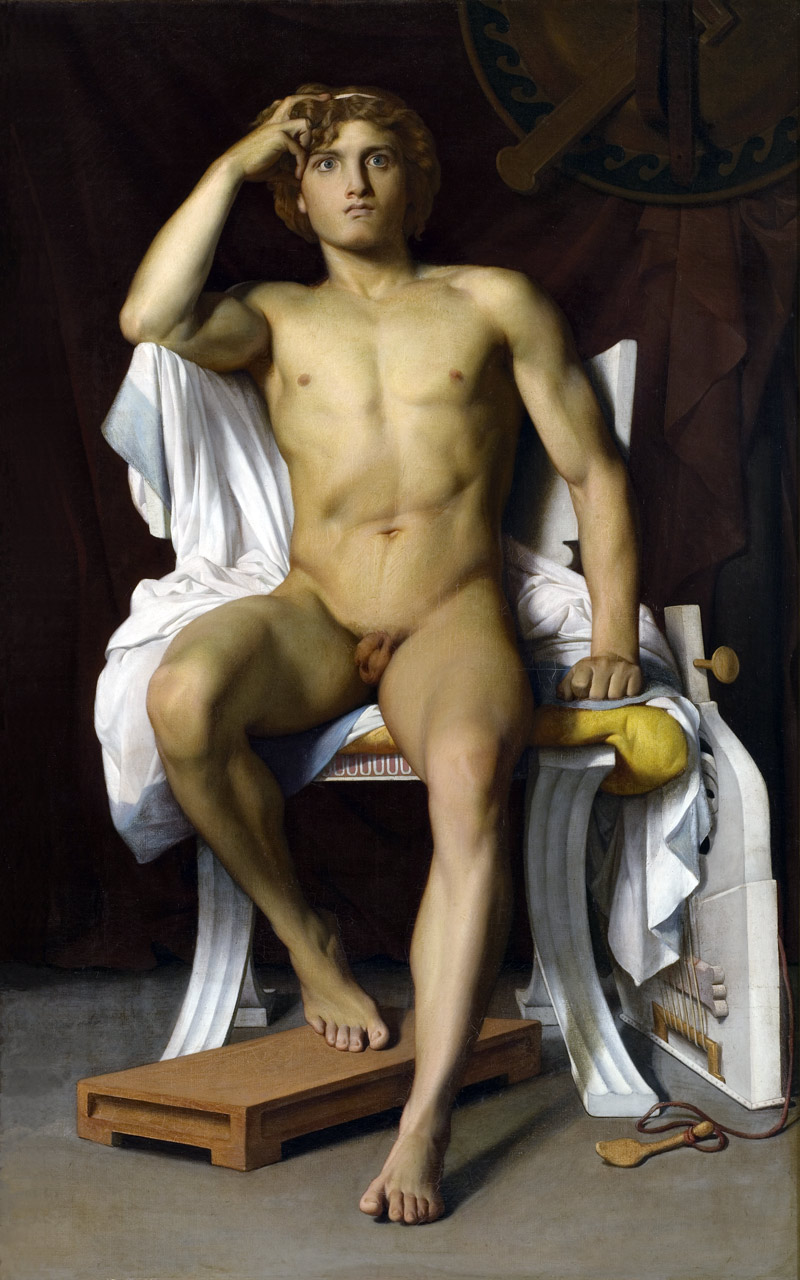
François-Léon Benouville (French, 1821-1859) 'Achills Zorn' 1847


François-Léon Benouville (French, 1821-1859)
Achills Zorn
1847
© Musée Fabre de Montpellier


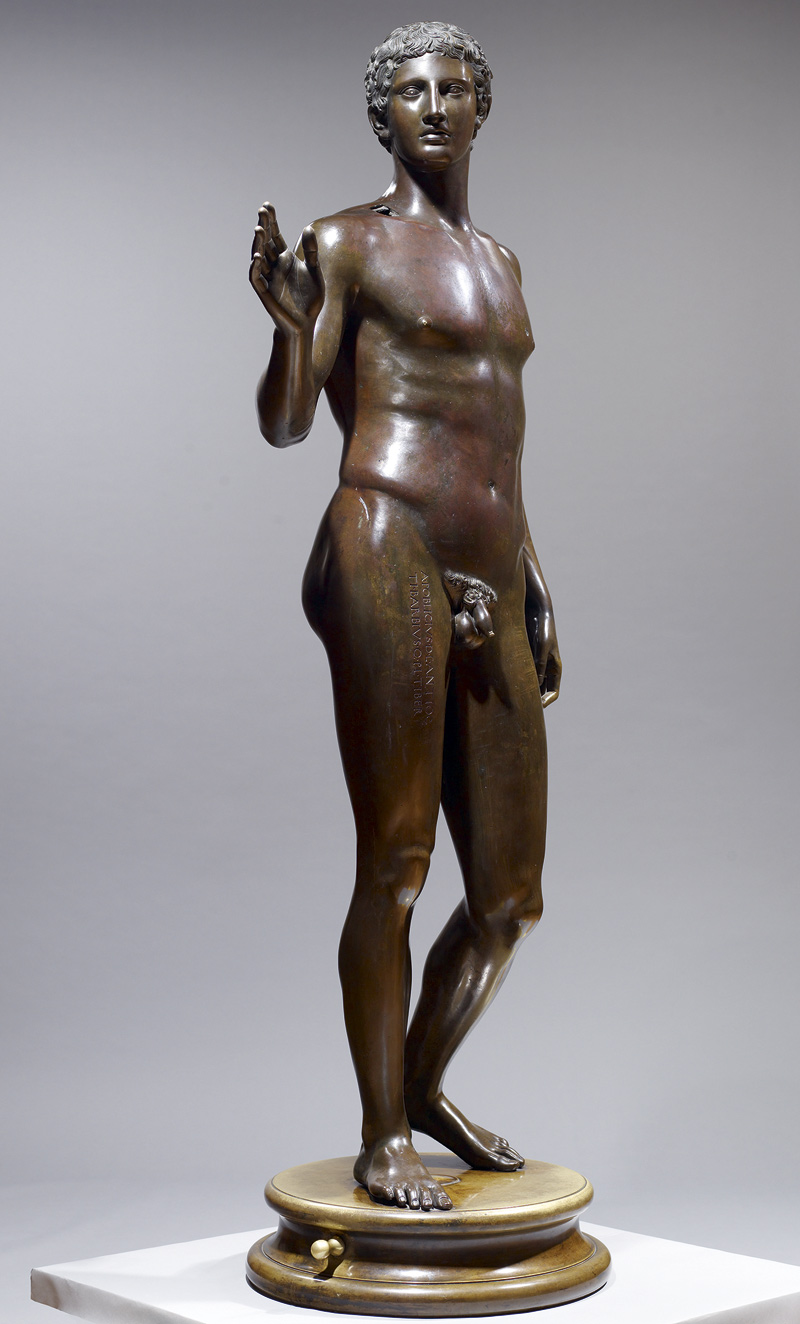
Anonymous maker. 'Anonymous Youth of Magdalensberg' 16th Century casting after Roman Original


Anonymous maker
Anonymous Youth of Magdalensberg
16th Century casting after Roman Original
© Kunsthistorisches Museum, Vienna, Antiquities


Anonymous maker. 'Anonymous standing figure of the court official Snofrunefer Egypt, Old Kingdom, late 5th Dynasty' around 2400 BC


Anonymous maker
Anonymous standing figure of the court official Snofrunefer
Egypt, Old Kingdom, late 5th Dynasty, around 2400 BC
© Kunsthistorisches Museum Vienna with MVK and ÖTM, Egyptian and Near Eastern Collection


Auguste Rodin (French, 1840-1917) 'The Age of Bronze' 1875-1876


Auguste Rodin (French, 1840-1917)
The Age of Bronze
1875/76
© Kunsthaus Zurich


Anton Kolig (Austrian, 1886-1950) 'Seated Youth (morning)' 1919


Anton Kolig (Austrian, 1886-1950)
Seated Youth (morning)
1919
© Leopold Museum, Wien, Inv. 406


Previous exhibitions on the theme of nudity have mostly been limited to female nudes. With the presentation “naked men” in the autumn of 2012 the Leopold Museum will be showing a long overdue exhibition on the diverse and changing depictions of naked men from 1800 to the present.

Thanks to loans from all over Europe, the exhibition “naked men” will offer an unprecedented overview of the depiction of male nudes. Starting with the period of Enlightenment in the 18th century, the presentation will focus mainly on the time around 1800, on tendencies of Salon Art, as well as on art around 1900 and after 1945. At the same time, the exhibition will also feature important reference works from ancient Egypt, examples of Greek vase painting and works from the Renaissance. Spanning two centuries, the presentation will show different artistic approaches to the subject, competing ideas of the ideal male model as well as changes in the concept of beauty, body image and values.

The exhibition, curated by Tobias G. Natter and Elisabeth Leopold, traces this theme over a long period and draws a continuous arc from the late 18th century to the present. Altogether, the showing brings together around 300 individual works by nearly 100 female and male artists from Europe and the USA. The objective of the two curators Tobias G. Natter and Elisabeth Leopold was “to clearly show the differing artistic approaches, competing models of masculinity, the transformation of ideas about the body, beauty and values, the political dimension of the body, and last but not least the breaking of conventions.”

“Over the past few years, portrayals of nude males have achieved a hitherto unseen public presence,” says Elisabeth Leopold. To which Tobias G. Natter adds, “At the same time, this exhibition is our way of reacting to the fact that categories which had previously seemed established, such as ‘masculinity’, ‘body’ and ‘nakedness’, have today become unstable for a broad swath of society.”

Diversity and abundance: showing for what “nude men” could stand

Elisabeth Leopold remarks that, “In the run-up to our project, we were very surprised to note that some commentators expected a ‘delicate’ exhibition. But in fact, we had no intention of treating the theme in such a way – with reserve, with tact, or in any other way delicately. And we did not understand this topic to be at all delicate in terms of an exhibition on art history somehow requiring a degree of discretion.” A project like nude men would be entirely unthinkable without the experiences and impulses of feminist art as well as cultural history, cultural studies and gender studies. With the exhibition nude men, the Leopold Museum seeks to react to the circumstance that societal categories commonly thought to be firmly established – such as “masculinity”, “body” and “nakedness” – are currently undergoing major changes.

By seizing on these developments, we understand the museum to be an institution which is relevant to today’s society – that is to say, a place for both the present and the future. Tobias G. Natter: “Our objective is to show the diversity and transformation of the portrayal of nude men in light of clearly defined thematic focuses. With fresh curiosity, without traditional scholarly prejudices, and with fascination for an inexhaustibly rich field, we use this exhibition to draw an arc spanning over 200 years which, not least, make a theme of the long shadow cast by the fig leaf.”

The exhibition

The exhibition traces its theme from the late 18th century to the present day. It has three key historical themes: the classical era and the Age of Enlightenment around 1800, classical modernism around 1900, and post-1945 art. These three themes are introduced by a prologue.

Prologue

The exhibition’s three focuses are preceded by a prologue. Using five outstanding sculptures from European art history, the prologue illuminates this theme’s long tradition. It runs from the “oldest nude in town” – a larger-than-life freestanding figure from ancient Egypt – and the statue known as the Jüngling vom Magdalensberg to Auguste Rodin and Fritz Wotruba, and on to a display window mannequin which Heimo Zobernig reworked to create a nude self-portrait.

Tobias G. Natter: “The curatorial intention behind prologue was to have the audience stroll through nearly five millennia of Western sculptural art in just a few steps. This is meant both to communicate both the long tradition of such images and to highlight the degree to which nude men were taken for granted to be the foundation of our art. These five thousand years form the exhibition’s outer referential frame. Strictly speaking, the showing begins in earnest with the Age of Enlightenment and the period around 1800.”

Theme 1: Classicism and the Power of Reason

In the 18th century and beginning in France, the emancipation of the bourgeois class and the swan song of the Ancien Régime occasioned a renegotiation of concepts of masculinity with both societal and aesthetic implications. The naked male hero was defined anew as a cultural pattern. It became the embodiment of the new ideals.

Theme 2: Classical Modernism

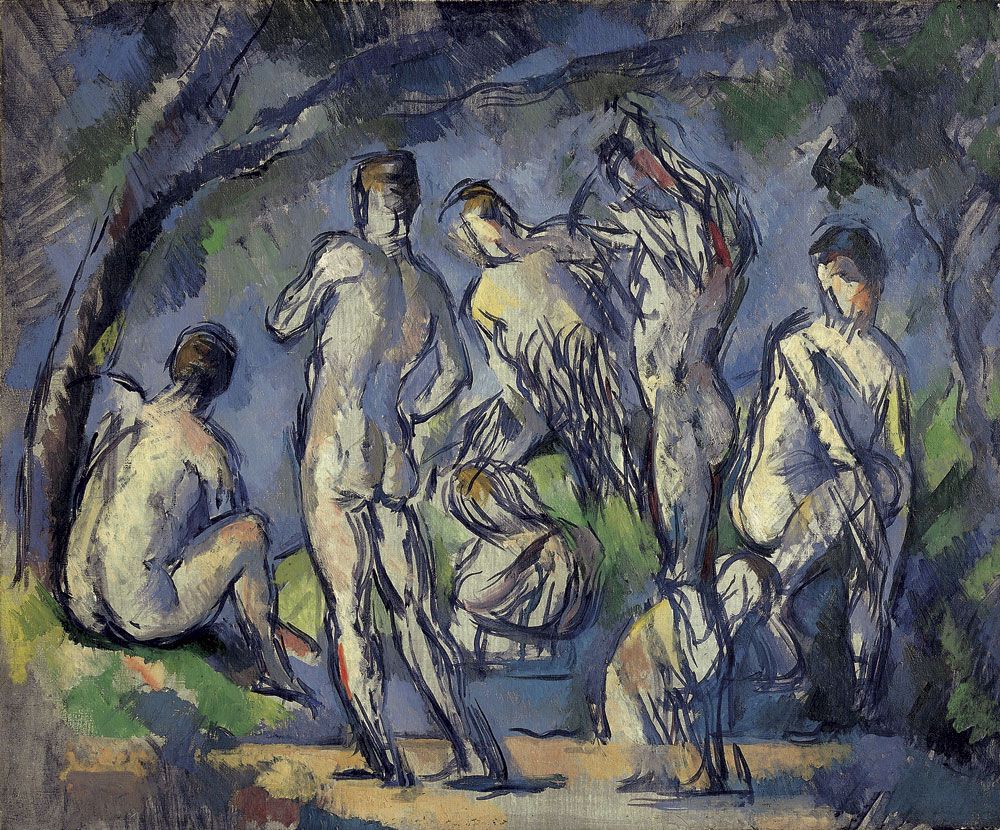
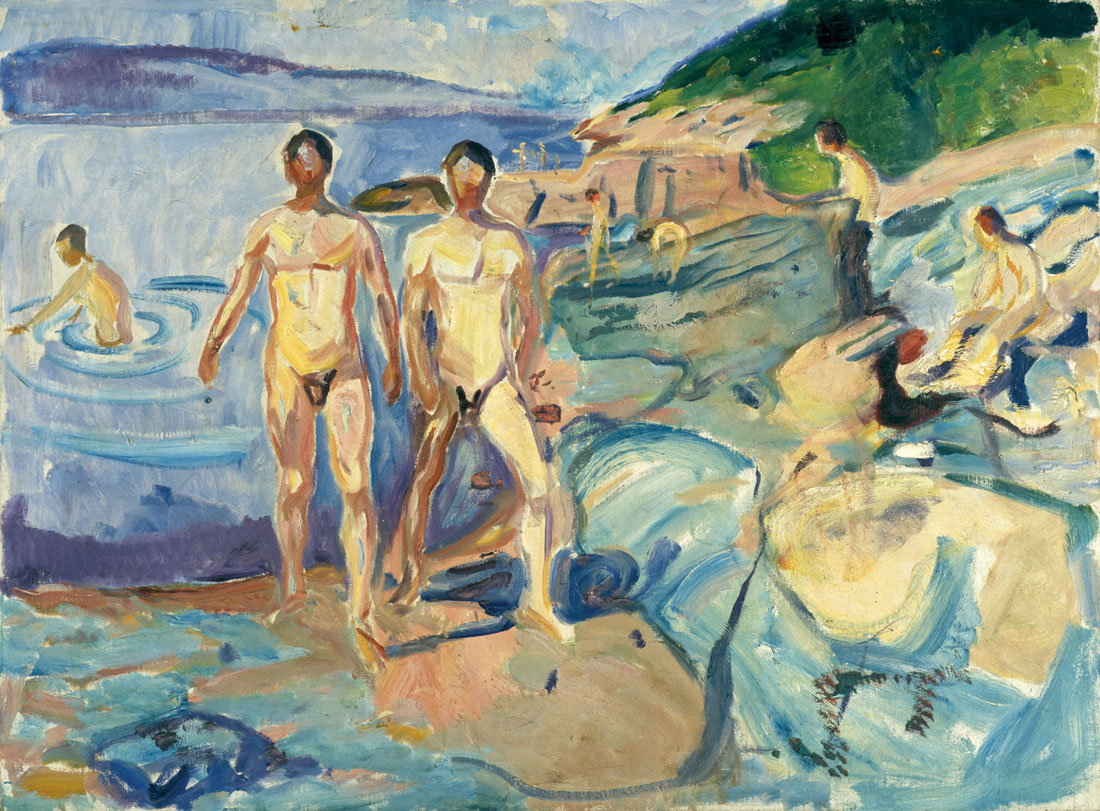
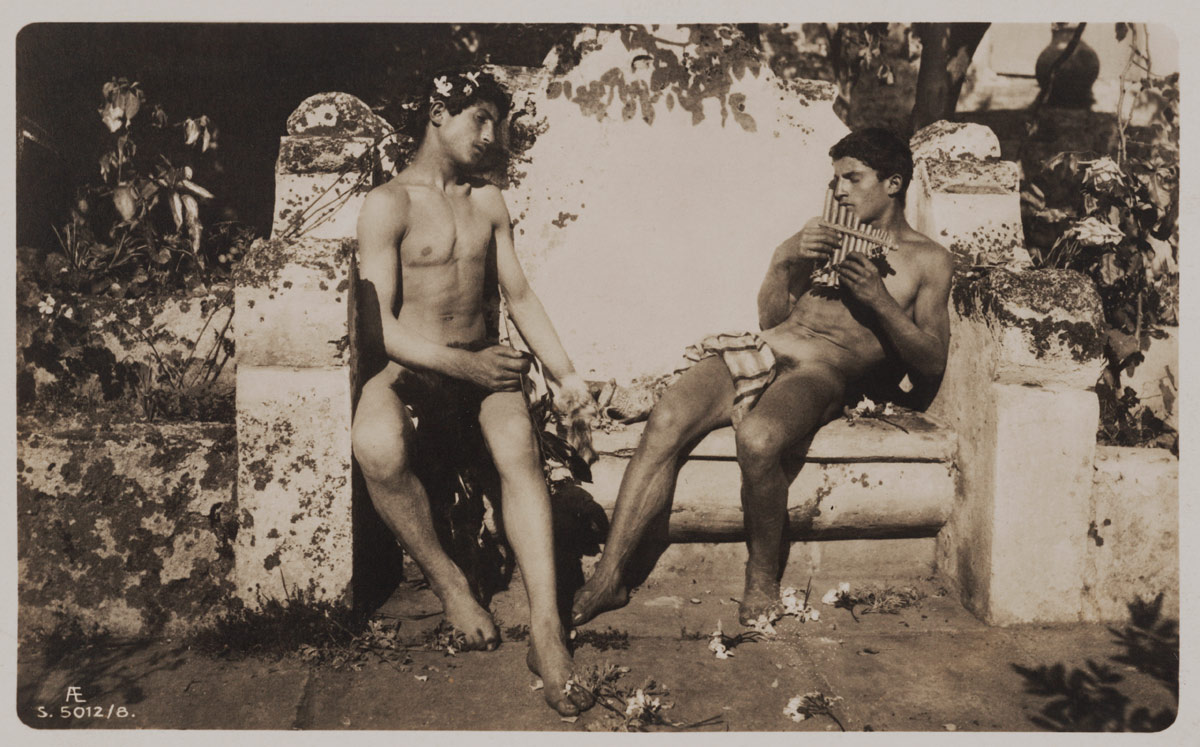
A new and independent pictorial world arose in the late 19th century with the casual depiction of naked men bathing in natural, outdoor settings. The various ways in which artists dealt with this topic can be viewed together as a particularly sensitive gauge of societal moods. In the exhibition, the genre is represented with prominent examples by Paul Cézanne, Edvard Munch, Wilhelm von Gloeden, Max Liebermann, Ernst Ludwig

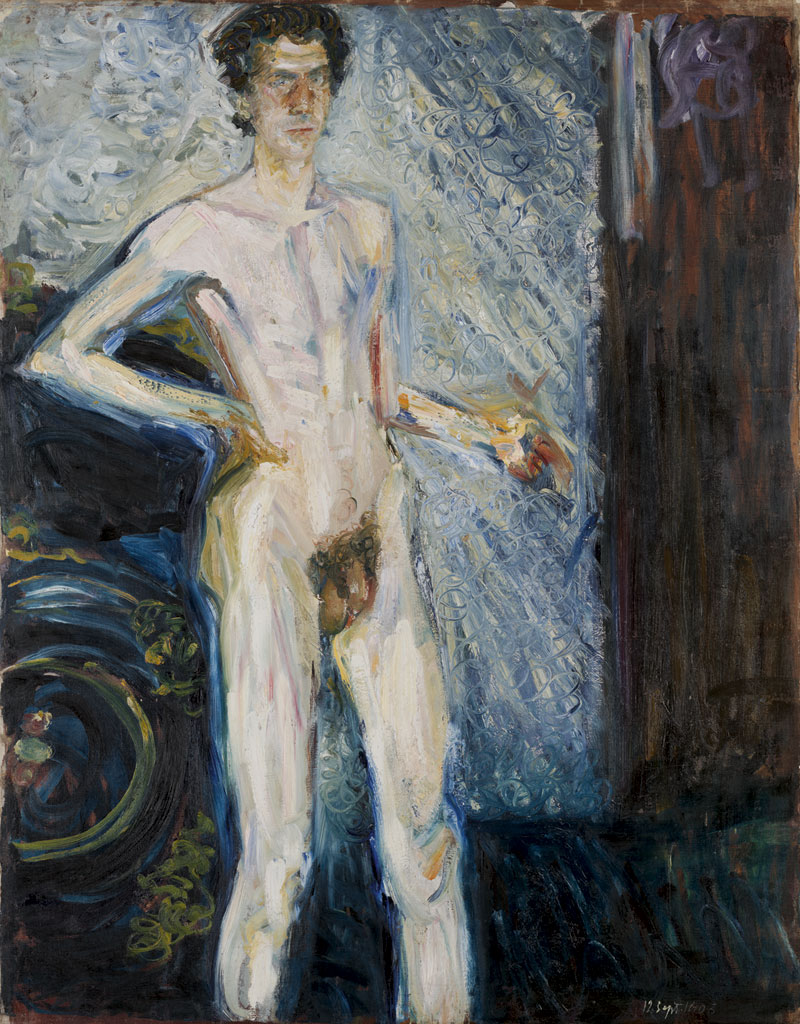
Kirchner and others. Classical modernism’s quest for a new artistic foundation also had its impact on the topics of nakedness and masculinity. But what happened when the painter’s gaze wandered on from the naked other to the naked self? A principle witness with regard to this phenomenon in turn-of-the-20th-century Vienna is Egon Schiele. With his taboo-breaking self-reflections, he radicalised artists’ self-understanding in a way that nobody had before him. Elisabeth Leopold: “The shift of the painter’s gaze from the naked opposite to the exposed self gave rise to the nude self-portrait – a shining beacon of modernism.”

Theme 3: Post-1945 Developments

In light of the abundance of interesting works from which to choose, the exhibition’s third theme comprises three specific focuses. Common to all three is the way in which the political potential of the naked body is explored. The first of these focuses concentrates on the battle fought by women for legal and social equality during the 20th century.

Outstanding examples of the intense way in which feminist artists have dealt with their own bodies as foils for the projection of gender roles can be found in the output of Maria Lassnig and Louise Bourgeois, whose works are included in the exhibition alongside others by younger woman artists. It was pioneers such as Lassnig and Bourgeois who set in motion the process which, today, underlies feminist art’s steadily increasing presence in terms of interpretation, resources, norms, power, and participation in the art business. The second area introduces artistic works that interlock nude self-portraits and the culture of protest, which bears great similarities to feminist criticism – the naked self between normativity and revolt.

The one issue is the nude self-portrait as a field for experimentation and a phenomenon which questions artistic and societal identities. The other issue has to do with substantive contributions to the gender debate, as well as with artists who take the crisis of obsolete male images as an opportunity to put forth self-defined identities. The third focus, finally, lies in the shift in roles in which the man goes from being the subject to being the object, in fact becoming an erotically charged object – perhaps one of the most fundamental shifts in terms of the forms via which nude men have been portrayed from 1800 to the present. Gay emancipation, in particular, served to radically cast doubt upon normative concepts of masculinity, which it opposed with its own alternative models. In this exhibition, these are represented above all in paintings that feature intimate closeness and male couples.

As the opening of this exhibition neared, a frequently-asked question was that of why the project is being undertaken. Tobias G. Natter’s response: “There are many reasons. But most importantly: because it is overdue.”

Press release from the Leopold Museum website


Three out of five characters from the Prologue "naked men"


Three out of five characters from the Prologue “naked men”

Anonymous maker
Freestanding figure of the court official Snofrunefer
c. 2400 B.C.
© Kunsthistorisches Museum, Vienna

Auguste Rodin (French, 1840-1917)
The Age of Bronze
1875/1876
© Kunsthaus Zürich

Heimo Zobernig (Austrian, b. 1958)
Untitled
2011
© VBK, Vienna, 2012


Paul Cézanne (French, 1839-1906) 'Seven Bathers' c. 1900


Paul Cézanne (French, 1839-1906)
Seven Bathers
c. 1900
Fondation Beyeler, Riehen/Basel


Edvard Munch (Norwegian, 1863-1944) 'Bathing Men' 1915


Edvard Munch (Norwegian, 1863-1944)
Bathing Men
1915
Munch Museum, Oslo
© The Munch Museum/The Munch Ellingsen Group/VBK, Vienna 2012


Wilhelm von Gloeden (German, 1856-1931) 'Flute Concert' 1905


Wilhelm von Gloeden (German, 1856-1931)
Flute Concert
1905
Verlag Adolph Engel, private collection


Richard Gerstl (Austrian, 1883-1908) 'Nude Self-portrait with Palette' 1908


Richard Gerstl (Austrian, 1883-1908)
Nude Self-portrait with Palette
1908
© Leopold Museum, Wien


Egon Schiele (Austrian, 1890-1918) '“Prediger” (Selbstakt mit blaugrünem Hemd) ["Preacher" (Nude with teal shirt)]' 1913


Egon Schiele (Austrian, 1890-1918)
‘”Prediger” (Selbstakt mit blaugrünem Hemd)’ [“Preacher” (Nude with teal shirt)]
1913
© Leopold Museum, Wien, Inv. 2365


Bruce Nauman (American, b. 1941) 'Untitled (Five Marching Men)' 1985


Bruce Nauman (American, b. 1941)
Untitled (Five Marching Men)
1985
© Friedrich Christian Flick Collection / VBK Wien 2012


Gilbert & George (Gilbert Prousch, British born Italy, b. 1943 and George Passmore, British, b. 1942) 'Spit Law' 1997


Gilbert & George (Gilbert Prousch, British born Italy, b. 1943 and George Passmore, British, b. 1942)
Spit Law
1997
© Courtesy Galerie Thaddaeus Ropac, Paris / Salzburg


Elmgreen & Dragset (Michael Elmgreen Danish, b. 1961 and Ingar Dragset Norwegian, b. 1969) 'Shepherd Boy (Tank Top)' 2009


Elmgreen & Dragset (Michael Elmgreen Danish, b. 1961 and Ingar Dragset Norwegian, b. 1969)
Shepherd Boy (Tank Top)
2009
Courtesy Galleri Nicolai Wallner
© Courtesy Galleri Nocolai Wallner / VBK Wien 2012


Thomas Ruff (German, b. 1958) 'nudes vg 02' 2000


Thomas Ruff (German, b. 1958)
nudes vg 02
2000
Ed. 3/5
© Private collection Cofalka, Austria/with the kind support of agpro – austrian gay professionals
© VBK, Wien 2012


Jean Cocteau (French, 1889-1963) 'Male Couple Illustration for Jean Genet’s 'Querelle de Brest'' 1947


Jean Cocteau (French, 1889-1963)
Male Couple
Illustration for Jean Genet’s ‘Querelle de Brest’

1947
© Private collection © VBK, Wien 2012


Louise Bourgeois (French, 1911-2010) 'Fillette (Sweeter Version)' 1968, cast 1999


Louise Bourgeois (French, 1911-2010)
Fillette (Sweeter Version)
1968, cast 1999
© Ursula Hauser Collection, Switzerland © VBK, Wien 2012


Pierre & Gilles (Pierre Commoy and Gilles Blanchard) 'Vive la France [Long live France]' 2006


Pierre & Gilles (Pierre Commoy and Gilles Blanchard)
Vive la France [Long live France]
2006
© Private collection, Courtesy Galerie Jérôme de Noirmont, Paris


Andy Warhol (American, 1928-1987) 'Querelle' c. 1982


Andy Warhol (American, 1928-1987)
Querelle
c. 1982
© Privatsammlung/ VBK, Wien 2012


Leopold Museum
Museums Quartier, Museumsplatz 1
1070 Vienna, Austria

Opening hours:
Daily except Tuesday: 10am – 6pm

Leopolod Museum website

LIKE ART BLART ON FACEBOOK

Back to top

Exhibition: ‘Cartier-Bresson: A Question of Colour’ at Somerset House, London

Exhibition dates: 8th November 2012 – 27th January 2013

Curator: William E. Ewing


Henri Cartier-Bresson (French, 1908-2004) 'Harlem, New York' 1947


Henri Cartier-Bresson (French, 1908-2004)
Harlem, New York, 1947
1947
Gelatin silver print / printed 1970s
Image: 29.1 x 19.6cm
Paper: 30.4 x 25.4cm
© Henri Cartier-Bresson/Magnum Photos, Courtesy Fondation Henri Cartier-Bresson


They may be channelling the master, but none does it like Cartier-Bresson. There is a spareness and spatial intensity to Cartier-Bresson’s work that is absolutely his own. Look at the photograph directly above (Harlem, New York, 1947). A railing leads the eye in bottom right, echoed by the bottom jamb of the window. The opening is set for the old man to perform complete with curtains, talking stage right. The jamb zig zags above a trilby-wearing, cigarette-smoking man’s head leading to a wire mesh fence that takes the eye out of the frame on the left. The two men, lower than the old man in the framed window, look in a completely different direction to him.

Counterpoise. The image pulls in two directions. Above their head a series of cantilevered staircases ascends to the heavens, thought ascending. A masterpiece.

So many of the other photographers in this posting crowd the plane with people looking in all directions, closed off foregrounds or tensionless images. Images that are too complex or too simple. There is an opposition to Cartier-Bresson’s images that is difficult for the viewer to resolve neatly, yet they appear as if in perfect balance. Look at Brooklyn, New York, 1947 towards the bottom of the posting. Nothing in this still life is out of place (from the light to the multiple, overlapping shadows and the out of focus elements of the composition) yet there is humbling agony about the whole thing. It is almost is if he is saying, “cop a load of this, this is what I can see.” And what a fabulous eye it is.

Dr Marcus Bunyan


Many thankx to Somerset House for allowing me to publish the photographs in the posting. Please click on the photographs for a larger version of the image.


Ernst Haas (Austrian-American, 1921-1986) 'New Orleans, USA' 1960


Ernst Haas (Austrian-American, 1921-1986)
New Orleans, USA,
1960
Chromogenic archival print
50 x 35cm
© Ernst Haas Estate, New York


Saul Leiter (American, 1923-2013) 'Snow' 1960


Saul Leiter (American, 1923-2013)
Snow
1960
© Saul Leiter
Courtesy: Saul Leiter, Howard Greenberg Gallery, New York


Helen Levitt (American, 1913-2009) 'Cat next to red car, New York' 1973


Helen Levitt (American, 1913-2009)
Cat next to red car, New York,
1973
Type C prints
18 x 12 inches
© Estate of Helen Levitt


Alex Webb (American, b. 1952) 'Tehuantepec, Mexico' 1985


Alex Webb (American, b. 1952)
Tehuantepec, Mexico
1985
71 x 47cm
Digital Type C print
© Alex Webb


“I only know how to approach a place by walking. For what does a street photographer do but walk and watch and wait and talk, and then watch and wait some more, trying to remain confident that the unexpected, the unknown, or the secret heart of the known awaits just around the corner.”

~ Alex Webb


Jeff Mermelstein (American, b. 1957) 'Untitled (Package Pile Up, New York City)' 1995


Jeff Mermelstein (American, b. 1957)
Untitled (Package Pile Up, New York City)
1995
Chromogenic print
© Jeff Mermelstein
Courtesy Rick Wester Fine Art, New York


Carolyn Drake (American, b. 1971) 'Birthday party at Olympia, a gated community, Wellington, Florida' 2005


Carolyn Drake (American, b. 1971)
Birthday party at Olympia, a gated community, Wellington, Florida
2005
Digital Pigment Print
© Carolyn Drake / Magnum Photos


Carolyn Drake (American, b. 1971) 'Hotel room. Zhetisay, Kazakhstan. Carolyn Drake' 2009


Carolyn Drake (American, b. 1971)
Hotel room. Zhetisay, Kazakhstan. Carolyn Drake
2009
Digital Pigment Print
© Carolyn Drake/Magnum Photos


Andy Freeberg (American, b. 1958) 'Sean Kelly, Art Basel Miami' 2010


Andy Freeberg (American, b. 1958)
Sean Kelly, Art Basel Miami
2010
From the series Art Fare
Artist: Kehinde Wiley
63 x 43cm
Pigment ink print
© Andy Freeberg
Courtesy Kopeikin Gallery


Carolyn Drake (American, b. 1971) 'New Kashgar. Kashgar, China'  2011


Carolyn Drake (American, b. 1971)
New Kashgar. Kashgar, China  
2011
30.48 x 20.32cm
Digital Light Jet print
© Carolyn Drake 2012


Positive View Foundation announces its inaugural exhibition Cartier-Bresson: A Question of Colour, to be held at Somerset House, 8 November 2012 – 27 January 2013. Curated by William A. Ewing, the exhibition will feature 10 Henri Cartier-Bresson photographs never before exhibited in the UK alongside over 75 works by 15 international contemporary photographers, including: Karl Baden (US), Carolyn Drake (US), Melanie Einzig (US), Andy Freeberg (US), Harry Gruyaert (Belgium), Ernst Haas (Austrian), Fred Herzog (Canadian), Saul Leiter (US), Helen Levitt (US), Jeff Mermelstein (US), Joel Meyerowitz (US), Trent Parke (Australian), Boris Savelev (Ukranian), Robert Walker (Canadian), and Alex Webb (US).

The extensive showcase will illustrate how photographers working in Europe and North America adopted and adapted the master’s ethos famously known as  ‘the decisive moment’ to their work in colour. Though they often departed from the concept in significant ways, something of that challenge remained: how to seize something that happens and capture it in the very moment that it takes place.

It is well-known that Cartier-Bresson was disparaging towards colour photography, which in the 1950s was in its early years of development, and his reasoning was based both on the technical and aesthetic limitations of the medium at the time. Curator William E. Ewing has conceived the exhibition in terms of, as he puts it, ‘challenge and response’. “This exhibition will show how Henri Cartier-Bresson, in spite of his skeptical attitude regarding the artistic value of colour photography, nevertheless exerted a powerful influence over photographers who took up the new medium and who were determined to put a personal stamp on it. In effect, his criticisms of colour spurred on a new generation, determined to overcome the obstacles and prove him wrong. A Question of Colour simultaneously pays homage to a master who felt that black and white photography was the ideal medium, and could not be bettered, and to a group of photographers of the 20th and 21st centuries who chose the path of colour and made, and continue to make, great strides.”

Cartier-Bresson: A Question of Colour will feature a selection of photographers whose commitment to expression in colour was – or is – wholehearted and highly sophisticated, and which measured up to Cartier-Bresson’s essential requirement that content and form were in perfect balance. Some of these artists were Cartier-Bresson’s contemporaries, like Helen Levitt, or even, as with Ernst Haas, his friends; others, such as Fred Herzog in Vancouver, knew the artist’s seminal work across vast distances; others were junior colleagues, such as Harry Gruyaert, who found himself debating colour ferociously with the master; and others still, like Andy Freeberg or Carolyn Drake, never knew the man first-hand, but were deeply influenced by his example.

Press release from Somerset House website


Fred Herzog (Canadian born Germany, 1930-2019)
'Man with Bandage, Vancouver, Canada'
1968


Fred Herzog (Canadian born Germany, 1930-2019)
Man with Bandage, Vancouver, Canada
1968


Joel Meyerowitz (American, b. 1938) 'Madison Avenue, New York City 1975


Joel Meyerowitz (American, b. 1938)
Madison Avenue, New York City
1975
Archival Pigment Print
© Joel Meyerowitz 2012
Courtesy Howard Greenberg Gallery, NYC


Joel Meyerowitz (American, b. 1938) Camel Coats, Fifth Avenue, New York 1975


Joel Meyerowitz (American, b. 1938)
Camel Coats, Fifth Avenue, New York
1975
Archival Pigment Print
© Joel Meyerowitz 2012
Courtesy Howard Greenberg Gallery, NYC


Ernst Haas (American, 1921-1986) 'New York City, US' 1981


Ernst Haas (American, 1921-1986)
New York City, US
1981


Fred Herzog (Canadian born Germany, 1930-2019) 'Crossing Powell 2' 1984


Fred Herzog (Canadian born Germany, 1930-2019)
Crossing Powell 2
1984
Ink jet print


Harry Gruyaert (Belgian, b. 1941) 'Morocco, town of Duarzazte' 1986


Harry Gruyaert (Belgian, b. 1941)
Morocco, town of Duarzazte
1986
© 2015 Harry Gruyaert / Magnum Photos


Harry Gruyaert (Belgian, b. 1941) 'Province of Brabant, Flanders region, Belgium' 1988


Harry Gruyaert (Belgian, b. 1941)
Province of Brabant, Flanders region, Belgium
1988
© 2015 Harry Gruyaert / Magnum Photos


Harry Gruyaert is known for his extraordinary photographic work with color. Born in Antwerp in 1941, he originally dreamed of becoming a film director. In the late 1970s, Pop art and a trip to Morocco inspired him to become one of the first photographers in Europe to devote his work entirely to color photography. Gruyaert’s cinematographic background instilled in him an aesthetic conception of photography. Rather than telling stories or documenting the world through his lens, he searches for beauty in everyday elements. His images are simply snapshots of magical moments in which different visual aspects, primarily color, form, light and movement, spontaneously come together in front of his lens.

Text from the Magnum website


Jeff Mermelstein (American, b. 1957) 'Unitled ($10 bill in mouth) New York City' 1992


Jeff Mermelstein (American, b. 1957)
Unitled ($10 bill in mouth) New York City, 1992
1992
Chromogenic print
20 x 16 in.
© Jeff Mermelstein
Courtesy Rick Wester Fine Art, New York


“My process is linked to everyday life. Only on rare occasions do I go out specifically to ‘shoot’. My best photographs were taken going to or from work, or some other destination. Sometimes a picture appears that helps me sum up a strange mood or thought that I’ve struggled with for weeks. Other times my work is more documentary in nature.

Photographing in public keeps me awake and aware, always looking around, in awe at what we humans are up to. In a time when staged narratives and rendered images are popular, I am excited by the fact that life itself offers situations far more strange and beautiful than anything I could set up.”

~ Jeff Mermelstein


Jeff Mermelstein (American, b. 1957) 'Run #9, New York' 1999-2000


Jeff Mermelstein (American, b. 1957)
Run #9, New York
1999-2000
© Jeff Mermelstein


Trent Parke (Australian, b. 1971) 'Man Vomiting, Gerald #1' 2006


Trent Parke (Australian, b. 1971)
Man Vomiting, Gerald #1
2006
Type C print
© Trent Parke
Courtesy Magnum Photos


Karl Baden (American, b. 1952) 'Chestnut Hill, Massachusetts' 2009


Karl Baden (American, b. 1952)
Chestnut Hill, Massachusetts
2009
Archival Inkjet
40.64 x 54.19cm
© Karl Baden


Boris Savelev (Russian, b. 1947) 'Cafe Ion, Moscow' 2009


Boris Savelev (Russian, b. 1947)
Cafe Ion, Moscow
2009
© Boris Savelev


Andy Freeberg (American, b. 1958) 'Nina Menocal, Armory Show' 2011


Andy Freeberg (American, b. 1958)
Nina Menocal, Armory Show
2011
From the series Art Fare
Pigment ink print
© Andy Freeberg
Courtesy Kopeikin Gallery


Henri Cartier-Bresson (French, 1908-2004) 'Brooklyn, New York' 1947


Henri Cartier-Bresson (French, 1908-2004)
Brooklyn, New York, 1947
1947
Gelatin silver print / printed in 2007
Image: 19.8 x 29.8cm
Paper: 22.9 x 30.4cm
© Henri Cartier-Bresson/Magnum Photos, Courtesy Fondation Henri Cartier-Bresson


Melanie Einzig (American, b. 1967) 'September 11th, New York' 2001


Melanie Einzig (American, b. 1967)
September 11th, New York 2001
2001
21 x 33cm
Inkjet print
© Melanie Einzig 2012


Terrace Rooms & Courtyard Rooms, Somerset House
Strand, London, WC2R 1LA

Opening hours:
10am – 6pm daily

Somerset House website

LIKE ART BLART ON FACEBOOK

Back to top

Exhibition: ‘WAR/PHOTOGRAPHY: Images of Armed Conflict and Its Aftermath’ at the Museum of Fine Arts, Houston – Posting Part 3

Exhibition dates: 11th November 2012 – 3rd February 2013


Walter Astrada, (Argentinean, b. 1974) 'Congolese women fleeing to Goma' 2008


Walter Astrada, (Argentinean, b. 1974)
Congolese women fleeing to Goma
2008
From the series Violence against women in Congo, Rape as weapon of war in DRC
Chromogenic print (printed 2010)
The Museum of Fine Arts, Houston, museum purchase with funds provided by Photo Forum 2010
© Walter Astrada


“War is, above all, grief.”

Dmitri Baltermants


“Violence is the last refuge of the incompetent”


Salvor Hardin in Isaac Asimov’s ‘Foundation’ series


Part three of the biggest posting on one exhibition that I have ever undertaken on Art Blart!

As befits the gravity of the subject matter this posting is so humongous that I have had to split it into 4 separate postings. This is how to research and stage a contemporary photography exhibition that fully explores its theme. The curators reviewed more than one million photographs in 17 countries, locating pictures in archives, military libraries, museums, private collections, historical societies and news agencies; in the personal files of photographers and service personnel; and at two annual photojournalism festivals producing an exhibition that features 26 sections (an inspired and thoughtful selection) that includes nearly 500 objects that illuminate all aspects of WAR/PHOTOGRAPHY.

I have spent hours researching and finding photographs on the Internet to support the posting. It has been a great learning experience and my admiration for photographers of all types has increased. I have discovered the photographs and stories of new image makers that I did not know and some enlightenment along the way. I despise war, I detest the state and the military that propagate it and I surely hate the power, the money and the ethics of big business that support such a disciplinarian structure for their own ends. I hope you meditate on the images in this monster posting, an exhibition on a subject matter that should be consigned to the history books of human evolution.

**Please be aware that there are graphic photographs in all of these postings.** Part 1Part 2Part 4

Dr Marcus Bunyan


Many thankx to the Museum of Fine Arts, Houston for allowing me to publish some of the photographs in the posting. Please click on the photographs for a larger version of the image.


Civilians

21. Civilians spans World War II through 2008. The subsection “Dead and Wounded” includes Grief, Kerch, Crimea, by Dmitri Baltermants, of civilians in 1942 searching the bodies of Russian Jewish family members who had been executed by Germans soldiers as they retreated. A 2003 photograph, taken by Ahmed Jadallah for the news agency Reuters while he lay wounded from shrapnel, shows bodies in the street in the largest refugee camp in the Gaza Strip. “Daily Life” shows a Congolese woman breastfeeding as a tank rolls by, in a 2008 image by Walter Astrada; Londoners sleeping in an underground train station in 1940, by Bill Brandt; a woman eating bread in Amsterdam during the Hongerwinter famine of 1944, by Cas Oorthuys; a 1940/1941 meeting in New York of members of the Bund, an American Nazi party, by Otto Hagel; a monk burning himself in Saigon in 1963, in protest against alleged religious persecution by the South Vietnamese government, by Malcolm Browne; and a man uncovering an anti-personnel land mine in Angola in 2004, by Sean Sutton. Pictures of civilian “Grief” are common, and the images here include a woman in Tehran inspecting photographs of the missing, by Gilles Peress; a man at an airport, grieving alone and holding a folded American flag, by Harry Benson; a father digging a grave for his daughter in a soccer field in Somalia, by Howard Castleberry; and a woman mourning in Afghanistan in 1996, at the grave of her brother who was killed by a Taliban rocket, by James Nachtwey. (46 images)


Otto Hagel (American born Germany, 1909-1973) 'German-Americans at a meeting in New Jersey of the Deutsche Bund' 1940-41


Otto Hagel (American born Germany, 1909-1973)
German-Americans at a meeting in New Jersey of the Deutsche Bund
1940-1941
Silver gelatin print


Dmitri Baltermants (Russian born Poland, 1912-1990) 'Grief, Kerch, Crimea' Spring 1942


Dmitri Baltermants (Russian born Poland, 1912-1990)
Grief, Kerch, Crimea
Spring 1942
Silver gelatin print


“War, is, above all, grief. I photographed non-stop for years and I know that in all that time I produced only five or six real photographs. War is not for photography. If, heaven forbid, I had to photograph war again, I would do it quite differently. I agonise now at the thought of all the things that I did not photograph.”

Dmitri Baltermants quoted in “The Russian War, 1941-1945” (J. Cape, London, 1978)


Cas Oorthuys (Dutch, 1908-1975) 'Portrait of starving woman in the hunger winter, Amsterdam' 1944-1945


Cas Oorthuys (Dutch, 1908-1975)
Portrait of starving woman in the hunger winter, Amsterdam
1944-1945
Silver gelatin print


Malcolm Browne (American, 1931-2012) 'Burning Monk - The Self-Immolation' 1963


Malcolm Browne (American, 1931-2012)
Burning Monk – The Self-Immolation
1963
Gelatin silver print


Harry Benson (Scottish, b. 1929) 'Grieving man, holding flag' 1971


Harry Benson (Scottish, b. 1929)
Grieving man, holding flag
1971
Gelatin silver print


Children

22. Children have been consistently photographed during wartime as both victims and soldiers. Images in this section include Sir Cecil Beaton’s Three-year-old Eileen Dunne in Hospital for Sick Children, England (1940); children viewing the bodies of other children who were hanged as collaborators in Russia in the 1940s, by Mark Redkin; Philip Jones Griffiths’ image of a young boy, Called “Little Tiger” for killing two “Vietcong women cadre” – his mother and teacher, it was rumored (1968); children playing “execution” in Italy, by Enzo Sellerio; two orphaned boys smoking cigarettes in post-World War II Japan, by Hayashi Tadahiko; a father home on leave reading the newspaper with his son, who wears his dad’s helmet, by Andrea Bruce; and the 2005 photograph, by Chris Hondros, of a blood-splattered Iraqi girl whose family was mistakenly ambushed by U.S. troops. (13 images) 


Cecil Beaton (British, 1904-1980) 'Eileen Dunne, aged three, sits in bed with her doll at Great Ormond Street Hospital for Sick Children, after being injured during an air raid on London in September 1940' 1940


Cecil Beaton (British, 1904-1980)
Eileen Dunne, aged three, sits in bed with her doll at Great Ormond Street Hospital for Sick Children, after being injured during an air raid on London in September 1940
1940
Gelatin silver print
© IWM (MH 26395)


Philip Jones Griffiths (Welsh, 1936-2008) 'Called "Little Tiger” for killing two "Vietcong women cadre” - his mother and teacher, it was rumored, Vietnam' 1968


Philip Jones Griffiths (Welsh, 1936-2008)
Called “Little Tiger” for killing two “Vietcong women cadre” – his mother and teacher, it was rumored, Vietnam
1968
Gelatin silver print
The Philip Jones Griffiths Foundation, courtesy of Howard Greenberg Gallery
© Philip Jones Griffiths / Magnum Photos


Andrea Bruce (American, b. 1973) 'Untitled [A father home on leave reading the newspaper with his son, who wears his dad’s helmet]' 2006


Andrea Bruce (American, b. 1973)
Untitled [A father home on leave reading the newspaper with his son, who wears his dad’s helmet]
2006
From the series When the War Comes Home
Gelatin silver print


Portraits

23. Portraits are the most common type of photograph made during conflicts. Dispersed throughout the exhibition, lining the main walkway through the galleries, are the faces of leaders, the enlisted, heroes and war criminals, as well as group portraits. One of the earliest prints in the exhibition is a daguerreotype from the Mexican-American War of a high-ranking officer. Matthew Brady, one of the most famous photographers of the 19th century, was renowned for coverage of the Civil War; his MajorGeneral Joseph Hooker, c. 1863, is on view. Among the most recent is a self-portrait by American Cpl. Reynaldo Leal USMC. Leal – who was born and grew up in Edinburg, Texas, and now lives in El Paso – served in Iraq conducting combat patrols through the villages along the Euphrates. (40 images)


Matthew B. Brady (American, 1823-1896) 'Colonel William Gates, believed to have been taken upon his return from the Mexican War' c. 1848


Matthew B. Brady (American, 1823-1896)
Colonel William Gates, believed to have been taken upon his return from the Mexican War
c. 1848
Half plate daguerreotype, gold toned
Library of Congress


Mathew B. Brady (American, 1823-1896) 'Major-General Joseph Hooker' c. 1863


Mathew B. Brady (American, 1823-1896)
Major-General Joseph Hooker
c. 1863
Salted paper print, hand coloured
The Museum of Fine Arts, Houston, museum purchase with funds provided by the S. I. Morris Photography Endowment


Corporal Reynaldo Leal USMC (American, b. 1983) 'Self‑portrait after a Patrol' c. 2004-2006


Corporal Reynaldo Leal USMC (American, b. 1983)
Self‑portrait after a Patrol
c. 2004-2006
Inkjet print
13 1/2 × 9 in. (34.3 × 22.9cm)
The Museum of Fine Arts, Houston
Museum purchase with funds provided by Will Michels and Clinton T. Willour
© Reynaldo Leal


War’s End

24. War’s End is identifiable at the moment a photograph is taken. The subsection “Victory/Defeat” is the visual manifest of the outcome of war, from the Japanese signing peace documents on board the USS Missouri, by Carl Mydans; to German generals discussing terms of surrender in the woods just four days after Adolf Hitler committed suicide in 1945, by E. G. Malindine; and the raising of the Hammer and Sickle over the Reichstag in Berlin in 1945, by Evgeny Khaldey. Also included is Simon Norfolk’s Victory arch built by the Northern Alliance at the entrance to a local commander’s headquarters in Bamiyan. The empty niche housed the smaller of the two Buddhas, destroyed by the Taliban in 2001, from the series Afghanistan: Chronotopia. “Retribution” contains a 1945 image, by Lee Miller, of a concentration-camp guard who was beaten by prisoners after their liberation; and a photograph by Robert Capa of a Frenchwoman who had been impregnated by a German soldier, as she walks through a jeering crowd with her head shaved in punishment and carrying her baby. The photographs in “Homecoming” establish an emotive connection: a family reunion on the tarmac at an Air Force base in California in 1973, by Sal Veder; a mother and son embracing at the Ben-Gurion Airport in Israel in 1976, by Micha Bar-Am; and a man who has returned from duty in Bosnia in 1995 to discover that his home and everyone in it is gone, by Ron Haviv. (23 images)


Robert Capa (Hungarian-American, 1913-1954) 'Collaborator woman who had a German soldier's child, Chartres, 18 August 1944' 1944


Robert Capa (Hungarian-American, 1913-1954)
Collaborator woman who had a German soldier’s child, Chartres, 18 August 1944
1944
Gelatin silver print
33 x 49cm


Evgeny Khaldey (Russian, 1917-1997) 'The Flag of Victory' 1945


Evgeny Khaldey (Russian, 1917-1997)
The Flag of Victory
1945
Gelatin silver print


E. G. Malindine (British, 1906-1970) 'German Military Forces Seek Surrender Terms, May 1945'


E. G. Malindine (British, 1906-1970)
No 5 Army Film & Photographic Unit, Malindine E G (Capt), Morris (Sgt)
German Military Forces Seek Surrender Terms, May 1945
1945
Gelatin silver print
Public domain


Field Marshal Sir Bernard Montgomery with the German delegates outside his headquarters at 21st Army Group


Carl Mydans (American, 1907-2004) 'Japanese signing peace documents on board the USS Missouri' 1945


Carl Mydans (American, 1907-2004)
Japanese signing peace documents on board the ‘USS Missouri’
1945
Gelatin silver print


Sal Velder (American, b. 1926) 'Released prisoner of war Lt. Col. Robert L. Stirm is greeted by his family at Travis Air Force Base in Fairfield, California on March 17, 1973, as he returns home from the Vietnam War' 1973


Sal Velder (American, b. 1926)
Released prisoner of war Lt. Col. Robert L. Stirm is greeted by his family at Travis Air Force Base in Fairfield, California on March 17, 1973, as he returns home from the Vietnam War
1973
Silver gelatin print
© Sal Velder


Micha Bar-Am (Israeli born Germany, 1930-2022) 'The return from Entebbe, Ben-Gurion Airport, Israel' 1976


Micha Bar-Am (Israeli born Germany, 1930)
The return from Entebbe, Ben-Gurion Airport, Israel
1976
From the series Promised Land
Inkjet print
Courtesy of the artist and Andrea Meislin Gallery, New York
© Micha Bar-Am / Magnum Photos


Ron Haviv (American, b.1965) 'A Bosnian soldier stands on what is believed to be a mass grave outside his destroyed home. He was the sole survivor of 69 people' 1995


Ron Haviv (American, b. 1965)
A Bosnian soldier stands on what is believed to be a mass grave outside his destroyed home. He was the sole survivor of 69 people
1995
Inkjet print
Courtesy of Ron Haviv/VII
© Ron Haviv


Simon Norfolk (British born Nigeria, b. 1963)
'Victory arch built by the Northern Alliance at the entrance to a local commander’s headquarters in Bamiyan. The empty niche housed the smaller of the two Buddhas, destroyed by the Taliban in 2001' 2001


Simon Norfolk (British born Nigeria, b. 1963)
Victory arch built by the Northern Alliance at the entrance to a local commander’s headquarters in Bamiyan. The empty niche housed the smaller of the two Buddhas, destroyed by the Taliban in 2001
2001
From the series Afghanistan: Chronotopia


Museum of Fine Arts, Houston
1001 Bissonnet Street
Houston, TX 77005

Opening hours:
Wednesday 11am – 5pm
Thursday 11am – 9pm
Friday 11am – 6pm
Saturday 11am – 6pm
Sunday 12.30pm – 6pm
Monday Closed
Tuesday Closed

Museum of Fine Arts, Boston website

LIKE ART BLART ON FACEBOOK

Back to top
Exhibition: ‘Wolfgang Tillmans’ at Moderna Museet Stockholm

Exhibition dates: 6th October 2012 – 20th January 2013


This slideshow requires JavaScript.


Installation photographs of various rooms of the exhibition Wolfgang Tillmans at Moderna Museet Stockholm, including Venus transit (2004) and Man pissing on chair (1997)
Photographs © Carmen Brunner


In this bumper posting, a big call: in my opinion, the greatest photography based image maker in the world today.

Tillmans challenges the way we think and feel about photography. As Tom Holert in his excellent catalogue essay The Unforeseen notes, Tillmans problematises and reconfigures narration and visualisation, experimenting with a sensory experiential backdrop against and within which the photographs are produced. Modes of perception and the regimes of emotion are inducted into the aesthetics of production and meaning so that, “the pictures communicate with each other in a way that is not bound to the pattern of a closed narrative or any particular line of argument. Instead they create a form of aesthetic and thematic interaction that Tillmans sees as ‘a language of personal associations and “thought-maps.”” The mobilisation and reversal of value and meaning are central strategies in Tillmans’ praxis.

In this way Tillmans opens up spaces for research, “in which learning and unlearning, resonance and interference, a new affective solidarity and real experimentation might be possible before the onset of all sorts of methods, all forms of governance, all kinds of discipline and doxa [common belief or popular opinion].

This form of experimentation does not lead to benchmark research results; nothing is ever proved or illustrated, regardless of what is in the images or what they may purport to show. Ever engaging in experiment Tillmans roams through the reality of materials, forms, affects and gives us tangible access to these unportrayble, unreferential realities. Tillmans engages his emotions when he is working, also and specifically when he is photographing people, or plants, machines and cities. Individual emotions separate off from the representation of living beings and objects and form nodes of emotion in the viewer’s mind.”

Through these rhizomic tendencies (a la Delueze and Guittari A Thousand Plateaus) Tillmans images generate emotion and affect, “rhythmically resonating between pictures, from wall to wall, from room to room, from side to side,” so that in each instance, in each publication or exhibition, he can “modify and modulate anew the relations between picture and picture support, representation and presentation, motif and materiality.”

Nothing is ever fixed in linear time. The work is presented as an infinitely variable, spatial and emotional relationship – an orthogonal performativity where the ritual of production and meaning is never fully predetermined at any stage of production and reception.

Tom Holert’s excellent catalogue essay The Unforeseen. On the Production of the New, and Other Movements in the Work of Wolfgang Tillmans includes information on Jacques Rancière’s concept of “‘aisthesis’ for the way in which very different things have been registered as ‘art’ for the last two hundred years or so. As he points out, “this is not about the ‘reception’ of works of art, but about the sensory experiential backdrop against and within which they come about. These are completely material conditions – places of performance or exhibition, forms of circulation and reproduction – but also modes of perception and the regimes of emotion, the categories that identify them and the patterns of thought that classify and interpret them.'” A thought provoking text (extracts below to accompany the photographs).

Dr Marcus Bunyan


Many thankx to the Moderna Museet for allowing me to publish the photographs and the text in the posting. Please click on the photographs for a larger version of the image.


Wolfgang Tillmans (German, b. 1968) 'Arkadia_I' 1996


Wolfgang Tillmans (German, b. 1968)
Arkadia_I
1996
© Wolfgang Tillmans. Courtesy Galerie Buchholz, Cologne/Berlin


Wolfgang Tillmans (German, b. 1968) 'New Family' 2001


Wolfgang Tillmans (German, b. 1968)
New Family
2001
© Wolfgang Tillmans. Courtesy Galerie Buchholz, Cologne/Berlin


Wolfgang Tillmans (German, b. 1968) 'Paper drop (window)' 2006


Wolfgang Tillmans (German, b. 1968)
Paper drop (window)
2006
© Wolfgang Tillmans. Courtesy Galerie Buchholz, Cologne/Berlin


Wolfgang Tillmans is one of the leading artists of his generation and is constantly in the public eye, with exhibitions all over the world. The exhibition at Moderna Museet is Tillmans’ first major show in Sweden and brings nearly twenty years of picture-making to a new audience. Moderna Museet is delighted to welcome Wolfgang Tillmans – an artist who has extended the boundaries of photography and redefined the medium of photography as an artform.

Wolfgang Tillmans (b. 1968) first attracted attention at the beginning of the 1990s, with his apparently mundane pictures of subjects taken from his own surroundings. After studying in Britain, he published photographs in prominent publications such as i-D, Spex and Interview. Today, these pictures are considered trendsetting for the young generation of the 1990s, and raise questions about subcultures and sexual identities. By turning everyday situations into almost monumental images, Tillmans very strikingly captured the spirit of the times. It soon became evident that his pictures renegotiate photographic conventions and reflect contemporary currents related to culture and identity. Since then, Tillmans has continued his in-depth investigations, expanding the the realm of photography and redefining the very medium as an artform.

“Wolfgang Tillmans moves freely between images of the club scene in Berlin, political manifestations, and skyscrapers in Hong Kong; all with the same direct tonality. At the same time, all of his pictures explore photography itself – as a medium, but also as a material, convention and process,” says Curator Jo Widoff.

Recently Tillmans’ art has taken a number of different directions, revolving around various issues, everything from still lifes and modern landscapes to his lifelong interest in astronomy and the night sky. He has also taken his in-depth exploration of abstract photography even further. Tillmans’ abstract images are more closely related to the painterly tradition and he researches photography as a self-reflexive medium. Abstract images, such as Freischwimmer and Silver, are made in the darkroom, striking a balance between the deliberate and chance. Since 1995, Tillmans has been working actively and strategically with the exhibition space, so as to reveal the possibilities and limitations of the space in interplay with the photographs. His installations display a bewildering variety of formats and sizes, ways of composing the hanging of the pictures, and contexts. The exhibition at Moderna Museet should thus be seen as a site-specific installation. In recent years, Tillmans has been travelling the world taking photographs with the general title Neue Welt. These pictures relate to the new world of markets and trade, to politics and economics, and to the hypermodern. The title also refers to the new digital camera that Wolfgang used to take these pictures, which captures and documents more detail than we can perceive with the naked eye.

“Wolfgang Tillmans is one of today’s most prominent artists. Despite its visual complexity, his pictorial language is immediately recognisable. He captures the explosive energy in social situations and crosses boundaries between different artforms. He is able to use photographic means to create a kind of abstract painting,” says Museum Director Daniel Birnbaum.

Press release from the Moderna Museet website


Wolfgang Tillmans (German, b. 1968) 'Lux' 2009


Wolfgang Tillmans (German, b. 1968)
Lux
2009
© Wolfgang Tillmans. Courtesy Galerie Buchholz, Cologne/Berlin


Wolfgang Tillmans (German, b. 1968) 'Iguazu' 2010


Wolfgang Tillmans (German, b. 1968)
Iguazu
2010
© Wolfgang Tillmans. Courtesy Galerie Buchholz, Cologne/Berlin


Wolfgang Tillmans (German, b. 1968) 'Paper drop (Roma)' 2007


Wolfgang Tillmans (German, b. 1968)
Paper drop (Roma)
2007
C-type print
30.5 x 40.6cm
Courtesy the artist and Maureen Paley, London


Wolfgang Tillmans (German, b. 1968) 'Freischwimmer 93' 2004


Wolfgang Tillmans (German, b. 1968)
Freischwimmer 93
2004
© Wolfgang Tillmans. Courtesy Galerie Buchholz, Cologne/Berlin


The Freischwimmer series – Free Swimmer is the most basic Lifesaving level in Germany and Switzerland – is an excellent example of Tillmans’s more experimental works. On one hand, the huge photographic papers were affixed to the wall with simple adhesive tape or paper clips; on the other, the images eluded all description and eschewed portraiture, landscape, still life or other subject matters he had centred on up to then.

The creative process of Freischwimmer, ongoing to the present, seems to speak to pure photography, divested of any form of intervention either in shooting or in enlargement, or indeed optical devices of any kind. We can almost imagine the artist in front of a large tray with reagents, performing some kind of alchemical ritual at the origin of these vaporous images, images containing a refinement that exceeds any human intention, just pure representations of themselves, of a unique and absolutely unrepeatable process. Of their reality.”

José Manuel Costa. “Swimming to Freedom 38,” on the CA2M Centro de Arte Dos de Mayo website [Online] Cited 12/10/2013 no longer available online


The Freischwimmer, which Tillmans started to produce in the early 2000s, form a group or family of images that are not made using a camera lens. As the results of gestural and chemical operations in the dark room, these originals on medium-sized photo paper, which are subsequently scanned and enlarged both as ink-jet prints and as light-jet prints on photo paper, are unrepeatable one-offs. It has been said that these images, which include ensembles such as Peaches, Blushes and Urgency, call to mind microscopically detailed images of biolog­ical processes, hirsute epidermises, highly erogenous zones, and that their aura fills the whole space – above all when they are presented in such large formats as in Warsaw or yet larger still, as in the case of the two monumental Ostgut Freischwimmer (2004) that used to grace the walls of the Panorama Bar at Berghain in Berlin. The Freischwimmer and their kin can be read as diagrams of sexualised atmospheres in private or semi-public spaces, in boudoirs or clubs, as highly non-representational images that both suspend and supplement conventional depic­tions of sex.

Extract from Tom Holert. The Unforeseen. On the Production of the New, and Other Movements in the Work of Wolfgang Tillmans. [Online] Cited 12/10/2013 no longer available online


Wolfgang Tillmans (German, b. 1968) 'Nanbei Hu' 2009


Wolfgang Tillmans (German, b. 1968)
Nanbei Hu
2009
Inkjet print
207 x 138cm
Courtesy the artist and Maureen Paley, London


Wolfgang Tillmans (German, b. 1968) 'Anders pulling splinter from his foot' 2004


Wolfgang Tillmans (German, b. 1968)
Anders pulling splinter from his foot
2004
© Wolfgang Tillmans. Courtesy Galerie Buchholz, Cologne/Berlin


Wolfgang Tillmans (German, b. 1968) 'Onion' 2010


Wolfgang Tillmans (German, b. 1968)
Onion
2010
© Wolfgang Tillmans. Courtesy Galerie Buchholz, Cologne/Berlin


Wolfgang Tillmans (German, b. 1968) 'Venus transit' 2004


Wolfgang Tillmans (German, b. 1968)
Venus transit
2004
© Wolfgang Tillmans. Courtesy Galerie Buchholz, Cologne/Berlin


Wolfgang Tillmans (German, b. 1968) 'Heptathlon' 2009


Wolfgang Tillmans (German, b. 1968)
Heptathlon
2009
Inkjet print
208.5 x 138cm
Courtesy the artist and Maureen Paley, London


Wolfgang Tillmans (German, b. 1968) 'Headlight (a)' 2012


Wolfgang Tillmans (German, b. 1968)
Headlight (a)
2012
© Wolfgang Tillmans. Courtesy Galerie Buchholz, Cologne/Berlin


Wolfgang Tillmans (German, b. 1968) 'Ushuaia Lupine (a)' 2010


Wolfgang Tillmans (German, b. 1968)
Ushuaia Lupine (a)
2010
© Wolfgang Tillmans. Courtesy Galerie Buchholz, Cologne/Berlin


Wolfgang Tillmans (German, b. 1968) 'Tukan' 2010


Wolfgang Tillmans (German, b. 1968)
Tukan
2010
Inkjet print on paper, clips


Wolfgang Tillmans (German, b. 1968) 'Photocopy' 1994


Wolfgang Tillmans (German, b. 1968)
Photocopy
1994
© Wolfgang Tillmans, Courtesy Galerie Daniel Buchholz, Köln


Extracts from Tom Holert. The Unforeseen. On the Production of the New, and Other Movements in the Work of Wolfgang Tillmans. [Online] Cited 12/10/2013. No longer available online

Parallelism – Subjectivism – Objectivism

This all means that the decorative unity of wall and image, which the hanging of the Freischwimmer initially promises, is not only thwarted by the shift in dimensions, the infringement of symmetrical order and the (supposed) discontinuity of abstraction and figuration, and by the fact that the different types of image and their configuration on this wall require the viewer to move around in the space and to continually readjust his or her gaze, bearing in mind that in the corner of one’s eye or following a slight turn of the body more pictures are constantly looming into view, mostly unframed, very small (postcard-sized), very large, hung very low down, but also very high up, portraits and still lifes, gestural abstractions, a close-up of a vagina, a picture of a modern Boy with Thorn, street scenes, an air-conditioning system. It also means that the pictures communicate with each other in a way that is not bound to the pattern of a closed narrative or any particular line of argument. Instead they create a form of aesthetic and thematic interaction that Tillmans sees as ‘a language of personal associations and “thought-maps”‘,1 as ‘… a pattern of parallelism as opposed to one linear stream of thought’,2 and which the critic Jan Verwoert has aptly described as a ‘performative experiment’ with the viewer.3

With all their variability and flexibility – underpinned by an invisible rectilinear grid yet fundamentally open in their interconnections – these installations serve Tillmans as reflections of his own way of perceiving the world, as externalisations of his thinking and feeling, and as a chance to fashion a utopian world according to his own ideas and fantasies.4 However, this Romantic subjectivism of self-expression or externalisation has to be seen in light of a radical objectivism (Tillmans attaches great importance to this) that specifically draws attention not only to the expressive potential arising from the ageing process, from evidence of wear and other precariousnesses in the materials of photography (paper, camera techniques, chemicals, developing equipment etc.) but also to the remarkable resistance and persistence of these same materials.

Amongst the phenomena that inform this objectivism there are those instances of loss of control that can arise during the mechanical production processes of analogue photography or from coding errors, glitches, in digital images. Temporality, finity, brevity come into play here – a certain melancholy that activates rather than paralyses.

Over the years Tillmans has constantly found new ways to explore, to interpret and to stage this dialectic of intention and contingency. His repertoire and means of aesthetic production have multiplied. And this expansion has not been without consequences for the presentation of his work. Tillmans himself feels that the character of his installations has changed since 2006/07, in other words, when different versions of a solo exhibition of his work toured to three museums in the United States. It was during this exhibition tour that Tillmans started to see the benefit of placing greater weight on individual groups of works in the various rooms of larger exhibitions. In so doing he gave visitors the chance to engage in a different kind of concentration, without the pressure of constantly having to deal with the ‘full spectrum’ (Tillmans) of his oeuvre.5

Value Theory, Value Praxis

The visitor to an exhibition of the work of Wolfgang Tillmans in the year 2012, in this case the author of these lines, arrives in expectation of a particular, clearly defined type of art and image experience. A sense (however fragmentary) of the artist’s past exhibitions and publications is always present in any encounter with his work. And this includes the need to see the ‘abstract pictures’ in the context of an oeuvre where realistic and abstract elements have never intentionally been separated from each other. On the contrary, abstraction is always co-present with figurative and representational elements. There is no contradiction between forms and matter free of meaning – that is to say, visual moments that on the face of it neither represent nor illustrate anything – and Tillmans’ photographs of people, animals, objects and landscapes; in fact there is an unbroken connection, a continuum. This applies both to individual images as much as to the internal, dynamic relationalism of his oeuvre as a whole. And it also applies to each individual, concrete manifestation of multiplicity, as in the case of the installation in the first room of the exhibition in Warsaw.

Both aesthetic theory and the institution of art itself provide decisive grounds for discussing photography and visual art in such a way that images are not solely considered in terms of documentary functions or ornamental aspects nor are they reduced to the question as to whether their contents are stage-managed or authentic, but that attention is paid instead to the material nature of the pictures and objects in the space, to their sculptural qualities. Having decided early on against a career as a commercial photographer and in favour of a life in art, there was no need for Tillmans to seek to justify the interest he had already felt in his youth in a non-hierarchical, queer approach to various forms and genres in the visual arts. For the young Wolfgang Tillmans the cover artwork for a New Order LP, a portrait of Barbara Klemm (in-house photographer at the Frankfurter Allgemeine Zeitung), or a screenprint collage of Robert Rauschenberg in Kunstsammlung Nordrhein-Westfalen were all ‘equally important’ images’.7 The mobilisation and reversal of value and meaning are central strategies in his praxis. He questions the ‘language of importance’8 in photography and alters valencies of the visual by, for instance – in a ‘transformation of value’9 – producing C-prints from the supposedly impoverished or inadequate visuality of old black-and-white copies or wrongly developed images and thus raising them to the status of museum art. However much he may set store by refinement and precision, he avoids conventional forms of presentation, that is to say, ‘the signifiers that give immediate value to something, such as the picture frame’.10

Conditions: Subject – Work – Mediation

If we take the line proposed by the philosopher Jacques Rancière, then the ‘aesthetic regime’ of the modern era, which – following the introduction of a modern concept of art and aesthetics – abandoned the regulatory aesthetic canon of the classical age in the nineteenth century, is distinguished by the fact that under its auspices the traditional hierarchies separating the high from the popular branches of narration and visualisation were problematised and reconfigured in such a way that a new politics of aesthetics and a ‘distribution of the sensible’ in the name of art ensued. Rancière has recently proposed the term ‘aisthesis’ for the way in which very different things have been registered as ‘art’ for the last two hundred years or so. As he points out, this is not about the ‘reception’ of works of art, but about the sensory experiential backdrop against and within which they come about. ‘These are completely material conditions – places of performance or exhibition, forms of circulation and reproduction – but also modes of perception and the regimes of emotion, the categories that identify them and the patterns of thought that classify and interpret them.’12

In order to understand why the work of Wolfgang Tillmans – so seemingly casual, so heterogeneous and so wide-ranging – is not only extremely successful, but has, for over twenty years, been intelligible and influential both within and outside the field of art, with the result that by now his praxis seems like a universal, subtly normative style of perception and image-making, it is essential to consider the ‘conditions’ alluded to by Rancière. For these are fundamental to the specific visibility and speakability of this oeuvre and to its legitimacy as art…

The Production of the New

Tillmans thus also makes his contribution to an answer to the question posed by the philosopher John Rajchman (in response to Gilles Deleuze and Michel Foucault and their deliberations on the production of the new and on the creative act in present-day, control-obsessed societies). Rajchman asked how, in and with the arts and their institutions, spaces for open searches and researches could be devised, in which learning and unlearning, resonance and interference, a new affective solidarity and real experimentation might be possible before the onset of all sorts of methods, all forms of governance, all kinds of discipline and doxa.18

This form of experimentation does not lead to benchmark research results; nothing is ever proved or illustrated, regardless of what is in the images or what they may purport to show. Ever engaging in experiment Tillmans roams through the reality of materials, forms, affects and gives us tangible access to these unportrayble, unreferential realities. Tillmans engages his emotions when he is working, also and specifically when he is photographing people, or plants, machines and cities. Individual emotions separate off from the representation of living beings and objects and form nodes of emotion in the viewer’s mind. ‘Artists are presenters of affects, the inventors and creators of affects’, as Gilles Deleuze and Félix Guattari put it in What is Philosophy?, ‘they draw us into the compound’.19 And indeed Tillmans’ laboratories are places where emotion and affect are generated and presented, rhythmically resonating between pictures, from wall to wall, from room to room, from side to side. The dog asleep on the stones, its breathing body warmed by the sun (in the video Cuma, 2011), Susanne’s lowered gaze (in Susanne, No Bra, 2006), with the line of her hair encircling her head like an incomplete figure of eight, but also the disturbed, interrupted, lurking monochromaticism of the Lighter and Silver works – they all open up the longer you look at them, the longer you are with them, to a perceiving in terms of forces and affects. They alert us to the fact that all images are fabricated.

Assimilating Photography into the Paradox

By virtue of the portability and variability of his works, with every print, with every exhibition, with every publication Tillmans can modify and modulate anew the relations between picture and picture support, representation and presentation, motif and materiality. In the two decades that have elapsed since his entry into the art business his praxis has continuously expanded. From the outset photography was his springboard for both integrative and eccentric acts. And even though this oeuvre may create the impression that the medium of photography knows no limits, photography – as discourse, as technique, as history, as convention – has remained the constant point of reference for all of Tillmans’ complex operations. It could also be said that he is immensely faithful to his chosen medium, although – or precisely because – that medium is not always recognisable as such. To quote an older essay on photography and painting by Richard Hamilton (whom Tillmans once photographed), his work is about ‘assimilating photography into the domain of paradox, incorporating it into the philosophical contradictions of art…’30 Since Tillmans’ experiments with a laser copier in the 1980s, he has produced hundreds of images that may be beholden to the etymology of photography (light drawing) but that also constantly undermine or overuse the social and epistemological functions of photography as a means to depict reality, as proof, as an aide mémoire, as documentation or as a form of aesthetic expression. The discourse on photography, with all its ‘post-photographic’ exaggerations, the debate on the status of the photographic image – none of these have been concluded; on the contrary, Tillmans is continuously advancing them on his own terms. His praxis forms the backdrop for experimentation and adventures in perception that are closely intertwined with the past and the present of photography and theories of photography; yet the specific logic of this oeuvre creates a realm of its own in which archive and presentation interlock in such a way that photography still plays an important part as historic and discursive formation, but the problems and paradoxes of fine art have now taken over the key functions.

The contagious impact of the epistemological problems of art has opened up new options for the medium of photography, new contexts of reception. And in this connection it is apparent, as Julie Ault has put it, that ‘Tillmans enacts his right to complex mediation’.31 In other words, photography provides a means for him to engage with a whole range of interactions with the viewer. In his eyes and hands photography becomes a realm of potential, where a never-ending series of constellations and juxtapositions of materialities, dimensions and motifs of the ‘unforeseen’ can come about. Photography thus regains a dimension of experimentation, an openness that is not constrained by aesthetic formats and technical formatting but that does arise from a precise knowledge and understanding of the history of the medium.”

Extracts from Tom Holert. The Unforeseen. On the Production of the New, and Other Movements in the Work of Wolfgang Tillmans. [Online] Cited 12/10/2013 no longer available online


Footnotes from extracts

1/ “Peter Halley in Conversation with Wolfgang Tillmans,” in Jan Verwoert, Peter Halley and Midori Matsui, Wolfgang Tillmans (London: Phaidon, 2002), 8-33 at 29

2/ Steve Slocombe, “Wolfgang Tillmans – The All-Seeing Eye,” in Flash Art, vol. 32, no. 209, November – December 1999, 92-95 at 95

3/ Jan Verwoert, “Survey: Picture Possible Lives: The Work of Wolfgang Tillmans,” in Verwoert et. al., Wolfgang Tillmans, 36-89 at 72

4/ See Slocombe, “Wolfgang Tillmans – The All-Seeing Eye” (see note 2), 95

5/ See Julia Peyton-Jones and Hans Ulrich Obrist, “Interview with Wolfgang Tillmans,” in Wolfgang Tillmans (London: Serpentine Gallery / Koenig Books, 2010), 21-27 at 24

7/ Wolfgang Tillmans, email of 12 May 2012.

8/ Julie Ault, “Das Thema lautet Ausstellen Installations as Possibility in the Practice of Wolfgang Tillmans,” in Wolfgang Tillmans. Lighter (Stuttgart/Berlin: Hatje Cantz/SMB), Nationalgalerie Staatliche Museen zu Berlin, 2008, 27

9/ See Hans Ulrich Obrist, Wolfgang Tillmans (Cologne: Verlag der Buchhandlung Walther König, 2007 = The Conversation Series, 6), 41

10/ Gil Blank, “The Portraiture of Wolfgang Tillmans,” in Influence, 2, autumn 2004, 110-21 at 117

12/ Jacques Rancière, Aisthesis. Scènes du régime esthétique de l’art (Paris: Galilée, 2011), 10

18/ Zepke (ed.), Deleuze, Guattari and the Production of the New (London: Continuum, 2008), 80-90 at 89

19/ See Deleuze and Guattari, What Is Philosophy?, trans. Hugh Tomlinson and Graham Burchell (New York: Columbia University Press, 1994), 175

30/ Richard Hamilton, “Photography and Painting,” in Studio International, vol. 177, no. 909, March 1969, 120-25 at 125

31/ Julie Ault, “The Subject Is Exhibition” (see note 8), 15


Wolfgang Tillmans (German, b. 1968) 'Alex Lutz back' 1992


Wolfgang Tillmans (German, b. 1968)
Alex Lutz back
1992
© Wolfgang Tillmans. Courtesy Galerie Buchholz, Cologne/Berlin


Wolfgang Tillmans (German, b. 1968) 'Smokin Jo' 1995


Wolfgang Tillmans (German, b. 1968)
Smokin Jo
1995
© Wolfgang Tillmans. Courtesy Galerie Buchholz, Cologne/Berlin


Wolfgang Tillmans (German, b. 1968) 'Lutz & Alex sitting in the trees' 1992


Wolfgang Tillmans (German, b. 1968)
Lutz & Alex sitting in the trees
1992
Inkjet print on paper, clips
208 × 138 cm


Moderna Museet, Stockholm

Moderna Museet is ten minutes away from Kungsträdgården, and twenty minutes from T-Centralen or Gamla Stan. Walk past Grand Hotel and Nationalmuseum on Blasieholmen, opposite the Royal Palace. After crossing the bridge to Skeppsholmen, continue up the hill. The entrance to Moderna Museet and Arkitekturmuseet is on the left-hand side.

Opening hours:
Tuesday – Sunday 11 – 18
Monday closed

Moderna Museet website

LIKE ART BLART ON FACEBOOK

Back to top

Exhibition: ‘William Klein + Daido Moriyama’ at the Tate Modern, London

Exhibition dates: 10th October 2012 – 20th January 2013


William Klein (French born America, 1926-2022) 'Candy Store, New York' 1955


William Klein (French born America, 1926-2022)
Candy Store, New York
1955
Gelatin silver print
© William Klein


More Daido Moriyama photographs can be found on my 2012 posting Fracture: Daido Moriyama at the Los Angeles County Museum of Art (LACMA) and 2009 posting Daido Moriyama: Tokyo Photographs at Philadelphia Museum of Art.

Dr Marcus Bunyan


Many thankx to the Tate Modern for allowing me to publish the photographs in the posting. Please click on the photographs for a larger version of the image.


William Klein (French born America, 1926-2022) 'Pray + Sin, New York' 1954


William Klein (French born America, 1926-2022)
Pray + Sin, New York
1954
Gelatin silver print
© William Klein


Explore modern urban life in New York and Tokyo through the photographs of William Klein and Daido Moriyama. This is the first exhibition to look at the relationship between the work of influential photographer and filmmaker Klein, and that of Moriyama, the most celebrated photographer to emerge from the Japanese Provoke movement of the 1960s.
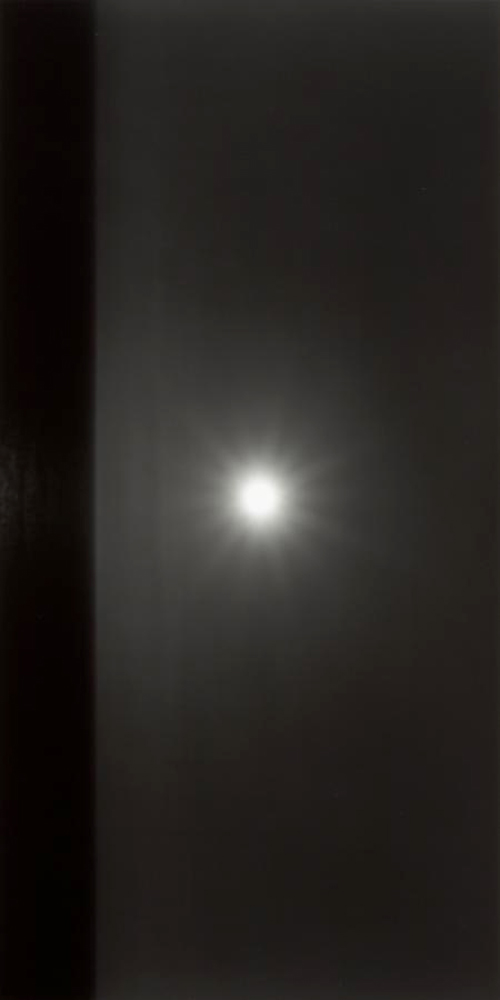
With work from the 1950s to the present day, the exhibition demonstrates the visual affinity between their urgent, blurred and grainy style of photography and also their shared desire to convey street life and political protest, from anti-war demonstrations and gay pride marches to the effects of globalisation and urban deprivation.

The exhibition also considers the medium and dissemination of photography itself, exploring the central role of the photo-book in avant-garde photography and the pioneering use of graphic design within these publications. As well the issues of Provoke magazine in which Moriyama and his contemporaries showcased their work, the exhibition will include fashion photography from Klein’s work with Vogue and installations relating to his satirical films Mister Freedom and Who Are You Polly Maggoo?

Text from the Tate Modern website


William Klein (French born America, 1926-2022) 'Bikini, Moscow' 1959


William Klein (French born America, 1926-2022)
Bikini, Moscow
1959
Gelatin silver print
© William Klein


William Klein (French born America, 1926-2022) 'Piazza di Spagna, Rome' 1960


William Klein (French born America, 1926-2022)
Piazza di Spagna, Rome
1960
Gelatin silver print
© William Klein


William Klein (French born America, 1926-2022) 'Gun 1, New York' 1955


William Klein (French born America, 1926-2022)
Gun 1, New York
1955
Gelatin silver print
© William Klein


William Klein (French born America, 1926-2022) 'lsa Maxwell's Toy ball, Waldorf Hotel, New York' 1955


William Klein (French born America, 1926-2022)
lsa Maxwell’s Toy ball, Waldorf Hotel, New York
1955
Gelatin silver print
© William Klein


William Klein (French born America, 1926-2022) 'Kiev railway station, Moscow' 1959


William Klein (French born America, 1926-2022)
Kiev railway station, Moscow
1959
Gelatin silver print
© William Klein


William Klein (French born America, 1926-2022) 'School out, Dakar' 1963


William Klein (French born America, 1926-2022)
School out, Dakar
1963
Gelatin silver print
© William Klein


William Klein (French born America, 1926-2022) 'Dance Happening in Ginza, Tokyo' 1961


William Klein (French born America, b. 1928)
Dance Happening in Ginza, Tokyo
1961
Gelatin silver print
© William Klein


William Klein + Daidō Moriyama Exhibition Tate Modern, London

Slideshow of images from the press view at the William Klein / Daido Moriyama Exhibition at Tate Modern, London


Explore modern urban life in New York and Tokyo through the photographs of William Klein and Daido Moriyama. This is the first exhibition to look at the relationship between the work of influential photographer and filmmaker Klein, and that of Moriyama, the most celebrated photographer to emerge from the Japanese Provoke movement of the 1960s. With work from the 1950s to the present day, the exhibition demonstrates the visual affinity between their urgent, blurred and grainy style of photography and also their shared desire to convey street life and political protest, from anti-war demonstrations and gay pride marches to the effects of globalisation and urban deprivation. Taking as its central theme the cities of New York and Tokyo, William Klein + Daido Moriyama explores both artists’ celebrated depictions of modern urban life.

The exhibition is formed of two retrospectives side by side, bringing together over 300 works, including vintage prints, contact sheets, film stills, photographic installations and archival material. The influence of Klein’s seminal 1956 publication Life is Good & Good for You in New York, Trance Witness Revels, as well as his later books Tokyo 1964 and Rome: The City and Its People 1959, is traced through Moriyama’s radical depictions of post-war Tokyo in Sayonara Photography and The Hunter 1972. The juxtaposition of these artists not only demonstrates the visual affinity between their urgent, blurred and grainy style of photography, but also their shared desire to convey street life and political protest, from anti-war demonstrations and student protests to the effects of globalisation and urban deprivation.

This exhibition also considers the medium and dissemination of photography itself, exploring the central role of the photo-book in avant-garde photography and the pioneering use of graphic design within these publications. As well the issues of Provoke magazine in which Moriyama and his contemporaries showcased their work, the exhibition includes fashion photography from Klein’s work with Vogue and installations relating to his satirical films Mister Freedom and Who Are You Polly Maggoo? New ways of presenting photography are also demonstrated by Moriyama’s installation Polaroid/Polaroid 1997, which recreates his studio interior through a meticulous arrangement of Polaroid images.

Press release from the Tate Modern website


'William Klein + Daido Moriyama' exhibition banner


William Klein + Daido Moriyama exhibition banner


Daidō Moriyama (Japanese, b. 1938) 'Misawa' 1971


Daidō Moriyama (Japanese, b. 1938)
Misawa
1971
Gelatin silver print
© Daido Moriyama


Daido Moriyama (Japanese, b. 1938) 'Marine Accident (Premeditated or not 5)' 1969


Daidō Moriyama (Japanese, b. 1938)
Marine Accident (Premeditated or not 5)
1969
Gelatin silver print
© Daido Moriyama


William Klein + Daido Moriyama is the first exhibition to examine the relationship between the work of William Klein (born 1928), one of the twentieth century’s most important photographers and film-makers, and that of Daido Moriyama (born 1938), the most celebrated photographer to emerge from the Japanese Provoke movement. Taking as its central theme the cities of New York and Tokyo, William Klein + Daido Moriyama explores both artists’ celebrated depictions of modern urban life.

The exhibition is formed of two retrospectives side by side, bringing together over 300 works, including vintage prints, contact sheets, film stills, photographic installations and archival material. The influence of Klein’s seminal 1956 publication Life is Good & Good for You in New York, Trance Witness Revels, as well as his later books Tokyo 1964 and Rome: The City and Its People 1959, is traced through Moriyama’s radical depictions of post-war Tokyo in Sayonara Photography and The Hunter 1972. The juxtaposition of these artists not only demonstrates the visual affinity between their urgent, blurred and grainy style of photography, but also their shared desire to convey street life and political protest, from anti-war demonstrations and student protests to the effects of globalisation and urban deprivation.

This exhibition also considers the medium and dissemination of photography itself, exploring the central role of the photo-book in avant-garde photography and the pioneering use of graphic design within these publications. As well the issues of Provoke magazine in which Moriyama and his contemporaries showcased their work, the exhibition includes fashion photography from Klein’s work with Vogue and installations relating to his satirical films Mister Freedom and Who Are You Polly Maggoo? New ways of presenting photography are also demonstrated by Moriyama’s installation Polaroid/Polaroid 1997, which recreates his studio interior through a meticulous arrangement of Polaroid images.

William Klein was born in New York, USA in 1928 and now lives and works in Paris, France. Solo exhibitions of his work have been held at the Centre Pompidou, Paris and the Scottish National Gallery, Edinburgh and he received the Outstanding Contribution to Photography Award at the 2012 Sony World Photography Awards.

Daido Moriyama was born in Osaka, Japan in 1938 and moved to Tokyo in 1961, where he continues to live and work. He was recently given a Lifetime Achievement Award by the International Centre of Photography and his work has been the subject of solo exhibitions at the San Francisco Museum of Modern Art; The Cartier Foundation, Paris; and The National Museum of Art, Osaka.

William Klein + Daido Moriyama is co-curated by Simon Baker, Curator of Photography and International Art, Tate, and Juliet Bingham, Curator, Tate Modern, with Kasia Redzisz, Assistant Curator, Tate Modern. The exhibition is accompanied by new books about both photographers from Tate Publishing. A season of film screenings at Tate Modern is also being held to coincide with the exhibition, showing Klein’s feature films and documentaries.

Press release from the Tate Modern website


Daidō Moriyama (Japanese, b. 1938) 'Memory of Dog 2' 1981


Daidō Moriyama (Japanese, born 1938)
Memory of Dog 2
1981
Gelatin silver print
© Daido Moriyama


Daidō Moriyama (Japanese, b. 1938) 'Tokyo color' 2008-2015


Daidō Moriyama (Japanese, born 1938)
Tokyo color
2008-2015
© Daido Moriyama


Daidō Moriyama (Japanese, b. 1938) 'Tokyo' 2011


Daidō Moriyama (Japanese, b. 1938)
Tokyo
2011
Gelatin silver print
Courtesy Daido Moriyama Photo Foundation
© Daido Moriyama


After reading Jack Kerouac’s classic beat novel On The Road, Moriyama began photographing the roads leading into and out of Japanese towns. Instead of places people live in and feel comfortable with, he portrays cities primarily as destinations to be visited and left behind. The resulting book, Hunter (1972), is described as a “road map of images from all over Japan through a moving car window. Routes and roads are the hunting field for me as a photographer.”

Occasionally he finds beauty – in snowflakes falling, a train speeding past, or the patterning of fishnet tights or perforated steel – but ramping up the contrast of his black and white prints, Moriyama more often portrays the world as a dangerous place engulfed in existential darkness.

In all this chaos, his studio appears like a beacon of calm and stability. Recorded in a grid of polaroid shots, the room is recreated as an installation that offers a rare glimpse of clarity and colour in what can otherwise feel like a miasma – the world as seen through a dark fog.

While Klein undoubtedly influenced Moriyama’s love of grainy, out-of-focus shots taken from odd angles, to pair him with the American tells only half the story. Warhol was equally important as the inspiration behind his Accident series, which includes car crashes, shipping disasters, executions and a health scare linked to overcrowded beaches. Moriyama’s use of found images (the car crashes come from posters), his fascination with serialisation (banks of tins on supermarket shelves) and with juxtaposing unrelated images on a page were also inspired by Warhol. So pairing him with Klein is interesting, but doesn’t do him justice. Moriyama deserves to be seen as a law unto himself, rather than an acolyte of a more familiar western photographer.

Sarah Kent. “William Klein + Daido Moriyama, Tate Modern,” on The Arts Desk website Thursday, 11 October 2012 [Online] Cited 05/09/2022


Daidō Moriyama (Japanese, b. 1938) 'Setagaya-ku, Tokyo, Midnight 1986'


Daidō Moriyama (Japanese, b. 1938)
Setagaya-ku, Tokyo, Midnight
1986
Gelatin silver print
Courtesy Daido Moriyama Photo Foundation
© Daido Moriyama


Daidō Moriyama (Japanese, b. 1938) 'Another Country in New York' 1971


Daidō Moriyama (Japanese, b. 1938)
Another Country in New York
1971
Gelatin silver print
Tokyo Polytechnic University
© Daido Moriyama


Tate Modern
Bankside
London SE1 9TG

Opening hours:
Monday to Sunday 10.00 – 18.00

Tate Modern website

LIKE ART BLART ON FACEBOOK

Back to top