Exhibition: ‘William Christenberry: Photographs, 1961-2005’ at the Morris Museum of Art, Augusta, Georgia

Exhibition dates: 12th September – 8th November, 2009


Many thankx to the Morris Museum of Art for allowing me to publish the photographs in the posting. Please click on the photographs for a larger version of the image.


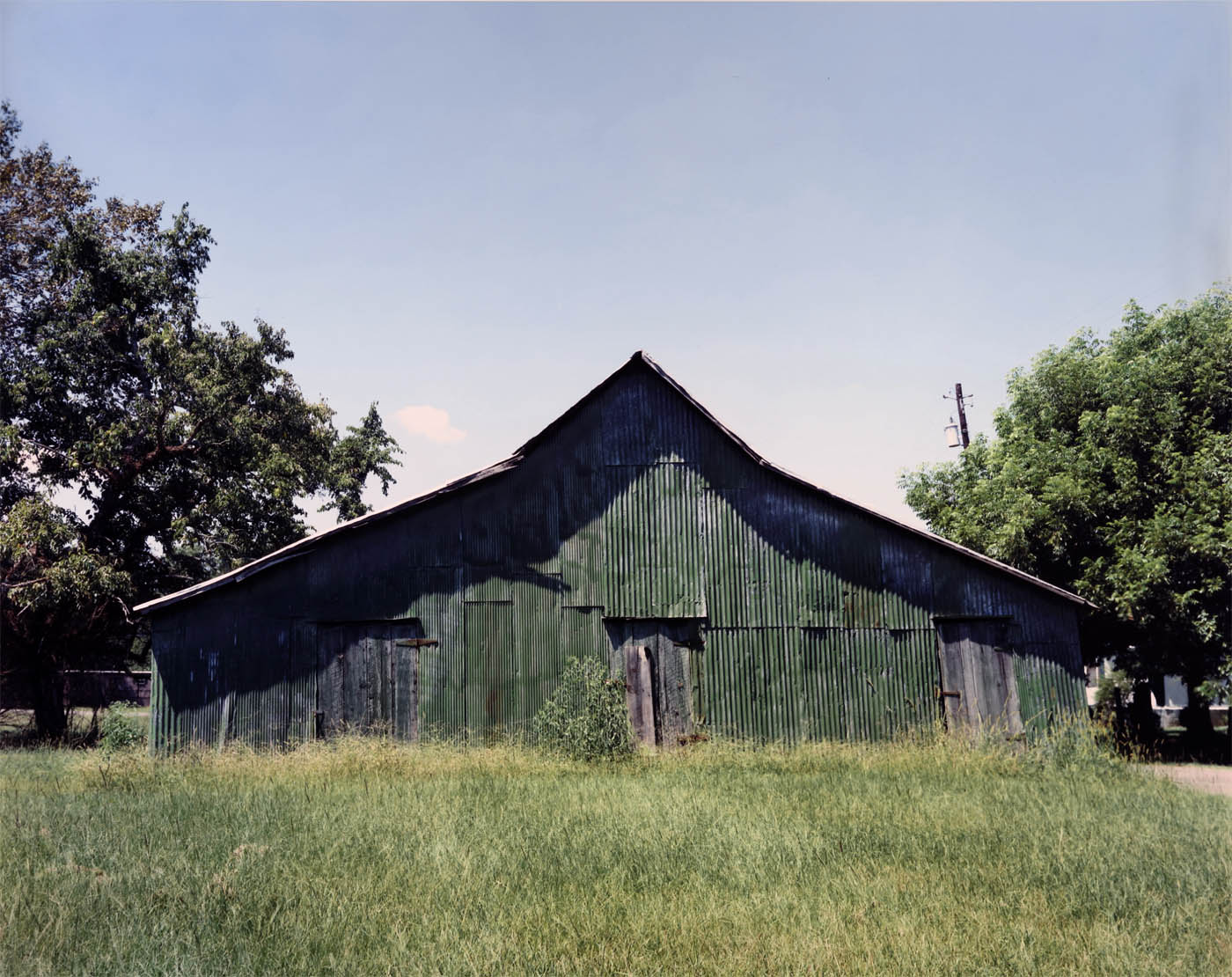
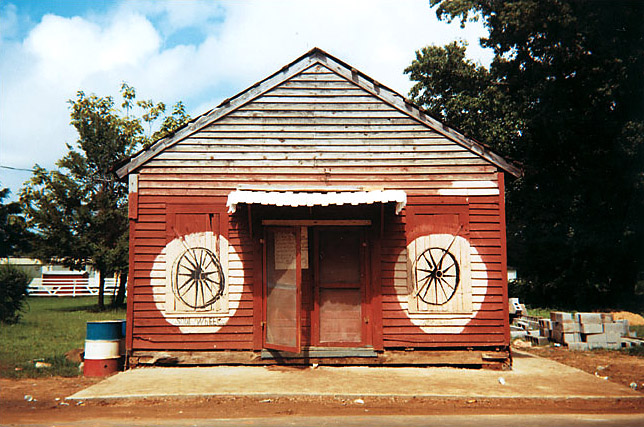
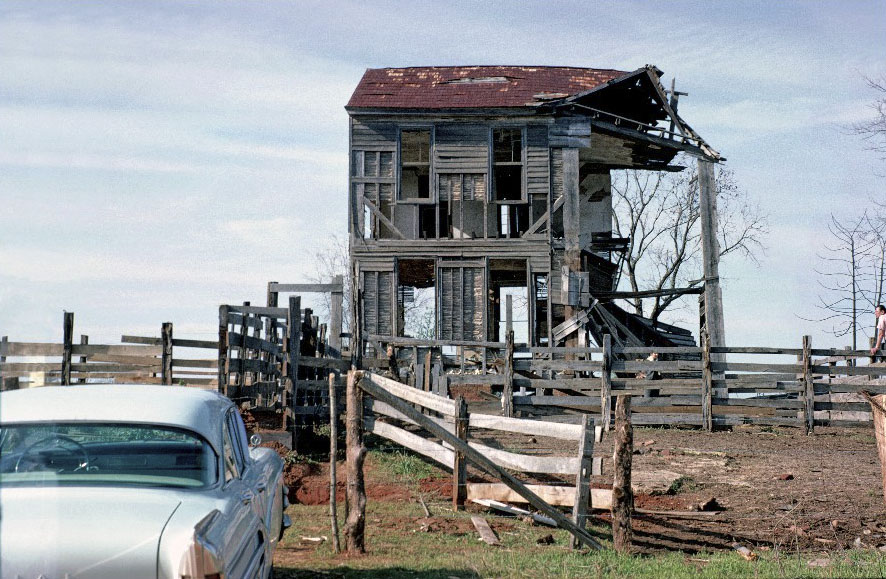
William Christenberry (American, 1936-2016) 'Green Warehouse, Newbern, Alabama' 1997 from the exhibition 'William Christenberry: Photographs, 1961-2005' at the Morris Museum of Art, Augusta, Georgia, Sept - Nov, 2009


William Christenberry (American, 1936-2016)
Green Warehouse, Newbern, Alabama
1997
Dye coupler print


Widely recognised as a pioneer in the field of colour photography, William Christenberry has used this expressive medium to explore the American South for forty years. While pursuing this artistic quest he has drawn inspiration from Walker Evans, and influenced a generation of emerging photographers. William Christenberry: Photographs, 1961-2005 surveys his poetic documentation of southern vernacular architecture, signage, and landscape using a wide range of cameras, from his earliest Brownie photographs of the early 1960s to his later work with a large-format camera. Combining never-before-seen photographs, both old and new, with images that are now iconic, this exhibition comprises fifty vintage photographic works and one sculpture. Together, they convey the breadth of his singular photographic vision. Discuss the artistic objectives of his long-term interpretation of the Southern landscape with Michelle Norris of National Public Radio, Christenberry explained: “What I really feel very strongly about, and I hope reflects in all aspects of my work, is the human touch, the humanness of things, the positive and sometimes the negative and sometimes the sad.”

Text from the Morris Museum of Art website [Online] Cited 15/10/2009. No longer available online


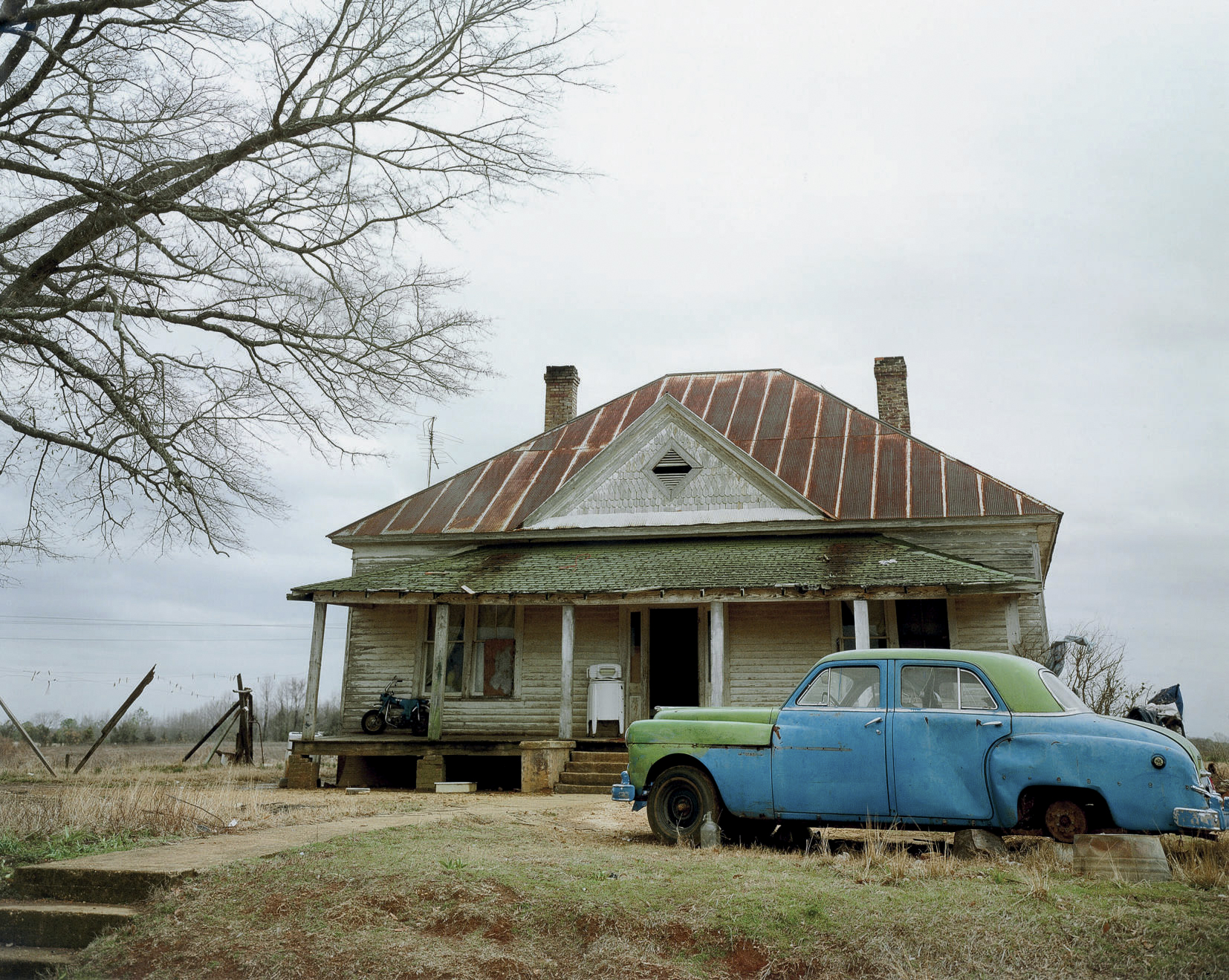
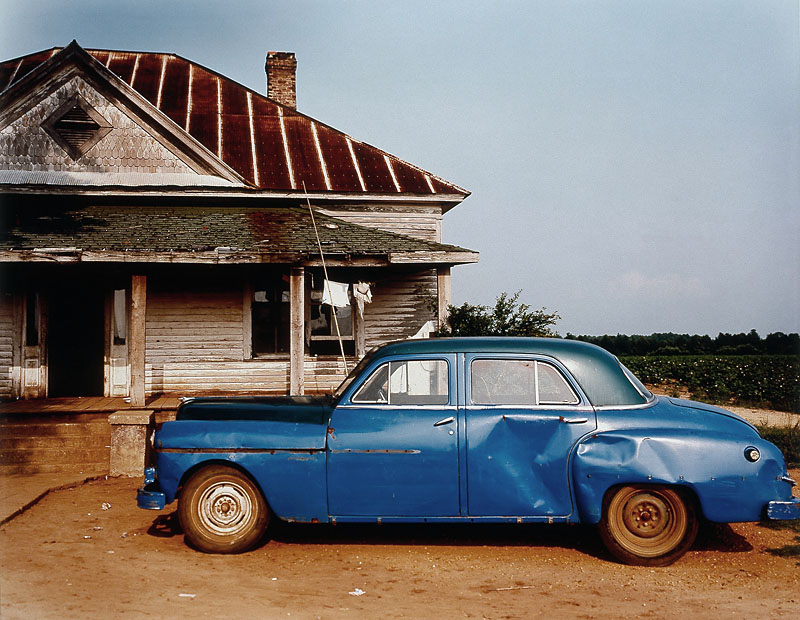
William Christenberry (American, 1936-2016) 'House and Car, near Akron, Alabama' 1981 from the exhibition 'William Christenberry: Photographs, 1961-2005' at the Morris Museum of Art, Augusta, Georgia, Sept - Nov, 2009


William Christenberry (American, 1936-2016)
House and Car, near Akron, Alabama
1981


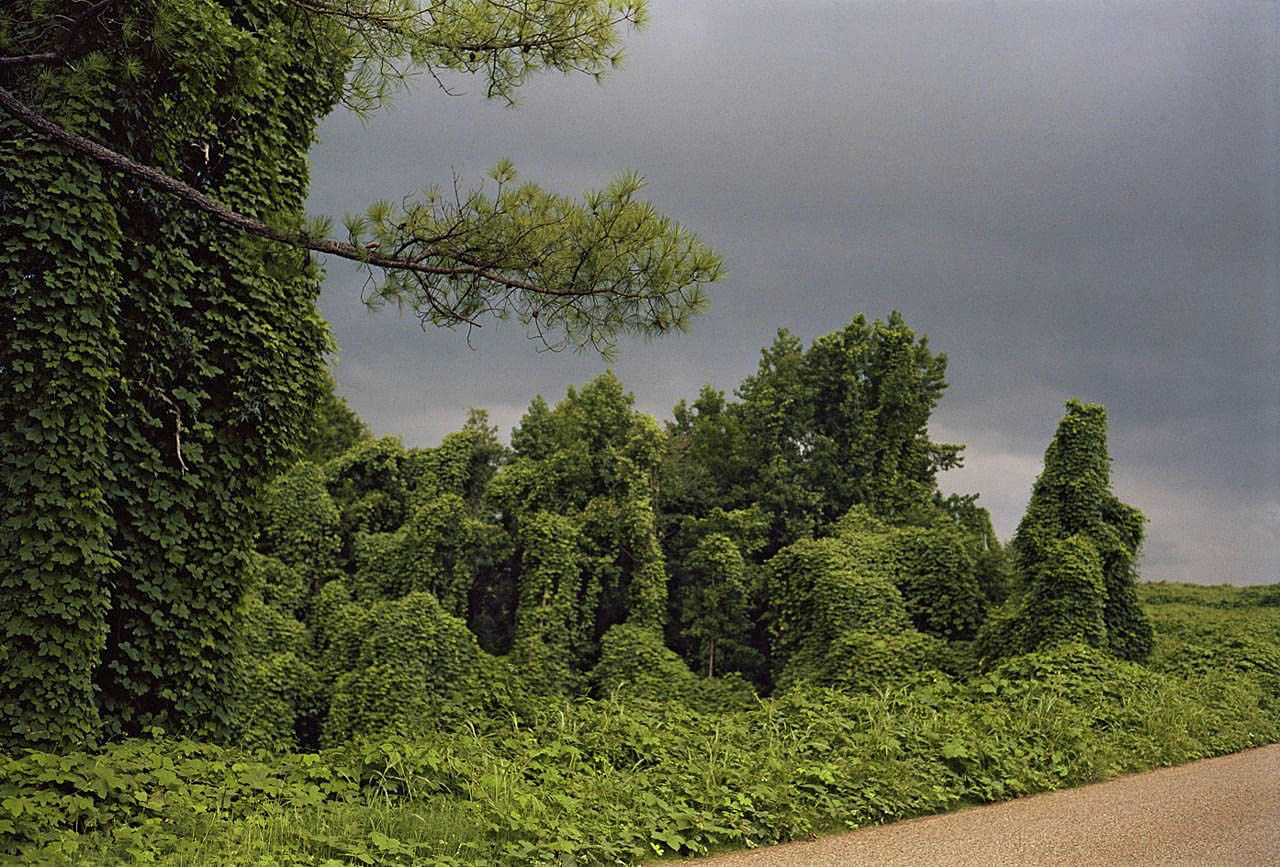
William Christenberry (American, 1936-2016) 'Kudzu with Storm Cloud, near Akron, Alabama' 1981


William Christenberry (American, 1936-2016)
Kudzu with Storm Cloud, near Akron, Alabama
1981


“William Christenberry Photographs, 1961-2005, a phenomenal retrospective exhibition of Christenberry’s photographs, opens to the public at the Morris Museum of Art on September 16, 2009. The Morris Museum is the only Georgia venue hosting this exhibition.

“‘William Christenberry Photographs, 1961-2005’ is an overview of the career of one of the South’s most important living artists,” said Kevin Grogan, director of the Morris Museum of Art. “Organised by the Aperture Foundation, this exhibition brings to Augusta a body of work like no other. No one has so scrupulously and attentively captured a sense of place and time in quite the way that Bill Christenberry has. He is a remarkable artist, as is proven by this extraordinary body of work. He is America’s Proust.”

Since the early 1960s, William Christenberry has plumbed the regional identity of the American South, focusing his attention primarily on his childhood home, Hale County, Alabama. Widely recognised as a pioneer in the field of colour photography, Christenberry draws inspiration from the work of Walker Evans, while paralleling the work of such international practitioners as Bernd and Hilla Becher. Ranging from his earliest Brownie photographs to his later work with a large-format camera, William Christenberry Photographs, 1961-2005 is a survey of the artist’s poetic documentation of the Southern landscape and vernacular architecture that surrounded him as he grew up. The exhibition, coupling never-before-seen photographs with images that are now iconic, reveals how the history, the very story of place, is at the heart of Christenberry’s ongoing project. While the focus of his work is the American South, it touches on universal themes related to family, culture, nature, spirituality, memory, and ageing. Christenberry photographs real things in the real world – ramshackle buildings, weathered commercial signs, lonely back roads, rusted-out cars, whitewashed churches, decorated graves. Dutifully returning to photograph the same locations annually – the green barn, the palmist building, the Bar-B-Q Inn, among others – he has fulfilled a personal ritual and documented the physical changes wrought by every single year. Straddling past and present, Christenberry’s art suggests the gravity and power of the passage of time.

The exhibition is accompanied by a stunning monograph entitled William Christenberry, published by Aperture in cooperation with the Smithsonian American Art Museum. The book, a comprehensive survey, presents all aspects of the artist’s oeuvre as he intended it to be viewed and considered. More than half the work reproduced has not been previously published.”

Text from the press release on the Morris Museum of Art website [Online] Cited 15/10/2009. No longer available online


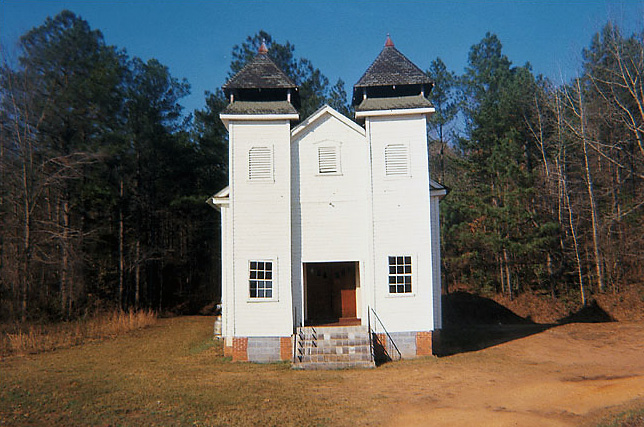
William Christenberry (American, 1936-2016) 'Sprott Church in Alabama' 1971


William Christenberry (American, 1936-2016)
Sprott Church in Alabama
1971


William Christenberry (American, 1936-2016) 'T.B. Hick's Store, Newbern, Alabama' 1976 from the exhibition 'William Christenberry: Photographs, 1961-2005' at the Morris Museum of Art, Augusta, Georgia, Sept - Nov, 2009


William Christenberry (American, 1936-2016)
T.B. Hick’s Store, Newbern, Alabama
1976


William Christenberry (American, 1936-2016) 'Farmhouse, Hale County, Alabama' 1977


William Christenberry (American, 1936-2016)
Farmhouse, Hale County, Alabama
1977


William Christenberry (American, 1936-2016) 'House and Car, near Akron, Alabama' 1978


William Christenberry (American, 1936-2016)
House and Car, near Akron, Alabama
1978


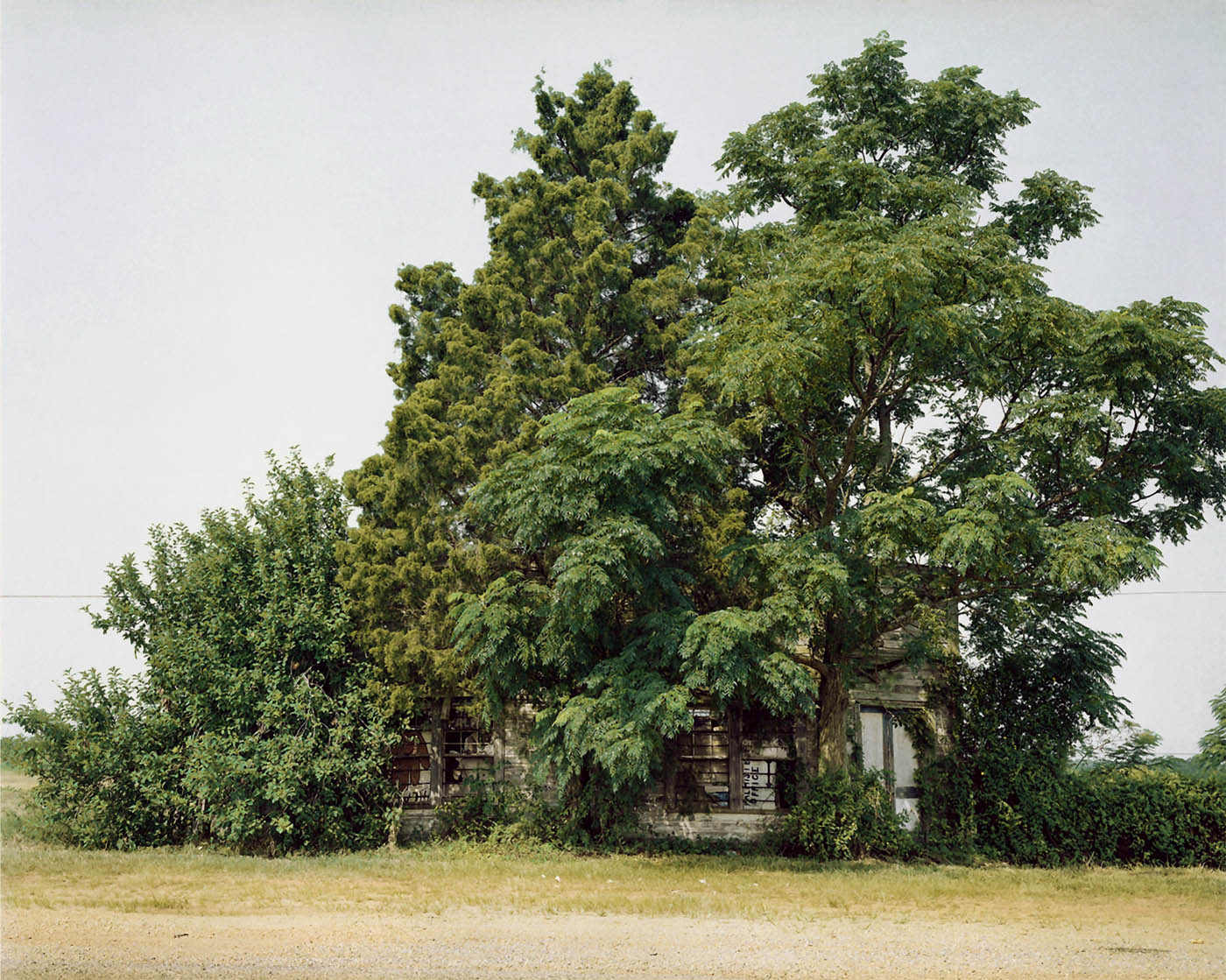
William Christenberry (American, 1936-2016) 'Palmist Building, Havanna, Alabama' 1980


William Christenberry (American, 1936-2016)
Palmist Building, Havanna, Alabama
1980


The Palmist Building is one of the most iconic structures in Christenberry’s extensive body of work. When he was a child, the clapboard building was a general store operated by his great uncle, but it was later home to a palm reader. The inverted hand-painted sign that covers a broken window initially enticed him to photograph the building in 1961. His earliest photographs pinpoint the sign itself and the peeling whitewash around it. As he became more engrossed in the project, Christenberry carefully examined the relationship of the building to its surroundings, particularly the chinaberry tree that eventually engulfed it.

Text from the High Museum of Art website


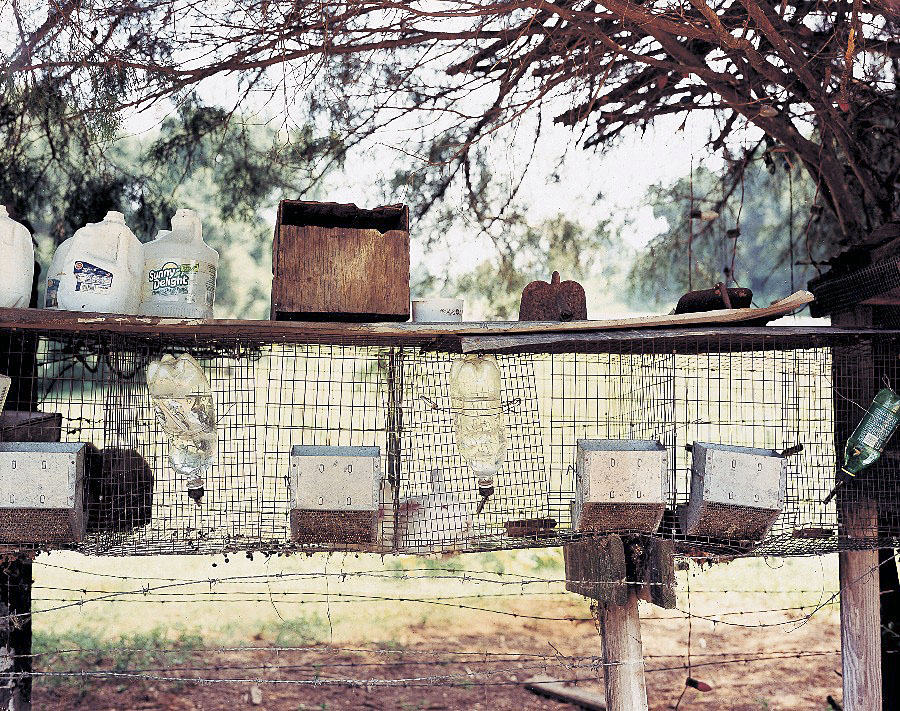
William Christenberry (American, 1936-2016) 'Rabbit Pen, near Moundville, Alabama' 1998


William Christenberry (American, 1936-2016)
Rabbit Pen, near Moundville, Alabama
1998


William Christenberry (American, 1936-2016) 'Old House, near Akron, Alabama' 1964


William Christenberry (American, 1936-2016)
Old House, near Akron, Alabama
1964


Morris Museum of Art
1 Tenth Street
Augusta, Georgia 30901
Phone: 706-724-7501

Opening Hours:
Tuesday – Saturday: 10.00am – 5.00pm
Sunday: 12 – 5.00pm
Closed Mondays and major holidays

Morris Museum of Art website

LIKE ART BLART ON FACEBOOK

Back to top

Exhibition: ‘Proud Flesh’ by Sally Mann at Gagosian Gallery, New York

Exhibition dates: 15th September – 31st October, 2009


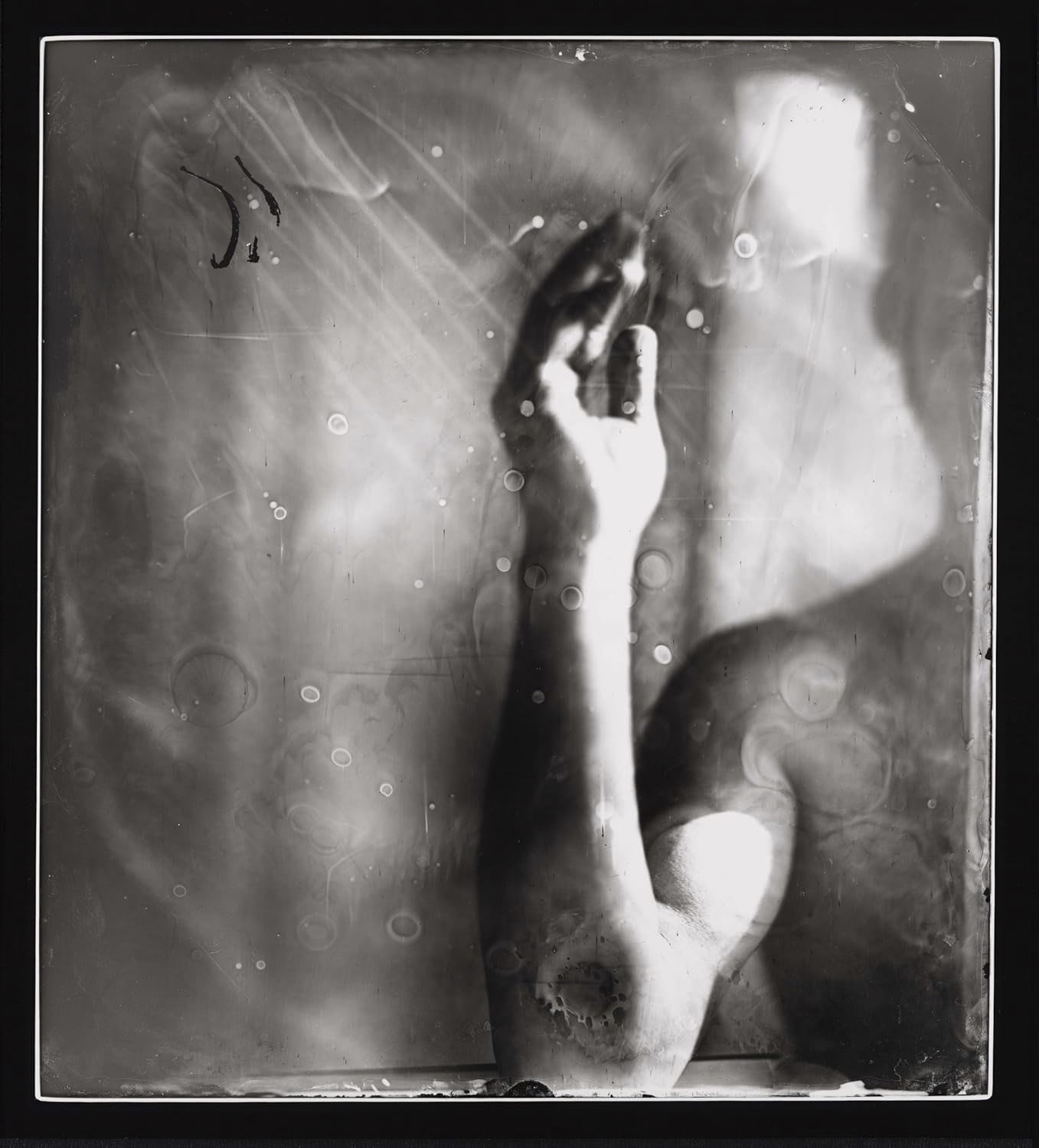
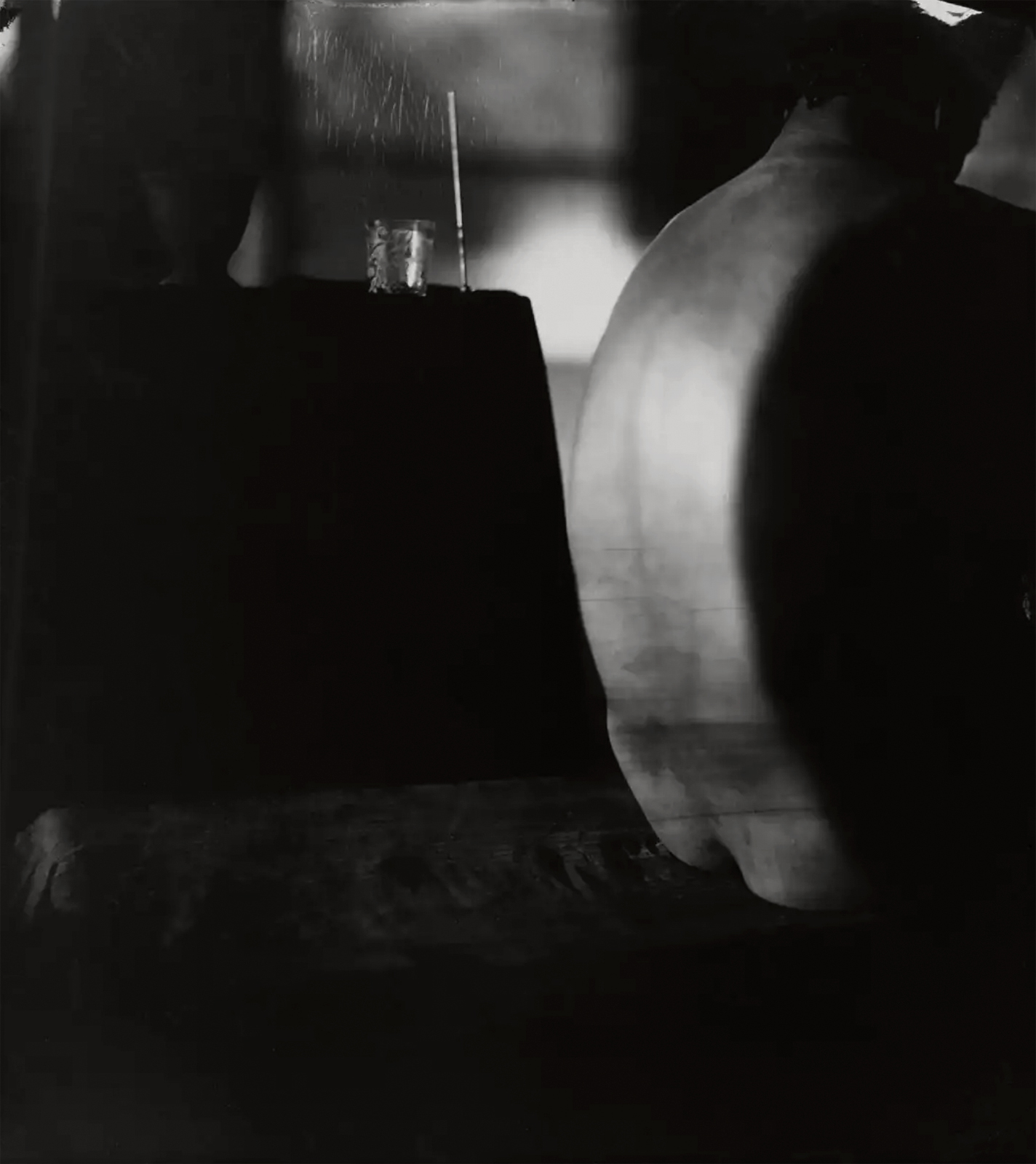
Sally Mann (American, b. 1951) 'Memory's Truth' 2008 from the exhibition 'Proud Flesh' by Sally Mann at Gagosian Gallery, New York, Sept - Oct, 2009


Sally Mann (American, b. 1951)
Memory’s Truth
2008
Gelatin silver print
Contact print from a wet-plate collodion negative


“I can think of numberless males, from Bonnard to Callahan, who have photographed their lovers and spouses, but I am having trouble finding parallel examples among my sister photographers. The act of looking appraisingly at a man, making eye contact on the street, asking to photograph him, studying his body, has always been a brazen venture for a woman, though, for a man, these acts are commonplace, even expected.”


Sally Mann


Many thankx to Gagosian Gallery for allowing me to publish the photographs in the posting. Please click on some of the photographs for a larger version of the image.


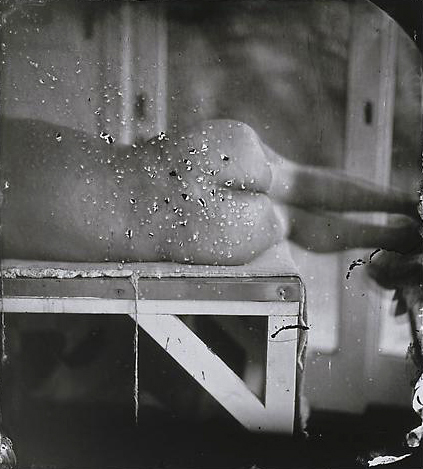
Proud Flesh is for me an emotionally exhausting work about withering. It has elements of 19th century clinical photography done with absolute loving care for the subject. Its factual surface is quickly replaced by metaphor and the haze of imperfection from the wet-plate collodion negatives she employs. In a few of the images, due to the choice of striped bedding on which the figure lays, we might be looking at a historical photograph take from Auschwitz or Bergen Belsen. With Larry’s thin and seemingly weak legs dangling over the edge of a wooden cot, the soiled bedding following the contour of his legs, it is difficult for me to see this image without this harsh historical reference. The following image in the book, he is turned into a martyr – arms out stretched – the sheet underneath him now sharply crinkled like a bed of straw (or an imagined crown of thorns).

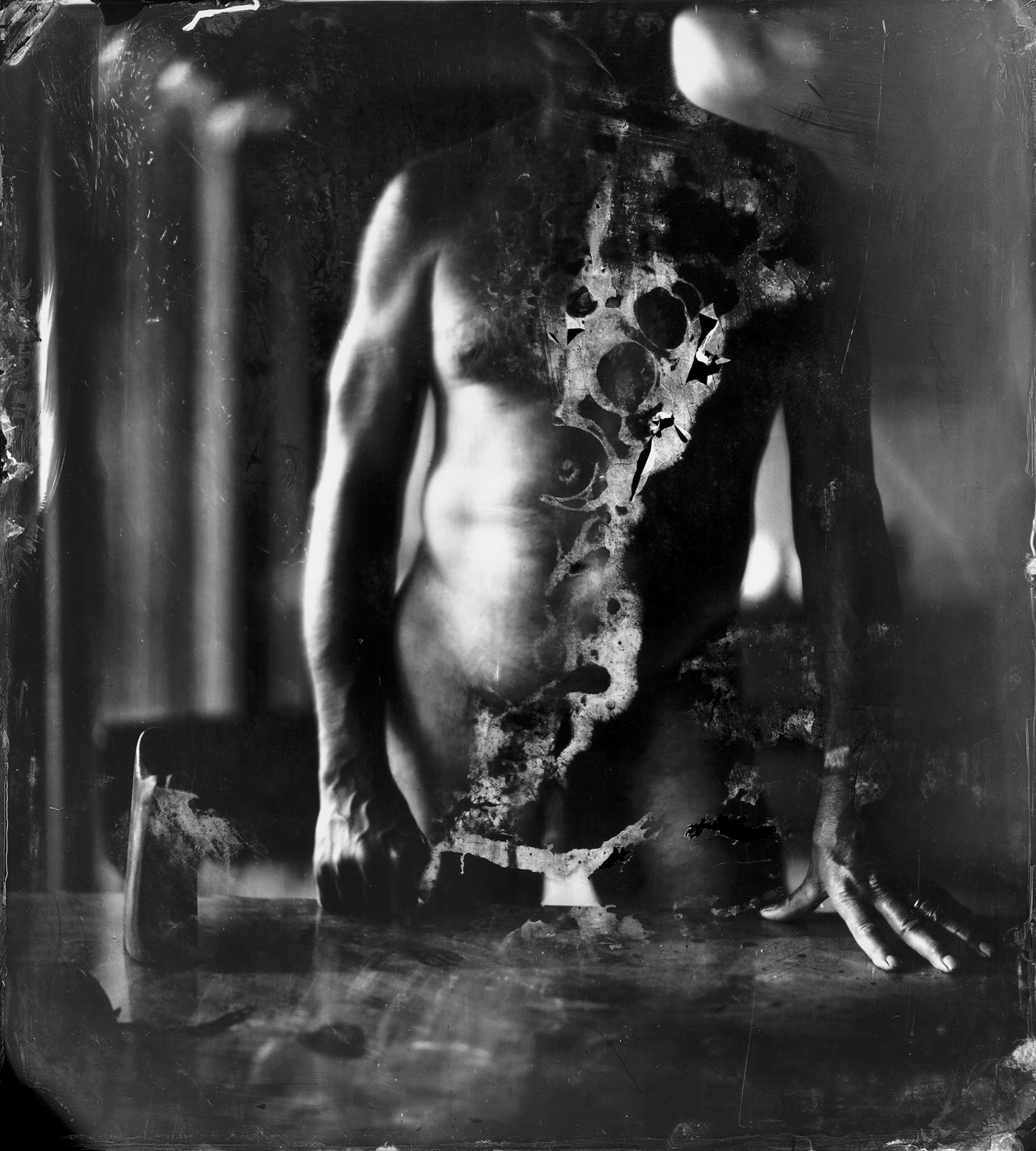
The surface texture plays such a strong role in these photos much of the seduction of these photos comes from the beauty of those imperfections. At times they can be nauseating, for their liquid streaks ooze over the images of aged flesh keeping viscera and bodily fluids as a second metaphoric subject. On the cover image, the disturbed collodion emulsion leaves a pattern which seems to be both looking at, and looking inside, the torso standing before the camera. Like Lee Friedlander’s shadow self-portrait (see the cover of Like a One-eyed Cat) where his organs are replaced with a jumble of rocks and his head is filled with straw, Mann’s image turns Larry’s insides into a mix of man and machine – collodion cogs and gears. This is the most wishful, as it portrays the strongest sense of life and the perhaps even the possibility of escaping its mortality. He stands at table’s edge with a steadying hand and a closed fist.

The most remarkable image for me appears as plate 20 and is captioned Time and the Bell (2008). Like the aforementioned cover image, this is an ideal as Mann has turned her husband’s head and shoulders into a profile bust of marble – the washed out light tones give way to a few angular shapes of rich shadow. It could be a still life of artefacts from an artists work space, a table and a sculptural work in progress. The surprise of the photographic description, which is present in most of the photos in Proud Flesh, is so complex and engaging for me it is difficult to not have it outshine all of the rest.

Text from 5B4: Photography and Books blog October 1, 2009 [Online] Cited 28/04/2019. No longer available online


Sally Mann (American, b. 1951) 'Semaphore' 2003


Sally Mann (American, b. 1951)
Semaphore
2003
Gelatin silver print
Contact print from a wet-plate collodion negative


Sally Mann (American, b. 1951) 'Hephaestus' 2008 from the exhibition 'Proud Flesh' by Sally Mann at Gagosian Gallery, New York, Sept - Oct, 2009


Sally Mann (American, b. 1951)
Hephaestus
2008
Gelatin silver print
Contact print from a wet-plate collodion negative


Sally Mann’s poignant image of her husband, Larry, symbolises both his illness and his skill as a blacksmith.


Sally Mann (American, b. 1951) 'The Nature of Loneliness' 2008


Sally Mann (American, b. 1951)
The Nature of Loneliness
2008
Gelatin silver print
Contact print from a wet-plate collodion negative
15 x 13 1/2 inches


Sally Mann (American, b. 1951) 'Somnambulist' 2009


Sally Mann (American, b. 1951)
Somnambulist
2009
Gelatin silver print
Contact print from a wet-plate collodion negative


Gagosian Gallery is pleased to present “Proud Flesh”, a series of new photographs by Sally Mann.

Children, landscape, lovers – these iconic subjects are as common to the photographic lexicon as light itself. But Mann’s take on them, rendered through processes both traditional and esoteric, is anything but common. From the outset of her career she has consistently challenged the viewer, rendering everyday experiences at once sublime and deeply disquieting.

In previous projects, Mann has explored the relationships between parent and child, brother and sister, human and nature, site and history. Her latest photographic study of her husband Larry Mann, taken over six years, has resulted in a series of candid nude studies of a mature male body that neither objectifies nor celebrates the focus of its gaze. Rather it suggests a profoundly trusting relationship between woman and man, artist and model that has produced a full range of impressions – erotic, brutally frank, disarmingly tender, and more. While the relation of artist and model is, traditionally, a male-dominated field that has yielded countless appraisals of the female body and psyche, Mann reverses the role by turning the camera on her husband during some of his most vulnerable moments.

Mann’s technical methods and process further emphasise the emotional and temporal aspects of these fragile life studies. The images are contact prints made from wet-plate collodion negatives, produced by coating a sheet of glass with ether-based collodion and submerging it in silver nitrate. Mann exploits the surface aberrations that can result from the unpredictability of the process to produce painterly photographs marked by stark contrasts of light and dark, with areas that resemble scar tissue. In works such as Hephaestus and Ponder Heart, the scratches and marks incurred in the production process become inseparable from the physical reality of Larry’s body.”

Text from the Gagosian Gallery website [Online] Cited 10/10/2009. No longer available online


Sally Mann (American, b. 1951) 'Kingfisher's Wing' 2007


Sally Mann (American, b. 1951)
Kingfisher’s Wing
2007
Gelatin silver print
Contact print from a wet-plate collodion negative


Sally Mann (American, b. 1951) 'The Quality of the Affection' 2006


Sally Mann (American, b. 1951)
The Quality of the Affection
2006
Gelatin silver print
Contact print from a wet-plate collodion negative


Sally Mann (American, b. 1951) 'Ponder Heart' 2009


Sally Mann (American, b. 1951)
Ponder Heart
2009
Gelatin silver print
Contact print from a wet-plate collodion negative


Sally Mann (American, b. 1951) 'Was Ever Love' 2009


Sally Mann (American, b. 1951)
Was Ever Love
2009
Gelatin silver print
Contact print from a wet-plate collodion negative


Gagosian Gallery – Madison Avenue Gallery
980 Madison Avenue
New York, NY 10075
Phone: 212.744.2313

Opening hours:
Tuesday – Saturday 10am – 6pm

Gagosian Gallery website

LIKE ART BLART ON FACEBOOK

Back to top

Exhibition: ‘Doug Aitken’ at Regen Projects, Los Angeles

Exhibition dates: 12th September – 17th October, 2009


Many thankx to Regen Projects for allowing me to publish the art work in the posting. Please click on the photographs for a larger version of the image.


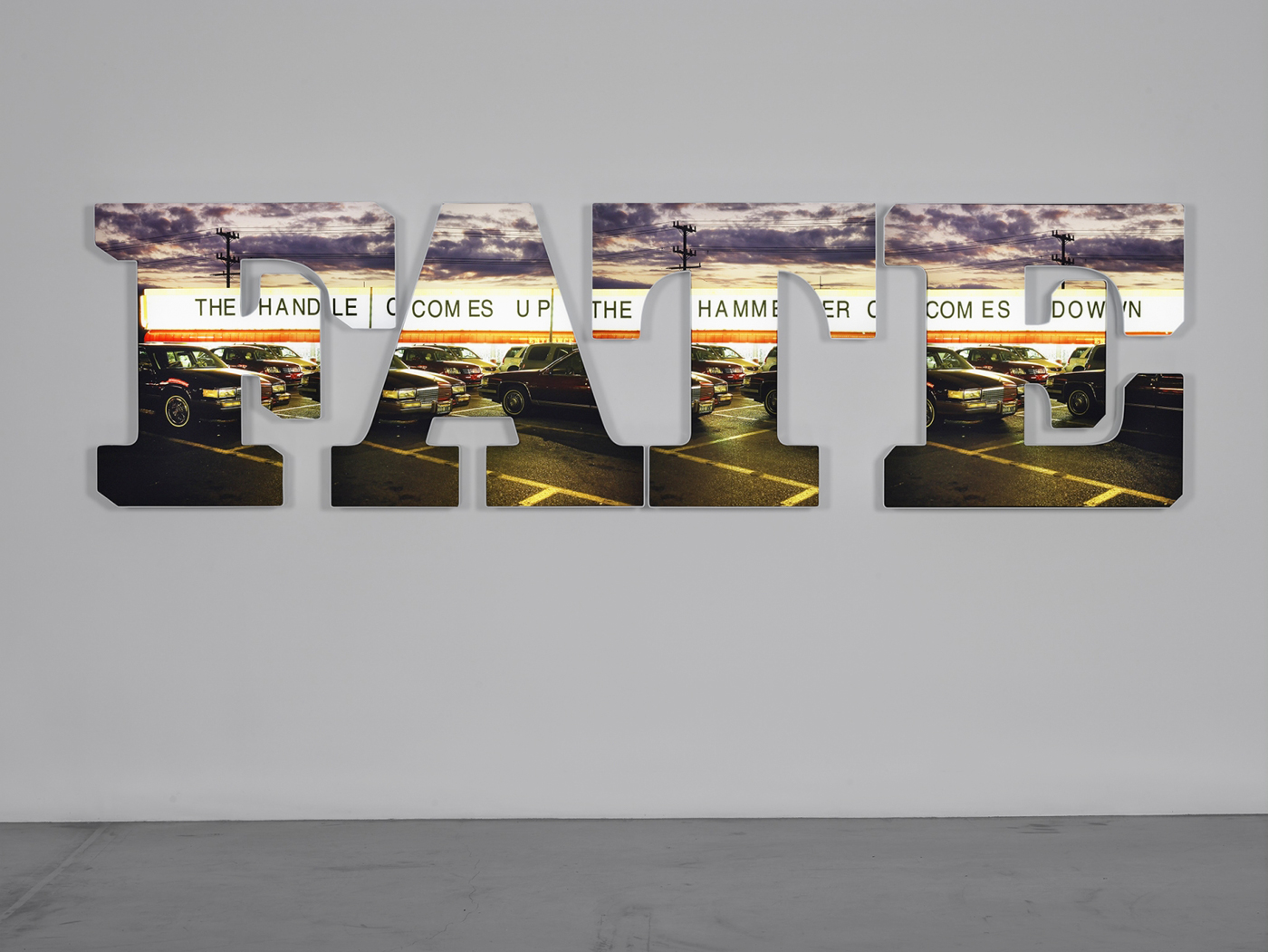
Doug Aitken (American, b. 1968) 'The handle comes up, the hammer comes down' 2009 from the exhibition 'Doug Aitken' at Regen Projects, Los Angeles, Sept - Oct, 2009


Doug Aitken (American, b. 1968)
The handle comes up, the hammer comes down
2009
LED lit lightbox


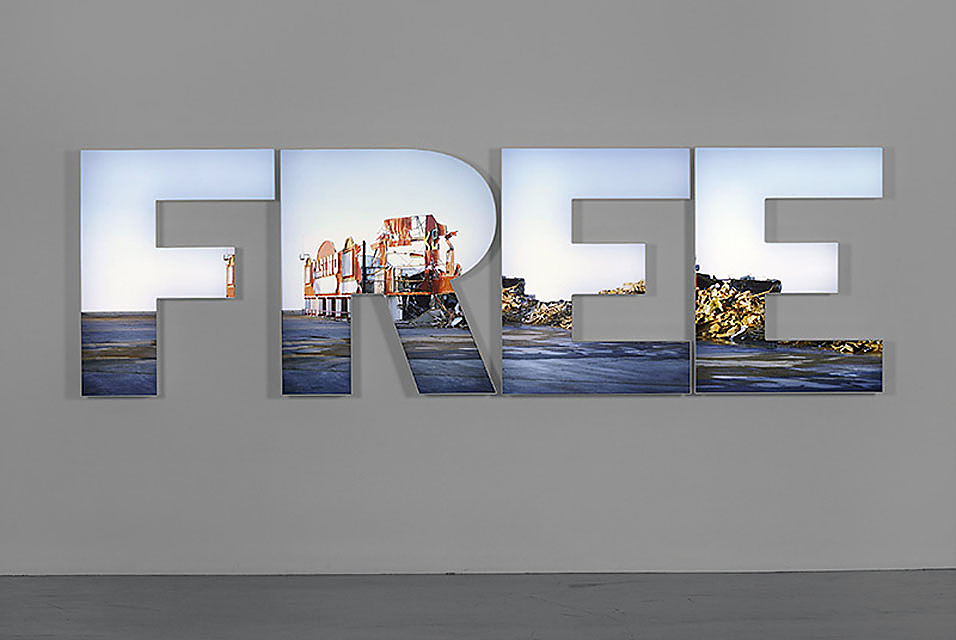
Doug Aitken (American, b. 1968) 'Free' 2009 from the exhibition 'Doug Aitken' at Regen Projects, Los Angeles, Sept - Oct, 2009


Doug Aitken (American, b. 1968)
Free
2009
LED lit lightbox


Doug Aitken (American, b. 1968) 'Start Swimming' 2006 from the exhibition 'Doug Aitken' at Regen Projects, Los Angeles, Sept - Oct, 2009


Doug Aitken (American, b. 1968)
Start Swimming
LED lit lightbox
2006


Doug Aitken (American, b. 1968) 'Start Swimming' 2006


Doug Aitken (American, b. 1968)
Start Swimming
LED lit lightbox
2006


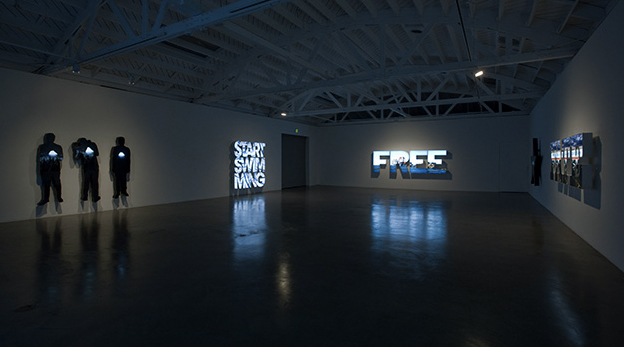
Installation view of ;Doug Aitken; at Regen Projects, Los Angeles


Installation view of Doug Aitken at Regen Projects, Los Angeles


Regen Projects is pleased to announce an exhibition of new works by Los Angeles artist Doug Aitken. This exhibition will present a series of new text-based light boxes and will feature the west coast debut of the film migration. Aitken explores the themes of temporality, space, memory, movement, and landscape in his work. History and themes of both the past and present are interwoven and reconfigured. His work deconstructs the connection between idea and iconography allowing each to reinvent itself.

Doug Aitken’s new light boxes combine image and text in a collision that creates a rupture in which alternate connections are presented. The work frontier depicts a destroyed property on the water’s edge, redefining expectations of what a frontier may hold. The images within some of the light boxes are a photographic collage that references Aitken’s photographic oeuvre and aesthetic. Experimenting with font, borrowed images, and his own photographs, the light boxes will be presented in the darkened gallery, glowing and playing off of one another. The disjunction of word, image, and light in these works also moves toward a cinematic whole, creating panoramic landscapes through text.

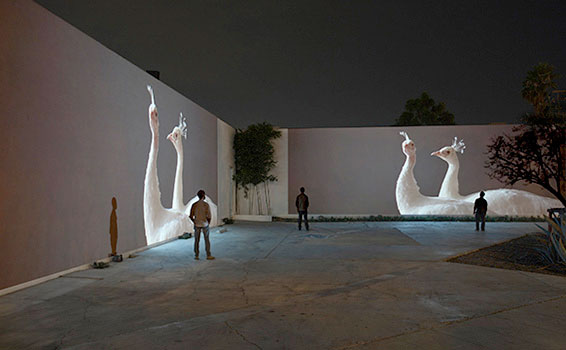
Presented alongside the light boxes will be Aitken’s first large scale public installation in Los Angeles, migration. The film, the first instalment in a three-part trilogy entitled empire, debuted at the 2008 Carnegie International. This hallucinatory epic depicts the movements of migratory animals as they pass through vacant and deserted hotel and motel rooms, delineating a nomadic passage across America from east to west. Fittingly making its first appearance on the west coast, this large-scale cinematic installation will be presented to the public on Santa Monica Boulevard projected onto the courtyard of Regen Projects II; visible only at night from sunset to sunrise. In addition to the nighttime public presentation, migration will also be exhibited at the 633 North Almont Drive space on an indoor billboard accompanied by its original score.

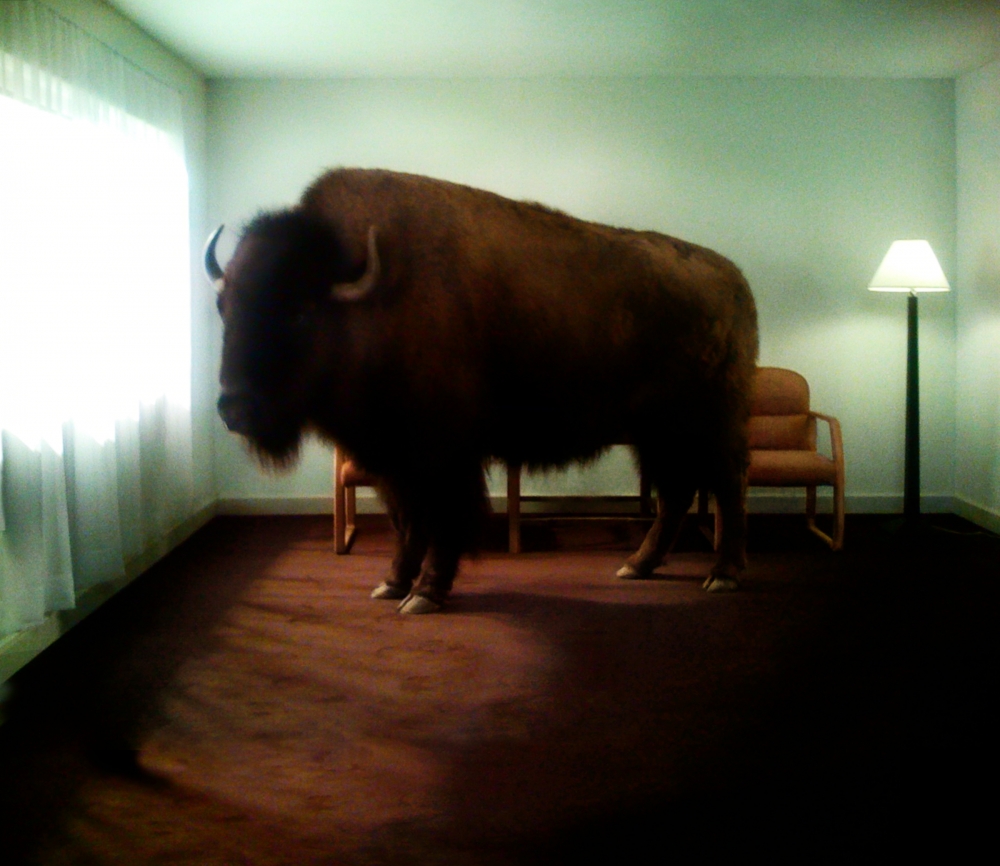
Settlers who met the untamed wilderness to forge new ways of life defined westward expansion. Aitken’s migratory landscape in migration is the opposite; it is a landscape completely devoid of human presence. His non-linear narrative presents a series of different sequences in which the animals and their actions are unique while the rooms and their components are indistinguishable. Hotels such as these offer a sense of both security and isolation and while some animals adapt to these surroundings, others seem conspicuously strange. Rarely do we get to examine these creatures so closely. Their movements and presence make the viewer acutely aware of scale, calling into question various relationships; the most apparent of which is the relationship of the natural and the man-made. In this encounter between the urban and the indigenous the viewer gets a sense of both displacement and habituation. As one critic describes:

“One by one, at different hotels, the animals behave as they behave, sniffing the air, twitching their noses to orient themselves in the desolate human habitat. Imbued with Aitken’s usual intimations of planetary solitude, his sense of spatial dislocation, and gorgeous formalised perception, these images … have the quality not so much of a nonlinear narrative as of a mirage.” (Kim Levin, Artnews, January 2009, p. 110.)


Aitken’s work has been exhibited extensively at museums and galleries worldwide, including his 2007 exhibition “sleepwalkers,” a large-scale outdoor installation at the Museum of Modern Art, New York. He has had numerous solo exhibitions including shows at the Serpentine Gallery, the Kunstmuseum Wolfsberg, the Kunsthaus Bregenz and the Kunsthalle Zurich. Aitken was awarded the international prize at the Venice Biennale in 1999 and was included in the 2000 Whitney Biennial.

Text from the Regen Projects website [Online] Cited 01/11/2009. No longer available online


Doug Aitken (American, b. 1968) Still from 'Migration' 2008

Doug Aitken (American, b. 1968) Still from 'Migration' 2008

Doug Aitken (American, b. 1968) Still from 'Migration' 2008

Doug Aitken (American, b. 1968) Still from 'Migration' 2008

Doug Aitken (American, b. 1968) Still from 'Migration' 2008

Doug Aitken (American, b. 1968) Still from 'Migration' 2008


Doug Aitken (American, b. 1968)
Stills from Migration
2008
Single video projection with billboard (steel and PVC projection screen)


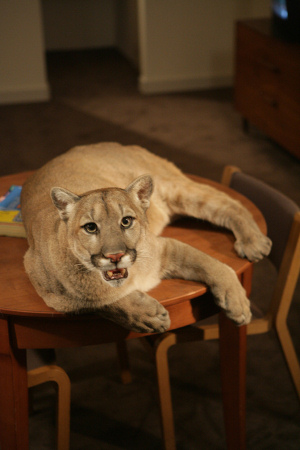
In Migration, peacocks, deer, and beaver are filmed occupying motel rooms in vignettes that strike a poignant, provocative chord: talk about unexpected guests. Nevertheless, the work isn’t funny; it’s too frank in its beauty, too finely and respectfully wrought to be a joke.

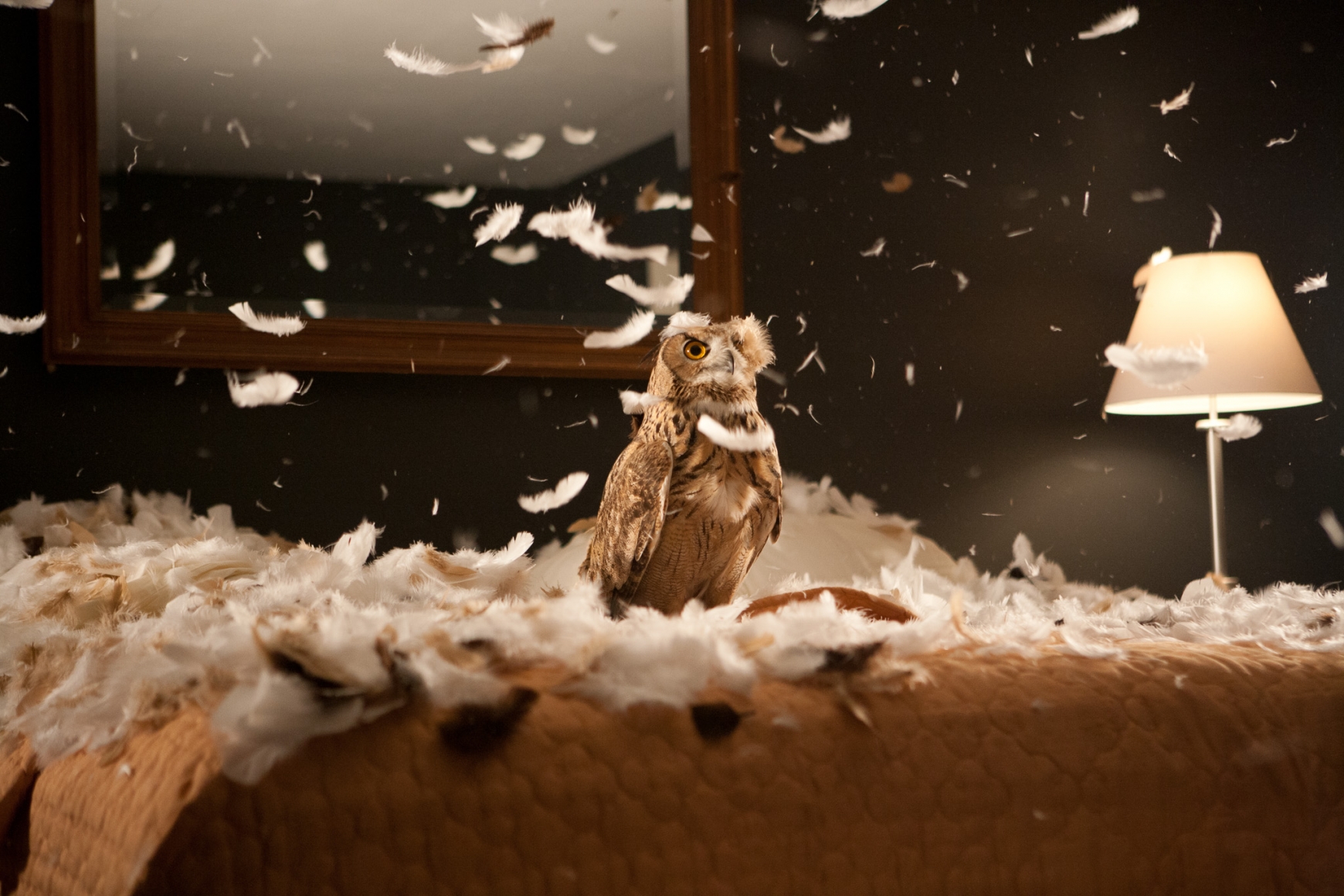
Aitken’s animals are frequently shot in close perspective, which enhances their beauty in a way that is mesmerising. We’re not looking through them as much as we’re looking alongside them, ingesting the utter foreignness of their environs. As evening falls, we see an owl, an already otherworldly creature whose glowing eyes appear extraterrestrial, blinking at us from its perch on a king-size bed. Against the singsong of chirping birds, the camera pans away from the stationary owl as the room fills with thousands of downy feathers. Light is a powerful character in the film, whether gently filtered through sheer curtains or spilling onto carpeted hallways. Rather than highlighting imperfections or ugliness, the light is salvic, evincing a limbo that’s illuminating and warming. In one way or another, all of Aitken’s animals are drawn to light, whether toward a blinking lamp, the refracted surface of a swimming pool, or even the glow of an opened refrigerator door.

Extract from


Regen Projects
6750 Santa Monica Boulevard
Los Angeles, CA 90038
Phone: (310) 276 5424

Gallery hours:
Tuesday – Saturday 10am – 5pm

Regen Projects website

LIKE ART BLART ON FACEBOOK

Back to thttps://artblart.com/2009/10/04/exhibition-doug-aitken-at-regen-projects-los-angeles/op

Exhibition: ‘Ansel Adams: A Life’s Work’ at Museum of Photographic Arts, San Diego

Exhibition dates: 23rd May – 4th October, 2009


Ansel Adams (American, 1902-1984) 'Monolith - The Face of Half Dome, Yosemite National Park' 1927 from the exhibition 'Ansel Adams: A Life's Work' at Museum of Photographic Arts, San Diego, May - Oct, 2009


Ansel Adams (American, 1902-1984)
Monolith, The Face of Half Dome, Yosemite National Park
from the portfolio Parmelian Prints of the High Sierras
1927
Gelatin silver print


Some well known Ansel Adams images below with some less well known photographs from the Manzanar Relocation Center photographic series of 1943.

Marcus


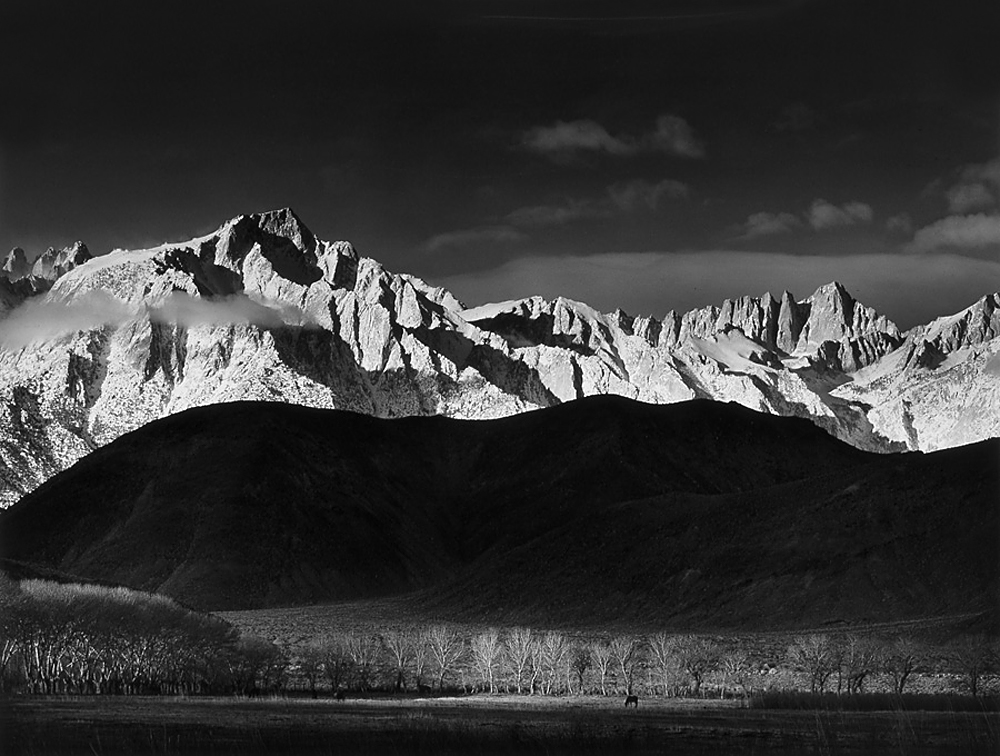
Many thankx to the Museum of Photographic Arts for allowing me to publish the three photographs, Winter Sunrise, Sierra Nevada from Lone Pine, California (1944), Mount McKinley, Alaska (1948) and Aspens, Northern New Mexico (1958). Please click on the photographs for a larger version of the image.


Ansel Adams (American, 1902-1984) 'Marion Lake, Kings River Canyon, California' c. 1925 from the exhibition 'Ansel Adams: A Life's Work' at Museum of Photographic Arts, San Diego, May - Oct, 2009


Ansel Adams (American, 1902-1984)
Marion Lake, Southern Sierra
from the portfolio Parmelian Prints of the High Sierras
1927
Gelatin silver print


Ansel Adams (American, 1902-1984) 'Moonrise, Hernandez, New Mexico' 1941 from the exhibition 'Ansel Adams: A Life's Work' at Museum of Photographic Arts, San Diego, May - Oct, 2009


Ansel Adams (American, 1902-1984)
Moonrise, Hernandez, New Mexico
1941
Gelatin silver print


Ansel Adams (American, 1902-1984) 'Birds on wire, evening, Manzanar Relocation Center' 1943


Ansel Adams (American, 1902-1984)
Birds on wire, evening, Manzanar Relocation Center
1943
Gelatin silver print


The Museum of Photographic Arts (MoPA) in Balboa Park is pleased to present Ansel Adams: A Life’s Work. The exhibition includes over 80 photographs by the 20th Century master, and celebrates Adams as an artist and conservationist. A Life’s Work will be on view May 23, 2009 through October 4, 2009, and features an overview of Adam’s work from his early years in the Sierra Nevadas and Yosemite Valley to his work in the Japanese Internment Camp at Manzanar, as well as his well-known masterpieces.

Ansel Adams: A Life’s Work will be running concurrently with Jo Whaley: Theater of Insects on view from May 16 through September 27, 2009, as well as Picturing the Process: Exploring the Art and Science of Photography on view through July 25, 2009.

The exhibition begins with survey of Adams’ early years with the Sierra Club (1920s-1930s), where his photographs and essays were first published in the Club’s Bulletin. 1927 marked a pivotal point for Adams, where he participated in the Sierra Club’s annual High Trip, which took him to the high country of the Sierra. It was during this trip that he exposed the negative of the iconic image Monolith, the Face of Half Dome. Adams describes this photograph as “my first conscious visualisation; in my mind’s eye, I saw the final image.”

It was during this first High Trip that Adams met San Francisco-based arts patron, Albert Bender. Bender took immediate interest in Adam’s photographs, and published Adams’ first portfolio, The Parmelian Prints of the High Sierras (1927). The publication included an edition of 100 portfolios of 18 prints each, 75 were printed.

The exhibition features 15 of the rare Parmelian vintage prints, as well as eight photographs from the 1929 Sierra Club Portfolio.

The exhibition continues with a wide range of representative works from the 1930’s and 1940’s, including commercial work that the artist did for the YPCCO (Yosemite Park and Curry Company). From 1931 to 1937, Adams was hired by YPCCO, a group of businesses in Yosemite Valley, to photograph various winter sports for an advertising campaign. This opportunity provided a much needed source of income for the artist during the Great Depression. The exhibition also includes other various commercial assignments throughout his career, which Adams clearly separated from his fine art photography, but notes as a vital aspect of his career. In his Autobiography he wrote: “I have little use for students or artists who scorn commercial photography as a form of prostitution … Let them pay the bills! … I struggled with a great variety of assignments through the years. Some I enjoyed, some I detested, but learned from them all.”

A Life’s Work also includes the powerful and poignant images from the Manzanar Internment Camp. In late 1943 through 1944, Adams visited the camps in central California, where over 10,000 Japanese-Americans were interned during World War II. Adams’ intention for this self-assigned project was “to interpret the camp and its people, their daily life and their relationship to their community and their environment,” wrote Adams in his Autobiography. “As my work progressed, however, I began to grasp the problems of the remarkable readjustment these people had to make… With admirable strength of spirit, the Nisei rose above despondency and make a life for themselves… This was the mood and character I determined to apply to the project.”

A Life’s Work will feature many of his iconic masterworks, including Moonrise, Hernandez, New Mexico, as well as his works in colour, which he experimented with beginning in the late 1940s.

Press release from the Museum of Photographic Arts website [Online] Cited 15/09/2009


Ansel Adams (American, 1902-1984) 'View south from Manzanar to Alabama Hills, Manzanar Relocation Center' 1943


Ansel Adams (American, 1902-1984)
View south from Manzanar to Alabama Hills, Manzanar Relocation Center
1943
Gelatin silver print


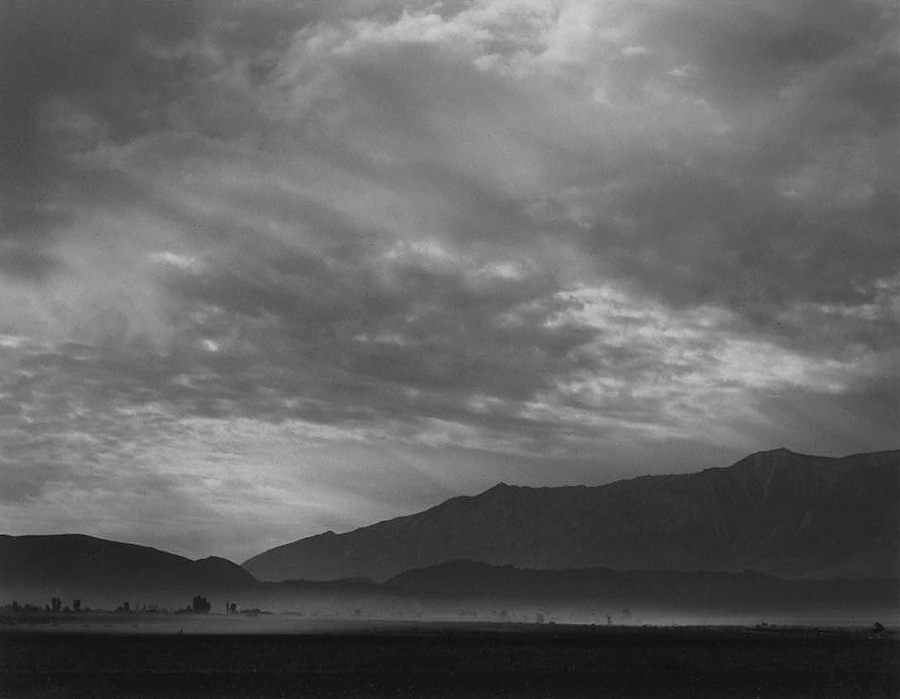
Ansel Adams (American, 1902-1984) 'View SW over Manzanar, dust storm, Manzanar Relocation Center' 1943


Ansel Adams (American, 1902-1984)
View SW over Manzanar, dust storm, Manzanar Relocation Center
1943
Gelatin silver print


Ansel Adams (American, 1902-1984) 'Winter Sunrise, Sierra Nevada from Lone Pine, CA.,' 1944


Ansel Adams (American, 1902-1984)
Winter Sunrise, Sierra Nevada from Lone Pine, California
1944
Gelatin silver print
Courtesy of the Museum of Photographic Arts.
Copyright © 2009 The Ansel Adams Publishing Rights Trust


Ansel Adams (American, 1902-1984) Mount McKinley, Alaska, 1948


Ansel Adams (American, 1902-1984)
Mount McKinley, Alaska
1948
Gelatin silver print
Courtesy of the Museum of Photographic Arts
Copyright © 2009 The Ansel Adams Publishing Rights Trust


Ansel Adams (American, 1902-1984) 'Aspens, Northern New Mexico' 1958


Ansel Adams (American, 1902-1984)
Aspens, Northern New Mexico
1958
Gelatin silver print
Courtesy of the Museum of Photographic Arts
Copyright © 2009 The Ansel Adams Publishing Rights Trust


Museum of Photographic Arts
Located within Balboa Park at 1649 El Prado, 
San Diego, CA 92101
Phone: 619-238-7559

Opening hours:
Thursday – Sunday: 11.00am – 4.00pm
Monday – Wednesday closed

MoPA website

LIKE ART BLART ON FACEBOOK

Back to top

Exhibition: ‘Ball Parks: Jim Dow’s Photographs of Baseball Stadiums’ at The National Gallery of Canada, Ottawa

Exhibition dates: 4th July – 27th September, 2009


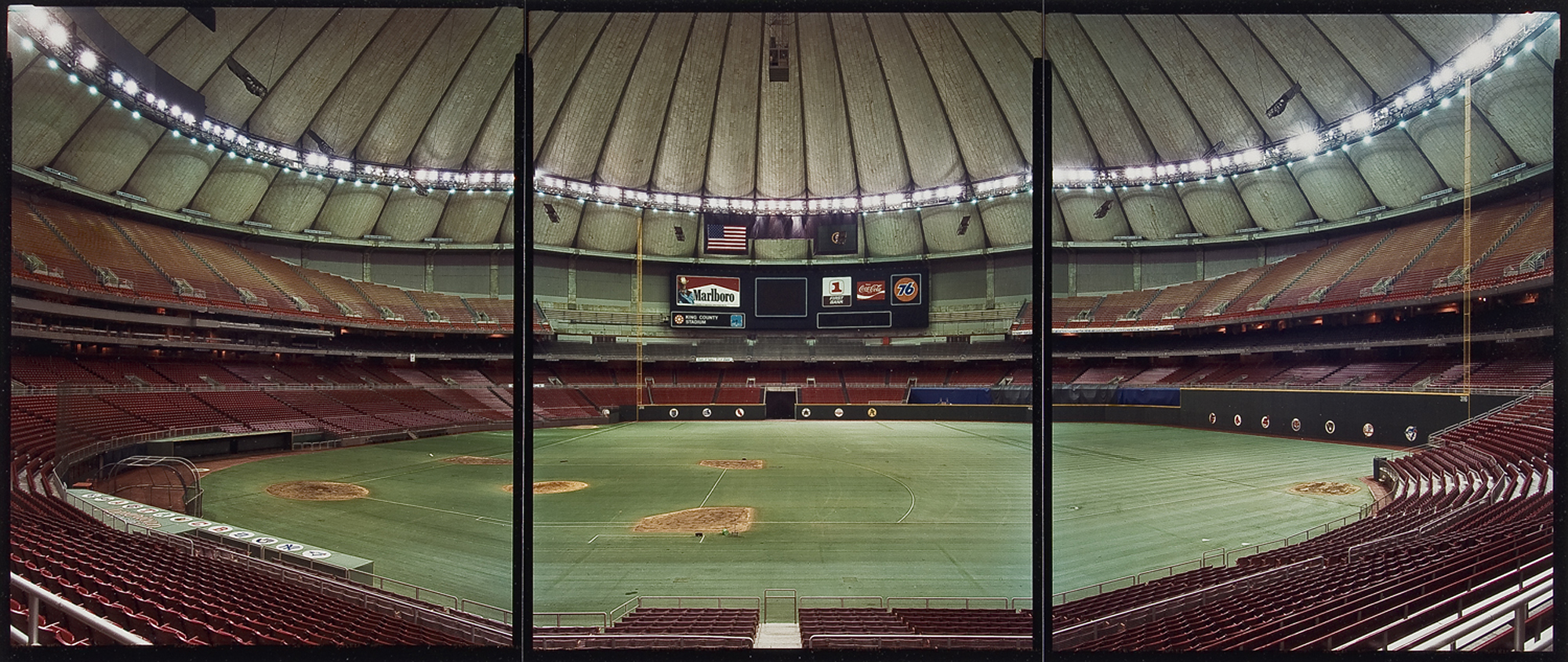
Jim Dow (American, b. 1942) 'Exhibition Stadium' 1982 from the exhibition 'Ball Parks: Jim Dow's Photographs of Baseball Stadiums' at The National Gallery of Canada, Ottawa, July - Sept, 2009


Jim Dow (American, b. 1942)
Exhibition Stadium
1982
National Gallery of Canada, Ottawa
Gift of Benjamin Greenberg, Ottawa, 1988 and 1989


These feel like religious reliquaries, a triptych form which arises from early Christian art but here a paean to the monumentalisation of sport, architecture, human heroics and grandiosity.

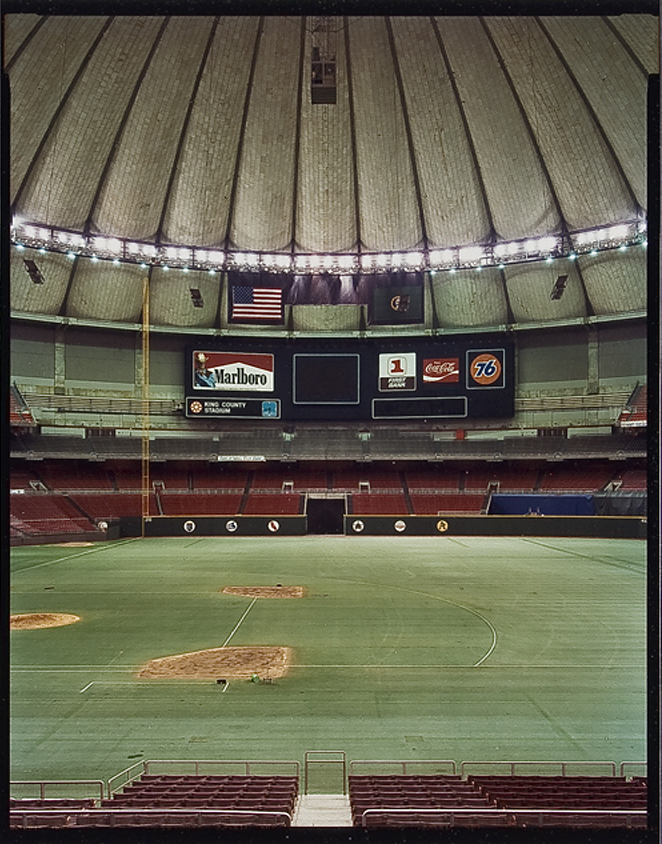
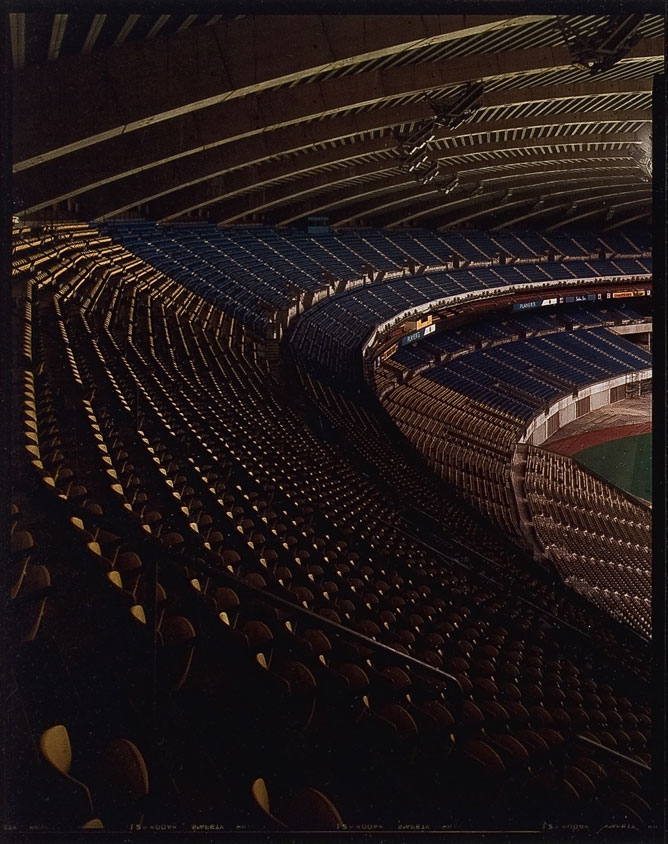
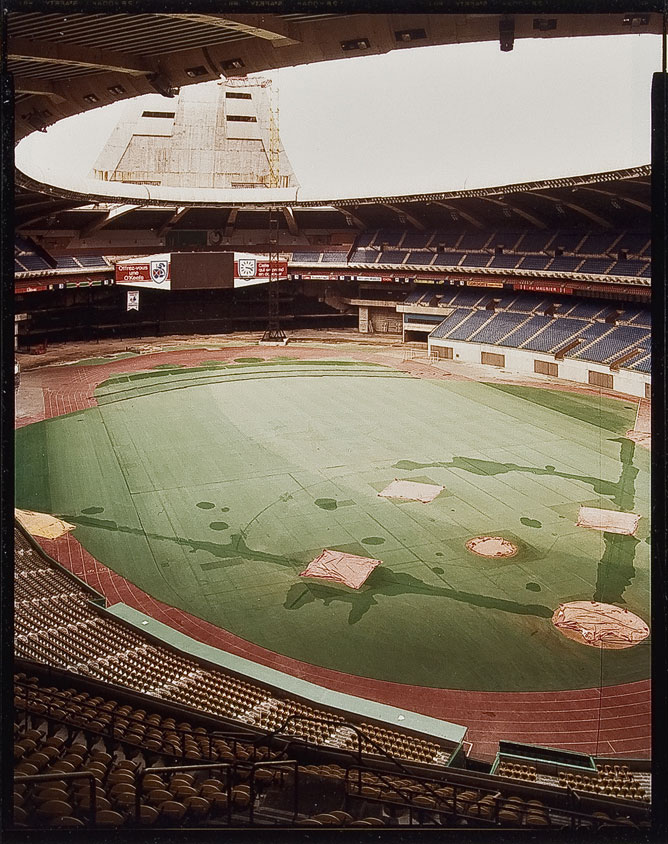
Apologies that the blog is not wide enough to display these panoramic images at a decent size but you can click on the photographs to see a larger version of the image. I have also displayed each 8″ x 10″ negative sequentially.

Dr Marcus Bunyan


Many thankx to The National Gallery of Canada for allowing me to publish the photographs in the posting. Please click on the photographs for a larger version of the image.


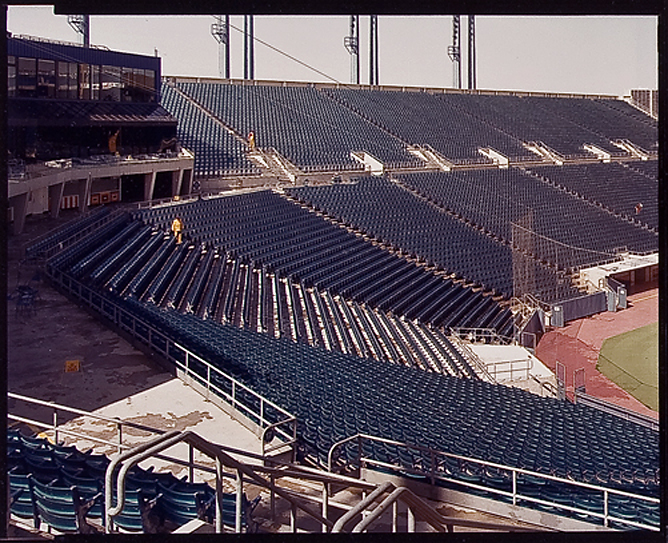
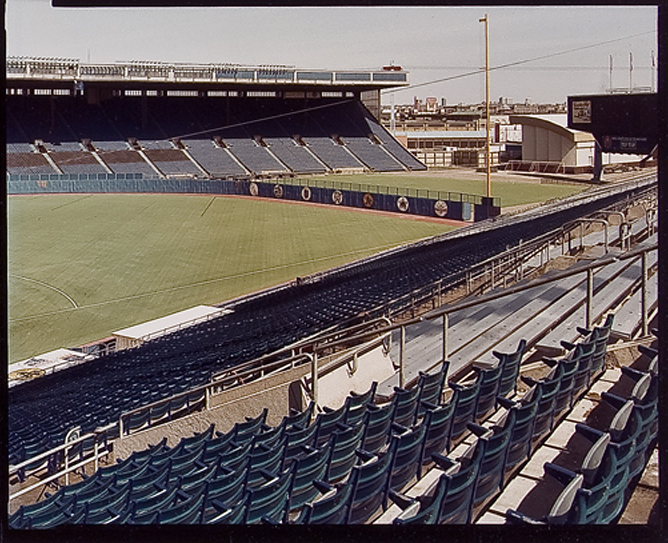
Jim Dow (American, b. 1942) 'Exhibition Stadium' 1982 (detail)

Jim Dow (American, b. 1942) 'Exhibition Stadium' 1982

Jim Dow (American, b. 1942) 'Exhibition Stadium' 1982


Jim Dow (American, b. 1942)
Exhibition Stadium (individual frames)
1982
National Gallery of Canada, Ottawa
Gift of Benjamin Greenberg, Ottawa, 1988 and 1989


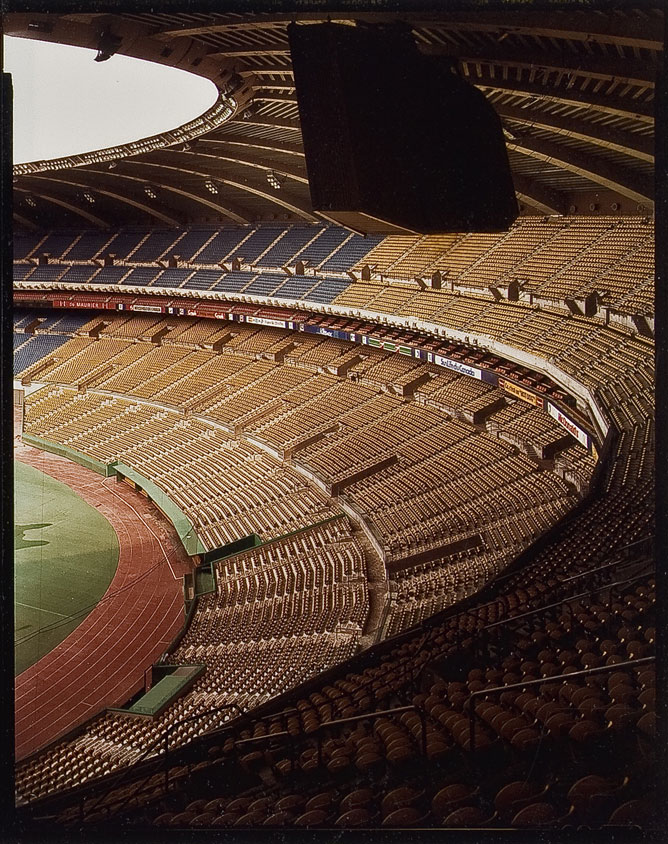
This installation from the National Gallery’s Collection of Photographs comprises 26 colour panoramic views of empty baseball stadiums across North America, from Exhibition Stadium, the home of the Toronto Blue Jays, and Montréal’s Olympic Stadium to the Houston Astro’s Astrodome. Taken in 1982, Jim Dow, a respected American photographer as well as a sports enthusiast, imparts through these images both a passion for the monumentality of the architecture and its abstract geometry and his love of baseball. The emptiness of the stadiums simultaneously evokes memory and a sense of anticipation.

Jim Dow’s interest in those places where people enact their everyday rituals, from the barbershop to the baseball park, has guided the path of his photographic career. Dow is concerned with capturing “human ingenuity and spirit” in endangered regional traditions – a barbershop with a heavy patina of town life covering the walls, the opulent time capsule of an old private New York club, the densely packed display of smoking pipes in an English tobacconist shop – all artefacts of a vanishing era.

Dow earned a B.F.A. and a M.F.A. in graphic design and photography from the Rhode Island School of Design in 1965 and 1968 respectively. An early influence was Walker Evans’s seminal book American Photographs (1938). Dow recalls the appeal of Evans’s “razor sharp, infinitely detailed, small images of town architecture and people. What stood out was a palpable feeling of loss … pictures that seemingly read like paragraphs, even chapters in one long, complex, rich narrative.” Soon after graduate school Dow had the opportunity to work with Evans. He was hired to print his mentor’s photographs for a 1972 Museum of Modern Art retrospective.

Dow has taught photography at Harvard, Tufts University and the School of the Museum of Fine Arts, Boston, and his work has been widely exhibited. Among his series is Corner Shops of Britain (1995), which features facades of small family-run businesses: vitrine-like shop windows showcase goods from candy jars to jellied eels. Another series, Time Passing (1984-2004), captures North Dakota “folk art” such as rural road signage, hand-painted billboards, and ornate gravestones.

Dow first gained attention for his panoramic triptychs of baseball stadiums, a project that began with an image he made of Veteran’s Stadium in Philadelphia in 1980. Using an 8 x 10″ camera, he has documented more than two hundred major and minor league parks in the United States and Canada.”

Text from Artdaily.org website [Online] Cited 17/04/2019


Jim Dow (American, b. 1942) 'The Kingdome. Seattle Mariners' 1982 from the exhibition 'Ball Parks: Jim Dow's Photographs of Baseball Stadiums' at The National Gallery of Canada, Ottawa, July - Sept, 2009


Jim Dow (American, b. 1942)
The Kingdome. Seattle Mariners
1982
National Gallery of Canada, Ottawa
Gift of Benjamin Greenberg, Ottawa, 1988 and 1989


Jim Dow (American, b. 1942) 'The Kingdome. Seattle Mariners' 1982 (detail)

Jim Dow (American, b. 1942) 'The Kingdome. Seattle Mariners' 1982

Jim Dow (American, b. 1942) 'The Kingdome. Seattle Mariners' 1982 (detail)


Jim Dow (American, b. 1942)
The Kingdome. Seattle Mariners (individual frames)
1982
National Gallery of Canada, Ottawa
Gift of Benjamin Greenberg, Ottawa, 1988 and 1989


Jim Dow (American, b. 1942) 'Olympic Stadium, Montreal' 1982


Jim Dow (American, b. 1942)
Olympic Stadium, Montreal
1982
National Gallery of Canada, Ottawa
Gift of Benjamin Greenberg, Ottawa, 1988 and 1989


Jim Dow (American, b. 1942) 'Olympic Stadium, Montreal' 1982 (detail)

Jim Dow (American, b. 1942) 'Olympic Stadium, Montreal' 1982 (detail)

Jim Dow (American, b. 1942) 'Olympic Stadium, Montreal' 1982 (detail)


Jim Dow (American, b. 1942)
Olympic Stadium, Montreal (individual frames)
1982
National Gallery of Canada, Ottawa
Gift of Benjamin Greenberg, Ottawa, 1988 and 1989


National Gallery of Canada
380 Sussex Drive
P.O. Box 427, Station A
Ottawa, Ontario
Canada 
K1N 9N4

Opening hours:
Daily 9.30am – 5pm

National Gallery of Canada website

LIKE ART BLART ON FACEBOOK

Back to top

Exhibition: ‘In Focus: Making A Scene’ at The J. Paul Getty Museum, Los Angeles

Exhibition dates: 30th June – 18th October, 2009


Hill & Adamson (Scottish, active 1843-1848) '[Lane and Peddie as Afghans]' 1843 from the exhibition 'In Focus: Making A Scene' at The J. Paul Getty Museum, Los Angeles, June - Oct, 2009


Hill & Adamson (Scottish, active 1843-1848)
[Lane and Peddie as Afghans]
1843
Salted paper print from a paper negative
20.6 × 14.3cm (8 1/8 × 5 5/8 in.)
The J. Paul Getty Museum


The team of Hill and Adamson initially began making dramatic portrait photographs as studies for one of Hill’s composite paintings. They also produced costume studies, including this scene in which Arabic scholar Mr. Lane and Mr. (Peddie) Redding appear in foreign garb.


What a fabulous selection of photographs to illustrate a fascinating “scene”. I love staged, theatrical, constructed, conceptual, collaged, surreal, imaginary, narrative photography.

Dr Marcus Bunyan


Many thankx to the J. Paul Getty Museum for allowing me to publish the photographs in the posting. Please click on the photographs for a larger version of the image.


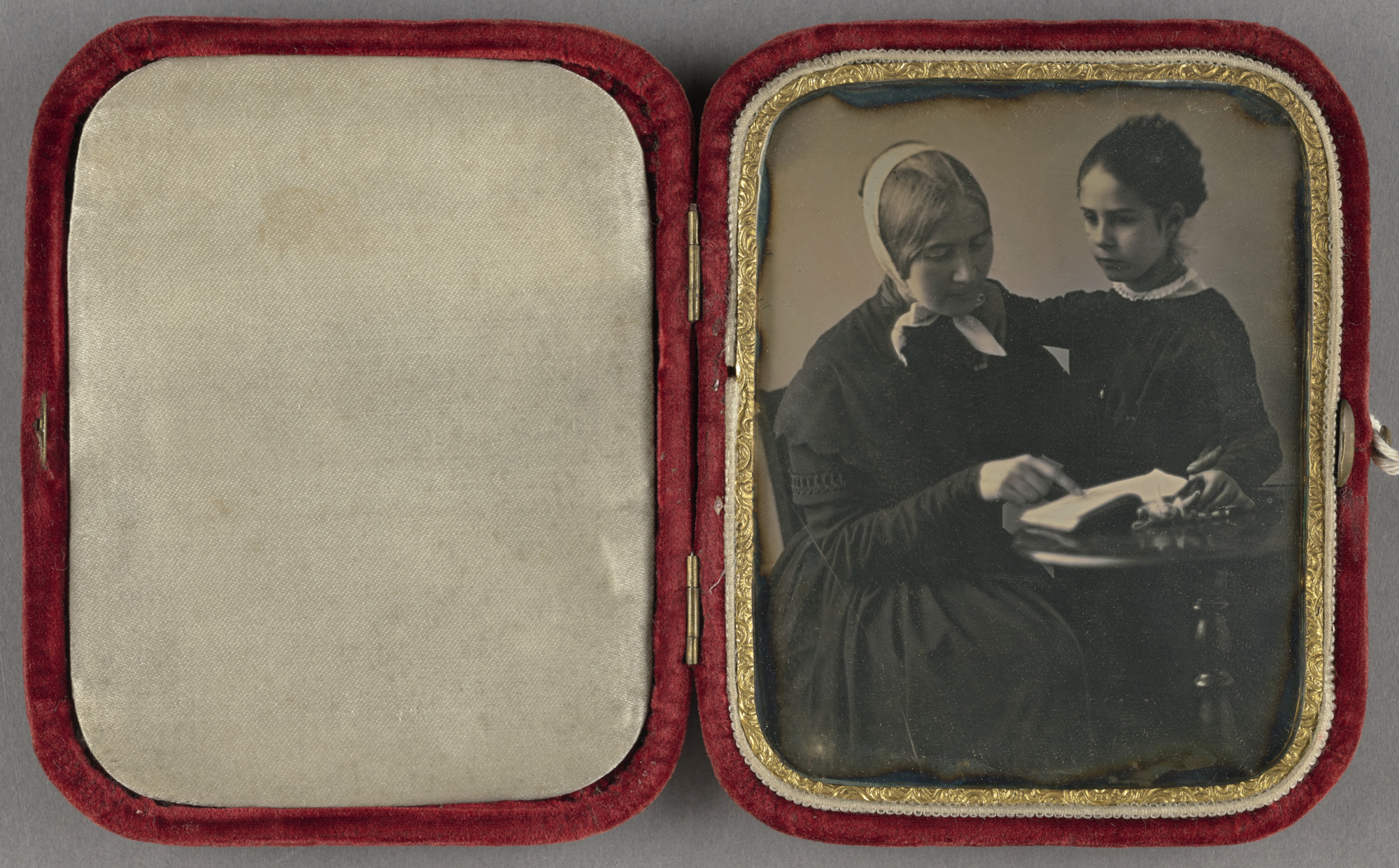
Unknown maker, French. 'Woman Reading to a Girl' c. 1845 from the exhibition 'In Focus: Making A Scene' at The J. Paul Getty Museum, Los Angeles, June - Oct, 2009


Unknown maker, French
Woman Reading to a Girl
c. 1845
Daguerreotype
9.1 × 7.1cm (3 9/16 × 2 13/16 in.)
The J. Paul Getty Museum


Through a skilful manipulation, the light coming from above and behind the figures casts the faces of mother and child in a softly modulated half-shadow. Their close grouping and familiar, intimate gestures evoke tenderness. The reflected light on the woman’s pointing finger and on the glowing white pages of the open book forms a strong visual triangle, drawing the viewer’s eye and serving to integrate and balance the composition.


Oscar Gustave Rejlander (British, born Sweden, 1813-1875) 'The Infant Photography Giving the Painter an Additional Brush' c. 1856 from the exhibition 'In Focus: Making A Scene' at The J. Paul Getty Museum, Los Angeles, June - Oct, 2009


Oscar Gustave Rejlander (British born Sweden, 1813-1875)
The Infant Photography Giving the Painter an Additional Brush
c. 1856
Albumen silver print
6 × 7.1cm (2 3/8 × 2 13/16 in.)
The J. Paul Getty Museum


Oscar Rejlander’s photograph could be read as a metaphor of his own career. The additional “brush” or image-making tool provided by photography to painters was evident from the beginnings of the medium. Many early practitioners arrived at photography from painting, as did Rejlander. Photographs were often thought of and used as sketching tools for painters. Although photographs never managed to signal the death of painting as initially predicted, they did frequently assume the function that drawing had traditionally held in relation to painting.

Compositionally, this is an unusual photograph. Rejlander employs a narrative device from painting: the use of figures, or parts of figures, as allegorical representations for ideas. A very young child represents the infant medium of photography. The Painter appears only as a hand extending into the frame at the upper left, although the traditional arts are also represented by the sculpture reproduction in the lower left corner. The Infant Photography, identified by the camera on which the child supports himself, faces away from the camera, his features totally obscured. The mirror behind the child gives a clear reflection of Rejlander at his camera, making this image.


Roger Fenton (English, 1819-1869) 'Contemplative Odalisque' 1858


Roger Fenton (English, 1819-1869)
Contemplative Odalisque
1858
Albumen silver print
35.9 × 43.8cm (14 1/8 × 17 1/4 in.)
The J. Paul Getty Museum
Gift of Professors Joseph and Elaine Monsen


Three years after traveling in the Crimea, Roger Fenton made a series of Orientalist photographs in his London studio using props gathered during his travels and non-Eastern models. Orientalism refers to just such romanticised depictions of imagined scenes of Muslim culture in the Ottoman Empire and its territories in the Near East and North Africa.

Orientalist scenes were more often fiction than fact. Cultural biases and misunderstandings were laid down on paper or canvas and frequently became the only source of information on the subjects depicted. When a group of these Orientalist photographs was exhibited in 1858, one reviewer described them as “truly representing some phases in the life of this interesting people.”

But not everyone so easily accepted Fenton’s images at face value; a more astute critic called for “the necessity of having real national types as models.” The same model shown here also appears as “Nubian” and “Egyptian” in other photographs by Fenton. This photograph may have originally been exhibited with the title The Reverie. The odalisque, meaning a slave or concubine in a harem, poses upon her sofa. Barefoot, blouse open, her surroundings convey a sensual disarray that conforms to an Orientalising fantasy of the available woman.


Julia Margaret Cameron (British, born India, 1815-1879) 'The Rosebud Garden of Girls' June 1868


Julia Margaret Cameron (British, born India, 1815-1879)
The Rosebud Garden of Girls
June 1868
Album silver print
29.4 × 26.7cm (11 9/16 × 10 1/2 in.)
The J. Paul Getty Museum


As evolutionary science and increasing secularism transformed the way Victorians understood the world, Cameron remained a devout Christian. She photographed influential public figures of her day as well as the women of her household, casting them in allegories of literary and religious subjects. Like her artistic contemporaries, the Pre-Raphaelite painters, who modelled their work on medieval religious and mythological art, Cameron intended her photographs to evince a connection between the spiritual and the natural realms.


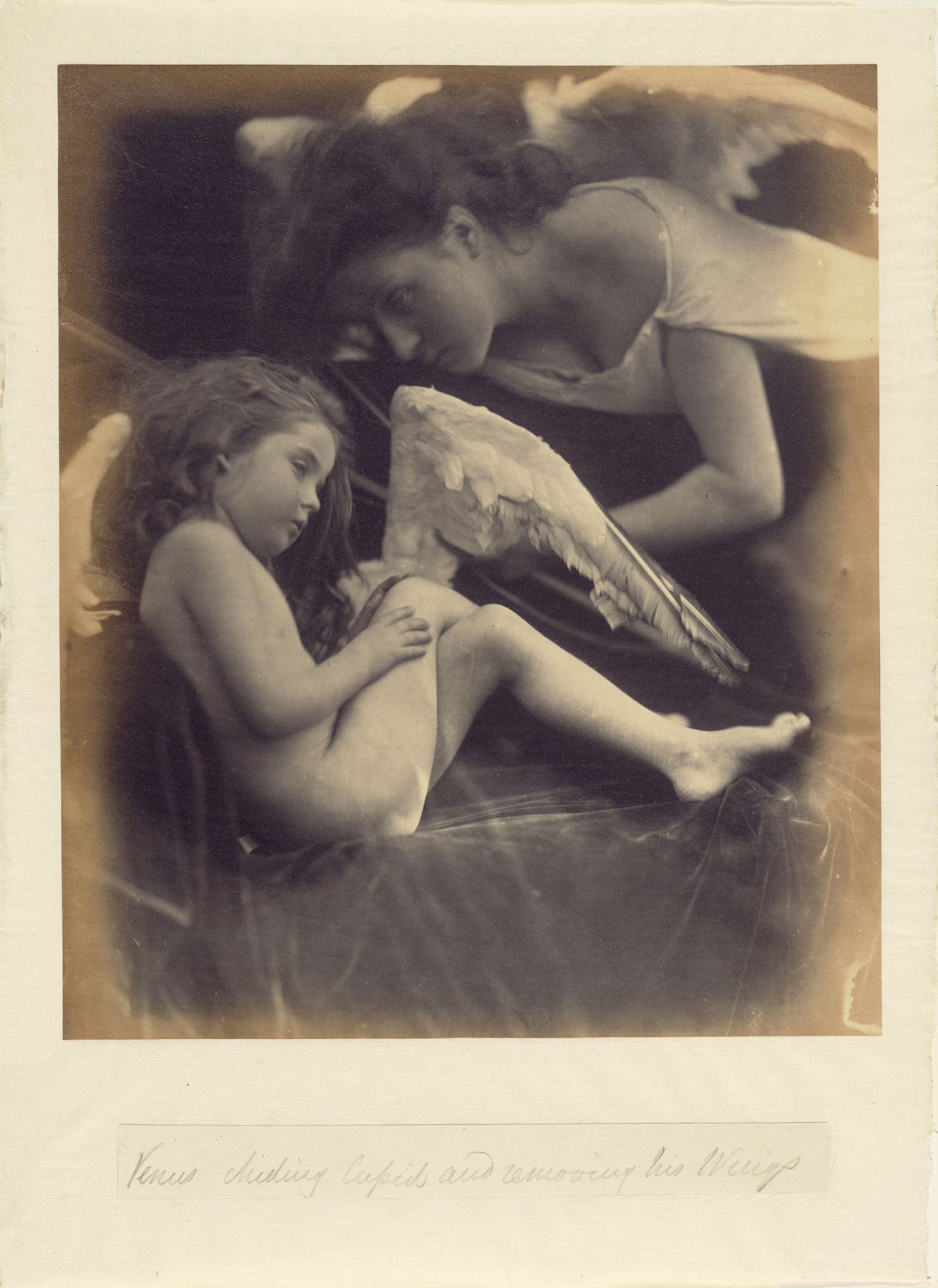
Julia Margaret Cameron (British, born India, 1815-1879) 'Venus Chiding Cupid and Removing His Wings' 1872


Julia Margaret Cameron (British, born India, 1815-1879)
Venus Chiding Cupid and Removing His Wings
1872
Album silver print
32.4 × 27.3cm (12 3/4 × 10 3/4 in.)
The J. Paul Getty Museum


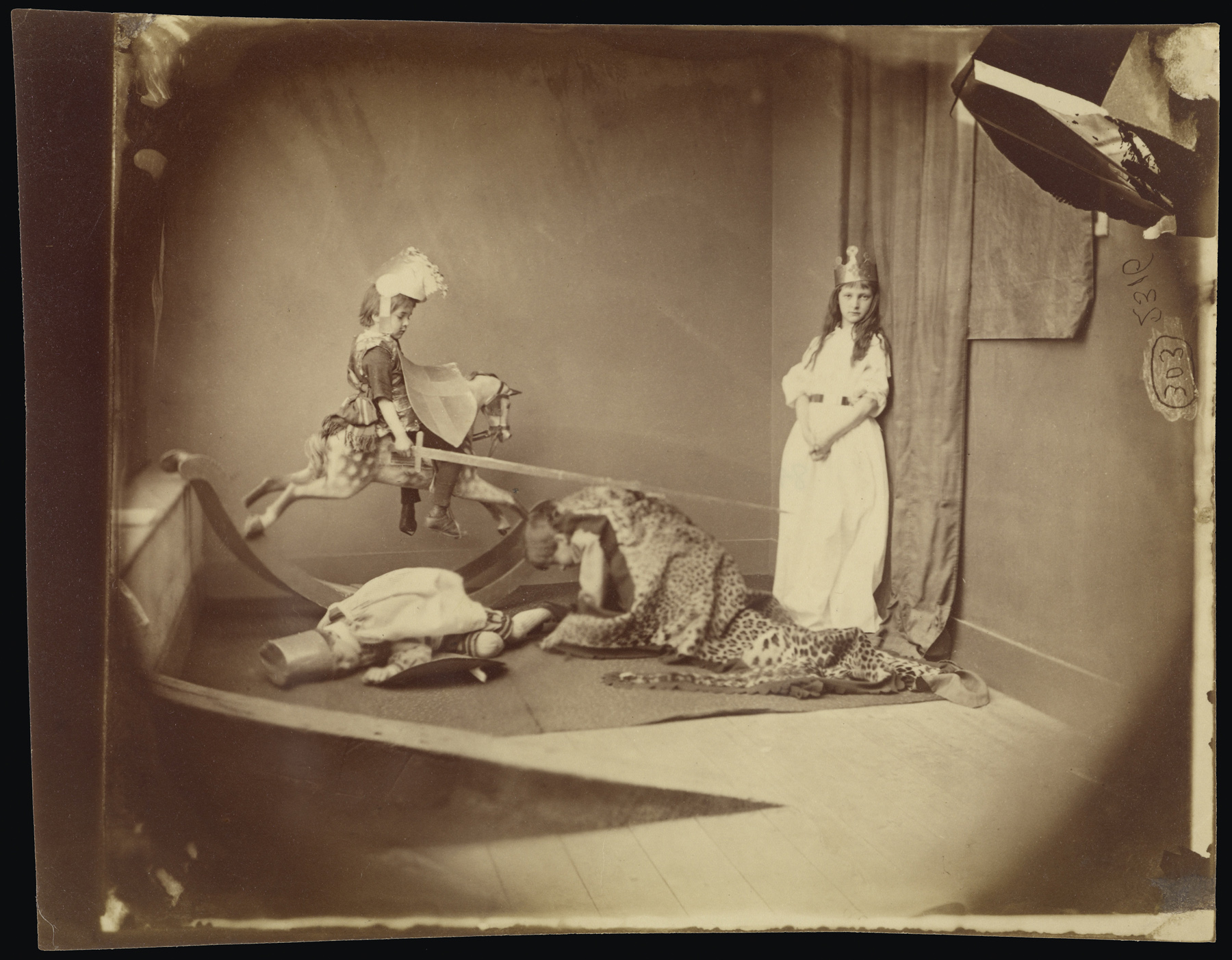
Lewis Carroll (British, 1832-1898) 'Saint George and the Dragon' June 26, 1875


Lewis Carroll (British, 1832-1898)
Saint George and the Dragon
June 26, 1875
Albumen silver print
12.2 × 16.2cm (4 13/16 × 6 3/8 in.)
The J. Paul Getty Museum


Like Alice’s Adventures in Wonderland and his other books, Carroll’s photographs are fantasies starring the children of his friends. In this production, the Kitchin siblings enacted the romantic legend of Saint George, the patron saint of England, who slayed a child-eating dragon before it devoured a princess. George later married the rescued princess and converted her pagan town to Christianity. Using crude stagecraft to reference key plot points, Carroll condensed the entire legend into a single scene in which the princess appears as both damsel in distress and bride.


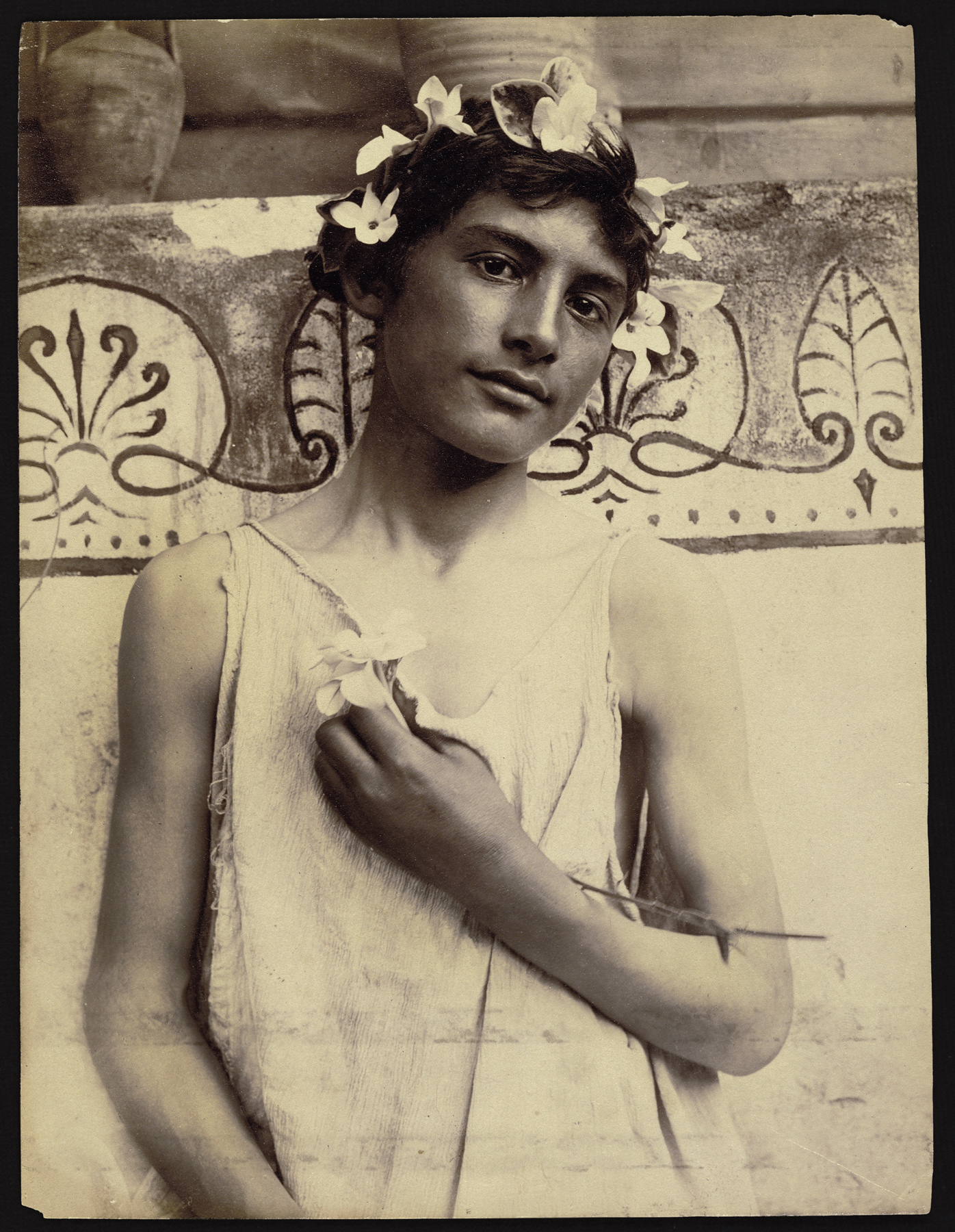
Baron Wilhelm von Gloeden (German, 1856-1931) 'Untitled [Two Male Youths Holding Palm Fronds]' c. 1885 - 1905


Baron Wilhelm von Gloeden (German, 1856-1931)
Untitled [Two Male Youths Holding Palm Fronds]
c. 1885-1905
Albumen silver print
23.3 × 17.5cm (9 3/16 × 6 7/8 in.)
The J. Paul Getty Museum


Baron Wilhelm von Gloeden (German, 1856-1931) 'L'Offerta' (The Offering) 1902


Baron Wilhelm von Gloeden (German, 1856-1931)
L’Offerta (The Offering)
1902
Albumen silver print
22.4 × 16.8cm (8 13/16 × 6 5/8 in.)
The J. Paul Getty Museum


Von Gloeden left Germany and settled in a coastal town in Sicily, where he took up photography. His subjects were young native boys, whom he often photographed nude in classical compositions. Rather than reenact specific historical or literary scenes, von Gloeden mused nostalgically on the ancient Greek and Roman ancestry of his attractive models.


Guido Rey (Italian, 1861-1935) '[The Letter]' 1908


Guido Rey (Italian, 1861-1935)
[The Letter]
1908
Platinum print
21.9 × 17cm (8 5/8 × 6 11/16 in.)
The J. Paul Getty Museum


A deliberate homage to an earlier artistic style that Guido Rey admired, the composition derives from a painting made by Dutch artist Jan Vermeer in the 1600s. In this posed scene, a young suitor bearing flowers approaches a woman seated at her writing desk, with her pen poised in mid-air as she turns to greet him. A leaded glass window opens into her room, providing a natural light source for the photograph’s illumination. The mounted corner clock, decorative jar on the desk, and painting on the wall were Rey’s everyday household items or objects borrowed from friends, carefully chosen for period accuracy. Likewise, a seamstress who lived in the attic of Rey’s home in Turin created the costumes to his specifications.


Photography, although commonly associated with truthfulness, has been used to produce fiction since its introduction in 1839. The acceptance of staging, and the degree of its application, has varied greatly depending on the genre and the historical moment, but it has persisted as an artistic approach. The photographs in this exhibition, drawn exclusively from the J. Paul Getty Museum’s collection, make no pretence about presenting the world as it exists; instead, they are the productions of directors and actors who rely on stagecraft and occasional darkroom trickery to tell stories.
 Spanning photography’s history and expressing a range of sentiments, the images in this exhibition are inspired by art history, literature, religion, and mainstream media.

Like Alice’s Adventures in Wonderland and his other books, Lewis Carroll’s photographs are fantasies starring his friends’ children. In the image below, children enact the mythological story of Saint George, the patron saint of England, slaying a child-eating dragon before it could devour a princess.

Life Imitating Art

Well-represented in this exhibition are tableaux vivants (living pictures), inspired by the popular Victorian parlour game in which costumed participants posed to resemble famous works of art or literary scenes.
The genre paintings of 17th-century Dutch masters Johannes Vermeer and Pieter de Hooch fascinated Guido Rey. Not self-conscious about being slavish to the past, he carefully studied the paintings and then arranged similar tableaux for his camera. His photographs captured equally serene domestic scenes and mimicked the minute architectural details of 17th-century interiors, such as the leaded-glass windowpanes and the checkerboard floor.

Playing Dress Up

The exhibition also includes costume studies of people posing as literary characters and self-portraits of artists pretending to be other people. 

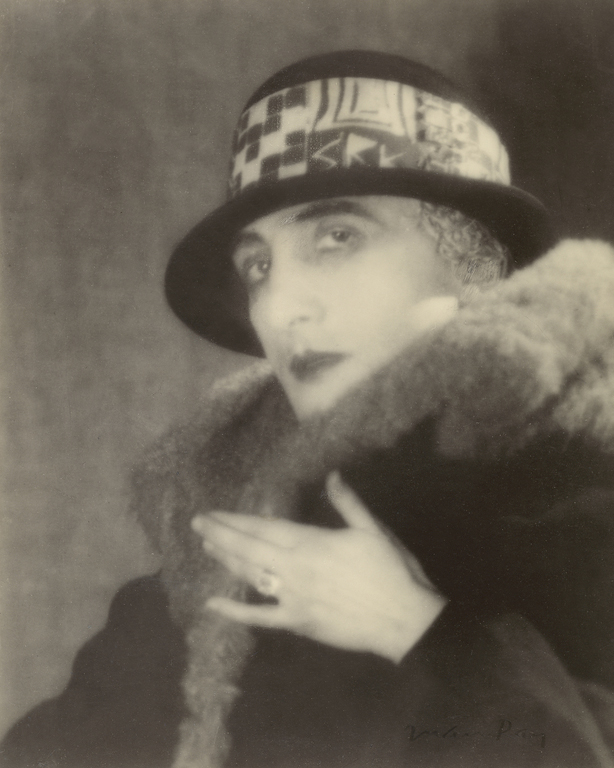
American painter and photographer Man Ray and the French artist Marcel Duchamp met in New York in 1915, and they began a playful, iconoclastic collaboration that resulted in the photograph (above), among others. Influenced by Dadaism, a cultural movement that rejected reason and logic in favour of anarchy and the absurd, their work embraced games of chance, performance, and wordplay. Here an irreverent Duchamp appears in women’s clothing as his alter ego, Rrose Sélavy, a pun on the French pronunciation “Eros, c’est la vie” (Sex, that’s life).

Imaginary Subjects

A number of photographs in the exhibition explore the medium’s capacity to visualise subjects of the imagination by using darkroom trickery to manipulate prints.
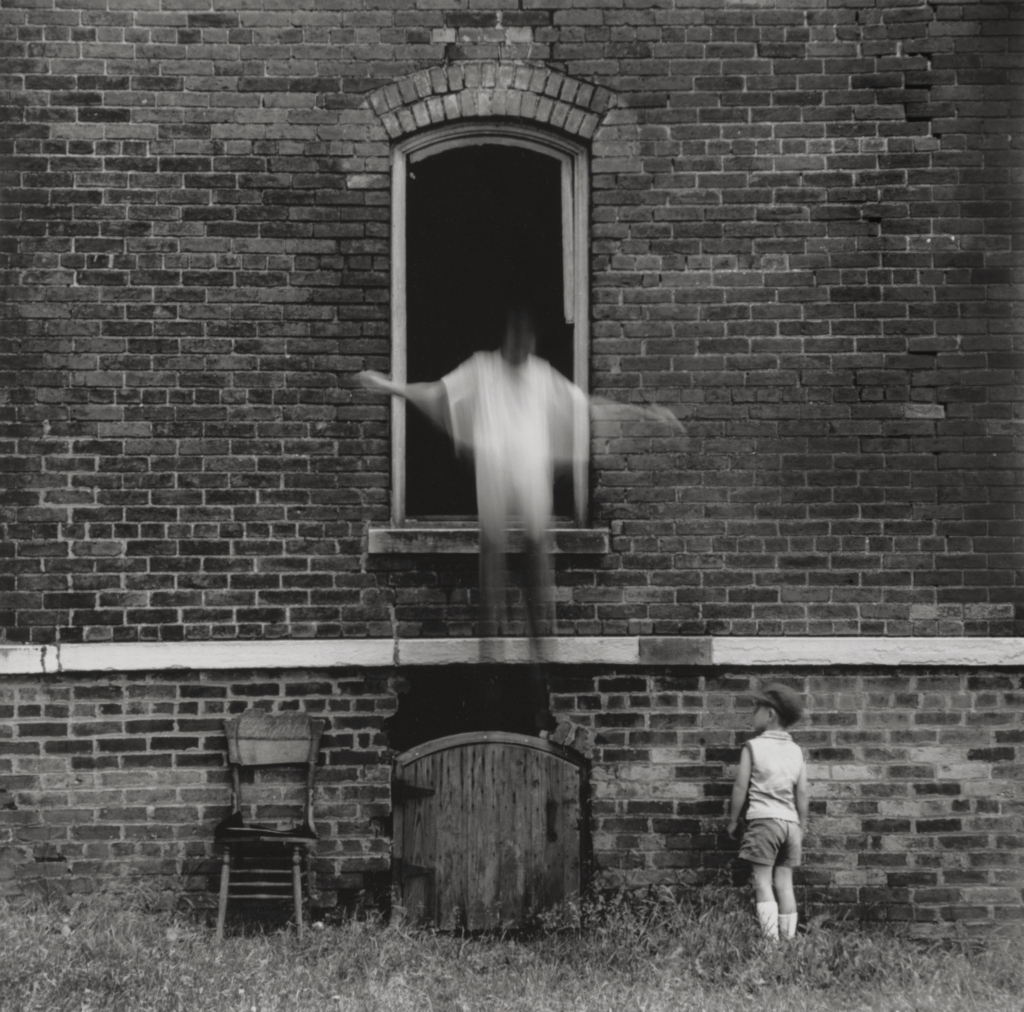
 An optician and family man, Ralph Eugene Meatyard photographed his children, friends, and neighbours enacting dramas in suburban backyards and abandoned buildings near his Lexington, Kentucky, home. He often used experimental techniques, such as multiple exposures and blurred motion. Uncanny details imbue Meatyard’s otherwise ordinary vernacular scenes with the qualities of a dream or supernatural vision.

Theatricality as a Critical Strategy

In recent decades there has been renewed interest in theatricality among contemporary photographers whose highly artificial scenes critique mainstream media and representation.
 In her series Family Docudrama Eileen Cowin blurs the boundaries between truth and fiction, and private behaviour and public performance. Drawing equally from family snapshots and soap operas, Cowin presents staged domestic scenes in which she and members of her family, including her identical twin sister, perform as actors. In these ambiguous, open-ended narratives, dramatic moments are exaggerated, and the camera’s glare is ever present.”

Text from The J. Paul Getty Museum website [Online] Cited 16/04/2019


Man Ray (American, 1890-1976) 'Rrose Sélavy (Marcel Duchamp)' 1923


Man Ray (American, 1890-1976)
Rrose Sélavy (Marcel Duchamp)
1923
Gelatin silver print
22.1 × 17.6cm (8 11/16 × 6 15/16 in.)
The J. Paul Getty Museum
© Man Ray Trust ARS-ADAGP


When Man Ray moved to Paris, he was greeted by his friend and artistic compatriot Marcel Duchamp, who introduced him to members of the Dada circle of writers and artists. The two men had collaborated in a number of creative endeavours in New York, including the creation of a female alter-ego for Duchamp named Rrose Sélavy (a pun on the French pronunciation Eros, c’est la vie “Sex, that’s life”). Man Ray photographed Duchamp several times as Rrose Sélavy.


Man Ray (American, 1890-1976) 'Larmes' 1930


Man Ray (American, 1890-1976)
Larmes (Tears)
1930-1932
Gelatin silver print
22.9 × 29.8cm (9 × 11 3/4 in.)
The J. Paul Getty Museum
© Man Ray Trust ARS-ADAGP


Judging from his inclusion of this image in other photographic compositions, Man Ray must have considered Tears one of his most successful photographs. A cropped version of it with a single eye also appears as the first plate in a 1934 book of his photographs.

Like the emotive expression of a silent screen star in a film still, the woman’s plaintive upward glance and mascara-encrusted lashes seem intended to invoke wonder at the cause of her distress. The face belongs to a fashion model who cries tears of glistening, round glass beads; the effect is to aestheticise the sentiment her tears would normally express. Man Ray made this photograph in Paris around the time of his breakup with his lover Lee Miller, and the woman’s false tears may relate to that event in the artist’s life.


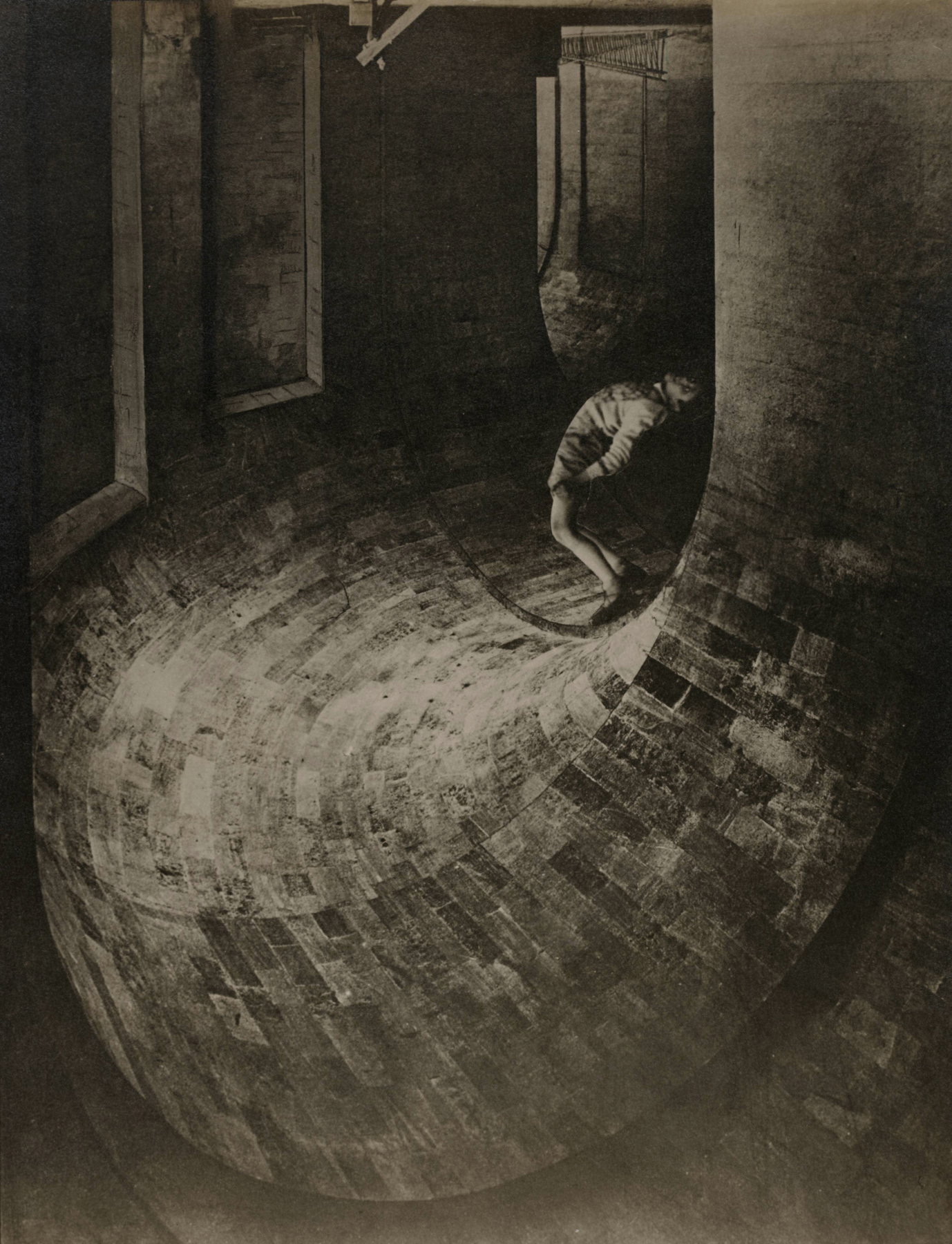
Dora Maar (French, 1907-1997) 'Le Simulateur (The Pretender)' 1936


Dora Maar (French, 1907-1997)
Le Simulateur (The Pretender)
1936
Gelatin silver print
26.6 × 21.7cm (10 1/2 × 8 1/2 in.)
The J. Paul Getty Museum
© Dora Maar Estate/Artists Rights Society (ARS), New York/ADAGP, Paris


In this picture Dora Maar constructed her own reality by joining together several images and rephotographing them. The seamlessness of the photographic surface makes this construction believable and leaves the viewer wondering about the strange world the figure inhabits. On closer examination, the viewer may notice that the floor is an upside-down ceiling vault, that the bricked-in windows are drawn in by hand, and that the figure was added separately. Despite these discoveries, the picture resists logical interpretation.


Ralph Eugene Meatyard (American, 1925-1972) 'Untitled (Michael and Christopher Meatyard)' 1966


Ralph Eugene Meatyard (American, 1925-1972)
Untitled (Michael and Christopher Meatyard)
1966
Gelatin silver print
16.8 × 17.5cm (6 5/8 × 6 7/8 in.)
The J. Paul Getty Museum
Gift of Christopher Meatyard and Jonathan Greene
© Estate of Ralph Eugene Meatyard


An optician and family man, Meatyard photographed his children, friends, and neighbours enacting dramas in the suburban backyards and abandoned buildings of Lexington, Kentucky. He often used experimental techniques, such as multiple exposures and blurred motion. Uncanny details imbue Meatyard’s otherwise ordinary vernacular scenes with the qualities of a dream or supernatural vision.


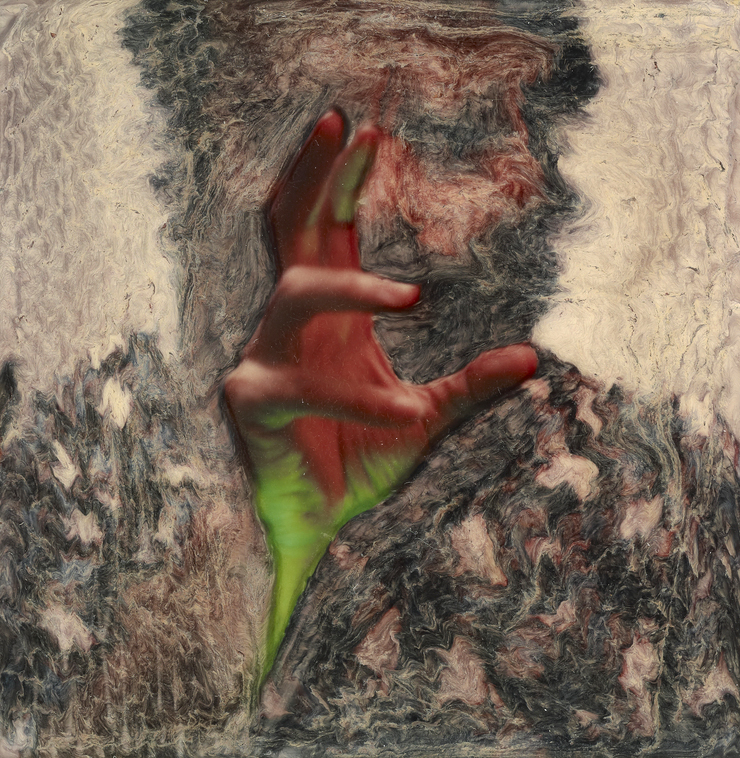
Lucas Samaras (American born Greece, b. 1936) 'Photo-Transformation' November 22, 1973


Lucas Samaras (American born Greece, b. 1936)
Photo-Transformation
November 22, 1973
Polaroid SX-70 dye diffusion print
7.6 × 7.6cm (3 × 3 in.)
The J. Paul Getty Museum
© Lucas Samaras


In this self-portrait, Lucas Samaras reaches out as if trapped in the photograph. In sharp contrast to the indistinct background of his upper body, his crisply defined fingers curl forward, as if he is searching for a way to transcend a two-dimensional world of his own creation. An overriding sense of claustrophobia defines this image, underscored by the small scale of the Polaroid print. Samaras, a hermit-like person, made many Polaroid self-portraits like this in the 1970s as a means of observing himself. The images are open to a wide range of interpretation. Here, Samaras may have tried to convey the sense of isolation he experiences as a reclusive person.


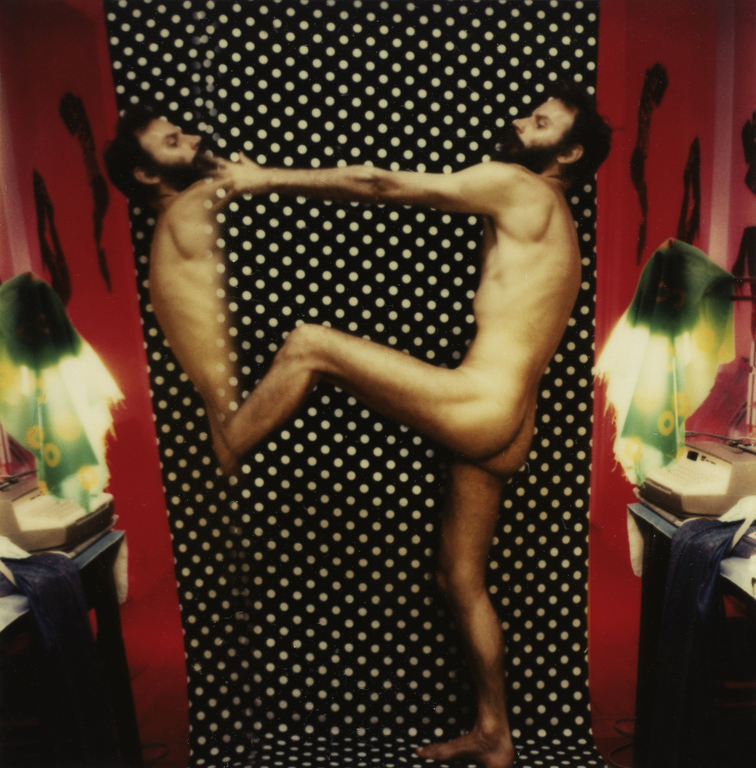
Lucas Samaras (American born Greece, b. 1936) 'Photo-Transformation' September 9, 1976


Lucas Samaras (American born Greece, b. 1936)
Photo-Transformation
September 9, 1976
Polaroid SX-70 dye diffusion print
7.6 × 7.6cm (3 × 3 in.)
The J. Paul Getty Museum
© Lucas Samaras


As if engaging in a tug-of-war with himself, Lucas Samaras confronts and struggles with his own reflection in this self-portrait. The leg-less reflection is incomplete, however, giving the impression of a deformed adversary. A monochromatic polka-dot background and a vibrant green and red border act as a stage for this dramatic struggle.

Samaras’s Photo-Transformations, which he made in the 1970s as a means to examine various facets of himself, could be understood as visual manifestations of internal conflict. They are complex psychological investigations that, according to at least one critic, illustrate one person’s efforts toward spiritual healing.


Lucas Samaras (American, born Greece, 1936) 'Photo-Transformation, 1976'


Lucas Samaras (American born Greece, b. 1936)
Photo-Transformation, 1976
1976
Polaroid SX-70 dye diffusion print
7.6 × 7.6cm (3 × 3 in.)
The J. Paul Getty Museum
© Lucas Samaras


Submerged in narcissism, nothing remains… but “me and myself, I am my own audience, the other, contemplating my existence.”

Made in the 1970s as a means of studying himself, Lucas Samaras’s photographs illustrate the internal struggle that can occur between conflicting aspects of one personality. Bent over a captain’s chair, Samaras rests his head as if he is at the guillotine. Another blurry form hovers above, about to violently attack the submissive figure.

Samaras made his Photo-Transformations, a series of self-portraits, with SX-70 Polaroid film. Still wet, the film’s emulsions could be manipulated to alter the finished image. He used straight pins, rubber erasers, and other simple tools to “draw” into the developing surface. For this portrait, he created a diamond pattern over and around the dominant figure that underscores the frenzy of motion.


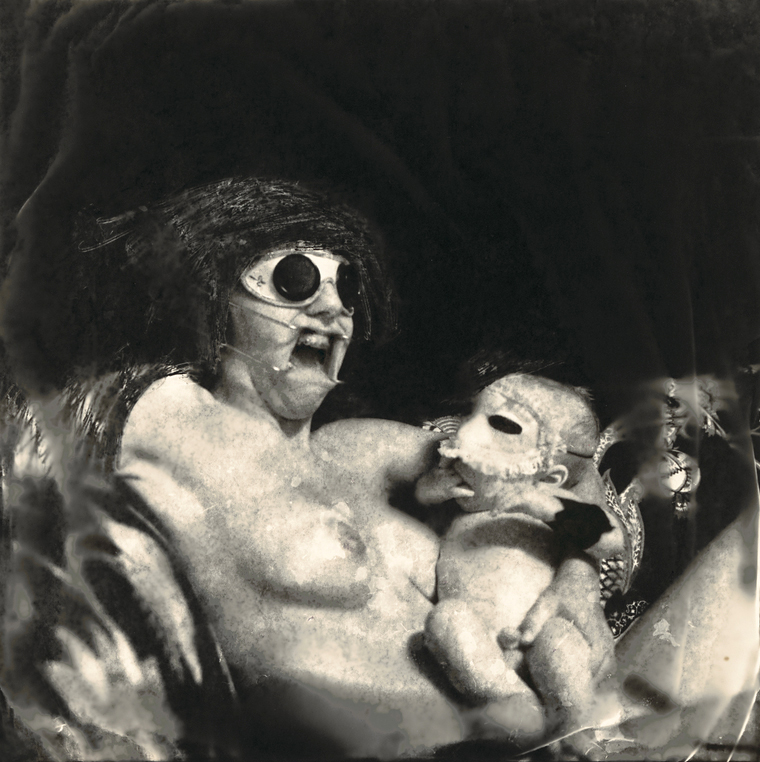
Joel Peter-Witkin (American, born 1939) 'Mother and Child (with Retractor, Screaming)' 1979


Joel Peter-Witkin (American, b. 1939)
Mother and Child (with Retractor, Screaming)
1979
Gelatin silver print
36 × 36cm (14 3/16 × 14 3/16 in.)
The J. Paul Getty Museum
© Joel-Peter Witkin


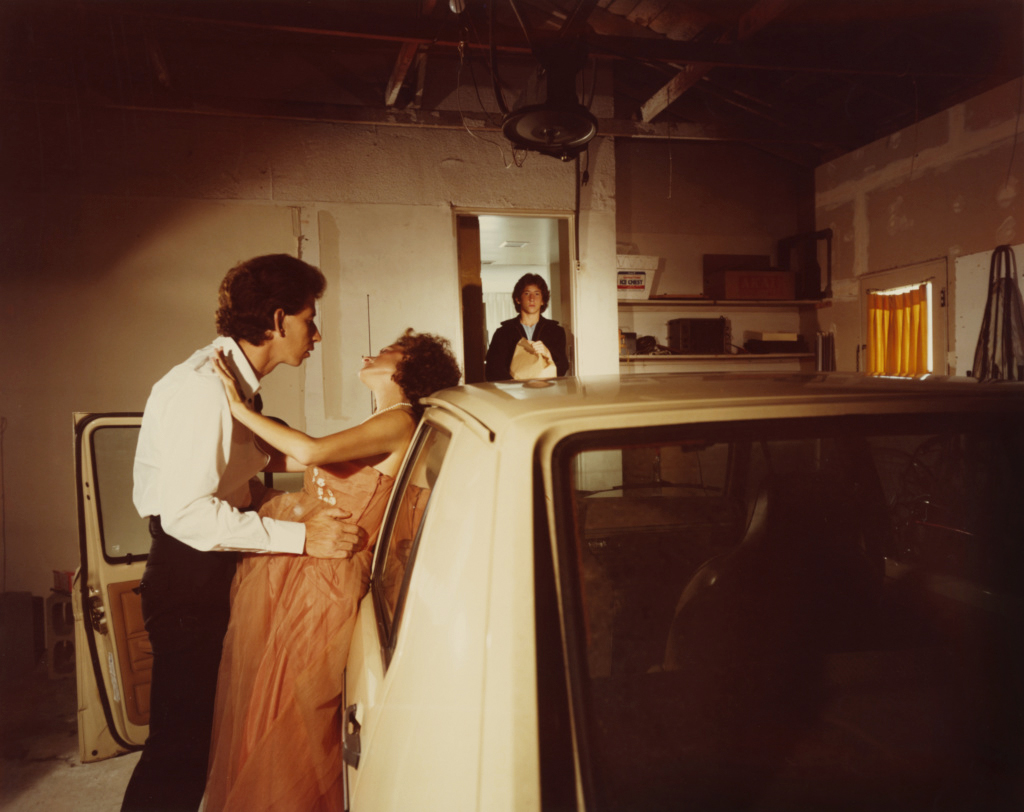
Eileen Cowin (American, born 1947) 'Untitled' from the series 'Family Docudrama' 1980-1983


Eileen Cowin (American, b. 1947)
Untitled from the series Family Docudrama
1980-1983
Chromogenic print
48.4 × 60.7cm (19 1/16 × 23 7/8 in.)
The J. Paul Getty Museum
Purchased with funds provided by the Photographs Council
© Eileen Cowin


In her series Family Docudrama Cowin blurs the boundaries between truth and fiction, and private behaviour and public performance. Drawing equally from family snapshots and soap operas, she presents staged domestic scenes in which she and members of her family, including her identical twin sister, perform as actors. In these ambiguous, open-ended narratives, dramatic moments are exaggerated and the camera’s glare is ever present.


The J. Paul Getty Museum
1200 Getty Center Drive
Los Angeles, California 90049

Opening hours:
Daily 10am – 5.30pm

The J. Paul Getty Museum website

LIKE ART BLART ON FACEBOOK

Back to top

Exhibition: ‘Vera Lutter’ at Gagosian Gallery, Beverly Hills, California

Exhibition dates: 24th July – 12th September, 2009


Vera Lutter (American, b. 1960) 'Campo Santa Sofia, Venice, XV: December 12, 2007' 2007 from the exhibition 'Vera Lutter' at Gagosian Gallery, Beverly Hills, California, July - Sept, 2009


Vera Lutter (American, b. 1960)
Campo Santa Sofia, Venice, XV: December 12, 2007
2007
Unique gelatin silver print
68 5/16 × 56 in (173.5 × 142.2cm)


I really like this atmospheric work – the scale, the ‘grandness’ of it, the dismemberment through verticality, the immersion into inky darkness – there is something almost subterranean (man living under-earth, under-evolution) about the pictures vestigial structures.

Dr Marcus Bunyan


Many thankx to Gagosian Gallery for allowing me to publish the photographs in the posting. Please click on the photographs for a larger version of the image.


Vera Lutter (American, b. 1960) 'Campo Santa Sofia, Venice, XXIII: December 17, 2007' 2007 from the exhibition 'Vera Lutter' at Gagosian Gallery, Beverly Hills, California, July - Sept, 2009


Vera Lutter (American, b. 1960)
Campo Santa Sofia, Venice, XXIII: December 17, 2007
2007
Unique gelatin silver print
85 7/16 × 112 in
217 × 284.5cm


Vera Lutter (American, b. 1960) 'Ca Del Duca Sforza, Venice II: January 13-14, 2008' 2008 from the exhibition 'Vera Lutter' at Gagosian Gallery, Beverly Hills, California, July - Sept, 2009


Vera Lutter (American, b. 1960)
Ca Del Duca Sforza, Venice II: January 13-14, 2008
2008
Unique gelatin silver print
104 1/2 × 168 in
265.4 × 426.7cm


Vera Lutter (American, b. 1960) 'Calle Vallaresso, Venice XXVII: January 31, 2008' 2008


Vera Lutter (American, b. 1960)
Calle Vallaresso, Venice XXVII: January 31, 2008
2008
Unique gelatin silver print
55 3/8 × 68 1/4 in
140.7 × 173.4cm


“Instability, uncertainty, suspense, and monumentality are entities that I consider and think about; they inform my work.”

~ Vera Lutter


Gagosian Gallery is pleased to announce an exhibition of large-scale unique photographs by Vera Lutter. This is her first exhibition in Los Angeles.

In Lutter’s conceptual approach to the camera obscura, the most rudimentary form of photography, the apparatus records in a very direct and immediate way what exists in the world outside. By choosing to retain the negative image, she transforms the visual facts of her chosen environments into uncanny scenes that reflect on the two principal realities of time and space.

In recent years, Lutter has made the hauntingly romantic city of Venice an object of prolonged study. Building on her previous recordings of industrial landscapes and cities surrounded by water, such as Old Slip, New York (1995), and Cleveland (1997), the works created in Venice elaborate her intention “to create an image in which the city appears to be suspended above its own reflection, rendering a place that appears to exist outside of gravity.”

During the anticipated high-water season of 2005, Lutter captured mirage-like emanations of San Marco and Piazza Leoni in which the spectral landmarks appear to hover above their own reflected image in the placid water. Lutter returned to Venice the following year to record the area where the Grand Canal flows into the Bacino, which then opens up into the lagoon. This unstable body of water not only gives Venice its special ethereal character; it also threatens the floating city’s very existence.

Lutter revisited Venice in 2007 and 2008 to explore further the physical, technical, and architectural complexities of the city. Works such as San Giorgio (2008), Campo Santa Sofia (2007) and Calle Vallaresso (2008) reveal certain innate qualities and conditions of the city that elude direct observation and can be experienced only through her luminous incarnations, the physical image.

Text from the Gagosian Gallery website [Online] Cited 01/09/2009 no longer available online


Vera Lutter uses the camera obscura, the most basic photographic device, to render in massive form images that serve as faithful transcriptions of immense architectural spaces. The camera obscura was originally developed during the Renaissance as an aid in the recording of the visible world.

Vera Lutter is best known for monumental black-and-white photographs of cityscapes. Her unique silver gelatin prints are negatives made by transforming a room into a pinhole camera obscura chamber. Directly exposed, often over many hours, onto photosensitive paper, these vistas appear as solarised images, their ethereal platinum tones imbuing the scenes with a haunting melancholy. From an early concentration on the Manhattan skyline, Lutter has turned lately to more industrial sites, including a dry dock, a zeppelin factory, an airport runway, a marina and a deserted warehouse.

Vera Lutter Biography on the Metro Art Works website [Online] Cited 01/09/2009 no longer available online


Installation view of Vera Lutter at Gagosian Gallery, Beverly Hills

Installation view of Vera Lutter at Gagosian Gallery, Beverly Hills


Installation views of Vera Lutter works at Gagosian Gallery, Beverly Hills


Vera Lutter (American, b. 1960) 'San Giorgio, Venice XVIII: January 26, 2008' 2008


Vera Lutter (American, b. 1960)
San Giorgio, Venice XVIII: January 26, 2008
2008
Unique gelatin silver print


Vera Lutter (American, b. 1960) 'San Marco, Venice, XIX: December 1, 2005' 2005


Vera Lutter (American, b. 1960)
San Marco, Venice, XIX: December 1, 2005
2005
Unique gelatin silver print
92 ¼ x 112 ¾ in
234.3 x 286.4cm


Vera Lutter (American, b. 1960) 'Ca' del Duca Sforza, Venice XXXI: July 14, 2008' 2008


Vera Lutter (American, b. 1960)
Ca’ del Duca Sforza, Venice XXXI: July 14, 2008
2008
Unique gelatin silver print
56 × 80 3/4 in
142.2 × 205.1cm


Vera Lutter (American, b. 1960) 'Ca del Duca Sforza, Venice, XXXXIII: July 24, 2008' 2008


Vera Lutter (American, b. 1960)
Ca del Duca Sforza, Venice, XXXXIII: July 24, 2008
2008
Unique gelatin silver print
50 1/2 × 67 1/8 in
128.3 × 170.5cm


Vera Lutter (American, b. 1960) 'Ca del Duca, Venice, XA: December 8, 2007' 2007


Vera Lutter (American, b. 1960)
Ca del Duca, Venice, XA: December 8, 2007
2007
Unique gelatin silver print


Gagosian Gallery
456 North Camden Drive
Beverly Hills, CA 90210
Phone: 310.271.9400

Opening hours:
Monday – Saturday 10am – 6pm

Gagosian Gallery website

LIKE ART BLART ON FACEBOOK

Back to top

Exhibition: ‘Ron Arad: No Discipline’ at The Museum of Modern Art (MoMA), New York

Exhibition dates: 2nd August – 19th October, 2009


Ron Arad (British-Israeli, b. 1951) 'Concrete Stereo' 1983 from the exhibition 'Ron Arad: No Discipline' at The Museum of Modern Art (MoMA), New York, Aug - Oct, 2009


Ron Arad (British-Israeli, b. 1951)
Concrete Stereo
1983
Photo courtesy of Ron Arad Associates and the Museum of Modern Art


One of my favourite designers!

Marcus


Many thankx to the Museum of Modern Art for allowing me to publish the photographs in the posting. Please click on the photographs for a larger version of the image.


Ron Arad (British-Israeli, b. 1951) 'The Rover Chair' 1981 from the exhibition 'Ron Arad: No Discipline' at The Museum of Modern Art (MoMA), New York, Aug - Oct, 2009


Ron Arad (British-Israeli, b. 1951)
The Rover Chair
1981
Tubular steel, leather, and cast-iron Kee Klamp joints
30 3/4 x 27 3/16 x 36 1/4″ (78 x 69 x 92cm); weight 57.3 lbs (26 kg)
Edition by One Off, London
Private collection, London
Photo by Erik and Petra Hesmerg and courtesy of Private Collection, Maastricht, and the Museum of Modern Art


“I picked up this Rover seat and I made myself a frame and this piece sucked me into this world of design.” “If someone had told me a week before that I was going to be a furniture designer, I would think they were crazy.” 

~  Ron Arad


Ron Arad (British-Israeli, b. 1951) 'Sketch for Well Tempered Chair' 1986


Ron Arad (British-Israeli, b. 1951)
Sketch for Well Tempered Chair
1986
Photo courtesy of Vitra Design Museum and the Museum of Modern Art


Ron Arad (British-Israeli, b. 1951) 'Well Tempered Chair Prototype' 1986


Ron Arad (British-Israeli, b. 1951)
Well Tempered Chair Prototype
1986
Photo courtesy of Vitra Design Museum and the Museum of Modern Art


Ron Arad (British-Israeli, b. 1951) 'Big Easy' 1988


Ron Arad (British-Israeli, b. 1951)
Big Easy chair
1988


Ron Arad (British-Israeli, b. 1951) 'Big Easy. Volume 2' 1988


Ron Arad (British-Israeli, b. 1951)
Big Easy. Volume 2
1988
Polished stainless steel
42 1/8 x 50 1/2 x 36 1/4″ (107 x 128.3 x 92.1cm); weight 44 lbs (20 kg)
Edition by One Off, London
Collection of Michael G. Jesselson, New York
Image: Ron Arad Associates, London


The Museum of Modern Art presents Ron Arad: No Discipline, the first major U.S. retrospective of Arad’s work, from August 2 to October 19, 2009. Among the most influential designers of our time, Arad (British, b. Israel 1951) stands out for his adventurous approach to form, structure, technology, and materials in work that spans the disciplines of industrial design, sculpture, architecture, and mixed-medium installation. Arad’s relentless experimentation with materials of all kinds – from steel, aluminium, and bronze to thermoplastics, crystals, fibre-optics, and LEDs – and his radical reinterpretation of some of the most established archetypes in furniture – from armchairs and rocking chairs to desk lamps and chandeliers – have put him at the forefront of contemporary design.

The exhibition features approximately 140 works, including design objects and architectural models, and 60 videos. Most of the objects featured in the exhibition are displayed in a monumental Corten-and-stainless-steel structure specially designed by the artist called Cage sans Frontières (Cage without Borders). The structure measures 126.5 feet (38.5 meters) long, spanning the entire length of the Museum’s International Council gallery, and over 16 feet (5 meters) tall. The exhibition is organised by Paola Antonelli, Senior Curator, and Patricia Juncosa Vecchierini, Curatorial Assistant, Department of Architecture and Design, The Museum of Modern Art.

Ms. Antonelli states: “Arad is well known for his iconoclastic disregard for disciplines – and, at least apparently, for discipline. He has defined much of the current panorama of design, inspiring a generation of practitioners who disregard established modes of practice in favour of mutant design careers that are flexible enough to encompass the range of contemporary design applications, from interactions and interfaces to furniture and shoes.”

Arad’s accomplishments over the past three decades have stirred up the design world by repeatedly updating the concept of the architect / designer / artist and repositioning design side by side with art, both in discourse and in the market – all while keeping one foot firmly in industrial production and large-scale distribution. Idiosyncratic and surprising, Arad’s designs communicate the joy of invention, pleasure, humour, and pride in the display of their technical and constructive skills.

This exhibition celebrates Arad’s spirit by combining industrial design, studio pieces, and architecture. It features Arad’s most celebrated historical pieces, including the Rover Chair (1981) (see above), the Concrete Stereo (1983) (see above), and the Bookworm bookshelves (1993) (see below), along with more recent products such as the PizzaKobra lamp (2008) (see below) and the latest reincarnation of his Volumes series (1998), the armchair duo titled Even the Odd Balls? (2009) (see below).

Cage sans Frontières was specially designed by Arad, developed with Michael Castellana from Ron Arad Associates, and manufactured and installed by Marzorati Ronchetti, Italy, under the direction of Roberto Travaglia. The structure is in the shape of a twisted loop and consists of 240 square cut-outs lined with stainless steel that act as shelves for the objects in the exhibition. The dramatic installation relies on the scale of the structure and on the reflectivity of the inner walls of the cut-outs which creates a ricocheting effect. One side of the structure is continually covered with grey gauze fabric that acts as a translucent, elastic membrane. The fabric was donated by the textile company Maharam and was cut and stitched by the jeans manufacturer Notify, which is also a sponsor of the exhibition. The structure was commissioned and lent to the exhibition by Singapore FreePort Pte Ltd, an arts storage facility.

Monitors installed in the structure and on the walls feature animations of the design and production process of some of the objects on view; animated renderings of architectural projects represented in the exhibition by models; and a video showing time-lapse footage of the construction of Cage sans Frontières. Other objects – including the Bookworm and This Mortal Coil bookshelves (both 1993) and the Shadow of Time clock (1986) – are installed along the perimeter of the gallery. Two of Arad’s sofas, Do-Lo-Res (2008) (see below) and Misfits (1993) (see below), are installed outside the exhibition entrance, and visitors are invited to sit on them.

Ever since he founded his studio, together with long-time business partner Caroline Thorman, in 1981 (first called One Off, and then reestablished in 1989 as Ron Arad Associates), Arad has produced an outstanding array of innovative objects, from limited editions to unlimited series, from carbon fibre armchairs to polyurethane bottle racks. A designer and an architect, trained at the Bezalel Academy of Art in Jerusalem and at London’s Architectural Association School of Architecture, he has also designed memorable spaces – some plastic and tactile, others digital and ethereal – such as the lobby of the Tel Aviv Opera House (1994-98), Yohji Yamamoto’s showroom in Tokyo (2003), and the Holon Design Museum, Israel (nearing completion), all of which will be represented in the exhibition with models and videos. In his influential role as Head of the Design Products Masters’ Degree course at the Royal College of Art in London from 1997 until this year, he has nurtured several innovative designers, including Julia Lohmann, Paul Cocksedge, and Martino Gamper.

The 1981 Rover Chairs (see above), which launched Arad’s design career even though at the time he was not seeking any particular professional label, are emblematic of his early readymade creations. The chairs are made of discarded leather seats from the Rover V8 2L, a British car, anchored in tubular-steel frames using Kee Klamps, an inexpensive scaffolding system. Arad stopped making them once he realised that the overwhelming demand for the chairs was transforming his atelier into a dedicated Rover Chair manufacturer. The Italian company Moroso is about to produce an industrial version of the chair under the name Moreover.

The Concrete Stereo (1983) (see above) is another milestone in Arad’s work with readymades. It is very simply a hi-fi system – with turntable, amplifier, and speakers – cast in concrete. The concrete was then partially chipped away, exposing the steel armature, the electronic components, and the pebbles in the cement.

Objects in the exhibition are grouped as families whose common thread is the exploration, sometimes over years, of a form, a material, a technique, or a structural idea. An example is the investigation of elasticity and surprise that began with the Well Tempered Chair (1986) (see above) – a chair made of four sprung sheets of steel held together by wing nuts that come together to suggest the archetypical shape of an armchair. Another example is the Volumes series (1988), which comprises, among others, his renowned Big Easy (1988) (see above) and its various iterations, among them the Soft Big Easy (1990) (see above) and the painted-fibreglass New Orleans (1999) (see above).

Not Made by Hand, Not Made in China, another important family and a milestone in Arad’s career and in the history of design, is a series of limited-edition objects – vases, sculptures, lamps, and bowls – that Arad presented in 2000 at the annual Milan Furniture Fair. All the objects in the series were made using 3-D printing, which at that time was almost exclusively used to create one-off models for objects that would later be produced in series using traditional manufacturing processes. Treating rapid prototypes as final products rather than templates, Arad turned the new process into an advanced production method, a path that was subsequently followed by several designers.

A more recent family is the Bodyguards (2008) (see below), in which the same initial shape in blown aluminium is differently intersected by imaginary planes and cut to reveal ever-changing personalities, from a rocking chair to a stern bodyguard-like sculpture.

To give life to his ideas, Arad relies on the latitude provided by computers as much as on his own exquisite drafting skills, and he uses both the most advanced automated manufacturing techniques and the simple welding apparatuses in his collaborators’ metal workshops. Often, his work is a combination of high and low technologies, such as his Lolita chandelier (2004) (see below) for Swarovski. Made with 2,100 crystals and 1,050 white LEDs, the Lolita takes the shape of a flat ribbon wound into a corkscrew shape. The ribbon contains 31 processors that enable the display of text messages sent to the Lolita’s mobile phone number. For this exhibition, visitors can send texts to (917) 774-6264. The messages appear at the top of the chandelier and slowly wind down the ribbon’s curves, creating the impression that the chandelier is spinning ever so slightly.”

Press release from the MoMA website


Ron Arad (British-Israeli, b. 1951) 'Soft Big Easy' 1990


Ron Arad (British-Israeli, b. 1951)
Soft Big Easy chair
1990
Injected flame-retardant polyurethane foam, steel, polypropylene, and wool
39 3/8 x 48 7/16 x 31 1/2″ (100 x 123 x 80cm)
Manufactured by Moroso SpA, Italy
Courtesy Moroso SpA, Udine, Italy
Image: CNAC/MNAM/Dist. Réunion des Musées Nationaux/Art Resource, NY. Photo Jean-Claude Planchet


Ron Arad (British-Israeli, b. 1951) 'Large Bookworm' 1993


Ron Arad (British-Israeli, b. 1951)
Large Bookworm
1993
Tempered sprung steel and patinated steel
Bracket height variable, 7 7/8-11 13/16″ (20-30cm); total length 49′ 2 9/16″ (15m); depth 13″ (33cm)
Edition by One Off/Ron Arad Associates, London
Private collection
Image: Ron Arad Associates, London


Ron Arad (British-Israeli, b. 1951) 'Misfits' 1993


Ron Arad (British-Israeli, b. 1951)
Misfits
1993
Injected flame-retardant polyurethane foam, steel, polypropylene, and wool
Six modules: each h. variable, base 39 3/8 x 39 3/8″ (100 x 100cm)
Manufactured by Moroso SpA, Italy, 2007
Courtesy Moroso SpA, Udine, Italy
Image: Ron Arad Associates, London


Misfits is a seating system Arad developed, at Patrizia Moroso’s request, to launch Waterlily, a new water-blown foam made by ICI Polyurethane. From large cubes of foam he carved out modular – or, rather, mock-modular – sections, intending them to be graciously ill-fitting with each other (hence the name). The modules can stand on their own or be combined in various ways, but however they are lined up they are meant to look deliberately mismatched, without continuity from section to section. Some sections have backs and some do not, and the irregular solids and voids created quite a challenge for Moroso, who had to figure out how to cover them all with fabric. The recent reedition of Misfits is made with slightly larger blocks from a different polyurethane foam, which is injected into a mould rather than cut.


Ron Arad (British-Israeli, b. 1951) 'D-Sofa' Prototype 1994


Ron Arad (British-Israeli, b. 1951)
D-Sofa Prototype
1994
Patinated, painted, oxidised stainless steel and mild steel
38 3/16″ x 7′ 1 13/16″ x 35 7/16″ (97 x 218 x 90cm)
Prototype by One Off, London
Pizzuti Collection
Image: Private collection, USA. Photo Erik and Petra Hesmerg


Ron Arad (British-Israeli, b. 1951) 'Uncut' 1997


Ron Arad (British-Israeli, b. 1951)
Uncut chair
1997
Vacuum-formed aluminium sheet and polished stainless steel
32 5/8 x 38 5/8 x 35″ (83 x 98 x 89cm)
Edition by Ron Arad Studio, Italy
Centre Pompidou, Paris, Musée national d’art moderne/Centre de création industrielle


Ron Arad (British-Israeli, b. 1951) 'FPE (Fantastic, Plastic, Elastic)' 1997


Ron Arad (British-Israeli, b. 1951)
FPE (Fantastic, Plastic, Elastic)
1997
Extruded aluminium profiles and injection-moulded polypropylene plastic sheet
31.25 x 17 x 22″ (79.4 x 43.2 x 55.9cm)
Manufactured by Kartell, Italy
The Museum of Modern Art, New York. Gift of the manufacturer
Image: Ron Arad Associates, London


FPE (Fantastic, Plastic, Elastic) is an inexpensive stacking chair made from lightweight plastic and aluminium. The design, originally conceived in plywood (as the Cross Your T’s Chair), was part of a commission from Mercedes-Benz for a transportable exhibition stand that would be taken to motor shows in Europe. The chair was not suited to small-scale production, and was therefore tweaked and perfected for mass manufacture. Its final form is exceptional in the simplicity of its construction: a plastic seat is inserted into channels in double-barrelled extruded aluminium profiles, which, when the chair frame is bent, hold the plastic in place. With no need for glue, screws, or bolts, this method allows the simplest combination of frame and plane to create a sinuous, practical, resilient form – proving Arad’s ability to embrace industrial production and make the best of its possibilities. The FPE can be stacked in groups of eight, comes in three colours (opaline, blue, and red, although it was originally available in yellow), and can be used both indoors and out.


Ron Arad (British-Israeli, b. 1951) 'New Orleans' 1999


Ron Arad (British-Israeli, b. 1951)
New Orleans chair
1999


Ron Arad (British-Israeli, b. 1951) 'Lolita Chandelier' 2004


Ron Arad (British-Israeli, b. 1951)
Lolita Chandelier
2004
Crystals and light-emitting diodes (LEDs)
59″ (150cm) height x 43 1/4″ (110 cm) top-plate diam.; weight 352.7 lbs (160 kg)
Edition by Swarovski, Austria
Courtesy of Galerie Arums, Paris
Send a text message to Lolita: (917) 774-6264
Image: Ron Arad Associates, London


When Nadja Swarovski set out to build a new division for her family’s company, Swarovski Crystal, she invited Arad to reinvent the chandelier as a juxtaposition of traditional form with modern technology. The new collection of chandeliers, called Crystal Palace, launched in 2002, and Arad’s Lolita was ready in 2004. Made with 2,100 crystals and 1,050 white LEDs, Lolita takes the shape of a flat ribbon wound into a corkscrew shape. The ribbon contains thirty-one processors that enable the display of SMS text messages sent to Lolita’s mobile phone number; these messages appear at the top of the chandelier and wind down the ribbon’s curves, slowly enough to give bystanders time to read, creating the impression that the chandelier is spinning ever so slightly. The name is the result of grace under pressure: on the phone with Swarovski and pressed for a name, Arad thought of another work in progress, his LED riddled Lo-Rez-Dolores-Tabula-Rasa, and from there went to “Lolita” – the nickname of Vladimir Nabokov’s Dolores Haze. The name stuck, creating not only a saucy entry in many a design buff’s phone book but a further literary association as well: as a journalist pointed out to Arad, Nabokov’s novel begins, “Lolita, light of my life…”


Ron Arad (British-Israeli, b. 1951) 'Oh Void 2' armchair 2004


Ron Arad (British-Israeli, b. 1951)
Oh Void 2 armchair
2004


Ron Arad (British-Israeli, b. 1951) 'Oh Void 2 armchair' 2006


Ron Arad (British-Israeli, b. 1951)
Oh Void 2 armchair
2006
Acrylic
30 1/4 x 43 x 23 5/8″ (76.8 x 109.2 x 60cm)
Edition by The Gallery Mourmans, the Netherlands
Collection of Michael G. Jesselson, New York


Ron Arad (British-Israeli, b. 1951) 'Table Paved With Good Intentions No. 48' 2005


Ron Arad (British-Israeli, b. 1951)
Table Paved With Good Intentions No. 48
2005
Mirror-polished, laser-cut stainless steel
55″ x 8′ 2″ x 15″ (139.7 x 238.8 x 38.1cm); weight 176.4 lbs (80 kg)
Edition by Ron Arad for The Gallery Mourmans, the Netherlands
Collection Jérôme and Emmanuelle de Noirmont, Paris
Image: Emmanuelle and Jérôme de Noirmont. Photo: Mathieu Ferrier


Arad’s installation for Design Miami in 2005 consisted of sixty-nine tables made of mirror-polished stainless steel and covering an entire gallery, folding at the corners and climbing up the walls like handsome quicksilver parasites from outer space. Arad had experimented with reflective tables eleven years earlier, in an installation for one of the Fondation Cartier’s famous Soirées Nomades, in which designers were invited to provide a stage for music and other types of performances in Jean Nouvel’s building for the Paris-based foundation. There, Arad displayed forty tables that covered the ground floor, reflecting the surrounding trees and enhancing the glass architecture’s openness toward the city surrounding it.


Ron Arad (British-Israeli, b. 1951) 'MT Rocker Chair' 2005


Ron Arad (British-Israeli, b. 1951)
MT Rocker Chair
2005
Polished bronze rods
29 x 33 1/2 x 40″ (73.7 x 85.1 x 101.6cm)
Edition by Ron Arad Associates, London
Private collection, USA
Image: Ron Arad Associates, London


Arad’s work often begins as a studio piece that is later adapted for industrial production, but in some cases the direction is reversed, as was the case with the MT (or “empty”) series. Intrigued by the untapped potential of rotation-moulding, one of the humblest methods of manufacturing plastic products, Arad came up with beautiful, complex concave / convex forms, highlighted by contrasting colours, for an armchair, rocker, and couch. The MT collection is manufactured by Driade, but Arad subsequently translated the rocking piece into versions made of polished stainless steel or bronze, using an exquisite technique involving the patient application, by hand, of metal rods onto a basic structure.


Ron Arad (British-Israeli, b. 1951) 'Southern Hemisphere' 2007


Ron Arad (British-Israeli, b. 1951)
Southern Hemisphere
2007
Patinated aluminium
Photo by Erik and Petra Hesmerg and courtesy of Private Collection, Maastricht, and the Museum of Modern Art


Ron Arad (British-Israeli, b. 1951) 'Do-Lo-Res' 2008


Ron Arad (British-Israeli, b. 1951)
Do-Lo-Res
2008
Polyurethane foam, polyester fibres, and wood
Dimensions variable: 10 13/16 x 8 1/4 x 8 1/4 x 32 1/16″ (27.5 x 21 x 21 x 83cm)
Manufactured by Moroso SpA, Italy
Courtesy Moroso SpA, Udine, Italy
Image: Moroso


Do-Lo-Rez is a seating unit made of rectangular block elements, each one constructed from polyurethane foam, denser at the bottom and softer at the top. The name echoes the Lo-Rez-Dolores-Tabula-Rasa project, and both designs are different manifestations of Arad’s interest in digital pixilation and low resolution. Here the foam “pixels” of different heights are attached to a platform with steel pins and can be rearranged to create different sofa forms.


Ron Arad (British-Israeli, b. 1951) 'PizzaKobra' lamp 2008


Ron Arad (British-Israeli, b. 1951)
PizzaKobra lamp
2008
Chromed steel, aluminium, and light-emitting diodes (LEDs)
Extended: 28 7/8″ (73.3cm) height x 10 1/4″ (26cm) diam.; collapsed: 3/4″ (1.9cm) height x 10 1/4″ (26cm) diam.
Manufactured by iGuzzini illuminazione SpA, Italy, 2008
The Museum of Modern Art, New York. Gift of the manufacturer


This lamp, which transforms itself from a coil as flat as a pizza to a sinuous, rising metal cobra with a single glowing red eye (its on/off switch), is as surprising as it is playful, as much like a twisty Tangle Toy as a very efficient and flexible light source. With its tubular aluminium sections – except for the base, which is heavier steel, for balance – and six LEDs that can be oriented in any direction, the PizzaKobra can be adjusted to suit any lighting requirements.


Ron Arad (British-Israeli, b. 1951) 'Bodyguard' 2008


Ron Arad (British-Israeli, b. 1951)
Bodyguard chair
2008
Polished and partially coloured superplastic aluminium
49 x 36 x 70 1/2″ (124.5 x 91.4 x 179.1cm)
Edition by The Gallery Mourmans, the Netherlands
Private collection, Palm Beach, Florida


The Bodyguards, a recent result of Arad’s experiments with blown aluminium, are all derived from the same bulbous shape, intersected and carved in various ways. Although Arad had sworn off designing rocking chairs, it seemed a natural application for this new technology, allowing him to create these large, polished pieces, which, in addition to rocking back and forth, also swivel in a way Arad describes as “omnidirectional.” With the Bodyguards, as with much of his furniture, Arad explores the expressive qualities of the material, pursuing a way to transcend its physical limitations. He has described the pieces as monsters – huge and labor intensive, some resembling a human torso and revealing colourful insides when cut. (Arad was teased about the number of security guards present at a show in Dolce & Gabbana’s Metropol space in Milan, in 2006 – hence the name.)


Installation Photographs of the Exhibition

Installation view of 'Ron Arad: No Discipline' exhibition featuring 'Cage sans Frontières (Cage without Borders)' with 'Even the Odd Balls?' chairs (2009) and 'Lolita Chandelier' (2004)


Installation view of Ron Arad: No Discipline exhibition featuring Cage sans Frontières (Cage without Borders) with Even the Odd Balls? chairs (2009) and Lolita Chandelier (2004)
Photo courtesy of Ron Arad Associates and the Museum of Modern Art


Installation view of 'Ron Arad: No Discipline' exhibition, featuring 'Cage sans Frontières (Cage without Borders)'


Installation view of Ron Arad: No Discipline exhibition, featuring Cage sans Frontières (Cage without Borders)
Photo courtesy of Ron Arad Associates and the Museum of Modern Art


Installation view of 'Ron Arad: No Discipline' exhibition, featuring 'Cage sans Frontières (Cage without Borders)'


Installation view of Ron Arad: No Discipline exhibition, featuring Cage sans Frontières (Cage without Borders)
Photo courtesy of Ron Arad Associates and the Museum of Modern Art


Installation view of 'Ron Arad: No Discipline' exhibition, featuring 'Cage sans Frontières (Cage without Borders)' with two 'Rolling Volume' chairs (1989 and 1991), left, and two 'Bodyguard' chairs (2007)


Installation view of Ron Arad: No Discipline exhibition, featuring Cage sans Frontières (Cage without Borders) with two Rolling Volume chairs (1989 and 1991), left, and two Bodyguard chairs (2007)


Installation view of 'Ron Arad: No Discipline' exhibition, featuring 'Cage sans Frontières (Cage without Borders)' with in the foreground, 'Oh Void 2' armchairs


Installation view of Ron Arad: No Discipline exhibition, featuring Cage sans Frontières (Cage without Borders) with in the foreground, Oh Void 2 armchairs


The Museum of Modern Art (MoMA)
11, West Fifty-Third Street, New York

Opening hours:
Sun – Fri, 10.30am – 5.30pm
Sat, 10.30am – 7.00pm

MOMA website

LIKE ART BLART ON FACEBOOK

Back to top

Exhibition: ‘Hunted and Gathered: Photographs’ from the Private Collection of Robert Flynn Johnson at Modernism, San Franciso

Exhibition dates: 9th July – 29th August, 2009


Many thankx to Modernism for allowing me to publish the photographs in the posting. Please click on the photographs for a larger version of the image.

Dr Marcus Bunyan
 

Anonymous photographer. 'The Dancer, Ted Shawn, Boston Dance Theater' 1929 from the exhibition 'Hunted and Gathered: Photographs' from the Private Collection of Robert Flynn Johnson at Modernism, San Franciso, July - August, 2009


Anonymous photographer
The Dancer, Ted Shawn, Boston Dance Theater
1929
Vintage gelatin silver print
9 5/8 x 7 1/4″


Gérard Decaux. 'Abbe Lane' Rome, c. 1955 from the exhibition 'Hunted and Gathered: Photographs' from the Private Collection of Robert Flynn Johnson at Modernism, San Franciso, July - August, 2009


Gérard Decaux
Abbe Lane
Rome, c. 1955
Vintage gelatin silver print
10 1/4 x 8 1/2″


Clarence Sinclair Bull (American, 1896-1979) 'Greta Garbo' c. 1935 from the exhibition 'Hunted and Gathered: Photographs' from the Private Collection of Robert Flynn Johnson at Modernism, San Franciso, July - August, 2009


Clarence Sinclair Bull (American, 1896-1979)
Greta Garbo
c. 1935
Gelatin silver print, printed later
14 x 11″


Clarence Sinclair Bull was born in Sun River, Montana in 1896. His career began when Samuel Goldwyn hired him in the 1920 to photograph publicity stills of the MGM stars. He is most famous for his photographs of Greta Garbo taken during the years of 1926-1941. Bull’s first portrait of Garbo was a costume study for the Flesh and the Devil, in September 1926.

Bull was able to study with the great Western painter, Charles Marion Russell. He also served as an assistant cameraman in 1918. Bull was skilled in the areas of lighting, retouching, and printing. He was most commonly credited as “C.S. Bull.” Bull died on June 8, 1979 in Los Angeles, California, aged 83.

Text from the Wikipedia website


Laure Albin Guillot (French, 1879-1962) 'La Flamme (Woman's Head)' c. 1935


Laure Albin Guillot (French, 1879-1962)
La Flamme (Woman’s Head)
c. 1935
Vintage gelatin silver print
6 3/8 x 4 3/8″


Anonymous photographer. 'Acrobats' c. 1920


Anonymous photographer
Acrobats
c. 1920
Vintage gelatin silver print
8 5/8 x 5 5/8″


Pierre Nobel. 'Still Life' c. 1935


Pierre Nobel
Still Life
c. 1935
Vintage gelatin silver print mounted on paper
9 1/4 x 6 3/4″


Charles Jones (English, 1866-1959) 'Plum, Laxton Early Red' c. 1910


Charles Jones (English, 1866-1959)
Plum, Laxton Early Red
c. 1910
Vintage gelatin silver print from a glass plate negative
6 x 4 1/4″


Modernism presents a wonderful and intriguing selection of photographs from the private collection of Robert Flynn Johnson. Robert Flynn Johnson is emeritus faculty in the Printmaking department. He is the curator in charge of the Achenbach Foundation for Graphic Arts at the Fine Arts Museums of San Francisco, a position he has held since 1975.

This exhibition coincides with the publication of his second book on vernacular photography, The Face in the Lens: Anonymous Photographs (University of California Press).

“When I am asked what it takes to become an accomplished collector, it is not the qualities of knowledge, judgment or that elusive term “taste” that comes to mind. Instead, it is the ability to be curious that is the crucial element in the makeup of a true collector – the ability to ask questions, to learn, and to get answers regarding works of art that catch your eye and move your emotions,” Robert Flynn Johnson said.

He added, “For more than thirty-five years I have followed my curiosity in passionately seeking out photographs that have stirred my imagination. Some of them have been by great artistic masters of the medium, while others have been anonymous photographic orphans that have nothing going for them but the image itself. Both types of photographs are included in this exhibition.”

“I have made a varied, and some may say eccentric, selection of images. From a heart-stopping snapshot of acrobats posed in a three-man handstand perched on the ledge of the 108th floor of the Empire State building, to a tender portrait of Marilyn Monroe and Joe DiMaggio that captures the instant before their lips meet in their first kiss as a married couple, They these pictures are a true reflection of my collecting philosophy that is attracted to profound, beautiful, humorous, and absurd aspects of life and art.”

“Nevertheless, I hope they these works convey some of the visual surprise and delight to you that I felt when I first saw each and every one of them.”

Oscar Wilde once said that the only person that liked all art equally was an auctioneer! I do not expect viewers to appreciate all the photographs in this exhibition, but through my visual curiosity in collecting them over time, I did, and that is why they are here together today.

Text from Artdaily.org website


Carelton Watkins (American, 1829-1916) 'San Francisco' c. 1868


Carelton Watkins (American, 1829-1916)
San Francisco
c. 1868
Vintage albumen print
8 x 12 1/8″


Mammoth-plate photograph of San Francisco taken from the top of Telegraph Hill showing the Golden Gate in the background.


Eugène Atget (French, 1857-1927)
'Landscape, Environs of Paris (Étang, Ville-d'Avray)' 1917


Eugène Atget (French, 1857-1927)
Landscape, Environs of Paris (Étang, Ville-d’Avray)
1917
vintage albumen print
7 x 9 1/4″


Anonymous photogapher (Czechoslovakia). 'Train' c. 1930


Anonymous photographer (Czechoslovakia)
Train
c. 1930
Vintage gelatin silver print
9 1/4 x 11 5/8″


Anonymous photographer (United Kingdom). 'Train' c. 1930


Anonymous photographer (United Kingdom)
Train
c. 1930
Vintage gelatin silver print
9 1/2 x 11 1/2″


Sasha. 'Archer Leaping Through the Air' c. 1930


Sasha
Archer Leaping Through the Air
c. 1930
Vintage gelatin silver print
7 3/8 x 9 3/8″


Leopold Hugo (American born Poland, 1866-1933) 'Craters of the Moon, Idaho' 1920


Leopold Hugo (American born Poland, 1866-1933)
Craters of the Moon, Idaho
1920
Tinted vintage gelatin silver print
7 3/8 x 9 3/8″


Anonymous. 'Acrobat Piroska at the Latin Quarter (Published in Life Magazine)' c. 1945


Anonymous photographer
Acrobat Piroska at the Latin Quarter (Published in ‘Life Magazine’)
c. 1945
Vintage gelatin silver print
9 5/8 x 9″


Felix Bonfils (French, 1831-1885) 'Woman in Burka' c. 1870


Felix Bonfils (French, 1831-1885)
Woman in Burka
c. 1870
vintage albumen print
8 3/4 x 6 5/8″


Modernism
724 Ellis Street
San Francisco, CA 94109

Opening Hours:
Tuesday – Saturday, 10am – 5:30pm

Modernism website

LIKE ART BLART ON FACEBOOK

Back to top

Exhibition: ‘Focus on Color: The Photography of Jeannette Klute’ at the Bruce Museum, Greenwich, Connecticut

Exhibition dates: 21st June – 27th September, 2009


Many thankx to the Bruce Museum and Mike Horyczun (Director of Public Relations) for allowing me to publish the wonderful photographs below.

Marcus


Jeannette Klute (American, 1918-2009) 'Cardinal Flower' Nd (early-mid 1950s)


Jeannette Klute (American, 1918-2009)
Cardinal Flower
Nd (early-mid 1950s)
Dye transfer photograph
20 1/4 x 16 1/4 in.
Bruce Museum collection
Gift of George Stephanopoulos


Jeannette Klute (American, 1918-2009) 'Misty Willow' Nd (early-mid 1950s)


Jeannette Klute (American, 1918-2009)
Misty Willow
Nd (early-mid 1950s)
Dye transfer photograph
20 1/4 x 16 1/4 in.
Bruce Museum collection
Gift of George Stephanopoulos


Jeannette Klute (American, 1918-2009) 'Miterwort' Nd (early-mid 1950s)


Jeannette Klute (American, 1918-2009)
Miterwort
Nd (early-mid 1950s)
Dye transfer photograph
14 1/8 x 11 1/4 in.
Bruce Museum collection
Gift of George and Alexandra Stephanopoulos


Jeannette Klute (American, 1918-2009) 'Beech Fern' Nd (early-mid 1950s)


Jeannette Klute (American, 1918-2009)
Beech Fern
Nd (early-mid 1950s)
Dye transfer photograph
20 1/4 x 16 1/4 in.
Bruce Museum collection
Gift of George Stephanopoulos


Jeannette Klute (American, 1918-2009) 'Jewel Weed' Nd (early-mid 1950s)


Jeannette Klute (American, 1918-2009)
Jewel Weed
Nd (early-mid 1950s)
Dye transfer photograph
20 1/4 x 16 1/4 in.
Bruce Museum collection
Gift of George Stephanopoulos


Jeannette Klute (American, 1918-2009) 'Christmas Fern' Nd (early-mid 1950s)


Jeannette Klute (American, 1918-2009)
Christmas Fern
Nd (early-mid 1950s)
Dye transfer photograph
12 1/2 x 9 1/2 in.
Bruce Museum collection
Gift of George Thomsen


Jeannette Klute (American, 1918-2009) 'Jack in the Pulpit (Arisaema triphyllum)' Nd (early-mid 1950s)


Jeannette Klute (American, 1918-2009)
Jack in the Pulpit (Arisaema triphyllum)
Nd (early-mid 1950s)
Dye transfer photograph
20 1/4 x 16 1/4 in.
Bruce Museum collection
Gift of George and Alexandra Stephanopoulos


Jeannette Klute (American, 1918-2009) 'Green Grasses - blue' Nd (early-mid 1950s)


Jeannette Klute (American, 1918-2009)
Green Grasses – blue
Nd (early-mid 1950s)
Dye transfer photograph
20 1/4 x 16 1/4 in.
Bruce Museum collection
Gift of Richard and Elena Pollack


The exhibition features 24 colour photographs by Jeannette Klute (1918-2009) drawn from more than fifty of her prints held in the Bruce Museum’s permanent collection. Ranging from landscapes to intimate “woodland portraits” of orchids, ferns, and trees, Jeannette Klute’s photographs of New England are vibrant compositions produced through the labour intensive dye transfer process.

Trained at the Rochester Institute of Technology through the Works Progress Administration during the Depression, Jeanette Klute worked extensively on perfecting the dye transfer process, a laborious photographic technique that allowed for rich colours in exceptionally permanent prints. Klute tested and refined this process at the Eastman Kodak Company in Rochester, NY, beginning her career as photographic illustrator to physicist Ralph M. Evans and ascending to research photographer in charge of the Visual Research Studio of the Color Control Division.

Klute’s photography merged environmental consciousness with cutting edge technology. Using only natural light and leaving a minimal impact on the environment, she spent many years investigating colour and demonstrating the capabilities of dye transfer by photographing nature. Her work resulted in some of the finest examples of colour printing and all of its capabilities.

“My purpose has been to somehow express the feeling one experiences being out of doors,” Ms. Klute wrote for her Woodland Portraits exhibition. “I am concerned with the delight to the senses as much as with the intellectual. The woods are mystical and enchanting to me as well as spiritual.”

Jeanette Klute’s work was featured in Edward Steichen’s 1950 exhibition All Color Photography at the Museum of Modern Art, and her large one-woman shows were circulated internationally by the Smithsonian Institution and Kodak International. She was also invited to submit work for the San Francisco Museum of Art’s landmark exhibition Women of Photography: An Historical Survey in 1975.

Text from the Bruce Museum website


Jeannette Klute (American, 1918-2009) 'Maple Tree - red leaves' Nd (early-mid 1950s)


Jeannette Klute (American, 1918-2009)
Maple Tree – red leaves
Nd (early-mid 1950s)
Dye transfer photograph
20 1/4 x 16 1/4 in.
Bruce Museum collection
Gift of LeGrand Belnap


Jeannette Klute (American, 1918-2009) 'Frosted Tree' Nd (early-mid 1950s)


Jeannette Klute (American, 1918-2009)
Frosted Tree
Nd (early-mid 1950s)
Dye transfer photograph
20 1/4 x 16 1/4 in.
Bruce Museum collection
Gift of Richard and Elena Pollack


Jeannette Klute (American, 1918-2009) 'Yellow Lady's Slipper' Nd (early-mid 1950s)


Jeannette Klute (American, 1918-2009)
Yellow Lady’s Slipper
Nd (early-mid 1950s)
Dye transfer photograph
20 1/4 x 16 1/4 in.
Bruce Museum collection
Gift of LeGrand Belnap


“The first month they were sending people out for job interviews, but not me,” she recalled in a speech at the Rochester Institute of Technology in 1984. “I asked how come? The head of the department said, ‘Oh, there are no jobs for women in photography.’ My world fell apart.”

Ms. Klute took it upon herself to go out for interviews, and every week on her day off, she walked to the offices of Eastman Kodak Co. to ask for a job. For a long time, she never made it past the personnel office. Then, one day, in the pouring rain, decked in her finest navy blue suit, she stalked to the offices and was sent straight to the sixth floor for an interview.

“The man took a look at me with the rain dripping off my hat and said, ‘If you want a job that bad, you’ve got it,'” she recalled. “There was a celebration in the neighbourhood that night.” …

“She was really like my college education,” said Barbara Erbland, who assisted Ms. Klute in the lab at Kodak for many years. “She taught me everything – about light, colour, about people … how to live well.” … “Her lab consisted of all women,” she said. “I think it was by intention. She believed women had brains. We worked very well together.” …

Lugging a 4-by-5 Graflex single-lens reflex camera wherever they went, Erbland ventured into swamps and tide pools… “She taught me you don’t make do, you make things happen,” said Erbland. “You’re not a victim.”

Back in Rochester, the two sought out swamps and woodland for Ms. Klute to take her photographs – or, as she put it, to “make pictures.”

PHOTO GALLERY: In memory of Jeannette Klute, a ‘Renaissance woman’, by Philip Anselmo, August 2009


Jeannette Klute. 'Grape Leaves' nd


Jeannette Klute (American, 1918-2009)
Grape Leaves
Nd (early-mid 1950s)
Dye transfer photograph
20 1/4 x 16 1/4 in.
Bruce Museum collection
Gift of George Stephanopoulos


Bruce Museum
One Museum Drive
Greenwich, CT 06830

Opening hours:
Tuesday – Sunday 10am – 5pm
Last admission 4.30pm
Closed Monday and major holidays
Bruce Museum website

LIKE ART BLART ON FACEBOOK

Back to top