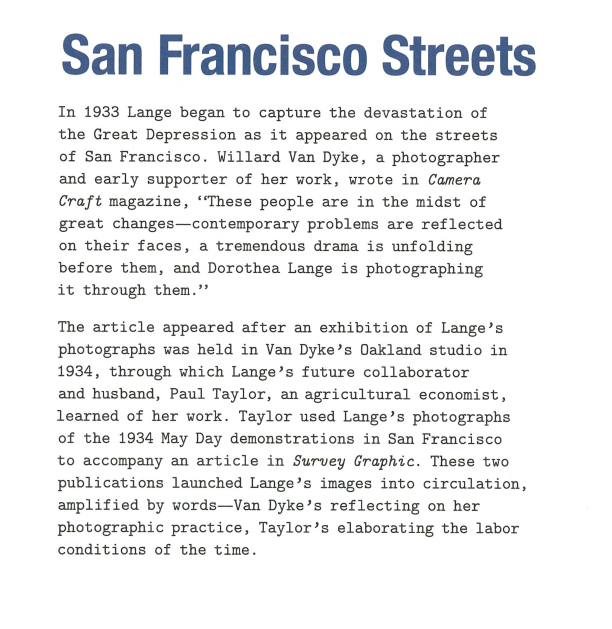
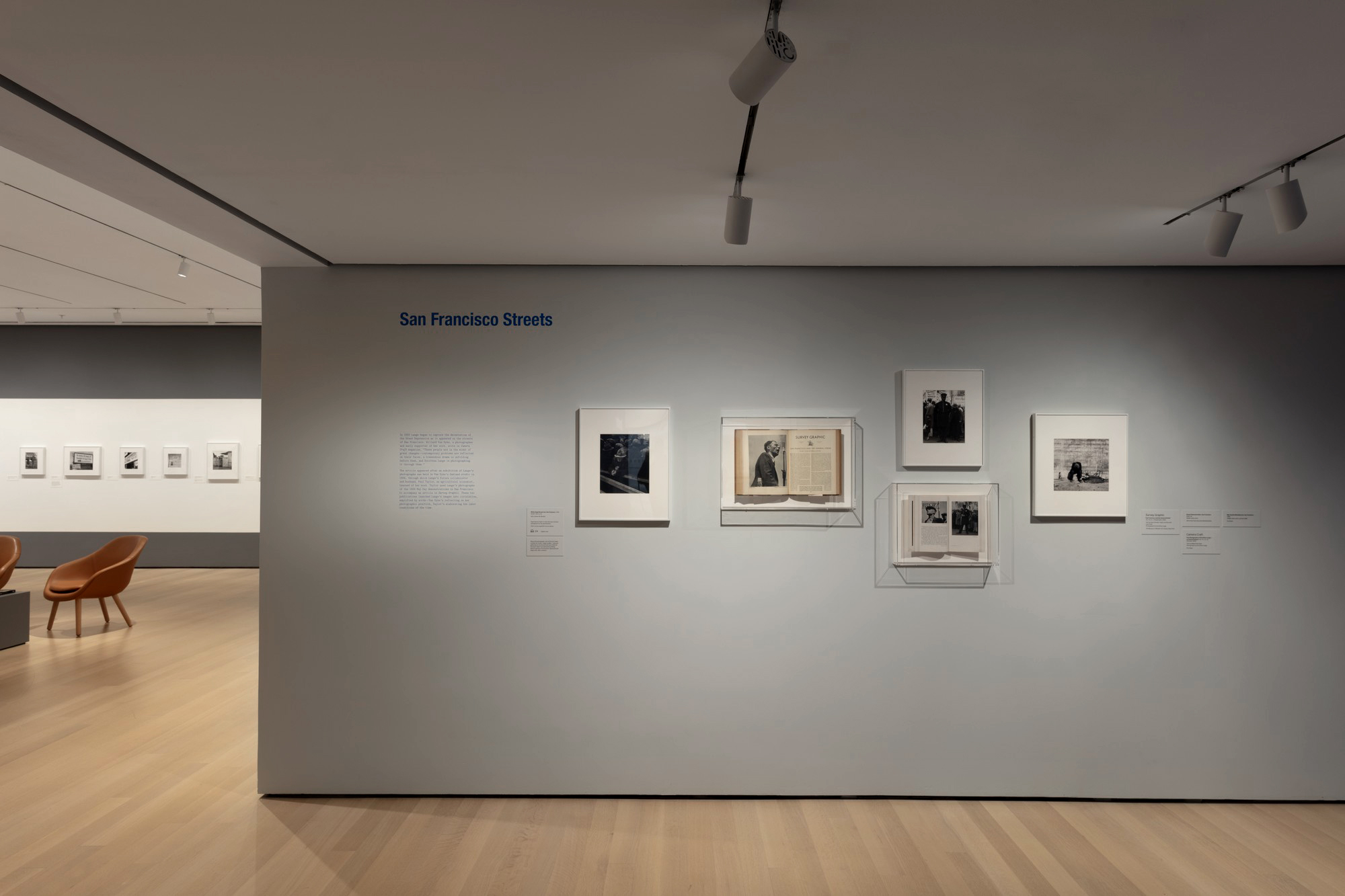
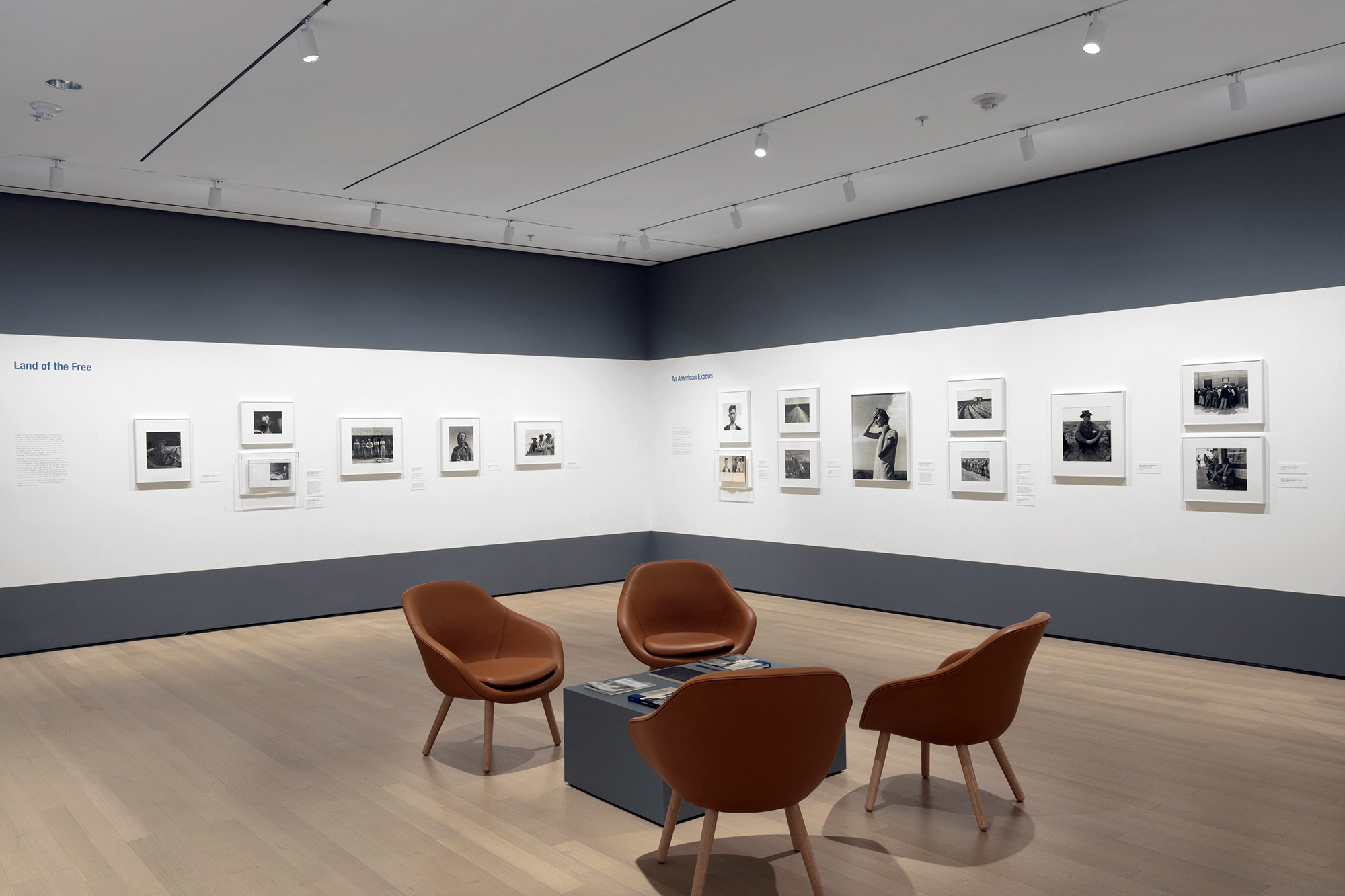
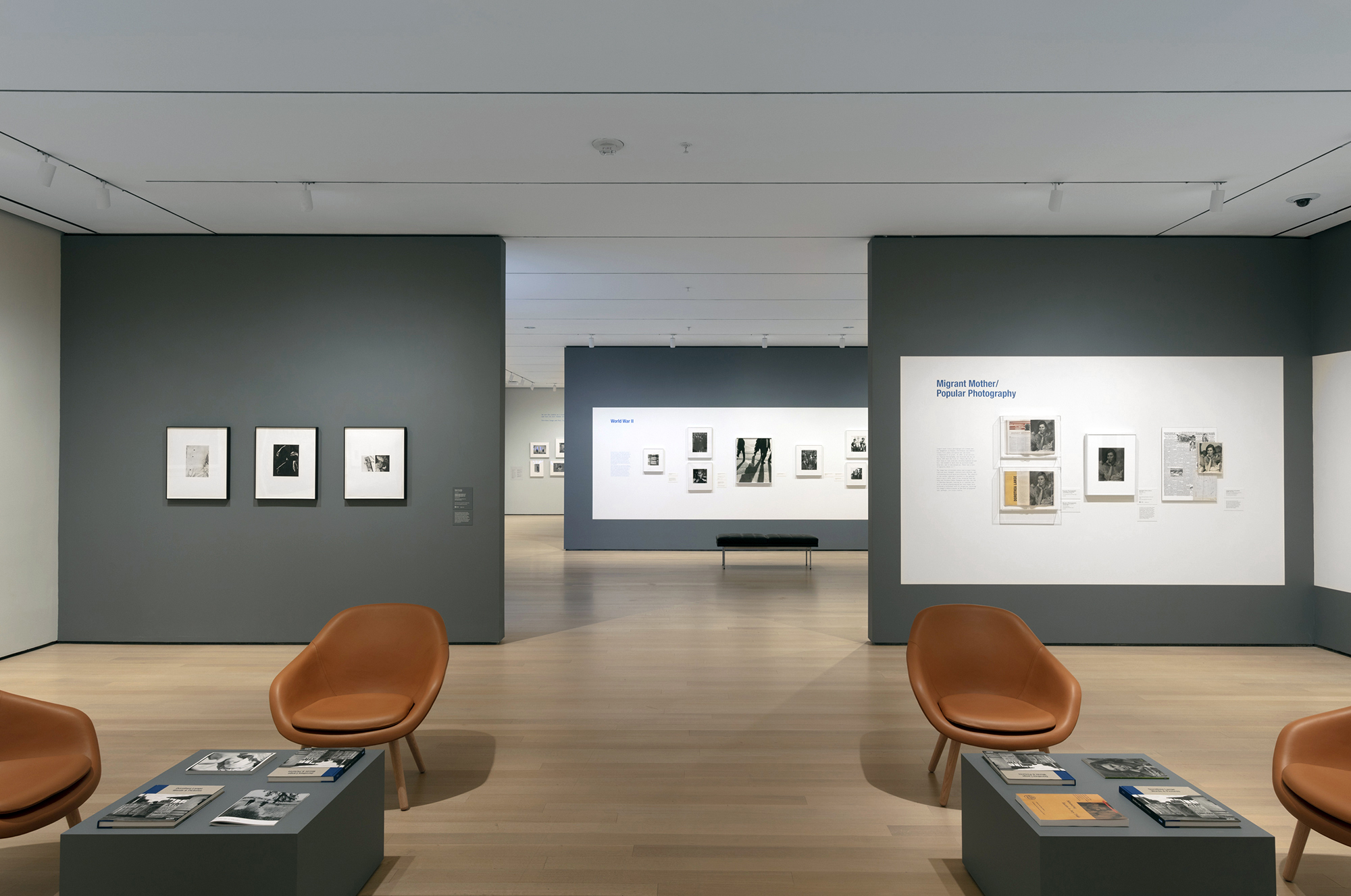
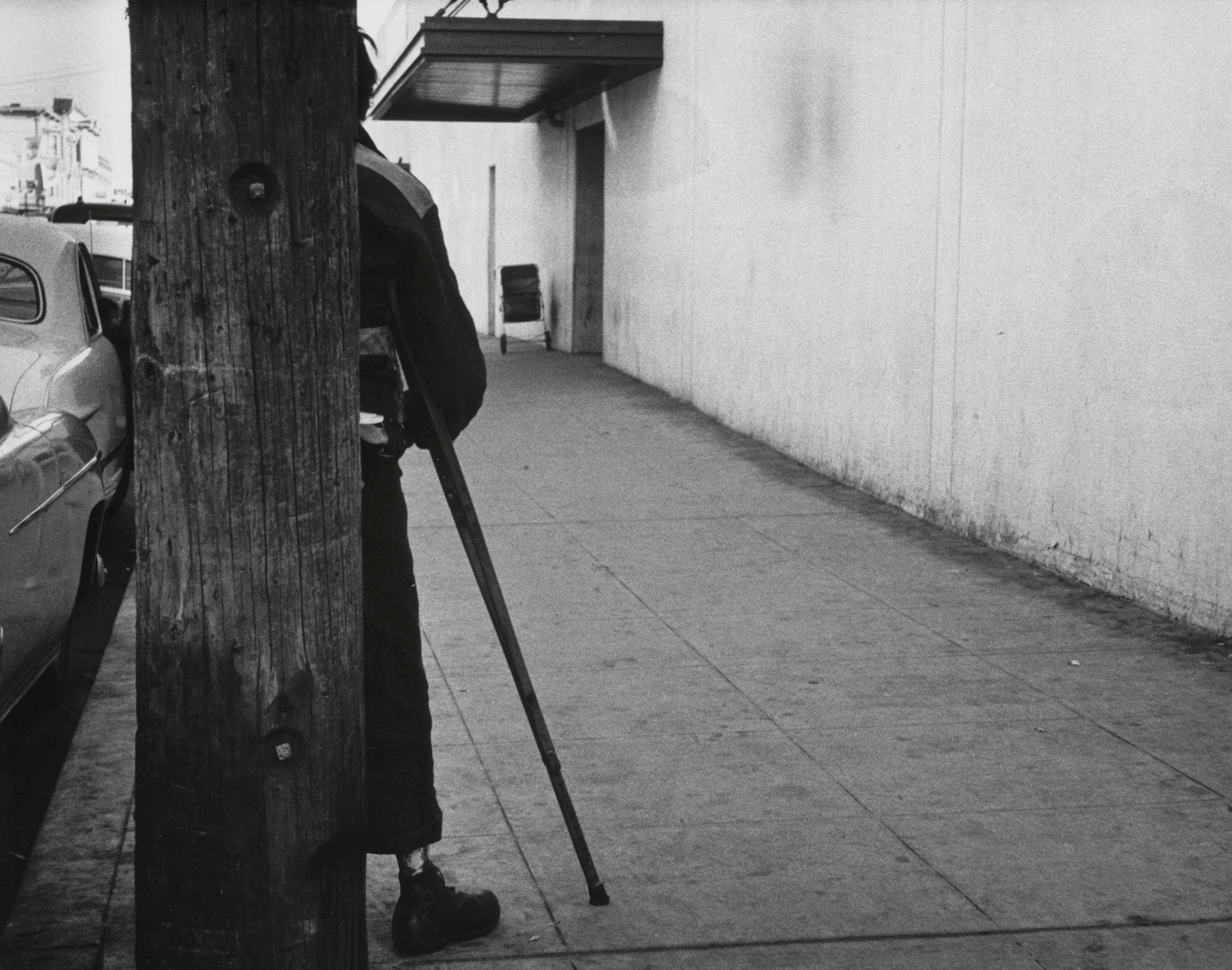
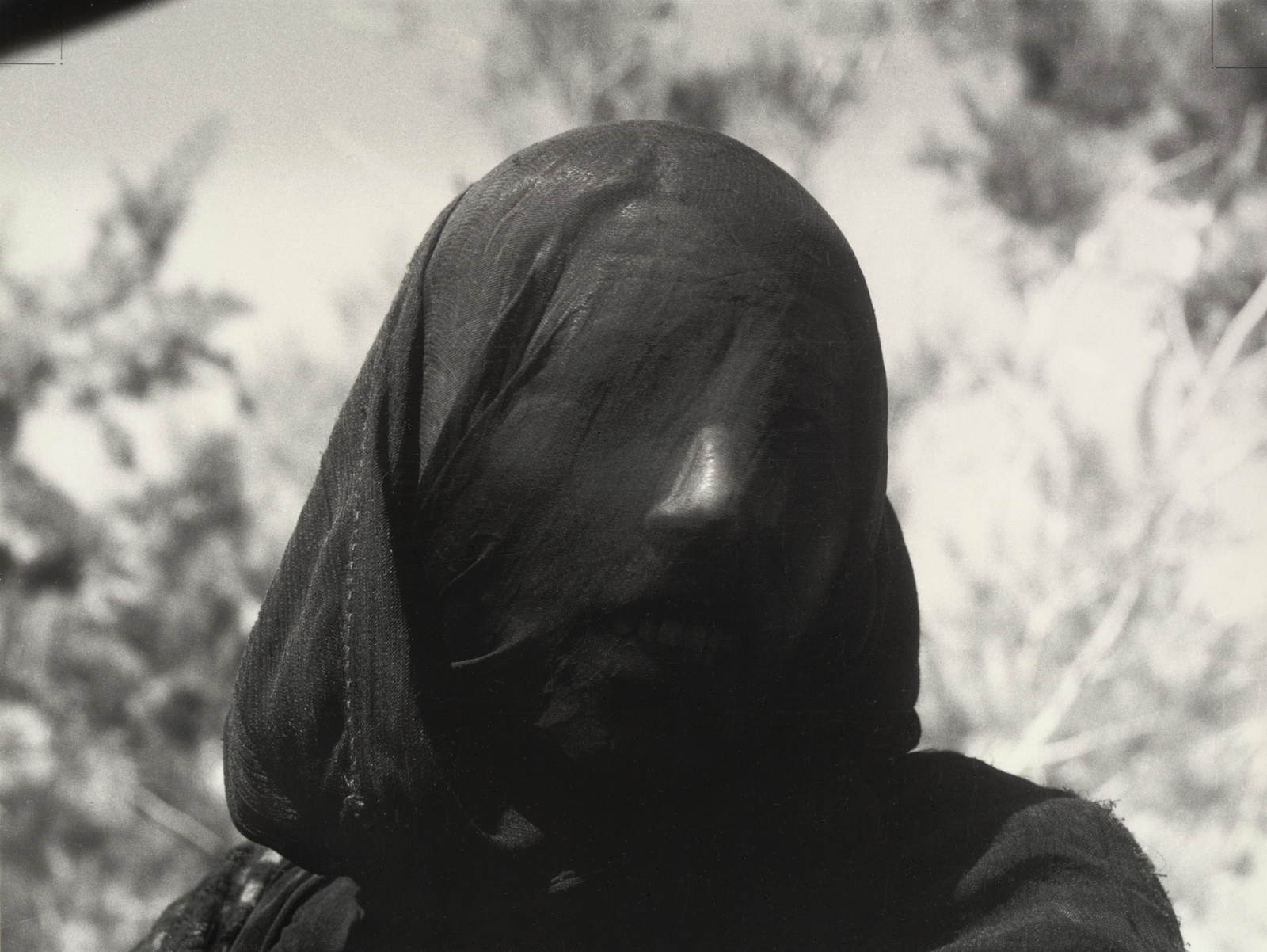
Exhibition: ‘Dorothea Lange: Seeing People’ at the National Gallery of Art, Washington Part 2

Exhibition dates: 5th November 2023 – 31st March 2024
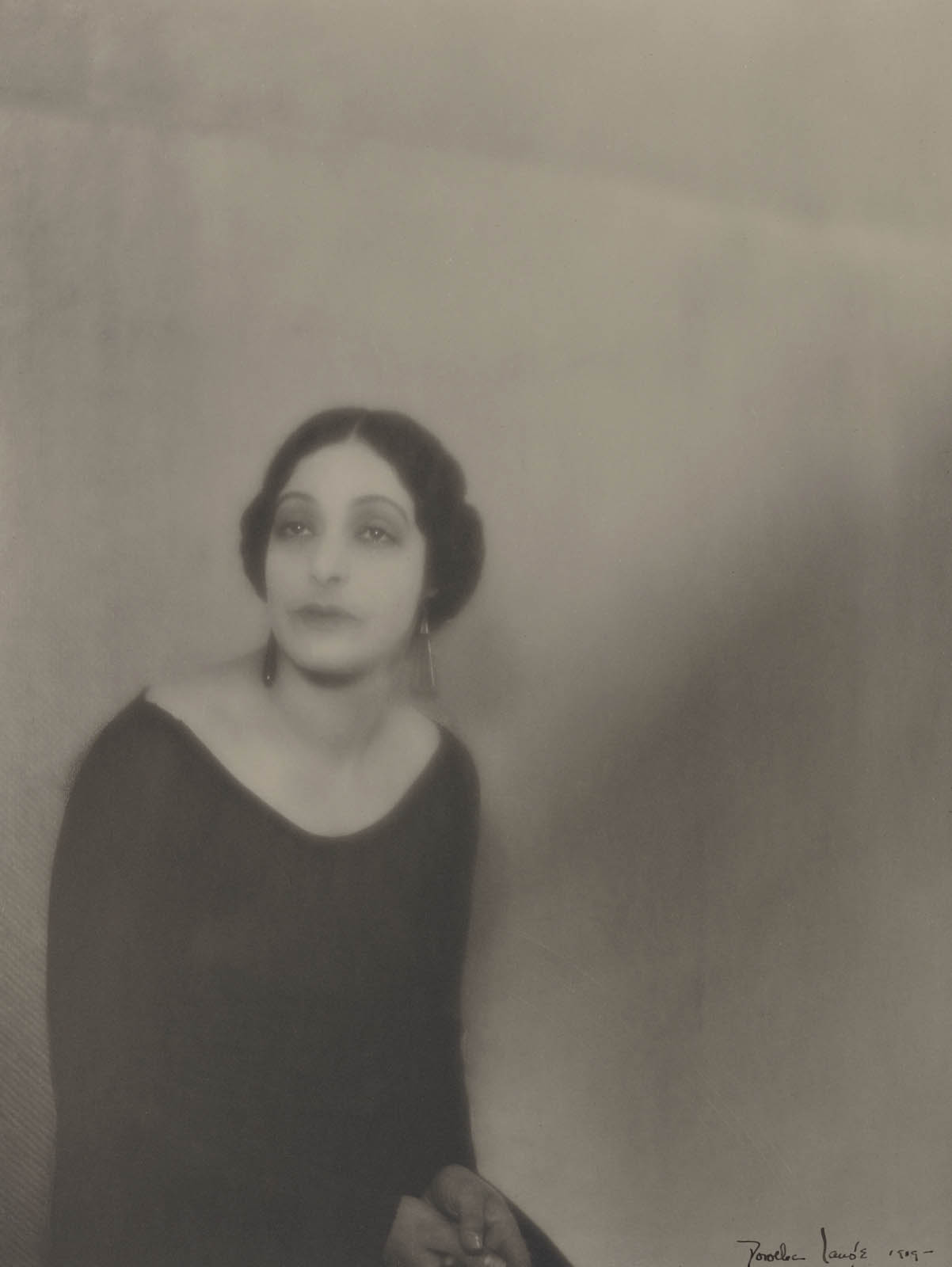
 

Dorothea Lange (American, 1895-1965) 'Untitled (La Estrellita, "Spanish" Dancer), San Francisco, California' 1919


Dorothea Lange (American, 1895-1965)
Untitled (La Estrellita, “Spanish” Dancer), San Francisco, California
1919
Gelatin silver print
Image: 19.7 x 14.6cm (7 3/4 x 5 3/4 in.)
Mat: 16 x 14 in.
Frame (outside): 17 1/4 x 15 1/4 in.
Collection of the Oakland Museum of California, Gift of Estrellita Jones
© The Dorothea Lange Collection, Oakland Museum of California, City of Oakland. Gift of Paul S. Taylor


Stella Hurtig Jones was a famous American vaudeville performer who traveled the world as a flamenco and tango dancer during the late 19th and early 20th centuries. One of Lange’s earliest professional portraits, the composition uses the soft focus and diffused light that characterises pictorial photography, popular among celebrities. Lange photographed Hurtig Jones as herself, rather than as her stage persona La Estrellita (The Little Star), perhaps in recognition of her recent retirement. As European travel waned during World War I and movies replaced vaudeville as mass entertainment, the allure of traditional Spanish dance diminished. La Estrellita married, started a perfume business, and moved from Hollywood to the Bay Area.

Label text from the exhibition


Full of the world

Just when you think that you know the work of an artist photographs emerge that you have never seen before, photographs that challenge the canon of famous images on which the reputation of the artist rests. Such is the case in this two part posting on the work of social documentary photographer Dorothea Lange (American, 1895-1965). See Part 1 of the posting.

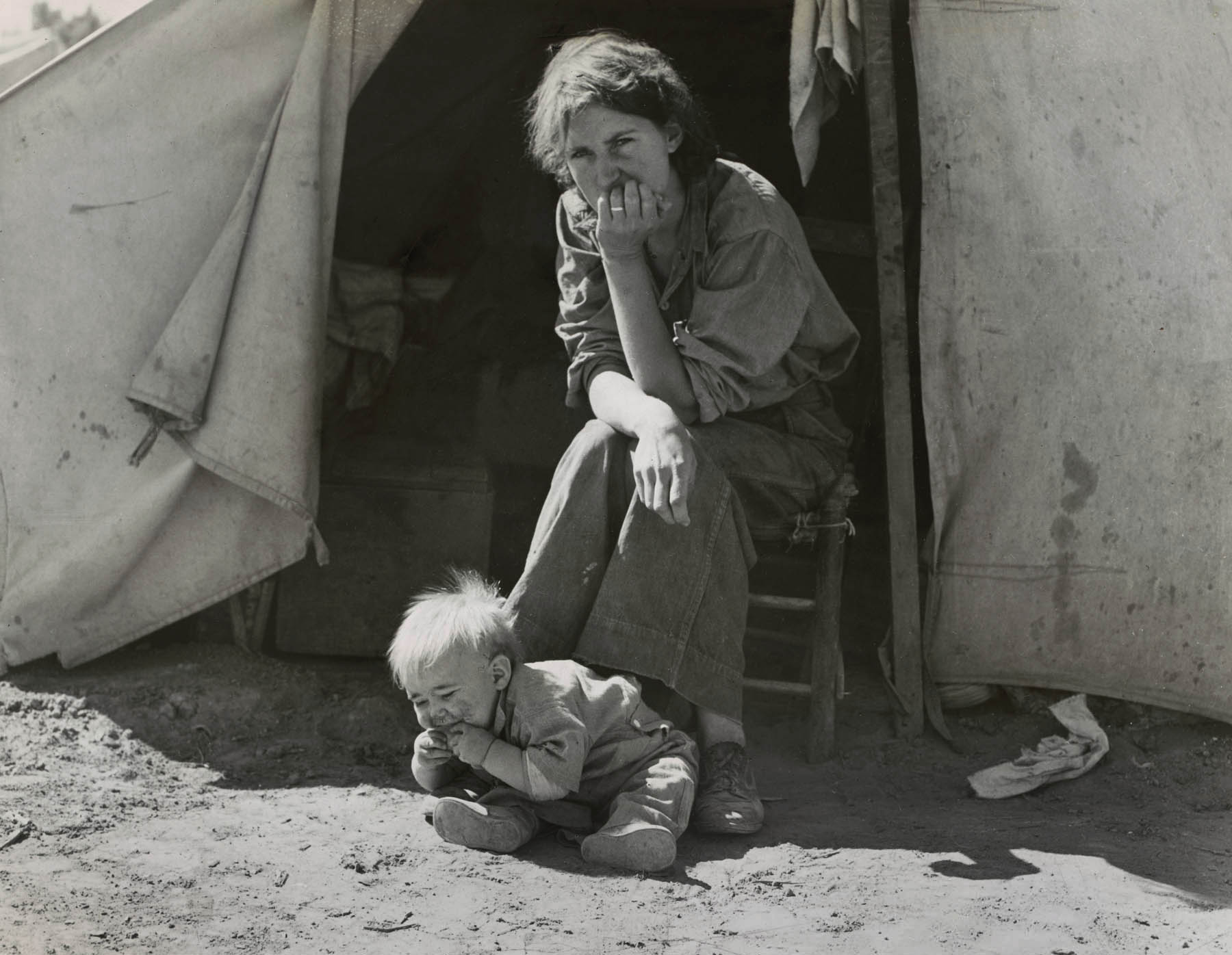
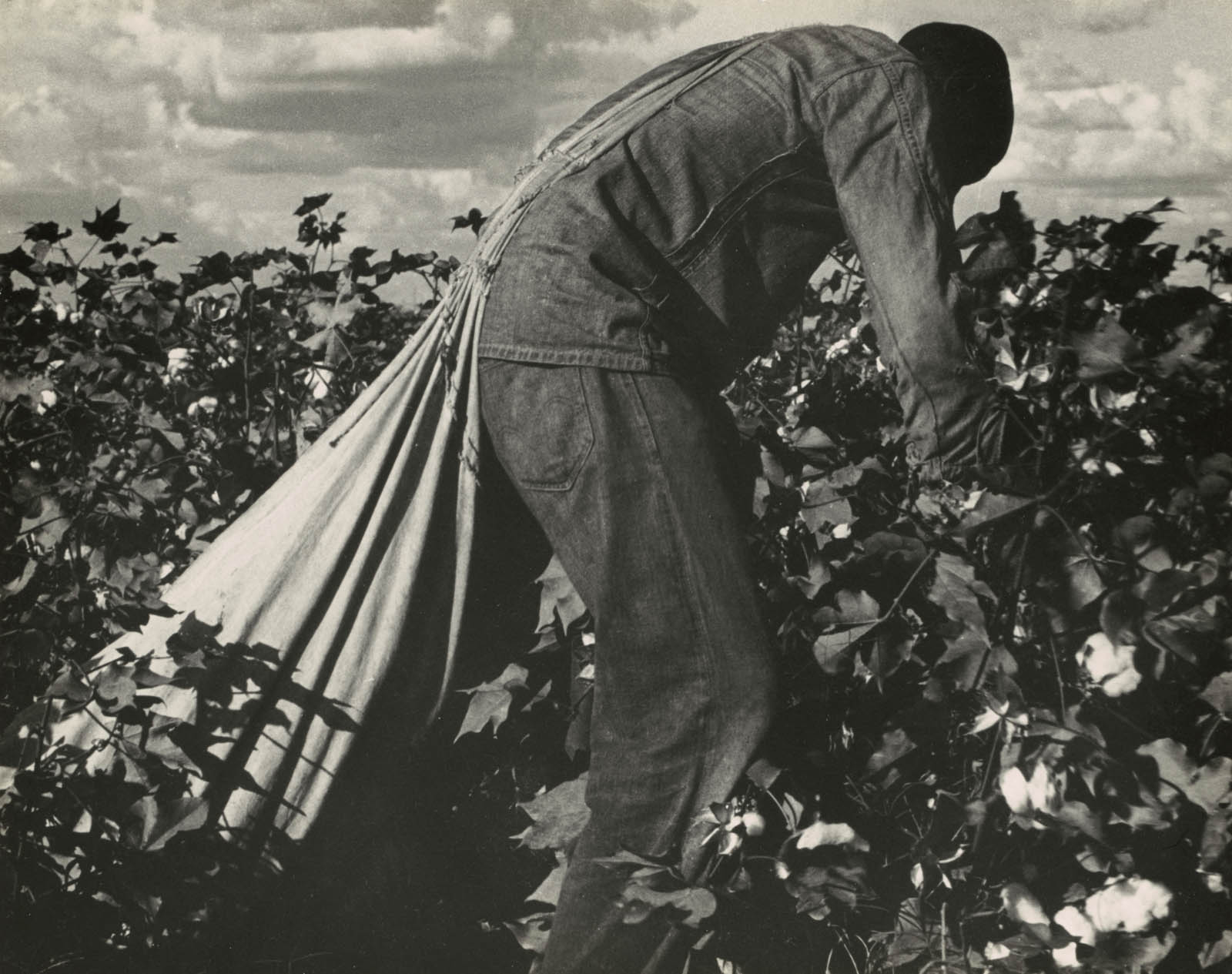
In this posting it is not the famous photographs such as White Angel Breadline, San Francisco, California (1933); Nettie Featherston, Wife of a Migratory Laborer with Three Children, near Childress, Texas, from The American Country Woman (June 1938); Near Coolidge, Arizona. Migratory cotton picker with his cotton sack slung over his shoulder rests at the scales before returning to work in the field (November 1940, printed c. 1965); and Human Erosion in California (Migrant Mother) (March 1936) which impress the senses, for their affect is known well enough.

Rather, it is the relatively unknown early Pictorialist photographs, the earthy photographs of Irish people, and photographs that challenge the formalist construction of images of the disintegration of families and communities during the Great Depression – images that are far more avant-garde and experimental than I would have expected from Lange – which shine in the mind’s eye (in one’s imagination or memory).

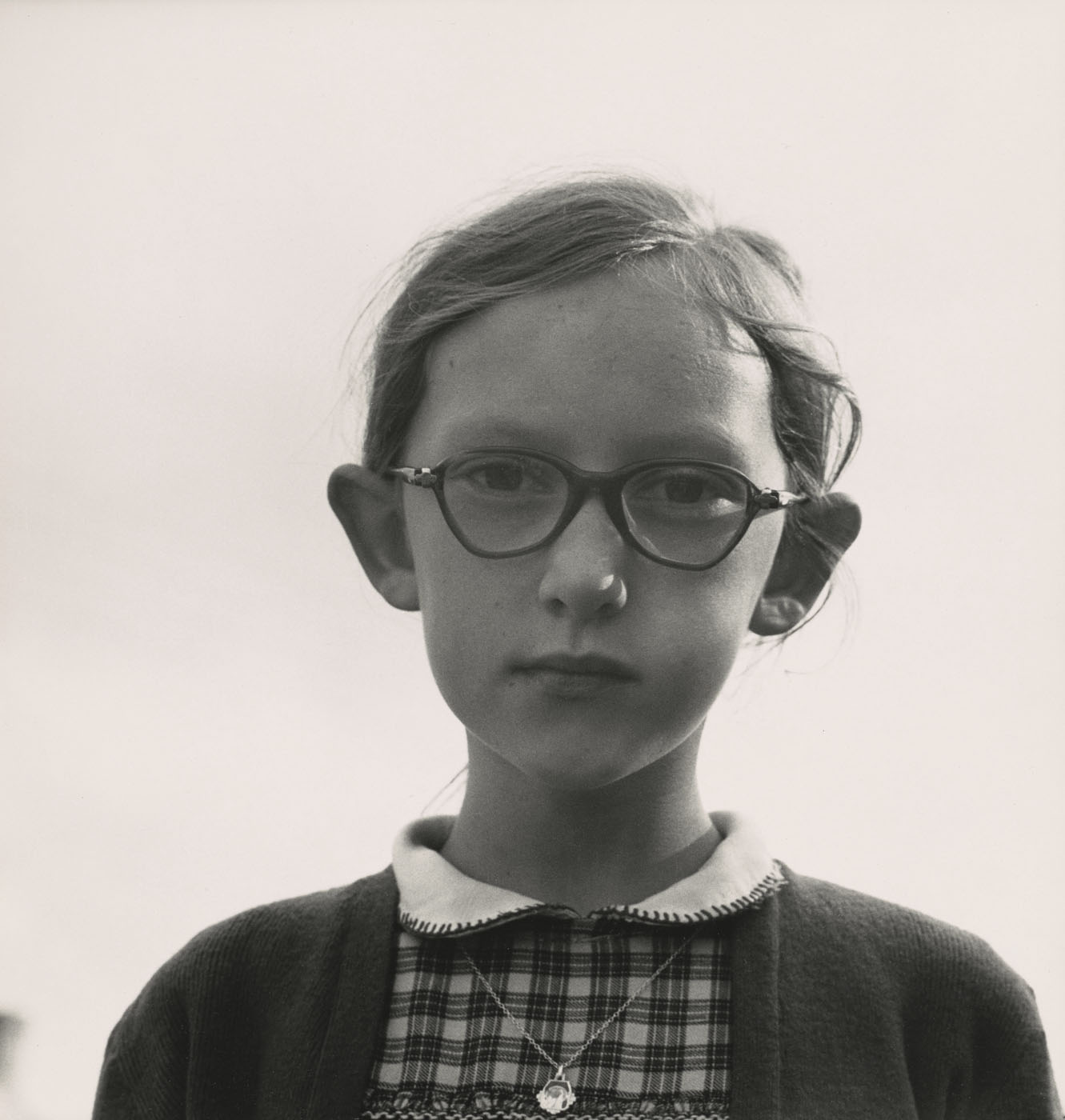
The ethereal Pictorialist portraits (this posting) with their asymmetrical construction, trembling? vibrational? negative space, luminous light and low depth of field are a delightful surprise… as are the 1950’s Irish portrait photographs (Part 1 of the posting) full of earthy, brooding darkness – with faces that are “pure Ireland.” What intensity in these images, clearly and empathetically seen.

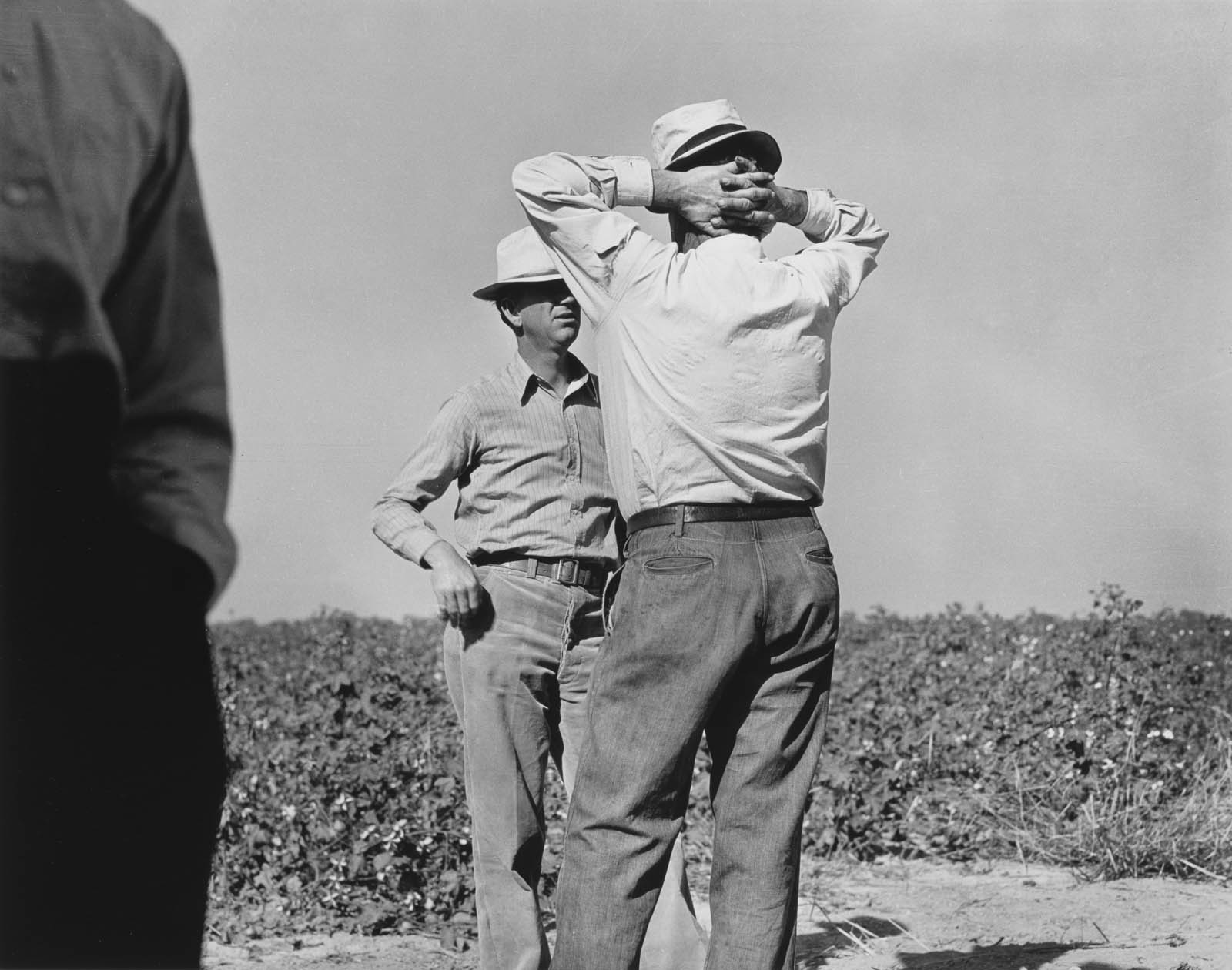
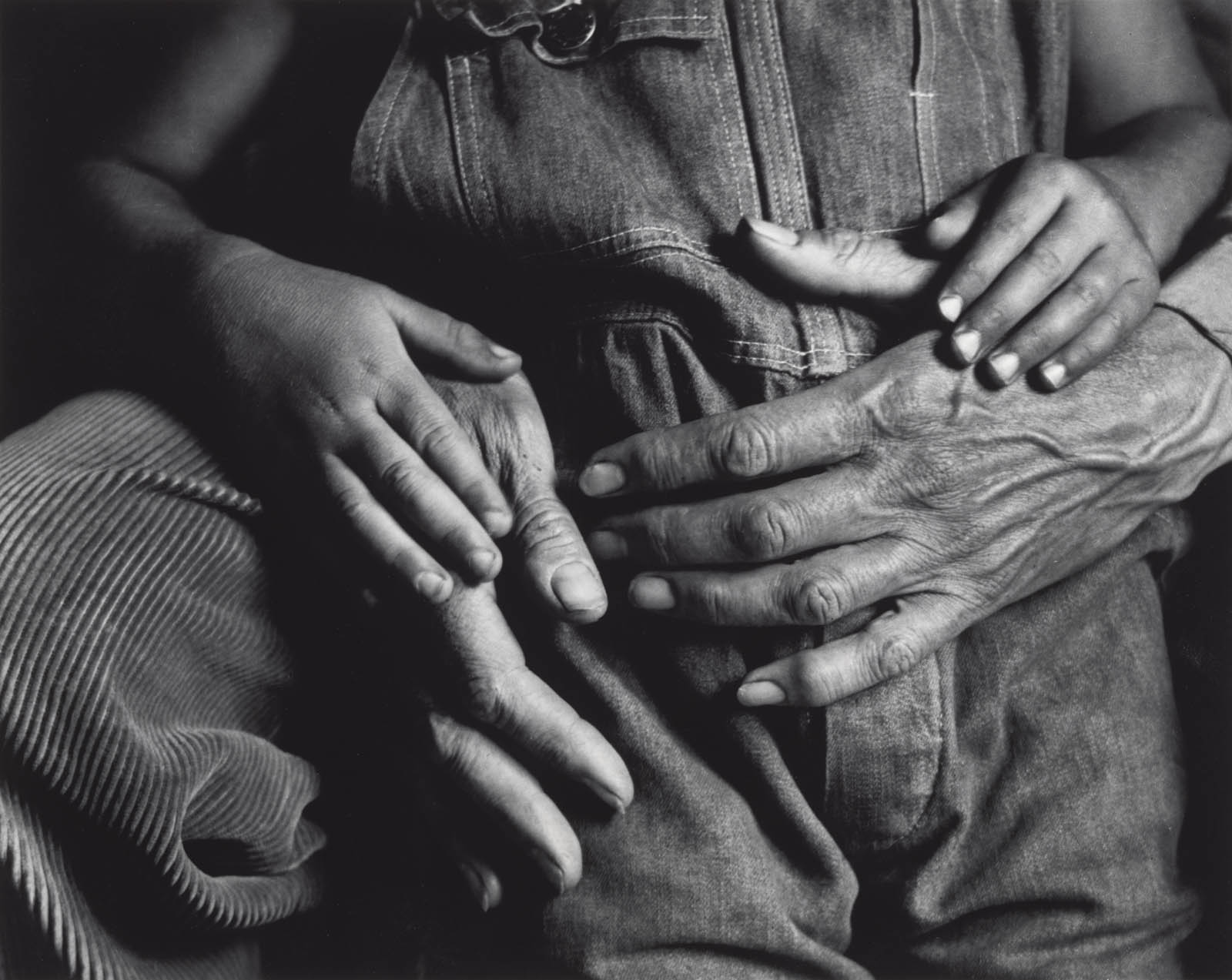
But it is the abstract figurative studies in which I am most interested… images that disrupt Lange’s normative representation in her social documentary photographs of humanity and their resilience. In photographs such as On the Plains a Hat Is More Than a Covering (1938, below) and Jake Jones’s Hands, Gunlock County, Utah (1953) – taken fifteen years apart but which could have been taken the same day, on a theme the artist was obviously interested in – Lange dissects the body, closing in on gnarled hands, weatherbeaten hats as metaphor for a tough life, well lived. These are images in which we see very little (as opposed to Barthes assertion that in photography’s realism a photo is an image in which we see everything) … but implicitly understand the sublime blur of legend of these workers and their hats.

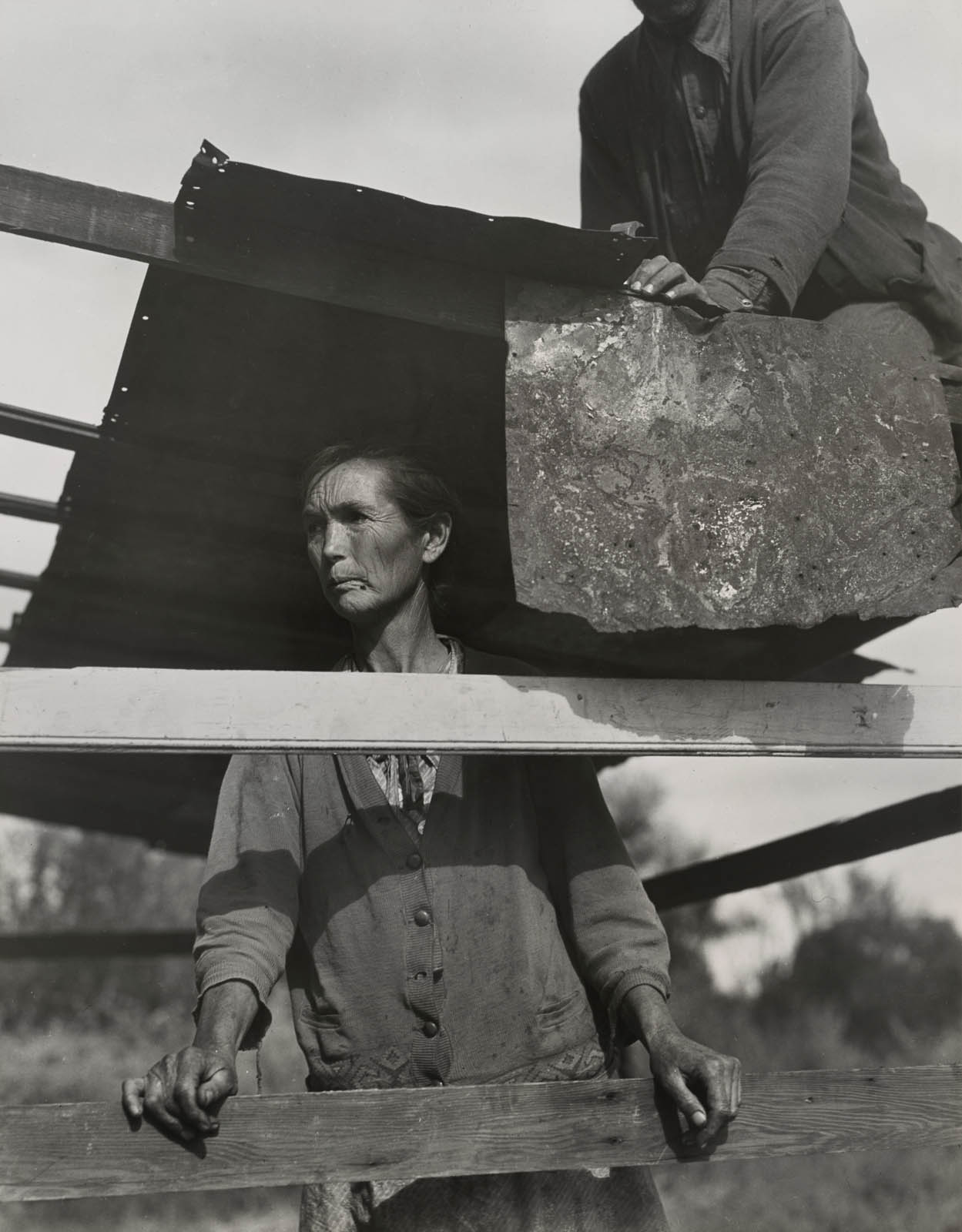
Other photographs dial up the figurative abstraction. Demonstration, San Francisco (1934, below) is a study of light, shape and form, an almost Constructivist image of fragments and negative space: hand, pole, amorphous mass of shoulder, face turned away, hat and declarative “FEED US!” banner; San Francisco Waterfront (1934) is a beautifully rendered abstract pictorial space evidencing the despair of humanity through light and form: witness, the clasped hands at rear like sentinels, the thumb pointing left… while below, covered head in hand, the thumb points vertically to the surmounted ear, which echoes the cropped ear and hair at the bottom of the photo, while to the right the two buttons of the jacket lead us to the ascending column of four buttons back to the portentous, clasping, guarding hands above. A masterpiece of photographic pictorial construction. Further, with their radical pictorial construction and cropping of the picture frame, masterpieces such as Dispossessed Arkansas farmers (1935) are truly avant-garde and experimental photographs for their time, something I don’t normally associate with the work of Dorothea Lange. As my friend Jonathan Kamholtz observes of the photographs I have been discussing, Lange “tended to lose interest in the backgrounds. The pictorial space is really very shallow. This contributes to their theatricality – not in the sense that they are false or artificial, but that each one displays character, costume, fate.”

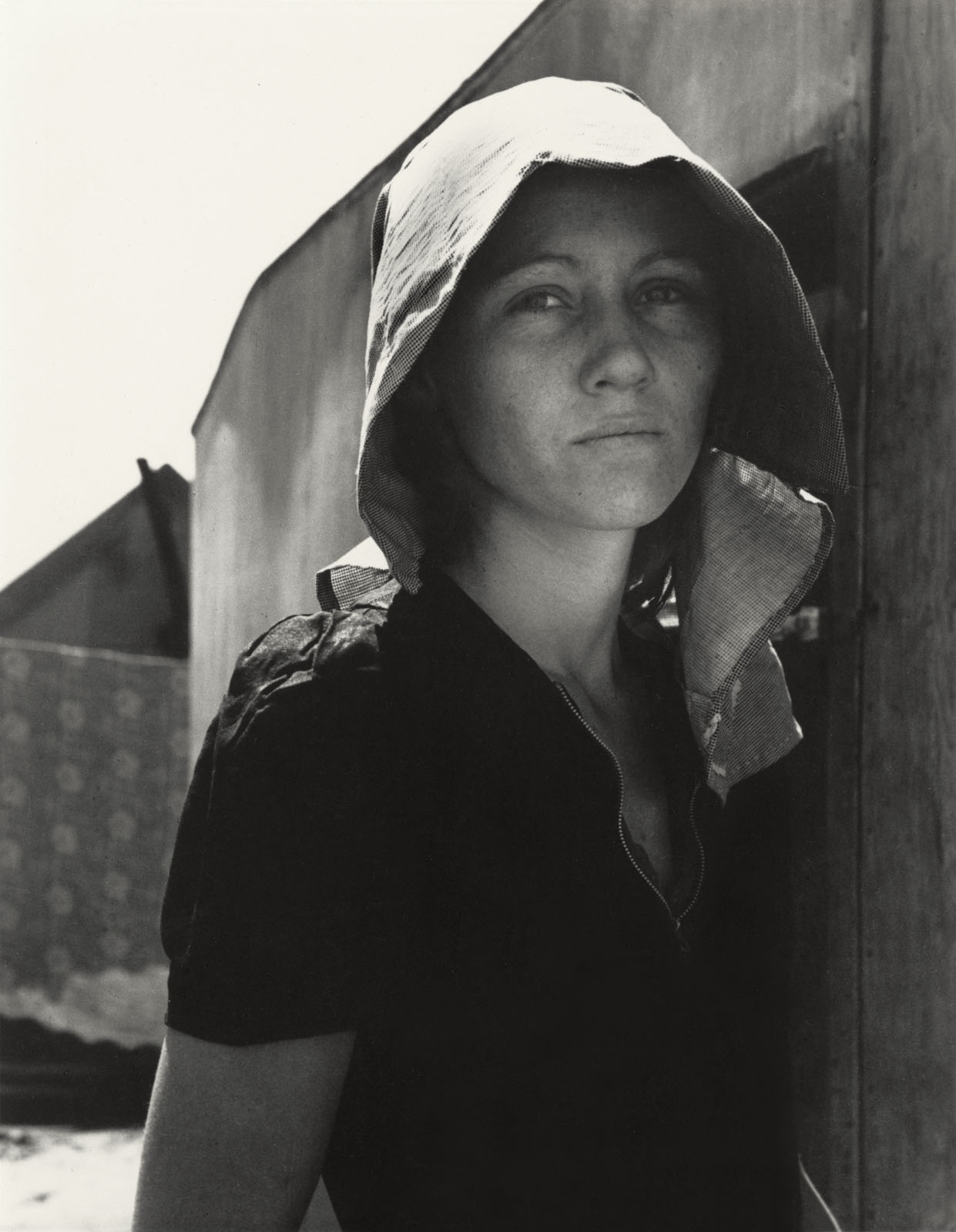
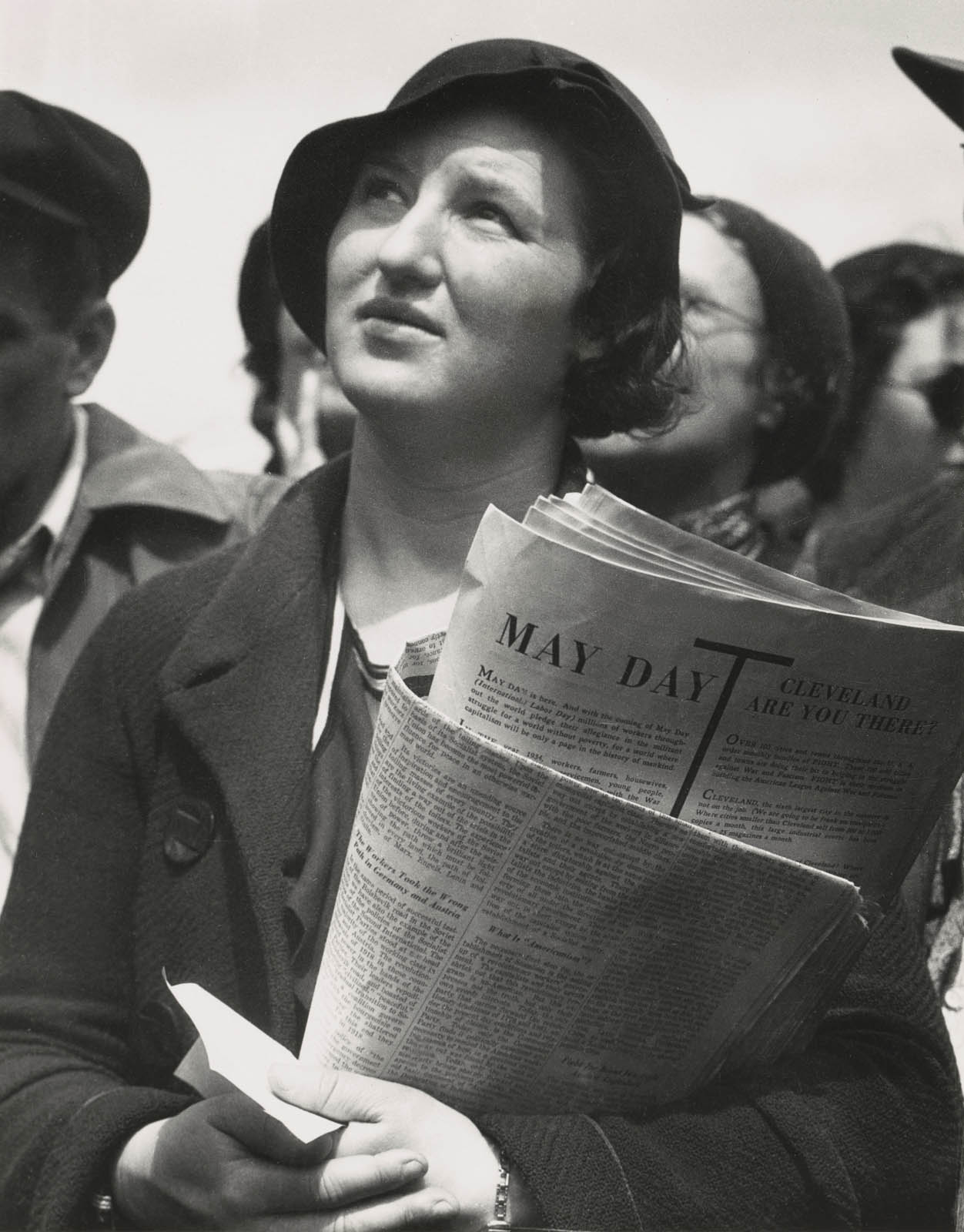
Forearmed with this knowledge, I start looking at her well known images with fresh eyes… and its all there in more subtle form: the low angle of the camera looking up at the subject, the geometric shape of hands and arms, the solid blocks of bodies filling the picture frame, the sculptural, abstract shape of bodies in fields (Migratory Field Worker Picking Cotton in San Joaquin Valley1938), the flattening of bodies one against another (May Day, San Francisco, California, 1934) and the disassociation of human identity through the occlusion of faces (This man is a labor contractor in the pea fields of California 1936, below; Damaged Child, Shacktown 1936, below; Washington, Yakima Valley, near Wapato 1939, below).

Dorothea Lange was an incredibly intelligent and passionate artist who removed her ego from the act of taking photographs, who lost herself in the visual experience in order to take photographs to effect social change, who connected with the world in order “to experience love, hate, and passion in every form in one’s body.”1

“That the familiar world is often unsatisfactory cannot be denied, but it is not, for all that, one that we need abandon,” she argued. “We need not be seduced into evasion of it any more than we need be appalled by it into silence… Bad as it is, the world is potentially full of good photographs. But to be good, photographs have to be full of the world.”2

And full of the spirit of the artist.

Dr Marcus Bunyan


1/ Carl Jung quoted in Nicos Hadjicostis. Destination Earth: A New Philosophy of Travel by a World-Traveler. Bamboo Leaf Press, 2016, p. 42.

2/ Dorothea Lange and Daniel Dixon, “Photographing the Familiar,” Aperture 1, no. 2 (1952), 15.


Many thankx to the National Gallery of Art for allowing me to publish the photographs in the posting. Please click on the photographs for a larger version of the image.


“When you enter into the visual world, detaching yourself from all the holds on you… it is a mental disengagement so that you live, for maybe two or three hours, as completely as possible a visual experience, where you feel that you have lost yourself, your identity.”


Dorothea Lange quoted in Dyanna Taylor and Public Broadcasting Service (U.S.), directors. American Masters – Dorothea Lange: Grab a Hunk of Lightning. Kanopy Streaming, 2014.


“The researcher ought to hang up exact science and put away the scholar’s gown, to say farewell to his study, and wander with human heart through the world, through the horror of prisons, madhouses, and hospitals, through drab suburban pubs, in brothels, and gambling dens, through the salons of elegant society, the stock exchanges, the socialist meetings, the churches, the revivals and ecstasies of the sects, to experience love, hate, and passion in every form in one’s body.”


Carl Jung quoted in Nicos Hadjicostis. Destination Earth: A New Philosophy of Travel by a World-Traveler. Bamboo Leaf Press, 2016, p. 42.


During her long, prolific, and groundbreaking career, the American photographer Dorothea Lange made some of the most iconic portraits of the 20th century. Dorothea Lange: Seeing People reframes Lange’s work through the lens of portraiture, highlighting her unique ability to discover and reveal the character and resilience of those she photographed.

Featuring some 100 photographs, the exhibition addresses her innovative approaches to picturing people, emphasising her work on social issues including economic disparity, migration, poverty, and racism.


“Five years earlier I would have thought it enough to take a picture of a man, no more. But now, I wanted to take a picture of a man as he stood in his world.”

“A single photographic print may be “news,” a “portrait,” “art,” or “documentary” – any of these, all of them, or none.”

“The whole world is a museum. To walk through the streets, as though down a museum corridor. … To step into a supermarket as though setting forth in the National Gallery – is an experience and an exercise in vision.”


Dorothea Lange


Dorothea Lange (American, 1895-1965) 'Untitled (Fleishhacker Portrait)' 1920


Dorothea Lange (American, 1895-1965)
Untitled (Fleishhacker Portrait)
1920
Gelatin silver print
Image: 15.4 x 15.1cm (6 1/16 x 5 15/16 in.)
Mat: 16 x 14 in.
Frame (outside): 17 1/4 x 15 1/4 in.
Collection of the Oakland Museum of California, Gift of Paul S. Taylor


Dorothea Lange (American, 1895-1965) 'Maynard Dixon and Son Daniel' 1925


Dorothea Lange (American, 1895-1965)
Maynard Dixon and Son Daniel
1925
Gelatin silver print
Image: 13.8 x 10.8cm (5 7/16 x 4 1/4 in.)
Sheet: 15.1 x 11cm (5 15/16 x 4 5/16 in.)
Mat: 14 x 12 in.
Frame (outside): 15 1/4 x 13 1/4 in.
The J. Paul Getty Museum, Los Angeles, 2000.50.1 © The Dorothea Lange Collection, Oakland Museum of California, City of Oakland. Gift of Paul S. Taylor


Dorothea Lange (American, 1895-1965) 'Portrait of Adele Raas, San Francisco' 1927


Dorothea Lange (American, 1895-1965)
Portrait of Adele Raas, San Francisco
1927
Gelatin silver print
Image: 15.5 x 12.7cm (6 1/8 x 5 in.)
Mat: 14 x 12 in.
Frame (outside): 15 1/4 x 13 1/4 in.
San Francisco Museum of Modern Art, Gift of the Raas Family
© The Dorothea Lange Collection, Oakland Museum of California, City of Oakland. Gift of Paul S. Taylor


Dorothea Lange (American, 1895-1965) 'Untitled (Portrait of William)' 1929


Dorothea Lange (American, 1895-1965)
Untitled (Portrait of William)
1929
elatin silver print
Image/sheet: 25 x 20cm (9 13/16 x 7 7/8 in.)
Mat: 18 x 14 in.
Frame (outside): 18 1/4 x 15 1/4 in.
National Gallery of Art, Washington, Gift of Daniel Greenberg and Susan Steinhauser
© The Dorothea Lange Collection, Oakland Museum of California, City of Oakland. Gift of Paul S. Taylor
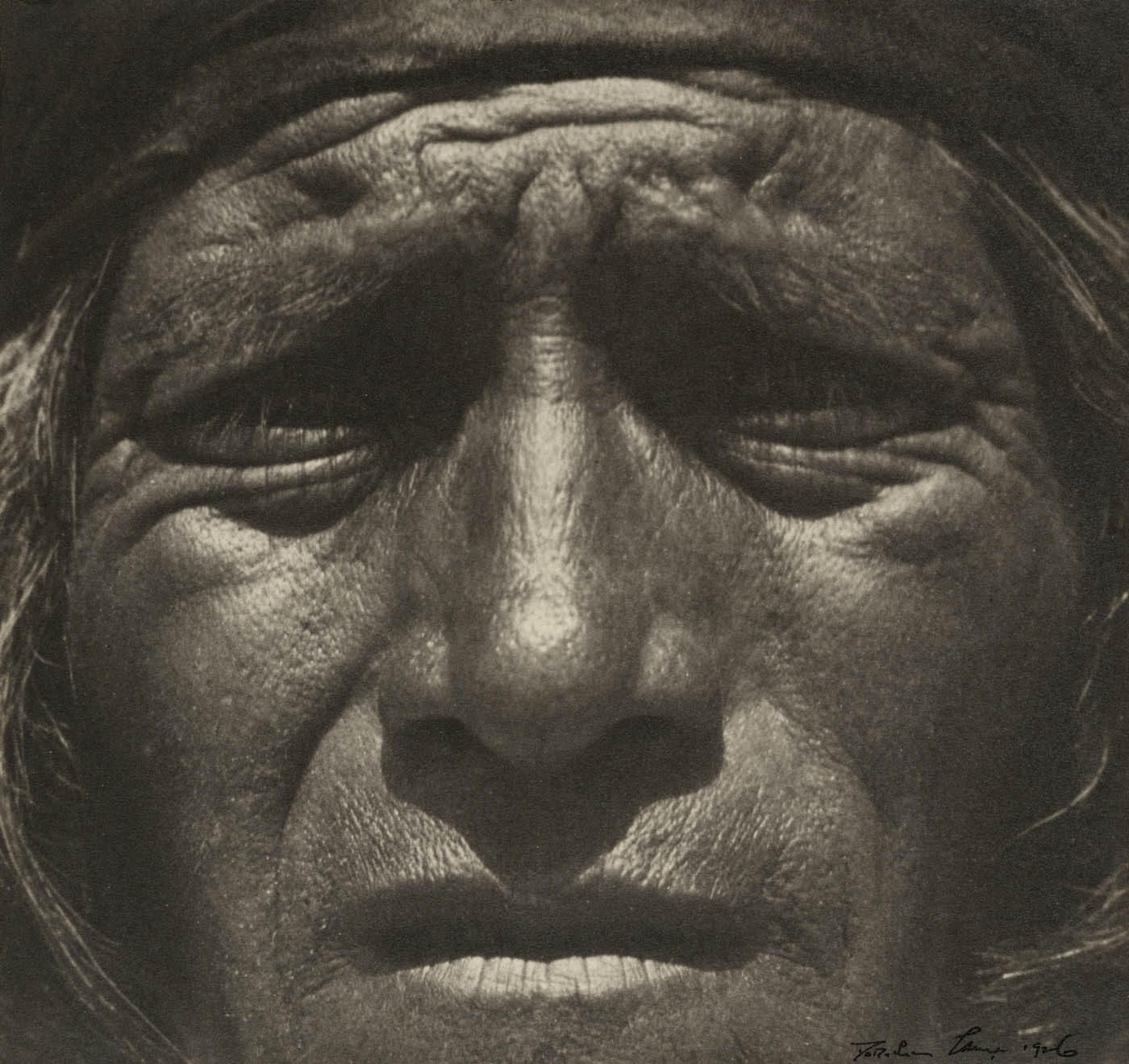
 

Dorothea Lange (American, 1895-1965) 'Hopi Man, Arizona' 1923, printed 1926


Dorothea Lange (American, 1895-1965)
Hopi Man, Arizona
1923, printed 1926
Gelatin silver print
Image: 18.4 x 19.7cm (7 1/4 x 7 3/4 in.)
Mount: 19.3 x 20.4cm (7 5/8 x 8 1/16 in.)
Mat: 15 1/4 x 15 in.
Frame (outside): 16 1/2 x 16 1/4 in.
The J. Paul Getty Museum, Los Angeles, 84.XP.912.4
© The Dorothea Lange Collection, Oakland Museum of California, City of Oakland. Gift of Paul S. Taylor


Lange embraced the chance to experiment outside her studio. In August 1923, she visited Walpi Village of the Hopi Nation with her then-husband Maynard Dixon, an avid outdoor painter. She had begun to crop some of her portraits to accentuate a gaze, hand, touch, or torso – a way of capturing the essence of a person, paradoxically showing less to reveal more.

When printing Hopi Man, Lange focused so closely on the subject’s face that his features resemble a map of his experience. She undercut her own effort to reach meaningfully across the cultural divide, however, because she did not record the man’s name or any other information about him. As a portrait, Hopi Man risks picturing a type or class of person rather than this individual’s character.

Label text from the exhibition


Dorothea Lange (American, 1895-1965) 'Clausen Child and Mother' c. 1930


Dorothea Lange (American, 1895-1965)
Clausen Child and Mother
c. 1930
Gelatin silver print
Image: 15.6 x 21cm (6 1/8 x 8 1/4 in.)
Mat: 14 x 17 in.
Frame (outside): 15 1/4 x 18 1/4 in.
The Museum of Modern Art, New York. Thomas Walther Collection. Gift of Henri Cartier-Bresson, by exchange


Lange frequently photographed the subject of mother and child, a long-standing Western art historical tradition rooted in depictions of the Virgin Mary and baby Jesus and modernised and secularised in high-end portrait studios. Here Frances Clausen stares directly at the camera while her mother, Gertrude, sits in shadow, looking away. Lange focuses on the child’s inquisitive gaze, as well as her affectionate bond to and emerging independence from her mother. Lange’s expertise photographing children – acquired from her early studio work – led to some of her most important photographs made during the Great Depression, displayed in the next galleries.

Label text from the exhibition


Dorothea Lange (American, 1895-1965) 'Maynard Dixon' c. 1930


Dorothea Lange (American, 1895-1965)
Maynard Dixon
c. 1930
Gelatin silver print
Image/sheet: 14.1 x 13.4cm (5 9/16 x 5 1/4 in.)
Mount: 16.4 x 14.2 cm (6 7/16 x 5 9/16 in.)
Mat: 14 x 11 in.
Frame (outside): 15 1/4 x 12 1/4 in.
National Gallery of Art, Washington, Alfred H. Moses and Fern M. Schad Fund
© The Dorothea Lange Collection, Oakland Museum of California, City of Oakland. Gift of Paul S. Taylor


Maynard Dixon (January 24, 1875 – November 11, 1946) was an American artist. He was known for his paintings, and his body of work focused on the American West. Dixon is considered one of the finest artists having dedicated most of their art to the U.S. Southwestern cultures and landscapes at the end of the 19th-century and the first half of the 20th-century. He was often called “The Last Cowboy in San Francisco.”

Through his work with the Galerie Beaux Arts, a cooperative gallery in San Francisco, Dixon played a pivotal role ensuring the West Coast supported the work of local, modern artists. He was married for a time to photographer Dorothea Lange, and later to painter Edith Hamlin.

Text from the Wikipedia website


Dorothea Lange (American, 1895-1965) 'Native American Girl, Taos, New Mexico' 1931


Dorothea Lange (American, 1895-1965)
Native American Girl, Taos, New Mexico
1931
Gelatin silver print
Image/sheet: 5.3 x 5.3cm (2 1/16 x 2 1/16 in.)
Mount: 13.2 x 10.5cm (5 3/16 x 4 1/8 in.)
Mat: 10 x 14 in.
Frame (outside): 11 1/4 x 15 1/4 in.
National Gallery of Art, Washington, Alfred H. Moses and Fern M. Schad Fund
© The Dorothea Lange Collection, Oakland Museum of California, City of Oakland. Gift of Paul S. Taylor


In summer 1931, escaping the Depression-era turmoil of San Francisco, Lange and Dixon bought their first car and drove to New Mexico with their children. Her few surviving photographs from this trip reveal significant steps in her transition away from studio portraiture and toward a more straightforward approach to photographing people. A series of pictures portrays this unidentified Indigenous girl in a direct documentary style. Although her expression reveals few emotions, she looks squarely at the lens in one photograph and seems comfortable in front of the camera.

Label text from the exhibition


Dorothea Lange (American, 1895-1965) 'Native American Girl, Taos, New Mexico' 1931


Dorothea Lange (American, 1895-1965)
Native American Girl, Taos, New Mexico
1931
Gelatin silver print
Image/sheet: 5.4 x 5.4cm (2 1/8 x 2 1/8 in.)
Mount: 13.3 x 10.4cm (5 1/4 x 4 1/8 in.)
Mat: 10 x 14 in.
Frame (outside): 11 1/4 x 15 1/4 in.
National Gallery of Art, Washington, Alfred H. Moses and Fern M. Schad Fund
© The Dorothea Lange Collection, Oakland Museum of California, City of Oakland. Gift of Paul S. Taylor
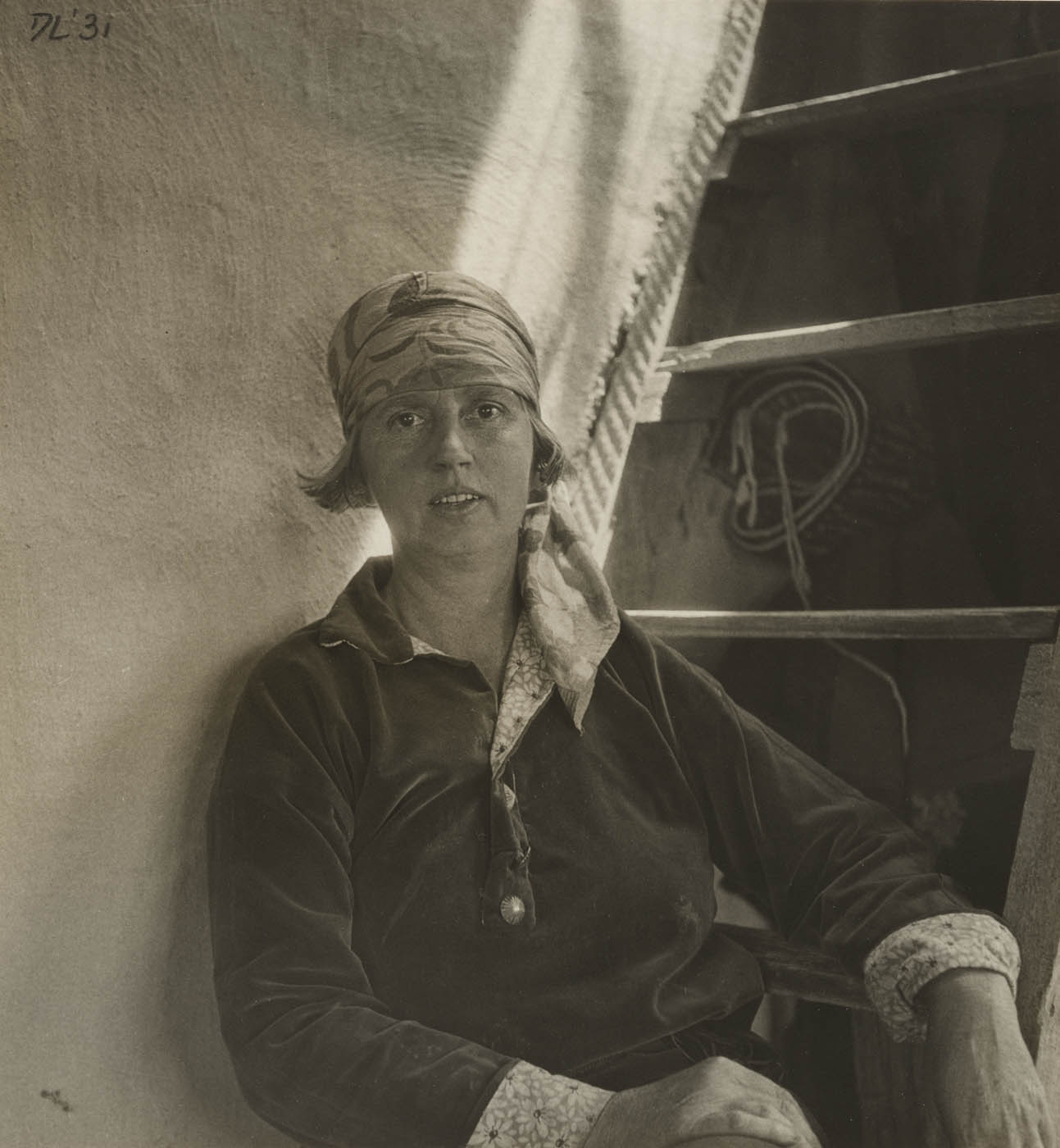
 

Dorothea Lange (American, 1895-1965) 'Dorothy Brett, Painter, Taos, New Mexico' 1931


Dorothea Lange (American, 1895-1965)
Dorothy Brett, Painter, Taos, New Mexico
1931
Gelatin silver print
Image/sheet: 8.6 x 8.2cm (3 3/8 x 3 1/4 in.)
Mat: 14 x 11 in.
Frame (outside): 15 1/4 x 12 1/4 in.
National Gallery of Art, Washington, Alfred H. Moses and Fern M. Schad Fund
© The Dorothea Lange Collection, Oakland Museum of California, City of Oakland. Gift of Paul S. Taylor


Lange met Dorothy Brett in 1931 when the photographer and her family spent several months in Taos. Born into an aristocratic British family, Brett rebelled against their expectations, attending art school and becoming a painter. In London she befriended writers associated with the Bloomsbury group, including D. H. Lawrence, who was recruiting people to go to New Mexico to form a utopian society. Brett was the only person who followed him, but she was so enchanted with the area that she lived there for the rest of her life.

Label text from the exhibition


Hon. Dorothy Eugénie Brett (10 November 1883 – 27 August 1977) was an Anglo-American painter, remembered as much for her social life as for her art. Born into an aristocratic British family, she lived a sheltered early life. During her student years at the Slade School of Art, she associated with Dora Carrington, Barbara Hiles and the Bloomsbury group. Among the people she met was novelist D.H. Lawrence, and it was at his invitation that she moved to Taos, New Mexico in 1924. She remained there for the rest of her life, becoming an American citizen in 1938.

Her work can be found in the Smithsonian American Art Museum in Washington D.C., in the Millicent Rogers Museum and the Harwood Museum of Art, both in Taos. Also at the New Mexico Museum of Art, Santa Fe, the Roswell Museum and Art Center, Roswell, New Mexico and in many private collections.

Text from the Wikipedia website


Dorothea Lange (American, 1895-1965) 'Demonstration, San Francisco' 1934


Dorothea Lange (American, 1895-1965)
Demonstration, San Francisco
1934
Gelatin silver print
Image: 12.1 x 14.3cm (4 3/4 x 5 5/8 in.)
Sheet: 12.1 x 14.3cm (4 3/4 x 5 5/8 in.)
Mount: 14.6 x 23.8cm (5 3/4 x 9 3/8 in.)
Lent by The Metropolitan Museum of Art, Gilman Collection, Purchase, Joseph M. Cohen Gift, 2005


In 1934, as Lange began to forge a new documentary practice, she sought “to take a picture of a man as he stood in his world.” With no clients to please, she drew on insights she had learned from modernism, especially its celebration of close-up studies and dramatic angles. Like other artists, she also found that signs – such as the protest poster declaring “… FEED US!” – could root a photograph in a specific time and place and give agency to those she depicted, allowing them to speak. With carefully composed pictures like this one, Lange was acknowledging the power of modernist photography to tell stories in simple, dynamic ways.

Label text from the exhibition


Dorothea Lange (American, 1895-1965) 'Andrew Furuseth' 1934


Dorothea Lange (American, 1895-1965)
Andrew Furuseth
1934
Gelatin silver print
Image: 20.5 x 19.6cm (8 1/16 x 7 11/16 in.)
Sheet: 21.1 x 20.3cm (8 5/16 x 8 in.)
National Portrait Gallery, Smithsonian Institution


Andrew Furuseth was an American labor leader known for organising seamen during the late 19th and early 20th centuries. He helped create the Sailors’ Union of the Pacific and the International Seamen’s Union, heading both as their president. Lange met 80-year-old Furuseth around the time of the San Francisco waterfront strikes of 1934. She had been photographing labor organisers and protesters at May Day events around the city while Furuseth was working to help moderate the seamen’s anger to avoid a damaging strike. Her portrayal of Furuseth in profile against a dark background – eyes closed, deep in thought – emphasises his years of experience and a weary strength.

Label text from the exhibition


Andrew Furuseth (March 17, 1854 – January 22, 1938) of Åsbygda, Hedmark, Norway was a merchant seaman and an American labor leader. Furuseth was active in the formation of two influential maritime unions: the Sailors’ Union of the Pacific and the International Seamen’s Union, and served as the executive of both for decades.

Furuseth was largely responsible for the passage of four reforms that changed the lives of American mariners. Two of them, the Maguire Act of 1895 and the White Act of 1898, ended corporal punishment and abolished imprisonment for deserting a vessel.

Furuseth was credited as the key figure behind drafting and enacting the Seamen’s Act of 1915, hailed by many as “The Magna Carta of the Sea” and the Jones Act of 1920 which governs the workers’ compensation rights of sailors and the use of foreign vessels in domestic trade. In his later years, he was known as “the Old Viking”.

Text from the Wikipedia website


Dorothea Lange (American, 1895-1965) 'Street Meeting, San Francisco' 1934


Dorothea Lange (American, 1895-1965)
Street Meeting, San Francisco
1934
Gelatin silver print
Image/sheet: 23.5 x 17.5cm (9 1/4 x 6 7/8 in.)
Mat: 16 x 13 in.
Frame (outside): 17 x 14 in.
National Gallery of Art, Washington, Gift of Daniel Greenberg and Susan Steinhauser
© The Dorothea Lange Collection, Oakland Museum of California, City of Oakland. Gift of Paul S. Taylor


Dorothea Lange (American, 1895-1965) 'Stenographer with Mended Stockings, San Francisco, California' 1934, printed 1950s


Dorothea Lange (American, 1895-1965)
Stenographer with Mended Stockings, San Francisco, California
1934, printed 1950s
Gelatin silver print
Image: 34 x 26.6 cm (13 3/8 x 10 1/2 in.)
Sheet: 35.2 x 27.8 cm (13 7/8 x 10 15/16 in.)
Mat: 20 x 16 in.
Frame (outside): 21 x 17 in.
National Gallery of Art, Washington, Gift of Daniel Greenberg and Susan Steinhauser
© The Dorothea Lange Collection, Oakland Museum of California, City of Oakland. Gift of Paul S. Taylor


Lange’s portrait of a Depression-era stenographer omits her face to focus on her dark, creased dress, tattered hosiery, and woven shoes. Her stockings are stitched up the front, mended to keep them – and her – going for another day or two. They reveal the grit and fortitude of San Francisco’s working women during a time when jobs were scarce and people had to conserve all their resources in the face of financial insecurity.

Label text from the exhibition


Dorothea Lange (American, 1895-1965) 'Wandering Boy, Camp Carlton, California' 1935


Dorothea Lange (American, 1895-1965)
Wandering Boy, Camp Carlton, California
1935
Gelatin silver print
Image: 34 x 25.1cm (13 3/8 x 9 7/8 in.)
Sheet: 35.3 x 28 cm (13 7/8 x 11 in.)
Mount: 38.1 x 28 cm (15 x 11 in.)
Mat: 20 x 16 in.
Frame (outside): 21 x 17 in.
National Gallery of Art, Washington, Gift of Daniel Greenberg and Susan Steinhauser
© The Dorothea Lange Collection, Oakland Museum of California, City of Oakland. Gift of Paul S. Taylor


Dorothea Lange (American, 1895-1965) 'Black sharecropper with twenty acres. He receives eight cents a day for hoeing cotton. Brazos river bottoms, near Bryan, Texas' June 1938, printed c. 1950


Dorothea Lange (American, 1895-1965)
Black sharecropper with twenty acres. He receives eight cents a day for hoeing cotton. Brazos river bottoms, near Bryan, Texas
June 1938, printed c. 1950
Gelatin silver print
Image: 24.1 x 19.2cm (9 1/2 x 7 9/16 in.)
Sheet: 25.3 x 20.5cm (9 15/16 x 8 1/16 in.)
Mat: 18 x 14 in.
Frame (outside): 19 x 15 in.
National Gallery of Art, Washington, Gift of Daniel Greenberg and Susan Steinhauser


American photographer Dorothea Lange (1895-1965) created some of the most groundbreaking portraits of the 20th century. Through pictures of labourers, demonstrators, refugees, migrant farmers, the unjustly incarcerated, and others, Lange captured the spirit of human endurance while recording some of the profound social inequities of the period. Her work expanded the boundaries of portraiture and helped spark the development of modern documentary photography.

Dorothea Lange: Seeing People reframes Lange’s art through the lens of portraiture and highlights her capacity to spotlight the humanity and resilience of those she photographed. She began her career as a studio portrait photographer, and even as she ventured far outside her studio people remained key to her mission. Focusing on Lange’s abiding concern for those in need, this exhibition reveals her lifelong investigation into how photography – and portraits in particular – could help bring about collective change.

One of the most important documentary photographers of her time, Lange sought to transform how we see and understand one another. Motivated by an ever-growing interest in social justice, she was also an intrepid reporter who traveled extensively in the United States and around the world to create indelible and influential photographs. This exhibition illuminates the centrality of portraiture in Lange’s career and its role in exposing the impacts of economic disparity, climate change, migration, and war – issues that remain equally urgent today.

Wall text from the exhibition


Dorothea Lange (American, 1895-1965) 'Unemployed Man, San Francisco, California' 1934, printed before 1950


Dorothea Lange (American, 1895-1965)
Unemployed Man, San Francisco, California
1934, printed before 1950
Gelatin silver print
Image: 24.8 x 19.1cm (9 3/4 x 7 1/2 in.)
Sheet: 25.2 x 19.6cm (9 15/16 x 7 11/16 in.)
Mat: 16 x 14 in.
Frame (outside): 17 x 15 in.
National Gallery of Art, Washington, Gift of Daniel Greenberg and Susan Steinhauser
© The Dorothea Lange Collection, Oakland Museum of California, City of Oakland. Gift of Paul S. Taylor


Dorothea Lange (American, 1895-1965) 'This man is a labor contractor in the pea fields of California. "One-Eye" Charlie gives his views. "I'm making my living off of these people (migrant laborers) so I know the conditions," San Luis Obispo County, California' February 1936


Dorothea Lange (American, 1895-1965)
This man is a labor contractor in the pea fields of California. “One-Eye” Charlie gives his views. “I’m making my living off of these people (migrant laborers) so I know the conditions,” San Luis Obispo County, California
February 1936
Gelatin silver print
Image: 24.1 x 19.7cm (9 1/2 x 7 3/4 in.)
Sheet: 25.4 x 20.3cm (10 x 8 in.)
Mat: 18 x 14 in.
Frame (outside): 19 x 15 in.
National Gallery of Art, Washington, Gift of Daniel Greenberg and Susan Steinhauser


Dorothea Lange (American, 1895-1965) 'Migratory Pea Pickers, Nipomo, California' March 1936


Dorothea Lange (American, 1895-1965)
Migratory Pea Pickers, Nipomo, California
March 1936
Gelatin silver print
Image: 19.4 x 24.5cm (7 5/8 x 9 5/8 in.)
Sheet: 20.3 x 25.7cm (8 x 10 1/8 in.)
Mat: 13 x 16 in.
Frame (outside): 14 x 17 in.
National Gallery of Art, Washington, Gift of Daniel Greenberg and Susan Steinhauser


Dorothea Lange (American, 1895-1965) 'Post Office and Postmistress, Widtsoe, Utah' April 1936


Dorothea Lange (American, 1895-1965)
Post Office and Postmistress, Widtsoe, Utah
April 1936
Gelatin silver print
Image: 24.4 x 19.3cm (9 5/8 x 7 5/8 in.)
Sheet: 25.4 x 20.3cm (10 x 8 in.)
Mat: 16 x 13 in.
Frame (outside): 17 x 14 in.
National Gallery of Art, Washington, Gift of Daniel Greenberg and Susan Steinhauser


When Lange photographed Widtsoe, Utah, for the Resettlement Administration, the town’s population had dwindled to 17 families. Cycles of drought devastated the region’s agricultural economy and the RA stepped in to buy out landowners and relocate them. Signs of desolation are evident in this portrait of the town’s postmistress at the post office. Perched on cinder blocks, surrounded by dusty earth, the building appears to teeter – an effect intensified by Lange’s skewed composition. The stoic presence of the postmistress, who is posed neatly within the doorframe, hints at the stabilising role women often play in Lange’s compositions.

Label text from the exhibition


Dorothea Lange (American, 1895-1965) 'Plantation Owner, Mississippi Delta, near Clarksdale, Mississippi' June 1936


Dorothea Lange (American, 1895-1965)
Plantation Owner, Mississippi Delta, near Clarksdale, Mississippi
June 1936
Gelatin silver print
Image: 18.7 x 24.1cm (7 3/8 x 9 1/2 in.)
The Art institute of Chicago, Purchased with funds provided by Vicki and Thomas Horwich


In 1938, a cropped version of this photograph was featured in the publication of Archibald MacLeish’s book-length poem Land of the Free. The cropped photograph focused attention on the “plantation owner” and erased four of the Black men, leaving just one silhouetted in the background. MacLeish’s poem proclaims, “All you needed for freedom was being American” – yet Lange’s original picture, and the subsequent cropped version, reveals the fallacy of this sentiment. Both point to how African Americans were barred from achieving the freedom that MacLeish claims was available to all Americans. Paul Taylor appears at the far left edge interviewing the owner.

Label text from the exhibition
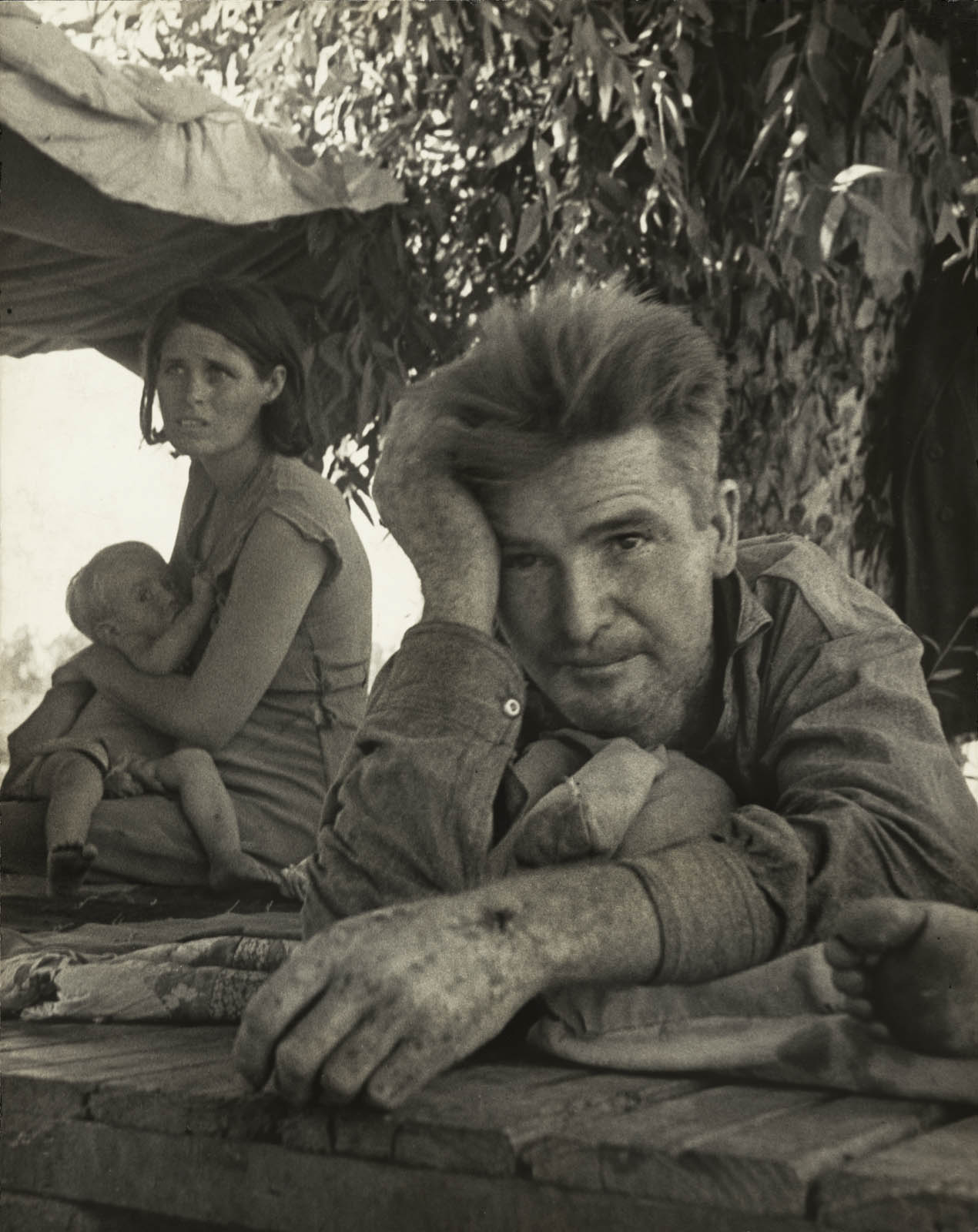
 

Dorothea Lange (American, 1895-1965) 'Drought Refugees from Oklahoma Camping by the Roadside, Blythe, California' August 17, 1936


Dorothea Lange (American, 1895-1965)
Drought Refugees from Oklahoma Camping by the Roadside, Blythe, California
August 17, 1936
Gelatin silver print
Image: 24 x 19.1cm (9 7/16 x 7 1/2 in.)
Mount: 33.02 x 28.26 cm (13 x 11 1/8 in.)
Mat: 20 x 16 in.
Frame (outside): 21 x 17 in.
National Gallery of Art, Washington, Gift of Daniel Greenberg and Susan Steinhauser


As a result of droughts and erosion that destroyed tillable land and crops in Oklahoma and Arkansas, thousands of farmers moved west with their families to start their lives over in places such as Blythe. Zella, Jess, and Jesse Power were among these families. It is not clear when the Powers began their move to California, but Jesse was born in Blythe, so Zella may have been pregnant during their journey. Lange’s field notes indicate that the Powers were a family of seven; an older sibling’s foot may be glimpsed in the lower right. With her furrowed brow and slumped posture, Zella exemplifies the difficulties faced by migrant mothers seeking better lives for themselves and their families in places that did not promise immediate relief.

Label text from the exhibition


Dorothea Lange (American, 1895-1965) 'Child Living in Oklahoma City Shacktown [Damaged Child, Shacktown]' August 1936


Dorothea Lange (American, 1895-1965)
Child Living in Oklahoma City Shacktown [Damaged Child, Shacktown]
August 1936
Gelatin silver print
Image: 24.2 x 19.4cm (9 1/2 x 7 5/8 in.)
Mat: 17 x 14 in.
The Museum of Modern Art, New York. Purchase


This photograph of a bruised girl with a hollow gaze is one of many Lange made depicting the exploitation of migrant children during the Great Depression. The portrait suggests the range of emotional and physical harm children experienced as they, too, struggled to survive economic hardship.

Label text from the exhibition


Dorothea Lange (American, 1895-1965) 'Eighty-year-old woman living in squatters' camp on the outskirts of Bakersfield, California. "If you lose your pluck you lose the most there is in you – all you've got to live with"' November 1936


Dorothea Lange (American, 1895-1965)
Eighty-year-old woman living in squatters’ camp on the outskirts of Bakersfield, California. “If you lose your pluck you lose the most there is in you – all you’ve got to live with”
November 1936
Gelatin silver print
Image: 19 x 24.4cm (7 1/2 x 9 5/8 in.)
Sheet: 20.3 x 25.5cm (8 x 10 1/16 in.)
Mat: 13 x 16 in.
Frame (outside): 14 x 17 in.
National Gallery of Art, Washington, Gift of Daniel Greenberg and Susan Steinhauser


Dorothea Lange (American, 1895-1965) 'Young Cotton Picker, San Joaquin Valley, California' November 1936


Dorothea Lange (American, 1895-1965)
Young Cotton Picker, San Joaquin Valley, California
November 1936
Gelatin silver print
Image: 24.1 x 18.4cm (9 1/2 x 7 1/4 in.)
Collection of the Oakland Museum of California, Gift of Paul S. Taylor


Dorothea Lange (American, 1895-1965) 'Alabama Plow Girl, near Eutaw, Alabama' 1936


Dorothea Lange (American, 1895-1965)
Alabama Plow Girl, near Eutaw, Alabama
1936
Gelatin silver print
Image: 19.1 x 19.4cm (7 1/2 x 7 5/8 in.)
Lent by The Metropolitan Museum of Art, Purchase, Alfred Stieglitz Society Gifts, 2001


Lange travelled to the American South in 1936 while employed by the Resettlement Administration. Near Eutaw, Alabama, she photographed Black tenant farmers like this shoeless girl plowing a field in the punishing summer heat. In the South, Lange witnessed the oppressive working conditions endured by Black tenants, who farmed land predominantly held by white owners and often struggled to access New Deal resources. Southern Black farmers faced undue difficulty during the Depression as economic disaster exacerbated the oppression and poverty produced by the region’s racist agricultural system.

Label text from the exhibition


Dorothea Lange (American, 1895-1965) 'Migratory Workers Harvesting Peas near Nipomo, California' Spring 1937


Dorothea Lange (American, 1895-1965)
Migratory Workers Harvesting Peas near Nipomo, California
Spring 1937
Gelatin silver print
Image: 19.4 x 24.5cm (7 5/8 x 9 5/8 in.)
Sheet: 20.6 x 25.4cm (8 1/8 x 10 in.)
Mat: 13 x 16 in. frame (outside): 14 x 17 in.
National Gallery of Art, Washington, Gift of Daniel Greenberg and Susan Steinhauser


Dorothea Lange (American, 1895-1965) 'Country store on dirt road. Sunday afternoon. Note the kerosene pump on the right and the gasoline pump on the left. Rough, unfinished timber posts have been used as supports for porch roof. Black men are sitting on the porch. Brother of store owner stands in doorway, Gordonton, North Carolina' July 1939, printed later


Dorothea Lange (American, 1895-1965)
Country store on dirt road. Sunday afternoon. Note the kerosene pump on the right and the gasoline pump on the left. Rough, unfinished timber posts have been used as supports for porch roof. Black men are sitting on the porch. Brother of store owner stands in doorway, Gordonton, North Carolina
July 1939, printed later
Gelatin silver print
Image: 24.5 x 34.3cm (9 5/8 x 13 1/2 in.)
Sheet: 25.6 x 35.4cm (10 1/16 x 13 15/16 in.)
Mat: 16 x 20 in.
Frame (outside): 17 x 21 in.
National Gallery of Art, Washington, Gift of Daniel Greenberg and Susan Steinhauser


Rainey Curry Baynes II, the store owner’s brother, leans in the doorway conversing with five Black men. On the far right is Arthur Thorpe, and the man wearing overalls is Joe Carrington. The men appear relaxed in Baynes’s presence, but it is unclear whether their demeanour is genuine or for the benefit of Lange’s camera. They may have been sharecroppers or tenant farmers indebted to the Baynes brothers, or simply customers of the store.

Label text from the exhibition
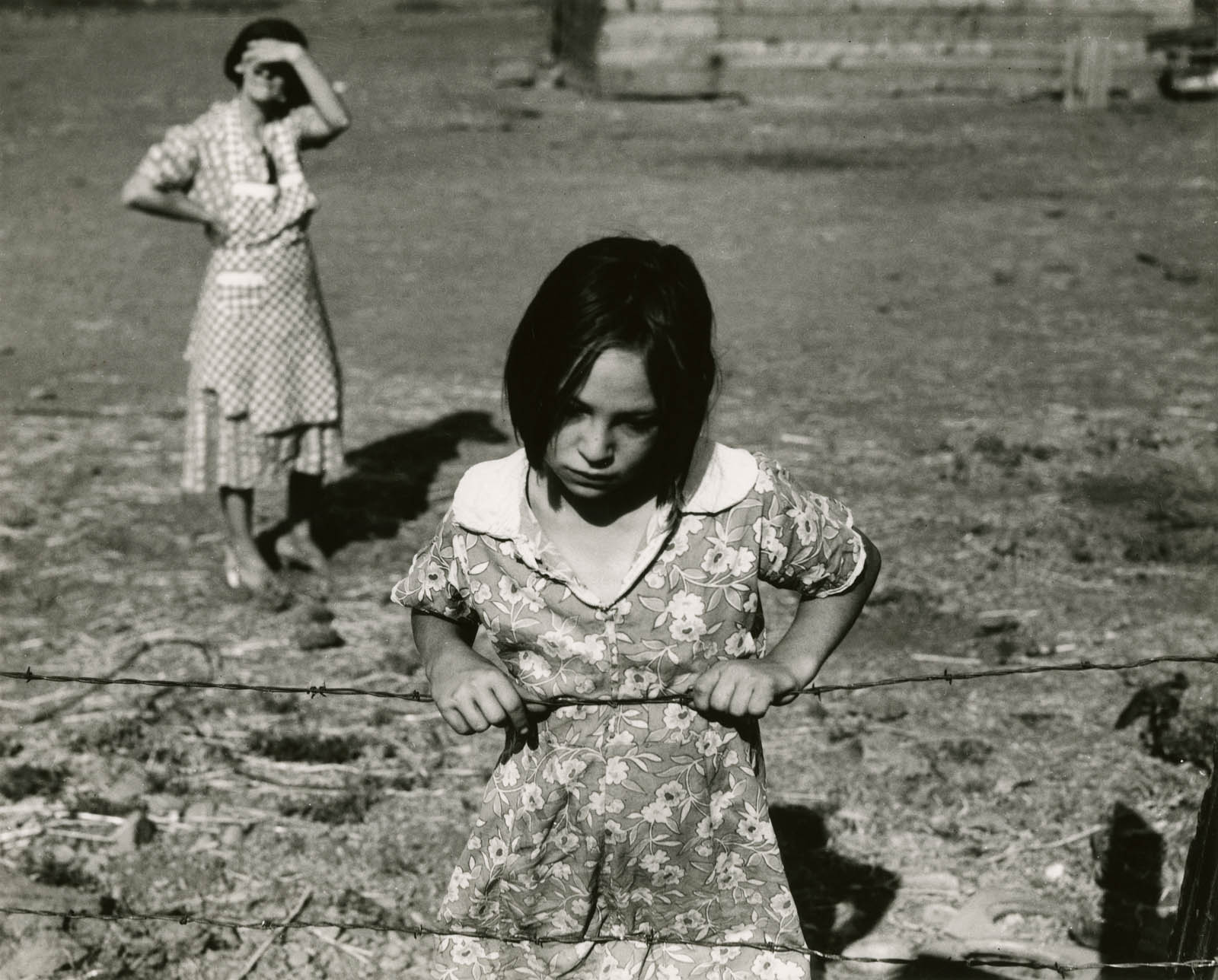
 

Dorothea Lange (American, 1895-1965) 'Washington, Yakima Valley, near Wapato. One of Chris Adolph's Younger Children. Farm Security Administration Rehabilitation Clients' August 1939


Dorothea Lange (American, 1895-1965)
Washington, Yakima Valley, near Wapato. One of Chris Adolph’s Younger Children. Farm Security Administration Rehabilitation Clients
August 1939
Gelatin silver print
Image: 20.83 x 25.4cm (8 3/16 x 10 in.)
Collection of the Oakland Museum of California, Gift of Paul S. Taylor


Dorothea Lange (American, 1895-1965) 'End of Shift, Richmond, California' 1942, printed 1965


Dorothea Lange (American, 1895-1965)
End of Shift, Richmond, California
1942, printed 1965
Gelatin silver print
Image: 75.7 x 59.5cm (29 13/16 x 23 7/16 in.)
The Museum of Modern Art, New York. Purchase


Fortune magazine commissioned Lange to document the bustling shipyards in Richmond, north of Oakland, where newly desegregated defence firms were rapidly constructing transport, cargo, and warships for the United States Navy. With its tight cropping and dynamic configuration, End of Shift focuses on the rushing legs and torsos of shipbuilders leaving a wartime facility. Lange expressed the urgency of their work in defence production without showing their individual features. The angled composition and complex interplay of light and shadow demonstrate Lange’s understanding of how modern design techniques could convey the force and energy of a group working together on a project critical to the nation’s defence.

Label text from the exhibition


Dorothea Lange (American, 1895-1965) 'Street Encounter, Richmond, California' c. 1943


Dorothea Lange (American, 1895-1965)
Street Encounter, Richmond, California
c. 1943
Gelatin silver print
Image: 21.7 x 17.9cm (8 9/16 x 7 1/16 in.)
Frame (outside): 18 3/4 x 15 3/4 in.
The Nelson-Atkins Museum of Art, Kansas City, Missouri (Gift of Hallmark Cards, Inc.)


Dressed for work as a welder, this woman was one of thousands who moved to Richmond, California, during the early 1940s to seek employment in the expanding wartime shipbuilding yards. On assignment for Fortune magazine, Lange documented the upheaval wrought by Richmond’s rapidly growing population and diversifying workforce. Lange’s field notes described this picture as an “Item on race relations. Scene on main street. The girl was a taxi driver in New Orleans. She came to Richmond with her husband two years ago.” Recognising the power of words in her pictures, Lange included a sign that could be read as “Serve You” or “Serve Your Country,” but which actually says “Serve Yourself” – a wry comment on the national unity promoted by the era’s patriotic propaganda.

Label text from the exhibition


Early Portraits

Born in Hoboken, New Jersey, in 1895, Dorothea Lange learned photography in New York City before embarking in 1918 on a round-the-world trip. When forced to cut her journey short and find employment in San Francisco, she secured a position at the photo-finishing counter of a variety store. She soon opened her own portrait studio and worked among a cohort of bohemian artists and intellectuals including Imogen Cunningham, Consuelo Kanaga, Ansel Adams, Edward Weston, and the painter Maynard Dixon, who would become her first husband.

Bay Area high-society and cultural figures became Lange’s clients and the subjects of her studio portraits. These early pictures combine elements of the pictorial style in which she was trained, such as soft focus and diffused light, with an emerging modernist aesthetic that included dramatic cropping and unusual angles. She used light, shadow, and carefully constructed poses to articulate the character, attitude, and individuality of her models: “I really and seriously tried, with every person I photographed, to reveal them as closely as I could.”

Poverty and Activism

Although she had a highly successful studio practice, Lange in 1933 was compelled by the nation’s worsening economic conditions to rethink her occupation and carry her cameras into the city. “There in my studio I was surrounded by evidence of the Depression,” she said. “I remember well standing at that one window and just watching the flow of life. … I was driven by the fact that I was under personal turmoil to do something.”

Out in the streets during the early years of the Great Depression, Lange saw poverty, breadlines, strikes, and labor demonstrations. Her photographs from this period portray the unemployment and unrest that plagued San Francisco, and also document the activism of workers who organised to change their conditions. In 1934, Lange met the agricultural economist Paul Taylor. The two formed an important professional and personal partnership (they married the following year). Lange soon shifted her attention to the plight of migrant farmers, who were moving to California to seek work.

The Great Depression

As the Great Depression deepened, Dorothea Lange focused her lens on the families who had fled westward in the face of economic hardship caused by depleted land and failed farm tenancy in the South and Midwest. When she was working for government agencies, she documented the success of rural cooperatives and the unsanitary conditions in California migrant camps while striving to humanise the large numbers of people seeking shelter and employment. For Lange, portraiture offered a way to visualise the impacts of migration, racism, and environmental change, as well as the legacy of slavery, to gain public support for government aid programs.

During this period Lange cemented her style of documenting people. Her empathetic, highly detailed, and sharply focused depictions show labourers within their living and working environments. Some subjects are alone, but many are seen with family and other members of their communities. These photographs provided evidence of economic disaster and bore witness to the resulting human tragedy while underscoring her subjects’ strength and resilience. This powerful merging of portraiture and documentary photography expanded the boundaries of both traditions, transforming them in ways that resonate deeply today.

World War II

During World War II, Dorothea Lange focused on the impact of the war on Americans at home as well as the nation’s complicated racial dynamics. Nowhere is this seen more acutely than in her portraits of individuals of Japanese ancestry who were forced to abandon their homes in response to President Franklin D. Roosevelt’s executive order (see nearby panel).

Lange also recorded the epochal shifts in California’s social fabric sparked by the growing defence industries, which helped rebuild the economy. Hired by Fortune magazine, she documented the Kaiser Shipyards in Richmond, California, where well-paid jobs attracted African Americans, Native Americans, and women into what had previously been a white male-dominated workforce. Yet as the population of Richmond quickly swelled, and as these newly empowered groups began to assert themselves, the changes also provoked housing shortages and social unrest.

Postwar America

Despite frequent health struggles, in the 1950s Dorothea Lange pursued photographic stories about a variety of American communities in the western United States. These include a project about urban life, for which she roamed the Bay Area; Three Mormon Towns, a collaboration made with Ansel Adams and Paul Taylor in Utah for Life magazine; and an environmental critique produced with photographer Pirkle Jones about the flooding of a Northern California town to create a reservoir. Wide-ranging in subject matter, Lange’s photographs reveal an extraordinary ability to portray the continued transformation of the American West and shine a light on the environmental and human consequences of the postwar economic boom.

World View

Dorothea Lange began working globally in 1954. Her first trip overseas was to Ireland, where she documented the kinship and community of country villages for Life magazine. Her husband, Paul Taylor, began consulting on international economic development for the US State Department and, in 1958, they traveled abroad for eight months, visiting Korea, Indonesia, Vietnam, and other countries; in the early 1960s, the couple traveled to Venezuela and Egypt. Continuing to concentrate on portraiture, Lange found a new sort of beauty and serenity in these foreign environments as well as ties to the economic and social disparities she had photographed in the United States. While photographs taken during these trips confirm her ongoing creativity in the face of declining health, profound cultural differences made it more difficult for Lange to connect with people.

Lange devoted the last years of her life to her family and to organising a retrospective exhibition of her photographs at the Museum of Modern Art in New York. She passed away in late 1965, but her legacy continues in the enduring resonance of her photographs and the new generations of photographers who use portraiture and documentary styles to prompt social change.

Travel

Beginning in 1922, Lange traveled with her first husband, artist Maynard Dixon, to Arizona and New Mexico, where she produced portraits of Indigenous Americans. The few photographs that remain from these excursions show Lange testing new strategies. She started to experiment with portraits that featured just a fragment of a person – their hands or face, for example – perhaps inspired by the modernist work of photographer Alfred Stieglitz, whom she had met in 1923. She also shed the soft-focus pictorial style of her earlier studio portraits in favour of a more direct approach. Although Lange interacted only briefly with the Indigenous people she photographed, she witnessed some of the “harsh and unjust treatment” they faced. The sensitivity and experimentation seen in these early photographs helped establish Lange’s expansive concept of portraiture, which impacted her later work.

The Resettlement Administration and the Farm Security Administration

From mid-1935, Dorothea Lange worked for the federal government’s Resettlement Administration (RA), reorganised as the Farm Security Administration (FSA) in 1937. Created to revitalise the country’s faltering agricultural economy, the RA helped farmers acquire land through low interest loans, administered projects on soil conservation and reforestation, and supported resettlement for those who could no longer work their land.

To document and report on its efforts, the RA established a historical division. Led by economist Roy Emerson Stryker, it enlisted some of America’s finest documentary photographers, including Walker Evans, Russell Lee, Marion Post Wolcott, Arthur Rothstein, and Ben Shahn. Stryker hired Lange on the strength of her earlier photographs documenting agricultural conditions for the state of California. In pictures of migrant labourers in California, tenant farmers in Alabama, drought refugees from Oklahoma, and others, Lange recorded the work and aspirations of the agencies. She covered a wide range of socially engaged stories that highlighted themes of human struggle and resilience, but the federal agencies – eager to garner widespread public and congressional support – discouraged depictions of racial oppression.

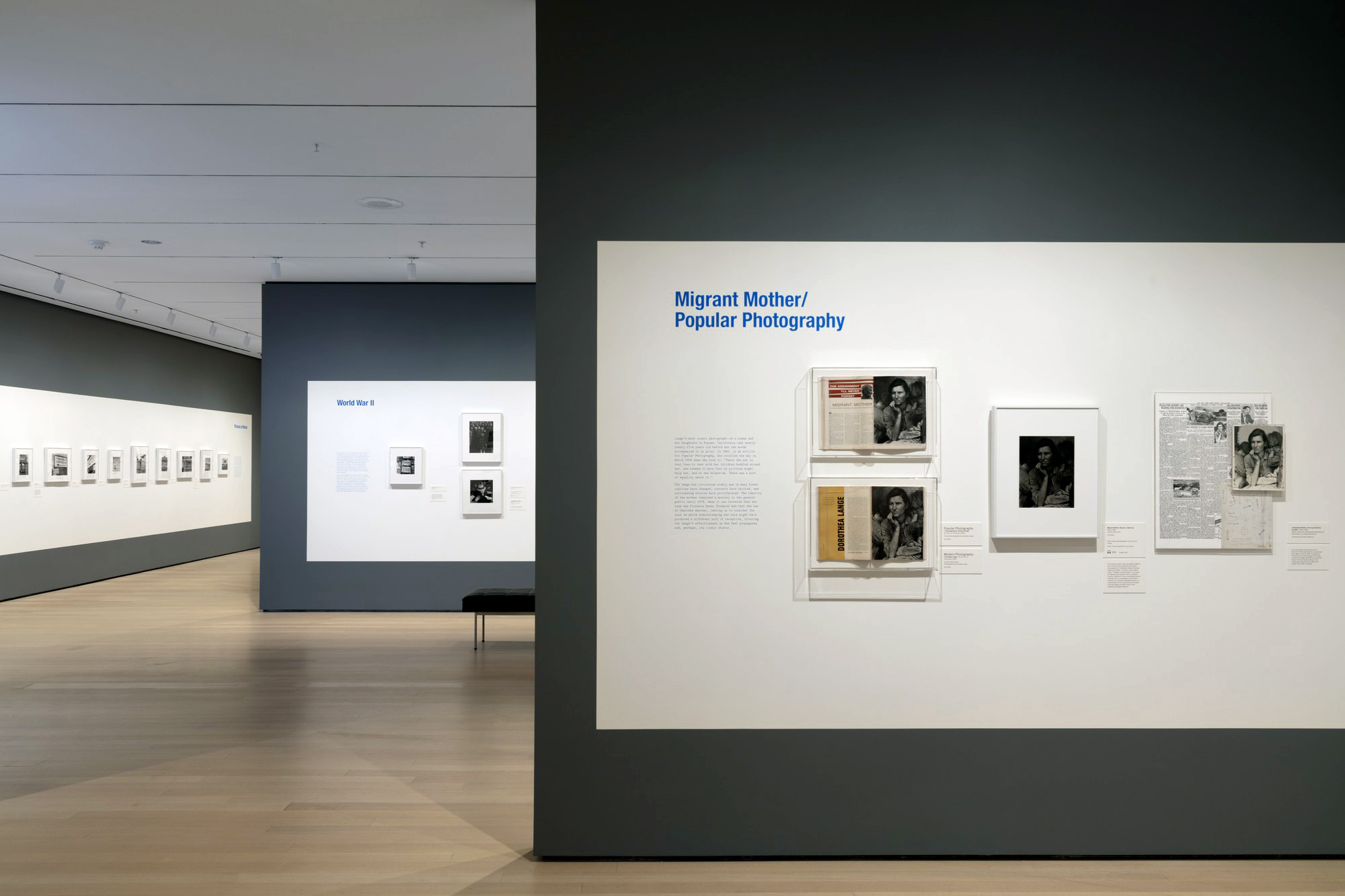
Migrant Mother March 1936

Human Erosion in California depicts a mother and three children at a migrant labor camp. Lange carefully composed the portrait to capture the woman’s face – prematurely etched by years of labor and worry – and her daughters embracing her. Migrant Mother, as the photograph is commonly known, has been compared to a Renaissance-era Madonna and child and described as an icon of 20th-century art, revered for its empathetic portrayal. Lange did not record the mother’s name. Only in 1978 was she finally identified as Florence Owens Thompson, a woman of Cherokee descent from Oklahoma. At the time of the photograph, Owens Thompson and her family were driving back home from California, where her husband had been working in a sawmill. When their car broke down, they were stranded at a nearby pea pickers’ camp. First published in a newspaper editorial urging government aid for migrant labourers, Migrant Mother prompted support from the state and the picture become an emblem of the power of photography to bring about social change. It also raises questions about the ethics of documentary photography and the dynamics between photographer and subject. Lange recalled that Owens Thompson “seemed to know that my pictures might help her, and so she helped me. There was a sort of equality about it.” Owens Thompson, however, received little benefit and was never given a copy of the photograph.

Executive Order 9066

In February 1942, months after the Japanese attack on the Pearl Harbor naval base, President Franklin D. Roosevelt signed Executive Order 9066. The order paved the way for the removal of more than 120,000 individuals of Japanese ancestry – the majority of whom were American citizens – from the West Coast to inland incarceration camps. Denying individuals their civil liberties, the government registered and tagged people before loading them onto buses and transporting them to rudimentary “assembly centers” and, eventually, one of 10 detention camps spread across seven states. The last camp closed four years after Roosevelt issued the order.

Soon after the initial order, the government’s War Relocation Administration (WRA) hired Lange to document this process. Opposed to the government’s actions, Lange believed it was important to record for history “what we did.” Through poignant portraits, she also depicted the resilience of Japanese Americans forced to abandon the lives and businesses they had built and face incarceration. Fearing that Lange’s portraits would elicit too much sympathy, the WRA did not release the photographs during the war.

Documentary Portraiture

Lange’s work during the 1930s synthesised her ideas about portraiture and documentary photography. With new purpose, she used the techniques, compositional strategies, and social skills she had cultivated in her portrait studio to frame the people and events she recorded. By 1940 she had distilled her understanding of documentary photography as an art form that “records the social scene of our time. It mirrors the present and documents for the future.”

Yet these photographs were also documents that followed the government’s New Deal economic doctrine – they emphasised getting the country back on its feet through perseverance, hard work, regulatory reforms, and government relief. This mix of presumed objectivity, propaganda, and documentary storytelling in service of a critical national agenda proved to be particularly powerful. As photography historian Beaumont Newhall later wrote, Lange was “resolved to photograph the now, rather than the timeless; to capture somehow the effects on people of the calamity which overwhelmed America.”

Lange’s Titles

You will notice Lange’s varied approach to titles across her career. Sometimes she simply used someone’s name or the location where a picture was made. Other titles describe or poetically evoke what she saw. Lange also created elaborate captions, often taken from interviews or conversations with those whom she photographed. This was an experimental documentary technique, which relied on Lange’s memory and prolific note taking. These long captions are seen especially in work she made for government agencies during the 1930s and 1940s.

Lange and her editors frequently retitled photographs when exhibiting or publishing them. For this exhibition, we have used Lange’s original titles when known. In a few instances we have updated language in original titles to reflect contemporary usage.

Wall text from the exhibition
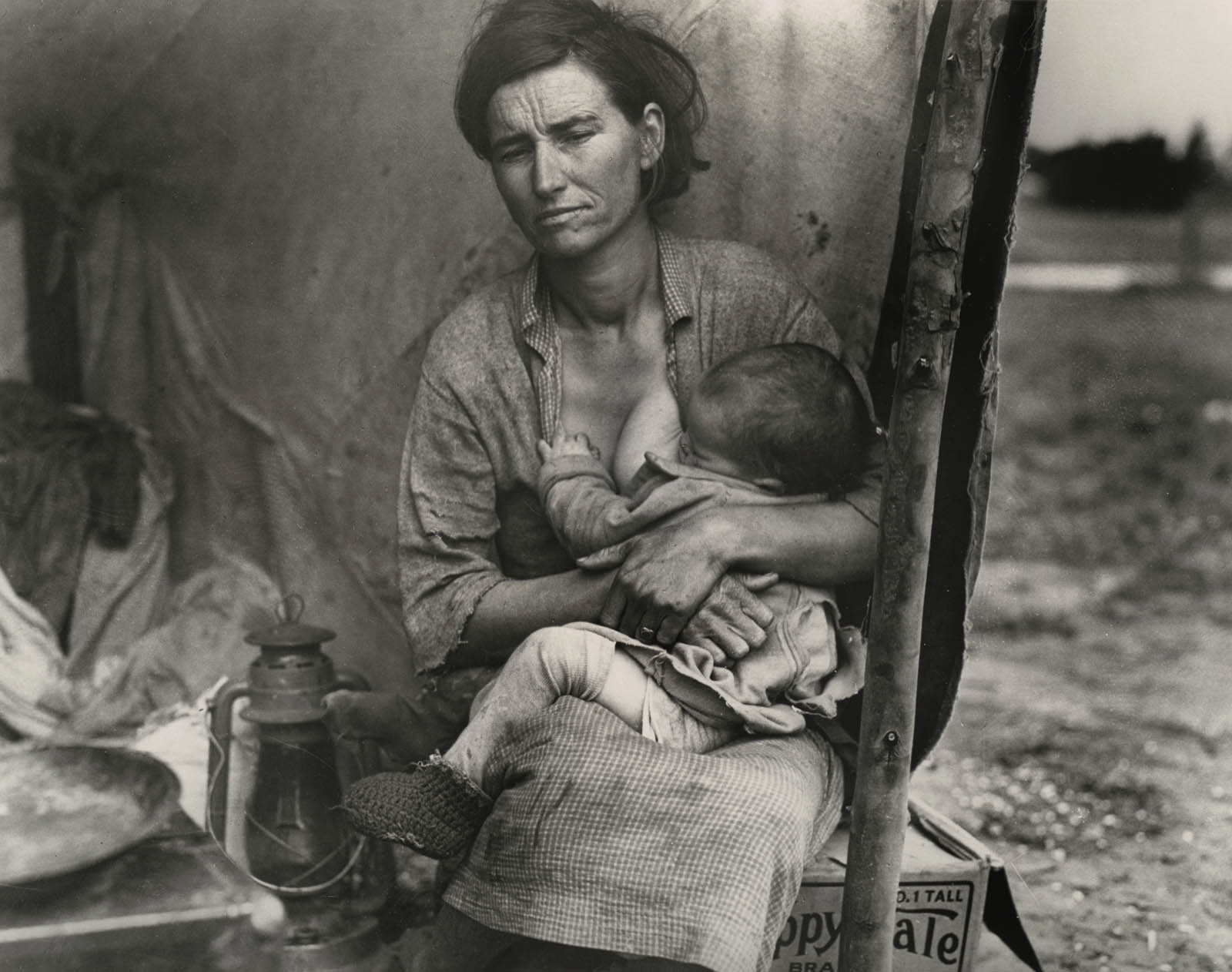
 

Dorothea Lange (American, 1895-1965) 'Migrant Agricultural Worker's Family, Nipomo, California' March 1936


Dorothea Lange (American, 1895-1965)
Migrant Agricultural Worker’s Family, Nipomo, California
March 1936
Gelatin silver print
Image: 26.67 x 34cm (10 1/2 x 13 3/8 in.)
Sheet: 27.94 x 35.56 cm (11 x 14 in.)
Mat: 18 x 22 in.
Frame (outside): 19 x 23 in.
National Gallery of Art, Washington, Gift of Daniel Greenberg and Susan Steinhauser


Florence Owens Thompson

Human Erosion in California (Migrant Mother) captures the worry, need, and insecurity of everyday Americans during the Great Depression. It is one of the most recognisable American photographs. And it almost wasn’t taken.

In spring 1935, Lange was driving home from a long trip photographing migrant worker camps when she passed a sign pointing toward a pea pickers camp. Lange had already taken many photographs of pea pickers. She tried to convince herself that she didn’t need any more. But about 20 miles later, she turned around.

We don’t know exactly what happened when Lange doubled back – this time, she didn’t take notes. And she didn’t ask many questions. Lange assumed that she had come upon a mother and her three children, there among the waves of workers coming to pick peas, California’s cash crop.

But that wasn’t true. Florence Owen Thompson was traveling with her family from elsewhere in California. The family had set up a camp on the side of the road while her husband and son went into town to resolve some car troubles. When they returned, she mentioned a photographer had taken some photos. Thompson never expected one of those photographs to immortalise her as the “Migrant Mother.” Decades later she wrote a letter to the editor of her local paper expressing irritation with her likeness being misused. In a later interview, Thompson expressed regret at ever allowing Lange to take the photo saying, “I wish she hadn’t taken my picture. I can’t get a penny out of it. [Lange] didn’t ask my name. She said she wouldn’t sell the pictures. She said she’d send me a copy. She never did.”

Anonymous. “The Real Lives of People in Dorothea Lange’s Portraits,” on the National Gallery of Art website November 03, 2023 [Online] Cited 25/02/2024


Dorothea Lange (American, 1895-1965) 'Human Erosion in California (Migrant Mother)' March 1936


Dorothea Lange (American, 1895-1965)
Human Erosion in California (Migrant Mother)
March 1936
Gelatin silver print
Image: 34.1 x 26.8 cm (13 7/16 x 10 9/16 in.)
Mount: 34.8 x 27.1 cm (13 11/16 x 10 11/16 in.)
Frame (outside): 28 5/8 x 22 5/8 x 1 3/8 in.
The J. Paul Getty Museum, Los Angeles


Dorothea Lange (American, 1895-1965) 'Grandfather and Grandson of Japanese Ancestry at a War Relocation Authority Center, Manzanar, California' July 1942


Dorothea Lange (American, 1895-1965)
Grandfather and Grandson of Japanese Ancestry at a War Relocation Authority Center, Manzanar, California
July 1942
Gelatin silver print
Image: 26.4 x 33.7cm (10 3/8 x 13 1/4 in.)
Sheet: 28 x 35.3cm (11 x 13 7/8 in.)
Mat: 16 x 20 in.
Frame (outside): 17 x 21 in.
National Gallery of Art, Washington, Gift of Daniel Greenberg and Susan Steinhauser
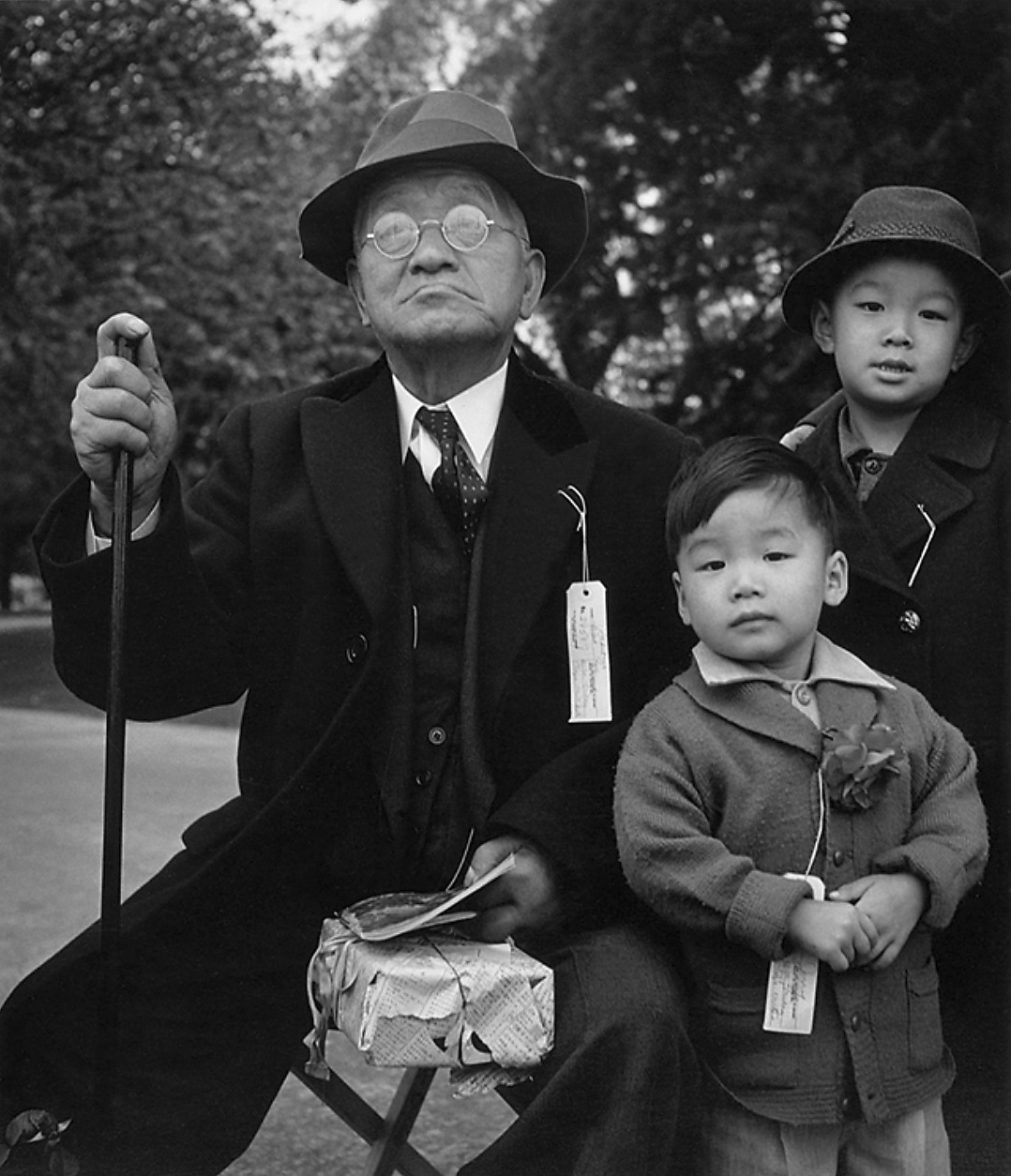
 

Dorothea Lange (American, 1895-1965) 'Grandfather and Grandchildren Awaiting Evacuation Bus, Hayward, California' 1942


Dorothea Lange (American, 1895-1965)
Grandfather and Grandchildren Awaiting Evacuation Bus, Hayward, California
1942
Gelatin silver print
Image: 26.4 x 22.7cm (10 3/8 x 8 15/16 in.)
Sheet: 35.4 x 27.8cm (13 15/16 x 10 15/16 in.)
Frame (outside): 20 3/4 x 16 7/8 in.
The Nelson-Atkins Museum of Art, Kansas City, Missouri (Gift of Hallmark Cards, Inc.)


In the spring of 1942, Dorothea Lange requested another leave from her Guggenheim fellowship when she was hired to document the internment of Japanese Americans during World War II. Following the bombing of Pearl Harbor in December 1941, President Roosevelt signed Executive Order 9066 in February1942, which allowed military commanders to set up security zones wherever they thought necessary, with the full authority to remove anyone from these areas regardless of nationality or age. In March, Lieutenant General John L. DeWitt, head of the Western Defense Command, announced that all persons of Japanese ancestry would have to leave the Pacific Coast military zone, which included California, western Oregon and Washington, and southern Arizona. Though no specific charges were placed against any individuals, approximately 120,000 men, women, and children – more than two-thirds of them native-born American citizens – were ordered to abandon their homes and businesses and be relocated to internment camps established by the federal government. Two of the ten camps, Manzanar and Tule Lake, were in California as were twelve of the preliminary holding areas called assembly centers. The U.S. Army was responsible for gathering the Japanese Americans and retaining them in the makeshift assembly centers – race tracks, fairground exhibition halls, empty automobile showrooms – until the camps were ready. The War Relocation Authority (WRA) was established in March 1942 to oversee management of the camps. In a letter dated 1 April1942 to Moe, Lange requested a postponement of her Guggenheim fellowship explaining: the Japanese (aliens and citizens) are being evacuated from California. The War Relocation Authority has asked me to make photographic documentation of this situation. It’s too worth-while to refuse… It interrupts my fellowship, but is in line with my work.

For the next four months, Lange documented the internees as they were evicted from their homes and businesses, tagged and labeled, and then shuffled by trains and motor convoys to various assembly centers before they were incarcerated. She photographed at only one of the actual internment camps, Manzanar, in the desert of Owns Valley in Southern California. Although Lange was a government employee while recording what is now universally acknowledged as a gross violation of justice, her sympathies were with the Japanese Americans.

Scope and Content

Lange was hired by the San Francisco Regional Office of the War Relocation Authority (WRA) in early April 1942 as a photographer investigator to document the evacuation of Japanese Americans from Northern California. Lange completed her work at the end of July 1942. It has been estimated that of the approximately 13,000 existing photographs taken for the federal government, Lange made over 700. Because of the political nature of her relocation photography, she was required to turn over to the WRA all of her negatives, prints, and undeveloped film; thus, very little of this material is contained within the museum’s archive. Following the end of the war, a complete file of Lange’s WRA negatives and prints was placed in the National Archives in Washington, D.C., with a duplicate set of prints placed at the Bancroft Library of the University of California, Berkeley.

Anonymous. “Guide to the Lange (Dorothea) Collection 1919-1965,” on the Online Archive of California website Nd [Online] Cited 25/02/2024


Dorothea Lange (American, 1895-1965) 'Japanese American-Owned Grocery Store, Oakland, California' March 1942


Dorothea Lange (American, 1895-1965)
Japanese American-Owned Grocery Store, Oakland, California
March 1942
Gelatin silver print
Image: 19 x 24.4cm (7 1/2 x 9 5/8 in.)
Sheet: 20.3 x 25.4 cm (8 x 10 in.)
Mat: 14 x 18 in. frame (outside): 15 x 19 in.
National Gallery of Art, Washington, Gift of Daniel Greenberg and Susan Steinhauser


On December 8, 1941, a day after Japan bombed Pearl Harbor, Tatsuro Masuda, the 25-year-old American-born owner of the Wanto Company store in Oakland, posted a sign on his building: “I AM AN AMERICAN.” Masuda’s bold assertion of his national identity did little good. In March 1942, Masuda, a University of California graduate, closed the store that his father had founded 26 years earlier. In August 1942, he and his family were incarcerated at the Gila River War Relocation Center in Arizona. They were not released until October 1944. They never returned to Oakland.

Label text from the exhibition


Tatsuro Masuda

After the bombing of Pearl Harbor in 1941, President Franklin D. Roosevelt issued Executive Order 9066 in 1942. The order forced the unjust incarceration of more than 120,000 Americans of Japanese descent (the majority of whom were American citizens). The War Relocation Authority hired Lange to document this process. Lange was horrified by what she witnessed. She chronicled her subjects in a sympathetic light, so much so that her photographs were censored during the war.

Lange began by photographing Japanese Americans as they prepared to abandon their homes. She took this picture of a grocery store on a street corner in Oakland, California, in March 1942, a month after the executive order was issued.

Tatsuro Masuda ran the Wanto Company store (look for its name on the windows), opened by his father in 1900. Fearful of growing anti-Japanese sentiments, Masuda paid for the “I AM AN AMERICAN” sign to be installed the day after Pearl Harbor. By the time Lange took the photograph, Masuda decided to close the store. Japanese Americans were forced to sell or relinquish any property they couldn’t carry with them. He moved to Fresno with his new wife, Hatsue Kuge. In August the couple (now expecting their first child) were incarcerated at Gila River War Relocation Center in Arizona. Their second child was born at Gila, as well. They weren’t released until October 1944.

Anonymous. “The Real Lives of People in Dorothea Lange’s Portraits,” on the National Gallery of Art website November 03, 2023 [Online] Cited 25/02/2024


Dorothea Lange (American, 1895-1965) 'Richmond, California' 1944, printed 1950s


Dorothea Lange (American, 1895-1965)
Richmond, California
1944, printed 1950s
Gelatin silver print
Image: 17 x 16.8 cm (6 11/16 x 6 5/8 in.)
Sheet: 25.2 x 20.2 cm (9 15/16 x 7 15/16 in.)
Mat: 16 x 14 in.
Frame (outside): 17 x 15 in.
National Gallery of Art, Washington, Gift of Daniel Greenberg and Susan Steinhauser
© The Dorothea Lange Collection, Oakland Museum of California, City of Oakland. Gift of Paul S. Taylor


Dorothea Lange (American, 1895-1965) 'Richmond, California' from 'City Life' 1952


Dorothea Lange (American, 1895-1965)
Richmond, California from City Life
1952
Gelatin silver print
Image: 25 x 21cm (9 13/16 x 8 1/4 in.)
Sheet: 28.1 x 23.4cm (11 1/16 x 9 3/16 in.)
Mat: 17 x 14 in.
Frame (outside): 18 x 15 in.
National Gallery of Art, Washington, Gift of Daniel Greenberg and Susan Steinhauser
© The Dorothea Lange Collection, Oakland Museum of California, City of Oakland. Gift of Paul S. Taylor


Dorothea Lange (American, 1895-1965) 'Anne Carter Johnson, Saint George, Utah' 1953


Dorothea Lange (American, 1895-1965)
Anne Carter Johnson, Saint George, Utah
1953
Gelatin silver print
Image: 19 x 18.8cm (7 1/2 x 7 3/8 in.)
Sheet: 25.2 x 20.3cm (9 15/16 x 8 in.)
Mat: 14 x 14 in.
Frame (outside): 15 x 15 in.
National Gallery of Art, Washington, Gift of Daniel Greenberg and Susan Steinhauser
© The Dorothea Lange Collection, Oakland Museum of California, City of Oakland. Gift of Paul S. Taylor


Dorothea Lange (American, 1895-1965) 'Self-Portrait in Window, Saint George, Utah' 1953


Dorothea Lange (American, 1895-1965)
Self-Portrait in Window, Saint George, Utah
1953
Gelatin silver print
Image/sheet: 23.8 x 18.6cm (9 3/8 x 7 5/16 in.)
Mount: 24.2 x 19.1cm (9 1/2 x 7 1/2 in.)
Mat: 16 x 13 in.
Frame (outside): 17 x 14 in.
National Gallery of Art, Washington, Gift of Daniel Greenberg and Susan Steinhauser
© The Dorothea Lange Collection, Oakland Museum of California, City of Oakland. Gift of Paul S. Taylor


Among the places Lange visited for the Life magazine photo-essay Three Mormon Towns (produced with Ansel Adams and Paul Taylor) was Saint George, Utah. A formerly secluded pastoral community, the area had grown into a town with gas stations and motels to accommodate visitors to nearby Zion National Park. The town’s modernisation infringed upon the community’s prior isolation from mainstream American culture, and Lange feared that some of its early pioneer principles might be lost. Perhaps equating her own fragile health with the town’s vulnerability, Lange photographed her face and camera reflected in the window of a dilapidated building, calling the picture a self-portrait.

Label text from the exhibition


Dorothea Lange (American, 1895-1965) 'Jake Jones's Hands, Gunlock County, Utah' 1953


Dorothea Lange (American, 1895-1965)
Jake Jones’s Hands, Gunlock County, Utah
1953
Gelatin silver print
Image/sheet: 16.6 x 12.8cm (6 9/16 x 5 1/16 in.)
Mount: 17.1 x 13.7cm (6 3/4 x 5 3/8 in.)
Mat: 14 x 11 in.
Frame (outside): 15 x 12 in.
National Gallery of Art, Washington, Gift of Daniel Greenberg and Susan Steinhauser
© The Dorothea Lange Collection, Oakland Museum of California, City of Oakland. Gift of Paul S. Taylor


Dorothea Lange (American, 1895-1965) 'Annie Halloran's Hands' 1954


Dorothea Lange (American, 1895-1965)
Annie Halloran’s Hands
1954
Gelatin silver print
Image: 19.3 x 19.4cm (7 5/8 x 7 5/8 in.)
Sheet: 20.3 x 20.3cm (8 x 8 in.)
Mat: 15 x 14 in.
Frame (outside): 16 x 15 in. National Gallery of Art, Washington, Gift of Daniel Greenberg and Susan Steinhauser
© The Dorothea Lange Collection, Oakland Museum of California, City of Oakland. Gift of Paul S. Taylor


Dorothea Lange (American, 1895-1965) 'Family Portrait' from 'Death of a Valley' 1956


Dorothea Lange (American, 1895-1965)
Family Portrait from Death of a Valley
1956
Gelatin silver print
Image: 27.1 x 25.7cm (10 11/16 x 10 1/8 in.)
San Francisco Museum of Modern Art, Gift of an anonymous donor in memory of Merrily Page
© The Dorothea Lange Collection, Oakland Museum of California, City of Oakland. Gift of Paul S. Taylor


These family portraits were abandoned in a home in Monticello, California, when residents were forced to relocate. The Napa County town was destroyed and flooded in 1957 after the creation of Lake Berryessa, a reservoir formed by the new Monticello Dam. Lange made this photograph for the series Death of a Valley, a collaboration with photographer Pirkle Jones, reproduced in a 1960 edition of Aperture magazine. Lange’s “portrait” of forsaken family photographs communicates a sense of lost memories and the human costs of development. It demonstrates not only Lange’s prescient environmentalism but also her long-standing concern for the disintegration of families and communities.

Label text from the exhibition


Dorothea Lange (American, 1895-1965) 'Korean Child' 1958


Dorothea Lange (American, 1895-1965)
Korean Child
1958
Gelatin silver print
Image: 14.7 x 11.1cm (5 13/16 x 4 3/8 in.)
Sheet: 16 x 12.4cm (6 5/16 x 4 7/8 in.)
Mount: 19 x 14cm (7 1/2 x 5 1/2 in.)
Mat: 14 x 11 in.
Frame (outside): 15 x 12 in.
National Gallery of Art, Washington, Alfred H. Moses and Fern M. Schad Fund
© The Dorothea Lange Collection, Oakland Museum of California, City of Oakland. Gift of Paul S. Taylor


Lange and Taylor traveled to South Korea in 1958 and encountered people still reeling from a divisive war. When visiting a classroom, Lange focused on a group of excited students. But when she printed Korean Child for her 1966 retrospective exhibition, she radically cropped her negative to concentrate on one boy’s serene features. Since her early portraits of the 1920s, Lange had used dramatic cropping to shape the meaning of her photographs. Here, by isolating the boy’s calm face from the chaos surrounding him, she created a more universal exploration of the innocence of childhood in a nation then torn by war and poverty.

Label text from the exhibition


Dorothea Lange (American, 1895-1965) 'Indonesian Woman' 1958


Dorothea Lange (American, 1895-1965)
Indonesian Woman
1958
Gelatin silver print
Image/sheet: 12 x 9.5cm (4 3/4 x 3 3/4 in.)
Mat: 14 x 11 in.
Frame (outside): 15 x 12 in.
National Gallery of Art, Washington, Gift of Daniel Greenberg and Susan Steinhauser
© The Dorothea Lange Collection, Oakland Museum of California, City of Oakland. Gift of Paul S. Taylor


Dorothea Lange (American, 1895-1965) 'Bad Trouble over the Weekend, Steep Ravine, California' 1964, printed later


Dorothea Lange (American, 1895-1965)
Bad Trouble over the Weekend, Steep Ravine, California
1964, printed later
Gelatin silver print
Image: 24.3 x 15.2cm (9 9/16 x 6 in.)
Sheet: 25.1 x 20.4cm (9 7/8 x 8 1/16 in.)
Mat: 16 x 14 in.
Frame (outside): 17 x 15 in.
National Gallery of Art, Washington, Gift of Daniel Greenberg and Susan Steinhauser
© The Dorothea Lange Collection, Oakland Museum of California, City of Oakland. Gift of Paul S. Taylor


For years, Lange and Taylor spent many weekends with their children and grandchildren at a rented cabin on Steep Ravine above Stinson Beach, just north of San Francisco. Bad Trouble over the Weekend was made during one such stay near the end of Lange’s life – she had already been diagnosed with terminal cancer. She cropped the photograph to focus on her daughter-in-law Mia Dixon’s hands, which cradle her unseen face. The gesture and the caption suggest the emotional weight of Lange’s flagging health, although she provided few narrative details. The photograph communicates both a personal and a universal connotation of “trouble,” telling an ambiguous story for viewers to imagine and, perhaps, identify with.

Label text from the exhibition


Dorothea Lange (American, 1895-1965) 'Pledge to the Flag, San Francisco' 1942, printed c. 1965


Dorothea Lange (American, 1895-1965)
Pledge to the Flag, San Francisco
1942, printed c. 1965
Gelatin silver print
Image/sheet: 31.7 x 13.9cm (12 1/2 x 5 1/2 in.)
Mat: 22 x 16 in.
Frame: 23 x 17 in.
National Gallery of Art, Washington, Gift of Daniel Greenberg and Susan Steinhauser


National Gallery of Art
National Mall between 3rd and 7th Streets
Constitution Avenue NW, Washington

Opening hours:
Daily 10am – 5pm

National Gallery of Art website

LIKE ART BLART ON FACEBOOK

Back to top

Exhibition: ‘Dorothea Lange: Seeing People’ at the National Gallery of Art, Washington Part 1

Exhibition dates: 5th November 2023 – 31st March 2024


Dorothea Lange (American, 1895-1965) 'Child of Impoverished Black Tenant Family Working on Farm, Alabama' July 1936


Dorothea Lange (American, 1895-1965)
Child of Impoverished Black Tenant Family Working on Farm, Alabama
July 1936
Gelatin silver print
Image: 20 x 19.2cm (7 7/8 x 7 9/16 in.)
Sheet: 25.4 x 20.2cm (10 x 7 15/16 in.)
Mat: 14 x 14 in.
Frame (outside): 15 x 15 in.
National Gallery of Art, Washington, Gift of Daniel Greenberg and Susan Steinhauser


A humungous two-part posting on the work of American photographer Dorothea Lange (1895-1965) which features over 110 of her photographs many of which were unknown to me.

Of course, the posting features the photographs for which she is rightly famous (Migrant Mother; White Angel Breadline; Nettie Featherston; Migratory cotton picker with his cotton sack slung over his shoulder rests at the scales before returning to work in the field; Once a Missouri farmer, now a Migratory Farm Laborer) but others are a surprise for the senses, especially the Irish portrait photographs.

See my comment on the photographs in Part 2 of the posting.

Dr Marcus Bunyan


Many thankx to the National Gallery of Art for allowing me to publish the photographs in the posting. Please click on the photographs for a larger version of the image.


During her long, prolific, and groundbreaking career, the American photographer Dorothea Lange made some of the most iconic portraits of the 20th century. Dorothea Lange: Seeing People reframes Lange’s work through the lens of portraiture, highlighting her unique ability to discover and reveal the character and resilience of those she photographed.

Featuring some 100 photographs, the exhibition addresses her innovative approaches to picturing people, emphasising her work on social issues including economic disparity, migration, poverty, and racism.


“The portrait is made more meaningful by intimacy – an intimacy shared not only by the photographer with his subject but by the audience.”


Dorothea Lange


“The power of her pictures – their ability to speak to the character and resilience of those she photographed – lies not only in her desire to effect social change, but also in her deep humanism, her abiding interest in people, and the skills and insights she learned as a portrait photographer.”


Sarah Greenough


Dorothea Lange (American, 1895-1965) 'White Angel Breadline, San Francisco, California' 1933


Dorothea Lange (American, 1895-1965)
White Angel Breadline, San Francisco, California
1933
Gelatin silver print
Image/sheet: 34 x 26.5cm (13 3/8 x 10 7/16 in.)
Mat: 20 x 16 in.
Frame (outside): 21 x 17 in.
National Gallery of Art, Washington, Gift of Daniel Greenberg and Susan Steinhauser
© The Dorothea Lange Collection, Oakland Museum of California, City of Oakland. Gift of Paul S. Taylor


A growing desire to capture the Depression’s impact drew Lange to the White Angel Jungle, a San Francisco soup kitchen run by Lois Jordan, the “White Angel.” There Lange photographed this downtrodden man leaning on a barricade, his jaw clenched, shoulders hunched, back to the crowd, and eyes covered by the brim of his hat. Though anonymous, he drew Lange’s sympathetic eye and became a symbol of the nameless masses who faced economic hardship as the United States plunged deep into financial crisis.

Label text from the exhibition


Dorothea Lange (American, 1895-1965) 'Street Demonstration, San Francisco' 1934


Dorothea Lange (American, 1895-1965)
Street Demonstration, San Francisco
1934
Gelatin silver print
Image: 24.4 x 19.1cm (9 5/8 x 7 1/2 in.)
Mount: 27.9 x 20.2cm (11 x 7 15/16 in.)
Mat: 20 x 16 in.
Frame (outside): 21 x 17 in.
National Gallery of Art, Washington, Diana and Mallory Walker Fund and Robert Menschel and the Vital Projects Fund, in Honor of the 25th Anniversary of Photography at the National Gallery of Art
© The Dorothea Lange Collection, Oakland Museum of California, City of Oakland. Gift of Paul S. Taylor


In spring and summer 1934, a longshoremen’s strike gripped San Francisco and demonstrations took place throughout the city. Protesters also advocated for Japanese unions, which were being threatened by anti-labor forces in Japan. Lange wrote in her notes, “This was just before the New Deal during a time when Communists were very active. A few blocks away … soup was being distributed daily to the unemployed.”

Lange focused on a lone policeman standing before a crowd of protesters holding placards in English and Japanese. The policeman projects authority through his firm stance, crisp uniform, and shiny badge, creating a barrier between the photographer and the crowd.

Label text from the exhibition


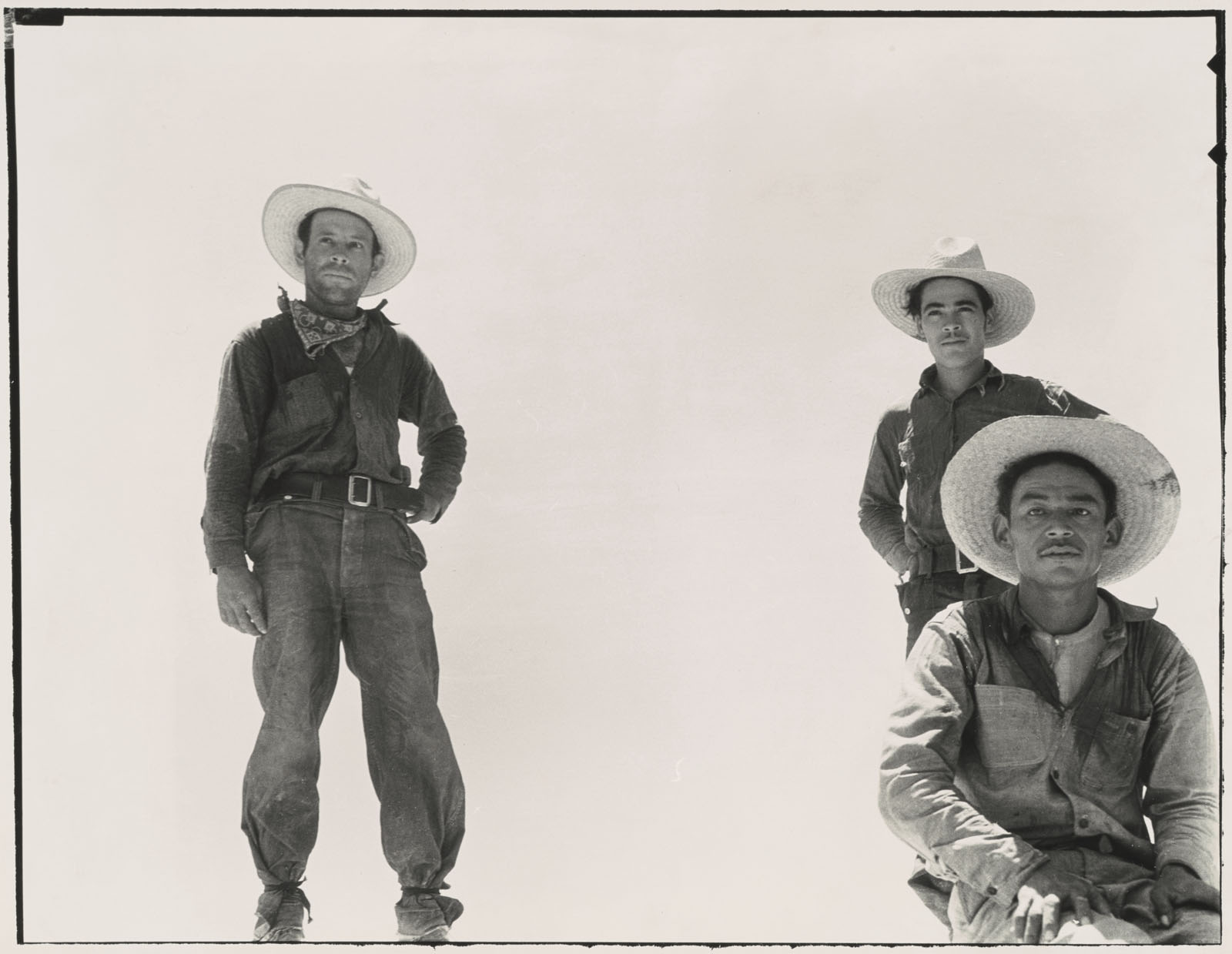
Dorothea Lange (American, 1895-1965) 'Mexican Workers Leaving for Melon Fields, Imperial Valley, California' June 1935, printed 1940s


Dorothea Lange (American, 1895-1965)
Mexican Workers Leaving for Melon Fields, Imperial Valley, California
June 1935, printed 1940s
Gelatin silver print
Image: 45 x 58cm (17 11/16 x 22 13/16 in.)
Sheet: 50.2 x 67.5cm (19 3/4 x 26 9/16 in.)
Mat: 24 x 28 in.
Frame (outside): 25 x 29 in.
National Gallery of Art, Washington, Gift of Daniel Greenberg and Susan Steinhauser
© The Dorothea Lange Collection, Oakland Museum of California, City of Oakland. Gift of Paul S. Taylor


In the summer of 1935, Lange traveled with Paul Taylor, working with his research team on a study of migrant labourers funded by California’s State Emergency Relief Administration. Mexican farm labourers, like this trio of cantaloupe harvesters, saw wages plummet during the Depression as thousands of westbound American migrants flooded the labour market. Angling her camera upward, Lange silhouetted the workers against a hazy sky, producing a striking group portrait. Working together solidified Lange and Taylor’s professional relationship, which developed into a romantic partnership and marriage later that same year.

Label text from the exhibition


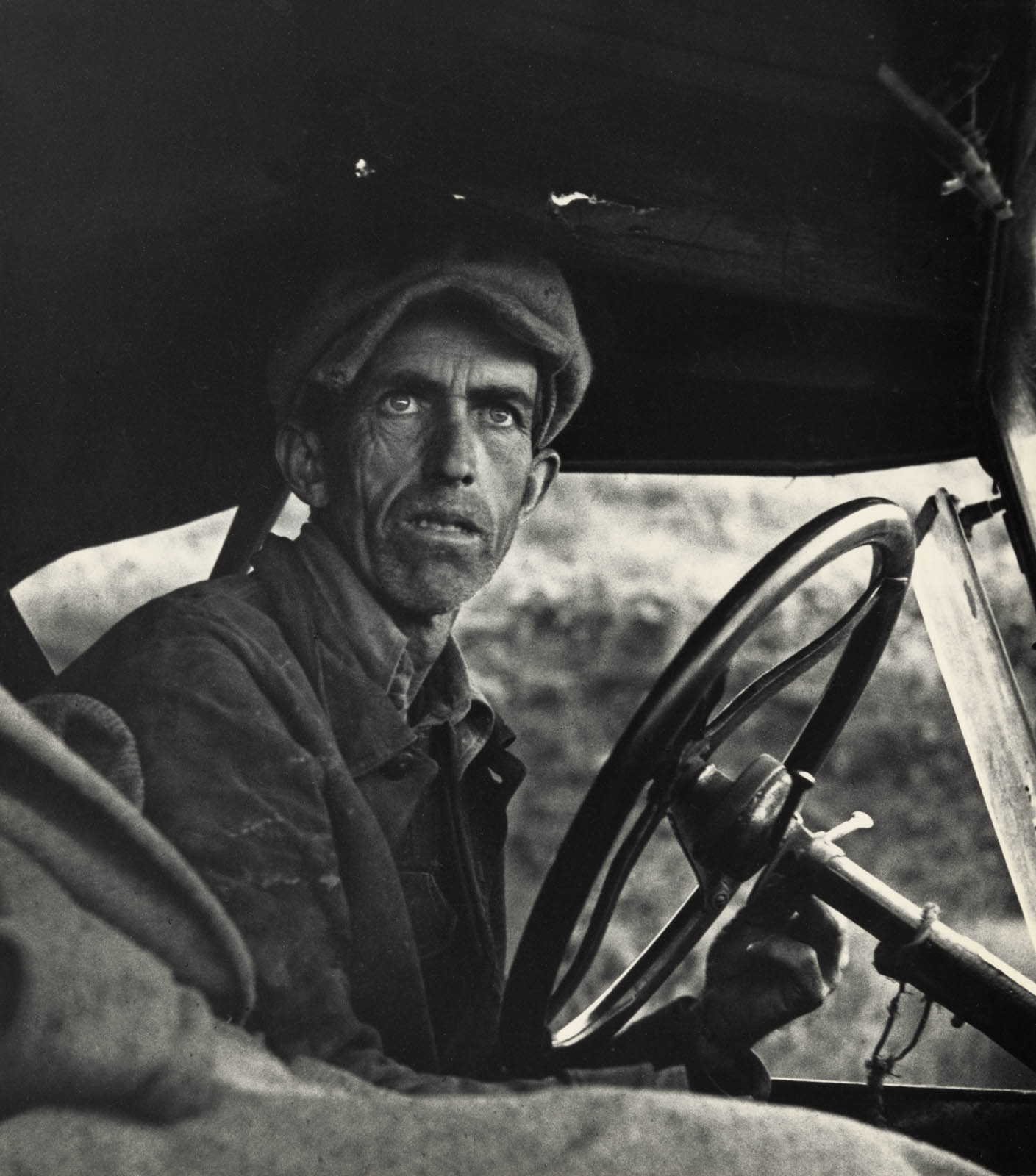
Dorothea Lange (American, 1895-1965) 'Once a Missouri farmer, now a Migratory Farm Laborer. San Joaquin Valley, California' February 1936, printed c. 1965


Dorothea Lange (American, 1895-1965)
Once a Missouri farmer, now a Migratory Farm Laborer. San Joaquin Valley, California
February 1936, printed c. 1965
Gelatin silver print
Image/sheet: 44.6 x 39.5cm (17 9/16 x 15 9/16 in.)
Mat: 26 x 22 in.
Frame (outside): 27 x 23 in.
National Gallery of Art, Washington, Gift of Daniel Greenberg and Susan Steinhauser


Although this farm labourer from Missouri seems to be alone behind the wheel of his car, he is actually seated beside his wife, in the passenger seat. Her overcoat and right arm are easily overlooked at the bottom left. By focusing only on the driver, with his gaunt features and intense gaze, Lange heightens our sense of his isolation to create an evocative portrait of a man grappling with the consequences of dislocation. The photograph also calls attention to the automobile as a means of transport and escape for some Depression-era migrants.

Label text from the exhibition


Dorothea Lange (American, 1895-1965) 'Former Tenant Farmer on Relief Grant in the Imperial Valley, California' March 1937


Dorothea Lange (American, 1895-1965)
Former Tenant Farmer on Relief Grant in the Imperial Valley, California
March 1937
Gelatin silver print
Image/sheet: 9.5 x 9cm (3 3/4 x 3 9/16 in.)
Mat: 14 x 11 in.
Frame (outside): 15 x 12 3/4 in.
National Gallery of Art, Washington, Gift of Daniel Greenberg and Susan Steinhauser


Dorothea Lange (American, 1895-1965) 'Eighteen-Year-Old Mother from Oklahoma, now a California Migrant' March 1937


Dorothea Lange (American, 1895-1965)
Eighteen-Year-Old Mother from Oklahoma, now a California Migrant
March 1937
Gelatin silver print
Image: 18.9 x 24.5cm (7 7/16 x 9 5/8 in.)
Sheet: 20.6 x 25.5cm (8 1/8 x 10 1/16 in.)
Mat: 13 x 16 in.
Frame (outside): 14 x 17 in.
National Gallery of Art, Washington, Gift of Daniel Greenberg and Susan Steinhauser


Dorothea Lange (American, 1895-1965) 'Displaced Tenant Farmers, Goodlett, Hardeman County, Texas' July 1937, printed 1950s


Dorothea Lange (American, 1895-1965)
Displaced Tenant Farmers, Goodlett, Hardeman County, Texas
July 1937, printed 1950s
Gelatin silver print
Image: 19 x 24 cm (7 1/2 x 9 7/16 in.)
Sheet: 20.3 x 25.2 cm (8 x 9 15/16 in.)
Mat: 14 x 16 in.
Frame (outside): 15 x 17 in.
National Gallery of Art, Washington, Gift of Daniel Greenberg and Susan Steinhauser


During the 1930s, machines began to replace people in some cotton-growing regions like Hardeman County in Northeast Texas; consequently, many tenant farmers were evicted from their land. Already reckoning with severe drought and economic depression, these “tractored out” farmers were forced to seek work as day labourers, a precarious livelihood offering little security. In this picture, five displaced tenant farmers congregate outside the screened porch of a small house. Although they are united by a common plight, each man seems utterly alone, unable to find solace or support within an eroding agricultural system.

Label text from the exhibition


Dorothea Lange (American, 1895-1965) 'Nettie Featherston, Wife of a Migratory Laborer with Three Children, near Childress, Texas, from The American Country Woman' June 1938


Dorothea Lange (American, 1895-1965)
Nettie Featherston, Wife of a Migratory Laborer with Three Children, near Childress, Texas, from The American Country Woman
June 1938
Gelatin silver print
Image: 34 x 26.8cm (13 3/8 x 10 9/16 in.)
Sheet: 35.2 x 28cm (13 7/8 x 11 in.)
Mount: 45.4 x 38.3cm (17 7/8 x 15 1/16 in.)
Mat: 22 x 18 in.
Frame (outside): 23 x 19 in.
National Gallery of Art, Washington, Gift of Daniel Greenberg and Susan Steinhauser
© The Dorothea Lange Collection, Oakland Museum of California, City of Oakland. Gift of Paul S. Taylor


When Lange photographed her on a North Texas farm, 40-year-old Nettie Featherston was accustomed to a life of hard labor and poverty. She and her family had left Oklahoma seeking work in California when they ran out of money in Texas and found work picking cotton. Lange’s portrait reveals a gaunt survivor of the Dust Bowl, her right arm echoing the shape of the storm cloud behind her – a symbol of the difficult road ahead for migrant families looking for work. Reflecting on the photograph of herself years later, Featherston said, “It seems like … I have too much on my mind. I can just be burdened so bad, awful burdens they’ll be.”

Label text from the exhibition


Nettie Featherston

Lange met Nettie Featherston while working on that same FSA project. Like Turpen, Featherston’s family had been forced off their farm in Oklahoma. On their way to California to find work, they ran out of money and found themselves stranded in Childress, Texas.

The Featherstons sold their car for money to buy food. That left them with no way out of the dry and dusty landscape we seen behind Featherston. She looks desperate and distraught. “This county’s a hard county. They won’t help bury you here. If you die, you’re dead, that’s all,” she told Lange.

Decades later photographer and author Bill Ganzel tracked down Featherston. Then in her 80s, she still remembered how difficult that time had been. “Your kids would cry for something to eat, and you couldn’t give it. We cooked with black-eyed peas until I never wanted to ever see another black-eyed pea.”

Anonymous. “The Real Lives of People in Dorothea Lange’s Portraits,” on the National Gallery of Art website November 03, 2023 [Online] Cited 25/02/2024


Dorothea Lange (American, 1895-1965) 'Arkansas mother come to California for a new start, with husband and eleven children. Now a rural rehabilitation client. Tulare County, California, from The American Country Woman' November 1938, printed 1965


Dorothea Lange (American, 1895-1965)
Arkansas mother come to California for a new start, with husband and eleven children. Now a rural rehabilitation client. Tulare County, California, from The American Country Woman
November 1938, printed 1965
Gelatin silver print
Image/sheet: 35.5 x 27.9cm (14 x 11 in.)
Mat: 20 x 16 in.
Frame (outside): 21 x 17 in.
National Gallery of Art, Washington, Gift of Daniel Greenberg and Susan Steinhauser


Dorothea Lange (American, 1895-1965) 'On the Plains a Hat Is More Than a Covering' 1938, printed c. 1965


Dorothea Lange (American, 1895-1965)
On the Plains a Hat Is More Than a Covering
1938, printed c. 1965
Gelatin silver print
Image/sheet: 32 x 26.3cm (12 5/8 x 10 3/8 in.)
Mat: 20 x 18 in.
Frame (outside): 21 x 19 in.
National Gallery of Art, Washington, Gift of Daniel Greenberg and Susan Steinhauser


Lange wrote in her field notes that a “hat is more than a covering against sun and wind … it is a badge of service … linking past and present.” This artfully cropped photograph of James Abner Turpen, a 70-year-old Texas tenant farmer, focuses on Turpen’s hand as his fingers curl around the brim of a hat. Both hand and hat are weathered, aged by time and work, and portray Turpen without showing his face.

Label text from the exhibition


James Abner Turpen

From 1936 to 1939, Lange worked for the Resettlement Administration (which later became the Farm Security Administration). In Texas she documented the impacts of mechanisation on farmers. In the town of Goodlett she met James Abner Turpen, a 70-year-old tenant farmer who was about to be “tractored out” of his farm. Realising that agricultural machines like tractors could replace many farmers, landowners would evict their tenant farmers.

Turpen’s sons had already been tractored out. In her caption, Lange recorded his distress. “What are my boys going to do?” he asked. He believed the government was partly to blame. “They’re not any up there in Congress but what are big landowners and they’re going to see that the program is in their interest.”

Lange cropped one image to focus on Turpen’s weathered hand grasping his hat. The photograph is titled On the Plains a Hat Is More Than a Covering. But curator Philip Brookman inspected the image closely and compared it with others to confirm that Turpen is the subject.

Anonymous. “The Real Lives of People in Dorothea Lange’s Portraits,” on the National Gallery of Art website November 03, 2023 [Online] Cited 25/02/2024


Dorothea Lange (American, 1895-1965) 'Migratory Field Worker Picking Cotton in San Joaquin Valley, California' from 'An American Exodus' November 1938, printed later


Dorothea Lange (American, 1895-1965)
Migratory Field Worker Picking Cotton in San Joaquin Valley, California from An American Exodus
November 1938, printed later
Gelatin silver print
Image/sheet: 19 x 24cm (7 1/2 x 9 7/16 in.)
Mat: 14 x 18 in.
Frame (outside): 15 x 19 in.
National Gallery of Art, Washington, Gift of Daniel Greenberg and Susan Steinhauser


This photograph of hard stoop labor appeared in Lange and Paul Taylor’s 1939 book An American Exodus. According to Taylor’s field notes, “These pickers are paid seventy-five cents per hundred pounds of picked cotton. Strikers organising under CIO union (Congress of Industrial Organizations) are demanding one dollar. A good male picker, in good cotton, under favourable weather conditions, can pick about two hundred pounds in a day’s work.”

Label text from the exhibition


Dorothea Lange (American, 1895-1965) 'Cotton Pickers and Farm Owners, Bakersfield, California' 1938, printed c. 1950s


Dorothea Lange (American, 1895-1965)
Cotton Pickers and Farm Owners, Bakersfield, California
1938, printed c. 1950s
Gelatin silver print
Image: 19 x 24cm (7 1/2 x 9 7/16 in.)
Sheet: 20.32 x 25.4cm (8 x 10 in.)
Mat: 13 x 16 in.
Frame (outside): 14 x 17 in.
National Gallery of Art, Washington, Gift of Daniel Greenberg and Susan Steinhauser


Dorothea Lange (American, 1895-1965) 'Yazoo Delta, Mississippi' from 'An American Exodus' 1938, printed 1965


Dorothea Lange (American, 1895-1965)
Yazoo Delta, Mississippi from An American Exodus
1938, printed 1965
Gelatin silver print
Image/sheet: 34.2 x 44.7cm (13 7/16 x 17 5/8 in.)
Mat: 20 x 24 in.
Frame (outside): 21 x 25 in.
National Gallery of Art, Washington, Gift of Daniel Greenberg and Susan Steinhauser


Dorothea Lange (American, 1895-1965) 'Edison, Kern County, California. Young migratory mother, originally from Texas. On the day before the photograph was made, she and her husband traveled 35 miles each way to pick peas. They worked 5 hours each and together earned $2.25. They have two young children... Live in auto camp' April 11, 1940, printed 1950s


Dorothea Lange (American, 1895-1965)
Edison, Kern County, California. Young migratory mother, originally from Texas. On the day before the photograph was made, she and her husband traveled 35 miles each way to pick peas. They worked 5 hours each and together earned $2.25. They have two young children… Live in auto camp.
April 11, 1940, printed 1950s
Gelatin silver print
Image/sheet: 30.1 x 24cm (11 7/8 x 9 7/16 in.)
Mount: 30.8 x 24 cm (12 1/8 x 9 7/16 in.)
Mat: 20 x 16 in.
Frame (outside): 21 x 17 in.
National Gallery of Art, Washington, Gift of Daniel Greenberg and Susan Steinhauser


Dorothea Lange (American, 1895-1965) 'Children of the Weill Public School Shown in a Flag Pledge Ceremony, San Francisco, California' April 1942, printed c. 1965


Dorothea Lange (American, 1895-1965)
Children of the Weill Public School Shown in a Flag Pledge Ceremony, San Francisco, California
April 1942, printed c. 1965
Gelatin silver print
Image: 23.5 x 17.4 cm (9 1/4 x 6 7/8 in.)
Mat: 18 x 14 in.
Frame (outside): 19 x 15 in.
National Gallery of Art, Washington, Gift of Daniel Greenberg and Susan Steinhauser


Dorothea Lange (American, 1895-1965) 'End of Shift, 3:30, Shipyard Construction Workers, Richmond, California' September 1943


Dorothea Lange (American, 1895-1965)
End of Shift, 3:30, Shipyard Construction Workers, Richmond, California
September 1943
Gelatin silver print
Image: 24 x 19 cm (9 7/16 x 7 1/2 in.)
Sheet: 25.4 x 20.32 cm (10 x 8 in.)
Mat: 18 x 14 in.
Frame (outside): 19 x 15 in.
National Gallery of Art, Washington, Gift of Daniel Greenberg and Susan Steinhauser
© The Dorothea Lange Collection, Oakland Museum of California, City of Oakland. Gift of Paul S. Taylor


Fortune magazine commissioned Lange to document the bustling shipyards in Richmond, north of Oakland, where newly desegregated defence firms were rapidly constructing transport, cargo, and warships for the United States Navy. With its tight cropping and dynamic configuration, End of Shift focuses on the rushing legs and torsos of shipbuilders leaving a wartime facility. Lange expressed the urgency of their work in defence production without showing their individual features. The angled composition and complex interplay of light and shadow demonstrate Lange’s understanding of how modern design techniques could convey the force and energy of a group working together on a project critical to the nation’s defence.

Label text from the exhibition


Dorothea Lange (American, 1895-1965) 'War Babies, Richmond, California' 1944, printed c. 1965


Dorothea Lange (American, 1895-1965)
War Babies, Richmond, California
1944, printed c. 1965
Gelatin silver print
Image/sheet: 26.4 x 25.6cm (10 3/8 x 10 1/16 in.)
Mat: 18 x 18 in.
Frame (outside): 19 x 19 in.
National Gallery of Art, Washington, Gift of Daniel Greenberg and Susan Steinhauser
© The Dorothea Lange Collection, Oakland Museum of California, City of Oakland. Gift of Paul S. Taylor


While in Richmond, Lange photographed not only shipyard workers but also local people on the street, such as this pair of young mothers. Cradling swaddled infants, with a knee-high toddler between them, the two women personify the prosperity and growth generated by the wartime boom, which brought renewed economic stability to many Californians. Lange’s pictures from Richmond capitalise on the symbolism presented by the backdrop of expanding production. In this photograph, for example, cruciform utility poles seem to watch over the women and children like industrial guards, symbolically guiding them away from the poverty of the Depression years.

Label text from the exhibition


Dorothea Lange (American, 1895-1965) 'Lyde Wall, friend and neighbor, who makes "the world's best apple pie," and knows everything going on for miles around, Berkeley, California' from 'The American Country Woman' 1944


Dorothea Lange (American, 1895-1965)
Lyde Wall, friend and neighbor, who makes “the world’s best apple pie,” and knows everything going on for miles around, Berkeley, California, from The American Country Woman
1944
Gelatin silver print
Image/sheet: 35.1 x 27.9cm (13 13/16 x 11 in.)
Mount: 35.2 x 28 cm (13 7/8 x 11 in.)
Mat: 22 x 18 in.
Frame (outside): 23 x 19 in.
National Gallery of Art, Washington, Gift of Daniel Greenberg and Susan Steinhauser
© The Dorothea Lange Collection, Oakland Museum of California, City of Oakland. Gift of Paul S. Taylor


During her prolific and groundbreaking career, the American photographer Dorothea Lange (1895-1965) made some of the most iconic portraits of the 20th century. Dorothea Lange: Seeing People examines Lange’s decades-long investigation into how portrait photography could embody the humanity of the people she depicted. It demonstrates how her photographs helped shape contemporary documentary practice by connecting everyday people with moments of history – from the Great Depression through the mid-1960s – that still resonate with our lives in the 21st century. Featuring 101 photographs, the exhibition addresses her innovative approaches to picturing people, emphasising her work on various social issues including economic disparity, migration, poverty, and racism. The exhibition is on view from November 5, 2023, through March 31, 2024, in the West Building of the National Gallery of Art.

“Throughout the course of her 50-year career, Lange created an intensely humanistic body of work that sought to transform how we see and understand people,” said Kaywin Feldman, director of the National Gallery of Art. “Merging her skills as a portrait artist, a social documentary photographer, and a storyteller, she helped redefine photography through images that emphasise social issues.”


About the Exhibition

Dorothea Lange: Seeing People examines how Lange’s portraits have shaped our contemporary understanding of documentary photography as well as its importance to her vision and creative practice. Divided into six thematic sections, the exhibition features portraits ranging from her early career as a San Francisco studio photographer – the earliest work is from 1919 – and her powerful coverage of the Great Depression through expressive photographs of everyday people and communities during the 1950s and early 1960s.

Among the works on view are portraits of Indigenous people in Arizona and New Mexico from the 1920s and early 1930s; later depictions of striking labourers, migrant farmworkers, rural African Americans during the Jim Crow era, Japanese Americans denied their civil rights during World War II, and postwar baby boomers; and portraits of people in Ireland, Korea, Vietnam, Egypt, and Venezuela that Lange made in the decade before her death in 1965.

Lange began her career as a commercial studio photographer in San Francisco in 1918. Her studio became a gathering spot for artists who had serious discussions about photography and art. In 1920 she married Maynard Dixon, a painter of western subjects, who encouraged Lange to take her photography outside. She accompanied him on trips through the American Southwest, photographing rural landscapes and Dixon at work, along with the Indigenous communities he was portraying.

She started to work in the streets of San Francisco in 1933, making photographs such as White Angel Breadline, San Francisco, California (1933) that capture the effects of the Great Depression and the plight of the city’s dispossessed men and women. Lange also photographed labor organisers and protesters at May Day events around San Francisco’s Civic Center Plaza: she focused on the protesters speaking, listening, or holding signs, and vowed to produce prints within 24 hours, as in May Day, San Francisco, California (1934). She also documented ensuing strikes, creating portraits of speakers and demonstrators with placards as well as photographs of the police presence in works such as Street Demonstration, San Francisco (1934). When she met the labor economist Paul Schuster Taylor in 1934, Lange began to photograph the plight of migrant farmers who had moved to California from the South and Midwest seeking new livelihoods.

From 1935 to 1943, while working for the for the US Resettlement Administration, Farm Security Administration, and War Relocation Authority, Lange focused on the resilience of Depression-era families, farmworkers, rural cooperative communities, migrant camps, and the forced incarceration of Japanese Americans in the early days of World War II. The resulting images illustrate the human and economic impact wrought across the United States by farm tenancy, racism, the legacy of slavery, climate change, and migrations. These portraits, sometimes combined with interviews, added a personal element to Lange’s stark pictures of makeshift housing and agricultural fields and cemented her documentary style.

During World War II Lange produced one of her most powerful series for the War Relocation Authority, depicting the forced incarceration of California’s Japanese Americans at Manzanar, in works on view such as Grandfather and Grandson of Japanese Ancestry at a War Relocation Authority Center, Manzanar, California (July 1942). She also photographed the shifts in California’s social fabric as its rising economy – sparked by growing defence industries – drew African Americans from the South and women into previously male-dominated and segregated businesses such as shipbuilding. In the 1950s, Lange continued to pursue stories about people and their communities for personal projects, as well as for Life magazine, that include her first photographs from Europe. Asia, South America, and North Africa.


Exhibition Publication

Published by the National Gallery of Art and distributed by Yale University Press, this 208-page illustrated volume explores Dorothea Lange’s decades-long investigation of how photography, through articulating people’s core values and their sense of self, helped to expand our current understanding of portraiture and the meaning of documentary practice. Lange’s sensitive, humane portraits of often-marginalised people galvanised public understanding of important social problems in the 20th century.

Compassion guided Lange’s early portraits of Indigenous people in Arizona and New Mexico from the 1920s and 1930s, as well as her depictions of striking workers, migrant farmers, rural African Americans during the Jim Crow era, Japanese Americans in internment camps, and the people she met while traveling in Europe, Asia, Venezuela, and Egypt. Drawing on new research, Philip Brookman, Sarah Greenough, Andrea Nelson, and Laura Wexler, examine Lange’s roots in studio portraiture and demonstrate how her influential and widely seen photographs addressed issues of identity as well as social, economic, and racial inequalities – topics that remain as relevant for our times as they were for hers.

Press release from the National Gallery of Art


Dorothea Lange (American, 1895-1965) 'Mexican American Child, San Francisco' 1928


Dorothea Lange (American, 1895-1965)
Mexican American Child, San Francisco
1928
Gelatin silver print
Image/sheet: 34 x 29.8cm (13 3/8 x 11 3/4 in.)
Mat: 16 x 20 in.
Frame (outside): 16 1/2 x 16 1/4 in.
National Gallery of Art, Washington, Gift of Daniel Greenberg and Susan Steinhauser
© The Dorothea Lange Collection, Oakland Museum of California, City of Oakland. Gift of Paul S. Taylor


Dorothea Lange (American, 1895-1965) 'Maynard and Dan Dixon' 1930, printed c. 1960s


Dorothea Lange (American, 1895-1965)
Maynard and Dan Dixon
1930, printed c. 1960s
Gelatin silver print
Image: 19 x 24cm (7 1/2 x 9 7/16 in.)
Sheet: 20.32 x 25.4 cm (8 x 10 in.)
Mat: 14 x 17 in.
Frame (outside): 15 1/4 x 18 1/4 in.
National Gallery of Art, Washington, Gift of Daniel Greenberg and Susan Steinhauser
© The Dorothea Lange Collection, Oakland Museum of California, City of Oakland. Gift of Paul S. Taylor


In fall 1919 Lange met Maynard Dixon, a painter and illustrator of western subjects and one of the best-known artists in California. Early the following year, Lange and Dixon were married. Their first son, Daniel, was born in 1925 and their second, John, in 1928. This intimate portrait presents a close-up view of Dixon’s hands holding Dan in a gentle embrace, with the boy’s tiny fingers quietly resting on top of his father’s. Here Lange directed their pose to express both character and personal narrative, which recalls her training in New York portrait studios, as well as Alfred Stieglitz’s “portraits” of Georgia O’Keeffe that focused on her hands to convey her personality.

Label text from the exhibition


Alfred Stieglitz (American, 1864-1946) 'Georgia O'Keeffe – Hands' 1917


Alfred Stieglitz (American, 1864-1946)
Georgia O’Keeffe – Hands
1917
Silver-platinum print
National Gallery of Art, Alfred Stieglitz Collection


Dorothea Lange (American, 1895-1965) 'Mary Ann Savage, a Faithful Mormon All Her Life, Toquerville, Utah' 1931, printed c. 1950


Dorothea Lange (American, 1895-1965)
Mary Ann Savage, a Faithful Mormon All Her Life, Toquerville, Utah
1931, printed c. 1950
Gelatin silver print
Image/sheet: 35.2 x 27.9cm (13 7/8 x 11 in.)
Mount: 38.2 x 28cm (15 1/16 x 11 in.)
Mat: 22 x 18 in.
Frame (outside): 23 x 19 in.
National Gallery of Art, Washington, Gift of Daniel Greenberg and Susan Steinhauser
© The Dorothea Lange Collection, Oakland Museum of California, City of Oakland. Gift of Paul S. Taylor


Mary Ann Savage
was a faithful Mormon all her life.
She was a plural wife.
She was a pioneer.
She crossed the plains in 1856
with her family
when she was six years old.
Her mother
pushed her little children
across plain and desert
in a hand-cart.
A sister died along the way.
“My mother wrapped her in a blanket
and put her to one side.”

From Dorothea Lange Looks at the American Country Woman

Label text from the exhibition


Dorothea Lange (American, 1895-1965) 'San Francisco Waterfront' 1934


Dorothea Lange (American, 1895-1965)
San Francisco Waterfront
1934
Gelatin silver print
Image/sheet: 11.8 x 9.1cm (4 5/8 x 3 9/16 in.)
Mat: 14 x 11 in.
Frame (outside): 15 x 12 in.
National Gallery of Art, Washington, Gift of Daniel Greenberg and Susan Steinhauser
© The Dorothea Lange Collection, Oakland Museum of California, City of Oakland. Gift of Paul S. Taylor


Dorothea Lange (American, 1895-1965) 'May Day, San Francisco, California' 1934, printed c. 1960s


Dorothea Lange (American, 1895-1965)
May Day, San Francisco, California
1934, printed c. 1960s
Gelatin silver print
Image: 24 x 19 cm (9 7/16 x 7 1/2 in.)
Sheet: 25.4 x 20.32 cm (10 x 8 in.)
Mat: 16 x 14 in.
Frame (outside): 17 x 15 in.
National Gallery of Art, Washington, Gift of Daniel Greenberg and Susan Steinhauser
© The Dorothea Lange Collection, Oakland Museum of California, City of Oakland. Gift of Paul S. Taylor


Dorothea Lange (American, 1895-1965) 'Dispossessed Arkansas farmers. These people are resettling themselves on the dump outside of Bakersfield, California' from 'An American Exodus' 1935


Dorothea Lange (American, 1895-1965)
Dispossessed Arkansas farmers. These people are resettling themselves on the dump outside of Bakersfield, California from An American Exodus
1935
Gelatin silver print
Image: 24.1 x 18.8cm (9 1/2 x 7 3/8 in.)
Sheet: 25.3 x 20.7cm (9 15/16 x 8 1/8 in.)
Mat: 16 x 14 in.
Frame (outside): 17 x 15 in.
National Gallery of Art, Washington, Gift of Daniel Greenberg and Susan Steinhauser


Dorothea Lange (American, 1895-1965) 'Black Woman Working in Field near Eutaw, Alabama' 1936


Dorothea Lange (American, 1895-1965)
Black Woman Working in Field near Eutaw, Alabama
1936
Gelatin silver print
Image/sheet: 20.5 x 13.8cm (8 1/16 x 5 7/16 in.)
Mount: 21.2 x 14.5 cm (8 3/8 x 5 11/16 in.)
Mat: 15 x 12 in.
Frame (outside): 16 x 13 in.
National Gallery of Art, Washington, Gift of Daniel Greenberg and Susan Steinhauser


Dorothea Lange (American, 1895-1965) 'Calipatria (vicinity), California. Native of Indiana in a migratory labor contractor's camp. "It's root hog or die for us folks."' February 1937


Dorothea Lange (American, 1895-1965)
Calipatria (vicinity), California. Native of Indiana in a migratory labor contractor’s camp. “It’s root hog or die for us folks.”
February 1937
Gelatin silver print
Image/sheet: 24.1 x 19.1 cm (9 1/2 x 7 1/2 in.)
Mat: 16 x 14 in.
Frame (outside): 17 x 15 in.
National Gallery of Art, Washington, Gift of Daniel Greenberg and Susan Steinhauser


Dorothea Lange (American, 1895-1965) 'Line of men inside a division office of the State Employment Service office at San Francisco, California, waiting to register for unemployment benefits January' 1938, printed c. 1960s


Dorothea Lange (American, 1895-1965)
Line of men inside a division office of the State Employment Service office at San Francisco, California, waiting to register for unemployment benefits
January 1938, printed c. 1960s
Gelatin silver print
Image: 19 x 24cm (7 1/2 x 9 7/16 in.)
Sheet: 25.08 x 20.32cm (9 7/8 x 8 in.)
Mat: 14 x 17 in.
Frame (outside): 15 x 18 in.
National Gallery of Art, Washington, Gift of Daniel Greenberg and Susan Steinhauser


Dorothea Lange (American, 1895-1965) 'Funeral Cortege, San Joaquin Valley, California' 1938, printed early 1950s


Dorothea Lange (American, 1895-1965)
Funeral Cortege, San Joaquin Valley, California
1938, printed early 1950s
Gelatin silver print
Image: 20 x 19 cm (7 7/8 x 7 1/2 in.)
Sheet: 25.08 x 20.32 cm (9 7/8 x 8 in.)
Mat: 16 x 14 in.
Frame (outside): 17 x 15 in.
National Gallery of Art, Washington, Gift of Daniel Greenberg and Susan Steinhauser


Dorothea Lange (American, 1895-1965) 'Hitch-hiking from Joplin, Missouri, to a sawmill job in Arizona. On U.S. 66 near Weatherford, western Oklahoma' August 12, 1938, printed c. 1960s


Dorothea Lange (American, 1895-1965)
Hitch-hiking from Joplin, Missouri, to a sawmill job in Arizona. On U.S. 66 near Weatherford, western Oklahoma
August 12, 1938, printed c. 1960s
Gelatin silver print
Image: 24 x 19.5cm (9 7/16 x 7 11/16 in.)
Sheet: 25.4 x 20.32cm (10 x 8 in.)
Mat: 16 x 13 in.
Frame (outside): 17 x 14 in.
National Gallery of Art, Washington, Gift of Daniel Greenberg and Susan Steinhauser


Dorothea Lange (American, 1895-1965) 'Formerly Enslaved Woman, Alabama' from 'The American Country Woman' 1938, printed 1950s


Dorothea Lange (American, 1895-1965)
Formerly Enslaved Woman, Alabama from The American Country Woman
1938, printed 1950s
Gelatin silver print
Image/sheet: 20.3 x 27.9cm (8 x 11 in.)
Mat: 14 x 18 in.
Frame (outside): 15 x 19 in.
National Gallery of Art, Washington, Gift of Daniel Greenberg and Susan Steinhauser


This formerly enslaved woman, whom Lange does not name, would have witnessed several events that transformed the nation. She would have experienced the tragedy of chattel slavery in the United States and the victory for enslaved people in the South through Emancipation, as well as the ups and downs of Reconstruction, the passage of Jim Crow laws that permitted segregation, and the Great Depression. The dilapidated home, falling and standing simultaneously, suggests her own perseverance amid a lifetime of racial, gender, and class oppression.

Label text from the exhibition


Dorothea Lange (American, 1895-1965) 'Formerly Enslaved Woman, Alabama' from 'The American Country Woman' 1938, printed c. 1955


Dorothea Lange (American, 1895-1965)
Formerly Enslaved Woman, Alabama from The American Country Woman
1938, printed c. 1955
Gelatin silver print
Image: 24 x 19cm (9 7/16 x 7 1/2 in.)
Sheet: 25 x 20cm (9 13/16 x 7 7/8 in.)
Mat: 16 x 13 in.
Frame (outside): 17 x 14 in.
National Gallery of Art, Washington, Gift of Daniel Greenberg and Susan Steinhauser


Lange’s portraits of Depression-era people have inspired other artists, such as Elizabeth Catlett, to remember that time. In Survivor, Catlett translated the power of Lange’s photograph of a formerly enslaved woman into a linocut, an image cut into a linoleum block, inked, and then pressed onto paper, which prints it in reverse from the original.

Label text from the exhibition


Elizabeth Catlett (American, 1915-2012) 'Survivor' 1983


Elizabeth Catlett (American, 1915-2012)
Survivor
1983
Linocut
National Gallery of Art
Purchased as the Gift of the Roy Lichtenstein Foundation in Honor of Mary Lee Corlett


Dorothea Lange (American, 1895-1965) 'Member of the congregation of Wheeley's church who is called "Queen." She is wearing the old-fashioned type of sunbonnet. Her dress and apron were made at home. Near Gordonton, North Carolina' from 'The American Country Woman' July 1939, printed no later than 1965


Dorothea Lange (American, 1895-1965)
Member of the congregation of Wheeley’s church who is called “Queen.” She is wearing the old-fashioned type of sunbonnet. Her dress and apron were made at home. Near Gordonton, North Carolina from The American Country Woman
July 1939, printed no later than 1965
Gelatin silver print
Image: 38.7 x 31.9cm (15 1/4 x 12 9/16 in.)
Sheet: 39.5 x 34.1cm (15 9/16 x 13 7/16 in.)
Mat: 20 x 18 in.
Frame (outside): 21 x 19 in.
National Gallery of Art, Washington, Gift of Daniel Greenberg and Susan Steinhauser
© The Dorothea Lange Collection, Oakland Museum of California, City of Oakland. Gift of Paul S. Taylor


Wheeley’s Church was a congregation of Primitive Baptists, conservative practitioners located primarily in the South. Lange had a knack for building rapport with people from various religious communities and worked to gain their trust and respect to make photographs. This portrait features one church member, “Queen” Bowes, a devout widow shaded by her elaborate sunbonnet. Lange captured her stern expression, with piercing eyes and a tightly closed mouth that hid her false teeth.

Label text from the exhibition


Dorothea Lange (American, 1895-1965) 'Scandinavian Homesteader, Great Plains, South Dakota' from 'The American Country Woman' 1939, printed 1950s


Dorothea Lange (American, 1895-1965)
Scandinavian Homesteader, Great Plains, South Dakota from The American Country Woman
1939, printed 1950s
Gelatin silver print
Image/sheet: 25.9 x 26.6cm (10 3/16 x 10 1/2 in.)
Mat: 18 x 18 in.
Frame (outside): 19 x 19 in.
National Gallery of Art, Washington, Gift of Daniel Greenberg and Susan Steinhauser


Dorothea Lange (American, 1895-1965) 'Near Coolidge, Arizona. Migratory cotton picker with his cotton sack slung over his shoulder rests at the scales before returning to work in the field' November 1940, printed c. 1965


Dorothea Lange (American, 1895-1965)
Near Coolidge, Arizona. Migratory cotton picker with his cotton sack slung over his shoulder rests at the scales before returning to work in the field
November 1940, printed c. 1965
Gelatin silver print
Image/sheet: 31.5 x 41cm (12 3/8 x 16 1/8 in.)
Mat: 24 x 20 in.
Frame (outside): 21 x 25 in.
National Gallery of Art, Washington, Gift of Daniel Greenberg and Susan Steinhauser


Dorothea Lange (American, 1895-1965) 'Edison, Kern County, California. Young girl looks up from her work. She picks and sacks potatoes on large-scale ranch' April 11, 1940


Dorothea Lange (American, 1895-1965)
Edison, Kern County, California. Young girl looks up from her work. She picks and sacks potatoes on large-scale ranch
April 11, 1940
Gelatin silver print
Image: 18.7 x 24cm (7 3/8 x 9 7/16 in.)
Sheet: 20.2 x 25.3 cm (7 15/16 x 9 15/16 in.)
Mat: 13 x 16 in.
Frame (outside): 14 x 17 in.
National Gallery of Art, Washington, Gift of Daniel Greenberg and Susan Steinhauser


Dorothea Lange (American, 1895-1965) 'Riley Savage, Toquerville, Utah' 1953, printed c. 1965


Dorothea Lange (American, 1895-1965)
Riley Savage, Toquerville, Utah
1953, printed c. 1965
Gelatin silver print
Image/sheet: 27.9 x 21.5cm (11 x 8 1/2 in.)
Mat: 18 x 14 in.
Frame (outside): 19 x 15 in.
National Gallery of Art, Washington, Gift of Daniel Greenberg and Susan Steinhauser
© The Dorothea Lange Collection, Oakland Museum of California, City of Oakland. Gift of Paul S. Taylor


Riley Savage, son of Mary Ann Savage (pictured in the photograph nearby), was a third-generation Mormon settler whose grandmother had crossed the plains to the Utah Territory in 1856.

Label text from the exhibition


Dorothea Lange (American, 1895-1965) 'Man Walking Down a Country Road from the Kenneally Family Farm, County Clare, Ireland' from 'The Irish Countryman' 1954


Dorothea Lange (American, 1895-1965)
Man Walking Down a Country Road from the Kenneally Family Farm, County Clare, Ireland from The Irish Countryman
1954
Gelatin silver print
Image/sheet: 31.2 x 26cm (12 5/16 x 10 1/4 in.)
Mat: 19 x 17 in.
Frame (outside): 20 x 18 in.
National Gallery of Art, Washington, Gift of Daniel Greenberg and Susan Steinhauser
© The Dorothea Lange Collection, Oakland Museum of California, City of Oakland. Gift of Paul S. Taylor


Dorothea Lange (American, 1895-1965) 'Man Walking Down a Country Road from the Kenneally Family Farm, County Clare, Ireland' from 'The Irish Countryman' 1954


Dorothea Lange (American, 1895-1965)
Man Walking Down a Country Road from the Kenneally Family Farm, County Clare, Ireland from The Irish Countryman
1954
Gelatin silver print
Image/sheet: 26.5 x 21.5cm (10 7/16 x 8 7/16 in.)
Mat: 18 x 16 in.
Frame (outside): 19 x 17 in.
National Gallery of Art, Washington, Gift of Daniel Greenberg and Susan Steinhauser
© The Dorothea Lange Collection, Oakland Museum of California, City of Oakland. Gift of Paul S. Taylor


Dorothea Lange (American, 1895-1965) 'Nora Kenneally, Widow, County Clare, Ireland' from 'The Irish Countryman' 1954


Dorothea Lange (American, 1895-1965)
Nora Kenneally, Widow, County Clare, Ireland from The Irish Countryman
1954
Gelatin silver print
Image/sheet: 22.6 x 28.5cm (8 7/8 x 11 1/4 in.)
Mount: 47.8 x 37.8cm (18 13/16 x 14 7/8 in.)
Mat: 22 x 18 in.
Frame (outside): 23 x 19 in.
National Gallery of Art, Washington, Gift of Daniel Greenberg and Susan Steinhauser
© The Dorothea Lange Collection, Oakland Museum of California, City of Oakland. Gift of Paul S. Taylor


Dorothea Lange (American, 1895-1965) 'Patrick Flanagan on Tubber Green, County Galway, Ireland' from 'The Irish Countryman' 1954, printed no later than 1965


Dorothea Lange (American, 1895-1965)
Patrick Flanagan on Tubber Green, County Galway, Ireland from The Irish Countryman
1954, printed no later than 1965
Gelatin silver print
Image/sheet: 30.7 x 28.4cm (12 1/16 x 11 3/16 in.)
Mat: 19 x 18 in.
Frame (outside): 20 x 19 in.
National Gallery of Art, Washington, Gift of Daniel Greenberg and Susan Steinhauser
© The Dorothea Lange Collection, Oakland Museum of California, City of Oakland. Gift of Paul S. Taylor


Dorothea Lange (American, 1895-1965) 'Irish Child, County Clare, Ireland' from 'The Irish Countryman' 1954


Dorothea Lange (American, 1895-1965)
Irish Child, County Clare, Ireland from The Irish Countryman
1954
Gelatin silver print
Image: 25.4 x 25.4cm (10 x 10 in.)
Sheet: 35.2 x 27.9 cm (13 7/8 x 11 in.)
Mat: 16 x 18 in.
Frame (outside): 17 x 19 in.
National Gallery of Art, Washington, Gift of Daniel Greenberg and Susan Steinhauser
© The Dorothea Lange Collection, Oakland Museum of California, City of Oakland. Gift of Paul S. Taylor


On assignment for Life magazine in 1954, Lange spent six weeks in Ireland with her son, Dan Dixon – her first time overseas. They stayed in Ennis, a small town in County Clare, and traveled extensively; Lange took some 2,400 photographs. Twenty-two of these were featured in Life the following year. Lange enjoyed working in Ireland and was particularly fond of this portrait of a smiling girl in a rain bonnet, which she pinned to a corkboard in her home kitchen. “Isn’t that a beautiful face?” she declared. “That’s pure Ireland.”

Label text from the exhibition


Dorothea Lange (American, 1895-1965) 'A Young Girl in Ennis, County Clare, Ireland' from 'The Irish Countryman' 1954, printed c. 1965


Dorothea Lange (American, 1895-1965)
A Young Girl in Ennis, County Clare, Ireland from The Irish Countryman
1954, printed c. 1965
Gelatin silver print
Image: 30.9 x 29cm (12 3/16 x 11 7/16 in.)
Sheet: 34.1 x 29.3cm (13 7/16 x 11 9/16 in.)
Mount: 35 x 29.7cm (13 3/4 x 11 11/16 in.)
Mat: 19 x 17 in.
Frame (outside): 20 x 18 in.
National Gallery of Art, Washington, Gift of Daniel Greenberg and Susan Steinhauser
© The Dorothea Lange Collection, Oakland Museum of California, City of Oakland. Gift of Paul S. Taylor


Dorothea Lange (American, 1895-1965) 'Rebecca Dixon Chambers, Sausalito, California' from 'The American Country Woman' 1954


Dorothea Lange (American, 1895-1965)
Rebecca Dixon Chambers, Sausalito, California from The American Country Woman
1954
Gelatin silver print
Image: 22 x 29.6cm (8 11/16 x 11 5/8 in.)
Mount: 47.7 x 37.5cm (18 3/4 x 14 3/4 in.)
Mat: 20 x 18 in.
Frame (outside): 21 x 19 in.
National Gallery of Art, Washington, Gift of Daniel Greenberg and Susan Steinhauser
© The Dorothea Lange Collection, Oakland Museum of California, City of Oakland. Gift of Paul S. Taylor


Dorothea Lange (American, 1895-1965) 'Hand of Dancer, Java, Indonesia' 1958


Dorothea Lange (American, 1895-1965)
Hand of Dancer, Java, Indonesia
1958
Gelatin silver print
Image: 34 x 26.5cm (13 3/8 x 10 7/16 in.)
Sheet: 35.2 x 27.9 cm (13 7/8 x 11 in.)
Mat: 20 x 16 in.
Frame (outside): 21 x 17 in.
National Gallery of Art, Washington, Gift of Daniel Greenberg and Susan Steinhauser
© The Dorothea Lange Collection, Oakland Museum of California, City of Oakland. Gift of Paul S. Taylor


During a 1958 trip to Indonesia with Paul Taylor, Lange observed a practice session of traditional gamelan music and Javanese dance. In this photograph, she focused on a gesture known as Ngrayung / Nangreu. Although such gestures can carry different meanings depending on the choreography, each highly controlled movement is believed to embody an expression of the soul and requires deep concentration.

Label text from the exhibition


Dorothea Lange (American, 1895-1965) 'Vietnam' 1958


Dorothea Lange (American, 1895-1965)
Vietnam
1958
Gelatin silver print
Image/sheet: 26.3 x 31cm (10 3/8 x 12 3/16 in.)
Mat: 16 x 20 in.
Frame (outside): 17 x 21 in.
National Gallery of Art, Washington, Gift of Daniel Greenberg and Susan Steinhauser
© The Dorothea Lange Collection, Oakland Museum of California, City of Oakland. Gift of Paul S. Taylor


Dorothea Lange (American, 1895-1965) 'Venezuela' 1960


Dorothea Lange (American, 1895-1965)
Venezuela
1960
Gelatin silver print
Image/sheet: 35.5 x 23.4cm (14 x 9 3/16 in.)
Mat: 20 x 16 in.
Frame (outside): 21 x 17 in.
National Gallery of Art, Washington, Gift of Daniel Greenberg and Susan Steinhauser
© The Dorothea Lange Collection, Oakland Museum of California, City of Oakland. Gift of Paul S. Taylor


Lange joined Taylor on a trip to Venezuela, where he was consulting on agrarian reform. Here, she captured a man holding an axe in one hand and a machete in the other – blades used to clear corn stalks in the field. The presence of these sharp tools, along with the man’s torn clothing and bare feet, hint at the physical and economic vulnerability of farm labourers working on the land.

Label text from the exhibition


Dorothea Lange (American, 1895-1965) 'Egypt' 1963


Dorothea Lange (American, 1895-1965)
Egypt
1963
Gelatin silver print
Image: 30.2 x 19.6cm (11 7/8 x 7 11/16 in.)
Mat: 18 x 14 in.
Frame (outside): 19 x 15 in.
National Gallery of Art, Washington, Gift of Daniel Greenberg and Susan Steinhauser
© The Dorothea Lange Collection, Oakland Museum of California, City of Oakland. Gift of Paul S. Taylor


Dorothea Lange (American, 1895-1965) 'Egypt' 1963


Dorothea Lange (American, 1895-1965)
Egypt
1963
Gelatin silver print
Image: 23.1 x 33.9cm (9 1/8 x 13 3/8 in.)
Mat: 18 x 14
Frame (outside): 19 x 15 in.
National Gallery of Art, Washington, Gift of Daniel Greenberg and Susan Steinhauser
© The Dorothea Lange Collection, Oakland Museum of California, City of Oakland. Gift of Paul S. Taylor


National Gallery of Art
National Mall between 3rd and 7th Streets
Constitution Avenue NW, Washington

Opening hours:
Daily 10am – 5pm

National Gallery of Art website

LIKE ART BLART ON FACEBOOK

Back to top

Exhibition: ‘Dorothea Lange: Words & Pictures’ at the Museum of Modern Art, New York

Exhibition dates: 9th February – 9th May, 2020

Curator: Sarah Hermanson Meister, with River Bullock, Beaumont & Nancy Newhall Curatorial Fellow, assisted by Madeline Weisburg, Modern Women’s Fund Twelve-Month Intern, Department of Photography, The Museum of Modern Art.


Dorothea Lange (American, 1895-1965) 'Six Tenant Farmers without Farms, Hardeman County, Texas' 1937, printed 1965 from the exhibition 'Dorothea Lange: Words & Pictures' at the Museum of Modern Art, New York, Feb - May, 2020


Dorothea Lange (American, 1895-1965)
Six Tenant Farmers without Farms, Hardeman County, Texas
1937, printed 1965
Gelatin silver print
12 15/16 × 16 5/8″ (32.9 × 42.2cm)
The Museum of Modern Art, New York. Purchase


This image appeared in Land of the Free and later in Lange and Paul Taylor’s documentary photobook An American Exodus: A Record of Human Erosion (1941), where Lange cropped out the sixth, smaller man, perhaps to simplify the idea of strength and virility conveyed there.


Dorothea Lange (American, 1895-1965) 'A Half-Hour Later, Hardeman County, Texas' 1937, printed 1965 from the exhibition 'Dorothea Lange: Words & Pictures' at the Museum of Modern Art, New York, Feb - May, 2020


Dorothea Lange (American, 1895-1965)
A Half-Hour Later, Hardeman County, Texas
1937, printed 1965
Gelatin silver print
12 1/8 × 15 3/16″ (30.8 × 38.6cm)
The Museum of Modern Art, New York. Purchase


“All photographs – not only those that are so-called ‘documentary,’ … can be fortified by words.”

“And the assignment was… see what was really there. What does it look like, what does it feel like, what actually is the human condition.”


Dorothea Lange


“Lange took so many memorable photographs that it is challenging to shortlist them. One of the greatest is at the entrance to the MoMA show: “Migratory Cotton Picker, Eloy, Arizona” (1940). The farmworker’s hands are close to the lens of the camera. One hand is holding a wooden beam; it could be the implement of his impending crucifixion. The other hand, with its open palm and splayed fingers, covers his mouth. Unforgettably powerful, the photograph resembles self-portraits by Austrian expressionist painter Egon Schiele, who shared Lange’s interest in extremities – hands and feet, and also, wretched misery.”


Arthur Lubow


Closer and closer

While MoMA has closed temporarily due to the novel coronavirus (COVID-19) pandemic, I believe it is important to document and write about those exhibitions that would have been running during this distressing time, as a form of social inclusion, social connection if you like, in the virtual world. I know that I am feeling particularly isolated at the moment, fighting off depression, with a lack of my usual routine and coffee with friends.

Great art always inspires, engages me, makes me feel and care about the world around me. In these photographs by that most excellent of photographers Dorothea Lange, of another desperate time, The Great Depression, we can feel her sincerity and intensity, that resolute gift of seeing the world clearly, despite the abject misery that surrounds her. Fast forward future, and we see the lines of the newly unemployed, desperate, penniless, snaking around the block of the social security buildings here in Australia, this very day.

Lange’s photographs don’t need words. Words are never enough.

The faces weary, furrowed, parched under baking sun, rutted like the land, Tractored Out, Childress County, Texas (1938). Dark eyes pierce the marrow, astringent lines, heavy eyebrows, mirror, set above, tight, tight mouth, Young Sharecropper, Macon County, Georgia (July 1937). I feel what, his pain? his sadness? his despair? Hands, arms, feet, form an important part of Lange’s visual armoury, arm/ory, amour. The hand to chin of Migrant Mother, Nipomo, California (March 1936); the bony arms of Woman of the High Plains, Texas Panhandle (June 1938); hand obscuring face, steely gaze, Funeral Cortege, End of an Era in a Small Valley Town, California (1938); weathered, beaten hands, beaten, Migratory Cotton Picker, Eloy, Arizona (November 1940). These extremities are expressions not just of her subjects, but of herself. A virtual self-portrait.

“One of the greatest is at the entrance to the MoMA show: “Migratory Cotton Picker, Eloy, Arizona” (1940). The farmworker’s hands are close to the lens of the camera. One hand is holding a wooden beam; it could be the implement of his impending crucifixion. The other hand, with its open palm and splayed fingers, covers his mouth. Unforgettably powerful, the photograph resembles self-portraits by Austrian expressionist painter Egon Schiele, who shared Lange’s interest in extremities – hands and feet, and also, wretched misery.” (Press release)

Lange “is a key link in a chain of photographic history. From Evans, she learned how to frame precise images of clapboard churches. But unlike Evans, who usually preferred to keep a distance and capture a building’s architectural integrity, Lange always wanted, as she said when describing how she made “Migrant Mother,” to move “closer and closer”.” Moving closer, her photographs possess an un/bridled intimacy with troubled creatures. Moving closer, seeing clearly. Closer and closer, till death, parts.

Dr Marcus Bunyan


Many thankx to MoMA for allowing me to publish the photographs in posting. Please click on the photographs for a larger version of the image.


Dorothea Lange: Words & Pictures MoMA exhibition


'Dorothea Lange: Words & Pictures' introduction text


Dorothea Lange: Words & Pictures introduction text


Installation view of 'Dorothea Lange: Words & Pictures', The Museum of Modern Art, New York, February 9, 2020 - May 9, 2020 with at right, 'Migratory Cotton Picker, Eloy, Arizona' November 1940


Installation view of Dorothea Lange: Words & Pictures, The Museum of Modern Art, New York, February 9, 2020 – May 9, 2020 with at right, Migratory Cotton Picker, Eloy, Arizona November 1940
© 2020 The Museum of Modern Art
Photo: John Wronn


'San Francisco Streets' wall text from the exhibition 'Dorothea Lange: Words & Pictures' at the Museum of Modern Art, New York


Installation view of 'Dorothea Lange: Words & Pictures', The Museum of Modern Art, New York, February 9, 2020 - May 9, 2020 showing at centre left, 'White Angel Bread Line, San Francisco' 1933


San Francisco Streets

Installation view of Dorothea Lange: Words & Pictures, The Museum of Modern Art, New York, February 9, 2020 – May 9, 2020 showing at centre left, White Angel Bread Line, San Francisco 1933
© 2020 The Museum of Modern Art
Photo: John Wronn


Dorothea Lange (American, 1895-1965) 'White Angel Bread Line, San Francisco' 1933 from the exhibition 'Dorothea Lange: Words & Pictures' at the Museum of Modern Art, New York, Feb - May, 2020


Dorothea Lange (American, 1895-1965)
White Angel Bread Line, San Francisco
1933
Gelatin silver print
10 3/4 x 8 7/8″ (27.3 x 22.6cm)
The Museum of Modern Art, New York. Gift of Albert M. Bender


About this photograph, one of the first made outside her studio, Lange recalled, “I was just gathering my forces and that took a little bit because I wasn’t accustomed to jostling about in groups of tormented, depressed and angry men, with a camera.”


'Government Work' wall text from the exhibition 'Dorothea Lange: Words & Pictures' at the Museum of Modern Art, New York


Installation view of 'Dorothea Lange: Words & Pictures', The Museum of Modern Art, New York, February 9, 2020 - May 9, 2020 showing at fifth from left bottom, 'Funeral Cortege, End of an Era in a Small Valley Town, California' 1938; at fourth from left top, 'Grayson, San Joaquin Valley, California' 1938; and at fifth from left top, 'Ex-Slave with Long Memory, Alabama' c. 1937


Government Work

Installation view of Dorothea Lange: Words & Pictures, The Museum of Modern Art, New York, February 9, 2020 – May 9, 2020 showing at fifth from left bottom, Funeral Cortege, End of an Era in a Small Valley Town, California 1938; at fourth from left top, Grayson, San Joaquin Valley, California 1938; and at fifth from left top, Ex-Slave with Long Memory, Alabama c. 1937
© 2020 The Museum of Modern Art
Photo: John Wronn


“We use the camera as a tool of research. Upon a tripod of photographs, captions, and text we rest themes evolved out of long observations in the field.”


Dorothea Lange and Paul Taylor, 1939


Dorothea Lange (American, 1895-1965) 'Funeral Cortege, End of an Era in a Small Valley Town, California' 1938, printed c. 1958


Dorothea Lange (American, 1895-1965)
Funeral Cortege, End of an Era in a Small Valley Town, California
1938, printed c. 1958
Gelatin silver print
9 7/16 × 8″ (24 × 20.3cm)
The Museum of Modern Art, New York. Purchase


Dorothea Lange (American, 1895-1965) 'Grayson, San Joaquin Valley, California' 1938, printed 1965


Dorothea Lange (American, 1895-1965)
Grayson, San Joaquin Valley, California
1938, printed 1965
Gelatin silver print
10 3/8 x 16 15/16″ (26.3 x 43cm)
The Museum of Modern Art, New York. Purchase


Regarding this picture, Dorothea Lange’s field notes report: “Grayson was a migratory agricultural labourers’ shack town. It was during the season of the pea harvest. Late afternoon about 6 o’clock. Boys were playing baseball in the road that passes this building, which was used as a church. Otherwise, this corpse, lying at the church, was alone, unattended, and unexplained.” The full negative she made there represents not just this doorway but the entire whitewashed gabled façade. The concrete steps in front of the entrance and foundation blocks are visible. Apparently the form in the doorway was what drew Lange to the scene, however; it has been suggested that she later realised this central feature was important enough to carry the composition and proceeded to concentrate on the portion of the negative with the shallow portal holding the body. She published an even more severely cut-down version in the 1940 US Camera Annual. Bearing the title Doorstep Document, it eliminates the three plain boards that frame the doorway, making the depth of the threshold less evident and the wrapped figure and worn double doors more prominent and funereal.

It is not known why Lange identified the form as a corpse rather than a homeless person. Today we are more inclined to think the latter, since such scenes are common. The relaxed, uncovered pose of the feet indicates a voluntary reclining position. Lange was also some distance away when she made the exposure. One of the playing children may have suggested the corpse idea to test its shock value, and perhaps Lange adopted it for future propaganda purposes. Grayson was just a small town southwest of Modesto, and this church was probably one of the few places of refuge it offered.

It would seem peculiar for the feet of a dead person to be exposed. Here they represent the life, the personality, of this anonymous citizen. Always sensitive to the appearance and performance of others’ feet, due to her own deformity, Lange made hundreds of photographs on the theme. This one is among the most melancholy.

Judith Keller, Dorothea Lange, In Focus: Photographs from the J. Paul Getty Museum (Los Angeles: J. Paul Getty Museum, 2002), 40. © 2002 J. Paul Getty Trust


Dorothea Lange (American, 1895-1965) 'Ex-Slave with Long Memory, Alabama' c. 1937, printed 1965


Dorothea Lange (American, 1895-1965)
Ex-Slave with Long Memory, Alabama
c. 1937, printed 1965
Gelatin silver print
15 3/16 × 11 15/16″ (38.5 × 30.3cm)
The Museum of Modern Art, New York. Purchase


Dorothea Lange 'Land of the Free'

Dorothea Lange 'Land of the Free'


Dorothea Lange (American, 1895-1965)
Archibald Macleish (American, 1892-1982)
Land of the Free
1938
Letterpress open: 9 7/16 x 13 1/8″ (24 x 33.4cm)
The Museum of Modern Art Library, New York


Open at Lange’s Ditched, Stalled and Stranded, San Joaquin Valley, California February 1936


'Land of the Free' wall text from the exhibition 'Dorothea Lange: Words & Pictures' at the Museum of Modern Art, New York


Installation view of 'Dorothea Lange: Words & Pictures', The Museum of Modern Art, New York, February 9, 2020 - May 9, 2020 with at left, 'Ditched, Stalled and Stranded, San Joaquin Valley, California' February 1936; and at centre, 'Six Tenant Farmers without Farms, Hardeman County, Texas' 1937


Land of the Free

Installation view of Dorothea Lange: Words & Pictures, The Museum of Modern Art, New York, February 9, 2020 – May 9, 2020 with at left, Ditched, Stalled and Stranded, San Joaquin Valley, California February 1936; and at centre, Six Tenant Farmers without Farms, Hardeman County, Texas 1937
© 2020 The Museum of Modern Art
Photo: John Wronn


Installation view of 'Dorothea Lange: Words & Pictures', The Museum of Modern Art, New York, February 9, 2020 - May 9, 2020


Land of the Free and An American Exodus

Installation view of Dorothea Lange: Words & Pictures, The Museum of Modern Art, New York, February 9, 2020 – May 9, 2020
© 2020 The Museum of Modern Art
Photo: John Wronn


FOR THE ENTIRE second half of Dorothea Lange’s life, a quotation from the English philosopher Francis Bacon floated in her peripheral vision: “The contemplation of things as they are, without error or confusion, without substitution or imposture, is in itself a nobler thing than a whole harvest of invention.” She pinned a printout of these words up on her darkroom door in 1933. It remained there until she died, at 70, in 1965 – three months before her first retrospective opened at the Museum of Modern Art in New York and three decades after she took the most iconic photograph in the medium’s history.


Dorothea Lange (American, 1895-1965) 'Migrant Mother, Nipomo, California' March 1936


Dorothea Lange (American, 1895-1965)
Migrant Mother, Nipomo, California
March 1936
Gelatin silver print
11 1/8 x 8 9/16″ (28.3 x 21.8cm)
The Museum of Modern Art, New York. Purchase


The captions used to describe Migrant Mother are as varied as the publications in which they appeared: “A destitute mother, the type aided by the WPA.” “A worker in the ‘peach bowl.'” “Draggin’-around people.” “In a camp of migratory pea-pickers, San Luis Obispo County, California.” Even in ostensibly factual settings such as newspapers, government reports, or a museum cataloguing sheet, no fixed phrase or set of words was associated with the image until 1952, when it was published as Migrant Mother.


'Lange Migrant Mother / Popular Photography' wall text from the exhibition 'Dorothea Lange: Words & Pictures' at the Museum of Modern Art, New York


Installation view of 'Dorothea Lange: Words & Pictures', The Museum of Modern Art, New York, February 9, 2020 - May 9, 2020

Installation view of 'Dorothea Lange: Words & Pictures', The Museum of Modern Art, New York, February 9, 2020 - May 9, 2020

Installation view of 'Dorothea Lange: Words & Pictures', The Museum of Modern Art, New York, February 9, 2020 - May 9, 2020 with at left, 'Sunlit Oak' c. 1957


Migrant Mother / Popular Photography

Installation views of Dorothea Lange: Words & Pictures, The Museum of Modern Art, New York, February 9, 2020 – May 9, 2020 with at left in the bottom photograph, Sunlit Oak c. 1957 (below)
© 2020 The Museum of Modern Art
Photo: John Wronn


Dorothea Lange (American, 1895-1965) 'Sunlit Oak' c. 1957, printed 1965


Dorothea Lange (American, 1895-1965)
Sunlit Oak
c. 1957, printed 1965
Gelatin silver print
30 7/8 × 41 1/8″ (78.4 × 104.5cm)
The Museum of Modern Art, New York. Purchase


Dorothea Lange (American, 1895-1965) 'Kern County, California' 1938


Dorothea Lange (American, 1895-1965)
Kern County, California
1938
Gelatin silver print
12 7/16 x 12 1/2″ (31.6 x 31.7cm)
The Museum of Modern Art, New York. Purchase


'Pictures of Words' wall text from the exhibition 'Dorothea Lange: Words & Pictures' at the Museum of Modern Art, New York


Installation view of 'Dorothea Lange: Words & Pictures', The Museum of Modern Art, New York, February 9, 2020 - May 9, 2020 with at left, 'Western Addition, San Francisco, California' 1951; at fifth from left, 'Kern County, California' 1938; at third from right, 'Crossroads Store, North Carolina' July 1939


Pictures of Words

Installation view of Dorothea Lange: Words & Pictures, The Museum of Modern Art, New York, February 9, 2020 – May 9, 2020 with at left, Western Addition, San Francisco, California 1951 (below); at fifth from left, Kern County, California 1938 (above); at third from right, Crossroads Store, North Carolina July 1939 (below)
© 2020 The Museum of Modern Art
Photo: John Wronn


Dorothea Lange (American, 1895-1965) 'Western Addition, San Francisco, California' 1951, printed 1965


Dorothea Lange (American, 1895-1965)
Western Addition, San Francisco, California
1951, printed 1965
Gelatin silver print
7 3/16 × 6″ (23.8 × 17.4cm)
The Museum of Modern Art, New York. Purchase


Dorothea Lange (American, 1895-1965) 'Crossroads Store, North Carolina' July 1939, printed 1965


Dorothea Lange (American, 1895-1965)
Crossroads Store, North Carolina
July 1939, printed 1965
Gelatin silver print
9 11/16 × 13 9/16″ (24.6 × 34.4cm)
The Museum of Modern Art, New York. Purchase


Dorothea Lange (American, 1895-1965) 'Tractored Out, Childress County, Texas' 1938


Dorothea Lange (American, 1895-1965)
Tractored Out, Childress County, Texas
1938
Gelatin silver print
9 5/16 x 12 13/16″ (23.6 x 32.6cm)
The Museum of Modern Art, New York. Purchase


Lange and Taylor’s captions in An American Exodus consider the human impact of environmental crises. The one for this image reads, “Tractors replace not only mules but people. They cultivate to the very door of the houses of those whom they replace.”


Dorothea Lange (American, 1895-1965) 'The Road West, New Mexico' 1938, printed 1965


Dorothea Lange (American, 1895-1965)
The Road West, New Mexico
1938, printed 1965
Gelatin silver print
9 5/8 × 13 1/16″ (24.5 × 33.2cm)
The Museum of Modern Art, New York. Purchase


The image was memorialised later by Robert Frank


Dorothea Lange and Paul S. Taylor. 'An American Exodus. A Record of Human Erosion' New York: Reynal & Hitchcock, 1939

Dorothea Lange and Paul S. Taylor. 'An American Exodus. A Record of Human Erosion' New York: Reynal & Hitchcock, 1939


A seminal work in documentary studies, with powerful photographs of the Depression era made by the wife and husband team of Dorothea Lange and Paul Taylor. They were hired by the Farm Security Administration to document the 300,000 strong, Depression era exodus from rural America, and the struggles these migrant workers overcame in search of basic necessities. The documentary photographer and social scientist’s goal was to “use the camera as a tool of research. Upon a tripod of photographs, captions, and text we rest themes evolved out of long observations in the field. We adhere to the standards of documentary photography as we have conceived them. Quotations which accompany photographs report what the persons photographed said, not what we think might be their unspoken thoughts.” p. 6.

Text from the Abe Books website [Online] Cited 24/02/2020


Dorothea Lange (American, 1895-1965) 'Woman of the High Plains, Texas Panhandle' June 1938, printed 1965


Dorothea Lange (American, 1895-1965)
Woman of the High Plains, Texas Panhandle
June 1938, printed 1965
Gelatin silver print
29 3/4 × 24″ (75.6 × 61cm)
The Museum of Modern Art, New York. Purchase


“IF YOU DIE, YOU’RE DEAD – THAT’S ALL”

When it was published in An American Exodus, this portrait was captioned “If you die, you’re dead – that’s all.” This line was taken from Lange’s field notes, which quote the woman at greater length: “‘We made good money a pullin’ bolls, when we could pull. But we’ve had no work since March. … You can’t get no relief here until you’ve lived here a year. This county’s a hard country. They won’t help bury you here. If you die, you’re dead, that’s all.'”


'An American Exodus' wall text from the exhibition 'Dorothea Lange: Words & Pictures' at the Museum of Modern Art, New York


Installation view of 'Dorothea Lange: Words & Pictures', The Museum of Modern Art, New York, February 9, 2020 - May 9, 2020

Installation view of 'Dorothea Lange: Words & Pictures', The Museum of Modern Art, New York, February 9, 2020 - May 9, 2020 with at left, 'Young Sharecropper, Macon County, Georgia' July 1937; at second left top, 'The Road West, New Mexico' 1938; at centre 'Woman of the High Plains, Texas Panhandle' June 1938; and second right, 'Jobless on the Edge of a Peafield, Imperial Valley, California' February 1937


An American Exodus

Installation view of Dorothea Lange: Words & Pictures, The Museum of Modern Art, New York, February 9, 2020 – May 9, 2020 with at left, Young Sharecropper, Macon County, Georgia July 1937; at second left top, The Road West, New Mexico 1938; at centre Woman of the High Plains, Texas Panhandle June 1938; and second right, Jobless on the Edge of a Peafield, Imperial Valley, California February 1937
© 2020 The Museum of Modern Art
Photo: John Wronn


Dorothea Lange (American, 1895-1965) 'Young Sharecropper, Macon County, Georgia' July 1937, printed 1965


Dorothea Lange (American, 1895-1965)
Young Sharecropper, Macon County, Georgia
July 1937, printed 1965
Gelatin silver print
11 3/4 × 11 3/4″ (29.8 × 29.9cm)
The Museum of Modern Art, New York. Purchase


Dorothea Lange (American, 1895-1965) 'Jobless on the Edge of a Peafield, Imperial Valley, California' February 1937, printed 1965


Dorothea Lange (American, 1895-1965)
Jobless on the Edge of a Peafield, Imperial Valley, California
February 1937, printed 1965
Gelatin silver print
16 15/16 × 15 3/4″ (43 × 40.1cm)
The Museum of Modern Art, New York. Purchase


Dorothea Lange and Paul S. Taylor. 'An American Exodus. A Record of Human Erosion' New York: Reynal & Hitchcock, 1939

Dorothea Lange and Paul S. Taylor. 'An American Exodus. A Record of Human Erosion' New York: Reynal & Hitchcock, 1939


Dorothea Lange and Paul S. Taylor
An American Exodus. A Record of Human Erosion
New York: Reynal & Hitchcock, 1939
First edition. Hardcover
Letterpress open: 10 1/4 x 15 3/8″ (26 x 39.1cm)
The Museum of Modern Art Library, New York


Empathy and Artistry: Rediscovering Dorothea Lange

John Szarkowski was about 13 when he saw an image by Dorothea Lange that “enormously impressed” him. After he had become the powerful director of photography at the Museum of Modern Art, he would recall that he took it to be a “picture of the hard-faced old woman, looking out of the handsome oval window of the expensive automobile with her hand to her face as if the smell of the street was offending her, and I thought, ‘Isn’t that marvellous?’ That a photographer can pin that specimen to the board as some kind of exotic moth and show her there in her true colours.”

A quarter of a century after his initial encounter with the photo, working in 1965 with Lange on his first one-artist retrospective at MoMA, he read her full caption for “Funeral Cortege, End of an Era in a Small Valley Town, California,” and realised that the fancy car belonged to an undertaker and that the expression he took for haughtiness was grief.

The wry confession of his mistake, which Szarkowski made in 1982 to an interviewer, is not mentioned in “Dorothea Lange: Words and Pictures,” which opened Sunday at MoMA. But it illustrates the curatorial theme: Lange’s pictures require verbal commentary to be read legibly.

Curiously, though, the strength of Lange’s photographs at MoMA undercuts the exhibition’s concept. With or without the support of words, Dorothea Lange (1895-1965), created some of the greatest images of the unsung struggles and overlooked realities of American life. Her most iconic photograph, which came to be called “Migrant Mother,” portrays a grave-faced woman in ragged clothing in Nipomo, Calif., in 1936, with two small children burying their faces against her shoulders, and a baby nestled in her lap. It is one of the most famous pictures of all time.

Yet Lange was not simply a Depression photographer. As this revelatory, heartening exhibition shows, she was an artist who made remarkable pictures throughout a career that spanned more than four decades. The photos she took in 1942 of interned Japanese-Americans (which the government suppressed until 1964) display state-administered cruelty with stone-cold clarity: One dignified man in a three-piece suit and overcoat is wearing a tag, like a steer, while disembodied white hands on either side examine and prod him. Her prescient photographs of environmental degradation portray the human cost of building a dam that flooded the Berryessa Valley near Napa. Her empathetic portraits of African-American field hands shine a light on a system of peonage that predated and outlasted the 1930s.

Nevertheless, her fame rests largely on the indelible images she made, starting in 1935, as an employee of the Resettlement Administration and its successor, the Farm Security Administration, both under the leadership of Roy Stryker. Lange endured a fractious relationship with Stryker, who seemed deeply discomfited by a strong-minded woman. He fired her in 1940, saying she was “uncooperative.” To his credit, however, he always acknowledged that “Migrant Mother” was the key image of the Depression.

Seeking a deeper understanding of the economic crisis, Lange and her collaborators in the field interviewed her subjects, and she incorporated their words into her captions. She was the first photographer to do that systematically. The show’s curator, Sarah Hermanson Meister, who drew from the museum’s collection of more than 500 Lange prints, includes many of the captions in the wall labels, in an installation that is patterned after Szarkowski’s 1966 Lange show. (The artist died of esophageal cancer before it opened.)

Lange took so many memorable photographs that it is challenging to shortlist them. One of the greatest is at the entrance to the MoMA show: “Migratory Cotton Picker, Eloy, Arizona” (1940). The farmworker’s hands are close to the lens of the camera. One hand is holding a wooden beam; it could be the implement of his impending crucifixion. The other hand, with its open palm and splayed fingers, covers his mouth. Unforgettably powerful, the photograph resembles self-portraits by Austrian expressionist painter Egon Schiele, who shared Lange’s interest in extremities – hands and feet, and also, wretched misery. …

Many wonderful Lange photographs are not overtly political. “Bad Trouble Over the Weekend” (1964) is a close-up of a woman’s hands folded over her face; one hand bears a wedding band and holds an unlit cigarette. (The subject was her daughter-in-law.) And Lange photographed multi-trunked oaks with the same acuity as fingered hands.

The fame of “Migrant Mother” has cropped Lange’s reputation unfairly. She is a key link in a chain of photographic history. From Evans, she learned how to frame precise images of clapboard churches. But unlike Evans, who usually preferred to keep a distance and capture a building’s architectural integrity, Lange always wanted, as she said when describing how she made “Migrant Mother,” to move “closer and closer.” Her 1938 photograph, “Death in the Doorway,” of a church entrance in the San Joaquin Valley reveals a blanketed corpse that someone, probably unable to afford a burial, has deposited. Evans would never have gone there.

In turn, Lange was revered by the documentary photographers who followed her. The greatest of them, Robert Frank, paid her direct homage in “The Americans,” shooting from the same vantage point the New Mexico highway that Lange had memorialised in “An American Exodus.”

But photography was heading off in a different direction. A year after his Lange exhibition, Mr. Szarkowski mounted “New Documents,” which introduced a younger generation of American photographers: Diane Arbus, Lee Friedlander and Garry Winogrand. Speaking to me in 2003, he explained that these photographers were “rejecting Dorothea’s attitude” that “documentary photography was supposed to do some good” and instead using the camera “to explore their own experience and their own life and not to persuade somebody else what to do or what to work for.” That notion was hardly foreign to Lange. In a picture of a lame person, “Walking Wounded, Oakland” (1954), she found, as did the New Documents artists, a real-life subject that mirrored her own life.

One happy consequence of our dismal political moment is a rediscovery of Lange. In 2018, a major exhibition from her archive was staged at the Barbican Center in London and the Jeu de Paume in Paris.

Perhaps now younger photographers will be inspired to pick up her banner. The need is all too apparent. Where is the photographer of clear eyed empathy and consummate artistry to depict the disquiet, hopelessness and desperate fortitude that riddle the American body politic of today? Who will bring us our “Migrant Mother”?

Arthur Lubow. “Empathy and Artistry: Rediscovering Dorothea Lange,” on The New York Times website Feb. 13, 2020 [Online] Cited 24/03/2020.


Dorothea Lange (American, 1895-1965) 'Migratory Cotton Picker, Eloy, Arizona' November 1940


Dorothea Lange (American, 1895-1965)
Migratory Cotton Picker, Eloy, Arizona
November 1940
Gelatin silver print
19 15/16 × 23 13/16″ (50.7 × 60.5cm)
The Museum of Modern Art, New York. Purchase


Lange '12 Million Black Voices'


Dorothea Lange (American, 1895-1965)
Edwin Rosskam (American, 1903-1985)
Richard Wright (American, 1908-1960)
12 Million Black Voices: A Folk History of the Negro in the United States
1941
Offset lithography open: 10 1/4 x 14 1/2″ (26 x 36.8cm)
The Museum of Modern Art Library


'12 Million Black Voices' wall text from the exhibition 'Dorothea Lange: Words & Pictures' at the Museum of Modern Art, New York


Installation view of 'Dorothea Lange: Words & Pictures', The Museum of Modern Art, New York, February 9, 2020 - May 9, 2020


12 Million Black Voices

Installation view of Dorothea Lange: Words & Pictures, The Museum of Modern Art, New York, February 9, 2020 – May 9, 2020
© 2020 The Museum of Modern Art
Photo: John Wronn


Dorothea Lange (American, 1895-1965) 'Richmond, California' 1942


Dorothea Lange (American, 1895-1965)
Richmond, California
1942
Gelatin silver print
9 3/4 x 7 11/16″ (24.7 x 19.5cm)
The Museum of Modern Art, New York. Purchase


Dorothea Lange (American, 1895-1965) 'Richmond, California' 1942


Dorothea Lange (American, 1895-1965)
Richmond, California
1942, printed 1965
Gelatin silver print
10 7/16 × 13 3/16″ (26.5 × 33.5cm)
The Museum of Modern Art, New York. Purchase


During World War II, at the height of antiJapanese sentiment, Lange documented an explicitly racist billboard advertising the Southern Pacific railroad company. Rather than portraying the billboard in isolation, she disrupted the frame with a handmade sign that seems to undermine the commodification of such political sentiments.


'World War II' wall text from the exhibition 'Dorothea Lange: Words & Pictures' at the Museum of Modern Art, New York


Installation view of 'Dorothea Lange: Words & Pictures', The Museum of Modern Art, New York, February 9, 2020 - May 9, 2020 with at second left top, 'One Nation Indivisible, San Francisco 1942'; and at second left bottom, 'Just About to Step into the Bus for the Assembly Center, San Francisco' April 6, 1942


World War II

Installation view of Dorothea Lange: Words & Pictures, The Museum of Modern Art, New York, February 9, 2020 – May 9, 2020 with at second left top, One Nation Indivisible, San Francisco 1942 (below); and at second left bottom, Just About to Step into the Bus for the Assembly Center, San Francisco April 6, 1942 (below)
© 2020 The Museum of Modern Art
Photo: John Wronn


Dorothea Lange (American, 1895-1965) 'One Nation Indivisible, San Francisco' 1942


Dorothea Lange (American, 1895-1965)
One Nation Indivisible, San Francisco
1942
Gelatin silver print
13 1/8 × 9 13/16″ (33.4 × 25cm)
The Museum of Modern Art, New York. Purchase


Dorothea Lange (American, 1895-1965) 'Just About to Step into the Bus for the Assembly Center, San Francisco' April 6, 1942, printed 1965


Dorothea Lange (American, 1895-1965)
Just About to Step into the Bus for the Assembly Center, San Francisco
April 6, 1942, printed 1965
Gelatin silver print
10 3/8 × 9 13/16″ (26.3 × 25cm)
The Museum of Modern Art, New York. Purchase


The Museum of Modern Art presents Dorothea Lange: Words & Pictures, the first major solo exhibition at the Museum of the photographer’s incisive work in over 50 years. On view from February 9 through May 9, 2020, Dorothea Lange: Words & Pictures includes approximately 100 photographs drawn entirely from the Museum’s collection. The exhibition also uses archival materials such as correspondence, historical publications, and oral histories, as well as contemporary voices, to examine the ways in which words inflect our understanding of Lange’s pictures. These new perspectives and responses from artists, scholars, critics, and writers, including Julie Ault, Wendy Red Star, and Rebecca Solnit, provide fresh insight into Lange’s practice. Dorothea Lange: Words & Pictures is organised by Sarah Meister, Curator, with River Bullock, Beaumont & Nancy Newhall Curatorial Fellow, assisted by Madeline Weisburg, Modern Women’s Fund Twelve-Month Intern, Department of Photography, The Museum of Modern Art.

Toward the end of her life, Dorothea Lange (1895-1965) remarked, “All photographs – not only those that are so-called ‘documentary,’ and every photograph really is documentary and belongs in some place, has a place in history – can be fortified by words.” Organised loosely chronologically and spanning her career, the exhibition groups iconic works together with lesser known photographs and traces their varied relationships to words: from early criticism on Lange’s photographs to her photo-essays published in LIFE magazine, and from the landmark photobook An American Exodus to her examination of the US criminal justice system. The exhibition also includes groundbreaking photographs of the 1930s – including Migrant Mother (1936) – that inspired pivotal public awareness of the lives of sharecroppers, displaced families, and migrant workers during the Great Depression. Through her photography and her words, Lange urged photographers to reconnect with the world – a call reflective of her own ethos and working method, which coupled an attention to aesthetics with a central concern for humanity.

“It seems both timely and urgent that we renew our attention to Lange’s extraordinary achievements,” said Sarah Meister. “Her concern for less fortunate and often overlooked individuals, and her success in using photography (and words) to address these inequities, encourages each of us to reflect on our own civic responsibilities. It reminds me of the unique role that art – and in particular photography – can play in imagining a more just society.”

The exhibition begins in 1933, when Lange, then a portrait photographer, first brought her camera outside into the streets of San Francisco. Lange’s increasing interest in the everyday experience of people she encountered eventually led her to work for government agencies, supporting their objective to raise public awareness and to provide aid to struggling farmers and those devastated by the Great Depression. During this time, Lange photographed her subjects and kept notes that formed the backbone of government reports; these and other archival materials will be represented alongside corresponding photographs throughout the exhibition. Lange’s commitment to social justice and her faith in the power of photography remained constant throughout her life, even when her politics did not align with those who were paying for her work. A central focus of the exhibition is An American Exodus, a 1939 collaboration between Lange and Paul Schuster Taylor, her husband and an agricultural economist. As an object and as an idea, An American Exodus highlights the voices of her subjects by pairing first-person quotations alongside their pictures. Later, Lange’s photographs continued to be useful in addressing marginalised histories and ongoing social concerns. Throughout her career as a photographer for the US Government and various popular magazines, Lange’s pictures were frequently syndicated and circulated outside of their original context. Lange’s photographs of the 1930s helped illustrate Richard Wright’s 12 Million Black Voices (1941), and her 1950s photographs of a public defender were used to illustrate Minimizing Racism in Jury Trials (1969), a law handbook published after Black Panther Huey P. Newton’s first trial during a time of great racial strife.

This collection-based exhibition would not be possible had it not been for Lange’s deep creative ties to the Museum during her lifetime. MoMA’s collection of Lange photographs was built over many decades and remains one of the definitive collections of her work. Her relationship to MoMA’s Department of Photography dates to her inclusion in its inaugural exhibition, in 1940 which was curated by the department’s director, Edward Steichen. Lange is a rare artist in that both Steichen and his successor, John Szarkowski, held her in equally high esteem. More than a generation after her first retrospective, organised by Szarkowski at MoMA in 1966, Dorothea Lange: Words & Pictures uses both historical and contemporary words to encourage a more nuanced understanding of words and pictures in circulation.

Press release from MoMA website


Dorothea Lange (American, 1895-1965) 'Richmond, California' 1942


Dorothea Lange (American, 1895-1965)
Richmond, California
1942
Gelatin silver print
7 3/8 x 6 5/8″ (18.8 x 16.9cm)
The Museum of Modern Art, New York. Purchase


'The Family of Man' wall text from the exhibition 'Dorothea Lange: Words & Pictures' at the Museum of Modern Art, New York

Installation view of 'Dorothea Lange: Words & Pictures', The Museum of Modern Art, New York, February 9, 2020 - May 9, 2020 with at left, 'Richmond, California' 1942


The Family of Man and World War II

Installation view of Dorothea Lange: Words & Pictures, The Museum of Modern Art, New York, February 9, 2020 – May 9, 2020 with at left, Richmond, California 1942 (above)
© 2020 The Museum of Modern Art
Photo: John Wronn


Dorothea Lange (American, 1895-1965) 'Café near Pinole, California' 1956, printed 1965


Dorothea Lange (American, 1895-1965)
Café near Pinole, California
1956, printed 1965
Gelatin silver print
11 15/16 × 16 7/8″ (30.3 × 42.8cm)
The Museum of Modern Art, New York. Purchase


Dorothea Lange (American, 1895-1965) '"Guilty, Your Honor," Alameda County Courthouse, California' 1955-1957, printed 1965


Dorothea Lange (American, 1895-1965)
“Guilty, Your Honor,” Alameda County Courthouse, California
1955-1957, printed 1965
Gelatin silver print
17 1/16 × 14 15/16″ (43.3 × 37.9cm)
The Museum of Modern Art, New York. Purchase


'Public Defender' wall text from the exhibition 'Dorothea Lange: Words & Pictures' at the Museum of Modern Art, New York


Installation view of 'Dorothea Lange: Words & Pictures', The Museum of Modern Art, New York, February 9, 2020 - May 9, 2020

Installation view of 'Dorothea Lange: Words & Pictures', The Museum of Modern Art, New York, February 9, 2020 - May 9, 2020 showing at second left, '"Guilty, Your Honor," Alameda County Courthouse, California' 1955-1957; ; and at right, 'The Defendant, Alameda County Courthouse, California' 1957


Public Defender

Installation view of Dorothea Lange: Words & Pictures, The Museum of Modern Art, New York, February 9, 2020 – May 9, 2020 showing at second left, “Guilty, Your Honor,” Alameda County Courthouse, California 1955-1957 (above); and at right, The Defendant, Alameda County Courthouse, California
1957 (below)
© 2020 The Museum of Modern Art
Photo: John Wronn


Dorothea Lange (American, 1895-1965) 'The Defendant, Alameda County Courthouse, California' 1957


Dorothea Lange (American, 1895-1965)
The Defendant, Alameda County Courthouse, California
1957
Gelatin silver print
12 3/8 x 10 1/8″ (31.4 x 25.8cm)
The Museum of Modern Art, New York. Purchase


Dorothea Lange (American, 1895-1965) 'The Witness, Alameda County Courthouse, California' 1955-57, printed c. 1958


Dorothea Lange (American, 1895-1965)
The Witness, Alameda County Courthouse, California
1955-1957, printed c. 1958
Gelatin silver print
10 5/16 × 8 1/2″ (26.2 × 21.6cm)
The Museum of Modern Art, New York. Gift of the artist


'Late Work' wall text from the exhibition 'Dorothea Lange: Words & Pictures' at the Museum of Modern Art, New York


Installation view of 'Dorothea Lange: Words & Pictures', The Museum of Modern Art, New York, February 9, 2020 - May 9, 2020 with at left 'Man Stepping from Cable Car, San Francisco' 1956, and at third left 'Walking Wounded, Oakland' 1954


Late work

Installation view of Dorothea Lange: Words & Pictures, The Museum of Modern Art, New York, February 9, 2020 – May 9, 2020 with at left Man Stepping from Cable Car, San Francisco 1956, and at third left Walking Wounded, Oakland, 1954
© 2020 The Museum of Modern Art
Photo: John Wronn


Dorothea Lange (American, 1895-1965) 'Walking Wounded, Oakland' 1954, printed c. 1958


Dorothea Lange (American, 1895-1965)
Walking Wounded, Oakland
1954, printed c. 1958
Gelatin silver print
7 1/2 × 9 1/2″ (19 × 24.2cm)
The Museum of Modern Art, New York. Gift of the artist


Lange’s choice of title for this image was almost certainly influenced by her own experience with disability. As a child she had contracted polio, which left her with a permanent limp. Toward the end of her life she reflected, “No one who hasn’t lived the life of a semi-cripple knows how much that means. I think it perhaps was the most important thing that happened to me, and formed me, guided me, instructed me, helped me, and humiliated me. All those things at once. I’ve never gotten over it and I am aware of the force and the power of it.”


Dorothea Lange (American, 1895-1965) 'Man Stepping from Cable Car, San Francisco' 1956


Dorothea Lange (American, 1895-1965)
Man Stepping from Cable Car, San Francisco
1956
Gelatin silver print
9 3/4 x 6 7/16″ (24.8 x 16.4cm)
The Museum of Modern Art, New York. Purchase


Dorothea Lange (American, 1895-1965) 'Woman in Purdah, Upper Egypt' 1963, printed 1965


Dorothea Lange (American, 1895-1965)
Woman in Purdah, Upper Egypt
1963, printed 1965
Gelatin silver print
12 7/16 × 15 15/16″ (31.6 × 40.5cm)
The Museum of Modern Art, New York. Purchase


Dorothea Lange (American, 1895-1965) 'Bad Trouble Over the Weekend' 1964, printed 1965


Dorothea Lange (American, 1895-1965)
Bad Trouble Over the Weekend
1964, printed 1965
Gelatin silver print
7 3/16 × 5 3/4″ (18.2 × 14.6cm)
The Museum of Modern Art, New York. Purchase


Lange grappled extensively with the titles of the photographs included in her 1966 MoMA retrospective. In a letter to the curator, John Szarkowski, she wrote, “I propose also to caption each print separately, beyond time and place, sometimes with two or three words, sometimes with a quotation, sometimes with a brief commentary. This textual material I shall be working on for some time, on and of.” Rather than identify the subject of this photo as her daughter-in-law, Lange’s title extends the image’s affective reach.


The Museum of Modern Art
11 West 53 Street
New York, NY 10019
Phone: (212) 708-9400

Opening hours:
10.30am – 5.30pm
Open seven days a week

MoMA website

LIKE ART BLART ON FACEBOOK

Back to top

Photographs: Edward J. Kelty

November 2018


Edward Kelty (1888-1967) 'Ringling Brothers and Barnum & Bailey (Combined) Circus' c. 1925

Edward J. Kelty (American, 1888-1967)
Century Photographers
Ringling Brothers and Barnum & Bailey (Combined) Circus [clowns behind Madison Square Garden]
c. 1925
Cyanotype
7 3/8 × 9 1/4 inches (23.8 × 23.5cm)


There’s a quality of legend about freaks… I mean, if you’ve ever spoken to someone with two heads, you know they know something you don’t. Most people go through life dreading they’ll have a traumatic experience – freaks were born with their trauma. They’ve already passed their test in life. They’re aristocrats.


Diane Arbus


The aristocrats

During my research for this posting, someone, somewhere, said that Kelty was “not a very adventurous photographer.” What a load of rubbish.

If they meant “adventurous” by being avant-garde to that you can only answer: imagine the passion and dedication, and the skill of the photographer to compose these panoramic images for 15 years, from the mid-1920s to 1940, using a specially made “banquet” camera that produced 12-by-20-inch images.

Just imagine loading up your car with such a monster camera and travelling the roads to the site of these circus encampments, sometimes two or three different circuses a day, to record a veritable feast of difference and diversity. To give equal weight to each and every person. And to then develop the negatives in the back of your car. If this is not adventurous I don’t know what is.

And Kelty had to pay for the privilege. “Kelty was under contract to that circus, meaning he had to pay Ringling Brothers a commission for every circus picture he took. But he was not a circus employee, which had several of its own photographers who specialized in behind-the-scenes candids.”1 The photographs, these grand assemblages of multiculturalism, were not staged for free.

Kelty’s stylised images of sideshow freaks, clowns and other circus exotics are highly idiosyncratic in the world of art photography because, of course, he would not have thought of himself as an artist. Much as Eugène Atget never thought of himself as an artist, hanging a sign on his studio door saying, “Documents pour artistes” (Documents for artists), the sign declaring, “… his modest ambition of providing other artists with images to use as source material in their own work” (MoMA), so Kelty would have only thought he was recording these mise-en-scène for his own benefit, his passion, and to possibly sell a few photographs on the side.

Kelty’s day job was that of professional banquet photographer photographing weddings and the corporate world. The freedom he must have felt going to the circus and engaging with all these wonderful people would have been incredible. And he didn’t discriminate: his egalitarian photographs document the archetypes of the travelling circus, from “group portraits of clowns, sideshow attractions, bands, elephants, menageries, aerialists, equestrians, tractor and train crews, candy butchers (seen with their backs turned to show the “Baby Ruth Candy” logo on their smocks), and even everybody in the Ringling-Barnum cookhouse tent on July 4, 1935.” (Amazon)

Ellen Warren in her article “The mysterious Mr. Kelty”2 observes that Kelty’s photographs are “hopelessly politically incorrect by today’s standards”. In one sense this is true, with the camera documenting and objectifying the “Other”, with the literal naming of difference – “congress of freaks”, “colored review” – but is this objectification little different to the later, more intimate photographs of Diane Arbus documenting a dwarf in his bedroom, a Jewish giant at home with his parents, or an Albino sword swallower at a carnival? Only the archetypal scale is different. In another and perhaps a more generous sense of spirit, Kelty’s images of circus life document a “family” that lived, breathed, ate and travelled together, who looked after each other during fires and vicissitudes, who had a job and food on the table during The Great Depression … people who Kelty imaged as equal and important as each other by placing them in row after row.

In photographs such as Christy Brothers Circus Side Show, H. Emgard – Manager (1927, below), “Living Curiosities” mix it with “Minstrels”, musicians, dancers and comedians and a Scottish family band dressed up in Tartan. All given equal weight in a splendid display, a panopoly of presentation from around the world. And it would seem that the crowds at the circus were equally fascinated by these assemblages, and the process of Kelty taking the photograph, if the glimpses of the audience at left in Congress of the World’s Rough Riders – Celebrating Ringling Golden Jubilee, Ringling Brothers and Barnum & Bailey Combined Circus (1933, below) and at right in Col. Tim McCoy and his Congress of Rough Riders of the World Featured on the Ringling Brothers and Barnum & Bailey Circus (1935, below) are anything to go by.

Other things to note about the photographs are: the shutter time which can be seen by the moving figures at left in George Denman and His Staff, Ringling Brothers and Barnum & Bailey Combined Shows (1931, below); the impeccable use of even light; the use of flash in photographs such as Col. W.T. Johnson’s World Champion Cowgirls – Madison Square Garden – New York City – 1935 (1935, below) and Ringling Brothers and Barnum & Bailey Concert Band, Merle Evans – Bandmaster (1927, below); and Kelty’s innate ability to conduct and compose the scene. This is where Kelty excels himself as an artist and photographer, where he rises above the everyday to become extra-ordinary.

Two photographs are instructive in this regard, the earlier Congress of Freaks with Ringling Brothers and Barnum & Bailey Combined Circus (1931, below) and the later “Doll Family of Midgets”, Celebrating “Ringling Golden Jubilee”, Ringling Brothers and Barnum & Bailey Combined Circus Side Show (1933, below) in which Kelty returns two years later to document more or less the same group of people in the same setting. In the first image, one of the most famous of Kelty’s photographs, two lines of people rise from the outside and then fall (using the height of the subjects) towards the woman seated centrally in the bottom row who grounds the giant, Christ-like figure in the row above, his outstretched arms offering the display to the viewer. In the elegance and placement of figures this is a masterful construction of the image plane. In the later photograph Kelty doubles down, bookending both rows with symmetrical characters (giant women with headdresses, men in black tie) instead of just the one row in the first photograph – the rows again rising and falling towards the central characters, the giants framing the composition with outstretched arms. It might seem simple but it is not.

This is not some hack at work, not some unadventurous photographer with limited imagination, but a man composing a fugue like J.S.Bach, a veritable banquet for the eyes. To suggest otherwise is to not understand the history of photography, the history of representation, and the passion needed to represent life in all its forms.

Dr Marcus Bunyan


1/ Ellen Warren. “The mysterious Mr. Kelty,” on the Chicago Tribune website February 7, 2003 [Online] Cited 23/11/2018

2/ Ibid.,


All of the photographs in this posting are published under “fair use” conditions for the purpose of educational research and academic comment. Please click on the photographs for a larger version of the image.


Going by the evidence of the photographs, Kelty seems to have had three studio addresses close to each other in Midtown New York during his 15 years photographing the circus: first 144 West 46th (1925-1930), 74 W 47th (1931-1934) and finally 110 W 46th (1935-1940). As can be seen from the map above (with one exception of a photograph in St. Louis MO), Kelty usually travelled close to home to document the circus wherever they set up camp.


Edward Kelty (American, 1888-1967) 'Ringling Brothers and Barnum & Bailey Concert Band, Merle Evans - Bandmaster' 1927


Edward J. Kelty (American, 1888-1967)
Century Photographers 144 W 46 N.Y.C.
Ringling Brothers and Barnum & Bailey Concert Band, Merle Evans – Bandmaster
1927
Gelatin silver print


Merle Slease Evans (American, 1891-1987)

Merle Slease Evans (December 26, 1891 – December 31, 1987) was a cornet player and circus band conductor who conducted the Ringling Bros. and Barnum & Bailey Circus for fifty years. He was known as the “Toscanini of the Big Top.” Evans was inducted into the American Bandmasters Association in 1947 and the International Circus Hall of Fame in 1975. …

Evans was hired as the band director for the newly merged Ringling Bros. and Barnum & Bailey Circus in 1919. Evans held this job for fifty years, until his retirement in 1969. He only missed performances due to a musicians union strike in 1942 and the death of his first wife. He wrote eight circus marches, including Symphonia and Fredella.

Text from the Wikipedia website


Edward Kelty (American, 1888-1967) 'Ringling Brothers and Barnum & Bailey Combined Circus' Jersey City, N.J. - May 27th 1929


Edward J. Kelty (American, 1888-1967)
Century Photographers 144 W 46 N.Y.C.
Ringling Brothers and Barnum & Bailey Combined Circus
Jersey City, N.J. – May 27th 1929
Gelatin silver print


Edward Kelty (American, 1888-1967) 'George Denman and His Staff, Ringling Brothers and Barnum & Bailey Combined Shows' Irvington, N.J. June 9th, 1931


Edward J. Kelty (American, 1888-1967)
Century Photographers 74 W 47 N.Y.C.
George Denman and His Staff, Ringling Brothers and Barnum & Bailey Combined Shows
Irvington, N.J. – June 9th, 1931
Gelatin silver print
11 1/4 × 19 5/8 inches (28.6 × 49.9cm)


Edward Kelty (1888-1967) 'Ringling Brothers and Barnum & Bailey Circus - Greatest Show on Earth -' 1931


Edward J. Kelty (American, 1888-1967)
Century Photographers 74 W 47 N.Y.C.
Ringling Brothers and Barnum & Bailey Circus – Greatest Show on Earth –
1931
Gelatin silver print


Ringling Bros. and Barnum & Bailey Circus, also known as the Ringling Bros. CircusRingling Bros. or simply Ringling was an American traveling circus company billed as The Greatest Show on Earth. It and its predecessor shows ran from 1871 to 2017. Known as Ringling Bros. and Barnum & Bailey Combined Shows, the circus started in 1919 when the Barnum & Bailey’s Greatest Show on Earth, a circus created by P. T. Barnum and James Anthony Bailey, was merged with the Ringling Bros. World’s Greatest Shows. The Ringling brothers had purchased Barnum & Bailey Ltd. following Bailey’s death in 1906, but ran the circuses separately until they were merged in 1919. …

In 1871, Dan Castello and William Cameron Coup persuaded Barnum to come out of retirement as to lend his name, know-how and financial backing to the circus they had already created in Delavan, Wisconsin. The combined show was named “P.T. Barnum’s Great Traveling Museum, Menagerie, Caravan, and Hippodrome”. As described by Barnum, Castello and Coup “had a show that was truly immense, and combined all the elements of museum, menagerie, variety performance, concert hall, and circus”, and considered it to potentially be “the Greatest Show on Earth”, which subsequently became part of the circus’s name.

Independently of Castello and Coup, James Anthony Bailey had teamed up with James E. Cooper to create the Cooper and Bailey Circus in the 1860s. The Cooper and Bailey Circus became the chief competitor to Barnum’s circus. As Bailey’s circus was outperforming his, Barnum sought to merge the circuses. The two groups agreed to combine their shows on March 28, 1881. Initially named “P.T. Barnum’s Greatest Show On Earth, And The Great London Circus, Sanger’s Royal British Menagerie and The Grand International Allied Shows United”, it was eventually shortened to “Barnum and Bailey’s Circus”. Bailey was instrumental in acquiring Jumbo, advertised as the world’s largest elephant, for the show. Barnum died in 1891 and Bailey then purchased the circus from his widow. Bailey continued touring the eastern United States until he took his circus to Europe. That tour started on December 27, 1897, and lasted until 1902.

Separately, in 1884, five of the seven Ringling brothers had started a small circus in Baraboo, Wisconsin. This was about the same time that Barnum & Bailey were at the peak of their popularity. Similar to dozens of small circuses that toured the Midwest and the Northeast at the time, the brothers moved their circus from town to town in small animal-drawn caravans. Their circus rapidly grew and they were soon able to move their circus by train, which allowed them to have the largest traveling amusement enterprise of that time. Bailey’s European tour gave the Ringling brothers an opportunity to move their show from the Midwest to the eastern seaboard. Faced with the new competition, Bailey took his show west of the Rocky Mountains for the first time in 1905. He died the next year, and the circus was sold to the Ringling Brothers.

Ringling Bros. and Barnum & Bailey Circus

The Ringlings purchased the Barnum & Bailey Greatest Show on Earth in 1907 and ran the circuses separately until 1919. By that time, Charles Edward Ringling and John Nicholas Ringling were the only remaining brothers of the five who founded the circus. They decided that it was too difficult to run the two circuses independently, and on March 29, 1919, “Ringling Bros. and Barnum & Bailey Combined Shows” debuted in New York City. The posters declared, “The Ringling Bros. World’s Greatest Shows and the Barnum & Bailey Greatest Show on Earth are now combined into one record-breaking giant of all exhibitions.” Charles E. Ringling died in 1926, but the circus flourished through the Roaring Twenties.

John Ringling had the circus move its headquarters to Sarasota, Florida in 1927. In 1929, the American Circus Corporation signed a contract to perform in New York City. John Ringling purchased American Circus, owner of five circuses, for $1.7 million…

The circus suffered during the 1930s due to the Great Depression, but managed to stay in business. After John Nicholas Ringling’s death, his nephew, John Ringling North, managed the indebted circus twice, the first from 1937 to 1943. Special dispensation was given to the circus by President Roosevelt to use the rails to operate in 1942, in spite of travel restrictions imposed as a result of World War II. Many of the most famous images from the circus that were published in magazine and posters were captured by American photographer Maxwell Frederic Coplan, who traveled the world with the circus, capturing its beauty as well as its harsh realities.

Text from the Wikipedia website


Edward Kelty (American, 1888-1967) 'Congress of the World's Rough Riders - Celebrating Ringling Golden Jubilee, Ringling Brothers and Barnum & Bailey Combined Circus' Brooklyn, N.Y. May 19th 1933


Edward J. Kelty (American, 1888-1967)
Century Photographers 74 W 47 N.Y.C.
Congress of the World’s Rough Riders – Celebrating Ringling Golden Jubilee, Ringling Brothers and Barnum & Bailey Combined Circus
Brooklyn, N.Y. May 19th 1933
Gelatin silver print


“In the late nineteenth century, America displayed a new imperialistic mood and a heightened desire to impress her independence upon Europe when she embarked upon a number of military adventures in the Caribbean and Pacific. During the same period, there appeared a new popular hero – the “Rough Rider” – who derived from the Western frontier but expanded the field of heroic action well beyond the shores of America. The creation of this hero and the scene in which he was set demonstrates how popular culture of the period not only embodied but facilitated crucial developments in the nation’s growth.”

Christine Bold. “The Rough Riders at Home and Abroad: Cody, Roosevelt, Remington and the Imperialist hero,” in Canadian Review of American Studies Volume 18 Issue 3, September 1987, pp. 321-350


Edward Kelty (1888-1967)


Edward J. Kelty (American, 1888-1967)
Century Photographers 74 W 47 N.Y.C.
Celebrating “Ringling Golden Jubilee”, Ringling Brothers and Barnum & Bailey Combined Circus
Brooklyn, N.Y. May 19th 1933
Gelatin silver print
11 1/4 × 19 5/8 inches (28.6 × 49.9cm)


Edward J. Kelty (American, 1888-1967) 'Ringling Brothers and Barnum & Bailey Combined Menagerie' Brooklyn, N.Y. May 19th 1933


Edward J. Kelty (American, 1888-1967)
Century Photographers 74 W 47 N.Y.C.
Ringling Brothers and Barnum & Bailey Combined Menagerie
Brooklyn, N.Y. May 19th 1933
Gelatin silver print


In mid-20th century America, a typical circus traveled from town to town by train, performing under a huge canvas tent commonly called a “big top”. The Ringling Brothers and Barnum & Bailey Circus was no exception: what made it stand out was that it was the largest circus in the country. Its big top could seat 9,000 spectators around its three rings; the tent’s canvas had been coated with 1,800 pounds (820 kg) of paraffin wax dissolved in 6,000 US gallons (23,000 l) of gasoline, a common waterproofing method of the time.

A menagerie is a collection of captive animals, frequently exotic, kept for display; or the place where such a collection is kept, a precursor to the modern zoological garden. The term was first used in seventeenth century France in reference to the management of household or domestic stock. Later, it came to be used primarily in reference to aristocratic or royal animal collections. The French-language Methodical Encyclopaedia of 1782 defines a menagerie as an “establishment of luxury and curiosity.” Later on, the term referred also to travelling animal collections that exhibited wild animals at fairs across Europe and the Americas.

Texts from the Wikipedia website


Edward Kelty (American, 1888-1967) 'Ringling Golden Jubilee - Ringling Brothers and Barnum & Bailey Combined Circus' Newark, N.Y. June ? 1933


Edward J. Kelty (American, 1888-1967)
Century Photographers 74 W 47 N.Y.C.
Ringling Golden Jubilee – Ringling Brothers and Barnum & Bailey Combined Circus
Newark, N.Y. June ? 1933
Gelatin silver print


Edward J. Kelty (American, 1888-1967) 'Congress of Freaks with Ringling Brothers and Barnum & Bailey Combined Circus' 1931


Edward J. Kelty (American, 1888-1967)
Century Photographers 74 W 47 N.Y.C.
Congress of Freaks with Ringling Brothers and Barnum & Bailey Combined Circus
1931
Gelatin silver print


Edward Kelty (American, 1888-1967) '"Doll Family of Midgets", Celebrating "Ringling Golden Jubilee", Ringling Brothers and Barnum & Bailey Combined Circus Side Show' 1933


Edward J. Kelty (American, 1888-1967)
Century Photographers 74 W 47 N.Y.C.
“Doll Family of Midgets”, Celebrating “Ringling Golden Jubilee”, Ringling Brothers and Barnum & Bailey Combined Circus Side Show
1933
Gelatin silver print
11 1/8 × 19 1/2 inches (28.3 × 49.5cm)


Edward J. Kelty (American, 1888-1967) 'Col. Tim McCoy and his Congress of Rough Riders of the World Featured on the Ringling Brothers and Barnum & Bailey Circus' Newark N.J. June 11th 1935


Edward J. Kelty (American, 1888-1967)
Century Photographers 110 W 46 NYC
Col. Tim McCoy and his Congress of Rough Riders of the World Featured on the Ringling Brothers and Barnum & Bailey Circus
Newark. N.J. June 11th 1935
Gelatin silver print


Timothy John Fitzgerald McCoy (American, 1891-1978)

Timothy John Fitzgerald McCoy (April 10, 1891 – January 29, 1978) was an American actor, military officer, and expert on American Indian life and customs. He was also known Colonel T.J. McCoy.

McCoy worked steadily in movies until 1936, when he left Hollywood, first to tour with the Ringling Brothers Circus and then with his own “wild west” show. The show was not a success and is reported to have lost $300,000, of which $100,000 was McCoy’s own money. It folded in Washington, D.C. and the cowboy performers were each given $5 and McCoy’s thanks. The Indians on the show were returned to their respective reservations by the Bureau of Indian Affairs. …

For his contribution to the film industry, Col. Tim McCoy was honoured with a star on the Hollywood Walk of Fame. In 1973, McCoy was inducted into the Hall of Great Western Performers of the National Cowboy and Western Heritage Museum. McCoy was inducted into the Cowboy Hall of Fame in 1974.

Text from the Wikipedia website


Edward Kelty (American, 1888-1967) 'Ringling Brothers and Barnum & Bailey Circus' Jersey City, N.J. June 12, 1935


Edward J. Kelty (American, 1888-1967)
Century Photographers 110 W 46 NYC
Ringling Brothers and Barnum & Bailey Circus
Jersey City, N.J. June 12, 1935
Gelatin silver print


Edward Kelty (American, 1888-1967) 'Congress of Clowns, Ringling Brothers and Barnum & Bailey Combined Circus' Patterson, N. J. June 13, 1935


Edward J. Kelty (American, 1888-1967)
Century Photographers 110 W 46 NYC
Congress of Clowns, Ringling Brothers and Barnum & Bailey Combined Circus
Patterson, N. J. June 13, 1935
Gelatin silver print
11 1/8 × 19 5/8inches (28.3 × 49.9cm)


Edward Kelty (American, 1888-1967) 'World Renowned Acrobats, Ringling Brothers and Barnum & Bailey Combined Circus' Patterson, N. J. June 13, 1935


Edward J. Kelty (American, 1888-1967)
Century Photographers 110 W 46 NYC
World Renowned Acrobats, Ringling Brothers and Barnum & Bailey Combined Circus
Patterson, N. J. June 13, 1935
Gelatin silver print


Edward Kelty (American, 1888-1967) "Queens of the Air", Ringling Brothers and Barnum & Bailey Combined Circus' Patterson, N. J. June 13, 1935


Edward J. Kelty (American, 1888-1967)
Century Photographers 110 W 46 NYC
“Queens of the Air”, Ringling Brothers and Barnum & Bailey Combined Circus
Patterson, N. J. June 13, 1935
Gelatin silver print
11 1/4 × 19 5/8 inches (28.6 × 49.9cm)


Edward Kelty (American, 1888-1967) 'Tommy Atkins Military Riding Maids featured with Ringling Brothers and Barnum & Bailey Circus' Poughkeepsie, N.Y. - June 15th 1935


Edward J. Kelty (American, 1888-1967)
Century Photographers 110 W 46 NYC
Tommy Atkins Military Riding Maids featured with Ringling Brothers and Barnum & Bailey Circus
Poughkeepsie, N.Y. – June 15th 1935
Gelatin silver print


Dorothy Herbert (American, 1910-1994)

Dorothy Herbert (1910-1994) joined Ringling Bros and Barnum & Bailey in 1930 when she was only 20 years old. Over the next decade she truly became a headliner – appearing on a variety of posters, including several seen here. Like Lillian Leitzel, May Wirth and Tim McCoy, and later Lou Jacobs and Gunther Gebel-Williams – her star status led to the creation of a number of posters featuring her image.

Herbert was only 24 years old when a portrait lithograph was added to the Ringling-Barnum billposter hod during the 1934 season. Starting that spring, and for several seasons following, an image of Miss Herbert and her horse Satan appeared in hundreds of store windows as both a one-sheet and a window card, and in a much larger format on the sides of walls and barns. The same portrait was also featured on the cover of the 1934 program book, the first time an individual circus star was featured on the Ringling-Barnum “Program and Daily Review”. …

[Herbert] features in a display that she starred in titled “Miss Tommy Atkins and Her Military Maids” The depiction is of a group of girls on horses, dressed in British red-coat dress uniforms. The act consisted of military equestrian manoeuvres and the reason it carried the name “Miss Tommy Atkins” is that a British soldier of the era was often referred to as a “Tommy Atkins” much in the way that American soldiers have been known as “G.I. Joe”.

Extract from Chris Berry. “Dorothy Herbert (Ringling Bros and Barnum & Bailey),” on the Collectors Weekly website 2012 [Online] Cited 20/10/2018


Edward Kelty (American, 1888-1967) 'Hagenbeck-Wallace Circus Executive Staff' New Brunswick, N.J. - June 17th 1931


Edward J. Kelty (American, 1888-1967)
Century Photographers 74 W 47 N.Y.C.
Hagenbeck-Wallace Circus Executive Staff
New Brunswick, N.J. – June 17th 1931
Gelatin silver print


The Hagenbeck-Wallace Circus was a circus that traveled across America in the early part of the 20th century. At its peak, it was the second-largest circus in America next to Ringling Brothers and Barnum and Bailey Circus. It was based in Peru, Indiana.

The circus began as the “Carl Hagenbeck Circus” by Carl Hagenbeck (1844-1913). Hagenbeck was an animal trainer who pioneered the use of rewards-based animal training as opposed to fear-based training.

Meanwhile, Benjamin Wallace, a livery stable owner from Peru, Indiana, and his business partner, James Anderson, bought a circus in 1884 and created “The Great Wallace Show”. The show gained some prominence when their copyright for advertising posters was upheld by the Supreme Court in Bleistein v. Donaldson Lithographing Company. Wallace bought out his partner in 1890 and formed the “B. E. Wallace Circus”.

In 1907, Wallace purchased the Carl Hagenbeck Circus and merged it with his circus. The circus became known as the Hagenbeck-Wallace circus at that time, even though Carl Hagenbeck protested. He sued to prohibit the use of his name but lost in court. …

The circus spent its winters just outside Baldwin Park, California. There, on 35 acres of land, the circus stayed with its huge parade wagons parked alongside a railroad spur. The elephants spent time hauling refuse wagons, shunting railroad cars and piling baled hay. A tent at the eastern edge of the grounds was used by aerialists to practice trapeze and high-wire acts. The circus usually remained there from late November to early spring.

The Great Depression and Ringling’s ill health caused the Ringling empire to falter. In 1935, the circus split from Ringling Brothers and Barnum & Bailey and became the Hagenbeck-Wallace and Forepaugh-Sells Bros. Circus. It finally ceased operations in 1938.

The complex near Peru that formerly housed the winter home of Hagenbeck-Wallace now serves as the home of the Circus Hall of Fame.

Text from the Wikipedia website


Edward Kelty (American, 1888-1967) 'Hagenbeck-Wallace Circus' 1931


Edward J. Kelty (American, 1888-1967)
Century Photographers 74 W 47 N.Y.C.
Hagenbeck-Wallace Circus
1931
Gelatin silver print
11 1/4 × 19 5/8 inches (28.6 × 49.9 cm.)


Edward J. Kelty (American, 1888-1967)

Edward J. Kelty (1888-1967) moved to New York City following his service in the Navy during World War I, and opened up his first studio, Flashlight Photographers. Kelty was drawn to the circus and visited Coney Island often. In the summer of 1922, he transformed his truck into a mini studio, darkroom and living quarters, and traveled across America. His panoramic views captured the performers – human and animal – associated with Ringling Bros. and Barnum & Bailey, Hagenbeck-Wallace, Sells-Floto, Clyde Beatty, Cole Bros. and other train, wagon and truck shows.

A typical day for Kelty would have him waking at dawn to set up cameras and tripods, gathering bearded ladies and sword swallowers, snake charmers and giants and shooting all morning. At times he had as many as 1,000 people in a picture. Afternoons were spent processing film and making proofs, taking orders and printing well into the night. The following day, he distributed prints, most often to circus staff and performers, before returning to his New York studio to work on his wedding and banquet photography business.

Kelty was hit hard by the Depression, and by 1942 had cashed in his glass plate negatives to settle a hefty bar tab. He moved to Chicago and, as legend has it, never took another photograph. His extant negatives eventually made their way into a Tennessee collection of circus memorabilia. Since Kelty used Nitrate-based film, which is unstable when improperly housed, the negatives self-destructed and were disposed of.

After Kelty died in 1967, his estranged family found no photographs, cameras or negatives among his belongings – just one old lens and a union concession employee ID card identifying him as a vendor at Chicago’s Wrigley Field. There was no evidence of the man who, along with his custom mammoth-size banquet camera and portable studio, documented America’s greatest traveling circuses.

Anonymous. “Edward J. Kelty,” on the Swann Galleries website Nd [Online] Cited 21/11/2018. No longer available online


Edward Kelty (American, 1888-1967) 'Hagenbeck-Wallace Circus, Jess Adkins, Manager - Rex De Rosselli, Producer of Spectacle - Harry McFarlan, Equestrienne Director'. Brooklyn, N.J. June 11th 1932


Edward J. Kelty (American, 1888-1967)
Century Photographers 74 W 47 N.Y.C.
Hagenbeck-Wallace Circus, Jess Adkins, Manager – Rex De Rosselli, Producer of Spectacle – Harry McFarlan, Equestrienne Director
Brooklyn, N.J. June 11th 1932
Gelatin silver print


Edward Kelty (American, 1888-1967) 'Hagenbeck-Wallace Circus, Jess Adkins, Manager - Rex De Rosselli, Producer of Spectacle - Harry McFarlan, Equestrienne Director.' St. Louis, MO. - May 11th 1934


Edward J. Kelty (American, 1888-1967)
Century Photographers 74 W 47 N.Y.C.
Hagenbeck-Wallace Circus, Jess Adkins, Manager – Rex De Rosselli, Producer of Spectacle – Harry McFarlan, Equestrienne Director
St. Louis, MO. – May 11th 1934
Gelatin silver print


Banquet photography

Banquet photography is the photography of large groups of people, typically in a banquet setting such as a hotel or club banquet room, with the objective of commemorating an event. Clubs, associations, unions, circuses and debutante balls have all been captured by banquet photographers.

A banquet photograph is usually taken in black and white with a large format camera, with a wide angle lens, from a high angle to ensure that each person is in focus while seated at their table. Large cameras such as a 12 × 20 view camera or a panoramic camera were used. The defining characteristic of a banquet photograph is the depth of focus and detail and clarity of the image.

Banquet photography was most popular in the 1890s, and had mostly waned by the 1970s. In part its decline is owed to the difficult technical aspects of producing quality banquet photos, the difficulty of printing such large negatives, and the expense and size of the equipment needed. Today, though hard to find, there are a handful of photographers still shooting banquet photos with flashbulbs and large format film cameras. View cameras use large format sheet film – one sheet per photograph.

Text from the Wikipedia website


Edward Kelty (American, 1888-1967) 'Christy Brothers Circus Side Show, H. Emgard - Manager' 1927


Edward J. Kelty (American, 1888-1967)
Century Photographers 144 W 46 N.Y.C.
Christy Brothers Circus Side Show, H. Emgard – Manager
1927
Gelatin silver print


George Washington Christy was born February 22 1889 in Pottstown, Pennsylvania to parents John and Ida Christy.

The circus opened in 1919 under the title of “Christy Hippodrome Shows” (later changed to Christy Bros. Circus). The show opened as a two car show, Christy purchased many of his parade wagons from the Ringling Bros. after they discontinued their downtown parades. The circus wintered first in Galveston, Texas and then in South Houston, where Christy had built a home.

On May 25, the show’s trained wrecked just outside of Cardston Alberta, Canada.. G.W. Christy, being the showman that he was set up in a cornfield near the wreck and gave a performance while the rails were being cleared. In 1925 and 1926, Christy operated a second unit named “Lee Bros.”, but closed it after the the 1926 season.

The “Great Depression” beginning in 1929, was a difficult time for all shows on the road. The Christy Bros. Circus was no exception, not only was the economy in bad shape but weather was also a major factor. Christy and his loyal employees struggled to keep the circus on the road. On July 7, 1930 the Christy Brothers Circus gave it’s last performance in Greeley, Colorado.

After the close of the show, most of the equipment was sold in 1935 to Jess Adkins and Zack Terrell, who were framing their Cole Bros. Circus, some of the parade wagons went to the “Ken Mayner Circus”. Christy kept his elephants and horses, the elephants were used to help build Spencer Highway in South Houston, Texas.

After leaving the circus world George Christy became mayor of the City of South Houston serving from 1949 to 1951 and again from 1960 to 1964. George Washington Christy died August 07, 1975 in Houston Texas.

Anonymous text. “Christy Bros Circus,” on the Circuses and Sideshows website Nd [Online] Cited 13/03/2022


Edward Kelty (American, 1888-1967) 'Walter L. Main Circus' 1927


Edward J. Kelty (American, 1888-1967)
Century Photographers 144 W 46 N.Y.C.
Walter L. Main Circus
1927
Gelatin silver print


The Walter L. Main Circus was founded by Walter L. Main in 1886. Walter’s father “William” was a horse farmer, trainer and trader in Trumbull, Ohio. William began supplying horses to circuses, which led to him joining the “Hilliard & Skinner’s Variety and Indian show”. William toured with several shows and in the 1870s began his own, very small circus. …

1904 was the last year that the “Walter L. Main Circus” operated under Walters ownership, the circus was sold that year to William P. Hall. In 1918 Walter leased the Main title to Andrew Downie who made a small fortune operating his circus under the Main name until he sold the show to the Miller Bros. of the 101 Ranch Wild West Show in 1924. In 1925 until 1928 the Main title was used by Floyd King and his brother Howard. The Main title was used by various operators 1930-1937.

Anonymous text. “Walter L. Main Circus,” on the Circuses and Sideshows website Nd [Online] Cited 13/03/2022


Edward J. Kelty (American, 1888-1967) 'Harlem Black Birds, Coney Island' 1930


Edward J. Kelty (American, 1888-1967)
Century Photographers 74 W 47 N.Y.C.
Harlem Black Birds, Coney Island
1930
12 x 20 in. (30.5 x 50.8cm)
Collection of Ken Harck
© Edward J. Kelty


Edward Kelty (American, 1888-1967) 'Sells-Floto Big Double Side Show, Jersey City, N.J. - June 19th 1931, Lew. C. Edelmore - Manager' 1931


Edward J. Kelty (American, 1888-1967)
Century Photographers 74 W 47 N.Y.C.
Sells-Floto Big Double Side Show, Jersey City, N.J. – June 19th 1931, Lew. C. Edelmore – Manager
1931
Gelatin silver print


Edward Kelty (American, 1888-1967) 'Sam B. Dill's Circus' Mineola, L.I. N.Y. - June 19th 1933


Edward J. Kelty (American, 1888-1967)
Century Photographers 74 W 47 N.Y.C.
Sam B. Dill’s Circus
Mineola, L.I., N.Y. – June 19th 1933
Gelatin silver print


Early Wednesday morning, July 19, 1933, a long train arrived in York and stopped near the fairgrounds. The Sam B. Dill Circus had arrived.

“Young America, having caught the infectious circus spirit is likely to be in ahead of both morning orb and circus and be on the lot along with enthusiastic adults to greet the show train on its arrival there,” The York Dispatch reported the day before the train’s arrival.

The unloading and setting up of the circus tents and shows worked smoothly. All of the performers knew their jobs. They had been doing it multiple times each week since the circus had opened its season in Dallas on April 9.

Wagons containing the menagerie were rolled down ramps. Trunks were carried off to other areas. Elephants and roustabouts worked to raise the big top as the sun rose. Within a relatively short time, the big top tent was erected, and the performers went to work preparing their equipment inside while the roustabouts set up the bleacher seating.

By the time everything was finished around 9 a.m., the cooks in the circus kitchen had breakfast ready.

The Sam B. Dill Circus was scheduled to play two performances, at 2 p.m. and 8 p.m., for York residents.

“Sam B. Dill’s Circus isn’t the biggest circus in the world, but what it lacks in size it makes up in quality,” the Amarillo Sunday News and Globe wrote about the circus.

Dill had managed the famous John Robinson Circus, but when it was sold to the American Circus Corp., Dill had struck out on his own. Though not a large circus, Dill’s circus was popular and tended to sell out its performances.

After breakfast, everyone had a short rest, and then they began to scurry around getting the menagerie wagons harnessed to horses and in a line. Performers dressed in their bright and flamboyant costumes. At noon, “a long column of red, gold and glitter, with bands playing and banners flying will move sinuously out of the Richland Avenue gate,” The York Dispatch reported.

From Richland Avenue, the parade moved east on Princess Street, then north on George Street to Continental Square. From the square, the circus moved west on Market Street and then back to Richland Avenue. Thousands of spectators lined the route to watch the performers, hear the music and marvel at the wild animals.

The first wagon was the band wagon where Shirley Pitts, the country’s only female calliope player, conducted the band. Then came the wagons pulling tigers, monkeys, seals and more. Other flat wagons featured clowns goofing off and Wild West displays.

When the parade arrived back at the fairgrounds, many of the spectators followed. Although the big top wouldn’t open until 1 p.m., spectators wandered the midway, playing games, getting an up-close look at the menagerie or viewed some of the shows in the smaller tents.

The three-ring show under the big top had dozens of animals such as Oscar the Lion, Buddy the performing sea lion, camels, zebras, horses, elephants, dogs, monkeys and ponies.

Christian Belmont swung on the trapeze, along with aerialist Rene Larue. Mary Miller performed a head-balancing act. The four Bell Brothers showed off their acrobatic skills, and Betha Owen owned the high wire. Among the clowns, young Jimmy Thomas was noted as the “youngest clown in the circus world.” He traveled with his mother, Lorette Jordan, who was also an aerialist with the show.

The circus also liked to feature a western movie star with its Wild West acts. In 1933, that performer was Buck Steel. The following year, Tom Mix joined the circus. He had been a major western movie star who had seen his popularity decline in the 1920s. In 1935, he bought the circus from Dill and renamed it the Tom Mix Circus.

Following the 8 p.m. show, the performers broke down the circus and loaded it back on the train to head out by midnight for the next city.

​James Rada Jr. “LOOKING BACK 1933: The circus comes to town,” from the York Dispatch website August 3, 2016 [Online] Cited 13/03/2022


Edward Kelty (American, 1888-1967) 'Hunt's Three Ring Circus' Northport, L.I., N.Y. - June 26th 1931


Edward J. Kelty (American, 1888-1967)
Century Photographers 74 W 47 N.Y.C.
Hunt’s Three Ring Circus
Northport, L.I., N.Y. – June 26th 1931
Gelatin silver print


Edward Kelty (American, 1888-1967) 'James Whalen and His Big Top Department - Ringling Brothers and Barnum & Bailey Combined Circus' Reading, P.A. - June 1st 1934


Edward J. Kelty (American, 1888-1967)
Century Photographers 74 W 47 N.Y.C.
James Whalen and His Big Top Department – Ringling Brothers and Barnum & Bailey Combined Circus
Reading, P.A. – June 1st 1934
Gelatin silver print


Edward Kelty (American, 1888-1967) 'Cole Brothers - Clyde Beatty Circus' Cumberland, MD July 27th 1935


Edward J. Kelty (American, 1888-1967)
Century Photographers 110 W 46 NYC
Cole Brothers – Clyde Beatty Circus
Cumberland, MD July 27th 1935
Gelatin silver print
11 1/4 × 19 5/8 inches (28.6 × 49.9 cm)


Clyde Beatty Circus

Clyde Beatty (June 10, 1903 – July 19, 1965) began his circus career working as a cage boy for Louis Roth, he learned his trade quickly and soon had his own animal act. Beatty’s “fighting act” style and his showmanship propelled him to stardom.

Not only was Clyde a star of the center ring but he also starred in numerous movies, radio shows and his adventures were fictionalised in novels. The name “Clyde Beatty” became a very value asset to circus. The name was used on posters and painted on show equipment alongside the circus’ name on whatever show he was working.

In 1935 Clyde Beatty was on Jess Adkins and Zack Terrell’s “Cole Bros. Circus”, Then in 1943 he worked for Art Concello on the “Clyde Beatty-Russell Bros. Circus”. Beatty continued to be active with the show until his death in 1965.

Anonymous text. “Clyde Beatty Circus,” on the Circuses and Sideshows website Nd [Online] Cited 13/03/2022

Cole Bros. Circus

The Cole Title dates back to 1870 when William Washington Cole (1847-1915), started the W. W. Cole Circus. Cole was very successful in in the circus business and when he died in 1915, left an estate of five million dollars. He is considered to be the first circus millionaire.

in 1906 the title was purchased by Canadian showman Martin Downs and his son James and the title was changed to Cole Bros.. The circus was moved from St. Louis, Mo. to it’s new winter quarters in Birmingham, Al..

In the late 1920s the Cole Bros. titled was used by Floyd King and his brother Howard. This version of the Cole Bros. Circus operated mostly in the west, playing mining camps and boomtowns, truly a frontier circus. The new Cole Bros. Circus, 35 railroad car show first took to the road in 1935 with Jess Adkins and Zack Terrell as the circus organisers and owners.

Terrell who had managed the Sells-Floto Circus for the American Circus Corp. from 1921-1932 and in 1934 he managed a circus at the Chicago World’s Fair operated by the Standard Oil Company.

Adkins had managed the Gentry Bros. Circus for Floyd King, the 25 car John Robinson Circus and in 1931 the Hagenbeck-Wallace Circus. Jess Adkins and Zack Terrell were very capable managers however neither had ever owned a circus, however in 1934 each were quietly making plans to take out their own circuses.

Adkins and Terrell went to Lancaster, Mo. and purchased equipment left from the now defunct Robbins Bros. Circus. The purchased included 15 wagons, 6 elephants, 5 camels, school horses, and zebras. The equipment was moved to Rochester, IN where they had bought property to serve as a winter quarters.

Adkins and Terrell hired Floyd King as general agent and Arnold Maley as office manager who both assisted in the organisation of the show.

This was the beginning of the Cole Bros. Circus

Anonymous text. “Cole Bros. Circus,” on the Circuses and Sideshows website Nd [Online] Cited 13/03/2022


Edward Kelty (American, 1888-1967) 'Col. W.T. Johnson's World Champion Cowgirls - Madison Square Garden - New York City - 1935'


Edward J. Kelty (American, 1888-1967)
Century Photographers 110 W 46 NYC
Col. W.T. Johnson’s World Champion Cowgirls – Madison Square Garden – New York City – 1935
1935
Gelatin silver print
11 1/4 × 19 5/8 inches (28.6 × 49.9cm)


The Great Depression of the 1930s was one of the most traumatic periods in American history. The human suffering caused by the Stock Market crash, and the business failures that followed took a toll which has never been fully calculated. Yet through all of the hardships, some business did thrive… One sport which prospered during the Depression was rodeo, Its big-time circuit grew enormously during the 1930s, and incomes of contestants and producers increased as well.

Much of the credit for this must go to Col. William Taylor Johnson of San Antonio, Texas. Johnson became a rodeo producer in 1928, and by the mid-thirties had taken over the prestigious Madison Square Garden Rodeo and created a viable eastern circuit which ushered in a new era of rodeo history. The eastern contests paid excellent prizes and extended the season, so that many cowboys and cowgirls did exceptionally well for those troubled times. During the Depression, average incomes for rodeo professionals on the big-time circuit averaged from one to three thousand dollars annually, while top champions earned from ten to twelve thousand dollars a year… By 1934, every rodeo which Johnson produced had set attendance records, and the eastern circuit was an integral part of rodeo. (“The Story of The Billboard, and Col. W. T. Johnson’s Rodeos,” The Billboard, 29 October 1934, p. 75). In spite of his many contributions, Johnson is honoured by no rodeo Hall of Fame, and has never been nominated. How could such a major figure be ignored?

Extract from the abstract from Mary Lou LeCompte. “Colonel William Thomas Johnson, Premier Rodeo Producer of the 1930s.” The University of Texas at Austin


Edward Kelty (American, 1888-1967) 'U.S.W.P.A. Federal Theatre Circus Unit' New York City, Sept. 26th 1936


Edward J. Kelty (American, 1888-1967)
Century Photographers 110 W 46
U.S.W.P.A. Federal Theatre Circus Unit
New York City, Sept. 26th 1936
Gelatin silver print


United States Works Progress Administration (U.S.W.P.A.)

The Works Progress Administration (WPA; renamed in 1939 as the Work Projects Administration) was the largest and most ambitious American New Deal agency, employing millions of people (mostly unskilled men) to carry out public works projects, including the construction of public buildings and roads. In a much smaller project, Federal Project Number One, the WPA employed musicians, artists, writers, actors and directors in large arts, drama, media, and literacy projects.

The Federal Theatre Project (FTP; 1935-1939) was a New Deal program to fund theatre and other live artistic performances and entertainment programs in the United States during the Great Depression. It was one of five Federal Project Number One projects sponsored by the Works Progress Administration. It was created not as a cultural activity but as a relief measure to employ artists, writers, directors and theatre workers. It was shaped by national director Hallie Flanagan into a federation of regional theatres that created relevant art, encouraged experimentation in new forms and techniques, and made it possible for millions of Americans to see live theatre for the first time. The Federal Theatre Project ended when its funding was canceled after strong Congressional objections to the left-wing political tone of a small percentage of its productions.

Texts from the Wikipedia website


Edward Kelty (American, 1888-1967) 'Marcellus Golden Models' 1933


Edward J. Kelty (American, 1888-1967)
Century Photographers 74 W 47 N.Y.C.
Marcellus Golden Models
1933
Gelatin silver print
11 1/4 × 8 7/8 inches (28.6 × 22.5cm)


“Fortunately, we aren’t entirely bereft of a visual record of these arcane marvels. A Manhattan banquet photographer name Edward Kelty, whose usual venue was hotel ballrooms and Christmas parties, went out intermittently in the summer from the early 1920s to the mid-1940s, taking panoramic tripod pictures of circus personnel, in what could only have constituted a labor of love. He was expert, anyway, from his bread-and-butter job, at joshing smiles and camaraderie out of disparate collection of people, coaxing them to drape their arms around each other and trust the box’s eye. He had begun close to home, at Coney Island freak shows, when the subway was extended out there, and Times Square flea-circus “museums” and variety halls, and the Harlem Amusement Palace. Later, building upon contact and friendships from those places, he outfitted a truck for darkroom purposes (presumably to sleep in too) and sallied farther to photograph the tented circuses that played on vacant lots in New Jersey, Connecticut, or on Long Island, and gradually beyond. He would pose an ensemble of horse wranglers, canvasmen, ticket takers, candy butchers, teeterboard tumblers, “web-sitters” (the guys who hold the ropes for the ballet girls who climb up them and twirl), and limelight daredevils, or the bosses and moneymen. He took everybody, roustabouts as conscientiously as impresarios, and although he was not artistically very ambitious – and did hawk his prints both to the public and to the troupers, at “six for $5” – in his consuming hobby he surely aspired to document this vivid, disreputable demimonde [a group of people on the fringes of respectable society] obsessively, thoroughly: which is his gift to us.

More of these guys may have been camera-shy than publicity hounds, but Kelty’s rubber-chicken award ceremonies and industrial photo shoots must have taught him how to relax jumpy people for the few minutes required. With his Broadway pinstripes and a news-man’s bent fedora, as proprietor of Century Flashlight Photographers in the West Forties, he must have become a trusted presence in the “Backyard” and “Clown Alley.” He knew show-business and street touts, bookies and scalpers – but also how to flirt with a marquee star. Because his personal life seems to have been a bit of a train wreck, I think of him more as a hatcheck girl’s swain, yet he knew hot to let the sangfroid sing from some of these faces… These zany tribes of showboaters must have amused him, after the wintertime’s chore of recording for posterity some forty-year drudge receiving a gold watch… The ushers, the prop men and riggers, the cookhouse crew, the elephant men and cat men, the show-girls arrayed in white bathing suits in a tightly chaperoned, winsome line, the hoboes who had put the tent up and, in the wee hours, would tear it down, and the bosses whose body language, with arms akimbo and swaggering legs, tells us something of who hey were: these collective images telegraph the complexity of the circus hierarchy, with the starts at the top, winos at the bottom. …

While arranging corporate personnel in the phoney bonhomie of an office get-together, Kelty must have longed for summer, when he would be snapping “Congresses” of mugging clowns, fugue-ing freaks, rodeo sharpshooters, plus the train crews known as “razor-backs” (Raise your backs!), who loaded and unloaded the wagons from railroad flatcars at midnight and dawn… Circuses flouted convention as part of their pitch – flaunted and cashed in on the romance of outlawry, like Old World gypsies. If there hadn’t been a crime wave when the show was in town, everybody sure expected one. And the exotic physiognomies, strangely cut clothes, and oddly focused, disciplined bodies were almost as disturbing – “Near Eastern,” whatever Near Eastern meant (it somehow sounded weirder than “Middle Eastern” or “Far Eastern”), bedouin Arabs, Turks and Persians, or Pygmies, Zulus, people cicatrized, “platter-lipped,” or nose-split. That was the point. They came from all over the known world to parade on gaudy ten-hitch wagons or caparisoned [decked out in rich decorative coverings] elephants down Main Street, and then, like the animals in the cages, you wanted them to leave town.

Edward Hoagland. Sex and the River Styx. Chelsea Green Publishing, 2011, pp. 81-84


LIKE ART BLART ON FACEBOOK

Back to top

Exhibition: ‘An unorthodox flow of images’ at the Centre for Contemporary Photography (CCP), Melbourne Part 1

Exhibition dates: 30th September – 12th November, 2017

Curators: Naomi Cass and Pippa Milne

Living artists include: Laurence Aberhart, Brook Andrew, Rushdi Anwar, Warwick Baker, Paul Batt, Robert Billington, Christian Boltanski, Pat Brassington, Jane Brown, Daniel Bushaway, Sophie Calle, Murray Cammick, Christian Capurro, Steve Carr, Mohini Chandra, Miriam Charlie, Maree Clarke, Michael Cook, Bill Culbert, Christopher Day, Luc Delahaye, Ian Dodd, William Eggleston, Cherine Fahd, Fiona Foley, Juno Gemes, Simryn Gill, John Gollings, Helen Grace, Janina Green, Andy Guérif, Siri Hayes, Andrew Hazewinkel, Lisa Hilli, Eliza Hutchison, Therese Keogh, Leah King-Smith, Katrin Koenning, O Philip Korczynski, Mac Lawrence, Kirsten Lyttle, Jack Mannix, Jesse Marlow, Georgie Mattingley, Tracey Moffatt, Daido Moriyama, Harry Nankin, Jan Nelson, Phuong Ngo.

Historic photographers: Hippolyte Bayard (French, 1801-1887), Charles Bayliss (Australian born England, 1850-1897), Bernd and Hilla Becher (German; Bernd Becher 1931-2007, Hilla Becher 1934-2015), Lisa Bellear (Australian / Goernpil, 1962-2006), James E. Bray (Australian, 1832-1891), Jeff Carter (Australian, 1928-2010), Harold Cazneaux (Australian, 1878-1953), Olive Cotton (Australian, 1911-2003), Peter Dombrovskis (Australian, 1995-1996), Max Dupain (Australian, 1911-1992), Joyce Evans (Australian, 1929-2019), Walker Evans (American, 1903-1975), Sue Ford (Australian, 1943-2009), Marti Friedlander (New Zealand born Britain, 1928-2016), Kate Gollings (Australian, 1943-2017), André Kertész (Hungarian, 1894-1985), J. W. Lindt (Australian born Germany, 1845-1926), W. H. Moffitt (Australian, 1888-1948), David Moore (Australian, 1927-2003), Michael Riley (Australian / Wiradjuri/Kamilaroi, 1960-2004), Robert Rooney (Australian, 1937-2017), Joe Rosenthal (American, 1911-2006), Mark Strizic (Australian, 1928 -2012), Ingeborg Tyssen (Australian, 1945-2002), Aby Warburg (German, 1866-1929), Charles Woolley (Australian, 1834-1922).


Installation photographs of the exhibition

The installation photographs (some of the 148 images in the exhibition) proceed in spatial order, in the flow that they appear in the gallery spaces. The numbers in brackets refer to the number of the image in the field guide. The text is taken from the field guide to the exhibition (Online cited 01/11/2017. No longer available online).

Dr Marcus Bunyan


Many thankx to the CCP for allowing me to publish the photographs in the posting. Please click on the photographs for a larger version of the image. All installation photographs © Dr Marcus Bunyan, the artists and the CCP.


An unorthodox flow of images commences with what is known as the first press photograph in Australia and unfurls through historic, press, portraiture, popular and art photography, some in their intended material form and others as reproductions. An unbroken thread connects this line of still and moving images, each tied to those on either side through visual, conceptual, temporal, material or circumstantial links.

This is a proposition about photography now. Relationships between images are sometimes real, and sometimes promiscuous. Unorthodox brings new contexts to existing artworks whilst celebrating the materiality of real photographs, in real time and critically, honouring the shared democratic experience of the public gallery space.

Text from the CCP website


Installation view of the exhibition 'An Unorthodox Flow of Images' at the Centre for Contemporary Photography (CCP), Melbourne, September - November 2017 with at right, wallpaper of J. W. Lindt's 'Body of Joe Byrne, member of the Kelly Gang, hung up for photography, Benalla' 1880, to open the exhibition


Installation view of the exhibition An Unorthodox Flow of Images at the CCP, Melbourne with at right, wallpaper of J. W. Lindt’s Body of Joe Byrne, member of the Kelly Gang, hung up for photography, Benalla 1880, to open the exhibition
Photo: Marcus Bunyan


J W Lindt (Australian, 1845-1926) 'Body of Joe Byrne, member of the Kelly Gang, hung up for photography Benalla' 1880 from the exhibition 'An unorthodox flow of images' at the Centre for Contemporary Photography (CCP), Melbourne, Sept - Dec, 2017


(1) J W Lindt (Australian, 1845-1926)
Body of Joe Byrne, member of the Kelly Gang, hung up for photography, Benalla
1880
Courtesy State Library Victoria, Pictures Collection


J W Lindt: Thought to be the first press photograph in Australia, this shows Joe Byrne, a member of the Kelly Gang, strung up for documentation days after his death, which followed the siege at Glenrowan. Byrne is displayed for an unknown photographer and the painter Julian Ashton who is standing to the left with possibly a sketchbook under his arm. Lindt’s photograph captures not only the spectacle of Byrne’s body but the contingent of documentarians who arrived from Melbourne to record and widely disseminate the event for public edification.


Installation view of the exhibition 'An Unorthodox Flow of Images' at the Centre for Contemporary Photography (CCP), Melbourne, September - November 2017 showing (3) J. E. Bray's 'Kelly Gang Armour' 1880 cabinet card


Installation view of the exhibition An Unorthodox Flow of Images at the CCP, Melbourne showing (3) J. E. Bray’s Kelly Gang Armour 1880 cabinet card © Collection of Joyce Evans
Photo: Marcus Bunyan


J. E. Bray: “As objects of contemplation, images of the atrocious can answer to several different needs. To steel oneself against weakness. To make oneself more numb. To acknowledge the existence of the incorrigible.”

~ Susan Sontag, Regarding the Pain of Others (2003)


Installation view of the exhibition 'An Unorthodox Flow of Images' at the Centre for Contemporary Photography (CCP), Melbourne, September - November 2017 showing (7) J. E. Bray's 'Untitled ["McDonnell's Tavern opposite Railway Station, remains of Dan Kelly and Hart in coffins"]' 1880 cabinet card (right) and (8) a photograph by an unknown photographer Hunters of Ned Kelly 1880 (left)


Installation view of the exhibition An Unorthodox Flow of Images at the CCP, Melbourne showing (7) J. E. Bray’s Untitled [“McDonnell’s Tavern opposite Railway Station, remains of Dan Kelly and Hart in coffins”] 1880 cabinet card (right) and (8) a photograph by an unknown photographer Hunters of Ned Kelly 1880 (left)
Photo: Marcus Bunyan


Installation view of the exhibition 'An Unorthodox Flow of Images' at the Centre for Contemporary Photography (CCP), Melbourne, September - November 2017 showing at right (13) Tracey Moffatt's 'I Made a Camera' 2003

Installation view of the exhibition 'An Unorthodox Flow of Images' at the Centre for Contemporary Photography (CCP), Melbourne, September - November 2017 showing (13) Tracey Moffatt's 'I Made a Camera' 2003


Installation views of the exhibition An Unorthodox Flow of Images at the CCP, Melbourne showing (13) Tracey Moffatt’s I Made a Camera 2003
Photos: Marcus Bunyan


Moffatt: Returning to J.W. Lindt’s photograph – in particular the hooded central figure photographing Joe Byrne – Tracey Moffatt’s picturing of children role-playing calls to mind the colonial photographer’s anthropological gesture.


Installation view of the exhibition 'An Unorthodox Flow of Images' at the Centre for Contemporary Photography (CCP), Melbourne, September - November 2017 showing (14) Siri Hayes' 'In the far reaches of the familiar' 2011 (right) and (15) Janina Green's 'Self Portrait' 1996 (left)


Installation view of the exhibition An Unorthodox Flow of Images at the CCP, Melbourne showing (14) Siri Hayes’ In the far reaches of the familiar 2011 (right) and (15) Janina Green’s Self Portrait 1996 (left)
Photo: Marcus Bunyan


Installation view of the exhibition 'An Unorthodox Flow of Images' at the Centre for Contemporary Photography (CCP), Melbourne, September - November 2017 showing (15) Janina Green's 'Self Portrait' 1996


Installation view of the exhibition An Unorthodox Flow of Images at the CCP, Melbourne showing (15) Janina Green’s Self Portrait 1996
Photo: Marcus Bunyan


Green: Although celebrated for her hand coloured prints, this is in fact made with the second version of Photoshop.


Installation view of the exhibition 'An Unorthodox Flow of Images' at the Centre for Contemporary Photography (CCP), Melbourne, September - November 2017 showing (16) Georgie Mattingley's 'Portrait IV (After Arthroplasty)' 2016 (right) and (17) Lisa Hilli's 'In a Bind' 2015 (middle)


Installation view of the exhibition An Unorthodox Flow of Images at the CCP, Melbourne showing (16) Georgie Mattingley’s Portrait IV (After Arthroplasty) 2016 (right) and (17) Lisa Hilli’s In a Bind 2015 (middle)
Photo: Marcus Bunyan


Mattingley: The photographer’s hood has become a meat-worker’s protective gear, tenderly hand-coloured.

Hilli: ‘The woven material that hoods the artist’s identity is a reference to collected Pacific artefacts, which are usually of a practical nature. Magimagi is a plaited coconut fibre used for reinforcing architectural structures and body adornment within the Pacific. Here it emphasises the artist’s feeling of being bound by derogatory Western and anthropological labels used by museums and the erasure of Pacific bodies and narratives within public displays of Pacific materiality.’  ~ Lisa Hilli 2017, in an email to the curator


Installation view of the exhibition 'An Unorthodox Flow of Images' at the Centre for Contemporary Photography (CCP), Melbourne, September - November 2017 showing (18) Fiona Pardington's 'Saul' 1986 (right), (19) Fiona MacDonald's '12 Artists' 1987 (postcard, middle), and (20) Jack Mannix's 'Still Life, Footscray' 2013 (left)


Installation view of the exhibition An Unorthodox Flow of Images at the CCP, Melbourne showing (18) Fiona Pardington’s Saul 1986 (right), (19) Fiona MacDonald’s 12 Artists 1987 (postcard, middle), and (20) Jack Mannix’s Still Life, Footscray 2013 (left)
Photo: Marcus Bunyan


Pardington: A portrait of Joe Makea in his beekeeper’s helmet.

MacDonald: A vintage Victorian Centre for Photography (VCP) postcard, prior to its change of name to CCP.

Mannix: A vanitas is a still life artwork which includes various symbolic objects designed to remind the viewer of their mortality and of the worthlessness of worldly goods and pleasures.


Installation view of the exhibition 'An Unorthodox Flow of Images' at the Centre for Contemporary Photography (CCP), Melbourne, September - November 2017 showing (27) Wolfgang Sievers' 'The writer Jean Campbell, in her flat in East Melbourne' 1950 (right); (26) André Kertész's 'Chez Mondrian, Paris' 1926 (middle top); (28) Gisèle Freund's 'Vita Sackville-West' 1938 (middle bottom); and (29) Anne Zahalka's 'Home #3 (mirror)' 1998 (left)


Installation view of the exhibition An Unorthodox Flow of Images at the CCP, Melbourne showing (27) Wolfgang Sievers’ The writer Jean Campbell, in her flat in East Melbourne 1950 (right); (26) André Kertész’s Chez Mondrian, Paris 1926 (middle top); (28) Gisèle Freund’s Vita Sackville-West 1938 (middle bottom); and (29) Anne Zahalka’s Home #3 (mirror) 1998 (left)
Photo: Marcus Bunyan


Sievers: Wolfgang’s inscription on the back of this particular print reads: The writer Jean Campbell in her near-eastern flat with her portrait by Lina Bryans.

Kertész: A studio is site for the artist’s gathering of images.

Freund: Vita Sackville-West’s writing studio was in an Elizabethan tower at Sissinghurst in Kent, overlooking her famous white garden. It remains, exactly as she left it.

Zahalka: The boundary between home and studio is often blurred when an artist has a small child.


Installation view of the exhibition 'An Unorthodox Flow of Images' at the Centre for Contemporary Photography (CCP), Melbourne, September - November 2017

Installation view of the exhibition 'An Unorthodox Flow of Images' at the Centre for Contemporary Photography (CCP), Melbourne, September - November 2017

Installation view of the exhibition 'An Unorthodox Flow of Images' at the Centre for Contemporary Photography (CCP), Melbourne, September - November 2017 showing (30) Siri Hayes' 'Plein air explorers' 2008


Installation views of the exhibition An Unorthodox Flow of Images at the CCP, Melbourne showing in the bottom image (30) Siri Hayes’ Plein air explorers 2008
Photos: Marcus Bunyan


Hayes: An artist’s studio in the landscape.


Installation view of the exhibition 'An Unorthodox Flow of Images' at the Centre for Contemporary Photography (CCP), Melbourne, September - November 2017 showing (31) Robyn Stacey's 'Wendy and Brett Whiteley's Library from the series Dark Wonder' 2016


Installation view of the exhibition An Unorthodox Flow of Images at the CCP, Melbourne showing (31) Robyn Stacey’s Wendy and Brett Whiteley’s Library from the series Dark Wonder 2016
Photo: Marcus Bunyan


Stacey: The landscape brought into the studio by a camera obscura. Robyn Stacey captures the perfect moment of light and clarity, in this instance, also turning the egg-object into an orb of light.


Installation view of the exhibition 'An Unorthodox Flow of Images' at the Centre for Contemporary Photography (CCP), Melbourne, September - November 2017 showing (33) NASA Images' 'A lunar disc as seen from the Apollo 15 spacecraft' 1971 (top); (34) Steve Carr's 'Smoke Bubble No. 30' 2010 (right); and (35) National Geographic Vol. 174, No. 6, December 1988 (left)


Installation view of the exhibition An Unorthodox Flow of Images at the CCP, Melbourne showing (33) NASA Images’ A lunar disc as seen from the Apollo 15 spacecraft 1971 (top); (34) Steve Carr’s Smoke Bubble No. 30 2010 (right); and (35) National Geographic Vol. 174, No. 6, December 1988 (left)
Photo: Marcus Bunyan


Carr: Smoke filled soap orb, reminiscent of a planet.

National Geographic: The subtitle to this special 1988 issue of National Geographic, which has a holographic front and back cover is: “As We Begin Our Second Century, the Geographic Asks: Can Man Save this Fragile Earth?”


Installation view of the exhibition 'An Unorthodox Flow of Images' at the Centre for Contemporary Photography (CCP), Melbourne, September - November 2017 showing (39) Jesse Marlow's 'Santa' 2002


Installation view of the exhibition An Unorthodox Flow of Images at the CCP, Melbourne showing (39) Jesse Marlow’s Santa 2002
Photo: Marcus Bunyan


Installation view of the exhibition 'An Unorthodox Flow of Images' at the Centre for Contemporary Photography (CCP), Melbourne, September - November 2017 showing (44) Susan Fereday's 'Köln' 2016


Installation view of the exhibition An Unorthodox Flow of Images at the CCP, Melbourne showing (44) Susan Fereday’s Köln 2016
Photo: Marcus Bunyan


Installation view of the exhibition 'An Unorthodox Flow of Images' at the Centre for Contemporary Photography (CCP), Melbourne, September - November 2017 showing (49) W. H. Moffitt's 'Beach Scene, Collard #3' c. 1944


Installation view of the exhibition An Unorthodox Flow of Images at the CCP, Melbourne showing (49) W. H. Moffitt’s Beach Scene, Collard #3 c. 1944
Photo: Marcus Bunyan


W. H. Moffitt: The bromoil process was invented in 1907 by Englishman C. Wellbourne Piper. A bromoil print is simply a black and white photograph printed on a suitable photographic paper from which the silver image is removed and lithography inks applied.


Installation view of the exhibition 'An Unorthodox Flow of Images' at the Centre for Contemporary Photography (CCP), Melbourne, September - November 2017 showing (51) Sarah Brown's 'Quietly' 2017 (right); (52) Robert Billington's 'Narrabeen Baths' 1994 (middle bottom); and (53) Trent Parke's 'Untitled #92' 1999-2000 (middle top)


Installation view of the exhibition An Unorthodox Flow of Images at the CCP, Melbourne showing (51) Sarah Brown’s Quietly 2017 (right); (52) Robert Billington’s Narrabeen Baths 1994 (middle bottom); and (53) Trent Parke’s Untitled #92 1999-2000 (middle top)
Photo: Marcus Bunyan


Brown: The salted paper technique was created in the mid-1830s by Henry Fox Talbot. He made what he called “sensitive paper for “photogenic drawing” by wetting a sheet of writing paper with a weak solution of ordinary table salt, blotting and drying it, then brushing one side with a strong solution of silver nitrate.


Installation view of the exhibition 'An Unorthodox Flow of Images' at the Centre for Contemporary Photography (CCP), Melbourne, September - November 2017 showing (55) Charles Bayliss' 'Ngarrindjeri people, Chowilla Station, Lower Murray River, South Australia' 1886 (right) and (56) Anne Noble's 'Antarctic diorama, Polaria Centre, Tromso, Norway' 2005 (left)

Installation view of the exhibition 'An Unorthodox Flow of Images' at the Centre for Contemporary Photography (CCP), Melbourne, September - November 2017 showing (55) Charles Bayliss' 'Ngarrindjeri people, Chowilla Station, Lower Murray River, South Australia' 1886 (right) and (56) Anne Noble's 'Antarctic diorama, Polaria Centre, Tromso, Norway' 2005 (left)


Installation view of the exhibition An Unorthodox Flow of Images at the CCP, Melbourne showing (55) Charles Bayliss’ Ngarrindjeri people, Chowilla Station, Lower Murray River, South Australia 1886 (right) and (56) Anne Noble’s Antarctic diorama, Polaria Centre, Tromso, Norway 2005 (left)
Photos: Marcus Bunyan


Bayliss: Water looks like glass in this colonial photograph where the subjects perform for Bayliss. “Bayliss here re-creates a ‘native fishing scene’ tableau, reminiscent of a museum diorama.”

Noble: Water is glass in this diorama; photographed as if it were from nature.


Installation view of the exhibition 'An Unorthodox Flow of Images' at the Centre for Contemporary Photography (CCP), Melbourne, September - November 2017 showing (55) Charles Bayliss' 'Ngarrindjeri people, Chowilla Station, Lower Murray River, South Australia' 1886


Installation view of the exhibition An Unorthodox Flow of Images at the CCP, Melbourne showing (55) Charles Bayliss’ Ngarrindjeri people, Chowilla Station, Lower Murray River, South Australia 1886
Photo: Marcus Bunyan


Installation view of the exhibition 'An Unorthodox Flow of Images' at the Centre for Contemporary Photography (CCP), Melbourne, September - November 2017 showing (58) Andrew Hazewinkel's 'Staring together at the stars, #1' 2013 (right); (59) Ian Dodd's 'Wet Hair' 1974 (second right); (60) Juno Gemes' 'One with the Land' 1978 (middle); (61) David Rosetzky's 'Milo' 2017 (upper left); and (62) Brook Andrew's 'I Split Your Gaze' 1997 (left)


Installation view of the exhibition An Unorthodox Flow of Images at the CCP, Melbourne showing (58) Andrew Hazewinkel’s Staring together at the stars, #1 2013 (right); (59) Ian Dodd’s Wet Hair 1974 (second right); (60) Juno Gemes’ One with the Land 1978 (middle); (61) David Rosetzky’s Milo 2017 (upper left); and (62) Brook Andrew’s I Split Your Gaze 1997 (left)
Photo: Marcus Bunyan


Gemes: The subtitle to this photograph in some collections reads: ‘waiting for the sacred fish the Dunya and Wanra to come in, Mornington Island, Queensland’.


Installation view of the exhibition 'An Unorthodox Flow of Images' at the Centre for Contemporary Photography (CCP), Melbourne, September - November 2017

Installation view of the exhibition 'An Unorthodox Flow of Images' at the Centre for Contemporary Photography (CCP), Melbourne, September - November 2017

Installation view of the exhibition 'An Unorthodox Flow of Images' at the Centre for Contemporary Photography (CCP), Melbourne, September - November 2017

Installation view of the exhibition 'An Unorthodox Flow of Images' at the Centre for Contemporary Photography (CCP), Melbourne, September - November 2017 showing at centre right in the bottom image (64) William Yang's 'Alter Ego' 2000


Installation views of the exhibition An Unorthodox Flow of Images at the CCP, Melbourne showing at centre right in the bottom image (64) William Yang’s Alter Ego 2000 and at right, Brook Andrew’s I Split Your Gaze 1997
Photos: Marcus Bunyan


Brook Andrew (Australian, b. 1970) 'I Split Your Gaze' 1997


Brook Andrew (Australian, b. 1970)
I Split Your Gaze
1997
Gelatin silver print


Installation view of the exhibition 'An Unorthodox Flow of Images' at the Centre for Contemporary Photography (CCP), Melbourne, September - November 2017 showing (65) Sue Ford's 'Lyn and Carol' 1961 (right)


Installation view of the exhibition An Unorthodox Flow of Images at the CCP, Melbourne showing (65) Sue Ford’s Lyn and Carol 1961 (right)
Photo: Marcus Bunyan


Sue Ford (Australian, 1943-2009) 'Lyn and Carol' 1961


Sue Ford (Australian, 1943-2009)
Lyn and Carol
1961
Gelatin silver print


Installation view of the exhibition 'An Unorthodox Flow of Images' at the Centre for Contemporary Photography (CCP), Melbourne, September - November 2017 showing (67) a stereoscope by an unknown photographer titled 'Affection' c. 1882


Installation view of the exhibition An Unorthodox Flow of Images at the CCP, Melbourne showing (67) a stereoscope by an unknown photographer titled Affection c. 1882
Photo: Marcus Bunyan


Kilburn Brothers, Littleton, N. H. (publisher): In the stereoscope, the double image combines to create the illusion of three-dimensional space. Compelled to make meaning from disrupted information, the brain merges two slightly different images into a seemingly single three-dimensional image.


Installation view of the exhibition 'An Unorthodox Flow of Images' at the Centre for Contemporary Photography (CCP), Melbourne, September - November 2017 showing (68) a photograph by an unknown photographer (Courret Hermanos Fotografía - Eugenio Courret 1841 - c. 1900) titled 'Lima Tapadas' c. 1887


Installation view of the exhibition An Unorthodox Flow of Images at the CCP, Melbourne showing (68) a photograph by an unknown photographer (Courret Hermanos Fotografía – Eugenio Courret 1841 – c. 1900) titled Lima Tapadas c. 1887
Photo: Marcus Bunyan


Installation view of the exhibition 'An Unorthodox Flow of Images' at the Centre for Contemporary Photography (CCP), Melbourne, September - November 2017 showing (76) Harold Cazneaux's 'Spirit of Endurance' 1937


Installation view of the exhibition An Unorthodox Flow of Images at the CCP, Melbourne showing (76) Harold Cazneaux’s Spirit of Endurance 1937
Photo: Marcus Bunyan


Cazneaux: In the following two works, a critical change of title by the artist reveals what, alone, the eye cannot see. This photograph had already achieved iconic status as a symbol of the noble Australian landscape when, following the loss of his son who died aged 21 at Tobruk in 1941, Cazneaux flipped the negative and presented the image under the new title Spirit of Endurance. The tree is now classified on the National Trust of South Australia’s Register of Significant Trees.


Harold Cazneaux (Australian born New Zealand, 1878-1953)
'Spirit of endurance' 1937


Harold Cazneaux (Australian born New Zealand, 1878-1953)
Spirit of endurance
1937
Gelatin silver print


Installation view of the exhibition 'An Unorthodox Flow of Images' at the Centre for Contemporary Photography (CCP), Melbourne, September - November 2017 showing (77) Jeff Carter's 'The Eunuch, Marree, South Australia' 1964 (NB. note reflections in the image from the gallery)


Installation view of the exhibition An Unorthodox Flow of Images at the CCP, Melbourne showing (77) Jeff Carter’s The Eunuch, Marree, South Australia 1964 (NB. note reflections in the image from the gallery)
Photo: Marcus Bunyan


Carter: Changing a title can dramatically alter the meaning of an image. This work has had several titles:

Morning Break 1964;
Dreaming in the sun at Marree, outside the towns single store 1966;
At times there is not too much to do except just sit in the sun… 1968;
‘Pompey’ a well known resident of Marree;
and finally The Eunuch, Marree, South Australia 2000

Under early titles, the photograph appeared to be a simple portrait of “Pompey”, a local Aboriginal man in Marree who worked at the town’s bakery. The final title draws viewers’ attention away from what might have seemed to be the man’s relaxed approach to life, and towards the violence enacted on Aboriginal communities in castrating young boys.


Jeff Carter (Australian 1928-2010) 'Morning Break, Marnee SA' 1964


Jeff Carter (Australian 1928-2010)
Morning Break, Marnee SA
1964
Silver gelatin print


Installation view of the exhibition 'An Unorthodox Flow of Images' at the Centre for Contemporary Photography (CCP), Melbourne, September - November 2017 showing (78) Lisa Bellear's 'The Black GST Protest at Camp Sovereignty' 2006


Installation view of the exhibition An Unorthodox Flow of Images at the CCP, Melbourne showing (78) Lisa Bellear’s The Black GST Protest at Camp Sovereignty 2006
Photo: Marcus Bunyan


Bellear (Minjungbul/Goernpil/Noonuccal/Kanak): Is the demonstrator leading the policeman? Is the policeman arresting this demonstrator? Or is this tenderness between two men? This is a photograph of a photograph. As was her practice, Lisa Bellear always gave the original to her subject.


Installation view of the exhibition 'An Unorthodox Flow of Images' at the Centre for Contemporary Photography (CCP), Melbourne, September - November 2017 showing (82) photographer undisclosed ASIO surveillance images 1949-1980

Installation view of the exhibition 'An Unorthodox Flow of Images' at the Centre for Contemporary Photography (CCP), Melbourne, September - November 2017 showing (82) photographer undisclosed ASIO surveillance images 1949-1980


Installation views of the exhibition An Unorthodox Flow of Images at the CCP, Melbourne showing (82) photographer undisclosed ASIO surveillance images 1949-1980
Photos: Marcus Bunyan


ASIO: The Australian Security and Intelligence Organisation (ASIO) employed photographers to spy on Australian citizens. The photographs which were annotated to indicate persons of interest, were retained by ASIO along with other forms of material gathered through espionage.


Installation view of the exhibition 'An Unorthodox Flow of Images' at the Centre for Contemporary Photography (CCP), Melbourne, September - November 2017 showing (83) O. Philip Korczynski's 'Unwanted Witness and Run' 1980s


Installation view of the exhibition An Unorthodox Flow of Images at the CCP, Melbourne showing (83) O. Philip Korczynski’s Unwanted Witness and Run 1980s
Photo: Marcus Bunyan


Installation view of the exhibition 'An Unorthodox Flow of Images' at the Centre for Contemporary Photography (CCP), Melbourne, September - November 2017 showing (85) pages from Luc Delahaye's book 'L'Autre' 1999

Installation view of the exhibition 'An Unorthodox Flow of Images' at the Centre for Contemporary Photography (CCP), Melbourne, September - November 2017 showing (85) pages from Luc Delahaye's book 'L'Autre' 1999

Installation view of the exhibition 'An Unorthodox Flow of Images' at the Centre for Contemporary Photography (CCP), Melbourne, September - November 2017 showing (85) pages from Luc Delahaye's book 'L'Autre' 1999

Installation view of the exhibition 'An Unorthodox Flow of Images' at the Centre for Contemporary Photography (CCP), Melbourne, September - November 2017 showing (85) pages from Luc Delahaye's book 'L'Autre' 1999


Installation views of the exhibition An Unorthodox Flow of Images at the CCP, Melbourne showing (85) pages from Luc Delahaye’s book L’Autre 1999
Photos: Marcus Bunyan


Delahaye: In the footsteps of Walker Evans’ classic candid series, Rapid Transit 1956.


Installation view of the exhibition 'An Unorthodox Flow of Images' at the Centre for Contemporary Photography (CCP), Melbourne, September - November 2017 showing (88) Tracey Lamb's 'Surveillance Image #3' 2015


Installation view of the exhibition An Unorthodox Flow of Images at the CCP, Melbourne showing (88) Tracey Lamb’s Surveillance Image #3 2015
Photo: Marcus Bunyan


Installation view of the exhibition 'An Unorthodox Flow of Images' at the Centre for Contemporary Photography (CCP), Melbourne, September - November 2017 showing (89) Walker Evans' 'Family Snapshots on Farmhouse Wall' 1936 (right) with (91) Photographer unknown 'Lee family portrait before the funeral' c. 1920 (top left); and (92) Photographer unknown 'Lee family portrait with portrait of dead father added' c. 1920 (bottom left)


Installation view of the exhibition An Unorthodox Flow of Images at the CCP, Melbourne showing (89) Walker Evans’ Family Snapshots on Farmhouse Wall 1936 (right) with (91) Photographer unknown Lee family portrait before the funeral c. 1920 (top left); and (92) Photographer unknown Lee family portrait with portrait of dead father added c. 1920 (bottom left)
Photo: Marcus Bunyan


Evans: During his celebrated work for the Farm Security Administration documenting the effects of the Great Depression, Walker Evans secretly removed these photographs from the home of his subject, and seemingly hurriedly pinned them to the exterior wall of the house, and photographed them without permission.


Installation view of the exhibition 'An Unorthodox Flow of Images' at the Centre for Contemporary Photography (CCP), Melbourne, September - November 2017 showing (90) photographer unknown 'In memoriam' album 1991


Installation view of the exhibition An Unorthodox Flow of Images at the CCP, Melbourne showing (90) photographer unknown In memoriam album 1991
Photo: Marcus Bunyan


Memoriam: Double exposure enables the impossible in this personal memorial album.


Installation view of the exhibition 'An Unorthodox Flow of Images' at the Centre for Contemporary Photography (CCP), Melbourne, September - November 2017 showing (91) Photographer unknown. 'Lee family portrait before the funeral' c. 1920 (top) and (92) photographer unknown. 'Lee family portrait with portrait of dead father added' c. 1920 (bottom)


Installation view of the exhibition An Unorthodox Flow of Images at the CCP, Melbourne showing (91) Photographer unknown Lee family portrait before the funeral c. 1920 (top) and (92) photographer unknown Lee family portrait with portrait of dead father added c. 1920 (bottom)
Photo: Marcus Bunyan


Funeral: When the family photographer arrived at the Lee home – the day of grandfather’s funeral – he asked them to pose with smiles so that, in the absence of a family portrait, he could create a composite portrait, which was given to the family some days later.


Installation view of the exhibition 'An Unorthodox Flow of Images' at the Centre for Contemporary Photography (CCP), Melbourne, September - November 2017 showing (93) Kate Gollings' 'Lee family portrait' 1986 (right) and (94) David Moore's 'Migrants arriving in Sydney' 1966 (left)


Installation view of the exhibition An Unorthodox Flow of Images at the CCP, Melbourne showing (93) Kate Gollings’ Lee family portrait 1986 (right) and (94) David Moore’s Migrants arriving in Sydney 1966 (left)
Photo: Marcus Bunyan


Gollings: A studio portrait of the Lee family, some 60 years following the previous two photographs. The young man is now grandfather. Still the photographer continues to craft the family, in this case through positioning the subjects, in ways which may or may not reflect actual family relationships.

Moore: In 2015, Judy Annear said of this famous photograph: “It’s great to consider that it’s not actually what it seems.” Years after the photo was published, it emerged that four of the passengers in it were not migrants but Sydneysiders returning home from holiday.


Installation view of the exhibition 'An Unorthodox Flow of Images' at the Centre for Contemporary Photography (CCP), Melbourne, September - November 2017 showing (98) Hippolyte Bayard's 'Self-portrait as a Drowned Man' 1840 (right); (99) J. W. Lindt's 'Untitled (Seated Aboriginal man holding Boomerangs)' c. 1874 (top middle); (100) J. W. Lindt's 'Untitled (Aboriginal man with Snake)' c. 1875 (bottom middle); and (101) Charles Woolley's 'Truccanini, last female Aborigine of Tasmania with shell necklace' 1886 (left)


Installation view of the exhibition An Unorthodox Flow of Images at the CCP, Melbourne showing (98) Hippolyte Bayard’s Self-portrait as a Drowned Man 1840 (right); (99) J. W. Lindt’s Untitled (Seated Aboriginal man holding Boomerangs) c. 1874 (top middle); (100) J. W. Lindt’s Untitled (Aboriginal man with Snake) c. 1875 (bottom middle); and (101) Charles Woolley’s Truccanini, last female Aborigine of Tasmania with shell necklace 1886 (left)
Photo: Marcus Bunyan


Bayard: With its telling title, this staged image is the first instance of intentional photographic fakery, made in protest by Bayard because he felt aggrieved that his role in the invention of photography was unrecognised.

Lindt: For white colonialists, photography became “a vehicle for recording new and exotic lands and informing the ‘unexotic’ Europe of the strange landscape, flora, fauna, and people. In the case of the postcard print fashion from around 1900; to entice tourists to cruise to [exotic] places … Ultimately and blatantly however, photography became another tool of colonialism, to label, control, dehumanise and disempower their subjects who could only reply in defiant gaze at the lens controlled by someone else.” ~ Djon Mundine from Fiona Foley: River of Corn, exh. cat. University of South Florida Contemporary Art Museum, Tampa, USA, 2001


Installation view of the exhibition 'An Unorthodox Flow of Images' at the Centre for Contemporary Photography (CCP), Melbourne, September - November 2017 showing (101) Charles Woolley's 'Truccanini, last female Aborigine of Tasmania with shell necklace' 1886 (right); (102) Christian Thompson's '(Bidjara) Untitled (self portrait) Image No 1' from 'Emotional Striptease' 2003 (middle); (103) Charles Kerry's 'Aboriginal Chief' c. 1901-1907 (top left); and (104) Brook Andrew's 'Sexy and Dangerous' 1996 (bottom left)


Installation view of the exhibition An Unorthodox Flow of Images at the CCP, Melbourne showing (101) Charles Woolley’s Truccanini, last female Aborigine of Tasmania with shell necklace 1886 (right); (102) Christian Thompson’s (Bidjara) Untitled (self portrait) Image No 1 from Emotional Striptease 2003 (middle); (103) Charles Kerry’s Aboriginal Chief c. 1901-1907 (top left); and (104) Brook Andrew’s Sexy and Dangerous 1996 (bottom left)
Photo: Marcus Bunyan


Thompson: Contemporary Indigenous artists return the colonial photographer’s gaze. “For Indigenous people the camera’s central role has been in transforming but really stereotyping our cultures.” In more recent times, “Indigenous people have moved behind the camera, firstly replacing the documenter, then creatively reinterpreting their photographic history.” ~ Djon Mundine from Fiona Foley: River of Corn, exh. cat. University of South Florida Contemporary Art Museum, Tampa, USA, 2001

Kerry: No name or details are recorded of this sitter from Barron River, QLD. He was a member of the touring Wild West Aboriginal troupe, which staged corroborees, weapon skills and tableaux of notorious encounters between armed Native Police and unarmed local communities.


Installation view of the exhibition 'An Unorthodox Flow of Images' at the Centre for Contemporary Photography (CCP), Melbourne, September - November 2017 showing (105) Fiona Foley's '(Badtjala) Wild Times Call 2' 2001 (right); (106) Murray Cammick's 'Bob Marley p owhiri, White Heron Hotel, April 1979' 1979 (second right); and (107) Kirsten Lyttle's '(Waikato, Tainui A Whiro, Ngāti Tahinga) Twilled Work' 2013 (middle left)


Installation view of the exhibition An Unorthodox Flow of Images at the CCP, Melbourne showing (105) Fiona Foley’s (Badtjala) Wild Times Call 2 2001 (right); (106) Murray Cammick’s Bob Marley p owhiri, White Heron Hotel, April 1979 1979 (second right); and (107) Kirsten Lyttle’s (Waikato, Tainui A Whiro, Ngāti Tahinga) Twilled Work 2013 (middle left)
Photo: Marcus Bunyan


Foley: Referencing Hollywood’s representation of the Wild West, Fiona Foley stands with Seminole Indians.

Lyttle: This is woven using the Maori raranga (plaiting) technique for making kete whakario (decorated baskets). According to Mick Pendergrast, the pattern is not named, but attributed to Te Hikapuhi, (Ngati Pikiao), late 19th Century. ~ Pendergrast, M (1984), Raranga Whakairo, Coromandel Press, NZ, pattern 19.


Installation view of the exhibition 'An Unorthodox Flow of Images' at the Centre for Contemporary Photography (CCP), Melbourne, September - November 2017 showing (107) Kirsten Lyttle's '(Waikato, Tainui A Whiro, Ngāti Tahinga) Twilled Work' 2013 (right) and (108) Michael Riley's '(Wiradjuri/Kamilaroi) Maria' 1985 (left)


Installation view of the exhibition An Unorthodox Flow of Images at the CCP, Melbourne showing (107) Kirsten Lyttle’s (Waikato, Tainui A Whiro, Ngāti Tahinga) Twilled Work 2013 (right) and (108) Michael Riley’s (Wiradjuri/Kamilaroi) Maria 1985 (left)
Photo: Marcus Bunyan


Installation view of the exhibition 'An Unorthodox Flow of Images' at the Centre for Contemporary Photography (CCP), Melbourne, September - November 2017 showing (109) Maree Clarke's '(Mutti Mutti, Yorta Yorta, BoonWurrung) Nan's House' (detail of installation) 2017 (right); (110) photographer unknown. 'Writer, Andre Malraux poses in his house of the Boulogne near Paris working at his book Le Musee Imaginaire or Imaginary Museum 2nd volume' 1953 (middle top); and (111) Clare Rae's 'Law Library' 2016 (bottom left)


Installation view of the exhibition An Unorthodox Flow of Images at the CCP, Melbourne showing (109) Maree Clarke’s (Mutti Mutti, Yorta Yorta, BoonWurrung) Nan’s House (detail of installation) 2017 (right); (110) photographer unknown Writer, Andre Malraux poses in his house of the Boulogne near Paris working at his book Le Musee Imaginaire or Imaginary Museum 2nd volume 1953 (middle top); and (111) Clare Rae’s Law Library 2016 (bottom left)
Photo: Marcus Bunyan


Clarke: This work is currently on display at the National Gallery of Australia, Canberra, as a hologram of the artist’s grandmother’s house, as remembered by the artist.

Unknown: ‘The imaginary museum’ or ‘the museum without walls’ (as it is often translated) is a collection reflecting Andre Malraux’s eurocentric conception of art history.


Installation view of the exhibition 'An Unorthodox Flow of Images' at the Centre for Contemporary Photography (CCP), Melbourne, September - November 2017 showing (117) Bill Culbert's 'Small glass pouring Light, France' 1997 (right) and (119) David Moore's 'Sisters of Charity' 1956 (left)


Installation view of the exhibition An Unorthodox Flow of Images at the CCP, Melbourne showing (117) Bill Culbert’s Small glass pouring Light, France 1997 (right) and (119) David Moore’s Sisters of Charity 1956 (left)
Photo: Marcus Bunyan


David Moore (Australian, 1927-2003) 'Sisters of Charity' 1956


David Moore (Australian, 1927-2003)
Sisters of Charity
1956
Gelatin silver print


Installation view of the exhibition 'An Unorthodox Flow of Images' at the Centre for Contemporary Photography (CCP), Melbourne, September - November 2017 showing (119) David Moore's 'Sisters of Charity' 1956 (bottom right); (118) Olive Cotton's 'Teacup Ballet' c. 1935 (top right); and (120) Bernd and Hilla Becher's 'Kies-und Schotterwerke' (Gravel Plants) 2006 (left)

Installation view of the exhibition 'An Unorthodox Flow of Images' at the Centre for Contemporary Photography (CCP), Melbourne, September - November 2017 showing (119) David Moore's 'Sisters of Charity' 1956 (bottom right); (118) Olive Cotton's 'Teacup Ballet' c. 1935 (top right); and (120) Bernd and Hilla Becher's 'Kies-und Schotterwerke' (Gravel Plants) 2006 (left)


Installation view of the exhibition An Unorthodox Flow of Images at the CCP, Melbourne showing (119) David Moore’s Sisters of Charity 1956 (bottom right); (118) Olive Cotton’s Teacup Ballet c. 1935 (top right); and (120) Bernd and Hilla Becher’s Kies-und Schotterwerke (Gravel Plants) 2006 (left)
Photo: Marcus Bunyan


Olive Cotton (Australian, 1911-2003) 'Teacup Ballet' 1935


Olive Cotton (Australian, 1911-2003)
Teacup Ballet
c. 1935
Gelatin silver print


Installation view of the exhibition 'An Unorthodox Flow of Images' at the Centre for Contemporary Photography (CCP), Melbourne, September - November 2017 showing (120) Bernd and Hilla Becher's 'Kies-und Schotterwerke' (Gravel Plants) 2006


Installation view of the exhibition An Unorthodox Flow of Images at the CCP, Melbourne showing (120) Bernd and Hilla Becher’s Kies-und Schotterwerke (Gravel Plants) 2006
Photo: Marcus Bunyan


Installation view of the exhibition 'An Unorthodox Flow of Images' at the Centre for Contemporary Photography (CCP), Melbourne, September - November 2017 showing (120) Bernd and Hilla Becher's 'Kies-und Schotterwerke' (Gravel Plants) 2006 (right) and (121) Robert Rooney's 'Garments: 3 December - 19 March 1973' 1973 (left)


Installation view of the exhibition An Unorthodox Flow of Images at the CCP, Melbourne showing (120) Bernd and Hilla Becher’s Kies-und Schotterwerke (Gravel Plants) 2006 (right) and (121) Robert Rooney’s Garments: 3 December – 19 March 1973 1973 (left)
Photo: Marcus Bunyan


Installation view of the exhibition 'An Unorthodox Flow of Images' at the Centre for Contemporary Photography (CCP), Melbourne, September - November 2017 showing (122) Helen Grace's 'Time and motion study #1 'Women seem to adapt to repetitive-type tasks...'' 1980, printed 2011 (detail)


Installation view of the exhibition An Unorthodox Flow of Images at the CCP, Melbourne showing (122) Helen Grace’s Time and motion study #1 ‘Women seem to adapt to repetitive-type tasks…’ 1980, printed 2011 (detail)
Photo: Marcus Bunyan


Installation view of the exhibition 'An Unorthodox Flow of Images' at the Centre for Contemporary Photography (CCP), Melbourne, September - November 2017 showing (122) Helen Grace's 'Time and motion study #1 'Women seem to adapt to repetitive-type tasks...'' 1980, printed 2011 (detail, right) and (123) Max Dupain's 'Backyard Forster' 1940 (left)


Installation view of the exhibition An Unorthodox Flow of Images at the CCP, Melbourne showing (122) Helen Grace’s Time and motion study #1 ‘Women seem to adapt to repetitive-type tasks…’ 1980, printed 2011 (detail, right) and (123) Max Dupain’s Backyard, Forster 1940 (left)
Photo: Marcus Bunyan


Max Dupain (Australian, 1911 - 1992) 'Backyard, Forster, New South Wales' 1940


Max Dupain (Australian, 1911-1992)
Backyard, Forster, New South Wales
1940
Gelatin silver print


Installation view of the exhibition 'An Unorthodox Flow of Images' at the Centre for Contemporary Photography (CCP), Melbourne, September - November 2017 showing (123) Max Dupain's 'Backyard Forster' 1940 (right) and (124) Marie Shannon's 'Pussy' 2016 (left)


Installation view of the exhibition An Unorthodox Flow of Images at the CCP, Melbourne showing (123) Max Dupain’s Backyard Forster 1940 (right) and (124) Marie Shannon’s Pussy 2016 (left)
Photo: Marcus Bunyan


Shannon: Also a trace of the cat.


Installation view of the exhibition 'An Unorthodox Flow of Images' at the Centre for Contemporary Photography (CCP), Melbourne, September - November 2017 showing (127) Mac Lawrence's 'Five raised fingers' 2016


Installation view of the exhibition An Unorthodox Flow of Images at the CCP, Melbourne showing (127) Mac Lawrence’s Five raised fingers 2016
Photo: Marcus Bunyan


Lawrence: Watery trace.


Installation view of the exhibition 'An Unorthodox Flow of Images' at the Centre for Contemporary Photography (CCP), Melbourne, September - November 2017 showing (136) Simon Terrill's 'Arsenal vs Fenerbahce' 2009


Installation view of the exhibition An Unorthodox Flow of Images at the CCP, Melbourne showing (136) Simon Terrill’s Arsenal vs Fenerbahce 2009


Terrill: The long exposure leaves only a trace of the football crowd, that has disappeared for the day.


Installation view of the exhibition 'An Unorthodox Flow of Images' at the Centre for Contemporary Photography (CCP), Melbourne, September - November 2017 showing (137) Christian Boltanski's 'L'ecole de la Große Hamburger Straße, Berlin 1938' 1993


Installation view of the exhibition An Unorthodox Flow of Images at the CCP, Melbourne showing (137) Christian Boltanski’s L’ecole de la Große Hamburger Straße, Berlin 1938 1993
Photo: Marcus Bunyan


Boltanski: Photography records the passing or death of a particular moment. This is a photograph of a Jewish School in Berlin in 1938.


Installation view of the exhibition 'An Unorthodox Flow of Images' at the Centre for Contemporary Photography (CCP), Melbourne, September - November 2017 showing (138) Joyce Evans' 'Budapest Festival' 1949 (top) and (139) photographer unknown. 'Nina Dumbadze, Honoured Master of Sports of the USSR, world champion in discus throwing from the series Women of the Soviet Georgia' c. 1953 (bottom)


Installation view of the exhibition An Unorthodox Flow of Images at the CCP, Melbourne showing (138) Joyce Evans’ Budapest Festival 1949 (top) and (139) photographer unknown Nina Dumbadze, Honoured Master of Sports of the USSR, world champion in discus throwing from the series Women of the Soviet Georgia c. 1953 (bottom)
Photo: Marcus Bunyan


Installation view of the exhibition 'An Unorthodox Flow of Images' at the Centre for Contemporary Photography (CCP), Melbourne, September - November 2017 showing (139) photographer unknown. 'Nina Dumbadze, Honoured Master of Sports of the USSR, world champion in discus throwing from the series Women of the Soviet Georgia' c. 1953


Installation view of the exhibition An Unorthodox Flow of Images at the CCP, Melbourne showing (139) photographer unknown Nina Dumbadze, Honoured Master of Sports of the USSR, world champion in discus throwing from the series Women of the Soviet Georgia c. 1953
Photo: Marcus Bunyan


Installation view of the exhibition 'An Unorthodox Flow of Images' at the Centre for Contemporary Photography (CCP), Melbourne, September - November 2017 showing (141) Harry Burrell's 'Thylacine or Tasmanian Tiger', cover image for 'The Australian Magazine' 1958, September, Vol 12, No 11 1958


Installation view of the exhibition An Unorthodox Flow of Images at the CCP, Melbourne showing (141) Harry Burrell’s Thylacine or Tasmanian Tiger, cover image for The Australian Magazine 1958, September, Vol 12, No 11 1958
Photo: Marcus Bunyan


Burrell: Published in this museum journal, there is now some contention as to whether Burrell’s series of photographs of the extinct thylacine were made from life, or staged using a taxidermied animal.


Installation view of the exhibition 'An Unorthodox Flow of Images' at the Centre for Contemporary Photography (CCP), Melbourne, September - November 2017 showing (148) Francis Alÿs' 'Fitzroy Square' 2004 (video still)

Installation view of the exhibition 'An Unorthodox Flow of Images' at the Centre for Contemporary Photography (CCP), Melbourne, September - November 2017 showing (148) Francis Alÿs' 'Fitzroy Square' 2004 (video still)


Installation view of the exhibition An Unorthodox Flow of Images at the CCP, Melbourne showing (148) Francis Alÿs’ Fitzroy Square 2004 (video stills)
Photos: Marcus Bunyan


(148) Francis Alÿs
Railings (Fitzroy square)
London, 2004
4.03 min.
Francis Alÿs website


We posit Fitzroy Square at this point; in honour of your journey through this unorthodox flow of images.


Centre for Contemporary Photography

No permanent exhibition space at the moment

Centre for Contemporary Photography website

LIKE ART BLART ON FACEBOOK

Back to top

Exhibition: ‘Ansel Adams: A Life’s Work’ at Museum of Photographic Arts, San Diego

Exhibition dates: 23rd May – 4th October, 2009


Ansel Adams (American, 1902-1984) 'Monolith - The Face of Half Dome, Yosemite National Park' 1927 from the exhibition 'Ansel Adams: A Life's Work' at Museum of Photographic Arts, San Diego, May - Oct, 2009


Ansel Adams (American, 1902-1984)
Monolith, The Face of Half Dome, Yosemite National Park
from the portfolio Parmelian Prints of the High Sierras
1927
Gelatin silver print


Some well known Ansel Adams images below with some less well known photographs from the Manzanar Relocation Center photographic series of 1943.

Marcus


Many thankx to the Museum of Photographic Arts for allowing me to publish the three photographs, Winter Sunrise, Sierra Nevada from Lone Pine, California (1944), Mount McKinley, Alaska (1948) and Aspens, Northern New Mexico (1958). Please click on the photographs for a larger version of the image.


Ansel Adams (American, 1902-1984) 'Marion Lake, Kings River Canyon, California' c. 1925 from the exhibition 'Ansel Adams: A Life's Work' at Museum of Photographic Arts, San Diego, May - Oct, 2009


Ansel Adams (American, 1902-1984)
Marion Lake, Southern Sierra
from the portfolio Parmelian Prints of the High Sierras
1927
Gelatin silver print


Ansel Adams (American, 1902-1984) 'Moonrise, Hernandez, New Mexico' 1941 from the exhibition 'Ansel Adams: A Life's Work' at Museum of Photographic Arts, San Diego, May - Oct, 2009


Ansel Adams (American, 1902-1984)
Moonrise, Hernandez, New Mexico
1941
Gelatin silver print


Ansel Adams (American, 1902-1984) 'Birds on wire, evening, Manzanar Relocation Center' 1943


Ansel Adams (American, 1902-1984)
Birds on wire, evening, Manzanar Relocation Center
1943
Gelatin silver print


The Museum of Photographic Arts (MoPA) in Balboa Park is pleased to present Ansel Adams: A Life’s Work. The exhibition includes over 80 photographs by the 20th Century master, and celebrates Adams as an artist and conservationist. A Life’s Work will be on view May 23, 2009 through October 4, 2009, and features an overview of Adam’s work from his early years in the Sierra Nevadas and Yosemite Valley to his work in the Japanese Internment Camp at Manzanar, as well as his well-known masterpieces.

Ansel Adams: A Life’s Work will be running concurrently with Jo Whaley: Theater of Insects on view from May 16 through September 27, 2009, as well as Picturing the Process: Exploring the Art and Science of Photography on view through July 25, 2009.

The exhibition begins with survey of Adams’ early years with the Sierra Club (1920s-1930s), where his photographs and essays were first published in the Club’s Bulletin. 1927 marked a pivotal point for Adams, where he participated in the Sierra Club’s annual High Trip, which took him to the high country of the Sierra. It was during this trip that he exposed the negative of the iconic image Monolith, the Face of Half Dome. Adams describes this photograph as “my first conscious visualisation; in my mind’s eye, I saw the final image.”

It was during this first High Trip that Adams met San Francisco-based arts patron, Albert Bender. Bender took immediate interest in Adam’s photographs, and published Adams’ first portfolio, The Parmelian Prints of the High Sierras (1927). The publication included an edition of 100 portfolios of 18 prints each, 75 were printed.

The exhibition features 15 of the rare Parmelian vintage prints, as well as eight photographs from the 1929 Sierra Club Portfolio.

The exhibition continues with a wide range of representative works from the 1930’s and 1940’s, including commercial work that the artist did for the YPCCO (Yosemite Park and Curry Company). From 1931 to 1937, Adams was hired by YPCCO, a group of businesses in Yosemite Valley, to photograph various winter sports for an advertising campaign. This opportunity provided a much needed source of income for the artist during the Great Depression. The exhibition also includes other various commercial assignments throughout his career, which Adams clearly separated from his fine art photography, but notes as a vital aspect of his career. In his Autobiography he wrote: “I have little use for students or artists who scorn commercial photography as a form of prostitution … Let them pay the bills! … I struggled with a great variety of assignments through the years. Some I enjoyed, some I detested, but learned from them all.”

A Life’s Work also includes the powerful and poignant images from the Manzanar Internment Camp. In late 1943 through 1944, Adams visited the camps in central California, where over 10,000 Japanese-Americans were interned during World War II. Adams’ intention for this self-assigned project was “to interpret the camp and its people, their daily life and their relationship to their community and their environment,” wrote Adams in his Autobiography. “As my work progressed, however, I began to grasp the problems of the remarkable readjustment these people had to make… With admirable strength of spirit, the Nisei rose above despondency and make a life for themselves… This was the mood and character I determined to apply to the project.”

A Life’s Work will feature many of his iconic masterworks, including Moonrise, Hernandez, New Mexico, as well as his works in colour, which he experimented with beginning in the late 1940s.

Press release from the Museum of Photographic Arts website [Online] Cited 15/09/2009


Ansel Adams (American, 1902-1984) 'View south from Manzanar to Alabama Hills, Manzanar Relocation Center' 1943


Ansel Adams (American, 1902-1984)
View south from Manzanar to Alabama Hills, Manzanar Relocation Center
1943
Gelatin silver print


Ansel Adams (American, 1902-1984) 'View SW over Manzanar, dust storm, Manzanar Relocation Center' 1943


Ansel Adams (American, 1902-1984)
View SW over Manzanar, dust storm, Manzanar Relocation Center
1943
Gelatin silver print


Ansel Adams (American, 1902-1984) 'Winter Sunrise, Sierra Nevada from Lone Pine, CA.,' 1944


Ansel Adams (American, 1902-1984)
Winter Sunrise, Sierra Nevada from Lone Pine, California
1944
Gelatin silver print
Courtesy of the Museum of Photographic Arts.
Copyright © 2009 The Ansel Adams Publishing Rights Trust


Ansel Adams (American, 1902-1984) Mount McKinley, Alaska, 1948


Ansel Adams (American, 1902-1984)
Mount McKinley, Alaska
1948
Gelatin silver print
Courtesy of the Museum of Photographic Arts
Copyright © 2009 The Ansel Adams Publishing Rights Trust


Ansel Adams (American, 1902-1984) 'Aspens, Northern New Mexico' 1958


Ansel Adams (American, 1902-1984)
Aspens, Northern New Mexico
1958
Gelatin silver print
Courtesy of the Museum of Photographic Arts
Copyright © 2009 The Ansel Adams Publishing Rights Trust


Museum of Photographic Arts
Located within Balboa Park at 1649 El Prado, 
San Diego, CA 92101
Phone: 619-238-7559

Opening hours:
Thursday – Sunday: 11.00am – 4.00pm
Monday – Wednesday closed

MoPA website

LIKE ART BLART ON FACEBOOK

Back to top