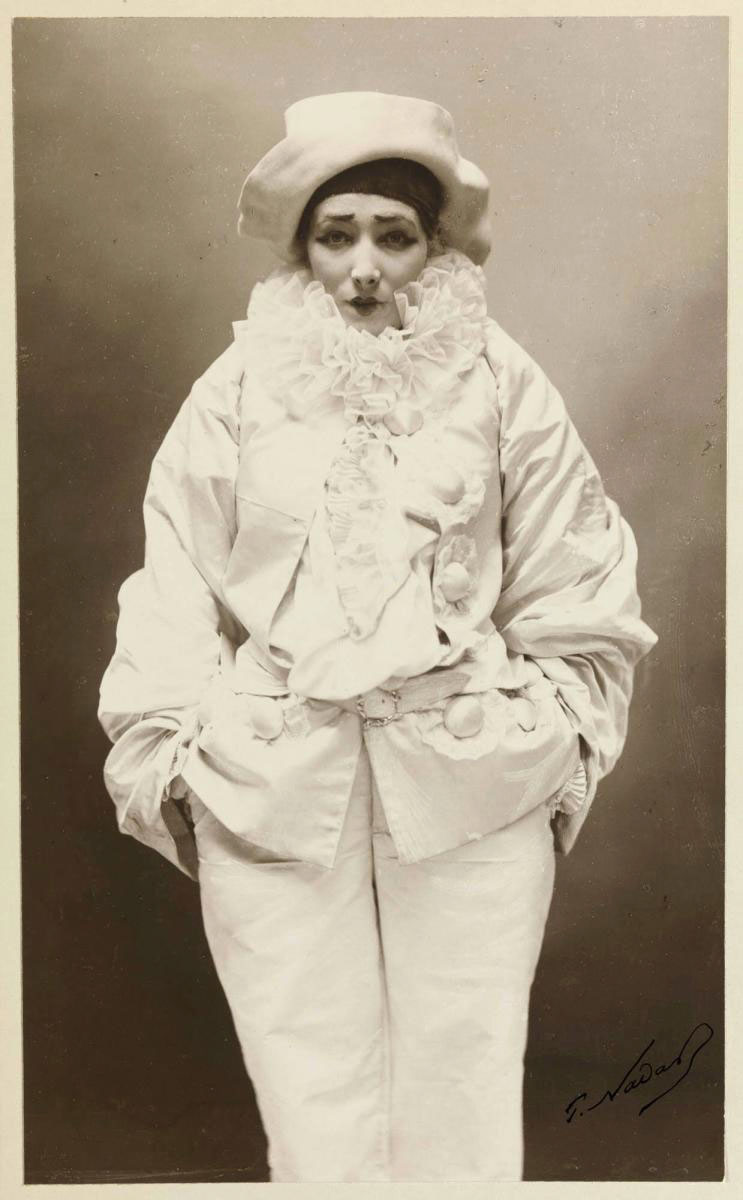
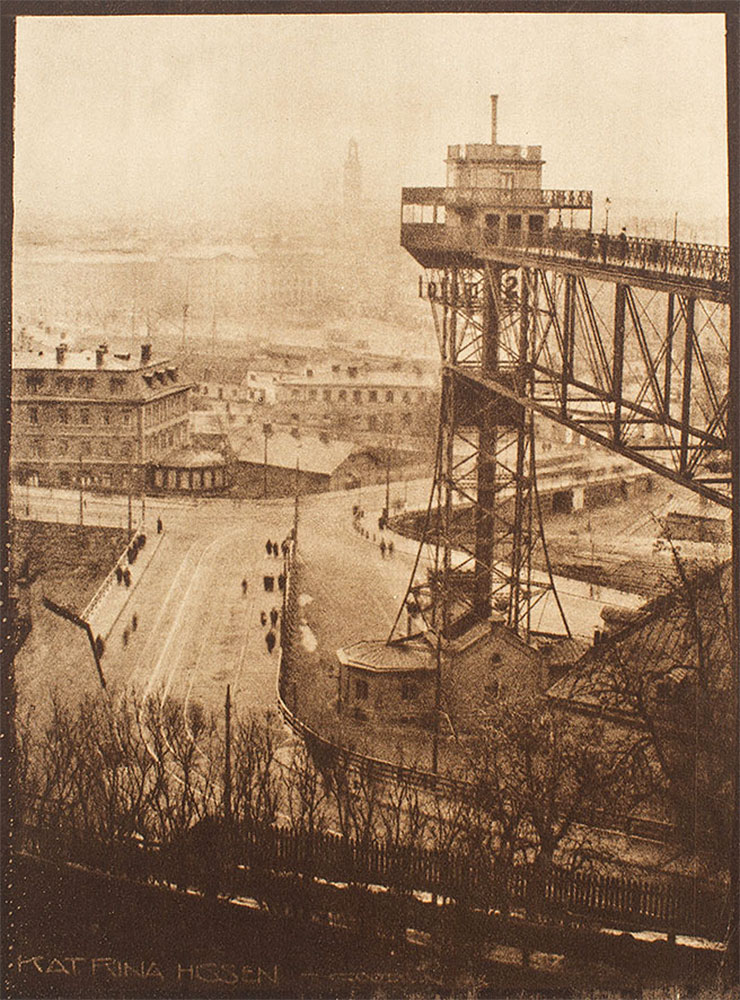
Exhibition: ‘Gabrielle Hébert: Amour fou à la Villa Médicis’ at the Musée d’Orsay, Paris

Exhibition dates: 28th October, 2025 – 15th February, 2026

Curator: Marie Robert, Chief Curator, photography and cinema Musée d’Orsay
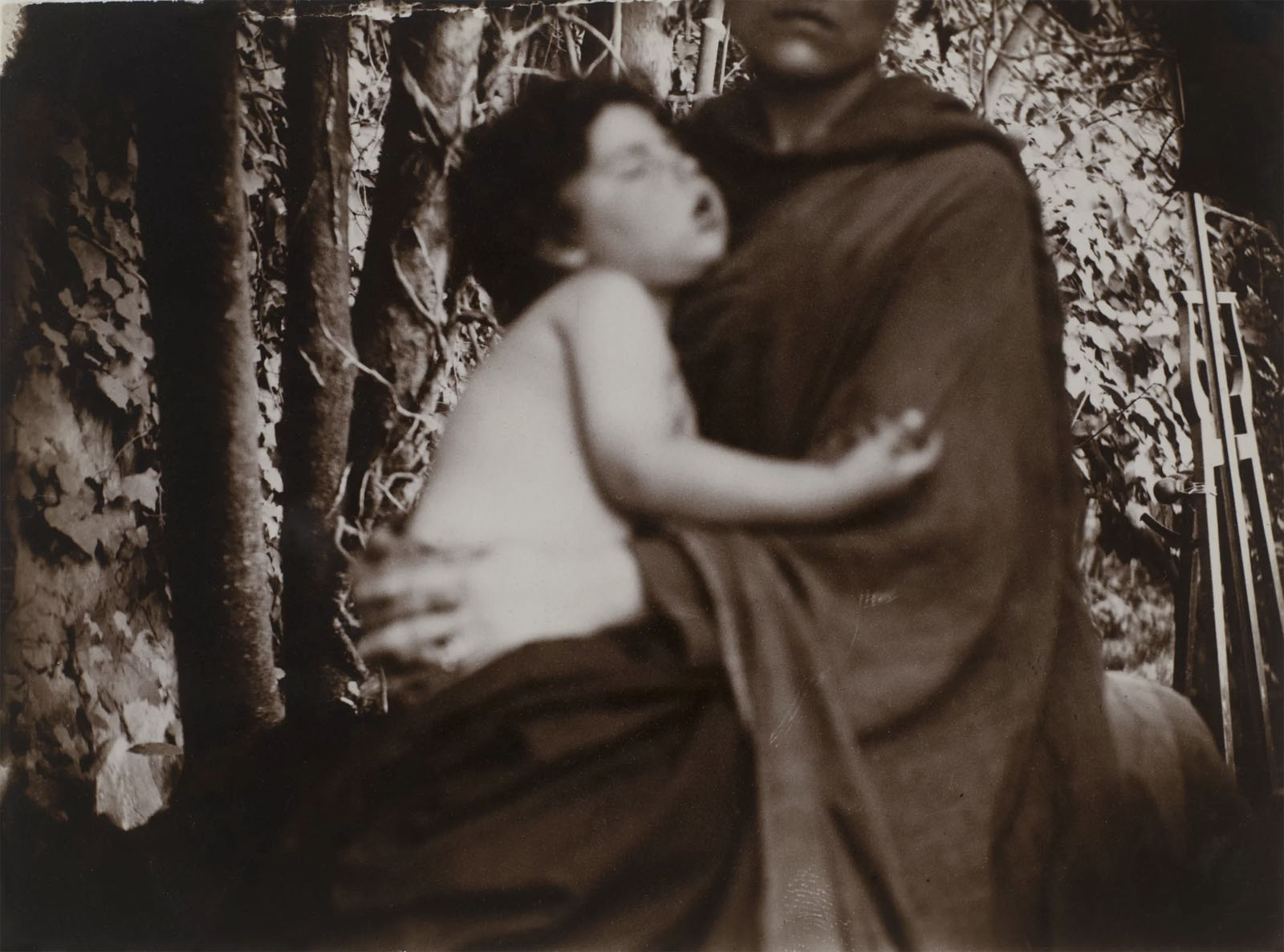
 

Gabrielle Hébert (French born Germany, 1853-1934) 'Peppino Scossa endormi dans les bras de sa mère, 11 août 1888' (Peppino Scossa asleep in his mother's arms, August 11, 1888) 1888


Gabrielle Hébert (French born Germany, 1853-1934)
Peppino Scossa endormi dans les bras de sa mère, 11 août 1888
(Peppino Scossa asleep in his mother’s arms, August 11, 1888)

1888
Aristotype à la gélatine (Gelatin Aristotype)
8.7 x 11.7cm
© Musée National Ernest Hébert, Paris
Photo: Musée d’Orsay, Dist. RMN-Grand Palais / Alexis Brandt


Amour fou, amour tu

This is one of those unheralded exhibitions on a photographer that you may never have heard of that Art Blart likes to promote.

Gabrielle Hébert as she became, married the painter Ernest Hébert in 1880. She was 28, he was 63. From 1888 until his death in 1908 at the age of 91, she documented her husband painting, their surroundings and their affluent, upper class social milieux. And then she stopped, she gave up photography, she lost the amour fou, that incredible passion that had driven her for so many years to take photographs.

While “her photographs provide an intimate look into the artistic life of the time, portraying artists, models, and domestic scenes” they also do something more – they represent the viewpoint of a female artist which challenges the masculine conventions of the day. “Overturning gender stereotypes, she watched him obsessively and was never tired of capturing him on film… Thanks to her images, which she shared and exchanged with her friends and family, she became recognised as an auteur and gained social status in a milieu where artistic creation was the preserve of men.” (Text from the Musée d’Orsay website)

Further, from my point of view, Gabrielle Hébert was not an amateur photographer taking snapshots for her “visual diary” but an artist fully conversant with current trends in photography. While there are the standard documentary photographs of sculptures and Ernest Hébert and friends painting … there is so much more!

Photographs such as the allegorical Peppino Scossa endormi dans les bras de sa mère, 11 août 1888 (Peppino Scossa asleep in his mother’s arms, August 11, 1888) (1888, above) and La duchesse de Mondragone et l’une de ses bellessoeurs posent pour une Annonciation, juin 1890 (The Duchess of Mondragone and one of her sisters-in-law pose for an Annunciation, June 1890) (1890, below) are redolent of the photographer Julia Margaret Cameron (British born India, 1815-1879).

Other photographs such as Lys des parterres, juin 1890 (Flowerbed lilies, June 1890) (1890, below) evidence her consummate skill at capturing the perfume of a place whilst images such as Procession sur le port de Brindisi (Pouilles) (Procession in the port of Brindisi (Apulia)) (1893, below) show her ability to picture the informality of large groups of people and the atmosphere of the scene.

Then there are the joyous highs of a modern woman looking at the world with perceptive eyes. In the photograph Amalia Scossa et Ernest Hébert à sa peinture La Vierge au chardonneret sur la terrasse du campanile (around 1891, below), Gabrielle Hébert was not afraid to dissect the pictorial plane with strong verticals, horizontal and diagonal lines, providing the viewer with the feeling of an almost voyeuristic in-sight into the creative scene, each section of the photograph holding out attention – two chairs, one upturned on the other, supporting the umbrella shielding the painter from the sun; the Virgin and her child filling the distant space; the painting on the easel leading our eye down and then back up into the cloaked, wizened figure of the artist holding his easel; folding stool for him to rest and other accoutrements earthing the foreground; and the massive pillars slightly askew enclosing our furtive view. Magnificent!

My favourite photograph in the posting is Garçon au coin de la place Zocodover, Tolède, 31 octobre 1898 (Boy on the corner of Zocodover Square, Toledo, October 31, 1898) (1898, below), taken when Hébert had abandoned her large format camera for a more portable Kodak. A wonderful use of depth of field, movement, vanishing point, light, architecture and the ghostly presence of a boy, forever peering at us through eons of time, lend the image an enigmatic, allegorical mystery … as to the passage of time, the journey of life.

How I wish we could have seen more of these later photographs where Hébert proposed “daring viewpoints – notably from a speeding train – a camera in motion, glances towards the camera, the operator’s shadow cast on the ground, motion blur of people and things (smoke, clouds, and waves), truncated figures, and close-ups.” (Marie Robert)

And then there is the crux of the matter. As the text on the Musée d’Orsay website insightfully observes, “… above all, photography revealed her to herself: through capturing a particularly remarkable geography and era, she effectively invented her own mythology.”

Through love and life, through devotion to husband, through devotion to photography, and through devotion to herself, she revealed her to herself and to the world. What crazy, mad love!

Dr Marcus Bunyan

PS. With photographs like Femmes à la fenêtre, Taormine (Sicile), mai 1893 (Women at the window, Taormina (Sicily), May 1893) (1893, below) it is likely Gabrielle Hébert would have met Baron Wilhelm von Gloeden (German, 1856-1931) who lived and worked there between 1878-1931.


Many thankx to the Musée d’Orsay, Paris for allowing me to publish the photographs in the posting. Please click on the photographs for a larger version of the image.


Active between 1888 and 1908, Gabrielle documented daily life at Villa Medici in Rome, where her husband served as director of the French Academy. Her photographs provide an intimate look into the artistic life of the time, portraying artists, models, and domestic scenes.​ The exhibition features original prints, albums, diaries, glass plate negatives, and her cameras, alongside works by Ernest Hébert and personal items that tell their love story. With over 3.500 prints, Gabrielle Hébert is considered a pioneer of female photography, having sensitively and precisely documented an artistic environment predominantly male.​


Veronica Azzari on the Bvlgari Hotel Paris website


When Gabriele von Uckermann and a friend discovered Ernest Hébert’s painting, La Mal’aria [below], at the Munich International Exhibition of Fine Arts in 1869, the two young women sent a telegram to the artist expressing their admiration. A few months later, the painter agreed to receive Gabriele in his Parisian studio, and their marriage in 1880 sealed their whirlwind romance. He was 63, she was 28. Five years later, Ernest Hébert’s reappointment as director of the French Academy in Rome allowed the young woman to have her own studio. Gabrielle Hébert, who had Gallicized her first name, dates her photographic debut to July 8, 1888. From that day forward, she never stopped photographing her husband. She also dedicated herself to visually documenting their stay at the Villa Medici, as well as their travels in Italy, Sicily, and Spain. …

The exhibition’s subtitle, “Mad Love at the Villa Medici,” while certainly catchy, is somewhat misleading, as the section strictly devoted to photographs related to her stay at the French Academy in Rome represents only a third of the exhibition. However, each period of this prolific output is contextualised using a variety of documents: diary entries, correspondence, camera footage, albums, contact sheets, and more.


Christine Coste. “Gabrielle Hébert, un itinéraire photographique singulier,” on the Le Journal des Arts website, 17th December, 2025 [Online] Cited 02/01/2026. Translated from the French by Google Translate. Used under fair use conditions for the purposes of education and research
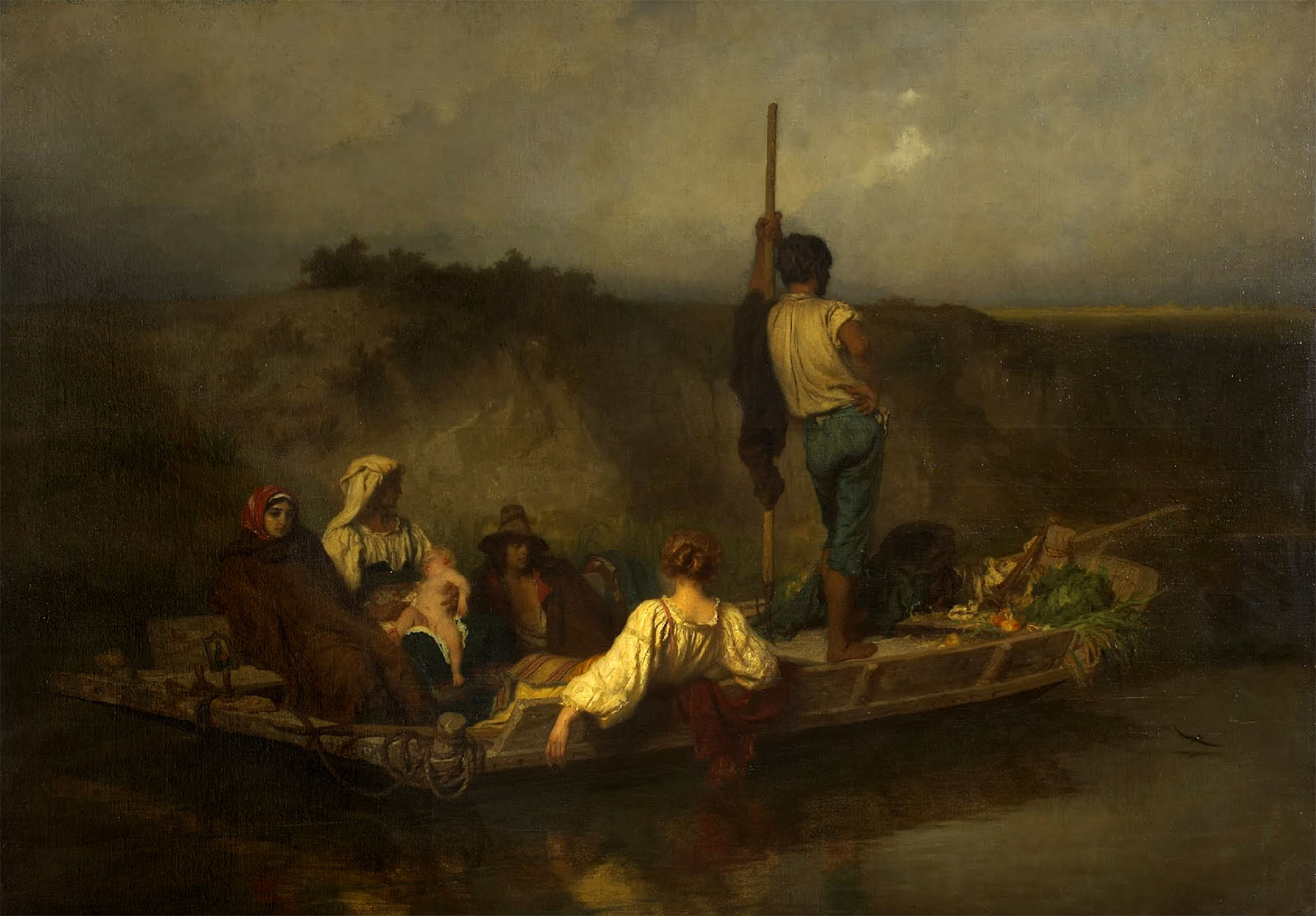


Ernest Hébert (French, 1817-1908) 'The Mal'aria' 1848-1849


Ernest Hébert (French, 1817-1908)
The Mal’aria
1848-1849
Oil on canvas
1930 x 1350cm
Musée d’Orsay, dist. RMN / Patrice Schmidt
Bought 1851

Used under fair use conditions for the purposes of education and research
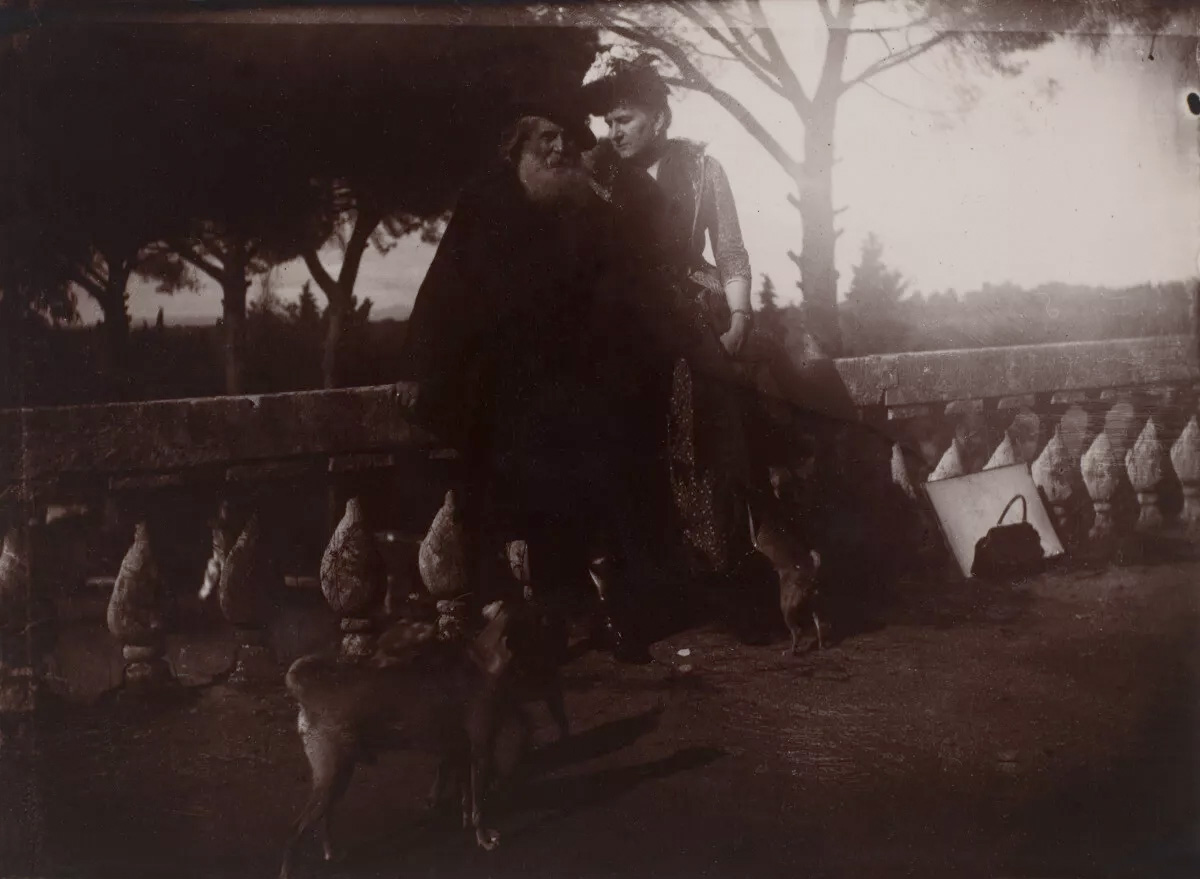
 

Alexis Axilette (French, 1860-1931) 'Ernest et Gabrielle Hébert et leurs chiens sur la terrasse du bosco' (Ernest and Gabrielle Hébert and their dogs on the terrace of the bosco) Around 1888


Alexis Axilette (French, 1860-1931)
Ernest et Gabrielle Hébert et leurs chiens sur la terrasse du bosco
(Ernest and Gabrielle Hébert and their dogs on the terrace of the bosco)

Around 1888
Aristotype à la gélatine (Gelatin Aristotype)
8.7 x 12.2cm
© Musée National Ernest Hébert, Paris
Photo: Musée d’Orsay, Dist. RMN-Grand Palais / Alexis Brandt
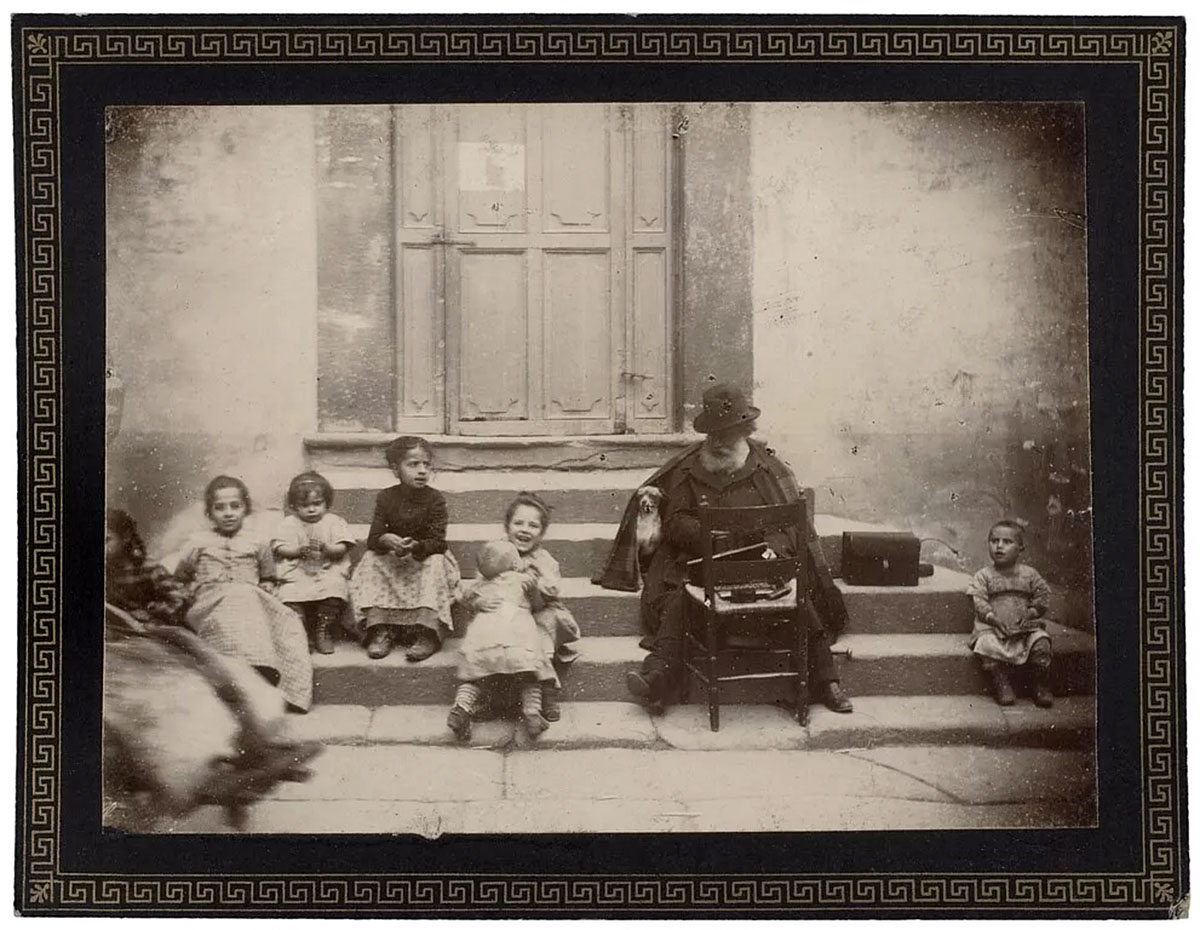
 

Gabrielle Hébert (French born Germany, 1853-1934) 'Ernest Hébert aquarelle l'arc du balcon de la Casa Poscia, Viterbe, août 1888' (Ernest Hébert watercolour the arch of the balcony of the Casa Poscia, Viterbo, August 1888) 1888


Gabrielle Hébert (French born Germany, 1853-1934)
Ernest Hébert aquarelle l’arc du balcon de la Casa Poscia, Viterbe, août 1888
(Ernest Hébert watercolour the arch of the balcony of the Casa Poscia, Viterbo, August 1888)

1888
Aristotype à la gélatine (Gelatin Aristotype)
9 x 12cm environ
© Musée National Ernest Hébert, Paris
Photo: Musée d’Orsay, Dist. RMN-Grand Palais / Alexis Brandt
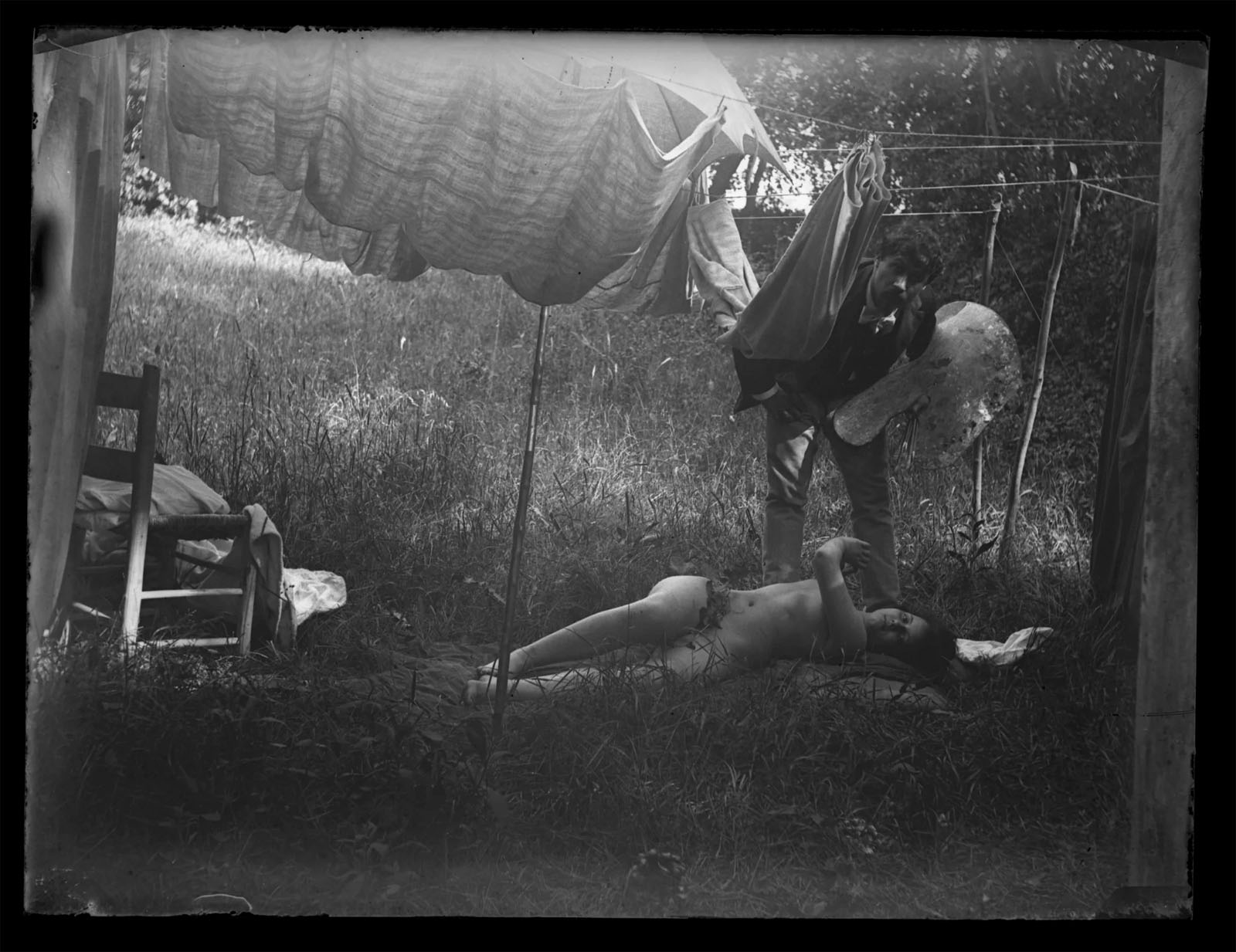
 

Gabrielle Hébert (French born Germany, 1853-1934) 'Le peintre pensionnaire Alexis Axilette et son modèle Elvira dans le Bosco de la Villa Médicis, Octobre 1888' (Resident painter Alexis Axilette and his model Elvira in the Bosco of the Villa Medici, October 1888) 1888


Gabrielle Hébert (French born Germany, 1853-1934)
Le peintre pensionnaire Alexis Axilette et son modèle Elvira dans le Bosco de la Villa Médicis, Octobre 1888
(Resident painter Alexis Axilette and his model Elvira in the Bosco of the Villa Medici, October 1888)

1888
Négatif au gélatino-bromure d’argent sur plaque de verre (Silver gelatin bromide negative on glass plate)
9 x 12cm
© La Tronche, musée Hébert
Photo: Musée Hébert, Département de l’Isère


The photograph above shows a nude woman posing for the artist Alexis Axilette for his painting Summertime (c. 1891, below)
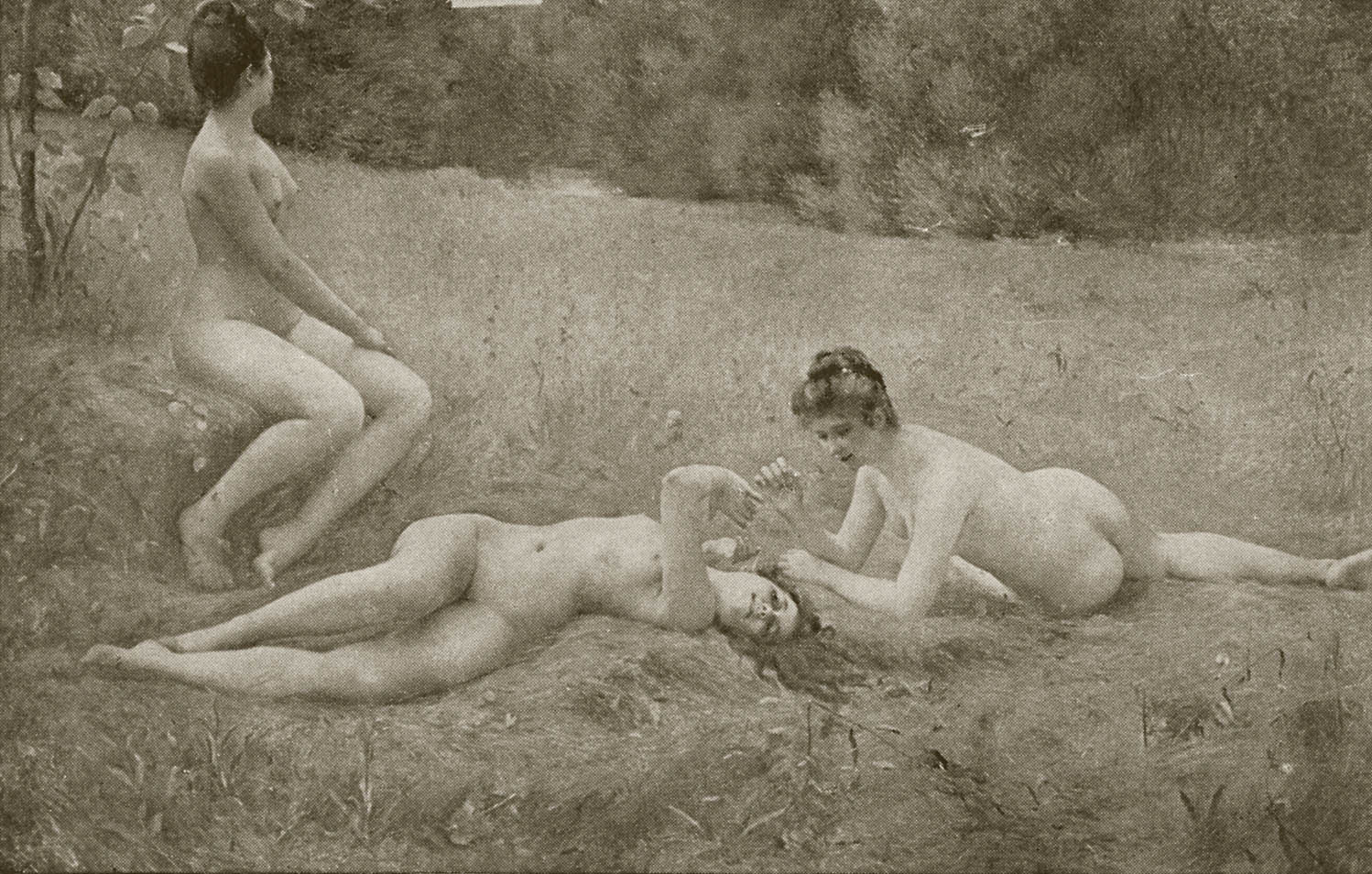
 

Alexis Axilette (French, 1860-1931) 'Summertime' c. 1891


Alexis Axilette (French, 1860-1931)
Summertime
c. 1891

Only a black and white reproduction is available of this work


At the Salon exhibition of 1891, a picture which attracted a marked amount of attention was a vividly painted midsummer landscape, with the figures of three wood-nymphs, basking in the flood of golden sunshine. It was entitled “Summertime.” The painter was A. Axilette, a Parisian artist whose studio was already well known to collectors. The success of “Summertime” in Europe was enormous. It was successively exhibited at various continental exhibitions, and everywhere repeated the hit it had made in France. It was, in fact, one of those works of which it is said that they “make” their authors, and in the sense that it completely established the painter’s reputation, “Summertime” realised this figure of speech.

Mary S. Van Deusen. “Alexis Axilette,” on the Master Paintings of the World website 2007 [Online] Cited 02/01/2026. Used under fair use conditions for the purposes of education and research


Alexis Axilette (French, 1860-1931)

Alexis Axilette was born in 1860 in Durtal, a small town in Maine-et-Loire. From a modest background – his father was a merchant – his future seemed predetermined, far removed from the world of art. His parents, who dreamed of a career as a notary’s clerk for him, were nonetheless surprised to discover his talent for drawing. After encouraging him to prove his abilities, they supported his choice to become an artist, a vocation he embraced with passion and determination. This ambition led him to become one of the most remarkable painters of his time.

A Promising Start

At the age of 16, Alexis Axilette began working as an apprentice in a photography studio, retouching photographs by hand, a modern activity for the time. At the same time, he attended evening classes at the Angers Municipal School of Fine Arts, where he distinguished himself with his talent and won several prizes. Supported by his teachers, he obtained a scholarship to attend the École des Beaux-Arts in Paris. Between 1878 and 1880, he learned Neoclassical principles there under the influence of the renowned painter Jean-Léon Gérôme, teachings that would profoundly shape his artistic approach.

The Rise to Recognition

At 24, Alexis Axilette reached a major turning point in his career by winning the prestigious Premier Grand Prix de Rome with his painting Themistocles Taking Refuge with Admetus (1885), a masterfully executed historical scene. This success, achieved at such a young age only by Fragonard, propelled his career, marked by gold medals, honorary distinctions, and the Legion of Honor. From that moment on, he became a central figure in the artistic and literary life of the Third Republic, frequenting high society and financial circles. An accomplished artist, he traveled throughout Europe and forged an international reputation, becoming a sought-after portraitist with prestigious commissions, notably from the Imperial Court of Russia.

In 1898, he received a major state commission: the creation of a monumental triptych for the ceiling of the Social Museum, entitled Humanity, Fatherland, and Muse. This work, both moral and balanced, perfectly embodies the republican ideals of the time.

Historical and Artistic Context

Under the Third Republic, the arts were seen as a privileged means of promoting national cohesion. Axilette’s academic style, rooted in moral and patriotic values, perfectly aligned with this objective. However, the late 19th and early 20th centuries saw the emergence of new artistic movements such as Impressionism, Symbolism, and Expressionism. Axilette’s attachment to classicism and a rigorous aesthetic set him apart from the avant-garde movements that favored experimentation and creative freedom. Thus, although he perfectly embodied his era, his art gradually came to be perceived as outdated and obsolete.

A Transition to Pastels

In the 1910s, as artistic tastes evolved, Alexis Axilette turned to the use of pastels. This more subtle and delicate medium allowed him to explore a new sensibility while remaining true to his academic style. His works from this period, primarily portraits and landscapes, testify to his desire to renew his approach while remaining rooted in classical tradition. These pastels reveal an undiminished technical mastery and a willingness to adapt to new artistic trends, although his style seems to have been less appreciated at this time.

Posthumous Oblivion

Like many academic artists, Alexis Axilette suffered from the evolution of tastes in the 20th century. Classical art, once revered, lost ground to the avant-garde, relegating its works to museum storage. Furthermore, his image as a society artist, associated with the establishment of the Third Republic, did not help his legacy. While artists like Gauguin symbolized rebellion and innovation, Axilette remains perceived as a representative of a bygone academicism.

A body of work to be rediscovered

Alexis Axilette died on July 3, 1931, in Durtal, his birthplace. Today, his legacy lives on through his works held in private and public collections: academic drawings, nude sketches, portrait studies, landscapes, and historical paintings. These paintings bear witness to his exceptional talent and his dedication to his art. Although he was a major figure of his time, he remains relatively unknown today. He embodies the fate of many artists: celebrated in their lifetime, but gradually forgotten by history.

Anonymous. “Alexis Axilette,” on the French Wikipedia website, translated by Google Translate
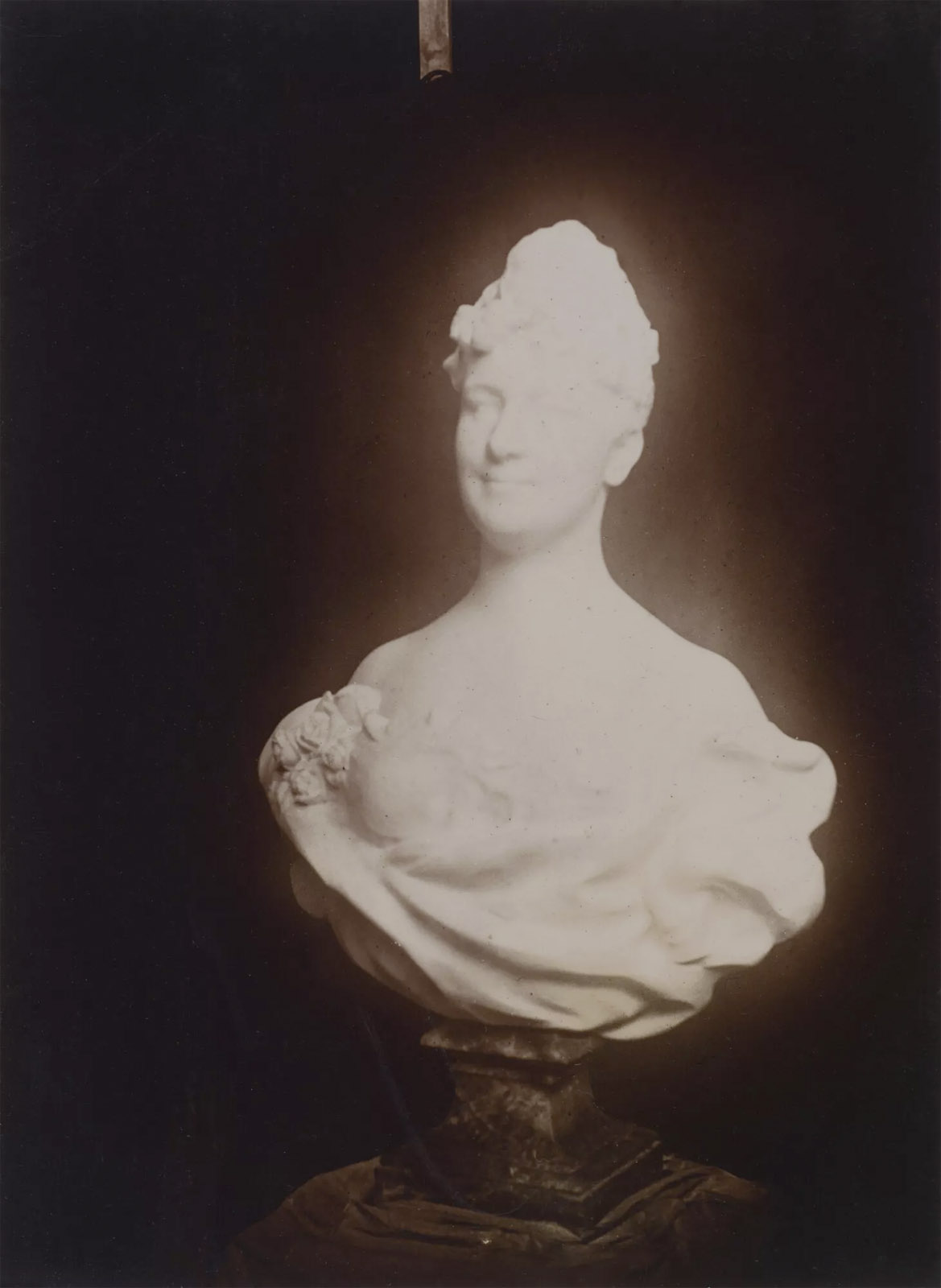
 

Gabrielle Hébert (French born Germany, 1853-1934) 'Le temps est sublime. Je photographie Lily et Farfalette, mon buste, Puech, Charpentier et Gardet, 20 novembre 1888' (The weather is sublime. I photograph Lily and Farfalette, my bust, Puech, Charpentier and Gardet, November 20, 1888) 1888


Gabrielle Hébert (French born Germany, 1853-1934)
Le temps est sublime. Je photographie Lily et Farfalette, mon buste, Puech, Charpentier et Gardet, 20 novembre 1888
(The weather is sublime. I photograph Lily and Farfalette, my bust, Puech, Charpentier and Gardet, November 20, 1888)

1888
Aristotype à la gélatine, papier (Gelatin Aristotype, paper)
11 x 8cm
© Musée National Ernest Hébert, Paris
Photo: Musée d’Orsay, Dist. RMN-Grand Palais / Alexis Brandt


Designed in partnership with the Musée Départemental Ernest Hébert in La Tronche (Isère), where it will be hosted in spring 2026, the exhibition will also be presented at the French Academy in Rome – Villa Medici in autumn 2026, where the exhibition’s curator Marie Robert spent a year in the context of a Villa Medici/ Musée d’Orsay cross-residency.

The exhibition Who’s Afraid of Women Photographers? (1839-1945) presented at the Musée d’Orsay and the Musée de l’Orangerie in 2015 was a milestone for recognition of women artists in France. One of the many photographers featured was Gabrielle Hébert (1853, Dresden, Germany – 1934, La Tronche, France). Born Gabrielle von Uckermann, she was an amateur painter before marrying Ernest Hébert in 1880, an academic artist twice appointed Director of the French Academy in Rome. She went on to develop an intensive, extremely prolific photography practice, begun at Villa Medici in 1888 and ending twenty years later in La Tronche (near Grenoble) following the death of the man she had idolised, her elder by almost forty years, and whose place in history she largely ensured by supporting the creation of two monographic museums.

In the late 19th century, between France and Italy, like many artists and writers (including Henri Rivière, Pierre Bonnard, Maurice Denis and Émile Zola) who equipped themselves with a camera to record their and their families’ daily lives, Gabrielle Hébert pursued a private, sentimental photography practice, helped along by the technical and aesthetic revolution brought about by the invention of snapshot photography. At Villa Medici, as the wife of its director, she organised receptions and received elite visitors. She was not long in escaping her assigned duties, however, and acquired a camera. She took a few lessons with a Roman professional and, along with a resident of her own age, set up a darkroom to develop and print her negatives and retouch the results. It was the beginning of an extremely voluminous output of photos, which she consigned to her diaries. Hardly a day passed without her taking a snapshot, interspersing them with remarks that tell us how she set about taking pictures: “Je photo…. Je photographie…”.

Although Gabrielle Hébert shared her taste for society portraits and tableaux vivants with Luigi and Giuseppe Primoli, Princess Mathilde Bonaparte’s nephews and pioneers of snapshot photography in Italy, she explored all photographic genres on her own at Villa Medici, including nudes, reproductions of artworks, landscapes, still lifes and “photographic recreations” … Providing us with the viewpoint of a permanent resident who is dazzled by the palace, the site and its inhabitants (artists in residence, employees, models, dogs and cats) as seen from the inside and in all seasons, her output reveals a completely unknown aspect of life in that artistic phalanstery. Her “diary in images” is the first photo-report on daily life in the institution, a centre for residencies, training and creation by winners of the Grand Prix de Rome (many of whose works are now conserved by the Musée d’Orsay) as well as a laboratory for the new political relationship between France and Italy, which had just been “unified” (1861) and of which Rome became the capital in 1871. It also constitutes a unique testimony on one of the first couples of creators at Villa Medici. Although Gabrielle assisted Ernest with his activities as an artist, posing for him, preparing his canvases, retouching his paintings and even copying them, it was Ernest himself who was the photographer’s real focus. Overturning gender stereotypes, she watched him obsessively and was never tired of capturing him on film. Posing sessions with sitters, progress made in his paintings, moments of conviviality with visitors and interactions with residents, along with walks in the Roman countryside, bathing in the sea and alone in his office: all these aspects of artist, director and husband Ernest Hébert’s life were scrutinised and documented. When she returned permanently to France with him, Gabrielle stopped cultivating her passion for photography, a passion born in Italy and in exile, but nevertheless continued to photograph Hébert until the very end of his life, determined to immortalise him through images. Before that, though, in 1898, she escaped the closed quarters formed by the Renaissance Palace and its eccentric occupants and performed her photographic swansong during a trip to Spain, which she photographed with a resolutely modern eye influenced by the early days of cinema.

This chrono-thematic exhibition, from Gabrielle Hébert’s photographic beginnings (1888) to her last images (1908), will seek to present what she made of photography and what photography made of her. Thanks to her images, which she shared and exchanged with her friends and family, she became recognised as an auteur and gained social status in a milieu where artistic creation was the preserve of men. But above all, photography revealed her to herself: through capturing a particularly remarkable geography and era, she effectively invented her own mythology. By doing so, she was Villa Medici’s first photographic chronicler and made a place for herself in the medium’s history.

Most of the works on exhibition are original prints (in 9 x 12 cm format), along with photograph albums created by Gabrielle Hébert, her diaries, boxes of glass plates and cameras she used. Enlargements created from negatives she never printed will add further life to the presentation. The itinerary will be rounded out by drawings and paintings by Ernest Hébert, as well as sentimental relics (palette, medallion and letters), testimony to a story of love for a man and a country.

Text from the Musée d’Orsay website
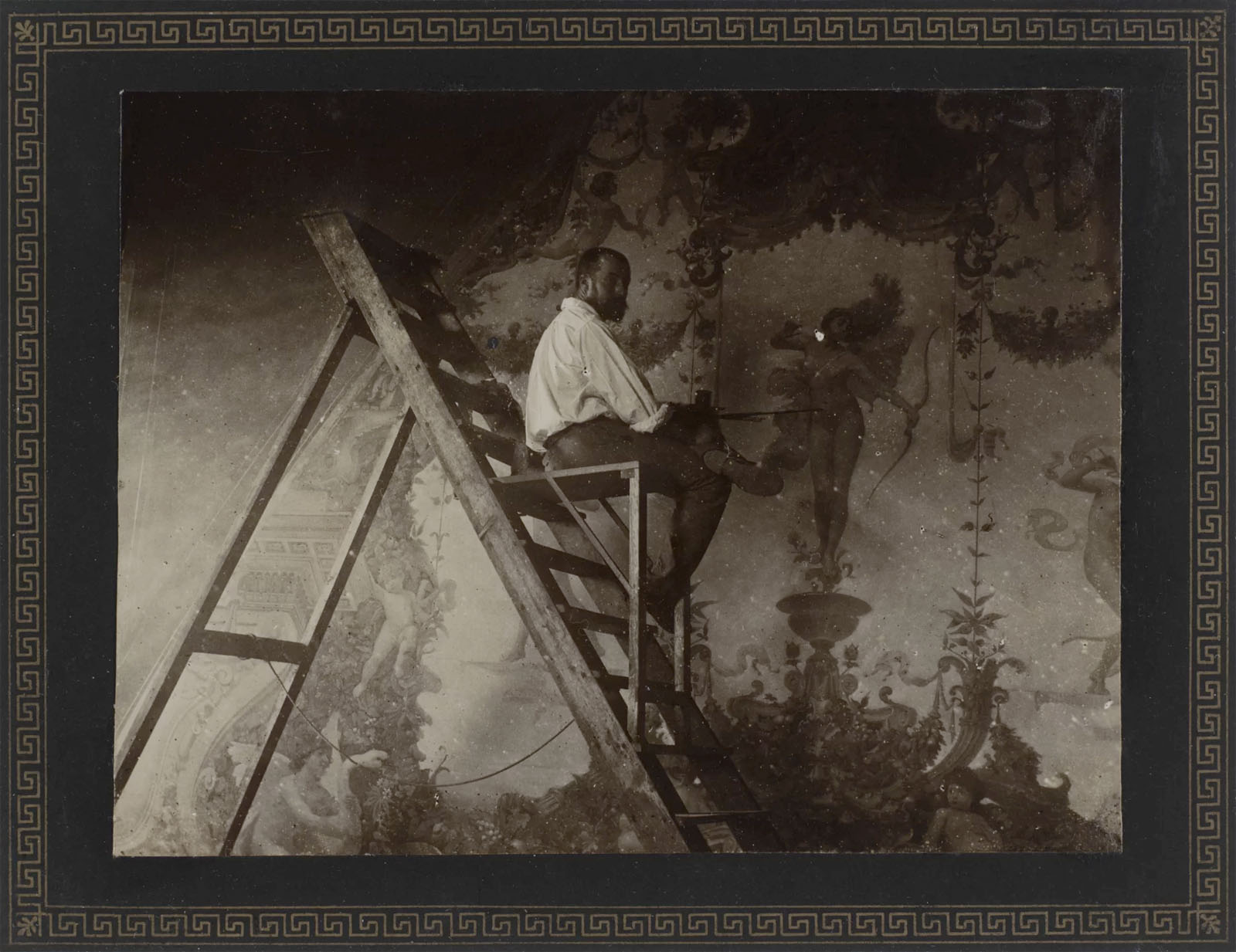
 

Gabrielle Hébert (French born Germany, 1853-1934) 'L'architecte Hector d'Espouy devant son Projet de plafond pour la décoration de la Villa Médicis' (The architect Hector d'Espouy in front of his ceiling design for the decoration of the Villa Medici) 1889


Gabrielle Hébert (French born Germany, 1853-1934)
L’architecte Hector d’Espouy devant son Projet de plafond pour la décoration de la Villa Médicis
(The architect Hector d’Espouy in front of his ceiling design for the decoration of the Villa Medici)

1889
Aristotype à la gélatine (Gelatin Aristotype)
8 x 10.5cm
© Musée National Ernest Hébert, Paris
Photo: Musée d’Orsay, Dist. RMN-Grand Palais / Alexis Brandt
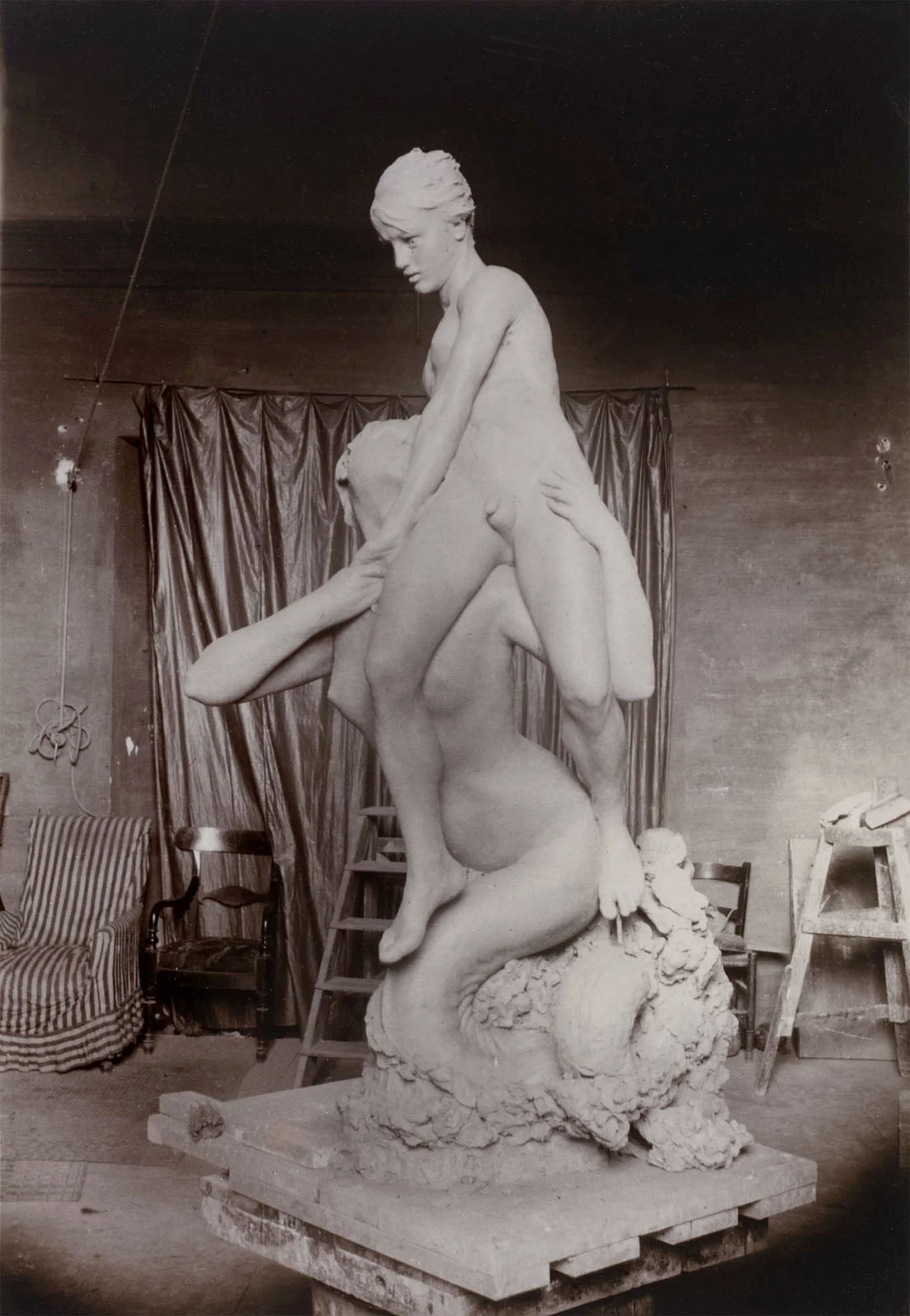
 

Gabrielle Hébert (French born Germany, 1853-1934) 'Esquisse de La Sirène de Denys Puech dans son atelier (envoi règlementaire de quatrième année)' (Sketch of The Mermaid by Denys Puech in his studio (required submission for fourth year)) 1889


Gabrielle Hébert (French born Germany, 1853-1934)
Esquisse de La Sirène de Denys Puech dans son atelier (envoi règlementaire de quatrième année)
(Sketch of The Mermaid by Denys Puech in his studio (required submission for fourth year))

1889
Aristotype à la gélatine, papier
11.5 x 5.8cm
© Musée National Ernest Hébert, Paris
Photo: Musée d’Orsay, Dist. RMN-Grand Palais / Alexis Brandt
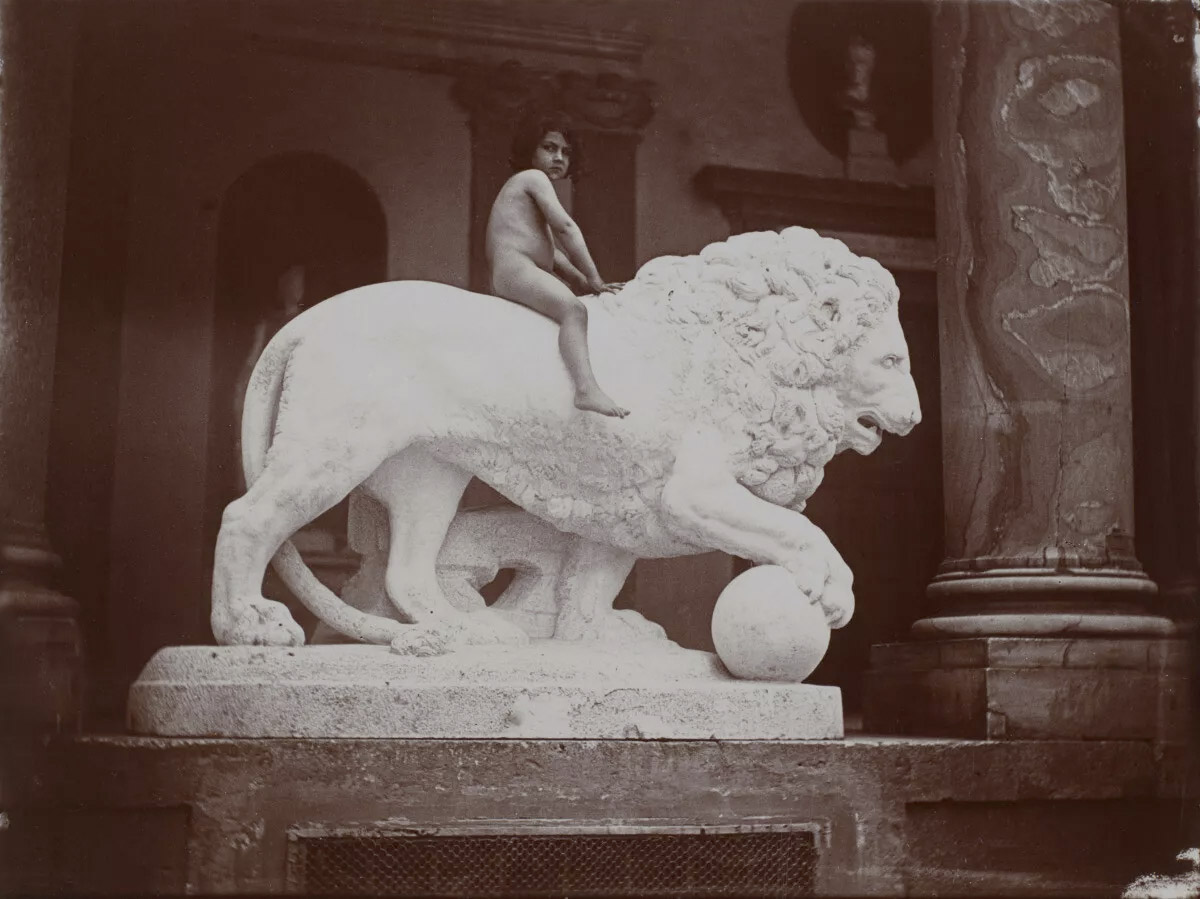
 

Gabrielle Hébert (French born Germany, 1853-1934) 'Le jeune modèle Peppino sur l'un des lions de la loggia, 18 juin 1890' (The young model Peppino on one of the lions of the loggia, June 18, 1890) 1890


Gabrielle Hébert (French born Germany, 1853-1934)
Le jeune modèle Peppino sur l’un des lions de la loggia, 18 juin 1890
(The young model Peppino on one of the lions of the loggia, June 18, 1890)

1890
Aristotype à la gélatine, papier (Gelatin Aristotype, paper)
© Musée National Ernest Hébert, Paris
Photo: Musée d’Orsay, Dist. RMN-Grand Palais / Alexis Brandt
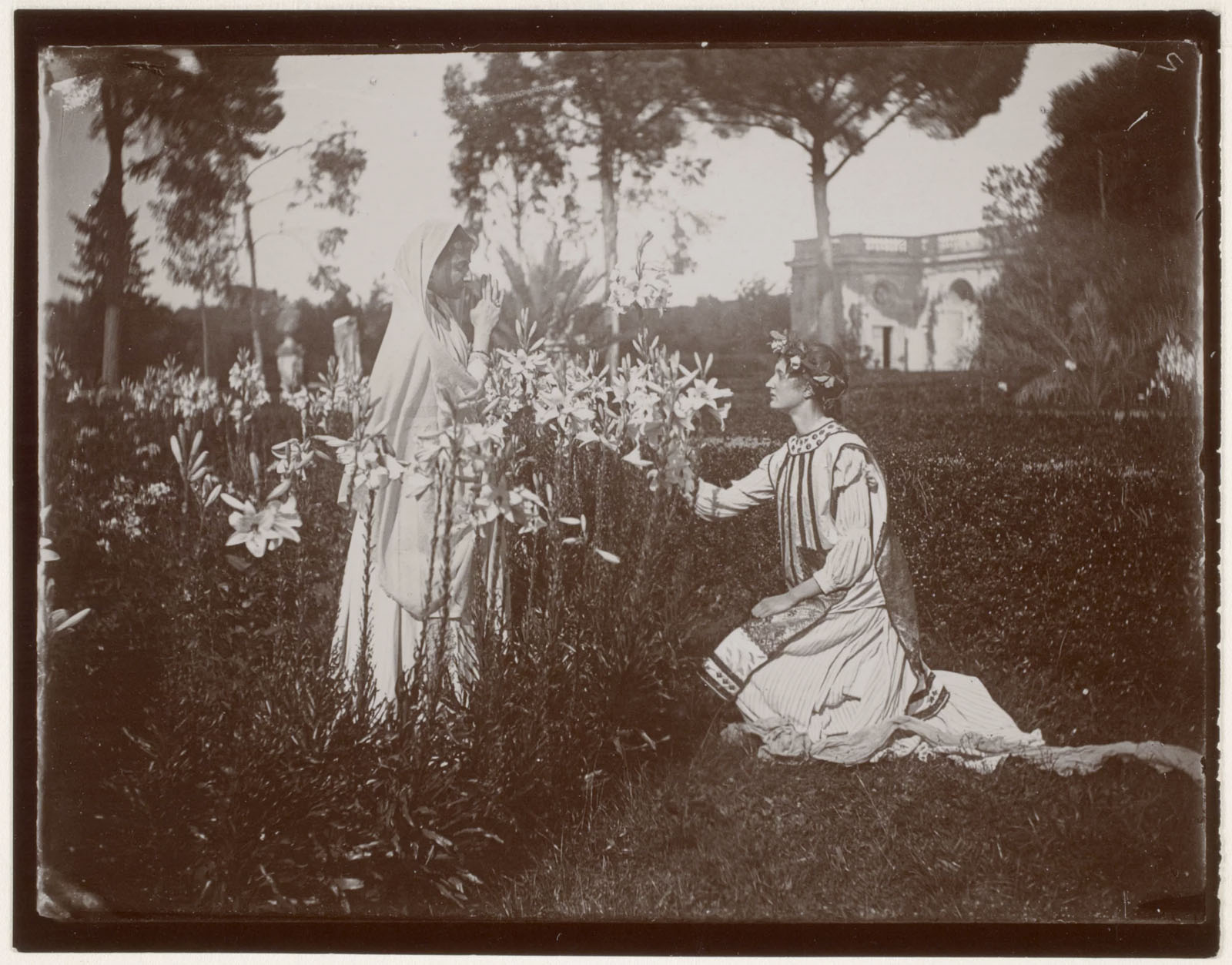
 

Gabrielle Hébert (French born Germany, 1853-1934) 'La duchesse de Mondragone et l'une de ses bellessoeurs posent pour une Annonciation, juin 1890' (The Duchess of Mondragone and one of her sisters-in-law pose for an Annunciation, June 1890) 1890


Gabrielle Hébert (French born Germany, 1853-1934)
La duchesse de Mondragone et l’une de ses bellessoeurs posent pour une Annonciation, juin 1890
(The Duchess of Mondragone and one of her sisters-in-law pose for an Annunciation, June 1890)

1890
Négatif au gélatino-bromure d’argent sur plaque de verre (Silver gelatin bromide negative on glass plate)
8.4 x 11.6cm
© Musée National Ernest Hébert, Paris
Photo: Musée d’Orsay, Dist. RMN-Grand Palais / Alexis Brandt
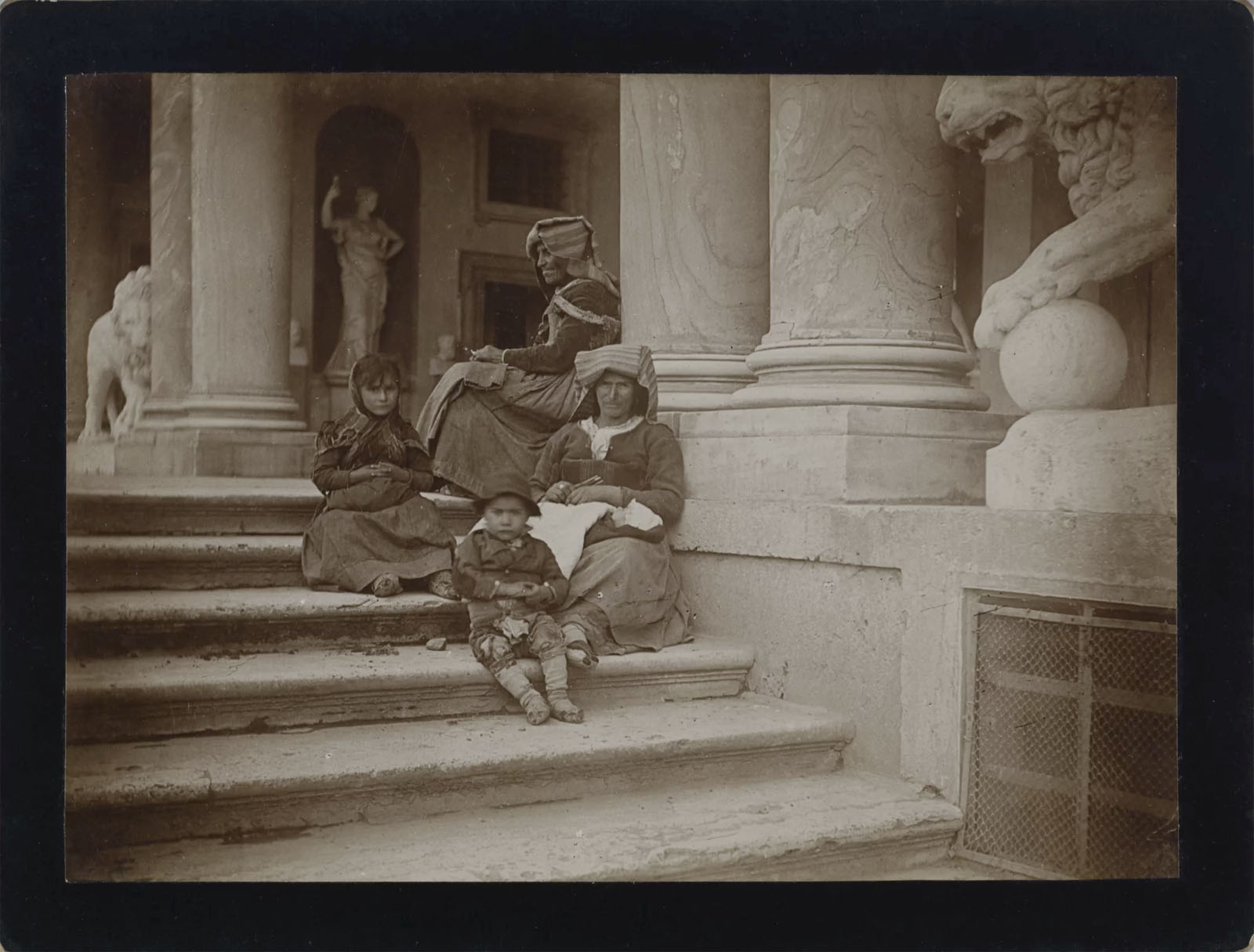
 

Gabrielle Hébert (French born Germany, 1853-1934) 'Modèles ciociare sur les marches de la loggia' (Ciociare models on the steps of the loggia) Around 1890


Gabrielle Hébert (French born Germany, 1853-1934)
Modèles ciociare sur les marches de la loggia (Ciociare models on the steps of the loggia)
Around 1890
Aristotype à la gélatine, contrecollé sur carton (Gelatin Aristotype, mounted on cardboard)
8.3 x 11.3cm
© Musée National Ernest Hébert, Paris
Photo: Musée d’Orsay, Dist. RMN-Grand Palais / Alexis Brandt


“Ciociaria” refers to a historic, rustic region southeast of Rome in Italy, and “ciociara” (singular) or “ciociare” (plural/feminine) describes people, especially women, from that area, known for their traditional leather sandals (ciocie), embodying a simple, rural Italian identity, famously portrayed in the film La Ciociara (Two Women). The term evokes a strong connection to the land, traditional life, and the unique culture of this central Italian territory.

Google AI
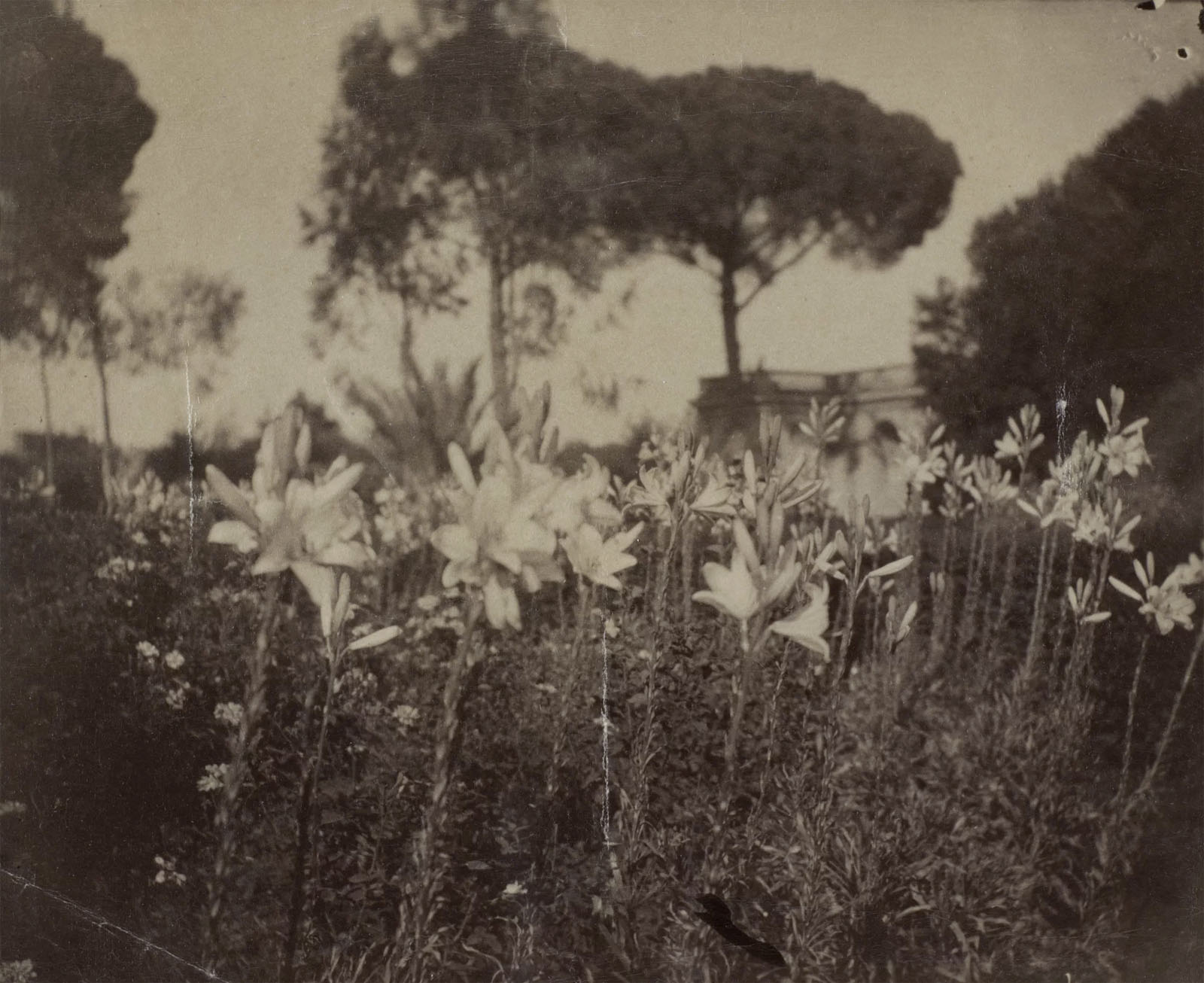
 

Gabrielle Hébert (French born Germany, 1853-1934) 'Lys des parterres, juin 1890' (Flowerbed lilies, June 1890) 1890


Gabrielle Hébert (French born Germany, 1853-1934)
Lys des parterres, juin 1890 (Flowerbed lilies, June 1890)
1890
Aristotype à la gélatine (Gelatin Aristotype)
10.5 x 12.7cm
© Musée National Ernest Hébert, Paris
Photo: Musée d’Orsay, Dist. RMN-Grand Palais / Alexis Brandt
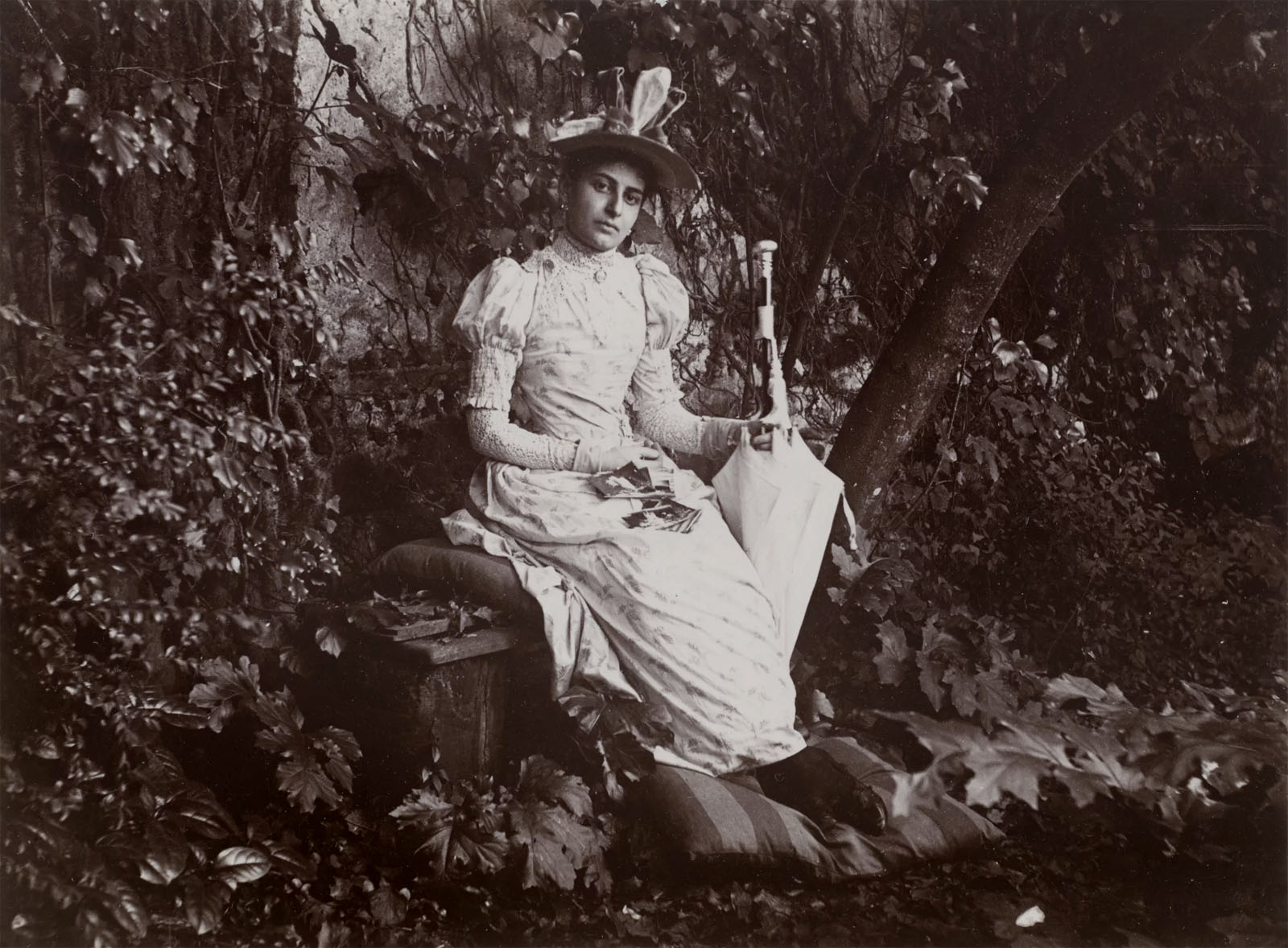
 

Gabrielle Hébert (French born Germany, 1853-1934)
'La duchesse de Mondragone, des photographies de Gabrielle Hébert sur les genoux'
(The Duchess of Mondragone, with photographs of Gabrielle Hébert on her lap)
1890


Gabrielle Hébert (French born Germany, 1853-1934)
La duchesse de Mondragone, des photographies de Gabrielle Hébert sur les genoux
(The Duchess of Mondragone, with photographs of Gabrielle Hébert on her lap)

1890
Aristotype à la gélatine (Gelatin Aristotype)
8.4 x 11.3cm
© Musée National Ernest Hébert, Paris
Photo: Musée d’Orsay, Dist. RMN-Grand Palais / Alexis Brandt
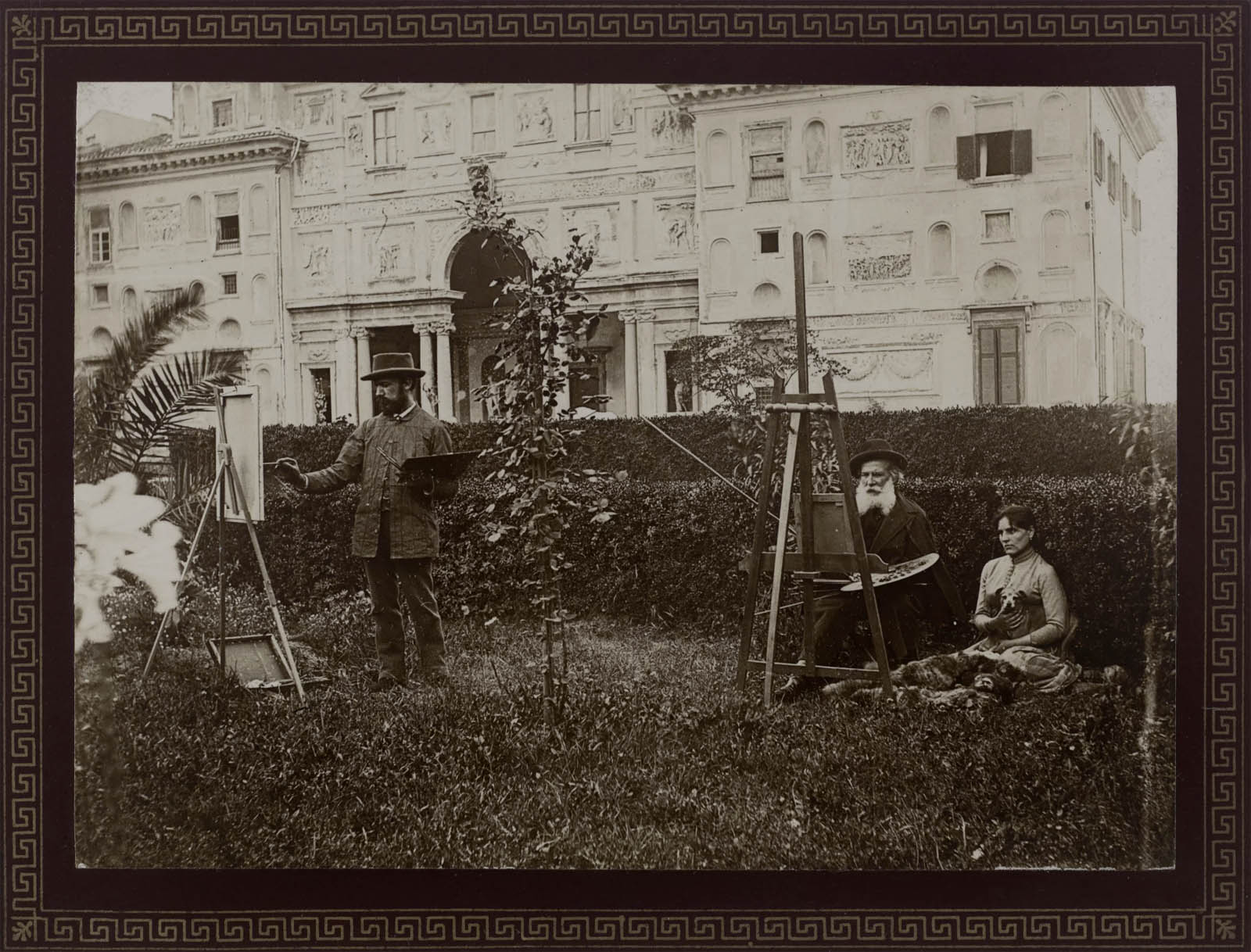
 

Gabrielle Hébert (French born Germany, 1853-1934) 'Étude de lys dans les jardins par le pensionnaire Ernest Laurent et Ernest Hébert, en compagnie du modèle Amalia Scossa, 7 juin 1890' (Study of lilies in the gardens by boarder Ernest Laurent and Ernest Hébert, in the company of model Amalia Scossa, June 7, 1890) 1890


Gabrielle Hébert (French born Germany, 1853-1934)
Étude de lys dans les jardins par le pensionnaire Ernest Laurent et Ernest Hébert, en compagnie du modèle Amalia Scossa, 7 juin 1890
(Study of lilies in the gardens by boarder Ernest Laurent and Ernest Hébert, in the company of model Amalia Scossa, June 7, 1890)

1890
Aristotype à la gélatine, contrecollé sur carton (Gelatin Aristotype, mounted on cardboard)
8.1 x 11.4cm
© Musée National Ernest Hébert, Paris
Photo: Musée d’Orsay, Dist. RMN-Grand Palais / Alexis Brandt


Adaptation of the texts from the exhibition in large print

Introduction

An amateur painter and wife of the artist Ernest Hébert, director of the French Academy in Rome, Gabrielle Hébert began photography intensively and passionately at the Villa Medici in 1888. She abruptly stopped twenty years later in La Tronche (near Grenoble), upon the death of the man she idolised and who was forty years her senior. She will ensure her legacy through the creation of
two monographic museums.

Like Henri Rivière, Maurice Denis, or Émile Zola, who at the end of the 19th century seized upon a camera to record family life, Gabrielle developed a private and sentimental practice, fostered by the technical and aesthetic revolution of the snapshot. As the entries “I take photos” or “I photograph” in her diary show, not a day went by without her taking pictures. Securing her place as an author through these images in a milieu where artistic creation was reserved for men, she discovered herself.

Through the chronicle of her chosen land and happy days, she creates a work of memory and inscribes herself in History.

A Woman Under the Influence

On July 21, 1888, Gabrielle “went out to buy things necessary for photography.” This marked the beginning of an obsessive production of two thousand photographs, mostly taken at the Villa Medici where, as First Lady of a prestigious cultural institution, she organised receptions and received visiting high society. Gabrielle quickly escaped the constraints of her duties: she acquired a camera, took lessons from Cesare Vasari, a Roman professional, and, together with fellow resident Alexis Axilette, set up a darkroom to develop her negatives, print, and retouch her photographs.

She already had an eye for it thanks to her artistic background and her practice of painting and drawing. But it was with the Franco-Italian counts Giuseppe and Luigi Primoli that Gabrielle explored the potential of the instantaneous, becoming the subject of a creative and existential experience: photography.

An art of joy

Gabrielle chronicles the Villa Medici, at once an architectural masterpiece overlooking the Eternal City, a residence for the winners of the Grand Prix de Rome, and a laboratory for a new relationship between France and Italy, newly unified. She focuses her gaze on its inhabitants: artists and models, foreign visitors on holiday, Italian employees at work, flowers, and animals. She enjoys working alongside the “button-pushers” in her circle, as amateurs equipped with handheld cameras are known.

She also observes professionals capturing perspectives of the palace with their imposing camera. “Magnificent weather. I’m photographing the residents”: Gabrielle often associates the day’s weather with an urgent need to act. Present in the world, joyful in her being, she then presses the shutter. Taking the picture is an epiphany. “I photograph, therefore I exist,” she seems to be saying.

Mein Alles (My Everything)

Gabrielle focuses her attention on her husband, around whom she circles and whose activities she seems to observe when he is painting or showing guests around the premises. The tender and sensitive portrait she paints of him is that of a director, an artist entirely devoted to his work at his workplaces, or sketching en plein air on excursions. She also captures him in his nakedness, as an elderly man bathing in the sea. She is concerned about his state of health; she notes how he slept or the time he got up.

The couple’s asymmetry, commonplace at that time and in that social circle, is also expressed in their writings: while he uses the informal “tu” with her, she uses the formal “vous” and addresses him with the superlative phrase “Mein Alles”: My Everything.

Travels in Italy

During their eleven-year stay in Italy, Ernest and Gabrielle travelled all over the country.

The artist enjoys returning to favorite places painted during her youth. They take with them a boarder or student, Amelia Scossa, Ernest’s beloved model, or a few friends; the dogs are always present. In 1893, they travel to Sicily, to the Duke of Aumale’s estate, and then explore the ancient sites of Selinunte and Agrigento, and the Greek theaters of Syracuse and Taormina. By escaping the confines of the Villa Medici and its eccentric inhabitants, Gabrielle literally leaves her social milieu.

With an attention full of empathy for popular and regional culture, she manages to get groups of strangers, women
and men, to pose in front of her lens, no doubt placed on a tripod, whom she brings together in an amusing jumble around a fountain or on the steps of a building, arousing in return a certain curiosity.

In Spain, a cinematic perspective

In 1896, the couple left Italy with great regret and sorrow, returning to Paris and La Tronche where they continued to lead an intense social life. Two years later, Gabrielle completed her photographic swan song during a final journey, this time to Spain, which took them both from Burgos to Granada via Madrid, El Escorial, Toledo, Granada, and Seville.

Abandoning her large-format camera for a Kodak, she amplified in nearly three hundred photographs what she had already experimented with: daring viewpoints – notably from a speeding train – a camera in motion, glances towards the camera, the operator’s shadow cast on the ground, motion blur of people and things (smoke, clouds, and waves), truncated figures, and close-ups.

The nascent cinematograph had passed by. She no longer poses her subjects; she captures them on the fly. She seizes fleeting gestures, radiant moments, the stroll of passersby, the burst of laughter. This journey is an enchanted interlude that allows the couple to get back on their feet, one last time.

The tomb of an artist

Upon returning from Spain, Gabrielle ceased to cultivate her passion, born under the Italian sky. Her output diminished significantly, ceasing altogether in 1908, with Ernest’s death.

During his final months, she recorded his last visits and outings in the sun, his walks, and setting up his easel outdoors. She portrayed him as a draftsman and painter to the very end, then staged his posthumous portrait, for eternity. Containing the seeds of anticipation of the end, the photographs of moments lived, places visited, and people met, were in reality intended to be viewed by others besides their sole author.

With her thousands of images, Gabrielle composed a tomb, in the poetic sense of the word, erected in memory of her husband and their love. In the museum she created in Isère, in La Tronche, in honour of Ernest, it would take until the beginning of the 21st century for her photographic work to be discovered by a happy accident.

Marie Robert, Chief Curator, Photography and Cinema at the Musée d’Orsay, Paris, translated from the French by Google Translate
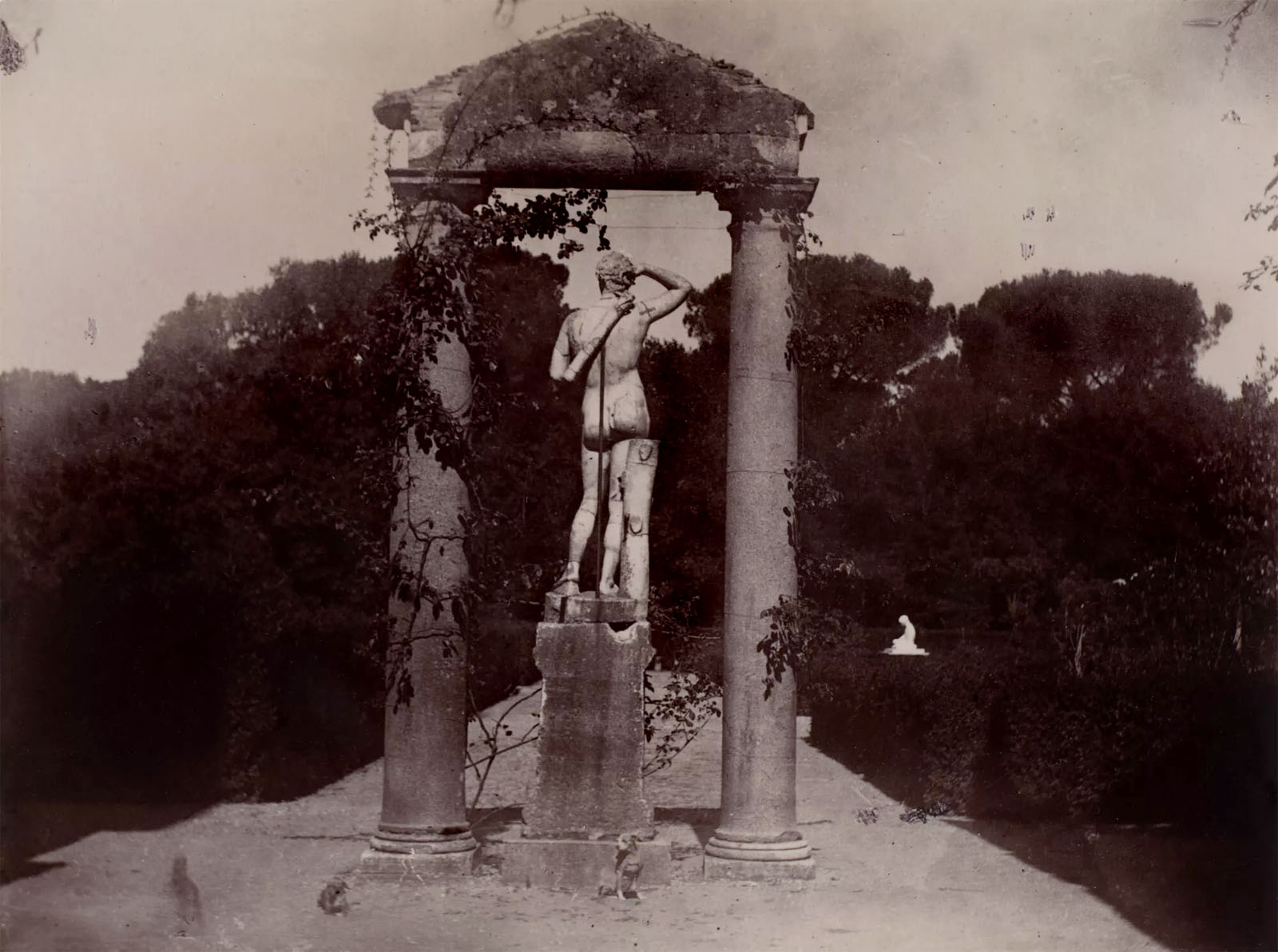
 

Gabrielle Hébert (French born Germany, 1853-1934) 'Arrière de la statue d'Apollon vainqueur du monstre Python, 13 mai 1891' (Back of the statue of Apollo victorious over the Python monster, May 13, 1891) 1891


Gabrielle Hébert (French born Germany, 1853-1934)
Arrière de la statue d’Apollon vainqueur du monstre Python, 13 mai 1891
(Back of the statue of Apollo victorious over the Python monster, May 13, 1891)

1891
Aristotype à la gélatine (Gelatin Aristotype)
8.2 x 10.9cm
© Musée National Ernest Hébert, Paris
Photo: Musée d’Orsay, Dist. RMN-Grand Palais / Alexis Brandt
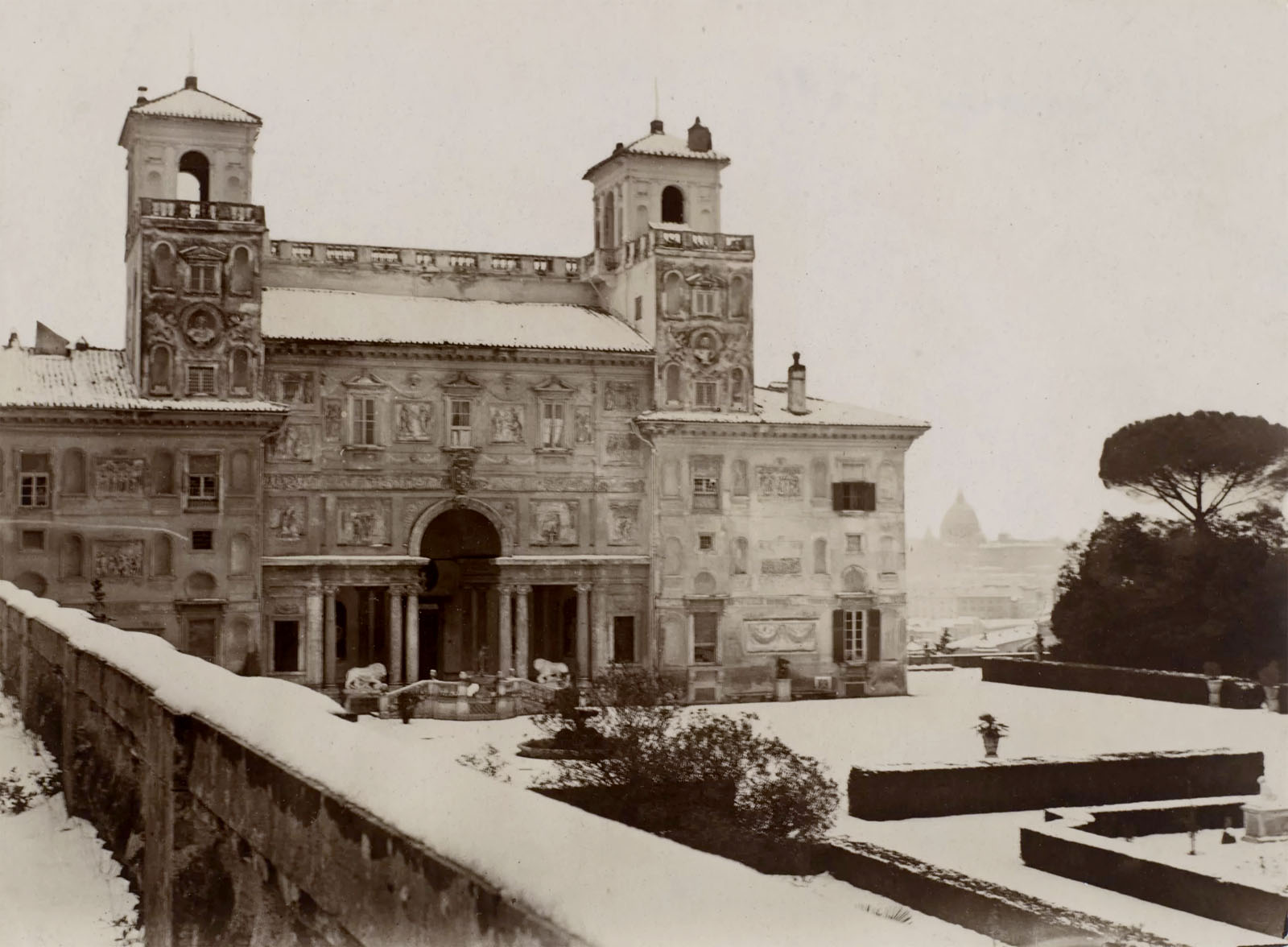
 

Gabrielle Hébert (French born Germany, 1853-1934) 'La façade du palais sous la neige, 16 janvier 1891' (The palace façade under the snow, January 16, 1891) 1891


Gabrielle Hébert (French born Germany, 1853-1934)
La façade du palais sous la neige, 16 janvier 1891 (The palace façade under the snow, January 16, 1891)
1891
Aristotype à la gélatine (Gelatin Aristotype)
8.2 x 11.2cm
© Musée National Ernest Hébert, Paris
Photo: Musée d’Orsay, Dist. RMN-Grand Palais / Alexis Brandt
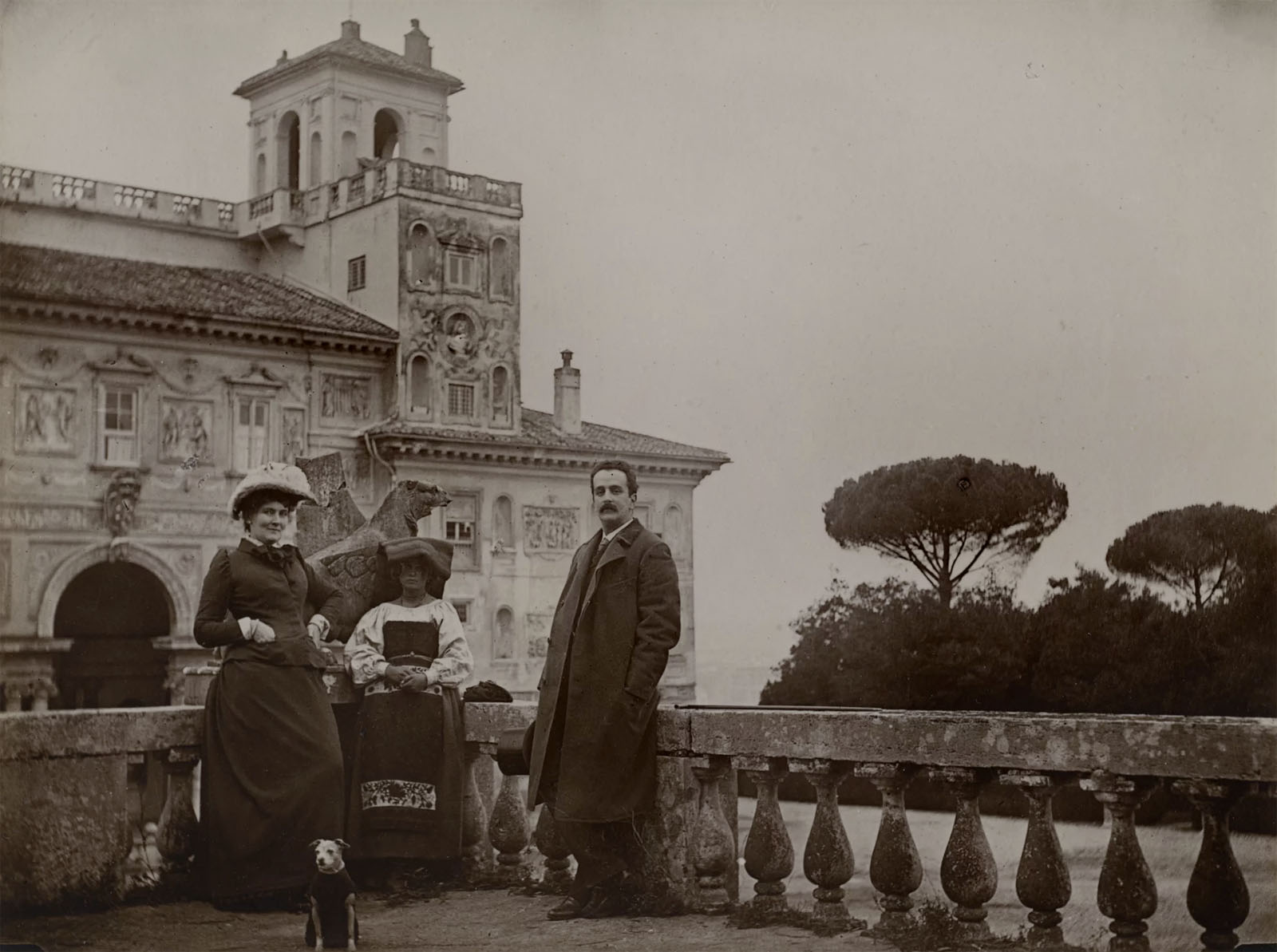
 

Gabrielle Hébert (French born Germany, 1853-1934) 'Éléonore d'Uckermann, le modèle Natalina, le prince Abamelek-Lazarev et le chien Farfaletta sur la terrasse du bosco, 5 janvier 1891' (Eleanor d'Uckermann, the model Natalina, Prince Abamelek-Lazarev and the dog Farfaletta on the terrace of the bosco, January 5, 1891) 1891


Gabrielle Hébert (French born Germany, 1853-1934)
Éléonore d’Uckermann, le modèle Natalina, le prince Abamelek-Lazarev et le chien Farfaletta sur la terrasse du bosco, 5 janvier 1891
(Eleanor d’Uckermann, the model Natalina, Prince Abamelek-Lazarev and the dog Farfaletta on the terrace of the bosco, January 5, 1891)

1891
Aristotype à la gélatine (Gelatin Aristotype)
8 x 10.8cm
© Musée National Ernest Hébert, Paris
Photo: Musée d’Orsay, Dist. RMN-Grand Palais / Alexis Brandt


Prince Semyon Semyonovich Abamelek-Lazarev (also Abamelik-Lazaryan; Russian: Семён Семёнович Абамелек-Лазарев; 24 November 1857 in Moscow – 2 October 1916 in Kislovodsk) was a Russian millionaire of Armenian ethnicity noted for his contributions to archaeology and geology.
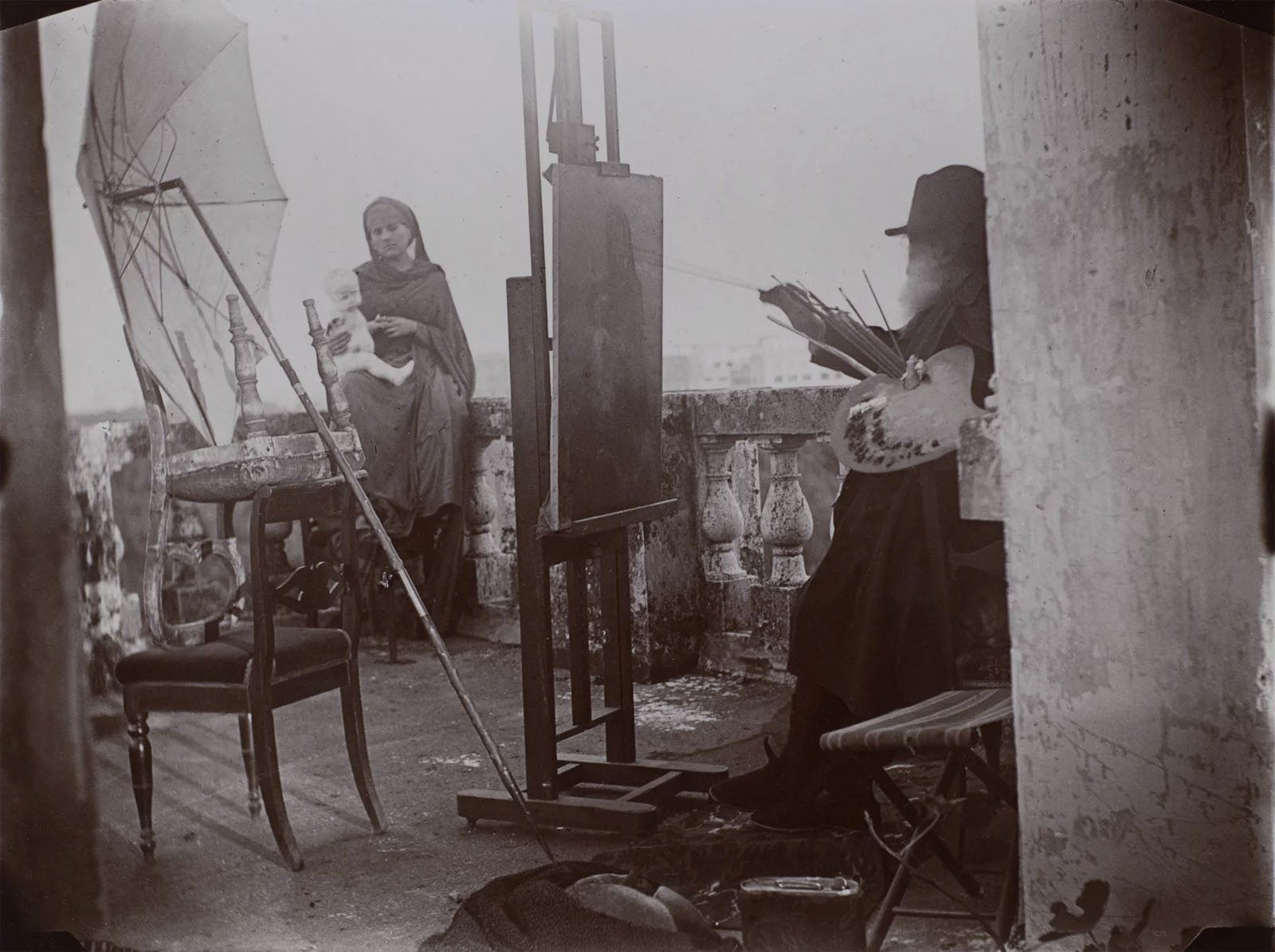
 

Gabrielle Hébert (French born Germany, 1853-1934) 'Amalia Scossa et Ernest Hébert à sa peinture La Vierge au chardonneret sur la terrasse du campanile' (Amalia Scossa and Ernest Hébert at his painting The Virgin with the Goldfinch on the bell tower terrace) Around 1891


Gabrielle Hébert (French born Germany, 1853-1934)
Amalia Scossa et Ernest Hébert à sa peinture La Vierge au chardonneret sur la terrasse du campanile
(Amalia Scossa and Ernest Hébert at his painting The Virgin with the Goldfinch on the bell tower terrace)

Around 1891
Aristotype à la gélatine (Gelatin Aristotype)
9.6 x 12.3cm
© Musée National Ernest Hébert, Paris
Photo: Musée d’Orsay, Dist. RMN-Grand Palais / Alexis Brandt


The painting in the photograph is probably La Vierge de Chausseur by Ernest Hébert (c. 1891, below)
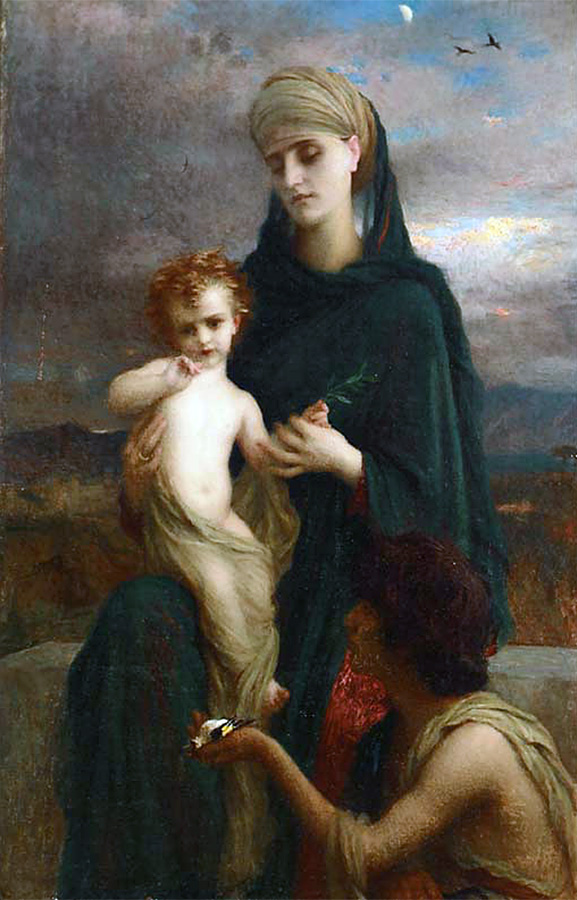
 

Ernest Hébert (French, 1817-1908) 'La Vierge de Chausseur' c. 1891


Ernest Hébert (French, 1817-1908)
La Vierge de Chausseur
c. 1891
Oil on canvas
73cm (28.7 in); width: 47cm (18.5 in)
Public domain
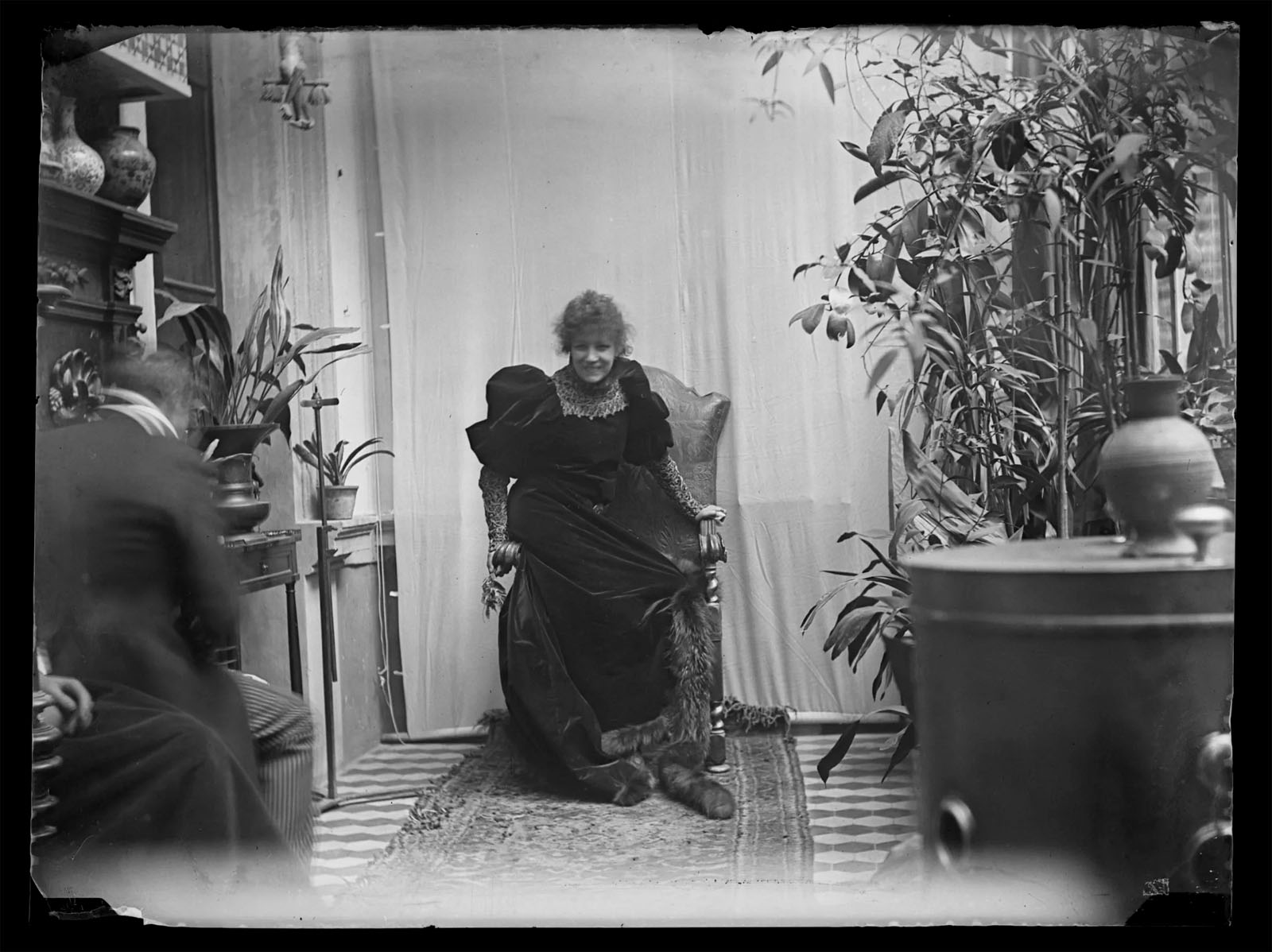
 

Gabrielle Hébert (French born Germany, 1853-1934) 'Sarah Bernhardt dans le studio aménagé de Giuseppe Primoli, Rome, février 1893' (Sarah Bernhardt in Giuseppe Primoli's furnished studio, Rome, February 1893) 1893


Gabrielle Hébert (French born Germany, 1853-1934)
Sarah Bernhardt dans le studio aménagé de Giuseppe Primoli, Rome, février 1893
(Sarah Bernhardt in Giuseppe Primoli’s furnished studio, Rome, February 1893)

1893
Négatif sur plaque de verre au gélatinobromure d’argent (Gelatin silver bromide glass plate negative)
9 x 12cm
© La Tronche, musée Hébert
Photo: Musée Hébert, Département de l’Isère


Giuseppe Primoli (Italian, 1851-1927)

Count Giuseppe Napoleone Primoli (in French, Joseph Napoléon Primoli; 2 May 1851 in Rome – 13 June 1927 in Rome) was an Italian nobleman, collector and photographer. …

Giuseppe Primoli lived in Paris from 1853 to 1870. He befriended writers and artists both in Italy and France, and was host to Guy de Maupassant, Paul Bourget, Alexandre Dumas fils, Sarah Bernhardt and others in Palazzo Primoli in Rome. In 1901 he became the sole owner of the palazzo, which he enlarged and modernised between 1904 and 1911.

Primoli was a bibliophile and collector, who assembled a large collection of books and prints. He amassed a collection of books by Stendhal as well as many from the writer’s library.

During the last decades of the nineteenth century, Primoli, an avid photographer, produced over 10,000 photographs.

Text from the Wikipedia website
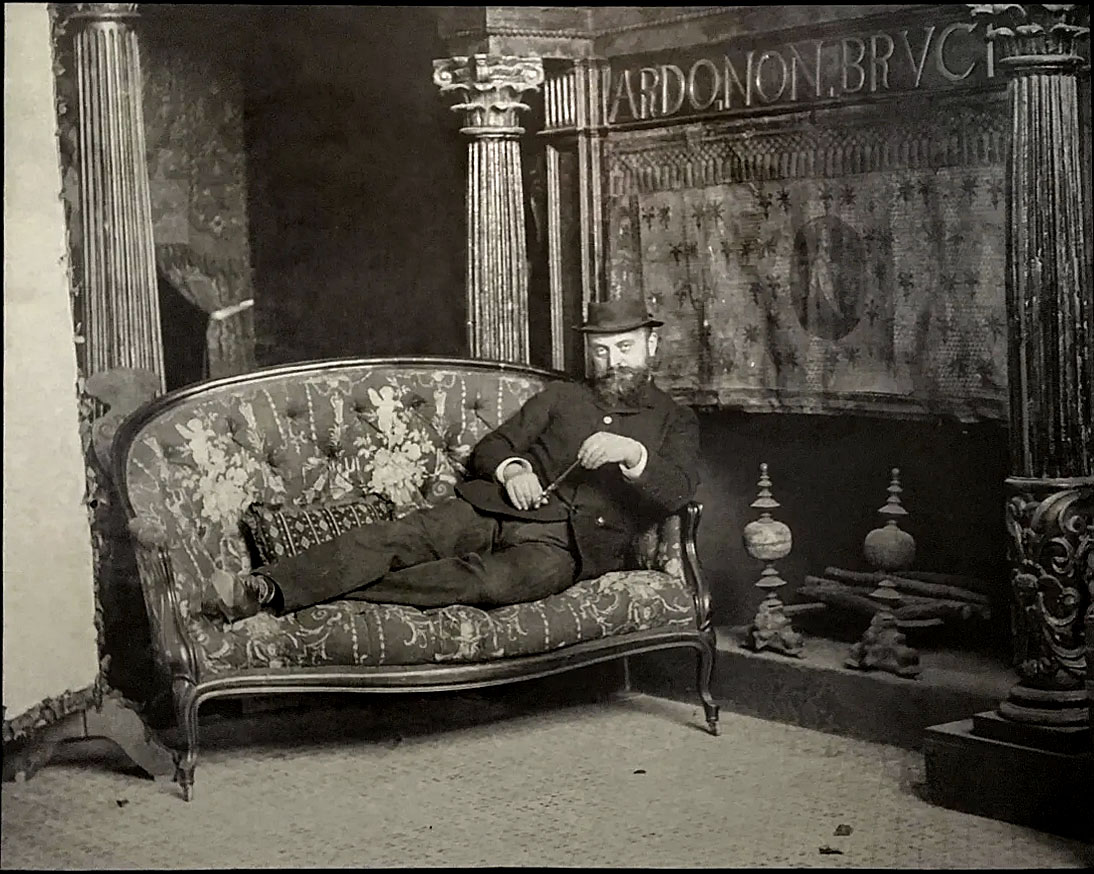
 

Anonymous photographer. 'Giuseppe Primoli in his palace in Rome' c. 1911-1912


Anonymous photographer
Giuseppe Primoli in his palace in Rome
c. 1911-1912
Primoli Foundation, Rome
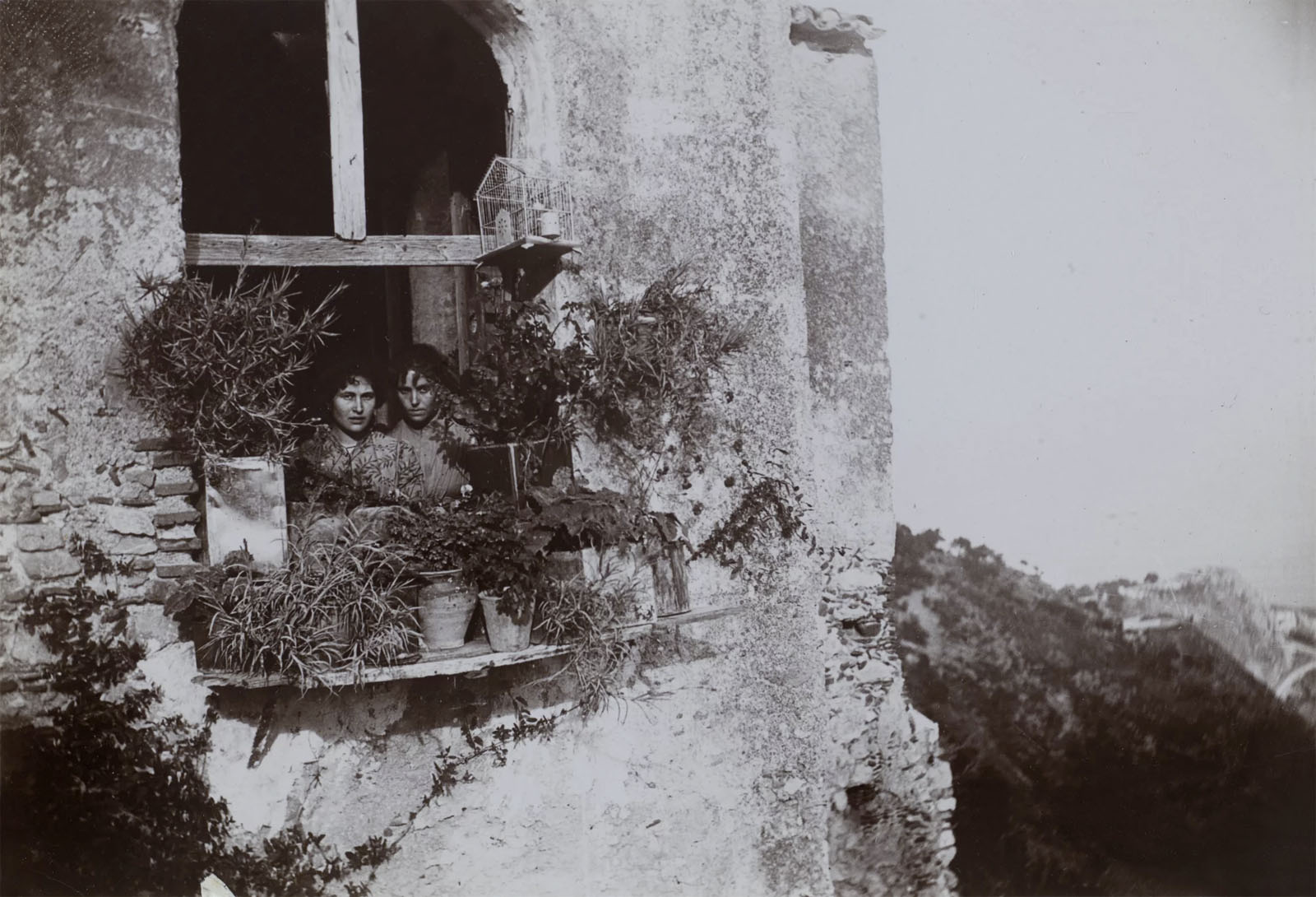
 

Gabrielle Hébert (French born Germany, 1853-1934) 'Femmes à la fenêtre, Taormine (Sicile), mai 1893' (Women at the window, Taormina (Sicily), May 1893) 1893


Gabrielle Hébert (French born Germany, 1853-1934)
Femmes à la fenêtre, Taormine (Sicile), mai 1893 (Women at the window, Taormina (Sicily), May 1893)
1893
Aristotype à la gélatine, papier (Gelatin Aristotype, paper)
7.8 x 11.4cm
© Musée National Ernest Hébert, Paris
Photo: Musée d’Orsay, Dist. RMN-Grand Palais / Alexis Brandt


With photographs like the one above, taken at Taormina, it is likely Gabrielle Hébert would have met Baron Wilhelm von Gloeden (German, 1856-1931) who lived and worked there between 1878-1931.
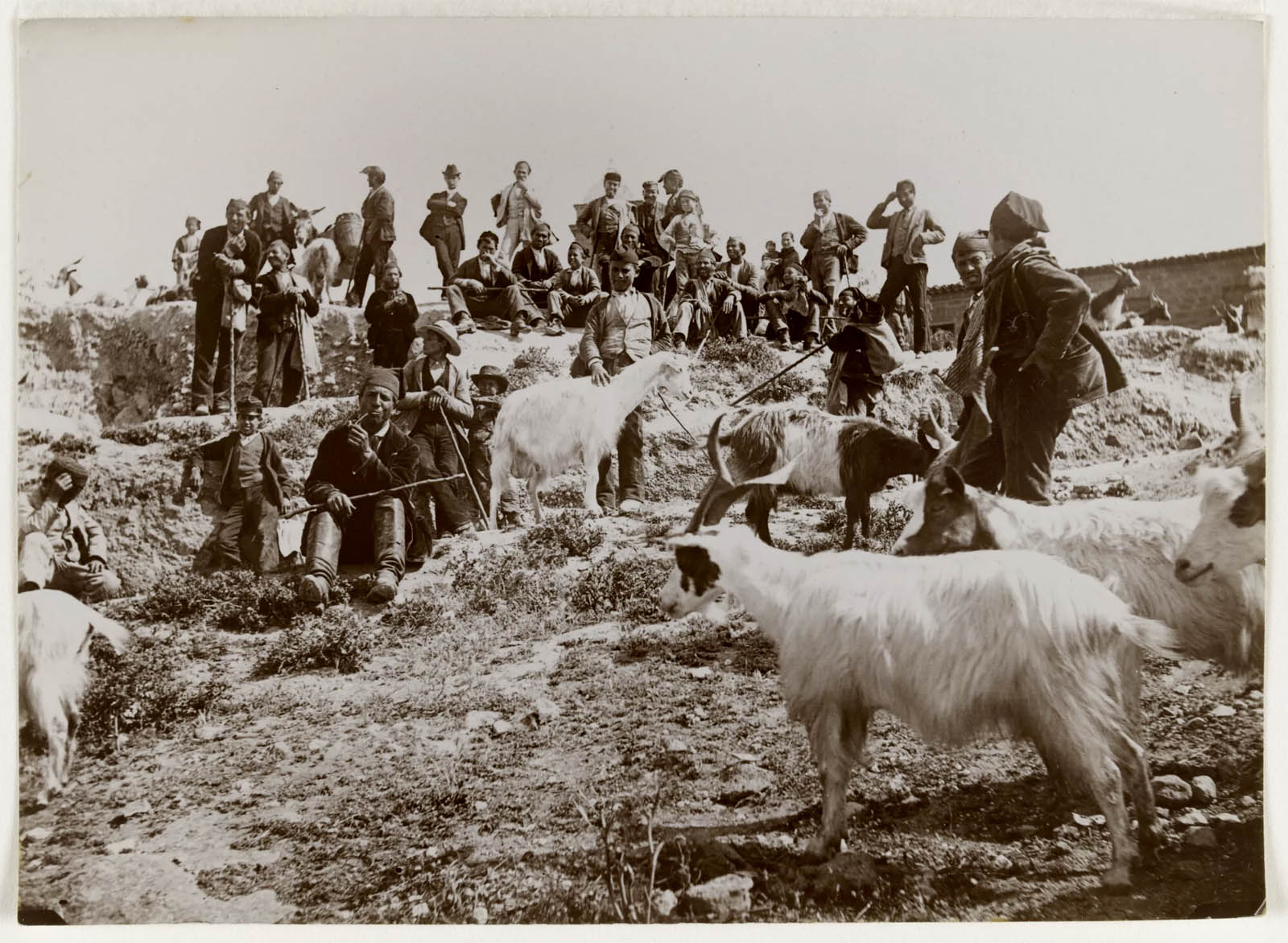
 

Gabrielle Hébert (French born Germany, 1853-1934) 'Paysans avec leurs chèvres, Sicile, mai 1893' (Peasants with their goats, Sicily, May 1893) 1893


Gabrielle Hébert (French born Germany, 1853-1934)
Paysans avec leurs chèvres, Sicile, mai 1893 (Peasants with their goats, Sicily, May 1893)
1893
Aristotype à la gélatine, papier (Gelatin Aristotype, paper)
7.9 x 10.9cm
La Tronche, Musée Hebert
© Musée Hébert, Département de l’Isère
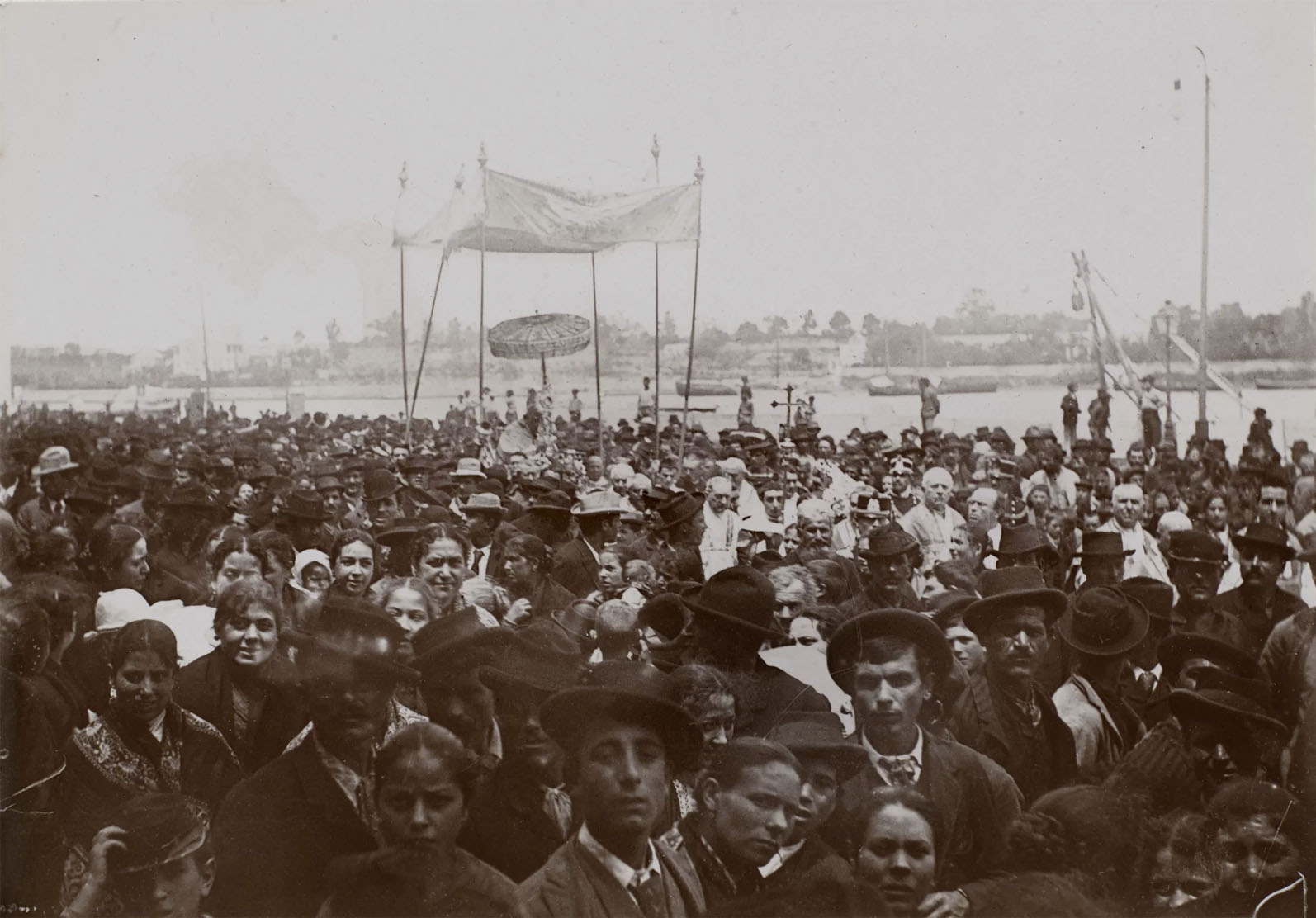
 

Gabrielle Hébert (French born Germany, 1853-1934) 'Procession sur le port de Brindisi (Pouilles)' (Procession in the port of Brindisi (Apulia)) 1893


Gabrielle Hébert (French born Germany, 1853-1934)
Procession sur le port de Brindisi (Pouilles) (Procession in the port of Brindisi (Apulia))
1893
Aristotype à la gélatine, papier (Gelatin Aristotype, paper)
8.0 x 11.4cm
© Musée National Ernest Hébert, Paris
Photo: Musée d’Orsay, Dist. RMN-Grand Palais / Alexis Brandt
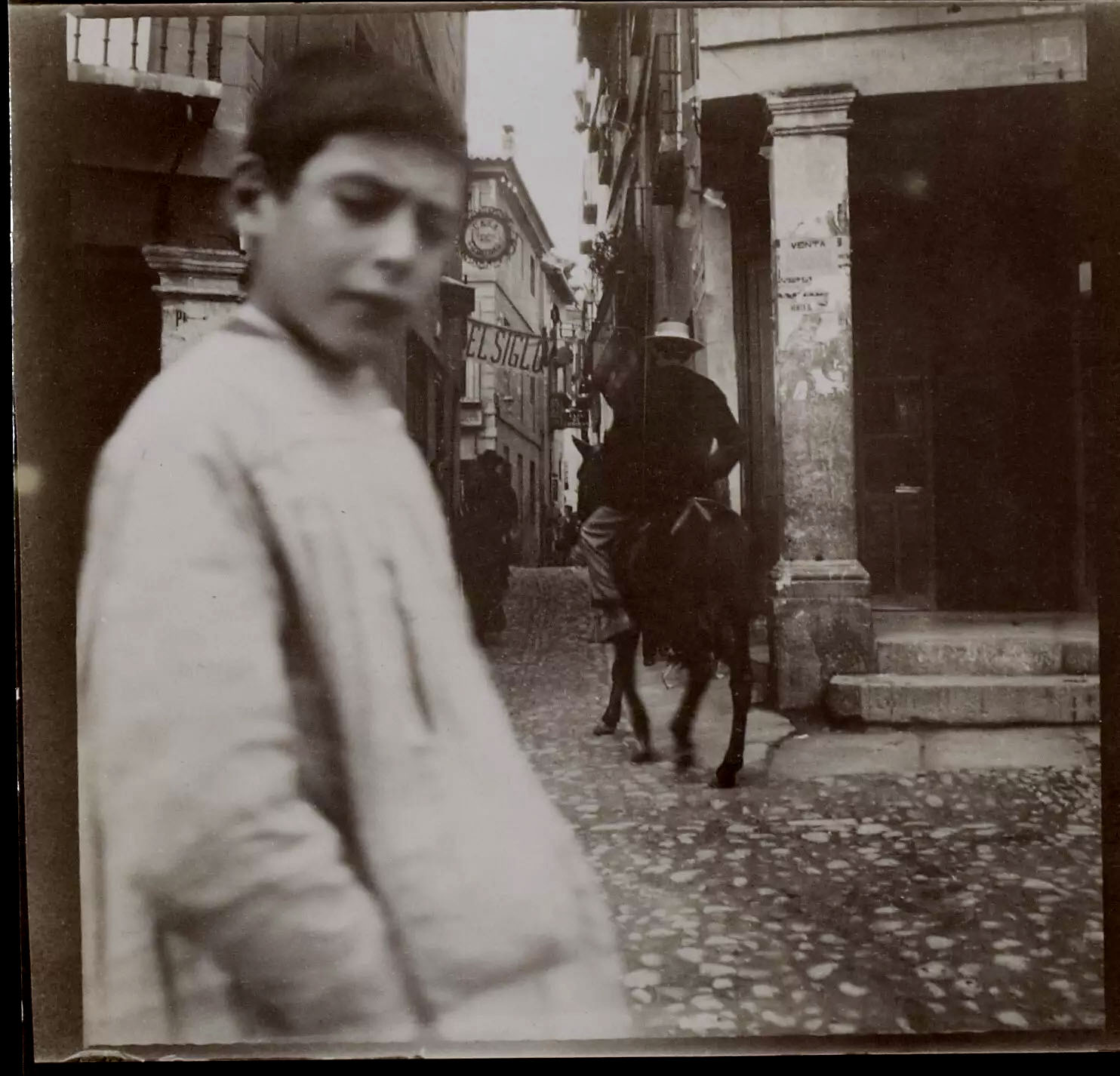
 

Gabrielle Hébert (French born Germany, 1853-1934) 'Garçon au coin de la place Zocodover, Tolède, 31 octobre 1898' (Boy on the corner of Zocodover Square, Toledo, October 31, 1898) 1898


Gabrielle Hébert (French born Germany, 1853-1934)
Garçon au coin de la place Zocodover, Tolède, 31 octobre 1898
(Boy on the corner of Zocodover Square, Toledo, October 31, 1898)

1898
Aristotype à la gélatine (Gelatin Aristotype)
10 x 10cm
La Tronche, musée Hebert
© Musée Hébert, Département de l’Isère
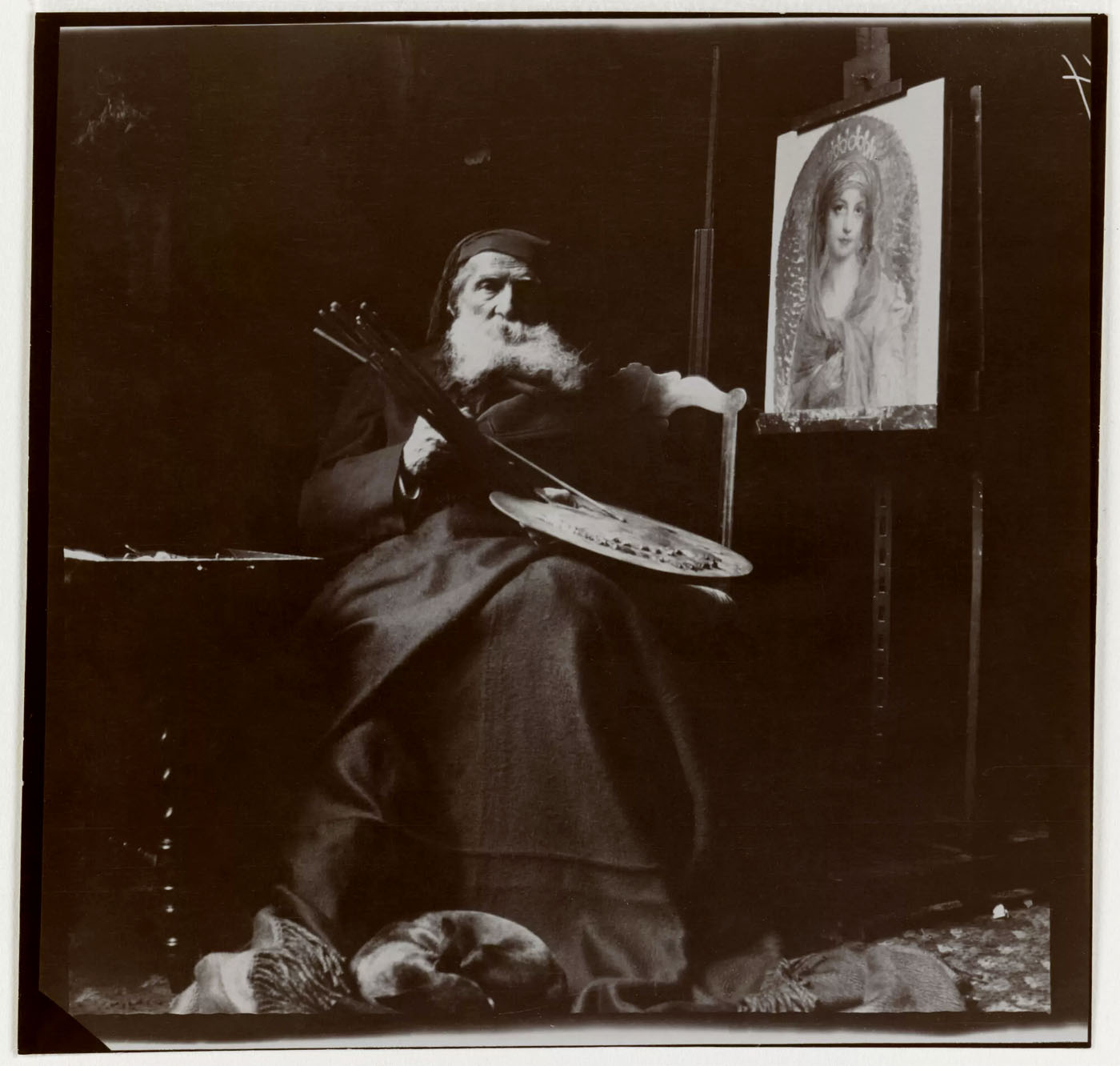
 

Gabrielle Hébert (French born Germany, 1853-1934) 'Ernest Hébert sur son lit de mort, novembre 1908' (Ernest Hébert on his deathbed, November 1908) 1908


Gabrielle Hébert (French born Germany, 1853-1934)
Ernest Hébert sur son lit de mort, novembre 1908 (Ernest Hébert on his deathbed, November 1908)
1908
Aristotype à la gélatine (Gelatin Aristotype)
9.5 x 9.8cm
© Musée National Ernest Hébert, Paris
Photo: Musée d’Orsay, Dist. RMN-Grand Palais / Alexis Brandt


Musée d’Orsay
62, rue de Lille
75343 Paris Cedex 07
France

Opening hours:
Tuesday – Sunday 9.30am – 5pm
Closed on Mondays
Musée d’Orsay website

LIKE ART BLART ON FACEBOOK

Back to top

Exhibition: ‘The First Homosexuals: Global Depictions of a New Identity, 1869-1930’ at Wrightwood 659, Chicago

Exhibition dates: 1st October – 17th December, 2022

Curators: Jonathan D. Katz, Curator and Johnny Willis, Associate Curator

Please note: This exhibition contains sexually explicit content. For mature audiences only.


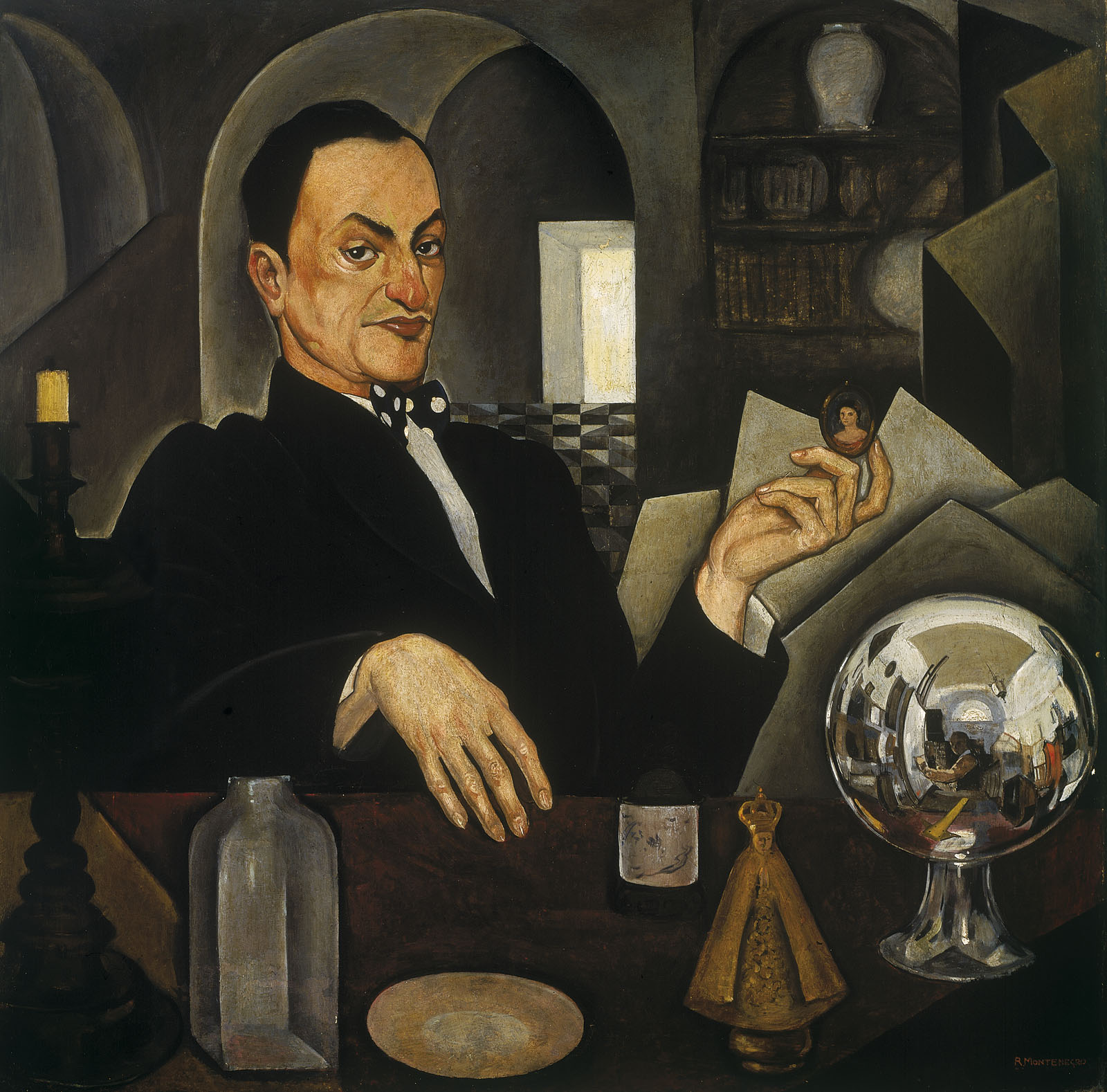
Roberto Montenegro (Mexican, 1885-1968) 'Retrato de un anticuario o Retrato de Chucho Reyes y autorretrato' 1926 from the exhibition 'The First Homosexuals: Global Depictions of a New Identity, 1869-1930' at Wrightwood 659, Chicago, Oct - Dec, 2022


Roberto Montenegro (Mexican, 1885-1968)
Retrato de un anticuario o Retrato de Chucho Reyes y autorretrato
Portrait of an antiquarian or Portrait of Chucho Reyes and self-portrait

1926
Oil on canvas
40.4 x 40.4 in (unframed)
41.7 x 41.6 x 1.6 in (framed)
Colección Pérez Simón, Mexico
© Arturo Piera


Short and sweet…

I believe that any artist that lives at the edge of desire, of creativity, of individuality, exploration and feeling – in seeing the world from different points of view – pushes the boundaries of what the conservative mass of humanity finds acceptable.

Defying the taboo is only possible because the taboo exists in the first place. The taboo against sensuality, eroticism and pleasure can only be broken by approaching those ecstatic and liminal spaces that lead to other states of consciousness, by being attentive to the dropping away of awareness so that we avoid the frequency of common intensities, instead illuminating spaces and languages where new cultural symbols and meanings can emerge. This is what artists and people of difference do: we approach the ‘Thing Itself’. We live on the edge of ecstasy, oblivion and revelation.

Dr Marcus Bunyan

PS. I have added bibliographic information to the posting where possible.


Many thankx to Wrightwood 659 for allowing me to publish the art work in the posting. Please click on the photographs for a larger version of the image.


The First Homosexuals: Global Depictions of a New Identity, 1869-1930 takes as its starting point the year 1869, when the word “homosexual” was first coined in Europe, inaugurating the idea of same-sex desire as the basis for a new identity category. On view will be more than 100 paintings, drawings, prints, photographs, and film clips – drawn from public and private collections around the globe and including a number of national treasures which have never before been allowed to travel outside their countries. This groundbreaking exhibition offers the first multi-medium survey of the very first self-consciously queer art, exploring what the “first homosexuals” understood themselves to be, how dominant culture, in turn, understood them, and how the codes of representation they employed offer us previously unknown glimpses into the social and cultural meanings of same-sex desire.

The First Homosexuals is being organised in two parts, due to COVID-related delays, with part one opening on October 1 with approximately 100 works, and on view only at Wrightwood 659. Three years from now, in 2025, 250 masterworks will be gathered at Wrightwood 659 for part two of The First Homosexuals in an exhibition which will travel internationally and be accompanied by a comprehensive catalogue.

The exhibition is being developed by a team of 23 international scholars led by art historian Jonathan D. Katz, Professor of Practice in the History of Art and Gender, Sexuality and Women’s Studies at the University of Pennsylvania, with associate curator Johnny Willis.


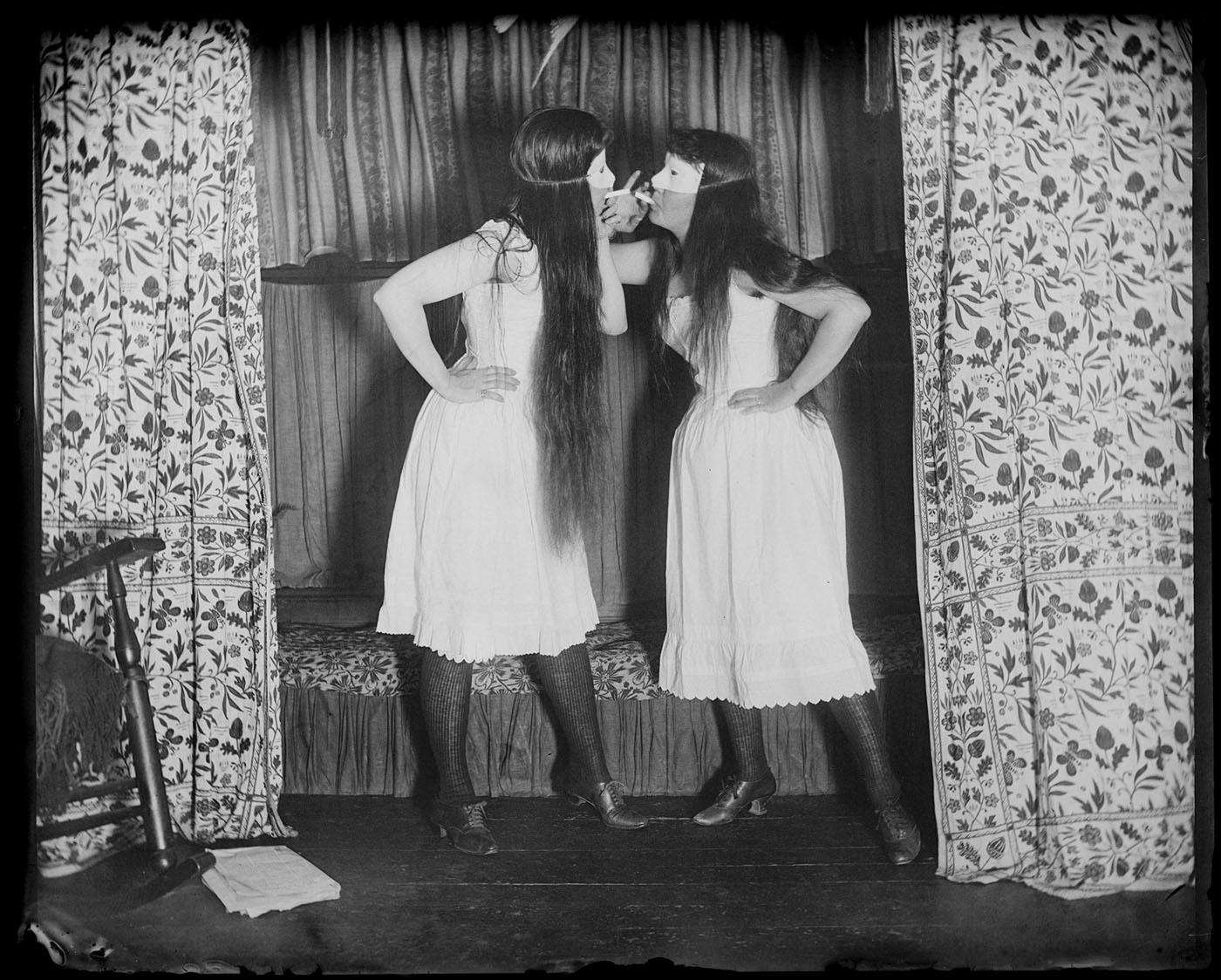
Alice Austen (American, 1866-1952) 'Trude & I Masked, Short Skirts' 1891 from the exhibition 'The First Homosexuals: Global Depictions of a New Identity, 1869-1930' at Wrightwood 659, Chicago, October - Dec, 2022


Alice Austen (American, 1866-1952)
Trude & I Masked, Short Skirts
1891
Print, 4 x 5 in
Historic Richmond Town


Elizabeth Alice Austen (March 17, 1866 – June 9, 1952) was an American photographer working in Staten Island.

One of America’s first female photographers to work outside of the studio, Austen often transported up to 50 pounds of photographic equipment on her bicycle to capture her world. Her photographs represent street and private life through the lens of a lesbian woman whose life spanned from 1866 to 1952. Austen was a rebel who broke away from the constraints of her Victorian environment and forged an independent life that broke boundaries of acceptable female behaviour and social rules. …

Alice Austen’s life and relationships with other women are crucial to an understanding of her work. Until very recently many interpretations of Austen’s work overlooked her intimate relationships. What is especially significant about Austen’s photographs is that they provide rare documentation of intimate relationships between Victorian women. Her non-traditional lifestyle and that of her friends, although intended for private viewing, is the subject of some of her most critically acclaimed photographs. Austen would spend 53 years in a devoted loving relationship with Gertrude Tate, 30 years of which were spent living together in her home which is now the site of the Alice Austen House Museum and a nationally designated site of LGBTQ history.

Austen’s wealth was lost in the stock market crash of 1929 and she and Tate were evicted from their beloved home in 1945. Tate and Austen were finally separated by family rejection of their relationship and poverty. Austen was moved to the Staten Island Farm Colony where Tate would visit her weekly. In 1951 Austen’s photographs were rediscovered by historian Oliver Jensen and money was raised by the publication of her photographs to place Austen in private nursing home care. On June 9, 1952 Austen passed away. The final wishes of Austen and Tate to be buried together were denied by their families.

Text from the Wikipedia website


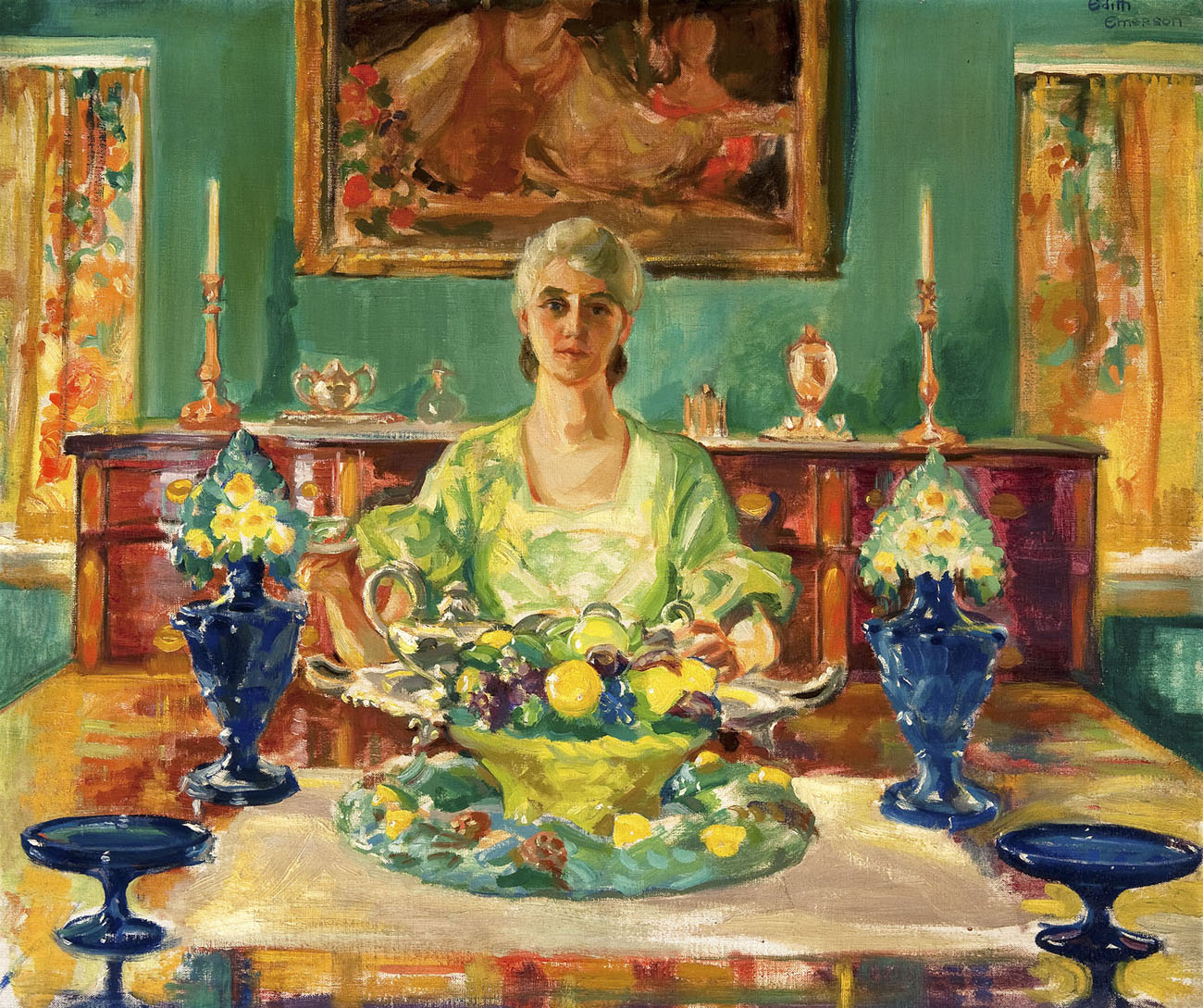
Violet Oakley (American, 1874-1961) 'Edith Emerson Lecturing' c. 1935 from the exhibition 'The First Homosexuals: Global Depictions of a New Identity, 1869-1930' at Wrightwood 659, Chicago, October - Dec, 2022


Violet Oakley (American, 1874-1961)
Edith Emerson Lecturing
c. 1935
Oil on canvas
35 x 45 in.
Woodmere Art Museum, Philadelphia, PA: gift of the Pennsylvania Academy of Fine Arts, 2012
Courtesy of Woodmere Art Museum


Violet Oakley (June 10, 1874 – February 25, 1961) was an American artist. She was the first American woman to receive a public mural commission. During the first quarter of the twentieth century, she was renowned as a pathbreaker in mural decoration, a field that had been exclusively practiced by men. Oakley excelled at murals and stained glass designs that addressed themes from history and literature in Renaissance-revival styles.


Edith Emerson (American, 1888-1981) 'Portrait of Violet Oakley' Date unknown


Edith Emerson (American, 1888-1981)
Portrait of Violet Oakley
Date unknown
Oil on canvas
25 x 30 in.
Woodmere Art Museum, Philadelphia, PA: gift of Jane and Noble Hall, 1998
Courtesy of Woodmere Art Museum


Edith Emerson (July 27, 1888 – November 21, 1981) was an American painter, muralist, illustrator, writer, and curator. She was the life partner of acclaimed muralist Violet Oakley and served as the vice-president, president, and curator of the Woodmere Art Museum in the Chestnut Hill neighbourhood of Philadelphia, Pennsylvania, from 1940 to 1978. …

[Oakley’s] life partner, Edith Emerson, was a painter and, at one time, a student of Oakley’s. In 1916, Emerson moved into Oakley’s Mount Airy home, Cogslea, where Oakley had formed a communal household with three other women artists, calling themselves the Red Rose Girls. Emerson and Oakley’s relationship endured until Oakley’s death and Emerson subsequently established a foundation to memorialise Oakley’s life and legacy. The foundation dissolved in 1988 and the assets donated to the Smithsonian Museum.

Following Violet Oakley’s death in 1961, Emerson created the Violet Oakley Memorial Foundation to keep her teacher and companion’s memory and ideals alive. The foundation also sought to house and preserve the contents of Oakley’s studio, which was placed on the National Register of Historic Places in 1977 as the Violet Oakley Studio. Emerson served as the foundation’s president, as well as curator and general caretaker of the studio. The studio was opened to the public as a kind of museum, and Emerson organised various activities there, including concerts, exhibitions, poetry readings, and lectures on American art and illustration. Following Emerson’s death, the foundation dispersed the contents, sold the house, and disbanded.

In 1979, Emerson was instrumental in mounting an Oakley revival as an exhibition at the Philadelphia Museum of Art.

Text from the Wikipedia website


Owe Zerge (Swedish, 1894-1984) 'Model Act' 1919


Owe Zerge (Swedish, 1894-1984)
Model Act
1919
Oil on canvas
53.1 x 19.7 in.
Private Collection


Role of Art in the Modern Construction of Same-Sex Desire Explored for First Time in Groundbreaking Two-Part Exhibition at Wrightwood 659 in Chicago

The First Homosexuals: Global Depictions of a New Identity, 1869-1930, begins in the year 1869, when the word “homosexual” was coined in Europe, inaugurating the idea of same-sex desire as the basis for a new identity category. With more than 100 paintings, drawings, prints, photographs, and film clips – drawn from public and private collections around the globe and including works which have never before been allowed to travel outside their countries – this large-scale international exhibition offers the first multi-media survey of some of the founding works of queer art. The First Homosexuals explores what the earliest homosexuals understood themselves to be, how dominant culture understood them, and how the codes of representation they employed offer previously unknown glimpses into the social and cultural meanings of same-sex desire.

The First Homosexuals is organised in two parts, due to Covid-related delays, with Part I on view only at Wrightwood 659 in Chicago from October 1 through December 17, 2022. Three years from now, in 2025, 250 masterworks will be gathered at Wrightwood 659 for Part II, in a major exhibition that will travel internationally, accompanied by a comprehensive catalogue.

Already three years in the making, the exhibition is being developed by a team of 23 international scholars, led by art historian Jonathan D. Katz, Professor of Practice in the History of Art and Gender, Sexuality and Women’s Studies at the University of Pennsylvania, with associate curator Johnny Willis.

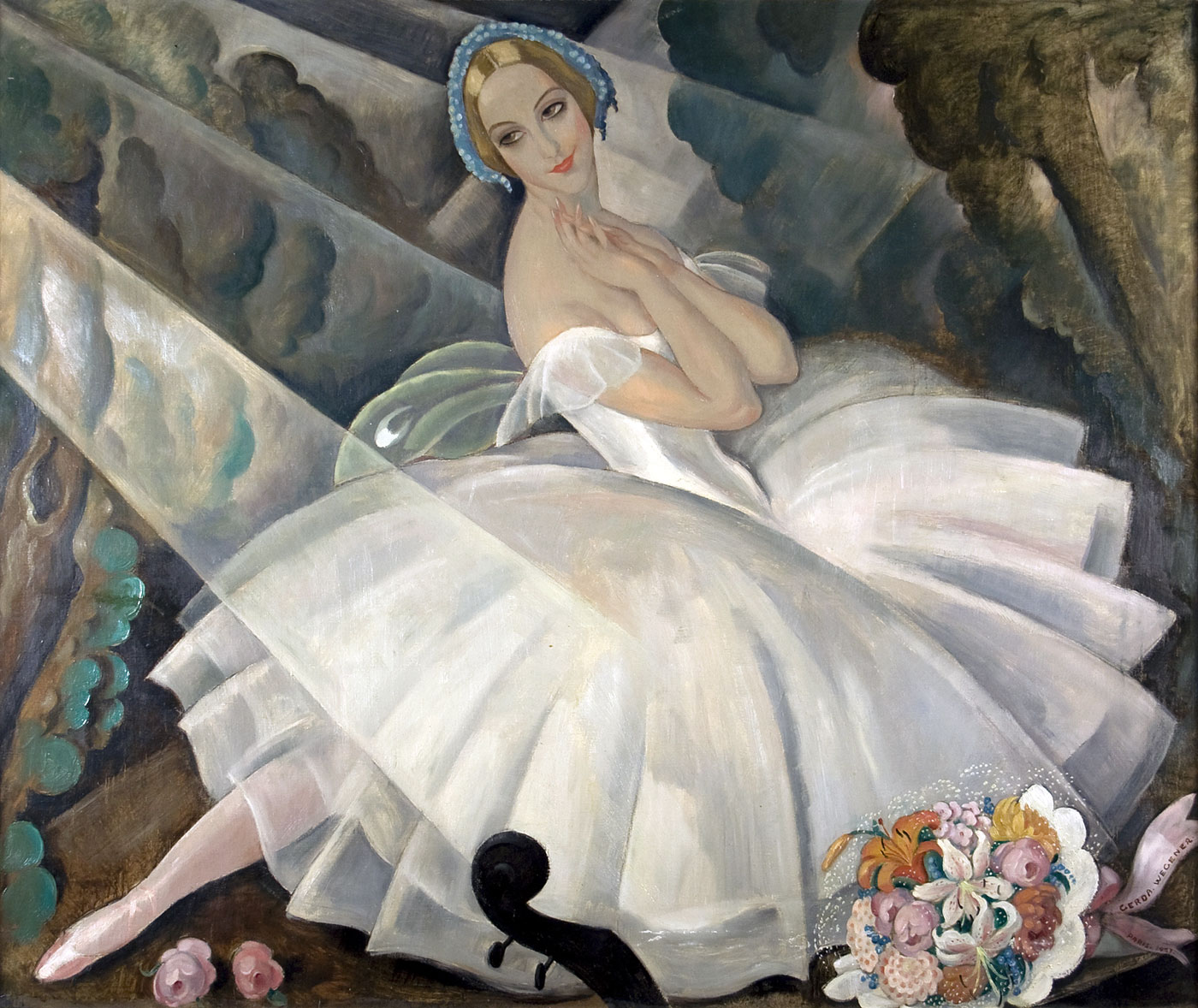
The First Homosexuals rewrites conventional art history, in part by deepening the reading of works of art by familiar artists – whether it be Henry Fuseli, Thomas Eakins, or George Bellows – and in part by lifting the cover off works that previously have not been widely understood as declarations of same-sex attachment. The exhibition also introduces American museum goers to a number of artists who are little known in the United States but revered in their own countries, including Gerda Wegener (Denmark); Eugéne Jansson (Sweden); and Frances Hodgkins (New Zealand).

The First Homosexuals explores the cohesion of a new global identity at a liminal moment, one that art can tell uniquely well. While the written archive of the period must necessarily use accepted words to describe ideas, art is notably free of such consensus, allowing for the emergence of more idiosyncratic, contested, and exploratory forms.

The First Homosexuals is an international project of an incredible scale. It perfectly fulfils our mission of presenting novel, socially engaged exhibitions,” says Chirag G. Badlani, Executive Director of Alphawood Foundation Chicago, which is presenting The First Homosexuals through Alphawood Exhibitions. “We are thrilled that the community can experience an important exhibition like this at Wrightwood 659 – given the content, it otherwise might not be seen.” He added, “We are particularly proud to show a collection of early Russian queer works borrowed from the Odesa Fine Arts Museum in Ukraine, amidst the ongoing war, helping to safeguard these important pieces of queer history from potential damage or destruction.”

Dr. Katz, notes, “The First Homosexuals demonstrates that as the language used to name same-sex desire narrowed into a simple binary of homosexual / heterosexual, art went the opposite direction, giving form to a range of sexualities and genders that can best be described as queer. Art became the place where the simplistic sexual binary could be nuanced and particularised, evoking emotions and responses that language couldn’t yet express.”

Dr. Katz continues, “The reality is that current-day conceptions about homosexuality are only roughly as old as the oldest living Americans. Our goal in this exhibition is to read queer desire as it manifested itself in this not-so-long-ago past, while being alert to the very different forms it took globally.”

The exhibition

Part I of The First Homosexuals is installed in nine sections, occupying the entire second floor of the Tadao Ando-designed galleries of Wrightwood 659. The first section, entitled Before Homosexuality, features 19th-century works that suggest how unself-consciously same-sex eroticism was portrayed before the coinage of the word homosexual. A highlight is a print depicting a sexual act between two men by Hokusai, the ukiyo-e master of Japan’s Edo period. Hokusai’s image would have been entirely uncontroversial in its day.

Among the works installed in Couples, the second section, is a leisurely boating scene by the French painter Louise Abbéma, showing herself in masculinate garb with her lover, the celebrated actress Sarah Bernhardt. Two other paintings represent reverse homages, wherein the American artist Edith Emerson paints her lover Violet Oakley and Oakley returns the favour by producing an oil study of Emerson. Also on view in this section is an illustration by Oakley that ran in the December 1903 issue of the popular The Century Magazine, depicting heaven as populated entirely by lithe young women in flowing gold and white robes.

Especially notable in Between Genders is a seductive reclining nude, a painting of one of the first modern transgender women: Gerda Wegener’s Reclining Nude (Lili Elbe), 1929. Nearby, the Russian artist Konstantin Somov’s delicate Portrait of Cécile de Volanges, 1917, appears to portray an 18th-century aristocratic beauty; however, the face is the artist’s own.

Between Genders abounds with photographs documenting the social experiments of the time, including a postcard of the French chanteuse Josephine Baker in male evening attire; the Norwegian Marie Høeg dressed as a man in a variety of carte de visite poses, the calling cards of their day; the French surrealist Claude Cahun in a meditative position with a shaved head looking neither male nor female; and, from across the Atlantic, c. 1890s sepia-toned photographs of an African American man, perhaps once enslaved, performing female drag on the vaudeville stage. A film segment featuring Loïe Fuller performing her legendary Serpentine Dance, 1905, contrasts with another film clip by the Frères Lumière of a male dancer performing the same dance and dressed like Fuller in flowing, billowing robes.

In the section Pose is a famous portrait by the Mexican artist Roberto Montenegro of his friend, the antique and antiquities dealer Chucho Reyes. The limp wrist, the tilted chin, and the amused smile are legible tropes of queer codes even today. As well as picturing Reyes ensconced proudly among his treasures, including an oval miniature of a woman, Montenegro included in the foreground a silver ball reflecting his own visage, thus bringing himself into the picture.

A contrasting note is hit nearby where a recording of “Ma” Rainey’s blues song, “Prove It On Me,” will be played and a vintage advertisement for the vinyl record displayed. Rainey had been arrested for participating in a lesbian sex orgy, a notorious event that she shrewdly parlayed into the #1 best-selling record within the African American community in 1928.

Dr. Katz anchors the exhibition section called Archetypes around an acknowledged masterpiece of American painting, Thomas Eakins’s Salutat,1898. The painting is shown in The First Homosexuals as an example of a scene engineered to focus attention on an erotic part of the young male body. Dr. Katz observes that the crowd appears to be not so much cheering a boxing victory as absorbing a perfect specimen of male beauty.

Throughout this section, the viewer can track the ideal of male beauty evolving beyond the 19th-century ephebic (youthful male beauty idealised in ancient times) to a more masculinised ideal of perfection. A defining work here is a study by Swedish artist Eugène Jansson for his most famous painting, The Naval Bath House, 1907. The custom of young men swimming nude in all-male settings was universal in the West – as seen elsewhere in The First Homosexuals. In this drawing, Jansson carefully employs Cezanne-like strokes to work out seven different poses for as many young men.

The section entitled Desire brings together works of art that are stylistically varied, according to the visual language of the artist’s national culture and training, but alike in depicting same-gender sex or magnifying parts of the body for erotic effect. These include erotica from China, Japan, Iran, and India and a pair of seemingly sedate figure drawings by the French artist Jane Poupelet focusing on the rear view of female models, so as to eroticise women in a way that works to exclude the heterosexual male gaze.

In the section entitled Colonizing, the art on view reflects a number of dynamics, including the Euro-centric definition of early homosexuality, which often clashed with more indigenous forms, and the Western presumption that the East was decadent. European interlopers employed the latter to excuse otherwise forbidden sexual alliances as well as to justify political domination. Here are works as disparate as the Sri Lankan painter David Paynter’s modernist oil, L’après midi, 1935; F. Holland Day’s haunting double exposure photograph, The Vision, (Orpheus Scene), 1907; and a propaganda piece dropped by Japanese nationals into Russian territory to demoralise Russian troops during the Russo-Japanese War.

Following, in the section Public and Private, comes Charles Demuth’s ‘morning after’ scene of three young men in pyjamas and underwear in a stylish domestic interior; lesbian genre scenes set in Eastern Europe; and Marsden Hartley’s Berlin Ante War, 1914, a painting charting life, death, faith, sunrise, and sunset in symbolic forms and colours.

The centrepiece of the final thematic section, Past and Future, is a little-known masterpiece by the Finnish artist, Magnus Enckell, an impressionist-styled painting that reverses the classical myth of Leda and the swan, illustrating a nude man strangling the rapacious figure of Zeus in the form of a swan. Other works here evidence what is likely the earliest use of the rainbow as a symbol of same-sex love; photographs by Wilhelm von Gloeden that combine classical ruins and Sicilian youth; and the desire to acknowledge same-sex precedents in ancient history, as in the colour lithograph, Hadrian and Antinous, 1906, by Paul Avril (Édouard-Henri Avril).

The First Homosexuals documents The Elisarion, a temple to the arts built by the same-sex cultist and visionary Elisar von Kupffer in 1926 in Minusio, a tiny principality in Switzerland. Paintings of scenes illustrating same-sex desire once covered the walls of von Kupffer’s Sanctuarium. A cache of these were discovered recently in a municipal warehouse in Minusio by Dr. Katz and his team. This fall, the paintings will be seen for the first time in documentary photographs. In 2025, the actual large-scale paintings will be exhibited for the first time outside Switzerland in Part II of The First Homosexuals: Depictions of a New Identity, 1869-1930.

Press release from Wrightwood 659


Marie Høeg (Norwegian, 1866-1949) 'Untitled [Marie Høeg and her brother in the studio]' c. 1895-1903


Berg & Høeg (Horten)
Bolette Berg (Norwegian, 1872-1944)
Marie Høeg (Norwegian, 1866-1949)
Untitled [Marie Høeg and her brother in the studio]
c. 1895-1903
Print, 2.4 x 3.1 in
Owner: Preus Museum Collection, Norway


Marie Høeg (Norwegian, 1866-1949) 'Marie Høeg dressed as a man' 1895-1903


Berg & Høeg (Horten)
Bolette Berg (Norwegian, 1872-1944)
Marie Høeg (Norwegian, 1866-1949)
Marie Høeg dressed as a man
1895-1903
Owner: Preus Museum Collection, Norway


Eugène Jansson (Swedish, 1862-1915) 'Bath house study' Nd


Eugène Jansson (Swedish, 1862-1915)
Bath house study
Nd
Black chalk on paper
33 1/2 x 39 inches


Eugène Fredrik Jansson (18 March 1862, Stockholm – 15 June 1915, Skara) was a Swedish painter known for his night-time land- and cityscapes dominated by shades of blue. Towards the end of his life, from about 1904, he mainly painted male nudes. The earlier of these phases has caused him to sometimes be referred to as blåmålaren, “the blue-painter”. …

After 1904, when he had already achieved success with his Stockholm views, Jansson confessed to a friend that he felt absolutely exhausted and had no more wish to continue with what he had done until then. He stopped participating in exhibitions for several years and went over to figure painting. To combat the health issues he had suffered from since childhood, he became a diligent swimmer and winter bather, often visiting the navy bathhouse, where he found the new subjects for his paintings. He painted groups of sunbathing sailors, and young muscular nude men lifting weights or doing other physical exercises.

Art historians and critics have long avoided the issue of any possible homoerotic tendencies in this later phase of his art, but later studies (see Brummer 1999) have established that Jansson was in all probability homosexual and appears to have had a relationship with at least one of his models. His brother, Adrian Jansson, who was himself homosexual and survived Eugène by many years, burnt all his letters and many other papers, possibly to avoid scandal (homosexuality was illegal in Sweden until 1944).

Text from the Wikipedia website


F. Holland Day (American, 1864-1933) 'The Vision (Orpheus Scene)' 1907


F. Holland Day (American, 1864-1933)
The Vision (Orpheus Scene)
1907
Platinum print


Florence Carlyle (Canadian, 1864-1923) 'The Guest, Venice' 1913


Florence Carlyle (Canadian, 1864-1923)
The Guest, Venice
1913
Oil on canvas
28.9 x 15 in
Woodstock Art Gallery, Woodstock, Ontario, gift of Lenora McCartney
Photo Credit: John Tamblyn


Florence Carlyle

Florence Carlyle (1864-1923) was a Canadian painter born in Ontario. Carlyle studied painting in Paris beginning in 1890, where she exhibited work at Paris Salons while gaining recognition in Canada and the United States – achievements unusual for women of her time. After Carlyle returned to Canada in 1896, she continued to exhibit widely and contributed artworks to major exhibitions and museum collections. Influenced by the French Barbizon School, Impressionism, and the work of fellow female painters, Carlyle was known for intimate, domestic scenes of middle-class women’s lives.

In 1911, Carlyle traveled to Italy and England, where she met Judith Hastings, who would become her lifelong companion and model. In 1913, Carlyle and Hastings settled in Yew Tree Cottage in East Sussex. The Guest, Venice shows Hastings and Carlyle in conversation at sunset in a scene dominated by warm reds and yellows. The women’s poses and gestures seem to reflect each other – Hastings, seated, invitingly pulls on a long necklace while Carlyle leans comfortably on a windowsill, their complimentary poses suggesting an intimate relationship. The Threshold depicts Hastings as a bride. In place of a groom, Hastings stands across from an empty chair and a vase of flowers, this absence perhaps a subtle allusion to her relationship with Carlyle.

The First Homosexuals: Global Depictions of a New Identity, 1869-1930 is the first exhibition to display Carlyle’s artwork in the context of same-sex desire and relationships.

On view: Self Portrait, c. 1901, Oil on canvas; The Threshold, 1913, Oil on canvas; The Guest, Venice, 1913, Oil on canvas.


Florence Carlyle (Canadian, 1864-1923) 'The Threshold' 1913


Florence Carlyle (Canadian, 1864-1923)
The Threshold
1913
Oil on canvas
117 x 96.5cm


Claude Cahun (French, 1894-1954) 'Untitled [Self portrait in profile, sitting cross legged]' 1920


Claude Cahun (French, 1894-1954)
Untitled [Self portrait in profile, sitting cross legged]
1920
Gelatin silver print


Claude Cahun and Marcel Moore

Claude Cahun (1894-1954) was a French photographer and writer known for works created in collaboration with their artistic and life partner Marcel Moore (1892-1972), an illustrator for magazines and avant-garde dance and theatre productions. Both artists adopted androgynous names in the 1910s and lived together in Paris by the early 1920s. In Paris, Cahun made theatrical and surrealist self-portraits, often dressing in masculine clothing with a shaved head or short-cropped hair and in elaborate costume, makeup, or masks.

Although Cahun considered themself a surrealist, and their images and writings presaged the 1924 Surrealist Manifesto, they were not aways readily accepted by Surrealist circles who celebrated images of women but rejected female artists. Despite this, many surrealists held Cahun in high regard, including Andre Breton, who recognised Cahun as, “one of the most curious spirits of our time.” Cahun’s 1930 surrealist autobiographical text Aveux non avenus combines non-linear stories and ideas with photomontages and self-portraits. In this text, Cahun also draws connections between their gender-fluid self-portraiture and identity, declaring that “neuter is the only gender that invariably suits me.”

On view: Illustration for Vues et Visions, 1919, Exhibition print; Untitled [Self portrait in profile, sitting cross legged], 1920, Exhibition print.


Anonymous photographer (France). 'Untitled [Two Black actors (Charles Gregory and Jack Brown), one in drag, dance together on stage]' c. 1903


Anonymous photographer (France)
Untitled [Two Black actors (Charles Gregory and Jack Brown), one in drag, dance together on stage]
c. 1903
Print, 5.5 x 3.5 in
Wellcome Collection


Charles Gregory and Jack Brown

Charles Gregory and Jack Brown were American performing artists credited with introducing the wildly popular Cake-Walk dance to Paris in 1902. The Cake-Walk, which often featured gaudy and ostentatious costumes worn by both men and women, began as a parody of the European “Grand March” performed by Black enslaved people on antebellum Southern plantations. Although the dance was originally performed by and for Black communities, the Cake-Walk became popular with white slaveholders as well, who incorporated the dance into minstrel shows where it would be performed in blackface.

In the late 19th century, the Cake Walk took off as a dance craze, in the United States and Europe. Around the same time, the dance was also adopted by the underground Black queer community. William Dorsey Swann, the first self-proclaimed “queen of drag”, held the first drag balls in Washington, D.C., which featured Cake-Walk dances performed by men in women’s clothing. Drag balls went on to become a mainstay of Black queer and trans expression, becoming popular during the Harlem Renaissance and later in Chicago, Detroit, New Orleans, Washington, D.C., Philadelphia, and San Francisco. This film of Jack Brown and Charles Gregory is the first extant drag film, produced by those famed early innovators in cinema, the Lumière Brothers.

On view: Unknown artist, Le cake-walk. Dansé au Nouveau Cirque. Les nègres [Two black actors, Charles Gregory and Jack Brown, one in drag, dancing the Cake-Walk in Paris], 1903, Exhibition print; Untitled [Two black actors (Charles Gregory and Jack Brown), one in drag, dance together on stage], c. 1903, Exhibition print; Auguste and Louis Lumière, Nègres, [I], c. 1902-1903, Digital reproduction of film.


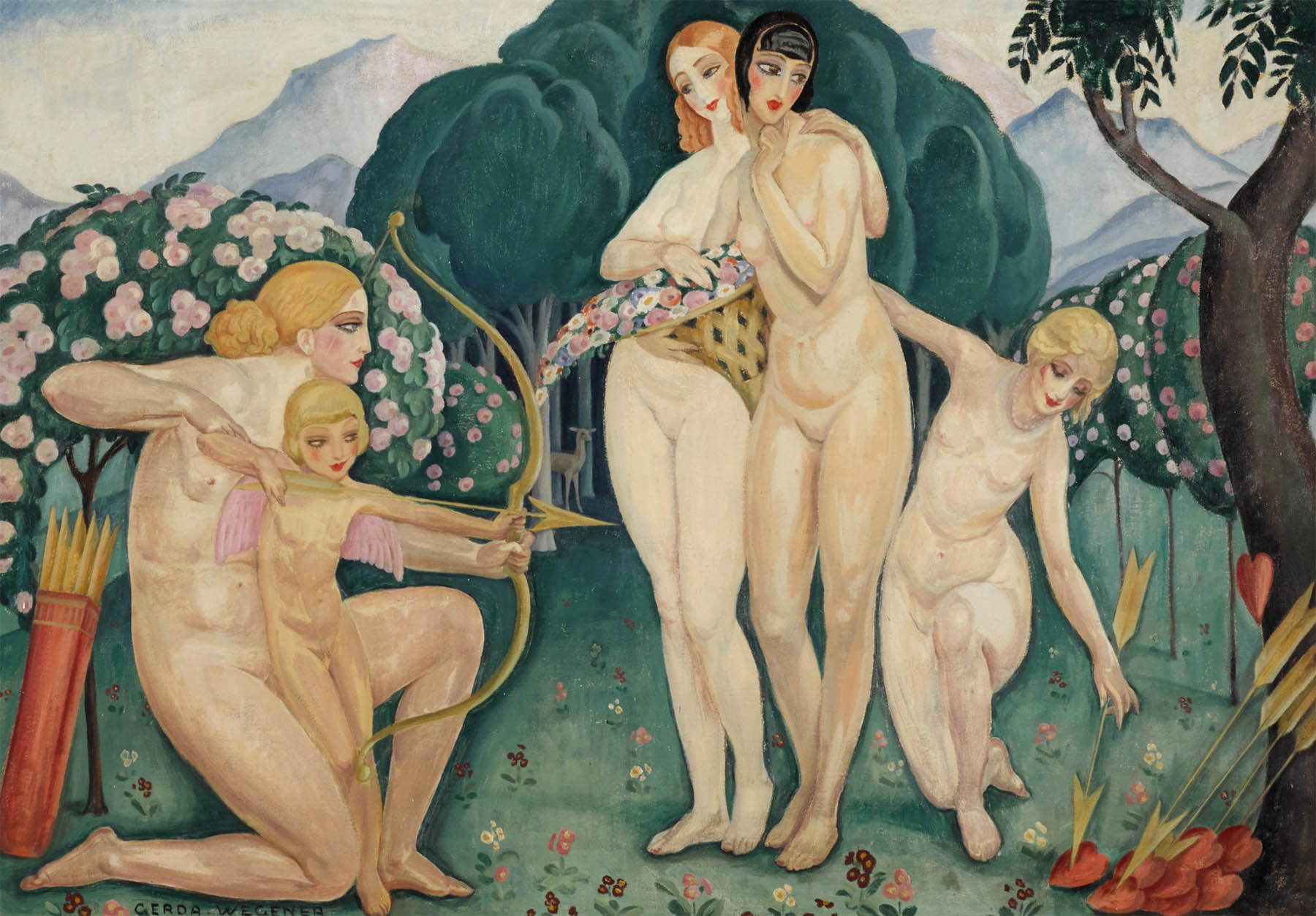
Gerda Wegener (Danish, 1885-1940) 'Venus and Amor' Nd


Gerda Wegener (Danish, 1885-1940)
Venus and Amor
Nd
Oil on canvas
81 by 116cm (31 3/4 by 45 3/4in.)


Gerda Wegener (Danish, 1885-1940) 'Reclining Nude (Lili Elbe)' 1929


Gerda Wegener (Danish, 1885-1940)
Reclining Nude (Lili Elbe)
1929
Watercolour on paper
20.8 x 26.9 in
The Shin Collection, New York
Image Courtesy of Shin Gallery, New York


Gerda Wegener and Lili Elbe

Gerda Wegener (1885-1940) and Lili Elbe (1882-1931) were Danish artists active in the early 20th century. The two met while students at the Royal Danish Academy of Fine Arts where Elbe was known by her birth name Einar Wegener. The couple married in 1904 and both worked as artists. Wegener was known for her illustrations, including female same-sex erotica; Elbe produced landscape paintings.

Lili Elbe began to understand herself as a woman as early as 1904. In 1912, Elbe and Wegener moved from Copenhagen to Paris, where Elbe openly dressed and identified as a woman. Throughout their partnership, Elbe was a favoured muse of Wegener and modelled for many of her paintings, including Art Deco and Art Nouveau images of the independent “New Woman.” Many of Wegener’s images depict female characters in erotic or homosocial environments – in the case of Venus and Amor, feminine and androgynous figures populate an idyllic allegorical scene. In 1930, Elbe traveled to Germany for the first of four sex reassignment surgeries, which was completed under the supervision of physician Magnus Hirschfeld, who had coined the term “transsexual” in 1923. Elbe died from complications of a fourth surgery in 1931.

In 2000, David Ebershoff depicted Wegener and Elbe’s relationship in his book The Danish Girl, which was adapted into a film in 2015.

On view: Lili Elbe (Einar Wegener), An Autumn Day at Bassin de Flore at Versailles, 1917, Oil on canvas; Gerda Wegener, Reclining Nude (Lili Elbe), 1919, Watercolour; Gerda Wegener, Venus and Amor, c. 1920, Oil on canvas; Gerda Wegener, Ulla Poulsen (Ballerina), c. 1927, Oil on canvas; Gerda Wegener, Erotic Scene, Ink and watercolour on paper.


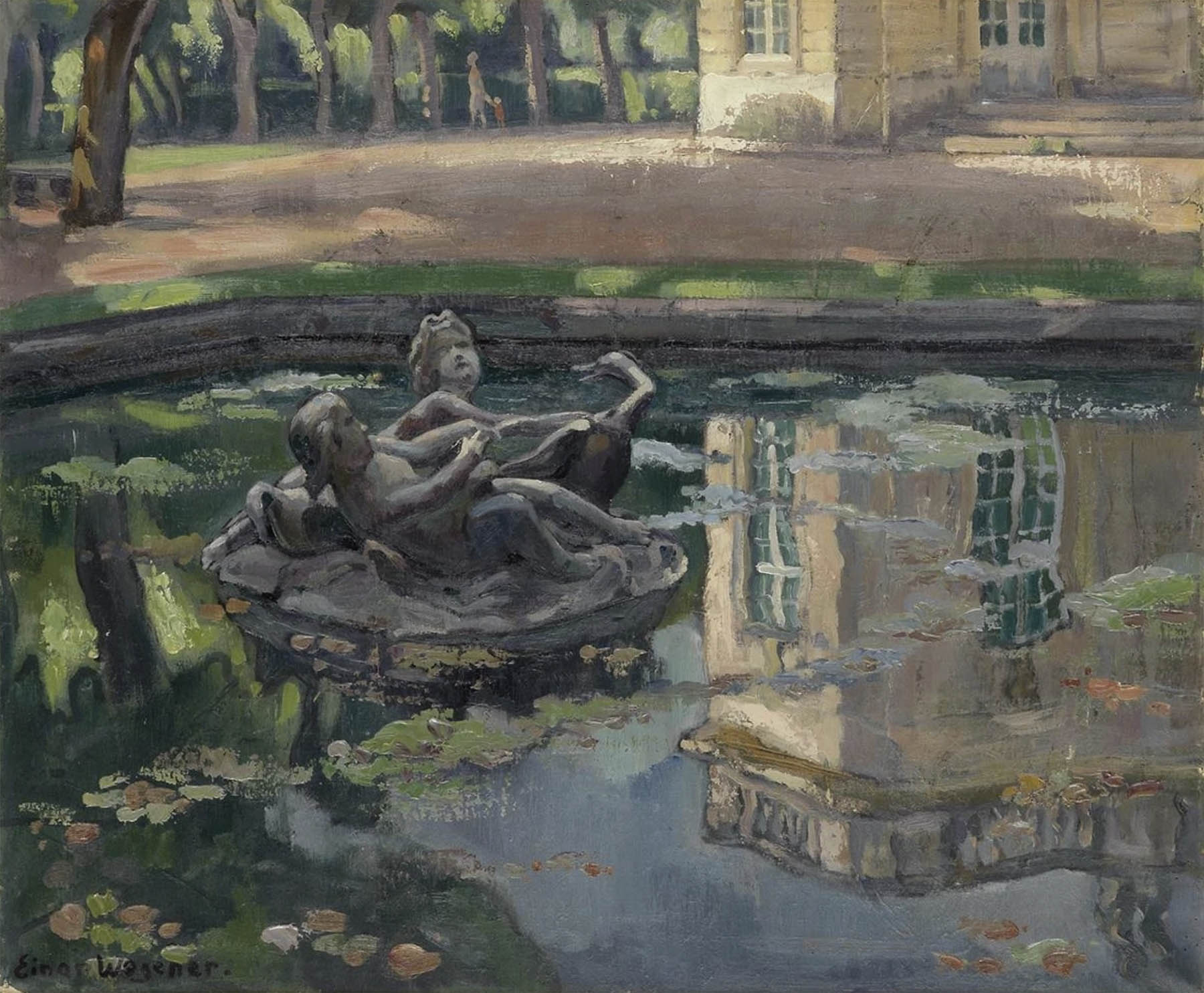
Lili Elbe (Einar Wegener) (Danish, 1882-1931) 'An Autumn Day at Bassin de Flore at Versailles' 1917


Lili Elbe (Einar Wegener) (Danish, 1882-1931)
An Autumn Day at Bassin de Flore at Versailles
1917
Oil on canvas
Height: 61cm (24 in); width: 81cm (31.8 in)


Gerda Wegener (Danish, 1885-1940) 'The Ballerina Ulla Poulsen in the Ballet Chopiniana' Paris, 1927


Gerda Wegener (Danish, 1885-1940)
The Ballerina Ulla Poulsen in the Ballet Chopiniana
Paris, 1927
Oil on canvas


Konstantin Somov (Russian, 1869-1939) 'Portrait of Cécile de Volanges' 1934


Konstantin Somov (Russian, 1869-1939)
Portrait of Cécile de Volanges
1934
Pencils on paper


Konstantin Somov

Konstantin Somov (1869-1939) was a Russian painter and a leading figure in the inter-disciplinary artistic movement and eponymous journal Mir iskusstva (World of Art), active from 1897 to the mid-1920s. Somov often depicted doll-like harlequin characters, women wearing masks, and French Rococo-style costume in his work. Some of these romantic or erotic compositions reference works by Aubrey Beardsley, an English illustrator who also evoked erotic masquerades in his artwork.

In Somov’s scenes, costumes often obscure the gender of couples engaging in romantic activity and reference an excessive game of love and emotion – a theme common to other artists associated with the Decadent movement and Russian Symbolism. Somov was also known for portraying women as ugly or masculine in images he described as encapsulating his frustration with his own same-sex attraction. Along with his erotic scenes, Somov painted male nudes and portraits of his close friends and partners. Somov also adopted the rainbow as a reference to homosexuality via the story of the biblical flood, in which the rainbow represents absolution and acceptance after divine punishment for corporeal sin.

On view: Standing Male Model from Back, 1896, Crayons and sauce-crayon on paper; A Shepard and a Dog, 1898, Exhibition print; Pierrot and Lady (The Fireworks), 1910, Watercolours and whitewash on paper; Les Tribades illustration for Le Livre de la Marquise, Watercolours and zincography on paper; Landscape with Rainbows, 1915, Oil on canvas; Portrait of Cécile de Volanges, 1917, Pencils on paper.


Konstantin Somov (Russian, 1869-1939) 'Pierrot and Lady (The Fireworks)' 1910


Konstantin Somov (Russian, 1869-1939)
Pierrot and Lady (The Fireworks)
1910
Watercolours and whitewash on paper
46 × 35cm


Lionel Wendt (Sri Lankan, 1900-1944) 'Nude with a light bulb' c. 1935


Lionel Wendt (Sri Lankan, 1900-1944)
Nude with a light bulb
c. 1935
Gelatin silver print


Lionel Wendt

Lionel Wendt (1900-1944) was a photographer, pianist, critic, and filmmaker born in Ceylon (modern-day Sri Lanka) to a Burgher father and a Sinhalese mother. As a young man, Wendt traveled to London, where he studied music and earned a law degree. In 1924, Wendt returned to Ceylon and became associated with prominent artists including Geoffrey Beyling, Ivan Peries, and George Keyt, with whom he founded the 43 Group. Recognised as the first modern art group in Ceylon, the 43 Group promoted artwork that departed from academic style and colonial tradition in favour of free expression.

Wendt is known for his photographs of Sinhalese subjects, documentation of indigenous ways of life, intimate portraits, and his experimental images, which deployed techniques the artist observed in Surrealist photography. Some of these images use photography to complicate the act of viewing or trouble the cohesion of Wendt’s subject. For example, Wendt’s Nude with a light bulb (c. 1935) deals with the concept of exposure in multiple registers. The image’s composition alternately exposes the male body and refuses identification, perhaps commenting on the alternately public and private nature of homosexuality. The image also references the techniques of photography itself; a single lightbulb literally exposes a domestic interior to reveal an assembly of jars, pitchers, and timer-tools; items often present in a dark room where a photographer makes an “exposure” of a negative to produce a print.

On view: Nude with a light bulb, c. 1935, Gelatin silver print.


Circle of Eakins. 'Thomas Eakins and students, swimming nude' c. 1883


Circle of Eakins
Thomas Eakins and students, swimming nude
c. 1883
Platinum print
8 15/16 x 11 1/16 in. (22.7 x 28.1cm)
Courtesy of the Pennsylvania Academy of the Fine Arts, Philadelphia
Charles Bregler’s Thomas Eakins Collection, purchased with the partial support of the Pew Memorial Trust


Thomas Cowperthwait Eakins (July 25, 1844 – June 25, 1916) was an American realist painter, photographer, sculptor, and fine arts educator. He is widely acknowledged to be one of the most important American artists.

For the length of his professional career, from the early 1870s until his health began to fail some 40 years later, Eakins worked exactingly from life, choosing as his subject the people of his hometown of Philadelphia. He painted several hundred portraits, usually of friends, family members, or prominent people in the arts, sciences, medicine, and clergy. Taken en masse, the portraits offer an overview of the intellectual life of contemporary Philadelphia; individually, they are incisive depictions of thinking persons.

In addition, Eakins produced a number of large paintings that brought the portrait out of the drawing room and into the offices, streets, parks, rivers, arenas, and surgical amphitheaters of his city. These active outdoor venues allowed him to paint the subject that most inspired him: the nude or lightly clad figure in motion. In the process, he could model the forms of the body in full sunlight, and create images of deep space utilising his studies in perspective. Eakins also took a keen interest in the new technologies of motion photography, a field in which he is now seen as an innovator.

No less important in Eakins’ life was his work as a teacher. As an instructor he was a highly influential presence in American art. The difficulties which beset him as an artist seeking to paint the portrait and figure realistically were paralleled and even amplified in his career as an educator, where behavioural and sexual scandals truncated his success and damaged his reputation.

Eakins was a controversial figure whose work received little by way of official recognition during his lifetime. Since his death, he has been celebrated by American art historians as “the strongest, most profound realist in nineteenth- and early-twentieth-century American art”. …

The Swimming Hole (1884-1885) features Eakins’ finest studies of the nude, in his most successfully constructed outdoor picture. The figures are those of his friends and students, and include a self-portrait. Although there are photographs by Eakins which relate to the painting, the picture’s powerful pyramidal composition and sculptural conception of the individual bodies are completely distinctive pictorial resolutions. The work was painted on commission, but was refused.

In the late 1890s Eakins returned to the male figure, this time in a more urban setting. Taking the Count (1896), a painting of a prizefight, was his second largest canvas, but not his most successful composition. The same may be said of Wrestlers (1899). More successful was Between Rounds (1899), for which boxer Billy Smith posed seated in his corner at Philadelphia’s Arena; in fact, all the principal figures were posed by models re-enacting what had been an actual fight. Salutat (1898), a frieze-like composition in which the main figure is isolated, “is one of Eakins’ finest achievements in figure-painting.” …

Personal life and marriage

The nature of Eakins’ sexuality and its impact on his art is a matter of intense scholarly debate. Strong circumstantial evidence points to discussion during Eakins’s lifetime that he had homosexual leanings, and there is little doubt that he was attracted to men, as evidenced in his photography, and three major paintings where male buttocks are a focal point: The Gross Clinic, Salutat, and The Swimming Hole. The last, in which Eakins appears, is increasingly seen as sensuous and autobiographical.

Until recently, major Eakins scholars persistently denied he was homosexual, and such discussion was marginalised. While there is still no consensus, today discussion of homoerotic desire plays a large role in Eakins scholarship. The discovery of a large trove of Eakins’ personal papers in 1984 has also driven reassessment of his life.

Text from the Wikipedia website


Salutat, Between Rounds (a portion of which was executed separately as Billy Smith) and Taking the Count are a series of three large boxing paintings done by Eakins. The former two depict events surrounding a boxing match that took place on April 22, 1898. Featherweight Tim Callahan fought featherweight Billy Smith in a match that was close until the final round, when Callahan gained the advantage and won the fight. However, for Salutat, Eakins chose to depict Smith as the winner. In the work, Smith raises his hand to salute the audience, in the style of a gladiator. On the painting’s original frame Eakins carved the words “DEXTRA VICTRICE CONCLAMANTES SALVTAT” (With the victorious right hand, he salutes those shouting [their approval]).

As with a number of other Eakins works, the rendering of the figures is extremely precise, such that it has allowed art historians to identify individual members of the audience. While working on the boxing pictures, friends would visit the studio, and Eakins invited them to “stay a while and I’ll put you in the picture.” For Salutat, audience members include Eakins’s friend Louis Kenton (wearing eyeglasses and a bow tie), sportswriter Clarence Cranmer (wearing a bowler hat), David Jordan (brother of Letitia Wilson Jordan, whom Eakins painted in Portrait of Letitia Wilson Jordan), photographer Louis Husson (next to Jordan), Eakins’s student Samuel Murray, and Eakins’s father Benjamin Eakins.

Smith is bathed in soft white light, which illuminates his muscles. Amid a general tonality of warm greys and browns that contains no strong chromatic notes, the skin tones of the three main figures are pale. All three men have the quality of relief sculpture, and with Smith’s figure separate from those of his seconds, they appear to move across the canvas in an arrangement reminiscent of a frieze.

Text from the Wikipedia website


Thomas Eakins (American, 1844-1916) 'Salutat' 1898


Thomas Eakins (American, 1844-1916)
Salutat
1898
Oil on canvas
50 in. x 40 in. (127 cm x 101.6cm)
Addison Gallery of American Art, Phillips Academy, Andover, Massachusetts, gift of anonymous donor
Replica of Thomas Eakins’ original frame created and given as a partial gift by Eli Wilner & Company with the additional support of Maureen Barden and David Othmer


Katz told Windy City Times that being defined as a homosexual “was both a gift and a problem” for queer people during those years, depending on how the word affected their daily lives. For some, it clarified who they were and that was a benefit to them while for others their sexual possibilities were limited otherwise people would define them as a homosexual.

“The reason this is important is previously same-sex desire was understood not as a noun but as a verb,” said Katz. “It was something you did, not something you are. What we are trying to do is assess what happens after the identity category was created and a group of people fell under that name. The important theoretical point I am trying to make is that as language grew increasingly strict and binary, the menu of sexual and gender possibilities that was open to everybody grew increasingly constricted. What resulted out of that is as language became increasingly impoverished regarding sexuality and gender, art took up the slack. Art started to represent all sorts of sexual possibilities that language could no longer understand or name.” …

“These works will be looked at not just in the Euro-American frame, but in a global frame,” said Katz. “We are also assessing how, for example, following the lines of colonial domination European ideas were imposed over more local sexual definitions and names. What we have really is the first imaging of the first homosexuals. What is remarkable about this is some of these are among the most famous paintings among the most famous painters in their respective regions, but they have not been gathered under this rubric. The images are known, they just have not been interpreted in this way.” …

“This show resolutely demonstrates that we, as queer people, have a history, too – a rich, complex history that has been left out of the prevailing accounts of art history,” said Willis. “Too often we hear the accusation that queer, trans, and non-binary identities are something ‘new,’ and thus something without a history. The exhibition shuts down any such allegation, resurfacing this ‘lost’ generation of modern LGBTQ ancestry.” …

“I think this exhibition will begin to open up or underscore the way in which our language of binaries is way too delimited and poor of frame to understand the complexities of human behavior,” said Katz. “What this show does, and what art is great at because it does not have to use language, is depict all these variations. You will see therefore a range of possibilities of gender and sexual desire that our language does not have words for.”

Carrie Maxwell. “Jonathan D. Katz previews his upcoming ‘First Homosexuals’ exhibit,” on the Windy City Times website 17th September 2022 [Online] Cited 05/11/2022


Louise Abbéma (French, 1853-1927) 'Sarah Bernhardt et Louise Abbéma sur un lac' 1883


Louise Abbéma (French, 1853-1927)
Sarah Bernhardt et Louise Abbéma sur un lac
1883
Oil on canvas
63 x 82.7 x 1.2 in (framed)
Collections Comédie-Française


Louise Abbéma (30 October 1853 – 29 July 1927) was a French painter, sculptor, and designer of the Belle Époque. …

She was a regular exhibitor at the Paris Salon, where she received an honourable mention for her panels in 1881. Abbéma was also among the female artists whose works were exhibited in the Women’s Building at the 1893 World Columbian Exposition in Chicago. A bust Sarah Bernhardt sculpted of Abbéma was also exhibited at the exposition.

Abbéma specialised in oil portraits and watercolours, and many of her works showed the influence from Chinese and Japanese painters, as well as contemporary masters such as Édouard Manet. She frequently depicted flowers in her works. Among her best-known works are The Seasons, April Morning, Place de la Concorde, Among the Flowers, Winter, and portraits of actress Jeanne Samary, Emperor Dom Pedro II of Brazil, Ferdinand de Lesseps, and Charles Garnier. …

New Woman

As educational opportunities were made more available in the 19th century, women artists became part of professional enterprises, including founding their own art associations. Artwork made by women was considered to be inferior, and to help overcome that stereotype women became “increasingly vocal and confident” in promoting women’s work, and thus became part of the emerging image of the educated, modern and freer “New Woman”. Artists then, “played crucial roles in representing the New Woman, both by drawing images of the icon and exemplifying this emerging type through their own lives,” including Abbéma who created androgynous self-portraits to “link intellectual life through emphasis on ocularity”. Many other portraits included androgynously dressed women, and women participating in intellectual and other pastimes traditionally associated with men.

Text from the Wikipedia website


Marsden Hartley (American, 1877-1943) 'Berlin Ante War' 1914


Marsden Hartley (American, 1877-1943)
Berlin Ante War
1914
Oil on canvas with painted wood frame
34 x 43 in.
Columbus Museum of Art, Ohio: gift of Ferdinand Howald

“Berlin Ante War” (1914), or “Prewar,” explores the profound impact the city had on the artist.


Marsden Hartley (January 4, 1877 – September 2, 1943) was an American Modernist painter, poet, and essayist. Hartley developed his painting abilities by observing Cubist artists in Paris and Berlin. …

German sympathies

In April 1913 Hartley relocated to Berlin, the capital of the German Empire where he continued to paint, and became friends with the painters Wassily Kandinsky and Franz Marc. He also collected Bavarian folk art. His work during this period was a combination of abstraction and German Expressionism, fuelled by his personal brand of mysticism. Many of Hartley’s Berlin paintings were further inspired by the German military pageantry then on display, though his view of this subject changed after the outbreak of World War I, once war was no longer “a romantic but a real reality”.

Two of Hartley’s Cézanne-inspired still life paintings and six charcoal drawings were selected to be included in the landmark 1913 Armory Show in New York.

In Berlin, Hartley developed a close relationship with a Prussian lieutenant, Karl von Freyburg, who was the cousin of Hartley’s friend Arnold Ronnebeck. References to Freyburg were a recurring motif in Hartley’s work, most notably in Portrait of a German Officer (1914). Freyburg’s subsequent death during the war hit Hartley hard, and he afterward idealised their relationship. Many scholars interpreted his work regarding Freyburg as embodying homosexual feelings for him. Hartley lived in Berlin until December 1915.

Hartley returned to the U.S. from Berlin as a German sympathiser following World War I. Hartley created paintings with much German iconography. The homoerotic tones were overlooked as critics focused on the German point of view. According to Arthur Lubow, Hartley was disingenuous in arguing that there was “no hidden symbolism whatsoever”. …

Hartley was not overt about his homosexuality, often redirecting attention towards other aspects of his work. Works such as Portrait of a German Officer and Handsome Drinks are coded. The compositions honour lovers, friends, and inspirational sources. Hartley no longer felt unease at what people thought of his work once he reached his sixties. His figure paintings of athletic, muscular males, often nude or garbed only in briefs or thongs, became more intimate, such as Flaming American (Swim Champ), 1940 or Madawaska – Acadian Light-Heavy – Second Arrangement (both from 1940). As with Hartley’s German officer paintings, his late paintings of virile males are now assessed in terms of his affirmation of his homosexuality.

Text from the Wikipedia website


Duncan Grant (British, 1885-1978) 'Bathers at the Pond' 1920-1921


Duncan Grant (British, 1885-1978)
Bathers at the Pond
1920-1921
Oil on canvas
35 x 19 in.
© Estate of Duncan Grant. All rights reserved, DACS London / ARS, New York


Duncan James Corrowr Grant (21 January 1885 – 8 May 1978) was a British painter and designer of textiles, pottery, theatre sets and costumes. He was a member of the Bloomsbury Group.


Frances Hodgkins (New Zealand, 1869-1947) 'Friends (Double Portrait)' [Hannah Ritchie and Jane Saunders] 1922-1923


Frances Hodgkins (New Zealand, 1869-1947)
Friends (Double Portrait) [Hannah Ritchie and Jane Saunders]
1922-1923
Oil on canvas
24 x 30.3 in.
Hocken Collections, Uare Taoka o Hākena, University of Otago


Frances Mary Hodgkins (28 April 1869 – 13 May 1947) was a New Zealand painter chiefly of landscape and still life, and for a short period was a designer of textiles. She was born and raised in New Zealand, but spent most of her working life in England. She is considered one of New Zealand’s most prestigious and influential painters, although it is the work from her life in Europe, rather than her home country, on which her reputation rests.

Hannah Ritchie and Jane Saunders were artists and taught art at the Manchester Girls High School. They were friends and supporters of artist Frances Hodgkins.

There is in Hodgkins’s life, however, evidence of an unconventional existence, supported, populated, and propelled by a roll call of LGBTQI+ people, including: Jane Saunders, Hannah Ritchie, Amy Krause, Dorothy Selby, Arthur Lett Haines, Cedric Morris, Norman Notley, David Brynley, Geoffrey Gorer, Christopher Wood, Philip and Lady Ottoline Morrell, Duncan Grant … and many more. While this is not proof that Hodgkins was a lesbian (if that should even be necessary), it signals an openness to a queer world – its people and their relationships – that makes for a fascinating investigation. …

In the early-to-mid-1920s, she lived off and on with lesbian partners Jane Saunders and Hannah Ritchie. These were desperate years for Hodgkins. Ritchie and Saunders housed and fed her, and gave her financial support in the form of an allowance. When Hodgkins was seriously thinking of returning to New Zealand, they gave her reason to stay in the United Kingdom. …

Ritchie and Saunders, both students of Hodgkins since 1911 and 1912, drew her into their milieu of influential literary and artistic friends. Their network included Forrest Hewit, chairman of the Calico Printers’ Association who helped her secure a job as a designer on a salary of £500 a year. The job-offer came just a month before Hodgkins was due to return home to New Zealand and changed the course of her life forever.

Joanne Drayton. “Frances Hodgkins: A portrait of queer love,” on the Te Papa Tongarewa website Nd [Online] Cited 06/11/2022


Unknown photographer. 'Hannah Richie, Frances Hodgkins, and Jane Saunders seated in a garden' c. 1925


Unknown photographer
Hannah Richie, Frances Hodgkins, and Jane Saunders seated in a garden
c. 1925
Cellulose triacetate copy negative
12.5 x 10cm
National Library of New Zealand

Please note: Photograph not in exhibition


Curator of The First Homosexuals: Global Depictions of a New Identity, 1869-1930, Jonathan D. Katz, discusses Berlin Ante War by Mardsen Hartley.
Videography by Steve Rosofsky


Curator of The First Homosexuals: Global Depictions of a New Identity, 1869-1930, Jonathan D. Katz, discusses Salutat by Thomas Eakins.
Videography by Steve Rosofsky.
Introductory clip: A Representation of Loïe Fuller and her “Serpentine Dance” produced by Pathé Frères in 1905.


Curator of The First Homosexuals: Global Depictions of a New Identity, 1869-1930, Jonathan D. Katz, discusses the work of Louise Abbéma.
Videography by Steve Rosofsky.


Wrightwood 659
659 W. Wrightwood
Chicago, IL 60614

Opening hours:
Friday 12 – 7pm
Saturday 10am – 5pm

Wrightwood 659 website

LIKE ART BLART ON FACEBOOK

Back to top

Exhibition: ‘Portraits of Renown: Photography and the Cult of Celebrity’ at the J. Paul Getty Museum, Los Angeles

Exhibition dates: 3rd April – 26th August 2012


Marie Cosindas (American, 1925-2017) 'Yves Saint Laurent, Paris' 1968


Marie Cosindas (American, 1925-2017)
Yves Saint Laurent, Paris
1968
Dye colour diffusion [Polaroid ®] print
The J. Paul Getty Museum, Los Angeles
© Marie Cosindas


On the Nature of Photography


“To get from the tangible to the intangible (which mature artists in any medium claim as part of their task) a paradox of some kind has frequently been helpful. For the photographer to free himself of the tyranny of the visual facts upon which he is utterly dependent, a paradox is the only possible tool. And the talisman paradox for unique photography is to work “the mirror with a memory” as if it were a mirage, and the camera is a metamorphosing machine, and the photograph as if it were a metaphor… Once freed of the tyranny of surfaces and textures, substance and form [the photographer] can use the same to pursue poetic truth.”


Minor White quoted in Beaumont Hewhall (ed.,). The History of Photography. Boston: Little, Brown, and Co., 1982, p. 281


“Carol Jerrems and I taught at the same secondary school in the 1970’s. In a classroom that was unused at that time, I remember having my portrait taken by her. She held her Pentax to her eye. Carols’ portraits all seemed to have been made where the posing of her subjects was balanced by an incisive naturalness (for want of a better description). As a challenge to myself I tried to look “natural”, but kept in my consciousness that I was having my portrait taken. Minutes passed and neither she nor her camera moved at all.

Then the idea slipped from my mind for just a moment, and I was straightaway bought back by the sound of the shutter. What had changed in my face? – probably nothing, or 1 mm of muscle movement. Had she seen it through the shutter? Or something else – I don’t know.”


Australian artist Ian Lobb on being photographed by the late Carol Jerrems


There is always something that you can’t quite put your finger on in an outstanding portrait, some ineffable other that takes the portrait into another space entirely. I still haven’t worked it out but my thoughts are this: forget about the pose of the person. It would seem to me to be both a self conscious awareness by the sitter of the camera and yet at the same time a knowing transcendence of the visibility of the camera itself. In great portrait photography it is almost as though the conversation between the photographer and the person being photographed elides the camera entirely. Minor White, in his three great mantras, the Three Canons, observes:


Be still with yourself
Until the object of your attention
Affirms your presence

Let the Subject generate its own Composition

When the image mirrors the man
And the man mirrors the subject
Something might take over


Freed from the tyranny of the visual facts something else emerges.

Celebrities know only too well how to “work” the camera but the most profound portraits, even of celebrities, are in those moments when the photographer sees something else in the person being photographed, some unrecognised other that emerges from the shadows – a look, a twist of the head, the poignancy of the mouth, the vibrancy of the dancer Josephine Baker, the sturdiness of the gaze of Walt Whitman with hands in pockets, the presence of the hands (no, not the gaze!) of Picasso. I remember taking a black and white portrait of my partner Paul holding a wooden finial like a baby among some trees, a most beautiful, revealing photograph. He couldn’t bear to look at it, for it stripped him naked before the lens and showed a side of himself that he had never seen before: vulnerable, youthful, beautiful.

Why do great portrait photographers make so many great portraits? Why can’t this skill be shared or taught? Why can’t Herb Ritts (for example) make a portrait that goes beyond a caricature? Why is it that what can be taught is so banal that it has no value?

In photography, maybe we edit out what is expected and then it seems that photography does something that goes beyond language; it goes beyond function that can be described as a part of speech, metonym or metaphor. When this something else takes over I think it is truly “unrecognised” in the best portraits (and landscape / urban photographs) – and it is fantastic and wonderful.

This is my understanding, then, of perception and vision (when spirit takes over) – [which is] the ability to see this certain something in the mind (previsualisation) before seeing it through the viewfinder and to then be able to reveal it in the physicality of the print. It is a liminal moment in time and space.

I believe this is the reality of photography itself in its absolute essential form – and here I am deliberately forgetting about post-photography, post-modernism, modernism, pictorialism, ism, ism – getting down to why I really like photography:

the BEYOND visualisation of a world, the transcendence of time and space that leads, in great photographs, to a recognition of the discontinuous nature of life but in the end, to its ultimate persistence.

This is as close as I have got so far…

Dr Marcus Bunyan
August 2012


Many thankx to the J. Paul Getty Museum for allowing me to publish the photographs in the posting. Please click on the photograph for a larger version of the image.


Mariana Cook (American, b. 1955) 'Barack and Michelle Obama, Chicago' May 26, 1996


Mariana Cook (American, b. 1955)
Barack and Michelle Obama, Chicago
May 26, 1996
Selenium-toned gelatin silver print
The J. Paul Getty Museum, Los Angeles


Marie Cosindas (American, 1925-2017) 'Andy Warhol' 1966


Marie Cosindas (American, 1925-2017)
Andy Warhol
1966
Dye colour diffusion [Polaroid ®] print
11.4 x 8.9cm
The J. Paul Getty Museum, Los Angeles
© Marie Cosindas


Marie Cosindas (American, 1925-2017) 'Yves St Laurent' 1968


Marie Cosindas (American, 1925-2017)
Yves St Laurent
1968
Dye colour diffusion [Polaroid ®] print
11.4 x 8.9cm
The J. Paul Getty Museum, Los Angeles
© Marie Cosindas


Andy Warhol (American, 1928-1987) 'Grace Jones' 1984


Andy Warhol (American, 1928-1987)
Grace Jones
1984
Polaroid Polacolor print
9.5 x 7.3cm
The J. Paul Getty Museum, Los Angeles
© 2011 The Andy Warhol Foundation for the Visual Arts / Artists Rights Society (ARS), New York


Edward Weston (American, 1889-1958) 'Igor Stravinsky' 1935


Edward Weston (American, 1889-1958)
Igor Stravinsky
1935
Gelatin silver print
The J. Paul Getty Museum, Los Angeles


Coy Watson Jr. (American, 1912-2009) 'Joe Louis – “The Brown Bomber”, Los Angeles, February 1935'


Coy Watson Jr. (American, 1912-2009)
Joe Louis – “The Brown Bomber”, Los Angeles, February 1935
1935
Gelatin silver print
The J. Paul Getty Museum, Los Angeles


Edward Steichen (American, 1879-1973) 'Gloria Swanson' 1924


Edward Steichen (American, 1879-1973)
Gloria Swanson
1924
Gelatin silver print
27.8 x 21.6cm (10 15/16 x 8 1/2 in.)
The J. Paul Getty Museum, Los Angeles
© Permission Joanna T. Steichen


Portraits of Renown surveys some of the visual strategies used by photographers to picture famous individuals from the 1840s to the year 2000. “This exhibition offers a brief visual history of famous people in photographs, drawn entirely from the Museum’s rich holdings in this genre,” says Paul Martineau, curator of the exhibition and associate curator of photographs at the J. Paul Getty Museum. “It also provides a broad historical context for the work in the concurrent exhibition Herb Ritts: L.A. Style, which includes a selection of Ritts’s best celebrity portraits.”

Photography’s remarkable propensity to shape identities has made it the leading vehicle for representing the famous. Soon after photography was invented in the 1830s, it was used to capture the likenesses and accomplishments of great men and women, gradually supplanting other forms of commemoration. In the twentieth century, the proliferation of photography and the transformative power of fame have helped to accelerate the desire for photographs of celebrities in magazines, newspapers, advertisements, and on the Internet. The exhibition is arranged chronologically to help make visible some of the overarching technical and stylistic developments in photography from the first decade of its invention to the end of the twentieth century.

A wide range of historical figures are portrayed in Portraits of Renown. A photograph by Alexander Gardner of President Lincoln documents his visit to the battlefield of Antietam during the Civil War. Captured by Nadar, a portrait of Alexander Dumas, best known for his novels The Count of Monte Cristo and The Three Musketeers, shows the author with an energetic expression, illustrating the lively personality that made his writing so popular. Baron Adolf De Meyer’s portrait of Josephine Baker, an American performer who became an international sensation at the Folies Bergère in Paris, showcases her comedic charm, a trait that proved central to her popularity as a performer. An iconic portrait of the silent screen actress, Gloria Swanson, created by Edward Steichen for Vanity Fair reveals both the intensity of its sitter and the skill of the artist. A picture of Pablo Picasso by his friend Man Ray portrays the master of Cubism with a penetrating gaze.

Yves St. Laurent, Andy Warhol, and Grace Jones are among the contemporary figures included in the exhibition. Fashion designer Yves St. Laurent was photographed by Marie Cosindas using instant color film by Polaroid. The photograph, made the year his first boutique in New York opened, graced the walls of the store for ten years. A Cosindas portrait of Andy Warhol shows the artist wearing dark sunglasses, which partially conceal his face. Warhol, who was fascinated by celebrity, delighted in posing public personalities like Grace Jones for his camera.

Press release from the J. Paul Getty Museum website


Man Ray (American, 1890-1976) 'Pablo Picasso' 1934


Man Ray (American, 1890-1976)
Pablo Picasso
1934
Gelatin silver print
25.2 x 20cm
The J. Paul Getty Museum, Los Angeles
© Man Ray Trust ARS-ADAGP


Berenice Abbott (American, 1898-1991) 'James Joyce' 1928


Berenice Abbott (American, 1898-1991)
James Joyce
1928
Gelatin silver print
The J. Paul Getty Museum, Los Angeles


Baron Adolf De Meyer (American born France, 1868-1946) 'Portrait of Josephine Baker' 1925


Baron Adolf De Meyer (American born France, 1868-1946)
Portrait of Josephine Baker
1925
Collotype print
39.1 x 39.7cm
The J. Paul Getty Museum, Los Angeles


In 1925 Josephine Baker, an American dancer from Saint Louis, Missouri, made her debut on the Paris stage in La Revue nègre (The Black Review) at the Théâtre des Champs-Elysées, wearing nothing more than a skirt of feathers and performing her danse sauvage (savage dance). She was an immediate sensation in Jazz-Age France, which celebrated her perceived exoticism, quite the opposite of the reception she had received dancing in American choruses. American expatriate novelist Ernest Hemingway called Baker “the most sensational woman anybody ever saw – or ever will.”

Baron Adolf de Meyer, a society and fashion photographer, took this playful portrait in the year of Baker’s debut. Given the highly sexual nature of her stage persona, this portrait is charming and almost innocent; Baker’s personality is suggested by her face rather than her famous body.

Text from the J. Paul Getty website


Edward Steichen (American, 1879-1973) 'John Barrymore as Hamlet' 1922


Edward Steichen (American, 1879-1973)
John Barrymore as Hamlet
1922
Gelatin silver print
The J. Paul Getty Museum, Los Angeles


Alfred Stieglitz (American, 1964-1946) 'Georgia O'Keeffe: A Portrait' 1918


Alfred Stieglitz (American, 1964-1946)
Georgia O’Keeffe: A Portrait
1918
Gelatin silver print
The J. Paul Getty Museum, Los Angeles


Arnold Genthe (American born Germany, 1869-1942) 'Anna Pavlowa' about 1915


Arnold Genthe (American born Germany, 1869-1942)
Anna Pavlowa
about 1915
Gelatin silver print
33.5 × 25.2cm (13 3/16 × 9 15/16 in.)
The J. Paul Getty Museum, Los Angeles


The Russian ballerina Anna Pavlowa (or Pavlova) so greatly admired Arnold Genthe’s work that she made the unusual decision to visit his studio, rather than have him come to her rehearsals. The resulting portrait of the prolific dancer, leaping in mid-air, is the only photograph to capture Pavlowa in free movement. Genthe regarded this print as one of the best dance photographs he ever made.

Text from the J. Paul Getty website


Alvin Langdon Coburn (British born United States, 1882-1966) 'Mark Twain (Samuel Langhorne Clemens)' Negative December 21, 1908; print 1913


Alvin Langdon Coburn (British born United States, 1882-1966)
Mark Twain (Samuel Langhorne Clemens)
Negative December 21, 1908; print 1913
Photogravure
20.6 × 14.8cm (8 1/8 × 5 13/16 in.)
The J. Paul Getty Museum, Los Angeles


Alfred Stieglitz (American, 1864-1946) '[Self-Portrait]' Negative 1907; print 1930


Alfred Stieglitz (American, 1864-1946)
[Self-Portrait]
Negative 1907; print 1930
Gelatin silver print
24.8 × 18.4cm (9 3/4 × 7 1/4 in.)
The J. Paul Getty Museum, Los Angeles


Edward Steichen (American 1879-1973) 'Rodin The Thinker' 1902


Edward Steichen (American, 1879-1973)
Rodin – Le Penseur (The Thinker)
1902
Gelatin-carbon print
The J. Paul Getty Museum, Los Angeles


Sarah Choate Sears (American, 1858-1935) '[Julia Ward Howe]' about 1890


Sarah Choate Sears (American, 1858-1935)
[Julia Ward Howe]
about 1890
Platinum print
23.5 × 18.6cm (9 1/4 × 7 5/16 in.)
The J. Paul Getty Museum, Los Angeles


Julia Ward Howe (May 27, 1819 – October 17, 1910) was an American poet and author, known for writing “The Battle Hymn of the Republic” and the original 1870 pacifist Mother’s Day Proclamation. She was also an advocate for abolitionism and a social activist, particularly for women’s suffrage.


Sarah Choate Sears (American, 1858-1935) 'John Singer Sargent' about 1890


Sarah Choate Sears (American, 1858-1935)
John Singer Sargent
about 1890
Gelatin silver print
The J. Paul Getty Museum, Los Angeles


Although John Singer Sargent was the most famous American portrait painter of his time, he apparently did not like to be photographed. The few photographs that exist show him at work, as he is here, sketching and puffing on a cigar. His friend Sarah Choate Sears, herself a painter of some note, drew many of her sitters for photographs from the same aristocratic milieu as Sargent did for his paintings.

Text from the J. Paul Getty website


Nadar [Gaspard Félix Tournachon] (French, 1820-1910) '[Sarah Bernhardt as the Empress Theodora in Sardou's "Theodora"]' Negative 1884; print and mount about 1889


Nadar (Gaspard Félix Tournachon) (French, 1820-1910)
[Sarah Bernhardt as the Empress Theodora in Sardou’s “Theodora”]
Negative 1884; print and mount about 1889
Albumen silver print
14.6 × 10.5 cm (5 3/4 × 4 1/8 in.)
The J. Paul Getty Museum, Los Angeles


J. Wood (American, active New York, New York 1870s-1880s) 'L.P. Federmeyer' 1879


J. Wood (American, active New York, New York 1870s-1880s)
L.P. Federmeyer
1879
Albumen silver print
14.8 × 10 cm (5 13/16 × 3 15/16 in.)
The J. Paul Getty Museum, Los Angeles


Julia Margaret Cameron (British born India, 1815-1879) 'Ellen Terry at Age Sixteen' 1864


Julia Margaret Cameron (British born India, 1815-1879)
Ellen Terry at Age Sixteen
Negative 1864; print about 1875
Carbon print
24.1cm (9 1/2 in.)
The J. Paul Getty Museum, Los Angeles


This image of Ellen Terry (1847-1928) is one of the few known photographs of a female celebrity by Julia Margaret Cameron. Terry, the popular child actress of the British stage, was sixteen years old when Cameron made this image. This photograph was most likely taken just after she married the eccentric painter, George Frederick Watts (1817-1904), who was thirty years her senior. They spent their honeymoon in the village of Freshwater on the Isle of Wight where Cameron resided.

Cameron’s portrait echoes Watt’s study of Terry titled Choosing (1864, National Portrait Gallery, London). As in the painting, Terry is shown in profile with her eyes closed, an ethereal beauty in a melancholic dream state. In this guise, Terry embodies the Pre-Raphaelite ideal of womanhood rather than appearing as the wild boisterous teenager she was known to be. The round (“tondo”) format of this photograph was popular among Pre-Raphaelite artists.

Cameron titled another print of this image Sadness (see 84.XZ.186.52), which may suggest the realisation of a mismatched marriage. Terry’s anxiety is plainly evident – she leans against an interior wall and tugs nervously at her necklace. The lighting is notably subdued, leaving her face shadowed in doubt. In The Story of My Life (1909), Terry recalls how demanding Watts was, calling upon her to sit for hours as a model and giving her strict orders not to speak in front of distinguished guests in his studio.

This particular version was printed eleven years after Cameron first made the portrait. In order to distribute this image commercially, the Autotype Company of London rephotographed the original negative after the damage had been repaired. The company then made new prints using the durable, non-fading carbon print process. Thus, this version is in reverse compared to Sadness. Terry’s enduring popularity is displayed by the numerous photographs taken of her over the years. Along with the two portraits by Cameron, the Getty owns three more of Terry by other photographers.

Adapted from Julian Cox. Julia Margaret Cameron, In Focus: Photographs from the J. Paul Getty Museum (Los Angeles: J. Paul Getty Museum, 1996), 12. ©1996 The J. Paul Getty Museum; with additions by Carolyn Peter, J. Paul Getty Museum, Department of Photographs, 2019.


Charles DeForest Fredricks (American, 1823-1894) '[Mlle Pepita]' 1863


Charles DeForest Fredricks (American, 1823-1894)
[Mlle Pepita]
1863
Albumen silver print
9 × 5.4cm (3 9/16 × 2 1/8 in.)
The J. Paul Getty Museum, Los Angeles


André Adolphe-Eugène Disdéri (French, 1819-1889) '[Rosa Bonheur]' 1861-1864


André Adolphe-Eugène Disdéri (French, 1819-1889)
[Rosa Bonheur]
1861-1864
Albumen silver print
8.4 × 5.2cm (3 5/16 × 2 1/16 in.)
The J. Paul Getty Museum, Los Angeles


Rosa Bonheur, born Marie-Rosalie Bonheur (16 March 1822 – 25 May 1899), was a French artist, mostly a painter of animals (animalière) but also a sculptor, in a realist style. Her best-known paintings are Ploughing in the Nivernais, first exhibited at the Paris Salon of 1848, and now at the Musée d’Orsay in Paris, and The Horse Fair (in French: Le marché aux chevaux), which was exhibited at the Salon of 1853 (finished in 1855) and is now in the Metropolitan Museum of Art, in New York City. Bonheur was widely considered to be the most famous female painter of the nineteenth century.

Text from the Wikipedia website


Mathew B. Brady (American, about 1823-1896) 'Walt Whitman' about 1870


Mathew B. Brady (American, about 1823-1896)
Walt Whitman
about 1870
Albumen silver print
14.6 x 10.3cm
The J. Paul Getty Museum, Los Angeles


Mathew B. Brady (American, about 1823-1896) 'Robert E. Lee' 1865


Mathew B. Brady (American, about 1823-1896)
Robert E. Lee
1865
Albumen silver print
The J. Paul Getty Museum, Los Angeles


John Robert Parsons (British, about 1826-1909) '[Portrait of Jane Morris (Mrs. William Morris)]' Negative July 1865; print after 1900


John Robert Parsons (British, about 1826-1909)
[Portrait of Jane Morris (Mrs. William Morris)]
Negative July 1865; print after 1900
Gelatin silver print
22.9 × 19.2cm (9 × 7 9/16 in.)
The J. Paul Getty Museum, Los Angeles


Nadar [Gaspard Félix Tournachon] (French, 1820-1910) 'George Sand (Amandine-Aurore-Lucile Dupin), Writer' c. 1865


Nadar (Gaspard Félix Tournachon) (French, 1820-1910)
George Sand (Amandine-Aurore-Lucile Dupin)
about 1865
Albumen silver print
The J. Paul Getty Museum, Los Angeles


Amandine-Aurore-Lucile Dudevant, née Dupin, took the pseudonym George Sand in 1832. She was a successful Romantic novelist and a close friend of Nadar, and during the 1860s he photographed her frequently. Her writing was celebrated for its frequent depiction of working-class or peasant heroes. She was also a woman as renowned for her romantic liaisons as her writing; here she allowed Nadar to photograph her, devoid of coquettish charms but nevertheless a commanding presence.

This portrait is a riot of textural surfaces. The sumptuous satin of Sand’s gown and silken texture of her hair have a rich tactile presence. Her shimmering skirt melts into the velvet-draped support on which she leans, creating a visual triangle with the careful centre part of her wavy hair. The portrait details the exquisite laces, beads, and buttons of her gown, but her face, the apex of the triangle, is out of focus. Sand was apparently unable to remain perfectly still throughout the exposure, and the slight blurring of her facial features erases the unforgiving details that the years had drawn upon her.

Text from the J. Paul Getty website


Alexander Gardner (American born Scotland, 1821-1882) 'President Lincoln, United States Headquarters, Army of the Potomac, near Antietam, October 4, 1862'


Alexander Gardner (American born Scotland, 1821-1882)
President Lincoln, United States Headquarters, Army of the Potomac, near Antietam, October 4, 1862
1862
Albumen silver print
21.9 x 19.7cm (8 5/8 x 7 3/4 in.)
The J. Paul Getty Museum, Los Angeles


Twenty-six thousand soldiers were killed or wounded in the Battle of Antietam on September 17, 1862, after which Confederate General Robert E. Lee was forced to retreat to Virginia. Just two weeks after the victory, President and Commander-in-Chief Abraham Lincoln conferred with General McClernand and Allan Pinkerton, Chief of the nascent Secret Service, who had organised espionage missions behind Confederate lines.

Lincoln stands tall, front and centre in his stovepipe hat, his erect and commanding posture emphasised by the tent pole that seems to be an extension of his spine. The other men stand slightly apart in deference to their leader, in postures of allegiance with their hands covering their hearts. The reclining figure of the man at left and the shirt hanging from the tree are a reminder that, although this is a formally posed picture, Lincoln’s presence did not halt the camp’s activity, and no attempts were made to isolate him from the ordinary circumstances surrounding the continuing military conflict.

Text from the J. Paul Getty website


Alexander Gardner (American born Scotland, 1821-1882) 'President Lincoln, United States Headquarters, Army of the Potomac, near Antietam, October 4, 1862' (detail)


Alexander Gardner (American born Scotland, 1821-1882)
President Lincoln, United States Headquarters, Army of the Potomac, near Antietam, October 4, 1862 (detail)
1862
Albumen silver print
21.9 x 19.7cm (8 5/8 x 7 3/4 in.)
The J. Paul Getty Museum, Los Angeles


Pierre Louis Pierson (French, 1822-1913) 'Napoleon III and the Prince Imperial' about 1859


Pierre Louis Pierson (French, 1822-1913)
Napoleon III and the Prince Imperial
about 1859
Albumen silver print from a wet collodion glass negative
21 × 16cm (8 1/4 × 6 5/16 in.)
The J. Paul Getty Museum, Los Angeles


The Prince Imperial, son of Napoleon III, sits strapped securely into a seat on his horse’s back, a model subject for the camera. An attendant at the left steadies the horse so that the little prince remains picture-perfect in the centre of the backdrop erected for the photograph. The horse stands upon a rug that serves as a formalising element, making the scene appear more regal. The Emperor Napoleon III himself stands off to the right in perfect profile, supervising the scene with his dog and forming a framing mirror-image of the horse and attendant on the other side.

Pierre-Louis Pierson placed his camera far enough back from the Prince to capture the entire scene and all the players, but this was not the version sold as a popular carte-de-visite. The carte-de-visite image was cropped so that only the Prince upon his horse was visible.

Text from the J. Paul Getty website


Nadar [Gaspard Félix Tournachon] (French, 1820-1910) 'Alexander Dumas [père] (1802-1870) / Alexandre Dumas' 1855


Nadar (Gaspard Félix Tournachon) (French, 1820-1910)
Alexander Dumas [père] (1802-1870) / Alexandre Dumas
1855
Salted paper print
Image (rounded corners): 23.5 x 18.7cm (9 1/4 x 7 3/8 in.)
The J. Paul Getty Museum, Los Angeles
Public domain


The writer Alexander Dumas was Nadar’s boyhood idol. Nadar’s father had published Dumas’s first novel and play, and a portrait of Dumas hung in young Nadar’s room. The son of a French revolutionary general and a black mother, Dumas arrived in Paris from the provinces in 1823, poor and barely educated. Working as a clerk, he educated himself in French history and began to write. In 1829 he met with his first success; with credits including The Three Musketeers and The Count of Monte Cristo, published in 1844 and 1845, respectively, his fame and popularity were assured.

Nadar was the first photographer to use photography to enhance the sitter’s reputation. Given Dumas’s popularity, this mounted edition print, signed and dedicated by him, was likely intended for sale.

Dumas is represented as a lively, vibrant man. The self-restraint of his crossed hands, resting on a chair that disappears into the shadows, seems like an attempt to contain an undercurrent of boundless energy that threatened to ruin the necessary stillness of the pose and appears to have found an outlet through Dumas’s hair. Around the time of this sitting, the prolific Dumas and Nadar were planning to collaborate on a theatrical spectacle, which was ultimately never staged.

Text from the J. Paul Getty website


Unknown maker (American) 'Portrait of Edgar Allan Poe' late May - early June 1849


Unknown maker (American)
Portrait of Edgar Allan Poe
1849
Daguerreotype
The J. Paul Getty Museum, Los Angeles
Public domain


“A noticeable man clad in black, the fashion of the times, close-buttoned, erect, forward looking, something separate in his bearing … a beautifully poetic face.” ~ Basil L. Gildersleeve to Mary E. Phillips, 1915 (his childhood recollection of Poe)


Many of Edgar Allan Poe’s contemporaries described him as he appears in this portrait: a darkly handsome and intelligent man who possessed an unorthodox personality. Despite being acknowledged as one of America’s greatest writers of poetry and short stories, Poe’s life remains shrouded in mystery, with conflicting accounts about poverty, alcoholism, drug use, and the circumstances of his death in 1849. Like his life, Poe’s poems and short stories are infused with a sense of tragedy and mystery. Among his best-known works are: The RavenAnnabel Lee, and The Fall of the House of Usher.

This daguerreotype was made several months before Poe’s death at age 40. After his wife died two years earlier in 1847, Poe turned to two women for support and companionship. He met Annie Richmond at a poetry lecture that he gave when visiting Lowell, Massachusetts. Although she was married, they developed a deep, mutual affection. Richmond is thought to have arranged and paid for this portrait sitting. Poe is so forcibly portrayed that historians have described his appearance as disheveled, brooding, exhausted, haunted, and melancholic.

For reasons that are not entirely clear, relatively few daguerreotypes of notable poets, novelists, or painters have survived from the 1840s, and some of the best we have are by unknown makers. The art of the daguerreotype was one in which the sitter’s face usually took priority over the maker’s name, and many daguerreotypists failed to sign their works. This is the case with the Getty’s portrait of Poe.

Adapted from getty.edu, Interpretive Content Department, 2009; and Weston Naef, The J. Paul Getty Museum Handbook of the Photographs Collection (Los Angeles: J. Paul Getty Museum, 1995), 35. © 1995 The J. Paul Getty Museum.


Charles Richard Meade (American, 1826-1858) 'Portrait of Louis-Jacques-Mandé Daguerre' 1848


Charles Richard Meade (American, 1826-1858)
Portrait of Louis-Jacques-Mandé Daguerre
1848
Daguerreotype, hand-coloured
The J. Paul Getty Museum, Los Angeles
Public domain


By New Year’s Day of 1840 – little more than one year after William Henry Fox Talbot had first displayed his photogenic drawings in London and just four to five months after the first daguerreotypes had been exhibited in Paris at the Palais d’Orsay in conjunction with a series of public demonstrations of the process – Daguerre’s instruction manual had been translated into at least four languages and printed in at least twenty-one editions. In this way, his well-kept secret formula and list of materials quickly spread to the Americas and to provincial locations all over Europe. Photography became a gold rush-like phenomenon, with as much fiction attached to it as fact.

Nowhere was the daguerreotype more enthusiastically accepted than in the United States. Charles R. Meade was the proprietor of a prominent New York photographic portrait studio. He made a pilgrimage to France in 1848 to meet the founder of his profession and while there became one of the very few people to use the daguerreotype process to photograph the inventor himself.

A daguerreotype was (and is) created by coating a highly polished silver plated sheet of copper with light sensitive chemicals such as chloride of iodine. The plate is then exposed to light in the back of a camera obscura. When first removed from the camera, the image is not immediately visible. The plate must be exposed to mercury vapours to “bring out” the image. The image is then “fixed” (or “made permanent on the plate”) by washing it in a bath of hyposulfite of soda. Finally it is washed in distilled water. Each daguerreotype is a unique image; multiple prints cannot be made from the metal plate.

Adapted from Weston Naef, The J. Paul Getty Museum Handbook of the Photographs Collection (Los Angeles: J. Paul Getty Museum, 1995), 33, © 1995 The J. Paul Getty Museum; with additions by Carolyn Peter, J. Paul Getty Museum, Department of Photographs, 2019.


The J. Paul Getty Museum
1200 Getty Center Drive
Los Angeles, California 90049

Opening hours:
Daily 10am – 5pm

The J. Paul Getty Museum website

LIKE ART BLART ON FACEBOOK

Back to top

Exhibition: ‘Another Story. Photography from the Moderna Museet Collection’ at Moderna Museet, Stockholm

Exhibition dates: 1st February, 2011 – 19th February, 2012


Installation view of the exhibition 'Another Story' at Moderna Museet, Stockholm


Installation view of the exhibition Another Story at Moderna Museet, Stockholm
Photo: Albin Dahlström/Moderna Museet


A posting from an exhibition highlighting a collection of over 100,000 photographs – how lucky are they!

Dr Marcus Bunyan


Many thankx to the Moderna Museet for allowing me to publish the photographs in the posting. Please click on the photographs for a larger version of the image.


Annika von Hausswolff (Swedish, b. 1967) 'I Am the Runway of Your Thoughts' 2008


Annika von Hausswolff (Swedish, b. 1967)
I Am the Runway of Your Thoughts
2008
Moderna Museet
© Annika von Hausswolff


In 2011, all the galleries will be successively rehung exclusively with photographic art. The chronology will be the same, but the 20th century will be presented from a partly new perspective. Moderna Museet will take a radical step, with Another Story – Photography from the Moderna Museet Collection. …

There is a growing interest in photography today, as proven by the panoply of exhibitions, fairs and festivals throughout the world. And this is hardly surprising. Nowadays, practically everyone is a photographer, at the very least snapping pictures with the camera built into most mobiles.

Moderna Museet’s collection of photography, ranging from 1840 to the present day, is one of the finest in Europe, featuring many of the most prominent names in photo history and comprising more than 100,000 photographs. The collection provides a historic background to the art of photography, and now we are sharing this with all our visitors. Moreover, several magnificent private donations have recently enriched the collection with works by famous artists practising in the field of photography.

Text from the Moderna Museet website


Another Story: Possessed by the Camera

1970-2010

Another Story: Possessed by the Camera highlighting contemporary photo-based art 1970-2010

From the 1970s, people have challenged the notion that the purpose of art is to show authentic identities. Instead, the camera is used to emphasise the potential of role-play and how identity can be constructed.

The reproduction of reality in the mass media has radically changed the conditions for our lives. The camera became an especially useful artistic tool in exploring the role-play of existence. The veracity of photography was called into question. By manipulating images and presenting them as authentic depictions, artists warned viewers to be critical and on their guard against how images are used in general.

These changes generated a broad range of photographic practices. Traditionally oriented photographers refined their aesthetic methods towards exquisitely artificial images. Robert Mapplethorpe, for instance, revived classical notions of beauty to undermine social prejudices against homosexuality.

Others experimented with digital manipulations and created new realities out of existing worlds. In the 1980s, the artistic use of photography went even further, in veritably philosophical studies of the many levels of meaning in representation. Since the late 1970s, Cindy Sherman has portrayed herself in stereotypical female disguises as a means of exploring the complexity of specific identities.

As a consequence of the dramatic innovations of the digital era, information and entertainment from far and wide are intermingled. Our formerly distinct notions of time and space have become fuzzier.

Annika von Hausswolff’s I Am the Runway of Your Thoughts from 2008 captures the feeling of trying to grasp and control something that is perceived as a vague threat. The concept of identity is no longer only linked to ethnicity, gender and class. Instead, it can be constructed out of surprising mixtures of given conditions and chosen ideals.

Text from the Moderna Museet website


Annika von Hausswolff (Swedish, b. 1967) 'I Am the Runway of Your Thoughts' 2008 (detail)


Annika von Hausswolff (Swedish, b. 1967)
I Am the Runway of Your Thoughts (detail)
2008
Moderna Museet
© Annika von Hausswolff


Andreas Gursky (German, b. 1955) 'Bibliothek' 1999


Andreas Gursky (German, b. 1955)
Bibliothek
1999
Moderna Museet
© Andreas Gursky/BUS 2011


Candida Höfer (German, b. 1944) 'The Louvre in Paris X 2005 - the caryatid hall' 2005


Candida Höfer (German, b. 1944)
The Louvre in Paris X 2005 – the caryatid hall
2005
Moderna Museet
© Candida Höfer/BUS 2011


Graciela Iturbide (Mexican, b. 1942) 'Magnolia (2), Juchitán, México' (Magnolia with Sombrero / Magnolia con sombrero) 1986


Graciela Iturbide (Mexican, b. 1942)
Magnolia (2), Juchitán, México (Magnolia with Sombrero / Magnolia con sombrero)
1986
Gelatin silver print
Moderna Museet
© Graciela Iturbide


Thomas Ruff (German, b. 1958) 'Häuser Nummer 9' 1989


Thomas Ruff (German, b. 1958)
Häuser Nummer 9
1989
Moderna Museet
© Thomas Ruff/BUS 2011


Cindy Sherman (American, b. 1954) 'Untitled' 2008


Cindy Sherman (American, b. 1954)
Untitled
2008
Moderna Museet
© Courtesy of the Artist and Metro Pictures


In 2011, Moderna Museet’s new directors, Daniel Birnbaum and Ann-Sofi Noring, will launch a new presentation of the collection. Another Story gives a fresh angle on art history, based on works from the Moderna Museet collection. We will start by focusing on photography, which will gradually be given a more prominent position, only to fill the entire exhibition of the permanent collection this autumn.

If you want an art collection to develop and stay alive, it can’t remain static. You need to present it in new ways and look at it from new angles. That may sound obvious, but it is not that common. In 2011, Moderna Museet will take a radical step, with Another Story. Photography from the Moderna Museet Collection. This is possibly the most extreme re-hanging of the collection undertaken in the history of the museum.

There is a growing interest in photography today, as proven by the panoply of exhibitions, fairs and festivals throughout the world. And this is hardly surprising. Nowadays, practically everyone is a photographer, at the very least snapping pictures with the camera built into most mobiles.

Moderna Museet’s collection of photography, ranging from 1840 to the present day, is one of the finest in Europe, featuring many of the most prominent names in photo history and comprising more than 100,000 photographs. The collection provides a historic background to the art of photography, and now we are sharing this with all our visitors. Moreover, several magnificent private donations have recently enriched the collection with works by famous artists practising in the field of photography.

Moderna Museet has one of Europe’s finest collections of photography, ranging from 1840 to the present day. Many of the most famous names in photographic history are represented, and the collection comprises more than 100,000 works. The re-hanging of the permanent collection exhibition will be done in three stages. In February, we will open the first part, Another Story: Possessed by the Camera, which presents contemporary photography-based art. Just before summer, we open Another Story: See the World!, presenting the period 1920-1980. This autumn, finally, we look at the early days of photography. Another Story: Written in Light presents the pioneers of photography from 1840 to the first three decades of the 20th century. In autumn 2011 and for the rest of the year, the entire permanent collection exhibition will consist of photography and photo-based art.

Text from the Moderna Museet website [Online] Cited 22/07/2011 no longer available online


Aleksandr Rodchenko (1891-1956) 'Sjukov-masten, radiomast i Moskva' 1929


Aleksandr Rodchenko (Russian, 1891-1956)
Sjukov-masten, radiomast i Moskva
1929
Gelatin silver print
Moderna Museet
© Aleksandr Rodtjenko


Another Story: See the World!

1920-1980

Another Story: See the World! focuses on the period 1920-1980.

Many documentary photographers are driven by a strong urge to portray events, places and people in their everyday surroundings. For some, it has been a life-long commitment to uncover and reveal social injustices. For others, it has represented a way of sharing experiences and developing documentary photography in a more personal and artistic direction.

The camera give photographers opportunities to approach vulnerable, sometimes hidden or forgotten, groups and environments. This presentation includes Larry Clark’s intimate and controversial photographs of his drugabusing friends in their hometown, Tulsa. The same theme is found in Nan Goldin’s raw colour portraits.

Amalias Street 5a is on the outskirts of old Riga, a wooden house with 37 inhabitants, documented by the photographer Inta Ruka since 2004. Together with Antanas Sutkus, she is a prominent figure on the Baltic photography scene that commented on and adapted itself to the Soviet Union in the 1980s and 90s, and then documented the changes in the post-Soviet era.

Christer Strömholm and his students also worked in the documentary tradition. Anders Petersen is perhaps the photographer who has most distinctly followed in Strömholm’s footsteps, as in his legendary series from Café Lehmitz in Hamburg (1967-70). Other photographers who have developed individual perspectives in their portrayals of Swedish society are JH Engström, Catharina Gotby and Lars Tunbjörk.

Throughout the history of photography, photographers have ventured for long periods into other people’s worlds and lives. To do that, however, and to earn their living while doing it, many photographers have worked simultaneously on independent projects, and on various commercial assignments. This has led to interesting links and shifts between socially oriented reportage, documentary projects, portrait photography and photographic art.

Text from the Moderna Museet website


August Sander (German, 1876-1964) 'Die elegante Frau - Sekrutärin beine WDR' 1927 /c. 1975


August Sander (German, 1876-1964)
Die elegante Frau – Sekrutärin beine WDR
1927 / c. 1975
Gelatin silver print
Moderna Museet
© August Sander/BUS 2011


August Sander (German, 1876-1964) 'Konditor' (Pastry Cook) 1928


August Sander (German, 1876-1964)
Konditor (Pastry Cook)
1928
Gelatin silver print
Moderna Museet
© August Sander/BUS 2011


August Sander (German, 1876-1964) 'Boxers. Paul Röderstein and Hein Hesse. Köln' c. 1928


August Sander (German, 1876-1964)
Boxers
1929
Gelatin silver print
Moderna Museet
© August Sander/BUS 2011


Christer Strömholm (Swedish, 1918-2002) 'Barcelona' 1959


Christer Strömholm (Swedish, 1918-2002)
Barcelona
1959
Gelatin silver print
Moderna Museet
© Christer Strömholm/Bildverksamheten Strömholm


Christer Strömholm (Swedish, 1918-2002) 'Gina and Nana' 1960


Christer Strömholm (Swedish, 1918-2002)
Gina and Nana
1960
Gelatin silver print
Moderna Museet
© Christer Strömholm/Bildverksamheten Strömholm


Christer Strömholm (Swedish, 1918-2002) 'Hiroshima' 1963/1981


Christer Strömholm (Swedish, 1918-2002)
Hiroshima
1963/1981
Gelatin silver print
Moderna Museet
© Christer Strömholm/Bildverksamheten Strömholm


Nan Goldin (American, b. 1953) 'Couple in bed, Chicago' 1977


Nan Goldin (American, b. 1953)
Couple in bed, Chicago
1977
Dye destruction print, Cibachrome
Moderna Museet
© Nan Goldin


Irving Penn (American, 1917-2009) 'Frozen Foods with String Beans, New York, 1977'


Irving Penn (American, 1917-2009)
Frozen Foods with String Beans, New York, 1977
1977
Moderna Museet
© Irving Penn Foundation


Irving Penn (American, 1917-2009) 'Mouth (for L'Oréal), New York, 1986'


Irving Penn (American, 1917-2009)
Mouth (for L’Oréal), New York, 1986
1986
Moderna Museet
© Irving Penn Foundation


Inta Ruka (Latvia, b. 1958) 'Rihards Stibelis' 2006


Inta Ruka (Latvia, b. 1958)
Rihards Stibelis
2006
From the series Amãlija’s street 5a
Gelatin silver print
Moderna Museet
© Inta Ruka


Julia Margaret Cameron (British born India, 1815-1879) 'The Mountain Nymph, Sweet Liberty' 1866


Julia Margaret Cameron (British born India, 1815-1879)
The Mountain Nymph, Sweet Liberty
1866
Albumen print
Moderna Museet


Another Story: Written in Light

1840-1930

Another Story: Written in Light focuses on the pioneers from 1840 and up to the first three decades of the 20th century

The third part of Another Story. Photography from the Moderna Museet Collection has the subtitle Written in Light. It delineates the infancy of photography, from the moment when the Frenchman Louis Jacques Mandé Daguerre developed the photographic process of the daguerreotype in 1839, to August Sander’s fascinating project People of the Twentieth Century, black-and-white portraits of German citizens from the first half of the 20th century.

In six rooms we present several pioneering feats of photography, unique works that contribute to Moderna Museet’s exceptional position among photography-collecting institutions. The section includes Julia Margaret Cameron, who portrayed famous Brits in the 1860s, revealing both their inner and outer character.

Guillaume Berggren’s photographs from 1880s Constantinople are legendary, as are Carleton E. Watkins’ documentation of the American West a few decades earlier. In addition to portraits, landscapes, nature and architecture were typical subjects for the early photographers. A few examples of present-day photography are interspersed, for instance Tom Hunter’s series in which he explored the urban landscape in the wake of industrialism around the turn of the millennium.

What does pictorialism stand for? In one of the larger rooms, we show photographs from the late 1800s up to the outbreak of the First World War, by photographers who were primarily fascinated by optical and visual issues. A seminal figure in the field of art photography is Henry B. Goodwin, famous for his striking artist portraits, painterly nudes and softly hazy Stockholm views.

Photography literally means “written in light”. The various experiments and remarkable documentations shown here encompass Nils Strindberg’s photographs from a disastrous balloon expedition to the North Pole in 1897. Three decades later, his negatives were developed, and the resulting prints are now in the Moderna Museet collection of photography.

Text from the Moderna Museet website


Carleton Watkins (American, 1829-1916) 'The Three Brothers' 1861


Carleton Watkins (American, 1829-1916)
The Three Brothers
1861
Moderna Museet
Albumen print


Julia Margaret Cameron (British born India, 1815-1879) 'Henry Taylor' October 10, 1867


Julia Margaret Cameron (British born India, 1815-1879)
Henry Taylor
October 10, 1867
Albumen print
Moderna Museet


G Félix T Nadar (France, 1820-1910) and Paul Nadar (France, 1856-1939) 'Sarah Bernhardt in Pierrot, Murder of His Wife' 1883/1938


G Félix T Nadar (France, 1820-1910) and Paul Nadar (France, 1856-1939)
Sarah Bernhardt in Pierrot, Murder of His Wife (Sarah Bernhardt dans Pierrot, assassin de sa femme)
1883/1938
Gelatin silver photograph from wet collodion negative mounted on cardboard
29.8 × 18.1cm
Moderna Museet
Purchase 1965


Nils Strindberg (Swedish, 1872-1897) '14/7 1897. The Eagle Balloon after landing' 1897/1930


Nils Strindberg (Swedish, 1872-1897)
Örnen efter landningen. Ur serien Ingenjör Andrées luftfärd, 14/7 1897
The Eagle after landing. From the series Engineer Andrée’s flight, 14/7 1897 
1897/1930
Moderna Museet
Gelatin silver print


Nils Strindberg (4 September 1872 – October 1897) was a Swedish photographer and scientist. He was one of the three members of S. A. Andrée’s ill-fated Arctic balloon expedition of 1897. …

Strindberg was invited to the Arctic balloon expedition of 1897 to create a photographic aerial record of the arctic. Before perishing on Kvitøya (White Island) with Andrée and Knut Frænkel, Strindberg recorded on film their long-doomed struggle on foot to reach populated areas. When the remains of the expedition were discovered by the Norwegian Bratvaag Expedition in 1930, five exposed rolls of film were found, one of them still in the camera. Docent John Hertzberg of the Royal Institute of Technology in Stockholm managed to save 93 of the theoretically 240 frames. A selection of these photos were published along with the diaries of the expedition as Med Örnen mot Polen (Stockholm: Bonnier (1930); British edition The Andrée diaries (1931); American edition Andrée’s Story (1932). The book credited the three explorers as its authors. In an article from 2004, Tyrone Martinsson published some digitally enhanced versions of Strindberg’s photos of the expedition, while lamenting the lack of care with which the original negatives were stored from 1944.

Text from the Wikipedia website


Henry B. Goodwin (Swedish, 1878-1971) 'Katarina Lift (Katarinahissen), Slussen, Stockholm, Sweden' 1918


Henry B. Goodwin (Swedish, 1878-1971)
Katarina Lift (Katarinahissen), Slussen, Stockholm, Sweden
1918
Moderna Museet
Public domain


Moderna Museet, Stockholm

Moderna Museet is ten minutes away from Kungsträdgården, and twenty minutes from T-Centralen or Gamla Stan. Walk past Grand Hotel and Nationalmuseum on Blasieholmen, opposite the Royal Palace. After crossing the bridge to Skeppsholmen, continue up the hill. The entrance to Moderna Museet and Arkitekturmuseet is on the left-hand side.

Opening hours:
Tuesday – Sunday 10am – 6pm
Closed Mondays

Moderna Museet website

LIKE ART BLART ON FACEBOOK

Back to top