
December 2015
Season’s Greetings from Art Blart – seven years of writing on the arts.
Curator: Max Delany, Senior Curator of Contemporary Art at the NGV
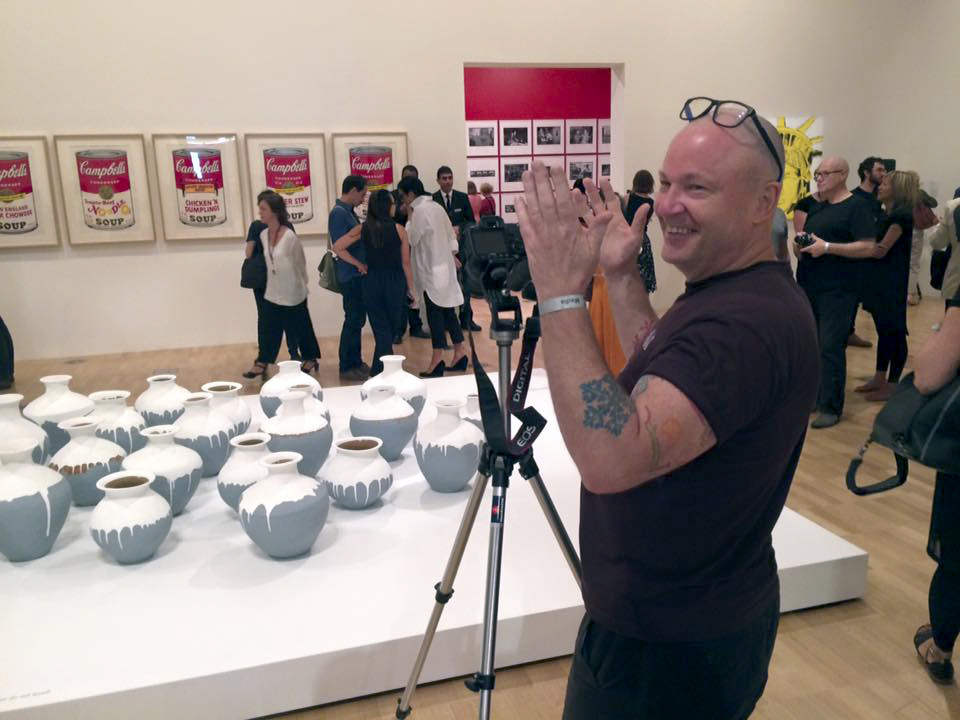
Marcus photographing the exhibition Andy Warhol | Ai Weiwei at the National Gallery of Victoria
Photo: Nick Henderson
A monster posting of installation images of the exhibition Andy Warhol | Ai Weiwei at the National Gallery of Victoria, in chronological order. Thoughts to follow. See my review of the exhibition.
Dr Marcus Bunyan
Many thankx to the National Gallery of Victoria for allowing me to take and publish the photographs in the posting. Please click on the photographs for a larger version of the image. All photographs © Marcus Bunyan and the National Gallery of Victoria.
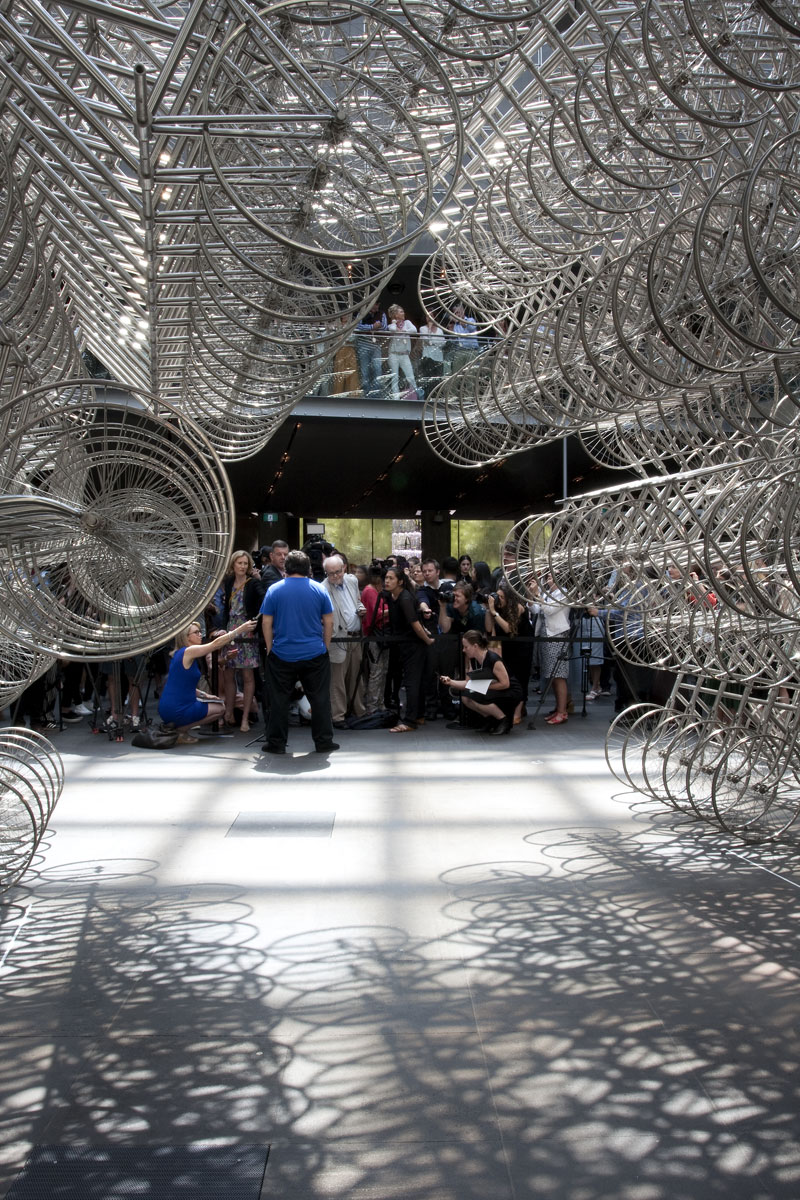
Ai Weiwei talking to the media in front of his installation Forever Bicycles (2015) at the opening of the exhibition Andy Warhol | Ai Weiwei at the National Gallery of Victoria, Melbourne
Photo: © Marcus Bunyan and the National Gallery of Victoria
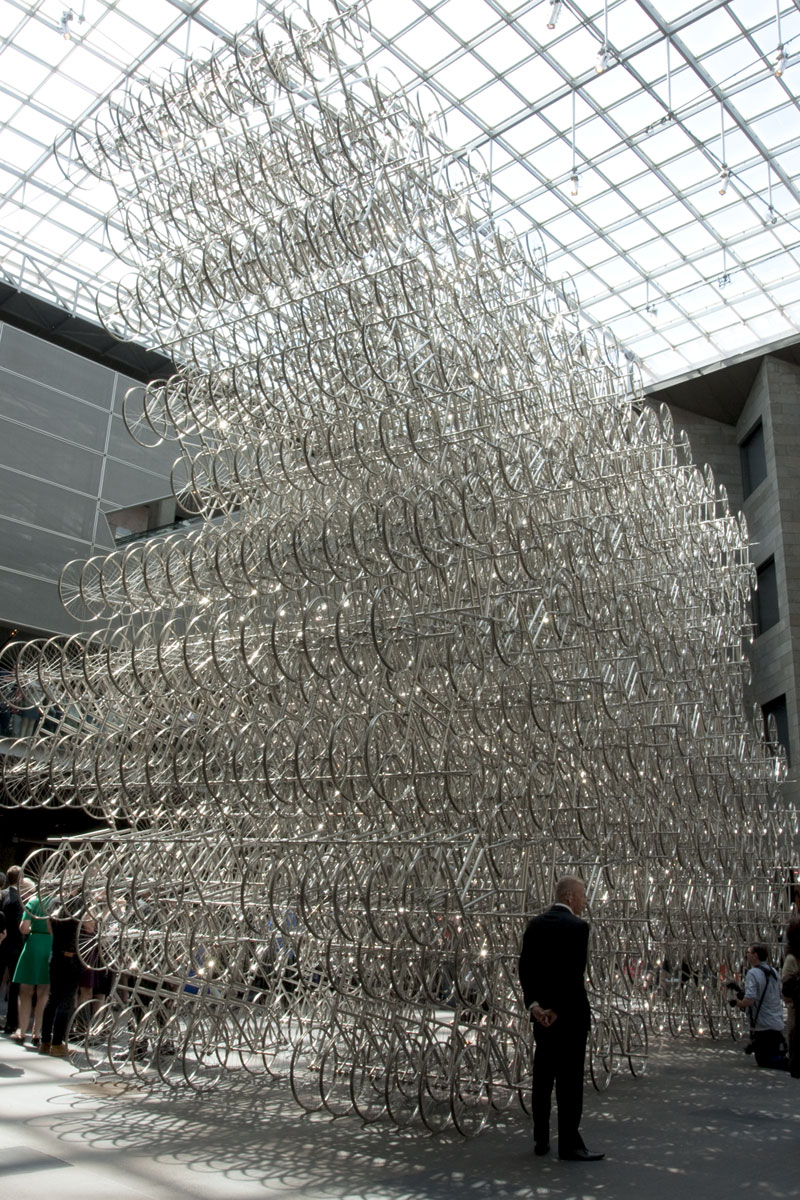
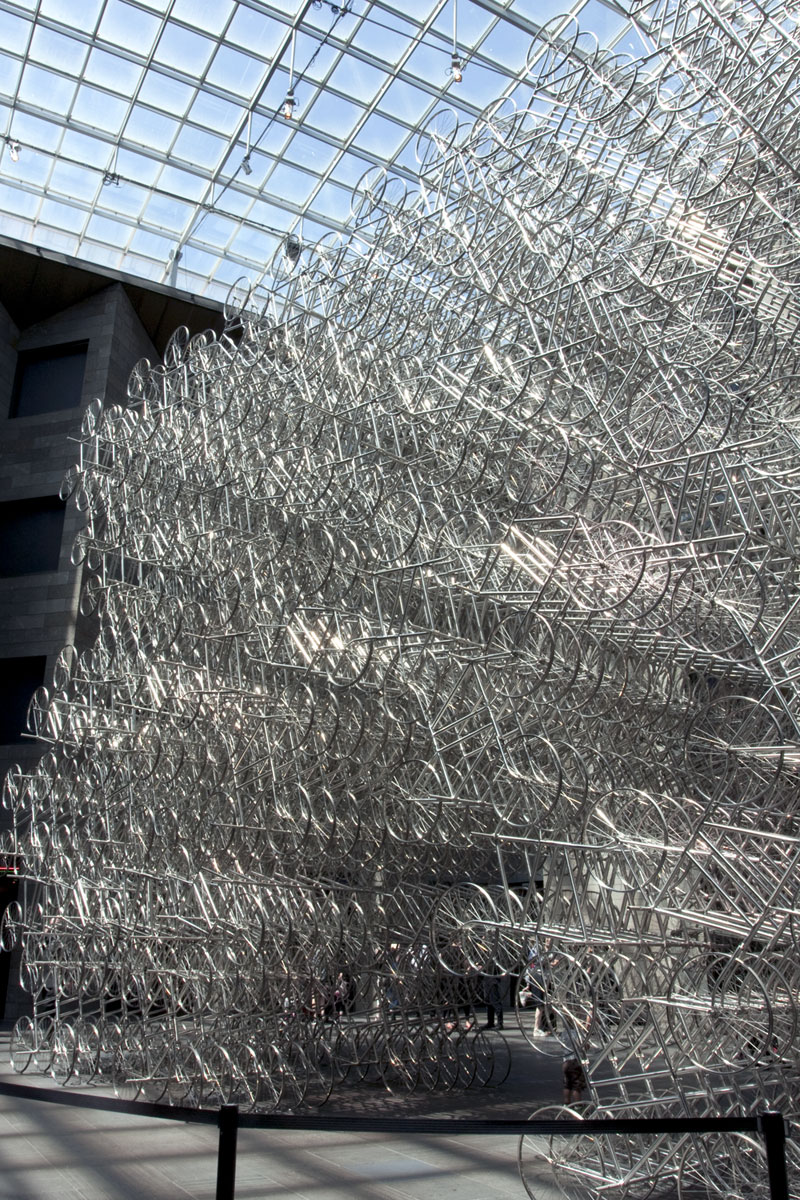
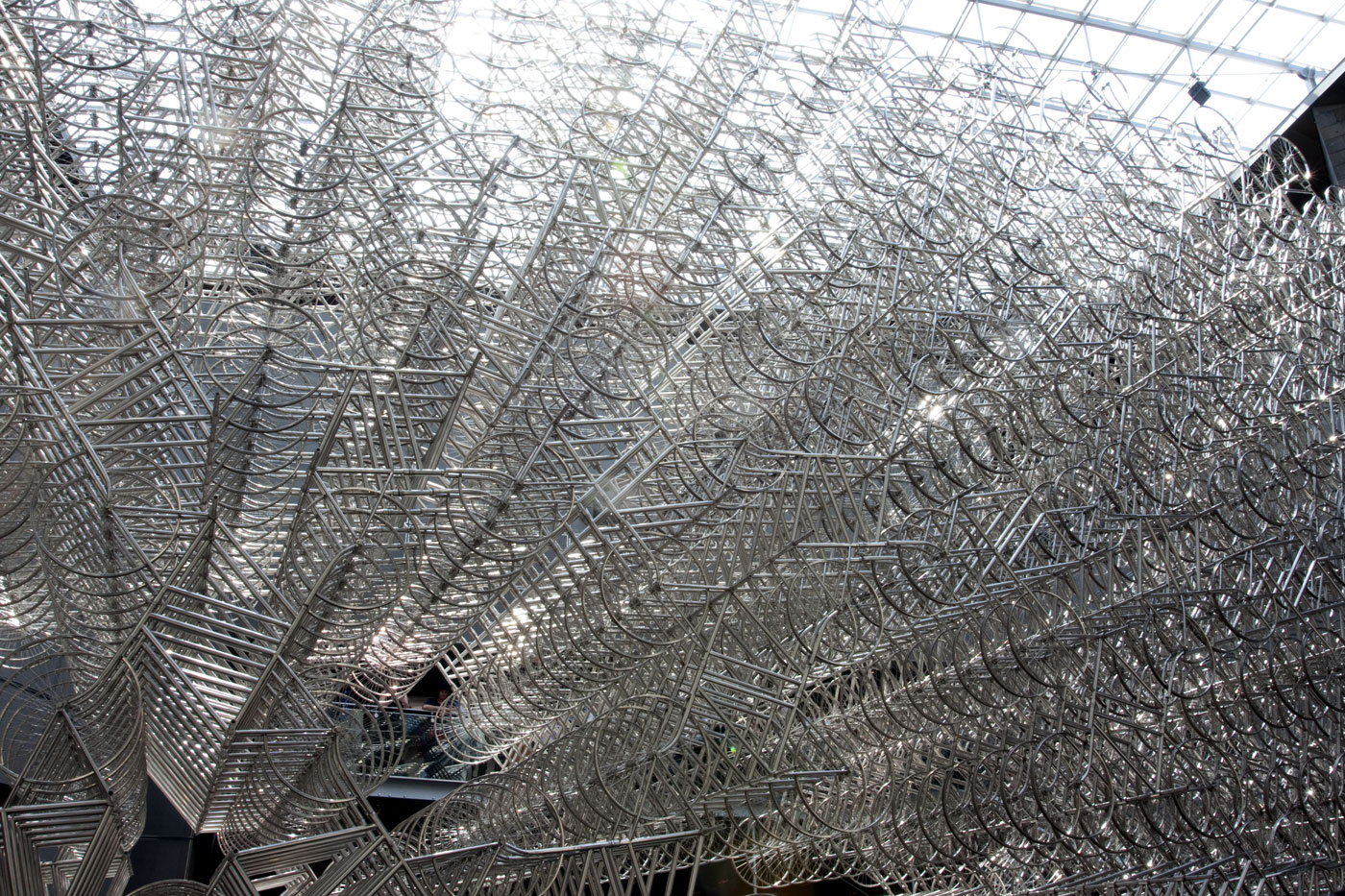
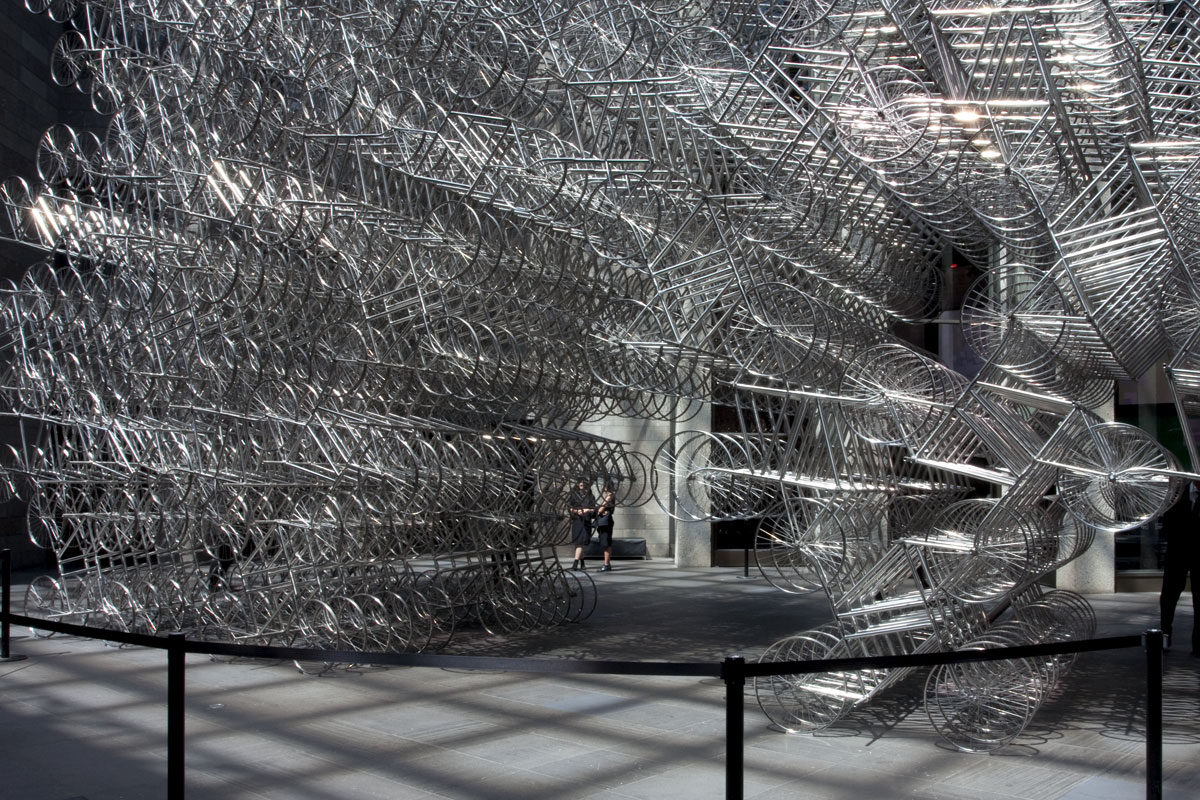
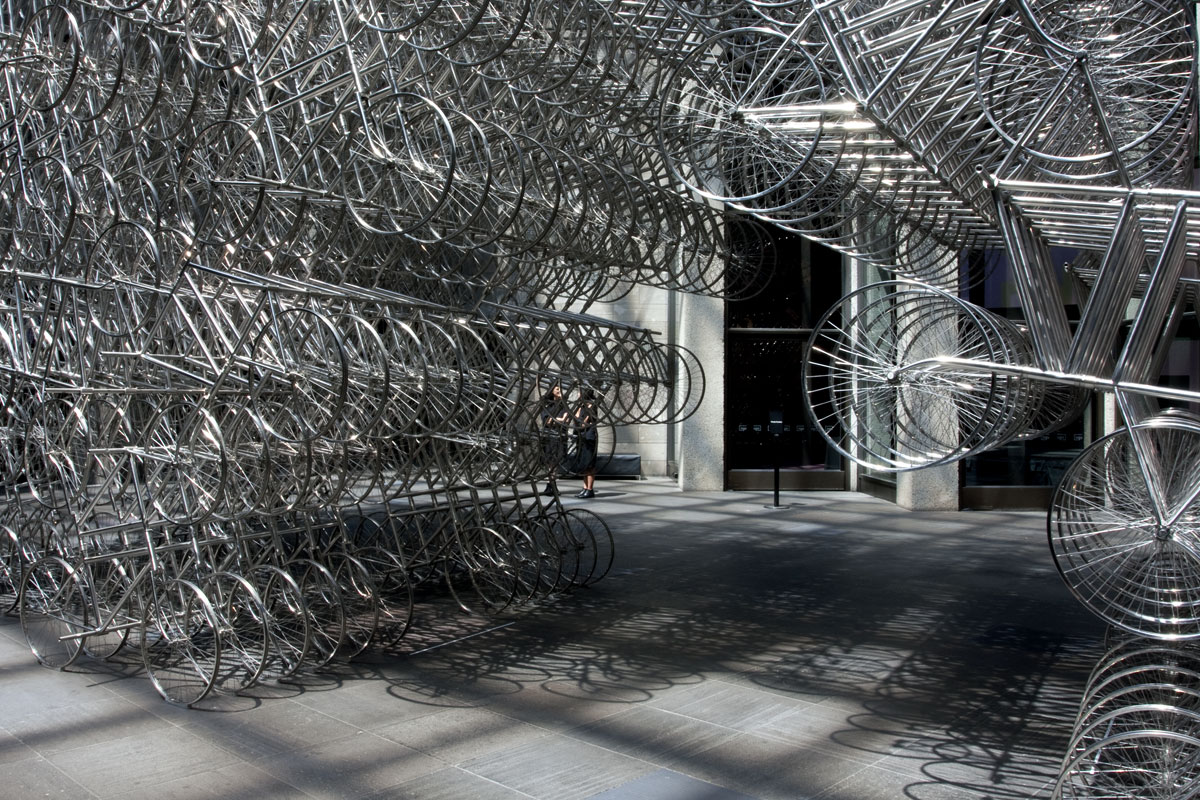
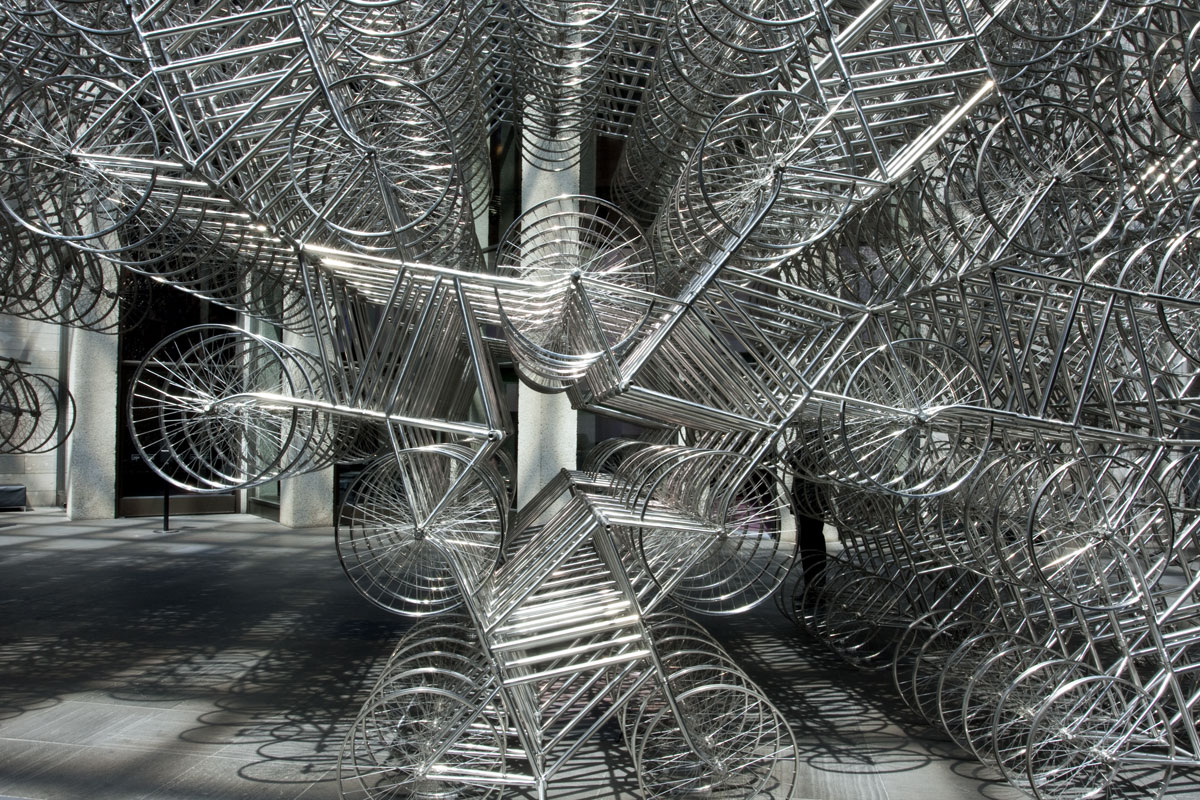
Ai Weiwei (Chinese, b. 1957)
Forever Bicycles (installation details)
2015
Stainless steel bicycle frames
Courtesy Ai Weiwei and Lisson Gallery, London
Photos: © Marcus Bunyan and the National Gallery of Victoria
The assembly and replication of readymade bicycles in Ai’s Forever Bicycles series, ongoing since 2003, promotes an intensely spectacular effect. ‘Forever’ is a popular brand of mass-produced bicycles manufactured in China since the 1940s and desired by Ai as a child. Composed from almost 1500 bicycles, this installation suggests both the individual and the multitude, with the collective energy of social progress signalled in the assemblage and perspectival rush of multiple forms.
Forever Bicycles disconnects the bicycles from their everyday function – reconfiguring them as an immense labyrinth-like network. The multi-tiered installation also achieves an architectural presence, much like a traditional arch or gateway to the exhibition.
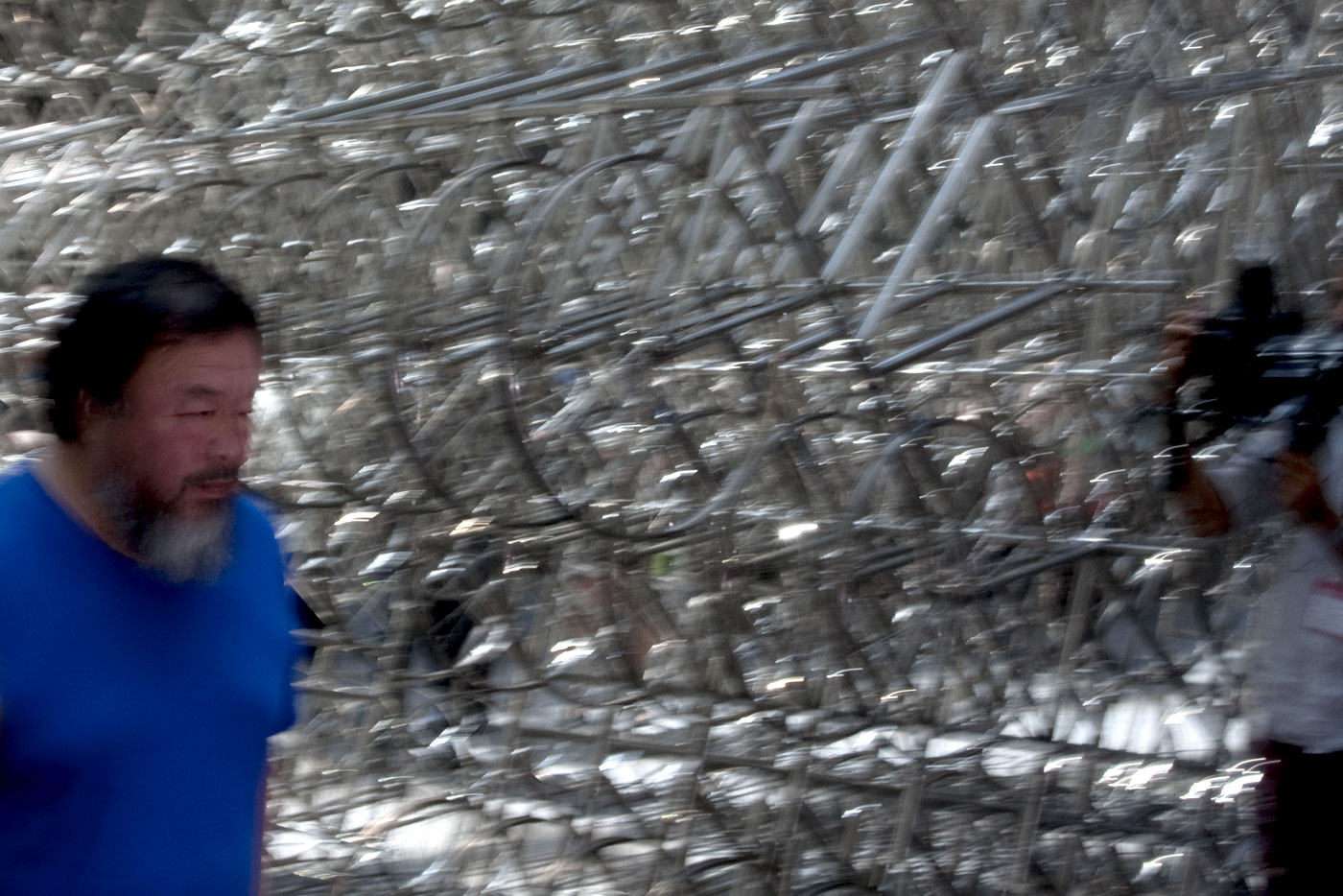
Ai Weiwei at the opening of the exhibition Andy Warhol | Ai Weiwei at the National Gallery of Victoria, Melbourne
Photo: © Marcus Bunyan and the National Gallery of Victoria
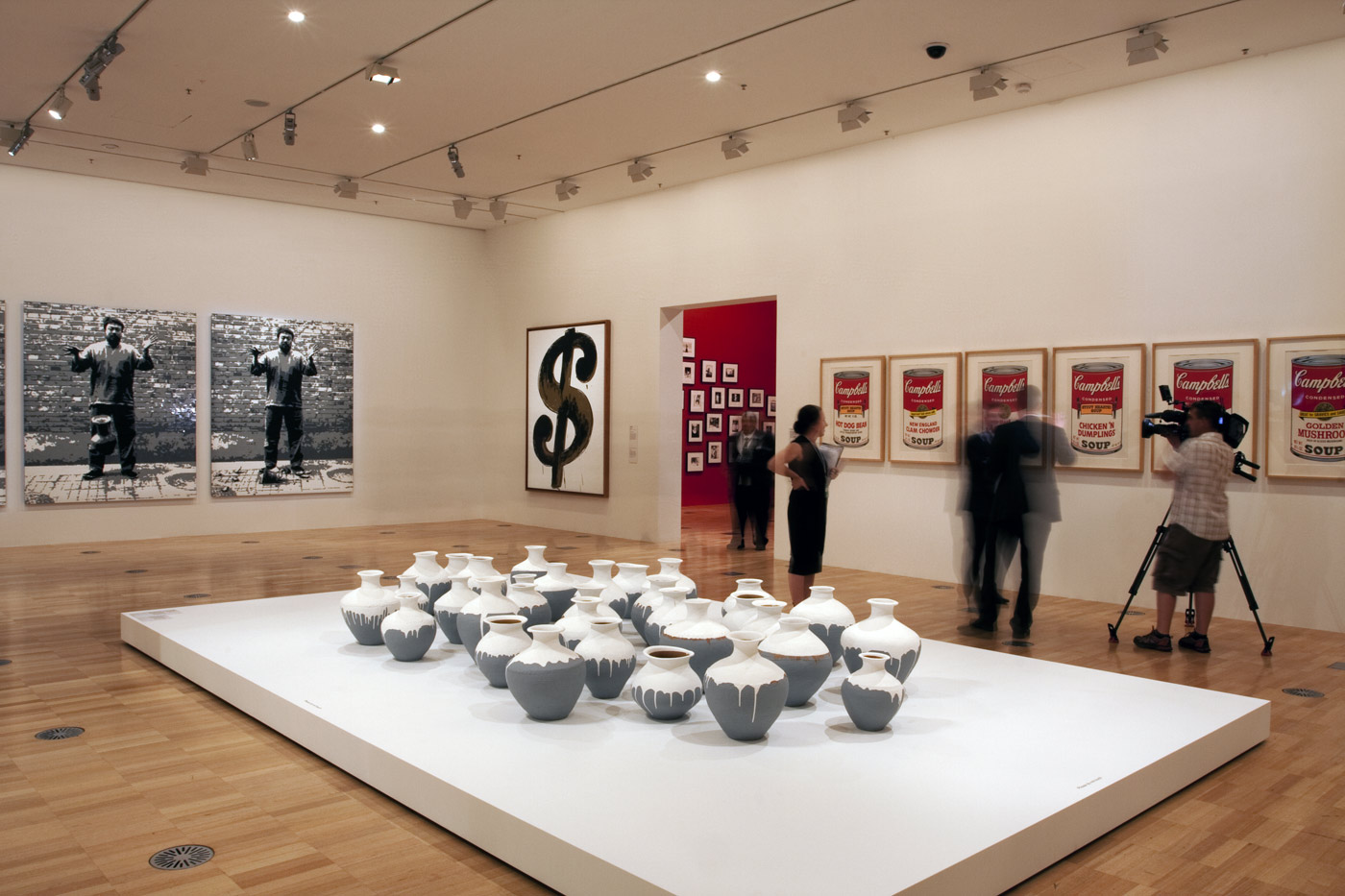
Installation view of the first room including Andy Warhol’s Dollar Sign (1981) and screen prints from his Campbell’s Soup II series (1969), with Ai Weiwei’s Dropping a Han Dynasty Urn (2015) made of LEGO-style plastic bricks at back left with, on the floor, his Coloured Vases (2015).
Photo: © Marcus Bunyan and the National Gallery of Victoria
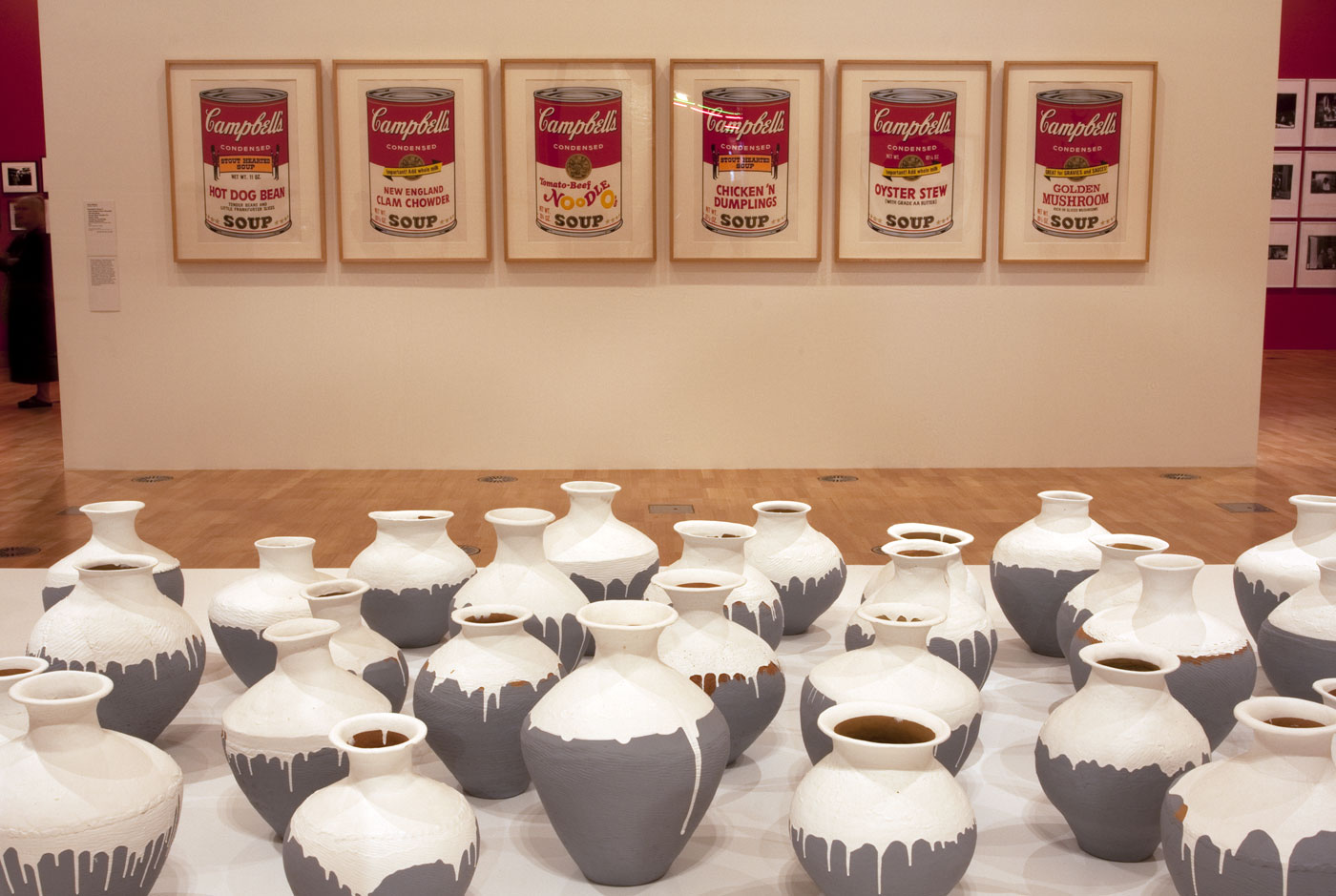
Installation view of the first room including Andy Warhol’s screen prints from his Campbell’s Soup II series (1969), with Ai Weiwei’s Coloured Vases (2015, detail)
Photo: © Marcus Bunyan and the National Gallery of Victoria
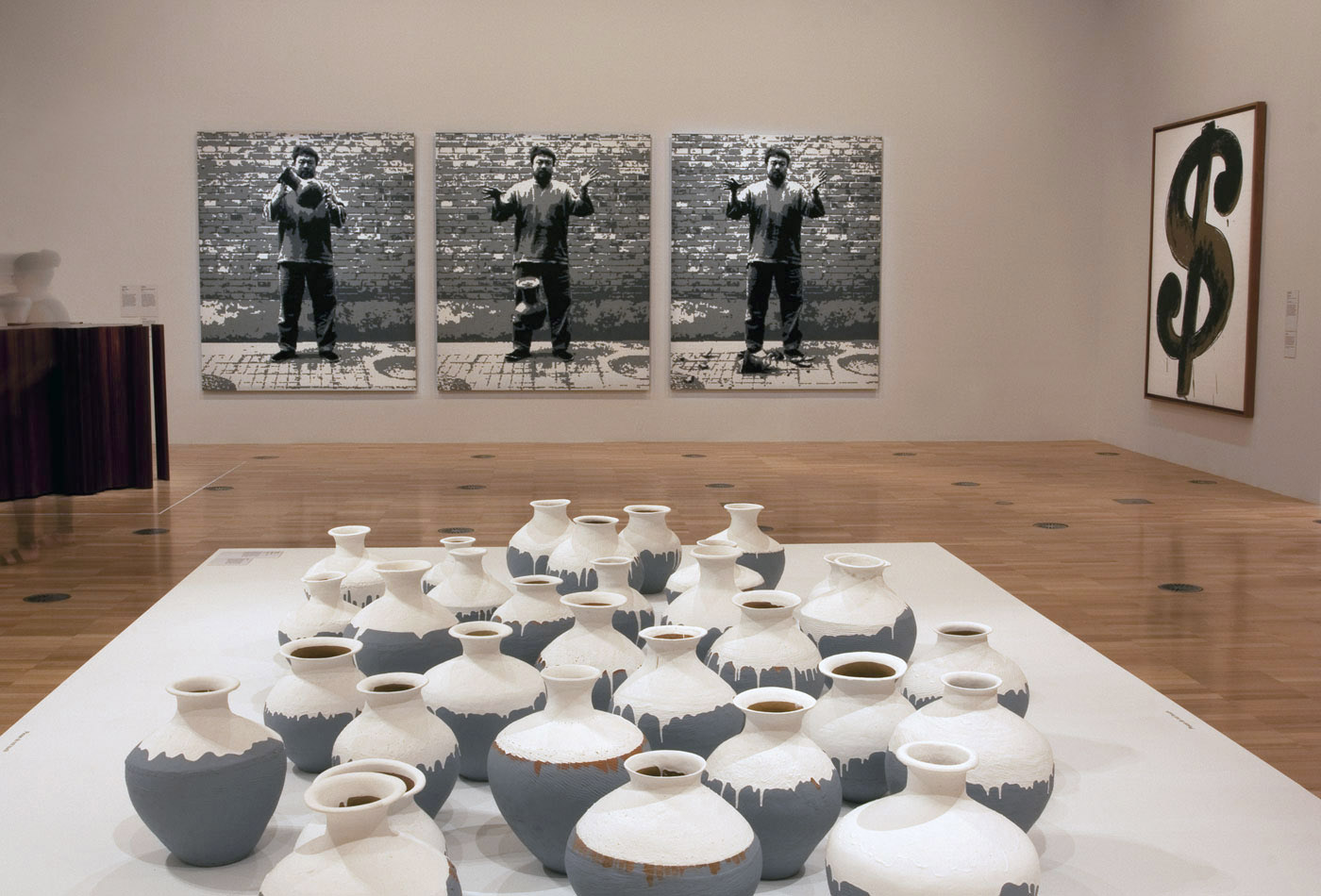
Installation view of the first room including Andy Warhol’s Dollar Sign (1981), with Ai Weiwei’s Dropping a Han Dynasty Urn (2015) made of LEGO-style plastic bricks, with on the floor his Coloured Vases (2015, detail)
Photo: © Marcus Bunyan and the National Gallery of Victoria
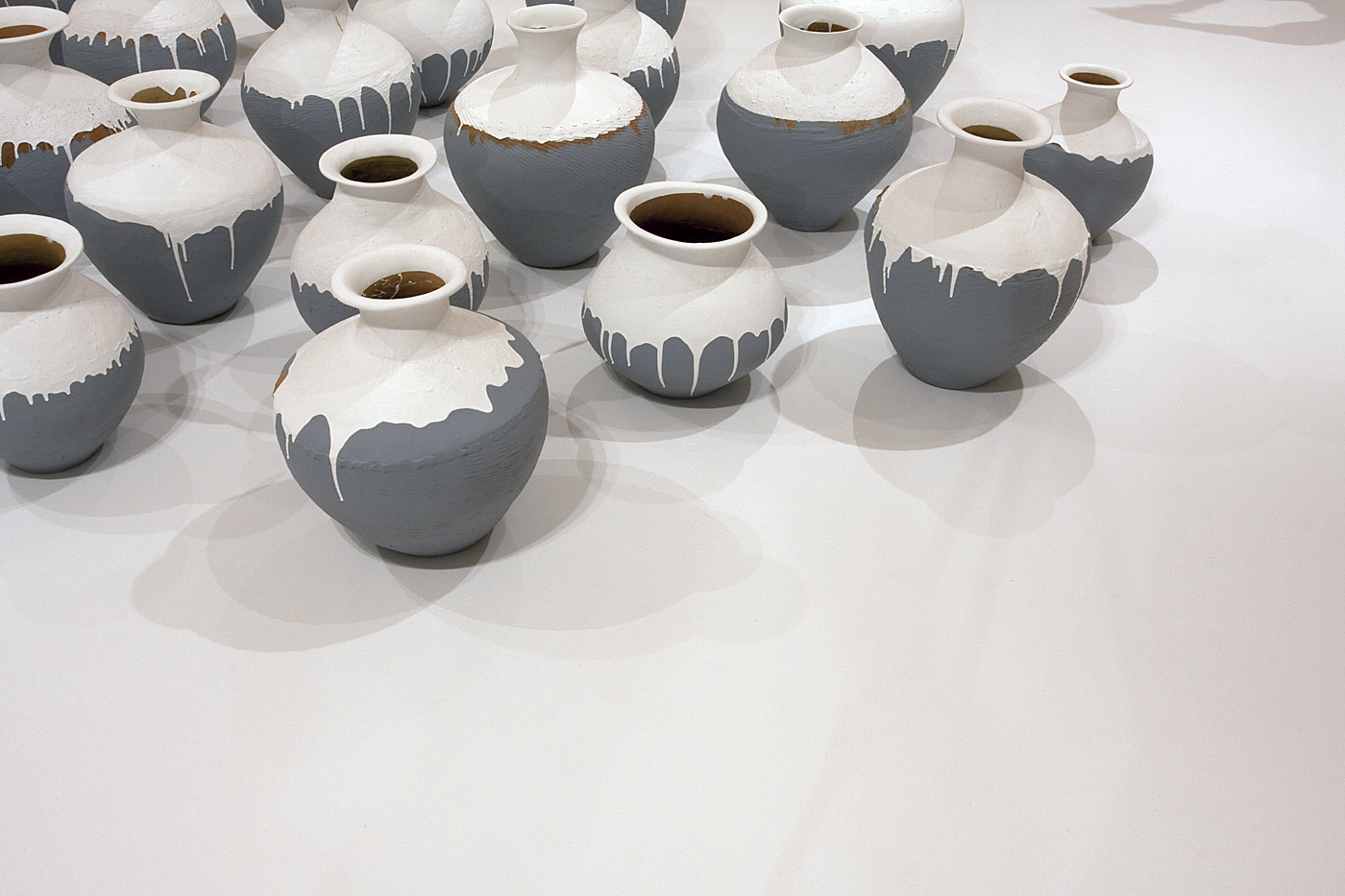
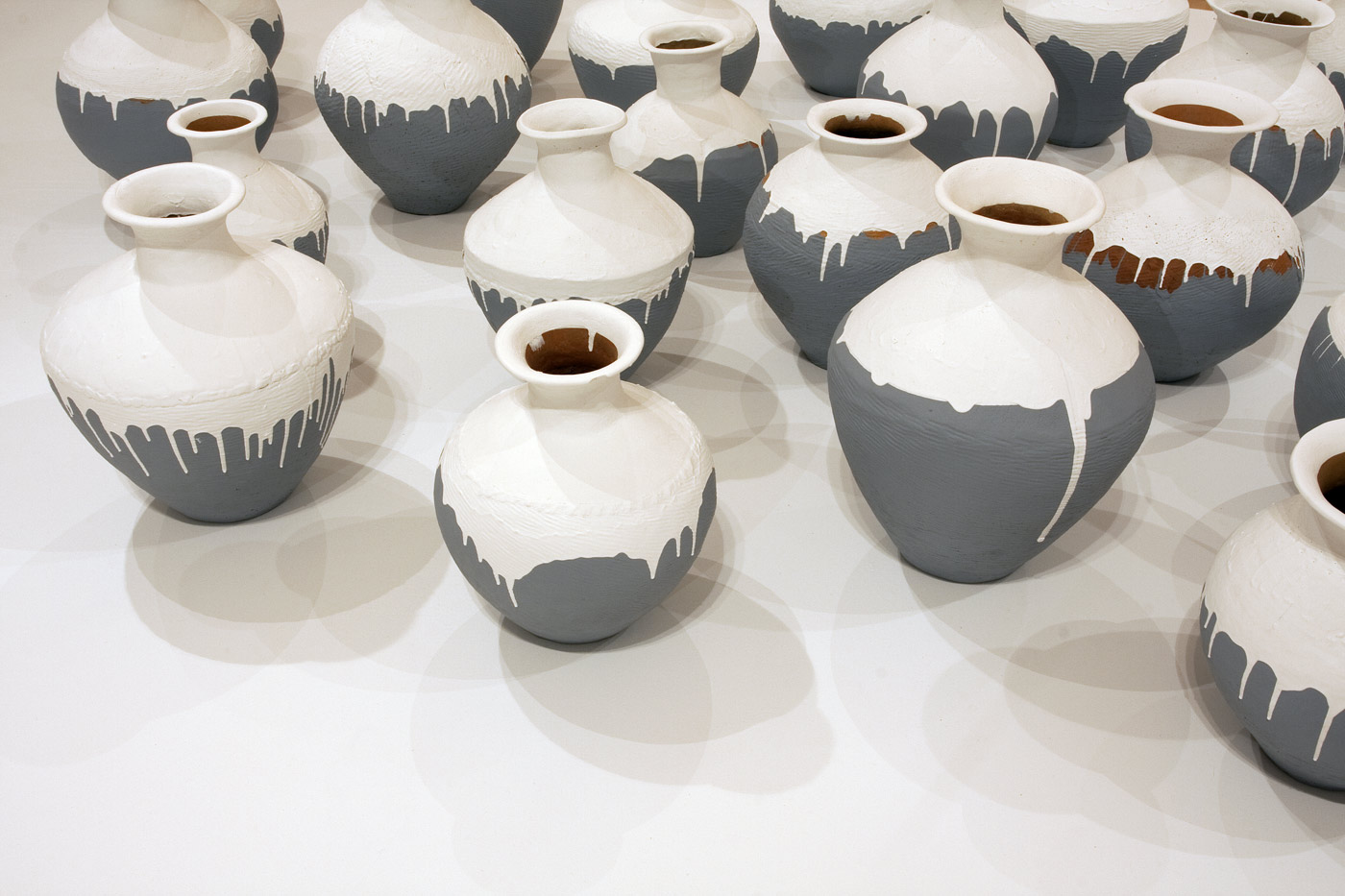
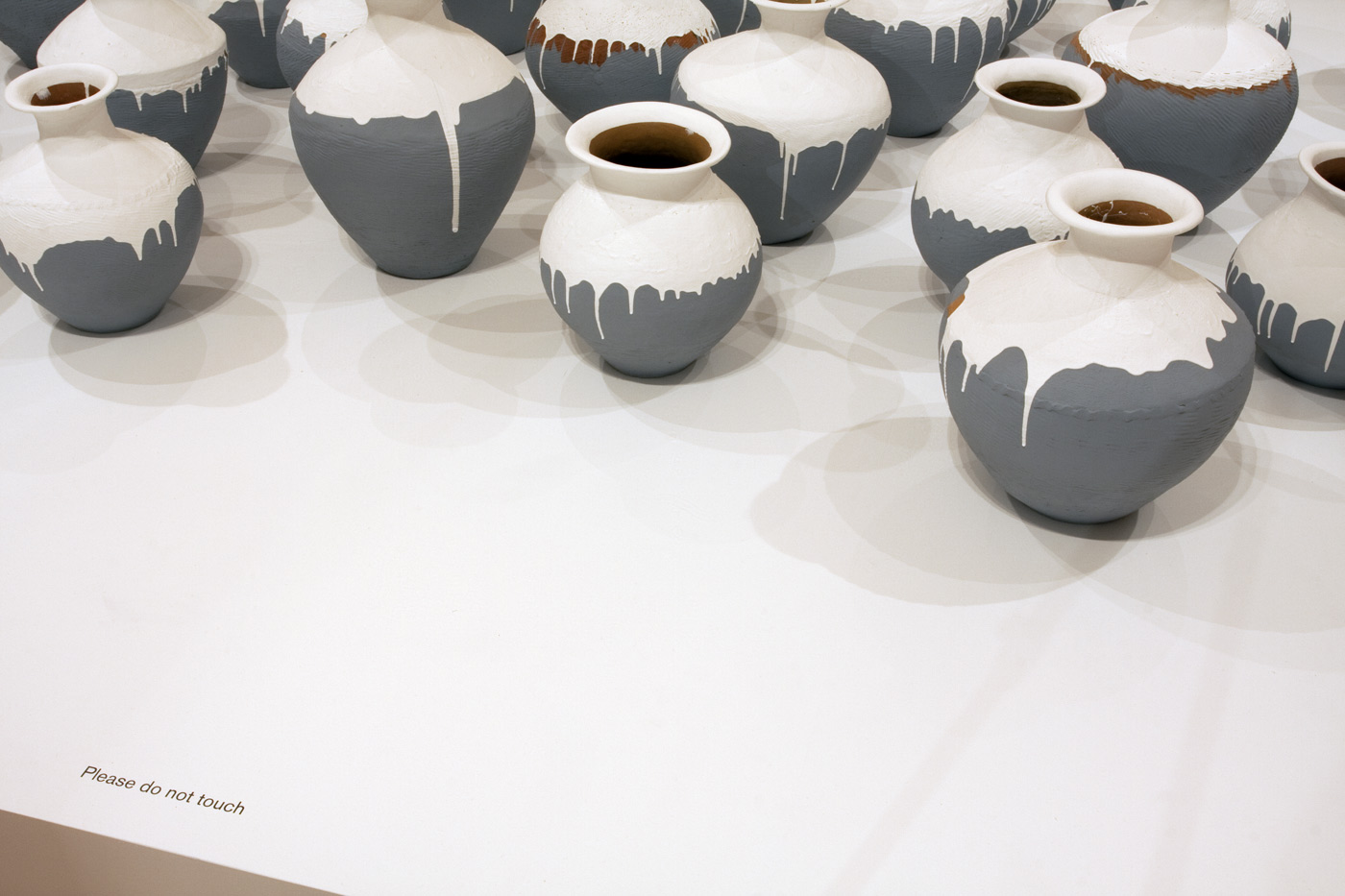
Ai Weiwei (Chinese, b. 1957)
Coloured Vases (installation details)
2015
Synthetic polymer paint, Neolithic earthenware jars
Ai Weiwei Studio, Beijing
Photos: © Marcus Bunyan and the National Gallery of Victoria
In Ai’s series of Coloured Vases, ongoing since 2006, Neolithic and Han dynasty urns are plunged into tubs of industrial paint to create an uneasy confrontation between tradition and modernity. In what might be considered an iconoclastic form of action painting, Ai gives ancient vessels a new glaze and painterly glow, appealing to new beginnings and cultural change through transformative acts of obliteration, renovation and renewal.
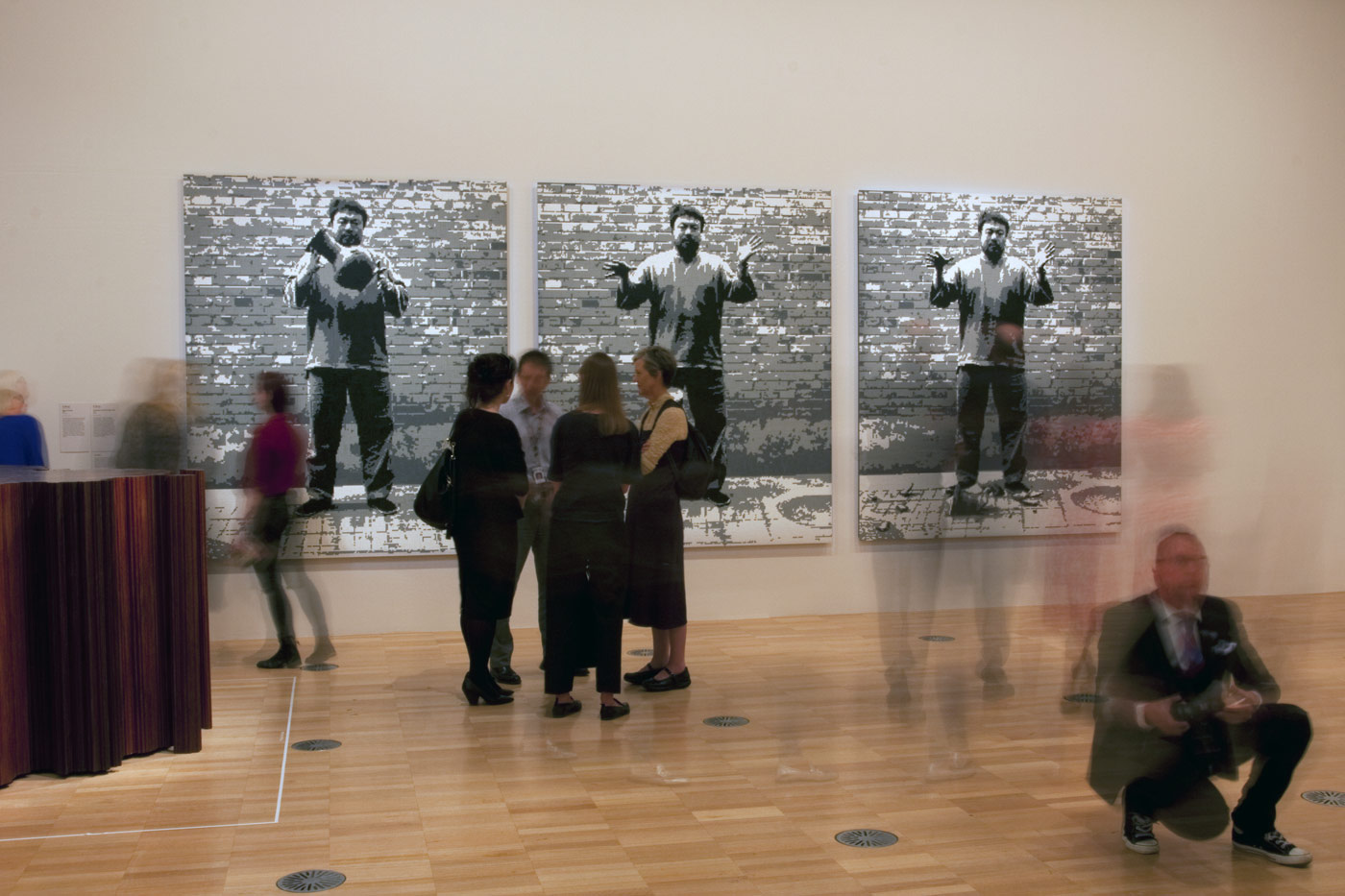
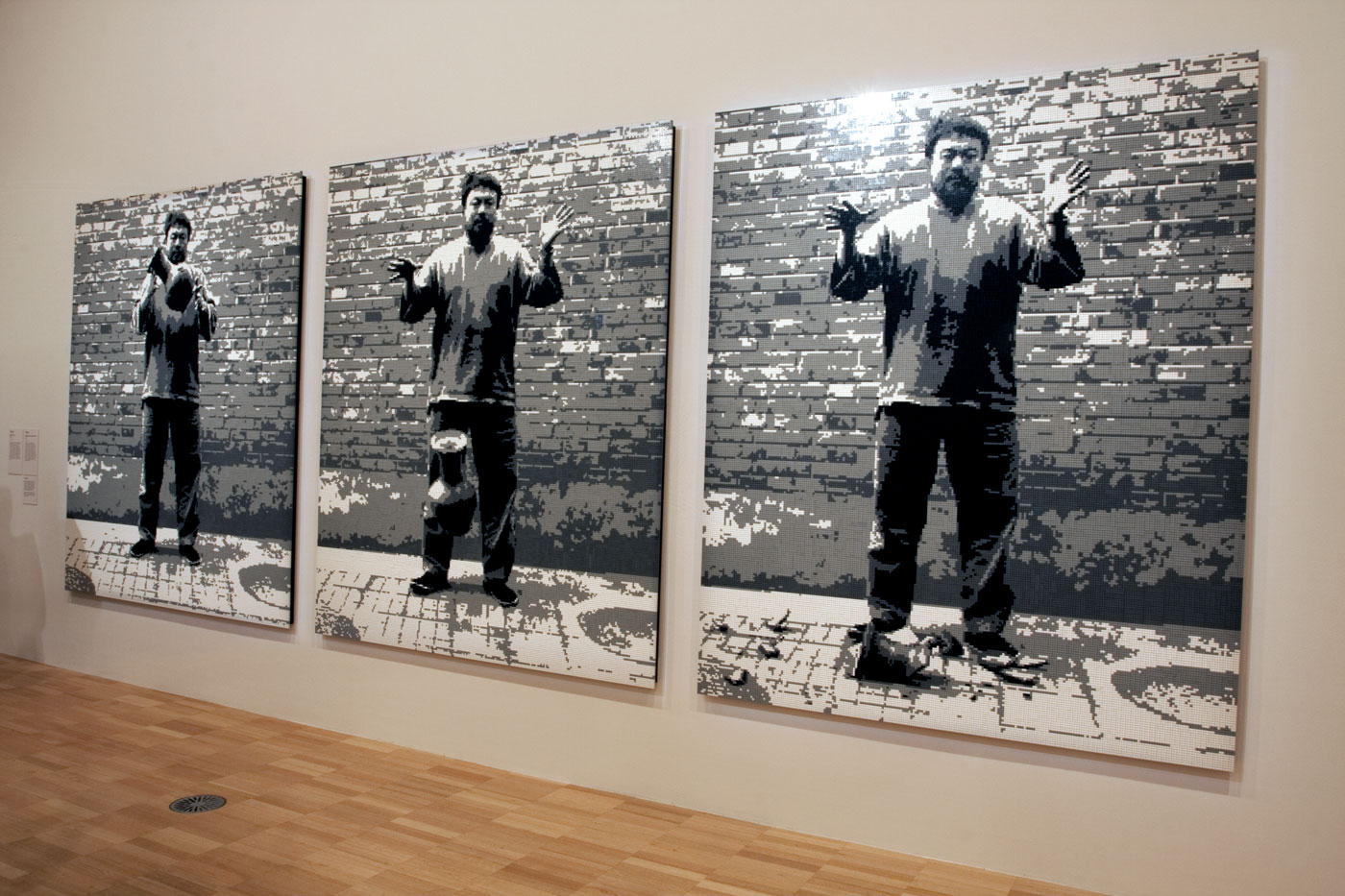
Ai Weiwei (Chinese, b. 1957)
Dropping a Han Dynasty Urn (installation views)
2015
Plastic
Ai Weiwei Studio, Beijing
Photos: © Marcus Bunyan and the National Gallery of Victoria
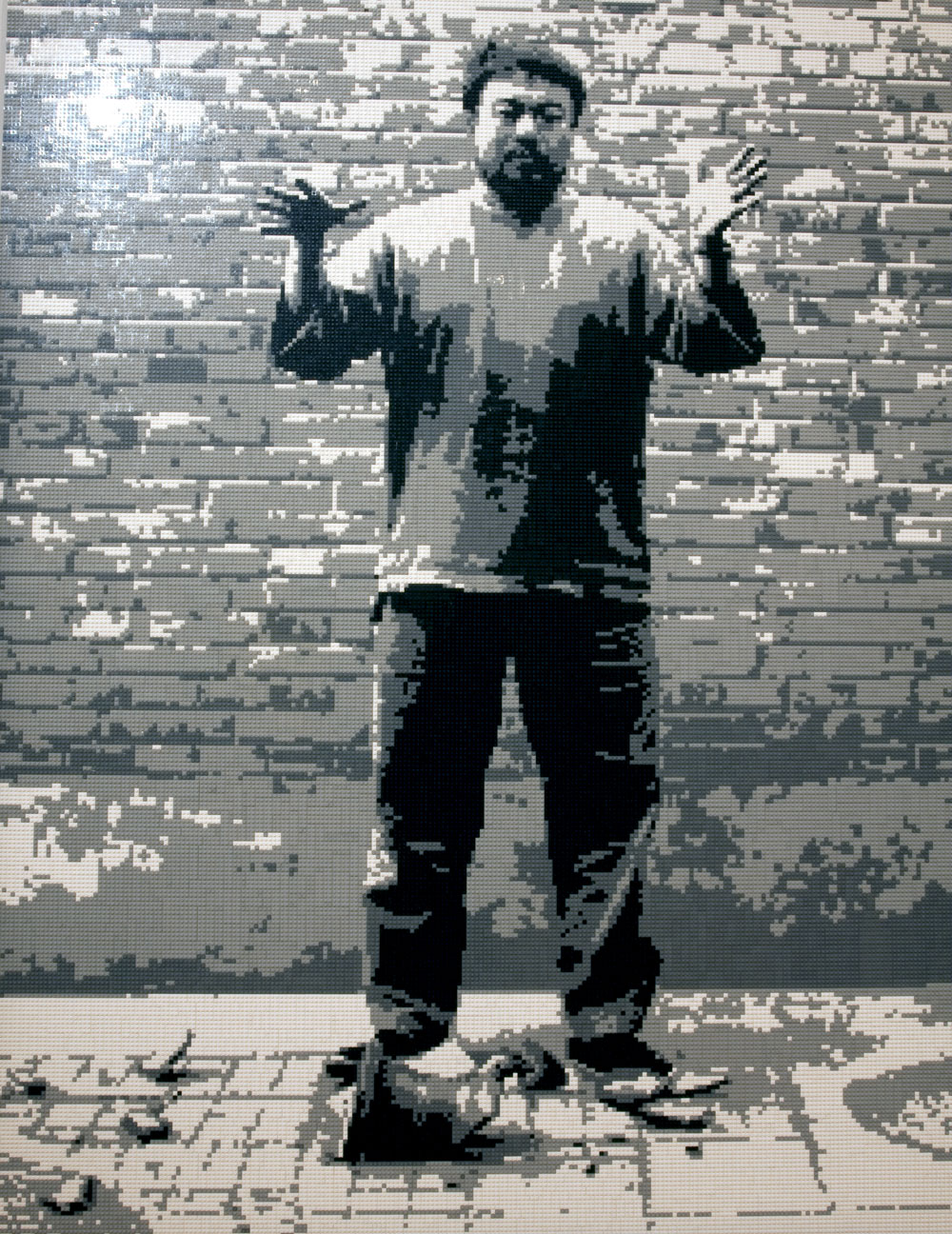
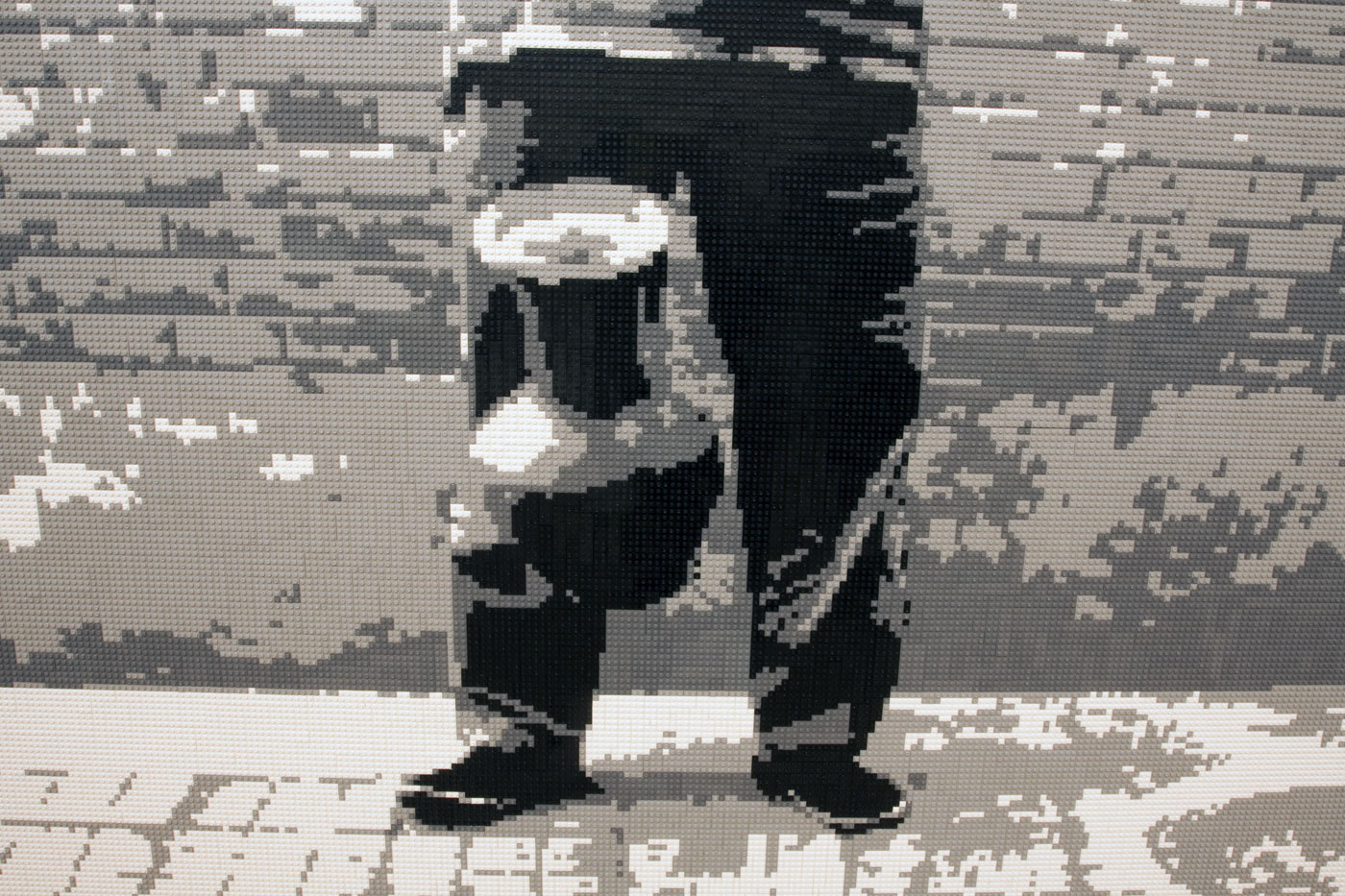
Ai Weiwei (Chinese, b. 1957)
Dropping a Han Dynasty Urn (installation details)
2015
Plastic
Ai Weiwei Studio, Beijing
Photos: © Marcus Bunyan and the National Gallery of Victoria
Ai’s photographic triptych Dropping a Han Dynasty Urn, 1995, which shows the artist holding, releasing and smashing a Han dynasty vase, is one of the artist’s most iconic works and demonstrates his critical engagement with China’s violent cultural tradition. Drawing attention to the desecration of cultural heritage, the artist’s performative action is presented matter-of-factly, with the viewer left to contemplate the event and what might be salvaged from the destruction. Ai has recreated the image here in children’s building blocks, in pixelated form, attesting to the distribution of images by digital technologies.
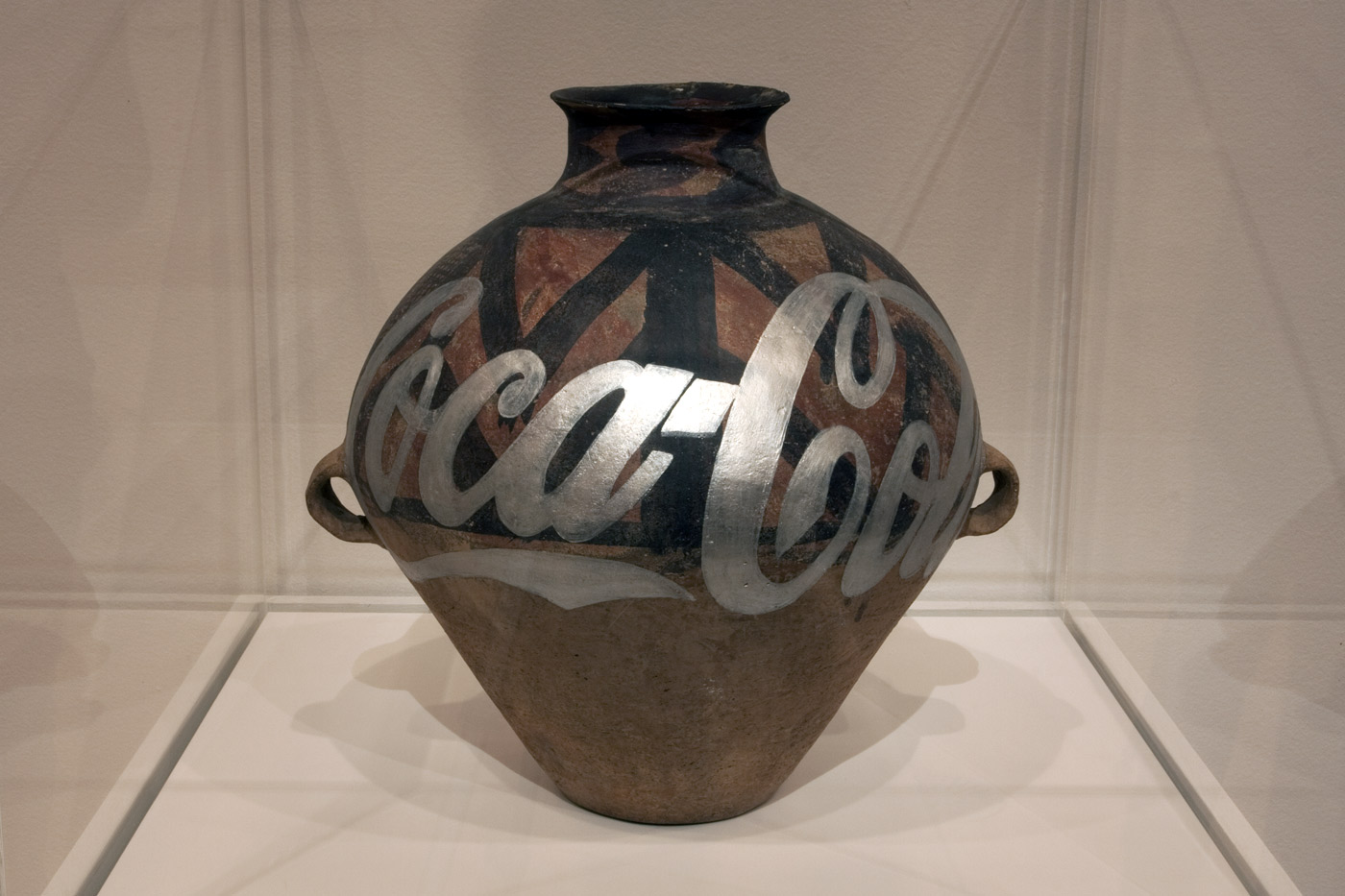
Ai Weiwei (Chinese, b. 1957)
Neolithic Pottery with Coca-Cola Logo (installation view)
2007
Metallic paint, earthenware jar
Collection of Larry Warsh, New York
Photo: © Marcus Bunyan and the National Gallery of Victoria
Bringing together a readymade cultural artefact (after Marcel Duchamp) and pop-cultural imagery (after Andy Warhol), Ai’s painted Neolithic vase presents a rich albeit uneasy confrontation of elements. The Coca-Cola logo – emblem of American capitalism and brand identity – adorns an ancient, revered Chinese artefact. In branding a unique handcrafted object with a product of mass-consumption, Ai delivers a nuanced cultural comment, candidly invoking the conflicted contemporary identity of Chinese cultural heritage, socialist government and capitalist economics.
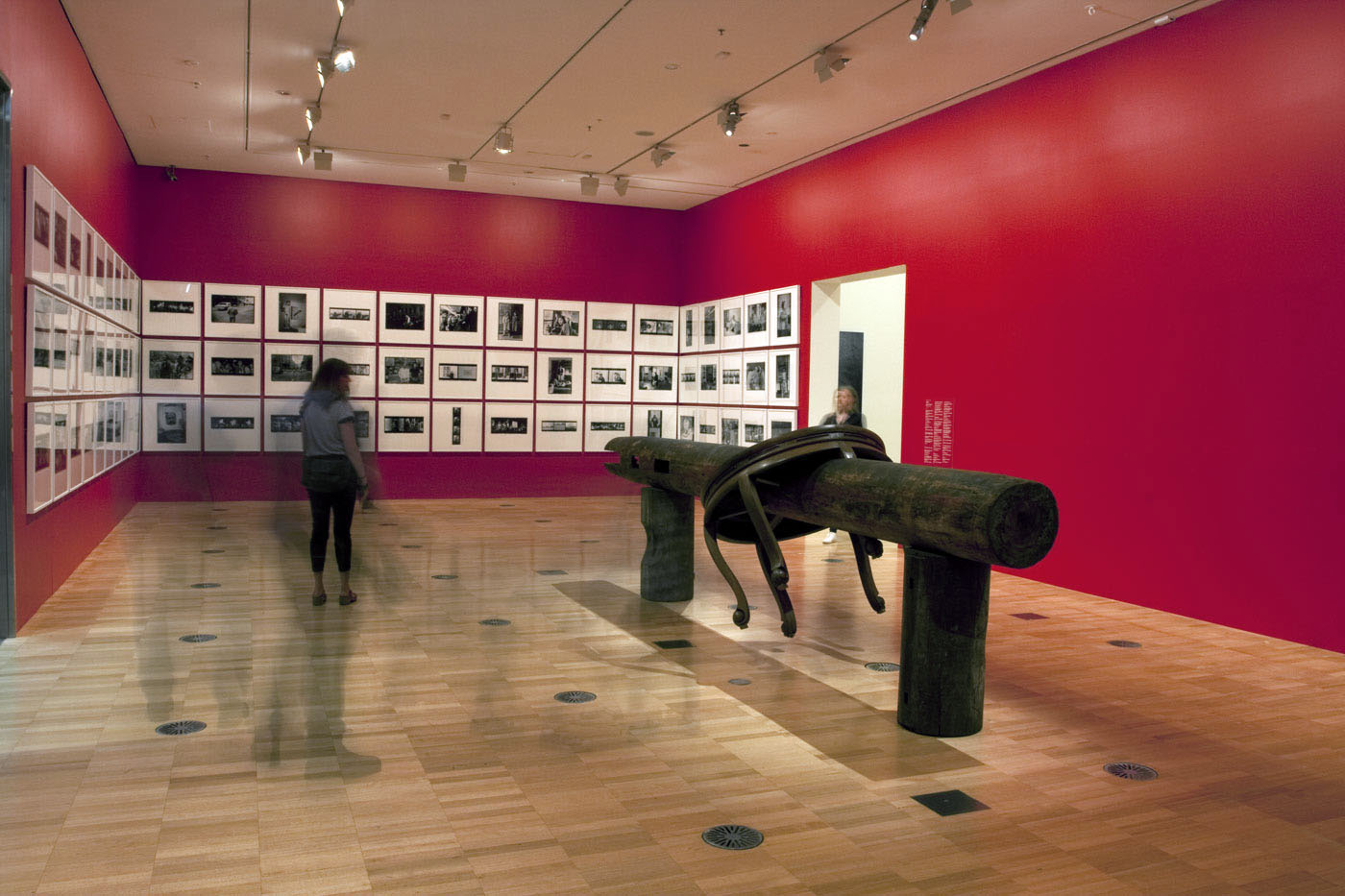
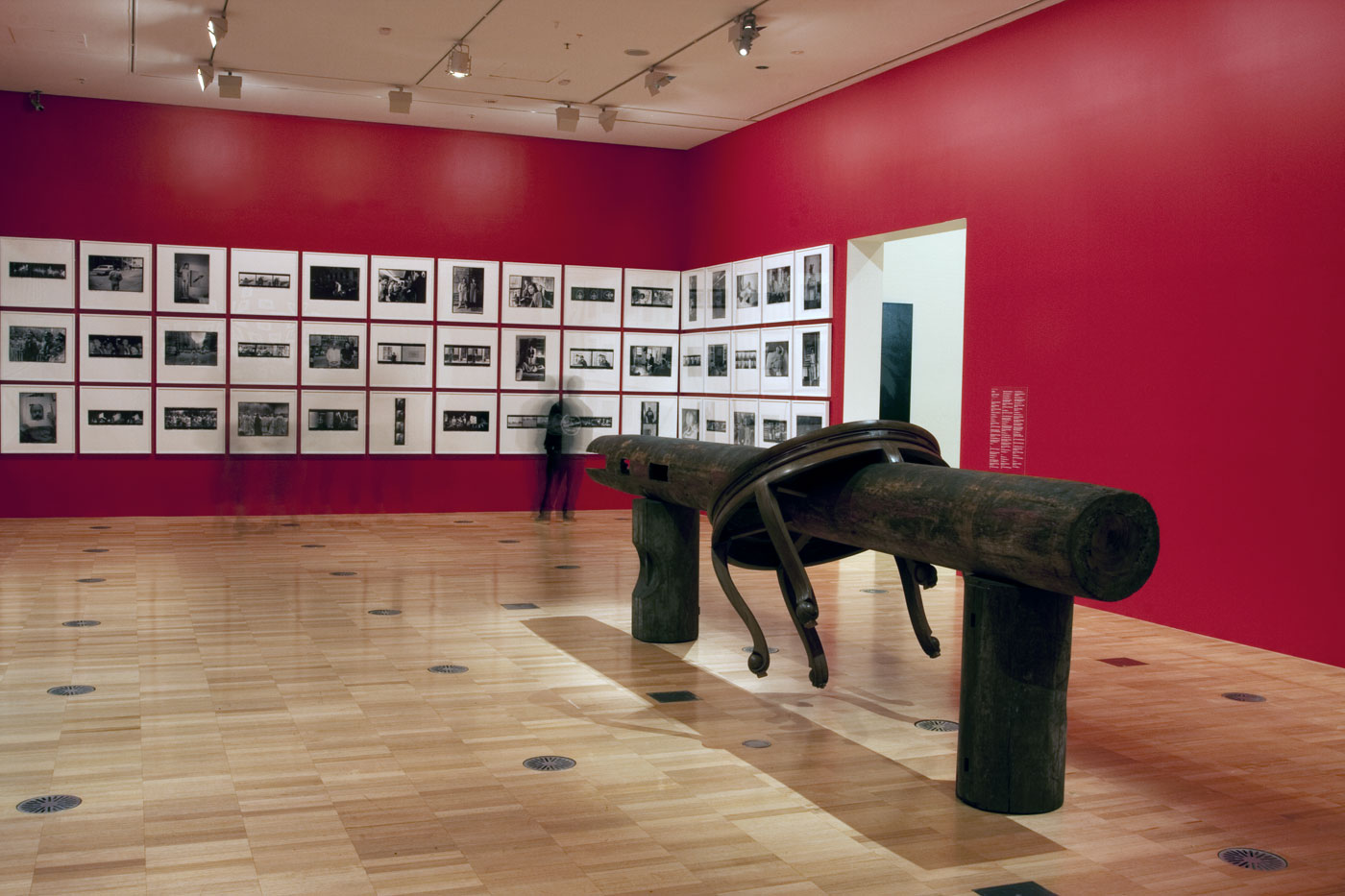
Installation views of second room including at centre, Ai Weiwei’s Pillar through Round Table (2004-2005) with Ai’s black and white photographs behind
Ai Weiwei (Chinese, b. 1957)
Pillar through Round Table
2004-2005
Elm, ironwood
Queensland Art Gallery/Gallery of Modern Art, Brisbane, Purchased 2006
Photos: © Marcus Bunyan and the National Gallery of Victoria
Pillar through Round Table is constructed from a pair of elmwood half-tables bisected horizontally by an ironwood pillar. It is one of an extensive body of works by Ai composed of furniture and architectural fragments from the Qing dynasty period (1644-1911) which have been dismantled and painstakingly reassembled with the assistance of highly skilled carpenters to create new and often confounding arrangements. Ai’s reinvention of historical forms serves to enliven traditional crafts and skills, while his disavowal of modern industrial production processes also acts as a counterpoint to contemporary models of productivity and efficiency in Chinese industrial production.
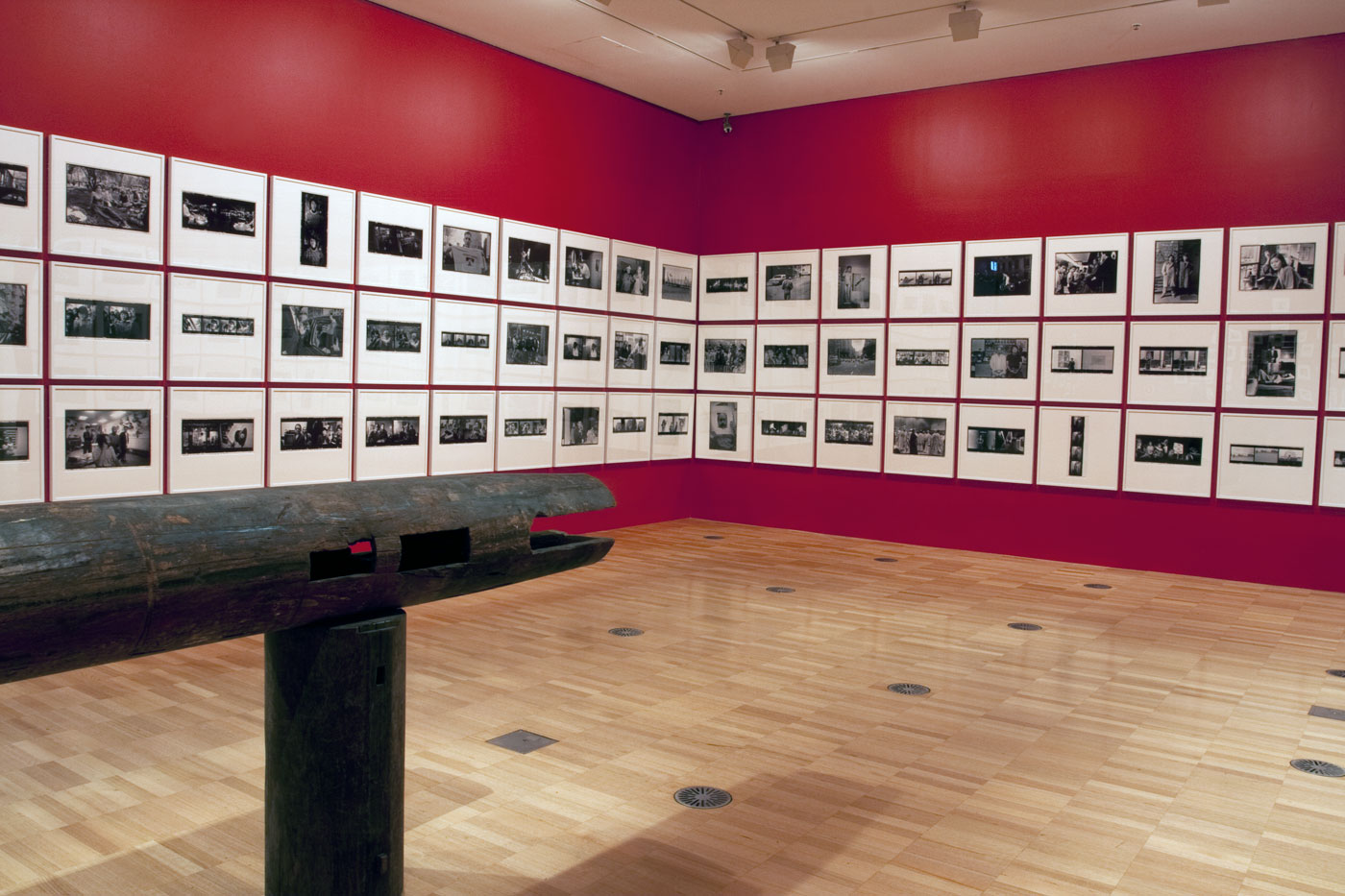
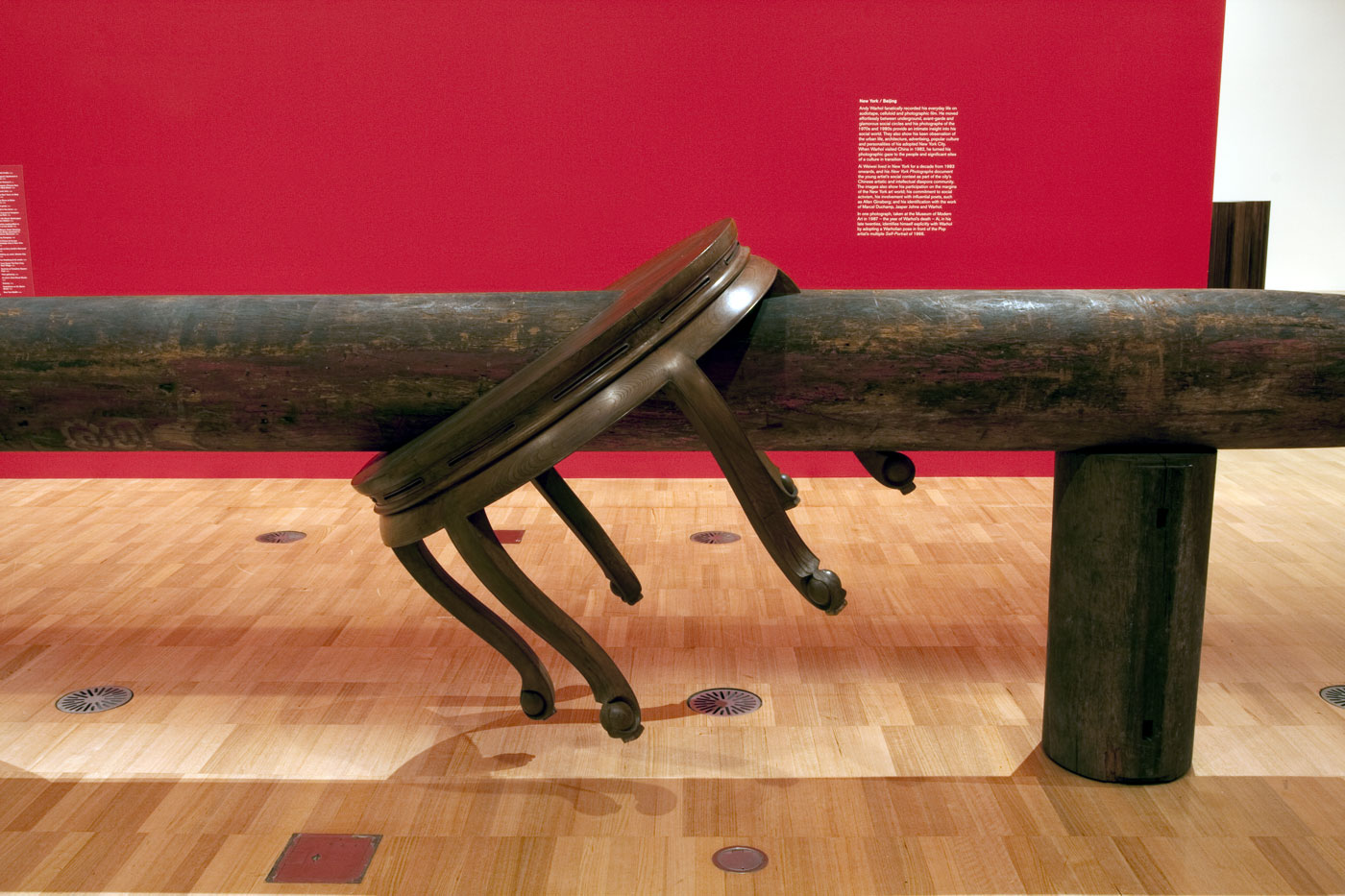
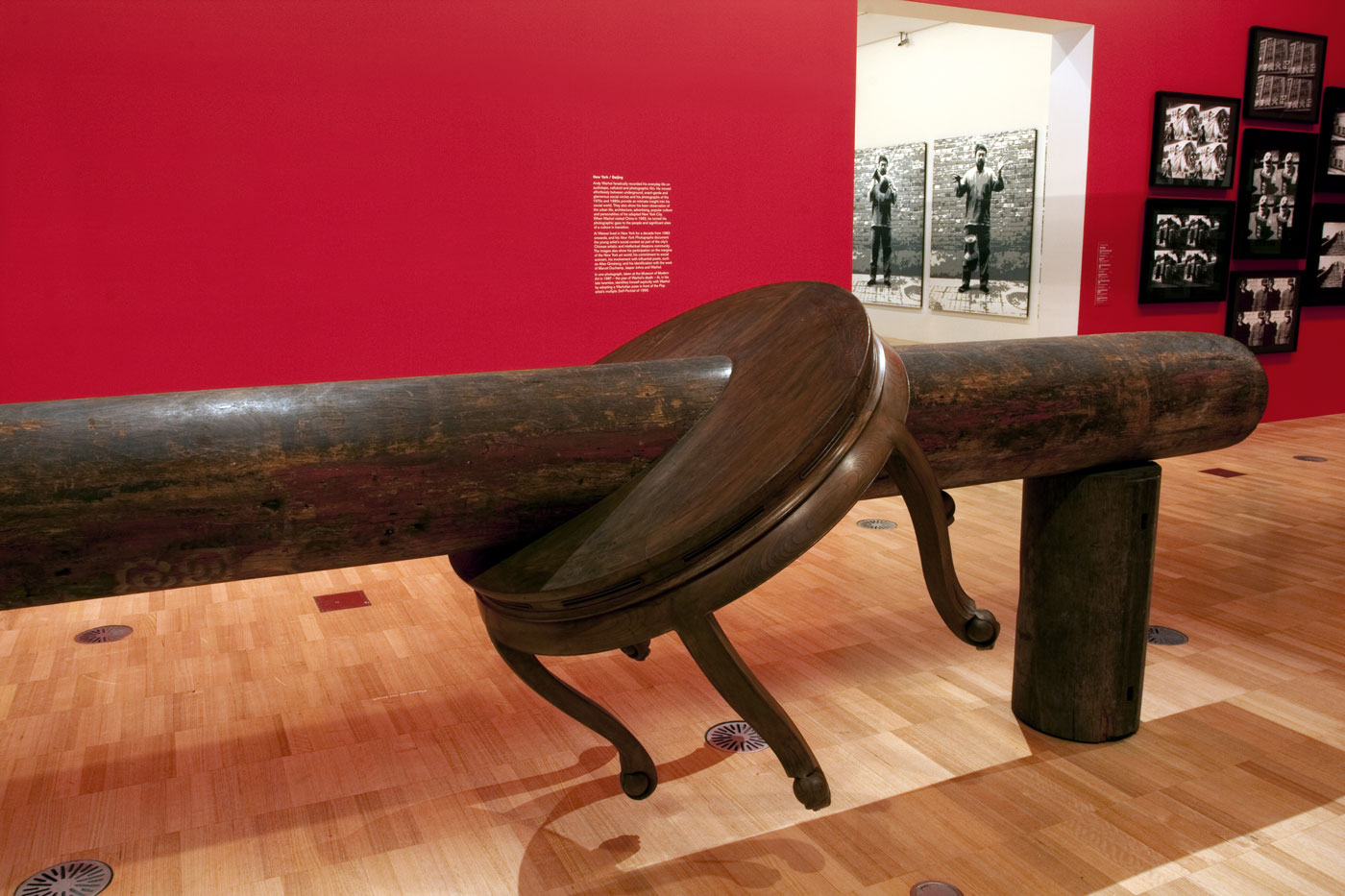
Installation views of Ai Weiwei’s Pillar through Round Table (2004-2005, details) with Ai’s black and white photographs at the exhibition Andy Warhol | Ai Weiwei at the National Gallery of Victoria, Melbourne
Photos: © Marcus Bunyan and the National Gallery of Victoria
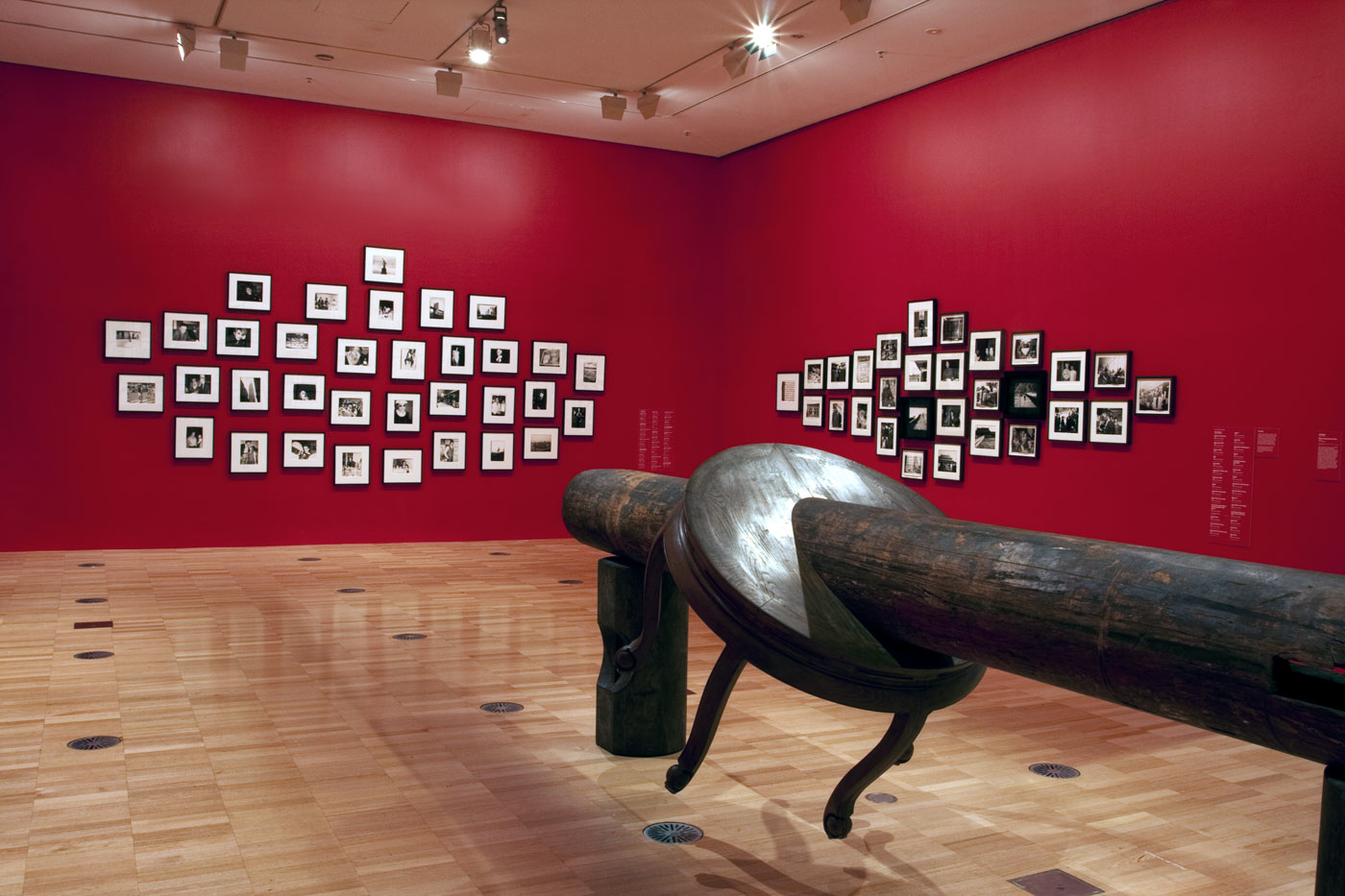
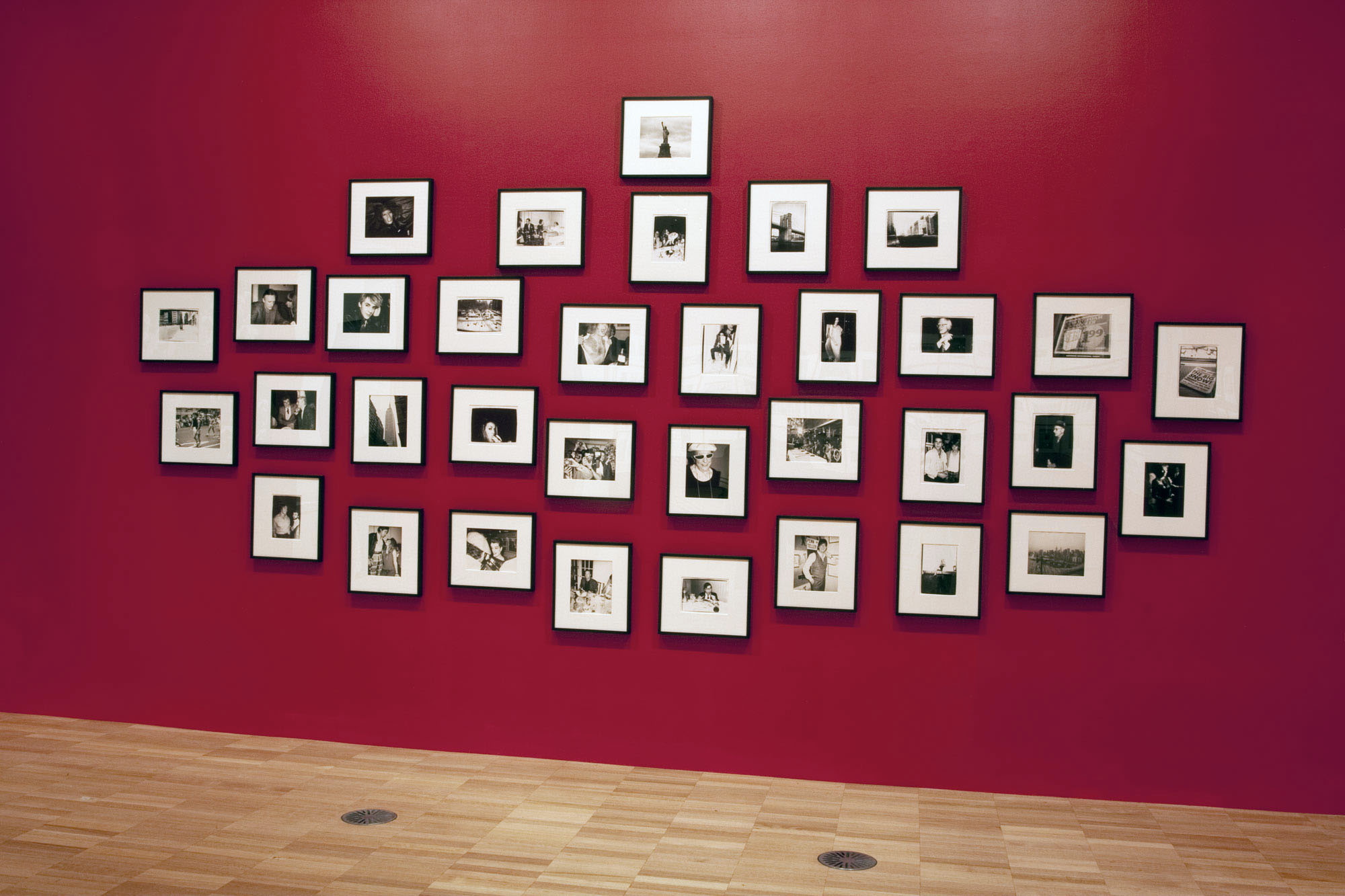
Installation views of second room including, at centre, Ai Weiwei’s Pillar through Round Table (2004-2005) with a group of Andy Warhol’s black and white photographs behind at the exhibition Andy Warhol | Ai Weiwei at the National Gallery of Victoria, Melbourne
Photos: © Marcus Bunyan and the National Gallery of Victoria
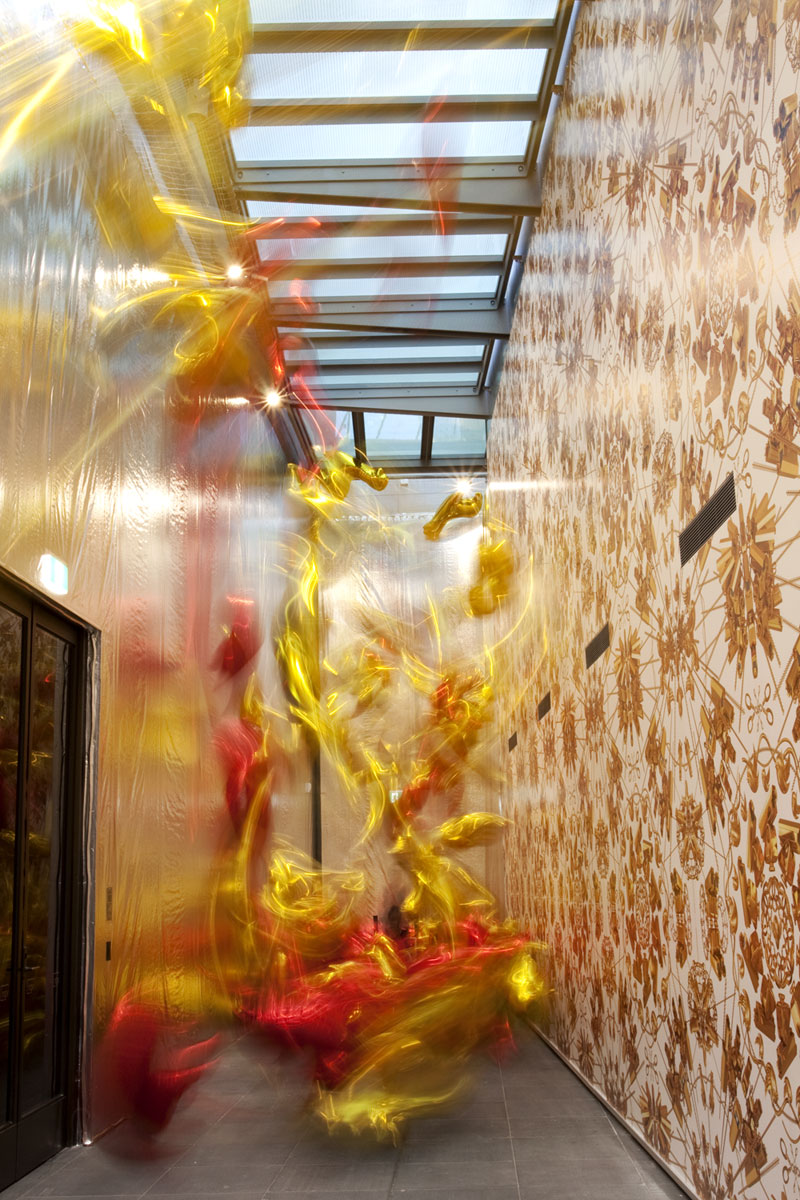
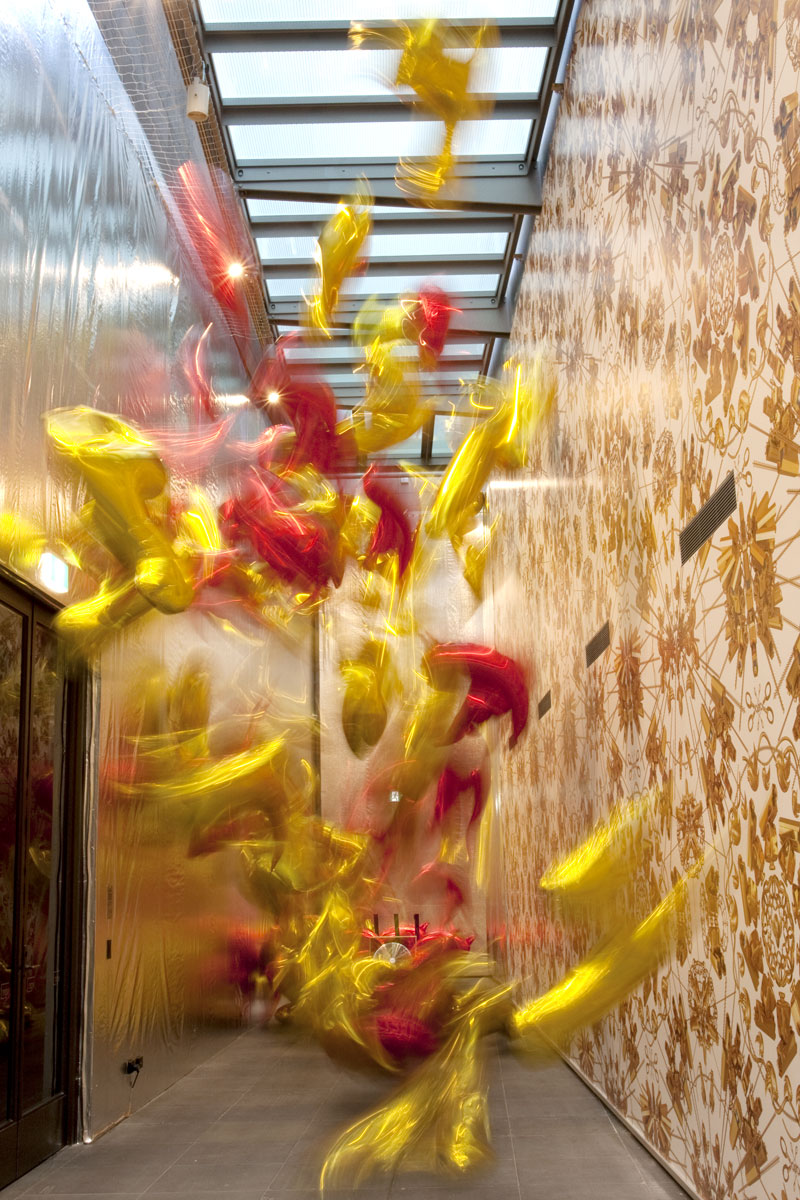
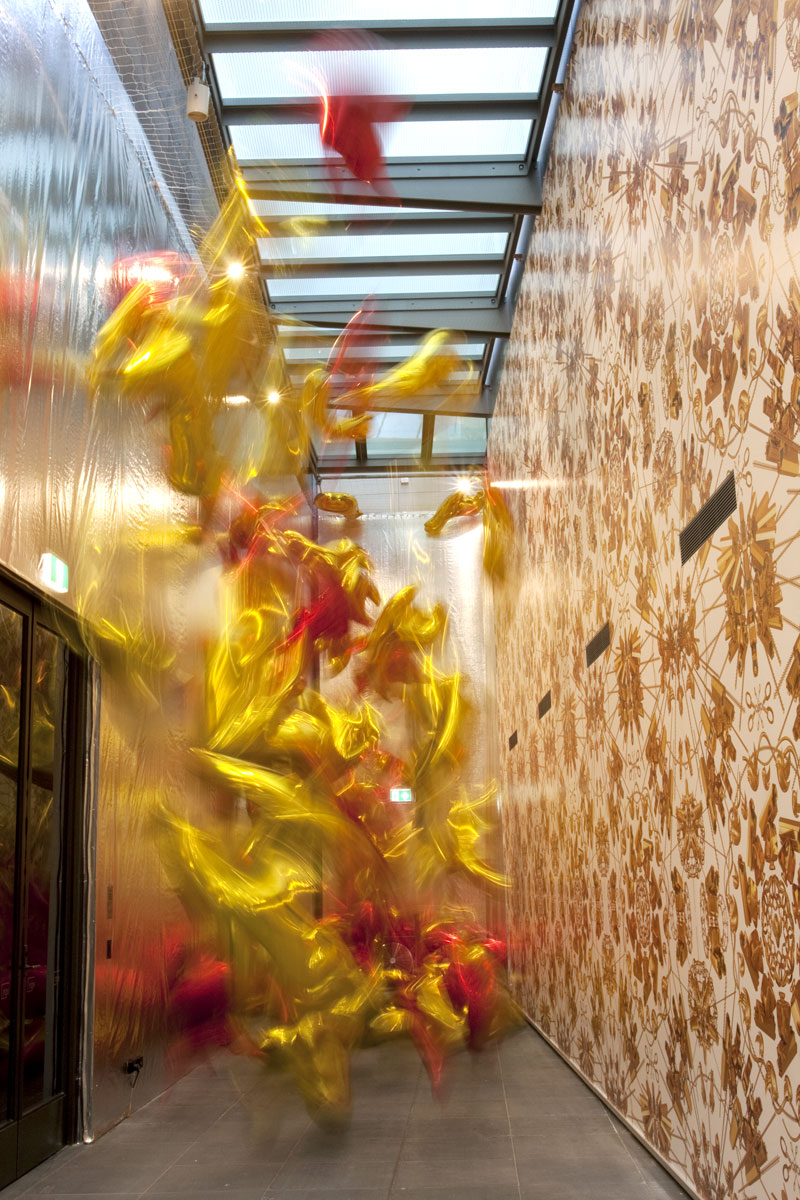
Passageway between second and third rooms at the exhibition Andy Warhol | Ai Weiwei at the National Gallery of Victoria, Melbourne
Photos: © Marcus Bunyan and the National Gallery of Victoria
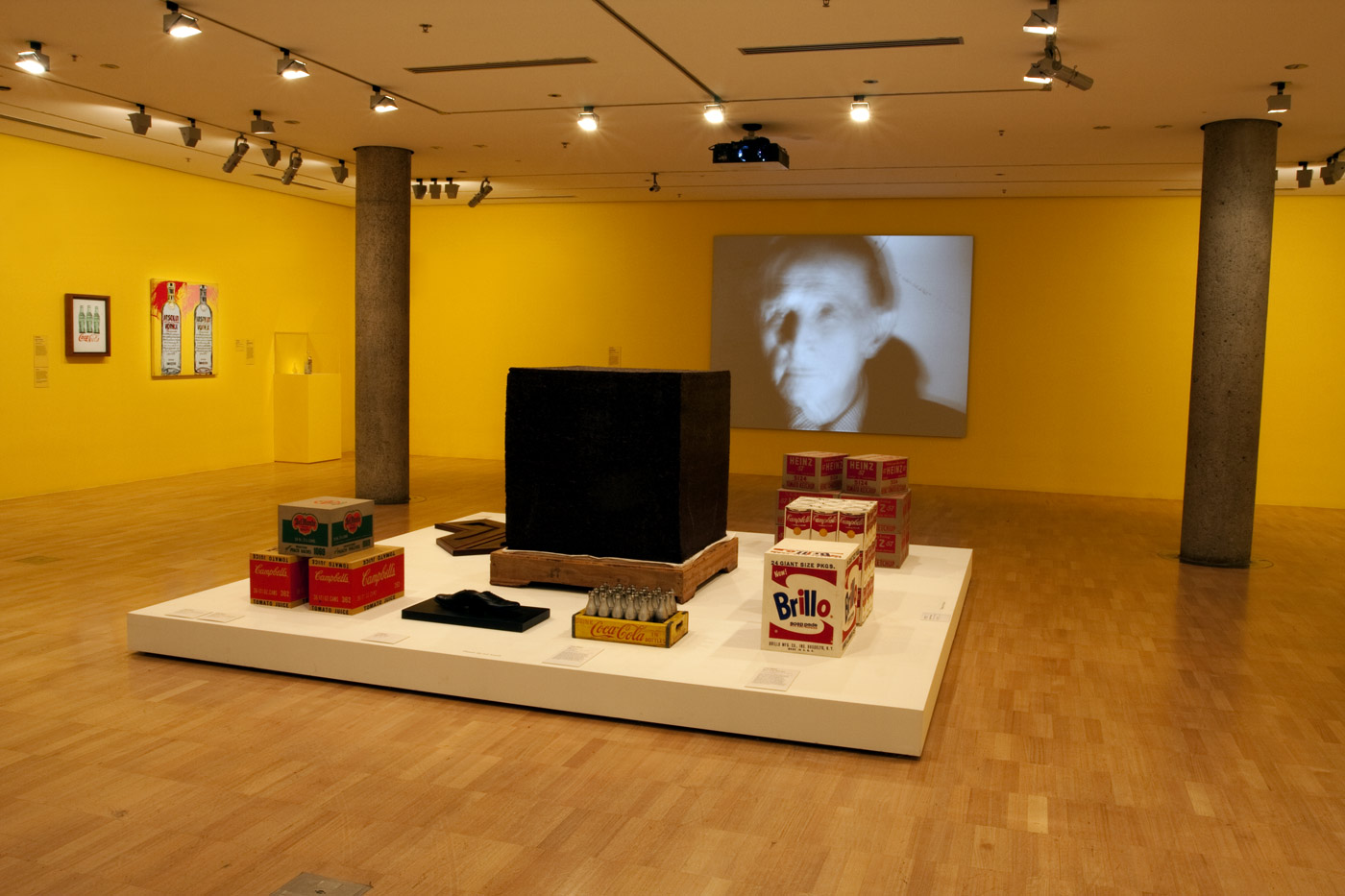
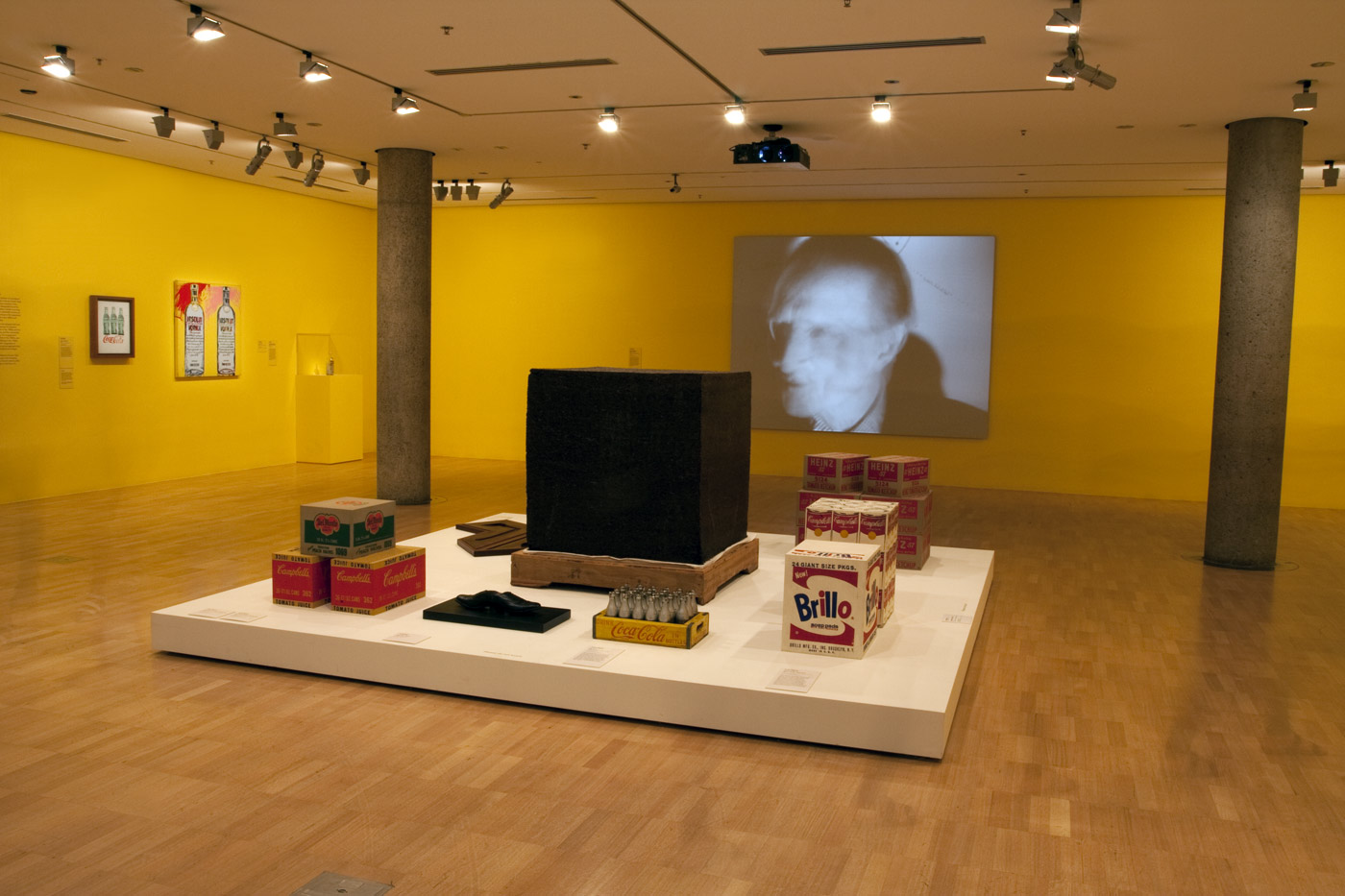
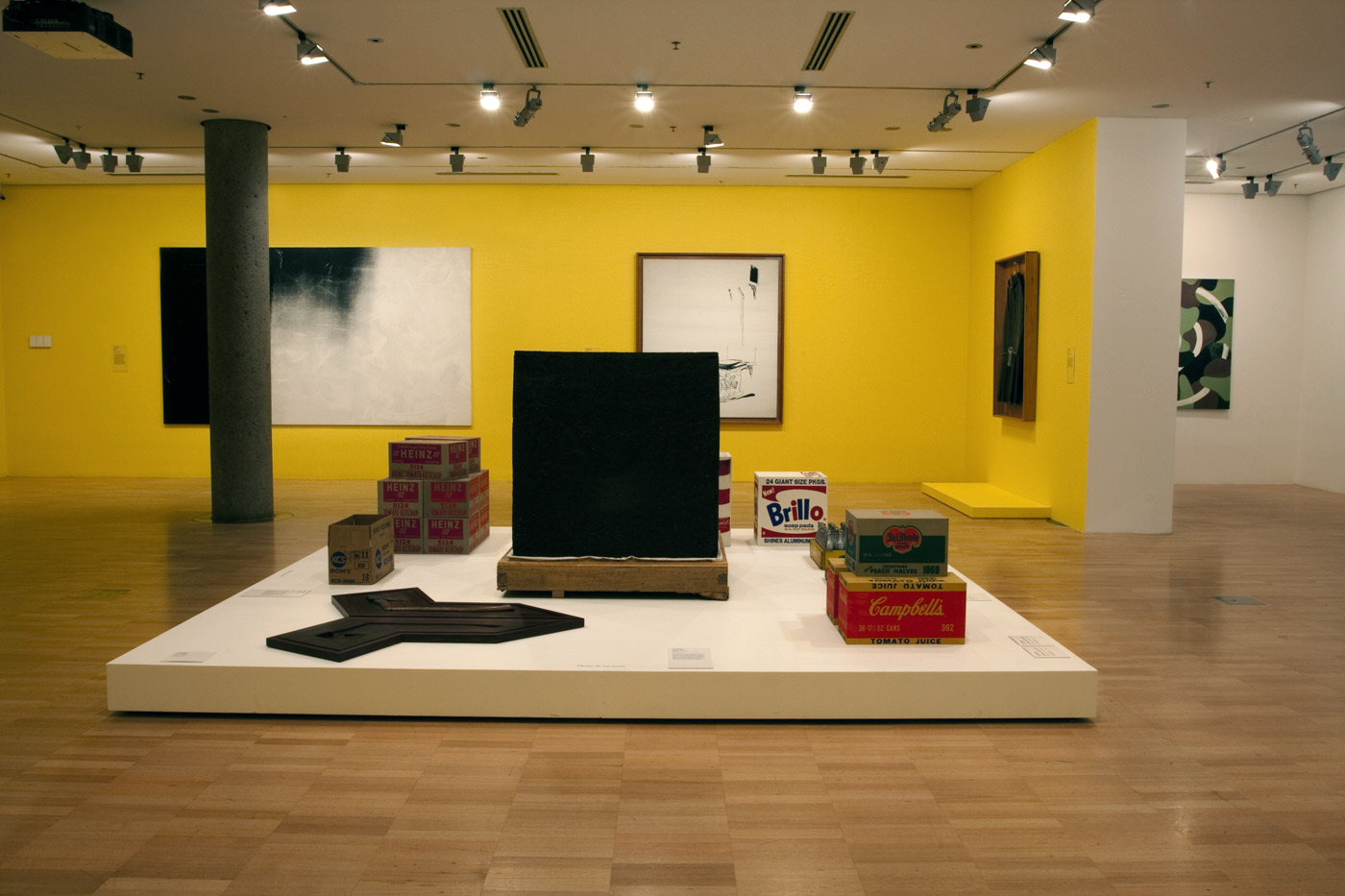
Installation views of the third room including at centre, Ai Weiwei’s Tonne of Tea (2006) and And Warhol’s Brillo Soap Pads Box (1964) at the exhibition Andy Warhol | Ai Weiwei at the National Gallery of Victoria, Melbourne
Photos: © Marcus Bunyan and the National Gallery of Victoria
Ai Weiwei (Chinese, b. 1957)
Tonne of Tea
2006
Compressed pu’er tea, wood base
Ai Weiwei Studio, Beijing
Ai’s Tonne of Tea is a readymade object redolent of the artist’s cultural context and heritage. Ai’s compressed cube of Pu’er tea – a staple of Chinese life, trade and custom – recalls not only the commercial aesthetics of Warhol’s Brillo Soap Pads Box but also the minimalist sculpture of postwar American artists such as Donald Judd, while introducing a specifically Chinese historical reference and cultural narrative into the readymade tradition.
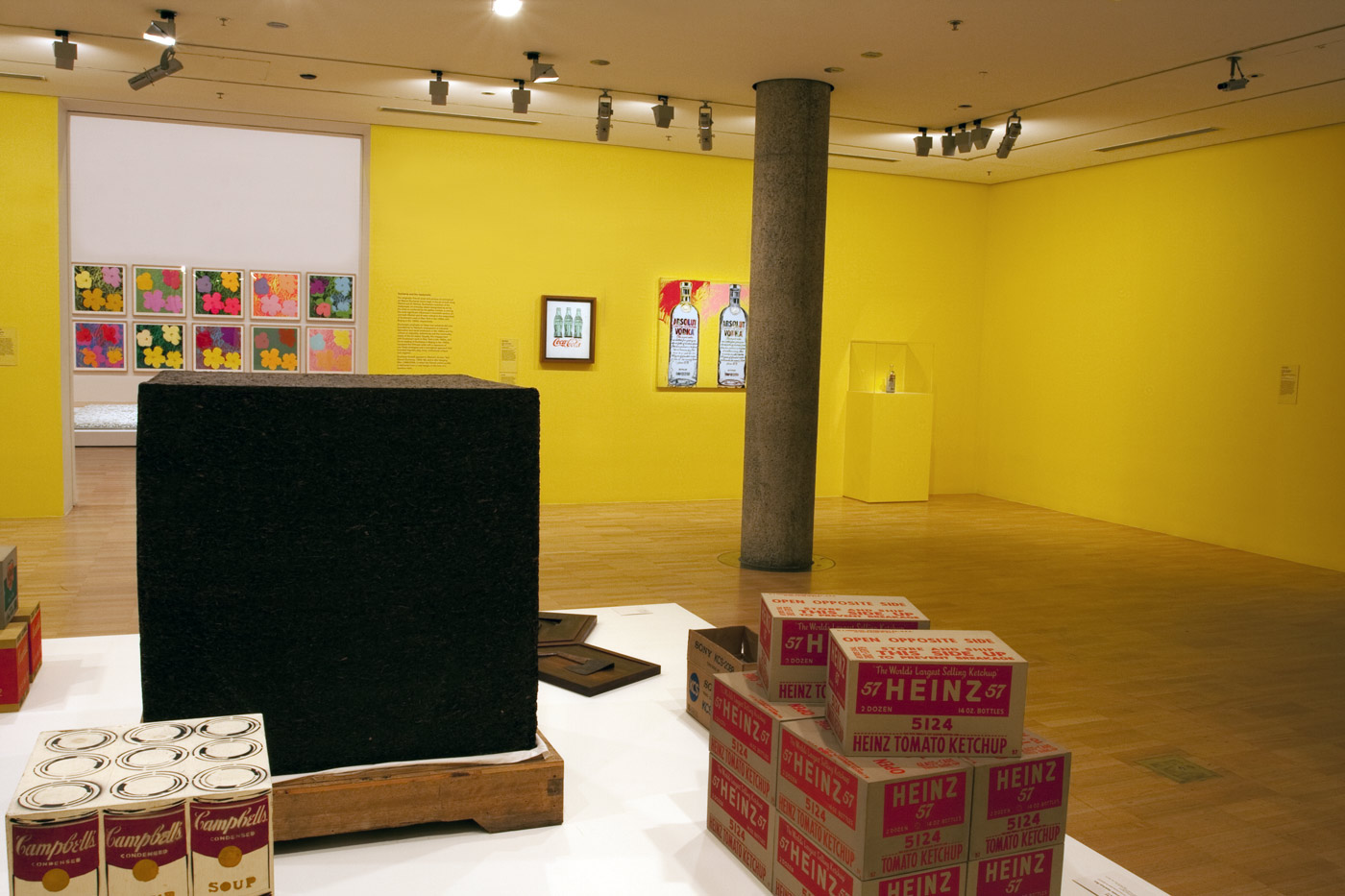
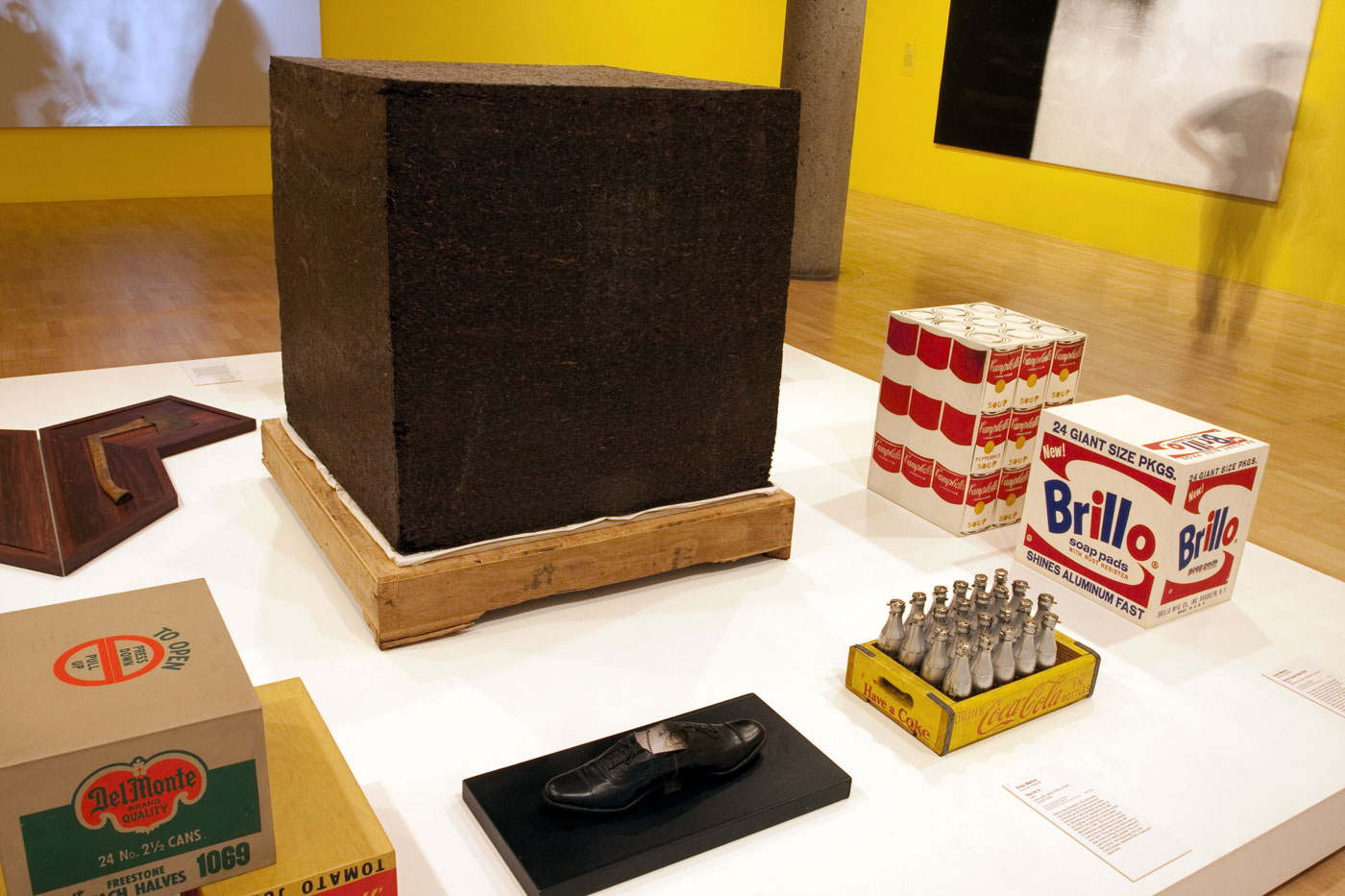
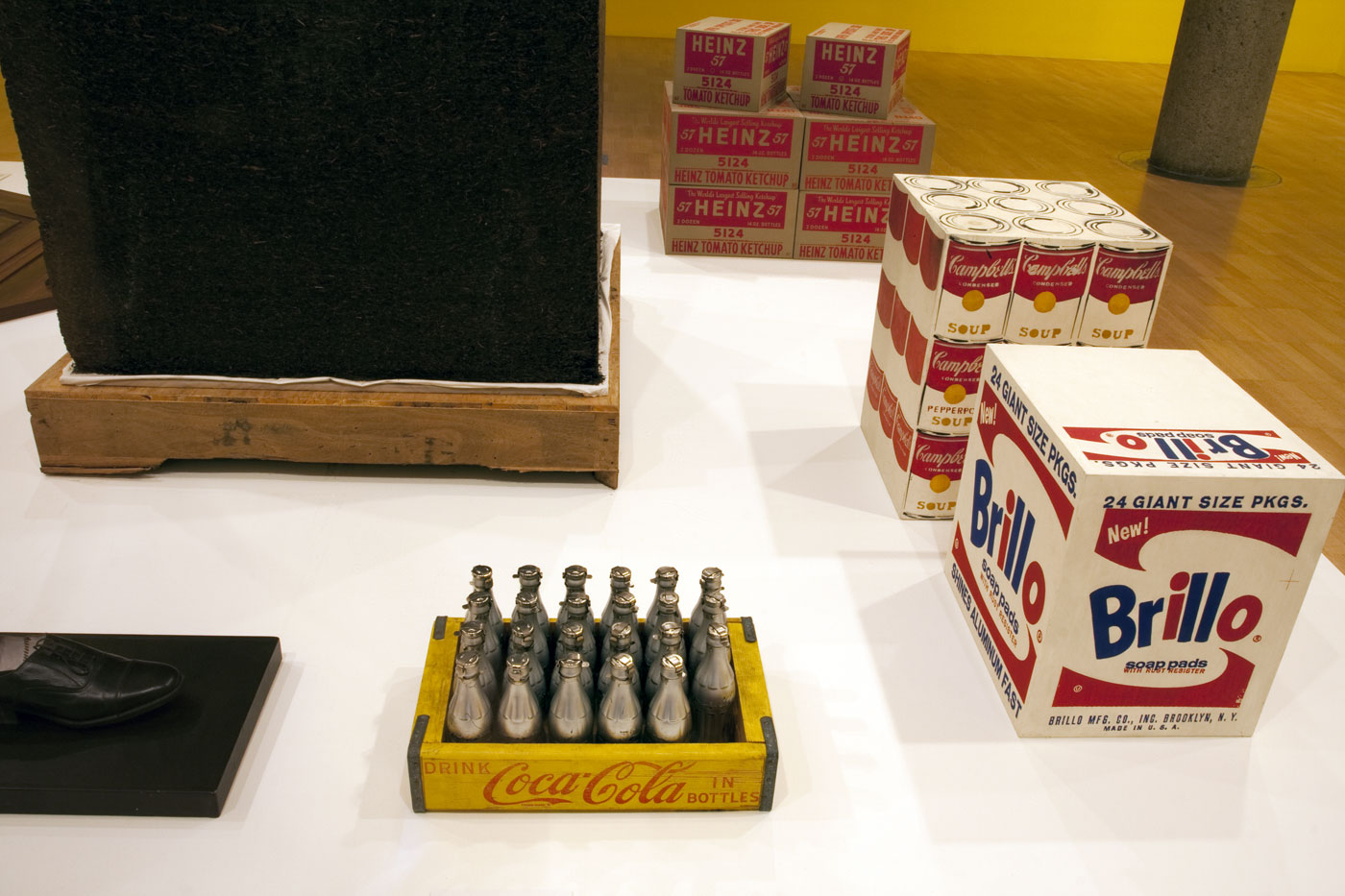
Installation views of the third room including Ai Weiwei’s Tonne of Tea (2006) and And Warhol’s Brillo Soap Pads Box (1964) and You’re in (1967) at the exhibition Andy Warhol | Ai Weiwei at the National Gallery of Victoria, Melbourne
Photos: © Marcus Bunyan and the National Gallery of Victoria
Andy Warhol (American, 1928-1987)
Brillo Soap Pads Box
1964
Silkscreen ink and house paint on plywood
The Andy Warhol Museum, Pittsburgh
Founding Collection, Contribution
The Andy Warhol Foundation for the Visual Arts, Inc.
First created in late 1963, Warhol’s Brillo Soap Pads Box recasts the Duchampian readymade through the lens of American popular culture. Warhol produced approximately 100 of these boxes for his exhibition at Stable Gallery, New York, in March 1964, where they were tightly packed and piled high in a display reminiscent of a grocery warehouse. Unlike Duchamp’s use of real objects as readymade works of art, Warhol’s Brillo Soap Pads Boxes are carefully painted and silkscreened to resemble everyday consumer items. For philosopher Arthur C. Danto, Warhol’s Brillo boxes marked the end of an art-historical epoch and represented a new model of how art could be produced, displayed and perceived.
Andy Warhol (American, 1928-1987)
You’re in
1967
Spray paint, glass bottles, printed wooden crate
The Andy Warhol Museum, Pittsburgh
Founding Collection, Contribution
The Andy Warhol Foundation for the Visual Arts, Inc.
Warhol was interested in the democratic cultural significance of mass-produced consumer goods. Popular grocery items distributed in vast quantities worldwide, at an affordable price, represented the best and brightest of American consumer society. Warhol’s first paintings of Coke bottles appeared in 1961. Here the artist turned to readymade objects as source material, coating the actual softdrink bottles with silver paint. Three years later Warhol went a step further by filling 100 silver bottles with a perfume he rakishly labelled ‘You’re In’ / ‘Eau d’Andy’. Not surprisingly, the Coca-Cola Company responded with a cease and desist letter.
A major international exhibition featuring two of the most significant artists of the twentieth and twenty-first centuries – Andy Warhol and Ai Weiwei – opened at the National Gallery of Victoria, Melbourne, on 11 December 2015.
Andy Warhol | Ai Weiwei, developed by the NGV and The Warhol, with the participation of Ai Weiwei, explores the significant influence of these two exemplary artists on modern art and contemporary life, focussing on the parallels, intersections and points of difference between the two artists’ practices. Surveying the scope of both artists’ careers, the exhibition at the NGV presents over 300 works, including major new commissions, immersive installations and a wide representation of paintings, sculpture, film, photography, publishing and social media.
The exhibition explores modern and contemporary art, life and cultural politics through the activities of two exemplary figures – one of whom represents twentieth century modernity and the ‘American century’; and the other contemporary life in the twenty-first century and what has been heralded as the ‘Chinese century’ to come. Ai Weiwei commented, “I believe this is a very interesting and important exhibition and an honour for me to have the opportunity to be exhibited alongside Andy Warhol. This is a great privilege for me as an artist.”
Andy Warhol | Ai Weiwei premieres a suite of major new commissions from Ai Weiwei, including an installation from the Forever bicycles series, composed from nearly 1500 bicycles; a major five metre-tall work from Ai’s Chandelier series of crystal and light; Blossom 2015, a spectacular installation in the form of a large bed of thousands of delicate, intricately designed white porcelain flowers; and a room-scale installation featuring portraits of Australian advocates for human rights and freedom of speech and information.
Ai Weiwei lived in the United States from 1981 until 1993, where he experienced the works of Marcel Duchamp, Andy Warhol and Jasper Johns, among others. The Philosophy of Andy Warhol (From A to B & Back Again) was the first book that Ai Weiwei purchased in New York, and was a significant influence upon his conceptual approach. Ai Weiwei’s relationship to Warhol is explicitly apparent in a photographic self-portrait, taken in New York in 1987, in which Ai Weiwei poses in front of Warhol’s multiple self-portrait, adopting the same gesture.
Each artist is also recognised for his unique approach to notions of artistic value and studio production. Warhol’s Factory was legendary for its bringing together of artists and poets, film-makers and musicians, bohemians and intellectuals, ‘drag queens’, ‘superstars’ and socialites, and for the serial-production of silkscreen paintings, films, television, music and publishing.
The studio of Ai Weiwei is renowned for its interdisciplinary approach, post-industrial modes of production, engagement with teams of assistants and collaborators, and strategic use of communications technology and social media. Both artists have been equally critical in redefining the role of ‘the artist’ – as impresario, cultural producer, activist and brand – and both are known for their keen observation and documentation of contemporary society and everyday life.
Text from the National Gallery of Victoria
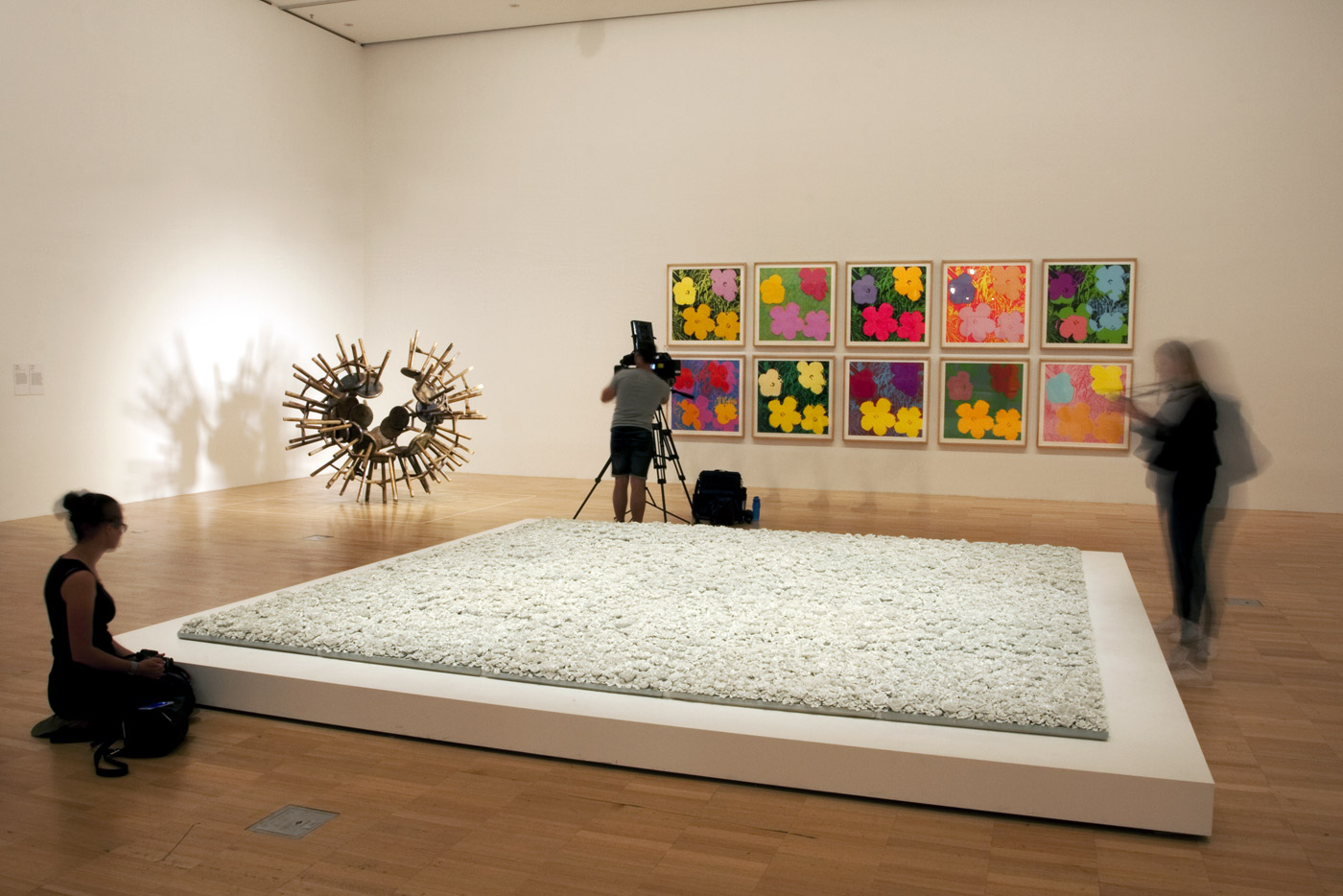
Installation view of the fourth room including, at centre, Ai Weiwei’s Blossom (2015) with his Grapes (2011) rear left, and Andy Warhol’s Flowers (Hand Coloured) (1974) on the wall behind at the exhibition Andy Warhol | Ai Weiwei at the National Gallery of Victoria, Melbourne
Photo: © Marcus Bunyan and the National Gallery of Victoria
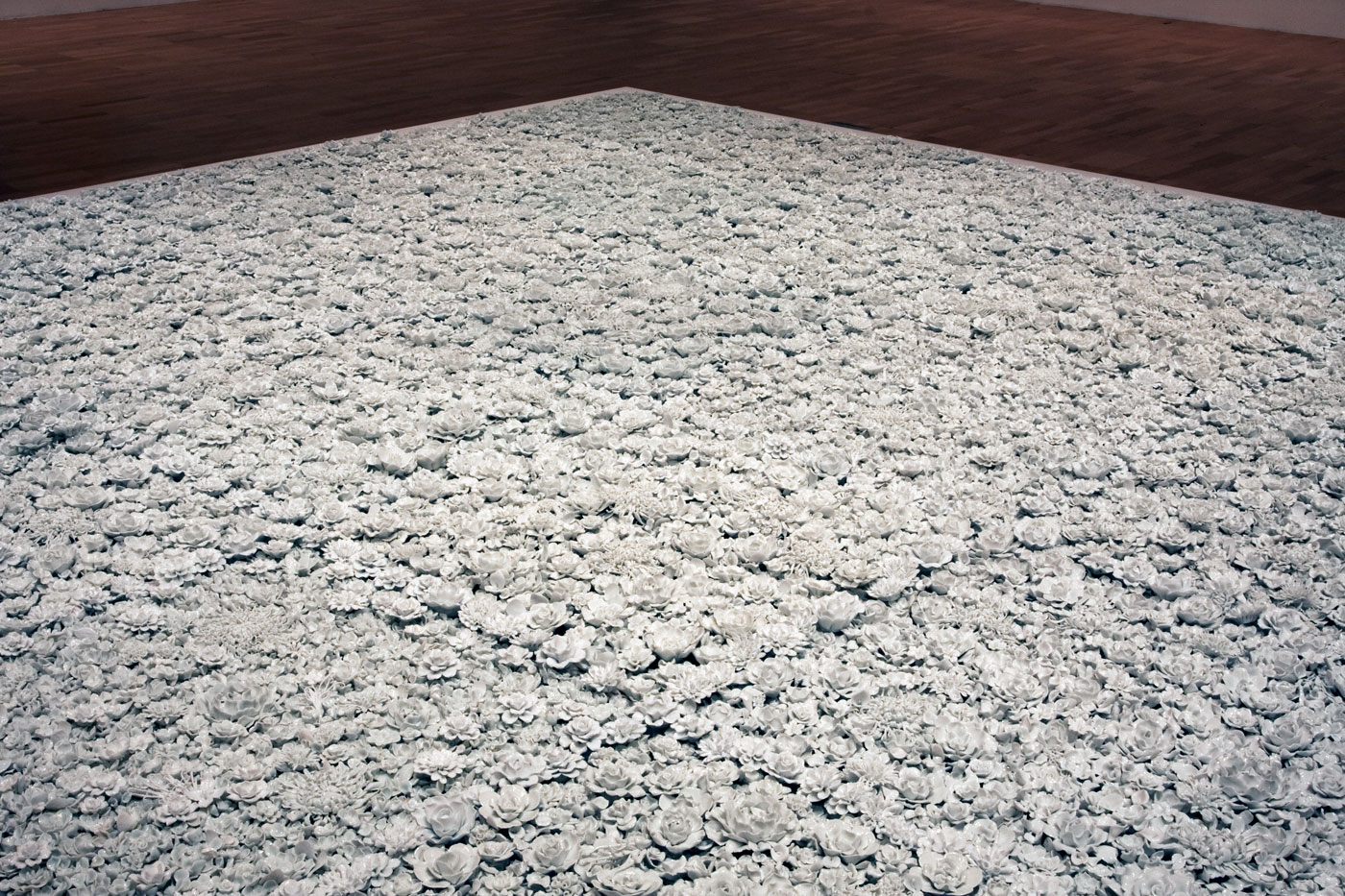
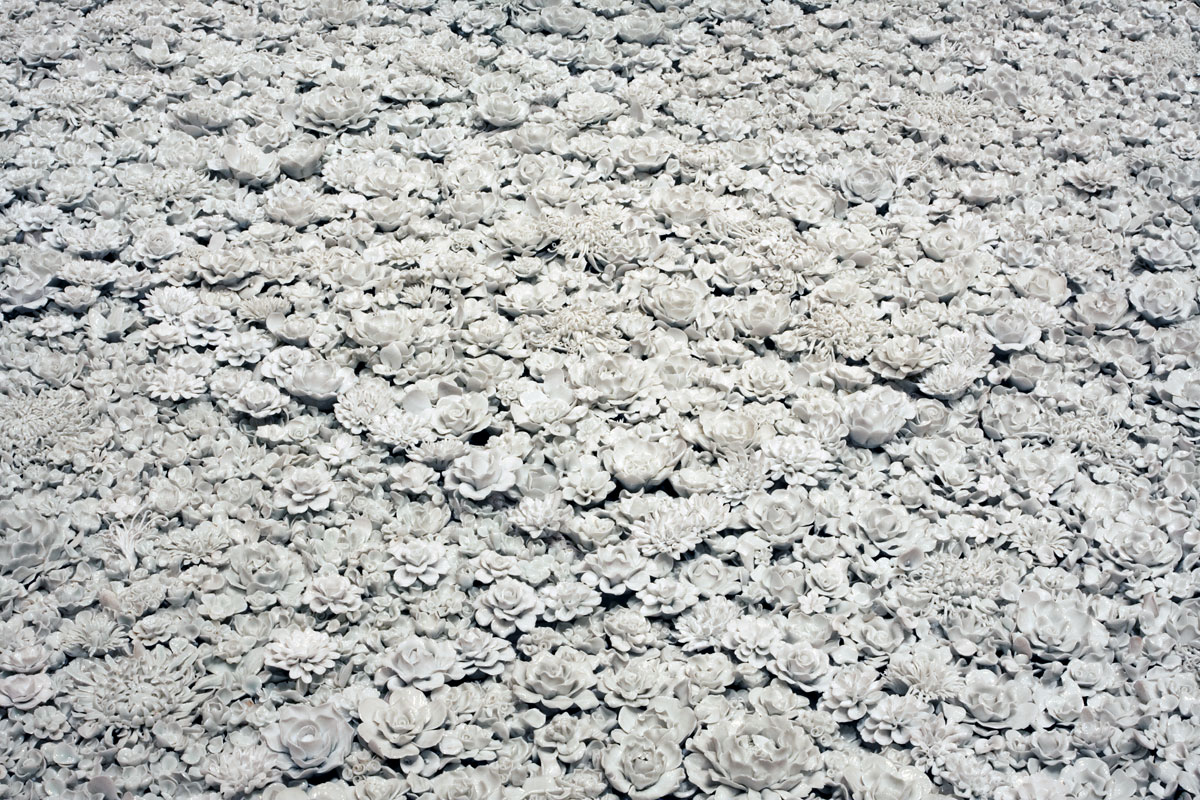
Ai Weiwei (Chinese, b. 1957)
Blossom (installation view details)
2015
Porcelain
Ai Weiwei Studio, Beijing
Photos: © Marcus Bunyan and the National Gallery of Victoria
Blossom is a new installation in the form of a garden bed, comprising thousands of flowers made from fine white porcelain. In response to the Flowers for Freedom movement which grew out of the artist’s With Flowers project, Blossom serves as a memorial to people who live in restricted conditions because of their fight for freedom of speech or human rights. The work was fabricated in collaboration with the finest craftspeople from Jingdezhen, whose predecessors once produced the highest quality porcelain for emperors of the past. Because of its size, the technical aspect of manufacturing this work was highly complex.
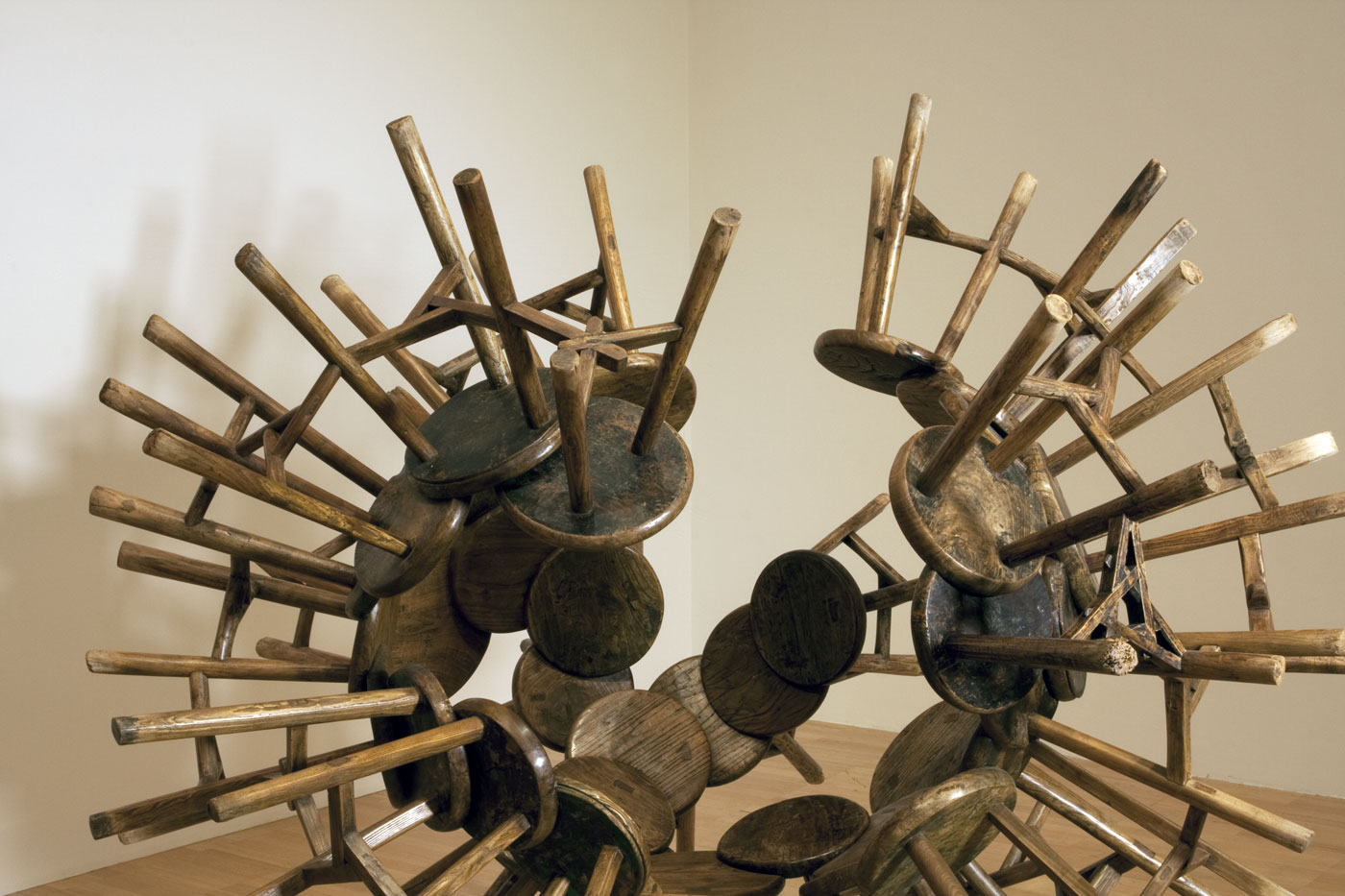
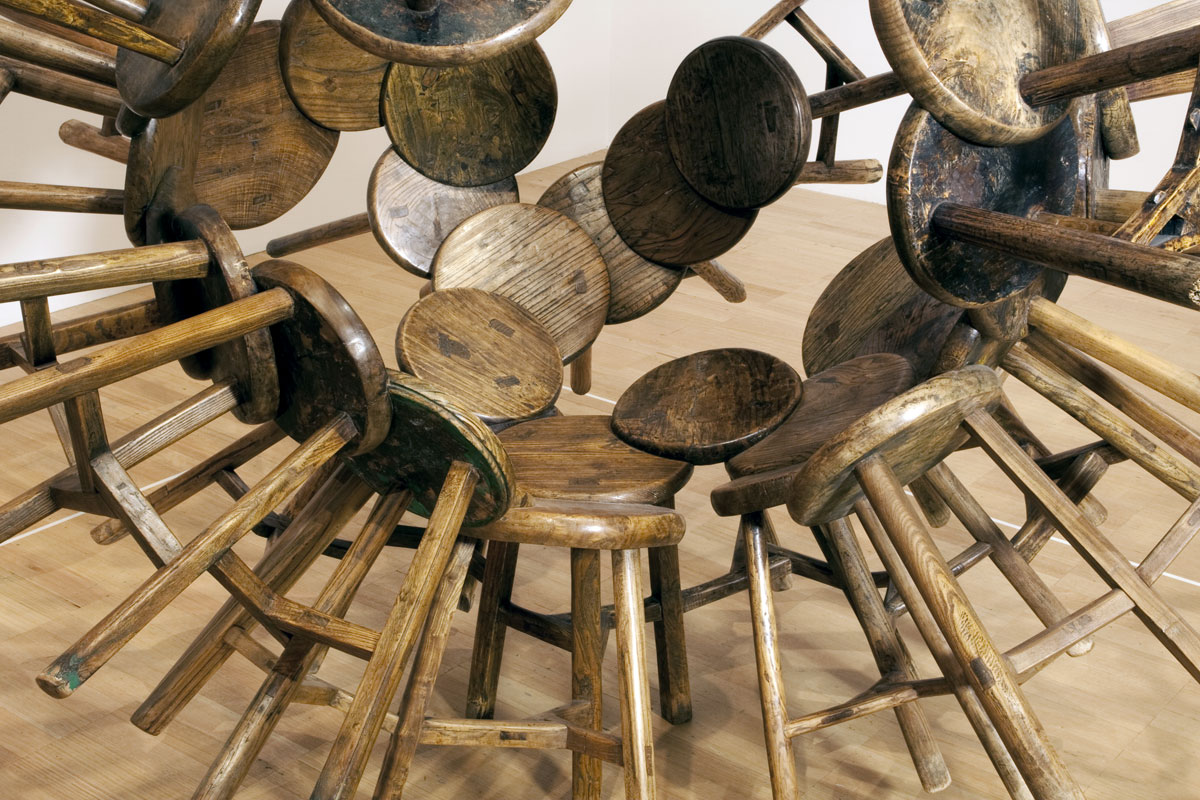
Ai Weiwei (Chinese, b. 1957)
Grapes (installation view details)
2011
Qing Dynasty stools
Collection of Larry Warsh, New York
Photos: © Marcus Bunyan and the National Gallery of Victoria
By reassembling Qing Dynasty furniture, which was constructed by traditional joinery techniques without glue or nails, Ai transforms the meaning and function of these cultural artefacts. Here he reconfigures a collection of wooden stools into a group resembling an organically formed cluster of grapes. The arrangement serves as a metaphor for the relationship between the individual and the collective, signifying the deferral of personal interests to those of the community and state characteristic of China’s socialist history. The linked structure of Grapes also recalls the idea of networks and communication, which are recurrent motifs in the Ai work. Manufactured by skilled craftsmen, this type of three-legged stool was used for centuries in China by all kinds of people – the rich and the poor, in towns and in the country. Every family had one, and they were passed on through many generations.
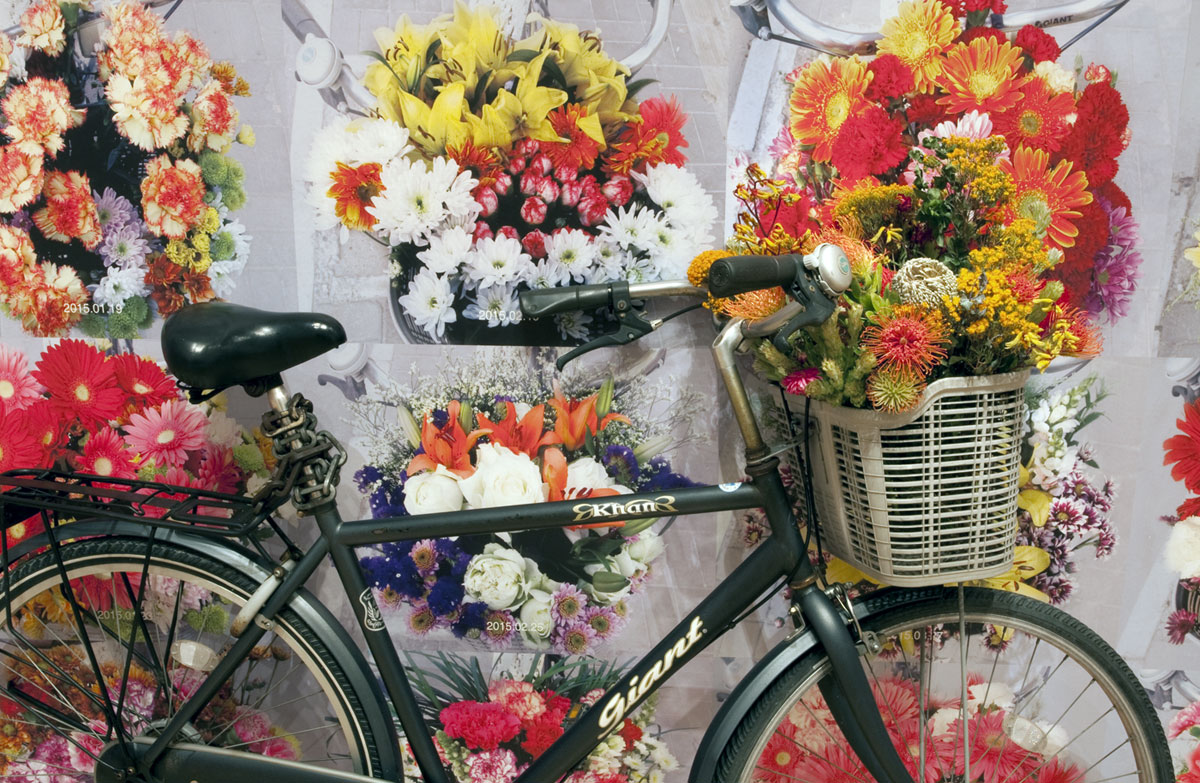
Ai Weiwei (Chinese, b. 1957)
With Flowers (installation view detail)
2013-2015
Bicycle, flowers, digital print on paper
Ai Weiwei Studio, Beijing
Photo: © Marcus Bunyan and the National Gallery of Victoria
In 2011 Ai was detained by Chinese authorities for eighty-one days without being charged. Upon his release, Ai’s passport was revoked and his studio placed under constant surveillance. With Flowers saw the artist place a fresh bunch of flowers in the basket of a bicycle outside his studio on a daily basis in a poetic protest against restriction on his right to travel. Images of the flowers were posted to Ai’s social media feeds, and an internet movement called Flowers for Freedom emerged. The project concluded upon the return of Ai’s passport in July 2015.
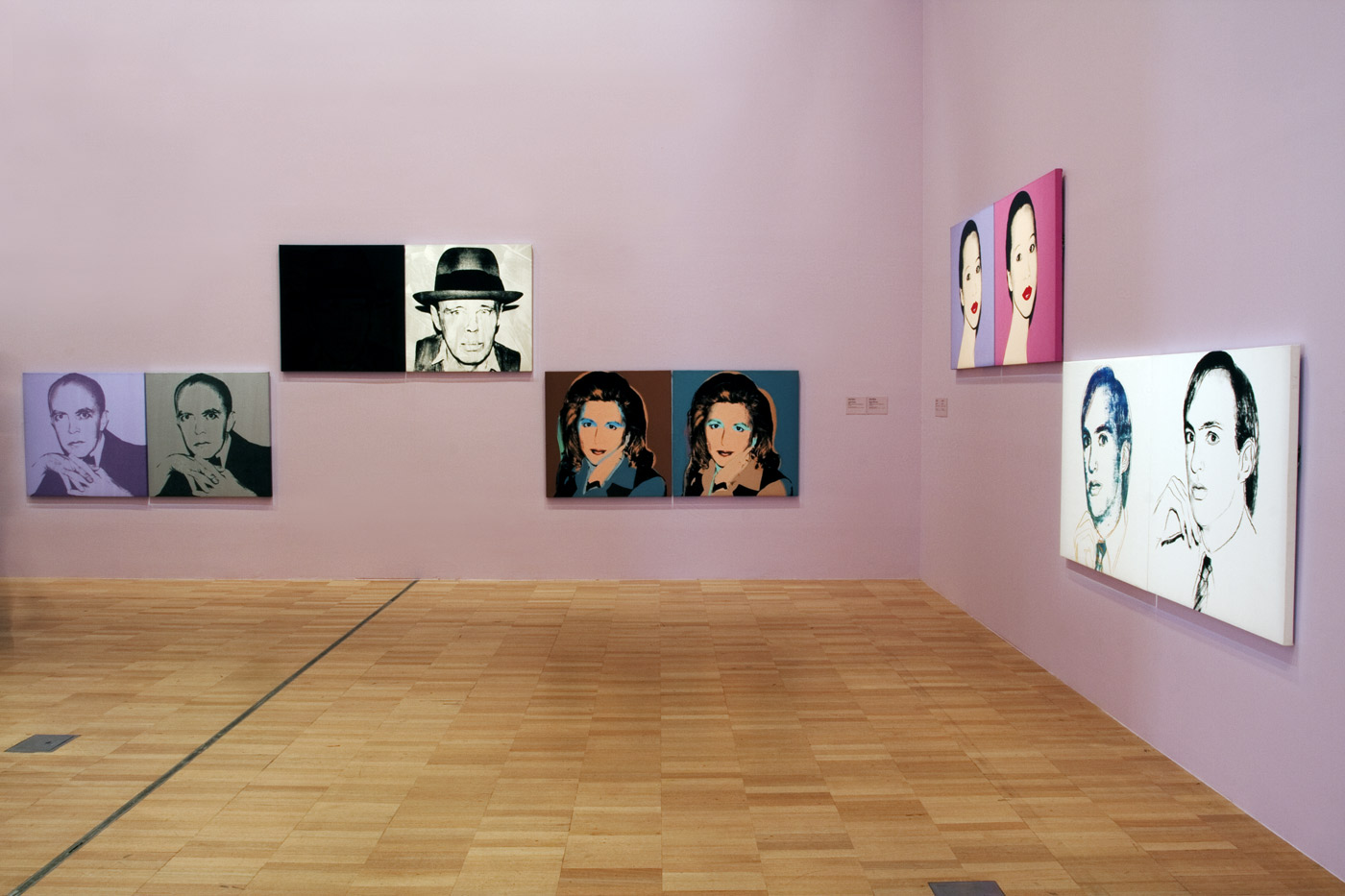
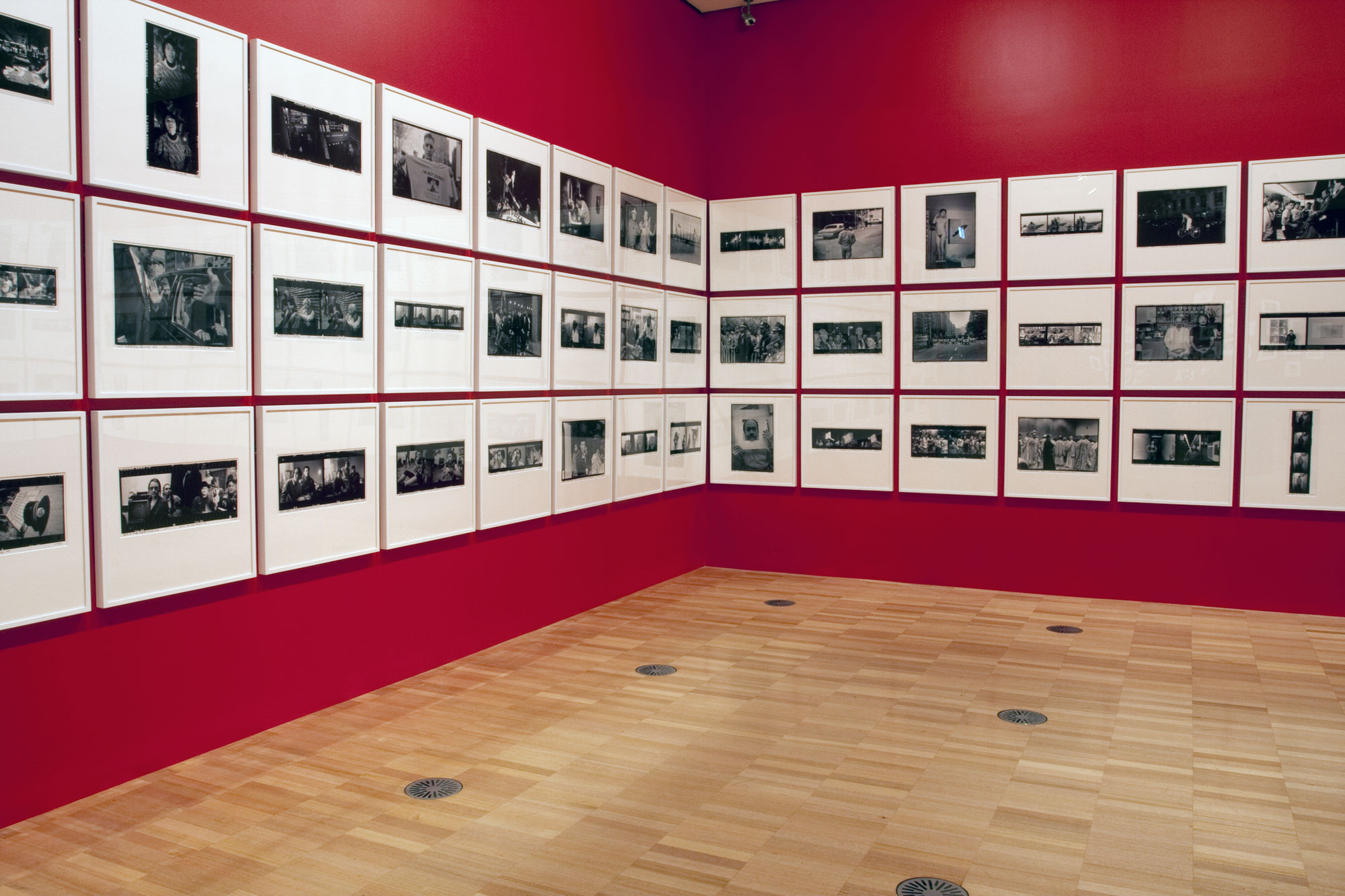
Installation view of part of the fifth room showing Andy Warhol’s portraits of friends and celebrities at the exhibition Andy Warhol | Ai Weiwei at the National Gallery of Victoria, Melbourne
Photo: © Marcus Bunyan and the National Gallery of Victoria
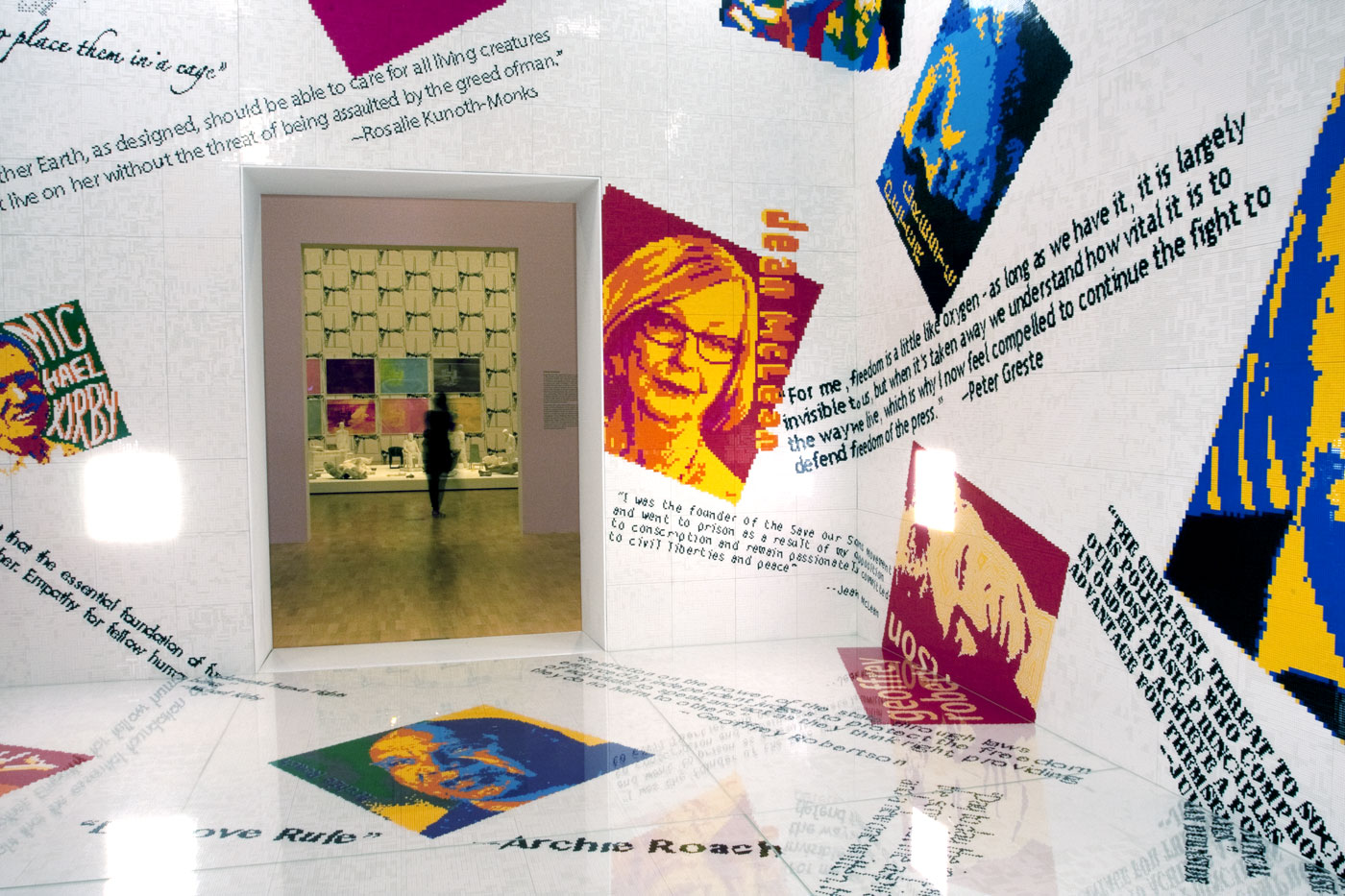
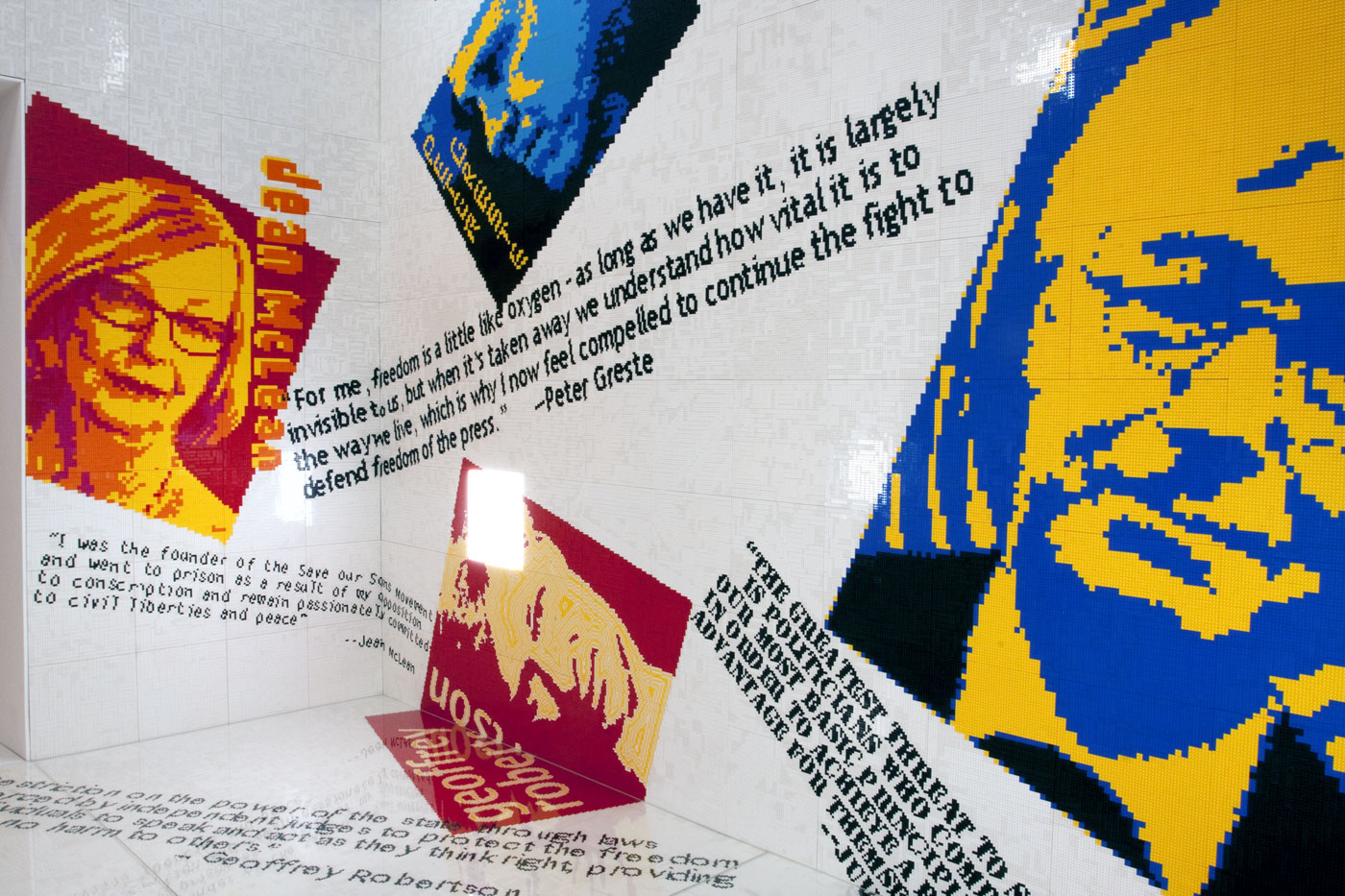
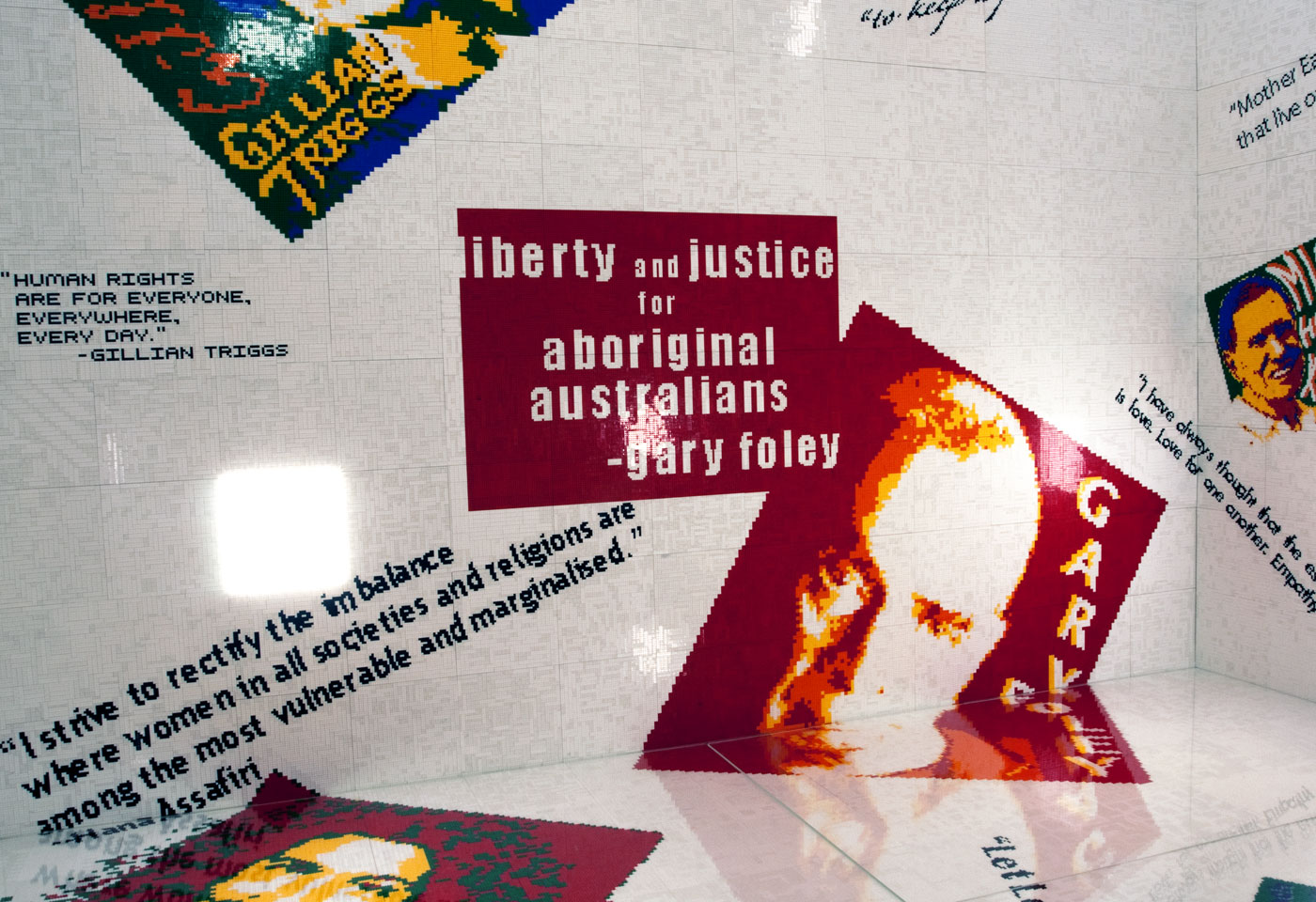
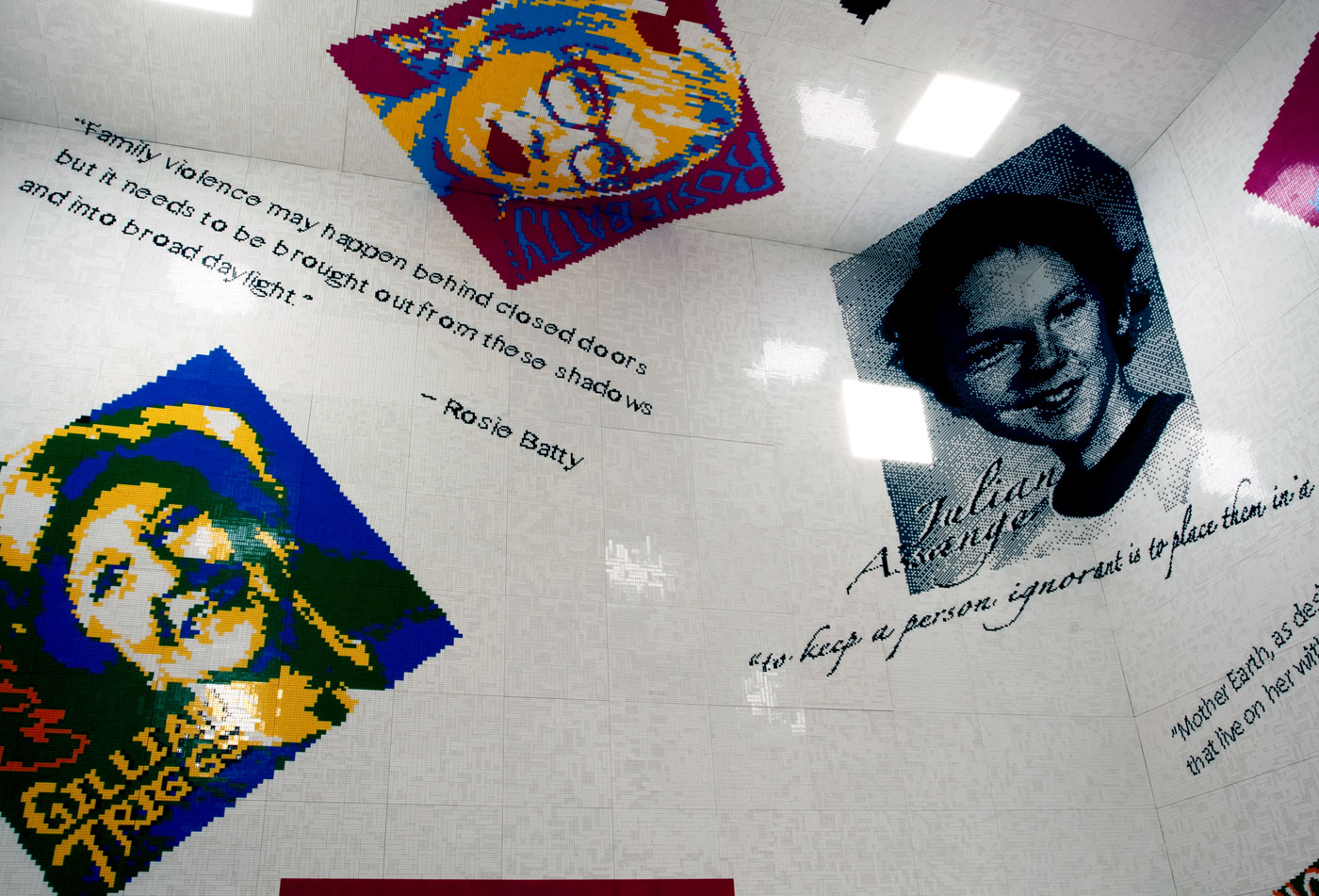
Ai Weiwei (Chinese, b. 1957)
Letgo room (installation view details)
2015
Plastic
Ai Weiwei Studio, Beijing
Photos: © Marcus Bunyan and the National Gallery of Victoria
Composed of more than three million plastic building blocks, Ai Weiwei’s Letgo room is a new installation featuring portraits of Australian activists and champions of human rights and freedom of speech. Ai has chosen people who represent grassroots community activism and advocacy within the fields of international law and academia, social welfare and the rights of Indigenous people, asylum seekers, sex workers and the gender nonspecific, among other cultural contexts. Each subject was asked to provide a one-line statement reflecting their philosophy and views to accompany his or her portrait.
The work attests to Ai’s longstanding commitment to liberty, manifested in his work as an artist, social commentator, activist and public intellectual. Letgo room was intended to be constructed from LEGO blocks; however, the LEGO company declined to provide a bulk order of their product due to the purported ‘political’ nature of the proposed work. Instead, the installation is composed of building blocks manufactured in China, continuing the artist’s exploration of the copy and fake.
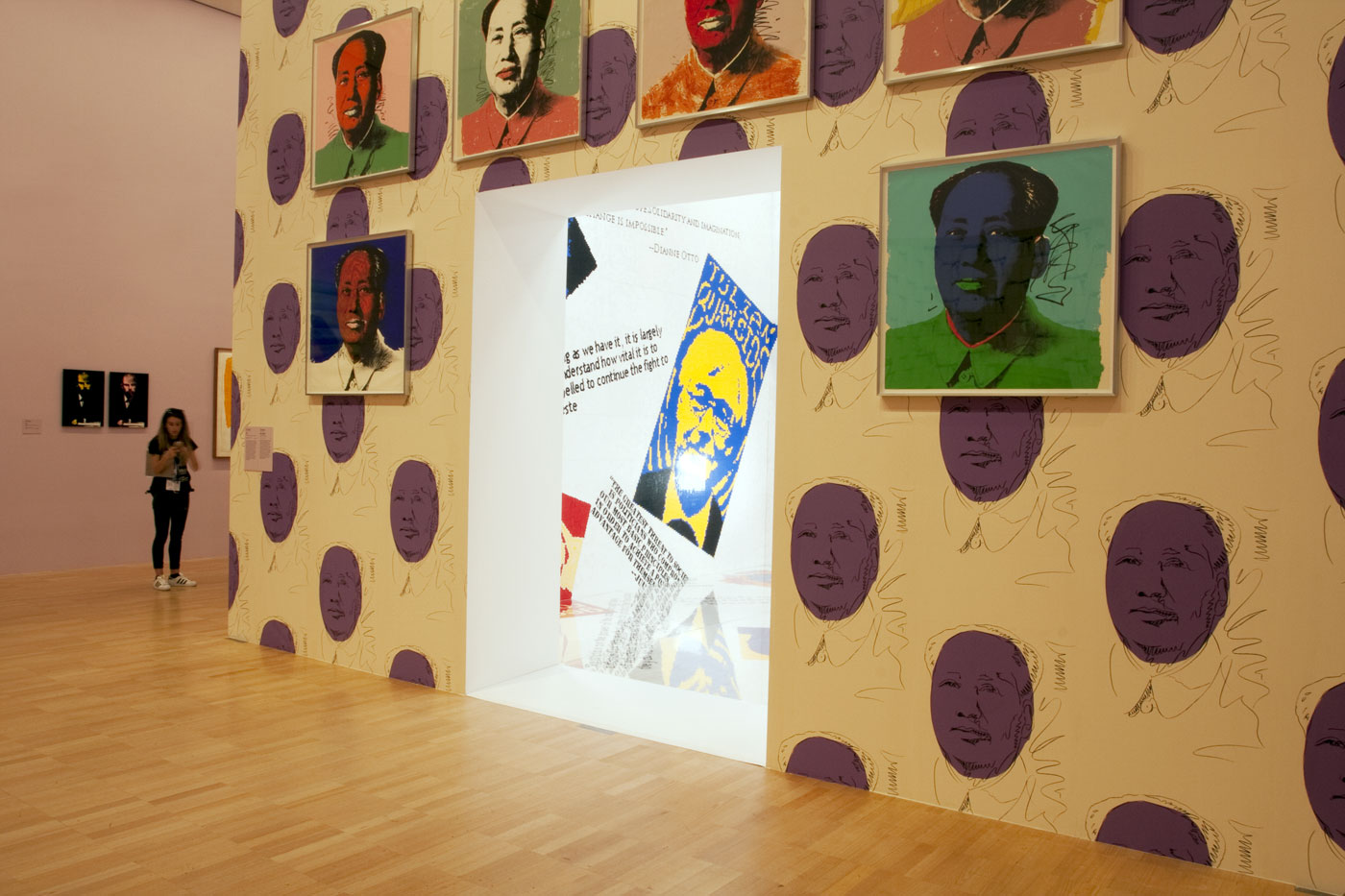
Installation view of part of the fifth room showing Andy Warhol’s silkscreen portraits of Mao (1972) hung on his Mao Wallpaper (1974, reprint 2015), on the exterior of Ai Weiwei’s Letgo room (2015) at the exhibition Andy Warhol | Ai Weiwei at the National Gallery of Victoria, Melbourne
Photos: © Marcus Bunyan and the National Gallery of Victoria
Andy Warhol (American, 1928-1987)
Mao
1972
Colour silkscreens on paper, ed. 162/250
National Gallery of Australia, Canberra
Purchased, 1973
The source image for Warhol’s numerous portraits of Mao Zedong is the frontispiece to the Chairman’s famous Little Red Book of quotations. Mao’s image was in the media spotlight in 1972, the year US President Richard Nixon travelled to China, and his official portrait could be seen on the walls of homes, businesses and government buildings throughout the country. It was also extremely popular among literary and intellectual circles in the West. Warhol’s repetition of the image as pop-cultural icon underlines the cult of celebrity surrounding Mao, and the ways in which the proliferation of images in media and advertising promotes consumer desire and identification.
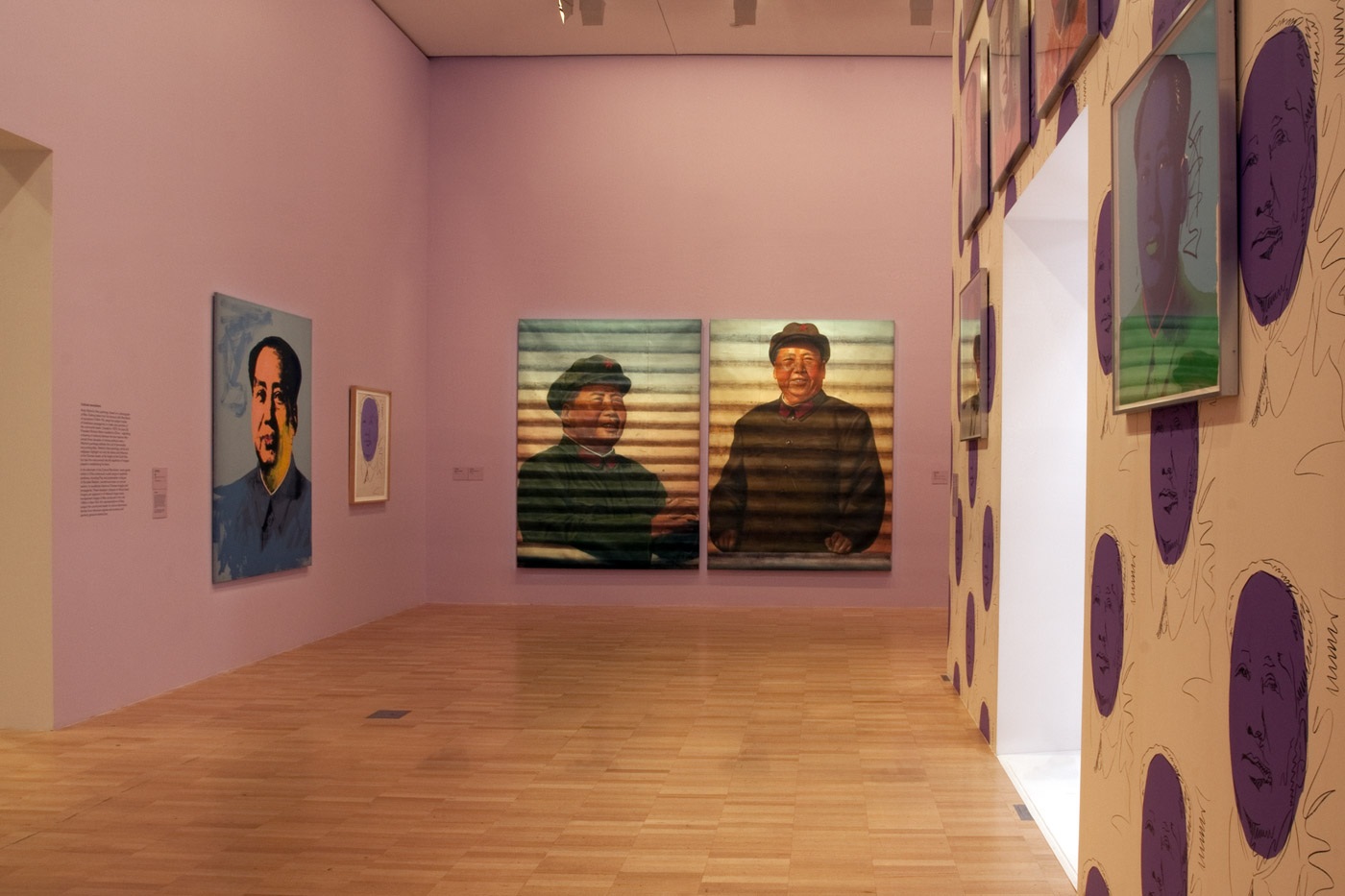
Installation view of part of the fifth room showing, on the far wall, Ai Weiwei’s portraits of Mao: Mao (Facing Right) (1986) and Mao (Facing Forward) (1986) at the exhibition Andy Warhol | Ai Weiwei at the National Gallery of Victoria, Melbourne
Photo: © Marcus Bunyan and the National Gallery of Victoria
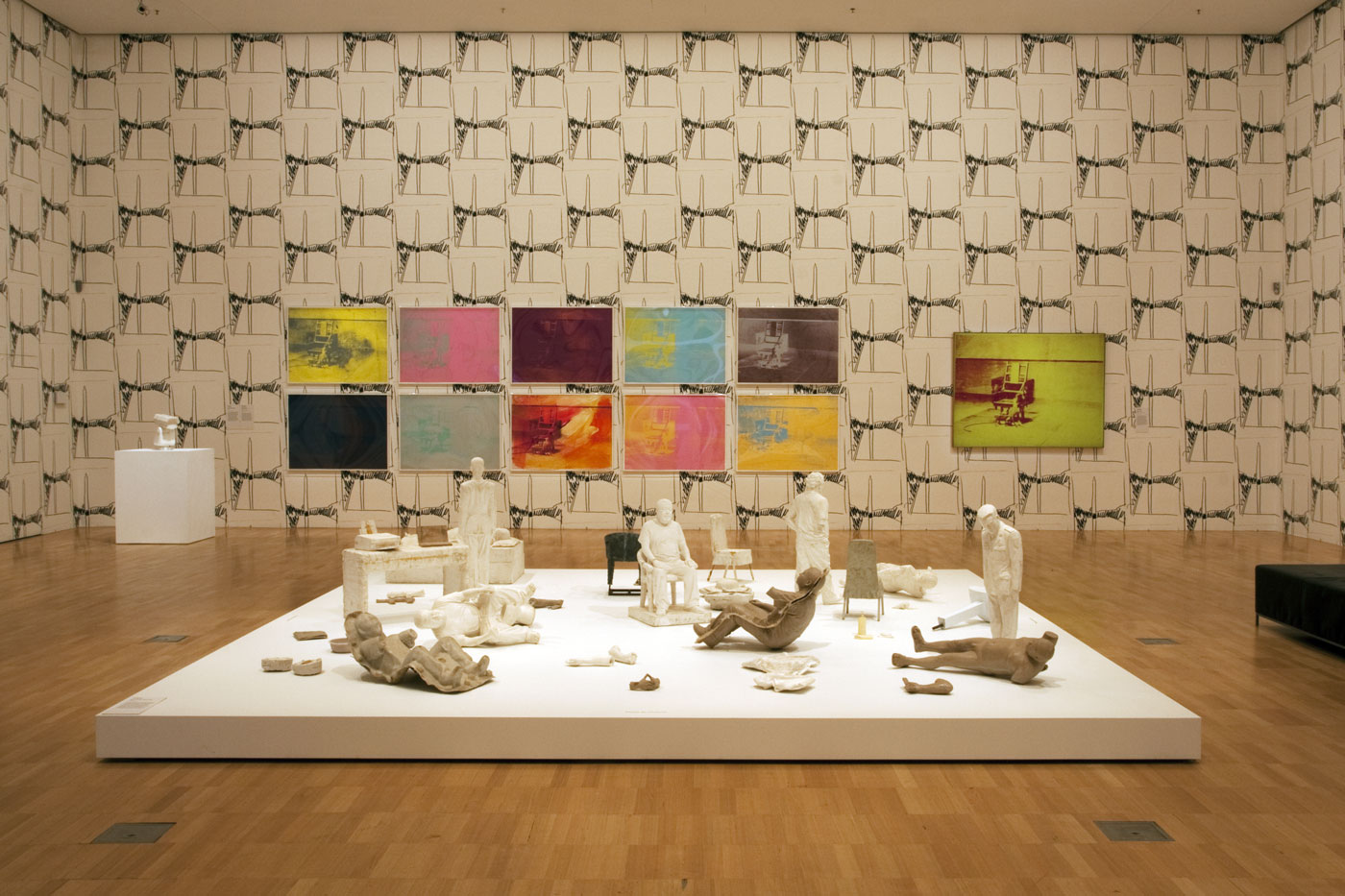
Installation view of the sixth room with, on the floor, Ai Weiwei’s S.A.C.R.E.D. Maquettes (2011) with Andy Warhol’s Electric Chairs (1971) silkscreens at left, and his Electric Chair (1967) painting at right, hung on Warhol’s Washington Monument Wallpaper (1974, reprint 2015) at the exhibition Andy Warhol | Ai Weiwei at the National Gallery of Victoria, Melbourne
Photo: © Marcus Bunyan and the National Gallery of Victoria
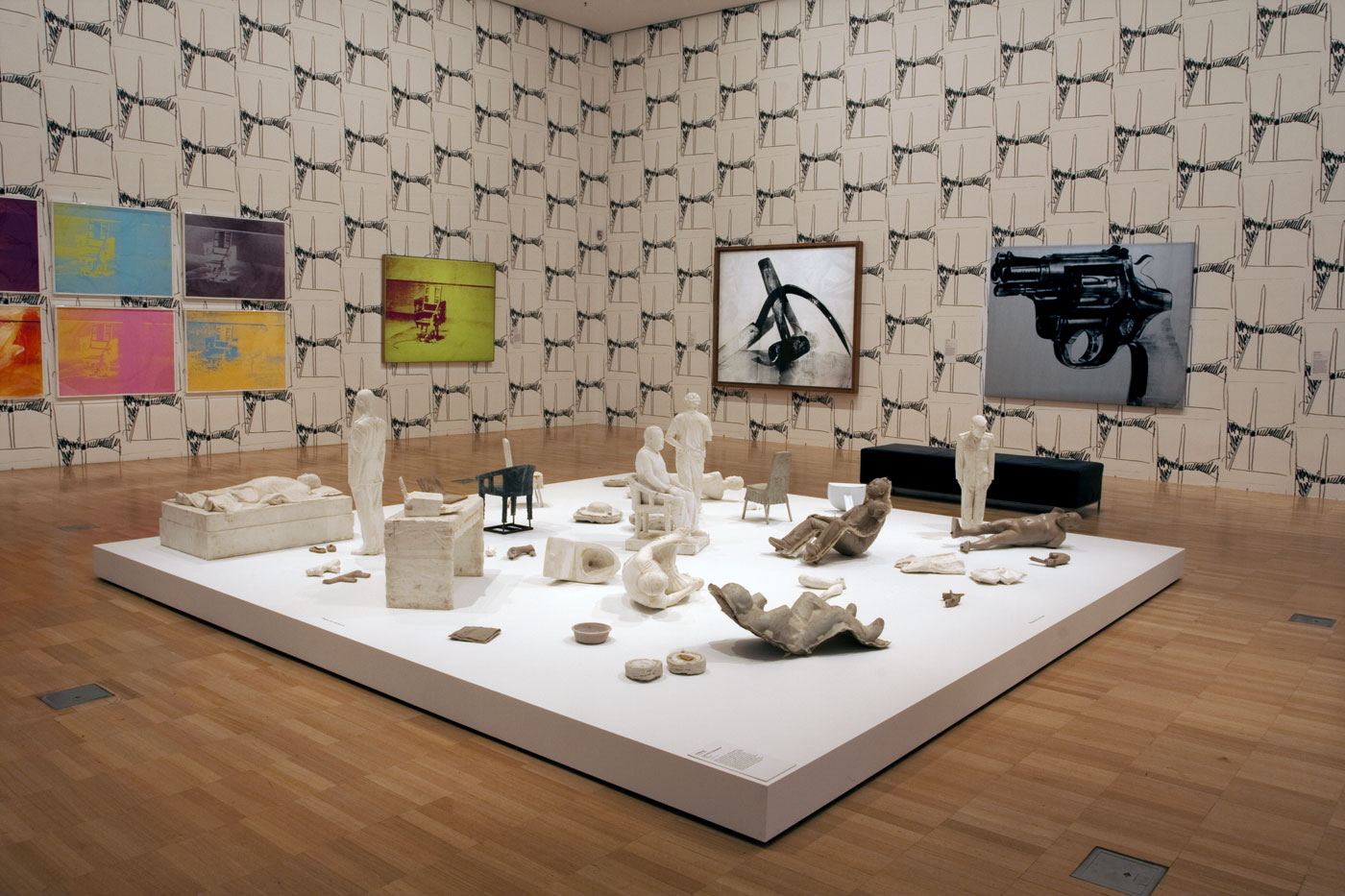
Installation view of the sixth room with, on the floor, Ai Weiwei’s S.A.C.R.E.D. Maquettes (2011) and Andy Warhol’s Gun (1981-82) paint and silkscreen ink on linen work on the wall behind at the exhibition Andy Warhol | Ai Weiwei at the National Gallery of Victoria, Melbourne
Photo: © Marcus Bunyan and the National Gallery of Victoria
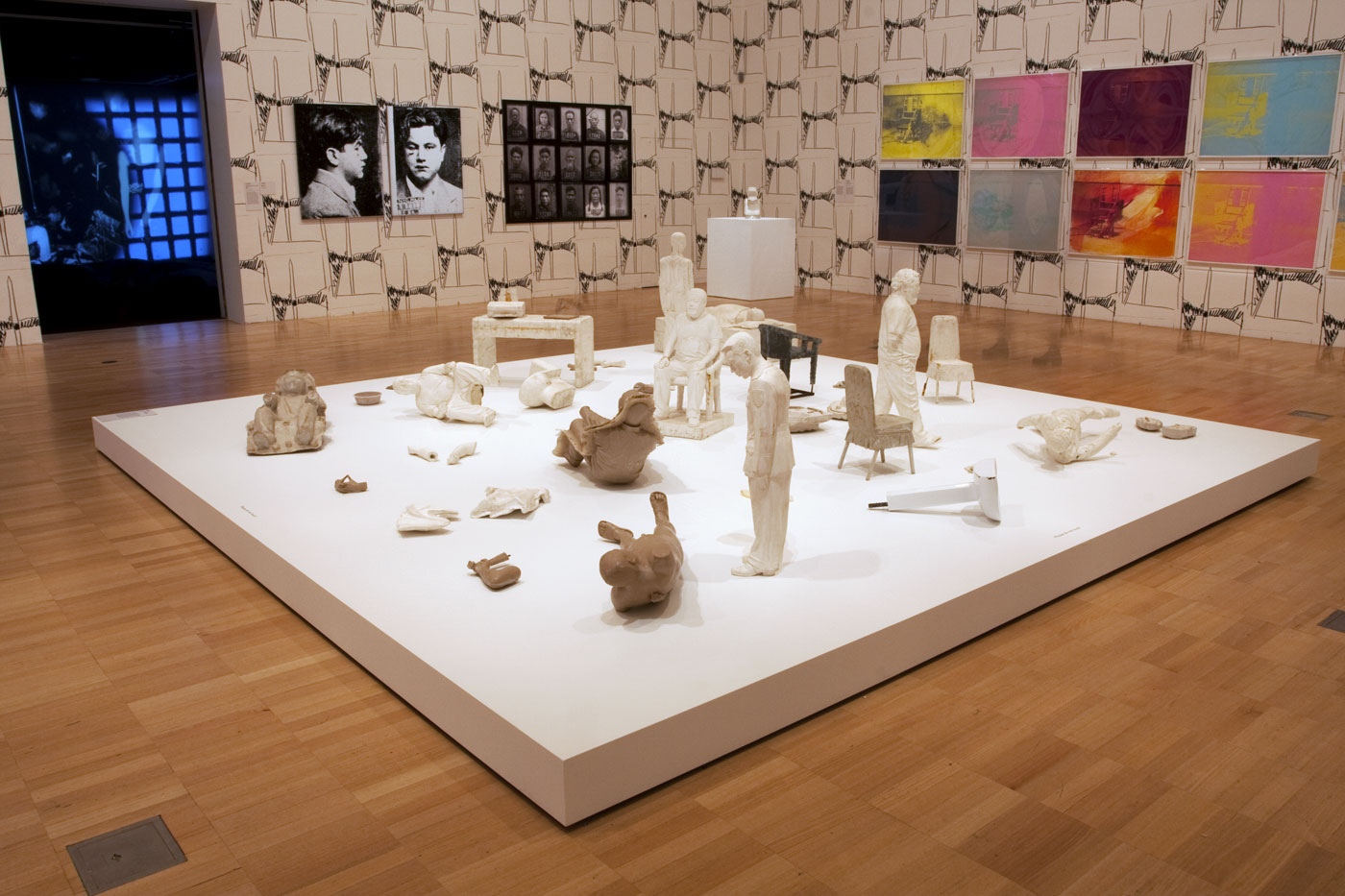
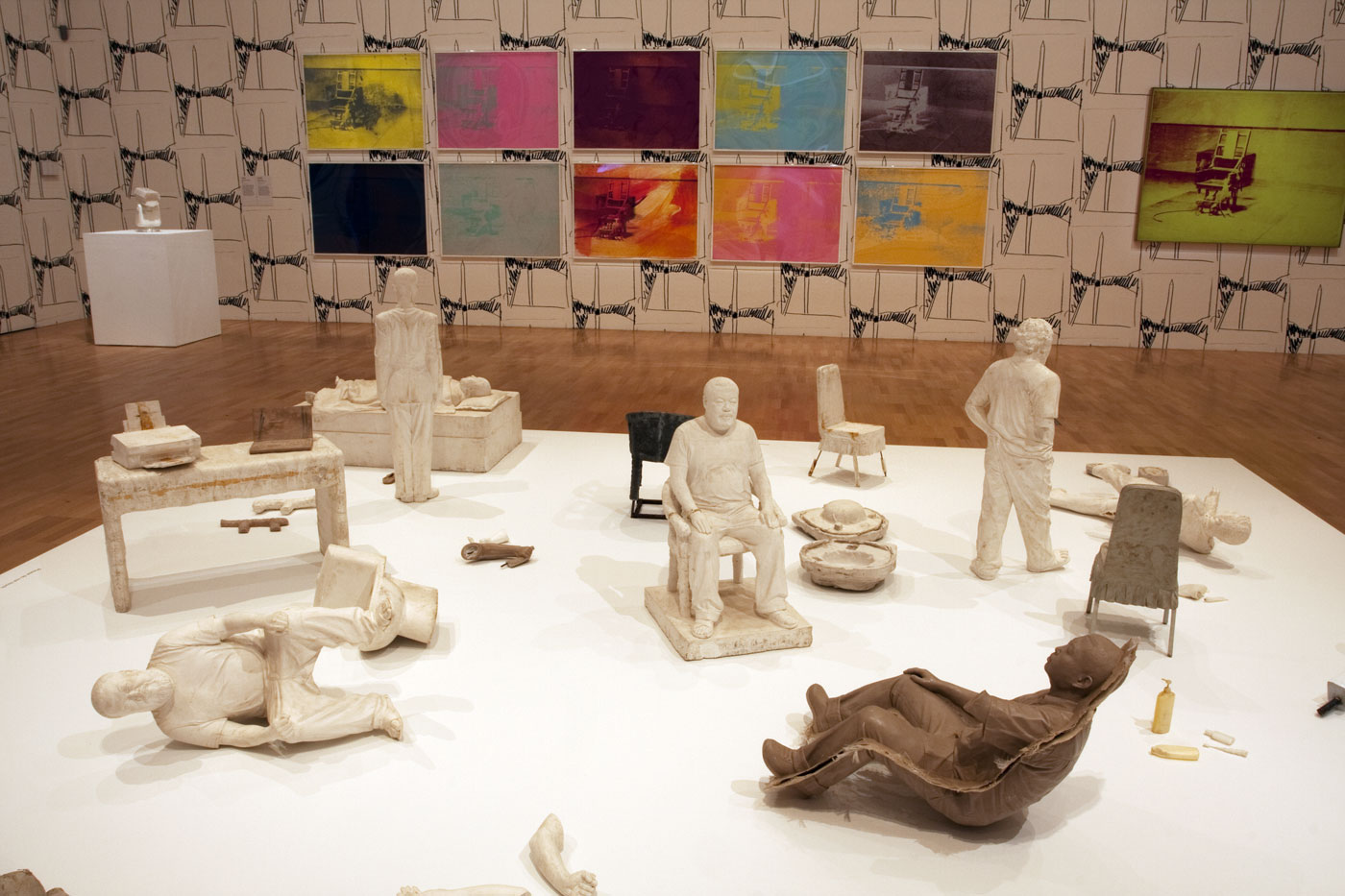
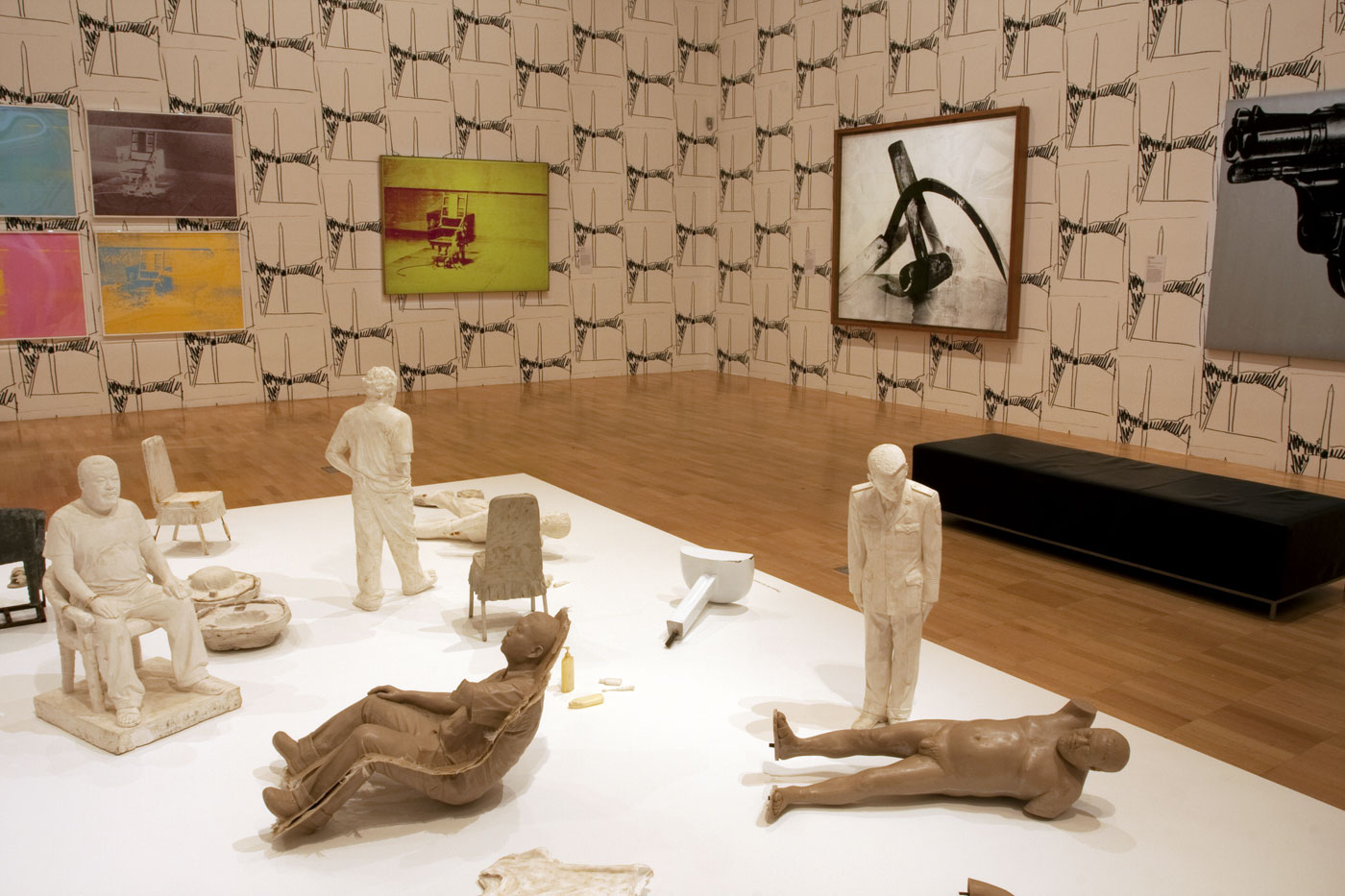
Ai Weiwei (Chinese, b. 1957)
S.A.C.R.E.D. Maquettes (installation view details)
2011
Fibreglass
Ai Weiwei Studio, Beijing
Photos: © Marcus Bunyan and the National Gallery of Victoria
These maquettes are sculptural models for Ai’s major installation S.A.C.R.E.D., a series of architecturally scaled dioramas depicting scenes from the detention cell where he was held without charge by the Chinese government for eighty-one days in 2011. The work consists of six parts to which its acronymic title refers: Supper, Accusers, Cleansing, Ritual, Entropy and Doubt. The maquettes serve as archaeological evidence of the denial of personal freedom and dignity that Ai and many other dissidents have experienced, and cast him in the dual roles of rebel and victim of oppression.
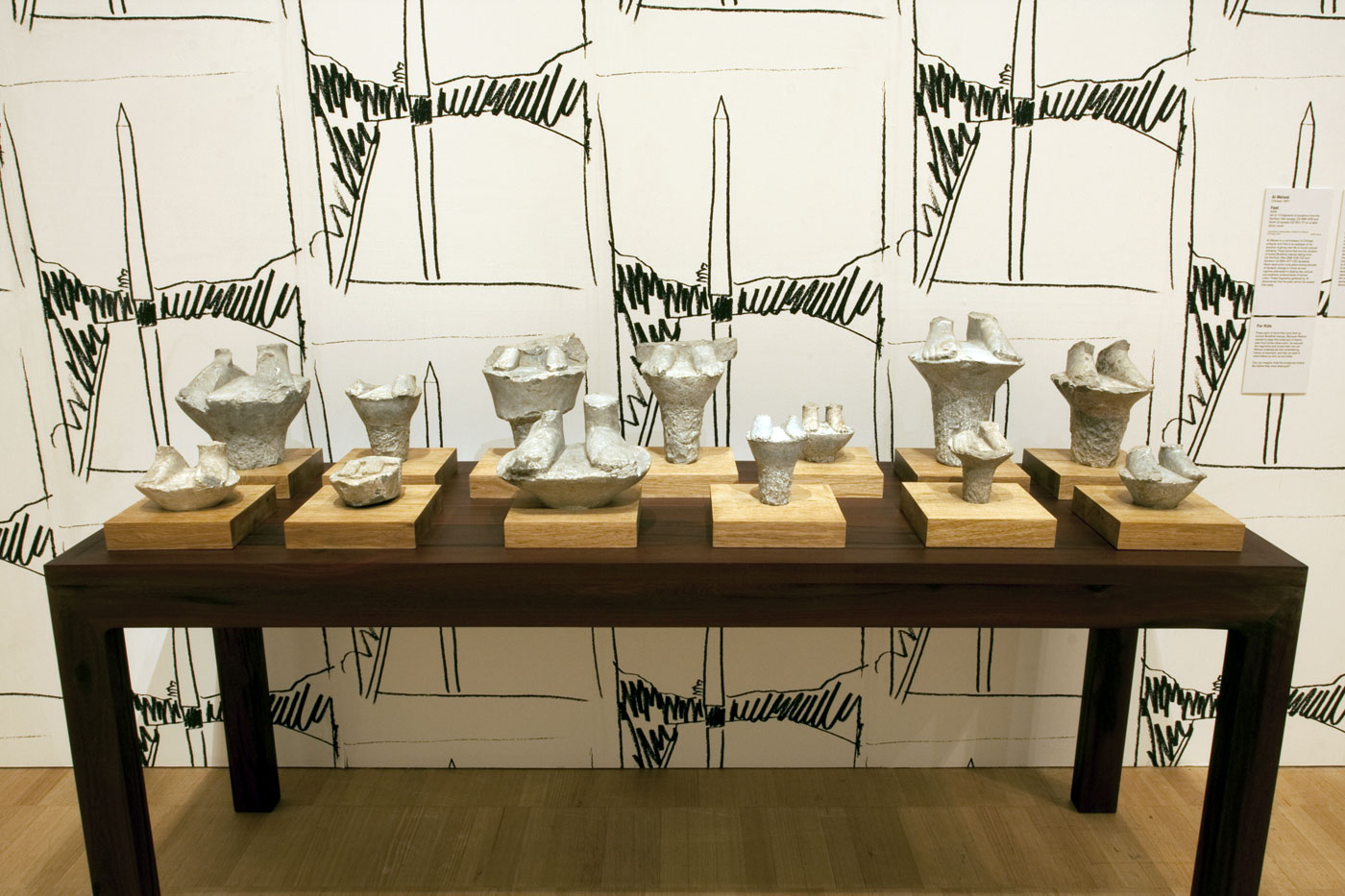
Installation view of Ai Weiwei’s Feet (2005) in the sixth room of the exhibition Andy Warhol | Ai Weiwei at the National Gallery of Victoria, Melbourne
Photo: © Marcus Bunyan and the National Gallery of Victoria
Ai Weiwei (Chinese, b. 1957)
Feet
2005
Set of 13 fragments of sculpture from the Northern Wei dynasty CE 386-535 and North Qi dynasty CE 550-77 on a table stone, wood
Queensland Art Gallery/Gallery of Modern Art, Brisbane
Purchased, 2006
Ai Weiwei is a connoisseur of Chinese antiquity and Feet is an example of his practice of giving new life to found cultural artefacts. These stone feet are the remains of looted Buddhist statues dating from the Northern Wei (386-535 CE) and Northern Qi (550-577 CE) dynasties. Much destruction took place during periods of dynastic change in China as new regimes attempted to destroy the cultural and aesthetic achievements of former rulers. These fragments gathered by Ai demonstrate that the past cannot be erased that easily.
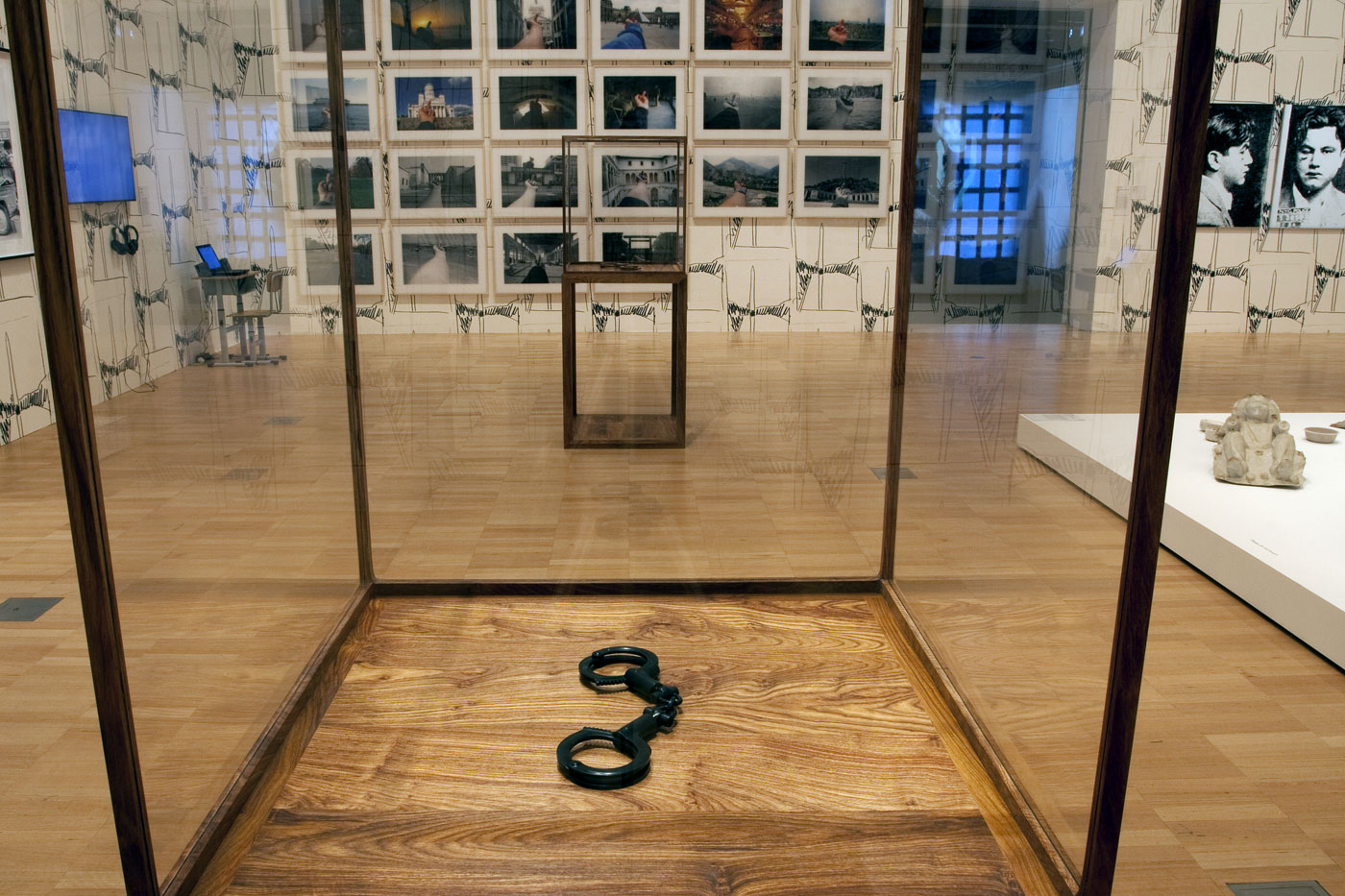
Installation view of Ai Weiwei’s Handcuffs (2015) in the sixth room of the exhibition with his Study of Perspective (1995-2011) series of photographs on the wall behind at the exhibition Andy Warhol | Ai Weiwei at the National Gallery of Victoria, Melbourne
Photo: © Marcus Bunyan and the National Gallery of Victoria
Ai Weiwei (Chinese, b. 1957)
Handcuffs
2015
Jade
Ai Weiwei Studio, Beijing
This pair of handcuffs sculpted in jade – the most precious stones in Chinese culture – replicate those worn by Ai during his imprisonment in 2011. Historically, the wearing of jade was reserved for high-ranking members of the imperial family, and today wearing jade jewellery is still believed to bestow good health and protection upon the wearer. Here Ai recasts this material and its historical cultural connotations in relation to the containment of dissident political expression in contemporary China.
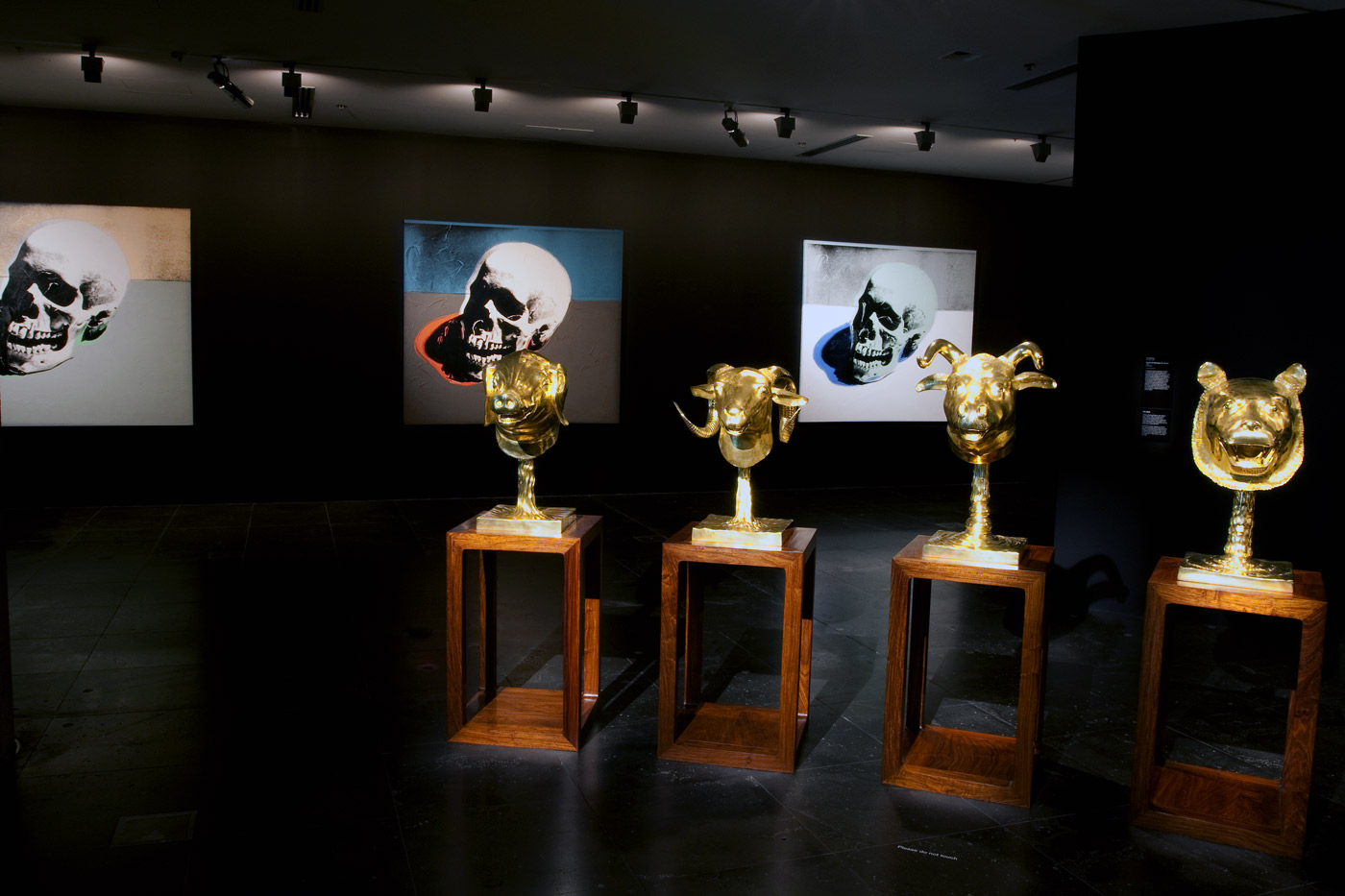
Installation view of the seventh room of the exhibition featuring part of Ai Weiwei’s Circle of Animals (in Gold) (2010), with Andy Warhol’s silkscreen skulls on the wall behind at the exhibition Andy Warhol | Ai Weiwei at the National Gallery of Victoria, Melbourne
Photo: © Marcus Bunyan and the National Gallery of Victoria
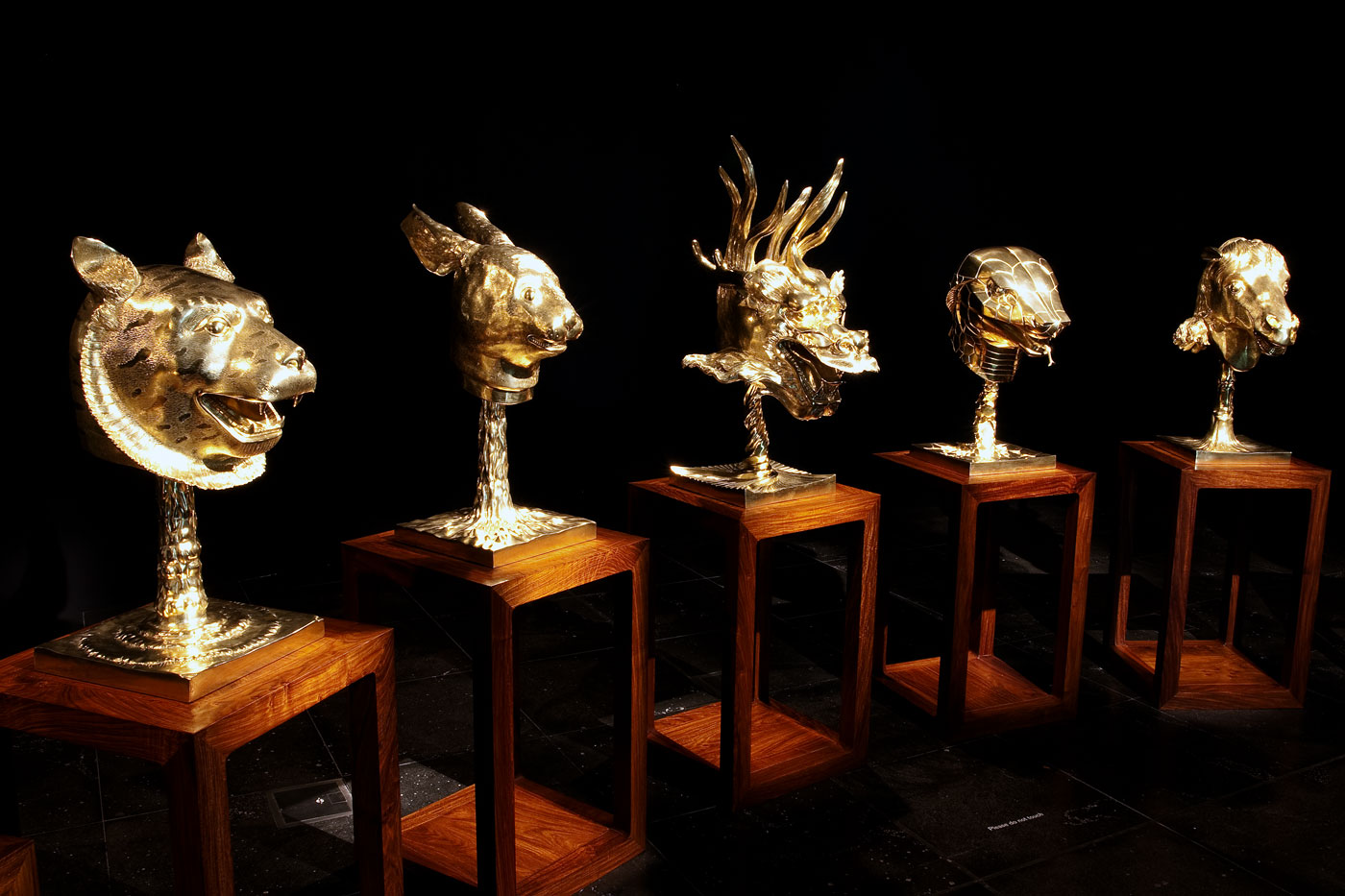
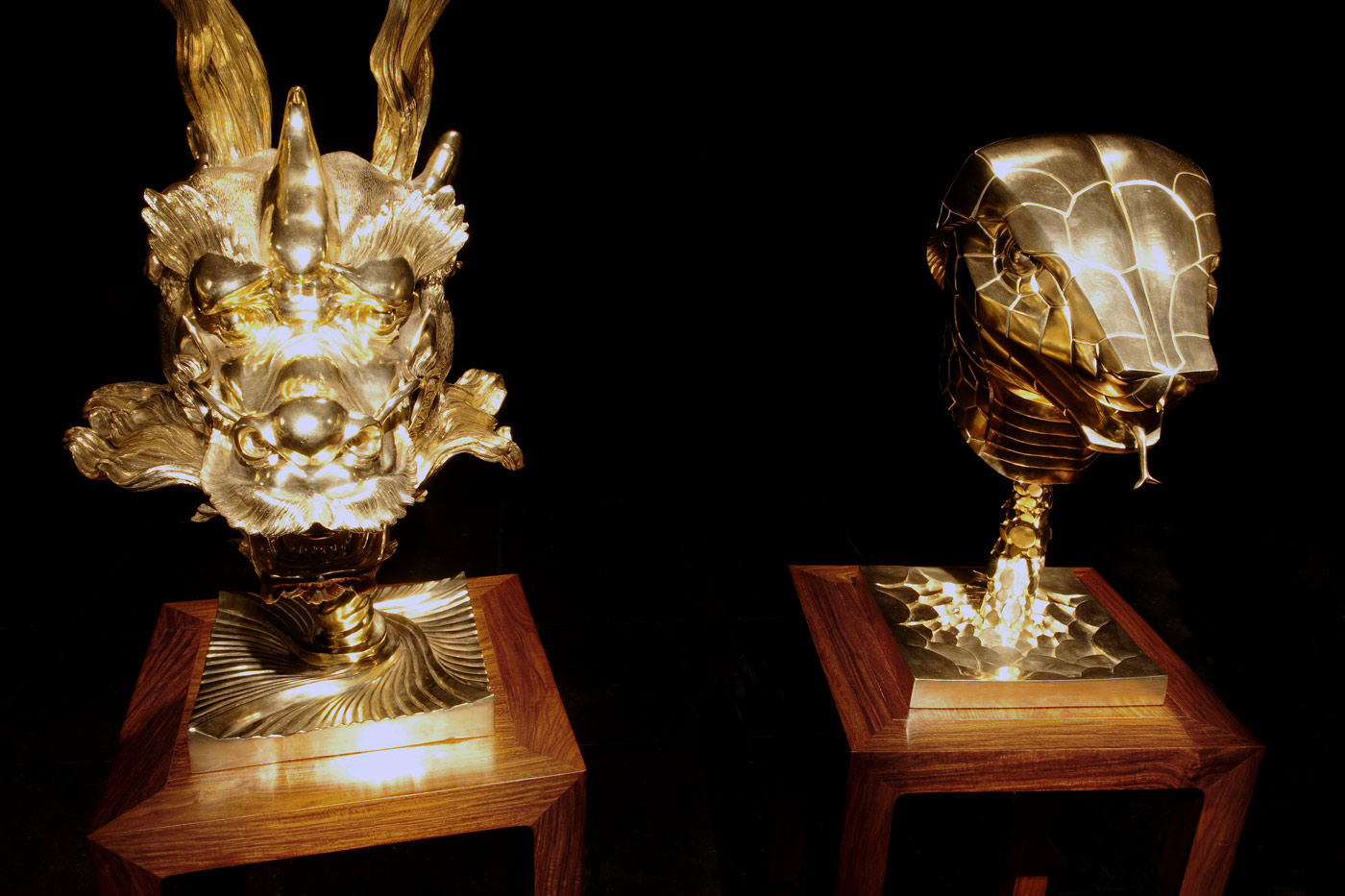
Ai Weiwei (Chinese, b. 1957)
Circle of Animals (in Gold) (installation view details)
2010
Gilt-bronze
Private collection, New York
Photos: © Marcus Bunyan and the National Gallery of Victoria
Ai Weiwei’s Circle of Animals is based on twelve zodiac animal heads which functioned as a water clock-fountain in the European-style gardens of Yuanmingyuan palace, Beijing, designed in the eighteenth century by two European Jesuits for the Qing dynasty Emperor Qianlong. In 1860 Yuanmingyuan was ransacked by French and British troops and the heads were pillaged. In reinterpreting these objects, Ai focuses attention on the ethics of looting and repatriation, the role of the fake and the copy and power relations between China and the West.
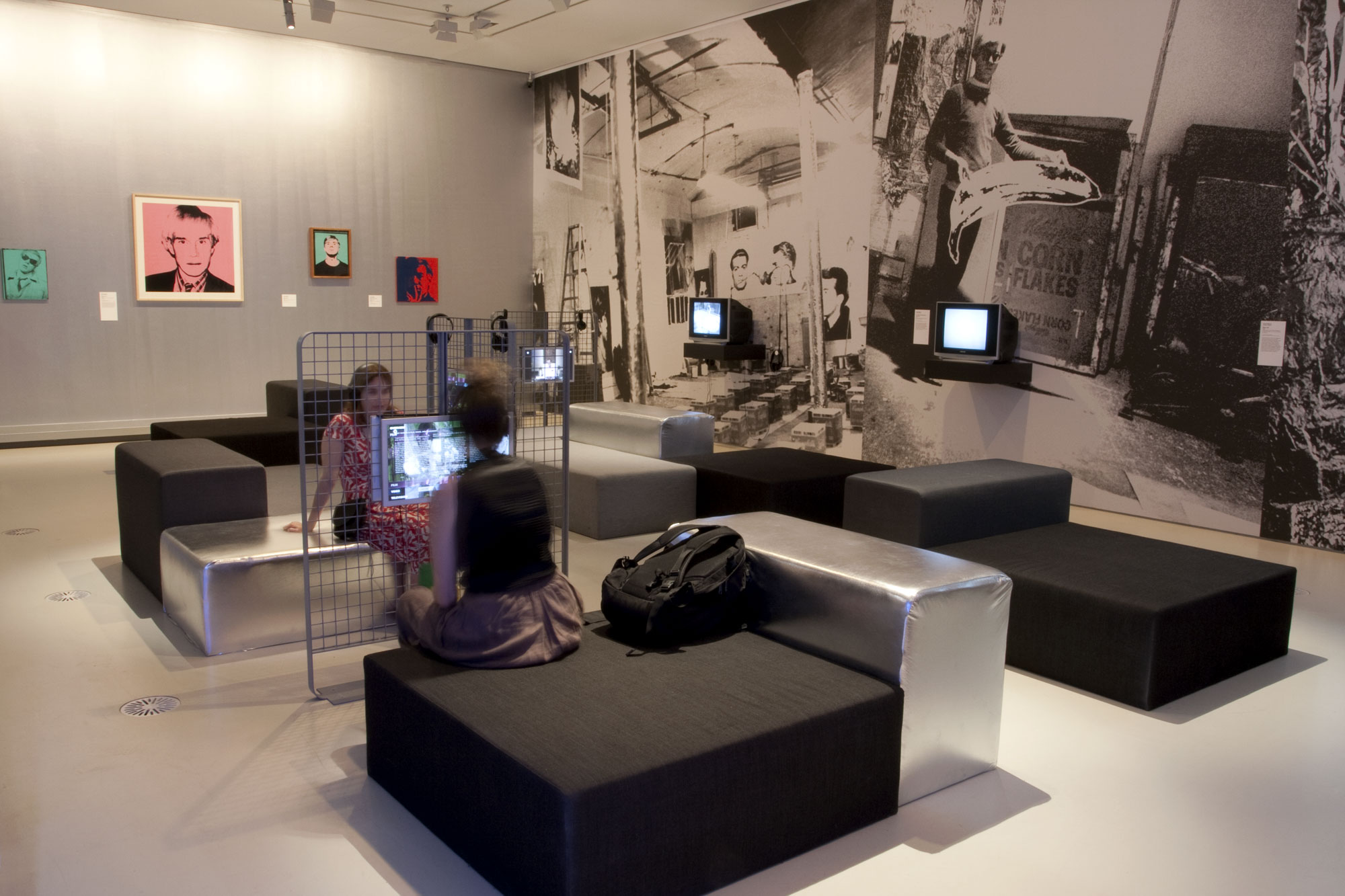
Installation view of part of room eight of the exhibition Andy Warhol | Ai Weiwei at the National Gallery of Victoria, Melbourne. This room was based on interactivity with not much of interest photographically speaking, hence only one image.
Photo: © Marcus Bunyan and the National Gallery of Victoria
NGV International
180 St Kilda Road
Opening hours:
10am – 5pm daily
Judges: The 2015 William and Winifred Bowness Photography Prize was judged by MGA Senior Curator Stephen Zagala, renowned artist Bill Henson, and Bendigo Art Gallery Director Karen Quinlan

Installation photograph of the William and Winifred Bowness Photography Prize 2015 at the Monash Gallery of Art
Photo: Marcus Bunyan
In terms of the professional quality of work, the pristine printing and framing, and the “less is more” nature of the hang, this is the best William and Winifred Bowness Photography Prize I have seen at the Monash Gallery of Art. The surprise about the nature of this year’s finalists is the surfeit of landscape work and the weakness of the portrait photographs. Key words when looking at the landscape work are: the sublime, internal terrain, elision, fear, darkness, constructed landscapes, aesthetic hyper reality, unreachable worlds, presence and absence, layering, pigment prints.
There is a heavy sense of un/reality about all of the landscape work, as though there is no such thing as the unmediated, straight landscape photograph any more. Reality passes (passing itself off for something else), and the viewer is left to tease out what is constructed (or not), how many layers (both mental and physical) are involved, and what the possible outcomes might be. In this post-landscape photography even straight digital photographs or analogue photographs of the landscape take on this desiccated view complete with surface flatness and “air” of unreality.
For example, look at Murray Fredericks’ North Stradbroke (2014), Silvi Glattauer’s Altiplano 1 (2015) Anne Algar’s Eruption (2015) and numerous others throughout the exhibition. These places exist in real life yet feel so un/real in these photographs – through scale, through colour, through surface – that you are left wondering what’s it all about. There is certainly no link to traditional notions of the sublime and little connection to the elemental (as in the object as itself). As I have said before about contemporary photography, these photographs are all about the photographers ideas and desires, not about the world itself. The photographs are flat are rather uninteresting with no depth of feeling or ambiguity of meaning. I found it hard to get excited about any of the landscape photographs.
And when photographers do use traditional techniques, such as black and white printing, silver gelatin prints or the analogue / digital combo, the results are similarly underwhelming. It is as if the aesthetic of the digital realm, this aesthetic hyper reality, has taken over how people use analogue photography as well. Robert Ashton’s Opening (2015) (analogue/digital), David Bibby’s Untitled #1 (2014) (black and white digital) and Virginia Cummins’ Gone tender, river’s edge (2015) (silver gelatin print) all evidence this cut-up, layering, obscure non-seeing where the magic of the traditional print has been lost.
Another surprise to me was that the two works that I found most successful in the exhibition were two of the most heavily conceptual. These images were both beautiful and intellectually stimulating. Brook Andrew’s Possessed II (2015) left me wondering about the original slides, marvelling at the technique used to create the image and wanting to see the rest of the series and interrogate further the artist’s background and “the tradition of the psychological in depiction and stories of the Australian alien landscape.” There was ambiguity and feeling here!
The work that I thought should have won was Peta Clancy’s She carries it all like a map on her skin (2014-2015). I have always liked Clancy’s work for there is so much sensitivity to subject matter embedded in her work. Clancy probes the boundaries of the photograph and the skin through punctures made using a fine silver needle to create a lace-like effect or ‘internalised landscape’ which is visible from both the emulsion and non-emulsion sides of the print. She then re-photographs the photograph and punctures the print again, the print becoming a palimpsest of punctures, of wounds, of the journey of life (with the needles link to woman’s work and the lips relation to desire). The installation of the work then emphasises the physicality of the print, Clancy “activating the materiality of the photographic medium by exploring photographs in terms of what the image content depicts as well as three-dimensional objects that exist in space and time.” Such a wonderfully tactile, sensual and conceptual work of negative / positive, presence / absence that kept drawing me back to hidden worlds.
As for the winner, Joseph McGlennon’s Florilegium #1 (2014), according to gallery staff some people love it and some people don’t. I am of the latter camp. The photograph is beautiful and “pretty” in a superficial, constructed way but flat like a piece of Florence Broadhurst wallpaper in another. Basically it’s an illustrated plate from a 19th century colour plate book made out of multiple negatives and digitally rendered. These images are taken in the exotic locations of Madagascar, Tahiti and Singapore and one could apply the critique of “Orientalism” to this piece of work… the proposal of lush landscapes and unreachable worlds as ‘Other’ – the imitation or depiction of aspects in Middle Eastern, South Asian, African and East Asian landscapes and cultures evidenced by a patronising Western attitude towards them. Further, photographs such as Valerie Sparks’ Le vol 1 (2014) imagine this exotic ‘Other’ by pasting taxidermy birds into “hybrid” (in other words, artist made) environments, while work such as Carolyn Young’s Reference grassy woodland: spring (Bookham) (2014) topographically map a uniform, constructed, imagined terrain of becoming that will never exist.
Most of the landscape work could be associated with a de-territorialization and re-territorialization of meaning across locations and through technologies (Deleuze, Gilles and Guattari, Felix. A Thousand Plateaus: Capitalism and Schizophrenia. Minneapolis and London: University of Minneapolis Press, 1987), where moments of connectivity and the assemblages that form them, “are the processes by which various configurations of linked components function in an intersection with each other, a process that can be both productive and disruptive. Any such process involves a territorialization; there is a double movement where something accumulates meanings (re-territorialization), but does so co-extensively with a de-territorialization where the same thing is disinvested of meanings.”1 Unfortunately in this exhibition, the intensification of these processes around a particular site through a multiplicity of intersections in these landscape photographs, are mostly dead ends. They lead nowhere of much interest and they fail to speak to me, which is what I want art to do.
What I have picked up from all this viewing is another couple of insights. It’s a sad state of affairs to see “Collection of the artist” on most of these works. Hardly a single one is in a collection. It’s difficult to be a contemporary photographic artist in Australia. You will make no money at it, even if you are represented by commercial gallery for, unlike America, there are simply not the collectors in Australia for the art of contemporary photography. Even as I critique the work, I admire the artist’s for producing it, for I know the cost, courage and dedication needed to keep making work that hardly ever gets purchased.
And secondly, all of these “pigment” prints. A pigment is a colouring matter or substance which when suspended in a liquid vehicle becomes a paint, ink, etc. or whose presence in the tissues or cells of animals or plants colours them. In other words, it is an additive which has no real body of its own. No wonder all of these pigment prints look so flat and have the feeling of a lack of depth. Show me a Stephen Shore original photograph and I will show you more presence than all of these digital prints put together.
Dr Marcus Bunyan
Word count: 1,220
1/ Wood, Aylish. “Fresh Kill: Information technologies as sites of resistance,” in Munt, Sally (ed.,). Technospaces: Inside the New Media. London: Continuum, 2001, p. 166.
Many thankx to the Monash Gallery of Art for allowing me to publish the photographs in the posting. All photographs © Marcus Bunyan and the Monash Gallery of Art. Please click on the photographs for a larger version of the image.


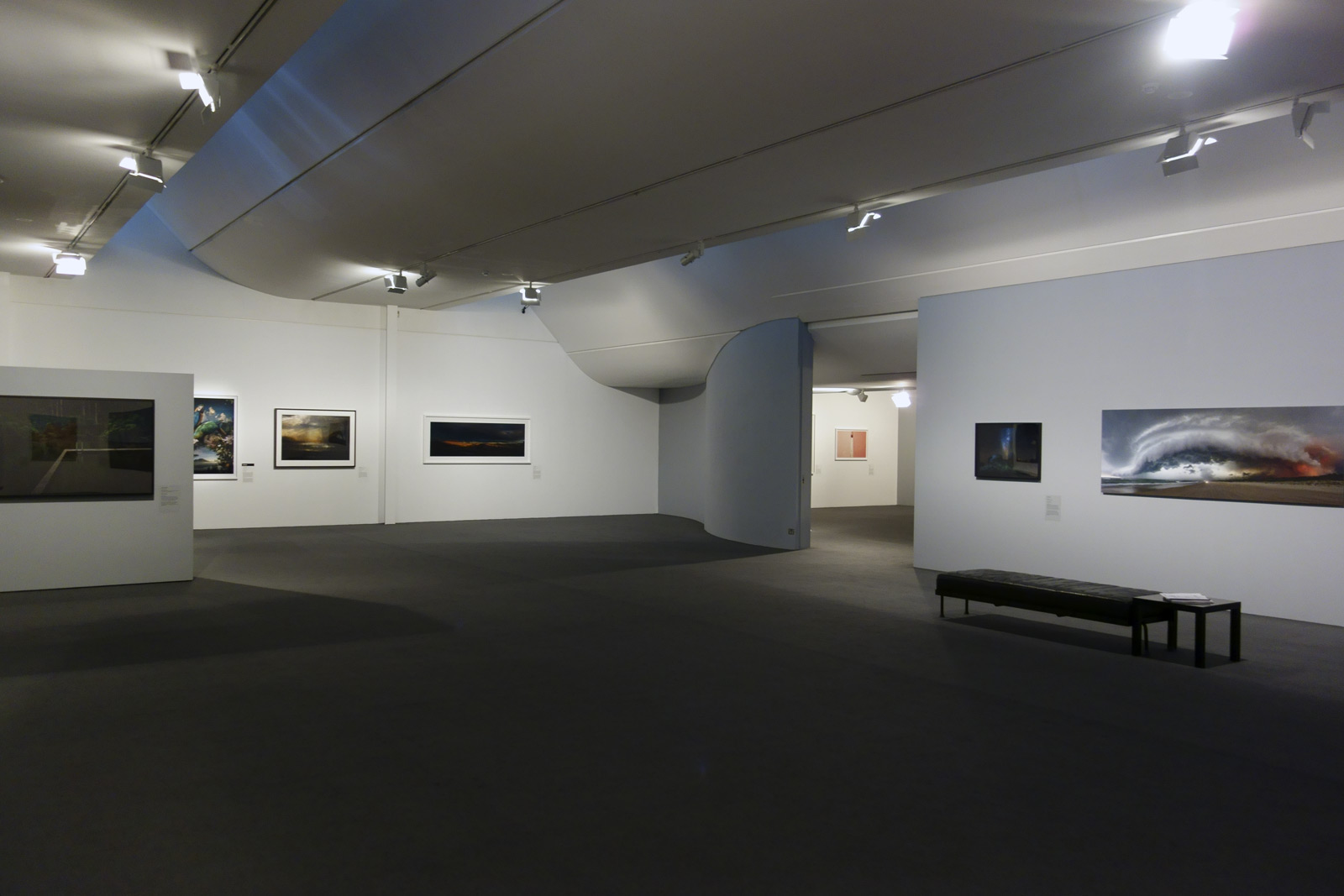
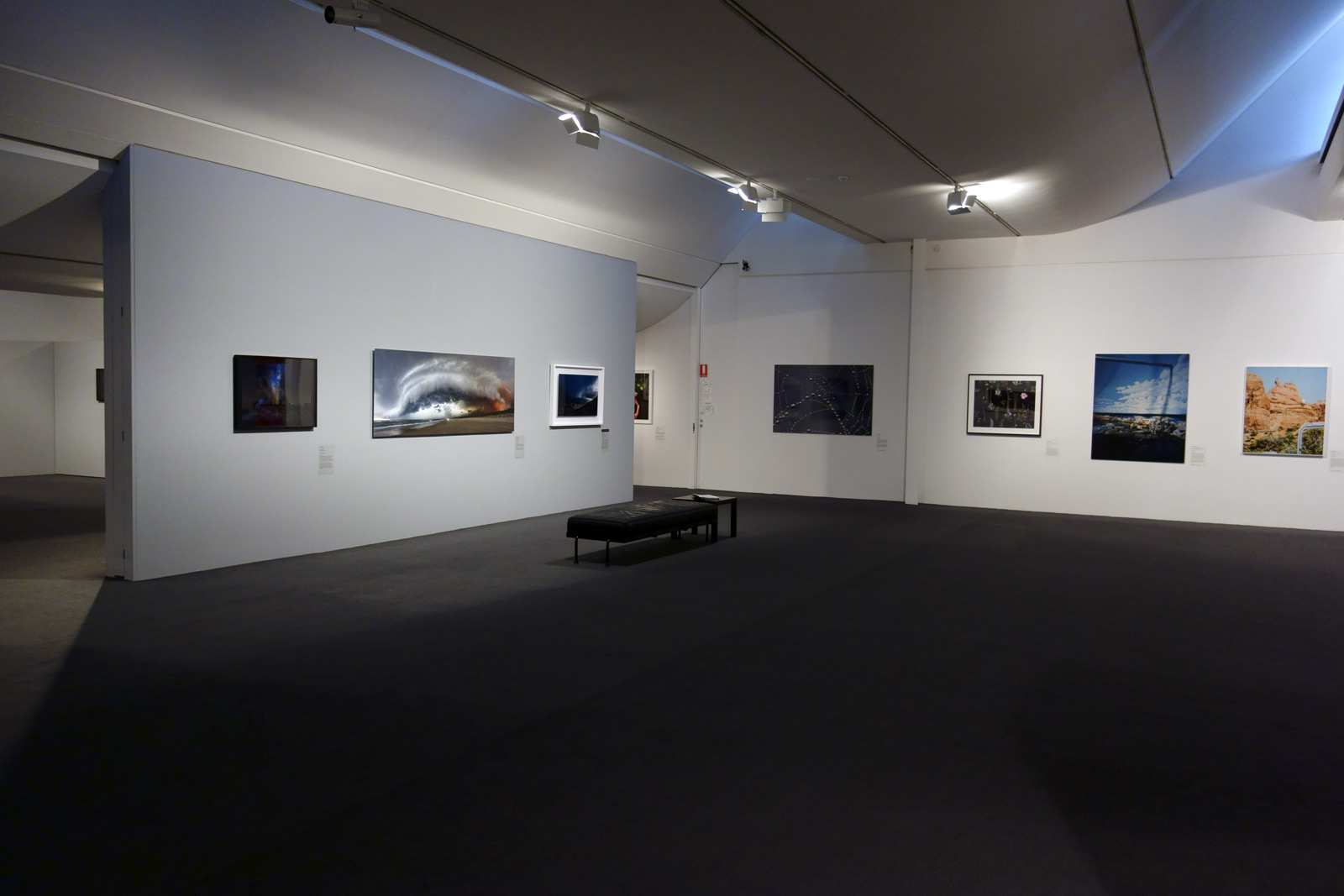

Installation photographs of the William and Winifred Bowness Photography Prize 2015 at the Monash Gallery of Art
Photos: Marcus Bunyan
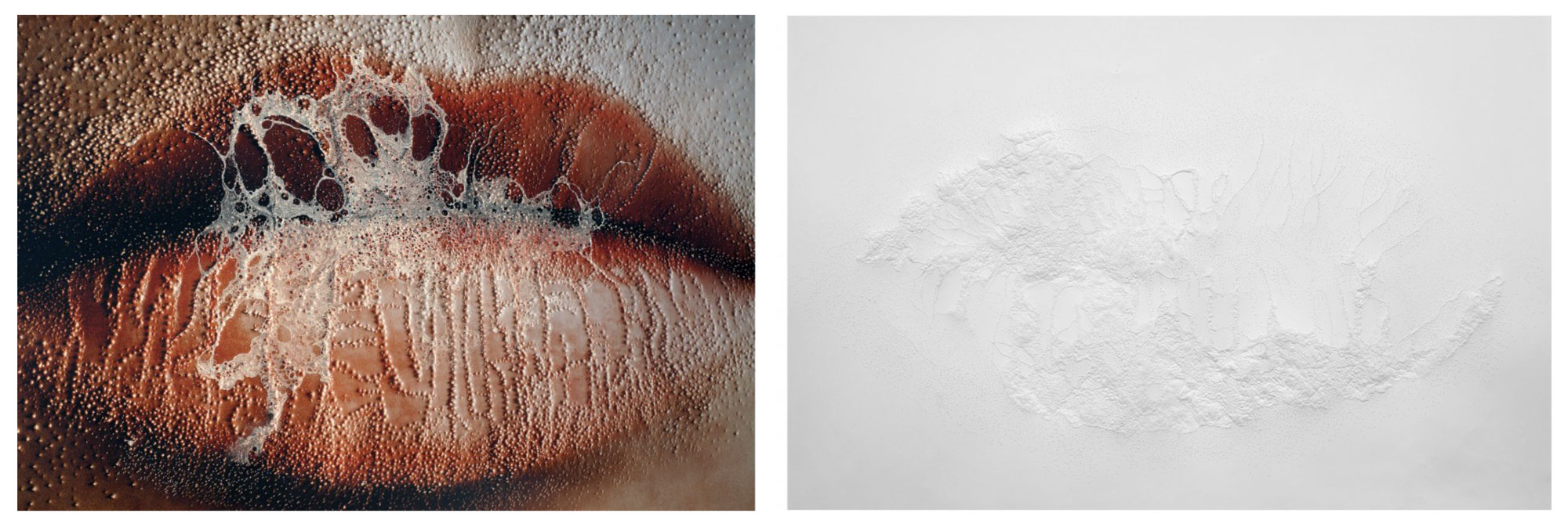
Peta Clancy (Australian, b. 1970)
She carries it all like a map on her skin
2014-2015
From the series Punctures
Chromgenic prints
55 x 80cm (each)
Reproduction courtesy of the artist
The series Punctures which explores skin, mortality and ageing expands on my long-term preoccupation with probing the boundaries of the photograph and the skin. Comprised of images of a woman’s lips punctured with a fine silver needle to create a lace-like effect or ‘internalised landscape’ and visible from both the emulsion and non-emulsion sides of the print. I am interested in activating the materiality of the photographic medium by exploring photographs in terms of what the image content depicts as well as three-dimensional objects that exist in space and time.


Installation photographs of Peta Clancy’s She carries it all like a map on her skin (2014-2015)
Photos: Marcus Bunyan
In 2006 the MGA Foundation established the William and Winifred Bowness Photography Prize to promote excellence in contemporary Australian photography. The annual $25,000 non-acquisitive William and Winifred Bowness Photography Prize is an initiative of the MGA Foundation.
MGA Senior Curator, Stephen Zagala was joined by two of Australia’s most notable art world figures, Bill Henson and Karen Quinlan, to select the finalists for this year. The prize is open to any Australian photographer, whether amateur or professional, and all genres of photography are eligible, provided that the work has been produced in the last 12 months. Each year a panel of three judges considers hundreds of entries and curates an exhibition of finalists, before settling on a single winner.
The panel selected the shortlist of 47 works to be exhibited, and will convene again when the exhibition has been installed to choose a winner, which will be announced on Thursday 1 October. Bill Henson said of the selection process: ‘In the end, it really just comes down to how compelling I find a work to be. Matters of subject, issue or agenda have to find a form which is their equal for without that we’re left with something that simply holds no interest for us.’
Finalists: Anne Algar, Brook Andrew, Robert Ashton, Svetlana Bailey, Del Kathryn Barton, Clare Bedford, David Bibby, Devika Bilimoria, Frederico Câmara, Peter Campbell, Danica Chappell, Che Chorley, Peta Clancy, Virginia Cummins, Rebecca Dagnall, Cherine Fahd, David Flanagan, Murray Fredericks, Silvi Glattauer, Wayne Grivell, Molly Harris, Kern Hendricks, Lyndal Irons, Mark Kimber, Courtney Krawec, Michael Krzanich, Cathy Laudenbach, Jon Lewis, David Manley, AHC McDonald, Joseph McGlennon, Rod McNicol, Bill Moseley, Ward Roberts, Daniel Shipp, Valerie Sparks, Rodney Stewart, Rebekah Stuart, Ian Tippett, Justine Varga, John Watson, Kim Westcott, Peter Whyte, Amanda Williams, Rudi Williams, Melissa Williams-Brown and Carolyn Young.
On Thursday 1 October Joseph McGlennon was announced as the $25,000 winner of the William and Winifred Bowness Photography Prize. Colour Factory Honourable Mentions were awarded to Peter Campbell, Daniel Shipp and Valerie Sparks.
Text from the MGA website
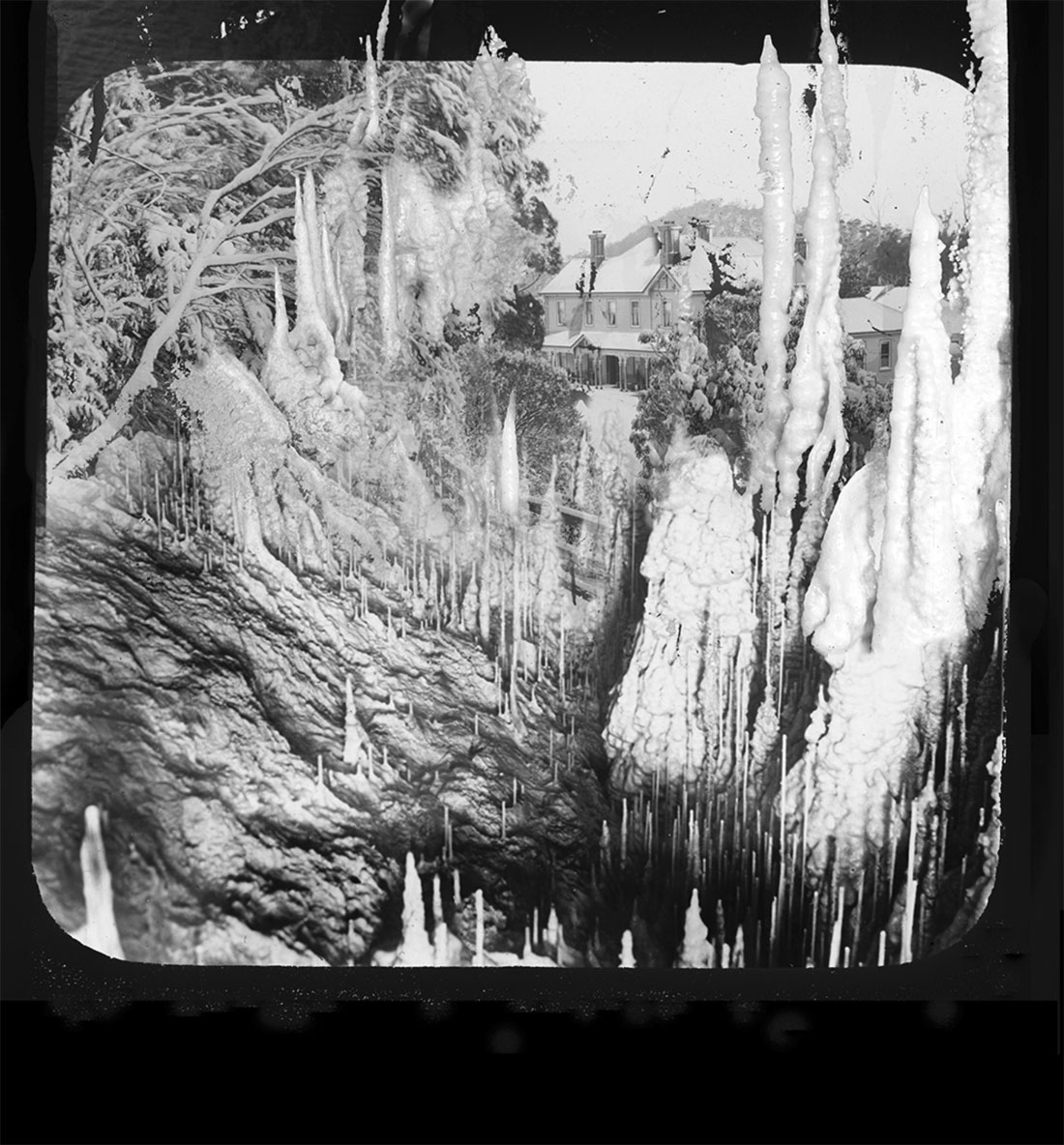
Brook Andrew (Australian, b. 1970)
Possessed II
2015
Gelatin silver print
137 x 127cm
Reproduction courtesy of the artist, Tolarno Galleries (Melbourne) and Galerie Nathalie Obadia (Paris and Brussels)
Possessed is a black-and-white photographic series inspired by a rare collection of late 19th-century glass lantern slides depicting images of landscapes from Tasmania and Victoria. Recreated in a trompe l’oeil visual effect – some aspects of this work are akin to Rorschach imagery practice and reference the tradition of the psychological in depiction and stories of the Australian alien landscape.

Robert Ashton (Australian, b. 1950)
Opening
2015
Pigment ink-jet print
60 x 95cm
Reproduction courtesy of the artist
I have lived close to the scrubby coastal bush for many years and watched it continually transform through fire, drought and habitation. This landscape can be an unsettling place and I am continually drawn to it, trying to describe the beauty and menace. For these images I have used a 4 x 5 field camera to facilitate a slower and more concise way of working. Looking for the place where the literal meets the abstract. Taking only a couple of exposures, committing to the moment. Embracing the limitations of the medium and letting the result be defined by the practice. As a diptych the images form a complimentary pair. Each distinct but instructing the other, to make a series of fractured dioramas.

David Bibby (Australian, b. 1970)
Untitled #1
2014
From the series Darkness
Pigment ink-jet print
50 x 75cm
Reproduction courtesy of the artist
Fear of dark places gave our ancient ancestors an evolutionary advantage, by priming brains and bodies for a fight-or-flight response when faced with the threat of danger or the unknown. These primal fears also had a strong influence on our cultures. Our fear of darkness and of forests, as dark places that conceal the unknown, has placed them at the centre of many of our myths, legends and folktales.
Despite, or perhaps because of our fear we seem to have an attraction to the darkness and there is something intrinsically beautiful in many dark images. Maybe the darkness has become a refuge in the modern world for those things we can’t control, including mystery and imagination.

Virginia Cummins
Gone tender, river’s edge
2015
From the series Spirit work
Gelatin silver print
70 x 70cm
reproduction courtesy of the artist
This image was shot in remote South Gippsland, where I grew up. It’s part of the Spirit work series, exploring the positive power of nature and how our immersion in this world can move and change us. This work calls on the old-world landscape tradition of Romanticism and the quest for ‘the sublime’. To acknowledge the strength and transformative qualities of nature seems vital right now, in light of society’s blinkered approach to environmental concerns and our preoccupation with communication through technology.
This series was shot with obscure film cameras from the 1950s and 1960s. I enjoy the meditative qualities of traditional photographic practices and the potential for a bit of magic in these revelations.

Rebecca Dagnall (Australian, b. 1972)
Pioneer pool
2015
From the series In the presence of absence – states of being in the Australian landscape
Pigment ink-jet print
100 x 150cm
Reproduction courtesy of the artist
There is certain darkness in the Australian imaginary of the landscape that is tangled in a history that holds both a presence and an absence, a knowledge and yet a denial of past colonial deeds. It is as though this history haunts the landscape, like a ‘ghost’ with unfinished business. My current work is an exploration of how the Australian Gothic informs our response to the Australian landscape. The images respond to myths and stories about the landscape that focus on an understanding of the things that we cannot see.

Svetlana Bailey (German born Russia, b. 1984)
Utah
2015
From the series All dreams come true
Pigment ink-jet print
114 x 91cm
Reproduction courtesy of the artist
I work with images or artefacts that I find, such as on walls, billboards or shop window displays. They present an alternative reality, and I photograph them with their surroundings, and flatten these two spaces into one. Often the images I find are a montage, creating a reality that never truly existed. I collect them into a personal global album of images created by strangers in response to a common dream. Perhaps their makers considered place and interpreted its environment and beliefs, or were trying to shape our perception of reality. I wonder if these images exist for us or against us, if they beautify our life or mislead us, and if believing in their deception adds to our satisfaction.

Frederico Cãmara (Brazilian, b. 1971)
Sydney Sealife Aquarium, Sydney, Australia
2014
From the series Views of Paradise
Pigment ink-jet print
150 x 120cm
Reproduction courtesy of the artist
Views of Paradise is a research project that aims to create a world atlas of the artificial environments of zoos and aquariums, as an investigation on the relations between the zoo and the concepts of paradise, utopia, dystopia and heterotopia. This project signals the possibility of a meaningful existence for the empty zoo, either as image or an actual site, by shifting the viewer’s gaze from the animal to humans, as principal agents in the destruction of the environment, and our failed attempt at its re-creation.
Currently, the focus of this project is Oceania (Australia, New Zealand, Papua New Guinea and New Caledonia), where it will identify the characteristics that are related to this region’s natural and cultural environments.
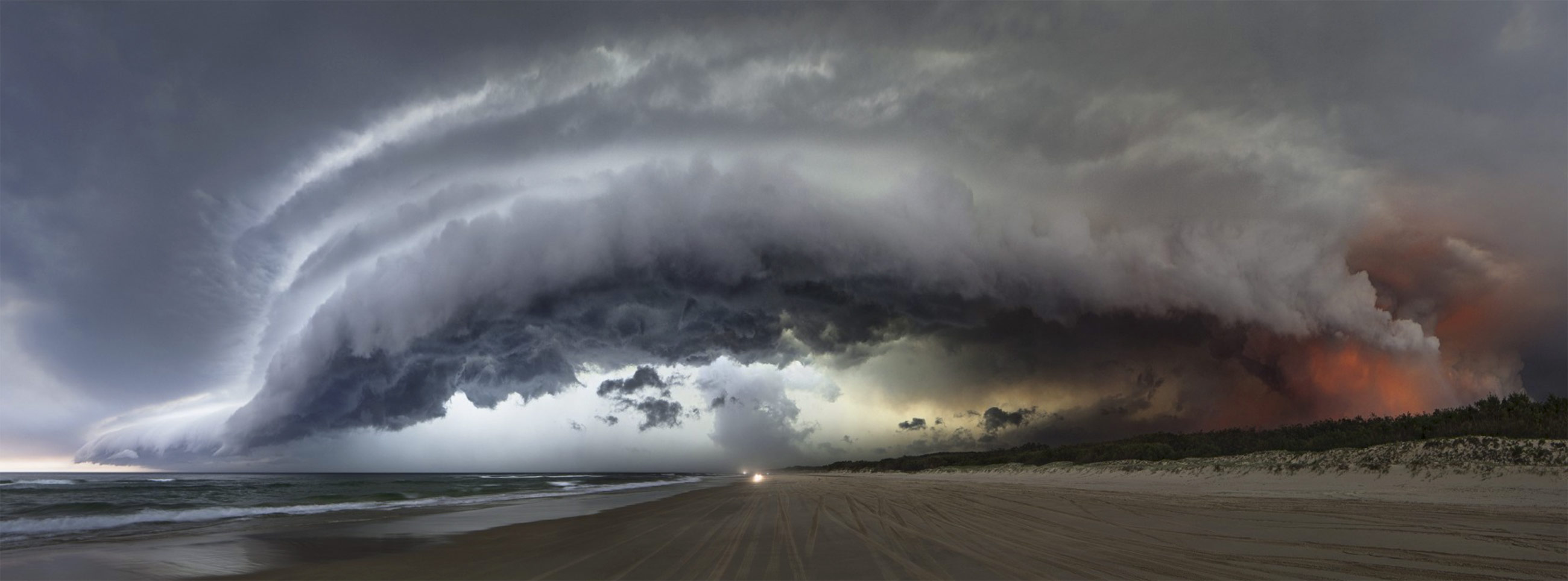
Murray Fredericks (Australian, b. 1970)
North Stradbroke
2014
From the series Origins
Pigment ink-jet print
90 x 250cm
Reproduction courtesy of the artist, ARC One (Melbourne) and Annandale Galleries (Sydney)
This work is drawn from my current series Origins. In Origins fire has become the central subject, specifically with regards to fire’s place in the social and cultural imagination of Australia. ‘North Stradbroke’ records the scene of a wildfire sparked by lightning, causing holidaymakers to flee their bush campsites under a thunderstorm as it moves up the coast.

Silvi Glattauer (Australian born Argentina, b. 1977)
Altiplano 1
2015
From the series Altiplano
Pigment ink-jet print
100 x 140cm
Reproduction courtesy of the artist
A personal narrative of identity that pendulates between Australia and South America. I am drawn to these elusive Altiplanic landscapes as abstract topographical storyboards that read like textural braille. The aesthetic hyper reality that is often associated with classical landscape photography is replaced here with a ‘visual text’.
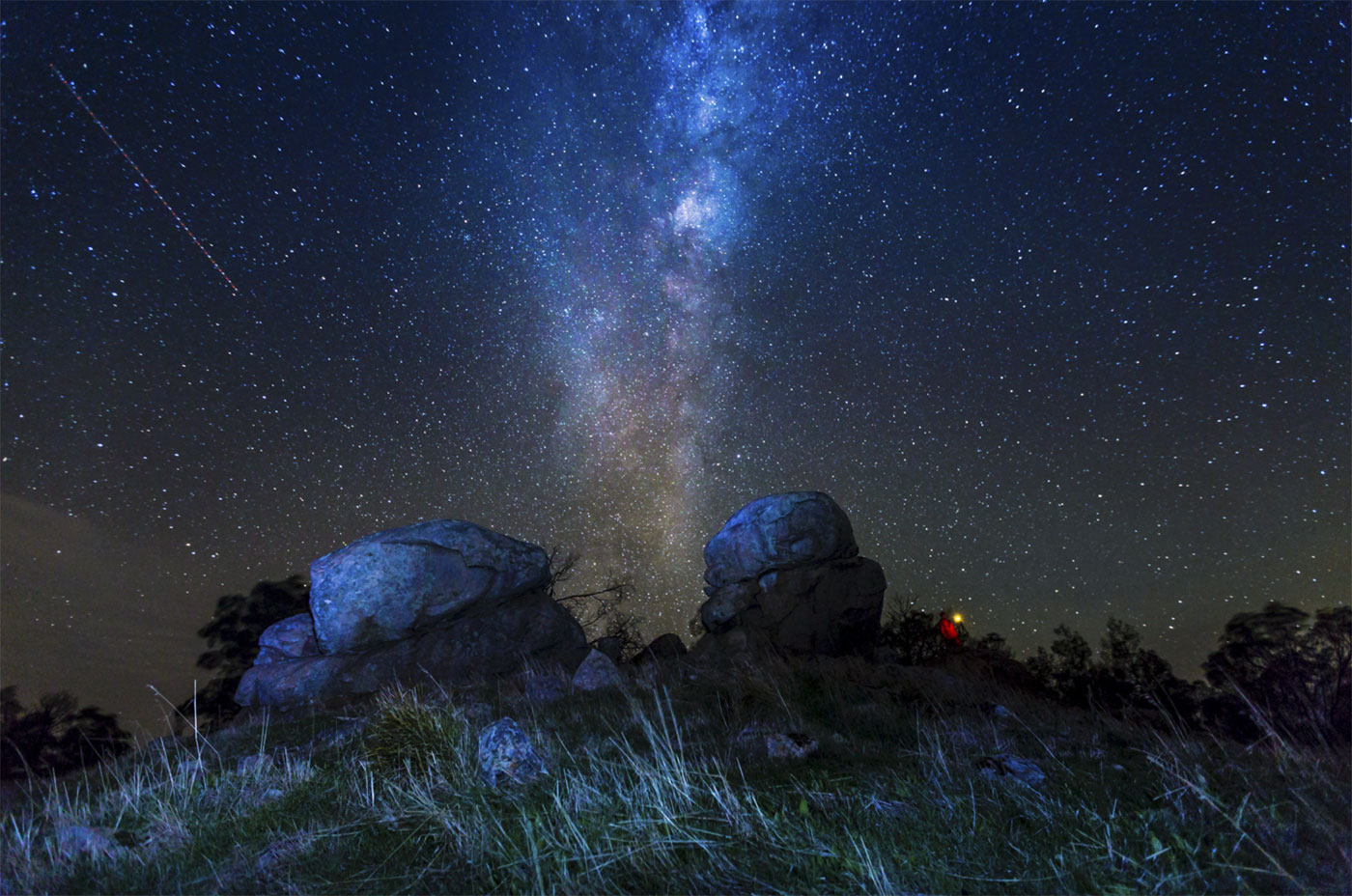
Anne Algar
Eruption
2015
From the series Night sky
Pigment ink-jet print
60.0 x 90.0cm
Reproduction courtesy of the artist
This image reflects my interest in low light landscape and night sky photography. We have scientific knowledge and understanding of the night sky but there is also an emotional element, whereby our human experience of it has no bearing on its material make up. For example many Indigenous Australians refer to the Milky Way as the ’emu’.
For me, there is a certain wonder, excitement and sometimes trepidation when photographing at night. What intrigues me is how objects, vistas and other things, only dimly visible to the human eye in darkness, can be captured in infinite detail by the camera, due to its greater light sensitivity and colour spectrum. It truly does open up another world.

Rebekah Stuart
Dreaming in reverse 2
2014
From the series Pictures of elision
Pigment ink-jet print
102 x 140cm
Reproduction courtesy of the artist
I am a contemporary visual artist who explores an alternative aesthetic to the traditional and romantic landscape. Constructing fragments of nature via digital media I create landscapes that do not exist in reality. The images evolve in a similar fashion to painting, over long duration. I build and refine details for a new whole to emerge, disorientating the observer’s position in a subtle way to reflect on their own internal terrain. The landscapes are a reflection of the horizons carried within – an intimate sublime for a time when wilderness is perhaps uninhabitable.

Valerie Sparks (Australian, b. 1960)
Le vol 1
2014
From the series Le vol
Pigment ink-jet print
140 x 229cm
Reproduction courtesy of the artist and THIS IS NO FANTASY + dianne tanzer gallery (Melbourne)
I am interested in hybrid environments as a reflection of migration as an ongoing natural and cultural occurrence. The birds in this work were photographed at the Vienna and La Rochelle Natural History Museums. These extraordinary collections include birds collected on Cook’s voyages to the Pacific, as well as many collected from South East Asia, Indonesia, Brazil and other South and Central American locations as far back as the mid 1700s. The French term le vol translates as flight, flying, theft or burglary. For the birds in this work, life and flight have been stolen and yet reanimated by the taxidermist. Whereas collecting practices have changed dramatically, the work raises questions about early collecting practices as acts of theft.

Carolyn Young
Reference grassy woodland: spring (Bookham)
2014
From the series Grassy woodlands
Pigment ink-jet print
70 x 84.9cm
Reproduction courtesy of the artist and Weswal Gallery (Tamworth)
For a number of years I have been documenting grassy woodlands in NSW and Victoria. Once common, these ecosystems have been reduced to small pockets amongst farmed land, along roadsides, across reserves and in tucked away cemeteries. Responding to ecologists and landholders, I return to the same sites and shoot seasonally. Represented in my photographs are intact (reference) grassy woodlands, and woodlands that have been altered by agriculture. The repetitive still life structure across my photographs highlights the change in plant diversity as land management changes. The images urge viewers to reflect on the past, present and future of these woodlands.

Joseph McGlennon (Australian born Scotland, b. 1957)
Florilegium #1
2014
From the series Florilegium
Pigment ink-jet print
127 x 100cm
Reproduction courtesy of the artist and Michael Reid (Sydney)
A Latin term reconfigured in the Middle Ages; florilegium (to gather flowers), had its early language roots in the gathering together of scholarly church writings, into the one tome. In the 16th and 17th centuries, Botanical Gardens emerged across Europe, privately hoarding exotic world flowers and animals, signalling the rise of the illustrated colour plate book. The growing desire to corral and record the world’s flora and fauna, alongside the growing confidence in science, all fused to produce a notion of the florilegium as a luxurious record of the rare; of important beauties to be viewed in the one vista.
Photographed in Madagascar, Tahiti and Singapore, in ‘Florilegium #1’, I have captured each bird, flower, vine and butterfly and created a florolegium landscape straight from the Age of Enlightenment. There is an enchanting clash of empirical scientific observation coupled with a deep romantically lush and diffused spotlight of compassion for something wild, observed for a brilliant moment before vanishing into the fog of time. This lush landscape dwells in a most complex, beautiful and sadly unreachable world.
$25,000 winner
Monash Gallery of Art
860 Ferntree Gully Road, Wheelers Hill
Victoria 3150 Australia
Phone: + 61 3 8544 0500
Opening hours:
Tue – Fri: 10am – 5pm
Sat – Sun: 10pm – 4pm
Mon/public holidays: closed
Curators: Victoria Broackes and Geoffrey Marsh from the V&A’s Department of Theatre and Performance
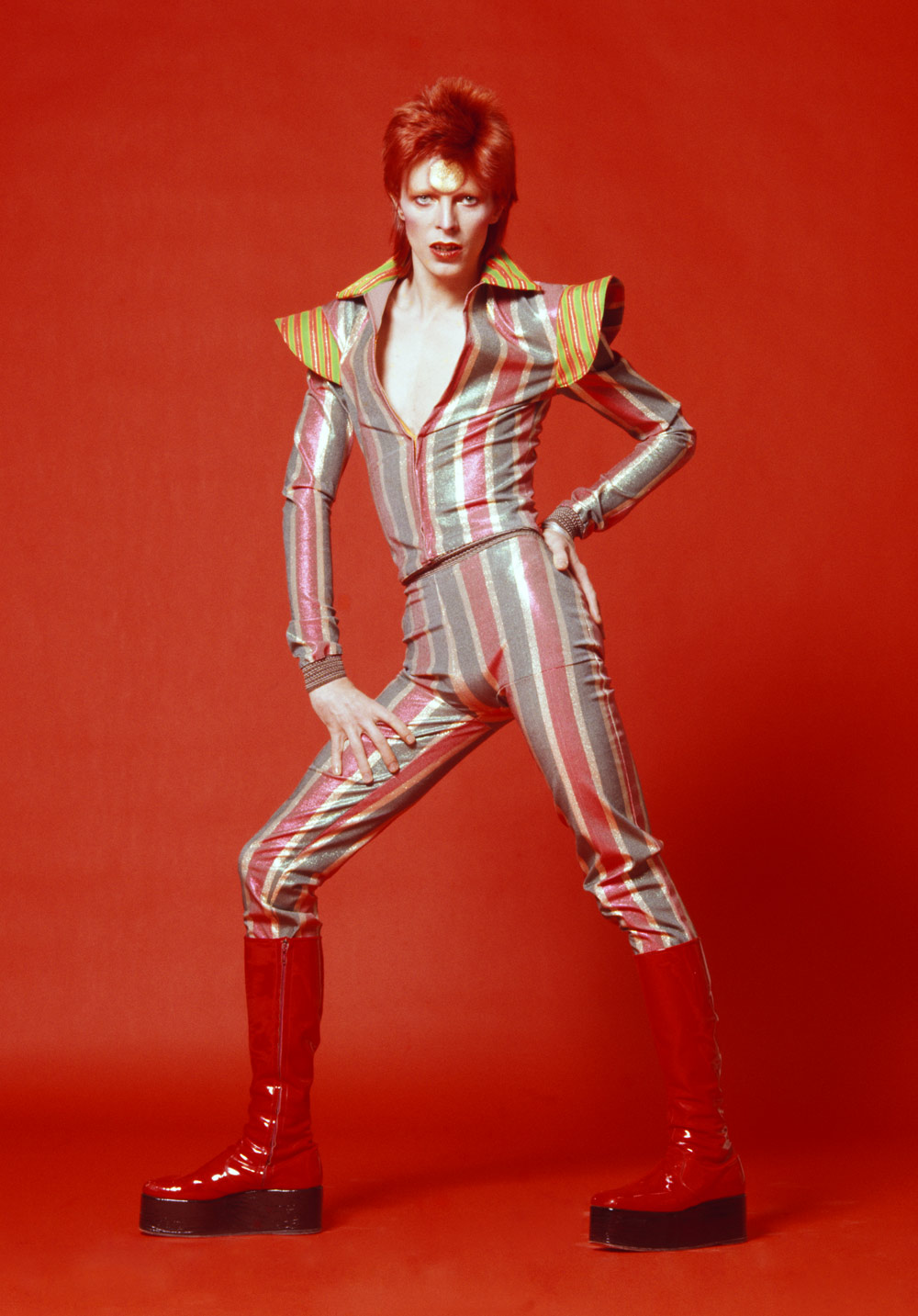
Masayoshi Sukita (Japanese, b. 1938) (photographer)
David Bowie
1973
© Sukita / The David Bowie Archive
The text Reflections on David: In a galaxy all of his own (below) was written for a special LGBTQI themed edition of the peer reviewed journal Fashion, Style and Popular Culture. At short notice, the co-editor asked me to write, and I quote, “a queer focused review of the Bowie exhibition at ACMI.” When I delivered the piece below, it was rejected as not being academic enough!
Apparently they wanted a deconstruction of the exhibition, its layout, construction, themes, lighting, and good and bad points. No mention of LGBTQI+ issues mind you.
What the kind of review they wanted has to do with a LGBTQI+ themed issue I have absolutely no idea. If they had known anything about my writing, they would have known they would not get academic speak, but something a little more interesting. Their loss, our gain.
The text focuses on Bowie’s impact on me at the time, as a gay man. Bowie is tight. Singing my all time favourite track of his, Young Americans, Bowie is a vocalist like no other. What a voice. Team that with charisma, soul, style, and all the moves … hands on hips, guitar slung backwards, padded shoulders to die for, cheekbones that you could cut with a knife and a presence that is just luminous. No wonder I loved him as an adolescent, he was my Hero. As someone commented on the YouTube live performance of the song (below), “ain’t there 1 goddam song that can make me breakdown + cry*”
This is a flawed but mesmerising exhibition. Allow three to fours hours at least. If you are a Bowie fan it’s a 100% must see; and if you are an aficionado of contemporary culture, you will be amazed at the sources Bowie draws from to create his art, his personas. It did no harm, either, that Bowie had access to some of the most creative designers in the world for his costumes and sets, but he was the inventive force. What a man, what an artist, not just a man who fell to earth, but a man who changed the world.
Dr Marcus Bunyan
Many thankx to ACMI for allowing me to publish the art work in the posting. Please click on the photographs for a larger version of the image. Download the text Reflections on David: In a galaxy all of his own (1.6Mb pdf)
Bowie performing live on the Dick Cavett Show (4th December 1974)
The year was 1975. In London, six years after that seminal event of early gay liberation, the Stonewall Riots, six years after the landing on the moon, and six years after the release of David Bowie’s single, Space Oddity, I came out as a gay man age 17. At the time I felt a bit of a space oddity myself, troubled by my hidden identity and the double life I was leading. My first act of rebellion was to walk into a newsagent at Notting Hill Gate underground station, pick up a copy of Gay Times, fling the money at the store attendant and run from the place as red as a beetroot. I was so embarrassed.
Things quickly changed. I had been listening to Bowie’s music since my early days in boarding school – The Man Who Sold the World, Hunky Dory, Ziggy Stardust, Aladdin Sane – and now, after outing myself, I rocked up to the Royal College of Music with silver hair, wearing the most outrageous satin pink and white bomber jacket, with rings on every finger. I walked down St. Albans high street on a Saturday morning through the market in fake white fur coat and eye shadow. It’s only now, forty years later, that I realise I was channeling my inner Bowie.
This was the era of Campaign for Homosexual Equality (CHE) in England, where we had to gather in people’s lounge rooms to meet other gay men, or once a month at a disco in country Hertfordshire. Or we went to the Pan Club in Luton where drag queens peered imperiously down at us through a grill before they allowed us through the door. The best thing was going to Scandals or Adams night clubs in London, where we danced on illuminated glass dance floors (like in Saturday Night Fever) and wore our army uniforms. We could be whoever we wanted to be. And this was all influenced by the multiple persona of Bowie.
Like an intelligent bower bird, Bowie constructed his different personae through bricolage, building them from cultural signifiers such as German Expressionism, Marlene Dietrich, Sonia Delaunay, Metropolis, Hollywood, Japanese film, JG Ballard and Clockwork Orange, to name just a few. My gay friends and I did much the same. Like Bowie, for us it wasn’t so much about sexuality but about androgyny and the public play of gender (although the two are obviously interlinked). We adored David, a self-educated lad from a poor working class family, initially a Mod, who created his own universe of creatures and characters. Glam yes, but so much more than just putting on a costume like Kiss, David lived and breathed his worlds and we, his fans, believed in him. Not so much gender bender as cultural gender blender.
Critical to this time in my life was the period that followed Ziggy: Young Americans and the Thin White Duke. I got heavily into soul music, going to a basement nightclub behind Bang on Tottenham Court Road, where they played reggae, Barry White and the Love Unlimited Orchestra… and David Bowie. I used to pretend to be one of the back up singers on the song Young Americans: “Young American, young American, she wants the young American.” Bowie is tight. Singing my all time favourite track of his, Young Americans, Bowie is a vocalist like no other. What a voice. Team that with charisma, soul, style, and all the moves … hands on hips, guitar slung backwards, padded shoulders to die for, cheekbones that you could cut with a knife and a presence that is just luminous. No wonder I loved him as an adolescent, he was my Hero. As someone commented on the YouTube live performance of the song, “ain’t there 1 goddam song that can make me breakdown + cry*”. From talking to other gay men, I know that the Young Americans album was also critical for them – all cinched waist, high cheekbones, eye shadow, padded shoulders, flaming hair and soul music.
Australian disc jockey Stephen Allkins observed the same phenomena in Sydney. In a recent interview with me he commented, “My first introduction to the world of David Bowie was in 1975 when I was a 14 year old gay boy hanging out with my gay cousin, coming out unknowingly together. Young Americans was so damn funky and classy and totally different to anything that was happening in the white music world at the time. I couldn’t quite get my head around the way Bowie had gone from Ziggy and Aladdin Sane to the Thin White Duke and funk in one swoop, but I loved it. It’s hard to put into words how, as everyone else was glamming up, Bowie starting wearing suits and playing with the hottest funk band on the planet. No one else at that time moved or evolved with such speed and ease and he made me believe every look and note. He didn’t copy or just follow a trend to get noticed, he created and influenced several generations of people with his music and visual ideas. I say ideas because what he created visually was more than mere fashion, it became art. Looking back on all he’s done now, all that he did was art – musically, visually and sensually.”
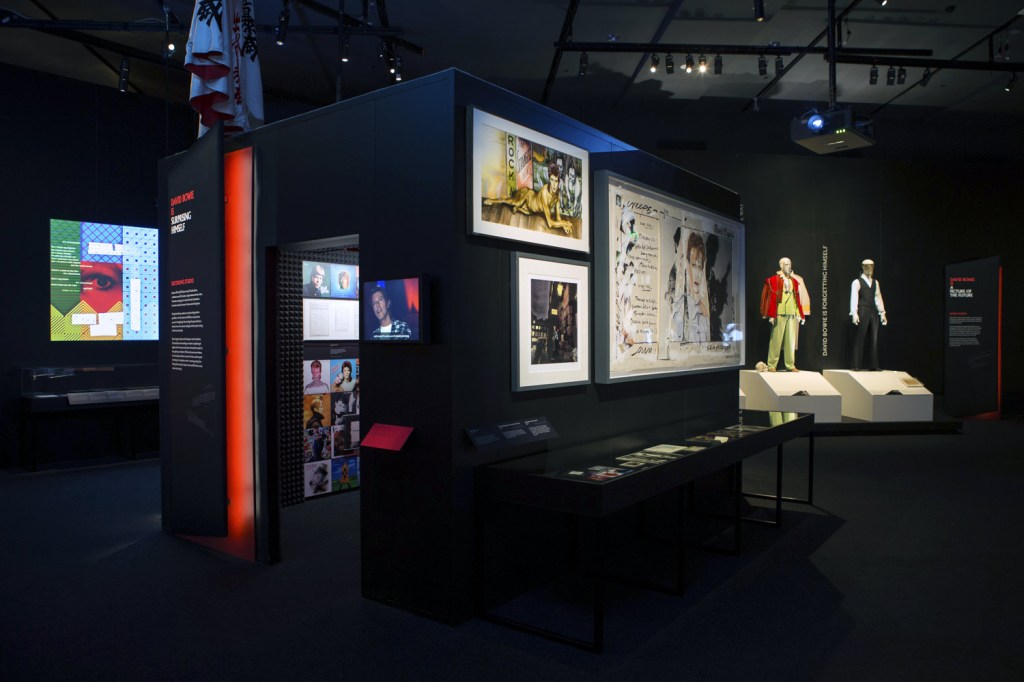
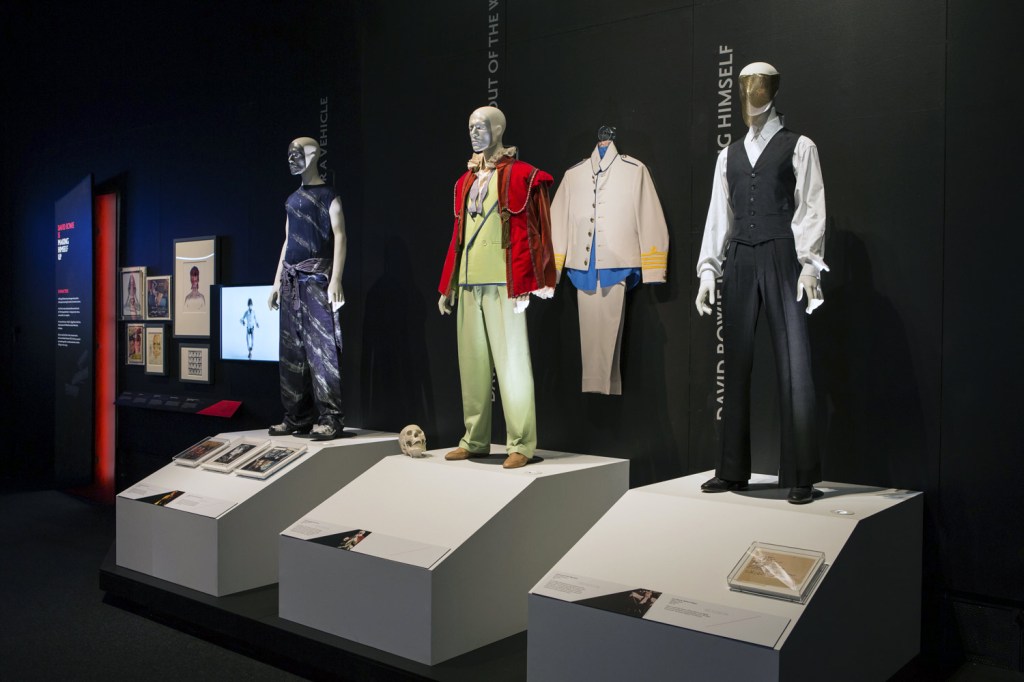
Which leads me on to David Bowie is, an exhibition at the Australian Centre for the Moving Image (ACMI) in Melbourne. This is a fascinating but flawed exploration of the life of one of the world’s great artists. To see his early life, influences, and upbringing, and to have access to his personal archives – especially the wonderful sketches and storyboards showing his creative process – is invaluable. One of the strongest elements of the performance is how the exhibition links his art to the many cultural signifiers he used to construct it: from collage to construction. The costumes are magnificent including the additional Australian content, like the Pierrot costume from Ashes to Ashes. To see artefacts such as the original handwritten stanzas of Ziggy Stardust and Fame is as close as many of us will get to the source of greatness.
Much less successful was the thematic layout of the exhibition. Sections on film stars, 1930s, and Berlin cabaret (to name but a few), in non-chronological order, made it difficult to comprehend the development of each character and their place in the flow of time and space. While this assemblage of ideas might mimic how Bowie actually constructed his characters, quickly moving from one to another, and then reviving the same character many years later (for example, Space Oddity‘s Major Tom of 1969 and then creating a sequel in Ashes to Ashes in 1980), the imitative representation, or mimesis, of Bowie’s process in the layout of the exhibition simply did not work. Knowing how important Young Americans was to my own gay history, I searched for about 15 minutes with a guide from the exhibition looking for references to Young Americans and the influence of soul music on Bowie. We eventually found just two Thin White Duke suits tucked away right at the end of the show. In the bowels of the dark, subterranean bunker that is ACMI too many artefacts were crammed into too small a location. The artefacts, the ideas and the art have little room to breathe.
Having said that, this is still a mesmerising exhibition. Allow three to fours hours at least. If you are a Bowie fan it’s a 100% must see; and if you are an aficionado of contemporary culture, you will be amazed at the sources Bowie draws from to create his art, his personas. It did no harm, either, that Bowie had access to some of the most creative designers in the world for his costumes and sets, but he was the inventive force. What a man, what an artist, not just a man who feel to earth, but a man who changed the world. He was REAL, his personae were REAL, his art was REAL. He was an astronaut of inner space and when he looked down the barrel of the lens he spoke to young rebels in an authentic voice. He was our hero and no one else’s. As the singer Sylvester would later say: “You make me feel mighty real.” Chimerical, pansexual David, we love you!
Dr Marcus Bunyan
October 2015
Word count: 1,390

Roy Ainsworth
Publicity photograph for The Kon-rads
1963
Courtesy of The David Bowie Archive
© Victoria and Albert Museum
David or ‘Davie’ Jones, as he was then known, became heavily involved in London’s burgeoning music scene at a young age. Before leaving school at the age of 16, he had already joined the band The Kon-rads, playing saxophone and singing vocals. Demonstrating the experimental energy that has driven his solo career, Bowie spent the 1960s trying out different musical, artistic and sartorial styles and performing with several different bands. In 1965 he changed his stage name to David Bowie. The exhibition features several objects from Bowie’s early career including sketches of set, costume and poster designs created for his first bands and footage of early performances.
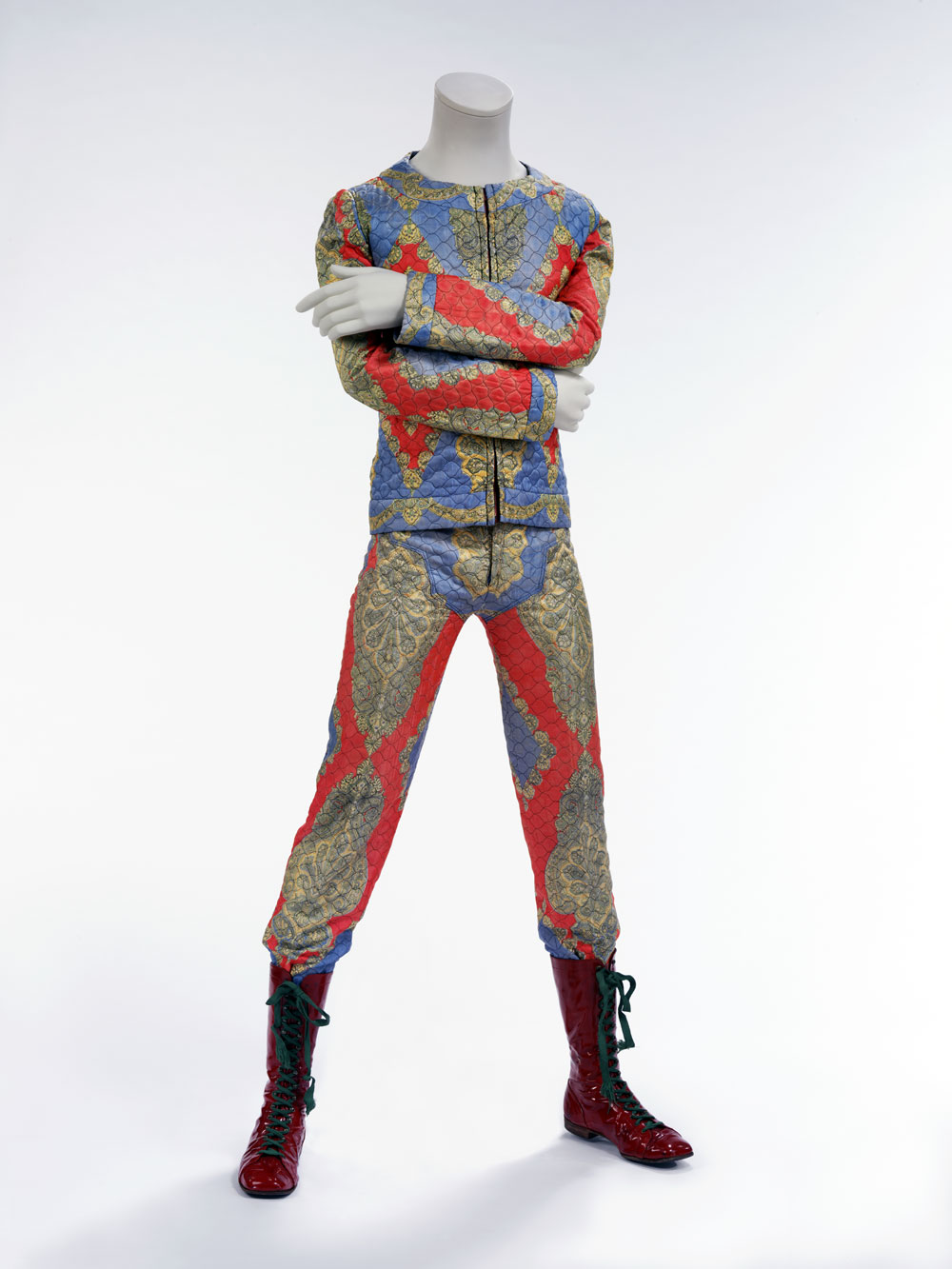
Freddie Burretti (British, b. 1952) (designer)
Quilted two‐piece suit
1972
Designed by Freddie Burretti for the ‘Ziggy Stardust’ tour
Courtesy of The David Bowie Archive
© Victoria and Albert Museum
On 6 July 1972 David Bowie performed Starman, the first single from his album The Rise and Fall of Ziggy Stardust and the Spiders from Mars, on BBC One’s Top of the Pops. This pivotal performance was crucial in making Bowie a music star and is acclaimed as a watershed moment which changed rock music and youth culture forever. Appearing on national television with flame-orange hair, make-up, multi-coloured clothing and red patent boots, Ziggy’s otherworldly look and sexual ambiguity created a seismic shift in pop culture. The exhibition features the original suit and boots created by Freddie Burretti and designed in collaboration with Bowie, who took inspiration from the costumes worn by the ‘droogs’ street gang in Stanley Kubrick’s film adaptation of A Clockwork Orange (1971).
Footage taken from BBC 4’s documentary, The Story of Ziggy Stardust
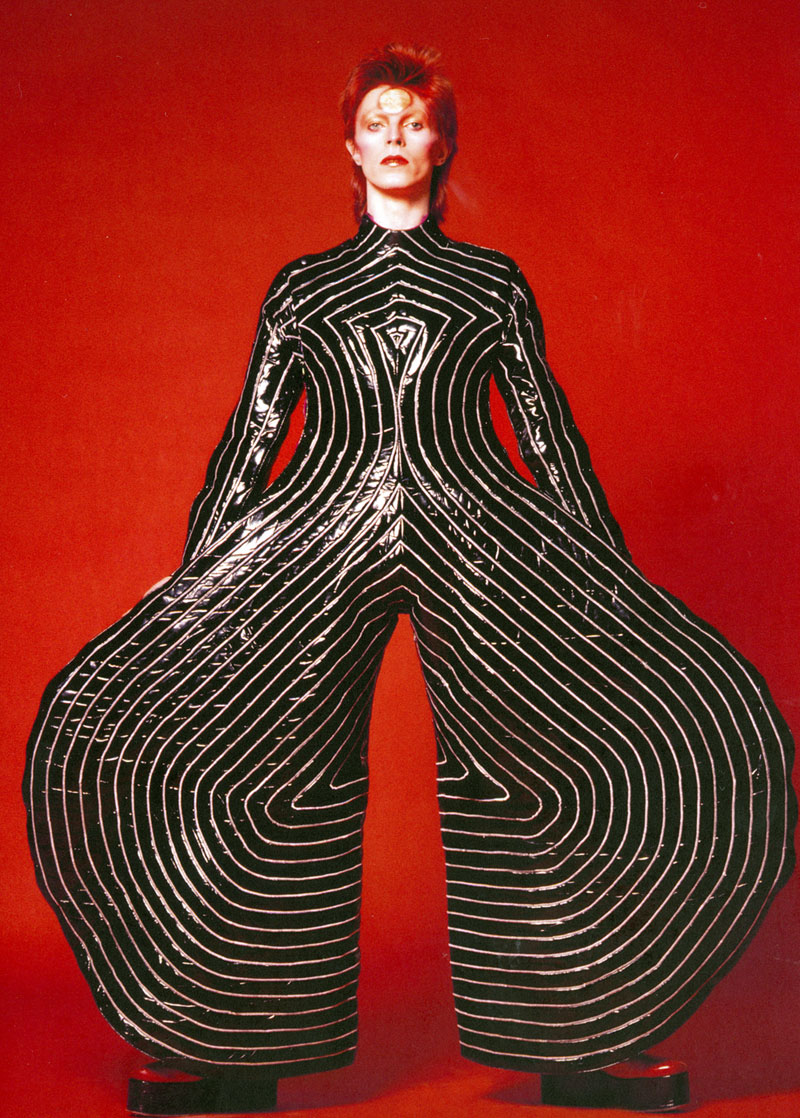
Kansai Yamamoto (Japanese, 1944-2020) (designer)
Masayoshi Sukita (Japanese, b. 1938) (photographer)
Striped bodysuit for the Aladdin Sane tour
1973
© Sukita / The David Bowie Archive
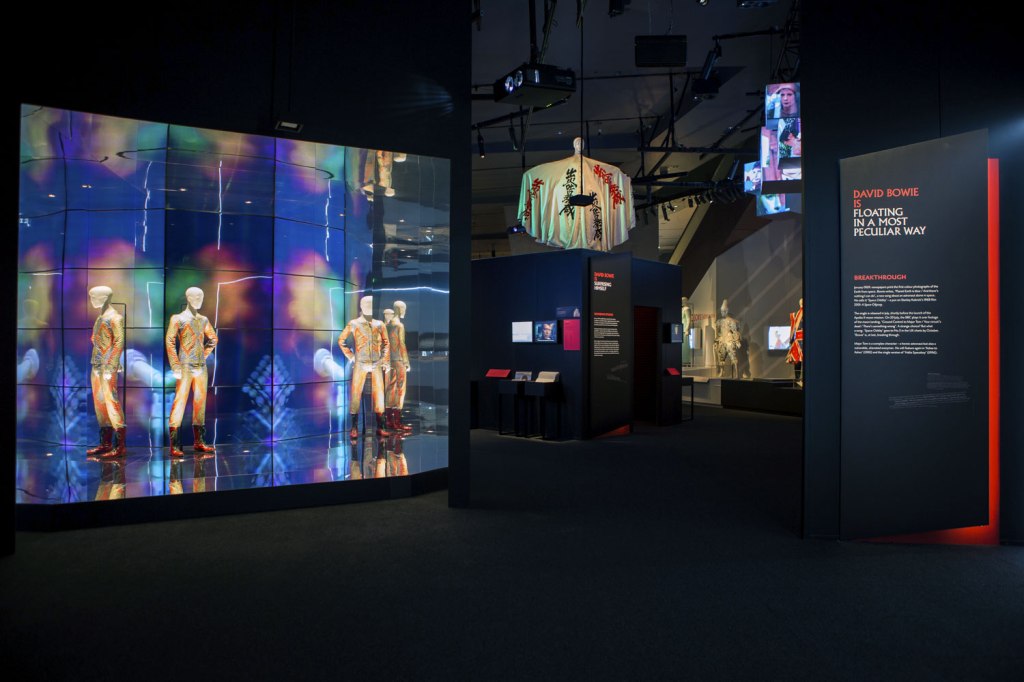
Bowie first saw the work of Japanese fashion designer Kansai Yamamoto at the exhibition Kansai in London in 1971. He could not afford the original designs so copied the look instead, recruiting friends such as Natasha Korniloff and Freddie Burretti to create cheaper versions of Yamamoto’s signature bodysuits and platform boots. After the success of Ziggy Stardust, Bowie approached Yamamoto and commissioned a set of even more flamboyant stage costumes for the Aladdin Sane tour in 1973. These outfits, inspired by the style of Japanese samurai and kabuki actors, are outrageous, sculptural and eye-catching. The exhibition features several Kansai Yamamoto costumes including the black and white striped bodysuit and a white cloak with Japanese kanji lettering spelling out ‘David Bowie’. A flamboyant suit from Yamamoto’s 1971 exhibition which he gifted to the V&A at the time is also on display.
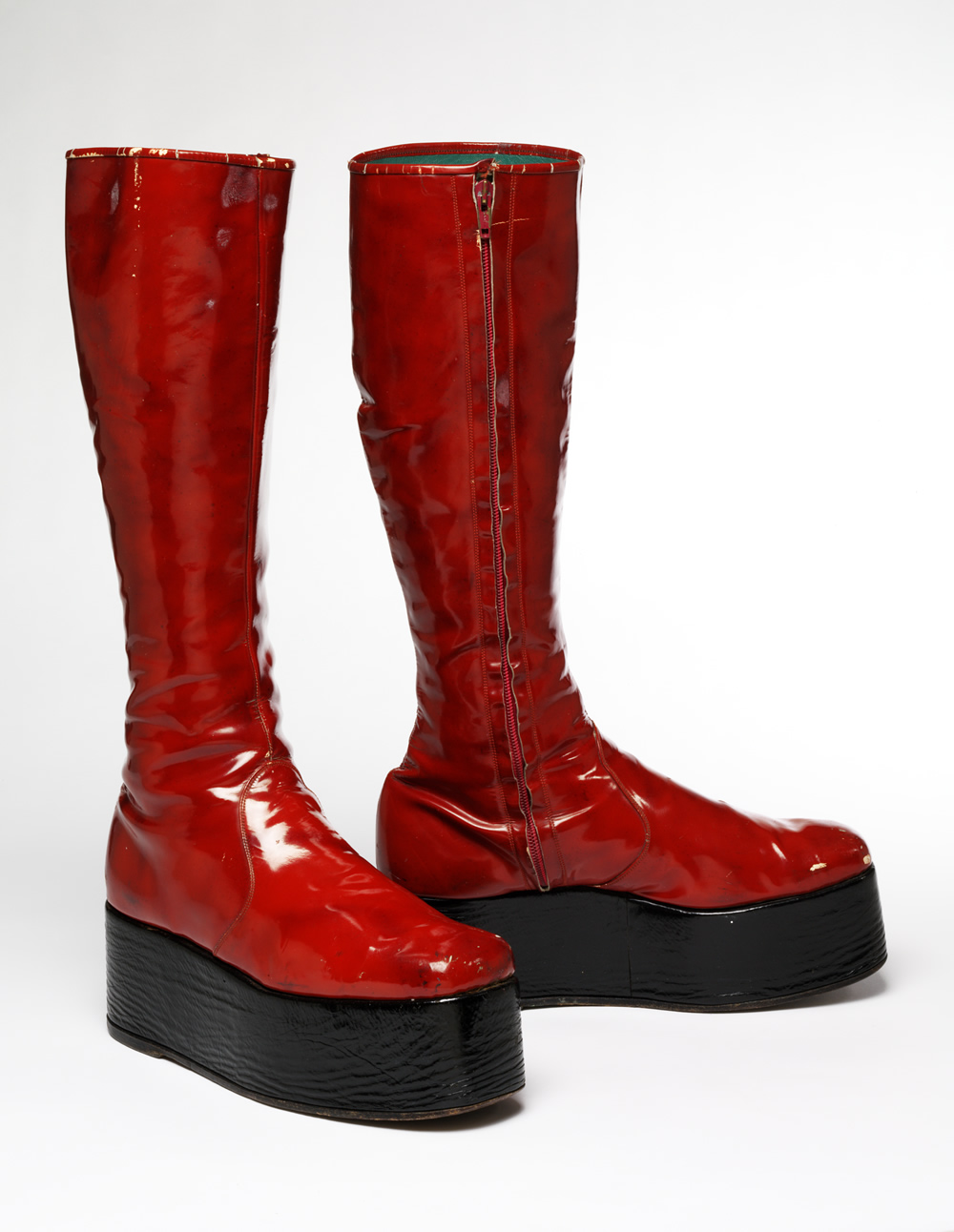
Red platform boots for the 1973 ‘Aladdin Sane’ tour
1973
Courtesy of The David Bowie Archive
© Victoria and Albert Museum

Kansai Yamamoto (Japanese, 1944-2020) (designer)
Metallic bodysuit
1973
Designed by Kansai Yamamoto for the ‘Aladdin Sane’ tour
Courtesy of The David Bowie Archive
© Victoria and Albert Museum

Brian Duffy (English, 1933-2010)
Album cover shoot for Aladdin Sane
1973
© Duffy Archive & The David Bowie Archive
The Australian Centre for the Moving Image (ACMI) today launched the critically acclaimed exhibition celebrating one of the most influential artists in music, film and video, fashion and performance. David Bowie is comes to ACMI from London’s Victoria and Albert Museum (V&A) for a strictly limited season from 16 July 2015 as part of the Victorian Government’s Melbourne Winter Masterpieces series.
Seen by over 1 million people worldwide at sell-out shows in London, Chicago, Sao Paolo, Paris, and Berlin, David Bowie is was conceived by the prestigious V&A in London, where it premiered in March 2013 before quickly becoming V&A’s fastest selling show. This once-in-a-lifetime experience, now in its only Australasian season, is set to take Melbourne by storm.
Drawing upon unprecedented access to objects from the David Bowie Archive, the exhibition charts the extraordinary career of the boy from London who became an iconic artist and cultural innovator. David Bowie is features over 50 legendary costumes, original stage set designs, handwritten lyric sheets, album artwork, rare film, video and photographs, and interviews with key collaborators. Special displays explore the artistic chameleon’s continuing influences as a musician, stage performer, writer and actor.
ACMI Director and CEO, Katrina Sedgwick, says the groundbreaking exhibition is testament to Bowie’s profound and everlasting impact as a true pioneer in music, fashion and culture. “We are thrilled to be hosting the Australian incarnation of David Bowie is… It is an exhibition that not only illuminates the extraordinary breadth of Bowie’s creative genius and his enormous impact over the decades – but it is also a beautifully curated and staged experience that will delight the many thousands of people who will see it in the coming weeks and months.”
The V&A’s curators, Victoria Broackes and Geoffrey Marsh, from the Museum’s Department of Theatre and Performance, selected more than 300 objects and films for the show. Of the exhibition they said; “We are absolutely delighted to see David Bowie is travel to ACMI. Bowie himself has a long-standing relationship with Australia, including creating the music videos for Let’s Dance and China Girl there. We hope that the exhibition meets the expectations of his extensive Australian fan base.”
The exhibition offers insight into Bowie’s early years and his first steps musical greatness. The creative aspiration of the young David Robert Jones are showcased by early photographs and Bowie’s sketches for stage sets and costumes created for his bands The Kon-rads and The Delta Lemons in the 1960s. Bowie’s first major hit Space Oddity (1969) and the introduction of the fictional character Major Tom inspired by Stanley Kubrick’s 1968 film 2001: A Space Odyssey granted him critical and commercial success as an established solo artist. His cinematic influences abound with his elaborate storyboards and set design for the Diamond Dogs tour (1974) inspired by Fritz Lang’s film Metropolis (1927).
Excerpts and props from Bowie’s on-screen performance in films including The Man Who Fell to Earth (1976), Labyrinth (1986), Basquiat (1996) and The Prestige (2006) show how Bowie has continually explored different notions of character and drawn together the numerous cultural influences that feed into his work. On display is the original multi-coloured suit worn for the pivotal performance of Starman on Top of the Pops in July 1972. An interactive audio-visual display presents some of Bowie’s most ambitious music videos including DJ (1979) and The Hearts Filthy Lesson (1995). Immersive, large-scale projections show recently uncovered footage of Bowie performing Jean Genie on Top of the Pops in 1973 and excerpts from D. A. Pennebaker’s film Ziggy Stardust and the Spiders from Mars: The Motion Picture (1973).
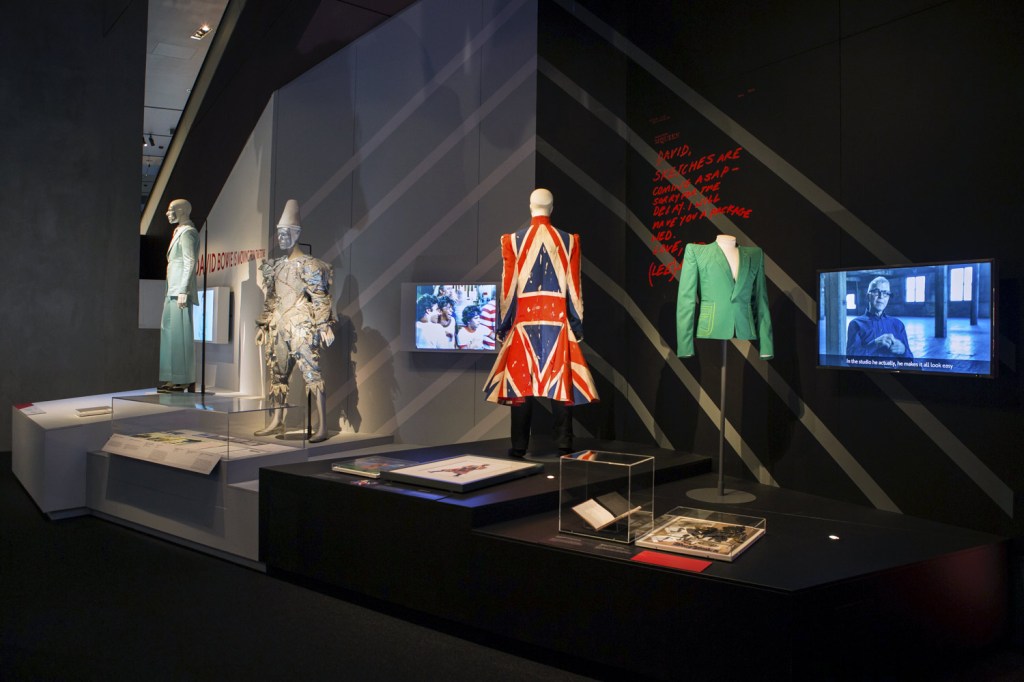
Bowie’s collaborations with artists and designers in the fields of fashion, sound, graphics, theatre, art and film are explored throughout the exhibition. On display are more than 50 stage costumes including Ziggy Stardust bodysuits (1972) designed by Freddie Burretti, Kansai Yamamoto’s flamboyant creations for the Aladdin Sane tour (1973), and the Union Jack coat designed by Bowie and Alexander McQueen for the Earthling album cover (1997). An area has been dedicated to the monochrome theatricality of Bowie’s Berlin period and the creation of the Thin White Duke persona identified with the Station to Station album and tour (1976). It also investigates the series of experimental records he produced between 1977 and 1979 whilst living in Germany, known as the Berlin Trilogy.
More personal items such as never-before-seen storyboards, handwritten set lists and lyrics are also featured in the exhibition as well as some of Bowie’s own sketches, musical scores and diary entries, revealing the evolution of his creative ideas. ACMI is the exclusive Australasian venue for a strictly limited season of David Bowie is. The ACMI season includes a curated program of talks and special events, late night programs, film screenings and live performances.
Press release from ACMI



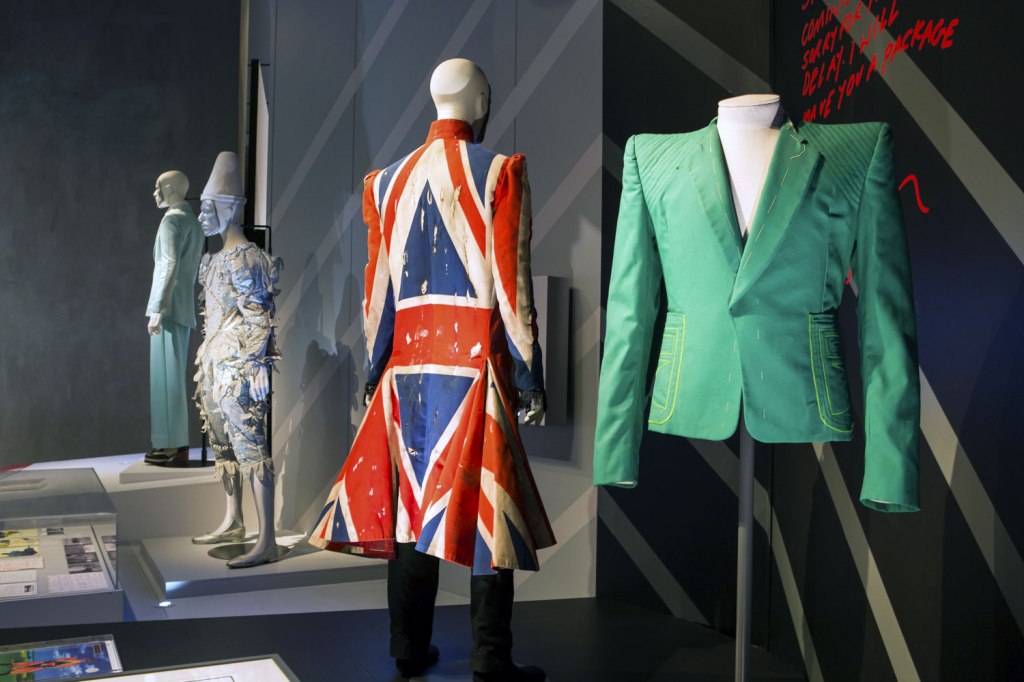
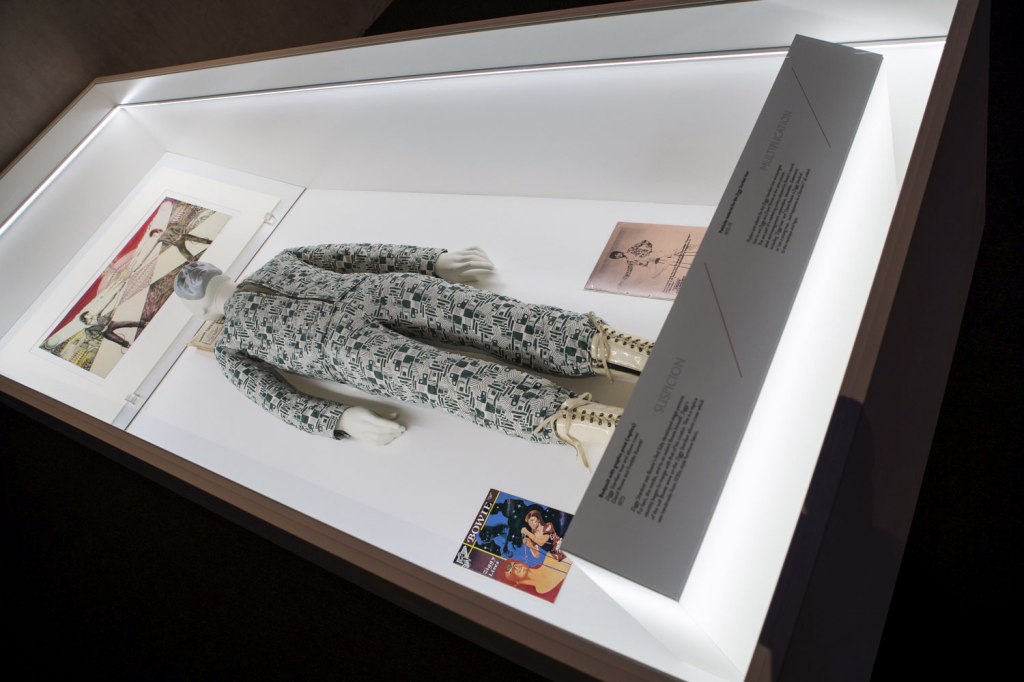


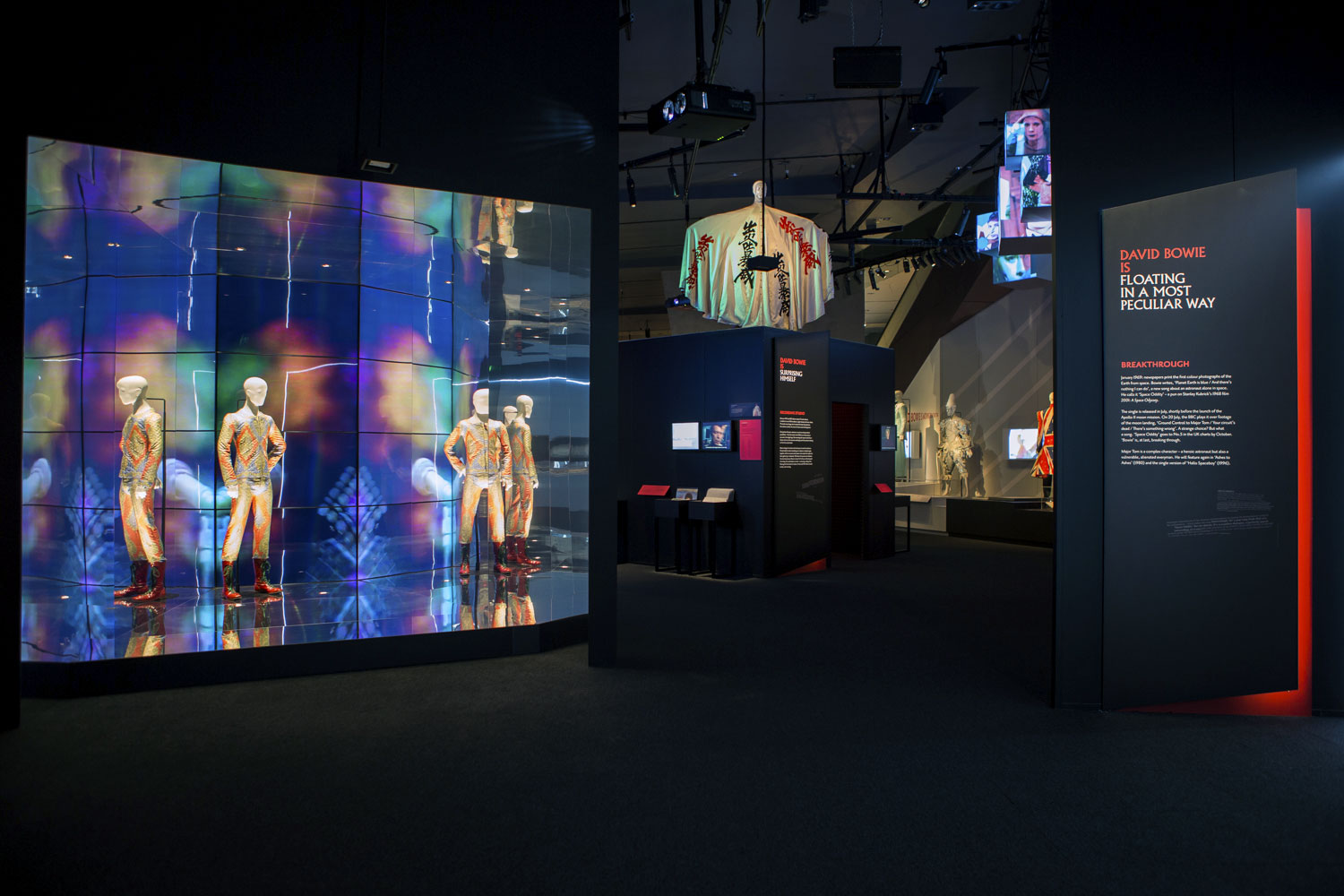

Ziggy Stardust jumpsuit designed by Freddie Burretti (1972)


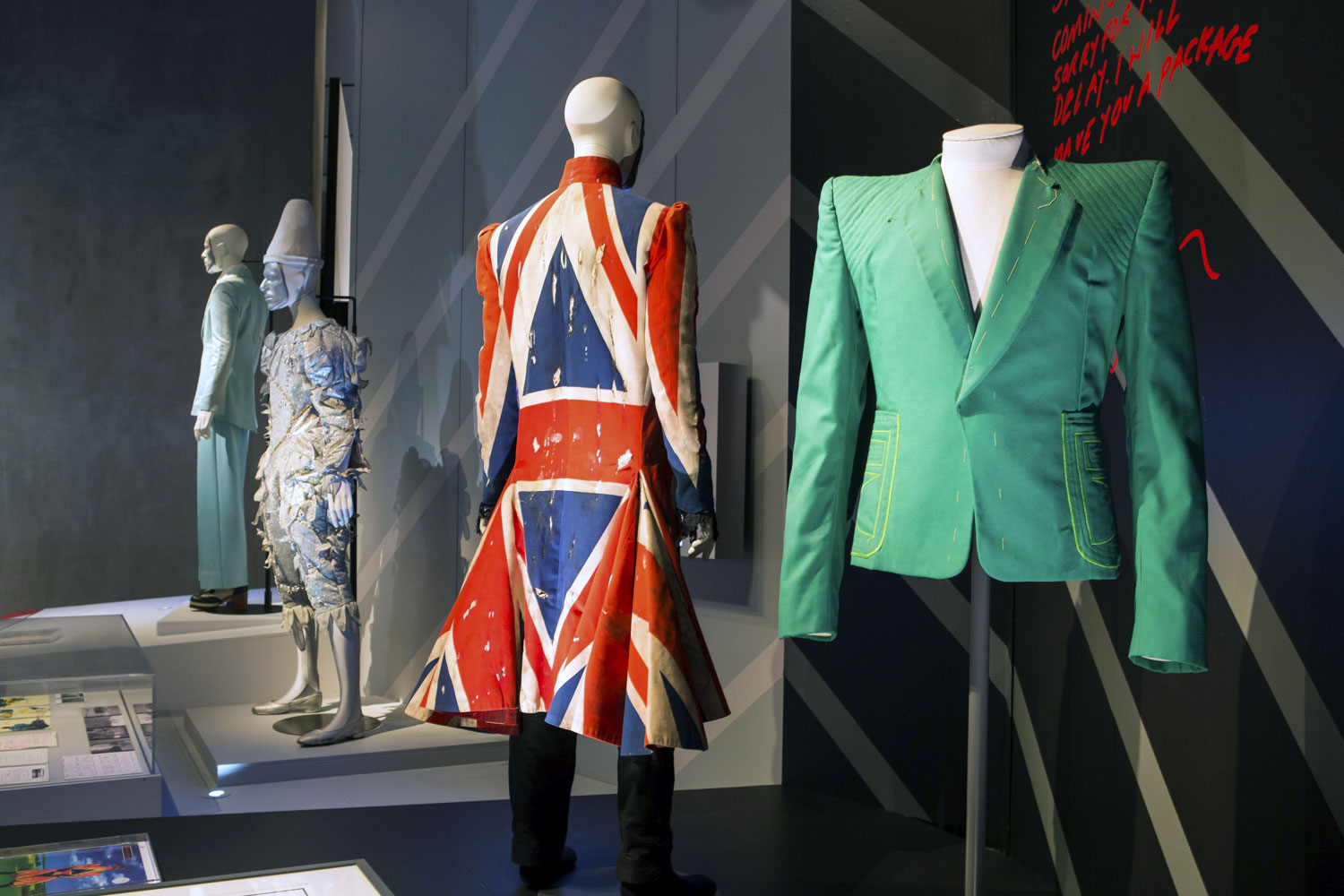
Alexander McQueen Union Jack coat designed in collaboration with David Bowie for the Earthling album cover

David Bowie (English, 1947-2016) and Freddie Burretti (British, b. 1952) (designer)
Bodysuit with graphic print (replica)
‘Ziggy Stardust’ tour and album cover
1972

Kansai Yamamoto striped bodysuit for the Aladdin Sane tour (1973)

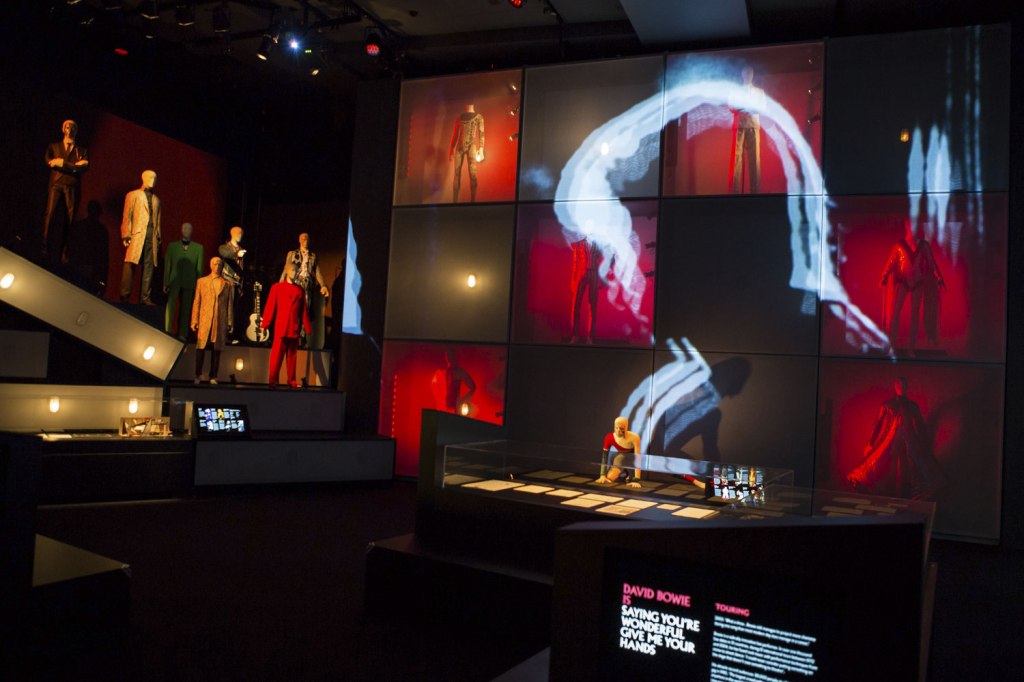
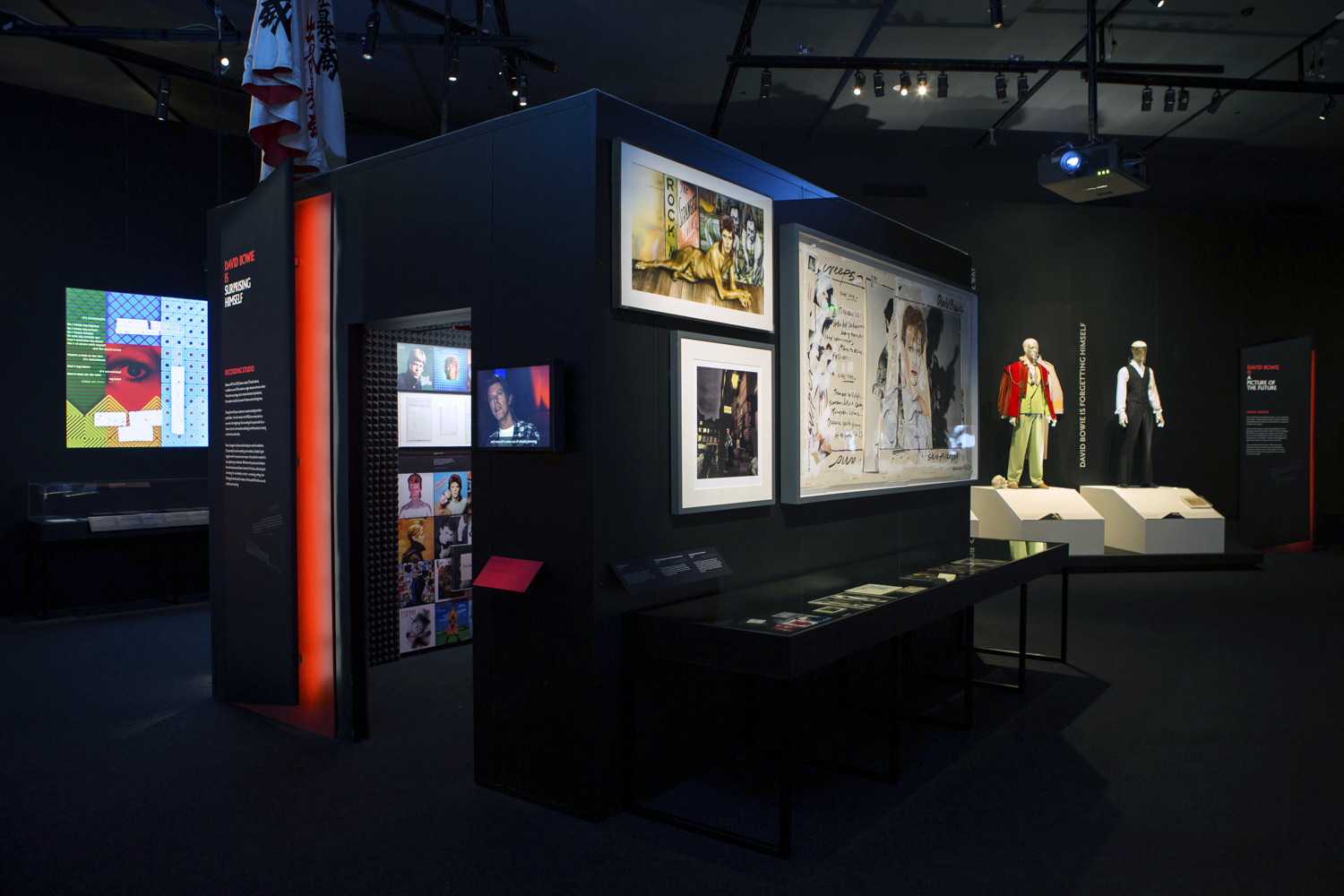
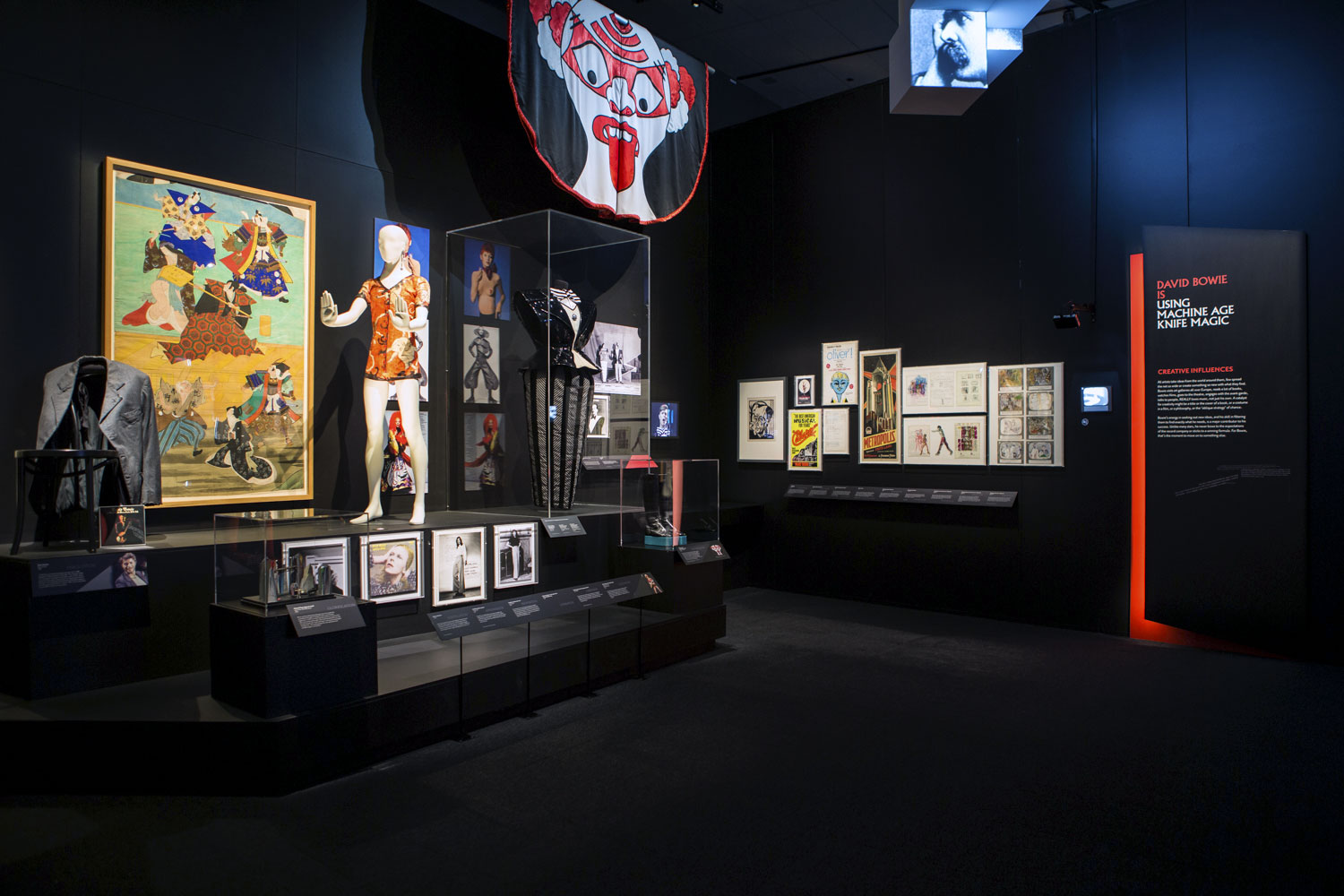
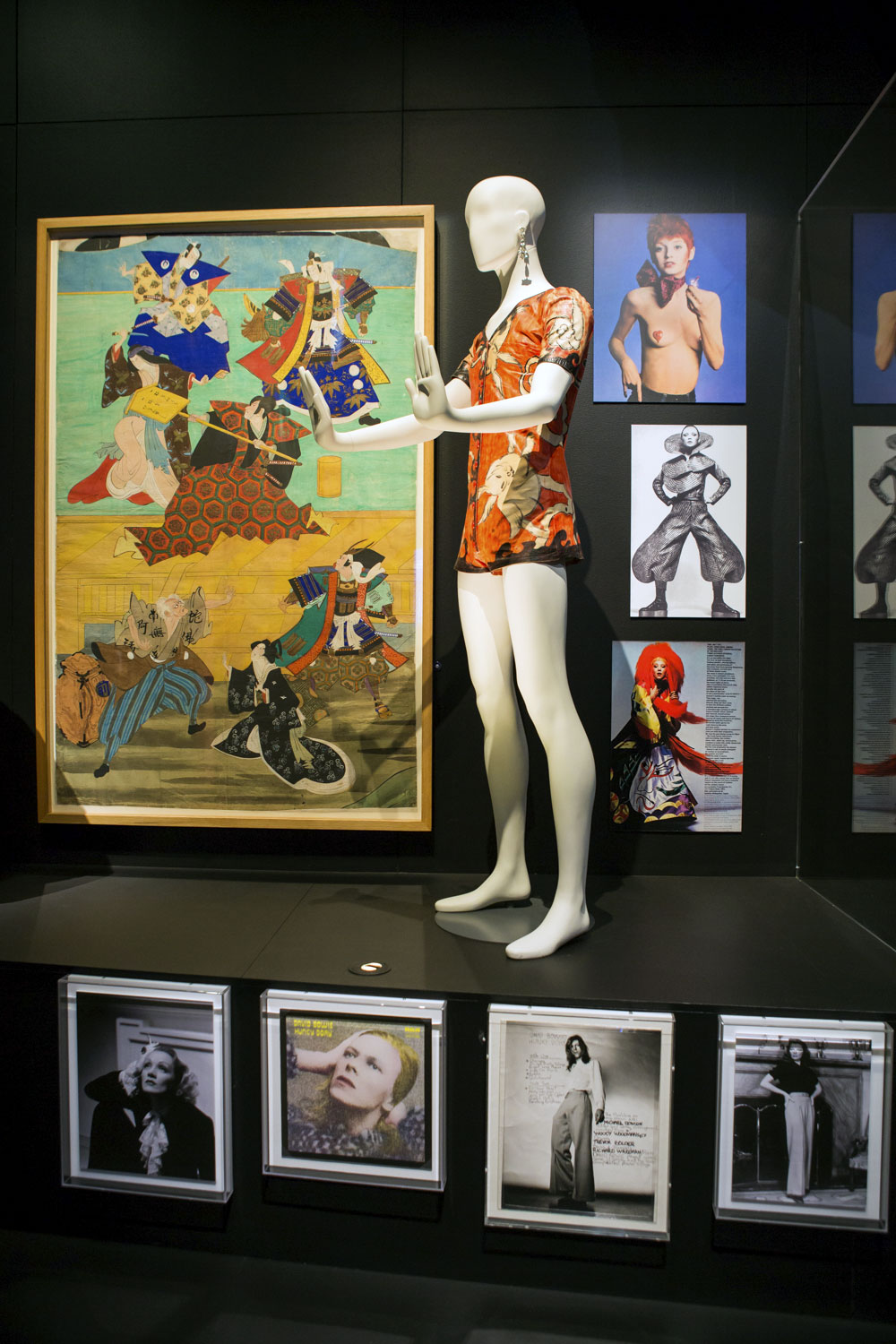
Installation photographs of the exhibition David Bowie is at the Australian Centre for the Moving Image, Melbourne
Photographer: Mark Gambino
The exhibition offers insight into Bowie’s early years and his first steps towards musical success. Tracing the creative aspirations of the young David Robert Jones (born 1947 in Brixton, London), it shows how he was inspired by innovations in art, theatre, music, technology and youth culture in Britain during the aftermath of the Second World War. Pursuing a professional career in music and acting, he officially adopted the stage name ‘David Bowie’ in 1965 and went through a series of self-styled changes from Mod to mime artist and folk singer to R&B musician in anticipation of the shifting nature of his future career. On display are early photographs and Bowie’s sketches for stage sets and costumes created for his bands The Kon-rads and The Delta Lemons in the 1960s.
This opening section concludes with a focus on Bowie’s first major hit Space Oddity (1969) and the introduction of the fictional character Major Tom, who would be revisited by Bowie in both Ashes to Ashes (1980) and Hallo Spaceboy (1995). Inspired by Stanley Kubrick’s 1968 film 2001: A Space Odyssey, the single was released to coincide with the first moon landing and was Bowie’s breakthrough moment, granting him critical and commercial success as an established solo artist.
The exhibition moves on to examine Bowie’s creative processes from song writing, recording and producing to his collaborations on costume designs, stage sets and album artwork. Showing how Bowie works within both established art forms and new artistic movements, this section reveals the scope of his inspirations and cultural references from Surrealism, Brechtian theatre and avant-garde mime to West End musicals, German Expressionism and Japanese Kabuki performance. This section traces the influence of these movements on Bowie’s own work, including the evolution of the lavishly produced Diamond Dogs tour (1974), the design of which was inspired by Fritz Lang’s film Metropolis (1927) and George Orwell’s novel Nineteen Eighty-Four (1949). The tour combined exuberant choreography and a colossal set design, taking the combination of rock music and theatre to new heights. On display are previously unseen storyboards for the proposed musical that Bowie would eventually transform into the Diamond Dogs album and touring show.
In addition, this section chronicles Bowie’s innovative approach to creating albums and touring shows around fictionalised stage personas and narratives. 1972 marked the birth of his most famous creation; Ziggy Stardust, a human manifestation of an alien being. Ziggy’s daringly androgynous and otherworldly appearance has had a powerful and continuous influence on pop culture, signalling a challenge of social conventions and inspiring people to shape their own identities. On display is the original multi-coloured suit worn for the pivotal performance of Starman on Top of the Pops in July 1972, as well as outfits designed for stage characters Aladdin Sane and The Thin White Duke. Costumes from The 1980 Floor Show (1973), album cover sleeves for The Man Who Sold the World (1970) and Hunky Dory (1971), alongside fan material, highlight Bowie’s fluid stylistic transformations and his impact on social mobility and gay liberation.
Excerpts from Bowie’s on-screen performances in films including The Man Who Fell to Earth (1976), Labyrinth (1986), Basquiat (1996) and The Prestige (2006) show how Bowie has continually explored different notions of character and drawn together the numerous cultural influences that feed into his work. Footage and photography of recording sessions for Outside (1995) and ‘Hours…’ (1999) as well as handwritten lyrics and word collages inspired by William Burroughs’ ‘cut up’ method of writing that have never previously been publicly displayed, reveal Bowie’s working processes from writing to recording.
This expansive retrospective also celebrates David Bowie as a pioneering performer concentrating on key performances throughout his career. An interactive audio-visual display presents some of Bowie’s most ambitious music videos including DJ (1979) and The Hearts Filthy Lesson (1995). Immersive, large-scale projections show recently uncovered footage of Bowie performing Jean Genie on Top of the Pops in 1973 and excerpts from D. A. Pennebaker’s film Ziggy Stardust and the Spiders from Mars: The Motion Picture (1973).
An area has been dedicated to the monochrome theatricality of Bowie’s Berlin period and the creation of the stylish Thin White Duke persona identified with the Station to Station album and tour (1976). It also investigates the series of experimental and pioneering records he produced between 1977 and 1979 whilst living in Germany, known as the Berlin Trilogy. Finally, David Bowie is features a display of striking performance and fashion photography taken by photographers including Helmut Newton, Herb Ritts and John Rowlands. These professional portraits are juxtaposed with a collage of visual projections illustrating Bowie’s immense creative influence and ubiquitous presence in music, fashion and contemporary visual and virtual culture.
Press release from the Australian Centre for the Moving Image website

Freddie Burretti (British, b. 1952) (designer)
Ice-blue suit
1972
Designed for the ‘Life on Mars?’ video
Courtesy of The David Bowie Archive
© Victoria and Albert Museum
David Bowie – Life On Mars? (Official Video)
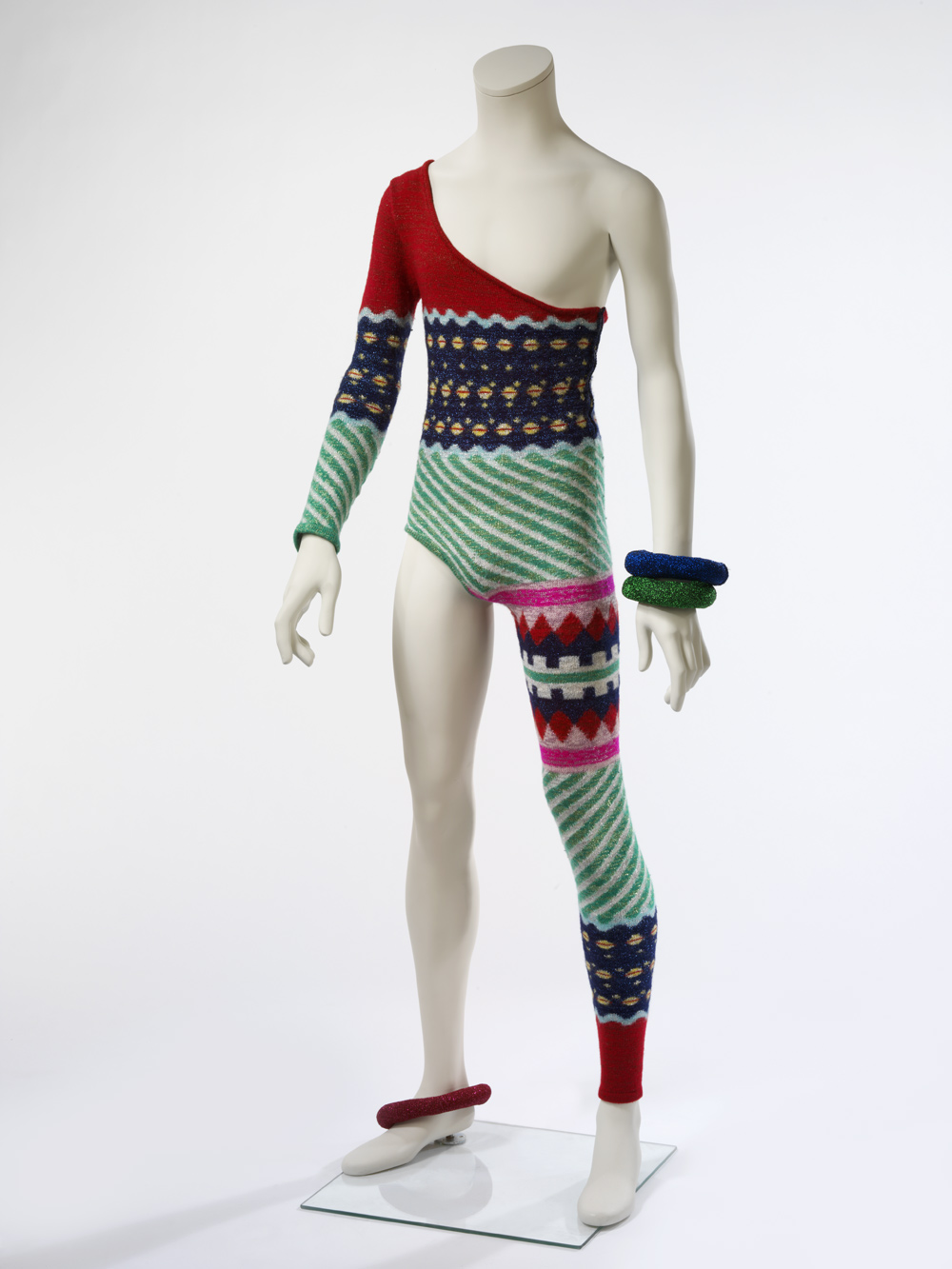
Kansai Yamamoto (Japanese, 1944-2020) (designer)
Asymmetric knitted bodysuit
1973
Designed for the ‘Aladdin Sane’ tour
Courtesy of The David Bowie Archive
© Victoria and Albert Museum

Photograph by Terry O’Neill with colour by David Bowie (English, 1947-2016)
David Bowie with William Burroughs, February 1974
1974
Courtesy of The David Bowie Archive
© Victoria and Albert Museum

Terry O’Neill
Promotional photograph of David Bowie for ‘Diamond Dogs’
1974
© Victoria and Albert Museum
David Bowie – BBC Live – Diamond Dogs & John, I’m Only Dancing (January 1975)

David Bowie (English, 1947-2016)
Photo-collage by David Bowie of manipulated film stills from The Man Who Fell to Earth
1975-1976
Film stills by David James
Courtesy of The David Bowie Archive, Film stills
© STUDIOCANAL Films Ltd., Image
© Victoria and Albert Museum

Cut up lyrics for ‘Blackout’ from “Heroes”
1977
Courtesy of The David Bowie Archive
© Victoria and Albert Museum

Print after a self‐portrait by David Bowie
1978
Courtesy of The David Bowie Archive
© Victoria and Albert Museum

Brian Duffy (English, 1933-2010)
David Bowie during the filming of the ‘Ashes to Ashes’ video
1980
© Duffy Archive & The David Bowie Archive

Original storyboards by David Bowie for the ‘Ashes to Ashes’ video
1980
Courtesy of The David Bowie Archive
© Victoria and Albert Museum
David Bowie – Ashes To Ashes (Official Video)
Australian Centre for the Moving Image (ACMI)
Federation Square, Melbourne, Australia
Opening hours:
Open daily, 10am – 5pm (Closed Christmas Day)
Curators: Dr Mikhail Dedinkin, Deputy Head of the Western European Art Department at the Hermitage, working Dr Ted Gott, Senior Curator of International Art at the National Gallery of Victoria

Installation view of room 1 of the exhibition Masterpieces from the Hermitage: The Legacy of Catherine the Great at NGV International, Melbourne featuring Alexander Roslin (Swedish 1718-93) Portrait of Catherine II 1776-77
Photo: Marcus Bunyan
A scintillating exhibition at NGV International which showcases one of the world’s greatest art collections. Exhibition design is outstanding (particularly the floor tiling), as are the Da Vinci, Titian, Rembrandt, van Dyck, Rubens and Flemish still life. Among my favourites is a small Watteau Savoyard with a Marmot (1716) which is absolutely still, delicate and exquisite: I thought of the photographs of Atget, his street sellers, when I saw this painting; and Frans Snyders’ tour-de-force Concert of birds (1630-40) which has such presence.
Well done to the curators, the Hermitage Museum and the NGV for staging such a magnificent exhibition.
Marcus
Many thankx to the National Gallery of Victoria for allowing me to publish the photographs in the posting. Please click on the photographs for a larger version of the image. All photographs © Dr Marcus Bunyan and the National Gallery of Victoria.
Masterpieces from the Hermitage: The Legacy of Catherine the Great showcases one of the world’s greatest art collections. Featuring works by artists including Rembrandt, Rubens, Velázquez and Van Dyck, the exhibition offers a dazzling array of works including the finest group of Dutch and Flemish art to come to Australia.
This exclusive Melbourne exhibition will also highlight the innovation and vision of Catherine the Great, whose inexhaustible passion for education, the arts and culture heralded a period of enlightenment in the region. The extraordinary works sourced and commissioned by Catherine during her thirty-four year reign, created the foundations for the Hermitage today – considered to be one of the world’s greatest treasure houses of art and decorative arts. The exhibition will offer audiences an immersive experience, recreating the rich atmosphere of the Hermitage to showcase these exquisite works.
German-born Catherine the Great (Catherine II) came to power in 1762, aged thirty-three, and ruled Russia for the next thirty-four years, until her death in 1796. She saw herself as a Philosopher Queen, a new kind of ruler in the Age of Enlightenment. Guided by Europe’s leading intellectuals, she modernised Russia’s economy, industry and government, drawing inspiration both from Antiquity and contemporary cultural and political developments in Western Europe. A fluent speaker of Russian, French and German, Catherine was largely self-educated, independent, idealistic and visionary.
While her reign was not always peaceful, Catherine sought to bring order, stability and prosperity to the vast Russian Empire. Her ideals of abolishing serfdom and ensuring the equality of all citizens under the law were ahead of her time, and strongly resisted by the nobility of the day; however, she achieved numerous other reforms, including the introduction of paper money and modernisation of Russia’s education system. French philosopher Denis Diderot, who visited St Petersburg in 1773, described an audience with Catherine as being ‘more like study than anything else: she is a stranger to no subject; there is no man in the Empire who knows her nation as well as she’.
Between 1762 and 1796, the years of her reign, Catherine the Great oversaw a period of cultural renaissance in Russia. The world of ideas in which she was deeply involved from an early age found tangible expression in the material world the Empress later created around herself. The great complexes of imperial buildings Catherine constructed reflected her informed interest in both Classical and Chinese culture.
Catherine not only assembled a collection of Old Master paintings equal in scale and quality to leading European collections, but also paid considerable attention to the acquisition of contemporary art. While the richness and technical perfection of her diverse collections of decorative arts aimed to dazzle and please, they also had the more practical purpose of raising standards of artistic production in Russia. The fact that more than 400 exemplary works of art from her personal collection, including paintings, sculptures, drawings, porcelain, silver and precious gems, are seen here for the first time in Australia is cause for celebration.


Installation views of room 1 of the exhibition Masterpieces from the Hermitage: The Legacy of Catherine the Great at NGV International, Melbourne featuring Alexander Roslin (Swedish 1718-1793) Portrait of Catherine II 1776-1777
Photos: Marcus Bunyan


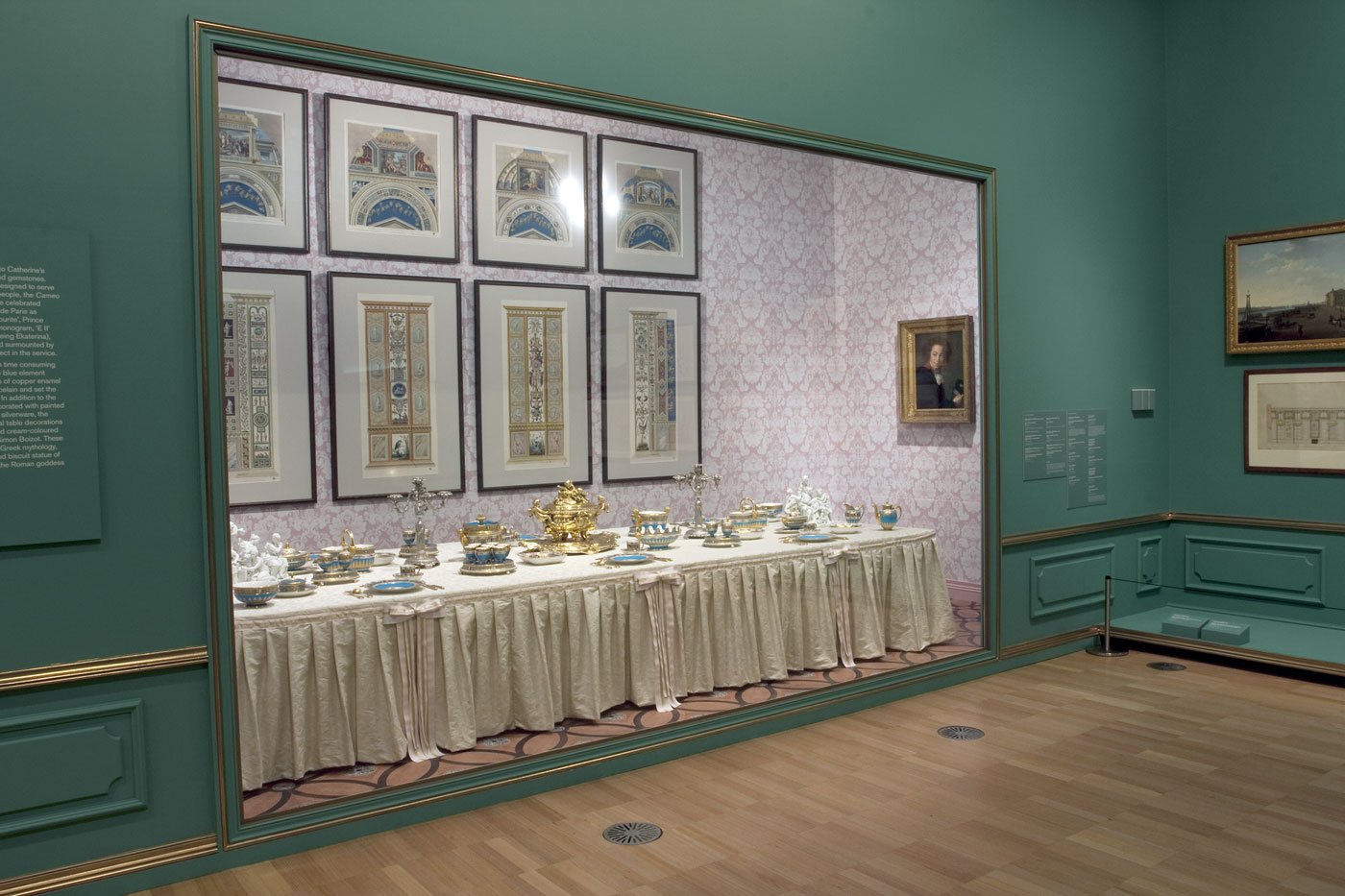

Installation views of room 1 of the exhibition Masterpieces from the Hermitage: The Legacy of Catherine the Great at NGV International, Melbourne featuring in the last three photographs, the Sèvres Cameo Service. Cameo Service 1778-1779. Sevres Porcelain Factory (manufacturer) France, est. 1756. The State Hermitage Museum, St. Petersburg.
Photos: Marcus Bunyan
The Sèvres Cameo Service (1778-1779) relates to Catherine’s great passion for collecting engraved gemstones. Comprising 797 individual pieces designed to serve dinner, dessert and coffee to sixty people, the Cameo Service was commissioned from the celebrated Sèvres porcelain manufactory outside Paris as a present for Catherine’s court ‘favourite’, Prince Grigory Potemkin. The Empress’s monogram, ‘E II’ (the Russian version of her name being Ekaterina), woven from garlands of flowers and surmounted by a crown, adorned almost every object in the service.
Production of the service was both time consuming and labour-intensive. The exquisite blue element alone – made from separate layers of copper enamel that gradually seeped into the porcelain and set the pure colour – required five firings. In addition to the hundreds of porcelain objects decorated with painted and sculpted cameos and related silverware, the service also included grand central table decorations fashioned from biscuit, or unglazed cream-coloured porcelain, by the sculptor Louis-Simon Boizot. These decorations illustrated tales from Greek mythology, and were presided over by a grand biscuit statue of Catherine the Great as Minerva, the Roman goddess of wisdom and the arts.


Installation views of room 1 of the exhibition Masterpieces from the Hermitage: The Legacy of Catherine the Great at NGV International, Melbourne
Photos: Marcus Bunyan

Installation view of passageway video of the exhibition Masterpieces from the Hermitage: The Legacy of Catherine the Great at NGV International, Melbourne
Photo: Marcus Bunyan
When Catherine the Great began collecting European art, opportunities to acquire fine Italian Old Master paintings were already severely limited. Demand from wealthy collectors was high and the marketplace was saturated with misattributed works, some of which inevitably made their way to the Hermitage and other great collections.
Despite this, Catherine achieved great success collecting sixteenth and seventeenth century paintings, particularly from Venice, including great paintings by Titian, Paris Bordone and the enigmatic Lorenzo Lotto. These are complemented by fine examples of Roman and Florentine paintings, such as the famous Female nude (Donna nuda), by an artist very close to Leonardo da Vinci. This select group of paintings beautifully illustrate developments in figurative art, portraiture and religious art in Italy from the sixteenth to the eighteenth century.
In the early years of her reign, Catherine the Great acquired en masse several large collections of drawings representing all the main European schools. This set the foundations for the current Hermitage Museum’s outstanding Cabinet of Drawings. In terms of quality, Catherine’s acquisitions of Italian drawings were of the highest standard. The majority of these date from the mid sixteenth to late eighteenth centuries and include many rare and precious works.

Installation view of room 2 of the exhibition Masterpieces from the Hermitage: The Legacy of Catherine the Great at NGV International, Melbourne showing at centre, Domenico Fetti (Italian 1589-1623) Portrait of an actor 1620s
Photo: Marcus Bunyan

Domenico Fetti (Italian, 1589-1623)
Portrait of an actor (installation view)
1620s
Oil on canvas
The State Hermitage Museum, St. Petersburg
Photo: Marcus Bunyan
Domenico Fetti was court painter to Gerdinand II Gonzaga, Duke of Mantua, when he made this striking portrait of an actor. It is though to be Tristano Martinelli who made his fame working in the commedia dell’arte tradition. It is believe that Marinelli created and popularised the standard roll of the Harlequin in theatre. Fetti himself was involved with the theatre in both Mantua and Venice.

Installation view of room 2 of the exhibition Masterpieces from the Hermitage: The Legacy of Catherine the Great at NGV International, Melbourne featuring at centre, Paris Bordone (Italian 1500-1571) Portrait of a lady with a boy Mid 1530s
Photo: Marcus Bunyan

Paris Bordone (Italian, 1500-1571)
Portrait of a lady with a boy (installation view)
Mid 1530s
Oil on canvas
97cm (38.1 in) x 77cm (30.3 in)
The State Hermitage Museum, St. Petersburg
Photo: Marcus Bunyan
This work by Venetian artist Paris Bordone is a typical example of formal Renaissance portraiture. Bordone’s main aim was to show the high social standing of the sitters, so he painted their luxurious costumes in great detail. He draws our attention to the sumptuous sleeves of this woman’s dress, the headgear resembling a turban, as well as her opulent jewellery. Bordone was one of Titian’s most talented pupils whose work is characterised by a level of precision not often present in his master’s work. This painting entered the Hermitage as a work by Giorgione.

Paris Bordone (Italian 1500-1571)
Portrait of a lady with a boy
Mid 1530s
Oil on canvas
97cm (38.1 in) x 77cm (30.3 in)
The State Hermitage Museum, St. Petersburg
Public domain


Installation view of room 2 of the exhibition Masterpieces from the Hermitage: The Legacy of Catherine the Great at NGV International, Melbourne showing at left in the bottom image, Domenico Capriolo (Italian c. 1494-1528) Portrait of a young man 1512 and to the right, Lorenzo Lotto (Italian c. 1480-1556) The Rest on the Flight into Egypt with Saint Justine 1529-1530
Photos: Marcus Bunyan
Portrait of a young man by the Venetian master Domenico Capriolo captures the intellectual values of Renaissance art. Everything that surrounds this youth speaks of his interests, such as the church that indicates his piety; the statue of Venus that reveals his passion for Antiquity; and the folder (containing verses or drawings) that illustrates the richness of his inner world. The painting is dated 1512 and the artist’s name symbolised by a medallion containing a Capreolus, or deer, which is a play on his name. Such allusions were common in Renaissance art and would have been readily understood by his contemporaries.

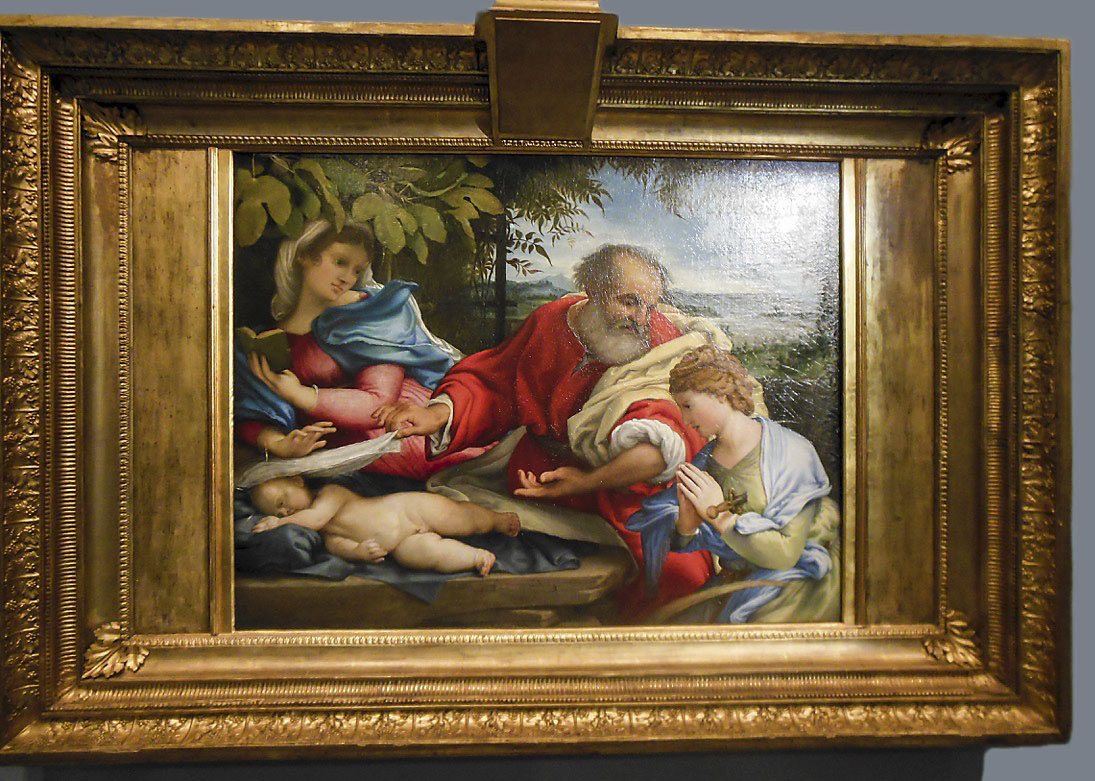
Lorenzo Lotto (Italian c. 1480-1556)
The Rest on the Flight into Egypt with Saint Justine (installation views)
1529-1530
Oil on canvas
82cm (32.2 in) x 133cm (52.3 in)
The State Hermitage Museum, St. Petersburg
Photos: Marcus Bunyan
Lorenzo Lotto is a much admired sixteenth-century Venetian artist. The Rest on the Flight into Egypt with Saint Justine has the typical dynamism of Lotto’s work, achieved not only through the poses, gestures and movement of the foliage, but also through his intense colour palette and the juxtaposition of resonant blues with red and yellow tones. Here, the Holy Family has been joined by Saint Justine of Padua, martyred in 304 AD, identifiable through her attribute of a sword piercing her breast. Justine was a very popular subject for artists of Northern Italy.

Lorenzo Lotto (Italian c. 1480-1556)
The Rest on the Flight into Egypt with Saint Justine
1529-1530
Oil on canvas
82cm (32.2 in) x 133cm (52.3 in)
The State Hermitage Museum, St. Petersburg
Public domain

Installation view of room 2 of the exhibition Masterpieces from the Hermitage: The Legacy of Catherine the Great at NGV International, Melbourne showing Leonardo da Vinci (school of) Female nude (Donna Nuda) Early 16th century
Photo: Marcus Bunyan

Leonardo da Vinci (school of)
Female nude (Donna Nuda) (installation view)
Early 16th century
Oil on canvas
86.5cm (34 in) x 66.5cm (26.1 in)
The State Hermitage Museum, St. Petersburg
Photo: Marcus Bunyan
This painting entered the Hermitage collection as a work by Leonardo da Vinci, but is now widely accepted to be by one of his close followers, possibly his pupil Salai. Perhaps more important is that it may be a close copy of a lost painting by Leonardo. Female nude (Donna Nuda) also shares some of the qualities of the famous Mona Lisa c. 1503-1519, in the Louvre Museum, Paris; namely the repetition of the pose, the position of the hands and the landscape setting seen behind a stone ledge in front of which the figure is set. This is the most refined of numerous variants of this composition in existence.
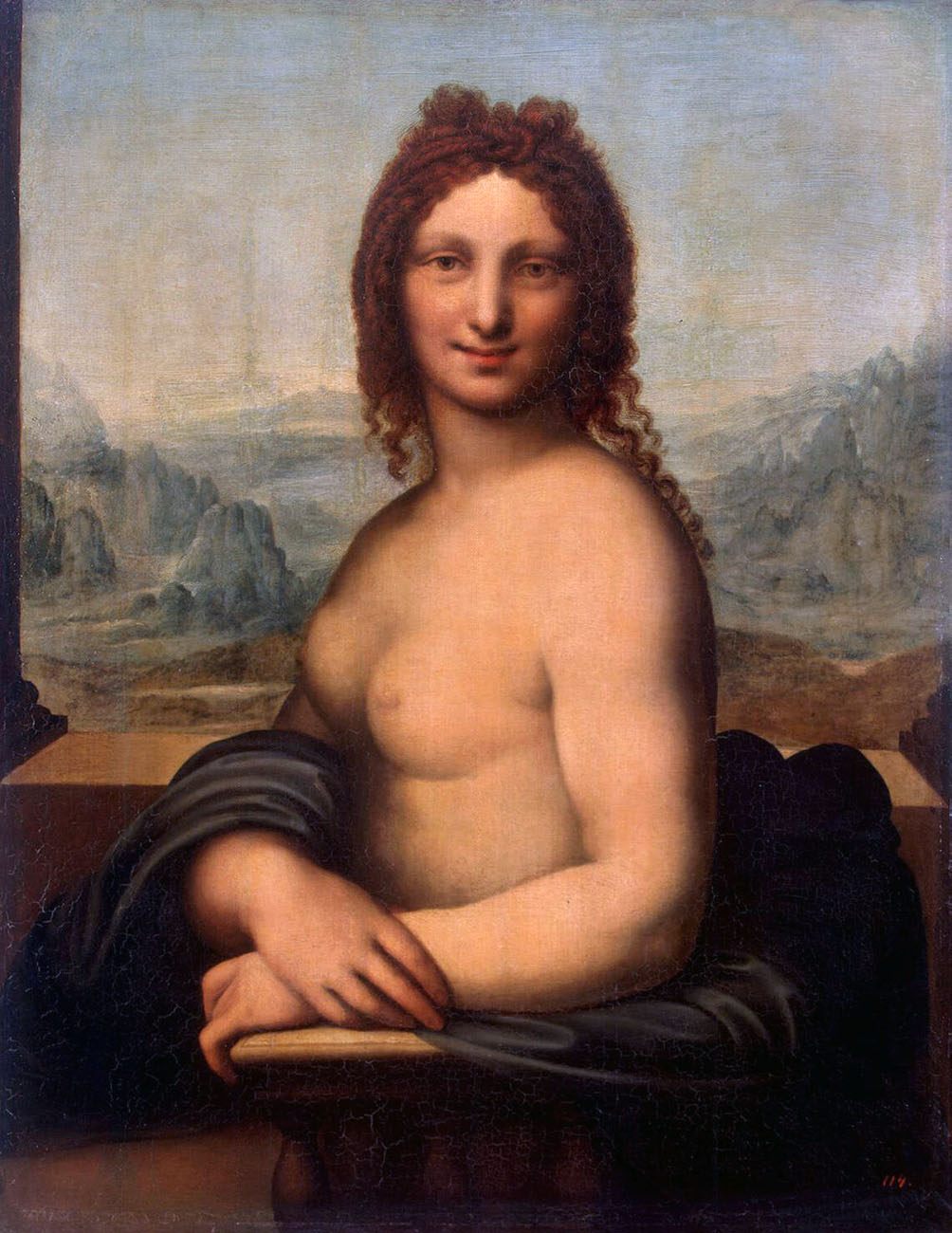
Leonardo da Vinci (school of)
Female nude (Donna Nuda)
Early 16th century
Oil on canvas
86.5cm (34 in) x 66.5cm (26.1 in)
The State Hermitage Museum, St. Petersburg
Public domain
In the seventeenth century, Flanders comprised the Catholic-dominated Southern Netherlands or ‘Spanish’ Austrian Netherlands, an area larger than modern Belgium. Thanks in large part to the talents of artist Peter Paul Rubens, the Flanders or ‘Flemish’ school in this era became very prestigious. While chiefly a painter, Rubens had far-reaching stylistic influence on many visual art forms, from prints to silverware and architecture. Every leading artist of seventeenth-century Flanders studied in, passed through or was connected with Rubens’s studio.
A diplomat and court insider, Rubens operated on an international stage. His art was correspondingly monumental; characterised by large forms modelled with loose brushstrokes in glowing, brilliant colours. Rubens’s pupil Anthony van Dyck and collaborator Cornelis de Vos led the way in bringing new naturalism to portraiture. While they catered to different markets (van Dyck to the nobility and de Vos to a rich merchant class) their mutual influence is apparent.
Flanders was a nation built on trade, and Flemish artists travelled widely, especially to Italy. From Italy they brought back new pictorial trends, such as the theatrical naturalism of Caravaggio. Flemish artists excelled in naturalistic effects, which they applied even to traditionally humble subjects, such as still lifes and animal pictures, seen to brilliant effect in the art of Frans Snyders and David Teniers II.


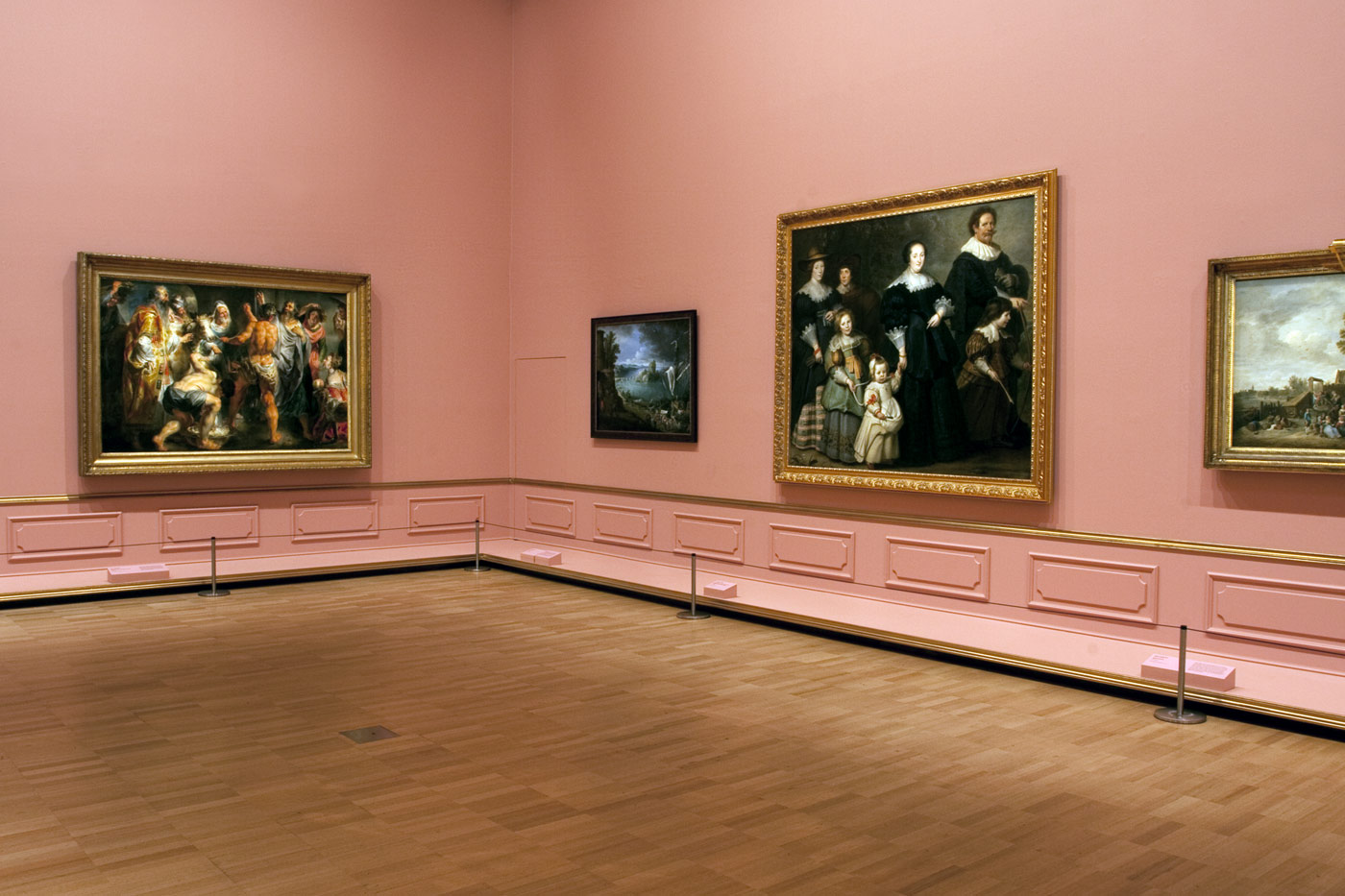

Installation views of room 3 of the exhibition Masterpieces from the Hermitage: The Legacy of Catherine the Great at NGV International, Melbourne showing in the centre in the bottom photograph, Peter Paul Rubens and workshop (Flemish 1577-1640) The Adoration of the Magi, c. 1620 at centre
Photos: Marcus Bunyan
Rubens painted the subject of the Adoration of the Magi (Matthew 2:1) more often than any other episode from Christ’s life. Rendered at life-sized scale, this painting combines the humility of Christ’s birth with splendid, worldly pageantry. Three Kings from the East are shown crowding into Christ’s stable (portrayed as a cave, in an allusion to Christ’s later interment) wearing gold- embroidered silks and satins, and offering gifts. The eldest king, Caspar, kneels before Christ with gold; behind him is Melchior, with frankincense; and Balthazar with myrrh, used for embalming. With the help of his studio, Rubens produced more than sixty altarpieces during his career.


Installation views of room 3 of the exhibition Masterpieces from the Hermitage: The Legacy of Catherine the Great at NGV International, Melbourne
Photos: Marcus Bunyan

Peter Paul Rubens (Flemish 1577-1640)
Roman Charity (Cimon and Pero) (installation view)
c. 1612
Oil on canvas
141cm (55.5 in) x 180cm (70.8 in)
The State Hermitage Museum, St Petersburg
Acquired from the collection of Count Cobenzl, Brussels, 1768
Photo: Marcus Bunyan
Roman Charity (Cimon and Pero) depicts a story told by the Roman historian Valerius Maximus in his Factorum ac dictorum memorabilium libri IX (Nine Books of Memorable Deeds and Sayings), written around 30 AD. The story involves Cimon, an old man awaiting execution in prison who was not given food. Cimon’s daughter Pero visited him, and suckled him at her breast like a child. Pero’s nourishing of Cimon was considered an outstanding example of paying honour to one’s parents.

Peter Paul Rubens (Flemish 1577-1640)
Roman Charity (Cimon and Pero)
c. 1612
Oil on canvas
141cm (55.5 in) x 180cm (70.8 in)
The State Hermitage Museum, St Petersburg
Acquired from the collection of Count Cobenzl, Brussels, 1768
Public domain
The Hermitage holds the finest collection of Dutch art outside the Netherlands. While Peter the Great (1672-1725) had a passion for Dutch art and acquired some notable masterpieces, Catherine the Great established the depth and breadth of this extraordinary collection, beginning in 1764 with her first acquisitions. In that year Catherine purchased 317 paintings that had been assembled for Frederick II of Prussia by the German merchant Johann Ernst Gotzkowsky. Among this substantial group were more than 100 Dutch paintings by the most notable masters.
In 1769 Catherine purchased the collection of Count Heinrich von Brühl, which included spectacular landscapes by Jacob van Ruisdael, Isaack Jansz. van Ostade and Aert van der Neer, as well as four Rembrandt portraits, including the wonderful Portrait of a scholar, 1631. For the rest of her life Catherine continued to add outstanding Dutch works to her rich collection.Although the paintings and drawings from the Dutch school included here are only a fragment of the extensive and diverse collection assembled by Catherine the Great, they reveal her artistic preferences and taste.
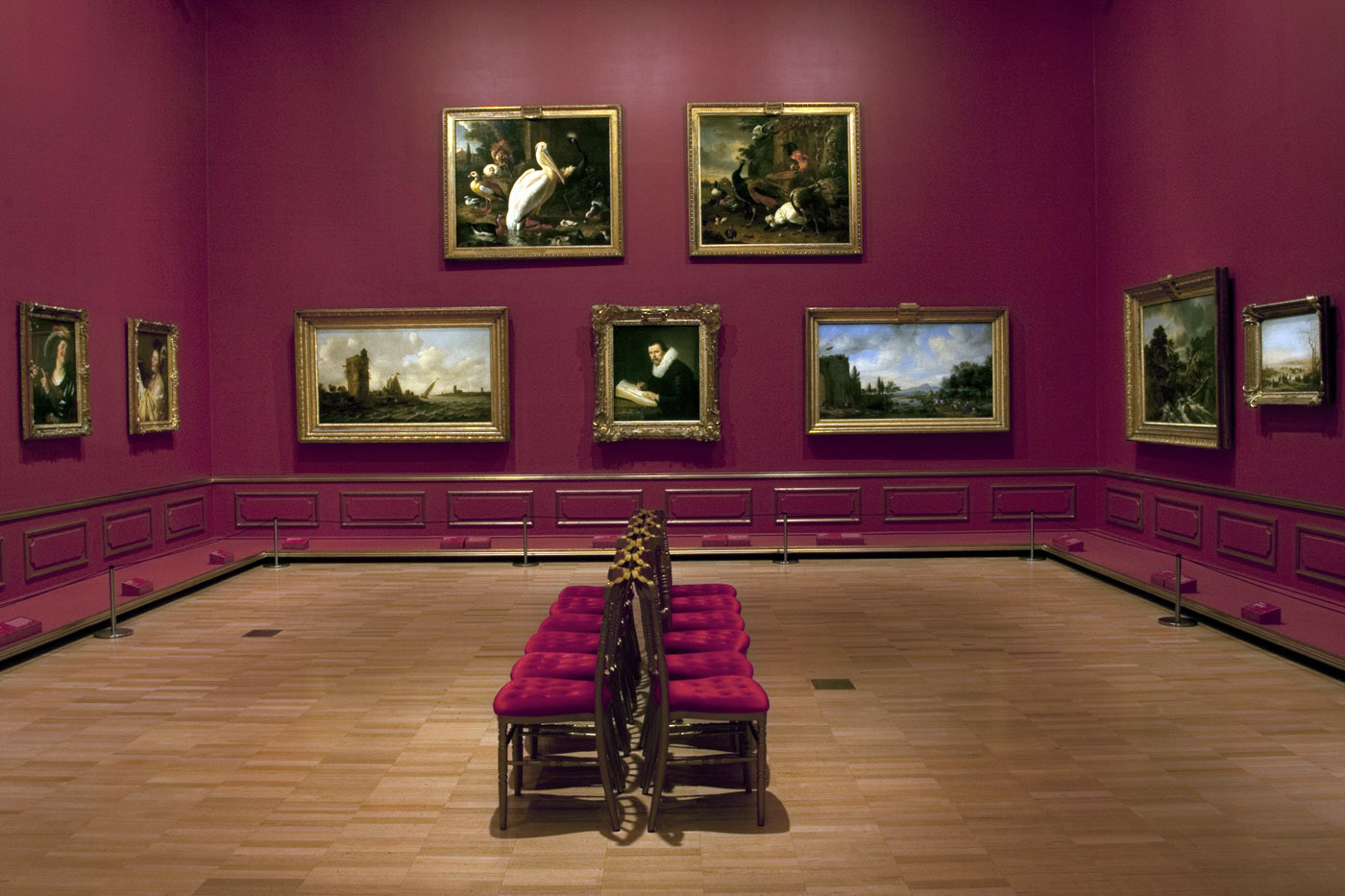
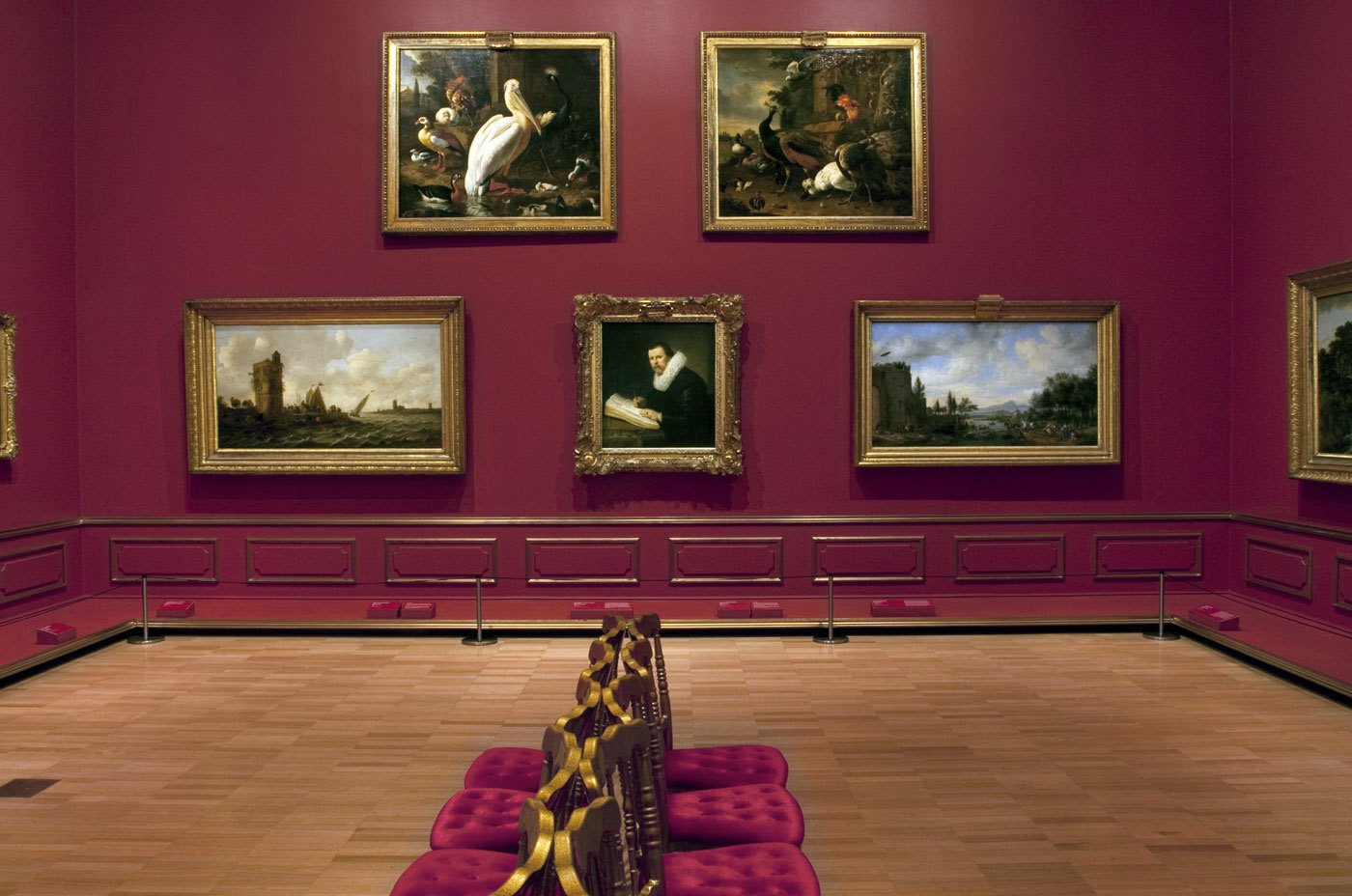
Installation views of room 4 of the exhibition Masterpieces from the Hermitage: The Legacy of Catherine the Great at NGV International, Melbourne with Rembrandt Harmensz van Rijn (Dutch 1606-1669) Portrait of a scholar 1631 at centre
Photos: Marcus Bunyan
Rembrandt painted Portrait of a scholar shortly after moving from his native Leiden to Amsterdam in 1630. He had already established a growing reputation in Leiden and was enticed to the capital by the art dealer Hendrick van Uylenburgh, father of his future wife Saskia. Once completing the move, Rembrandt rapidly became the city’s leading artist, mainly on account of dazzling portraits such as this early masterpiece. He then secured the most prestigious commissions from wealthy and powerful citizens of Amsterdam.
The Russian aristocracy spoke French and modelled their manners and style on those of the French Court. Catherine followed the vast intellectual strides of the French philosophes with passionate interest. She also embraced the arts, luring French artists, architects and craftsmen to St Petersburg.
Catherine relied on agents and advisors in France and Germany to identify and acquire works of art on her behalf. In this way she acquired the collection of Paris banker Louis Antoine Crozat, Baron de Thiers and other important bodies of work in France. Her holdings of French art came to encompass works by Renaissance masters as well as seventeenth-century landscapes and history paintings.
Catherine also acquired examples of work of her own century by Rococo artists such as Antoine Watteau. The playful, erotic and at times wistful art of Watteau’s generation gave rise to the intimate and worldly art of François Boucher, whose pictures Catherine also purchased. The Empress collected modern masterpieces created in reaction to French courtly and decadent styles. Her paintings by Jean-Baptiste Siméon Chardin are premier examples of a new, moralising directness in ambitious French art.
Catherine’s buying in France was not limited to French art. Also in this room are paintings by great German, Spanish and Italian masters that were acquired in Paris from prestigious collections under the direction of Catherine’s French advisors.


Installation views of room 5 of the exhibition Masterpieces from the Hermitage: The Legacy of Catherine the Great at NGV International, Melbourne
Photos: Marcus Bunyan
For Catherine the Great, collecting art was part of a wider economic and diplomatic program designed to stimulate economic and cultural activity at home and abroad. At a meeting in December 1762 with the Moscow Senate, Catherine suggested that consuls be stationed in Spain, Holland and England not only to promote maritime trade but also to source luxury goods and works of art as examples for Russian artists and manufacturers to aspire to.
Through Catherine’s consuls and agents, such items began to flow into St Petersburg, steadily elevating that city into a vibrant centre of European culture. While her cultural sympathies were French, Catherine was also very curious about Britain – the economic success story of the age. She informed herself about Britain’s trade, commerce, manufacturing, philosophy and political system, and purchased works by modern British neoclassical masters, such as Joseph Wright of Derby and Joshua Reynolds. Examples of Spanish, Italian and German art were often not sourced in their own countries of origin but acquired as a part of larger collections.


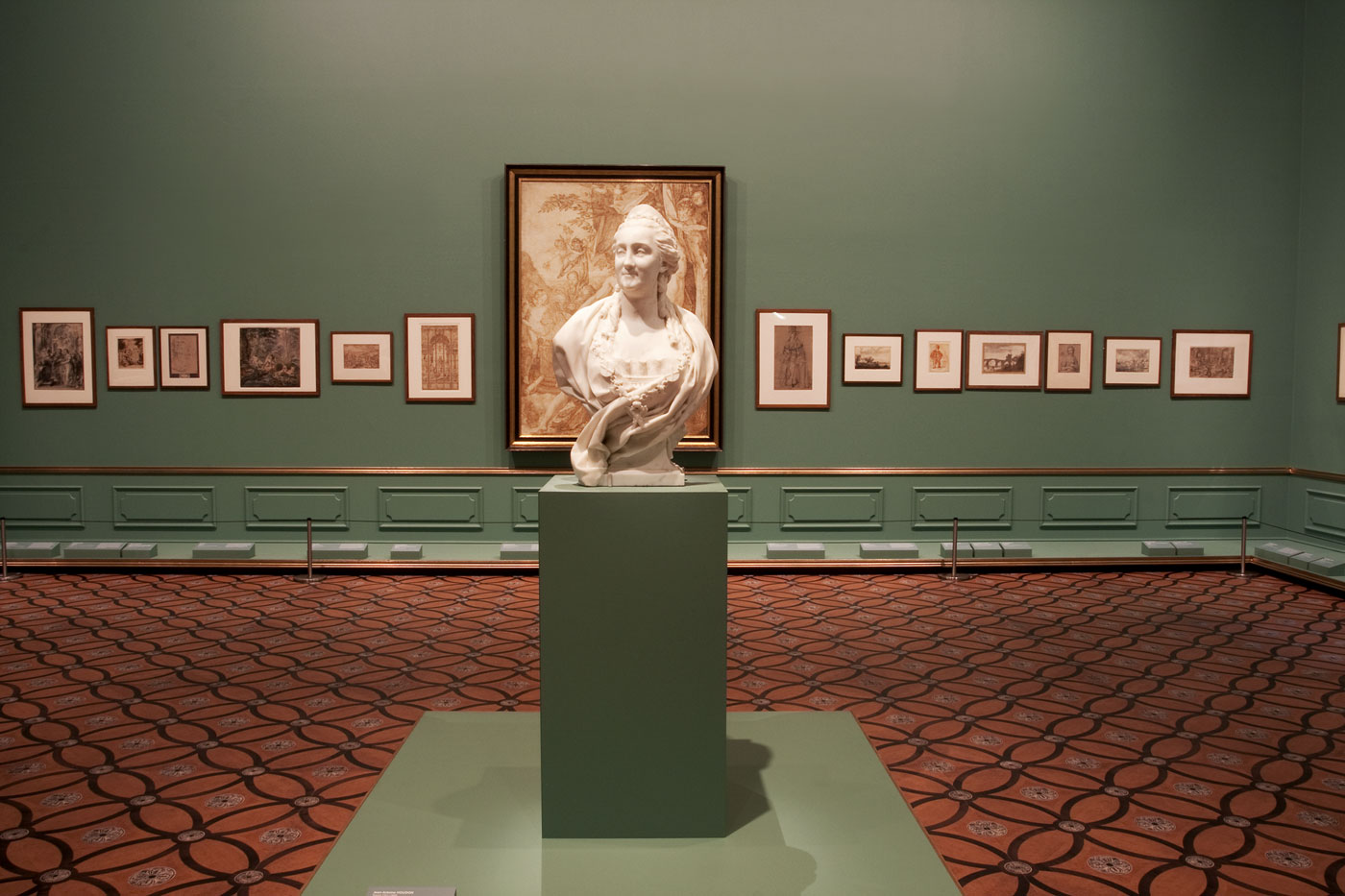


Installation views of room 6 of the exhibition Masterpieces from the Hermitage: The Legacy of Catherine the Great at NGV International, Melbourne with the 1773 sculpture Catherine II by Jean-Antoine Houdon (French 1741-1826) at centre
Photos: Marcus Bunyan
In 1779 Catherine the Great acquired 198 paintings from a celebrated collection formed by Sir Robert Walpole, 1st Earl of Orford, Britain’s first prime minister. They were bought from the family estate, Houghton Hall, and sold by Walpole’s grandson, George Walpole, 3rd Earl of Orford, who approached the Russian ambassador to Britain directly about the sale. At more than £40,000, the price was high, but the transaction was concluded in only two months. Attempts were made to keep this famous collection in Britain, to no avail.
The Walpole collection was outstanding in quality, and significantly enhanced the Hermitage’s range of Flemish and Italian works. The Russian ambassador to Great Britain, Alexey Musin-Pushkin, who organised the valuable purchase, wrote to Catherine the Great: ‘The greater part of the nobility here are displaying general dissatisfaction and regret that these paintings are being allowed out of this country, and are setting in train various projects to keep them here … No little assistance comes from Lord Orford’s zealous desire to unite [the collection for] the gallery of Your Imperial Majesty, rather than to sell it to parliament itself or, least of all, to divide it through sale to different individuals’.


Installation views of room 7 of the exhibition Masterpieces from the Hermitage: The Legacy of Catherine the Great at NGV International, Melbourne showing in the bottom image, Frans Snyders (Flemish 1579-1657) Concert of birds, 1630-1640 at right and Frans Snyders (Flemish 1579-1657) Cook at a kitchen table with dead game, c. 1636-1637 at second left
Photos: Marcus Bunyan

Frans Snyders (Flemish 1579-1657)
Concert of birds (installation view)
1630-1640
Oil on canvas
137cm (53.9 in) x 240cm (94.4 in)
The State Hermitage Museum, St Petersburg
Acquired from the collection of Sir Robert Walpole, Houghton Hall, 1779
Photo: Marcus Bunyan
An important place in Flemish seventeenth-century painting is occupied by two specific genres: animal painting and the still life. One of the most important animal and still-life painters was Frans Snyders, a very close collaborator of Peter Paul Rubens who often painted still-life details and animals on the master’s canvases. Snyders’s superb skill as a painter of animals is revealed by Concert of birds, based on a subject from Aesop’s Fables. It shows a gathering of feathered creatures screeching and singing under the direction of an owl seated on a dried branch in front of an open music score.

Frans Snyders (Flemish 1579-1657)
Concert of birds
1630-1640
Oil on canvas
137cm (53.9 in) x 240cm (94.4 in)
The State Hermitage Museum, St Petersburg
Acquired from the collection of Sir Robert Walpole, Houghton Hall, 1779
Public domain
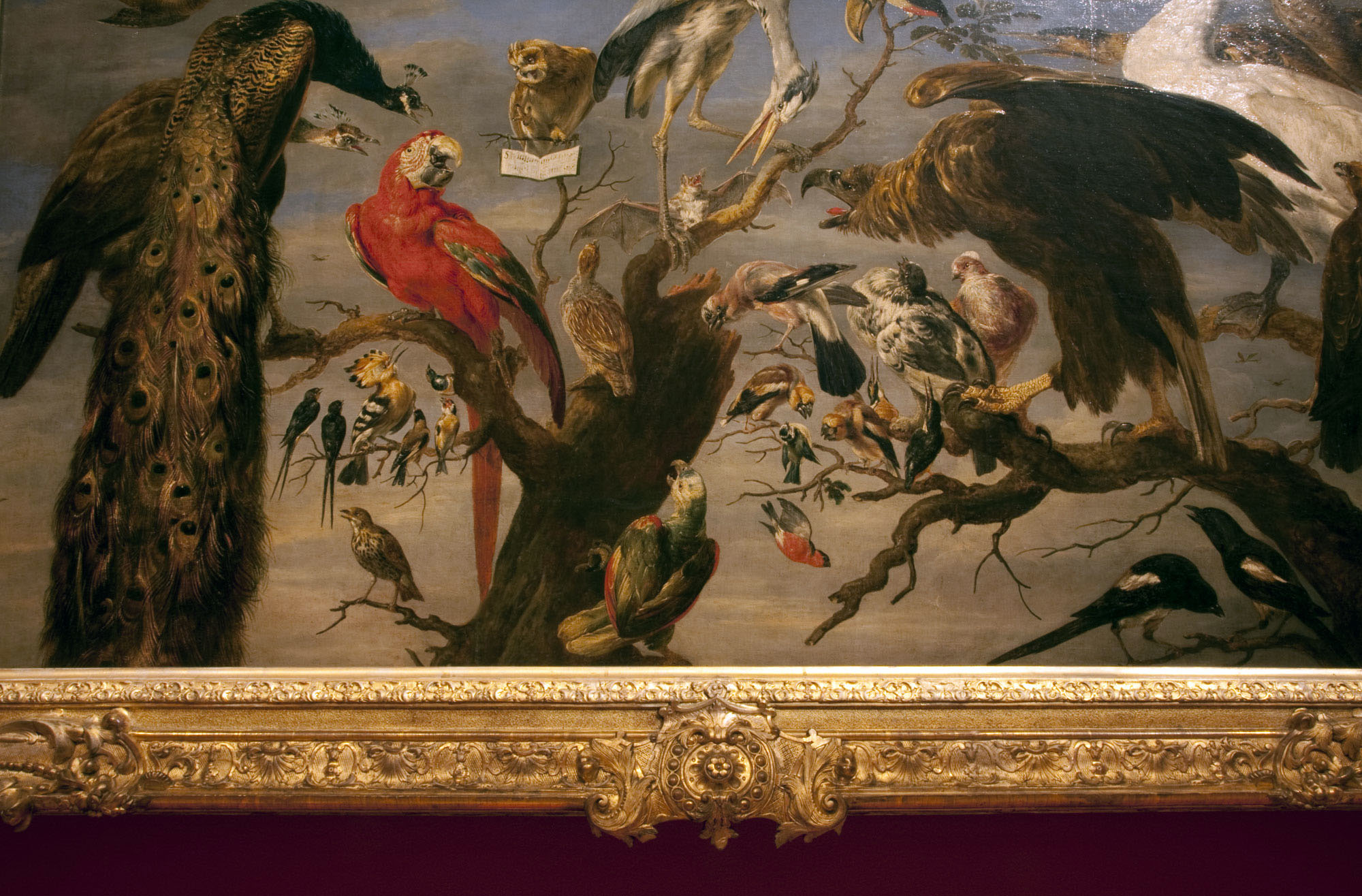
Frans Snyders (Flemish 1579-1657)
Concert of birds (installation view detail)
1630-1640
Oil on canvas
137cm (53.9 in) x 240cm (94.4 in)
The State Hermitage Museum, St Petersburg
Acquired from the collection of Sir Robert Walpole, Houghton Hall, 1779
Photo: Marcus Bunyan

Frans Snyders (Flemish 1579-1657)
Cook at a kitchen table with dead game (installation view detail)
c. 1636-1637
Oil on canvas
The State Hermitage Museum, St. Petersburg
Photo: Marcus Bunyan
Frans Snyders was the son of the owner of one of Antwerp’s largest wine and eating houses. His dramatically realistic still lifes celebrate the exotic variety of rare fowls available at Antwerp’s markets. Images of dead animals being prepared for a banquet were understood in Snyder’s time as lessons in Christian morality. Many Dutch and Flemish still lifes featuring the sacrifice of an animal for the table functioned as allusions to Christ’s Passion and the transience of the flesh.

Frans Snyders (Flemish 1579-1657)
Cook at a kitchen table with dead game
c. 1636-1637
Oil on canvas
171cm (67.3 in) x 173cm (68.1 in)
The State Hermitage Museum, St. Petersburg
Public domain


Installation views of room 7 of the exhibition Masterpieces from the Hermitage: The Legacy of Catherine the Great at NGV International, Melbourne showing at left in the bottom image, Anthony van Dyck (Flemish 1599-1641) Portrait of Philadelphia and Elizabeth Wharton, 1640
Photos: Marcus Bunyan
This is one of the most charming portraits of children paint by van Dyck, who had particular talent for such works. It is one of a group of family portraits commissioned from can Dyck by Philip, Lord Wharton in the late 1630s. Van Dyck worked in England for approximately ten ears and brought a new standard of elegance and style to English portraiture. He largely conveyed this through his flair for painting lavish costumes and sumptuous fabrics, a sensibility he carried through to his portraits of children.

Anthony van Dyck (Flemish 1599-1641)
Portrait of Philadelphia and Elizabeth Wharton
1640
Oil on canvas
162cm (63.7 in) x 130cm (51.1 in)
Hermitage Museum
Public domain
Eighteenth-century Enlightenment fascination with the East, particularly China, is reflected by Catherine the Great’s architectural and landscaping works completed in St Petersburg and at her summer and winter palaces, as well as by her collecting of Oriental curiosities and philosophical texts. Russian interest in China can be traced to the reign of the Romanov tsars in the seventeenth century, when several missions brought back Chinese treasures and goods to the Russian Court. Importantly, in 1689 the first treaty between Russia and China was signed at Nerchinsk, outlining the border between the countries and rules about caravan trade.
Like many educated people of her time, Catherine was fascinated by the concept of the enlightened ruler thought to be found in China, such as the Kangxi Emperor (reigned 1662-1722), Yongzhèng Emperor (reigned 1723-35), and Qianlong Emperor (reigned 1736-95). One of her regular and most influential correspondents was French philosopher Voltaire, who praised the Celestial Kingdom, its monarchs and men of wisdom; only in China, he thought, was a man’s life, honour and property truly protected by law. Such a clear link between Catherine’s desire for justice and order in Russia and general perceptions of good Chinese government, combined with the Enlightenment fashion for curiosities of all kinds, led to great Russian interest in China in the second half of the eighteenth century.

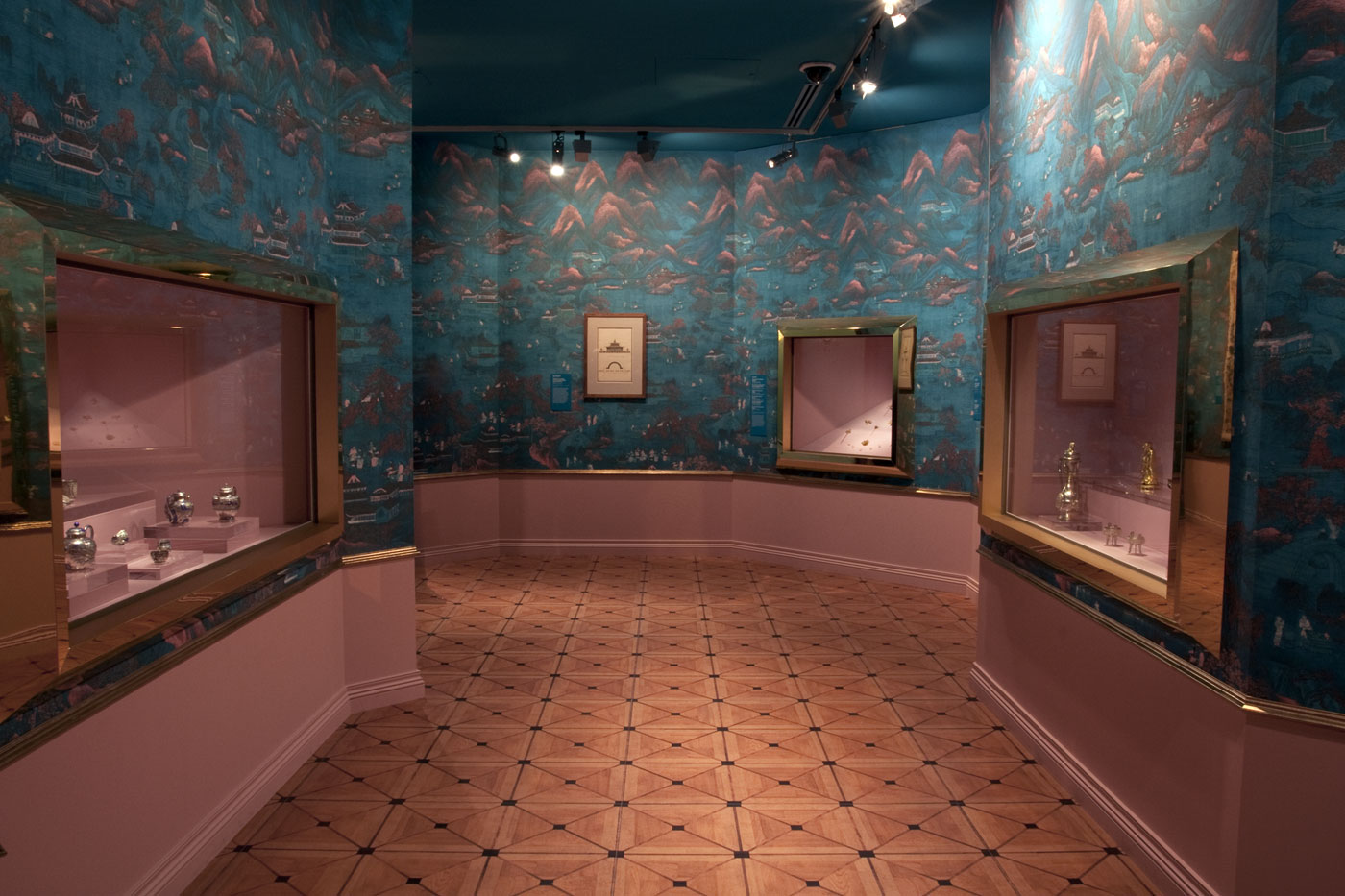


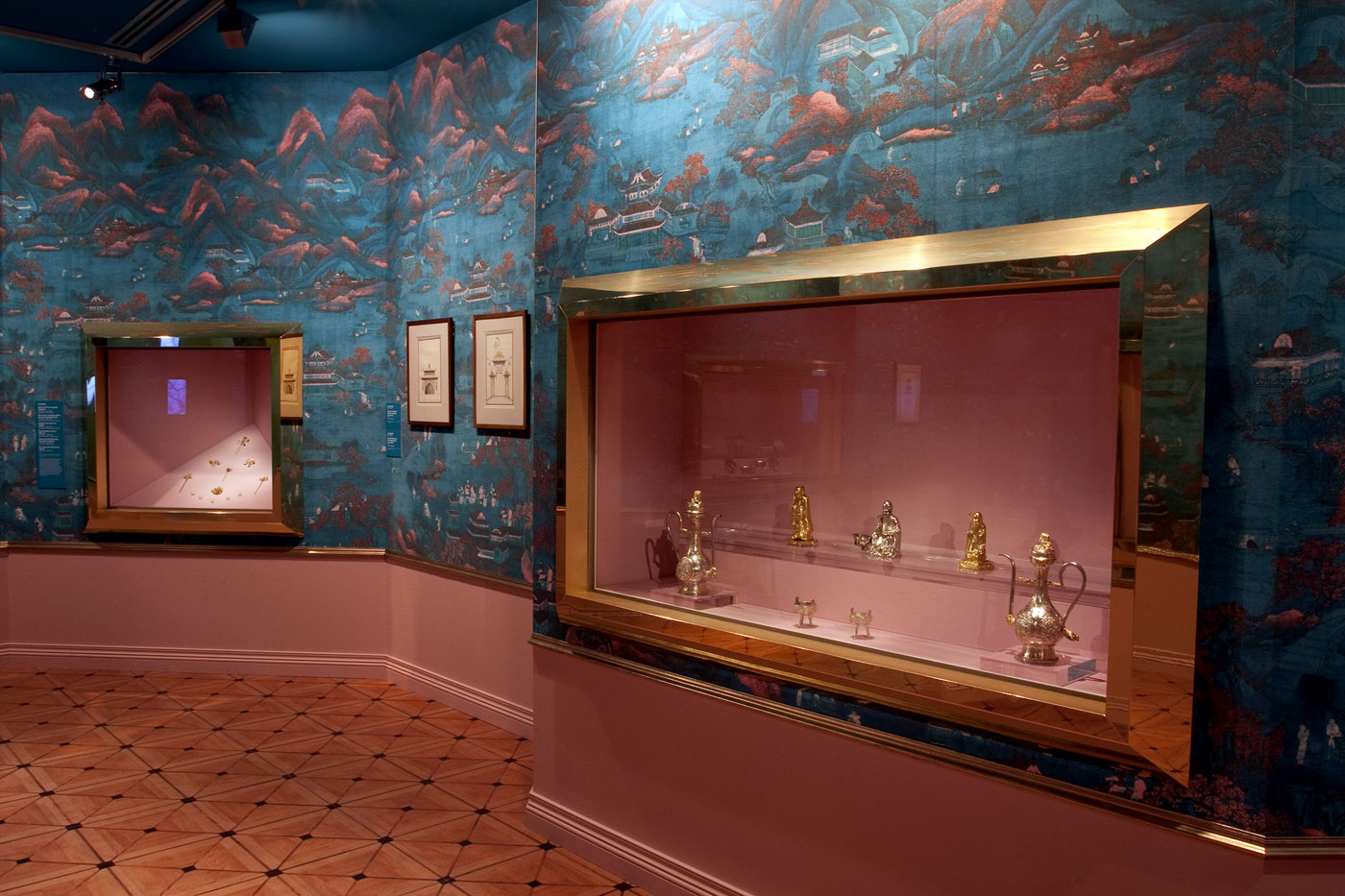

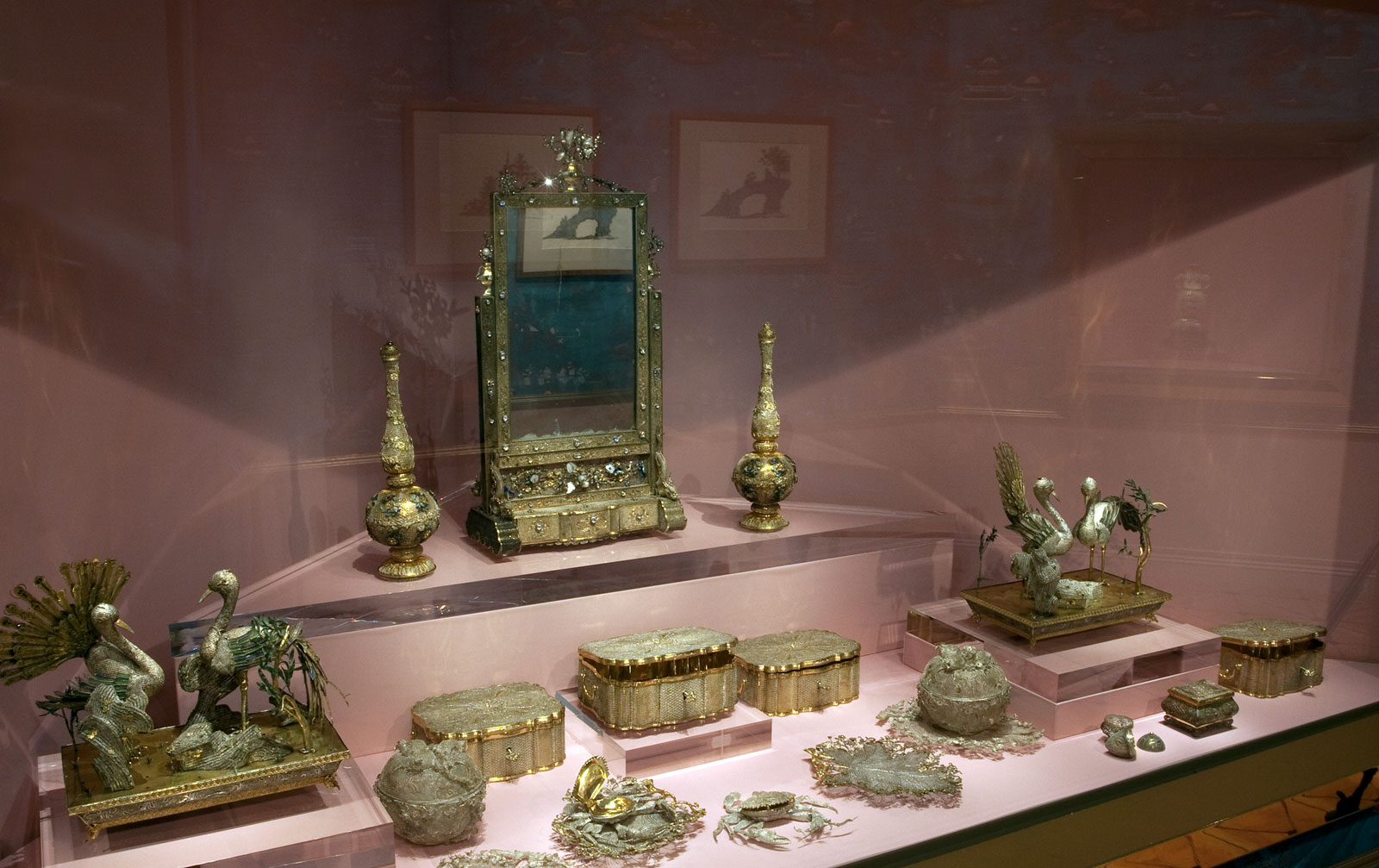
Installation views of room 8 of the exhibition Masterpieces from the Hermitage: The Legacy of Catherine the Great at NGV International, Melbourne
Photos: Marcus Bunyan
NGV International
180 St Kilda Road
Opening hours for exhibition
10am – 5pm daily
Curator: Helen Carroll

Gretchen Albrecht (New Zealand, b. 1943)
Pink and orange sherbet sky
1975
Acrylic on canvas
166 x 177cm
© Gretchen Albrecht, reproduced courtesy of the artist and Wesfarmers Collection of Australia
Gorgeous catalogue with luscious plates, insightful text by Bill Henson (below) and evocative poetry by John Kinsella. Stars on the front cover and silver edged pages. No expense spared in production, with money literally thrown at the project, or so it would seem.
The curator, Helen Carroll, talking about ‘wonder’: “It is a capacity for wonder that makes us human”. Henson talking about ‘wonder’ and ‘love’ – about moments that change your life when looking at and breathing in great art.
Then why does this exhibition feel so… well, needless?
Despite some fascinating individual works of art, collectively there is little wonder on show here.
Perhaps it is because this exhibition looks to be a cut down version of the one first shown at the Art Gallery of Western Australia in 2012, with many works missing from what are listed in the catalogue. Or perhaps it is the hang which at the Ian Potter Museum of Art consists of two rooms on the ground floor of the museum, one housing lighter works, the other dark works. Too dichotomous for my tastes. Nothing is ever so cut and dried.
Perhaps it’s the fact that the concept of the exhibition – light in its many guises – seems to have been tagged onto a groups of art works which are anything but about light. Or are about light in a roundabout, merry-go-round kind of way. The wall text states, “Rather than a chronological or stylistically ordered presentation, the exhibition follows a loosely intuitive flow of ideas and imagery, moving through night to day. The artists in this exhibition explore light from the perspective of the optical experience, the connection between the starts and the cycles of life on earth; and from diverse cultural, mythic and spiritual points of departure.” Apparently the works are more about the phenomena of light than about light itself.
While the art works are interesting in their own right they don’t really work together cohesively as a group to investigate the theme of the exhibition. Trying to burden a collection of art bought for investment purposes with a concept not “natural” to the work, or just a curator’s idea of what seems implicit in the work but is just a cerebral construction, simply does not work in this case. As I looked around the exhibition, I felt the works were more about the physicality of time and space (of history and place), about links in the existential chain, than they were about light. For me, this evinced Mikhail Bakhtin’s notion of the ‘chronotype’ – meaning ‘the connectedness of temporal and spatial relationships that are artistically expressed’ (in literature). Perhaps the intuitive flow of ideas and imagery and the multiple points of departure work against the very idea the exhibition seeks to investigate. This is so broadly thematic (the effects of light on the world) that it needed to be more focused in its conceptualisation.
It’s also a real worry when text panels in the exhibition quote Richard Goyder, Managing Director, Wesfarmers Limited, as saying that this is the first time that Wesfarmers has showcased the contemporary art of the collection, “and the works selected for Luminous World illustrate some of the ways in which the collection has grown in recent years. For instance, the inclusion of art from New Zealand, where Wesfarmers has a significant business presence, and the heightened emphasis on representing the great diversity of contemporary Indigenous art.”
The inclusion of New Zealand art because Wesfarmers has a significant business presence – not the quality or wonder of the art work – but a business presence. And only now are they collecting contemporary Indigenous art, after the collection has been in existence for more than three decades, 1977 being the first acquisition date. At least he is being refreshingly honest about why the art work has been added to the collection, but it does not give you confidence in the choice of the art work being displayed here.
Goyder, Carroll and Kinsella also proselytise about the benefits of employee’s living with this art in their daily working lives and that may be the case. But for the casual visitor to the gallery this collection of art left me feeling cold and clammy – like a fish out of water.
As the add for Reflex copy paper says with more humour than any of this work can muster, I didn’t find “enwhitenment”, or wonder, within the gallery walls. Oh, the luminosity of it all.
Dr Marcus Bunyan
Many thankx to The Ian Potter Museum of Art for allowing me to publish the photographs in the posting. All installation photographs © Marcus Bunyan and The Ian Potter Museum of Art. Please click on the photographs for a larger version of the image.
‘What is the night?’ Macbeth enquires in the banquet scene, once the ghost of Banquo has departed and his wide has dismissed their mystified guests. Deprived of sleep, and half-psychotic, he urgently needs to know the time. But this is also, implicitly, a philosophical question that hints at the ontological meaning of the night…
Macbeth, Shakespeare’s most elaborate meditation on the night, is a sustained, if not obsessive, exploration of the nocturnal as a realm of alternative values – ones that contradict and threaten to undermine those of the diurnal regime that is ostensibly the domain of politics in the early modern period. In this violent, vengeful tragedy, the language and culture of the medieval night, incarnated above all in the witches, irrupts into the more enlightened languages and culture of a purportedly post-medieval epoch. An apocalyptic night, in Macbeth’s barbaric court, is one of the forces that shape realpolitik. In the Renaissance, a period in which daily life encroaches more and more on the night, especially in public settings, in the form of elaborately lit masques at court, Macbeth thus stages the limits of enlightenment.
At a time when more systematic, socially centralized modes of illumination are increasingly disrupting older patterns of rest, including biphasic sleep – so that, for the early modern ruling class at least, night starts to feel like an extension of the day, its observe rather than its inverse – Shakespeare dramatises the tyrannical attraction, the absolutism, of darkness. Macbeth describes a process of nocturnalisation whereby the night irresistibly colonises the day, fatally infiltrating both the state and the protagonist’s consciousness. To use a word that has some currency in the seventeenth century, but has long since fallen out of use, Shakespeare’s drama is a study of ‘benightment’.”
Matthew Beaumont. “What is the Night?” in Matthew Beaumont. Nightwalking: A Nocturnal History of London, Chaucer to Dickens. London and New York: Verso, 2015, pp. 86-87.
Luminous World brings together a selection of contemporary paintings, objects and photographs from the Wesfarmers Collection in a conversation about light. Through works of scale and conceptual invention that chart the range and depth of the collection, this exhibition presents significant contemporary paintings, photographs and objects by leading Australian and New Zealand artists acquired by Wesfarmers over three decades and shared together for the first time with the Australian public.
The Potter is the fifth venue for this touring exhibition which to date has travelled to Charles Darwin University Art Gallery, Darwin; National Library of Australia, Canberra; Samstag Museum of Art, Adelaide; and The Academy Gallery, University of Tasmania.

Brook Andrew (Australian, b. 1970)
Replicant series: Owl
2005
Ilfochrome print
130 x 195cm
© Brook Andrew, reproduced courtesy of the artist and Wesfarmers Collection of Australian Art
Brook Andrew (1970- ) is a Sydney born / Melbourne based interdisciplinary artist of Wiradjuri and Scottish heritage. Andrew’s conceptual based practice incorporates, sculpture, photography, installation, video and performance. The Replicant 2006 series reflects (literally) upon the act of looking, and consequent interchanges between nature and culture, subject and object, real and represented. These dualities fit broadly within the artist’s addressing of Australian identity, polemics and the politics of difference.
For the Replicant 2006 series Andrew borrowed taxidermied specimens from the education department at the Australian Museum, Sydney. These included native species of indigenous significance such as an owl, possum, flying fox and parrot. He shot each animal – artificially propped in their natural poses – and digitally manipulated each image so as to appear duplicated, a process that evolved out of the Kalar midday 2004 series.

Bill Henson (Australian, b. 1955)
Untitled
2009-10
Archival inkjet pigment print
127 x 180cm
© Bill Henson, reproduced courtesy of the artist and Wesfarmers Collection of Australian Art
” … And yet certain things – particular experiences that we have are exceptional. They stand apart from the rest of the general activity.
What causes this apprehension of significance – of something in face powerfully apprehended yet not always fully understood?
And why is it that all of us, at some time or other, with have this ‘epiphany’ – Christian or otherwise – in the presence of some work of art, in the experiencing of a performance piece or some unexpected encounter with the true magic of a particular piece of sculpture?
When it happens, I always think of it as being as if one’s life – and everything that it contains – had just been ever so slightly changed, forever. Nothing, if you will, is ever quite the same again.
What happens, I think, is simply that we fall in love – and it’s the apprehension of unexpected beauty that causes us to fall in love.
The sheer force of such beauty can affect us as if it were an act of nature – and of course it is, for despite the arrogance of some theoreticians, culture is never outside nature.
I think that it is this intense, if often quite subtle, love for the subject, and the resultant emotional and intellectual interdependence within that relationship – be it in musical form, something in the visual arts, theatre of dance – that is responsible for – and in fact makes possible at all – these great and fortunate encounters in the arts. …
Stare back into time and all kinds of very ‘personal’ things return your gaze. This has always, to me, seemed to a large extent to be what art is about. Sure, it’s personal, but it’s also millennial. …
The best art always heightens our sense of mortality. This is not morbidity that I am talking about – rather, we feel more alive in the presence of great art and this is because of a profound sense of continuity – our sense of being inside nature – is expanded.
If you like, art suggests the immortal in all of us.
When we listen to Michelangeli – or, say, Jörg Demus playing Kinderszenen – and we sense that simultaneously proximate and intimate yet utterly abstract presence (was that someone? Schumann perhaps?) and at the same time sense the unbridgeable gulf that exists between ourselves and that distant past – we know that we are in the presence of something magical.
In the end I think that it is love that fuels this activity – that animates the speculative capacity in all of us – and heightens this sense of wonder.
Excerpts from Bill Henson’s speech “Reflections,” in Luminous World catalogue. Perth: Wesfarmers Limited, 2012, pp. 23-24.
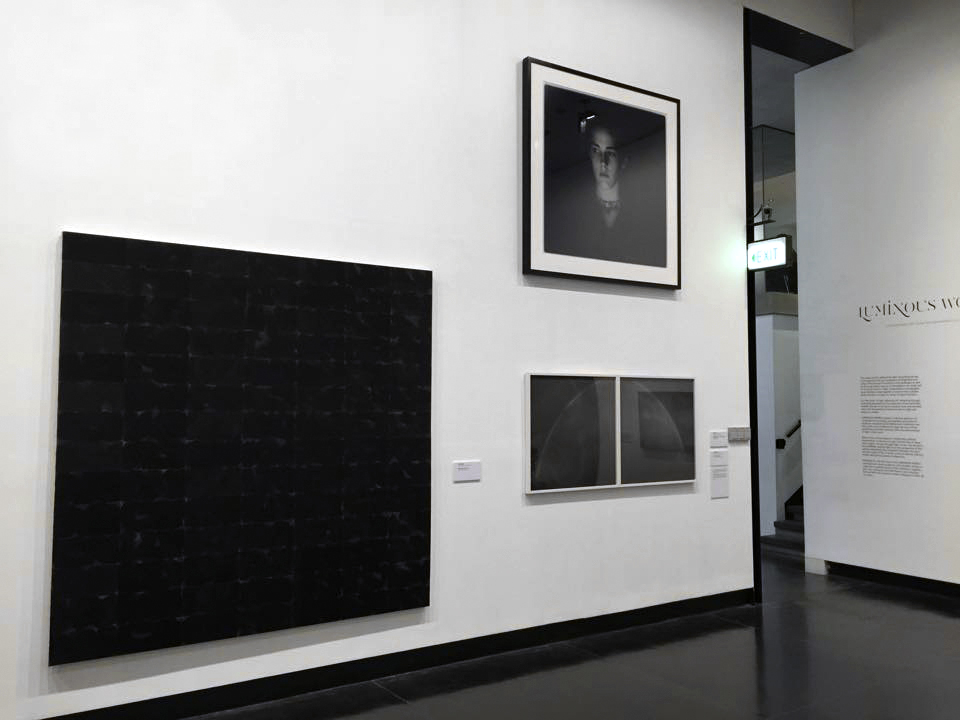


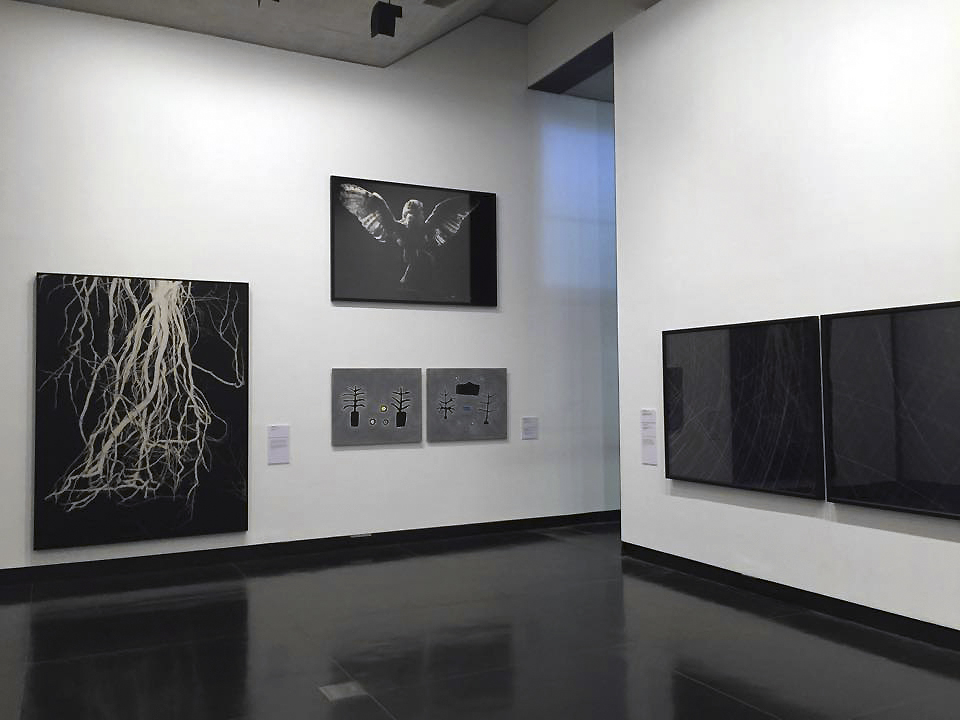
Installation views of the exhibition Luminous World: Contemporary Art from the Wesfarmers Collection at The Ian Potter Museum of Art, The University of Melbourne
Photos: Marcus Bunyan

David Stephenson (Australian, b. 1955)
Star Drawing 1996/402
1996
40 x 40″
Cibachrome print
National Gallery of Victoria, Melbourne
Purchased, 1997
© Courtesy of the artist
While the subject of my photographs has shifted from the landscape of the American Southwest and Tasmania, and the minimal horizons of the Southern ocean, and the icy wastes of Antarctica, to sacred architecture and the sky at both day and night, my art has remained essentially spiritual – for more than two decades I have been exploring a contemporary expression of the sublime – a transcendental experience of awe with the vast space and time of existence.
David Stephenson, 1998

Bill Henson (Australian, b. 1955)
Untitled 39/139
1990-91
Paris Opera Project
Type C photograph
127 × 127cm
Series of 50
Edition of 10 + 2 A/Ps

Stieg Persson (Australian, b. 1959)
Offret
1998
Oil on canvas
183 x 167cm
© Stieg Persson, reproduced courtesy of the artist and Wesfarmers Collection of Australian Art
Works focusing on light and darkness, and how light creates and reveals our world, from one of Australia’s pre-eminent corporate art collections compiled by Wesfarmers over the past 30 years, will be exhibited at the Ian Potter Museum of Art at The University of Melbourne.
The exhibition, Luminous World: Contemporary art from the Wesfarmers Collection, presents a diverse selection of contemporary paintings, photography and works of sculpture. The works traverse a diversity of cultural, aesthetic and philosophical perspectives, with the curatorial premise of how contemporary artists explore the phenomenon of light in their work.
Some 50 artists from Australia and New Zealand are featured in the exhibition including: Susan Norrie, Rosemary Laing, Howard Taylor, Dale Frank, Paddy Bedford, Bill Henson, Fiona Pardington (NZ), Brian Blanchflower, Brook Andrew, Timothy Cook and Nyapanyapa Yunupingu. Included alongside the art is a major new body of poetry by John Kinsella, written in response to works in the exhibition. These are published for the first time under the imprint of Fremantle Press in the book Luminous World, with new writing by artist Bill Henson and composer Richard Mills.
Ian Potter Museum of Art Director, Ms Kelly Gellatly said, “Luminous World highlights the strengths of the Wesfarmers Collection, which has generously been shared, through the tour of the exhibition, with the wider community.
“In bringing together works across a range of media by Indigenous and non-Indigenous artists, Luminous World successfully showcases both the depth and continuing resonance of contemporary Australian practice in a rich, open-ended and exploratory conversation about light.
“To know and experience light and its effects however, one must equally understand its other – darkness. Together, these concerns create an exhibition experience that is at once intellectual, emotional and experiential,” Ms Gellatly said.
The Wesfarmers Collection was started in 1977, and is housed in the Wesfarmers offices around Australia and shared with the community through a loan and exhibition program. A Wesfarmers and Art Gallery of Western Australia touring exhibition.
Press release from The Ian Potter Museum of Art website
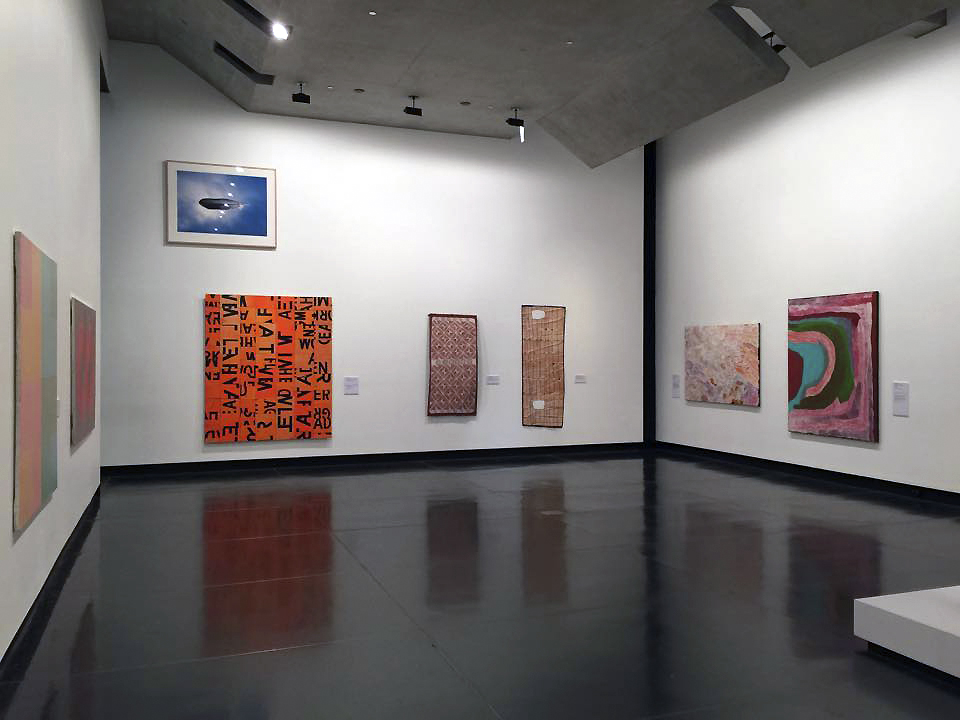
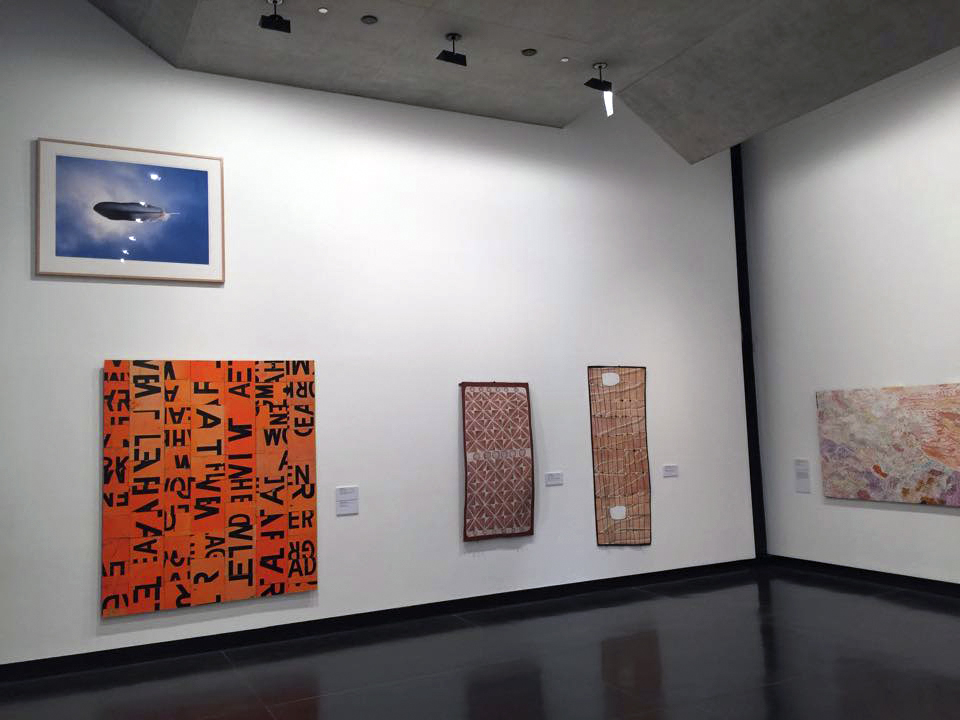
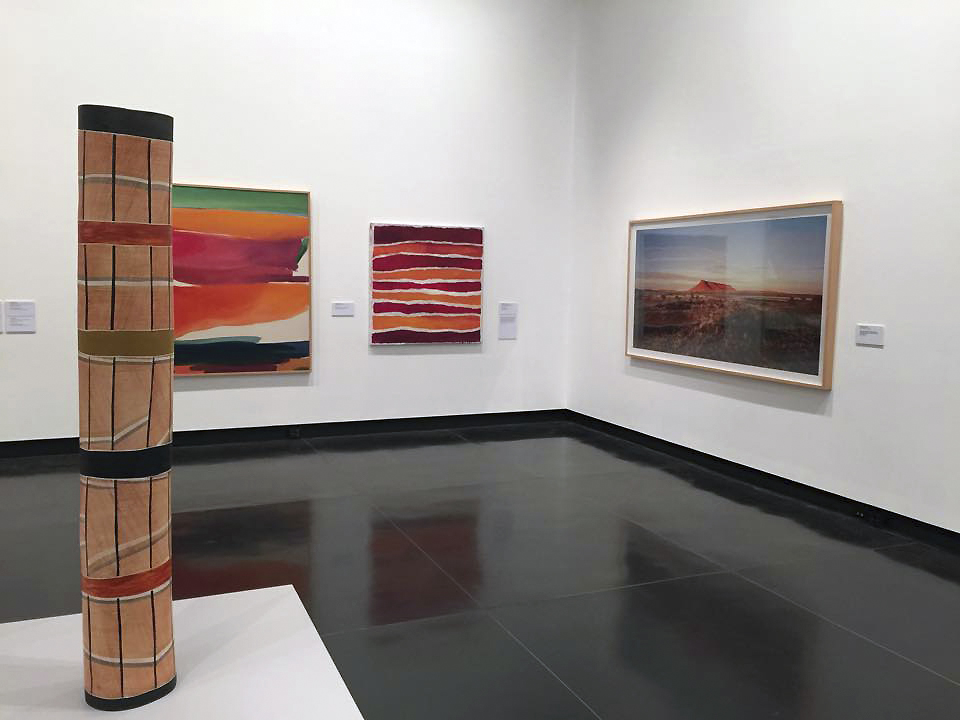
Installation views of the exhibition Luminous World: Contemporary Art from the Wesfarmers Collection at The Ian Potter Museum of Art, The University of Melbourne
Photos: Marcus Bunyan
“For more than three decades Wesfarmers has been collecting Australian art. From General Manager John Bennison’s first acquisition in 1977 of a pastoral scene by the Australian impressionist Elioth Gruner, Wesfarmers’ purpose was to accentuate the value of art in the workplace and encourage and understanding of the importance to society of supporting creative thinking and artistic vision. The company has always been committed to sharing its collection with the community through exhibitions and loans and by opening our workplaces for groups to view the art in our offices.
This is the first time Wesfarmers has showcased the contemporary art in the collection, and the works selected for Luminous World illustrate some of the ways in which the collection has grown in recent years. For instance, the inclusion of art from New Zealand, where Wesfarmers now has a significant business presence, and the heightened emphasis on representing the great diversity of contemporary indigenous art.
We thank the artists whose resonant and timeless works form part of Australia’s rich cultural heritage and hope that the Australian public will enjoy these works and marvel at the ingenuity and artistic vision they represent, as Wesfarmers does, surround by inspirational art in our daily lives.”
Richard Goyder
Managing Director, Wesfarmers Limited
The visual world is defined by light; everything we see is processed by the eye as patterns of brightness and colour. Monumental formations in the landscape as well as the most subtle nuances of atmosphere are made real to us by the action of light, transmitted in wavelengths as an infinitely varied register of colour that combine within the eye to shape our sense of space and form.
It is the action of light reflecting off, refracting through and being absorbed by the substance of the world that enables the eye to perceive contours, hues, and textures and mark the passing of time from day to night and season to season.
Luminous World presents a diverse selection of contemporary paintings, photography and works of sculpture, acquired by the Wesfarmers Collection over thirty years and considered through the lens of how contemporary artists variously utilise the phenomenon of light in their work.
Rather than a chronological or stylistically ordered presentation, it follows a loosely intuitive flow of ideas and imagery moving through night to day. The artists in this exhibition explore light from the perspective of the optical experience, the connection between the stars and the cycles of life on earth; and from diverse cultural, mythic and spiritual point of departure.
Published for the first time in the Luminous World catalogue are recent poems by John Kinsella, written in response to selected works in the exhibition, together with new writing by artist Bill Henson and composer Richard Mills that extend an artistic dialogue in which all can share.
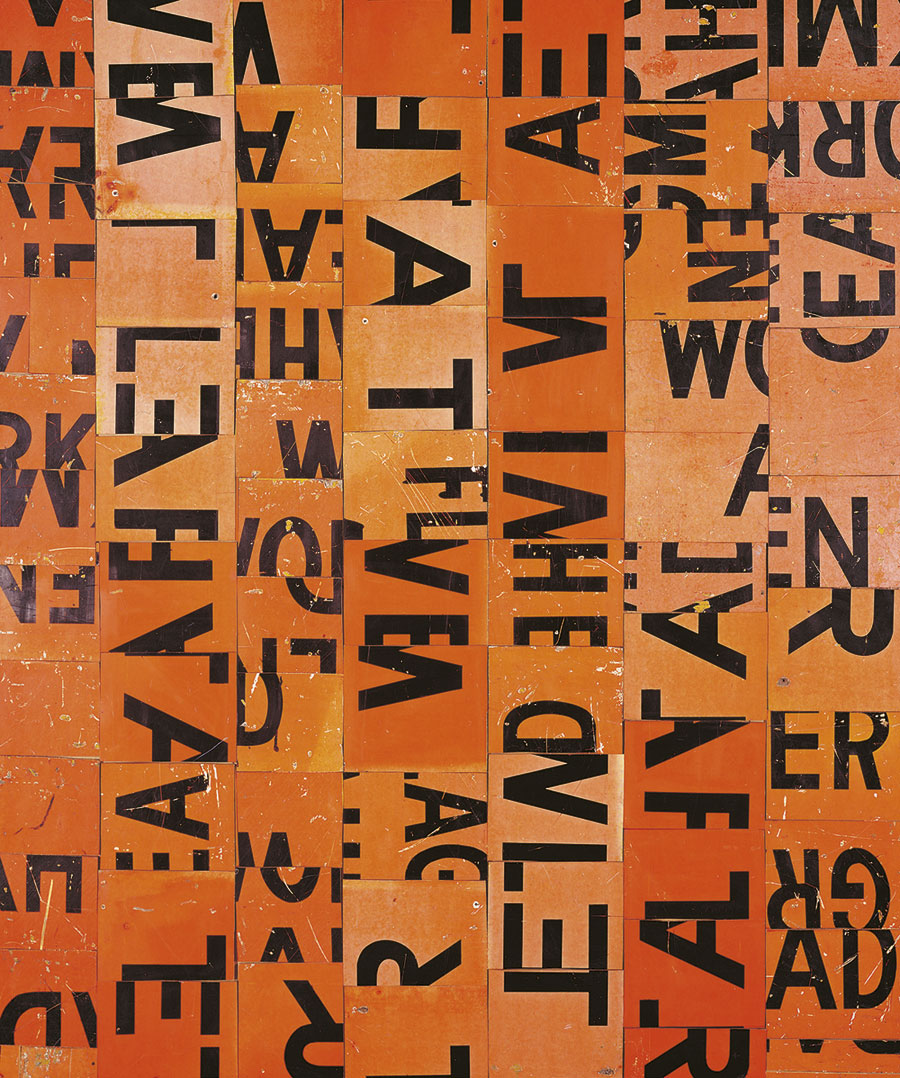
Rosalie Gascoigne (Australian, 1917-1999)
Hung fire
1995
Retro-reflective road-sign on wood
209 x 176cm
© Rosalie Gascoigne, licensed by Viscopy 2012 and Wesfarmers Collection of Australian Art

Elizabeth Nyumi (Australian, born c. 1947)
Parwalla
2010
Acrylic on canvas
120 x 180cm
© Elizabeth Nyumi, licensed by Viscopy 2012 and Wesfarmers Collection of Australian Art
This painting depicts the country known as Parwalla, which is Nyumi’s father’s country. This country is far to the south of Balgo in the Great Sandy Desert, west of Kiwirrkurra, and is dominated by tali (sand hills). Parwalla is a large swampy area, which fills with water after the wet season rain and consequently produces an abundance of bush foods. The majority of Nyumi’s painting shows the different bush foods, including kantjilyi (bush raisin), pura (bush tomato) and minyili (seed). The whiteish colours, which dominate the painting, represent the spinifex that grows strong and seeds after the wet season rains. These seeds are white in colour, and grow so thickly they obscure the ground and other plants below.
When Nyumi was only a very young child her mother died at Kanari soakwater close to Jupiter Well. As a young girl, Nyumi lived with her family group in their country. As a teenager she walked along the Canning Stock Route into the old mission with her father and family group. There she was given clothes and taken to Billiluna Station to be trained as a domestic worker and to work for the wives of the station managers around the region.
Nyumi commenced painting in 1987 and emerged as a leading artist in the late 1990s. She is married to the artist Palmer Gordon and has four daughters, three of whom are still living and beginning to paint with strong encouragement from Nyumi. Her elder brothers Brandy Tjungurrayi and Patrick Olodoodi are both senior lawmen and recognised artists. Nyumi is a very strong culture woman and dancer and an enthusiastic teacher of culture to children, ensuring the traditional dances and songs are kept alive.
Nyumi’s paintings are mainly concerned with the abundant bush food in the country belonging to her family. Initially, she worked with a thick brush, covering the canvas with fluent lines in tones of yellow, green and red. She has now developed a strong personal style of thick impasto dotting, to build up fields of texture heavily laden with white, in which motifs of camp sites, coolamons, digging sticks and bush tucker stand out.

Rosemary Laing (Australian, 1959-2024)
Brumby mound #5 from the series One dozen unnatural disasters in the landscape
2003
C Type photograph
110 x 222cm
© Rosemary Laing, reproduced courtesy of the artist and Wesfarmers Collection of Australian Art
Brumby mound #5 2003 is one of a series of photographs by Rosemary Laing that explores the way European culture has often been uncomfortably imposed on an ancient land. Laing chooses a desert-scape that many identify as quintessentially Australian as the setting for her interventions. The location is the Wirrimanu community lands around Balgo in north-east Western Australia. Onto these traditional lands Laing has incongruously placed items of mass-produced furniture painted to mimic the surroundings.
The words ‘brumby mound’ in her title are a reference to the introduced horses (or brumbies) that are feral and roam uncontrolled, much like the spread of furniture. The seductive beauty of these panoramic images shows the vast spectacle of the Australian bush and makes the disjunction of the natural and the unnatural all the more apparent.
Text from the NGV website

Howard Taylor (Australian, 1918-2001)
Bushfire sun
1996
Oil on canvas
122 x 152cm
© Howard Taylor, courtesy of the artist’s estate and Wesfarmers Collection of Australian Art
![Michael Riley (Australian, 1960-2004) 'Untitled' from the series 'Cloud [Feather]' 2000](https://artblart.com/wp-content/uploads/2015/05/riley-web.jpg "Michael Riley (Australian, 1960-2004) 'Untitled' from the series 'Cloud [Feather]' 2000")
Michael Riley (Australian, 1960-2004)
Untitled from the series Cloud [Feather]
2000
Inkjet print on banner paper
86 x 120 cm
© Michael Riley Foundation, licensed by Viscopy 2012 and Wesfarmers Collection of Australian Art
“Feathers float – so do clouds – and dreams.
Feather – a Wiradjuri word for feather and wing are the same, Gawuurra. Probably Cowra, the name of a town to the south, comes from this. In contemporary Aboriginal practices of other groups, feather-appendage is extended in meaning to string tassel, sacred string marking a journey, connecting landscapes, people, family lineages, and, importantly, the embryo cord linking child and mother.
A wing of the eagle hawk, Malyan, a skin name, a scary dream-being overhead. Is it guardian angel or assassin? In the south-east, a feather left behind is often evidence of such a spiritual visit.
At the funeral of actor and activist Bob Maza in 2000, his son held his father’s Bible and recollected his words, ‘to dare to dream your dreams’. It’s interesting that Michael Riley chose to avoid the word ‘dream’ in naming his final photographic work cloud (2000), avoiding glib connections to ‘Dreamtime’. What rolls past our eyes and through our senses is the culmination of self-examination. In a series of poetic photographic texts made increasingly poignant through events in his personal life, these are dreams of childhood memories in Dubbo, New South Wales: dreams of floating, of release…
cloud appears as more personal and free. A floating feather; a sweeping wing; a vigilant angel; the cows from ‘the mission’ farm; a single Australian Plague Locust in flight, referring to the cyclical swarms of locusts; a comforting Bible; and a graceful emblematic returning boomerang. The boomerang is really the only overtly Aboriginal image in the series and the locust is one of the few native species left that is visible and cannot be swept aside. It persists…
Through the large, simply superimposed images of cloud, Michael was trying to minimalise things, to distil his ideas about physical reality and spirit. All are dichotomously connected to Dubbo and Riley and are also universal. They are not about a place but a state, the surrealistic cow with mud and manure on its hoofs floating by. In contrast to Empire’s scenes of a decayed, overworked and desolated landscape, there is no physical land in the cloud imagery.
Aboriginal creation stories begin with a sunrise and follow the journeys of an original being across a physical, seasonal and emotional landscape – seeing, experiencing, and naming this and that plant, animal, climatic occurrence and emotional feelings. Religious song cycles follow this progression. Michael’s set of large, single-subject memories can almost be thought of as a Wiradjuri song cycle of his land and his life.”
Extract from Djon Mundine. “Wungguli – Shadow: Photographing the spirit and Michael Riley” on the “Michael Riley: sights unseen” National Gallery of Australia website Nd [Online] Cited 10/08/2021. No longer available online
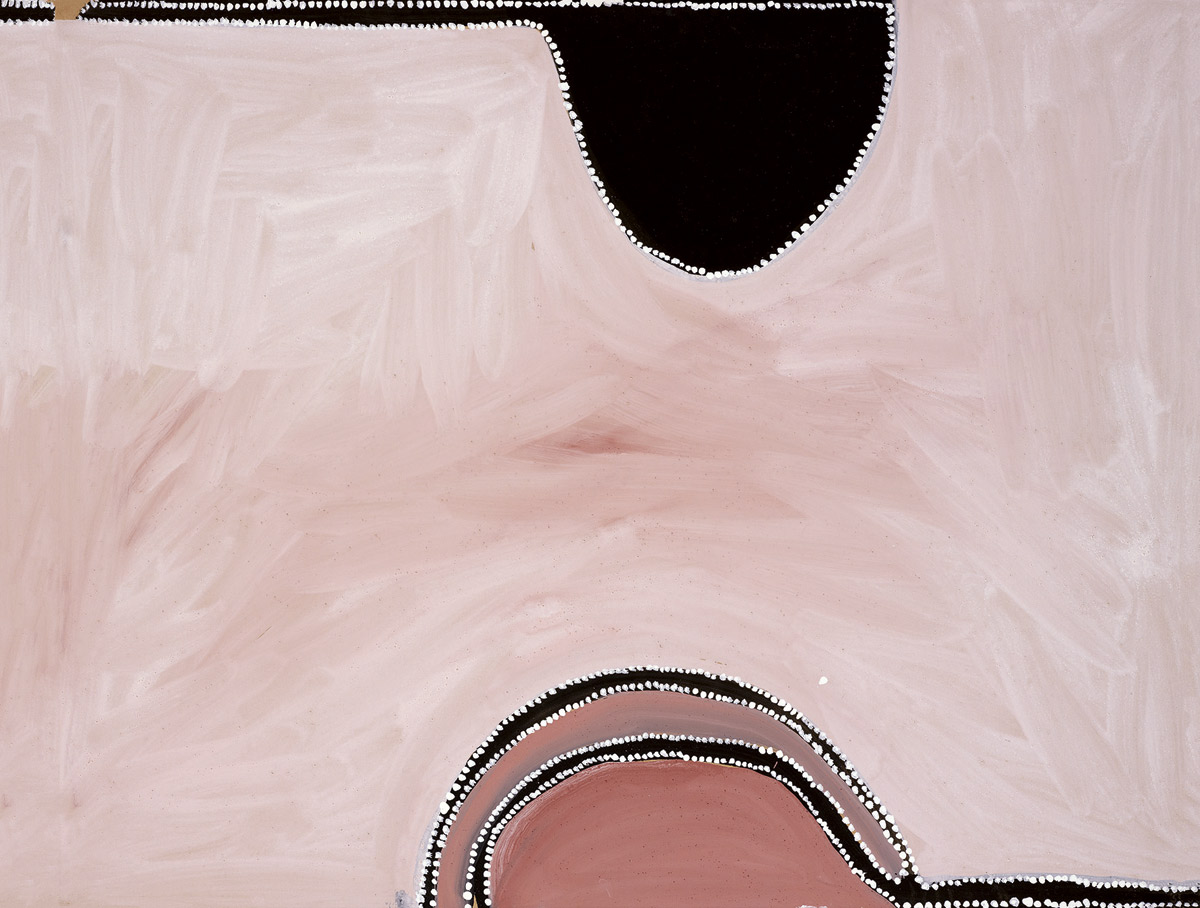
Paddy Bedford (Australian, 1922-2007)
Merrmerrji-Queensland creek
2005
Ochre and synthetic binder on composition board
80 x 100cm
© Paddy Bedford, reproduced courtesy of the artist’s estate and Wesfarmers Collection of Australian Art
“Paddy Bedford was a senior Gija lawman born at Bedford Downs Station in the East Kimberly region. Like many indigenous artists, he lived a long life as a stockman before he looked upon the Turkey Creek elders – Rover Thomas and Paddy Jiminji – to begin painting. Bedford’s first works were made with the inception of the Jirrawun Aboriginal Art Cooperative in 1997.
The distinctive minimalist style of his work is but a mask to the multifarious layers of meaning. Bedford’s paintings are inspired by the distinctive landscape and stories of his country in the East Kimberly region of Western Australia, as he depicts from an aerial perspective the traditional dreamings of the Cockatoo, Emu and Turkey; the massacres of local Aboriginal people during the colonial period; as well as episodes from his own life as a stockman and as a senior elder of his community.
Merrmerrji-Queensland Creek, 2005 is characteristically sparse in composition with bold forms, a rhythmic application of dotted fluid lines and a powerfully imposing colour palate, which is gained from a wet-on-wet mixture of white and ochre pigments suspended in a fast drying acrylic medium. The effect is a pearly radiant luminosity, an ambience of the sacred.”
Text from the Annette Larkin Fine Art website. No longer available online.
The Ian Potter Museum of Art
The University of Melbourne,
Corner Swanston Street and Masson Road
Parkville, Victoria 3010
Opening hours: Tuesday – Saturday 11am – 5pm
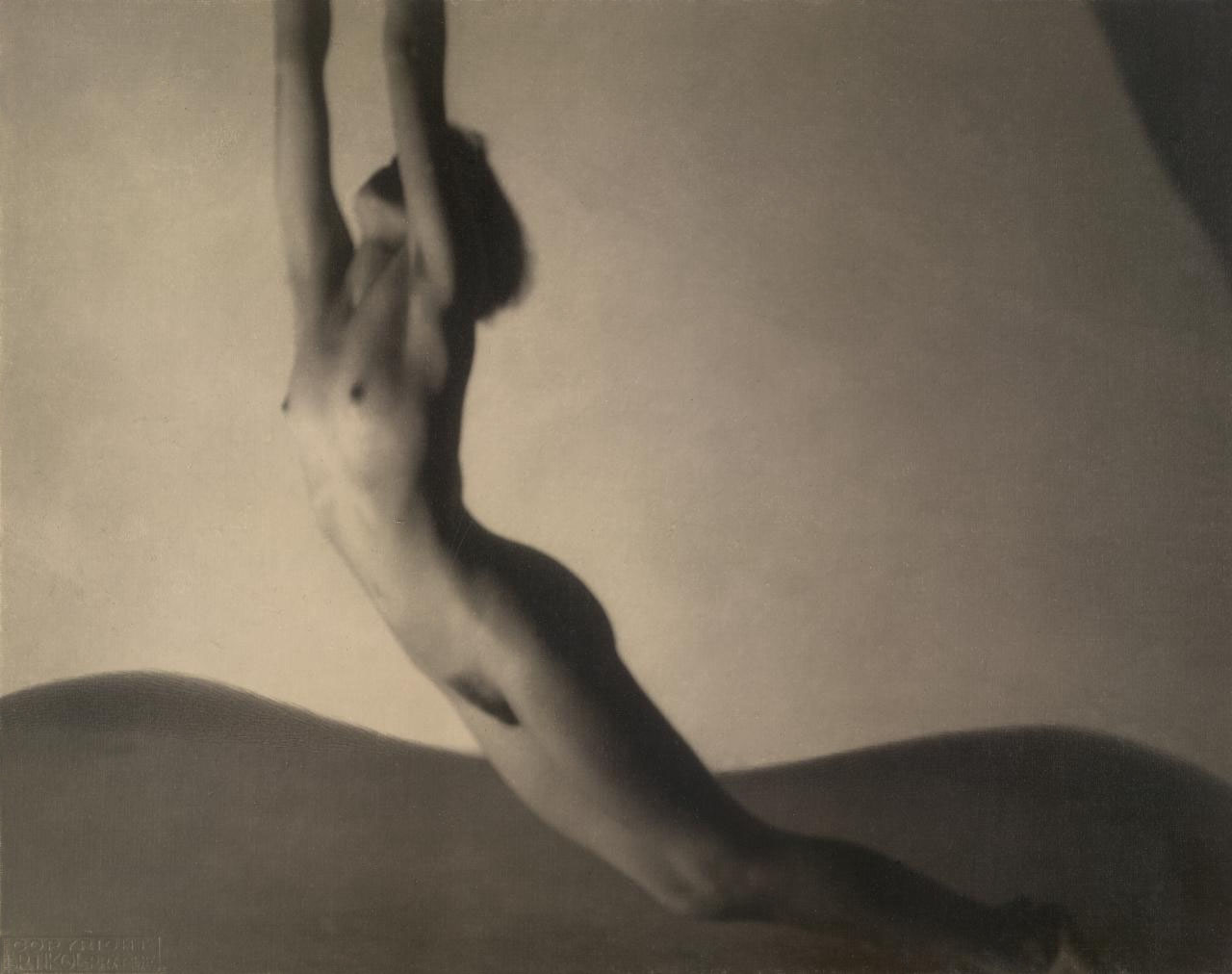
Frantisek Drtikol (Czech, 1883-1961)
Nude
1927-1929
Bromoil photograph
21.8 × 27.5cm (image and sheet)
National Gallery of Victoria, Melbourne
Gift of C. Stuart Tompkins, 1971
© František Drtikol, courtesy of Růžena Knotková
Photograph used under conditions of “fair use” for the purpose of academic research
This is a story that has never been told. It is the story of how the National Gallery of Victoria, Melbourne, Australia set up one of the very first photography departments in a museum in the world in 1967, and employed one of the first dedicated curators of photography, only then to fail to purchase classical black and white masterpieces by international artists that were being exhibited in Melbourne and sold at incredibly low prices during the 1970s and early 1980s, before prices started going through the roof.
The NGV had a golden chance to have one of the greatest collections of classical photography in the world if only they had grasped the significance and opportunity presented to them but as we shall see – due to personal, political and financial reasons – they dropped the ball. By the time they realised, prices were already beyond their reach.
Justifications for the failure include lack of financial support, the purchasing of non-vintage prints and especially the dilemma of distance, which is often quoted as the main hindrance to purchasing. But as I show in this research essay these masterpieces were already in Australia being shown and sold in commercial photography galleries in Melbourne at around $150, for example, for a Paul Strand photograph. As a partial public institution the NGV needs to take a hard look at this history to understand what went wrong and how they missed amassing one of the best collections of classical photography in the world.
Dr Marcus Bunyan
May 2015
Word count: 5,594
Download this research paper:
Beginnings: The International Photographic Collection at the National Gallery of Victoria (2.1Mb Word doc)
This research paper investigates the formation of the international photographic collection at the National Gallery of Victoria, Melbourne, Australia.
Photographs, photography, 19th century photography, early Australian photography, Australian photography, international photography collection, National Gallery of Victoria, National Gallery of Victoria photography department, Art Gallery of New South Wales, National Gallery of Australia, Melbourne, photographic collections, curator.
Invented by Louis Daguerre in 1839, the daguerreotype – a plate of copper coated in silver, sensitised to light by being exposed to halogen fumes – was the first publicly announced photographic process and the first to come into widespread use. The first photograph taken in Australia was a daguerreotype, a view of Bridge Street (now lost) taken by a visiting naval captain, Captain Augustin Lucas in 1841.1 The oldest surviving extant photograph in Australia is a daguerreotype portrait of Dr William Bland by George Barron Goodman taken in 1845 (see image below). This daguerreotype is now in the State Library of New South Wales collection.2
After these small beginnings, explored in Gael Newton’s excellent book Shades of Light,3 the Melbourne Public Library (later to become the State Library of Victoria) launched the Museum of Art in 1861 and the Picture Gallery in 1864, later to be unified into the National Gallery in 1870, a repository for all public art collections, the gallery being housed in the same building as the Library.4 The Pictures Collection (including paintings, drawings, prints, cartoons, photographs and sculpture) was started in 1859.5 The collection of photographs by the Library had both moral and educative functions. Photographs of European high culture reminded the colonists of links to the motherland, of aspirations to high ideals, especially in conservative Melbourne.6 Photographs of distant lands, such as Linnaeus Tripe’s Views of Burma, document other ‘Oriental’ cultures.7 Photographs of settlement and the development of Melbourne recorded what was familiar in an unknown landscape. “Documentation of both the familiar and the unknown intersected with the scientific desire for categorisation and classification.”8
It is not the purview of this essay to dwell on the development of photography in Australia during intervening years between the 1860s-1960s, but suffice it to say that the collecting of photographs at the State Library of Victoria continued the archiving of Australian identity and place through the ability “to define the self, claim the nation and occupy the world.”9 Australian photographic practice followed the development of international movements in photography in these years: art and commerce from the 1860s-1890s, Pictorialism from the 1900s-1930s, Modernism in the 1930s-1940s and documentary photography from the 1940s-1960s. The development of Australian photography was heavily reliant on the forms of international photography. Analysis of these years can be found in Gael Newton’s book Shades of Light: Photography and Australia 1839-198810 and Isobel Crombie’s book Second sight: Australian photography in the National Gallery of Victoria.11
In 1959 the epic The Family of Man exhibition, curated by the renowned photographer Edward Steichen from the Museum of Modern Art, New York, toured Sydney, Melbourne and Adelaide to massive crowds. Featuring 503 photographs by 273 famous and unknown photographers from 68 countries this exhibition offered a portrait of the human condition: birth, love, war, famine and the universality of human experience all documented by the camera’s lens.12 In Melbourne the exhibition was shown in a car dealer’s showroom (yes, really!) and was visited by photographers such as Jack Cato, Robert McFarlane, Graham McCarter.13 The photographs in the exhibition, accompanied by text, were printed “onto large panels up to mural size [and] gave The Family of Man works an unprecedented impact, even given the role illustrated magazines had played through most of the century.”14 This loss of the aura of the original, the authenticity of the vintage print, a print produced by the artist around the time of the exposure of the negative, would have important implications for the collection of international photographs in the fledgling National Gallery of Victoria photographic collection (even though Walter Benjamin saw all photography as destroying the authenticity of the original through its ability to reproduce an image ad nauseum).15 As Benjamin observes in his Illuminations, “The enlargement of a snapshot does not simply render more precise what in any case was visible though unclear: it reveals entirely new structural formations of the subject.”16 Other ways of looking at the world also arrived in Australia around the same time, namely Robert Frank’s seminal book The Americans,17 a road movie photographic view of American culture full of disparate angles, juke boxes, American flags, car, bikes and diners.18
While legislatively the National Gallery had split from the State Library of Victoria in 1944,19 it wasn’t until August, 1968 that the National Gallery of Victoria moved into it’s own building designed by Roy Grounds at 180 St Kilda Road (now known as NGV International).20 In the years leading up to the move the Trustees and Staff went on a massive spending spree:
“But although the sources of income from bequests were limited during the year [1967], a somewhat increased Government purchasing grant continued, which, with the allowance made by the Felton Committee, seemed to stimulate Trustees and Staff almost to a prodigality of spending. Perhaps, too, an urge for as full a display as possible at the opening of the new Gallery contributed; for by the end of the year the entire grant for purchase until the end of June 1968 had been consumed, and as well some commitments made for the future. Only donations made from private sources, and through the generosity of the National Gallery society, enabled the rate of acquisition to be maintained.”21
Unfortunately, this profligacy did not include spending on photography. This was because the Department of Photography was only formed in April 1967 after the Director at the time, Dr Eric Westbrook, convinced the Trustees of the Gallery “that the time had come to allow photographs into the collection.”22 The impetus for establishing a photography collection “was the growing recognition and promotion of the aesthetics of photography.”23 The Department of Photography at the NGV thus became the first officially recognised curatorial photography department devoted to the collection of photography as an art form in its own right in Australia and one of only a few dedicated specifically to collecting photography in the world.24 While the collecting criteria of the NGV has always emphasised “the primacy of the object as an example of creative expression,”25 the fluid nature of photography was acknowledged in a 1967 report on the establishment of the Department of Photography.26
The new department, however, did not gain momentum until the establishment of a Photographic Subcommittee in October 1969 that consisted of the Director of the Gallery and three notable Melbourne photographers: Athol Shmith, Les Gray and Chairman, Dacre Stubbs, along with the Director of the National Gallery Art School, Lenton Parr. Advising the Committee were honorary representatives Albert Brown (in Adelaide) and Max Dupain (in Sydney).27 The Photographic Subcommittee defined the philosophies of the Department and began acquiring photographs for the collection.28 While the Department was located in the Gallery’s library and had no designated exhibition space at this time,29 Committee members stressed the need to make contacts with the international art world and fact-finding missions were essential in order to establish a curatorial department in Australia as no photography department had ever been established in Australia before. “Members were also concerned to position the new Department in an international context (achieved initially through linking the Gallery to an international exhibitions network and later by purchasing international photography.”30
Financial support and gallery space was slow in materialising and then (as now) “it was enlightened corporate and individual support that would significantly help the NGV to create its photography collection.”31 The first attributable international photograph to enter the collection was the 21.8 x 27.5 cm bromoil photograph Nude (1939) by the Czechoslovakian photographer Frantisek Drtikol in 1971 (Gift of C. Stuart Tompkins) (see above),32 an artist of which there remains only one work in the collection, and other early international acquisitions included twenty-seven documentary photographs taken during NASA missions to the moon in the years 1966-1969 (presented by Photimport in 1971)33 and work by French photographer M. Lucien Clergue in 1972, founder of the Arles Festival of Photography.34 Early international exhibitions included The Photographers Eye from the Museum of Modern Art in New York (facilitated through Albert Brown’s connections with photography curator John Szarkowski of MoMA).35
The purchasing of the Dritkol nude is understandable as he is an important photographer of people and nudes. “Drtikol made many portraits of very important people and nudes which show development from pictorialism and symbolism to modern composite pictures of the nude body with geometric decorations and thrown shadows, where it is possible to find a number of parallels with the avant-garde works of the period.”36 The acceptance of the set of twenty-seven NASA photographs is understandable but still problematic. Although some of the photographs are breathtakingly beautiful and they would have had some social significance at that time (the first lunar landing was in 1969), their relative ‘value’ as pinnacles of international documentary photography, both aesthetically and compositionally, must be questioned.37 One wonders on what grounds the Photographic Subcommittee recommended their acceptance at the very start of the collection of international photography for the Department of Photography when so many definitive photographs by outstanding masters of photography could have been requested as a donation instead. Similarly, the purchase by the National Gallery of Victoria in 1980 of over 108 space photographs by NASA, Washington, D.C. (manufacturer) for the international collection is equally mystifying when there was a wealth of European and American master photographers work being shown in exhibitions around Melbourne (and sold at very low prices, eg. $150 for a Paul Strand vintage print) that did not enter the collection.
In 1972 Jenny Boddington (with a twenty year background in documentary film)38 was appointed Assistant Curator of Photography. She was selected from fifty-three applicants,39 and was later to become the first full-time curator of photography at the NGV, the first in Australia and perhaps only the third ever full-time photography curator in the world. In 1973, the Melbourne photographer Athol Shmith, who sat on the Photographic Subcommittee, visited major galleries and dealers in London and Paris for five weeks and reserved small selections of non-vintage prints for purchase by Henri Lartigue, Bill Brandt, Paul Strand, Andre Kertesz, Edward Steichen and Margaret Bourke-White40 (non-contemporary ie. vintage work not being generally available at this time). Also in 1973 the corridor beside the Prints and Drawings Department opened as the first photography exhibition space, to be followed in 1975 by the opening of a larger photography gallery on the third floor.41
In 1975 Boddington made a six-week tour of Europe, London and America that included meeting photographers Andre Kertesz and Bill Brandt and the Director of the Museum of Modern Art, John Szarkowski.42 Boddington also spent four weeks viewing photography at the MoMA, time that radically changed her ideas about running the department, including the decision that priority be given to the acquisition of important overseas material. She states:
“My ideas about the running of my department are radically changed … I believe that for some time in the future immediate priority and all possible energy should be given to the acquisition of important overseas material, remembering that ours is the only museum in Australia with a consistent policy of international collecting, and that effort in the initiation and mounting of exhibitions can be saved by showing some of the best work we have already purchased.”43
As Suzanne Tate notes in her Postgraduate Diploma Thesis, Boddington “was also determined to achieve autonomy from the Photographic Subcommittee, and to act on her own judgement, as other curators did.”44 Perhaps this understandable desire for autonomy and the resultant split and aversion (towards the Photographic Subcommittee) can be seen as the beginning of the problems that were to dog the nascent Photography department. In 1976 the Photographic Subcommittee was discontinued although Les Gray (who expressed a very ‘camera club’ aesthetic) continued to act as honorary advisor.45 The Photography department continued to collect both Australian and international photography in equal measure (but of equal value?) and held exhibitions of international photography from overseas institutions (including the early exhibition The Photographer’s Eye in 1968)46 and from the permanent collection (such as an exhibition of work by Andre Kertész, Bill Brandt and Paul Strand)47 in order to educate the public, not only in the history of the medium but how to ‘see’ photography and read ‘good’ photographic images from the mass of consumer images in the public domain.48
“It does not do to be impatient in the business of collecting for an art museum. A public collection is a very permanent thing. It is really necessary to think in terms of the future and how our photographs and our century will appear in that future. We would like those in the future to inherit material that is intelligible both for itself and in relation to the other arts; at the same time there is the need to satisfy the present. A collection cannot be richer than the responses of its artists but it is hoped that it will represent a rich trawl of each historical period.”
Jenny Boddington 49
The current photography collection at The National Gallery of Victoria consists of over 15,000 photographs of which around 3,000 are by international artists (a ratio of 20% whereas the ratio between Australian / international photographers at the National Gallery of Australia in Canberra is 60/40%).50 Dr Isobel Crombie, now Assistant Director, Curatorial and Collection Management and former Senior Curator of Photography at the National Gallery of Victoria, notes in her catalogue introduction “Creating a Collection: International Photography at the National Gallery of Victoria,” from the exhibition Re_View: 170 years of Photography that several factors have affected the collection of international photographs at The National Gallery of Victoria. I have identified what I believe to be the three key factors:
1/ Lack of financial support
2/ The purchasing of non-vintage prints
3/ The dilemma of distance
When the Department of Photography was set up at The National Gallery of Victoria the lack of adequate funds tempered the Photography Subcommittees purchasing aspirations. This situation continued after the appointment of Jenny Boddington and continues to this day. Athol Shmith noted that there were two options for building a collection: one was to spend substantial funds to acquire the work of a few key photographers, the other option (the one that was adopted) was a policy of acquiring a small number of works by a wide range of practitioners, a paradigm that still continues.51 “A broadly based collecting policy was established to purchase work by Australian and International practitioners from all periods of photographic history.”52
The majority of early acquisitions of the Department were overwhelmingly Australian but this collection policy broadened dramatically after the overseas travel of Athol Shmith and Jenny Boddington.53 Cultural cringe was prevalent with regard to Australian photography and it was rarely, if ever, talked about as art. Australian photography was still in the hands of the camera clubs and magazines and influenced by those aesthetics… but the ability to purchase the desired international work was severely curtailed due, in part, to the low exchange rate of the Australian dollar. In 1976 one Australian dollar was worth approximately US 40 cents. Another reason was the lack of money to purchase international work. In the early 1970s the Department had approximately $3,000 a year to purchase any work (international or Australian) that gradually built up to about $30,000 per annum in the mid 1970s. In 1981-82, this was reduced to almost zero because of the financial crisis and credit squeeze that enveloped Australia. This lack of funds to purchase work was compounded by sky rocketing prices for international photographs by renowned photographers in the early 1980s.
While generous help over eight years from Kodak (Australasia) Pty. Ltd had helped buy Australian works for the collection (a stipulation of the funds),54 money for international acquisitions had been less forthcoming. In a catalogue text from 1983 Boddington notes,
“… classic, well-known photographs are now very expensive indeed. One can only look back with sincere appreciation to the days when the department’s purchasing budget was $1000 a year and the trustees agreed to buy 27 Bill Brandts, whilst the National Gallery Society donated a further 13 from ‘Perspective of Nudes’, thus concluding out first major international purchase, happily before Brandt’s prices quintupled in a single blow early in 1975. Photography was then beginning to be a factor in the market place of art and a budget of $1000 a year was no longer adequate – even for the purchase of Australian work! Where funds are limited (as they are) a fairly basic decision has to be made as to the direction a collection will follow. Here in Melbourne we have on the whole focused on the purest uses of straight photography as it reflects broad cultural concerns …”55
By 1976 the Felton Bequest purchased works by Julie Margaret-Cameron (one image! below) and the NGV purchased thirty-four André Kertész, evidence that the status of the Photography department was rising. Throughout the remainder of the 1970s and early 1980s, eighty works were acquired by artists such as Imogen Cunningham (five images), Eadweard Muybridge (two images – the only two in the collection), Lois Conner (three images) and Man Ray (eleven images).56 In 1995 Isobel Crombie revised the collecting policy of the Department and she notes in “Collecting Policy for the Department of Photography, National Gallery of Victoria (Revised October 1995),” Appendix 1 in Suzanne Tate’s Postgraduate Diploma Thesis under the heading ‘International Photography’57 that, “Given our financial resources extremely selective purchases are to be made in this area to fill those gaps in the collection of most concern to students and practicing photographers.”58 Crombie further notes that the contemporary collection is an area that needs much improvement whilst acknowledging the dramatic increases in prices asked and realised for prime photographs and the restricted gallery funds for purchases.59
While today the importance of philanthropy, fund raising and sponsorship is big business within the field of museum art collecting one cannot underestimate the difficulties faced by Boddington in collecting photographs by international artists during the formative years of the collection. As photography was liberated to become an art form in the early 1970s through the establishment of museum departments, through the emergence of photographic schools and commercial photographic galleries (such as the three commercial photography galleries showing Australian and international work in Melbourne: Brummels (Rennie Ellis), Church Street Photographic Centre (Joyce Evans) and The Photographers’ Gallery and Workshop (Paul Cox, John Williams, William Heimerman and Ian Lobb), photography was given a place to exist, a place to breathe and become part of the establishment. But my feeling is that the status of photography as an art form, which was constantly having to be fought for, hindered the availability of funding both from within the National Gallery of Victoria itself and externally from corporate and philanthropic institutions and people.
To an extent I believe that this bunker mentally hindered the development of the photographic collection at the National Gallery of Victoria until much more recent times. Instead of photography being seen as just art and then going out and buying that art, the battle to define itself AS art and defend that position has had to be replayed again and again within the NGV, especially during the late 1970s-1980s and into the early 1990s.60 This is very strange position to be in, considering that the NGV had the prescience to set up one of the first ever photography departments in a museum in the world. Then to not support it fully or fund it, or to really understand what was needed to support an emergent art form within a museum setting so that the masterpieces vital for the collection could to be purchased, is perplexing to say the least. I also wonder whether more could not have been done to attract philanthropy and funds from personal and big business enterprises to support international acquisitions. I also wonder about the nature of some of the international purchases for the Department of Photography (the choice of photographer or photographs purchased) and the politics of how those works were acquired.
The paradigm for collecting international photographs early in the history of the Department of Photography was set by Athol Shmith in 1973 on his visit to Paris and London.
“Typically for the times, Shmith did not choose to acquire vintage prints, that is, photographs made shortly after the negative was taken. While vintage prints are most favoured by collectors today, in the 1970s vintage prints supervised by the artists were considered perfectly acceptable and are still regarded as a viable, if less impressive option now.”61
This assertion is debatable. While many museums including the NGV preferred to acquire portfolios of modern reprints as a speedy way of establishing a group of key images, Crombie notes in the catalogue essay to 2nd Sight: Australian Photography at the National Gallery of Victoria that the reason for preferring the vintage over the modern print “is evident when confronted with modern and original prints: differences in paper, scale and printing styles make the original preferable.”62 Crombie’s text postulates that this sensibility, the consciousness of these differences slowly evolved in the photographic world and, for most, the distinctions were not a matter of concern even though the quality of the original photograph was not always maintained.63 I believe that this statement is only a partial truth. While modern prints may have been acceptable there has always been a premium placed on the vintage print, a known value above and beyond that of modern prints, even at the very dawn of photography collecting in museums. I believe that price (which is never mentioned in this discussion) is the major reason for the purchase of non-vintage prints. In Crombie’s “Collecting Policy for the Department of Photography, National Gallery of Victoria (Revised October 1995),” she notes under the heading ‘Past Collecting Policy’ Point 1 that “Many non-vintage photographs have been collected … Purchase of non-vintage prints should not continue though we may we accept such photographs as gifts on occasion.”64
I vividly remember seeing a retrospective of the work of Henri Cartier-Bresson at the Dean Gallery in Edinburgh in 2005. One room consisted of small, jewel-like vintage prints that were amazing in their clarity of vision and intensity of the resolution of the print. In the other three rooms there were large blown-up photographs of the originals, authorised by the artist. Seen at mural size the images fell apart, the tension within the picture plane vanished and the meaning of the image was irrevocably changed. Even as the artist’s intentions change over time, even as the artist reprints the work at a later stage, the photograph is not an autonomous object – it becomes a post-structuralist textual site where the artist and curator (and writers, conservators, historians and viewers) become the editors of the document and where little appeal can be made to the original intentions of the author (if they are known).65 While change, alteration, editing, revision and restoration represent the true life of objects66 (and noting that the same re-inscription also happens with vintage photographs), the purchase of non-vintage prints eliminates the original intention of the artist. This is not to say that the modern printing, such as Bill Brandt’s high contrast version of People sheltering in the Tube; Elephant and Castle, underground station (1940 printed 1976, below) cannot become the famous version of the image, but that some acknowledgement of the history of the image must be made. Ignoring the negative/print split is problematic to say the least, especially if the original was printed with one intention and the modern print with an entirely different feeling. This is not a matter of refinement of the image but a total reinterpretation (as in the case of the Brandt). While all artists do this, a failure to acknowledge the original vision for a work of art and the context in which it was taken and printed – in Brandt’s case he was asked by the War Office to record the Blitz, in which Londoners sheltered from German air raids in Underground stations – can undermine the reconceptualisation of the modern print.
Bill Brandt (British, 1904-1983)
People sheltering in the Tube; Elephant and Castle, underground station
1940
Silver gelatin print
© Bill Brandt Archive © IWM Non-Commercial License
Photograph used under conditions of “fair use” for the purpose of academic research
Civilians sheltering in Elephant and Castle London Underground Station during an air raid in November 1940. Elephant and Castle London Underground Station Shelter: People sleeping on the crowded platform of Elephant and Castle tube station while taking shelter from German air raids during the London Blitz.
Bill Brandt (British, 1904-1983)
People sheltering in the Tube; Elephant and Castle, underground station
1940 printed 1976
Silver gelatin print
34.4 x 29.3cm
National Gallery of Victoria, Melbourne
Purchased, 1974
© Bill Brandt Archive
Photograph used under conditions of “fair use” for the purpose of academic research
NB. Note the removal of the man sitting up at right in mid-foreground
While the dilemma of distance is cited as an obstacle to the collection of international photographs by the Department of Photography in the early 1970s by Isobel Crombie,67 this observation becomes less applicable by the middle of the decade. Master prints from major international photographers were available for purchase in Australia by the National Gallery of Australia in Canberra (which had been collecting photography since the early 1970s),68 the Art Gallery of New South Wales (which established a Department of Photography in 1974),69 and the National Gallery of Victoria, through exhibitions at newly opened commercial galleries in both Melbourne and Sydney. Public touring exhibitions were held of the work of international photographers, most notably British Council exhibition of Bill Brandt in 1971, and the French Foreign Ministry’s major exhibition of Cartier-Bresson in 1974.70
In Melbourne commercial galleries specialising in photography and photographer run galleries had emerged, namely Brummels directed by Rennie Ellis in 1972, The Photographers’ Gallery and Workshop founded by Paul Cox, Ingeborg Tyssen, John F. Williams and Rod McNicoll in 1973 (the Gallery was taken over in late 1974 by Ian Lobb, his first exhibition as director being at the beginning of 1975; Bill Heimerman joined as joint director at the beginning of 1976), and Church Street Photographic Centre established by Joyce Evans in 1977.71 At the commercial galleries the main influence was overwhelmingly American:
“The impact of exhibitions held by the NGV was reinforced by exhibitions of the work of Ralph Gibson, William Clift, Paul Caponigro, Duane Michals and Harry Callahan at The Photographers’ Gallery and by the series of lectures and workshops that the artists conducted during those exhibitions. Joyce Evans also organised important exhibitions during this period but again the focus was American with work by Minor White, Jerry Uelsmann, Les Krims and others.”72
Shows of American photography, many of which toured extensively, became relatively commonplace and it was the first time Australian photographers and the general public had access to such a concentration of international photography in a variety of styles.73 Ian Lobb, who took over the running of The Photographers’ Gallery and Workshop in late 1974 (with Bill Heimerman), notes that the first exhibition of international photography at the gallery was that of Paul Caponigro in 1975.74
“We sold 22 prints which he told us was the second highest sale he had made to that point. With the success of the Caponigro show, we closed the gallery for a few months while the gallery was rebuilt. I took Bill as a business partner, and he made a trip to the USA to set-up some shows. From 1975, every second show was an international show.”75
Lobb observes that,
“The initial philosophy was simply to let people see the physical difference between the production of prints overseas and locally. After a while this moved from the Fine Print to other concerns both aesthetic and conceptual. The gallery at best, just paid for itself. During international shows the attendance at the gallery was high. During Australian shows the attendance was low.”76
From 1975-1981 The Photographers’ Gallery and Workshop held exhibitions of August Sander (German – arranged by Bill Heimerman), Edouard Boubat (France), Emmet Gowin (USA – twice), Paul Caponigro (USA – twice), Ralph Gibson (UK – twice, once of his colour work), William Eggelston (USA), Eliot Porter (USA), Wynn Bullock (USA), William Clift (USA), Harry Callahan (USA), Aaron Siskind (USA – twice, once with a show hung at Ohnetitel) Jerry Uelsmann (USA), Brett Weston (USA). There was also an exhibition of Japanese artist Eikoh Hosoe (Japan) and his Ordeal by Roses series in 1986. These exhibitions comprise approximately 60% of all international exhibitions at The Photographers’ Gallery and Workshop during this time, others being lost to the vagaries of memory and the mists of time. Prices ranged from $100 per print (yes, only $100 for these masterpieces!!) in the early years rising to $1500 for a print by Wyn Bullock towards the end of the decade.77 At Church Street Photographic Centre the focus was predominantly on Australian and American artists, with some British influence. Artists exhibited other than those noted above included Athol Shmith, Rennie Ellis, Wes Placek, Fiona Hall, Herbert Ponting, Julia Margaret Cameron, Eugène Atget, Henri Cartier-Bresson, Jack Cato, Norman Deck, Jan Saudek, Robert Frank, Edouard Boubat, Jerry Uelsmann and Albert Renger-Patzsch to name just a few.78
The purchasing of vintage prints by major international artists from these galleries by the National Gallery of Victoria was not helped by the allegedly strained relationships that Boddington had with the directors of these galleries. The feeling I get from undertaking the research is that one of the problems with Boddington’s desire to achieve autonomy and make her own decisions about what to purchase for the Photography Department (being strong willed) was that she ignored opportunities that we right here in Melbourne – because of the aforesaid relationships and lack of money (a lack of support from the hierarchy of the National Gallery of Victoria).
It would be a great pity if the oral history of the early exhibition of international photographers in Melbourne was lost, for it is a subject worthy of additional research. It would also be interesting to undertake further research in order to cross-reference the purchases of the Department of Photography at the National Gallery of Victoria in the years 1975-1981 with the independent international exhibitions that were taking place at commercial galleries in Melbourne during this time. What international photographs were purchased from local galleries, what choices were made to purchase or not purchase works, what works were actually purchased for the collection and what were the politics of these decisions?
For example, during 1976 nine photographs by the Italian photographer Mario Giacomelli (1925-2000) entered the collection as well as nineteen photographs by German photographer Hedda Morrison; in 1977 twelve photographs entered the collection by a photographer name Helmut Schmidt (a photographer whose name doesn’t even appear when doing a Google search). Under what circumstances did these photographs come into the collection? While these people might be good artists they are not in the same league as the stellar names listed above that exhibited at The Photographers’ Gallery and Church Street Photographic Centre. Questions need to be asked about the Department of Photography acquisitions policy and the independent choices of the curator Jennie Boddington, especially as the international prints were here in Melbourne, on our doorstep and not liable to the tyranny of distance.
Dr Isobel Crombie notes that the acquisitions policies were altered so that there was no major duplication between collections within Australia79 but it seems strange that, with so many holes in so many collections around the nation at this early stage, major opportunities that existed to purchase world class masterpieces during the period 1975-1981 were missed by the Department of Photography at the NGV.
While Crombie acknowledges the preponderance of American works in the collection over European and Asian works she also notes that major 20th century photographers that you would expect to be in the collection are not, and blames this lack “on the massive increases in prices for international photography that began in the 1980s and which largely excluded the NGV from the market at this critical time.”80 Crombie further observes that major contemporary photographers work can cost over a million dollars a print and the cost of vintage historical prints are also prohibitively high,81 so the ability to fill gaps in the collection is negligible, especially since the photography acquisitions budget is approximately 0.5-1 million dollars a year.82
Crombie’s time scale seems a little late for as we have seen in this essay, opportunities existed locally to purchase world class prints from master international photographers before prices rose to an exorbitant level. Put simply, the NGV passed up the opportunity to purchase these masterworks at reasonable prices for a variety of reasons (personal, political and financial) before the huge price rises of the early 1980s. They simply missed the boat.
I believe that this subject is worthy of further in-depth research undertaken without fear nor favour. While it is understandable that the NGV would want to protect it’s established reputation, the NGV is a partial public institution that should not be afraid to open up to public scrutiny the formative period in the history of the international collection of photography, in order to better understand the decisions, processes and photographic prints now held in it’s care.
Dr Marcus Bunyan
May 2015
Word count: 5,594
Benjamin, Walter. The Work of Art in the Age of Mechanical Reproduction. 1936
Benjamin, Walter. Illuminations: Essays and Reflections. Shocken, 1969
Boddington, Jennie. International Photography: 100 images from the Collection of the National Gallery of Victoria. Adelaide: The Art Gallery of South Australia, 1983
Boddington, Jennie. Overseas Travel by Assistant Curator of Photography. Melbourne: National Gallery of Victoria, 1976
Boddington, Jennie. Modern Australian Photographs. Melbourne: National Gallery of Victoria, 1976
Cox, Leonard B. The National Gallery of Victoria, 1861-1968: The Search for a Collection. Melbourne: The National Gallery of Victoria; Brown Prior Anderson Pty Ltd, 1971
Crombie, Isobel. Re_View: 170 years of Photography. Melbourne: National Gallery of Victoria, 2009
Crombie, Isobel. Second sight: Australian photography in the National Gallery of Victoria. Melbourne: National Gallery of Victoria, 2002
Downer, Christine. “Photographs,” in Galbally, Ann [et al]. The first collections: the Public Library and the National Gallery of Victoria in the 1850s and the 1860s. Parkville, Vic.,: The University of Melbourne Museum of Art, 1992, pp. 73-79
Frank, Robert. The Americans. Washington: Steidl/National Gallery of Art, Revised edition, May 30, 2008
Newton, Gael. Shades of Light: Photography and Australia 1839-1988. Canberra: Australian National Gallery, Collins, 1988
Tate, Suzanne. Photographic Collections in Victoria: Waverley City Gallery, Horsham Art Gallery and the National Gallery of Victoria: An Analysis of Past History and Future Directions. The University of Melbourne: Postgraduate Diploma Thesis, 1998
![George Baron Goodman, d. 1851. [Dr William Bland, ca. 1845 - portrait] c. 1845](https://artblart.com/wp-content/uploads/2014/07/goodman-dr-george-bland-1845-web.jpg "George Baron Goodman, d. 1851. [Dr William Bland, ca. 1845 - portrait] c. 1845")
George Baron Goodman, d. 1851
[Dr William Bland]
c. 1845
Daguerreotype (ninth plate daguerreotype in Wharton case)
7.5 x 6.3cm
© State Library of New South Wales collection
Photograph used under conditions of “fair use” for the purpose of academic research
This daguerreotype is the earliest known surviving photograph taken in Australia. It is probably that mentioned in the Sydney Morning Herald 14/1/1845, page 2, top column 5… It would appear to be a product of Goodman’s new studio at 49 Hunter Street, Sydney (see SMH 5/8/1844), before the introduction of hand colouring (see SMH 9/1/1845) and before the introduction of decorative backgrounds (see SMH 25/4/1846). It was probably produced between November 1844 and early January 1845 – Alan Davies, Curator of Photographs, State Library of NSW, 1993. (Image used for research under fair use conditions).
Front cover of John Szarkowski’s book The Photographers Eye, originally published by The Museum of Modern Art in 1966
André Kertész (Hungarian, 1894-1985)
A Bistro at Les Halles, Paris
1927
Gelatin silver photograph
17.7 x 24.7cm
National Gallery of Victoria, Melbourne
Purchased, 1976
Photograph used under conditions of “fair use” for the purpose of academic research
Julia Margaret Cameron (British, 1815-1879)
Mrs Herbert Duckworth, her son George, Florence Fisher and H. A. L. Fisher
c. 1871
Albumen silver photograph
31.0 x 22.7cm
National Gallery of Victoria, Melbourne
Purchased through The Art Foundation of Victoria with the assistance of the Herald & Weekly Times Limited, Fellow, 1979
Photograph used under conditions of “fair use” for the purpose of academic research
Imogen Cunningham (American, 1883-1976)
Leaf pattern
c. 1929; printed 1979
Gelatin silver photograph
33.0 x 26.1cm
National Gallery of Victoria, Melbourne
Purchased 1979
Photograph used under conditions of “fair use” for the purpose of academic research
NASA, Washington, D.C. (manufacturer)
Instrument called Gnomon to determine size and distance of objects on moon
1969
Gelatin silver photograph on aluminium
49.0 x 39.0cm
National Gallery of Victoria, Melbourne
Presented by Photimport, 1971
Photograph used under conditions of “fair use” for the purpose of academic research
Neil Armstrong / NASA, Washington, D.C. (manufacturer)
Astronaut Buzz Aldrin, lunar module pilot, walks on the surface of the Moon near the leg of the Lunar Module (LM)
1969
Colour transparency
50.8 x 40.6cm
National Gallery of Victoria, Melbourne
Purchased 1980
Photograph used under conditions of “fair use” for the purpose of academic research
1/ Anon. “Photography in Australia,” on Wikipedia website [Online] Cited 01/08/2014.
2/ “Daguerreotype Portrait of Dr William Bland circa 1845,” on the State Library of New South Wales website [Online] Cited 27/07/2014.
3/ Newton, Gael. Shades of Light: Photography and Australia 1839-1988. Canberra: Australian National Gallery, Collins, 1988 [Online] Cited 02/06/2014.
4/ Fennessy, Kathleen. “For ‘Love of Art’: The Museum of Art and Picture Gallery at the Melbourne Public library 1860-1870,” in The La Trobe Journal 75, Autumn, 2005, p. 5 [Online] Cited 27/07/2014.
5/ Anon. “Pictures,” on the State Library of Victoria website [Online] Cited 02/09/2010. No longer available.
6/ Fox, Paul. “Stretching the Australian Imagination: Melbourne as a Conservative City,” in The La Trobe Journal 80, Spring, 2007, p. 124 [Online] Cited 27/07/2014.
7/ Tsara, Olga. “Linnaeus Tripe’s ‘Views of Burma’,” in The La Trobe Journal 79, Autumn, 2007, p. 55 [Online] Cited 27/07/2014.
8/ Crombie, Isobel. “Likenesses as if by magic: The early years 1840s-1850s,” in Second sight: Australian photography in the National Gallery of Victoria. Melbourne: National Gallery of Victoria, 2002, p. 15.
9/ Fox, Paul Op. cit., p. 124.
10/ Newton, Gael. Shades of Light: Photography and Australia 1839-1988. Canberra: Australian National Gallery, Collins, 1988 [Online] Cited 02/07/2014. Chapter 11 “Live in the Year 1929” and Chapter 12 “Commerce and Commitment.”
11/ Crombie, Isobel. Second sight: Australian photography in the National Gallery of Victoria. Melbourne: National Gallery of Victoria, 2002. See chapters “In a new light: Pictorialist photography 1900s-1930s” (p.38), “New Photography: Modernism in Australia 1930s – 1940s” (p.50) and “Clear statements of actuality: Documentary photography 1940s-1960s” (p.64).
12/ Anon. “The Family of Man,” on Wikipedia [Online] Cited 02/09/2014
13/ Newton, Gael. Shades of Light: Photography and Australia 1839-1988. Canberra: Australian National Gallery, Collins, 1988 [Online] Cited 02/06/2010. Chapter 13 “Photographic Illustrators: The Family of Man and the 1960s – an end and a beginning” and Footnote 13.
14/ Ibid., See also the layout and size of the photographic murals on the Musuem THE FAMILY OF MAN, Chateau de Clervaux / Luxembourg website, the only permanent display of the exhibition left in the world. [Online] Cited 02/09/2014.
15/ “Benjamin’s work balances, often with paradoxical results, tensions between aspects of experience: the experiences simultaneously of being too late and too early (too soon) in the temporal dimension (c.f. Hamlet’s “the time is out of joint”) and being both distant and close (in the spatial dimension), and anyway of being both temporal and spatial. The concept of “aura,” which is one of Benjamin’s most influential contributions, is best understood in terms of these tensions or oscillations. He says that “aura” is a “strange web of space and time” or “a distance as close as it can be.” The main idea is of something inaccessible and elusive, something highly valued but which is deceptive and out of reach. Aura, in this sense, is associated with the nineteenth century notions of the artwork and is thus lost, Benjamin argues, with the onset of photography. At first photographs attempted to imitate painting but very quickly and because of the nature of the technology photography took its own direction contributing to the destruction of all traditional notions of the fine arts.”
Phillips, John. On Walter Benjamin. [Online] Cited 02/06/2014. No longer available online
“One might generalize by saying: the technique of reproduction detaches the reproduced object from the domain of tradition. By making many reproductions it substitutes a plurality of copies for a unique existence.”
Benjamin, Walter. The Work of Art in the Age of Mechanical Reproduction. 1936, Section 2. [Online] Cited 02/06/2014.
16/ Benjamin, Walter. Illuminations: Essays and Reflections. Shocken, 1969, p. 236.
17/ Frank, Robert. The Americans. Washington: Steidl/National Gallery of Art, Revised edition, May 30, 2008.
18/ Newton, op.cit., Chapter 13.
19/ Anon. “A chronology of events in the history of the State Library of Victoria,” on the State Library of Victoria website. [Online] Cited 03/06/2010. No longer available.
20/ See Cox, Leonard B. The National Gallery of Victoria, 1861-1968: The Search for a Collection. Melbourne: The National Gallery of Victoria; Brown Prior Anderson Pty Ltd, 1971.
21/ Ibid., p. 378.
22/ Crombie, Isobel. op cit., Introduction p. 7.
23/ Crombie, Isobel. op cit., Introduction p. 7.
24/ Westbrook, Eric. “Minutes of the Photographic Subcommittee” 22/07/1970 quoted in Tate, Suzanne. Photographic Collections in Victoria: Waverley City Gallery, Horsham Art Gallery and the National Gallery of Victoria: An Analysis of Past History and Future Directions. The University of Melbourne: Postgraduate Diploma Thesis, Chapter One, 1998, pp. 12-13. Other institutions included the Museum of Modern Art (MoMA), New York, Berlin Kunstgewerbemuseum, Berlin, The Victoria and Albert Museum, London and the Art Institute of Chicago.
25/ Crombie, Isobel. op. cit., Introduction p. 6.
26/ Westbrook, Eric and Brown, Albert. “Establishment of Photography at the Victorian Arts Centre,” in Minutes of Trustees Reports, NGV, 4th April, 1967, p. 886 quoted in Crombie, Isobel. op cit., Introduction p. 6. Footnote 2.
27/ See Crombie, Isobel. op cit., Introduction p. 8 and Tate, Suzanne. op cit., Chapter 2: The Photography Department of the National Gallery of Victoria. pp. 14-15.
28/ NGV Trustees. National Gallery of Victoria Annual Report 1969-70. Melbourne, 1970, np quoted in Tate, Suzanne. op cit., Chapter 2: The Photography Department of the National Gallery of Victoria. pp. 14-15.
29/ NGV Photographic Subcommittee. Report. Melbourne, 1970, p. 2 quoted in Tate, Suzanne. op cit., Chapter 2: The Photography Department of the National Gallery of Victoria. p. 16.
30/ Crombie, Isobel. op cit., Introduction p. 8.
31/ Crombie, Isobel. “Creating a Collection: International Photography at the National Gallery of Victoria,” in Re_View: 170 years of Photography. Melbourne: National Gallery of Victoria, 2009, p. 7.
32/ Ibid.,
33/ NGV Trustees. National Gallery of Victoria Annual Report 1971-72. Melbourne, 1970, np quoted in Tate, Suzanne. op cit., Chapter 2: The Photography Department of the National Gallery of Victoria. p. 16.
34/ NGV Trustees. National Gallery of Victoria Annual Report 1972-73. Melbourne, 1970, np quoted in Tate, Suzanne. op cit., Chapter 2: The Photography Department of the National Gallery of Victoria. p. 16.
35/ NGV Trustees. National Gallery of Victoria Annual Report 1969-70. Melbourne, 1970, np quoted in Tate, Suzanne. op cit., Chapter 2: The Photography Department of the National Gallery of Victoria. p. 16.
36/ Anon. “Frantisek Drtikol,” on Wikipedia website [Online] Cited 06/10/2014.
37/ Some of these images have been shown for the first time in over twenty years in the 2009 exhibition Light Years: Photography and Space in the third floor photography gallery at NGV International.
38/ “After Eureka Stockade Boddington went to work at Film Australia and in 1950 worked for the GPO Film Unit. With the introduction of television she went to work at the ABC as an editor. She and her second husband cameraman Adrian Boddington would then set up their own company Zanthus Films. After his death she became the curator of photography at the National Gallery of Victoria in 1971.”
Allen, J. “Australian Visions. The films of Dahl and Geoffrey Collings,” in Eras Journal Edition 4, December 2002, Footnote 33 [Online] Cited 14/10/2014. No longer available online.
39/ Minutes of the NGV Photographic Subcommittee. Melbourne, 16/05/1972 quoted in Tate, Suzanne. op cit., Chapter 2: The Photography Department of the National Gallery of Victoria. pp. 17-18.
40/ Crombie, Isobel. “Creating a Collection: International Photography at the National Gallery of Victoria,” in Re_View: 170 years of Photography. Melbourne: National Gallery of Victoria, 2009, p. 9.
41/ NGV Trustees. National Gallery of Victoria Annual Report 1974-75. Melbourne, 1975, p. 24 quoted in Tate, Suzanne. op cit., Chapter 2: The Photography Department of the National Gallery of Victoria. pp. 17-18.
42/ Boddington, J. Overseas Travel by Assistant Curator of Photography. Melbourne: National Gallery of Victoria, 1976, pp. 1-3 quoted in Tate, Suzanne. op cit., Chapter 2: The Photography Department of the National Gallery of Victoria. pp. 18-19.
43/ Boddington, J. quoted in Crombie, Isobel. “Creating a Collection: International Photography at the National Gallery of Victoria,” in Re_View: 170 years of Photography. Melbourne: National Gallery of Victoria, 2009, p. 9.
See also Boddington, J. quoted in quoted in Tate, Suzanne. op cit., Chapter 2: The Photography Department of the National Gallery of Victoria. pp. 18-19.
44/ Boddington, J. Overseas Travel by Assistant Curator of Photography. Melbourne: National Gallery of Victoria, 1976, pp. 1-3 quoted in Tate, Suzanne. op cit., Chapter 2: The Photography Department of the National Gallery of Victoria. pp. 18-19.
45/ NGV Trustees. National Gallery of Victoria Annual Report 1975-76. Melbourne, 1976, p. 26 quoted in Tate, Suzanne. op cit., Chapter 2: The Photography Department of the National Gallery of Victoria. pp. 18-19.
46/ See Crombie, Isobel. “Creating a Collection: International Photography at the National Gallery of Victoria,” in Re_View: 170 years of Photography. Melbourne: National Gallery of Victoria, 2009, p. 9.
47/ NGV Trustees. National Gallery of Victoria Annual Report 1975-76. Melbourne, 1976, p. 27 quoted in Tate, Suzanne. op cit., Chapter 2: The Photography Department of the National Gallery of Victoria. pp. 18-19.
48/ See Crombie, Op. cit., p. 9.
49/ Boddington, Jenny. Modern Australian Photographs. Melbourne: National Gallery of Victoria, 1976. Catalogue essay.
50/ See Crombie, Op. cit., p. 7.
“The first formulation of policy in the Gallery’s annual report of 1976/77 stated the aim was to ‘develop a department of photography which will include both Australian and overseas works. The Australian collection will be historically comprehensive, while the collection of overseas photographers will aim to represent the work of the major artists in the history of photography’. Since that statement of intent thirty years ago, the collection has grown to include over 16,000 works. There are approximately sixty per cent Australian to forty per cent international photographs, a ratio that has remained constant over the years.”
O’Hehir, Anne. “VIP: very important photographs from the European, American and Australian photography collection 1840s – 1940s” exhibition 26 May – 19 August 2007 on the National Gallery of Australia website [Online] Cited 12/10/2014. No longer available online
51/ See Crombie, Op. cit., p. 9.
52/ Crombie, Isobel. “Collecting Policy for the Department of Photography, National Gallery of Victoria (Revised October 1995),” in Tate, Suzanne. Photographic Collections in Victoria: Waverley City Gallery, Horsham Art Gallery and the National Gallery of Victoria: An Analysis of Past History and Future Directions. The University of Melbourne: Postgraduate Diploma Thesis, 1998, p. 73. Appendix 1
53/ Crombie, Isobel. Second sight: Australian photography in the National Gallery of Victoria. Melbourne: National Gallery of Victoria, 2002, p. 9
54/ Boddington, Jennie. Modern Australian Photographs. Melbourne: National Gallery of Victoria, 1976. Catalogue essay.
55/ Boddington, Jennie. International Photography: 100 images from the Collection of the National Gallery of Victoria. Adelaide: The Art Gallery of South Australia, 1983. Catalogue essay.
Here we must acknowledge the contradiction between the quotations at footnotes 52 and 55, where the former proposes a broad based collecting policy from all eras both internationally and locally and, a few years later, the other proposes a focus on the purest uses of straight photography (in other words pure documentary photography) as it reflects broad cultural concerns.
56/ Tate, Suzanne. Photographic Collections in Victoria: Waverley City Gallery, Horsham Art Gallery and the National Gallery of Victoria: An Analysis of Past History and Future Directions. The University of Melbourne: Postgraduate Diploma Thesis, 1998, pp. 19-20
57/ Crombie, Isobel. “Collecting Policy for the Department of Photography, National Gallery of Victoria (Revised October 1995),” cited in Tate, Suzanne. Ibid., Appendix 1 ‘International Photography’ Point 2, 1900-1980, p. 73
58/ Ibid.,
59/ Ibid.,
60/ This battle is still being fought even in 2014. See Jones, Jonathan. “The $6.5m canyon: it’s the most expensive photograph ever – but it’s like a hackneyed poster in a posh hotel,” on The Guardian website 11/12/2014 [Online] Cited 15/11/2014
61/ Crombie, Isobel. “Creating a Collection: International Photography at the National Gallery of Victoria,” in Re_View: 170 years of Photography. Melbourne: National Gallery of Victoria, 2009, p. 9
62/ Crombie, Isobel. Second sight: Australian photography in the National Gallery of Victoria. Melbourne: National Gallery of Victoria, 2002, p. 10
63/ Ibid., p. 10
64/ Crombie, Isobel. “Collecting Policy for the Department of Photography, National Gallery of Victoria (Revised October 1995),” in Tate, Suzanne. Photographic Collections in Victoria: Waverley City Gallery, Horsham Art Gallery and the National Gallery of Victoria: An Analysis of Past History and Future Directions. The University of Melbourne: Postgraduate Diploma Thesis, 1998, p. 73. Appendix 1
65/ McCaughy, Patrick. Review of ‘Securing the Past: Conservation in Art, Architecture and Literature’ by Paul Eggert on The Australian newspaper website [Online] December 2nd, 2009. Cited 01/01/2015. No longer available online.
66/ Ibid.,
67/ Crombie, Isobel. “Creating a Collection: International Photography at the National Gallery of Victoria,” in Re_View: 170 years of Photography. Melbourne: National Gallery of Victoria, 2009, p. 9
68/O’Hehir, Anne. op.cit.
69/ Dean, Robert. “Foreign Influences in Australian Photography 1930-80.” Lecture delivered at Australian Photographic Society Conference (APSCON), Canberra, 2000, p. 10. [Online] Cited 01/01/2015 Download the lecture (40kb pdf)
70/ Ibid.,
71/ Ibid., See also footnote 28
72/ Ibid., p. 11
73/ Ibid.,
74/ Lobb, Ian. Text from an email to the author, 20th May, 2014
75/ Ibid.,
76/ Ibid.,
77/ Ibid.,
78/ Evans, Joyce. Text from an email to the author, 6th September 2014
79/ Crombie, op. cit., p. 10
80/ Ibid.,
81/ Ibid.,
82/ Vaughan, Gerard. Lecture to Master of Art Curatorship students by the Director of the National Gallery of Victoria. Melbourne, 30/03/2010.
Curator: Clare Williamson, with specialist advice from historian Dr. Tony Moore
Unknown photographer
Members of the Ishmael Club
c. 1900
Gelatin silver photograph
State Library Victoria
Definition
Bohemianism is the practice of an unconventional lifestyle, often in the company of like-minded people, with few permanent ties, involving musical, artistic, or literary pursuits. In this context, Bohemians may be wanderers, adventurers, or vagabonds. (Wikipedia)
A Bohemian is a person, as an artist or writer, who lives and acts free of regard for conventional rules and practices.
This is a fantastic exhibition at the State Library of Victoria, one of the best I have seen so far in Melbourne this year. I have seen it three times and each time it has been a thoroughly rewarding experience.
~ Visually and intellectually stimulating, with a plethora of artefacts, texts and photographs
~ Excellent curatorship, with the exhibition logically structured in order to cohesively display the history, characters and stories, and strands of creativity and rebellious spirit that make up Melbourne’s cultural life
~ A great hang, with disparate elements and mediums all informing each other, pithy quotes, unique film footage, video, music
~ Not too big, just the right size to indulge your senses and brain power
One downside was that the exhibition needed a book or exhibition catalogue to flesh out the themes. Hopefully this will eventuate down the track. Also, it would have been nice to see more of what I would call ‘vernacular bohemianism’ – not just the famous people in each era, but the people that lived the life out on the streets, that supported the subcultures that sprung up from the 1950s onwards, but in a small exhibition it is understandable that there was not enough space.
Another perspective is that, in ordering such a diverse group of people who don’t want to be classified, who lived on the edge of society – you remove their cultural and historical ability to be transgressive, to cross moral and social taboos. By naming them as “bohemian” you seek to classify and order their existence and bring them within a frame of reference that is about control, power and visibility. This disciplinary power, Michel Foucault maintains, relies on surveillance to transform the subjects and the exhibition taxonomy is just that… a form of surveillance of the subject as well as a form of ordering it. Under this phenomena of power, dissonance / dissidence is neutralised and human beings are made subjects: through ‘the systematic linking of the categories of power and knowledge to form a hybrid, power-knowledge.’ (Hirst, 1992, “Foucault and Architecture,” in AA Files, No. 26, Autumn, pp. 52-60)
As John Tagg notes in his book The Burden of Representation (and this is what this exhibition does, it ‘represents’ a particular construction of identity as seen from the viewpoint of the establishment, the institution), “when Foucault examines power he is not just examining a negative force operating through a series of prohibitions … We must cease once and for all to describe the effects of power in negative terms – as exclusion, censorship, concealment, eradication. In fact, power produces. It produces reality. It produces domains of objects, institutions of language, rituals of truth.” (Tagg, John. The Burden of Representation: Essays on Photographies and Histories. Basingstoke: Macmillan, 1988, p. 87)
Ultimately, that is what this exhibition does, it produces a reality that many of these bohemians would not have bought into, for they lived outside the fold. It produces domains of objects, institutions of language, rituals of truth that, through their naming, seek to classify and negate the transgressive and subversive nature of many of these people and groups. These people lived in opposition to the tenants and morals of everyday society and that is why we still love them – for their creativity, their individuality, their thoughts and above all their panache, stepping outside the orthodoxies and regi/mentality of everyday life. Against the system, for life.
Dr Marcus Bunyan
Many thankx to the State Library of Victoria for allowing me to publish the photographs in the posting. Installation photographs © Marcus Bunyan and the State Library of Victoria. Please click on the photographs for a larger version of the image.
“The mania of young artists to
wish to live outside of their time,
with other ideas and other customs,
isolate them from the world,
render them strange and bizarre,
puts them outside the law, banished
from society. These are today’s
bohemians.”
Félix Pyat (French, 1810-1889)
Artist, rebel, hippie, hipster?
Revealing Melbourne’s enduring counter-cultures, Bohemian Melbourne celebrates a who’s who of creative free spirits through their art and the bohemian legacy that has shaped the character of this city. The exhibition shines a light on Melbourne’s cultural bohemians from 1860 to today, tracing individuals who have pushed against convention in their lives and art, from Marcus Clarke, Albert Tucker and Mirka Mora to Barry Humphries, Vali Myers and Nick Cave.
Venture into history’s backstreets and smoky salons to discover the stories of the daring poets, artists, visionaries, rebels and rock stars who changed Melbourne forever.
Text from the State Library of Victoria website
Marcus Clarke, writer, journalist and later a librarian at the Melbourne Public Library, is generally celebrated as the father of Bohemian Melbourne – although he was more its wild child. After a privileged start in a wealthy English family, which allowed him to cultivate the life of a young dandy and to indulge his passion for the writings of Honoré de Balzac and others, a 16-year-old Clarke suddenly found himself in colonial Melbourne in 1863, thanks to a turn in the family fortune.
Determined to maintain a semblance of the life to which he had become accustomed, Clarke was soon to be found strolling the streets of Melbourne as a flâneur, an observer of the city spectacle. A short-lived post as a bank clerk was followed by a stint on the land as a jackaroo, but by the age of 21 he was back in Melbourne and working as a journalist for the Argus newspaper.
Clarke’s bohemian ways soon attracted other young journalists and writers, and they began to congregate at various Melbourne watering holes, in particular the Cafe de Paris establishing the Yorick Club, the early members of which included fellow writers Henry Rendall, George Gordon McCrae and Adam Lindsay Gordon. The Yorick had a human skull for a mascot and rules that parodied the gentleman’s clubs of establishment Melbourne. Its members gathered in rooms adjoining the office of Melbourne Punch to smoke clay pipes, drink from pewter mugs, recite poetry and generally engage in horseplay. Bohemian society had found a Melbourne home and a creative community was born.
Wall text from exhibition

Unknown photographer
Marcus Clarke
1866
Albumen silver photograph
State Library Victoria
Marvellous Melbourne, which arose out of the egalitarianism of the gold rushes, gave birth to a strong bohemian culture. Marcus Clarke, the London-born journalist, writer, librarian and professional bohemian, joined the Athenaeum Club and founded in 1868 the Yorrick Club, Australia’s first bohemian club, which became a magnet for men of letters.
He was a dressed-up dandy, a flâneur and a heavy drinker, but had a touch of genius with his novel, For the Term of His Natural Life (1874/75), one of the classics of Australian colonial literature. He was dead by the age of 35, with suicide rumoured but rejected by his actress wife, Marian Dunn, the mother of his six children. Clarke in his behaviour and creative achievement became a model for other Australian bohemians to follow.
Extract from Professor Sasha Grishin. “Celebrating Melbourne bohemians at the State Library of Victoria,” on The Conversation website, 16 January 2015 [Online] Cited 03/02/2015. Used under fair use conditions for the purposes of education and research

Unknown photographer
Marcus Clarke (detail)
1866
Albumen silver photograph
State Library Victoria
In 1863, when the young Marcus Clarke arrived in Melbourne, he could have slipped easily into what passed for mannered society in the booming gold-rush city. His uncle was a County Court judge, his cousin a politician, and Clarke himself was granted honorary membership of the elite Melbourne Club. But he chose to turn his back on the bunyip aristocracy. “I am a bohemian,” declared the man who would go on to write the first great Australian novel. “I live, I walk, I eat, drink and philosophise.”
All of which sounds perfectly normal – except, perhaps, for the philosophising – but in reality, Marcus Clarke’s life was far from average. He became a celebrated satirist of Marvellous Melbourne, by turns outraging and titillating 19th-century sensibilities in Australia’s modern metropolis. He befriended fellow intellectuals and bon vivants to form underground literary clubs that didn’t so much turn their backs on as raise an insulting finger to colonial mores. He was a poet and a playwright, a journalist and a novelist, a jackaroo, a wastrel and, above all, quite the tremendous wit.
Clarke’s most enduring gift is his writing, particularly the classic convict novel For The Term Of His Natural Life. But a new exhibition at the State Library of Victoria pays tribute to his other major legacy – that of Australia’s first bona fide bohemian.
“Clarke was an iconoclast, dangerous to know and a dandy about town,” explains historian Dr Tony Moore, author of Dancing With Empty Pockets: Australia’s Bohemians…
“Most people think of him as a venerable old Victorian gentleman, but I characterise him as a punk in the age of steam.” [Marcus: I don’t know why a venerable old Victorian gentleman – he was dead at 35]
Moore, who is a Monash University academic and passionate chronicler of unconventional Australians, was an adviser to the exhibition and worked alongside curator Clare Williamson to create this retrospective of radicals. Melbourne’s roaming free spirits have been corralled together for the first time using material – some of it never previously displayed in public – drawn from State Library archives and borrowed from public and private collections. Viewed en masse, they comprise a rogues’ gallery of some of the country’s most indelible cultural icons…
His [Clarke’s] image adorns the exhibition posters, a larger-than-life bohemian in breeches and knee-high boots with a cabbage-tree hat perched jauntily above his broad, handsome face. Melbourne’s original radical would be thrilled to see that his notoriety lives on, more than a century after his death.
Extract from Kendall Hill. “Bohemian Melbourne: Exhibition” on the Qantas Travel Insider website [Online] Cited 03/02/2015. No longer available online. Used under fair use conditions for the purposes of education and research


Installation views of the exhibition Bohemian Melbourne at the State Library of Victoria, Melbourne
Photos: Marcus Bunyan

Wall text from the exhibition Bohemian Melbourne at the State Library of Victoria, Melbourne
Photo: Marcus Bunyan

Justus Jörgensen (Australian, 1893-1975)
Fifteen of the Founders (installation view)
1944
Oil on canvas and gauze mounted on panel
Collection of the Montsalvat Trust
Photo: Marcus Bunyan
Montsalvat is the result of Justus Jörgensen’s vision for a collective experience of art and life. Jörgensen had trained in architecture and then in painting with earlier bohemian Max Meldrum. His studio in Queen Street, the Mitre Tavern and the Latin and Chung Wah restaurants were sites for lively discussions in which Jörgensen put forward his philosophies of art, the revival of medieval craftsmanship and communal living. This vision began to take shape in 1934 when he and his wife, Lily, brought land at Eltham; with the assistance of friends and followers, he built Montsalvat, an artists’ colony of studios, workshops and the communal Great Hall.
While Justus Jörgensen rarely exhibited, his great love was painting. This multi-panelled work comprises portraits by Jörgensen of 15 significant figures from the early years of Montsalvat. They are, from top to bottom, left to right:
Ian Robertson – student of Jorgensen who also ran an antiques shop
Leo Brierley – businessman and backer of Mervyn Skipper’s Pandemonium journal
Helen (Nell) Lempriere – niece of Dame Nellie Melba, painter, sculptor, and an earl student of Jorgensen
Norman Porter – friend and student of Jorgensen and lecturer in philosophy
Mervyn Skipper – author, journalist and Melbourne editor of the Bulletin
Helen Skipper – Mervyn’s first daughter, Jorgensen’s partner for many years, and mother of Sebastian and Sigmund Jorgensen
Justus Jorgensen – founder and architect of Montsalvat, painter, assistant to artist Max Meldrum and teacher.
Sonia Skipper – second daughter of Mervyn Skipper, and painter and teacher
Arthur Munday – law student, sculptor and stonemason trained by Jorgensen
William (Bill) Cook – teacher, philosophy and president of the Victorian Rationalist Society
Norman Radcliffe – student and friend of Jorgensen, and philosopher
Ray Grant – student of Jorgensen and philosopher
Edward Goll – internationally renowned pianist and teacher at Melbourne Conservatorium of Music
Arthur (George) Chalmers – pharmacist, student of Jorgensen, stonemason and carver, who also planted the first vineyard at Montsalvat
(Label texts)
Montsalvat is an artist colony in Eltham, Victoria, Australia, established by Justus Jörgensen in 1934. It is home to over a dozen buildings, houses and halls set amongst richly established gardens on 48,562 m2 (12 acres) of land. The colony of Montsalvat has a detailed history that reflects the life of Jörgensen and his friends and family; there is also a legend behind its name, while its buildings and gardens are steeped in the art and culture of Melbourne and its surroundings.
Visitors can pay a small fee to walk throughout the colony’s historical gardens, artists’ houses/workshops and explore the surrounding buildings. All of the buildings on the site were designed and built by residents with locally available materials, from various sources. The Great Hall offers an extensive network of spaces from extravagant halls and vast exhibition spaces, to small corridors and tiny balconies overlooking the gardens.
Text from the Wikipedia website

Percy Grainger (Australian, 1882-1961)
Ella Grainger (Australian, 1889-1979)
Towelling tunic, shirt, leggings, belt, shoes worn by Percy Grainger (installation view)
c. 1934
Cotton bath towels, plastic, leather and metal
Grainger Museum collection, University of Melbourne
Photo: Marcus Bunyan
“In 1932 or 1933 my wife and I took up again this idea of clothing made of towelling and when in Australia in 1934 and 1935 we were amazed by the beauty of the bath towels on sale in Australia – some imported from England, Czechoslovakia and America, but most of them (and among them the most beautiful ones) manufactured in Australia. Here was a chance to show what could be done with the beauty born of machinery – a beauty as rich and subtle, in its own way, as anything made by hand or loom.”
Percy Grainger, c. 1955-1956

Unknown photographer, New York
Percy Grainger wearing a towelling clothes outfit at his home in White Plains
1936
Silver gelatin print
Grainger Museum collection, University of Melbourne

Installation photograph of the exhibition Bohemian Melbourne at the State Library of Victoria February 2015, including at left Albert Tucker, Self-portrait with Joy Hester, 1939 (see below)
Photo: Marcus Bunyan

Albert Tucker (Australian, 1914-1999)
Self-portrait with Joy Hester
1939
Gelatin silver photograph
State Library Victoria
An Interview with Albert Tucker conducted by Justin O’Brien in 1997.
Albert expands on his many insights,during the time he spent with John and Sunday Reed and other artists at Heide during the1940’s. An intimate insight into a unique man.

Unknown photographer
Opening of Mirka Café
1954
Gelatin silver photograph
Courtesy of Heide Museum of Modern Art and William Mora Galleries

Unknown photographer
Opening of Mirka Café (detail)
1954
Gelatin silver photograph
Courtesy of Heide Museum of Modern Art and William Mora Galleries
These clips features home movie footage taken by Gertie Anschel (c. 1953-1954) with audio commentary by film director Philippe Mora.
Part 1 of 3 features scenes of Melbourne, The Mirka Café and Joy Hester and Gray Smith’s property. Philippe reflects on his childhood and identifies key figures of the Melbourne art scene.
Part 2 of 3 features the property of Roger de Stoop, artist friends and Arthur Boyd at work on his 1956 Melbourne Olympic statue. Philippe reflects on his childhood identifies key figures of the Melbourne art scene.
Part 3 of 3 features the Moras, the art gang at a balcony party and late American actor Melvyn Douglas. Philippe reflects on his childhood, parents and identifies key figures of the Melbourne art scene.
On the surface at least, Melbourne in the 1950s was a rather dour affair. For some non-conformists, such as Vali Myers and Barry Humphries, it was a place to escape rather than a place to be. For others, however, it was a site for creating underground cultures that were largely invisible to the mainstream.
This was no more so than in the case of gay and lesbian, or ‘camp’, culture, as it was known at the time. Homosexuality was illegal in Victoria until 1960, and in the 1950s it was sensationalised in the tabloid press as a subject for mockery if not horror. As a result, homosexual men and women developed alternative bohemian cultures and communities, with their own covert venues, house parties, secret languages and dress codes.
The gala costume arts balls that raised money for mainstream theatre and other arts charities were grand exceptions to the generally underground clubs and private parties. They offered rare moments in which camp culture could be expressed in public without fear for reprisal. Theatres and dance companies provided employment for many, and bars, such as the one nicknamed the Snake Pit at the Hotel Australia, and restaurants such as Val’s Coffee Lounge, provided opportunities for the camp community to meet and to mix with others who were outside the establishment.

Norman Ikin (Australian, 1925-1962)
Vali Myers
c. 1949
Gelatin silver photograph
State Library Victoria
Mark Strizic (Australian, 1928-2012)
Barry Humphries in Melbourne
1969
Exhibition print from flexible-base negative
State Library of Victoria
Courtesy of the Estate of the artist
A never seen on broadcast TV programme with Barry Humphries as Dame Edna Everage made in 1975. Barry Humphries was promoting his film ‘Barry McKenzie holds his own’. Films clips were provided officially by EMI. The interviewer trying to hold things together is Mark Caldwell. The programme was made in black and white.

Wall text from the exhibition Bohemian Melbourne at the State Library of Victoria, Melbourne
Photo: Marcus Bunyan
Installation photograph of the exhibition Bohemian Melbourne at the State Library of Victoria February 2015 with, in the distance, Henry Talbot Portraits of actor Frank Thring 1963, with Thring’s jewellery box and contents in the foreground
Photo: Marcus Bunyan
It has been said of Frank Thring that he could make most stages or foyers seem small. His larger-than-life personality was almost matched by his frame, often decked out in imposing black and with flamboyant jewellery. Son of Frank Thring snr, founder of Efftee Films and 3XY Radio, Thring jnr earned fame as an actor in London’s West End and in Hollywood films such as Ben Hur, often playing sinister or decadent characters. In the 1950s, he would recite poems laden with innuendo and hold court at the ‘head table’ at Val’s Coffee Lounge. To be welcome at his table was a sign one was part of the ‘in’ crowd.
Label text

Unknown photographer
Arts Ball, Palais de Danse – John Anderson as Sun God
c. 1963-1964
Gelatin silver photograph
Australian Lesbian and Gay Archives
John Anderson was first-prize winner at a number of arts balls in the 1960s. His costume shown here reflects the creativity and effort that many put into their outfits. Costumes and headdresses were sometimes so large that Anderson and others regularly hired furniture vans to take them to the ball. One year the van that was transporting Anderson broke down and he completed the journey strapped upright on the back of a ute. His Sun God costume wowed new audiences when he was invited to take part in a pageant on ice base on the theme of The Kind and I – with Anderson as the King – at the Southland shopping centre ice rink around 1970.
Label text
But you will go to the ball, you will sweetie!

Richard Walsh (editor)
The Review, Vol. 22, No. 22
Melbourne incorporated Newsagencies Co.,
March 1972
State Library of Victoria
Photo: Marcus Bunyan
Before editing the irreverent Melbourne weekly The Review (Nation Review from July 1972, Richard Walsh edited counter-cultural Oz magazine with Richard Neville and Martin Sharp. Contributors to Nation Review included Max Harris, Bob Ellis, Phillip Adams, Michael Leunig and Germaine Greer. Greer had been part of the Drift in Melbourne, a loose association of artists, students and graduates. Enrolling in a Masters degree at Sydney University, in 1962 she becomes a leading light in the Sydney libertarian Push, an intellectual bohemia of larrikin anarchists. Gaining her PhD at Cambridge University, Greer then published her groundbreaking book The Female Eunuch.
Label text

Ashley Mackevicius (Australian, b. 1958)
Nick Cave
1973
Gelatin silver photograph
National Portrait Gallery, Canberra
Gift of the artist 2006

Ponch Hawkes (Australian, b. 1946)
Soapbox Circus – The Fabulous Spagoni Family
c. 1977
Gelatin silver photograph
State Library Victoria
© the artist

Ponch Hawkes (Australian, b. 1946)
Melantroppos, Circus Oz, Princes Park
1979
Gelatin silver photograph
State Library Victoria
© the artist

Installation photograph of the exhibition Bohemian Melbourne at the State Library of Victoria February 2015 with artist Ponch Hawkes’ work at right
Photo: Marcus Bunyan

Rennie Ellis (Australian, 1940-2003)
Mirka Mora in her studio
1978
Colour transparency
State Library Victoria
© Rennie Ellis Photographic Archive
For more information see the Rennie Ellis Archive website.

Vali Myers (Australian, 1930-2003)
Passions
1981-1982
Pen, black ink, sepia, burnt sienna and watercolour
Vali Myers Art Gallery Trust
Vali Myers discovered a love of drawing at an early age. Over the years it became her primary mode of artistic expression in place of contemporary dance. She dedicated her life to her art and would spend up to two years creating each of her intricately drawn artworks. Passions contains many elements that symbolically represent aspects of Vali Myers’ art and life. These include a fox (referencing her pet Foxy), ravens (Edgar Allan Poe’s The Raven being one of her favourite poems, a gypsy-like figure playing a violin and, at the centre of it all, a woman with flaming red hair.
Label text

Liz Ham (Australian born England, b. 1975)
Vali Myers in her studio in the Nicholas Building
1997
Gelatin silver photograph
State Library Victoria
Australian artist Vali Myers moved to Paris from Australia at age 19 where she lived on the streets, danced in cafes, met Satre, Cocteau, Genet and Django Reinhardt. She moved to New York, tattooed Patti Smith’s knee, befriended Salvador Dali and met Andy Warhol and Tennessee Williams.
Vali was a great influence on lots of famous people Tennessee Williams, Jean Cocteau, Mick Jagger, Marianne Faithfull, Debbie Harry, Patti Smith, Jean Genet and Kate Bush.

Installation photograph of the exhibition Bohemian Melbourne at the State Library of Victoria February 2015
Photo: Marcus Bunyan
Australian artist Howard Arkley interviewed by ABC television shortly before his untimely death in 1999.
Howard Arkley (Australian, 1951-1999)
The Ritual
1986
Synthetic polymer paint on canvas
State Library of Victoria
Howard Arkley is recognised as one of Australia’s most significant 20th-century artists. He is unique in embracing not only urban culture but also life in suburbia, a space generally shunned or scorned by bohemians, with exception of that other flaneur of suburbia, Barry Humphries. Like many bohemians before him, Arkley lived on the edge and experimented with mind-altering substances, and, like a good proportion of them, his life was tragically cut short as a result. Despite its large scale, comic-book style and pop colours, The Ritual is as much a cool and judgment-free study in composition and the human form as it is in the rituals or ‘habits’ associated with drug use.
Label text
State Library of Victoria
328 Swanston St,
Melbourne VIC 3000
Phone: (03) 8664 7000
Opening hours:
Daily 10am – 6pm
One of the few dedicated commercial photography galleries in Melbourne has decided to close its doors. Such a pity “that the depth and breadth of the Australian market is not sufficient to sustain a commercial space dedicated to photography.”
Many thankx to Tim Bruce and Jason McQuoid for their stirling efforts over the last three years… we will miss you !!
Dr Marcus Bunyan
Edmund Pearce to close Flinders Lane gallery space. After three years of operation the directors of Edmund Pearce have decided to close their gallery space in Flinders Lane following the final exhibition of 2014.
Dedicated to the appreciation and understanding of photography, Edmund Pearce has hosted over 100 exhibitions and special projects since February of 2012. The gallery has taken immense pleasure in supporting and promoting the work of both emerging and established artists. This has added to critical discourse and lifted the standards of contemporary photo-media practice here in Australia.
The decision to close has not come easily for the directors; most importantly due to the impact it will have on its artists and loyal patrons. Despite the strength and diversity of the gallery’s programme, it has become clearly evident that the depth and breadth of the Australian market is not sufficient to sustain a commercial space dedicated to photography.
Edmund Pearce expresses its gratitude to all of the exhibiting artists, collectors, curators, writers, interns, volunteers and patrons who have made the gallery such a well-respected and exciting venture. Directors Tim Bruce and Jason McQuoid are proud of the cultural impact the gallery has achieved in such a short period of time and will continue to be passionate advocates of Melbourne’s vibrant cultural landscape.
Artists: Micky Allan, Pat Brassington, Virginia Coventry, Sandy Edwards, Anne Ferran, Sue Ford, Christine Godden, Helen Grace, Janina Green, Fiona Hall, Ponch Hawkes, Carol Jerrems, Merryle Johnson, Ruth Maddison, Julie Rrap, Robyn Stacey.
Curator: Shaune Lakin

Christine Godden (Australian, b. 1947)
Joanie pregnant
1972
From the series Family
Gelatin silver print
15.3 x 22.6cm
Courtesy of the artist
With the National Gallery of Victoria’s photography exhibition program sliding into oblivion – the apparent demise of its only dedicated photography exhibition space on the 3rd floor of NGV International; the lack of exhibitions showcasing ANY Australian artists from any era; and the exhibition of perfunctory overseas exhibitions of mediocre quality (such as the high gloss, centimetre deep Alex Prager exhibition on show at the moment at NGV International) – it is encouraging that Monash Gallery of Art consistently puts on some of the best photography exhibitions in this city. This cracker of an exhibition, the last show curated by Shaune Lakin before his move to the National Gallery of Australia (and his passionate curatorial concept), is no exception. It is one of the best photography exhibitions I have seen all year in Melbourne.
Most of the welcome, usual suspects are here… but seeing them all together is a feast for the eyes and the intellect. While most are social documentary based photographers what I like about this exhibition is that there is little pretension here. The artists use photography as both a means and an end, to tell their story – of mothers, of workers, of dancers, of lovers – and to depict a revolution in social consciousness. What we must remember is the period in which this early work appeared. In the 1970s in Australia there were no formal photography programs at university and photography programs in techs and colleges were only just beginning: Photography Studies College (1973) in South Melbourne, Prahran College of Advanced Education (Paul Cox, John Cato, 1974) and Preston Tech (c. 1973, later Phillip Institute) were all set up in the early 1970s. The National Gallery of Victoria photography department was only set up in 1969 (the third ever in the world) with Jenny Boddington, Assistant Curator of Photography, was appointed in 1972 (later to become the first full time photography curator). There were three commercial photography galleries showing Australian and international work in Melbourne: Brummels (Rennie Ellis), Church Street Photographic Centre (Joyce Evans) and The Photographers Gallery (Paul Cox, John Williams, William Heimerman and Ian Lobb). While some of the artists attended these schools and others were self taught, few had their own darkroom. It was not uncommon for people to develop their negatives and print in bathrooms, toilets, backyard sheds and alike – and the advise was to switch on the shower before printing to clear the dust out of the air, advise in workshops that people did no bat an eyelid at.
What these women did, as Julie Millowick (another photographer who should have been in this exhibition, along with Elizabeth Gertsakis and Ingeborg Tyssen for example) observes of the teaching of John Cato, was “bring to the work knowledge that extended far beyond picking up a camera or going into a darkroom. He [Cato] believed that you must bring to every image you create a wide depth of insight across social, cultural and historical concerns. John was passionate in his belief that an understanding of humanity and society was crucial to our growth as individuals, and ultimately our success as photographers.”1 And so it is with these artists. Never has there been a time in Australian photography when so much social change has been documented by so few for such great advantage. In all its earthiness and connection, the work of these artists is ground breaking. It speaks from the heart for the abused, for the disenfranchised and downtrodden. The work is not only for women by women, as Ponch Hawkes states, but also points the way towards a more enlightened society by opening the eyes of the viewer to multiple points of view, multiple perspectives.
There are few “iconic” images among the exhibition and, as Robert Nelson notes in his review in The Age, little pretension to greatness. One of the surprising elements of the exhibition is how the four photographs by Carol Jerrems (including the famous Vale Street, 1975), seem to loose a lot of their power in this company. They are out muscled in terms of their presence by some of the more essential and earthy series – such as Women at work by Helen Grace and Our mums and us by Ponch Hawkes – and out done in terms of their sensuality by the work of Christine Godden. These were my two favourite bodies of work: Our mums and us and Christine Godden’s sequence of 44 images and the series Family.
Hawkes’ objective series of mother/daughter relationships are deceptively simple in their formal structure (mother and daughter positioned in family homes usually looking directly at the camera), until you start to analyse them. Their unpretentious nature is made up of the interaction that Hawkes elicits from the pairing and the objet trouvé that are worn (the cowgirl boots in Ponch and Ida, 1976) or surround them (the carpet, the table, the plant and the painting in Mimi and Dany, 1976). This relationship adds to the power of the assemblage, juxtaposition of energy and form being a guiding principle in the construction of the image. While the environment might be ‘natural’ it is very much constructed, both physically and psychologically, by the artist.
The work of Christine Godden was a revelation to me. These small, intense images have a powerful magnetism and I kept returning to look at them again and again. There is sensitivity to subject matter, but more importantly a sensuality in the print that is quite overwhelming. Couple this with the feeling of light, space, form and texture and these sometimes fragmentary photographs are a knockout. Just look at the sensitivity of the hands in Untitled, c. 1976. To see that, to capture it, to reveal it to the world – I was almost in tears looking at this photograph. The humanity of that gesture is something that I will treasure.
The only criticism of the exhibition is the lack of a book that addresses one of the most challenging times in Australian photographic history. This important work deserves a fully researched, scholarly publication that includes ALL the players in the story, not just those represented here. It’s about time. As a good friend of mine recently said, “Circles must expand as history moves away from a generation and cohort and, hopefully, the future will ask its own questions” … and I would add, without putting the blinkers on and creating more ideology.
Dr Marcus Bunyan
1/ Julie Millowick and Christopher Atkins. “Dr John Cato – Educator,” in Paul Cox and Bryan Gracey (eds.,). John Cato Retrospective. Melbourne: Wilkinson Publishing, 2013.
Many thankx to the Monash Gallery of Art for allowing me to publish the photographs in the posting. Please click on the photographs for a larger version of the image. All installation photographs © Marcus Bunyan and Monash Gallery of Art
“As feminism took off among intellectuals of both sexes, art history would sometimes be interrogated to account for the reasons why there were relatively few great female artists.
While art historians would create reasonable apologies and impute the deficit to centuries of disadvantage to women, it was left to women artists to construct a view of art that redefined the stakes.
They sought a vision that didn’t see art as line-honours in transcendent inventions but a conversation that furthered the sympathy and consciousness of the community”
Robert Nelson The Age Wednesday November 5, 2014
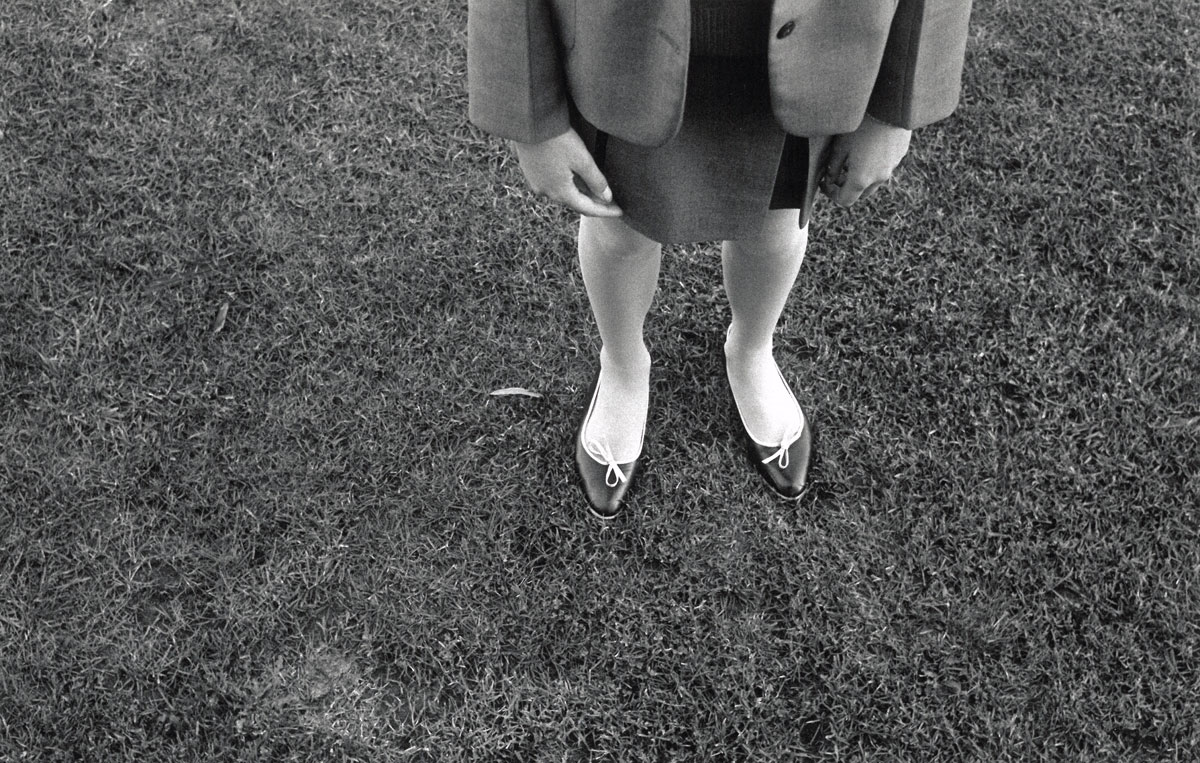
Pat Brassington (Australian, b. 1942)
Untitled
1984 (1)
From the series 1 + 1 = 3
Gelatin silver print
18 x 28cm
Monash Gallery of Art, City of Monash Collection
Courtesy of the artist, ARC ONE Gallery (Melbourne), Stills Gallery (Sydney) and Bett Gallery (Hobart)
Pat Brassington‘s photographs have often made use of the artist’s home and family life as subject matter. The photographs included in this exhibition were taken during the early 1980s and, with their tight cropping and diagonal obliques, suggest that family life is an anxious and ambivalent place. Erotically charged body parts – whether partner’s or offspring – are left to hang, like fetish objects drifting through a dream. Brassington is consciously mining the clichés of psychoanalysis, with her focus on shoes, panties and an ominous father figure, but she reworks this symbolism with a comical lightness that is closer to a teen horror film than the analyst’s couch.

Helen Grace
Women at work, Newcastle
1976
From the series Series 1
Gelatin silver prints
17.5 x 11.6cm (each)
Courtesy of the artist

Helen Grace
Women at work, Newcastle
1976
From the series Series 2
Gelatin silver prints
11.6 x 17.5cm (each)
Courtesy of the artist

Helen Grace
Women at work, Newcastle (detail)
1976
From the series Series 2
Gelatin silver prints
11.6 x 17.5cm (each)
Courtesy of the artist
Helen Grace was a member of the Sydney-based feminist collective Blatant Image (which also included Sandy Edwards), which formed around the Tin Sheds at Sydney University. The collective was interested in examining and reconfiguring the representation of women in popular culture, and also in developing alternative venues for socially conscious art and film. The photographs displayed here point to the two interconnected preoccupations of Grace’s work at this time: the social and cultural construction of motherhood and femininity (and the way that each of these categories are produced by and through consumerism and popular culture), and the documentation of women’s labour. An active member of Sydney’s labour movement, Grace photographed women working in a range of workplaces (including factories and hospitals) for both the historical record and as promotional aids for activist organisations.
Grace’s Women seem to adapt to repetitive-type tasks was widely shown in Sydney and Melbourne, including the exhibition The lovely motherhood show (1981). This work of seven panoramas depicting a string of nappies on a washing line at once points towards the inexorable tediousness of motherhood, and at the same time attempts to demystify the romantic myths of motherhood found in contemporary advertising and popular culture. Grace’s photographs were also widely used in posters produced by trade union and women’s groups. During the 1970s and 1980s screen printing was a cheap and effective way to incorporate photographic imagery into posters. Community groups also embraced screen printing because its aesthetic stood in opposition to commercial advertising, and the process lent itself to a do-it-yourself work ethic.

Merryle Johnson (Australian, b. 1949)
Outside the big top
1979-1980
From the series Circus
Hand coloured gelatin silver prints
Monash Gallery of Art, City of Monash Collection
Donated by Merryle Johnson, 2014
Merryle Johnson‘s photographic feminism sits alongside her contemporaries Micky Allan and Ruth Maddison. In the first instance, it is expressed in the autobiographical nature of her images, which often refer to her family history. And like Allan and Maddison, Johnson also used hand-colouring to reinvigorate documentary photography and to bring a decidedly female perspective to the medium. Johnson’s contribution to feminist photography in Australia is also reflected in her use of photographic sequences – multiple images printed on the same sheet. In these works, the single, perfectly realised photographic image of Modernist photography was replaced with a series of images that draw attention to the fragmentary, contingent and inconclusive nature of photography. The serialisation of photographs also engages a more embodied, spatialised and assertive experience than single pictures alone.

Christine Godden (Australian, b. 1947)
Joanie and baby Jade, Larkspur
1973
From the series Family
Gelatin silver print
8.4 x 13.8cm
Courtesy of the artist

Christine Godden (Australian, b. 1947)
Untitled
c. 1976
Gelatin silver print
15.3 x 22.8cm
Courtesy of the artist

Christine Godden (Australian, b. 1947)
Untitled
c. 1976
Gelatin silver print
15.2 x 22.7cm
Courtesy of the artist

Christine Godden (Australian, b. 1947)
Untitled
c. 1976
Gelatin silver print
15.2 x 22.8cm
Courtesy of the artist
Christine Godden‘s Untitled c. 1976 is part of a sequence of 44 images that represented fragments and textures that combine tenderness and formal rigour in a way that evokes a sense of poetry. The series Family c. 1973 details the domestic environment and experience of young families in the American West.
As well as presenting subjects that engaged a ‘feminine’ subject, Godden’s photographs critically interrogate many of the claims for a distinctly ‘feminine sensibility’ being made by and for women artists at this time. The ‘Untitled’ prints on display here were originally exhibited in 1976 at George Paton Gallery, Melbourne and the Australian Centre for Photography in Sydney. These pictures were originally shown as part of a tightly organised sequence of 44 photographs intended to show ‘how women see [and] how women think’. The tightly cropped glimpses of bodies and textures combine tenderness and formal rigour in a way that evokes a sense of visual poetry.
Christine Godden’s Family series comprises a large number of images detailing the domestic environment and experience of young families living in the American west. Godden was at this time a student at the San Francisco Art Institute and was very active in feminist networks, including the Advocates for Women organisation, for whom she photographed events and actions. Godden’s Family series documents her experience of the counter-cultural families of America’s west coast, who provided and celebrated a new model of family life and women’s work.

Installation view of Photography Meets Feminism at the Monash Gallery of Art with, at right, Anne Ferran’s Scenes on the death of nature, scene I and II (1980-1986)
Photo: Marcus Bunyan

Anne Ferran (Australian, b. 1949)
Scenes on the death of nature, scene I
1980-1986
Gelatin silver print
122 x 162cm
Monash Gallery of Art, City of Monash Collection
Courtesy the artist and Sutton Gallery (Melbourne)
Anne Ferran‘s series Scenes on the death of nature presents five tableau-like scenes showing the artist’s daughter and her friends in classical dress. When they were first exhibited, commentators noted the enigmatic quality of the images, and how they resisted clear meaning, narrative and any attribute of personal style. To many, they represented a significant shift away from documentary photography. This might well be the ‘death’ to which the titles refer. For the critic Adrian Martin, the pictures appeared to evoke myth, while also being ambivalent about a photograph’s capacity to point to or allude to anything outside of itself; in this way, they can be seen to exemplify a certain post-modern approach to photography.
All the same, it is possible to see these important pictures as signposts for another kind of death. The photographs allude to some of the ways that the subject of girl/woman has been produced through visual culture, whether the monumental friezes of classical or Victorian architecture, or Pre-Raphaelite tableaux. In this way, they evoke the idea of ‘femininity’ as a source of meaning. Rather than rejoicing in, resisting or critiquing ‘femininity’ as earlier feminist photographers might have done, Ferran’s pictures remain steadfastly, even ‘passively’ ambivalent. As the artist wrote at the time, the works reveal ‘very little of a personal vision or private sensibility’.
Wall text

Installation view of four Carol Jerrems photographs with Vale Street (1975) at left and Lynn (1976) at right in the exhibition Photography Meets Feminism at the Monash Gallery of Art
Photo: Marcus Bunyan
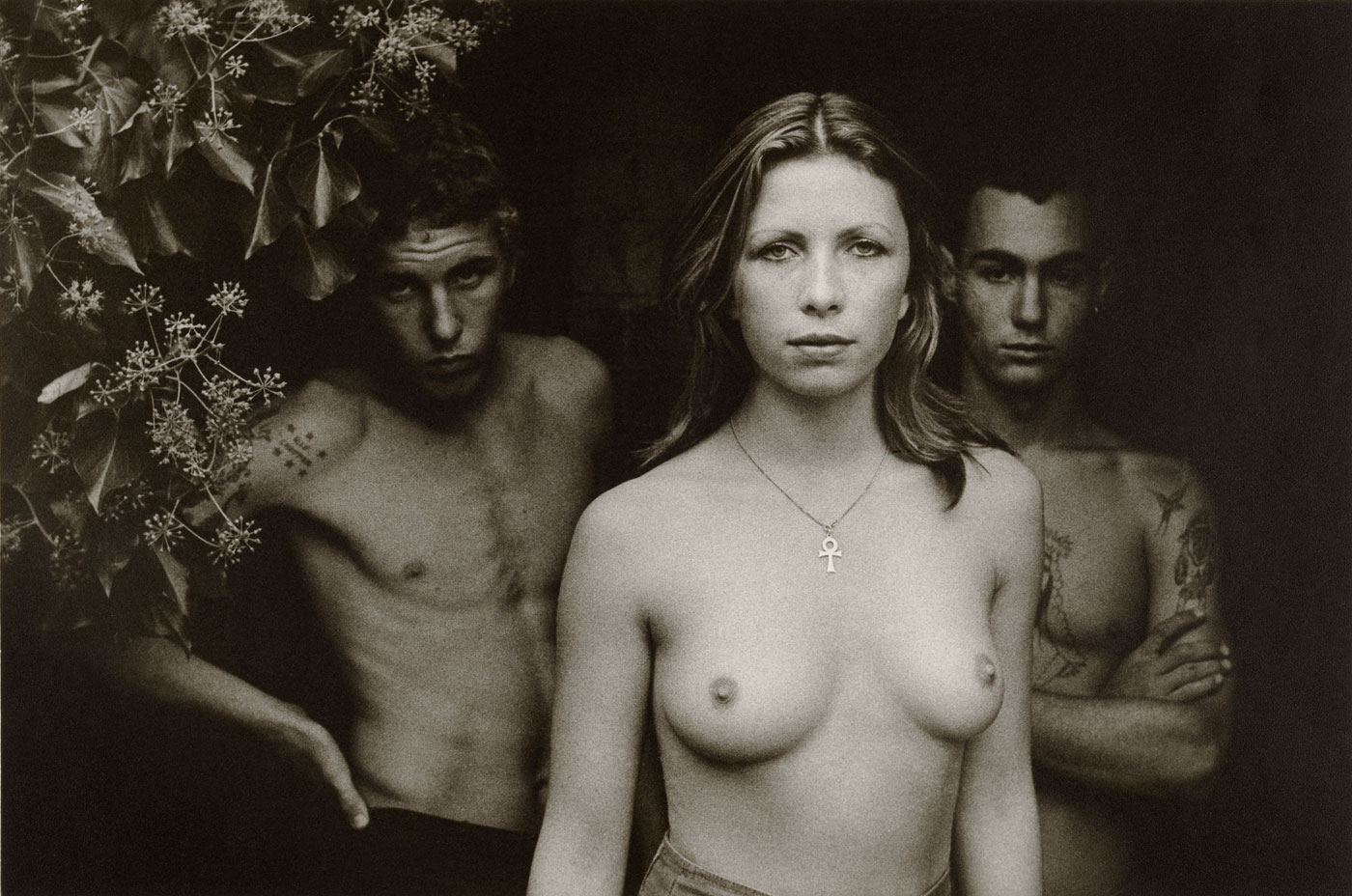
Carol Jerrems (Australian, 1949-1980)
Vale Street
1975
Gelatin silver photograph
National Gallery of Australia, Canberra
Purchased 1976
© Ken Jerrems and the Estate of Lance Jerrems

Carol Jerrems (Australian, 1949-1980)
Lynn
1976
Gelatin silver photograph
National Gallery of Australia, Canberra
© Ken Jerrems and the Estate of Lance Jerrems
Carol Jerrems was one of a number of Australian women whose work during the 1970s challenged the dominant ideas of what a photographer was and how they worked. She adopted a collaborative approach to making photographs, which often featured friends and associates, and sought a photographic practice that would bring about social change. For Jerrems, as for many of her contemporaries, the photograph was an agent of social change, a means of both bringing people together and creating active and engaged social relationships. As she stated:
“I really like people … I try to reveal something about people, because they are so separate, so isolated; maybe it’s a way of bringing people together … I care about [people], I’d like to help them if I could, through my photographs…”
The iconic Vale Street shows Jerrems’s friend Catriona Brown standing in front of Mark Lean and Jon Bourke, teenage boys from Heidelberg Technical School where Jerrems was teaching at the time. The photograph was taken at a house in Vale Street, St Kilda. Although it is unclear if Jerrems conceived of this image as a feminist gesture, the subject’s assertive, bare-chested pose and Venus symbol led to this photograph being interpreted as a statement of feminist power.


Installation views of Photography Meets Feminism at the Monash Gallery of Art
Photos: Marcus Bunyan

Installation view of Ponch Hawkes series Our mums and us at the exhibition Photography Meets Feminism. Her photographs were made by women, of women, for women
Photo: Marcus Bunyan

Ponch Hawkes (Australian, b. 1946)
Ponch and Ida
1976
From the series Our mums and us
Gelatin silver print
17.7 x 12.7cm
Monash Gallery of Art, City of Monash Collection
Donated through the Australian Government’s Cultural Gifts Program by Ian Bracegirdle 2012
Courtesy of the artist

Ponch Hawkes (Australian, b. 1946)
Lorna and Mary
1976
From the series Our mums and us
Gelatin silver print
17.7 x 12.7cm
Monash Gallery of Art, City of Monash Collection
Donated through the Australian Government’s Cultural Gifts Program by Ian Bracegirdle 2012
Courtesy of the artist

Ponch Hawkes (Australian, b. 1946)
Mimi and Dany
1976
From the series Our mums and us
Gelatin silver print
17.7 x 12.7cm
Monash Gallery of Art, City of Monash Collection
Donated through the Australian Government’s Cultural Gifts Program by Ian Bracegirdle 2012
Courtesy of the artist
Ponch Hawkes‘s best-known series Our mums and us documents a selection of the photographer’s contemporaries standing with their mothers. The photographs were taken at each subject’s family home and record generational shifts in personal style and domestic decor. Originally shown at Brummels Gallery of Photography in 1976, which was Hawkes’s first solo exhibition, Our mums and us has become one of the most celebrated examples of feminist photography in Australia.
The use of pronouns in the title suggests the series was made by women, of women and for women; it is a defiant and celebratory feminist gesture, which foregrounds women as at once independent and connected to each other. Reflecting on the series, Hawkes explains that ‘feminism helped me to understand that my mother was actually a woman too, and not just a mother, and Our mums and us came out of that realisation.’


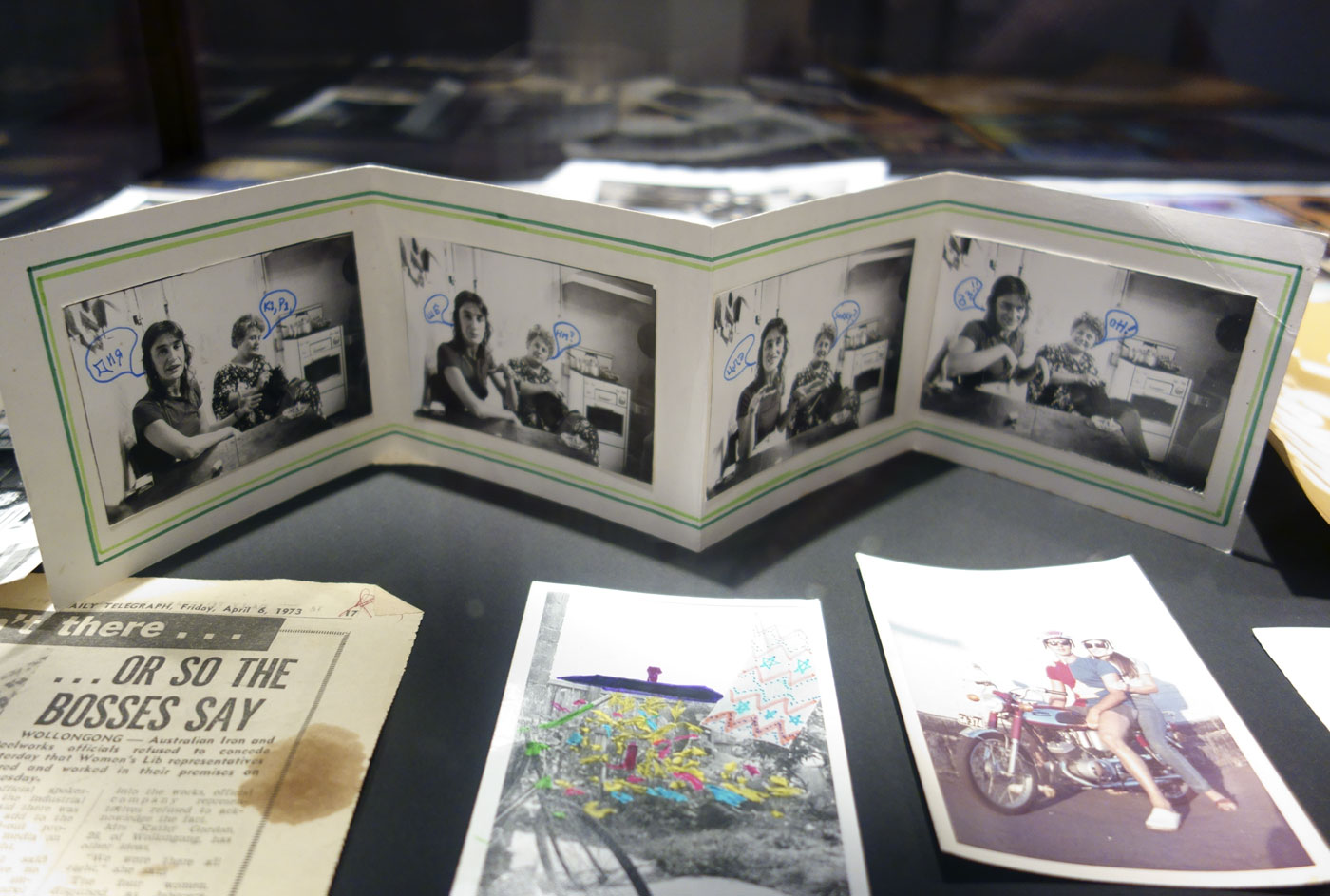

Ephemera and books from Ponch Hawkes personal collection, including the cover of the seminal book A Book About Australian Women by Carol Jerrems and Virginia Fraser (Melbourne, 1974)
Photos: Marcus Bunyan

Ruth Maddison (Australian, b. 1945)
Vehicle Builders Union Ball, Collingwood Town Hall, Melbourne
1979
From the series Let’s dance
Gelatin silver print
27.0 x 18.0cm
Collection of the artist
Courtesy of the artist

Ruth Maddison (Australian, b. 1945)
Women’s dance, St Kilda Town Hall, Melbourne
1985
Gelatin silver print
36.5 x 24.5cm
Courtesy of the artist
Ruth Maddison photographed the social spaces that had been important to activist communities but which were in the process of passing away. These were mainly commissioned projects for labour and social movements, otherwise these histories would have been lost.
Dancing and entertainment were features of Ruth Maddison’s work throughout the 1980s. These photographs reflected Maddison’s own social life, which often revolved around Melbourne’s pubs and nightclubs. But there was also a classical documentary function to her photographs of trade union dances and the annual women’s dance at St Kilda Town Hall. These pictures reflected social spaces that had been important to activist communities, but which by the mid-1980s were in the process of passing away; as women’s groups began to fragment, and as the membership of labour organisations changed. The photographs shown here of the Vehicle Builders’ Union Ball at Collingwood Town Hall were part of a commission. Like many photographers in this exhibition (including Helen Grace, Sandy Edwards and Ponch Hawkes), political affiliation and professional practice often came together in commissioned projects for labour and social movements.

Virginia Coventry (Australian, b. 1942)
Miss World televised
1974
Gelatin silver print
15.5 x 13.5cm (each)
Courtesy of the artist
Miss World televised is typical of Virginia Coventry‘s photographic work from this period, which tended to revolve around tightly organised sequences of pictures of the same subject (swimming pools in a Queensland town; the spaces between houses) or an event (a car moving through a carwash; a receding flood).
At the time, Coventry shared a house with Micky Allan. One night, while watching Allan’s black-and-white television, she saw footage of the 1974 Miss World pageant on the news. Immediately taken by the way the poor reception distorted the bodies of the contestants, Coventry began to photograph the footage. Once she developed the film, she realised the visual ‘disruption’ caused by the incongruity of the telecast process and the camera’s shutter speed obscured the figures and the beauty of the contestants, without necessarily deriding or critiquing the women themselves. As Coventry has written of the pictures: “I remember discussions with other women at the time about the way that the distortions offered a protection to the integrity of the actual person in the photo-images. Because of the radical slippage between reportage and reception, the individual is no longer the subject. The title operates to focus attention on Miss World telecast as a quite abstract construction – as do the black-and-white, grainy, prints.”
PHOTOGRAPHY MEETS FEMINISM: Australian women photographers 1970s-80s looks at the vital relationship of photography and feminism in Australia during the 1970s and ’80s.
Given the vitality of both feminist politics and art photography during the 1970s, it is not surprising that they entered into a lively exchange that extended into the 1980s. On the one hand, feminists used the highly informative and accessible medium of photography to raise awareness of critical social issues.
On the other hand, photographic artists embraced feminist themes as a way of making their practice less esoteric and more engaged with contemporary life. This productive intersection of feminism and photography fostered a range of technical innovations and critical frameworks that made a significant contribution to the direction of visual culture in Australia.
PHOTOGRAPHY MEETS FEMINISM: Australian women photographers 1970s-80s will feature vintage prints of important photographs, many of which have not been seen for decades.
MGA Interim Director, Stephen Zagala states, “We are proud to present this exhibition, which provides an as-yet untold account of Australian photography and draws heavily on MGA’s nationally significant collection of Australian photography.”
Press release from the Monash Gallery of Art
This exhibition explores the encounter between photography and feminist politics during the 1970s and into the 1980s.
Both photography and feminism thrived during this period. Feminist politics of the 1970s expanded on its earlier fight for equal rights by illuminating discrimination against women in various contexts. This included addressing domestic violence, inequality in the workplace, sexism in the media, and the economics of parenting. Alongside this expanded critique of patriarchy, feminist politics also celebrated ‘sisterhood’ by drawing attention to the undervalued achievements of women and by taking pride in distinctly female perspectives on the world.
Photographic practice also expanded its parameters during the 1970s. Together with other art forms such as painting and sculpture, photography became more experimental and irreverent. Most photographic artists rejected the tradition of highbrow fine art photography and invested the medium with personal sentiment and everyday content. The camera also became a useful tool for a generation of artists more interested in social engagement than aesthetic finesse.
Given the vitality of both feminist politics and art photography during the 1970s, it is not surprising that they entered into a lively exchange that extended into the 1980s. On the one hand, feminists used the highly informative and accessible medium of photography to raise awareness of critical social issues. On the other hand, photographic artists embraced feminist themes as a way of making their practice less esoteric and more engaged with contemporary life. This productive intersection of feminism and photography fostered a range of technical innovations and critical frameworks that made a significant contribution to the direction of visual culture in Australia.
Text from the Monash Gallery of Art website

Sue Ford (Australian, 1943-2009)
Untitled
1969-1971
From the series The Tide Recedes
Selenium toned gelatin silver print

Sue Ford (Australian, 1943-2009)
Untitled
1969-1971
From the series The Tide Recedes
Selenium toned gelatin silver print
Sue Ford‘s series The Tide Recedes 1969-1971 was made for her first solo exhibition at the Hawthorn City Art Gallery in 1971. People were becoming more removed from nature but Ford felt that woman share a particular biological and cultural affinity with nature. The contrasty black and white photographs of bodies melding with rocks in montage prints that are as rough as guts work magnificently.
These prints were made as preparation for Sue Ford’s ambitious series The tide recedes, shown as part of Ford’s first solo exhibition at the Hawthorn City Art Gallery in 1971. Throughout this body of work, images of naked women and of men and women embracing merge with a marine landscape. The series expresses Ford’s concern that people were becoming too removed from nature, and allude to the idea that women share a particular biological and cultural affinity with nature. It also draws on a technique that was central to feminist photographic practice – montage, where two disparate fragments are brought together to produce new and often unexpected meanings. While this reflects Ford’s work as a film maker, where montage is often used in storytelling, this strategy also embeds her pictures in the field of activist art. With montage, it is the viewer who ultimately makes sense of a work, as they find and see connections between disparate fragments.
While the prints presented in the 1971 exhibition were ambitious in scale and resolution, Ford preferred prints that were – in her terms – ‘rough as guts’. Prints such as those shown here represented an explicit rejection of the maleness of both the camera as a technological instrument and the arcane knowledge of the darkroom.

Robyn Stacey (Australian, b. 1952)
Queensland out west
1982
Hand-coloured gelatin silver prints
9.2 x 15.2cm (each)
Courtesy of the artist and Stills Gallery (Sydney)


Robyn Stacey (Australian, b. 1952)
Queensland out west (details)
1982
Hand-coloured gelatin silver prints
9.2 x 15.2cm (each)
Courtesy of the artist and Stills Gallery (Sydney)

Robyn Stacey (Australian, b. 1952)
Untitled (Geoff in Bondi)
1981
From the series Modified myths 1938-1988
Hand-coloured gelatin silver print
39.0 x 38.3cm
Courtesy of the artist and Stills Gallery (Sydney)

Robyn Stacey (Australian, b. 1952)
Untitled (Picnic)
1981
From the series Modified myths 1938-1988
Hand-coloured gelatin silver print
39.0 x 38.3cm
Courtesy of the artist and Stills Gallery (Sydney)
Robyn Stacey established a reputation for her hand- coloured prints in the late 1970s and early ’80s. Introduced to the process by Micky Allan, Stacey’s early hand-coloured prints examined the life and culture of Australia, especially her native Queensland. Stacey hand-coloured her photographs so as to invest them with personal attributes: “At the time I was interested in hand colouring [because it was] a technique associated with women’s work and craft. This approach seemed a good way to visually re-enforce the personal and intimate quality of the prints.”
Among Stacey’s most important contributions to the feminist tradition of hand colouring photographs are her pictures of Queensland architecture, taken during a road trip to western Queensland made with her mother. These images refer to an heroic subject in Australian culture – the stoicism of the outback and the people who populate it. But Stacey revises these myths, by presenting the images as intimate and personal.

Robyn Stacey (Australian, b. 1952)
Ice
1989
From the series Redline 7000
Silver dye bleach print
104.0 x 175.3cm
Monash Gallery of Art, City of Monash Collection
Donated through the Australian Government’s Cultural Gifts Program 2012
Courtesy of the artist and Stills Gallery (Sydney)

Robyn Stacey (Australian, b. 1952)
Jet
1989
From the series Redline 7000
Silver dye bleach print
164 x 103cm
Monash Gallery of Art, City of Monash Collection
Donated through the Australian Government’s Cultural Gifts Program 2012
Courtesy of the artist and Stills Gallery (Sydney)
In the late 80s, Stacey began to hand colour her transparencies rather than the print, thereby incorporating an aspect of reproducibility to the images. In this way the work shifted from the unique print, with its references to nostalgia and the careful rendering of places and times, to something resembling the glossy images found in 1980s’ mass media, especially Hollywood cinema.

Julie Rrap (Australian, b. 1950)
Persona and shadow: Madonna
1984
Silver dye bleach print
203.0 x 126.5cm
Monash Gallery of Art, City of Monash Collection acquired 1997
Courtesy of the artist and Arc One Gallery (Melbourne) and Roslyn Oxley9 Gallery (Sydney)
This photograph is from the series of nine works titled Persona and shadow. Julie Rrap produced this series after visiting a major survey of contemporary art in Berlin (Zeitgeist, 1982) which only included one woman among the 45 artists participating in the exhibition. Rrap responded to this curatorial sexism with a series of self-portraits in which she mimics stereotypical images of women painted by the Norwegian artist Edvard Munch (1863-1944). Each pose refers to a female stereotype employed by Munch: the innocent girl, the mother, the whore, the Madonna, the sister, and so on.
Appropriating the work of other artists is one of the strategies that characterises the work of so-called ‘postmodern’ artists active during the 1980s. The practice of borrowing, quoting and mimicking famous artworks was employed as a way of questioning notions of authenticity. Feminist artists tended to use appropriation to specifically question the authenticity of male representations of females. In more straightforward terms, Rrap reclaims Munch’s clichéd images of women and makes them her own. Rrap ultimately becomes an imposter, stealing her way into these masterpieces of art history, but the remarkable thing about these works is the way that the artist foregrounds the process of reappropriation itself. The procedure of restaging, collage, overpainting, and rephotographing becomes part of the final image, testifying to a do-it-herself politic.
Wall text
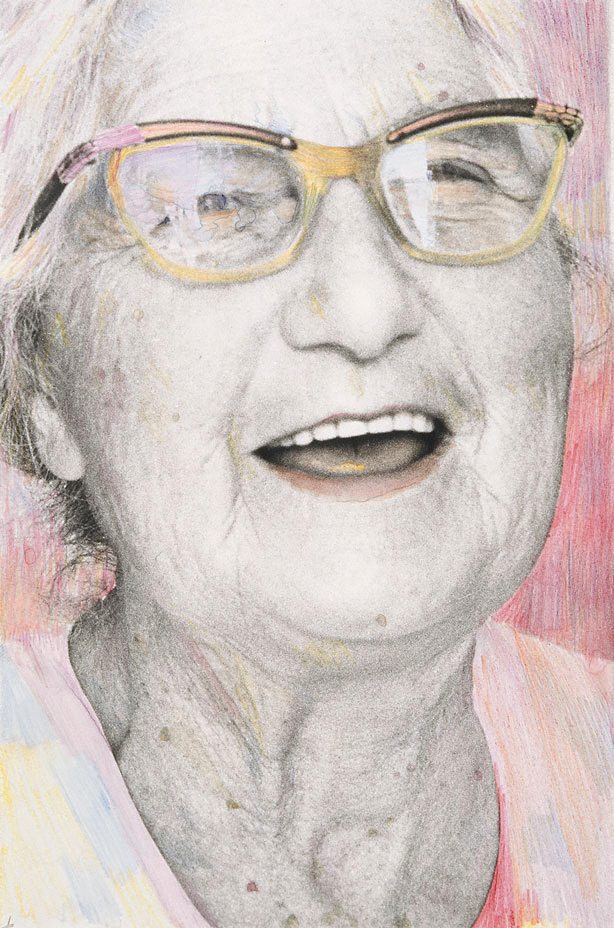
Micky Allan (Australian, b. 1944)
Old age
1978
From the series Old age
Gelatin silver photograph, hand coloured with watercolour and pencil
18.2 x 12.0cm
© Micky Allan

Micky Allan (Australian, b. 1944)
Old age
1978
From the series Old age
Gelatin silver photograph, hand coloured with watercolour and pencil
18.2 x 12.0cm
© Micky Allan

Micky Allan (Australian, b. 1944)
Old age
1978
From the series Old age
Gelatin silver photograph, hand coloured with watercolour and pencil
18.2 x 12.0cm
© Micky Allan
Micky Allan’s two series Babies and Old age were shown in Melbourne and Sydney around 1976-1977; their reception revealed much about the anxieties that informed photographic criticism and practice at the time, with critics dismissing the works as ‘slight’ and ‘feminine photographs par excellence’. Across a series of exhibitions between 1976 and 1980, Allan challenged many of the established conventions of fine art photography, in both technique and subject. Allan overpainted the black-and-white print with watercolour, gouache and pencil to the extent of both acknowledging the under recognised history of women’s photographic work – historically, women were employed by studios to hand-paint or tone photographic prints – and transgressing the smooth surface of photographic prints that was prized by traditional art photographers.
For Allan, overpainting rejected the technical sameness of modern photography and introduced an emotional warmth. Allan’s hand-colouring also interrupted the myth of photographic transparency – the notion of the photograph as a ‘disinterested’ window onto the world. Overpainted, the photograph became subjective, contingent and fallible. The lightness of many of Allan’s interventions enhances this sense of fallibility.
Wall text
With a body of work ranging across painting, photography and performance, investigations of subjectivity have been central to Micky Allan’s practice. Allan has consistently drawn on feminist strategies which emphasise the personal and autobiographical. In the early 1970s she became involved with the experimental performance and collective activities based at The Pram Factory in Melbourne, working there as both a set designer and a photographer, documenting early feminist work. Of this time Allan has said that she saw “photography as a form of social encounter … that in comparison with painting it [was] much more integrated to what was going on.”1
Allan has acknowledged social documentary as the basis of her photographic work. For a short period she recorded political figures and the surrounding social changes in which she was both a participant and an observer. Old age, the second of three series whose focus is lifecycles (the other two being Babies 1976 and The prime of life 1979-1980), comprises 40 hand-coloured individual portraits. Allan introduced the technique of hand-colouring in her work in 1976, a technique taken up by many women photographers at that time to counter the then dominant modes of masculine production. While there is stylistic variation across the series, each portrait, close-up in viewpoint, is meticulously rendered in pastel colours. The images do not capture a simple moment but rather work together to poignantly symbolise a rich regard for age. Of this Allan has said: “Altogether they are an attempt to familiarise and personalise “age”, in a society which tends to ignore or stereotype the old.”2
1/ ‘On paper – survey 12’, National Gallery of Victoria, Melbourne, 21 Jun ‘ 20 Jul 1980, as quoted in 1987, Micky Allan: perspective 1975-1987, Monash University Gallery, Clayton p. 4
2/ Ibid p. 19
© Art Gallery of New South Wales Photography Collection Handbook, 2007
Micky Allan (b. Australia 1944) studied Fine Art at the University of Melbourne, and painting at the National Gallery School in the 1960s. Allan began taking photographs in 1974 after joining the loosely formed feminist collective at Melbourne’s experimental arts and theatre space the Pram Factory. During this time Allan was part of a vibrant community of feminist artists that included Virginia Coventry, who taught her how to take and print photographs. Allan returned to painting as her primary medium in the early 1980s.
Pat Brassington (b. Australia 1942) is a Hobart-based artist who studied printmaking and photography at the Tasmanian School of Art, graduating with a Master of Fine Arts in 1985. Brassington draws on a personal archive of visual material to compose her images. This archive includes both photographic and non-photographic material, which has either been found or produced by Brassington. Her work takes inspiration from surrealist photography, with its recurring interest in fetish objects and uncanny domestic scenes. Brassington typically employs digital collage to manufacture disjointed compositions, and she exhibits her work in elliptical series that suggest dream-like narratives.
Virginia Coventry (b. Australia 1942) studied painting at the Royal Melbourne Institute of Technology during the early 1960s, before undertaking postgraduate studies at the Slade School of Fine Art, University College, London. While painting and drawing have been constant features of Coventry’s practice, she started taking photographs during the mid-1960s and developed a significant reputation for her photo-based work during the 1970s. Her photographic work typically engages with socio-political issues and often incorporates textual elements that give it a discursive form.
Sandy Edwards (b. New Zealand 1948 arr. Australia 1961) has been an important figure in Australian photography as both a maker and advocate since the 1970s. Edwards’s practice has paid particular attention to women and their relationship with the media of photography and film. Most of her work is documentary in nature but her photographic prints are often presented in sequences that elaborate conceptual points. Edwards has also been a prolific curator of exhibitions promoting the work of contemporary photographers, especially in Sydney.
Anne Ferran (b. Australia 1949) is a Sydney-based photographer and academic. She studied humanities and teaching before training in photography at Sydney College of the Arts. She began exhibiting her work in the mid-1980s and has become one of Australia’s most critically acclaimed photographers. Ferran’s practice is largely concerned with using photography to reclaim forgotten pasts, with a specific interest in the histories of women and children in colonial Australia. In pursuing this interest, Ferran often develops her projects through archival research and fieldwork.
Sue Ford (Australia 1943-2009) studied photography at RMIT and was the first Australian photographer to be given a solo exhibition at the National Gallery of Victoria in 1974. Over the course of her artistic career Ford worked with still photography and moving images, beginning with traditional analogue film and then embracing the possibilities offered by photomedia and digital technologies. In this respect, Ford is a key figure in the history of avant-garde photographic experimentation. Ford’s artworks are also remarkable for their critical engagement with contemporary social issues, while also expressing deeply personal perspectives on the world.
Christine Godden (b. Australia 1947) has played a significant role in Australian photography as a maker, curator and advocate. After studying in Melbourne, Godden completed a Bachelor of Fine Arts at the San Francisco Art Institute in 1975 and a Master of Fine Arts at the Visual Studies Workshop in Rochester, New York in 1980. On her return to Australia, she became director of the Australian Centre for Photography, Sydney, and was consequently a prominent spokesperson for Australian photography during the 1980s. Her own photography is couched in a highly personal and poetic form of documentary practice.
Helen Grace (b. Australia 1949) is a self-taught artist who began making work as an active member of feminist and labour organisations in Sydney during the mid-1970s. Often straight-forwardly documentary in style, Grace’s approach to photography is closely aligned with political consciousness raising. Her work for the labour and women’s movements was widely circulated around the time of its production, both in the pages of publications and in posters produced by trade unions and women’s groups. Grace’s writing on photography and film, history and politics have also made a significant contribution to the critical discussion that surrounds feminist practice in Australia.
Janina Green (b. Germany 1944 arr. Australia 1949) studied Fine Arts at Melbourne University and Victoria College before training as a printmaker at RMIT. In the 1980s she taught herself photography and subsequently specialised in this medium. Green held her first solo exhibition of photography in 1986 and has exhibited regularly since then, participating in over 30 group exhibitions and producing over 20 solo shows. Green’s photographs are distinguished by their sophisticated and often sensuous surfaces, which testify to her early training in printmaking. In her role as a teacher in the photography department at the Victorian College of the Arts, Green has also played a significant role as a mentor for younger photographers.
Fiona Hall (b. Australia 1953) initially trained as a painter, and has ultimately become a celebrated sculptor, but photography was her primary medium in the late 1970s and early 1980s. Hall developed an interest in photography at art school and worked as an assistant to the well-known landscape photographer Fay Godwin while she lived in London between 1977-78. Hall subsequently studied photography at the Visual Studies Workshop in New York during 1982. Hall’s photographic practice demonstrates a fascination with decoration and style, which is informed by a critical interest in the premise of a ‘feminine’ sensibility.
Ponch Hawkes (b. Australia 1946) took up photography in 1972 while working as a journalist for the counter-cultural magazines Digger and Rolling Stone. Her early photography was informed by her role as a commentator on alternative social issues, and she has often used her images to engage with contemporary critical debates. During the 1970s Hawkes was part of a loosely formed feminist collective based at Melbourne’s experimental arts and theatre space the Pram Factory. Since that time she has continued to work closely with community groups around Australia and remains a key figure in contemporary photographic practice.
Carol Jerrems (Australia 1949-80) was born in Melbourne and studied photography at Prahran Technical College under Paul Cox and Athol Shmith between 1967 and 1970. Although she practised as an artist for only a decade, Jerrems has acquired a celebrated place in the annals of Australian photography. Her reputation is based on her compassionate, formally striking pictures, her intimate connection with the people involved in social movements of the day, and her role in the promotion of ‘art photography’ in this country.
Merryle Johnson (b. Australia 1949) graduated from Bendigo College of Advanced Education in 1969 with a major in painting. She took up photography in 1970 and it subsequently became central to her professional life, both as an arts educator and an exhibiting artist. Johnson’s approach to photography is informed by her broader training as an artist. This is particularly evident in her use of hand-colouring and sequencing. While the subject matter of her images is largely drawn from everyday life, she employs artistic devices to bring a sense of drama and fantasy to documentary photography.
Ruth Maddison (b. Australia 1945) is a self-taught photographer and artist. Maddison began working as a professional photographer in 1976, and she has been regularly exhibiting her work since 1979. Photography has been her primary medium, but in later years her artistic practice has expanded to include moving-image, textiles and sculpture. An interest in personal biography and the celebration of everyday existence informs her artistic practice. She is most well-known for her hand-coloured photographs of domestic life. In 1996 Maddison relocated from Melbourne to Eden, on the south coast of NSW.
Julie Rrap (b. Australia 1950) studied humanities at the University of Queensland (1969-71) before establishing her career as an exhibiting artist in Sydney during the 1980s. Rrap’s involvement with performance art and avant-garde politics during the 1970s laid the foundations for her later work in photography, painting, sculpture and video, which is largely concerned with the representation and experience of women’s bodies. The photographic objectification of female bodies is a persistent theme in Rrap’s work, but her highly expressive self-portraits invest the medium with a subjective intensity that affronts the clinical quality of voyeurism.
Robyn Stacey (b. Australia 1952) is a Sydney-based photographer who has been exhibiting since the mid-1980s. During the 1980s Stacey produced staged or ‘directorial’ photographs that drew on the visual language of cinema and television. Through the 1990s Stacey engaged in further training and study, and experimented extensively with new media including digital photography and lenticular prints. In 2000 Stacey began working with natural history collections in Australia and overseas, using photography to bring the contents of these archives to life. Throughout her career, Stacey has been interested in photography as an expressive medium that can be used to reiterate, remix and reanimate visual information.
Monash Gallery of Art
860 Ferntree Gully Road, Wheelers Hill
Victoria 3150 Australia
Phone: + 61 3 8544 0500
Opening hours:
Tue – Fri: 10am – 5pm
Sat – Sun: 10pm – 4pm
Mon/public holidays: closed
 Art Blart _ art and cultural memory archive
You must be logged in to post a comment.